Notes and key-term cards for this topic are being written by our tutors. The past-paper questions below are ready now.
Specification statements
Show the 13 statements from the specification
3.1 know what is meant by the term ‘oxidation number’
3.2 be able to calculate the oxidation number of elements in compounds and ions [The use of oxidation numbers in peroxides and metal hydrides is expected.]
3.3 understand oxidation and reduction in terms of electron transfer and changes in oxidation number, applied to reactions of s- and p-block elements
3.4 understand oxidation and reduction in terms of electron loss or electron gain
3.5 know that oxidising agents gain electrons
3.6 know that reducing agents lose electrons
3.7 understand that a disproportionation reaction involves an element in a single species being simultaneously oxidised and reduced
3.8 know that oxidation number is a useful concept in terms of the classification of reactions as redox and as disproportionation
3.9 be able to indicate the oxidation number of an element in a compound or ion, using a Roman numeral
3.10 be able to write formulae given oxidation numbers
3.11 understand that metals, in general, form positive ions by loss of electrons with an increase in oxidation number
3.12 understand that non-metals, in general, form negative ions by gain of electrons with a decrease in oxidation number
3.13 be able to write ionic half-equations and use them to construct full ionic equations
Six-mark extended response questions on this topic
Tap a question to zoom it. Where a part needs a figure, table or structure from earlier in the question, that part folds out above it; the mark scheme and examiner's comment open underneath. Have Edexcel's Data Booklet beside you; the Periodic Table is on the back page of every paper.
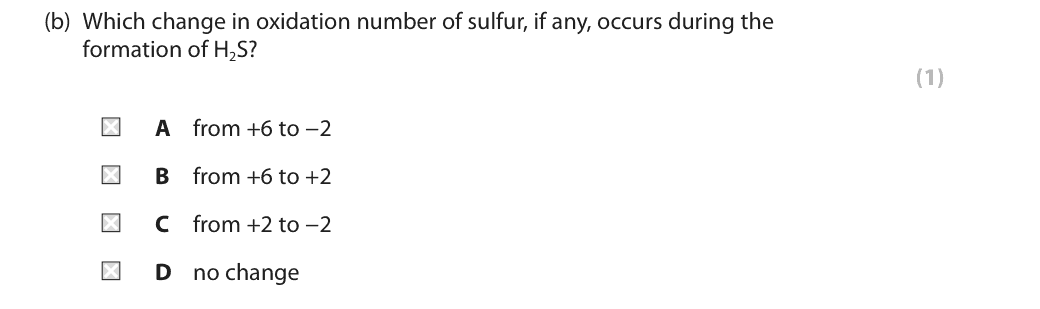
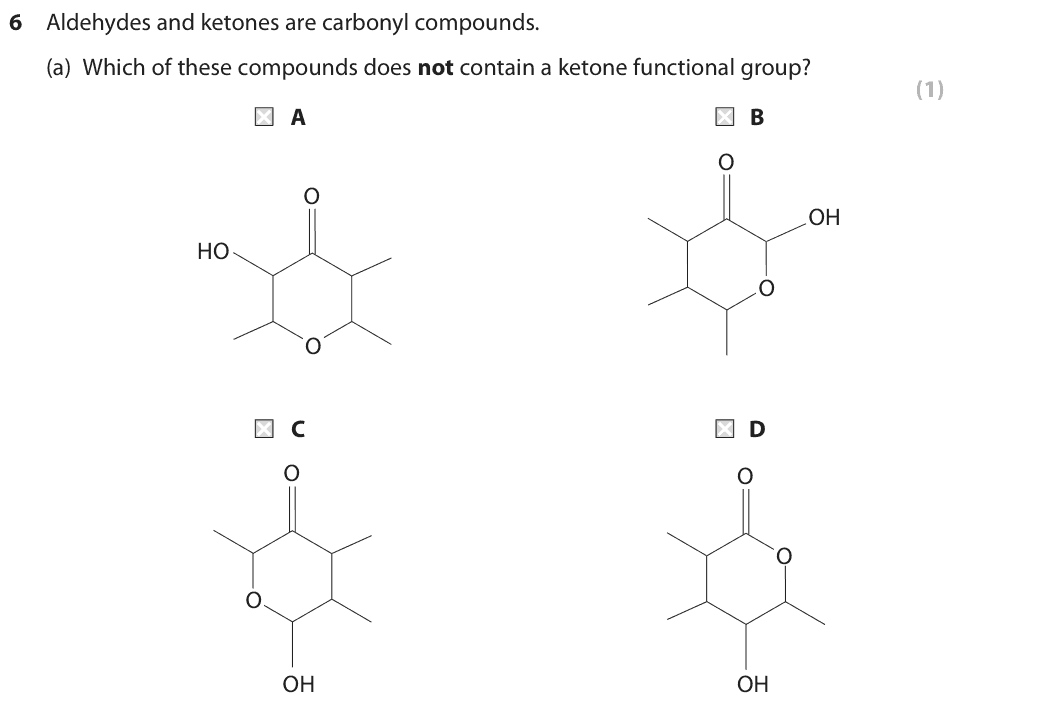
June 2025 · AS Paper 1 · Q6(b)1 markMultiple choice
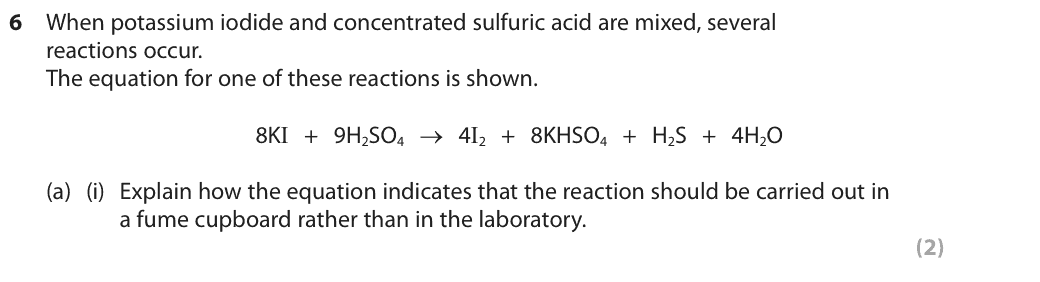
Earlier part of question 6 that this part uses
Answer
A
Mark scheme
Examiner's comment
Q6b was answered well with 84% of candidates achieving the mark. The question required candidates to state the oxidation change in sulfur.
Notes from the mark scheme and report
Answer: A. Sulfur is +6 in H2SO4 and –2 in H2S. B takes hydrogen in H2S as –1
C takes oxygen as –1
D overlooks that one of the sulfur atoms does change
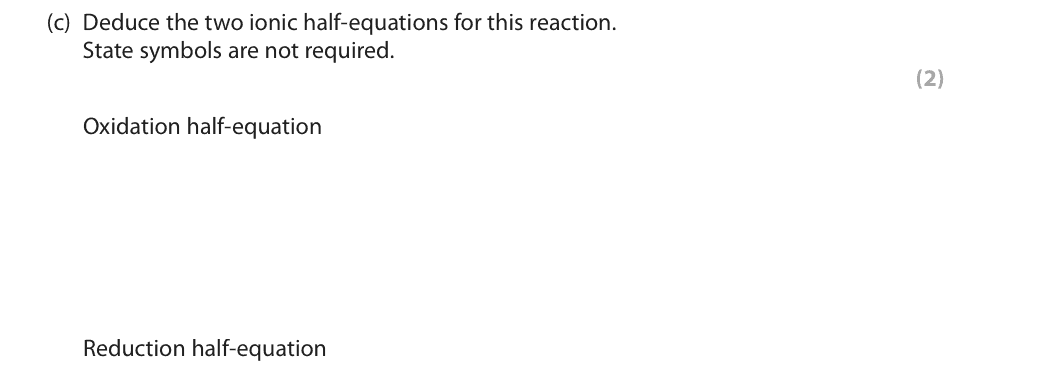
June 2025 · AS Paper 1 · Q6(c)2 marksEquation writingHard
Earlier part of question 6 that this part uses
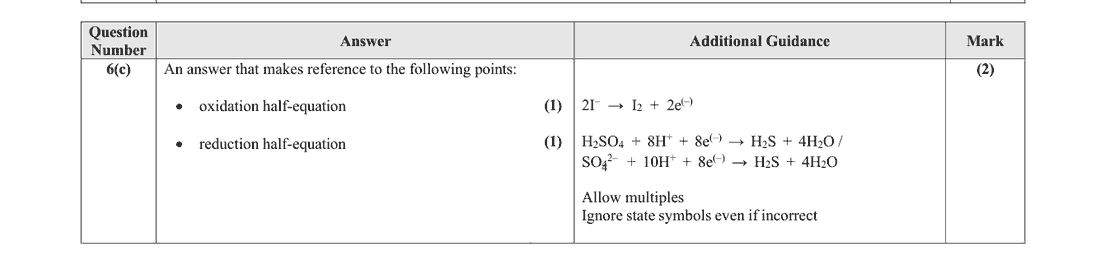
Mark scheme
Examiner's comment
Q6c required candidates to deduce the two half equations. This was not answered well. Most candidates could get the half equation for the oxidation of iodide but few candidates could get the reduction half equation.
state symbols ignored. Most could write the iodide half-equation but few the reduction half-equation
June 2025 · Paper 1 · Q6(f)(i)2 marksEquation writing
Earlier part of question 6 that this part uses
Mark scheme
Examiner's comment
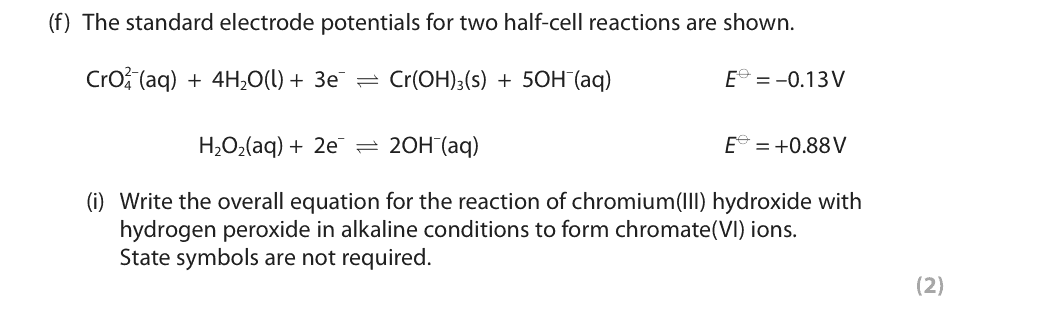
This question was about the feasibility of a reaction with respect to the Eθ
cell calculation.
They had to combine two half equations together and then calculate the Eθ
cell. Most had a good attempt at combining the equations but slipped up on small things like cancelling the OH- on both sides of the equation.
The calculation of Eθ
cell was generally done well.
Notes from the mark scheme and report
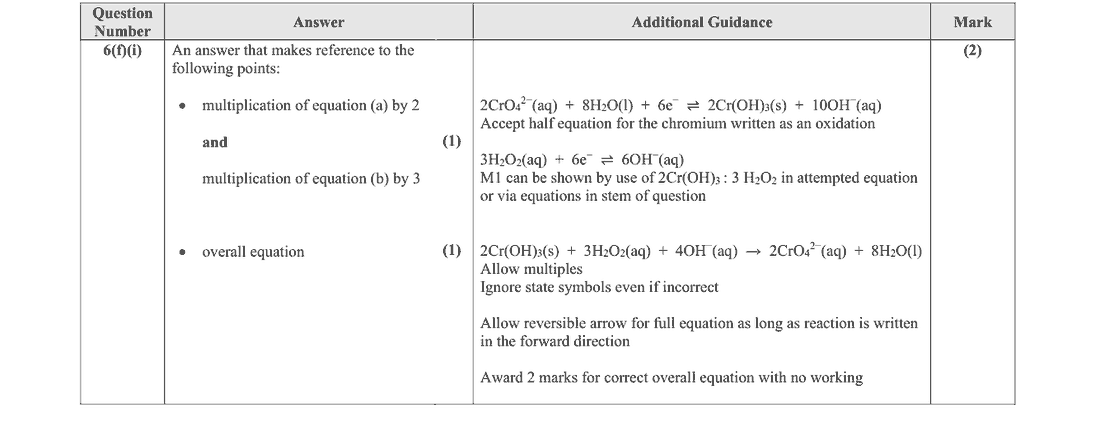
2Cr(OH)3 + 3H2O2 + 4OH– → 2CrO4 2– + 8H2O. First mark for multiplying the chromium half-equation by 2 and the peroxide one by 3 (a 2 : 3 ratio in an attempted equation shows this)
multiples allowed. Usual slip: not cancelling the OH– that appears on both sides
June 2024 · Paper 1 · Q5(d)2 marksEquation writing
Earlier part of question 5 that this part uses
Mark scheme
Examiner's comment
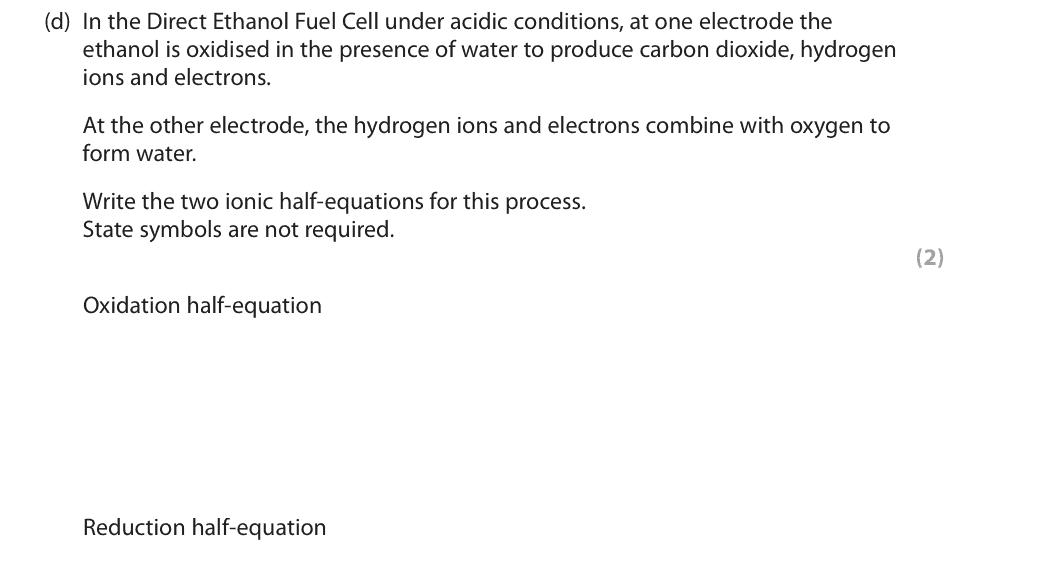
The question was about the reactions at the electrodes in the Direct Ethanol Fuel Cell.
Candidates were asked to write balanced ionic equations for both the oxidation and reduction reactions.
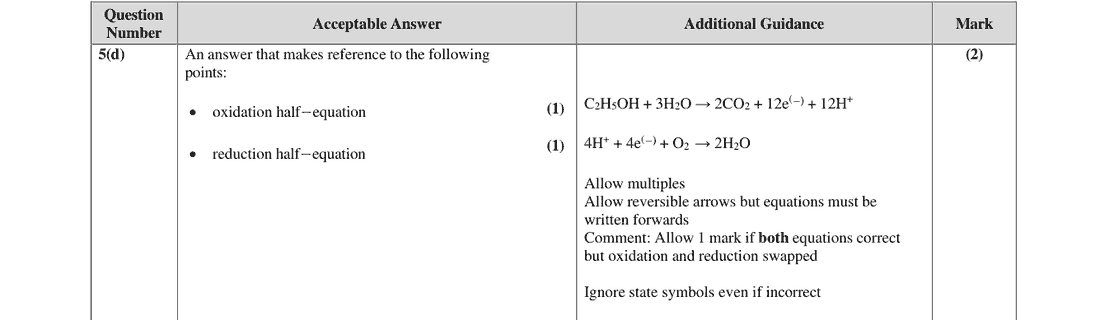
The reduction half-equation was more often awarded than the oxidation equation.
one mark if both are right but swapped. The reduction half-equation was scored more often
June 2024 · AS Paper 1 · Q5(f)1 markMultiple choice
Earlier part of question 5 that this part uses
Answer
C
Mark scheme
Examiner's comment
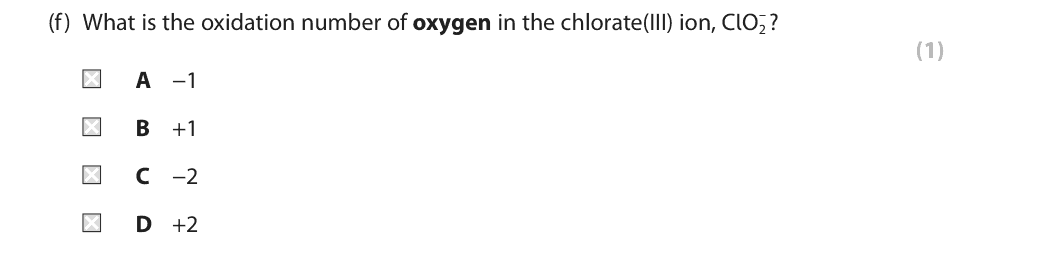
Candidates responded to this question well. Most candidates were able to identify it as -2.
Notes from the mark scheme and report
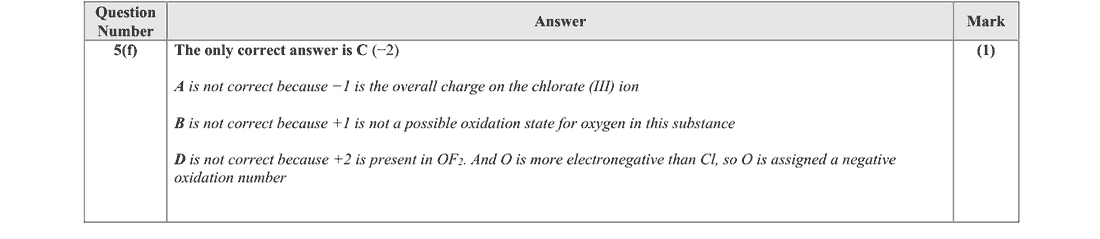
Answer: C (–2). Oxygen is more electronegative than chlorine, so it is –2 (chlorine is +3). A is the overall charge on the ion
D is the value in OF2. Most identified –2
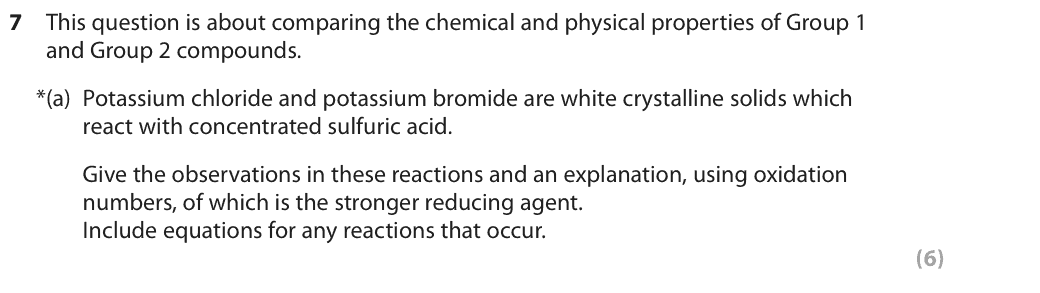
June 2024 · AS Paper 1 · Q7(a)6 marks6-mark extended response
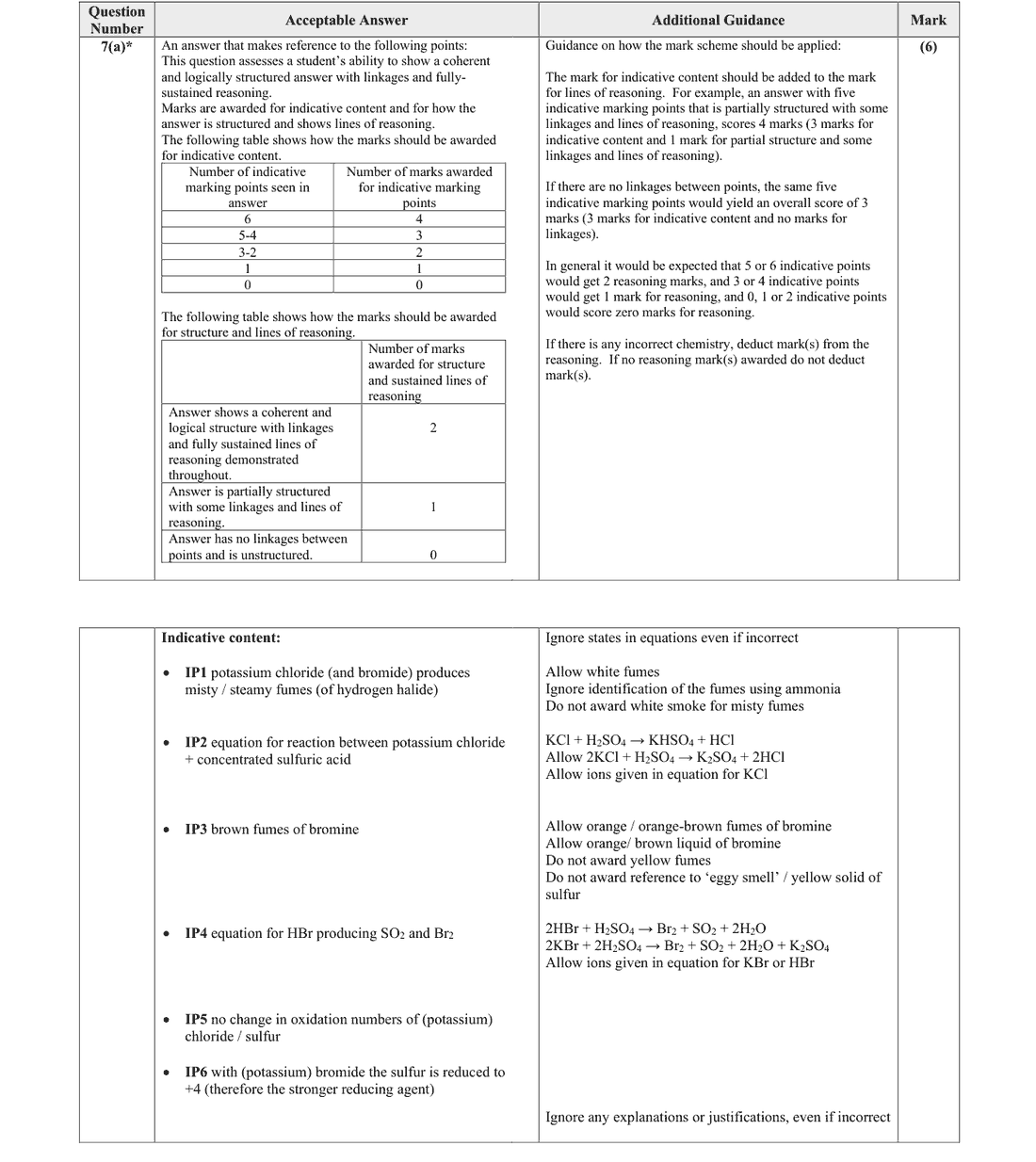
Mark scheme, with the indicative content and the marks for reasoning
Examiner's comment
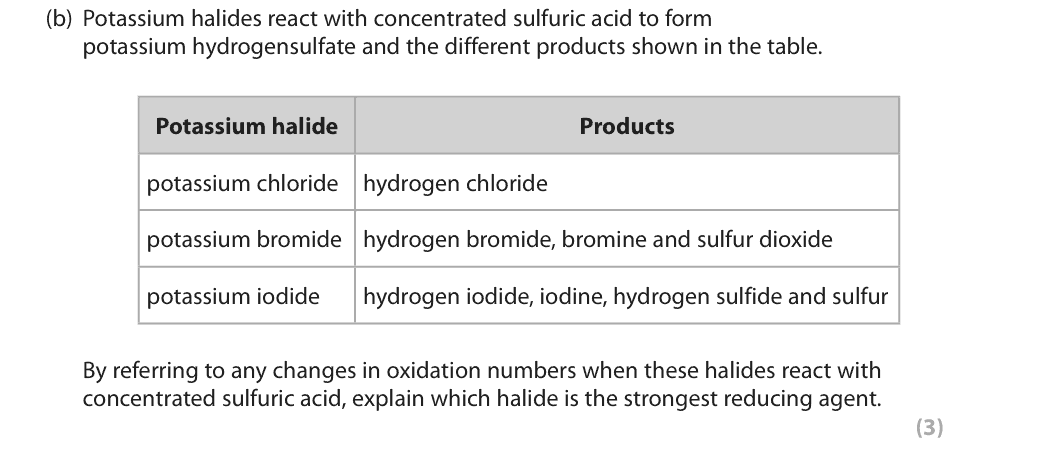
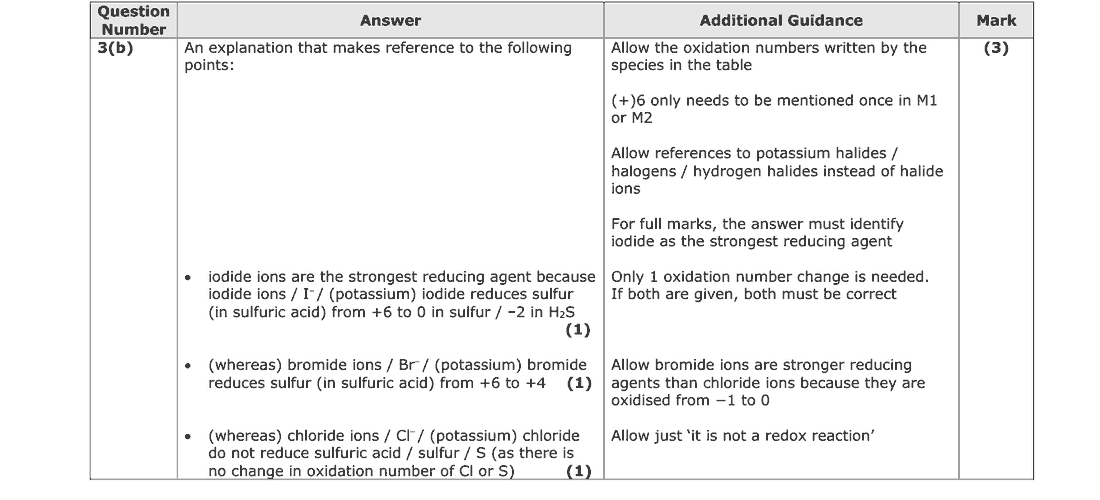
Candidates answered this question relatively well. The average mark achieved on this question was 2. Most candidates were able to state the equation between potassium chloride and sulfuric acid and identify the misty fumes of hydrochloric acid given off. Some candidates identified no change in oxidation number of sulfur for the reaction with potassium chloride, but the sulfur is reduced from +6 to +4 when reacted with potassium bromide. Very few could state the balanced equation for the further reaction of hydrogen bromide with sulfuric acid or identify orange fumes as bromine.
Notes from the mark scheme and report
Six indicative points plus two marks for reasoning. IP1 potassium chloride (and bromide) gives misty / steamy fumes (white fumes allowed, white smoke not)
IP5 no change in oxidation number of chlorine / sulfur with the chloride
IP6 with the bromide sulfur is reduced (from +6) to +4, so bromide is the stronger reducing agent. Average mark was 2. Most gave the KCl equation and misty fumes
very few gave the equation for HBr with sulfuric acid or the bromine fumes
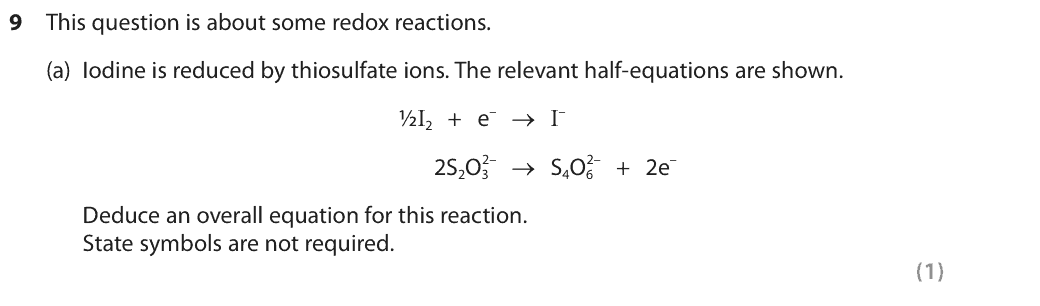
June 2024 · AS Paper 1 · Q9(a)1 markEquation writing
Mark scheme
Examiner's comment
Candidates answered this question relatively well, with 55% of candidates answering correctly. Most marks were lost for incorrect balancing or missing charges. Some candidates included electrons in the overall equation.
marks were lost for balancing, missing charges or leaving electrons in
June 2024 · AS Paper 1 · Q9(b)(i)1 markShort answerHard
Earlier part of question 9 that this part uses
Mark scheme
Examiner's comment
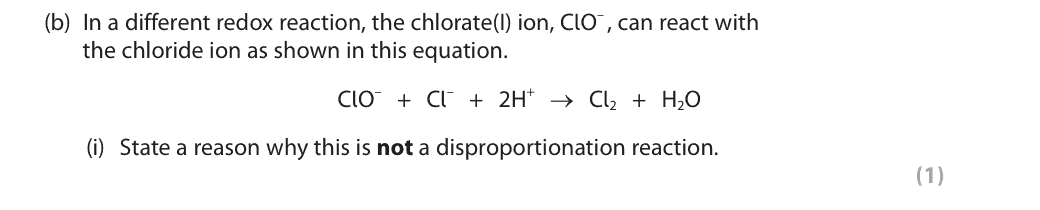
Q9bi) Overall, this question was answered poorly, with only 25% candidates answering correctly. The definition was not well explained and the use of ‘single species’ was rarely seen, with many using a ‘single atom’ or ‘an element’ instead. Q9bii) Candidates answered this question relatively well, with 40% of candidates achieving the mark. Many candidates stated chlorine or chlorate as the reducing agent, rather than the chloride ion. Q9biii) Again, candidates answered this question relatively well, with 60% of candidates getting correct.
Notes from the mark scheme and report
It is not a single species being both oxidised and reduced: two different species (ClO– and Cl–) are reduced and oxidised to form the same product. Allow 'reverse disproportionation' / comproportionation. Just 'one species is oxidised and one is reduced' is ignored. 'A single atom' or 'an element' was often written in place of 'a single species'
June 2024 · AS Paper 1 · Q9(b)(ii)1 markShort answer
Earlier parts of question 9 that this part uses
Mark scheme
Examiner's comment
Q9bi) Overall, this question was answered poorly, with only 25% candidates answering correctly. The definition was not well explained and the use of ‘single species’ was rarely seen, with many using a ‘single atom’ or ‘an element’ instead. Q9bii) Candidates answered this question relatively well, with 40% of candidates achieving the mark. Many candidates stated chlorine or chlorate as the reducing agent, rather than the chloride ion. Q9biii) Again, candidates answered this question relatively well, with 60% of candidates getting correct.
Notes from the mark scheme and report
Answer: the chloride ion, Cl–. Many gave chlorine or chlorate instead. 40% correct
June 2024 · AS Paper 1 · Q9(b)(iii)1 markMultiple choice
Earlier parts of question 9 that this part uses
Answer
C
Mark scheme
Examiner's comment
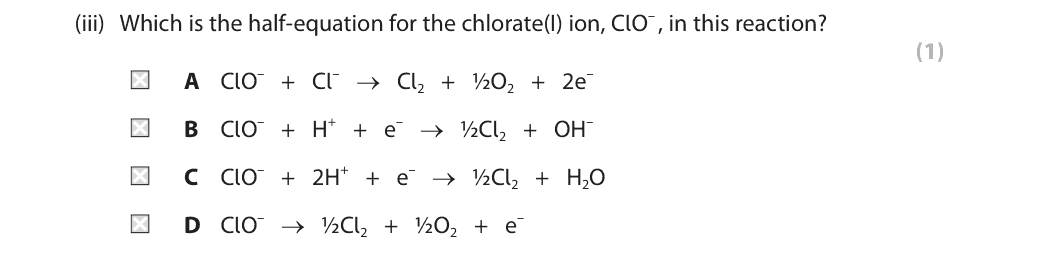
Q9bi) Overall, this question was answered poorly, with only 25% candidates answering correctly. The definition was not well explained and the use of ‘single species’ was rarely seen, with many using a ‘single atom’ or ‘an element’ instead. Q9bii) Candidates answered this question relatively well, with 40% of candidates achieving the mark. Many candidates stated chlorine or chlorate as the reducing agent, rather than the chloride ion. Q9biii) Again, candidates answered this question relatively well, with 60% of candidates getting correct.
Notes from the mark scheme and report
Answer: C. ClO– + 2H+ + e– → ½Cl2 + H2O. A contains both the oxidising and the reducing agent
B produces hydroxide ions, impossible in acid conditions
D gives oxygen, which is not a product. 60% correct
June 2024 · Paper 1 · Q10(b)(i)1 markEquation writing
Earlier part of question 10 that this part uses
Mark scheme
Examiner's comment
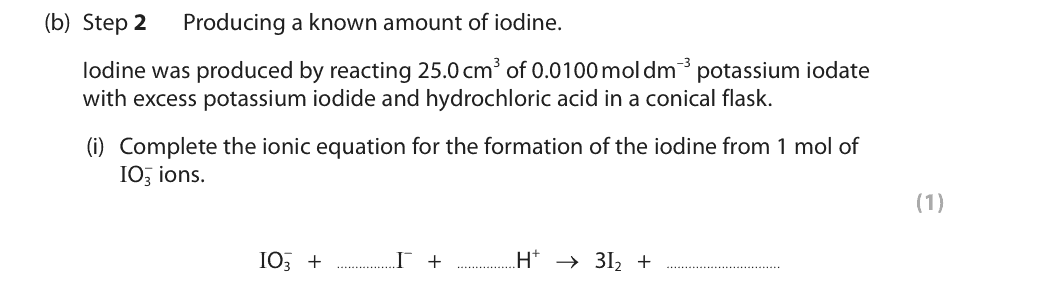
This was generally well-answered with many fully balanced equations seen.
Some errors included unbalanced water molecules or adding electrons instead of water.
Notes from the mark scheme and report
IO3– + 5I– + 6H+ → 3I2 + 3H2O. Common errors: water not balanced
electrons added
Skills: CP11 Core practical 11: Redox titration
June 2024 · Paper 2 · Q3(b)3 marksExplanation
Earlier part of question 3 that this part uses
Mark scheme
Examiner's comment
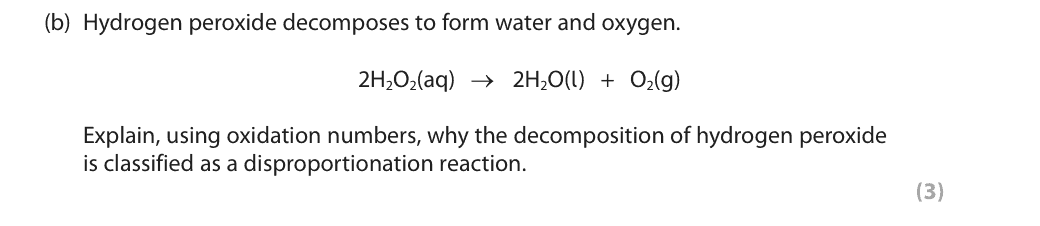
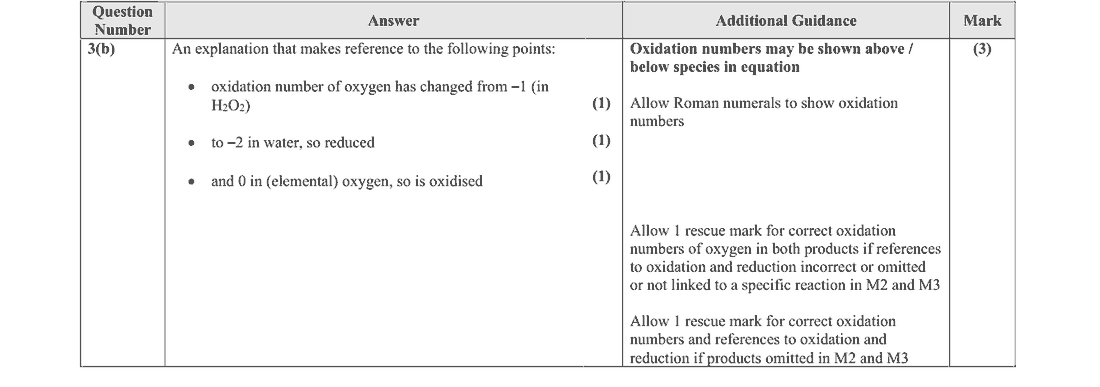
The marking team saw many excellent answers with candidates taking care to work out oxidation numbers and use them to deduce exactly what changes occurred in terms of oxidation and reduction. The most common error was probably in the calculation of the oxidation number of oxygen in hydrogen peroxide, with candidates omitting to take into account the two oxygen atoms in the formula. Other candidates’ answers lacked clarity when describing the reactions, by not directly linking the terms oxidation and reduction to specific changes in oxidation number.
Notes from the mark scheme and report
M1 oxygen is –1 in H2O2
M2 it goes to –2 in water, so is reduced
M3 and to 0 in oxygen, O2, so is oxidised. Numbers may be written on the equation
Roman numerals allowed. One rescue mark for correct oxidation numbers in both products if oxidation and reduction are wrong, missing or not linked to them. Commonest error: the oxidation number of oxygen in hydrogen peroxide, forgetting that there are two oxygen atoms
June 2024 · Paper 2 · Q3(d)(ii)2 marksExplanation
Earlier parts of question 3 that this part uses
Mark scheme
Examiner's comment
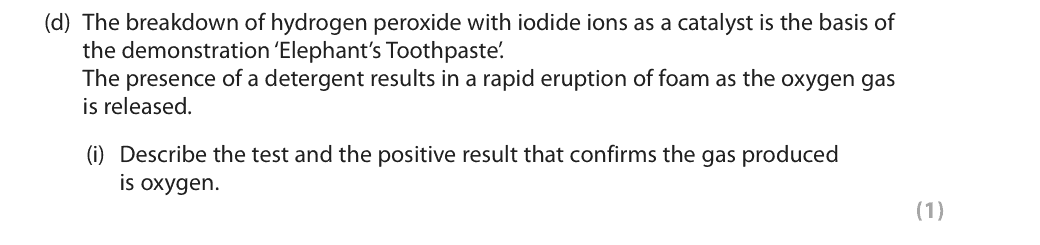
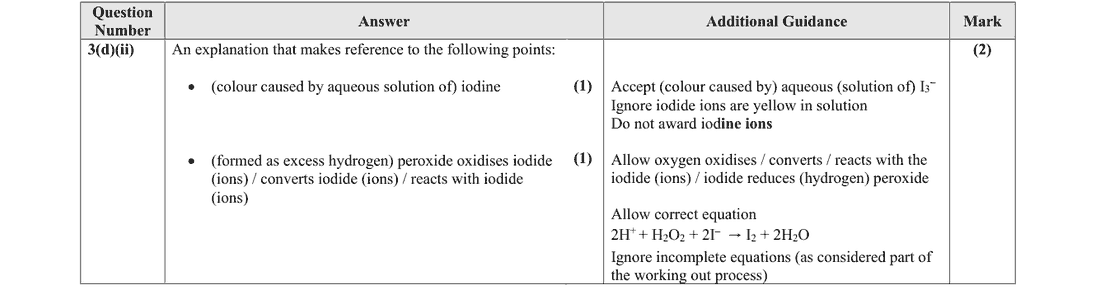
Candidates needed to link factual knowledge from the specification to solve this problem, and this proved demanding for many. Some candidates did try, noting that the iodide ions behaved as a catalyst so would be unchanged, therefore must cause the colour. Others suggested the source of the colour was nitrogen dioxide. However, the key to this question was recognition that aqueous iodine solution is yellow/brown in colour, but even those candidates that recognised this did not realise how it might form during the demonstration.
Notes from the mark scheme and report
M1 the colour is (aqueous) iodine (accept I3–
'iodine ions' not credited
'iodide ions are yellow' ignored). M2 formed because (excess) hydrogen peroxide oxidises iodide ions (allow oxygen oxidising iodide
allow 2H+ + H2O2 + 2I– → I2 + 2H2O). This proved demanding: some argued the catalyst is unchanged so iodide must be the colour, others suggested nitrogen dioxide, and those who named iodine often could not say how it forms
June 2024 · Paper 3 · Q4(c)(i)1 markEquation writingHard
Earlier part of question 4 that this part uses
Mark scheme
Examiner's comment
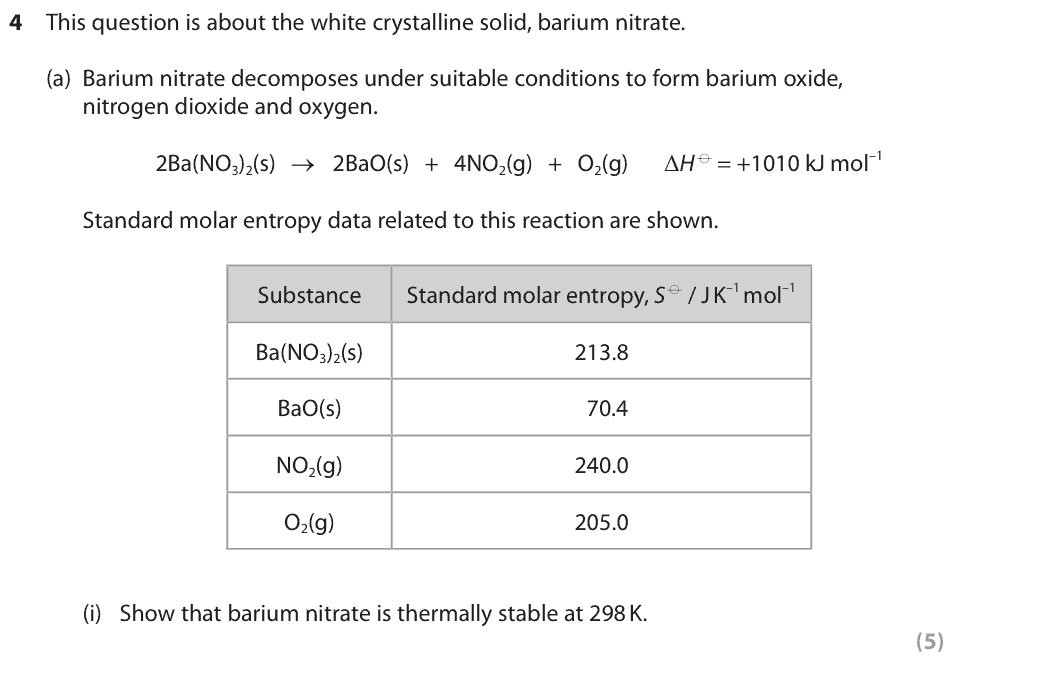
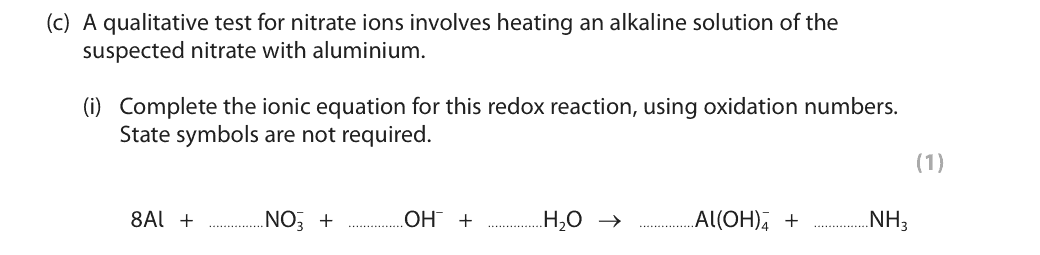
There were large numbers of correct answers to part (a)(i) either by the total entropy change ‘route’ or the Gibbs Free Energy change ‘route’. Occasionally a mark was lost for giving incorrect units for the final answer, either including Kelvin for the Gibbs Free Energy change value or for omitting such for the total entropy change value. A small minority confused the two methods. There was also a small number of candidates that calculated a negative value for the entropy change of the system and use of this value would result in a final value that suggested the reaction was feasible instead of not so. This should have prompted candidates to revisit their initial calculation to determine their error. Alas this seemed to be rarely the case. The vast majority of candidates found the calculation in part (a)(ii) very accessible but there were a sizeable number who missed the requirement in the question to firstly convert to degrees Celsius and secondly, to give the answer to two or three significant figures. The third mark was dependent on doing both of these two things. Part (b) was another question on a familiar topic for candidates and this was evident in the many excellent answers covering all three necessary points. The marks which were lost tended to be more likely as a result of lack of precision than of understanding. For example, polarising the nitrate ion by the calcium ion means a distortion of the nitrate electron cloud. Use of the specialist term ‘polarising’ covers this. If a candidate chooses to describe this rather than use the specialist term then fine, but all aspects are required. It is not enough to just state that the calcium ion distorts the nitrate ion, there needs to be explicit reference to the electron cloud. Likewise, the effect of this polarisation is the weakening of the bonds within the nitrate. It is not the bond between the calcium ion and the nitrate ion which is weakened and this needed to be made clear. Also it is worth reminding candidates that charge density is not the same as electron density. The balancing of the ionic equation in part (c)(i) was only achieved by the more able candidates. The suggestion to use oxidation numbers in the question was given to aid the candidates but this was not often heeded. Nevertheless, there were a reasonable number of candidates that scored the mark. The simple test for ammonia in part (c)(ii) was well-known with only the occasional reverse colour change to red being stated.
Notes from the mark scheme and report
Answer: 8Al + 3NO3– + 5OH– + 18H2O → 8Al(OH)4– + 3NH3. Aluminium goes from 0 to +3 (24 electrons lost by 8Al)
nitrogen goes from +5 to –3 (8 electrons gained each), so 3NO3–
then balance the charge with OH– and the hydrogen with H2O. The hint to use oxidation numbers was often not taken
June 2023 · AS Paper 1 · Q3(a)(i)1 markMultiple choice
Answer
B
Mark scheme
Examiner's comment
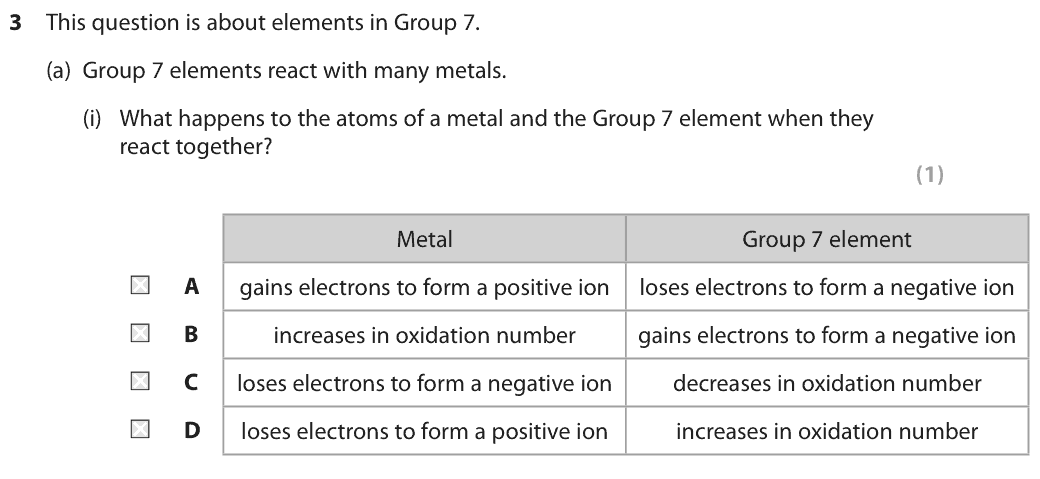
(a)(i) Approximately 75% of candidates were able to give B as the correct answer. (a)(ii) Approximately 50% of candidates scored the mark. (a)(iii) The most common mistake was to have on dative covalent bond from a bridging bromine and the other from a terminal one. Candidates could still score for having pairs of electrons in all the bonding environments and the correct numbers of lone pairs. Some candidates who focussed only on the bonding pairs of electrons so could not score the second mark. The majority of candidates scored 2 marks on this item.
(a)(iv) Incorrect responses here included the use of incorrect symbols, e.g., P or Fl. Some answered by keeping the fluorine as a pair, e.g., Pt(F2)3. Others included the oxidation state in their answer. Overall, however, this was relatively well answered. (a)(v) Empirical formula calculations are a good source of marks on AS papers, with most candidates able to carry these out successfully. Again, there were some approaches which gave the correct answer which did not follow the route in the mark scheme, but these were able to score full marks. It is vital, particularly on calculation of inorganic empirical formulae, that all working is shown, as these formulae can often be deduced or guessed. Full marks cannot be scored on these items without working.
(b)(i) Common errors were to talk about the bond enthalpy rather than the bond strength. Full marks here required an understanding that the bond enthalpy and the bond strength were linked. (b)(ii) This reaction, the displacement of a halide of a less reactive halogen by a more reactive one, is commonly tested both at this level and at GCSE. The idea here, to see if candidates could describe the practical techniques as well as the observation and equation for the reaction, proved a very challenging one. Many candidate reacted the solid halide with chlorine gas, failing to realise this really needs to be in solution to be effective. The use of bromine and potassium bromide as an intermediate halogen, though not required by the mark scheme, was able to score full credit. The shear amount of work to describe two tests rather than one and give the correct observations to establish the relative reactivity of iodine and chlorine made this approach harder, however.
Notes from the mark scheme and report
Answer: B. The metal increases in oxidation number (loses electrons to form a positive ion) and the Group 7 element gains electrons to form a negative ion (decrease in oxidation number). About 75% correct
June 2023 · AS Paper 1 · Q3(a)(iv)1 markShort answer
Earlier part of question 3 that this part uses
Mark scheme
Examiner's comment
(a)(i) Approximately 75% of candidates were able to give B as the correct answer. (a)(ii) Approximately 50% of candidates scored the mark. (a)(iii) The most common mistake was to have on dative covalent bond from a bridging bromine and the other from a terminal one. Candidates could still score for having pairs of electrons in all the bonding environments and the correct numbers of lone pairs. Some candidates who focussed only on the bonding pairs of electrons so could not score the second mark. The majority of candidates scored 2 marks on this item.
(a)(iv) Incorrect responses here included the use of incorrect symbols, e.g., P or Fl. Some answered by keeping the fluorine as a pair, e.g., Pt(F2)3. Others included the oxidation state in their answer. Overall, however, this was relatively well answered. (a)(v) Empirical formula calculations are a good source of marks on AS papers, with most candidates able to carry these out successfully. Again, there were some approaches which gave the correct answer which did not follow the route in the mark scheme, but these were able to score full marks. It is vital, particularly on calculation of inorganic empirical formulae, that all working is shown, as these formulae can often be deduced or guessed. Full marks cannot be scored on these items without working.
(b)(i) Common errors were to talk about the bond enthalpy rather than the bond strength. Full marks here required an understanding that the bond enthalpy and the bond strength were linked. (b)(ii) This reaction, the displacement of a halide of a less reactive halogen by a more reactive one, is commonly tested both at this level and at GCSE. The idea here, to see if candidates could describe the practical techniques as well as the observation and equation for the reaction, proved a very challenging one. Many candidate reacted the solid halide with chlorine gas, failing to realise this really needs to be in solution to be effective. The use of bromine and potassium bromide as an intermediate halogen, though not required by the mark scheme, was able to score full credit. The shear amount of work to describe two tests rather than one and give the correct observations to establish the relative reactivity of iodine and chlorine made this approach harder, however.
Notes from the mark scheme and report
Answer: PtF6. Not PF6, PtFl6 or PTF6. Other errors: Pt(F2)3
including the oxidation number in the formula
June 2023 · AS Paper 1 · Q6(a)(i)1 markShort answerEasy
Mark scheme
Examiner's comment
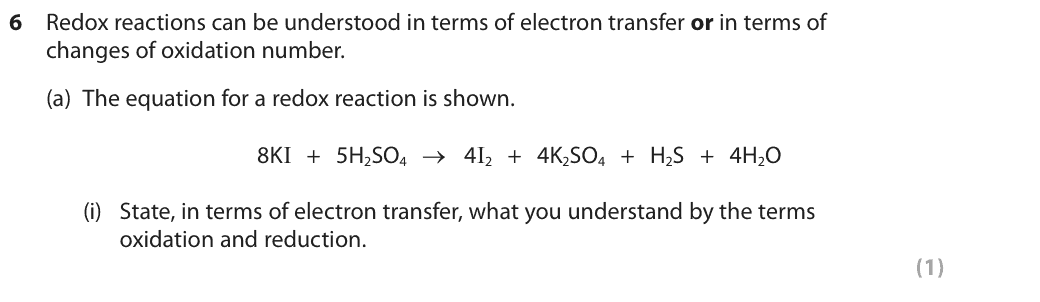
(a)(i) This scored extremely well. (a)(ii) While many candidates generally understood what was required from this question, the answers sometimes lacked clarity and precision. Iodine was often described as the reducing agent, though iodine is the product of the oxidation so cannot possibly be the reducing agent. The mark scheme allowed for the answers to be iodide ions or the sulfur as the reducing and oxidising agents when the best answers would be the iodide in potassium iodide and the sulfur in sulfuric acid as the reagent is the whole compound in which the atom/ion doing the oxidising or reducing is contained. The question specifically asked for a description in terms transfer of electrons as it followed on from (a)(i) but many candidates chose to answer in terms of changes in oxidation number. This only allowed access to one of the two marks. (b) This question proved very challenging. Quite a good number of candidates were able to get off the mark with either the correct products or a description of the disproportionation of the bromine molecules. As far as the equations were concerned HBr was a common product, even though the reaction was carried out with sodium hydroxide and so would immediately react with it. This could not score. NaBr was also a common product, which although it was allowed made the production of balanced equation almost impossible. This question involved an ionic equation which, as mentioned earlier, continue to provide great challenge at this level.
Notes from the mark scheme and report
Oxidation is loss of electrons and reduction is gain of electrons (both needed for the mark)
June 2023 · AS Paper 1 · Q6(a)(ii)2 marksExplanation
Earlier part of question 6 that this part uses
Mark scheme
Examiner's comment
(a)(i) This scored extremely well. (a)(ii) While many candidates generally understood what was required from this question, the answers sometimes lacked clarity and precision. Iodine was often described as the reducing agent, though iodine is the product of the oxidation so cannot possibly be the reducing agent. The mark scheme allowed for the answers to be iodide ions or the sulfur as the reducing and oxidising agents when the best answers would be the iodide in potassium iodide and the sulfur in sulfuric acid as the reagent is the whole compound in which the atom/ion doing the oxidising or reducing is contained. The question specifically asked for a description in terms transfer of electrons as it followed on from (a)(i) but many candidates chose to answer in terms of changes in oxidation number. This only allowed access to one of the two marks. (b) This question proved very challenging. Quite a good number of candidates were able to get off the mark with either the correct products or a description of the disproportionation of the bromine molecules. As far as the equations were concerned HBr was a common product, even though the reaction was carried out with sodium hydroxide and so would immediately react with it. This could not score. NaBr was also a common product, which although it was allowed made the production of balanced equation almost impossible. This question involved an ionic equation which, as mentioned earlier, continue to provide great challenge at this level.
Notes from the mark scheme and report
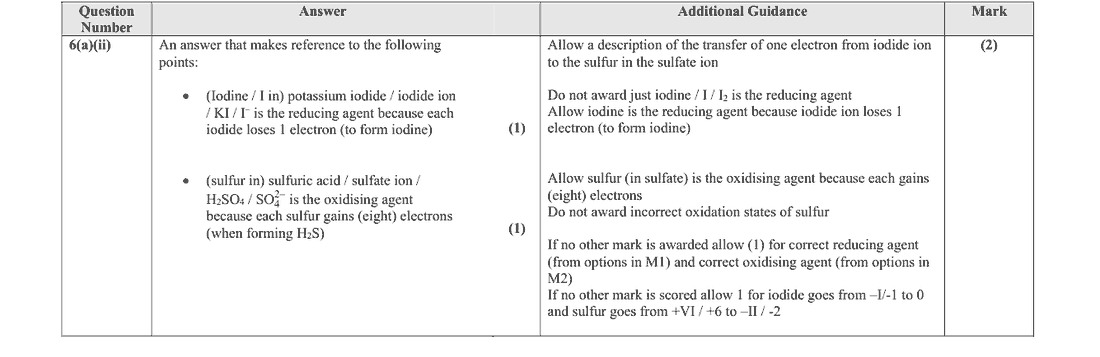
M1 the iodide ion (in potassium iodide) is the reducing agent because each iodide loses one electron (to form iodine)
'iodine / I2 is the reducing agent' alone is not credited. M2 the sulfur in sulfuric acid (sulfate) is the oxidising agent because each sulfur gains (eight) electrons (forming H2S). If neither scores: 1 mark for both agents correctly identified, or for the oxidation number changes (I –1 to 0, S +6 to –2). Many answered with oxidation numbers instead of electron transfer, which limited them to 1
June 2023 · AS Paper 1 · Q6(b)4 marksEquation writingHard
Earlier part of question 6 that this part uses
Mark scheme
Examiner's comment
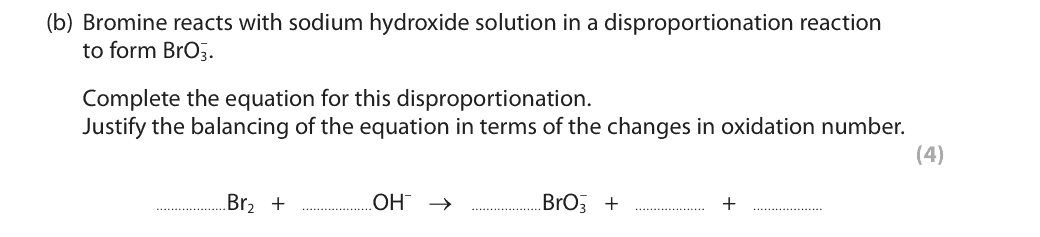
(a)(i) This scored extremely well. (a)(ii) While many candidates generally understood what was required from this question, the answers sometimes lacked clarity and precision. Iodine was often described as the reducing agent, though iodine is the product of the oxidation so cannot possibly be the reducing agent. The mark scheme allowed for the answers to be iodide ions or the sulfur as the reducing and oxidising agents when the best answers would be the iodide in potassium iodide and the sulfur in sulfuric acid as the reagent is the whole compound in which the atom/ion doing the oxidising or reducing is contained. The question specifically asked for a description in terms transfer of electrons as it followed on from (a)(i) but many candidates chose to answer in terms of changes in oxidation number. This only allowed access to one of the two marks. (b) This question proved very challenging. Quite a good number of candidates were able to get off the mark with either the correct products or a description of the disproportionation of the bromine molecules. As far as the equations were concerned HBr was a common product, even though the reaction was carried out with sodium hydroxide and so would immediately react with it. This could not score. NaBr was also a common product, which although it was allowed made the production of balanced equation almost impossible. This question involved an ionic equation which, as mentioned earlier, continue to provide great challenge at this level.
Notes from the mark scheme and report
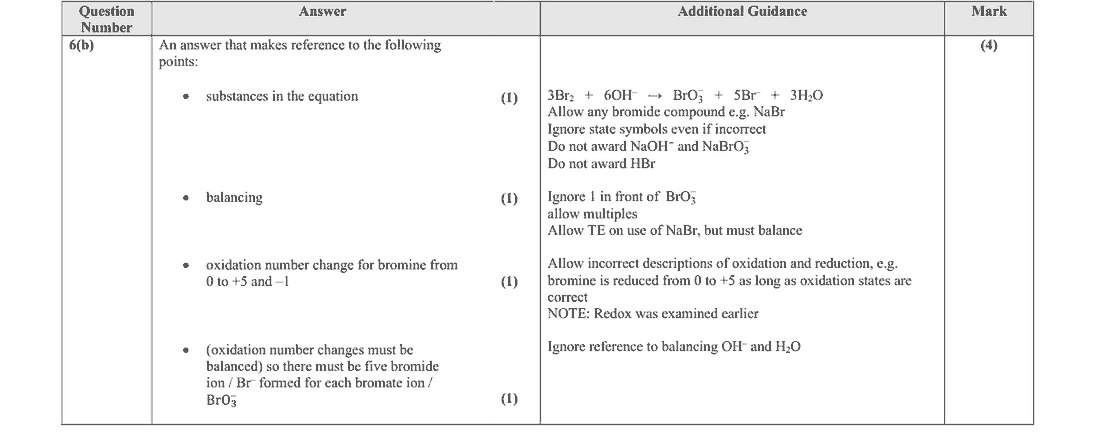
Answer: 3Br2 + 6OH– → BrO3– + 5Br– + 3H2O. M1 correct species (any bromide, e.g. NaBr, allowed
not HBr)
M2 balanced (multiples allowed
error carried forward with NaBr if it balances)
M3 bromine goes from 0 to +5 and to –1
M4 so five bromide ions must form for each bromate ion for the oxidation number changes to balance. Common errors: HBr as a product, which would react with the alkali
NaBr, which made balancing very difficult
June 2023 · Paper 2 · Q2(e)1 markEquation writing
Earlier part of question 2 that this part uses
Mark scheme
Examiner's comment
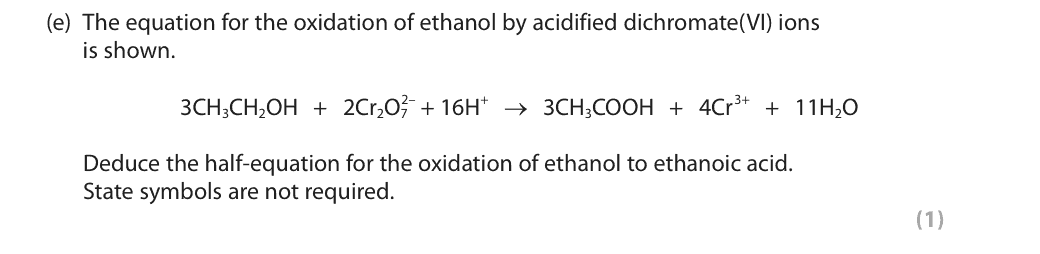
This question required a half-equation for the oxidation of ethanol to form ethanoic acid. Candidates found this surprisingly difficult with many using [O] as an oxidising agent and
omitting electrons and H+ ions. Nevertheless, some completely correct answers were seen.
–4e– on the left allowed). Found surprisingly difficult: many used [O] and left out the electrons and H+ ions
June 2023 · Paper 3 · Q2(c)(iii)2 marksShort answer
Earlier parts of question 2 that this part uses
Mark scheme
Examiner's comment
In part (ii), it was disappointing that many candidates did not know the equation for the decomposition of sodium nitrate, but it was perhaps more worrying that in the answers given it was common to see elemental sodium being produced.
The oxidation number changes required in part (ii) were frequently given correctly for the equations written. However, if the equation was incorrect then only one mark for the reference to oxygen being oxidised from – 2 to 0 was awarded. There was one exception, if the equation given was the decomposition equation was that of lithium nitrate which mirrors Group 2 nitrates decomposition.
Notes from the mark scheme and report
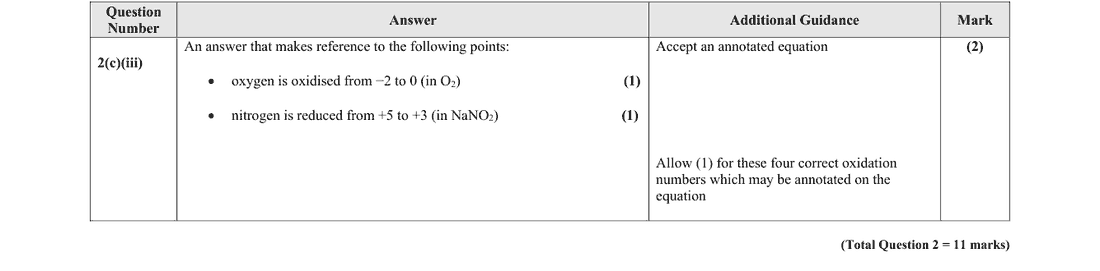
Oxygen is oxidised from –2 to 0 (in O2)
nitrogen is reduced from +5 to +3 (in NaNO2). One mark if just the four correct oxidation numbers are shown, e.g. on the equation. With a wrong equation in (ii) only the oxygen mark was available (unless the Group 2-style nitrate decomposition was given)
June 2023 · Paper 3 · Q3(b)1 markShort answer
Earlier part of question 3 that this part uses
Mark scheme
Notes from the mark scheme and report
Answer: H3PO4
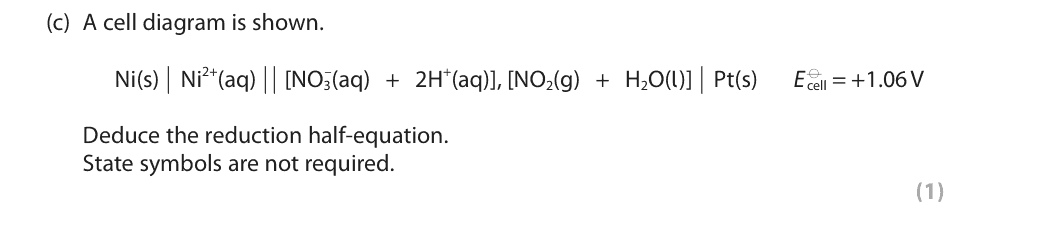
June 2023 · Paper 3 · Q5(c)1 markEquation writing
Earlier part of question 5 that this part uses
Mark scheme
Examiner's comment
It seemed that some candidates were familiar with the meaning of the cell diagram while others were not. It is worth centres and their candidates practising writing and interpreting these diagrams. Where candidates understood the meaning of the cell diagram, then this mark was confidently obtained.
Notes from the mark scheme and report
NO3– + 2H+ + e– → NO2 + H2O (multiples and reversible arrow allowed). Straightforward for those who could read a cell diagram: the right-hand half-cell is the reduction
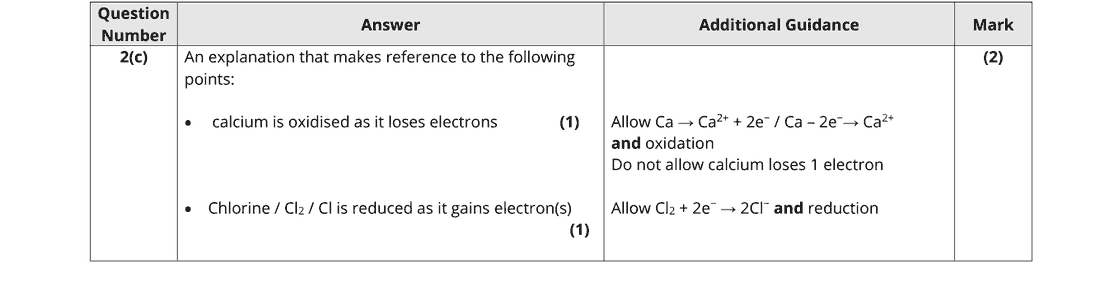
June 2022 · Paper 1 · Q2(c)2 marksExplanation
Mark scheme
Examiner's comment
Candidates were asked to explain, in terms of electrons, why the reaction between calcium and chlorine is a redox reaction. Candidates who gave good answers to this question made sure that they had included a description of the loss and gain of electrons. Others who did not score the full two marks answered in terms of oxidation number changes and did not include reference to the electrons.
Notes from the mark scheme and report
Calcium is oxidised because it loses (two) electrons (1)
chlorine is reduced because it gains electrons (1). Half-equations with 'oxidation' and 'reduction' are allowed
'calcium loses 1 electron' is not. Answers given only in terms of oxidation numbers did not score both marks
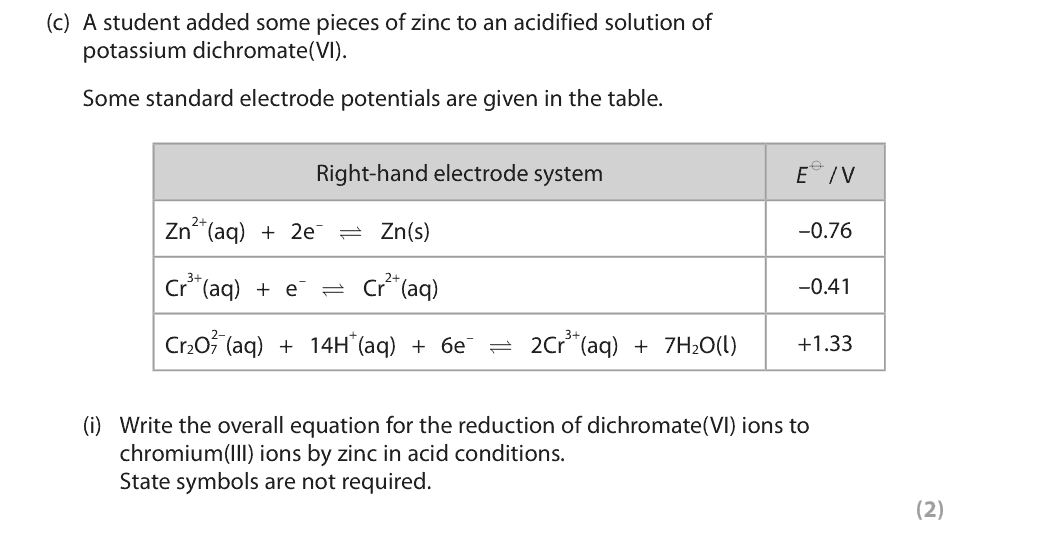
June 2022 · Paper 1 · Q7(c)(i)2 marksEquation writing
Earlier part of question 7 that this part uses
Mark scheme
Examiner's comment
This question concerned the reaction of zinc with acidified potassium dichromate (VI). Many candidates derived the equation correctly, although some careless omission of charges occasionally resulted in loss of marks. The electrochemical cell potential was also well answered. The third part of the question scored the best when +0.35 had been calculated as those who tried to explain it in terms of more positive/less negative electrode potentials sometimes got them the wrong way round.
Notes from the mark scheme and report
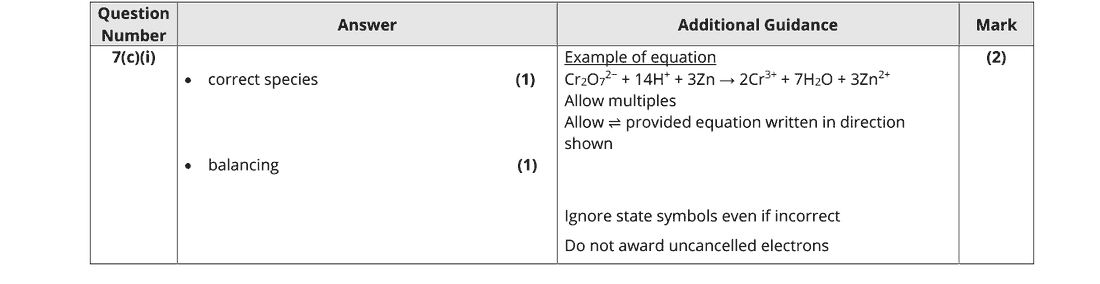
Answer: Cr2O7 2– + 14H+ + 3Zn → 2Cr3+ + 7H2O + 3Zn2+. One mark for the species, one for balancing. No uncancelled electrons
state symbols ignored. Marks were lost through missing charges
June 2022 · Paper 1 · Q8(c)3 marksEquation writing
Earlier part of question 8 that this part uses
Mark scheme
Examiner's comment
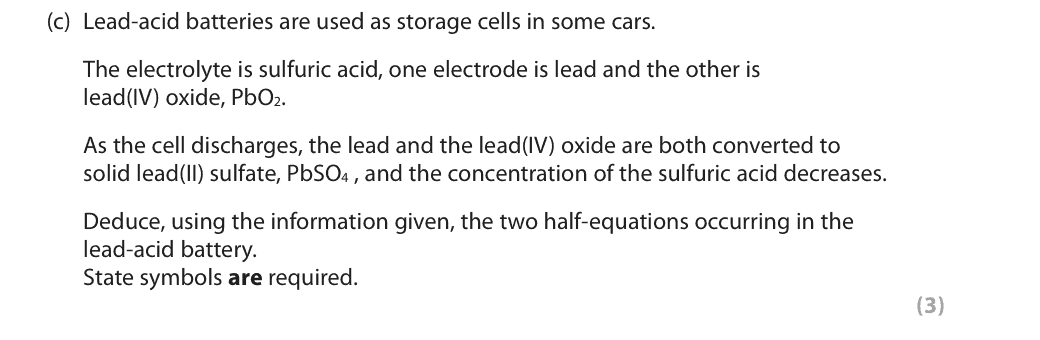
The greater demand of the paper toward the end was evident in this question as many candidates struggled to work out the equations correctly. The information in the question stem clearly stated the substances involved and where necessary their states, but these were often missed by candidates. It was also not uncommon to see the equations written without electrons, despite the requirement for half-equations given in the question.
Notes from the mark scheme and report
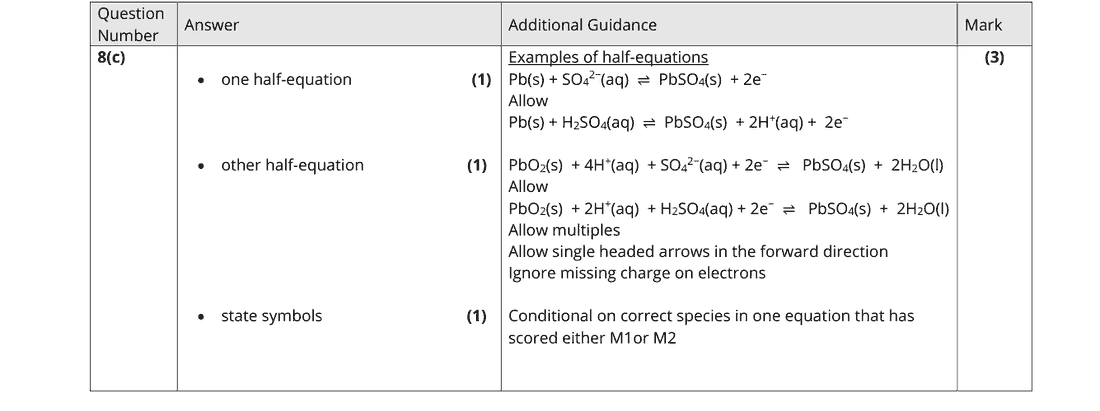
Answer: Pb(s) + SO4 2–(aq) → PbSO4(s) + 2e– and PbO2(s) + 4H+(aq) + SO4 2–(aq) + 2e– → PbSO4(s) + 2H2O(l). One mark each, plus one for state symbols (needs the right species in an equation that has scored). H2SO4(aq) allowed as a reactant, with 2H+(aq) as a product in the first equation or 2H+(aq) in place of 4H+(aq) in the second
reversible arrows allowed. Many struggled: the states and substances given in the stem were missed
equations were written without electrons
June 2022 · AS Paper 1 · Q8(c)(i)1 markEquation writing
Earlier part of question 8 that this part uses
Mark scheme
Examiner's comment
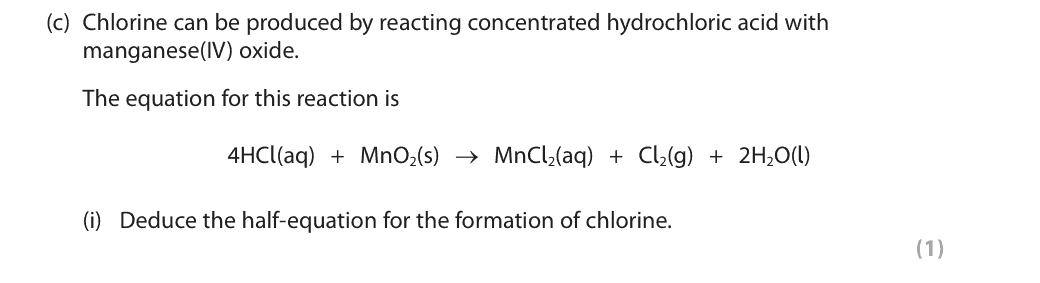
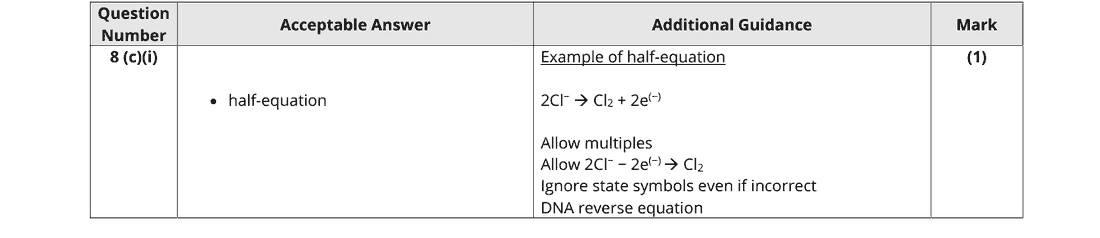
This question asked students to derive a half equation from a full equation. Many students struggled with this question and their equations frequently included extraneous other species, e.g., MnO2 or MnCl2. Some seemed to be unsure of what is meant by the term ‘half-equation’. Many of the correct responses showed the equation doubled, which was also acceptable, i.e., starting with 4Cl−from the 4HCl shown in the given equation. A relatively common error was to add electrons to chloride ions.
Notes from the mark scheme and report
Answer: 2Cl– → Cl2 + 2e– (allow 2Cl– – 2e– → Cl2, and multiples). State symbols ignored. Not the reverse equation. Common errors: including other species such as MnO2 or MnCl2
adding electrons to the chloride ions
June 2022 · AS Paper 1 · Q8(d)(i)2 marksExplanation
Earlier part of question 8 that this part uses
Mark scheme
Examiner's comment
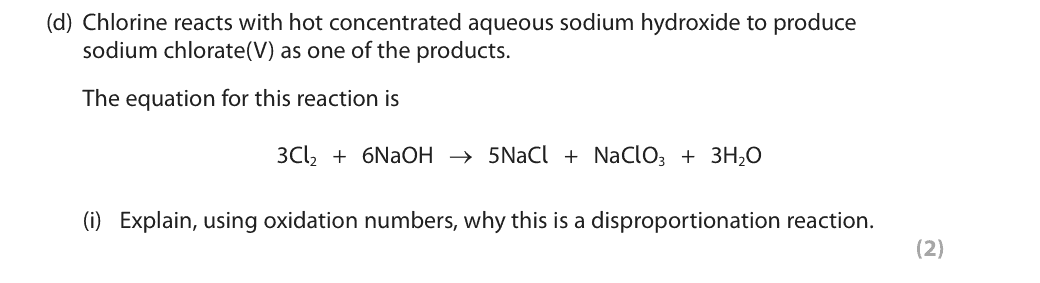
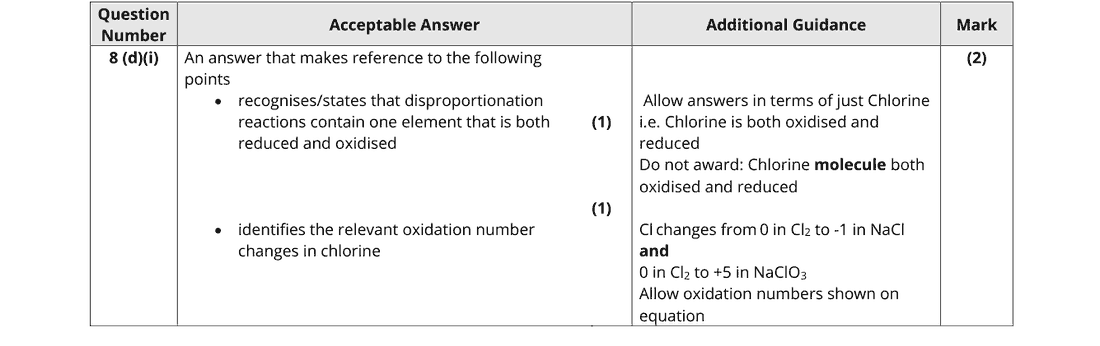
This question provided an equation and then asked students to explain why this could be classified as a disproportionation. Most students knew the meaning of disproportionation but occasionally there was an error in the allocation of oxidation numbers to chlorine. Most commonly the error involved the oxidation number of Cl in NaClO3, where it was sometimes claimed to be +1. In many answers the oxidation numbers were shown on the equation in the question. Provided the allocation of oxidation numbers to chlorine was clear, this was acceptable.
Notes from the mark scheme and report
Chlorine (one element) is both oxidised and reduced (not 'the chlorine molecule')
chlorine goes from 0 in Cl2 to –1 in NaCl and from 0 to +5 in NaClO3. Oxidation numbers written on the equation are accepted. Usual error: +1 for chlorine in NaClO3
June 2022 · Paper 2 · Q4(a)(ii)1 markShort answer
Earlier part of question 4 that this part uses
Mark scheme
Examiner's comment
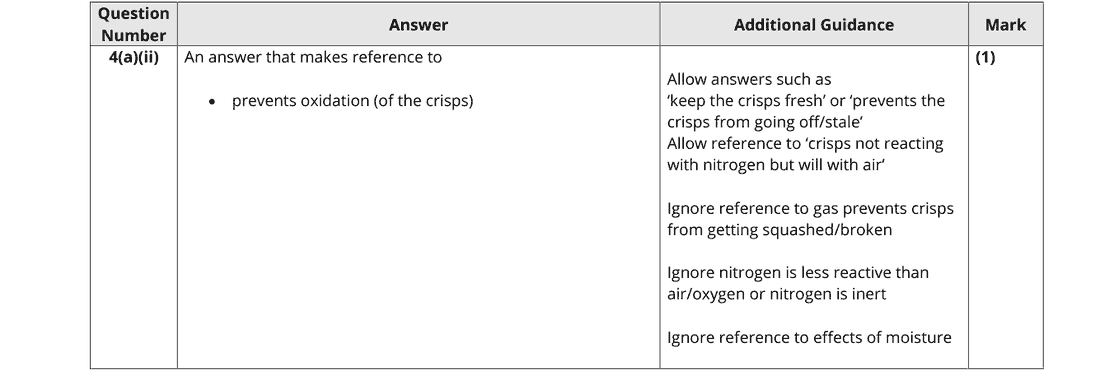
Many reasonable suggestions were allowed to gain credit here for a novel application-type question. The most common problem here was vagueness with short statements that the nitrogen wouldn’t react but with no explanation as to how or why the air would react.
Notes from the mark scheme and report
Prevents oxidation of the crisps (keeps them fresh / stops them going off or stale
the crisps would react with air but not with nitrogen). Ignored: stops crisps being crushed
nitrogen is inert or less reactive than air
moisture. Vague answers that nitrogen 'would not react', without saying what air would do, were the usual problem
June 2022 · Paper 2 · Q6(c)(ii)1 markShort answer
Earlier part of question 6 that this part uses
Mark scheme
Examiner's comment
The majority of candidates scored the mark as evidenced by the mean of 0.81. However there was evidence of some candidates 'doing all the hard work' by calculating that there needed to be +12 for the chromium part of the compound but then missing the fact that there were two chromium atoms present. Hence the need to divide the value by 2 in order to obtain the correct answer of +6.
Notes from the mark scheme and report
Answer: +6 (VI). Some worked out +12 for the two chromium atoms and forgot to divide by 2
June 2022 · Paper 2 · Q6(c)(iii)1 markEquation writing
Earlier parts of question 6 that this part uses
Mark scheme
Examiner's comment
The majority of candidates were able to work out the required numbers of hydrogen ions and electrons to complete this oxidation half-equation.
Notes from the mark scheme and report
CH3CH2CH2OH → CH3CH2CHO + 2H+ + 2e–
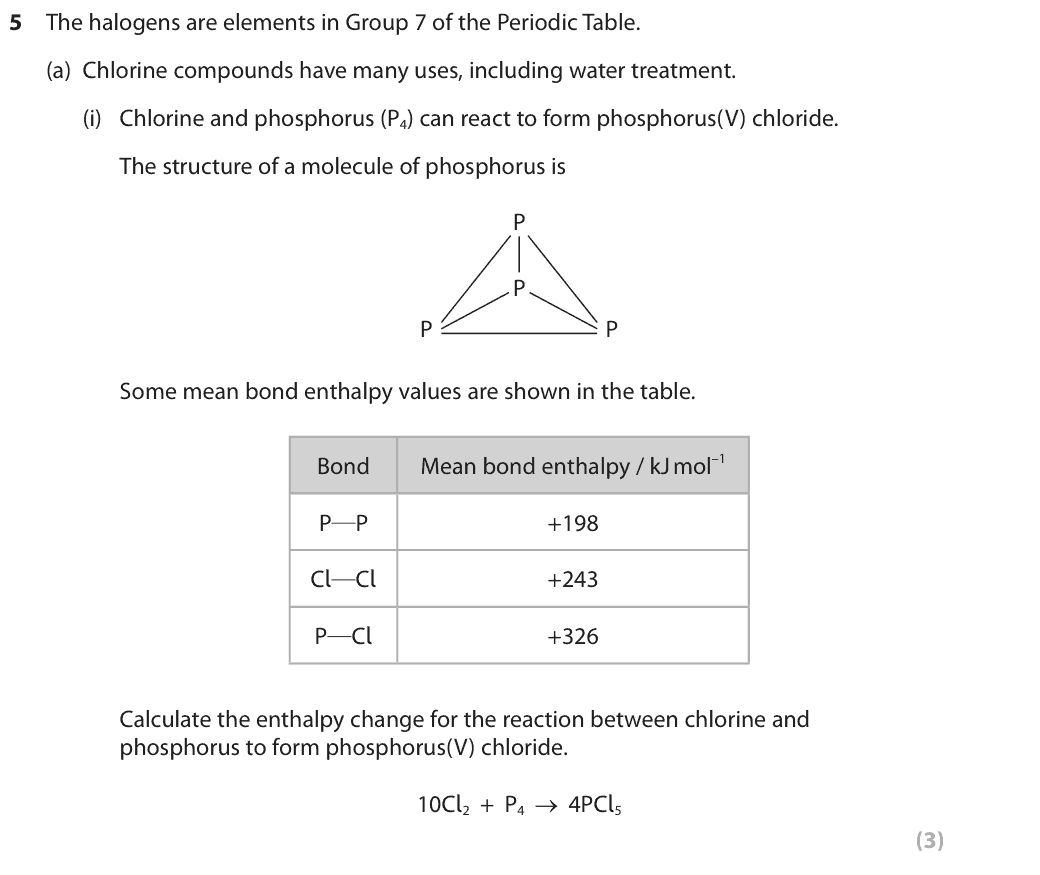
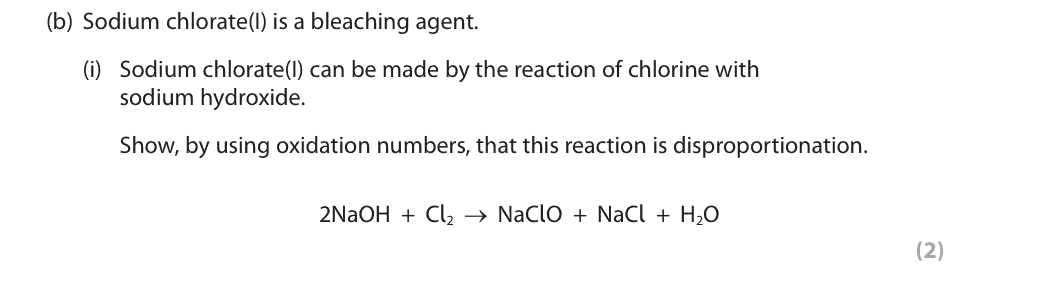
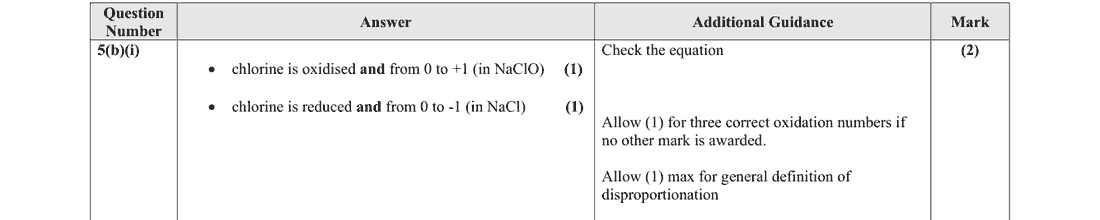
November 2021 · Paper 1 · Q5(b)(i)2 marksExplanationEasy
Earlier part of question 5 that this part uses
Mark scheme
Examiner's comment
In part (a)(i) many candidates were able to deduce the number of bonds in phosphorus from
the diagram but there were still examples of candidates doing the sum ‘bonds broken – bonds
made’ the wrong way round. A sizeable number of candidates also got part (ii) incorrect by
stating that bond enthalpies are exothermic.
The familiar use of oxidation numbers to demonstrate disproportionation in part (b)(i) was
answered correctly by most candidates. A small minority continue to fail to link the terms
“oxidation and reduction” with these changes and consequently lost a mark. It was pleasing to
see many correct answers to the task of balancing the equation in (ii). This was not an easy
example, but the majority scored the mark.
It was surprising to see a significant number of candidates select a distractor in (c) which stated
that chlorine was “orange”.
Part (d) was an effective discriminator at the ‘top end’. It proved worthwhile to award two marks
for the ionic equation with state symbols in (i) because it gave the opportunity for some
candidates to get one mark for a ‘near miss’. The question in (ii) serves as a good example of
the need for candidates to take greater care in their answers. It was not uncommon to see a
candidate deduce correctly the identity of the ion but then to refer to it as “Bromine” instead of
‘Bromide’. Reference to the halogen did not score the first mark.
Notes from the mark scheme and report
M1: chlorine is oxidised, from 0 to +1 (in NaClO). M2: chlorine is reduced, from 0 to –1 (in NaCl). One mark for the three oxidation numbers alone, or for a general definition of disproportionation. A small minority did not link the changes to the words oxidation and reduction
November 2021 · AS Paper 1 · Q6(a)(i)1 markShort answer
Mark scheme
Examiner's comment
This question concerned redox and oxidation number. 6(a) Many of the candidates were able to assign oxidation numbers and could answer (a)(i) as a result, but the chemistry required to answer (a)(ii) was less commonly remembered and understood. 6(b) Again, assigning oxidation numbers and using them to explain disproportionation proved to be relatively straightforward in (b)(i) but the equation in (b)(ii) provided much more challenge. 6(c) These calculations proved difficult for even the best candidates.
Notes from the mark scheme and report
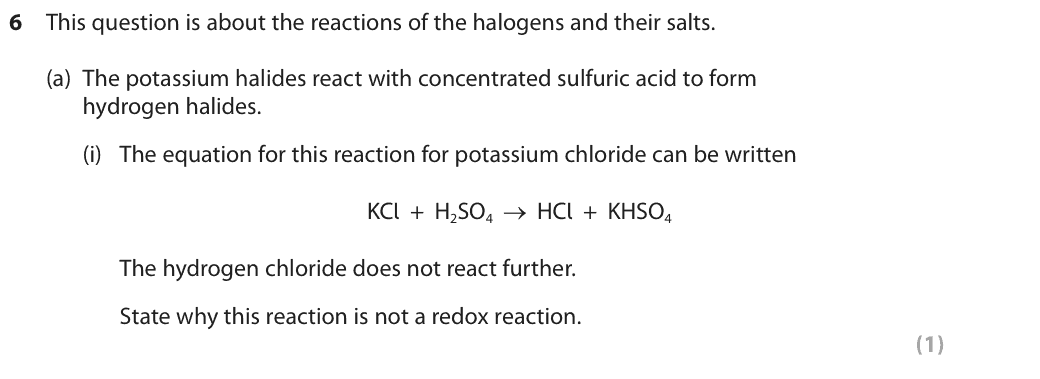
No element changes its oxidation number (allow: there is no transfer of electrons)
November 2021 · AS Paper 1 · Q6(b)(i)2 marksExplanation
Earlier part of question 6 that this part uses
Mark scheme
Examiner's comment
This question concerned redox and oxidation number. 6(a) Many of the candidates were able to assign oxidation numbers and could answer (a)(i) as a result, but the chemistry required to answer (a)(ii) was less commonly remembered and understood. 6(b) Again, assigning oxidation numbers and using them to explain disproportionation proved to be relatively straightforward in (b)(i) but the equation in (b)(ii) provided much more challenge. 6(c) These calculations proved difficult for even the best candidates.
Notes from the mark scheme and report
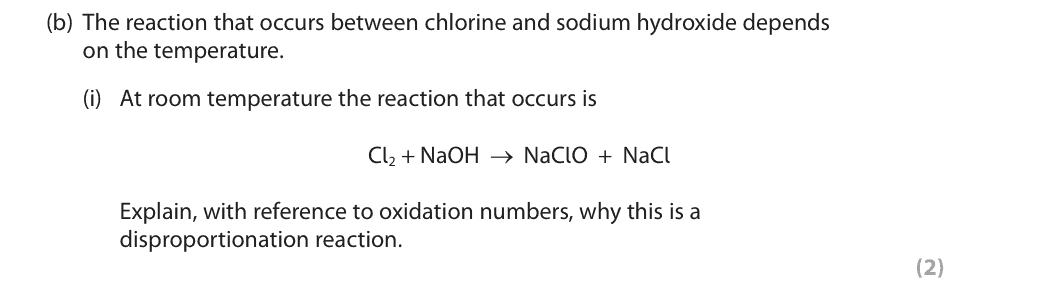
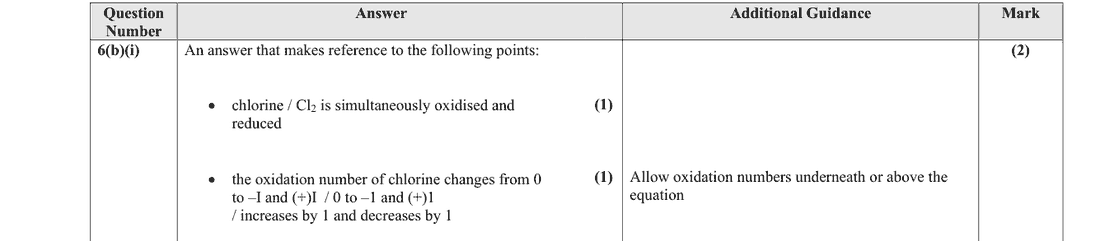
Chlorine is simultaneously oxidised and reduced
its oxidation number changes from 0 to –1 (in NaCl) and to +1 (in NaClO). Numbers written above or below the equation are allowed
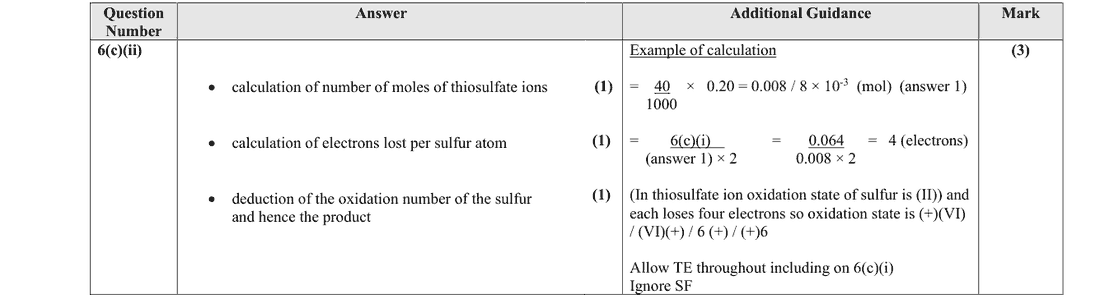
November 2021 · AS Paper 1 · Q6(c)(ii)3 marksCalculationHard
Earlier parts of question 6 that this part uses
Mark scheme
Examiner's comment
This question concerned redox and oxidation number. 6(a) Many of the candidates were able to assign oxidation numbers and could answer (a)(i) as a result, but the chemistry required to answer (a)(ii) was less commonly remembered and understood. 6(b) Again, assigning oxidation numbers and using them to explain disproportionation proved to be relatively straightforward in (b)(i) but the equation in (b)(ii) provided much more challenge. 6(c) These calculations proved difficult for even the best candidates.
Notes from the mark scheme and report
Answer: 4 electrons lost per sulfur atom, so sulfur ends at +6. Moles thiosulfate = 40 × 0.20 ÷ 1000 = 0.008
electrons per sulfur = 0.064 ÷ (0.008 × 2) = 4
sulfur is +2 in thiosulfate, so +2 + 4 = +6. Error carried forward throughout, including from (c)(i)
Skills: MS0.2 Use ratios, fractions and percentages
November 2021 · Paper 3 · Q1(b)1 markShort answer
Mark scheme
Examiner's comment
The majority of candidates could complete the table to show the numbers of subatomic
particles. However, some candidates did not realise that a negative ion gains an electron.
The mass spectrum in (a)(ii) proved much more challenging for many candidates. Some
candidates worked out that there would be peaks at m / z values of 70, 72 and 74 for the
molecular ion but only a small number could work out the ratio of the heights of the peaks.
The most common error was to omit the peak at 72. Many candidates were unable to write
the formula for potassium chlorate(V) and many used incorrect symbols, e.g., P for potassium,
and oxygen omitted. Many candidates could write the equation for the first electron affinity
of chlorine, but some wrote the equation for first ionisation energy and others included Cl2.
Many candidates omitted the acid from the oxidising agent in (d)(i), although they could still
score the mark for calculating the Eocell value. Those that chose an incorrect oxidising agent
should have checked their answer when their Eocell value was negative.
Notes from the mark scheme and report
Answer: KClO3 (allow K+ClO3–). Many could not write it: wrong symbols such as P for potassium, or oxygen left out
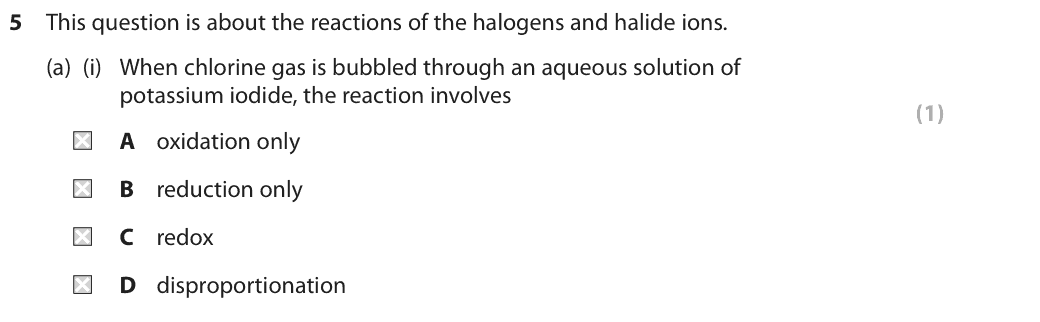
October 2020 · AS Paper 1 · Q5(a)(i)1 markMultiple choice
Answer
C
Mark scheme
Examiner's comment
Most of Q5 related to practical situations. These questions were answered well with most
candidates having seen the practical experiments or having been well prepared for questions on
the relevant topic.
5ai A multiple choice question. This straightforward redox question was answered correctly by
the majority of learners.
5aii A multiple choice question. This question related to Q5ai but also required the student to use
additional density data and recall the colour of iodine in the relevant solvent. Most students were
either able to deduce the correct answer or, having seen the experiment, correctly recall the result.
5bi A multiple choice question. This question relates to the use of concentrated sulfuric acid as an
oxidising agent in the reaction with iodide ions. Those who had completed the relevant practical
experiment found this relatively straightforward and it could also be answered using redox
principles. However, many learners found this question quite challenging.
5bii Again this is a very straightforward question for any student who has used ammonia gas as a
test for hydrogen chloride. Although the reactant here is hydrogen iodide, the reaction can
reasonably be expected to be similar.
5ci Students generally struggled with this question which is based on a practical situation.
Students were expected to interpret solubility data and apply this to the separation of two solids on
the basis of differential solubility.
Many students seemed to lack knowledge of the methods available to encourage the precipitation
of solutes from a solution. Furthermore, few students seemed familiar with the procedures used to
separate and dry the product of filtration. However, a few extremely good answers were seen,
presumably from students who could recall this or a similar practical situation.
5cii This test for iodide was answered well. It has been set on many past papers and most
students seem very familiar with it.
5d This multiple choice question required students to select some relevant data from a table and
use this to identify a trend within a group. From this they could then make a reasonable prediction.
Few problems were anticipated or seen and most of the responses were correct.
Notes from the mark scheme and report
Answer: C. Chlorine is reduced to chloride and iodide is oxidised to iodine, so both oxidation and reduction occur. It is not disproportionation because different species are oxidised and reduced
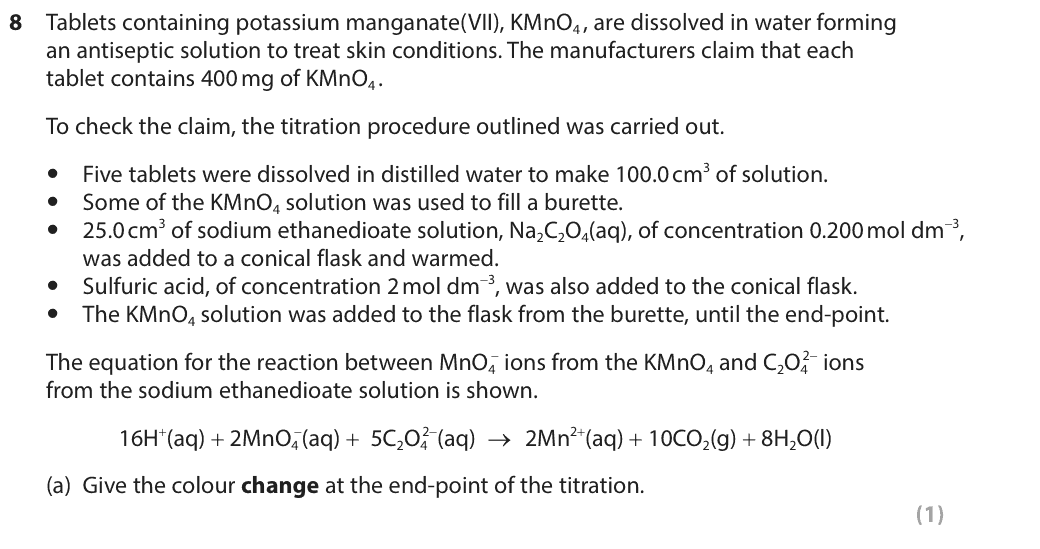
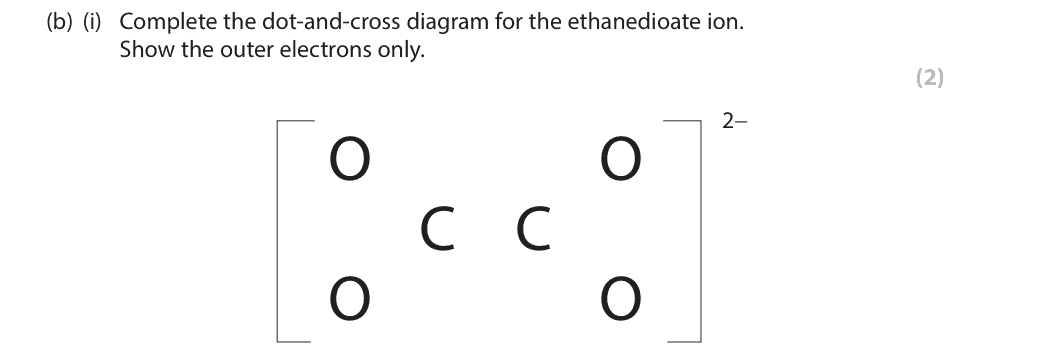
October 2020 · Paper 1 · Q8(b)(ii)1 markShort answer
Earlier parts of question 8 that this part uses
Mark scheme
Examiner's comment
The colour change in (a) proved to be more challenging than imagined with a number only
giving one colour or giving the reverse answer. A few didn’t appreciate that at the end-point
only a very small amount of potassium manganate(VII) will be in excess and hence thought
the reaction mixture would be purple, rather than pale pink.
In (b) the covalent dot-and-cross diagram was found difficult by many. Some seemed to have
recalled the displayed formula of the ion and translated the bonds accordingly. However,
some others simply added lines to the diagram, without showing electron pairs. Others didn’t
manage to deduce the correct number of electrons, forgetting the two extra electrons or
simply not adding correctly. Perhaps the most frustrating 1 mark answers showed all the
bonding electrons correctly but omitted the non-bonding electrons.
In (c), despite the equation in the stem, many thought the sulfuric acid was a catalyst.
The cell diagram in (d) was presented correctly by a small number of candidates. Some
confused the idea of a cell diagram with a diagram of the apparatus needed to set up the cell,
whereas others mixed up the use of solid lines, showing several in their diagram, rather than
the two needed to separate the platinum electrodes from the rest of the cell diagram.
The R-O-O-R convention was not always implemented and the majority of answers did not
include key cell reactants such as H+ ions and H2O.
In (e), a disappointing number of unforced errors were seen in the table. Most common was
the use of 1 decimal place for titration data, whilst other candidates did not recognise
concordant results, so calculated the mean of Runs 1, 2 and 3. Once again nearly all
candidates gained some credit for the calculation in (ii), though sometimes the ratio for the
second mark was inverted. Several candidates calculated the concentration of the KMnO4, an
unnecessary step which then confused many of this cohort. Stronger candidates were able to
get back on track, by calculation the moles in 100 cm3, whilst the best candidates didn’t
calculation the concentration, but simply scaled from 10cm3 to 100 cm3. Some otherwise
good answers missed out on credit in marks 4 and 5, either by missing potassium when
determining the relative formula mass of potassium manganate(VII) or by not converting their
answer to mg. In (iii) most answers recognised the role of Mn2+ as an autocatalyst, and many
linked the slow initial reaction to the repulsion of two negative ions or the resultant high
activation energy. The most effective way to score marks 3 and 4 was to write equations for
the appropriate reactions using the half cell data. Those who tried to justify in prose often
gave answers that lacked clarity, with descriptions that confused the key reactions, for
instance describing Mn2+ as oxidizing the MnO4− ions. Ecell was also used ineffectively, either
because candidates simply calculated a value of + 0.87 V for the overall reaction, or because
they did not relate + 0.85 V or + 0.02 V to the appropriate reaction. A small but noticeable
number tried to link Ecell values to rate, confusing thermodynamic and kinetic stability.
Notes from the mark scheme and report
Answer: +3. 2C + 4(–2) = –2. Allow 3+ or III
not ±3
October 2020 · Paper 2 · Q3(a)(i)2 marksExplanation
Mark scheme
Examiner's comment
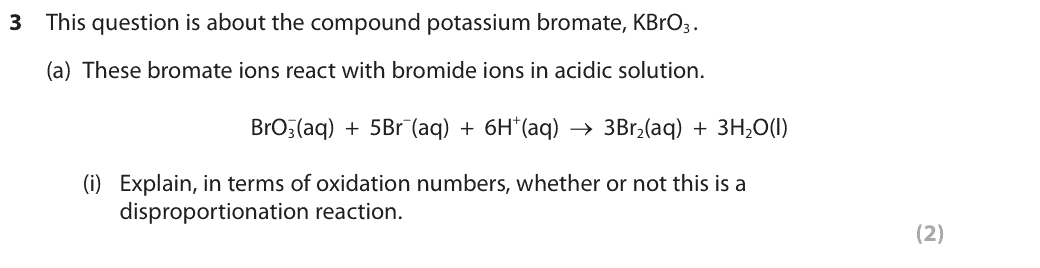
The vast majority of candidates gave the correct oxidation numbers of bromine in the three
species. However, many of them stated the reaction was disproportionation, showing that
they did not understand the meaning of this term. Disproportionation takes place when an
element in a single species is simultaneously oxidised and reduced. In the reaction given, two
different species of bromine are oxidised and reduced. The majority of candidates calculated
the volume of oxygen in (b) correctly. Some used the mole ratio the wrong way around and
some did not use it at all. A few tried to use the ideal gas equation, which was not needed
here as the molar volume of gas was given and there was no change in temperature or
pressure. It was disappointing to see some candidates dividing the number of moles of
oxygen by the molar gas volume instead of multiplying them.
Notes from the mark scheme and report
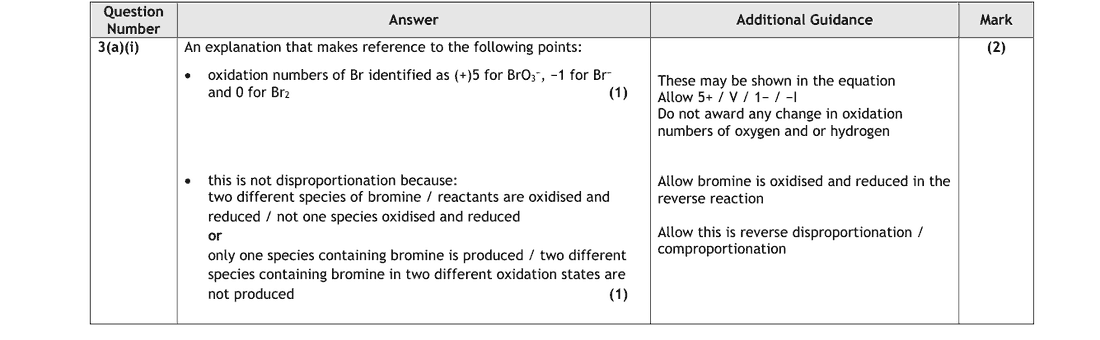
Oxidation numbers of bromine: +5 in BrO3–, –1 in Br– and 0 in Br2
it is NOT disproportionation, because two different bromine species are oxidised and reduced (not one species both oxidised and reduced) / only one bromine-containing product is formed. Reverse disproportionation / comproportionation allowed. The oxidation numbers were usually right, but many then said it was disproportionation
October 2020 · Paper 3 · Q8(b)(i)2 marksEquation writing
Earlier part of question 8 that this part uses
Mark scheme
Examiner's comment
Candidates should always be remined that some transition metal complex ion colour changes
just have to be learnt and recalled. In (a) those candidates who has studied this topic well
scored both marks but others gave a wide range of colours and experimental observations.
The need for principles to be clearly understood was emphasised in (b)(i). Despite the request
for an oxidation half-equation, responses frequently gave equations without the inclusion of
electrons. This was aimed at the more able candidates and those capable of working things
out were able to deduce the correct answer.
The equation for part (b)(ii) is explicitly stated in the specification and so should have been
recall. Nonetheless it should be possible for the candidates to deduce from first principles and
so the more able were able to score the mark as well as those whom had simply learnt it.
Part (b)(iii) is a classic example to remind candidates of the need to read the question carefully
and to answer accordingly. It specifically states that the oxidation and reduction half
equations were required but oftentimes no labelling of the half equations were given. The cell
diagram notation was a new addition to the specification but this is several years past now
and so should be more familiar. However some responses led examiners to speculate that
this is still a rarely considered part of the topic area. However the more able candidates could
demonstrate their understanding and scored the marks.
The modal mark for the labelled diagram of the electrochemical cell apparatus was five. The
majority of candidates included the voltmeter, salt bridge with chemical, platinum electrode
for the chromium electrode and the need for 1.0 mol dm˗3 concentrations. At times
candidates were careless with their diagrams and did not have their salt bridge in their
solutions and so lost one mark for this. The two marks which were not awarded very often
were for the formulae of the compounds required which was despite the word ‘formulae’
being emboldened. Candidates need to be observant and to notice this type of font as
indicating exactly what is required in their answer.
Notes from the mark scheme and report
[Cr(OH)6]3– + 2OH– → CrO4 2– + 4H2O + 3e–. One mark for the four species, one for balancing with the correct number of electrons. Many gave equations with no electrons
October 2020 · Paper 3 · Q8(b)(iii)3 marksEquation writing
Earlier parts of question 8 that this part uses
Mark scheme
Examiner's comment
Candidates should always be remined that some transition metal complex ion colour changes
just have to be learnt and recalled. In (a) those candidates who has studied this topic well
scored both marks but others gave a wide range of colours and experimental observations.
The need for principles to be clearly understood was emphasised in (b)(i). Despite the request
for an oxidation half-equation, responses frequently gave equations without the inclusion of
electrons. This was aimed at the more able candidates and those capable of working things
out were able to deduce the correct answer.
The equation for part (b)(ii) is explicitly stated in the specification and so should have been
recall. Nonetheless it should be possible for the candidates to deduce from first principles and
so the more able were able to score the mark as well as those whom had simply learnt it.
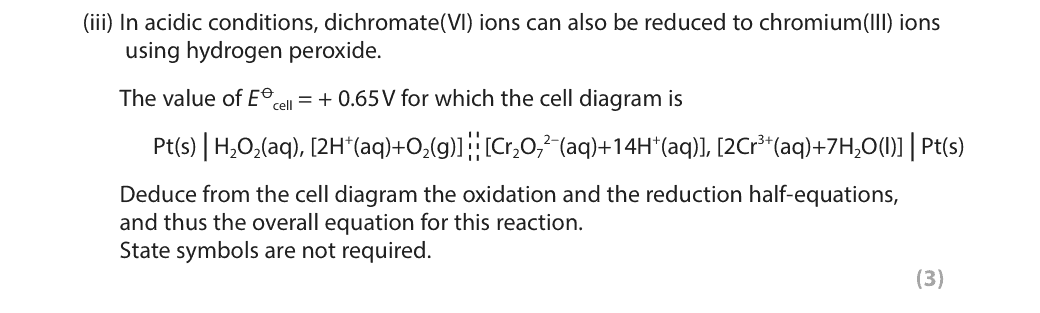
Part (b)(iii) is a classic example to remind candidates of the need to read the question carefully
and to answer accordingly. It specifically states that the oxidation and reduction half
equations were required but oftentimes no labelling of the half equations were given. The cell
diagram notation was a new addition to the specification but this is several years past now
and so should be more familiar. However some responses led examiners to speculate that
this is still a rarely considered part of the topic area. However the more able candidates could
demonstrate their understanding and scored the marks.
The modal mark for the labelled diagram of the electrochemical cell apparatus was five. The
majority of candidates included the voltmeter, salt bridge with chemical, platinum electrode
for the chromium electrode and the need for 1.0 mol dm˗3 concentrations. At times
candidates were careless with their diagrams and did not have their salt bridge in their
solutions and so lost one mark for this. The two marks which were not awarded very often
were for the formulae of the compounds required which was despite the word ‘formulae’
being emboldened. Candidates need to be observant and to notice this type of font as
indicating exactly what is required in their answer.
Notes from the mark scheme and report
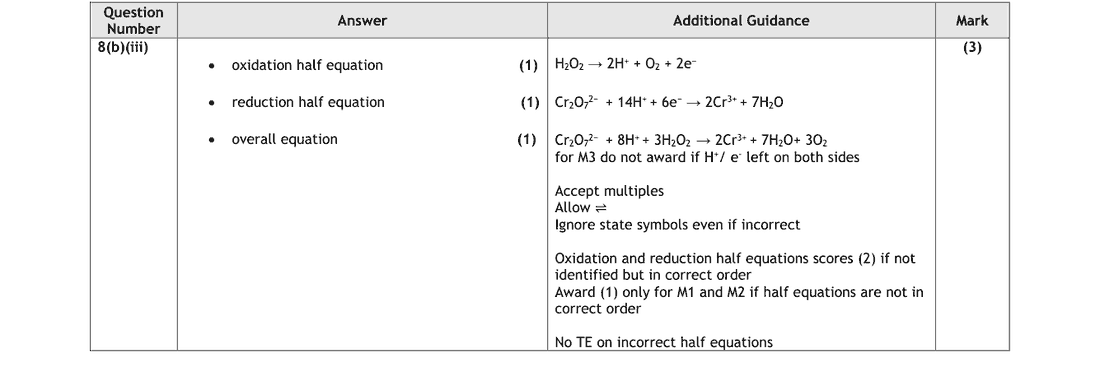
Oxidation: H2O2 → 2H+ + O2 + 2e–. Reduction: Cr2O7 2– + 14H+ + 6e– → 2Cr3+ + 7H2O. Overall: Cr2O7 2– + 8H+ + 3H2O2 → 2Cr3+ + 7H2O + 3O2 (no H+ or electrons left on both sides). Unlabelled half-equations score 2 if in the correct order, 1 if not
no error carried forward. Half-equations were often not labelled and cell-diagram notation was unfamiliar to many
June 2019 · Paper 1 · Q2(b)(ii)2 marksExplanation
Earlier parts of question 2 that this part uses
Mark scheme
Examiner's comment
The balancing of the equation in part (i) was a question of high demand and gave an opportunity for the high ability candidates to demonstrate their understanding. This type of question is worth practicing and the oxidation number changes do provide a useful way of succeeding in this.
The oxidation number changes were identified very well with the majority of candidates correctly stating these. However, the requirement for these oxidation number changes was in the context of disproportionation and so these changes needed to be correctly linked with the relevant terms of oxidation and reduction which was not always done.
Notes from the mark scheme and report
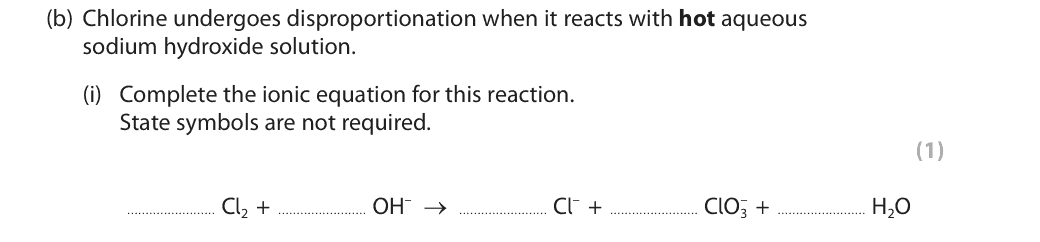
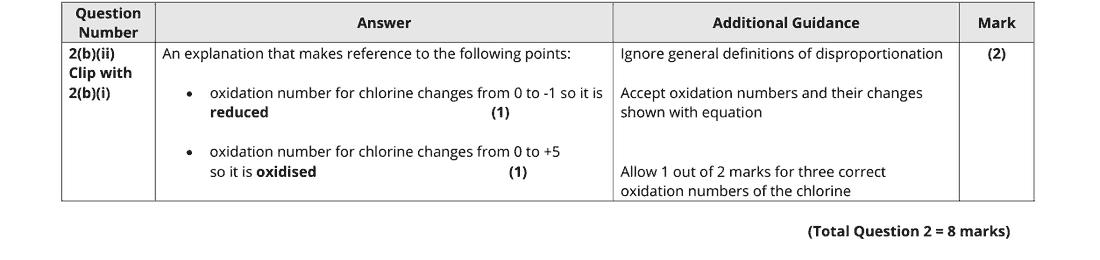
M1: chlorine goes from 0 to –1 (in Cl–), so it is reduced. M2: chlorine goes from 0 to +5 (in ClO3–), so it is oxidised. One mark for all three oxidation numbers without the link to oxidation and reduction
a general definition of disproportionation is ignored. The oxidation numbers were usually right but were not always tied to the words oxidised and reduced
June 2019 · Paper 1 · Q5(b)2 marksEquation writingHard
Earlier parts of question 5 that this part uses
Mark scheme
Examiner's comment
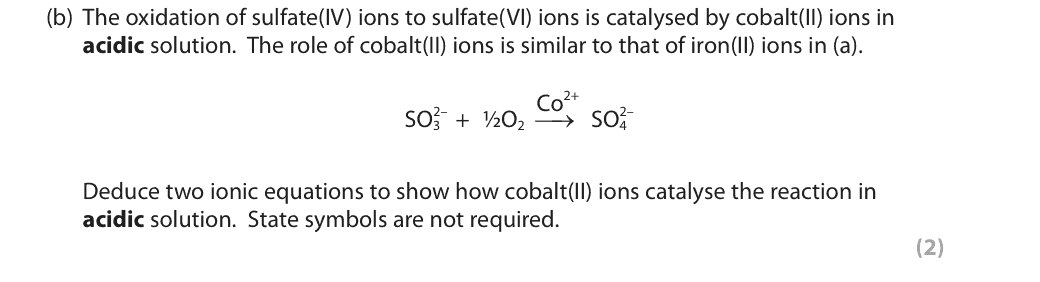
This question proved to be the most challenging on the whole paper. It was designed to be a follow- on from the previous question and provide another example of where the variable oxidation states of transition elements often enables catalytic activity. Many candidates used the space provided to try and work out the answer but often has missed the reference in the question, which had been highlighted in bold, that the reaction took place in "acidic" conditions. This was the key to obtaining correct equations and is a useful reminder of the emphasis that candidates need to note from words given in bold text.
Notes from the mark scheme and report
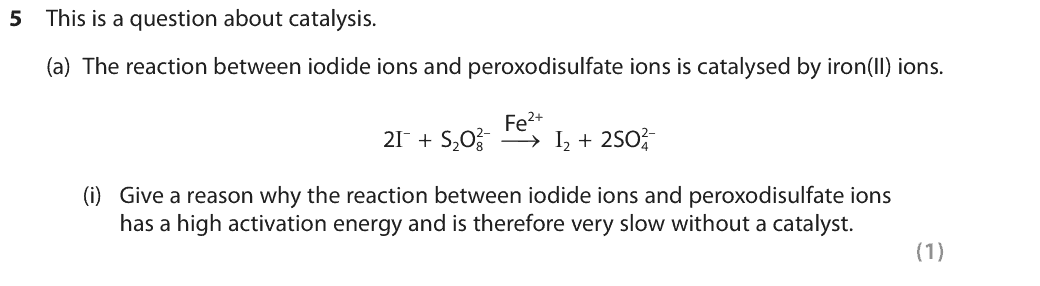
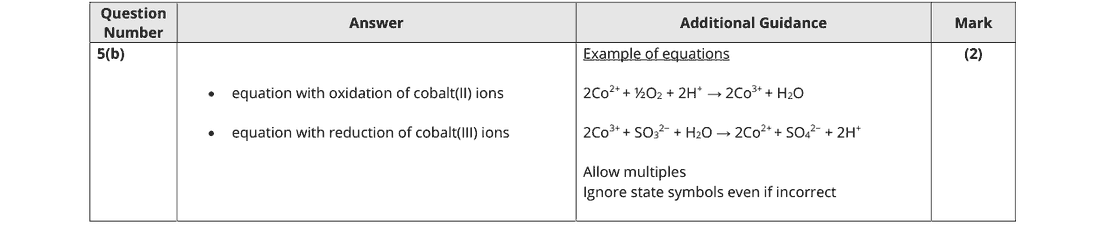
2Co2+ + ½O2 + 2H+ → 2Co3+ + H2O then 2Co3+ + SO3 2– + H2O → 2Co2+ + SO4 2– + 2H+. Multiples allowed. The key is that the solution is acidic, so H+ and H2O are needed to balance
many missed this
June 2019 · Paper 1 · Q8(c)1 markEquation writingHard
Earlier part of question 8 that this part uses
Mark scheme
Examiner's comment
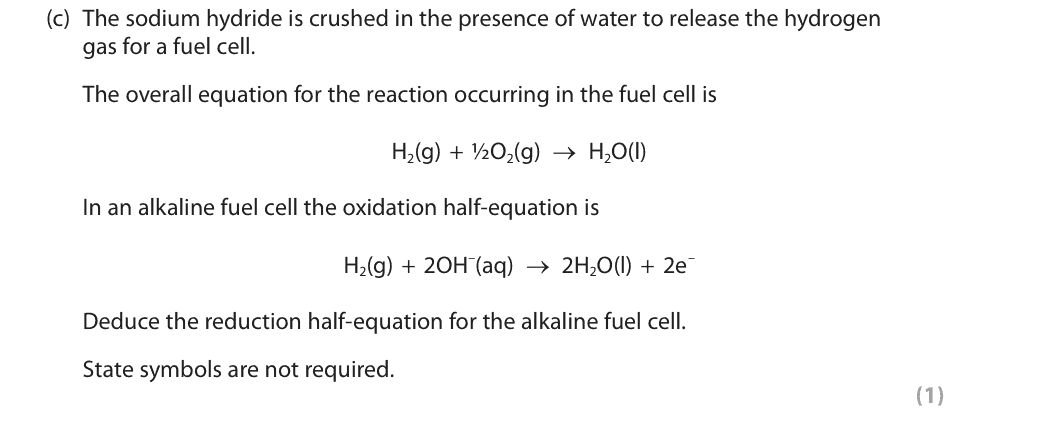
Only about a third of candidates successfully answered this question. A significant number of candidates gave the acidic half equation but the alkaline fuel cell was the subject of the question and so this did not score. Once again, a reminder to make sure that the answer given does match the question set.
Notes from the mark scheme and report
Answer: ½O2 + H2O + 2e– → 2OH– (or O2 + 2H2O + 4e– → 4OH–). Many gave the half-equation for the acidic cell, which did not score
June 2019 · AS Paper 1 · Q9(a)(i)1 markMultiple choice
Answer
C
Mark scheme
Examiner's comment
(a)(i) The optional responses to this question were, on reflection, perhaps a little too
obvious. Candidates had perhaps been taught to expect the paper to include something
on disproportionation.
(a)(ii) This question discriminated well with few able to score all four marks but most
able to gain at least one or two marks.
MP1 required naming the structure, so that drawing skills were not tested (at this level,
many candidates found 3D structures difficult to draw).
MP2 was awarded to candidates that measured bond angle on this compound and
found it to be greater than the tetrahedral bond angle. Candidates were simply
expected to apply VSEPR principles and predict an angle slightly less than the
tetrahedral bond angle. The experimentally determined bond angle was not seen in the
range of answers given.
MP3 was awarded for a broad attempt to illustrate the principles used to predict the
bond angle (MP2).
MP4 was awarded for reference to a position of minimum repulsion/maximum
separation. For an answer at this level, there was no insistence on a link to electron
pairs.
(b)(i) Although the numbers are larger than would have been familiar to some, this
question was answered well. The responses were evenly divided between those who
omitted any number before the KCl and those who inserted a (1). Either response was
acceptable.
(b)(ii) Very few good answers scoring all 3 marks were seen because most candidates
were unable to interpret the data supplied. They were confused by the negative indices.
Their confusion was compounded by the inclusion of data for a second solvent
(ethanol). Consequently, few used water alone as the solvent, most opting for a
combination of water and ethanol.
Considerable leniency was applied for the mention of filtration of undissolved
potassium chlorate (VII) at any stage. However, the mark was not awarded for those
who thought that potassium chloride would be filtered off, i.e. failed to understand that
potassium chloride is the most soluble component in either solvent.
(c) This question asked candidates to calculate the moles of chlorine (Cl2) in a swimming
pool. The meaning of ppm was described in the question so that no prior knowledge
was required. The question also made it clear that chlorine was required as Cl2, not just
Cl. There are several different ways to calculate the answer, but in summary they all
break down to three operations; conversion of the pool volume to cm3 or g, application
of 2ppm, conversion of the mass of chlorine to moles.
It was essential that candidates should set out their answers logically for this question
because there is a possibility that two errors can cancel the marks. If the 2ppm is not
applied (for MP2) and 35.5 is used (instead of 71) for the molar mass of chlorine (MP3),
the final answer can still be 70.4. Hence the MS does not specify, ‘final answer with or
without working scores 3 marks.
(d) Many candidates did not use the equation to reach their conclusions, restricting their
answers simply to the effects of more/less chlorine in solution. These answers were not
awarded any marks. Zero marks were quite common for this question.
MP1/MP2 required recognition of the variation in HClO (concentration), and its effect on
disinfection of the water.
MP3/MP4 required recognition of the variation in HCl (concentration), and its effect on
the acidity of the pool.
(e)(i) There was a marked difference in quality of answers between those who were
familiar with the solvation of ions, and those who were trying to work out the answer
from first principles. Many of the latter suggested hydrogen bonds or attempted to
show solvation of both irons by a single water molecule.
The dipoles were often omitted altogether.
(e)(ii) Almost all candidates scored MP1 (for hydrogen bonds with ethanol). Very few
candidates were awarded MP2 because in chloroethane either the dipole-dipole
attractions or the London forces were recognised, but rarely both.
(f) Frequently the mark awarded for this question was 2 of the available 3. Almost all
candidates ignored the fact that one mole of Ca(ClO)2 contains two moles of ClO− ions.
Therefore, the answer was given as 0.80, and M2 was not scored.
Notes from the mark scheme and report
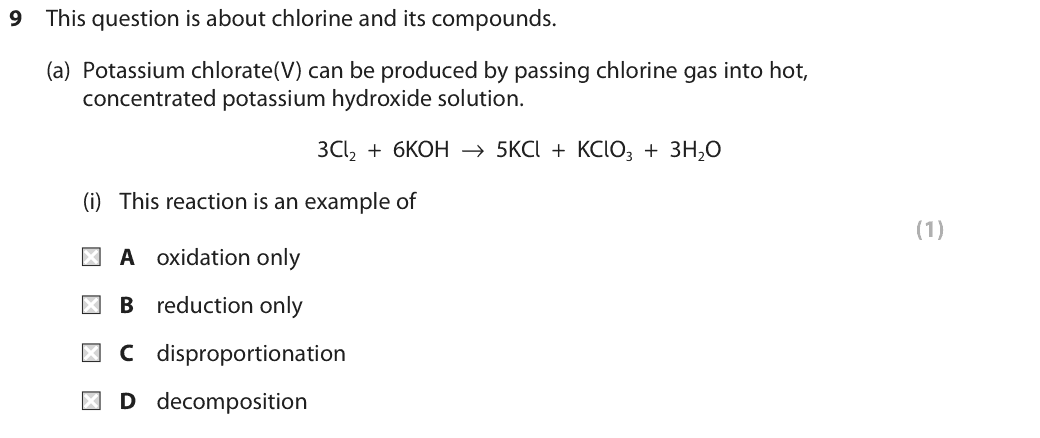
Answer: C. Chlorine (0) is both oxidised to +5 in KClO3 and reduced to –1 in KCl, so it is disproportionation. A and B are wrong because both oxidation and reduction occur
D because there are two reactants
June 2019 · Paper 3 · Q4(a)(ii)1 markShort answer
Earlier part of question 4 that this part uses
Mark scheme
Examiner's comment
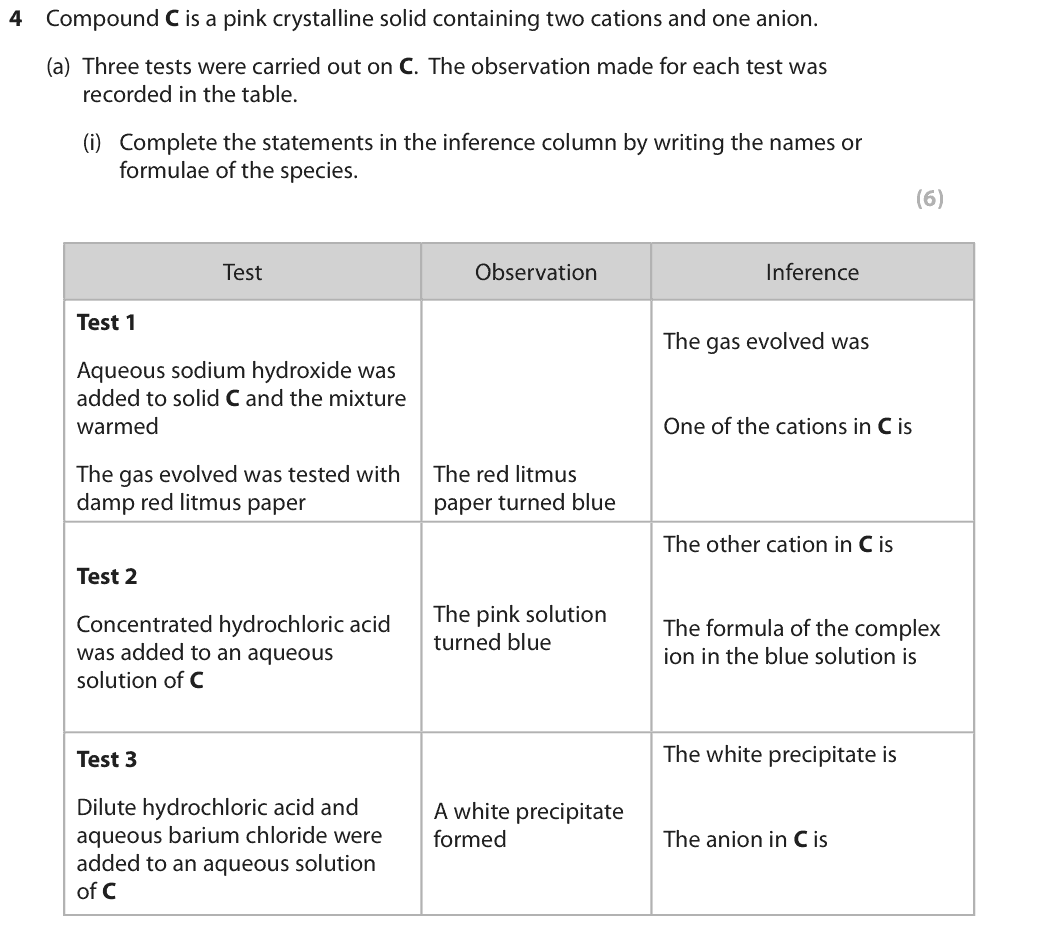
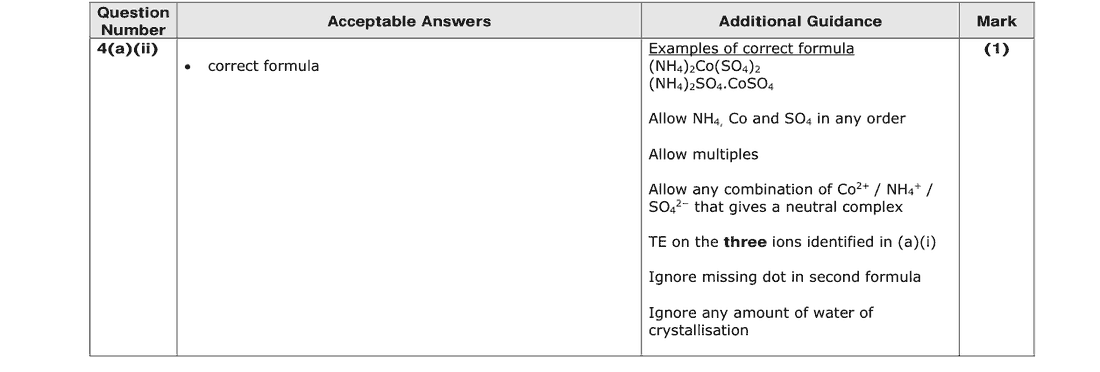
Candidates who have carried out tests to identify inorganic substances found this question straightforward. In part (a)(i) the most common error was to omit the oxidation state of cobalt. When a metal ion can have more than one oxidation state, it is important to give the name and oxidation state or the symbol with the charge ie cobalt(II) or Co2+. A number of candidates thought that copper(II) salts changed from pink to blue when concentrated hydrochloric acid is added. This is incorrect, but they were awarded marks for the correct tetrchloro complex of copper(II) and a consequential formula of C in (ii). Some candidates were unfamiliar with the tetrachloro complex ion of cobalt(II). Candidates found it much more challenging to combine the formulae of the three ions to give an overall neutral species. They would benefit from more practice in using formulae of double salts.
Notes from the mark scheme and report
Answer: (NH4)2Co(SO4)2 or (NH4)2SO4.CoSO4 (any order, multiples allowed
any neutral combination of NH4+, Co2+ and SO4 2–). Error carried forward from the three ions in (a)(i)
water of crystallisation ignored. Combining three ions into a neutral formula was found much harder than identifying them
Skills: CP15 Core practical 15: Analysis of some inorganic and organic unknowns
June 2019 · Paper 3 · Q5(a)1 markShort answerHard
Mark scheme
Examiner's comment
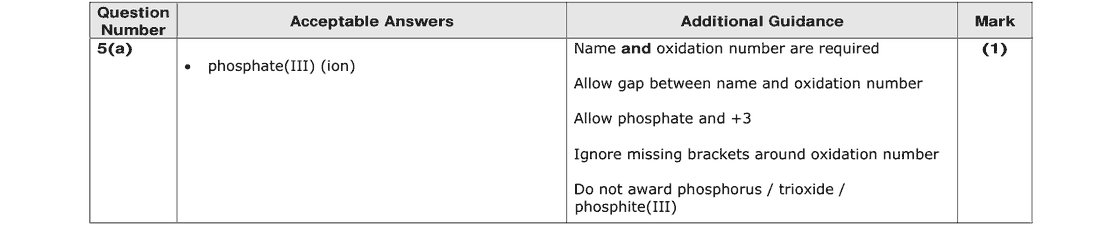
Many candidates struggled to give the name of the PO33- ion. They should know that when there is oxygen in an anion, the name will end in -ate and the oxidation number should be written as Roman numerals in brackets after the name, so phosphate(III) is the best representation. All combinations of names that included phosphorus and oxygen were seen.
Notes from the mark scheme and report
Answer: phosphate(III). Name and oxidation number both needed (allow phosphate and +3). Not phosphorus, trioxide or phosphite(III). Every combination of names with phosphorus and oxygen was seen
June 2019 · Paper 3 · Q5(b)1 markShort answer
Earlier part of question 5 that this part uses
Mark scheme
Examiner's comment
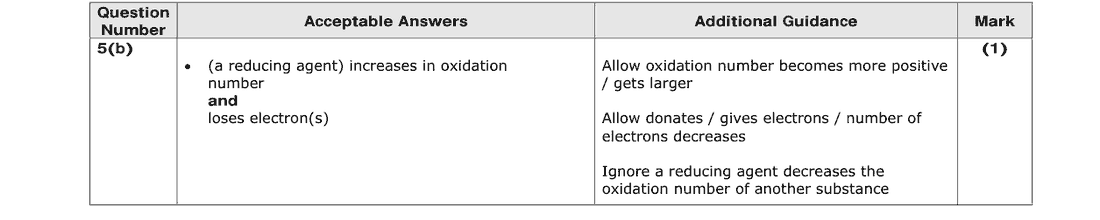
The majority of candidates knew that reducing agents lose electrons and increase in oxidation number. Some candidates thought that reducing agents are reduced themselves so gave the opposite answer and a few gave mixed answers.
Notes from the mark scheme and report
Its oxidation number increases AND it loses electrons (both needed). Some thought a reducing agent is itself reduced and gave the opposite
a few gave mixed answers
June 2019 · Paper 3 · Q5(d)(i)2 marksEquation writingHard
Earlier part of question 5 that this part uses
Mark scheme
Examiner's comment
(i) The majority of candidates struggled to write the ionic equation for the reaction between manganese(IV) oxide, manganate(VII) ions in alkaline solution to produce manganate(VI) ions, even though the formulae for all the manganese species were given in the stem of the question. Candidates did not seem to realise that hydroxide ions are present in an alkaline solution and it was disappointing to see many try to balance equations with H+ and H2. H2O is a much more likely product.
(ii) More candidates were able to explain why the reaction was not disproportionation but there were many vague answers that were not given any credit. A common answer was that 'Mn is not oxidised and reduced' and that was not allowed as it did not state 'in the same species'. Manganese is being oxidised and reduced but it is in two different species. Candidates should think carefully about using the correct terminology as they interchanged terms such as element, ion, atom, molecule and compound without realising their meanings. The term 'species' is very useful in this context.
Notes from the mark scheme and report
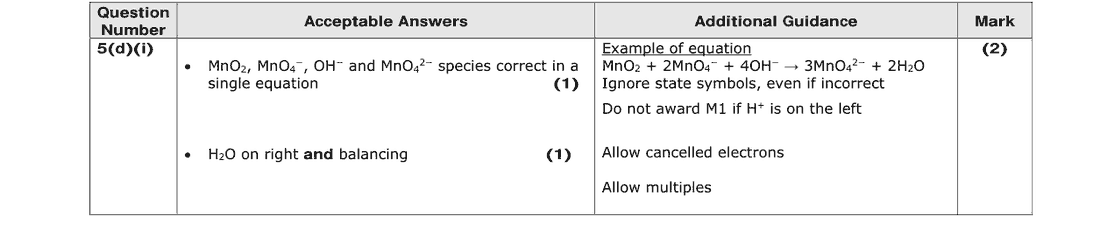
MnO2 + 2MnO4– + 4OH– → 3MnO4 2– + 2H2O. One mark for MnO2, MnO4–, OH– and MnO4 2– in one equation (not if H+ is on the left)
one for H2O on the right and balancing. Candidates did not use OH– for the alkaline solution and tried to balance with H+ and H2
June 2019 · Paper 3 · Q5(d)(ii)1 markShort answer
Earlier parts of question 5 that this part uses
Mark scheme
Examiner's comment
(i) The majority of candidates struggled to write the ionic equation for the reaction between manganese(IV) oxide, manganate(VII) ions in alkaline solution to produce manganate(VI) ions, even though the formulae for all the manganese species were given in the stem of the question. Candidates did not seem to realise that hydroxide ions are present in an alkaline solution and it was disappointing to see many try to balance equations with H+ and H2. H2O is a much more likely product.
(ii) More candidates were able to explain why the reaction was not disproportionation but there were many vague answers that were not given any credit. A common answer was that 'Mn is not oxidised and reduced' and that was not allowed as it did not state 'in the same species'. Manganese is being oxidised and reduced but it is in two different species. Candidates should think carefully about using the correct terminology as they interchanged terms such as element, ion, atom, molecule and compound without realising their meanings. The term 'species' is very useful in this context.
Notes from the mark scheme and report
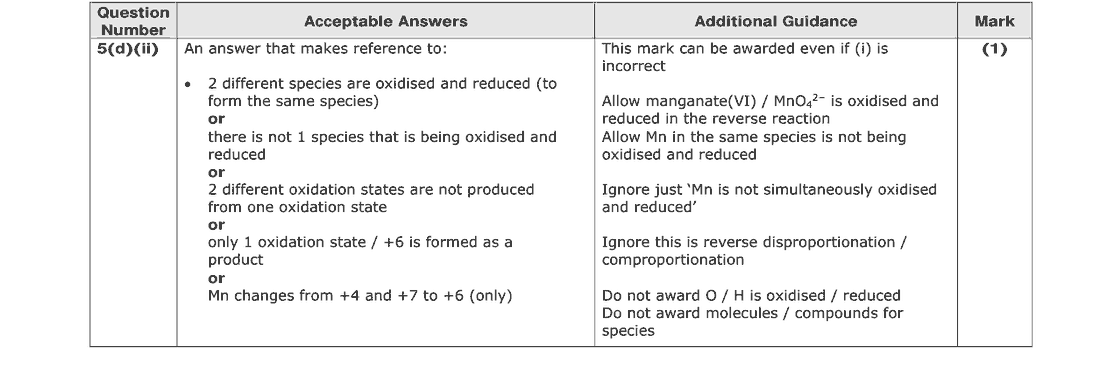
Two different species are oxidised and reduced (Mn goes from +4 and +7 to +6 only)
disproportionation needs one species to be both oxidised and reduced. Can score even if (i) is wrong. 'Mn is not oxidised and reduced' was not accepted, because it is, but in two different species
'molecules' or 'compounds' not accepted for species
June 2018 · Paper 1 · Q4(b)1 markMultiple choice
Answer
C
Mark scheme
Notes from the mark scheme and report
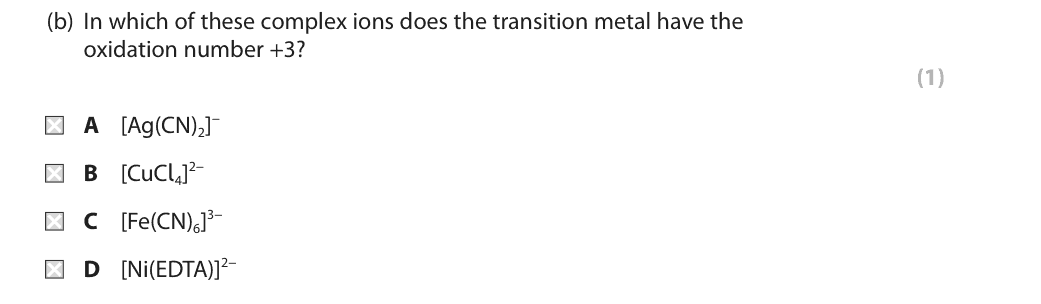
Answer: C. Six CN– ligands and an overall 3– charge give iron +3. Silver is +1 in [Ag(CN)2]–, copper +2 in [CuCl4]2– and nickel +2 in [Ni(EDTA)]2–
June 2018 · Paper 1 · Q5(c)(i)1 markEquation writing
Earlier part of question 5 that this part uses
Mark scheme
Examiner's comment
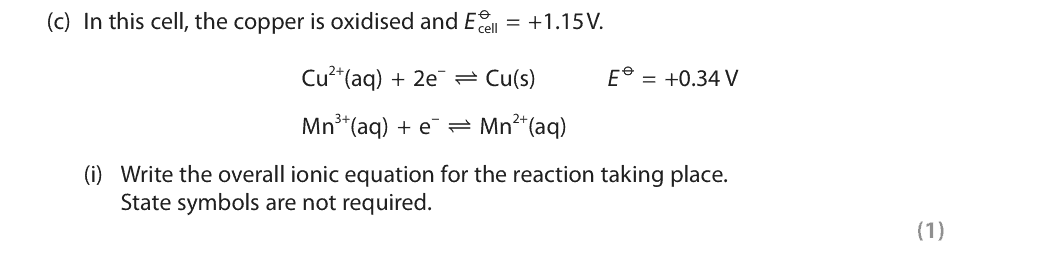
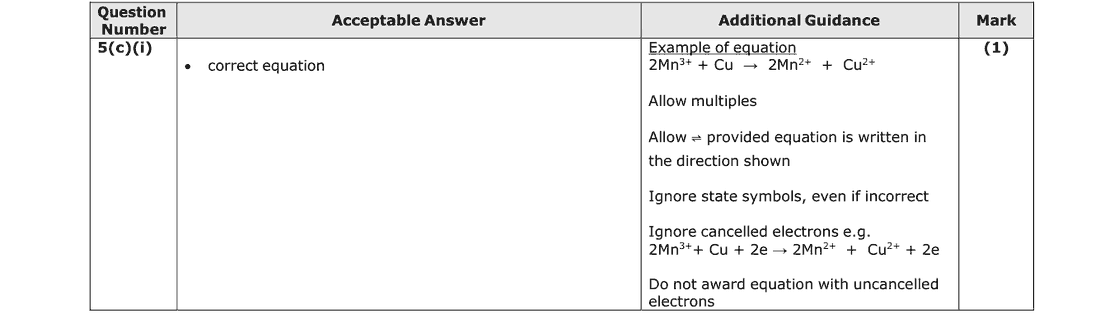
Many candidates scored the marks for (i) and (ii). Some candidates did not cancel the electrons from their overall ionic equation and others forgot to reverse the direction of the copper half- equation, even though they were told that copper is oxidised.
Notes from the mark scheme and report
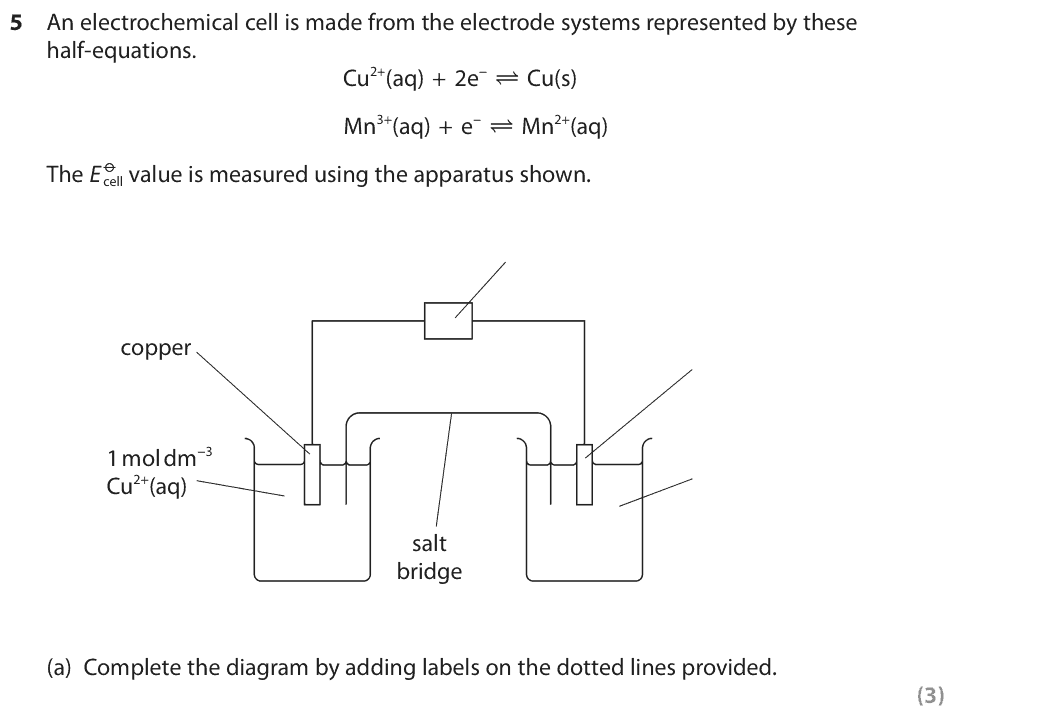
Answer: 2Mn3+ + Cu → 2Mn2+ + Cu2+. Multiples allowed
state symbols ignored
uncancelled electrons not allowed. Common errors: electrons left in
the copper half-equation not reversed
June 2018 · AS Paper 1 · Q6(b)(i)2 marksShort answer
Earlier part of question 6 that this part uses
Mark scheme
Examiner's comment
This was another item where many students scored both the available marks.
Notes from the mark scheme and report
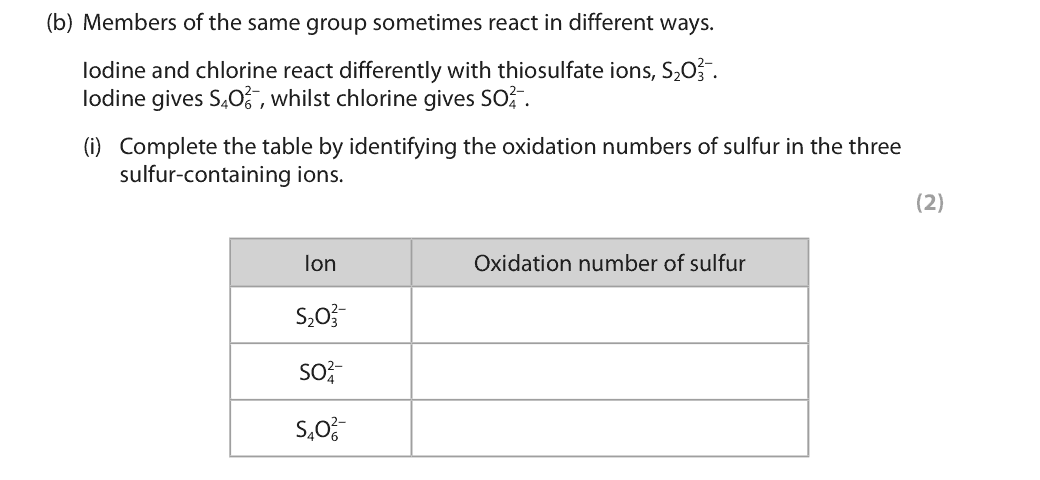
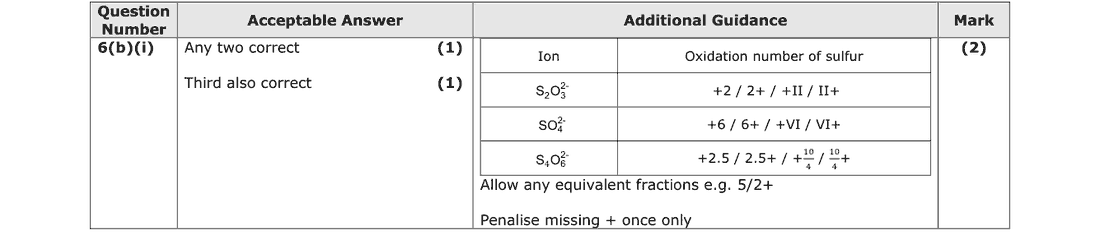
Answer: S2O3 2– is +2
SO4 2– is +6
S4O6 2– is +2.5 (allow 5/2 or 10/4). One mark for any two, second mark for all three. A missing + sign is penalised once only
Roman numerals allowed
June 2018 · AS Paper 1 · Q6(b)(ii)1 markShort answer
Earlier parts of question 6 that this part uses
Mark scheme
Examiner's comment
Recognition that iodine gained an electron was common.
Notes from the mark scheme and report
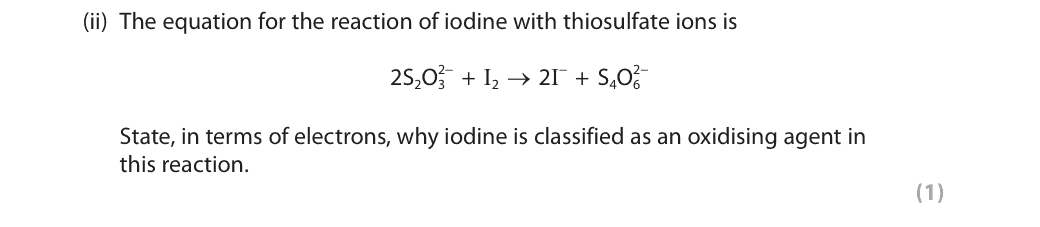
Iodine (I2) gains electrons. Allow thiosulfate / sulfur has lost electrons. References to oxidation number ignored (the question says in terms of electrons)
June 2018 · AS Paper 1 · Q6(b)(iii)1 markShort answer
Earlier parts of question 6 that this part uses
Mark scheme
Examiner's comment
Many students were able to deduce that chlorine was a stronger oxidising agent as the oxidation number of the sulfur went higher that it did with iodine as shown by these two typical examples.
Notes from the mark scheme and report
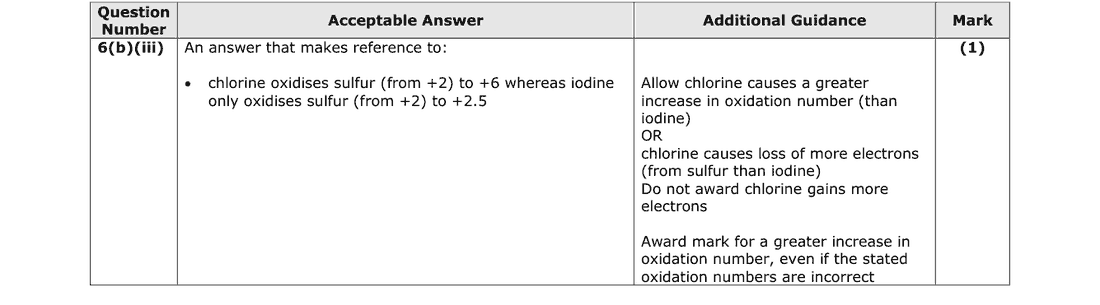
Chlorine oxidises sulfur from +2 to +6 whereas iodine only oxidises it from +2 to +2.5 (allow: chlorine causes a greater increase in oxidation number, or the loss of more electrons from sulfur). 'Chlorine gains more electrons' not credited. The mark is given for a greater increase even if their oxidation numbers from (b)(i) are wrong
June 2018 · AS Paper 1 · Q6(b)(iv)2 marksEquation writing
Earlier parts of question 6 that this part uses
Mark scheme
Examiner's comment
This equation was quite well answered. Ionic half-equations are always challenging at this level except for the most straightforward examples. Many students were able to deduce the correct species from description of the experiment, but then some failed to correctly balance the equations, often having either 8 hydrogen ions or 10 electrons. Students need to remember to balance the charge on both sides of the equation after they have balanced the different types of atoms.
Notes from the mark scheme and report
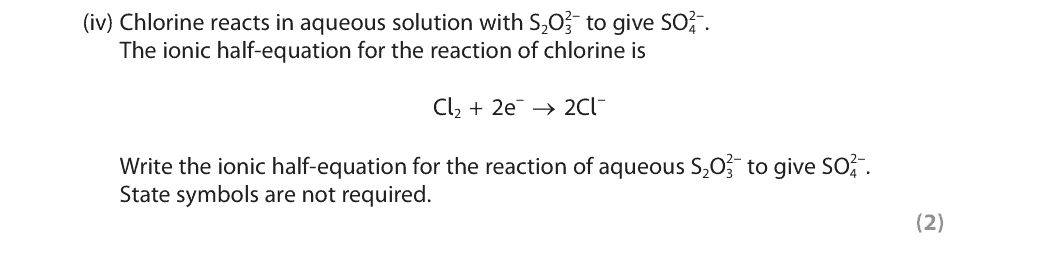
Answer: S2O3 2– + 5H2O → 2SO4 2– + 10H+ + 8e–. One mark for the correct species, one for balancing. S2O3 2– + 10OH– → 2SO4 2– + 5H2O + 8e– scores one mark. State symbols ignored. Common errors: 8 hydrogen ions or 10 electrons, i.e. not balancing charge after balancing atoms
June 2018 · AS Paper 1 · Q6(b)(v)1 markEquation writingHard
Earlier parts of question 6 that this part uses
Mark scheme
Examiner's comment
Relatively few students were able to score this mark, although it was common for those who had scored both marks in part (b)(iv) to score this mark as well.
Notes from the mark scheme and report
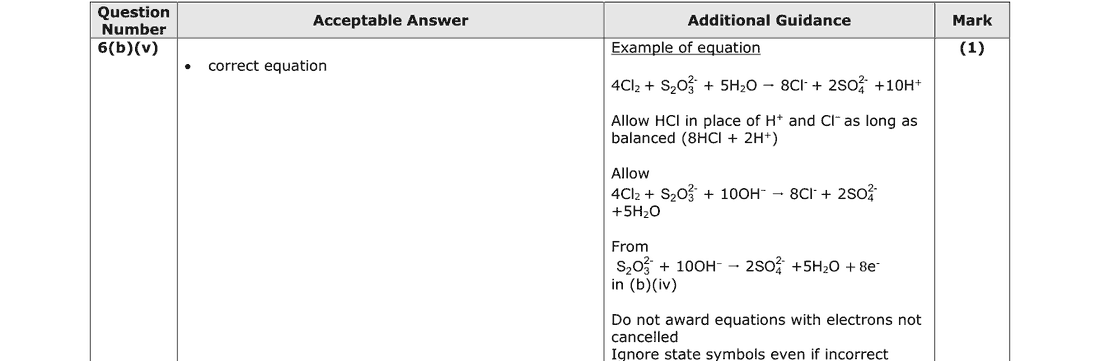
Answer: 4Cl2 + S2O3 2– + 5H2O → 8Cl– + 2SO4 2– + 10H+. Allow HCl in place of H+ and Cl– if balanced (8HCl + 2H+)
allow the OH– version following from an OH– half-equation in (b)(iv). Electrons must be cancelled. Usually scored only by those with both marks in (b)(iv)
June 2018 · Paper 1 · Q10(a)1 markEquation writing
Mark scheme
Examiner's comment
Many candidates were able to add together the two half-equations to give the correct balanced equation. Some candidates included silver and some left uncancelled electrons in their equation. Some candidates did not use the half-equations given and were unsuccessful as they tried to make up their own equation. A few candidates left out the sign on the nitrate ion and some wrote copper atoms and copper ions on the wrong sides of the equation. Candidates should always check that ionic equations are balanced in terms of atoms and charges.
Notes from the mark scheme and report
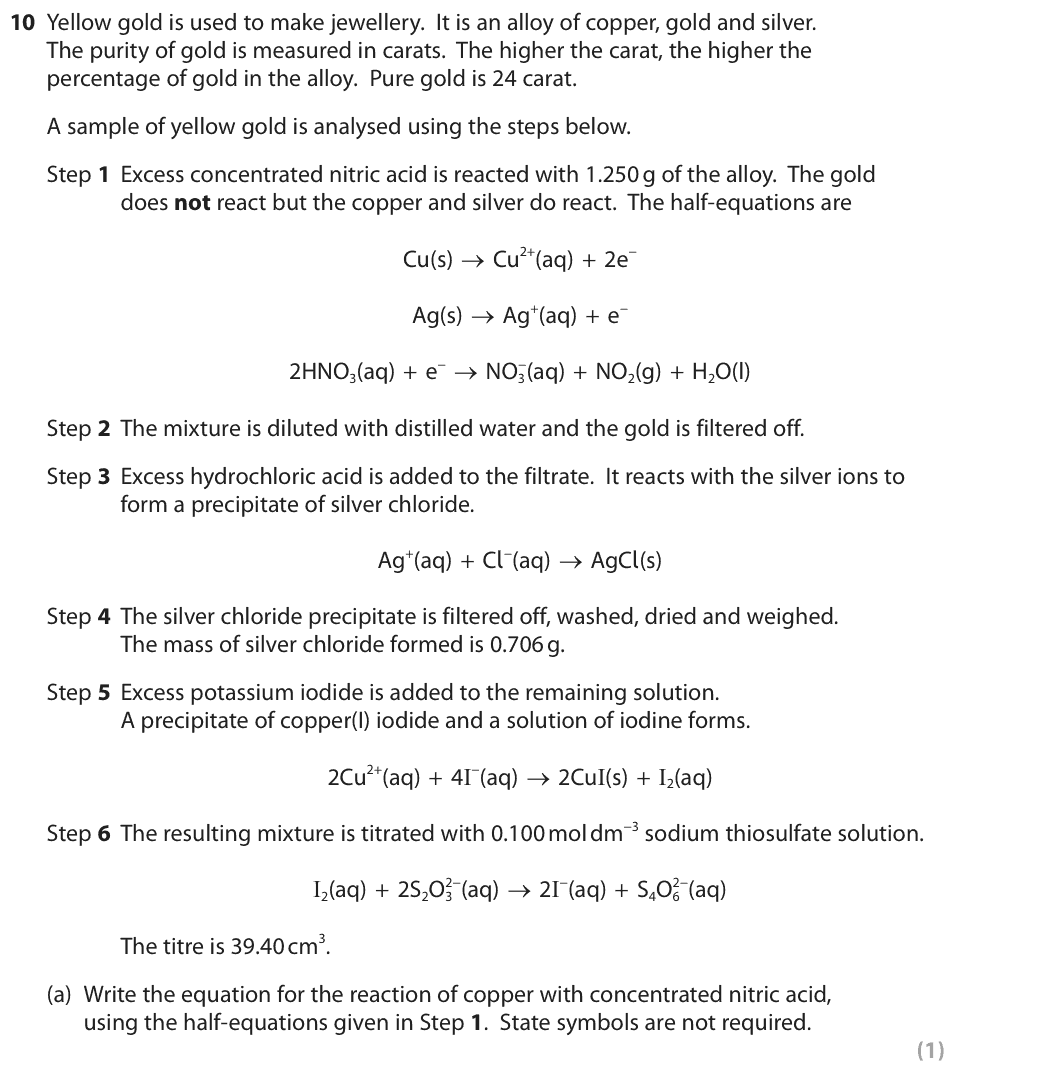
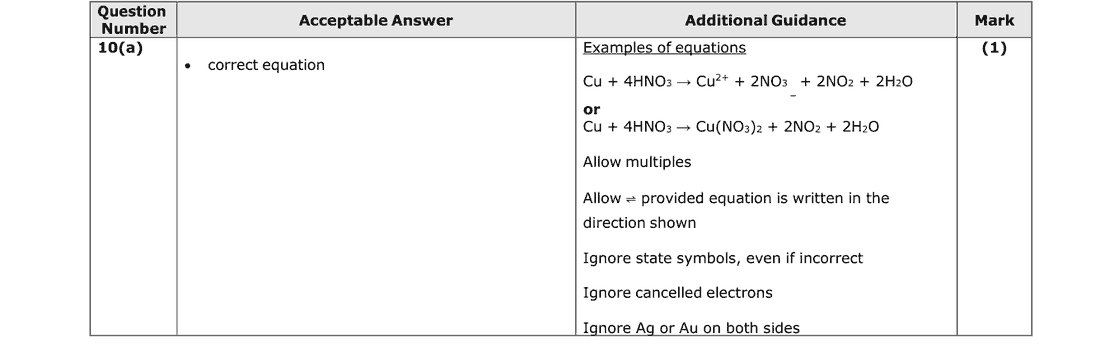
Answer: Cu + 4HNO3 → Cu2+ + 2NO3– + 2NO2 + 2H2O (or Cu + 4HNO3 → Cu(NO3)2 + 2NO2 + 2H2O). The nitric acid half-equation is doubled. Multiples allowed
state symbols ignored. Common errors: silver included
electrons left in
charge missing from the nitrate ion
not using the half-equations given
June 2018 · Paper 2 · Q4(b)3 marksShort answer
Earlier part of question 4 that this part uses
Mark scheme
Examiner's comment
It was surprising that even with incorrect oxidation numbers stated, the equation was often still balanced correctly. Perhaps these candidates balanced by inspection of atoms and then considered the oxidation numbers. If so, then this is inadvisable because balancing by oxidation numbers will always derive the correct answer.
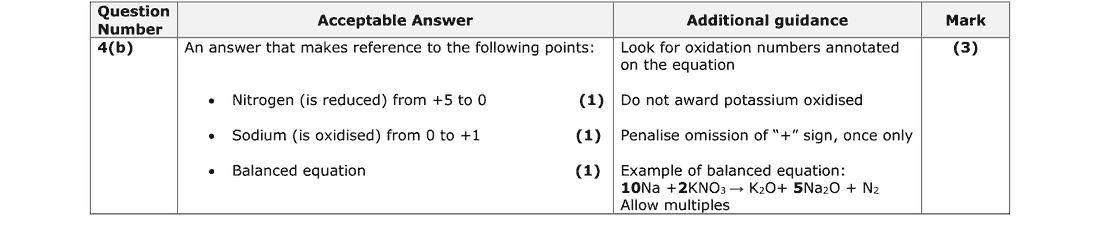
a missing + sign is penalised once. Many balanced the equation correctly even with wrong oxidation numbers
June 2018 · Paper 2 · Q5(a)2 marksEquation writing
Mark scheme
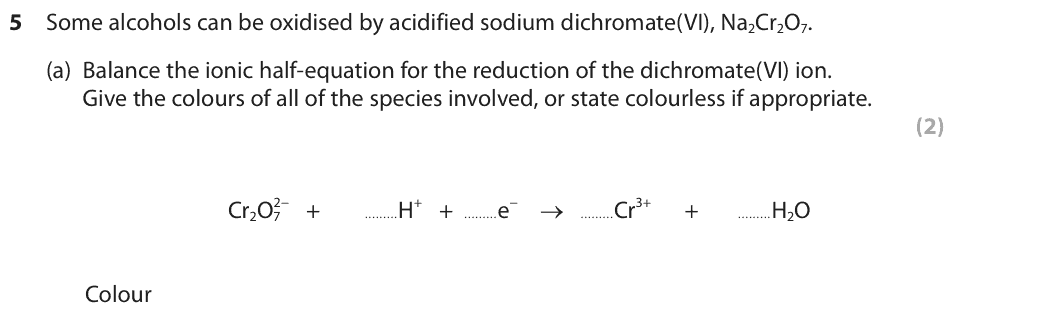
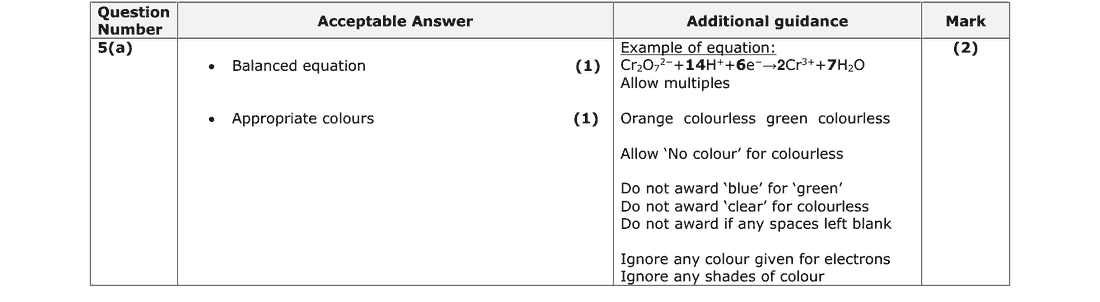
Examiner's comment
Just under 60% candidates correctly balanced the half equation and also gave the right colours for all of the species. Occasionally no response was given for the hydrogen ions and the water despite the dotted answer lines, and so this meant that the 'colours' mark was not awarded. It was very pleasing to see very few 'clear' answers which did not score so this point seems to be well- understood by candidates.
no colour mark if any space is left blank. Just under 60% scored both
some gave no colour for H+ and water
June 2018 · Paper 3 · Q1(b)5 marksPractical and data analysis
Earlier part of question 1 that this part uses
Mark scheme
Examiner's comment
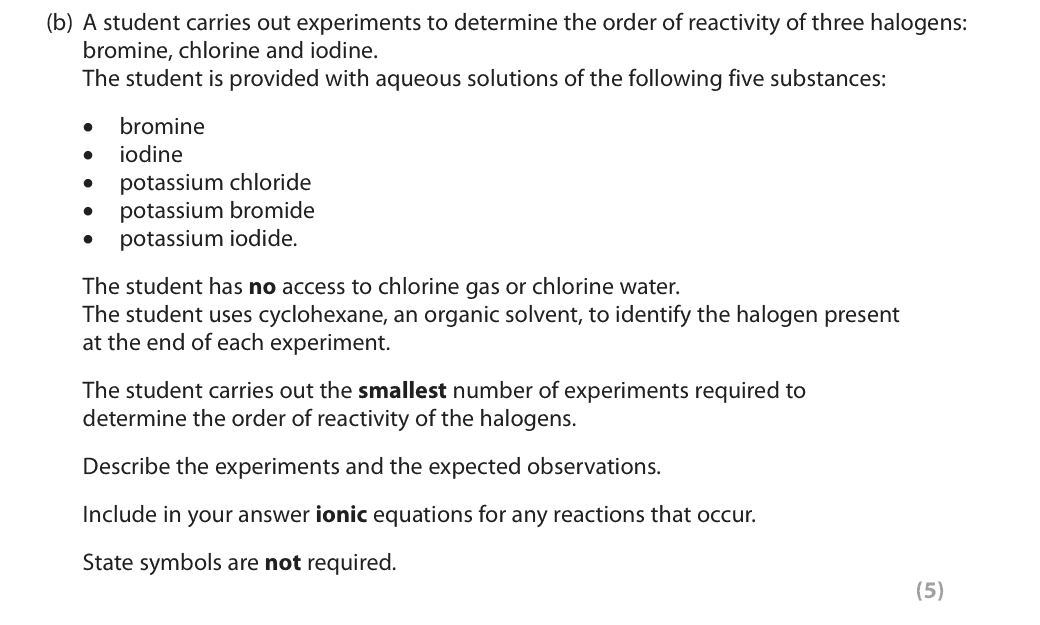
It was surprising to see how many candidates ignored the guidance in the stem of the question and as a result described inappropriate experiments using alternative reactants.
The most common of these was the use of silver nitrate solution in a similar manner to an experiment to determine the reactivity of halogenoalkanes. Another route, seen less often, was an attempt to compare the reactions of metal halides with concentrated sulfuric acid. Such attempts focused on the halide ions rather than the halogens and used reactants not provided to the student. It cannot be emphasised enough how important it is to read through the stem of a question with great care, as it can often help candidates structure a more appropriate response.
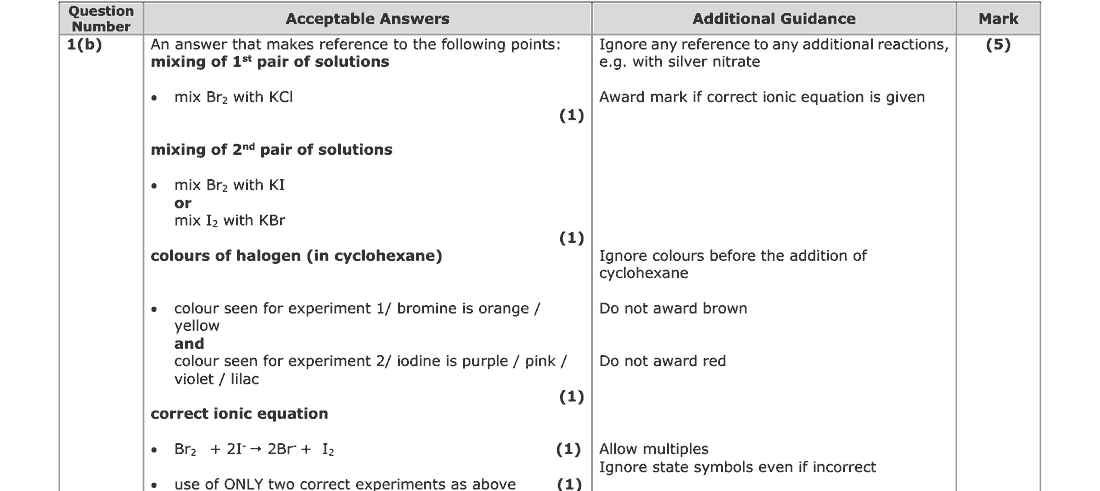
Of those who managed to describe displacement reactions, most were able to score two marks for testing Br2 with KCl and Br2 with KI or I2 with KBr. A smaller proportion went on to correctly show the ionic equation, either because they wrote the full equation, or because they thought iodine would oxidise bromide ions.
The colours in cyclohexane were not often referenced, and even when described were often confused with the colours in aqueous solution. Frustratingly, some otherwise very good candidates missed a mark because they ignored the comment about the ‘smallest number of experiments’ and were therefore wrong about all the possible combinations of halogen/halide.
Notes from the mark scheme and report
Mix bromine with potassium chloride
mix bromine with potassium iodide (or iodine with potassium bromide)
in cyclohexane bromine is orange / yellow (not brown) and iodine is purple / pink / violet / lilac (not red)
Br2 + 2I– → 2Br– + I2
fifth mark for using only these two experiments. Colours before adding cyclohexane are ignored. Common errors: using silver nitrate or concentrated sulfuric acid (not provided)
a full rather than ionic equation
aqueous colours given for the cyclohexane layer
describing every halogen/halide combination
Skills: PT4 use laboratory apparatus for a variety of experimental techniques, including: titration, using burette and pipette; distillation and heating under reflux, including setting up glassware using retort stand and clamps; qualitative tests for ions and organic functional groups; filtration, including use of fluted filter paper, or filtration under reduced pressure
June 2018 · Paper 3 · Q5(a)1 markShort answer
Mark scheme
Examiner's comment
Nearly 85% of candidates correctly calculated the oxidation state of vanadium in NH4VO3. The incorrect answers struggled to assign a value to the ammonium ion, and no pattern was seen in wrong values. Many answers showed no evidence of working, suggesting some answered this question using recall.
Notes from the mark scheme and report
Answer: +5 (allow 5+, +V, V, 5). Wrong answers usually came from the value given to the ammonium ion
June 2017 · Paper 1 · Q2(a)3 marksExplanation
Mark scheme
Examiner's comment
The majority of candidates demonstrated excellent understanding of redox in this question. Some candidates would benefit from more practice at determining oxidation numbers of an element in different species as +6 was a common incorrect oxidation number for nitrogen in magnesium nitrate and a few candidates gave the total of the oxidation numbers of the three oxygens in magnesium nitrate as -6 instead of the individual oxidation number. Some candidates gave the correct oxidation numbers but forgot to state which was oxidised and which was reduced while a very small minority thought that the oxidation number of magnesium was changing. Reference to 'charge' was accepted on this occasion, but candidates should be made aware that the elements do not have this charge and it would be better in future to refer to oxidation numbers. References to gain and loss of electrons were frequently seen and these were ignored as they were irrelevant to this question.
Notes from the mark scheme and report
N changes from +5 to +4
O changes from –2 to 0 (in O2)
so nitrogen is reduced and oxygen is oxidised (this mark is available even if the numbers are wrong or missing). Ignore explanations in terms of electron loss or gain. Common errors: +6 for nitrogen in the nitrate
–6 as the total for the three oxygens
numbers given but no statement of which is oxidised and which reduced
June 2017 · Paper 1 · Q3(b)3 marksExplanation
Earlier part of question 3 that this part uses
Mark scheme
Examiner's comment
There were many excellent answers to this question. Some candidates did not read the question and did not refer to oxidation numbers: even though they wrote in detail about iodide ions losing electrons they could not score any marks. Some candidates gave an incorrect oxidation number, the most common being +2 for sulfur in hydrogen sulfide, so they lost a mark. A few candidates omitted to state that chloride ions do not reduce sulfur. Candidates are advised to write about all of the substances given in a question.
Notes from the mark scheme and report
Iodide is the strongest reducing agent because it reduces sulfur from +6 to 0 (in S) or to –2 (in H2S)
bromide reduces sulfur only from +6 to +4 (in SO2)
chloride does not reduce the sulfuric acid (no change in oxidation number / not a redox reaction). Iodide must be identified for full marks
+6 needs stating only once. Common errors: no oxidation numbers at all (answers in terms of electron loss scored nothing)
+2 for sulfur in H2S
leaving out chloride
June 2017 · Paper 1 · Q3(c)(ii)3 marksEquation writing
Earlier parts of question 3 that this part uses
Mark scheme
Examiner's comment
Although many correct answers were seen, many candidates made careless errors in copying the half-equations from the table. Some candidates left uncancelled electrons in their equations, some wrote the equation in the wrong direction while others tried to react manganate(VII) ions with bromine. A few candidates selected the wrong half-equation for manganese. Some candidates were unable to calculate the Eo
cell value.
E cell = 1.51 – 1.09 = (+)0.42 V. M1 all species on the correct sides with no electrons left
M2 balancing
M3 the E cell value (no error carried forward from a wrong equation). Multiples and reversible arrows allowed. Common errors: slips in copying the half-equations
electrons left uncancelled
equation written in the wrong direction
reacting MnO4– with Br2
choosing the MnO2 half-equation
Skills: MS2.3 Substitute numerical values into algebraic equations using appropriate units for physical quantities
June 2017 · AS Paper 1 · Q4(a)(i)1 markEquation writing
Mark scheme
Examiner's comment
Candidates found the writing of the ionic equation in these questions extremely challenging, and it differentiated well for higher ability candidates. The first equation was a well-known one and required little prompting, with many candidates scoring here, though there were a number of errors, including not balancing the charge with the number of electrons and not putting the electrons on the correct side of the half-equation. Equation (ii) was probably the most challenging as candidates were required to work out what to include in the equation and needed to identify that water would be formed as a product. Equation (iii) was easier as the candidates are expected to know the full equation for this reaction so only needed to convert it into an ionic equation. Some used this equation to help to write their answers for equation (ii). Part (iv) allowed many candidates to score 1 mark for being able to describe disproportionation, with many able to identify what was happening to chlorine in the equation, even if their equation (iii) was not totally correct.
Notes from the mark scheme and report
Answer: Cl2 + 2e– → 2Cl–. Multiples allowed
state symbols ignored. Errors: charge not balanced by the number of electrons
electrons on the wrong side
June 2017 · AS Paper 1 · Q4(a)(ii)1 markEquation writingHard
Earlier part of question 4 that this part uses
Mark scheme
Examiner's comment
Candidates found the writing of the ionic equation in these questions extremely challenging, and it differentiated well for higher ability candidates. The first equation was a well-known one and required little prompting, with many candidates scoring here, though there were a number of errors, including not balancing the charge with the number of electrons and not putting the electrons on the correct side of the half-equation. Equation (ii) was probably the most challenging as candidates were required to work out what to include in the equation and needed to identify that water would be formed as a product. Equation (iii) was easier as the candidates are expected to know the full equation for this reaction so only needed to convert it into an ionic equation. Some used this equation to help to write their answers for equation (ii). Part (iv) allowed many candidates to score 1 mark for being able to describe disproportionation, with many able to identify what was happening to chlorine in the equation, even if their equation (iii) was not totally correct.
state symbols ignored. Candidates had to work out that water is a product
June 2017 · AS Paper 1 · Q4(a)(iii)1 markEquation writing
Earlier part of question 4 that this part uses
Mark scheme
Examiner's comment
Candidates found the writing of the ionic equation in these questions extremely challenging, and it differentiated well for higher ability candidates. The first equation was a well-known one and required little prompting, with many candidates scoring here, though there were a number of errors, including not balancing the charge with the number of electrons and not putting the electrons on the correct side of the half-equation. Equation (ii) was probably the most challenging as candidates were required to work out what to include in the equation and needed to identify that water would be formed as a product. Equation (iii) was easier as the candidates are expected to know the full equation for this reaction so only needed to convert it into an ionic equation. Some used this equation to help to write their answers for equation (ii). Part (iv) allowed many candidates to score 1 mark for being able to describe disproportionation, with many able to identify what was happening to chlorine in the equation, even if their equation (iii) was not totally correct.
no mark if electrons are left uncancelled. Easier than (ii) because the full equation for this reaction should be known and only needs turning into an ionic equation
June 2017 · AS Paper 1 · Q4(a)(iv)2 marksExplanation
Earlier parts of question 4 that this part uses
Mark scheme
Examiner's comment
Candidates found the writing of the ionic equation in these questions extremely challenging, and it differentiated well for higher ability candidates. The first equation was a well-known one and required little prompting, with many candidates scoring here, though there were a number of errors, including not balancing the charge with the number of electrons and not putting the electrons on the correct side of the half-equation. Equation (ii) was probably the most challenging as candidates were required to work out what to include in the equation and needed to identify that water would be formed as a product. Equation (iii) was easier as the candidates are expected to know the full equation for this reaction so only needed to convert it into an ionic equation. Some used this equation to help to write their answers for equation (ii). Part (iv) allowed many candidates to score 1 mark for being able to describe disproportionation, with many able to identify what was happening to chlorine in the equation, even if their equation (iii) was not totally correct.
Notes from the mark scheme and report
M1 the same element (chlorine) is oxidised and reduced at the same time
M2 chlorine goes from 0 to –1 and to +1. The oxidation numbers can be shown on the equation in (a)(iii). Many scored the mark for describing disproportionation
June 2017 · AS Paper 1 · Q4(b)2 marksShort answerEasy
Mark scheme
Examiner's comment
Here candidates scored very well, being able to recall the formula of the chlorate (V) ion. In this question we did accept the formula of a typical product, e.g. NaClO3. Candidates were also able to correctly state the oxidation number of +5.
Notes from the mark scheme and report
Answer: ClO3– (allow NaClO3 / KClO3) and +5 (allow 5+ or +V). A bare 5 does not score unless +5 is shown in or on the formula
June 2017 · AS Paper 1 · Q4(c)(i)1 markEquation writingHard
Mark scheme
Examiner's comment
This equation was surprisingly hard for candidates to remember. There were many ways found for an incorrect answer, commonly including water, hydrogen ions or electrons in the final equation. Bromine as Br rather than Br2 was quite common and so were missing charges on ions.
state symbols ignored. Common errors: including water, H+ or electrons
Br instead of Br2
missing charges
June 2017 · Paper 3 · Q6(d)2 marksEquation writing
Earlier part of question 6 that this part uses
Mark scheme
Examiner's comment
Many candidates were aware of the level of precision required for titres in (a), so scored both marks. Candidates did sometimes slip and quote a value of '23.2' for titration 3. In part (b) the best scripts did score the mark. Others tended to get the change of colour the wrong way round or described a change of ‘pink to pale pink’. In practical terms, to the naked eye, solutions of Mn2+ ions of this concentration are colourless.
The calculation in part (c) also discriminated effectively. Most could pick up one or two marks for the amounts of MnO4- of NO2- respectively and some successfully managed to scale up the amount of NO2- ions; a common error here was to assume the scaling factor was 250/25 rather than 250/average titre.
At this point only the more able candidates made further progress using a variety of creditworthy strategies. The most common was to calculate the molar mass of the hydrated salt. However, some failed to recognise that the amount of the hydrated salt was half the amount of the NO2- ions.
Others used the more complex route of using the amount of hydrated salt to calculate the mass of all species present but water, then subtract these masses from the original mass of the hydrated salt. This enabled them to find the amount of water, which could then be compared to the amount of the salt to find x.
Most candidates managed to score at least 1 mark in part (d), the common mistakes being omission of charges on ions and not simplifying the equation by cancelling out species such as water molecules.
Notes from the mark scheme and report
2MnO4– + 5NO2– + 6H+ → 2Mn2+ + 5NO3– + 3H2O. One mark for multiplying the first half-equation by 2 and the second by 5
one for the overall equation with electrons, H+ and H2O cancelled. Uncancelled versions score 1. Common errors: charges left off ions
H2O and H+ not cancelled
Skills: CP11 Core practical 11: Redox titration
June 2016 · AS Paper 1 · Q8(b)(iii)3 marksExplanation
Earlier parts of question 8 that this part uses
Mark scheme
Examiner's comment
This question was another effective discriminator with a very good spread of marks across the whole ability range. Generally redox appears to be a concept that is well-understood.
One point to highlight is that the question required the oxidation numbers of 'all' of the atoms, with 'all' in bold. A significant number of candidates omitted reference to the fluorine, presumably because the oxidation number didn't change, but this was required and so its absence was penalised. However a number of candidates 'rescued' the mark by annotating the equation above with the respective oxidation numbers.
Notes from the mark scheme and report
Sulfur goes from 0 to +1, which is oxidation
silver goes from +2 to +1, which is reduction
fluorine stays at –1 and it is a redox reaction. Leaving out the words oxidation and reduction limits the first two points to one mark. Oxidation numbers written by the equation are credited. Many left out fluorine because it does not change, and lost the third mark
Work with an A-level chemistry tutor
Dropping marks on calculations, mechanisms or the core practicals? Book a trial session with an A-level chemistry tutor.