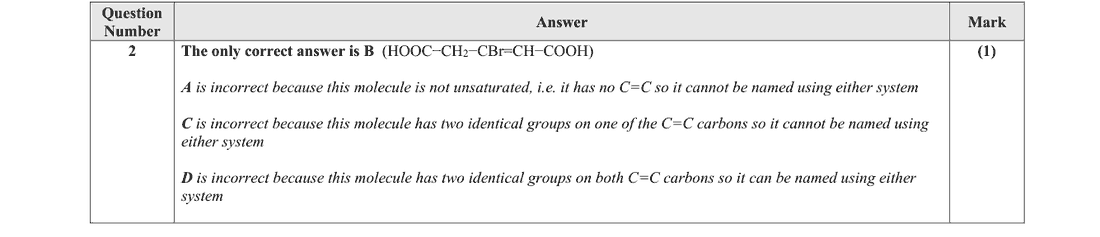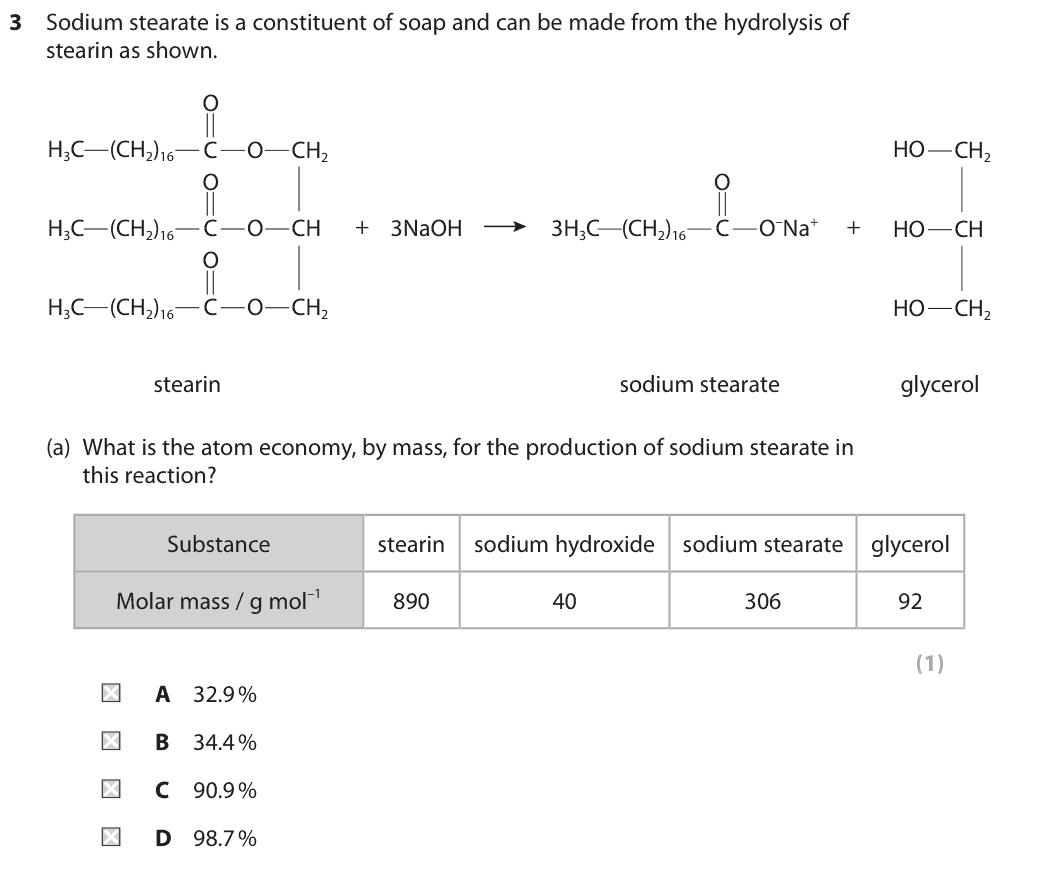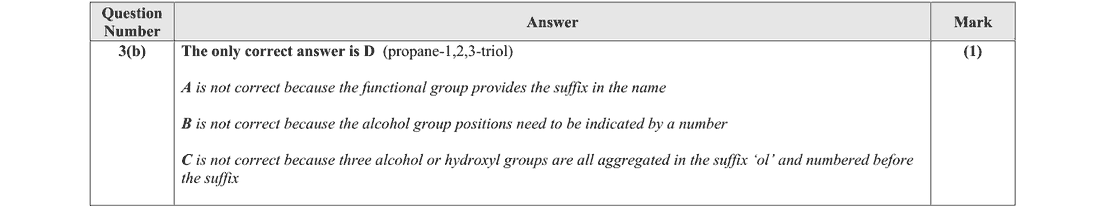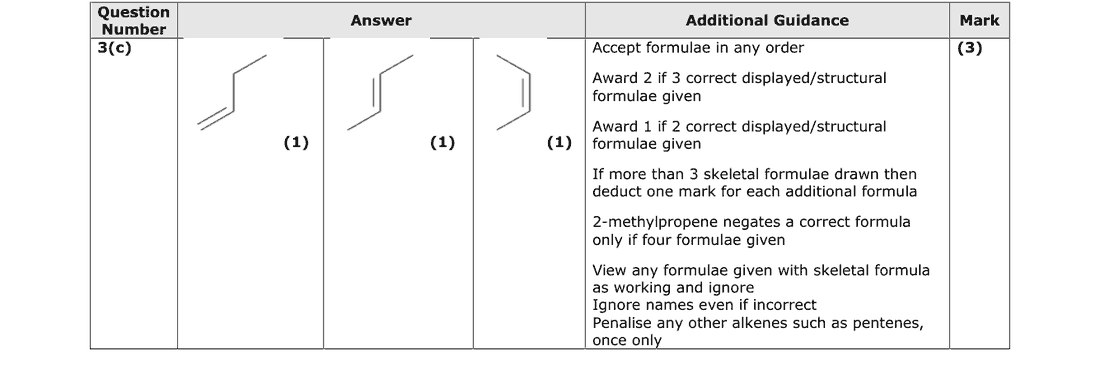
Answer
D
Mark scheme
Notes from the mark scheme and report
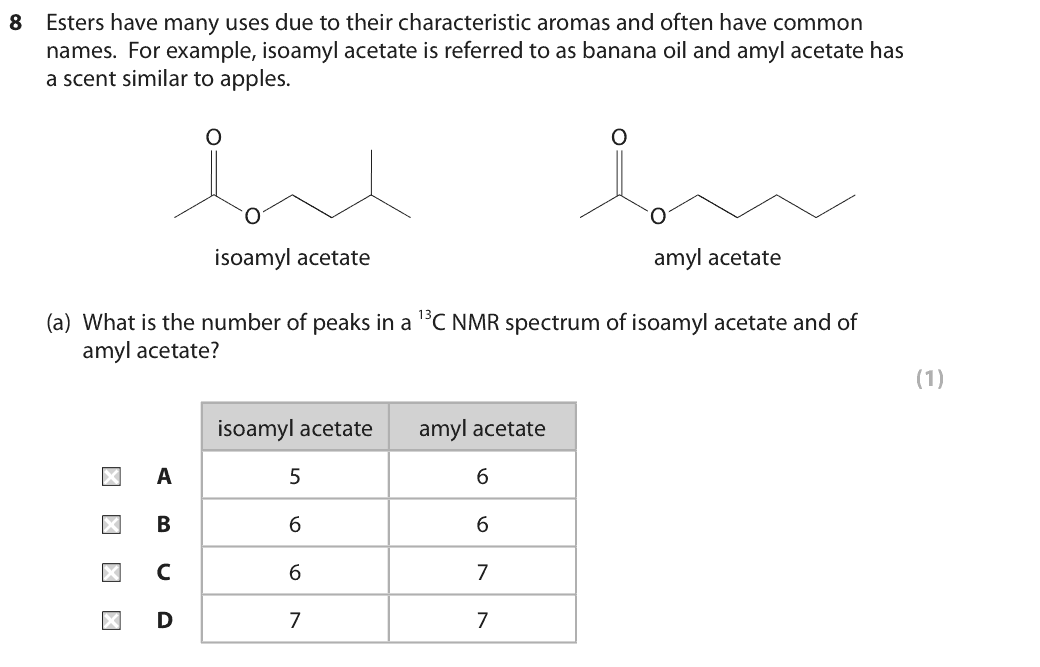
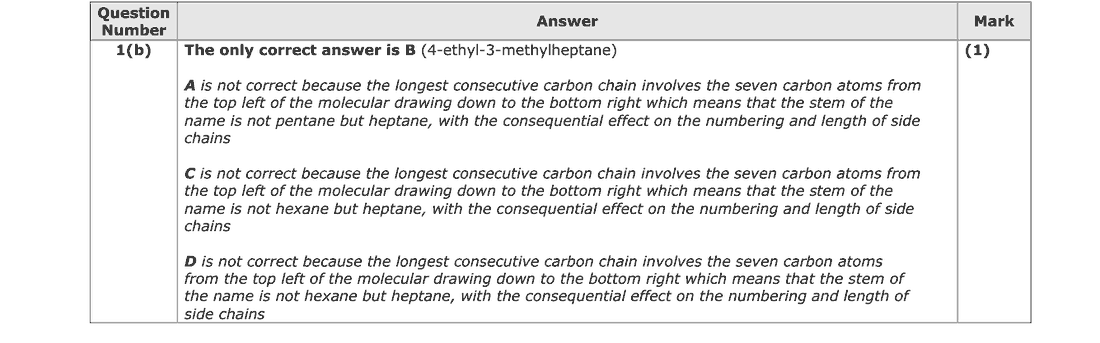
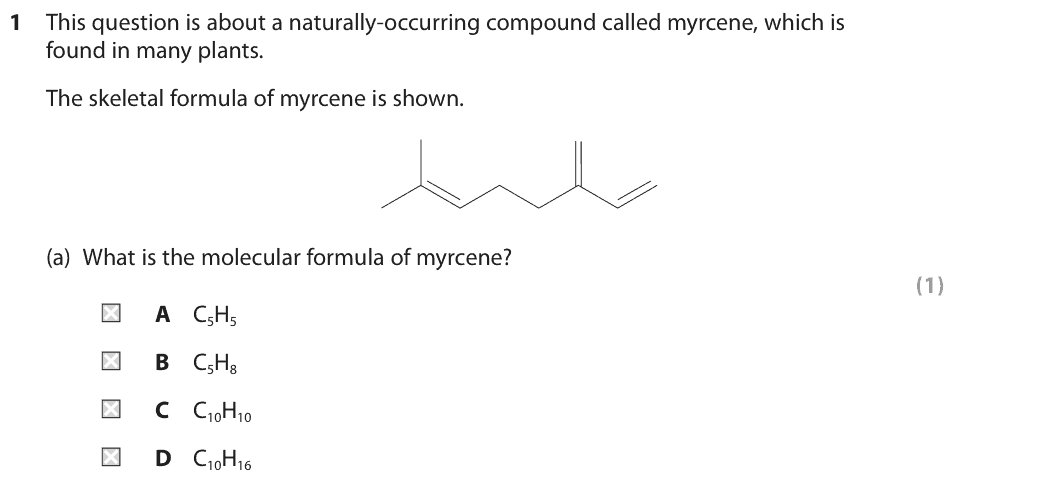
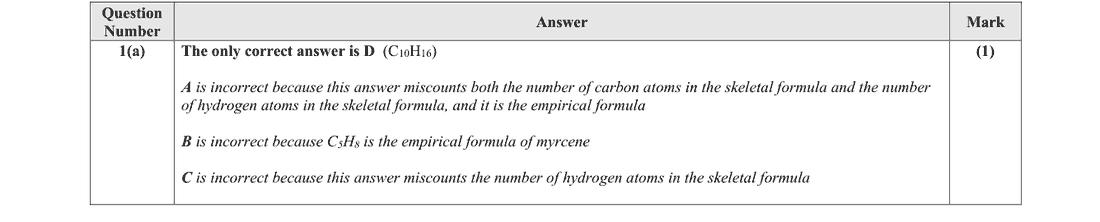
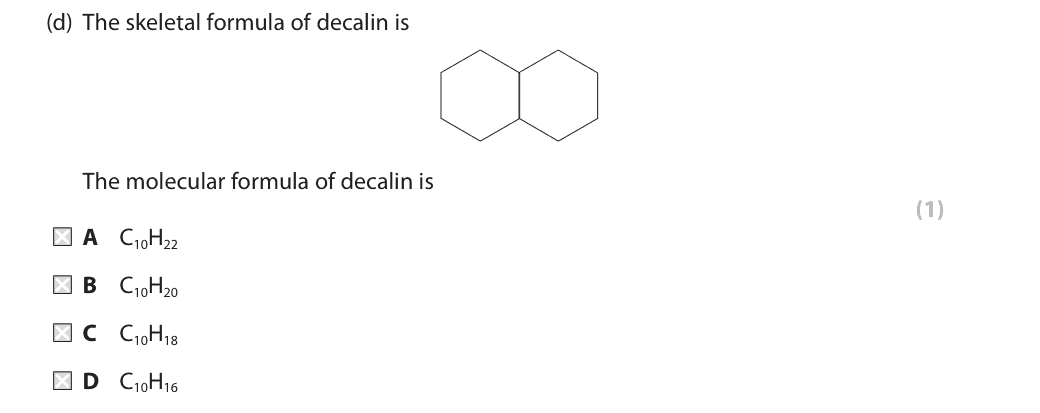
- Answer: D (C10H16). Ten carbons in the skeletal formula, three C=C bonds. B (C5H8) is the empirical formula
- C miscounts the hydrogens
Notes and key-term cards for this topic are being written by our tutors. The past-paper questions below are ready now.
| Series | Paper | Q | What it asks |
|---|---|---|---|
| June 2023 | Paper 2 | 8(d) | only molecules A and B as examples. |
| June 2019 | AS Paper 2 | 7(b) | a possible displayed formula for each of the compounds A, B and C. |
D
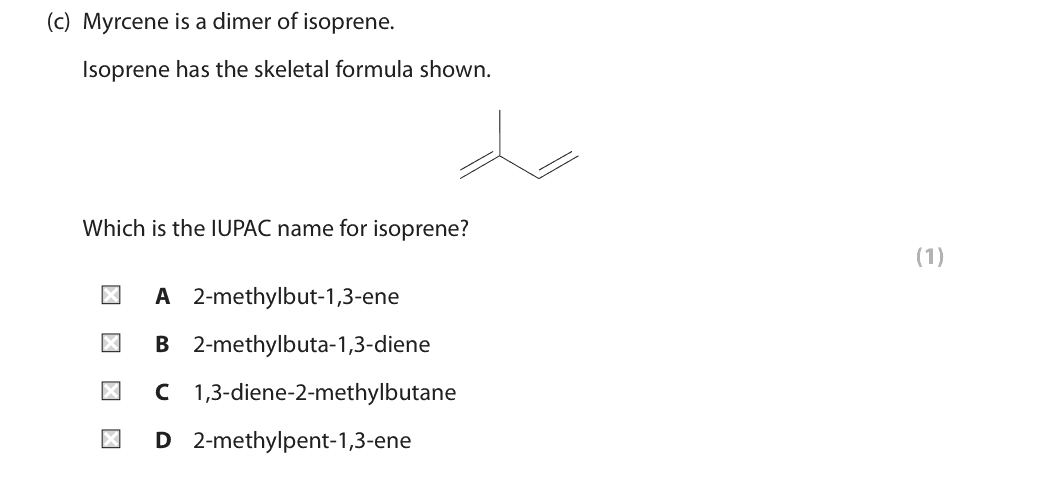
B
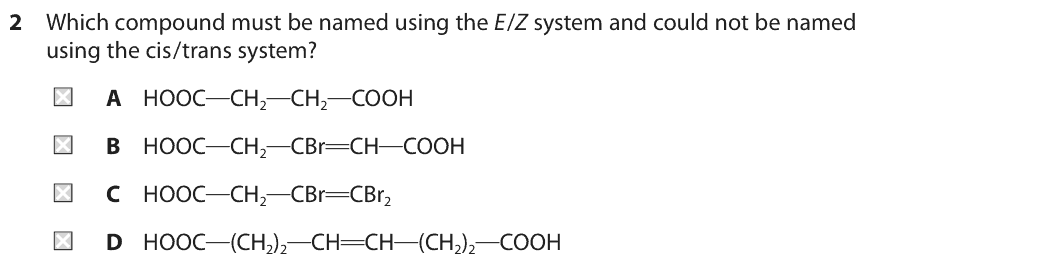
B
Skills: MS4.2 Visualise and represent 2D and 3D forms including two- dimensional representations of 3D objects
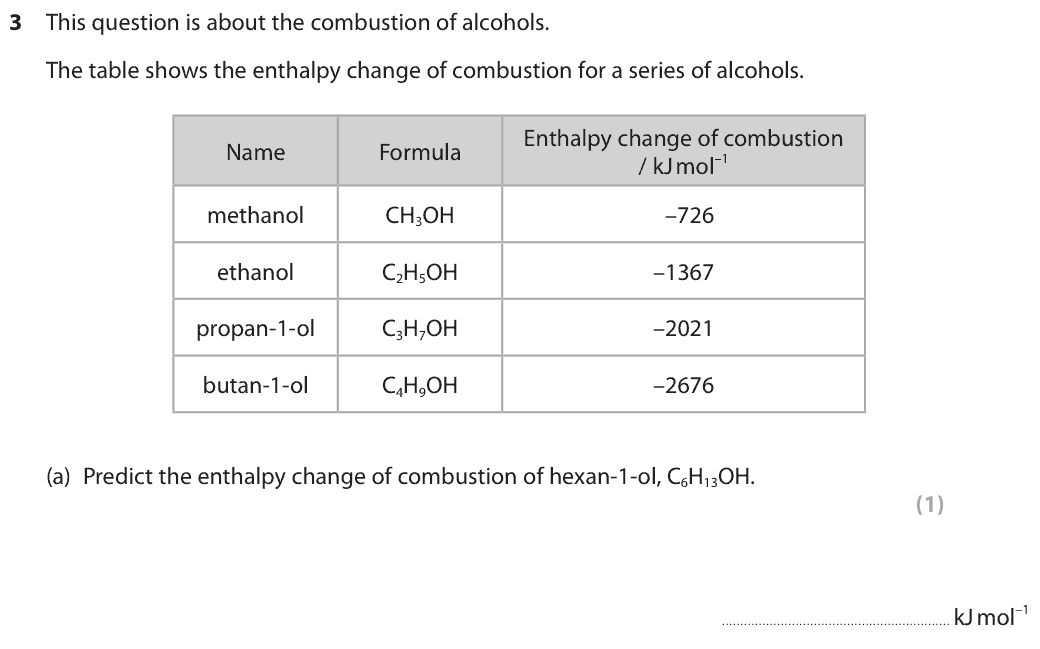
This question was about the combustion of alcohols. (a) Many candidates gave correct answers. A common error was quoting values around – 3330 , corresponding to pentan-1-ol. Most gave negative values, but some included no sign, which was allowed on this occasion. (b) The enthalpy change calculation was generally well done. Common errors were using the mass of alcohol rather than water when calculating the energy change, and omitting the negative sign in the final answer. 95% scored between 2 and 4 marks and approximately half of the candidates scored full marks. (c) Many gave ambiguous responses like “lower ΔH” instead of “less exothermic” or “less negative.” Vague references to “energy loss” rather than “heat loss” also cost marks. Over half scored the middle mark. (d) This question proved to be challenging and very few candidates scored full marks. Many focused on the lack of stirring or uneven heat distribution but failed to explain that the recorded temperature would be higher at the bottom. There were many stock answers that were not relevant to the question, such as not all reactants reacting. Explanations on the effect on ΔH were often either vague or missing.
Skills: MS0.3 Make estimates of the results of calculations (without using a calculator).
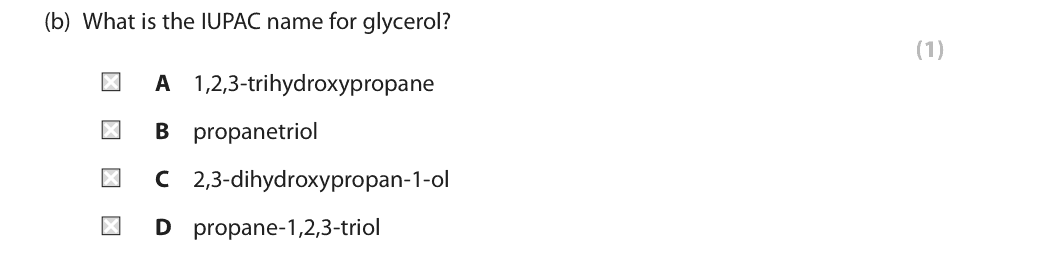
D

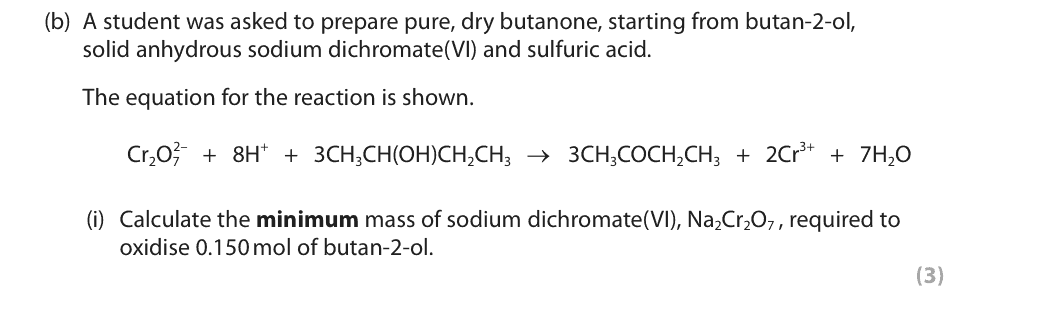
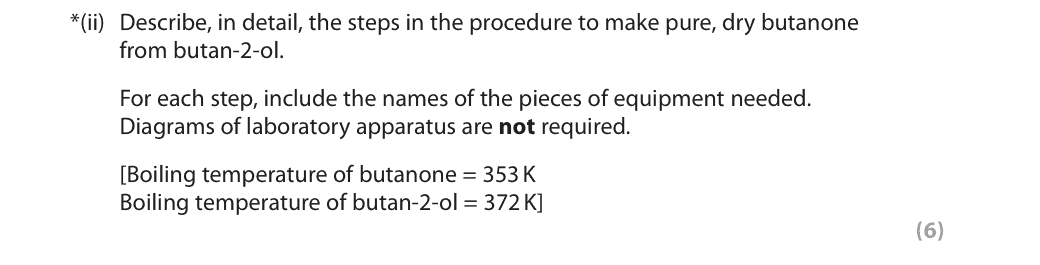
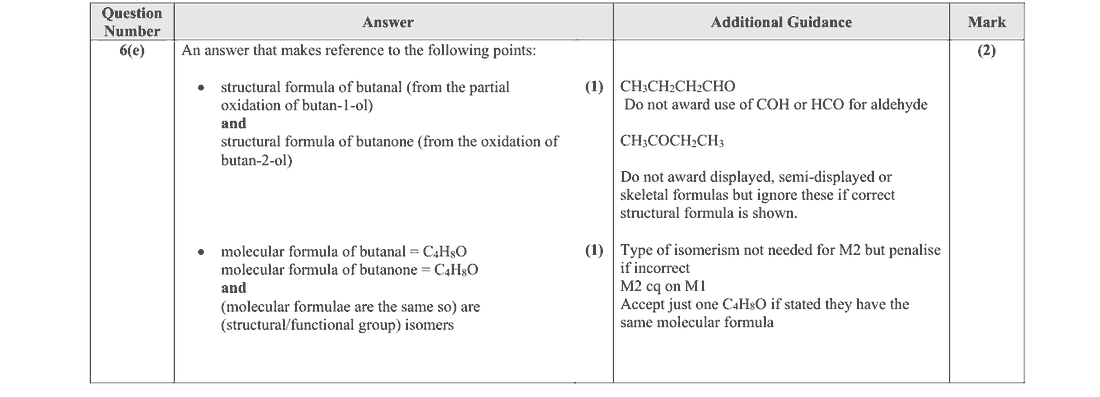
This question was about the reactions of two alcohols and included calculations as well as the description of an organic preparation. (a) This multiple-choice question was very well answered. (bi) Most candidates scored at least two marks. Common errors included incorrect Mr values and stoichiometric ratios (bii) This extended response on a standard practical was very challenging. Many mentioned reflux but described distillation instead. Some suggested inappropriate apparatus such as beakers, conical flasks, volumetric flasks and burettes. Descriptions were often incomplete or incorrect. Many included a thermometer and a bung in the reflux, which would have sealed the system. Distillation following from reflux was rarely seen. While many correctly mentioned the use of a thermometer for distillation, few referred to the still head, and the condenser was often incorrectly positioned horizontally rather than sloping. Candidates frequently included details about water flow in the condenser and the function of anti-bumping granules—both correct but not required in this context. Candidates must remember to move away from giving stock answers and instead address what is being asked. A number of candidates confused this practical with the halogenation of an alcohol, leading to inappropriate suggestions such as using a separating funnel followed by the addition of sodium hydrogencarbonate solution to remove acid impurities. On a more positive note, many could name a suitable drying agent, though fewer described how to remove the dried butanone afterwards. A surprising number of candidates thought that leaving the product on a windowsill or patting with tissue papers was the way to get dry butanone. Very few candidates included the final distillation , which was essential for full credit. (c) Many candidates identified the correct product but lost the mark for using the structural formula instead of the required skeletal formula. (di) Most scored the first and third marks here, but many struggled with the stoichiometric ratio - some missed it, and others inverted it. (dii) Many fully correct answers were seen, although a sizeable number correctly calculated the experimental and theoretical amounts of product but then got very mixed up, so they divided the experimental yield by the sum of the theoretical and experimental yields. (6e) This apparently straightforward question was answered incorrectly by a large number of candidates – the basic structural formula representing an aldehyde was rarely known and there were many incorrect molecular formulas for the isomers.

This question was about the reactions of two alcohols and included calculations as well as the description of an organic preparation. (a) This multiple-choice question was very well answered. (bi) Most candidates scored at least two marks. Common errors included incorrect Mr values and stoichiometric ratios (bii) This extended response on a standard practical was very challenging. Many mentioned reflux but described distillation instead. Some suggested inappropriate apparatus such as beakers, conical flasks, volumetric flasks and burettes. Descriptions were often incomplete or incorrect. Many included a thermometer and a bung in the reflux, which would have sealed the system. Distillation following from reflux was rarely seen. While many correctly mentioned the use of a thermometer for distillation, few referred to the still head, and the condenser was often incorrectly positioned horizontally rather than sloping. Candidates frequently included details about water flow in the condenser and the function of anti-bumping granules—both correct but not required in this context. Candidates must remember to move away from giving stock answers and instead address what is being asked. A number of candidates confused this practical with the halogenation of an alcohol, leading to inappropriate suggestions such as using a separating funnel followed by the addition of sodium hydrogencarbonate solution to remove acid impurities. On a more positive note, many could name a suitable drying agent, though fewer described how to remove the dried butanone afterwards. A surprising number of candidates thought that leaving the product on a windowsill or patting with tissue papers was the way to get dry butanone. Very few candidates included the final distillation , which was essential for full credit. (c) Many candidates identified the correct product but lost the mark for using the structural formula instead of the required skeletal formula. (di) Most scored the first and third marks here, but many struggled with the stoichiometric ratio - some missed it, and others inverted it. (dii) Many fully correct answers were seen, although a sizeable number correctly calculated the experimental and theoretical amounts of product but then got very mixed up, so they divided the experimental yield by the sum of the theoretical and experimental yields. (6e) This apparently straightforward question was answered incorrectly by a large number of candidates – the basic structural formula representing an aldehyde was rarely known and there were many incorrect molecular formulas for the isomers.
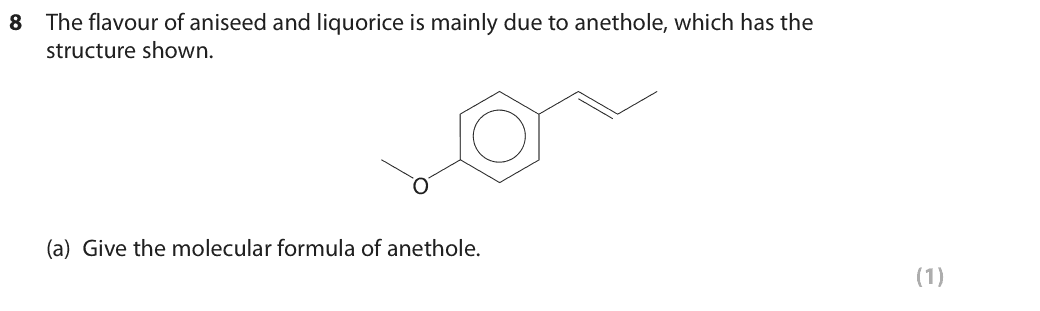
This was generally well answered with many correct responses seen.

Many candidates scored the mark here, although there were many answers simply flipping the molecule over as if reflecting it in a mirror to produce what they thought was a different optical isomer.
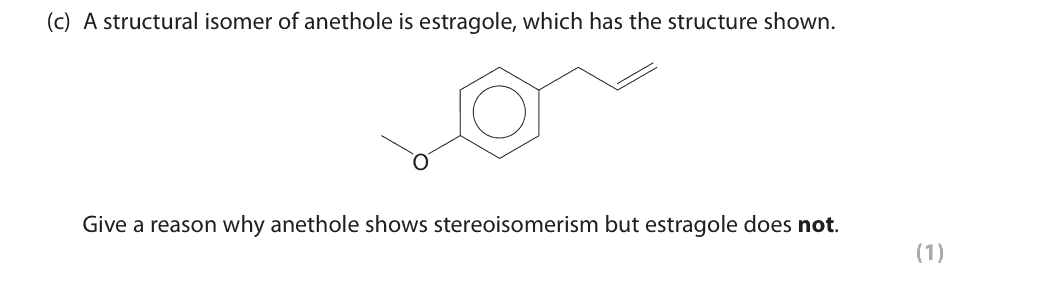
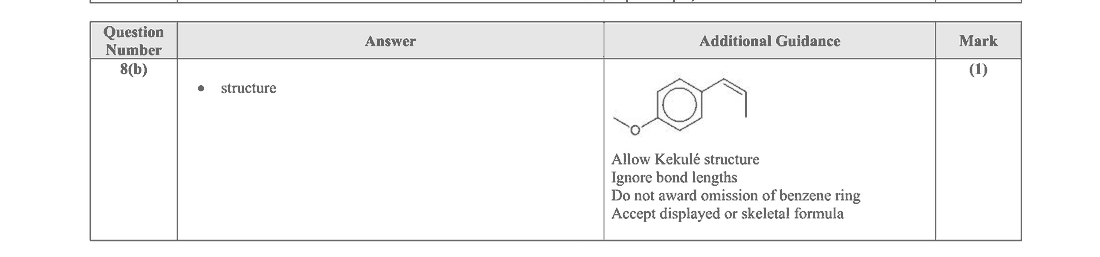
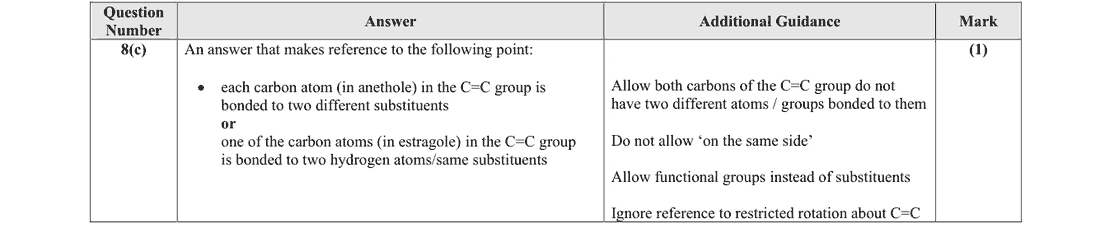
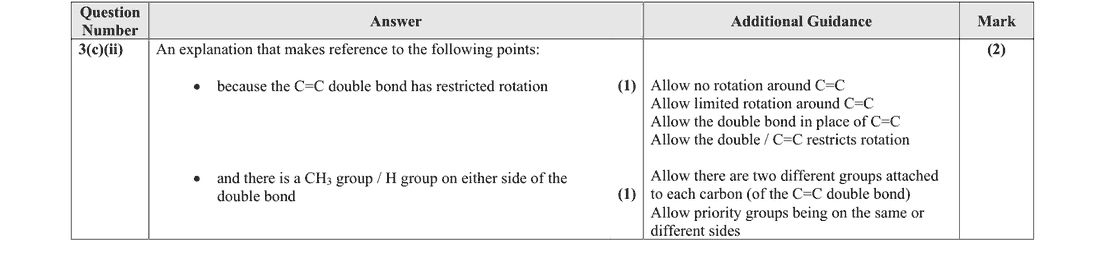
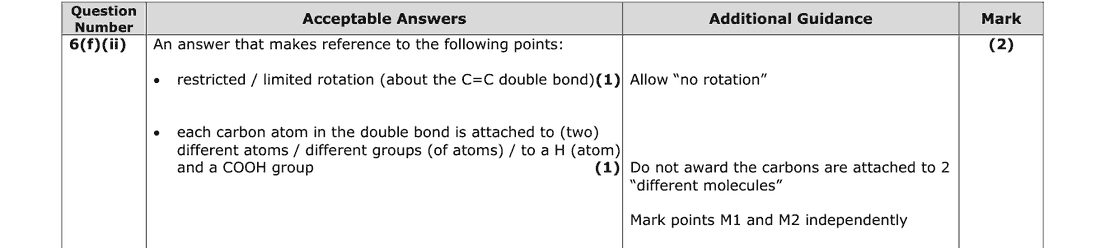
It was not expected that less than half of the candidates would score this mark. Commonly candidates referred to having the same group 'on the same side' or extraneously referred to restricted rotation around the C=C double bond. Some candidates referred to chiral carbons or the position of the C=C double bond.
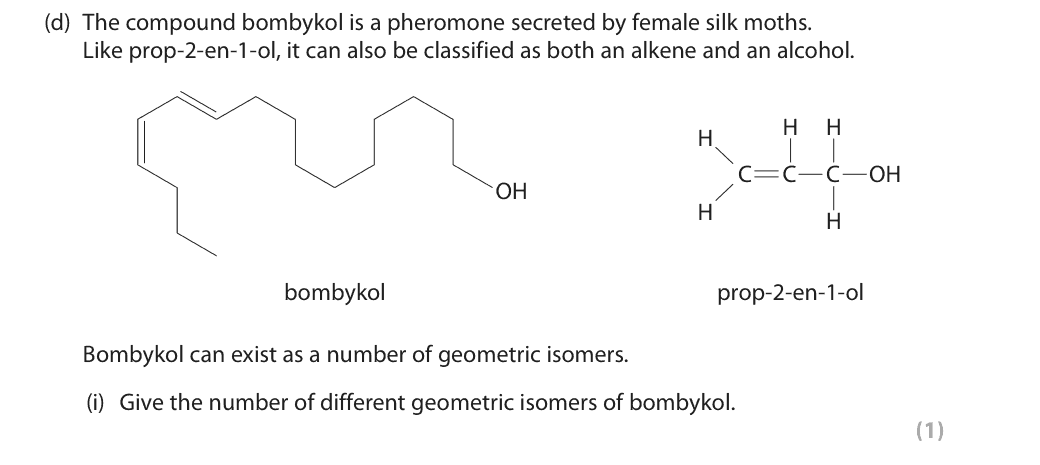
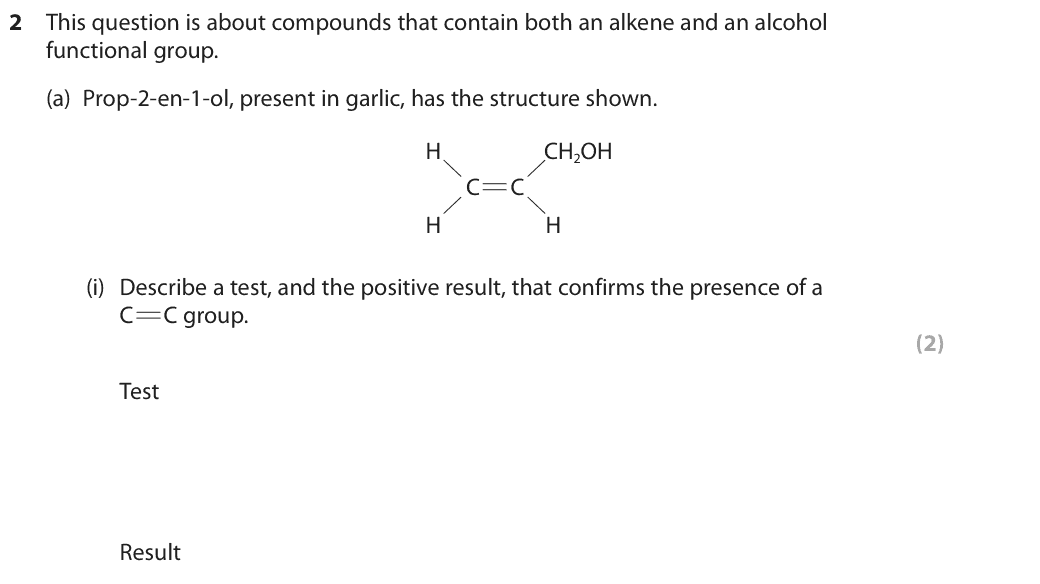
The first part of this question, Q02(d)(i), was quite well answered, with a lot of candidates realising that the double C=C bond in the molecule would give rise to 4 geometric isomers of bombykol. Candidates found part Q02(d)(ii) more difficult, with many failing to give clear answers relating to the fact that there are two hydrogen atoms in the carbon of the double bond. References to the same atoms being on the double bond were too vague to be awarded any marks. Many candidates were able to gain at least one mark on part Q02(d)(iii) for either recognising that the prop-2-en-1-ol would be more soluble than the bombykol, or that both would form hydrogen bonds with water. M3 was less frequently awarded due to imprecise use of language - such as 'bombykol has a long chain and so will not dissolve.'
Skills: MS4.2 Visualise and represent 2D and 3D forms including two- dimensional representations of 3D objects

The first part of this question, Q02(d)(i), was quite well answered, with a lot of candidates realising that the double C=C bond in the molecule would give rise to 4 geometric isomers of bombykol. Candidates found part Q02(d)(ii) more difficult, with many failing to give clear answers relating to the fact that there are two hydrogen atoms in the carbon of the double bond. References to the same atoms being on the double bond were too vague to be awarded any marks. Many candidates were able to gain at least one mark on part Q02(d)(iii) for either recognising that the prop-2-en-1-ol would be more soluble than the bombykol, or that both would form hydrogen bonds with water. M3 was less frequently awarded due to imprecise use of language - such as 'bombykol has a long chain and so will not dissolve.'
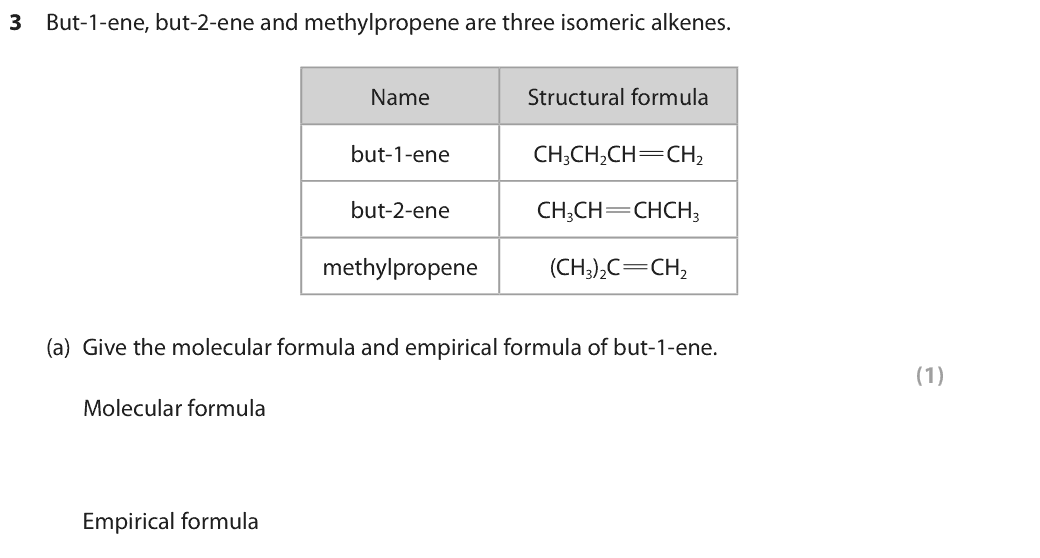
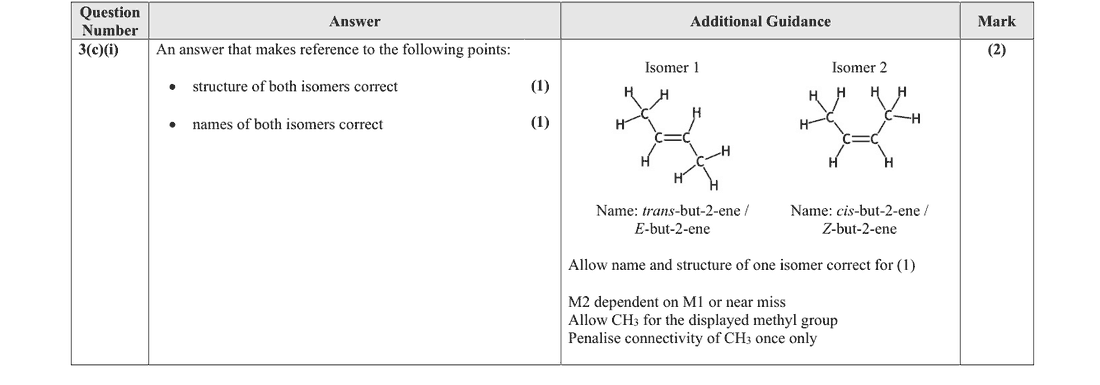
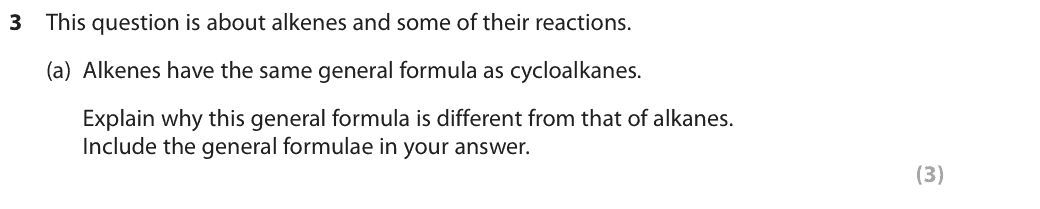
The chemistry of alkenes was tested in Q3. (a) tested candidate’s knowledge and understanding of molecular and empirical formulae. Over 80% of candidates scored this mark. The addition of hydrogen bromide was tested in (b), with (b)(i) being the name and type of this reaction. Again, over 80% knew this was an electrophilic addition reaction. The mechanism of the reaction, in (b)(ii) was extremely well answered. There are a large number of things to consider in this mechanism, but candidates seemed well drilled with 44% scoring full marks. Four marks was the most common score achieved here. The minor product in (b)(iii) proved a little more challenging. Candidates found difficulty expressing themselves with sufficient accuracy to secure full marks, often referring to the stability of halogenoalkanes rather that the carbocation intermediates. Descriptions in (b)(iv) also lacked sufficient detail to score the mark. It was quite common to see that the arrow represented the movement of an electron, or electrons rather than the pair of electrons which was required for the mark. In (c)(i) most candidates recognised the structures of the two isomers and were able to name them, but some needed more care when drawing these structures out. The attachment of methyl groups was often seen via a hydrogen rather than the carbon and this did not score the mark in this question. A fully displayed structure almost invariably scored the mark here as this type of attachment does not occur in these types of structures. The need for two different groups attached to the carbon as well as restricted rotation was not often seen in (c)(ii). The conversion of alkenes to alcohols and subsequent oxidation was examined in (d), and three quarters of candidates recognised the tertiary alcohol in (d)(i) The relative stability of tertiary alcohols to oxidation was not well understood. Those candidates who knew that the carbon with the oxygen attached required a hydrogen attached as well to allow oxidation often scored two marks.
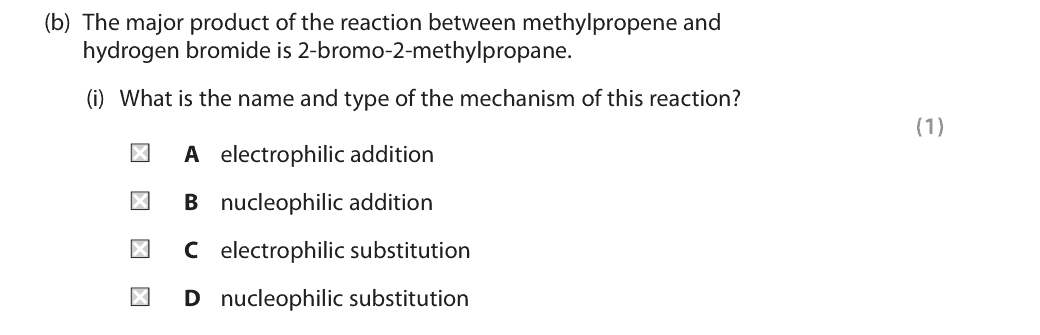
A
The chemistry of alkenes was tested in Q3. (a) tested candidate’s knowledge and understanding of molecular and empirical formulae. Over 80% of candidates scored this mark. The addition of hydrogen bromide was tested in (b), with (b)(i) being the name and type of this reaction. Again, over 80% knew this was an electrophilic addition reaction. The mechanism of the reaction, in (b)(ii) was extremely well answered. There are a large number of things to consider in this mechanism, but candidates seemed well drilled with 44% scoring full marks. Four marks was the most common score achieved here. The minor product in (b)(iii) proved a little more challenging. Candidates found difficulty expressing themselves with sufficient accuracy to secure full marks, often referring to the stability of halogenoalkanes rather that the carbocation intermediates. Descriptions in (b)(iv) also lacked sufficient detail to score the mark. It was quite common to see that the arrow represented the movement of an electron, or electrons rather than the pair of electrons which was required for the mark. In (c)(i) most candidates recognised the structures of the two isomers and were able to name them, but some needed more care when drawing these structures out. The attachment of methyl groups was often seen via a hydrogen rather than the carbon and this did not score the mark in this question. A fully displayed structure almost invariably scored the mark here as this type of attachment does not occur in these types of structures. The need for two different groups attached to the carbon as well as restricted rotation was not often seen in (c)(ii). The conversion of alkenes to alcohols and subsequent oxidation was examined in (d), and three quarters of candidates recognised the tertiary alcohol in (d)(i) The relative stability of tertiary alcohols to oxidation was not well understood. Those candidates who knew that the carbon with the oxygen attached required a hydrogen attached as well to allow oxidation often scored two marks.
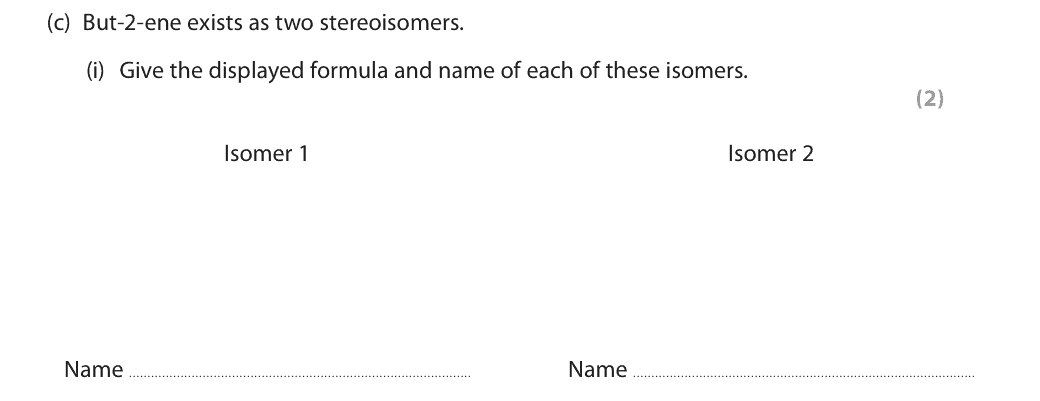
The chemistry of alkenes was tested in Q3. (a) tested candidate’s knowledge and understanding of molecular and empirical formulae. Over 80% of candidates scored this mark. The addition of hydrogen bromide was tested in (b), with (b)(i) being the name and type of this reaction. Again, over 80% knew this was an electrophilic addition reaction. The mechanism of the reaction, in (b)(ii) was extremely well answered. There are a large number of things to consider in this mechanism, but candidates seemed well drilled with 44% scoring full marks. Four marks was the most common score achieved here. The minor product in (b)(iii) proved a little more challenging. Candidates found difficulty expressing themselves with sufficient accuracy to secure full marks, often referring to the stability of halogenoalkanes rather that the carbocation intermediates. Descriptions in (b)(iv) also lacked sufficient detail to score the mark. It was quite common to see that the arrow represented the movement of an electron, or electrons rather than the pair of electrons which was required for the mark. In (c)(i) most candidates recognised the structures of the two isomers and were able to name them, but some needed more care when drawing these structures out. The attachment of methyl groups was often seen via a hydrogen rather than the carbon and this did not score the mark in this question. A fully displayed structure almost invariably scored the mark here as this type of attachment does not occur in these types of structures. The need for two different groups attached to the carbon as well as restricted rotation was not often seen in (c)(ii). The conversion of alkenes to alcohols and subsequent oxidation was examined in (d), and three quarters of candidates recognised the tertiary alcohol in (d)(i) The relative stability of tertiary alcohols to oxidation was not well understood. Those candidates who knew that the carbon with the oxygen attached required a hydrogen attached as well to allow oxidation often scored two marks.
Skills: MS4.2 Visualise and represent 2D and 3D forms including two- dimensional representations of 3D objects

The chemistry of alkenes was tested in Q3. (a) tested candidate’s knowledge and understanding of molecular and empirical formulae. Over 80% of candidates scored this mark. The addition of hydrogen bromide was tested in (b), with (b)(i) being the name and type of this reaction. Again, over 80% knew this was an electrophilic addition reaction. The mechanism of the reaction, in (b)(ii) was extremely well answered. There are a large number of things to consider in this mechanism, but candidates seemed well drilled with 44% scoring full marks. Four marks was the most common score achieved here. The minor product in (b)(iii) proved a little more challenging. Candidates found difficulty expressing themselves with sufficient accuracy to secure full marks, often referring to the stability of halogenoalkanes rather that the carbocation intermediates. Descriptions in (b)(iv) also lacked sufficient detail to score the mark. It was quite common to see that the arrow represented the movement of an electron, or electrons rather than the pair of electrons which was required for the mark. In (c)(i) most candidates recognised the structures of the two isomers and were able to name them, but some needed more care when drawing these structures out. The attachment of methyl groups was often seen via a hydrogen rather than the carbon and this did not score the mark in this question. A fully displayed structure almost invariably scored the mark here as this type of attachment does not occur in these types of structures. The need for two different groups attached to the carbon as well as restricted rotation was not often seen in (c)(ii). The conversion of alkenes to alcohols and subsequent oxidation was examined in (d), and three quarters of candidates recognised the tertiary alcohol in (d)(i) The relative stability of tertiary alcohols to oxidation was not well understood. Those candidates who knew that the carbon with the oxygen attached required a hydrogen attached as well to allow oxidation often scored two marks.

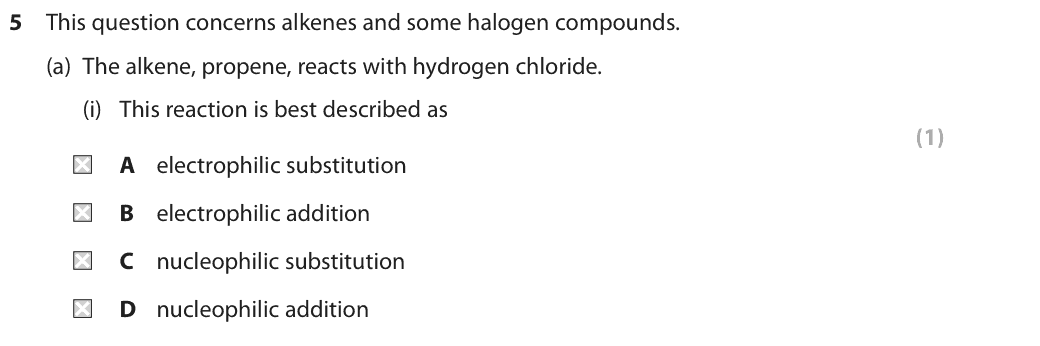
Most candidates could recall the name of the reaction here. Some candidates included unnecessary references to electrophiles and nucleophiles, or confused the mechanism with nucleophilic addition-elimination.
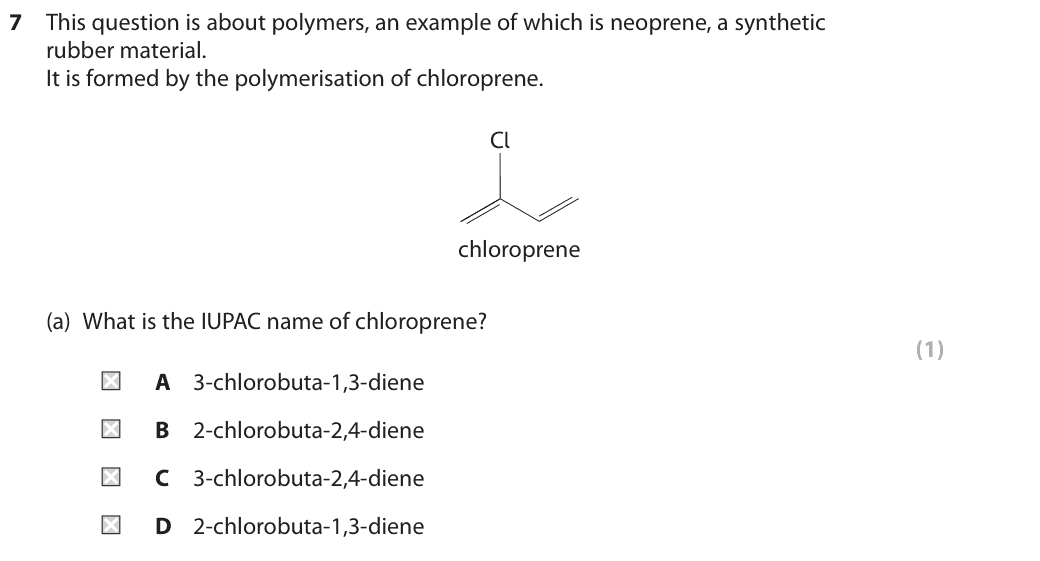
D

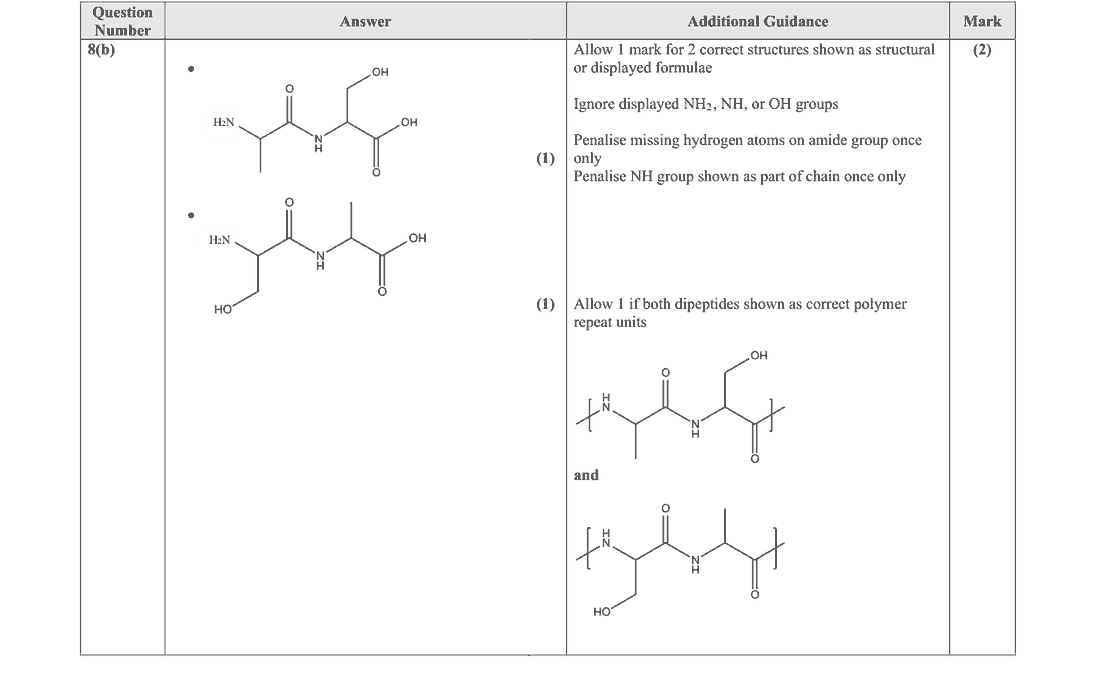
This question demanded evidence of two skills, the ability to deduce the structure of dipeptides and to draw them in a skeletal format. The first of these attributes proved difficult enough, with some candidates unable to link together the two amino acids, introducing ester groups between them, influenced by the alcohol group in serine. Other candidates could recognise the products but omitted all hydrogen atoms from their skeletal structures, including those on the amide and carboxylic acid functional groups.

This question assessed the candidate's ability to interpret the name of an organic compound and draw the correct skeletal formula. Many correct answers were seen, with common errors being to draw 1,3- dimethylcyclopentane as a skeletal formula or to show the methyl groups as structural formulae (CH3).
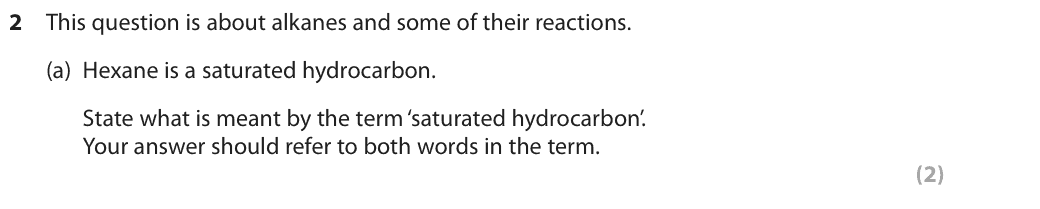
Generally, this question answered well. However, some candidates did display a misunderstanding or struggle with the calculation sections. The most common error in Q02c was omission of the x12 (MP2) for 12CO2.

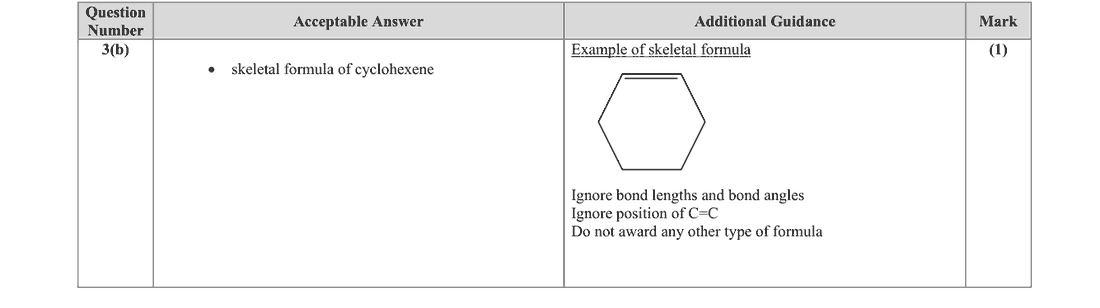
It was surprising to see a number of candidates provide cyclohexane answers.
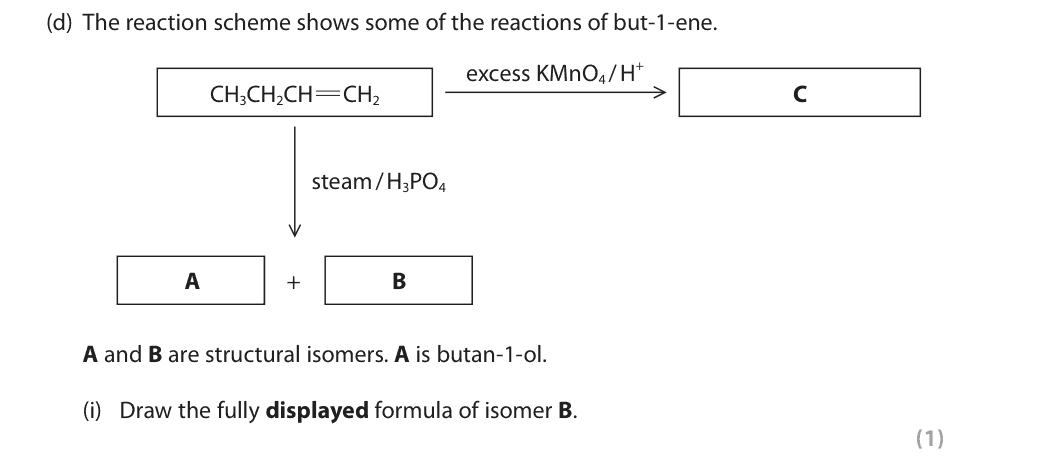
Candidates generally performed well on this question.
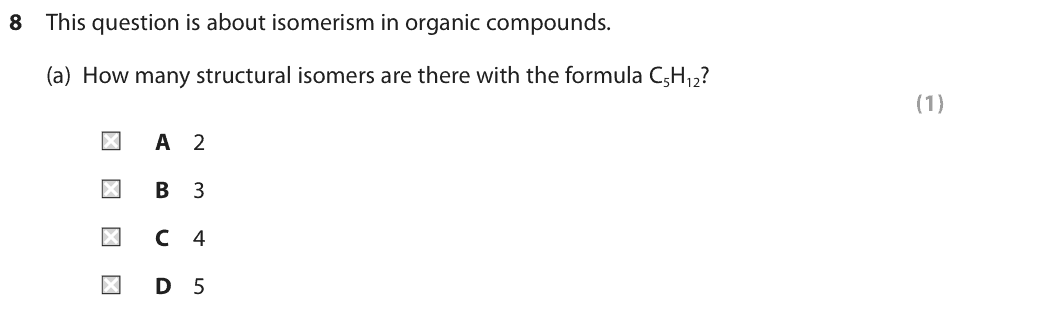
B
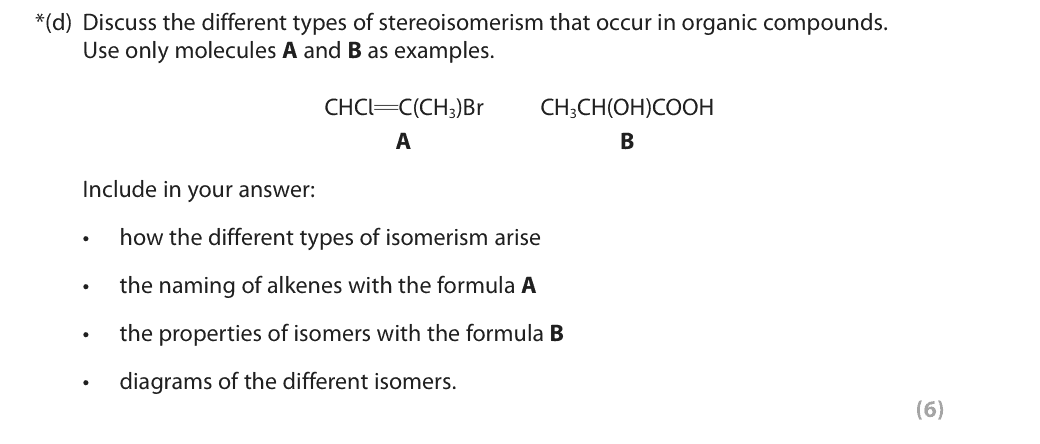
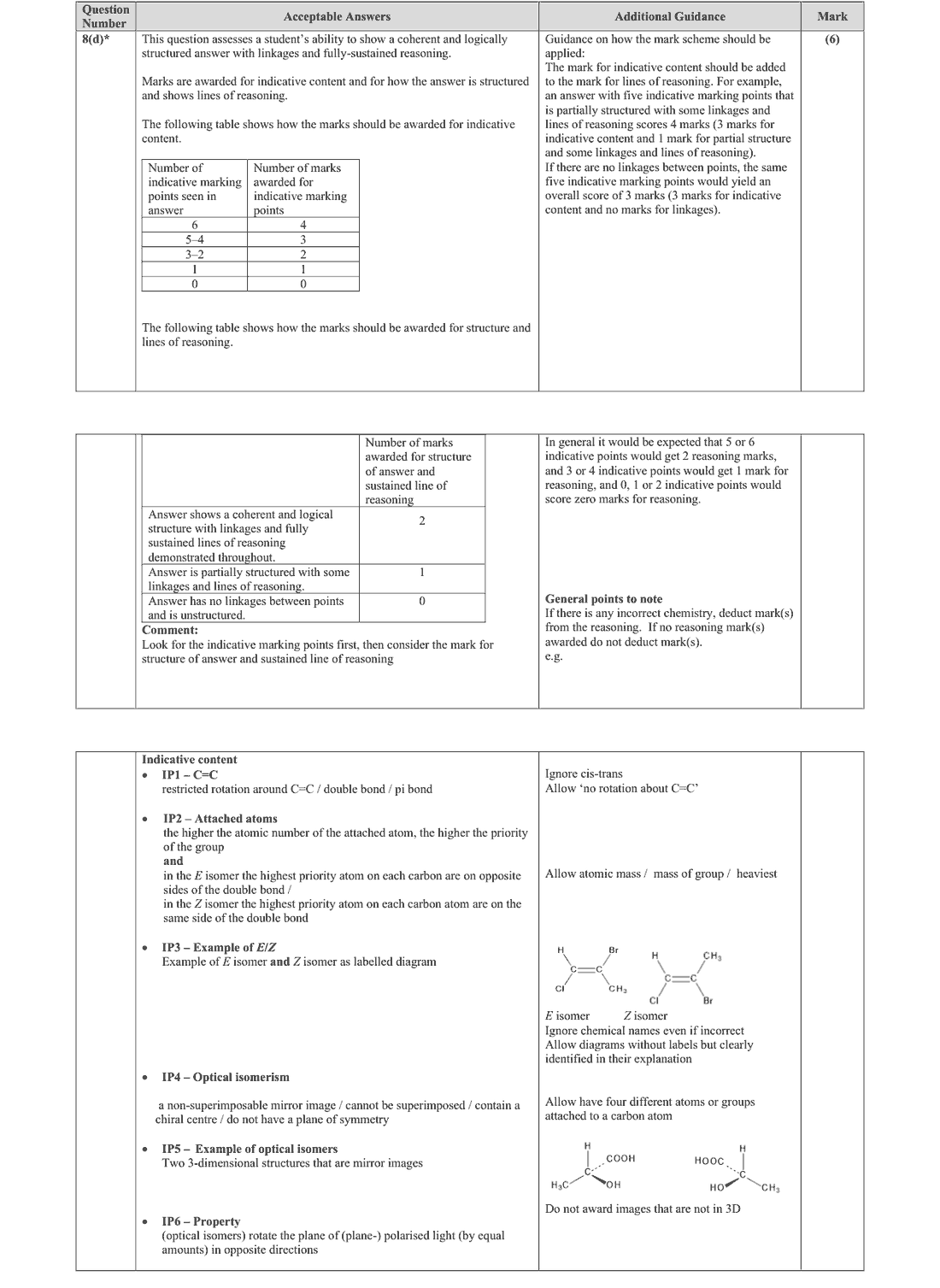
This extended writing question required candidates to discuss different types of stereoisomerism. Most candidates were able to demonstrate their understanding of the topic, with some excellent explanations and diagrams seen. The best answers contained detailed explanations of each of the points in the question. For the E-Z isomers, many good diagrams of the alkenes were seen, and candidates also stated that these isomers arose due to restricted rotation around the C=C. However, fewer gave a good explanation of how the priorities were assigned to groups. We did allow reference mass rather than atomic number this time, but candidates should note that the E/Z nomenclature is based on the atomic number of the attached atoms. For the optical isomers, many good diagrams were seen, although some candidates did not show the full 3D structure with appropriate wedges. Many candidates appreciated that the optical isomerism arose because of chiral carbon and went on to describe the ability of the enantiomers to rotate plane polarised light but did not mention that this would be in opposite directions and so were not awarded the final mark.
Skills: MS4.2 Visualise and represent 2D and 3D forms including two- dimensional representations of 3D objects
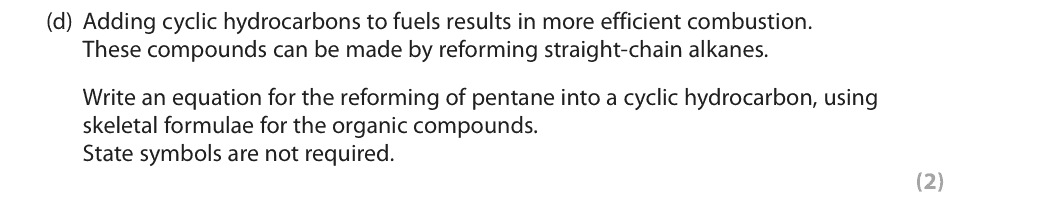
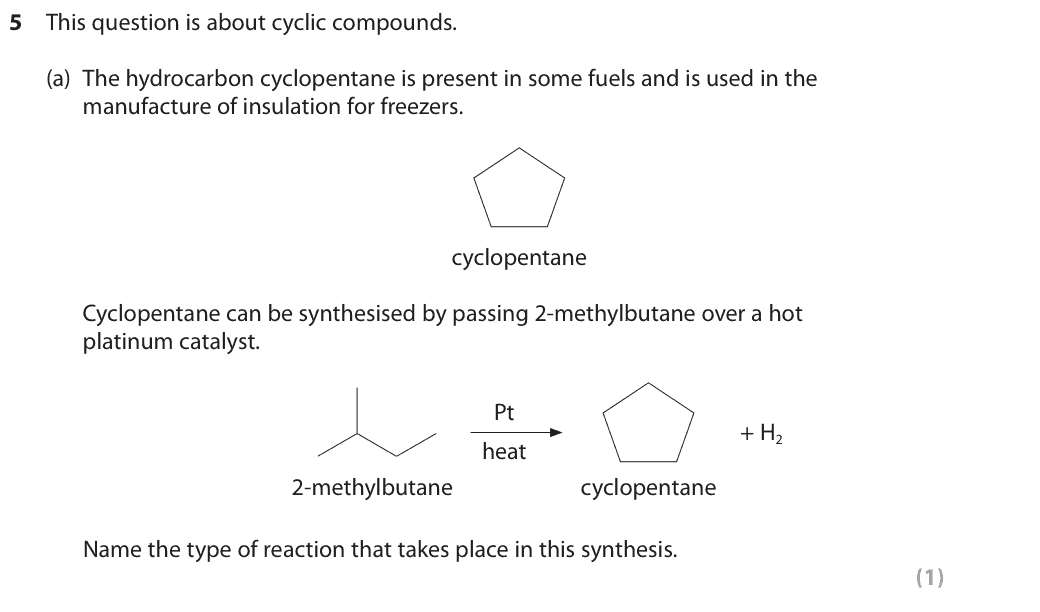
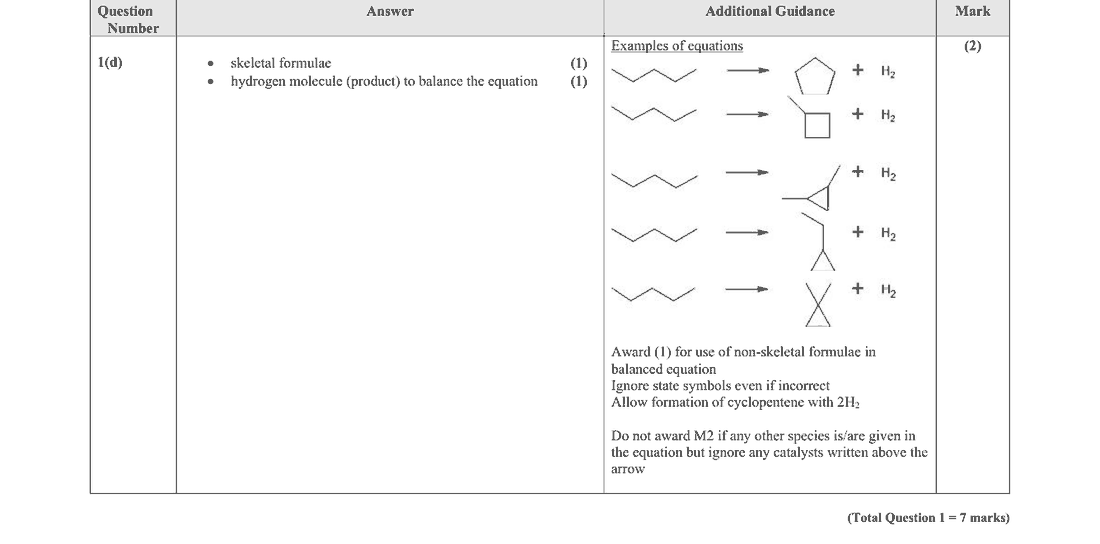
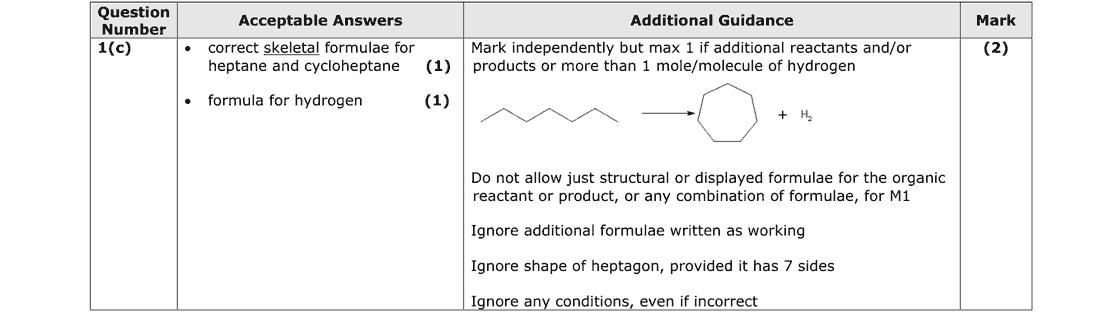
The mark scheme has many possible cyclic possibilities added but cyclopentane was by far the most frequently seen. This equation was given 2 marks because the use of skeletal formulae in the equation needed to be balanced by a hydrogen molecule as a product. Hence this proved an effective discriminator. Occasionally the pentane reactant was given an extra carbon to form cyclohexane and so there is a real need to check the number of carbon atoms when drawing skeletal formulae.

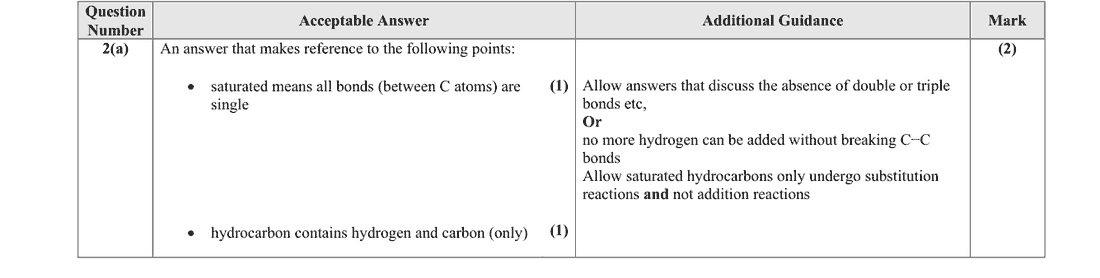
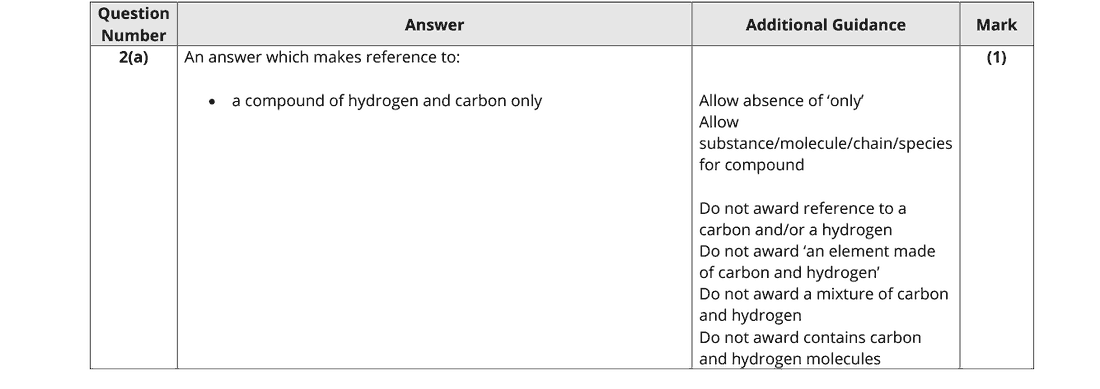
This gentle start to the exam paper was answered well by the majority of candidates. One error seen occasionally was to refer to the hydrocarbon as containing carbon and hydrogen molecules instead of atoms.

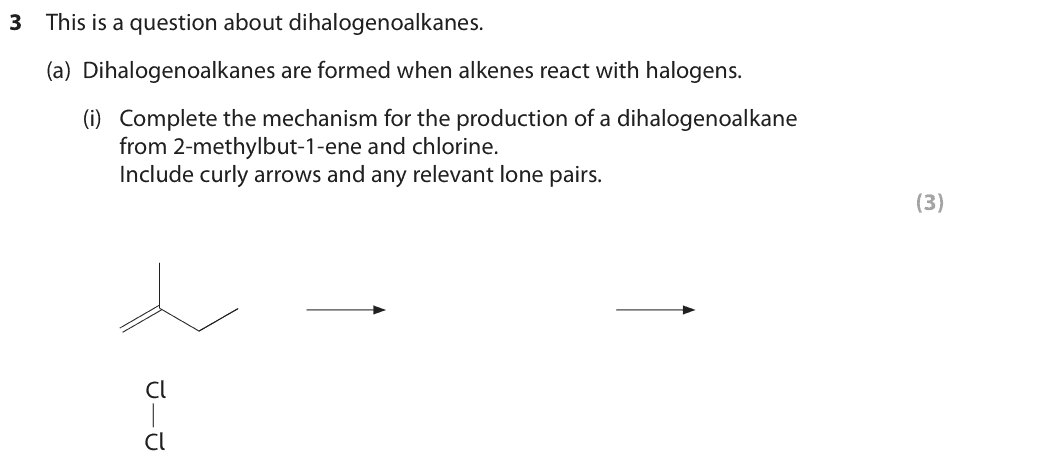
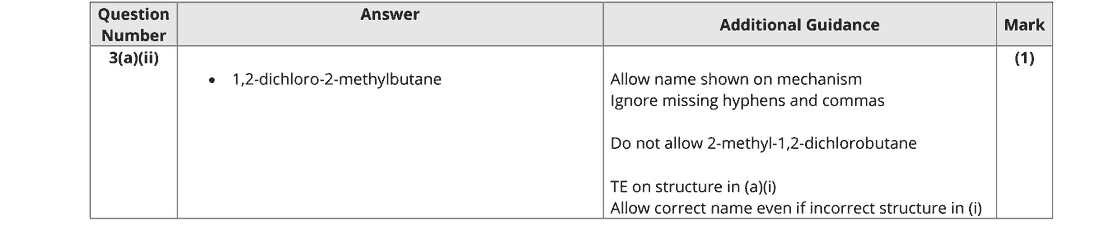
(i) Understanding of mechanism is improving with a number of completely correct responses here. Some candidates still do not have a basic understanding of curly arrows as seen by their drawing them originating from atoms or terminating at bonds. Further skeletal formulae proved too challenging for some candidates with a disappearing carbon atom being seen on a number of occasions. (ii) The most common mistake was to give the name as 2-methyl-1,2-dichlorobutane but this is incorrect. Candidates need to understand that the prefixes are given in alphabetical order.

Translation of skeletal formulae into molecular formulae continues to prove challenging to many candidates, although about two-thirds did score the mark here. This may be a reflection of the inclusion of this topic area on the Advance Notice.

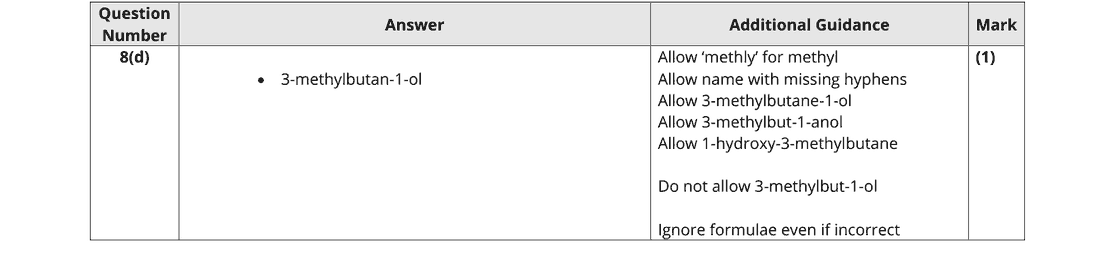
It would seem that more practice is required for naming organic molecules since only about 50% of candidates could name the alcohol correctly as 3-methylbutan-1-ol. Common wrong answers were: 2-methylbutan-1-ol where the carbon chain was numbered in one direction for the alcohol group and then in a different direction for the position of the methyl group. 3-methylbutanol where the position of the alcohol group is missing.

Candidates did better with the systematic name for amyl acetate that had been anticipated as nearly 50% scored the mark.
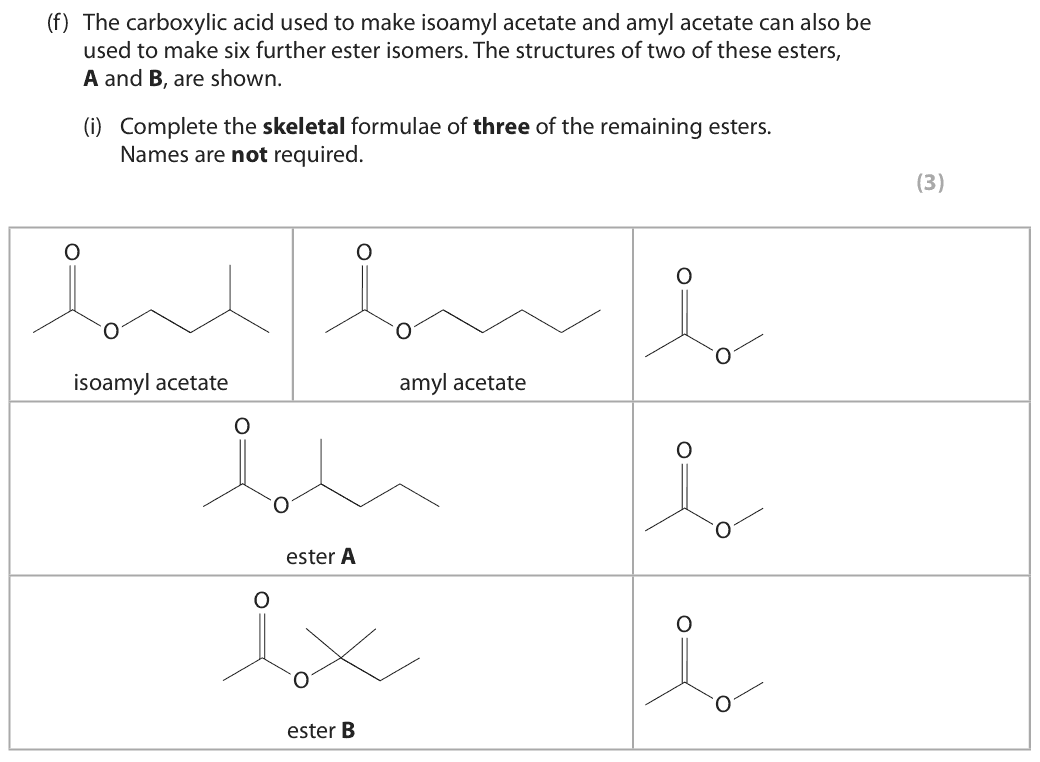
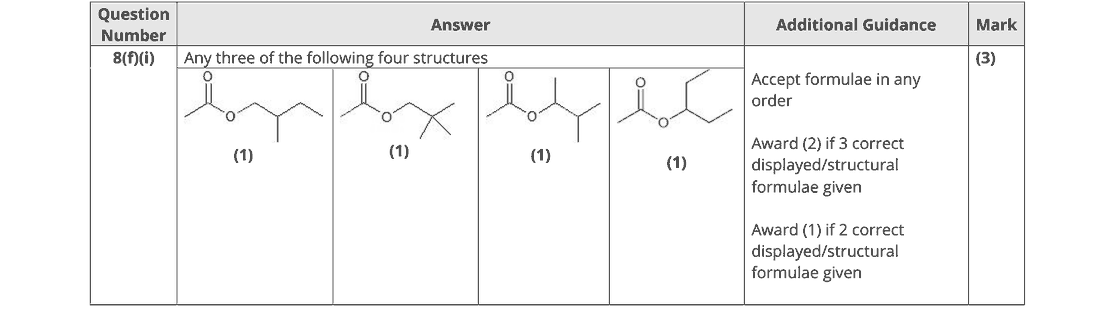
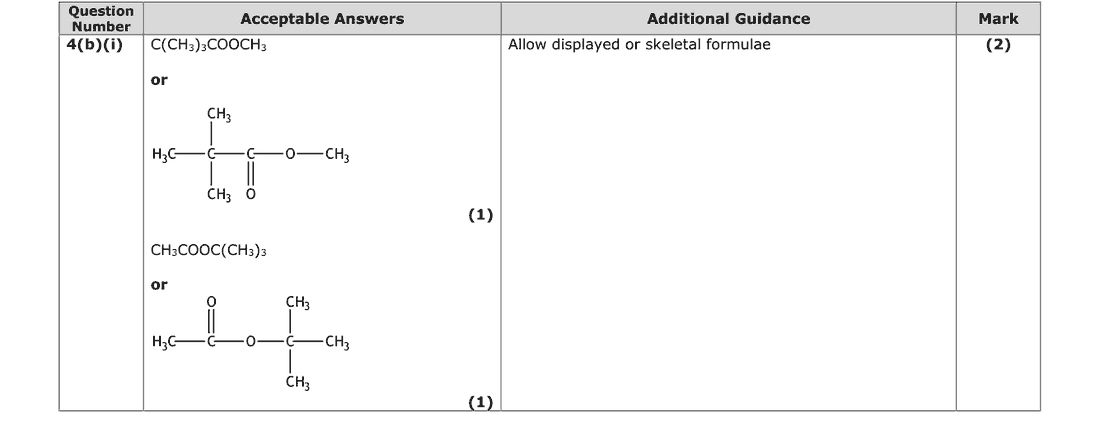
It was pleasing to see that candidates drew skeletal formulae and were not tempted to give displayed formulae. Many excellent answers were seen. The two common errors were (i) drawing two of the same isomer and (ii) adding an extra carbon atom to the chain.
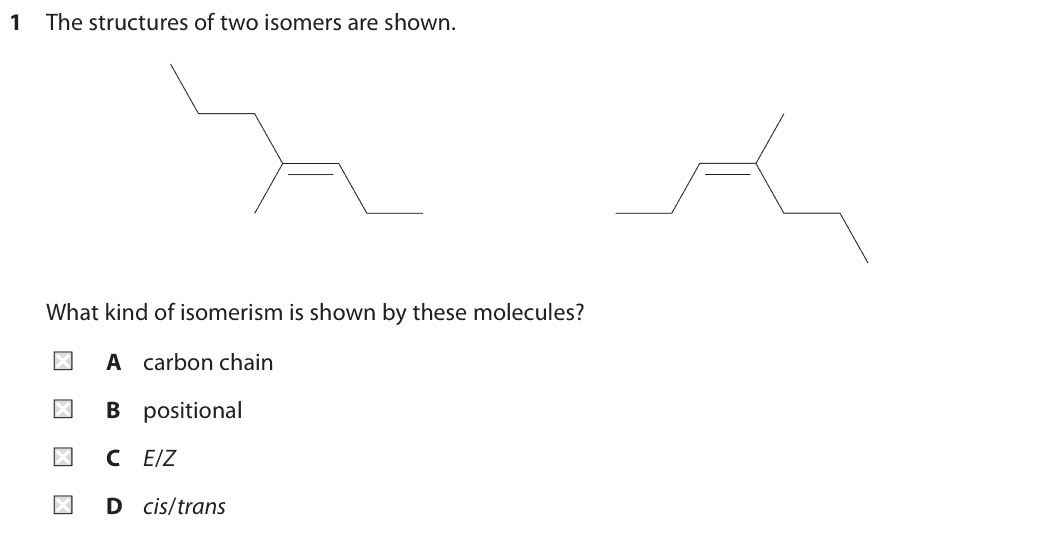
C
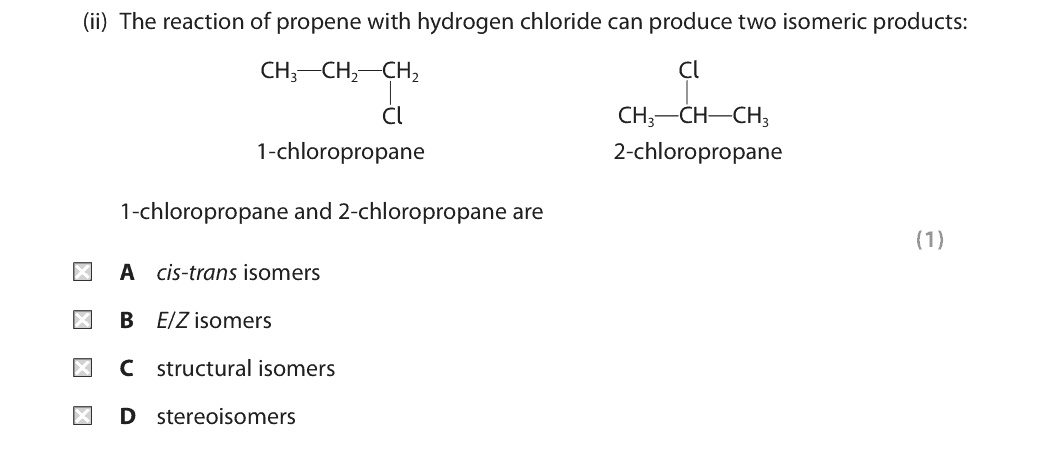
(a) This multiple-choice question on isomerism was very similar to those asked in previous years, but also required students to differentiate between cis/trans and E/Z
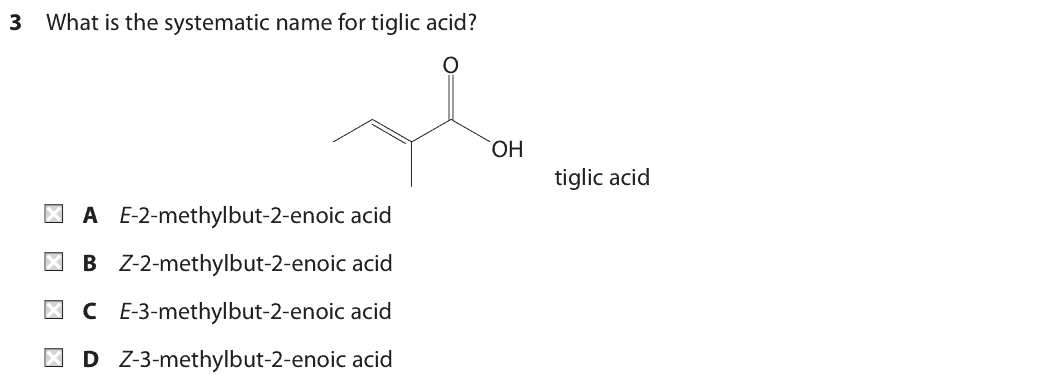
A
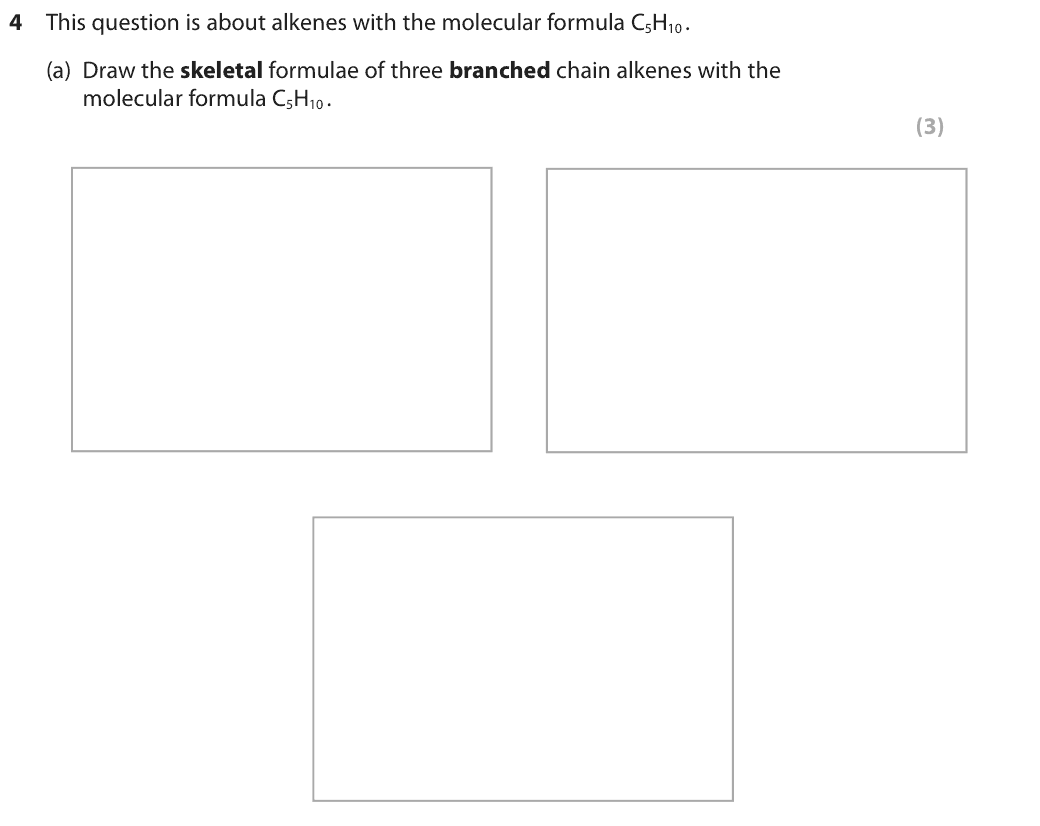
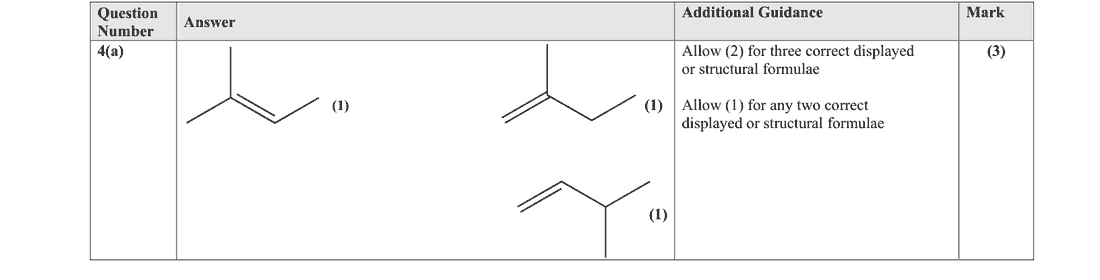
Again, the text in bold seemed to be ignored by many, as a number of candidates produced isomers based on a linear five-carbon chain, with no branches. It was common to see two pent-1-ene structures proposed, though drawn differently. For instance, the C=C bond would be shown on the far left in the first answer, then on the far right in the second. Others simply angled their second attempt up or down the page, but did not spot that it was still a five- carbon chain. Other candidates could draw a correct structure, but as described above, drew it again in a different orientation, thinking this was a new isomer. A majority of candidates could identify which alcohol would form pent-2-ene in (b) and the mechanism in (c) was confidently handled by many. The most common issues were ones of detail, with the omission of key features such as the dipole on the H-Br molecule, and a lone pair on the bromide ion. A frustrating minority ignored the instruction in the question and showed 3-bromopentane as the product. The calculation in (d) showed most candidates have a secure understanding of the Ideal Gas Equation. However, minor slips meant some candidates did not access all four marks. These included: using an incorrect relative molecular mass of pent-1-ene to determine n incorrect conversion of temperature to K and/or volume to m3 incorrect number of significant figures and / or units A small number of candidates converted the volume to dm3. Sometimes this seemed to be a deliberate strategy, with the candidate realising that this results in a pressure measure in kPa. Others, however, may have confused the units with those required in titration problems, and hence made errors in the final units for pressure. Candidates need to be careful that their rationale is clear if they adopt this route, and the best way is to ensure all steps of the calculation are clearly labelled and presented in a clearly defined order.
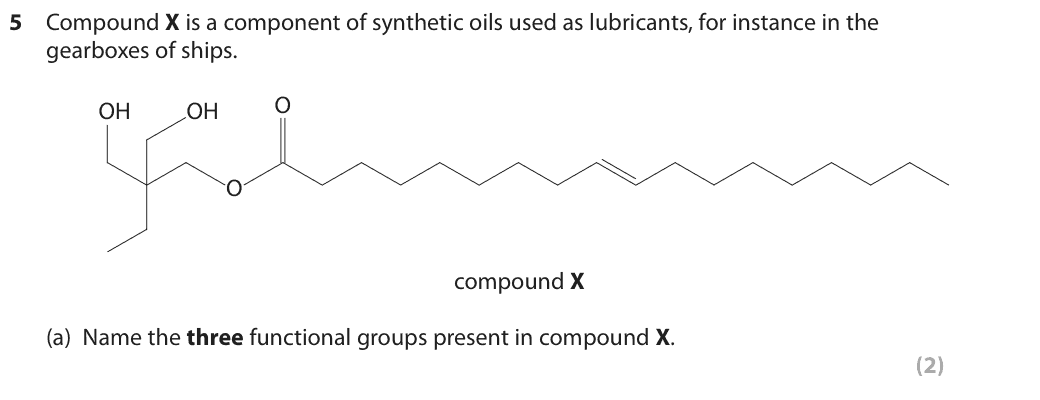
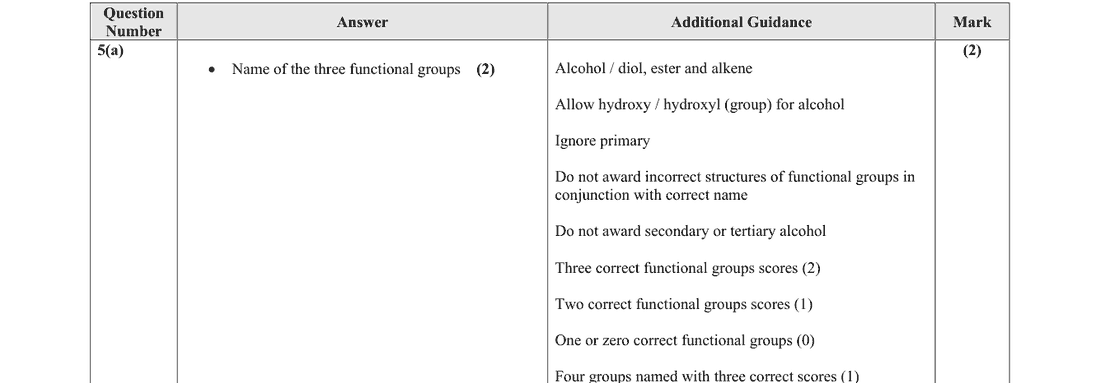
In (a) many candidates mistook the ester group for a carbonyl / ketone group, so could only score a maximum of one mark. Others focused on the left of the structure and omitted the alkene group. In (b) the hint of ‘a chemical reaction’ seemed to be missed by many, who framed there response exclusively around the idea of hydrogen bonds with water. Those candidates who realised a hydrolysis reaction could occur, not all linked it to the ester functional group. In (c)(i) fractional distillation was correctly suggested by nearly all candidates. In (b) the majority recognised that X had the ability to form hydrogen bonds, but some missed out on the first mark as they didn’t link this statement to a structural feature on compound X. Others, however, made a comparison to the London forces in a similar hydrocarbon, so were able to access both marks. Despite the stem making it clear the hydrocarbon had a similar mass and shape to compound X, it was fairly common to see answers trying make the point that compound X had greater London forces.
D
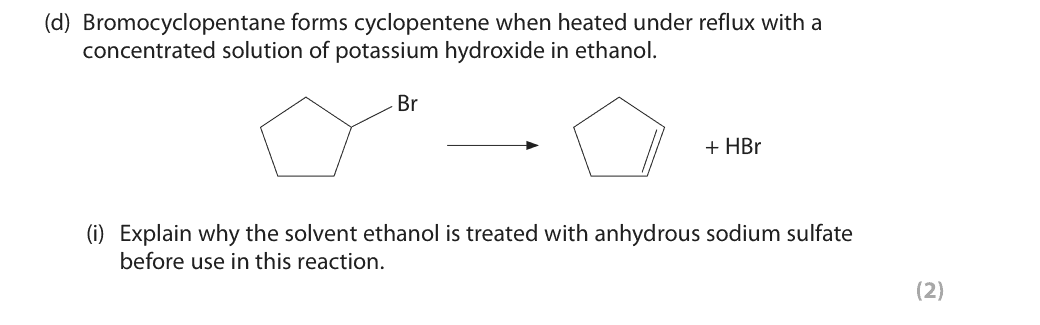
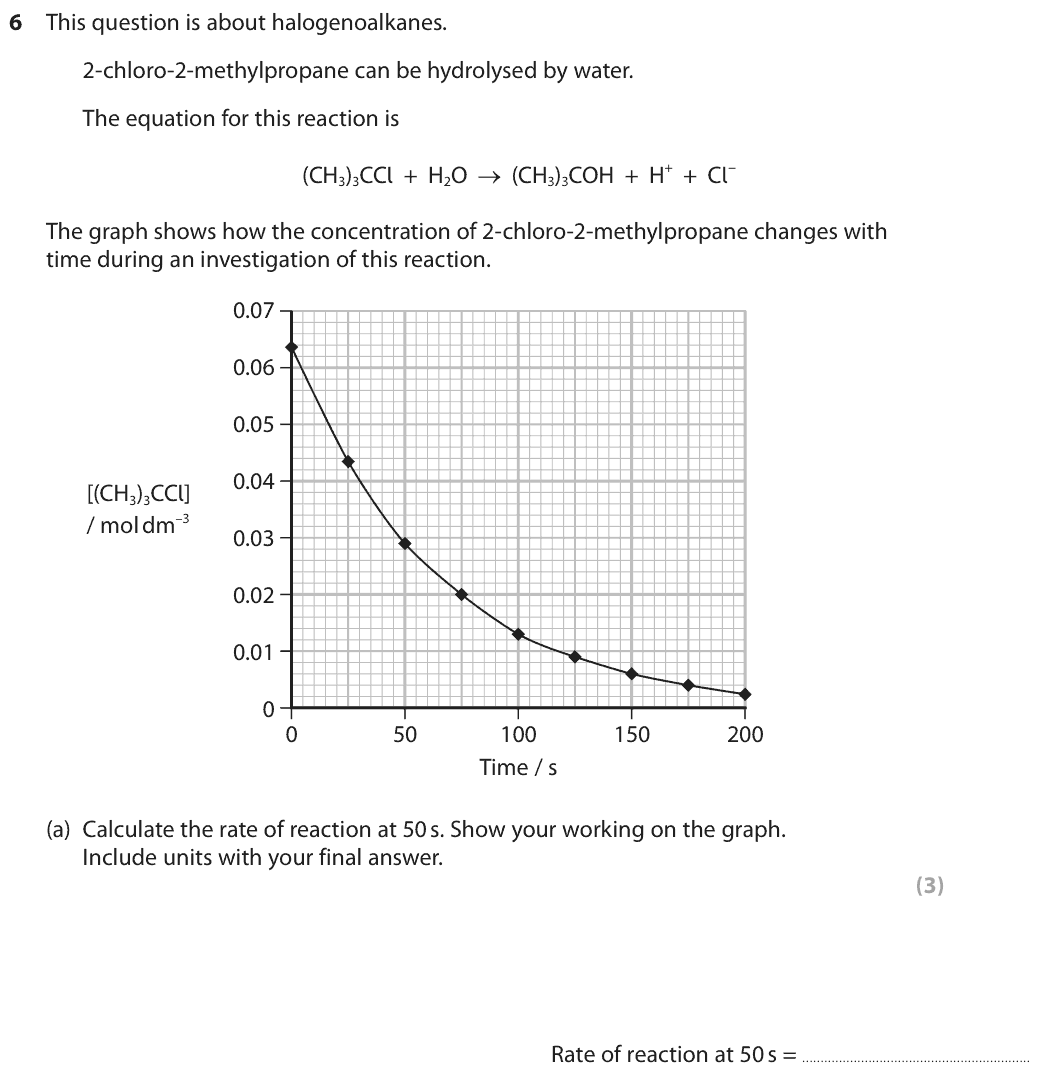
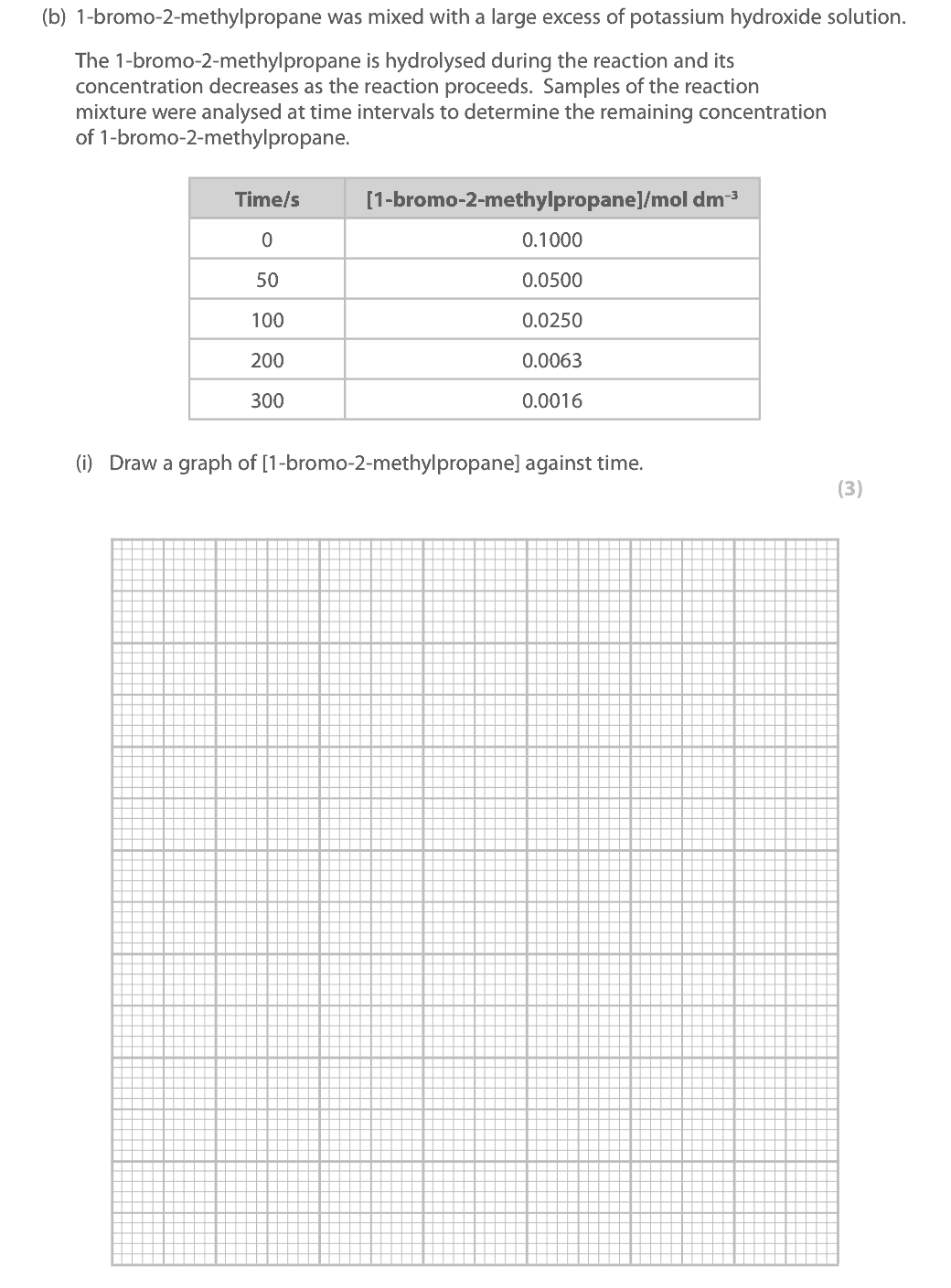
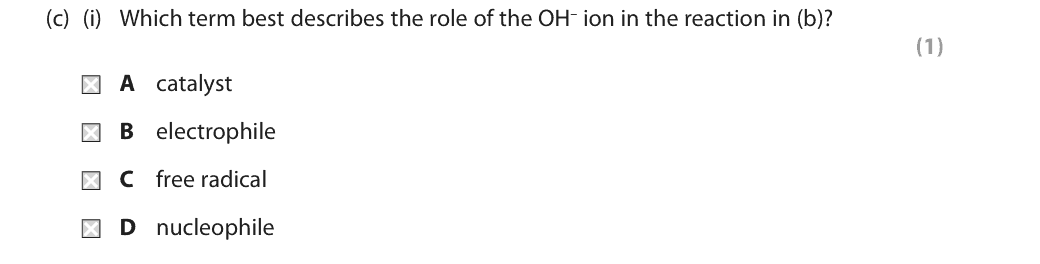
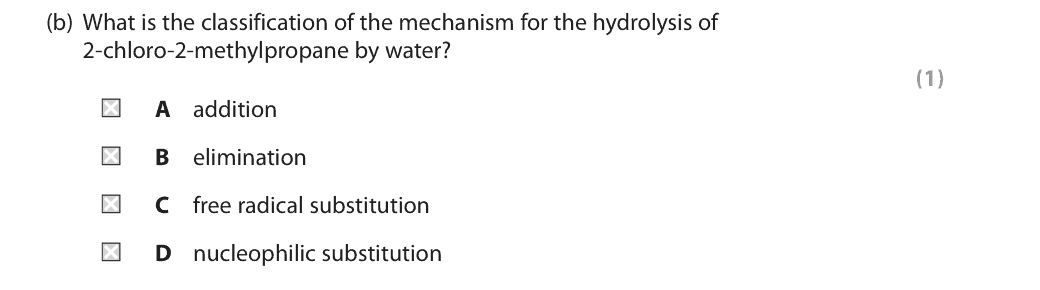
(a) This question involved the use of a tangent to a curve as a means of measuring reaction rate at a given time. This question has been presented in this format several times in recent years. Most candidates were familiar with the procedure although the manipulation of the numerical data was less successful. (b) This multiple-choice question addressed the classification of a hydrolysis mechanism. Most candidates were successful in scoring the mark. (c) Parts (i) and (ii) of this question related to the rates of, and conditions for, the hydrolysis of halogenoalkanes. Both of these questions have appeared frequently in past papers and should have been familiar to candidates. (d) This question involved the conversion of a halogenoalkane to an alkene. (d)(i) was a simple recall of reaction conditions. Most candidates did not achieve marks. In (d)(ii) candidates struggled with the repeat unit of a polymer. Common errors included the retention of a C=C in the backbone of the polymer, and the inclusion of one or both side groups in the backbone. This is relatively easy chemistry but it does require practice in writing the repeat unit. The errors seen are common with questions relating to repeat units. Part (iii) was a more challenging question and there was considerable success by many candidates. Candidates are becoming familiar with the requirement for a mechanism, and it would seem to be a specification topic that has been well taught.
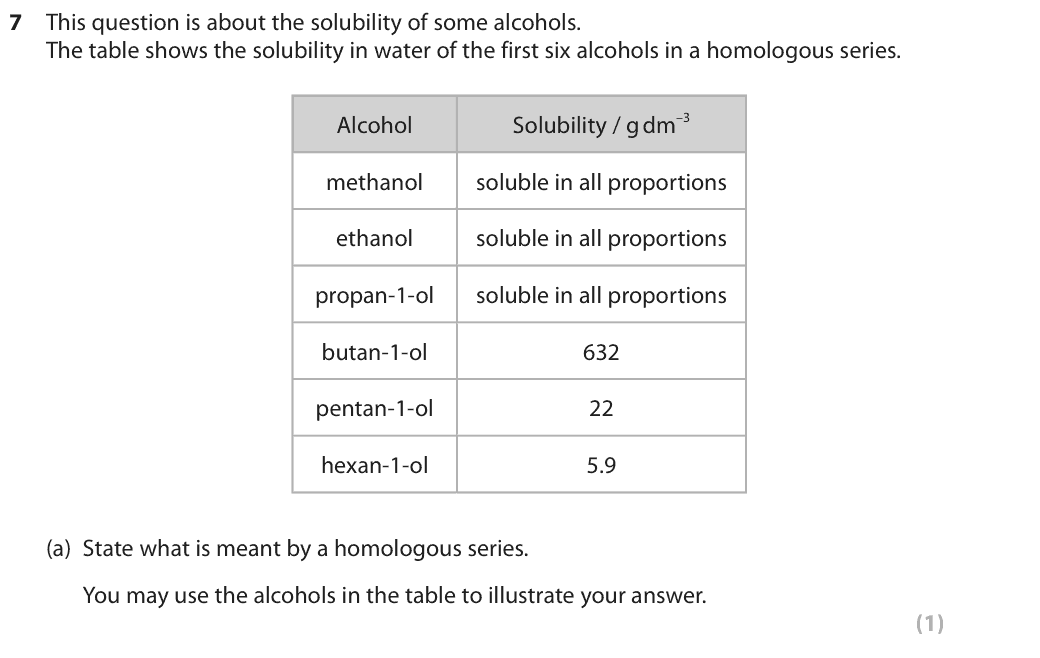
This was a question about the solubility of alcohols in water. (a) This slightly oblique question asked about a homologous series. Whilst it was clear that most candidates knew what was meant by the term ‘homologous series’, many found it difficult to express their understanding in writing, without ambiguity. (b) This question explored the candidates’ understanding of intermolecular forces, specifically the hydrogen bonding that allows methanol to dissolve in water. It was expected that students would use diagrams to explain and there was in instruction to this effect, however, some students chose to ignore the instruction and struggled with a written description.

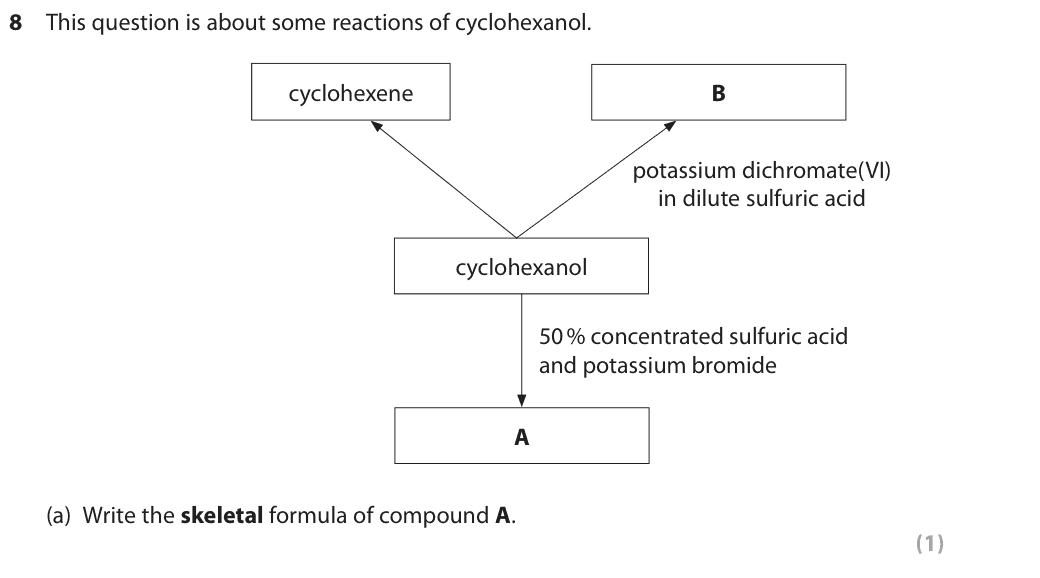
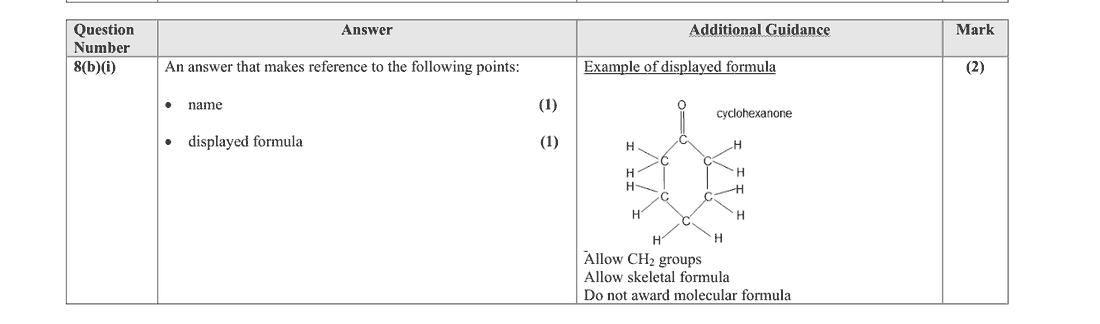
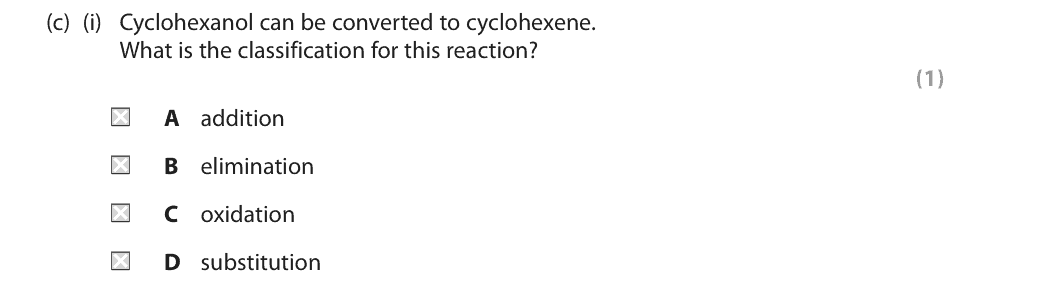
This question concerned the reactions of cyclohexanol. In general terms it was answered poorly, and weaker candidates declined to answer most of the early parts of this question. Most of these candidates seemed unfamiliar with the reactions of alcohols. A few excellent answers were seen, but these generally related to the more able candidates. (a) It appeared that weaker candidates were unsure of what was meant by a skeletal formula. (b)(i) This question asked about the oxidation of a secondary alcohol, requiring both the name and displayed formula of the organic product. It was therefore a demanding question requiring knowledge of the reaction and the ability to write relevant names and formulae. (b)(ii) This question tested the candidate’s understanding of IR spectra. Although worth just 2 marks on this paper, this specification topic tends to be difficult for many candidates, perhaps because it requires a considerable investment in time and effort to understand the basics of IR spectroscopy. (b)(iii) and (b)(iv) Following on from IR, the question then moved on to another instrumental technique: mass spectrometry. Part (iii) was a simple question about finding relative molecular mass from a mass spectrum, but avoided or answered incorrectly by almost all weaker candidates. Part (iv) was potentially more challenging but was attempted with more success by candidates across the ability range. Similar questions have been asked in recent years and practice with past papers may have contributed to the candidate performance seen in this question. (c)(i) This multiple-choice question on reaction classification proved to be a relatively easy mark for most candidates. Application of simple chemical principles gives the required answer. (c)(ii) This was a relatively complicated question involving density calculations, mole calculation, and % yield. It was intended to discriminate and only the best candidate were able to achieve the final correct answer. Some candidates were able to gain some of the available marks. (c)(iii)* This was a longer unstructured question and was concerned with the practical aspects of producing a dry sample of product from a given organic reaction. As is usual with this style of question, the data provided gives several clues about the required answer. In general, this question was very poorly answered, with the majority of candidates failing to score any marks at all. In this type of practical question, it is a marked advantage to have completed any of the relevant practical exercises. Practical experience seemed to be lacking for most candidates, with only the best candidates scoring a modest number of marks for this question.
B
This question concerned the reactions of cyclohexanol. In general terms it was answered poorly, and weaker candidates declined to answer most of the early parts of this question. Most of these candidates seemed unfamiliar with the reactions of alcohols. A few excellent answers were seen, but these generally related to the more able candidates. (a) It appeared that weaker candidates were unsure of what was meant by a skeletal formula. (b)(i) This question asked about the oxidation of a secondary alcohol, requiring both the name and displayed formula of the organic product. It was therefore a demanding question requiring knowledge of the reaction and the ability to write relevant names and formulae. (b)(ii) This question tested the candidate’s understanding of IR spectra. Although worth just 2 marks on this paper, this specification topic tends to be difficult for many candidates, perhaps because it requires a considerable investment in time and effort to understand the basics of IR spectroscopy. (b)(iii) and (b)(iv) Following on from IR, the question then moved on to another instrumental technique: mass spectrometry. Part (iii) was a simple question about finding relative molecular mass from a mass spectrum, but avoided or answered incorrectly by almost all weaker candidates. Part (iv) was potentially more challenging but was attempted with more success by candidates across the ability range. Similar questions have been asked in recent years and practice with past papers may have contributed to the candidate performance seen in this question. (c)(i) This multiple-choice question on reaction classification proved to be a relatively easy mark for most candidates. Application of simple chemical principles gives the required answer. (c)(ii) This was a relatively complicated question involving density calculations, mole calculation, and % yield. It was intended to discriminate and only the best candidate were able to achieve the final correct answer. Some candidates were able to gain some of the available marks. (c)(iii)* This was a longer unstructured question and was concerned with the practical aspects of producing a dry sample of product from a given organic reaction. As is usual with this style of question, the data provided gives several clues about the required answer. In general, this question was very poorly answered, with the majority of candidates failing to score any marks at all. In this type of practical question, it is a marked advantage to have completed any of the relevant practical exercises. Practical experience seemed to be lacking for most candidates, with only the best candidates scoring a modest number of marks for this question.
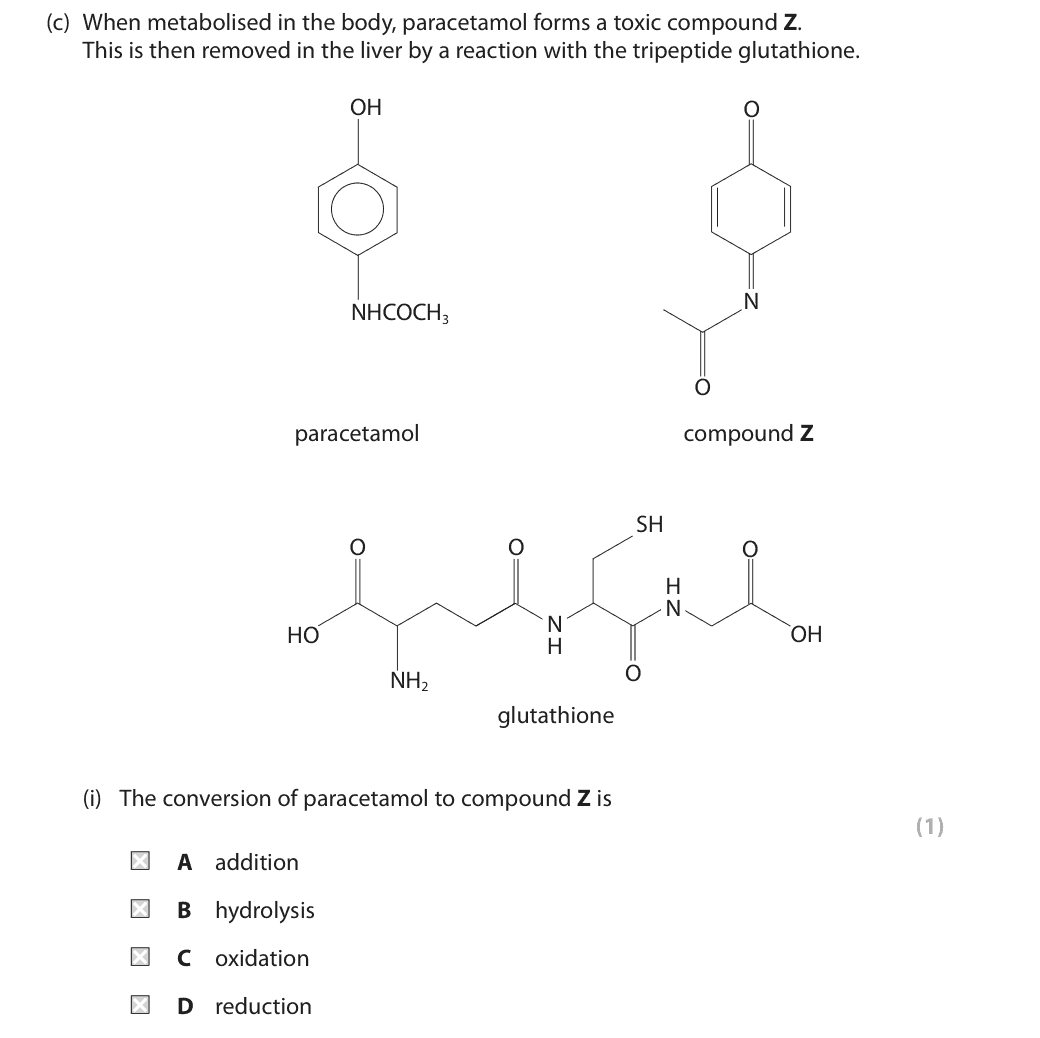
C
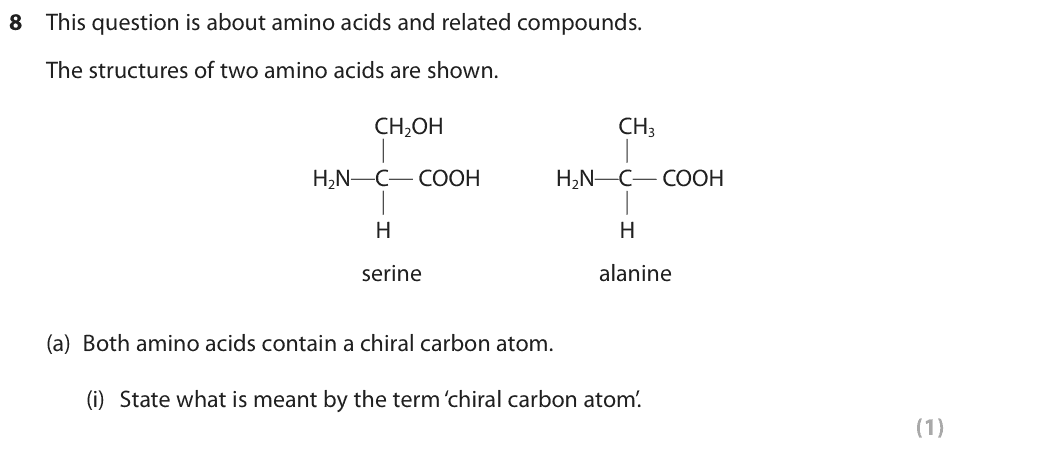
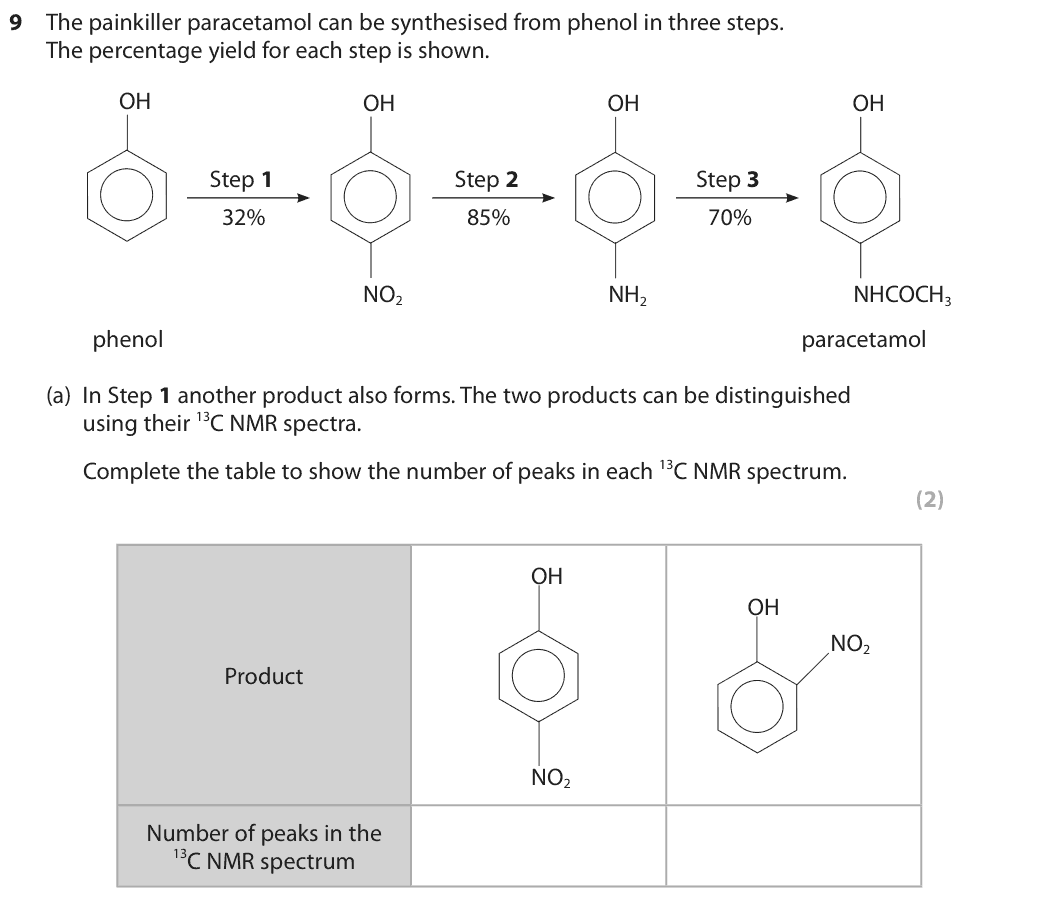
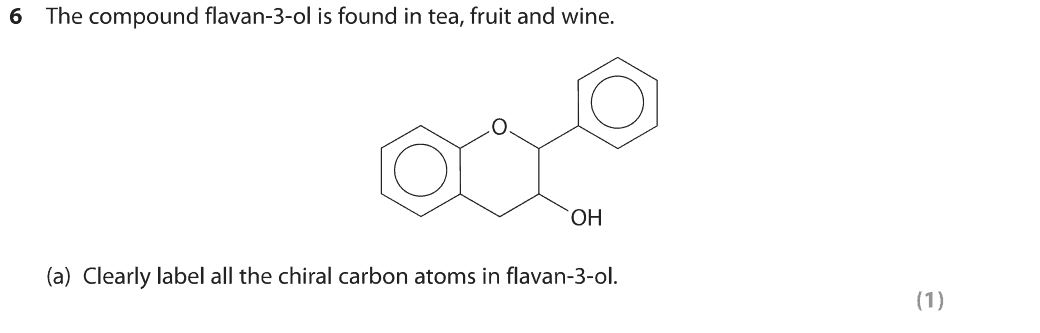
Completion of the table in (a) was attempted by nearly all candidates, though only a minority scored both marks. The calculation in (b) yielded marks for many, though not taking into account the overall yield of the process meant an answer of 622.5 g was common. Whilst many candidates could identify chiral carbon atoms in (c)(ii) a number seemed unable to work with skeletal formulae, circling whole sections of the molecule, covering several carbon atoms. Most candidates in (d) assigned the crystalline structure solely to hydrogen bonds rather than the formation of zwitterions.
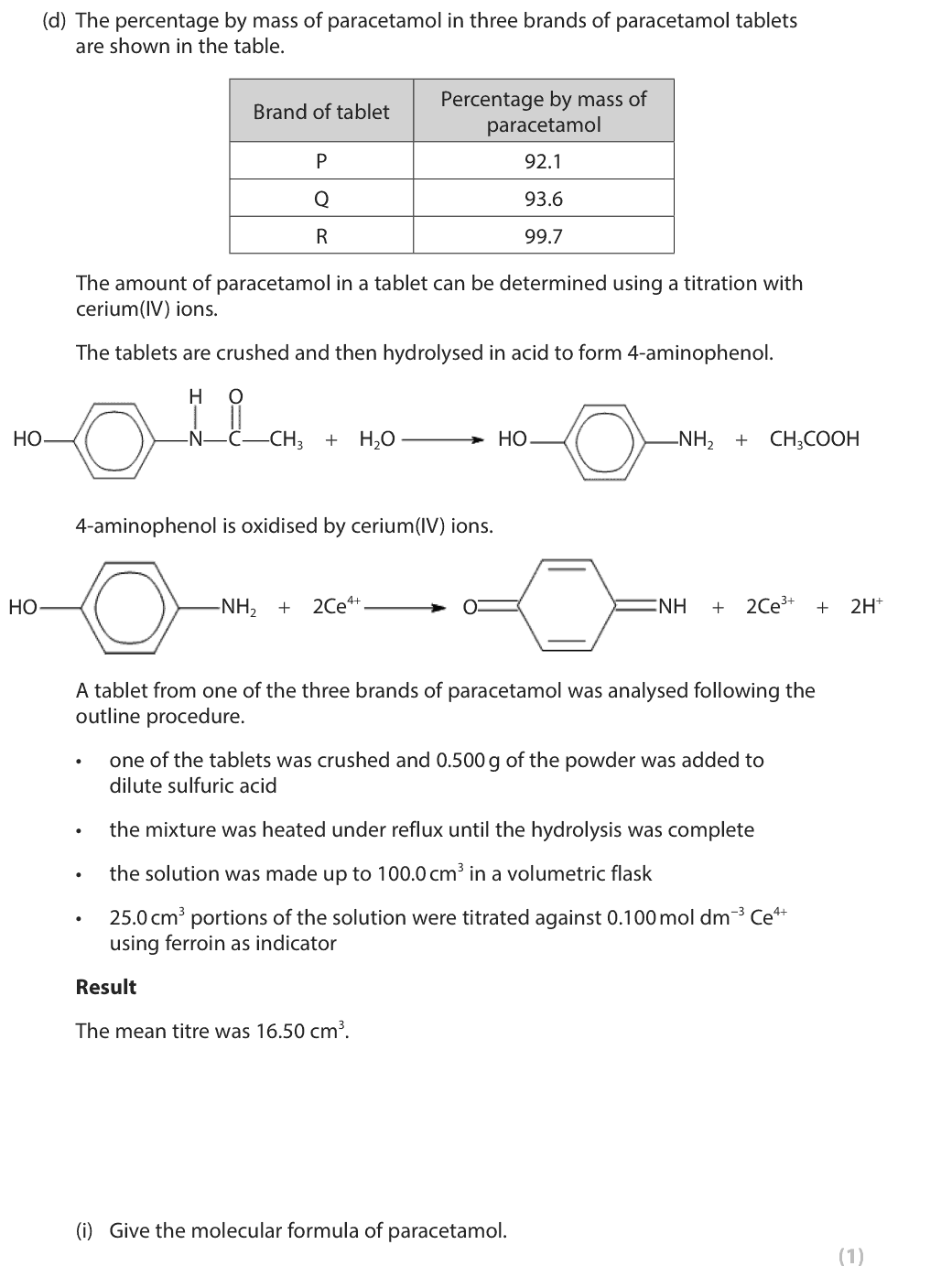
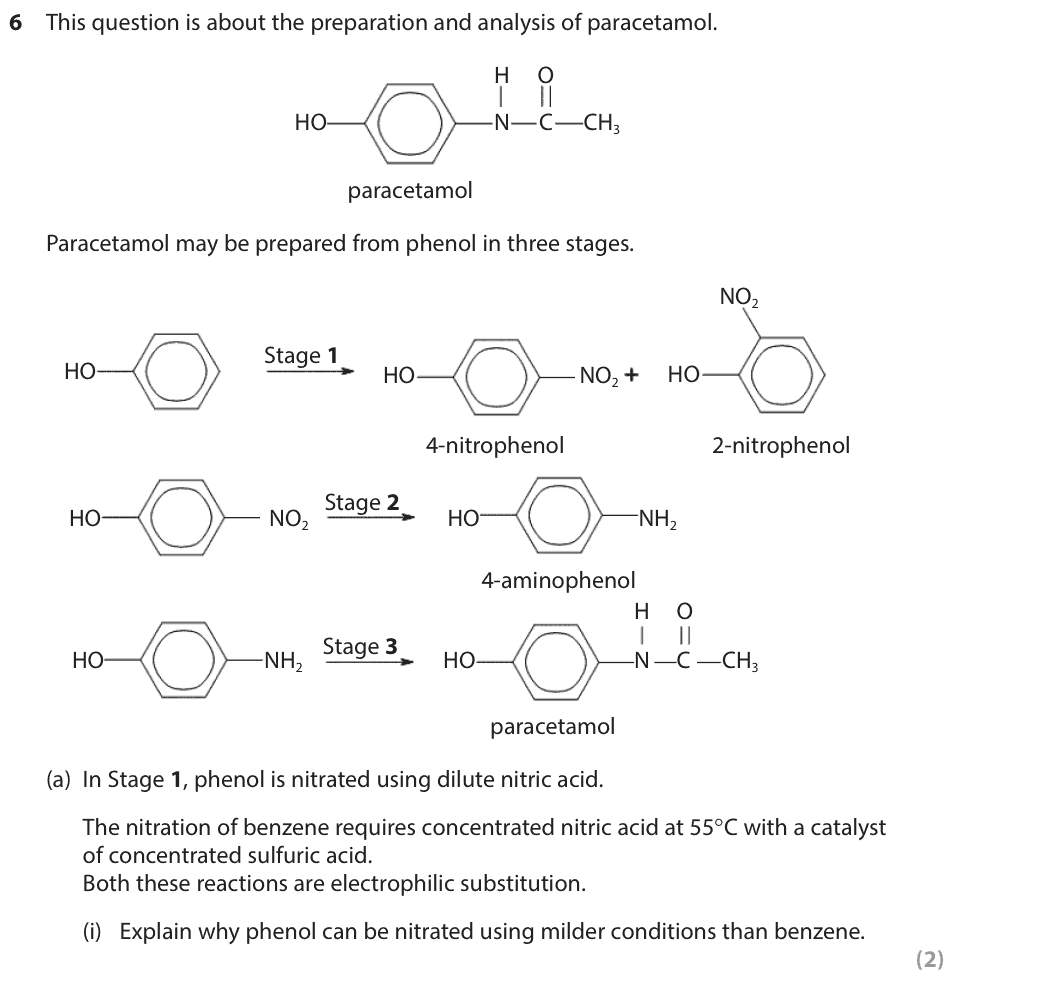
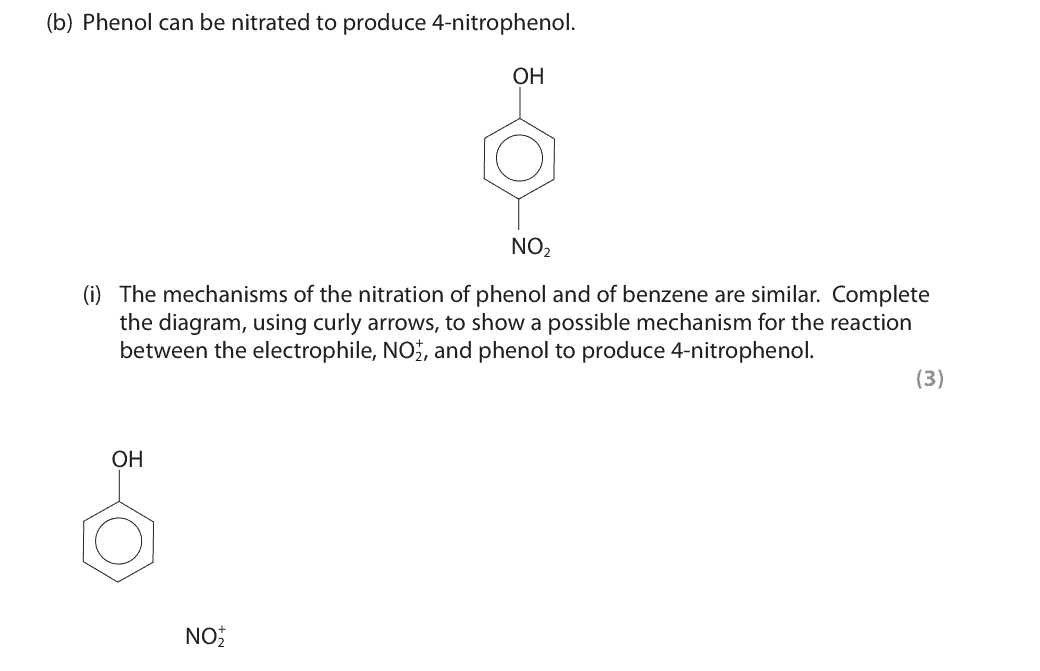
Some candidates gave clear and concise explanations for why phenol can be nitrated using milder conditions than benzene while others seemed unfamiliar with this concept or gave partial answers. Some referred to the lone pair of electrons on the OH group rather than the oxygen atom. Many candidates struggled to explain the difference in boiling temperatures of the two isomers and did not refer to intermolecular forces as requested in the question. Many answers did not mention hydrogen bonding. Many candidates knew that a reducing agent is needed to convert 4-nitrophenol into 4-aminophenol, although some did not read the question and gave a specific reagent rather than the type of reagent. There were many poor diagrams drawn for filtration under reduced pressure, with folded filter paper and no perforations in the Buchner funnel. Most candidates would benefit from more practise in drawing clear labelled diagrams of the common practical techniques in the specification. A few candidates gave clear descriptions of the recrystallisation procedure, but most put steps in the wrong order, missed out steps such as hot filtration and were generally confused. A common error in producing dry crystals was to suggest adding an anhydrous salt as a drying agent. Although this works well for drying liquids as it is easy to separate the substances, it does not work for drying crystals unless the drying agent is specified as being in a desiccator. Many candidates knew that impurities lower the melting temperature of a substance and it will melt over a range of temperatures rather than having a sharp melting point, but many omitted one of these from their answer. Many candidates were able to work out the molecular formula of paracetamol but quite a lot had an incorrect number of hydrogen atoms and some candidates were not aware of the meaning of molecular formula. The calculation in (d)(ii) was carried out correctly by many candidates. Some omitted to use the mole ratio and others omitted the use of a 100.0 cm3 volumetric flask. Some candidates calculated a mass higher than the original 0.500 g of paracetamol and reversed the percentage calculation to obtain a value less than 100%. These candidates should be advised to check their working to see where they have made an error instead of doing this.
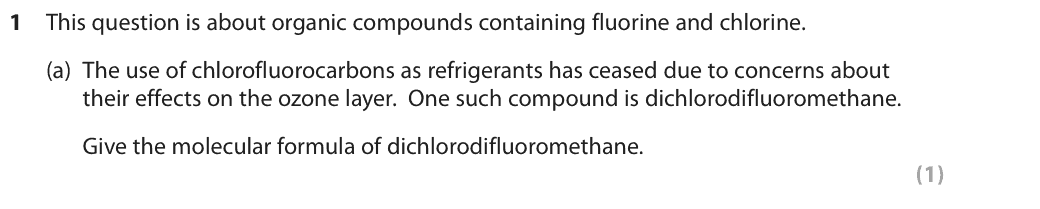
In this question the earlier, more familiar parts of the question were answered well with knowledge demonstrated of organic compounds containing chlorine and fluorine. High marks were particularly scored on the empirical formula calculation. As the question developed the more contextual idea of the reaction between fluorine and difluoromethane which required application of more familiar knowledge was less understood.
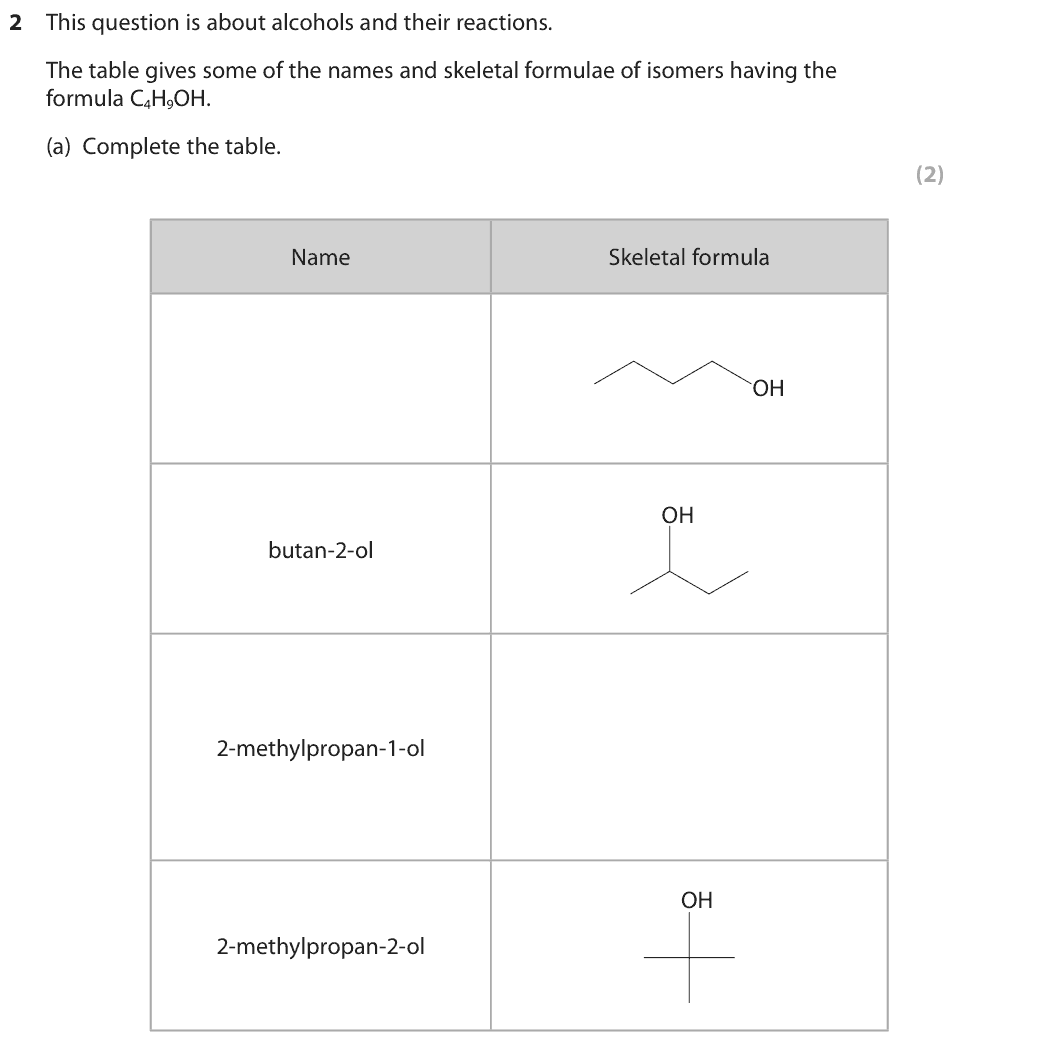
This question tested knowledge of the alcohols and their reactions. The pattern here followed the pattern of question 1 with candidates answering well the questions which tested knowledge which is perhaps more commonly seen and tested at this level. Less commonly tested ideas, such as that of stereoisomerism proved more challenging.
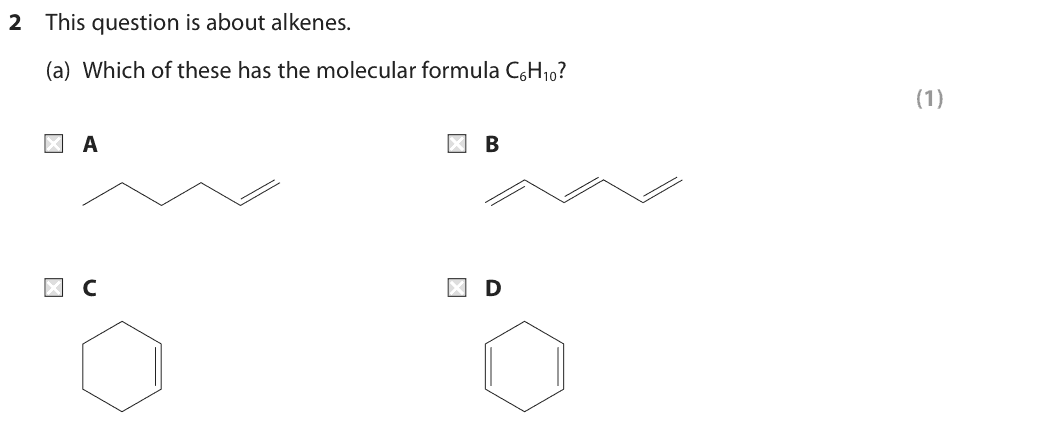
C
The majority of candidates knew that bromoethane is produced when ethene reacts with hydrogen bromide, although a few showed 1,2-dibromoethane. Many candidates did know that steam and an acid catalyst are needed to convert ethene into ethanol, however a significant number of candidates had not learnt this reaction. The structure of the polymer formed from but-1-ene was generally well-answered, with just a few candidates including a double bond, not showing the extension bonds or not showing two repeat units. The majority of candidates could calculate the number of molecules in 70.0 g of but-1-ene, with the most common errors being an incorrect molar mass’ not converting mass into number of moles and dividing the number of moles by the Avogadro Constant.
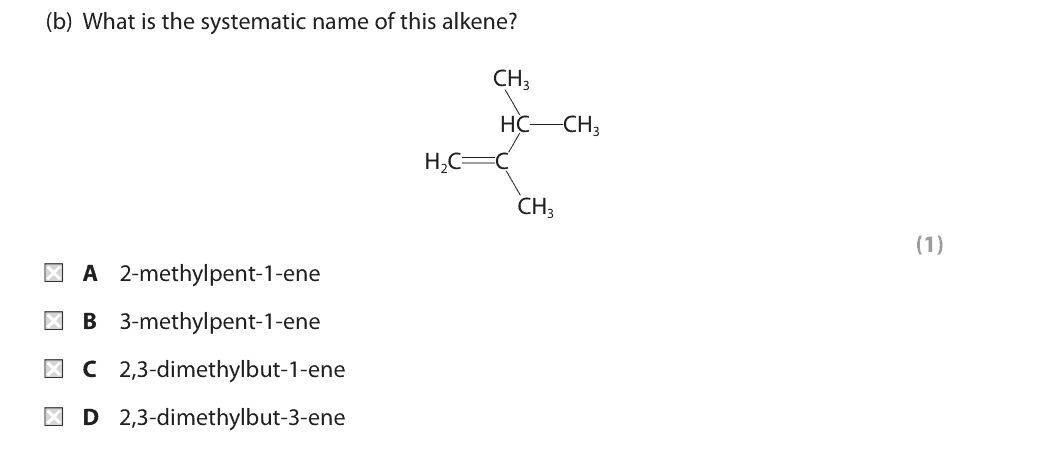
C
The majority of candidates knew that bromoethane is produced when ethene reacts with hydrogen bromide, although a few showed 1,2-dibromoethane. Many candidates did know that steam and an acid catalyst are needed to convert ethene into ethanol, however a significant number of candidates had not learnt this reaction. The structure of the polymer formed from but-1-ene was generally well-answered, with just a few candidates including a double bond, not showing the extension bonds or not showing two repeat units. The majority of candidates could calculate the number of molecules in 70.0 g of but-1-ene, with the most common errors being an incorrect molar mass’ not converting mass into number of moles and dividing the number of moles by the Avogadro Constant.
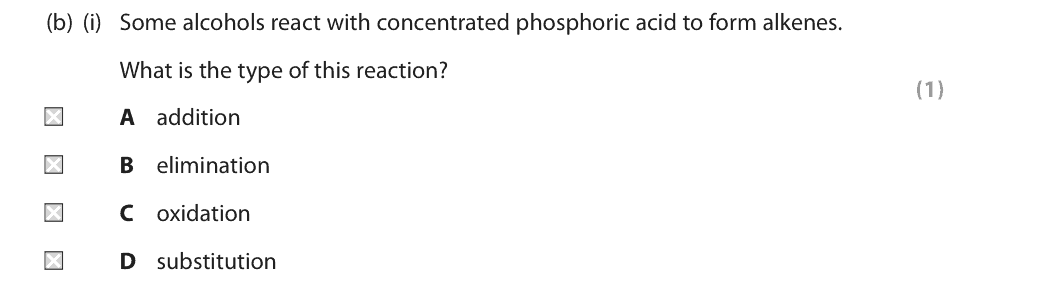
B
This question tested knowledge of the alcohols and their reactions. The pattern here followed the pattern of question 1 with candidates answering well the questions which tested knowledge which is perhaps more commonly seen and tested at this level. Less commonly tested ideas, such as that of stereoisomerism proved more challenging.

This question tested knowledge of the alcohols and their reactions. The pattern here followed the pattern of question 1 with candidates answering well the questions which tested knowledge which is perhaps more commonly seen and tested at this level. Less commonly tested ideas, such as that of stereoisomerism proved more challenging.
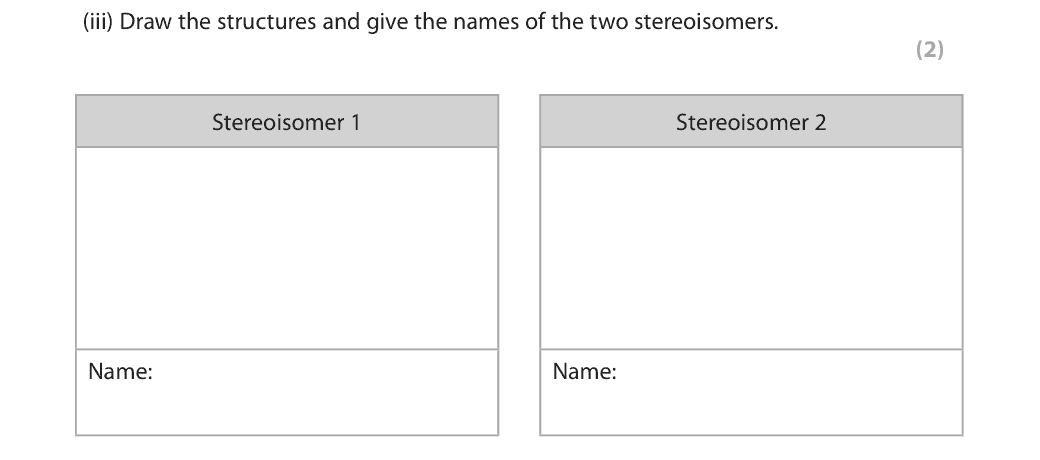
This question tested knowledge of the alcohols and their reactions. The pattern here followed the pattern of question 1 with candidates answering well the questions which tested knowledge which is perhaps more commonly seen and tested at this level. Less commonly tested ideas, such as that of stereoisomerism proved more challenging.
Skills: MS4.2 Visualise and represent 2D and 3D forms including two- dimensional representations of 3D objects

This question tested knowledge of the alcohols and their reactions. The pattern here followed the pattern of question 1 with candidates answering well the questions which tested knowledge which is perhaps more commonly seen and tested at this level. Less commonly tested ideas, such as that of stereoisomerism proved more challenging.
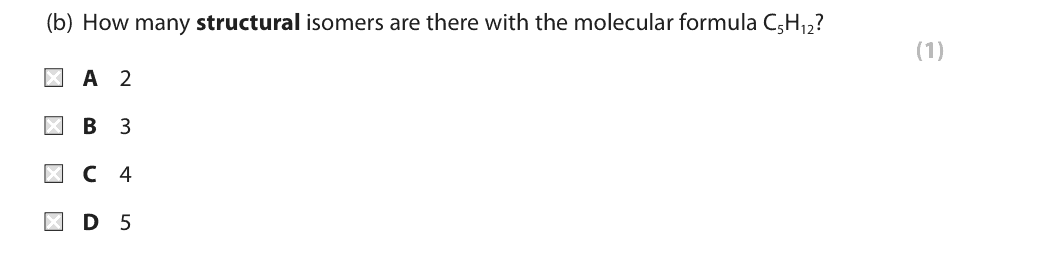
B
Candidates found (d)(ii) to be a challenging question. This type of calculation was unfamiliar to the majority of candidates and many struggled to start it as they did not realise that the carbon dioxide would be removed by aqueous sodium hydroxide so the volume of carbon dioxide was 125 cm3 and the value of x was 5. The unfamiliar mechanism in (e) was clearly drawn by the majority of candidates. Common errors included: showing the formation of the minor product instead of the major product, giving an incorrect dipole on ICl and not starting a curly arrow from a bond or a lone pair of electrons. The vast majority of candidates scored a mark for calculating the number of moles of bromine used in (f). Some candidates did not realise that 2 mol of bromine are needed to react with 1 mol limonene as there are two double covalent bonds, some candidates were unable to calculate the correct molar mass of limonene. Candidates were able to score a transferred error mark for the final percentage, provided the answer was less than 100 %. However, some candidates calculated a mass of limonene that was greater than 0.500 g so reversed the fraction to give a percentage that was less than 100 % and this was not given credit. Candidates who calculate a percentage greater than 100 should go back and check their working to see where they have made an error.

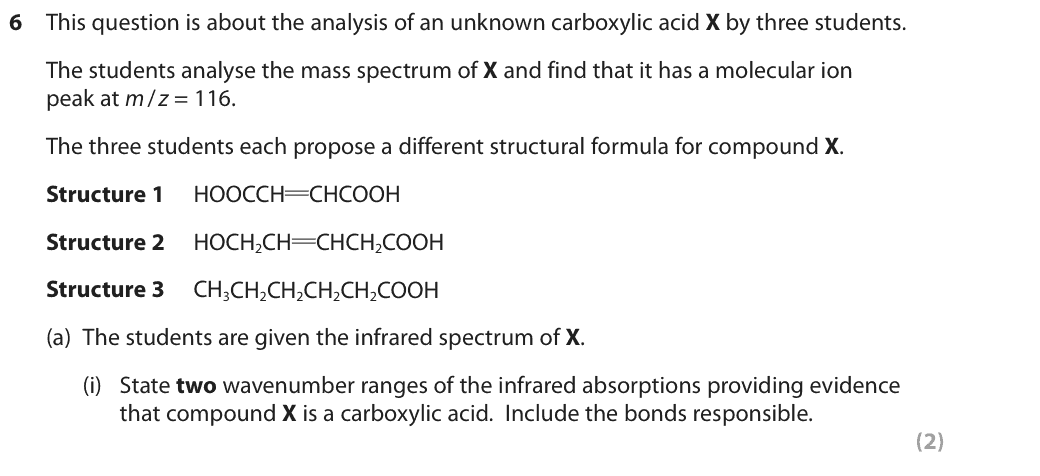
Many candidates identified the alkene and carboxylic acid functional groups in X but some just showed C=O and OH. The deduction of the skeletal formula of X was done well by many but some did not read the question and lost the mark by drawing a displayed formula. Some candidates ignored the information given about X and drew a branched chain or a compound that would exhibit geometrical isomerism. Some candidates have a clear understanding of 13C NMR and 1H NMR spectroscopy and constructed concise, logical, well-explained answers to the extended writing question in (b). There was a space before the writing lines and the most successful candidates used that to draw the displayed formulae of propan-1-ol and propan-2-ol and many of them annotated those formulae to help with their answers. There were many answers that jumped from one structure to another and one type of spectroscopy to the other without making it clear which was being discussed. This question asked candidates to compare the NMR spectra so they must include at least one similarity and one difference between them. Some candidates just wrote about the spectra and did not make the similarity of the OH proton clear. Some candidates seemed unsure what to do about the OH proton and either ignored it or did not realise that the 1H NMR spectrum would just have a singlet peak as it is not split and does not cause splitting. A few candidates included chemical shift values, even though they were told they were not needed and there was no credit for them. A few candidates were not clear on analytical techniques and wrote about mass spectrometry or infrared spectroscopy. The majority of candidates would benefit from more work on both types of NMR spectroscopy and more practise in answering ‘compare’ style extended writing questions.
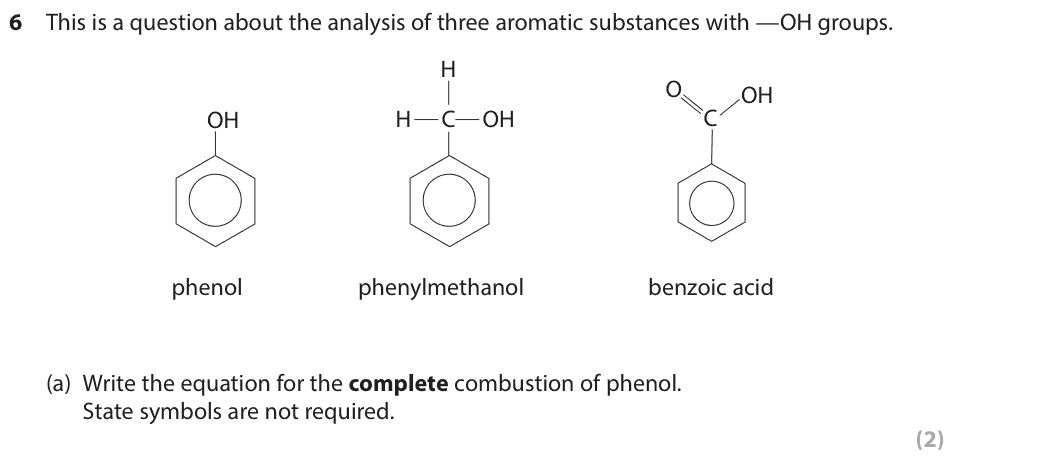
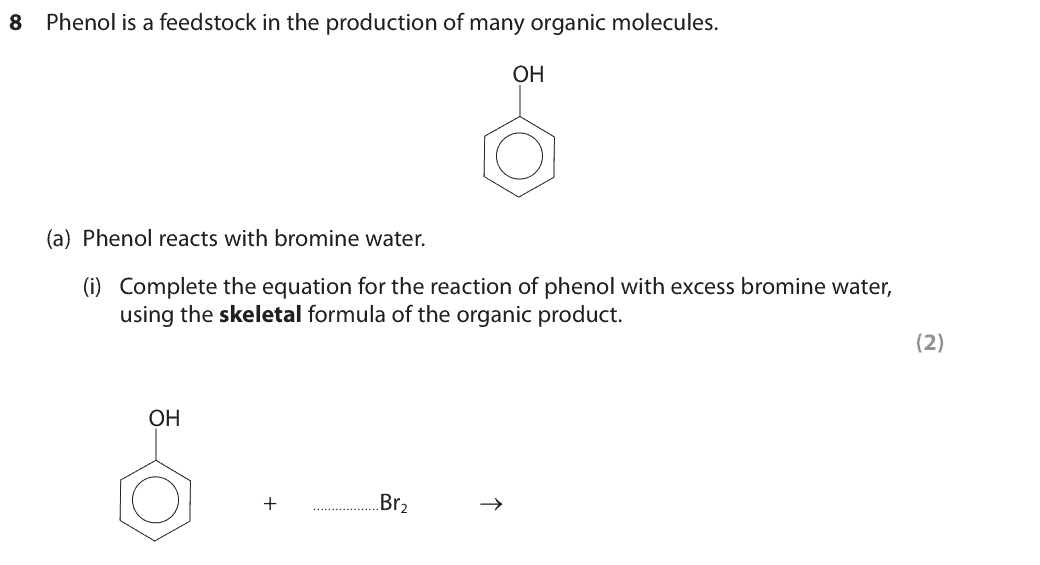
An appreciable number of candidates in (a) simply copied the skeletal formula of phenol from the question above but this did not help with the balancing of the combustion equation; nor of the calculation to follow. Nevertheless the majority were able to score at least one mark for the correct species in the equation. Candidates who find skeletal formulae challenging are advised to write out the formula in displayed form which was relatively easy in to with the formulae given at the top of the paper. It was evident in (b)(i) from the incorrect molar masses quoted that this would have helped a considerable number of candidates to avoid mistakes. Parts (b)(ii) and (iii) were often answered correctly but some candidates did not read the question in (iii) properly and suggested either specific molecules rather than ‘types’. Part (b)(iv) was a novel question and aimed to differentiate the very best candidates which it was successful at. Part (c)(i) was also an effective discriminator. Despite clear instructions in the question to include reference to ‘bonds’ and ‘wavenumber ranges’ there were still responses which did not refer to bonds or quoted single wavenumber values. It was surprising that the answers on the C-13 NMR spectrum in (c)(ii) were rather poor. Candidates often quoted more wavenumber ranges than were correct and so these negated correct answers. It was also evident that a significant number of candidates are misreading the Data Booklet. For example it was not uncommon for the C-OH peak wavenumber range to go to 80 ppm but the ‘lozenge’ in the Data Booklet does not go anywhere near the 80 ppm mark. The most common mass spectrum fragment ion seen in (c)(iii) was COOH+ which was awarded the mark. Common errors included adding a bond before the fragment ion or either omitting the charge or even adding a negative charge. The question also asked for the m/z value which some of the lower ability candidates missed.
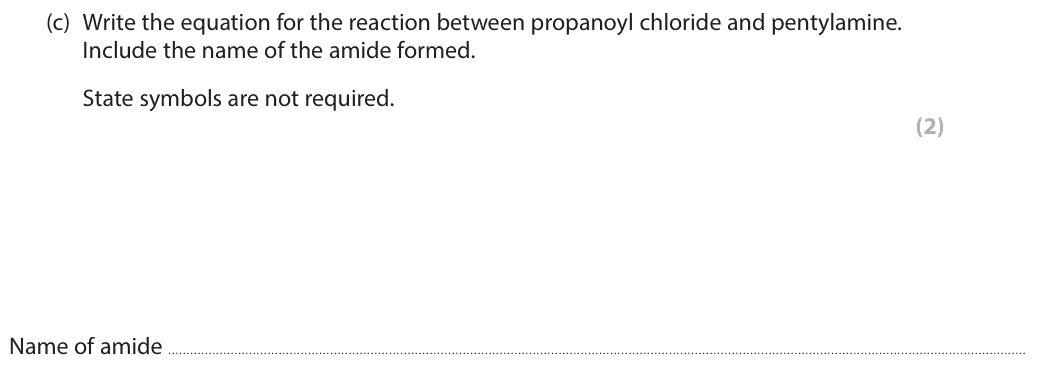
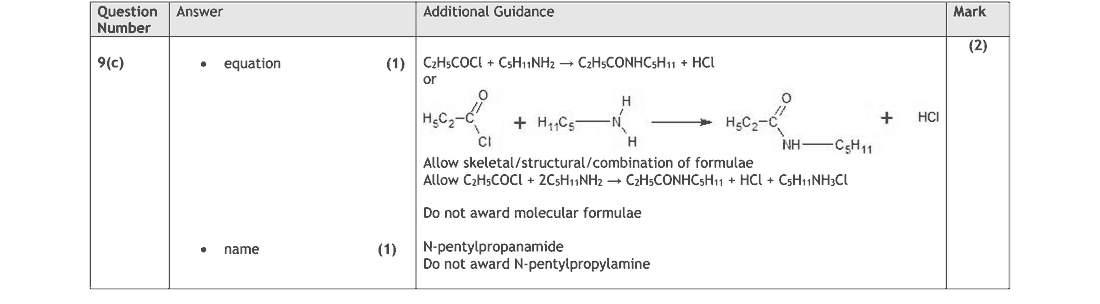
The few correct answers to (a) on the preparation of amines suggests that this is a topic area not well-studied or understood. Candidates need to remember that ‘compare and contrast’ question need at least one similarity and one difference. The similarity of both reactions being that of reduction was rarely given and instead vague or feeble answers such as both require heat were seen. The comparison of the basicity of the two amines in (b) was answered much better. However it is worth highlighting that candidates would be well-advised to ensure that when answering questions of this type that terms such as ‘base’ are clearly stated. The lone pair of electrons on the nitrogen is the key aspect of this subject and how it is able to form a coordinate bond with a proton and thus act as a base. Only the better candidates made this clear. It was not uncommon to see a response where the proton was not mentioned at all. It is worth reiterating that questions further along in the paper get more demanding. This was clearly evident in part (c). The equation for the reaction warranted only one mark. Common errors were the use of molecular formulae and the omission of the product HCl. The name of the amide was also problematic for all but the more able. Polymers continue to be challenging for candidates and centres would be helpful to provide even more practice. The name of the amine monomer given was not always the systematic name but credit was attempted to be given where it was unambiguous.
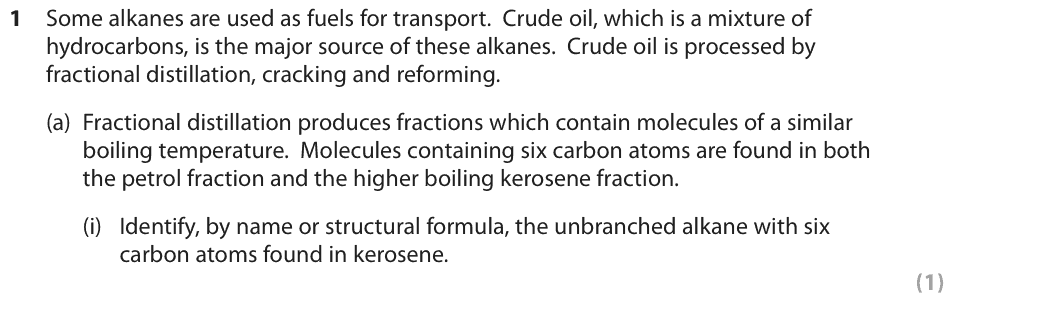
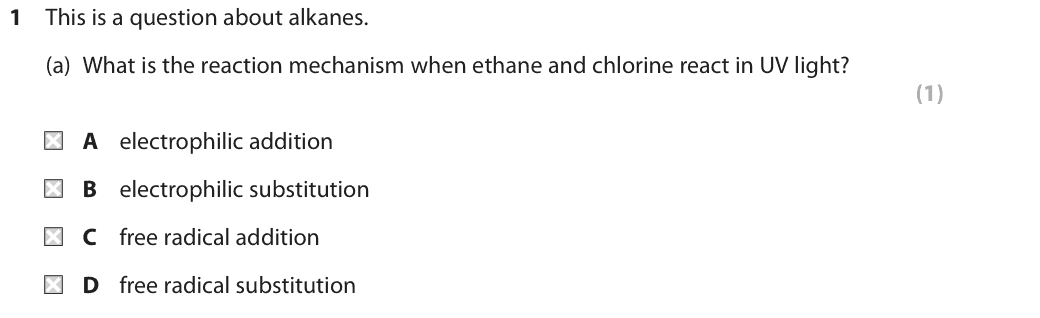
This question about fuels began with a nomenclature question which the majority of candidates were able to answer correctly. The main error was to give the molecular formula for the answer rather that a structural formula or name. The molecular formula does not show that the molecule is an unbranched chain. Most learners recognised that the next item required an understanding of intermolecular forces, but some believed that bonds were broken in the molecules and that branches of the chain resulted in weaker bonds. The common misconception that boiling involves bond breaking rather that the separation of molecules by the breaking of intermolecular forces is one which would benefit from further work for many learners. The advantages of cracking were reasonably well known with the idea that smaller molecules were of more use commonly seen, but the formation of alkenes and therefore the possiblity of carrying out reactions of these to produce new and more useful products such as plastics was less common. The first multiple choice question proved challenging with more incorrect answers than correct ones.
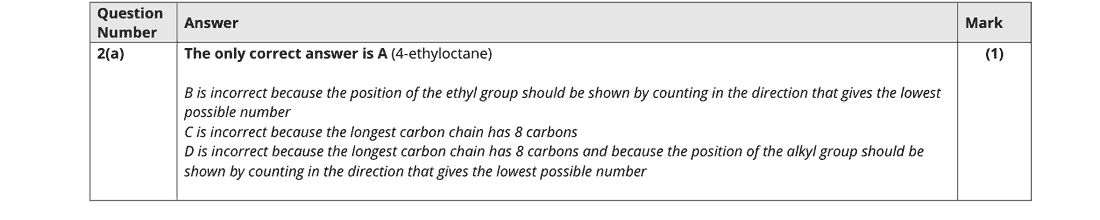
![This question is about alkanes and their reactions.
What is the IUPAC name for this alkane?
25
[] A 4-ethyloctane
[] B_ 5-ethyloctane
[1 C 3-propylheptane
[1 D 5-propylheptane](/img/JUN19_9CH02/JUN19_9CH02_2-a_qp.webp)
A

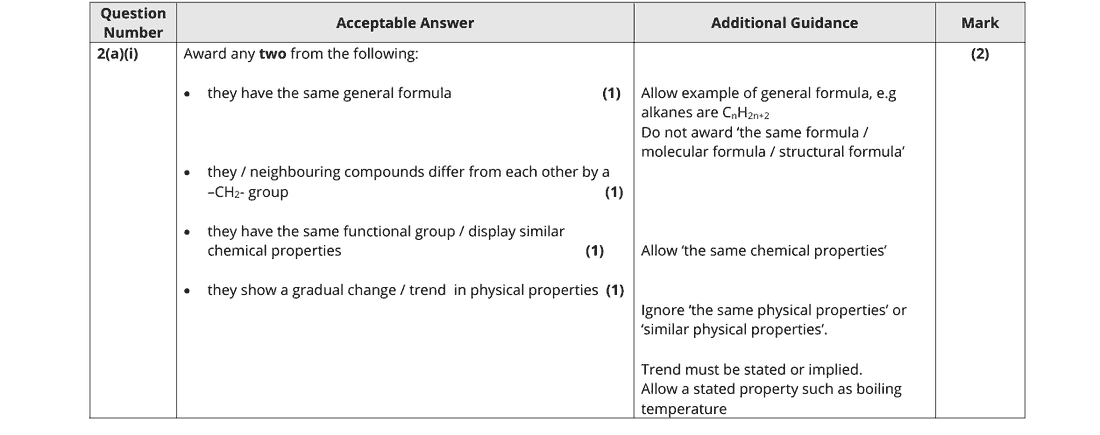
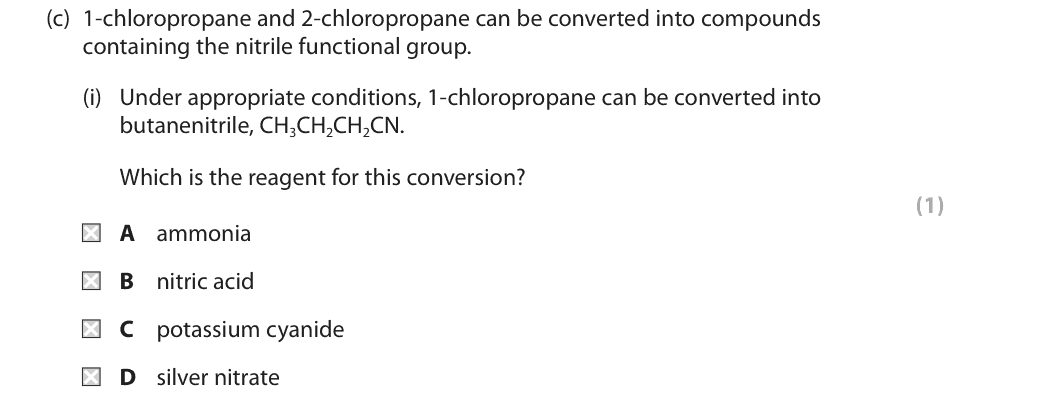
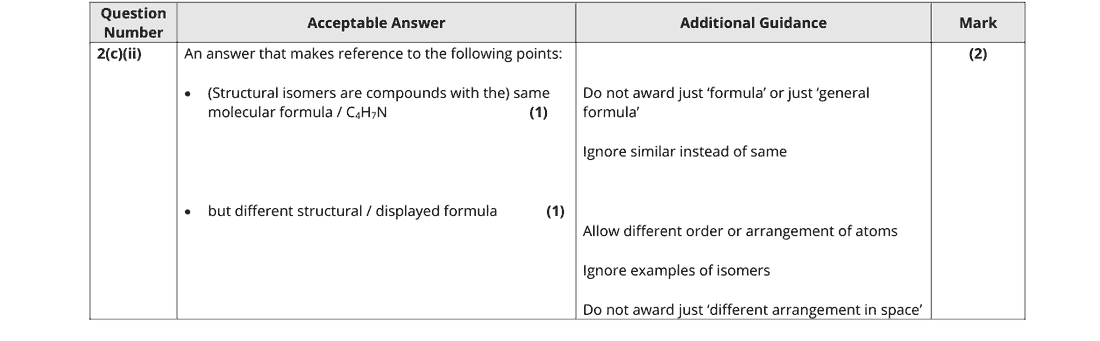
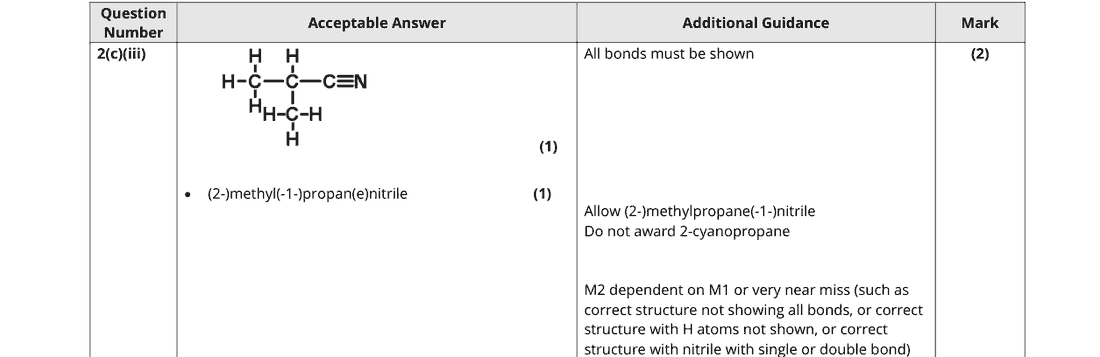
The first six items of this question were well answered by most candidates. Some learners mentioned both the fact that a homologous series contained molecules with the same functional group and had the same chemical reactivity. Since the latter comes as a result of the former, these were considered to be the same marking point and so only one mark was scored unless a further characteristic was supplied. Most knew that propene was an alkene and that hydrogen chloride was the reagent in (b)(i). Hydrochloric acid would not work here and a minority of candidates did not score the mark because of this. Many knew that the reaction was an electrophilic addition. In (c), most learners knew or worked out that potassium cyanide was the correct reagent and most also scored 2 for their understanding of the term ‘structural isomer’. The structure and name for the isomer in (c)(iii) proved much more challenging. Most candidates drew all the bonds including bonds between the C and the N of the functional group, though not all knew that this was a triple bond. A significant minority drew the structure of butanenitrile, for which the structural formula had been given in (c)(i), suggesting that the question in (c)(iii) had not been read with sufficient care. It is good practice to read each question twice to ensure that the correct question is answered. Where the correct structure was given the name was often incorrect. Both marks in this part were usually only scored by candidates who would go on to achieve an A grade.

The first six items of this question were well answered by most candidates. Some learners mentioned both the fact that a homologous series contained molecules with the same functional group and had the same chemical reactivity. Since the latter comes as a result of the former, these were considered to be the same marking point and so only one mark was scored unless a further characteristic was supplied. Most knew that propene was an alkene and that hydrogen chloride was the reagent in (b)(i). Hydrochloric acid would not work here and a minority of candidates did not score the mark because of this. Many knew that the reaction was an electrophilic addition. In (c), most learners knew or worked out that potassium cyanide was the correct reagent and most also scored 2 for their understanding of the term ‘structural isomer’. The structure and name for the isomer in (c)(iii) proved much more challenging. Most candidates drew all the bonds including bonds between the C and the N of the functional group, though not all knew that this was a triple bond. A significant minority drew the structure of butanenitrile, for which the structural formula had been given in (c)(i), suggesting that the question in (c)(iii) had not been read with sufficient care. It is good practice to read each question twice to ensure that the correct question is answered. Where the correct structure was given the name was often incorrect. Both marks in this part were usually only scored by candidates who would go on to achieve an A grade.

The first six items of this question were well answered by most candidates. Some learners mentioned both the fact that a homologous series contained molecules with the same functional group and had the same chemical reactivity. Since the latter comes as a result of the former, these were considered to be the same marking point and so only one mark was scored unless a further characteristic was supplied. Most knew that propene was an alkene and that hydrogen chloride was the reagent in (b)(i). Hydrochloric acid would not work here and a minority of candidates did not score the mark because of this. Many knew that the reaction was an electrophilic addition. In (c), most learners knew or worked out that potassium cyanide was the correct reagent and most also scored 2 for their understanding of the term ‘structural isomer’. The structure and name for the isomer in (c)(iii) proved much more challenging. Most candidates drew all the bonds including bonds between the C and the N of the functional group, though not all knew that this was a triple bond. A significant minority drew the structure of butanenitrile, for which the structural formula had been given in (c)(i), suggesting that the question in (c)(iii) had not been read with sufficient care. It is good practice to read each question twice to ensure that the correct question is answered. Where the correct structure was given the name was often incorrect. Both marks in this part were usually only scored by candidates who would go on to achieve an A grade.
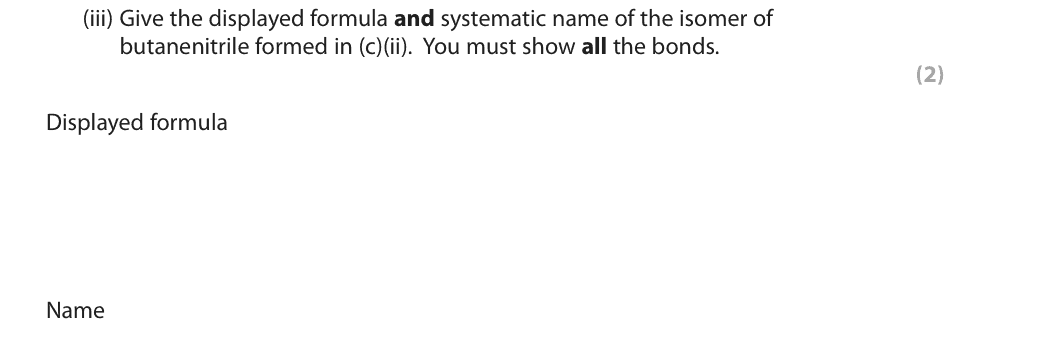
The first six items of this question were well answered by most candidates. Some learners mentioned both the fact that a homologous series contained molecules with the same functional group and had the same chemical reactivity. Since the latter comes as a result of the former, these were considered to be the same marking point and so only one mark was scored unless a further characteristic was supplied. Most knew that propene was an alkene and that hydrogen chloride was the reagent in (b)(i). Hydrochloric acid would not work here and a minority of candidates did not score the mark because of this. Many knew that the reaction was an electrophilic addition. In (c), most learners knew or worked out that potassium cyanide was the correct reagent and most also scored 2 for their understanding of the term ‘structural isomer’. The structure and name for the isomer in (c)(iii) proved much more challenging. Most candidates drew all the bonds including bonds between the C and the N of the functional group, though not all knew that this was a triple bond. A significant minority drew the structure of butanenitrile, for which the structural formula had been given in (c)(i), suggesting that the question in (c)(iii) had not been read with sufficient care. It is good practice to read each question twice to ensure that the correct question is answered. Where the correct structure was given the name was often incorrect. Both marks in this part were usually only scored by candidates who would go on to achieve an A grade.
Skills: MS4.2 Visualise and represent 2D and 3D forms including two- dimensional representations of 3D objects

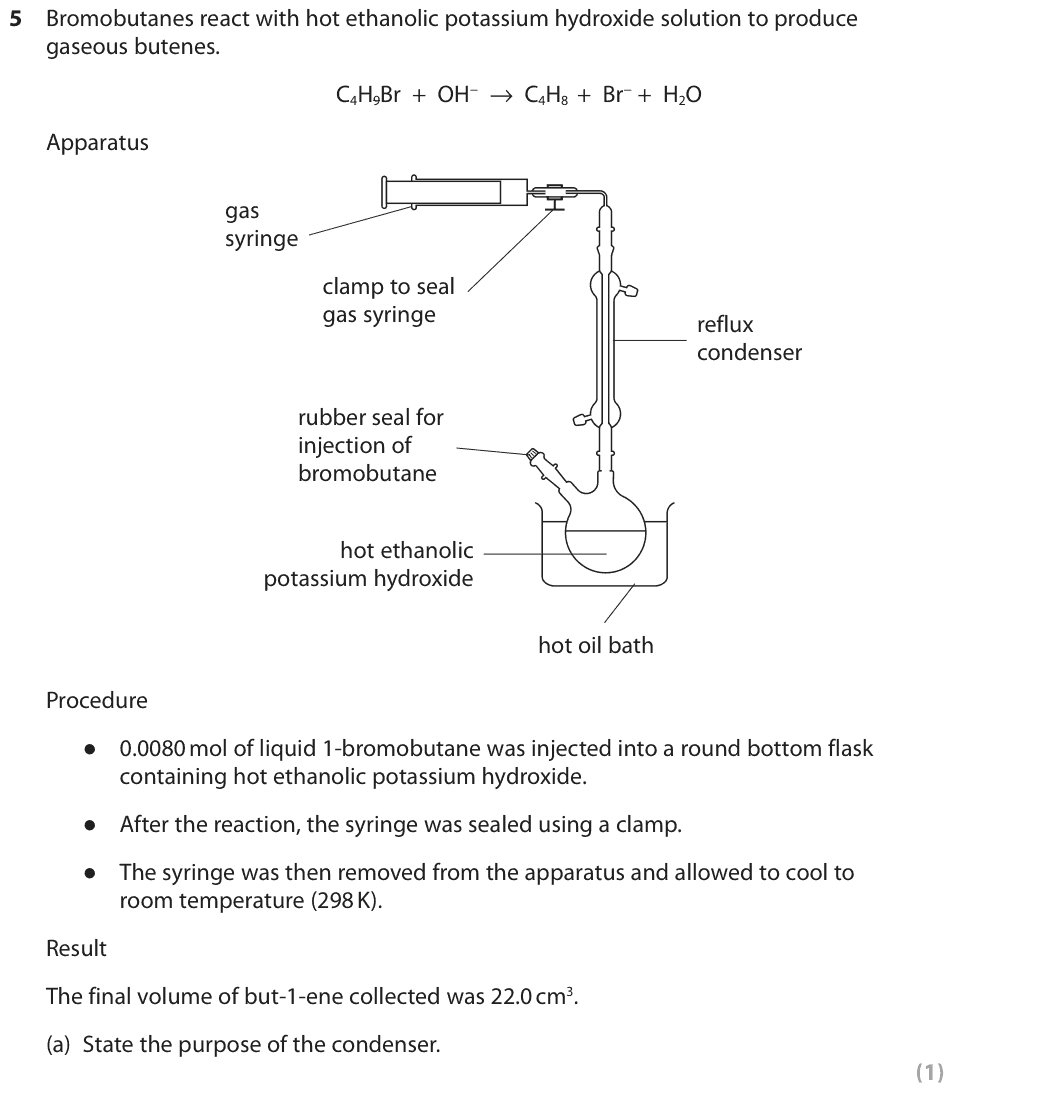
A lack of precision in (a) resulted in the loss of the mark for some. Many answers described condensing products back in the the reaction mixture. This is true for butan-1-ol but not for the but-1-ene which is collected in the gas syringe. The use of bromine water as a test for unsaturation was well known. In (c) the percentage yield calculation was very well understood by higher ability candidates, however lower scoring learners seemed unsure where to begin and failed to score. The unusual calculation in 5(d) proved challenging for all. Some candidates clearly understood what to do, showing working indicating they understood that the number of moles and pressure were constant so the volume depended only on the temperature before correctly completing the calculation. Some candidates made an assumption that the pressure was standard pressure (either 100 or 101 kPa) and then did two pV = nRT calculations to find an answer which was close to the correct one. These candidates were awarded one of the two marks. In (e) those who knew the mechanism of the reaction often scored all 5 marks. The answer to (e)(i), substitution, was often accompanied by nucleophilic, which was correct but not required, or electrophilic which was incorrect and lost the mark. The type of reaction is substitution and it is a nucleophilic mechanism. The test for the –OH group in the alcohol and the expected observation were well known. The mechanism scored well for some learners, with careful positioned arrows and all the relevant lone pairs and dipoles included. Marks were lost through the lack of the dipole on OH‒ or the lack of its charge. Dipoles in the 1-bromobutane were not always included. Some did not include the product bromide ion. As a result a range of marks were scored. Some candidates were clearly unsure where to start and so scored 0. The final part of this question was challenging as many learners did not appreciate that, as well as but-1-ene, but-2-ene would be formed. This compound exists as both cis- and trans- isomers and so the number of isomeric alkene products was, in fact, three.
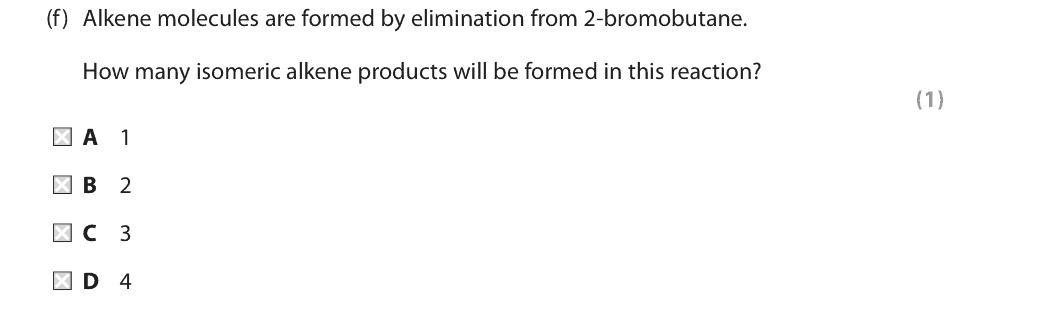
C
A lack of precision in (a) resulted in the loss of the mark for some. Many answers described condensing products back in the the reaction mixture. This is true for butan-1-ol but not for the but-1-ene which is collected in the gas syringe. The use of bromine water as a test for unsaturation was well known. In (c) the percentage yield calculation was very well understood by higher ability candidates, however lower scoring learners seemed unsure where to begin and failed to score. The unusual calculation in 5(d) proved challenging for all. Some candidates clearly understood what to do, showing working indicating they understood that the number of moles and pressure were constant so the volume depended only on the temperature before correctly completing the calculation. Some candidates made an assumption that the pressure was standard pressure (either 100 or 101 kPa) and then did two pV = nRT calculations to find an answer which was close to the correct one. These candidates were awarded one of the two marks. In (e) those who knew the mechanism of the reaction often scored all 5 marks. The answer to (e)(i), substitution, was often accompanied by nucleophilic, which was correct but not required, or electrophilic which was incorrect and lost the mark. The type of reaction is substitution and it is a nucleophilic mechanism. The test for the –OH group in the alcohol and the expected observation were well known. The mechanism scored well for some learners, with careful positioned arrows and all the relevant lone pairs and dipoles included. Marks were lost through the lack of the dipole on OH‒ or the lack of its charge. Dipoles in the 1-bromobutane were not always included. Some did not include the product bromide ion. As a result a range of marks were scored. Some candidates were clearly unsure where to start and so scored 0. The final part of this question was challenging as many learners did not appreciate that, as well as but-1-ene, but-2-ene would be formed. This compound exists as both cis- and trans- isomers and so the number of isomeric alkene products was, in fact, three.

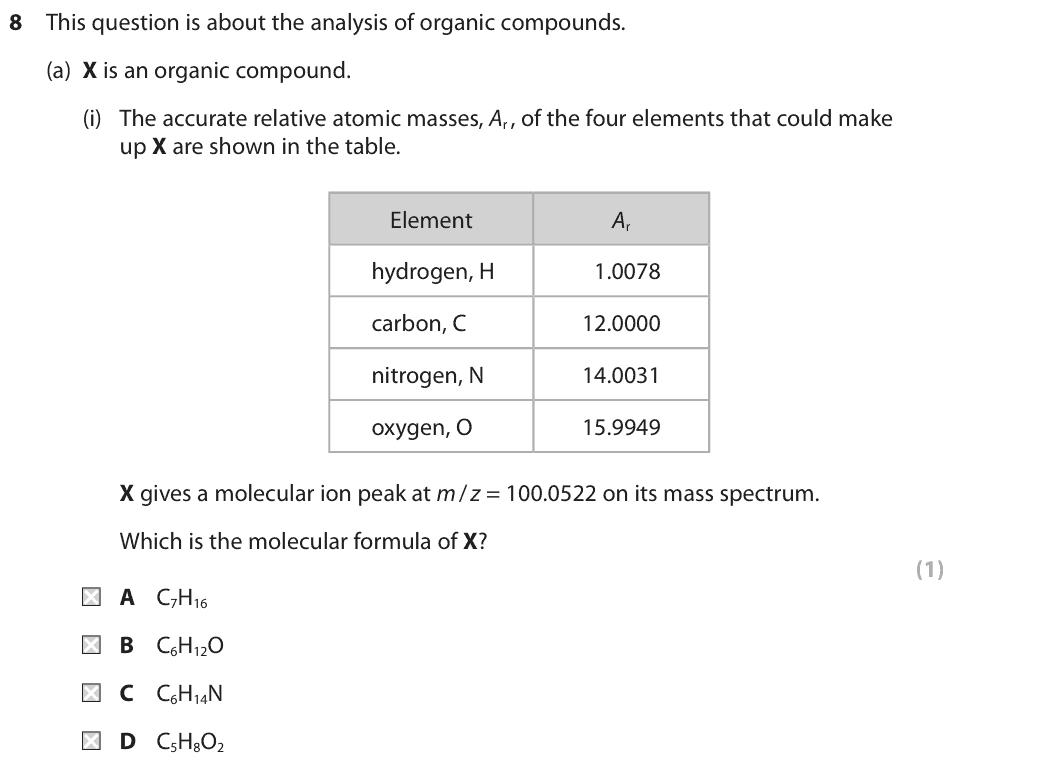
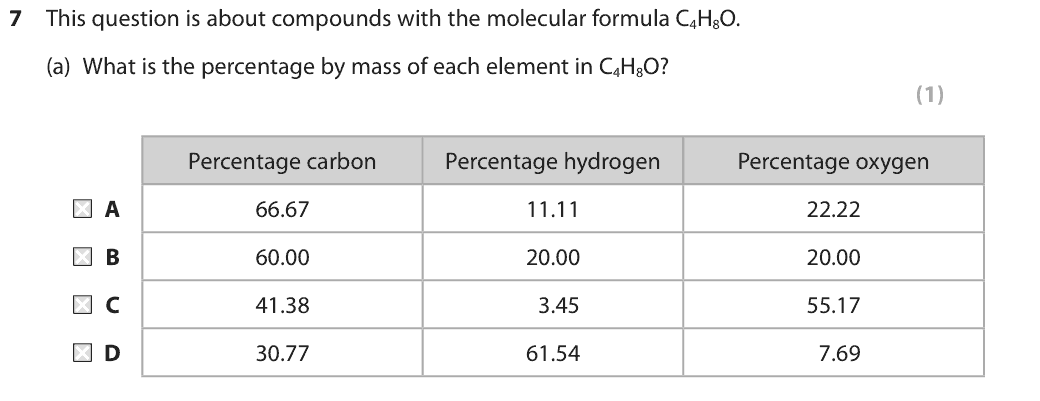
This task seemed low demand in the sense that candidates had to just identify the number and type of each atom and hence, write the molecular formula. However, as with Q6 (a), it provided clear discrimination at the A grade boundary. Each element was subject to miscounting, though not surprisingly mistakes in the number of hydrogen atoms were most common. Candidates can easily practice this skill in conjunction with translating skeletal formulae into displayed formulae.
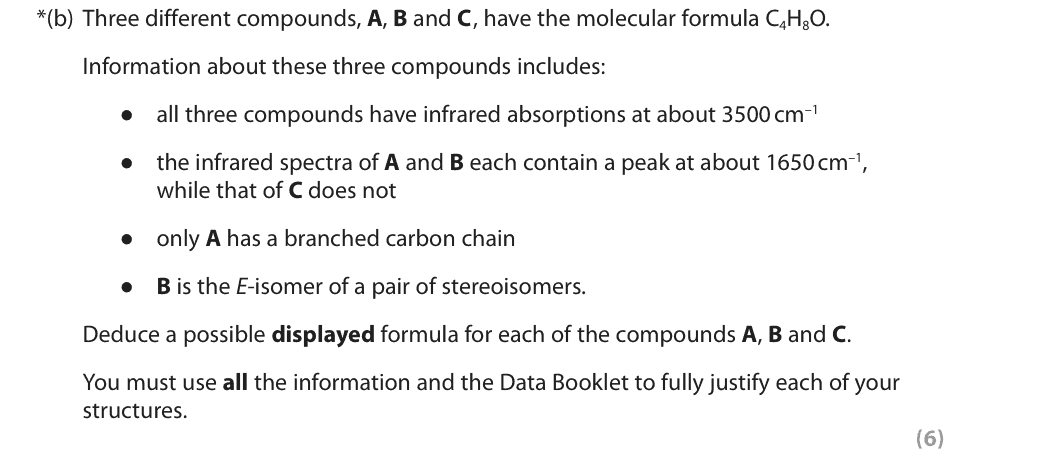
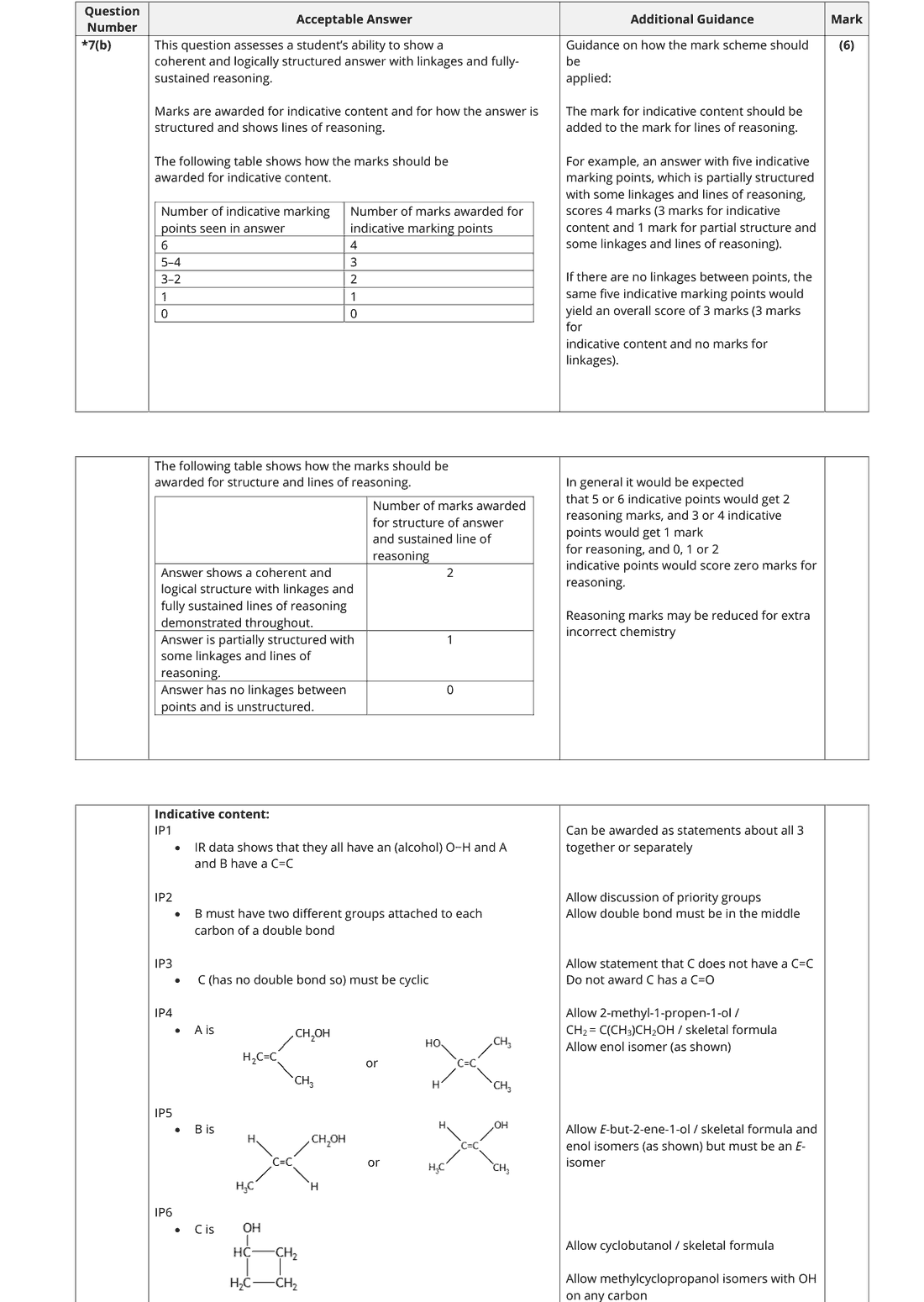
The first part of Q7 was relatively straightforward and most candidates got this mark. The 6 mark question involved logical deduction of three compounds. With questions like this it is important to demonstrate how you have identified the three structures, with some candidates just drawing the three. This will give a maximum of 3 marks. The most commonly missed IPs were the structure of C and some demonstration of an understanding that B must have one of the correct structures because it was an E- isomer and must have the higher priority groups above and below the double bond.
Skills: MS4.2 Visualise and represent 2D and 3D forms including two- dimensional representations of 3D objects

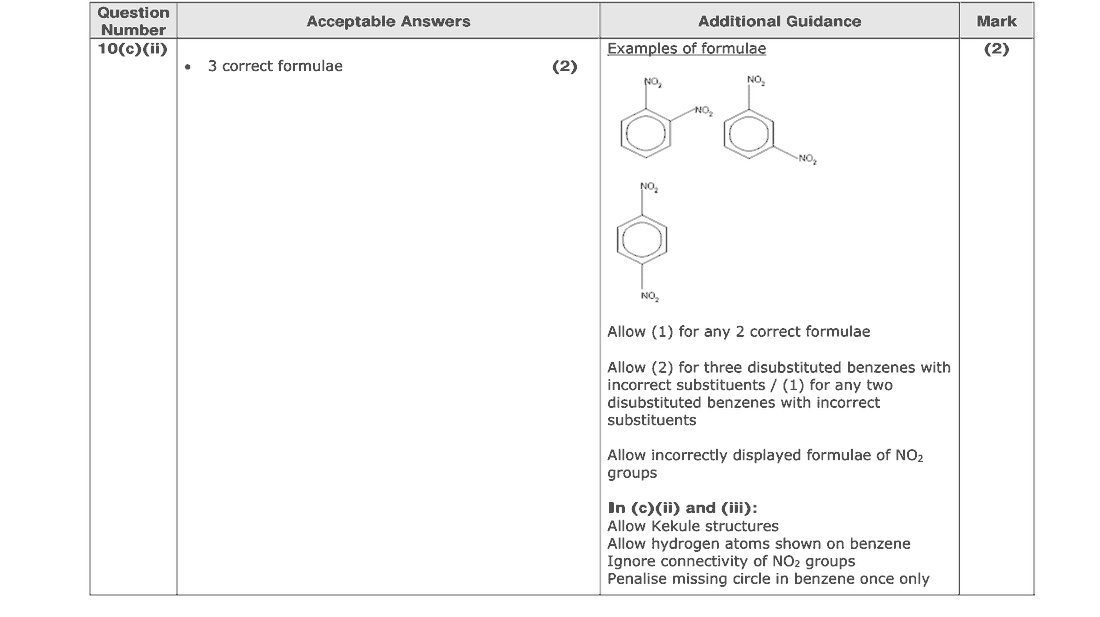
Many candidates gave the three isomers of dinitrobenzene in (c)(ii). Candidates could score the marks for any three disubstituted benzenes to allow for the incorrect molecular formulae they may have given earlier. Many candidates correctly identified D and showed the correct carbon environments on the isomers. The most common error was to show three carbon environments on 1,4-dinitrobenzene. Again, transferred error marks were available for any disubstituted benzenes.
Skills: MS4.2 Visualise and represent 2D and 3D forms including two- dimensional representations of 3D objects
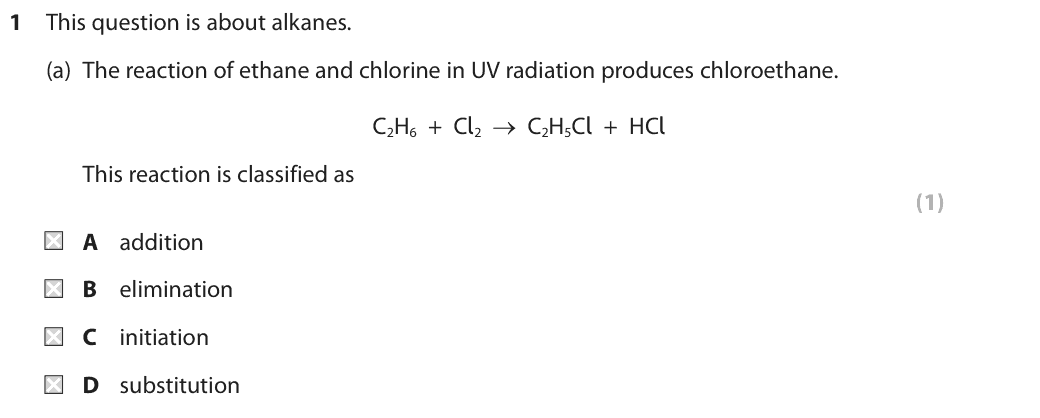
D
C
B
C
B
C

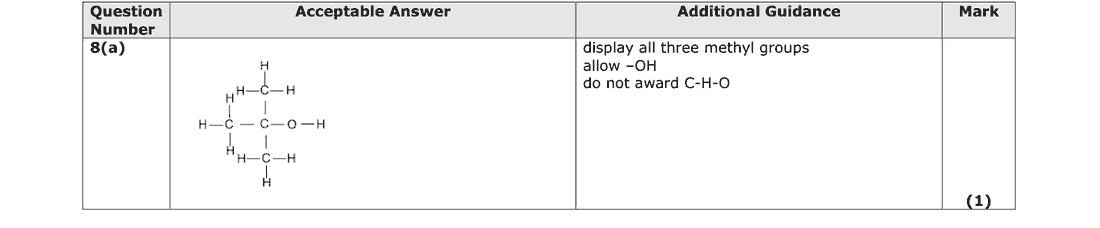
This question tested the ability to draw a fully displayed formula.
Skills: MS4.2 Visualise and represent 2D and 3D forms including two- dimensional representations of 3D objects

Just over 55% of candidates could correctly draw the two structural isomers of 4-nitrophenol. The most common error was drawing the 4-nitro isomer again.

This question polarized answers in the sense that most candidates who could work out one structure with only two hydrogen environments, could then easily deduce a second. Many answers that failed to score did so because they could not draw the structure of an ester, often suggesting carboxylic acids. Others did show esters but focused on showing two isomers rather than considering the hydrogen environments.

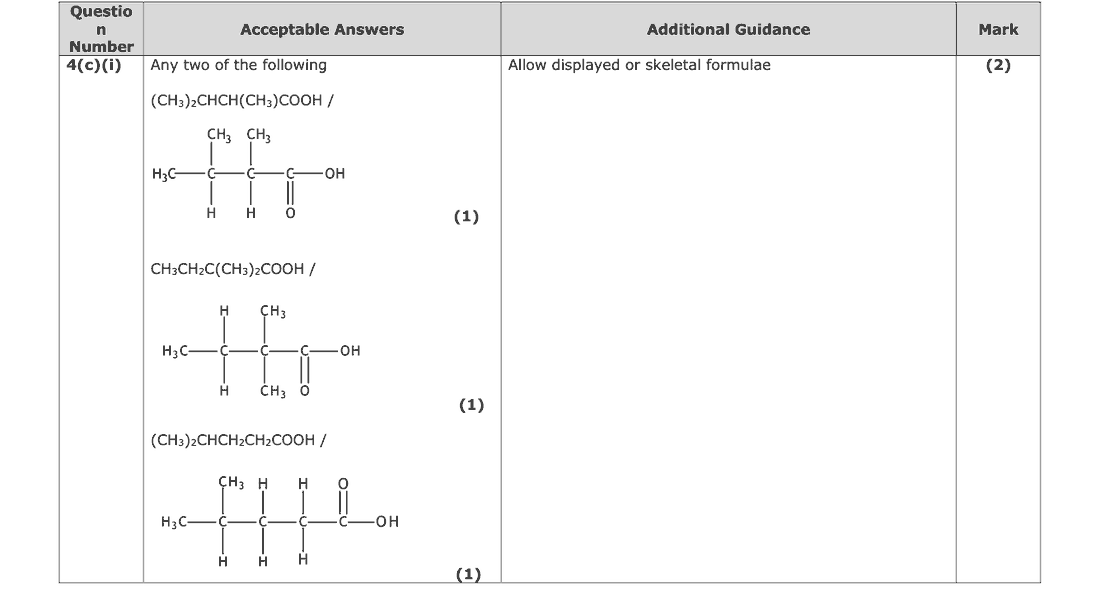
Part (i) proved a significant level of challenge for many.In a similar way to (b)(i), answers that gave two structural isomers rather than considering the carbon environments were common. Others, concentrating on the five environments, ignored the need for the structures to be carboxylic acids, so lost both marks.Several otherwise good answers missed out because they made a mistake when drawing a structural formula, having correctly shown a displayed formula. Most students were able to score in (c)(ii).The most common mistakes were the inclusion of a benzene ring, or showing OH groups in the 1,2- positions.

Part (i) proved a significant level of challenge for many.In a similar way to (b)(i), answers that gave two structural isomers rather than considering the carbon environments were common. Others, concentrating on the five environments, ignored the need for the structures to be carboxylic acids, so lost both marks.Several otherwise good answers missed out because they made a mistake when drawing a structural formula, having correctly shown a displayed formula. Most students were able to score in (c)(ii).The most common mistakes were the inclusion of a benzene ring, or showing OH groups in the 1,2- positions.
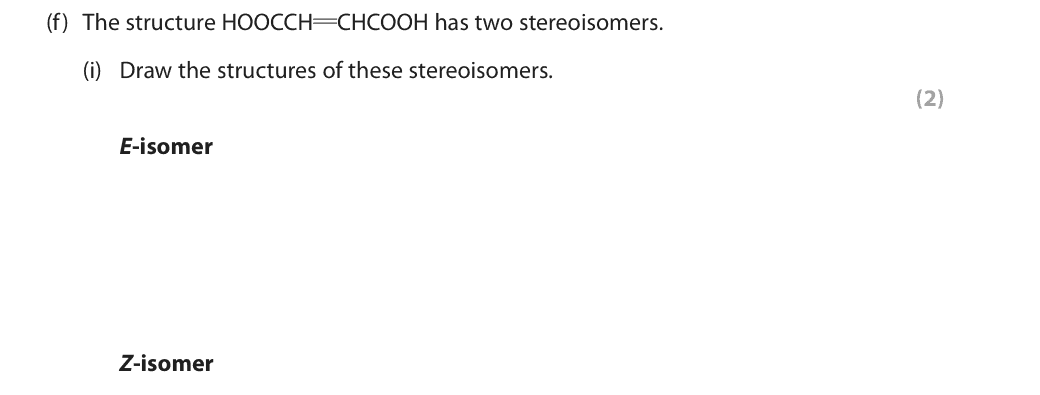
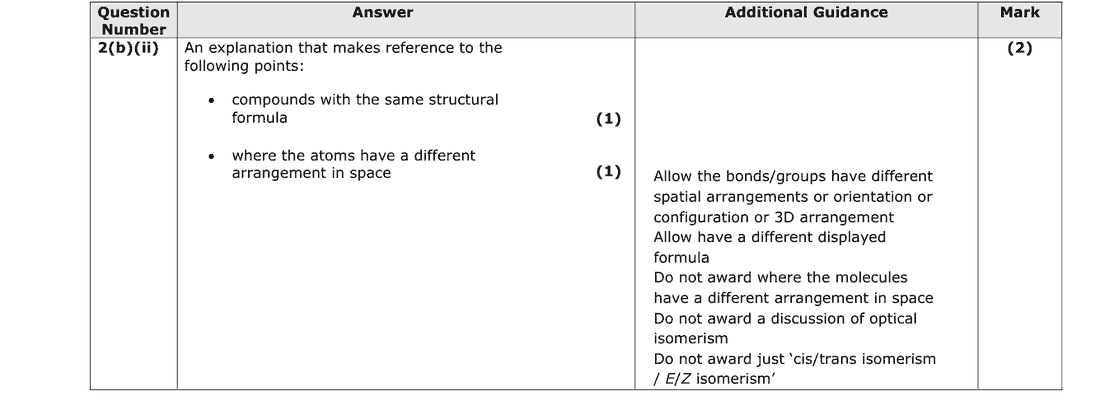
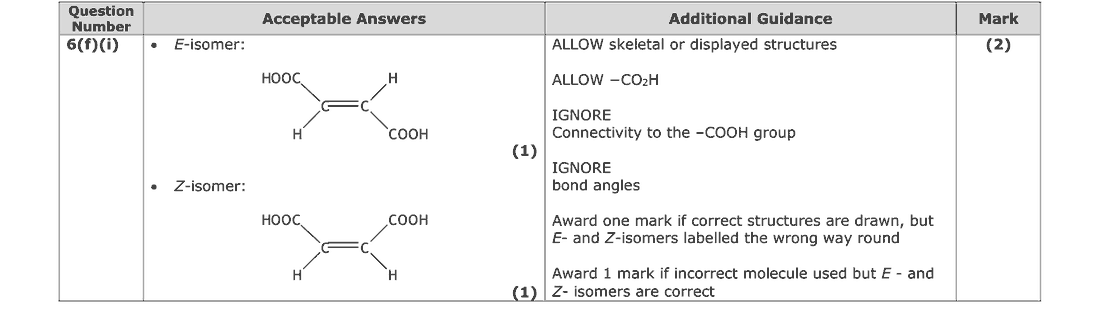
This presented little difficulty for the vast majority of candidates who were clearly well-taught in the drawing of E-/Z-isomers. Only a small minority needed to rely on the rescue mark, available for those who labelled the isomers the wrong way round. A small number presented diagrams with incorrect connectivity to the -COOH group, generally through careless drawing rather than a belief that the group bonded via an atom other than the carbon. In this context they were still awarded marks if the isomers were otherwise correct.
Skills: MS4.2 Visualise and represent 2D and 3D forms including two- dimensional representations of 3D objects

Over 80% of candidates successfully explained that there was restricted rotation about the double bond. Many of these candidates, whilst not required by the question, explained why the rotation was restricted, by considering orbital overlap. Far fewer candidates managed to explain the other key criteria required for E/Z to occur, namely the different groups on each carbon of the double bond.
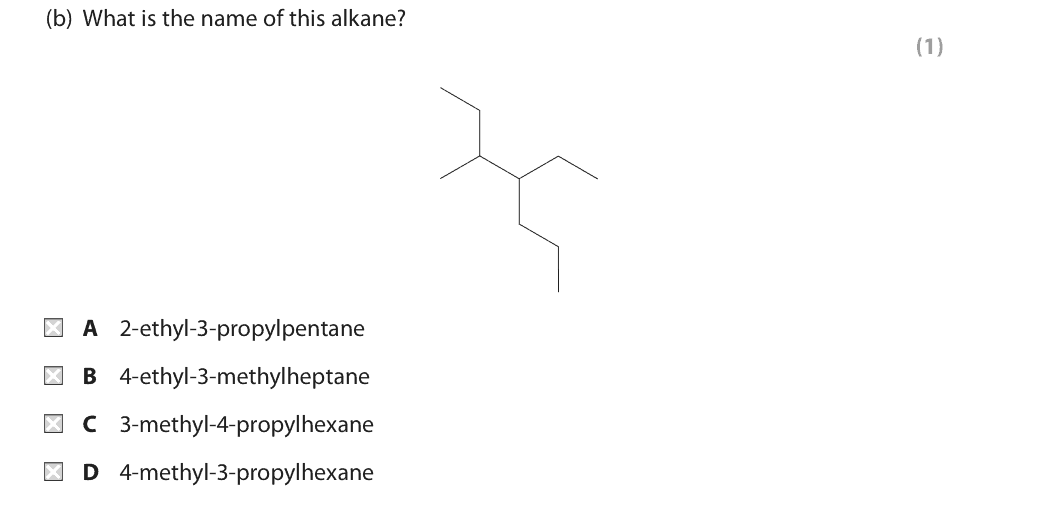
B

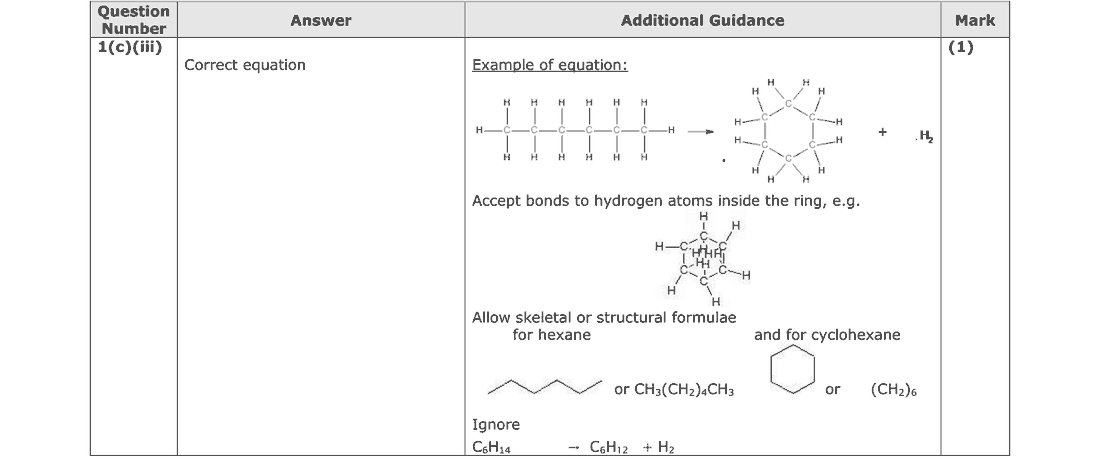
The most common error made by candidates was the omission of the hydrogen product which is in addition to the cyclohexane. The question instructed candidates to use "displayed formulae" because then the difference of two hydrogens should have been more apparent. However a significant number of candidates gave correct skeletal formulae, which was credited, but this did not help them in answering the question. In addition some responses had 'semi-skeletal' formulae, where the carbon atoms were not shown but the hydrogen atoms were. Centres are advised to get their candidates to practise writing the different types of formulae so that they are comfortable and confident in their use in different settings.

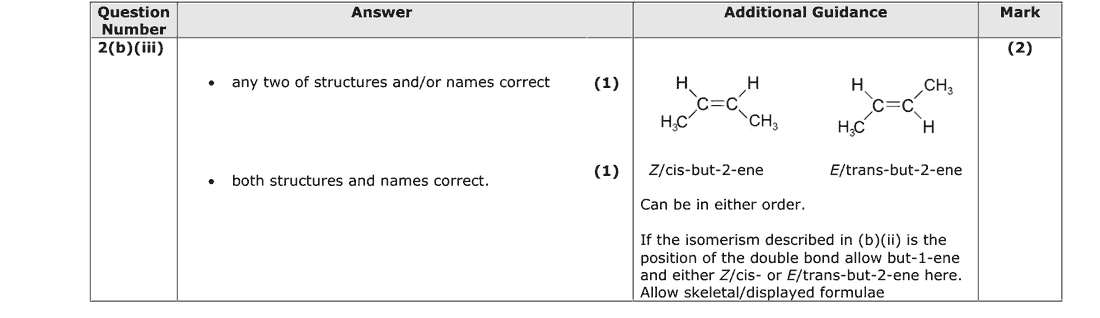
This question produced a wide spread of marks. In the better responses, candidates appreciated that with three marks available it was likely that there would be three formulae required. They were able to draw the E/Z isomers of but-2-ene. It was most common to see the formulae for but-1-ene and E-but-2-ene. Occasionally the formula for the branched 2-methylpropene was drawn but this is not possible to produce from a linear halogenoalkane so did not score.
Skills: MS4.2 Visualise and represent 2D and 3D forms including two- dimensional representations of 3D objects
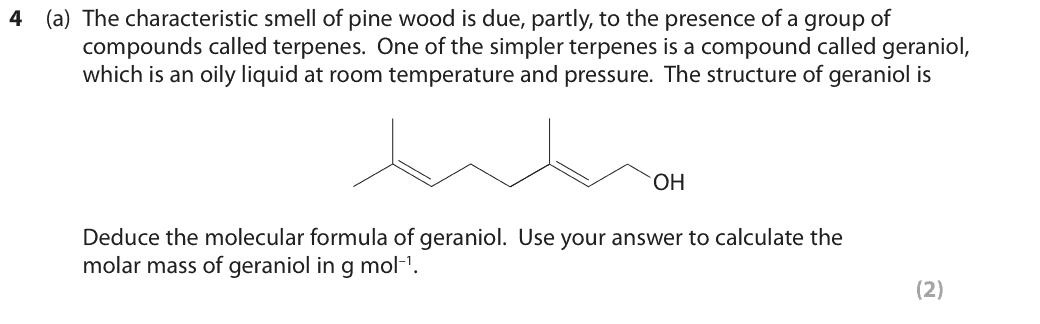
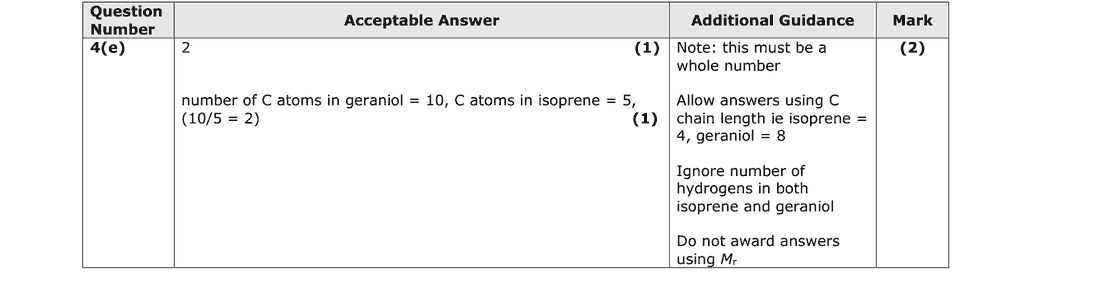
This question required the conversion of a skeletal formula to a molecular formula. The geraniol molecule used in the question is quite large and considerable care was required to correctly assess the number of hydrogen atoms. Some candidates were unable to deduce the molecular formula but were still able to successfully calculate the molar mass from the skeletal formula.
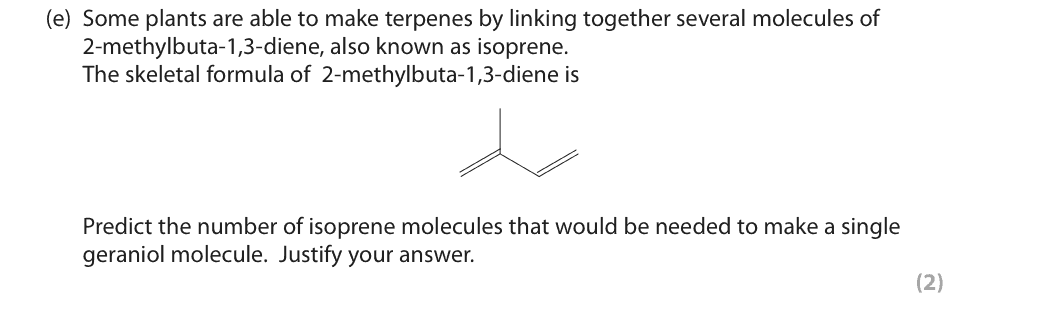
This question required candidates to consider the formulae of geraniol and isoprene. From this they could predict the number of isoprene molecules used by plants to make geraniol. Arguments based on the number of hydrogen atoms or molar mass, do not work. However, the answer is clear when considering the numbers of carbon atoms in each molecule. Some candidates even deduced that a water molecule was also involved, although this was not tested. Answers that included fractions of a molecule were not appropriate.

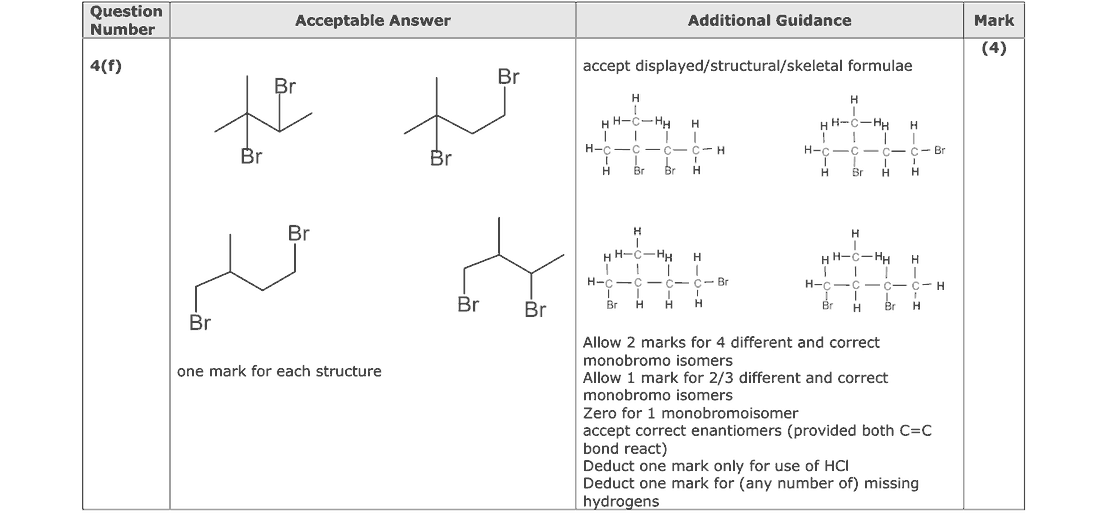
The question asked for the formulae of four isomers produced when excess HBr reacts with the diene. Displayed, structural and skeletal formulae were all acceptable. Enantiomers are also possible products in this reaction but none were seen. Enantiomers are beyond the spec of this course but correct enantiomers would have been rewarded. Many candidates ignored the hint given by the word excess which was emboldened in the question, and restricted themselves to the monobromo products. Some credit was given for correct monobromo isomers. Some attempts at substitution reactions were seen where addition reactions were clearly required.
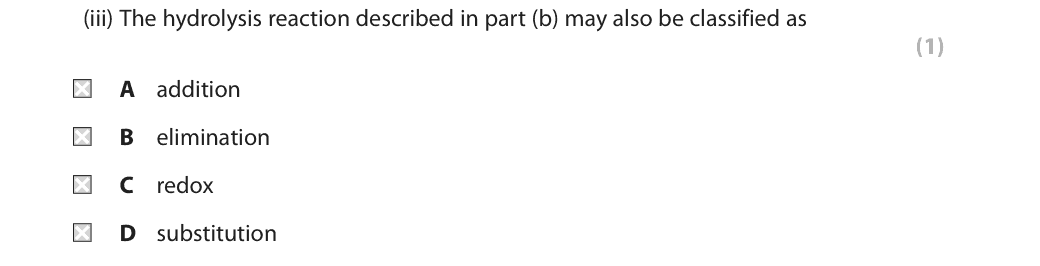
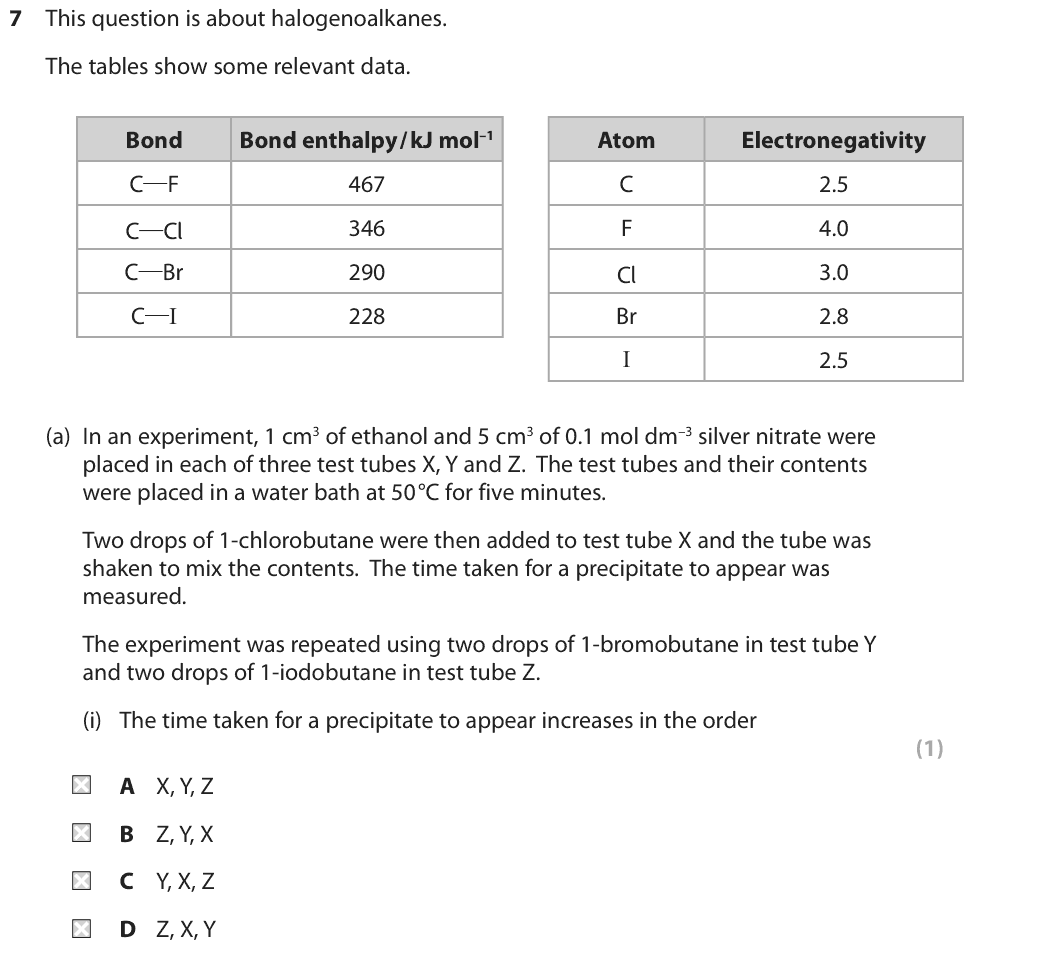
D

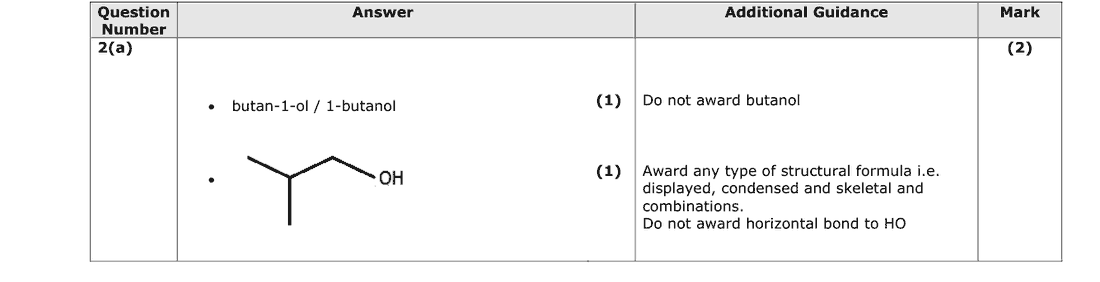
Most candidates were able to gain at least one mark for this question with many also awarded the second mark. Common errors included drawing the same isomer twice and incorrect bonding to the alcohol group.
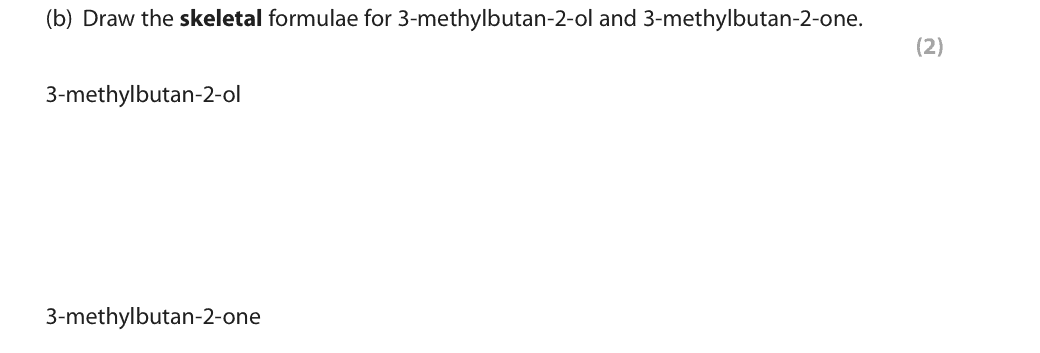
Understanding and use of skeletal formulae seemed embedded and this question was well answered consequently. The most common error was the use of 'CH3' in the structures.
Skills: MS4.2 Visualise and represent 2D and 3D forms including two- dimensional representations of 3D objects
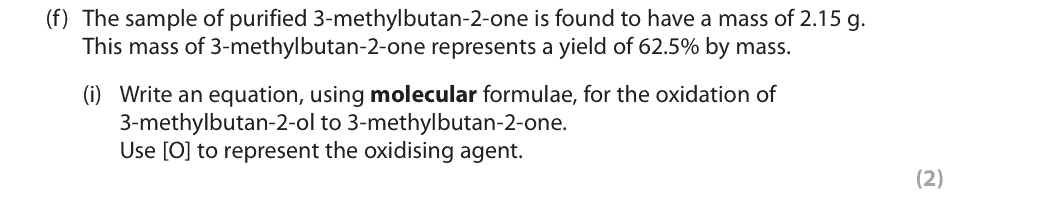
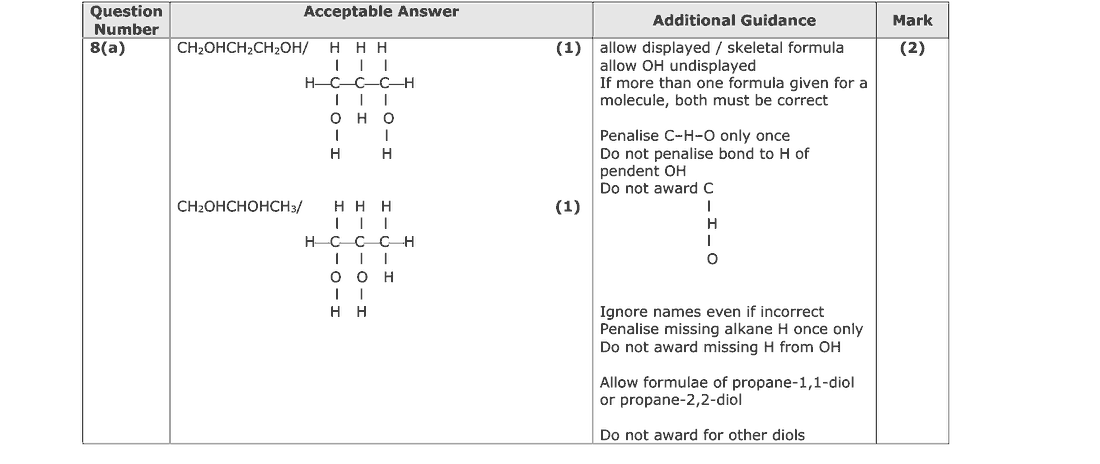
Given its relatively straightforward nature, this question differentiated between candidates extremely well. Candidates had a lot to consider from counting carbon atoms to recognition that the other product was water. However, the most frequent error was in failing to use molecular formulae correctly, with candidates separating OH in the alcohol and/or writing structural formulae.
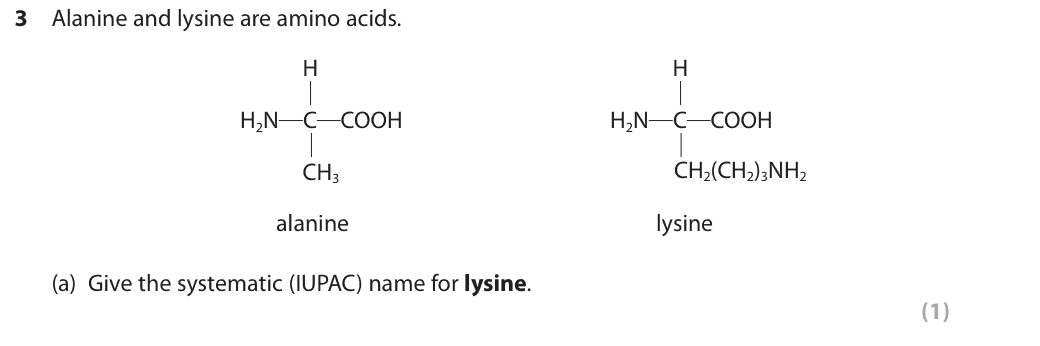
Candidates found this difficult, even though it is a relatively low demand skill. The significance of amino acid was lost on many. Even those who appreciated that ‘diaminohexanoic acid’ was the main part of the name often did not count the carbon in the –COOH, so used ‘1,5-' as their prefix.

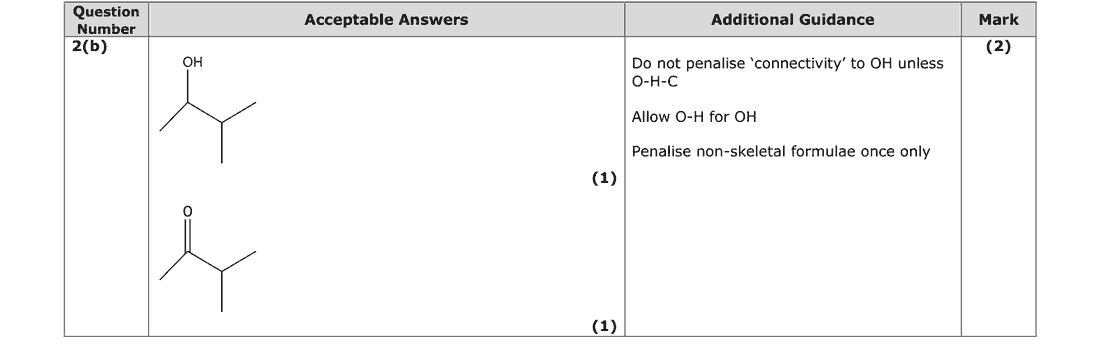
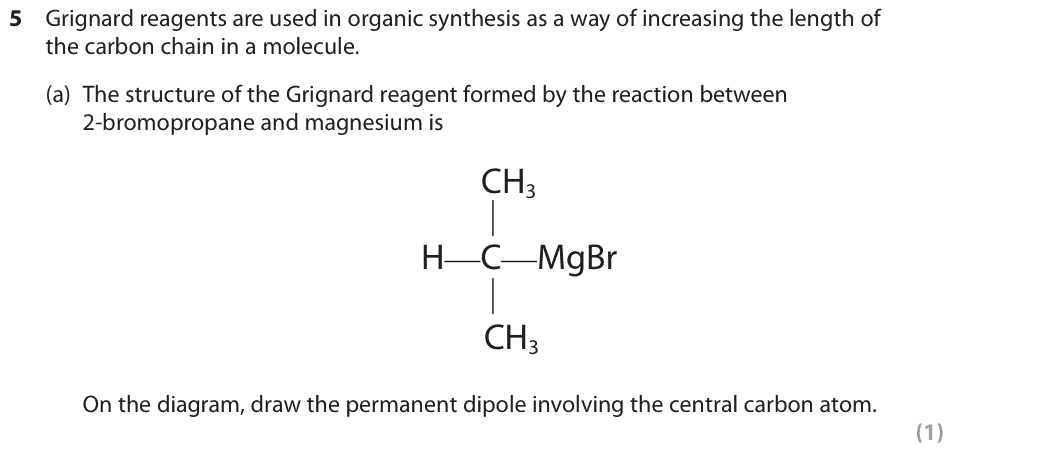
Some candidates perhaps overlooked part (a) since a number were blank. Those who did could not see past Cδ+ used frequently in other parts of the specification. Many who had the required negative charge did not complete the dipole on magnesium to score the mark. Writing the systematic name in part (b) was more discriminating than expected, with the most common being numbering of the methyl group, which was often given the positional prefix of 4. Other candidates drew the correct alcohol. However, they then named it using whatever portion of the chain was shown horizontally on their diagram, which did not always consist of 5 carbons. This was a shame at it seemed that they had done the more difficult task, then lost a mark for essentially an AS-level skill.
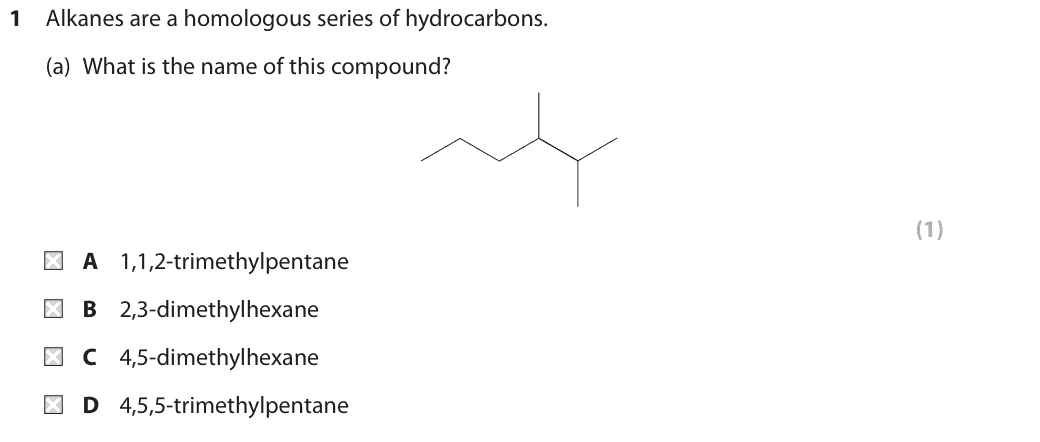
B
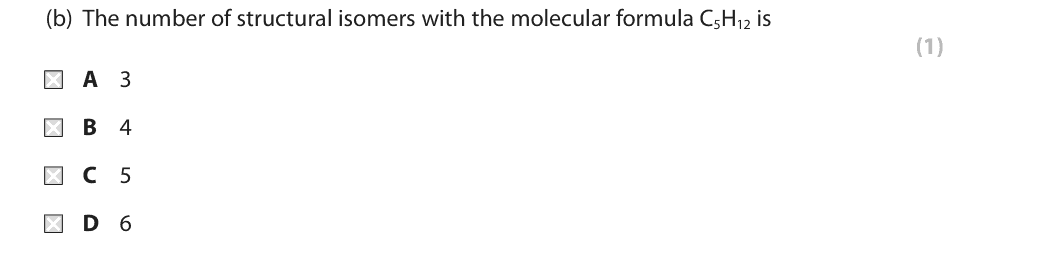
A
Skills: MS4.2 Visualise and represent 2D and 3D forms including two- dimensional representations of 3D objects

Many candidates found this a challenging item to answer. Although the majority of candidates could draw the skeletal formula for heptane, they found drawing a heptagon for cycloheptane more difficult. However, examiners allowed any cyclic shape with 7 sides. Many candidates did not complete the balanced equation by adding H2. A few candidates incorrectly showed a double bond in the cyclic product.
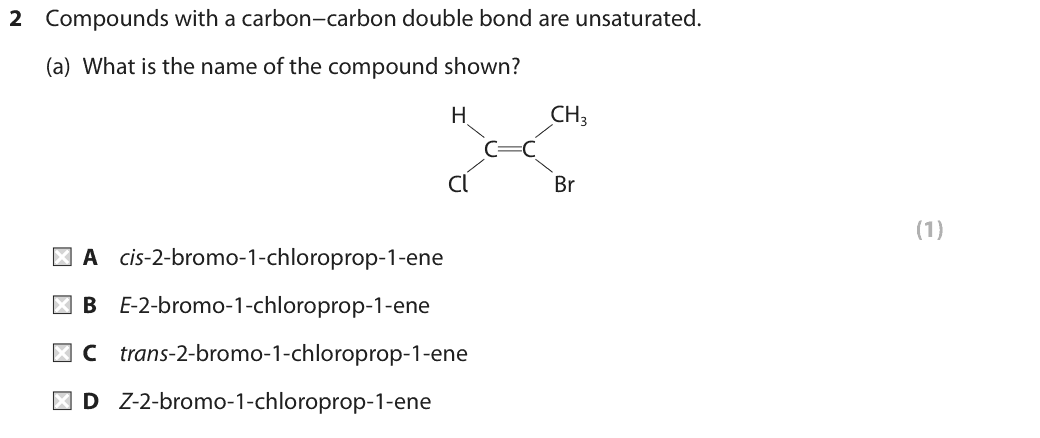
D
Skills: MS4.2 Visualise and represent 2D and 3D forms including two- dimensional representations of 3D objects
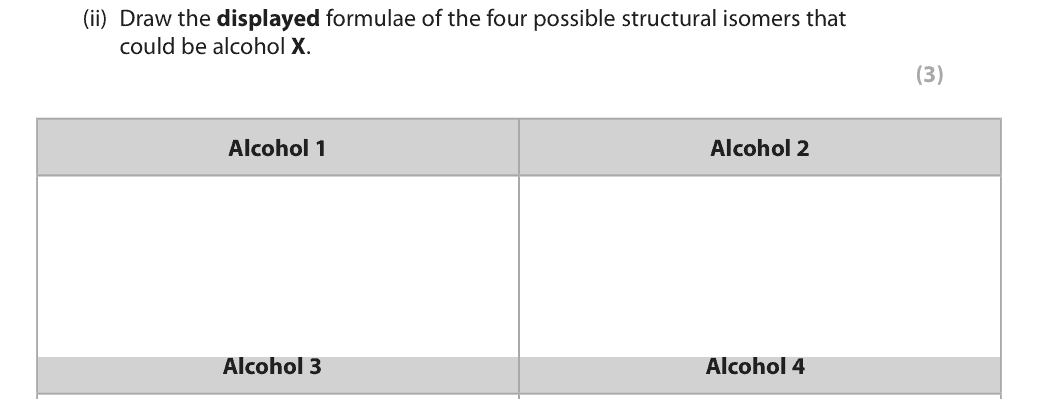
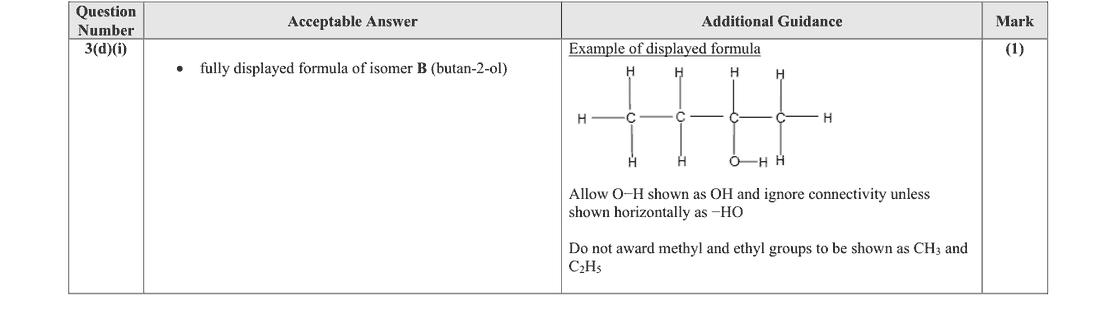
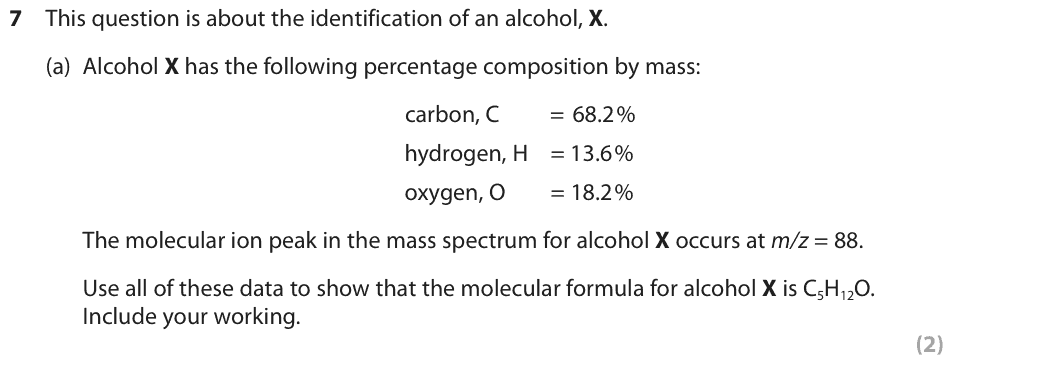
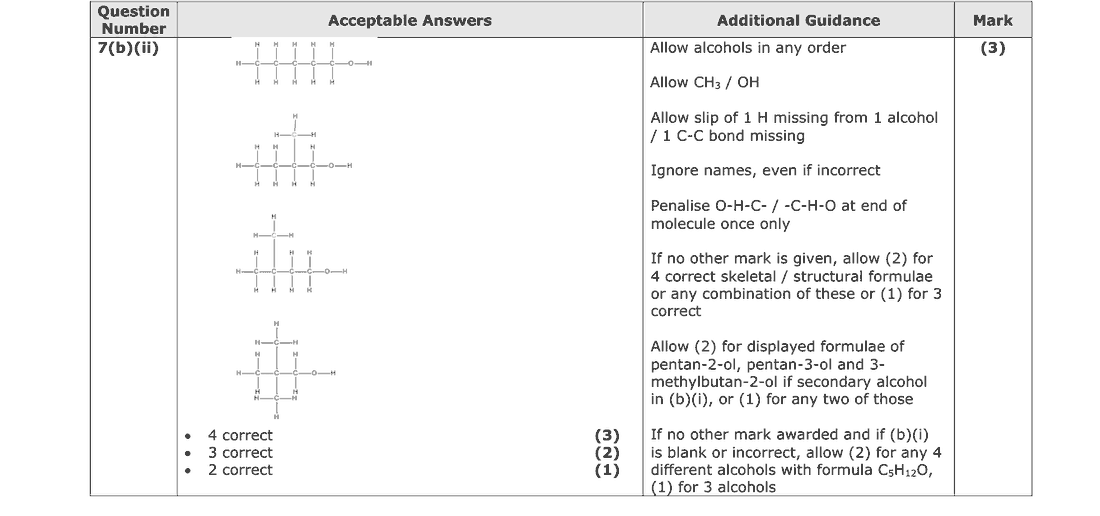
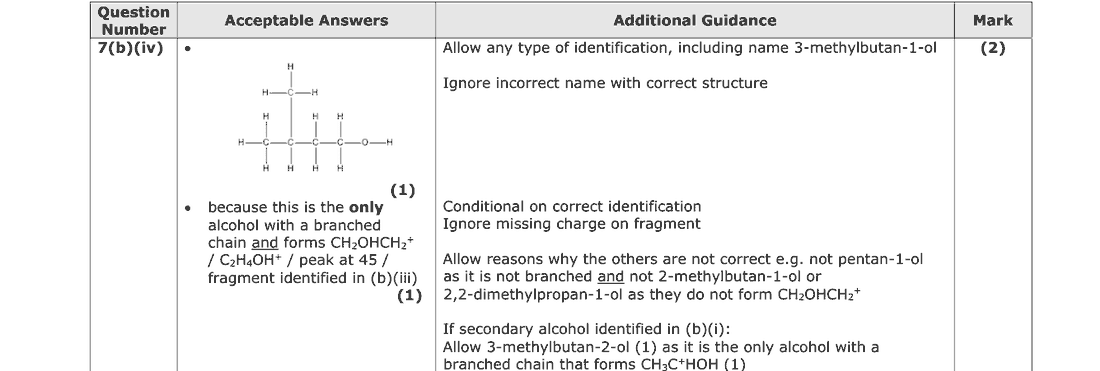
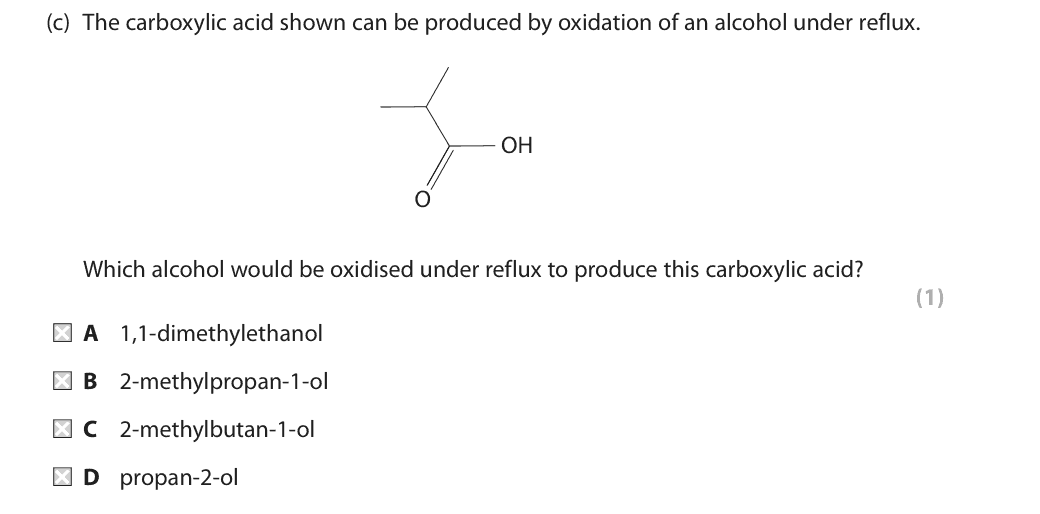
Candidates had to use different pieces of information to identify an alcohol. Many rose to the challenge and worked out that alcohol X was 3-methylbutan-1-ol and explained how they deduced this. Other candidates found this more challenging and floundered before they reached the end. It was surprising that some candidates did not know that primary alcohols are oxidised to carboxylic acids. A few candidates even thought that alcohol X was an aldehyde. Candidates who did state that X was a secondary or even tertiary alcohol could receive consequential marks for the rest of the question but they rarely got much further. Some candidates struggled to draw the displayed formulae of four different primary alcohols and they sometimes drew two that were the same or included a secondary or even a tertiary alcohol. Candidates should take more care when drawing the displayed formulae of alcohols as some showing the H of the OH bond joined to a carbon atom instead of joining through the O and they lost a mark. A significant number of candidates omitted the positive charge from the species giving the peak in the mass spectrum. Quite a few candidates who did deduce the correct structure of the alcohol gave an incorrect name, although they were not penalised on this occasion. Some did not give a full explanation for their choice of alcohol and just stated that it is branched.
Skills: MS4.2 Visualise and represent 2D and 3D forms including two- dimensional representations of 3D objects

Candidates had to use different pieces of information to identify an alcohol. Many rose to the challenge and worked out that alcohol X was 3-methylbutan-1-ol and explained how they deduced this. Other candidates found this more challenging and floundered before they reached the end. It was surprising that some candidates did not know that primary alcohols are oxidised to carboxylic acids. A few candidates even thought that alcohol X was an aldehyde. Candidates who did state that X was a secondary or even tertiary alcohol could receive consequential marks for the rest of the question but they rarely got much further. Some candidates struggled to draw the displayed formulae of four different primary alcohols and they sometimes drew two that were the same or included a secondary or even a tertiary alcohol. Candidates should take more care when drawing the displayed formulae of alcohols as some showing the H of the OH bond joined to a carbon atom instead of joining through the O and they lost a mark. A significant number of candidates omitted the positive charge from the species giving the peak in the mass spectrum. Quite a few candidates who did deduce the correct structure of the alcohol gave an incorrect name, although they were not penalised on this occasion. Some did not give a full explanation for their choice of alcohol and just stated that it is branched.
Dropping marks on calculations, mechanisms or the core practicals? Book a trial session with an A-level chemistry tutor.