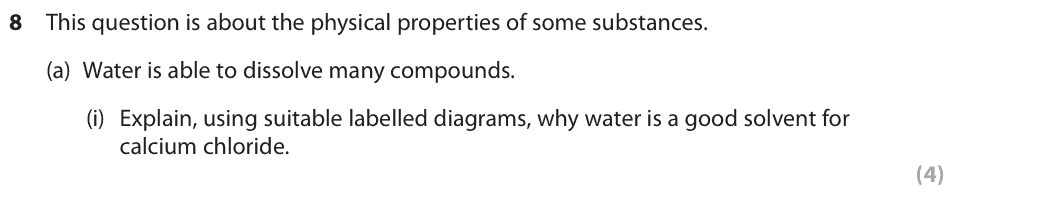
Notes and key-term cards for this topic are being written by our tutors. The past-paper questions below are ready now.
Specification statements
Show the 5 statements from the specification
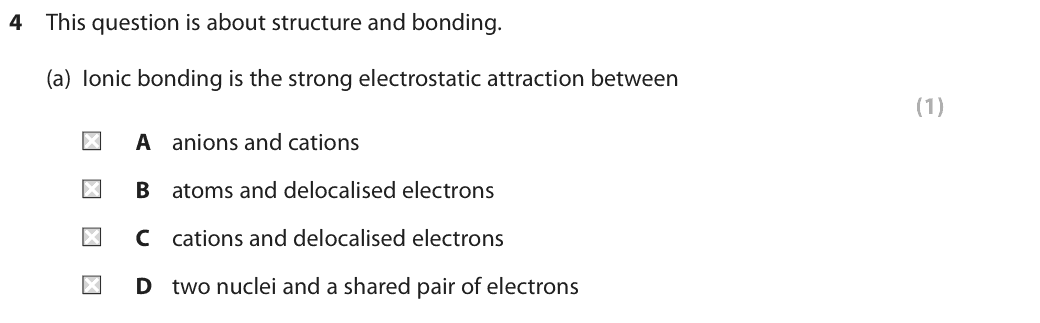
2.23 know that giant lattices are present in: • i ionic solids (giant ionic lattices) • ii covalently bonded solids, such as diamond, graphite and silicon(IV) oxide (giant covalent lattices) • iii solid metals (giant metallic lattices)
2.24 know that the structure of covalently bonded substances such as iodine, I2, and ice, H2O, is simple molecular
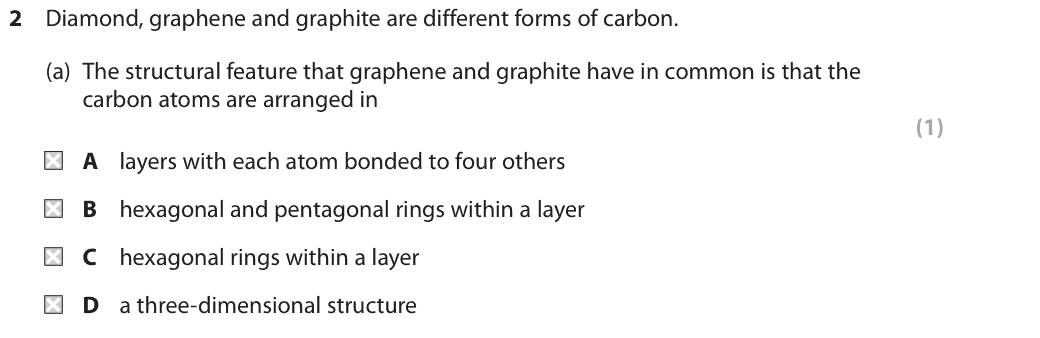
2.25 know the different structures formed by carbon atoms, including graphite, diamond and graphene
2.26 be able to predict the type of structure and bonding present in a substance from numerical data and/or other information
2.27 be able to predict the physical properties of a substance, including melting and boiling temperature, electrical conductivity and solubility in water, in terms of: • i the types of particle present (atoms, molecules, ions, electrons) • ii the structure of the substance • iii the type of bonding and the presence of intermolecular forces, where relevant
Six-mark extended response questions on this topic
Tap a question to zoom it. Where a part needs a figure, table or structure from earlier in the question, that part folds out above it; the mark scheme and examiner's comment open underneath. Have Edexcel's Data Booklet beside you; the Periodic Table is on the back page of every paper.
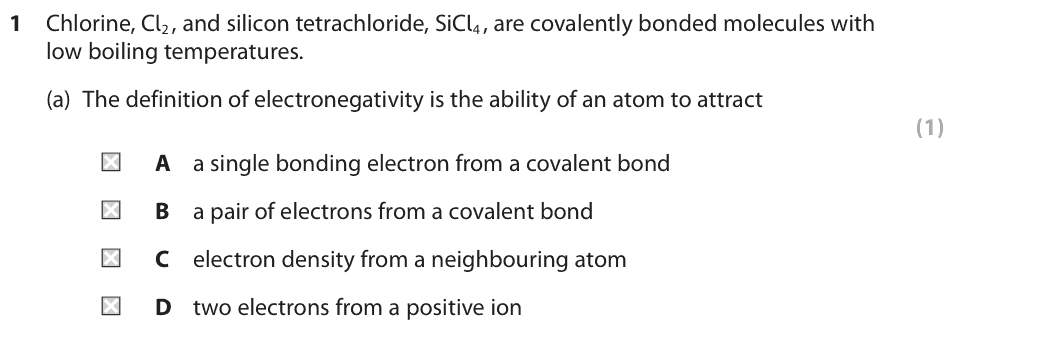
June 2025 · AS Paper 1 · Q1(d)2 marksExplanation
Earlier part of question 1 that this part uses
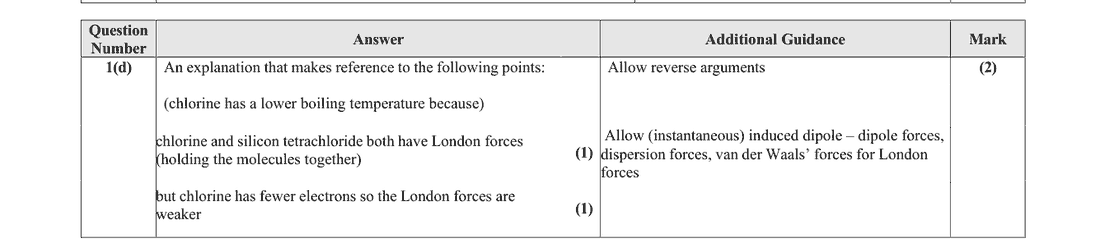
Mark scheme
Examiner's comment
Q1d was answered reasonably well. It required candidates to explain the difference in boiling temperature of chlorine and silicon tetrachloride. Most candidates lost marks for referring to the covalent bonds being broken in silicon tetrachloride or by referring to the incorrect bonding. Some candidates compared the size of the London forces but did not explain that it is due to the number of electrons in the molecule.
Notes from the mark scheme and report
Both chlorine and silicon tetrachloride have London forces between their molecules (allow dispersion, van der Waals, instantaneous dipole–induced dipole)
chlorine has fewer electrons so its London forces are weaker. Reverse argument allowed. Common errors: covalent bonds broken in silicon tetrachloride
wrong type of bonding
comparing the size of the London forces without linking it to the number of electrons
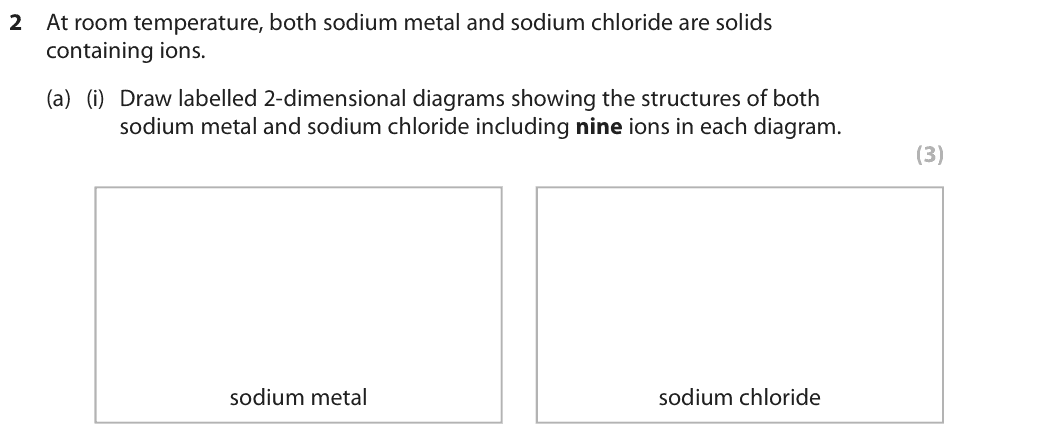
June 2025 · AS Paper 1 · Q2(a)(i)3 marksDiagram or structure
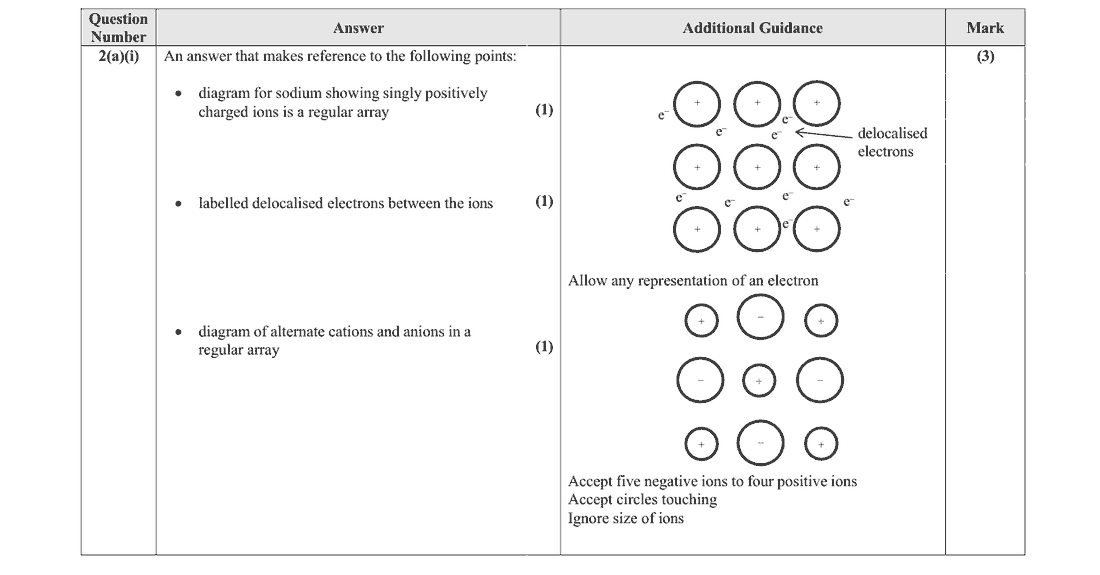
Mark scheme
Examiner's comment
Q2ai required candidates to draw a labelled diagram of the metallic bonding in sodium and the ionic bonding in sodium chloride. Considering this is GCSE content, it was not answered considerably well. Candidates must ensure the diagram is labelled or they will lose marks, and the question asks for nine ions in each example - any other number of ions will lose marks. They should read the question carefully. In addition, candidates lost marks for charges missing on the ions, the ions not being in a regular arrangement and drawn randomly, and for drawing the incorrect type of bonding.
Notes from the mark scheme and report
Sodium: positive ions (1+) in a regular array (1), with labelled delocalised electrons between them (1). Sodium chloride: alternating cations and anions in a regular array (1) (five of one ion and four of the other
circles may touch
size of ions ignored). Nine ions were asked for in each diagram. Marks lost for: no labels
a number of ions other than nine
charges missing
ions drawn at random
the wrong type of bonding
Skills: MS4.2 Visualise and represent 2D and 3D forms including two- dimensional representations of 3D objects
June 2025 · AS Paper 1 · Q2(a)(iii)1 markShort answer
Earlier part of question 2 that this part uses
Mark scheme
Examiner's comment
Q2aiii required candidates to compare the bonding in sodium and sodium chloride. Although this question was answered well, lots of candidates stated that ‘ionic bonding is stronger than metallic bonding’ which is an incorrect statement and required the mention of sodium and sodium chloride for the mark.
Notes from the mark scheme and report
The (metallic) bonding in sodium is not as strong as the (ionic) bonding in sodium chloride
or more energy is needed to overcome the bonding in sodium chloride than in sodium. The answer must be about sodium and sodium chloride: the general statement 'ionic bonding is stronger than metallic bonding' is incorrect and was not credited
June 2025 · AS Paper 1 · Q2(a)(iv)3 marksExplanation
Earlier part of question 2 that this part uses
Mark scheme
Examiner's comment
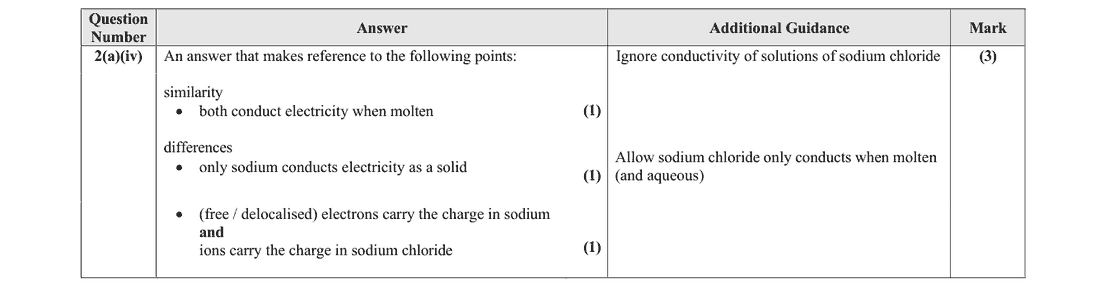
Q2aiv required candidates to compare and contrast the electrical conductivity of sodium and sodium chloride. As a compare and contrast question, candidates were required to list similarities and differences. Most candidates stated that sodium conducts, however they needed to specify the states it conducts in to compare with the sodium chloride. Most candidates achieved the mark for the charge carriers, although a small number of candidates talked about delocalised electrons for sodium chloride, which is incorrect.
Notes from the mark scheme and report
Similarity: both conduct when molten. Difference: only sodium conducts as a solid (allow sodium chloride conducts only when molten or aqueous). Charge carriers: (delocalised) electrons in sodium AND ions in sodium chloride. Conductivity of sodium chloride solution is ignored. Many said sodium conducts without giving the states
a few gave delocalised electrons for sodium chloride
June 2024 · AS Paper 1 · Q7(d)4 marksExplanation
Earlier part of question 7 that this part uses
Mark scheme
Examiner's comment
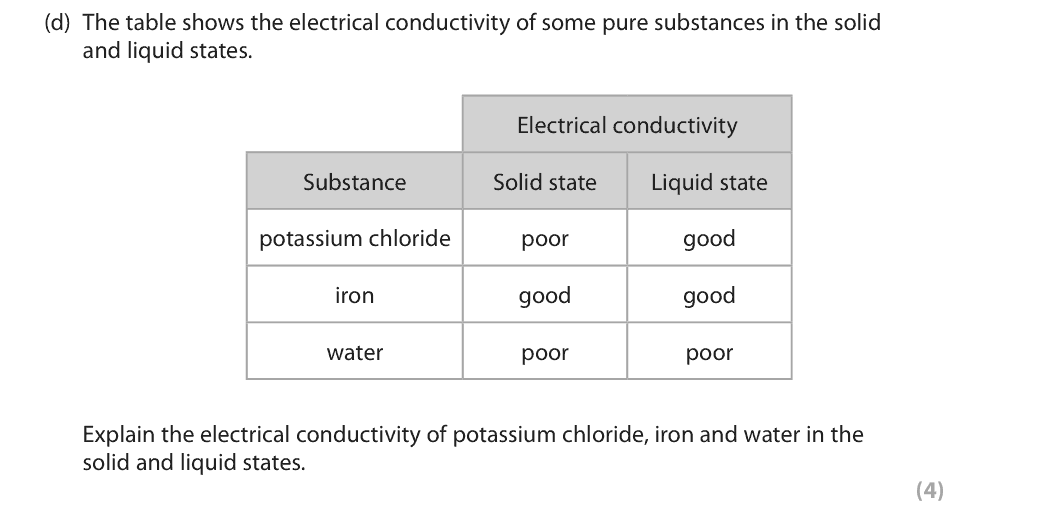
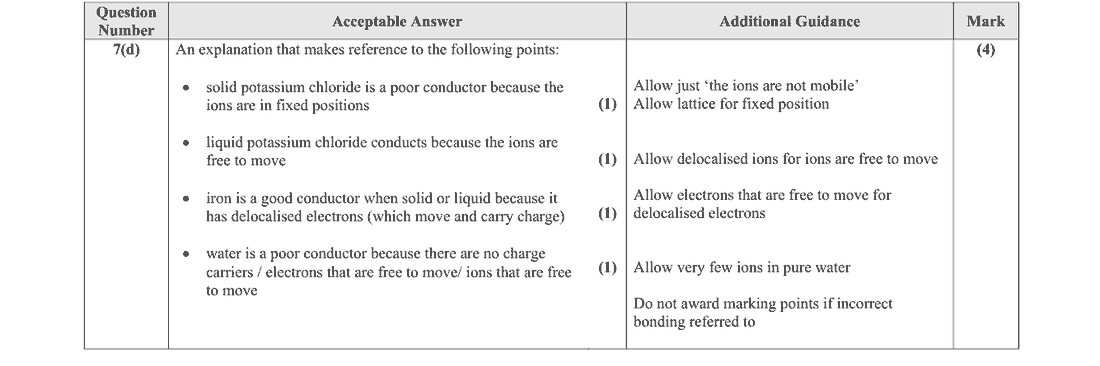
This was generally answered well by candidates. The greatest error was from candidates referring to delocalised electrons in potassium chloride. Lots of candidates referred to hydrogen bonding in water as the reason to why it could not conduct.
Notes from the mark scheme and report
Solid potassium chloride: ions are in fixed positions (in the lattice) so cannot move
liquid potassium chloride: ions are free to move
iron: delocalised electrons (free to move and carry charge) in both solid and liquid
water: no charge carriers / no electrons or ions free to move (allow very few ions in pure water). A marking point is lost if the wrong type of bonding is given. Common errors: delocalised electrons in potassium chloride
hydrogen bonding given as the reason water does not conduct
June 2024 · AS Paper 1 · Q8(b)(ii)4 marksExplanation
Earlier parts of question 8 that this part uses
Mark scheme
Examiner's comment
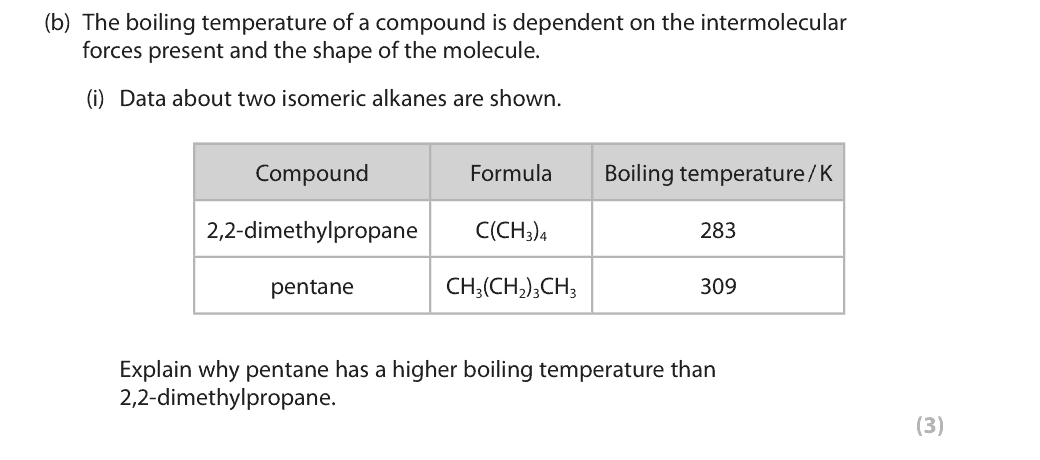
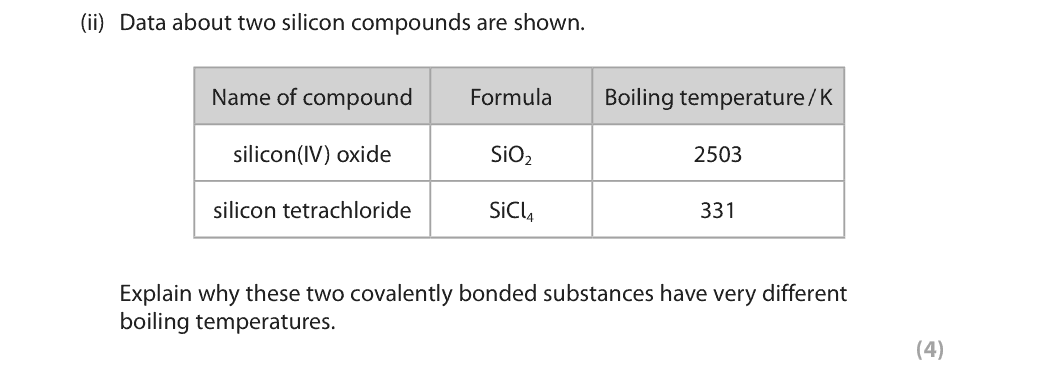
Q8bi) This question was answered well. Most candidates identified 2,2-dimethylpropane as being branched and therefore had weaker London forces. Many candidates lost M2 for either not mentioning surface area or saying that the molecules will be packed closer together. M3 was lost on occasion due to candidates stating that propane had more electrons which is why the London forces were stronger. Q8bii) Question 8bii was answered relatively well. Many candidates compared the Si=O double covalent bond strength with the Si-Cl single covalent bond strength. When candidates did correctly identify the structures of the two silicon compounds, they normally achieved full marks.
Notes from the mark scheme and report
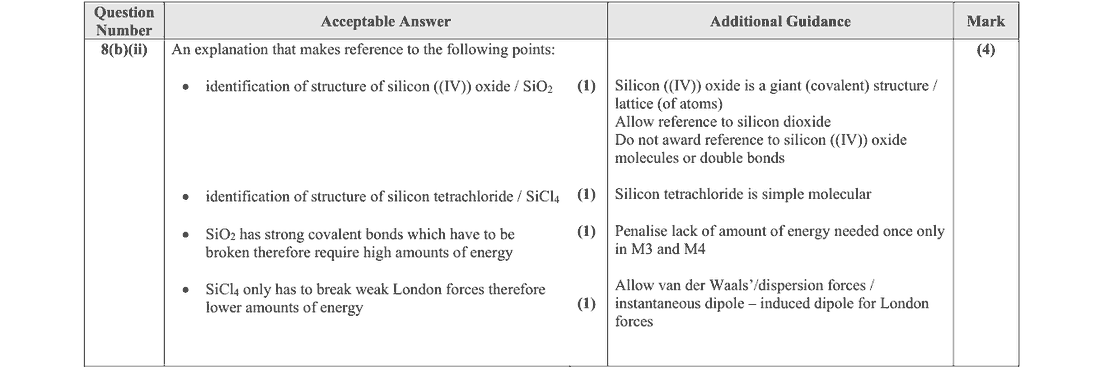
Silicon(IV) oxide is a giant covalent structure / lattice (not molecules, not double bonds)
silicon tetrachloride is simple molecular
in SiO2 strong covalent bonds must be broken, needing a lot of energy
in SiCl4 only weak London forces are overcome, needing little energy. Missing reference to the amount of energy is penalised once only. Many wrongly compared the strength of Si=O and Si–Cl covalent bonds
those who identified both structures usually scored full marks
June 2023 · Paper 1 · Q46 marksExplanation
Mark scheme
Examiner's comment
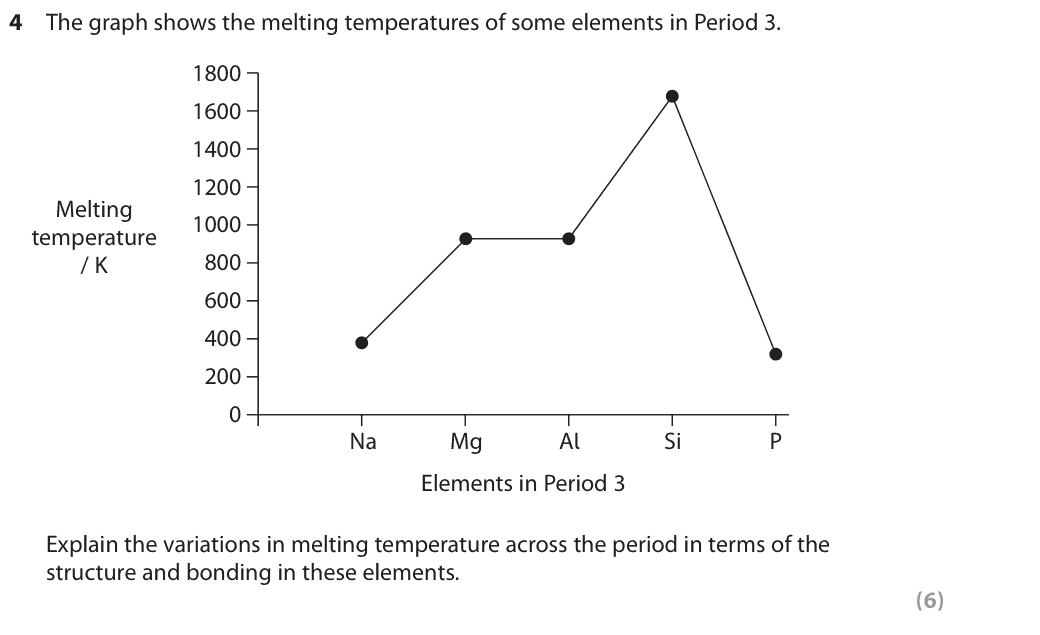
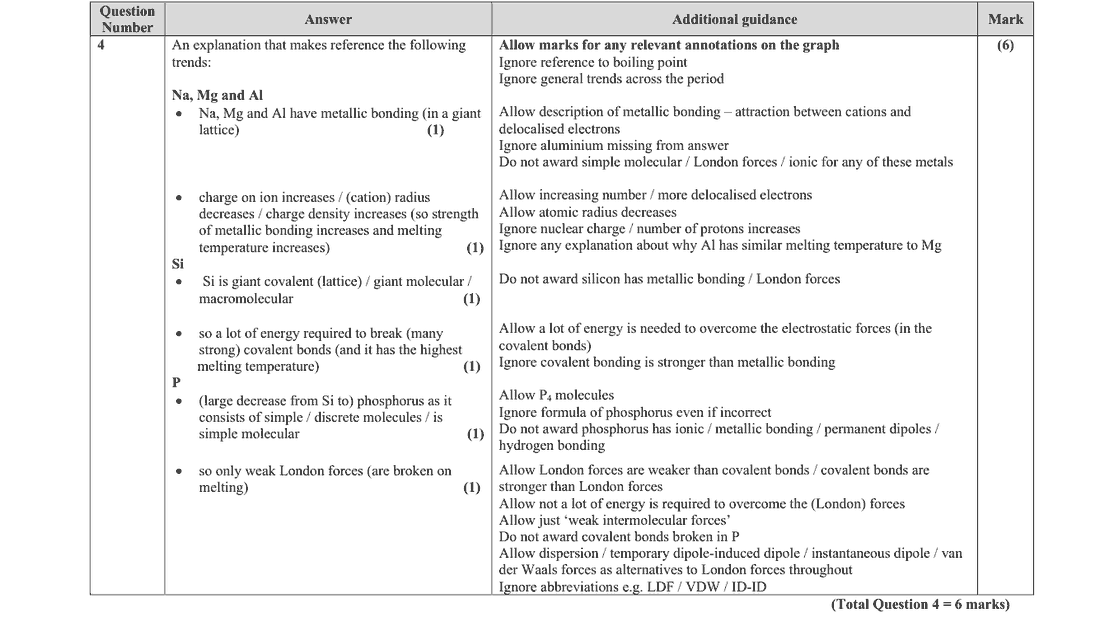
Candidates who had a good knowledge and understanding of how melting temperatures are affected by structure and bonding scored high marks for this question. Unfortunately, there were many candidates who did not understand structure and bonding and they used poor terminology, for example, referring to molecules of sodium. Many candidates referred to London forces in all of the elements. A significant minority thought that the weak covalent bonds in phosphorus would be broken when it melts and some thought that it had ionic bonding. Some candidates thought that melting temperature is affected by ionisation energy and they discussed how easy it is for those elements to lose an electron.
Notes from the mark scheme and report
Six marks, point marked (not an asterisk question). Na, Mg, Al: M1 metallic bonding (giant lattice)
M2 the charge on the ion increases / ionic radius decreases / more delocalised electrons, so the metallic bonding gets stronger. Si: M3 giant covalent lattice
M4 a lot of energy is needed to break the many strong covalent bonds, so the highest value. P: M5 simple molecular (P4 molecules)
M6 only weak London forces are overcome on melting. Annotations on the graph count. No credit for London forces or simple molecules in the metals, metallic bonding in silicon, or covalent bonds breaking in phosphorus
abbreviations such as LDF or VDW are ignored
ignore nuclear charge. Common errors: 'molecules of sodium'
London forces in every element
covalent bonds broken or ionic bonding in phosphorus
arguing from ionisation energy
Skills: MS3.1 Translate information between graphical, numerical and algebraic forms
June 2023 · AS Paper 1 · Q4(a)2 marksExplanation
Mark scheme
Examiner's comment
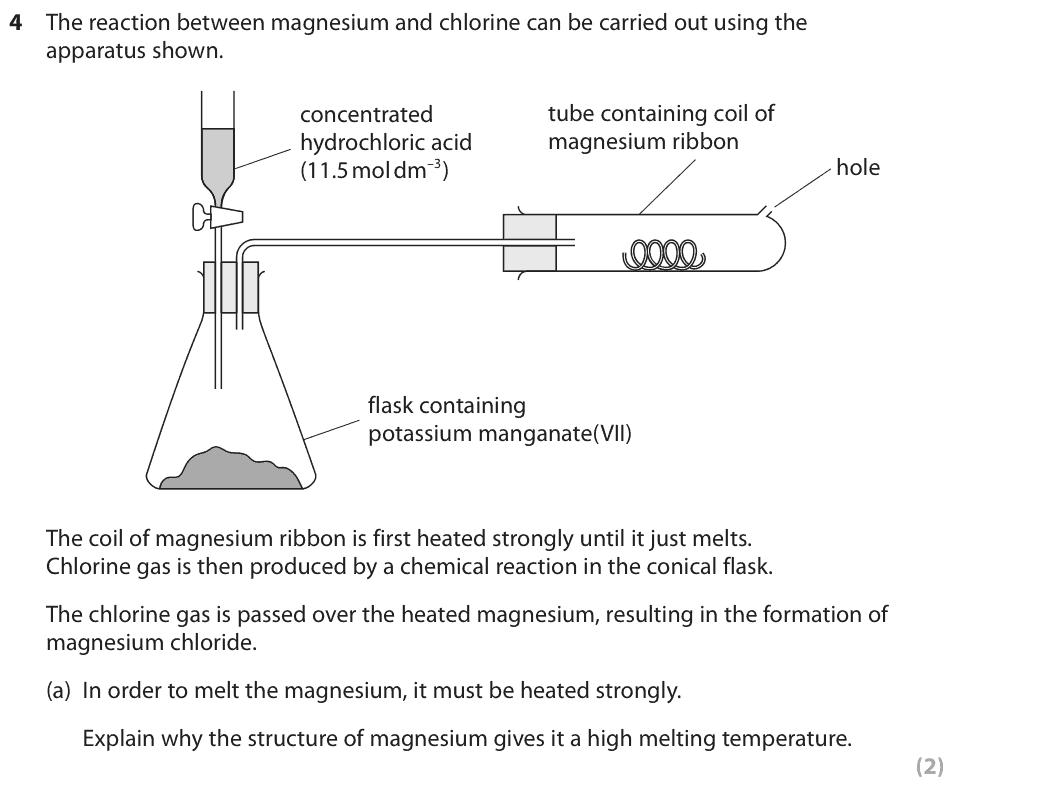
(a) Metallic bonding is reasonably well understood at this level with almost all candidates scoring the second mark but the significance of the structure, the giant lattice of positive ions and sea of delocalised electrons, was sometimes not discussed. (b) This calculation was well understood, and the correct value was often obtained, but the significant figures were very often not considered. There are two aspects to this, firstly the mathematical significance which candidates are now quite good at realising, but also the significance associated with the concept. In this case measuring a volume of concentrated acid to more than one decimal place is not practical. (c) A different way to ask a question about hazard warning labels proved quite challenging. All four possible answers were given. The correct answer was scored by only 14% of candidates. This meant that one or more of the alternative answers proved more popular than the correct answer, as candidates, very sensibly, rarely leave multiple choice questions blank.
Notes from the mark scheme and report
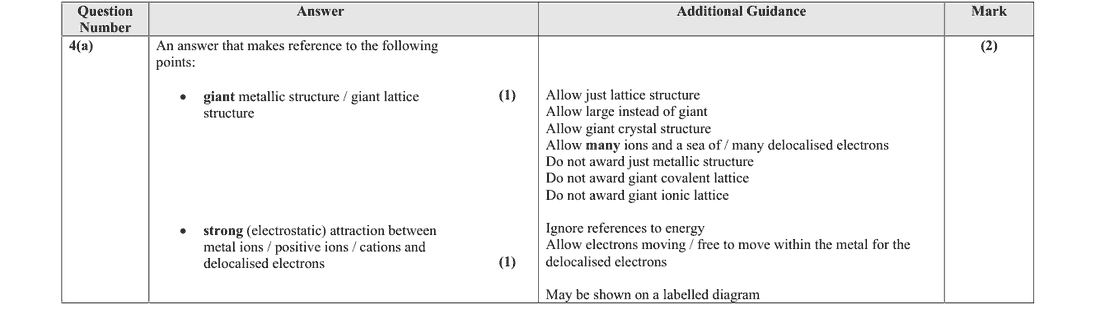
M1 giant metallic structure / giant lattice (allow 'many ions and a sea of delocalised electrons'
not just 'metallic structure'
not giant covalent or giant ionic). M2 strong (electrostatic) attraction between the positive metal ions and the delocalised electrons. A labelled diagram can score. Almost all scored M2
the giant structure was often not mentioned
June 2023 · AS Paper 1 · Q5(d)3 marksExplanationHard
Earlier part of question 5 that this part uses
Mark scheme
Examiner's comment
(a) This question was correctly answered by just over half of candidates. (b) The majority of candidates either know the trend in electronegativity or used their data booklets to look up the trend in the values. Explanations often included comment on both the significant features of increasing distance from the nucleus and the increasing shielding, with many candidates quite rightly comparing these to the increasing charge on the nucleus. This was not required by the mark scheme for this item, but it was good to see. The concept of effective charge is still used quite regularly, but is still quite a difficult idea to get correct and some candidates would have been better to stick to a more straightforward approach. (c) Continuum of bonding has not often been examined quite as directly as it was in this paper, and candidates, perhaps because they had not seen this type of question before, found the wording of their answers quite challenging. There were many different approaches to the answer including those in the mark scheme. Some candidates were able to score one mark, but scoring two marks on this item was rare.
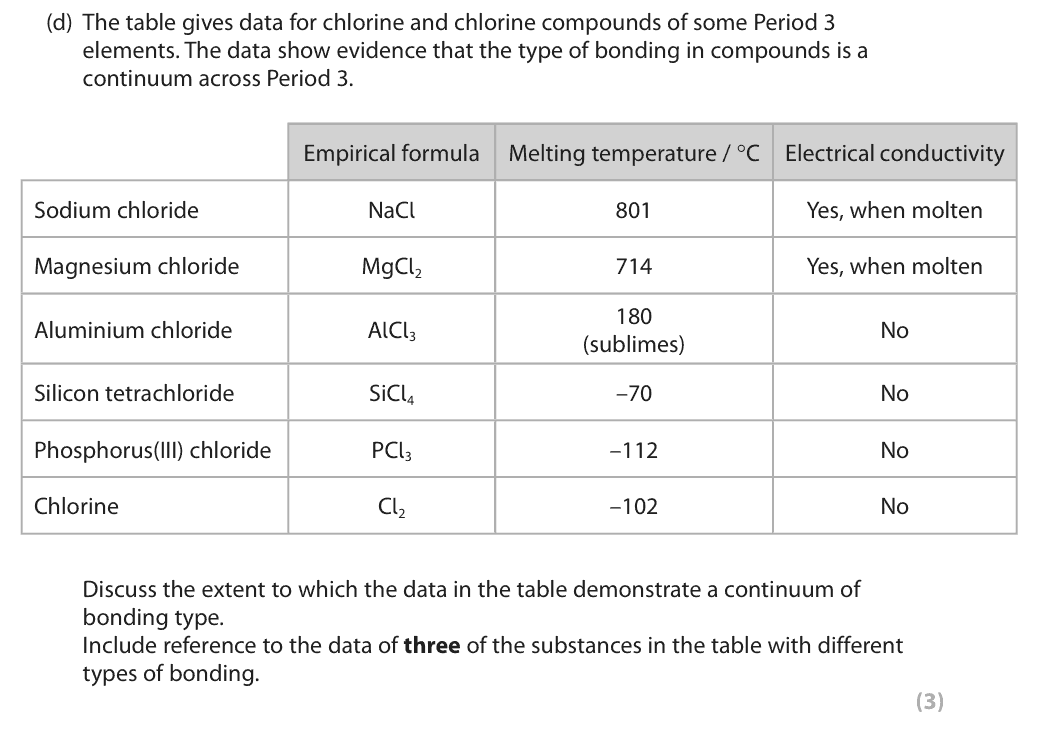
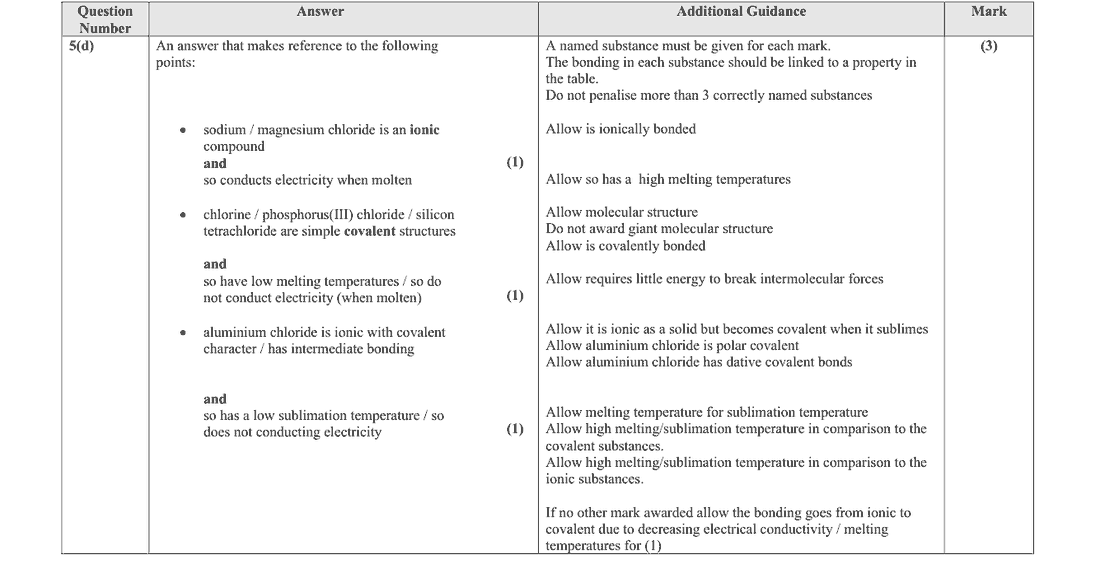
(d) Selecting appropriate examples of the idea of continuum of bonding from the available data proved quite difficult, with few candidates scoring all three marks. The idea that sodium chloride and magnesium chloride were metallically bonded was disappointingly common. Silicon tetrachloride was quite commonly thought to be a giant covalent structure, presumably confused with silicon dioxide or with silicon itself, even though it has a very low melting temperature. Identifying the properties of aluminium chloride as the intermediate structure was the biggest challenge. Those that did recognise the types of bonding present did not always say how these were demonstrated in the available data.
Notes from the mark scheme and report
Each mark needs a named substance with its bonding linked to data in the table. M1 sodium chloride / magnesium chloride is ionic, so conducts when molten (or has a high melting temperature). M2 chlorine / PCl3 / SiCl4 are simple covalent (molecular), so have low melting temperatures / do not conduct. M3 aluminium chloride is intermediate (ionic with covalent character / polar covalent), shown by its low sublimation temperature / not conducting. If nothing else scores, 1 mark for 'bonding goes from ionic to covalent as conductivity / melting temperature falls'. Common errors: NaCl and MgCl2 called metallic
SiCl4 called giant covalent despite its low melting temperature
aluminium chloride was the hardest to place
June 2022 · Paper 1 · Q1(d)3 marksExplanation
Earlier part of question 1 that this part uses
Mark scheme
Examiner's comment
This three mark question proved more challenging.
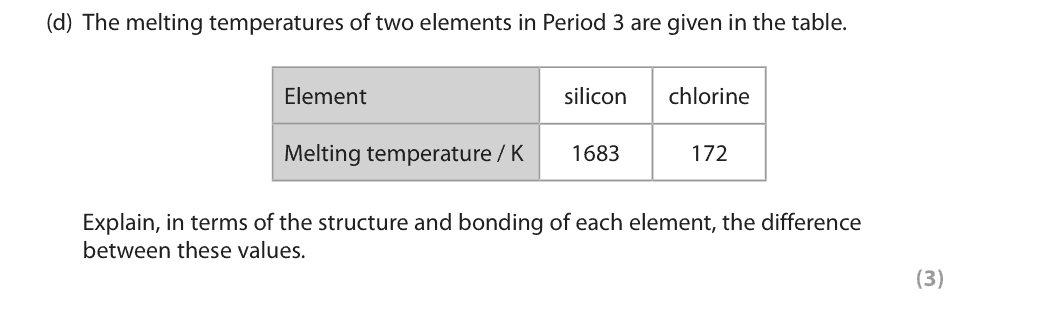
The best answers showed a full understanding of the structure and bonding in silicon and chlorine. There was some confusion over the structure of silicon with metallic, ionic and molecular all being used as descriptors.
Some candidates suggested that the covalent bonds in chlorine were broken on melting. These answers generally did not include a reference to the London forces between chlorine molecules.
Notes from the mark scheme and report
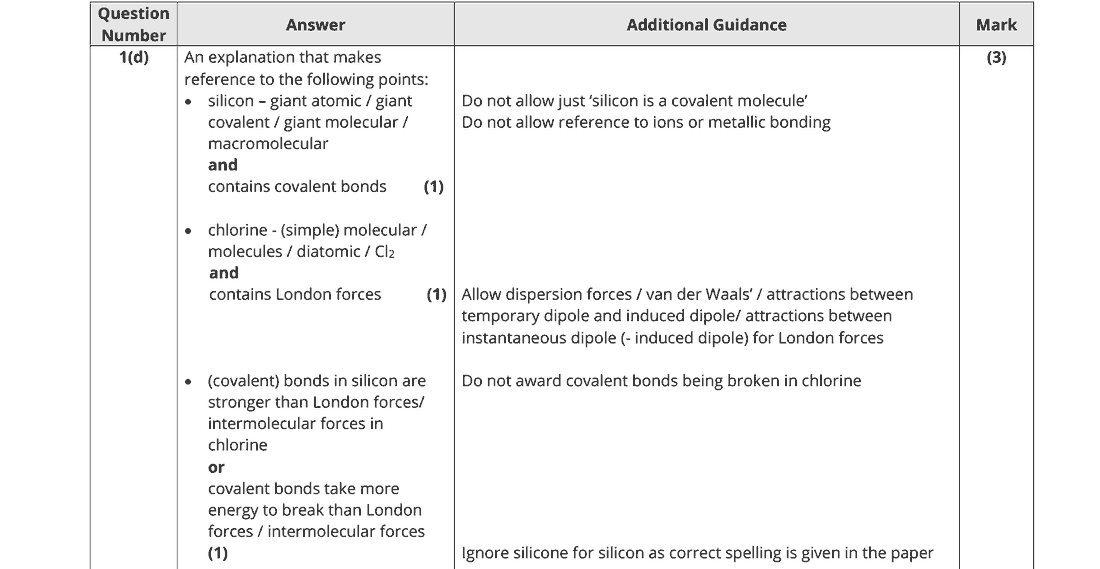
Silicon is giant covalent (giant atomic / macromolecular) with covalent bonds (1)
chlorine is simple molecular (Cl2) with London forces between molecules (1)
the covalent bonds in silicon are stronger / need more energy to break than the London forces in chlorine (1). Not ions or metallic bonding for silicon
not covalent bonds breaking in chlorine. Common errors: silicon called metallic, ionic or molecular
covalent bonds in chlorine broken on melting, with no mention of London forces
June 2022 · Paper 1 · Q4(d)(i)1 markMultiple choice
Earlier part of question 4 that this part uses
Answer
D
Mark scheme
Notes from the mark scheme and report
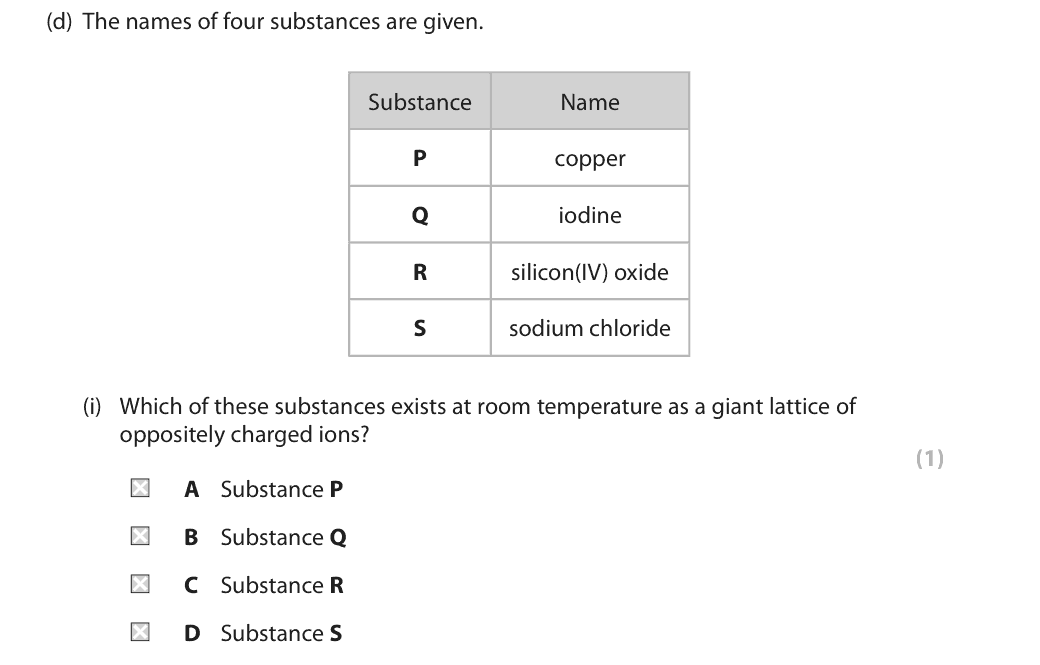
Answer: D (S, sodium chloride), a giant ionic lattice. Copper is a giant metallic lattice, iodine is simple molecular and silicon(IV) oxide is giant covalent
June 2022 · Paper 1 · Q4(d)(ii)1 markMultiple choice
Earlier parts of question 4 that this part uses
Answer
A
Mark scheme
Notes from the mark scheme and report
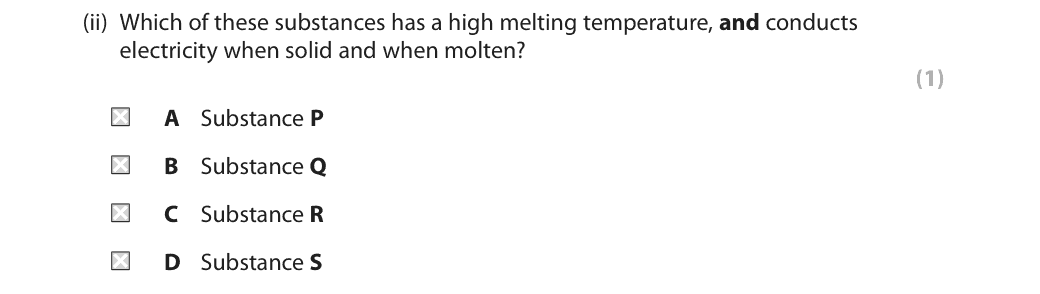
Answer: A (P, copper): a high melting temperature, and delocalised electrons carry the current in the solid and the liquid. Sodium chloride conducts only when molten
silicon(IV) oxide does not conduct
iodine has a low melting temperature
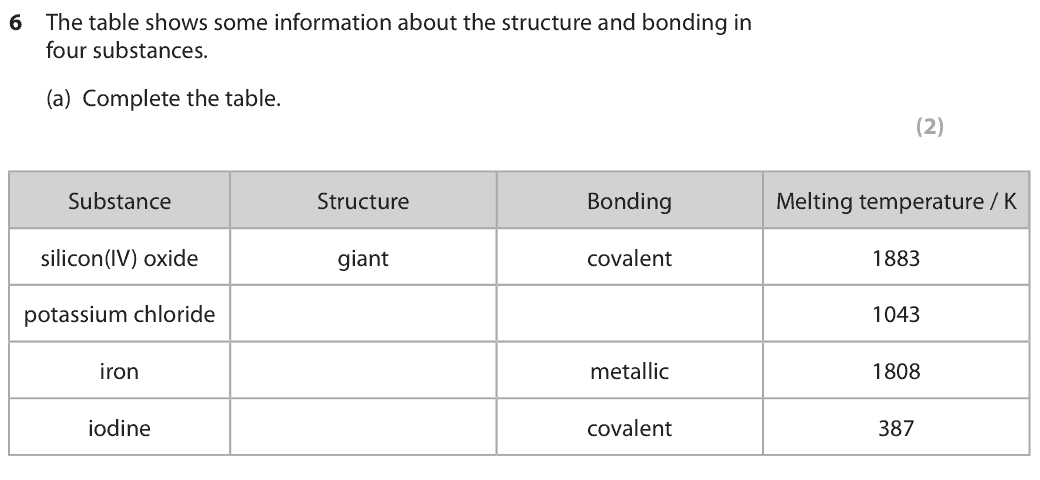
June 2022 · AS Paper 1 · Q6(a)2 marksShort answerHard
Mark scheme
Examiner's comment
This question proved to be surprisingly difficult for the majority of students. Many were uncertain about the structure of all three substances. The bonding in potassium chloride was usually correct but occasionally thought to be covalent. By far the most common error was in the structure of iodine, which was often identified as just ‘simple’, rather than ‘simple molecular’ or ‘molecular’. A greater emphasis on the correct descriptive terms for structure is recommended. Many scored just 1mark for 2 or 3 correct responses. Two marks required all four responses to be correct. The word ‘giant’ was frequently mis-spelled as ‘gaint’, in spite of the fact that the word was already present in the question for the structure of silicon(iv) oxide.
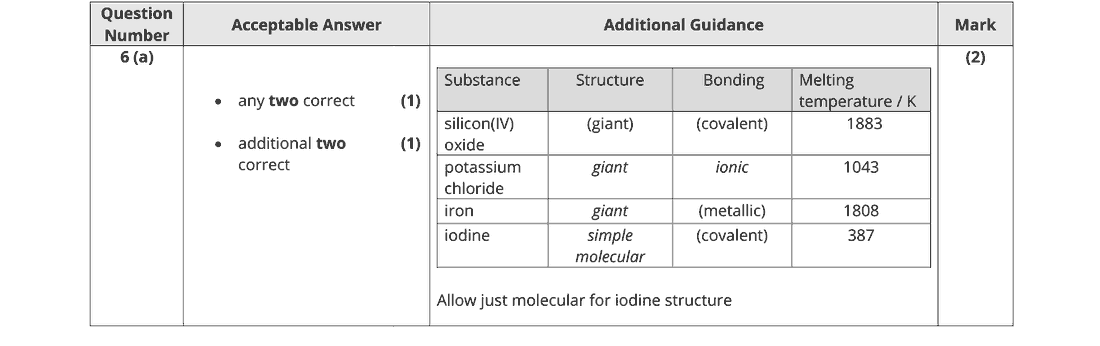
Notes from the mark scheme and report
Potassium chloride: giant, ionic
iron: giant
iodine: simple molecular (allow molecular). One mark for any two correct, two marks for all four. Most common error: iodine described as just 'simple'. Potassium chloride was occasionally called covalent
June 2022 · AS Paper 1 · Q6(b)3 marksExplanation
Earlier part of question 6 that this part uses
Mark scheme
Examiner's comment
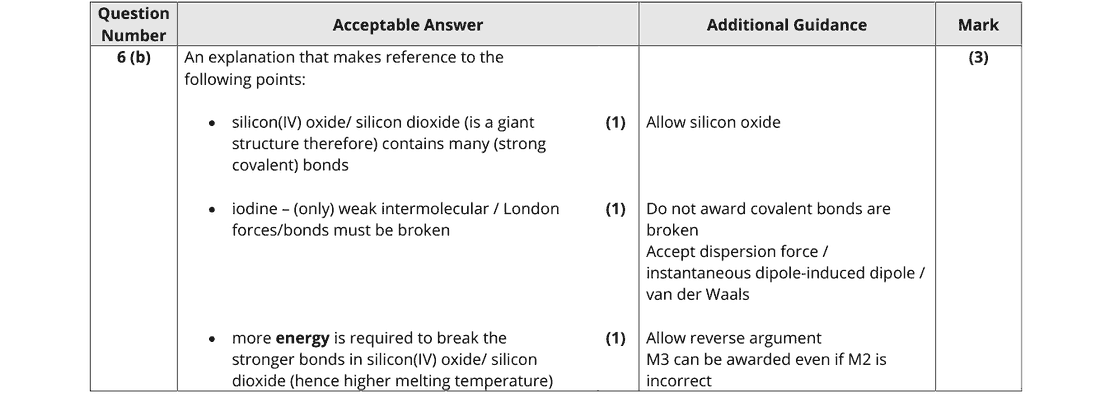
This question required students to relate the structure of silica and iodine to the relative size of their melting temperatures. M1 was related to the number of bonds in silicon dioxide that must be broken when it melts. Many answers were focused only on the relative strength of the bonds that must be broken. M2 required students to identify weaker bonds (London forces) bonding the iodine molecules to each other. Many answers related only to the bonding between the iodine atoms in the molecule, ie covalent bonds. M3 required the concept of energy (to break bonds); most of the answers that scored this point then also related energy requirements to melting temperature.
Notes from the mark scheme and report
Silicon(IV) oxide is a giant structure with many (strong covalent) bonds to break
in iodine only weak intermolecular / London forces must be broken (not covalent bonds)
more energy is needed to break the stronger bonds in silicon(IV) oxide. Reverse argument allowed
the third mark can be given even if the second is wrong. Many compared only bond strengths and missed the number of bonds
many wrote about the covalent bond inside the iodine molecule
June 2022 · AS Paper 1 · Q6(c)3 marksExplanation
Earlier part of question 6 that this part uses
Mark scheme
Examiner's comment
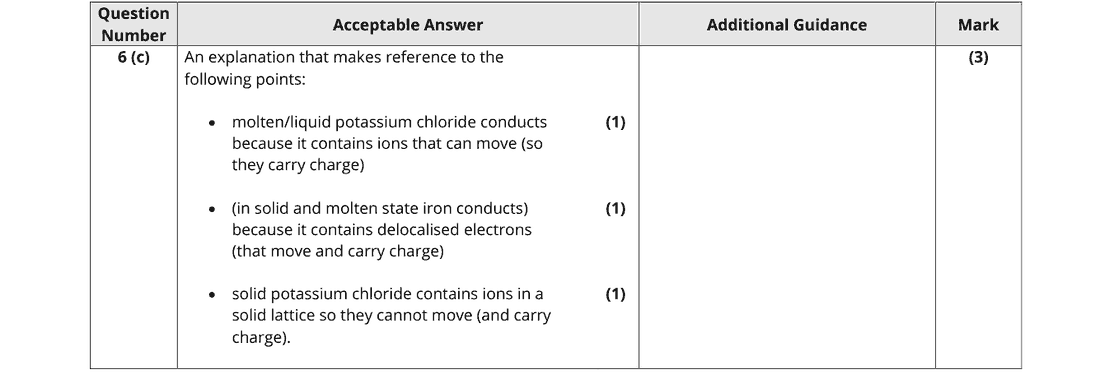
This question expected students to contrast the electrical conductivity of iron with that of potassium chloride in both the solid and the molten states. Many erroneous answers thought that the charge conductors in molten potassium chloride were electrons, whereas it is the ions that move. These answers often also postulated that solid potassium iodide failed to conduct because the electrons are unable to move, whereas it is the ions that are unable to move in the solid state. Mention of delocalised electrons in iron was required to score the mark. Good answers then went on the record that delocalised electrons are present in iron in both the solid and liquid states, so both states conduct electricity.
Notes from the mark scheme and report
Molten potassium chloride conducts because its ions can move
iron conducts (solid and molten) because it has delocalised electrons
solid potassium chloride has its ions held in a lattice so they cannot move. Common error: saying the charge carriers in potassium chloride are electrons. 'Delocalised electrons' was needed for the iron mark
November 2021 · AS Paper 1 · Q5(a)5 marksExplanation
Mark scheme
Examiner's comment
At this level, questions about bonding and structure usually discriminate very well, with the best candidates answering confidently with precision, while less confident candidates sometimes use incorrect terminology, for example confusing bonds with intermolecular forces. 5(a) Here the idea that diamond is a giant structure with atoms held together by strong covalent bonds, while iodine is a simple molecular structure where molecules are held together by weaker intermolecular forces, in this case London forces discriminated candidates. 5(b) This item linked the property of electrical conductivity to diamond and graphite. Many candidates were familiar with this and were able to answer well, though some did not describe why there were electrons free to move in graphite.
Notes from the mark scheme and report
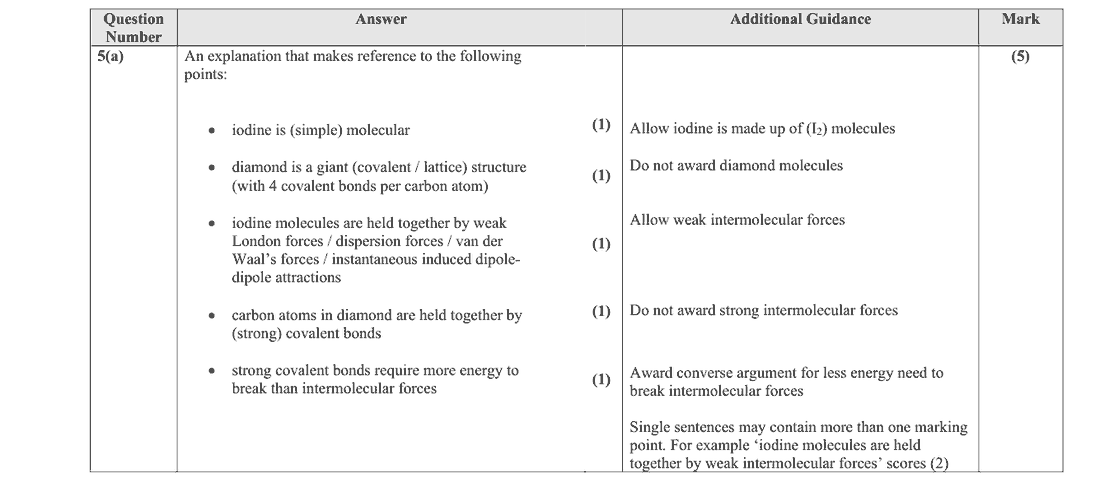
Iodine is simple molecular (I2 molecules)
diamond is a giant covalent structure / lattice (not 'diamond molecules')
iodine molecules are held together by weak London / dispersion forces (allow weak intermolecular forces)
carbon atoms in diamond are held by (strong) covalent bonds
breaking covalent bonds needs more energy than overcoming intermolecular forces. One sentence can score more than one point. Weaker candidates confused bonds with intermolecular forces
November 2021 · AS Paper 1 · Q5(b)2 marksShort answer
Mark scheme
Examiner's comment
At this level, questions about bonding and structure usually discriminate very well, with the best candidates answering confidently with precision, while less confident candidates sometimes use incorrect terminology, for example confusing bonds with intermolecular forces. 5(a) Here the idea that diamond is a giant structure with atoms held together by strong covalent bonds, while iodine is a simple molecular structure where molecules are held together by weaker intermolecular forces, in this case London forces discriminated candidates. 5(b) This item linked the property of electrical conductivity to diamond and graphite. Many candidates were familiar with this and were able to answer well, though some did not describe why there were electrons free to move in graphite.
Notes from the mark scheme and report
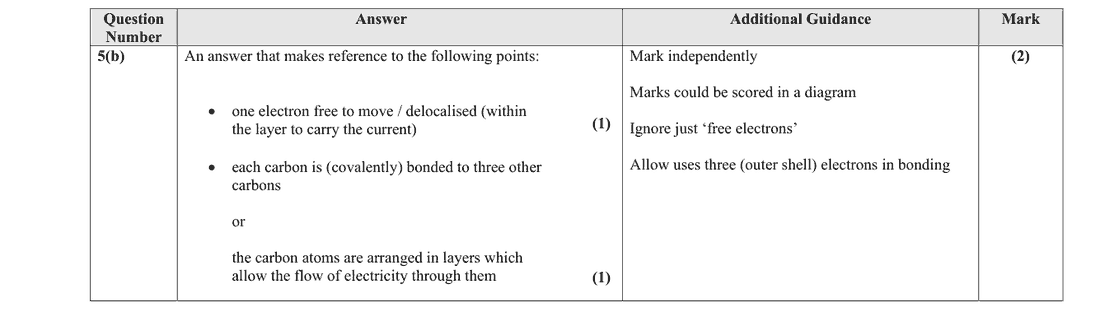
Each carbon is covalently bonded to three others (uses three outer electrons in bonding), or the atoms are arranged in layers that allow electricity to flow through them
one electron per carbon is delocalised / free to move (within the layer). Just 'free electrons' is ignored. Marked independently
may be shown in a diagram. Some did not say why graphite has electrons that are free to move
November 2021 · Paper 3 · Q6(a)(ii)2 marksExplanationHard
Earlier part of question 6 that this part uses
Mark scheme
Examiner's comment
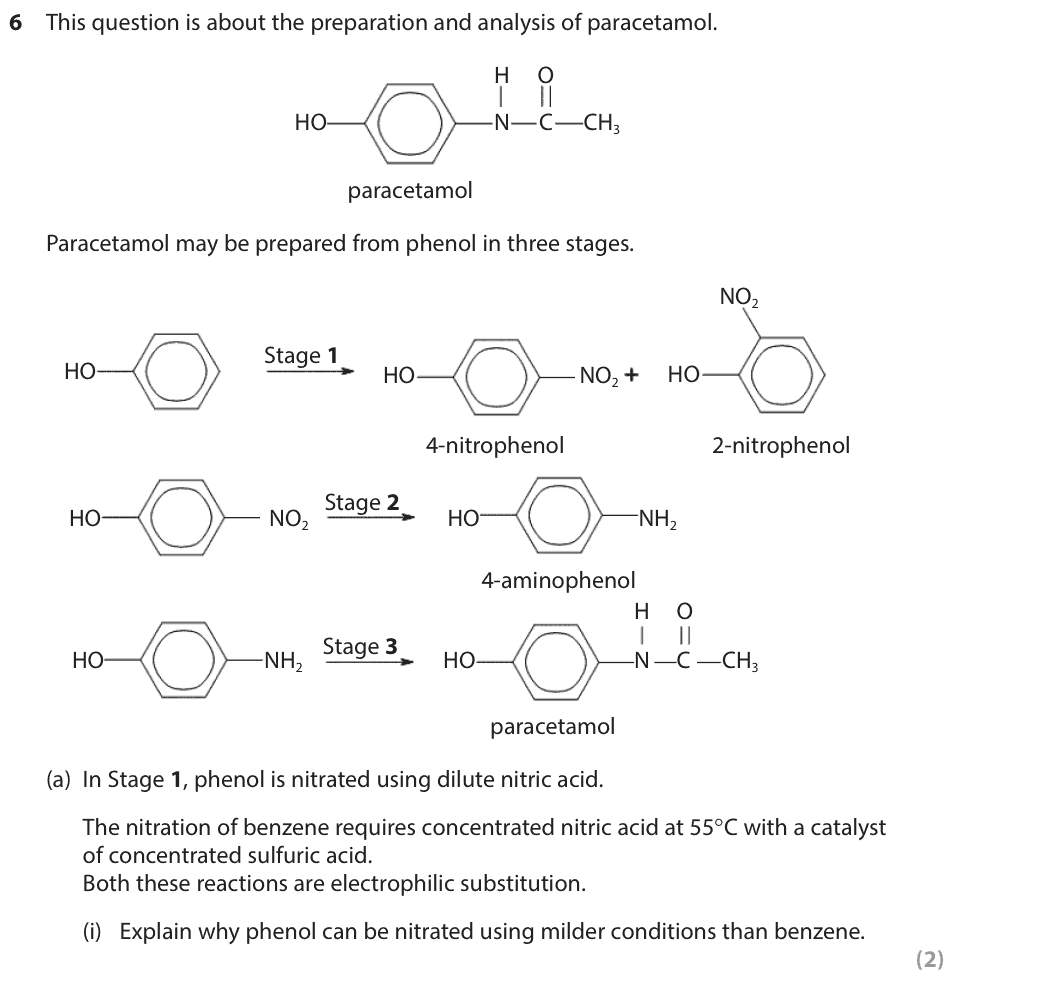
Some candidates gave clear and concise explanations for why phenol can be nitrated using
milder conditions than benzene while others seemed unfamiliar with this concept or gave
partial answers. Some referred to the lone pair of electrons on the OH group rather than the
oxygen atom. Many candidates struggled to explain the difference in boiling temperatures of
the two isomers and did not refer to intermolecular forces as requested in the question.
Many answers did not mention hydrogen bonding. Many candidates knew that a reducing
agent is needed to convert 4-nitrophenol into 4-aminophenol, although some did not read the
question and gave a specific reagent rather than the type of reagent. There were many poor
diagrams drawn for filtration under reduced pressure, with folded filter paper and no
perforations in the Buchner funnel. Most candidates would benefit from more practise in
drawing clear labelled diagrams of the common practical techniques in the specification. A
few candidates gave clear descriptions of the recrystallisation procedure, but most put steps
in the wrong order, missed out steps such as hot filtration and were generally confused. A
common error in producing dry crystals was to suggest adding an anhydrous salt as a drying
agent. Although this works well for drying liquids as it is easy to separate the substances, it
does not work for drying crystals unless the drying agent is specified as being in a desiccator.
Many candidates knew that impurities lower the melting temperature of a substance and it
will melt over a range of temperatures rather than having a sharp melting point, but many
omitted one of these from their answer. Many candidates were able to work out the
molecular formula of paracetamol but quite a lot had an incorrect number of hydrogen atoms
and some candidates were not aware of the meaning of molecular formula. The calculation in
(d)(ii) was carried out correctly by many candidates. Some omitted to use the mole ratio and
others omitted the use of a 100.0 cm3 volumetric flask. Some candidates calculated a mass
higher than the original 0.500 g of paracetamol and reversed the percentage calculation to
obtain a value less than 100%. These candidates should be advised to check their working to
see where they have made an error instead of doing this.
Notes from the mark scheme and report
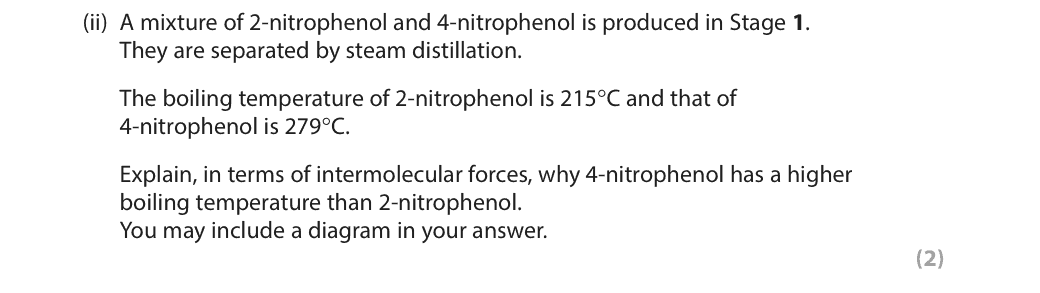
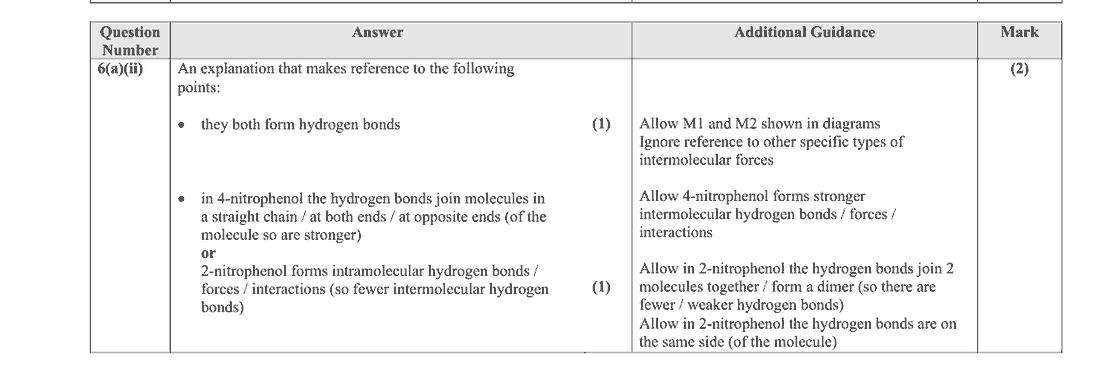
Both form hydrogen bonds
in 4-nitrophenol the hydrogen bonds are between molecules (at opposite ends, giving chains, so stronger intermolecular forces), whereas 2-nitrophenol forms intramolecular hydrogen bonds between the adjacent OH and NO2 groups, so has fewer intermolecular hydrogen bonds. Can be shown in diagrams. Many did not refer to intermolecular forces or mention hydrogen bonding at all
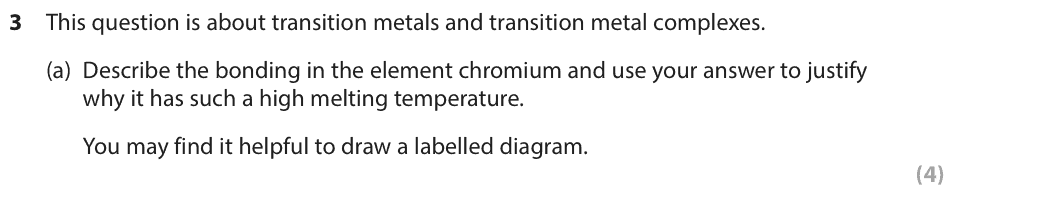
October 2020 · Paper 1 · Q3(a)4 marksExplanation
Mark scheme
Examiner's comment
Most candidates had some knowledge of metallic structure, and the candidates with an eye
for written detail and who took care with any diagrams where able to score full marks.
Probably the most common issue with diagrams was inconsistencies with the number of
electrons shown. For instance the ion would be shown as Cr3+, but too few electrons where
then evident in the diagram. Written answers did not always refer to the regular arrangement
/ lattice of ions, hence without a diagram to support the comments, the first mark could not
be awarded. Some confusion persists with the electrostatic attraction in the model. Many
referred to an attraction between the nucleus and the outer electrons hence it was not always
clear whether the discussion was based around ionisation of metallic bonding.
A small number of candidates needed to take care when reading the question as they
described bonding in chromium complexes and tried to justify a high melting temperature in
this context.
In (b) most candidates could describe the shape of the context, but once again some did not
read the question and gave its formula. In (ii) most candidates realised that the d-orbitals /
subshell splits in a complex ion. A number were imprecise with language though and did not
score the first mark as they described a singular ‘d-orbital’ as splitting. Many understood the
colour was linked to electron promotion, though disappointingly many linked this to the
return of the electron to the ground state and subsequent emission of light, as in a flame test.
Most candidates recognised the increases in entropy in (c), linking it to the increases in the
number of moles of particles, though far fewer appreciated that the value of the equilibrium
constant meant the complex was stable or the equilibrium position was far to the right.
The calculation in (d) allowed nearly all candidates to access some credit, with the first
2 marks often awarded. Although the molar volume of a gas was given in the question, a
number of candidates attempted to find the moles of chlorine using the ideal gas equation,
making life more difficult for themselves. The ability to link the transfer of electrons to the
ratio was discriminating, and such candidates often went on to score full marks in (i) and (ii).
Some answers found in difficult to process the idea that this was an oxidation from +2 to +5,
and focused on the more usual reduction from +5 to +2, giving the colours the wrong way
round.
Notes from the mark scheme and report
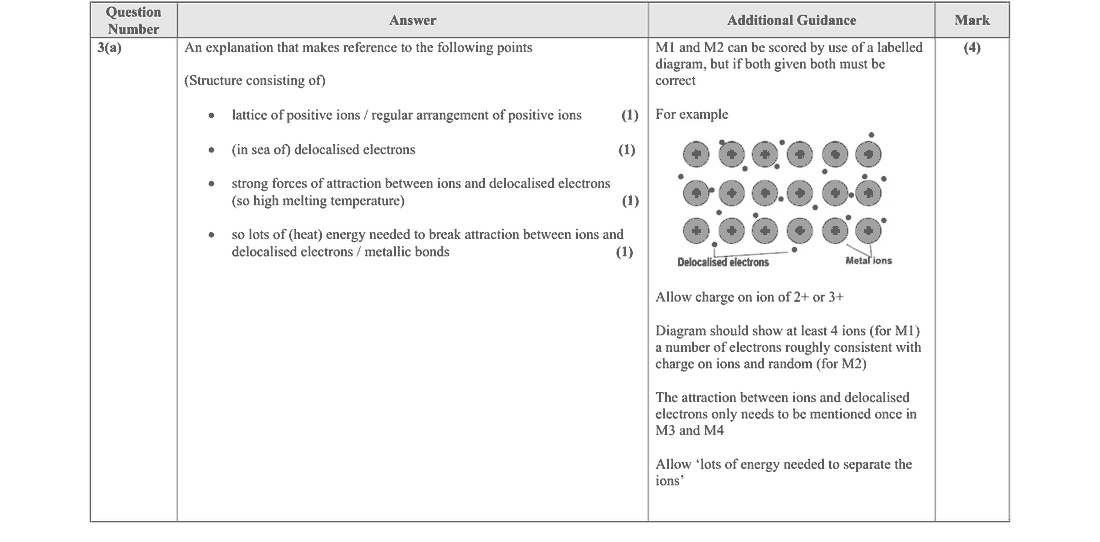
Lattice / regular arrangement of positive ions (1)
in a sea of delocalised electrons (1)
strong forces of attraction between the ions and the delocalised electrons (1)
so a lot of energy is needed to overcome them (1). The first two marks can come from a labelled diagram with at least four ions and a number of electrons roughly matching the charge (2+ or 3+ allowed). Common errors: too few electrons for the charge shown
no mention of a regular arrangement
attraction between the nucleus and outer electrons
describing bonding in chromium complexes
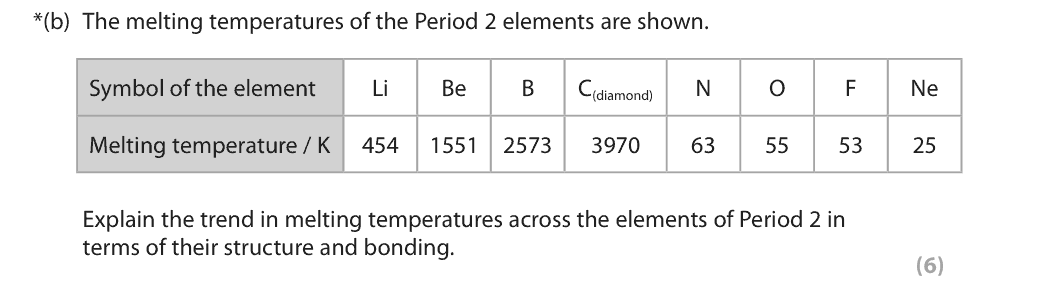
October 2020 · AS Paper 1 · Q7(b)6 marks6-mark extended response
Earlier part of question 7 that this part uses
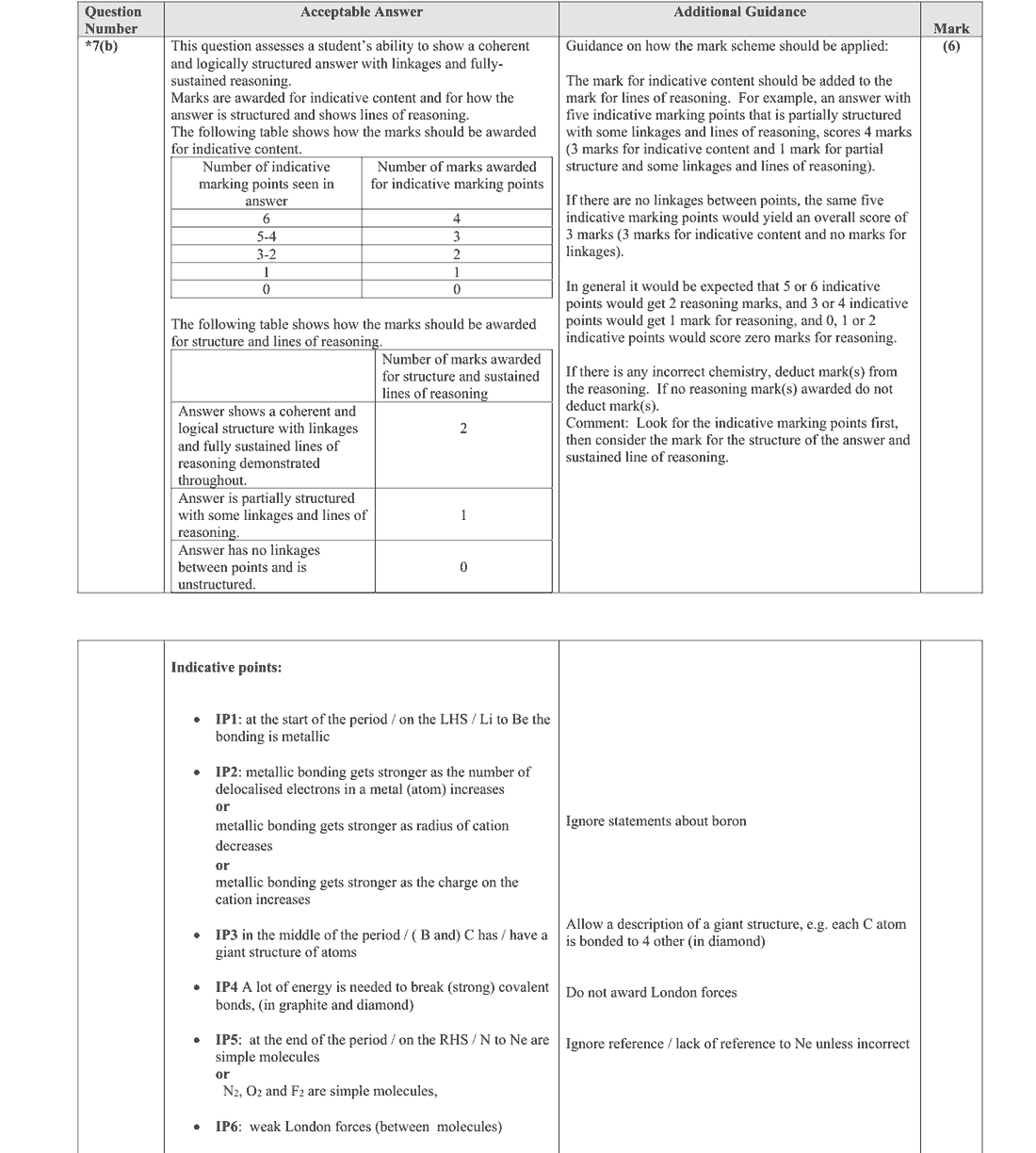
Mark scheme, with the indicative content and the marks for reasoning
Examiner's comment
7a This question asked about ‘periodicity’. In general terms, students found this question
challenging. There was little recognition of the repeating pattern of properties in periodicity.
Some students therefore focused simply on the trend across one period (omitting to comment on
the repeating pattern in the next period). Many thought that the atomic radius would increase
across a period, while some others discussed a trend down a group and omitted trends across a
period completely. This question was not answered well.
7b This long answer question focused on structure and bonding across a period. Two indicative
points focused on the metals on the LHS of the period. Two indicative points on elements with giant
structures (although B was ignored because students might expect to have no knowledge of this
element) therefore the focus was on diamond, and two IPs for the simple molecules on the right of
the period i.e., N2, O2, F2 and Ne. For each of these pairs of marks, the first indicative point mark
was awarded for a correct comment on structure while the second IP related to the bonding
It was clear that some students had been working with a previous paper that discussed diamond in
the equivalent longer answer question. However, responses relating to the structure of diamond
were disappointingly confused in some answers
A wide range of marks was seen in the answers to this question, from zero to full marks. Students
might usefully try to identify the key points of these longer answer questions; in this instance
ensuring the use of all period 2 elements and covering both structure and bonding in the elements
(not their compounds).
Notes from the mark scheme and report
Six indicative points plus two marks for reasoning. IP1 Li and Be have metallic bonding
IP2 metallic bonding is stronger in Be because there are more delocalised electrons per atom / the cation is smaller / has a higher charge
IP3 (B and) C have giant structures of atoms
IP4 a lot of energy is needed to break the strong covalent bonds (no mention of London forces here)
IP5 N2, O2 and F2 (N to Ne) are simple molecules
IP6 only weak London forces between the molecules. Statements about boron are ignored, and neon need not be mentioned. Answers ranged from zero to full marks
the structure of diamond was often confused, and some wrote about compounds rather than the elements
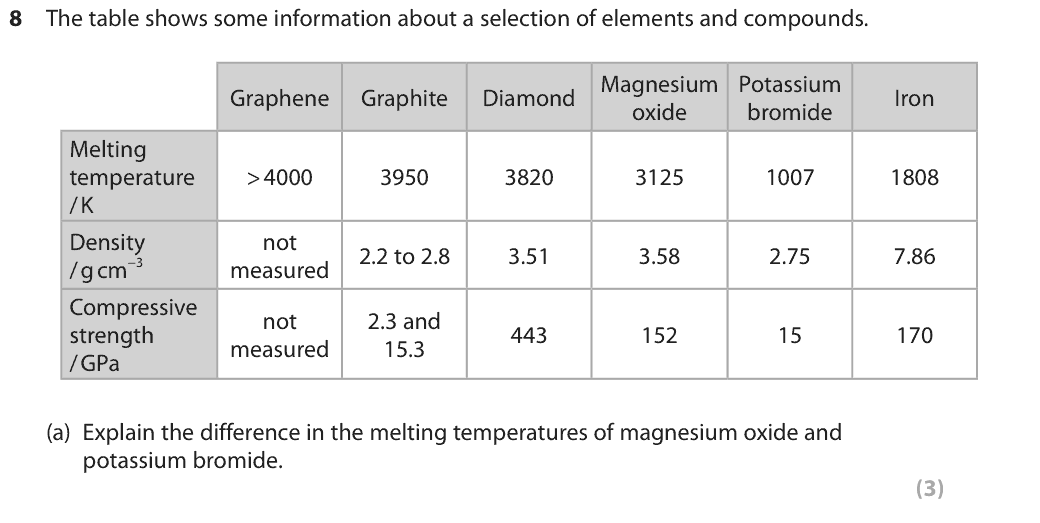
June 2019 · AS Paper 1 · Q8(b)2 marksExplanation
Earlier part of question 8 that this part uses
Mark scheme
Examiner's comment
(a) Candidates struggled with this question, often scoring just one mark from the
available three.
MP1 was most frequently awarded for relating charge on the ions, although well-
constructed answers were quite rare.
MP2 was scored relatively infrequently. Of those who discussed radii, there was often
confusion between ionic radius, atomic radius and even metallic radius.
MP3 was frequently lost because the wrong type of bonding was assumed to be present
- hydrogen bonding and covalent bonding were relatively common.
(b) Responses to this question tended to produce a mark of 2 or 0 depending on
whether the charge carriers were thought to be ions or electrons. Many candidates
thought that delocalised electrons are present in ionic compounds but that these
electrons are unable to flow in the solid state. A significant number thought that these
delocalised electrons would be unable to force their way through a solid lattice of ions
but would be able to move through a liquid because the movement of ions would let
the electrons pass.
(c) It was apparent that most candidates were very familiar with diamond and graphite
but less familiar with graphene, to the extent that some completely omitted any
reference to graphene. IP5 and IP6 (diamond structure and electrical conductivity) were
scored by most candidates. IP4 was also scored frequently (delocalised electrons in
graphite). However, IP3 required two responses (the structure and bonding in graphite),
the point was therefore sometimes not awarded because one of these two statements
had been omitted. Given that some candidates were unfamiliar with graphene, it was
unsurprising that IP1 and IP2 were not awarded so frequently. Graphene was often
recognised as similar to graphite so IP2 (relating to delocalised electrons in graphene)
was awarded. But IP1 (a reference to the single layer/sheet structure of graphene) was
often missing.
This question amply illustrated the need for legible writing. The second half of the two
words ‘graphene’ and ‘graphite’ sometimes tailed off into an illegible squiggle so that it
was impossible to be sure which of the two substances was being discussed.
(d) The majority of candidates scored just one of the available two marks.
MP2 was awarded quite frequently, with most candidates discussing the close packing
in iron rather than the idea of space (between the atoms/layers) in graphite.
MP1 was awarded relatively infrequently, perhaps because the previous question
related to structure, so few candidates thought about the mass of the individual
particles.
(e) This question presented candidates with unusual information and asked them to
relate this to the structure of graphite. The response was disappointing. Some
candidates seemed aware of the presence of weak and strong bonds, but failed to
relate this to the structure, let alone name the types of bonding present. Considerable
flexibility was allowed (particularly for MP1) in describing the type of bonds present.
Notes from the mark scheme and report
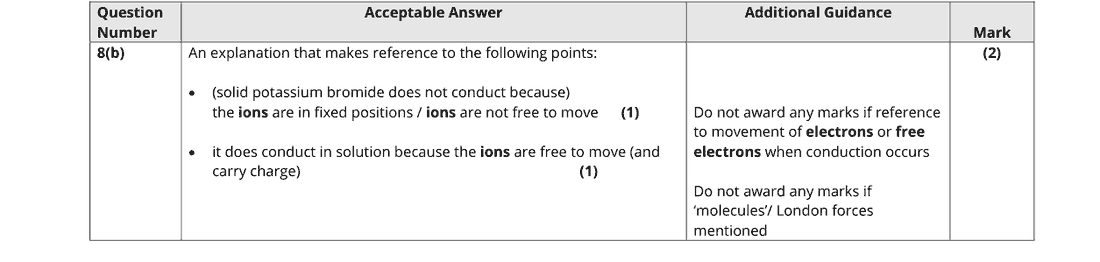
In the solid the ions are in fixed positions / not free to move
in solution the ions are free to move (and carry the charge). No marks if conduction is put down to electrons or free electrons, or if molecules or London forces are mentioned
June 2019 · AS Paper 1 · Q8(c)6 marks6-mark extended response
Earlier part of question 8 that this part uses
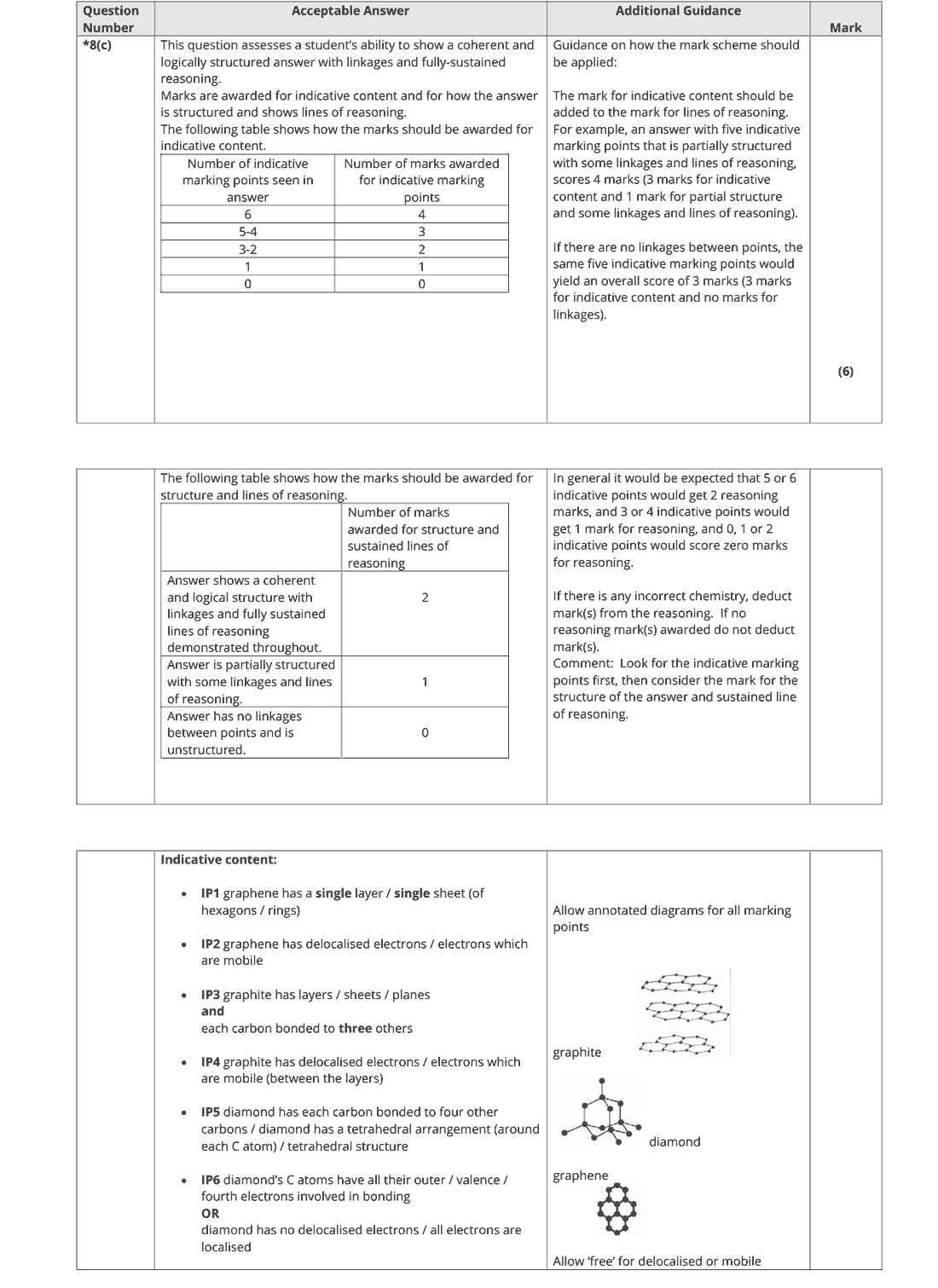
Mark scheme, with the indicative content and the marks for reasoning
Examiner's comment
(a) Candidates struggled with this question, often scoring just one mark from the
available three.
MP1 was most frequently awarded for relating charge on the ions, although well-
constructed answers were quite rare.
MP2 was scored relatively infrequently. Of those who discussed radii, there was often
confusion between ionic radius, atomic radius and even metallic radius.
MP3 was frequently lost because the wrong type of bonding was assumed to be present
- hydrogen bonding and covalent bonding were relatively common.
(b) Responses to this question tended to produce a mark of 2 or 0 depending on
whether the charge carriers were thought to be ions or electrons. Many candidates
thought that delocalised electrons are present in ionic compounds but that these
electrons are unable to flow in the solid state. A significant number thought that these
delocalised electrons would be unable to force their way through a solid lattice of ions
but would be able to move through a liquid because the movement of ions would let
the electrons pass.
(c) It was apparent that most candidates were very familiar with diamond and graphite
but less familiar with graphene, to the extent that some completely omitted any
reference to graphene. IP5 and IP6 (diamond structure and electrical conductivity) were
scored by most candidates. IP4 was also scored frequently (delocalised electrons in
graphite). However, IP3 required two responses (the structure and bonding in graphite),
the point was therefore sometimes not awarded because one of these two statements
had been omitted. Given that some candidates were unfamiliar with graphene, it was
unsurprising that IP1 and IP2 were not awarded so frequently. Graphene was often
recognised as similar to graphite so IP2 (relating to delocalised electrons in graphene)
was awarded. But IP1 (a reference to the single layer/sheet structure of graphene) was
often missing.
This question amply illustrated the need for legible writing. The second half of the two
words ‘graphene’ and ‘graphite’ sometimes tailed off into an illegible squiggle so that it
was impossible to be sure which of the two substances was being discussed.
(d) The majority of candidates scored just one of the available two marks.
MP2 was awarded quite frequently, with most candidates discussing the close packing
in iron rather than the idea of space (between the atoms/layers) in graphite.
MP1 was awarded relatively infrequently, perhaps because the previous question
related to structure, so few candidates thought about the mass of the individual
particles.
(e) This question presented candidates with unusual information and asked them to
relate this to the structure of graphite. The response was disappointing. Some
candidates seemed aware of the presence of weak and strong bonds, but failed to
relate this to the structure, let alone name the types of bonding present. Considerable
flexibility was allowed (particularly for MP1) in describing the type of bonds present.
Notes from the mark scheme and report
Indicative points: graphene is a single layer / sheet (of hexagons)
graphene has delocalised (mobile) electrons
graphite has layers AND each carbon is bonded to three others
graphite has delocalised electrons that are mobile (between the layers)
in diamond each carbon is bonded to four others / tetrahedral arrangement
in diamond all the outer electrons are used in bonding, so there are no delocalised electrons. Annotated diagrams are credited
'free' is allowed for delocalised. Incorrect chemistry loses reasoning marks
June 2019 · AS Paper 1 · Q8(d)2 marksShort answer
Earlier part of question 8 that this part uses
Mark scheme
Examiner's comment
(a) Candidates struggled with this question, often scoring just one mark from the
available three.
MP1 was most frequently awarded for relating charge on the ions, although well-
constructed answers were quite rare.
MP2 was scored relatively infrequently. Of those who discussed radii, there was often
confusion between ionic radius, atomic radius and even metallic radius.
MP3 was frequently lost because the wrong type of bonding was assumed to be present
- hydrogen bonding and covalent bonding were relatively common.
(b) Responses to this question tended to produce a mark of 2 or 0 depending on
whether the charge carriers were thought to be ions or electrons. Many candidates
thought that delocalised electrons are present in ionic compounds but that these
electrons are unable to flow in the solid state. A significant number thought that these
delocalised electrons would be unable to force their way through a solid lattice of ions
but would be able to move through a liquid because the movement of ions would let
the electrons pass.
(c) It was apparent that most candidates were very familiar with diamond and graphite
but less familiar with graphene, to the extent that some completely omitted any
reference to graphene. IP5 and IP6 (diamond structure and electrical conductivity) were
scored by most candidates. IP4 was also scored frequently (delocalised electrons in
graphite). However, IP3 required two responses (the structure and bonding in graphite),
the point was therefore sometimes not awarded because one of these two statements
had been omitted. Given that some candidates were unfamiliar with graphene, it was
unsurprising that IP1 and IP2 were not awarded so frequently. Graphene was often
recognised as similar to graphite so IP2 (relating to delocalised electrons in graphene)
was awarded. But IP1 (a reference to the single layer/sheet structure of graphene) was
often missing.
This question amply illustrated the need for legible writing. The second half of the two
words ‘graphene’ and ‘graphite’ sometimes tailed off into an illegible squiggle so that it
was impossible to be sure which of the two substances was being discussed.
(d) The majority of candidates scored just one of the available two marks.
MP2 was awarded quite frequently, with most candidates discussing the close packing
in iron rather than the idea of space (between the atoms/layers) in graphite.
MP1 was awarded relatively infrequently, perhaps because the previous question
related to structure, so few candidates thought about the mass of the individual
particles.
(e) This question presented candidates with unusual information and asked them to
relate this to the structure of graphite. The response was disappointing. Some
candidates seemed aware of the presence of weak and strong bonds, but failed to
relate this to the structure, let alone name the types of bonding present. Considerable
flexibility was allowed (particularly for MP1) in describing the type of bonds present.
Notes from the mark scheme and report
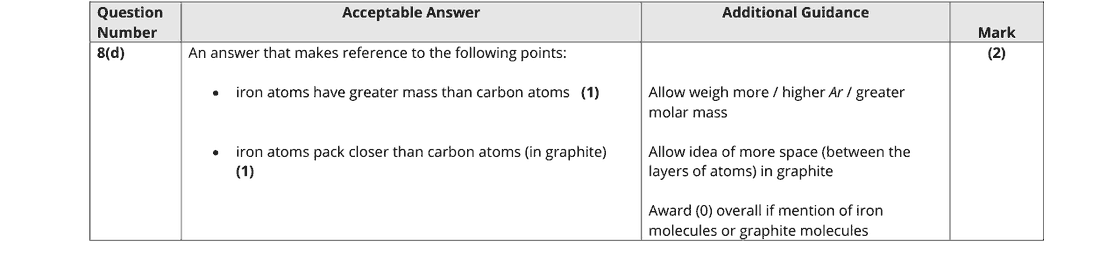
Iron atoms have a greater mass than carbon atoms (allow higher Ar or molar mass)
iron atoms are packed closer together than the carbon atoms in graphite (allow more space between the layers in graphite). Zero overall for iron 'molecules' or graphite 'molecules'
June 2019 · AS Paper 1 · Q8(e)2 marksShort answer
Earlier part of question 8 that this part uses
Mark scheme
Examiner's comment
(a) Candidates struggled with this question, often scoring just one mark from the
available three.
MP1 was most frequently awarded for relating charge on the ions, although well-
constructed answers were quite rare.
MP2 was scored relatively infrequently. Of those who discussed radii, there was often
confusion between ionic radius, atomic radius and even metallic radius.
MP3 was frequently lost because the wrong type of bonding was assumed to be present
- hydrogen bonding and covalent bonding were relatively common.
(b) Responses to this question tended to produce a mark of 2 or 0 depending on
whether the charge carriers were thought to be ions or electrons. Many candidates
thought that delocalised electrons are present in ionic compounds but that these
electrons are unable to flow in the solid state. A significant number thought that these
delocalised electrons would be unable to force their way through a solid lattice of ions
but would be able to move through a liquid because the movement of ions would let
the electrons pass.
(c) It was apparent that most candidates were very familiar with diamond and graphite
but less familiar with graphene, to the extent that some completely omitted any
reference to graphene. IP5 and IP6 (diamond structure and electrical conductivity) were
scored by most candidates. IP4 was also scored frequently (delocalised electrons in
graphite). However, IP3 required two responses (the structure and bonding in graphite),
the point was therefore sometimes not awarded because one of these two statements
had been omitted. Given that some candidates were unfamiliar with graphene, it was
unsurprising that IP1 and IP2 were not awarded so frequently. Graphene was often
recognised as similar to graphite so IP2 (relating to delocalised electrons in graphene)
was awarded. But IP1 (a reference to the single layer/sheet structure of graphene) was
often missing.
This question amply illustrated the need for legible writing. The second half of the two
words ‘graphene’ and ‘graphite’ sometimes tailed off into an illegible squiggle so that it
was impossible to be sure which of the two substances was being discussed.
(d) The majority of candidates scored just one of the available two marks.
MP2 was awarded quite frequently, with most candidates discussing the close packing
in iron rather than the idea of space (between the atoms/layers) in graphite.
MP1 was awarded relatively infrequently, perhaps because the previous question
related to structure, so few candidates thought about the mass of the individual
particles.
(e) This question presented candidates with unusual information and asked them to
relate this to the structure of graphite. The response was disappointing. Some
candidates seemed aware of the presence of weak and strong bonds, but failed to
relate this to the structure, let alone name the types of bonding present. Considerable
flexibility was allowed (particularly for MP1) in describing the type of bonds present.
Notes from the mark scheme and report
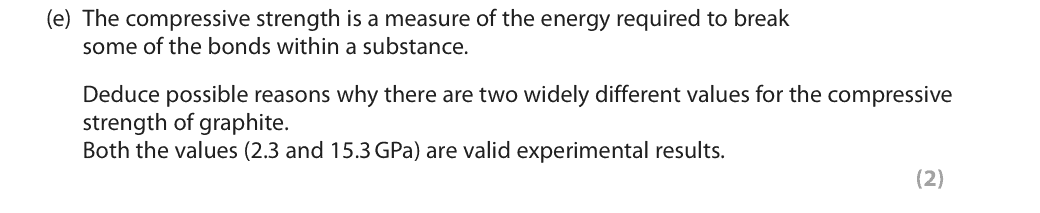
The lower value (2.3 GPa) relates to the weak London / van der Waals forces between the layers (allow weak intermolecular forces or 'pi-bonds' between layers)
the higher value (15.3 GPa) relates to the strong covalent C–C bonds within each layer (allow sigma bonds)
June 2017 · Paper 1 · Q6(a)(ii)1 markShort answerEasy
Earlier part of question 6 that this part uses
Mark scheme
Examiner's comment
The majority of candidates scored 1 mark for this question. Some candidates just stated molten, or just in aqueous solution, so they did not score the mark as they were asked for all the conditions under which magnesium bromide conducts electricity. A few candidates stated molten and liquid, possibly thinking that these are two different states. A small number of candidates negated the mark by adding 'so delocalised electrons can flow' to their answer.
Notes from the mark scheme and report
Molten (liquid) and dissolved in water / in aqueous solution: both are needed for the one mark. Ignore gaseous. Common errors: only one of the two conditions
'molten and liquid'
adding 'so delocalised electrons can flow', which lost the mark
June 2017 · AS Paper 1 · Q6(c)6 marks6-mark extended response
Earlier part of question 6 that this part uses
Mark scheme, with the indicative content and the marks for reasoning
Examiner's comment
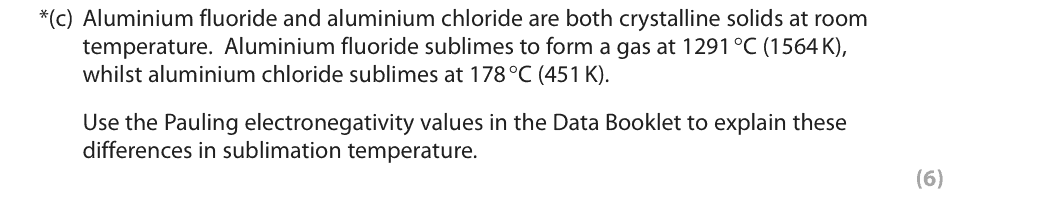
Candidates were not expected to know that AlF3 is a giant covalent structure; they were expected to deduce from the high sublimation temperature that it was a giant structure, perhaps ionic. They know the structure of Al2Cl6 and were expected to deduce that AlCl3 was also covalent. They were also expected to know that the shape of BCl3 is the same as that of AlCl3, trigonal planar, so it would be non-polar. Instead a range of scenarios were presented for the bonding and structure of the two substances and hence the reason for their sublimation temperatures. Most candidates sensibly quoted and used the electronegativity data so gained some credit.
Notes from the mark scheme and report
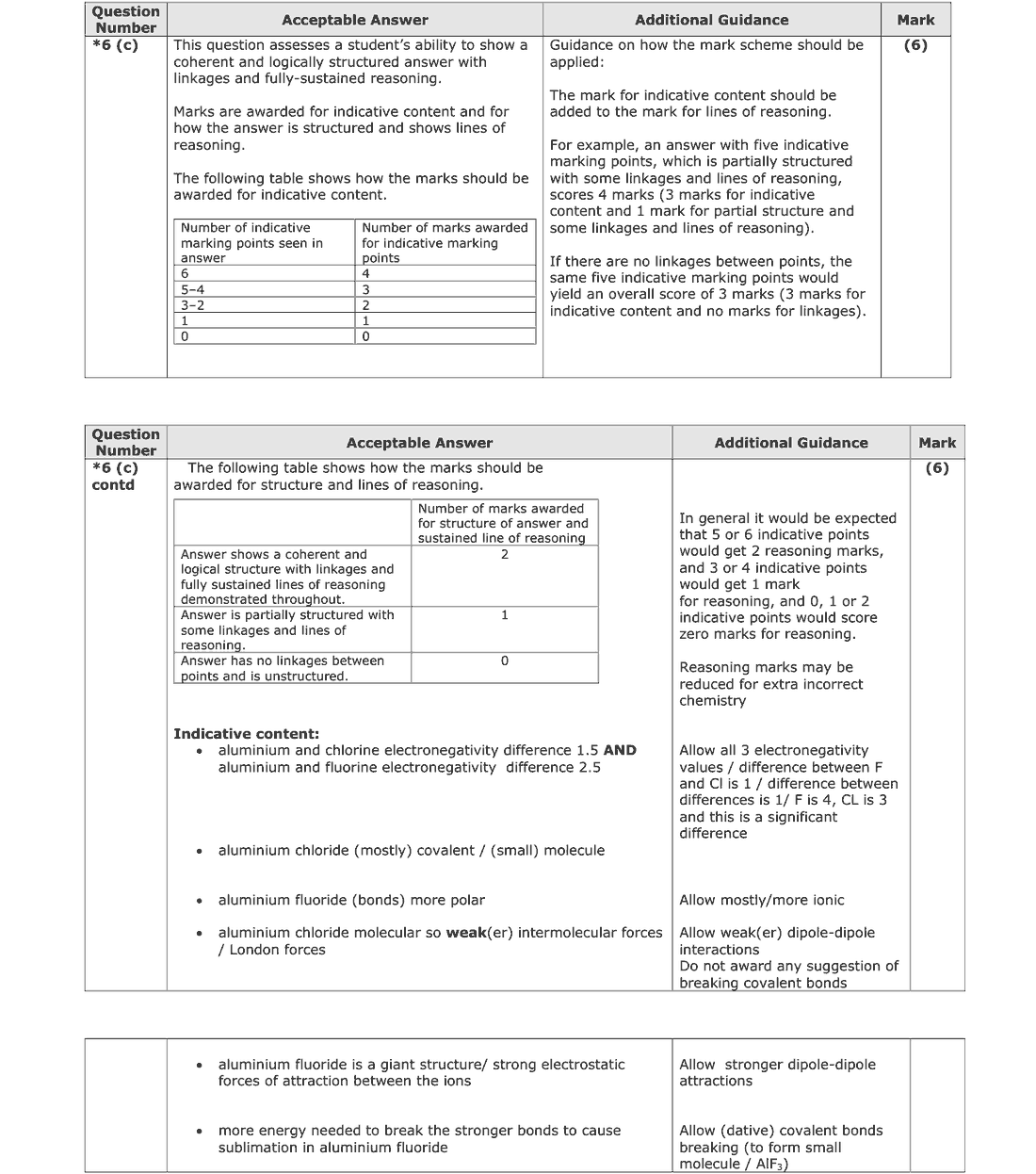
Uses the Data Booklet only. Six indicative points plus two marks for reasoning. IP1 electronegativity difference is 1.5 for Al and Cl and 2.5 for Al and F (allow the three values, or F 4.0 and Cl 3.0 as a significant difference)
IP2 aluminium chloride is (mostly) covalent / small molecules
IP3 aluminium fluoride bonds are more polar (allow mostly / more ionic)
IP4 aluminium chloride is molecular, so only weak intermolecular (London) forces to overcome (no suggestion of breaking covalent bonds)
IP5 aluminium fluoride is a giant structure with strong electrostatic attraction between ions
IP6 more energy is needed to break the stronger bonds in aluminium fluoride for it to sublime. Most quoted and used the electronegativity values
a wide range of wrong structures was offered for the two solids
June 2017 · Paper 2 · Q2(a)1 markMultiple choice
Answer
C
Mark scheme
Notes from the mark scheme and report
Answer: C. Both have carbon atoms in hexagonal rings within a layer. Each atom is bonded to three others, not four (A)
there are no pentagonal rings (B)
graphene is a single two-dimensional layer (D)
June 2017 · Paper 2 · Q2(b)1 markMultiple choice
Answer
D
Mark scheme
Notes from the mark scheme and report
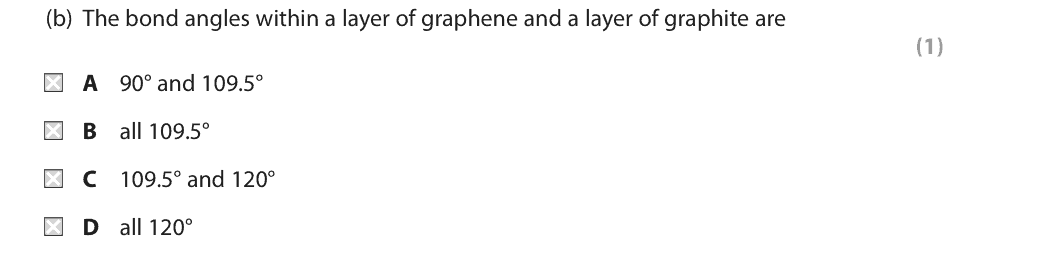
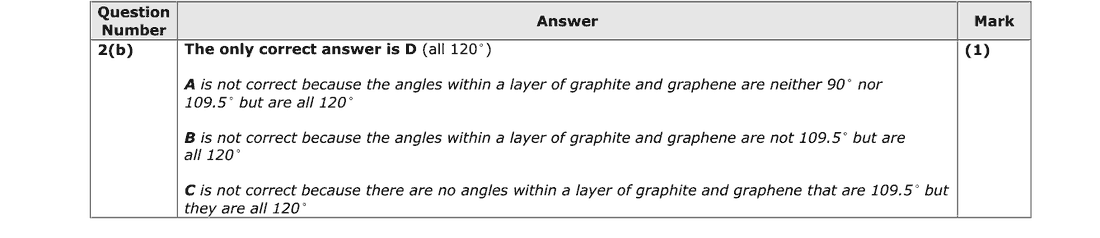
Answer: D. Each carbon is bonded to three others in a plane, so every bond angle within a layer of graphene or graphite is 120°
there are no 90° or 109.5° angles
Skills: MS4.1 Appreciate angles and shapes in regular 2D and 3D structures.
June 2017 · Paper 2 · Q2(c)1 markMultiple choice
Answer
C
Mark scheme
Notes from the mark scheme and report
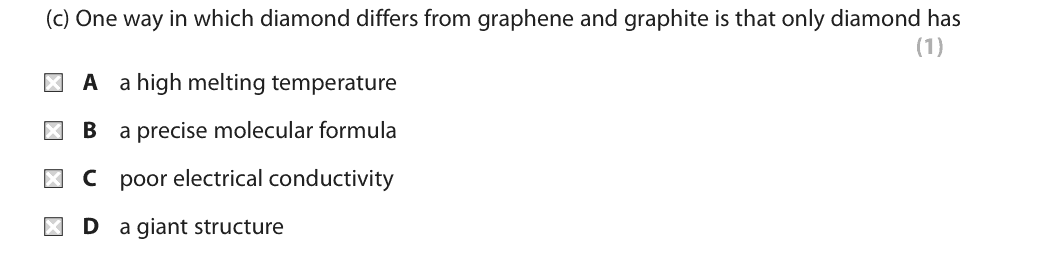
Answer: C. Only diamond is a poor electrical conductor (no delocalised electrons). All three have high melting temperatures and giant structures, and none has a precise molecular formula
June 2016 · AS Paper 1 · Q8(a)1 markMultiple choice
Answer
A
Mark scheme
Notes from the mark scheme and report
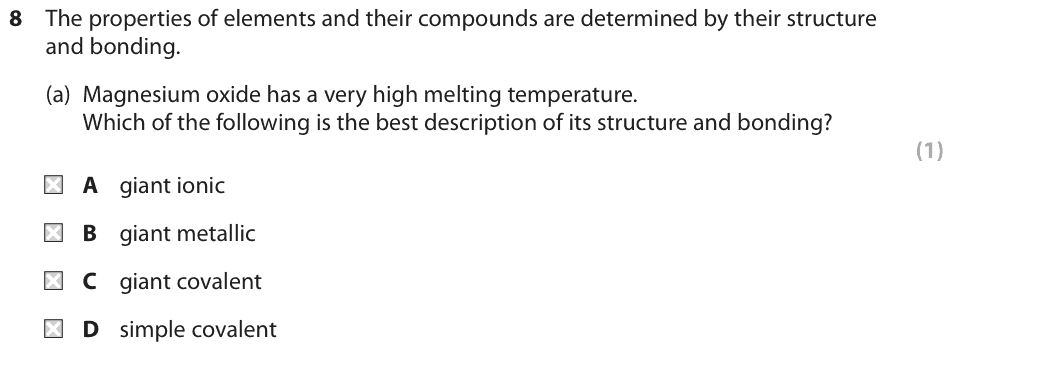
Answer: A. Magnesium oxide is a compound of a metal and a non-metal: a giant lattice of Mg2+ and O2– ions with strong ionic bonding, hence the very high melting temperature
June 2016 · AS Paper 1 · Q8(c)4 marksExplanationEasy
Earlier part of question 8 that this part uses
Mark scheme
Examiner's comment
This was a very straightforward question requiring candidates to also draw on their GCSE knowledge and understanding with the result that marks of three or four out of four were the most common ones awarded. There was no evidence that the candidates had 'run out of time' at the end of the paper and so these marks were as equally accessible as all the others on the paper.
There continues to be the use of the term 'free' electrons rather than 'delocalised' and this former term is not creditworthy at this level. A small number of candidates also spoilt their answers by referring to intermolecular forces.
Notes from the mark scheme and report
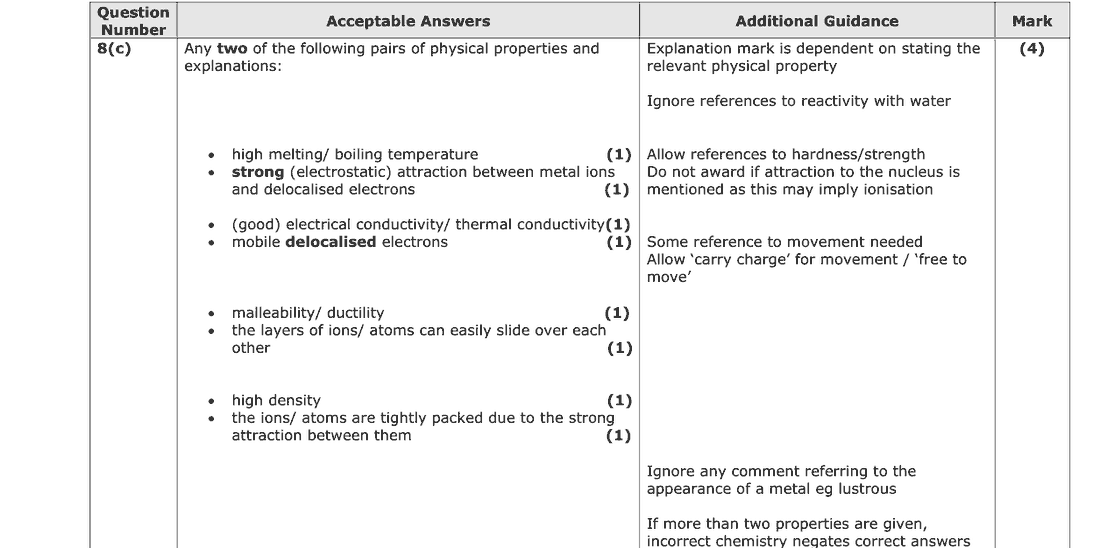
Any two properties, each with its explanation (the explanation mark depends on the property): high melting / boiling temperature (allow hardness, strength), because of the strong electrostatic attraction between metal ions and delocalised electrons (not attraction to the nucleus)
good electrical or thermal conductivity, because the delocalised electrons are mobile (movement must be mentioned)
malleable / ductile, because the layers of ions or atoms can slide over each other
high density, because the ions are tightly packed. Appearance (lustre) and reactivity with water are ignored. 'Free' electrons instead of 'delocalised' is not credited
some spoilt answers by mentioning intermolecular forces
Work with an A-level chemistry tutor
Dropping marks on calculations, mechanisms or the core practicals? Book a trial session with an A-level chemistry tutor.