Notes and key-term cards for this topic are being written by our tutors. The past-paper questions below are ready now.
Specification statements
Show the 5 statements from the specification
17.1 know that optical isomerism is a result of chirality in molecules with a single chiral centre
17.2 understand that optical isomerism results from chiral centre(s) in a molecule with asymmetric carbon atom(s) and that optical isomers are object and non- superimposable mirror images
17.3 know that optical activity is the ability of a single optical isomer to rotate the plane of polarisation of plane-polarised monochromatic light in molecules containing a single chiral centre
17.4 understand the nature of a racemic mixture
17.5 be able to use data on optical activity of reactants and products as evidence for SN1 and SN2 mechanisms
Six-mark extended response questions on this topic
Tap a question to zoom it. Where a part needs a figure, table or structure from earlier in the question, that part folds out above it; the mark scheme and examiner's comment open underneath. Have Edexcel's Data Booklet beside you; the Periodic Table is on the back page of every paper.
June 2024 · Paper 2 · Q8(a)(i)1 markShort answer
Mark scheme
Examiner's comment
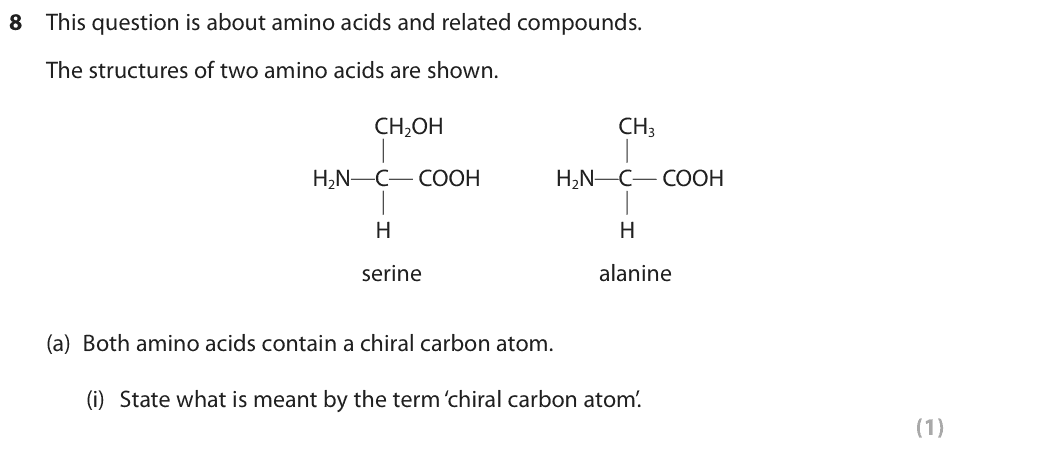
The definition of a chiral carbon was clear to many candidates, with most definitions based on a carbon atom with four different groups attached, rather than the formation of a molecule with a non-superimposable mirror image. Occasional slips tended to be omission of either the word ‘four’ or ‘different’ or imprecise use of the word molecule, eg ‘a carbon with four different molecules attached’.
Notes from the mark scheme and report
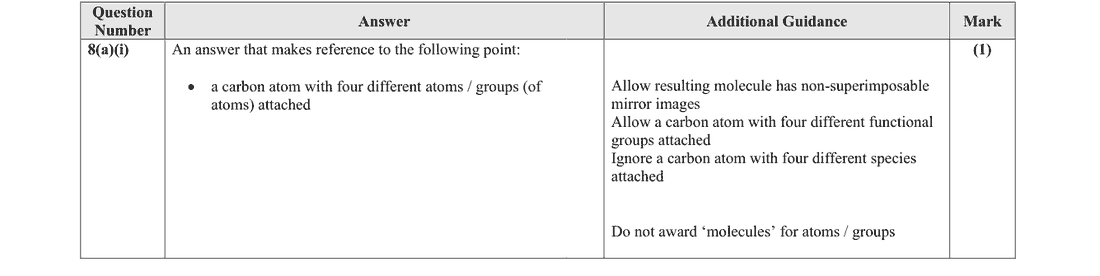
A carbon atom with four different atoms or groups attached (allow: gives a molecule with non-superimposable mirror images). 'Four different molecules' is not credited
'species' is ignored. Slips: leaving out 'four' or 'different'
June 2024 · Paper 2 · Q8(a)(ii)2 marksDiagram or structure
Earlier part of question 8 that this part uses
Mark scheme
Examiner's comment
The best responses drew the mirror images to represent the stereoisomers. Other candidates tried to swap multiple groups to create a stereoisomer, and some of these responses ended up drawing the same stereoisomer twice. Practicing drawing 3 dimensional representations is a skill some candidates need to work on. This was evident by a small but significant number of answers that did not use wedges and/or dashed lines, and others who used wedges and/or dashed lines but clearly in a square planar orientation on the page.
Notes from the mark scheme and report
Two tetrahedral structures of alanine, CH3CH(NH2)COOH, drawn with wedge and dashed bonds as mirror images of each other, one mark each. 1 mark only if the mirror images are drawn with plain lines, or with two wedges of the same kind on each. Connectivity ignored. Errors: swapping several groups and so drawing the same isomer twice
no wedges
a square planar arrangement
Skills: MS4.2 Visualise and represent 2D and 3D forms including two- dimensional representations of 3D objects
June 2023 · Paper 2 · Q7(b)(ii)3 marksExplanation
Earlier part of question 7 that this part uses
Mark scheme
Examiner's comment
Many candidates understood the principle behind this question and gained some credit. There was a general understanding that a racemic mixture would be formed as two enantiomers would be formed in equal amounts. Marks were lost for stating that the whole propanal molecule was planar instead of referencing the C=O as being planar.
Notes from the mark scheme and report
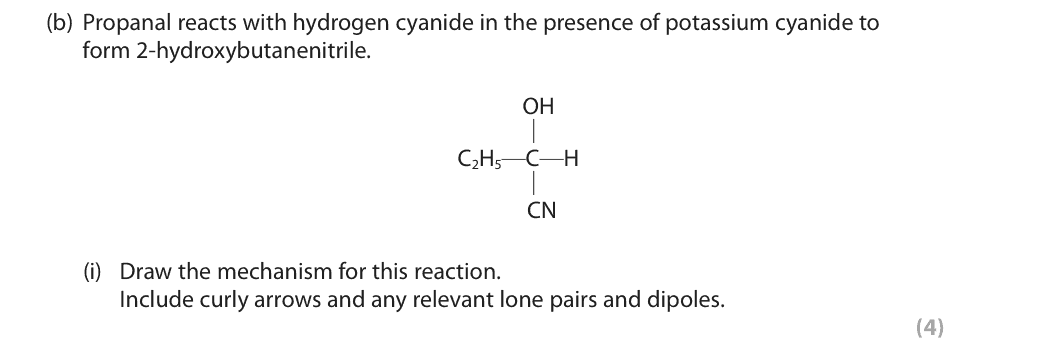
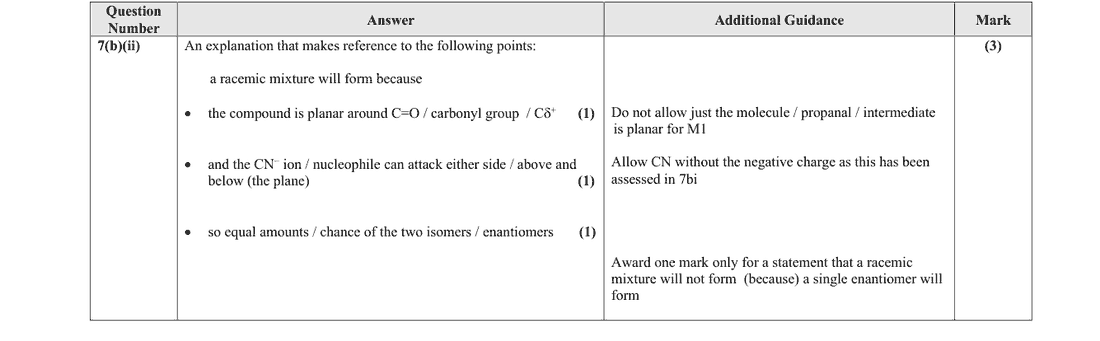
A racemic mixture forms: M1 the molecule is planar around the C=O (carbonyl) group (not just 'propanal is planar')
M2 so CN– can attack from either side / above and below the plane
M3 giving equal amounts of the two enantiomers. One mark only for arguing that a single enantiomer forms. Marks were lost for saying the whole molecule is planar
June 2023 · Paper 2 · Q8(d)6 marks6-mark extended response
Earlier part of question 8 that this part uses
Mark scheme, with the indicative content and the marks for reasoning
Examiner's comment
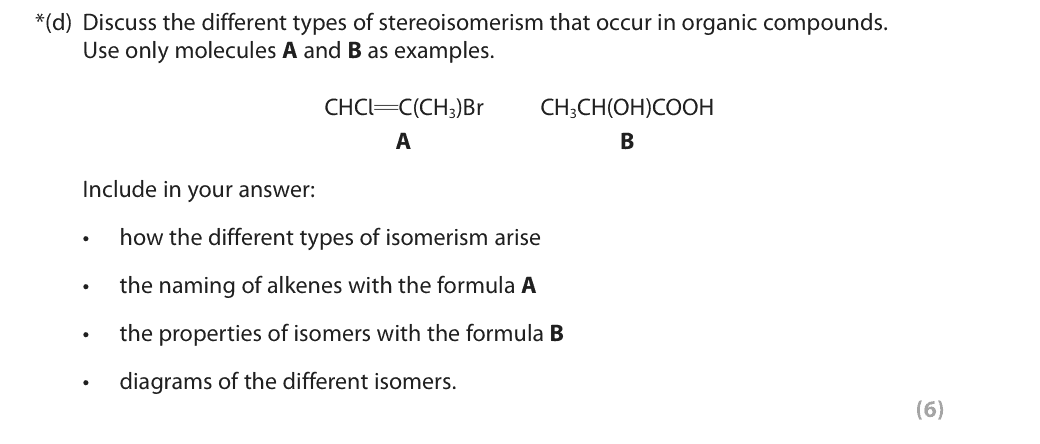
This extended writing question required candidates to discuss different types of stereoisomerism.
Most candidates were able to demonstrate their understanding of the topic, with some excellent explanations and diagrams seen. The best answers contained detailed explanations of each of the points in the question. For the E-Z isomers, many good diagrams of the alkenes were seen, and candidates also stated that these isomers arose due to restricted rotation around the C=C. However, fewer gave a good explanation of how the priorities were assigned to groups. We did allow reference mass rather than atomic number this time, but candidates should note that the E/Z nomenclature is based on the atomic number of the attached atoms. For the optical isomers, many good diagrams were seen, although some candidates did not show the full 3D structure with appropriate wedges. Many candidates appreciated that the optical isomerism arose because of chiral carbon and went on to describe the ability of the enantiomers to rotate plane polarised light but did not mention that this would be in opposite directions and so were not awarded the final mark.
Notes from the mark scheme and report
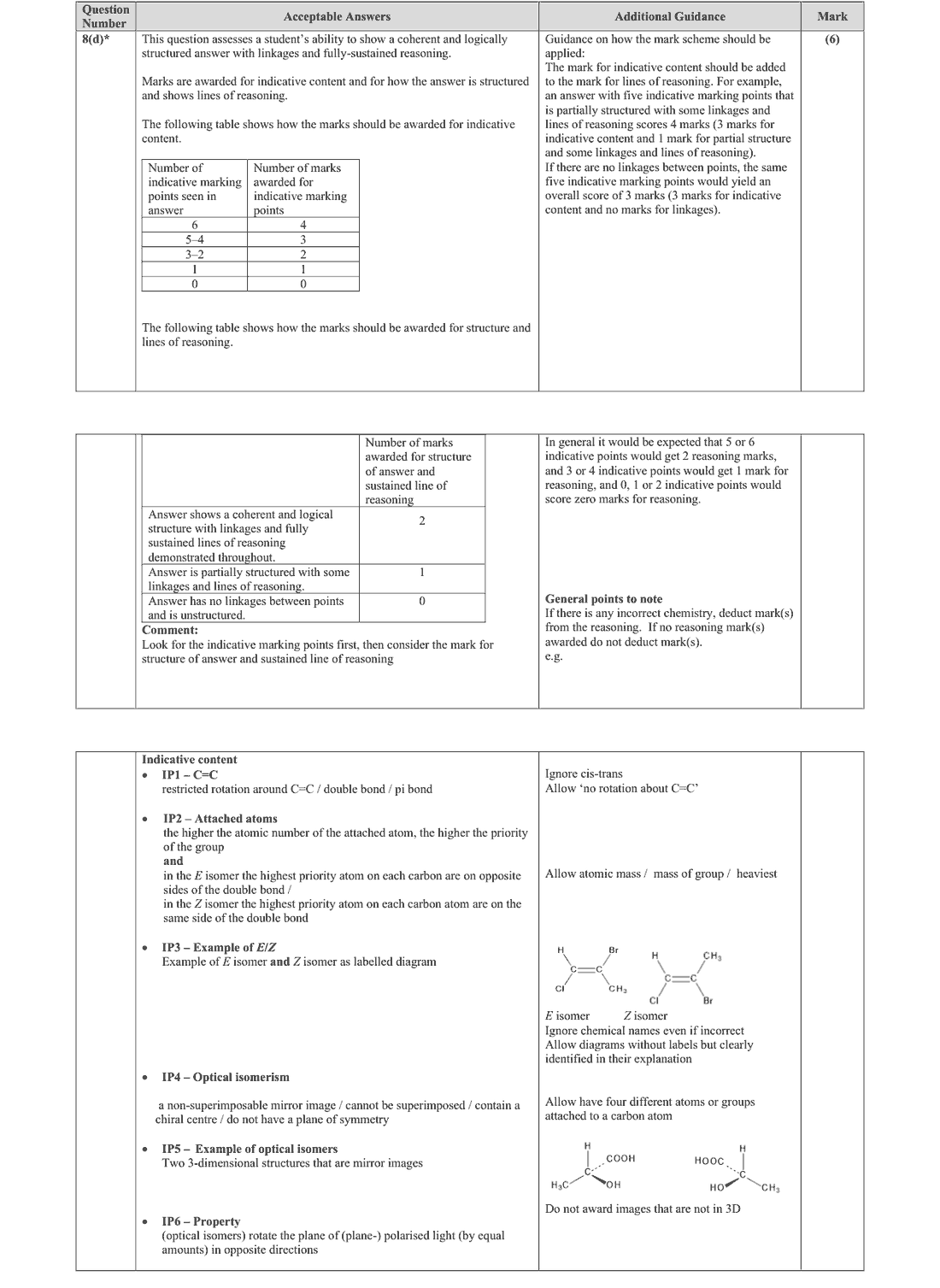
Six indicative points plus two marks for reasoning. IP1 E/Z isomerism arises from restricted rotation about the C=C
IP2 priority goes to the attached atom of higher atomic number (mass allowed), and in the E isomer the two higher-priority atoms are on opposite sides, in the Z isomer on the same side
IP3 labelled diagrams of the E and Z isomers of A (Cl and Br opposite is E)
IP4 optical isomerism: a chiral centre / four different groups on a carbon / non-superimposable mirror images
IP5 two three-dimensional mirror-image structures of B (wedges needed)
IP6 the isomers rotate the plane of plane-polarised light in opposite directions. Common gaps: how priorities are assigned
structures not drawn in 3D
'opposite directions' left out
Skills: MS4.2 Visualise and represent 2D and 3D forms including two- dimensional representations of 3D objects
June 2022 · Paper 2 · Q7(c)6 marks6-mark extended response
Earlier part of question 7 that this part uses
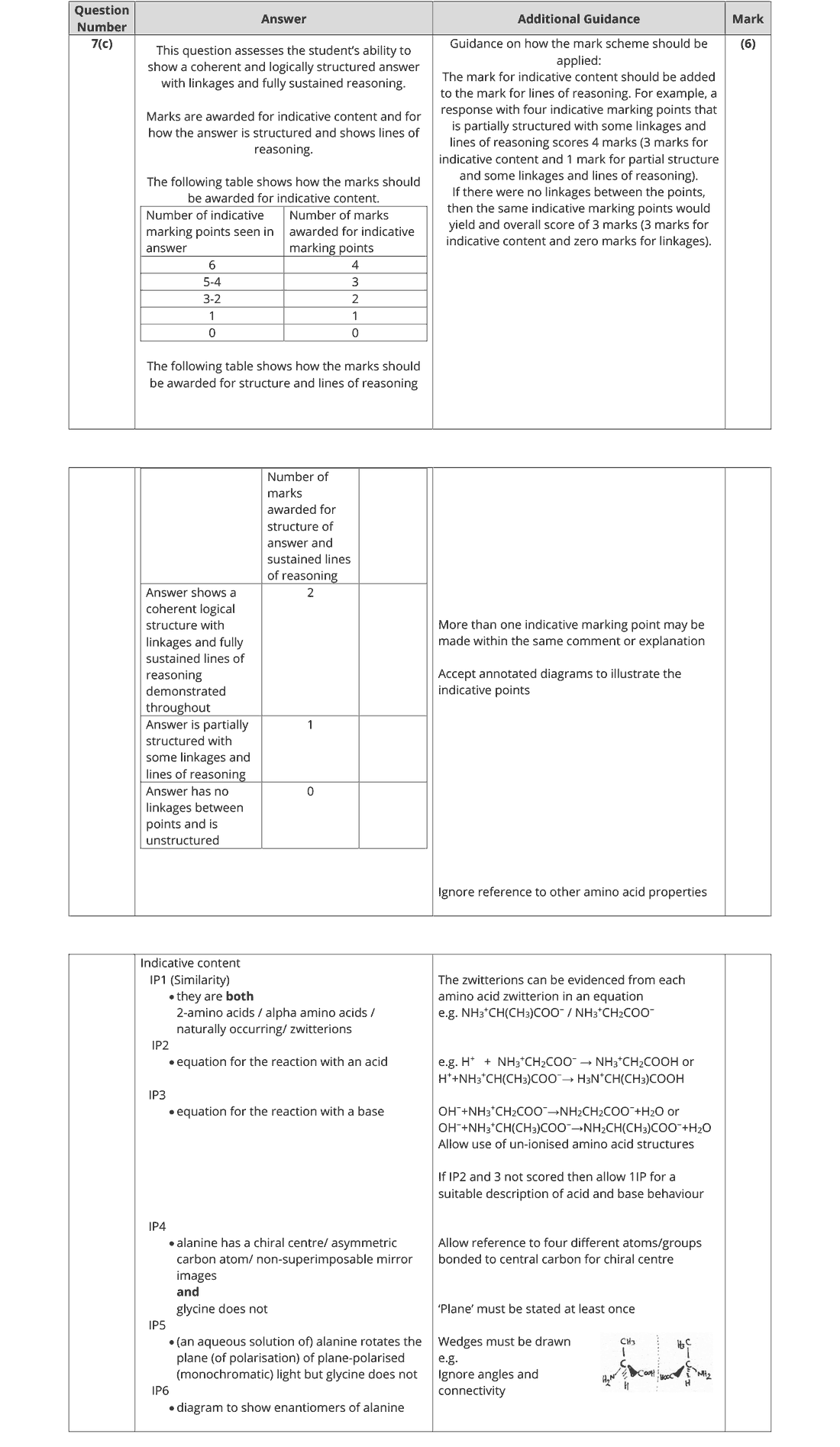
Mark scheme, with the indicative content and the marks for reasoning
Examiner's comment
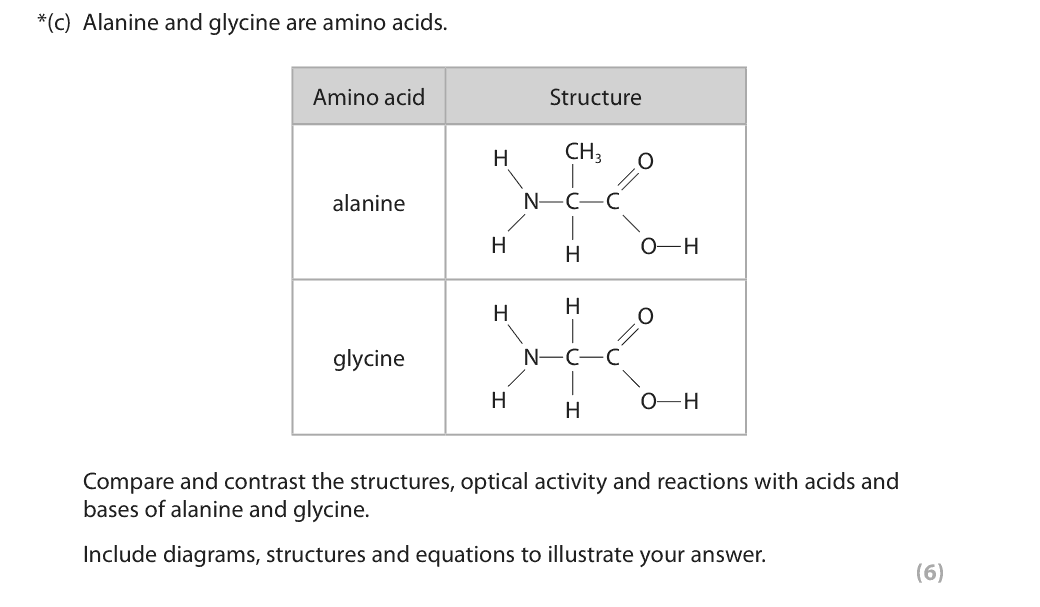
On the whole this 6-mark question was answered rather well which may be a reflection of the fact that amino acids are included in the first topic on the Advance Notice.
It was disappointing that IP3 and 4 often couldn’t be given because of the absence of any equations despite the clear instruction in the question that these were required. In addition, it was not uncommon to see one or more of the equations being balanced incorrectly, often with H2O missing as a product. However, the MS had a rescue mark for a suitable description
of amino acid behaviour with an acid and a base which helped many score a mark here.
Chirality and the ability to rotate the plane of plane polarised light were often given, but many failed to show mirror images of alanine’s enantiomers.
It would seem that many had obviously noted on the Advance Notice information that amino acids were the first topic listed and so had revised their chemistry of amino acids. There were a sizeable number of excellent responses achieving full credit.
Notes from the mark scheme and report
Six indicative points plus two marks for reasoning. IP1 similarity: both are 2-amino acids / form zwitterions
IP2 equation for reaction with an acid, e.g. H+ + H3N+CH2COO– → H3N+CH2COOH
IP3 equation for reaction with a base, e.g. OH– + H3N+CH2COO– → H2NCH2COO– + H2O (un-ionised structures allowed
one point for a description of acid and base behaviour if neither equation scores)
IP4 alanine has a chiral centre (four different groups on the central carbon) and glycine does not
IP5 alanine rotates the plane of plane-polarised light and glycine does not ('plane' needed)
IP6 wedge-and-dash diagram of the two enantiomers of alanine. Common errors: no equations despite the instruction
equations unbalanced, often with H2O missing
no mirror-image diagrams
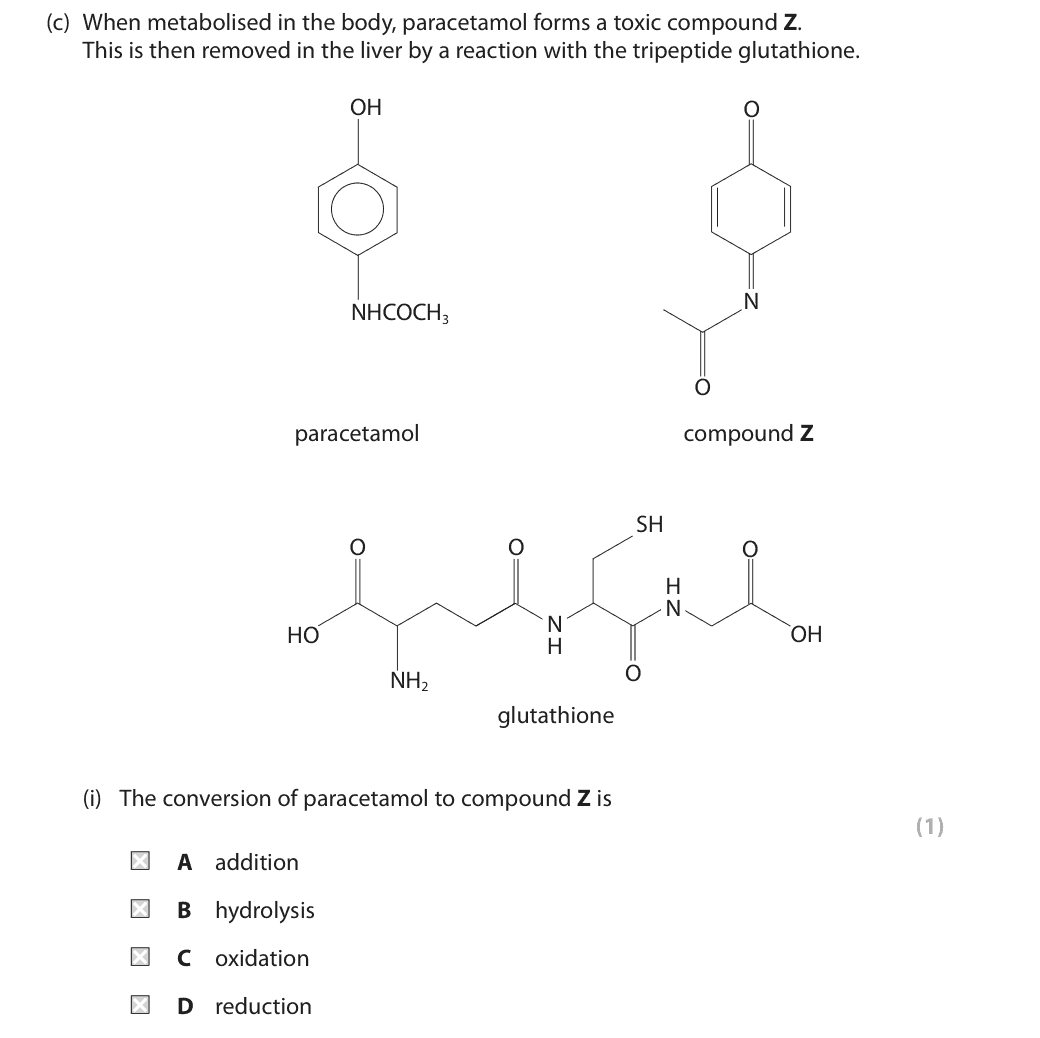
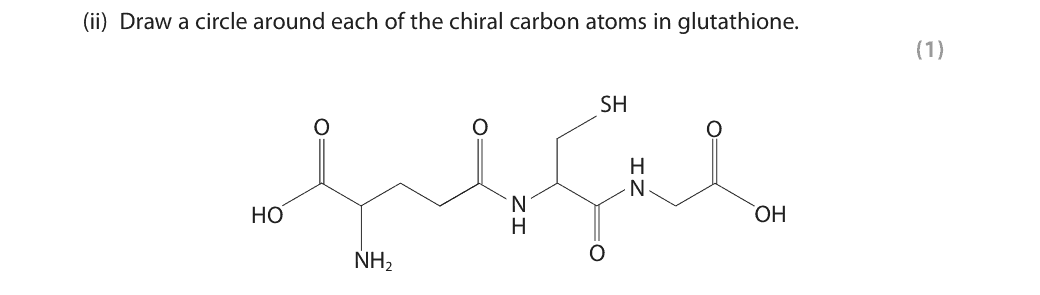
November 2021 · Paper 2 · Q9(c)(ii)1 markShort answer
Earlier parts of question 9 that this part uses
Mark scheme
Examiner's comment
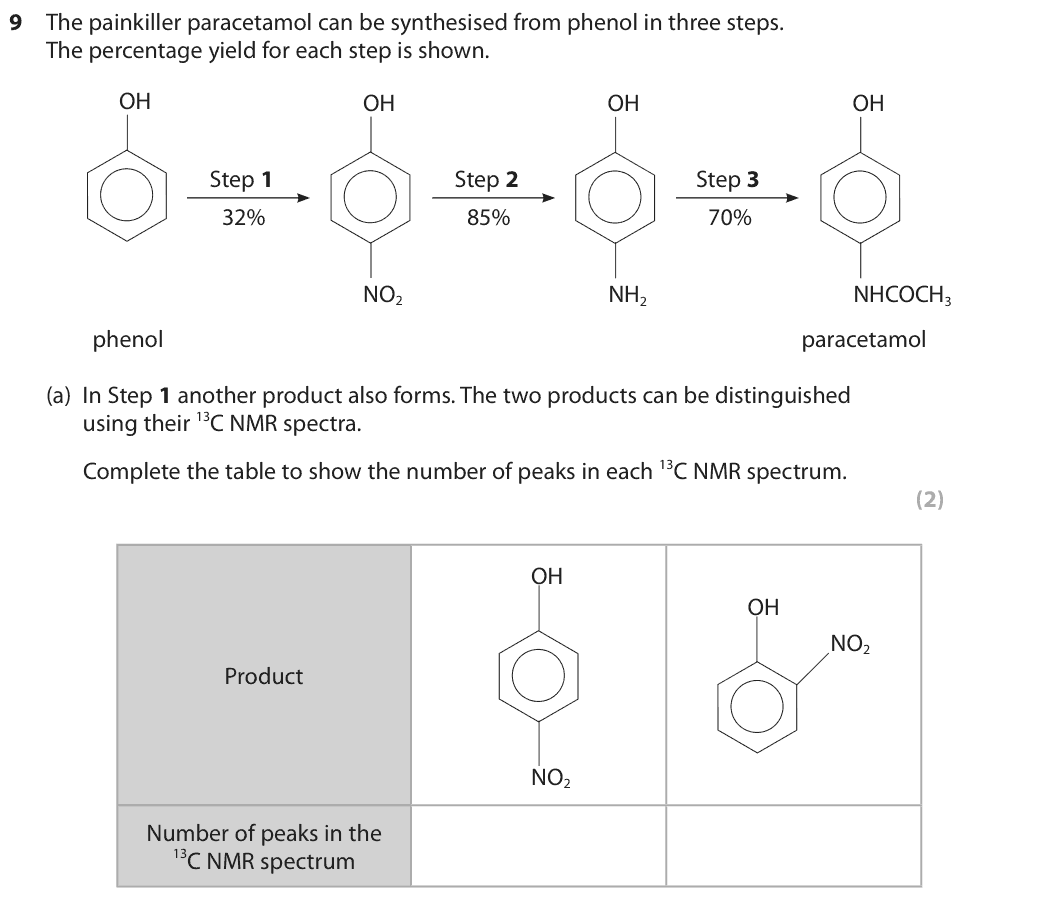
Completion of the table in (a) was attempted by nearly all candidates, though only a minority
scored both marks. The calculation in (b) yielded marks for many, though not taking into
account the overall yield of the process meant an answer of 622.5 g was common. Whilst many
candidates could identify chiral carbon atoms in (c)(ii) a number seemed unable to work with
skeletal formulae, circling whole sections of the molecule, covering several carbon atoms. Most
candidates in (d) assigned the crystalline structure solely to hydrogen bonds rather than the
formation of zwitterions.
Notes from the mark scheme and report
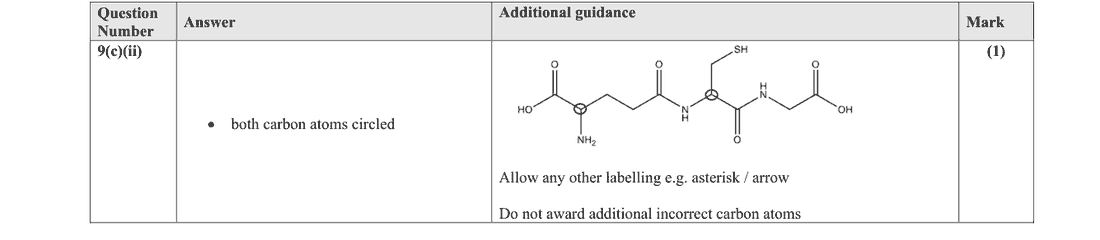
Answer: two carbon atoms circled: the carbon bonded to NH2 (next to the COOH at the left) and the carbon bonded to the CH2SH group. Any clear labelling allowed
an extra wrong carbon loses the mark. Some circled whole sections of the molecule
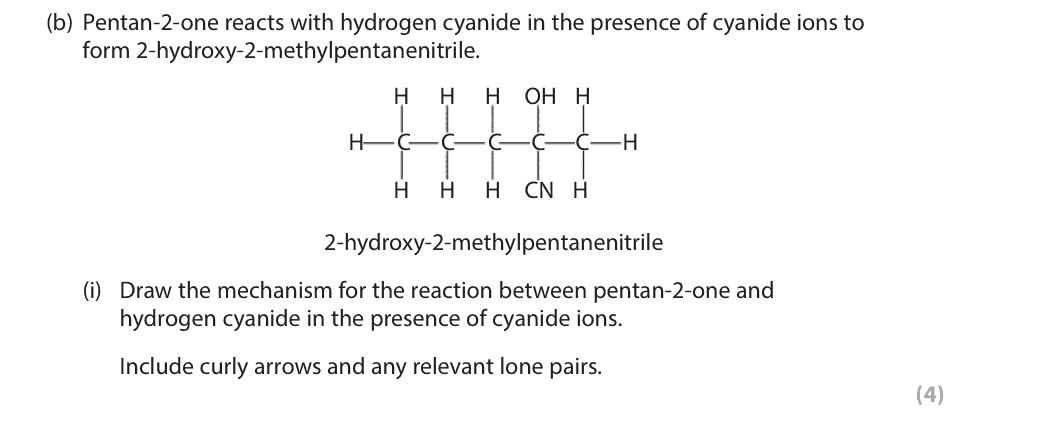
November 2021 · Paper 3 · Q8(b)(ii)2 marksExplanation
Earlier part of question 8 that this part uses
Mark scheme
Examiner's comment
Many candidates were familiar with the ‘iodoform’ test to identify a methyl ketone, although
some lost a mark as they did not mention the reagents as aqueous iodine and aqueous
sodium hydroxide. The mechanism was well drawn by a few candidates, but many made a
mistake such as not starting a curly arrow from a lone pair or a bond or drawing an incorrect
intermediate. Some candidates seemed unfamiliar with this mechanism and produced a
carbocation before attacking with cyanide ions. Many candidates realised that the
nucleophile could attack the intermediate from either side but most omitted to mention that
the intermediate is planar around the carbonyl carbon. Many candidates used the data to
identify the correct aldehyde, but they did not score full marks unless they justified their
answer using all of the data. For example, many did not show the three carbon environments
and two hydrogen environments. The extended open response question was answered well
by many candidates, showing that they had a good knowledge and understanding of the
redox reactions of carbonyl compounds. Some candidates lost marks as they did not draw
the structures of the products, did not show five of carbon atoms in the products, confused
oxidation and reduction and omitted part of the oxidising agent or reducing agent, for
example the acid from potassium dichromate or the dry ether from lithium
tetrahydridoaluminate. Some candidates showed a lack of understanding and referred to
pantan-3-one as a tertiary ketone and reduced it to pentan-2-ol instead of pentan-3-ol.
Notes from the mark scheme and report
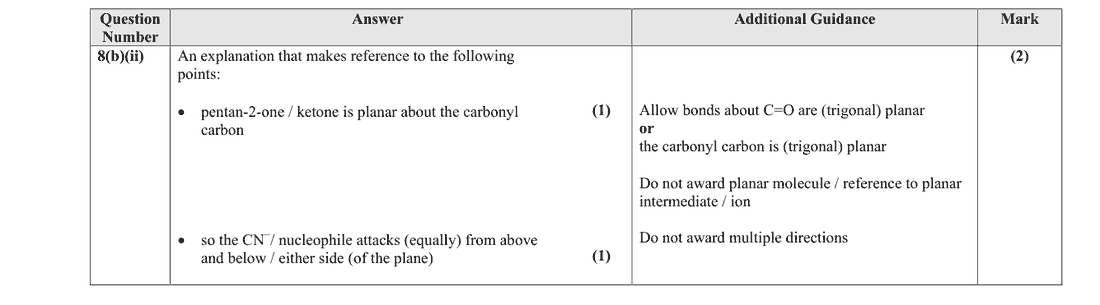
The ketone is planar about the carbonyl carbon (not 'planar molecule', not a planar intermediate or ion)
so the CN– nucleophile attacks equally from above and below the plane (either side). Many gave attack from either side but did not say the carbonyl carbon is planar
October 2020 · Paper 2 · Q6(e)3 marksExplanation
Earlier part of question 6 that this part uses
Mark scheme
Examiner's comment
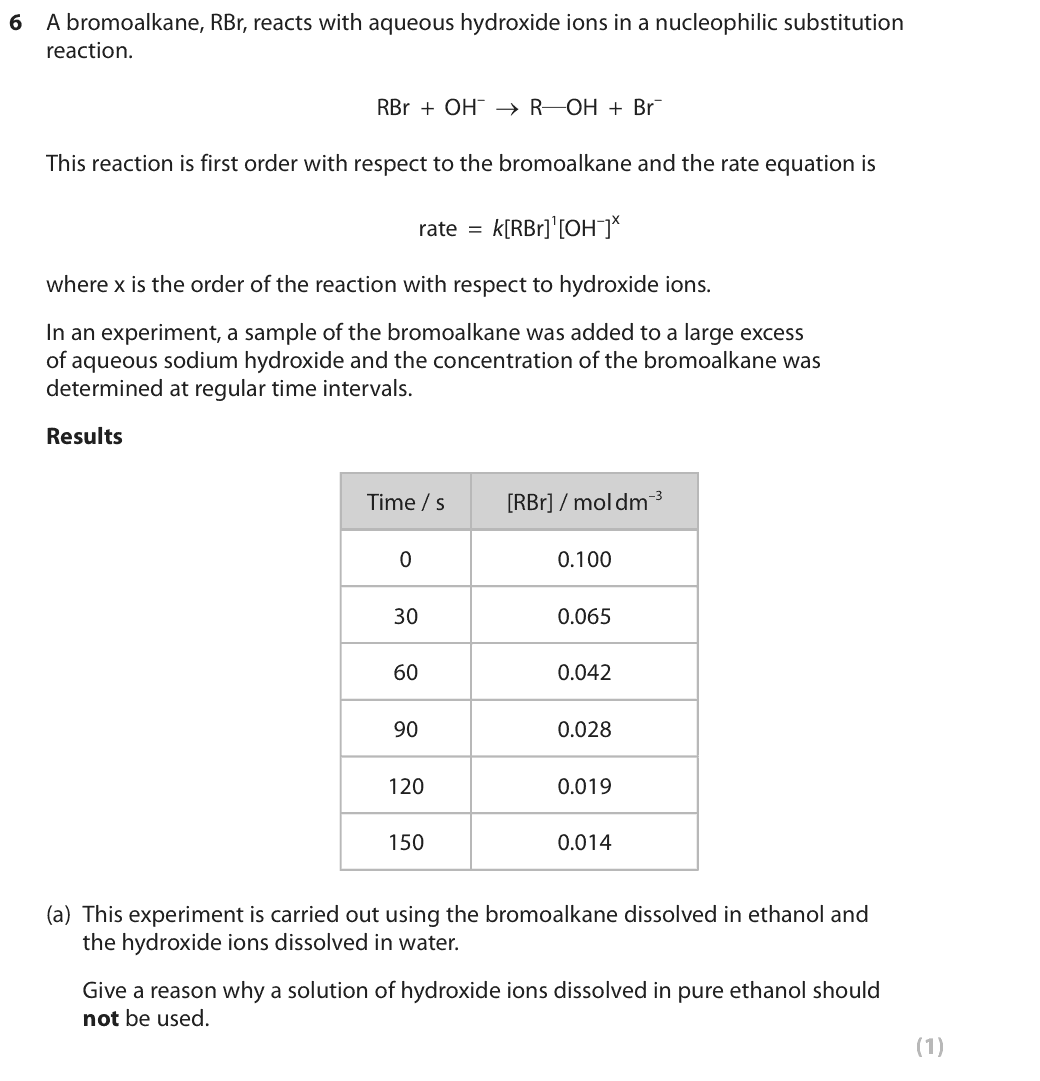
It was surprising that only a minority of candidates knew that ethanolic sodium hydroxide
reacts with halogenoalkanes to produce an alkene in an elimination reaction. The vast
majority of candidates could plot a correct graph in (b), with just a few omitting to label the
axes or plotting time on the y axis. Many candidates were confused about the half-life of a
reaction and they would benefit from more experience in working these out from graphs of
first order reactions. The vast majority deduced that the reaction was zero order with respect
to hydroxide ions in (d)(i) but many were unable to use this to give the SN1 mechanism for the
reaction between RBr and hydroxide ions. Many candidates showed the SN2 mechanism even
though the kinetics showed that hydroxide ions are not involved in the rate determining step.
Some candidates showed a hybrid of SN1 and SN2 and many omitted to show the bromide
ions formed. It was pleasing to see many candidates giving a clear explanation why the
product of the reaction is not optically active. The most common cause of a mark loss was not
stating that the intermediate is planar around the positive carbon.
Notes from the mark scheme and report
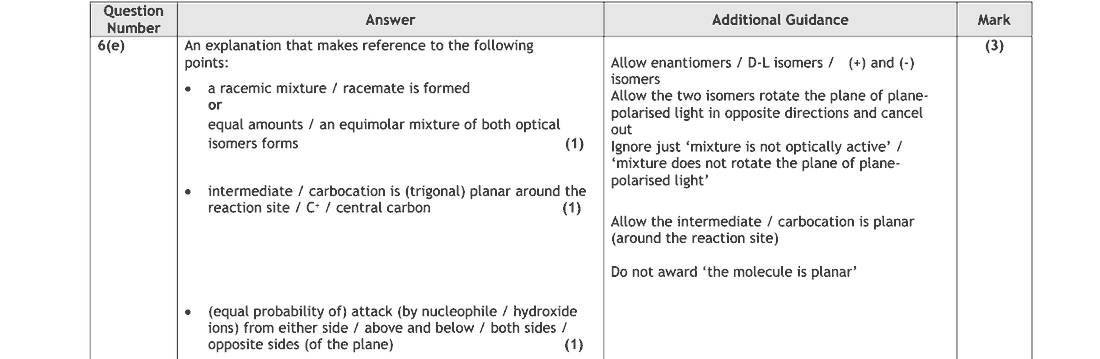
A racemic mixture forms (equal amounts of the two optical isomers, whose rotations cancel)
the carbocation intermediate is (trigonal) planar around the C+ (not 'the molecule is planar')
so the hydroxide ion can attack from either side (with equal probability). Just 'the mixture is not optically active' is ignored. The most common loss was not saying the intermediate is planar around the positive carbon
June 2019 · Paper 2 · Q4(c)(ii)1 markMultiple choice
Earlier parts of question 4 that this part uses
Answer
C
Mark scheme
Notes from the mark scheme and report
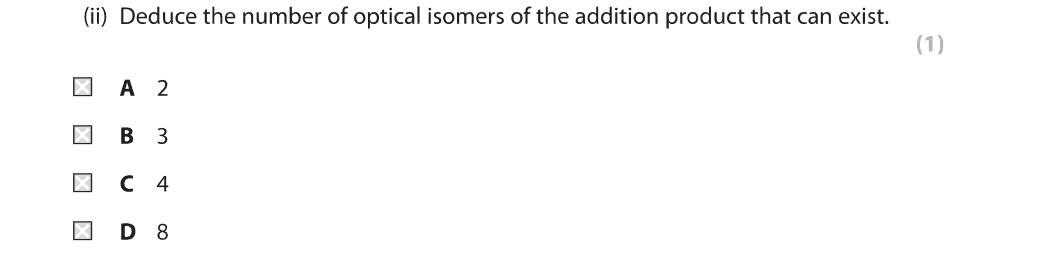
Answer: C (4). Addition of bromine creates two chiral centres, so there are 2 × 2 = 4 possible optical isomers
Skills: MS4.3 Understand the symmetry of 2D and 3D shapes
June 2019 · Paper 2 · Q4(c)(iii)1 markMultiple choice
Earlier parts of question 4 that this part uses
Answer
D
Mark scheme
Notes from the mark scheme and report
Answer: D. An optical isomer rotates the plane of polarisation of plane-polarised light
diffracted, reflected and refracted are the wrong terms
June 2019 · Paper 2 · Q6(a)1 markShort answer
Mark scheme
Notes from the mark scheme and report
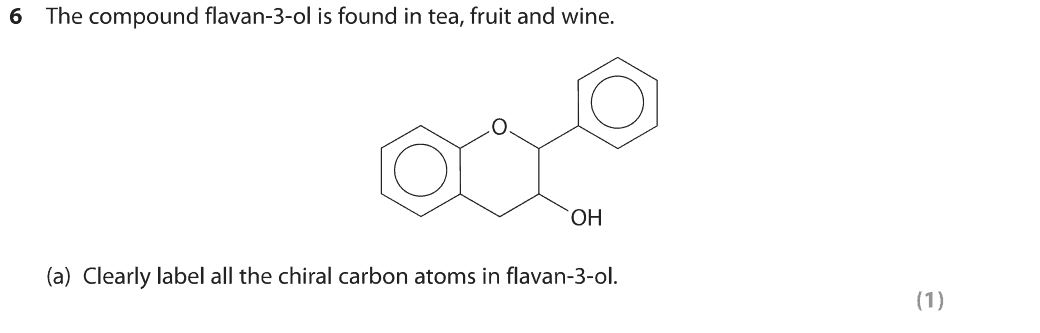
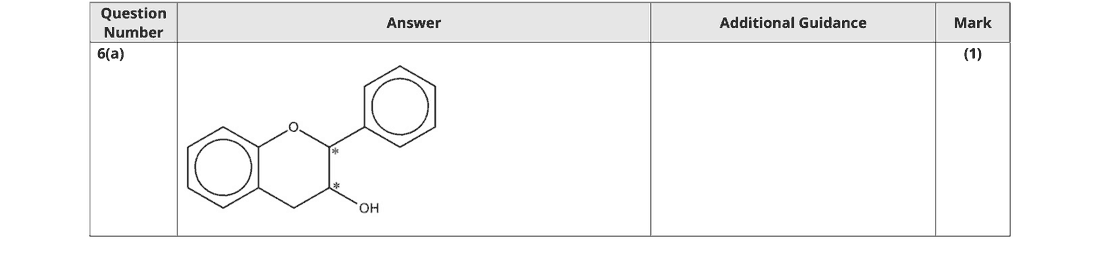
Answer: two chiral carbon atoms, both in the oxygen-containing ring: the carbon bonded to the ring O and the phenyl group, and the next carbon, which carries the OH
June 2019 · Paper 3 · Q9(a)(i)2 marksExplanation
Mark scheme
Examiner's comment
The majority of candidates scored 2 marks for this question. Some candidates thought that the glycinate ion would be chiral and some thought that a racemic mixture would form.
Notes from the mark scheme and report
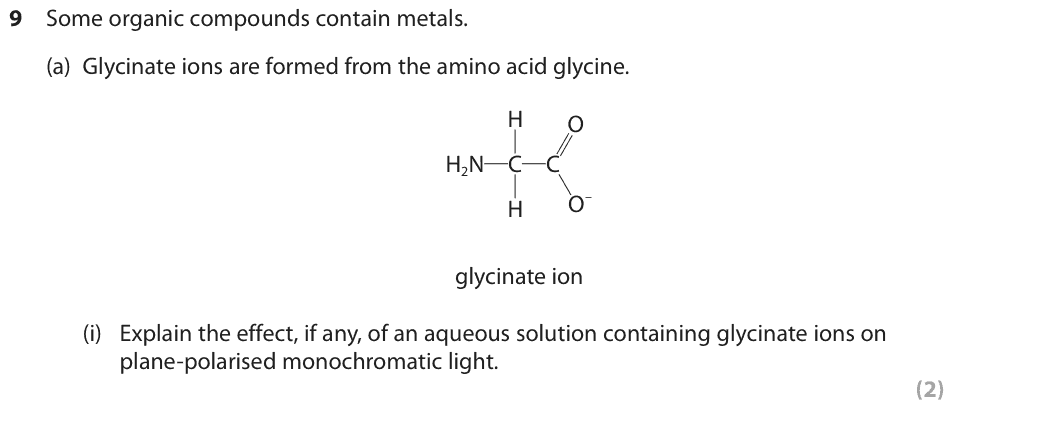
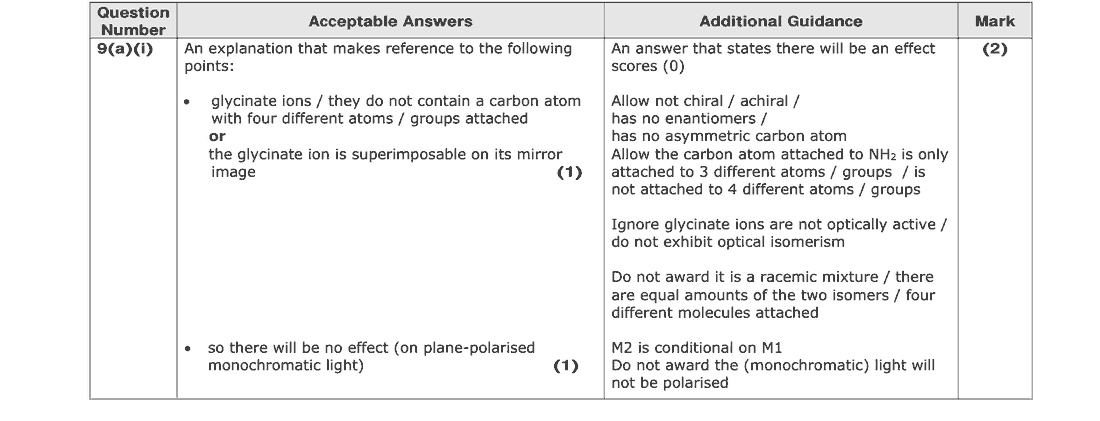
The glycinate ion has no carbon atom with four different groups attached (it is not chiral: the carbon bonded to NH2 carries two H atoms)
so it has no effect on plane-polarised light (depends on M1). Saying there is an effect scores zero. Not 'racemic mixture'
'not optically active' alone is ignored
June 2018 · Paper 2 · Q6(c)3 marksDiagram or structure
Mark scheme
Examiner's comment
Candidates seem to have learnt from the similar question in last year's paper and very few non-3D diagrams were seen. Occasionally errors in the atoms/groups joined to the chiral carbon were seen, such as CH4 and C2H6.
Notes from the mark scheme and report
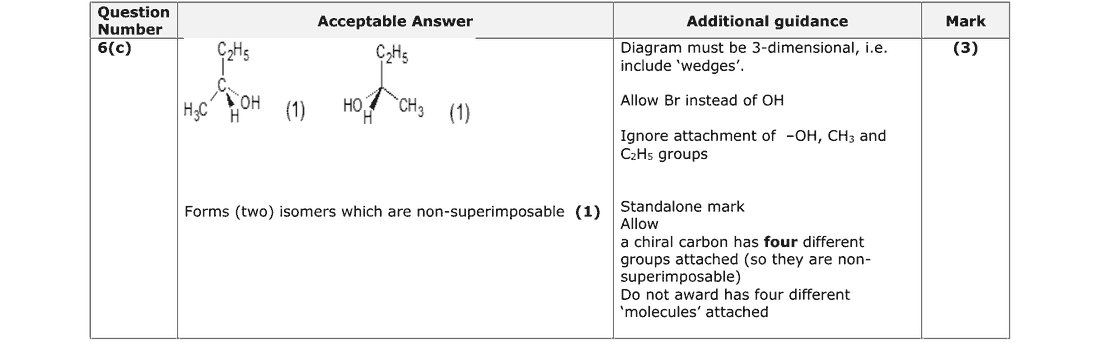
Two three-dimensional (wedge and dash) diagrams of butan-2-ol that are mirror images, one mark each
chiral means it forms (two) isomers that are non-superimposable (mirror images), or a carbon with four different groups attached (not four different 'molecules'). Br instead of OH allowed. Very few non-3D diagrams
some wrote CH4 or C2H6 for the groups
Skills: MS4.2 Visualise and represent 2D and 3D forms including two- dimensional representations of 3D objects
June 2017 · Paper 2 · Q6(d)(i)2 marksDiagram or structure
Mark scheme
Examiner's comment
Enantiomers are defined as non-superimposable mirror images and should be drawn with 3D representation. This question thus proved to be an effective test of whether candidates truly understood the meaning of this term. The majority of candidates did well.
Notes from the mark scheme and report
Two mirror-image three-dimensional structures of CH3CH(OH)COOH, with H, OH, CH3 and COOH around the central carbon, one mark each. Wedges or dashes are needed for both marks. Most did well
Skills: MS4.2 Visualise and represent 2D and 3D forms including two- dimensional representations of 3D objects
June 2017 · Paper 2 · Q6(d)(ii)1 markShort answer
Earlier part of question 6 that this part uses
Mark scheme
Examiner's comment
The question required a comment on how samples of enantiomers could be distinguished and so the rotation of plane polarised light in "different directions" was essential to score. It was insufficient to simply refer to the 'angle of rotation' being different because the angles could obviously be in the same direction but just to different degrees. Only about 50% of candidates were able to give all of the necessary details to score the mark.
Notes from the mark scheme and report
They rotate the plane of plane-polarised light in opposite directions (or: find which direction each rotates the plane of plane-polarised light). A different 'angle of rotation' alone was not enough
about half gave enough detail
Work with an A-level chemistry tutor
Dropping marks on calculations, mechanisms or the core practicals? Book a trial session with an A-level chemistry tutor.



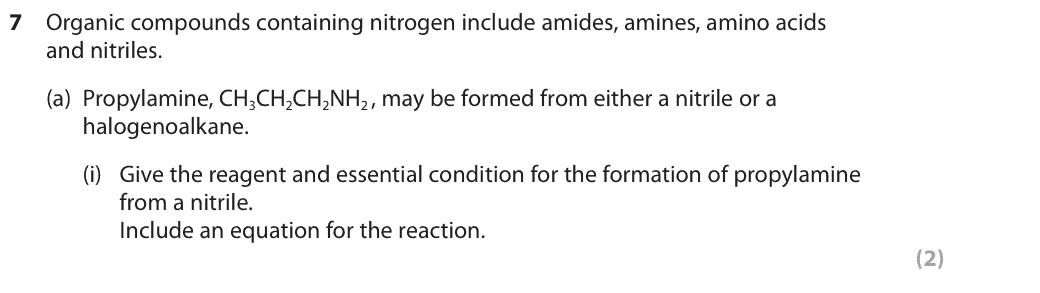




![When plane-polarised light is passed through an optical isomer, the plane of
polarisation is
L] A diffracted
1] B reflected
[1 C refracted
[1 D rotated](/img/JUN19_9CH02/JUN19_9CH02_4-c-iii_qp.webp)