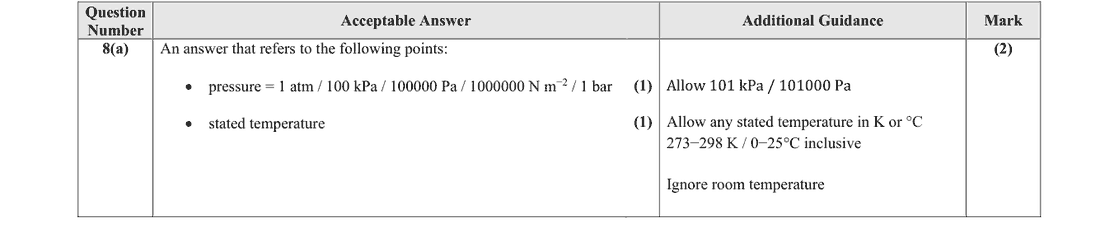
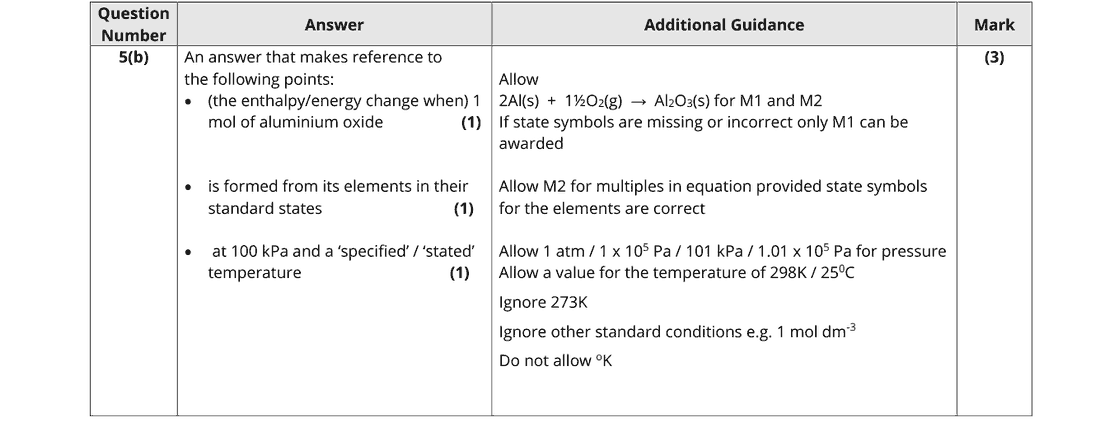
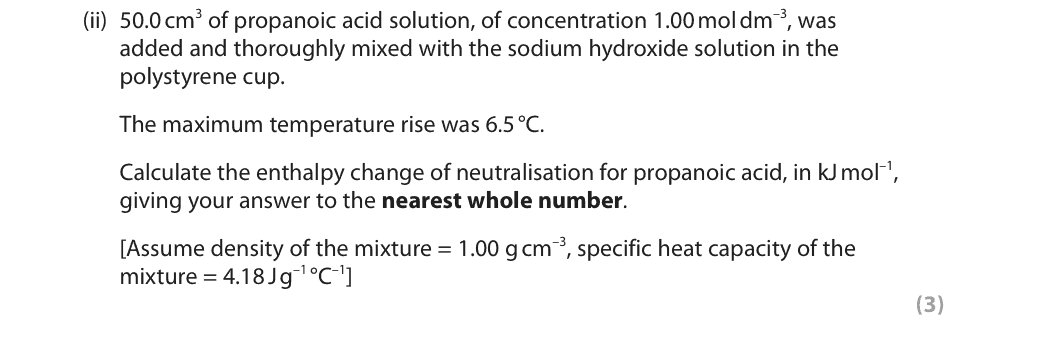
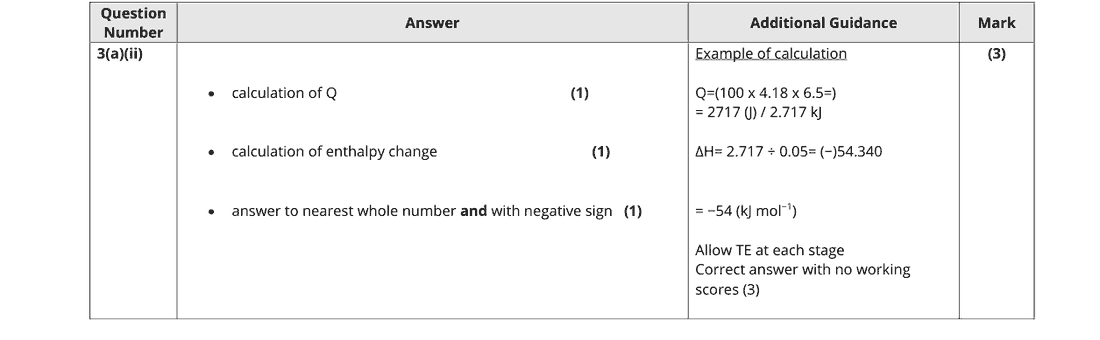
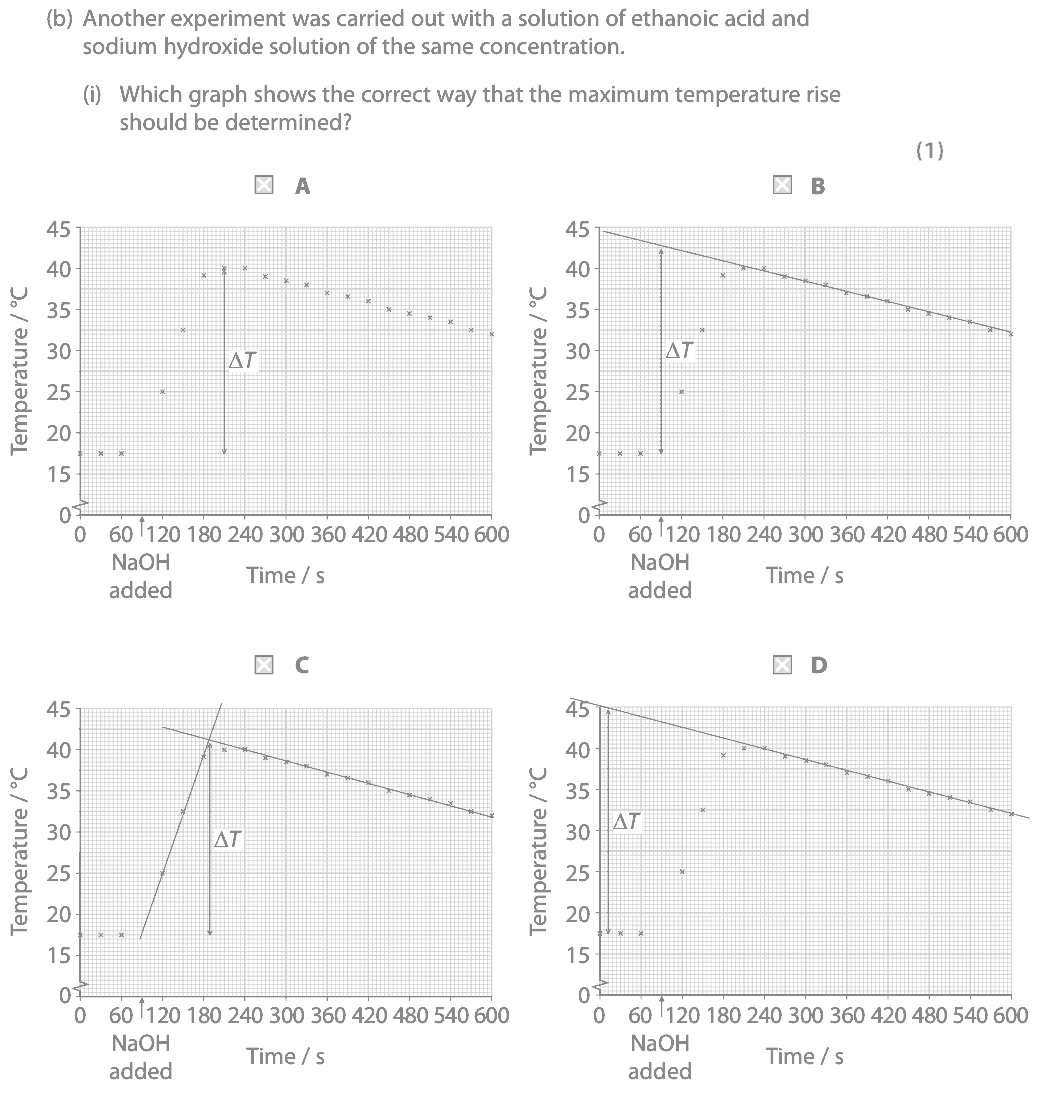
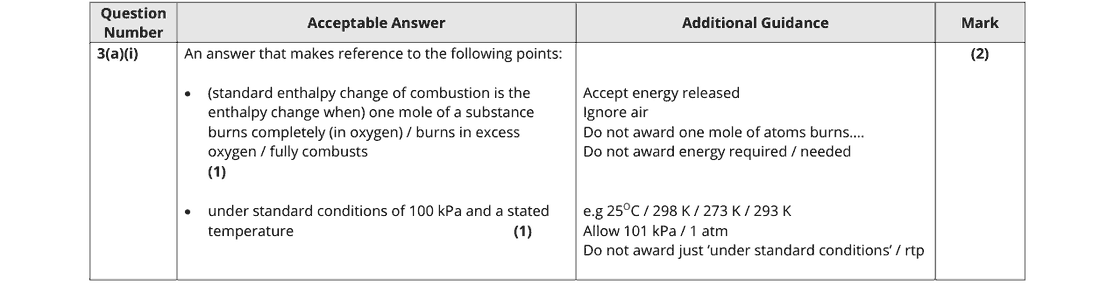
8.1 know that standard conditions are 100 kPa and a specified temperature, usually 298 K
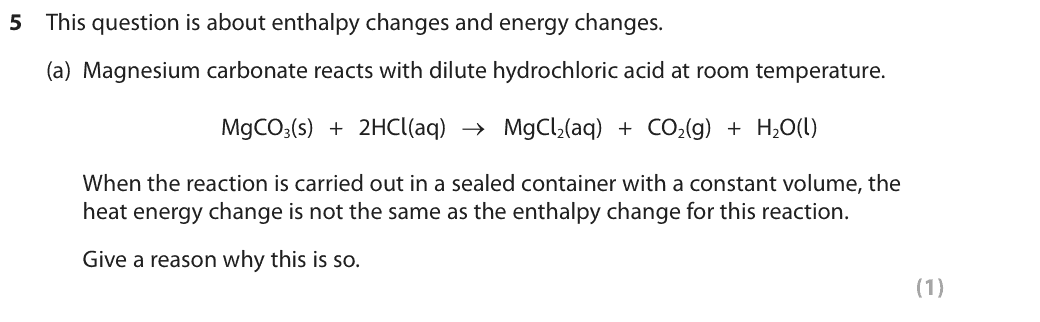
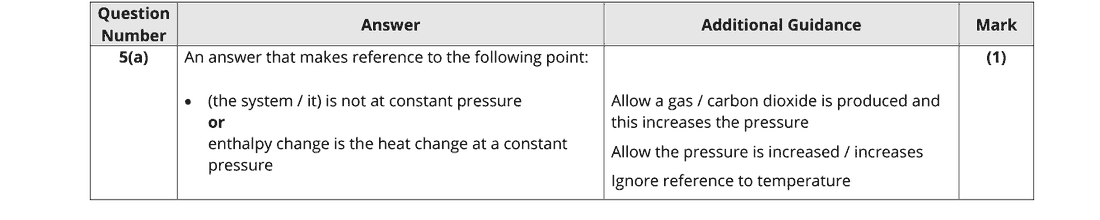
8.2 know that the enthalpy change is the heat energy change measured at constant pressure
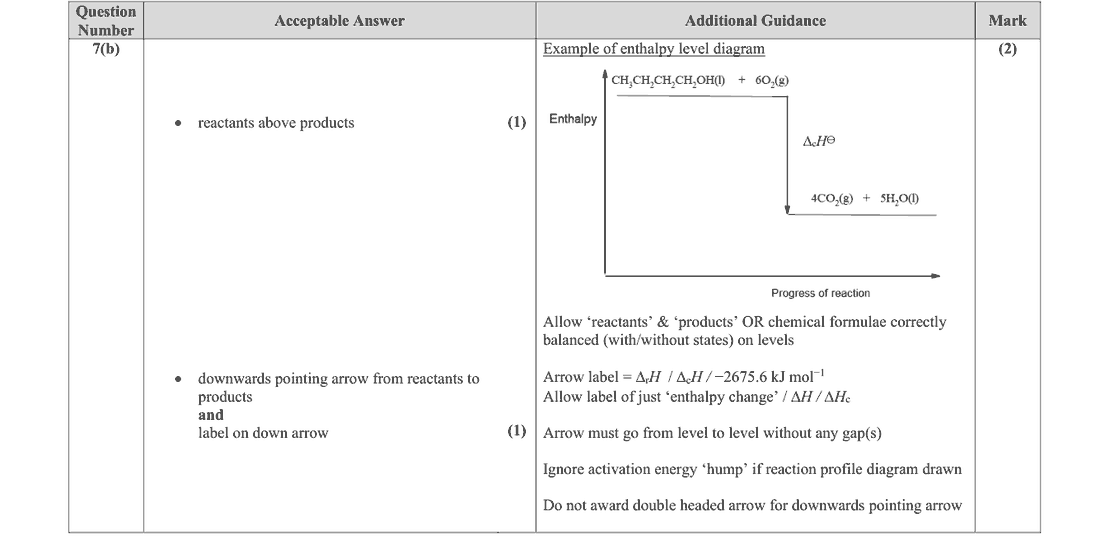
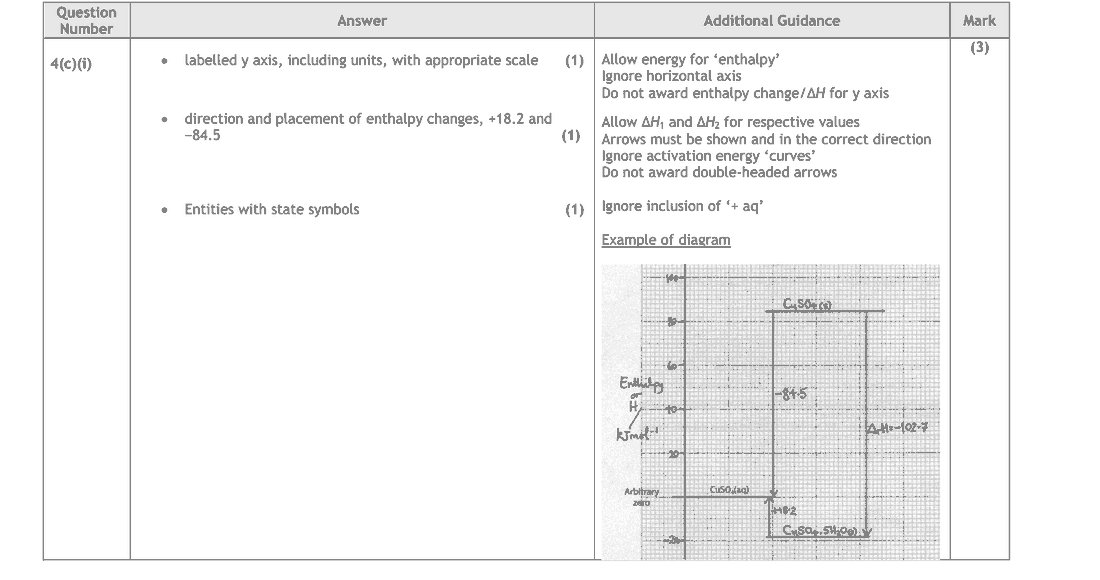
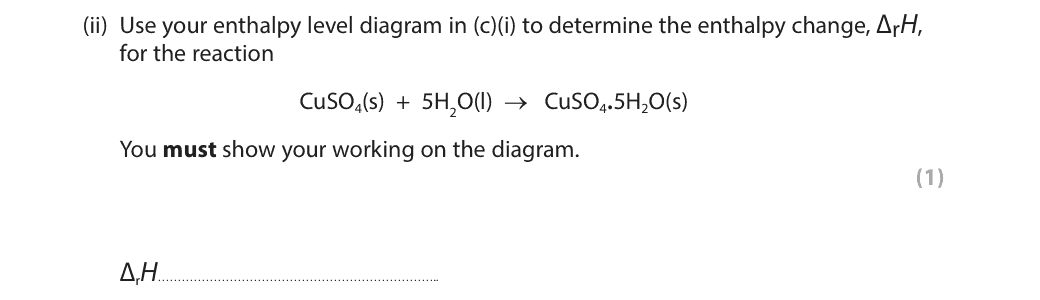
8.3 be able to construct and interpret enthalpy level diagrams showing an enthalpy change, including appropriate signs for exothermic and endothermic reactions [Activation energy is not shown in enthalpy level diagrams but it is shown in reaction profile diagrams.]
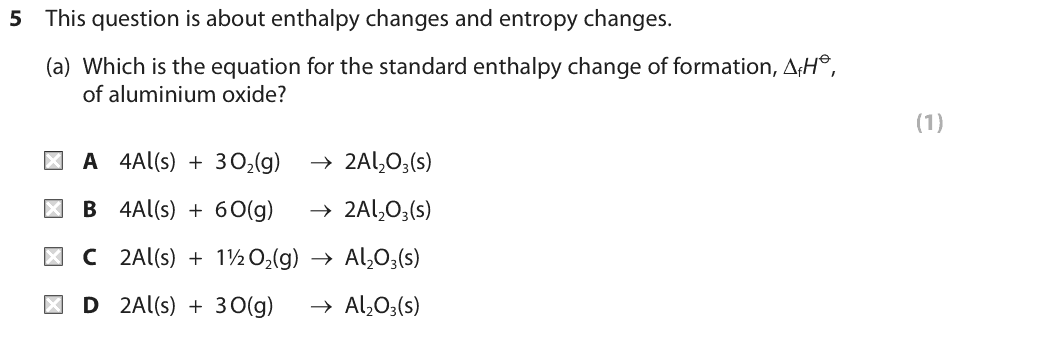
8.4 be able to define standard enthalpy change of: • i reaction • ii formation • iii combustion • iv neutralisation
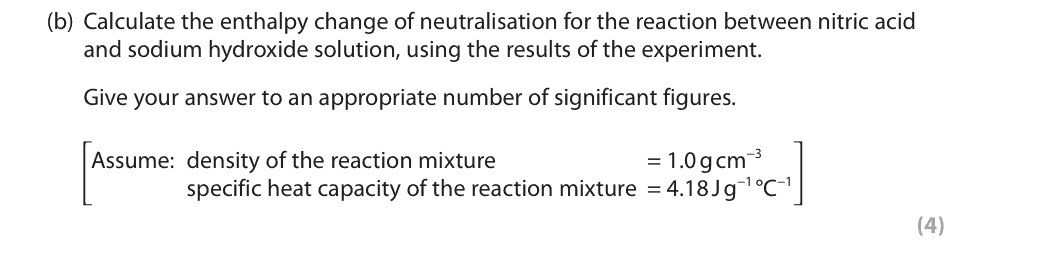
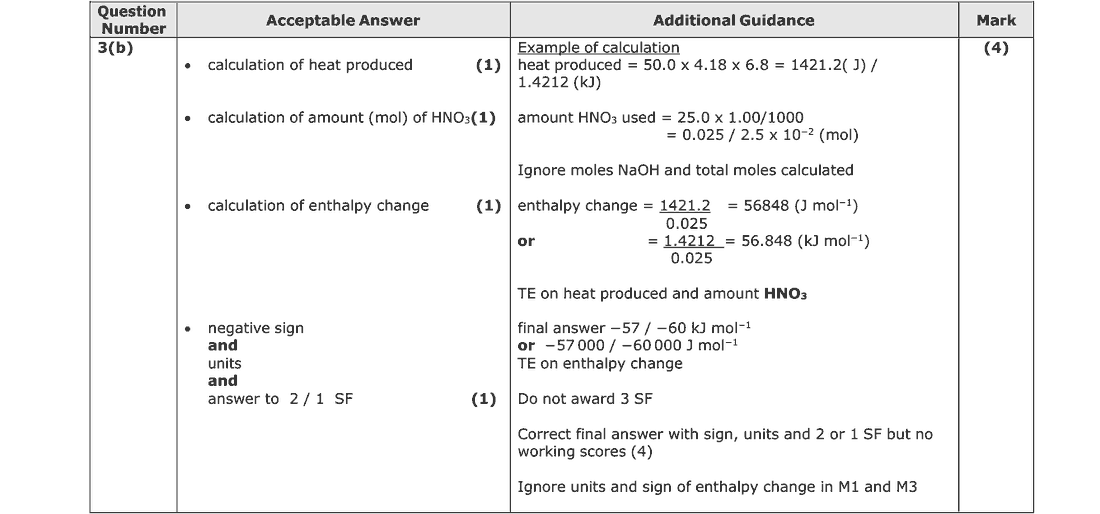
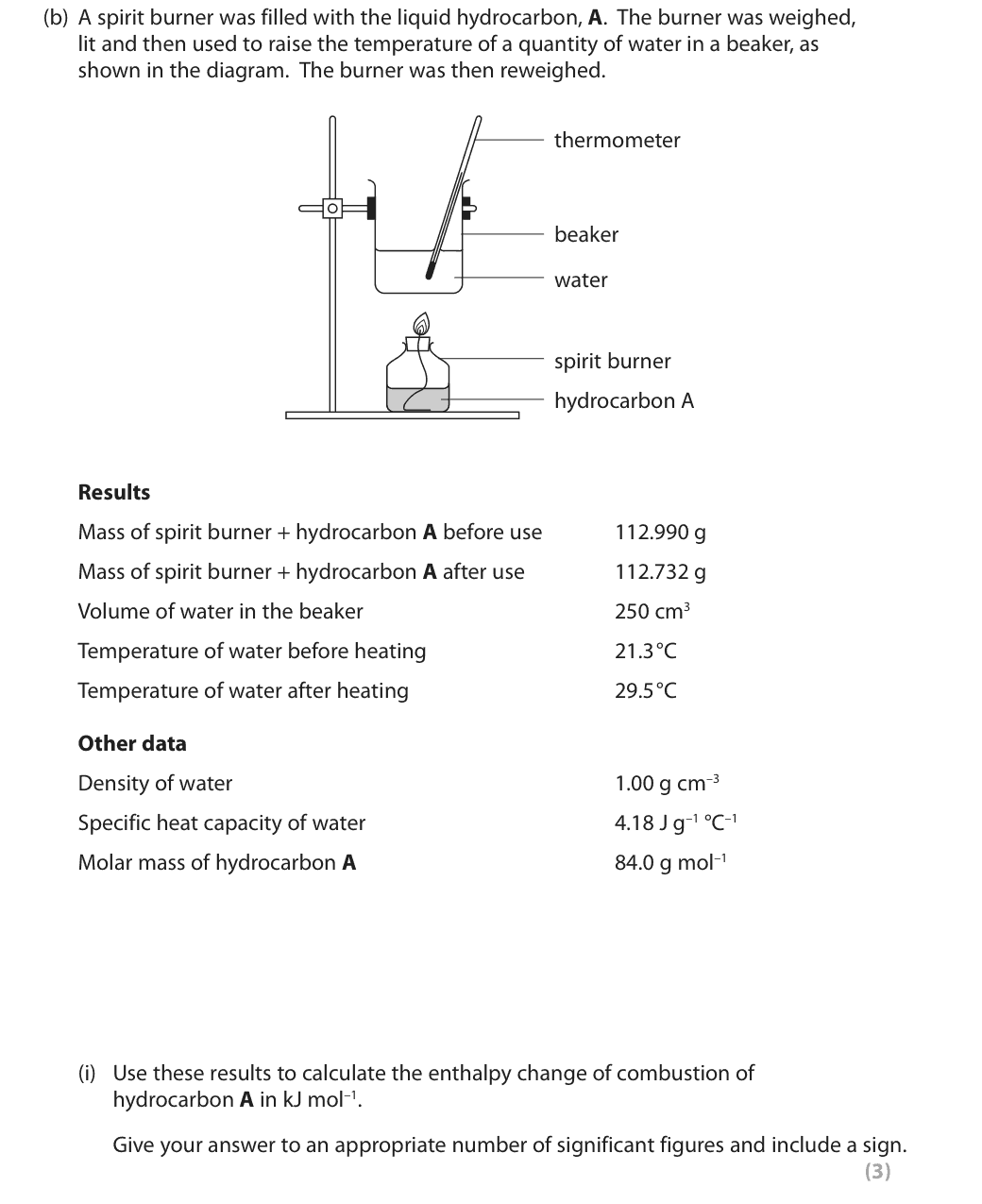
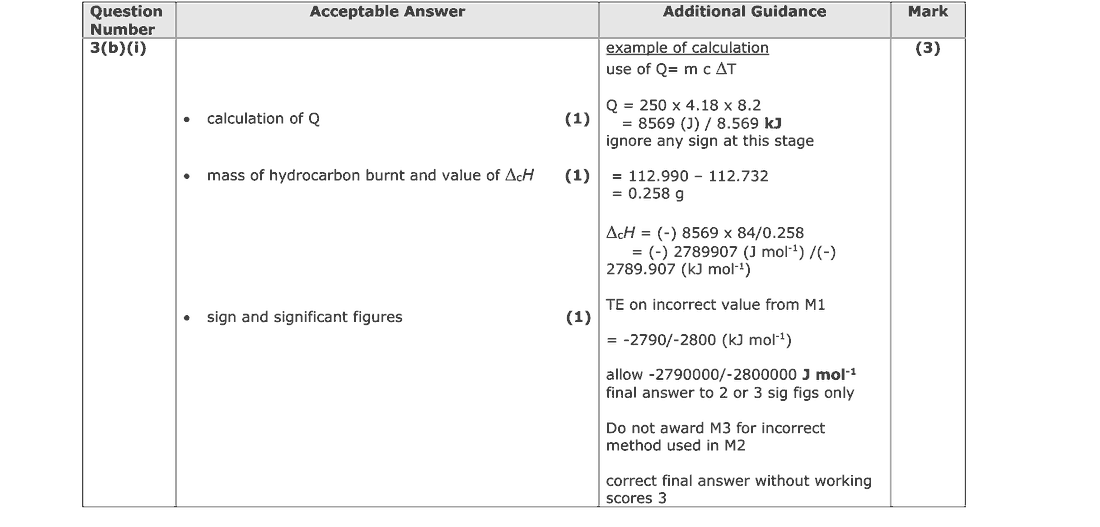
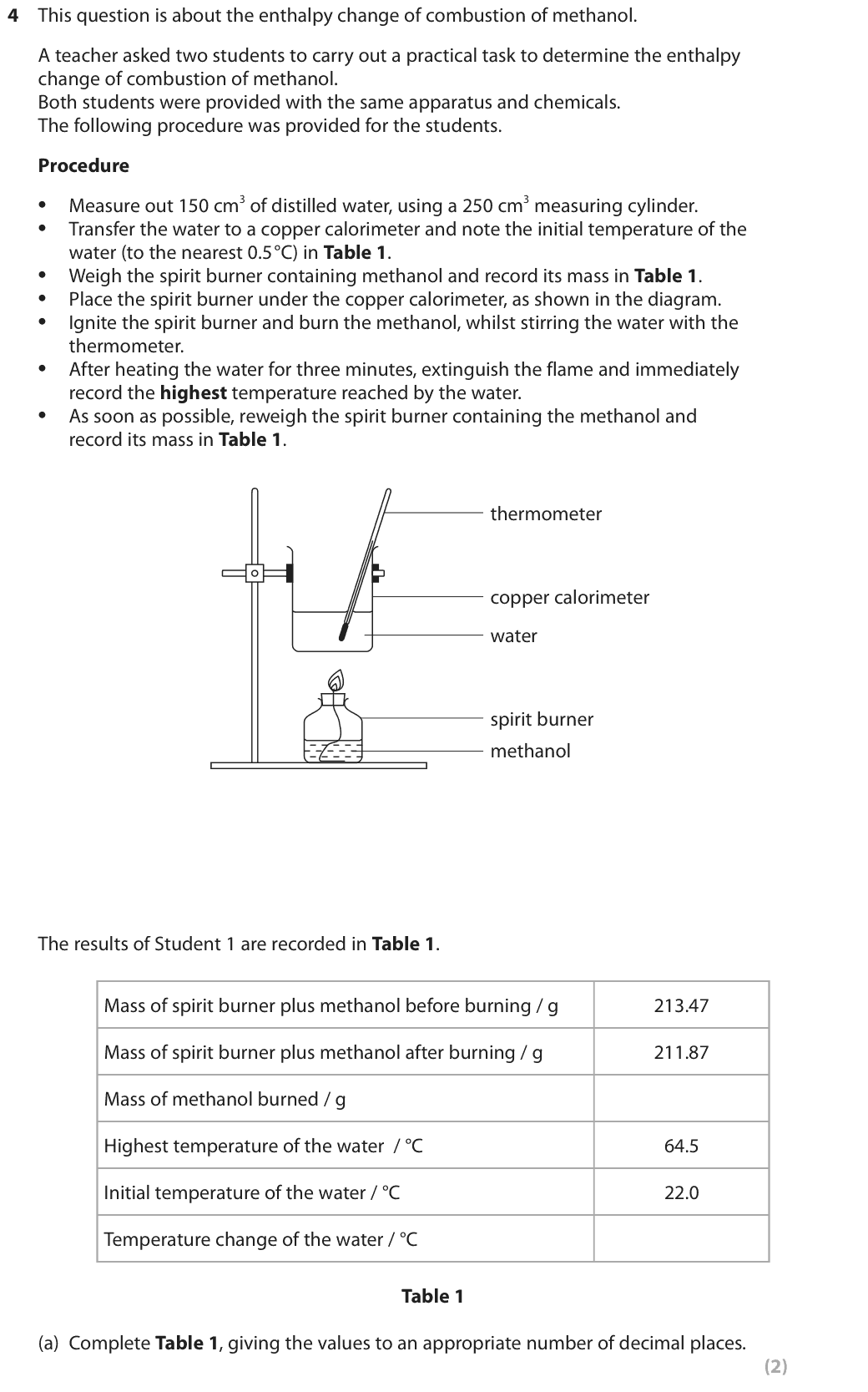
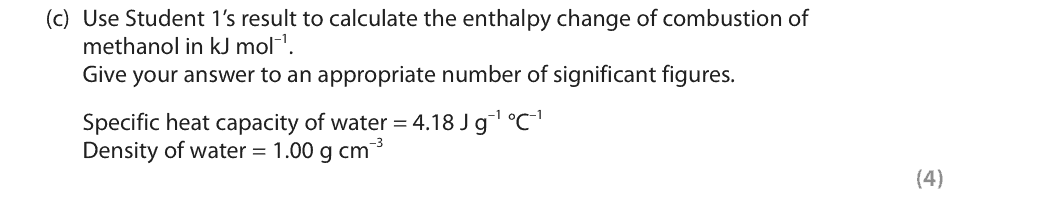
8.5 understand experiments to measure enthalpy changes in terms of: • i processing results using the expression: energy transferred = mass x specific heat capacity × temperature change (Q=mcΔT) • ii evaluating sources of error and assumptions made in the experiments o o o [Students will need to consider experiments where: substances are mixed in an insulated container and the temperature change is measured enthalpy of combustion is measured, such as using a series of alcohols in a spirit burner the enthalpy change cannot be measured directly.]
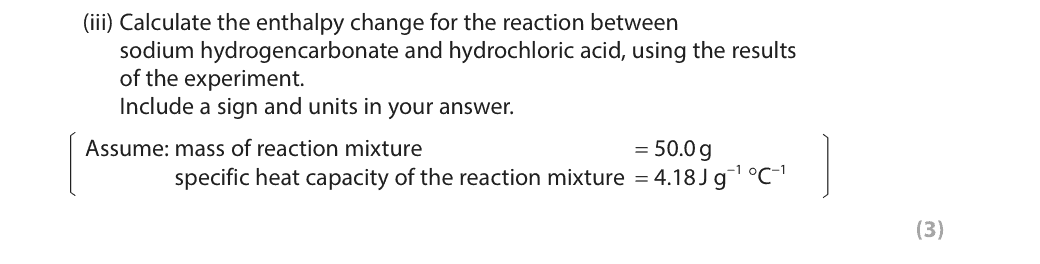
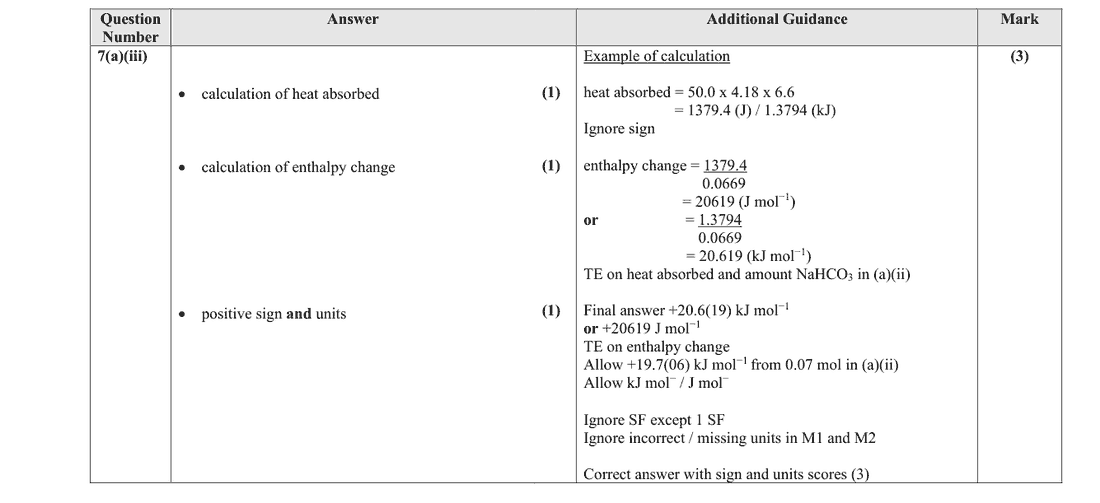
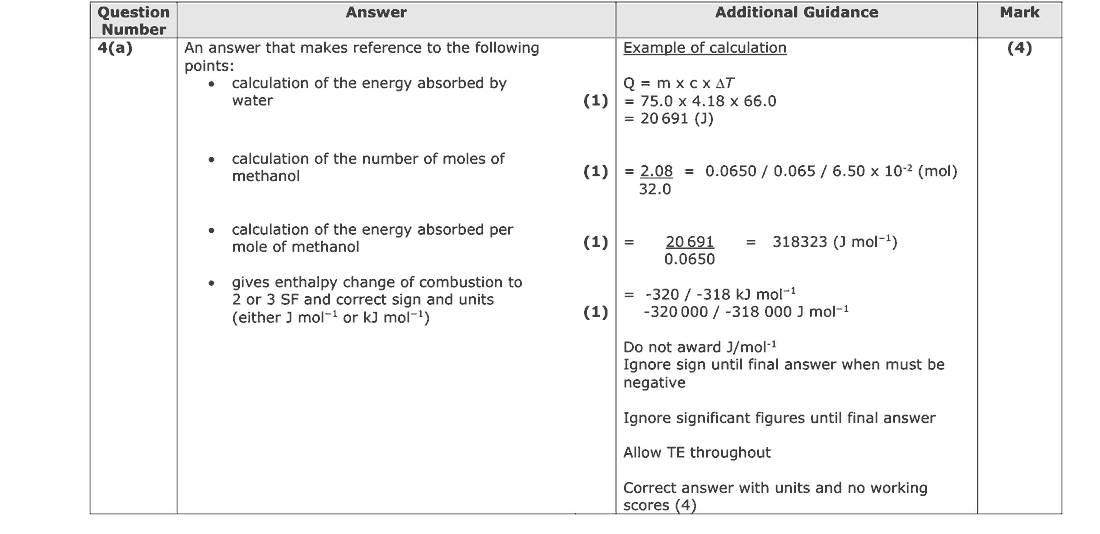
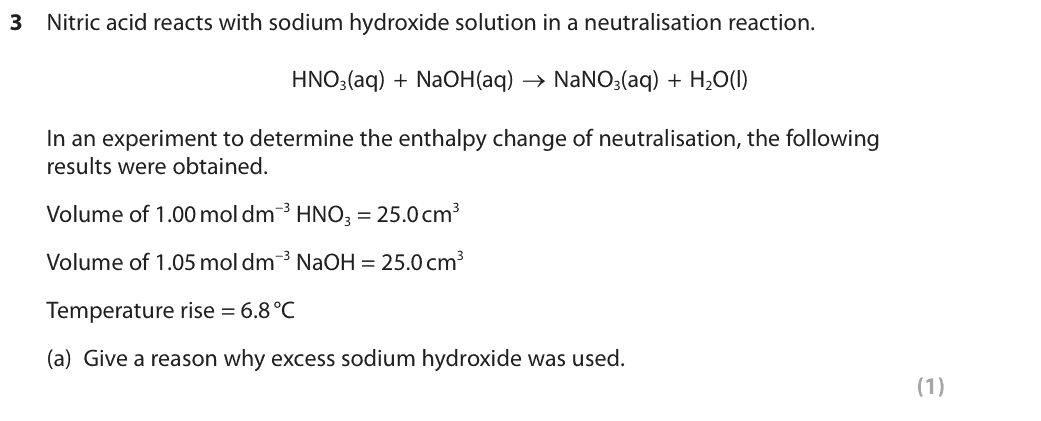
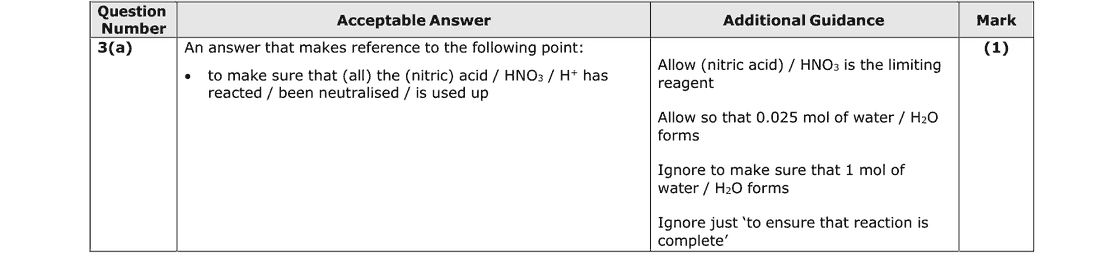
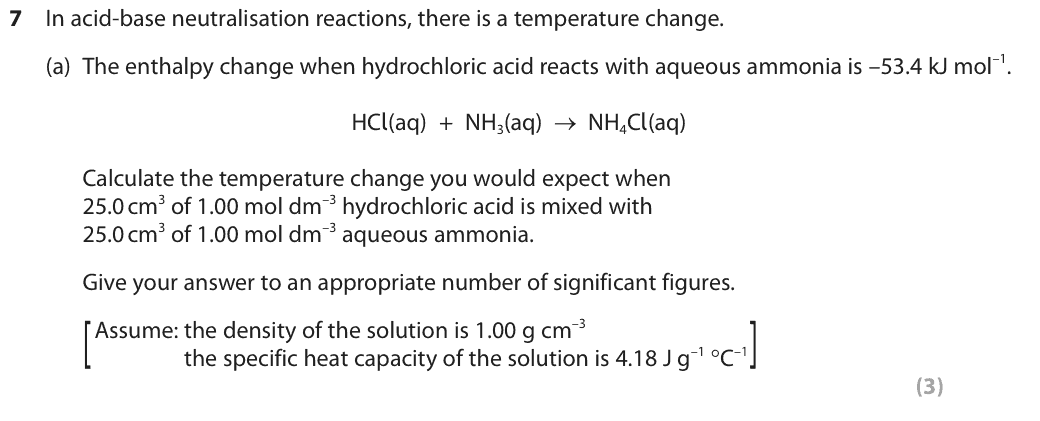
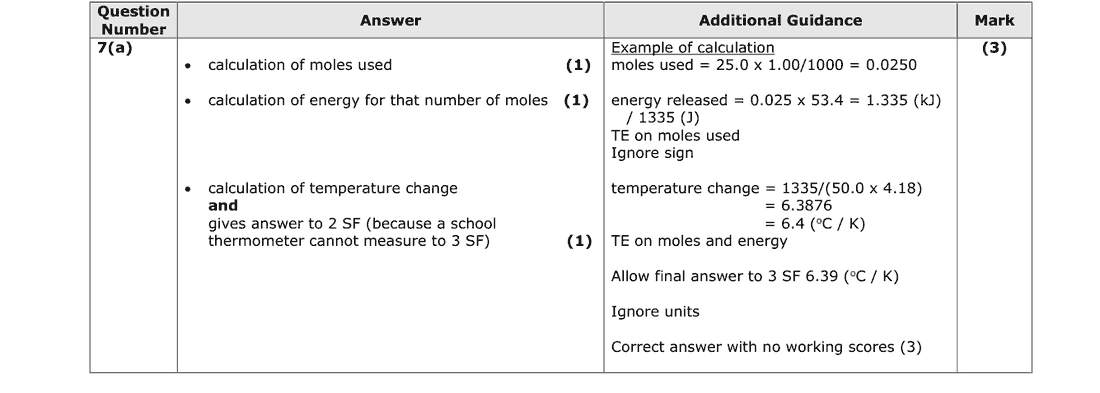
8.6 be able to calculate enthalpy changes in kJ mol^-1 from given experimental results [Both a sign and units are expected in the final answer.]
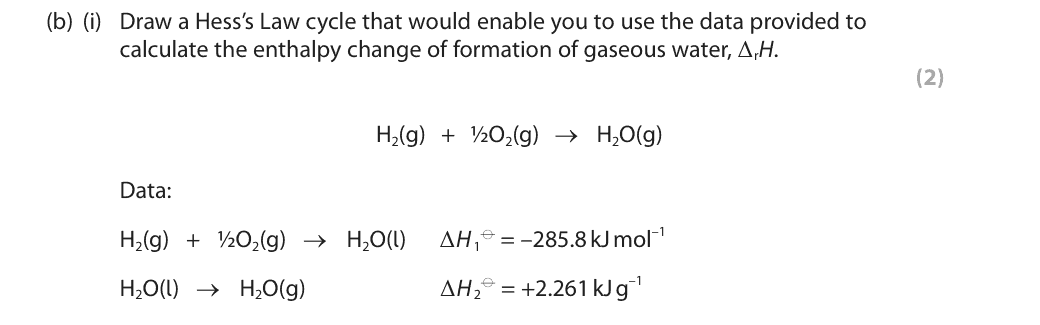
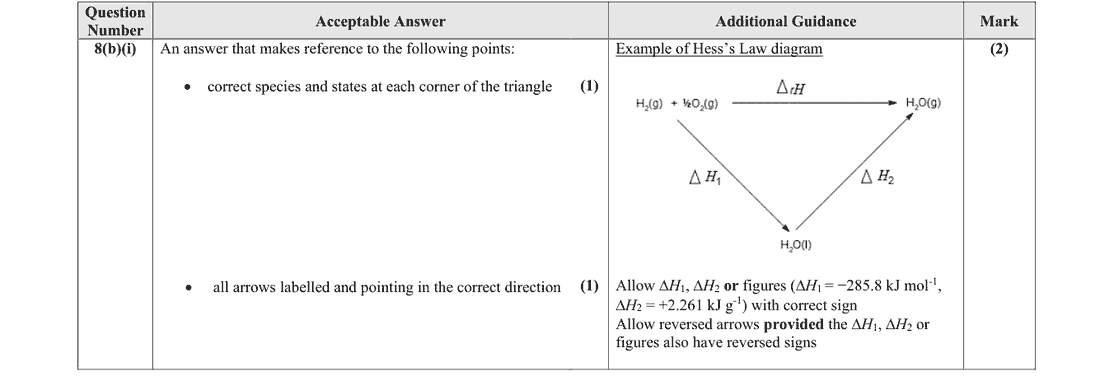
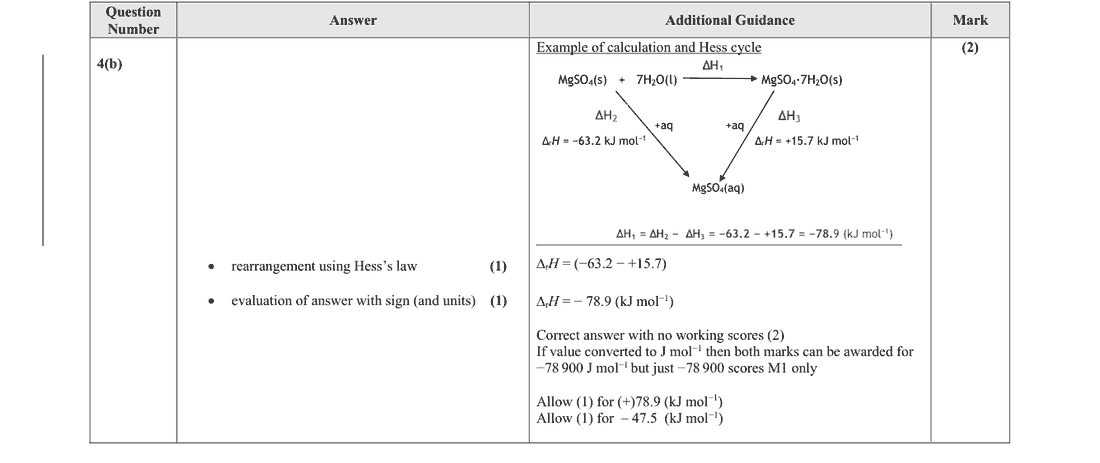
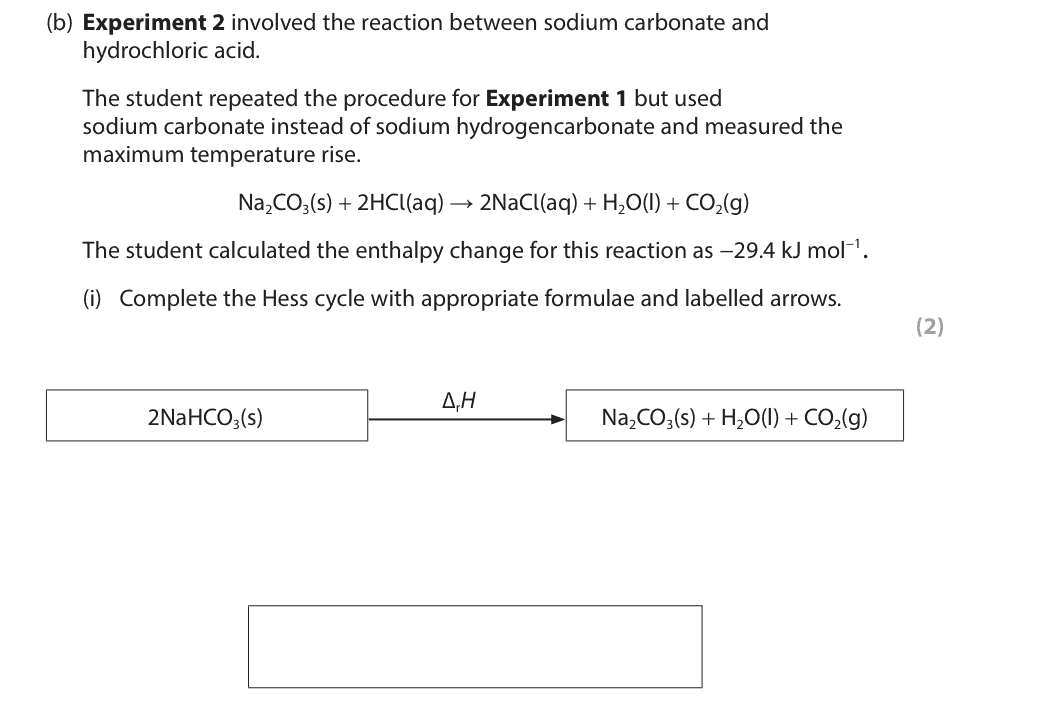
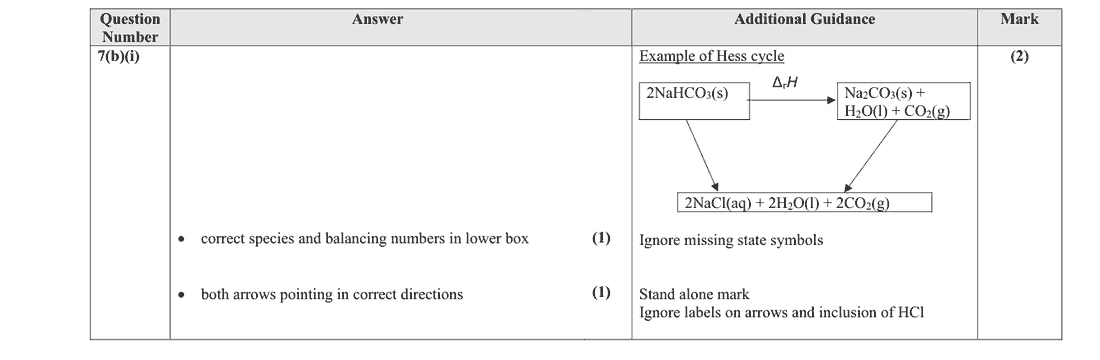
8.7 be able to construct enthalpy cycles using Hess’s Law
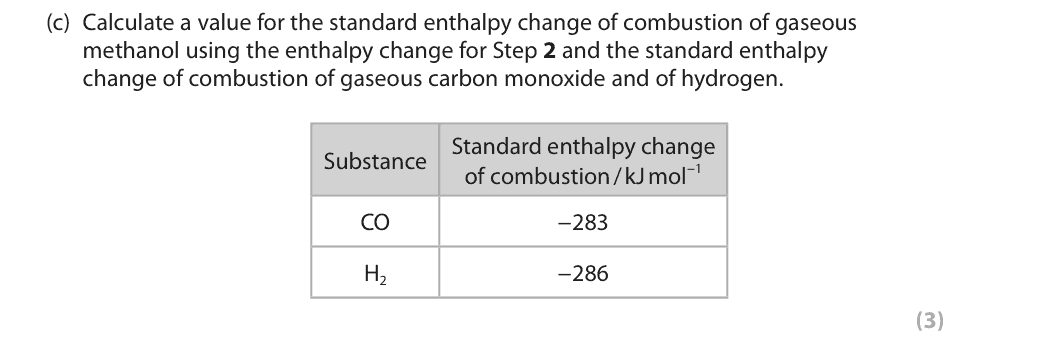
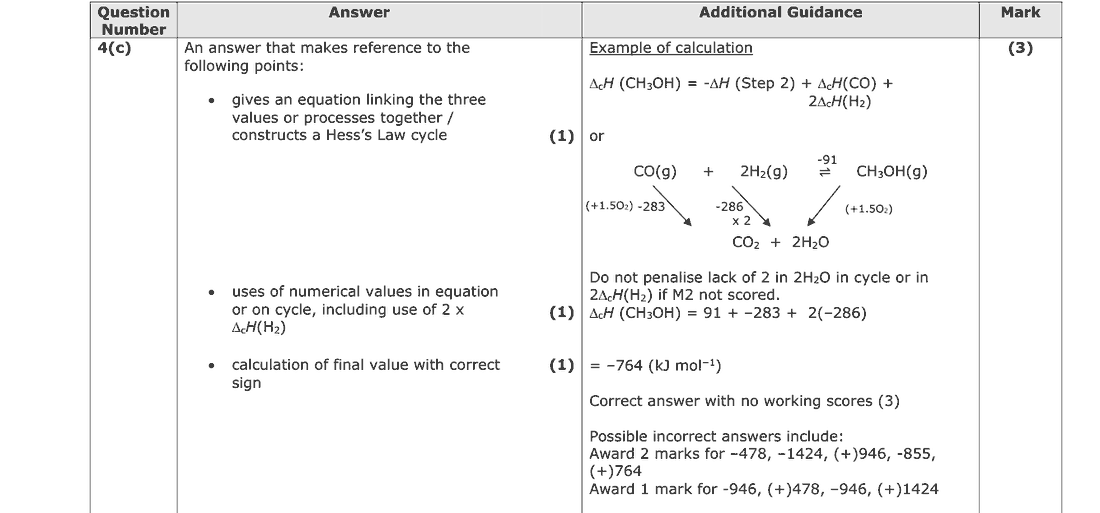
8.8 be able to calculate enthalpy changes from data using Hess’s Law
8.9 know what is meant by the terms ‘bond enthalpy’ and ‘mean bond enthalpy’
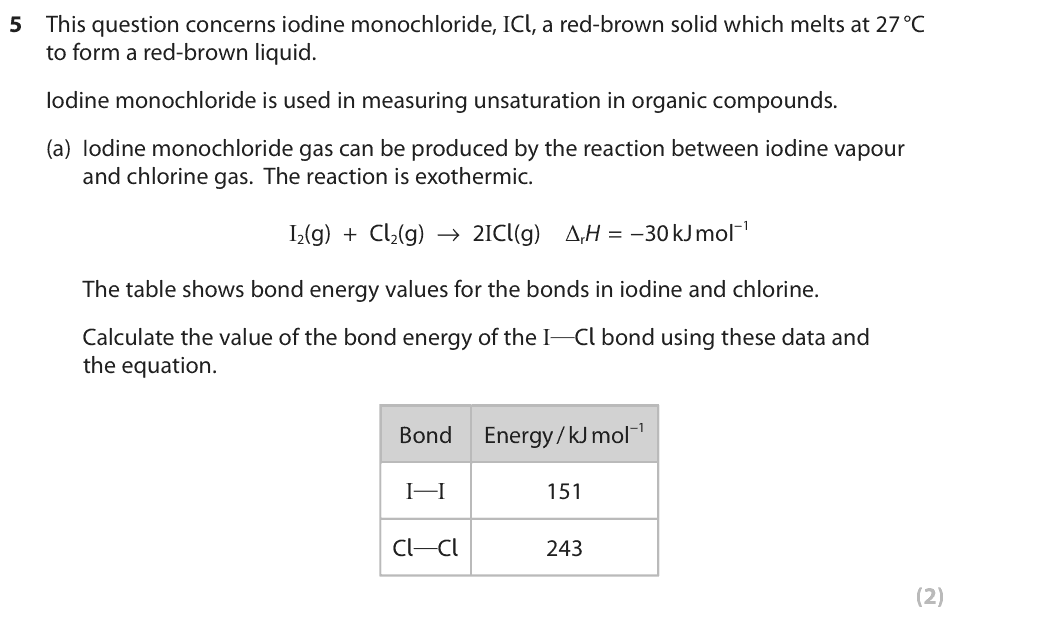
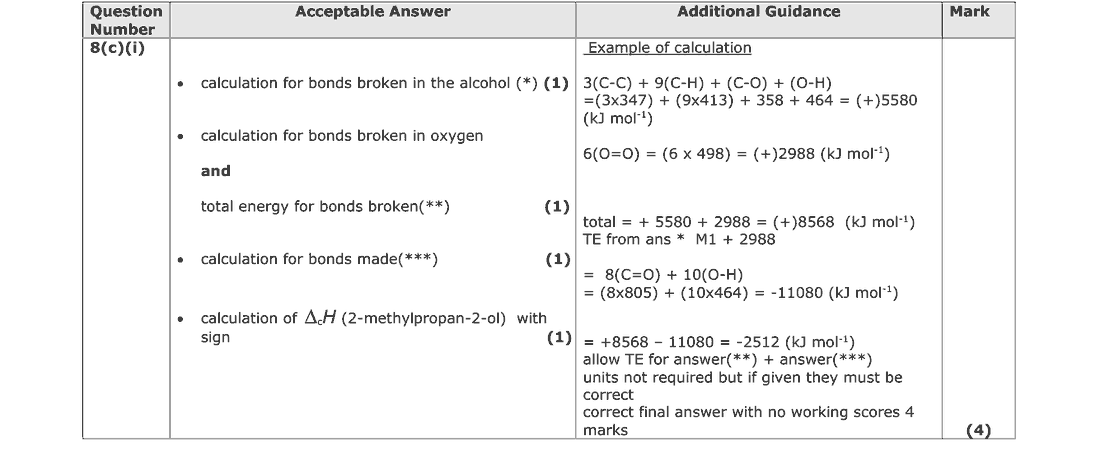
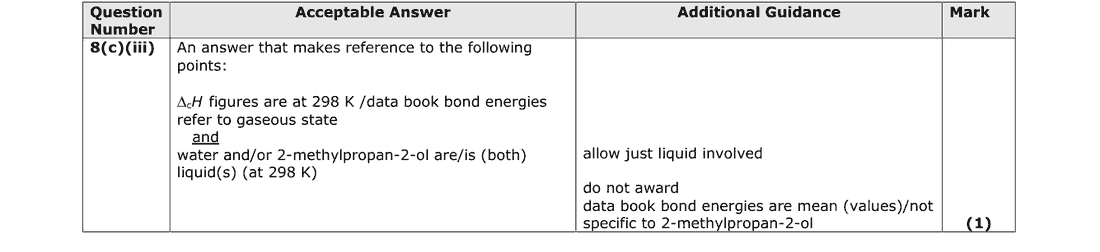
8.10 be able to calculate an enthalpy change of reaction using mean bond enthalpies and explain the limitations of this method of calculation
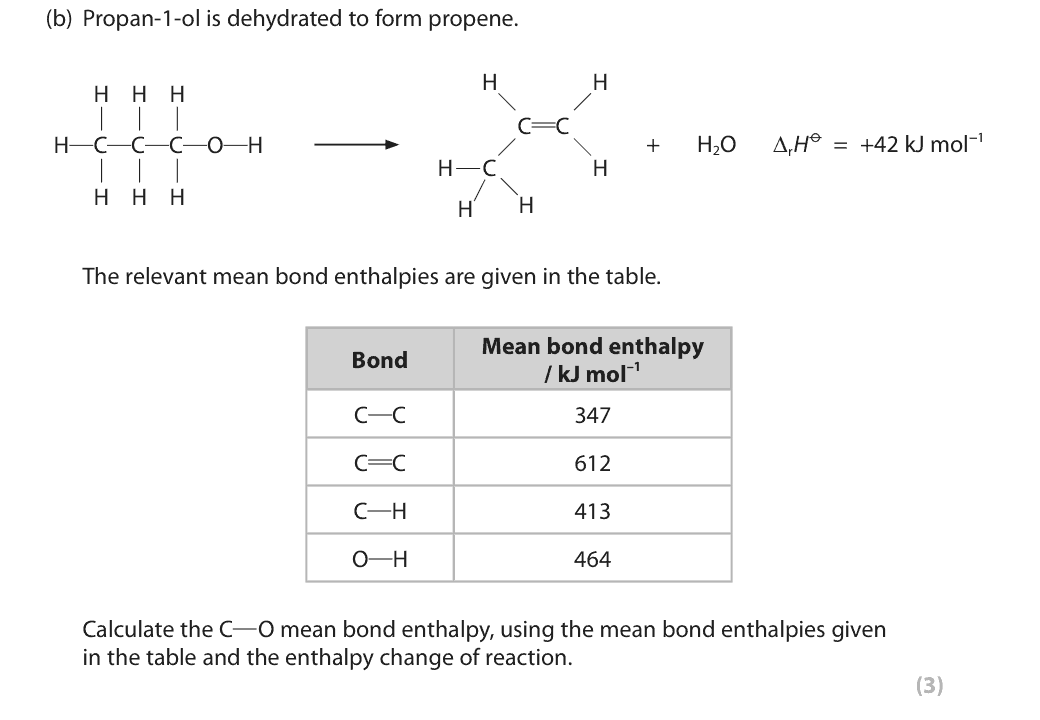
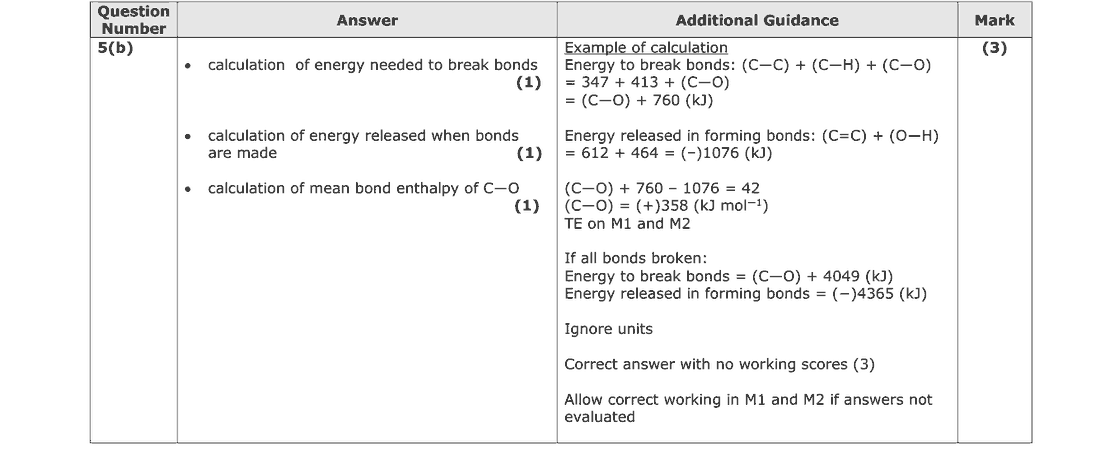
8.11 be able to calculate mean bond enthalpies from enthalpy changes of reaction
Six-mark extended response questions on this topic
Tap a question to zoom it. Where a part needs a figure, table or structure from earlier in the question, that part folds out above it; the mark scheme and examiner's comment open underneath. Have Edexcel's Data Booklet beside you; the Periodic Table is on the back page of every paper.
June 2025 · Paper 1 · Q3(a)1 markPractical and data analysis
Mark scheme
Examiner's comment
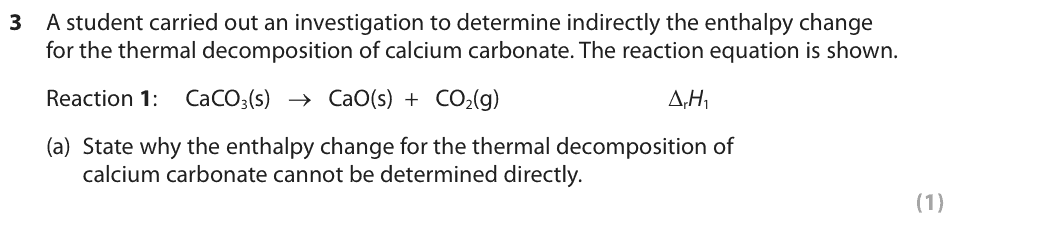
This question asked why it is not possible to directly measure the enthalpy change for the decomposition of CaCO3.
We are looking for the idea of the difficulty in measuring a temperature change when heating a compound.
Notes from the mark scheme and report
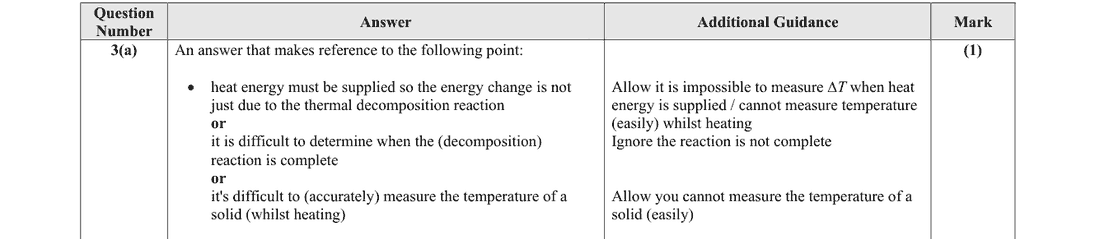
One of: heat has to be supplied, so the energy change measured is not just that of the decomposition (a temperature change cannot be measured while heating)
it is hard to tell when decomposition is complete
it is hard to measure the temperature of a solid accurately
Skills: CP8 Core practical 8: To determine the enthalpy change of a reaction using Hess’s Law
June 2025 · Paper 1 · Q3(b)(i)1 markShort answer
Earlier part of question 3 that this part uses
Mark scheme
Examiner's comment
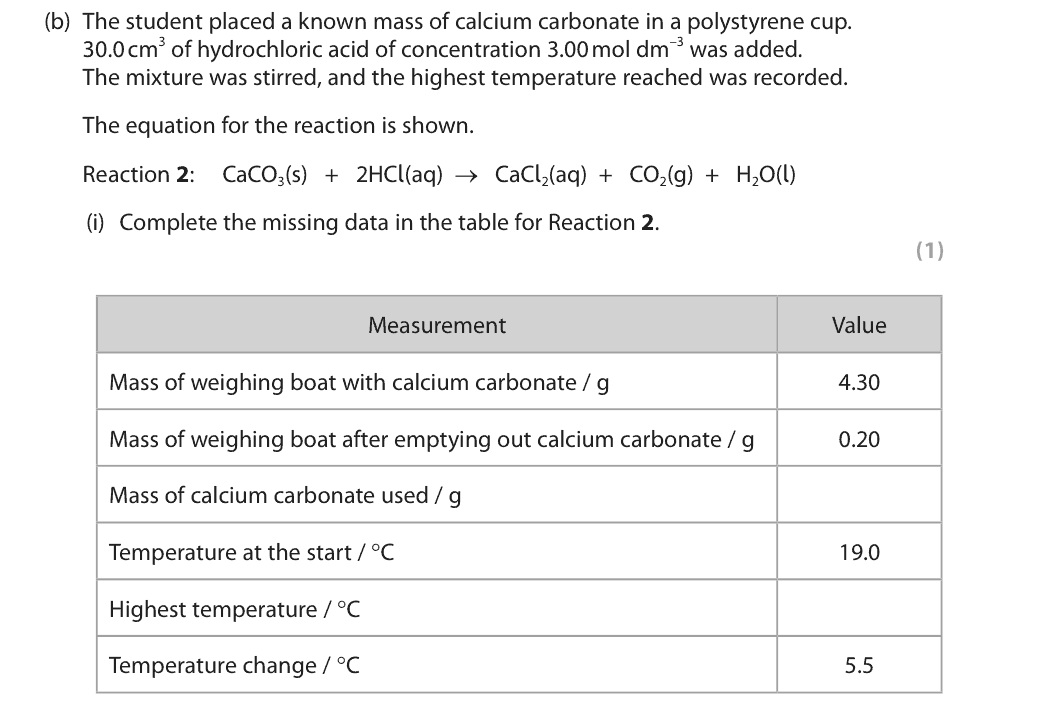
This question required the candidates to work though a calculation on enthalpy change for the decomposition of calcium carbonate.
The table was generally completed well. A few struggled with proving that the HCl was in excess. For the calculation most managed Q but then, rather than use the mol value of 0.41 given, they attempted to calculate moles from other values.
When it came to completing the cycle there were a number who were unsure what to put in the bottom box so put the elements rather than the formation of CaCl2(aq), CO2(g) and H2O(l). A few arrows went the wrong way too.
Notes from the mark scheme and report
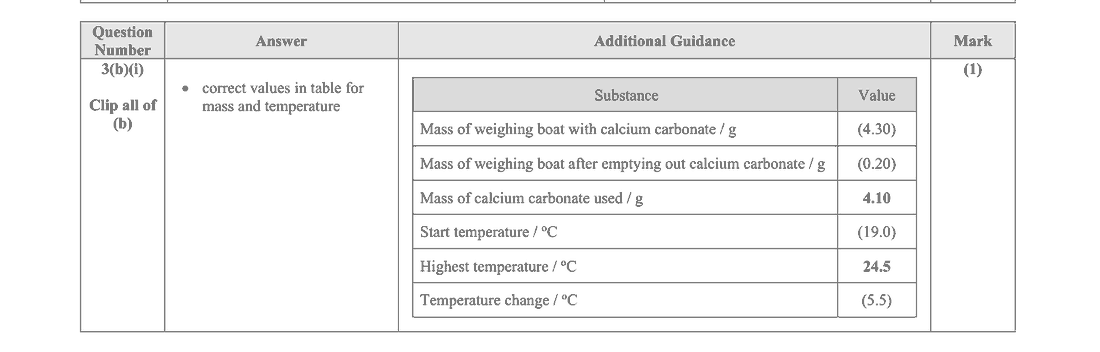
Answer: mass of calcium carbonate 4.10 g and highest temperature 24.5 °C (both needed for the mark). The table was generally completed well
Skills: PT1 use appropriate apparatus to record a range of measurements (to include mass, time, volume of liquids and gases, temperature); CP8 Core practical 8: To determine the enthalpy change of a reaction using Hess’s Law
June 2025 · Paper 1 · Q3(b)(iii)3 marksCalculation
Earlier parts of question 3 that this part uses
Mark scheme
Examiner's comment
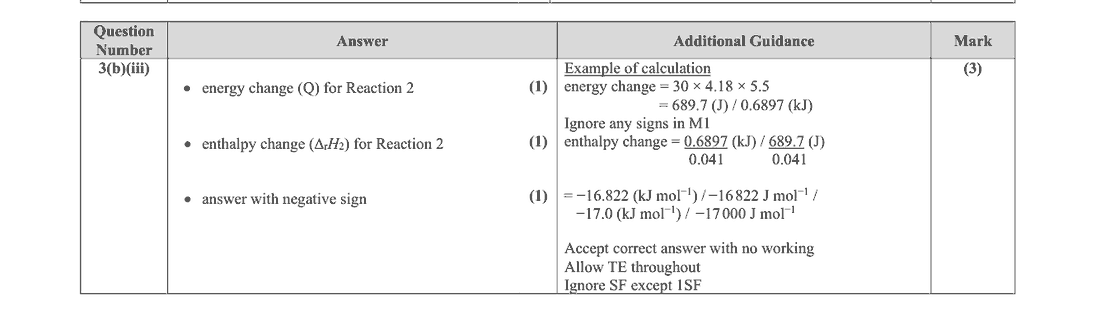
This question required the candidates to work though a calculation on enthalpy change for the decomposition of calcium carbonate.
The table was generally completed well. A few struggled with proving that the HCl was in excess. For the calculation most managed Q but then, rather than use the mol value of 0.41 given, they attempted to calculate moles from other values.
When it came to completing the cycle there were a number who were unsure what to put in the bottom box so put the elements rather than the formation of CaCl2(aq), CO2(g) and H2O(l). A few arrows went the wrong way too.
negative sign needed for the third mark. Not 1 significant figure. Most found Q, but many then worked out moles from other values instead of using the 0.041 mol given
Skills: MS0.0 Recognise and make use of appropriate units in calculation; MS2.3 Substitute numerical values into algebraic equations using appropriate units for physical quantities; CP8 Core practical 8: To determine the enthalpy change of a reaction using Hess’s Law
June 2025 · Paper 1 · Q3(b)(iv)2 marksDiagram or structure
Earlier parts of question 3 that this part uses
Mark scheme
Examiner's comment
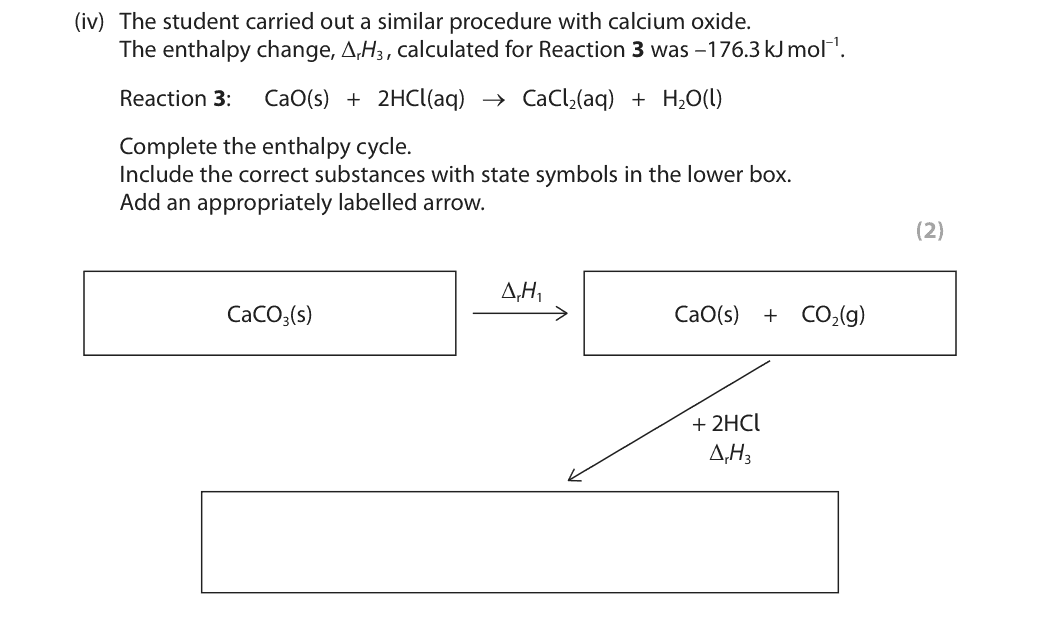
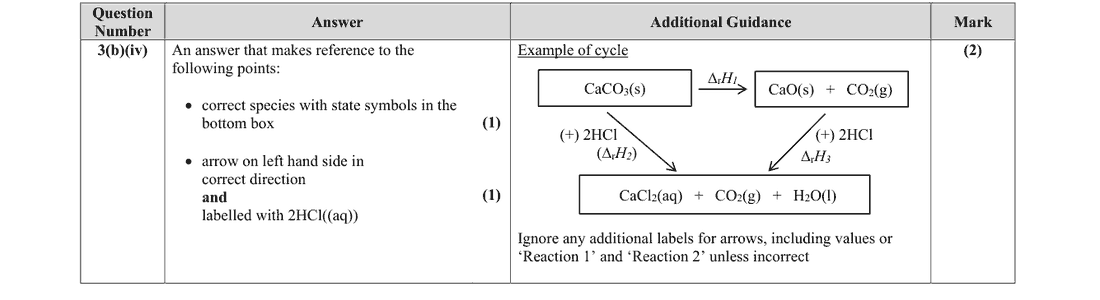
This question required the candidates to work though a calculation on enthalpy change for the decomposition of calcium carbonate.
The table was generally completed well. A few struggled with proving that the HCl was in excess. For the calculation most managed Q but then, rather than use the mol value of 0.41 given, they attempted to calculate moles from other values.
When it came to completing the cycle there were a number who were unsure what to put in the bottom box so put the elements rather than the formation of CaCl2(aq), CO2(g) and H2O(l). A few arrows went the wrong way too.
Notes from the mark scheme and report
Lower box: CaCl2(aq) + CO2(g) + H2O(l), with state symbols
an arrow on the left from CaCO3(s) down to the lower box, labelled + 2HCl. Extra labels (ΔrH2, values) are ignored unless wrong. Common errors: elements written in the lower box
arrows pointing the wrong way
Skills: CP8 Core practical 8: To determine the enthalpy change of a reaction using Hess’s Law
June 2025 · Paper 1 · Q3(b)(v)1 markCalculation
Earlier parts of question 3 that this part uses
Mark scheme
Examiner's comment
This question required the candidates to work though a calculation on enthalpy change for the decomposition of calcium carbonate.
The table was generally completed well. A few struggled with proving that the HCl was in excess. For the calculation most managed Q but then, rather than use the mol value of 0.41 given, they attempted to calculate moles from other values.
When it came to completing the cycle there were a number who were unsure what to put in the bottom box so put the elements rather than the formation of CaCl2(aq), CO2(g) and H2O(l). A few arrows went the wrong way too.
Notes from the mark scheme and report
Answer: +159.5 kJ mol–1. ΔrH1 = ΔrH2 – ΔrH3 = –16.8 – (–176.3). Error carried forward from (b)(iii) but not from an incorrect cycle
Skills: MS2.3 Substitute numerical values into algebraic equations using appropriate units for physical quantities; CP8 Core practical 8: To determine the enthalpy change of a reaction using Hess’s Law
June 2025 · AS Paper 2 · Q3(b)4 marksCalculation
Earlier part of question 3 that this part uses
Mark scheme
Examiner's comment
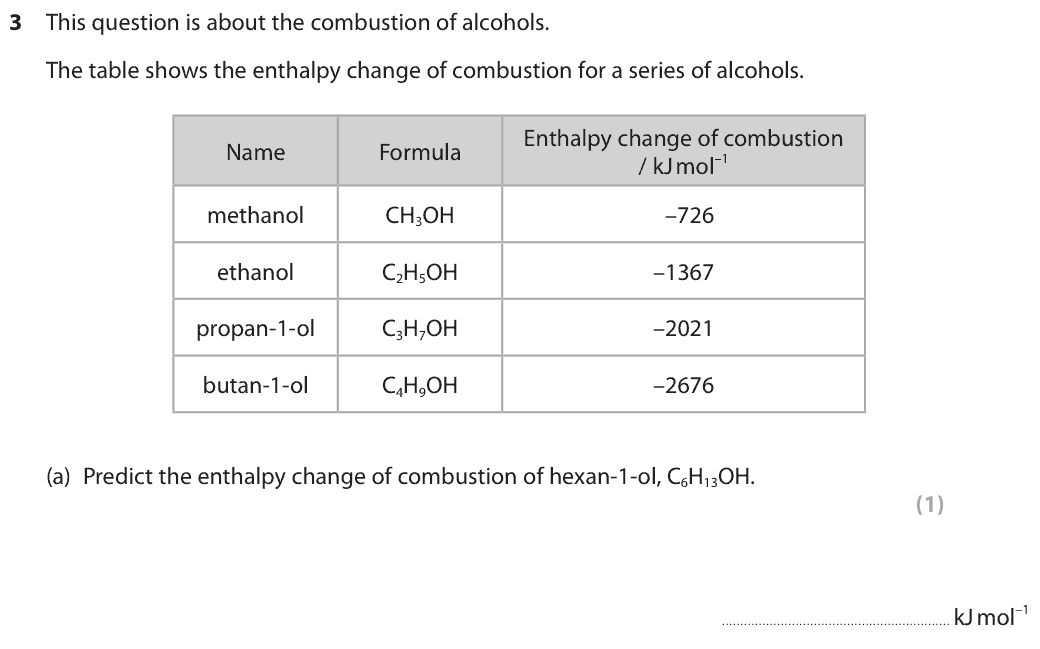
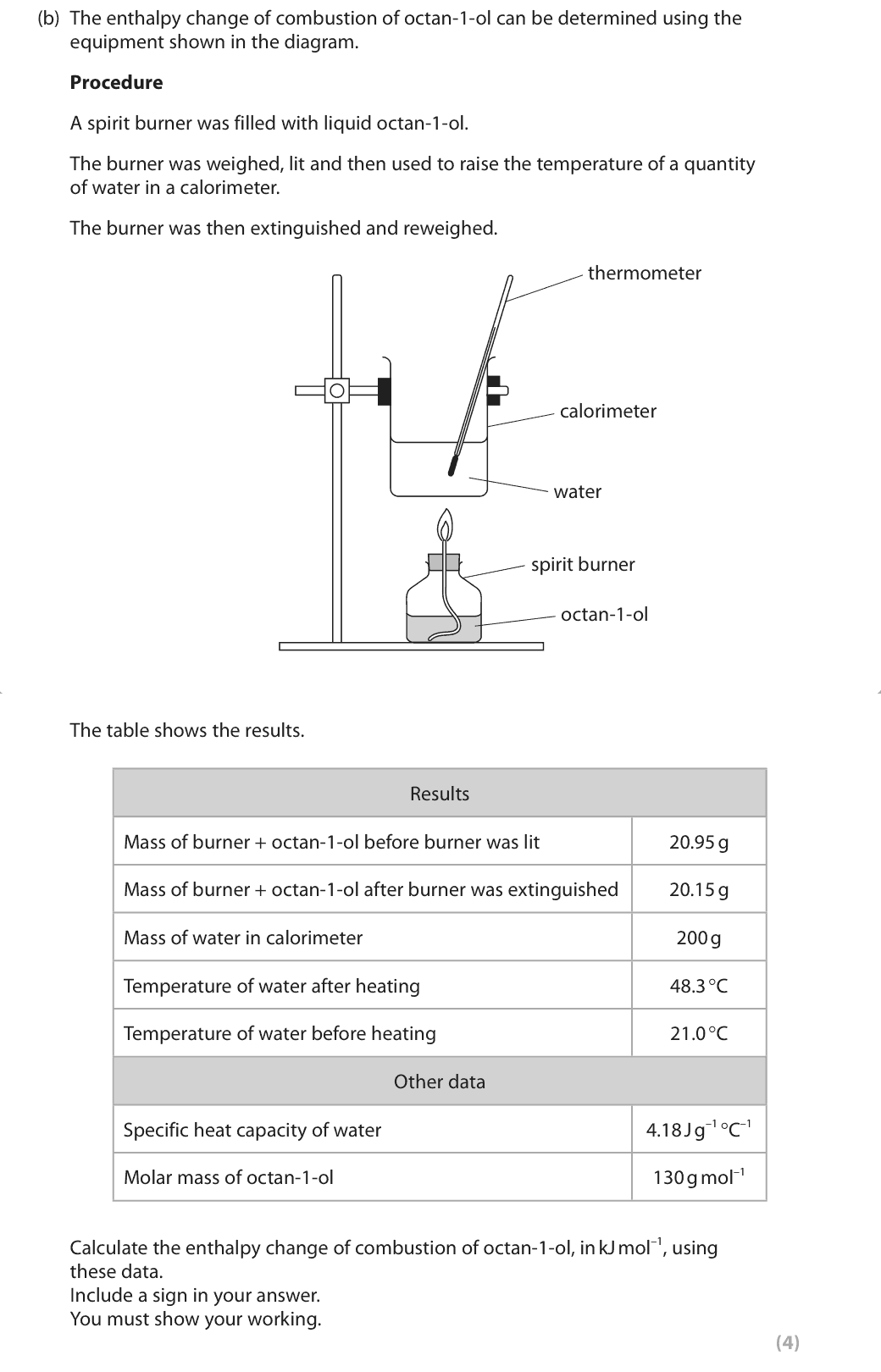
This question was about the combustion of alcohols. (a) Many candidates gave correct answers. A common error was quoting values around – 3330 , corresponding to pentan-1-ol. Most gave negative values, but some included no sign, which was allowed on this occasion. (b) The enthalpy change calculation was generally well done. Common errors were using the mass of alcohol rather than water when calculating the energy change, and omitting the negative sign in the final answer. 95% scored between 2 and 4 marks and approximately half of the candidates scored full marks. (c) Many gave ambiguous responses like “lower ΔH” instead of “less exothermic” or “less negative.” Vague references to “energy loss” rather than “heat loss” also cost marks. Over half scored the middle mark. (d) This question proved to be challenging and very few candidates scored full marks. Many focused on the lack of stirring or uneven heat distribution but failed to explain that the recorded temperature would be higher at the bottom. There were many stock answers that were not relevant to the question, such as not all reactants reacting. Explanations on the effect on ΔH were often either vague or missing.
Notes from the mark scheme and report
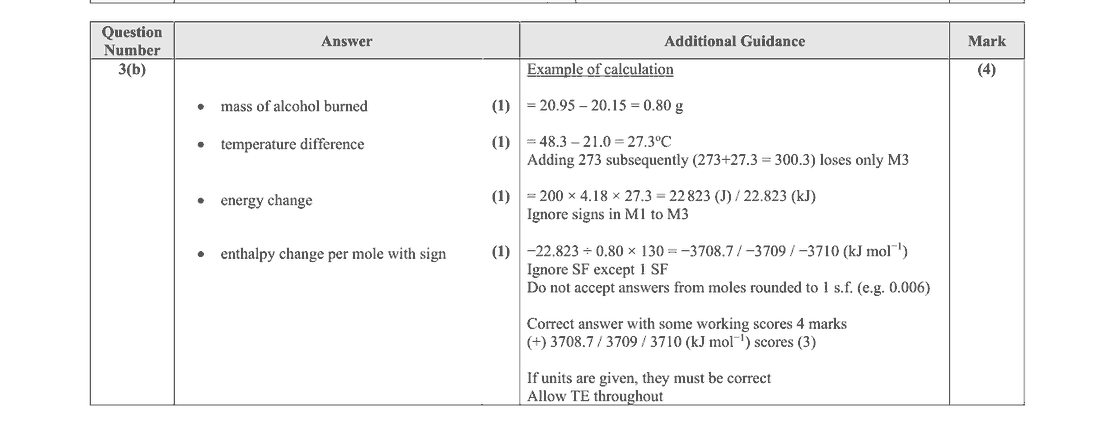
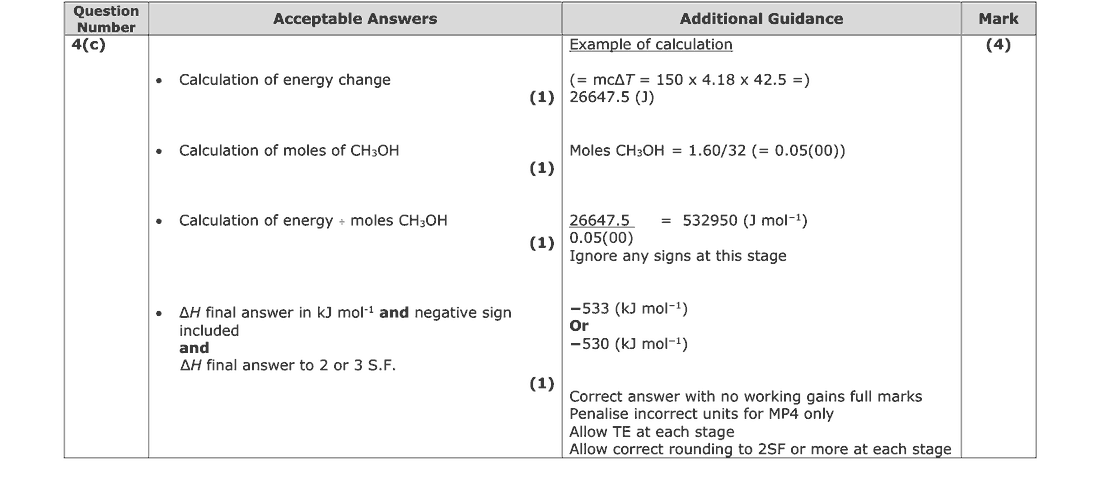
Answer: –3710 kJ mol–1 (–3708.7). Mass of alcohol burned = 20.95 – 20.15 = 0.80 g
temperature rise = 48.3 – 21.0 = 27.3 °C
energy = 200 × 4.18 × 27.3 = 22 823 J
22.823 ÷ 0.80 × 130, with a negative sign. +3710 scores 3
adding 273 to the temperature change loses only the third mark
moles rounded to 1 significant figure (0.006) not accepted. Common errors: using the mass of alcohol, not water, in the energy calculation
no negative sign. About half scored full marks
Skills: MS0.0 Recognise and make use of appropriate units in calculation; MS2.3 Substitute numerical values into algebraic equations using appropriate units for physical quantities
June 2025 · AS Paper 2 · Q3(c)2 marksExplanation
Earlier part of question 3 that this part uses
Mark scheme
Examiner's comment
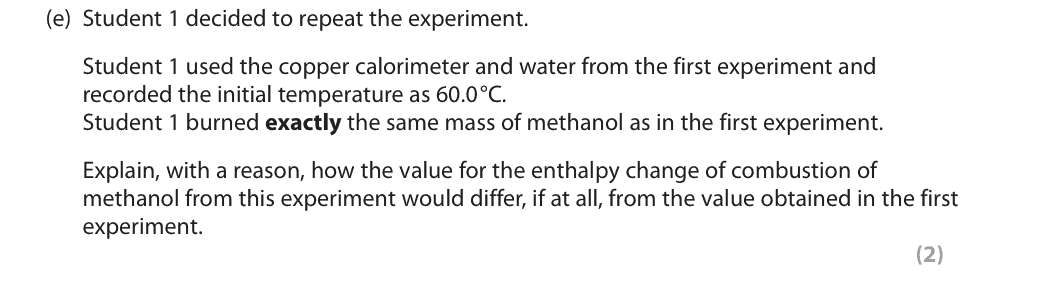
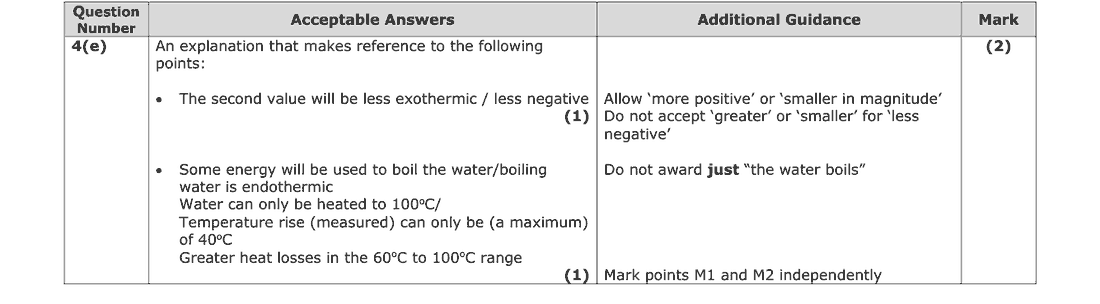
This question was about the combustion of alcohols. (a) Many candidates gave correct answers. A common error was quoting values around – 3330 , corresponding to pentan-1-ol. Most gave negative values, but some included no sign, which was allowed on this occasion. (b) The enthalpy change calculation was generally well done. Common errors were using the mass of alcohol rather than water when calculating the energy change, and omitting the negative sign in the final answer. 95% scored between 2 and 4 marks and approximately half of the candidates scored full marks. (c) Many gave ambiguous responses like “lower ΔH” instead of “less exothermic” or “less negative.” Vague references to “energy loss” rather than “heat loss” also cost marks. Over half scored the middle mark. (d) This question proved to be challenging and very few candidates scored full marks. Many focused on the lack of stirring or uneven heat distribution but failed to explain that the recorded temperature would be higher at the bottom. There were many stock answers that were not relevant to the question, such as not all reactants reacting. Explanations on the effect on ΔH were often either vague or missing.
Notes from the mark scheme and report
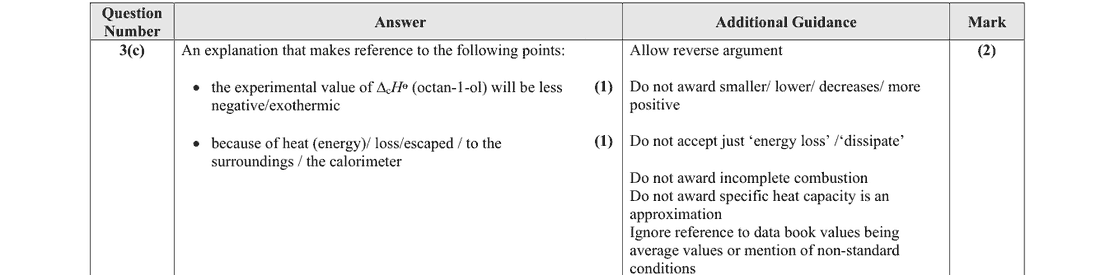
The experimental value will be less negative / less exothermic
because heat is lost to the surroundings (or to the calorimeter). Not 'smaller', 'lower' or 'decreases'
not just 'energy loss'
not incomplete combustion. Many gave ambiguous answers such as 'lower ΔH' or 'energy loss'
over half scored the heat loss mark
June 2025 · AS Paper 2 · Q3(d)2 marksExplanationHard
Earlier part of question 3 that this part uses
Mark scheme
Examiner's comment
This question was about the combustion of alcohols. (a) Many candidates gave correct answers. A common error was quoting values around – 3330 , corresponding to pentan-1-ol. Most gave negative values, but some included no sign, which was allowed on this occasion. (b) The enthalpy change calculation was generally well done. Common errors were using the mass of alcohol rather than water when calculating the energy change, and omitting the negative sign in the final answer. 95% scored between 2 and 4 marks and approximately half of the candidates scored full marks. (c) Many gave ambiguous responses like “lower ΔH” instead of “less exothermic” or “less negative.” Vague references to “energy loss” rather than “heat loss” also cost marks. Over half scored the middle mark. (d) This question proved to be challenging and very few candidates scored full marks. Many focused on the lack of stirring or uneven heat distribution but failed to explain that the recorded temperature would be higher at the bottom. There were many stock answers that were not relevant to the question, such as not all reactants reacting. Explanations on the effect on ΔH were often either vague or missing.
Notes from the mark scheme and report
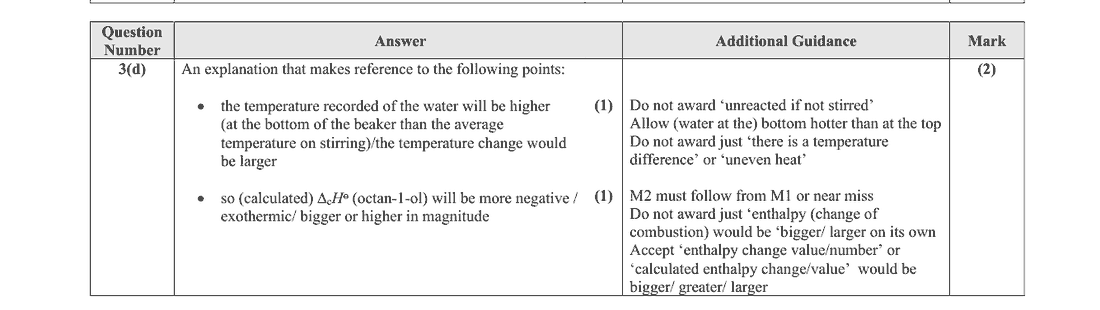
The temperature recorded will be higher than the true average (the water at the bottom, nearest the flame, is hotter), so the temperature change is larger
so the calculated enthalpy change of combustion will be more negative / more exothermic / bigger in magnitude. Not just 'uneven heat' or 'a temperature difference'
not just 'the enthalpy change would be bigger'. Many wrote about lack of stirring without saying the reading would be higher, or gave stock answers such as not all the reactants reacting
June 2025 · AS Paper 2 · Q4(b)2 marksDiagram or structureHard
Mark scheme
Examiner's comment
This question was concerned with the reactions and properties of alcohols. (a) Many knew the mechanism for the reaction of 1-bromobutane with aqueous potassium hydroxide and, on the whole, placed arrows and lone pairs carefully. However, some treated KOH as covalent and attempted to include K in the mechanism, which led to many incorrect answers. Leaving an unbalanced product by missing Br- or adding a previously unseen K+ lost many a mark. Scores were widely distributed, and 3 was the most common. (b) This question proved to be surprisingly challenging, and half of the candidates scored no marks. Most labelled the y-axis correctly, although a significant number wrote “Energy change” Common mistakes were failure to balance the equation correctly (omitting water and HBr or writing the wrong product) and not labelling ΔH or including double headed arrows. Some exothermic reactions were seen, and some labelled Ea as ΔH. (ci) London forces were generally well understood but many failed to explain why these increase with chain length. Some marks were lost by referring to intermolecular forces as “bonds”. (cii) There were many references to 1⁰, 2⁰,3⁰ (which did not necessarily lose the marks) - the correlation with branching was well known and often, but not always, adequately explained. Stability of primary, secondary and tertiary alcohols featured regularly.
Notes from the mark scheme and report
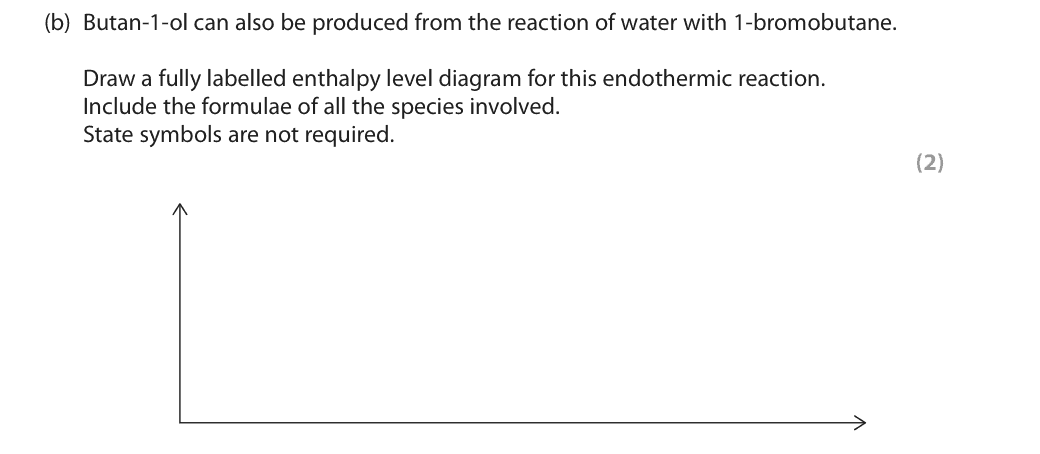
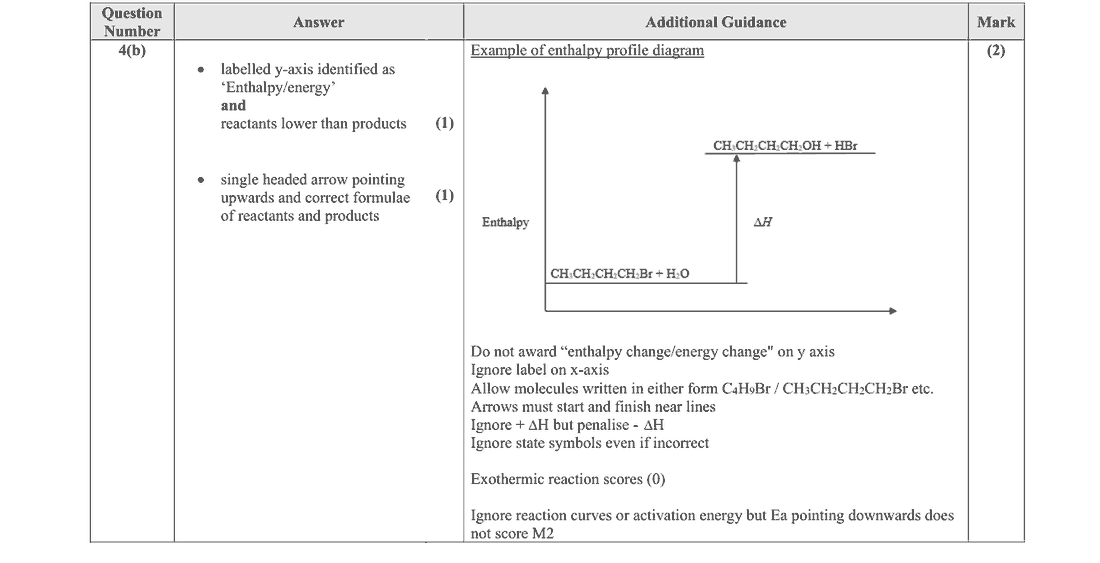
y-axis labelled enthalpy (or energy) with the reactants line, C4H9Br + H2O, lower than the products line, C4H9OH + HBr
a single-headed arrow pointing up from the reactants level to the products level (ΔH). Not 'enthalpy change' on the axis
–ΔH is penalised
an exothermic diagram scores 0. Common errors: HBr or water missing, or the wrong product
ΔH not labelled or a double-headed arrow
Ea labelled as ΔH
June 2025 · AS Paper 2 · Q9(a)(i)4 marksDiagram or structure
Mark scheme
Examiner's comment
This question involved the construction of a Hess cycle, and an enthalpy change calculation. (ai) The species, state symbols and balancing were generally correct. However, candidates struggled to place the appropriate arrows correctly and only a minority managed to label these correctly. Even the best answered questions often failed to label the top arrow, or thought that this enthalpy change represented the enthalpy change of formation of butane. (aii) Despite errors in part (i), many candidates successfully completed the enthalpy calculation, although many got the sign wrong. Some candidates bypassed the cycle in part (i) entirely and used the formula for calculating enthalpy of formation from combustion data, or redrew the cycle correctly in this part. While this approach is valid, it can waste valuable exam time. (b) Many correct answers but standard states rarely scored. The most common score was one mark. There was a lot of confusion and many contradictions. Frequent incorrect answers were 100 Pa, 100 atm, 1000 kPa.
Notes from the mark scheme and report
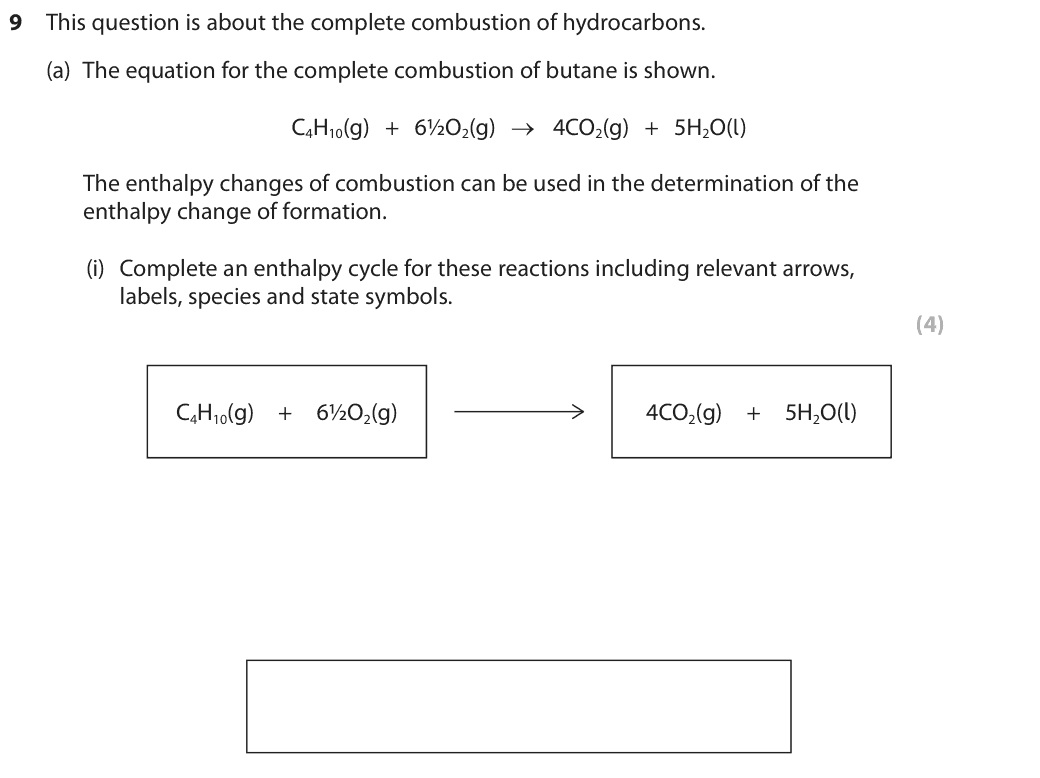
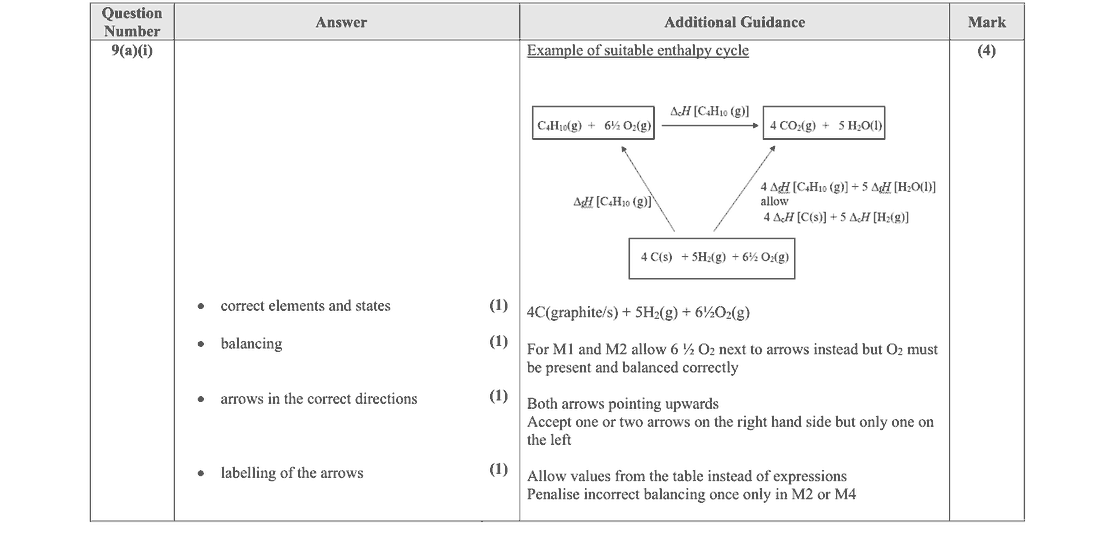
Bottom box: 4C(s, graphite) + 5H2(g) + 6½O2(g) (one mark for the elements and states, one for balancing
the oxygen may be written beside the arrows instead)
both arrows pointing up from the elements to the two top boxes
arrows labelled: ΔfH[C4H10(g)] on the left, 4ΔcH[C(s)] + 5ΔcH[H2(g)] on the right (values allowed). Species, states and balancing were usually right
only a minority placed and labelled the arrows correctly
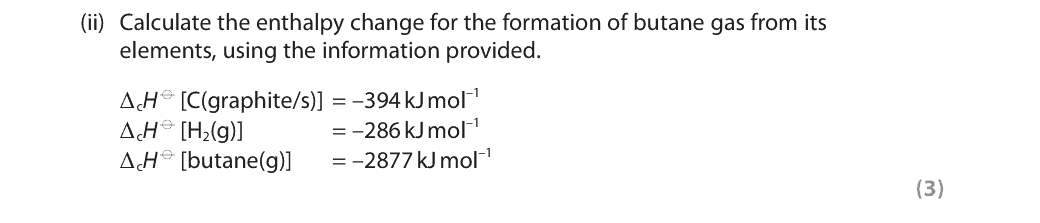
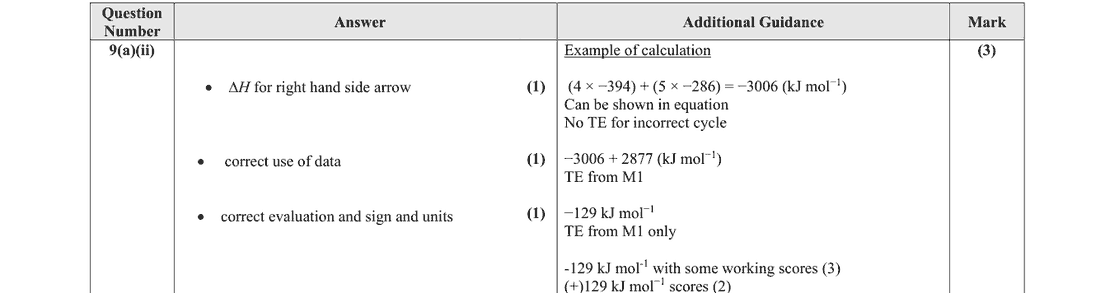
June 2025 · AS Paper 2 · Q9(a)(ii)3 marksCalculation
Earlier part of question 9 that this part uses
Mark scheme
Examiner's comment
This question involved the construction of a Hess cycle, and an enthalpy change calculation. (ai) The species, state symbols and balancing were generally correct. However, candidates struggled to place the appropriate arrows correctly and only a minority managed to label these correctly. Even the best answered questions often failed to label the top arrow, or thought that this enthalpy change represented the enthalpy change of formation of butane. (aii) Despite errors in part (i), many candidates successfully completed the enthalpy calculation, although many got the sign wrong. Some candidates bypassed the cycle in part (i) entirely and used the formula for calculating enthalpy of formation from combustion data, or redrew the cycle correctly in this part. While this approach is valid, it can waste valuable exam time. (b) Many correct answers but standard states rarely scored. The most common score was one mark. There was a lot of confusion and many contradictions. Frequent incorrect answers were 100 Pa, 100 atm, 1000 kPa.
sign and units needed for the third mark. +129 kJ mol–1 scores 2. No error carried forward from a wrong cycle. Many correct, though the sign was often wrong
Skills: MS2.4 Solve algebraic equations
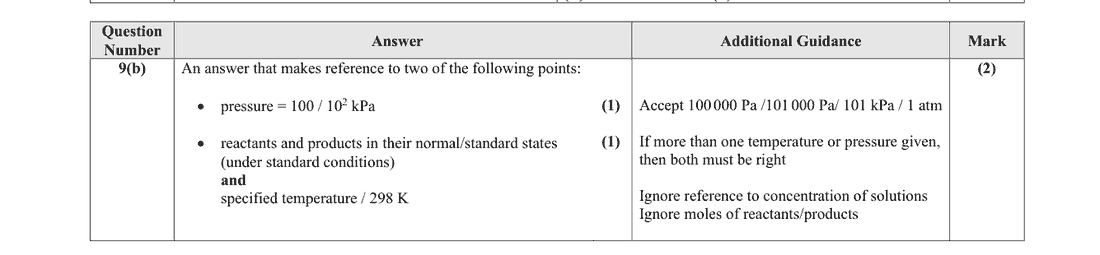
June 2025 · AS Paper 2 · Q9(b)2 marksShort answer
Mark scheme
Examiner's comment
This question involved the construction of a Hess cycle, and an enthalpy change calculation. (ai) The species, state symbols and balancing were generally correct. However, candidates struggled to place the appropriate arrows correctly and only a minority managed to label these correctly. Even the best answered questions often failed to label the top arrow, or thought that this enthalpy change represented the enthalpy change of formation of butane. (aii) Despite errors in part (i), many candidates successfully completed the enthalpy calculation, although many got the sign wrong. Some candidates bypassed the cycle in part (i) entirely and used the formula for calculating enthalpy of formation from combustion data, or redrew the cycle correctly in this part. While this approach is valid, it can waste valuable exam time. (b) Many correct answers but standard states rarely scored. The most common score was one mark. There was a lot of confusion and many contradictions. Frequent incorrect answers were 100 Pa, 100 atm, 1000 kPa.
Notes from the mark scheme and report
Pressure of 100 kPa (allow 101 kPa, 1 atm)
reactants and products in their standard states at a specified temperature / 298 K. If more than one pressure or temperature is given both must be right. One mark was the commonest score: standard states were rarely given
wrong pressures included 100 Pa, 100 atm and 1000 kPa
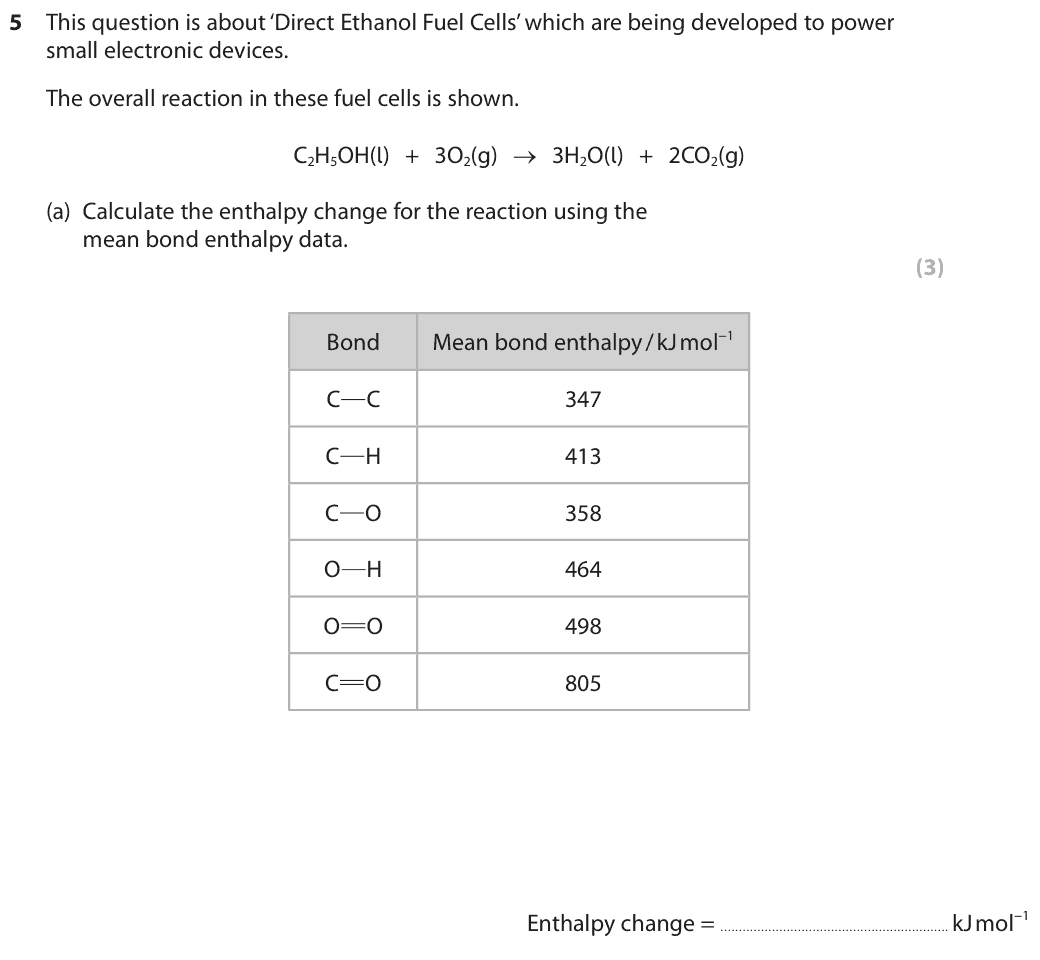
June 2024 · Paper 1 · Q5(a)3 marksCalculation
Mark scheme
Examiner's comment
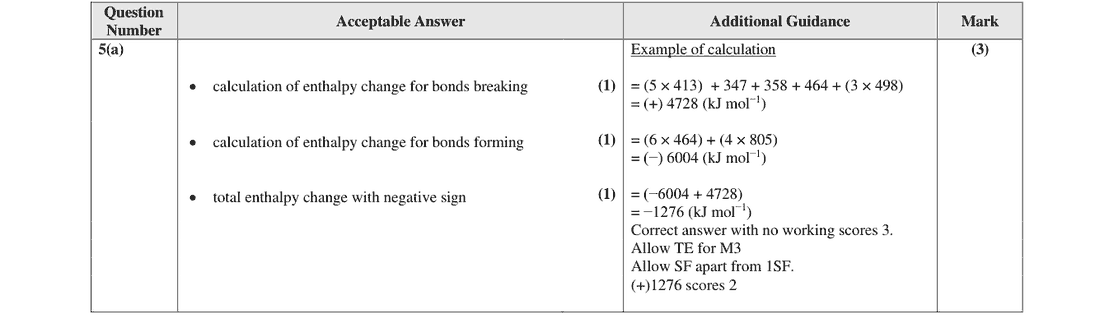
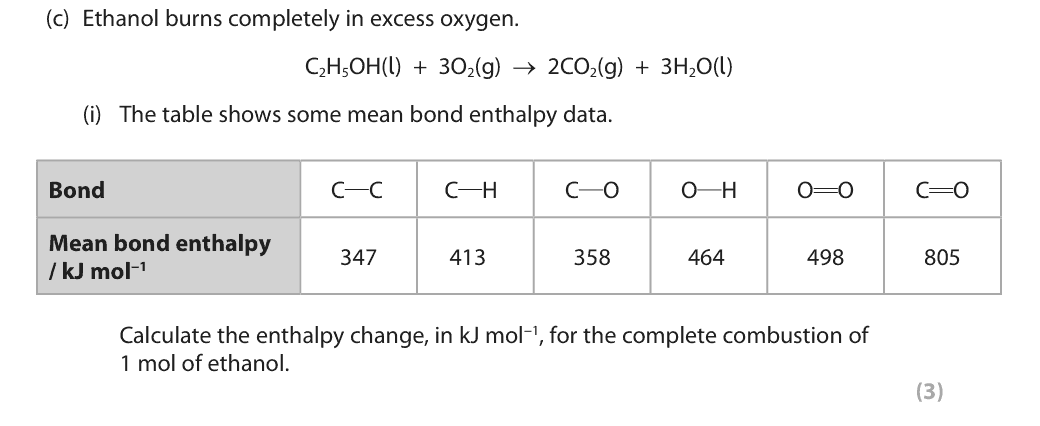
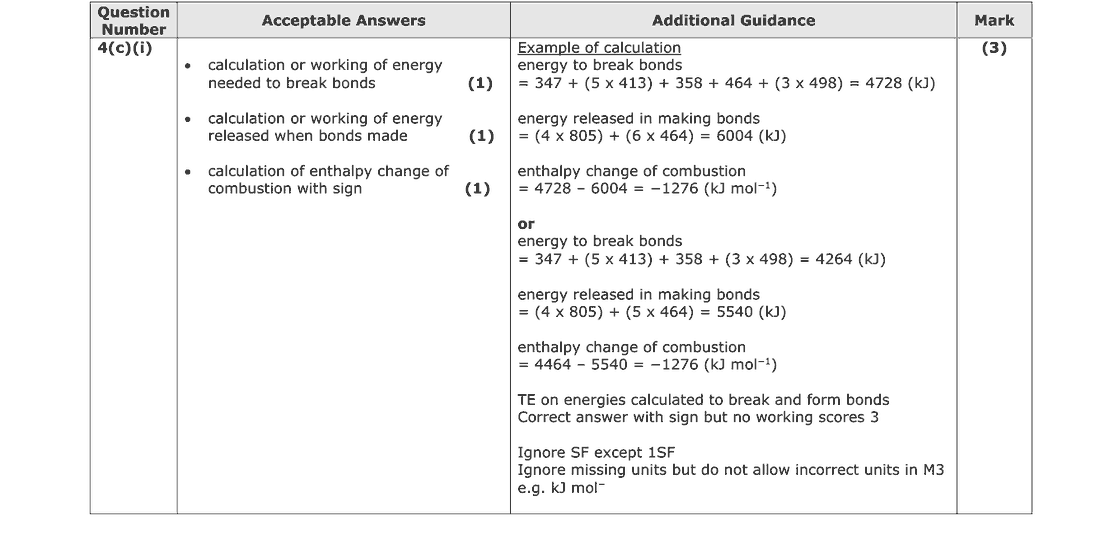
The question required the calculation of an enthalpy change using bond energy data.
While many correct answers of –1276 were seen, a few candidates subtracted the energy change for the bonds forming from the energy change for the bonds breaking and so gained an answer of +1276, scoring two of the three marks.
Many candidates did not check their answers to ensure that they had taken account of all of the bonds being broken or made, and a few calculator errors were seen.
bonds formed (6 × 464) + (4 × 805) = 6004. +1276 scores 2. Common errors: subtracting the wrong way round
missing a bond
Skills: MS2.3 Substitute numerical values into algebraic equations using appropriate units for physical quantities; MS2.4 Solve algebraic equations
June 2024 · Paper 1 · Q5(b)(i)2 marksDiagram or structure
Earlier part of question 5 that this part uses
Mark scheme
Examiner's comment
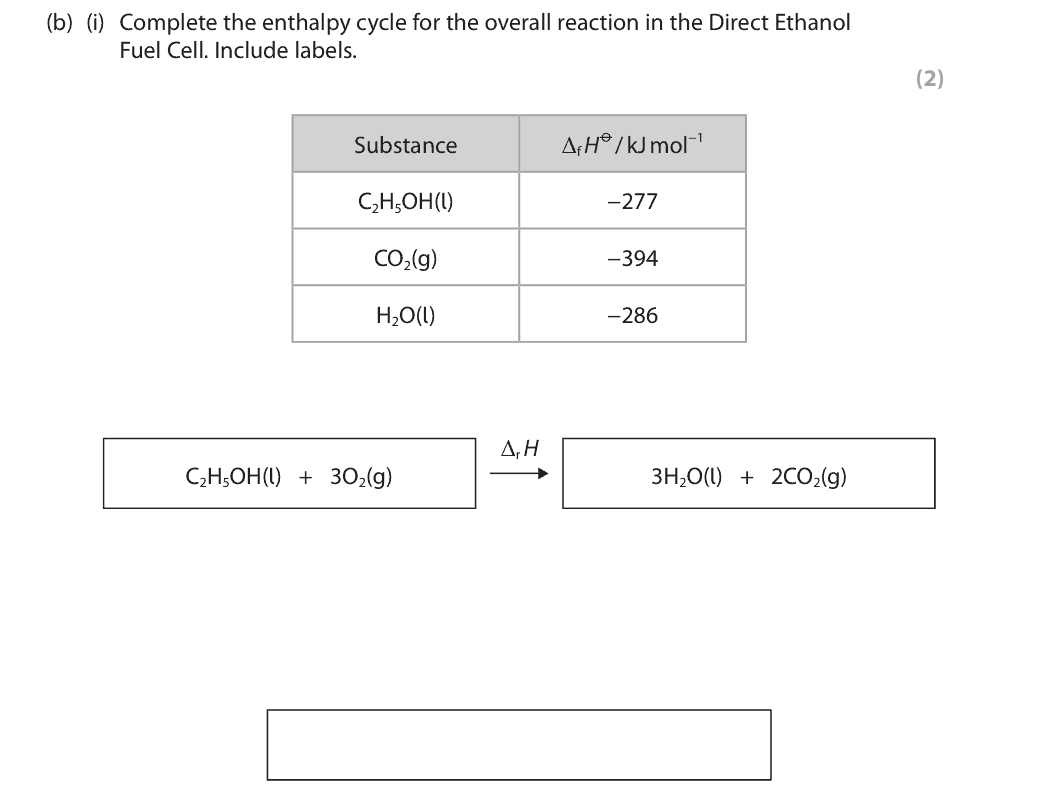
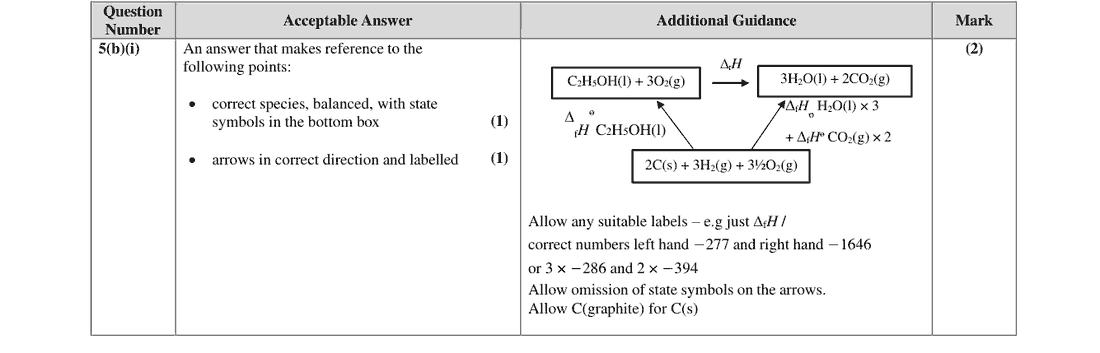
This question required candidates to complete an enthalpy cycle and then to use their cycle to calculate the enthalpy change in the Direct Ethanol Fuel Cell.
The first mark, for completion of the cycle, was awarded more frequently than the second. Candidates were sometimes unsure which substances to place in the bottom box, with marks lost for unbalanced oxygen and for incorrect state symbols.
Many correct answers were seen for the value of the enthalpy change, but some candidates did not take into account the moles of water and carbon dioxide and a few obtained an incorrect answer of +1369 instead of –1369, having used their cycle incorrectly.
Notes from the mark scheme and report
Bottom box: 2C(s) + 3H2(g) + 3½O2(g), balanced, with state symbols
arrows from the elements up to both boxes, labelled (ΔfH or –277 and 3 × –286 + 2 × –394). The bottom box was the harder mark: unbalanced oxygen and wrong state symbols
June 2024 · Paper 1 · Q5(b)(ii)1 markCalculation
Earlier parts of question 5 that this part uses
Mark scheme
Examiner's comment
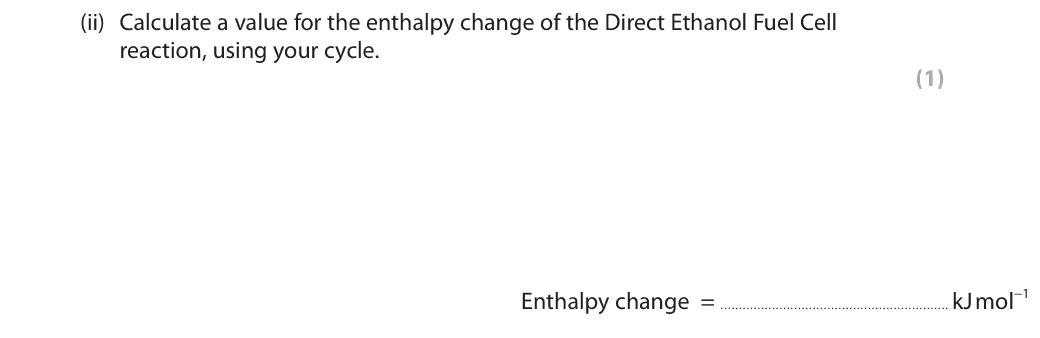
This question required candidates to complete an enthalpy cycle and then to use their cycle to calculate the enthalpy change in the Direct Ethanol Fuel Cell.
The first mark, for completion of the cycle, was awarded more frequently than the second. Candidates were sometimes unsure which substances to place in the bottom box, with marks lost for unbalanced oxygen and for incorrect state symbols.
Many correct answers were seen for the value of the enthalpy change, but some candidates did not take into account the moles of water and carbon dioxide and a few obtained an incorrect answer of +1369 instead of –1369, having used their cycle incorrectly.
Notes from the mark scheme and report
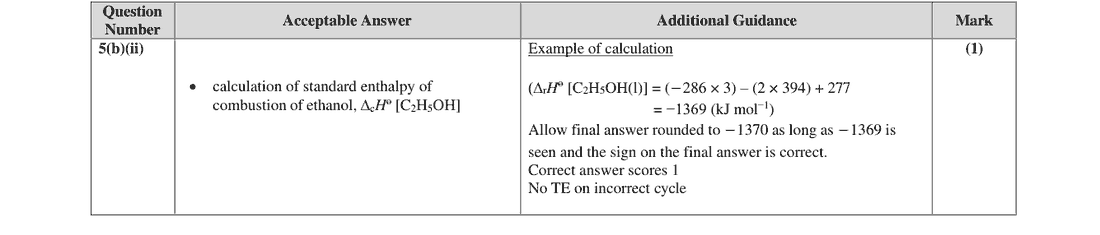
Answer: –1369 kJ mol–1. (3 × –286) + (2 × –394) – (–277). No error carried forward from a wrong cycle. Common errors: not multiplying by the moles of water and carbon dioxide
+1369
Skills: MS2.4 Solve algebraic equations
June 2024 · Paper 1 · Q5(c)2 marksShort answer
Earlier parts of question 5 that this part uses
Mark scheme
Examiner's comment
This question required candidates to give the reasons for differences between the values for the enthalpy change of reaction calculated using bond energy values and by using values for standard enthalpies of formation.
The majority of candidates who were awarded at least one mark for this question realised that mean bond energies were used in the calculations, which would not be the specific value for the bond in the molecules in the question.
The second mark was for stating that the bond energy values given were for substances in the gas state and that water and ethanol are liquids. This was awarded less often, with a common insufficient answer being that the standard enthalpies of formation were under standard conditions.
Notes from the mark scheme and report
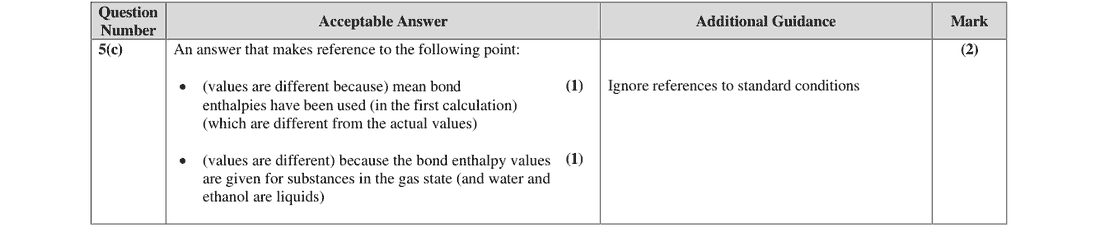
Mean bond enthalpies are averages over many compounds, not the actual values for these molecules
bond enthalpy values are for substances in the gas state, and the water and ethanol here are liquids. 'Standard conditions' was the common insufficient answer
June 2024 · AS Paper 2 · Q4(a)(i)3 marksCalculationEasy
Mark scheme
Examiner's comment
Q4 was concerned with bond enthalpy calculations and with Hess’ Law cycles. The bond enthalpy calculation in (a)(i) was very well answered, with most candidates scoring full marks, and over 90% scoring at least 2 out of 3. The difference between mean bond enthalpies and bond enthalpy values examined in (a)(ii) was not as well understood, but still scored full marks for almost one quarter of papers. The Hess’ law calculation in (b) proved more challenging. Some candidates continued looking at the formation of cyclobutene, which was tested in (a), rather than the combustion of cyclobutene. Candidates must read the questions with care. There were a number of different approaches to the labelling of the cycle which were able to score marks. The result was a fairly even spread of marks. In (b)(ii) the calculation was often scored by those who scored well in (b)(i), perhaps unsurprisingly, but some candidates who had not been able to work out how to complete the table still knew how to do the calculation.
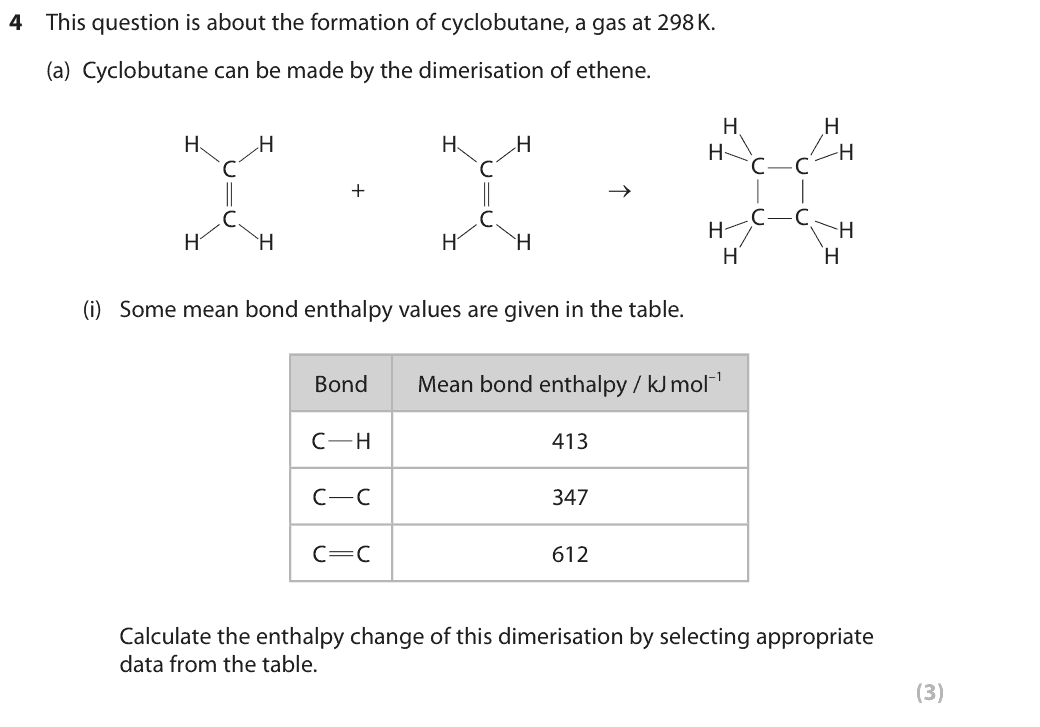
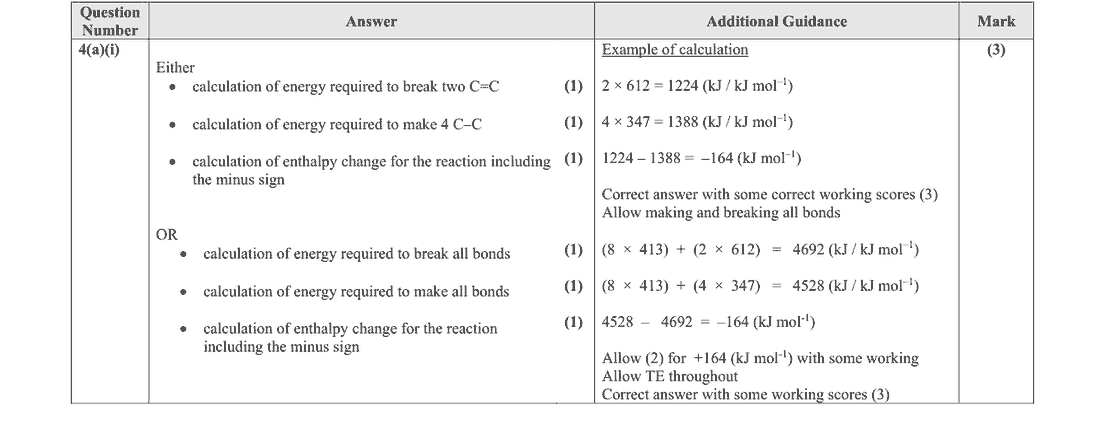
1224 – 1388. Or with all bonds: (8 × 413) + (2 × 612) = 4692 broken and (8 × 413) + (4 × 347) = 4528 made. +164 with some working scores 2
Skills: MS2.3 Substitute numerical values into algebraic equations using appropriate units for physical quantities
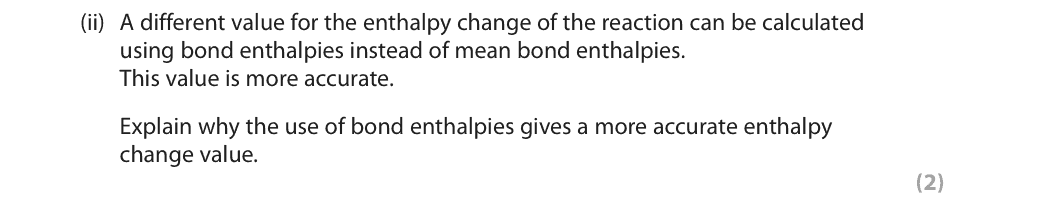
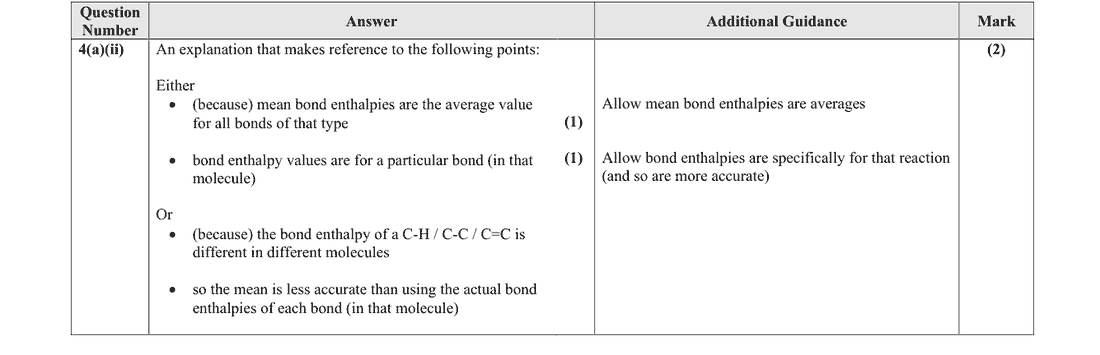
June 2024 · AS Paper 2 · Q4(a)(ii)2 marksExplanation
Earlier part of question 4 that this part uses
Mark scheme
Examiner's comment
Q4 was concerned with bond enthalpy calculations and with Hess’ Law cycles. The bond enthalpy calculation in (a)(i) was very well answered, with most candidates scoring full marks, and over 90% scoring at least 2 out of 3. The difference between mean bond enthalpies and bond enthalpy values examined in (a)(ii) was not as well understood, but still scored full marks for almost one quarter of papers. The Hess’ law calculation in (b) proved more challenging. Some candidates continued looking at the formation of cyclobutene, which was tested in (a), rather than the combustion of cyclobutene. Candidates must read the questions with care. There were a number of different approaches to the labelling of the cycle which were able to score marks. The result was a fairly even spread of marks. In (b)(ii) the calculation was often scored by those who scored well in (b)(i), perhaps unsurprisingly, but some candidates who had not been able to work out how to complete the table still knew how to do the calculation.
Notes from the mark scheme and report
Mean bond enthalpies are averages for that type of bond over many different molecules
bond enthalpies are the values for the particular bonds in these molecules. Or: the enthalpy of a C–H, C–C or C=C bond differs from molecule to molecule, so the mean is less accurate than the actual values. Almost a quarter scored both marks
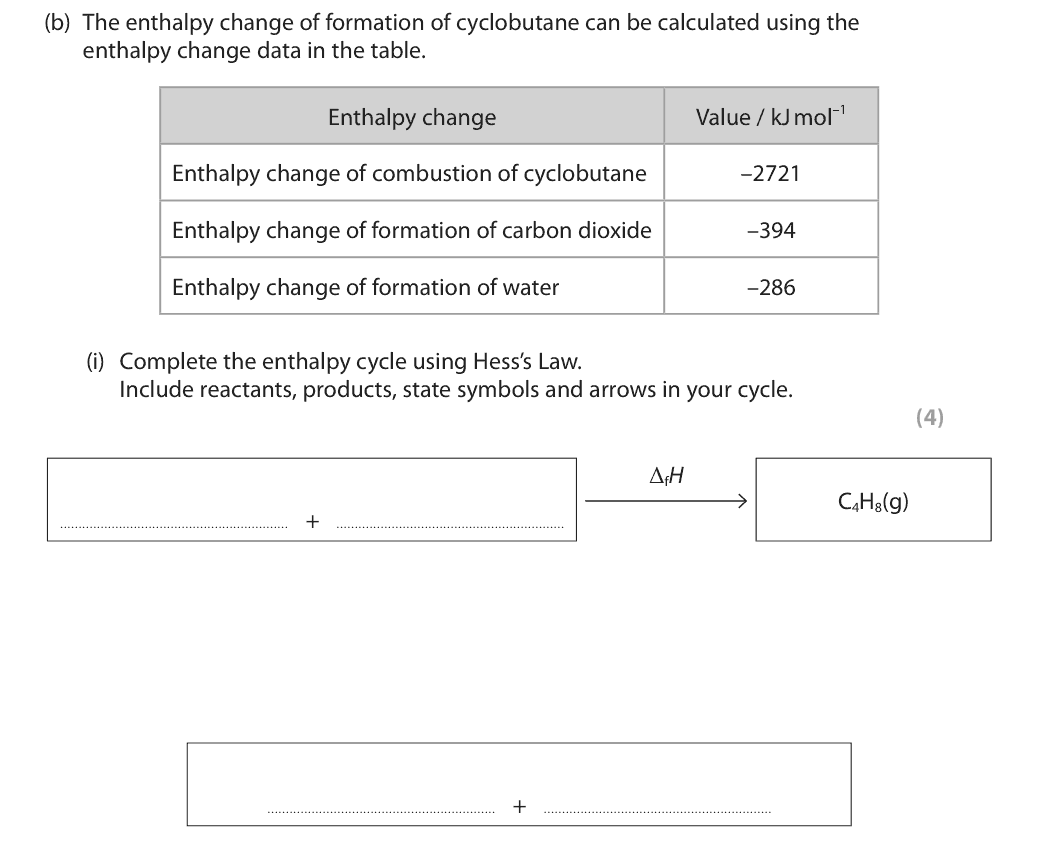
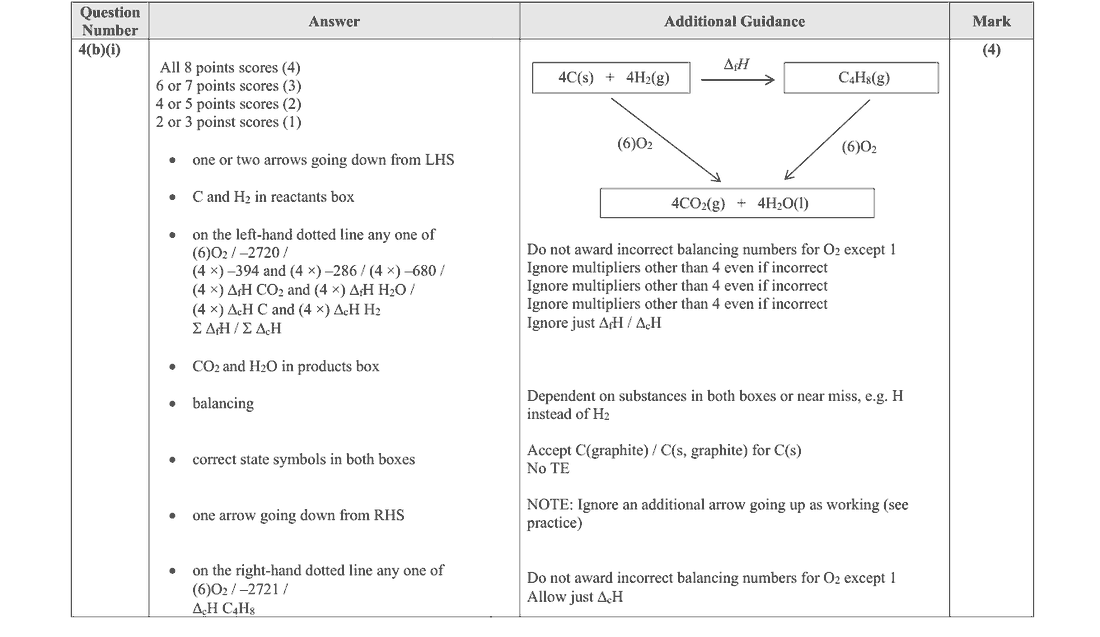
June 2024 · AS Paper 2 · Q4(b)(i)4 marksDiagram or structure
Earlier part of question 4 that this part uses
Mark scheme
Examiner's comment
Q4 was concerned with bond enthalpy calculations and with Hess’ Law cycles. The bond enthalpy calculation in (a)(i) was very well answered, with most candidates scoring full marks, and over 90% scoring at least 2 out of 3. The difference between mean bond enthalpies and bond enthalpy values examined in (a)(ii) was not as well understood, but still scored full marks for almost one quarter of papers. The Hess’ law calculation in (b) proved more challenging. Some candidates continued looking at the formation of cyclobutene, which was tested in (a), rather than the combustion of cyclobutene. Candidates must read the questions with care. There were a number of different approaches to the labelling of the cycle which were able to score marks. The result was a fairly even spread of marks. In (b)(ii) the calculation was often scored by those who scored well in (b)(i), perhaps unsurprisingly, but some candidates who had not been able to work out how to complete the table still knew how to do the calculation.
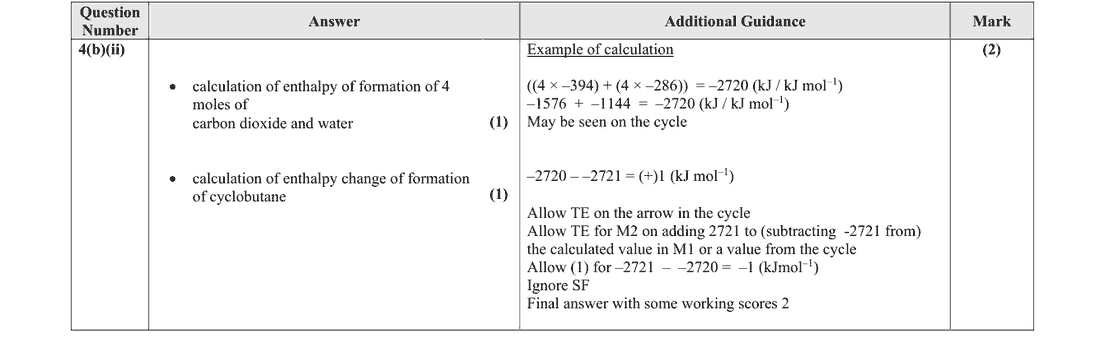
left arrow labelled, e.g. (6)O2 or 4 × –394 and 4 × –286 or –2720
right arrow labelled, e.g. (6)O2 or –2721 or ΔcH. Several ways of labelling the cycle were accepted
June 2024 · AS Paper 2 · Q4(b)(ii)2 marksCalculation
Earlier parts of question 4 that this part uses
Mark scheme
Examiner's comment
Q4 was concerned with bond enthalpy calculations and with Hess’ Law cycles. The bond enthalpy calculation in (a)(i) was very well answered, with most candidates scoring full marks, and over 90% scoring at least 2 out of 3. The difference between mean bond enthalpies and bond enthalpy values examined in (a)(ii) was not as well understood, but still scored full marks for almost one quarter of papers. The Hess’ law calculation in (b) proved more challenging. Some candidates continued looking at the formation of cyclobutene, which was tested in (a), rather than the combustion of cyclobutene. Candidates must read the questions with care. There were a number of different approaches to the labelling of the cycle which were able to score marks. The result was a fairly even spread of marks. In (b)(ii) the calculation was often scored by those who scored well in (b)(i), perhaps unsurprisingly, but some candidates who had not been able to work out how to complete the table still knew how to do the calculation.
–2720 – (–2721) = +1. –1 scores 1. Error carried forward from the cycle. Some candidates who could not complete the cycle still did this calculation
Skills: MS2.3 Substitute numerical values into algebraic equations using appropriate units for physical quantities; MS2.4 Solve algebraic equations
June 2024 · AS Paper 2 · Q8(a)(i)2 marksEquation writingHard
Mark scheme
Examiner's comment
This question was based on the practical activity for determining enthalpy change of combustion, which is a very commonly encountered practical. The equation for the enthalpy of combustion of methanol in (a)(i) was not as well answered as expected, with nearly 40% not scoring either of the marks, and only just over 10% scoring both marks. The calculation in (a)(ii) was slightly unusual and proved a significant challenge. Relatively few candidates were able to score well, with many rather unsure of how to proceed. This made the final two questions difficult. The calculation of percentage error was challenging, although some error is the previous section could be accounted for. This still proved one of the harder questions on the paper. The stock answer to the final question about precision of apparatus is nearly always that higher precision is better, but in this question the other errors in the activity are so high as to make this extra precision unnecessary. Some candidates saw this and were able to score one, or both, of the final marks.
Notes from the mark scheme and report
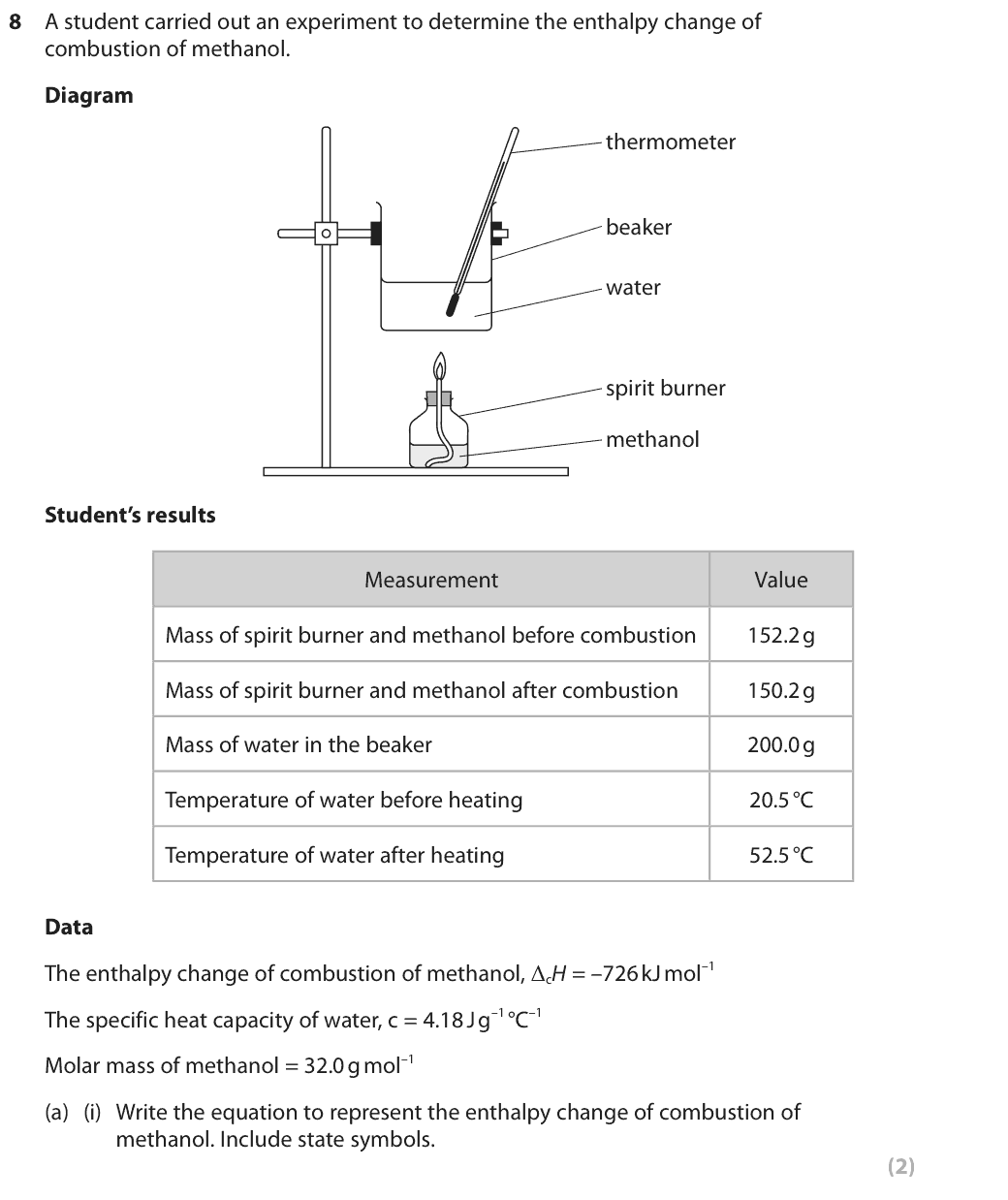
Answer: CH3OH(l) + 1½O2(g) → CO2(g) + 2H2O(l). One mark for the substances, one for state symbols and balancing. Multiples are not accepted because the equation must be for one mole of methanol
June 2024 · AS Paper 2 · Q8(a)(ii)4 marksCalculationHard
Earlier part of question 8 that this part uses
Mark scheme
Examiner's comment
This question was based on the practical activity for determining enthalpy change of combustion, which is a very commonly encountered practical. The equation for the enthalpy of combustion of methanol in (a)(i) was not as well answered as expected, with nearly 40% not scoring either of the marks, and only just over 10% scoring both marks. The calculation in (a)(ii) was slightly unusual and proved a significant challenge. Relatively few candidates were able to score well, with many rather unsure of how to proceed. This made the final two questions difficult. The calculation of percentage error was challenging, although some error is the previous section could be accounted for. This still proved one of the harder questions on the paper. The stock answer to the final question about precision of apparatus is nearly always that higher precision is better, but in this question the other errors in the activity are so high as to make this extra precision unnecessary. Some candidates saw this and were able to score one, or both, of the final marks.
Notes from the mark scheme and report
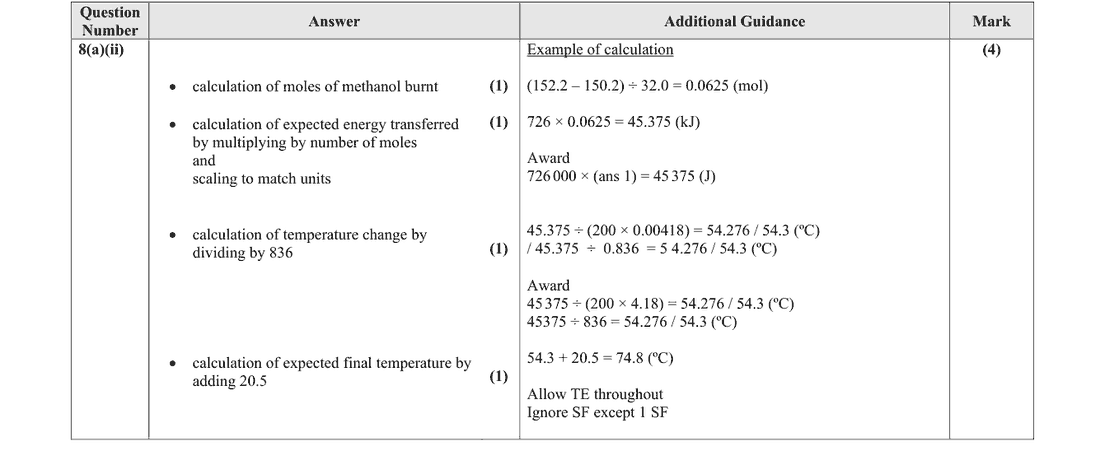
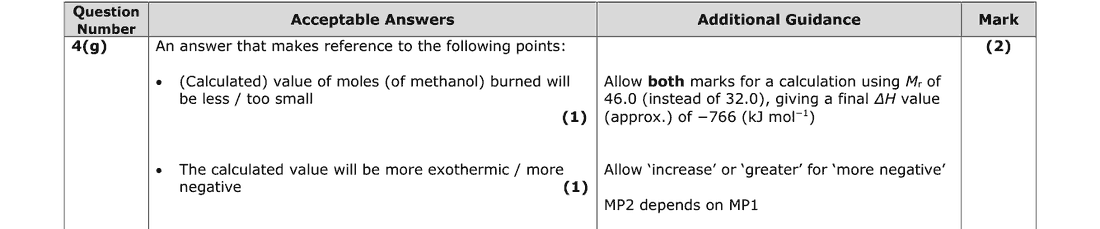
Answer: 74.8 °C. Moles of methanol burnt = (152.2 – 150.2) ÷ 32.0 = 0.0625
energy = 726 × 0.0625 = 45.375 kJ = 45 375 J
temperature rise = 45 375 ÷ (200 × 4.18) = 54.3 °C
final temperature = 54.3 + 20.5 = 74.8 °C. Error carried forward throughout
ignore significant figures except 1 SF. An unusual calculation (working back from the enthalpy change to the temperature), and many were unsure how to start
Skills: MS0.0 Recognise and make use of appropriate units in calculation; MS2.2 Change the subject of an equation; MS2.3 Substitute numerical values into algebraic equations using appropriate units for physical quantities
June 2024 · AS Paper 2 · Q8(b)2 marksExplanation
Earlier part of question 8 that this part uses
Mark scheme
Examiner's comment
This question was based on the practical activity for determining enthalpy change of combustion, which is a very commonly encountered practical. The equation for the enthalpy of combustion of methanol in (a)(i) was not as well answered as expected, with nearly 40% not scoring either of the marks, and only just over 10% scoring both marks. The calculation in (a)(ii) was slightly unusual and proved a significant challenge. Relatively few candidates were able to score well, with many rather unsure of how to proceed. This made the final two questions difficult. The calculation of percentage error was challenging, although some error is the previous section could be accounted for. This still proved one of the harder questions on the paper. The stock answer to the final question about precision of apparatus is nearly always that higher precision is better, but in this question the other errors in the activity are so high as to make this extra precision unnecessary. Some candidates saw this and were able to score one, or both, of the final marks.
Notes from the mark scheme and report
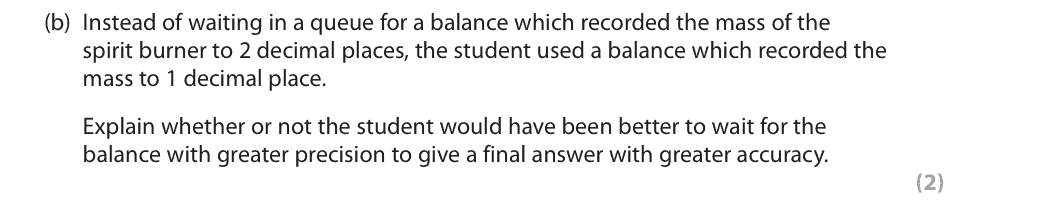
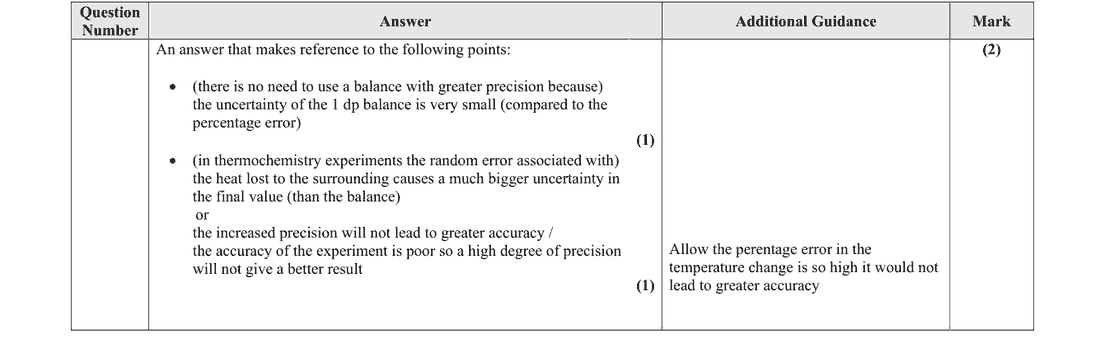
No need to wait: the uncertainty from the 1 decimal place balance is very small compared with the percentage error
heat loss to the surroundings causes a far bigger error, so greater precision would not give greater accuracy. The stock answer that 'more precise is better' does not score here
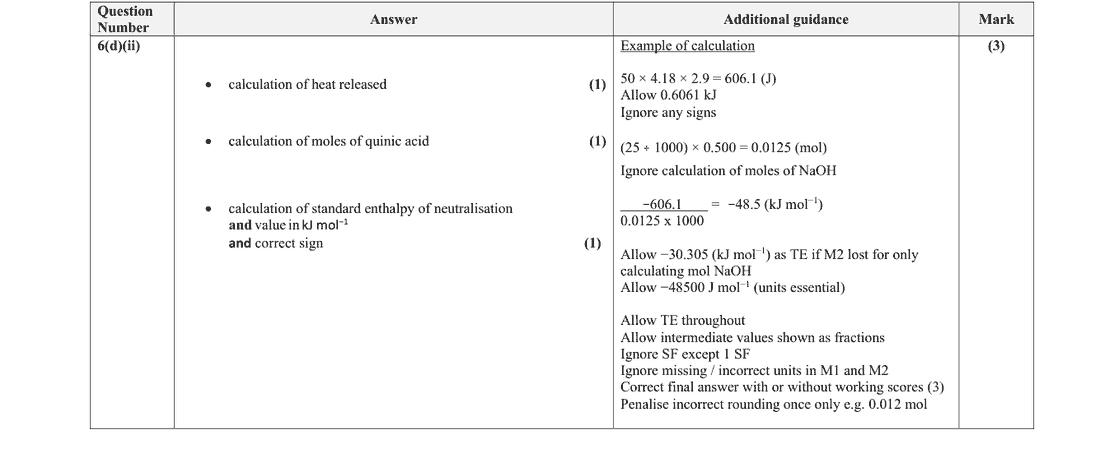
June 2023 · Paper 1 · Q6(d)(ii)3 marksCalculation
Earlier parts of question 6 that this part uses
Mark scheme
Examiner's comment
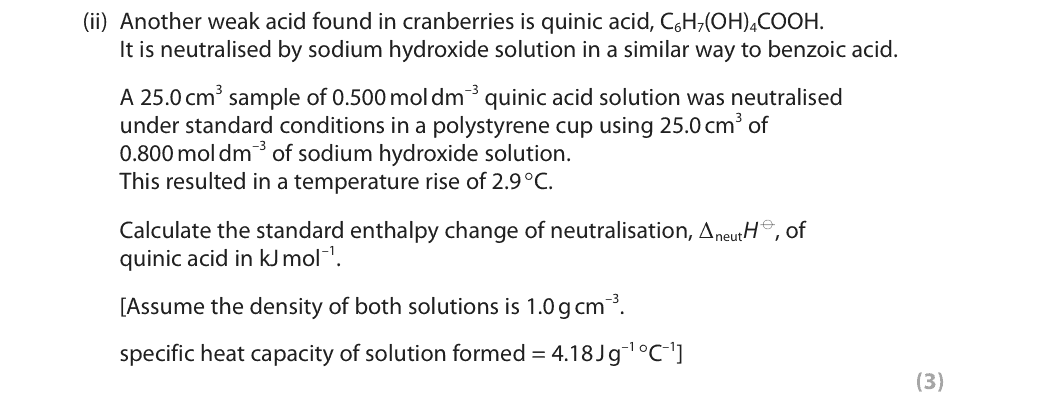
Many candidates were able to calculate the standard enthalpy change of neutralisation calculation. Some candidates just used 25g as the total mass of solution and some converted the temperature into kelvin. Many candidates did not realise that they should use the number of moles of acid and alkali to deduce which was the limiting reagent, so some added them and others subtracted them. A significant number of candidates did not deduce that the reaction is exothermic and omitted the minus sign in their final answer.
moles of quinic acid = 0.0250 × 0.500 = 0.0125 (the acid is the limiting reagent
NaOH is in excess)
ΔH = –606.1 ÷ (0.0125 × 1000). Third mark needs kJ mol–1 and the negative sign. –30.3 allowed as a transferred error from using moles of NaOH
not 1 SF. Common errors: 25 g for the mass
converting 2.9 °C to kelvin
adding or subtracting the moles of acid and alkali
no minus sign
Skills: MS0.0 Recognise and make use of appropriate units in calculation; MS2.3 Substitute numerical values into algebraic equations using appropriate units for physical quantities
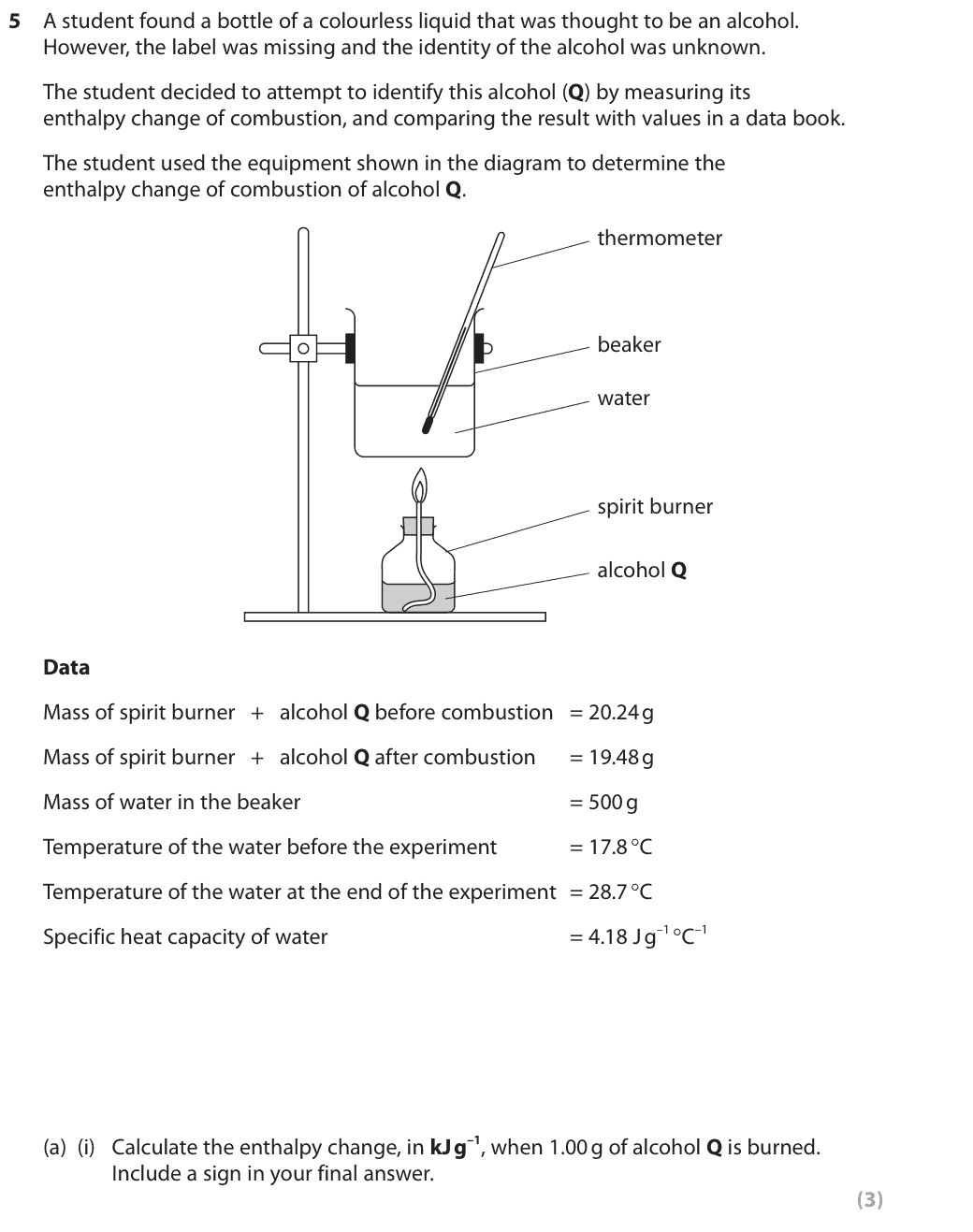
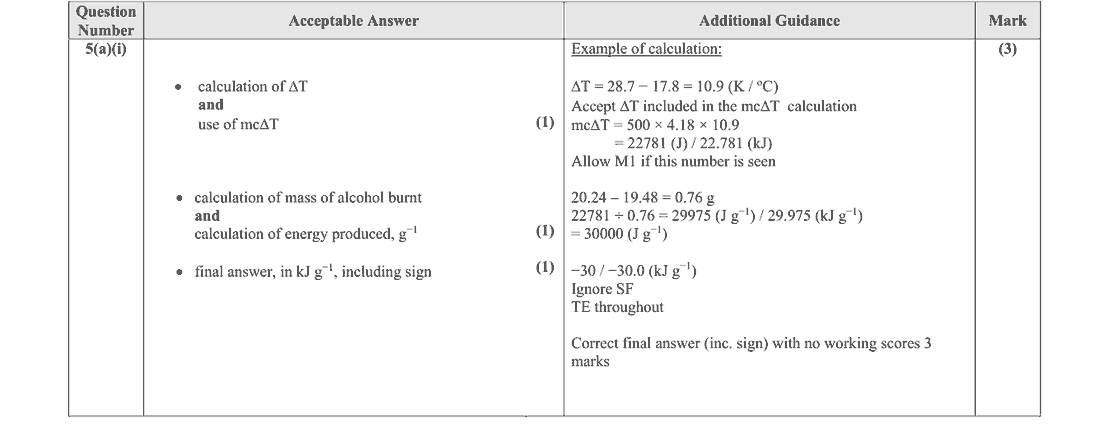
June 2023 · AS Paper 2 · Q5(a)(i)3 marksCalculation
Mark scheme
Examiner's comment
Generally, candidates don’t seem to favour calculation questions, although this one was reasonably successful for many students.
22 781 ÷ 0.76 = 29 975 J g–1. The final mark needs kJ g–1 and the negative sign. Significant figures ignored
Skills: MS0.0 Recognise and make use of appropriate units in calculation; MS2.3 Substitute numerical values into algebraic equations using appropriate units for physical quantities; PT1 use appropriate apparatus to record a range of measurements (to include mass, time, volume of liquids and gases, temperature)
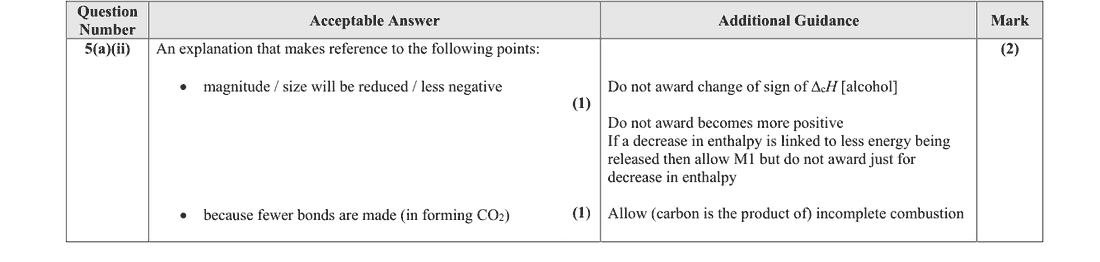
June 2023 · AS Paper 2 · Q5(a)(ii)2 marksExplanation
Earlier part of question 5 that this part uses
Mark scheme
Examiner's comment
Students did not entirely understand the idea of a negative number, and should be encouraged to discuss the magnitude of the number separately from its sign. Many scored M2 using the AG answer.
Notes from the mark scheme and report
The magnitude of the value is reduced / it is less negative
because combustion is incomplete, so fewer bonds are made (in forming CO2). Not credited: 'more positive' or a change of sign. Candidates should discuss the size of the number separately from its sign
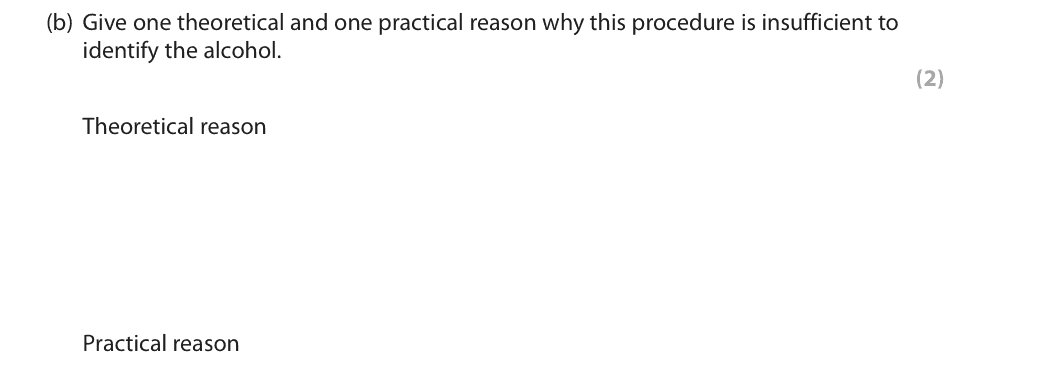
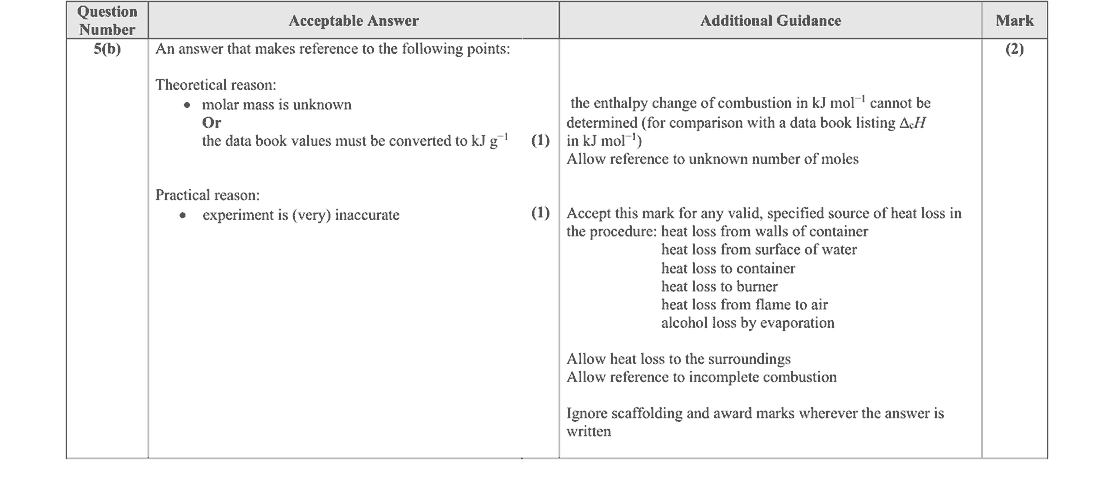
June 2023 · AS Paper 2 · Q5(b)2 marksPractical and data analysis
Earlier part of question 5 that this part uses
Mark scheme
Examiner's comment
Many random answers were seen on this question, with candidates being unable to differentiate between theoretical and practical reasons. Heat loss to the surroundings and incomplete combustion were frequently seen.
Notes from the mark scheme and report
Theoretical: the molar mass (number of moles) is unknown, so the value in kJ mol–1 needed for comparison with the data book cannot be found (or the data book values would have to be converted to kJ g–1). Practical: the experiment is very inaccurate, e.g. a specified heat loss (to the surroundings, the beaker, the burner), evaporation of alcohol or incomplete combustion. Many could not tell a theoretical from a practical reason
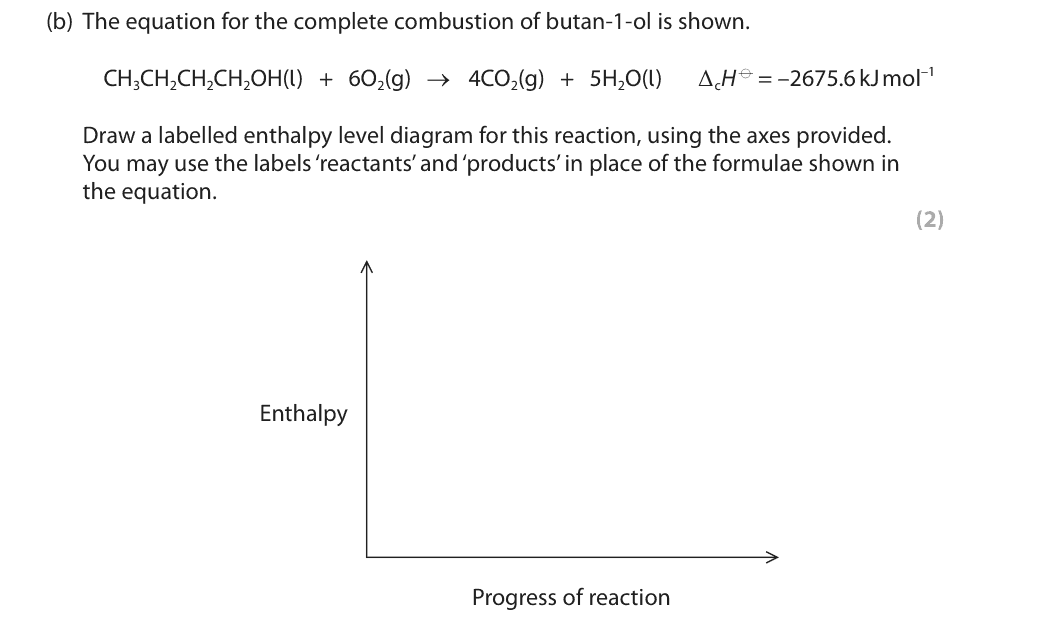
June 2023 · AS Paper 2 · Q7(b)2 marksDiagram or structure
Earlier part of question 7 that this part uses
Mark scheme
Examiner's comment
This was a straightforward question and many candidates scored both marks. A small number of candidates were unable to score marks, and mixed up exothermic and endothermic.
Notes from the mark scheme and report
Reactants level above products level (labels 'reactants' and 'products' or balanced formulae)
a downward arrow from the reactants level to the products level, with no gaps, labelled ΔH, ΔcH or –2675.6 kJ mol–1. A double-headed arrow is not accepted
an activation energy hump is ignored. A few mixed up exothermic and endothermic
June 2023 · AS Paper 2 · Q8(a)2 marksShort answer
Mark scheme
Examiner's comment
Q8a was generally answered well, with just a few candidates giving answers that were too generalised to score. Candidates who did not score marks in Q8bi usually were unable to score marks on Q8bii as well. Many candidates were unsuccessful in achieving marks, and struggled with the mismatched units in the calculation. The mark scheme was slightly amended to allow those candidates who completely misunderstood the question to score marks. However, the more students frequently recognised the problem.
Notes from the mark scheme and report
Pressure of 100 kPa (1 atm, 1 bar
101 kPa allowed) and a stated temperature (any stated value from 273 to 298 K). 'Room temperature' is ignored. A few answers were too general to score
June 2023 · AS Paper 2 · Q8(b)(i)2 marksDiagram or structure
Earlier part of question 8 that this part uses
Mark scheme
Examiner's comment
Q8a was generally answered well, with just a few candidates giving answers that were too generalised to score. Candidates who did not score marks in Q8bi usually were unable to score marks on Q8bii as well. Many candidates were unsuccessful in achieving marks, and struggled with the mismatched units in the calculation. The mark scheme was slightly amended to allow those candidates who completely misunderstood the question to score marks. However, the more students frequently recognised the problem.
Notes from the mark scheme and report
A triangle with H2(g) + ½O2(g), H2O(g) and H2O(l) at the corners, with the correct state symbols
arrows from the elements to H2O(l) (ΔH1) and from H2O(l) to H2O(g) (ΔH2), and the direct arrow ΔrH, all labelled and pointing the right way. Reversed arrows are allowed if the signs are reversed too
June 2023 · AS Paper 2 · Q8(b)(ii)3 marksCalculation
Earlier parts of question 8 that this part uses
Mark scheme
Examiner's comment
Q8a was generally answered well, with just a few candidates giving answers that were too generalised to score. Candidates who did not score marks in Q8bi usually were unable to score marks on Q8bii as well. Many candidates were unsuccessful in achieving marks, and struggled with the mismatched units in the calculation. The mark scheme was slightly amended to allow those candidates who completely misunderstood the question to score marks. However, the more students frequently recognised the problem.
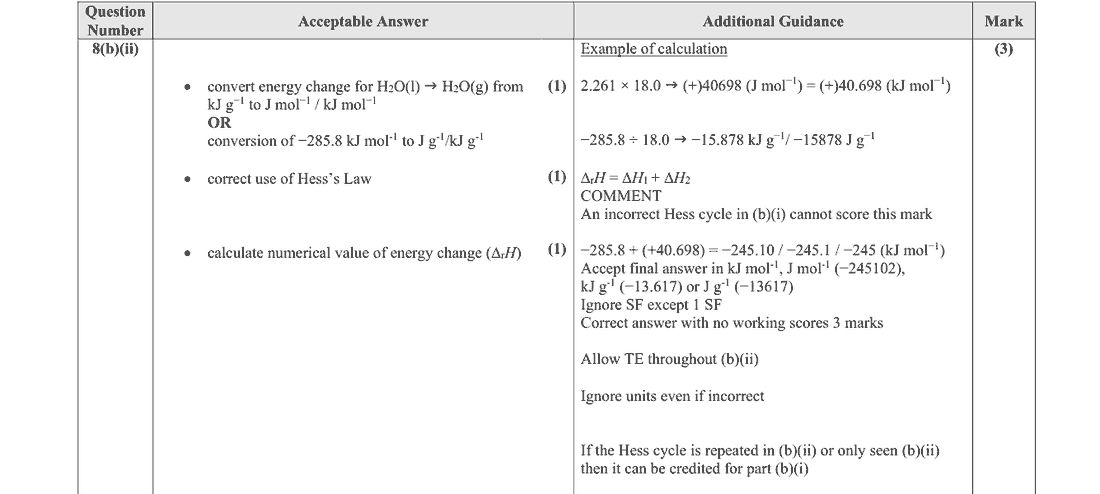
ΔrH = ΔH1 + ΔH2 = –285.8 + 40.698. Also accepted: –13.617 kJ g–1. Not 1 significant figure
units ignored. The Hess's Law mark cannot be scored from an incorrect cycle in (b)(i). Many candidates struggled with the mismatched units (kJ mol–1 and kJ g–1)
Skills: MS0.0 Recognise and make use of appropriate units in calculation; MS2.3 Substitute numerical values into algebraic equations using appropriate units for physical quantities
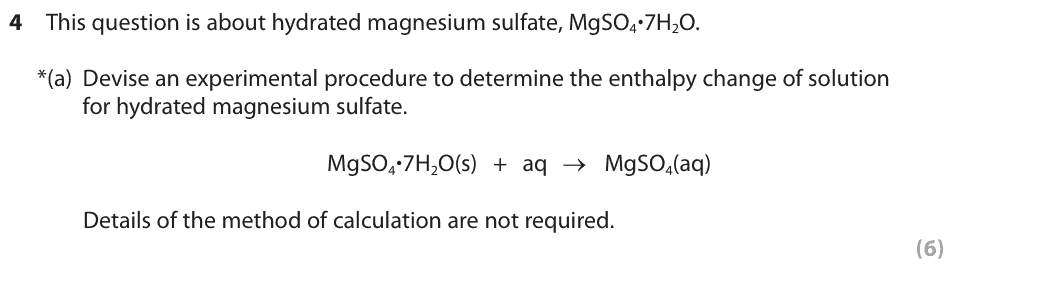
June 2023 · Paper 3 · Q4(a)6 marks6-mark extended response
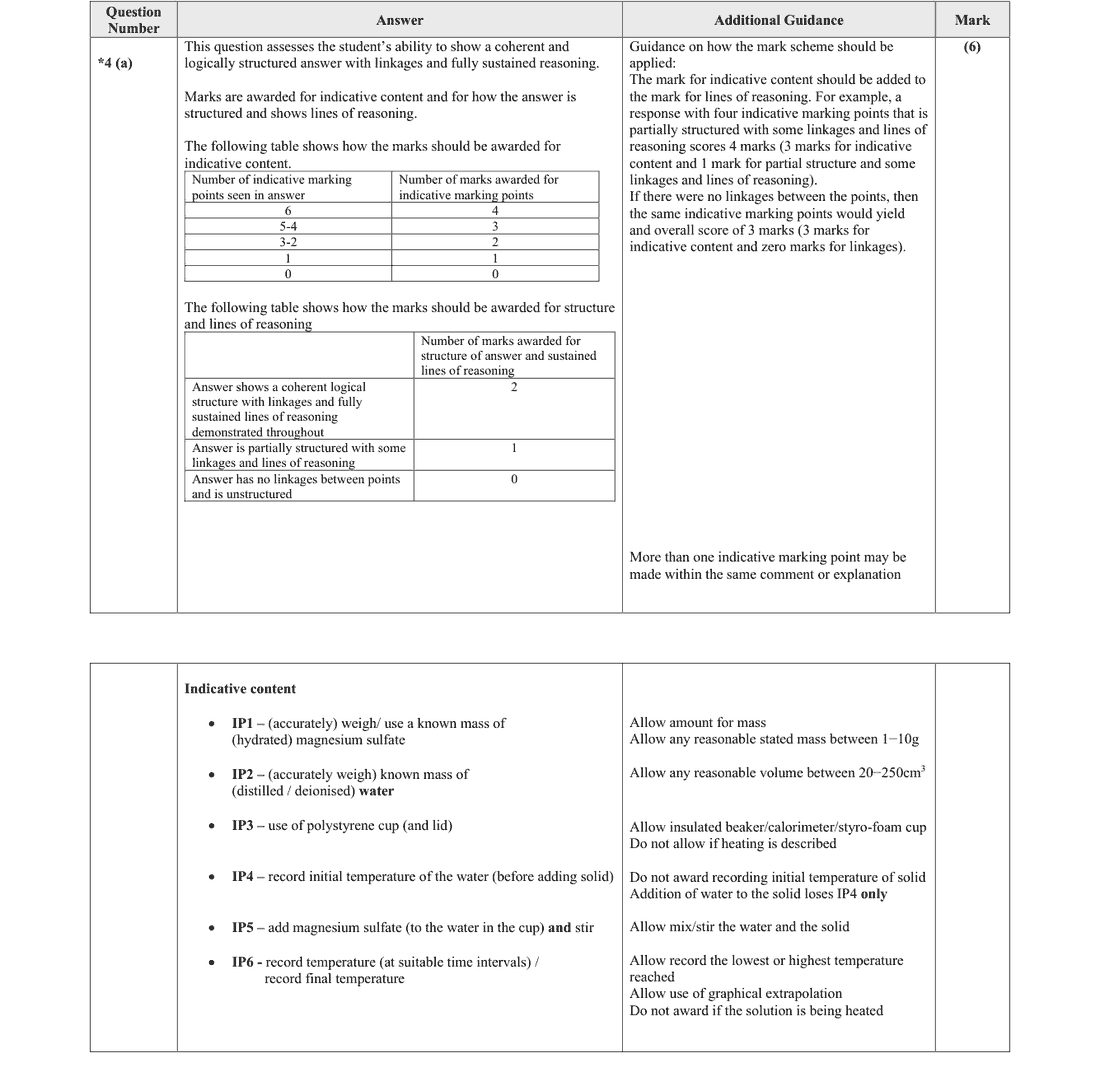
Mark scheme, with the indicative content and the marks for reasoning
Examiner's comment
There were some excellent well-structured responses here from candidates who had clearly understood the process and seemed to have had a good practical experience in their studies. The most common error from those who described the correct type of experiment was that they added the water to the salt. Doing it this way round would mean that the initial temperature of the solid would have to be measured and this is very difficult, nigh impossible to do. However, only one mark was lost. The second most common error or omission in this situation was that there was a mark for reference to stirring the mixture and this was often missing.
Large numbers of candidates, including those who scored all six marks, described the method of calculation despite the question clearly stating that this was not required. From the amount of writing that was seen, this would have taken a significant amount of time which could have been spent on other question parts and may have gained extra credit.
However, there was also a significant number of candidates who showed their misunderstanding by describing a thermal decomposition experiment. Either a crucible was heated to remove the water of crystallisation or the salt was heated in a polystyrene cup.
Notes from the mark scheme and report
Six indicative points plus two marks for reasoning. IP1 weigh a known mass of hydrated magnesium sulfate
IP2 measure a known mass / volume of (distilled) water
IP3 use a polystyrene cup (and lid)
IP4 record the initial temperature of the water
IP5 add the solid to the water and stir
IP6 record the final (highest or lowest) temperature, or temperature at intervals with extrapolation. No heating. Adding water to the solid loses IP4 only
stirring was often left out
many wasted time on the calculation
a significant number described heating to drive off water of crystallisation
Skills: PT1 use appropriate apparatus to record a range of measurements (to include mass, time, volume of liquids and gases, temperature); CP8 Core practical 8: To determine the enthalpy change of a reaction using Hess’s Law
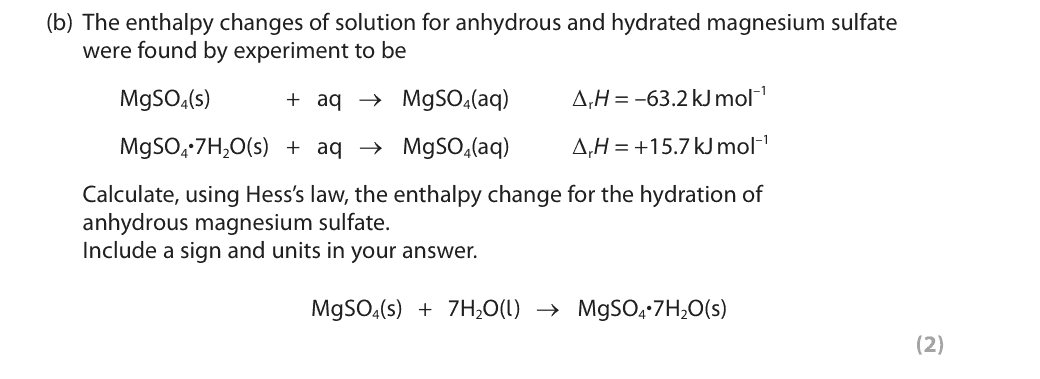
June 2023 · Paper 3 · Q4(b)2 marksCalculation
Earlier part of question 4 that this part uses
Mark scheme
Examiner's comment
The most common mark was two out of two on this question. Many knew both how to draw the Hess cycle and how to use it to calculate the enthalpy change required. Centres and their candidates can feel pleased that their practice paid off.
Candidates found this question challenging with few linking the production of carbon dioxide to an increase in pressure. There were many responses linked to heat loss and to non- standard conditions, but not specifically to an increase in pressure.
Notes from the mark scheme and report
Enthalpy change is the heat change at constant pressure, and here the pressure is not constant (carbon dioxide gas is produced in a sealed container, so the pressure rises). References to temperature ignored. The report says few linked the carbon dioxide to a rise in pressure
many wrote about heat loss or non-standard conditions
June 2022 · Paper 1 · Q5(b)3 marksShort answer
Mark scheme
Examiner's comment
This question asked for a description of the standard enthalpy of formation of alumiumium oxide. Many candidates were able to score the mark for describing standard conditions correctly. Some candidates opted to attempt equations for M1 and M2, but there were often contradictions between the equation and what they wrote as a description, particularly evident were references to ions in the gaseous state rather than elements in their standard states for M2.
Notes from the mark scheme and report
The enthalpy change when 1 mol of aluminium oxide (1) is formed from its elements in their standard states (1), at 100 kPa and a stated temperature (298 K allowed) (1). 2Al(s) + 1½O2(g) → Al2O3(s) is allowed for the first two marks, but with wrong or missing state symbols only the first. 1 atm allowed
273 K ignored. The conditions mark was the one most often scored
some equations contradicted the wording, e.g. gaseous ions instead of elements
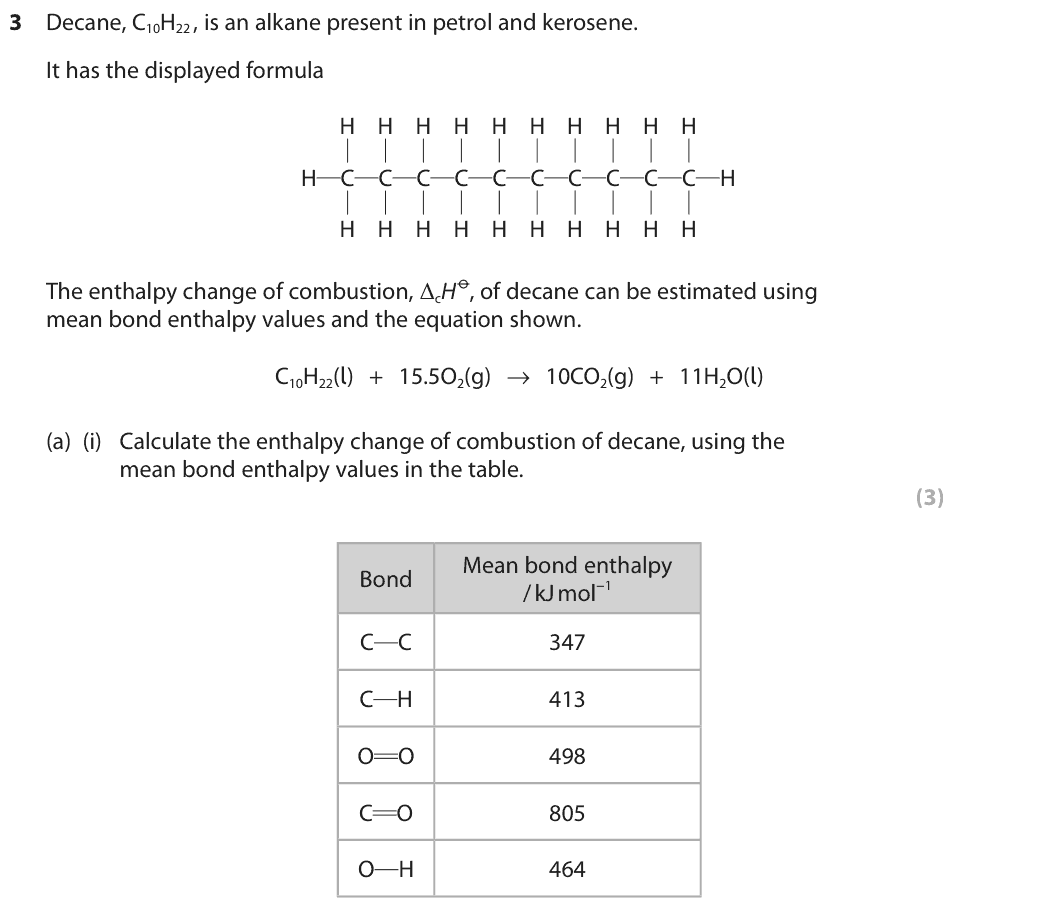
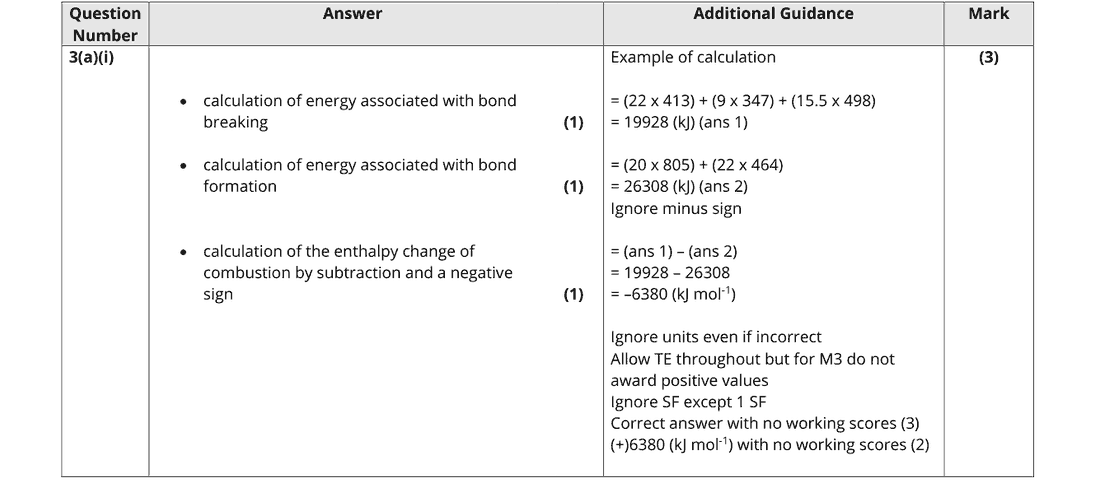
June 2022 · AS Paper 2 · Q3(a)(i)3 marksCalculation
Mark scheme
Examiner's comment
(a)(i) was the first significant calculation, and this proved a reliable source of marks for most candidates, with three marks out of three being the most commonly scored mark on the item. (a)(ii) was more tricky as candidates answers lacked detail giving answers such as the mean bond enthalpy is an average without explaining what it was an average of. Some candidates gave excellent answers but too many were penalised by the lack of detail. (b)(i) was scored by very nearly 80% of candidates. (b)(ii) was also well answered with only about 10% not getting some credit. This equation was not the easiest to balance, but any candidate starting by balancing the number of carbons, then the number of hydrogens, the number of oxygen atoms required and finally number of nitrogen molecules was able to score 2. 1 mark was often scored for the correct substances or balancing correctly an equation giving monatomic nitrogen as a product. (b)(iii) had a number of possible answers, but was generally not answered particularly well, with too few focussing on the equation and thinking more about combustion in general.
the last mark needs a negative value. Three out of three was the commonest mark
Skills: MS2.3 Substitute numerical values into algebraic equations using appropriate units for physical quantities; MS2.4 Solve algebraic equations
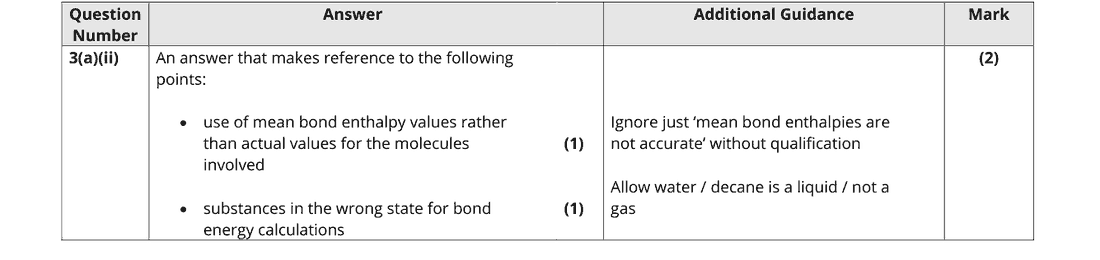
June 2022 · AS Paper 2 · Q3(a)(ii)2 marksShort answer
Earlier part of question 3 that this part uses
Mark scheme
Examiner's comment
(a)(i) was the first significant calculation, and this proved a reliable source of marks for most candidates, with three marks out of three being the most commonly scored mark on the item. (a)(ii) was more tricky as candidates answers lacked detail giving answers such as the mean bond enthalpy is an average without explaining what it was an average of. Some candidates gave excellent answers but too many were penalised by the lack of detail. (b)(i) was scored by very nearly 80% of candidates. (b)(ii) was also well answered with only about 10% not getting some credit. This equation was not the easiest to balance, but any candidate starting by balancing the number of carbons, then the number of hydrogens, the number of oxygen atoms required and finally number of nitrogen molecules was able to score 2. 1 mark was often scored for the correct substances or balancing correctly an equation giving monatomic nitrogen as a product. (b)(iii) had a number of possible answers, but was generally not answered particularly well, with too few focussing on the equation and thinking more about combustion in general.
Notes from the mark scheme and report
Mean bond enthalpies are used rather than the actual values for the bonds in these molecules
the bond enthalpy calculation needs gases but decane and water here are liquids. Just 'mean bond enthalpies are not accurate' or 'it is an average' without saying of what does not score, and this lack of detail was the usual reason for lost marks
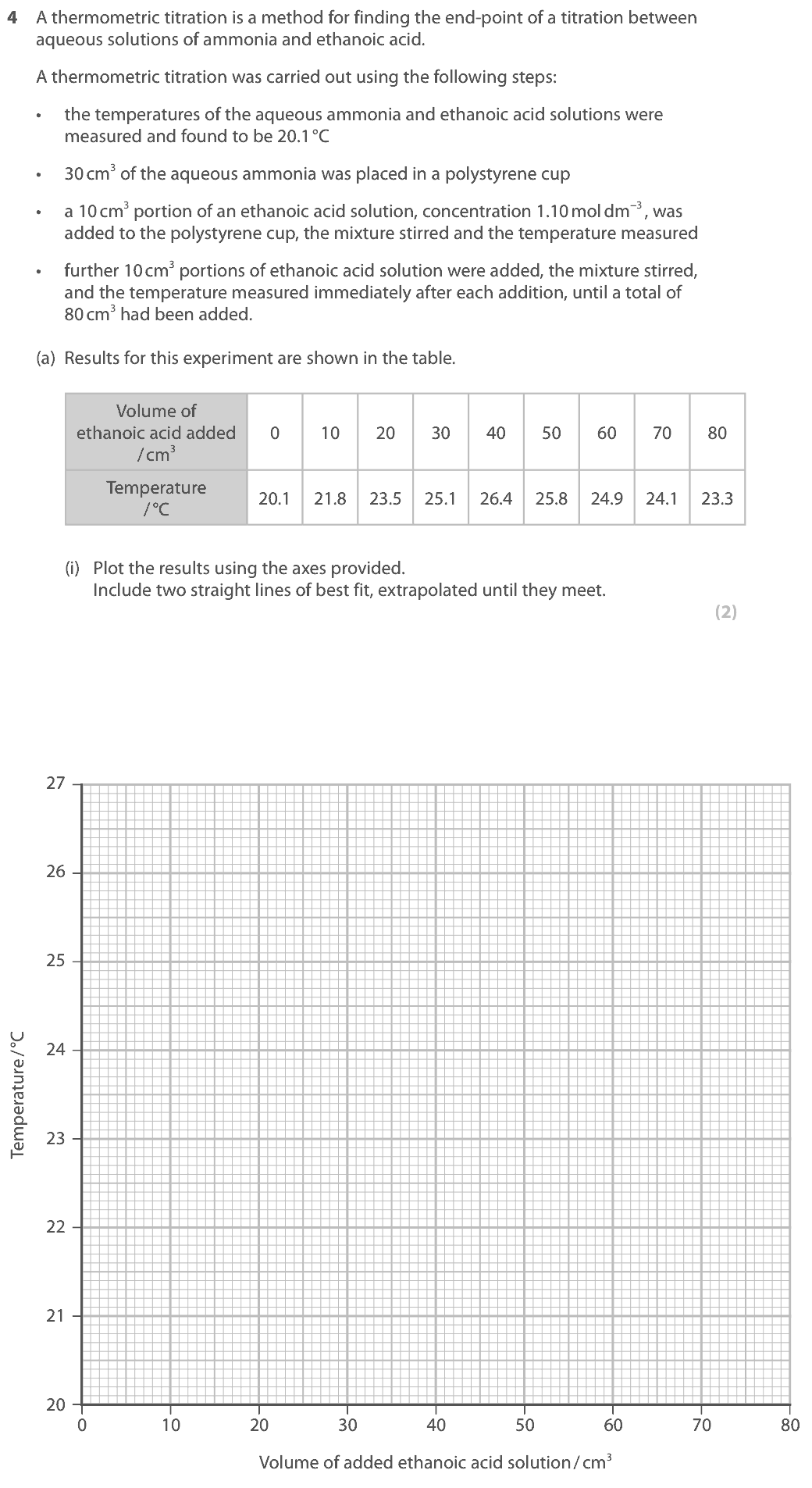
June 2022 · AS Paper 2 · Q4(a)(i)2 marksDiagram or structure
Mark scheme
Examiner's comment
(a)(i)-(iv) was a set of items focussing on the thermometric titration of ammonia with ethanoic acid, a reaction which cannot be titrated using the usual indicator techniques. The process seemed unfamiliar to a good number of candidates who struggled with practical aspects of the question. The plotting of the points in (a)(i) was a friendly start, and most candidates were able to do this. Those who were familiar with the practical were then able to use lines of best fit and find the maximum temperature rise. Unfortunately too often the candidates included the point at 40cm3 of added acid in the rising line which gave all points above the line and was not accepted as a line of best fit. The temperature rise was required in (a)(ii), but more often the maximum temperature was quoted. Candidates must read the question carefully. In (a)(iii) many candidates were confused by the term ‘end-point’ identifying the end of the neutralisation (at about 39 cm3) and instead used the volume of 80 cm3. The final calculation in (a)(iv) was better understood, though often errors from earlier questions had to be carried forward. (b)(i) proved surprisingly difficult for candidates, with only just over 25% scoring the mark. (b)(ii) was the least scoring part of the paper, with only a tiny number of candidates recognising the heat loss would not be significant at such low temperatures and that the addition of colder ethanoic acid solution would cause the lowering of the temperature.
Notes from the mark scheme and report
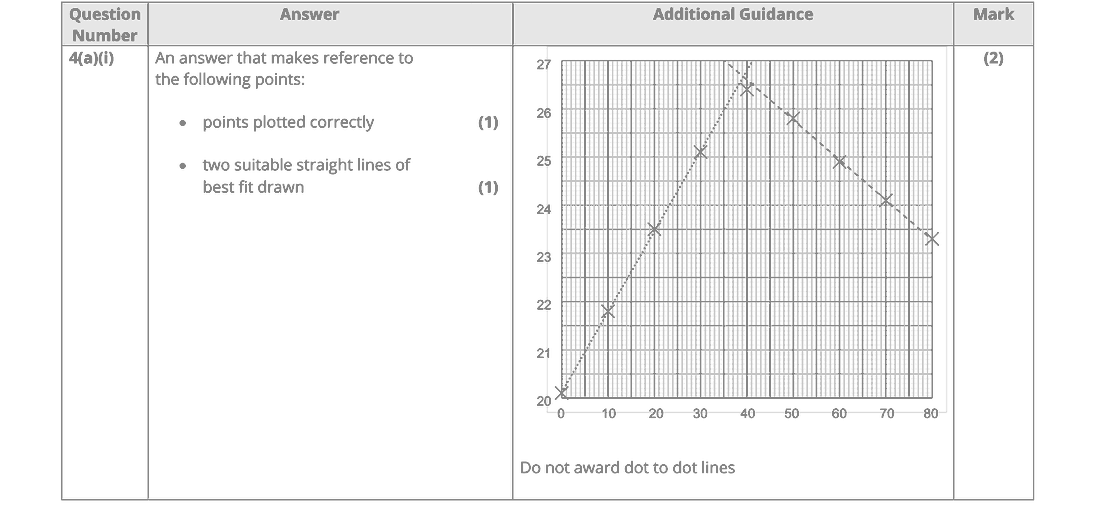
Nine points plotted correctly
two straight lines of best fit, one through the rising points and one through the falling points, extrapolated to meet (at about 39 cm3, 26.7 °C). No dot-to-dot lines. Most plotted the points
the usual error was to include the point at 40 cm3 in the rising line, which put every point above the line
Skills: MS3.2 Plot two variables from experimental or other data; PT1 use appropriate apparatus to record a range of measurements (to include mass, time, volume of liquids and gases, temperature)
June 2022 · AS Paper 2 · Q4(a)(ii)1 markCalculation
Earlier part of question 4 that this part uses
Mark scheme
Examiner's comment
(a)(i)-(iv) was a set of items focussing on the thermometric titration of ammonia with ethanoic acid, a reaction which cannot be titrated using the usual indicator techniques. The process seemed unfamiliar to a good number of candidates who struggled with practical aspects of the question. The plotting of the points in (a)(i) was a friendly start, and most candidates were able to do this. Those who were familiar with the practical were then able to use lines of best fit and find the maximum temperature rise. Unfortunately too often the candidates included the point at 40cm3 of added acid in the rising line which gave all points above the line and was not accepted as a line of best fit. The temperature rise was required in (a)(ii), but more often the maximum temperature was quoted. Candidates must read the question carefully. In (a)(iii) many candidates were confused by the term ‘end-point’ identifying the end of the neutralisation (at about 39 cm3) and instead used the volume of 80 cm3. The final calculation in (a)(iv) was better understood, though often errors from earlier questions had to be carried forward. (b)(i) proved surprisingly difficult for candidates, with only just over 25% scoring the mark. (b)(ii) was the least scoring part of the paper, with only a tiny number of candidates recognising the heat loss would not be significant at such low temperatures and that the addition of colder ethanoic acid solution would cause the lowering of the temperature.
Notes from the mark scheme and report
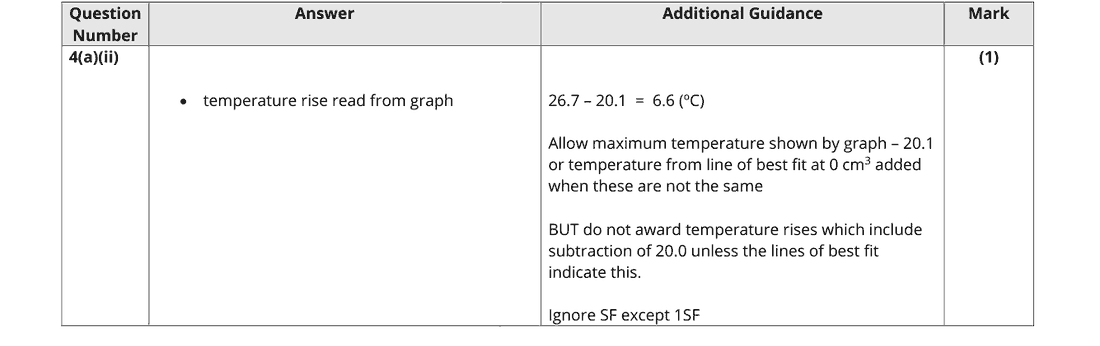
Answer: 6.6 °C. Temperature where the two lines meet minus the start temperature: 26.7 – 20.1 (follow the candidate's own graph). Subtracting 20.0 is not allowed unless the line of best fit shows it. The maximum temperature was often quoted instead of the rise
Skills: MS3.1 Translate information between graphical, numerical and algebraic forms
June 2022 · AS Paper 2 · Q4(a)(iv)3 marksCalculation
Earlier parts of question 4 that this part uses
Mark scheme
Examiner's comment
(a)(i)-(iv) was a set of items focussing on the thermometric titration of ammonia with ethanoic acid, a reaction which cannot be titrated using the usual indicator techniques. The process seemed unfamiliar to a good number of candidates who struggled with practical aspects of the question. The plotting of the points in (a)(i) was a friendly start, and most candidates were able to do this. Those who were familiar with the practical were then able to use lines of best fit and find the maximum temperature rise. Unfortunately too often the candidates included the point at 40cm3 of added acid in the rising line which gave all points above the line and was not accepted as a line of best fit. The temperature rise was required in (a)(ii), but more often the maximum temperature was quoted. Candidates must read the question carefully. In (a)(iii) many candidates were confused by the term ‘end-point’ identifying the end of the neutralisation (at about 39 cm3) and instead used the volume of 80 cm3. The final calculation in (a)(iv) was better understood, though often errors from earlier questions had to be carried forward. (b)(i) proved surprisingly difficult for candidates, with only just over 25% scoring the mark. (b)(ii) was the least scoring part of the paper, with only a tiny number of candidates recognising the heat loss would not be significant at such low temperatures and that the addition of colder ethanoic acid solution would cause the lowering of the temperature.
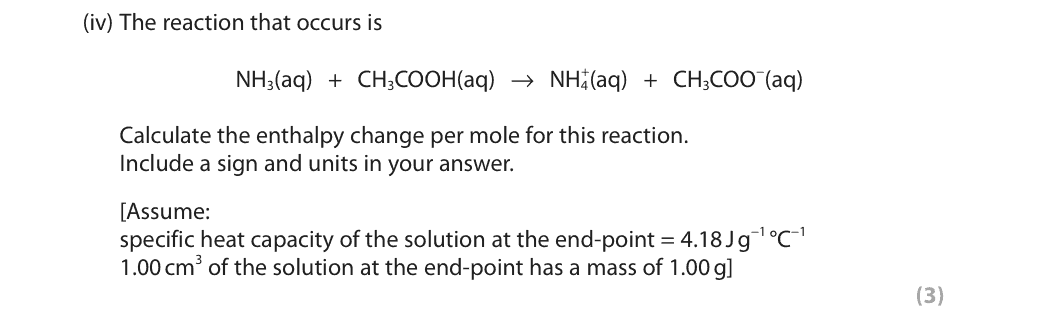
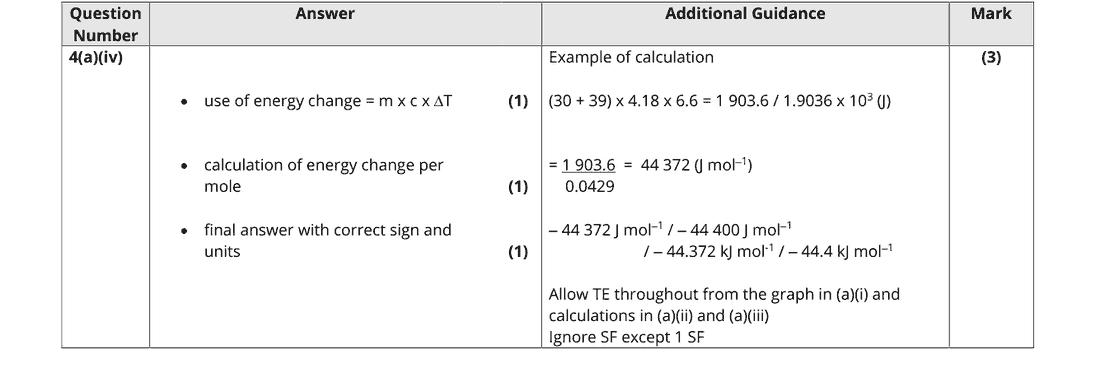
negative sign and units needed for the last mark. Errors carried forward from the graph and from (a)(ii) and (a)(iii). Better understood than the earlier parts
Skills: MS0.0 Recognise and make use of appropriate units in calculation; MS2.3 Substitute numerical values into algebraic equations using appropriate units for physical quantities
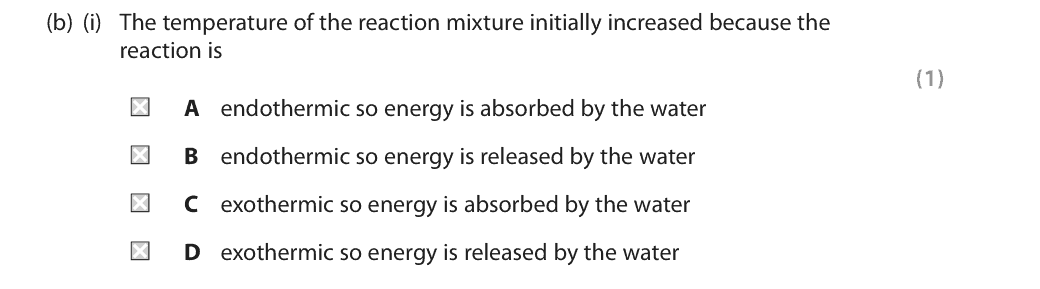
June 2022 · AS Paper 2 · Q4(b)(i)1 markMultiple choice
Earlier part of question 4 that this part uses
Answer
C
Mark scheme
Examiner's comment
(a)(i)-(iv) was a set of items focussing on the thermometric titration of ammonia with ethanoic acid, a reaction which cannot be titrated using the usual indicator techniques. The process seemed unfamiliar to a good number of candidates who struggled with practical aspects of the question. The plotting of the points in (a)(i) was a friendly start, and most candidates were able to do this. Those who were familiar with the practical were then able to use lines of best fit and find the maximum temperature rise. Unfortunately too often the candidates included the point at 40cm3 of added acid in the rising line which gave all points above the line and was not accepted as a line of best fit. The temperature rise was required in (a)(ii), but more often the maximum temperature was quoted. Candidates must read the question carefully. In (a)(iii) many candidates were confused by the term ‘end-point’ identifying the end of the neutralisation (at about 39 cm3) and instead used the volume of 80 cm3. The final calculation in (a)(iv) was better understood, though often errors from earlier questions had to be carried forward. (b)(i) proved surprisingly difficult for candidates, with only just over 25% scoring the mark. (b)(ii) was the least scoring part of the paper, with only a tiny number of candidates recognising the heat loss would not be significant at such low temperatures and that the addition of colder ethanoic acid solution would cause the lowering of the temperature.
Notes from the mark scheme and report
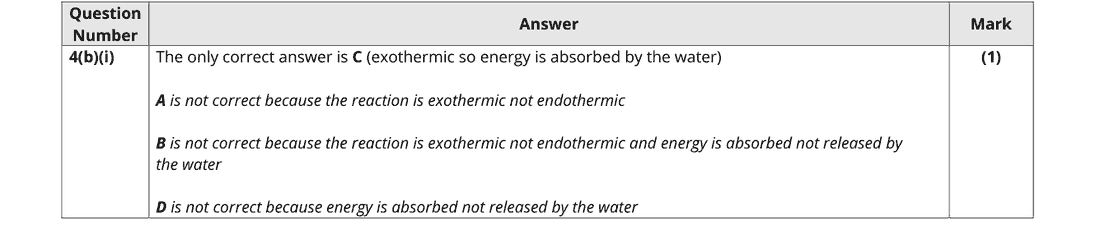
Answer: C (exothermic, so energy is absorbed by the water). The reaction releases energy and the water of the solution takes it in, so its temperature rises
D has the water releasing energy. Only just over 25% chose correctly
June 2022 · AS Paper 2 · Q4(b)(ii)1 markShort answerHard
Earlier parts of question 4 that this part uses
Mark scheme
Examiner's comment
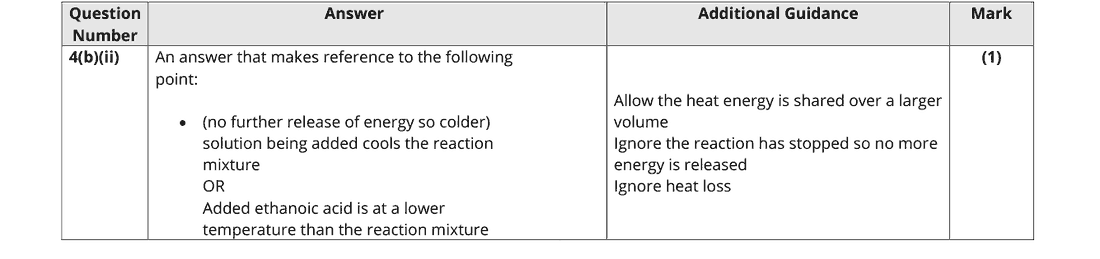
(a)(i)-(iv) was a set of items focussing on the thermometric titration of ammonia with ethanoic acid, a reaction which cannot be titrated using the usual indicator techniques. The process seemed unfamiliar to a good number of candidates who struggled with practical aspects of the question. The plotting of the points in (a)(i) was a friendly start, and most candidates were able to do this. Those who were familiar with the practical were then able to use lines of best fit and find the maximum temperature rise. Unfortunately too often the candidates included the point at 40cm3 of added acid in the rising line which gave all points above the line and was not accepted as a line of best fit. The temperature rise was required in (a)(ii), but more often the maximum temperature was quoted. Candidates must read the question carefully. In (a)(iii) many candidates were confused by the term ‘end-point’ identifying the end of the neutralisation (at about 39 cm3) and instead used the volume of 80 cm3. The final calculation in (a)(iv) was better understood, though often errors from earlier questions had to be carried forward. (b)(i) proved surprisingly difficult for candidates, with only just over 25% scoring the mark. (b)(ii) was the least scoring part of the paper, with only a tiny number of candidates recognising the heat loss would not be significant at such low temperatures and that the addition of colder ethanoic acid solution would cause the lowering of the temperature.
Notes from the mark scheme and report
The ethanoic acid solution still being added is colder (20.1 °C) than the reaction mixture, so it cools it (the heat is shared over a larger volume). 'The reaction has stopped so no more energy is released' and heat loss are ignored
June 2022 · AS Paper 2 · Q7(b)(i)2 marksDiagram or structure
Earlier part of question 7 that this part uses
Mark scheme
Examiner's comment
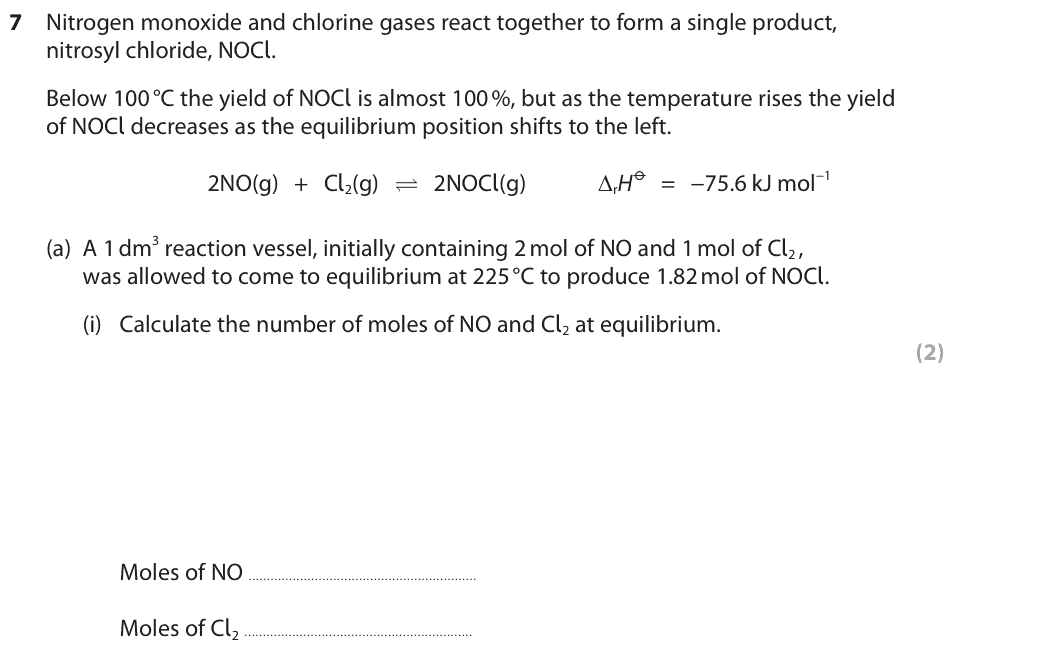
(a) proved very challenging. The initial calculation was not understood by many candidates, though many were able to pick up 1 mark for having half the moles of Cl2 compared to NO in (i). The sketch graph in (ii) was even more difficult, with only a very few candidates getting full marks in these two linked items. The final multiple choice in (iii) was just as high scoring as the first, with over 80% getting the right equation. (b)(i) and (b)(ii) gave a range throughout the possible marks, with two being the most common out of four. Common mistakes included the incorrect substances in the
Hess’ Law cycle. The final calculation proved quite challenging, with only 10% of candidates getting full marks for these two parts.
Notes from the mark scheme and report
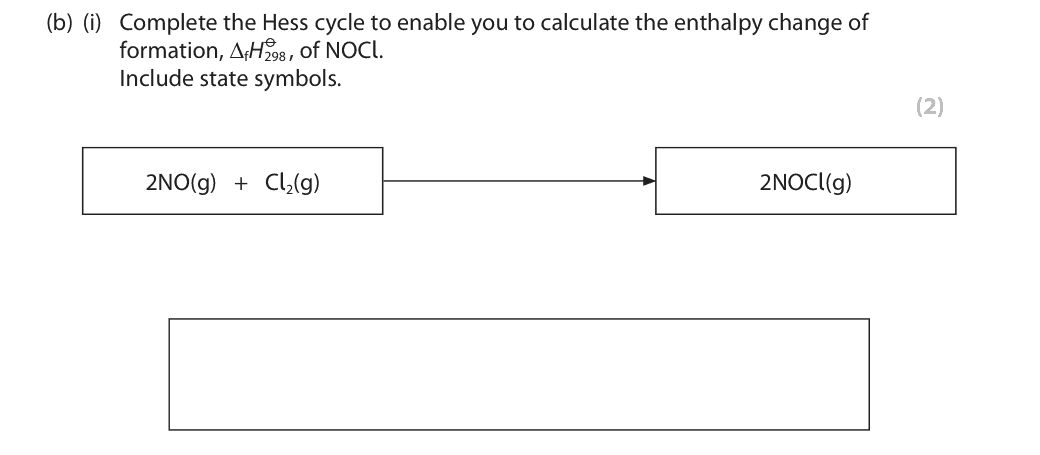
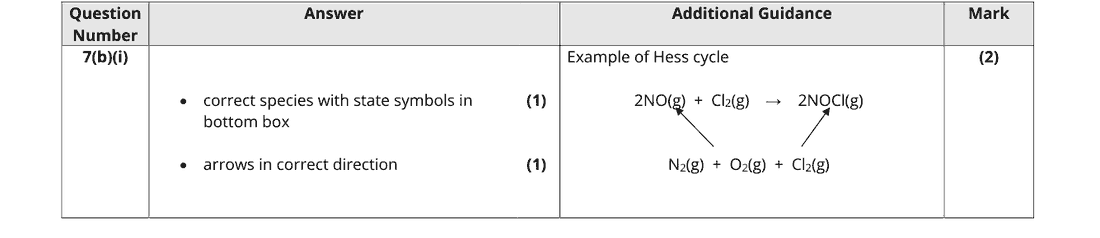
Bottom box: N2(g) + O2(g) + Cl2(g), with state symbols
arrows from the bottom box up to 2NO(g) + Cl2(g) and up to 2NOCl(g). The common mistake was the wrong substances in the bottom box
June 2022 · AS Paper 2 · Q7(b)(ii)2 marksCalculation
Earlier parts of question 7 that this part uses
Mark scheme
Examiner's comment
(a) proved very challenging. The initial calculation was not understood by many candidates, though many were able to pick up 1 mark for having half the moles of Cl2 compared to NO in (i). The sketch graph in (ii) was even more difficult, with only a very few candidates getting full marks in these two linked items. The final multiple choice in (iii) was just as high scoring as the first, with over 80% getting the right equation. (b)(i) and (b)(ii) gave a range throughout the possible marks, with two being the most common out of four. Common mistakes included the incorrect substances in the
Hess’ Law cycle. The final calculation proved quite challenging, with only 10% of candidates getting full marks for these two parts.
Notes from the mark scheme and report
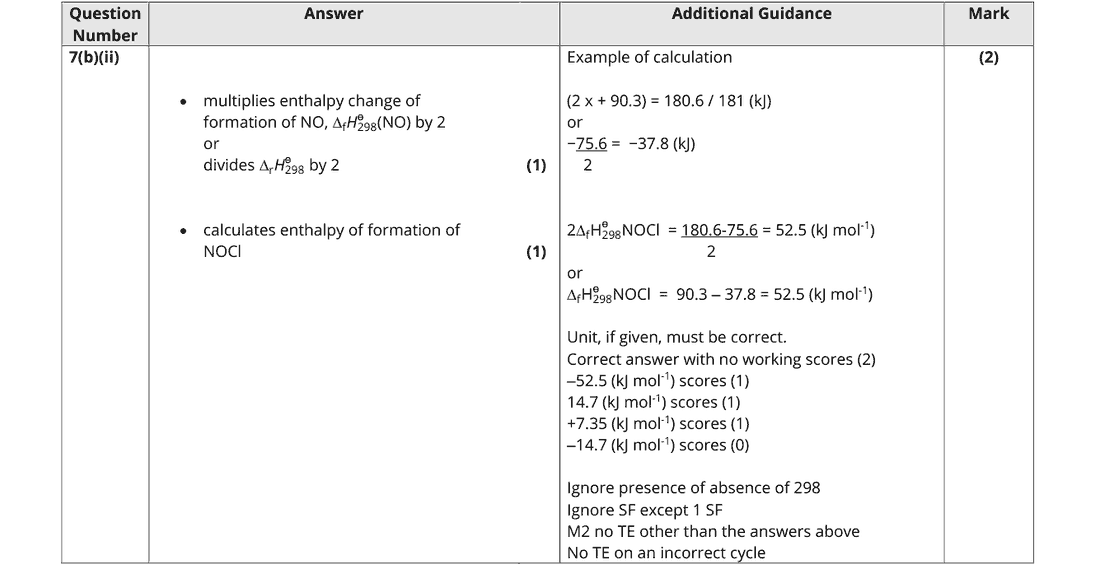
Answer: +52.5 kJ mol–1. 2 × 90.3 = 180.6
(180.6 – 75.6) ÷ 2 = 52.5
or 90.3 – 37.8. –52.5, 14.7 or +7.35 scores 1
–14.7 scores 0. No error carried forward from a wrong cycle. Found quite challenging: only 10% got full marks across (b)(i) and (b)(ii)
Skills: MS2.4 Solve algebraic equations
November 2021 · Paper 1 · Q5(a)(i)3 marksCalculation
Mark scheme
Examiner's comment
In part (a)(i) many candidates were able to deduce the number of bonds in phosphorus from
the diagram but there were still examples of candidates doing the sum ‘bonds broken – bonds
made’ the wrong way round. A sizeable number of candidates also got part (ii) incorrect by
stating that bond enthalpies are exothermic.
The familiar use of oxidation numbers to demonstrate disproportionation in part (b)(i) was
answered correctly by most candidates. A small minority continue to fail to link the terms
“oxidation and reduction” with these changes and consequently lost a mark. It was pleasing to
see many correct answers to the task of balancing the equation in (ii). This was not an easy
example, but the majority scored the mark.
It was surprising to see a significant number of candidates select a distractor in (c) which stated
that chlorine was “orange”.
Part (d) was an effective discriminator at the ‘top end’. It proved worthwhile to award two marks
for the ionic equation with state symbols in (i) because it gave the opportunity for some
candidates to get one mark for a ‘near miss’. The question in (ii) serves as a good example of
the need for candidates to take greater care in their answers. It was not uncommon to see a
candidate deduce correctly the identity of the ion but then to refer to it as “Bromine” instead of
‘Bromide’. Reference to the halogen did not score the first mark.
Notes from the mark scheme and report
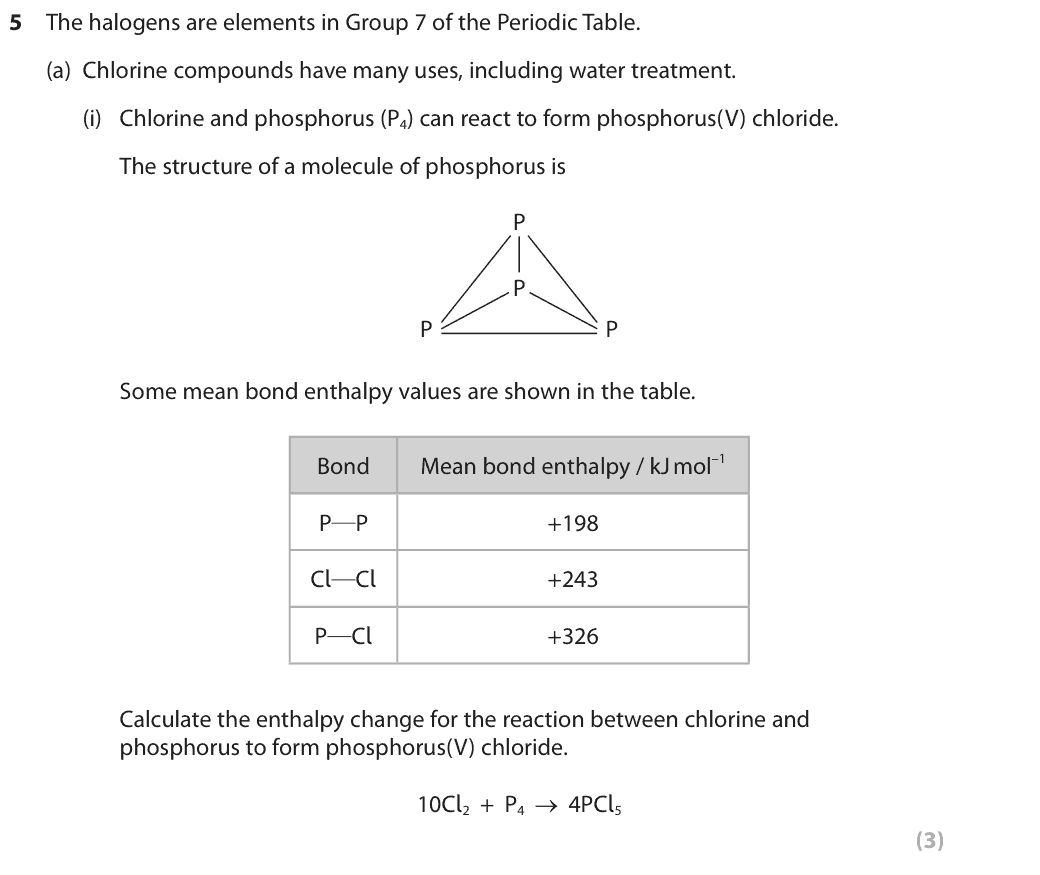
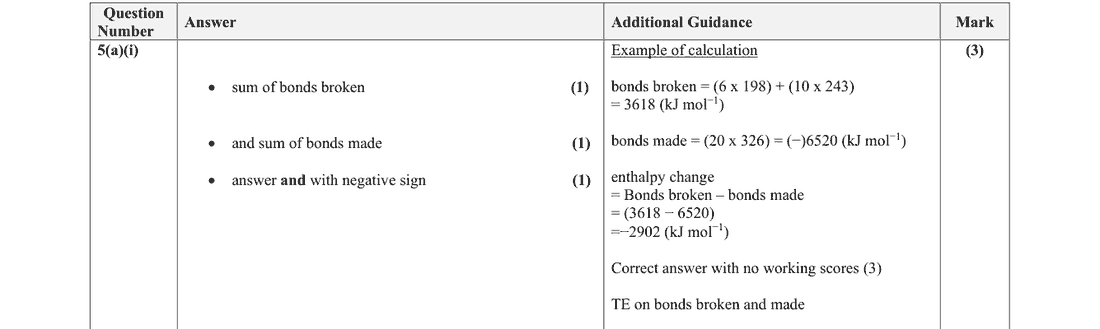
Answer: –2902 kJ mol–1. Bonds broken: 6 P–P (the P4 tetrahedron has six bonds) + 10 Cl–Cl = (6 × 198) + (10 × 243) = 3618
bonds made: 20 P–Cl = 20 × 326 = 6520
3618 – 6520. Third mark needs the negative sign. Transferred error on the two sums. Many counted the bonds in P4 correctly
the usual error was subtracting the wrong way round
Skills: MS2.3 Substitute numerical values into algebraic equations using appropriate units for physical quantities; MS4.1 Appreciate angles and shapes in regular 2D and 3D structures.
November 2021 · Paper 1 · Q5(a)(ii)1 markShort answer
Earlier part of question 5 that this part uses
Mark scheme
Examiner's comment
In part (a)(i) many candidates were able to deduce the number of bonds in phosphorus from
the diagram but there were still examples of candidates doing the sum ‘bonds broken – bonds
made’ the wrong way round. A sizeable number of candidates also got part (ii) incorrect by
stating that bond enthalpies are exothermic.
The familiar use of oxidation numbers to demonstrate disproportionation in part (b)(i) was
answered correctly by most candidates. A small minority continue to fail to link the terms
“oxidation and reduction” with these changes and consequently lost a mark. It was pleasing to
see many correct answers to the task of balancing the equation in (ii). This was not an easy
example, but the majority scored the mark.
It was surprising to see a significant number of candidates select a distractor in (c) which stated
that chlorine was “orange”.
Part (d) was an effective discriminator at the ‘top end’. It proved worthwhile to award two marks
for the ionic equation with state symbols in (i) because it gave the opportunity for some
candidates to get one mark for a ‘near miss’. The question in (ii) serves as a good example of
the need for candidates to take greater care in their answers. It was not uncommon to see a
candidate deduce correctly the identity of the ion but then to refer to it as “Bromine” instead of
‘Bromide’. Reference to the halogen did not score the first mark.
Notes from the mark scheme and report
Bond breaking requires energy / is endothermic (by convention bond enthalpy refers to breaking the bond). Just 'bonds are broken' or 'it is endothermic' is not enough. A sizeable number said that bond enthalpies are exothermic
November 2021 · AS Paper 2 · Q2(a)(i)3 marksDiagram or structure
Mark scheme
Examiner's comment
(a)(i) This question proved to be surprisingly difficult for many students, probably due to the
question including Enthalpy Changes of Vaporisation. Although the diagram on the question paper
attempted to simplify the problem for candidates, it appeared that many were confused by the
inclusion of vaporisation and simply did not attempt the question. However, the graphical
presentation of a Hess cycle is always quite challenging for candidates.
(a)(ii) This was a Hess’s Law calculation which again seemed to be a challenge for the less able
students. However, the mark scheme gave credit for the omission of the Enthalpy Changes of
Vaporisation.
(b) This was a straightforward question on enthalpy changes and was familiar to most candidates.
Those who chose to answer the question tended to score well.
Notes from the mark scheme and report
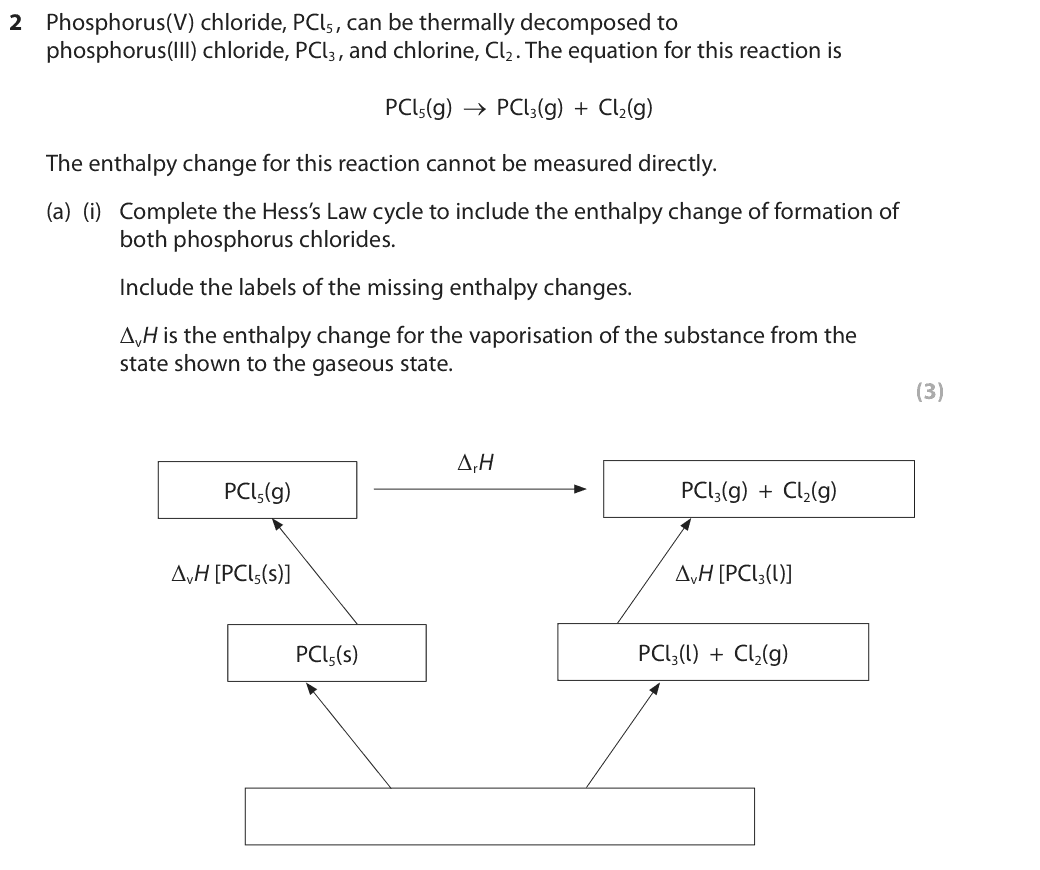
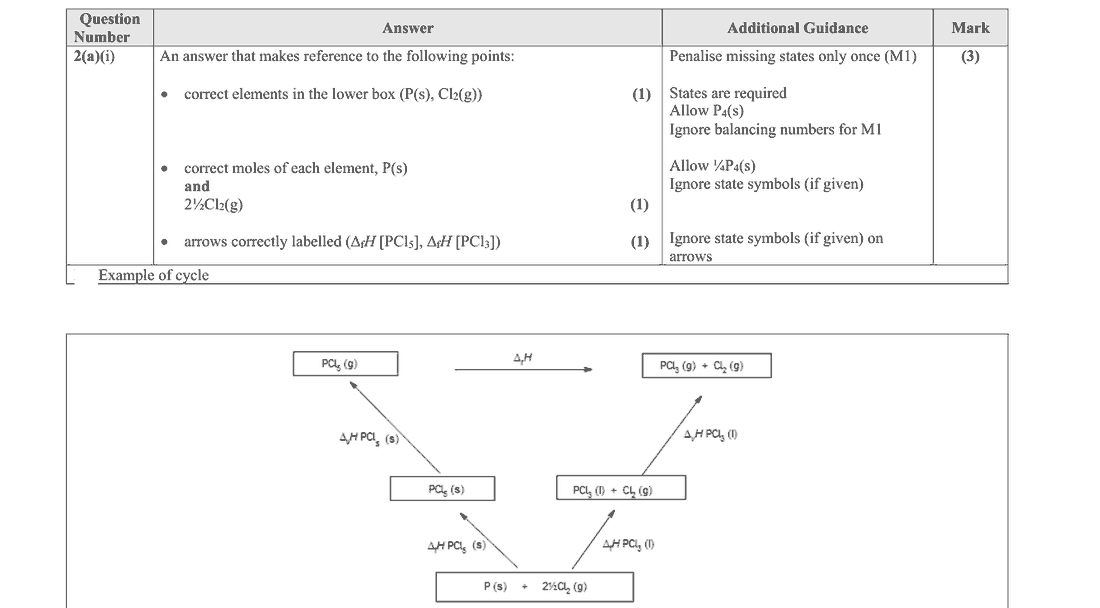
Bottom box: P(s) + 2½Cl2(g) (allow P4(s) or ¼P4(s)): one mark for the correct elements with state symbols, one for the correct amounts. Third mark: the two arrows from the elements labelled ΔfH[PCl5(s)] and ΔfH[PCl3(l)]. Missing states penalised once only. Many were put off by the vaporisation steps and did not attempt it
November 2021 · AS Paper 2 · Q2(a)(ii)2 marksCalculation
Earlier part of question 2 that this part uses
Mark scheme
Examiner's comment
(a)(i) This question proved to be surprisingly difficult for many students, probably due to the
question including Enthalpy Changes of Vaporisation. Although the diagram on the question paper
attempted to simplify the problem for candidates, it appeared that many were confused by the
inclusion of vaporisation and simply did not attempt the question. However, the graphical
presentation of a Hess cycle is always quite challenging for candidates.
(a)(ii) This was a Hess’s Law calculation which again seemed to be a challenge for the less able
students. However, the mark scheme gave credit for the omission of the Enthalpy Changes of
Vaporisation.
(b) This was a straightforward question on enthalpy changes and was familiar to most candidates.
Those who chose to answer the question tended to score well.
Notes from the mark scheme and report
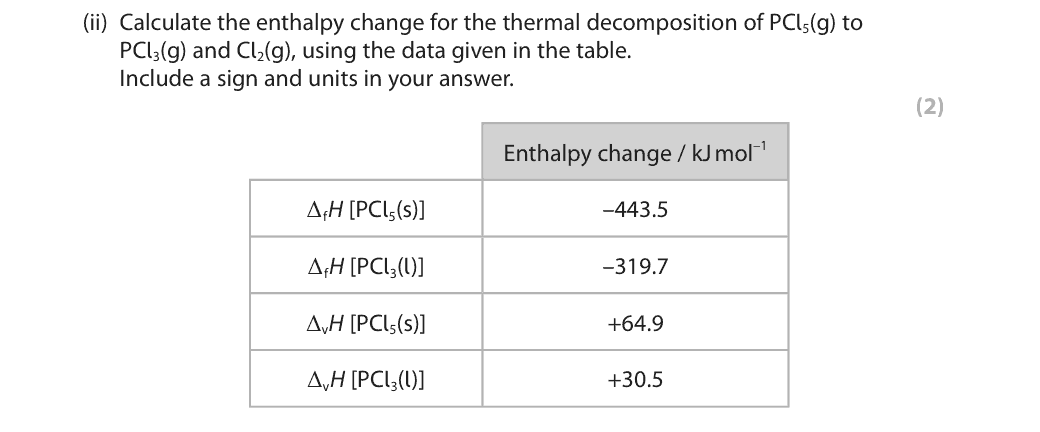
Answer: +89.4 kJ mol–1. (–319.7 + 30.5) – (–443.5 + 64.9) = –289.2 – (–378.6). Sign and units must be shown. +123.8 kJ mol–1 (the vaporisation values left out) scores 1
Skills: MS0.0 Recognise and make use of appropriate units in calculation; MS2.3 Substitute numerical values into algebraic equations using appropriate units for physical quantities
November 2021 · AS Paper 2 · Q4(b)1 markMultiple choice
Earlier part of question 4 that this part uses
Answer
D
Mark scheme
Examiner's comment
Although the chemistry in this question is quite simple, the setting will have been unfamiliar to
most candidates. Consequently, many struggled with the calculations.
(a) Students were given the formula of the starting material and the formula of the major product.
Most candidates at this level were expected to have been able to deduce the equation (although
some omitted the states, which were required by the question)
(b) This was a multiple-choice question and required students to apply basic principles of chemistry
to make their choice of an answer. Most candidates were successful.
(c)(i) and (ii) These questions were calculations based on the practical details supplied in the
question. Q04(c)(i) proved to be difficult for most students at this level, most likely because the
calculation was relatively unstructured. Few candidates scored well on this question. Q4(c)(ii)
proved to be more accessible for candidates, but this was a relatively easy calculation.
Notes from the mark scheme and report
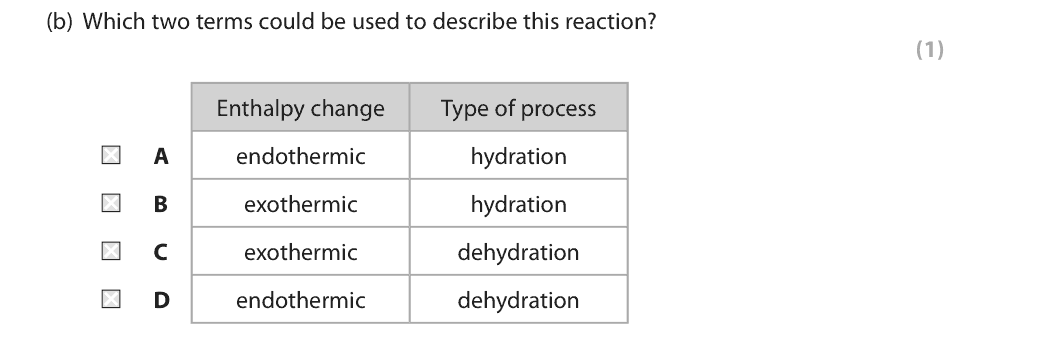
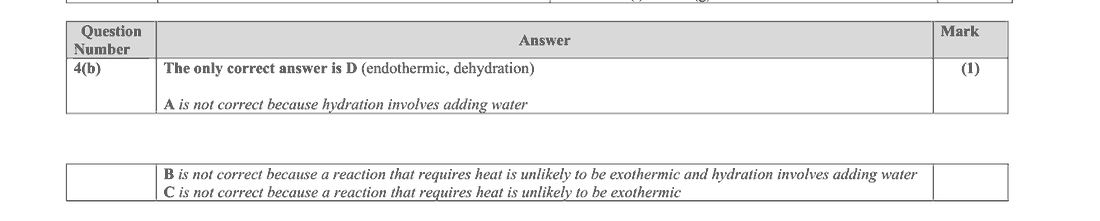
Answer: D (endothermic, dehydration). Water is lost, so it is dehydration (hydration means adding water), and a reaction that needs heating is unlikely to be exothermic
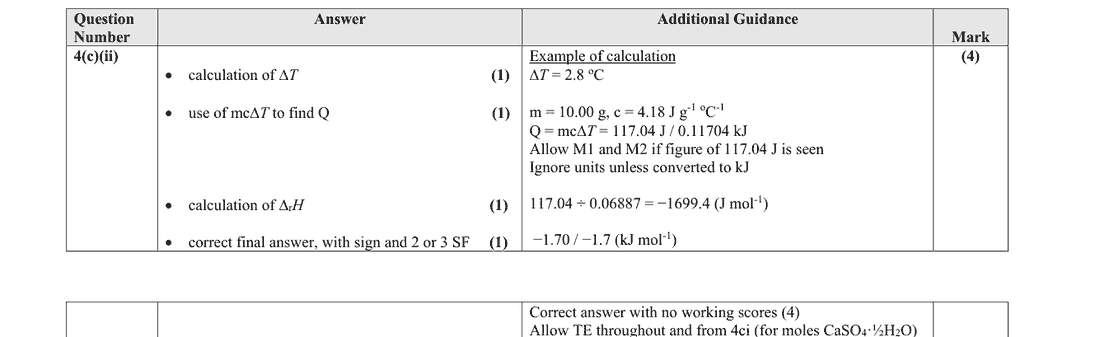
November 2021 · AS Paper 2 · Q4(c)(ii)4 marksCalculation
Earlier parts of question 4 that this part uses
Mark scheme
Examiner's comment
Although the chemistry in this question is quite simple, the setting will have been unfamiliar to
most candidates. Consequently, many struggled with the calculations.
(a) Students were given the formula of the starting material and the formula of the major product.
Most candidates at this level were expected to have been able to deduce the equation (although
some omitted the states, which were required by the question)
(b) This was a multiple-choice question and required students to apply basic principles of chemistry
to make their choice of an answer. Most candidates were successful.
(c)(i) and (ii) These questions were calculations based on the practical details supplied in the
question. Q04(c)(i) proved to be difficult for most students at this level, most likely because the
calculation was relatively unstructured. Few candidates scored well on this question. Q4(c)(ii)
proved to be more accessible for candidates, but this was a relatively easy calculation.
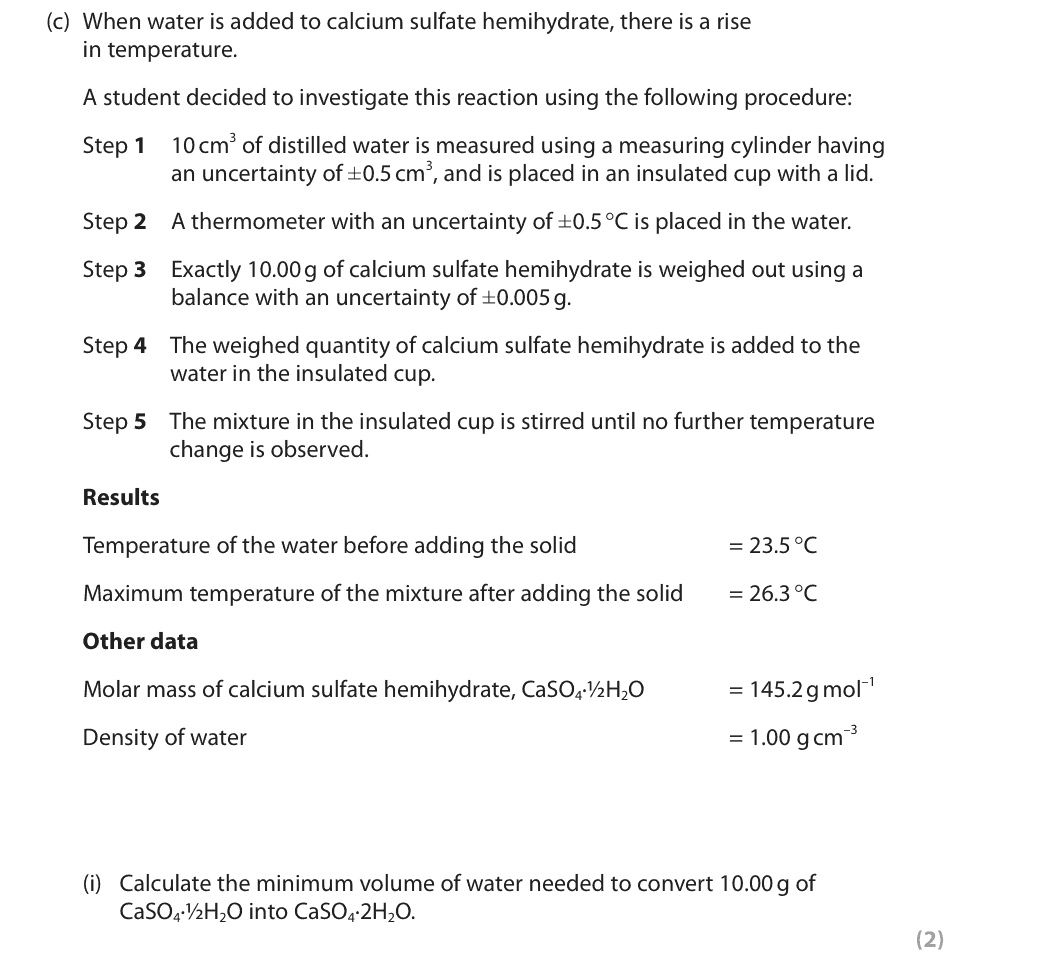
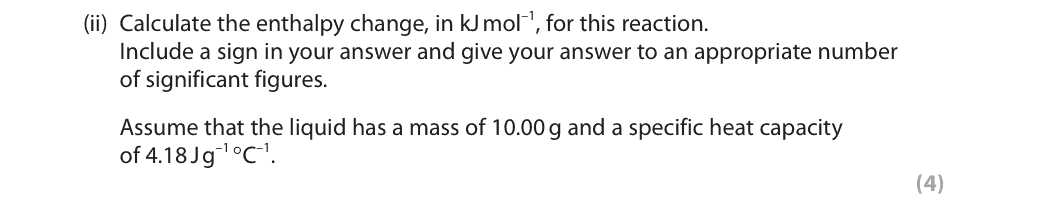
final answer needs the negative sign and 2 or 3 significant figures. Error carried forward from the moles in (c)(i). Found more accessible than (c)(i)
Skills: MS0.0 Recognise and make use of appropriate units in calculation; MS1.1 Use an appropriate number of significant figures; MS2.3 Substitute numerical values into algebraic equations using appropriate units for physical quantities
November 2021 · AS Paper 2 · Q9(a)(i)3 marksCalculation
Mark scheme
Examiner's comment
Although the last question on this paper, candidates had more success with this question,
indicating that candidates had read the Principal Examiner recommendations for previous years in
which the Principal Examiner had suggested that candidates might be more selective in attempting
different questions.
(a)(i) Students were relatively successful with this calculation of an enthalpy change for a reaction,
using the supplied data. It was simple and should have been familiar from similar questions in
previous years.
(a)(ii) This question followed up on Q09(a)(i) and tested the student’s understanding of the reasons
for a variation in the enthalpy change for a reaction. Although most candidates gained one of the
two available marks, only the better examinees scored the second mark.
(a)(iii) This was a multiple-choice question. Very few candidates were able to answer this question.
This may be because atom economy is not frequently examined.
(a)(iv) This was a multiple-choice question. Most students answered this correctly. The equilibrium
expression is a familiar topic asked, and in this instance, is about an equation that should also be
very familiar.
(b)This question related to the practical aspects of an equilibrium reaction in the chemical industry.
Candidate responses were generally not strong. However, this is a challenging topic towards the
end of the paper.
(c)(i) This question was about an exothermic reaction taking place on the surface of a copper
catalyst. The answer involved an increase in the rate of a reaction as it heated up, and the effect
this might have on the copper catalyst. Many students scored the first marking point but very few
recognized that the copper would melt. Although it is easy to deduce what will happen if the
experiment has not been seen, this is a memorable reaction when observed.
(c)(ii) This question asked the student to produce a reaction profile for the specified exothermic
reaction. It required the student to be aware of the difference between a reaction profile diagram
and an enthalpy level diagram. Most students scored both available marks on this question.
(c)(iii) This question was descriptive and asked about the processes that take place during
heterogeneous catalysis. A question on this topic has featured frequently on this paper in previous
years. Those students who had prepared using past papers will have recognized the question and
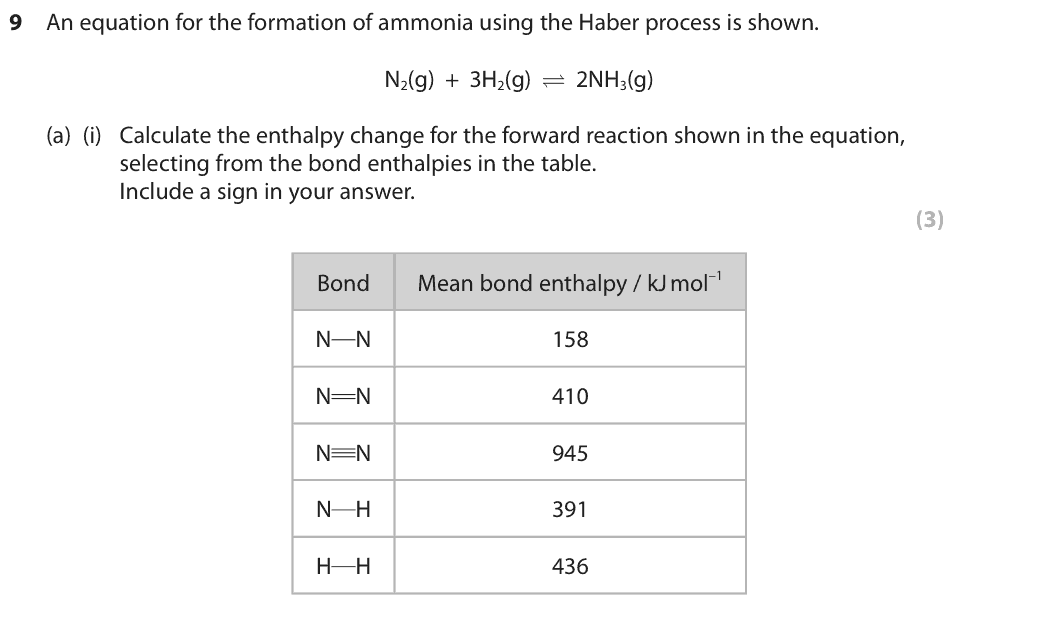
consequently scored well.
2253 – 2346. The N≡N value has to be selected from the three nitrogen–nitrogen values in the table. Candidates were relatively successful
Skills: MS2.3 Substitute numerical values into algebraic equations using appropriate units for physical quantities
November 2021 · AS Paper 2 · Q9(a)(ii)2 marksShort answer
Earlier part of question 9 that this part uses
Mark scheme
Examiner's comment
Although the last question on this paper, candidates had more success with this question,
indicating that candidates had read the Principal Examiner recommendations for previous years in
which the Principal Examiner had suggested that candidates might be more selective in attempting
different questions.
(a)(i) Students were relatively successful with this calculation of an enthalpy change for a reaction,
using the supplied data. It was simple and should have been familiar from similar questions in
previous years.
(a)(ii) This question followed up on Q09(a)(i) and tested the student’s understanding of the reasons
for a variation in the enthalpy change for a reaction. Although most candidates gained one of the
two available marks, only the better examinees scored the second mark.
(a)(iii) This was a multiple-choice question. Very few candidates were able to answer this question.
This may be because atom economy is not frequently examined.
(a)(iv) This was a multiple-choice question. Most students answered this correctly. The equilibrium
expression is a familiar topic asked, and in this instance, is about an equation that should also be
very familiar.
(b)This question related to the practical aspects of an equilibrium reaction in the chemical industry.
Candidate responses were generally not strong. However, this is a challenging topic towards the
end of the paper.
(c)(i) This question was about an exothermic reaction taking place on the surface of a copper
catalyst. The answer involved an increase in the rate of a reaction as it heated up, and the effect
this might have on the copper catalyst. Many students scored the first marking point but very few
recognized that the copper would melt. Although it is easy to deduce what will happen if the
experiment has not been seen, this is a memorable reaction when observed.
(c)(ii) This question asked the student to produce a reaction profile for the specified exothermic
reaction. It required the student to be aware of the difference between a reaction profile diagram
and an enthalpy level diagram. Most students scored both available marks on this question.
(c)(iii) This question was descriptive and asked about the processes that take place during
heterogeneous catalysis. A question on this topic has featured frequently on this paper in previous
years. Those students who had prepared using past papers will have recognized the question and
consequently scored well.
Notes from the mark scheme and report
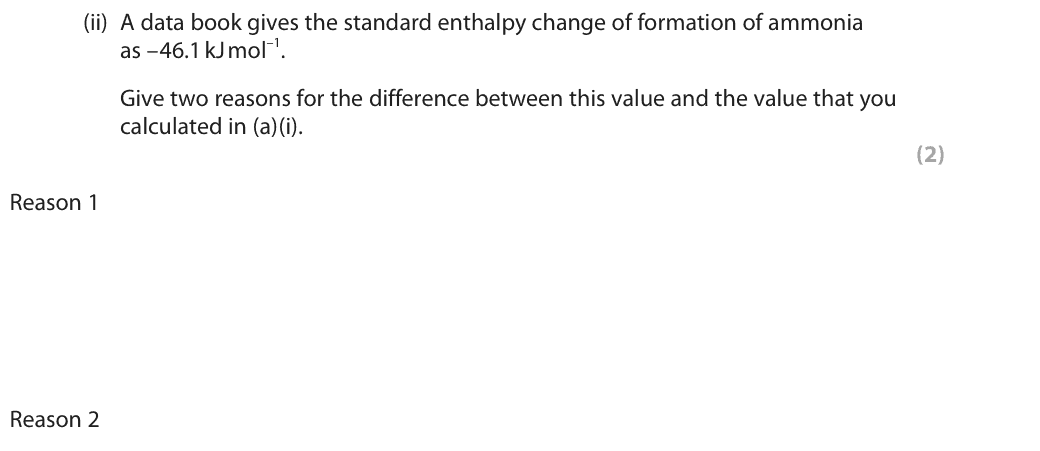
The equation in (a)(i) forms two moles of ammonia (enthalpy change of formation is per mole)
the bond enthalpies in the table are mean values, not specific to ammonia. Ignore different conditions in the Haber process and heat losses. Most got one mark
only the better candidates got both
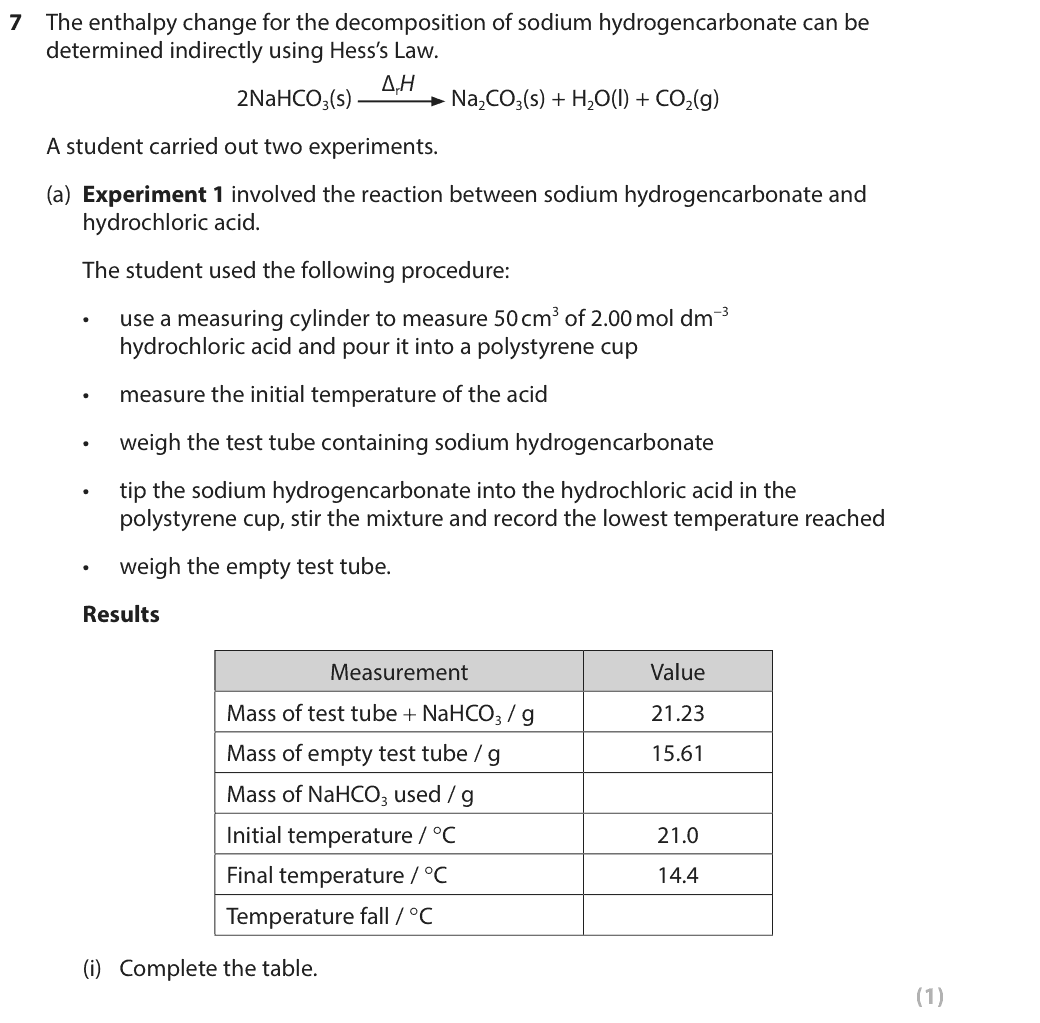
November 2021 · Paper 3 · Q7(a)(i)1 markShort answer
Mark scheme
Examiner's comment
The first parts of the calculation in (a) were answered well by most candidates, although some
did not state how they knew that hydrochloric acid was in excess. Many candidates made
errors in the calculation of the enthalpy change in (a)(iii). Some added the mass of sodium
hydrogencarbonate to the mass of the reaction mixture, some just worked out the heat
change for the amounts used and others included a minus sign so thought it was an
exothermic reaction, even though there was a fall in temperature. The Hess cycle in (b)(i) was
very poorly completed, with it being extremely rare to see the correct amounts of the correct
substances in the box at the bottom of the triangle. Some candidates did have the arrows
pointing in the correct directions. Many candidates omitted to multiply the enthalpy change
for Experiment 1 by 2 and a lot were not sure how to carry out the calculation in (b)(ii). Most
candidates would benefit from more practise at drawing Hess cycles and using them to
calculate an enthalpy change. The percentage error in (c)(i) was often correct, although some
candidates calculated an answer as 82.2% and did not subtract this from 100 to obtain the
percentage error. Some candidates calculated the percentage uncertainties in the measuring
cylinder and burette correctly, although some thought there were two readings for a
measuring cylinder and only one for a burette. Just a small number of candidates realised
that the uncertainties in the measuring instruments were considerably less than the overall
percentage error in the student’s value. Few candidates seemed familiar with measuring
temperature at regular times intervals, plotting a temperature vs time graph and
extrapolating the lines to obtain the maximum temperature rise in (c)(iv).
Notes from the mark scheme and report
Answer: mass of NaHCO3 5.62 g and temperature fall 6.6 °C (both for the mark)
Skills: PT1 use appropriate apparatus to record a range of measurements (to include mass, time, volume of liquids and gases, temperature); CP8 Core practical 8: To determine the enthalpy change of a reaction using Hess’s Law
November 2021 · Paper 3 · Q7(a)(iii)3 marksCalculation
Earlier parts of question 7 that this part uses
Mark scheme
Examiner's comment
The first parts of the calculation in (a) were answered well by most candidates, although some
did not state how they knew that hydrochloric acid was in excess. Many candidates made
errors in the calculation of the enthalpy change in (a)(iii). Some added the mass of sodium
hydrogencarbonate to the mass of the reaction mixture, some just worked out the heat
change for the amounts used and others included a minus sign so thought it was an
exothermic reaction, even though there was a fall in temperature. The Hess cycle in (b)(i) was
very poorly completed, with it being extremely rare to see the correct amounts of the correct
substances in the box at the bottom of the triangle. Some candidates did have the arrows
pointing in the correct directions. Many candidates omitted to multiply the enthalpy change
for Experiment 1 by 2 and a lot were not sure how to carry out the calculation in (b)(ii). Most
candidates would benefit from more practise at drawing Hess cycles and using them to
calculate an enthalpy change. The percentage error in (c)(i) was often correct, although some
candidates calculated an answer as 82.2% and did not subtract this from 100 to obtain the
percentage error. Some candidates calculated the percentage uncertainties in the measuring
cylinder and burette correctly, although some thought there were two readings for a
measuring cylinder and only one for a burette. Just a small number of candidates realised
that the uncertainties in the measuring instruments were considerably less than the overall
percentage error in the student’s value. Few candidates seemed familiar with measuring
temperature at regular times intervals, plotting a temperature vs time graph and
extrapolating the lines to obtain the maximum temperature rise in (c)(iv).
positive sign and units for the third mark (+19.7 kJ mol–1 allowed from 0.07 mol). Errors: adding the mass of solid to the 50.0 g
stopping at the heat change
a negative sign although the temperature fell
Skills: MS0.0 Recognise and make use of appropriate units in calculation; MS2.3 Substitute numerical values into algebraic equations using appropriate units for physical quantities; CP8 Core practical 8: To determine the enthalpy change of a reaction using Hess’s Law
November 2021 · Paper 3 · Q7(b)(i)2 marksDiagram or structureHard
Earlier part of question 7 that this part uses
Mark scheme
Examiner's comment
The first parts of the calculation in (a) were answered well by most candidates, although some
did not state how they knew that hydrochloric acid was in excess. Many candidates made
errors in the calculation of the enthalpy change in (a)(iii). Some added the mass of sodium
hydrogencarbonate to the mass of the reaction mixture, some just worked out the heat
change for the amounts used and others included a minus sign so thought it was an
exothermic reaction, even though there was a fall in temperature. The Hess cycle in (b)(i) was
very poorly completed, with it being extremely rare to see the correct amounts of the correct
substances in the box at the bottom of the triangle. Some candidates did have the arrows
pointing in the correct directions. Many candidates omitted to multiply the enthalpy change
for Experiment 1 by 2 and a lot were not sure how to carry out the calculation in (b)(ii). Most
candidates would benefit from more practise at drawing Hess cycles and using them to
calculate an enthalpy change. The percentage error in (c)(i) was often correct, although some
candidates calculated an answer as 82.2% and did not subtract this from 100 to obtain the
percentage error. Some candidates calculated the percentage uncertainties in the measuring
cylinder and burette correctly, although some thought there were two readings for a
measuring cylinder and only one for a burette. Just a small number of candidates realised
that the uncertainties in the measuring instruments were considerably less than the overall
percentage error in the student’s value. Few candidates seemed familiar with measuring
temperature at regular times intervals, plotting a temperature vs time graph and
extrapolating the lines to obtain the maximum temperature rise in (c)(iv).
Notes from the mark scheme and report
Lower box: 2NaCl(aq) + 2H2O(l) + 2CO2(g) with correct balancing (state symbols not required)
both arrows pointing down from the top boxes to the lower box (stand-alone mark
labels and HCl ignored). The right amounts of the right substances in the lower box were extremely rare
some had the arrows correct
Skills: CP8 Core practical 8: To determine the enthalpy change of a reaction using Hess’s Law
November 2021 · Paper 3 · Q7(b)(ii)3 marksCalculation
Earlier parts of question 7 that this part uses
Mark scheme
Examiner's comment
The first parts of the calculation in (a) were answered well by most candidates, although some
did not state how they knew that hydrochloric acid was in excess. Many candidates made
errors in the calculation of the enthalpy change in (a)(iii). Some added the mass of sodium
hydrogencarbonate to the mass of the reaction mixture, some just worked out the heat
change for the amounts used and others included a minus sign so thought it was an
exothermic reaction, even though there was a fall in temperature. The Hess cycle in (b)(i) was
very poorly completed, with it being extremely rare to see the correct amounts of the correct
substances in the box at the bottom of the triangle. Some candidates did have the arrows
pointing in the correct directions. Many candidates omitted to multiply the enthalpy change
for Experiment 1 by 2 and a lot were not sure how to carry out the calculation in (b)(ii). Most
candidates would benefit from more practise at drawing Hess cycles and using them to
calculate an enthalpy change. The percentage error in (c)(i) was often correct, although some
candidates calculated an answer as 82.2% and did not subtract this from 100 to obtain the
percentage error. Some candidates calculated the percentage uncertainties in the measuring
cylinder and burette correctly, although some thought there were two readings for a
measuring cylinder and only one for a burette. Just a small number of candidates realised
that the uncertainties in the measuring instruments were considerably less than the overall
percentage error in the student’s value. Few candidates seemed familiar with measuring
temperature at regular times intervals, plotting a temperature vs time graph and
extrapolating the lines to obtain the maximum temperature rise in (c)(iv).
sign and units needed. Error carried forward from (a)(iii), but not from wrong arrows in the cycle. Many did not multiply the Experiment 1 value by 2
Skills: MS0.0 Recognise and make use of appropriate units in calculation; MS2.3 Substitute numerical values into algebraic equations using appropriate units for physical quantities; MS2.4 Solve algebraic equations; CP8 Core practical 8: To determine the enthalpy change of a reaction using Hess’s Law
November 2021 · Paper 3 · Q7(c)(iv)5 marksPractical and data analysisHard
Earlier parts of question 7 that this part uses
Mark scheme
Examiner's comment
The first parts of the calculation in (a) were answered well by most candidates, although some
did not state how they knew that hydrochloric acid was in excess. Many candidates made
errors in the calculation of the enthalpy change in (a)(iii). Some added the mass of sodium
hydrogencarbonate to the mass of the reaction mixture, some just worked out the heat
change for the amounts used and others included a minus sign so thought it was an
exothermic reaction, even though there was a fall in temperature. The Hess cycle in (b)(i) was
very poorly completed, with it being extremely rare to see the correct amounts of the correct
substances in the box at the bottom of the triangle. Some candidates did have the arrows
pointing in the correct directions. Many candidates omitted to multiply the enthalpy change
for Experiment 1 by 2 and a lot were not sure how to carry out the calculation in (b)(ii). Most
candidates would benefit from more practise at drawing Hess cycles and using them to
calculate an enthalpy change. The percentage error in (c)(i) was often correct, although some
candidates calculated an answer as 82.2% and did not subtract this from 100 to obtain the
percentage error. Some candidates calculated the percentage uncertainties in the measuring
cylinder and burette correctly, although some thought there were two readings for a
measuring cylinder and only one for a burette. Just a small number of candidates realised
that the uncertainties in the measuring instruments were considerably less than the overall
percentage error in the student’s value. Few candidates seemed familiar with measuring
temperature at regular times intervals, plotting a temperature vs time graph and
extrapolating the lines to obtain the maximum temperature rise in (c)(iv).
Notes from the mark scheme and report
Measure the temperature of the acid at regular intervals (e.g. every 30 s for 2½ minutes)
add the sodium carbonate at a known time (3 minutes)
keep stirring and measuring the temperature every 30 s for about another 5 minutes
plot temperature against time
draw two best-fit lines and extrapolate to the time of mixing to find the maximum temperature rise. The last two marks can come from a labelled sketch graph
Skills: MS3.1 Translate information between graphical, numerical and algebraic forms; MS3.2 Plot two variables from experimental or other data; PT1 use appropriate apparatus to record a range of measurements (to include mass, time, volume of liquids and gases, temperature); CP8 Core practical 8: To determine the enthalpy change of a reaction using Hess’s Law
October 2020 · Paper 1 · Q6(a)(ii)3 marksCalculation
Earlier part of question 6 that this part uses
Mark scheme
Examiner's comment
Although many candidates realised that a double bond consists of a pi and sigma bond, far
fewer were able to use this effectively to justify why the student was incorrect in (a)(i), with
most answers simply stating that the double bond was stronger or shorter than the single
bond.
Nearly all candidates knew how to approach the calculation in (ii) and fully correct answers
were seen by a range of candidates. Common errors included omission of the value for
breaking bonds in the oxygen molecules, reversing the values to give an endothermic answer,
and transcription errors with numerical values. Transferred errors meant award of some
credit was possible in most of these cases. In (a)(iii) most answers gave a generic discussion
of entropy, and tended to only score 1 mark for the justification of an entropy increase.
Only a few answers made an effective distinction between ΔStotal, ΔSsystem, and ΔSsurroundings.
Even those who chose to base their answer on ΔG = ΔH - T ΔSsystem, often omitted to mention
ΔSsystem.
The calculation in (b) was often well laid out, with a clear route through the problem shown by
many. A few candidates were inconsistent with units for entropy, and others missed out on
the final mark as they didn’t comment on the feasibility of the reaction in light of their answer.
Some candidates spent time doing additional unrequired work, by also calculating ΔG, but
more problematic was the small number who ignored the instruction to find ΔStotal and tried
to base their response solely on ΔG, often making errors in the process.
5838 – 7614. Error carried forward from the first two marks. Common errors: leaving out the O=O bonds
subtracting the wrong way round
copying errors
Skills: MS2.3 Substitute numerical values into algebraic equations using appropriate units for physical quantities
October 2020 · AS Paper 2 · Q4(a)4 marksCalculation
Mark scheme
Examiner's comment
This was quite a standard question in examinations at this level and learners were able to
show their knowledge of energetics calculations and to explain the use of conditions in
industrial processes.
20 691 ÷ 0.0650 = 318 323 J mol–1. Final mark needs 2 or 3 significant figures, the negative sign and units
J/mol–1 is not accepted. Error carried forward throughout
Skills: MS0.0 Recognise and make use of appropriate units in calculation; MS1.1 Use an appropriate number of significant figures; MS2.3 Substitute numerical values into algebraic equations using appropriate units for physical quantities
October 2020 · AS Paper 2 · Q4(c)3 marksCalculation
Earlier part of question 4 that this part uses
Mark scheme
Examiner's comment
This was quite a standard question in examinations at this level and learners were able to
show their knowledge of energetics calculations and to explain the use of conditions in
industrial processes.
Notes from the mark scheme and report
Answer: –764 kJ mol–1. ΔcH(CH3OH) = –ΔH(Step 2) + ΔcH(CO) + 2ΔcH(H2) = 91 + (–283) + 2(–286), from an equation or a Hess cycle through CO2 + 2H2O. Correct answer alone scores 3. –478, –1424, +946, –855 and +764 score 2
–946, +478 and +1424 score 1
Skills: MS2.3 Substitute numerical values into algebraic equations using appropriate units for physical quantities
October 2020 · AS Paper 2 · Q5(a)2 marksCalculation
Mark scheme
Examiner's comment
This question had an unusual context with candidates having to apply their knowledge of
reaction mechanisms to an unusual electrophile in iodine monochloride. Where the learners
understood how to do this their answers were clear and diagrams well-constructed. The initial
part of the calculation that followed was more traditional but the second again required the
candidates to apply their knowledge. This final part of the question proved quite challenging.
Skills: MS2.2 Change the subject of an equation; MS2.4 Solve algebraic equations
October 2020 · Paper 3 · Q4(b)3 marksCalculation
Earlier part of question 4 that this part uses
Mark scheme
Examiner's comment
Many correct answers were seen in (a) but the less able candidates simply deducted the two
masses which showed a complete misunderstanding of the process and that two marks were
available so at least two mathematical processes will be required.
A wide range of answers were seen for (b) and candidates do not to consider if an answer is
sensible. For example answers of a temperature change of over 600oC in a polystyrene cup
are not realistic. In addition temperature change accuracy of more than ±0.1oC are not
detected in a school or college lab. It was also disappointing to see many candidates using
18200 or 18.2 for their value of Q instead of calculating the value from the data provided.
Despite the question stating that an increase or decrease was required, this was frequently
overlooked.
The drawing of the enthalpy level diagram on graph paper for (c)(i) was possibly the most
disappointing on the paper. If the y axis was labelled, and this was rare, then the label was
most often ‘enthalpy change’ rather than ‘enthalpy’. The mark most frequently awarded was for
the entities and their state symbols. The placement of the arrows to show the enthalpy
changes was very poorly done. Candidates should note that, as in previous exam series, double
headed arrows do not gain credit. Although the enthalpy change arrow and value can be
reversed technically, this was not what the question asked and so this type of response did not
score. Likewise in part (ii) the question explicitly stated in bold text that the working ‘must’ be
shown on the diagram since this was part of the set task. A significant number of candidates
did not fulfil this aspect of the question and so, despite getting the correct numerical answer,
did not score the mark.
Answers to part (d) often referred to the process being endothermic or in need of heating
which may relate to questions on previous examination but was not appropriate here. This
reinforces the admonition to ‘read the question twice’ in order to answer the question set.
Few candidates understood the impossibility of adding exactly five moles of water to each
mole of anhydrous salt but some did gain credit for the difficulty of measuring the
temperature change of a solid.
1 or 2 s.f. with the direction for the third mark. Common errors: using 18 200 or 18.2 as Q
unrealistic answers (over 600 °C)
too many significant figures
not saying whether the temperature rises or falls
Skills: MS1.1 Use an appropriate number of significant figures; MS2.2 Change the subject of an equation; MS2.3 Substitute numerical values into algebraic equations using appropriate units for physical quantities; CP8 Core practical 8: To determine the enthalpy change of a reaction using Hess’s Law
October 2020 · Paper 3 · Q4(c)(i)3 marksDiagram or structureHard
Earlier part of question 4 that this part uses
Mark scheme
Examiner's comment
Many correct answers were seen in (a) but the less able candidates simply deducted the two
masses which showed a complete misunderstanding of the process and that two marks were
available so at least two mathematical processes will be required.
A wide range of answers were seen for (b) and candidates do not to consider if an answer is
sensible. For example answers of a temperature change of over 600oC in a polystyrene cup
are not realistic. In addition temperature change accuracy of more than ±0.1oC are not
detected in a school or college lab. It was also disappointing to see many candidates using
18200 or 18.2 for their value of Q instead of calculating the value from the data provided.
Despite the question stating that an increase or decrease was required, this was frequently
overlooked.
The drawing of the enthalpy level diagram on graph paper for (c)(i) was possibly the most
disappointing on the paper. If the y axis was labelled, and this was rare, then the label was
most often ‘enthalpy change’ rather than ‘enthalpy’. The mark most frequently awarded was for
the entities and their state symbols. The placement of the arrows to show the enthalpy
changes was very poorly done. Candidates should note that, as in previous exam series, double
headed arrows do not gain credit. Although the enthalpy change arrow and value can be
reversed technically, this was not what the question asked and so this type of response did not
score. Likewise in part (ii) the question explicitly stated in bold text that the working ‘must’ be
shown on the diagram since this was part of the set task. A significant number of candidates
did not fulfil this aspect of the question and so, despite getting the correct numerical answer,
did not score the mark.
Answers to part (d) often referred to the process being endothermic or in need of heating
which may relate to questions on previous examination but was not appropriate here. This
reinforces the admonition to ‘read the question twice’ in order to answer the question set.
Few candidates understood the impossibility of adding exactly five moles of water to each
mole of anhydrous salt but some did gain credit for the difficulty of measuring the
temperature change of a solid.
Notes from the mark scheme and report
Vertical axis labelled enthalpy (or energy) with units and a sensible scale (not 'enthalpy change' or ΔH)
single-headed arrows in the correct direction for +18.2 (from CuSO4.5H2O(s) up to CuSO4(aq)) and –84.5 (from CuSO4(s) down to CuSO4(aq))
entities with state symbols. Double-headed arrows not credited. The axis was rarely labelled, and then usually 'enthalpy change'
arrows were poorly placed
the entities mark was the one most often scored
Skills: MS3.2 Plot two variables from experimental or other data; CP8 Core practical 8: To determine the enthalpy change of a reaction using Hess’s Law
October 2020 · Paper 3 · Q4(c)(ii)1 markCalculation
Earlier parts of question 4 that this part uses
Mark scheme
Examiner's comment
Many correct answers were seen in (a) but the less able candidates simply deducted the two
masses which showed a complete misunderstanding of the process and that two marks were
available so at least two mathematical processes will be required.
A wide range of answers were seen for (b) and candidates do not to consider if an answer is
sensible. For example answers of a temperature change of over 600oC in a polystyrene cup
are not realistic. In addition temperature change accuracy of more than ±0.1oC are not
detected in a school or college lab. It was also disappointing to see many candidates using
18200 or 18.2 for their value of Q instead of calculating the value from the data provided.
Despite the question stating that an increase or decrease was required, this was frequently
overlooked.
The drawing of the enthalpy level diagram on graph paper for (c)(i) was possibly the most
disappointing on the paper. If the y axis was labelled, and this was rare, then the label was
most often ‘enthalpy change’ rather than ‘enthalpy’. The mark most frequently awarded was for
the entities and their state symbols. The placement of the arrows to show the enthalpy
changes was very poorly done. Candidates should note that, as in previous exam series, double
headed arrows do not gain credit. Although the enthalpy change arrow and value can be
reversed technically, this was not what the question asked and so this type of response did not
score. Likewise in part (ii) the question explicitly stated in bold text that the working ‘must’ be
shown on the diagram since this was part of the set task. A significant number of candidates
did not fulfil this aspect of the question and so, despite getting the correct numerical answer,
did not score the mark.
Answers to part (d) often referred to the process being endothermic or in need of heating
which may relate to questions on previous examination but was not appropriate here. This
reinforces the admonition to ‘read the question twice’ in order to answer the question set.
Few candidates understood the impossibility of adding exactly five moles of water to each
mole of anhydrous salt but some did gain credit for the difficulty of measuring the
temperature change of a solid.
Notes from the mark scheme and report
Answer: –102.7 kJ mol–1 (allow –103). ΔrH = ΔH2 – ΔH1 = –84.5 – (+18.2), with the working shown on the diagram. No mark if nothing is shown on the diagram, which cost a significant number the mark despite a correct value
Skills: MS3.1 Translate information between graphical, numerical and algebraic forms; CP8 Core practical 8: To determine the enthalpy change of a reaction using Hess’s Law
October 2020 · Paper 3 · Q4(d)1 markPractical and data analysisHard
Earlier part of question 4 that this part uses
Mark scheme
Examiner's comment
Many correct answers were seen in (a) but the less able candidates simply deducted the two
masses which showed a complete misunderstanding of the process and that two marks were
available so at least two mathematical processes will be required.
A wide range of answers were seen for (b) and candidates do not to consider if an answer is
sensible. For example answers of a temperature change of over 600oC in a polystyrene cup
are not realistic. In addition temperature change accuracy of more than ±0.1oC are not
detected in a school or college lab. It was also disappointing to see many candidates using
18200 or 18.2 for their value of Q instead of calculating the value from the data provided.
Despite the question stating that an increase or decrease was required, this was frequently
overlooked.
The drawing of the enthalpy level diagram on graph paper for (c)(i) was possibly the most
disappointing on the paper. If the y axis was labelled, and this was rare, then the label was
most often ‘enthalpy change’ rather than ‘enthalpy’. The mark most frequently awarded was for
the entities and their state symbols. The placement of the arrows to show the enthalpy
changes was very poorly done. Candidates should note that, as in previous exam series, double
headed arrows do not gain credit. Although the enthalpy change arrow and value can be
reversed technically, this was not what the question asked and so this type of response did not
score. Likewise in part (ii) the question explicitly stated in bold text that the working ‘must’ be
shown on the diagram since this was part of the set task. A significant number of candidates
did not fulfil this aspect of the question and so, despite getting the correct numerical answer,
did not score the mark.
Answers to part (d) often referred to the process being endothermic or in need of heating
which may relate to questions on previous examination but was not appropriate here. This
reinforces the admonition to ‘read the question twice’ in order to answer the question set.
Few candidates understood the impossibility of adding exactly five moles of water to each
mole of anhydrous salt but some did gain credit for the difficulty of measuring the
temperature change of a solid.
Notes from the mark scheme and report
It is not possible to react exactly 5 mol of water with 1 mol of anhydrous copper(II) sulfate (some would take up more, some less). Also accepted: the temperature change of a solid cannot be measured
some water may evaporate. Heat loss is ignored
'heat is needed to start the reaction' is not credited. Many wrongly wrote that the process is endothermic or needs heating
Skills: CP8 Core practical 8: To determine the enthalpy change of a reaction using Hess’s Law
June 2019 · Paper 1 · Q3(a)(ii)3 marksCalculation
Earlier part of question 3 that this part uses
Mark scheme
Examiner's comment
A full range of marks from 0 to 3 were awarded for this question and so, differentiated well. A significant number of candidates missed the fact that the total volume in the polystyrene cup was 100 cm3 because two volumes of 50 cm3 were added together. Nevertheless, candidates could gain credit for the remainder of the calculation. A useful reminder is to note the requirement in the question to give the final answer to the "nearest whole number", which is given in bold text. Therefore, this is an essential requirement and some candidates lost credit for giving their answer to a number of decimal places.
ΔH = –2.717 ÷ 0.0500 = –54.34. Third mark needs the nearest whole number and the negative sign. Transferred error at each stage. Common errors: using 50 cm3 rather than the total 100 cm3
giving decimal places
Skills: MS0.0 Recognise and make use of appropriate units in calculation; MS0.1 Recognise and use expressions in decimal and ordinary form; MS2.3 Substitute numerical values into algebraic equations using appropriate units for physical quantities
June 2019 · Paper 1 · Q3(b)(i)1 markMultiple choice
Earlier part of question 3 that this part uses
Answer
B
Mark scheme
Notes from the mark scheme and report
Answer: B. The cooling line is extrapolated back to the time the alkali was added and ΔT is read at that time. A reads the highest plotted point with no extrapolation
C extrapolates to the wrong time
D extends the line back beyond the time of addition
Skills: MS3.1 Translate information between graphical, numerical and algebraic forms; PT1 use appropriate apparatus to record a range of measurements (to include mass, time, volume of liquids and gases, temperature)
June 2019 · AS Paper 2 · Q3(a)(i)2 marksShort answer
Mark scheme
Examiner's comment
Part (a) of this question proved to be quite discriminating, with only the most careful learners achieving all 6 marks. In (i), omission of the idea that the reaction was for one mole of fuel or the values for the pressure and a stated temperature meant a mark was lost. Some learners stated that it was the energy required. This also resulted in a lost mark as combustion is always exothermic so it will always release energy, not take it in. Most learners knew the reactants and products in (a)(ii) but some could not balance the equation or remember that the standard state of water was a liquid. A small number used C8H18(g) despite the fact that it was C8H18 (l) was given in the question. In (a)(iii) the currect curve and position of the products was often seen, but the arrows showing the enthalpy of combustion and the activation energy were not drawn with sufficient care. Both energy changes have a particular value and so should not be drawn with double headed arrows. Both also needed to start and finish in an appopriate place. Part (b) proved to be a relatively straightforward question with most learners scoring at least 3 marks. The most common mistake was to not balance the equation by putting H2O rather than 2H2O in the lower box. The calculation proved to be straightforward for many candidates, though occasionally the answer given had the wrong sign. In part (c) the numerical value for the mean bond enthalpy in (i) was quite often calculated correctly but only a small minority of candidates remembered that mean bond enthalpy measure the energy required to break and bond and so are always endothermic, so the sign needed to be changed to give +413 kJ mol-1. Most of those that remembered this went on to calculate the C-C bond enthalpy in (ii) correctly. There were a significant number of candidates, however, who thought that propane contained 3 carbon-carbon bonds. Those who did not get the correct sign in (i) were still able to score both marks in (ii) if they though the answer was - 347 kJ mol-1.
Notes from the mark scheme and report
The enthalpy change when one mole of a substance burns completely in oxygen (in excess oxygen)
under standard conditions of 100 kPa and a stated temperature (e.g. 298 K). 'Energy released' allowed but not 'energy required'
not 'one mole of atoms'
just 'standard conditions' or r.t.p. is not enough
101 kPa / 1 atm allowed. Common errors: leaving out 'one mole' or the pressure and temperature
'energy required'
June 2019 · AS Paper 2 · Q3(a)(ii)2 marksEquation writing
Earlier part of question 3 that this part uses
Mark scheme
Examiner's comment
Part (a) of this question proved to be quite discriminating, with only the most careful learners achieving all 6 marks. In (i), omission of the idea that the reaction was for one mole of fuel or the values for the pressure and a stated temperature meant a mark was lost. Some learners stated that it was the energy required. This also resulted in a lost mark as combustion is always exothermic so it will always release energy, not take it in. Most learners knew the reactants and products in (a)(ii) but some could not balance the equation or remember that the standard state of water was a liquid. A small number used C8H18(g) despite the fact that it was C8H18 (l) was given in the question. In (a)(iii) the currect curve and position of the products was often seen, but the arrows showing the enthalpy of combustion and the activation energy were not drawn with sufficient care. Both energy changes have a particular value and so should not be drawn with double headed arrows. Both also needed to start and finish in an appopriate place. Part (b) proved to be a relatively straightforward question with most learners scoring at least 3 marks. The most common mistake was to not balance the equation by putting H2O rather than 2H2O in the lower box. The calculation proved to be straightforward for many candidates, though occasionally the answer given had the wrong sign. In part (c) the numerical value for the mean bond enthalpy in (i) was quite often calculated correctly but only a small minority of candidates remembered that mean bond enthalpy measure the energy required to break and bond and so are always endothermic, so the sign needed to be changed to give +413 kJ mol-1. Most of those that remembered this went on to calculate the C-C bond enthalpy in (ii) correctly. There were a significant number of candidates, however, who thought that propane contained 3 carbon-carbon bonds. Those who did not get the correct sign in (i) were still able to score both marks in (ii) if they though the answer was - 347 kJ mol-1.
Notes from the mark scheme and report
C8H18(l) + 12½O2(g) → 8CO2(g) + 9H2O(l). One mark for the species, one for balancing and state symbols. Multiples only if one mole was not stated in (a)(i). Common errors: not balanced
water not shown as a liquid
C8H18(g)
June 2019 · AS Paper 2 · Q3(b)4 marksCalculation
Earlier part of question 3 that this part uses
Mark scheme
Examiner's comment
Part (a) of this question proved to be quite discriminating, with only the most careful learners achieving all 6 marks. In (i), omission of the idea that the reaction was for one mole of fuel or the values for the pressure and a stated temperature meant a mark was lost. Some learners stated that it was the energy required. This also resulted in a lost mark as combustion is always exothermic so it will always release energy, not take it in. Most learners knew the reactants and products in (a)(ii) but some could not balance the equation or remember that the standard state of water was a liquid. A small number used C8H18(g) despite the fact that it was C8H18 (l) was given in the question. In (a)(iii) the currect curve and position of the products was often seen, but the arrows showing the enthalpy of combustion and the activation energy were not drawn with sufficient care. Both energy changes have a particular value and so should not be drawn with double headed arrows. Both also needed to start and finish in an appopriate place. Part (b) proved to be a relatively straightforward question with most learners scoring at least 3 marks. The most common mistake was to not balance the equation by putting H2O rather than 2H2O in the lower box. The calculation proved to be straightforward for many candidates, though occasionally the answer given had the wrong sign. In part (c) the numerical value for the mean bond enthalpy in (i) was quite often calculated correctly but only a small minority of candidates remembered that mean bond enthalpy measure the energy required to break and bond and so are always endothermic, so the sign needed to be changed to give +413 kJ mol-1. Most of those that remembered this went on to calculate the C-C bond enthalpy in (ii) correctly. There were a significant number of candidates, however, who thought that propane contained 3 carbon-carbon bonds. Those who did not get the correct sign in (i) were still able to score both marks in (ii) if they though the answer was - 347 kJ mol-1.
Notes from the mark scheme and report
Answer: –76 kJ mol–1. Bottom box CO2 + 2H2O (species and balancing
state symbols ignored)
both arrows pointing down to it
ΔcH of reactants = –394 + (2 × –286) = –966 and of product = –890
ΔrH = –966 – (–890) = –76. Units not needed but must be right if given. Commonest error: H2O rather than 2H2O in the lower box
occasionally the wrong sign
Skills: MS2.4 Solve algebraic equations
June 2019 · AS Paper 2 · Q3(c)(i)1 markCalculationHard
Earlier part of question 3 that this part uses
Mark scheme
Examiner's comment
Part (a) of this question proved to be quite discriminating, with only the most careful learners achieving all 6 marks. In (i), omission of the idea that the reaction was for one mole of fuel or the values for the pressure and a stated temperature meant a mark was lost. Some learners stated that it was the energy required. This also resulted in a lost mark as combustion is always exothermic so it will always release energy, not take it in. Most learners knew the reactants and products in (a)(ii) but some could not balance the equation or remember that the standard state of water was a liquid. A small number used C8H18(g) despite the fact that it was C8H18 (l) was given in the question. In (a)(iii) the currect curve and position of the products was often seen, but the arrows showing the enthalpy of combustion and the activation energy were not drawn with sufficient care. Both energy changes have a particular value and so should not be drawn with double headed arrows. Both also needed to start and finish in an appopriate place. Part (b) proved to be a relatively straightforward question with most learners scoring at least 3 marks. The most common mistake was to not balance the equation by putting H2O rather than 2H2O in the lower box. The calculation proved to be straightforward for many candidates, though occasionally the answer given had the wrong sign. In part (c) the numerical value for the mean bond enthalpy in (i) was quite often calculated correctly but only a small minority of candidates remembered that mean bond enthalpy measure the energy required to break and bond and so are always endothermic, so the sign needed to be changed to give +413 kJ mol-1. Most of those that remembered this went on to calculate the C-C bond enthalpy in (ii) correctly. There were a significant number of candidates, however, who thought that propane contained 3 carbon-carbon bonds. Those who did not get the correct sign in (i) were still able to score both marks in (ii) if they though the answer was - 347 kJ mol-1.
Notes from the mark scheme and report
Answer: (+)413 kJ mol–1. –1652 ÷ 4 = –413 for forming one C–H bond, so the bond enthalpy (bond breaking, endothermic) is +413. The number was often found but the sign was usually left negative
Skills: MS0.2 Use ratios, fractions and percentages
June 2019 · AS Paper 2 · Q3(c)(ii)2 marksCalculation
Earlier parts of question 3 that this part uses
Mark scheme
Examiner's comment
Part (a) of this question proved to be quite discriminating, with only the most careful learners achieving all 6 marks. In (i), omission of the idea that the reaction was for one mole of fuel or the values for the pressure and a stated temperature meant a mark was lost. Some learners stated that it was the energy required. This also resulted in a lost mark as combustion is always exothermic so it will always release energy, not take it in. Most learners knew the reactants and products in (a)(ii) but some could not balance the equation or remember that the standard state of water was a liquid. A small number used C8H18(g) despite the fact that it was C8H18 (l) was given in the question. In (a)(iii) the currect curve and position of the products was often seen, but the arrows showing the enthalpy of combustion and the activation energy were not drawn with sufficient care. Both energy changes have a particular value and so should not be drawn with double headed arrows. Both also needed to start and finish in an appopriate place. Part (b) proved to be a relatively straightforward question with most learners scoring at least 3 marks. The most common mistake was to not balance the equation by putting H2O rather than 2H2O in the lower box. The calculation proved to be straightforward for many candidates, though occasionally the answer given had the wrong sign. In part (c) the numerical value for the mean bond enthalpy in (i) was quite often calculated correctly but only a small minority of candidates remembered that mean bond enthalpy measure the energy required to break and bond and so are always endothermic, so the sign needed to be changed to give +413 kJ mol-1. Most of those that remembered this went on to calculate the C-C bond enthalpy in (ii) correctly. There were a significant number of candidates, however, who thought that propane contained 3 carbon-carbon bonds. Those who did not get the correct sign in (i) were still able to score both marks in (ii) if they though the answer was - 347 kJ mol-1.
÷ 2 = –347, so the bond enthalpy is +347. –347 scores both marks if –413 was given in (i). A significant number thought propane has three C–C bonds
Skills: MS2.4 Solve algebraic equations
June 2018 · Paper 1 · Q3(a)1 markPractical and data analysisEasy
Mark scheme
Examiner's comment
The majority of candidates realised that excess sodium hydroxide was needed to ensure that all of the nitric acid reacted. There were a few general answers seen that did not score a mark, for example, 'to ensure the reaction is complete'.
Notes from the mark scheme and report
To make sure all the nitric acid (H+) reacts / is neutralised
allow that nitric acid is the limiting reagent, or so that 0.025 mol of water forms. Just 'to ensure the reaction is complete' is not enough
June 2018 · Paper 1 · Q3(b)4 marksCalculation
Earlier part of question 3 that this part uses
Mark scheme
Examiner's comment
Many candidates scored 3 marks for carrying out the calculation correctly to give -56.8 kJ mol-1, however they did not read, or did not understand the instruction to give their answer to an appropriate number of significant figures. The temperature rise and density are given to 2 significant figures so the final answer should not have more than this. Candidates should be encouraged to think carefully about the number of significant figures to give in their final answer rather than give all answers to 3 significant figures. Other common errors included: only using 25g as the mass instead of 50g, adding together the moles of nitric acid and sodium hydroxide and omitting the negative sign for the final answer. Some candidates just calculated the heat produced in the experiment and thought that was the enthalpy change of neutralisation and a few candidates added 273 to the temperature change to try to convert it to kelvin.
1421.2 ÷ 0.025 = 56 848 J mol–1. Final mark needs the negative sign, units and 2 (or 1) significant figures
3 SF is not credited. Many scored 3 by giving –56.8. Other errors: mass of 25 g
adding the moles of acid and alkali
no negative sign
adding 273 to the temperature rise
Skills: MS0.0 Recognise and make use of appropriate units in calculation; MS1.1 Use an appropriate number of significant figures; MS2.3 Substitute numerical values into algebraic equations using appropriate units for physical quantities
June 2018 · AS Paper 2 · Q3(b)(i)3 marksCalculation
Earlier part of question 3 that this part uses
Mark scheme
Examiner's comment
This style of question is often best answered using an energy triangle. This makes it easy for the examiner to follow and allows transferred errors to be recognised easily.
Notes from the mark scheme and report
Answer: –46.1 kJ mol–1. Sum of ΔfH of products = (4 × +90.4) + (6 × –241.8) = –1089.2
–1089.2 – (–904.8) = –184.4 for 4 mol NH3
÷ 4 = –46.1. The third mark can be given for a wrong M2 value divided by 4. The report recommends setting the working out as an energy cycle so that transferred errors can be followed
Skills: MS2.3 Substitute numerical values into algebraic equations using appropriate units for physical quantities; MS2.4 Solve algebraic equations
June 2018 · AS Paper 2 · Q8(c)(i)4 marksCalculation
Earlier part of question 8 that this part uses
Mark scheme
Examiner's comment
The responses to this question sometimes included a mass of figures followed by a final answer. It was often difficult to assign marks to transferred errors when the final answer was incorrect.
Many answers indicated a mechanical application of the figures for bond formation and bond breaking, and showed little appreciation that bond breaking is an endothermic process while bond formation is exothermic.
Common errors included the use of 4 C-C bonds and 10 C-H bonds. The bond enthalpies of the C-O and O-H bonds were also frequently omitted.
Very few answers included an energy cycle. A well-drawn energy cycle or the use of Hess's Law equation would have helped to convince the reader that the energy changes were understood.
Skills: MS2.3 Substitute numerical values into algebraic equations using appropriate units for physical quantities; MS2.4 Solve algebraic equations
June 2018 · AS Paper 2 · Q8(c)(ii)2 marksExplanation
Earlier part of question 8 that this part uses
Mark scheme
Examiner's comment
M1 and M2 were marked independently.
Notes from the mark scheme and report
A smoky flame shows incomplete combustion
so the measured enthalpy change of combustion is less exothermic / less negative (allow smaller in magnitude). Marked independently. Not just 'lower', 'smaller', 'decreases' or 'more positive'
June 2018 · AS Paper 2 · Q8(c)(iii)1 markShort answer
Earlier parts of question 8 that this part uses
Mark scheme
Examiner's comment
The discrepancy in this instance is explained by the difference in the states of water and 2-methylpropan-2-ol. Bond enthalpies refer to the gaseous state, whereas the equation shows water and 2-methylpropan-2-ol as liquids. There is a significant enthalpy change associated with changes of state, much larger than differences caused by the use of mean bond enthalpies.
Notes from the mark scheme and report
Bond enthalpies refer to the gaseous state, but water and / or 2-methylpropan-2-ol are liquids (at 298 K) in the equation. 'Bond enthalpies are mean values' was NOT credited here: the enthalpy changes for the changes of state are much larger than the effect of using mean values
June 2017 · Paper 1 · Q5(a)1 markMultiple choice
Answer
C
Mark scheme
Notes from the mark scheme and report
Answer: C. 2Al(s) + 1½O2(g) → Al2O3(s): one mole of the compound formed from its elements in their standard states. A and B form two moles
B and D use O atoms rather than O2
June 2017 · Paper 1 · Q5(b)3 marksCalculation
Earlier part of question 5 that this part uses
Mark scheme
Examiner's comment
There were many correct answers to this calculation. Almost all candidates attempted to calculate the energy needed to break all bonds and the energy released in forming all bonds, rather than selecting the specific bonds that are broken and made, and as a consequence, many arithmetical errors were seen. Some candidates omitted some of the bonds, particularly the two O-H bonds in water and some of the C-C bonds. Some put the 42 on the wrong side of the equation and some omitted 42 from their calculation. A common incorrect formula used was C-O = 42 - products + reactants. Candidates should show their working clearly and use a few words to explain the working so that examiners can award transferred error marks if they make a mistake.
(C–O) + 760 – 1076 = 42. Using all the bonds gives (C–O) + 4049 broken and 4365 formed. Transferred error allowed on M1 and M2. Almost all worked with every bond, leading to arithmetic slips
common errors: missing the two O–H bonds in water or some C–C bonds
the 42 on the wrong side or left out
Skills: MS2.2 Change the subject of an equation; MS2.3 Substitute numerical values into algebraic equations using appropriate units for physical quantities; MS2.4 Solve algebraic equations
June 2017 · Paper 1 · Q7(a)3 marksCalculation
Mark scheme
Examiner's comment
Many candidates scored 3 marks for this calculation. They should have given their final answer to 2 significant figures as school laboratory thermometers cannot measure more accurately than that, however, we did allow 3 significant figures on this occasion. Some candidates added the moles of acid and alkali together so their final answer was twice as large as it should be. Some candidates ignored the number of moles and calculated a temperature change of 256oC. Those candidates should realise that is an unrealistic temperature rise so should go back and check to see where they have made a mistake. Some candidates showed a fall in temperature, even though the reaction is exothermic.
ΔT = 1335 ÷ (50.0 × 4.18) = 6.3876, given to 2 SF because of the thermometer (6.39 was allowed this time). Ignore sign and units
transferred error allowed. Common errors: adding the moles of acid and ammonia (answer doubled)
ignoring the moles and getting 256 °C
showing a temperature fall
Skills: MS1.1 Use an appropriate number of significant figures; MS2.2 Change the subject of an equation; MS2.3 Substitute numerical values into algebraic equations using appropriate units for physical quantities
June 2017 · AS Paper 2 · Q3(b)(i)3 marksCalculation
Earlier part of question 3 that this part uses
Mark scheme
Examiner's comment
This question tested the candidates' ability to carry out a calculation of the heat energy required to raise the temperature of a given volume of water, and then to convert this to the enthalpy change for a combustion reaction. The third mark required the candidate to recognise that the reaction was exothermic and to give the final answer to an appropriate number of significant figures.
ΔcH = –8569 × 84 ÷ 0.258 = –2 789 907 J mol–1. Third mark needs the negative sign and 2 or 3 significant figures (–2 790 000 J mol–1 allowed), and is not given if the method in M2 is wrong
Skills: MS0.0 Recognise and make use of appropriate units in calculation; MS1.1 Use an appropriate number of significant figures; MS2.3 Substitute numerical values into algebraic equations using appropriate units for physical quantities
June 2017 · AS Paper 2 · Q3(b)(ii)1 markPractical and data analysis
Earlier parts of question 3 that this part uses
Mark scheme
Examiner's comment
This question concerned the practical aspects of the experiment which had been described in the question. It tests the ability of the candidate to recognise that copper, as a metal, is a better thermal conductor than glass.
Although the question could be answered by comparing the insulation properties of copper and glass, a common error was to think that copper was a better insulator than glass.
Notes from the mark scheme and report
Copper is a better conductor of heat than glass (reverse argument about insulators allowed). Ignore heat capacity, heat loss to the surroundings and breakage. Common error: saying copper is the better insulator, which scored nothing
Skills: PT1 use appropriate apparatus to record a range of measurements (to include mass, time, volume of liquids and gases, temperature)
June 2017 · Paper 3 · Q4(a)2 marksShort answer
Mark scheme
Examiner's comment
Many candidates did not use the data already shown in the table as a model for the number of decimal places they should use. Hence a mark was often lost for the use of '1.6' for the mass of methanol.
Notes from the mark scheme and report
Answer: mass of methanol burned 1.60 g (not 1.6)
temperature change (+)42.5 °C (not 42.50). Decimal places must match the data in the table
the error is penalised once only. 1.6 was the common loss
Skills: MS1.1 Use an appropriate number of significant figures; PT1 use appropriate apparatus to record a range of measurements (to include mass, time, volume of liquids and gases, temperature)
June 2017 · Paper 3 · Q4(b)2 marksEquation writing
Earlier part of question 4 that this part uses
Mark scheme
Examiner's comment
More able candidates found this straightforward and often scored 2 marks. However some errors were common and these included:
incorrect balancing of oxygen using 2O2; use of (aq) for the state symbol of methanol; no written equation for 1 mole of methanol.
Notes from the mark scheme and report
CH3OH(l) + 1.5O2(g) → CO2(g) + 2H2O(l). One mark for balancing with ONE mole of methanol (no multiples), one for state symbols (needs M1 or correct species). Common errors: 2O2
(aq) for methanol
an equation not written for 1 mol of methanol
June 2017 · Paper 3 · Q4(c)4 marksCalculation
Earlier part of question 4 that this part uses
Mark scheme
Examiner's comment
This proved to be the most accessible unstructured calculation on the paper, with many candidates scoring 3 or 4 marks.
Common errors included:
use of 1.6 g when calculating energy;
missing signs on the value for the enthalpy change;
final answer given to 5 significant figures.
final mark needs kJ mol–1, a negative sign and 2 or 3 significant figures. Error carried forward at each stage. Common errors: using 1.6 g as the mass in mcΔT
no sign
five significant figures
Skills: MS0.0 Recognise and make use of appropriate units in calculation; MS1.1 Use an appropriate number of significant figures; MS2.3 Substitute numerical values into algebraic equations using appropriate units for physical quantities
June 2017 · Paper 3 · Q4(d)(iii)3 marksPractical and data analysis
Earlier parts of question 4 that this part uses
Mark scheme
Examiner's comment
In part (d)(ii), most candidates could identify that the percentage uncertainty when using the smaller measuring cylinder six times was greater, and so less preferable to use.
This was often accompanied by the correct value for the percentage uncertainty, scoring 2 of the 3 marks.
Comments on the practicalities of using the two types of cylinder were far less frequent, so the award of 3 marks was relatively rare.
It was evident that candidates were familiar with this type of experiment and as a result, many could discuss at least two of the possible errors that may lead to an inaccurate value in part (d)(iii). Heat loss to the surroundings was by far the most common correct suggestion. Deviating from standard conditions was often cited as a reason, but was not given credit. Errors of the procedure were required, rather than external conditions under which the experiment was carried out.
Notes from the mark scheme and report
Any three of: heat / energy loss to the surroundings
evaporation of methanol (or of water from the calorimeter)
incomplete combustion of methanol
the heat capacity of the calorimeter has been ignored (allow not calibrated). Non-standard conditions and just 'no lid' are ignored. Heat loss was by far the commonest correct answer
non-standard conditions was often given but is not an error of the procedure
June 2017 · Paper 3 · Q4(e)2 marksExplanation
Earlier part of question 4 that this part uses
Mark scheme
Examiner's comment
Candidates seemed to find it hard to visualise any difference in the procedure followed when student 1 repeated the experiment. As a result, many answers suggested the value for the enthalpy of combustion would be the same. Those who did realise the temperature change would be lower could not always explain why, nor relate this with sufficient care to the effect on the enthalpy change. For instance, answers that just referred to the enthalpy change being ‘lower’ did not score without further clarification.
Notes from the mark scheme and report
The second value would be less exothermic / less negative (not just 'greater' or 'smaller')
because the water can only be heated to 100 °C, so the measured rise is at most 40 °C / some energy is used to boil the water / heat losses are greater between 60 and 100 °C. Marks independent. Many said the value would be unchanged
'lower' without clarification did not score
June 2017 · Paper 3 · Q4(f)2 marksExplanation
Earlier part of question 4 that this part uses
Mark scheme
Examiner's comment
As in (f) it seemed that candidates could not always appreciate the similarities and differences in the two procedures. As a result, many candidates simply homed in on the increase in heating time, so assumed incorrectly that the enthalpy change calculated would be more exothermic. Those who did appreciate that the energy was proportional to the amount of fuel burned nearly always scored both marks.
Notes from the mark scheme and report
Either: the value is similar / the same, because both the energy change (temperature rise) and the mass of methanol burned are greater, so their ratio is unchanged. Or: the value is less exothermic, because of greater heat loss at the higher temperature / over the longer time. Marks independent within a route. Many fixed on the longer heating time and wrongly said more exothermic
those who saw that energy is proportional to fuel burned nearly always scored both
June 2017 · Paper 3 · Q4(g)2 marksExplanationEasy
Earlier part of question 4 that this part uses
Mark scheme
Examiner's comment
This question was by far the best answered in this section, which seems a little surprising as it does not directly relate to the procedure.
However, this did not worry candidates who nearly all recognised the amount of calculated moles of methanol would be less, so the enthalpy change would be more exothermic.
While terms such as ‘greater’ were seen (and given credit), the preferable use of ‘more exothermic’ in part (g) was seen far more than the required term ‘less exothermic’ in part (e).
Notes from the mark scheme and report
The calculated moles of methanol would be too small
so the calculated enthalpy change would be more exothermic / more negative (allow greater). M2 depends on M1. Both marks for a calculation with Mr 46.0 giving about –766 kJ mol–1
Skills: MS0.2 Use ratios, fractions and percentages
June 2016 · AS Paper 2 · Q4(b)2 marksEquation writingHard
Mark scheme
Examiner's comment
It was surprising that only about one third of candidates scored both marks for writing the balanced equation for the standard enthalpy change of formation of ethanol. Some candidates didn't understand what is meant by the standard enthalpy change of formation so they wrote other equations involving ethanol, such as the hydration of ethene or combustion of ethanol. Those that did realise that they need to start with the elements gave incorrect formulae, for example 6H instead of 3H2, doubled the balancing numbers to produce 2 moles of ethanol instead of one mole or gave an incorrect state symbol. (aq) was a common incorrect state symbol for ethanol. A minority of candidates attempted to draw a Hess cycle.
Notes from the mark scheme and report
2C(s, graphite) + 3H2(g) + ½O2(g) → C2H5OH(l). One mark for the balanced equation (no multiples: one mole of ethanol), one for the state symbols, conditional on all species being correct
C(s) allowed. Common errors: equations for the hydration of ethene or combustion of ethanol
6H instead of 3H2
doubling to give two moles of ethanol
ethanol as (aq)
June 2016 · AS Paper 2 · Q4(c)(i)3 marksCalculation
Earlier part of question 4 that this part uses
Mark scheme
Examiner's comment
Many candidates were able to calculate the enthalpy change for the complete combustion of ethanol using the mean bond enthalpy data given in (i). Some candidates missed out bonds and others used incorrect values. Candidates would find it helpful to rewrite the equation using displayed formulae first so they can see how many bonds of each type are broken and formed. A few candidates thought that energy is needed to make bonds and released when bonds are broken.
Although many candidates drew clearly labelled, correct reaction profile diagrams, many omitted labels for the arrows, drew arrows pointing in the wrong directions or omitted the activation energy curve. Some candidates who calculated a correct exothermic enthalpy change in (i) drew a reaction profile diagram for an endothermic reaction, showing that they did not understand the meaning of the negative sign.
wrong units lose the last mark. Common errors: missing bonds
wrong values
treating bond making as needing energy
Skills: MS2.3 Substitute numerical values into algebraic equations using appropriate units for physical quantities; MS2.4 Solve algebraic equations
June 2016 · AS Paper 2 · Q4(c)(iii)1 markShort answerHard
Earlier part of question 4 that this part uses
Mark scheme
Examiner's comment
This question was very poorly answered by the majority of candidates. It asked for the main reason for the difference between the enthalpy change of combustion of ethanol calculated from mean bond enthalpies and the value in a data book. Many candidates wrote irrelevant information about heat loss to the surroundings, incomplete combustion etc. Most candidates just stated it was due to using mean bond enthalpies instead of values specific to ethanol. This will cause some difference between the values but it is not the main difference. A small minority thought about the calculation they had done and realised that mean bond enthalpies relate to gases but ethanol and water will be in the liquid state for the standard enthalpy change of combustion in the data booklet.
Notes from the mark scheme and report
Bond enthalpies are for substances in the gas state, but the standard enthalpy change of combustion has ethanol and water as liquids (the changes of state are not included). 'Mean values, not the actual values for these compounds' is ignored, as are heat loss and incomplete combustion. The question prints '(b)(i)' but means the value from (c)(i). Most gave the mean bond enthalpy answer
June 2016 · AS Paper 2 · Q6(a)4 marksCalculation
Mark scheme
Examiner's comment
It was encouraging to see many candidates who could calculate the enthalpy change of anhydrous sodium carbonate in this unstructured calculation in part (a). Common errors included: using 5.09 g or 55.09 g as the mass of solution, omitting the negative sign to show that it is an exothermic reaction and not giving the final answer to an appropriate number of significant figures. The data in the question was given to three significant figures so the final answer should be given to two or three significant figures. A few candidates added 273 to the temperature change to convert it to Kelvin and a few candidates gave incorrect units.
Candidates found it more difficult to complete the Hess cycle in (b). There were relatively few who realised that Na2CO3(aq) should be in the box at the bottom and both arrows should be pointing down towards this box. It was disappointing to see some candidates give an incorrect formula for sodium carbonate, even though this was given in the stem of the question.
last mark for the negative sign and 2 or 3 significant figures. Wrong units penalised once in (a) or (b). Common errors: using 5.09 g or 55.09 g as the mass of solution
no negative sign
too many significant figures
adding 273 to the temperature change
Skills: MS0.0 Recognise and make use of appropriate units in calculation; MS1.1 Use an appropriate number of significant figures; MS2.3 Substitute numerical values into algebraic equations using appropriate units for physical quantities; CP8 Core practical 8: To determine the enthalpy change of a reaction using Hess’s Law
June 2016 · AS Paper 2 · Q6(b)2 marksCalculation
Earlier part of question 6 that this part uses
Mark scheme
Examiner's comment
It was encouraging to see many candidates who could calculate the enthalpy change of anhydrous sodium carbonate in this unstructured calculation in part (a). Common errors included: using 5.09 g or 55.09 g as the mass of solution, omitting the negative sign to show that it is an exothermic reaction and not giving the final answer to an appropriate number of significant figures. The data in the question was given to three significant figures so the final answer should be given to two or three significant figures. A few candidates added 273 to the temperature change to convert it to Kelvin and a few candidates gave incorrect units.
Candidates found it more difficult to complete the Hess cycle in (b). There were relatively few who realised that Na2CO3(aq) should be in the box at the bottom and both arrows should be pointing down towards this box. It was disappointing to see some candidates give an incorrect formula for sodium carbonate, even though this was given in the stem of the question.
Notes from the mark scheme and report
Answer: –77.2 kJ mol–1. Na2CO3(aq) (or the aqueous ions) in the bottom box with both arrows pointing down to it
then answer to (a) – 53.7 = –23.5 – 53.7. Arrows pointing up are allowed if labelled with opposite signs. Error carried forward from (a) but not from a wrong cycle. The cycle was the harder mark: relatively few put Na2CO3(aq) in the box with both arrows down
some wrote a wrong formula for sodium carbonate
Skills: MS2.4 Solve algebraic equations; CP8 Core practical 8: To determine the enthalpy change of a reaction using Hess’s Law
June 2016 · AS Paper 2 · Q6(c)2 marksExplanation
Earlier part of question 6 that this part uses
Mark scheme
Examiner's comment
This question discriminated well between candidates. Candidates had to think carefully about the consequence of using crystals that had lost some water of crystallisation. Many did realise that as there is less water, the enthalpy change will be less endothermic, however, very few were able to explain the reason for this. Some candidates had the idea that there would be fewer bonds to break, but they did not state which bonds need to be broken. Only a very small number of candidates used their answer to (a) to explain that anhydrous sodium carbonate releases energy when it dissolves in water and as there is less water, there will be more sodium carbonate in the sample.
Notes from the mark scheme and report
The enthalpy change of solution would be lower / less endothermic / less positive than the data book value
because the sample contains more (anhydrous) sodium carbonate, which dissolves exothermically, or because less energy is needed to separate the fewer water molecules from the ions. The second mark depends on the first. Many got the first mark
very few could give the reason, and 'fewer bonds to break' without saying which bonds was the usual attempt
Skills: CP8 Core practical 8: To determine the enthalpy change of a reaction using Hess’s Law
Work with an A-level chemistry tutor
Dropping marks on calculations, mechanisms or the core practicals? Book a trial session with an A-level chemistry tutor.