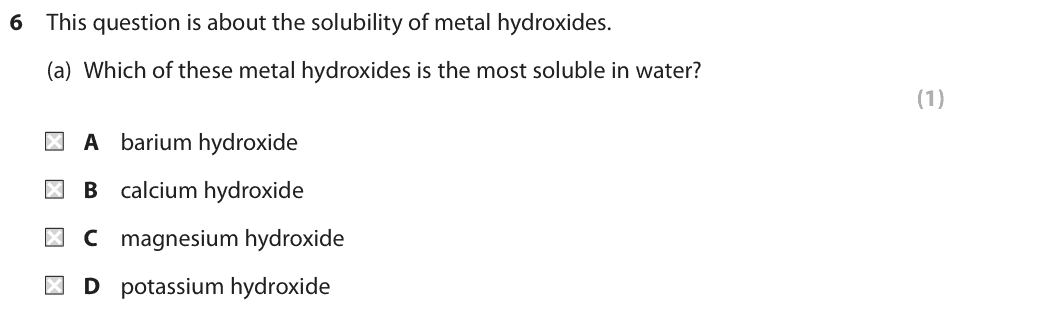
Notes and key-term cards for this topic are being written by our tutors. The past-paper questions below are ready now.
Specification statements
Show the 4 statements from the specification
10.1 know that many reactions are readily reversible and that they can reach a state of dynamic equilibrium in which: • i the rate of the forward reaction is equal to the rate of the backward reaction • ii the concentrations of reactants and products remain constant
10.2 be able to predict and justify the qualitative effect of a change in temperature, concentration or pressure on a homogeneous system in equilibrium
10.3 evaluate data to explain the necessity, for many industrial processes, to reach a compromise between the yield and the rate of reaction
10.4 be able to deduce an expression for Kc , for homogeneous and heterogeneous systems, in terms of equilibrium concentrations
Six-mark extended response questions on this topic
Tap a question to zoom it. Where a part needs a figure, table or structure from earlier in the question, that part folds out above it; the mark scheme and examiner's comment open underneath. Have Edexcel's Data Booklet beside you; the Periodic Table is on the back page of every paper.
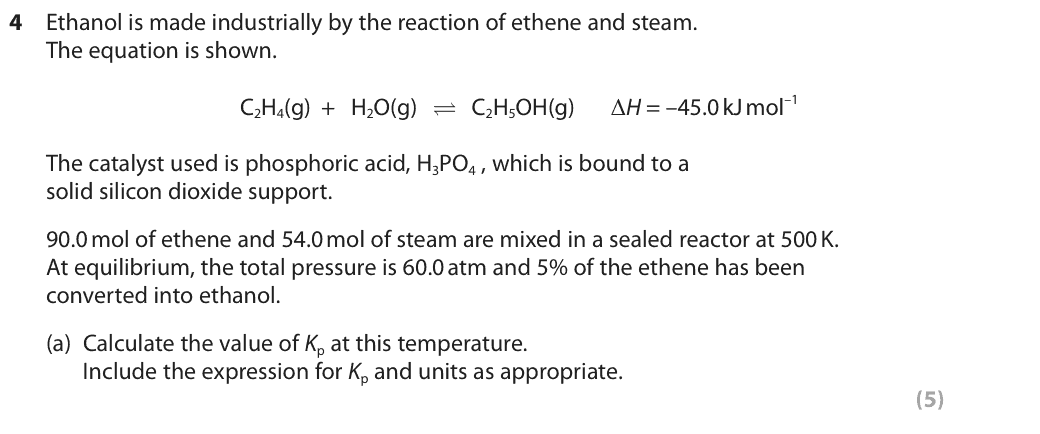
June 2025 · Paper 1 · Q4(b)(i)2 marksExplanation
Earlier part of question 4 that this part uses
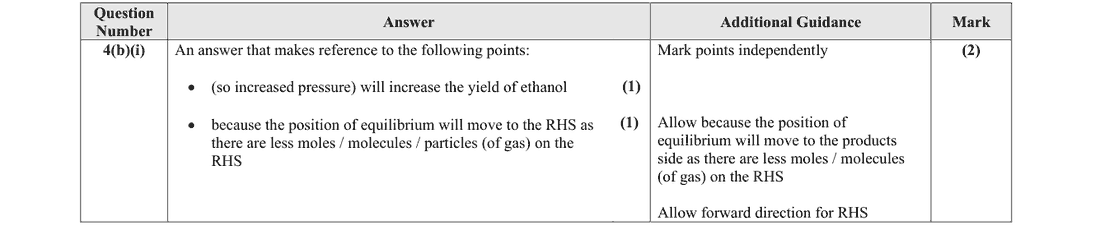
Mark scheme
Examiner's comment
This was a straightforward question on the effect of increasing the pressure on the reaction.
They needed to comment on the equilibrium shift and why, and the effect on the yield.
Notes from the mark scheme and report
The yield of ethanol increases
because the position of equilibrium moves to the right, the side with fewer moles of gas. Marked independently
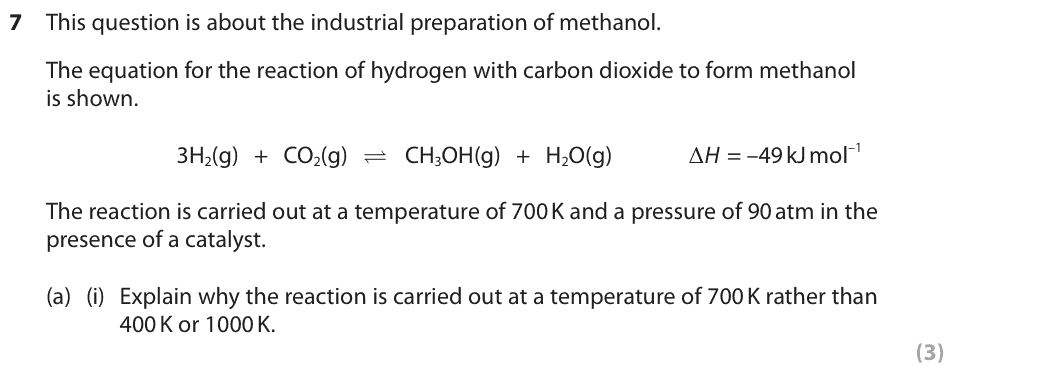
June 2025 · AS Paper 2 · Q7(a)(i)3 marksExplanation
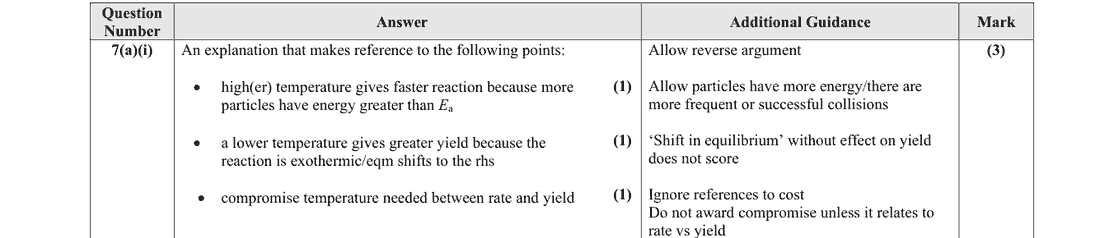
Mark scheme
Examiner's comment
This is a standard question that is often encountered at A level and parts of it also at GCSE. (ai) Most understood the effect of temperature on rate and yield. However, many lost marks due to inadequate explanations. Some responses simply stated the effects without justification, while others mentioned increased collision frequency or the exothermic nature of the reaction but failed to link these to changes in rate or yield. (aii) The effects of pressure changes were generally well known. However, vague references to high cost—without specifying the reason (e.g. equipment or energy requirements)—meant many candidates missed the third mark. (b) This question proved to be an excellent determinator, with a very even spread of marks. (i) Many fully correct, well drawn graphs were seen although some of the shapes were far from what is expected. However, very few crashed into the x axis and most started at the origin, which was encouraging. Weaker responses drew two curves and some fully confused the Maxwell- Boltzmann graph with a reaction profile. (ii) The idea that more molecules have sufficient energy to react in the presence of a catalyst was widely understood. However, few candidates referred explicitly to the graph, as required, and even fewer correctly described the increased area under the curve to the right of the activation energy.
Notes from the mark scheme and report
A higher temperature gives a faster reaction because more particles have energy greater than the activation energy
a lower temperature gives a greater yield because the forward reaction is exothermic (the equilibrium shifts to the right)
so 700 K is a compromise between rate and yield. A shift in equilibrium with no effect on yield does not score
the compromise must be between rate and yield
cost is ignored. Many stated the effects without the reasons
June 2025 · AS Paper 2 · Q7(a)(ii)3 marksExplanation
Earlier part of question 7 that this part uses
Mark scheme
Examiner's comment
This is a standard question that is often encountered at A level and parts of it also at GCSE. (ai) Most understood the effect of temperature on rate and yield. However, many lost marks due to inadequate explanations. Some responses simply stated the effects without justification, while others mentioned increased collision frequency or the exothermic nature of the reaction but failed to link these to changes in rate or yield. (aii) The effects of pressure changes were generally well known. However, vague references to high cost—without specifying the reason (e.g. equipment or energy requirements)—meant many candidates missed the third mark. (b) This question proved to be an excellent determinator, with a very even spread of marks. (i) Many fully correct, well drawn graphs were seen although some of the shapes were far from what is expected. However, very few crashed into the x axis and most started at the origin, which was encouraging. Weaker responses drew two curves and some fully confused the Maxwell- Boltzmann graph with a reaction profile. (ii) The idea that more molecules have sufficient energy to react in the presence of a catalyst was widely understood. However, few candidates referred explicitly to the graph, as required, and even fewer correctly described the increased area under the curve to the right of the activation energy.
Notes from the mark scheme and report
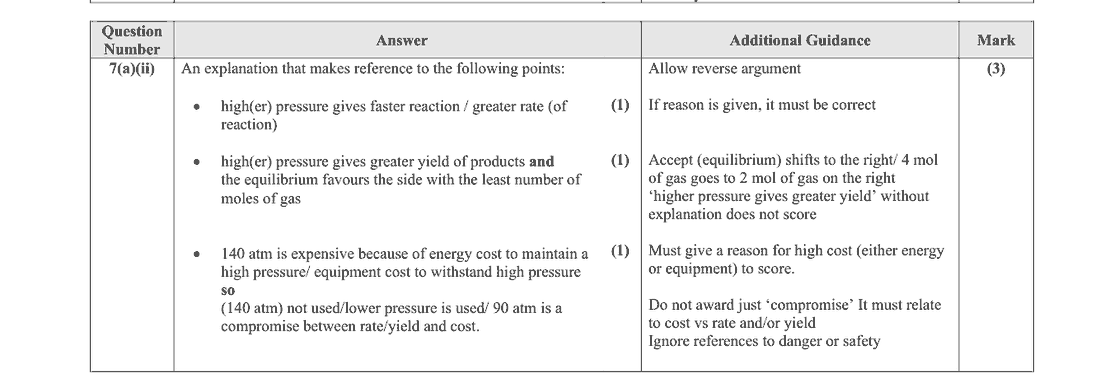
A higher pressure gives a faster reaction
a higher pressure gives a greater yield because the equilibrium favours the side with fewer moles of gas (4 mol to 2 mol)
but 140 atm is expensive because of the energy needed to maintain the pressure or the cost of equipment to withstand it, so 90 atm is a compromise between rate / yield and cost. 'Higher yield' with no reason does not score
a reason for the cost is needed
safety is ignored. The third mark was often lost through a vague reference to cost
June 2025 · AS Paper 2 · Q8(a)(i)1 markMultiple choice
Answer
C
Mark scheme
Examiner's comment
This question is about the use of catalysts in vehicle exhaust systems. (a) The expression for the equilibrium constant was well understood and 90% of the candidates answered correctly. The subsequent calculation was more challenging but still well scored. (bi) The concept of heterogeneous catalysis was widely known. However, some candidates confused it with heterogeneous equilibria, referring to reactants and products being in different phases without mentioning the phase of the catalyst. Others mentioned that the catalyst was in a “different phase” but failed to specify that this was in comparison to the reactants, which is essential for a complete explanation. (bii) Adsorption onto the catalyst surface was generally well understood with most then going on to explain the consequent lowering of Ea. Weaker candidates often just gave a generalised statement without linking it to heterogeneous catalysis, or just described adsorption or desorption but did not explain why this increases the rate of reaction. (biii) The vast majority scored at least two marks – typically referring to CO and NOx. Many also suggested SO2. However, some misunderstood the question and listed pollutants produced by the engine rather than the products formed after catalytic conversion. A surprising number incorrectly stated that CO produces carbon and oxygen, or that SO2 decomposes into sulfur and oxygen. The “rescue” mark for 3 named pollutants was widely awarded.
Notes from the mark scheme and report
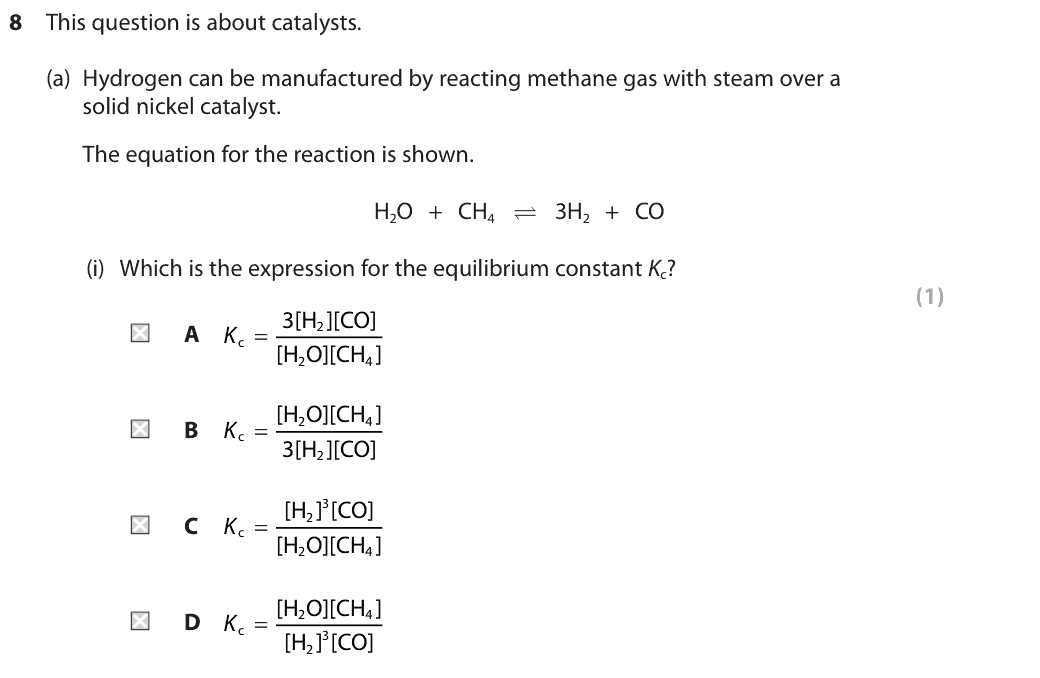
Answer: C. Kc = [H2]^3[CO] / ([H2O][CH4]). A and B multiply by 3 instead of cubing
B and D are upside down. 90% chose correctly
June 2025 · Paper 3 · Q5(b)(i)2 marksShort answer
Mark scheme
Examiner's comment
This straightforward question involved providing a definition of 'dynamic equilibrium' and many fully correct answers were seen.
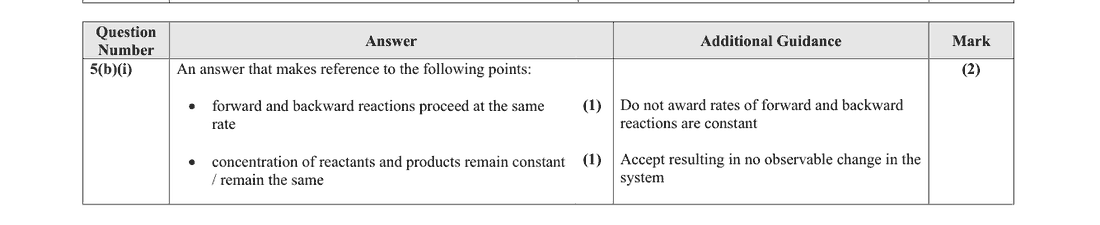
Some candidates discussed how changing reaction conditions affected the equilibrium and so did not answer the question.
Notes from the mark scheme and report
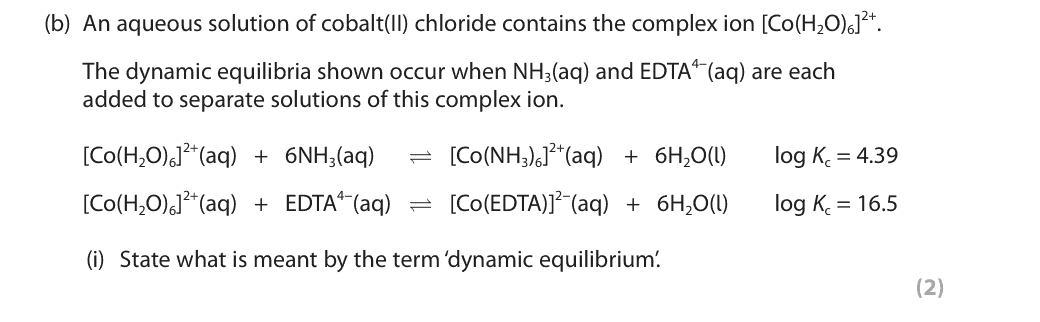
The forward and backward reactions proceed at the same rate (not 'the rates are constant')
the concentrations of reactants and products remain constant (accept no observable change in the system). Some wrote about the effect of changing conditions instead
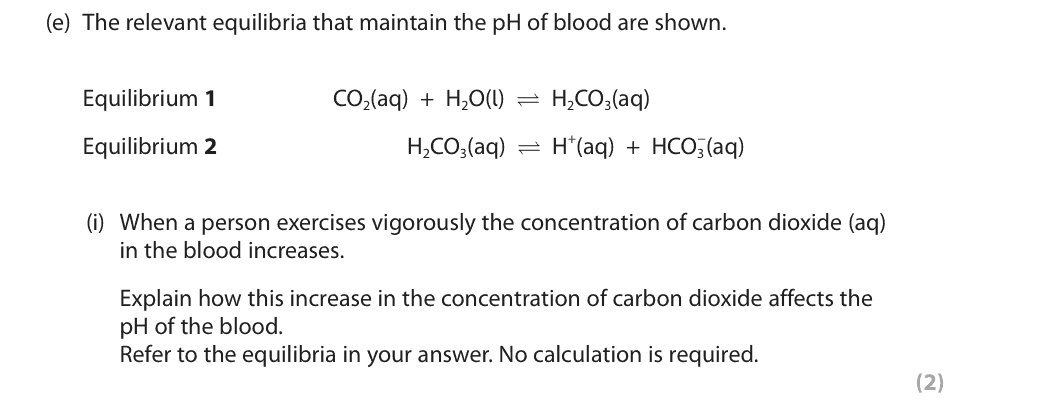
June 2024 · Paper 1 · Q4(e)(i)2 marksExplanation
Earlier part of question 4 that this part uses
Mark scheme
Examiner's comment
This question was about regulation of the pH of the blood.
The first part required candidates to explain the effect on the two equilibria involved after vigorous exercise.
Candidates generally answered this well in terms of the effect on the equilibria, but the
second mark was often not awarded as the candidates just stated that the amount of H+ ions would increase, rather than the concentration. A few candidates stated incorrectly that an increased hydrogen ion concentration would increase the pH.
The second part of the question was about how the buffer system in the blood works. Candidates found this more difficult to answer.
Good answers mentioned the large reservoir of hydrogen carbonate ions that would react
with the H+ ions.
Notes from the mark scheme and report
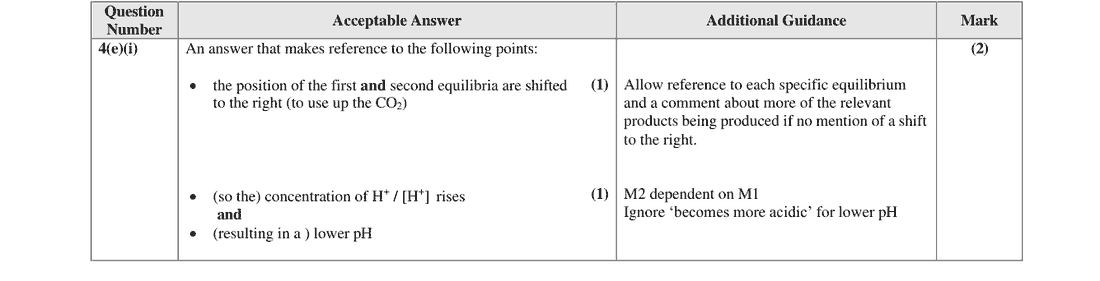
Both equilibria shift to the right (to use up the CO2)
so the concentration of H+ rises and the pH falls. M2 depends on M1. 'Amount of H+ increases' was not enough
some said a higher [H+] raises the pH
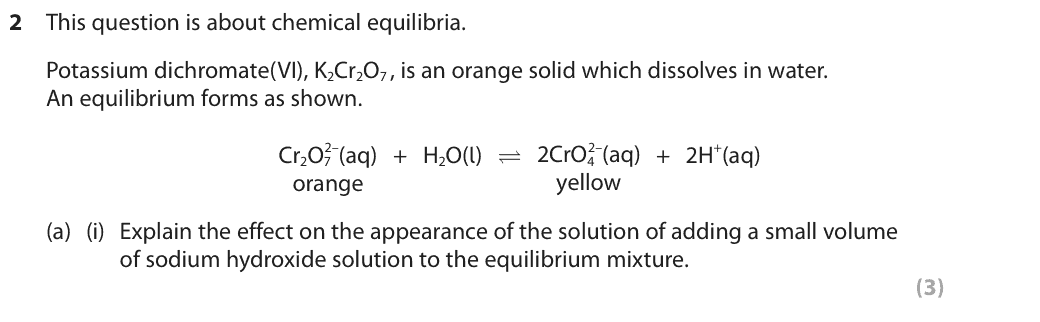
June 2024 · AS Paper 2 · Q2(a)(i)3 marksExplanationHard
Mark scheme
Examiner's comment
Chemical equilibria was considered in this question. The equilibrium between dichromate(VI) and chromate(VI) ions in (a) is often encountered in practical lessons by candidates. The equilibria in (b) involved the nitrogen dioxide and dinitrogen tetroxide equilibrium, is also often encountered both as a demonstration or practical activity in lessons and in examinations. (a)(i) proved challenging with only 10 percent of candidates scoring 3 marks. Common mistakes were to consider the added water as the most significant aspect, despite the fact that the question said that only a small volume was added. Another common error, which occurred on other items in this question, is to mistake the use of the phrase ‘the equilibrium shifts to the right’ (or left). Some candidates seemed very confused as to what this phrase, which is used commonly in explanations of equilibrium shift, actually means. Excellent answers used different wording such as ‘the equilibrium shifts so that more of the products are formed and less of the reactants.’ The multiple-choice question in (a)(ii) concerned a heterogeneous equilibria, with more than half of candidates scoring this mark. In (b)(i) the initial observation of the decreasing concentration of nitrogen dioxide, and hence the lightening of the colour of the gas, was very rarely seen in answers. This suggests that this demonstration is not as frequently carried out as it was in the relatively recent past. The remaining two marks were much more commonly seen, with over 50% of candidates scoring some marks here. Candidates had less difficulty with the effect of temperature on the equilibrium in (b)(ii), with nearly half of candidates scoring both marks.
Notes from the mark scheme and report
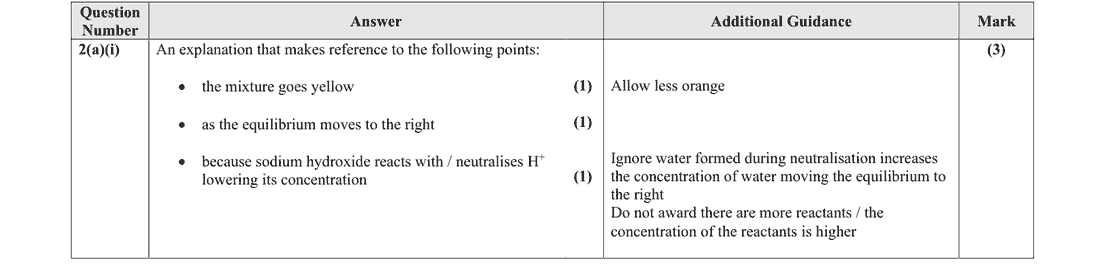
The mixture goes yellow (allow less orange)
because the equilibrium moves to the right
because the sodium hydroxide reacts with / neutralises H+, lowering its concentration. Arguments based on the added water are ignored (only a small volume is added). Common errors: treating the water as the main effect
misusing 'shifts to the right / left'
June 2024 · AS Paper 2 · Q2(a)(ii)1 markMultiple choice
Earlier part of question 2 that this part uses
Answer
C
Mark scheme
Examiner's comment
Chemical equilibria was considered in this question. The equilibrium between dichromate(VI) and chromate(VI) ions in (a) is often encountered in practical lessons by candidates. The equilibria in (b) involved the nitrogen dioxide and dinitrogen tetroxide equilibrium, is also often encountered both as a demonstration or practical activity in lessons and in examinations. (a)(i) proved challenging with only 10 percent of candidates scoring 3 marks. Common mistakes were to consider the added water as the most significant aspect, despite the fact that the question said that only a small volume was added. Another common error, which occurred on other items in this question, is to mistake the use of the phrase ‘the equilibrium shifts to the right’ (or left). Some candidates seemed very confused as to what this phrase, which is used commonly in explanations of equilibrium shift, actually means. Excellent answers used different wording such as ‘the equilibrium shifts so that more of the products are formed and less of the reactants.’ The multiple-choice question in (a)(ii) concerned a heterogeneous equilibria, with more than half of candidates scoring this mark. In (b)(i) the initial observation of the decreasing concentration of nitrogen dioxide, and hence the lightening of the colour of the gas, was very rarely seen in answers. This suggests that this demonstration is not as frequently carried out as it was in the relatively recent past. The remaining two marks were much more commonly seen, with over 50% of candidates scoring some marks here. Candidates had less difficulty with the effect of temperature on the equilibrium in (b)(ii), with nearly half of candidates scoring both marks.
Notes from the mark scheme and report
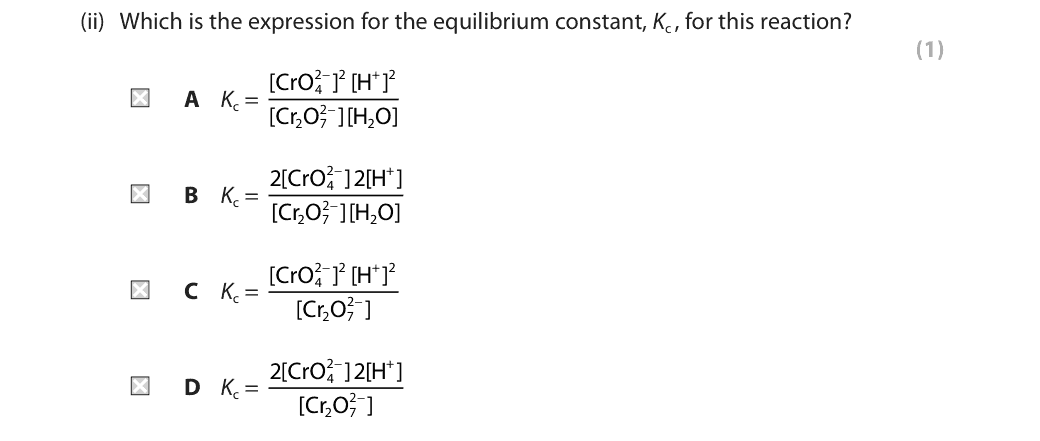
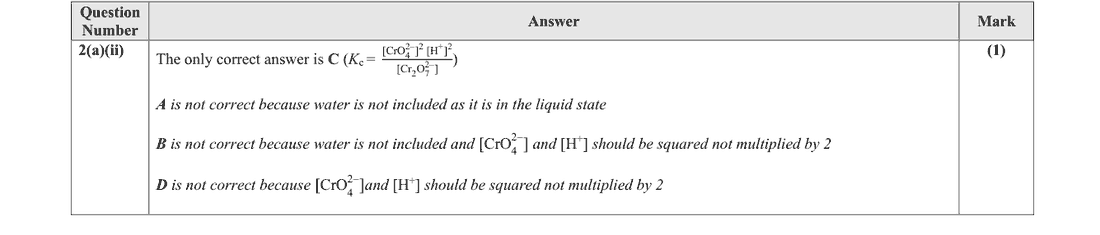
Answer: C. Kc = [CrO4 2–]^2 [H+]^2 / [Cr2O7 2–]. Water is left out because it is the liquid (A and B include it)
B and D multiply by 2 instead of squaring
June 2024 · AS Paper 2 · Q2(b)(i)3 marksExplanation
Earlier part of question 2 that this part uses
Mark scheme
Examiner's comment
Chemical equilibria was considered in this question. The equilibrium between dichromate(VI) and chromate(VI) ions in (a) is often encountered in practical lessons by candidates. The equilibria in (b) involved the nitrogen dioxide and dinitrogen tetroxide equilibrium, is also often encountered both as a demonstration or practical activity in lessons and in examinations. (a)(i) proved challenging with only 10 percent of candidates scoring 3 marks. Common mistakes were to consider the added water as the most significant aspect, despite the fact that the question said that only a small volume was added. Another common error, which occurred on other items in this question, is to mistake the use of the phrase ‘the equilibrium shifts to the right’ (or left). Some candidates seemed very confused as to what this phrase, which is used commonly in explanations of equilibrium shift, actually means. Excellent answers used different wording such as ‘the equilibrium shifts so that more of the products are formed and less of the reactants.’ The multiple-choice question in (a)(ii) concerned a heterogeneous equilibria, with more than half of candidates scoring this mark. In (b)(i) the initial observation of the decreasing concentration of nitrogen dioxide, and hence the lightening of the colour of the gas, was very rarely seen in answers. This suggests that this demonstration is not as frequently carried out as it was in the relatively recent past. The remaining two marks were much more commonly seen, with over 50% of candidates scoring some marks here. Candidates had less difficulty with the effect of temperature on the equilibrium in (b)(ii), with nearly half of candidates scoring both marks.
Notes from the mark scheme and report
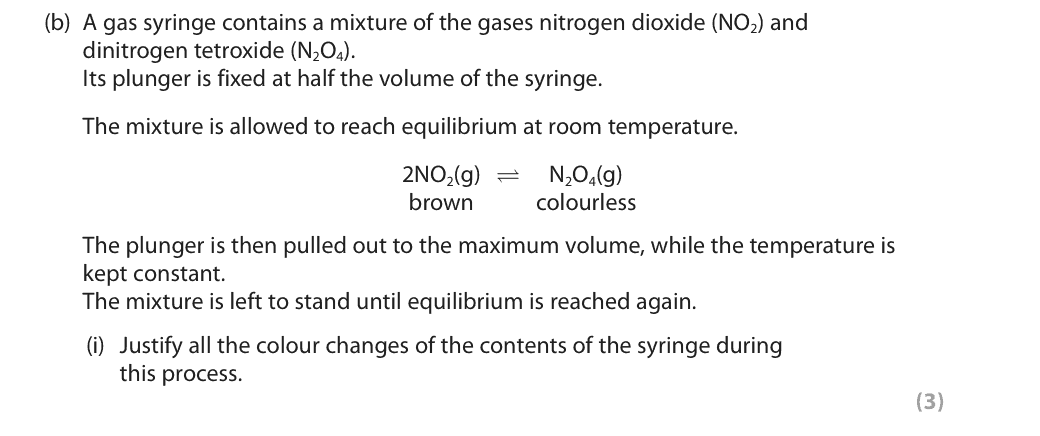
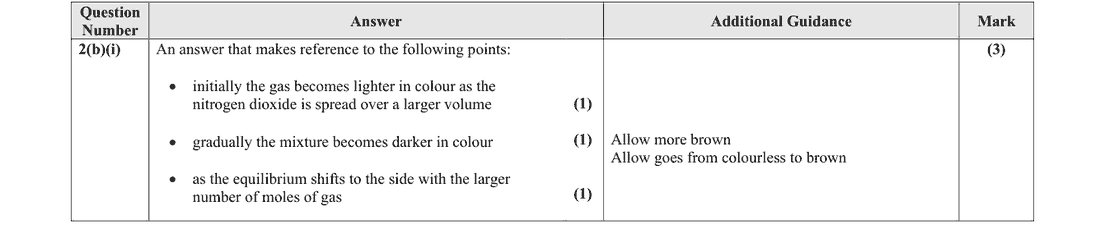
At first the gas becomes paler because the nitrogen dioxide is spread through a larger volume
then it gradually darkens (more brown)
because the equilibrium shifts to the side with more moles of gas (towards NO2) at the lower pressure. The initial paling was very rarely given
June 2024 · AS Paper 2 · Q2(b)(ii)2 marksExplanation
Earlier parts of question 2 that this part uses
Mark scheme
Examiner's comment
Chemical equilibria was considered in this question. The equilibrium between dichromate(VI) and chromate(VI) ions in (a) is often encountered in practical lessons by candidates. The equilibria in (b) involved the nitrogen dioxide and dinitrogen tetroxide equilibrium, is also often encountered both as a demonstration or practical activity in lessons and in examinations. (a)(i) proved challenging with only 10 percent of candidates scoring 3 marks. Common mistakes were to consider the added water as the most significant aspect, despite the fact that the question said that only a small volume was added. Another common error, which occurred on other items in this question, is to mistake the use of the phrase ‘the equilibrium shifts to the right’ (or left). Some candidates seemed very confused as to what this phrase, which is used commonly in explanations of equilibrium shift, actually means. Excellent answers used different wording such as ‘the equilibrium shifts so that more of the products are formed and less of the reactants.’ The multiple-choice question in (a)(ii) concerned a heterogeneous equilibria, with more than half of candidates scoring this mark. In (b)(i) the initial observation of the decreasing concentration of nitrogen dioxide, and hence the lightening of the colour of the gas, was very rarely seen in answers. This suggests that this demonstration is not as frequently carried out as it was in the relatively recent past. The remaining two marks were much more commonly seen, with over 50% of candidates scoring some marks here. Candidates had less difficulty with the effect of temperature on the equilibrium in (b)(ii), with nearly half of candidates scoring both marks.
Notes from the mark scheme and report
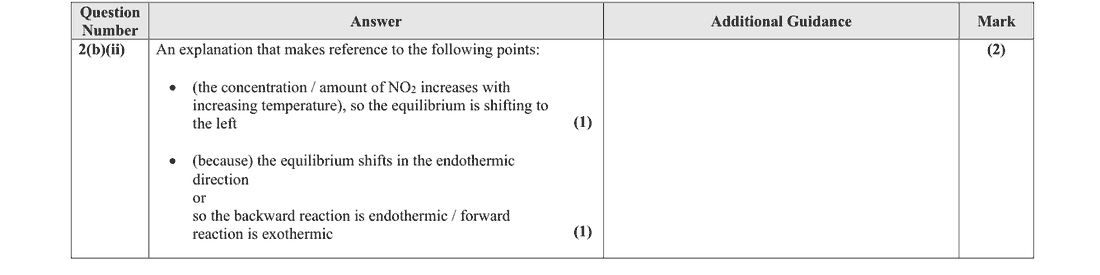
Darker brown means more NO2, so the equilibrium has shifted to the left
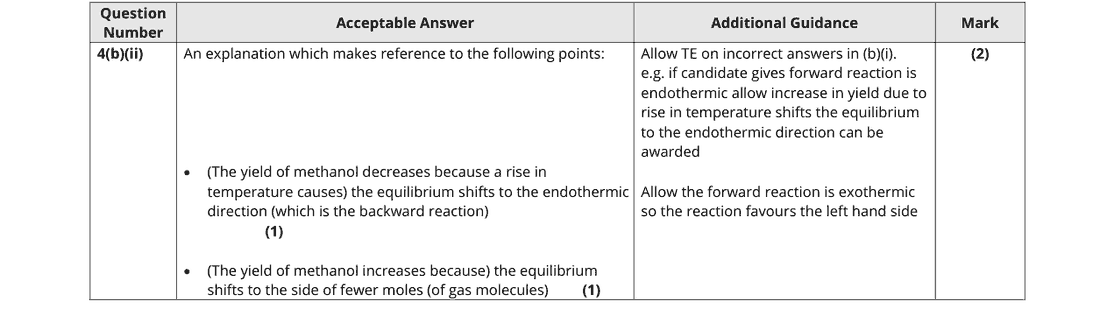
a rise in temperature shifts the equilibrium in the endothermic direction, so the backward reaction is endothermic / the forward reaction is exothermic
June 2024 · AS Paper 2 · Q76 marks6-mark extended response
Mark scheme, with the indicative content and the marks for reasoning
Examiner's comment
Q7 was the extended response question. This provided an excellent spread of marks and proved very accessible to most candidates. The most common score was 5, closely followed by 2 and 0, all with between 15 and 20% of the marks. 1 mark, scored by 11% of candidates, was the least common score. Indicative point 3 was the most often not seen.
Notes from the mark scheme and report
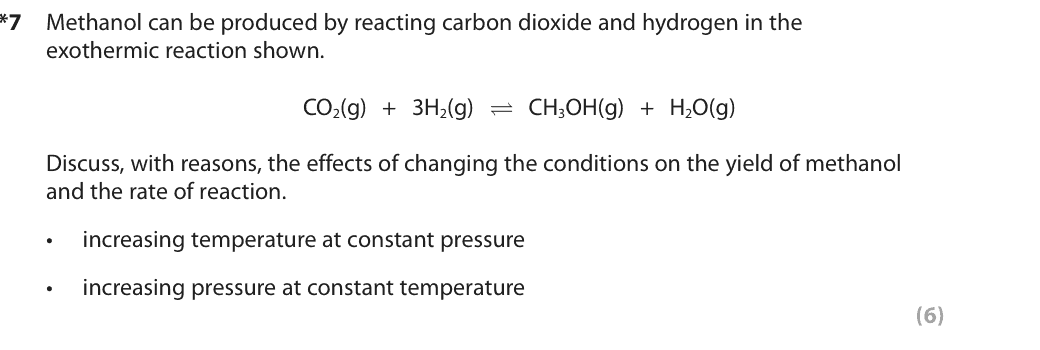
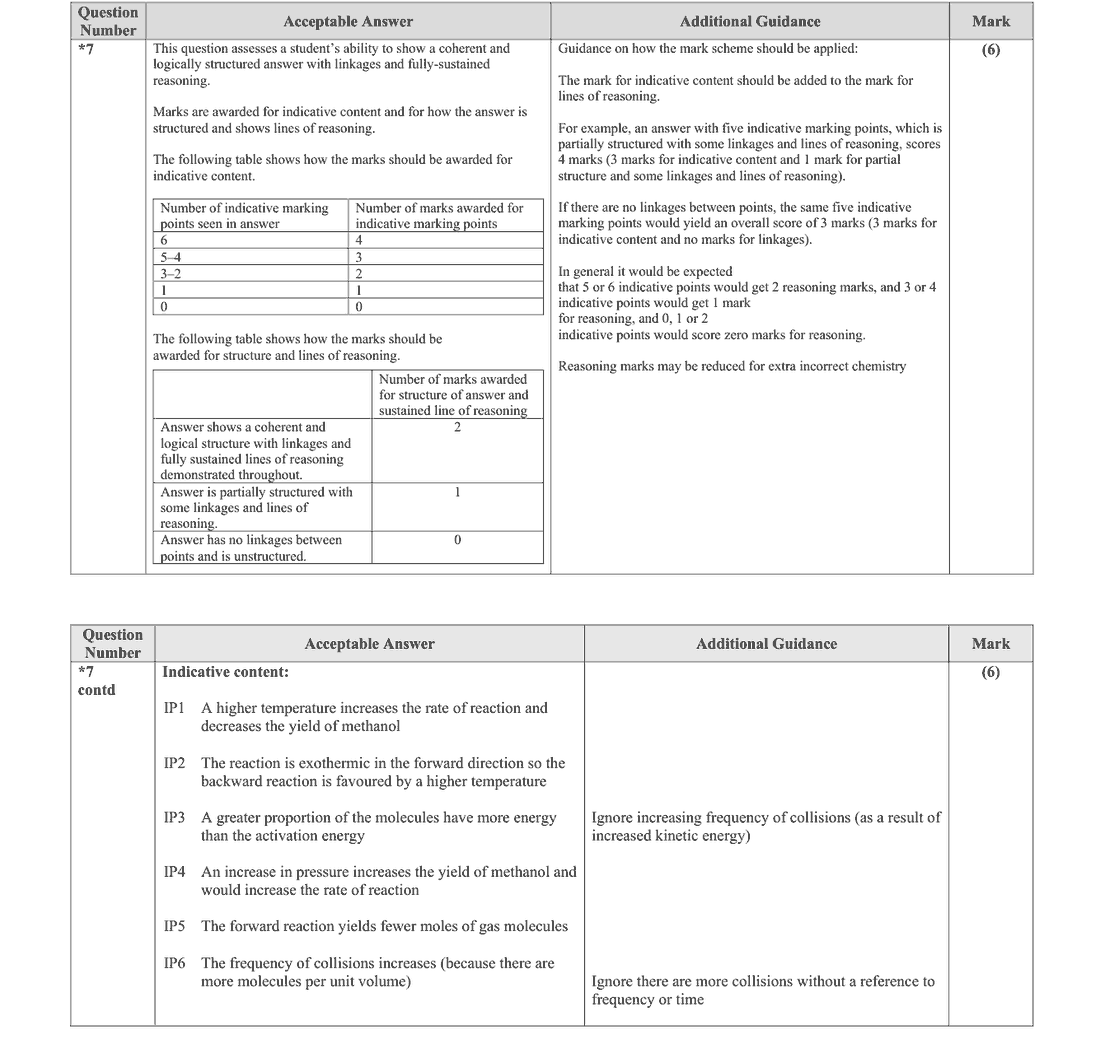
Six indicative points plus two marks for reasoning. IP1 higher temperature increases the rate and decreases the yield of methanol
IP2 the forward reaction is exothermic, so the backward reaction is favoured by a higher temperature
IP3 a greater proportion of molecules have energy greater than the activation energy
IP4 higher pressure increases the yield and the rate
IP5 the forward reaction gives fewer moles of gas (4 to 2)
IP6 the frequency of collisions increases because there are more molecules per unit volume ('more collisions' with no reference to frequency or time is ignored). IP3 was the point most often missing
the most common score was 5
June 2023 · Paper 1 · Q3(c)(iii)1 markMultiple choice
Earlier parts of question 3 that this part uses
Answer
D
Mark scheme
Notes from the mark scheme and report
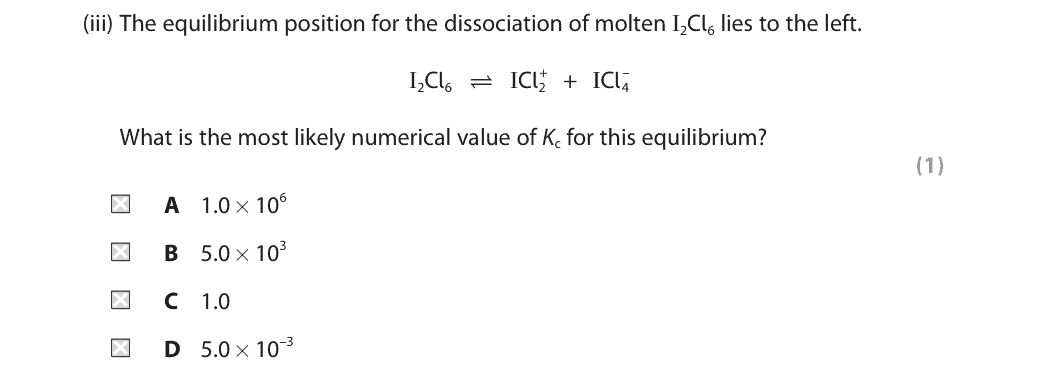
Answer: D (5.0 × 10^–3). The position lies to the left, so the product concentrations are small and Kc is much less than 1. A and B (greater than 1) mean the position lies to the right
C (1.0) means similar amounts of reactant and products
Skills: MS0.1 Recognise and use expressions in decimal and ordinary form
June 2023 · Paper 1 · Q5(b)1 markMultiple choice
Earlier part of question 5 that this part uses
Answer
C
Mark scheme
Notes from the mark scheme and report
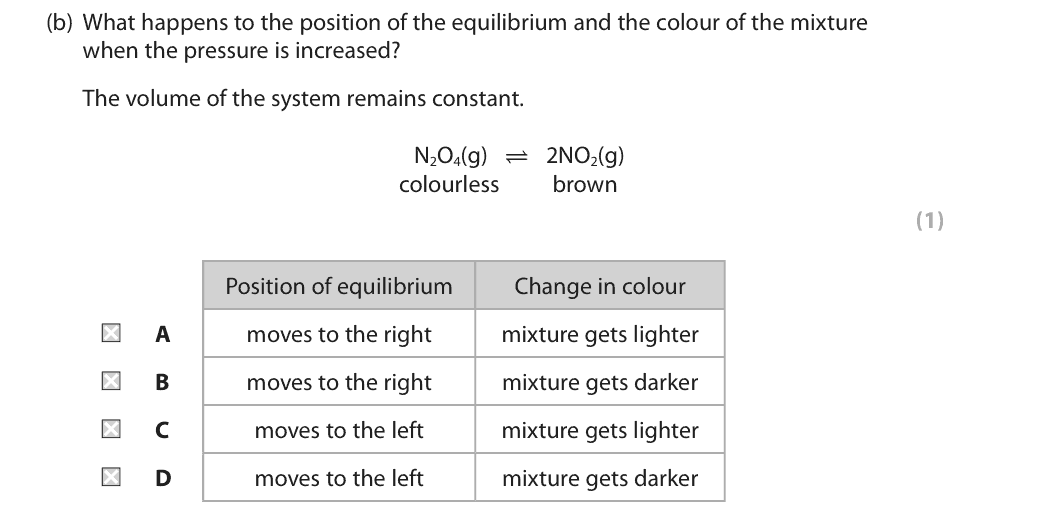
Answer: C. There are more gas particles on the right, so higher pressure moves the position to the left, forming more colourless N2O4, and the mixture gets lighter
June 2023 · AS Paper 2 · Q61 markMultiple choice
Answer
C
Mark scheme
Examiner's comment
Some candidates seemed reluctant to opt for the simplest expression (which was the correct selection).
Notes from the mark scheme and report
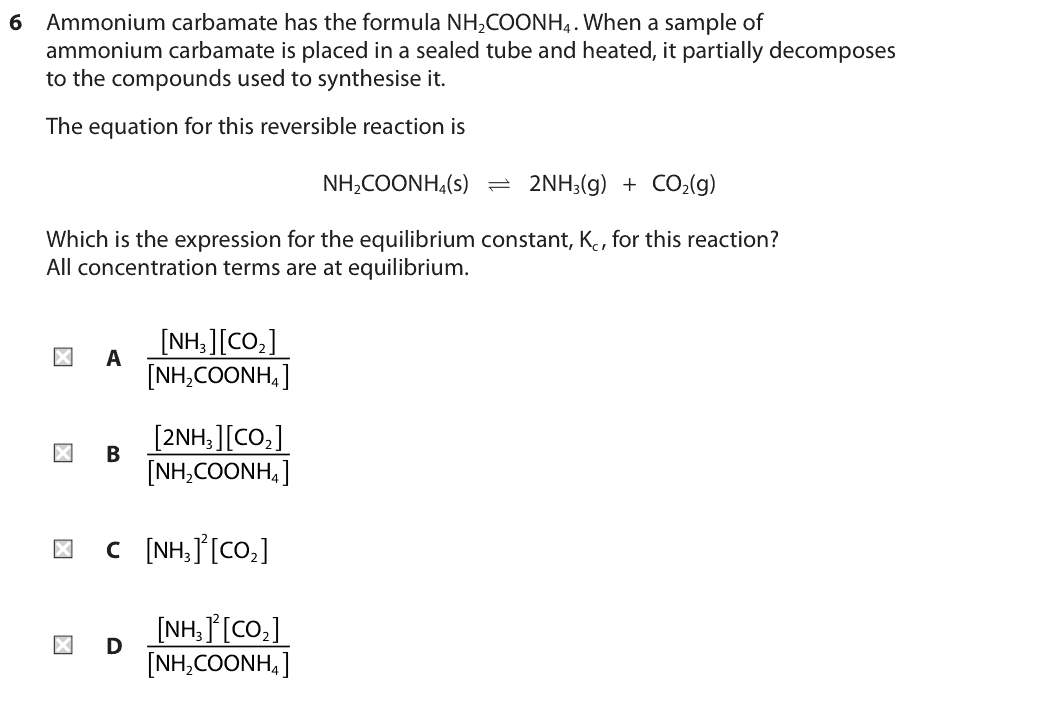
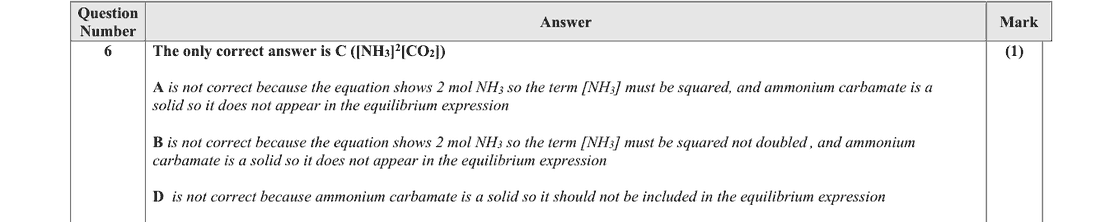
Answer: C, Kc = [NH3]^2[CO2]. Ammonium carbamate is a solid so does not appear in the expression, and [NH3] is squared (not doubled) because 2 mol are formed. Some candidates were reluctant to choose the simplest expression
June 2022 · AS Paper 2 · Q7(a)(ii)3 marksDiagram or structureHard
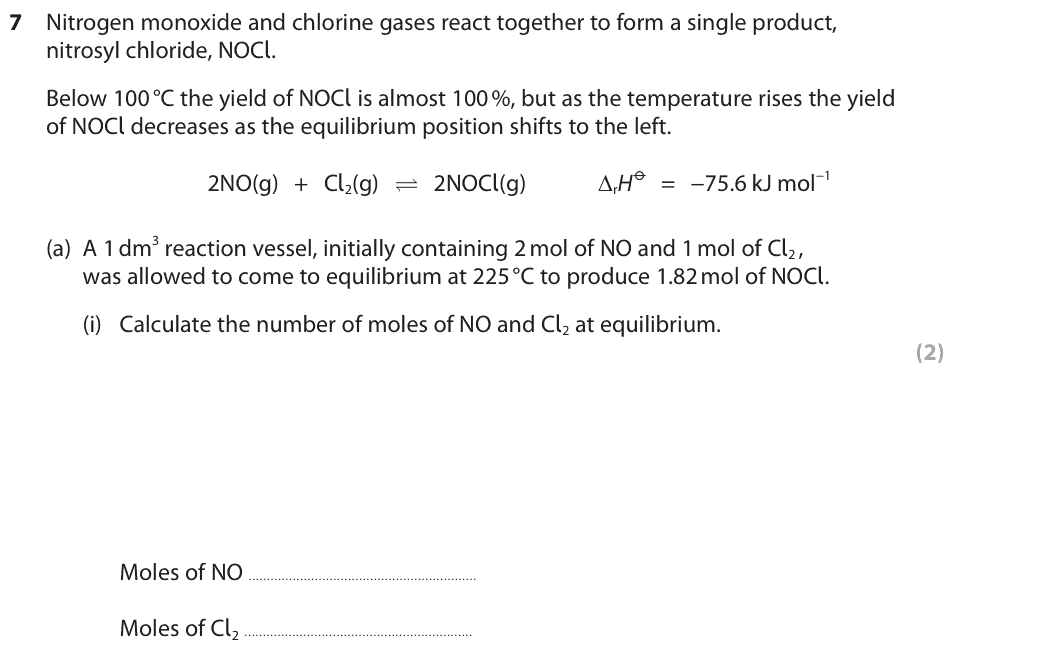
Earlier part of question 7 that this part uses
Mark scheme
Examiner's comment
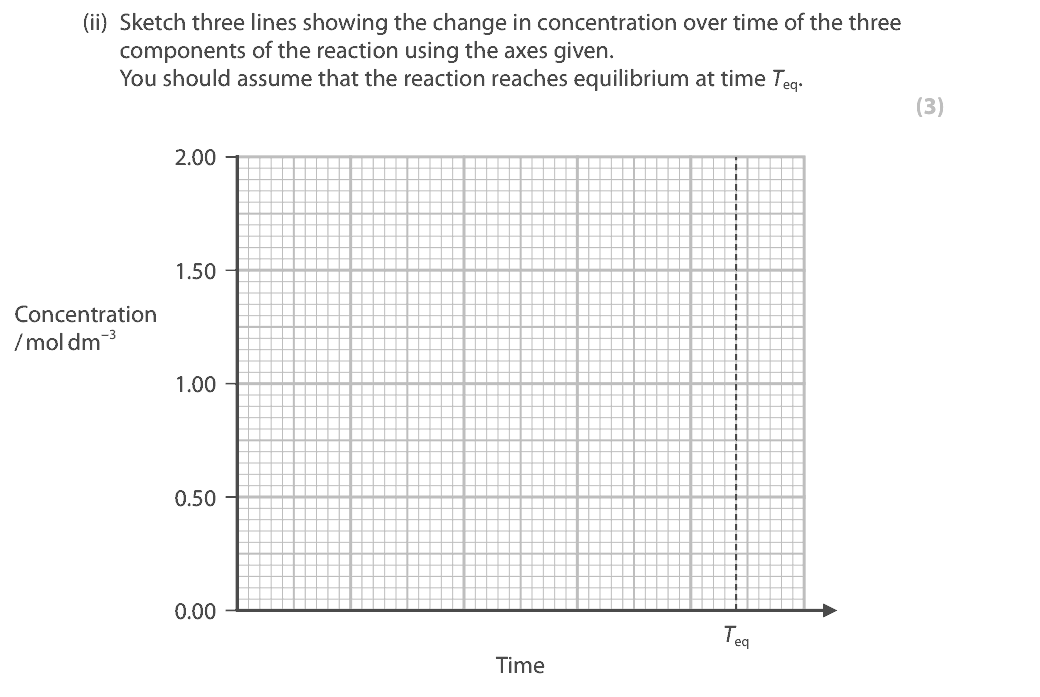
(a) proved very challenging. The initial calculation was not understood by many candidates, though many were able to pick up 1 mark for having half the moles of Cl2 compared to NO in (i). The sketch graph in (ii) was even more difficult, with only a very few candidates getting full marks in these two linked items. The final multiple choice in (iii) was just as high scoring as the first, with over 80% getting the right equation. (b)(i) and (b)(ii) gave a range throughout the possible marks, with two being the most common out of four. Common mistakes included the incorrect substances in the
Hess’ Law cycle. The final calculation proved quite challenging, with only 10% of candidates getting full marks for these two parts.
Notes from the mark scheme and report
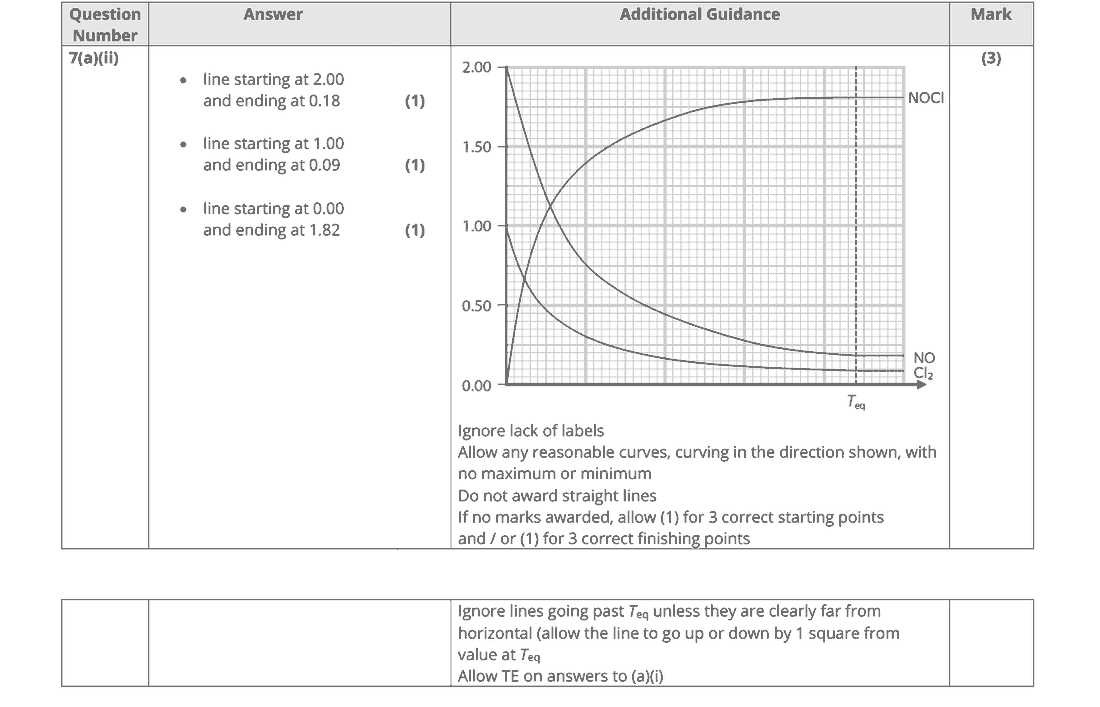
Three curves that level off by Teq with no maximum or minimum: NO from 2.00 down to 0.18
Cl2 from 1.00 down to 0.09
NOCl from 0.00 up to 1.82 mol dm–3 (the vessel is 1 dm3). Labels not needed
straight lines not allowed
errors carried forward from (a)(i). If nothing else is scored, one mark for three correct starting points and one for three correct finishing points
Skills: MS3.1 Translate information between graphical, numerical and algebraic forms
June 2022 · AS Paper 2 · Q7(a)(iii)1 markMultiple choice
Earlier parts of question 7 that this part uses
Answer
B
Mark scheme
Examiner's comment
(a) proved very challenging. The initial calculation was not understood by many candidates, though many were able to pick up 1 mark for having half the moles of Cl2 compared to NO in (i). The sketch graph in (ii) was even more difficult, with only a very few candidates getting full marks in these two linked items. The final multiple choice in (iii) was just as high scoring as the first, with over 80% getting the right equation. (b)(i) and (b)(ii) gave a range throughout the possible marks, with two being the most common out of four. Common mistakes included the incorrect substances in the
Hess’ Law cycle. The final calculation proved quite challenging, with only 10% of candidates getting full marks for these two parts.
Notes from the mark scheme and report
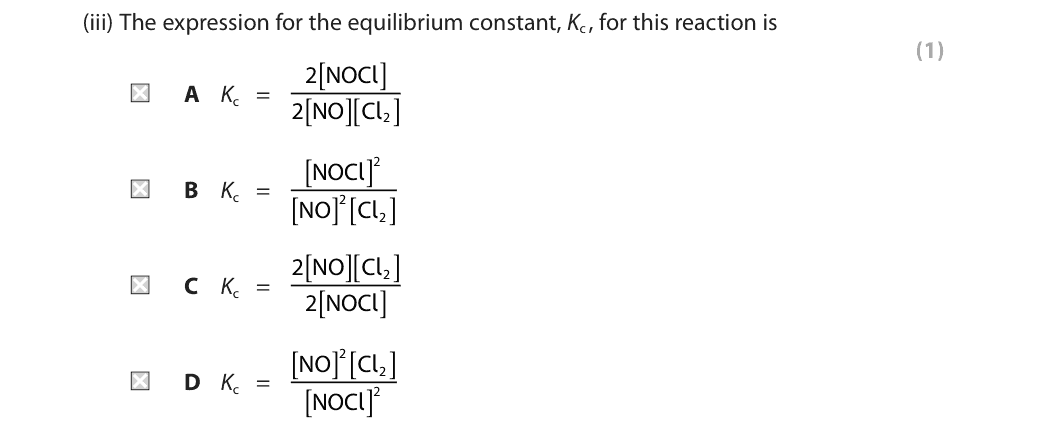
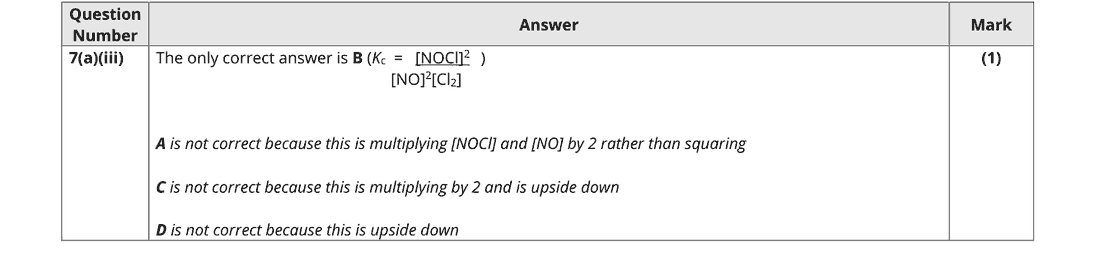
Answer: B. Kc = [NOCl]^2 / ([NO]^2[Cl2]). A multiplies by 2 instead of squaring
C and D are upside down. Over 80% chose correctly
June 2022 · AS Paper 2 · Q7(a)(iv)1 markShort answer
Earlier part of question 7 that this part uses
Mark scheme
Examiner's comment
(a) proved very challenging. The initial calculation was not understood by many candidates, though many were able to pick up 1 mark for having half the moles of Cl2 compared to NO in (i). The sketch graph in (ii) was even more difficult, with only a very few candidates getting full marks in these two linked items. The final multiple choice in (iii) was just as high scoring as the first, with over 80% getting the right equation. (b)(i) and (b)(ii) gave a range throughout the possible marks, with two being the most common out of four. Common mistakes included the incorrect substances in the
Hess’ Law cycle. The final calculation proved quite challenging, with only 10% of candidates getting full marks for these two parts.
Notes from the mark scheme and report
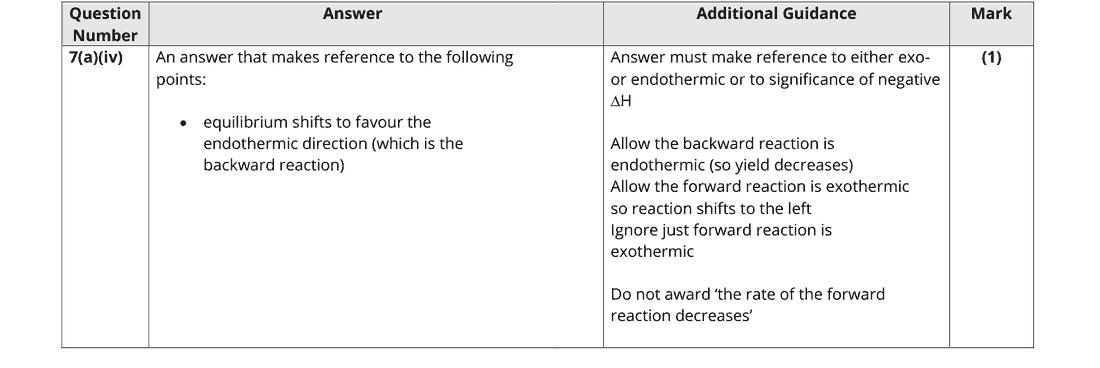
The equilibrium shifts in the endothermic direction, which is the backward reaction (allow: the forward reaction is exothermic so the equilibrium shifts to the left). The answer must refer to exothermic or endothermic or to the negative ΔH
'the forward reaction is exothermic' alone is ignored
not 'the rate of the forward reaction decreases'
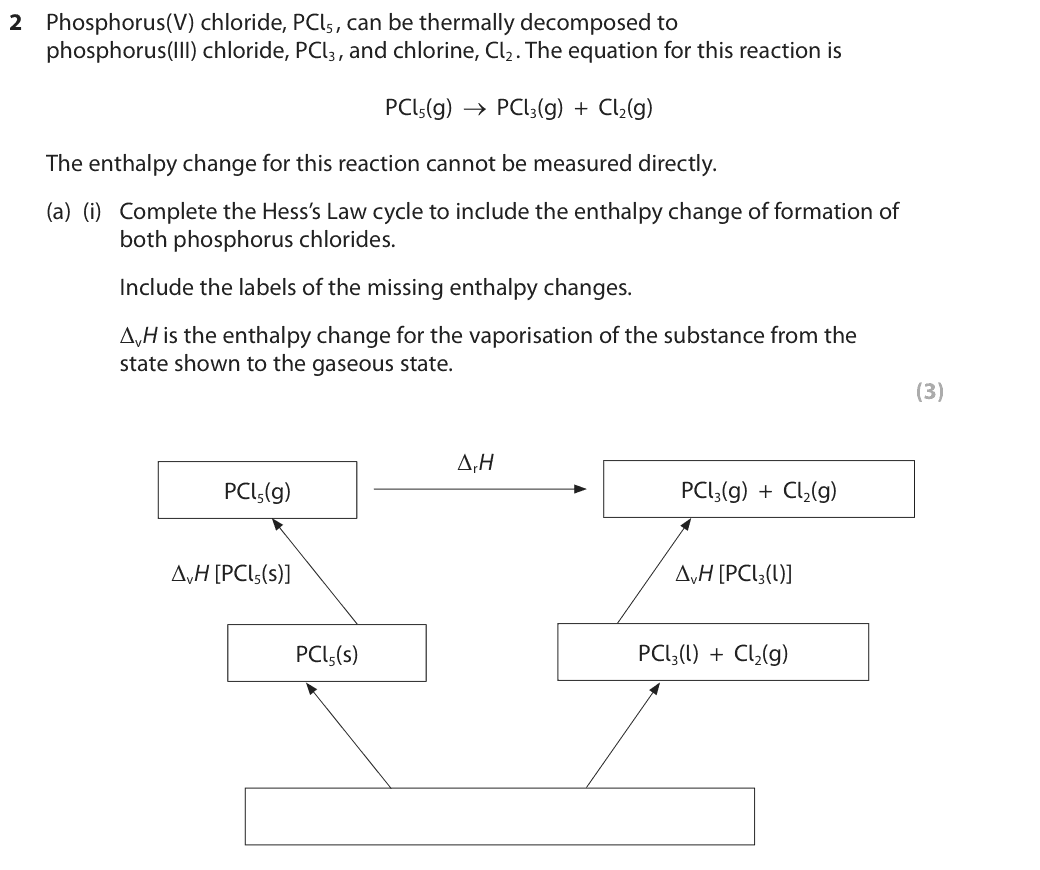
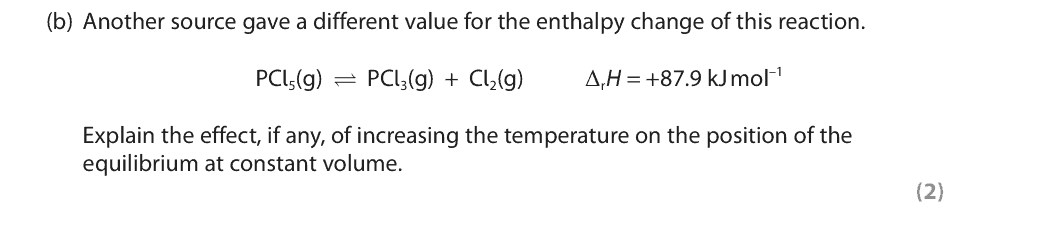
November 2021 · AS Paper 2 · Q2(b)2 marksExplanation
Earlier part of question 2 that this part uses
Mark scheme
Examiner's comment
(a)(i) This question proved to be surprisingly difficult for many students, probably due to the
question including Enthalpy Changes of Vaporisation. Although the diagram on the question paper
attempted to simplify the problem for candidates, it appeared that many were confused by the
inclusion of vaporisation and simply did not attempt the question. However, the graphical
presentation of a Hess cycle is always quite challenging for candidates.
(a)(ii) This was a Hess’s Law calculation which again seemed to be a challenge for the less able
students. However, the mark scheme gave credit for the omission of the Enthalpy Changes of
Vaporisation.
(b) This was a straightforward question on enthalpy changes and was familiar to most candidates.
Those who chose to answer the question tended to score well.
Notes from the mark scheme and report
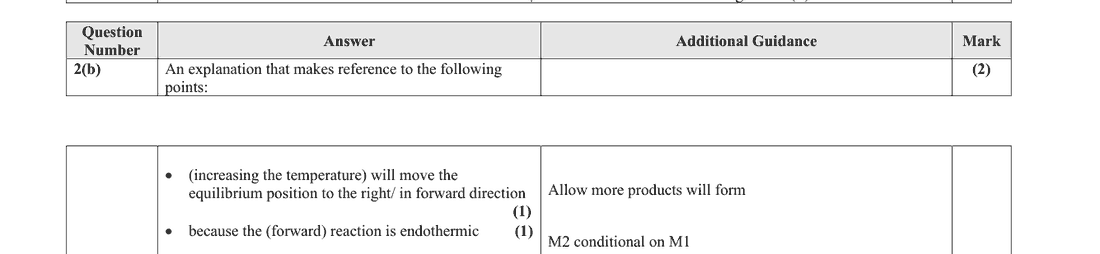
The equilibrium position moves to the right (allow more products form)
because the forward reaction is endothermic. M2 is conditional on M1
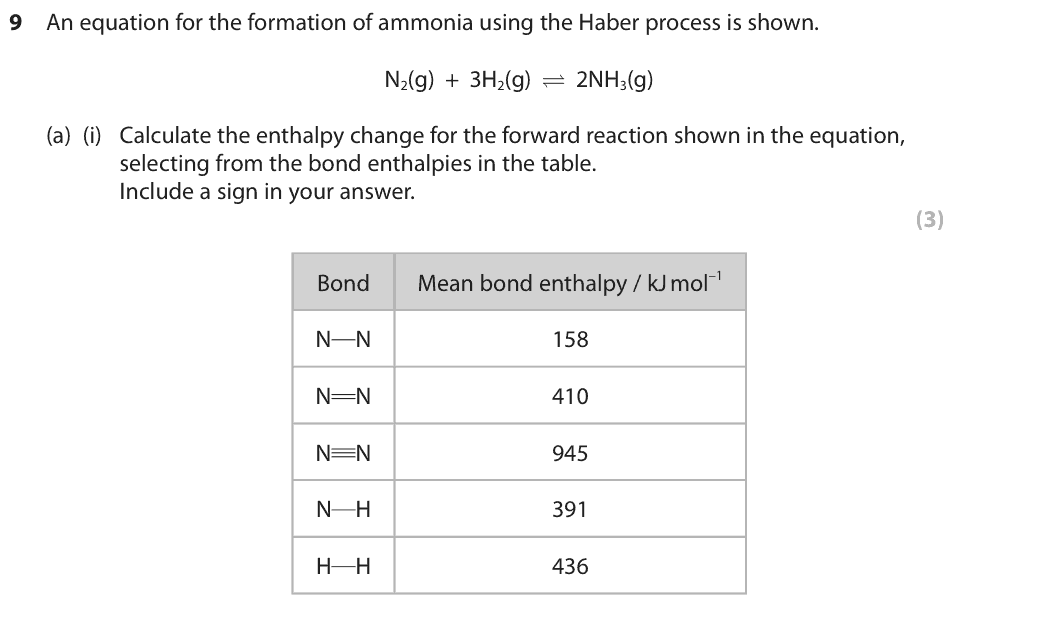
November 2021 · AS Paper 2 · Q9(a)(iv)1 markMultiple choice
Earlier part of question 9 that this part uses
Answer
C
Mark scheme
Examiner's comment
Although the last question on this paper, candidates had more success with this question,
indicating that candidates had read the Principal Examiner recommendations for previous years in
which the Principal Examiner had suggested that candidates might be more selective in attempting
different questions.
(a)(i) Students were relatively successful with this calculation of an enthalpy change for a reaction,
using the supplied data. It was simple and should have been familiar from similar questions in
previous years.
(a)(ii) This question followed up on Q09(a)(i) and tested the student’s understanding of the reasons
for a variation in the enthalpy change for a reaction. Although most candidates gained one of the
two available marks, only the better examinees scored the second mark.
(a)(iii) This was a multiple-choice question. Very few candidates were able to answer this question.
This may be because atom economy is not frequently examined.
(a)(iv) This was a multiple-choice question. Most students answered this correctly. The equilibrium
expression is a familiar topic asked, and in this instance, is about an equation that should also be
very familiar.
(b)This question related to the practical aspects of an equilibrium reaction in the chemical industry.
Candidate responses were generally not strong. However, this is a challenging topic towards the
end of the paper.
(c)(i) This question was about an exothermic reaction taking place on the surface of a copper
catalyst. The answer involved an increase in the rate of a reaction as it heated up, and the effect
this might have on the copper catalyst. Many students scored the first marking point but very few
recognized that the copper would melt. Although it is easy to deduce what will happen if the
experiment has not been seen, this is a memorable reaction when observed.
(c)(ii) This question asked the student to produce a reaction profile for the specified exothermic
reaction. It required the student to be aware of the difference between a reaction profile diagram
and an enthalpy level diagram. Most students scored both available marks on this question.
(c)(iii) This question was descriptive and asked about the processes that take place during
heterogeneous catalysis. A question on this topic has featured frequently on this paper in previous
years. Those students who had prepared using past papers will have recognized the question and
consequently scored well.
Notes from the mark scheme and report
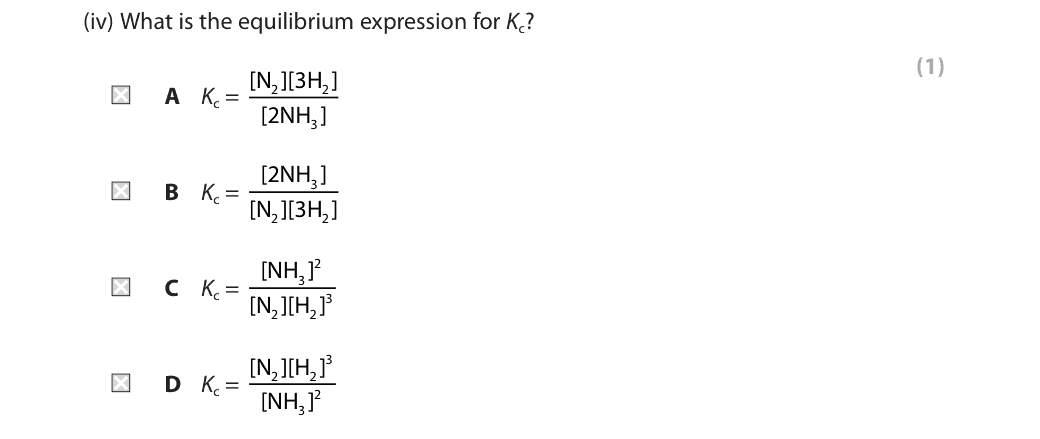
Answer: C. Kc = [NH3]^2 / ([N2][H2]^3). A and B put the balancing numbers inside the brackets instead of using powers (A is also inverted)
D is the expression for the reverse reaction
November 2021 · AS Paper 2 · Q9(b)3 marksShort answer
Earlier part of question 9 that this part uses
Mark scheme
Examiner's comment
Although the last question on this paper, candidates had more success with this question,
indicating that candidates had read the Principal Examiner recommendations for previous years in
which the Principal Examiner had suggested that candidates might be more selective in attempting
different questions.
(a)(i) Students were relatively successful with this calculation of an enthalpy change for a reaction,
using the supplied data. It was simple and should have been familiar from similar questions in
previous years.
(a)(ii) This question followed up on Q09(a)(i) and tested the student’s understanding of the reasons
for a variation in the enthalpy change for a reaction. Although most candidates gained one of the
two available marks, only the better examinees scored the second mark.
(a)(iii) This was a multiple-choice question. Very few candidates were able to answer this question.
This may be because atom economy is not frequently examined.
(a)(iv) This was a multiple-choice question. Most students answered this correctly. The equilibrium
expression is a familiar topic asked, and in this instance, is about an equation that should also be
very familiar.
(b)This question related to the practical aspects of an equilibrium reaction in the chemical industry.
Candidate responses were generally not strong. However, this is a challenging topic towards the
end of the paper.
(c)(i) This question was about an exothermic reaction taking place on the surface of a copper
catalyst. The answer involved an increase in the rate of a reaction as it heated up, and the effect
this might have on the copper catalyst. Many students scored the first marking point but very few
recognized that the copper would melt. Although it is easy to deduce what will happen if the
experiment has not been seen, this is a memorable reaction when observed.
(c)(ii) This question asked the student to produce a reaction profile for the specified exothermic
reaction. It required the student to be aware of the difference between a reaction profile diagram
and an enthalpy level diagram. Most students scored both available marks on this question.
(c)(iii) This question was descriptive and asked about the processes that take place during
heterogeneous catalysis. A question on this topic has featured frequently on this paper in previous
years. Those students who had prepared using past papers will have recognized the question and
consequently scored well.
Notes from the mark scheme and report
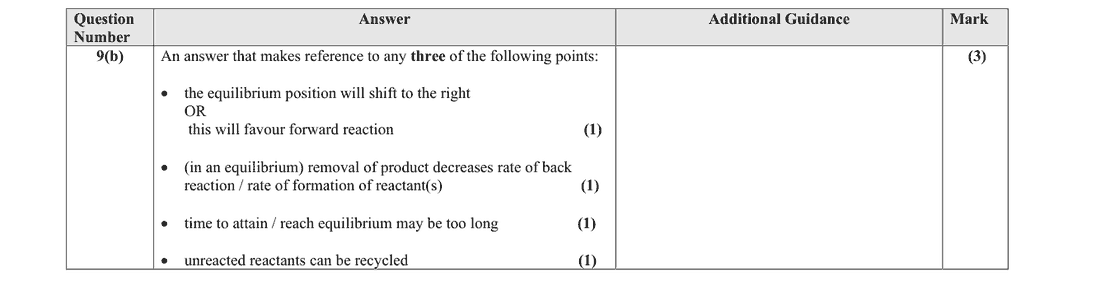
Any three from: removing the product shifts the equilibrium position to the right / favours the forward reaction
it reduces the rate of the backward reaction
reaching equilibrium may take too long
unreacted reactants can be recycled. Responses were generally not strong
November 2021 · Paper 3 · Q9(a)2 marksExplanation
Mark scheme
Examiner's comment
The majority of candidates could explain the effect of increasing the pressure on the
equilibrium yield of ammonia, with just a few confusing right and left. The unfamiliar
calculation in (b) was generally well answered, with marks available for substitution of correct
numbers into the expression and rearranging it. Many candidates were unable to substitute
the units into the expression to work out the units of Kc. The majority of candidates found
the calculate in (c) to be very challenging. Most candidates were unable to work out the
number of moles of each substance at equilibrium. However, they were able to score
transferred error marks if they could complete the calculation with their values.
Unfortunately, many were unable to work out the mole fractions and partial pressures. Some
candidates tried to use the ideal gas equation. Many candidates were able to substitute the
correct values into the expression in (d) and evaluate the right-hand side so received credit for
this. Some candidates were then able to rearrange the expression and calculate a correct
value for the equilibrium constant at 310 K.
Notes from the mark scheme and report
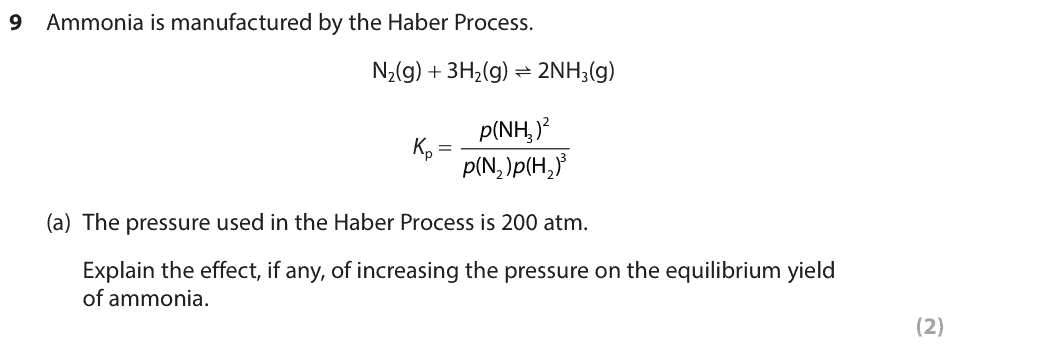
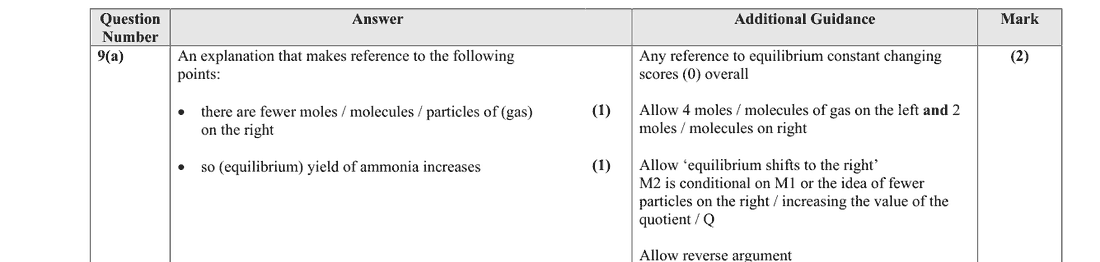
There are fewer moles of gas on the right (4 on the left, 2 on the right)
so the equilibrium yield of ammonia increases (equilibrium shifts to the right). Any statement that the equilibrium constant changes scores zero overall. A few confused left and right
October 2020 · Paper 1 · Q7(a)(i)1 markShort answerEasy
Mark scheme
Examiner's comment
The majority of candidates could write the correct equilibrium expression in (a)(i), with the
most common error being the omission of water. However, the unfamiliar style of calculation
in (ii) proved challenging for all but the most able. Most candidates did not consider that the
number of moles of product formed could be linked back to the moles of reactant remaining
and simply assumed that 1.2 mol of each reactant will still be left at equilibrium. Some did
appreciate the link, deducing 1.2 – x mol of reactant would remain, where x = the number of
moles product formed. Only a small number then realised they could input their findings into
equilibrium expression and simplify it by taking square roots, without the need for a quadratic
equation. Most candidates who scored 3 marks did so by writing and solving the quadratic
equation.
Questions similar in format to (b)(iii) have been asked many times, and the simplest answers
where often the highest scoring, based on the idea that only temperature affects Kp. Some of
those who started to discuss the position of the equilibrium moving to the right made the
mistake of thinking this would increase Kp, though perhaps more than in the past linked this
movement as a way of keeping Kp constant.
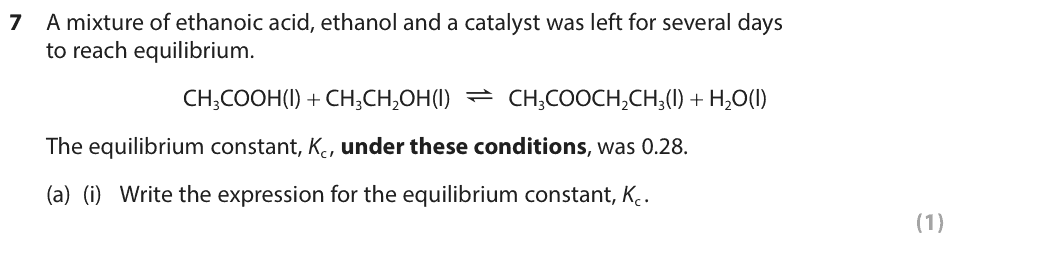
state symbols may be left out. The usual error was leaving out water
October 2020 · AS Paper 2 · Q4(b)(i)4 marksExplanation
Earlier part of question 4 that this part uses
Mark scheme
Examiner's comment
This was quite a standard question in examinations at this level and learners were able to
show their knowledge of energetics calculations and to explain the use of conditions in
industrial processes.
Notes from the mark scheme and report
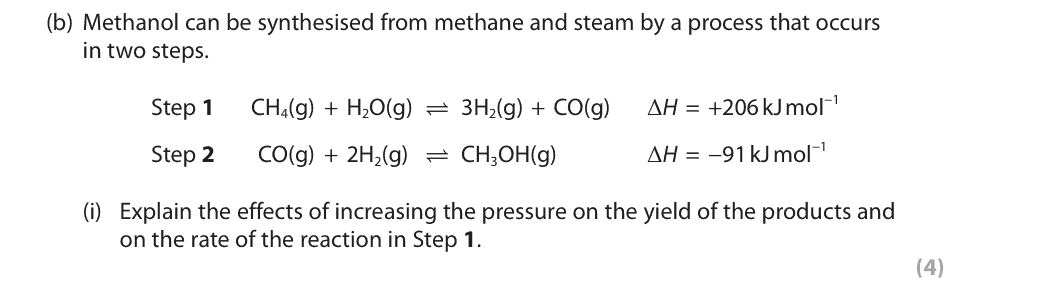
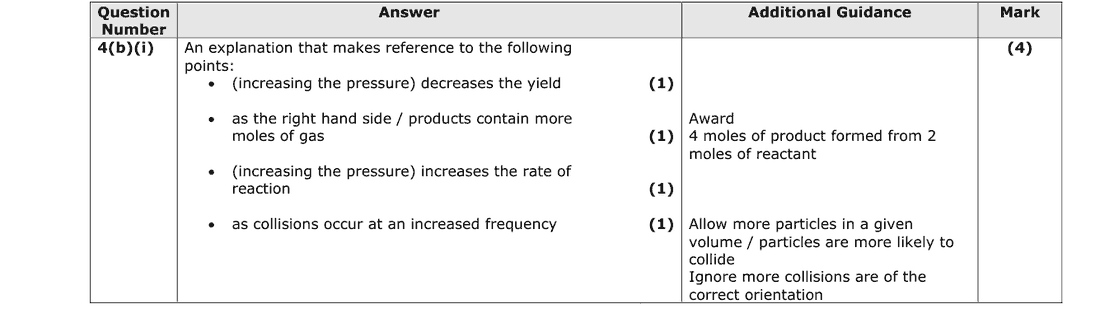
Increasing the pressure decreases the yield
because the right-hand side has more moles of gas (4 moles from 2)
it increases the rate
because collisions are more frequent (more particles in a given volume). 'More collisions with the correct orientation' is ignored
October 2020 · AS Paper 2 · Q4(b)(ii)3 marksExplanation
Earlier parts of question 4 that this part uses
Mark scheme
Examiner's comment
This was quite a standard question in examinations at this level and learners were able to
show their knowledge of energetics calculations and to explain the use of conditions in
industrial processes.
Notes from the mark scheme and report
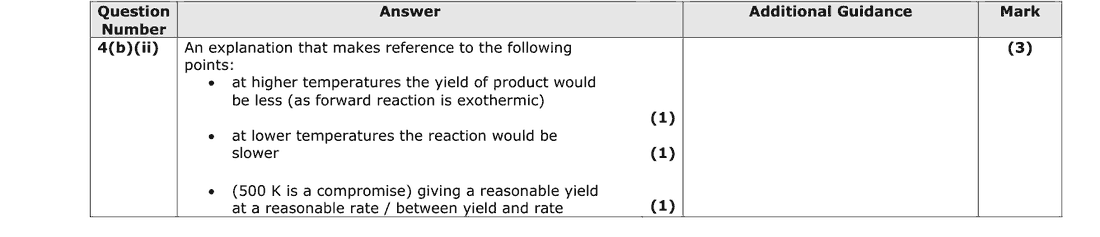
At higher temperatures the yield would be lower (the forward reaction is exothermic)
at lower temperatures the reaction would be slower
500 K gives a reasonable yield at a reasonable rate
June 2019 · Paper 1 · Q10(b)2 marksExplanation
Earlier part of question 10 that this part uses
Mark scheme
Examiner's comment
For the most part this question was answered well. Only a minority of candidates stated that the equilibrium shifted to the right which scored zero. Most candidates understood that the equilibrium position moved to the left but often simply stated that the hydroxide ions react with the hydrogen ions without referring to a decrease in concentration of the hydrogen ions or the formation of water which meant that no second mark was awarded. A small number of candidates mentioned a colour change due to the change in concentration of dichromate/chromate ions but this was irrelevant to the question set and gained no credit.
Notes from the mark scheme and report
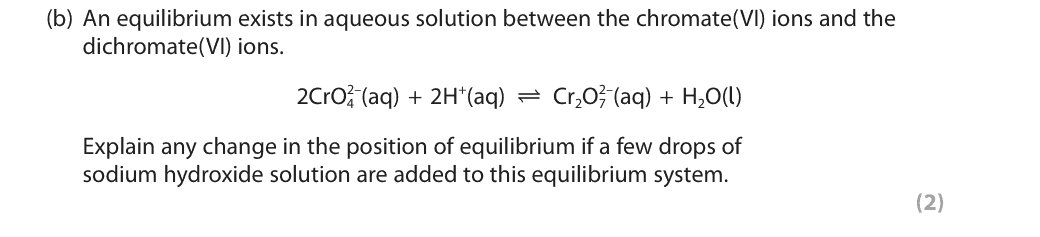
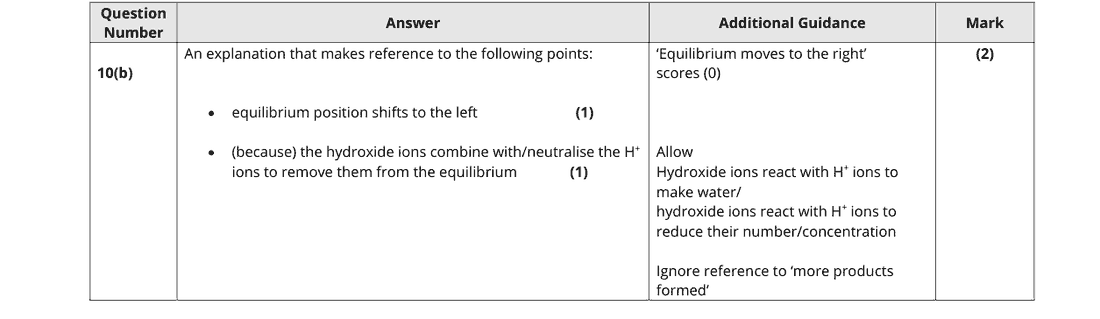
M1: the equilibrium position shifts to the left. M2: because the hydroxide ions react with the H+ ions (forming water), lowering their concentration. 'Moves to the right' scores 0. Mostly answered well
M2 was lost by saying only that OH– reacts with H+ without the fall in H+ concentration or the formation of water
colour changes were not asked for
June 2019 · Paper 1 · Q10(c)1 markMultiple choice
Earlier part of question 10 that this part uses
Answer
D
Mark scheme
Notes from the mark scheme and report
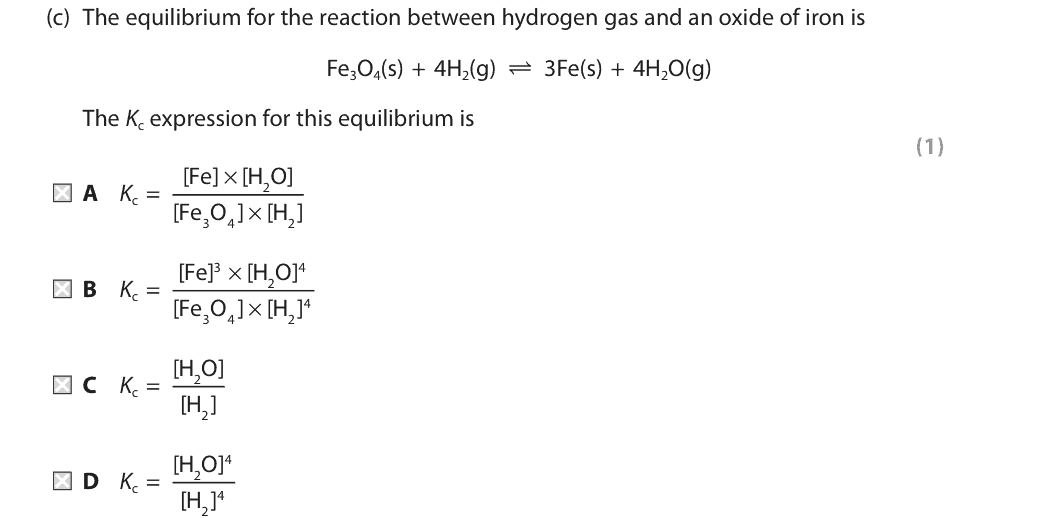
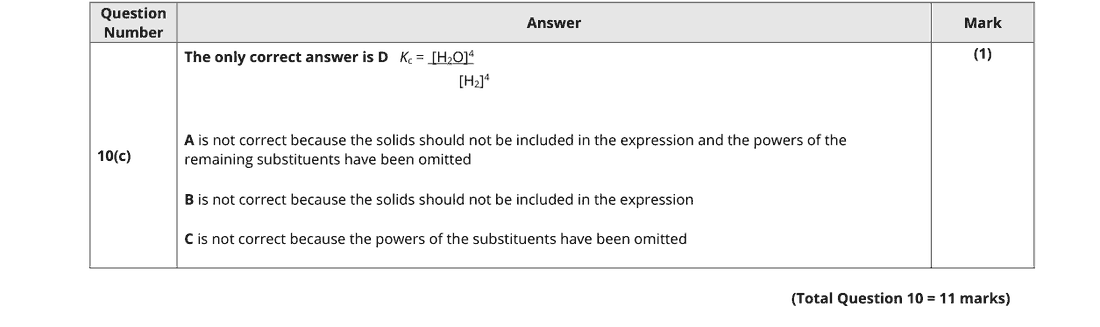
Answer: D. Kc = [H2O]^4 / [H2]^4: the solids Fe3O4 and Fe are left out of the expression and each concentration is raised to the power 4. A and B include the solids
C leaves out the powers
June 2019 · AS Paper 2 · Q4(a)2 marksShort answer
Mark scheme
Examiner's comment
This question had an industrial context. In the first part of the question learners sometimes lost marks for a lack of precision. Whilst the concentrations of the reactants and products remains constant at equilibrium they are only very rarely equal, so the use of the word ‘same’ in a question on this topic is difficult as this suggests they are equal as well as constant. However, it can be used to describe
the rates of reaction. Use of constant to describe concentrations and equal to describe rates is the best practice. Many candidates suggested the the equilibrium must carried out in a closed system. This is a condition required for many reactions to form an equilibrium, but is not a characteristic of the system so did not score even though it was often seen. The ideas in (b)(i) and (b)(ii) were very familiar and it was most common for candidates to score all 3 marks. In (c) many learners scored 1 mark, recognising that catalyst caused equilibrium to be approached more quickly or resulted in a lower activation energy but it was much less common to see this applied to an industrial advantage. Where this was given it was usually in terms of lower temperatures being required thus lowering costs.
Notes from the mark scheme and report
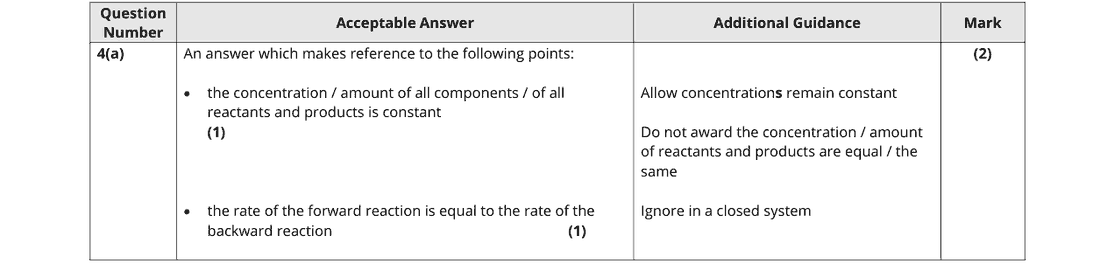
The concentrations (amounts) of all the reactants and products are constant
the rate of the forward reaction equals the rate of the backward reaction. Not concentrations 'equal' or 'the same'
'in a closed system' is ignored (a condition, not a characteristic) and was often given
June 2019 · AS Paper 2 · Q4(b)(i)1 markMultiple choice
Earlier part of question 4 that this part uses
Answer
B
Mark scheme
Examiner's comment
This question had an industrial context. In the first part of the question learners sometimes lost marks for a lack of precision. Whilst the concentrations of the reactants and products remains constant at equilibrium they are only very rarely equal, so the use of the word ‘same’ in a question on this topic is difficult as this suggests they are equal as well as constant. However, it can be used to describe
the rates of reaction. Use of constant to describe concentrations and equal to describe rates is the best practice. Many candidates suggested the the equilibrium must carried out in a closed system. This is a condition required for many reactions to form an equilibrium, but is not a characteristic of the system so did not score even though it was often seen. The ideas in (b)(i) and (b)(ii) were very familiar and it was most common for candidates to score all 3 marks. In (c) many learners scored 1 mark, recognising that catalyst caused equilibrium to be approached more quickly or resulted in a lower activation energy but it was much less common to see this applied to an industrial advantage. Where this was given it was usually in terms of lower temperatures being required thus lowering costs.
Notes from the mark scheme and report
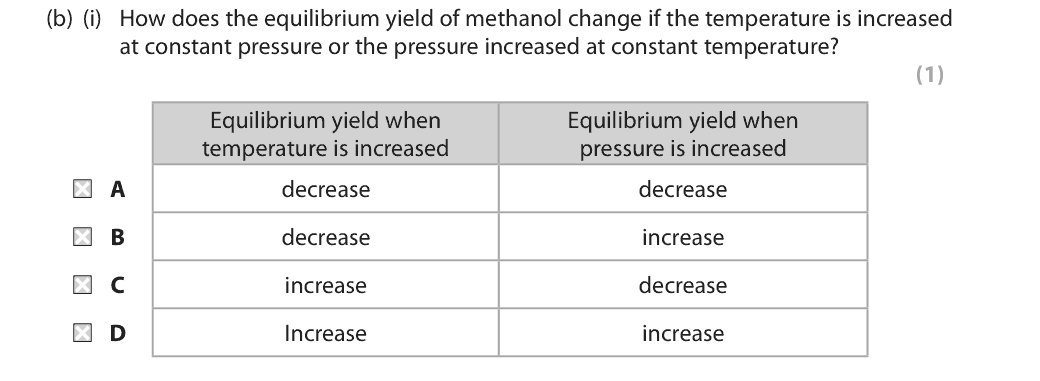
Answer: B (decrease / increase). The forward reaction is exothermic, so a higher temperature lowers the yield
there are fewer moles of gas on the right, so a higher pressure raises it
June 2019 · AS Paper 2 · Q4(b)(ii)2 marksExplanation
Earlier parts of question 4 that this part uses
Mark scheme
Examiner's comment
This question had an industrial context. In the first part of the question learners sometimes lost marks for a lack of precision. Whilst the concentrations of the reactants and products remains constant at equilibrium they are only very rarely equal, so the use of the word ‘same’ in a question on this topic is difficult as this suggests they are equal as well as constant. However, it can be used to describe
the rates of reaction. Use of constant to describe concentrations and equal to describe rates is the best practice. Many candidates suggested the the equilibrium must carried out in a closed system. This is a condition required for many reactions to form an equilibrium, but is not a characteristic of the system so did not score even though it was often seen. The ideas in (b)(i) and (b)(ii) were very familiar and it was most common for candidates to score all 3 marks. In (c) many learners scored 1 mark, recognising that catalyst caused equilibrium to be approached more quickly or resulted in a lower activation energy but it was much less common to see this applied to an industrial advantage. Where this was given it was usually in terms of lower temperatures being required thus lowering costs.
Notes from the mark scheme and report
Raising the temperature shifts the equilibrium in the endothermic direction, which is the backward reaction (allow: the forward reaction is exothermic so the left-hand side is favoured)
raising the pressure shifts it to the side with fewer moles of gas. Marked consequentially on a wrong answer to (b)(i)
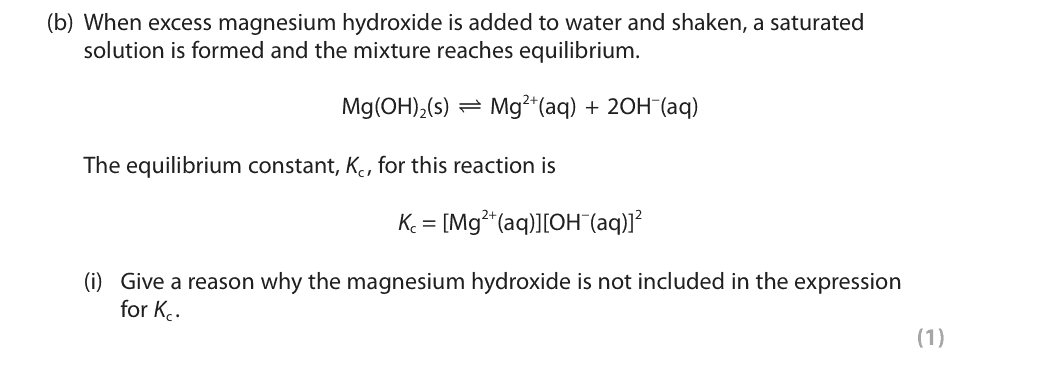
June 2018 · Paper 1 · Q6(b)(i)1 markShort answerHard
Earlier part of question 6 that this part uses
Mark scheme
Examiner's comment
Only a minority of candidates scored a mark for giving a reason why solids are not included in the expression for the equilibrium constant. Many candidates stated that magnesium hydroxide is a solid but did not follow this through with the idea that its concentration does not change. Some candidates thought that solids do not have a concentration or that it cannot be measured.
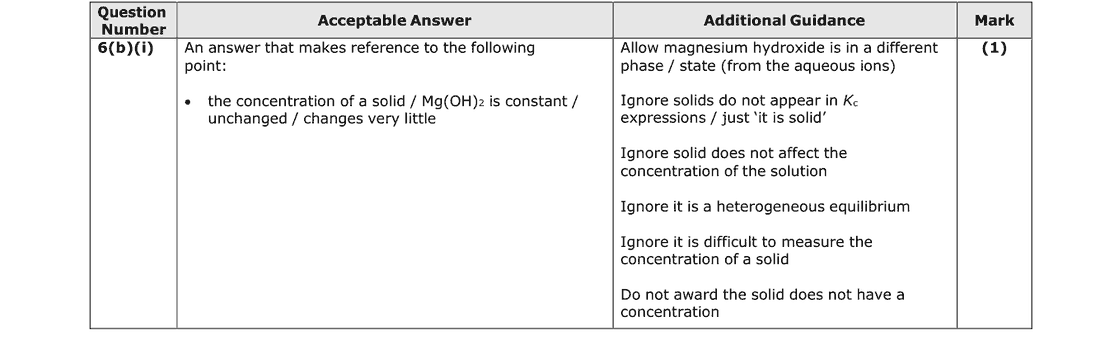
Notes from the mark scheme and report
The concentration of a solid (Mg(OH)2) is constant
allow that it is in a different phase from the aqueous ions. 'It is a solid', 'solids do not appear in Kc' and 'heterogeneous equilibrium' are not enough
'a solid has no concentration' is not credited. Many stopped at 'it is a solid'
June 2018 · Paper 1 · Q6(b)(iv)1 markMultiple choice
Earlier parts of question 6 that this part uses
Answer
D
Mark scheme
Notes from the mark scheme and report
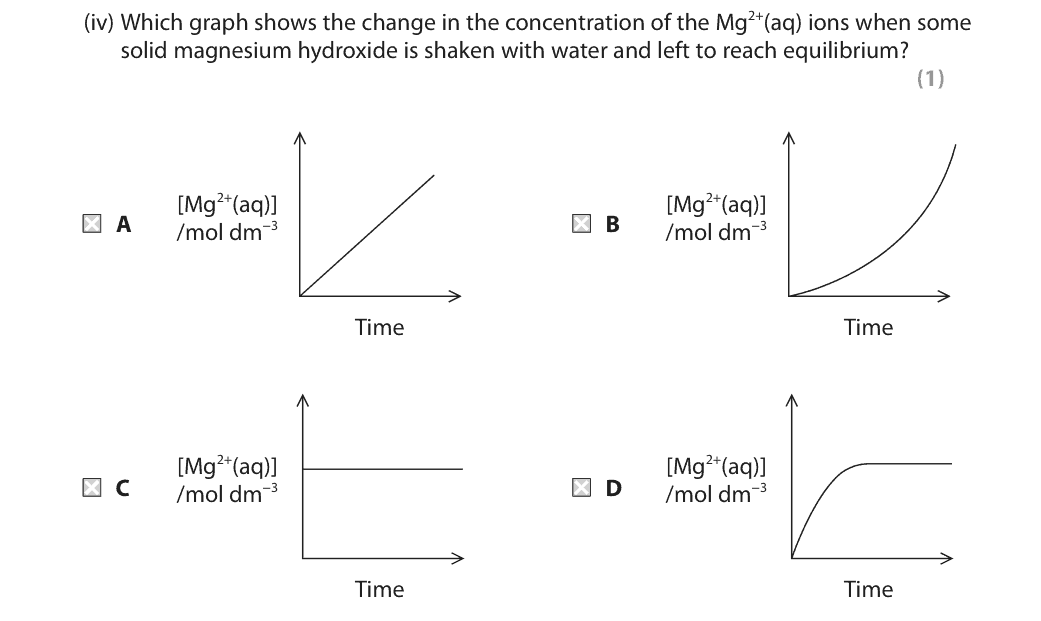
Answer: D. The concentration of Mg2+ rises quickly from zero, then levels off at equilibrium. A is linear and B curves upwards, with no levelling off
C is constant from the start
Skills: MS3.1 Translate information between graphical, numerical and algebraic forms
June 2018 · Paper 1 · Q6(b)(v)4 marksExplanation
Earlier parts of question 6 that this part uses
Mark scheme
Examiner's comment
Many candidates scored full marks for this question. Some candidates were confused between left and right and sometimes contradicted themselves by using both in the same sentence. It is acceptable to use forward and reverse directions instead. Some candidates did not realise that adding magnesium sulfate will increase the concentration of Mg2+ ions and that H+ ions from the hydrochloric acid react with the OH- ions. Very few candidates were penalised for writing that the equilibrium constant changes.
Notes from the mark scheme and report
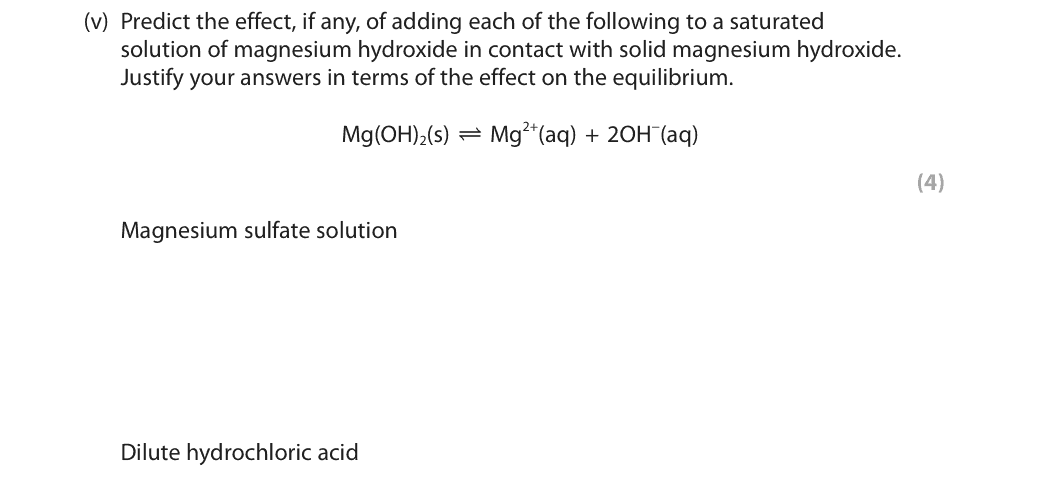
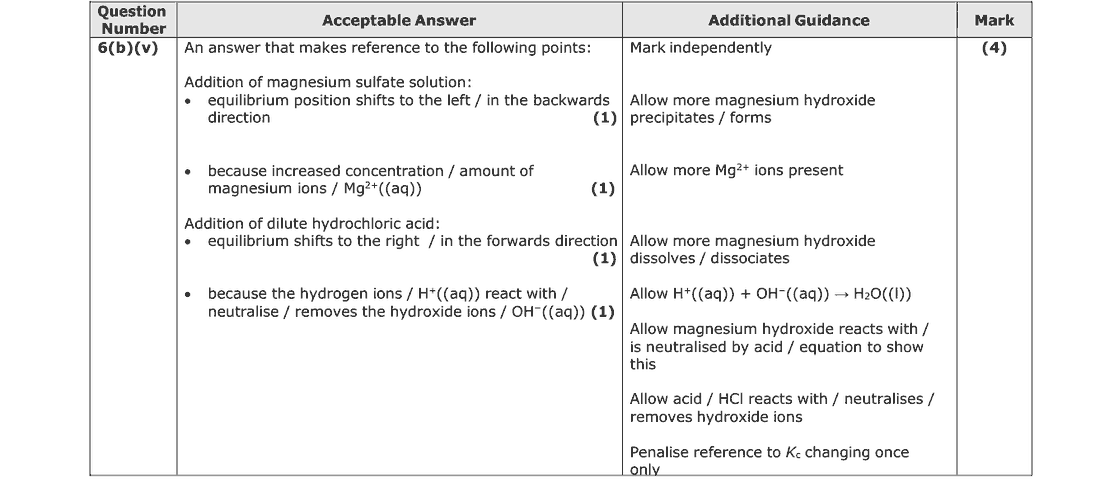
Magnesium sulfate: equilibrium shifts to the left (more Mg(OH)2 precipitates) because the concentration of Mg2+ ions increases. Hydrochloric acid: equilibrium shifts to the right (more Mg(OH)2 dissolves) because H+ ions react with / remove OH– ions. Four marks, marked independently
saying Kc changes is penalised once. Common errors: muddling left and right
not seeing that MgSO4 adds Mg2+ or that H+ removes OH–
June 2018 · Paper 1 · Q9(c)(iv)2 marksExplanation
Earlier part of question 9 that this part uses
Mark scheme
Examiner's comment
Many candidates scored 2 marks for this question as they considered the effect of changing the temperature on the yield of product and the rate of reaction. Some candidates only considered the rate of reaction and some wrote generally about 'favouring the reverse reaction' without linking it to the yield.
Notes from the mark scheme and report
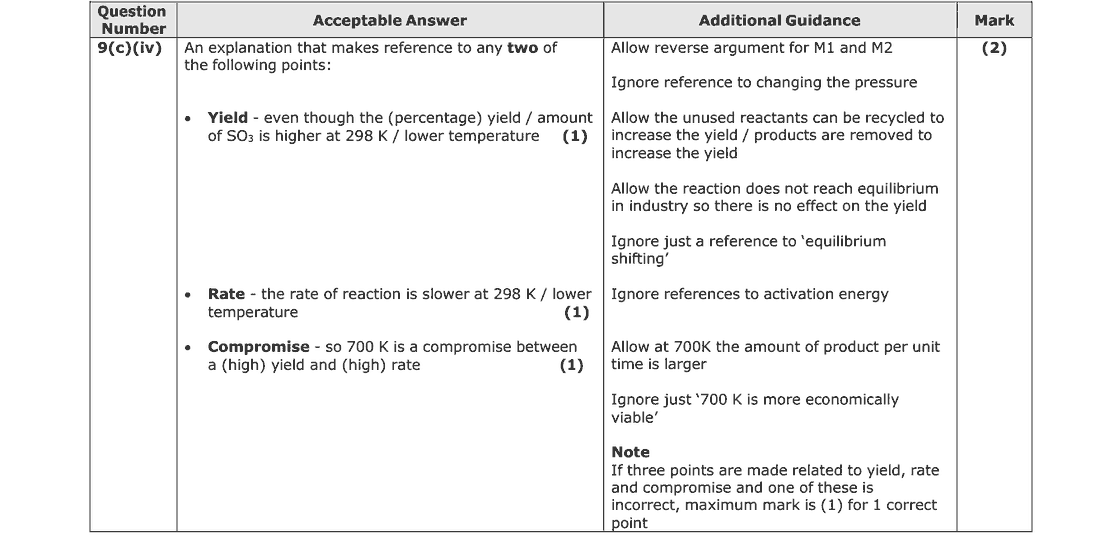
Any two of: the yield of SO3 is higher at 298 K (lower temperature)
the rate is slower at 298 K
so 700 K is a compromise between yield and rate. References to pressure and activation energy ignored
'more economically viable' alone ignored. If three points are made and one is wrong, maximum 1. Common errors: rate only
'favours the reverse reaction' with no link to yield
June 2018 · AS Paper 2 · Q3(a)2 marksShort answer
Mark scheme
Examiner's comment
M1: Problems included inverted expressions and the use of a + sign instead of a product.
M2: The units should be consistent with the expression as written.
kJ mol-1 was a relatively common error for the units.
Notes from the mark scheme and report
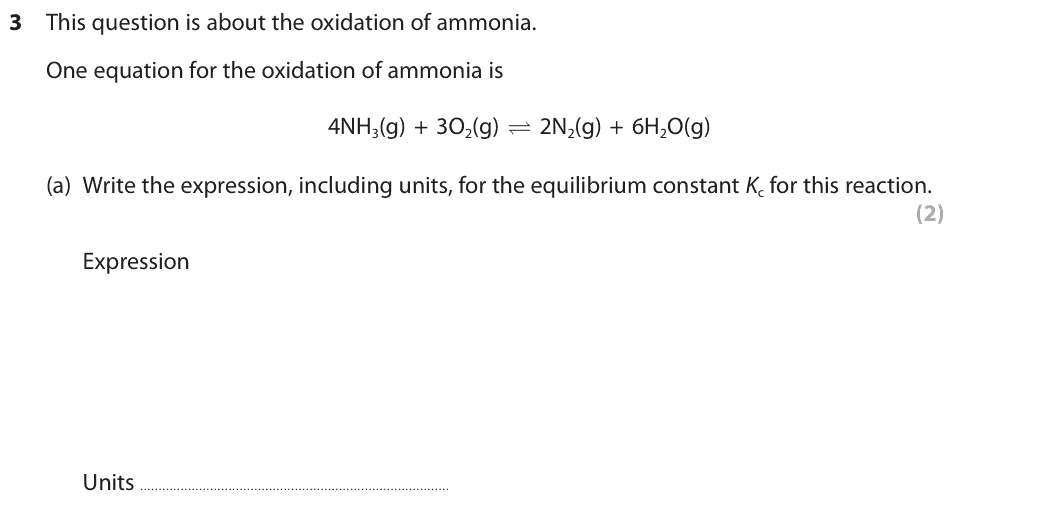
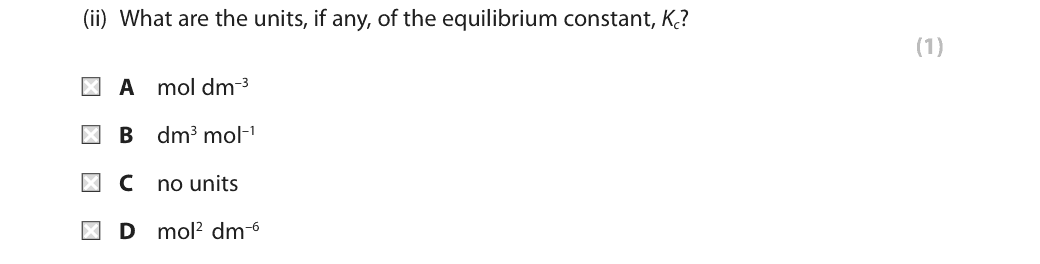
Kc = [N2]^2 [H2O]^6 / [NH3]^4 [O2]^3, units mol dm–3. Square brackets required (round brackets not credited)
state symbols can be missing. Units must match the candidate's own expression. Common errors: inverted expression
a + sign instead of a product
kJ mol–1 given as the units
Skills: MS0.0 Recognise and make use of appropriate units in calculation
June 2018 · AS Paper 2 · Q3(c)(i)2 marksExplanation
Earlier part of question 3 that this part uses
Mark scheme
Notes from the mark scheme and report
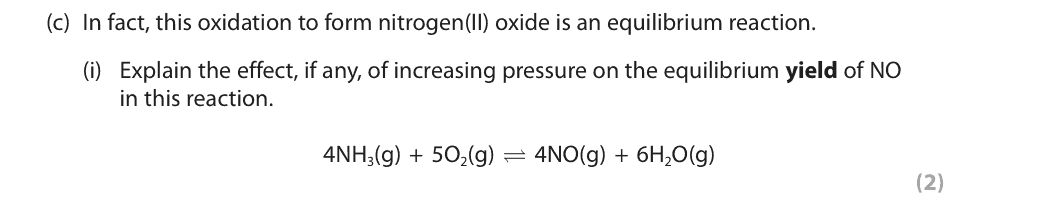
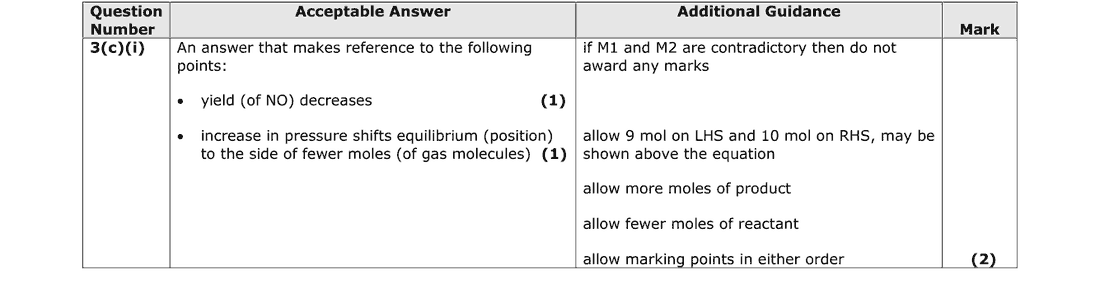
Yield of NO decreases
because the equilibrium shifts to the side with fewer moles of gas (9 mol on the left, 10 mol on the right). Points in either order
no marks if the two statements contradict each other
June 2018 · AS Paper 2 · Q3(c)(iii)2 marksShort answer
Earlier parts of question 3 that this part uses
Mark scheme
Examiner's comment
A heterogeneous catalyst is in a different state to the reactants. References to the products were ignored here.
The rates of the forward and reverse reaction are increased to the same extent, but this qualification was not required in order to award M2.
Notes from the mark scheme and report
Heterogeneous: the catalyst is in a different phase / state from the reactants (references to products ignored). No effect on yield because it increases the rates of both the forward and the backward reactions ('to the same extent' not required for the mark)
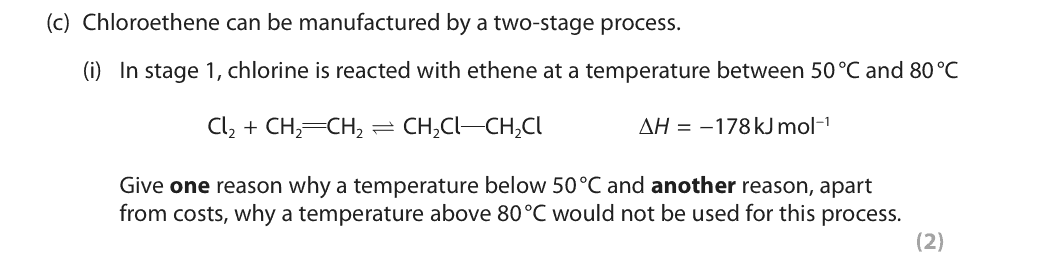
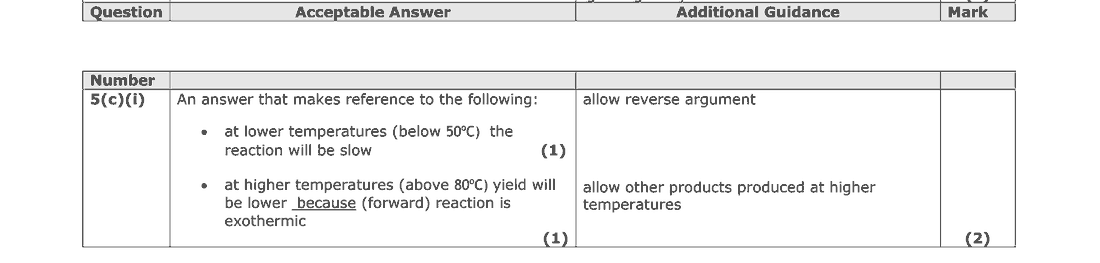
June 2018 · AS Paper 2 · Q5(c)(i)2 marksShort answer
Earlier part of question 5 that this part uses
Mark scheme
Examiner's comment
M1: This question required the candidate to discuss why a temperature below 50oC is not used. Simply, the rate of reaction will be (too) low. Discussions concerning the increased yield at lower temperatures would favour the use of low temperatures.
M2: Temperatures above 80oC are not used because the yield would be lower for this exothermic reaction. The exothermic nature of the forward reaction is essential to the answer.
Reverse arguments in terms of the endothermic nature of the reverse reaction were also accepted.
Answers relating to the possibility of other products at higher temperatures were rarely seen.
Notes from the mark scheme and report
Below 50 °C the reaction is too slow
above 80 °C the yield is lower because the forward reaction is exothermic (allow other products formed at higher temperatures
allow the reverse argument). 'Exothermic' is essential for the second mark. Some discussed the better yield at low temperature, which is not a reason against using it
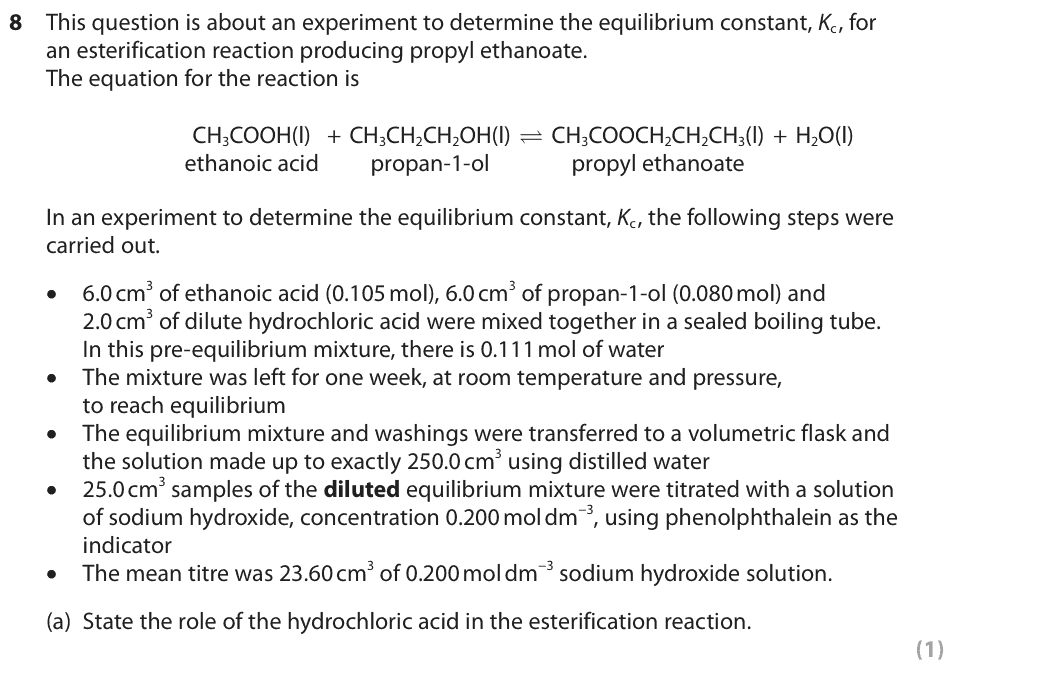
June 2018 · Paper 3 · Q8(d)(i)1 markShort answer
Earlier part of question 8 that this part uses
Mark scheme
Examiner's comment
Most candidates could construct the expression in (d)(i). Errors tended to either be the omission of a CH2 group from either the ester or the acid or leaving out water completely from the numerator. The idea of ‘volume cancels out’ was prevalent in (d)(ii). A common idea was to state that all substances were in the same state, which was not worth credit on its own. Candidates found it much more difficult to get across the idea of the same number of molecules on both sides of the equation, with the result that sometimes it was difficult to judge whether they were describing an equal number of moles of each substance in the equilibrium mixture. The best answers often used mathematical manipulation of the units in the expression to make their point.
A wide variety of transferred errors were credited in (d)(iii), although a pleasing number got the precise answer as per the mark scheme.
The expression is correct in (d)(i) and both marks in (d)(iii) are obtained through transferred errors. However in (d)(ii) only the volume has been considered when explaining why the use of amount in moles is acceptable.
Notes from the mark scheme and report
Kc = [CH3COOCH2CH2CH3][H2O] / [CH3COOH][CH3CH2CH2OH]. Square brackets required. Errors: a CH2 left out of the ester or acid formula
water left out of the numerator
June 2018 · Paper 3 · Q8(d)(ii)2 marksExplanation
Earlier parts of question 8 that this part uses
Mark scheme
Examiner's comment
Most candidates could construct the expression in (d)(i). Errors tended to either be the omission of a CH2 group from either the ester or the acid or leaving out water completely from the numerator. The idea of ‘volume cancels out’ was prevalent in (d)(ii). A common idea was to state that all substances were in the same state, which was not worth credit on its own. Candidates found it much more difficult to get across the idea of the same number of molecules on both sides of the equation, with the result that sometimes it was difficult to judge whether they were describing an equal number of moles of each substance in the equilibrium mixture. The best answers often used mathematical manipulation of the units in the expression to make their point.
A wide variety of transferred errors were credited in (d)(iii), although a pleasing number got the precise answer as per the mark scheme.
The expression is correct in (d)(i) and both marks in (d)(iii) are obtained through transferred errors. However in (d)(ii) only the volume has been considered when explaining why the use of amount in moles is acceptable.
Notes from the mark scheme and report
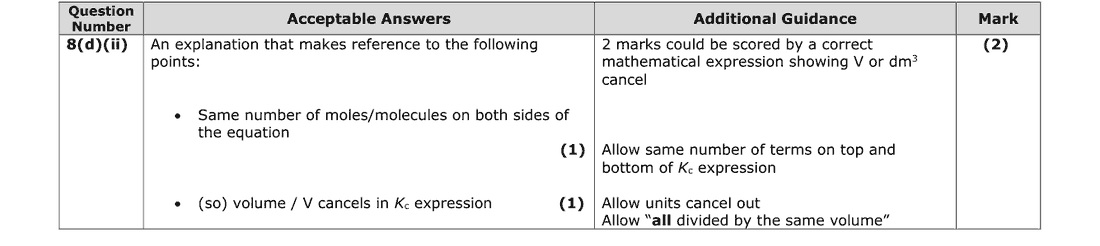
The same number of moles on each side of the equation (same number of terms top and bottom of the Kc expression)
so the volume cancels in the Kc expression (units cancel). A correct algebraic expression showing V cancelling scores both. 'All in the same state' earned nothing on its own
the mole point was the one more often missed
Skills: MS0.0 Recognise and make use of appropriate units in calculation
June 2018 · Paper 3 · Q8(e)2 marksExplanation
Earlier part of question 8 that this part uses
Mark scheme
Examiner's comment
Although many candidates may have noticed this observation in their own experimental work, only a minority were able to suggest a reason why. Many seemed to get the two colours of phenolphthalein the wrong way round, and suggested that excess alkali caused the change to colourless. Relatively basic answers were able to score a mark for a realisation that the solution had become more acidic, although only 13% of candidates were able to link this to either the equilibrium mixture or absorption of carbon dioxide.
Notes from the mark scheme and report
The equilibrium shifts to the left (or the mixture absorbs carbon dioxide from the air)
so the mixture becomes acidic again / the acid re-forms. Marked independently
not just 'pH decreases'. Many had the phenolphthalein colours the wrong way round and blamed excess alkali
only 13% linked the acidity to the equilibrium or to carbon dioxide
Skills: PT6 use acid-base indicators in titrations of weak/strong acids with weak/strong alkalis
June 2018 · Paper 3 · Q8(f)2 marksPractical and data analysis
Earlier part of question 8 that this part uses
Mark scheme
Examiner's comment
Whilst a substantial minority appreciated the need to study the equilibrium over an extended time period, answers tended to lack precision and it was not always clear whether candidates wanted to leave the initial experiment running or begin collecting an entirely new set of data. Equally when considering how to use their findings, vague suggestions such as ‘see if the results are the same’ were common.
Notes from the mark scheme and report
Repeat the experiment leaving the mixture for longer than a week (or check titres during the first week)
the titre or Kc value stays the same if equilibrium has been reached. pH probes ignored
'results unchanged' alone is not enough. Answers were often vague about whether a new experiment was set up and about what would be compared
June 2017 · Paper 1 · Q10(a)(ii)2 marksExplanationEasy
Earlier part of question 10 that this part uses
Mark scheme
Examiner's comment
The majority of candidates scored 2 marks for this question. Some candidates thought there would be no change in the equilibrium position as they stated there are the same number of moles on each side of the equation. Some candidates omitted to mention gas when writing about fewer moles on the left. Some candidates tried to explain this in terms of the quotient but their answers were often confused and they rarely scored full marks. A straightforward answer in terms of fewer moles of gas on the left so the equilibrium position moves to the left is sufficient here. A small number of candidates wrote contradictory statements and lost a mark: for example, they wrote that more reactants are formed so the equilibrium position shifts to the right.
Notes from the mark scheme and report
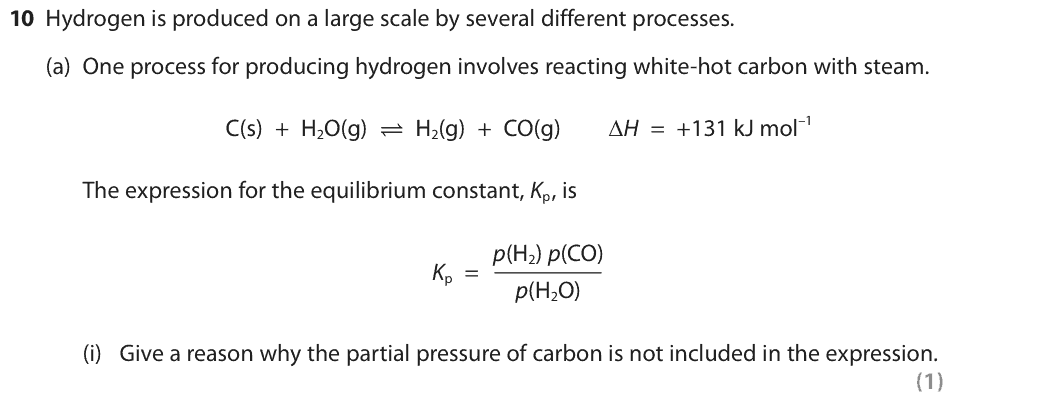
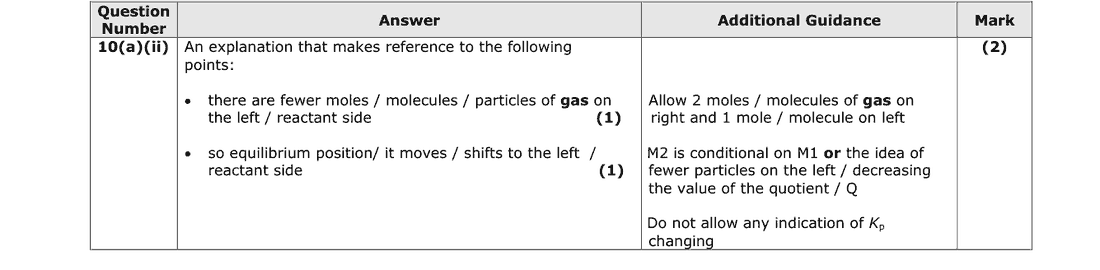
M1: there are fewer moles of gas on the left (1 mol of gas on the left, 2 on the right). M2 (conditional on M1): so the equilibrium position moves to the left. No suggestion that Kp changes. Common errors: 'same number of moles on each side' (counting the solid carbon) so no change
leaving out 'gas'
muddled quotient arguments
contradictions such as 'more reactants so shifts right'
June 2017 · Paper 1 · Q10(b)3 marksExplanation
Earlier part of question 10 that this part uses
Mark scheme
Examiner's comment
Candidates found it difficult to express their ideas clearly to explain what would happen in this question. There were many vague answers and candidates should give careful consideration to all the information given. Many candidates did not read the question carefully and assumed that the reaction was at equilibrium at the start and then it would shift left as there are more moles on the right; this idea scored 1 mark. In the best answers, candidates realised that at equilibrium, the numbers of moles of reactants and products must be equal so the number of moles of the products needs to decrease and the number of moles of reactants to increase to achieve this.
Notes from the mark scheme and report
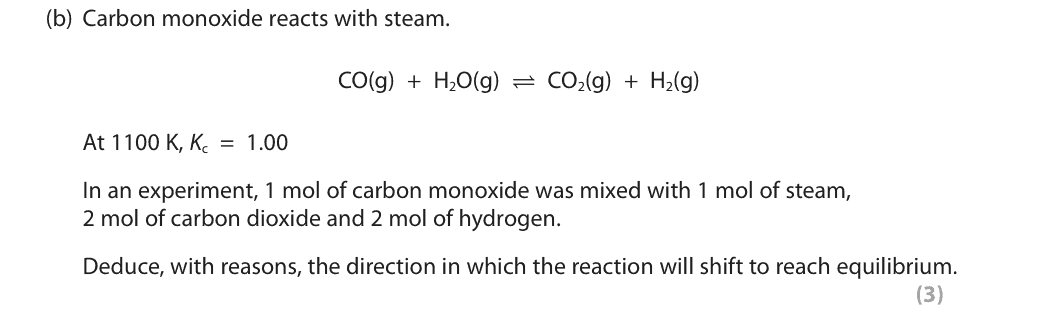
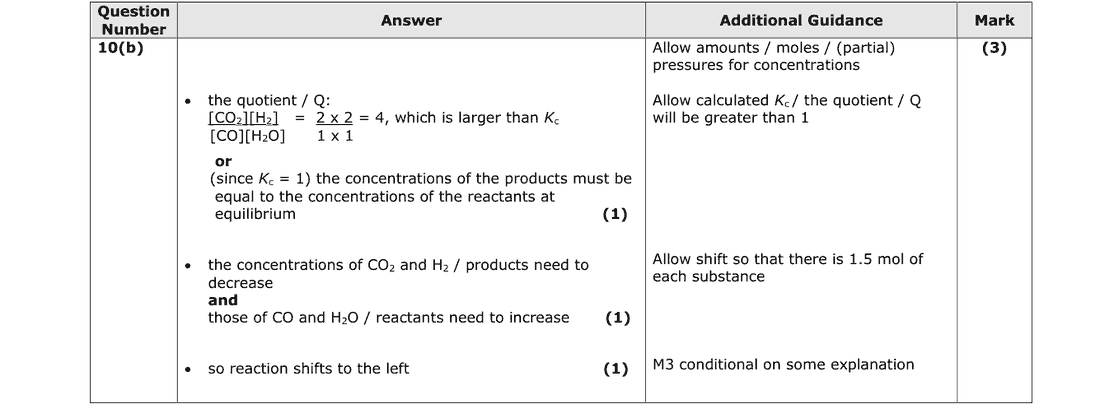
M1: the quotient [CO2][H2] / [CO][H2O] = (2 × 2) / (1 × 1) = 4, larger than Kc (or: as Kc = 1 the product and reactant concentrations must be equal at equilibrium). M2: so the concentrations of CO2 and H2 must fall and those of CO and H2O rise (to 1.5 mol of each). M3: so the reaction shifts to the left (needs some explanation). Moles may be used for concentrations. Candidates found it hard to express: many assumed the mixture was already at equilibrium and argued from 'more moles on the right', which scored 1
Skills: MS0.2 Use ratios, fractions and percentages; MS2.1 Understand and use the symbols: =, <, <<, >>, >, ∝, ~, equilibrium sign
June 2017 · AS Paper 2 · Q6(a)6 marks6-mark extended response
Mark scheme, with the indicative content and the marks for reasoning
Examiner's comment
This question required candidates to consider the effects of temperature and pressure changes on a gaseous equilibrium reaction.
There are six indicative points. These relate to the effect of temperature change on rate, yield and costs, then the effect of pressure change on rate, yield and costs.
The indicative points are then scaled and up to 2 marks are also available for the reasoning.
The catalyst used in the reaction was unchanged and therefore was not considered.
The effect of increased temperature on costs required candidates to think about the increasing energy requirements in order to achieve higher temperatures.
The effect of higher pressure on the rate of reaction has two possible answers. Many candidates recognised that an increase in pressure is equivalent to an increase in gas concentration; they then argued correctly for an increase in rate. However, in a homogeneous gas-catalysed reaction the active sites on the catalyst are probably already saturated and therefore an increase in gas pressure will have no effect on rate. This response was seen very rarely.
Common errors included not giving reasons for the effect of increased temperature and pressure on the yield (i.e. the effect of increased temperature on an exothermic reaction, and the effect of increased pressure on a reaction where the number of gas moles changes in moving from reactants to products). One rescue mark was available for candidates who did not justify both their yield predictions.
Notes from the mark scheme and report
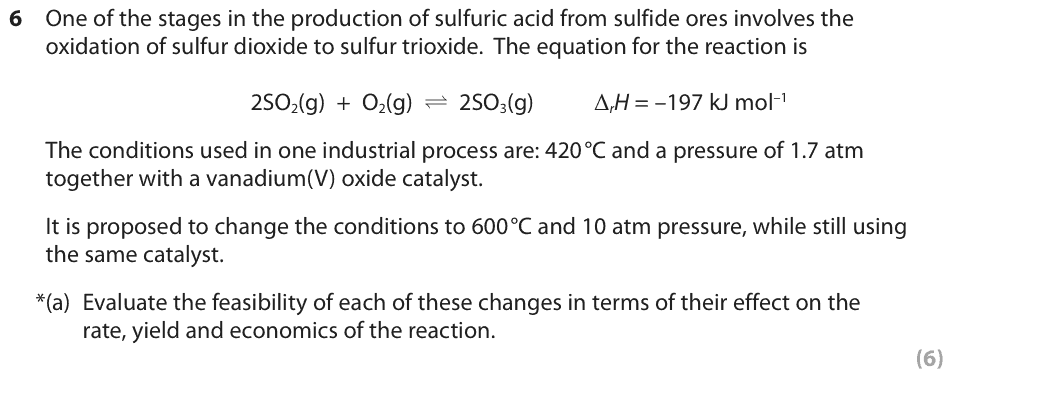
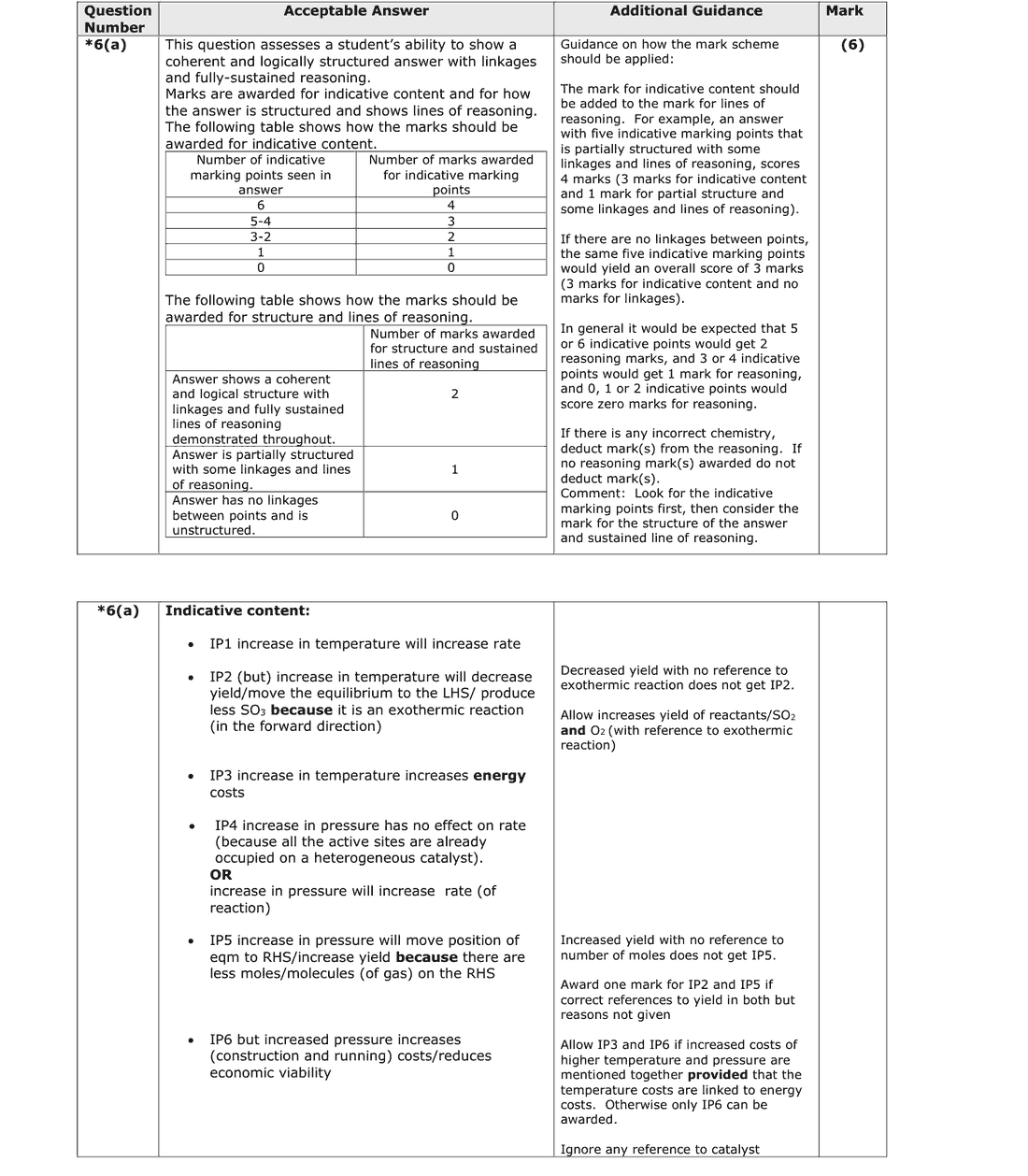
Six indicative points plus two marks for reasoning. IP1 higher temperature increases the rate
IP2 higher temperature decreases the yield / moves the equilibrium to the left because the forward reaction is exothermic
IP3 higher temperature increases energy costs
IP4 higher pressure increases the rate (or has no effect because the active sites on the heterogeneous catalyst are already occupied)
IP5 higher pressure increases the yield / moves the equilibrium to the right because there are fewer moles of gas on the right
IP6 higher pressure increases construction and running costs. Yield statements without the reason do not score IP2 or IP5 (one mark between them if both yields are right with no reasons). Ignore references to the catalyst. Common error: yield predictions not justified
the 'no effect on rate' alternative was seen very rarely
June 2017 · AS Paper 2 · Q6(c)(i)1 markShort answer
Earlier part of question 6 that this part uses
Mark scheme
Examiner's comment
The expression for the equilibrium constant did not require the inclusion of Kc.
States were not required.
Square brackets are essential to denote concentration.
Most candidates answered this well but occasionally the terms in the denominator were summed, or the expression was inverted.
Round brackets were very rarely seen.
state symbols and units ignored. The usual error was writing I and H instead of I2 and H2
June 2017 · Paper 3 · Q9(a)(ii)2 marksShort answer
Earlier part of question 9 that this part uses
Mark scheme
Examiner's comment
Dealing with a ratio other than 1:1 in equilibria has always provided a degree of challenge and this was evident in part (ii). Most candidates managed to correctly deduce the numerator. However, far fewer could process the information to find the denominator. The most common incorrect responses were ‘a 2 ’ or ‘(a-2y) 2’.
Notes from the mark scheme and report
Kc = 4y^2 / (a – y)^2. One mark for the numerator (allow (2y)^2), one for the denominator (allow a^2 – 2ay + y^2 or (a – y)(a – y))
Skills: MS2.1 Understand and use the symbols: =, <, <<, >>, >, ∝, ~, equilibrium sign
June 2016 · AS Paper 2 · Q2(c)(i)1 markShort answer
Earlier part of question 2 that this part uses
Mark scheme
Examiner's comment
The majority of candidates worked out that the yield of ethanol decreases as the temperature increases. Some candidates just stated that the equilibrium position shifts to the left without stating the effect on the yield so they did not score the mark. A few candidates contradicted themselves and stated that the yield of ethanol decreases as the equilibrium position shifts to the right so they did not score a mark.
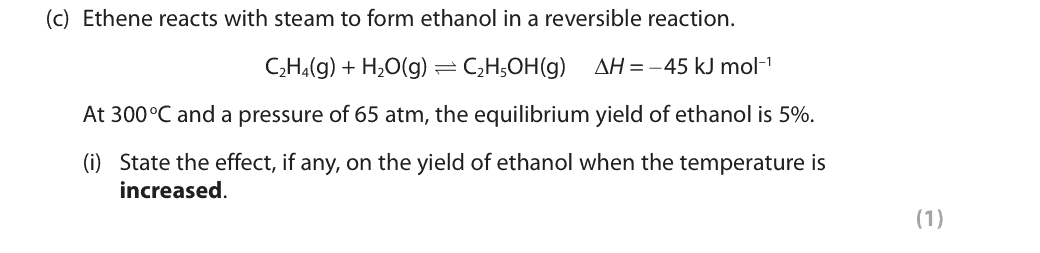
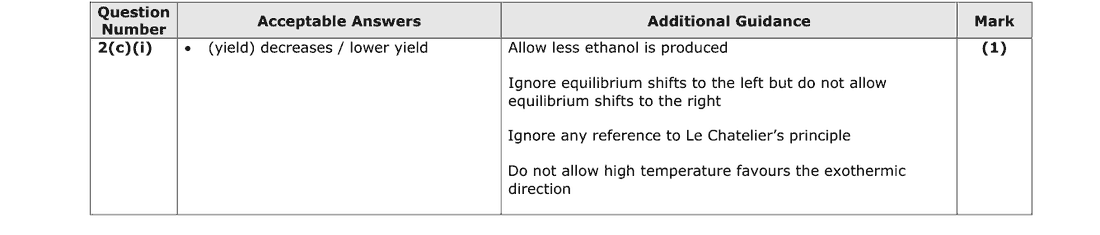
Notes from the mark scheme and report
Answer: the yield decreases (less ethanol), because the forward reaction is exothermic. 'Equilibrium shifts to the left' alone does not score, and 'shifts to the right' loses the mark. Common errors: giving only the shift, or contradicting a lower yield with a shift to the right
June 2016 · AS Paper 2 · Q2(c)(ii)1 markShort answer
Earlier parts of question 2 that this part uses
Mark scheme
Examiner's comment
Surprisingly, slightly fewer candidates gave the correct answer to this question than 2(c)(i). Possibly some candidates did not read the question carefully and they assumed that it referred to an increase in pressure. There were fewer contradictory statements here.
Notes from the mark scheme and report
Answer: the yield decreases (less ethanol): two moles of gas on the left, one on the right. 'Shifts to the left' alone is ignored
'shifts to the right' loses the mark. Slightly fewer were right than in (i), perhaps by reading it as an increase in pressure
June 2016 · AS Paper 2 · Q2(c)(iii)1 markMultiple choice
Earlier parts of question 2 that this part uses
Answer
D
Mark scheme
Notes from the mark scheme and report
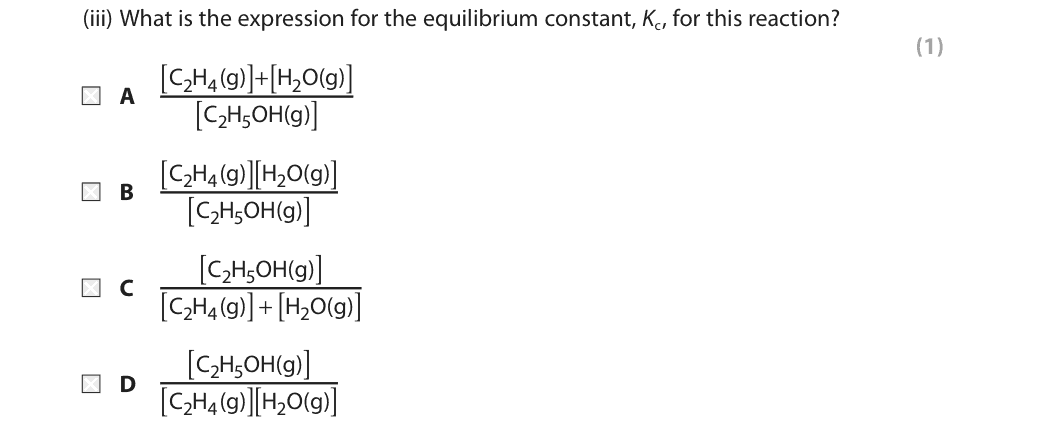
Answer: D. Kc = [C2H5OH(g)] / ([C2H4(g)][H2O(g)]): products over reactants, concentrations multiplied. A and C add the reactant concentrations
B is upside down
Work with an A-level chemistry tutor
Dropping marks on calculations, mechanisms or the core practicals? Book a trial session with an A-level chemistry tutor.