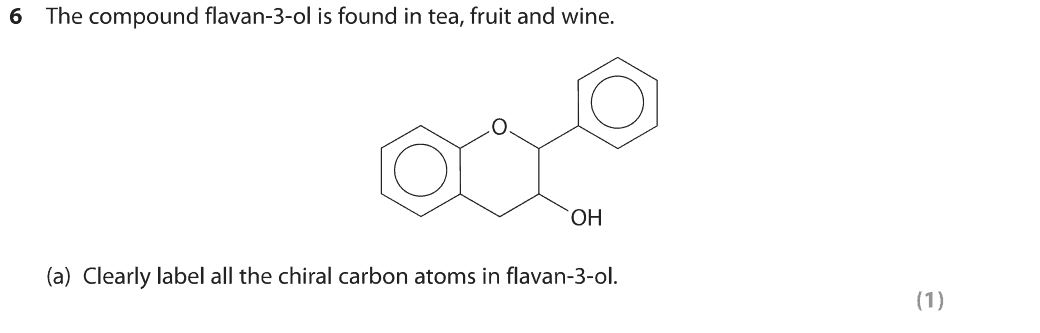
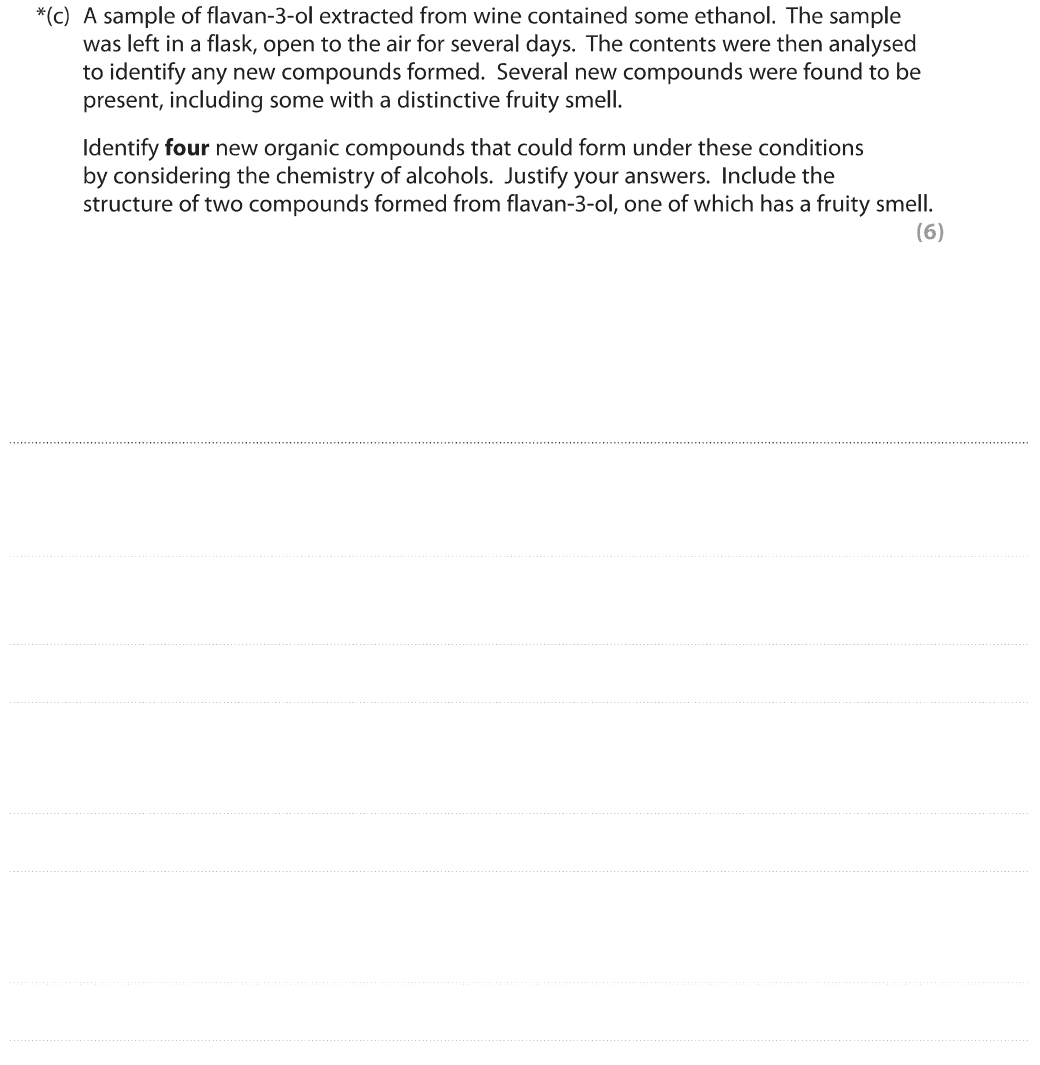
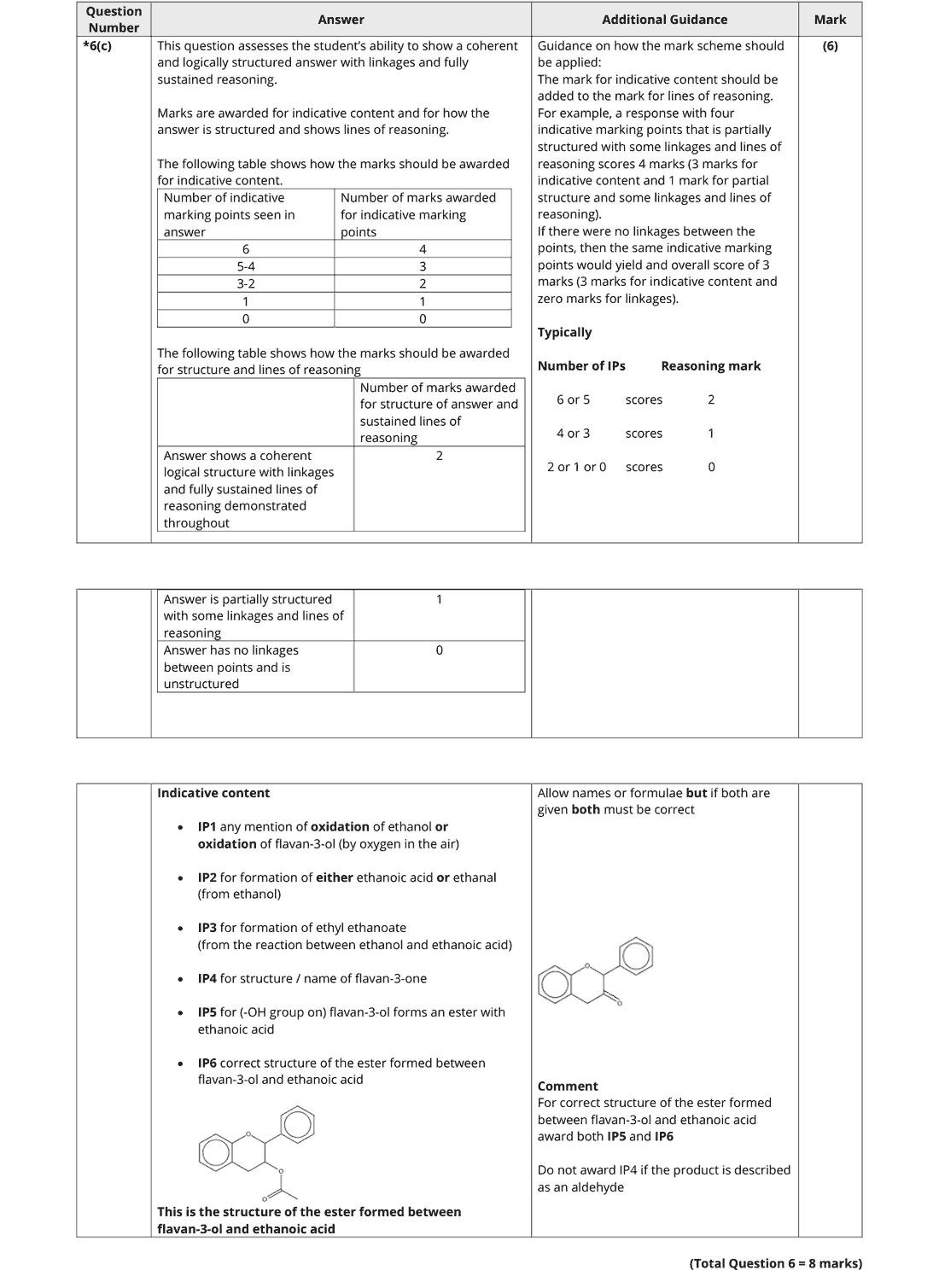
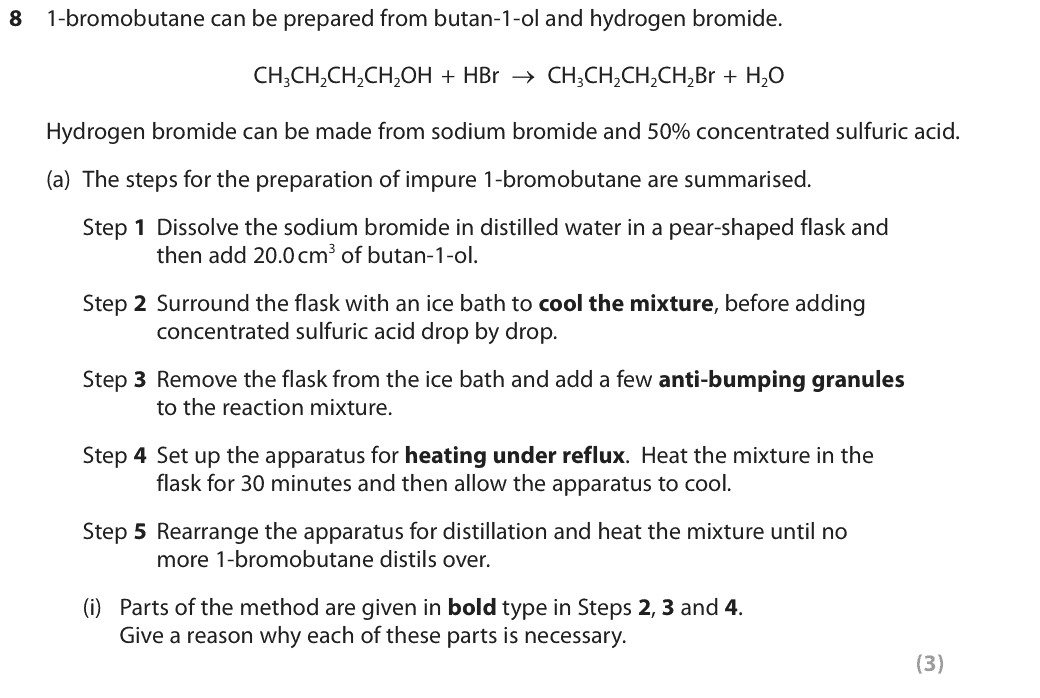
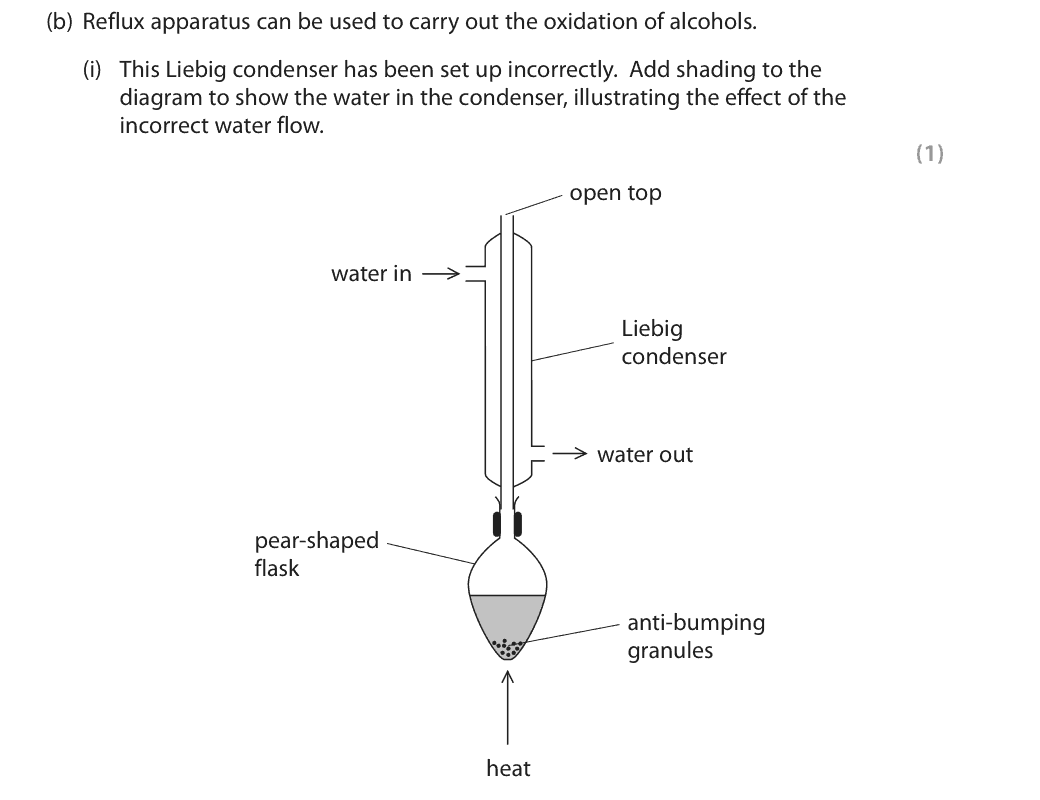
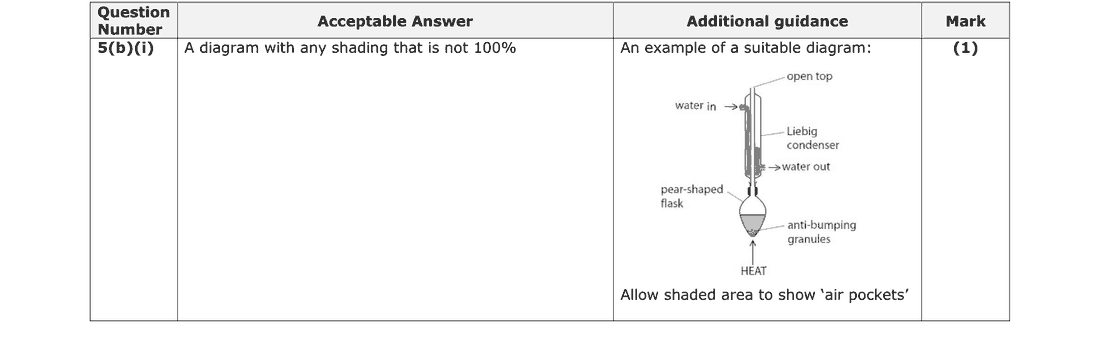
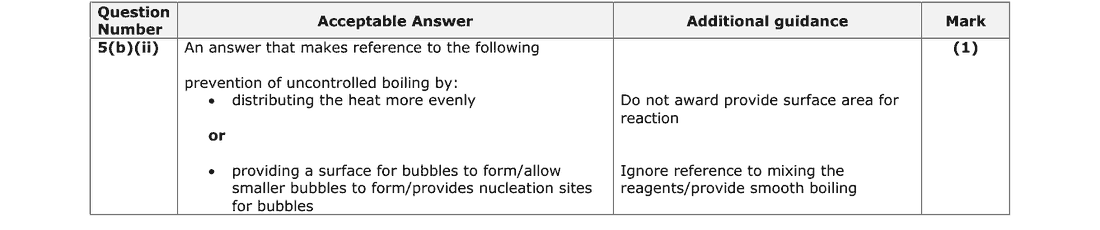
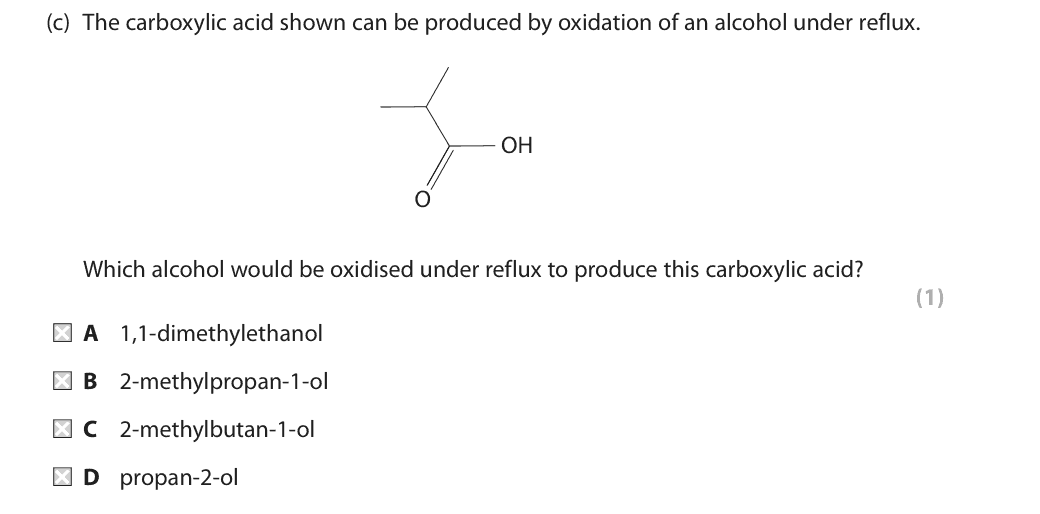
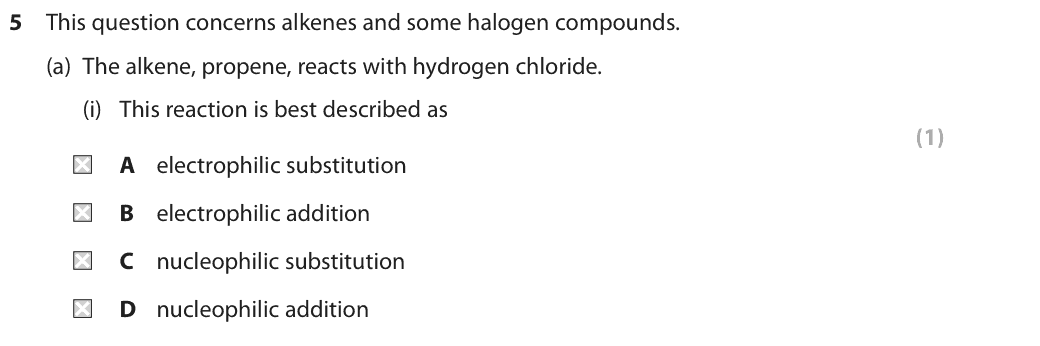
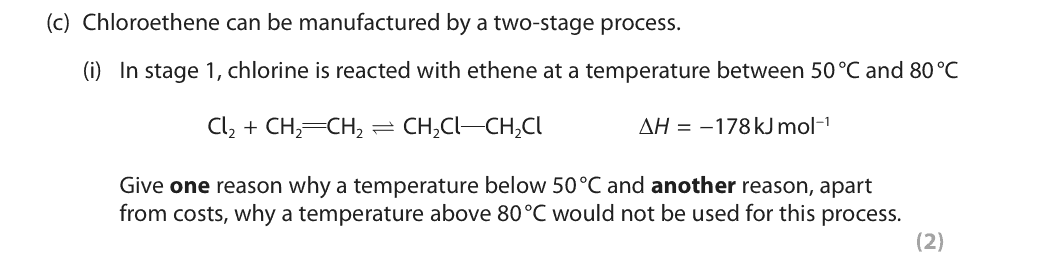
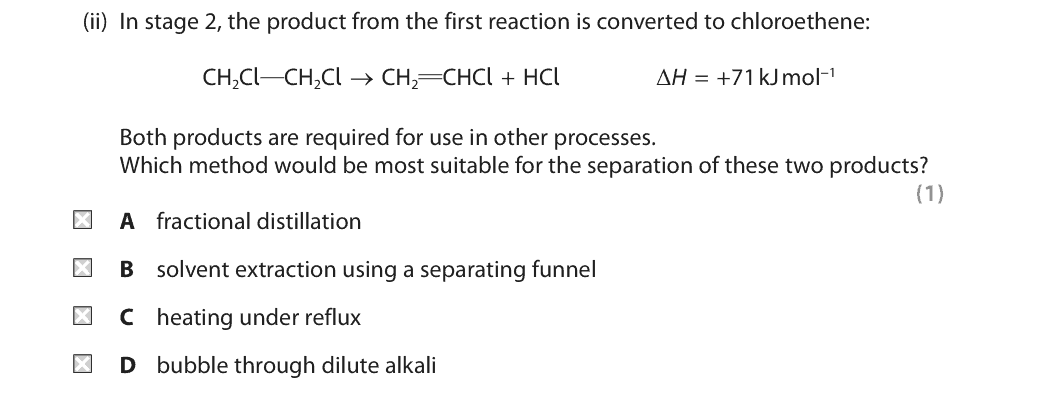
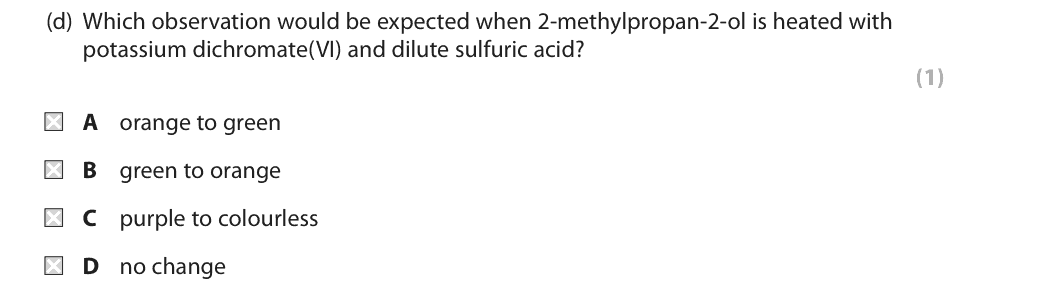
Notes and key-term cards for this topic are being written by our tutors. The past-paper questions below are ready now.
Specification statements
Show the 3 statements from the specification
6.37 know that alcohols can be classified as primary, secondary or tertiary
6.38 understand the reactions of alcohols with: • i oxygen in air (combustion) • ii halogenating agents: • PCl5 to produce chloroalkanes • 50% concentrated sulfuric acid and potassium bromide to produce bromoalkanes • red phosphorus and iodine to produce iodoalkanes • iii potassium dichromate(VI) in dilute sulfuric acid to oxidise primary alcohols to aldehydes (including a test for the aldehyde using Benedict’s/Fehling’s solution) and carboxylic acids, and secondary alcohols to ketones • iv concentrated phosphoric acid to form alkenes by elimination [In equations, the oxidising agent can be represented as [O]. Descriptions of the mechanisms of these reactions are not expected.]
6.39 understand the following techniques used in the preparation and purification of a liquid organic compound: • i heating under reflux • ii extraction with a solvent in a separating funnel • iii distillation • iv drying with an anhydrous salt • v boiling temperature determination
Six-mark extended response questions on this topic
Tap a question to zoom it. Where a part needs a figure, table or structure from earlier in the question, that part folds out above it; the mark scheme and examiner's comment open underneath. Have Edexcel's Data Booklet beside you; the Periodic Table is on the back page of every paper.
June 2025 · AS Paper 2 · Q6(a)1 markMultiple choice
Answer
A
Mark scheme
Examiner's comment
This question was about the reactions of two alcohols and included calculations as well as the description of an organic preparation. (a) This multiple-choice question was very well answered. (bi) Most candidates scored at least two marks. Common errors included incorrect Mr values and stoichiometric ratios (bii) This extended response on a standard practical was very challenging. Many mentioned reflux but described distillation instead. Some suggested inappropriate apparatus such as beakers, conical flasks, volumetric flasks and burettes. Descriptions were often incomplete or incorrect. Many included a thermometer and a bung in the reflux, which would have sealed the system. Distillation following from reflux was rarely seen. While many correctly mentioned the use of a thermometer for distillation, few referred to the still head, and the condenser was often incorrectly positioned horizontally rather than sloping. Candidates frequently included details about water flow in the condenser and the function of anti-bumping granules—both correct but not required in this context. Candidates must remember to move away from giving stock answers and instead address what is being asked. A number of candidates confused this practical with the halogenation of an alcohol, leading to inappropriate suggestions such as using a separating funnel followed by the addition of sodium hydrogencarbonate solution to remove acid impurities. On a more positive note, many could name a suitable drying agent, though fewer described how to remove the dried butanone afterwards. A surprising number of candidates thought that leaving the product on a windowsill or patting with tissue papers was the way to get dry butanone.
Very few candidates included the final distillation , which was essential for full credit. (c) Many candidates identified the correct product but lost the mark for using the structural formula instead of the required skeletal formula. (di) Most scored the first and third marks here, but many struggled with the stoichiometric ratio - some missed it, and others inverted it. (dii) Many fully correct answers were seen, although a sizeable number correctly calculated the experimental and theoretical amounts of product but then got very mixed up, so they divided the experimental yield by the sum of the theoretical and experimental yields. (6e) This apparently straightforward question was answered incorrectly by a large number of candidates – the basic structural formula representing an aldehyde was rarely known and there were many incorrect molecular formulas for the isomers.
Notes from the mark scheme and report
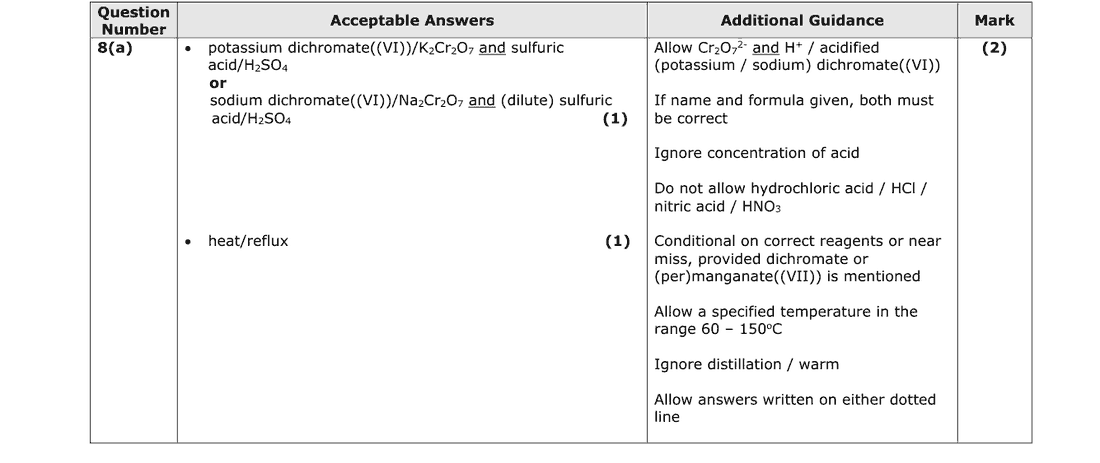
Answer: A. C4H9OH + PCl5 → C4H9Cl + POCl3 + HCl. Water, chlorine, phosphorus, PO and HOCl are not products
June 2025 · AS Paper 2 · Q6(b)(ii)6 marks6-mark extended responseHard
Earlier parts of question 6 that this part uses
Mark scheme, with the indicative content and the marks for reasoning
Examiner's comment
This question was about the reactions of two alcohols and included calculations as well as the description of an organic preparation. (a) This multiple-choice question was very well answered. (bi) Most candidates scored at least two marks. Common errors included incorrect Mr values and stoichiometric ratios (bii) This extended response on a standard practical was very challenging. Many mentioned reflux but described distillation instead. Some suggested inappropriate apparatus such as beakers, conical flasks, volumetric flasks and burettes. Descriptions were often incomplete or incorrect. Many included a thermometer and a bung in the reflux, which would have sealed the system. Distillation following from reflux was rarely seen. While many correctly mentioned the use of a thermometer for distillation, few referred to the still head, and the condenser was often incorrectly positioned horizontally rather than sloping. Candidates frequently included details about water flow in the condenser and the function of anti-bumping granules—both correct but not required in this context. Candidates must remember to move away from giving stock answers and instead address what is being asked. A number of candidates confused this practical with the halogenation of an alcohol, leading to inappropriate suggestions such as using a separating funnel followed by the addition of sodium hydrogencarbonate solution to remove acid impurities. On a more positive note, many could name a suitable drying agent, though fewer described how to remove the dried butanone afterwards. A surprising number of candidates thought that leaving the product on a windowsill or patting with tissue papers was the way to get dry butanone.
Very few candidates included the final distillation , which was essential for full credit. (c) Many candidates identified the correct product but lost the mark for using the structural formula instead of the required skeletal formula. (di) Most scored the first and third marks here, but many struggled with the stoichiometric ratio - some missed it, and others inverted it. (dii) Many fully correct answers were seen, although a sizeable number correctly calculated the experimental and theoretical amounts of product but then got very mixed up, so they divided the experimental yield by the sum of the theoretical and experimental yields. (6e) This apparently straightforward question was answered incorrectly by a large number of candidates – the basic structural formula representing an aldehyde was rarely known and there were many incorrect molecular formulas for the isomers.
Notes from the mark scheme and report
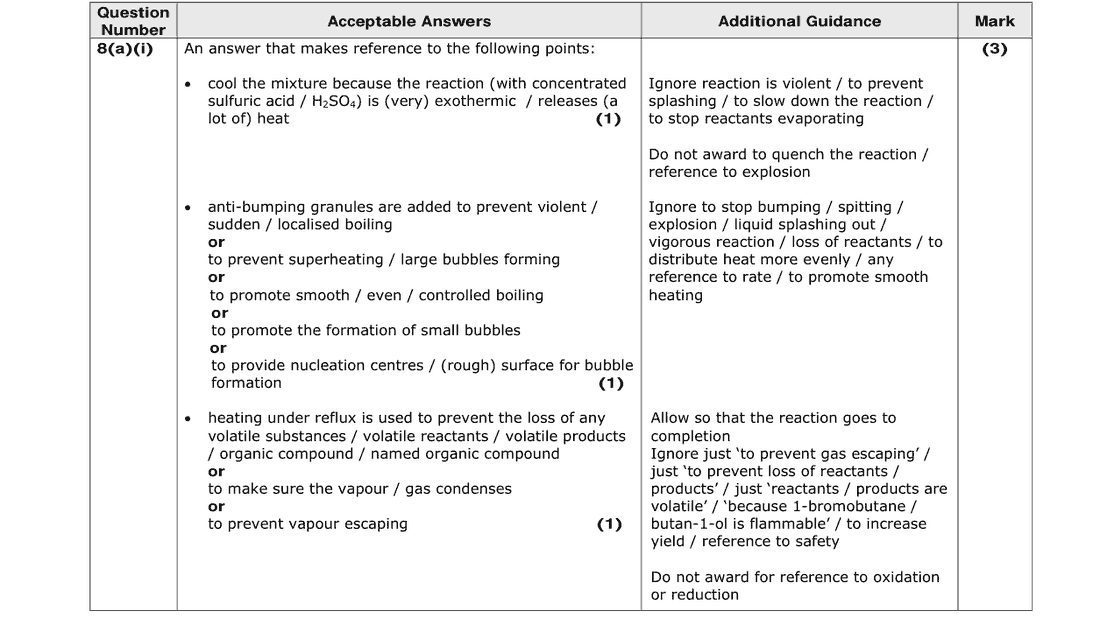
Six indicative points plus two marks for reasoning. IP1 heat under reflux, as the first step
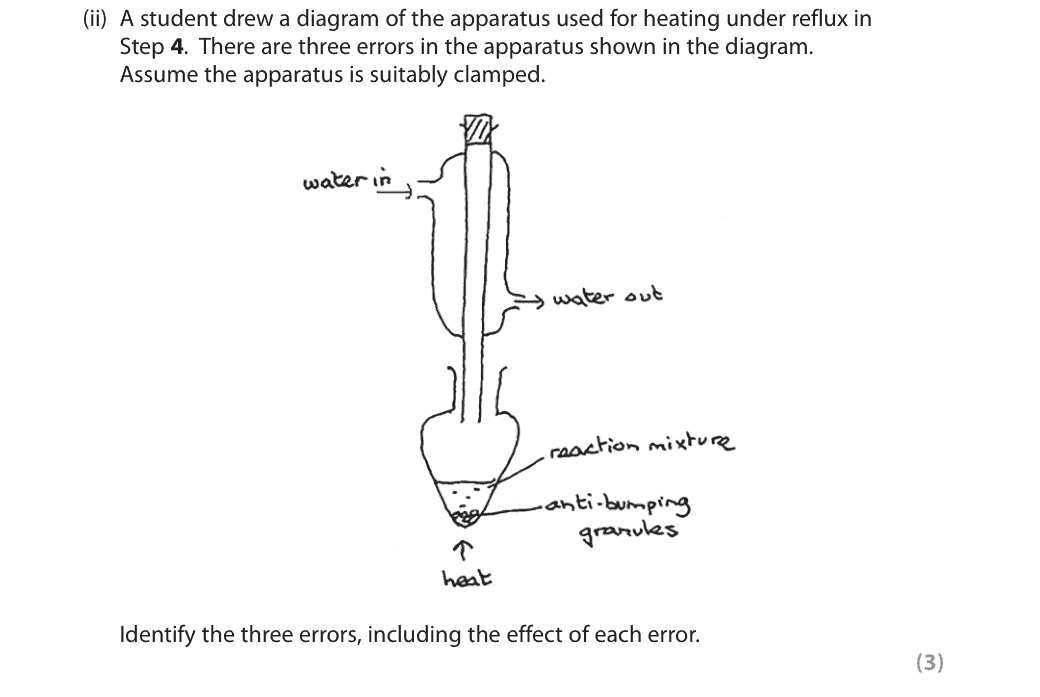
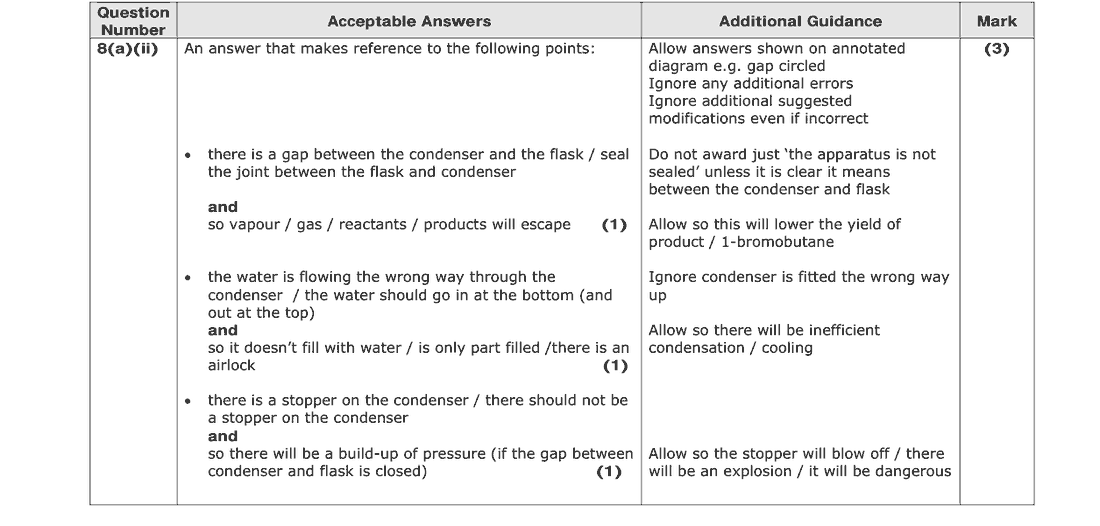
IP2 reflux apparatus: flask, vertical condenser, anti-bumping granules and a source of heat (no thermometer, no stopper in the condenser, not a conical flask)
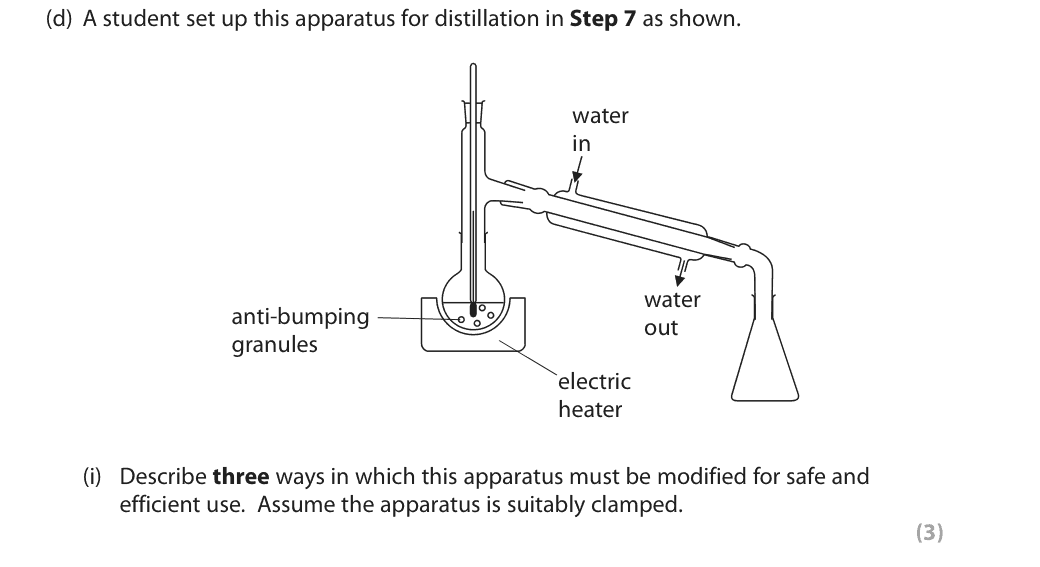
IP3 then distil, using a sloping condenser with a still head / thermometer / receiver
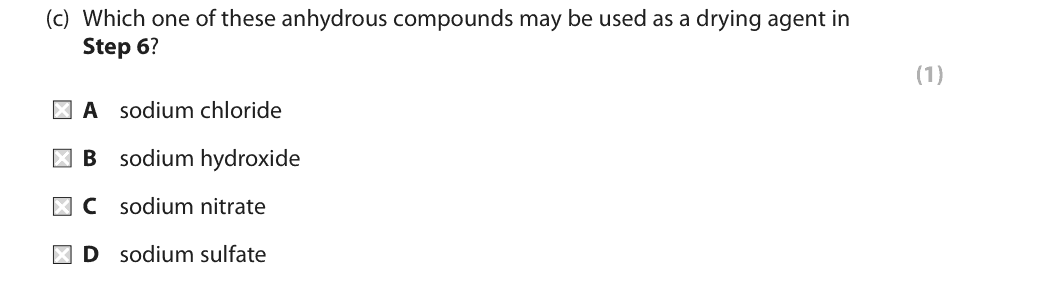
IP4 dry the distillate with a named drying agent (anhydrous calcium chloride, or sodium, calcium or magnesium sulfate)
IP5 filter or decant the butanone from the drying agent
IP6 redistil the dry product, collecting at 353 K / 80 °C (within ±4 °C, maximum 357 K). Common errors: saying reflux but describing distillation
beakers, conical or volumetric flasks, burettes
a sealed reflux
a horizontal condenser
confusing it with the halogenation practical (separating funnel and sodium hydrogencarbonate)
drying on a windowsill or with tissue
the final distillation was very rarely included
Skills: PT2 use water bath or electric heater or sand bath for heating; PT4 use laboratory apparatus for a variety of experimental techniques, including: titration, using burette and pipette; distillation and heating under reflux, including setting up glassware using retort stand and clamps; qualitative tests for ions and organic functional groups; filtration, including use of fluted filter paper, or filtration under reduced pressure; PT7 purify: a solid product by recrystallization; a liquid product, including use of separating funnel; CP5 Core practical 5: The oxidation of ethanol
June 2025 · AS Paper 2 · Q6(c)1 markDiagram or structure
Mark scheme
Examiner's comment
This question was about the reactions of two alcohols and included calculations as well as the description of an organic preparation. (a) This multiple-choice question was very well answered. (bi) Most candidates scored at least two marks. Common errors included incorrect Mr values and stoichiometric ratios (bii) This extended response on a standard practical was very challenging. Many mentioned reflux but described distillation instead. Some suggested inappropriate apparatus such as beakers, conical flasks, volumetric flasks and burettes. Descriptions were often incomplete or incorrect. Many included a thermometer and a bung in the reflux, which would have sealed the system. Distillation following from reflux was rarely seen. While many correctly mentioned the use of a thermometer for distillation, few referred to the still head, and the condenser was often incorrectly positioned horizontally rather than sloping. Candidates frequently included details about water flow in the condenser and the function of anti-bumping granules—both correct but not required in this context. Candidates must remember to move away from giving stock answers and instead address what is being asked. A number of candidates confused this practical with the halogenation of an alcohol, leading to inappropriate suggestions such as using a separating funnel followed by the addition of sodium hydrogencarbonate solution to remove acid impurities. On a more positive note, many could name a suitable drying agent, though fewer described how to remove the dried butanone afterwards. A surprising number of candidates thought that leaving the product on a windowsill or patting with tissue papers was the way to get dry butanone.
Very few candidates included the final distillation , which was essential for full credit. (c) Many candidates identified the correct product but lost the mark for using the structural formula instead of the required skeletal formula. (di) Most scored the first and third marks here, but many struggled with the stoichiometric ratio - some missed it, and others inverted it. (dii) Many fully correct answers were seen, although a sizeable number correctly calculated the experimental and theoretical amounts of product but then got very mixed up, so they divided the experimental yield by the sum of the theoretical and experimental yields. (6e) This apparently straightforward question was answered incorrectly by a large number of candidates – the basic structural formula representing an aldehyde was rarely known and there were many incorrect molecular formulas for the isomers.
Notes from the mark scheme and report
Answer: the skeletal formula of 2-bromobutane (a four-carbon zigzag with Br on the second carbon). Structural or displayed formulae do not score, which is how many with the right product lost the mark
June 2025 · AS Paper 2 · Q6(e)2 marksShort answer
Earlier parts of question 6 that this part uses
Mark scheme
Examiner's comment
This question was about the reactions of two alcohols and included calculations as well as the description of an organic preparation. (a) This multiple-choice question was very well answered. (bi) Most candidates scored at least two marks. Common errors included incorrect Mr values and stoichiometric ratios (bii) This extended response on a standard practical was very challenging. Many mentioned reflux but described distillation instead. Some suggested inappropriate apparatus such as beakers, conical flasks, volumetric flasks and burettes. Descriptions were often incomplete or incorrect. Many included a thermometer and a bung in the reflux, which would have sealed the system. Distillation following from reflux was rarely seen. While many correctly mentioned the use of a thermometer for distillation, few referred to the still head, and the condenser was often incorrectly positioned horizontally rather than sloping. Candidates frequently included details about water flow in the condenser and the function of anti-bumping granules—both correct but not required in this context. Candidates must remember to move away from giving stock answers and instead address what is being asked. A number of candidates confused this practical with the halogenation of an alcohol, leading to inappropriate suggestions such as using a separating funnel followed by the addition of sodium hydrogencarbonate solution to remove acid impurities. On a more positive note, many could name a suitable drying agent, though fewer described how to remove the dried butanone afterwards. A surprising number of candidates thought that leaving the product on a windowsill or patting with tissue papers was the way to get dry butanone.
Very few candidates included the final distillation , which was essential for full credit. (c) Many candidates identified the correct product but lost the mark for using the structural formula instead of the required skeletal formula. (di) Most scored the first and third marks here, but many struggled with the stoichiometric ratio - some missed it, and others inverted it. (dii) Many fully correct answers were seen, although a sizeable number correctly calculated the experimental and theoretical amounts of product but then got very mixed up, so they divided the experimental yield by the sum of the theoretical and experimental yields. (6e) This apparently straightforward question was answered incorrectly by a large number of candidates – the basic structural formula representing an aldehyde was rarely known and there were many incorrect molecular formulas for the isomers.
Notes from the mark scheme and report
Structural formulae: butanal CH3CH2CH2CHO and butanone CH3COCH2CH3 (one mark for both
not COH for the aldehyde group
displayed or skeletal formulae alone do not score). Both have the molecular formula C4H8O, so they are (structural) isomers
this mark depends on the first, and a wrong type of isomerism is penalised. Answered incorrectly by many: the structural formula of an aldehyde was rarely known and molecular formulae were often wrong
June 2025 · Paper 3 · Q6(a)4 marksDiagram or structure
Mark scheme
Examiner's comment
The first part of this question proved accessible to many candidates with the structure of compound A correctly drawn. A few candidates lost marks on their diagrams for compound B, by adding in a covalent bond between the Mg and Br. The structure of compound C proved to be more challenging, with candidates sometimes showing a ketone structure with a pentavalent carbon. The final reagent proved a challenge for many, with LiAlH4 a common wrong answer. There was also often the omission of the '(aq)' with the acid which was required for the mark.
Notes from the mark scheme and report
A: C6H5CH2Br (bromomethylbenzene). B: C6H5CH2MgBr (Grignard reagent). C: C6H5CH2C(CH3)2OMgBr (O– allowed for OMgBr). D: HCl(aq) or any dilute aqueous strong acid
H+ and H3O+ alone are ignored. No covalent Mg–Br bond drawn out with full charges
a missing delocalised ring is penalised once. A was usually right
B sometimes had a covalent bond added between Mg and Br
C was harder (pentavalent carbon seen)
D was often LiAlH4 or lacked (aq)
June 2025 · Paper 3 · Q7(a)2 marksPractical and data analysis
Mark scheme
Examiner's comment
The most common response to this question was to allow time for the ethanol to fully react, with some candidates noting that all of the ethanol would have been converted to ethanoic acid. It was less common to see comments about the ethanol evaporating, and some candidates wrote incorrectly that the sodium dichromate(VII) would be able to evaporate, which is incorrect.
Notes from the mark scheme and report
Any two: warm so that (all) the ethanol evaporates (not the dichromate)
24 hours to give time for all the ethanol to react / the reaction to go to completion
so the ethanol is fully oxidised to ethanoic acid (no ethanol or ethanal left). 'To speed up the reaction' and activation energy are ignored. Most wrote about time to react fully
evaporation of the ethanol was seen less often
Skills: CP5 Core practical 5: The oxidation of ethanol; CP11 Core practical 11: Redox titration
June 2025 · Paper 3 · Q7(d)2 marksPractical and data analysis
Earlier part of question 7 that this part uses
Mark scheme
Examiner's comment
Many candidates scored at least one mark for reasoning that using a reflux set-up would speed up the rate of reaction. The second mark, relating to the reasons not to use reflux, was less well-answered, with many candidates suggesting that it would be difficult to separate the sodium dichromate (VI) or that there would be a greater risk of flammability. The most common correct answer to this part was that some of the ethanol would evaporate with reflux.
Notes from the mark scheme and report
To support the change: heating under reflux speeds up the reaction / makes incomplete reaction less likely. To leave it unchanged: other, less volatile substances in the drink could also be oxidised by the dichromate
or greater risk of an uncontrolled reaction
or some ethanol may escape through the condenser before it is oxidised. Ester formation and flammability are ignored. The first mark was common
for the second, the usual correct answer was loss of ethanol
Skills: PT4 use laboratory apparatus for a variety of experimental techniques, including: titration, using burette and pipette; distillation and heating under reflux, including setting up glassware using retort stand and clamps; qualitative tests for ions and organic functional groups; filtration, including use of fluted filter paper, or filtration under reduced pressure; CP5 Core practical 5: The oxidation of ethanol
June 2024 · AS Paper 2 · Q3(d)(i)1 markMultiple choice
Earlier part of question 3 that this part uses
Answer
B
Mark scheme
Examiner's comment
The chemistry of alkenes was tested in Q3. (a) tested candidate’s knowledge and understanding of molecular and empirical formulae. Over 80% of candidates scored this mark. The addition of hydrogen bromide was tested in (b), with (b)(i) being the name and type of this reaction. Again, over 80% knew this was an electrophilic addition reaction. The mechanism of the reaction, in (b)(ii) was extremely well answered. There are a large number of things to consider in this mechanism, but candidates seemed well drilled with 44% scoring full marks. Four marks was the most common score achieved here. The minor product in (b)(iii) proved a little more challenging. Candidates found difficulty expressing themselves with sufficient accuracy to secure full marks, often referring to the stability of halogenoalkanes rather that the carbocation intermediates. Descriptions in (b)(iv) also lacked sufficient detail to score the mark. It was quite common to see that the arrow represented the movement of an electron, or electrons rather than the pair of electrons which was required for the mark. In (c)(i) most candidates recognised the structures of the two isomers and were able to name them, but some needed more care when drawing these structures out. The attachment of methyl groups was often seen via a hydrogen rather than the carbon and this did not score the mark in this question. A fully displayed structure almost invariably scored the mark here as this type of attachment does not occur in these types of structures. The need for two different groups attached to the carbon as well as restricted rotation was not often seen in (c)(ii). The conversion of alkenes to alcohols and subsequent oxidation was examined in (d), and three quarters of candidates recognised the tertiary alcohol in (d)(i) The relative stability of tertiary alcohols to oxidation was not well understood. Those candidates who knew that the carbon with the oxygen attached required a hydrogen attached as well to allow oxidation often scored two marks.
Notes from the mark scheme and report
Answer: B (2-methylpropan-2-ol, from methylpropene). A is a secondary alcohol
C and D are primary alcohols. Three quarters of candidates chose correctly
June 2024 · AS Paper 2 · Q3(d)(ii)2 marksExplanation
Earlier parts of question 3 that this part uses
Mark scheme
Examiner's comment
The chemistry of alkenes was tested in Q3. (a) tested candidate’s knowledge and understanding of molecular and empirical formulae. Over 80% of candidates scored this mark. The addition of hydrogen bromide was tested in (b), with (b)(i) being the name and type of this reaction. Again, over 80% knew this was an electrophilic addition reaction. The mechanism of the reaction, in (b)(ii) was extremely well answered. There are a large number of things to consider in this mechanism, but candidates seemed well drilled with 44% scoring full marks. Four marks was the most common score achieved here. The minor product in (b)(iii) proved a little more challenging. Candidates found difficulty expressing themselves with sufficient accuracy to secure full marks, often referring to the stability of halogenoalkanes rather that the carbocation intermediates. Descriptions in (b)(iv) also lacked sufficient detail to score the mark. It was quite common to see that the arrow represented the movement of an electron, or electrons rather than the pair of electrons which was required for the mark. In (c)(i) most candidates recognised the structures of the two isomers and were able to name them, but some needed more care when drawing these structures out. The attachment of methyl groups was often seen via a hydrogen rather than the carbon and this did not score the mark in this question. A fully displayed structure almost invariably scored the mark here as this type of attachment does not occur in these types of structures. The need for two different groups attached to the carbon as well as restricted rotation was not often seen in (c)(ii). The conversion of alkenes to alcohols and subsequent oxidation was examined in (d), and three quarters of candidates recognised the tertiary alcohol in (d)(i) The relative stability of tertiary alcohols to oxidation was not well understood. Those candidates who knew that the carbon with the oxygen attached required a hydrogen attached as well to allow oxidation often scored two marks.
Notes from the mark scheme and report
Oxidation needs a hydrogen on the carbon that carries the –OH group: tertiary alcohols have no hydrogen on that carbon (allow: it is bonded to three other carbons, or a C–C bond would have to break)
primary and secondary alcohols do. 'Bonded to three alkyl groups' said of the alcohol rather than the carbon is ignored. Not well understood
June 2024 · AS Paper 2 · Q5(a)(i)2 marksPractical and data analysis
Mark scheme
Examiner's comment
The conversion of butan-1-ol to 1-bromobutane is often examined at this level. However, the practical requirements, tested in (a) and (b) proved one of the more challenging parts of the paper. In (a)(i) the use of the condenser was well understood, but the reason for the still head was less often scored. The oxidising agent responsible for the unwanted side reactions in (a)(ii) was sulfuric acid, but this was recognised by less than 20% of candidates. The presence of side reactions is often an answer to questions about low yield. In (a)(iii) the identity of the unwanted side products was considered. The inorganic product was produced by the sulfuric acid, and consequently relatively few answers scored this mark. The formation of butanal or butanoic acid was more commonly suggested, but only 15% of candidates scored a mark here. (a)(iv) was the highest scoring item in (a), with over 40% scoring this mark. In (b) the set-up of a distillation apparatus was considered, and unusually a description was asked for rather than a diagram. Candidates should not be afraid, however, to use diagrams in their answers. Those that did often clarified their writing and so found it easier to score marks. The position of three pieces of apparatus, the still head, condenser, and thermometer were tested. Often the still head was the piece of apparatus which did not score the mark associated with it. The separation of the aqueous and organic layers in Steps 5, 6 and 7 were tested in the final part. Over 50% of candidates scored at least half the marks in these final three parts. Again, it appeared that candidates had not read the question and procedure with sufficient care as separating funnels were often drawn in (c)(i), when, in Step 5, the liquids are in a beaker.
Notes from the mark scheme and report
Condenser: stops reactants / volatile compounds being lost by returning them to the flask (or stops flammable / corrosive / toxic vapours escaping
a named gas only if it could condense, e.g. bromine, not HBr, SO2 or CO2). Still head: prevents a build-up of pressure because the side arm is open, letting uncondensed gas escape. The condenser mark was scored more often than the still head mark
Skills: PT4 use laboratory apparatus for a variety of experimental techniques, including: titration, using burette and pipette; distillation and heating under reflux, including setting up glassware using retort stand and clamps; qualitative tests for ions and organic functional groups; filtration, including use of fluted filter paper, or filtration under reduced pressure; PT11 safely and carefully handle solids and liquids, including corrosive, irritant, flammable and toxic substances
June 2024 · AS Paper 2 · Q5(a)(ii)1 markShort answerHard
Earlier part of question 5 that this part uses
Mark scheme
Examiner's comment
The conversion of butan-1-ol to 1-bromobutane is often examined at this level. However, the practical requirements, tested in (a) and (b) proved one of the more challenging parts of the paper. In (a)(i) the use of the condenser was well understood, but the reason for the still head was less often scored. The oxidising agent responsible for the unwanted side reactions in (a)(ii) was sulfuric acid, but this was recognised by less than 20% of candidates. The presence of side reactions is often an answer to questions about low yield. In (a)(iii) the identity of the unwanted side products was considered. The inorganic product was produced by the sulfuric acid, and consequently relatively few answers scored this mark. The formation of butanal or butanoic acid was more commonly suggested, but only 15% of candidates scored a mark here. (a)(iv) was the highest scoring item in (a), with over 40% scoring this mark. In (b) the set-up of a distillation apparatus was considered, and unusually a description was asked for rather than a diagram. Candidates should not be afraid, however, to use diagrams in their answers. Those that did often clarified their writing and so found it easier to score marks. The position of three pieces of apparatus, the still head, condenser, and thermometer were tested. Often the still head was the piece of apparatus which did not score the mark associated with it. The separation of the aqueous and organic layers in Steps 5, 6 and 7 were tested in the final part. Over 50% of candidates scored at least half the marks in these final three parts. Again, it appeared that candidates had not read the question and procedure with sufficient care as separating funnels were often drawn in (c)(i), when, in Step 5, the liquids are in a beaker.
Notes from the mark scheme and report
Answer: (concentrated) sulfuric acid, H2SO4. Not dilute sulfuric acid
H+ ignored
June 2024 · AS Paper 2 · Q5(a)(iii)2 marksShort answerHard
Earlier part of question 5 that this part uses
Mark scheme
Examiner's comment
The conversion of butan-1-ol to 1-bromobutane is often examined at this level. However, the practical requirements, tested in (a) and (b) proved one of the more challenging parts of the paper. In (a)(i) the use of the condenser was well understood, but the reason for the still head was less often scored. The oxidising agent responsible for the unwanted side reactions in (a)(ii) was sulfuric acid, but this was recognised by less than 20% of candidates. The presence of side reactions is often an answer to questions about low yield. In (a)(iii) the identity of the unwanted side products was considered. The inorganic product was produced by the sulfuric acid, and consequently relatively few answers scored this mark. The formation of butanal or butanoic acid was more commonly suggested, but only 15% of candidates scored a mark here. (a)(iv) was the highest scoring item in (a), with over 40% scoring this mark. In (b) the set-up of a distillation apparatus was considered, and unusually a description was asked for rather than a diagram. Candidates should not be afraid, however, to use diagrams in their answers. Those that did often clarified their writing and so found it easier to score marks. The position of three pieces of apparatus, the still head, condenser, and thermometer were tested. Often the still head was the piece of apparatus which did not score the mark associated with it. The separation of the aqueous and organic layers in Steps 5, 6 and 7 were tested in the final part. Over 50% of candidates scored at least half the marks in these final three parts. Again, it appeared that candidates had not read the question and procedure with sufficient care as separating funnels were often drawn in (c)(i), when, in Step 5, the liquids are in a beaker.
Notes from the mark scheme and report
Inorganic: bromine, Br2, or sulfur dioxide, SO2 (carbon dioxide ignored). Organic: butanal or butanoic acid, CH3CH2CH2CHO or CH3CH2CH2COOH (structural not molecular formula
but-1-ene ignored). If both name and formula are given, both must be right. The inorganic product was rarely scored
butanal or butanoic acid was suggested more often
June 2024 · AS Paper 2 · Q5(b)3 marksPractical and data analysis
Earlier part of question 5 that this part uses
Mark scheme
Examiner's comment
The conversion of butan-1-ol to 1-bromobutane is often examined at this level. However, the practical requirements, tested in (a) and (b) proved one of the more challenging parts of the paper. In (a)(i) the use of the condenser was well understood, but the reason for the still head was less often scored. The oxidising agent responsible for the unwanted side reactions in (a)(ii) was sulfuric acid, but this was recognised by less than 20% of candidates. The presence of side reactions is often an answer to questions about low yield. In (a)(iii) the identity of the unwanted side products was considered. The inorganic product was produced by the sulfuric acid, and consequently relatively few answers scored this mark. The formation of butanal or butanoic acid was more commonly suggested, but only 15% of candidates scored a mark here. (a)(iv) was the highest scoring item in (a), with over 40% scoring this mark. In (b) the set-up of a distillation apparatus was considered, and unusually a description was asked for rather than a diagram. Candidates should not be afraid, however, to use diagrams in their answers. Those that did often clarified their writing and so found it easier to score marks. The position of three pieces of apparatus, the still head, condenser, and thermometer were tested. Often the still head was the piece of apparatus which did not score the mark associated with it. The separation of the aqueous and organic layers in Steps 5, 6 and 7 were tested in the final part. Over 50% of candidates scored at least half the marks in these final three parts. Again, it appeared that candidates had not read the question and procedure with sufficient care as separating funnels were often drawn in (c)(i), when, in Step 5, the liquids are in a beaker.
Notes from the mark scheme and report
The still head is fitted to the pear-shaped (or a round-bottomed) flask
a thermometer is added at the top of the still head (a named stopper or bung allowed instead)
the condenser is attached to the side arm of the still head, sloping downwards, with the beaker under its end. A labelled diagram showing thermometer, still head and condenser can score all three. The still head mark was the one most often missed
Skills: PT4 use laboratory apparatus for a variety of experimental techniques, including: titration, using burette and pipette; distillation and heating under reflux, including setting up glassware using retort stand and clamps; qualitative tests for ions and organic functional groups; filtration, including use of fluted filter paper, or filtration under reduced pressure
June 2024 · AS Paper 2 · Q5(c)(i)1 markDiagram or structure
Earlier part of question 5 that this part uses
Mark scheme
Examiner's comment
The conversion of butan-1-ol to 1-bromobutane is often examined at this level. However, the practical requirements, tested in (a) and (b) proved one of the more challenging parts of the paper. In (a)(i) the use of the condenser was well understood, but the reason for the still head was less often scored. The oxidising agent responsible for the unwanted side reactions in (a)(ii) was sulfuric acid, but this was recognised by less than 20% of candidates. The presence of side reactions is often an answer to questions about low yield. In (a)(iii) the identity of the unwanted side products was considered. The inorganic product was produced by the sulfuric acid, and consequently relatively few answers scored this mark. The formation of butanal or butanoic acid was more commonly suggested, but only 15% of candidates scored a mark here. (a)(iv) was the highest scoring item in (a), with over 40% scoring this mark. In (b) the set-up of a distillation apparatus was considered, and unusually a description was asked for rather than a diagram. Candidates should not be afraid, however, to use diagrams in their answers. Those that did often clarified their writing and so found it easier to score marks. The position of three pieces of apparatus, the still head, condenser, and thermometer were tested. Often the still head was the piece of apparatus which did not score the mark associated with it. The separation of the aqueous and organic layers in Steps 5, 6 and 7 were tested in the final part. Over 50% of candidates scored at least half the marks in these final three parts. Again, it appeared that candidates had not read the question and procedure with sufficient care as separating funnels were often drawn in (c)(i), when, in Step 5, the liquids are in a beaker.
Notes from the mark scheme and report
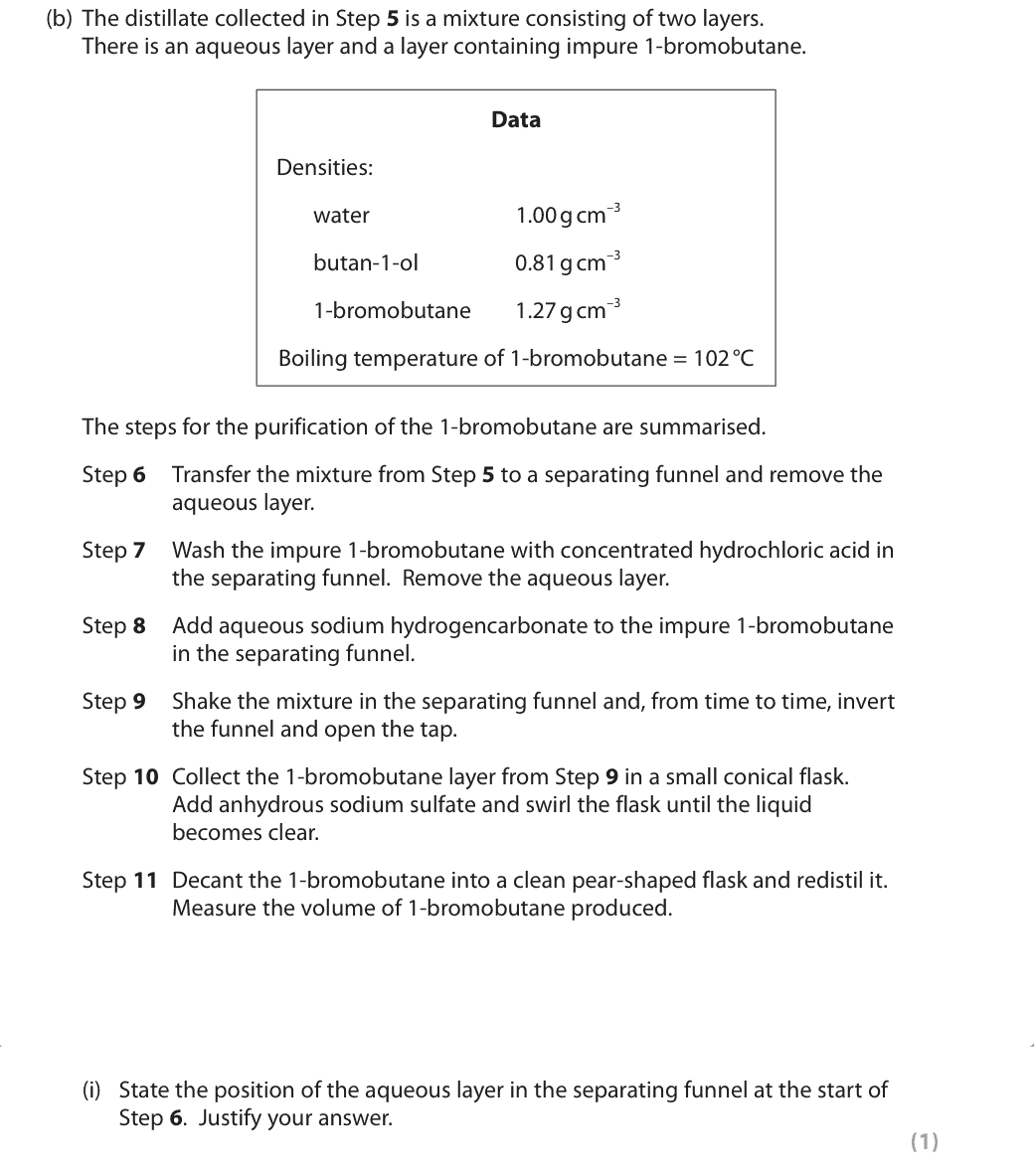
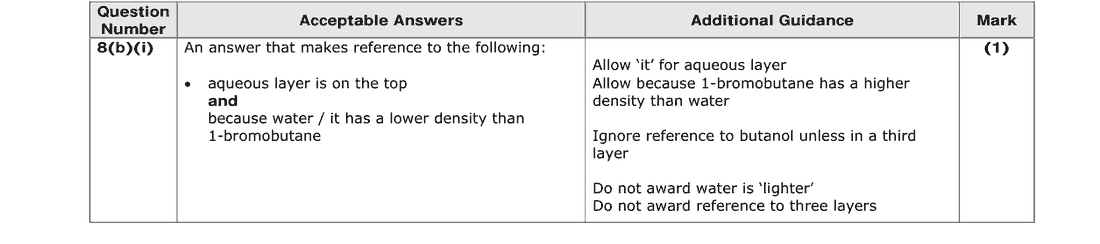
Beaker with two labelled layers: water / aqueous layer on top and 1-bromobutane (density 1.28 g cm–3) underneath. A separating funnel is not credited: in Step 5 the liquids are in a beaker, and many drew a funnel
Skills: PT7 purify: a solid product by recrystallization; a liquid product, including use of separating funnel
June 2024 · AS Paper 2 · Q5(c)(ii)1 markPractical and data analysis
Earlier parts of question 5 that this part uses
Mark scheme
Examiner's comment
The conversion of butan-1-ol to 1-bromobutane is often examined at this level. However, the practical requirements, tested in (a) and (b) proved one of the more challenging parts of the paper. In (a)(i) the use of the condenser was well understood, but the reason for the still head was less often scored. The oxidising agent responsible for the unwanted side reactions in (a)(ii) was sulfuric acid, but this was recognised by less than 20% of candidates. The presence of side reactions is often an answer to questions about low yield. In (a)(iii) the identity of the unwanted side products was considered. The inorganic product was produced by the sulfuric acid, and consequently relatively few answers scored this mark. The formation of butanal or butanoic acid was more commonly suggested, but only 15% of candidates scored a mark here. (a)(iv) was the highest scoring item in (a), with over 40% scoring this mark. In (b) the set-up of a distillation apparatus was considered, and unusually a description was asked for rather than a diagram. Candidates should not be afraid, however, to use diagrams in their answers. Those that did often clarified their writing and so found it easier to score marks. The position of three pieces of apparatus, the still head, condenser, and thermometer were tested. Often the still head was the piece of apparatus which did not score the mark associated with it. The separation of the aqueous and organic layers in Steps 5, 6 and 7 were tested in the final part. Over 50% of candidates scored at least half the marks in these final three parts. Again, it appeared that candidates had not read the question and procedure with sufficient care as separating funnels were often drawn in (c)(i), when, in Step 5, the liquids are in a beaker.
Notes from the mark scheme and report
Use a (teat) pipette or syringe to draw off the upper aqueous layer (or to remove the lower layer and discard what is left). Transferring to a separating funnel and running off the lower layer is allowed
just 'use a separating funnel' is not
decanting ignored
Skills: PT7 purify: a solid product by recrystallization; a liquid product, including use of separating funnel
June 2024 · AS Paper 2 · Q5(c)(iii)1 markPractical and data analysis
Earlier parts of question 5 that this part uses
Mark scheme
Examiner's comment
The conversion of butan-1-ol to 1-bromobutane is often examined at this level. However, the practical requirements, tested in (a) and (b) proved one of the more challenging parts of the paper. In (a)(i) the use of the condenser was well understood, but the reason for the still head was less often scored. The oxidising agent responsible for the unwanted side reactions in (a)(ii) was sulfuric acid, but this was recognised by less than 20% of candidates. The presence of side reactions is often an answer to questions about low yield. In (a)(iii) the identity of the unwanted side products was considered. The inorganic product was produced by the sulfuric acid, and consequently relatively few answers scored this mark. The formation of butanal or butanoic acid was more commonly suggested, but only 15% of candidates scored a mark here. (a)(iv) was the highest scoring item in (a), with over 40% scoring this mark. In (b) the set-up of a distillation apparatus was considered, and unusually a description was asked for rather than a diagram. Candidates should not be afraid, however, to use diagrams in their answers. Those that did often clarified their writing and so found it easier to score marks. The position of three pieces of apparatus, the still head, condenser, and thermometer were tested. Often the still head was the piece of apparatus which did not score the mark associated with it. The separation of the aqueous and organic layers in Steps 5, 6 and 7 were tested in the final part. Over 50% of candidates scored at least half the marks in these final three parts. Again, it appeared that candidates had not read the question and procedure with sufficient care as separating funnels were often drawn in (c)(i), when, in Step 5, the liquids are in a beaker.
Notes from the mark scheme and report
Answer: separating funnel (allow dropping funnel or tap funnel). Burette ignored
Skills: PT7 purify: a solid product by recrystallization; a liquid product, including use of separating funnel
June 2024 · Paper 2 · Q5(d)(i)2 marksExplanation
Mark scheme
Examiner's comment
This was another case of linking ideas from one part of the specification to another context, a vital skill for candidates hoping to obtain the higher grades. Recognition of anhydrous sodium sulfate as a drying agent was common, but a number of candidates didn’t then link this to the idea that it was there to remove water from the solvent. Only a small number of those that managed this made the connection to the fact that the presence of water would favour a substitution reaction / production of an alcohol.
Notes from the mark scheme and report
M1 to dry the ethanol / remove water from the solvent (just 'it is a drying agent', or drying the reactants, is ignored
'to dehydrate' not allowed). M2 because water would lead to (nucleophilic) substitution, forming some cyclopentanol instead of the alkene. Many recognised the drying agent without linking it to the solvent
only a small number made the link to substitution
June 2024 · Paper 3 · Q7(b)5 marksShort answer
Earlier part of question 7 that this part uses
Mark scheme
Examiner's comment
The drawing of a reaction mechanism with curly arrows has improved over recent years and many responses scoring full marks were seen to part (a). It is possible that the use of skeletal formulae benefitted candidates because the inclusion or omission of the additional hydrogen on the carbocation intermediate was ignored. A small minority of candidates appeared to think that cyclohexene was aromatic and tried to draw an electrophilc substitution reaction mechanism. The organic synthetic pathway required in part (b) was also an improvement on previous years. There were less instances of inappropriate reagent pairings such as the use of sodium hydroxide for Step 1 but quoted with sulfuric acid. This question well illustrates the need for candidates to check their answer after re-reading the question because marks were lost due to missing conditions and reaction types. Furthermore, some candidates quoted both the name and the chemical formula but if so then both must be correct to score the mark. Unfortunatley some candidates gave the wrong formula for potassium/sodium dichromate(VI). A reminder that there is often some leeway with the spelling of a chemical name such a too many ‘t’s in potassium but there is no such leeway for a chemical formula.
It was good to see that the answers to part (c)(i) were all names as per the question rubric. It was surprising at times to see solid compounds rather than liquids suggested for the Grignard reagent solvent. In part (c)(ii) the vast majority of candidates knew that anhydrous calcium chloride is a drying agent but oftentimes incorrectly referred to the absoprtion of water from the reaction or from the solvent. The diagram of the apparatus on the facing page clearly shows ‘Tube X’ a long way away from the flask with the solvent at the top of the condenser and with an open top. It should have been clear to candidates that it was to prevent water vapour from getting into the apparatus. Nonetheless it was good to see that many candidates understood the need to keep the Grignard reagent away from water to avoid hydrolysis to the alkane. Likewise many candidates in part (c)(iii) knew that the corrrect water flow in the condenser from the bottom up means that it will avoid air bubbles and be filled with water for efficient condensation. The colour of the precipitate in part (d)(i) was almost universally given correctly and the completion of the simplified mechanism in part (d)(ii) allowed candidates of all abilities to gain credit. It is pleasing to see that candidates seem to be getting better at drawing curly arrows for a novel organic mechanism. The descriptions given for the recystallistion process in part (d)(iii) varied significantly. There were some excellent, logical descriptions with additional details of a ‘hot filtration’ to remove insoluble impurities which showed that these candidates were very well prepared. However there were many other responses which unfortunatley made little practical sense. For example, it was not unusual to see the response begin with the dissolving of the impure precipitate and then this being immediately filtered, washed and patted dry without there being any mention of cooling to form a purified precipitate. These responses were not given credit for statements that were impractical.
Notes from the mark scheme and report
Step 2: aqueous KOH or NaOH (not just ethanolic) (1)
nucleophilic substitution / hydrolysis (1)
A is cyclohexanol, structure drawn (1). Step 3: heat / reflux with sulfuric acid and sodium (or potassium) dichromate(VI) (not HCl) (1)
oxidation (1). Each mark stands alone. Common errors: conditions or reaction types left out
a wrong formula for the dichromate when name and formula were both given (both must be right)
June 2023 · Paper 2 · Q2(b)1 markEquation writing
Mark scheme
Examiner's comment
This was a straightforward question requiring candidates to write and balance a combustion equation. There were many good responses. The majority who did not score gave the wrong number of oxygen atoms in their equation or gave the wrong formula for methanol.
Notes from the mark scheme and report
Answer: CH3OH + 1½O2 → CO2 + 2H2O (or 2CH3OH + 3O2 → 2CO2 + 4H2O). CH4O allowed. Errors were the wrong number of oxygen atoms or a wrong formula for methanol
June 2023 · Paper 2 · Q2(c)1 markShort answer
Mark scheme
Examiner's comment
There were a number of options for correct answers for this question. The most common answers seen were 'iodine and red phosphorus' or PI3. A few candidates suggested HI which
was credited and a number suggested the use of H2SO4 which was not.
Notes from the mark scheme and report
Answer: (red) phosphorus and iodine, or phosphorus(III) iodide, PI3. Also allowed: KI or NaI with phosphoric(V) acid
HI. Not PI5
not KI with H2SO4. If a name and formula are both given, both must be right
June 2023 · AS Paper 2 · Q7(c)(i)1 markMultiple choice
Answer
B
Mark scheme
Notes from the mark scheme and report
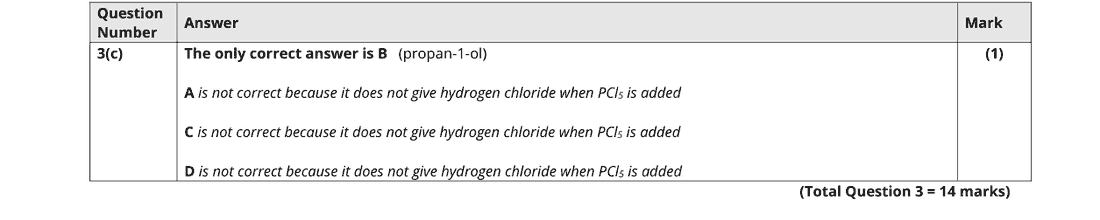
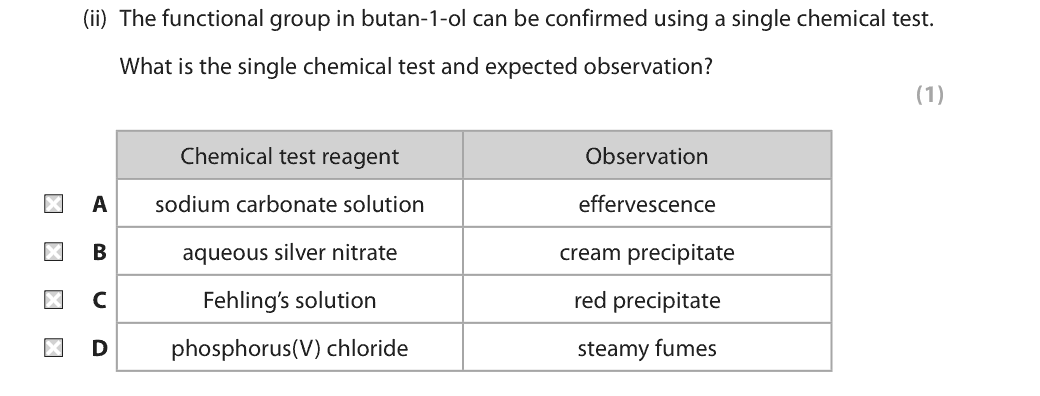
Answer: B. Phosphorus(V) chloride gives steamy fumes (of hydrogen chloride) with an alcohol. Hydrogen chloride is not white smoke (A)
sodium carbonate reacts only with acids (C, D)
Skills: CP7 Core practical 7: Analysis of some inorganic and organic unknowns
June 2023 · AS Paper 2 · Q7(c)(ii)1 markShort answer
Earlier part of question 7 that this part uses
Mark scheme
Examiner's comment
Just ‘distil’ achieved the mark although some far more complex answers were seen, most of which went ‘off target’.
Notes from the mark scheme and report
Distil off the aldehyde as soon as it forms (set up for distillation, not reflux)
just 'distil' is enough. Using stoichiometric quantities for partial oxidation is also allowed
Skills: CP5 Core practical 5: The oxidation of ethanol
June 2023 · AS Paper 2 · Q7(c)(iii)2 marksPractical and data analysis
Earlier part of question 7 that this part uses
Mark scheme
Examiner's comment
The lack of warm/heat for MP1 and ppt for MP2 were very common, but Were rewarded with a rescue mark. Tollens reagent and (sometimes) a correct result were quite common.
Notes from the mark scheme and report
Warm with Benedict's or Fehling's solution
red / brown precipitate. Alternatives: Tollens' reagent, warm, silver mirror
Schiff's reagent, magenta / pink colour. 2,4-DNPH is ignored. Leaving out 'warm' and 'precipitate' was very common (a rescue mark was given)
Skills: PT4 use laboratory apparatus for a variety of experimental techniques, including: titration, using burette and pipette; distillation and heating under reflux, including setting up glassware using retort stand and clamps; qualitative tests for ions and organic functional groups; filtration, including use of fluted filter paper, or filtration under reduced pressure; CP7 Core practical 7: Analysis of some inorganic and organic unknowns
June 2023 · AS Paper 2 · Q7(c)(iv)6 marks6-mark extended responseHard
Earlier part of question 7 that this part uses
Mark scheme, with the indicative content and the marks for reasoning
Examiner's comment
In retrospect this question asked for too much and the marks were generally low. The ‘reflux’ mark (IP1) was usually scored and often IP3 as well. The general level of diagram drawing was not as expected and was quite weak. It was sometimes difficult to recognise common pieces of lab equipment.
Notes from the mark scheme and report
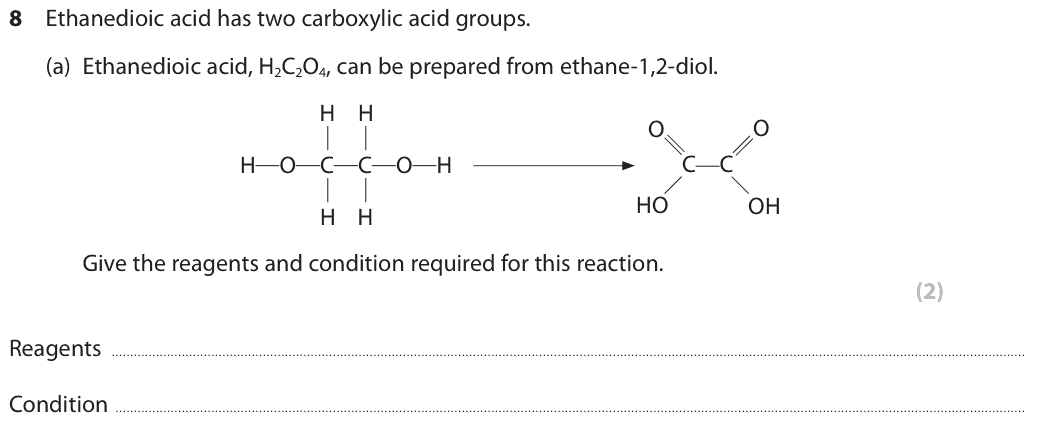
Six indicative points plus two marks for reasoning. IP1 heat under reflux (with excess oxidising agent)
IP2 diagram of reflux apparatus with a vertical condenser and correct water flow
IP3 anti-bumping granules and a suitable method of heating
IP4 then distil at a suitable temperature (between 120 and 170 °C) to collect the butanoic acid
IP5 diagram of distillation apparatus with a sloping condenser and a collecting vessel
IP6 thermometer at the still head and an opening to the air at the receiver. Wrong or unlabelled water flow and gaps at joints are each penalised once. If the reflux stage is missing only IP4 and IP6 can score. IP1 was usually scored and often IP3
diagrams were weak
Skills: PT4 use laboratory apparatus for a variety of experimental techniques, including: titration, using burette and pipette; distillation and heating under reflux, including setting up glassware using retort stand and clamps; qualitative tests for ions and organic functional groups; filtration, including use of fluted filter paper, or filtration under reduced pressure; CP5 Core practical 5: The oxidation of ethanol
June 2023 · Paper 3 · Q3(a)1 markEquation writing
Mark scheme
Examiner's comment
It was not expected that less than half of the candidates would not score this mark. Amongst the issues seen were: the inclusion of a catalyst in the equation, the production of ethene but omission of the water by-product, and incorrect ethene formulae.
Notes from the mark scheme and report
CH3CH2OH → CH2CH2 + H2O (C2H5OH and C2H4, displayed or skeletal allowed
not a molecular formula for ethanol
no reversible arrow
no catalyst on both sides). Fewer than half scored: catalyst written into the equation, water left out, wrong formula for ethene
June 2023 · Paper 3 · Q3(d)(i)1 markPractical and data analysis
Earlier part of question 3 that this part uses
Mark scheme
Examiner's comment
A seeming lack of practical experience was evident in this and the following questions. The rocksil wool soaked in ethanol does not retain the liquid very well and so the angle of the test tube was to prevent the ethanol from 'running down the tube'. This was rarely seen, but the idea was expressed by such answers that referred to the need to prevent the ethanol and the catalyst from mixing.
Notes from the mark scheme and report
So that liquid ethanol does not run down the tube to the catalyst (to keep the ethanol-soaked wool and the catalyst apart). References to heating are ignored
Skills: PT4 use laboratory apparatus for a variety of experimental techniques, including: titration, using burette and pipette; distillation and heating under reflux, including setting up glassware using retort stand and clamps; qualitative tests for ions and organic functional groups; filtration, including use of fluted filter paper, or filtration under reduced pressure
June 2023 · Paper 3 · Q3(d)(ii)1 markPractical and data analysis
Earlier parts of question 3 that this part uses
Mark scheme
Examiner's comment
The majority of responses seen mentioned the flammability of the ethanol and referred to ethanol undergoing combustion. Some candidates did refer to the evaporation of the ethanol, but unfortunately did not connect it with the fact that it would then pass over the catalyst without reaction.
Notes from the mark scheme and report
The ethanol would evaporate AND pass over the catalyst without reacting (both needed). Most wrote about flammability or combustion, which is ignored
some gave evaporation without the second half
Skills: PT4 use laboratory apparatus for a variety of experimental techniques, including: titration, using burette and pipette; distillation and heating under reflux, including setting up glassware using retort stand and clamps; qualitative tests for ions and organic functional groups; filtration, including use of fluted filter paper, or filtration under reduced pressure
June 2023 · Paper 3 · Q3(d)(iv)1 markPractical and data analysis
Earlier parts of question 3 that this part uses
Mark scheme
Examiner's comment
Another question where practical skills or experience was lacking. It was expected that a Bunsen valve would not have been used by many and so great care was taken to provide both a side view and a top view of the valve to illustrate how it would work. There are a number of experiments that candidates might have carried out where the 'suck-back' of water is an issue. This was the point here. This answer was rarely seen, but credit was also given for mentioning that the valve would prevent water from entering the delivery tube.
Notes from the mark scheme and report
It prevents suck-back: water cannot flow back up the delivery tube (into the hot tube). 'Suck-back' was rarely named, but stopping water entering the delivery tube was credited
Skills: PT4 use laboratory apparatus for a variety of experimental techniques, including: titration, using burette and pipette; distillation and heating under reflux, including setting up glassware using retort stand and clamps; qualitative tests for ions and organic functional groups; filtration, including use of fluted filter paper, or filtration under reduced pressure
June 2022 · AS Paper 2 · Q6(a)1 markShort answer
Mark scheme
Examiner's comment
This was another practical based question, and some candidates were able to acquit themselves well, while others struggled to make headway, though (a) was quite commonly scored (b) was a diagram question, and the diagram here, one of the more straightforward required at this level, was not well drawn in general. On average candidates scored about half of the marks in (c) while in (d), about 50% score the mark in (d)(i). The extended writing answer (d)(ii) gave two marks most commonly out of six, though a few candidates were able to score all six marks. The calculation in (e) had a number of valid approaches. Some candidates were able to work through in a step by step fashion, whilst others appeared to quite randomly scatter calculation across the page. Great benefit can be had be identifying each of your calculation so you can follow your route through the calculation. Four out of four was the most common mark obtained. (f)(i) suffered from a lack of clarity in the written answers with candidates identifying the range in the infra-red spectrum to look for, but not saying how this would be used to establish purity. Similarly, in (f)(ii) a lack of detail and clarity meant that marks were not always scored.
if a name and a formula are given both must be right. Quite commonly scored
June 2022 · AS Paper 2 · Q6(b)2 marksDiagram or structure
Earlier part of question 6 that this part uses
Mark scheme
Examiner's comment
This was another practical based question, and some candidates were able to acquit themselves well, while others struggled to make headway, though (a) was quite commonly scored (b) was a diagram question, and the diagram here, one of the more straightforward required at this level, was not well drawn in general. On average candidates scored about half of the marks in (c) while in (d), about 50% score the mark in (d)(i). The extended writing answer (d)(ii) gave two marks most commonly out of six, though a few candidates were able to score all six marks. The calculation in (e) had a number of valid approaches. Some candidates were able to work through in a step by step fashion, whilst others appeared to quite randomly scatter calculation across the page. Great benefit can be had be identifying each of your calculation so you can follow your route through the calculation. Four out of four was the most common mark obtained. (f)(i) suffered from a lack of clarity in the written answers with candidates identifying the range in the infra-red spectrum to look for, but not saying how this would be used to establish purity. Similarly, in (f)(ii) a lack of detail and clarity meant that marks were not always scored.
Notes from the mark scheme and report
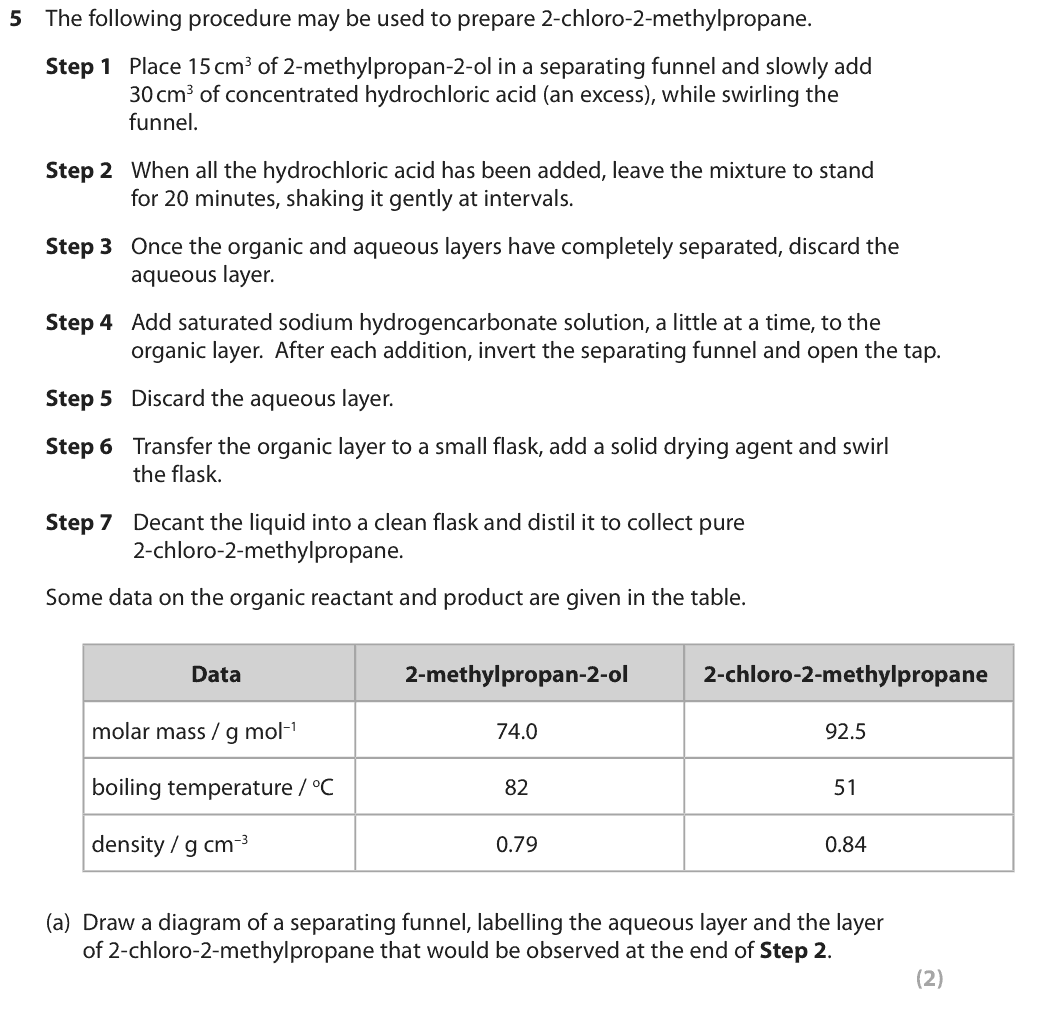
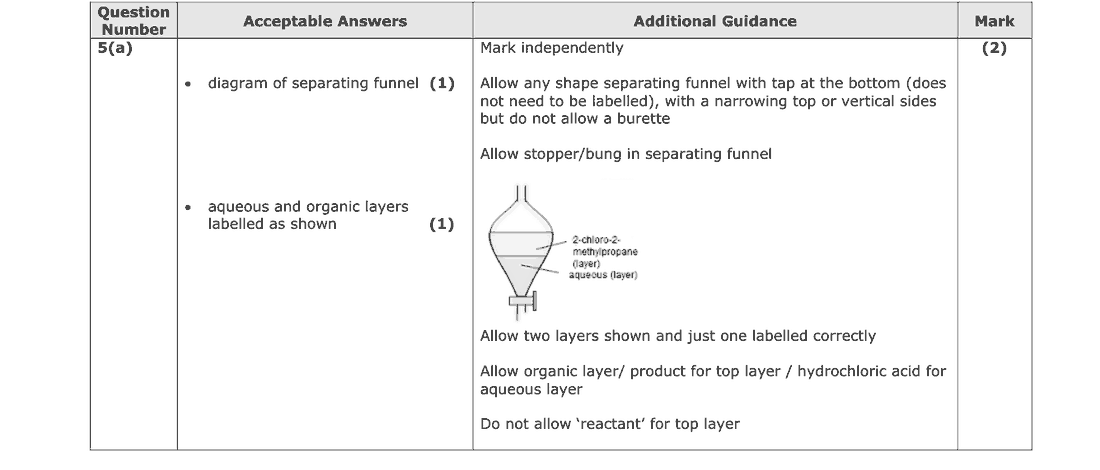
A separating funnel (any shape with a tap at the bottom and a stopper or opening at the top)
two layers with the top layer labelled 2-chloro-2-methylpropane / organic layer (it is less dense than the aqueous layer: 0.84 against 1.00 g cm–3). Not three layers. One of the simpler diagrams at this level but not well drawn in general
Skills: PT7 purify: a solid product by recrystallization; a liquid product, including use of separating funnel; CP6 Core practical 6: Chlorination of 2-methylpropan-2-ol using concentrated hydrochloric acid
June 2022 · Paper 2 · Q6(c)(i)2 marksExplanation
Earlier part of question 6 that this part uses
Mark scheme
Examiner's comment
The inclusion of the MS allowed reference to the apparatus as “reflux” for M1, resulting in many candidates scoring one mark as indicated by the overall mean of 0.99. However there were a significant number of candidates who negated this mark by referring to the loss of gas through the top of the condenser.
There were also a large number of candidates who understood that the use of reflux apparatus results in the oxidation of the alcohol to the carboxylic acid but this question was focused on the yield of the aldehyde so this comment did not score. There needed to be reference to the propanal or the aldehyde being further oxidised to the carboxylic (which is why the yield is low).
It is worth highlighting to centres and their candidates that use of the term 'complete oxidation' is incorrect in this context and should not be used.
Notes from the mark scheme and report
The apparatus is set up for reflux, so the propanal is condensed back into the flask (it is not distilled off)
so it is oxidised further to propanoic acid. Just 'reacts further' ignored
not 'completely oxidised'. Many scored one mark for reflux
some lost it by saying gas escapes from the top of the condenser
many said the alcohol goes to the acid without saying that the aldehyde is oxidised further
Skills: PT4 use laboratory apparatus for a variety of experimental techniques, including: titration, using burette and pipette; distillation and heating under reflux, including setting up glassware using retort stand and clamps; qualitative tests for ions and organic functional groups; filtration, including use of fluted filter paper, or filtration under reduced pressure; CP5 Core practical 5: The oxidation of ethanol
June 2022 · AS Paper 2 · Q6(c)(iii)2 marksPractical and data analysis
Earlier parts of question 6 that this part uses
Mark scheme
Examiner's comment
This was another practical based question, and some candidates were able to acquit themselves well, while others struggled to make headway, though (a) was quite commonly scored (b) was a diagram question, and the diagram here, one of the more straightforward required at this level, was not well drawn in general. On average candidates scored about half of the marks in (c) while in (d), about 50% score the mark in (d)(i). The extended writing answer (d)(ii) gave two marks most commonly out of six, though a few candidates were able to score all six marks. The calculation in (e) had a number of valid approaches. Some candidates were able to work through in a step by step fashion, whilst others appeared to quite randomly scatter calculation across the page. Great benefit can be had be identifying each of your calculation so you can follow your route through the calculation. Four out of four was the most common mark obtained. (f)(i) suffered from a lack of clarity in the written answers with candidates identifying the range in the infra-red spectrum to look for, but not saying how this would be used to establish purity. Similarly, in (f)(ii) a lack of detail and clarity meant that marks were not always scored.
Notes from the mark scheme and report
Add a named drying agent: anhydrous calcium chloride, magnesium sulfate or sodium sulfate (or silica gel)
then leave until the liquid goes clear / the added drying agent no longer clumps, or decant or filter the liquid off the solid. The second mark needs a drying agent to have been added. Not sodium or potassium hydroxide, anhydrous copper sulfate, cobalt chloride, calcium sulfate, calcium carbonate or potassium sulfate
Skills: PT7 purify: a solid product by recrystallization; a liquid product, including use of separating funnel; CP6 Core practical 6: Chlorination of 2-methylpropan-2-ol using concentrated hydrochloric acid
June 2022 · Paper 2 · Q6(c)(iv)1 markPractical and data analysis
Earlier part of question 6 that this part uses
Mark scheme
Examiner's comment
The use of anti-bumping granules has been asked many times before and the overall mean of 0.51 is lower than expected. The candidates frequently expressed incorrect ideas such as stating that these granules prevented bumping. It is possible that a lack of practical work/discussion in class due to COVID-19 contributed to this. Nonetheless there were a significant number of candidates who gave the preferred answer of the provision of nucleation sites for smaller bubbles rather than the 'allow' answer of to distribute heat more evenly.
Notes from the mark scheme and report
They provide a surface for bubbles to form / nucleation sites / allow smaller bubbles to form (prevent large bubbles)
allow spreading the heat more evenly. Ignored: mixing, 'to stop bumping', splashing. Many simply said the granules prevent bumping
Skills: PT4 use laboratory apparatus for a variety of experimental techniques, including: titration, using burette and pipette; distillation and heating under reflux, including setting up glassware using retort stand and clamps; qualitative tests for ions and organic functional groups; filtration, including use of fluted filter paper, or filtration under reduced pressure; CP5 Core practical 5: The oxidation of ethanol
June 2022 · AS Paper 2 · Q6(d)(i)1 markPractical and data analysis
Earlier part of question 6 that this part uses
Mark scheme
Examiner's comment
This was another practical based question, and some candidates were able to acquit themselves well, while others struggled to make headway, though (a) was quite commonly scored (b) was a diagram question, and the diagram here, one of the more straightforward required at this level, was not well drawn in general. On average candidates scored about half of the marks in (c) while in (d), about 50% score the mark in (d)(i). The extended writing answer (d)(ii) gave two marks most commonly out of six, though a few candidates were able to score all six marks. The calculation in (e) had a number of valid approaches. Some candidates were able to work through in a step by step fashion, whilst others appeared to quite randomly scatter calculation across the page. Great benefit can be had be identifying each of your calculation so you can follow your route through the calculation. Four out of four was the most common mark obtained. (f)(i) suffered from a lack of clarity in the written answers with candidates identifying the range in the infra-red spectrum to look for, but not saying how this would be used to establish purity. Similarly, in (f)(ii) a lack of detail and clarity meant that marks were not always scored.
Notes from the mark scheme and report
Answer: 50–52 °C. Any range within 48 to 54 °C that includes 51 °C (the boiling temperature in the table)
not just 51 °C. About half scored the mark
Skills: CP6 Core practical 6: Chlorination of 2-methylpropan-2-ol using concentrated hydrochloric acid
June 2022 · AS Paper 2 · Q6(d)(ii)6 marks6-mark extended response
Earlier parts of question 6 that this part uses
Mark scheme, with the indicative content and the marks for reasoning
Examiner's comment
This was another practical based question, and some candidates were able to acquit themselves well, while others struggled to make headway, though (a) was quite commonly scored (b) was a diagram question, and the diagram here, one of the more straightforward required at this level, was not well drawn in general. On average candidates scored about half of the marks in (c) while in (d), about 50% score the mark in (d)(i). The extended writing answer (d)(ii) gave two marks most commonly out of six, though a few candidates were able to score all six marks. The calculation in (e) had a number of valid approaches. Some candidates were able to work through in a step by step fashion, whilst others appeared to quite randomly scatter calculation across the page. Great benefit can be had be identifying each of your calculation so you can follow your route through the calculation. Four out of four was the most common mark obtained. (f)(i) suffered from a lack of clarity in the written answers with candidates identifying the range in the infra-red spectrum to look for, but not saying how this would be used to establish purity. Similarly, in (f)(ii) a lack of detail and clarity meant that marks were not always scored.
Notes from the mark scheme and report
Six indicative points plus two marks for reasoning. IP1 add anti-bumping granules
IP2 to prevent large bubbles / uneven boiling, which could carry reaction mixture over into the receiver and make the product impure ('prevents bumping' is ignored)
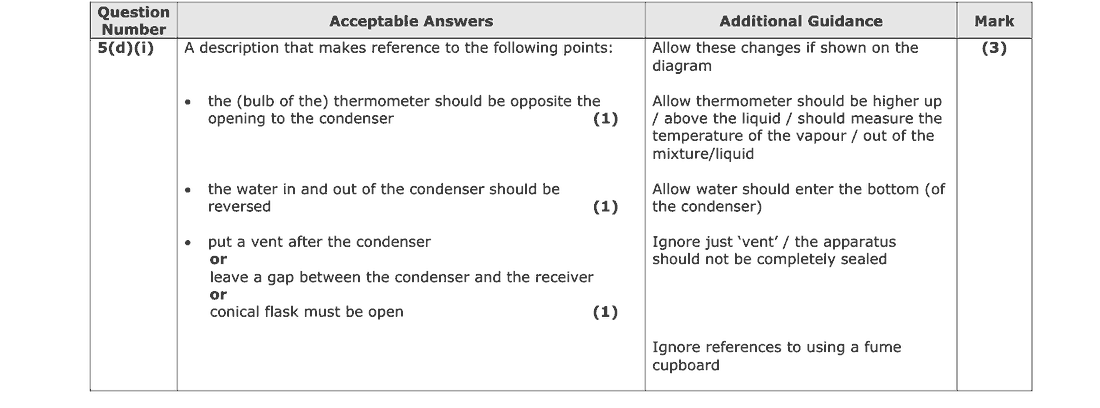
IP3 the thermometer bulb should be opposite the entrance to the condenser, measuring the vapour temperature not the liquid
IP4 otherwise the product is collected over the wrong temperature range and is impure
IP5 add more ice-water mixture (or put the receiving flask further into it)
IP6 so that as much product as possible condenses and is collected (higher yield). Errors that are not in the diagram are ignored: the water flow shown is correct. Two marks out of six was the commonest score
a few scored all six
Skills: PT4 use laboratory apparatus for a variety of experimental techniques, including: titration, using burette and pipette; distillation and heating under reflux, including setting up glassware using retort stand and clamps; qualitative tests for ions and organic functional groups; filtration, including use of fluted filter paper, or filtration under reduced pressure; CP6 Core practical 6: Chlorination of 2-methylpropan-2-ol using concentrated hydrochloric acid
June 2022 · Paper 3 · Q7(a)(ii)6 marksShort answer
Earlier part of question 7 that this part uses
Mark scheme
Examiner's comment
There were many errors in completing the reagents, types of reaction and structures of products in the table. Many candidates had not revised these reactions carefully enough to score high marks. The esterification in Reaction 4 was more familiar to candidates than the hydrolysis in Reaction 4. Many candidates were careless in drawing structures using skeletal formulae. Unless a question specifically asks for a skeletal formula, it is acceptable to use structural or displayed formulae, provided the functional groups are clear. Some candidates included steam with phosphoric acid for reagent 2 and had not looked carefully enough at the reaction scheme to notice that this reaction had been labelled as dehydration. A common incorrect reagent was LiAlH4.
Notes from the mark scheme and report
Reagent 2: concentrated phosphoric acid (or concentrated sulfuric acid, or aluminium oxide), not dilute, not steam
compound A: CH2=C(CH3)CN
reaction type 3: (acid) hydrolysis, not hydration
compound B: CH2=C(CH3)COOH
reagent 4: methanol
reaction type 4: esterification / condensation. All marks stand alone. Many errors: careless skeletal formulae
steam added with phosphoric acid
LiAlH4 as a reagent
esterification was better known than the hydrolysis
June 2022 · Paper 3 · Q7(b)3 marksDiagram or structure
Mark scheme
Examiner's comment
Candidates drew the distillation apparatus with varying degrees of success. There were many good diagrams of apparatus that would work, but there were more that had careless errors showing that the candidates did not think about how distillation could take place in the apparatus they had drawn. The left-hand side of the apparatus proved to be the most difficult, with many candidates drawing a conical flask for heating, not showing a still head or having noticeable gaps around the joints so gas could escape. A thermometer was not essential, but if it was drawn, the bulb needed to be in the still head and not in the liquid. The majority of candidates knew that water needs to enter at the lower end of the condenser but candidates lost marks for not drawing the condenser with a separate water jacket around the inner tube so the water and product would mix. Some candidates lost the final mark if their apparatus was sealed. Some candidates did not read the question and drew apparatus for heating under reflux, using a separating funnel or filtration.
Many candidates would benefit from seeing how the common apparatus is set up and drawing it accurately.
Notes from the mark scheme and report
Left: heat source, round-bottomed or pear-shaped flask with still head (thermometer bulb in the still head if drawn), no gaps at the joints, not a conical flask
centre: condenser sloping downwards with a separate water jacket and water in at the lower end
right: an open collection vessel (apparatus not sealed). A reflux diagram scores 0. The left-hand side was hardest: conical flasks, no still head, gaps at joints, thermometer in the liquid
condensers without a separate water jacket
sealed apparatus
Skills: PT4 use laboratory apparatus for a variety of experimental techniques, including: titration, using burette and pipette; distillation and heating under reflux, including setting up glassware using retort stand and clamps; qualitative tests for ions and organic functional groups; filtration, including use of fluted filter paper, or filtration under reduced pressure
November 2021 · Paper 2 · Q4(b)1 markMultiple choice
Answer
D
Mark scheme
Examiner's comment
Again, the text in bold seemed to be ignored by many, as a number of candidates produced
isomers based on a linear five-carbon chain, with no branches. It was common to see two
pent-1-ene structures proposed, though drawn differently. For instance, the C=C bond would
be shown on the far left in the first answer, then on the far right in the second. Others simply
angled their second attempt up or down the page, but did not spot that it was still a five-
carbon chain.
Other candidates could draw a correct structure, but as described above, drew it again in a
different orientation, thinking this was a new isomer. A majority of candidates could identify
which alcohol would form pent-2-ene in (b) and the mechanism in (c) was confidently handled
by many. The most common issues were ones of detail, with the omission of key features
such as the dipole on the H-Br molecule, and a lone pair on the bromide ion. A frustrating
minority ignored the instruction in the question and showed 3-bromopentane as the product.
The calculation in (d) showed most candidates have a secure understanding of the Ideal Gas
Equation. However, minor slips meant some candidates did not access all four marks. These
included:
using an incorrect relative molecular mass of pent-1-ene to determine n
incorrect conversion of temperature to K and/or volume to m3
incorrect number of significant figures and / or units
A small number of candidates converted the volume to dm3. Sometimes this seemed to be a
deliberate strategy, with the candidate realising that this results in a pressure measure in kPa.
Others, however, may have confused the units with those required in titration problems, and
hence made errors in the final units for pressure. Candidates need to be careful that their
rationale is clear if they adopt this route, and the best way is to ensure all steps of the
calculation are clearly labelled and presented in a clearly defined order.
Notes from the mark scheme and report
Answer: D. Pentan-3-ol can only lose water to give pent-2-ene. Pentan-2-ol (C) also gives pent-1-ene
pentan-1-ol (B) gives only pent-1-ene
A is branched
November 2021 · AS Paper 2 · Q8(a)1 markDiagram or structure
Mark scheme
Examiner's comment
This question concerned the reactions of cyclohexanol. In general terms it was answered poorly,
and weaker candidates declined to answer most of the early parts of this question. Most of these
candidates seemed unfamiliar with the reactions of alcohols. A few excellent answers were seen,
but these generally related to the more able candidates.
(a) It appeared that weaker candidates were unsure of what was meant by a skeletal formula.
(b)(i) This question asked about the oxidation of a secondary alcohol, requiring both the name and
displayed formula of the organic product. It was therefore a demanding question requiring
knowledge of the reaction and the ability to write relevant names and formulae.
(b)(ii) This question tested the candidate’s understanding of IR spectra. Although worth just 2
marks on this paper, this specification topic tends to be difficult for many candidates, perhaps
because it requires a considerable investment in time and effort to understand the basics of IR
spectroscopy.
(b)(iii) and (b)(iv) Following on from IR, the question then moved on to another instrumental
technique: mass spectrometry. Part (iii) was a simple question about finding relative molecular
mass from a mass spectrum, but avoided or answered incorrectly by almost all weaker candidates.
Part (iv) was potentially more challenging but was attempted with more success by candidates
across the ability range. Similar questions have been asked in recent years and practice with past
papers may have contributed to the candidate performance seen in this question.
(c)(i) This multiple-choice question on reaction classification proved to be a relatively easy mark for
most candidates. Application of simple chemical principles gives the required answer.
(c)(ii) This was a relatively complicated question involving density calculations, mole calculation,
and % yield. It was intended to discriminate and only the best candidate were able to achieve the
final correct answer. Some candidates were able to gain some of the available marks.
(c)(iii)* This was a longer unstructured question and was concerned with the practical
aspects of producing a dry sample of product from a given organic reaction. As is usual with this
style of question, the data provided gives several clues about the required answer. In general, this
question was very poorly answered, with the majority of candidates failing to score any marks at all.
In this type of practical question, it is a marked advantage to have completed any of the relevant
practical exercises. Practical experience seemed to be lacking for most candidates, with only the
best candidates scoring a modest number of marks for this question.
Notes from the mark scheme and report
Answer: bromocyclohexane: a hexagon with a bond from one corner to Br. The bond from the ring to Br must be shown. Weaker candidates seemed unsure what a skeletal formula is
November 2021 · AS Paper 2 · Q8(b)(i)2 marksShort answer
Earlier part of question 8 that this part uses
Mark scheme
Examiner's comment
This question concerned the reactions of cyclohexanol. In general terms it was answered poorly,
and weaker candidates declined to answer most of the early parts of this question. Most of these
candidates seemed unfamiliar with the reactions of alcohols. A few excellent answers were seen,
but these generally related to the more able candidates.
(a) It appeared that weaker candidates were unsure of what was meant by a skeletal formula.
(b)(i) This question asked about the oxidation of a secondary alcohol, requiring both the name and
displayed formula of the organic product. It was therefore a demanding question requiring
knowledge of the reaction and the ability to write relevant names and formulae.
(b)(ii) This question tested the candidate’s understanding of IR spectra. Although worth just 2
marks on this paper, this specification topic tends to be difficult for many candidates, perhaps
because it requires a considerable investment in time and effort to understand the basics of IR
spectroscopy.
(b)(iii) and (b)(iv) Following on from IR, the question then moved on to another instrumental
technique: mass spectrometry. Part (iii) was a simple question about finding relative molecular
mass from a mass spectrum, but avoided or answered incorrectly by almost all weaker candidates.
Part (iv) was potentially more challenging but was attempted with more success by candidates
across the ability range. Similar questions have been asked in recent years and practice with past
papers may have contributed to the candidate performance seen in this question.
(c)(i) This multiple-choice question on reaction classification proved to be a relatively easy mark for
most candidates. Application of simple chemical principles gives the required answer.
(c)(ii) This was a relatively complicated question involving density calculations, mole calculation,
and % yield. It was intended to discriminate and only the best candidate were able to achieve the
final correct answer. Some candidates were able to gain some of the available marks.
(c)(iii)* This was a longer unstructured question and was concerned with the practical
aspects of producing a dry sample of product from a given organic reaction. As is usual with this
style of question, the data provided gives several clues about the required answer. In general, this
question was very poorly answered, with the majority of candidates failing to score any marks at all.
In this type of practical question, it is a marked advantage to have completed any of the relevant
practical exercises. Practical experience seemed to be lacking for most candidates, with only the
best candidates scoring a modest number of marks for this question.
Notes from the mark scheme and report
Answer: cyclohexanone
a six-carbon ring with C=O on one carbon and two H on each of the other five. CH2 groups or a skeletal formula allowed
a molecular formula is not. Needs the fact that a secondary alcohol is oxidised to a ketone
November 2021 · AS Paper 2 · Q8(c)(iii)6 marks6-mark extended responseHard
Earlier parts of question 8 that this part uses
Mark scheme, with the indicative content and the marks for reasoning
Examiner's comment
This question concerned the reactions of cyclohexanol. In general terms it was answered poorly,
and weaker candidates declined to answer most of the early parts of this question. Most of these
candidates seemed unfamiliar with the reactions of alcohols. A few excellent answers were seen,
but these generally related to the more able candidates.
(a) It appeared that weaker candidates were unsure of what was meant by a skeletal formula.
(b)(i) This question asked about the oxidation of a secondary alcohol, requiring both the name and
displayed formula of the organic product. It was therefore a demanding question requiring
knowledge of the reaction and the ability to write relevant names and formulae.
(b)(ii) This question tested the candidate’s understanding of IR spectra. Although worth just 2
marks on this paper, this specification topic tends to be difficult for many candidates, perhaps
because it requires a considerable investment in time and effort to understand the basics of IR
spectroscopy.
(b)(iii) and (b)(iv) Following on from IR, the question then moved on to another instrumental
technique: mass spectrometry. Part (iii) was a simple question about finding relative molecular
mass from a mass spectrum, but avoided or answered incorrectly by almost all weaker candidates.
Part (iv) was potentially more challenging but was attempted with more success by candidates
across the ability range. Similar questions have been asked in recent years and practice with past
papers may have contributed to the candidate performance seen in this question.
(c)(i) This multiple-choice question on reaction classification proved to be a relatively easy mark for
most candidates. Application of simple chemical principles gives the required answer.
(c)(ii) This was a relatively complicated question involving density calculations, mole calculation,
and % yield. It was intended to discriminate and only the best candidate were able to achieve the
final correct answer. Some candidates were able to gain some of the available marks.
(c)(iii)* This was a longer unstructured question and was concerned with the practical
aspects of producing a dry sample of product from a given organic reaction. As is usual with this
style of question, the data provided gives several clues about the required answer. In general, this
question was very poorly answered, with the majority of candidates failing to score any marks at all.
In this type of practical question, it is a marked advantage to have completed any of the relevant
practical exercises. Practical experience seemed to be lacking for most candidates, with only the
best candidates scoring a modest number of marks for this question.
Notes from the mark scheme and report
Six indicative points plus two marks for reasoning. IP1 separate the cyclohexene from the water in a separating funnel
IP2 run off the lower aqueous layer, which is lower because it is denser (cyclohexene 0.811 g cm–3)
IP3 add a named drying agent (anhydrous CaCl2, Na2SO4, CaSO4 or MgSO4)
IP4 separate the cyclohexene from the drying agent by filtering or decanting
IP5 redistil
IP6 collect the fraction boiling between 80 and 86 °C. The report says candidates lacked practical experience and only the best scored even a modest mark
Skills: PT4 use laboratory apparatus for a variety of experimental techniques, including: titration, using burette and pipette; distillation and heating under reflux, including setting up glassware using retort stand and clamps; qualitative tests for ions and organic functional groups; filtration, including use of fluted filter paper, or filtration under reduced pressure; PT7 purify: a solid product by recrystallization; a liquid product, including use of separating funnel
October 2020 · AS Paper 2 · Q2(d)(i)3 marksEquation writing
Earlier part of question 2 that this part uses
Mark scheme
Examiner's comment
This question tested knowledge of the alcohols and their reactions. The pattern here followed
the pattern of question 1 with candidates answering well the questions which tested
knowledge which is perhaps more commonly seen and tested at this level. Less commonly
tested ideas, such as that of stereoisomerism proved more challenging.
Notes from the mark scheme and report
Either CH3CH2CH2CH2OH + [O] → CH3CH2CH2CHO + H2O, butanal, distil off (immediately)
or CH3CH2CH2CH2OH + 2[O] → CH3CH2CH2COOH + H2O, butanoic acid, heat under reflux. The condition mark depends on one of the other two being scored. Molecular formulae for the products are not accepted. Two marks are available if propan-1-ol is used correctly
October 2020 · AS Paper 2 · Q2(d)(ii)1 markMultiple choice
Earlier parts of question 2 that this part uses
Answer
B
Mark scheme
Examiner's comment
This question tested knowledge of the alcohols and their reactions. The pattern here followed
the pattern of question 1 with candidates answering well the questions which tested
knowledge which is perhaps more commonly seen and tested at this level. Less commonly
tested ideas, such as that of stereoisomerism proved more challenging.
Notes from the mark scheme and report
Answer: B (green). Orange is the colour of the dichromate(VI) before reaction
yellow is chromate(VI)
brown is not seen in this reaction
June 2019 · Paper 2 · Q1(a)(i)1 markMultiple choice
Answer
B
Mark scheme
Notes from the mark scheme and report
Answer: B. 2-methylpentan-2-ol is a tertiary alcohol, so acidified dichromate(VI) does not oxidise it. A, C and D are all secondary alcohols
June 2019 · Paper 2 · Q1(b)1 markMultiple choice
Answer
A
Mark scheme
Notes from the mark scheme and report
Answer: A. Red phosphorus with iodine converts alcohols into iodoalkanes
the other three do not form iodoalkanes with iodine and an alcohol
June 2019 · Paper 2 · Q3(c)1 markMultiple choice
Answer
B
Mark scheme
Notes from the mark scheme and report
Answer: B. Propan-1-ol has an –OH group, so it reacts with PCl5 to give hydrogen chloride. Propanal, propanone and propyl propanoate do not
June 2019 · AS Paper 2 · Q5(a)1 markPractical and data analysis
Mark scheme
Examiner's comment
A lack of precision in (a) resulted in the loss of the mark for some. Many answers described condensing products back in the the reaction mixture. This is true for butan-1-ol but not for the but-1-ene which is collected in the gas syringe. The use of bromine water as a test for unsaturation was well known. In (c) the percentage yield calculation was very well understood by higher ability candidates, however lower scoring learners seemed unsure where to begin and failed to score. The unusual calculation in 5(d) proved challenging for all. Some candidates clearly understood what to do, showing working indicating they understood that the number of moles and pressure were constant so the volume depended only on the temperature before correctly completing the calculation. Some candidates made an assumption that the pressure was standard pressure (either 100 or 101 kPa) and then did two pV = nRT calculations to find an answer which was close to the correct one. These candidates were awarded one of the two marks. In (e) those who knew the mechanism of the reaction often scored all 5 marks. The answer to (e)(i), substitution, was often accompanied by nucleophilic, which was correct but not required, or electrophilic which was incorrect and lost the mark. The type of reaction is substitution and it is a nucleophilic mechanism. The test for the –OH group in the alcohol and the expected observation were well known. The mechanism scored well for some learners, with careful positioned arrows and all the relevant lone pairs and dipoles included. Marks were lost through the lack of the dipole on OH‒ or the lack of its charge. Dipoles in the 1-bromobutane were not always included. Some did not include the product bromide ion. As a result a range of marks were scored. Some candidates were clearly unsure where to start and so scored 0. The final part of this question was challenging as many learners did not appreciate that, as well as but-1-ene, but-2-ene would be formed. This compound exists as both cis- and trans- isomers and so the number of isomeric alkene products was, in fact, three.
Notes from the mark scheme and report
It condenses volatile reactants (1-bromobutane, ethanol, water) and returns them to the reaction mixture so they are not lost / so that only but-1-ene enters the gas syringe. Just 'cools' or 'condenses the gases' is ignored
not 'condenses the products' or the but-1-ene. Many lost the mark by saying the products are condensed back into the mixture
Skills: PT4 use laboratory apparatus for a variety of experimental techniques, including: titration, using burette and pipette; distillation and heating under reflux, including setting up glassware using retort stand and clamps; qualitative tests for ions and organic functional groups; filtration, including use of fluted filter paper, or filtration under reduced pressure
June 2019 · AS Paper 2 · Q5(e)(ii)1 markMultiple choice
Earlier parts of question 5 that this part uses
Answer
D
Mark scheme
Examiner's comment
A lack of precision in (a) resulted in the loss of the mark for some. Many answers described condensing products back in the the reaction mixture. This is true for butan-1-ol but not for the but-1-ene which is collected in the gas syringe. The use of bromine water as a test for unsaturation was well known. In (c) the percentage yield calculation was very well understood by higher ability candidates, however lower scoring learners seemed unsure where to begin and failed to score. The unusual calculation in 5(d) proved challenging for all. Some candidates clearly understood what to do, showing working indicating they understood that the number of moles and pressure were constant so the volume depended only on the temperature before correctly completing the calculation. Some candidates made an assumption that the pressure was standard pressure (either 100 or 101 kPa) and then did two pV = nRT calculations to find an answer which was close to the correct one. These candidates were awarded one of the two marks. In (e) those who knew the mechanism of the reaction often scored all 5 marks. The answer to (e)(i), substitution, was often accompanied by nucleophilic, which was correct but not required, or electrophilic which was incorrect and lost the mark. The type of reaction is substitution and it is a nucleophilic mechanism. The test for the –OH group in the alcohol and the expected observation were well known. The mechanism scored well for some learners, with careful positioned arrows and all the relevant lone pairs and dipoles included. Marks were lost through the lack of the dipole on OH‒ or the lack of its charge. Dipoles in the 1-bromobutane were not always included. Some did not include the product bromide ion. As a result a range of marks were scored. Some candidates were clearly unsure where to start and so scored 0. The final part of this question was challenging as many learners did not appreciate that, as well as but-1-ene, but-2-ene would be formed. This compound exists as both cis- and trans- isomers and so the number of isomeric alkene products was, in fact, three.
Notes from the mark scheme and report
Answer: D (phosphorus(V) chloride, steamy fumes). A is the result for an acid
B would identify the bromoalkane
C identifies an aldehyde, the oxidation product of the alcohol, not the alcohol
Skills: PT4 use laboratory apparatus for a variety of experimental techniques, including: titration, using burette and pipette; distillation and heating under reflux, including setting up glassware using retort stand and clamps; qualitative tests for ions and organic functional groups; filtration, including use of fluted filter paper, or filtration under reduced pressure; CP7 Core practical 7: Analysis of some inorganic and organic unknowns
June 2019 · Paper 2 · Q6(c)6 marks6-mark extended response
Earlier part of question 6 that this part uses
Mark scheme, with the indicative content and the marks for reasoning
Examiner's comment
Examiners felt that this was the most discriminatory question on the paper with the full range of marks seen regularly. Weaker candidates tended to either discuss reactions of alcohols in entirely generic terms or scored 1 or 2 marks for discussion of oxidation of the ethanol to either ethanal or ethanoic acid. In the mid-range, oxidation of the flavan-3-ol was more evident, though sometimes the product was described as an aldehyde. Others didn’t realise the -OH group in flavan-3-ol was secondary and insisted it could be oxidised to a carboxylic acid. The use of the term ‘fruity smell’ keyed many candidates into the notion that esters would form, though ethyl ethanoate was seen less frequently than the ester formed from ethanoic acid and flavan-3-ol. Fortunately, most candidates resisted the urge to include significant amounts of additional, potentially incorrect, chemistry. Hence, mistakes tended to prevent the award of marks linked to indicative points rather than lines of reasoning.
Notes from the mark scheme and report
Six indicative points plus two marks for reasoning. IP1 oxidation of ethanol or of flavan-3-ol by oxygen in the air
IP2 ethanal or ethanoic acid formed from ethanol
IP3 ethyl ethanoate from ethanol and ethanoic acid
IP4 structure or name of flavan-3-one (not if called an aldehyde)
IP5 the OH of flavan-3-ol forms an ester with ethanoic acid
IP6 correct structure of that ester (which also earns IP5). Names or formulae allowed, but both must be right if both are given. Called the most discriminating question on the paper. Weaker answers were generic or stopped at oxidising ethanol
some called the ketone an aldehyde or oxidised the secondary OH to a carboxylic acid
ethyl ethanoate was seen less often than the flavan-3-ol ester
June 2019 · Paper 3 · Q8(a)(i)3 marksPractical and data analysis
Mark scheme
Examiner's comment
Many candidates scored 3 marks for giving clear reasons for each of the Steps 2, 3 and 4. However, some gave vague answers that were not worthy of credit. Many missed the fact that the reaction with concentrated sulfuric acid would be exothermic so they just wrote about slowing down the rate of reaction in Step 2. A common error in Step 3 was to state that anti-bumping granules distribute the heat more evenly instead of providing a surface for small bubbles to form and many candidates thought that they would promote smooth heating instead of smooth boiling. Some candidates lost a mark in Step 4 as they thought that all the reactants and products would escape if it was not heated under reflux, instead of specifying the volatile or organic reactants and products.
Notes from the mark scheme and report
Step 2 cool: the reaction with concentrated sulfuric acid is (very) exothermic (not 'to slow the reaction'). Step 3 anti-bumping granules: smooth / even boiling, small bubbles, prevent superheating or violent boiling (not 'smooth heating' or 'distribute heat evenly'). Step 4 reflux: prevents loss of volatile / organic reactants and products by condensing the vapour, so the reaction can go to completion (just 'prevents loss of reactants' is not enough)
Skills: PT4 use laboratory apparatus for a variety of experimental techniques, including: titration, using burette and pipette; distillation and heating under reflux, including setting up glassware using retort stand and clamps; qualitative tests for ions and organic functional groups; filtration, including use of fluted filter paper, or filtration under reduced pressure; PT11 safely and carefully handle solids and liquids, including corrosive, irritant, flammable and toxic substances
June 2019 · Paper 3 · Q8(a)(ii)3 marksPractical and data analysis
Earlier part of question 8 that this part uses
Mark scheme
Examiner's comment
The majority of candidates could identify at least one error in the diagram and state the effect of the error. Some candidates thought that there should be a stopper in the top of the condenser but that it should have a thermometer in it, so they seemed to be confused between heating under reflux and distillation. A few candidates thought that the arrow and heat was an error as it did not specify the type of heat, but this was not allowed as an incorrect heat source was not given.
Notes from the mark scheme and report
Gap between the condenser and the flask: vapour / reactants / products escape. Water flowing the wrong way (in at the top): the condenser does not fill with water, so cooling is inefficient. Stopper in the top of the condenser: pressure builds up (stopper blows out). Each mark needs the error and its effect. Some wanted a stopper with a thermometer, confusing reflux with distillation
the heat arrow is not an error
Skills: PT4 use laboratory apparatus for a variety of experimental techniques, including: titration, using burette and pipette; distillation and heating under reflux, including setting up glassware using retort stand and clamps; qualitative tests for ions and organic functional groups; filtration, including use of fluted filter paper, or filtration under reduced pressure
June 2019 · Paper 3 · Q8(b)(i)1 markPractical and data analysis
Earlier part of question 8 that this part uses
Mark scheme
Examiner's comment
Many candidates did work out that the aqueous layer would be on the top as it has a lower density. Common errors included: stating that there would be three layers and that water would be in the middle and stating that water must be at the bottom so that it can be removed by opening the tap. Some candidates just stated the position of the aqueous layer and did not justify their answer.
Notes from the mark scheme and report
The aqueous layer is on top, because water has a lower density than 1-bromobutane (1.00 against 1.27 g cm–3). Both parts needed
'lighter' is not accepted, nor is any mention of three layers. Errors: three layers with water in the middle
water at the bottom so that it can be run off
no justification
Skills: PT7 purify: a solid product by recrystallization; a liquid product, including use of separating funnel; CP6 Core practical 6: Chlorination of 2-methylpropan-2-ol using concentrated hydrochloric acid
June 2019 · Paper 3 · Q8(b)(ii)3 marksPractical and data analysis
Earlier parts of question 8 that this part uses
Mark scheme
Examiner's comment
Many candidates are familiar with the purification of an organic liquid and scored 3 marks for this item. Some candidates lost a mark for the use of sodium hydrogencarbonate as they just stated that it removes impurities and did not specify what they are and others stated that it would remove sulfuric acid without realising that would not have distilled over. Some candidates did not score the mark for the use of anhydrous sodium sulfate as they thought it was a dehydrating agent or would react with water, rather than act as a drying agent.
Notes from the mark scheme and report
Step 8: sodium hydrogencarbonate neutralises / removes the (hydrochloric) acid
naming a wrong acid such as H2SO4 or HBr loses the mark. Step 9: opening the tap releases the carbon dioxide and stops pressure building up. Step 10: anhydrous sodium sulfate removes water (a drying agent
not 'dehydrating' or 'reacts with water'). Errors: 'removes impurities'
removing sulfuric acid, which would not have distilled over
Skills: PT7 purify: a solid product by recrystallization; a liquid product, including use of separating funnel; CP6 Core practical 6: Chlorination of 2-methylpropan-2-ol using concentrated hydrochloric acid
June 2019 · Paper 3 · Q8(b)(iii)1 markPractical and data analysis
Earlier parts of question 8 that this part uses
Mark scheme
Examiner's comment
Although the majority of candidates suggested a suitable temperature range over which to collect the pure 1-bromobutane, many gave too large a range and some ranges did not include the boiling temperature of 1-bromobutane. A small number of candidates gave a very small range of temperature e.g. 101.5oC to 102.5oC, which would be too difficult to carry out. Two degrees either side of the boiling temperature of the pure substance is a suitable range.
Notes from the mark scheme and report
Answer: a range starting at 99, 100 or 101 °C and ending at 103, 104 or 105 °C, e.g. 100–104 °C. A single value, or 102 °C as one end of the range, is not accepted. Many ranges were too wide, did not include 102 °C, or were impractically narrow
Skills: CP6 Core practical 6: Chlorination of 2-methylpropan-2-ol using concentrated hydrochloric acid
June 2018 · Paper 2 · Q5(a)2 marksEquation writing
Mark scheme
Examiner's comment
Just under 60% candidates correctly balanced the half equation and also gave the right colours for all of the species. Occasionally no response was given for the hydrogen ions and the water despite the dotted answer lines, and so this meant that the 'colours' mark was not awarded. It was very pleasing to see very few 'clear' answers which did not score so this point seems to be well- understood by candidates.
no colour mark if any space is left blank. Just under 60% scored both
some gave no colour for H+ and water
June 2018 · Paper 2 · Q5(b)(i)1 markDiagram or structure
Earlier part of question 5 that this part uses
Mark scheme
Examiner's comment
The most common reason for a lack of credit on this question was the absence of any attempt. It is most likely that these candidates missed the need to answer the question despite the fact that the following question is part (ii). This serves as a reminder to candidates to pay closer attention to the rubric of the question. Occasionally candidates did not answer with shading as requested but drew arrows which did not score.
Most of the candidates attempting this question did understand that the condenser would not completely fill with water and so any response with a practical shading was awarded credit.
Notes from the mark scheme and report
Any shading that shows the water jacket NOT completely full (water entering at the top runs straight out at the bottom
air pockets allowed). Many left the part blank
arrows instead of shading did not score
Skills: PT4 use laboratory apparatus for a variety of experimental techniques, including: titration, using burette and pipette; distillation and heating under reflux, including setting up glassware using retort stand and clamps; qualitative tests for ions and organic functional groups; filtration, including use of fluted filter paper, or filtration under reduced pressure; CP5 Core practical 5: The oxidation of ethanol
June 2018 · Paper 2 · Q5(b)(ii)1 markPractical and data analysisHard
Earlier part of question 5 that this part uses
Mark scheme
Examiner's comment
Three quarters of candidates failed to score and appeared to have no real idea of the function of the anti-bumping granules; in fact a lot of erroneous comments about these granules being sites for reactions or acting as catalysts were seen. Possibly centre-specific, some high-quality answers were seen referring to the granules serving as nucleation sites for smaller bubbles.
The function of chemical apparatus is an excellent revision activity for candidates
Notes from the mark scheme and report
They prevent uncontrolled (violent) boiling by spreading the heat more evenly, or by giving a surface on which (small) bubbles can form / nucleation sites. Not 'surface area for the reaction'
'smooth boiling' and 'mixing the reagents' ignored. Many thought the granules were catalysts or sites for reaction
Skills: PT4 use laboratory apparatus for a variety of experimental techniques, including: titration, using burette and pipette; distillation and heating under reflux, including setting up glassware using retort stand and clamps; qualitative tests for ions and organic functional groups; filtration, including use of fluted filter paper, or filtration under reduced pressure; CP5 Core practical 5: The oxidation of ethanol
June 2018 · Paper 2 · Q5(c)1 markMultiple choice
Earlier part of question 5 that this part uses
Answer
B
Mark scheme
Notes from the mark scheme and report
Answer: B. The acid is 2-methylpropanoic acid, so the primary alcohol with the same carbon skeleton, 2-methylpropan-1-ol. C has five carbons
D has three
A is not a systematic name
June 2018 · AS Paper 2 · Q5(c)(ii)1 markMultiple choice
Earlier parts of question 5 that this part uses
Answer
A
Mark scheme
Notes from the mark scheme and report
Answer: A (fractional distillation). A separating funnel (B) is not suitable for an industrial process
reflux (C) does not separate
both products react with alkali (D)
June 2018 · Paper 2 · Q5(d)2 marksExplanation
Mark scheme
Examiner's comment
The candidates were roughly evenly spread over the full marking range and proved an effective discriminator. The better candidates gave a good explanation of why an aldehyde produced would distil off before further oxidation due to its lower boiling temperature. The weaker candidates failed to mention the aldehyde product but gave vague or general comments about the difference between reflux and distillation.
Notes from the mark scheme and report
Ethanol is first oxidised to ethanal
ethanal has a low boiling temperature (is volatile) so it distils off before it can be oxidised further to ethanoic acid. Reverse argument for reflux allowed. Weaker answers did not mention the aldehyde and only compared reflux and distillation in general terms
Skills: CP5 Core practical 5: The oxidation of ethanol
June 2018 · AS Paper 2 · Q8(d)1 markMultiple choice
Answer
D
Mark scheme
Notes from the mark scheme and report
Answer: D (no change). 2-methylpropan-2-ol is a tertiary alcohol so is not oxidised. A (orange to green) is what a primary or secondary alcohol gives
June 2018 · Paper 3 · Q6(e)2 marksPractical and data analysis
Earlier part of question 6 that this part uses
Mark scheme
Examiner's comment
This was a clear-cut test of the ability to apply knowledge of organic qualitative tests and nearly 70% of responses were fully correct. The bromine test for the C=C double bond was especially well known. The test for the alcohol group was slightly more challenging, with a number thinking that the -OH group in the -COOH group would also react.
Notes from the mark scheme and report
Bromine water: structure 1 tick, structure 2 tick, structure 3 cross. Acidified potassium dichromate(VI): structure 1 cross, structure 2 tick, structure 3 cross. One mark per column
three correct ticks with no crosses scores 1. The bromine test was well known
some thought the OH of the COOH group would be oxidised
Skills: PT4 use laboratory apparatus for a variety of experimental techniques, including: titration, using burette and pipette; distillation and heating under reflux, including setting up glassware using retort stand and clamps; qualitative tests for ions and organic functional groups; filtration, including use of fluted filter paper, or filtration under reduced pressure; CP7 Core practical 7: Analysis of some inorganic and organic unknowns
June 2017 · AS Paper 2 · Q4(d)4 marksPractical and data analysis
Earlier parts of question 4 that this part uses
Mark scheme
Examiner's comment
This question linked with the response in Question 4(c). Candidates were expected to provide a test and the expected result for each of the (correct) functional groups identified in Question 4(c). No TE was permitted for incorrect functional groups identified in Question 4(c); a candidate who recalled a correct test/result for an aldehyde, for example, could not get credit in Question 4(d) for a non-existent functional group listed in Question 4(c).
Notes from the mark scheme and report
Alkene: bromine water (or acidified potassium manganate(VII)), decolorised / orange, yellow or brown to colourless (purple to colourless). Alcohol: PCl5, misty / steamy white fumes
also allowed are warming with acidified dichromate(VI), orange to green or blue, or sodium, effervescence. Each result mark depends on a correct test. No credit for testing groups wrongly identified in (c), or alkanes
Skills: PT4 use laboratory apparatus for a variety of experimental techniques, including: titration, using burette and pipette; distillation and heating under reflux, including setting up glassware using retort stand and clamps; qualitative tests for ions and organic functional groups; filtration, including use of fluted filter paper, or filtration under reduced pressure; CP7 Core practical 7: Analysis of some inorganic and organic unknowns
June 2017 · AS Paper 2 · Q8(b)(i)1 markMultiple choice
Answer
A
Mark scheme
Notes from the mark scheme and report
Answer: A. Sodium dichromate(VI) with sulfuric acid, heated under reflux so that oxidation goes all the way to the acid. Room temperature (C, D) does not give complete oxidation
with hydrochloric acid (B) hydrogen chloride would be lost on heating
June 2017 · AS Paper 2 · Q8(b)(ii)1 markMultiple choice
Earlier part of question 8 that this part uses
Answer
B
Mark scheme
Notes from the mark scheme and report
Answer: B. Orange dichromate(VI) ions are reduced to green chromium(III) ions
June 2017 · Paper 3 · Q2(a)4 marksPractical and data analysis
Mark scheme
Examiner's comment
Most candidates seemed familiar with distillation apparatus and were quick to notice the incorrect direction of water flow, often justifying the need for change in terms of the efficiency of cooling. The replacement of the funnel proved more difficult, with a minority suggesting the whole apparatus should be sealed to prevent escape of volatile compounds. Those that did recognise the need to close the set-up on the left hand side did not always specify what they would use (e.g. bung, stopper etc.), and so missed the mark. Thermometers were regularly mentioned but nearly always in the context of determining the boiling temperature, which was not relevant in this case.
Notes from the mark scheme and report
Change 1: reverse the water flow so it enters at the bottom of the condenser and leaves at the top
reason: keeps the condenser full of water / removes air / more efficient cooling. Change 2: replace the funnel and seal with a thermometer or stopper (allow a tap / dropping funnel)
reason: stops vapour, product or reactants escaping. Changes in either order. Most spotted the water flow
the funnel was harder, some wanted the whole apparatus sealed, and some did not say what they would seal it with. A thermometer for measuring the boiling temperature was not a reason
Skills: PT4 use laboratory apparatus for a variety of experimental techniques, including: titration, using burette and pipette; distillation and heating under reflux, including setting up glassware using retort stand and clamps; qualitative tests for ions and organic functional groups; filtration, including use of fluted filter paper, or filtration under reduced pressure; CP5 Core practical 5: The oxidation of ethanol
June 2017 · Paper 3 · Q2(c)(i)1 markShort answer
Earlier part of question 2 that this part uses
Mark scheme
Examiner's comment
The majority of answers were sufficient to score the mark here with the simple recognition that secondary alcohols cannot be oxidised to carboxylic acids.
A few simply stated ‘because it is a secondary alcohol’ which was deemed insufficient to score.
Notes from the mark scheme and report
3-Methylbutan-2-ol is a secondary alcohol, which cannot be oxidised to a carboxylic acid (only primary alcohols can)
or the ketone formed cannot be oxidised further. Just 'because it is a secondary alcohol' was not enough
June 2017 · Paper 3 · Q2(c)(ii)1 markShort answer
Earlier parts of question 2 that this part uses
Mark scheme
Examiner's comment
Despite the mention of sulfuric acid in the stem, and the previous question making it clear that carboxylic acids do not form in the reaction, a surprising minority did not score the mark. Common wrong answers included a variety of organic acids or alcohols and H2Cr2O7.
Notes from the mark scheme and report
Answer: H2SO4. The formula is required
the name 'sulfuric acid' alone is ignored
Skills: CP5 Core practical 5: The oxidation of ethanol
June 2017 · Paper 3 · Q2(f)(i)2 marksEquation writing
Earlier part of question 2 that this part uses
Mark scheme
Examiner's comment
Given its relatively straightforward nature, this question differentiated between candidates extremely well. Candidates had a lot to consider from counting carbon atoms to recognition that the other product was water. However, the most frequent error was in failing to use molecular formulae correctly, with candidates separating OH in the alcohol and/or writing structural formulae.
Notes from the mark scheme and report
C5H12O + [O] → C5H10O + H2O. One mark for each side
[O] may be over the arrow. Molecular formulae throughout: C5H11OH is not accepted. Commonest error was separating the OH or writing structural formulae
others miscounted carbons or missed water as the other product
June 2016 · AS Paper 2 · Q5(a)2 marksDiagram or structure
Mark scheme
Examiner's comment
Many candidates drew clear diagrams of the separating funnel and showed the labelled layers in the correct order. Some diagrams were of a poor quality and looked as if the candidates had not seen this piece of apparatus before. Many diagrams had the tap missing or placed it half-way up the sides of the funnel. A few candidates drew a separating funnel that looked like a burette and this did not receive any credit. Candidates should practise drawing pieces of laboratory equipment.
Notes from the mark scheme and report
A separating funnel (any shape with a tap at the bottom
not a burette) with two layers: 2-chloro-2-methylpropane (organic layer / product) on top, aqueous layer underneath, as the product is less dense (0.84 g cm–3). Marked independently
two layers with one correctly labelled is enough
'reactant' is not allowed for the top layer. Common errors: no tap, or the tap halfway up
a burette
Skills: PT7 purify: a solid product by recrystallization; a liquid product, including use of separating funnel; CP6 Core practical 6: Chlorination of 2-methylpropan-2-ol using concentrated hydrochloric acid
June 2016 · AS Paper 2 · Q5(b)2 marksPractical and data analysis
Earlier part of question 5 that this part uses
Mark scheme
Examiner's comment
Candidates who had used a separating funnel and used sodium hydrogen carbonate solution to remove any unreacted acid from a mixture were at an advantage when answering this question. A significant number of candidates did not realise that carbon dioxide is produced and the tap must be opened to relieve the build-up of pressure. A few candidates thought that hydrogen would be produced and they were not awarded the mark. Candidates who were not familiar with this technique just thought that sodium hydrogen carbonate removes impurities and the tap is opened to remove the aqueous layer. Candidates would benefit from using pieces of apparatus, such as separating funnels, so that they understand how they work and why they are used.
Notes from the mark scheme and report
It reacts with / neutralises the remaining (excess hydrochloric) acid
the tap is opened to release the carbon dioxide formed (to relieve the build-up of pressure). 'To release gases' allowed
just 'pressure builds up' is not enough
a wrong gas such as hydrogen loses the mark. Common errors: 'removes impurities'
opening the tap to run off the aqueous layer
hydrogen
Skills: PT7 purify: a solid product by recrystallization; a liquid product, including use of separating funnel; CP6 Core practical 6: Chlorination of 2-methylpropan-2-ol using concentrated hydrochloric acid
June 2016 · AS Paper 2 · Q5(c)1 markMultiple choice
Earlier part of question 5 that this part uses
Answer
D
Mark scheme
Notes from the mark scheme and report
Answer: D (anhydrous sodium sulfate)
Skills: CP6 Core practical 6: Chlorination of 2-methylpropan-2-ol using concentrated hydrochloric acid
June 2016 · AS Paper 2 · Q5(d)(i)3 marksPractical and data analysis
Earlier part of question 5 that this part uses
Mark scheme
Examiner's comment
This question discriminated well between candidates. Although there were candidates who noticed all three errors in the apparatus and clearly explained how to modify the apparatus, there were many others who only noticed one or two of these errors and a significant minority who did not notice any. Common incorrect answers included: it would be safer to heat the organic mixture with a Bunsen burner instead of an electric heater, concern over the water in the condenser and the electricity supply and the realisation that the apparatus is sealed and needs an opening somewhere, but suggesting removing the stopper that holds the thermometer. Some candidates gave naive suggestions such as wear safety glasses and make sure that the water goes into a sink.
Notes from the mark scheme and report
The thermometer bulb should be opposite the opening to the condenser (higher up, out of the liquid, measuring the vapour temperature)
the water in and out of the condenser should be reversed (in at the bottom)
there must be a vent after the condenser (a gap between condenser and receiver, or an open receiver). Just 'vent' / 'should not be sealed' and a fume cupboard are ignored. Changes shown on the diagram are allowed. Common errors: swapping the electric heater for a Bunsen burner
removing the thermometer stopper to unseal the apparatus
general safety points such as goggles
Skills: PT4 use laboratory apparatus for a variety of experimental techniques, including: titration, using burette and pipette; distillation and heating under reflux, including setting up glassware using retort stand and clamps; qualitative tests for ions and organic functional groups; filtration, including use of fluted filter paper, or filtration under reduced pressure; CP6 Core practical 6: Chlorination of 2-methylpropan-2-ol using concentrated hydrochloric acid
June 2016 · AS Paper 2 · Q5(d)(ii)1 markPractical and data analysisHard
Earlier parts of question 5 that this part uses
Mark scheme
Examiner's comment
It was disappointing that a very small number of candidates could suggest a suitable temperature range for collecting the 2-chloro-2-methylpropane. They were given the boiling temperature and just expected to suggest a range 1 or 2 C either side of that value. The ranges given were frequently 20oC or more apart and often did not include the boiling temperature of the product.
Notes from the mark scheme and report
Answer: 50–52 °C. Any range within 49 to 53 °C that includes 51 °C (the boiling temperature of the product in the table)
not just 51 °C. Ranges given were often 20 °C or more wide and often left out the boiling temperature
Skills: CP6 Core practical 6: Chlorination of 2-methylpropan-2-ol using concentrated hydrochloric acid
June 2016 · AS Paper 2 · Q7(b)(i)1 markShort answer
Mark scheme
Examiner's comment
Candidates had to use different pieces of information to identify an alcohol. Many rose to the challenge and worked out that alcohol X was 3-methylbutan-1-ol and explained how they deduced this. Other candidates found this more challenging and floundered before they reached the end. It was surprising that some candidates did not know that primary alcohols are oxidised to carboxylic acids. A few candidates even thought that alcohol X was an aldehyde. Candidates who did state that X was a secondary or even tertiary alcohol could receive consequential marks for the rest of the question but they rarely got much further. Some candidates struggled to draw the displayed formulae of four different primary alcohols and they sometimes drew two that were the same or included a secondary or even a tertiary alcohol. Candidates should take more care when drawing the displayed formulae of alcohols as some showing the H of the OH bond joined to a carbon atom instead of joining through the O and they lost a mark. A significant number of candidates omitted the positive charge from the species giving the peak in the mass spectrum. Quite a few candidates who did deduce the correct structure of the alcohol gave an incorrect name, although they were not penalised on this occasion. Some did not give a full explanation for their choice of alcohol and just stated that it is branched.
Notes from the mark scheme and report
Answer: X is a primary alcohol. Some did not know that primary alcohols are oxidised to carboxylic acids
a few called X an aldehyde
June 2016 · AS Paper 2 · Q8(a)2 marksShort answer
Mark scheme
Examiner's comment
Some candidates were able to apply their knowledge of oxidation of ethanol to that of ethane-1,2-diol but many were unable to do this. Candidates should learn the reagents and conditions for the reactions in the specification and be able to apply these to similar reactions. Some candidates gave the name and formula of potassium dichromate or just the formula and they sometimes lost a mark as the formula was incorrect. A few candidates quoted the acid as hydrochloric acid and lost the first mark, although they could still score the second mark for the condition from a nearly correct reagent.
Notes from the mark scheme and report
Reagents: potassium (or sodium) dichromate(VI) and (dilute) sulfuric acid
allow acidified dichromate, Cr2O7 2– and H+. Condition: heat (under reflux), or a temperature from 60 to 150 °C
this mark needs correct or near-miss reagents. Not hydrochloric or nitric acid
if a name and a formula are given both must be right
'warm' and distillation are ignored. Common errors: wrong formula for potassium dichromate
hydrochloric acid
Work with an A-level chemistry tutor
Dropping marks on calculations, mechanisms or the core practicals? Book a trial session with an A-level chemistry tutor.
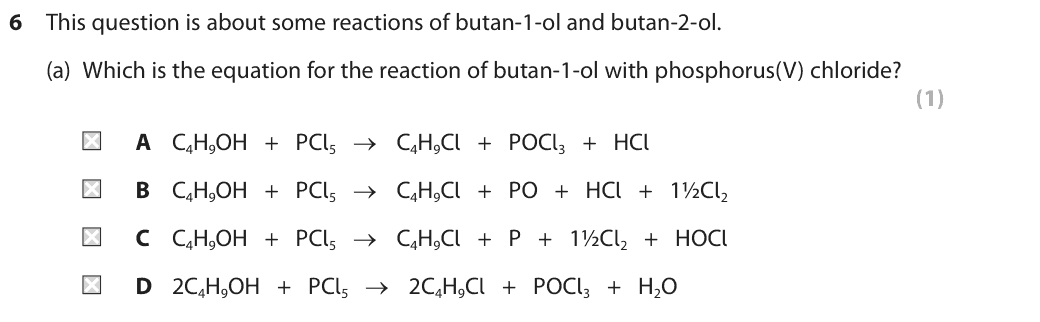

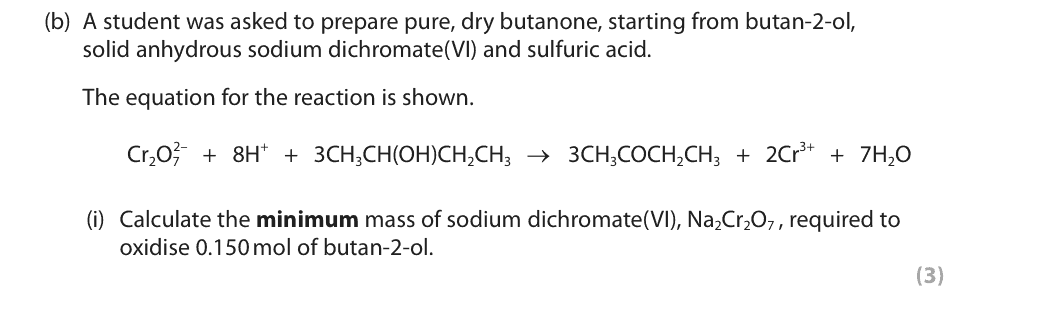
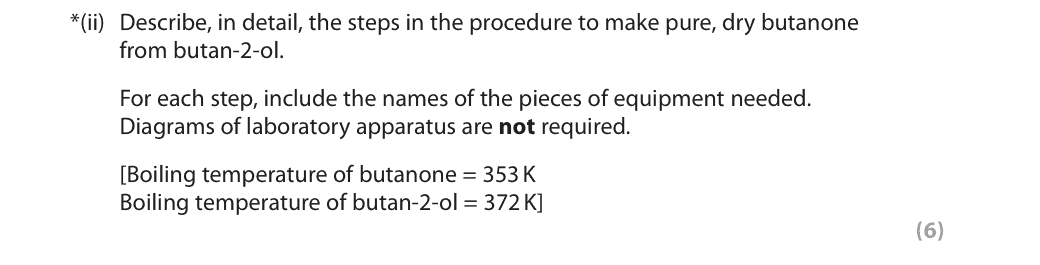
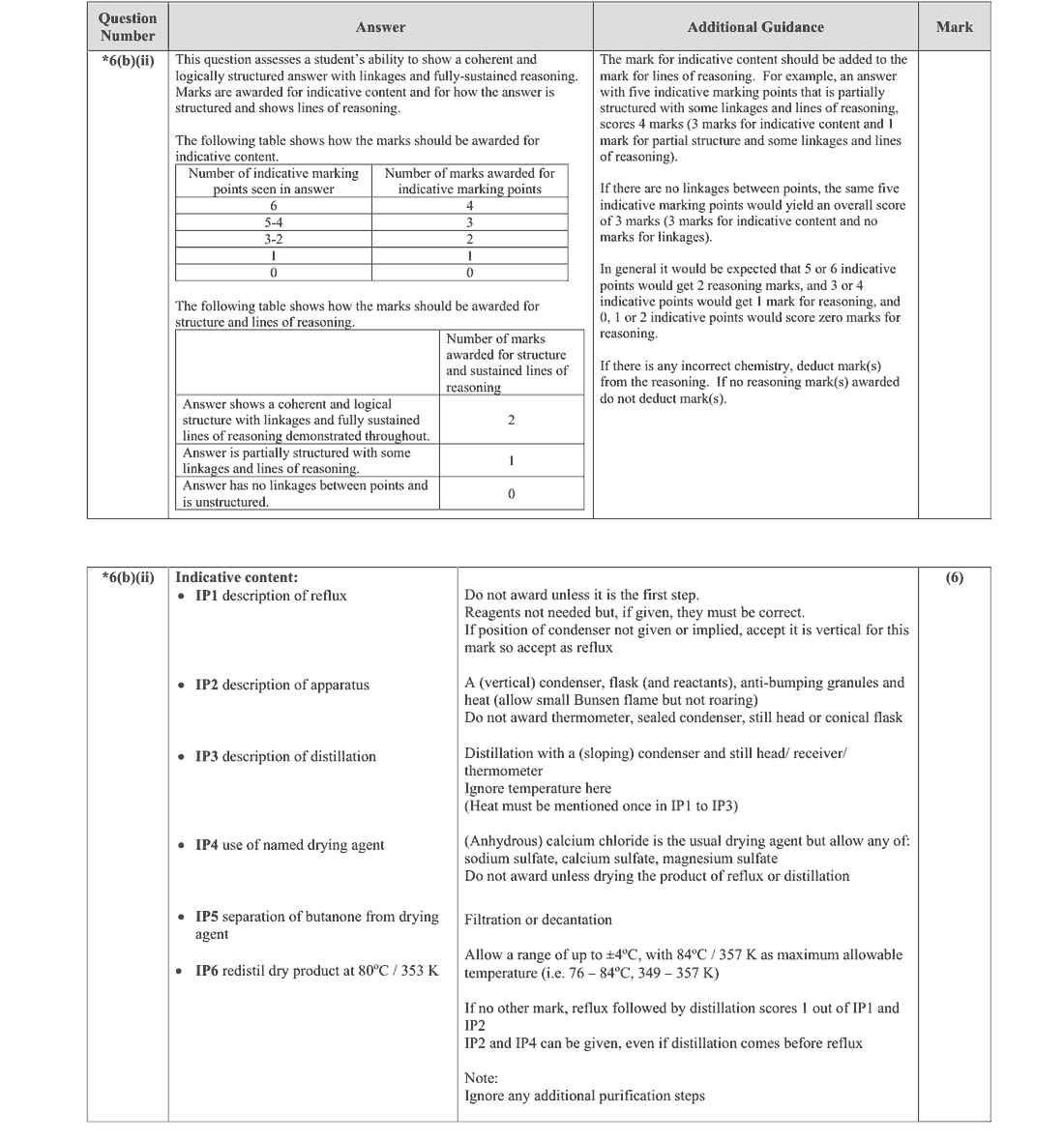



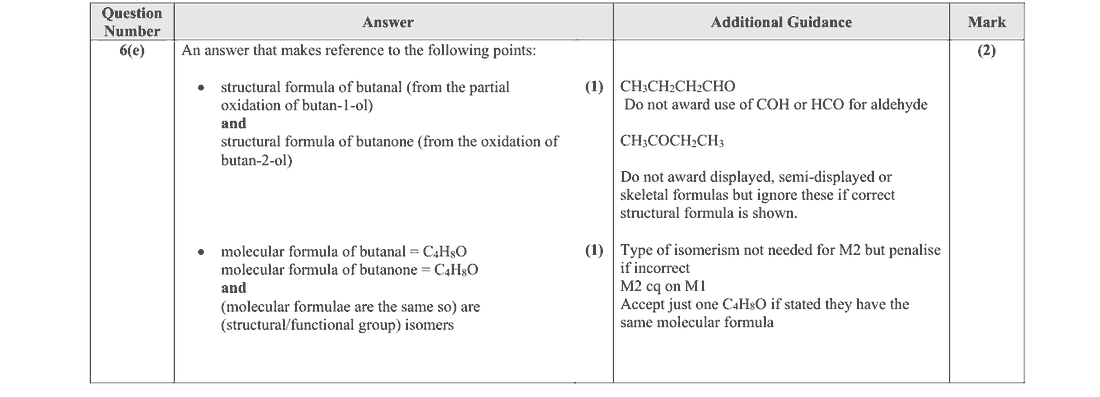
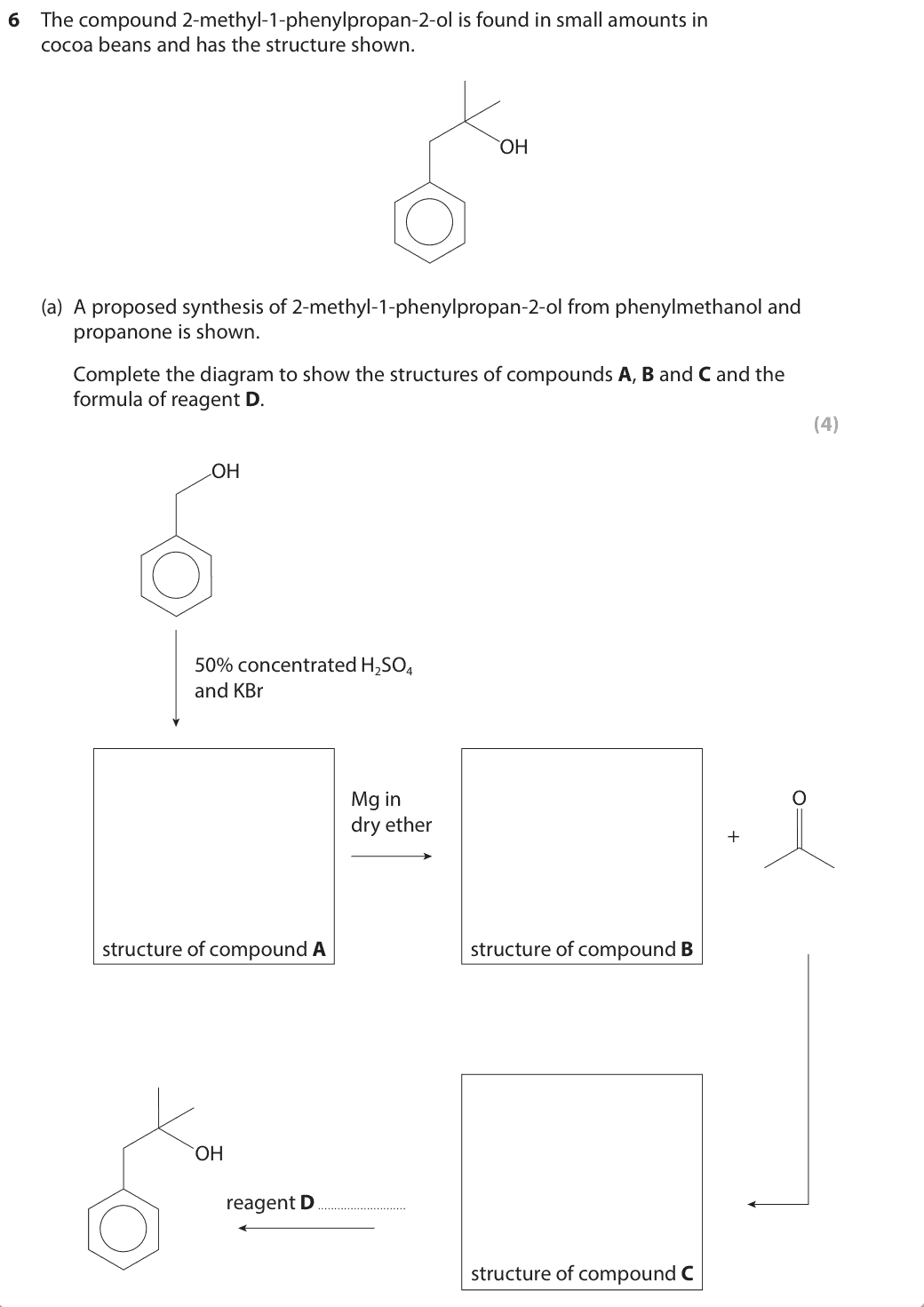
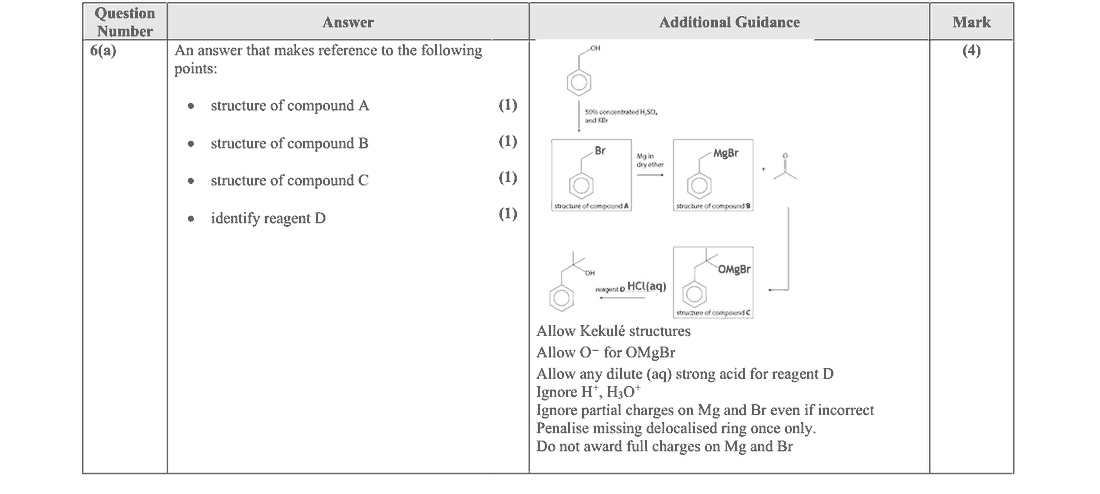
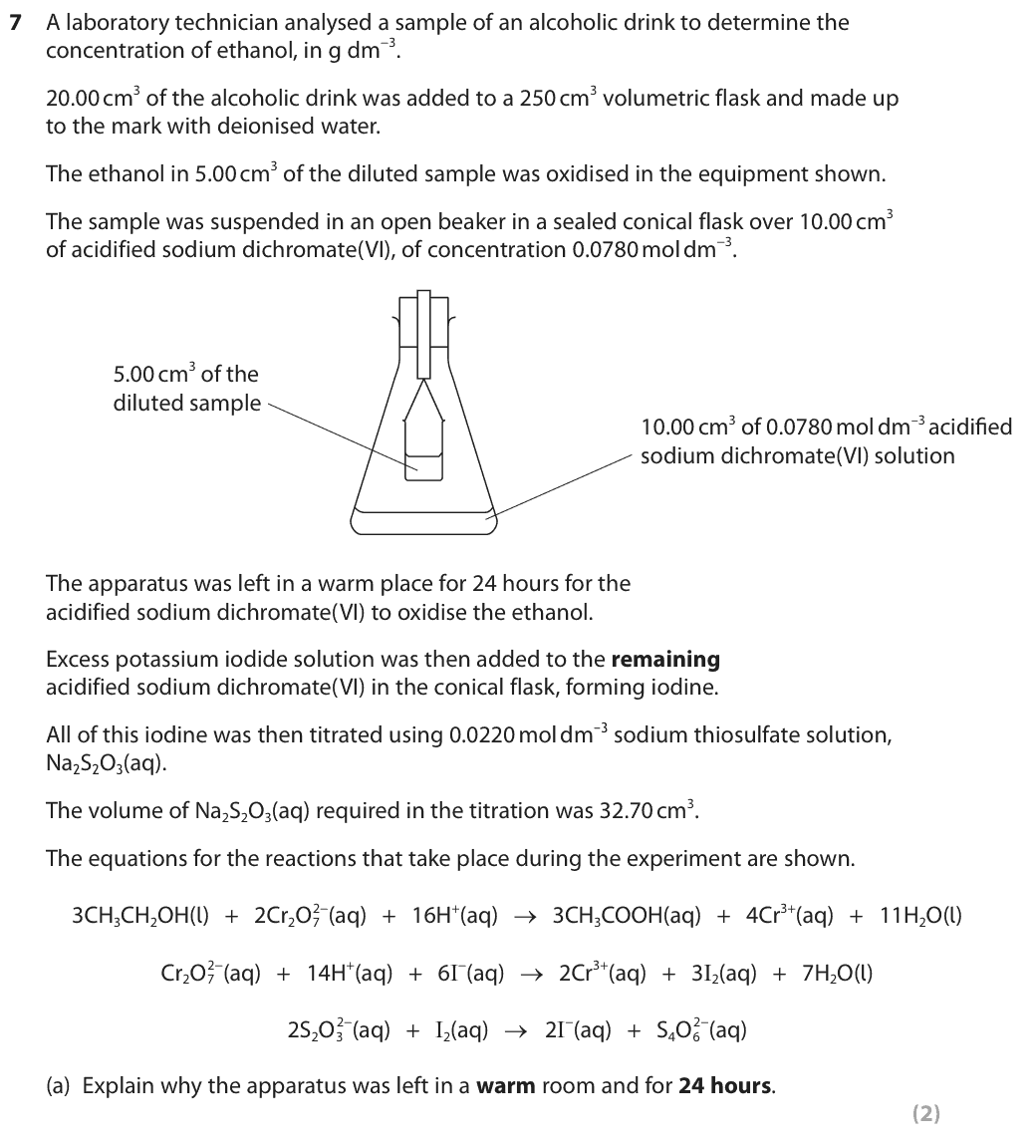
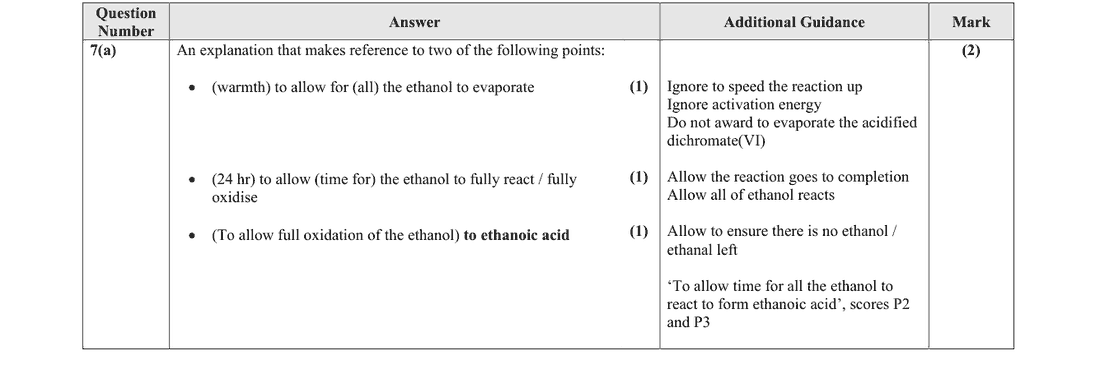
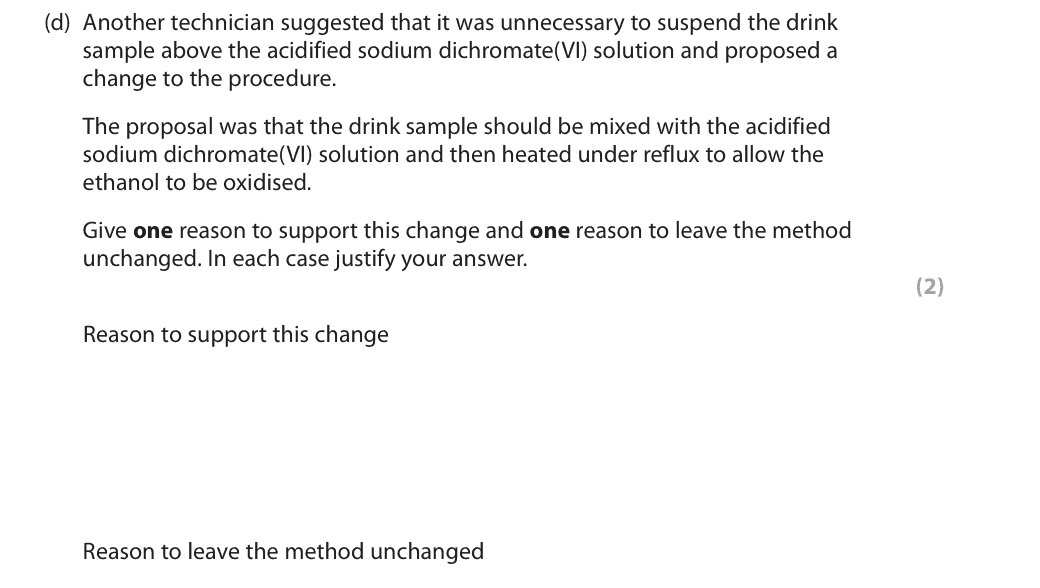
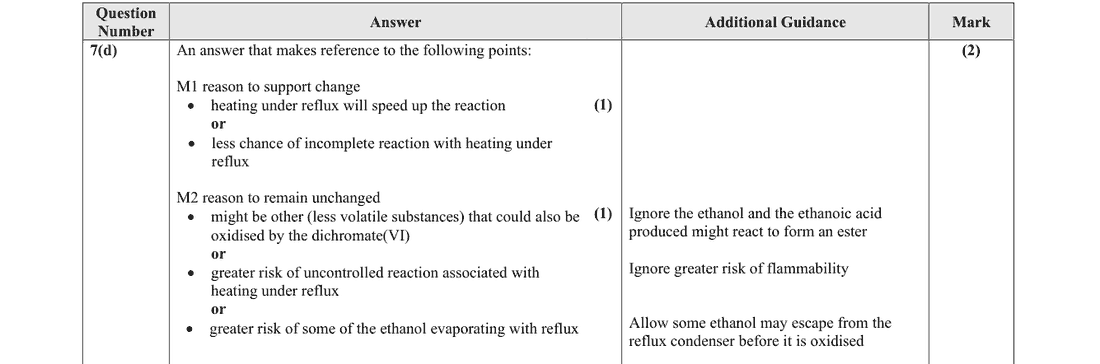
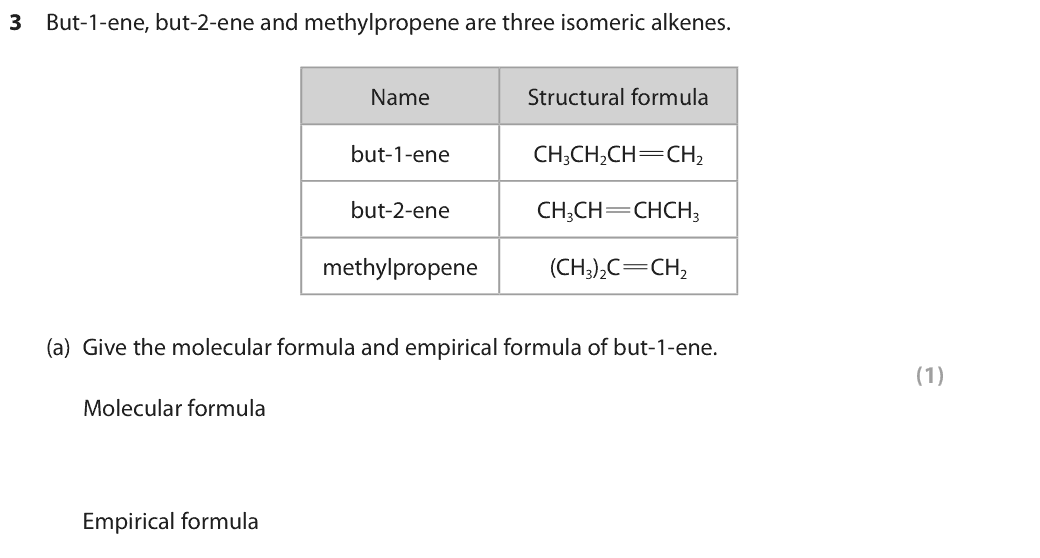
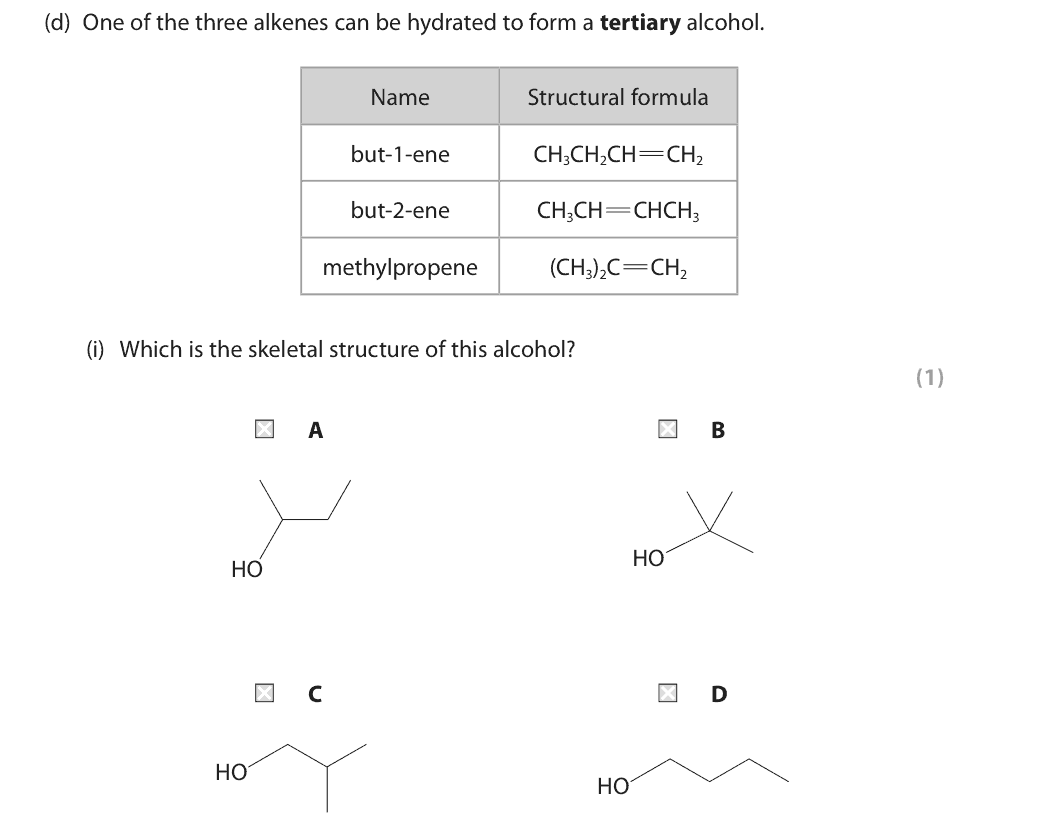
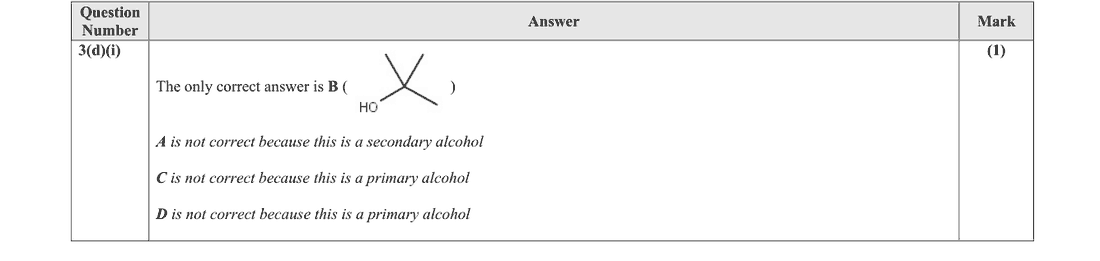

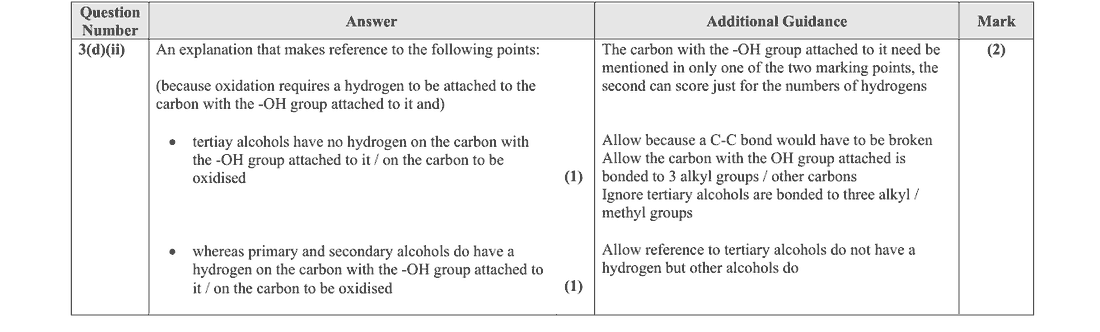
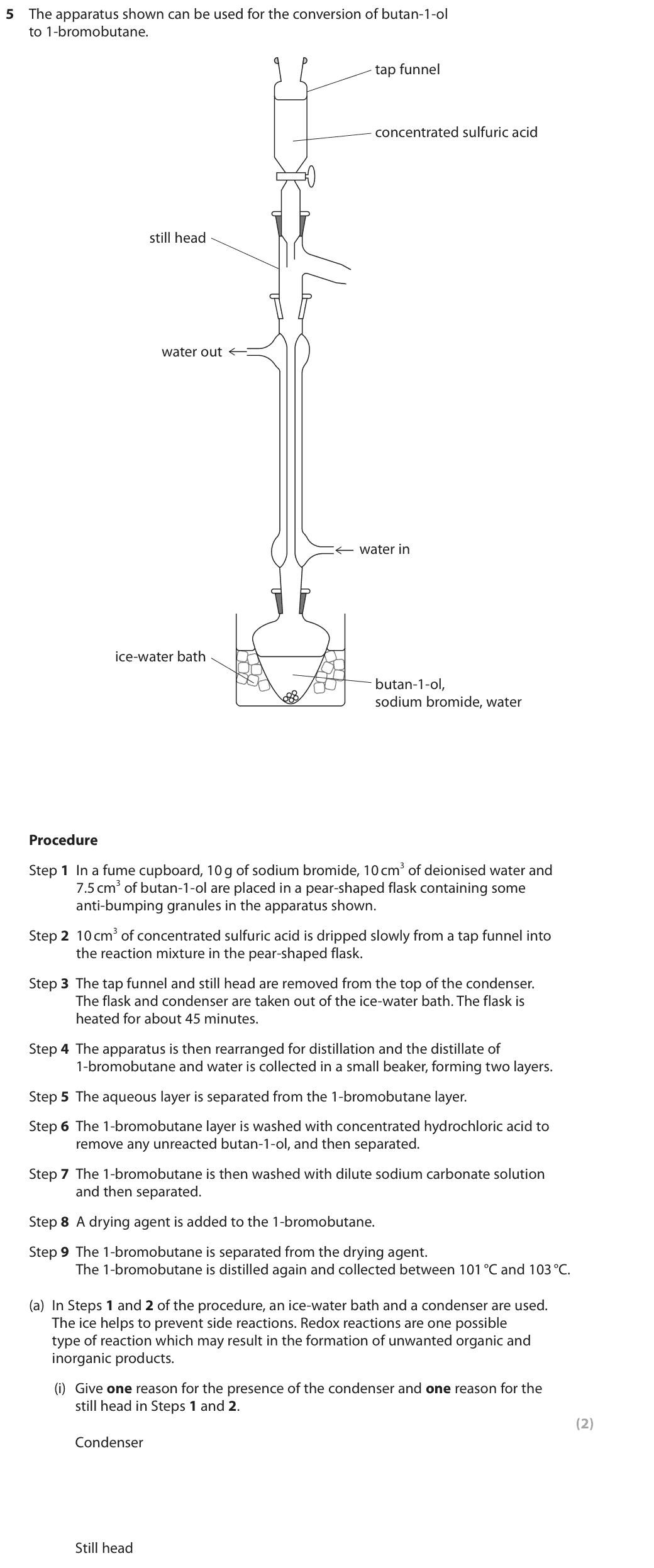
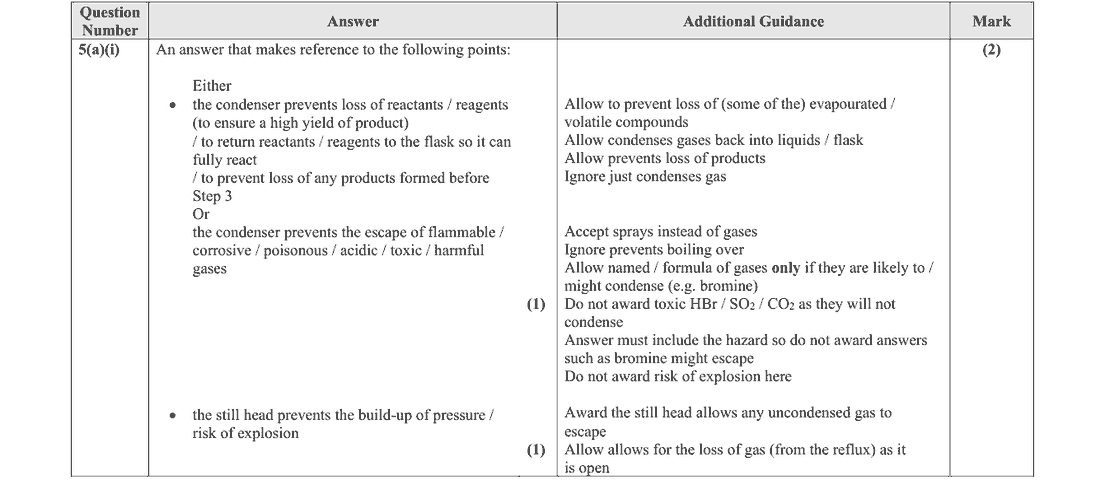


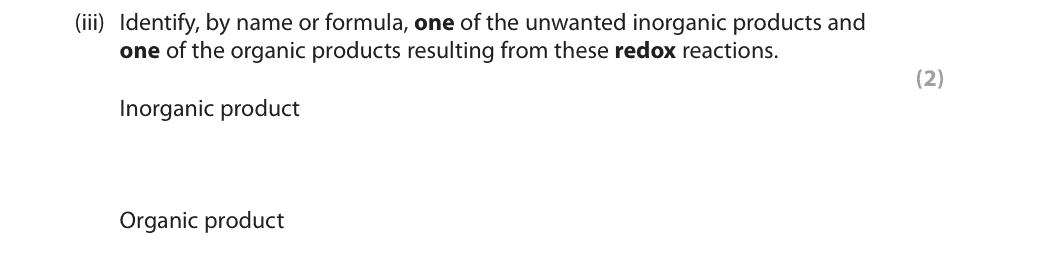
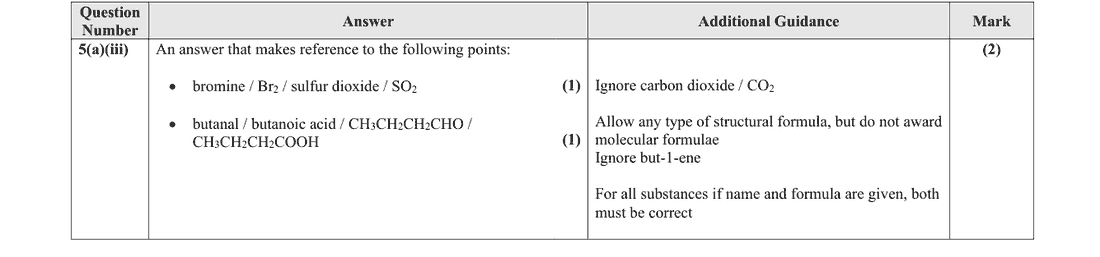

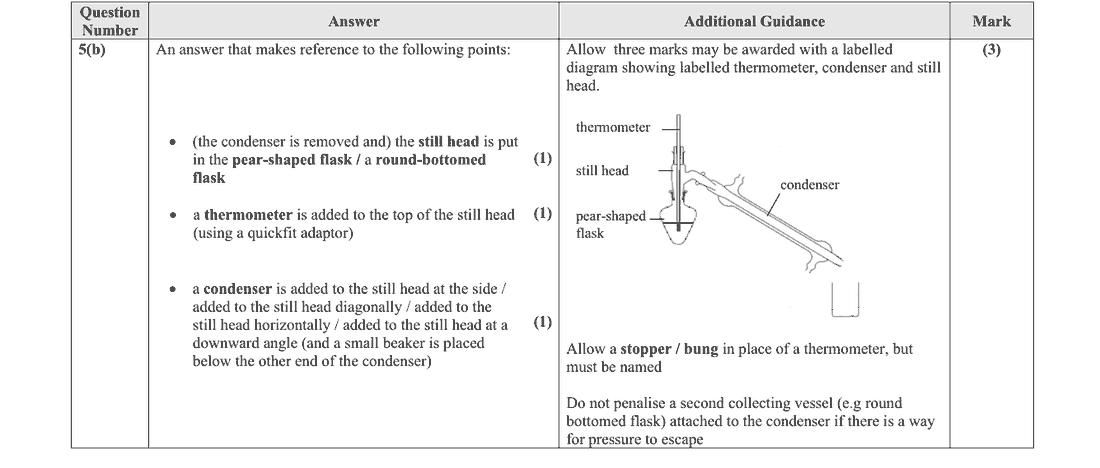
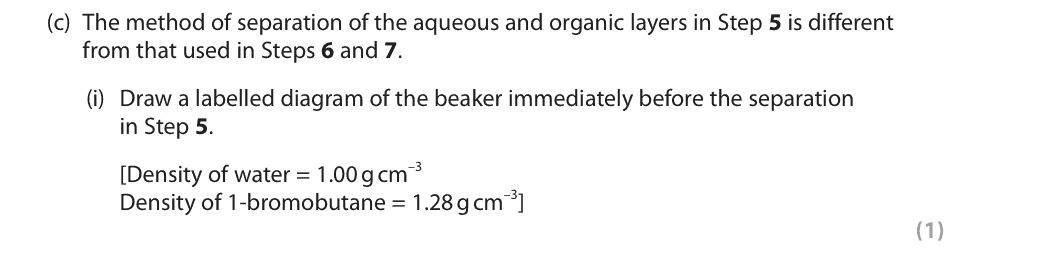
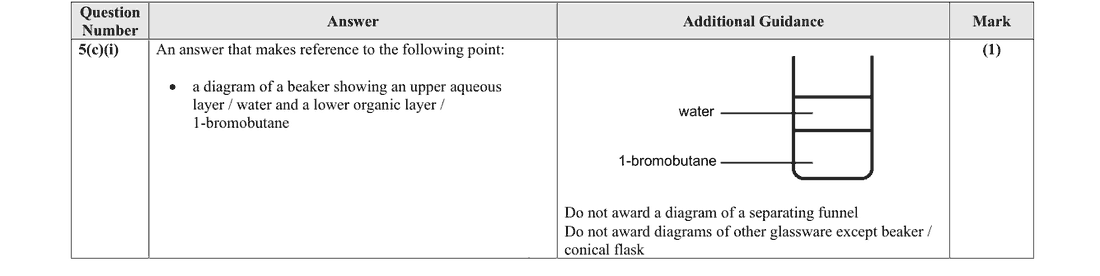

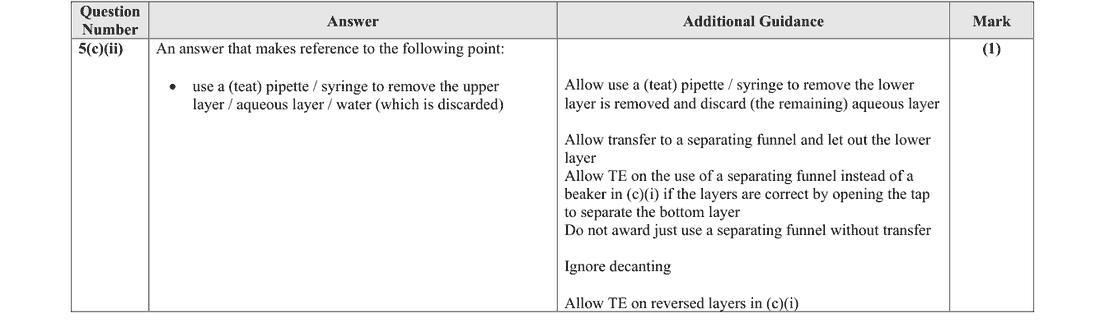


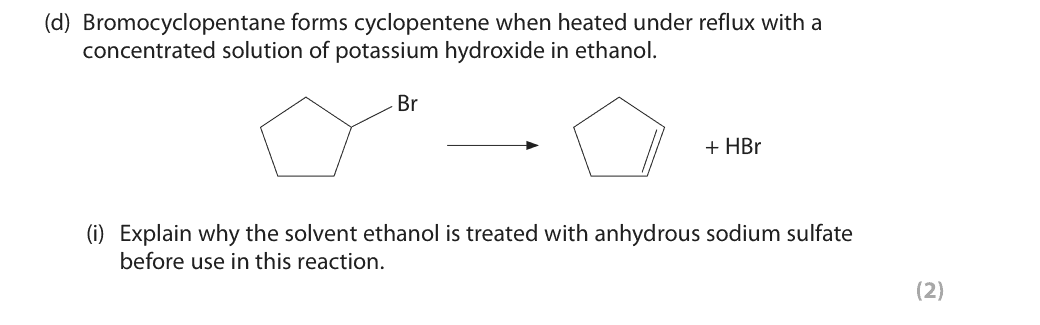
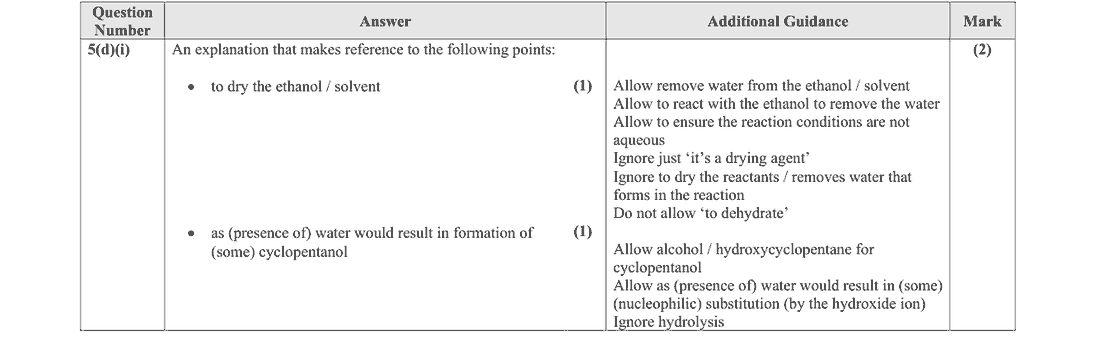
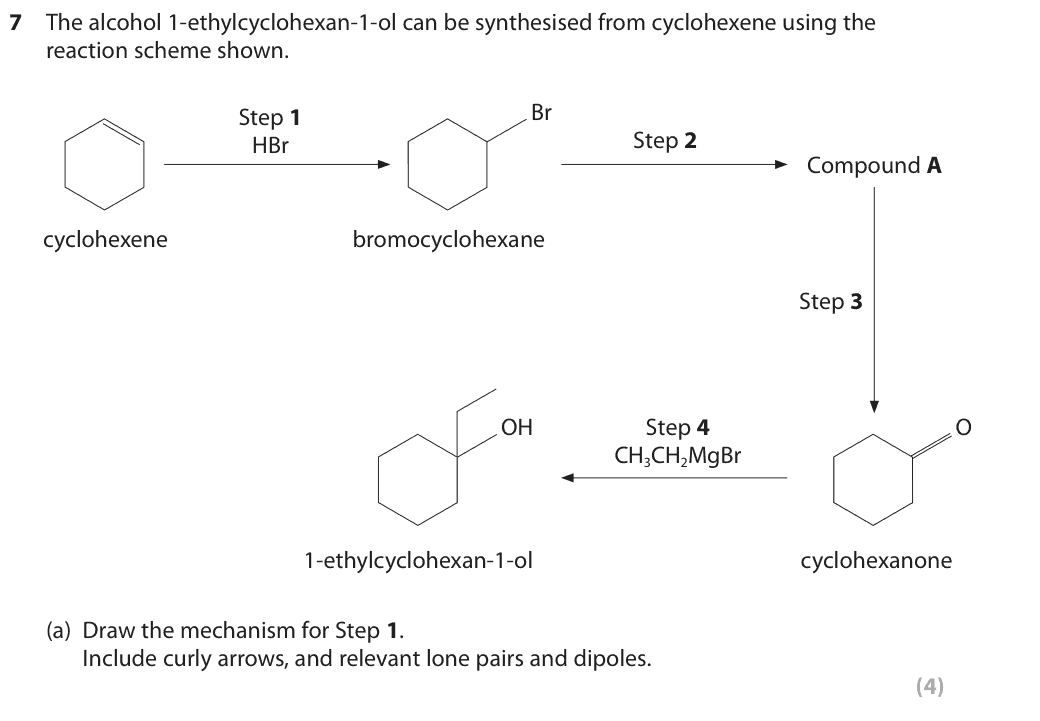

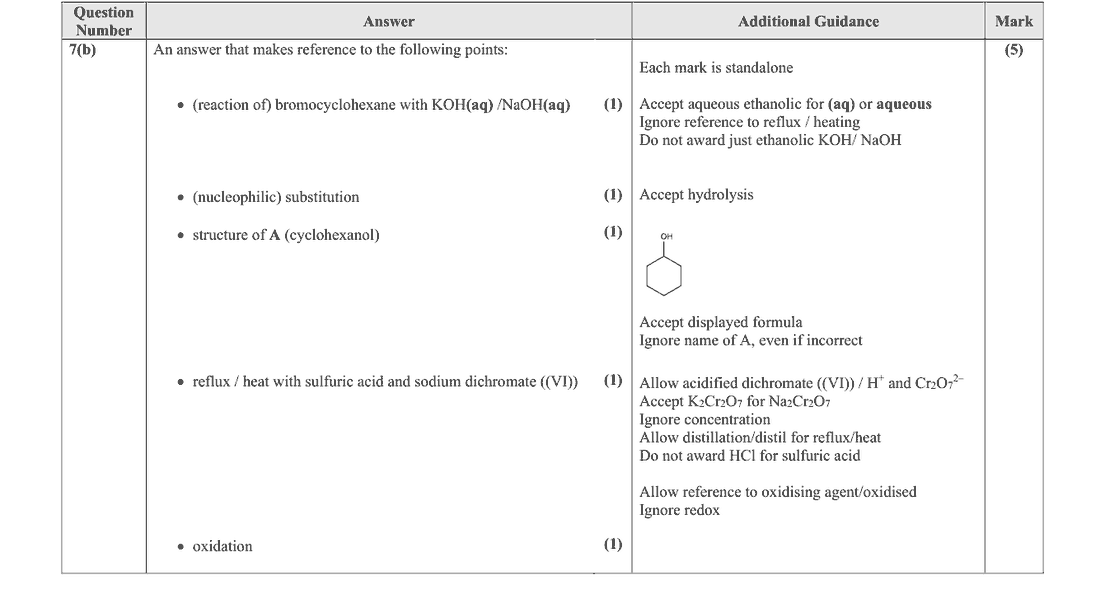

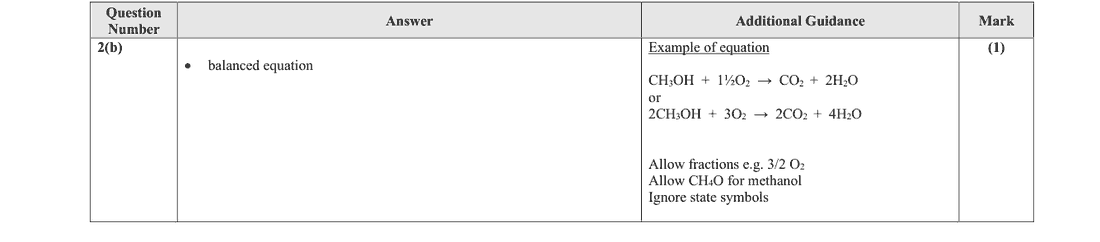

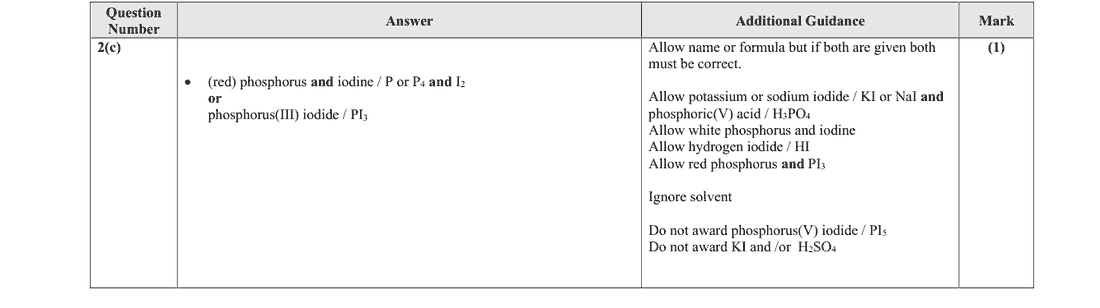
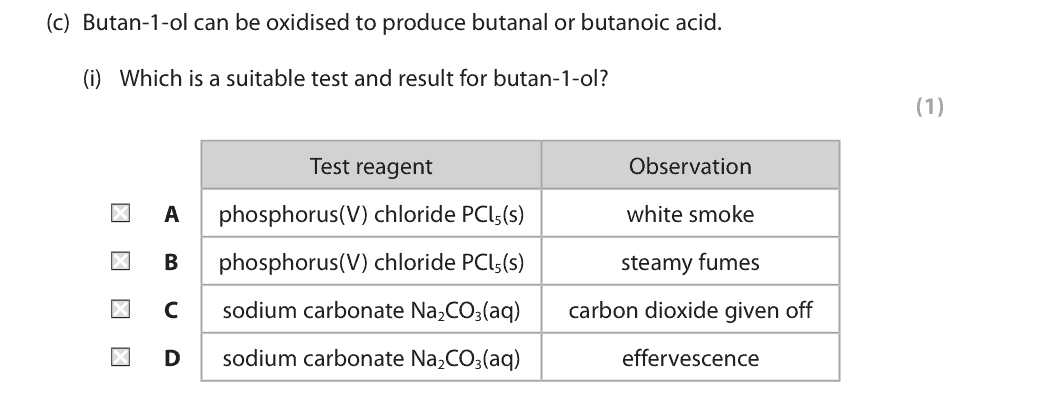




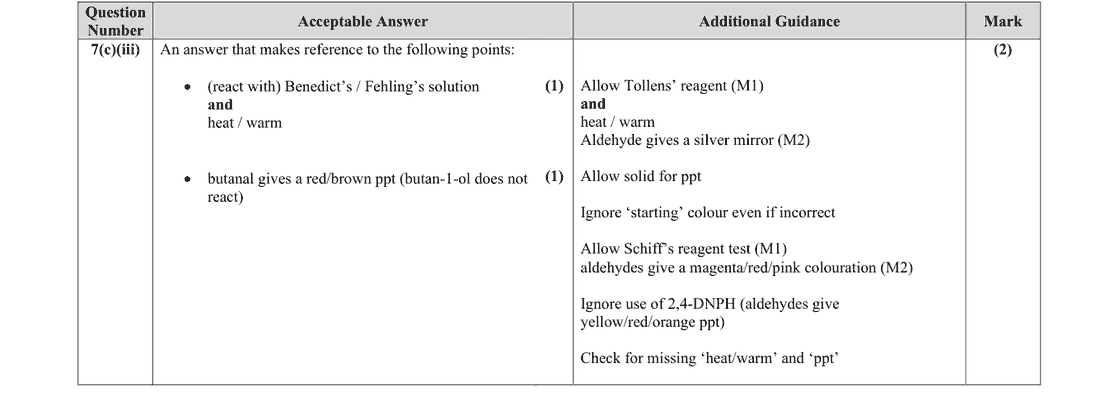
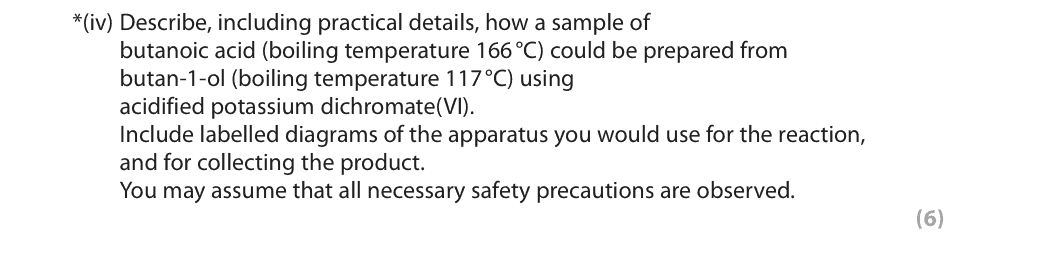
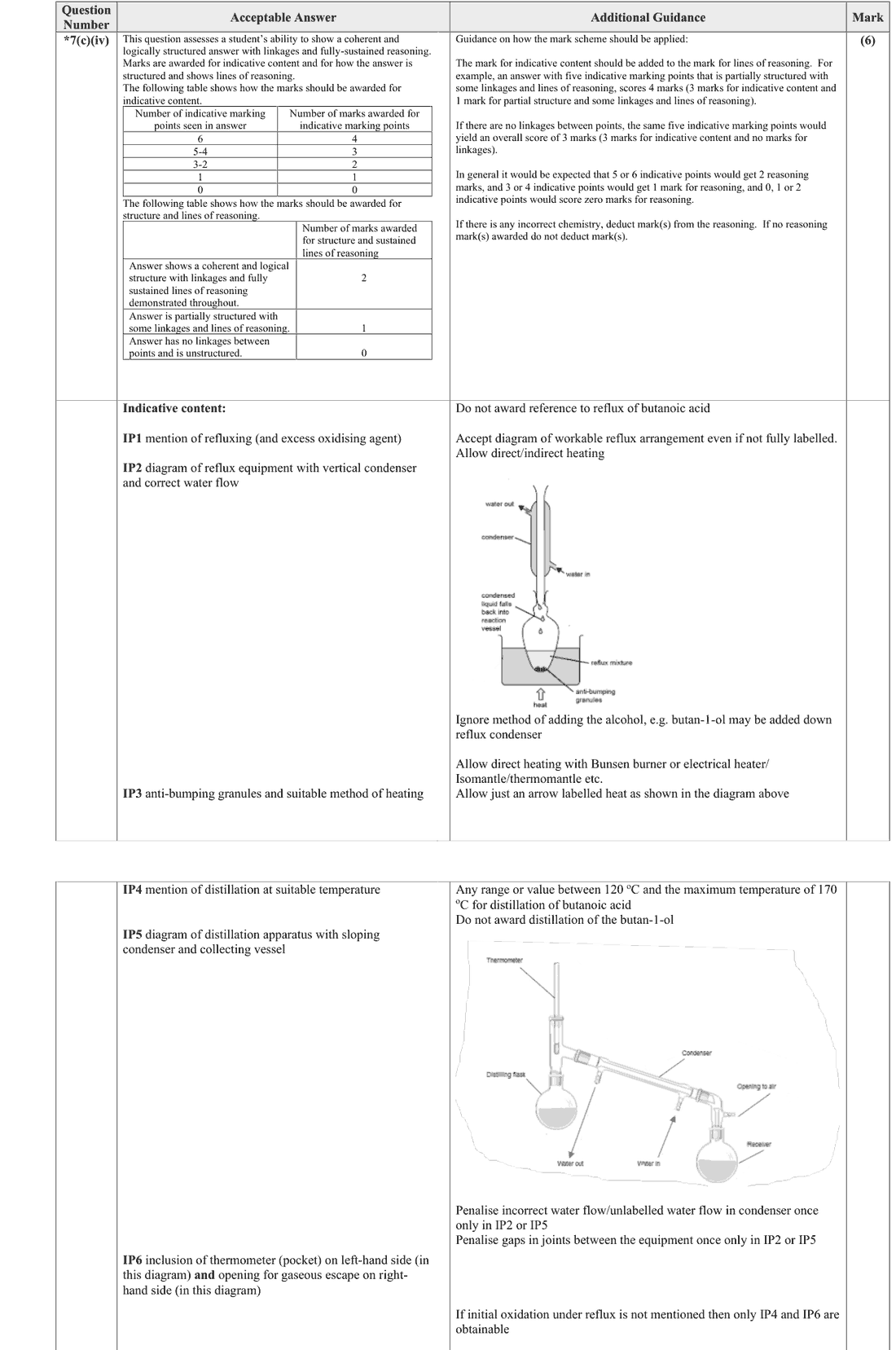

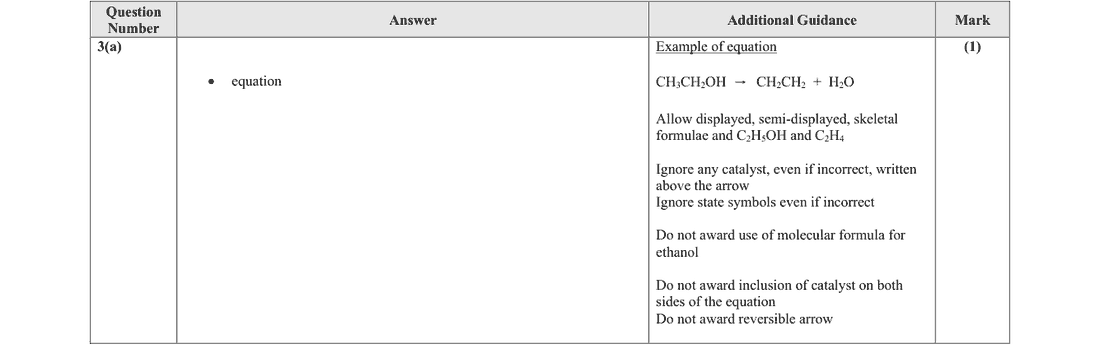
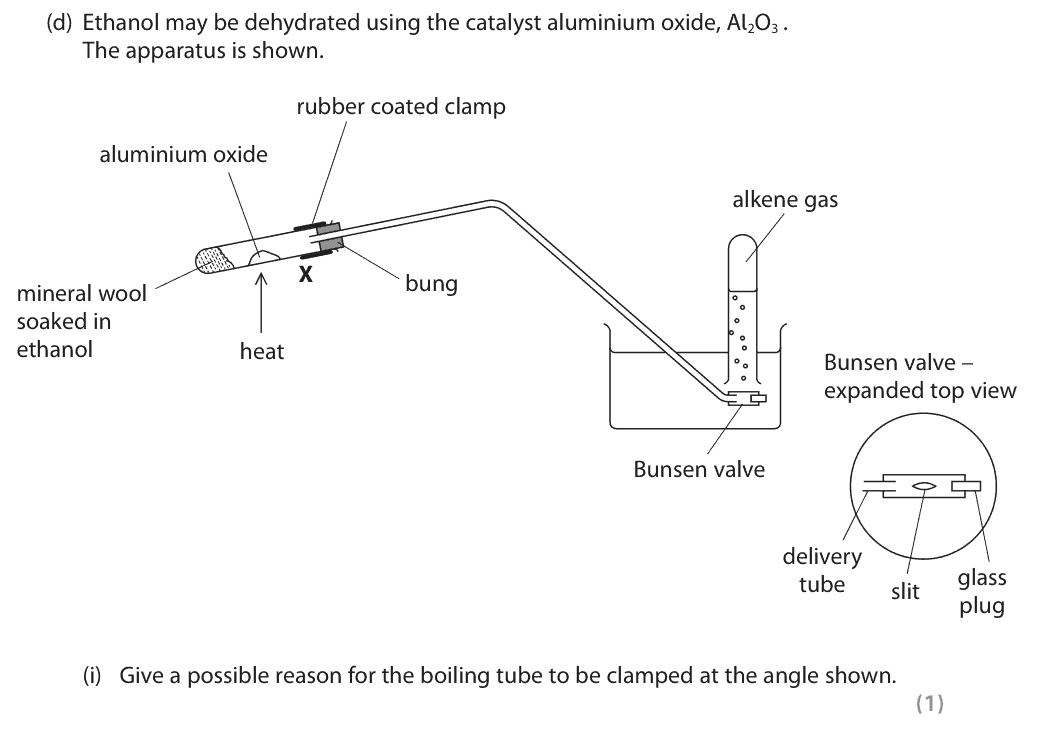
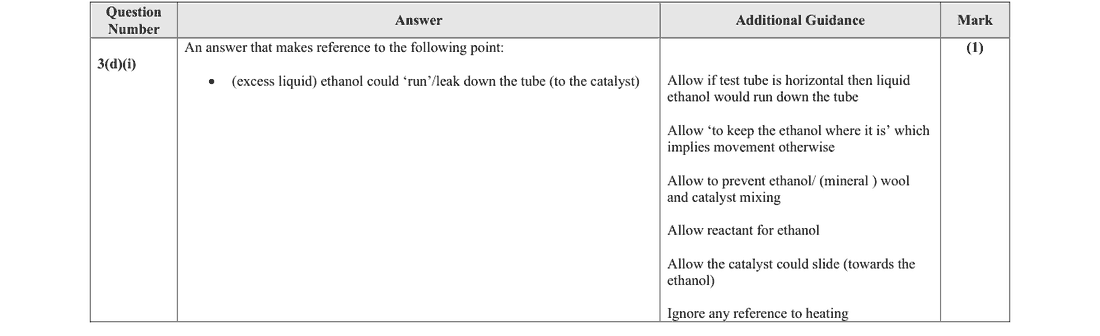




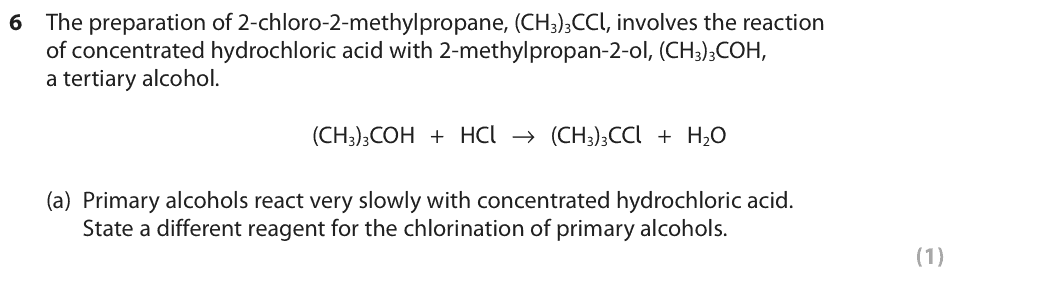
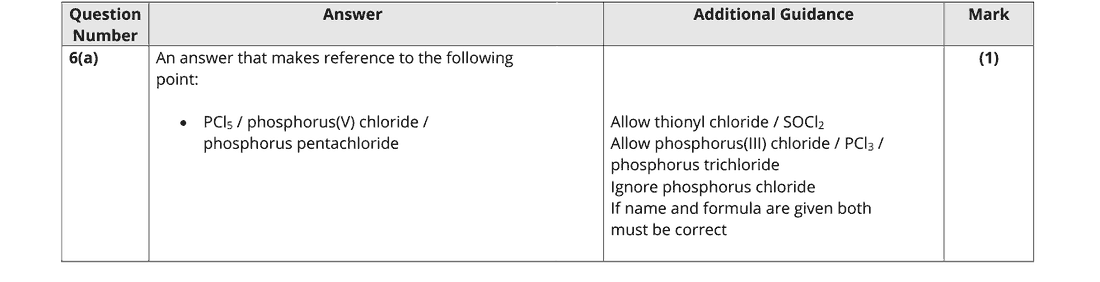
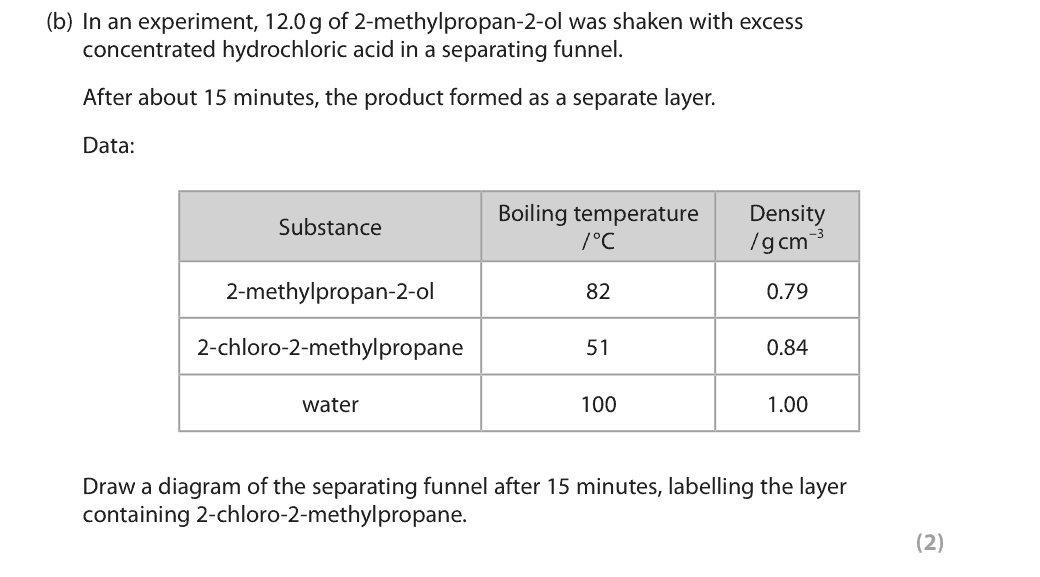
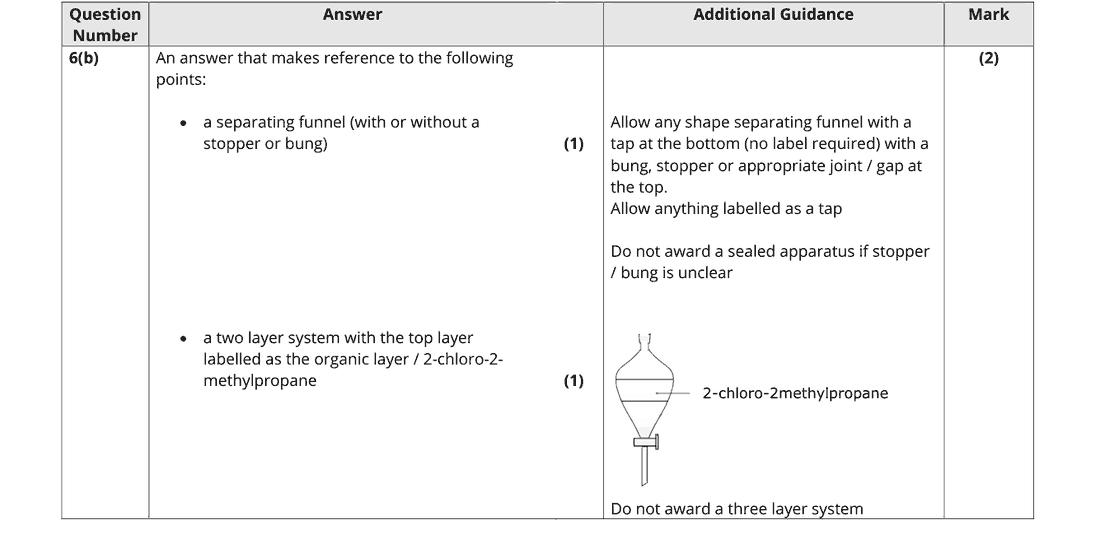
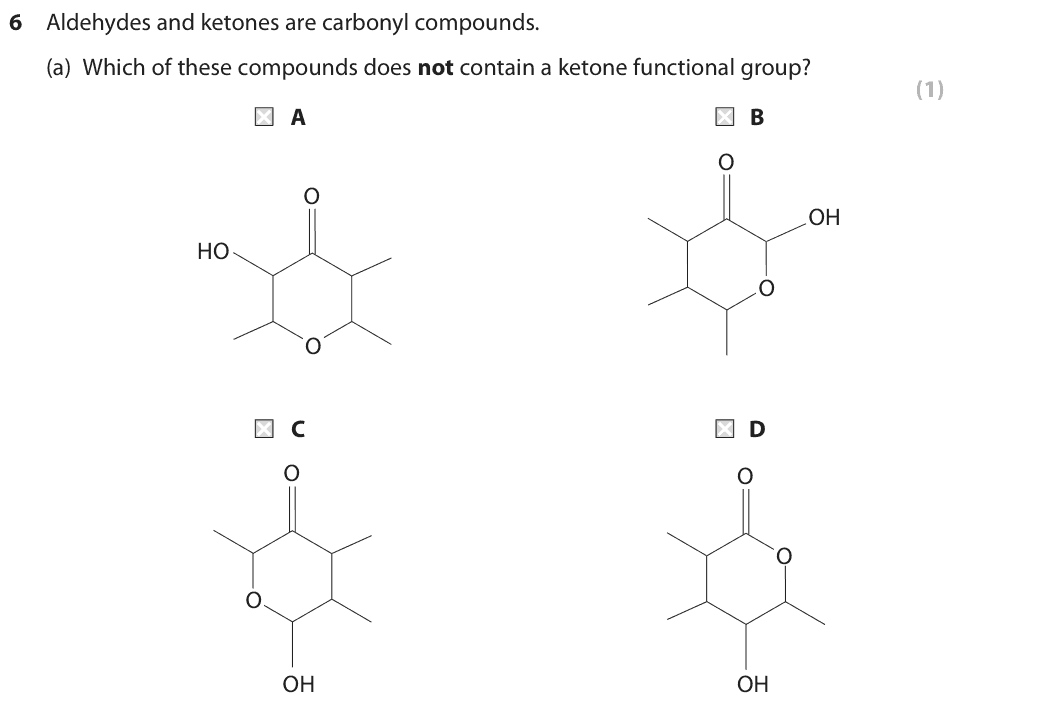
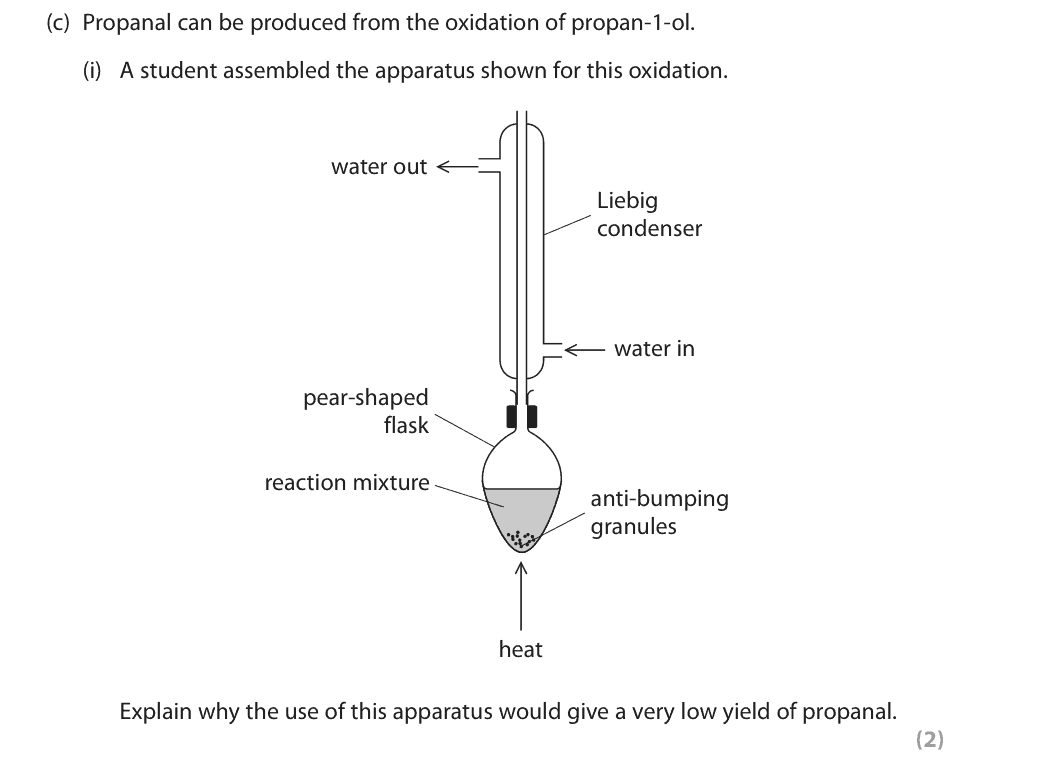
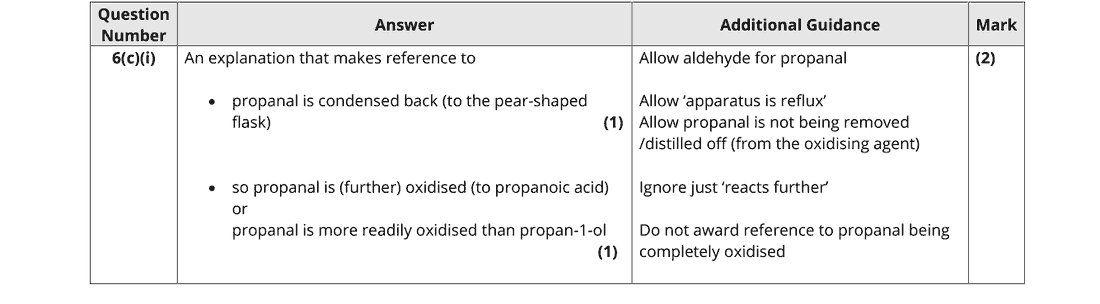


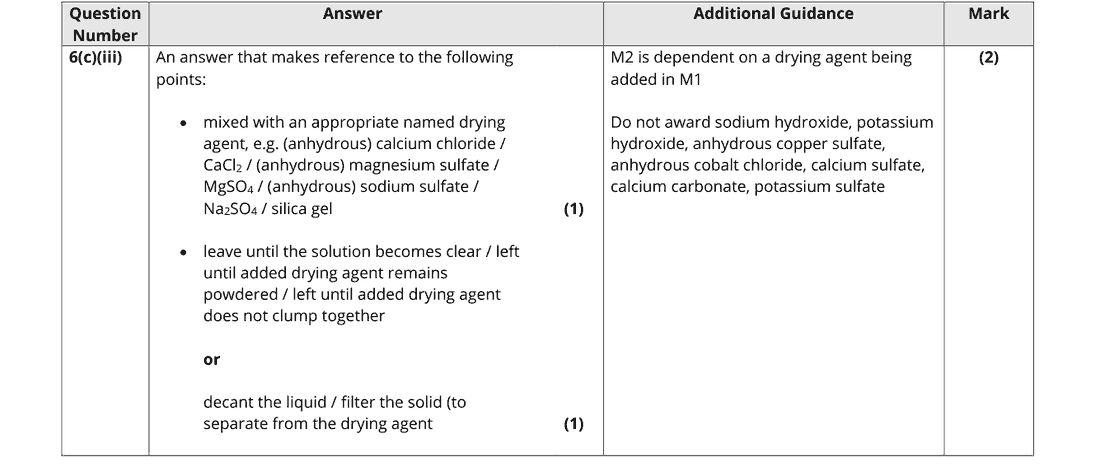

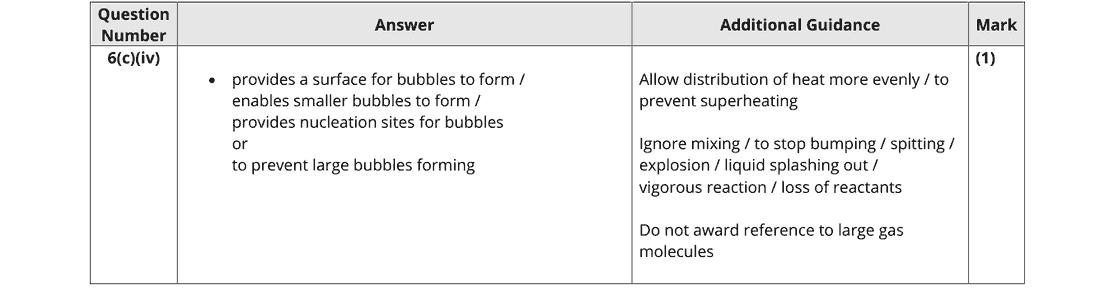


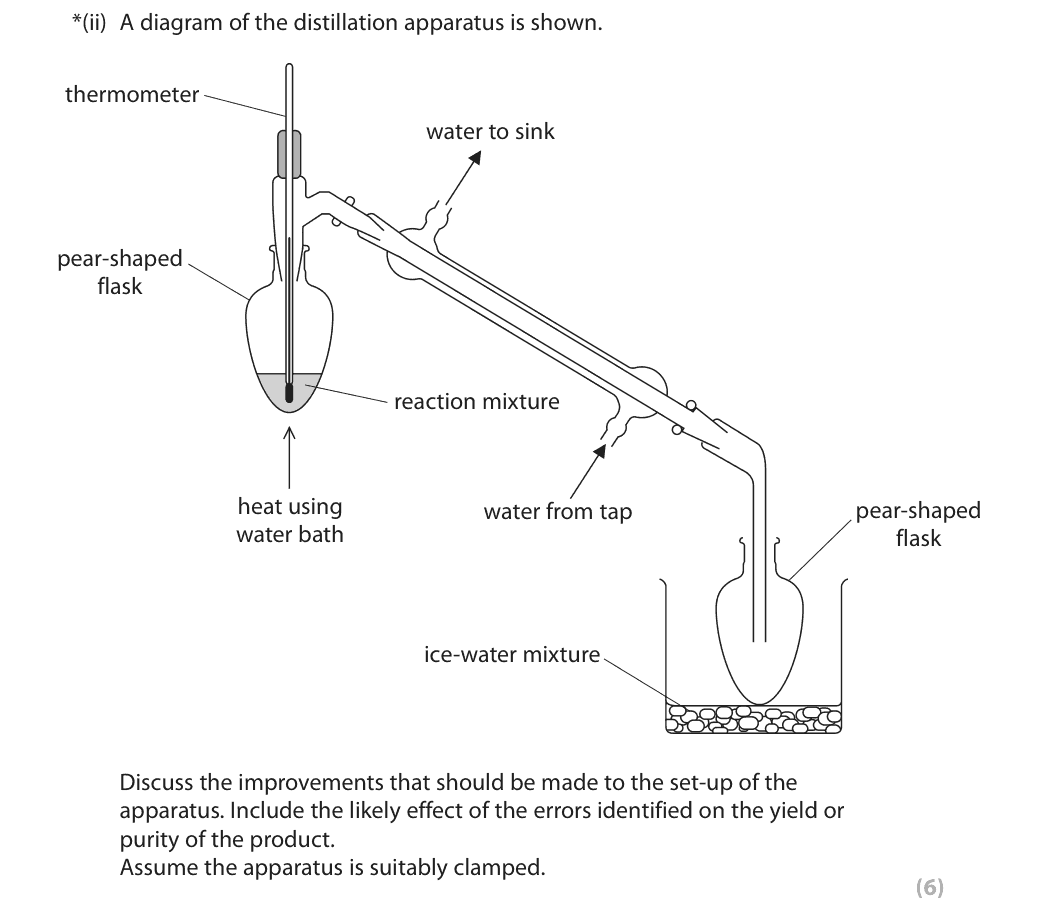
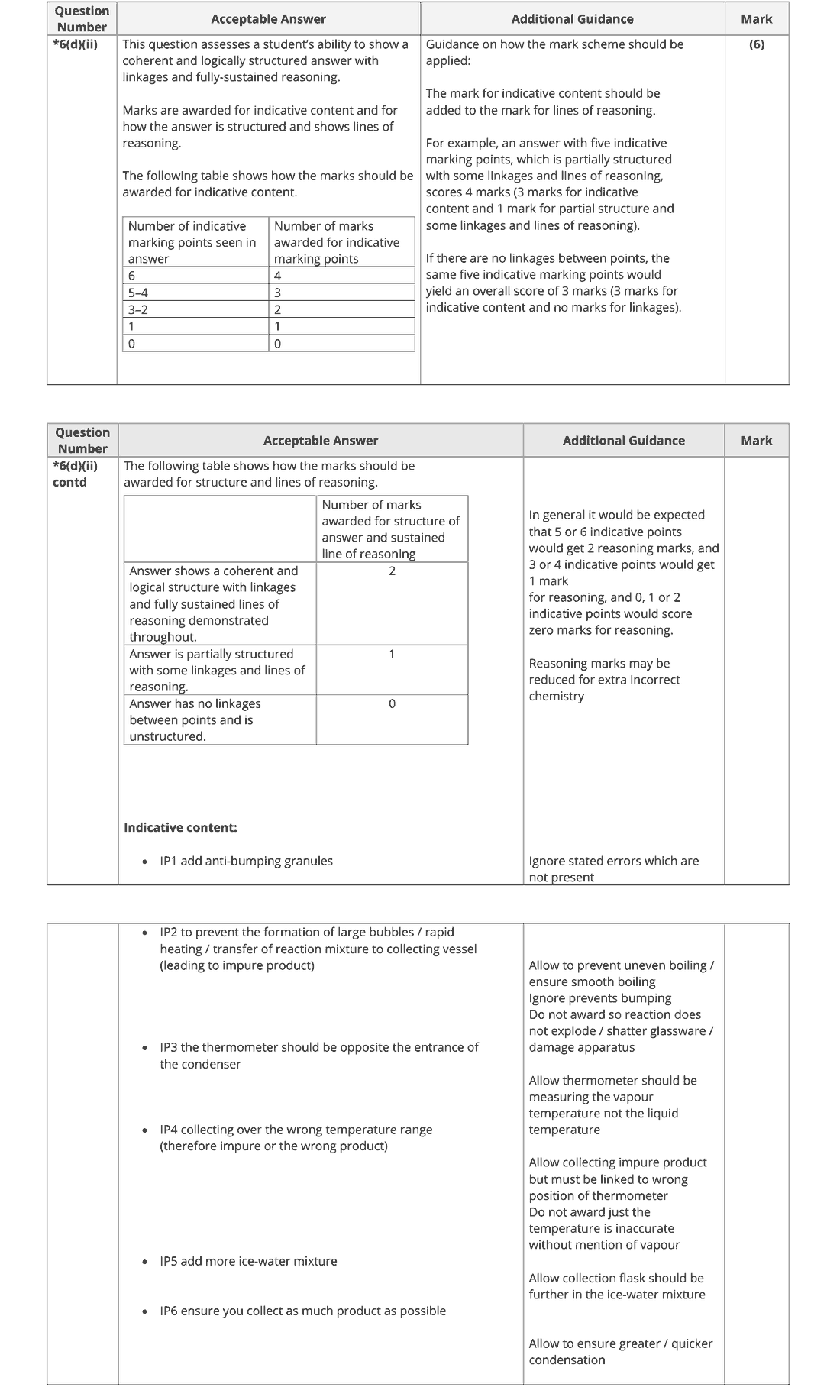
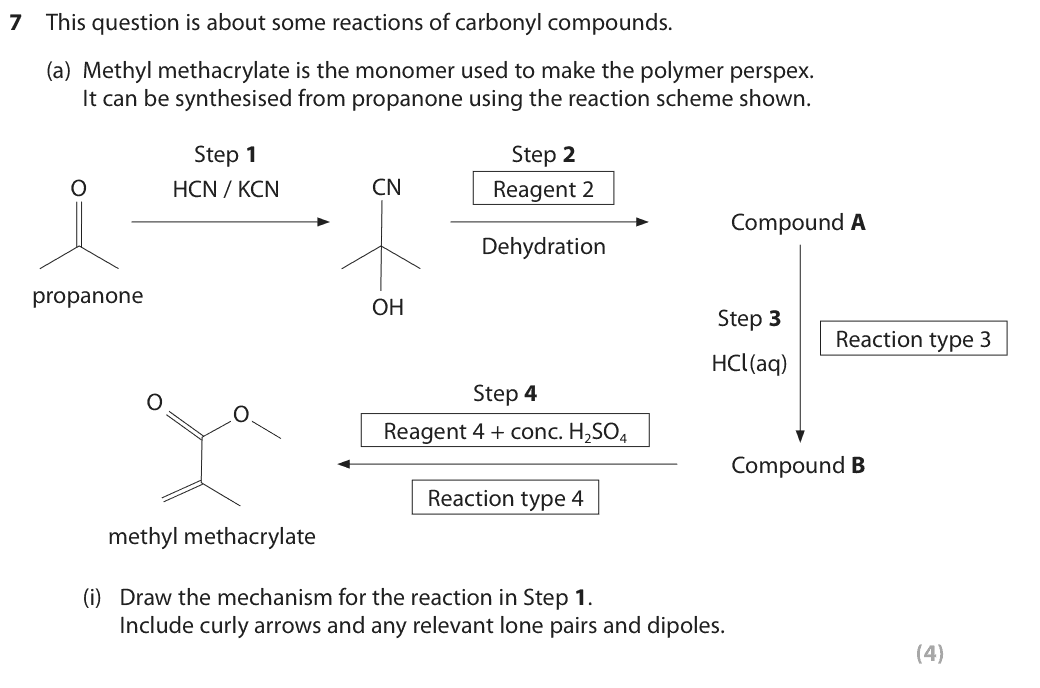
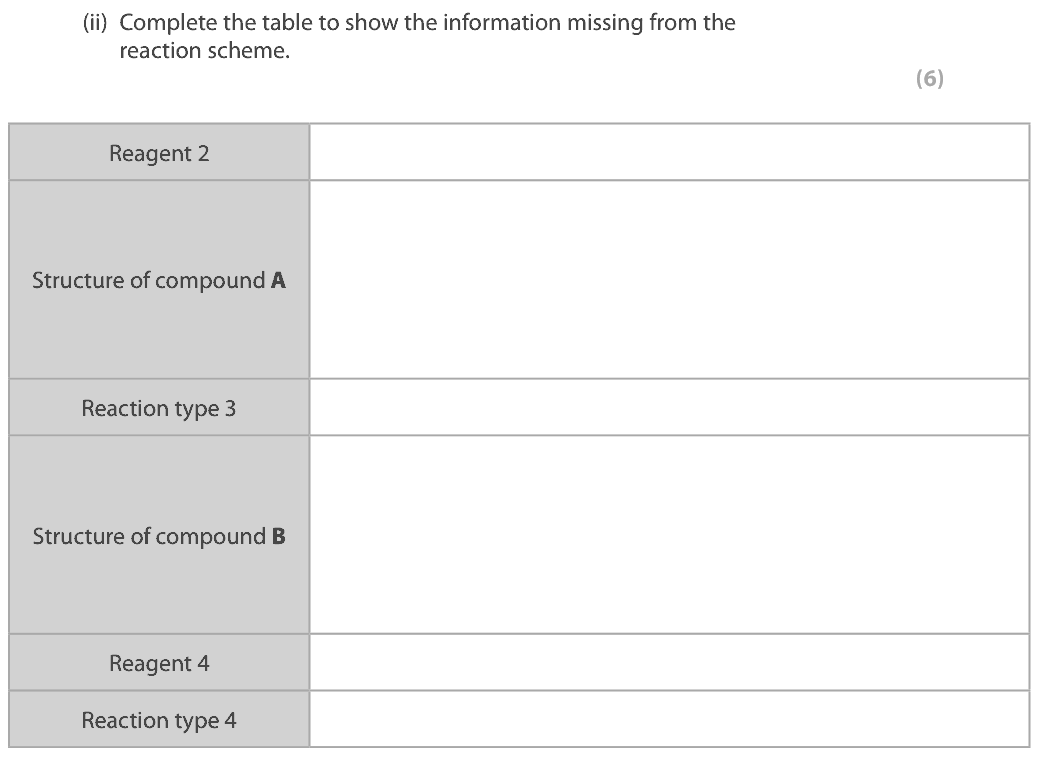
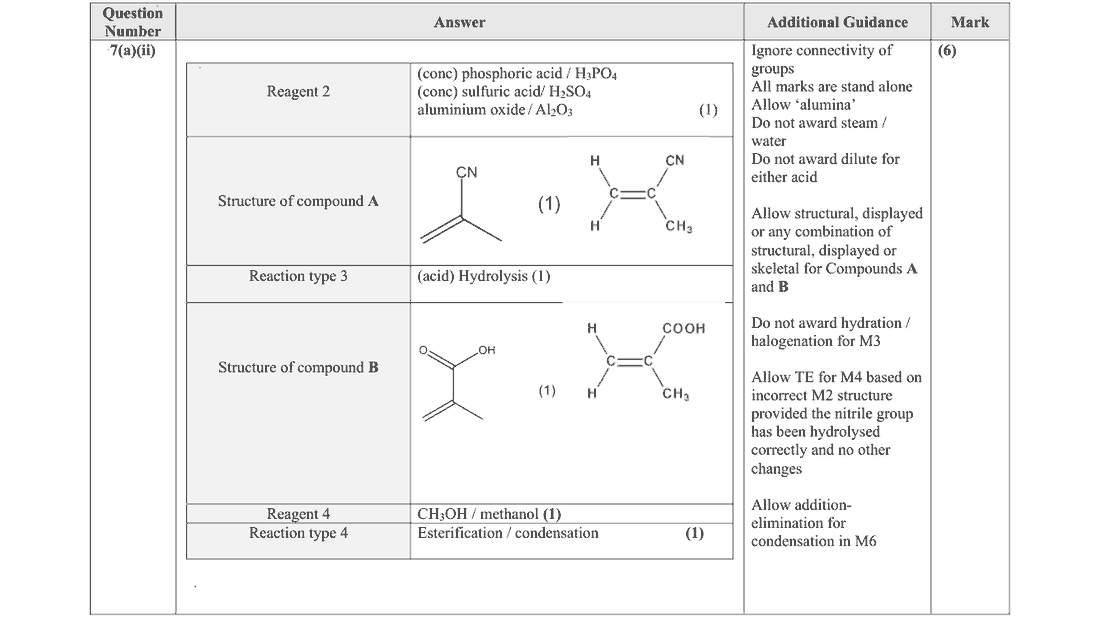
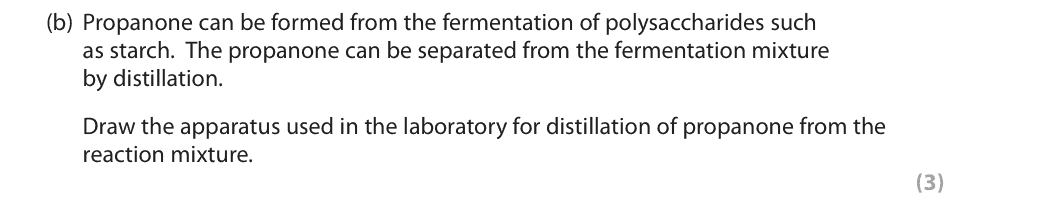
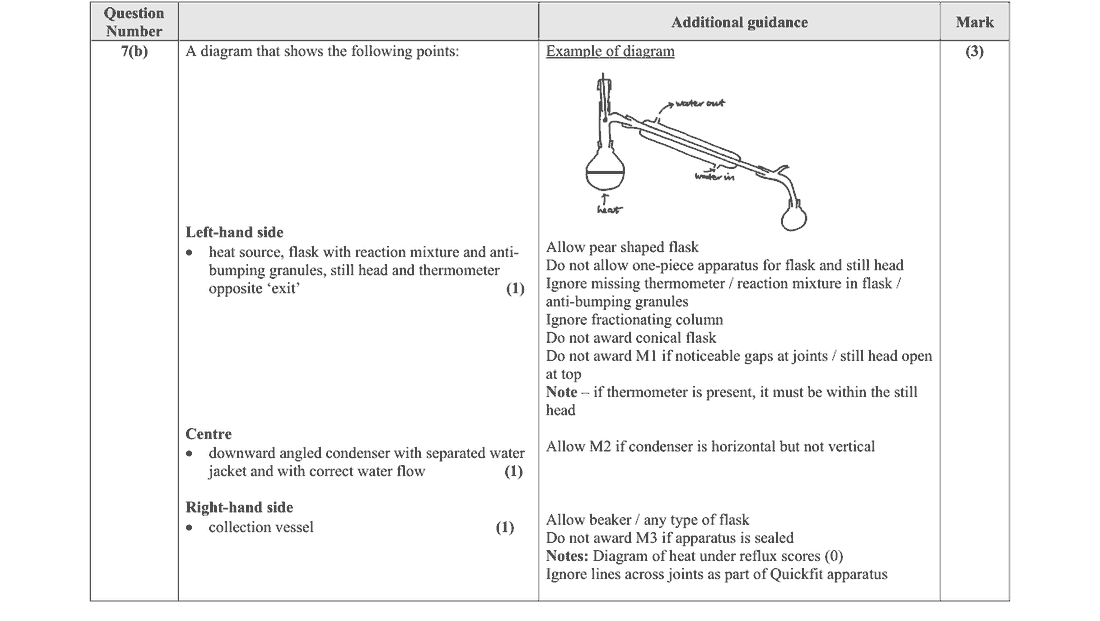
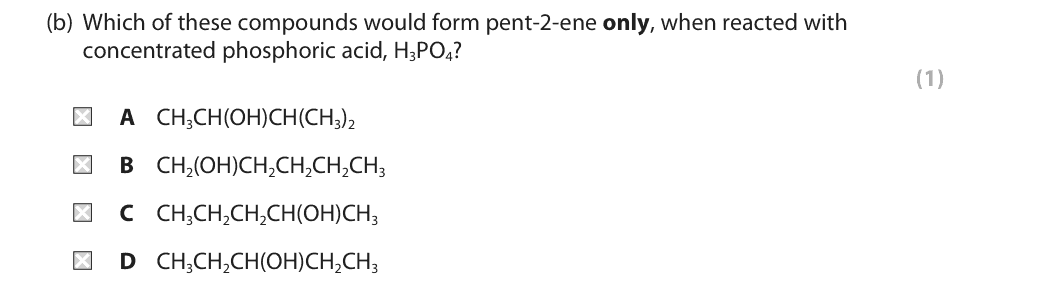

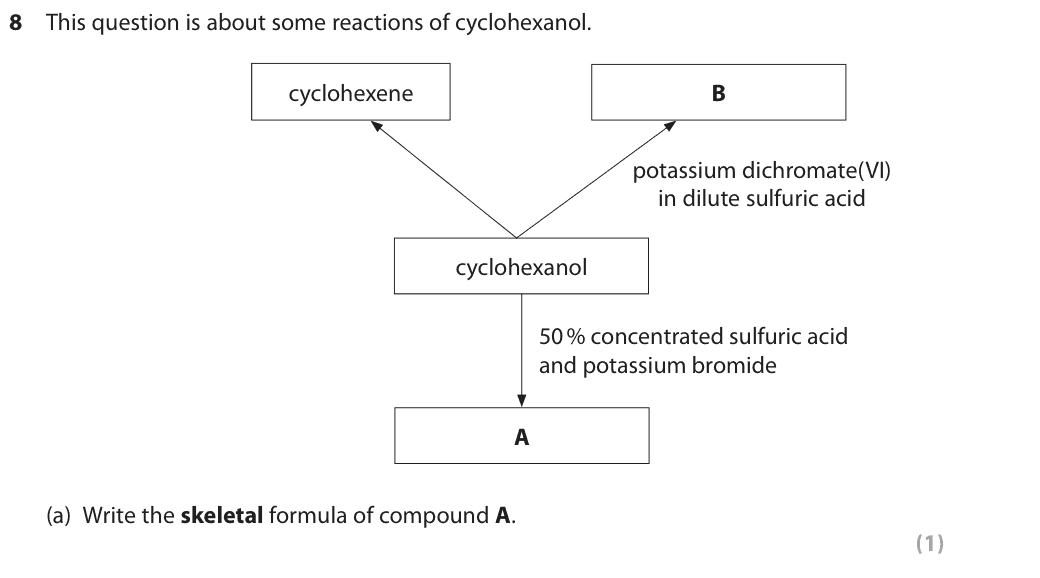
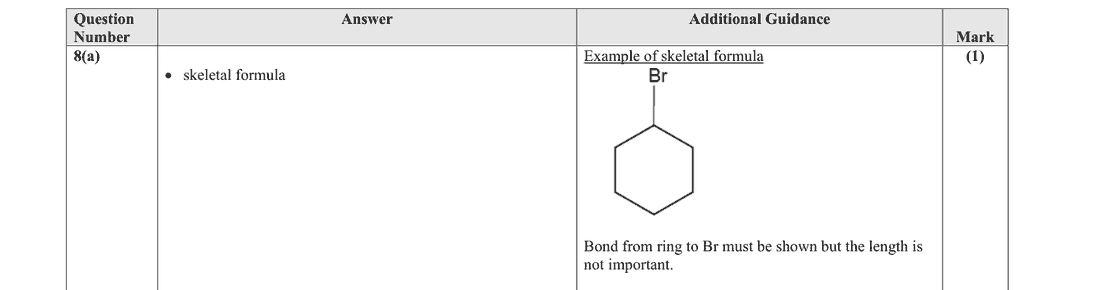

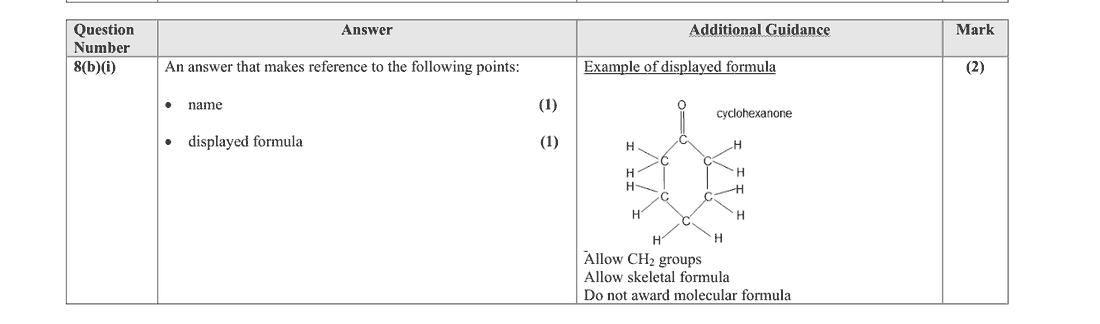
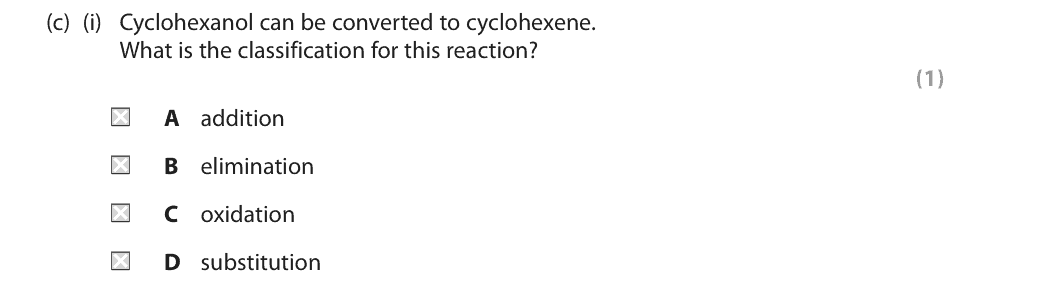
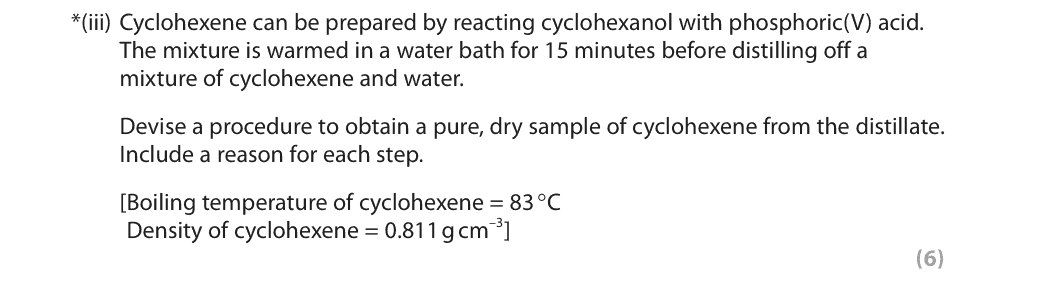
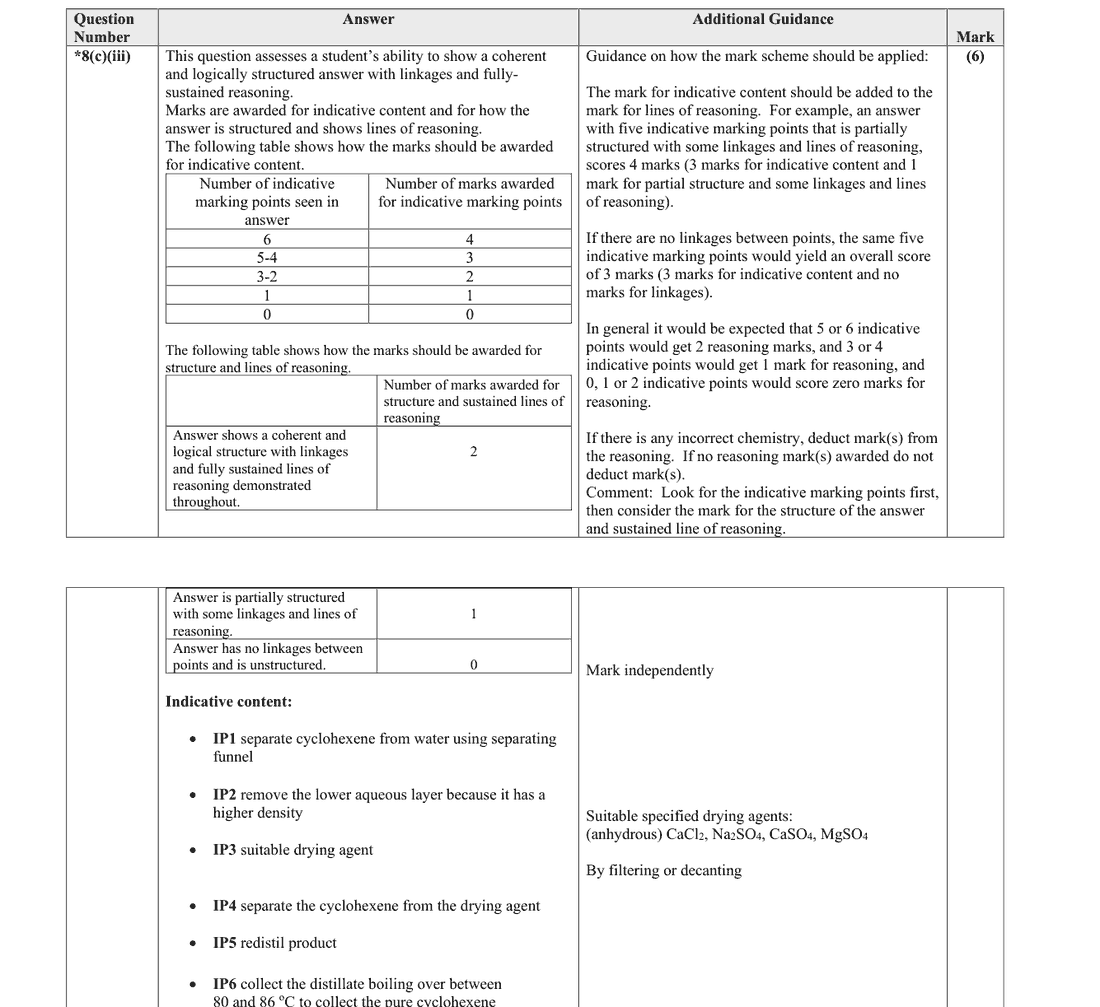
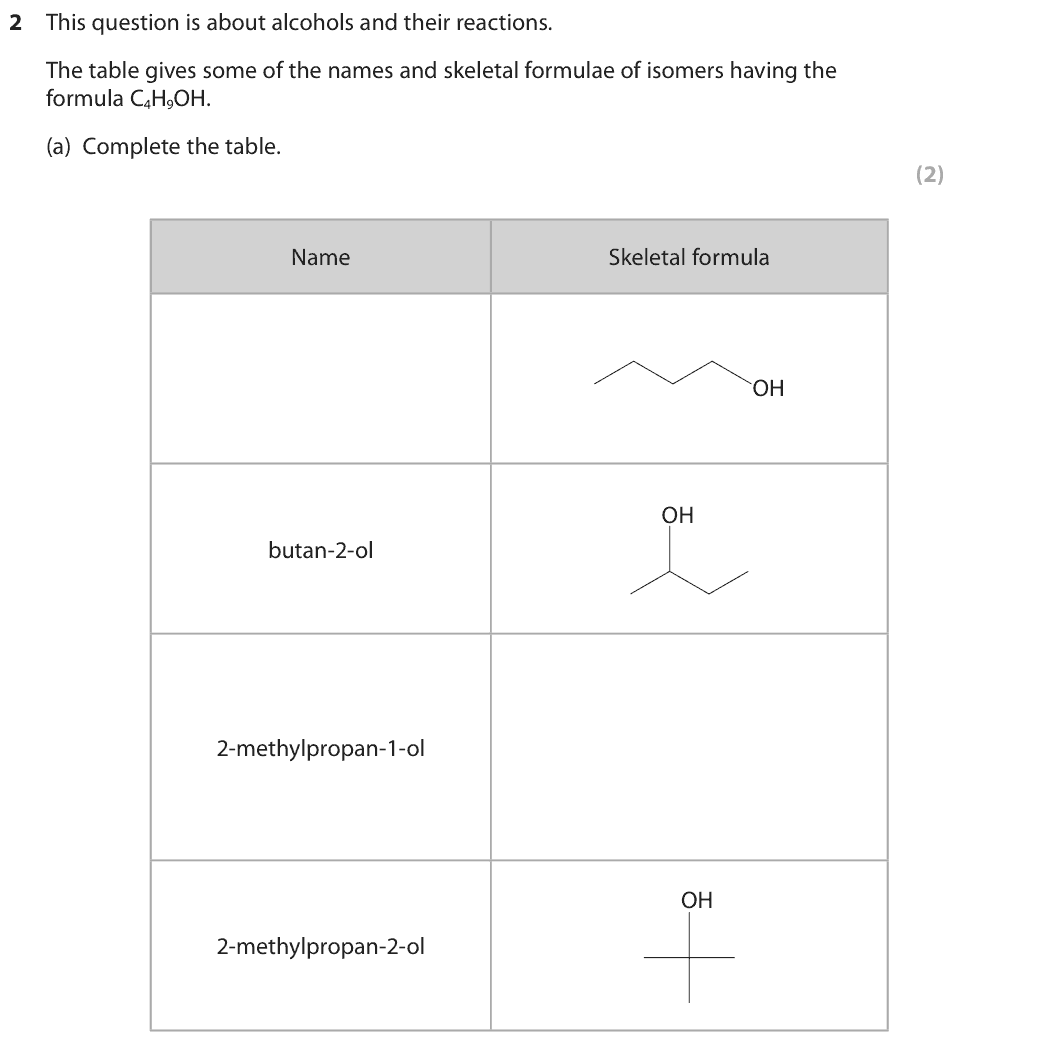
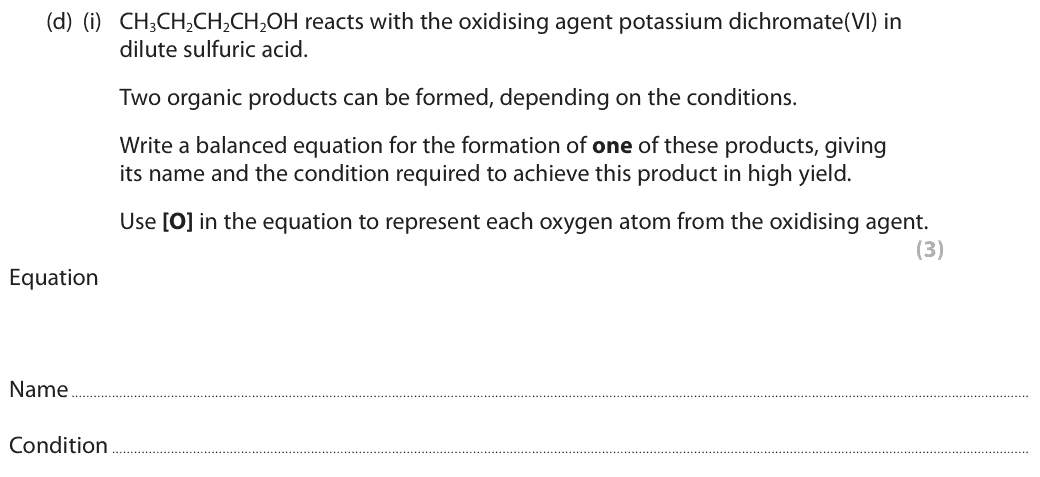
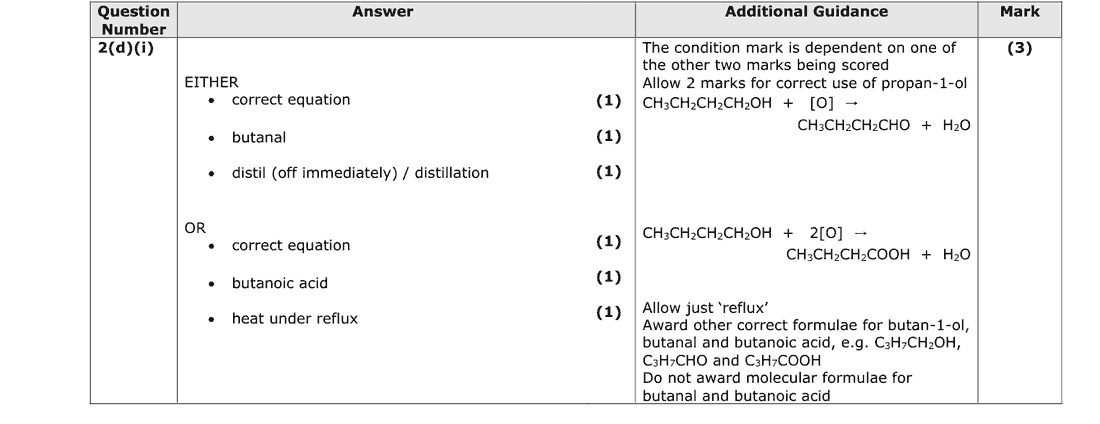
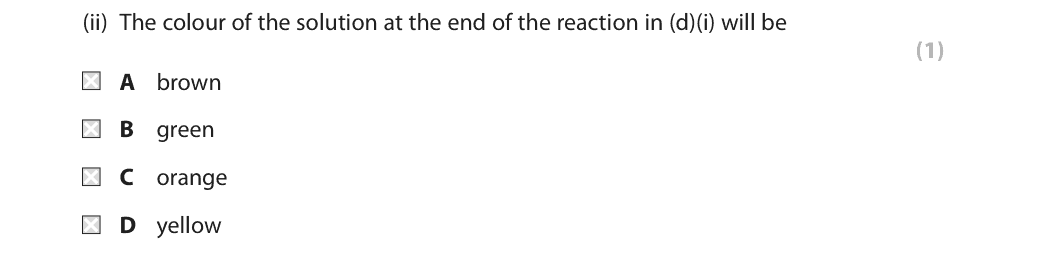

![This question is about some reactions of alcohols.
Which alcohol cannot be oxidised by acidified potassium dichromate(VI)?
L] A hexan-2-ol
L] B= 2-methylpentan-2-ol
L] C€_ hexan-3-ol
L] D 2-methylpentan-3-ol](/img/JUN19_9CH02/JUN19_9CH02_1-a-i_qp.webp)

![Which reagent is used with iodine to prepare iodoalkanes from alcohols?
[1 A’ red phosphorus
L] B_~ concentrated phosphoric acid
[1] Cs sulfur
L] D concentrated sulfuric acid](/img/JUN19_9CH02/JUN19_9CH02_1-b_qp.webp)
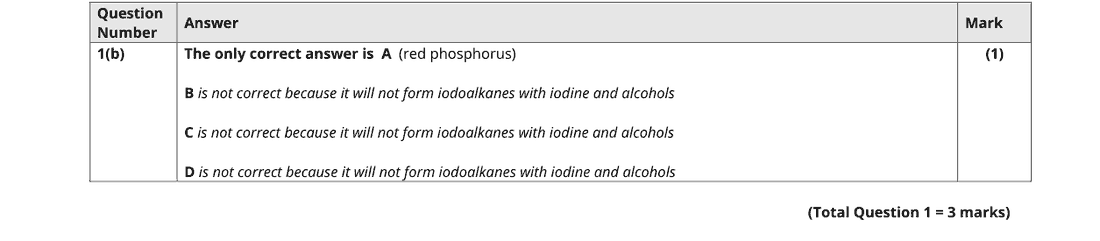
![Which of these compounds produces hydrogen chloride when it reacts with PCl,?
LJ] A propanal
L] B_ propan-1-ol
[1 C_ propanone
LJ] D_ propyl propanoate](/img/JUN19_9CH02/JUN19_9CH02_3-c_qp.webp)