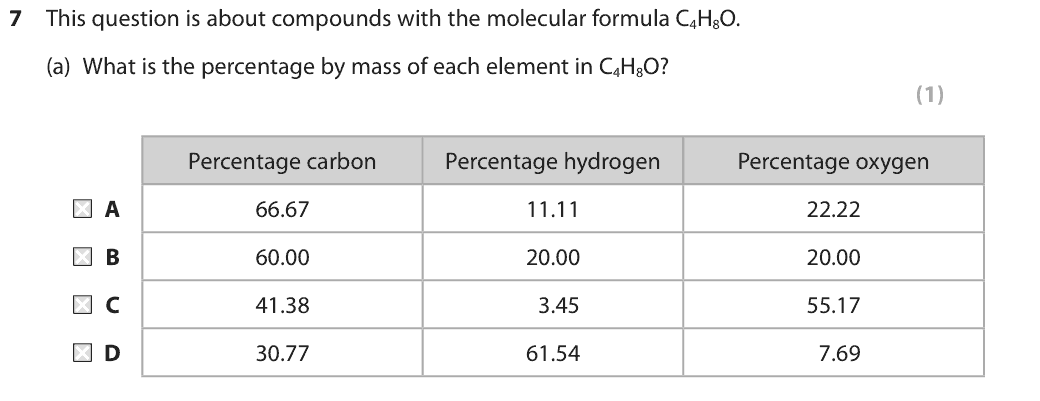
Answer
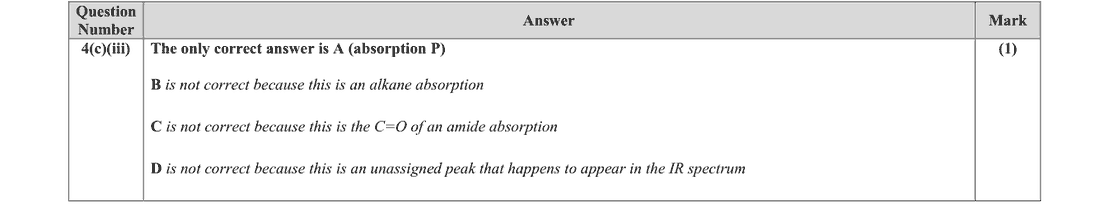
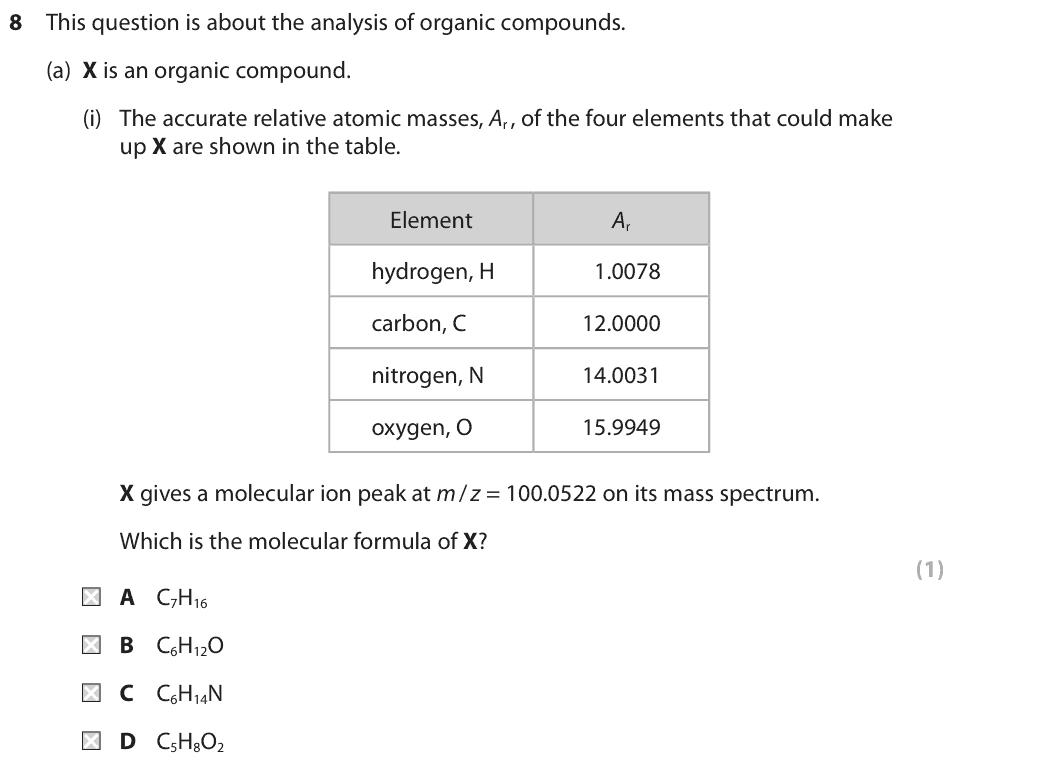
C
Mark scheme
Notes from the mark scheme and report
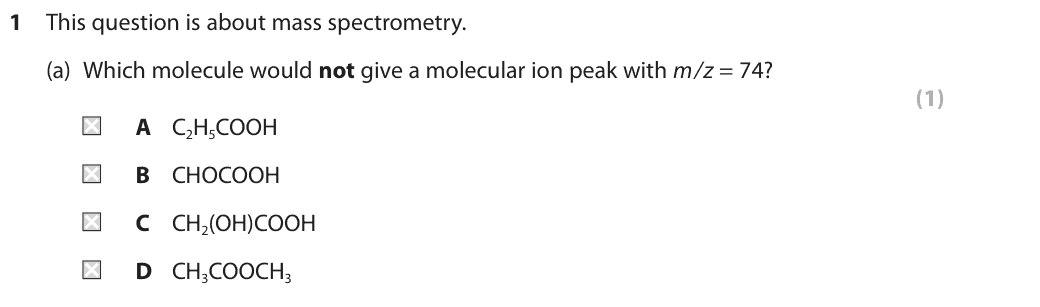
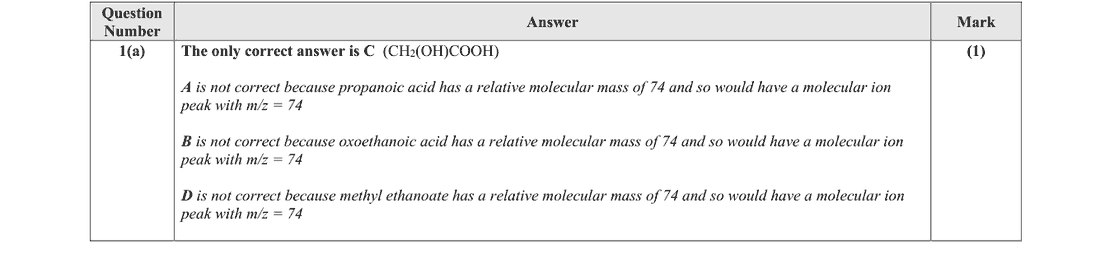
- Answer: C. CH2(OH)COOH has a relative molecular mass of 76. Propanoic acid, oxoethanoic acid (CHOCOOH) and methyl ethanoate all have Mr = 74
Notes and key-term cards for this topic are being written by our tutors. The past-paper questions below are ready now.
| Series | Paper | Q | What it asks |
|---|---|---|---|
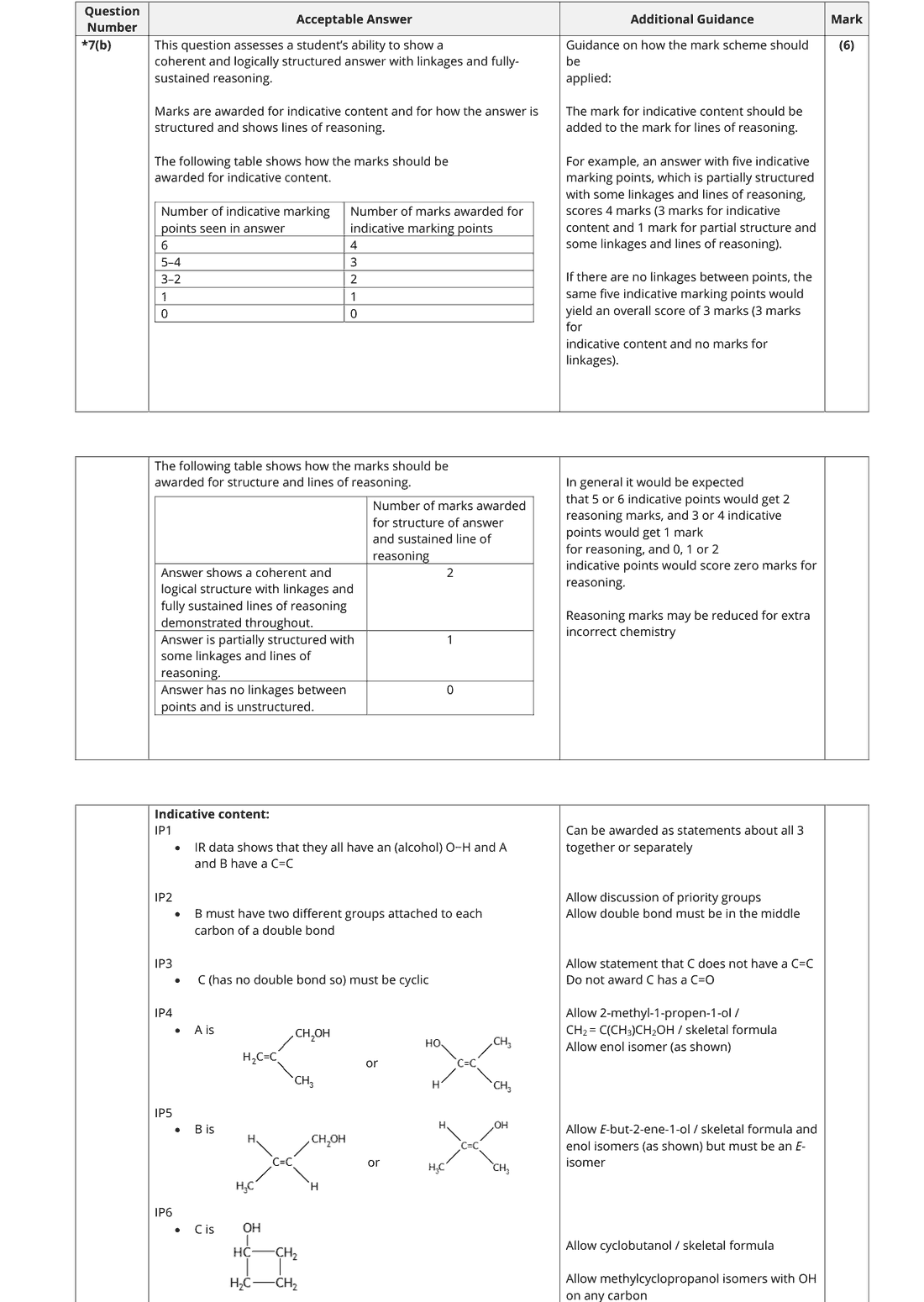
| June 2019 | AS Paper 2 | 7(b) | a possible displayed formula for each of the compounds A, B and C. |
C
B
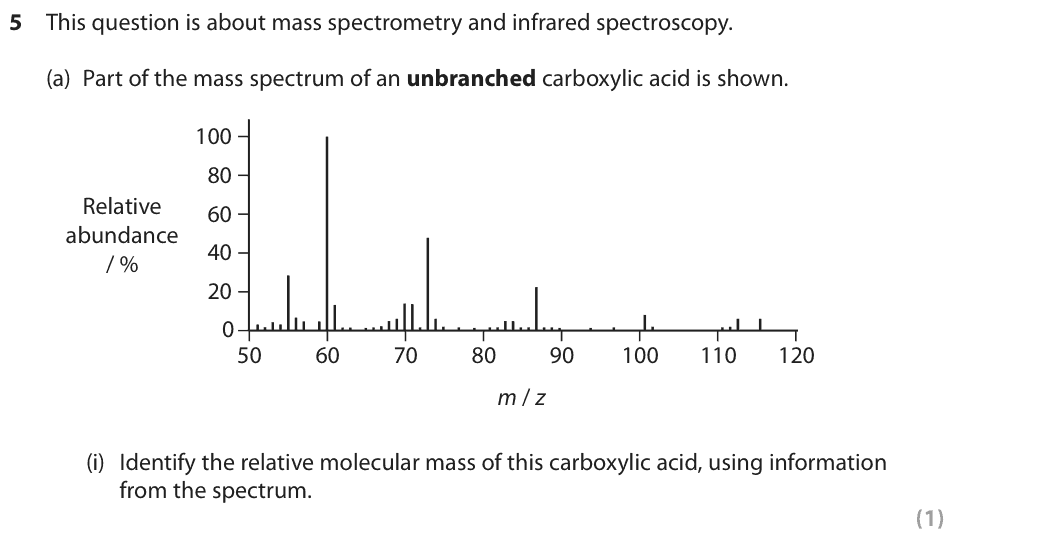
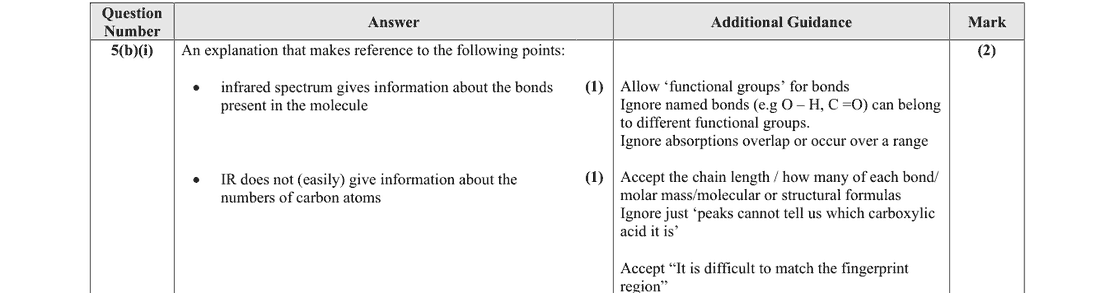
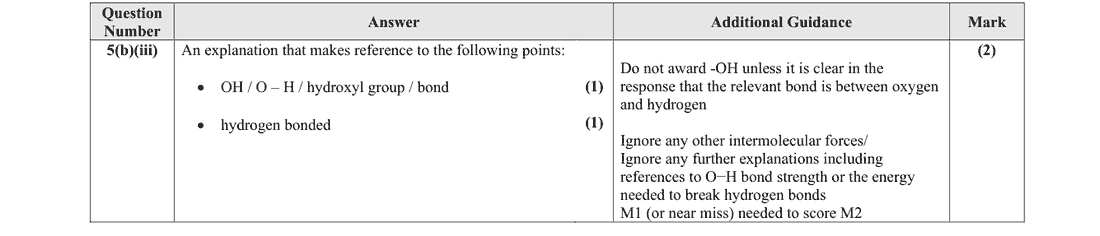
This question is about the use of mass spectrometry and infrared spectroscopy as methods to identify organic compounds. (ai) Many candidates answered correctly. A common error was giving 115 as the relative molecular mass. (aii) Over half scored full marks. Many missed the requirement for a positive ion, and a minority gave negative ions or inappropriate fragments such as OH- or H+ (aiii) Many scored the mark, though some lost it by giving both name and formula, with one being incorrect. A common incorrect answer was pentanoic acid. (bi) Many candidates did not read the question carefully or misunderstood what was being asked. They had to explain why a specific carboxylic acid would be difficult to identify based solely on the spectrum. Whilst some responses correctly noted that peaks were broad or could overlap, this did not address the question so did not score. However, there were also some excellent responses that demonstrated clear understanding and precise reasoning. (bii) Most candidates identified the bond correctly as C=O but many just said ‘carboxylic acid alkyl’ so did not score. (biii) Most identified O-H as the relevant bond and many recognised the role of hydrogen bonding here. However, many answers did not refer to the peak in the question and just described the intermolecular forces present in carboxylic acids. About a third scored full marks.
Skills: MS3.1 Translate information between graphical, numerical and algebraic forms

This question is about the use of mass spectrometry and infrared spectroscopy as methods to identify organic compounds. (ai) Many candidates answered correctly. A common error was giving 115 as the relative molecular mass. (aii) Over half scored full marks. Many missed the requirement for a positive ion, and a minority gave negative ions or inappropriate fragments such as OH- or H+ (aiii) Many scored the mark, though some lost it by giving both name and formula, with one being incorrect. A common incorrect answer was pentanoic acid. (bi) Many candidates did not read the question carefully or misunderstood what was being asked. They had to explain why a specific carboxylic acid would be difficult to identify based solely on the spectrum. Whilst some responses correctly noted that peaks were broad or could overlap, this did not address the question so did not score. However, there were also some excellent responses that demonstrated clear understanding and precise reasoning. (bii) Most candidates identified the bond correctly as C=O but many just said ‘carboxylic acid alkyl’ so did not score. (biii) Most identified O-H as the relevant bond and many recognised the role of hydrogen bonding here. However, many answers did not refer to the peak in the question and just described the intermolecular forces present in carboxylic acids. About a third scored full marks.

This question is about the use of mass spectrometry and infrared spectroscopy as methods to identify organic compounds. (ai) Many candidates answered correctly. A common error was giving 115 as the relative molecular mass. (aii) Over half scored full marks. Many missed the requirement for a positive ion, and a minority gave negative ions or inappropriate fragments such as OH- or H+ (aiii) Many scored the mark, though some lost it by giving both name and formula, with one being incorrect. A common incorrect answer was pentanoic acid. (bi) Many candidates did not read the question carefully or misunderstood what was being asked. They had to explain why a specific carboxylic acid would be difficult to identify based solely on the spectrum. Whilst some responses correctly noted that peaks were broad or could overlap, this did not address the question so did not score. However, there were also some excellent responses that demonstrated clear understanding and precise reasoning. (bii) Most candidates identified the bond correctly as C=O but many just said ‘carboxylic acid alkyl’ so did not score. (biii) Most identified O-H as the relevant bond and many recognised the role of hydrogen bonding here. However, many answers did not refer to the peak in the question and just described the intermolecular forces present in carboxylic acids. About a third scored full marks.
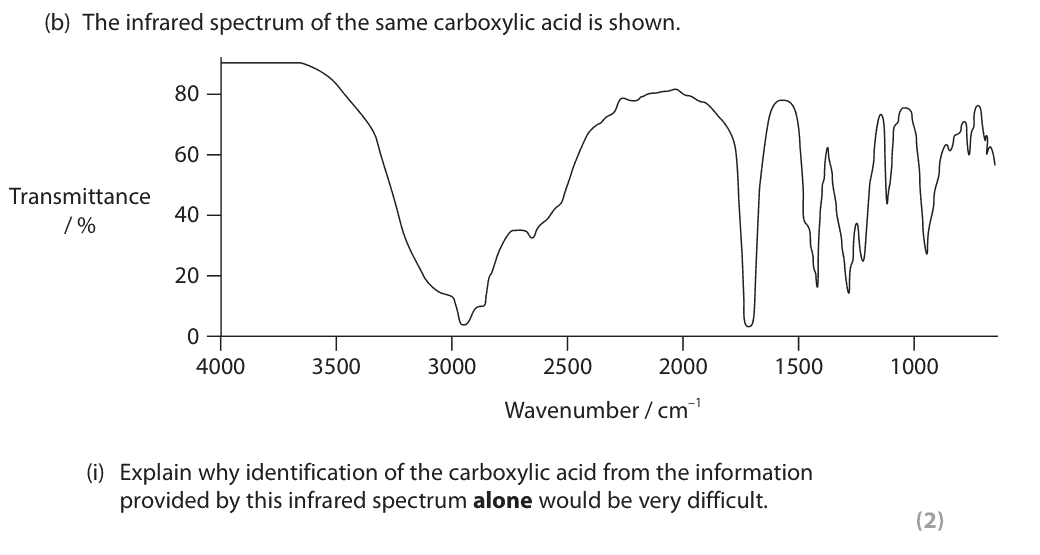
This question is about the use of mass spectrometry and infrared spectroscopy as methods to identify organic compounds. (ai) Many candidates answered correctly. A common error was giving 115 as the relative molecular mass. (aii) Over half scored full marks. Many missed the requirement for a positive ion, and a minority gave negative ions or inappropriate fragments such as OH- or H+ (aiii) Many scored the mark, though some lost it by giving both name and formula, with one being incorrect. A common incorrect answer was pentanoic acid. (bi) Many candidates did not read the question carefully or misunderstood what was being asked. They had to explain why a specific carboxylic acid would be difficult to identify based solely on the spectrum. Whilst some responses correctly noted that peaks were broad or could overlap, this did not address the question so did not score. However, there were also some excellent responses that demonstrated clear understanding and precise reasoning. (bii) Most candidates identified the bond correctly as C=O but many just said ‘carboxylic acid alkyl’ so did not score. (biii) Most identified O-H as the relevant bond and many recognised the role of hydrogen bonding here. However, many answers did not refer to the peak in the question and just described the intermolecular forces present in carboxylic acids. About a third scored full marks.

This question is about the use of mass spectrometry and infrared spectroscopy as methods to identify organic compounds. (ai) Many candidates answered correctly. A common error was giving 115 as the relative molecular mass. (aii) Over half scored full marks. Many missed the requirement for a positive ion, and a minority gave negative ions or inappropriate fragments such as OH- or H+ (aiii) Many scored the mark, though some lost it by giving both name and formula, with one being incorrect. A common incorrect answer was pentanoic acid. (bi) Many candidates did not read the question carefully or misunderstood what was being asked. They had to explain why a specific carboxylic acid would be difficult to identify based solely on the spectrum. Whilst some responses correctly noted that peaks were broad or could overlap, this did not address the question so did not score. However, there were also some excellent responses that demonstrated clear understanding and precise reasoning. (bii) Most candidates identified the bond correctly as C=O but many just said ‘carboxylic acid alkyl’ so did not score. (biii) Most identified O-H as the relevant bond and many recognised the role of hydrogen bonding here. However, many answers did not refer to the peak in the question and just described the intermolecular forces present in carboxylic acids. About a third scored full marks.

This question is about the use of mass spectrometry and infrared spectroscopy as methods to identify organic compounds. (ai) Many candidates answered correctly. A common error was giving 115 as the relative molecular mass. (aii) Over half scored full marks. Many missed the requirement for a positive ion, and a minority gave negative ions or inappropriate fragments such as OH- or H+ (aiii) Many scored the mark, though some lost it by giving both name and formula, with one being incorrect. A common incorrect answer was pentanoic acid. (bi) Many candidates did not read the question carefully or misunderstood what was being asked. They had to explain why a specific carboxylic acid would be difficult to identify based solely on the spectrum. Whilst some responses correctly noted that peaks were broad or could overlap, this did not address the question so did not score. However, there were also some excellent responses that demonstrated clear understanding and precise reasoning. (bii) Most candidates identified the bond correctly as C=O but many just said ‘carboxylic acid alkyl’ so did not score. (biii) Most identified O-H as the relevant bond and many recognised the role of hydrogen bonding here. However, many answers did not refer to the peak in the question and just described the intermolecular forces present in carboxylic acids. About a third scored full marks.
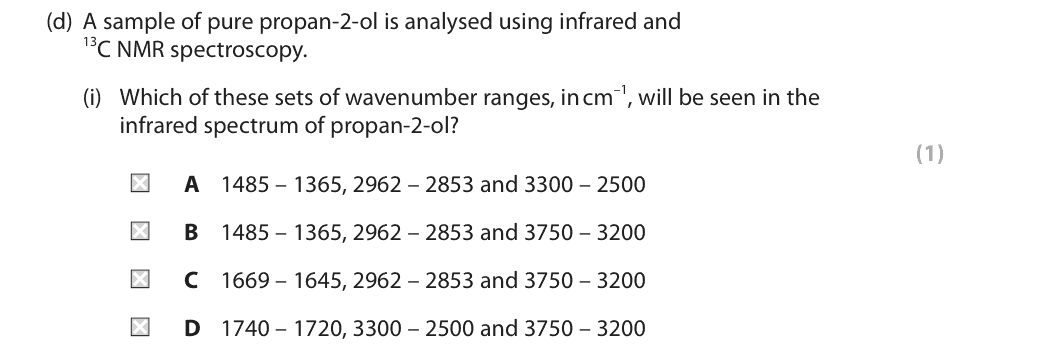
B
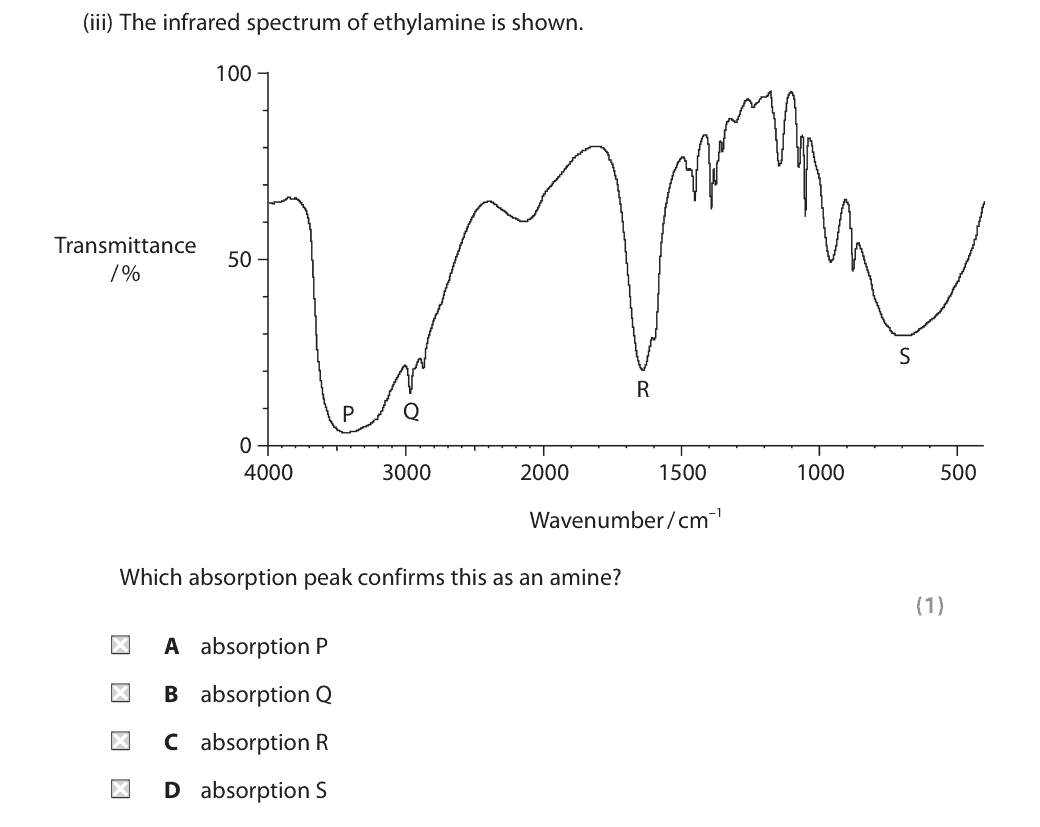
A
Skills: MS3.1 Translate information between graphical, numerical and algebraic forms

A small number of candidates did not do well on this question and had clearly never encountered mass spec. Of those who scored just 1 mark, it was sometimes the m/z value that was missing.
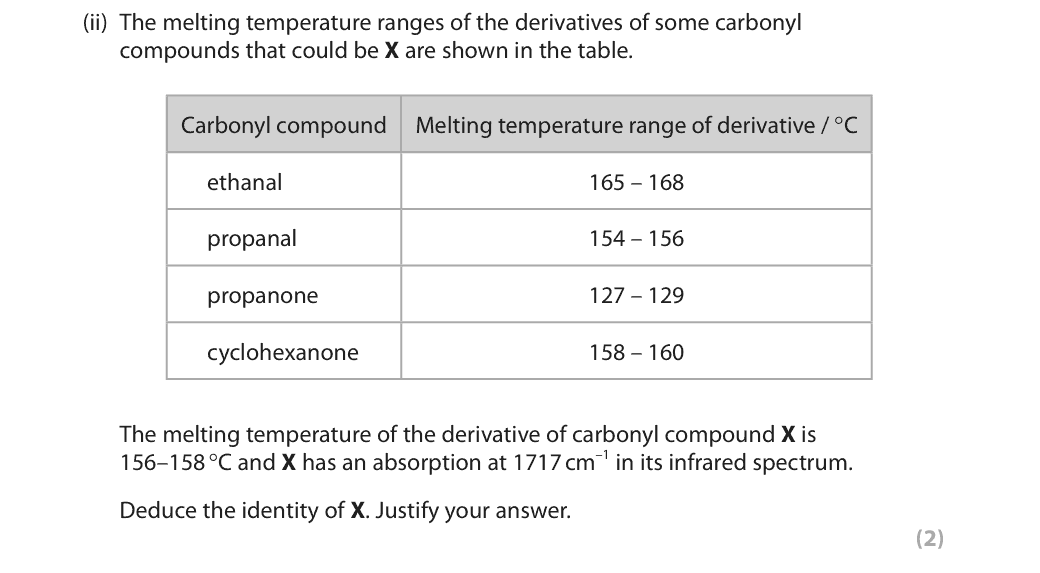
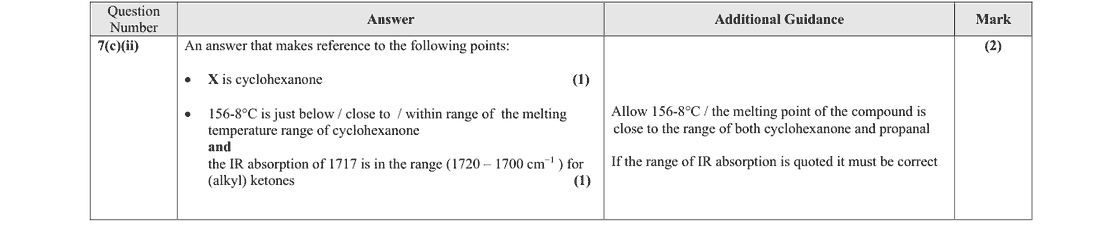
This question was generally well-answered, although some candidates identified the wrong infrared absorption and some had not read the question correctly and identified substances that were not one of the options. A few thought that cyclohexanone would be aromatic and so quoted the wrong range for the infrared absorption.
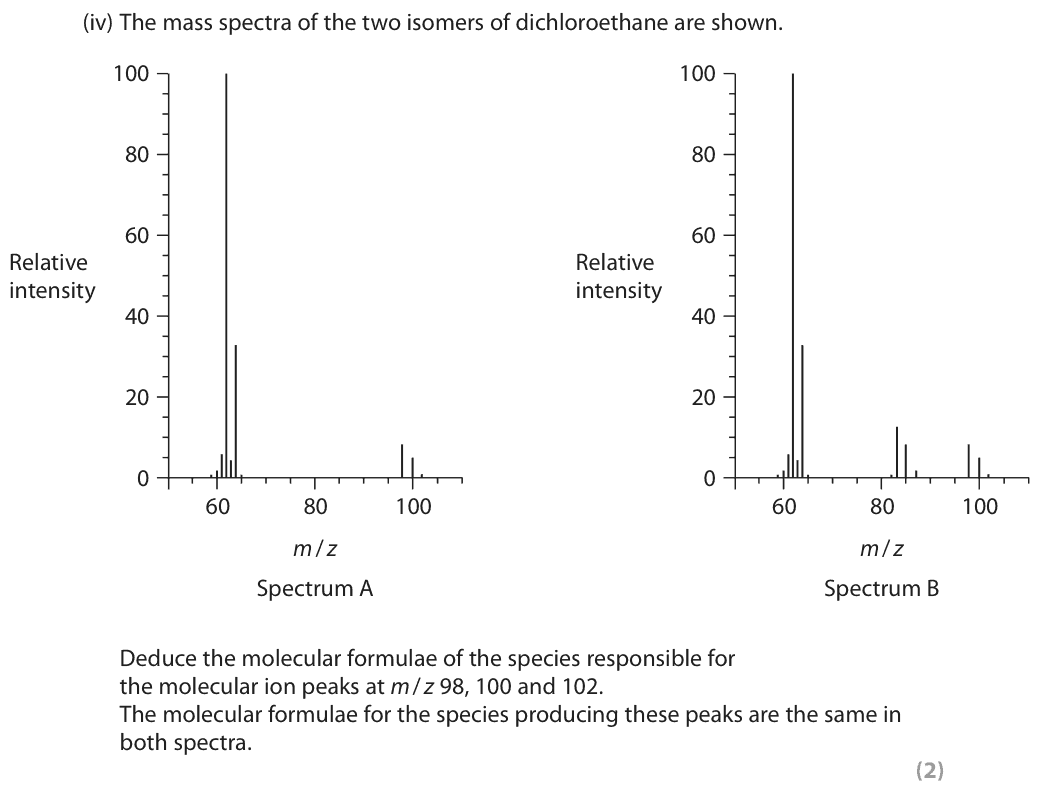
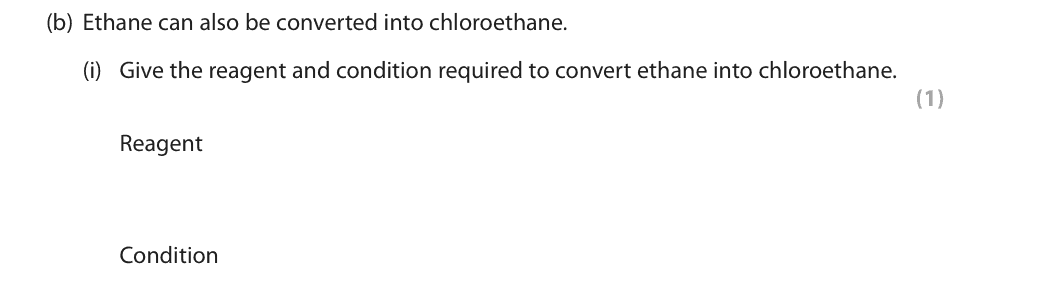
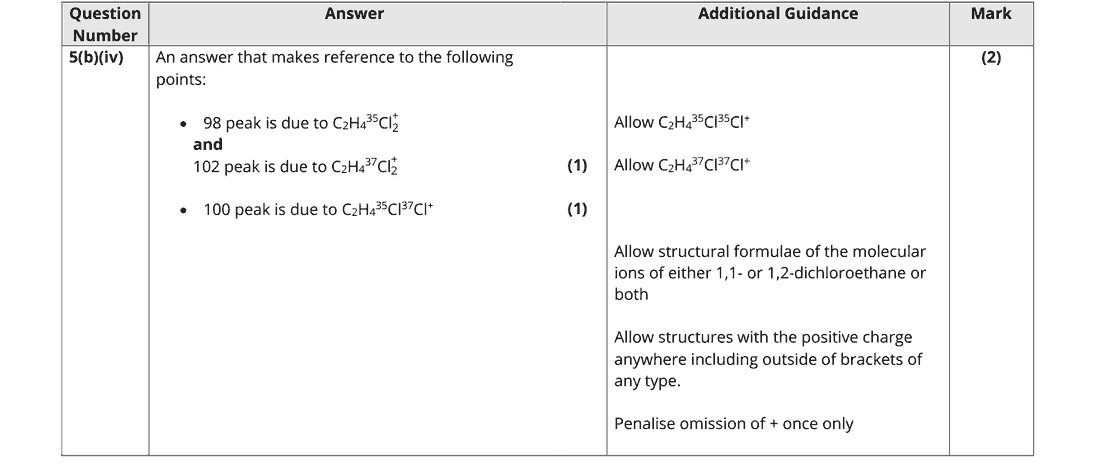
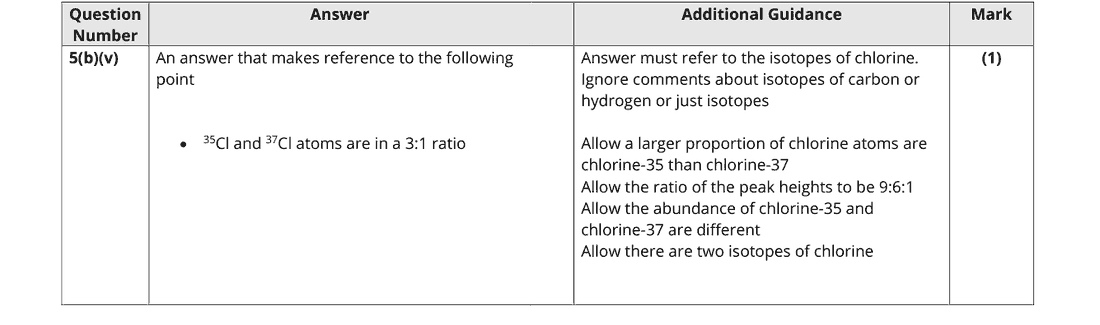
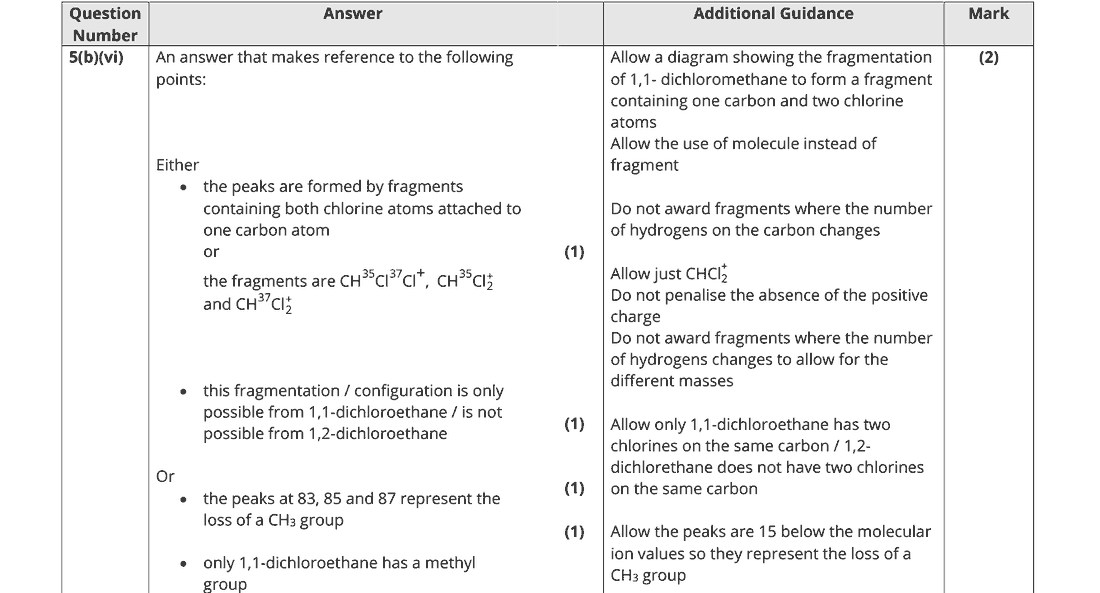
(a), the electrophilic addition reaction, proved rather more accessible than the later free-radical substitution items. In (a)(i) hydrogen chloride was commonly given, though chlorine was also suggested. The mechanism in (a)(ii) was generally well done, with only a few of the usual errors in arrow direction, dipoles and charges seen. (b) was less well understood, with a variety of reagents and conditions given in (b)(i), though over 60% of candidates identified the reaction was a free radical substitution in (b)(ii). For those who gave the wrong reagent and conditions, it was possible to score some marks in (b)(iii) by giving and naming the two product structures. Those with the correct reagents still struggled in (b)(iii) with full marks rarely seen. (b)(iv), (b)(v) and (b)(vi) all needed an understanding of the isotopes of chlorine, or were easier if this was understood. Those candidates who recognised this as the key factor scored well, while those that didn’t struggled to pick up any marks.

(a), the electrophilic addition reaction, proved rather more accessible than the later free-radical substitution items. In (a)(i) hydrogen chloride was commonly given, though chlorine was also suggested. The mechanism in (a)(ii) was generally well done, with only a few of the usual errors in arrow direction, dipoles and charges seen. (b) was less well understood, with a variety of reagents and conditions given in (b)(i), though over 60% of candidates identified the reaction was a free radical substitution in (b)(ii). For those who gave the wrong reagent and conditions, it was possible to score some marks in (b)(iii) by giving and naming the two product structures. Those with the correct reagents still struggled in (b)(iii) with full marks rarely seen. (b)(iv), (b)(v) and (b)(vi) all needed an understanding of the isotopes of chlorine, or were easier if this was understood. Those candidates who recognised this as the key factor scored well, while those that didn’t struggled to pick up any marks.
Skills: MS0.2 Use ratios, fractions and percentages

(a), the electrophilic addition reaction, proved rather more accessible than the later free-radical substitution items. In (a)(i) hydrogen chloride was commonly given, though chlorine was also suggested. The mechanism in (a)(ii) was generally well done, with only a few of the usual errors in arrow direction, dipoles and charges seen. (b) was less well understood, with a variety of reagents and conditions given in (b)(i), though over 60% of candidates identified the reaction was a free radical substitution in (b)(ii). For those who gave the wrong reagent and conditions, it was possible to score some marks in (b)(iii) by giving and naming the two product structures. Those with the correct reagents still struggled in (b)(iii) with full marks rarely seen. (b)(iv), (b)(v) and (b)(vi) all needed an understanding of the isotopes of chlorine, or were easier if this was understood. Those candidates who recognised this as the key factor scored well, while those that didn’t struggled to pick up any marks.

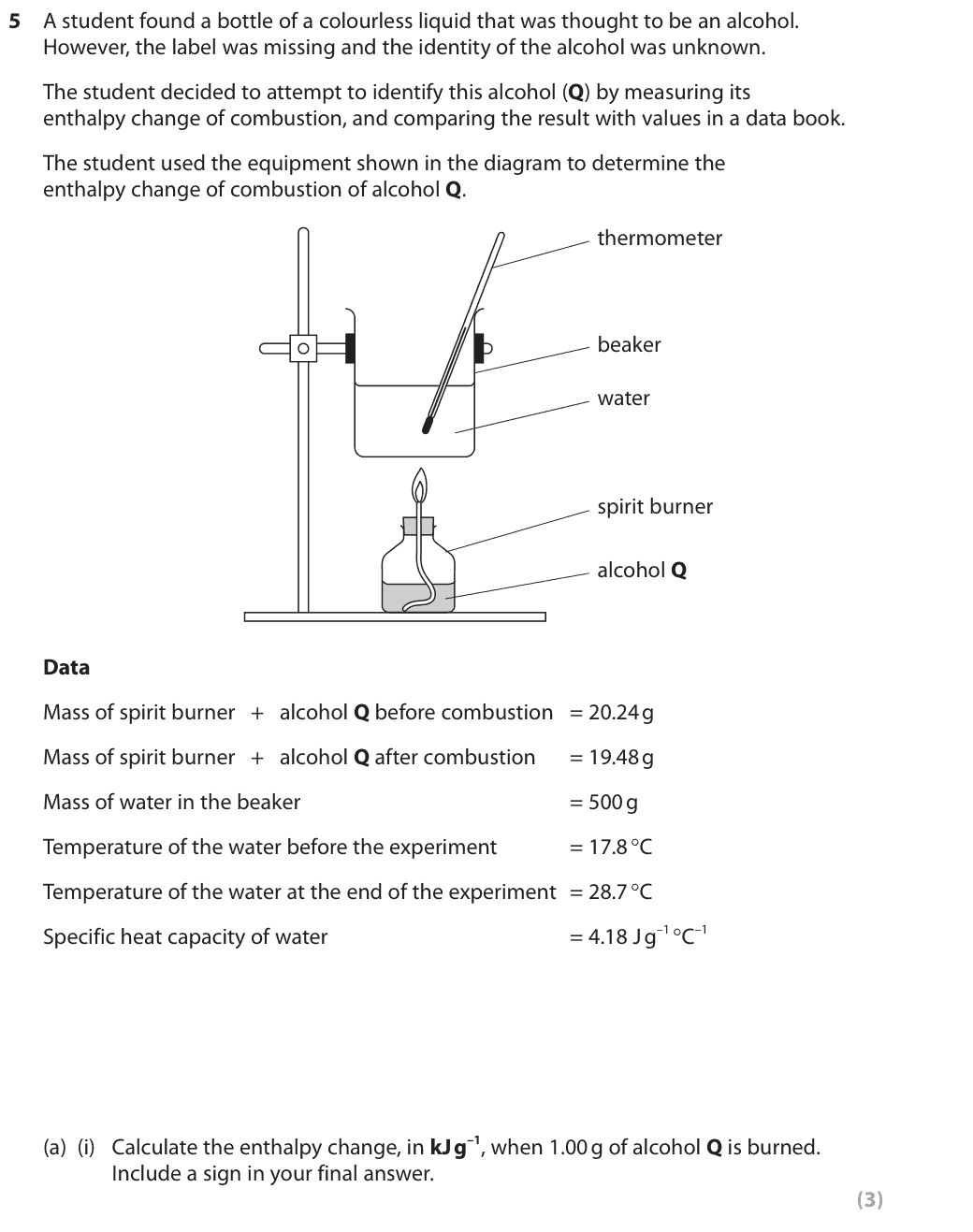
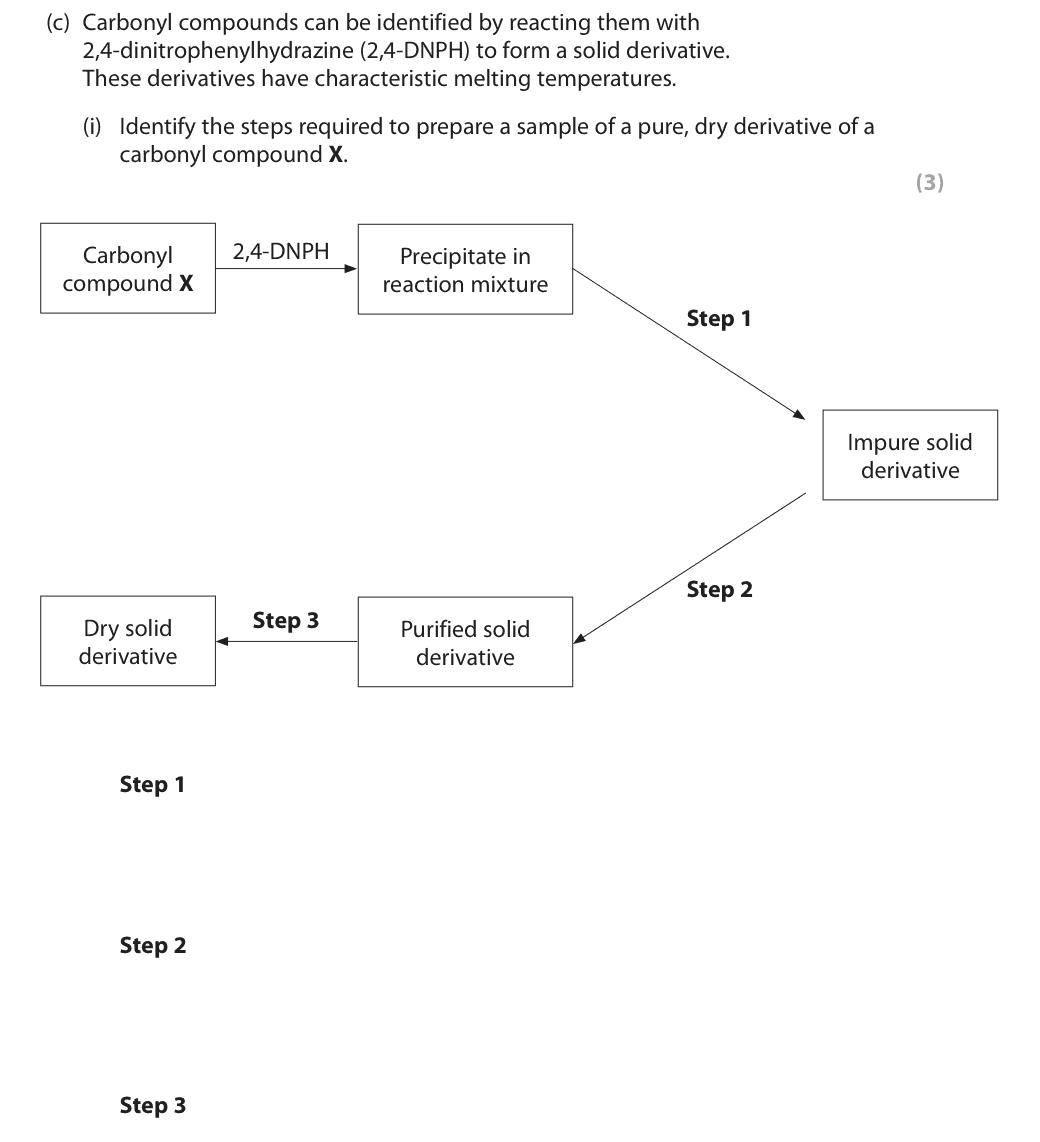
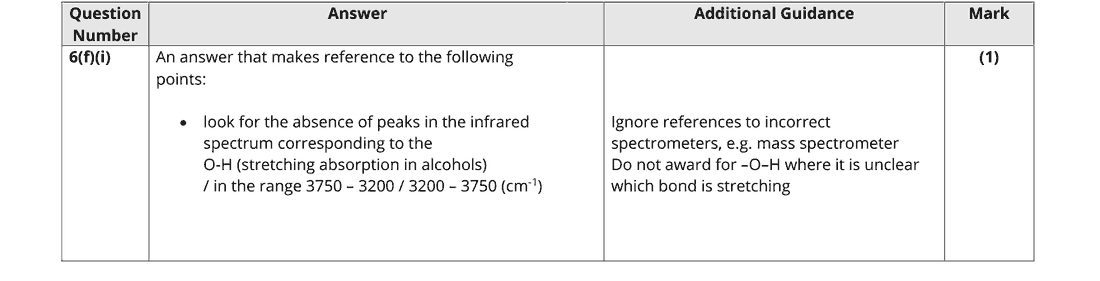
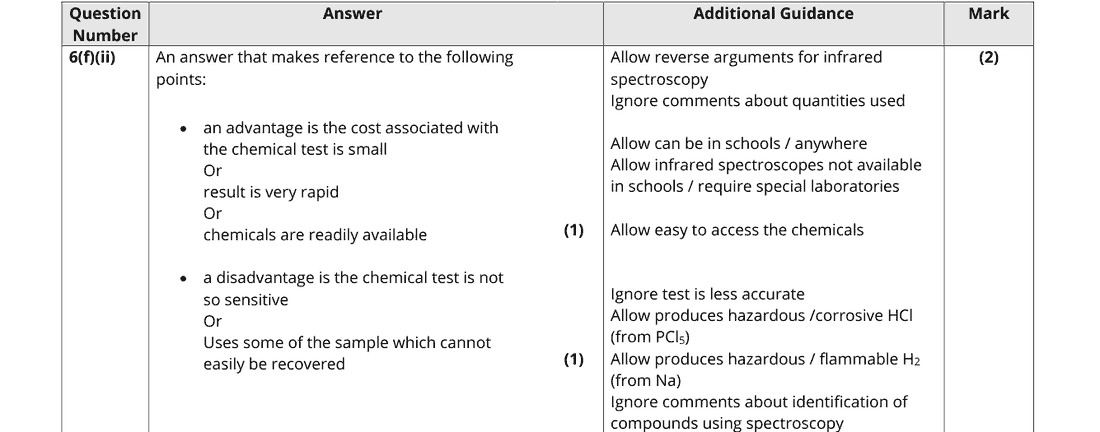
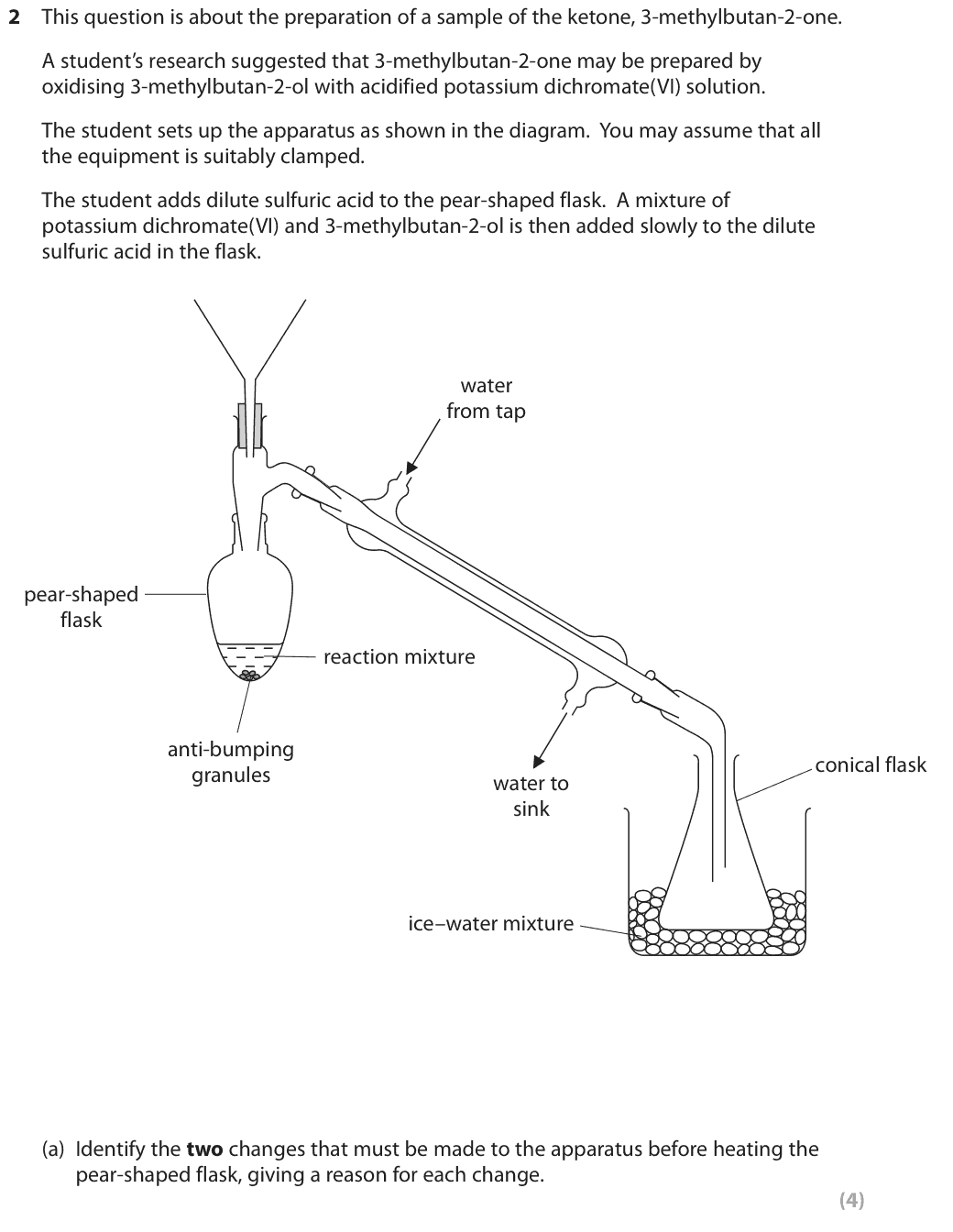
This was another practical based question, and some candidates were able to acquit themselves well, while others struggled to make headway, though (a) was quite commonly scored (b) was a diagram question, and the diagram here, one of the more straightforward required at this level, was not well drawn in general. On average candidates scored about half of the marks in (c) while in (d), about 50% score the mark in (d)(i). The extended writing answer (d)(ii) gave two marks most commonly out of six, though a few candidates were able to score all six marks. The calculation in (e) had a number of valid approaches. Some candidates were able to work through in a step by step fashion, whilst others appeared to quite randomly scatter calculation across the page. Great benefit can be had be identifying each of your calculation so you can follow your route through the calculation. Four out of four was the most common mark obtained. (f)(i) suffered from a lack of clarity in the written answers with candidates identifying the range in the infra-red spectrum to look for, but not saying how this would be used to establish purity. Similarly, in (f)(ii) a lack of detail and clarity meant that marks were not always scored.

This was another practical based question, and some candidates were able to acquit themselves well, while others struggled to make headway, though (a) was quite commonly scored (b) was a diagram question, and the diagram here, one of the more straightforward required at this level, was not well drawn in general. On average candidates scored about half of the marks in (c) while in (d), about 50% score the mark in (d)(i). The extended writing answer (d)(ii) gave two marks most commonly out of six, though a few candidates were able to score all six marks. The calculation in (e) had a number of valid approaches. Some candidates were able to work through in a step by step fashion, whilst others appeared to quite randomly scatter calculation across the page. Great benefit can be had be identifying each of your calculation so you can follow your route through the calculation. Four out of four was the most common mark obtained. (f)(i) suffered from a lack of clarity in the written answers with candidates identifying the range in the infra-red spectrum to look for, but not saying how this would be used to establish purity. Similarly, in (f)(ii) a lack of detail and clarity meant that marks were not always scored.
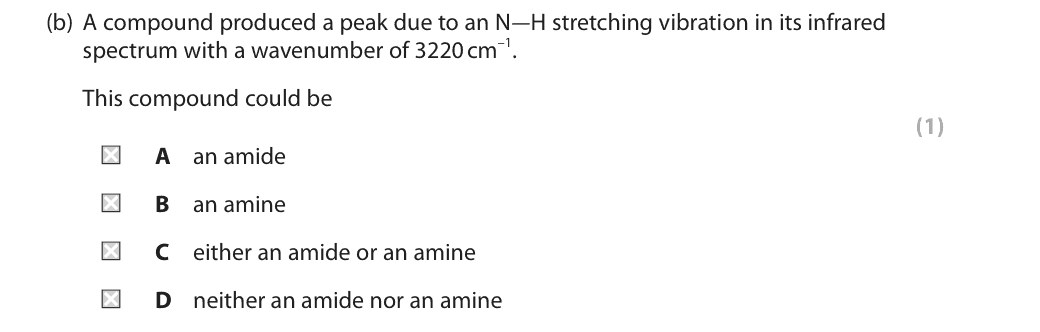
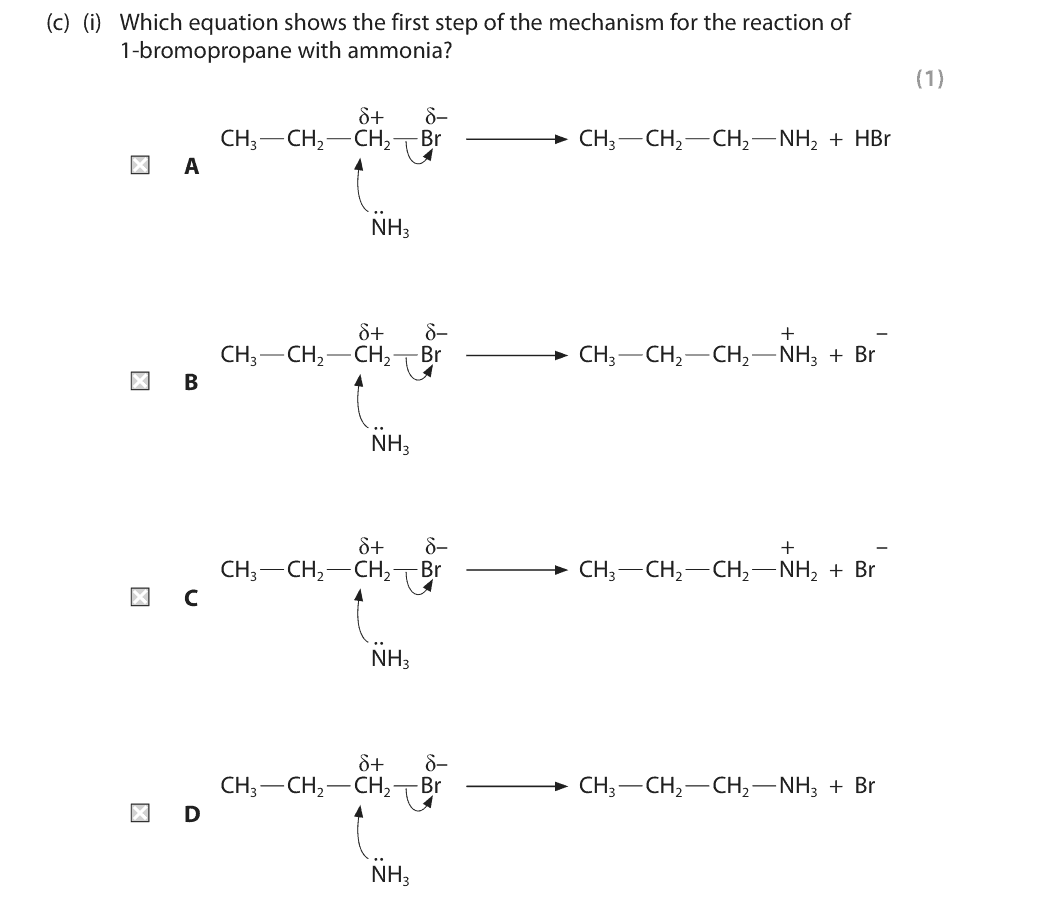
A
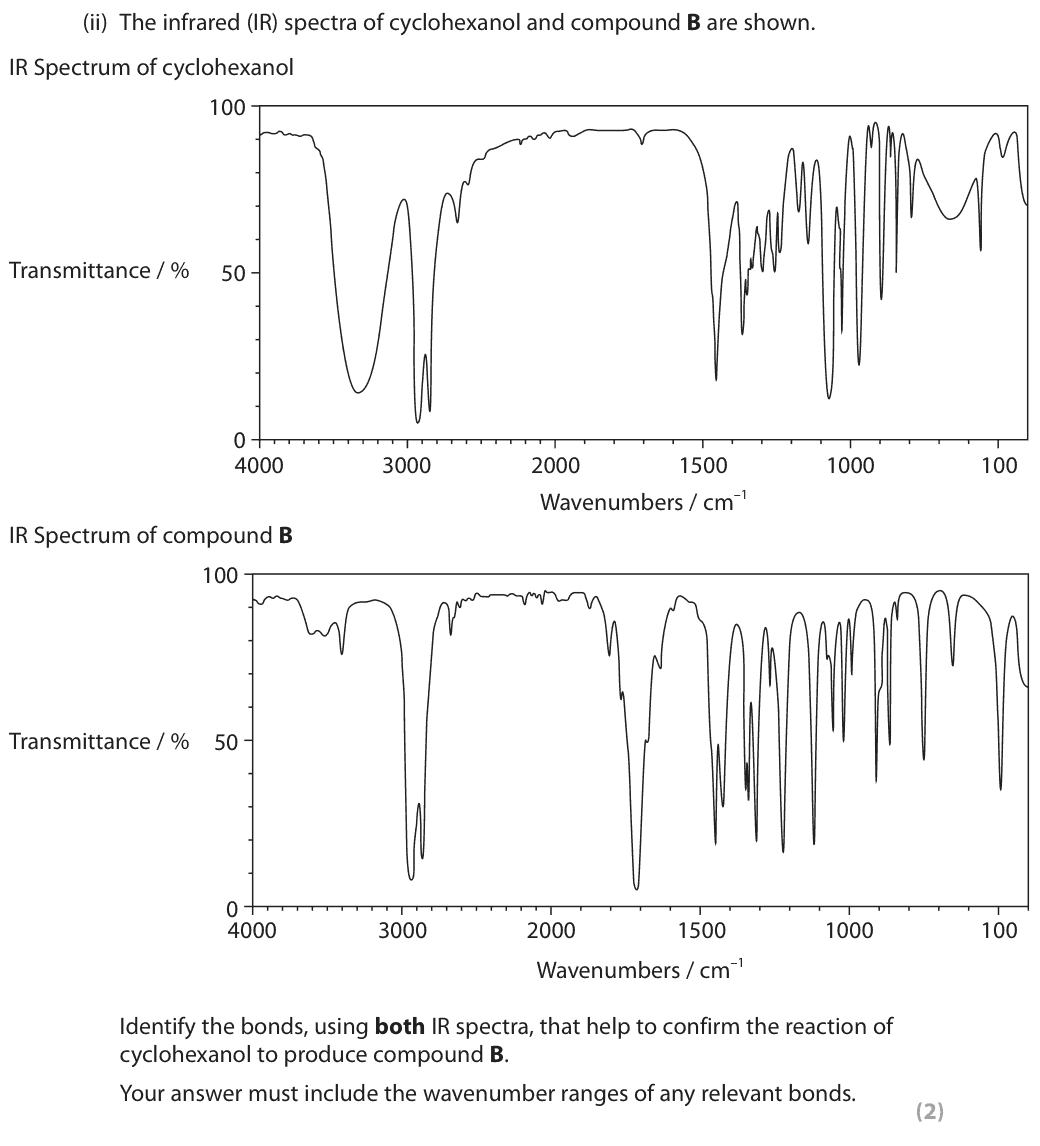
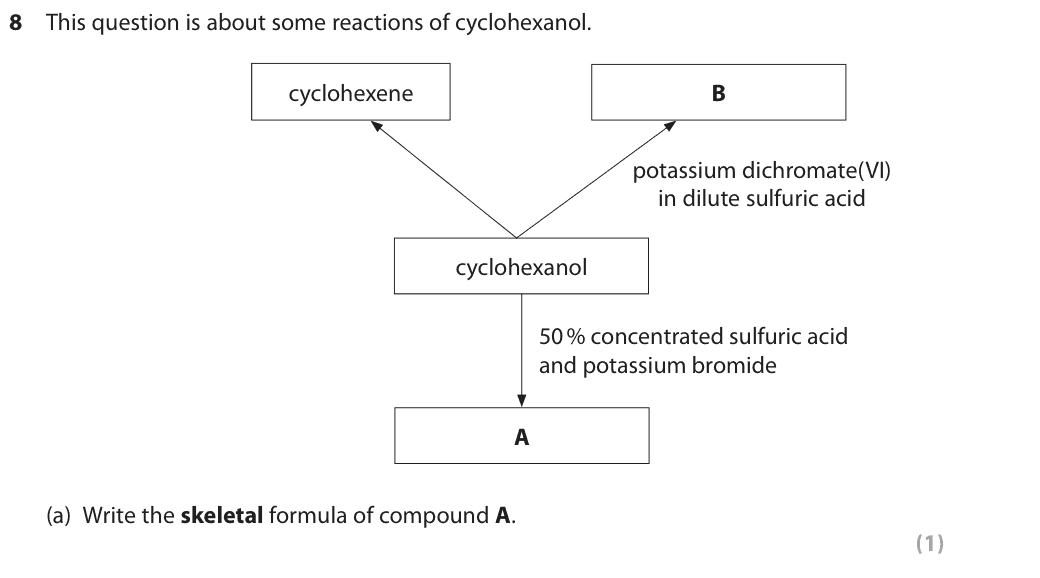
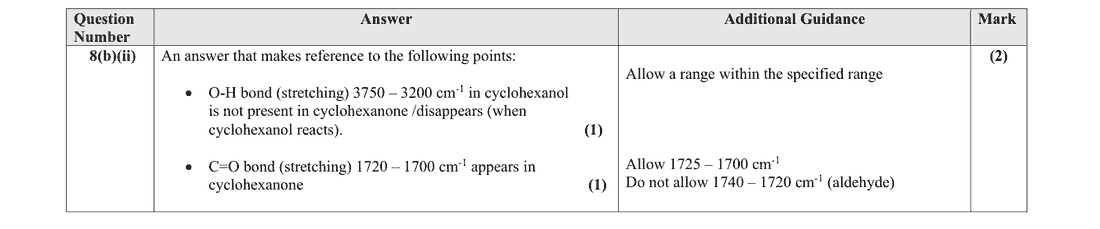
This question concerned the reactions of cyclohexanol. In general terms it was answered poorly, and weaker candidates declined to answer most of the early parts of this question. Most of these candidates seemed unfamiliar with the reactions of alcohols. A few excellent answers were seen, but these generally related to the more able candidates. (a) It appeared that weaker candidates were unsure of what was meant by a skeletal formula. (b)(i) This question asked about the oxidation of a secondary alcohol, requiring both the name and displayed formula of the organic product. It was therefore a demanding question requiring knowledge of the reaction and the ability to write relevant names and formulae. (b)(ii) This question tested the candidate’s understanding of IR spectra. Although worth just 2 marks on this paper, this specification topic tends to be difficult for many candidates, perhaps because it requires a considerable investment in time and effort to understand the basics of IR spectroscopy. (b)(iii) and (b)(iv) Following on from IR, the question then moved on to another instrumental technique: mass spectrometry. Part (iii) was a simple question about finding relative molecular mass from a mass spectrum, but avoided or answered incorrectly by almost all weaker candidates. Part (iv) was potentially more challenging but was attempted with more success by candidates across the ability range. Similar questions have been asked in recent years and practice with past papers may have contributed to the candidate performance seen in this question. (c)(i) This multiple-choice question on reaction classification proved to be a relatively easy mark for most candidates. Application of simple chemical principles gives the required answer. (c)(ii) This was a relatively complicated question involving density calculations, mole calculation, and % yield. It was intended to discriminate and only the best candidate were able to achieve the final correct answer. Some candidates were able to gain some of the available marks. (c)(iii)* This was a longer unstructured question and was concerned with the practical aspects of producing a dry sample of product from a given organic reaction. As is usual with this style of question, the data provided gives several clues about the required answer. In general, this question was very poorly answered, with the majority of candidates failing to score any marks at all. In this type of practical question, it is a marked advantage to have completed any of the relevant practical exercises. Practical experience seemed to be lacking for most candidates, with only the best candidates scoring a modest number of marks for this question.
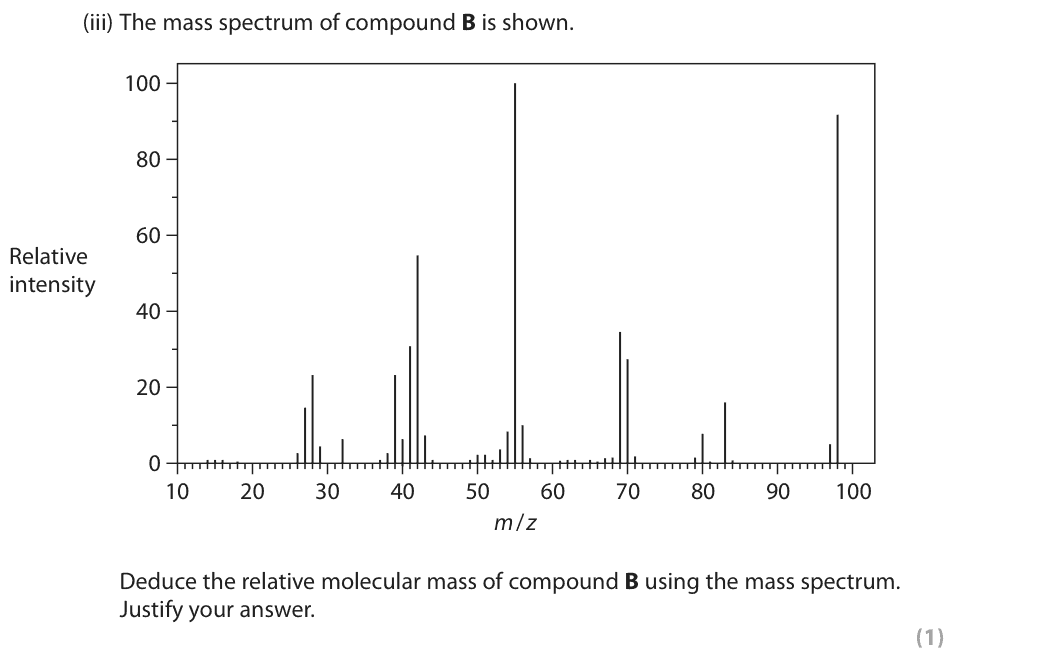
This question concerned the reactions of cyclohexanol. In general terms it was answered poorly, and weaker candidates declined to answer most of the early parts of this question. Most of these candidates seemed unfamiliar with the reactions of alcohols. A few excellent answers were seen, but these generally related to the more able candidates. (a) It appeared that weaker candidates were unsure of what was meant by a skeletal formula. (b)(i) This question asked about the oxidation of a secondary alcohol, requiring both the name and displayed formula of the organic product. It was therefore a demanding question requiring knowledge of the reaction and the ability to write relevant names and formulae. (b)(ii) This question tested the candidate’s understanding of IR spectra. Although worth just 2 marks on this paper, this specification topic tends to be difficult for many candidates, perhaps because it requires a considerable investment in time and effort to understand the basics of IR spectroscopy. (b)(iii) and (b)(iv) Following on from IR, the question then moved on to another instrumental technique: mass spectrometry. Part (iii) was a simple question about finding relative molecular mass from a mass spectrum, but avoided or answered incorrectly by almost all weaker candidates. Part (iv) was potentially more challenging but was attempted with more success by candidates across the ability range. Similar questions have been asked in recent years and practice with past papers may have contributed to the candidate performance seen in this question. (c)(i) This multiple-choice question on reaction classification proved to be a relatively easy mark for most candidates. Application of simple chemical principles gives the required answer. (c)(ii) This was a relatively complicated question involving density calculations, mole calculation, and % yield. It was intended to discriminate and only the best candidate were able to achieve the final correct answer. Some candidates were able to gain some of the available marks. (c)(iii)* This was a longer unstructured question and was concerned with the practical aspects of producing a dry sample of product from a given organic reaction. As is usual with this style of question, the data provided gives several clues about the required answer. In general, this question was very poorly answered, with the majority of candidates failing to score any marks at all. In this type of practical question, it is a marked advantage to have completed any of the relevant practical exercises. Practical experience seemed to be lacking for most candidates, with only the best candidates scoring a modest number of marks for this question.

This question concerned the reactions of cyclohexanol. In general terms it was answered poorly, and weaker candidates declined to answer most of the early parts of this question. Most of these candidates seemed unfamiliar with the reactions of alcohols. A few excellent answers were seen, but these generally related to the more able candidates. (a) It appeared that weaker candidates were unsure of what was meant by a skeletal formula. (b)(i) This question asked about the oxidation of a secondary alcohol, requiring both the name and displayed formula of the organic product. It was therefore a demanding question requiring knowledge of the reaction and the ability to write relevant names and formulae. (b)(ii) This question tested the candidate’s understanding of IR spectra. Although worth just 2 marks on this paper, this specification topic tends to be difficult for many candidates, perhaps because it requires a considerable investment in time and effort to understand the basics of IR spectroscopy. (b)(iii) and (b)(iv) Following on from IR, the question then moved on to another instrumental technique: mass spectrometry. Part (iii) was a simple question about finding relative molecular mass from a mass spectrum, but avoided or answered incorrectly by almost all weaker candidates. Part (iv) was potentially more challenging but was attempted with more success by candidates across the ability range. Similar questions have been asked in recent years and practice with past papers may have contributed to the candidate performance seen in this question. (c)(i) This multiple-choice question on reaction classification proved to be a relatively easy mark for most candidates. Application of simple chemical principles gives the required answer. (c)(ii) This was a relatively complicated question involving density calculations, mole calculation, and % yield. It was intended to discriminate and only the best candidate were able to achieve the final correct answer. Some candidates were able to gain some of the available marks. (c)(iii)* This was a longer unstructured question and was concerned with the practical aspects of producing a dry sample of product from a given organic reaction. As is usual with this style of question, the data provided gives several clues about the required answer. In general, this question was very poorly answered, with the majority of candidates failing to score any marks at all. In this type of practical question, it is a marked advantage to have completed any of the relevant practical exercises. Practical experience seemed to be lacking for most candidates, with only the best candidates scoring a modest number of marks for this question.
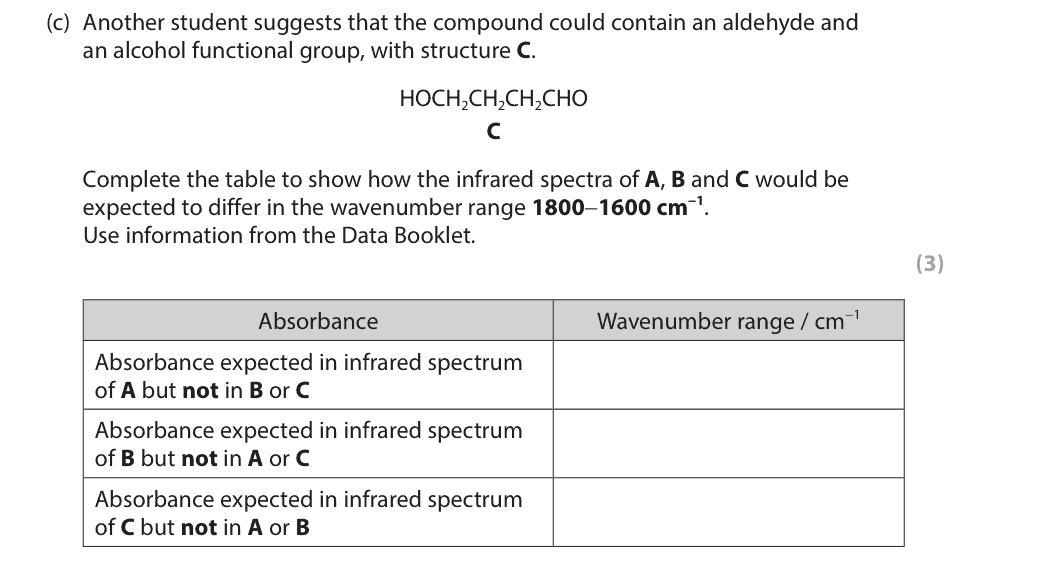
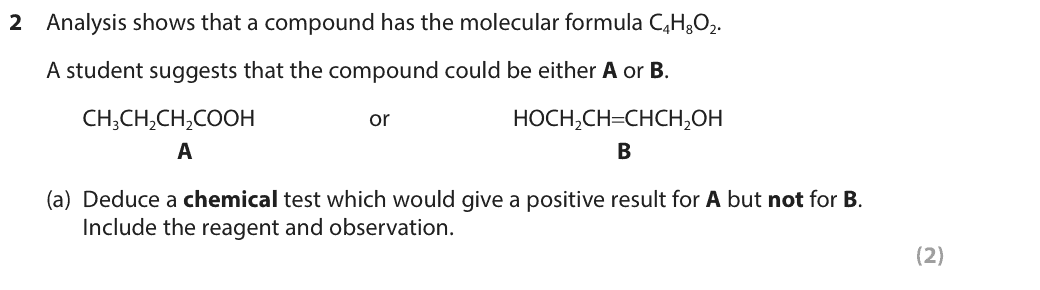
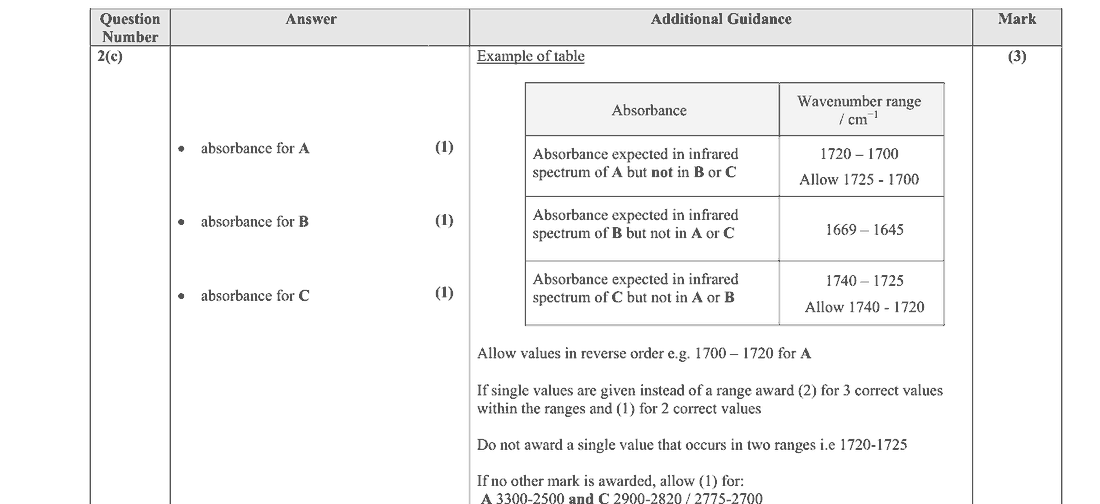
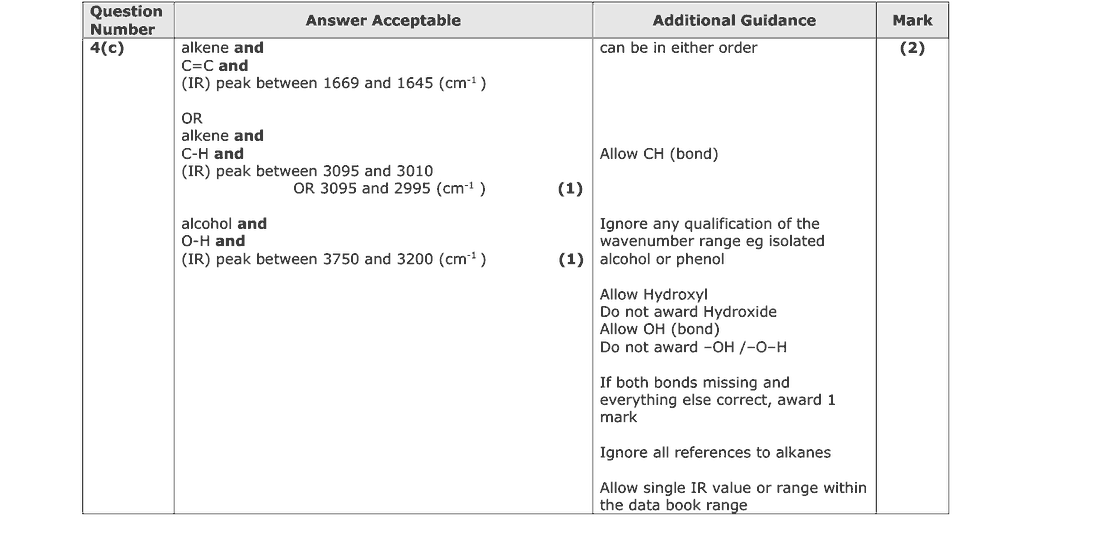
A low number of candidates knew a chemical test for a carboxylic acid. Some suggested the use of phosphorus(V) chloride but that would also give a positive result for the OH group in substance B. The use of an indicator is not classed as a chemical test so was not given full credit. A larger number of candidates knew how to test for an alkene using bromine water. The majority of candidates could select the correct wave number ranges from the Data Booklet for (c). However, some did not read the question carefully and wrote ranges outside of the 1800-1600 cm−1 range specified.
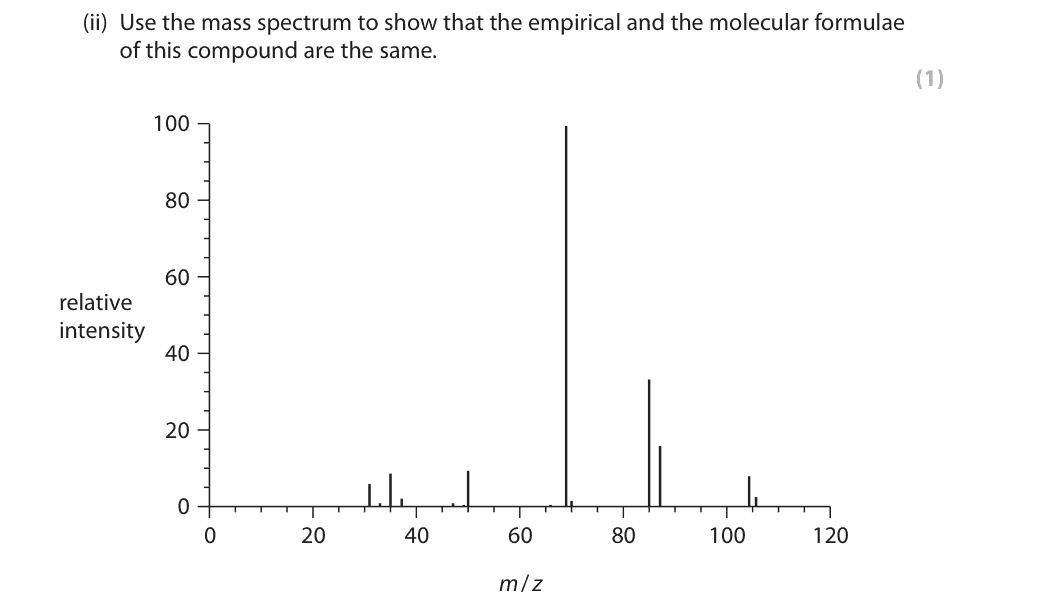
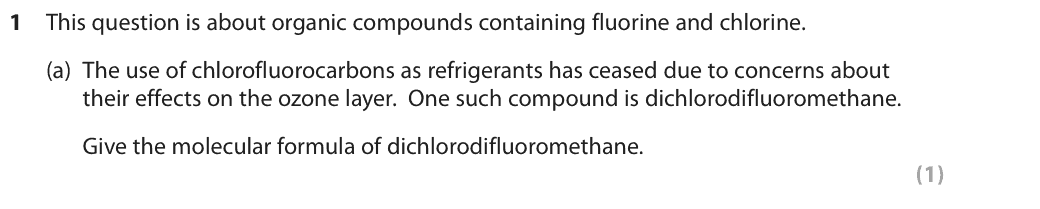
In this question the earlier, more familiar parts of the question were answered well with knowledge demonstrated of organic compounds containing chlorine and fluorine. High marks were particularly scored on the empirical formula calculation. As the question developed the more contextual idea of the reaction between fluorine and difluoromethane which required application of more familiar knowledge was less understood.
Skills: MS3.1 Translate information between graphical, numerical and algebraic forms

In this question the earlier, more familiar parts of the question were answered well with knowledge demonstrated of organic compounds containing chlorine and fluorine. High marks were particularly scored on the empirical formula calculation. As the question developed the more contextual idea of the reaction between fluorine and difluoromethane which required application of more familiar knowledge was less understood.

Many candidates identified the alkene and carboxylic acid functional groups in X but some just showed C=O and OH. The deduction of the skeletal formula of X was done well by many but some did not read the question and lost the mark by drawing a displayed formula. Some candidates ignored the information given about X and drew a branched chain or a compound that would exhibit geometrical isomerism. Some candidates have a clear understanding of 13C NMR and 1H NMR spectroscopy and constructed concise, logical, well-explained answers to the extended writing question in (b). There was a space before the writing lines and the most successful candidates used that to draw the displayed formulae of propan-1-ol and propan-2-ol and many of them annotated those formulae to help with their answers. There were many answers that jumped from one structure to another and one type of spectroscopy to the other without making it clear which was being discussed. This question asked candidates to compare the NMR spectra so they must include at least one similarity and one difference between them. Some candidates just wrote about the spectra and did not make the similarity of the OH proton clear. Some candidates seemed unsure what to do about the OH proton and either ignored it or did not realise that the 1H NMR spectrum would just have a singlet peak as it is not split and does not cause splitting. A few candidates included chemical shift values, even though they were told they were not needed and there was no credit for them. A few candidates were not clear on analytical techniques and wrote about mass spectrometry or infrared spectroscopy. The majority of candidates would benefit from more work on both types of NMR spectroscopy and more practise in answering ‘compare’ style extended writing questions.

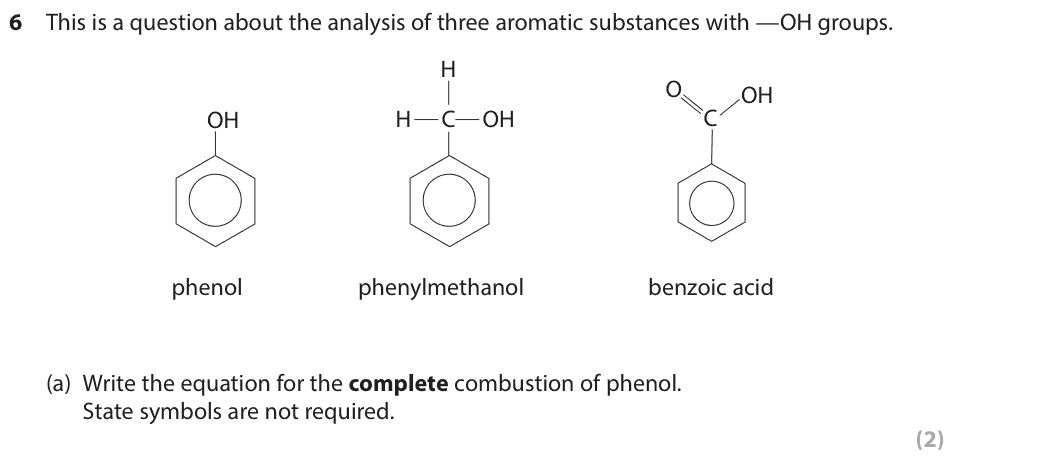
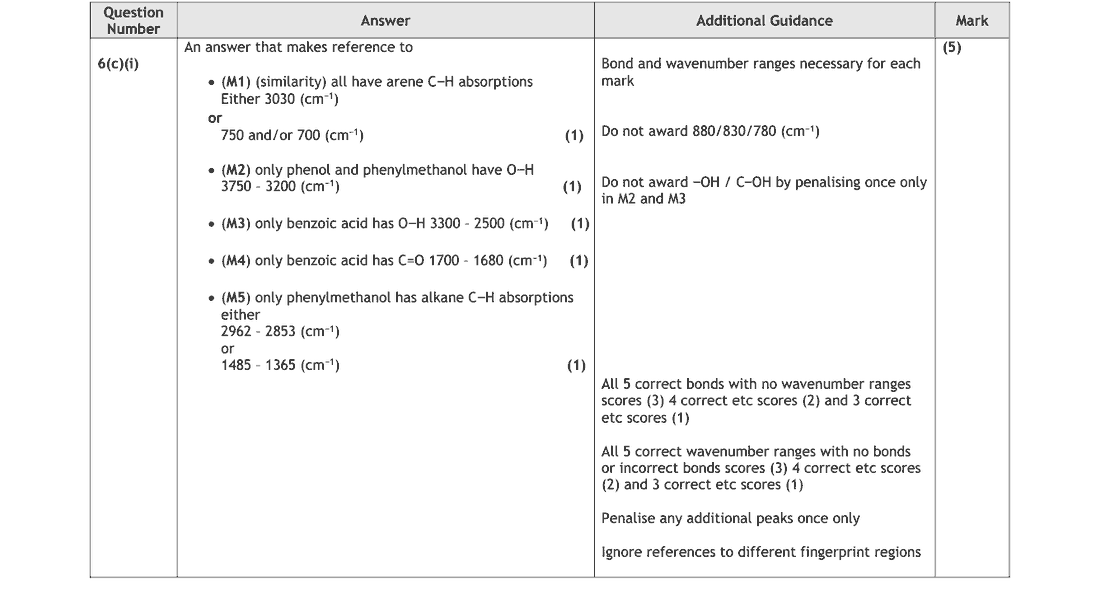
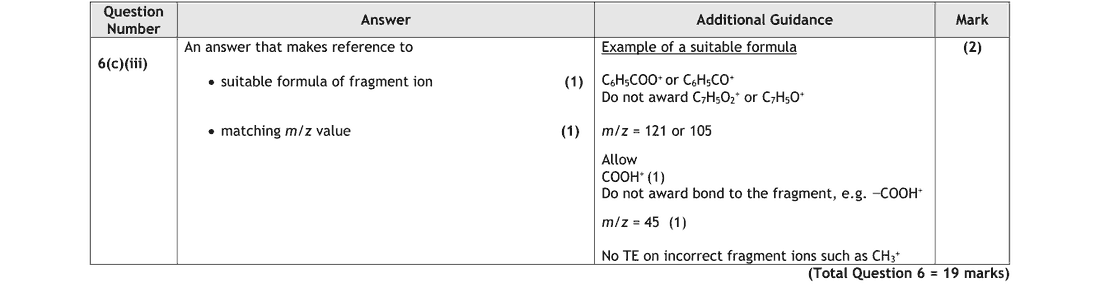
An appreciable number of candidates in (a) simply copied the skeletal formula of phenol from the question above but this did not help with the balancing of the combustion equation; nor of the calculation to follow. Nevertheless the majority were able to score at least one mark for the correct species in the equation. Candidates who find skeletal formulae challenging are advised to write out the formula in displayed form which was relatively easy in to with the formulae given at the top of the paper. It was evident in (b)(i) from the incorrect molar masses quoted that this would have helped a considerable number of candidates to avoid mistakes. Parts (b)(ii) and (iii) were often answered correctly but some candidates did not read the question in (iii) properly and suggested either specific molecules rather than ‘types’. Part (b)(iv) was a novel question and aimed to differentiate the very best candidates which it was successful at. Part (c)(i) was also an effective discriminator. Despite clear instructions in the question to include reference to ‘bonds’ and ‘wavenumber ranges’ there were still responses which did not refer to bonds or quoted single wavenumber values. It was surprising that the answers on the C-13 NMR spectrum in (c)(ii) were rather poor. Candidates often quoted more wavenumber ranges than were correct and so these negated correct answers. It was also evident that a significant number of candidates are misreading the Data Booklet. For example it was not uncommon for the C-OH peak wavenumber range to go to 80 ppm but the ‘lozenge’ in the Data Booklet does not go anywhere near the 80 ppm mark. The most common mass spectrum fragment ion seen in (c)(iii) was COOH+ which was awarded the mark. Common errors included adding a bond before the fragment ion or either omitting the charge or even adding a negative charge. The question also asked for the m/z value which some of the lower ability candidates missed.

An appreciable number of candidates in (a) simply copied the skeletal formula of phenol from the question above but this did not help with the balancing of the combustion equation; nor of the calculation to follow. Nevertheless the majority were able to score at least one mark for the correct species in the equation. Candidates who find skeletal formulae challenging are advised to write out the formula in displayed form which was relatively easy in to with the formulae given at the top of the paper. It was evident in (b)(i) from the incorrect molar masses quoted that this would have helped a considerable number of candidates to avoid mistakes. Parts (b)(ii) and (iii) were often answered correctly but some candidates did not read the question in (iii) properly and suggested either specific molecules rather than ‘types’. Part (b)(iv) was a novel question and aimed to differentiate the very best candidates which it was successful at. Part (c)(i) was also an effective discriminator. Despite clear instructions in the question to include reference to ‘bonds’ and ‘wavenumber ranges’ there were still responses which did not refer to bonds or quoted single wavenumber values. It was surprising that the answers on the C-13 NMR spectrum in (c)(ii) were rather poor. Candidates often quoted more wavenumber ranges than were correct and so these negated correct answers. It was also evident that a significant number of candidates are misreading the Data Booklet. For example it was not uncommon for the C-OH peak wavenumber range to go to 80 ppm but the ‘lozenge’ in the Data Booklet does not go anywhere near the 80 ppm mark. The most common mass spectrum fragment ion seen in (c)(iii) was COOH+ which was awarded the mark. Common errors included adding a bond before the fragment ion or either omitting the charge or even adding a negative charge. The question also asked for the m/z value which some of the lower ability candidates missed.
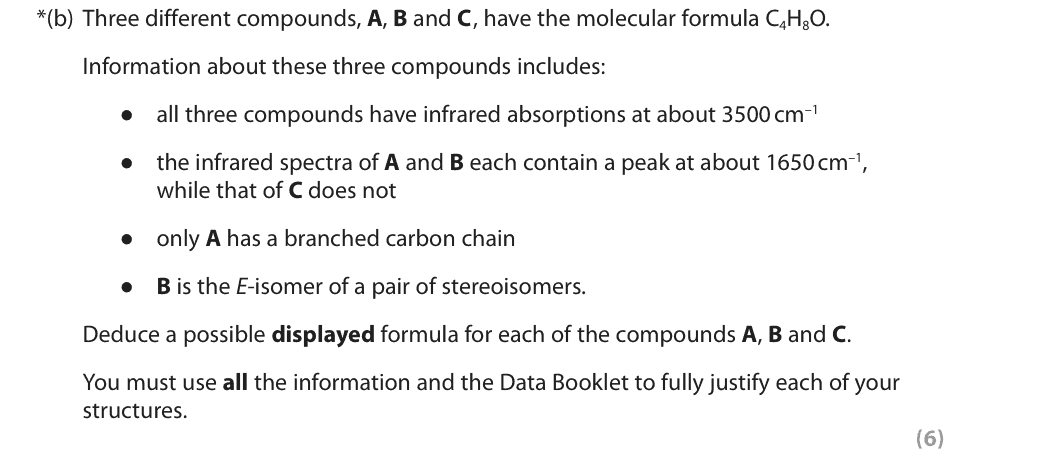
The first part of Q7 was relatively straightforward and most candidates got this mark. The 6 mark question involved logical deduction of three compounds. With questions like this it is important to demonstrate how you have identified the three structures, with some candidates just drawing the three. This will give a maximum of 3 marks. The most commonly missed IPs were the structure of C and some demonstration of an understanding that B must have one of the correct structures because it was an E- isomer and must have the higher priority groups above and below the double bond.
Skills: MS4.2 Visualise and represent 2D and 3D forms including two- dimensional representations of 3D objects
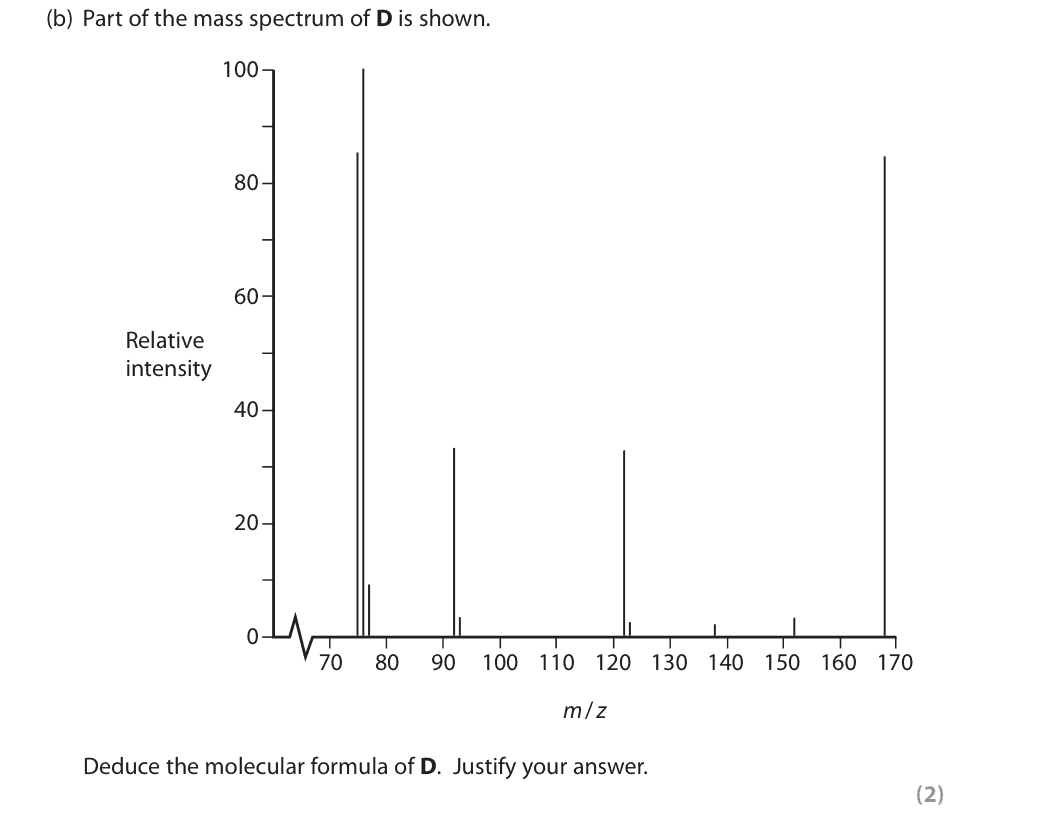
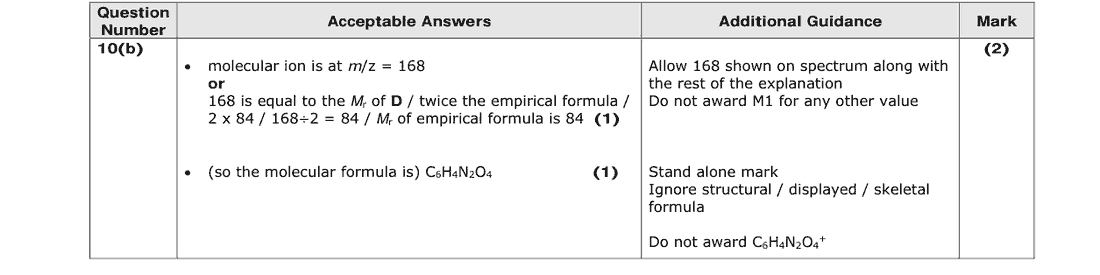
Candidates who looked carefully at the scale on the y axis could work out that the Mr of D is 168 and then deduce the molecular formula. Some candidates thought that 168 was the molecular formula.
Skills: MS3.1 Translate information between graphical, numerical and algebraic forms

It was surprising that many candidates could not work out that the Mr of benzene = (6 x 12) +(6 x 1) = 78 so a peak at 76 would be caused by C6H4 +. Some candidates omitted the positive charge on the ion and a few gave a 2+ charge.
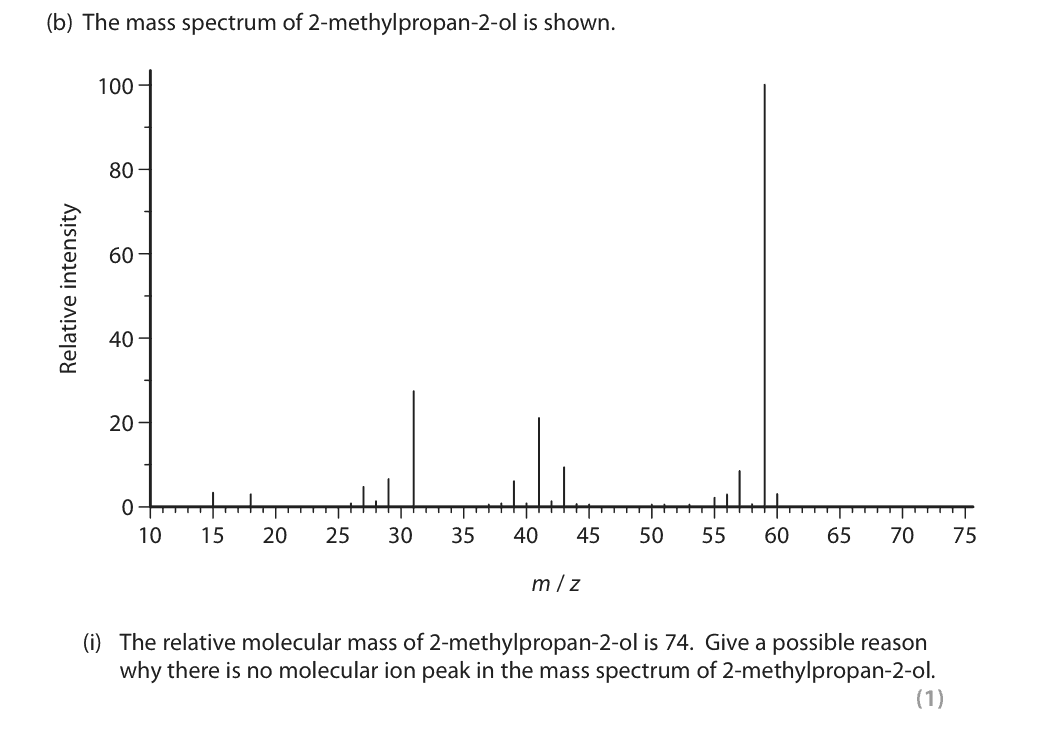
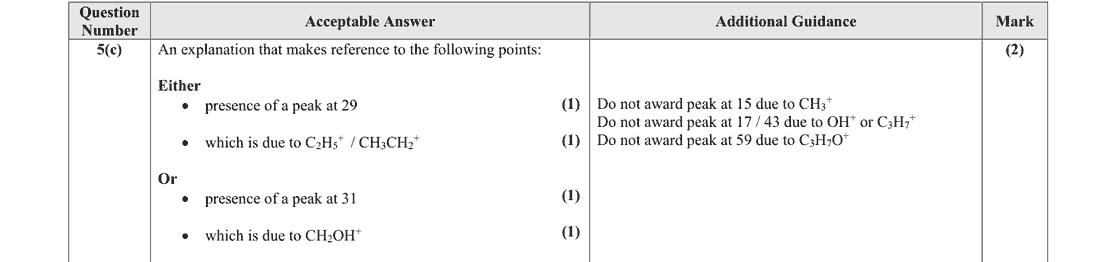
This question required application of the basic principles of fragmentation in a mass spectrometer, in an unfamiliar situation. Fragmentation of either the molecule or the molecular ion were acceptable answers.

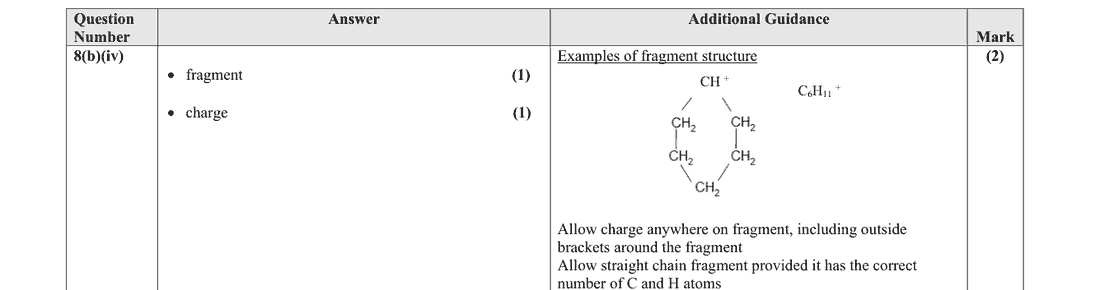
The question did not specify which particular type of formula was required so any type was acceptable. The positive charge on the ion was an essential requirement. The majority of students presented their answers in a structural format, indicating that the correct answer had been deduced from fragmentation of the original molecule/ion.
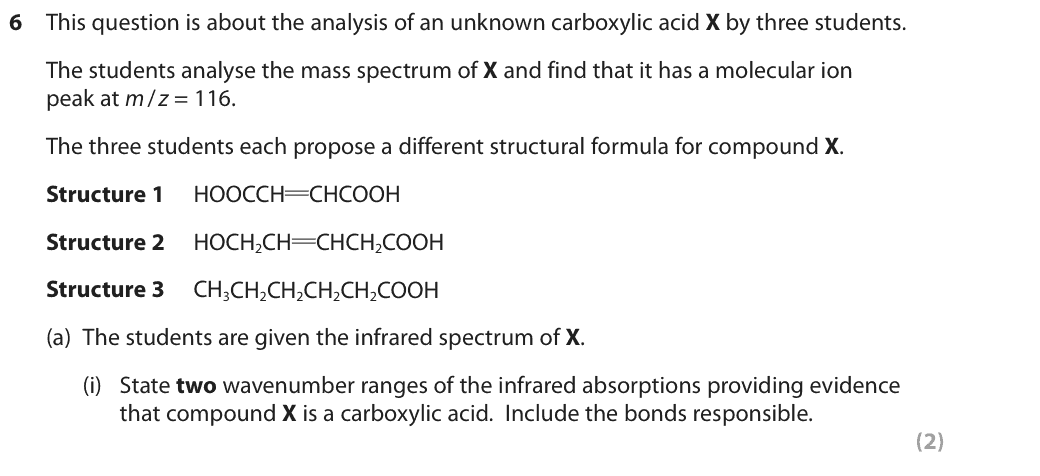
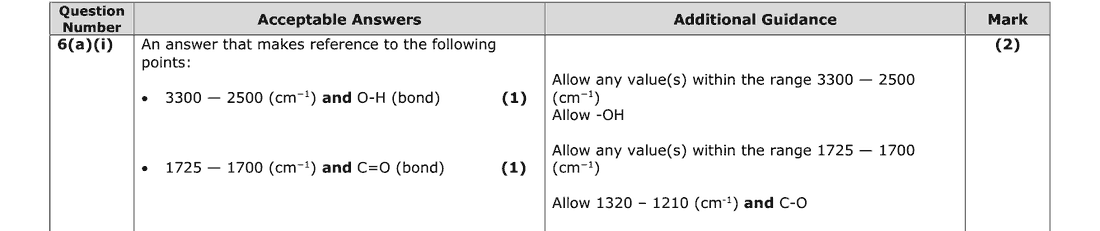
This question proved to be straightforward for most, with over 80% scoring both marks. Incorrect answers tended to name functional groups involved rather than show the bonds or quote an incorrect range.
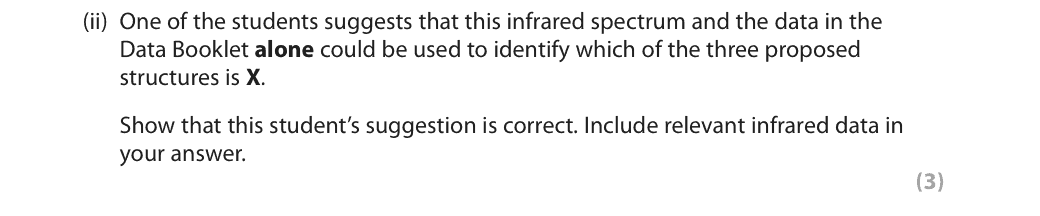
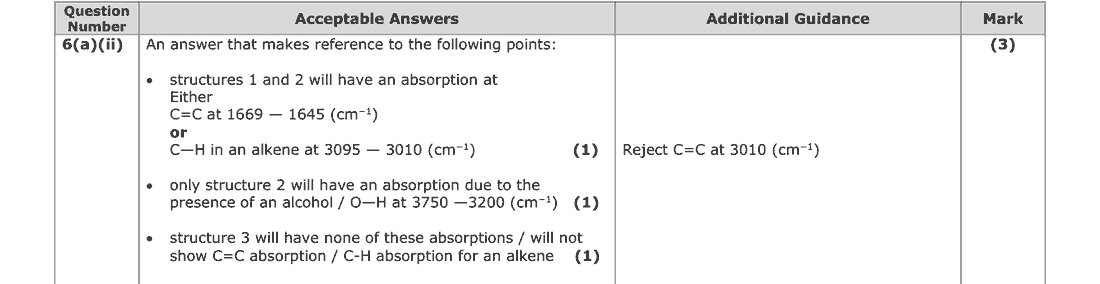
In this question many candidates struggled with the subtlety of the problem and thought they should mention every bond and corresponding IR absorptions for each structure. Many achieved two marks regardless but then found it difficult to make it clear how the differences in the absorptions could be used to categorically distinguish between each structure. A common mistake was to assume the absorption at around 3010 cm-1 was due to a C=C bond. However nearly 30% of candidates scored all three marks with succinct responses that discussed the differences in bonds and consequently absorptions meaning not every bond is present in each structure. A small number confused Ir with mass spectrometry, discussing the molar mass of the structures.
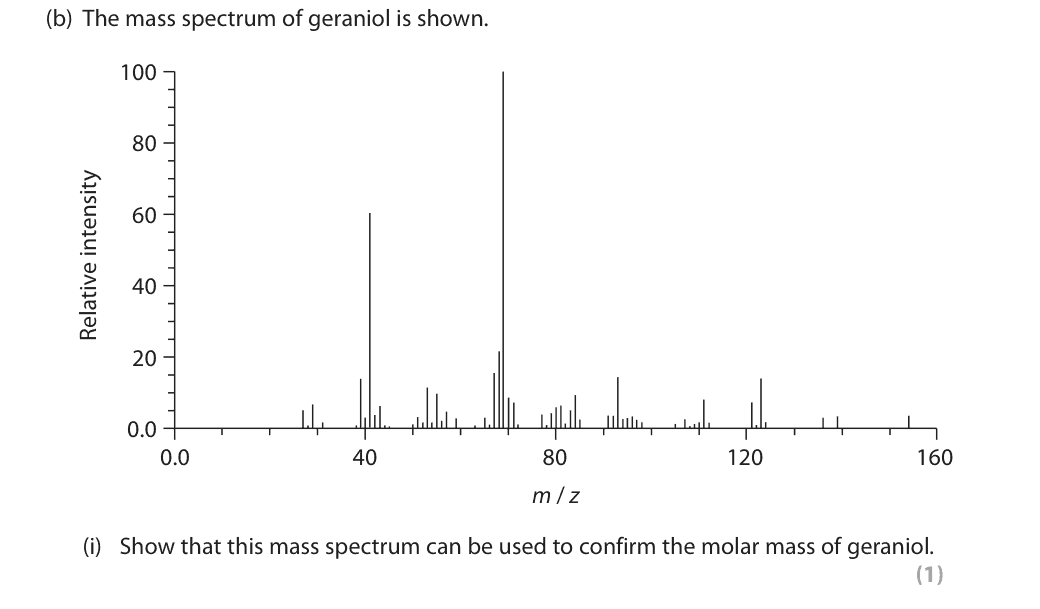
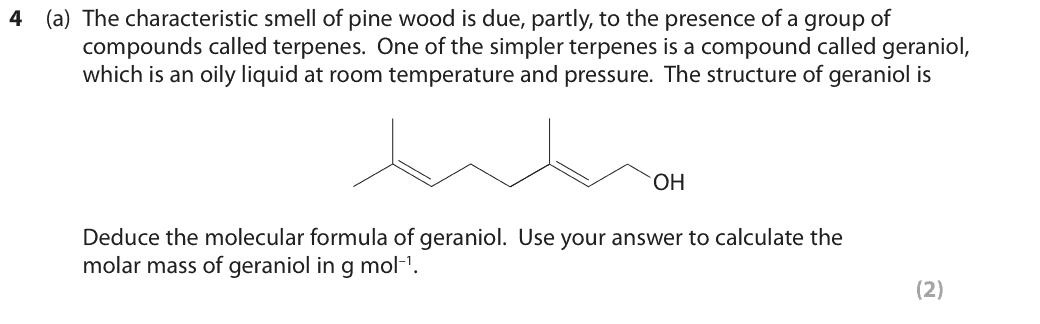
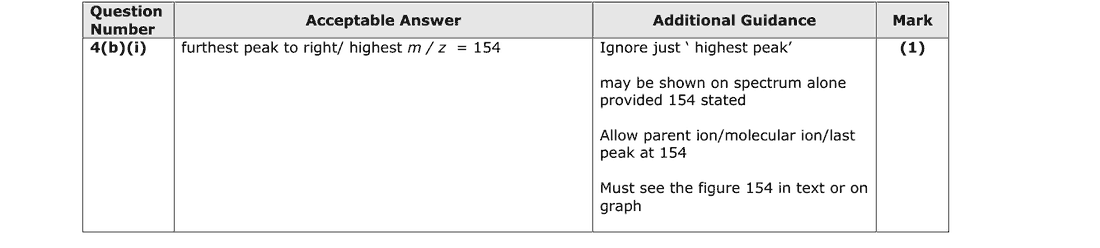
This question tested the ability to recognise that the highest m/z peak, also called the parent ion peak/molecule ion peak, is likely to be the molecule (with one electron removed). This should then be related to the molar mass of geraniol. Although the scale is small, inspection of the peak places it slightly below halfway between 150 and 160, i.e. at 154. Those candidates who thought the peak was at 155 or higher should have checked this against their answer to Question 4(a) and recognised the error.
Skills: MS3.1 Translate information between graphical, numerical and algebraic forms

This question required the candidate to consider the skeletal formula presented in Question 4(a) and then decide how the molecule could have been broken up to produce a fragment with m/z = 69. The correct charge on the fragment was also required.
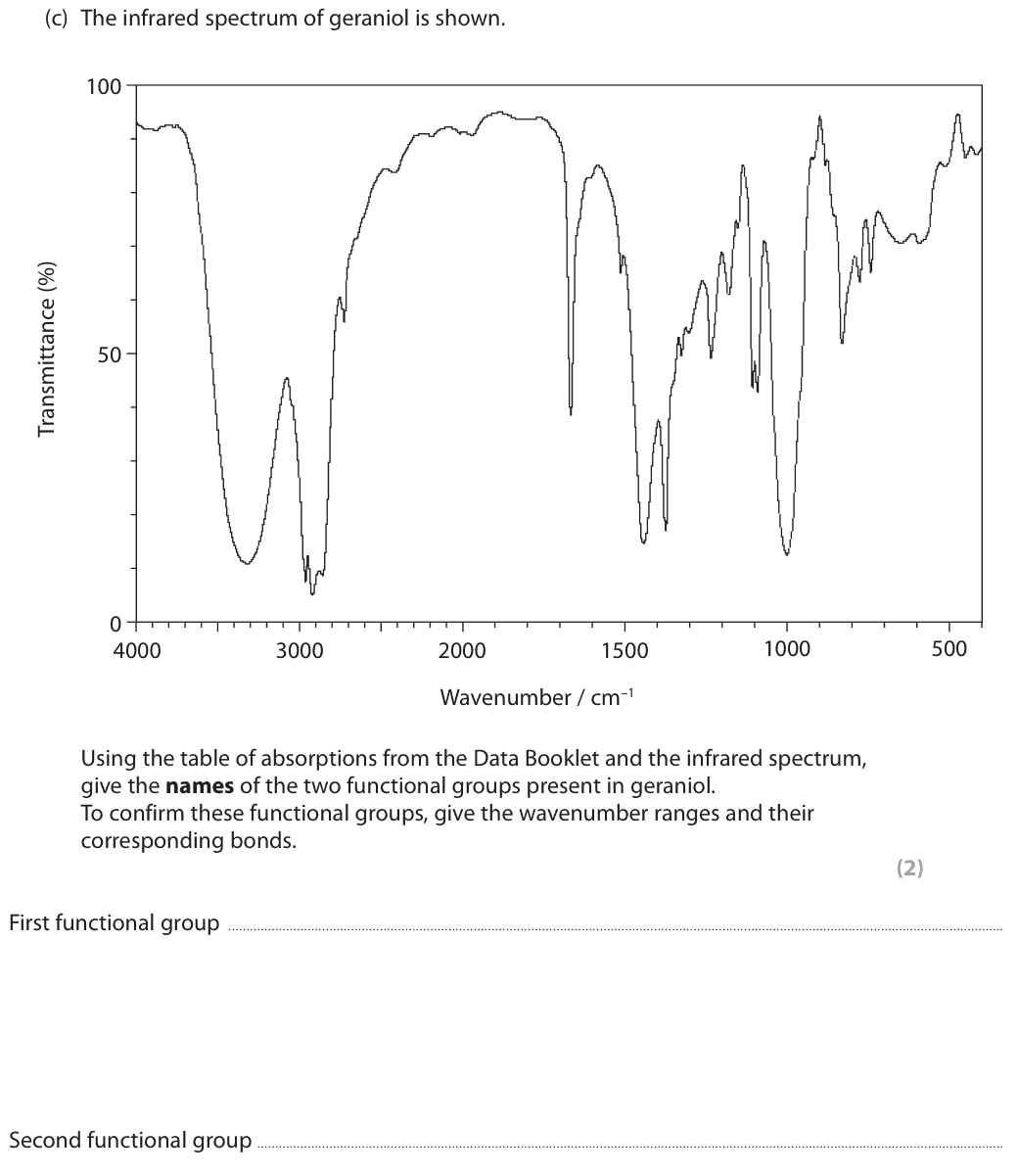
This question required the interpretation of infrared spectra to identify the two functional groups in geraniol. The functional groups were easily identified from the skeletal formula given in Question 4(a) and candidates could look for absorptions that corresponded to these functional groups. The question required the name of each functional group, plus the wavenumber range and the bond responsible in each case. Common errors included functional groups that were not present in the geraniol, e.g. aldehyde, carboxylic acid and amine. Alkane was also occasionally seen as a functional group. Other errors included the omission of the bond responsible (1 rescue mark was available if this was omitted from both functional groups). The name of the functional group was also occasionally missing, even though this requirement was bold on the question paper. Candidates were sometimes a little vague about the bond responsible for the absorption, for example, – O-H could mean the O-H bond or it might mean the C-O bond.
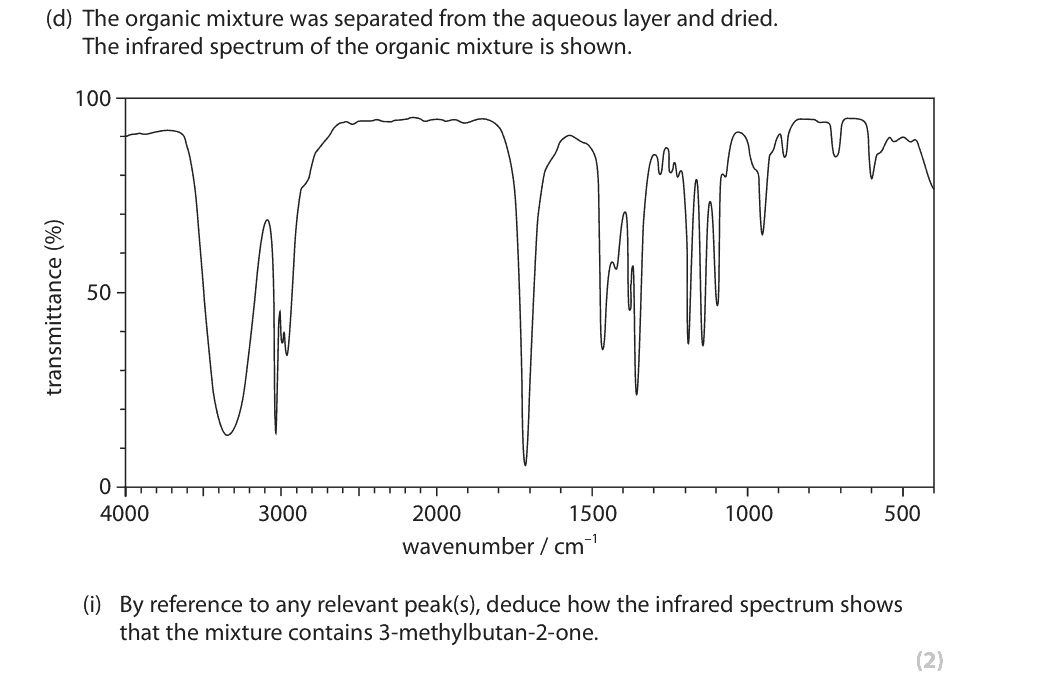
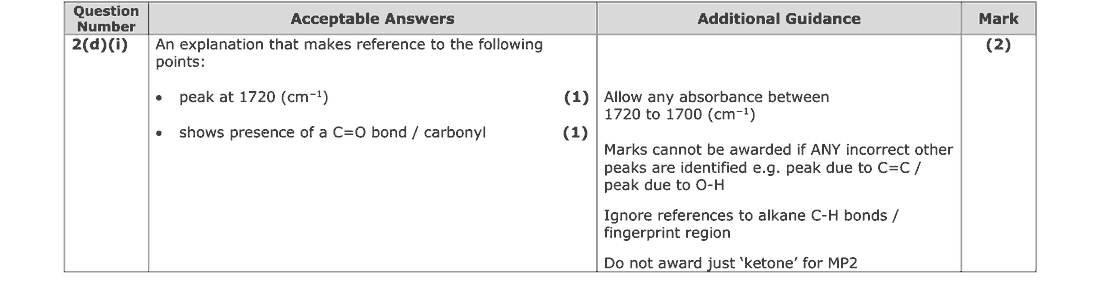
Candidates almost all appreciated the need to comment on the peak at 1720 cm-1, but fewer made the link between the peak and the carbonyl bond in the ketone. Some candidates simply tried to match peaks from the Data Booklet regardless of the structure of the ketone. Hence some answers claimed that peaks were due to alkene or alkyne groups.
Skills: MS3.1 Translate information between graphical, numerical and algebraic forms; CP5 Core practical 5: The oxidation of ethanol
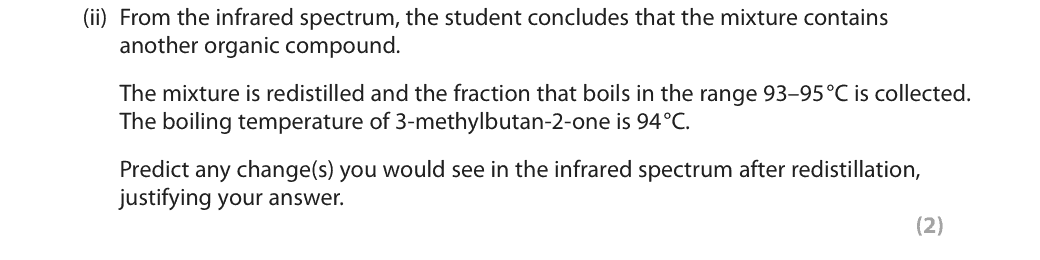
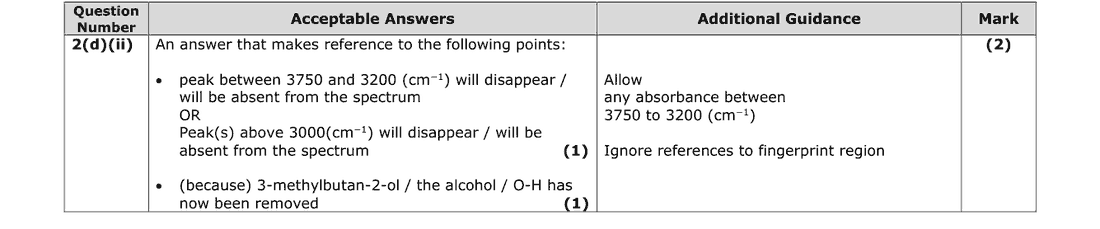
Most candidates recognised that the broad peak at around 3400 cm-1 would disappear. However, although many realised this peak was due to the alcohol, only in the better responses could they justify their answer by referring to the removal of the alcohol in the distillation. Others misunderstood the separation role of the second distillation and thought that this was done to ensure any remaining alcohol was completely oxidised.
Skills: MS3.1 Translate information between graphical, numerical and algebraic forms; CP5 Core practical 5: The oxidation of ethanol
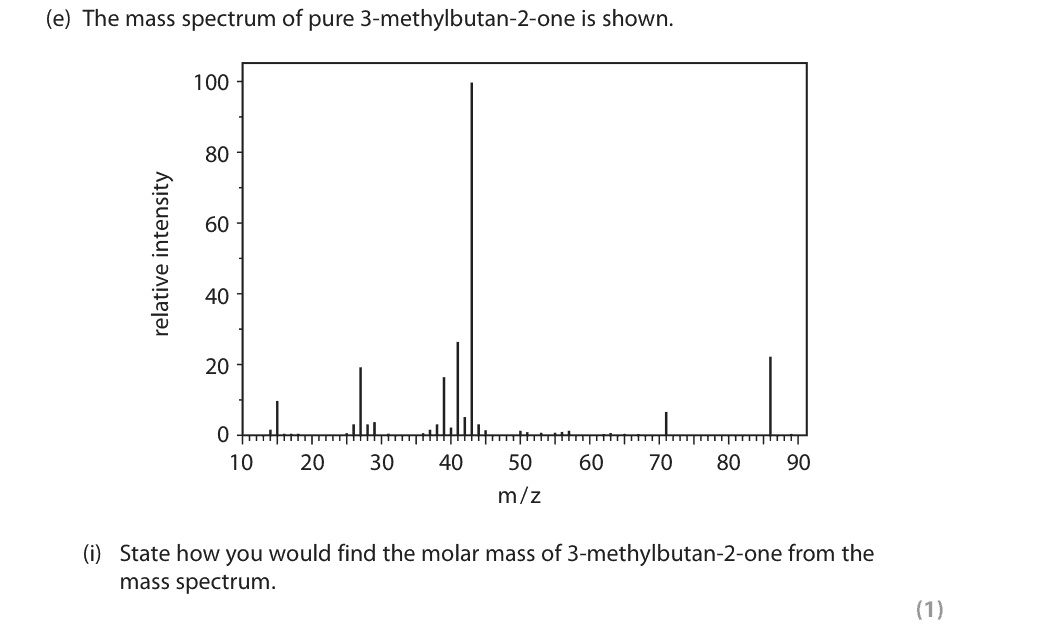
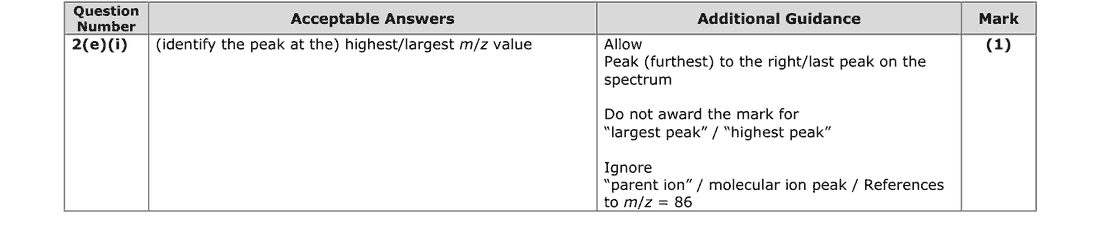
This was well answered in the main. Those who failed to score seemed to have misinterpreted the question or ignored the ‘how you would find’ ‘wording. Such candidates simply gave the value of 86 and did not score unless they included further clarification
Skills: MS3.1 Translate information between graphical, numerical and algebraic forms

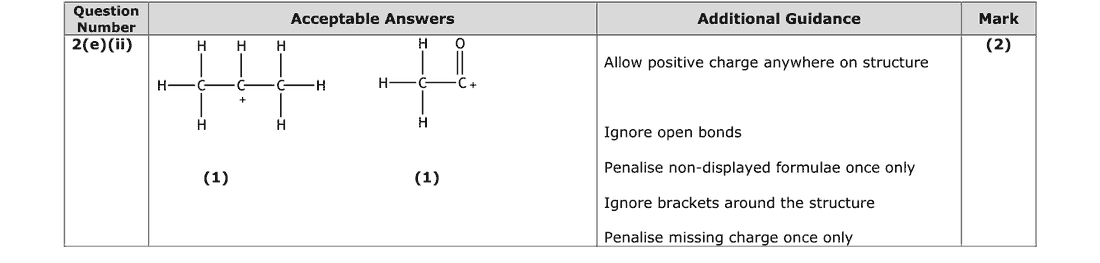
Most candidates ensured their fragments were positively charged, so many scored both marks. However, some did carry out rearrangements to the ions or ignored the instruction in bold to use displayed formulae, so lost some credit.
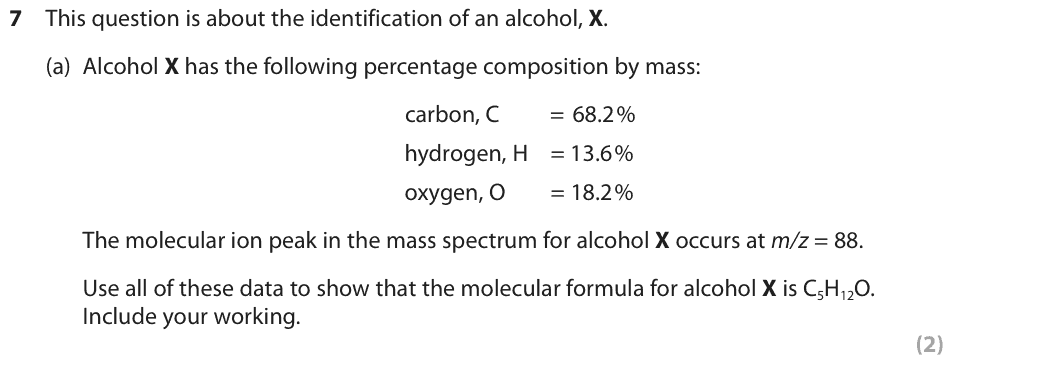
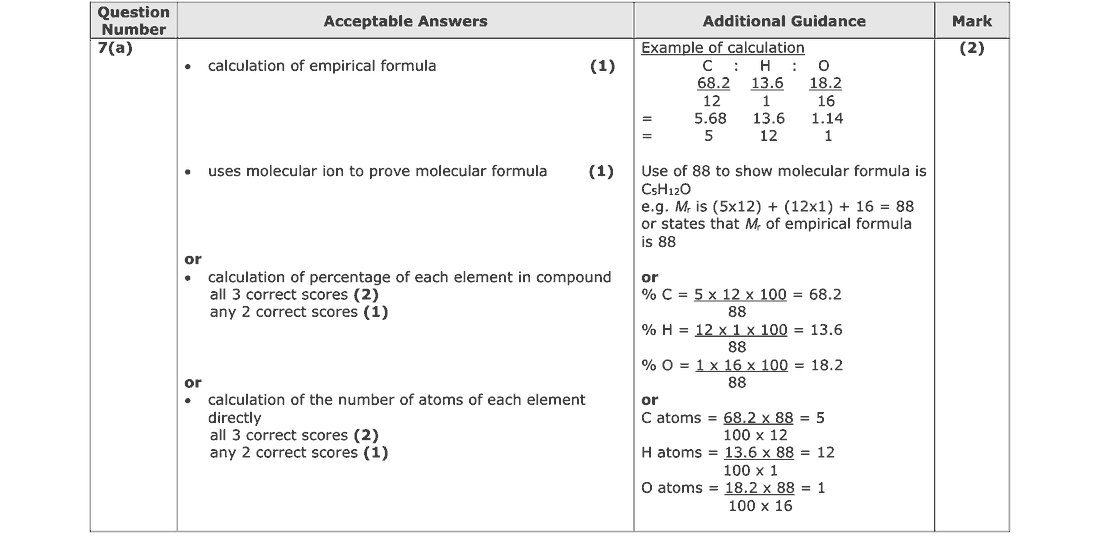
Most candidates are familiar with one of the methods of calculating a formula so the majority scored the first mark. Some candidates who calculated the empirical formula did not mention the molecular ion peak at 88 gives the relative formula mass so shows that the molecular formula is the same as the empirical formula so they lost the second mark.
Skills: MS0.2 Use ratios, fractions and percentages

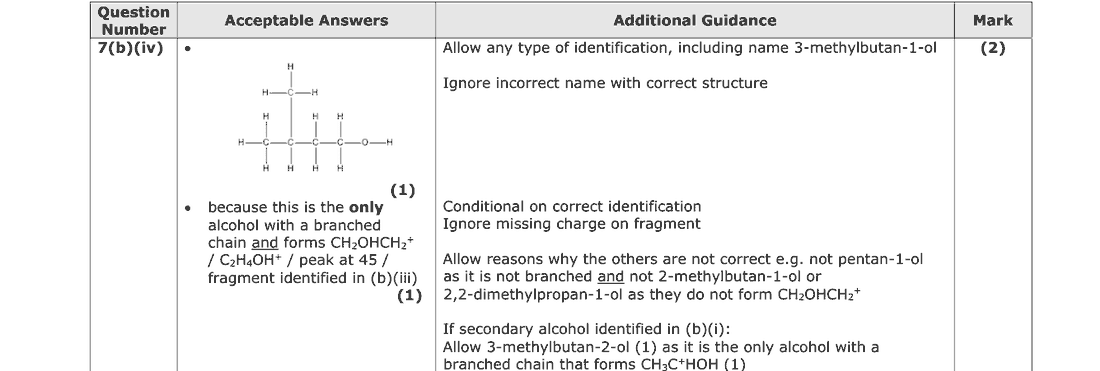
Candidates had to use different pieces of information to identify an alcohol. Many rose to the challenge and worked out that alcohol X was 3-methylbutan-1-ol and explained how they deduced this. Other candidates found this more challenging and floundered before they reached the end. It was surprising that some candidates did not know that primary alcohols are oxidised to carboxylic acids. A few candidates even thought that alcohol X was an aldehyde. Candidates who did state that X was a secondary or even tertiary alcohol could receive consequential marks for the rest of the question but they rarely got much further. Some candidates struggled to draw the displayed formulae of four different primary alcohols and they sometimes drew two that were the same or included a secondary or even a tertiary alcohol. Candidates should take more care when drawing the displayed formulae of alcohols as some showing the H of the OH bond joined to a carbon atom instead of joining through the O and they lost a mark. A significant number of candidates omitted the positive charge from the species giving the peak in the mass spectrum. Quite a few candidates who did deduce the correct structure of the alcohol gave an incorrect name, although they were not penalised on this occasion. Some did not give a full explanation for their choice of alcohol and just stated that it is branched.

Candidates had to use different pieces of information to identify an alcohol. Many rose to the challenge and worked out that alcohol X was 3-methylbutan-1-ol and explained how they deduced this. Other candidates found this more challenging and floundered before they reached the end. It was surprising that some candidates did not know that primary alcohols are oxidised to carboxylic acids. A few candidates even thought that alcohol X was an aldehyde. Candidates who did state that X was a secondary or even tertiary alcohol could receive consequential marks for the rest of the question but they rarely got much further. Some candidates struggled to draw the displayed formulae of four different primary alcohols and they sometimes drew two that were the same or included a secondary or even a tertiary alcohol. Candidates should take more care when drawing the displayed formulae of alcohols as some showing the H of the OH bond joined to a carbon atom instead of joining through the O and they lost a mark. A significant number of candidates omitted the positive charge from the species giving the peak in the mass spectrum. Quite a few candidates who did deduce the correct structure of the alcohol gave an incorrect name, although they were not penalised on this occasion. Some did not give a full explanation for their choice of alcohol and just stated that it is branched.
Dropping marks on calculations, mechanisms or the core practicals? Book a trial session with an A-level chemistry tutor.