1.1 know the structure of an atom in terms of electrons, protons and neutrons
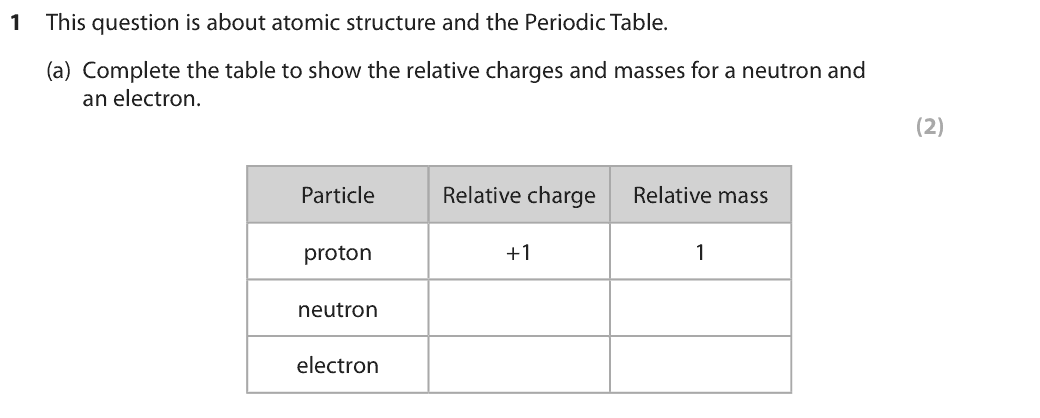
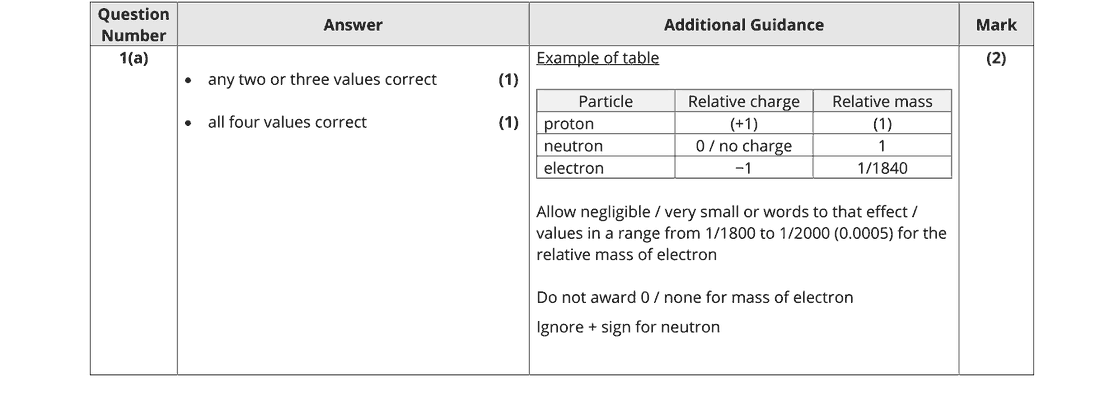
1.2 know the relative mass and relative charge of protons, neutrons and electrons
1.3 know what is meant by the terms ‘atomic (proton) number’ and ‘mass number’
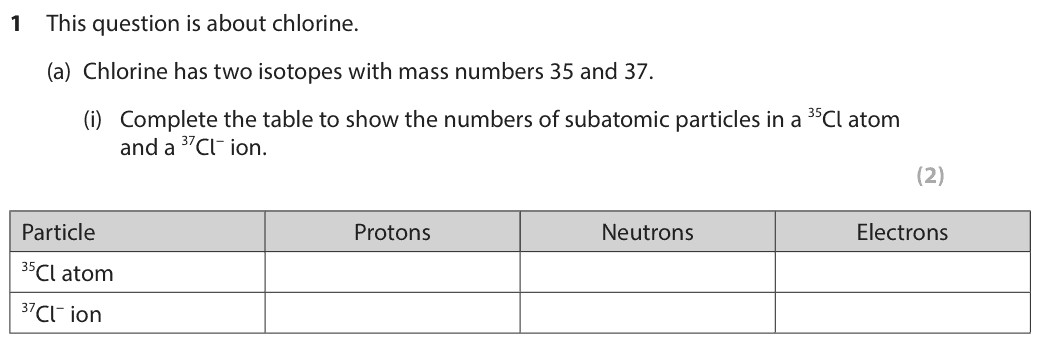
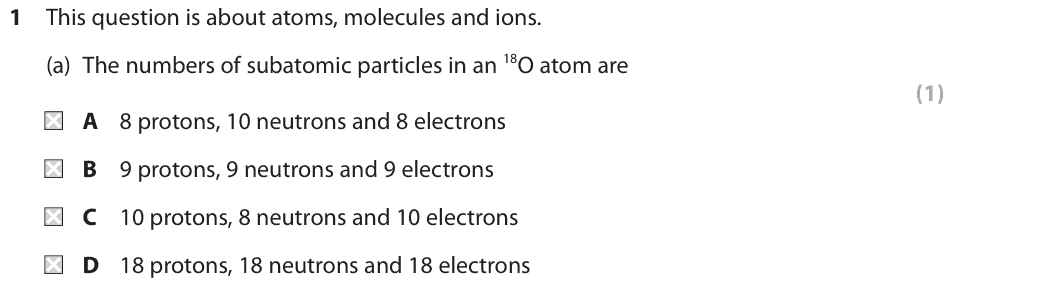
1.4 be able to determine the number of each type of sub-atomic particle in an atom, molecule or ion from the atomic (proton) number and mass number
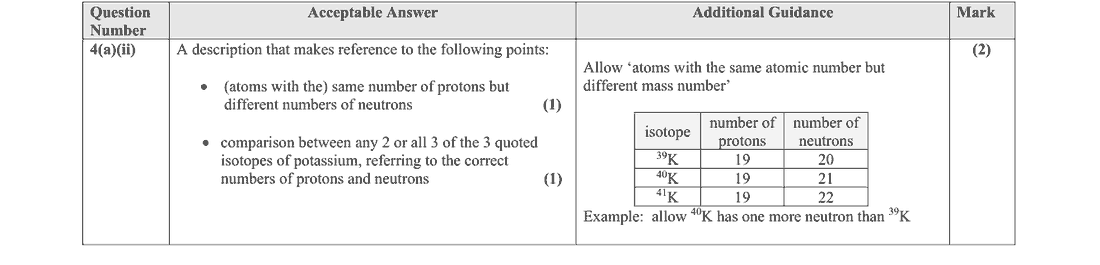
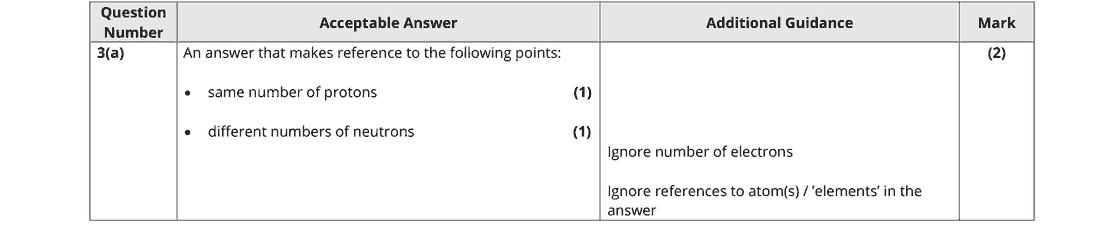
1.5 understand the term ‘isotopes’
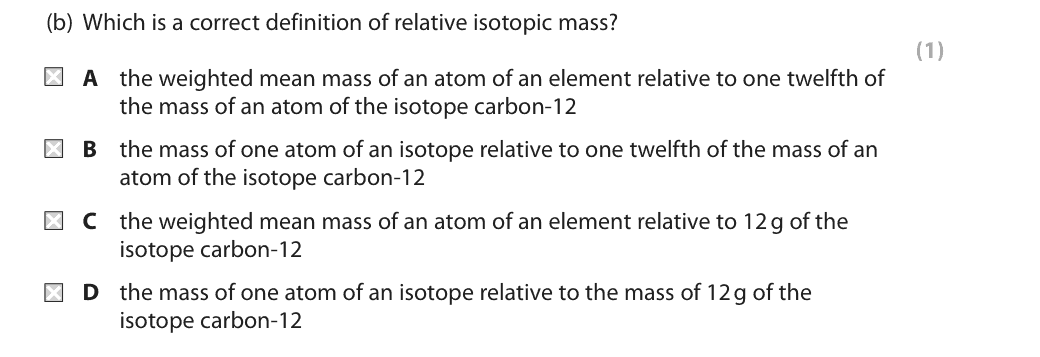
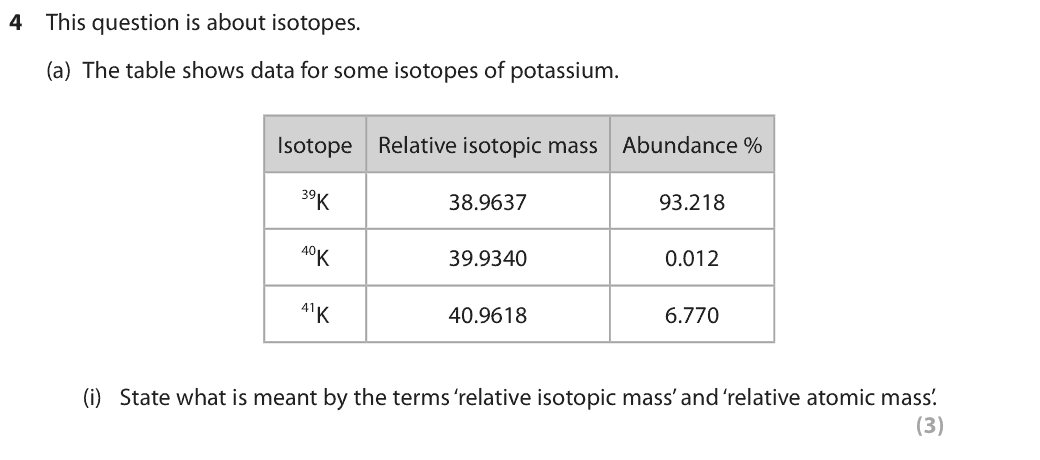
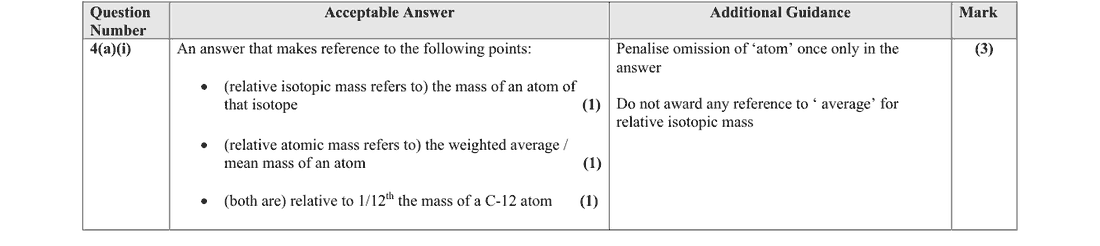
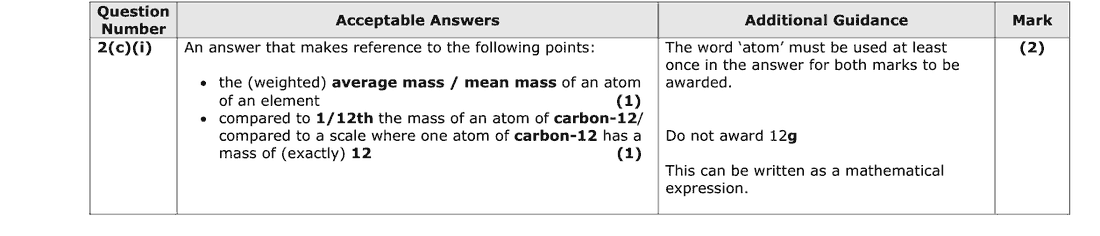
1.6 be able to define the terms ‘relative isotopic mass’ and ‘relative atomic mass’, based on the ^12C scale
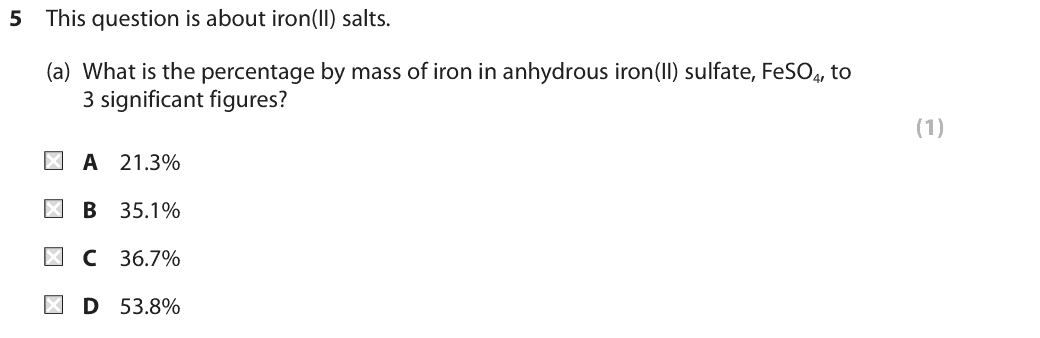
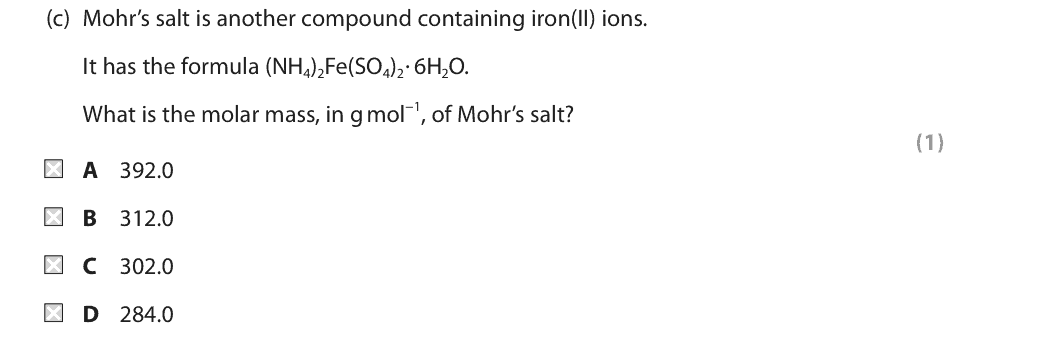
1.7 understand the terms ‘relative molecular mass’ and ‘relative formula mass’, including calculating these values from relative atomic masses [Definitions of these terms will not be expected. The term ‘relative formula mass’ should be used for compounds with giant structures.]
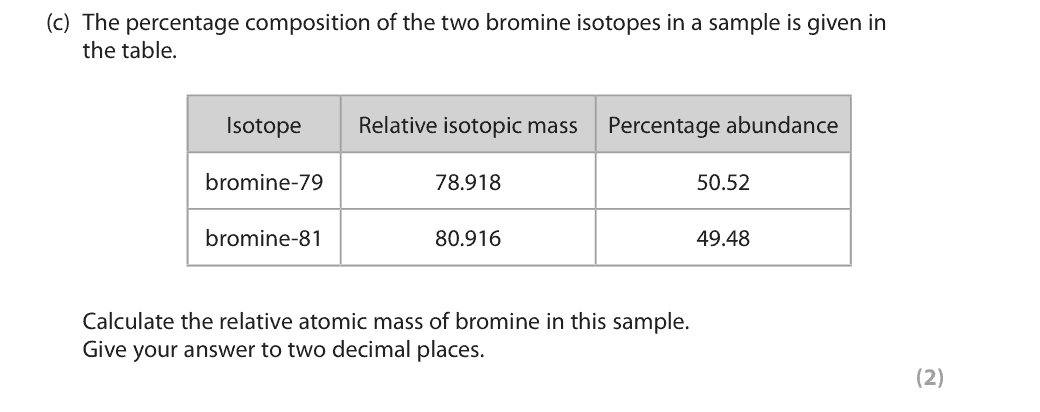
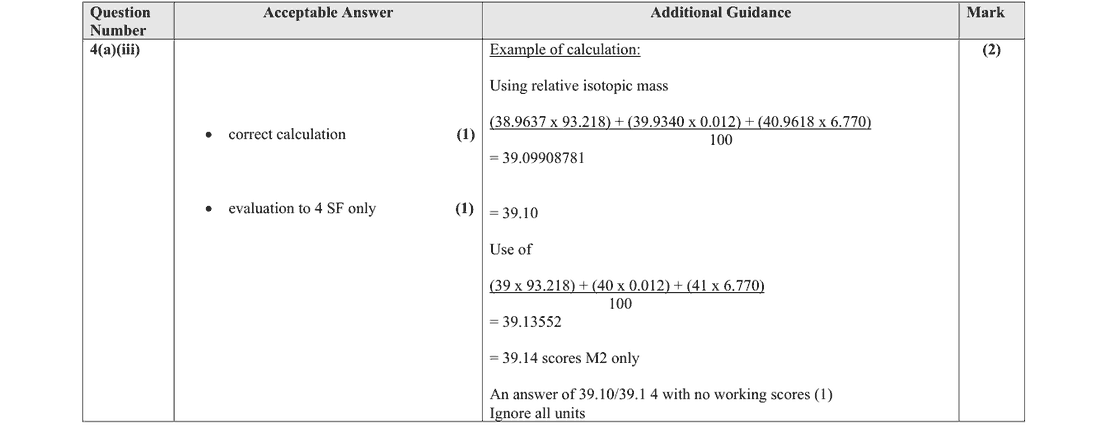
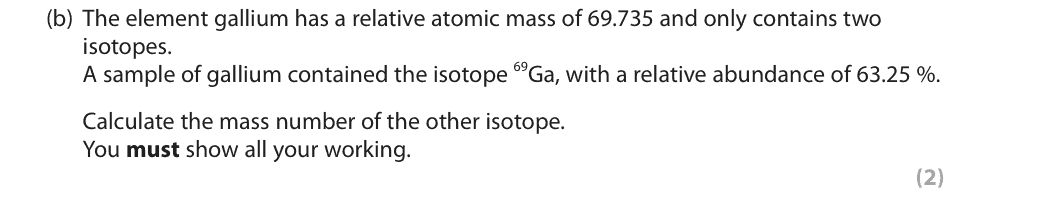
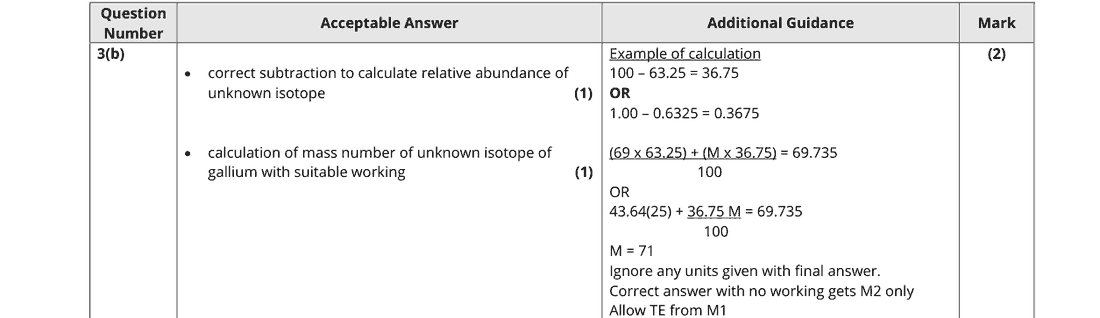
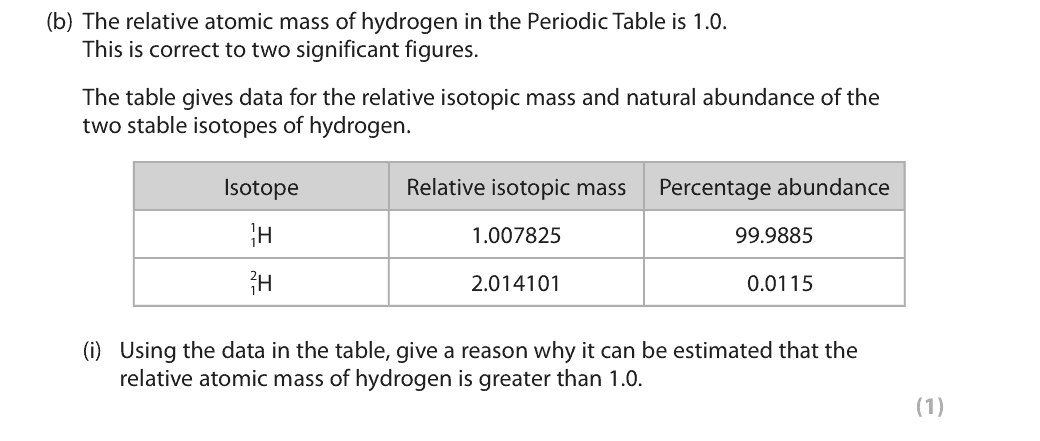
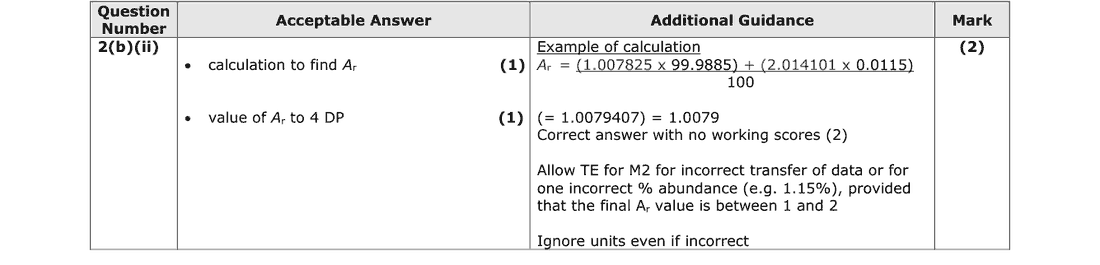
1.8 be able to analyse and interpret data from mass spectrometry to calculate relative atomic mass from relative abundance of isotopes and vice versa
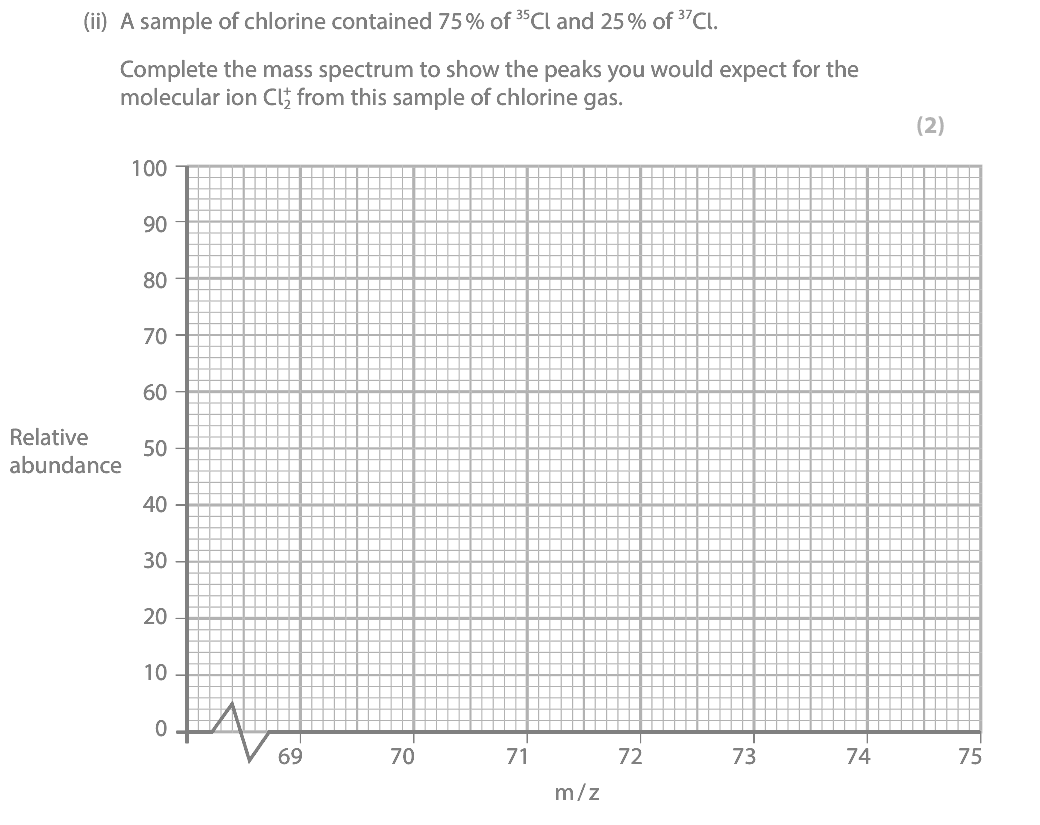
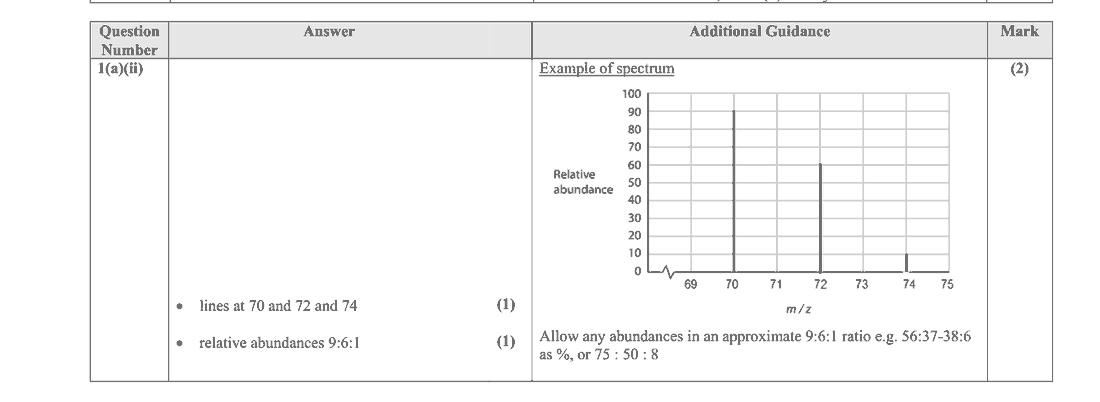
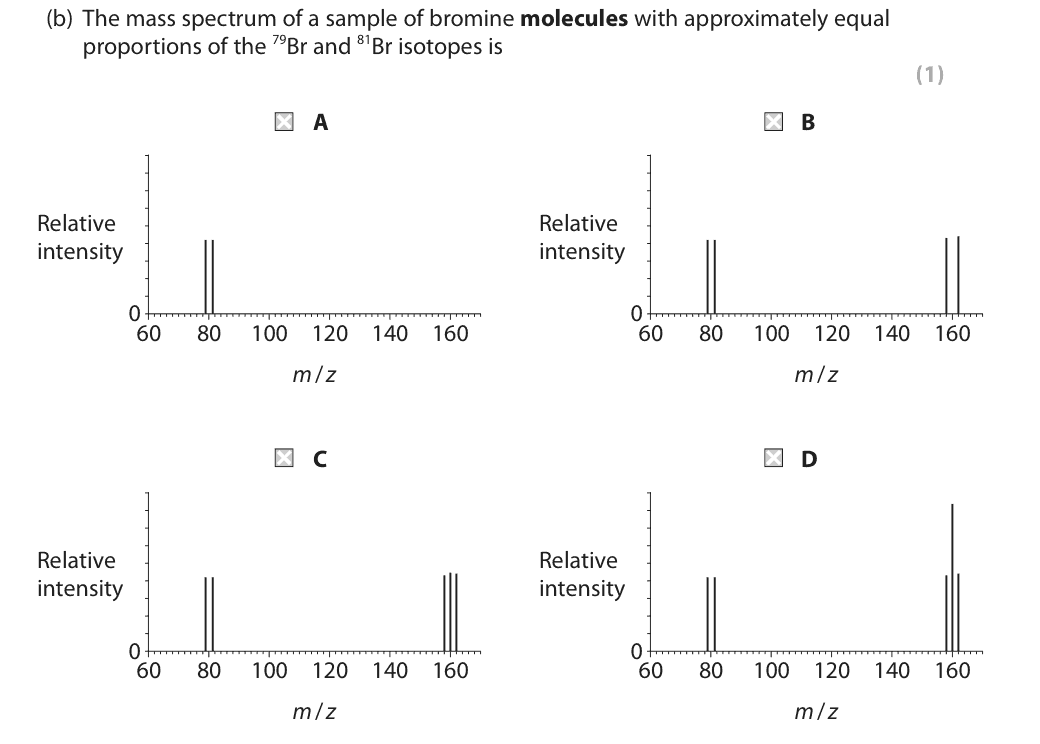
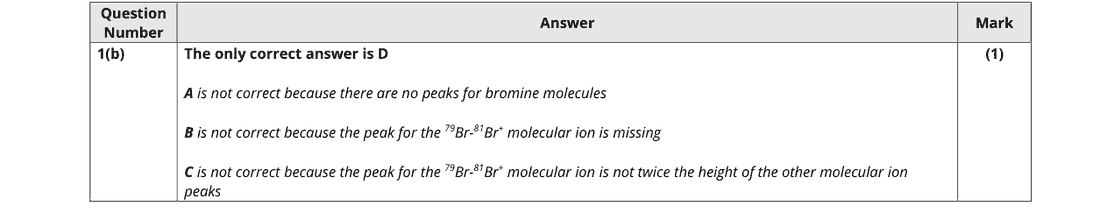
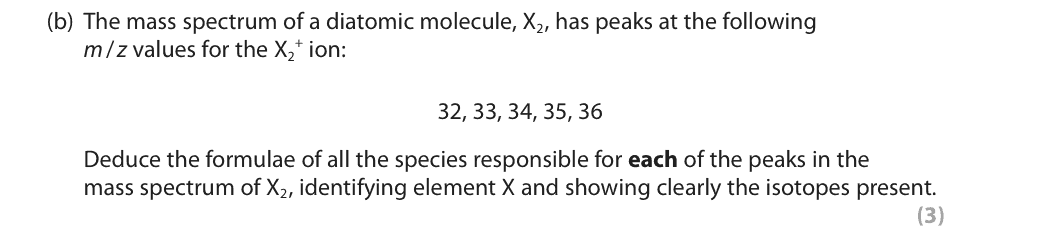
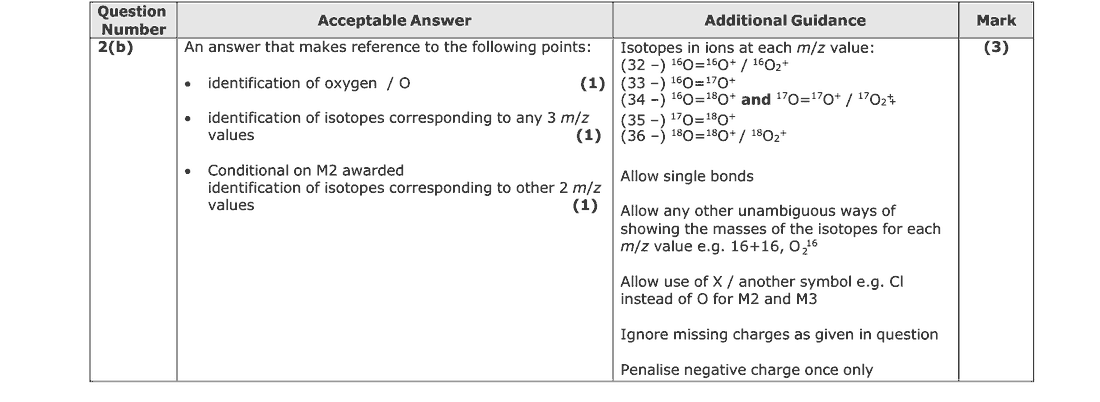
1.9 be able to predict the mass spectra, including relative peak heights, for diatomic molecules, including chlorine
1.10 understand how mass spectrometry can be used to determine the relative molecular mass of a molecule [Limited to the m/z value for the molecular ion, M^+, giving the relative molecular mass of the molecule.]
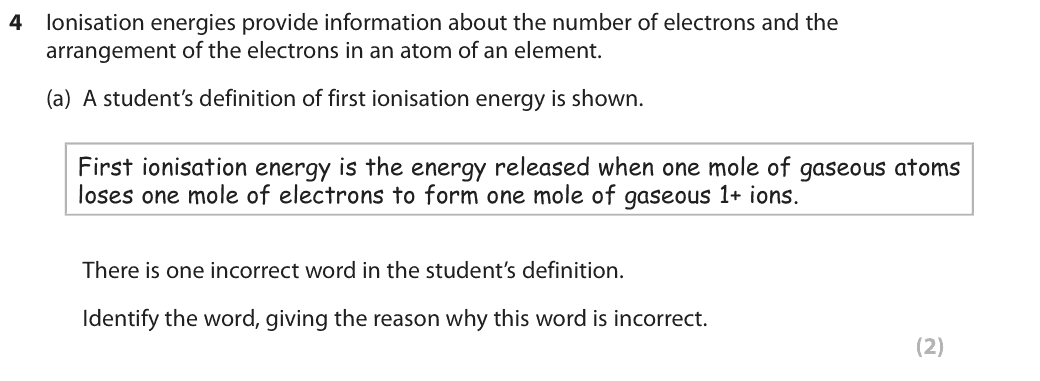
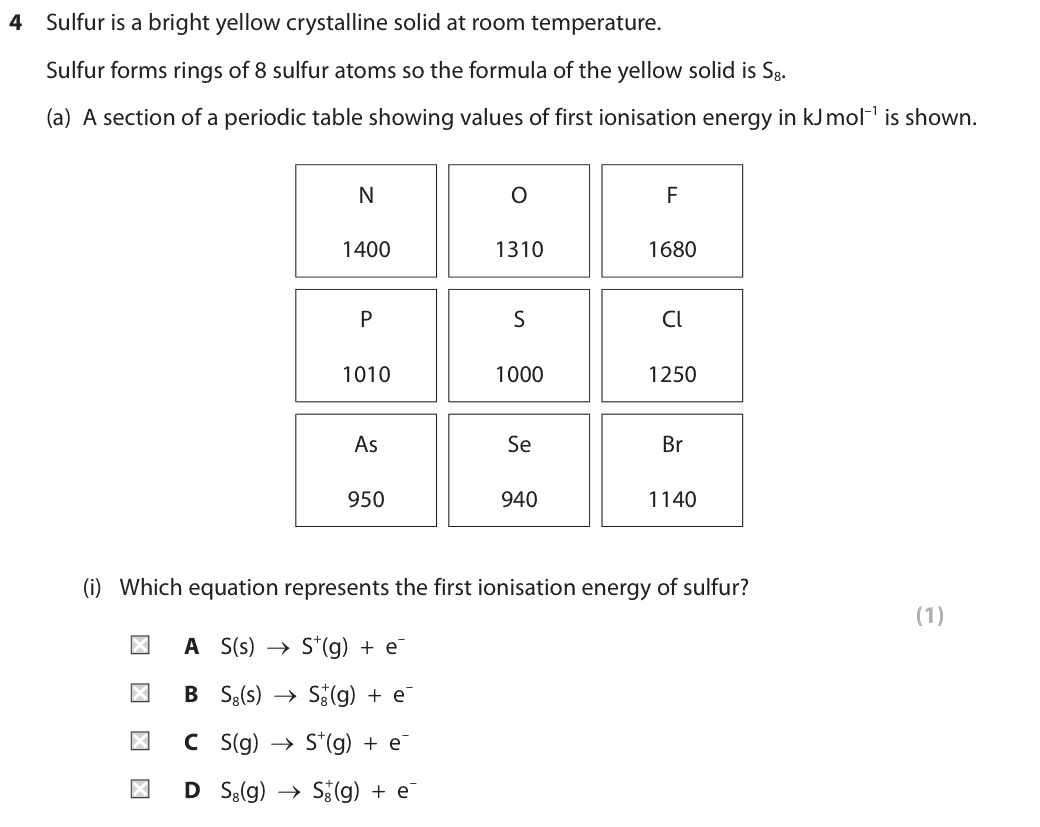
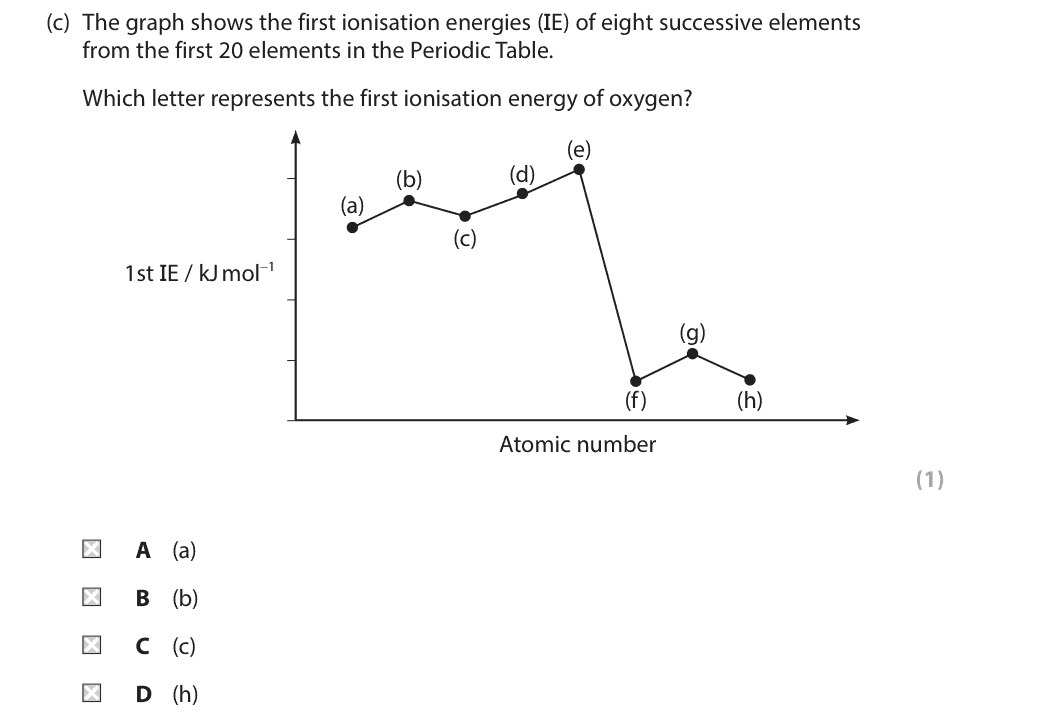
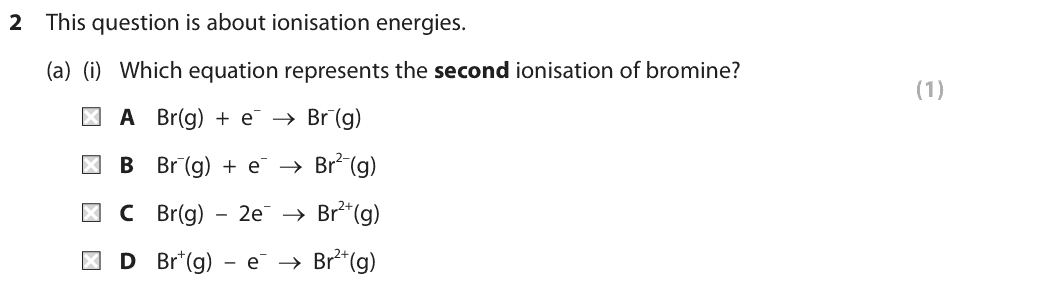
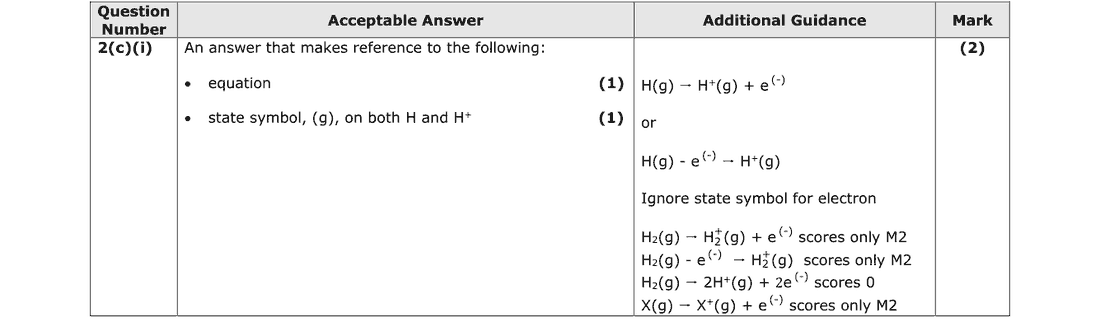
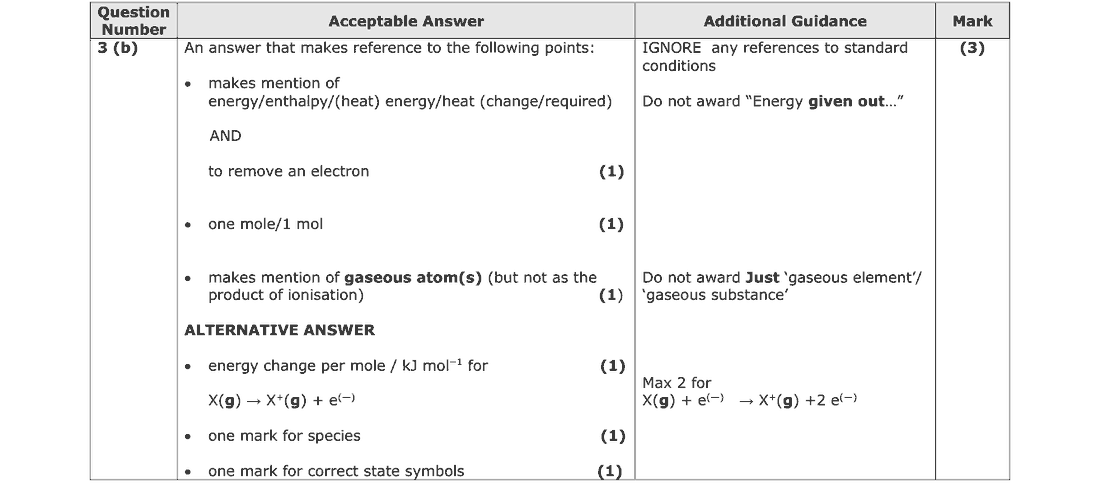
1.11 be able to define the terms ‘first ionisation energy’ and ‘successive ionisation energies’
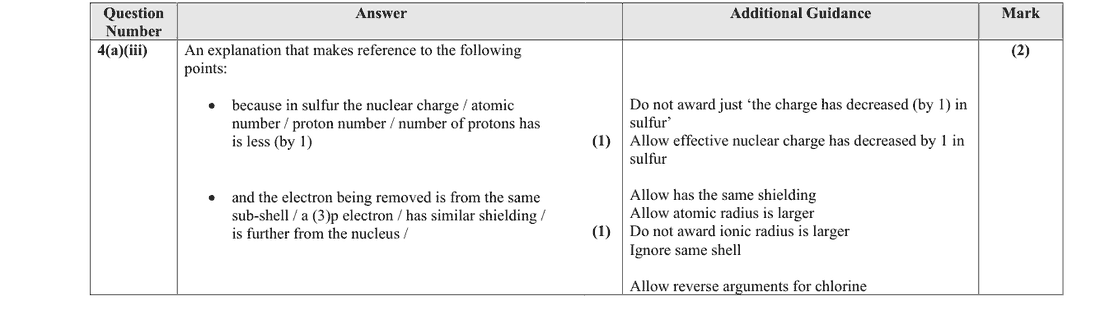
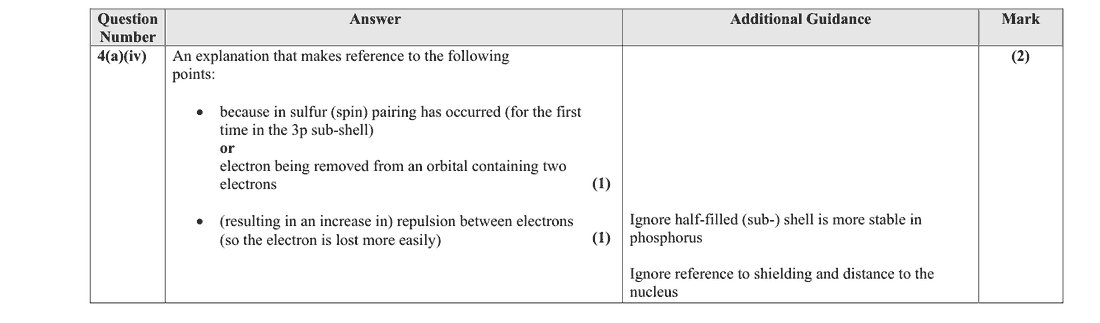
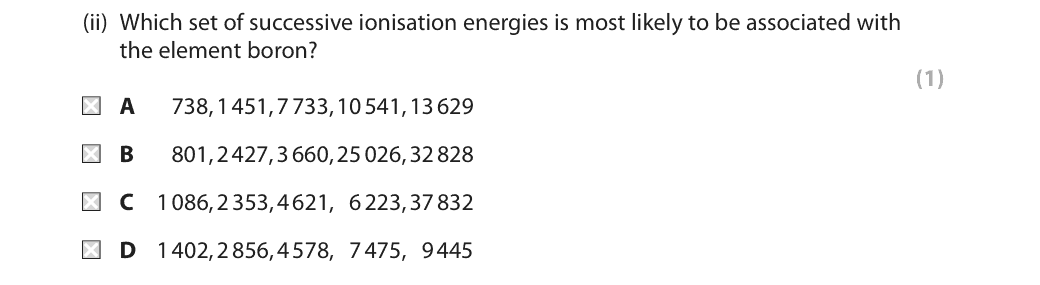
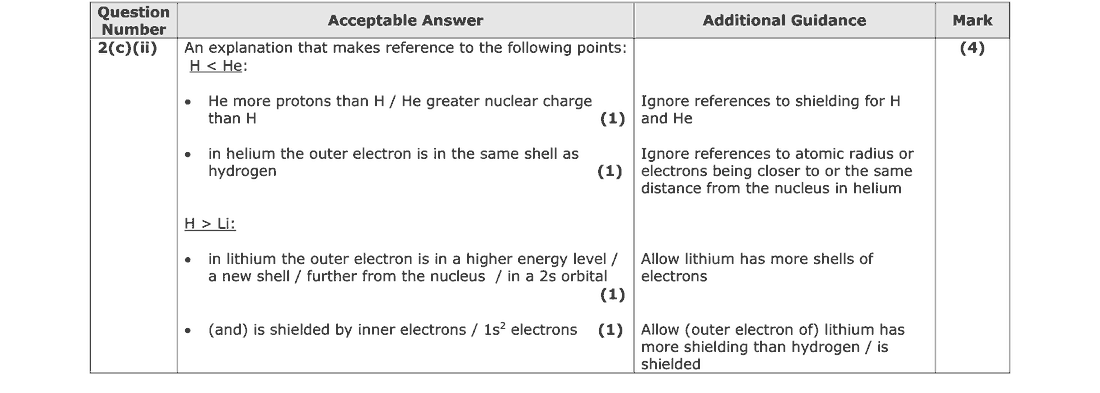
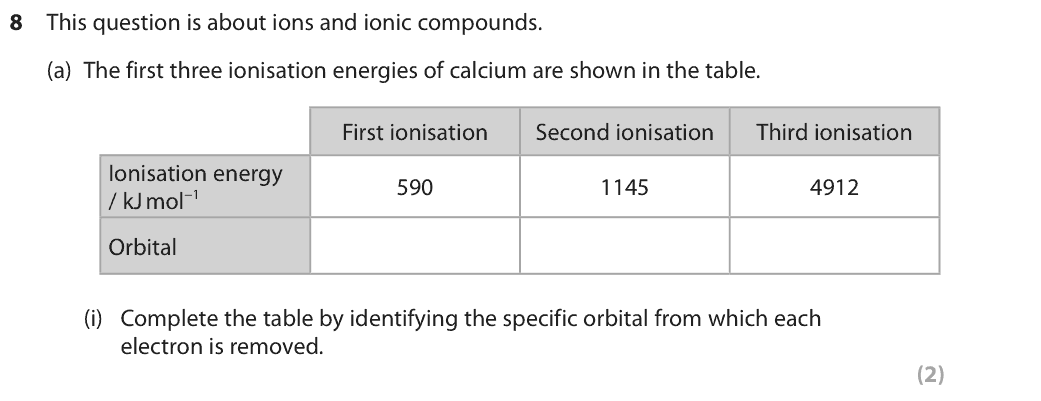
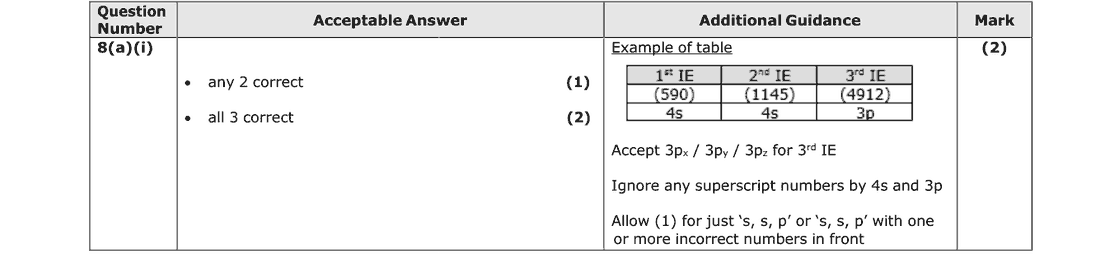
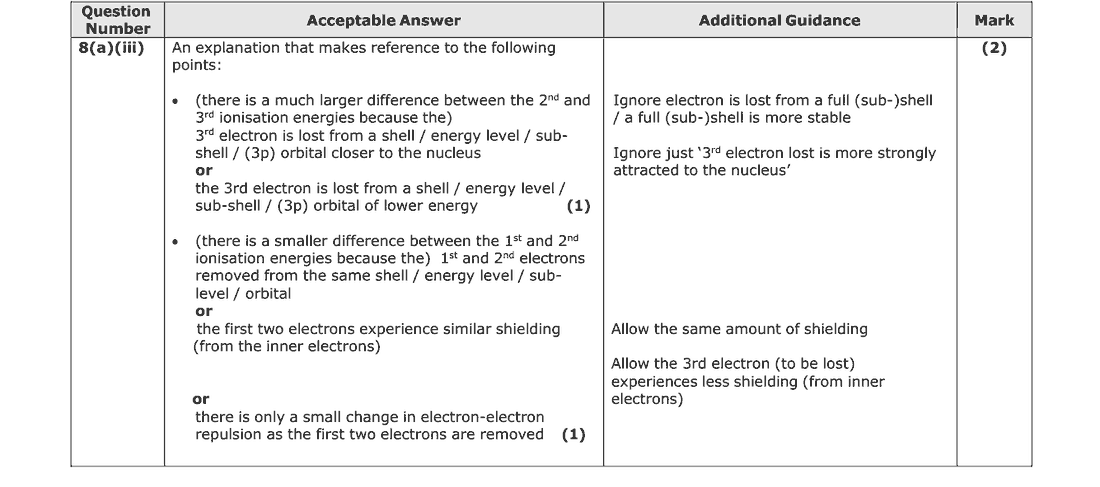
1.12 understand how ionisation energies are influenced by the number of protons, the electron shielding and the electron sub-shell from which the electron is removed
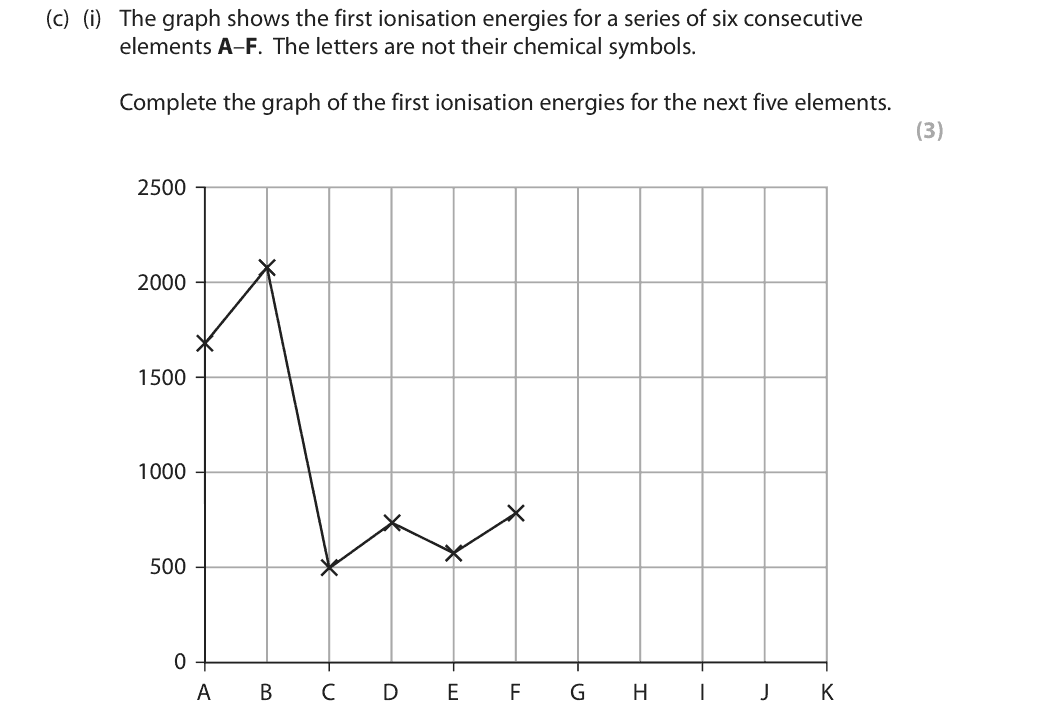
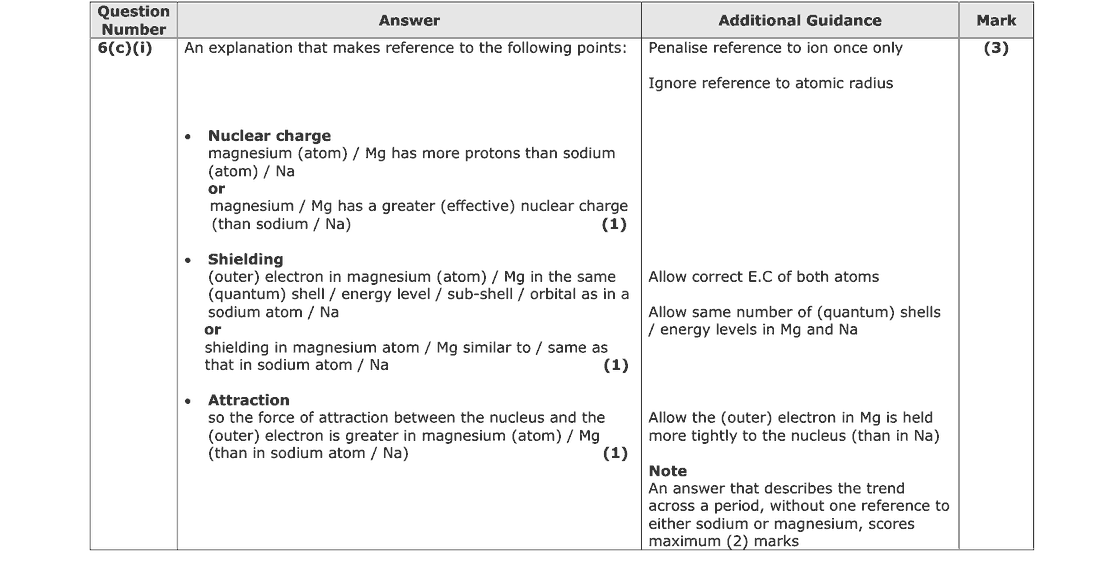
1.13 understand reasons for the general increase in first ionisation energy across a period
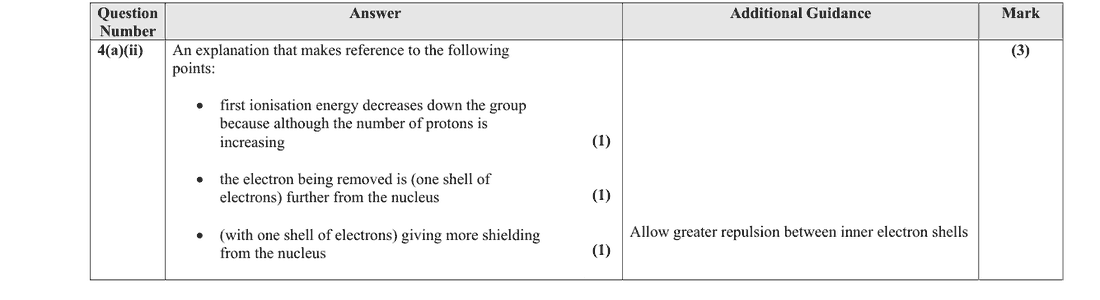
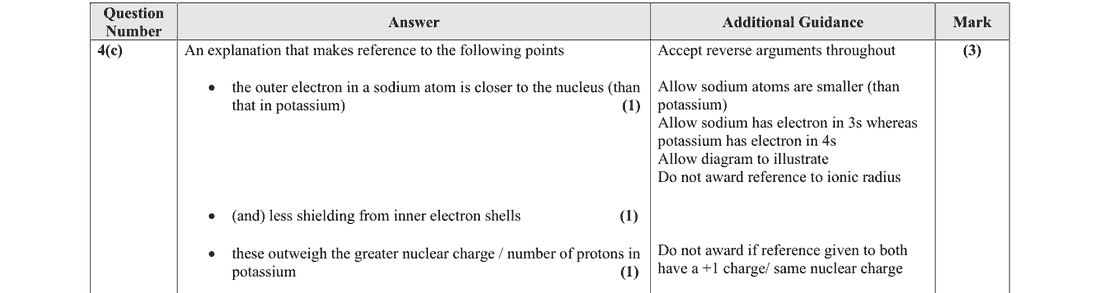
1.14 understand reasons for the decrease in first ionisation energy down a group
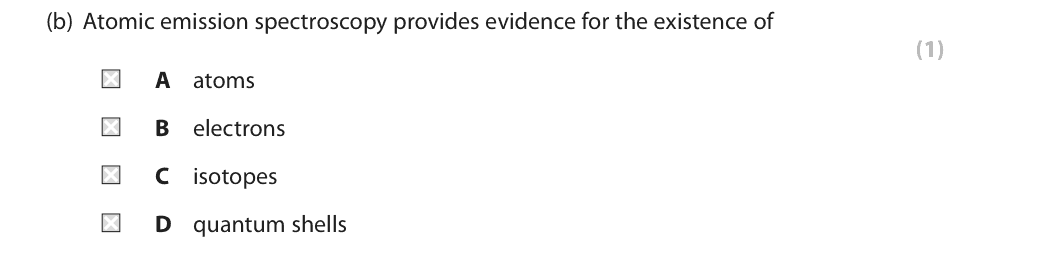
1.15 understand how ideas about electronic configuration developed from: • i the fact that atomic emission spectra provide evidence for the existence of quantum shells • ii the fact that successive ionisation energies provide evidence for the existence of quantum shells and the group to which the element belongs • iii the fact that the first ionisation energy of successive elements provides evidence for electron sub-shells
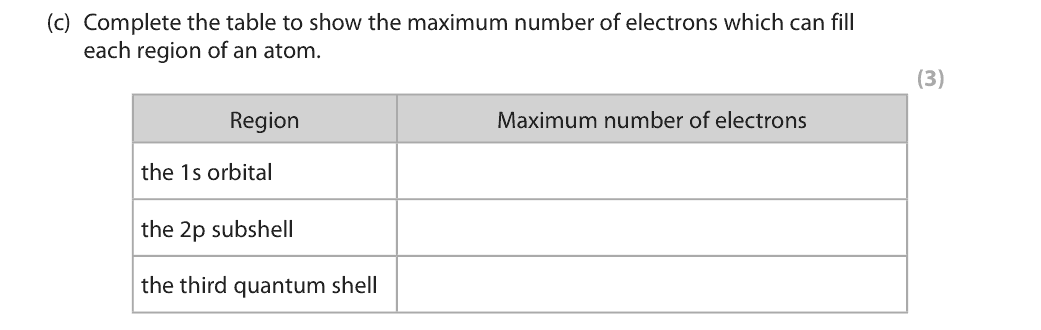
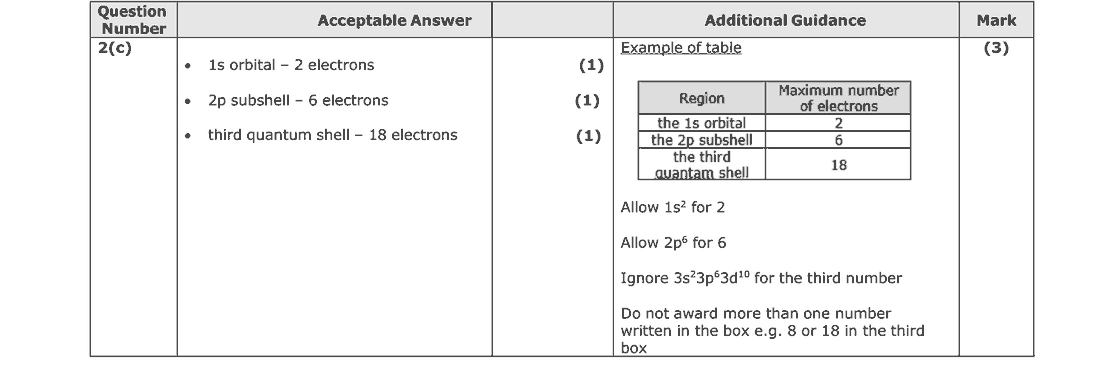
1.16 know the number of electrons that can fill the first four quantum shells
1.17 know that an orbital is a region within an atom that can hold up to two electrons with opposite spins
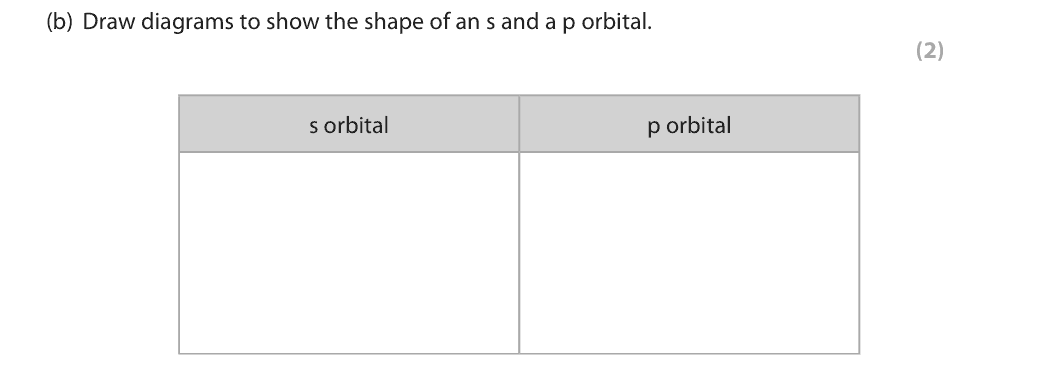
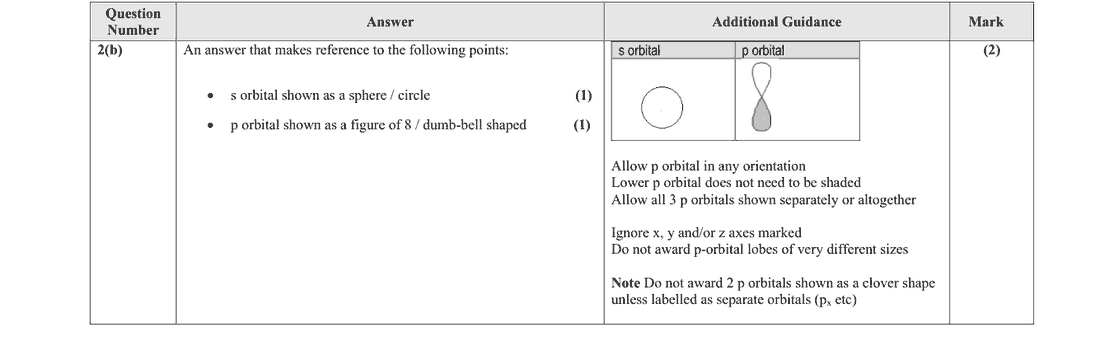
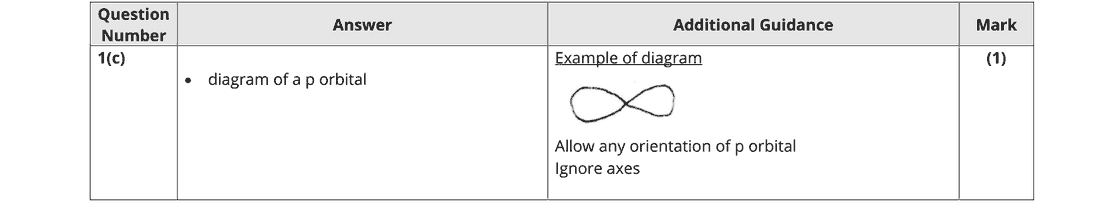
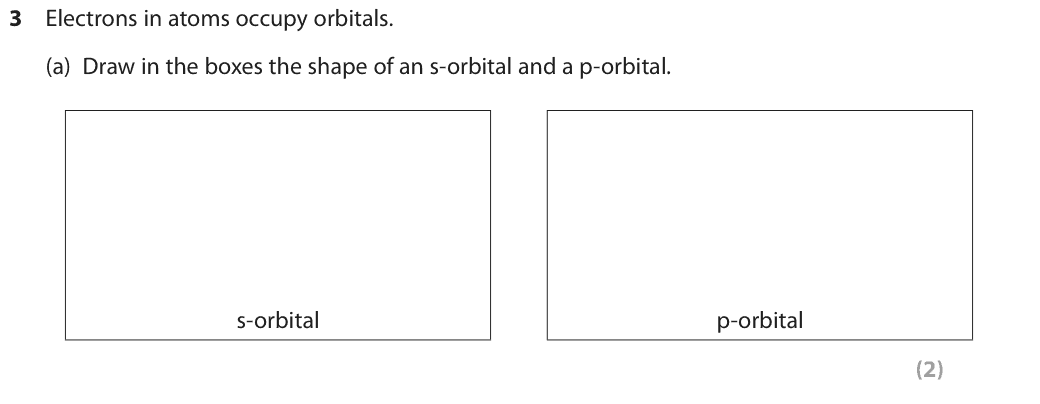
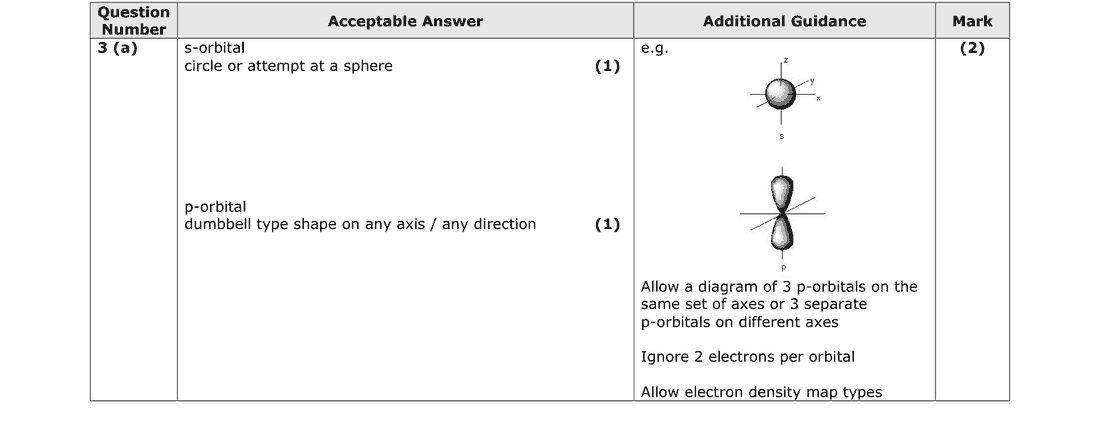
1.18 know the shape of an s-orbital and a p-orbital
1.19 know the number of electrons that occupy s, p and d-subshells
1.20 know that electrons fill subshells singly, before pairing up, and that two electrons in the same orbital must have opposite spins
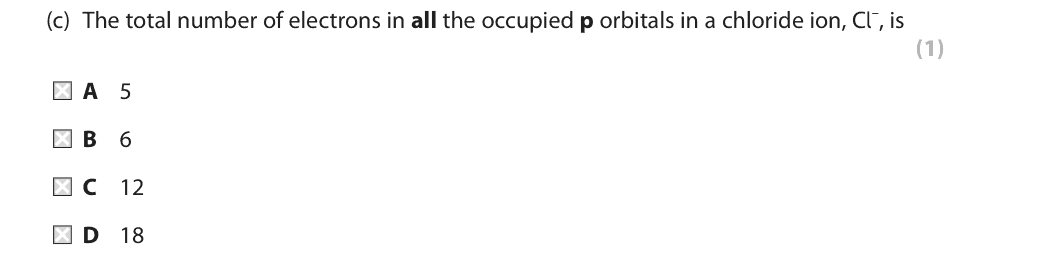
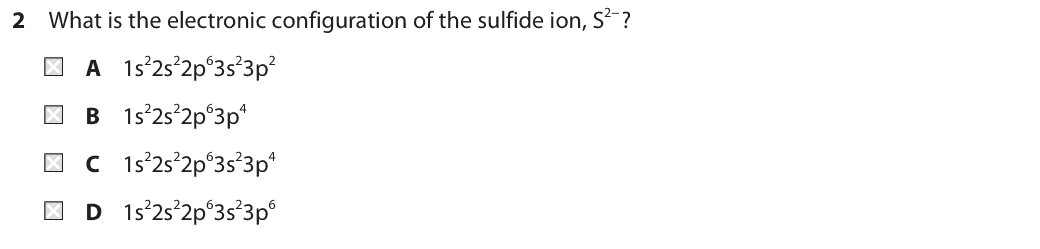
1.21 be able to predict the electronic configurations, using 1s notation and electrons- in-boxes notation, of: • i atoms, given the atomic number, Z, up to Z = 36 • ii ions, given the atomic number, Z, and the ionic charge, for s and p block ions only, up to Z = 36
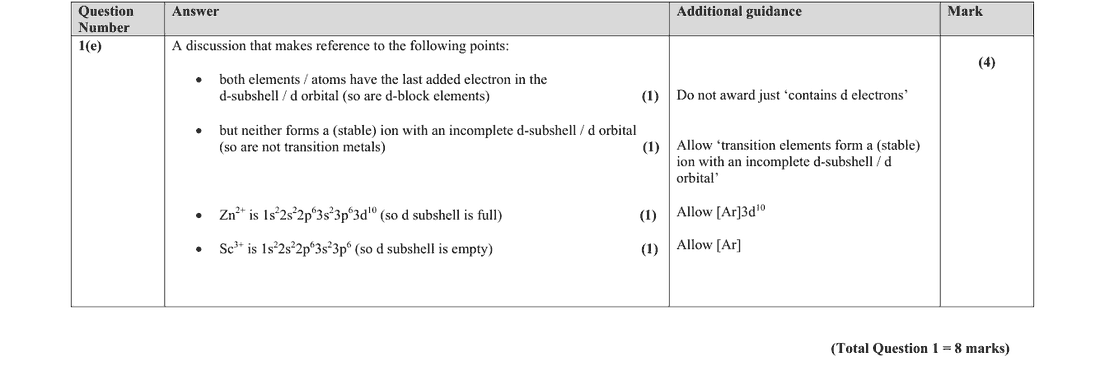
1.22 know that elements can be classified as s, p and d-block elements
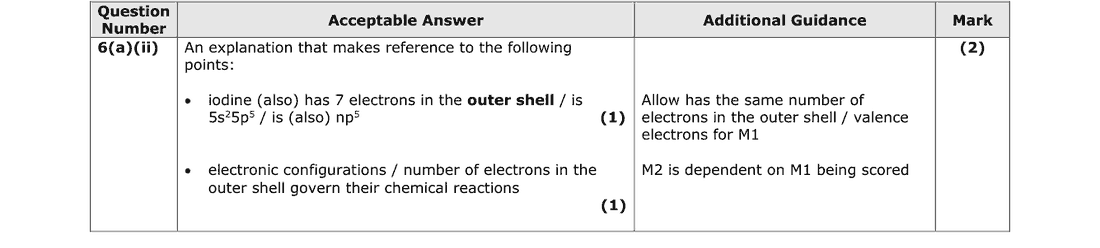
1.23 understand that electronic configuration determines the chemical properties of an element
1.24 understand periodicity in terms of a repeating pattern across different periods
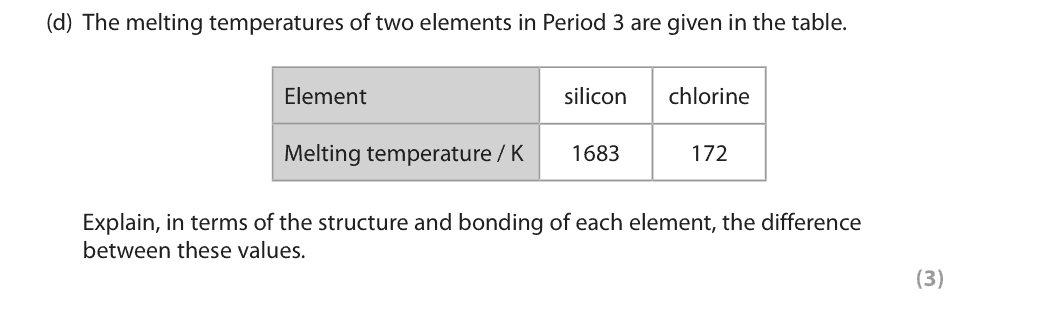
1.25 understand reasons for the trends in the following properties of the elements from periods 2 and 3 of the Periodic Table: • i the melting and boiling temperatures of the elements, based on given data, in terms of structure and bonding • ii ionisation energy based on given data or recall of the plots of ionisation energy versus atomic number
1.26 be able to illustrate periodicity using data, including electronic configurations, atomic radii, melting and boiling temperatures and first ionisation energies
Six-mark extended response questions on this topic
Tap a question to zoom it. Where a part needs a figure, table or structure from earlier in the question, that part folds out above it; the mark scheme and examiner's comment open underneath. Have Edexcel's Data Booklet beside you; the Periodic Table is on the back page of every paper.
June 2025 · Paper 1 · Q1(a)2 marksShort answer
Mark scheme
Examiner's comment
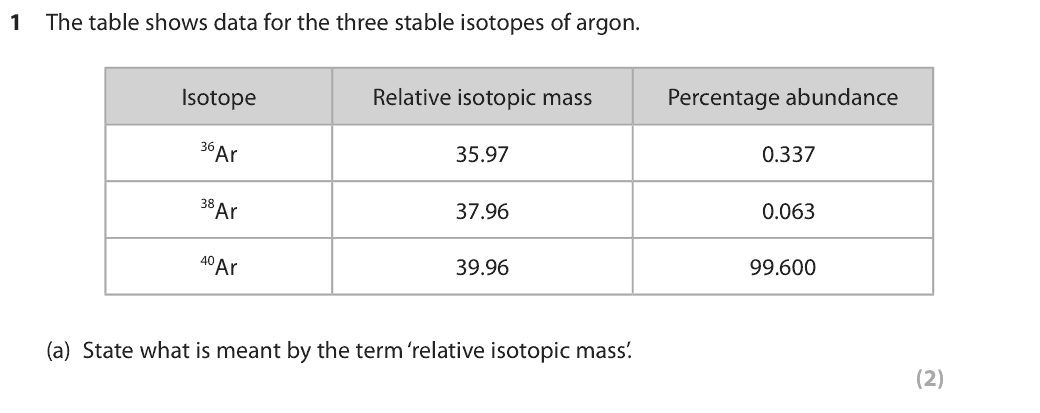
This was an introduction question regarding the definition of the relative isotopic mass of an element.
Many fully correct answers were seen.
Common errors were the use of weighted/ average and mean mass of the atom, or the atom missing entirely.
Notes from the mark scheme and report
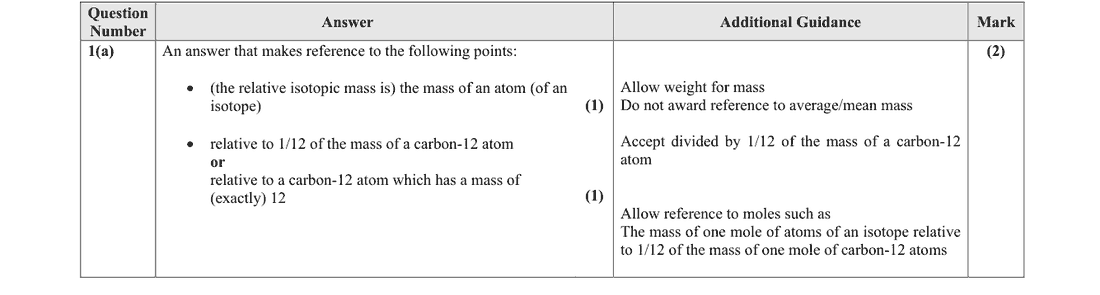
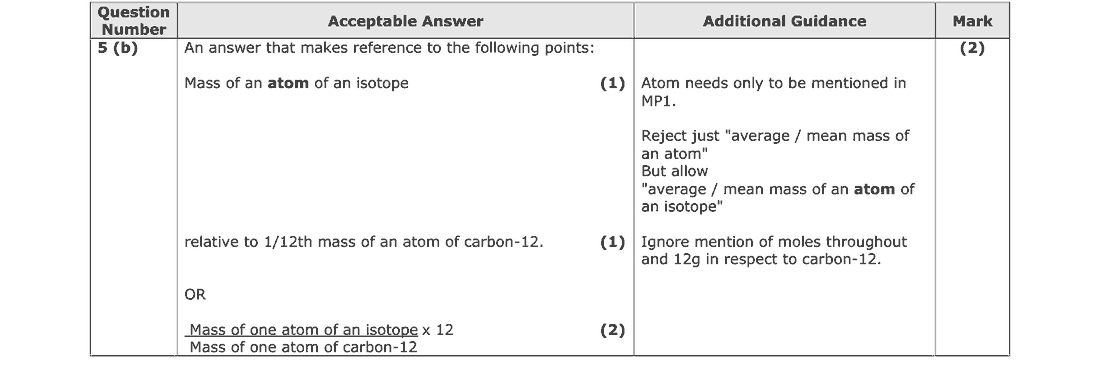
The mass of an atom of the isotope
relative to 1/12th of the mass of an atom of carbon-12 (or mass of one atom of the isotope × 12 ÷ mass of one atom of carbon-12 for both marks). Any reference to average, mean, weighted or moles is not credited (penalised once). Common errors: 'weighted / average / mean mass', or no mention of an atom
June 2025 · Paper 1 · Q1(b)2 marksShort answer
Earlier part of question 1 that this part uses
Mark scheme
Examiner's comment
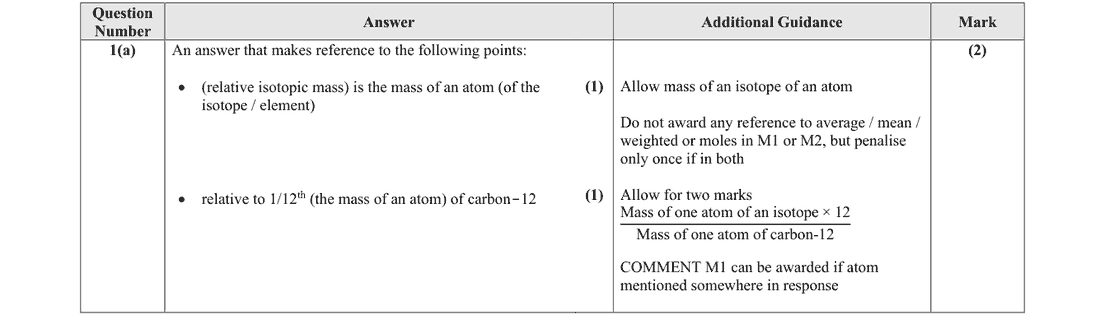
This question required the candidates to explain what an isotope is with reference to Argon.
Many candidates could give the definition of an isotope but failed to refer to the three different isotopes of Argon given.
Notes from the mark scheme and report
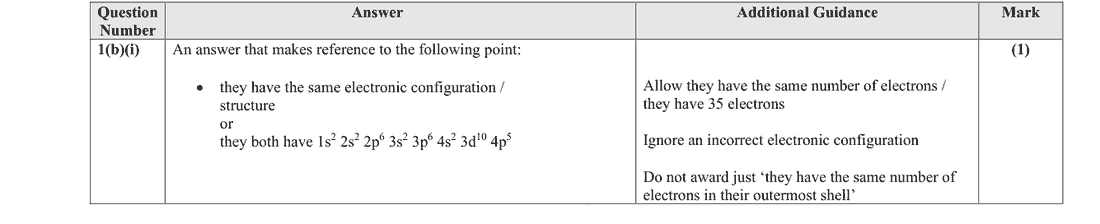
All three isotopes have 18 protons (and 18 electrons)
they have different numbers of neutrons: 18, 20 and 22. A general statement (same protons, different neutrons) with no numbers scores 1. 'Same atomic number, different mass number' is ignored. Many gave the definition but did not refer to the three argon isotopes
June 2025 · Paper 1 · Q1(c)2 marksCalculation
Earlier part of question 1 that this part uses
Mark scheme
Examiner's comment
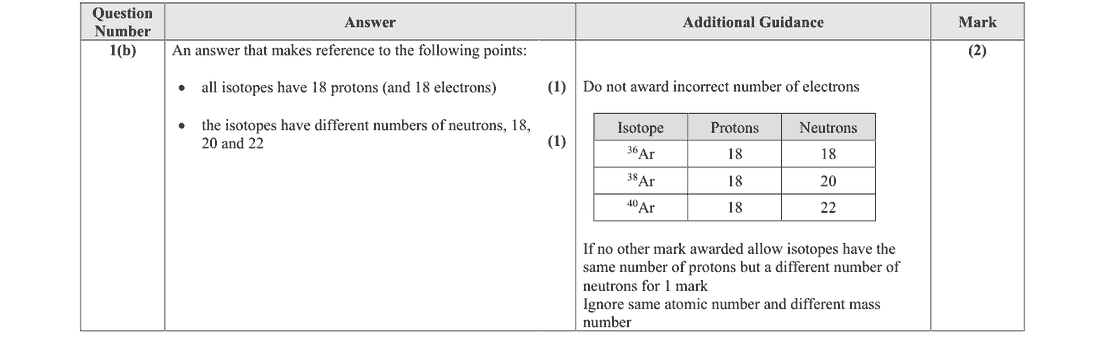
This question required the candidates to calculate the relative atomic mass of Argon from the relative abundances of the different isotopic masses.
Notes from the mark scheme and report
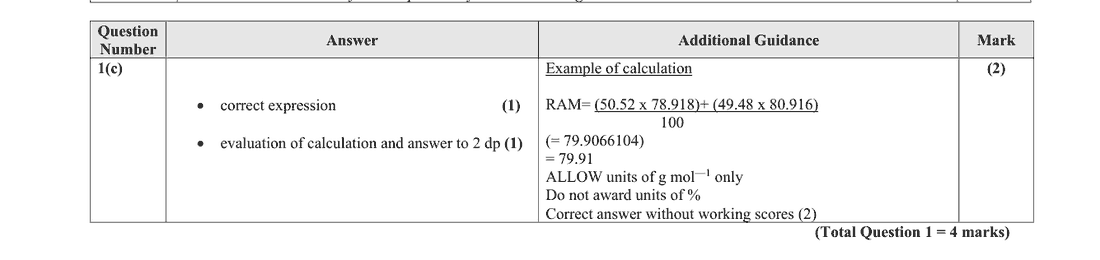
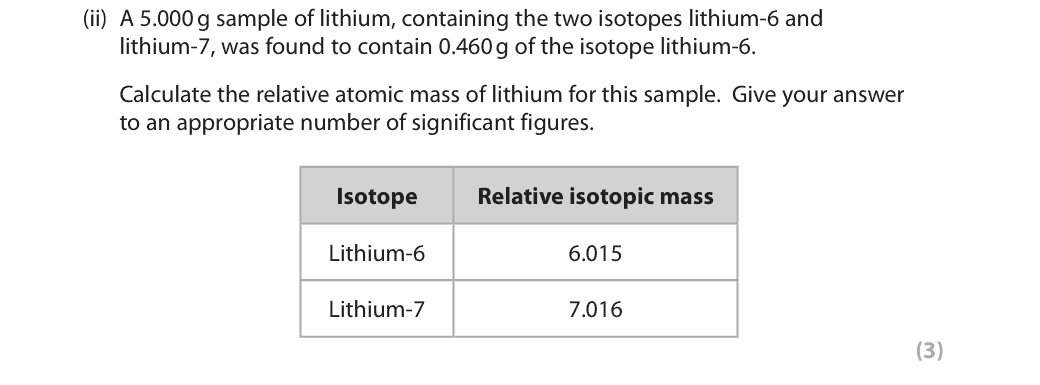
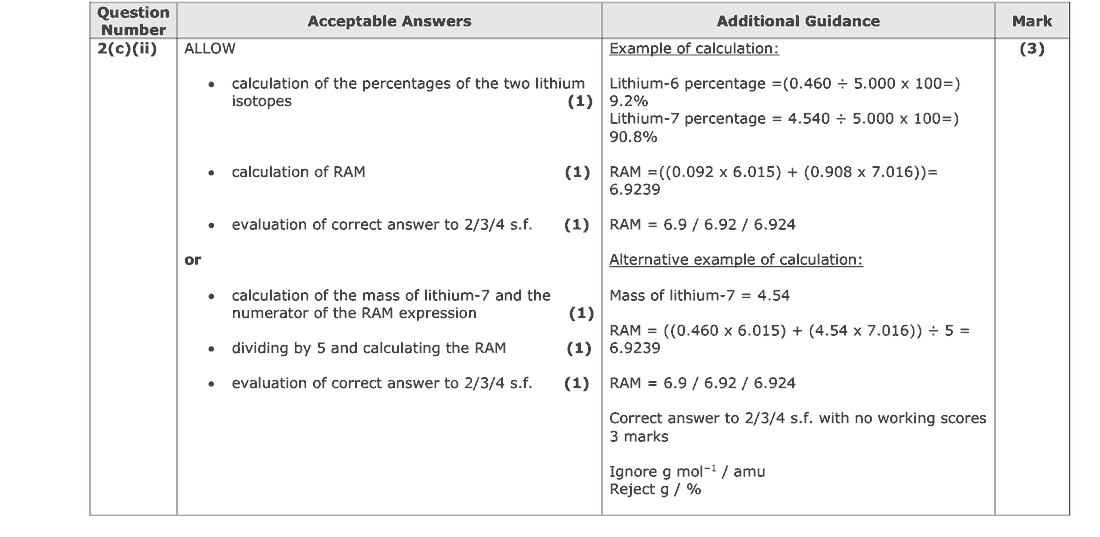
Answer: 39.95. ((35.97 × 0.337) + (37.96 × 0.063) + (39.96 × 99.6)) ÷ 100 = 39.945. Second mark is for two decimal places. g mol–1 is ignored but any other unit is penalised
Skills: MS1.1 Use an appropriate number of significant figures; MS1.2 Find arithmetic means
June 2025 · Paper 1 · Q2(a)3 marksDiagram or structure
Mark scheme
Examiner's comment
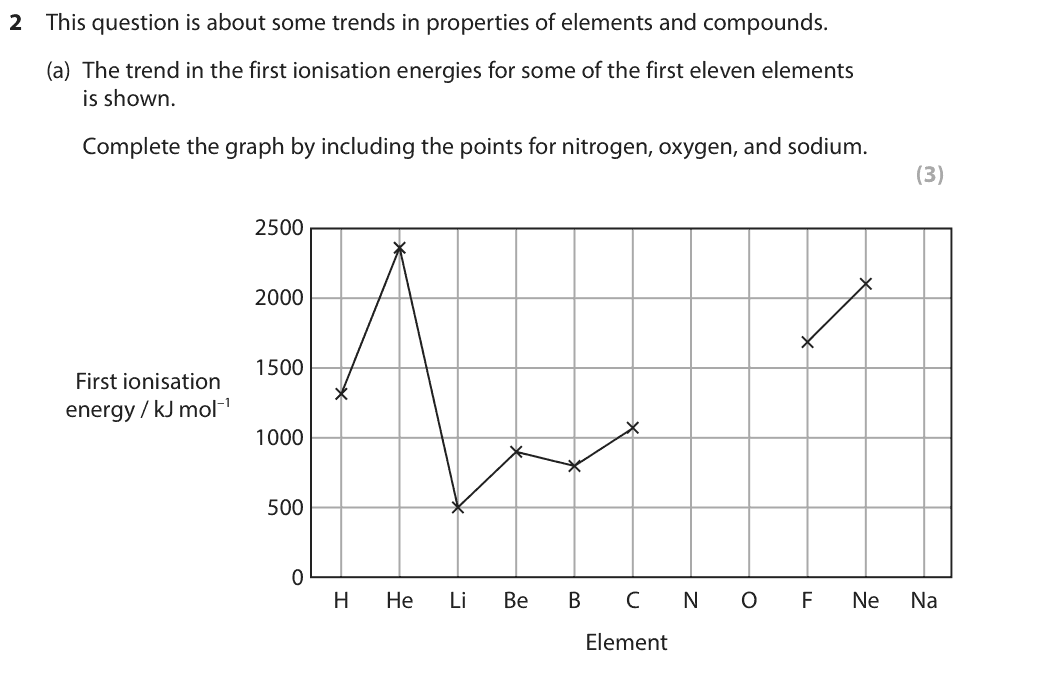
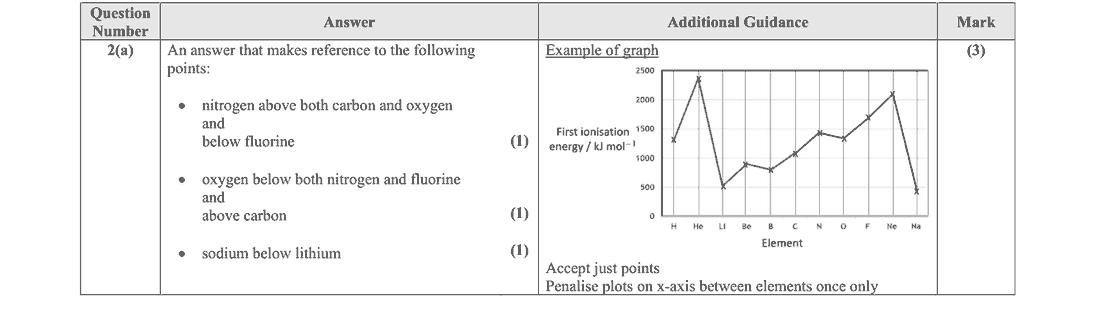
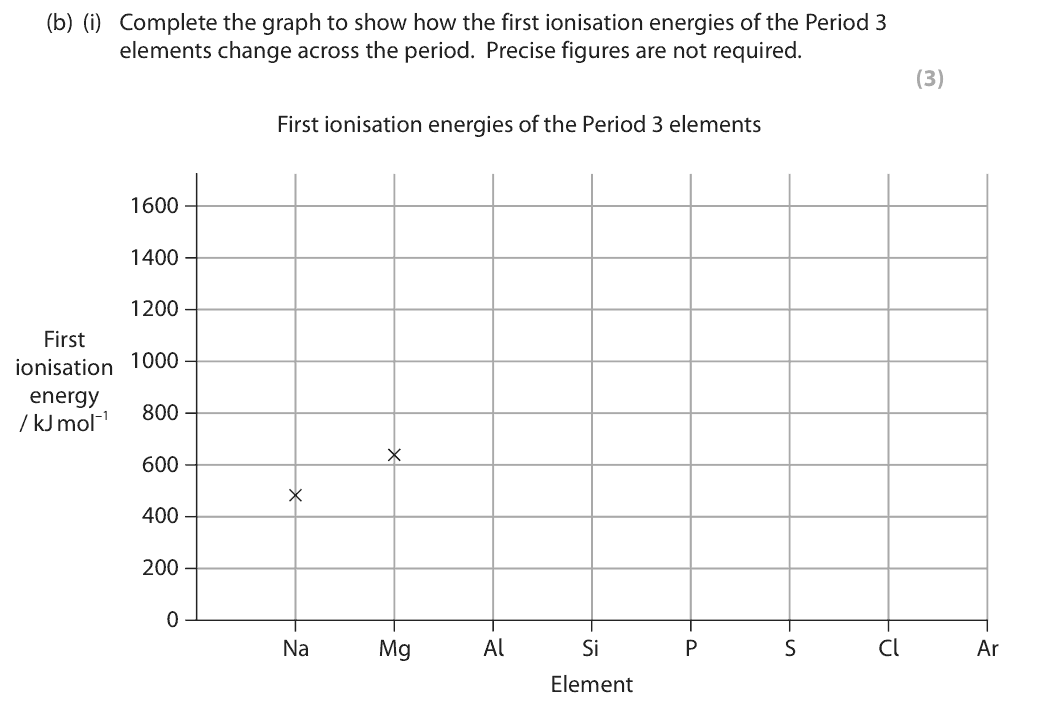
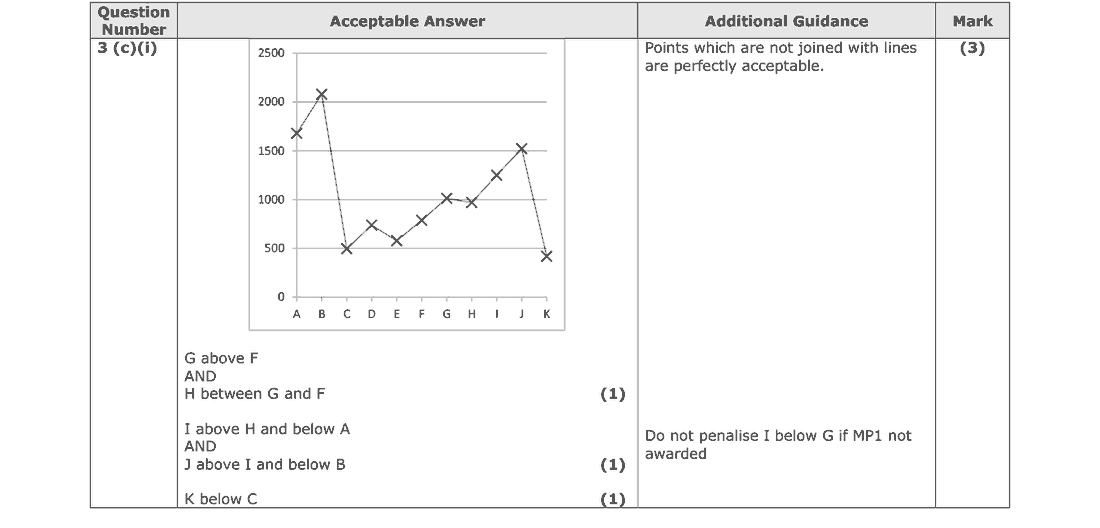
This question asked the candidates to fill in the missing first Ionisation Energies for the first 11 elements, by plotting points on a graph.
Notes from the mark scheme and report
Nitrogen plotted above both carbon and oxygen and below fluorine
oxygen below both nitrogen and fluorine and above carbon
sodium below lithium. Points alone are accepted. Points placed between elements on the x-axis are penalised once
Skills: MS3.2 Plot two variables from experimental or other data
June 2025 · Paper 1 · Q2(b)4 marksExplanation
Mark scheme
Examiner's comment
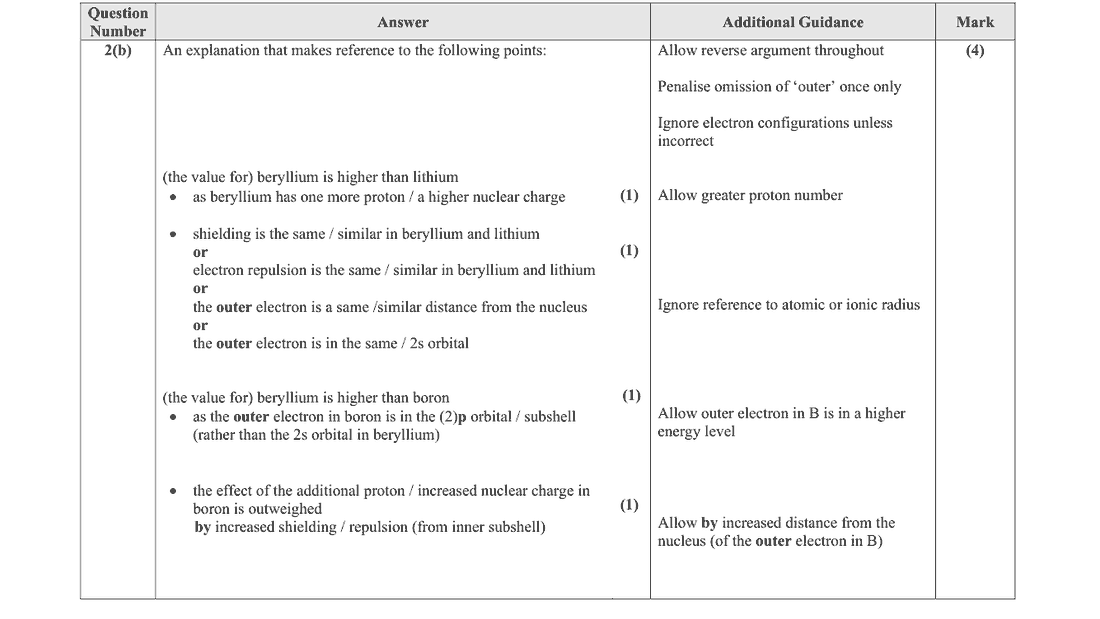
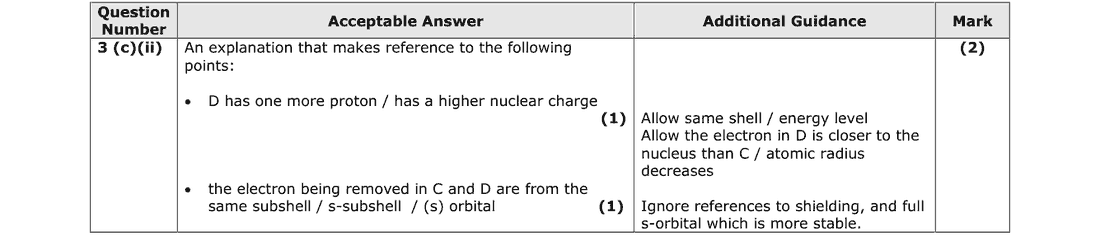
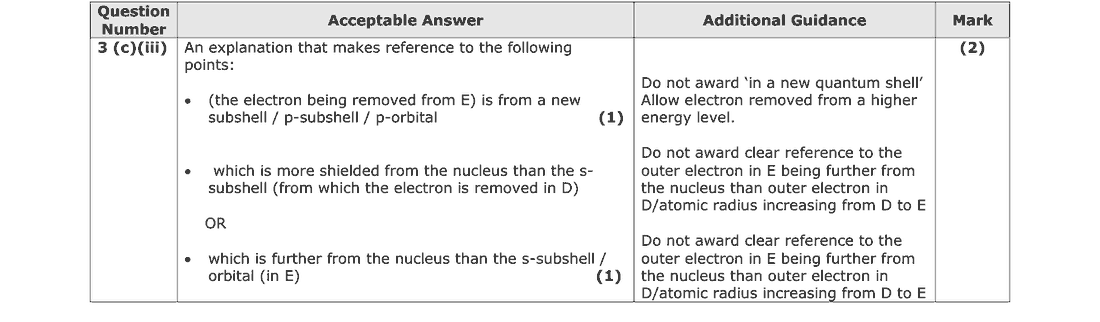
The question required the candidates to explain why the first Ionisation Energy of Beryllium was higher than both Lithium and Boron. It was looking for the candidate to show the relationship between the proton number and the effect on the outer electron of the nuclear attraction and repulsion from other electrons.
This proved challenging for a proportion of the candidates, some of whom ignored the effect of the nucleus entirely.
Notes from the mark scheme and report
Higher than lithium: beryllium has one more proton / higher nuclear charge
with the same (similar) shielding, or the outer electron in the same 2s orbital at a similar distance. Higher than boron: the outer electron in boron is in a 2p orbital (higher energy) rather than 2s
so the extra proton in boron is outweighed by the increased shielding / repulsion from the inner (2s) subshell. Omitting 'outer' is penalised once. This proved challenging for a proportion of candidates, some of whom ignored the nucleus altogether
June 2025 · Paper 1 · Q2(c)1 markEquation writing
Mark scheme
Examiner's comment
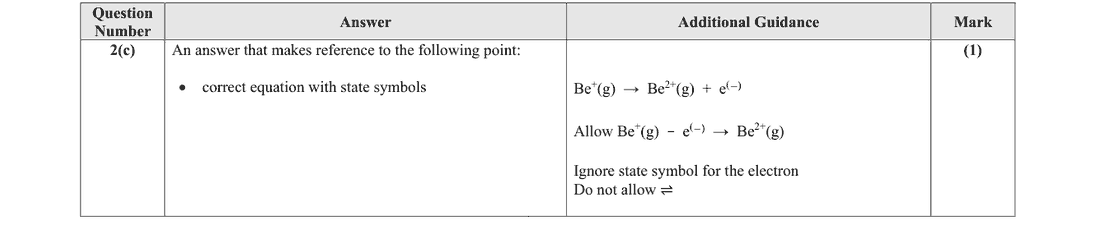
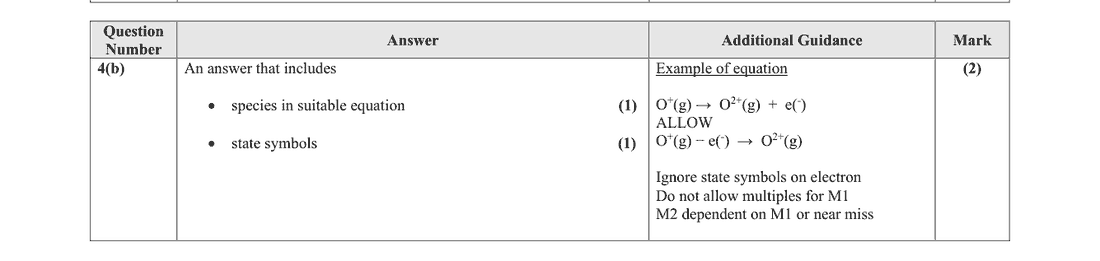
This question asked the candidates to give the equation for the second ionisation energy for Beryllium.
This required them to recognise two things, that Beryllium was already Be+ and that the required state for IE is gaseous.
Notes from the mark scheme and report
Be+(g) → Be2+(g) + e–. State symbols needed on the beryllium species
no reversible arrow. Candidates had to see that the starting species is already Be+ and that it is gaseous
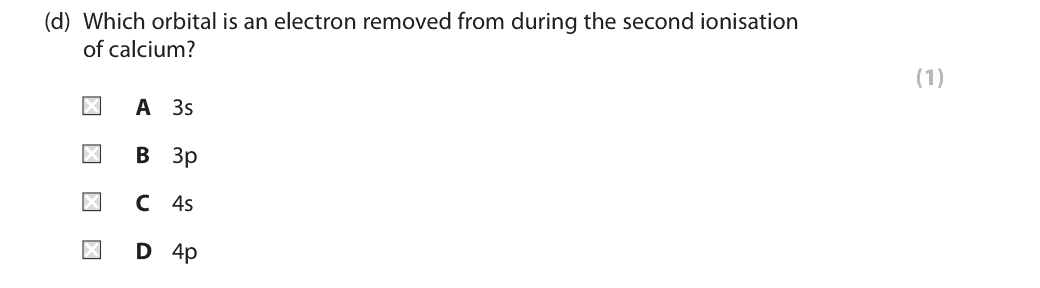
June 2025 · Paper 1 · Q2(d)1 markMultiple choice
Answer
C
Mark scheme
Notes from the mark scheme and report
Answer: C (4s). Ca+ is [Ar]4s1, so the second electron also comes from 4s. 3s would be magnesium
3p and 4p belong to p-block elements
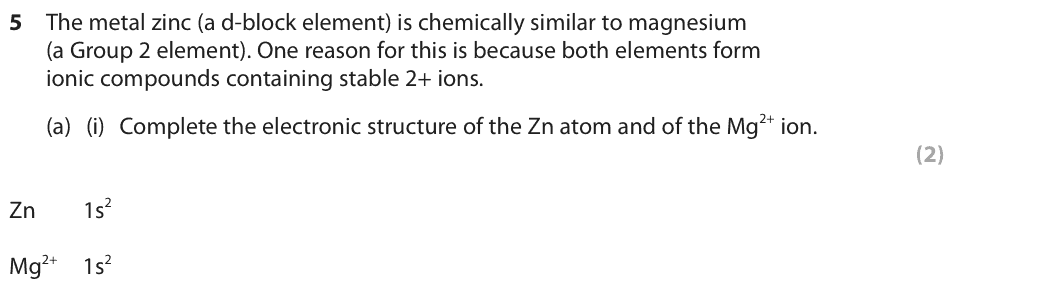
June 2025 · AS Paper 1 · Q5(a)(i)2 marksShort answerEasy
Mark scheme
Examiner's comment
Q5ai was answered well with nearly 90% of candidates getting full marks. The question required candidates to state the electron configuration of zinc and the magnesium ion. Marks were lost for having the incorrect number of electrons in the d orbital for zinc, labelling the 3d as 4d, or incorrectly stating the electron configuration of the magnesium ion.
Notes from the mark scheme and report
Zn: (1s2) 2s2 2p6 3s2 3p6 3d10 4s2 (allow 4s2 3d10). Mg2+: (1s2) 2s2 2p6. Errors: wrong number of d electrons for zinc
3d written as 4d
wrong configuration for the magnesium ion
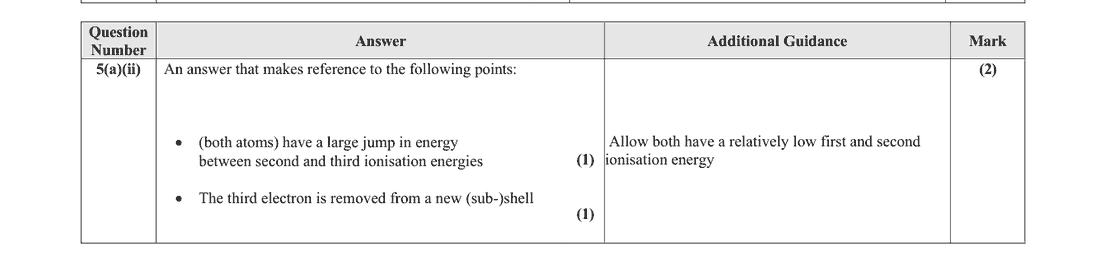
June 2025 · AS Paper 1 · Q5(a)(ii)2 marksExplanationHard
Earlier part of question 5 that this part uses
Mark scheme
Examiner's comment
Q5aii required candidates to explain why zinc and magnesium form stable 2+ ions. This was not answered well with very few candidates referring to ionisation energy and just mentioning electron configuration. Only a small number of candidates mentioned that the third electron was removed from a new shell.
Notes from the mark scheme and report
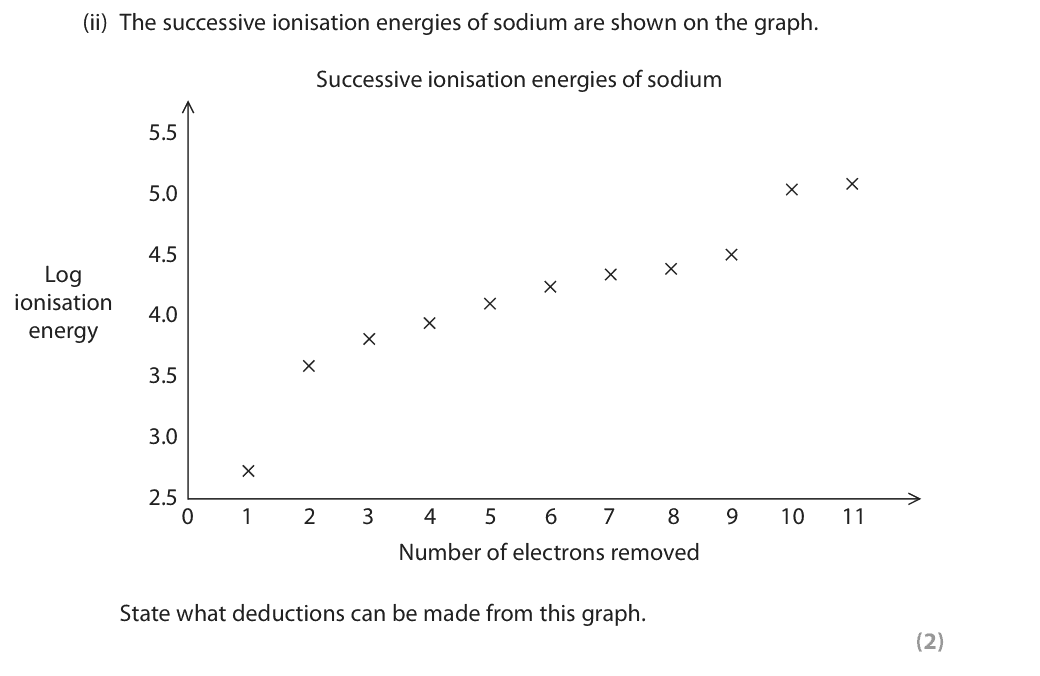
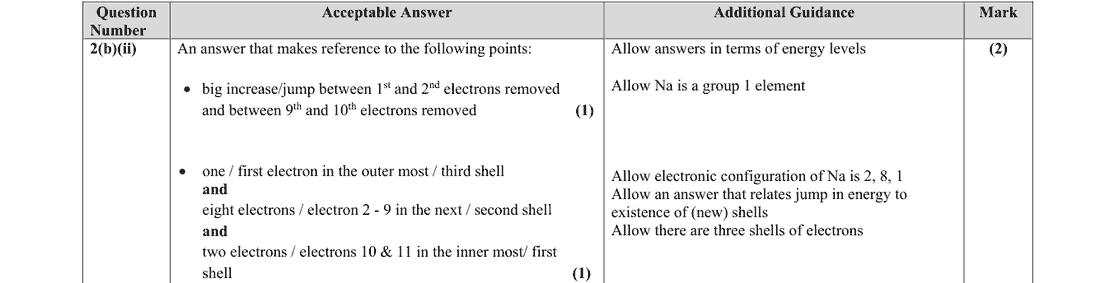
Both atoms have a large jump between the second and third ionisation energies (allow both have relatively low first and second ionisation energies)
the third electron is removed from a new (sub-)shell (closer to the nucleus). Most wrote about electron configuration without mentioning ionisation energies
only a small number said the third electron comes from a new shell
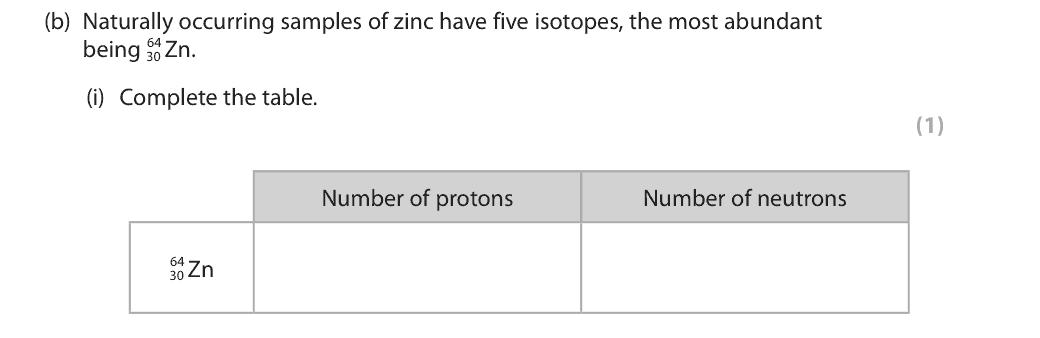
June 2025 · AS Paper 1 · Q5(b)(i)1 markShort answerEasy
Earlier part of question 5 that this part uses
Mark scheme
Examiner's comment
Q5bi was answered well with nearly 100% of candidates getting this question correct. The question required candidates to calculate the number of protons and neutrons in zinc. Marks were lost for putting the answers in the wrong boxes.
Notes from the mark scheme and report
Answer: 30 protons and 34 neutrons (both needed). The few marks lost were for putting the numbers in the wrong boxes
June 2025 · AS Paper 1 · Q5(b)(ii)1 markShort answerHard
Earlier parts of question 5 that this part uses
Mark scheme
Examiner's comment
Q5bii required candidates to explain why an isotopes mass is not an integer. This was not answered well. Most candidates gained marks for stating that it is compared to 1/12 mass of C-12; however, those candidates that gave the definition of relative atomic mass were not awarded the mark.
Notes from the mark scheme and report
The mass is measured relative to carbon-12 (1/12 of the mass of a carbon-12 atom)
allow that the masses of protons and neutrons are not exactly 1. Giving the definition of relative atomic mass was not credited
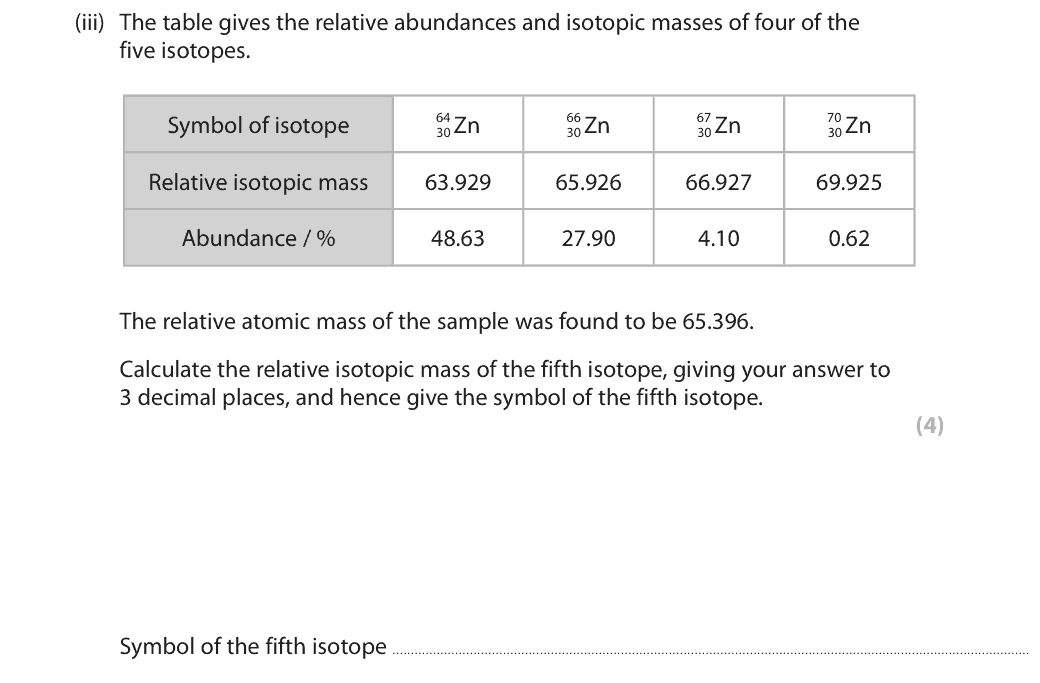
June 2025 · AS Paper 1 · Q5(b)(iii)4 marksCalculation
Earlier parts of question 5 that this part uses
Mark scheme
Examiner's comment
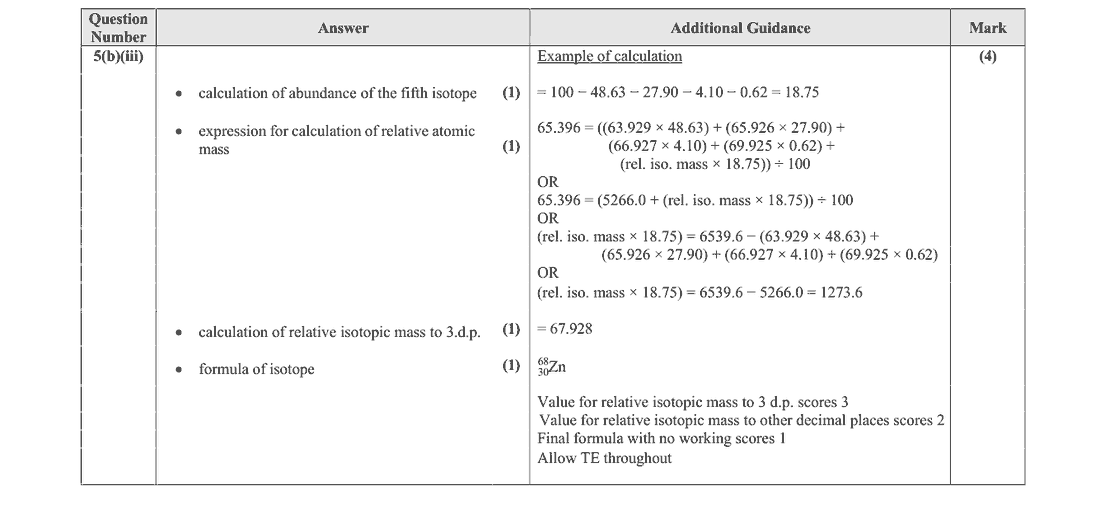
Q5biii required candidates to calculate the relative isotopic mass of an isotope and state the symbol of the isotope. This was answered well, with most candidates getting the correct mass. Some candidates lost marks for not giving their answer to three decimal places or not giving the symbol of the isotope.
Notes from the mark scheme and report
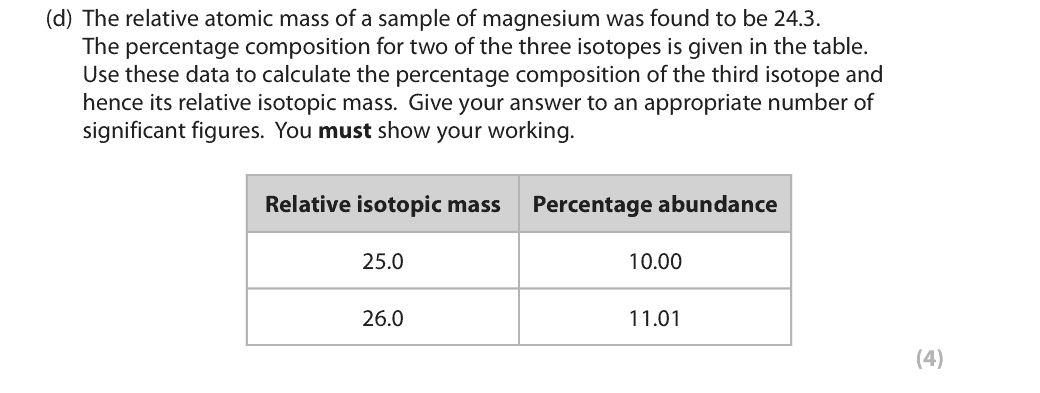
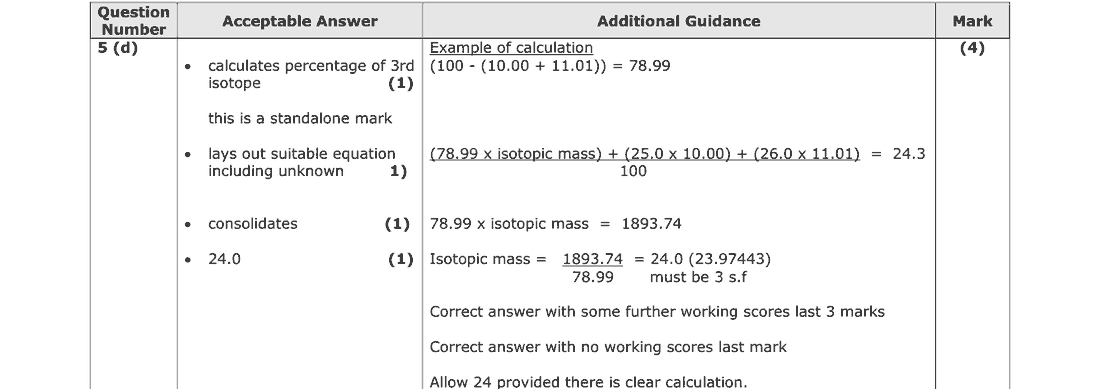
Answer: 67.928, so the fifth isotope is 68Zn (with 30 as the atomic number). Abundance = 100 – 48.63 – 27.90 – 4.10 – 0.62 = 18.75 %
65.396 × 100 = (63.929 × 48.63) + (65.926 × 27.90) + (66.927 × 4.10) + (69.925 × 0.62) + (m × 18.75), so 6539.6 – 5266.0 = 1273.6 = 18.75m. The value to 3 decimal places scores 3, to other decimal places 2
the symbol with no working scores 1. Marks lost for not giving 3 decimal places or leaving out the symbol
Skills: MS0.2 Use ratios, fractions and percentages; MS1.1 Use an appropriate number of significant figures; MS2.2 Change the subject of an equation; MS2.4 Solve algebraic equations
June 2025 · AS Paper 1 · Q7(a)2 marksExplanation
Mark scheme
Examiner's comment
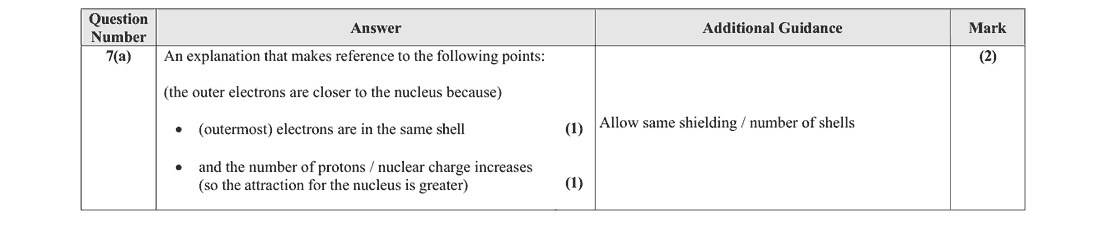
Q7a required candidates to explain the trend in atomic radii. This question was answered reasonably well. Most candidates stated that the number of protons increased but only some stated that the electron is in the same shell.
Notes from the mark scheme and report
The outermost electrons are in the same shell (allow same shielding / same number of shells)
and the number of protons / nuclear charge increases, so the attraction between the nucleus and the outer electrons is greater. Most gave the increase in protons
only some said the electrons are in the same shell
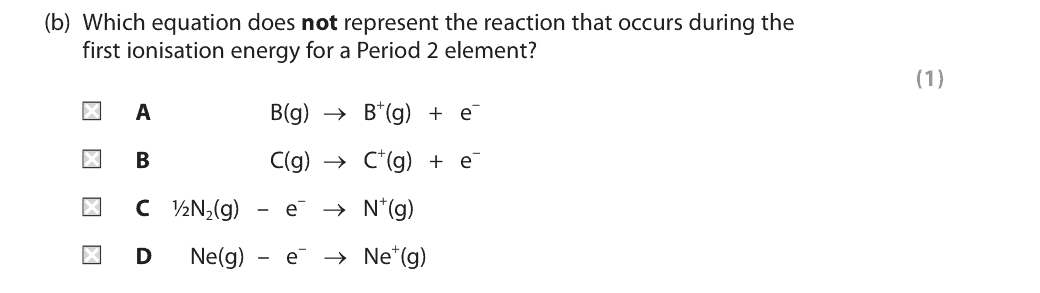
June 2025 · AS Paper 1 · Q7(b)1 markMultiple choice
Answer
C
Mark scheme
Examiner's comment
Q7b was answered well, with approximately 70% of candidates achieving the mark. The question required candidates to state the equation which does not represent first ionisation energy.
Notes from the mark scheme and report
Answer: C. First ionisation energy is for removing one mole of electrons from one mole of gaseous atoms
½N2(g) is a molecule, not an atom. A, B and D all start from gaseous atoms
writing the electron as '– e–' on the left (D) is still correct
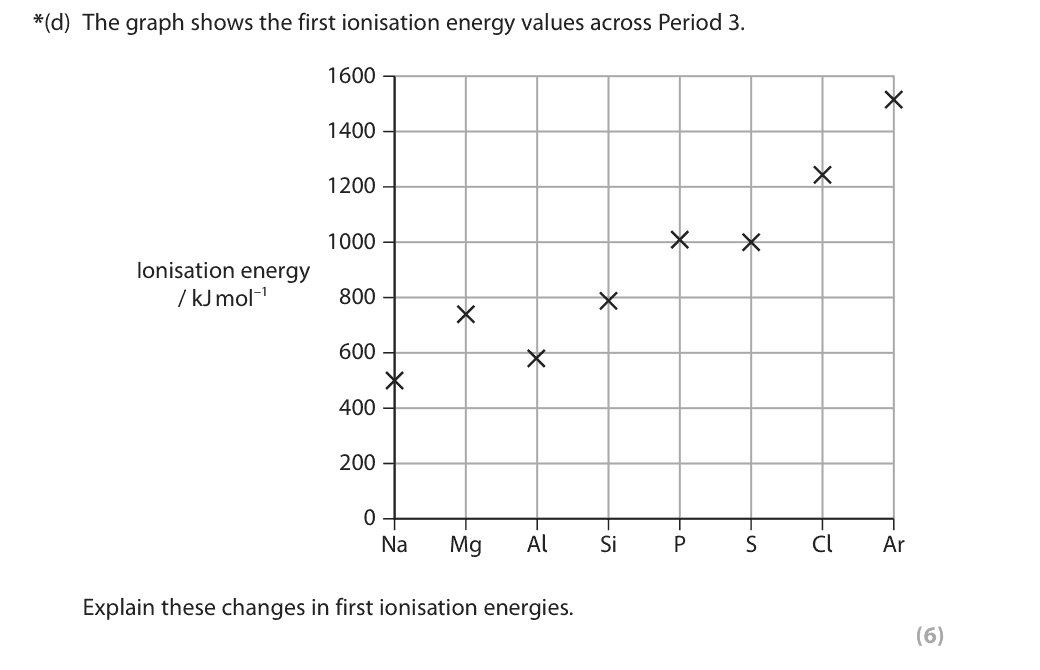
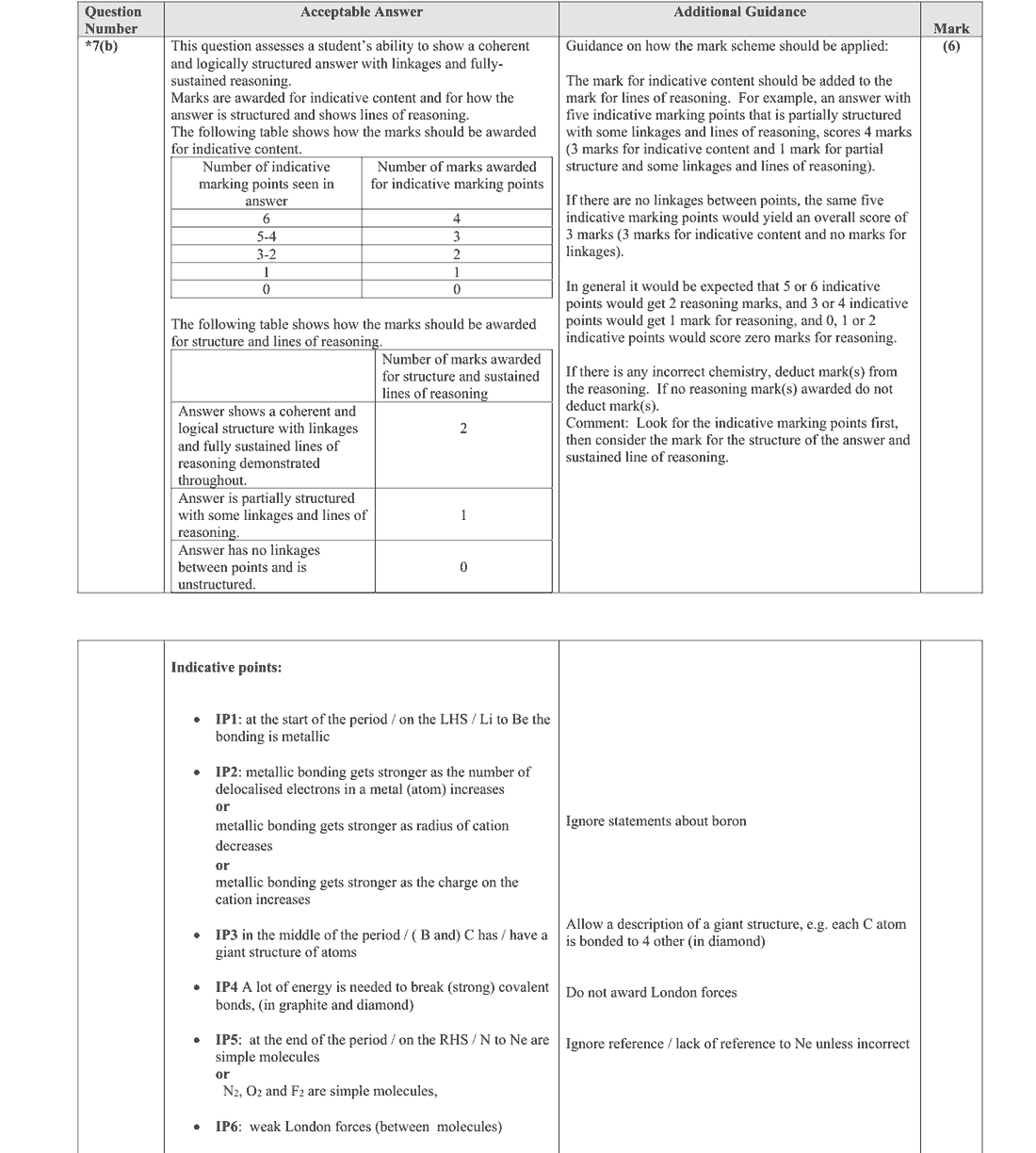
June 2025 · AS Paper 1 · Q7(d)6 marks6-mark extended response
Earlier part of question 7 that this part uses
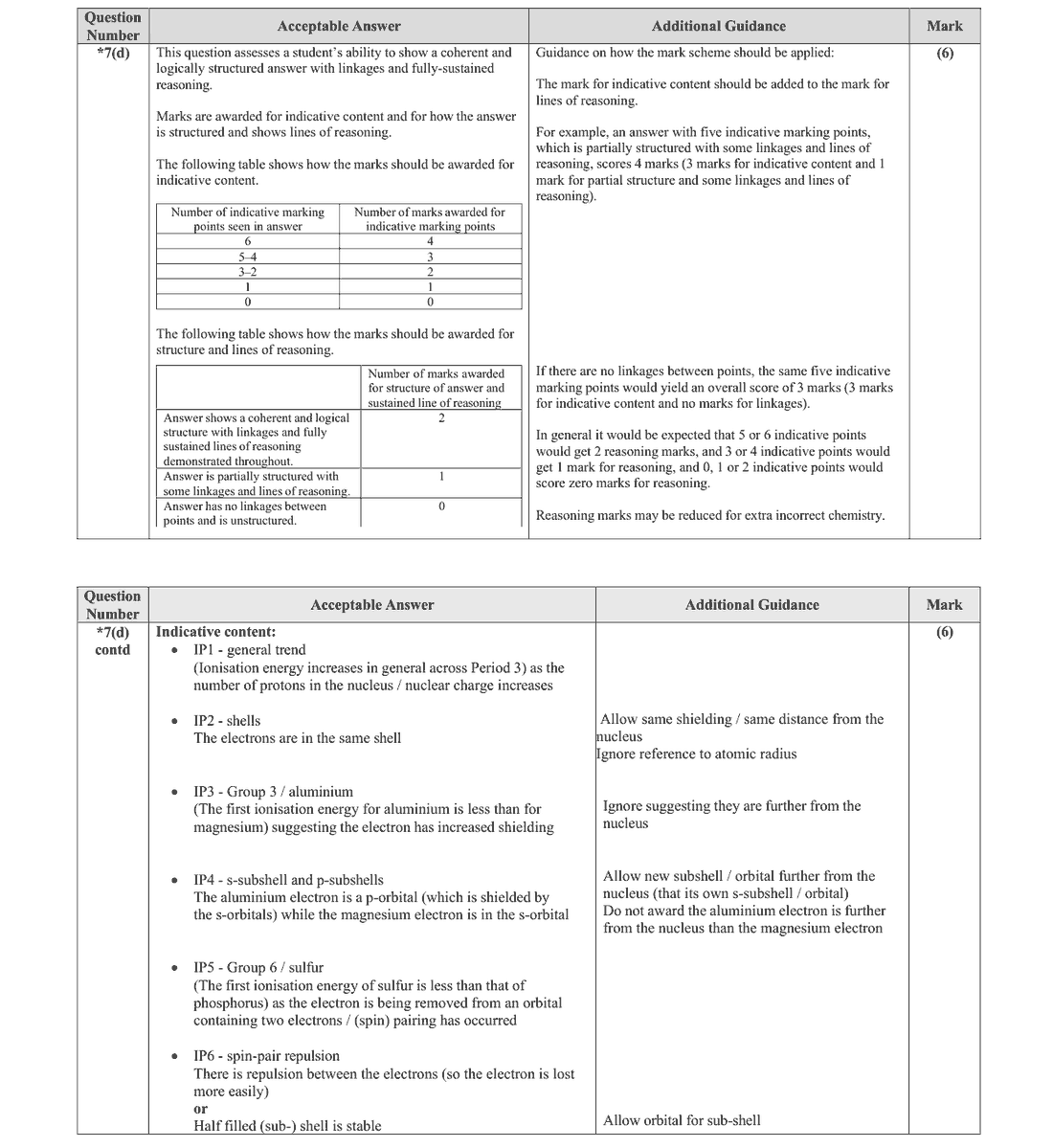
Mark scheme, with the indicative content and the marks for reasoning
Examiner's comment
Q7d required candidates to explain changes in the ionisation energies of period three. This question was answered relatively well, with the mean mark of three. Most candidates could identify the increase in number of protons, but some did not achieve the mark as they only referred to sodium and magnesium and not the trend across the whole period. Only some candidates referenced similar shielding across the period. Some candidates referred to a decrease in atomic radius, rather than similar shielding. The two ‘dips’ in the values were widely recognised, though the new sub-shell produced a range of comments, often related to the ‘p orbital’ without reference to magnesium’s outer ‘s orbital’. The increase in shielding for aluminum was seen infrequently. Many recognised that the values for phosphorus and sulfur were similar, but explanations of the pair forming in one orbital were often quite poor, with the reference to ‘repulsion between electrons’ also being limited to ‘repulsion’, with little explanation. Many diagrams of electron configuration were seen and these often supported explanations.
Notes from the mark scheme and report
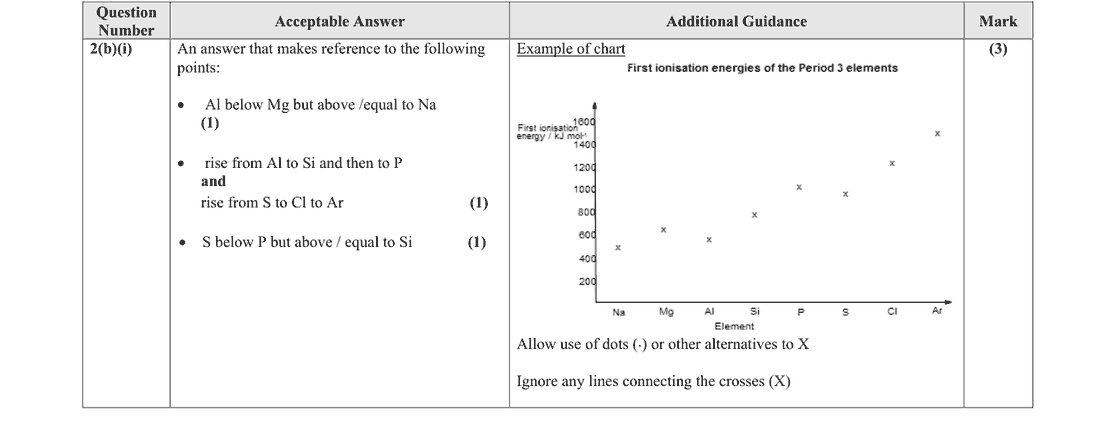
Indicative points: general increase across Period 3 because the number of protons / nuclear charge increases
the outer electrons are in the same shell (same shielding)
aluminium is lower than magnesium because its outer electron has more shielding
aluminium's electron is in a 3p orbital (shielded by the 3s), magnesium's is in the 3s
sulfur is lower than phosphorus because the electron is removed from an orbital containing a pair
repulsion between the paired electrons makes it easier to remove (or the half-filled sub-shell of phosphorus is stable). Not credited: aluminium's electron is further from the nucleus than magnesium's. Atomic radius is ignored. Mean mark about three. Weaknesses: the trend described only for sodium and magnesium
decreasing atomic radius given in place of similar shielding
'p orbital' with no reference to magnesium's s orbital
increased shielding for aluminium seldom seen
'repulsion' not explained
Skills: MS3.1 Translate information between graphical, numerical and algebraic forms
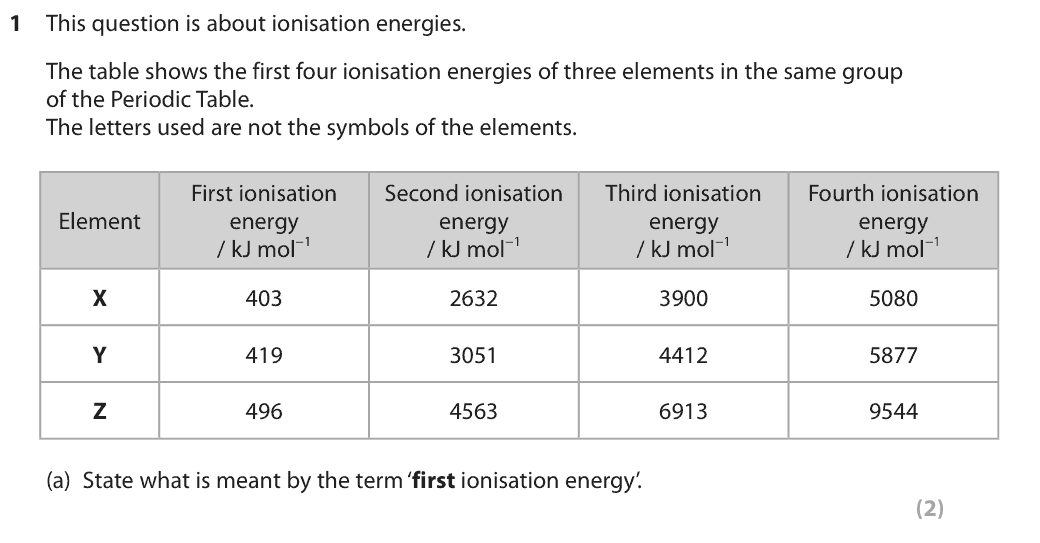
June 2025 · Paper 3 · Q1(a)2 marksShort answer
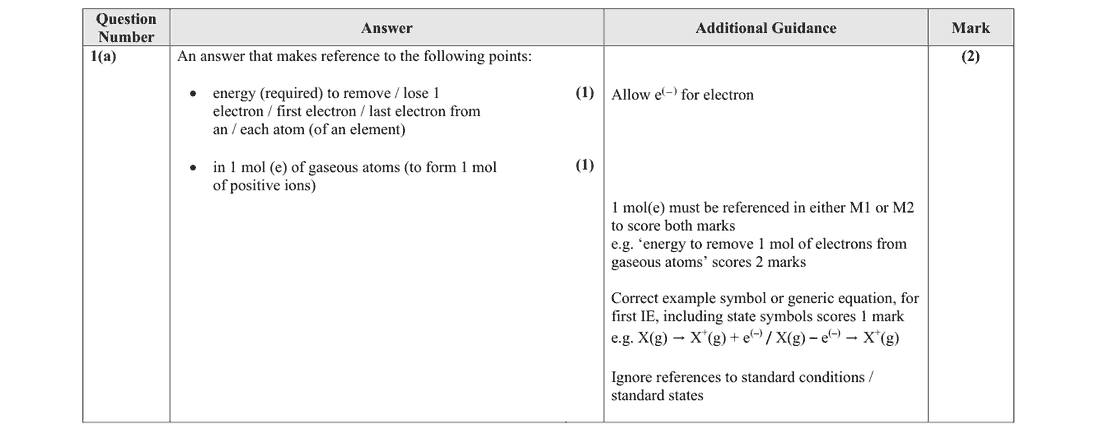
Mark scheme
Examiner's comment
This question asked candidates to write the definition of 'first ionisation energy'. This proved to be an accessible first question, with many candidates scoring both marks. Unclear definitions which omitted the mention of 'mole', 'atom(s)' or 'gaseous' state were often able to score one of the available marks.
Notes from the mark scheme and report
The energy required to remove one electron from each atom
in one mole of gaseous atoms (forming one mole of 1+ ions). The mole must be mentioned somewhere for both marks. A correct equation with state symbols, e.g. X(g) → X+(g) + e–, scores 1. References to standard conditions ignored. Definitions leaving out mole, atoms or gaseous often scored 1
June 2025 · Paper 3 · Q1(b)2 marksExplanation
Earlier part of question 1 that this part uses
Mark scheme
Examiner's comment
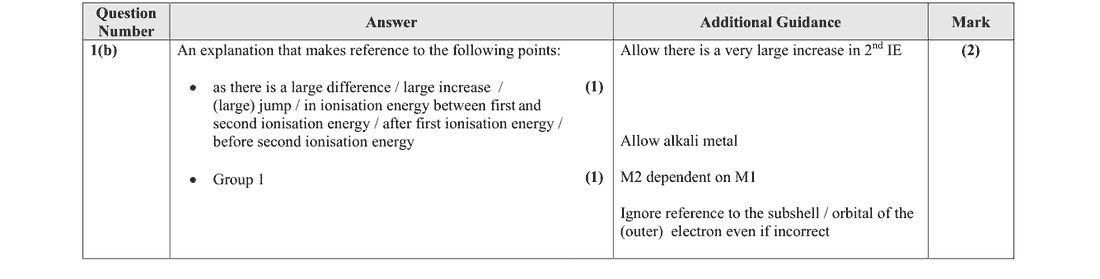
This was generally well-answered with candidates making the connection between the pattern of ionisation energies and the Group that the element is in. There is a clear difference in the table between the first and second ionisation energies indicating that the element is in Group 1.
Notes from the mark scheme and report
There is a large jump between the first and second ionisation energies (e.g. 403 to 2632)
so Group 1 (allow alkali metals). M2 depends on M1. Sub-shell references ignored
June 2025 · Paper 3 · Q1(c)3 marksExplanation
Earlier part of question 1 that this part uses
Mark scheme
Examiner's comment
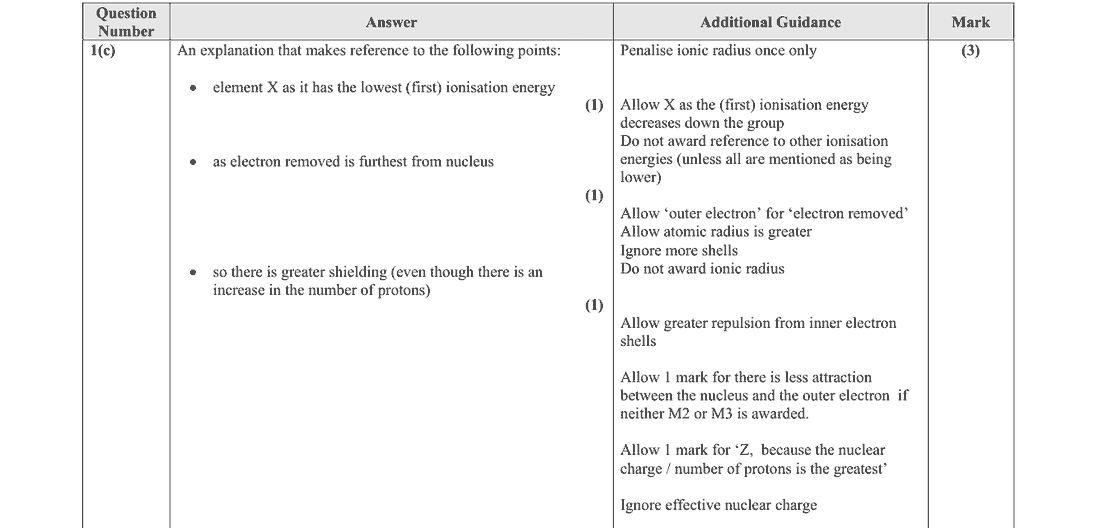
Many candidates showed a good understanding of the link between ionisation energy and atomic number, correctly identifying that element 'X' would have the lowest first ionisation energy, and many of these went on to score both of the additional marks for a correct explanation. There were a number of candidates who identified the element as element 'Z' instead. They were awarded one mark as long as they had stated that the nuclear charge / number of protons woud be the greatest.
Notes from the mark scheme and report
Element X, because it has the lowest first ionisation energy (ionisation energy decreases down the group)
its outer electron is furthest from the nucleus (allow larger atomic radius
not ionic radius
'more shells' ignored)
and there is greater shielding, despite the increase in the number of protons. One mark for 'less attraction between nucleus and outer electron' if neither M2 nor M3 is given. One mark for choosing Z because it has the greatest nuclear charge, which was a common wrong choice
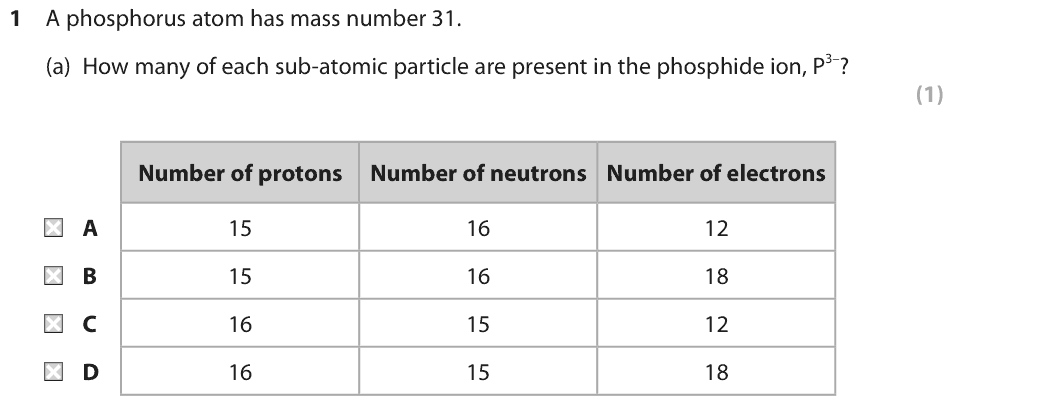
June 2024 · AS Paper 1 · Q11 markMultiple choice
Answer
B
Mark scheme
Examiner's comment
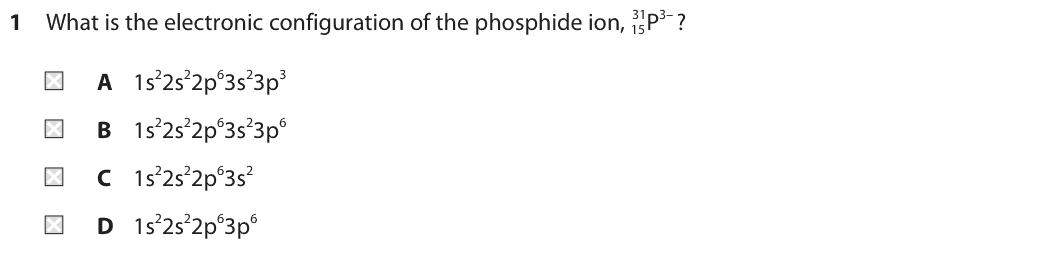
This was the most accessible question on the paper, with 90% of candidates scoring correctly.
Notes from the mark scheme and report
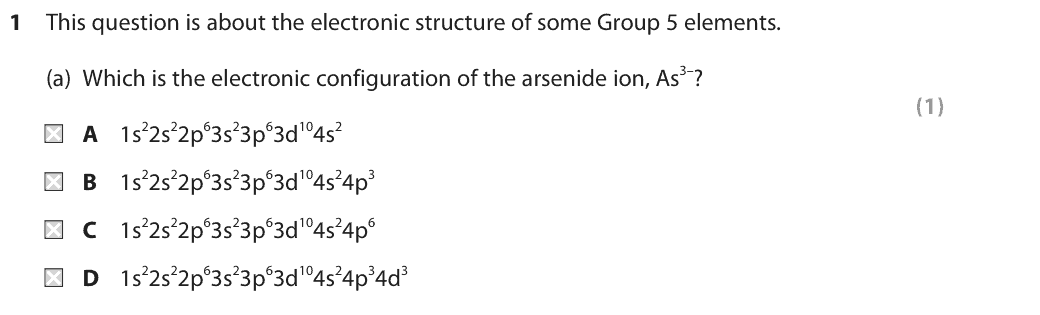
Answer: B. P3– has 18 electrons: 1s2 2s2 2p6 3s2 3p6. A is the phosphorus atom
C would be a P3+ ion
D leaves out the 3s orbital. The most accessible question on the paper: 90% correct
June 2024 · Paper 1 · Q1(a)3 marksShort answer
Mark scheme
Examiner's comment
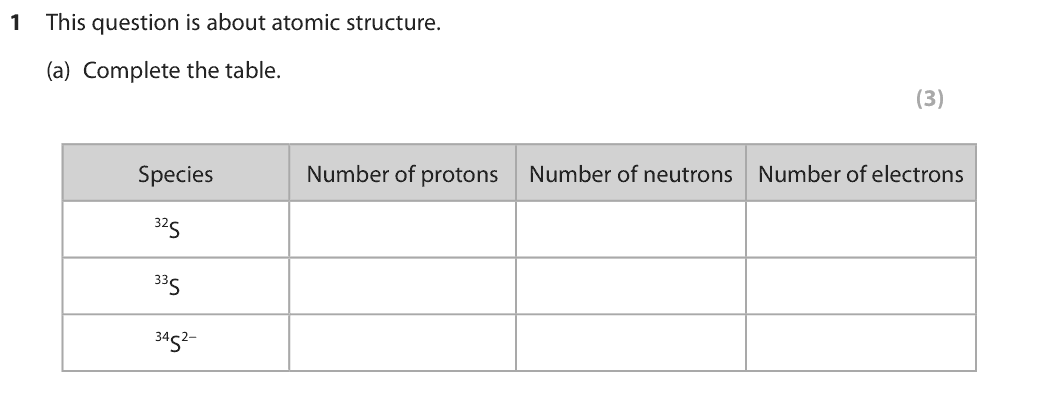
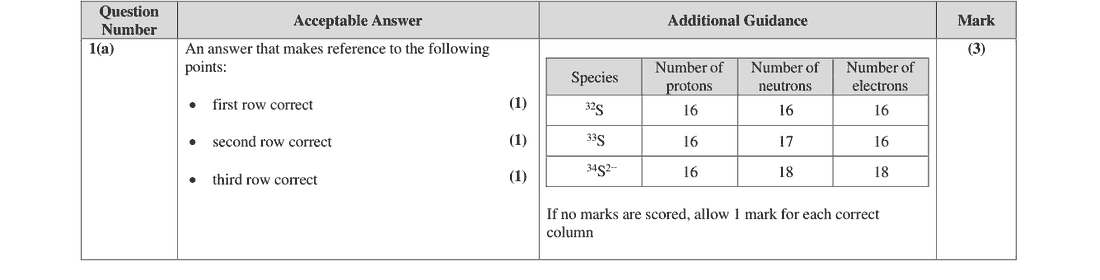
This was an introductory question designed to assess the candidates' ability to determine the number of sub-atomic particles in various species of sulfur.
Many fully correct answers were seen.
Common errors included not realising that the number of neutrons needed to change for each isotope and subtracting two from the proton number instead of adding two in the negative ion for the number of electrons.
There were a few instances of candidates using the mass number instead of the atomic number for the number of protons.
Notes from the mark scheme and report
Answer: 32S 16, 16, 16
33S 16, 17, 16
34S2– 16, 18, 18. One mark per correct row (if no row is right, one mark per correct column). Common errors: not changing the neutron number for each isotope
subtracting two electrons for the 2– ion instead of adding two
using the mass number for protons
June 2024 · Paper 1 · Q1(b)(i)1 markCalculation
Earlier part of question 1 that this part uses
Mark scheme
Examiner's comment
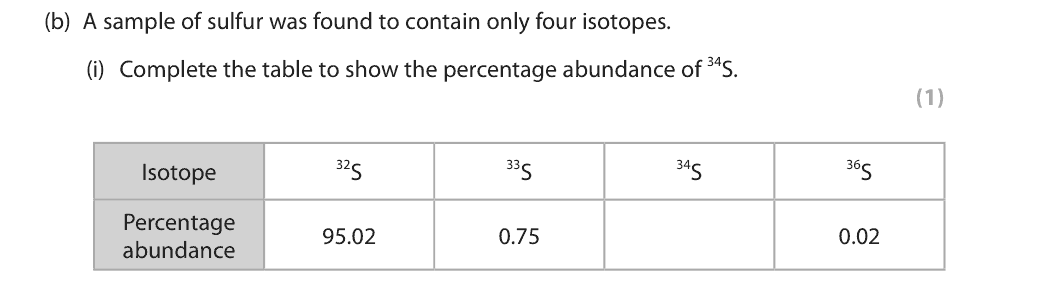
This question required candidates to calculate a % value and then use that value to calculate the relative atomic mass of sulfur using data from 4 isotopes.
There were a few errors seen in calculating the %. Candidates should check all answers using their calculators. Candidates also lost marks for incorrect rounding of their final answer.
A few candidates lost marks for incorrect units which were penalised if incorrect.
Notes from the mark scheme and report
Answer: 4.21 (%). 100 – 95.02 – 0.75 – 0.02
Skills: MS0.2 Use ratios, fractions and percentages
June 2024 · Paper 1 · Q1(b)(ii)2 marksCalculation
Earlier parts of question 1 that this part uses
Mark scheme
Examiner's comment
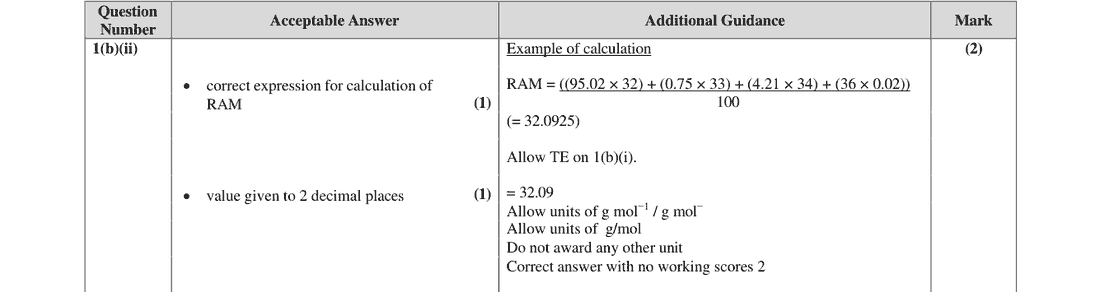
This question required candidates to calculate a % value and then use that value to calculate the relative atomic mass of sulfur using data from 4 isotopes.
There were a few errors seen in calculating the %. Candidates should check all answers using their calculators. Candidates also lost marks for incorrect rounding of their final answer.
A few candidates lost marks for incorrect units which were penalised if incorrect.
Notes from the mark scheme and report
Answer: 32.09. ((95.02 × 32) + (0.75 × 33) + (4.21 × 34) + (0.02 × 36)) ÷ 100 = 32.0925. Second mark is for two decimal places. No unit, or g mol–1
any other unit loses the mark. Common errors: rounding
wrong units
Skills: MS1.1 Use an appropriate number of significant figures; MS1.2 Find arithmetic means
June 2024 · AS Paper 1 · Q21 markMultiple choice
Answer
D
Mark scheme
Examiner's comment
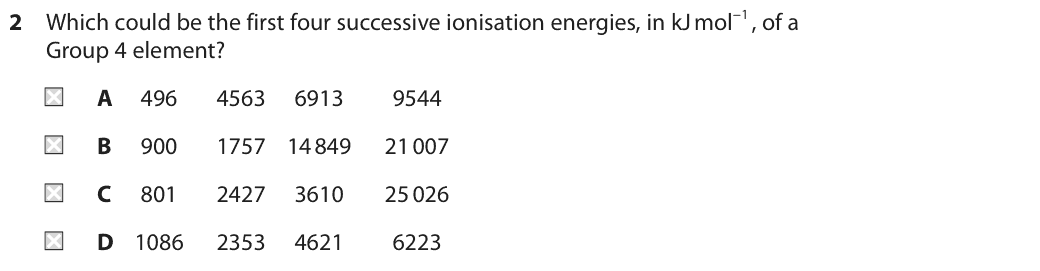
Only 50% of candidates scored correctly here, with some candidates struggling to recognise the large jump in energy.
Notes from the mark scheme and report
Answer: D. No large jump within the first four ionisation energies, so there are four outer electrons. A has the jump after the first (Group 1), B after the second (Group 2), C after the third (Group 3). Only 50% correct
some did not recognise the large jump
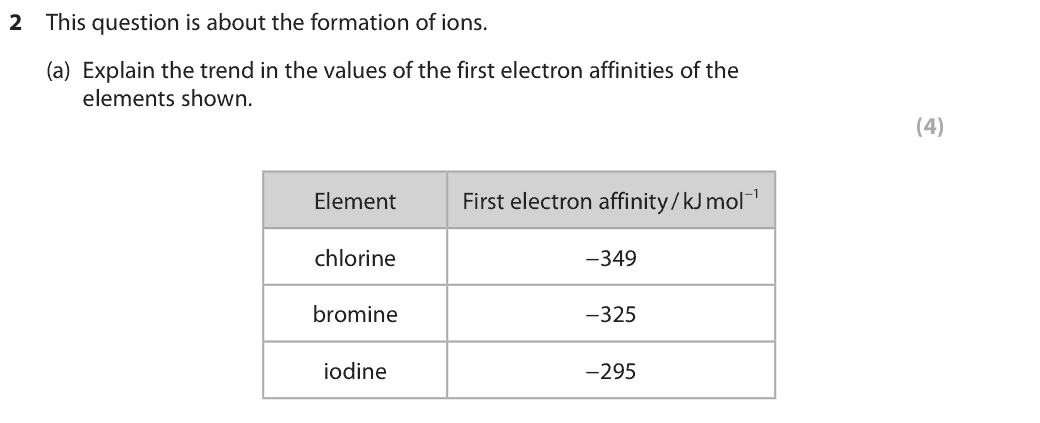
June 2024 · Paper 1 · Q2(a)4 marksExplanation
Mark scheme
Examiner's comment
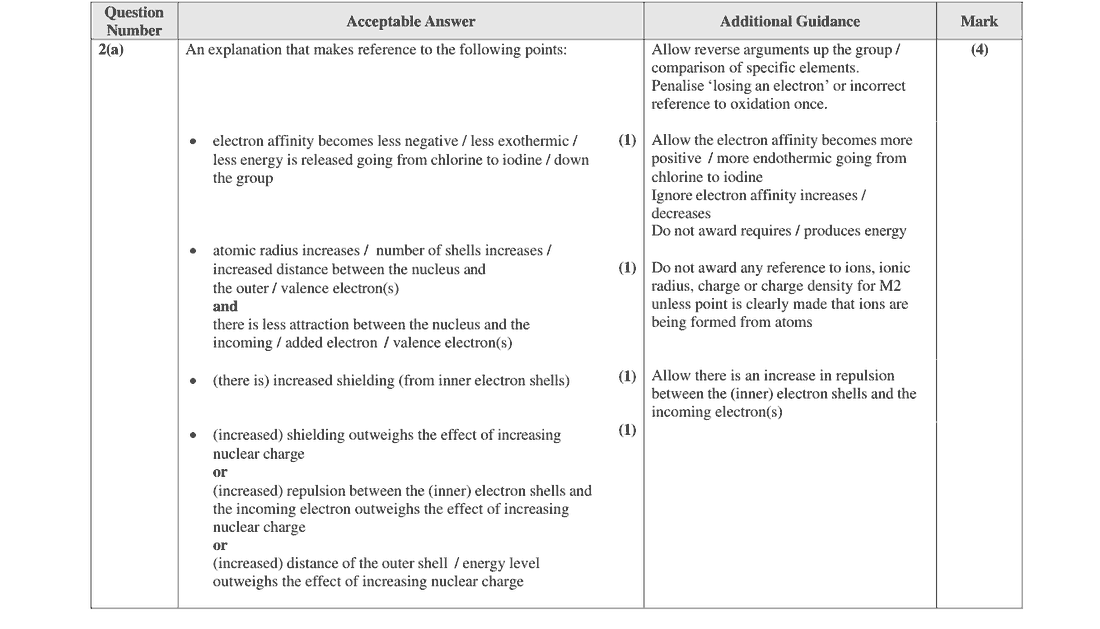
This question proved challenging with many candidates confusing first electron affinity with first ionisation energy. Many candidates suggested that energy was required for the process, despite the values given in the question being for an exothermic change. There were also a number of candidates who referred to losing an electron instead of gaining it. The last marking point, relating to the effects of shielding and distance from the nucleus outweighing the effect of increased nuclear charge, was rarely awarded.
Notes from the mark scheme and report
Electron affinity becomes less negative / less exothermic down the group
atomic radius or number of shells increases so there is less attraction between the nucleus and the incoming electron
shielding increases
the increased shielding (or distance) outweighs the increase in nuclear charge. Reverse argument allowed. 'Losing an electron' penalised once
'requires energy' not credited. Many confused electron affinity with ionisation energy
the last point was rarely given
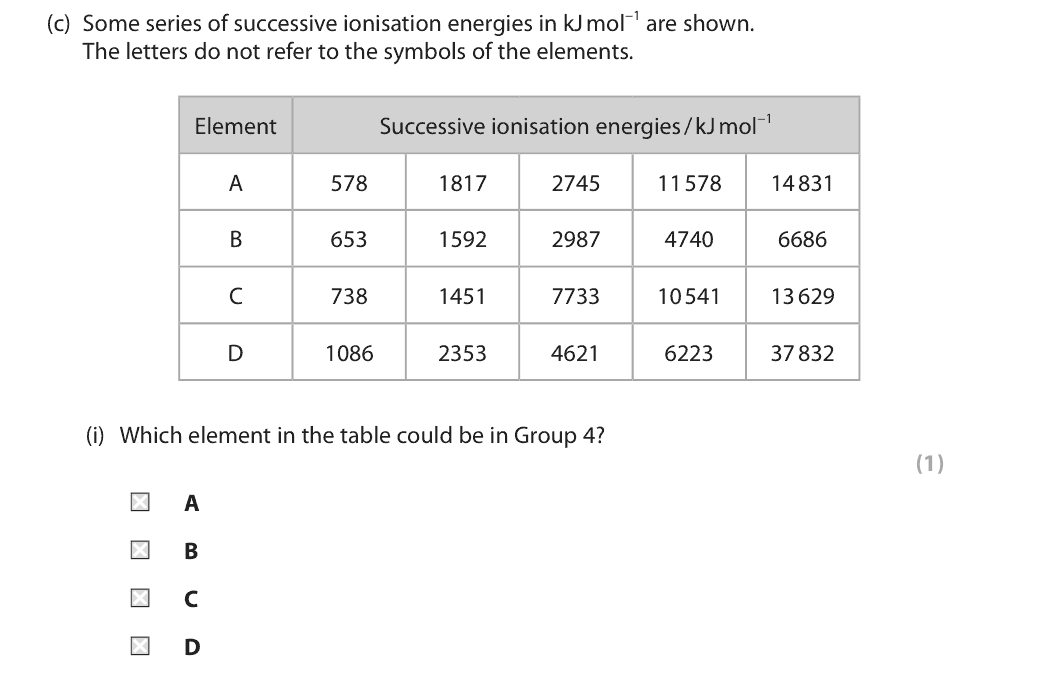
June 2024 · Paper 1 · Q2(c)(i)1 markMultiple choice
Earlier part of question 2 that this part uses
Answer
D
Mark scheme
Notes from the mark scheme and report
Answer: D. The large jump comes after the fourth ionisation energy (6223 to 37 832), so four outer electrons
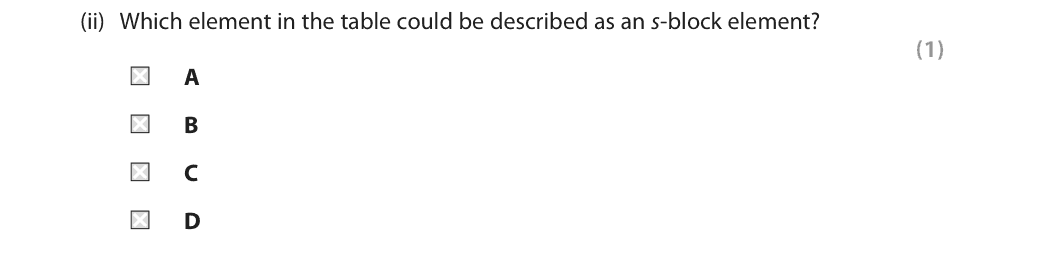
June 2024 · Paper 1 · Q2(c)(ii)1 markMultiple choice
Earlier parts of question 2 that this part uses
Answer
C
Mark scheme
Notes from the mark scheme and report
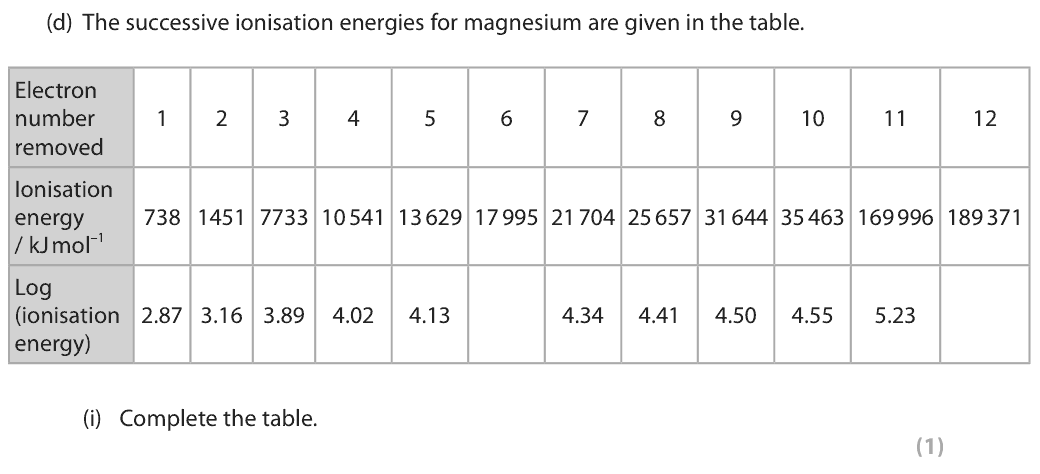
Answer: C. The large jump comes after the second ionisation energy (1451 to 7733), so Group 2, an s-block element. A is Group 3 (p-block) and B is a d-block element
June 2024 · AS Paper 1 · Q31 markMultiple choice
Answer
D
Mark scheme
Examiner's comment
This question was answered well by candidates, with 80% of candidates scoring correctly.
Notes from the mark scheme and report
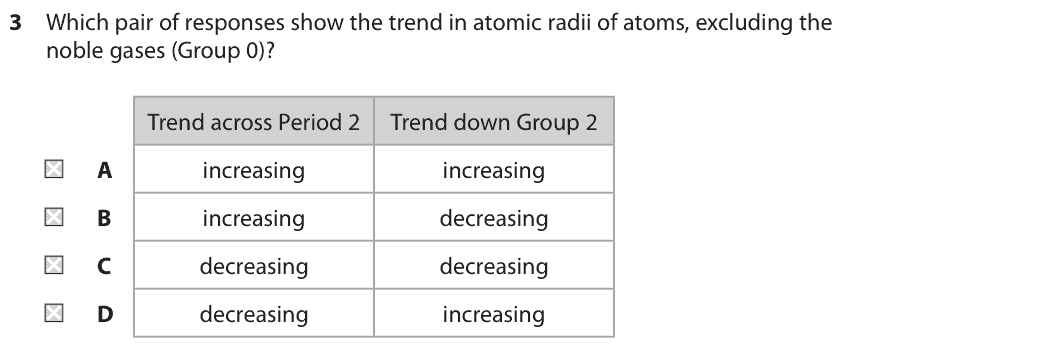
Answer: D. Atomic radius decreases across Period 2 and increases down Group 2. 80% correct
June 2024 · AS Paper 1 · Q6(b)2 marksCalculationEasy
Earlier part of question 6 that this part uses
Mark scheme
Examiner's comment
Candidates answered this question well, with 80% of candidates scoring full marks. Most marks were lost for incorrect number of decimal places, incorrect rounding, calculator error or stating an incorrect unit.
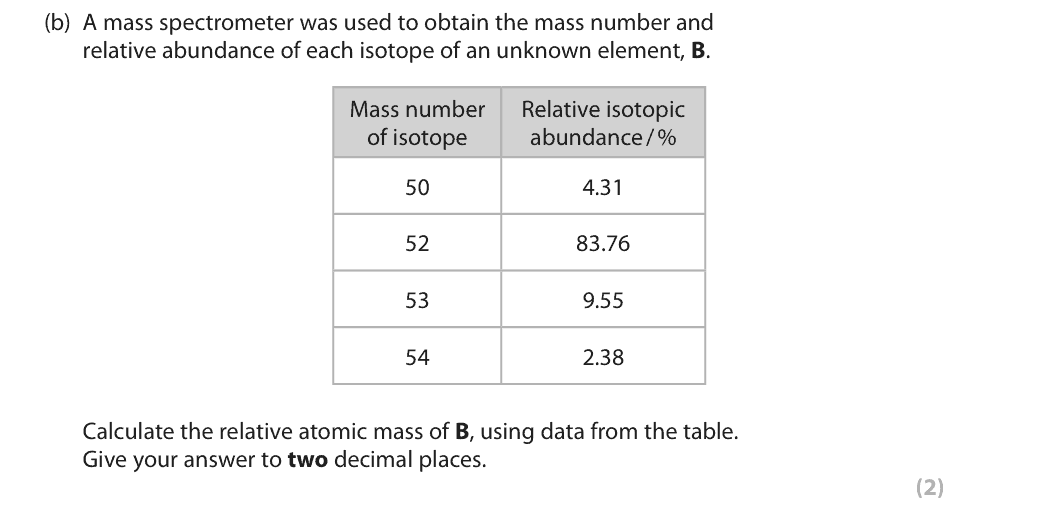
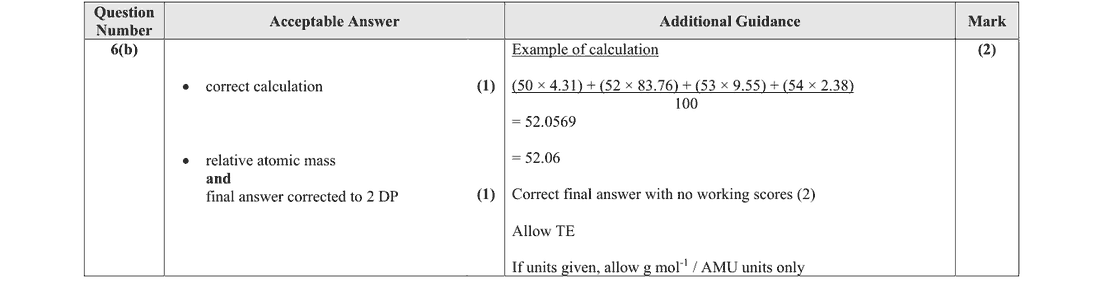
second mark for the answer to two decimal places. No unit, or g mol–1 / amu only. Marks were lost for decimal places, rounding, calculator slips or a wrong unit
Skills: MS1.1 Use an appropriate number of significant figures; MS1.2 Find arithmetic means
June 2024 · AS Paper 1 · Q6(c)1 markMultiple choice
Answer
C
Mark scheme
Examiner's comment
Candidates responded well to this question, with 85% of candidates answering correctly.
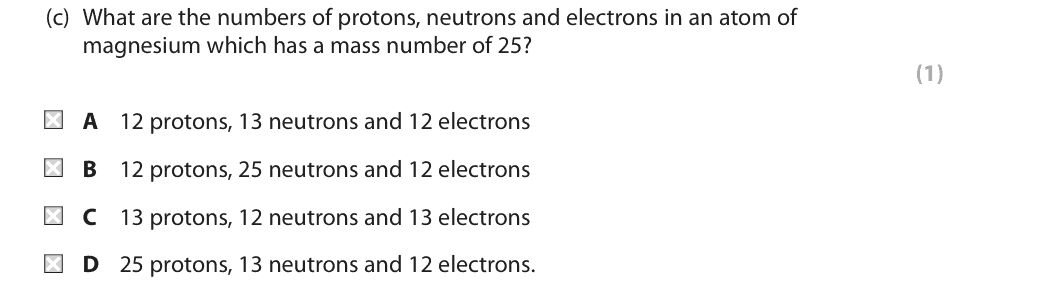
Notes from the mark scheme and report
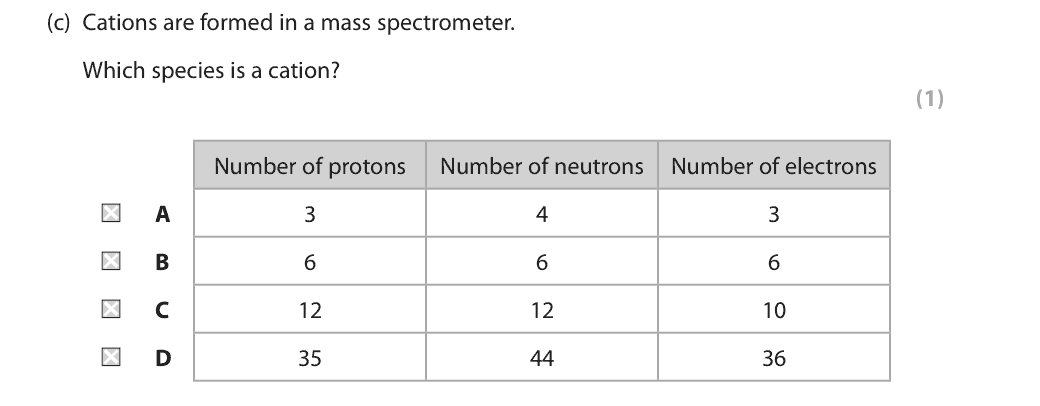
Answer: C (12 protons, 12 neutrons, 10 electrons). Fewer electrons than protons gives a positive ion. A and B are neutral atoms
D has more electrons than protons so is an anion. 85% correct
June 2024 · AS Paper 1 · Q6(d)1 markShort answer
Earlier part of question 6 that this part uses
Mark scheme
Examiner's comment
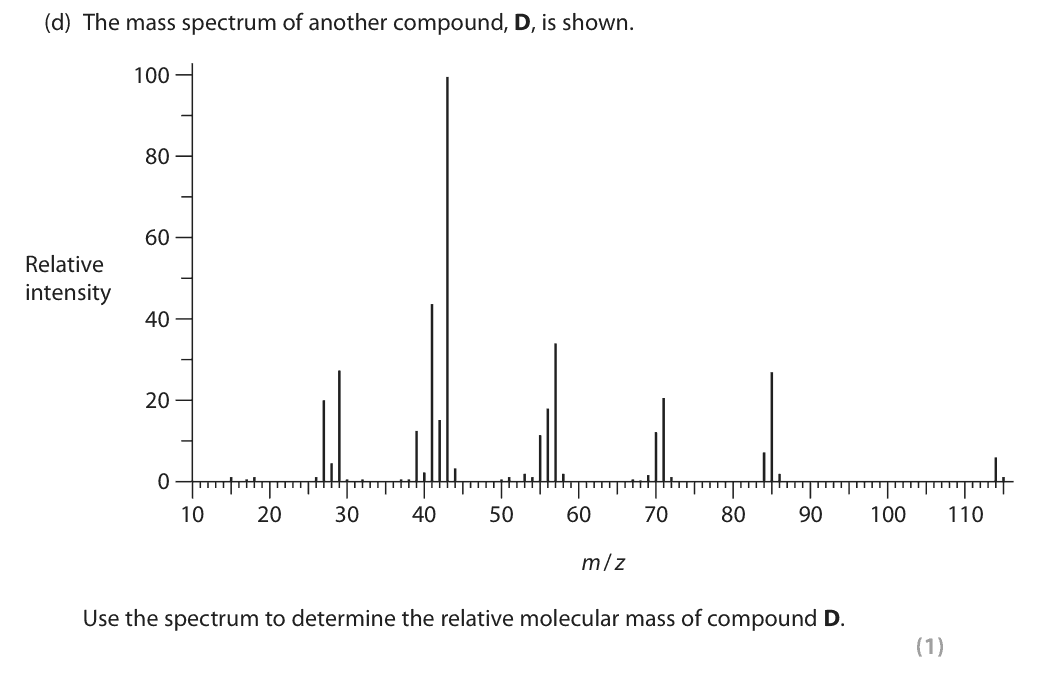
This question was answered relatively well. Overall, 50% of candidates answered question 6d correctly. This was mainly due to candidates stating the highest intensity peak at 43 as a molecular mass or the M+1 peak at 115.
Notes from the mark scheme and report
Answer: 114. The m/z of the molecular ion peak (the peak at highest m/z apart from the small M+1 peak). Units ignored. Only 50% correct: common errors were the base peak at 43 and the M+1 peak at 115
Skills: MS3.1 Translate information between graphical, numerical and algebraic forms
June 2024 · Paper 3 · Q1(a)2 marksShort answer
Mark scheme
Examiner's comment
Recall of the definition of relative isotopic mass in part (a) was intended to be a gentle start to the exam paper and the majority of candidates found it accessible. However there was considerable confusion seen with many relative atomic mass definitions given instead. Candidates are reminded that reference to an “atom” of the isotope or the standard of carbon-12 is essential with such definitions. It was unclear why but a small minority of candidates quoted carbon-13 as their reference standard and so did not score M2. It was good to see candidates working out the number of molecular ion peaks that would be made from the three hydrogen isotopes. However only the more able spotted that two combinations of isotopes would have the same m / z value and so result in a total number of five peaks and not six. A wide range of suggestions were seen, even up to eleven.
Notes from the mark scheme and report
The mass of an atom of an isotope (1)
relative to 1/12 of the mass of a carbon-12 atom (or to carbon-12 taken as exactly 12) (1). Not average / mean mass. A version in terms of one mole of atoms is allowed. Common errors: giving the definition of relative atomic mass
leaving out 'atom' or the carbon-12 standard
a small minority quoted carbon-13
June 2024 · Paper 3 · Q1(b)1 markShort answerHard
Mark scheme
Examiner's comment
Recall of the definition of relative isotopic mass in part (a) was intended to be a gentle start to the exam paper and the majority of candidates found it accessible. However there was considerable confusion seen with many relative atomic mass definitions given instead. Candidates are reminded that reference to an “atom” of the isotope or the standard of carbon-12 is essential with such definitions. It was unclear why but a small minority of candidates quoted carbon-13 as their reference standard and so did not score M2. It was good to see candidates working out the number of molecular ion peaks that would be made from the three hydrogen isotopes. However only the more able spotted that two combinations of isotopes would have the same m / z value and so result in a total number of five peaks and not six. A wide range of suggestions were seen, even up to eleven.
Notes from the mark scheme and report
Answer: 5. The possible masses of H2+ are 2, 3, 4, 5 and 6
two combinations (1H with 3H, and 2H with 2H) both give 4, so five peaks, not six. Suggestions up to eleven were seen
June 2023 · AS Paper 1 · Q1(a)1 markMultiple choice
Answer
B
Mark scheme
Examiner's comment
(a) This multiple choice question proved to be the most accessible question on the paper. (b)(i) Many candidates knew that the orbital was spherical. Some gave the shape of a p- orbital, normally describing it as a dumbbell but the most common incorrect answer was circular or a circle. This presumably is simply a result of seeing the shape of the orbital in books or on a screen. Models might be a help in resolving this misconception. (b)(ii) The idea of opposite spin was well known. Incorrect answers included travelling in opposite directions, rather than having opposite spin, or answers related to different subatomic particles, for example the charge of protons and electrons. (c) Candidates often find calculations centred on isotopic and relative atomic mass relatively straightforward, and this was the case here, with about 75% scoring both marks. There were a couple of different approaches other than the one in the mark scheme, but all were able to score marks. Very few candidates were penalised for using unreasonable numbers of significant figures, most giving an answer to match the values in the question, i.e., 2 significant figures. (d) The final item in this question was also well answered. The most common mistakes were to give the element as silicon or to have a mass number of 25, or both. The mass number required all seven particles, four protons and three neutrons, to be removed leaving 21, whilst the atomic number needed just the four protons subtracting. An atom with 10 protons is a neon atom.
Notes from the mark scheme and report
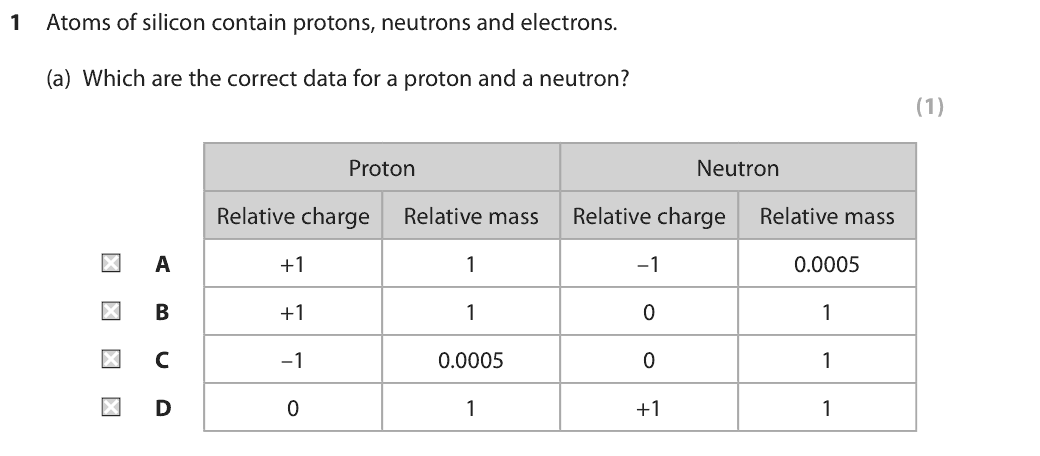
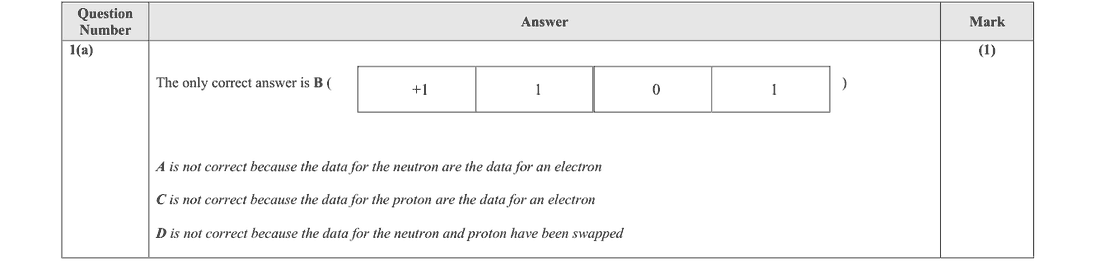
Answer: B. Proton: relative charge +1, relative mass 1
neutron: charge 0, mass 1. A and C use electron data (–1, 0.0005) for one of the particles
D swaps proton and neutron. The most accessible question on the paper
June 2023 · Paper 1 · Q1(a)1 markMultiple choice
Answer
B
Mark scheme
Notes from the mark scheme and report
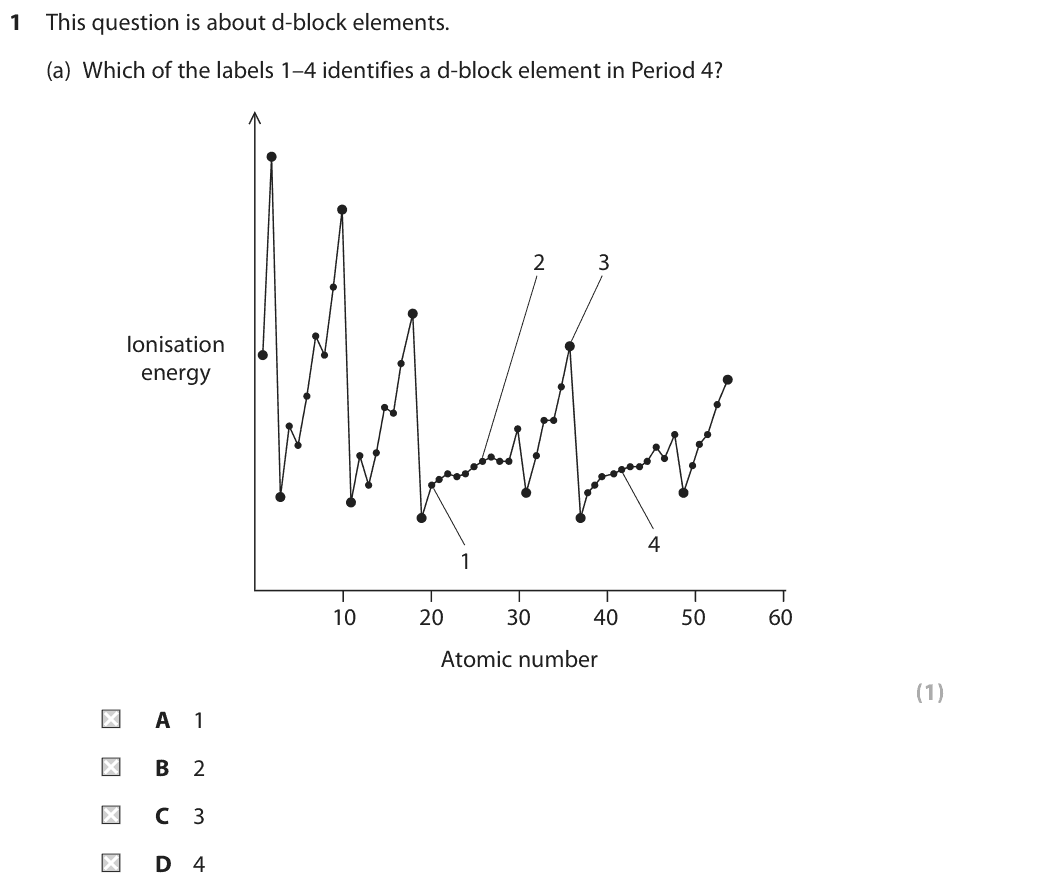
Answer: B (label 2). Label 2 lies among the elements with atomic numbers 21 to 30, the first row of the d-block, where first ionisation energy hardly changes. Label 1 is an s-block element, 3 is a p-block element and 4 is a d-block element in Period 5
Skills: MS3.1 Translate information between graphical, numerical and algebraic forms
June 2023 · Paper 1 · Q1(b)1 markShort answer
Mark scheme
Examiner's comment
Very few candidates gave the best meaning of a d-block element as shown in the mark scheme. However, many candidates scored a mark as other descriptions, such as the last electron is in a d orbital, were allowed. Some candidates just stated that the outer orbital is a d orbital and did not mention electrons and others just stated that there are electrons in the d-subshell. A few candidates gave the general properties of transition metals, such as variable oxidation states.
Notes from the mark scheme and report
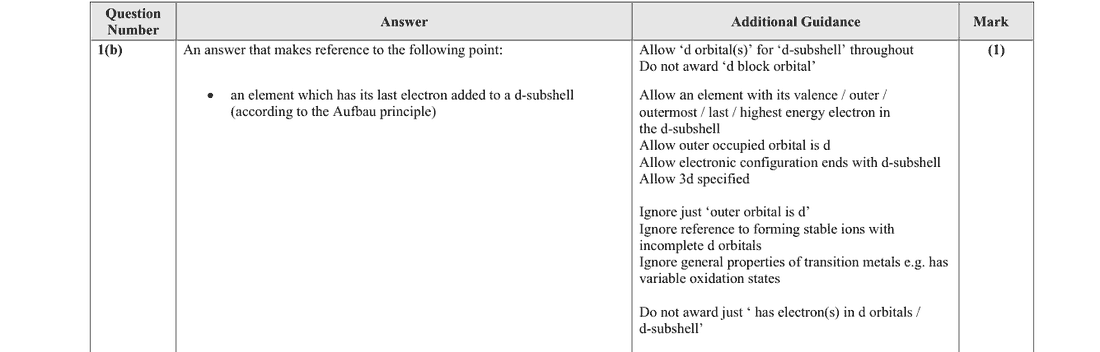
An element whose last electron is added to a d subshell (outermost / highest energy electron in a d subshell
configuration ends in a d subshell
'd orbitals' allowed). Not just 'has electrons in the d subshell'
'outer orbital is d' with no mention of electrons is ignored, as are transition metal properties such as variable oxidation states and the 'stable ion with an incomplete d subshell' definition. Very few gave the best definition but many scored through the allowed wordings
June 2023 · AS Paper 1 · Q1(b)(i)1 markShort answer
Mark scheme
Examiner's comment
(a) This multiple choice question proved to be the most accessible question on the paper. (b)(i) Many candidates knew that the orbital was spherical. Some gave the shape of a p- orbital, normally describing it as a dumbbell but the most common incorrect answer was circular or a circle. This presumably is simply a result of seeing the shape of the orbital in books or on a screen. Models might be a help in resolving this misconception. (b)(ii) The idea of opposite spin was well known. Incorrect answers included travelling in opposite directions, rather than having opposite spin, or answers related to different subatomic particles, for example the charge of protons and electrons. (c) Candidates often find calculations centred on isotopic and relative atomic mass relatively straightforward, and this was the case here, with about 75% scoring both marks. There were a couple of different approaches other than the one in the mark scheme, but all were able to score marks. Very few candidates were penalised for using unreasonable numbers of significant figures, most giving an answer to match the values in the question, i.e., 2 significant figures. (d) The final item in this question was also well answered. The most common mistakes were to give the element as silicon or to have a mass number of 25, or both. The mass number required all seven particles, four protons and three neutrons, to be removed leaving 21, whilst the atomic number needed just the four protons subtracting. An atom with 10 protons is a neon atom.
Notes from the mark scheme and report
Answer: spherical (a drawing of a sphere allowed). 'Circular' or a circle is ignored and was the commonest wrong answer
some gave the dumbbell shape of a p-orbital
June 2023 · AS Paper 1 · Q1(b)(ii)1 markShort answer
Earlier part of question 1 that this part uses
Mark scheme
Examiner's comment
(a) This multiple choice question proved to be the most accessible question on the paper. (b)(i) Many candidates knew that the orbital was spherical. Some gave the shape of a p- orbital, normally describing it as a dumbbell but the most common incorrect answer was circular or a circle. This presumably is simply a result of seeing the shape of the orbital in books or on a screen. Models might be a help in resolving this misconception. (b)(ii) The idea of opposite spin was well known. Incorrect answers included travelling in opposite directions, rather than having opposite spin, or answers related to different subatomic particles, for example the charge of protons and electrons. (c) Candidates often find calculations centred on isotopic and relative atomic mass relatively straightforward, and this was the case here, with about 75% scoring both marks. There were a couple of different approaches other than the one in the mark scheme, but all were able to score marks. Very few candidates were penalised for using unreasonable numbers of significant figures, most giving an answer to match the values in the question, i.e., 2 significant figures. (d) The final item in this question was also well answered. The most common mistakes were to give the element as silicon or to have a mass number of 25, or both. The mass number required all seven particles, four protons and three neutrons, to be removed leaving 21, whilst the atomic number needed just the four protons subtracting. An atom with 10 protons is a neon atom.
Notes from the mark scheme and report
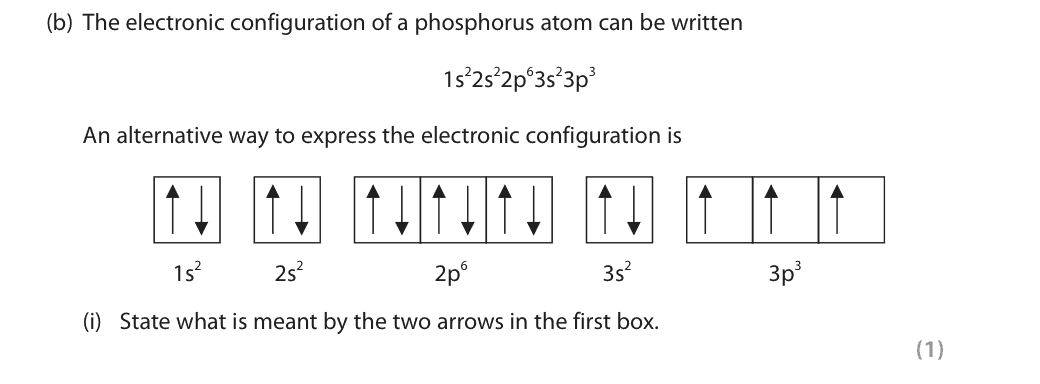
The two electrons have opposite spins (allow different direction of spin). Wrong answers: 'travelling in opposite directions'
comparing protons and electrons
June 2023 · AS Paper 1 · Q1(c)2 marksCalculation
Earlier part of question 1 that this part uses
Mark scheme
Examiner's comment
(a) This multiple choice question proved to be the most accessible question on the paper. (b)(i) Many candidates knew that the orbital was spherical. Some gave the shape of a p- orbital, normally describing it as a dumbbell but the most common incorrect answer was circular or a circle. This presumably is simply a result of seeing the shape of the orbital in books or on a screen. Models might be a help in resolving this misconception. (b)(ii) The idea of opposite spin was well known. Incorrect answers included travelling in opposite directions, rather than having opposite spin, or answers related to different subatomic particles, for example the charge of protons and electrons. (c) Candidates often find calculations centred on isotopic and relative atomic mass relatively straightforward, and this was the case here, with about 75% scoring both marks. There were a couple of different approaches other than the one in the mark scheme, but all were able to score marks. Very few candidates were penalised for using unreasonable numbers of significant figures, most giving an answer to match the values in the question, i.e., 2 significant figures. (d) The final item in this question was also well answered. The most common mistakes were to give the element as silicon or to have a mass number of 25, or both. The mass number required all seven particles, four protons and three neutrons, to be removed leaving 21, whilst the atomic number needed just the four protons subtracting. An atom with 10 protons is a neon atom.
Notes from the mark scheme and report
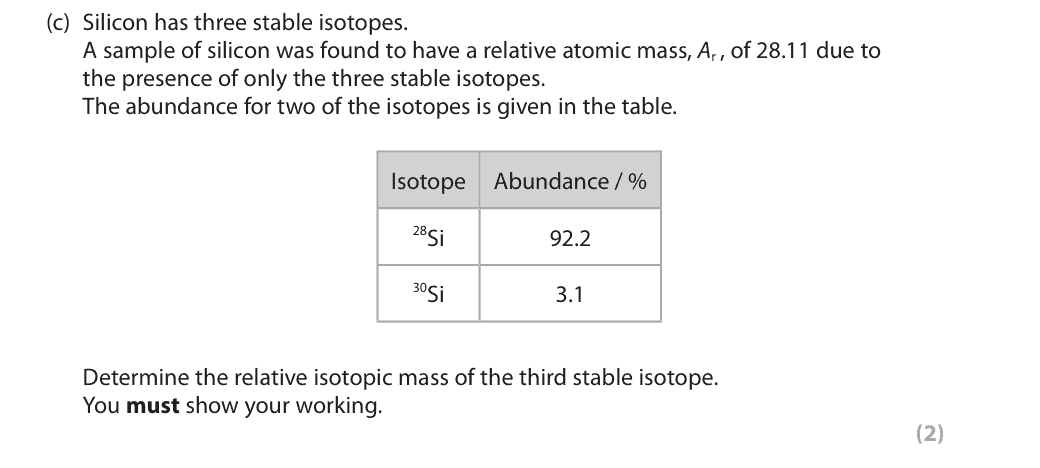
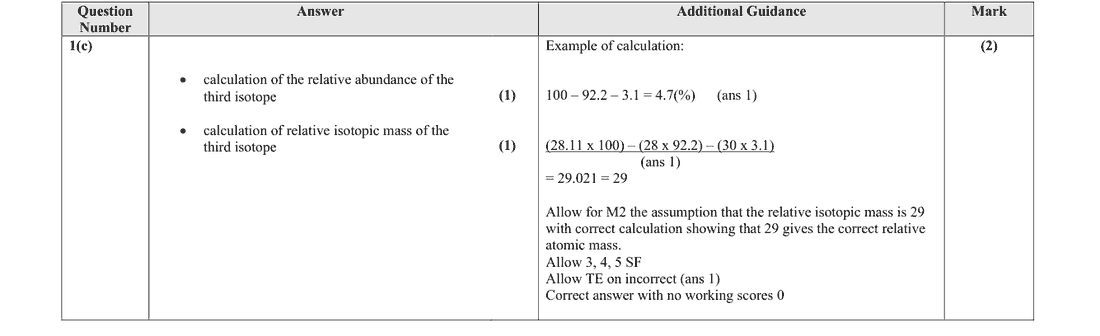
Answer: 29 (29.02). Abundance of third isotope = 100 – 92.2 – 3.1 = 4.7 % (M1)
((28.11 × 100) – (28 × 92.2) – (30 × 3.1)) ÷ 4.7 = 29.021 (M2). Assuming 29 and showing it gives the correct relative atomic mass is allowed for M2. 3 to 5 s.f. allowed
error carried forward from a wrong abundance
a correct answer with no working scores 0. About 75% scored both marks
Skills: MS0.2 Use ratios, fractions and percentages; MS2.2 Change the subject of an equation; MS2.4 Solve algebraic equations
June 2023 · AS Paper 1 · Q1(d)1 markShort answer
Earlier part of question 1 that this part uses
Mark scheme
Examiner's comment
(a) This multiple choice question proved to be the most accessible question on the paper. (b)(i) Many candidates knew that the orbital was spherical. Some gave the shape of a p- orbital, normally describing it as a dumbbell but the most common incorrect answer was circular or a circle. This presumably is simply a result of seeing the shape of the orbital in books or on a screen. Models might be a help in resolving this misconception. (b)(ii) The idea of opposite spin was well known. Incorrect answers included travelling in opposite directions, rather than having opposite spin, or answers related to different subatomic particles, for example the charge of protons and electrons. (c) Candidates often find calculations centred on isotopic and relative atomic mass relatively straightforward, and this was the case here, with about 75% scoring both marks. There were a couple of different approaches other than the one in the mark scheme, but all were able to score marks. Very few candidates were penalised for using unreasonable numbers of significant figures, most giving an answer to match the values in the question, i.e., 2 significant figures. (d) The final item in this question was also well answered. The most common mistakes were to give the element as silicon or to have a mass number of 25, or both. The mass number required all seven particles, four protons and three neutrons, to be removed leaving 21, whilst the atomic number needed just the four protons subtracting. An atom with 10 protons is a neon atom.
Notes from the mark scheme and report
Answer: neon with mass number 21 and atomic number 10. 14 – 4 = 10 protons (neon)
mass number 28 – 7 = 21. Common errors: keeping the symbol Si
mass number 25
June 2023 · Paper 1 · Q2(a)2 marksShort answer
Mark scheme
Examiner's comment
Although many candidates understood what is meant by the term 'orbital', a significant number were unable to use the correct terminology to describe a region, space or area where an electron is most likely to be found. Quite a lot of candidates omitted to mention that an orbital can hold two electrons with opposite spins. Some candidates thought that a p orbital could hold 6 electrons and a d orbital 10 electrons., showing confusion between orbitals and subshells.
Notes from the mark scheme and report
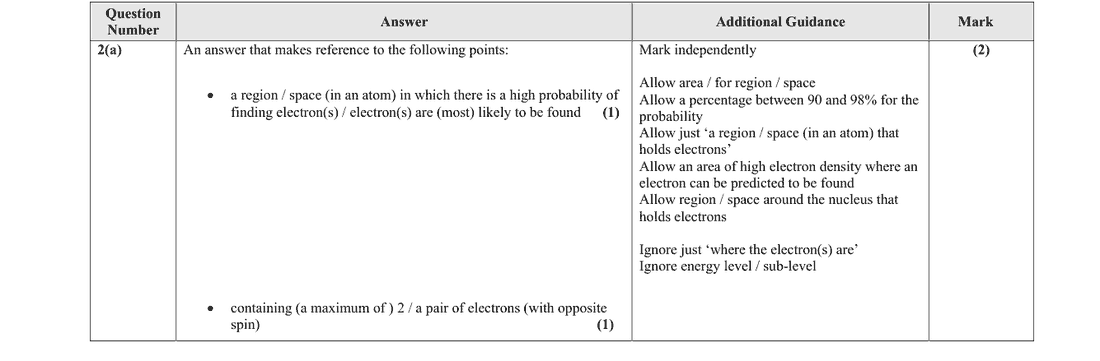
M1: a region / space in an atom where there is a high probability of finding an electron (allow a region that holds electrons). M2: which can hold up to two electrons (with opposite spins). Marked independently
ignore energy level or sub-level. Common errors: no word such as region or space
leaving out the two electrons
saying a p orbital holds 6 or a d orbital 10 (confusing orbital with subshell)
June 2023 · AS Paper 1 · Q2(a)(i)1 markShort answer
Mark scheme
Examiner's comment
(a)(i) This question proved more challenging than expected. Candidates most often scored the mark by answering that the substance was not a molecule. The idea that giant structures require the use of the relative formula mass was clearly not well understood. Of course, molar mass calculation can be carried out without this knowledge. Common incorrect answers included comments about the mass being relative to 1/12th of the mass of carbon-12, the answer to the next item. (a)(ii) The answer here was better understood. The idea of comparing to the mass of a 1/12th of atom of carbon-12 was quite well known and there were ideas that the mass was a relative mass or a comparison. Some candidates realised that the units would cancel and scored the mark in this way. (a)(iii) The multiple choice questions was mostly answered correctly, with over 85% of candidates scoring this mark.
(a)(iv) Whichever answer was given in (a)(iii) candidates were still able to score by calculating the correct number of moles here. For those who knew the calculation to do, which included most candidates, the only common error was to use only one significant figure, which did not score the mark. (b) Testing for the metal ions using flame test proved to be commonly understood, with most scoring the first mark for the lilac flame of the potassium ion, and many knew that the magnesium ion did not give a flame colour, with candidates often stating that the wavelength associated with the transition was outside of the visible region. Unfortunately, it was common for answers to talk about potassium and magnesium rather than their ions. This was penalised if comments were made about magnesium giving no flame colour. Magnesium metal, of course, burns with a very bright white flame and so the omission of the word ‘ions’ was penalised here. The addition of hydroxide ions proved less well known, though many candidates did recognise the magnesium hydroxide would precipitate. It was quite common for candidates to discuss the lilac flame and the magnesium hydroxide precipitate without mentioning the negative tests, even though that was specifically asked for in the question. Candidates should read the questions with care. (c)(i) Just over half of candidates were able to score this mark. (c)(ii) Ionic equations continue to be something which would benefit from further study. This equation, which is quite commonly asked as it is one of the tests for ions which needs to be known, was not well understood. There were many attempts at full equations. Some candidates did not register that state symbols were required. Although it was possible to score the mark for answers in (c)(i) for options A and B, this was very rarely scored, firstly because these were not often selected, and secondly because the ionic equation was less straightforward, due to the difference in charges on the ions.
Notes from the mark scheme and report
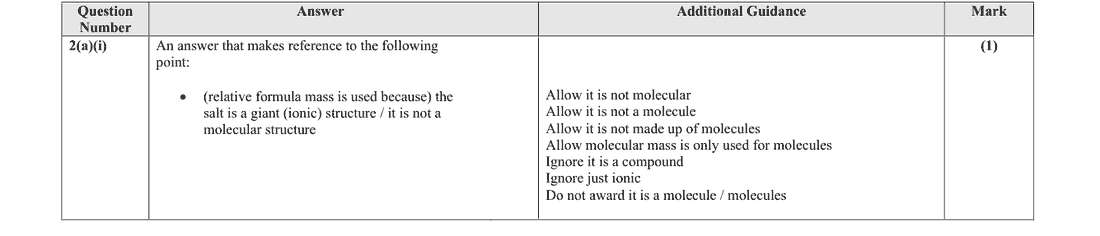
Because the salt has a giant (ionic) structure / is not made of molecules. Allow 'molecular mass is only used for molecules'. Just 'ionic' or 'it is a compound' is ignored. A common wrong answer gave the carbon-12 comparison, which belongs to (a)(ii)
June 2023 · AS Paper 1 · Q2(a)(ii)1 markShort answer
Earlier part of question 2 that this part uses
Mark scheme
Examiner's comment
(a)(i) This question proved more challenging than expected. Candidates most often scored the mark by answering that the substance was not a molecule. The idea that giant structures require the use of the relative formula mass was clearly not well understood. Of course, molar mass calculation can be carried out without this knowledge. Common incorrect answers included comments about the mass being relative to 1/12th of the mass of carbon-12, the answer to the next item. (a)(ii) The answer here was better understood. The idea of comparing to the mass of a 1/12th of atom of carbon-12 was quite well known and there were ideas that the mass was a relative mass or a comparison. Some candidates realised that the units would cancel and scored the mark in this way. (a)(iii) The multiple choice questions was mostly answered correctly, with over 85% of candidates scoring this mark.
(a)(iv) Whichever answer was given in (a)(iii) candidates were still able to score by calculating the correct number of moles here. For those who knew the calculation to do, which included most candidates, the only common error was to use only one significant figure, which did not score the mark. (b) Testing for the metal ions using flame test proved to be commonly understood, with most scoring the first mark for the lilac flame of the potassium ion, and many knew that the magnesium ion did not give a flame colour, with candidates often stating that the wavelength associated with the transition was outside of the visible region. Unfortunately, it was common for answers to talk about potassium and magnesium rather than their ions. This was penalised if comments were made about magnesium giving no flame colour. Magnesium metal, of course, burns with a very bright white flame and so the omission of the word ‘ions’ was penalised here. The addition of hydroxide ions proved less well known, though many candidates did recognise the magnesium hydroxide would precipitate. It was quite common for candidates to discuss the lilac flame and the magnesium hydroxide precipitate without mentioning the negative tests, even though that was specifically asked for in the question. Candidates should read the questions with care. (c)(i) Just over half of candidates were able to score this mark. (c)(ii) Ionic equations continue to be something which would benefit from further study. This equation, which is quite commonly asked as it is one of the tests for ions which needs to be known, was not well understood. There were many attempts at full equations. Some candidates did not register that state symbols were required. Although it was possible to score the mark for answers in (c)(i) for options A and B, this was very rarely scored, firstly because these were not often selected, and secondly because the ionic equation was less straightforward, due to the difference in charges on the ions.
Notes from the mark scheme and report
It is a mass measured relative to (compared with) 1/12 of the mass of an atom of carbon-12, so the units cancel (g ÷ g). Allow 'a relative mass is a comparison, not an actual mass'. Just 'it is a relative mass' is ignored
June 2023 · AS Paper 1 · Q2(a)(iii)1 markMultiple choice
Earlier part of question 2 that this part uses
Answer
C
Mark scheme
Examiner's comment
(a)(i) This question proved more challenging than expected. Candidates most often scored the mark by answering that the substance was not a molecule. The idea that giant structures require the use of the relative formula mass was clearly not well understood. Of course, molar mass calculation can be carried out without this knowledge. Common incorrect answers included comments about the mass being relative to 1/12th of the mass of carbon-12, the answer to the next item. (a)(ii) The answer here was better understood. The idea of comparing to the mass of a 1/12th of atom of carbon-12 was quite well known and there were ideas that the mass was a relative mass or a comparison. Some candidates realised that the units would cancel and scored the mark in this way. (a)(iii) The multiple choice questions was mostly answered correctly, with over 85% of candidates scoring this mark.
(a)(iv) Whichever answer was given in (a)(iii) candidates were still able to score by calculating the correct number of moles here. For those who knew the calculation to do, which included most candidates, the only common error was to use only one significant figure, which did not score the mark. (b) Testing for the metal ions using flame test proved to be commonly understood, with most scoring the first mark for the lilac flame of the potassium ion, and many knew that the magnesium ion did not give a flame colour, with candidates often stating that the wavelength associated with the transition was outside of the visible region. Unfortunately, it was common for answers to talk about potassium and magnesium rather than their ions. This was penalised if comments were made about magnesium giving no flame colour. Magnesium metal, of course, burns with a very bright white flame and so the omission of the word ‘ions’ was penalised here. The addition of hydroxide ions proved less well known, though many candidates did recognise the magnesium hydroxide would precipitate. It was quite common for candidates to discuss the lilac flame and the magnesium hydroxide precipitate without mentioning the negative tests, even though that was specifically asked for in the question. Candidates should read the questions with care. (c)(i) Just over half of candidates were able to score this mark. (c)(ii) Ionic equations continue to be something which would benefit from further study. This equation, which is quite commonly asked as it is one of the tests for ions which needs to be known, was not well understood. There were many attempts at full equations. Some candidates did not register that state symbols were required. Although it was possible to score the mark for answers in (c)(i) for options A and B, this was very rarely scored, firstly because these were not often selected, and secondly because the ionic equation was less straightforward, due to the difference in charges on the ions.
Notes from the mark scheme and report
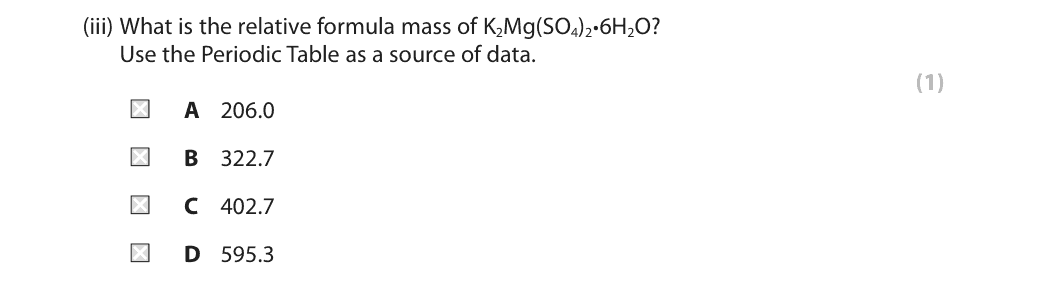
Answer: C (402.7). Uses the Periodic Table only: (2 × 39.1) + 24.3 + 2 × (32.1 + 64.0) + 6 × 18.0. A is the sum of the atomic numbers
B counts 6H2 but only one O for the water
D treats the sulfate as (S4O4)2. Over 85% correct
June 2023 · Paper 1 · Q2(b)2 marksDiagram or structure
Mark scheme
Examiner's comment
Many candidates knew the shapes of an s orbital and a p orbital, but they could not all draw them accurately. For example, it was not acceptable to draw the s orbital as an oval and the two lobes of the p orbital had to be similar in size.
Notes from the mark scheme and report
s orbital drawn as a circle / sphere
p orbital as a dumb-bell / figure of 8, in any orientation (all three p orbitals may be shown). Not an oval for the s orbital
not p lobes of very different sizes
not a four-lobed clover unless labelled as separate orbitals. Shapes were known but often drawn inaccurately
Skills: MS4.2 Visualise and represent 2D and 3D forms including two- dimensional representations of 3D objects
June 2023 · AS Paper 1 · Q3(a)(ii)1 markMultiple choice
Earlier part of question 3 that this part uses
Answer
C
Mark scheme
Examiner's comment
(a)(i) Approximately 75% of candidates were able to give B as the correct answer. (a)(ii) Approximately 50% of candidates scored the mark. (a)(iii) The most common mistake was to have on dative covalent bond from a bridging bromine and the other from a terminal one. Candidates could still score for having pairs of electrons in all the bonding environments and the correct numbers of lone pairs. Some candidates who focussed only on the bonding pairs of electrons so could not score the second mark. The majority of candidates scored 2 marks on this item.
(a)(iv) Incorrect responses here included the use of incorrect symbols, e.g., P or Fl. Some answered by keeping the fluorine as a pair, e.g., Pt(F2)3. Others included the oxidation state in their answer. Overall, however, this was relatively well answered. (a)(v) Empirical formula calculations are a good source of marks on AS papers, with most candidates able to carry these out successfully. Again, there were some approaches which gave the correct answer which did not follow the route in the mark scheme, but these were able to score full marks. It is vital, particularly on calculation of inorganic empirical formulae, that all working is shown, as these formulae can often be deduced or guessed. Full marks cannot be scored on these items without working.
(b)(i) Common errors were to talk about the bond enthalpy rather than the bond strength. Full marks here required an understanding that the bond enthalpy and the bond strength were linked. (b)(ii) This reaction, the displacement of a halide of a less reactive halogen by a more reactive one, is commonly tested both at this level and at GCSE. The idea here, to see if candidates could describe the practical techniques as well as the observation and equation for the reaction, proved a very challenging one. Many candidate reacted the solid halide with chlorine gas, failing to realise this really needs to be in solution to be effective. The use of bromine and potassium bromide as an intermediate halogen, though not required by the mark scheme, was able to score full credit. The shear amount of work to describe two tests rather than one and give the correct observations to establish the relative reactivity of iodine and chlorine made this approach harder, however.
Notes from the mark scheme and report
Answer: C. The product is CaBr2, in which calcium is 40.1 ÷ 199.9 = 20% by mass, not 33%. A, B and D are all true: bromine is less reactive than chlorine, bromine oxidises calcium, and calcium ions give a brick-red flame. About 50% correct
Skills: MS0.2 Use ratios, fractions and percentages
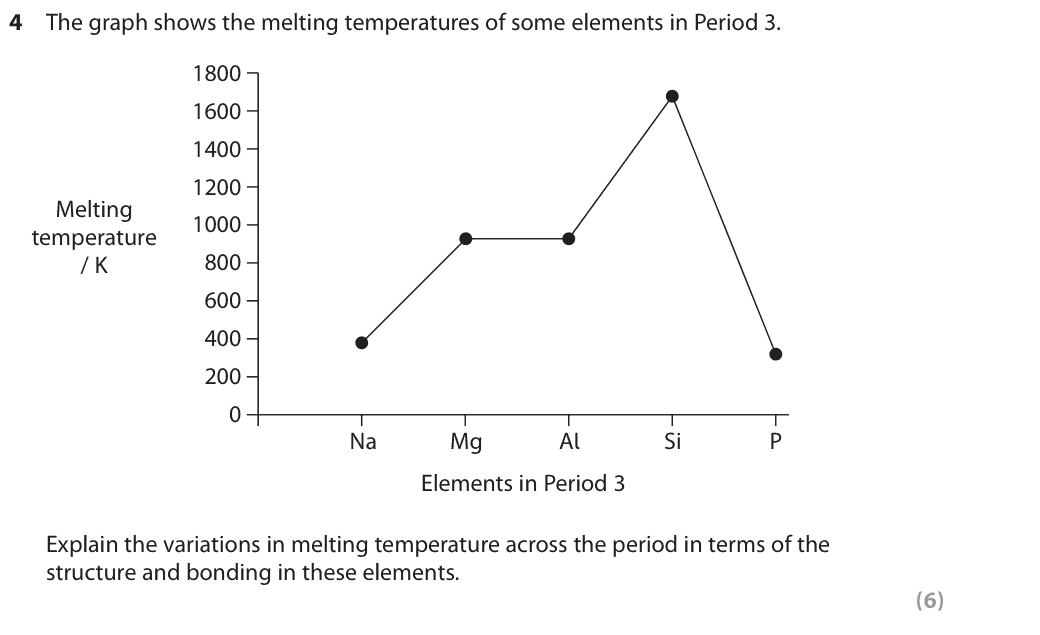
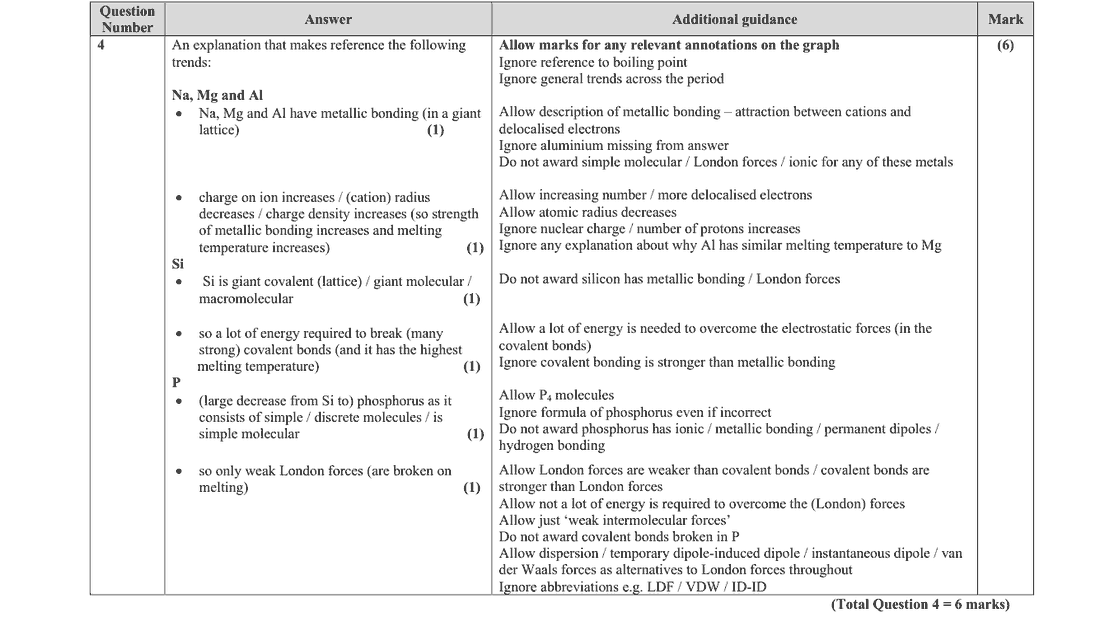
June 2023 · Paper 1 · Q46 marksExplanation
Mark scheme
Examiner's comment
Candidates who had a good knowledge and understanding of how melting temperatures are affected by structure and bonding scored high marks for this question. Unfortunately, there were many candidates who did not understand structure and bonding and they used poor terminology, for example, referring to molecules of sodium. Many candidates referred to London forces in all of the elements. A significant minority thought that the weak covalent bonds in phosphorus would be broken when it melts and some thought that it had ionic bonding. Some candidates thought that melting temperature is affected by ionisation energy and they discussed how easy it is for those elements to lose an electron.
Notes from the mark scheme and report
Six marks, point marked (not an asterisk question). Na, Mg, Al: M1 metallic bonding (giant lattice)
M2 the charge on the ion increases / ionic radius decreases / more delocalised electrons, so the metallic bonding gets stronger. Si: M3 giant covalent lattice
M4 a lot of energy is needed to break the many strong covalent bonds, so the highest value. P: M5 simple molecular (P4 molecules)
M6 only weak London forces are overcome on melting. Annotations on the graph count. No credit for London forces or simple molecules in the metals, metallic bonding in silicon, or covalent bonds breaking in phosphorus
abbreviations such as LDF or VDW are ignored
ignore nuclear charge. Common errors: 'molecules of sodium'
London forces in every element
covalent bonds broken or ionic bonding in phosphorus
arguing from ionisation energy
Skills: MS3.1 Translate information between graphical, numerical and algebraic forms
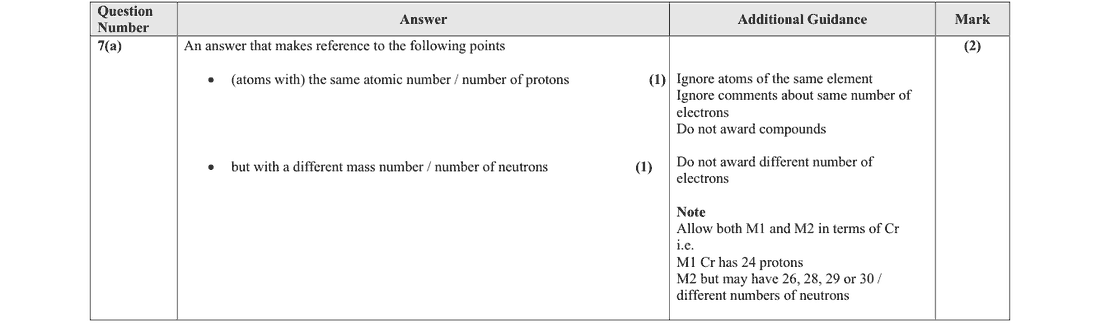
June 2023 · Paper 1 · Q7(a)2 marksShort answerEasy
Mark scheme
Examiner's comment
The vast majority of candidates knew the meaning of the term isotopes. Just a few were confused about subatomic particles and thought the atoms contained different numbers of protons or electrons.
Notes from the mark scheme and report
M1: (atoms with) the same number of protons / atomic number. M2: but a different number of neutrons / mass number. May be answered in terms of chromium (24 protons
26, 28, 29 or 30 neutrons). Not compounds
not different numbers of electrons
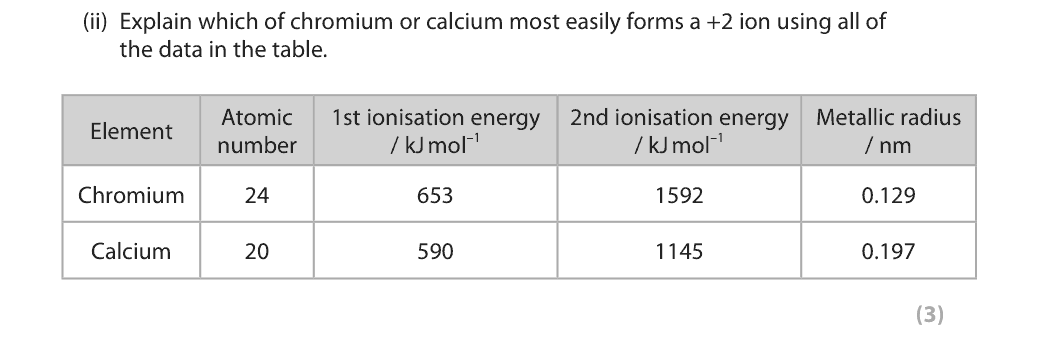
June 2023 · Paper 1 · Q7(b)(ii)3 marksExplanation
Earlier parts of question 7 that this part uses
Mark scheme
Examiner's comment
Some candidates gave excellent answers to this question as they used all the data given. A few candidates just referred to the second ionisation energy and omitted the first. Some candidates stated the difference in the metallic radius but did not expand on this to state that the outer electrons are further from the nucleus. Some candidates did not state that it is the outer electrons that are being lost and others did not refer to the attraction of the nucleus.
Notes from the mark scheme and report
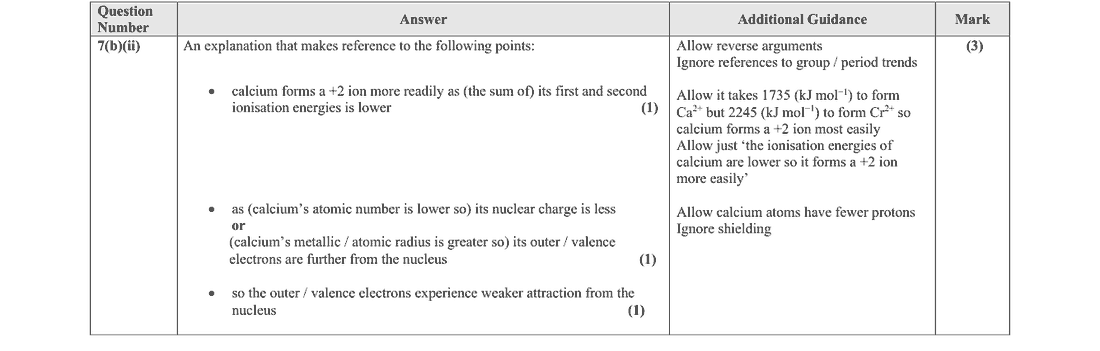
M1: calcium forms a 2+ ion more easily because (the sum of) its first and second ionisation energies is lower (1735 against 2245 kJ mol–1). M2: calcium has fewer protons / a smaller nuclear charge, or its radius is larger so the outer electrons are further from the nucleus. M3: so the outer electrons are less strongly attracted by the nucleus. Ignore shielding and group or period trends. Common errors: using only the second ionisation energy
quoting the radius without saying the outer electrons are further away
not mentioning the attraction of the nucleus
June 2023 · AS Paper 1 · Q9(a)1 markMultiple choice
Answer
B
Mark scheme
Examiner's comment
(a) The multiple choice in (a) was scored by 70% of candidates. (b)(i) The equation for the second ionisation energy proved to be well known. Many candidates scored both marks for both styles of equation in the mark scheme. Correct state symbols were allowed for some of the closer efforts which did not score M1, but only those that were quite close to the correct answer.
(b)(ii) This six mark question proved to be very accessible to candidates with very few not achieving at least some credit and high marks scored by many candidates. As is common for questions about ionisation energy descending a group, the idea of comparing the changes which make the value less, increased shielding and distance from the nucleus, with increased nuclear charge due to more protons, proved the least accessible indicative point out of the first four. The second two indicative points, comparing the first and second ionisation energies, were least commonly scored. Perhaps this was due to not reading the question with sufficient care, or becoming wrapped up in explaining the trend in first ionisation energy and then forgetting about this second aspect. Some marks were lost due to lack of clarity or contradictory statements about particular indicative points. (b)(iii) For the final question of the paper, this proved fairly accessible with many candidates scoring at least one mark.
Notes from the mark scheme and report
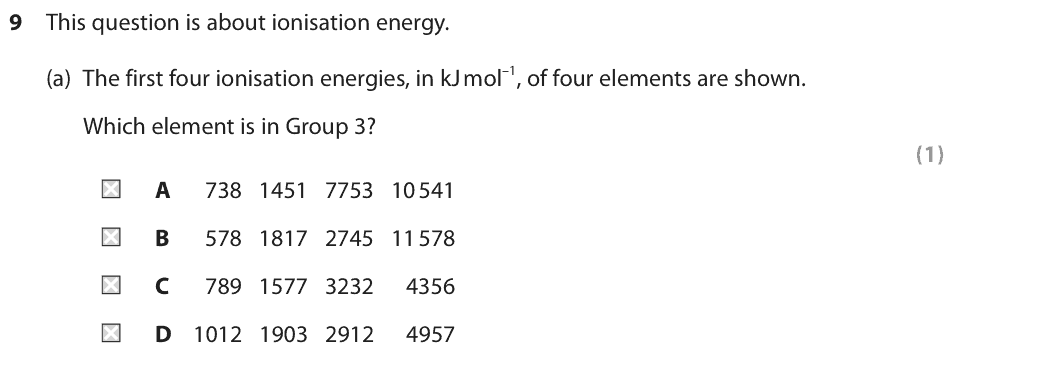
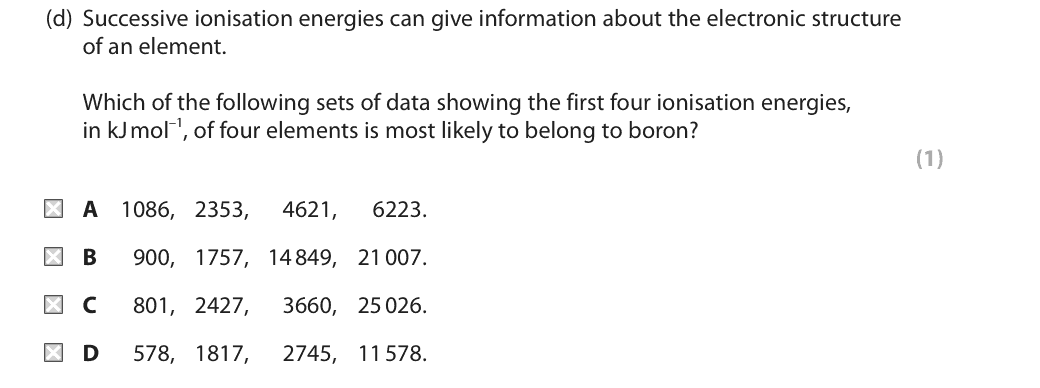
Answer: B. The large jump is between the third and fourth ionisation energies (2745 to 11 578), so three outer electrons. A jumps between the second and third (Group 2)
C and D show no large jump between the third and fourth. 70% correct
June 2023 · AS Paper 1 · Q9(b)(i)2 marksEquation writing
Mark scheme
Examiner's comment
(a) The multiple choice in (a) was scored by 70% of candidates. (b)(i) The equation for the second ionisation energy proved to be well known. Many candidates scored both marks for both styles of equation in the mark scheme. Correct state symbols were allowed for some of the closer efforts which did not score M1, but only those that were quite close to the correct answer.
(b)(ii) This six mark question proved to be very accessible to candidates with very few not achieving at least some credit and high marks scored by many candidates. As is common for questions about ionisation energy descending a group, the idea of comparing the changes which make the value less, increased shielding and distance from the nucleus, with increased nuclear charge due to more protons, proved the least accessible indicative point out of the first four. The second two indicative points, comparing the first and second ionisation energies, were least commonly scored. Perhaps this was due to not reading the question with sufficient care, or becoming wrapped up in explaining the trend in first ionisation energy and then forgetting about this second aspect. Some marks were lost due to lack of clarity or contradictory statements about particular indicative points. (b)(iii) For the final question of the paper, this proved fairly accessible with many candidates scoring at least one mark.
Notes from the mark scheme and report
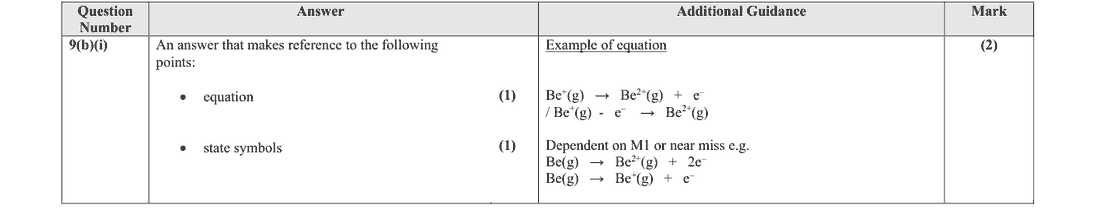
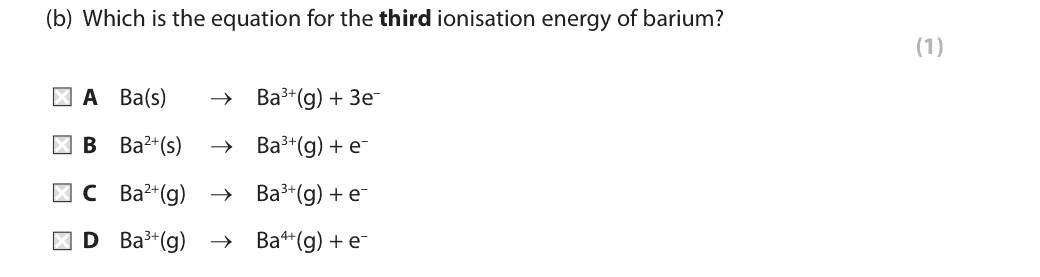
Answer: Be+(g) → Be2+(g) + e– (or Be+(g) – e– → Be2+(g)). One mark for the equation and one for state symbols
the state symbol mark is available on a near miss such as Be(g) → Be2+(g) + 2e– or Be(g) → Be+(g) + e–
June 2023 · AS Paper 1 · Q9(b)(ii)6 marks6-mark extended response
Earlier part of question 9 that this part uses
Mark scheme, with the indicative content and the marks for reasoning
Examiner's comment
(a) The multiple choice in (a) was scored by 70% of candidates. (b)(i) The equation for the second ionisation energy proved to be well known. Many candidates scored both marks for both styles of equation in the mark scheme. Correct state symbols were allowed for some of the closer efforts which did not score M1, but only those that were quite close to the correct answer.
(b)(ii) This six mark question proved to be very accessible to candidates with very few not achieving at least some credit and high marks scored by many candidates. As is common for questions about ionisation energy descending a group, the idea of comparing the changes which make the value less, increased shielding and distance from the nucleus, with increased nuclear charge due to more protons, proved the least accessible indicative point out of the first four. The second two indicative points, comparing the first and second ionisation energies, were least commonly scored. Perhaps this was due to not reading the question with sufficient care, or becoming wrapped up in explaining the trend in first ionisation energy and then forgetting about this second aspect. Some marks were lost due to lack of clarity or contradictory statements about particular indicative points. (b)(iii) For the final question of the paper, this proved fairly accessible with many candidates scoring at least one mark.
Notes from the mark scheme and report
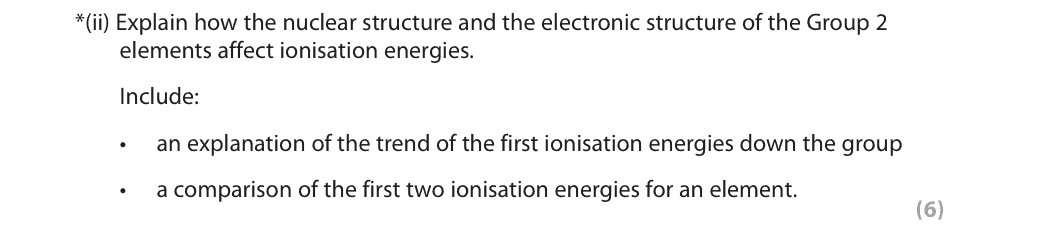
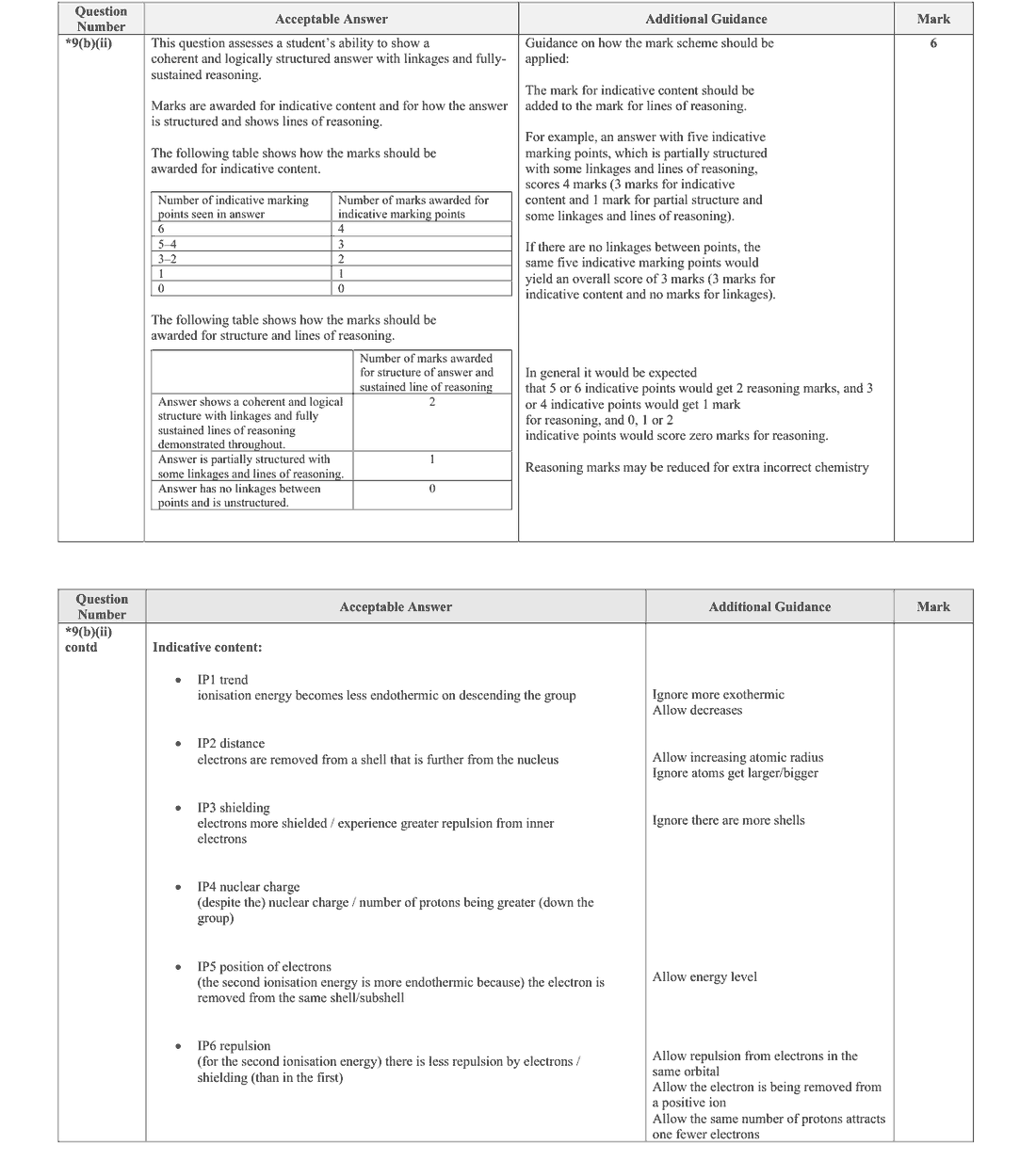
Six indicative points plus two marks for reasoning. IP1 first ionisation energy decreases (becomes less endothermic) down the group
IP2 the electron removed is in a shell further from the nucleus (atomic radius increases)
IP3 it is more shielded / repelled more by inner electrons
IP4 despite the greater nuclear charge (more protons) down the group
IP5 the second ionisation energy is higher although the electron comes from the same shell / subshell
IP6 because there is less electron repulsion / the electron is removed from a positive ion / the same number of protons attracts one fewer electron. 'More shells' alone is ignored for IP3. IP4 was the least often scored of the first four, and IP5 and IP6 were scored least of all, often because the comparison of first and second ionisation energies was forgotten
June 2022 · AS Paper 1 · Q11 markMultiple choice
Answer
D
Mark scheme
Examiner's comment
This question was designed to be a relatively easy introduction to the paper, only requiring knowledge of the maximum number of electrons in subshells. Nearly all students responded to this question correctly.
Notes from the mark scheme and report
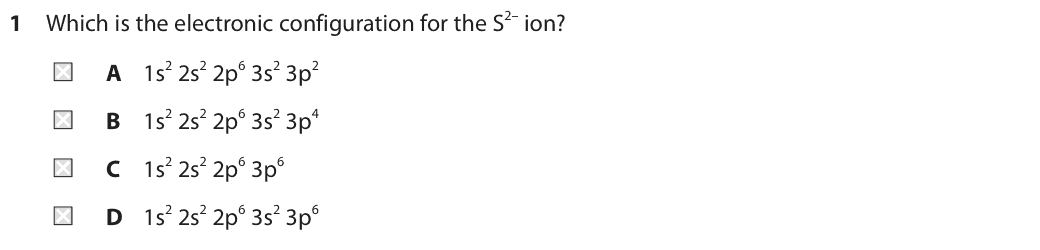
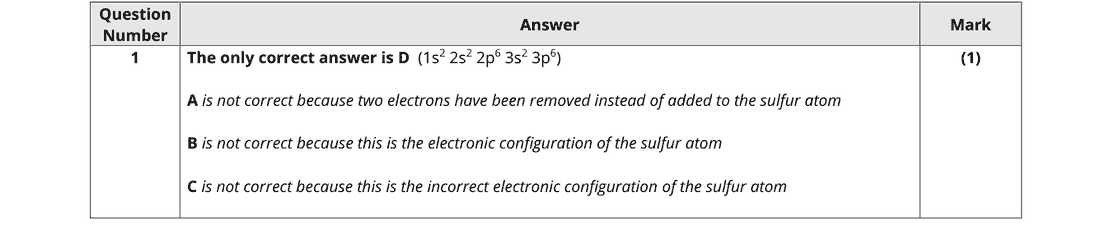
Answer: D. The sulfide ion has two more electrons than the sulfur atom: 1s2 2s2 2p6 3s2 3p6. B is the sulfur atom
A has two electrons removed instead of added
C leaves out the 3s sub-shell
June 2022 · Paper 1 · Q1(a)2 marksShort answer
Mark scheme
Examiner's comment
This question was designed to assess the candidates' knowledge of sub-atomic particles. Many completely correct responses were seen. However, there was some confusion over the mass of an electron with this commonly being incorrectly given as '0'. Various options for the mass of an electron were allowed on the mark scheme including 'negligible' and '1/1840'.
Notes from the mark scheme and report
Answer: neutron charge 0, mass 1
electron charge –1, mass 1/1840. One mark for any two or three values, two for all four. Negligible / very small, or 1/1800 to 1/2000, allowed for the electron's mass
0 or 'none' is not. Common error: electron mass given as 0
June 2022 · Paper 1 · Q1(b)1 markMultiple choice
Answer
D
Mark scheme
Notes from the mark scheme and report
Answer: D. Atomic emission spectra give evidence for quantum shells. Evidence for isotopes (C) comes from mass spectrometry
June 2022 · Paper 1 · Q1(c)1 markDiagram or structure
Mark scheme
Examiner's comment
This question required candidates to draw the shape of a p orbital.
Many correct answers were seen, and we allowed for a set of three p-orbitals joined together to score.
Some candidates tried to draw over-lapping p-orbitals to show a pi bond which was not asked for in the question and so the mark was not awarded.
Notes from the mark scheme and report
A dumb-bell shape (two lobes) in any orientation
axes ignored. A set of three p orbitals drawn together was accepted. Overlapping p orbitals drawn as a pi bond did not score
June 2022 · Paper 1 · Q1(d)3 marksExplanation
Earlier part of question 1 that this part uses
Mark scheme
Examiner's comment
This three mark question proved more challenging.
The best answers showed a full understanding of the structure and bonding in silicon and chlorine. There was some confusion over the structure of silicon with metallic, ionic and molecular all being used as descriptors.
Some candidates suggested that the covalent bonds in chlorine were broken on melting. These answers generally did not include a reference to the London forces between chlorine molecules.
Notes from the mark scheme and report
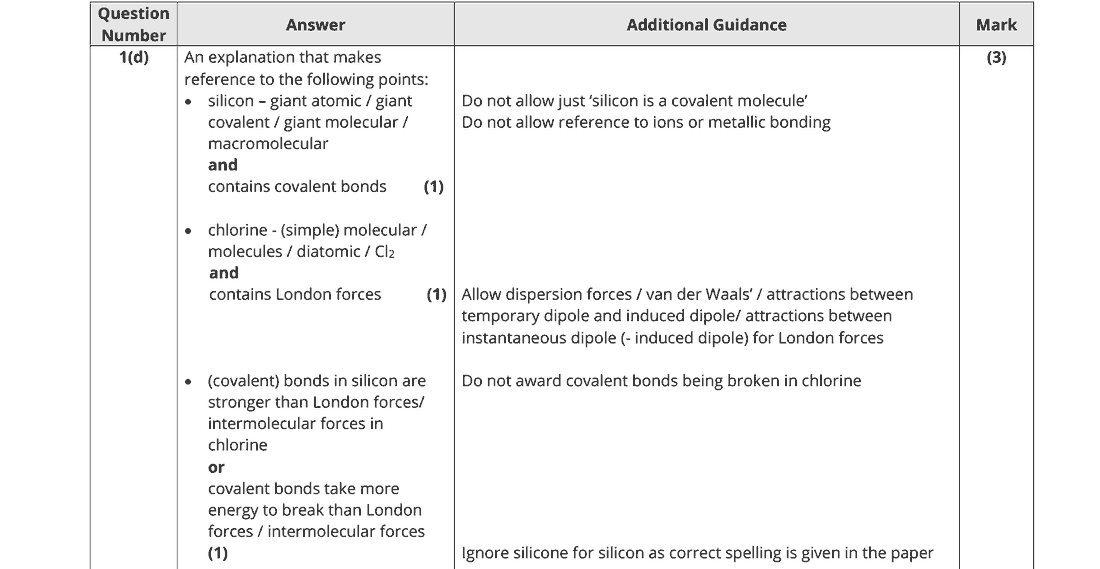
Silicon is giant covalent (giant atomic / macromolecular) with covalent bonds (1)
chlorine is simple molecular (Cl2) with London forces between molecules (1)
the covalent bonds in silicon are stronger / need more energy to break than the London forces in chlorine (1). Not ions or metallic bonding for silicon
not covalent bonds breaking in chlorine. Common errors: silicon called metallic, ionic or molecular
covalent bonds in chlorine broken on melting, with no mention of London forces
June 2022 · AS Paper 1 · Q21 markMultiple choice
Answer
C
Mark scheme
Examiner's comment
This question was also designed as a relatively easy introduction to the paper, requiring students to relate significant changes in ionisation energy to group number. Most students responded to this question correctly.
Notes from the mark scheme and report
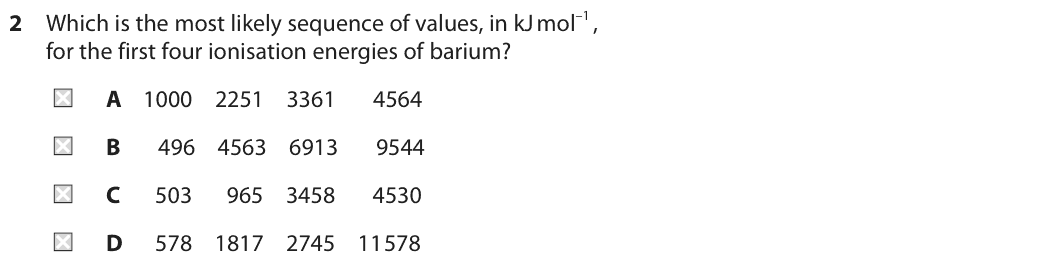
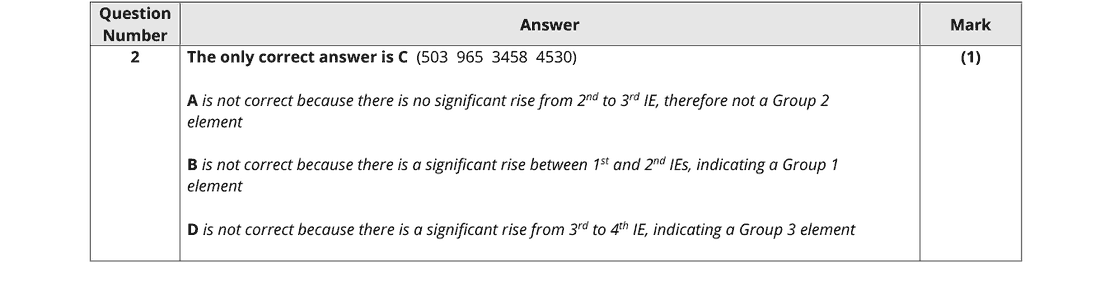
Answer: C. Barium is in Group 2, so the big jump comes between the second and third ionisation energies (965 to 3458). B has the jump after the first (Group 1)
D after the third (Group 3)
A has no large jump between second and third
June 2022 · Paper 1 · Q3(c)1 markShort answer
Earlier part of question 3 that this part uses
Mark scheme
Examiner's comment
This question was about the electron configuration of a chloride ion. Many correct answers were seen.
The majority of incorrect answers gave the electronic configuration of a chlorine atom.
Notes from the mark scheme and report
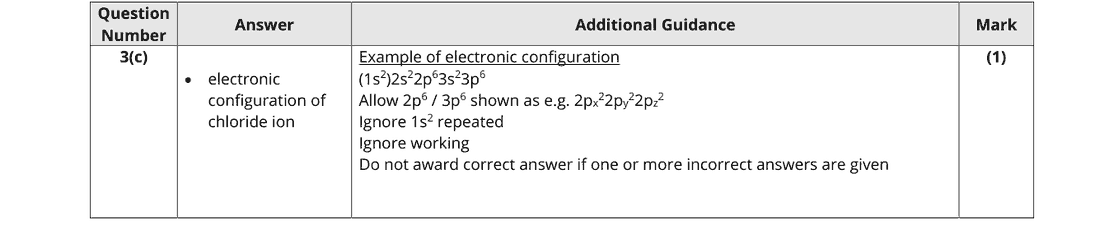
Answer: (1s2) 2s2 2p6 3s2 3p6. The usual wrong answer was the chlorine atom, ending 3p5
June 2022 · AS Paper 1 · Q4(a)1 markMultiple choice
Answer
C
Mark scheme
Examiner's comment
This question was about the number of subatomic particles in an atom of a less well-known isotope of hydrogen, 3H. The mass number was provided but students were expected to know (or look up) the atomic number of hydrogen. The question was therefore an exercise in the use of data rather than purely an act of memory.
Notes from the mark scheme and report
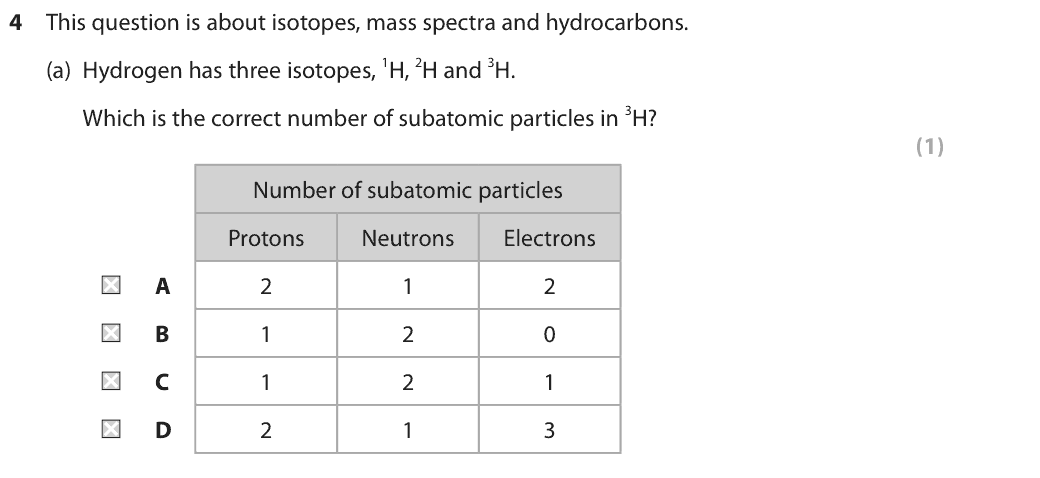
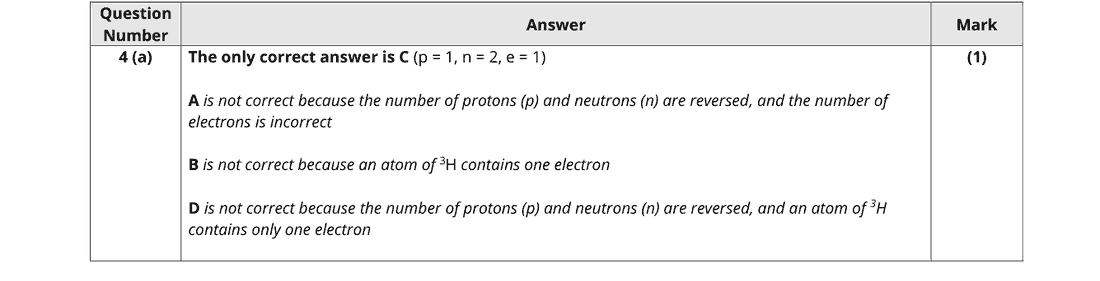
Answer: C. Hydrogen has atomic number 1, so 3H has 1 proton, 3 – 1 = 2 neutrons and 1 electron. A and D reverse protons and neutrons
B has no electron (that would be the ion)
June 2022 · AS Paper 1 · Q4(b)(i)2 marksCalculation
Earlier part of question 4 that this part uses
Mark scheme
Examiner's comment
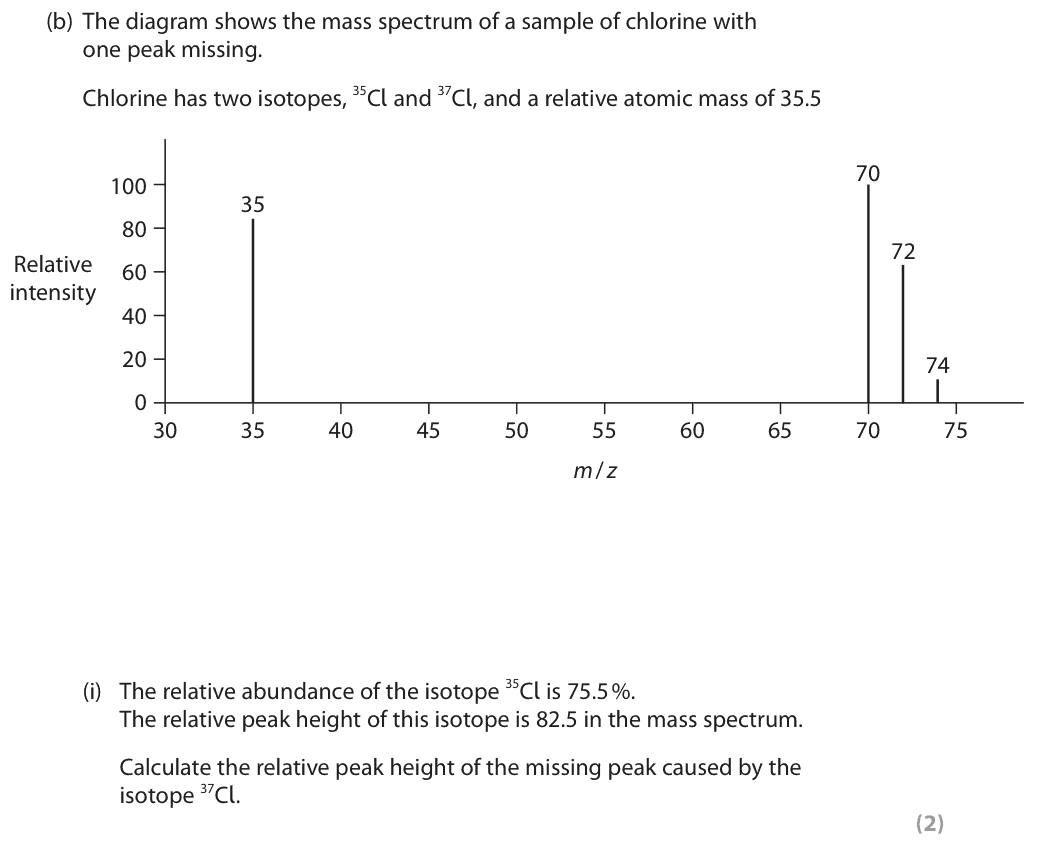
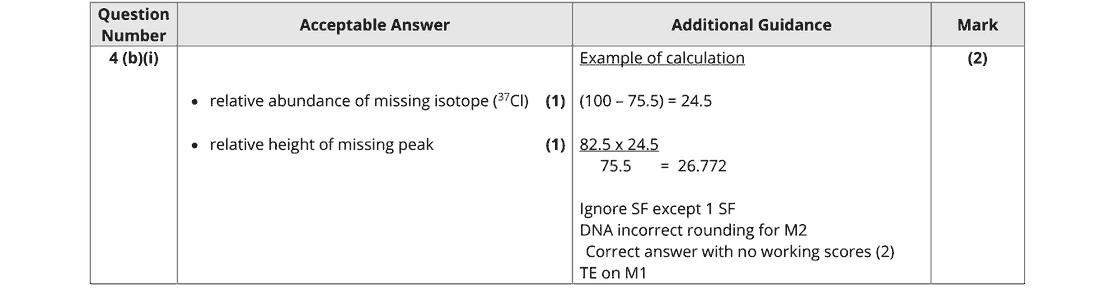
This question on mass spectrometry involved the calculation of the peak height of an isotope of chlorine (37Cl), given the peak height of the only other isotope present (35Cl). Students first needed to calculate the relative abundance of 37Cl, and then calculate the 37Cl peak height from the height of the 35Cl peak provided. Some students got this completely correct while others had little idea of how to proceed. Many realised that they would need the relative abundance of 37Cl and were given credit for this.
error carried forward from the first mark. Some had little idea how to start
many gained the mark for the 24.5 %
Skills: MS0.2 Use ratios, fractions and percentages
June 2022 · AS Paper 1 · Q4(b)(ii)1 markShort answer
Earlier parts of question 4 that this part uses
Mark scheme
Examiner's comment
Nearly all students realised that the peaks at 70, 72 and 74 had something to do with the isotopes of chlorine but a substantial number then failed to explain why the peaks were at 70, 72 and 74.
Notes from the mark scheme and report
There are three possible combinations of the two isotopes in a Cl2 molecule: 35Cl–35Cl = 70, 35Cl–37Cl = 72, 37Cl–37Cl = 74. Nearly all linked the peaks to isotopes, but a substantial number did not explain why the values are 70, 72 and 74
June 2022 · AS Paper 1 · Q4(b)(iii)3 marksCalculation
Earlier parts of question 4 that this part uses
Mark scheme
Examiner's comment
This was the first really challenging calculation of the paper. A pleasing number of students provided well-reasoned answers based on probability and were awarded maximum marks. Other students just provided a random array of figures with no explanation as they attempted to arrive at the correct ratio. Since there are several different routes to the final answer, a few words to explain the calculations would have been very useful. A common error was to fail to multiply by two for the probability of a molecule consisting of 37Cl-35Cl or 35Cl-37Cl. This factor was frequently ignored with a ratio of 9:3:1 claimed to be 9:6:1.
Notes from the mark scheme and report
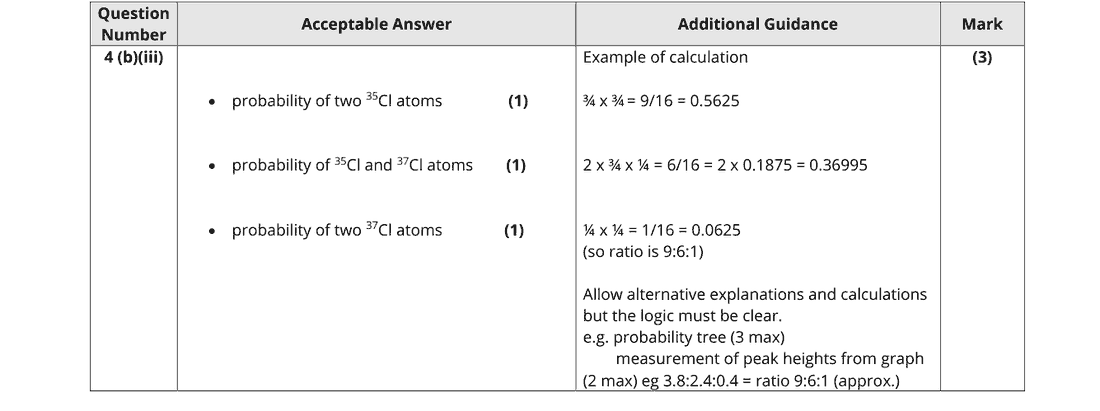
Probabilities, with 35Cl : 37Cl about 3 : 1. Two 35Cl atoms: 3/4 × 3/4 = 9/16
one of each: 2 × 3/4 × 1/4 = 6/16
two 37Cl atoms: 1/4 × 1/4 = 1/16
hence 9 : 6 : 1. Other clear methods allowed, e.g. a probability tree (3 max)
measuring the peak heights from the spectrum scores 2 max. Common error: leaving out the factor of 2 for the mixed molecule, giving 9 : 3 : 1 but calling it 9 : 6 : 1
many answers were unexplained arrays of numbers
Skills: MS0.2 Use ratios, fractions and percentages
June 2022 · AS Paper 1 · Q4(c)(i)1 markShort answer
Earlier part of question 4 that this part uses
Mark scheme
Examiner's comment
This question required students to recognise that the peak furthest to the right is the parent ion peak. Some confused the tallest peak (i.e., greatest abundance) with the parent ion peak. Others appeared to sacrifice this mark to get a mark in 4(c)(ii), citing molar mass that corresponded to a minor peak in the mass spectrum. – see comment below, in 4(c)(ii).
Notes from the mark scheme and report
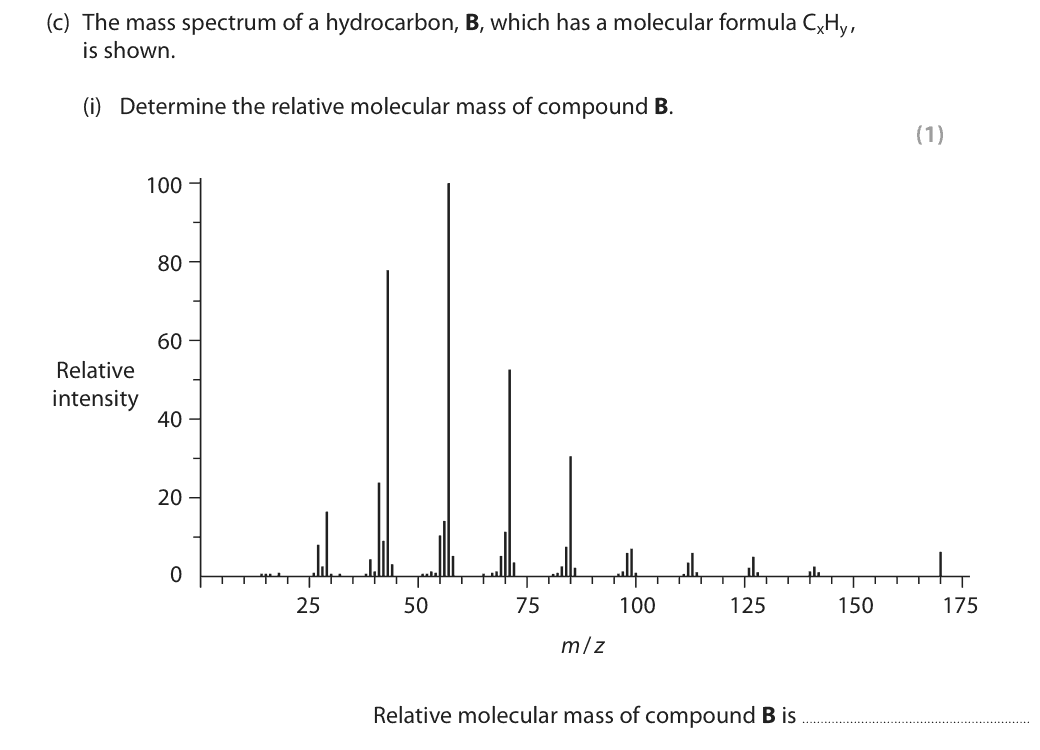
Answer: 170 (the molecular ion peak, furthest to the right
may be marked on the spectrum). Not 171. Common error: choosing the tallest peak (the most abundant ion) instead of the molecular ion peak
Skills: MS3.1 Translate information between graphical, numerical and algebraic forms
June 2022 · AS Paper 1 · Q4(c)(ii)1 markShort answer
Earlier parts of question 4 that this part uses
Mark scheme
Examiner's comment
The correct hydrocarbon C12H26 required a valid response to 4(c)(i), thus this mark was awarded for any molecule that corresponded to the molar mass provided in 4(c)(i). However, some answers included implausible hydrocarbons, eg C4H9 = 57. Others were only correct if the suggested molecule contained multiple double or triple carbon-carbon bonds. While credit was given for such answers, most students would be unfamiliar with such molecules, and in some instances, the response was perhaps just a fortunate guess. Alkanes and alkenes are both possible provided the appropriate molar mass was given in 4(c)(i). There was a suspicion that a few students had suggested implausible molar masses in 4(c)(i) in order to write a familiar known hydrocarbon here in 4(c)(ii)
Notes from the mark scheme and report
Answer: C12H26 (allow C13H14). Error carried forward from (c)(i) is allowed if the hydrocarbon could exist, so not C4H9 for 57
June 2022 · AS Paper 1 · Q7(a)1 markMultiple choice
Answer
D
Mark scheme
Examiner's comment
This multiple choice question required an understanding of the periodic table in terms of s, p and d-block elements. To that extent, it also required an understanding of the electronic configuration of elements. Most students were successful in this question.
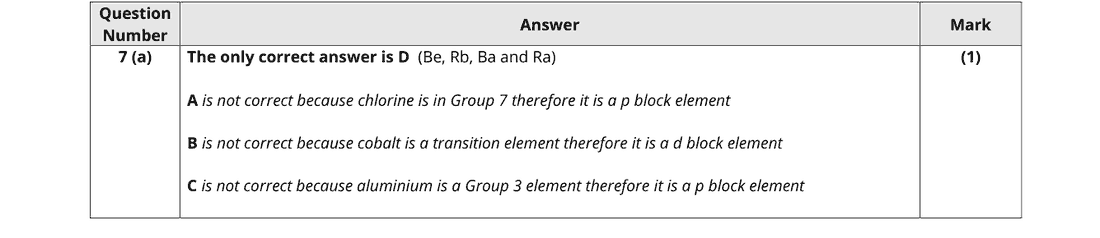
Notes from the mark scheme and report
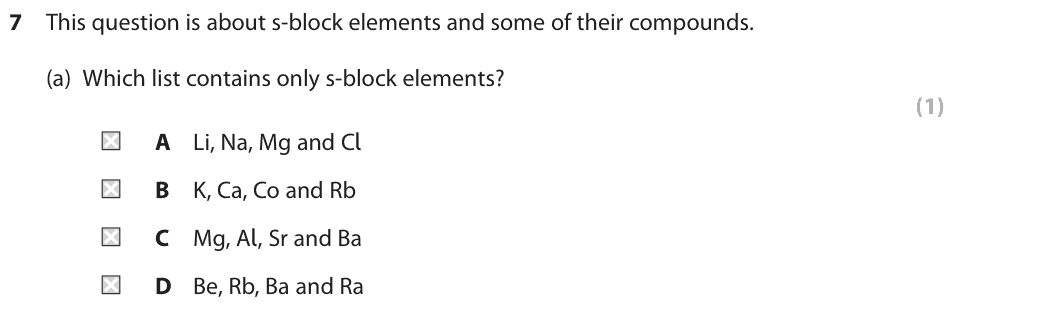
Answer: D. Be, Rb, Ba and Ra are all in Groups 1 and 2. A contains chlorine (p-block), B contains cobalt (d-block), C contains aluminium (p-block)
June 2022 · AS Paper 2 · Q5(b)(v)1 markShort answer
Earlier parts of question 5 that this part uses
Mark scheme
Examiner's comment
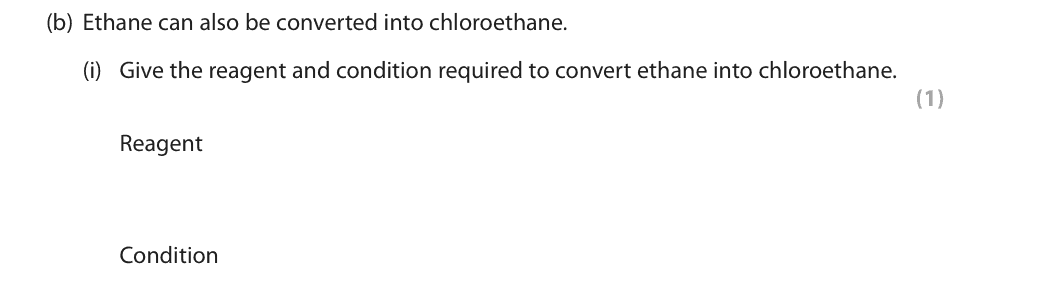
(a), the electrophilic addition reaction, proved rather more accessible than the later free-radical substitution items. In (a)(i) hydrogen chloride was commonly given, though chlorine was also suggested. The mechanism in (a)(ii) was generally well done, with only a few of the usual errors in arrow direction, dipoles and charges seen. (b) was less well understood, with a variety of reagents and conditions given in (b)(i), though over 60% of candidates identified the reaction was a free radical substitution in (b)(ii). For those who gave the wrong reagent and conditions, it was possible to score some marks in (b)(iii) by giving and naming the two product structures. Those with the correct reagents still struggled in (b)(iii) with full marks rarely seen. (b)(iv), (b)(v) and (b)(vi) all needed an understanding of the isotopes of chlorine, or were easier if this was understood. Those candidates who recognised this as the key factor scored well, while those that didn’t struggled to pick up any marks.
Notes from the mark scheme and report
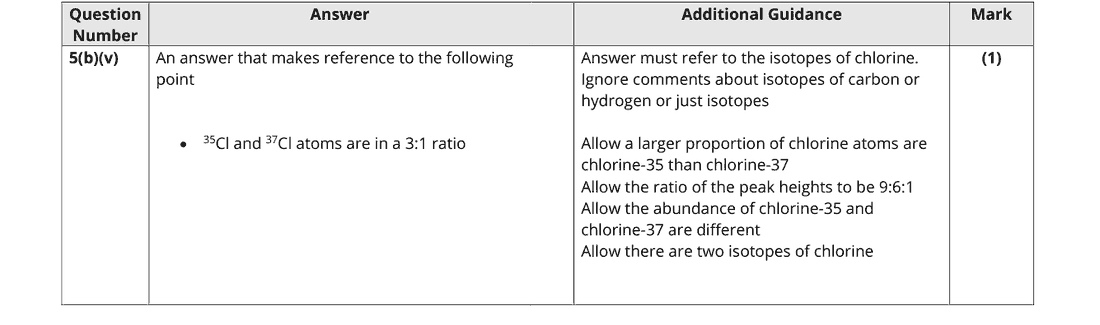
The chlorine isotopes are not equally abundant: 35Cl and 37Cl atoms are in a 3 : 1 ratio (so the peaks are in the ratio 9 : 6 : 1). The answer must refer to the isotopes of chlorine
'there are two isotopes of chlorine' is allowed, just 'isotopes' or isotopes of carbon or hydrogen is ignored
Skills: MS0.2 Use ratios, fractions and percentages
June 2022 · Paper 3 · Q1(a)2 marksShort answer
Mark scheme
Examiner's comment
The majority of candidates scored 1 mark for this question as they knew that the mass of an atom was compared with 1/12 of the mass of a carbon-12 atom. Many candidates did not state that it is the weighted mean mass of an atom of an element. A small number of candidates confused mass number with relative atomic mass. Candidates are advised to learn the definitions in the specification.
Notes from the mark scheme and report
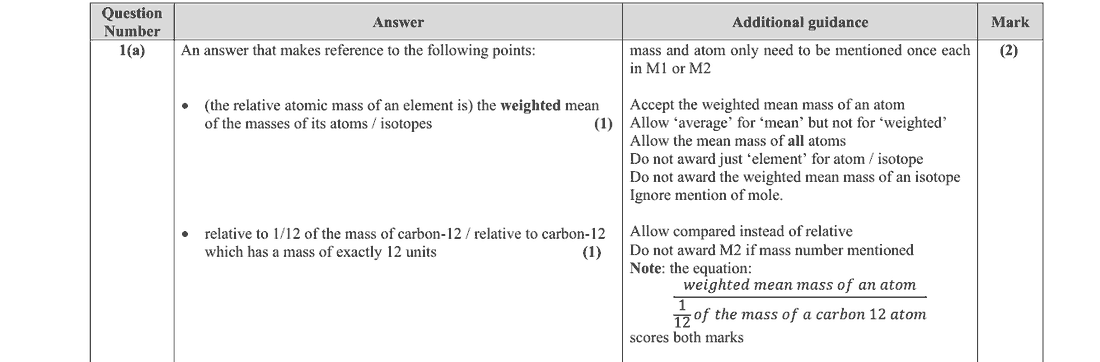
The weighted mean mass of an atom of the element (mean of the masses of its isotopes)
relative to 1/12 of the mass of an atom of carbon-12. 'Average' is allowed for 'mean' but not for 'weighted'
no second mark if mass number is mentioned. Most scored only the carbon-12 mark: the weighted mean was often missing
a few confused mass number with relative atomic mass
June 2022 · Paper 3 · Q1(b)2 marksCalculationEasy
Earlier part of question 1 that this part uses
Mark scheme
Examiner's comment
The vast majority of candidates scored full marks for this question. Many of those who were not awarded 2 marks did not read the question and gave their answer to 4 significant figures instead of the required three.
second mark for rounding to 3 s.f. Units ignored. The usual error was giving four significant figures
Skills: MS1.1 Use an appropriate number of significant figures; MS1.2 Find arithmetic means
November 2021 · AS Paper 1 · Q1(a)2 marksShort answerEasy
Mark scheme
Examiner's comment
This question was generally well answered. 1(a) All candidates recognised that there is a difference in the number of neutrons in an isotope. Most were able to answer the question fully and state the correct number of protons, 35, and the difference in the number of neutrons, 44 and 46. 1(b)(i) The importance of electronic configuration was recognised by some candidates but some answers were unclear and related chemical reactivity to chemical properties rather than to electronic structure. 1(b)(ii) Many candidates answered the question about how the relative abundance was used to find the relative atomic mass. Those who read the question carefully were able to score the mark for the mass spectrometer but few were able to say how the relative abundance was found from a mass spectrum. 1b(c)(i) and (ii) The electronic configuration of bromine was very well understood.
Notes from the mark scheme and report
Similarity: both have 35 protons. Difference: one has 44 neutrons and the other 46 (allow: the second has two more neutrons). One mark only for 'same number of protons, different numbers of neutrons' with no numbers. Same number of electrons is ignored (the question asks about the nuclei)
November 2021 · Paper 1 · Q1(a)1 markMultiple choice
Answer
D
Mark scheme
Examiner's comment
The first two multiple choice questions served as a ‘gentle’ introduction to the paper and were
relatively straightfroward. The relative atomic mass calculation was correctly carried out by the
majority of candidates. However, some candidates who, despite correctly writing the sum the
be determined, evidently input the wrong values in their calculators thus obtaining an incorrect
answer. Double-checking the sum would have proved beneficial in such circumstances.
Notes from the mark scheme and report
Answer: D. Na+ and Mg2+ both have 10 electrons. In A, B and C the second ion has an extra shell of electrons (Cl–, S2– and K+ have 18)
November 2021 · Paper 1 · Q1(b)1 markMultiple choice
Answer
B
Mark scheme
Examiner's comment
The first two multiple choice questions served as a ‘gentle’ introduction to the paper and were
relatively straightfroward. The relative atomic mass calculation was correctly carried out by the
majority of candidates. However, some candidates who, despite correctly writing the sum the
be determined, evidently input the wrong values in their calculators thus obtaining an incorrect
answer. Double-checking the sum would have proved beneficial in such circumstances.
Notes from the mark scheme and report
Answer: B. The mass of one atom of an isotope relative to one twelfth of the mass of an atom of carbon-12. A is relative atomic mass (weighted mean)
C and D compare one atom with 12 g of carbon-12
November 2021 · AS Paper 1 · Q1(b)(i)1 markShort answer
Earlier part of question 1 that this part uses
Mark scheme
Examiner's comment
This question was generally well answered. 1(a) All candidates recognised that there is a difference in the number of neutrons in an isotope. Most were able to answer the question fully and state the correct number of protons, 35, and the difference in the number of neutrons, 44 and 46. 1(b)(i) The importance of electronic configuration was recognised by some candidates but some answers were unclear and related chemical reactivity to chemical properties rather than to electronic structure. 1(b)(ii) Many candidates answered the question about how the relative abundance was used to find the relative atomic mass. Those who read the question carefully were able to score the mark for the mass spectrometer but few were able to say how the relative abundance was found from a mass spectrum. 1b(c)(i) and (ii) The electronic configuration of bromine was very well understood.
Notes from the mark scheme and report
They have the same electronic configuration / structure (allow the same number of electrons, or 35 electrons). Not just 'the same number of electrons in the outer shell'. Some answers were unclear and linked chemical reactivity to chemical properties rather than to electronic structure
November 2021 · AS Paper 1 · Q1(b)(ii)2 marksShort answer
Earlier parts of question 1 that this part uses
Mark scheme
Examiner's comment
This question was generally well answered. 1(a) All candidates recognised that there is a difference in the number of neutrons in an isotope. Most were able to answer the question fully and state the correct number of protons, 35, and the difference in the number of neutrons, 44 and 46. 1(b)(i) The importance of electronic configuration was recognised by some candidates but some answers were unclear and related chemical reactivity to chemical properties rather than to electronic structure. 1(b)(ii) Many candidates answered the question about how the relative abundance was used to find the relative atomic mass. Those who read the question carefully were able to score the mark for the mass spectrometer but few were able to say how the relative abundance was found from a mass spectrum. 1b(c)(i) and (ii) The electronic configuration of bromine was very well understood.
Notes from the mark scheme and report
Compare (or measure) the intensity of the signal / number of particles of each isotope detected
in a mass spectrometer. Many described instead how abundance is used to calculate relative atomic mass. The mass spectrometer mark was accessible but few could say how abundance is found from the spectrum
November 2021 · Paper 1 · Q1(c)2 marksCalculation
Earlier part of question 1 that this part uses
Mark scheme
Examiner's comment
The first two multiple choice questions served as a ‘gentle’ introduction to the paper and were
relatively straightfroward. The relative atomic mass calculation was correctly carried out by the
majority of candidates. However, some candidates who, despite correctly writing the sum the
be determined, evidently input the wrong values in their calculators thus obtaining an incorrect
answer. Double-checking the sum would have proved beneficial in such circumstances.
second mark for the evaluation to two decimal places. Units of g mol–1 only are tolerated
not %. Done correctly by the majority
some wrote the right expression and then mis-keyed it on the calculator
Skills: MS0.2 Use ratios, fractions and percentages; MS1.1 Use an appropriate number of significant figures; MS1.2 Find arithmetic means
November 2021 · AS Paper 1 · Q1(c)(i)1 markShort answerEasy
Earlier part of question 1 that this part uses
Mark scheme
Examiner's comment
This question was generally well answered. 1(a) All candidates recognised that there is a difference in the number of neutrons in an isotope. Most were able to answer the question fully and state the correct number of protons, 35, and the difference in the number of neutrons, 44 and 46. 1(b)(i) The importance of electronic configuration was recognised by some candidates but some answers were unclear and related chemical reactivity to chemical properties rather than to electronic structure. 1(b)(ii) Many candidates answered the question about how the relative abundance was used to find the relative atomic mass. Those who read the question carefully were able to score the mark for the mass spectrometer but few were able to say how the relative abundance was found from a mass spectrum. 1b(c)(i) and (ii) The electronic configuration of bromine was very well understood.
Notes from the mark scheme and report
Answer: (1s2 2s2) 2p6 3s2 3p6 4s2 3d10 4p5. 3d10 may come before 4s2
capital letters and px, py, pz notation allowed
November 2021 · AS Paper 1 · Q1(c)(ii)1 markMultiple choice
Earlier parts of question 1 that this part uses
Answer
B
Mark scheme
Examiner's comment
This question was generally well answered. 1(a) All candidates recognised that there is a difference in the number of neutrons in an isotope. Most were able to answer the question fully and state the correct number of protons, 35, and the difference in the number of neutrons, 44 and 46. 1(b)(i) The importance of electronic configuration was recognised by some candidates but some answers were unclear and related chemical reactivity to chemical properties rather than to electronic structure. 1(b)(ii) Many candidates answered the question about how the relative abundance was used to find the relative atomic mass. Those who read the question carefully were able to score the mark for the mass spectrometer but few were able to say how the relative abundance was found from a mass spectrum. 1b(c)(i) and (ii) The electronic configuration of bromine was very well understood.
Notes from the mark scheme and report
Answer: B (7). The fourth shell holds 4s2 4p5. A (2) is the number in the fourth occupied subshell
C (17) wrongly counts the 3d electrons in the fourth shell
D (18) is the number in the third shell
November 2021 · AS Paper 1 · Q2(c)(i)1 markCalculation
Mark scheme
Examiner's comment
This question centred on practical techniques in titration and those candidates who had been able to gather experience of these practicals will have been at an advantage. 2(a) The first item in question 2 was a question very commonly asked at this level. Unfortunately, few candidates were able to make a good start to it and it was answered poorly. 2(b)(i) and (ii) These questions concerning titration were much better understood. 2(b)(iii) and (iv) While the average titre was often calculated correctly not all candidates were able to use this in the next part of the calculation to find the molecular mass of the sodium carbonate. 2(c)(i) and (ii) These calculations were relatively straightforward and was accessible to many candidates. 2(d)(i) and (ii) The final calculation for this question was more accessible but still challenging for some.
Notes from the mark scheme and report
Answer: 106. (2 × 23) + 12 + (3 × 16)
November 2021 · AS Paper 1 · Q2(c)(ii)1 markCalculation
Earlier parts of question 2 that this part uses
Mark scheme
Examiner's comment
This question centred on practical techniques in titration and those candidates who had been able to gather experience of these practicals will have been at an advantage. 2(a) The first item in question 2 was a question very commonly asked at this level. Unfortunately, few candidates were able to make a good start to it and it was answered poorly. 2(b)(i) and (ii) These questions concerning titration were much better understood. 2(b)(iii) and (iv) While the average titre was often calculated correctly not all candidates were able to use this in the next part of the calculation to find the molecular mass of the sodium carbonate. 2(c)(i) and (ii) These calculations were relatively straightforward and was accessible to many candidates. 2(d)(i) and (ii) The final calculation for this question was more accessible but still challenging for some.
Notes from the mark scheme and report
Answer: x = 10. (286 – 106) ÷ 18. Error carried forward from the Mr in (c)(i)
Skills: MS2.4 Solve algebraic equations
November 2021 · Paper 1 · Q4(a)2 marksShort answer
Mark scheme
Examiner's comment
The task in (a) required the giving of a reason for the incorrect word in the first ionisation
energy definition. Hence it was insufficient to simply state that the word should be ‘required
rather than released’ without giving a reason. A small number of candidates wrote a correct
definition, but this alone does not answer the question and so did not score both marks.
Many correct second ionisation energy equations were seen but there continue to be a large
number of candidates who ionise the oxygen molecule instead of the oxygen atom. The
stronger candidates included the fact that the increasing nuclear charge is outweighed by the
larger atomic raidus and greater shielding when answering part (c). Hence this proved an
effective discriminator at the ‘top end’ of ability.
The task on successive ionisation energies in (d) also proved a useful discriminator of
candidates. The majority appreciated the value of logarithms to provide a scale which is easier
to plot and likewise most understood why each successive ionisation increases. Graph drawing
continues to be a challenge for many and it is worth reminding candidates that the plotted
point must cover over half the graph paper on both axes. This meant that those who started on
the y axis from zero lost at least one mark. The less able candidates were confused by part
(d)(v) and circled a wide variety of points but the more able normally understood the task and
answered correctly.
It was disappointing to see very few correct answers to part (e). It seemed apparent that most
candidates had forgotten that there is a small decrease in the first ionisation energy from
nitrogen and oxygen due to the pairing of two electrons in the 2p orbital.
Notes from the mark scheme and report
M1: the wrong word is 'released'. M2: energy is required to overcome the attraction between the nucleus and the electron / to remove an electron (the process is endothermic). Just 'it should say required, not released' with no reason is M1 only, as is writing out a correct definition
November 2021 · AS Paper 1 · Q4(a)(i)1 markMultiple choice
Answer
C
Mark scheme
Examiner's comment
Questions were about ionisation energy requiring consideration of the attraction between the nucleus of the atom or ion and the electron being removed. This is affected by the number of protons in the nucleus, the distance of the electron from the nucleus, the number of shells of elctrons repelling or shielding the electron and whether the electron is alone in an orbital or paired with another electron with opposite spin. Some of these factors will be the same when comparing the ionisation energy of two different atoms or ions. 4(a)(i) This multiple choice question was well answered. 4(a)(ii) In this question, the key feature was the increased shielding and distance of the electron from the nucleus. 4(a)(iii) Candidates who were able to identify the importance of the number of protons in the nucleus in a comparison of first ionisation energies of sulfur and chlorine scored well. 4(a)(iv) It was the pairing of electrons in an orbital which explained the ionisation energy difference. 4(b) This calculation provided considerable challenge with relatively few candidates able to work their way to the final answer. 4(c) The graph, which was expected to be familiar to candidates, proved quite challenging. The use of a suitable scale and plotting of points in 4(c)(i) was well attempted, but the estimation of melting temperature in 4(c)(ii) proved more challenging.
Notes from the mark scheme and report
Answer: C. S(g) → S+(g) + e–: single gaseous atoms. A starts from solid sulfur
B uses S8 and the solid
D uses S8 molecules
November 2021 · AS Paper 1 · Q4(a)(ii)3 marksExplanation
Earlier part of question 4 that this part uses
Mark scheme
Examiner's comment
Questions were about ionisation energy requiring consideration of the attraction between the nucleus of the atom or ion and the electron being removed. This is affected by the number of protons in the nucleus, the distance of the electron from the nucleus, the number of shells of elctrons repelling or shielding the electron and whether the electron is alone in an orbital or paired with another electron with opposite spin. Some of these factors will be the same when comparing the ionisation energy of two different atoms or ions. 4(a)(i) This multiple choice question was well answered. 4(a)(ii) In this question, the key feature was the increased shielding and distance of the electron from the nucleus. 4(a)(iii) Candidates who were able to identify the importance of the number of protons in the nucleus in a comparison of first ionisation energies of sulfur and chlorine scored well. 4(a)(iv) It was the pairing of electrons in an orbital which explained the ionisation energy difference. 4(b) This calculation provided considerable challenge with relatively few candidates able to work their way to the final answer. 4(c) The graph, which was expected to be familiar to candidates, proved quite challenging. The use of a suitable scale and plotting of points in 4(c)(i) was well attempted, but the estimation of melting temperature in 4(c)(ii) proved more challenging.
Notes from the mark scheme and report
First ionisation energy decreases down the group even though the number of protons increases
the electron removed is (one shell) further from the nucleus
and there is more shielding from the extra inner shell (allow greater repulsion from inner shells). Uses the values in the table (1310, 1000, 940)
November 2021 · AS Paper 1 · Q4(a)(iii)2 marksExplanation
Earlier part of question 4 that this part uses
Mark scheme
Examiner's comment
Questions were about ionisation energy requiring consideration of the attraction between the nucleus of the atom or ion and the electron being removed. This is affected by the number of protons in the nucleus, the distance of the electron from the nucleus, the number of shells of elctrons repelling or shielding the electron and whether the electron is alone in an orbital or paired with another electron with opposite spin. Some of these factors will be the same when comparing the ionisation energy of two different atoms or ions. 4(a)(i) This multiple choice question was well answered. 4(a)(ii) In this question, the key feature was the increased shielding and distance of the electron from the nucleus. 4(a)(iii) Candidates who were able to identify the importance of the number of protons in the nucleus in a comparison of first ionisation energies of sulfur and chlorine scored well. 4(a)(iv) It was the pairing of electrons in an orbital which explained the ionisation energy difference. 4(b) This calculation provided considerable challenge with relatively few candidates able to work their way to the final answer. 4(c) The graph, which was expected to be familiar to candidates, proved quite challenging. The use of a suitable scale and plotting of points in 4(c)(i) was well attempted, but the estimation of melting temperature in 4(c)(ii) proved more challenging.
Notes from the mark scheme and report
Sulfur has a smaller nuclear charge / one fewer proton than chlorine
and the electron removed is from the same sub-shell (3p) / has similar shielding (allow atomic radius of sulfur is larger
not ionic radius
'same shell' alone ignored). Not just 'the charge has decreased by 1'. Reverse argument for chlorine allowed. Those who focused on the number of protons scored well
November 2021 · AS Paper 1 · Q4(a)(iv)2 marksExplanation
Earlier part of question 4 that this part uses
Mark scheme
Examiner's comment
Questions were about ionisation energy requiring consideration of the attraction between the nucleus of the atom or ion and the electron being removed. This is affected by the number of protons in the nucleus, the distance of the electron from the nucleus, the number of shells of elctrons repelling or shielding the electron and whether the electron is alone in an orbital or paired with another electron with opposite spin. Some of these factors will be the same when comparing the ionisation energy of two different atoms or ions. 4(a)(i) This multiple choice question was well answered. 4(a)(ii) In this question, the key feature was the increased shielding and distance of the electron from the nucleus. 4(a)(iii) Candidates who were able to identify the importance of the number of protons in the nucleus in a comparison of first ionisation energies of sulfur and chlorine scored well. 4(a)(iv) It was the pairing of electrons in an orbital which explained the ionisation energy difference. 4(b) This calculation provided considerable challenge with relatively few candidates able to work their way to the final answer. 4(c) The graph, which was expected to be familiar to candidates, proved quite challenging. The use of a suitable scale and plotting of points in 4(c)(i) was well attempted, but the estimation of melting temperature in 4(c)(ii) proved more challenging.
Notes from the mark scheme and report
In sulfur an electron is removed from a 3p orbital containing two electrons (spin pairing has occurred for the first time in the 3p sub-shell)
the repulsion between the paired electrons makes it easier to remove. 'Half-filled sub-shell is more stable in phosphorus', shielding and distance are ignored
November 2021 · Paper 1 · Q4(b)2 marksEquation writing
Earlier part of question 4 that this part uses
Mark scheme
Examiner's comment
The task in (a) required the giving of a reason for the incorrect word in the first ionisation
energy definition. Hence it was insufficient to simply state that the word should be ‘required
rather than released’ without giving a reason. A small number of candidates wrote a correct
definition, but this alone does not answer the question and so did not score both marks.
Many correct second ionisation energy equations were seen but there continue to be a large
number of candidates who ionise the oxygen molecule instead of the oxygen atom. The
stronger candidates included the fact that the increasing nuclear charge is outweighed by the
larger atomic raidus and greater shielding when answering part (c). Hence this proved an
effective discriminator at the ‘top end’ of ability.
The task on successive ionisation energies in (d) also proved a useful discriminator of
candidates. The majority appreciated the value of logarithms to provide a scale which is easier
to plot and likewise most understood why each successive ionisation increases. Graph drawing
continues to be a challenge for many and it is worth reminding candidates that the plotted
point must cover over half the graph paper on both axes. This meant that those who started on
the y axis from zero lost at least one mark. The less able candidates were confused by part
(d)(v) and circled a wide variety of points but the more able normally understood the task and
answered correctly.
It was disappointing to see very few correct answers to part (e). It seemed apparent that most
candidates had forgotten that there is a small decrease in the first ionisation energy from
nitrogen and oxygen due to the pairing of two electrons in the 2p orbital.
Notes from the mark scheme and report
Answer: O+(g) → O2+(g) + e–. M1 the species (no multiples)
M2 state symbols, dependent on M1 or a near miss. Ignore a state symbol on the electron. A large number ionised the oxygen molecule, O2, in place of the atom
November 2021 · Paper 1 · Q4(c)3 marksExplanation
Earlier part of question 4 that this part uses
Mark scheme
Examiner's comment
The task in (a) required the giving of a reason for the incorrect word in the first ionisation
energy definition. Hence it was insufficient to simply state that the word should be ‘required
rather than released’ without giving a reason. A small number of candidates wrote a correct
definition, but this alone does not answer the question and so did not score both marks.
Many correct second ionisation energy equations were seen but there continue to be a large
number of candidates who ionise the oxygen molecule instead of the oxygen atom. The
stronger candidates included the fact that the increasing nuclear charge is outweighed by the
larger atomic raidus and greater shielding when answering part (c). Hence this proved an
effective discriminator at the ‘top end’ of ability.
The task on successive ionisation energies in (d) also proved a useful discriminator of
candidates. The majority appreciated the value of logarithms to provide a scale which is easier
to plot and likewise most understood why each successive ionisation increases. Graph drawing
continues to be a challenge for many and it is worth reminding candidates that the plotted
point must cover over half the graph paper on both axes. This meant that those who started on
the y axis from zero lost at least one mark. The less able candidates were confused by part
(d)(v) and circled a wide variety of points but the more able normally understood the task and
answered correctly.
It was disappointing to see very few correct answers to part (e). It seemed apparent that most
candidates had forgotten that there is a small decrease in the first ionisation energy from
nitrogen and oxygen due to the pairing of two electrons in the 2p orbital.
Notes from the mark scheme and report
M1: the outer electron in sodium is closer to the nucleus (3s against 4s
smaller atom). M2: and is less shielded by inner electron shells. M3: these outweigh the greater nuclear charge of potassium. Reverse argument allowed
not ionic radius
no M3 if both are said to have a +1 charge or the same nuclear charge. M3 was given mainly by the stronger candidates
November 2021 · Paper 1 · Q4(d)(i)1 markCalculation
Earlier part of question 4 that this part uses
Mark scheme
Examiner's comment
The task in (a) required the giving of a reason for the incorrect word in the first ionisation
energy definition. Hence it was insufficient to simply state that the word should be ‘required
rather than released’ without giving a reason. A small number of candidates wrote a correct
definition, but this alone does not answer the question and so did not score both marks.
Many correct second ionisation energy equations were seen but there continue to be a large
number of candidates who ionise the oxygen molecule instead of the oxygen atom. The
stronger candidates included the fact that the increasing nuclear charge is outweighed by the
larger atomic raidus and greater shielding when answering part (c). Hence this proved an
effective discriminator at the ‘top end’ of ability.
The task on successive ionisation energies in (d) also proved a useful discriminator of
candidates. The majority appreciated the value of logarithms to provide a scale which is easier
to plot and likewise most understood why each successive ionisation increases. Graph drawing
continues to be a challenge for many and it is worth reminding candidates that the plotted
point must cover over half the graph paper on both axes. This meant that those who started on
the y axis from zero lost at least one mark. The less able candidates were confused by part
(d)(v) and circled a wide variety of points but the more able normally understood the task and
answered correctly.
It was disappointing to see very few correct answers to part (e). It seemed apparent that most
candidates had forgotten that there is a small decrease in the first ionisation energy from
nitrogen and oxygen due to the pairing of two electrons in the 2p orbital.
Notes from the mark scheme and report
Answer: 4.26 (log 17 995, electron 6) and 5.28 (log 189 371, electron 12). Both needed for the mark
Skills: MS0.4 Use calculators to find and use power, exponential and logarithmic functions; MS2.5 Use logarithms in relation to quantities that range over several orders of magnitude
November 2021 · Paper 1 · Q4(d)(ii)1 markShort answer
Earlier parts of question 4 that this part uses
Mark scheme
Examiner's comment
The task in (a) required the giving of a reason for the incorrect word in the first ionisation
energy definition. Hence it was insufficient to simply state that the word should be ‘required
rather than released’ without giving a reason. A small number of candidates wrote a correct
definition, but this alone does not answer the question and so did not score both marks.
Many correct second ionisation energy equations were seen but there continue to be a large
number of candidates who ionise the oxygen molecule instead of the oxygen atom. The
stronger candidates included the fact that the increasing nuclear charge is outweighed by the
larger atomic raidus and greater shielding when answering part (c). Hence this proved an
effective discriminator at the ‘top end’ of ability.
The task on successive ionisation energies in (d) also proved a useful discriminator of
candidates. The majority appreciated the value of logarithms to provide a scale which is easier
to plot and likewise most understood why each successive ionisation increases. Graph drawing
continues to be a challenge for many and it is worth reminding candidates that the plotted
point must cover over half the graph paper on both axes. This meant that those who started on
the y axis from zero lost at least one mark. The less able candidates were confused by part
(d)(v) and circled a wide variety of points but the more able normally understood the task and
answered correctly.
It was disappointing to see very few correct answers to part (e). It seemed apparent that most
candidates had forgotten that there is a small decrease in the first ionisation energy from
nitrogen and oxygen due to the pairing of two electrons in the 2p orbital.
Notes from the mark scheme and report
The range of values (738 to 189 371) is too large to fit on one axis / logarithms give a smaller range of numbers that is easier to plot. Ignore 'simpler to read'
not averages. The majority understood the reason for using logarithms
Skills: MS2.5 Use logarithms in relation to quantities that range over several orders of magnitude
November 2021 · Paper 1 · Q4(d)(iii)1 markShort answer
Earlier parts of question 4 that this part uses
Mark scheme
Examiner's comment
The task in (a) required the giving of a reason for the incorrect word in the first ionisation
energy definition. Hence it was insufficient to simply state that the word should be ‘required
rather than released’ without giving a reason. A small number of candidates wrote a correct
definition, but this alone does not answer the question and so did not score both marks.
Many correct second ionisation energy equations were seen but there continue to be a large
number of candidates who ionise the oxygen molecule instead of the oxygen atom. The
stronger candidates included the fact that the increasing nuclear charge is outweighed by the
larger atomic raidus and greater shielding when answering part (c). Hence this proved an
effective discriminator at the ‘top end’ of ability.
The task on successive ionisation energies in (d) also proved a useful discriminator of
candidates. The majority appreciated the value of logarithms to provide a scale which is easier
to plot and likewise most understood why each successive ionisation increases. Graph drawing
continues to be a challenge for many and it is worth reminding candidates that the plotted
point must cover over half the graph paper on both axes. This meant that those who started on
the y axis from zero lost at least one mark. The less able candidates were confused by part
(d)(v) and circled a wide variety of points but the more able normally understood the task and
answered correctly.
It was disappointing to see very few correct answers to part (e). It seemed apparent that most
candidates had forgotten that there is a small decrease in the first ionisation energy from
nitrogen and oxygen due to the pairing of two electrons in the 2p orbital.
Notes from the mark scheme and report
One of: the same number of protons attracts fewer electrons
each electron is removed from an increasingly positive ion
the electron removed is closer to the nucleus
there is less electron–electron repulsion. Not 'each electron is removed from a shell closer to the nucleus'. Most understood why each successive ionisation energy increases
November 2021 · Paper 1 · Q4(d)(iv)3 marksDiagram or structure
Earlier parts of question 4 that this part uses
Mark scheme
Examiner's comment
The task in (a) required the giving of a reason for the incorrect word in the first ionisation
energy definition. Hence it was insufficient to simply state that the word should be ‘required
rather than released’ without giving a reason. A small number of candidates wrote a correct
definition, but this alone does not answer the question and so did not score both marks.
Many correct second ionisation energy equations were seen but there continue to be a large
number of candidates who ionise the oxygen molecule instead of the oxygen atom. The
stronger candidates included the fact that the increasing nuclear charge is outweighed by the
larger atomic raidus and greater shielding when answering part (c). Hence this proved an
effective discriminator at the ‘top end’ of ability.
The task on successive ionisation energies in (d) also proved a useful discriminator of
candidates. The majority appreciated the value of logarithms to provide a scale which is easier
to plot and likewise most understood why each successive ionisation increases. Graph drawing
continues to be a challenge for many and it is worth reminding candidates that the plotted
point must cover over half the graph paper on both axes. This meant that those who started on
the y axis from zero lost at least one mark. The less able candidates were confused by part
(d)(v) and circled a wide variety of points but the more able normally understood the task and
answered correctly.
It was disappointing to see very few correct answers to part (e). It seemed apparent that most
candidates had forgotten that there is a small decrease in the first ionisation energy from
nitrogen and oxygen due to the pairing of two electrons in the 2p orbital.
Notes from the mark scheme and report
M1: axes labelled, with no unit on the log axis. M2: a sensible scale, with the plotted points covering at least half the grid on each axis (so a log axis starting at zero loses the mark). M3: points plotted to within half a square and joined with straight lines, with no line from the first point to the origin. Points 6 and 12 are ignored. Graph drawing remains a weakness
starting the y axis at zero was the usual loss
Skills: MS3.2 Plot two variables from experimental or other data
November 2021 · Paper 1 · Q4(d)(v)1 markShort answer
Earlier parts of question 4 that this part uses
Mark scheme
Examiner's comment
The task in (a) required the giving of a reason for the incorrect word in the first ionisation
energy definition. Hence it was insufficient to simply state that the word should be ‘required
rather than released’ without giving a reason. A small number of candidates wrote a correct
definition, but this alone does not answer the question and so did not score both marks.
Many correct second ionisation energy equations were seen but there continue to be a large
number of candidates who ionise the oxygen molecule instead of the oxygen atom. The
stronger candidates included the fact that the increasing nuclear charge is outweighed by the
larger atomic raidus and greater shielding when answering part (c). Hence this proved an
effective discriminator at the ‘top end’ of ability.
The task on successive ionisation energies in (d) also proved a useful discriminator of
candidates. The majority appreciated the value of logarithms to provide a scale which is easier
to plot and likewise most understood why each successive ionisation increases. Graph drawing
continues to be a challenge for many and it is worth reminding candidates that the plotted
point must cover over half the graph paper on both axes. This meant that those who started on
the y axis from zero lost at least one mark. The less able candidates were confused by part
(d)(v) and circled a wide variety of points but the more able normally understood the task and
answered correctly.
It was disappointing to see very few correct answers to part (e). It seemed apparent that most
candidates had forgotten that there is a small decrease in the first ionisation energy from
nitrogen and oxygen due to the pairing of two electrons in the 2p orbital.
Notes from the mark scheme and report
Answer: the first two points (electrons 1 and 2) circled, together or separately: the two 3s electrons, before the large jump to the third ionisation energy. Weaker candidates circled a wide variety of points
Skills: MS3.1 Translate information between graphical, numerical and algebraic forms
November 2021 · Paper 1 · Q4(e)1 markShort answerHard
Earlier part of question 4 that this part uses
Mark scheme
Examiner's comment
The task in (a) required the giving of a reason for the incorrect word in the first ionisation
energy definition. Hence it was insufficient to simply state that the word should be ‘required
rather than released’ without giving a reason. A small number of candidates wrote a correct
definition, but this alone does not answer the question and so did not score both marks.
Many correct second ionisation energy equations were seen but there continue to be a large
number of candidates who ionise the oxygen molecule instead of the oxygen atom. The
stronger candidates included the fact that the increasing nuclear charge is outweighed by the
larger atomic raidus and greater shielding when answering part (c). Hence this proved an
effective discriminator at the ‘top end’ of ability.
The task on successive ionisation energies in (d) also proved a useful discriminator of
candidates. The majority appreciated the value of logarithms to provide a scale which is easier
to plot and likewise most understood why each successive ionisation increases. Graph drawing
continues to be a challenge for many and it is worth reminding candidates that the plotted
point must cover over half the graph paper on both axes. This meant that those who started on
the y axis from zero lost at least one mark. The less able candidates were confused by part
(d)(v) and circled a wide variety of points but the more able normally understood the task and
answered correctly.
It was disappointing to see very few correct answers to part (e). It seemed apparent that most
candidates had forgotten that there is a small decrease in the first ionisation energy from
nitrogen and oxygen due to the pairing of two electrons in the 2p orbital.
Notes from the mark scheme and report
Answer: any value between 1100 and 1380 kJ mol–1, lower than nitrogen (1402). Oxygen is below nitrogen because one 2p orbital now holds a pair of electrons, and the repulsion makes that electron easier to remove (the data book value is 1314). Most forgot the small drop from nitrogen to oxygen and continued the rise
Skills: MS0.3 Make estimates of the results of calculations (without using a calculator).
November 2021 · AS Paper 1 · Q7(b)1 markMultiple choice
Earlier part of question 7 that this part uses
Answer
B
Mark scheme
Examiner's comment
7(a) Candidates were able to recall the definition of an ionic bond and so scored marks here. 7(b) This multiple choice item also scored relatively well. 7(c) These multiple choice questions also proved accessible to many candidates, with the answer to (c)(ii) proving the most straightforward. 7(d) This proved very challenging with few candidates scoring any marks for the idea that solutions containing Group 2 metal ions would give precipitates on addition of, for example, sodium hydroxide or sodium sulfate. The action of heat on a nitrate was understood a little better.
Notes from the mark scheme and report
Answer: B (41.4%). Sr(NO3)2 has Mr 211.6
87.6 ÷ 211.6 × 100. A uses the atomic number of strontium
C assumes SrNO3
D assumes SrNO
Skills: MS0.2 Use ratios, fractions and percentages
November 2021 · Paper 3 · Q1(a)(i)2 marksShort answer
Mark scheme
Examiner's comment
The majority of candidates could complete the table to show the numbers of subatomic
particles. However, some candidates did not realise that a negative ion gains an electron.
The mass spectrum in (a)(ii) proved much more challenging for many candidates. Some
candidates worked out that there would be peaks at m / z values of 70, 72 and 74 for the
molecular ion but only a small number could work out the ratio of the heights of the peaks.
The most common error was to omit the peak at 72. Many candidates were unable to write
the formula for potassium chlorate(V) and many used incorrect symbols, e.g., P for potassium,
and oxygen omitted. Many candidates could write the equation for the first electron affinity
of chlorine, but some wrote the equation for first ionisation energy and others included Cl2.
Many candidates omitted the acid from the oxidising agent in (d)(i), although they could still
score the mark for calculating the Eocell value. Those that chose an incorrect oxidising agent
should have checked their answer when their Eocell value was negative.
Notes from the mark scheme and report
Answer: 35Cl atom 17 protons, 18 neutrons, 17 electrons
37Cl– ion 17, 20, 18. One mark per row (if neither row is right, 1 mark for any four correct numbers). Some did not add an electron for the negative ion
November 2021 · Paper 3 · Q1(a)(ii)2 marksDiagram or structure
Earlier part of question 1 that this part uses
Mark scheme
Examiner's comment
The majority of candidates could complete the table to show the numbers of subatomic
particles. However, some candidates did not realise that a negative ion gains an electron.
The mass spectrum in (a)(ii) proved much more challenging for many candidates. Some
candidates worked out that there would be peaks at m / z values of 70, 72 and 74 for the
molecular ion but only a small number could work out the ratio of the heights of the peaks.
The most common error was to omit the peak at 72. Many candidates were unable to write
the formula for potassium chlorate(V) and many used incorrect symbols, e.g., P for potassium,
and oxygen omitted. Many candidates could write the equation for the first electron affinity
of chlorine, but some wrote the equation for first ionisation energy and others included Cl2.
Many candidates omitted the acid from the oxidising agent in (d)(i), although they could still
score the mark for calculating the Eocell value. Those that chose an incorrect oxidising agent
should have checked their answer when their Eocell value was negative.
Notes from the mark scheme and report
Lines at m/z 70, 72 and 74
relative heights 9 : 6 : 1 (e.g. 56 : 37–38 : 6 as percentages, or 75 : 50 : 8). Some found the three m/z values but only a small number got the ratio
the commonest error was leaving out the peak at 72
Skills: MS0.2 Use ratios, fractions and percentages; MS3.2 Plot two variables from experimental or other data
November 2021 · Paper 3 · Q3(a)1 markShort answerEasy
Mark scheme
Examiner's comment
The vast majority of candidates completed the electronic configuration of an aluminium atom,
with just a small number including electrons in d orbitals. The dot-and-cross diagram for
aluminium chloride was shown clearly by many candidates, although some included a lone
pair of electrons on the aluminium atom and others showed ions. The shape and bond angle
of aluminium chloride were correct in many responses, but some candidates did not use their
dot-and-cross diagram to help and others suggested shapes with a different number of
atoms, e.g. tetrahedral which would show the presence of four chlorine atoms. The
mechanism for the alkylation of benzene was answered well by many candidates, with slips
such as not starting and ending curly arrows in the correct places or poorly drawn
intermediate. Some candidates would benefit with much more practise at drawing organic
mechanisms accurately. Many candidates seemed unfamiliar with how two aluminium
chloride molecules join together to form a dimer and many bonds between aluminium atoms
were seen. Some candidates knew that dative covalent bonding was involved but some
showed the lone pair of electrons donated from an aluminium atom to a chlorine atom.
Notes from the mark scheme and report
Answer: (1s2) 2s2 2p6 3s2 3p1. A small number put electrons in d orbitals
October 2020 · AS Paper 1 · Q1(a)1 markMultiple choice
Answer
C
Mark scheme
Examiner's comment
1a This multiple choice question on the electron configuration of an ion was similar to those asked
in previous years. Most students answered competently. Relatively few fell into the obvious trap of
giving the electronic configuration of the atom as opposed to the ion
1bi and 1bii This question is not usually asked in this form, although it is within the specification.
Both questions relate to electron spin, with the up and down arrows being used to represent the
opposite spin of electrons. . Less able students struggled to find the correct terms to describe ‘spin’
in this question, with some just referring, incorrectly, to electrons in different orbitals.
Notes from the mark scheme and report
Answer: C. As has 33 electrons, so As3– has 36: 1s2 2s2 2p6 3s2 3p6 3d10 4s2 4p6. A is As3+, B is the As atom and D puts the extra electrons in 4d
October 2020 · Paper 1 · Q1(a)1 markMultiple choice
Answer
B
Mark scheme
Examiner's comment
The multiple choice questions allowed many candidates to start confidently, as did part (d).
However, a minority made an unforced error here by giving the symbol for neon. Some
candidates seem to assume isoelectronic means an ion with the same overall charge, so
suggested group 2 ions such as Ca2+.
In (e), many candidates were able to justify why scandium and zinc are not classified as
transition metals, with clear reference to the electronic configurations of stable ions.
A number believe that the reference to an incomplete d-subshell applies to the atom, and this
view persisted with examiners seeing examples of atomic configurations with no discussion of
the ion formation. The ability to define what is meant by a d-block element proved
discriminating, with many circular answers along the lines of ‘they are d-block elements
because they are in the d-block of the Periodic Table’ failing to score.
Notes from the mark scheme and report
Answer: B. The third ionisation energy removes one electron from a gaseous 2+ ion: Al2+(g) → Al3+(g) + e–. A is the sum of the first three ionisation energies
C and D show ions gaining electrons
October 2020 · Paper 1 · Q1(b)1 markMultiple choice
Earlier part of question 1 that this part uses
Answer
C
Mark scheme
Examiner's comment
The multiple choice questions allowed many candidates to start confidently, as did part (d).
However, a minority made an unforced error here by giving the symbol for neon. Some
candidates seem to assume isoelectronic means an ion with the same overall charge, so
suggested group 2 ions such as Ca2+.
In (e), many candidates were able to justify why scandium and zinc are not classified as
transition metals, with clear reference to the electronic configurations of stable ions.
A number believe that the reference to an incomplete d-subshell applies to the atom, and this
view persisted with examiners seeing examples of atomic configurations with no discussion of
the ion formation. The ability to define what is meant by a d-block element proved
discriminating, with many circular answers along the lines of ‘they are d-block elements
because they are in the d-block of the Periodic Table’ failing to score.
Notes from the mark scheme and report
Answer: C (Y). The large jump comes after the second ionisation energy (1145 to 4912), so two outer electrons. W and X rise steadily
Z jumps after the first, so is in Group 1
October 2020 · AS Paper 1 · Q1(b)(i)1 markShort answer
Earlier part of question 1 that this part uses
Mark scheme
Examiner's comment
1a This multiple choice question on the electron configuration of an ion was similar to those asked
in previous years. Most students answered competently. Relatively few fell into the obvious trap of
giving the electronic configuration of the atom as opposed to the ion
1bi and 1bii This question is not usually asked in this form, although it is within the specification.
Both questions relate to electron spin, with the up and down arrows being used to represent the
opposite spin of electrons. . Less able students struggled to find the correct terms to describe ‘spin’
in this question, with some just referring, incorrectly, to electrons in different orbitals.
Notes from the mark scheme and report
The two arrows show two electrons (in the same orbital) with opposite spins. The answer must refer to spin: 'opposite direction' or 'moving' in place of spin, the number of electrons alone and comments about repulsion are ignored. Weaker candidates could not find the word spin, and some wrote about electrons in different orbitals
October 2020 · AS Paper 1 · Q1(b)(ii)1 markShort answer
Earlier parts of question 1 that this part uses
Mark scheme
Examiner's comment
1a This multiple choice question on the electron configuration of an ion was similar to those asked
in previous years. Most students answered competently. Relatively few fell into the obvious trap of
giving the electronic configuration of the atom as opposed to the ion
1bi and 1bii This question is not usually asked in this form, although it is within the specification.
Both questions relate to electron spin, with the up and down arrows being used to represent the
opposite spin of electrons. . Less able students struggled to find the correct terms to describe ‘spin’
in this question, with some just referring, incorrectly, to electrons in different orbitals.
Notes from the mark scheme and report
The three electrons have the same (parallel) spin because they are in different orbitals. Allow 'spinning in the same direction', or electrons go into separate orbitals first (Hund's rule). Just 'direction of spin' with no reference to 'same' does not score
October 2020 · Paper 1 · Q1(c)1 markMultiple choice
Earlier parts of question 1 that this part uses
Answer
C
Mark scheme
Examiner's comment
The multiple choice questions allowed many candidates to start confidently, as did part (d).
However, a minority made an unforced error here by giving the symbol for neon. Some
candidates seem to assume isoelectronic means an ion with the same overall charge, so
suggested group 2 ions such as Ca2+.
In (e), many candidates were able to justify why scandium and zinc are not classified as
transition metals, with clear reference to the electronic configurations of stable ions.
A number believe that the reference to an incomplete d-subshell applies to the atom, and this
view persisted with examiners seeing examples of atomic configurations with no discussion of
the ion formation. The ability to define what is meant by a d-block element proved
discriminating, with many circular answers along the lines of ‘they are d-block elements
because they are in the d-block of the Periodic Table’ failing to score.
Notes from the mark scheme and report
Answer: C, point (c). The big drop from (e) to (f) is neon to sodium, so (a) to (e) are carbon, nitrogen, oxygen, fluorine, neon
oxygen is the small dip after nitrogen. (a) is carbon, (b) nitrogen and (h) aluminium
Skills: MS3.1 Translate information between graphical, numerical and algebraic forms
October 2020 · Paper 1 · Q1(d)1 markShort answer
Mark scheme
Examiner's comment
The multiple choice questions allowed many candidates to start confidently, as did part (d).
However, a minority made an unforced error here by giving the symbol for neon. Some
candidates seem to assume isoelectronic means an ion with the same overall charge, so
suggested group 2 ions such as Ca2+.
In (e), many candidates were able to justify why scandium and zinc are not classified as
transition metals, with clear reference to the electronic configurations of stable ions.
A number believe that the reference to an incomplete d-subshell applies to the atom, and this
view persisted with examiners seeing examples of atomic configurations with no discussion of
the ion formation. The ability to define what is meant by a d-block element proved
discriminating, with many circular answers along the lines of ‘they are d-block elements
because they are in the d-block of the Periodic Table’ failing to score.
Notes from the mark scheme and report
Answer: any one of N3–, O2–, F–, Na+, Al3+ (ten electrons, like Mg2+). Not Ne (it must be an ion), C4– or Si4+. Common errors: giving neon
giving another Group 2 ion such as Ca2+ (same charge, not the same number of electrons)
October 2020 · Paper 1 · Q1(e)4 marksExplanation
Mark scheme
Examiner's comment
The multiple choice questions allowed many candidates to start confidently, as did part (d).
However, a minority made an unforced error here by giving the symbol for neon. Some
candidates seem to assume isoelectronic means an ion with the same overall charge, so
suggested group 2 ions such as Ca2+.
In (e), many candidates were able to justify why scandium and zinc are not classified as
transition metals, with clear reference to the electronic configurations of stable ions.
A number believe that the reference to an incomplete d-subshell applies to the atom, and this
view persisted with examiners seeing examples of atomic configurations with no discussion of
the ion formation. The ability to define what is meant by a d-block element proved
discriminating, with many circular answers along the lines of ‘they are d-block elements
because they are in the d-block of the Periodic Table’ failing to score.
Notes from the mark scheme and report
Both atoms have the last added electron in a d subshell, so they are d-block elements (just 'contain d electrons' not enough)
neither forms a stable ion with an incomplete d subshell, so they are not transition metals
Zn2+ is [Ar]3d10 (full)
Sc3+ is [Ar] (empty). Common errors: applying 'incomplete d subshell' to the atom and giving atomic configurations only
circular definitions of d-block ('they are in the d-block')
October 2020 · AS Paper 1 · Q2(a)(i)1 markMultiple choice
Answer
D
Mark scheme
Examiner's comment
2ai and 2aii Both of these multiple choice questions were answered successfully by the majority
of students Very similar questions have been asked in previous years and those who had prepared
thoroughly using past papers scored particularly well on these questions,
2bi This question involved the change in first ionisation energies across a period. Similar
questions have been asked in numerous previous papers, yet the answers were surprisingly poor.
2bii This question involved an interpretation of information provided by the successive ionisation
energies of sodium. The significance of large ‘jumps’ in IE was not recognised by less able students,
who tended to focus on the general rise in IE (often with incorrect reasoning).
Notes from the mark scheme and report
Answer: D. Br+(g) – e– → Br2+(g): one electron removed from each gaseous 1+ ion. A and B are first and second electron affinity
C combines the first and second ionisations
October 2020 · AS Paper 1 · Q2(a)(ii)1 markMultiple choice
Earlier part of question 2 that this part uses
Answer
B
Mark scheme
Examiner's comment
2ai and 2aii Both of these multiple choice questions were answered successfully by the majority
of students Very similar questions have been asked in previous years and those who had prepared
thoroughly using past papers scored particularly well on these questions,
2bi This question involved the change in first ionisation energies across a period. Similar
questions have been asked in numerous previous papers, yet the answers were surprisingly poor.
2bii This question involved an interpretation of information provided by the successive ionisation
energies of sodium. The significance of large ‘jumps’ in IE was not recognised by less able students,
who tended to focus on the general rise in IE (often with incorrect reasoning).
Notes from the mark scheme and report
Answer: B. Boron is in Group 3, so the large jump is after the third ionisation energy (3660 to 25 026). A jumps after the second (Group 2), C after the fourth (Group 4), D shows no large jump in the first five
October 2020 · AS Paper 1 · Q2(b)(i)3 marksDiagram or structureHard
Earlier part of question 2 that this part uses
Mark scheme
Examiner's comment
2ai and 2aii Both of these multiple choice questions were answered successfully by the majority
of students Very similar questions have been asked in previous years and those who had prepared
thoroughly using past papers scored particularly well on these questions,
2bi This question involved the change in first ionisation energies across a period. Similar
questions have been asked in numerous previous papers, yet the answers were surprisingly poor.
2bii This question involved an interpretation of information provided by the successive ionisation
energies of sodium. The significance of large ‘jumps’ in IE was not recognised by less able students,
who tended to focus on the general rise in IE (often with incorrect reasoning).
Notes from the mark scheme and report
Na and Mg are already plotted. M1 Al below Mg but above or level with Na
M2 a rise from Al to Si to P and a rise from S to Cl to Ar
M3 S below P but above or level with Si. Dots or other symbols allowed
any lines joining the points are ignored
Skills: MS3.1 Translate information between graphical, numerical and algebraic forms
October 2020 · AS Paper 1 · Q2(b)(ii)2 marksShort answer
Earlier parts of question 2 that this part uses
Mark scheme
Examiner's comment
2ai and 2aii Both of these multiple choice questions were answered successfully by the majority
of students Very similar questions have been asked in previous years and those who had prepared
thoroughly using past papers scored particularly well on these questions,
2bi This question involved the change in first ionisation energies across a period. Similar
questions have been asked in numerous previous papers, yet the answers were surprisingly poor.
2bii This question involved an interpretation of information provided by the successive ionisation
energies of sodium. The significance of large ‘jumps’ in IE was not recognised by less able students,
who tended to focus on the general rise in IE (often with incorrect reasoning).
Notes from the mark scheme and report
M1 there are big jumps between the 1st and 2nd and between the 9th and 10th electrons removed. M2 so one electron is in the outer (third) shell, eight are in the second shell and two are in the innermost shell (allow 2, 8, 1
three shells
energy levels
a link between the jumps and new shells
sodium is in Group 1). Weaker candidates wrote about the general rise instead of the jumps
Skills: MS3.1 Translate information between graphical, numerical and algebraic forms
October 2020 · AS Paper 1 · Q4(a)(i)3 marksShort answer
Mark scheme
Examiner's comment
4ai While it was clear that most learners had some idea about these two basic definitions, the lack
of precision in many of the answers meant that full marks were not often awarded.
4aii Most students were able to provide a correct explanation of ‘isotopes’, although a few
confused isotopes and isomers. However, the use of the isotopes of potassium to illustrate
answers was less successful, and was ignored by some learners. Where a question stipulates the
use of data to illustrate an answer, it can be assumed that marks will be allocated to this skill.
4aiii This question about relative atom mass occurs frequently and most candidates had clearly
prepared well for this calculation, scoring both available marks. The format of this question was
slightly different from that used in some previous papers in that students were required to extract
the relevant information from a table. Very few calculations used the rounded isotopic mass; most
students recognising that a calculation to four SF requires data with the same (or greater) precision.
4bi Most students recognised that ions are deflected by a magnetic field.
4bii The ion pathways were not described well by the majority of students; some thought that ions
were deflected little because the ion had no charge. A relatively common error just linked path B
to the isotope with greatest abundance.
4biii The majority of candidates seemed to be unaware of the reasons for evacuating a mass
spectrometer and could suggest no logical answer.
Notes from the mark scheme and report
M1 relative isotopic mass: the mass of an atom of that isotope (any reference to 'average' loses this mark)
M2 relative atomic mass: the weighted mean (average) mass of an atom of the element
M3 both relative to 1/12 of the mass of a carbon-12 atom. Omitting 'atom' is penalised once only. Lack of precision meant full marks were not often given
October 2020 · AS Paper 1 · Q4(a)(ii)2 marksShort answer
Earlier part of question 4 that this part uses
Mark scheme
Examiner's comment
4ai While it was clear that most learners had some idea about these two basic definitions, the lack
of precision in many of the answers meant that full marks were not often awarded.
4aii Most students were able to provide a correct explanation of ‘isotopes’, although a few
confused isotopes and isomers. However, the use of the isotopes of potassium to illustrate
answers was less successful, and was ignored by some learners. Where a question stipulates the
use of data to illustrate an answer, it can be assumed that marks will be allocated to this skill.
4aiii This question about relative atom mass occurs frequently and most candidates had clearly
prepared well for this calculation, scoring both available marks. The format of this question was
slightly different from that used in some previous papers in that students were required to extract
the relevant information from a table. Very few calculations used the rounded isotopic mass; most
students recognising that a calculation to four SF requires data with the same (or greater) precision.
4bi Most students recognised that ions are deflected by a magnetic field.
4bii The ion pathways were not described well by the majority of students; some thought that ions
were deflected little because the ion had no charge. A relatively common error just linked path B
to the isotope with greatest abundance.
4biii The majority of candidates seemed to be unaware of the reasons for evacuating a mass
spectrometer and could suggest no logical answer.
Notes from the mark scheme and report
M1 atoms with the same number of protons but different numbers of neutrons (allow same atomic number, different mass number). M2 a comparison of at least two of the potassium isotopes with correct numbers: 39K 19 protons and 20 neutrons, 40K 19 and 21, 41K 19 and 22 (allow '40K has one more neutron than 39K'). Most could define isotopes (a few confused them with isomers) but many ignored the instruction to use the potassium isotopes
October 2020 · AS Paper 1 · Q4(a)(iii)2 marksCalculationEasy
Earlier parts of question 4 that this part uses
Mark scheme
Examiner's comment
4ai While it was clear that most learners had some idea about these two basic definitions, the lack
of precision in many of the answers meant that full marks were not often awarded.
4aii Most students were able to provide a correct explanation of ‘isotopes’, although a few
confused isotopes and isomers. However, the use of the isotopes of potassium to illustrate
answers was less successful, and was ignored by some learners. Where a question stipulates the
use of data to illustrate an answer, it can be assumed that marks will be allocated to this skill.
4aiii This question about relative atom mass occurs frequently and most candidates had clearly
prepared well for this calculation, scoring both available marks. The format of this question was
slightly different from that used in some previous papers in that students were required to extract
the relevant information from a table. Very few calculations used the rounded isotopic mass; most
students recognising that a calculation to four SF requires data with the same (or greater) precision.
4bi Most students recognised that ions are deflected by a magnetic field.
4bii The ion pathways were not described well by the majority of students; some thought that ions
were deflected little because the ion had no charge. A relatively common error just linked path B
to the isotope with greatest abundance.
4biii The majority of candidates seemed to be unaware of the reasons for evacuating a mass
spectrometer and could suggest no logical answer.
Notes from the mark scheme and report
Answer: 39.10. ((38.9637 × 93.218) + (39.9340 × 0.012) + (40.9618 × 6.770)) ÷ 100 = 39.099, then 4 s.f. only. Using mass numbers 39, 40 and 41 gives 39.14 and scores the second mark only. 39.10 with no working scores 1. Units ignored. Very few used the rounded masses
Skills: MS0.2 Use ratios, fractions and percentages; MS1.1 Use an appropriate number of significant figures; MS1.2 Find arithmetic means
October 2020 · AS Paper 1 · Q4(b)(i)1 markShort answer
Earlier part of question 4 that this part uses
Mark scheme
Examiner's comment
4ai While it was clear that most learners had some idea about these two basic definitions, the lack
of precision in many of the answers meant that full marks were not often awarded.
4aii Most students were able to provide a correct explanation of ‘isotopes’, although a few
confused isotopes and isomers. However, the use of the isotopes of potassium to illustrate
answers was less successful, and was ignored by some learners. Where a question stipulates the
use of data to illustrate an answer, it can be assumed that marks will be allocated to this skill.
4aiii This question about relative atom mass occurs frequently and most candidates had clearly
prepared well for this calculation, scoring both available marks. The format of this question was
slightly different from that used in some previous papers in that students were required to extract
the relevant information from a table. Very few calculations used the rounded isotopic mass; most
students recognising that a calculation to four SF requires data with the same (or greater) precision.
4bi Most students recognised that ions are deflected by a magnetic field.
4bii The ion pathways were not described well by the majority of students; some thought that ions
were deflected little because the ion had no charge. A relatively common error just linked path B
to the isotope with greatest abundance.
4biii The majority of candidates seemed to be unaware of the reasons for evacuating a mass
spectrometer and could suggest no logical answer.
Notes from the mark scheme and report
Answer: (electro)magnetic field (allow magnet, electromagnet, magnetic plates). Electric field is not credited
October 2020 · AS Paper 1 · Q4(b)(ii)3 marksExplanationHard
Earlier parts of question 4 that this part uses
Mark scheme
Examiner's comment
4ai While it was clear that most learners had some idea about these two basic definitions, the lack
of precision in many of the answers meant that full marks were not often awarded.
4aii Most students were able to provide a correct explanation of ‘isotopes’, although a few
confused isotopes and isomers. However, the use of the isotopes of potassium to illustrate
answers was less successful, and was ignored by some learners. Where a question stipulates the
use of data to illustrate an answer, it can be assumed that marks will be allocated to this skill.
4aiii This question about relative atom mass occurs frequently and most candidates had clearly
prepared well for this calculation, scoring both available marks. The format of this question was
slightly different from that used in some previous papers in that students were required to extract
the relevant information from a table. Very few calculations used the rounded isotopic mass; most
students recognising that a calculation to four SF requires data with the same (or greater) precision.
4bi Most students recognised that ions are deflected by a magnetic field.
4bii The ion pathways were not described well by the majority of students; some thought that ions
were deflected little because the ion had no charge. A relatively common error just linked path B
to the isotope with greatest abundance.
4biii The majority of candidates seemed to be unaware of the reasons for evacuating a mass
spectrometer and could suggest no logical answer.
Notes from the mark scheme and report
M1 the ions are deflected by the magnetic field (pathway B reaches the detector)
M2 pathway A: ions with greater mass or m/z are deflected less
M3 pathway C: ions with smaller mass or m/z (or with a greater charge) are deflected more. 'Lighter' and 'heavier' allowed
'size' penalised once. Errors: saying ions were deflected little because they had no charge
linking path B to the most abundant isotope
October 2020 · AS Paper 1 · Q4(b)(iii)1 markShort answerHard
Earlier part of question 4 that this part uses
Mark scheme
Examiner's comment
4ai While it was clear that most learners had some idea about these two basic definitions, the lack
of precision in many of the answers meant that full marks were not often awarded.
4aii Most students were able to provide a correct explanation of ‘isotopes’, although a few
confused isotopes and isomers. However, the use of the isotopes of potassium to illustrate
answers was less successful, and was ignored by some learners. Where a question stipulates the
use of data to illustrate an answer, it can be assumed that marks will be allocated to this skill.
4aiii This question about relative atom mass occurs frequently and most candidates had clearly
prepared well for this calculation, scoring both available marks. The format of this question was
slightly different from that used in some previous papers in that students were required to extract
the relevant information from a table. Very few calculations used the rounded isotopic mass; most
students recognising that a calculation to four SF requires data with the same (or greater) precision.
4bi Most students recognised that ions are deflected by a magnetic field.
4bii The ion pathways were not described well by the majority of students; some thought that ions
were deflected little because the ion had no charge. A relatively common error just linked path B
to the isotope with greatest abundance.
4biii The majority of candidates seemed to be unaware of the reasons for evacuating a mass
spectrometer and could suggest no logical answer.
Notes from the mark scheme and report
To prevent the ions colliding with air or gas molecules (which would deflect them). Allow reaction or interaction with other particles, or that air particles could themselves be detected
October 2020 · AS Paper 1 · Q6(a)1 markMultiple choice
Answer
C
Mark scheme
Examiner's comment
6a A multiple choice question. This question required students to interpret a given chemical
formula and follow up with a basic calculation. The task was simplified by the provision of the
molar mass of malachite within the question. Most candidates were able to complete this
calculation successfully.
6b This question tested recognition of some of the observable features of a chemical reaction, the
answers being available by application of basic chemical principles. However, many students
seemed to struggle with this practical situation and relatively few fully correct answers were seen.
6ci This question has occurred relatively frequently in past papers, and many of the answers were
clearly well rehearsed. Most students scored very well on this question.
6cii Again, this is a very common question (for the first three marks). It has appeared in most of
the past papers at this level. However, the 4th mark focussed on a slightly different aspect and
many students failed to read the question sufficiently thoroughly to score the 4th mark, which
relates to why different elements produce different coloured flames
6di This was a calculation to find the maximum volume of gas that might be produced by the
thermal decomposition of a fixed mass of malachite. The ideal gas equation was provided, giving a
clue to the expected method of calculation.
Students were generally accurate in giving their answer to an appropriate number of significant
figures. But they were less secure with the units. The ideal gas equation gives an answer in m3 if all
quantities are converted to SI units. If the pressure is left in kPa the answer is in dm3 etc.
Students could be advised to convert to SI units first; this then defines the units of the final answer.
6dii Those who converted their answer to di) into cm3 had already (and perhaps inadvertently)
matched the units for their calculation of uncertainty. Many students knew how to match units,
and did it well.
6diii A variety of different methods can be used for this calculation This illustrates the need for a
logical procedure or a careful explanation of the calculation so that the lines of reasoning are clear.
In such instances marks might be gained for a partially correct answer
Some candidates provided clear calculations that were easy to follow at each stage. In some
instances a few words of explanation were also provided to explain the logic. However, there were
also some less successful answers which were poorly set out, being little more than a scattered
mass of figures.
Notes from the mark scheme and report
Answer: C (57.5%). (2 × 63.5) ÷ 221 × 100. A is the figure for CuCO3(OH)2 (one copper), B for CuCO3 and D for Cu2CO3
Skills: MS0.2 Use ratios, fractions and percentages
October 2020 · AS Paper 1 · Q7(a)3 marksShort answerHard
Mark scheme
Examiner's comment
7a This question asked about ‘periodicity’. In general terms, students found this question
challenging. There was little recognition of the repeating pattern of properties in periodicity.
Some students therefore focused simply on the trend across one period (omitting to comment on
the repeating pattern in the next period). Many thought that the atomic radius would increase
across a period, while some others discussed a trend down a group and omitted trends across a
period completely. This question was not answered well.
7b This long answer question focused on structure and bonding across a period. Two indicative
points focused on the metals on the LHS of the period. Two indicative points on elements with giant
structures (although B was ignored because students might expect to have no knowledge of this
element) therefore the focus was on diamond, and two IPs for the simple molecules on the right of
the period i.e., N2, O2, F2 and Ne. For each of these pairs of marks, the first indicative point mark
was awarded for a correct comment on structure while the second IP related to the bonding
It was clear that some students had been working with a previous paper that discussed diamond in
the equivalent longer answer question. However, responses relating to the structure of diamond
were disappointingly confused in some answers
A wide range of marks was seen in the answers to this question, from zero to full marks. Students
might usefully try to identify the key points of these longer answer questions; in this instance
ensuring the use of all period 2 elements and covering both structure and bonding in the elements
(not their compounds).
Notes from the mark scheme and report
M1 a repeating pattern / trend of properties across periods (with increasing atomic number), not a trend down a group
M2 atomic radius decreases across a period
M3 the same trend is repeated in Period 3 (allowed even if the trend given is wrong
a sketch can score). Common errors: describing one period only
saying atomic radius increases across a period
discussing a group
October 2020 · AS Paper 1 · Q7(b)6 marks6-mark extended response
Earlier part of question 7 that this part uses
Mark scheme, with the indicative content and the marks for reasoning
Examiner's comment
7a This question asked about ‘periodicity’. In general terms, students found this question
challenging. There was little recognition of the repeating pattern of properties in periodicity.
Some students therefore focused simply on the trend across one period (omitting to comment on
the repeating pattern in the next period). Many thought that the atomic radius would increase
across a period, while some others discussed a trend down a group and omitted trends across a
period completely. This question was not answered well.
7b This long answer question focused on structure and bonding across a period. Two indicative
points focused on the metals on the LHS of the period. Two indicative points on elements with giant
structures (although B was ignored because students might expect to have no knowledge of this
element) therefore the focus was on diamond, and two IPs for the simple molecules on the right of
the period i.e., N2, O2, F2 and Ne. For each of these pairs of marks, the first indicative point mark
was awarded for a correct comment on structure while the second IP related to the bonding
It was clear that some students had been working with a previous paper that discussed diamond in
the equivalent longer answer question. However, responses relating to the structure of diamond
were disappointingly confused in some answers
A wide range of marks was seen in the answers to this question, from zero to full marks. Students
might usefully try to identify the key points of these longer answer questions; in this instance
ensuring the use of all period 2 elements and covering both structure and bonding in the elements
(not their compounds).
Notes from the mark scheme and report
Six indicative points plus two marks for reasoning. IP1 Li and Be have metallic bonding
IP2 metallic bonding is stronger in Be because there are more delocalised electrons per atom / the cation is smaller / has a higher charge
IP3 (B and) C have giant structures of atoms
IP4 a lot of energy is needed to break the strong covalent bonds (no mention of London forces here)
IP5 N2, O2 and F2 (N to Ne) are simple molecules
IP6 only weak London forces between the molecules. Statements about boron are ignored, and neon need not be mentioned. Answers ranged from zero to full marks
the structure of diamond was often confused, and some wrote about compounds rather than the elements
October 2020 · Paper 3 · Q4(a)2 marksCalculation
Mark scheme
Examiner's comment
Many correct answers were seen in (a) but the less able candidates simply deducted the two
masses which showed a complete misunderstanding of the process and that two marks were
available so at least two mathematical processes will be required.
A wide range of answers were seen for (b) and candidates do not to consider if an answer is
sensible. For example answers of a temperature change of over 600oC in a polystyrene cup
are not realistic. In addition temperature change accuracy of more than ±0.1oC are not
detected in a school or college lab. It was also disappointing to see many candidates using
18200 or 18.2 for their value of Q instead of calculating the value from the data provided.
Despite the question stating that an increase or decrease was required, this was frequently
overlooked.
The drawing of the enthalpy level diagram on graph paper for (c)(i) was possibly the most
disappointing on the paper. If the y axis was labelled, and this was rare, then the label was
most often ‘enthalpy change’ rather than ‘enthalpy’. The mark most frequently awarded was for
the entities and their state symbols. The placement of the arrows to show the enthalpy
changes was very poorly done. Candidates should note that, as in previous exam series, double
headed arrows do not gain credit. Although the enthalpy change arrow and value can be
reversed technically, this was not what the question asked and so this type of response did not
score. Likewise in part (ii) the question explicitly stated in bold text that the working ‘must’ be
shown on the diagram since this was part of the set task. A significant number of candidates
did not fulfil this aspect of the question and so, despite getting the correct numerical answer,
did not score the mark.
Answers to part (d) often referred to the process being endothermic or in need of heating
which may relate to questions on previous examination but was not appropriate here. This
reinforces the admonition to ‘read the question twice’ in order to answer the question set.
Few candidates understood the impossibility of adding exactly five moles of water to each
mole of anhydrous salt but some did gain credit for the difficulty of measuring the
temperature change of a solid.
Notes from the mark scheme and report
Answer: 6.24 g. Molar mass of CuSO4.5H2O = 249.6 g mol–1
0.0250 × 249.6. Answer to 2 or 3 s.f.
error carried forward from a wrong Mr. Weaker candidates simply subtracted the two masses of water given in the method
Skills: MS2.3 Substitute numerical values into algebraic equations using appropriate units for physical quantities; CP8 Core practical 8: To determine the enthalpy change of a reaction using Hess’s Law
October 2020 · Paper 3 · Q6(b)(i)3 marksCalculation
Earlier part of question 6 that this part uses
Mark scheme
Examiner's comment
An appreciable number of candidates in (a) simply copied the skeletal formula of phenol from
the question above but this did not help with the balancing of the combustion equation; nor
of the calculation to follow. Nevertheless the majority were able to score at least one mark for
the correct species in the equation.
Candidates who find skeletal formulae challenging are advised to write out the formula in
displayed form which was relatively easy in to with the formulae given at the top of the paper.
It was evident in (b)(i) from the incorrect molar masses quoted that this would have helped a
considerable number of candidates to avoid mistakes.
Parts (b)(ii) and (iii) were often answered correctly but some candidates did not read the
question in (iii) properly and suggested either specific molecules rather than ‘types’.
Part (b)(iv) was a novel question and aimed to differentiate the very best candidates which it
was successful at.
Part (c)(i) was also an effective discriminator. Despite clear instructions in the question to
include reference to ‘bonds’ and ‘wavenumber ranges’ there were still responses which did
not refer to bonds or quoted single wavenumber values.
It was surprising that the answers on the C-13 NMR spectrum in (c)(ii) were rather poor.
Candidates often quoted more wavenumber ranges than were correct and so these negated
correct answers. It was also evident that a significant number of candidates are misreading
the Data Booklet. For example it was not uncommon for the C-OH peak wavenumber range to
go to 80 ppm but the ‘lozenge’ in the Data Booklet does not go anywhere near the 80 ppm
mark.
The most common mass spectrum fragment ion seen in (c)(iii) was COOH+ which was awarded
the mark. Common errors included adding a bond before the fragment ion or either omitting
the charge or even adding a negative charge. The question also asked for the m/z value which
some of the lower ability candidates missed.
Notes from the mark scheme and report
Answer: phenylmethanol 77.8% (78%)
benzoic acid 68.9% (69%). Mass of carbon 7 × 12 = 84 in each
molar masses 108 and 122
(84 ÷ 108) × 100 and (84 ÷ 122) × 100. 11.1% and 9.8% (using 12 instead of 84) scores 2
one substance fully correct scores 1. Wrong molar masses from misreading the skeletal formulae were the usual error
Skills: MS0.2 Use ratios, fractions and percentages
June 2019 · Paper 1 · Q1(a)1 markMultiple choice
Answer
A
Mark scheme
Notes from the mark scheme and report
Answer: A. Oxygen has 8 protons, so 18 – 8 = 10 neutrons and 8 electrons in the atom. B, C and D have the wrong number of protons for oxygen
June 2019 · Paper 1 · Q1(b)1 markMultiple choice
Earlier part of question 1 that this part uses
Answer
D
Mark scheme
Notes from the mark scheme and report
Answer: D. Peaks for Br+ at 79 and 81, and three molecular ion peaks at 158, 160 and 162 in the ratio 1:2:1, the 79Br–81Br+ peak at 160 being twice the height of the other two. A has no molecular ion peaks
B has no peak at 160
C has the three peaks the same height
Skills: MS3.1 Translate information between graphical, numerical and algebraic forms
June 2019 · Paper 1 · Q1(c)1 markMultiple choice
Answer
C
Mark scheme
Notes from the mark scheme and report
Answer: C (12). Cl– is 1s2 2s2 2p6 3s2 3p6, so 6 + 6 electrons in p orbitals. A is the 3p electrons of the atom
B is only the 3p electrons of the ion
D is the total number of electrons
June 2019 · AS Paper 1 · Q21 markMultiple choice
Answer
D
Mark scheme
Examiner's comment
Also, a relatively straightforward question for the start of the paper. Most answered
correctly but for those who got it wrong, the usual reason appeared to be a misreading
of the question, and then giving the electron configuration of a sulfur atom.
Notes from the mark scheme and report
Answer: D. The sulfide ion has 18 electrons: 1s2 2s2 2p6 3s2 3p6. C is the sulfur atom (the usual wrong answer, from misreading the question)
A and B are S2+
June 2019 · AS Paper 1 · Q3(a)2 marksShort answer
Mark scheme
Examiner's comment
(a) Again, a straightforward question. Of those who lost a mark, the majority simply
omitted the number of protons or the number of neutrons. Possibly just a casual error.
(b) For a few scripts, the presentation was dreadful (just a mass of unrelated figures)
and the logic was almost impossible to follow. This calculation was a variation on the
usual relative atomic mass calculation and required the calculation of a relative isotopic
mass. Most candidates correctly reorganised the usual expression and calculated the
correct answer. It seemed that most candidates had been well rehearsed in how to
tackle this type of problem.
Just a few candidates simply guessed the answer – given the data, a calculated guess
was relatively easy but, while some credit was given for this approach, full marks
required a suitable calculation.
Notes from the mark scheme and report
Same number of protons
different numbers of neutrons. Number of electrons ignored. Those who lost a mark usually left out either the protons or the neutrons
June 2019 · AS Paper 1 · Q3(b)2 marksCalculationEasy
Mark scheme
Examiner's comment
(a) Again, a straightforward question. Of those who lost a mark, the majority simply
omitted the number of protons or the number of neutrons. Possibly just a casual error.
(b) For a few scripts, the presentation was dreadful (just a mass of unrelated figures)
and the logic was almost impossible to follow. This calculation was a variation on the
usual relative atomic mass calculation and required the calculation of a relative isotopic
mass. Most candidates correctly reorganised the usual expression and calculated the
correct answer. It seemed that most candidates had been well rehearsed in how to
tackle this type of problem.
Just a few candidates simply guessed the answer – given the data, a calculated guess
was relatively easy but, while some credit was given for this approach, full marks
required a suitable calculation.
Notes from the mark scheme and report
Answer: 71. Abundance of the other isotope = 100 – 63.25 = 36.75 %
((69 × 63.25) + (M × 36.75)) ÷ 100 = 69.735, so M = 71. Correct answer with no working scores the second mark only
error carried forward from the first mark. Units ignored. A few guessed the answer without a calculation
some scripts were set out too badly to follow
Skills: MS0.2 Use ratios, fractions and percentages; MS2.2 Change the subject of an equation; MS2.4 Solve algebraic equations
June 2019 · AS Paper 1 · Q5(a)1 markMultiple choice
Answer
C
Mark scheme
Examiner's comment
(a) Perhaps a little too straightforward. The incorrect responses may have been too
obvious.
(b) Most candidates were familiar with the test for sulfate. Many candidates also
included the use of an acid to remove carbonate ions and also gave a correct reasoning
for doing so, although this was not required to answer this question.
MP1 saw just a few candidates omitting to specify the barium compound used,
responding with just Ba2+. Barium hydroxide is not a recognised reagent for this test
(although it might just be sufficiently soluble to work.)
MP2 was lost for those few who gave an incorrect test result; the common error was a
failure to specify a white ppt.
(c) Again, candidates scored well on this question. The common error (for those few
who gave an incorrect response) was a failure to include the water of crystallisation.
Notes from the mark scheme and report
Answer: C. 55.8 ÷ 151.9 × 100 = 36.7 %. The other options come from using atomic numbers: A uses the atomic number of iron only, B uses atomic numbers throughout, D uses atomic numbers for sulfur and oxygen
Skills: MS0.2 Use ratios, fractions and percentages; MS1.1 Use an appropriate number of significant figures
June 2019 · AS Paper 1 · Q5(c)1 markMultiple choice
Answer
A
Mark scheme
Examiner's comment
(a) Perhaps a little too straightforward. The incorrect responses may have been too
obvious.
(b) Most candidates were familiar with the test for sulfate. Many candidates also
included the use of an acid to remove carbonate ions and also gave a correct reasoning
for doing so, although this was not required to answer this question.
MP1 saw just a few candidates omitting to specify the barium compound used,
responding with just Ba2+. Barium hydroxide is not a recognised reagent for this test
(although it might just be sufficiently soluble to work.)
MP2 was lost for those few who gave an incorrect test result; the common error was a
failure to specify a white ppt.
(c) Again, candidates scored well on this question. The common error (for those few
who gave an incorrect response) was a failure to include the water of crystallisation.
Notes from the mark scheme and report
Answer: A. (2 × 18.0) + 55.8 + (2 × 96.1) + (6 × 18.0) = 392.0 g mol–1. D ignores the water of crystallisation altogether (the usual error)
C counts only one water
B counts only the hydrogen of the six waters
June 2019 · Paper 2 · Q3(a)(iii)2 marksExplanationHard
Earlier part of question 3 that this part uses
Mark scheme
Examiner's comment
This proved to be the most challenging question on the paper with most candidates attempting to justify the difference in terms of the relative size of the central atoms, rather than by considering the electrons available. Others thought that phosphorus would be able to form a greater number of bonds due to its greater nuclear charge. The best answers simply considered the idea that phosphorus can accommodate 18 electrons in its outer shell, but nitrogen’s outer shell can only hold 8 electrons.
Notes from the mark scheme and report
Phosphorus can expand its octet / hold more than 8 (10, or 18) electrons in its outer shell / has available 3d orbitals
nitrogen has no (2)d orbitals / can hold only eight electrons in its outer shell. Comparisons of the size of the P and N atoms are ignored. Most argued from the relative size of the atoms, or from nuclear charge
June 2018 · Paper 1 · Q2(a)2 marksShort answerEasy
Mark scheme
Examiner's comment
The majority of candidates scored 2 marks for this question. Some candidates did not notice that the second species is a positive ion so wrote an incorrect number of electrons. It was surprising that a small minority of candidates did not know how to work out the correct numbers of subatomic particles from the atomic and mass numbers.
Notes from the mark scheme and report
Answer: 6Li 3 protons, 3 neutrons, 3 electrons
7Li+ 3 protons, 4 neutrons, 2 electrons. One mark per row (if neither row is right, one mark for any four correct numbers). Common error: not taking one electron off for the positive ion
June 2018 · AS Paper 1 · Q2(a)(i)1 markShort answerEasy
Mark scheme
Examiner's comment
Students scored very well on this question. Most knew the answer to part 2(a)(i) and many were able to state that the number of protons was the same and the number of neutrons different in part (a)(ii).
Notes from the mark scheme and report
Answer: 1H has 1 proton and 0 neutrons
2H has 1 proton and 1 neutron. All four needed for the mark
June 2018 · AS Paper 1 · Q2(a)(ii)2 marksExplanationEasy
Earlier part of question 2 that this part uses
Mark scheme
Examiner's comment
Students scored very well on this question. Most knew the answer to part 2(a)(i) and many were able to state that the number of protons was the same and the number of neutrons different in part (a)(ii).
Notes from the mark scheme and report
(Atoms that) have the same number of protons
but a different number of neutrons. References to electrons ignored
June 2018 · Paper 1 · Q2(b)3 marksShort answer
Earlier part of question 2 that this part uses
Mark scheme
Examiner's comment
Many candidates identified element X as oxygen, although a significant minority confused mass numbers with atomic numbers and thought it was chlorine. Other elements, such as fluorine, nitorgen and sulfur were not uncommon. Many candidates scored 2 marks as they identified X and at least 3 of the species giving the peaks. Some candidates read the question carefully and realised that there are two different combinations of isotopes that would give 34, so they scored 3 marks.
Notes from the mark scheme and report
X is oxygen (1). 32 is 16O–16O+
33 is 16O–17O+
34 is 16O–18O+ and 17O–17O+
35 is 17O–18O+
36 is 18O–18O+. One mark for the isotopes for any three m/z values, the third mark (conditional) for the other two, which needs both combinations at 34. Another symbol allowed for the isotope marks
missing charges ignored. Common errors: chlorine (mass number confused with atomic number), fluorine, nitrogen or sulfur
only one species at 34
June 2018 · AS Paper 1 · Q2(b)(i)1 markShort answer
Earlier part of question 2 that this part uses
Mark scheme
Examiner's comment
Many students had a good try at answering this question, but some answers did not sufficiently explain why the value was bound to be greater than 1.0. The simplest way to answer the question was to suggest that lightest isotopes had an isotopic mass of greater than 1 and so the average value therefore, could not be less than this.
Estimation is an important skill in chemistry. It can be used to make sure answers to calculations are in the correct region and allows students to spot clearly incorrect answers and so rework their calculations. In this question, the idea of both isotopes having a mass greater than one means that the average must be greater than one was the expected answer. Some students did not express themselves with sufficient clarity to score the mark. Others did, but also explained why the answer would be just a little above one. This is a valuable skill, though not worth any marks on this occasion.
Notes from the mark scheme and report
Both isotopes have a relative isotopic mass greater than 1 (or no isotope has a mass below 1), so the weighted mean must be above 1.0. Allow a statement that the only other isotope is 2H. Any calculation is ignored. Some answers were not clear enough about why the mean must exceed 1.0
Skills: MS0.3 Make estimates of the results of calculations (without using a calculator).
June 2018 · AS Paper 1 · Q2(b)(ii)2 marksCalculation
Earlier parts of question 2 that this part uses
Mark scheme
Examiner's comment
Most students were able to correctly calculate the relative atomic mass, but some were confused about 4 decimal places, and quoted the value to 4 significant figures instead.
Significant figures and decimal places have increasing importance in AS and A level chemistry. This calculation was well answered with many able to carry it out, but there was some confusion about giving the answer to 4 decimal places.
second mark for four decimal places. Correct answer alone scores 2
units ignored. Common error: giving four significant figures instead of four decimal places
Skills: MS1.1 Use an appropriate number of significant figures; MS1.2 Find arithmetic means
June 2018 · Paper 1 · Q2(c)3 marksShort answer
Mark scheme
Examiner's comment
The majority of candidates knew the maximum numbers of electrons in the 1s orbital and the 2p subshell. The maximum number of electrons in the third quantum shell proved to be more of a challenge as many candidates forgot about the 3d subshell.
Notes from the mark scheme and report
Answer: 1s orbital 2
2p subshell 6
third quantum shell 18. 1s2 and 2p6 allowed
two numbers in a box (8 or 18) not credited
June 2018 · AS Paper 1 · Q2(c)(i)2 marksEquation writing
Mark scheme
Examiner's comment
The definition and equation for ionisation energies is a very common question at AS level. This example requires an equation. Many were able to give the correct answer but a significant number were not, more than we had expected. This is probably due to hydrogen being a gaseous element which caused some confusion. Ionisation energy is always removal of electrons from single atoms or ions. In this case, a single hydrogen atom should have been used.
Another common mistake was to use the equation for ionisation in a mass spectrometer.
Notes from the mark scheme and report
H(g) → H+(g) + e– (or H(g) – e– → H+(g)). One mark for the equation, one for (g) on both H and H+
state symbol on the electron ignored. H2(g) → H2+(g) + e– or X(g) → X+(g) + e– score the state symbol mark only
H2(g) → 2H+(g) + 2e– scores 0. Common errors: using H2 rather than a single atom
writing the mass spectrometer ionisation equation
June 2018 · AS Paper 1 · Q2(c)(ii)4 marksExplanation
Earlier part of question 2 that this part uses
Mark scheme
Examiner's comment
Students were able to score well here, though full marks was relatively rare. There are a number of factors which affect the value of ionisation energies, and it is important that students are aware of these and are able to select the most important depending on the comparison being made. They include the distance of the electron from the nucleus, the charge on the nucleus, the number of shielding electrons and the number of electrons in the orbital. This question required students to compare hydrogen with helium and then with lithium.
Notes from the mark scheme and report
H less than He: helium has more protons / greater nuclear charge
its outer electron is in the same shell as hydrogen's. H greater than Li: lithium's outer electron is in a higher energy level / new shell / further from the nucleus / 2s
and is shielded by the inner (1s2) electrons. Shielding in H and He and atomic radius of He are ignored. Students scored well but full marks were relatively rare
June 2018 · AS Paper 1 · Q2(d)3 marksShort answer
Mark scheme
Examiner's comment
Hydrogen's electronic structure leads to the position above lithium being sensible, whilst the difference in chemical reactivity and the fact that it is not metallic are obvious barriers to this position. Many students were able to score 2 marks here, but relatively few scored all 3.
Notes from the mark scheme and report
In favour: hydrogen is 1s1 / has one electron in an s orbital / one outer electron / forms 1+ ions (not just 'a single unpaired electron'). Against, any two: the rest of Group 1 are metals and hydrogen is not
hydrogen has different chemical properties / reactivity (allow forms covalent bonds
not just 'different properties')
hydrogen forms an H– ion / can gain one electron to fill its shell. 'Hydrogen is a gas' and physical trends are ignored. Uses the Periodic Table on the back cover only. Many scored 2, relatively few all 3
June 2018 · AS Paper 1 · Q5(c)(i)2 marksExplanation
Earlier parts of question 5 that this part uses
Mark scheme
Examiner's comment
This question was basically in two parts: one to explain the surprising lack of colour in the crystals and the second, the use of the flame test.
Some students attempted to do only one of these two tasks. The expected metal was Nickel, a transition metal, which would be expected to have coloured compounds as this is a property of transition metals. This mark was relatively rarely scored, but the second mark, for using the flame test to identify the cation present, was much more accessible.
Notes from the mark scheme and report
M1: transition metal compounds are coloured / not normally white (the calculation suggested nickel), or white crystals suggest an s-block / Group 2 element (not Group 1). M2: the flame test is to identify the cation / metal ion. Some answered only one of the two parts
M1 was relatively rarely scored and M2 was much more accessible
Skills: CP7 Core practical 7: Analysis of some inorganic and organic unknowns
June 2018 · AS Paper 1 · Q6(a)(i)1 markShort answerEasy
Mark scheme
Examiner's comment
Very few did not score here. This aspect of AS chemistry has clearly been particularly well taught and well understood by almost all students.
Notes from the mark scheme and report
Answer: (1s2) 2s2 2p6 3s2 3p5. Capital S and P allowed
3px2 3py2 3pz1 allowed for 3p5
June 2018 · AS Paper 1 · Q6(a)(ii)2 marksExplanation
Earlier part of question 6 that this part uses
Mark scheme
Examiner's comment
This question required students to recognise that the two elements had the same outer shell electron structure and that this lead to their similar chemical reactivity. Many were able to do this.
Notes from the mark scheme and report
M1: iodine also has seven electrons in its outer shell / is 5s2 5p5 (allow same number of outer-shell electrons). M2: the electronic configuration / number of outer-shell electrons governs the chemical reactions (depends on M1)
June 2018 · Paper 1 · Q8(a)(i)2 marksShort answer
Mark scheme
Examiner's comment
Many candidates scored full marks for this question. Some candidates just gave the type of orbital without the number of the quantum shell and others gave incorrect quantum shells. Candidates would find it helpful to write the full electronic configuration of calcium as rough working then work backwards by seeing which orbital the outermost electron is removed from.
Notes from the mark scheme and report
Answer: first 4s, second 4s, third 3p. Two marks for all three, one for any two
one mark for just 's, s, p' or with wrong shell numbers. Common errors: no quantum shell number
wrong shell numbers
June 2018 · Paper 1 · Q8(a)(ii)1 markEquation writingEasy
Earlier part of question 8 that this part uses
Mark scheme
Examiner's comment
The majority of candidates scored 1 mark for this question. Some candidates omitted state symbols and others put (aq) instead of (g). A small minority of candidates removed 3 electrons from a calcium atom and a very small number added an electron to a calcium ion.
Notes from the mark scheme and report
Answer: Ca2+(g) → Ca3+(g) + e–. State symbols needed (state on the electron ignored). Common errors: no state symbols or (aq)
removing three electrons from a calcium atom
June 2018 · Paper 1 · Q8(a)(iii)2 marksExplanation
Earlier part of question 8 that this part uses
Mark scheme
Examiner's comment
Some excellent answers were seen to this question where the candidates explained why there was a small difference between the first and second ionisation energies but a much larger difference between the second and third. Some candidates wrote about the large difference. Some candidates wrote generally about the stability of a full sub-shell of electrons and did not receive any credit as they missed the point about the third electron being removed from a new quantum shell that is closer to the nucleus. A few candidates thought that the third quantum shell was of higher energy than the fourth.
Notes from the mark scheme and report
The third electron is removed from a shell closer to the nucleus (the 3p subshell, of lower energy) (1)
the first and second electrons come from the same shell / subshell, so experience similar shielding (1). 'A full shell is stable' and just 'more strongly attracted' are ignored. Common errors: full-subshell stability arguments
saying the third shell is of higher energy than the fourth
June 2018 · Paper 2 · Q7(e)2 marksCalculation
Earlier part of question 7 that this part uses
Mark scheme
Examiner's comment
Interpreting the molecular formulae of skeletal formulae remains a very real challenge for many candidates as seen by the wide range of molar masses suggested for phenylethene. Another worthwhile revision exercise task for candidates.
The second mark of the calculation was allowed if the candidates' own molar mass was correctly used as long as an appropriate number of significant number of figures was used.
Notes from the mark scheme and report
Answer: 92.3% (or 92%). Mr of phenylethene, C8H8, = 104
(96 ÷ 104) × 100 = 92.3, to 2 or 3 SF. Transferred error on a wrong Mr provided the answer is not above 100%. A wide range of molar masses was seen because the skeletal formula was misread
Skills: MS0.2 Use ratios, fractions and percentages; MS1.1 Use an appropriate number of significant figures
June 2017 · Paper 1 · Q1(a)1 markMultiple choice
Answer
B
Mark scheme
Notes from the mark scheme and report
Answer: B. 15 protons, 31 – 15 = 16 neutrons, and 15 + 3 = 18 electrons in the 3– ion. A has lost three electrons instead of gaining them
C and D swap the protons and neutrons
June 2017 · Paper 1 · Q1(c)2 marksShort answer
Mark scheme
Examiner's comment
There were many clear answers to this question and it was acceptable to represent the different combinations of chlorine isotopes in many different ways. A number of candidates only identified two ions formed, one with all 35Cl atoms and the other with all 37Cl atoms. Unfortunately, some candidates ignored the word 'ion' in the question so they showed neutral molecules and lost a mark. Some candidates seemed unfamiliar with the term 'molecular ion' so they just gave the different isotopes of chlorine and omitted phosphorus. Other fragments were seen, such as PCl+ and PCl2
+.
Notes from the mark scheme and report
Answer: P(35Cl)3+ 136
P(35Cl)2(37Cl)+ 138
P(35Cl)(37Cl)2+ 140
P(37Cl)3+ 142. One mark for all four ion formulae and one for all four m/z values (or one mark for each pair of correct formula with its m/z). The positive charge is needed on at least one ion
any unambiguous way of showing the isotopes is allowed. Common errors: only the all-35 and all-37 ions
neutral molecules
chlorine isotopes with no phosphorus
fragments such as PCl+ and PCl2+
June 2017 · AS Paper 1 · Q3(a)2 marksDiagram or structureEasy
Mark scheme
Examiner's comment
The question was extremely well answered. Most candidates gave the expected correct response, but a number gave an acceptable answer where they showed all three of the p-orbitals in the same diagram.
Notes from the mark scheme and report
s-orbital: a circle or an attempt at a sphere. p-orbital: a dumbbell shape on any axis. Three p-orbitals on one set of axes or on separate axes allowed
electron density map style allowed
two electrons drawn in the orbital ignored
Skills: MS4.2 Visualise and represent 2D and 3D forms including two- dimensional representations of 3D objects
June 2017 · AS Paper 1 · Q3(b)3 marksShort answer
Mark scheme
Examiner's comment
The definition of the first ionisation enthalpy was tested regularly on the previous Advanced level specification, and candidates had clearly been made aware of the important parts of this definition. There were very many fully correct answers, with some including the use of an equation to help their explanation. Overall the question was well answered.
Notes from the mark scheme and report
M1 energy (or enthalpy / heat change) required to remove an electron (not 'energy given out')
M2 from one mole
M3 of gaseous atoms (not just 'gaseous element' or 'gaseous substance', and not as the product). Alternative: energy change per mole for X(g) → X+(g) + e–, with one mark for the species and one for the state symbols. References to standard conditions ignored
June 2017 · AS Paper 1 · Q3(c)(i)3 marksDiagram or structure
Earlier part of question 3 that this part uses
Mark scheme
Examiner's comment
A surprisingly large number of candidates did not appear to realise that this was a question to be attempted. There were many blank diagrams, and even some with labelling on the points given. Candidates really should be encouraged to read carefully what they need to do rather than jumping to conclusions. Of those that attempted this question, some were obviously familiar with this diagram but there were a significant number who appeared not to have seen it before as they produced some unlikely suggestions for the remaining points, the most common of which was a zig-zag pattern.
Notes from the mark scheme and report
The six plotted elements are fluorine to silicon, so G to K are P, S, Cl, Ar and K. M1 G above F and H between F and G
M2 I above H and below A, and J above I and below B
M3 K below C. Points need not be joined. Many left the graph blank or did not recognise the pattern
a zig-zag was the commonest wrong attempt
Skills: MS3.1 Translate information between graphical, numerical and algebraic forms; MS3.2 Plot two variables from experimental or other data
June 2017 · AS Paper 1 · Q3(c)(ii)2 marksExplanation
Earlier parts of question 3 that this part uses
Mark scheme
Examiner's comment
This compared compound C, an element in group 1, with D in group 2. Candidates were required to recognise this from the graph, in particular the large group between B and C indicating the beginning of a new shell of electrons. The context of this question was slightly unusual making it a little challenging, but for many candidates it was relatively straightforward. Candidates finding this type of question more difficult should be encouraged to start with a basic idea, for example the number of protons in the nucleus of the atoms and the position of the electrons being lost. In this case both electrons were lost from the same s-orbital and the number of protons in D was one higher than in C. Further information, such as the number of shielding electrons and the distance of the electrons from the nucleus can then be included. In this question only basic information was required for the marks.
Notes from the mark scheme and report
C is in Group 1 and D in Group 2 (the big drop from B to C marks a new shell). M1 D has one more proton / a higher nuclear charge
M2 the electron removed from both comes from the same (s) subshell / orbital (allow same shell, or D's electron closer to the nucleus / smaller atomic radius). Shielding and 'stable full s-orbital' ignored
June 2017 · AS Paper 1 · Q3(c)(iii)2 marksExplanation
Earlier parts of question 3 that this part uses
Mark scheme
Examiner's comment
Candidates found this question rather more challenging than the last. Many were convinced that the electron in the outer shell of E being removed was further from the nucleus than the outer electron in D, just because it was an electron in a new sub-shell. Recognising that the electron was in a new sub-shell and was shielded by more electrons between itself and the nucleus was the key here. Good candidates were able to answer accurately and scored well.
Notes from the mark scheme and report
M1 the electron removed from E comes from a new subshell, the p-subshell (allow a higher energy level
not 'a new quantum shell')
M2 which is more shielded from the nucleus than the s-subshell electron removed from D (or is further from the nucleus than E's own s-subshell). No credit for saying E's outer electron is further from the nucleus than D's, or that atomic radius increases from D to E
that was the common misconception. Found harder than (c)(ii)
June 2017 · AS Paper 1 · Q3(d)1 markMultiple choice
Earlier part of question 3 that this part uses
Answer
C
Mark scheme
Notes from the mark scheme and report
Answer: C. Boron is in Group 3, so the large jump is at the fourth ionisation energy (3660 to 25 026). B has its jump at the third (Group 2)
A shows no large jump in the first four
D is also Group 3 but its lower first ionisation energy puts it below boron in the group
June 2017 · AS Paper 1 · Q5(a)(i)1 markShort answerEasy
Mark scheme
Examiner's comment
This question was very well answered, with most candidates able to give the electronic configuration for magnesium atoms.
Notes from the mark scheme and report
Answer: (1s2) 2s2 2p6 3s2. Repeating 1s2 allowed
June 2017 · AS Paper 1 · Q5(b)2 marksShort answer
Mark scheme
Examiner's comment
This was well answered by many candidates, with most scoring at least one mark out of the two available.
Notes from the mark scheme and report
M1 the mass of an atom of an isotope (reject just 'average mass of an atom'
'mean mass of an atom of an isotope' allowed)
M2 relative to 1/12 of the mass of an atom of carbon-12. As an expression: mass of one atom of the isotope × 12 ÷ mass of one atom of carbon-12 scores 2. Mention of moles or 12 g ignored. Most scored at least one mark
June 2017 · AS Paper 1 · Q5(c)1 markMultiple choice
Answer
A
Mark scheme
Notes from the mark scheme and report
Answer: A. Atomic number 12 gives 12 protons and 12 electrons
25 – 12 = 13 neutrons
June 2017 · AS Paper 1 · Q5(d)4 marksCalculationEasy
Earlier part of question 5 that this part uses
Mark scheme
Examiner's comment
This calculation was extremely well done in general. Many were able to score full marks, laying out their work in an easily understandable way. Some assumed the isotopic mass of the missing isotope was 24 and calculated the relative atomic mass, which limited their marks as this was not what they were asked to do.
Notes from the mark scheme and report
Answer: 78.99 % and relative isotopic mass 24.0. 100 – (10.00 + 11.01) = 78.99 (standalone mark)
m = 23.97 = 24.0, which must be to 3 s.f. (24 allowed only with clear working). Correct answer with no working scores the last mark only. Common error: assuming the third isotope is 24 and working out the relative atomic mass instead
Skills: MS0.2 Use ratios, fractions and percentages; MS1.1 Use an appropriate number of significant figures; MS2.2 Change the subject of an equation; MS2.4 Solve algebraic equations
June 2017 · Paper 1 · Q6(c)(i)3 marksExplanation
Mark scheme
Examiner's comment
Many candidates scored 3 marks for this question and gave clear explanations about the difference in ionisation energy. Some candidates wrote about the increase in nuclear charge and greater force of attraction between the nucleus and the outer electron but they often omitted to mention that the shielding will be very similar. A significant minority of candidates were confused and wrote about sodium and magnesium ions, thinking that the nuclear charge would be +1 or +2, or they wrote about charge density without understanding what it means.
Candidates could save time and space by not repeating the question in their answer.
Notes from the mark scheme and report
Nuclear charge: Mg has more protons than Na
shielding: the outer electron is in the same shell (3s) so the shielding is similar
attraction: so the force of attraction between the nucleus and the outer electron is greater in Mg. Reference to ions penalised once
ignore atomic radius
a general account of the trend across a period that never mentions Na or Mg scores at most 2. Common errors: leaving out the shielding point
writing about Na+ and Mg2+ ions or charge density
June 2017 · Paper 1 · Q6(c)(ii)1 markEquation writing
Earlier part of question 6 that this part uses
Mark scheme
Examiner's comment
The majority of candidates could write a correct equation to show the third ionisation energy of magnesium. Some lost a mark as they did not include state symbols or showed the incorrect symbols (aq) or (s), while others thought that a magnesium atom would lose three electrons. Some candidates tried to show electron bombardment to produce the Mg3+ ion but that is not acceptable in an equation to represent an ionisation energy. A few candidates wrote the electron on the wrong side of the equation.
Notes from the mark scheme and report
Answer: Mg2+(g) → Mg3+(g) + e–. State symbols needed (ignore one on the electron)
not a reversible arrow. Common errors: missing or wrong state symbols such as (aq) or (s)
Mg(g) losing three electrons
showing electron bombardment
the electron on the wrong side
June 2017 · AS Paper 1 · Q8(a)(ii)1 markCalculation
Earlier part of question 8 that this part uses
Mark scheme
Examiner's comment
Although some candidates were unsure of the state of calcium chloride in the product of this reaction, most scored well. In (ii) a relatively straightforward relative formula mass calculation was handled well by most candidates. Many candidates know how to approach part (iii) but were not sufficiently precise in their demonstration that the hydrochloric acid was in excess for the second point so quite a few scored only 1 mark.
Notes from the mark scheme and report
Answer: 100.1 g mol–1. 40.1 + 12 + (16 × 3)
100 allowed. No working needed
June 2017 · Paper 2 · Q4(b)2 marksExplanation
Earlier part of question 4 that this part uses
Mark scheme
Examiner's comment
This question produced a good spread of marks which enabled candidates to demonstrate their understanding. Just under a quarter of candidates scored zero on this question by making a number of errors such as referring to ions, stating the wrong number of protons in the atoms and by just referring to the number of electrons in the outer shells. Just over 40% of candidates were able to correctly reason that the difference in the atomic radius was due to the fact that an oxygen atom has more protons than a nitrogen atom; or vice versa. This leaves just over a third of candidates that were able to reason further that the increased nuclear charge of oxygen had a greater attractive force on the outer electrons because the shielding was the same for both atoms or that the electrons for nitrogen and oxygen are both in the same shell.
Notes from the mark scheme and report
Nitrogen has fewer protons / a smaller nuclear charge
so weaker nuclear attraction on the outer electrons, as shielding is the same / the outer electrons are in the same shell. Reverse argument for oxygen accepted. Any reference to molecules scores 0
no second mark for ions, wrong proton numbers or 'charge density'. Just under a quarter scored 0
about a third gave the shielding / same-shell point
June 2016 · AS Paper 1 · Q2(a)2 marksShort answerEasy
Mark scheme
Examiner's comment
This proved to be a high-scoring question, with a mean of over 1.7. It was pleasing that candidates were able to identify and to correct a number of errors in the excerpt which demonstrates a good level of understanding of this topic area. The most common correct response, not unsurprisingly, was the statement that electrons are found in the nucleus. Occasionally an incorrect comment to the effect that the isotopes had 18 or 20 electrons in the shells was seen.
Notes from the mark scheme and report
Any two errors, each corrected: there are no electrons in the nucleus
the chlorine isotopes have 18 and 20 neutrons, not electrons (allow 'chlorine has only 17 electrons', 'isotopes differ in neutrons not electrons')
electrons are not in rings but in orbitals (allow shells, sub-shells, energy levels, regions). Either order. Electrons in the nucleus was the point most often given
a few said the isotopes had 18 or 20 electrons in the shells
June 2016 · AS Paper 1 · Q2(b)1 markMultiple choice
Earlier part of question 2 that this part uses
Answer
C
Mark scheme
Notes from the mark scheme and report
Answer: C. Carbon has 6 protons
mass number 13 gives 7 neutrons
a 1+ ion has lost one electron, leaving 5
June 2016 · AS Paper 1 · Q2(c)(i)2 marksShort answerEasy
Earlier part of question 2 that this part uses
Mark scheme
Examiner's comment
Another high-scoring question on a topic that candidates had clearly learnt very well.
Notes from the mark scheme and report
The (weighted) average / mean mass of an atom of an element
compared to 1/12th the mass of an atom of carbon-12 (or on a scale where one atom of carbon-12 has a mass of exactly 12). The word 'atom' must appear at least once for both marks. Not '12 g'. A mathematical expression is allowed
June 2016 · AS Paper 1 · Q2(c)(ii)3 marksCalculation
Earlier parts of question 2 that this part uses
Mark scheme
Examiner's comment
This relative atomic mass calculation was accessible to the vast majority of candidates with a good spread of marks across the whole ability range. The advice given on the front of the exam paper is that all working in calculations should be shown and this was true in this instance.
This was the first question on the paper where the new style of wording such that the answer be quoted to "an appropriate number of significant figures" was used. The vast majority of candidates responded correctly and did not give an answer to an excessive number of significant figures.
However a small minority of candidates ignored the more precise values for the two isotopes and simply used 6 and 7. This error was penalised by one mark.
It was also disappointing at times to see candidates give a final answer which was not between 6 and 7. Evidently these candidates had 'lost sight' of the subject of the question and surely would have benefitted from a careful review of their answer.
Notes from the mark scheme and report
Answer: 6.92 (allow 6.9 or 6.924
2, 3 or 4 significant figures). Lithium-6 is 0.460 ÷ 5.000 = 9.2 % and lithium-7 is 90.8 %
reject g or %. Common errors: using 6 and 7 instead of the isotopic masses given (loses one mark)
final answers outside the range 6 to 7
Skills: MS0.2 Use ratios, fractions and percentages; MS1.1 Use an appropriate number of significant figures
June 2016 · AS Paper 1 · Q2(d)2 marksExplanationHard
Earlier part of question 2 that this part uses
Mark scheme
Examiner's comment
This was a highly-discriminating question, with only the very able candidates scoring any marks. The question was an application of the specification Topic 1.9 and candidates at the 'top end' will have their knowledge and understanding stretched. It was pleasing to see that these candidates were often able to explain the origin of a small mass spectrum peak at m/z = 80.
One fairly frequently-seen error was one that referred to the presence of carbon-13, but this was a pure sample of bromine so an unfortunate complete loss of grasp of the question.
Notes from the mark scheme and report
A Br2 molecule (one 79Br and one 81Br) has a mass of 160
the 2+ ion, Br2 2+, then has m/z = 80. A common wrong answer referred to carbon-13, although the sample was pure bromine
June 2016 · AS Paper 1 · Q7(b)1 markMultiple choice
Answer
C
Mark scheme
Notes from the mark scheme and report
Answer: C. The third ionisation energy removes one electron from each gaseous 2+ ion: Ba2+(g) → Ba3+(g) + e–. A removes three electrons from the solid
B has the wrong state
D is the fourth ionisation energy
Work with an A-level chemistry tutor
Dropping marks on calculations, mechanisms or the core practicals? Book a trial session with an A-level chemistry tutor.