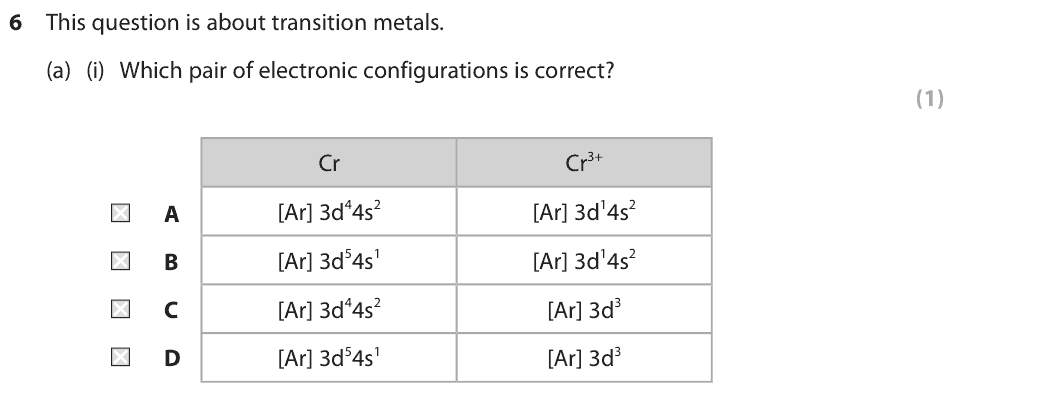
Answer
D
Mark scheme

Notes from the mark scheme and report
- Answer: D. Cr is [Ar]3d5 4s1 and Cr3+ is [Ar]3d3
Notes and key-term cards for this topic are being written by our tutors. The past-paper questions below are ready now.
| Series | Paper | Q | What it asks |
|---|---|---|---|
| June 2024 | Paper 1 | 6 | why aqueous solutions of Cu2+ ions and Fe2+ ions are coloured but have |
| October 2020 | Paper 3 | 7 | “Cobalt(II) ions combine with substances in solution to form complex ions with |
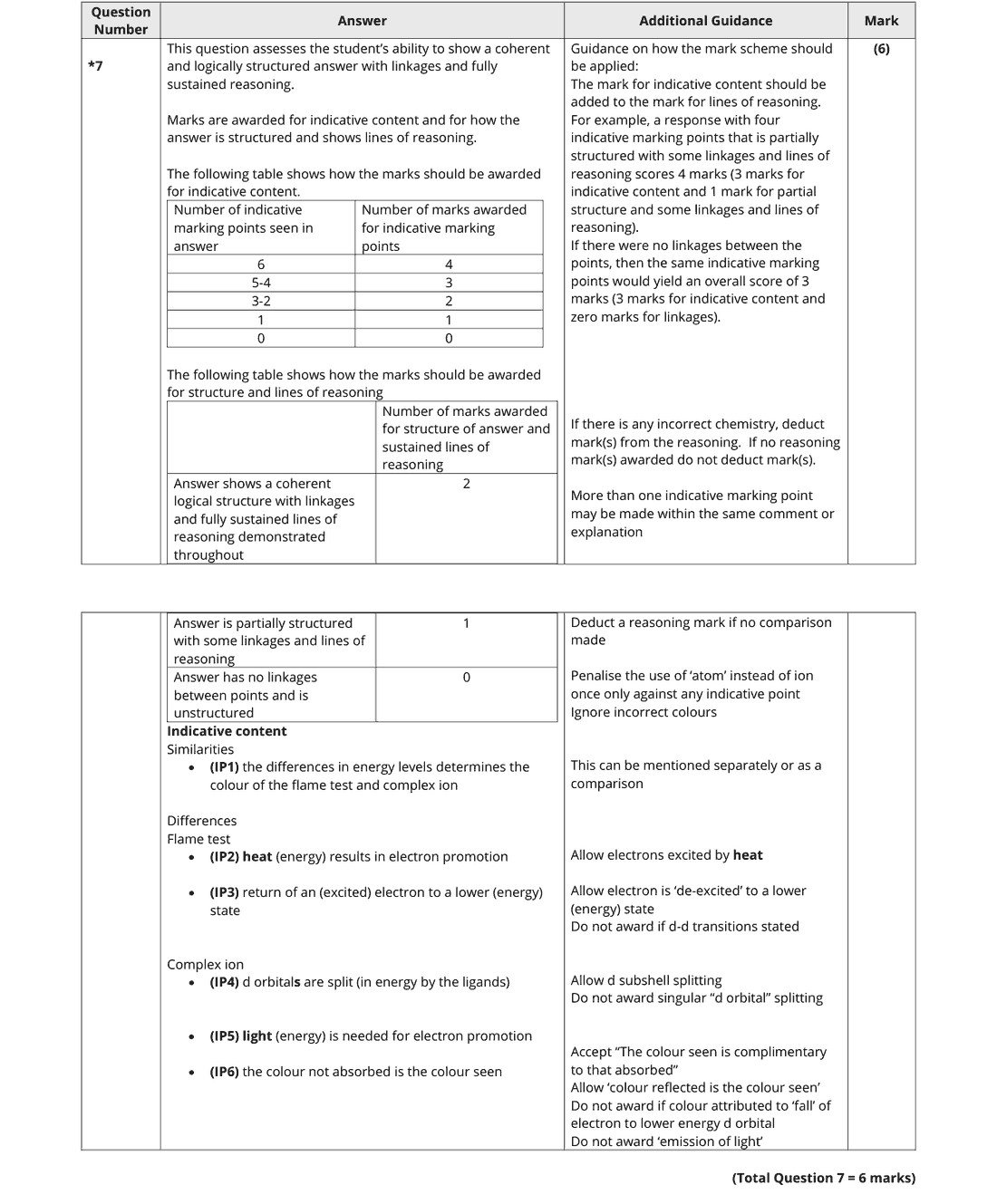
| June 2019 | Paper 1 | 7 | and contrast the origin of the colour of a copper(II) complex with the origin |
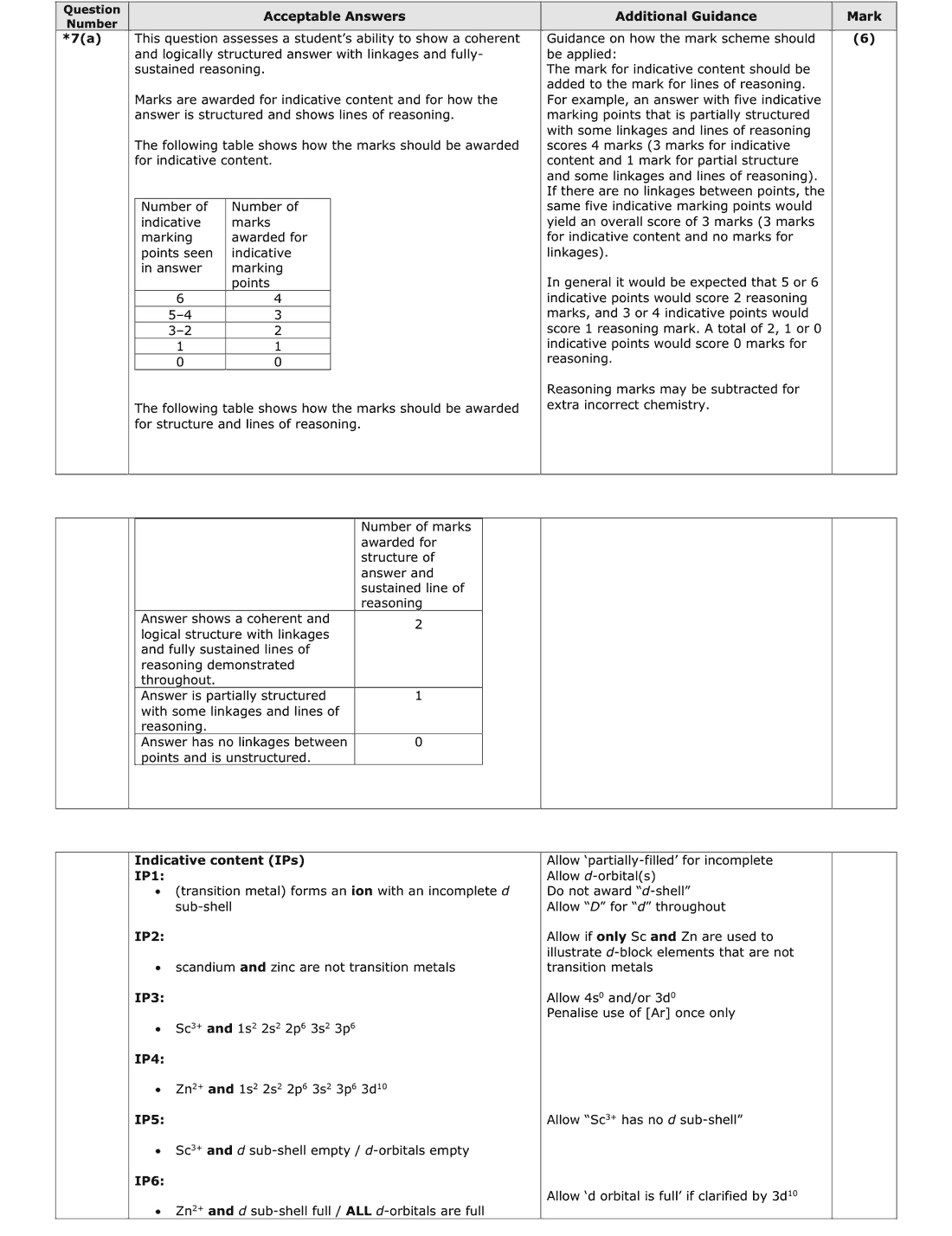
| June 2017 | Paper 3 | 7(a) | why two of the d-block elements within Period 4 (scandium to zinc) are |
D

This was a straightforward question requiring the definition of a transition metal.

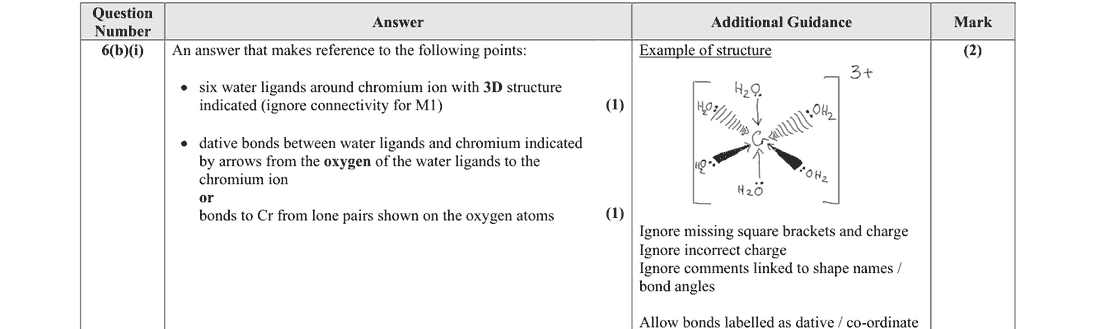
This question required the candidates to draw a 3d structure of the Cr3+ hexa aqua ion and proved more challenging than expected. The errors ranged from not having the correct number of ligands, to incorrect connectivity and finally not being able to draw a 3D representation using two wedges, two dashes and two solid lines.
Skills: MS4.2 Visualise and represent 2D and 3D forms including two- dimensional representations of 3D objects

This question asked for a description of the shape of the Cr3+ hexa aqua ion.
Skills: MS4.1 Appreciate angles and shapes in regular 2D and 3D structures.

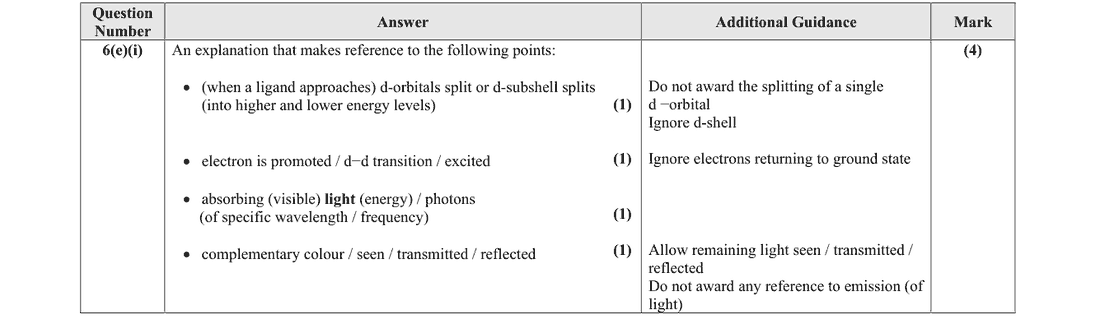
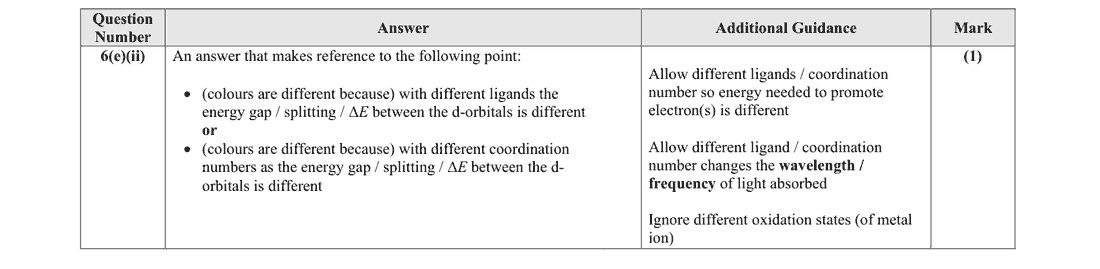
This question was looking at the reason why the Chromium (III) hexa aqua solution is coloured. A general understanding of how the colour arises was shown, but candidates made some little errors which lost marks. A few candidates attributed the colour arising from the emission of light, this would be a flame test, rather than the transmission of the unabsorbed light. There was the occasional careless use of subshells and d-orbital, rather than subshell and d- orbitals. This could lead to the loss of a mark. In Q06(e)(ii), there was sometimes a lack of detail in the different ligand being added, and that was insufficient to gain the mark, the explanation of why was missing.

This question was looking at the reason why the Chromium (III) hexa aqua solution is coloured. A general understanding of how the colour arises was shown, but candidates made some little errors which lost marks. A few candidates attributed the colour arising from the emission of light, this would be a flame test, rather than the transmission of the unabsorbed light. There was the occasional careless use of subshells and d-orbital, rather than subshell and d- orbitals. This could lead to the loss of a mark. In Q06(e)(ii), there was sometimes a lack of detail in the different ligand being added, and that was insufficient to gain the mark, the explanation of why was missing.

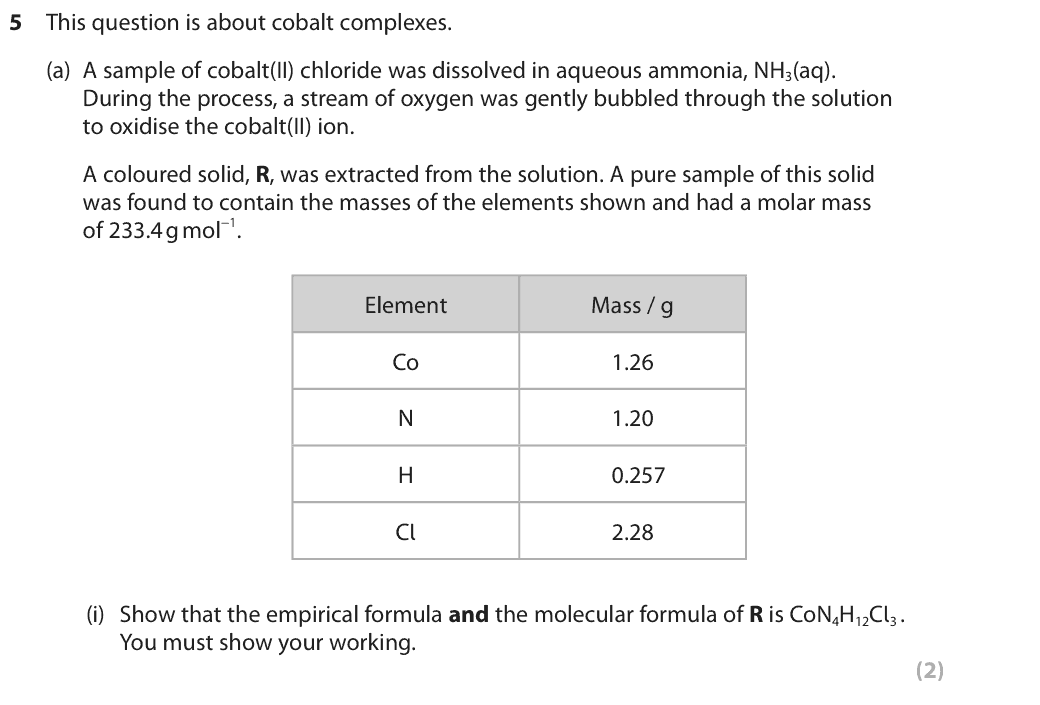
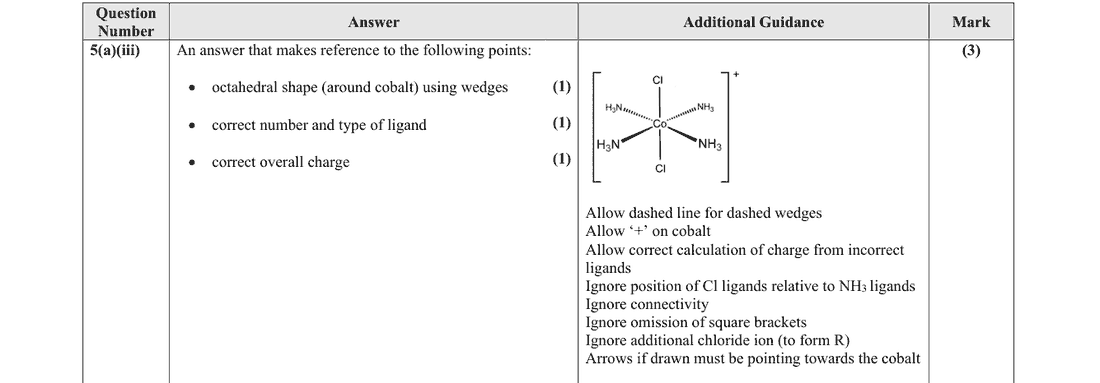
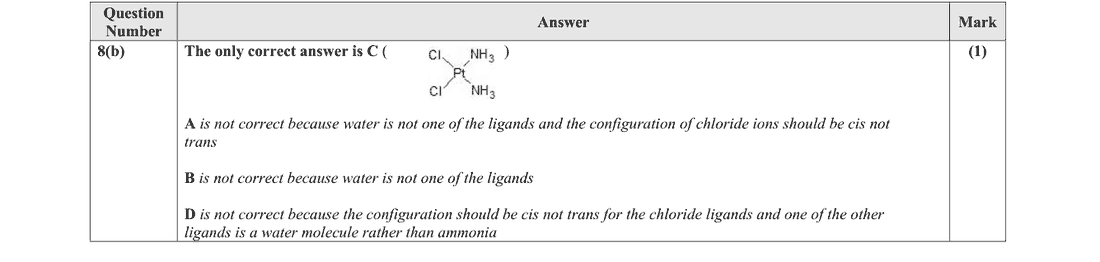
This proved more challenging to candidates. Many were able to deduce that the complex ion would be octahedral in shape, with most drawing a suitable diagram with the correct 'wedge' shapes. Many struggled to identify the correct ligands, with 6 water molecules as a common incorrect answer. There were some correct charges seen, but many candidates thought that the cobalt ion in the centre of the complex had a charge of 2+, despite it having been oxidised to Co3+ in the reaction described in the question.
Skills: MS4.2 Visualise and represent 2D and 3D forms including two- dimensional representations of 3D objects

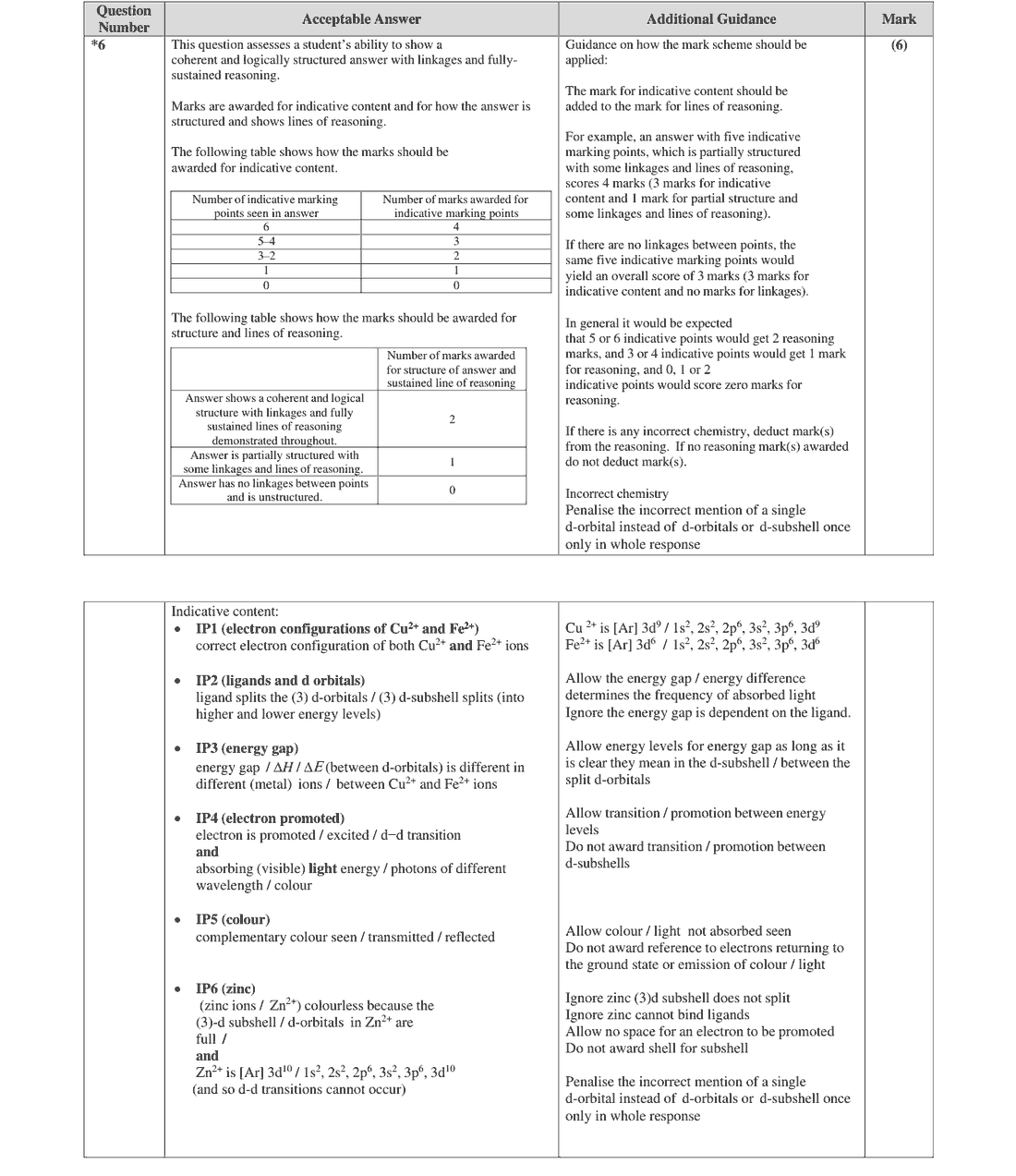
This extended response question was about d-block elements and the colours formed in aqueous solution. Many candidates started their responses by giving the electron configurations of copper, iron and zinc. While many correct electron configurations were given there were some that incorrectly included 4s electrons in the electron configurations of the ions. A general understanding of how the colours arise was shown, but candidates lost marks for not mentioning that it is the ligand that splits the d-subshell and that the energy gap between the split d-orbitals is linked to the colour seen. Some candidates said that the colour arose when light was emitted when an electron dropped back down, but this would be for a flame test, rather than for an aqueous solution where the colour seen is the complementary colour of the light absorbed during the d-d transition. There was, on occasion, careless use of the words 'subshell' and 'orbital' which some candidates used interchangeably. The incorrect mention of a single d-orbital instead of 'd-orbitals' or 'd-subshell' was penalised by the loss of a mark.
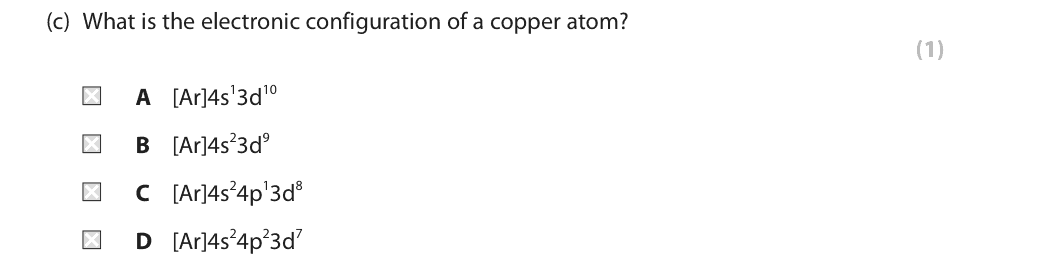
A

Many candidates gave the correct electronic configuration for a Cr2+ ion. However, many candidates did not realise that the 4s electrons are lost first. Some candidates did not use the atomic number of chromium from the periodic table to work out the number of electrons, so they gave an incorrect number of 3d electrons.

The majority of candidates knew that the complex ion would be green or violet.
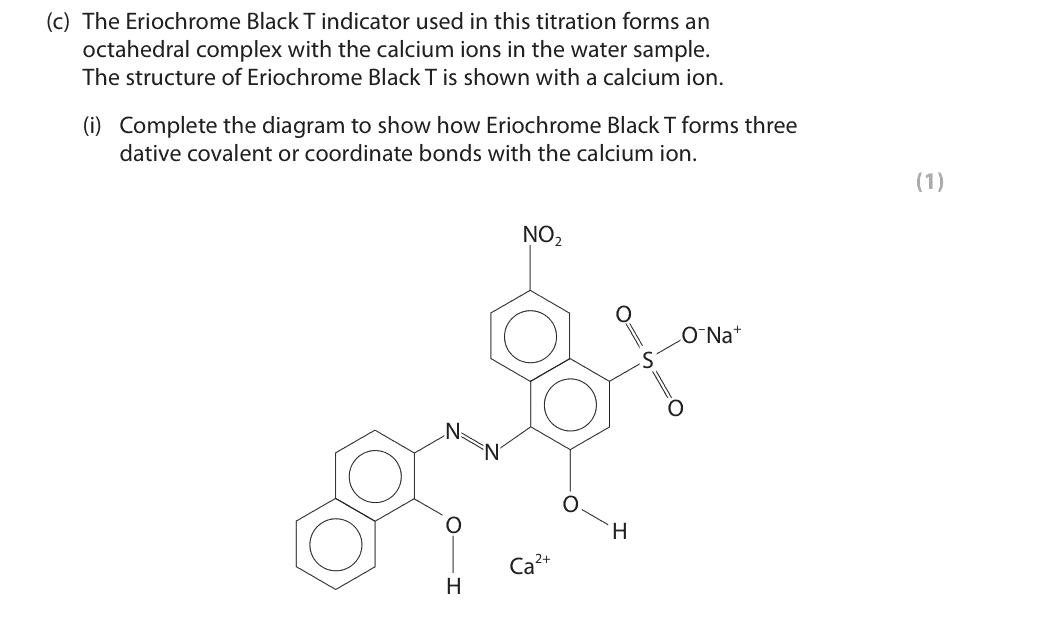
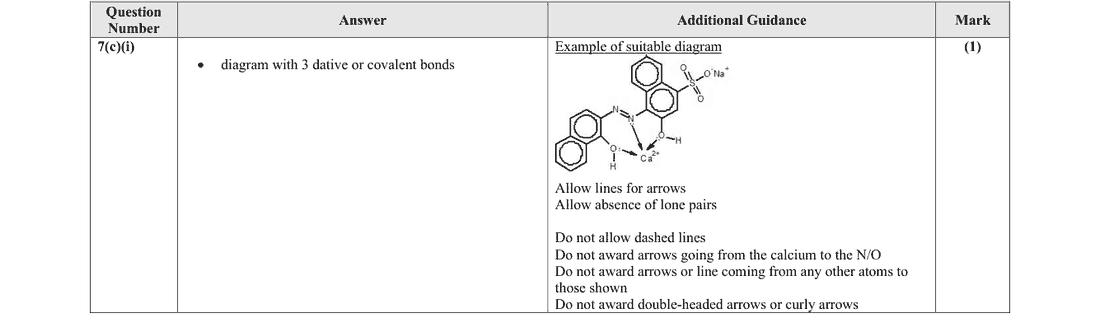
Novel complex ions are not a new topic for exam questions and about half of the candidates could apply their knowledge to this example. The question did ask for three dative covalent or coordinate bonds to be drawn which some candidates appeared to miss from their own drawing, drawing two bonds.

This is another example where understanding the question rubric can help or guide a candidate in answering the question. This part (ii) follows on from part (i) and so since the previous part (i) was about the drawing of three dative covalent bonds, then in an octahedral complex there must be three more to give a total of six. This was deduced by just over half of the candidates.
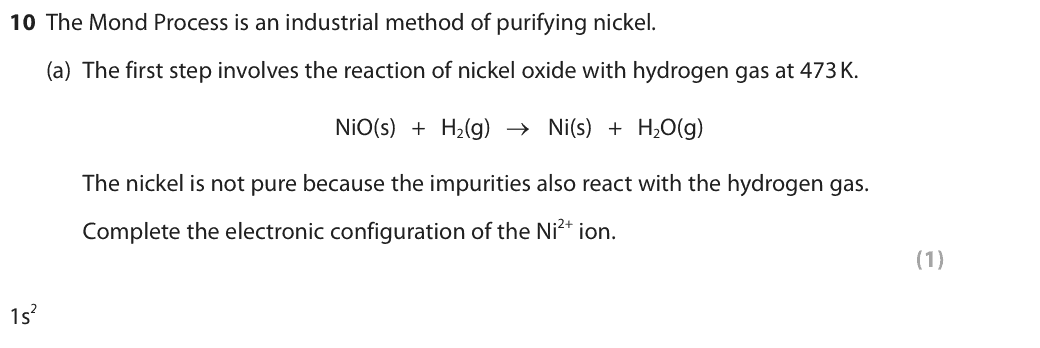
Approximately half of the candidates could correctly give the electronic configuration of the nickel(II) ion.
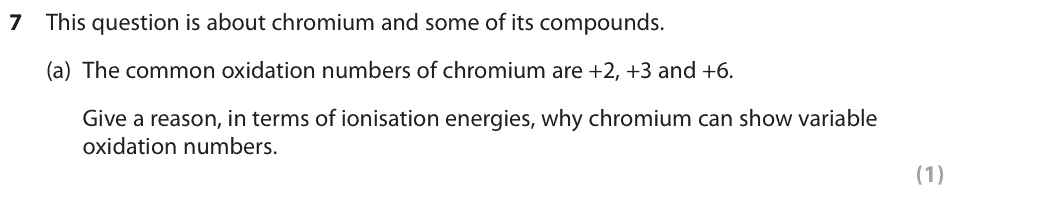
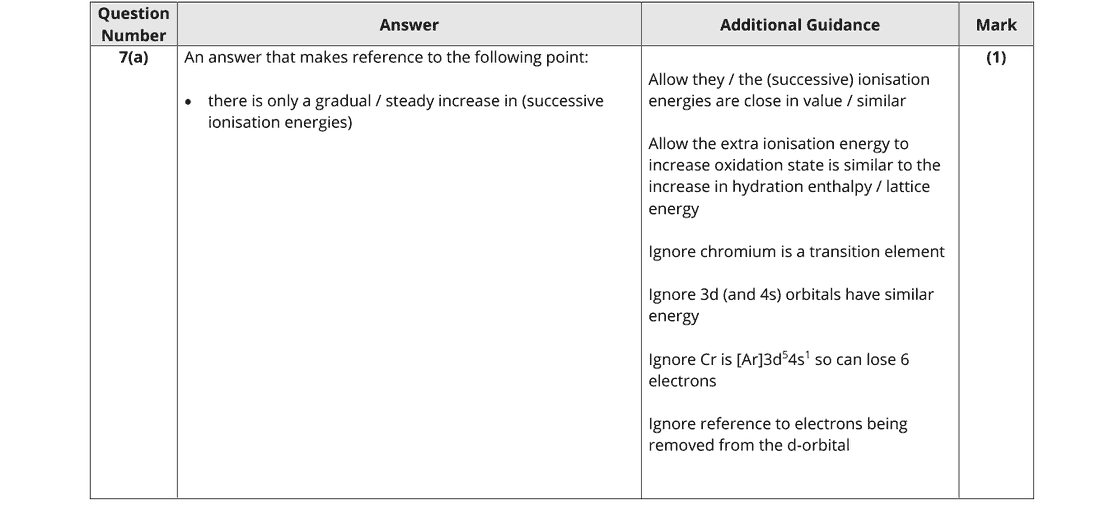
The question required candidates to explain in terms of ionisation energies why chromium can show variable oxidation numbers. Many answers that were not creditworthy were seen, including that all of the ionisation energies were low, or giving answers in terms of electron configuration.

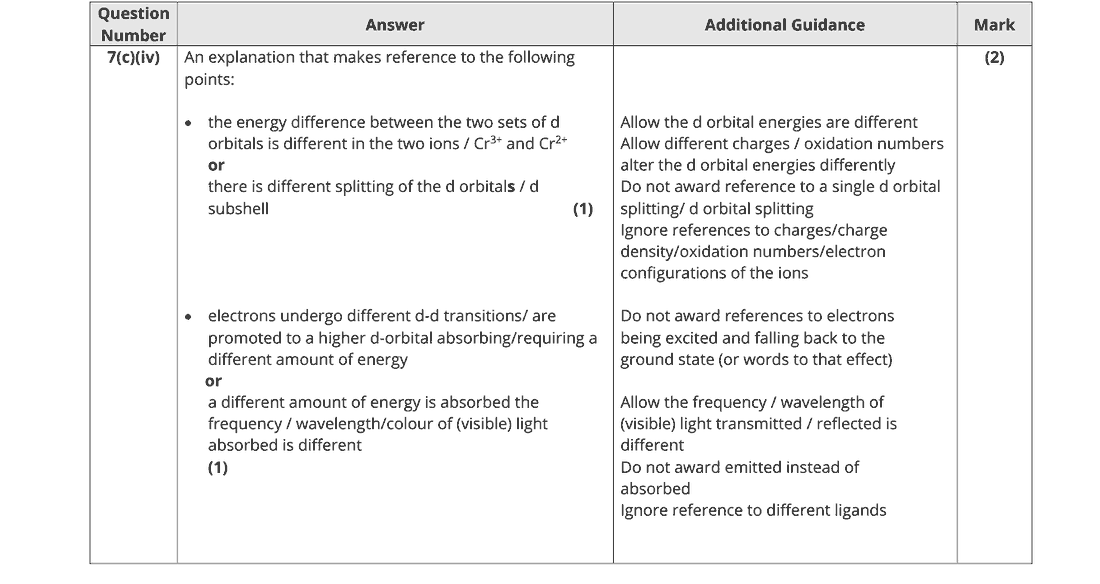
This question proved challenging for many candidates although some good explanations for the differences in colour between the solutions were seen. The marks were awarded for an explanation of the reason for a different energy gap (the d-subshell being split differently by the ligand) and for the origin of the different colours (a different amount of energy is absorbed). Candidates were often unsure of what to include in the explanation and incorrect answers included references to 'the oxidation numbers/electron configurations are different'. A significant number of candidates mentioned splitting of a single d-orbital rather than the d- subshell. For the second part of the answer a significant number of the candidates referenced electrons being promoted up to a higher energy level and emitting light as they drop back to the ground state. This relates to the visualisation of colour in a flame test and not to transition metal ions in solution and so no marks were scored if this was given as an explanation.
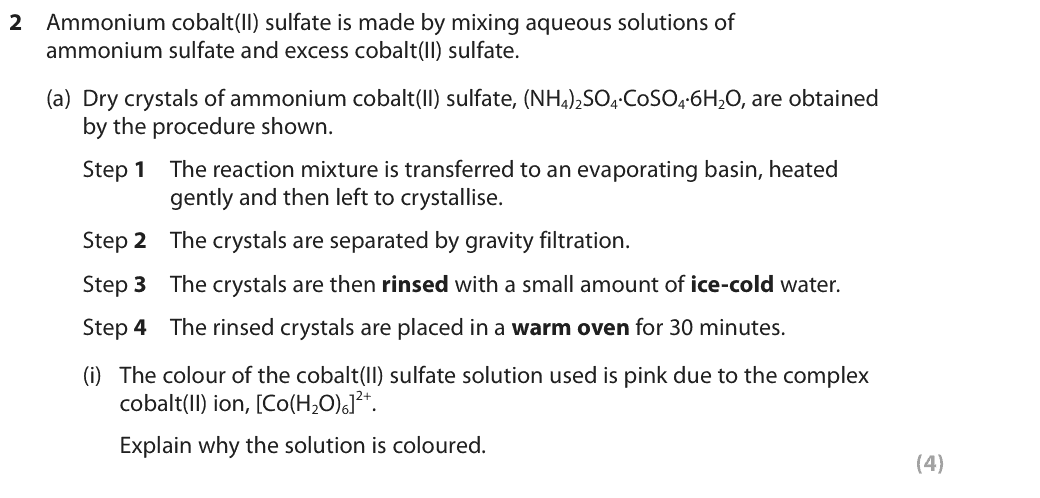
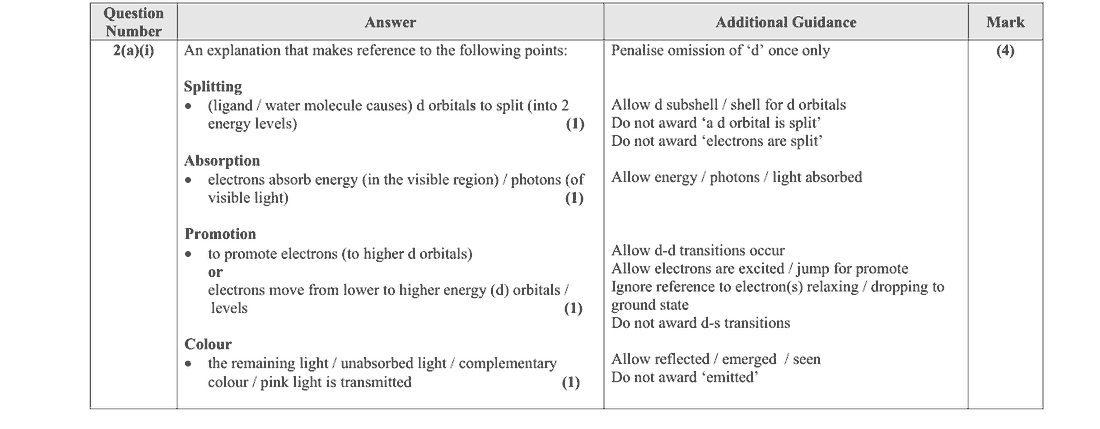
There were a significant number of candidates who were confused about why the cobalt(II) sulfate solution is coloured. Many were confused between a d subshell and a d orbital so thought that a d orbital could split into two different energies. Some just referred to electrons moving between energy levels and did not specify that electrons are promoted when they absorb energy. There was a lot of confusion then with flame tests as many candidates referred to the electrons dropping down and emitting energy. Many candidates would benefit from a review of colour in transition metal ions and flame tests to ensure that they understand the difference.

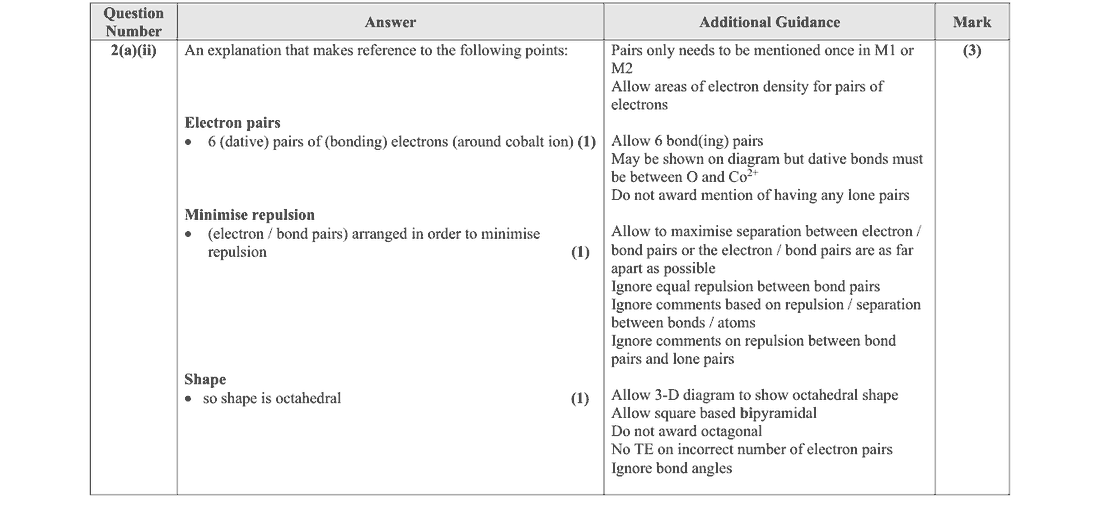
The majority of candidates knew that complex ions with six ligands are octahedral, although incorrect terms such as octagonal, hexagonal and hexahedral were seen. Fewer candidates were able to explain the shape in terms of the number of pairs of electrons and the idea of minimising repulsion between them. Some candidates just wrote about six ligands or bonds and did not refer to the bond pairs and some wrote about lone pair-lone pair repulsion being greater than bond pair-bond pair repulsion, even though that was not relevant here. A few candidates were confused and wrote about minimum separation and maximum repulsion. Candidates should revise the names of the basic shapes of molecules and ions and the reasons why they are these shapes.
Skills: MS4.1 Appreciate angles and shapes in regular 2D and 3D structures.

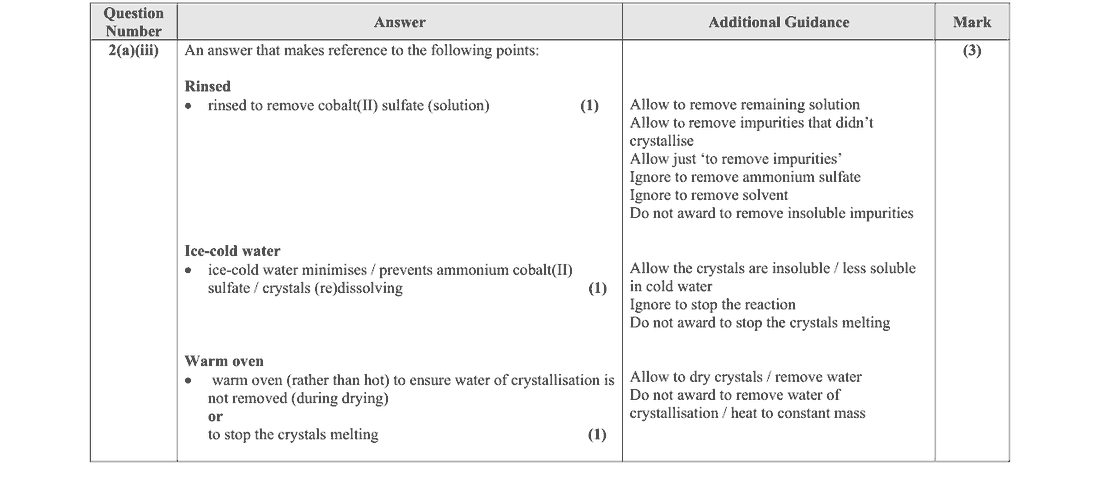
Many candidates gave clear reasons for carrying out Steps 3 and 4 of the procedure, showing that they had carried out practical work to obtain pure, dry crystals. The most observant candidates realised that cobalt(II) sulfate solution was present in excess so the crystals are rinsed to remove this excess solution. A significant number of candidates did not comment on the use of ice-cold water, even though it was printed in bold. Some thought the ice-cold water would quench the reaction. The majority of candidates realised that the warm oven was used to dry the crystals, although some lost the mark if they stated that the water of crystallisation would be removed, the crystals would be dehydrated or an anhydrous salt is obtained.
Skills: PT4 use laboratory apparatus for a variety of experimental techniques, including: titration, using burette and pipette; distillation and heating under reflux, including setting up glassware using retort stand and clamps; qualitative tests for ions and organic functional groups; filtration, including use of fluted filter paper, or filtration under reduced pressure; CP12 Core practical 12: The preparation of a transition metal complex

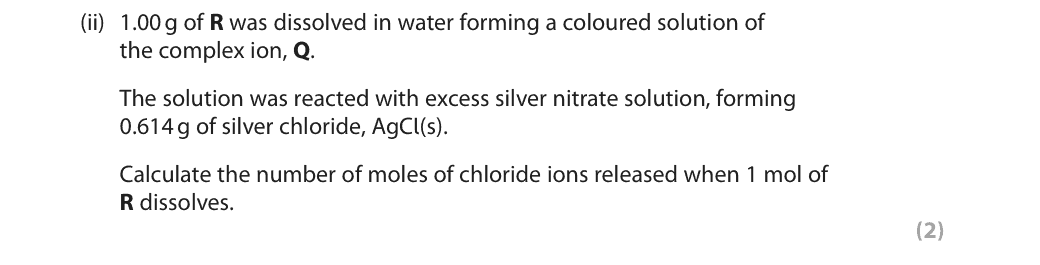
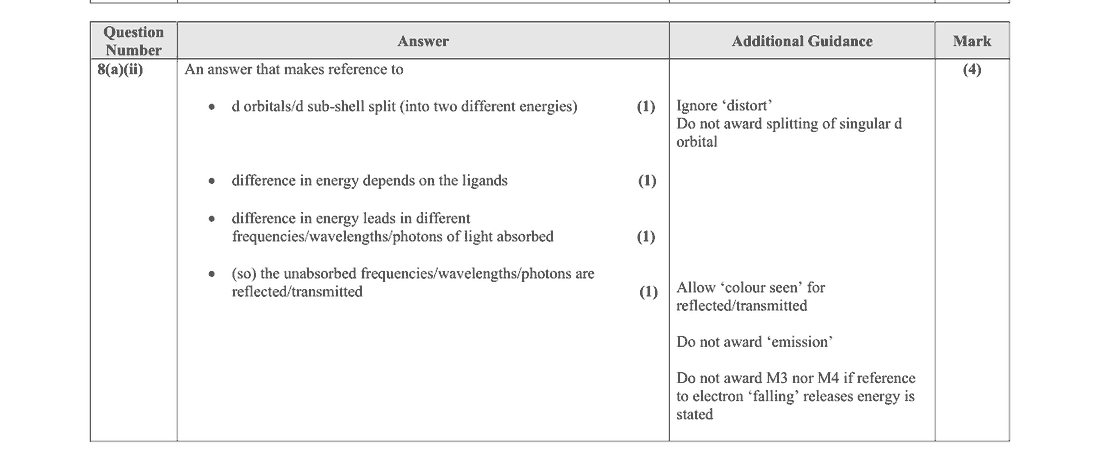
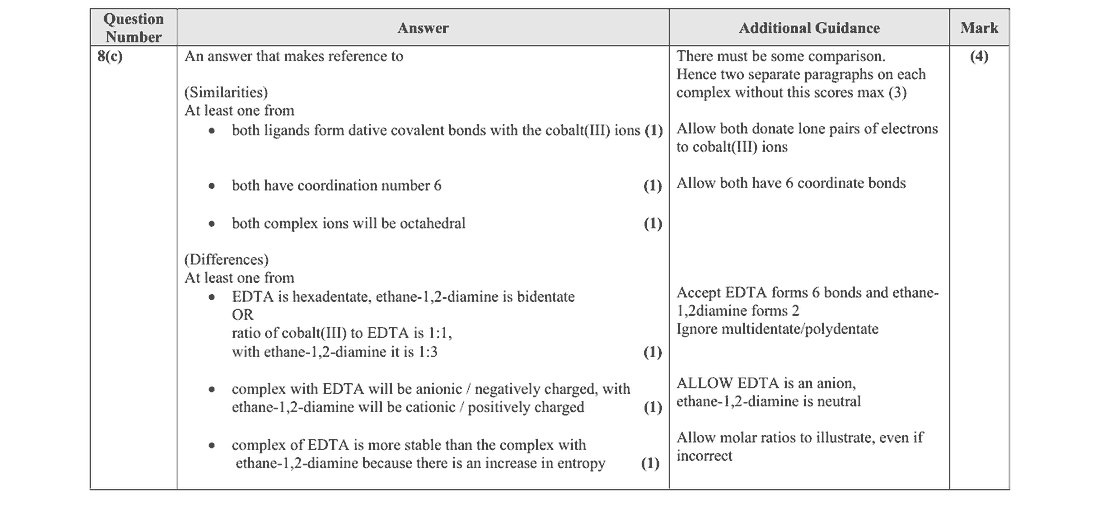
In part (a) there was a question on the origin of complex ion colour which proved to be an effective discriminator as it has in the past. Candidates still need to take care with the terms used, for example when referring to the splitting of the d subshell and not a single d orbital or the reflection and not emission of light from the complex. Occasional confusion with the electronic transitions of flame tests was also seen. The command or instruction for part (c) was “Compare and contrast” and so this should have elicited some similiarities and some differences. However responses which scored 3 or 4 marks tended to be rare. Consolidation of this area of complex ions is needed. The correct formula of the complex in part (d) was not often seen and hence the justification even less so. Candidates appreciated that there was a 1:2 molar ratio but failed to appreciate that the two moles of chloride ions able to react with the silver nitrate are not those in the complex.

In part (a) there was a question on the origin of complex ion colour which proved to be an effective discriminator as it has in the past. Candidates still need to take care with the terms used, for example when referring to the splitting of the d subshell and not a single d orbital or the reflection and not emission of light from the complex. Occasional confusion with the electronic transitions of flame tests was also seen. The command or instruction for part (c) was “Compare and contrast” and so this should have elicited some similiarities and some differences. However responses which scored 3 or 4 marks tended to be rare. Consolidation of this area of complex ions is needed. The correct formula of the complex in part (d) was not often seen and hence the justification even less so. Candidates appreciated that there was a 1:2 molar ratio but failed to appreciate that the two moles of chloride ions able to react with the silver nitrate are not those in the complex.
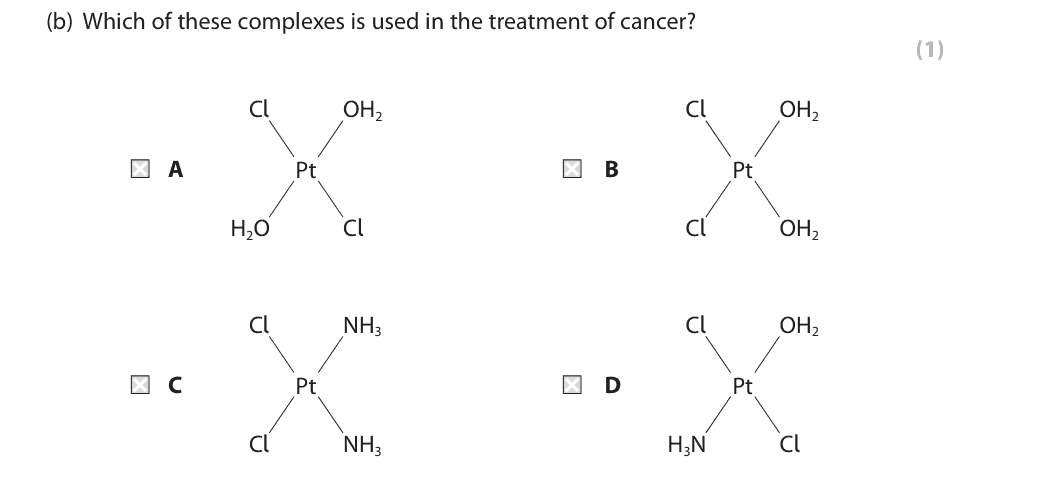
C
In part (a) there was a question on the origin of complex ion colour which proved to be an effective discriminator as it has in the past. Candidates still need to take care with the terms used, for example when referring to the splitting of the d subshell and not a single d orbital or the reflection and not emission of light from the complex. Occasional confusion with the electronic transitions of flame tests was also seen. The command or instruction for part (c) was “Compare and contrast” and so this should have elicited some similiarities and some differences. However responses which scored 3 or 4 marks tended to be rare. Consolidation of this area of complex ions is needed. The correct formula of the complex in part (d) was not often seen and hence the justification even less so. Candidates appreciated that there was a 1:2 molar ratio but failed to appreciate that the two moles of chloride ions able to react with the silver nitrate are not those in the complex.
Skills: MS4.2 Visualise and represent 2D and 3D forms including two- dimensional representations of 3D objects
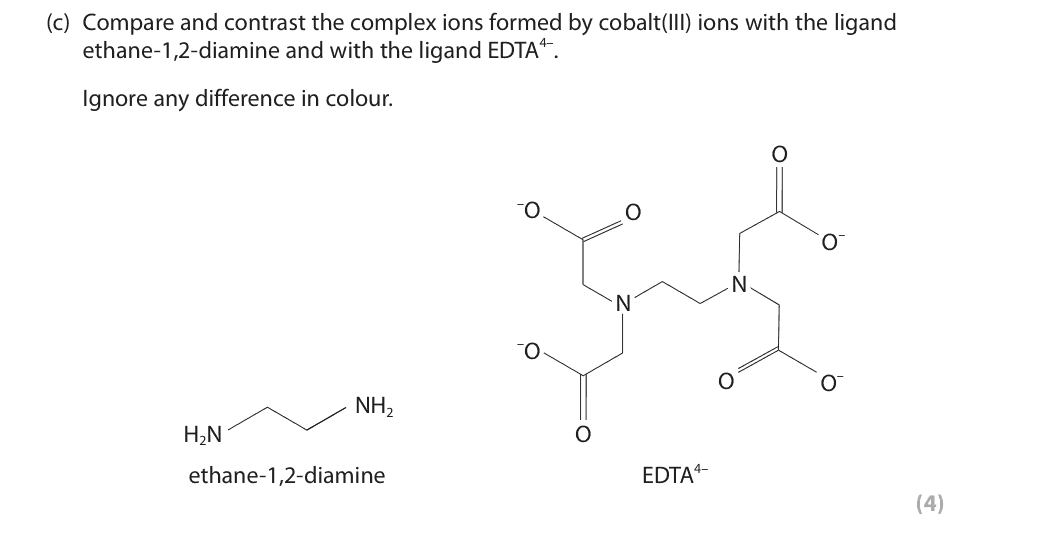
In part (a) there was a question on the origin of complex ion colour which proved to be an effective discriminator as it has in the past. Candidates still need to take care with the terms used, for example when referring to the splitting of the d subshell and not a single d orbital or the reflection and not emission of light from the complex. Occasional confusion with the electronic transitions of flame tests was also seen. The command or instruction for part (c) was “Compare and contrast” and so this should have elicited some similiarities and some differences. However responses which scored 3 or 4 marks tended to be rare. Consolidation of this area of complex ions is needed. The correct formula of the complex in part (d) was not often seen and hence the justification even less so. Candidates appreciated that there was a 1:2 molar ratio but failed to appreciate that the two moles of chloride ions able to react with the silver nitrate are not those in the complex.
+
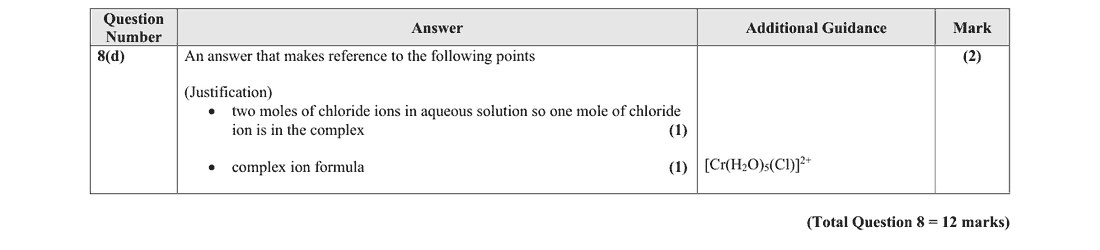
In an experiment, 0.10 mol of a complex reacted with excess silver nitrate solution
to produce 0.20 mol of silver chloride.
Chloride ions which are ligands within the complex do not react with
silver nitrate.
Deduce the formula of this chromium(III) complex ion. Justify your answer.](/img/NOV21_9CH01/NOV21_9CH01_8-d_qp.webp)
In part (a) there was a question on the origin of complex ion colour which proved to be an effective discriminator as it has in the past. Candidates still need to take care with the terms used, for example when referring to the splitting of the d subshell and not a single d orbital or the reflection and not emission of light from the complex. Occasional confusion with the electronic transitions of flame tests was also seen. The command or instruction for part (c) was “Compare and contrast” and so this should have elicited some similiarities and some differences. However responses which scored 3 or 4 marks tended to be rare. Consolidation of this area of complex ions is needed. The correct formula of the complex in part (d) was not often seen and hence the justification even less so. Candidates appreciated that there was a 1:2 molar ratio but failed to appreciate that the two moles of chloride ions able to react with the silver nitrate are not those in the complex.

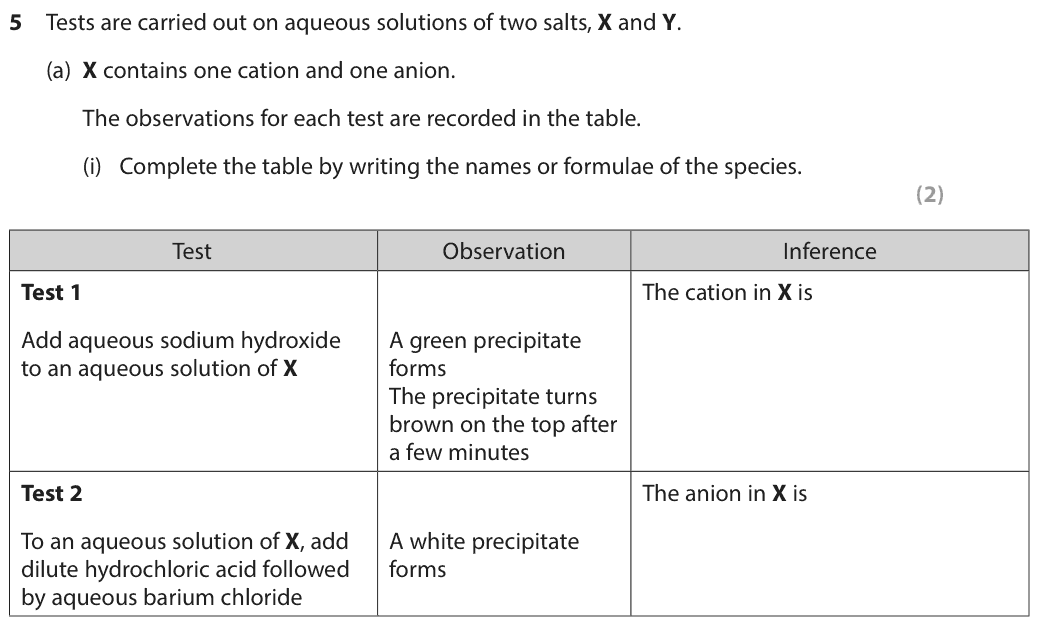
Some candidates were familiar with the tests for ions listed in the specification so answered this question very well. Others would benefit from much more practise at this style of experiment and question. Many candidates recognised the test for a sulfate ion in X but far fewer identified the iron(II) cation. The ionic equation for the reaction between the cation and aqueous sodium hydroxide was poorly answered. Many candidates did know that the precipitate would be oxidised by air, even if they didn’t know what the precipitate was. Many knew that hydrochloric acid was added in Test 2 to remove any carbonate ions to ensure they did not give a precipitate with aqueous barium chloride. The tests for copper(II) ions and chloride ions were often known, although there was some confusion with chromium, cobalt or nickel ions. The formula of the complex ion in the deep blue solution was rarely done correctly, with many not even including ammonia ligands. Many candidates did know how to confirm the presence of chloride ions.
Skills: CP15 Core practical 15: Analysis of some inorganic and organic unknowns

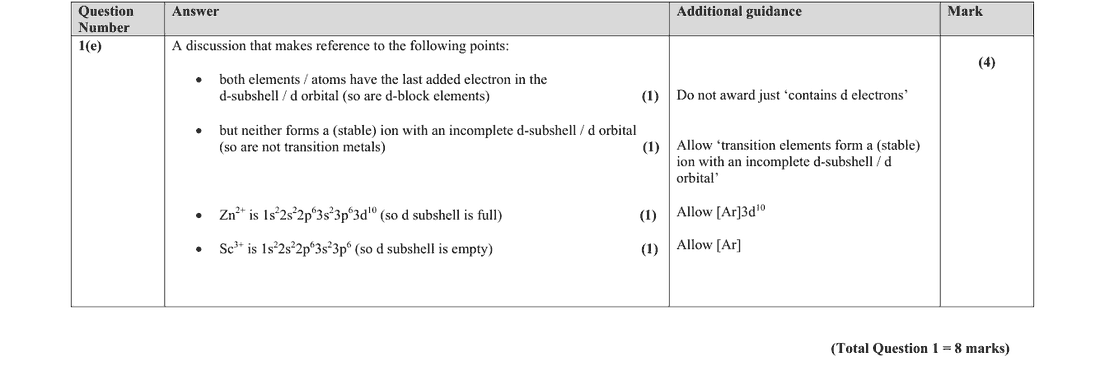
The multiple choice questions allowed many candidates to start confidently, as did part (d). However, a minority made an unforced error here by giving the symbol for neon. Some candidates seem to assume isoelectronic means an ion with the same overall charge, so suggested group 2 ions such as Ca2+. In (e), many candidates were able to justify why scandium and zinc are not classified as transition metals, with clear reference to the electronic configurations of stable ions. A number believe that the reference to an incomplete d-subshell applies to the atom, and this view persisted with examiners seeing examples of atomic configurations with no discussion of the ion formation. The ability to define what is meant by a d-block element proved discriminating, with many circular answers along the lines of ‘they are d-block elements because they are in the d-block of the Periodic Table’ failing to score.

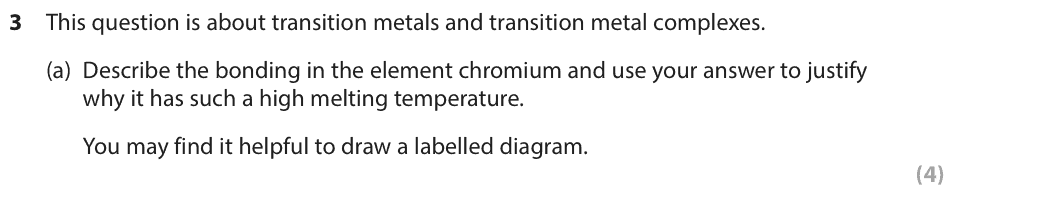
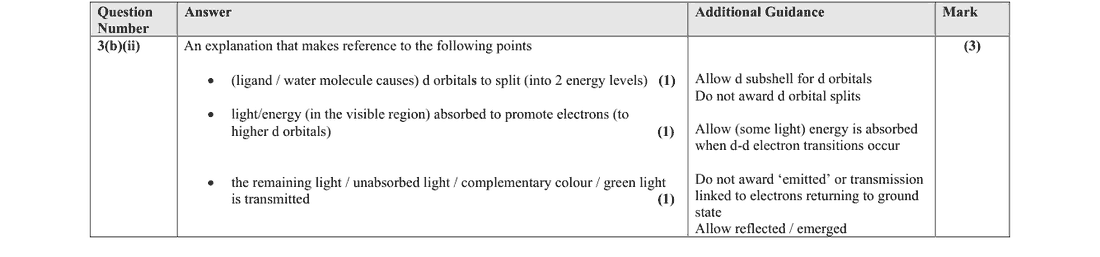
Most candidates had some knowledge of metallic structure, and the candidates with an eye for written detail and who took care with any diagrams where able to score full marks. Probably the most common issue with diagrams was inconsistencies with the number of electrons shown. For instance the ion would be shown as Cr3+, but too few electrons where then evident in the diagram. Written answers did not always refer to the regular arrangement / lattice of ions, hence without a diagram to support the comments, the first mark could not be awarded. Some confusion persists with the electrostatic attraction in the model. Many referred to an attraction between the nucleus and the outer electrons hence it was not always clear whether the discussion was based around ionisation of metallic bonding. A small number of candidates needed to take care when reading the question as they described bonding in chromium complexes and tried to justify a high melting temperature in this context. In (b) most candidates could describe the shape of the context, but once again some did not read the question and gave its formula. In (ii) most candidates realised that the d-orbitals / subshell splits in a complex ion. A number were imprecise with language though and did not score the first mark as they described a singular ‘d-orbital’ as splitting. Many understood the colour was linked to electron promotion, though disappointingly many linked this to the return of the electron to the ground state and subsequent emission of light, as in a flame test. Most candidates recognised the increases in entropy in (c), linking it to the increases in the number of moles of particles, though far fewer appreciated that the value of the equilibrium constant meant the complex was stable or the equilibrium position was far to the right. The calculation in (d) allowed nearly all candidates to access some credit, with the first 2 marks often awarded. Although the molar volume of a gas was given in the question, a number of candidates attempted to find the moles of chlorine using the ideal gas equation, making life more difficult for themselves. The ability to link the transfer of electrons to the ratio was discriminating, and such candidates often went on to score full marks in (i) and (ii). Some answers found in difficult to process the idea that this was an oxidation from +2 to +5, and focused on the more usual reduction from +5 to +2, giving the colours the wrong way round.
Skills: MS4.1 Appreciate angles and shapes in regular 2D and 3D structures.

Most candidates had some knowledge of metallic structure, and the candidates with an eye for written detail and who took care with any diagrams where able to score full marks. Probably the most common issue with diagrams was inconsistencies with the number of electrons shown. For instance the ion would be shown as Cr3+, but too few electrons where then evident in the diagram. Written answers did not always refer to the regular arrangement / lattice of ions, hence without a diagram to support the comments, the first mark could not be awarded. Some confusion persists with the electrostatic attraction in the model. Many referred to an attraction between the nucleus and the outer electrons hence it was not always clear whether the discussion was based around ionisation of metallic bonding. A small number of candidates needed to take care when reading the question as they described bonding in chromium complexes and tried to justify a high melting temperature in this context. In (b) most candidates could describe the shape of the context, but once again some did not read the question and gave its formula. In (ii) most candidates realised that the d-orbitals / subshell splits in a complex ion. A number were imprecise with language though and did not score the first mark as they described a singular ‘d-orbital’ as splitting. Many understood the colour was linked to electron promotion, though disappointingly many linked this to the return of the electron to the ground state and subsequent emission of light, as in a flame test. Most candidates recognised the increases in entropy in (c), linking it to the increases in the number of moles of particles, though far fewer appreciated that the value of the equilibrium constant meant the complex was stable or the equilibrium position was far to the right. The calculation in (d) allowed nearly all candidates to access some credit, with the first 2 marks often awarded. Although the molar volume of a gas was given in the question, a number of candidates attempted to find the moles of chlorine using the ideal gas equation, making life more difficult for themselves. The ability to link the transfer of electrons to the ratio was discriminating, and such candidates often went on to score full marks in (i) and (ii). Some answers found in difficult to process the idea that this was an oxidation from +2 to +5, and focused on the more usual reduction from +5 to +2, giving the colours the wrong way round.
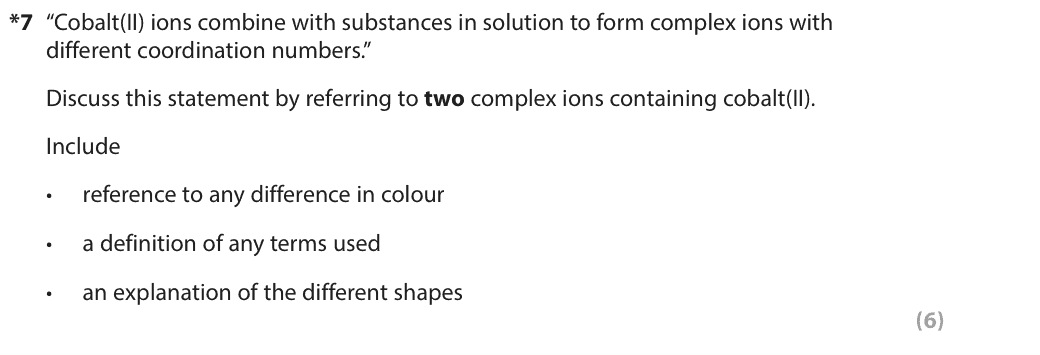
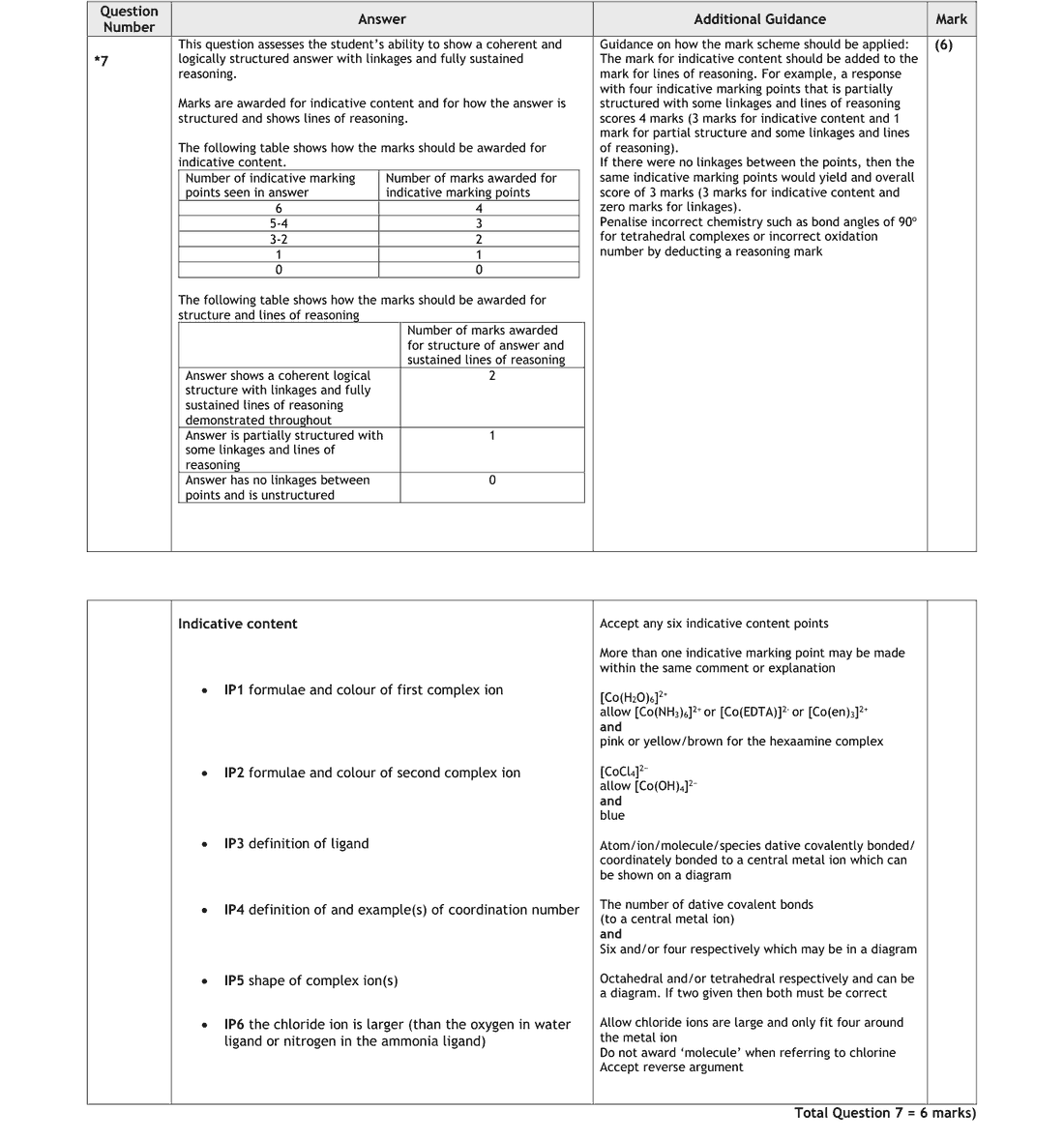
This question elicited the full range of responses and so proved to be an effective discriminator. It was clear that some candidates had a very good knowledge of this topic area whilst other candidates wrote rather confused and contradictory responses. One particular error which centres would be well-advised to ensure is clear in the minds of their candidates is that the coordination number is not the number of ligands bonded to the central metal ion but rather is the number of coordination bonds between the ligand(s) and the central metal ion. A significant number of candidates did not get this correct. Another common issue was the inclusion of more than one complex ion example with the same geometry. For example the hexaaqua and the hexaamine complexes were on occasion both given and so both had to be correct for the mark to be awarded. The definition of a ligand was also often vague or absent despite the clear requirement given in the question.

This extended response question produced a wide range of marks and was an excellent discriminator, although only a few candidates scored all six marks. The indicative point most frequently lacking was the reference to the difference in energy levels as being the determining factor in the colour observed for both the flame test and of the complex ion. A clear statement was required for both of these discussions. Since this question is a 'Compare and contrast' type of question it was important for candidates to make sure that there was at least some reference to a comparison of some description between the origin of the two colours. If this was lacking, then one of the structure and reasoning marks was lost. There was evidence of some confusion in candidates' minds over the origin of colour. For example, the origin of colour for complex ions was at times erroneously attributed to electrons 'falling back' to the lower d orbital or that the emission of light was responsible for the colour observed. These comments illustrate how some candidates had mixed up the origin of the flame test colour with that of origin of complex ion colour. Another error which was often seen was that of referring to the split of a singular d orbital rather than the splitting of the d orbital subshell.
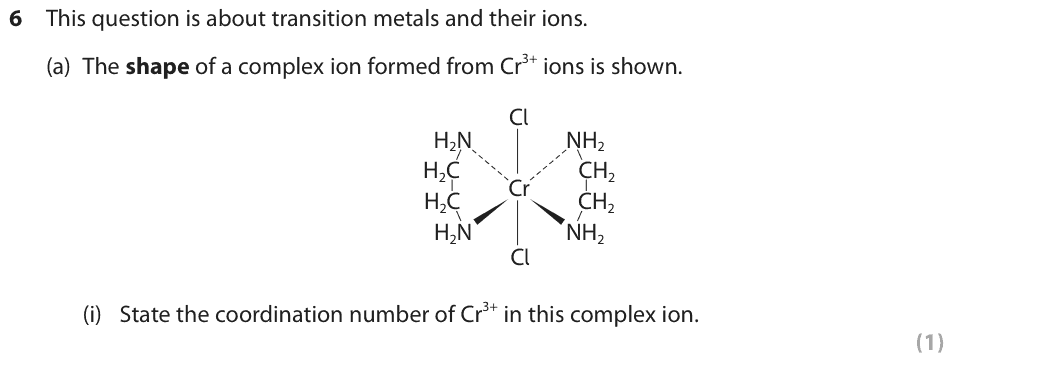
Candidates should know that the coordination number is the number of coordinate (dative covalent) bond around the central ion and not the number of ligands.

Candidates should know that chloride ions have a negative charge and ethane-1,2-diamine is neutral so the overall charge on the ion can be deduced as +1.
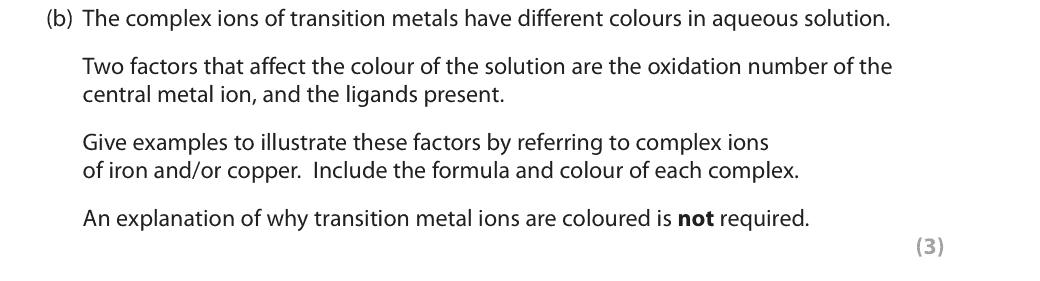
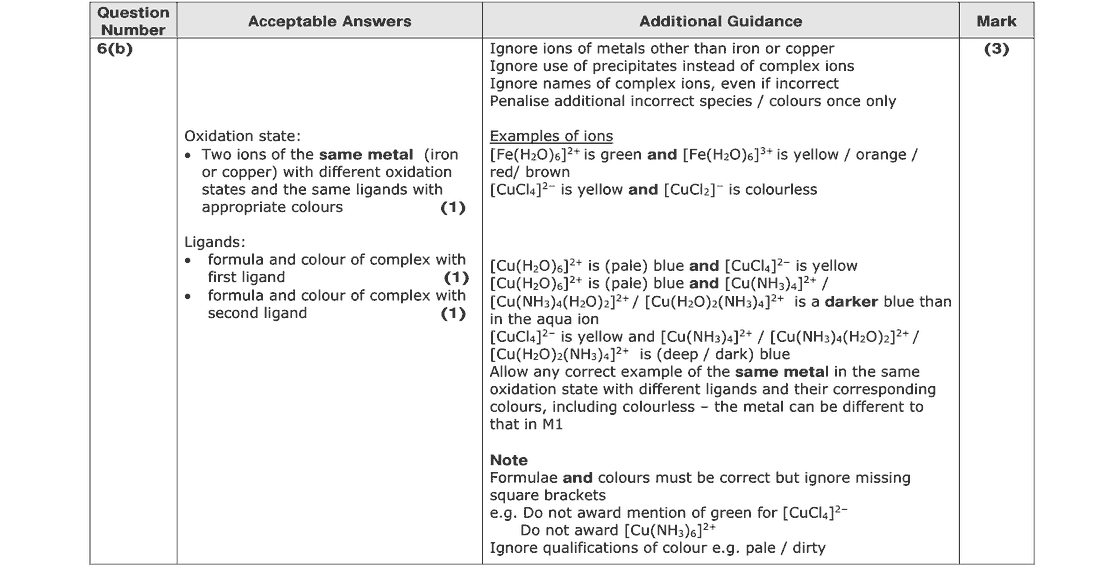
Candidates who were familiar with the complex ions of iron(II), iron(III) and copper(II) and their colours, found this a straightforward question. Some candidates did not read the question and wrote about the colours of the hydroxide precipitates formed by those metals instead of the complex ions asked for in the question. The question asked for the effect of oxidation number and ligands on the colour and a significant number of candidates only answered one of these points. Common errors included: giving incorrect formulae of the complex ions eg [Cu(NH3)6]2+, incorrect colours eg [CuCl4]2- as green instead of yellow or giving incorrect complex ions eg [Fe(NH3)6]2+. Candidates would benefit from carrying out test tube experiments involving the complex ions in the specification and then recording the colours and formulae of these complex ions. A few candidates ignored the instruction to not give an explanation of why transition metal ions are coloured.
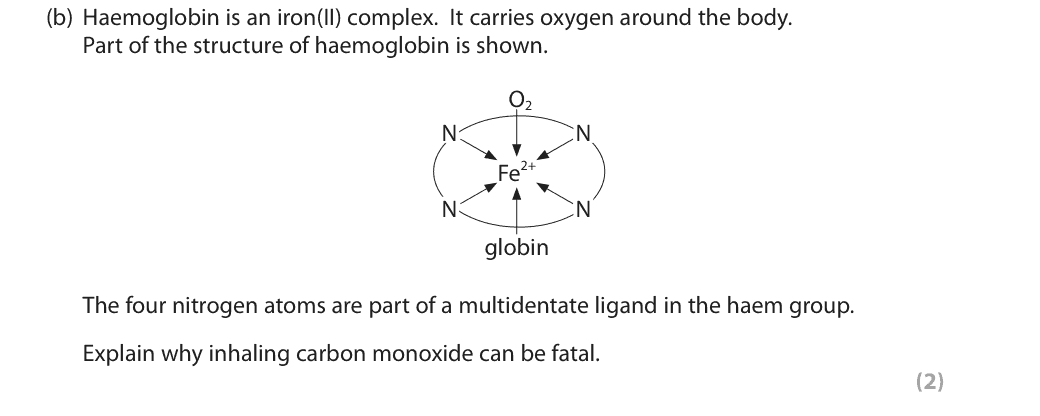
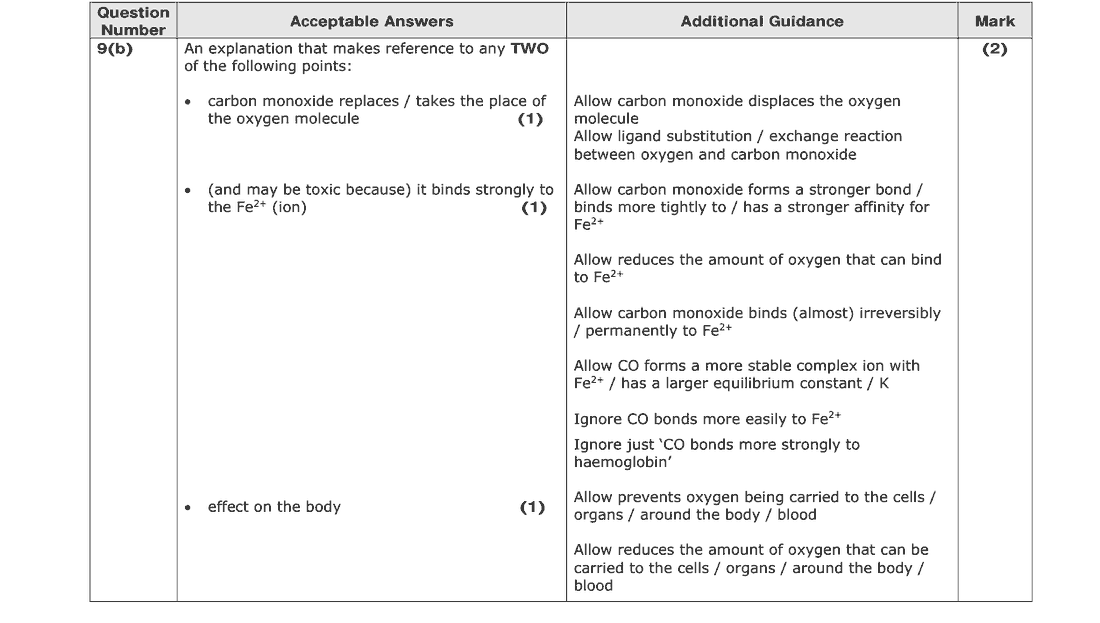
This question is taken directly from the specification so it was surprising that more candidates did not score full marks. Many candidates did not state that carbon monoxide replaces the oxygen molecule in haemoglobin and a few thought that it replaced nitrogen. Many candidates referred to a strong bond between carbon monoxide and haemoglobin but most did not specify the bond to the Fe2+ ion in haemoglobin. The majority of candidates were able to score the mark for the effect on the body, although some referred to breathing or suffocation, which are incorrect.
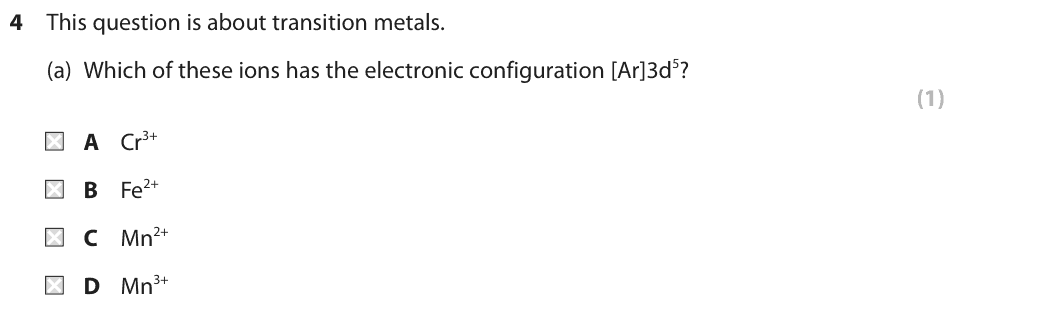
C
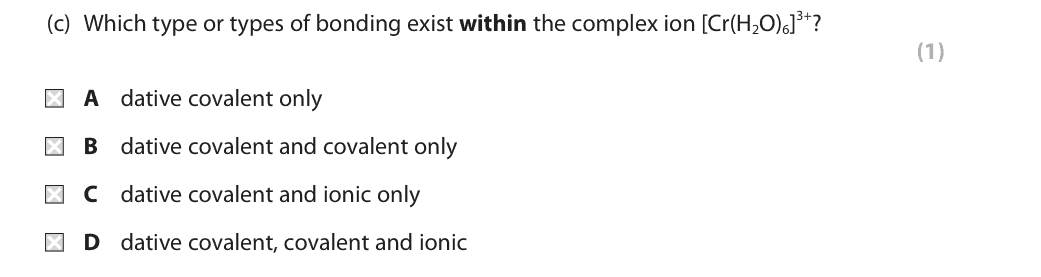
B
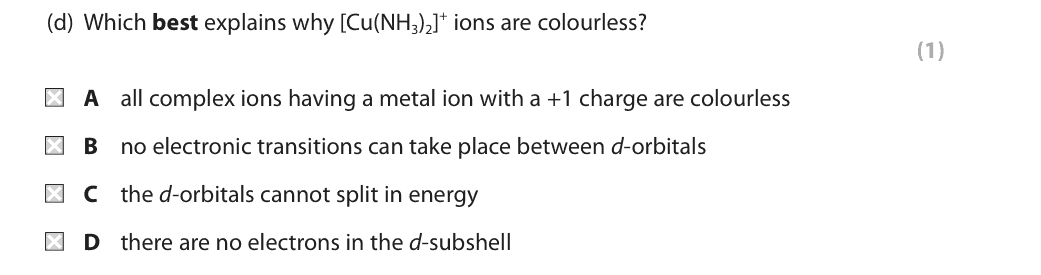
B
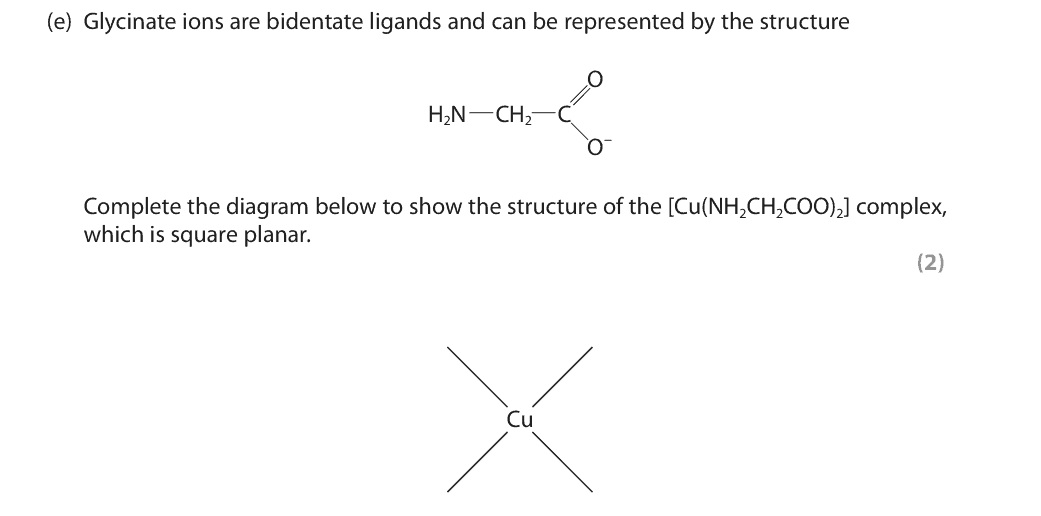
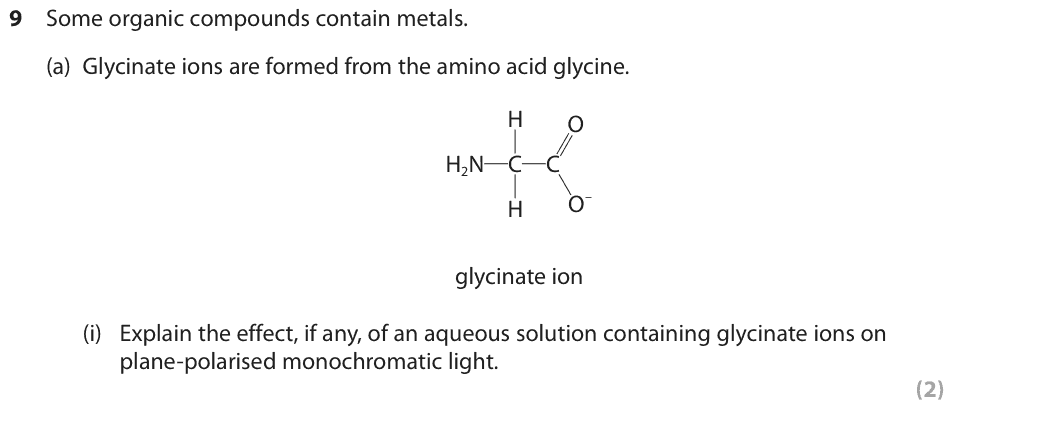
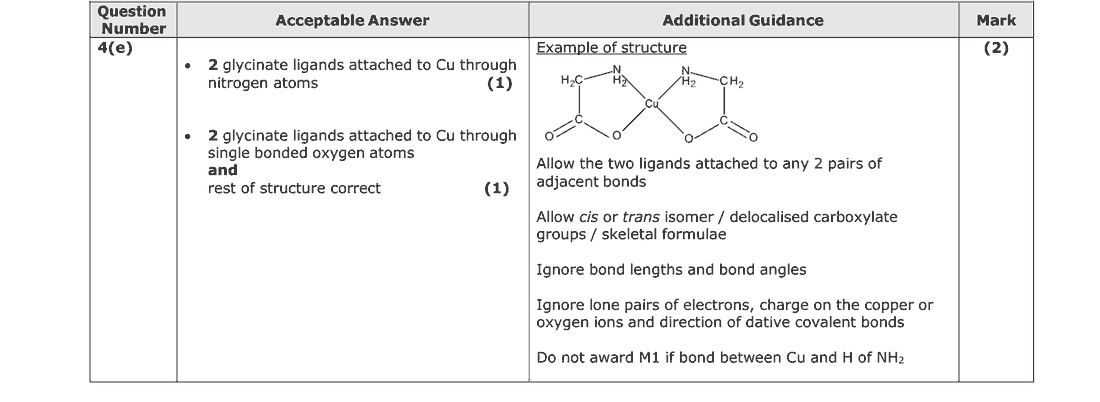
Many candidates could show the structure of the complex correctly. However, common errors included showing four monodentate ligands instead of two bidentate ligands, showing the hydrogens of the NH2 groups linked to copper instead of the nitrogen atoms, showing the oxygens of the C=O groups joined to the copper instead of the single-bonded oxygens and splitting the two bidentate ligands into four monodentate ligands.
Skills: MS4.2 Visualise and represent 2D and 3D forms including two- dimensional representations of 3D objects
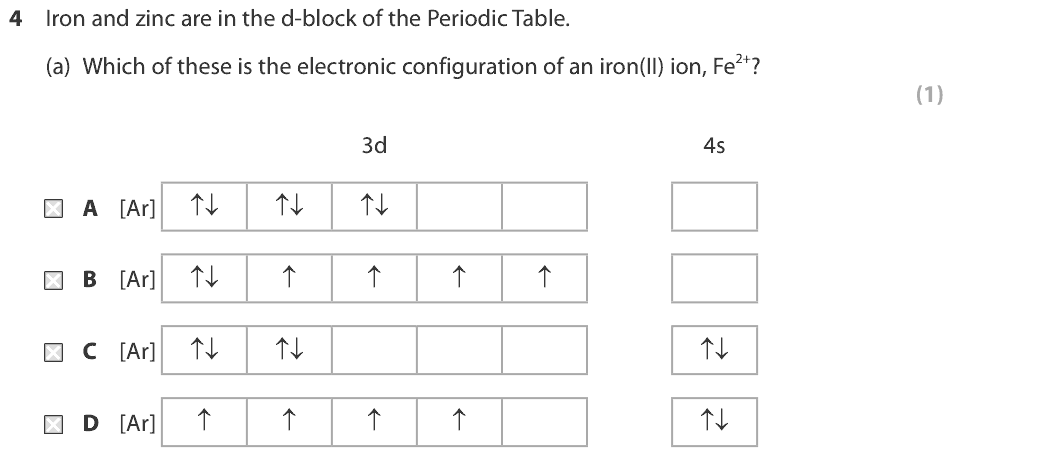
B

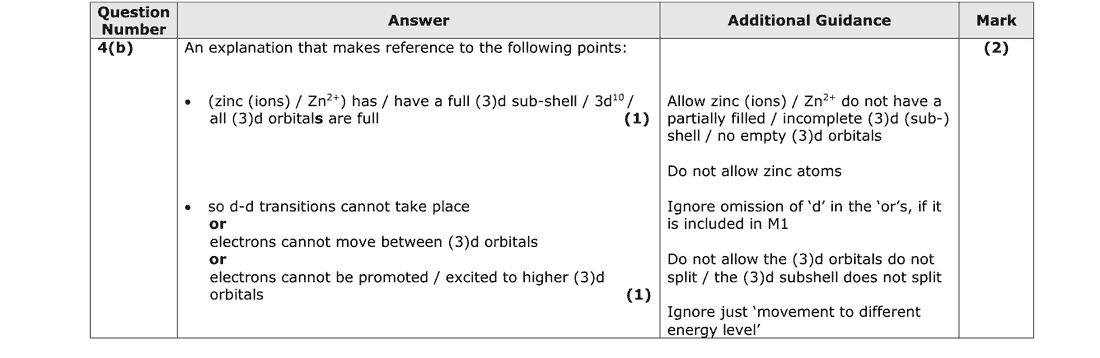
Many candidates did not score marks for this question as their terminology was not clear enough. Stating that zinc ions have a full d orbital is not acceptable for the idea that all the d orbitals are full. Candidates are advised to use the term 'd subshell' to avoid this problem. A common misconception is that when the d orbitals are full, they cannot split in energy. Some candidates wrote that the electrons cannot be excited to a higher energy level and this is not clear enough as energy level usually refers to quantum shell. 'd-d transitions cannot take place' is a useful phrase for candidates to include in an answer like this. A few candidates were confused with a flame test and wrote about emission of light while others thought the electromagnetic radiation transmitted would be outside the visible spectrum.

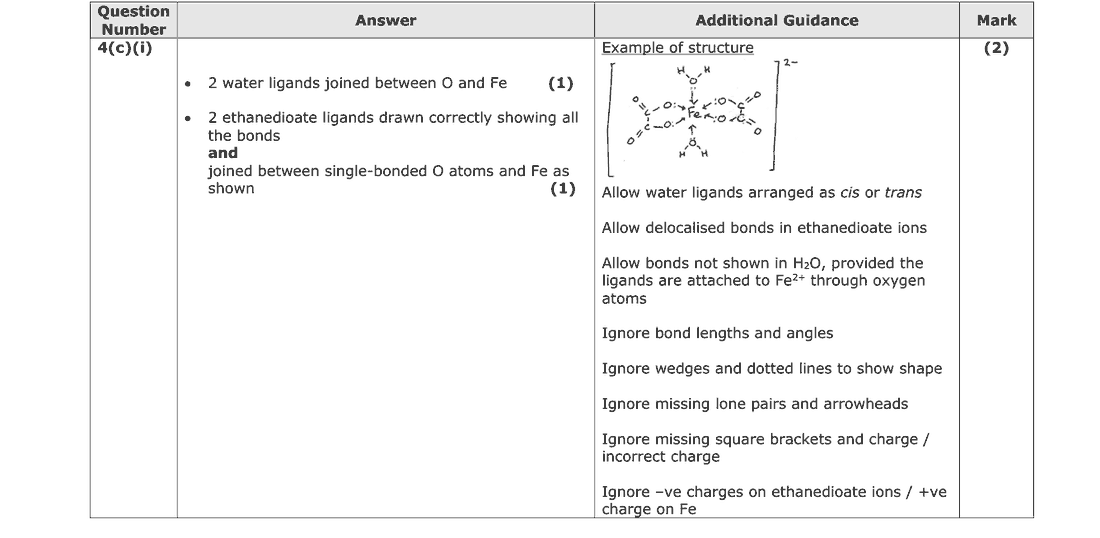
There were many clear diagrams that scored both marks. Some candidates ignored the instruction to show all of the bonds. We did allow the bonds in the water ligands not to be shown, provided they were attached to the Fe2+ ions through the oxygen atoms. Some candidates were unable to work out that ethanedioate ions are formed from ethanedioic acid and are bidentate ligands.
Skills: MS4.2 Visualise and represent 2D and 3D forms including two- dimensional representations of 3D objects
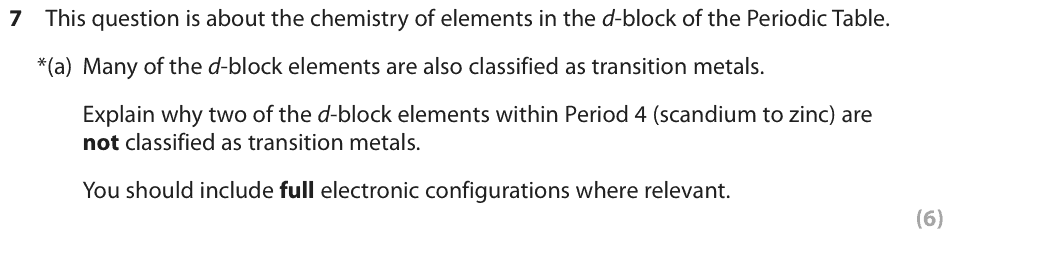
The quality of extended responses in this question was generally good. At the higher level of achievement, answers scoring 5 or 6 marks were common, any error tending to be the use of shortened electron configurations such as [Ar]3d10. On occasion, imprecise terminology such as ‘Zn2+ has a full d orbital’ as a way of justifying why zinc is not classified as a transition metal hindered a candidate’s progress. Fortunately many went onto clarify this later in their answer with clear references to either ‘full subshells’, ‘d orbitals are full’ or clear reference to d10 in their answer. In a similar way, some answers used the imprecise term ‘d-shell’ throughout, and so lost 1 mark. Many good answers also went on to justify the lack of colour in Zn2+ and Sc3+ solutions, which was not required by the question. Fortunately, most of this additional information was correct; the only problem it may have created was to leave candidates with less time available for later questions. In the weakest answers, candidates did at least realise that zinc and scandium are not transition metals but then tried to define transition metals as atoms with an incomplete d subshell, making it difficult to then access the points needed to explain their choice of scandium and zinc.
Dropping marks on calculations, mechanisms or the core practicals? Book a trial session with an A-level chemistry tutor.