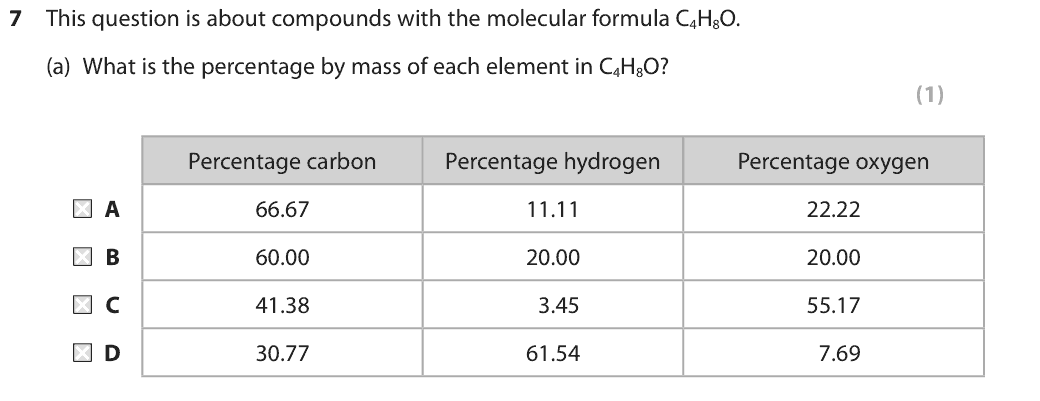
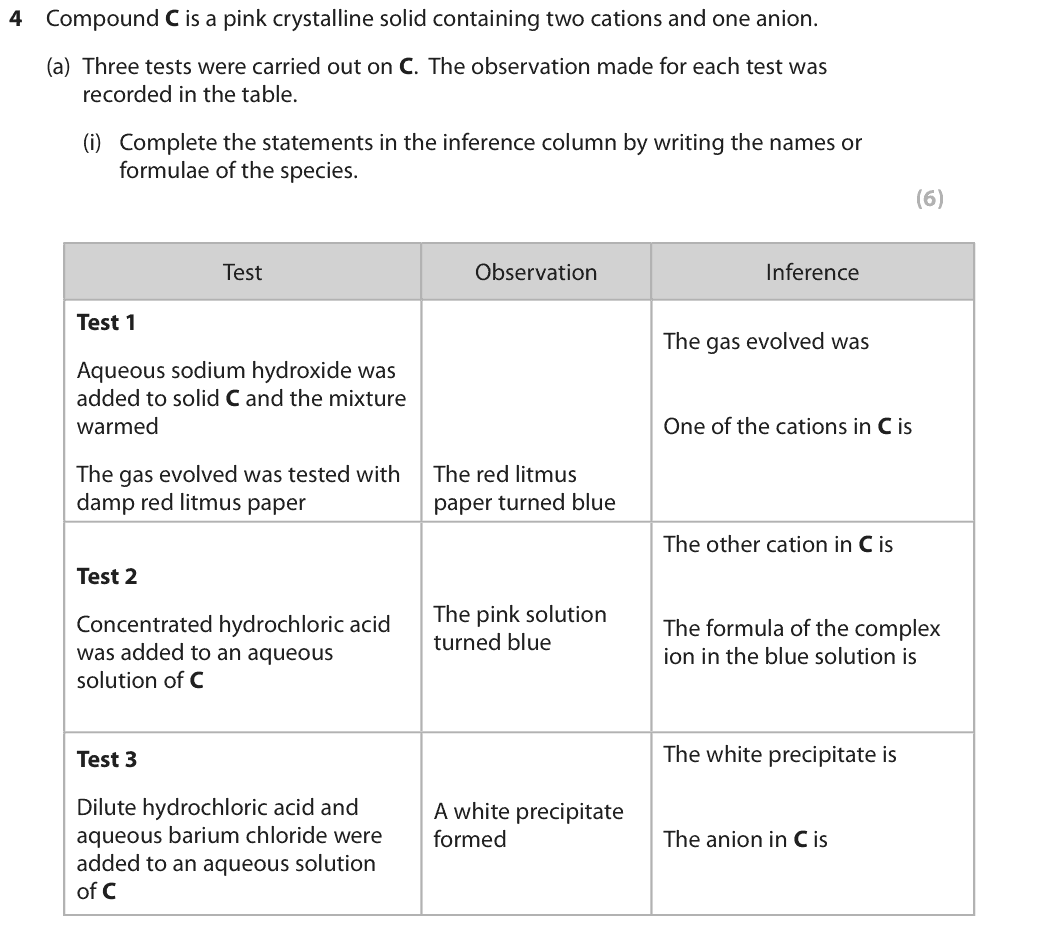
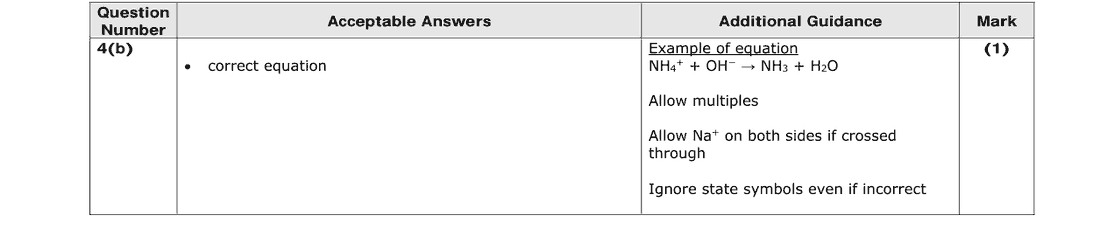
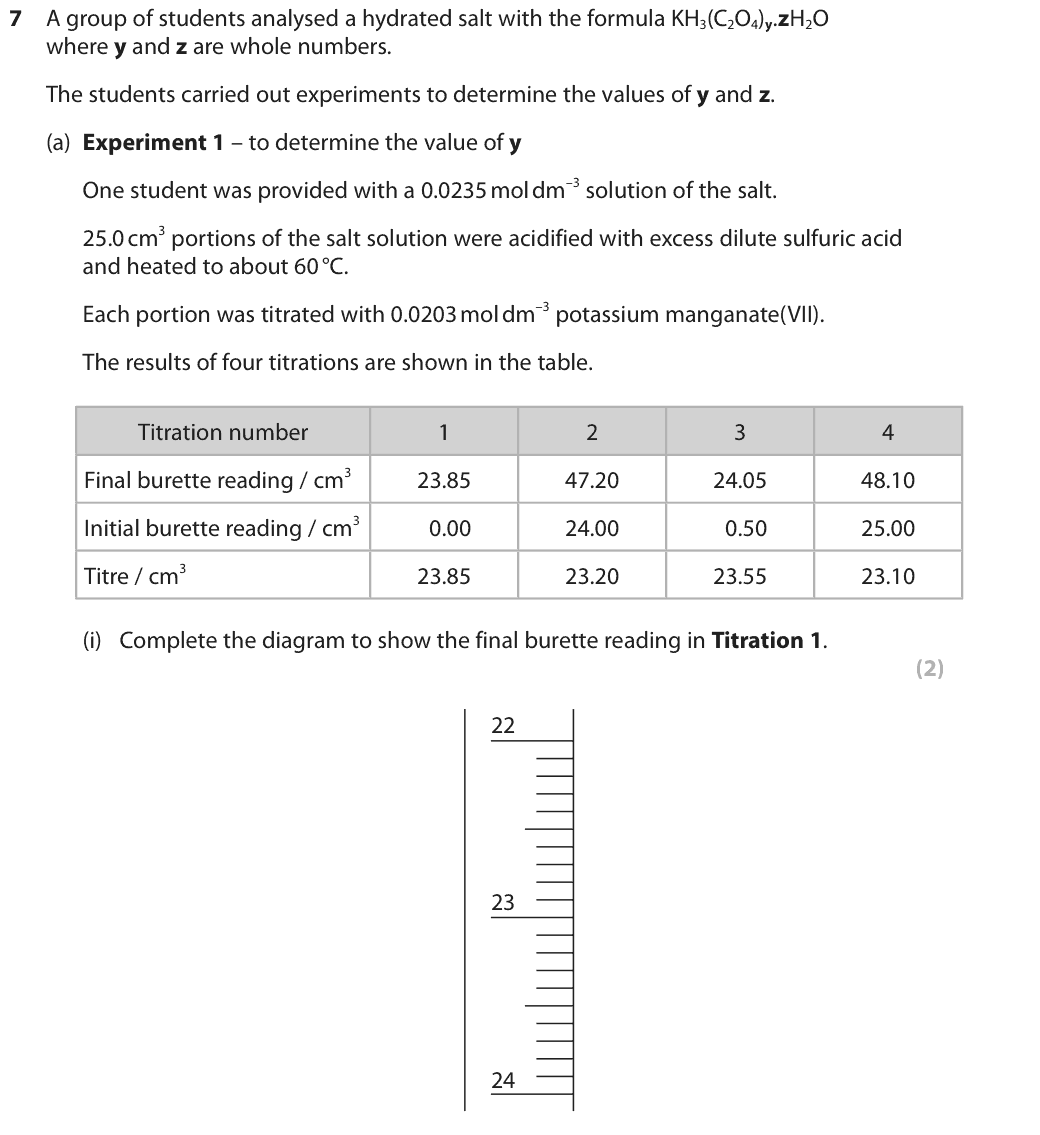
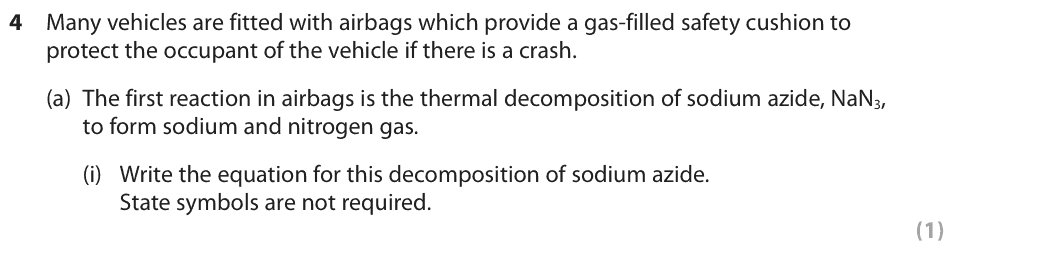
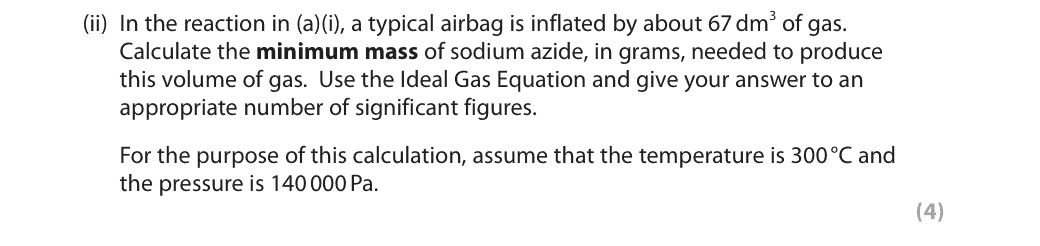
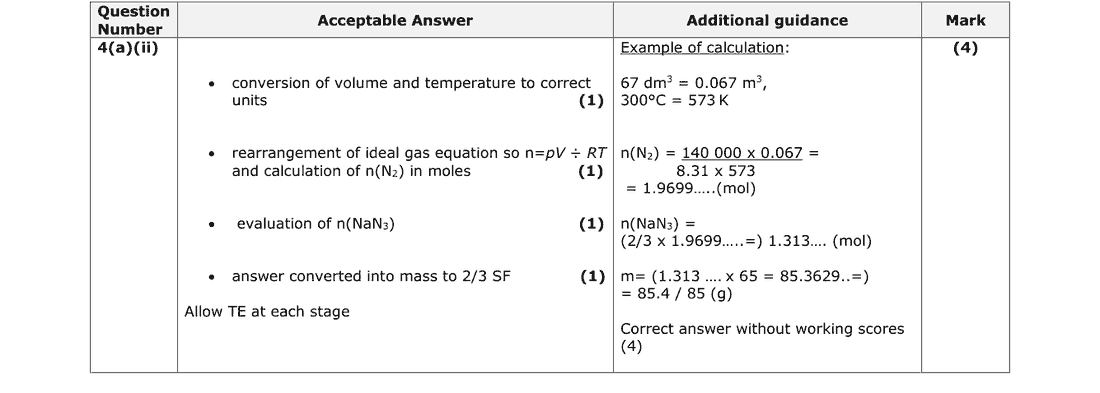
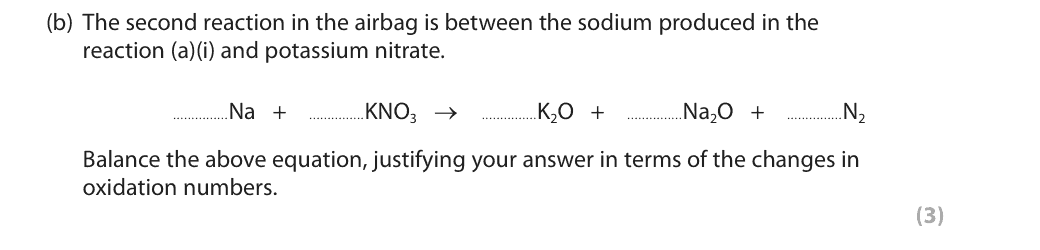
5.1 know that the mole (mol) is the unit for amount of a substance
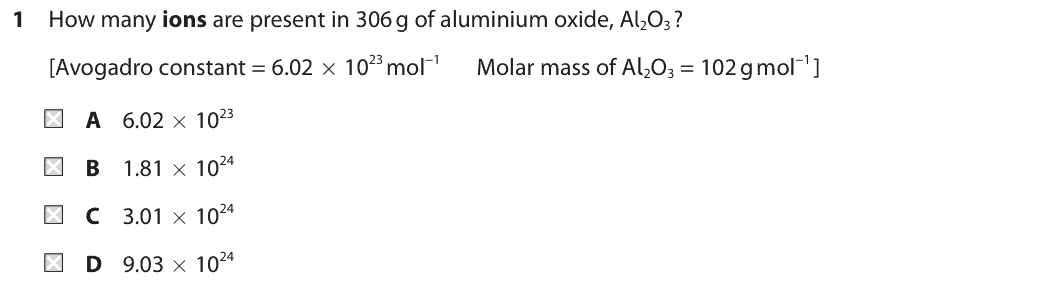
5.2 be able to use the Avogadro constant, L, (6.02 × 10^23 mol^-1) in calculations
5.3 know that the molar mass of a substance is the mass per mole of the substance in g mol^-1
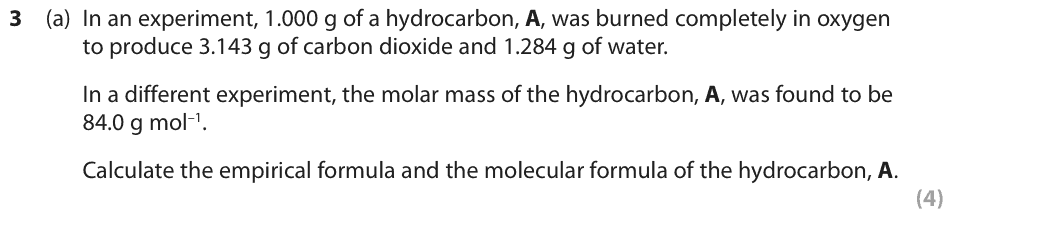
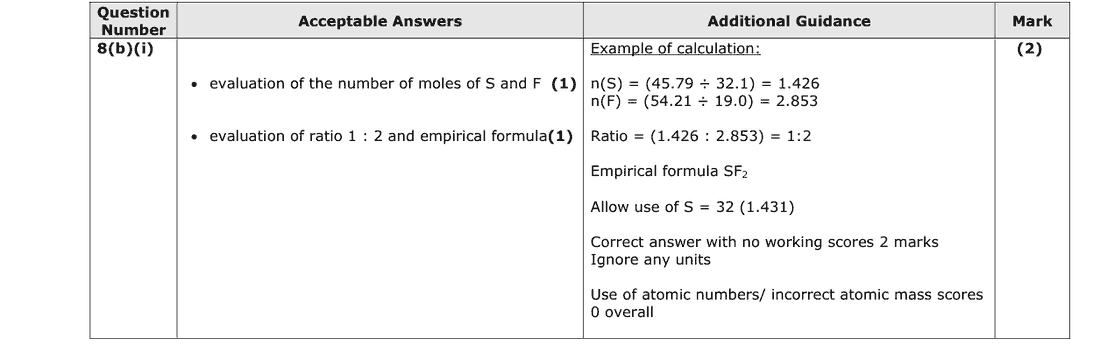
5.4 know what is meant by the terms ‘empirical formula’ and ‘molecular formula’
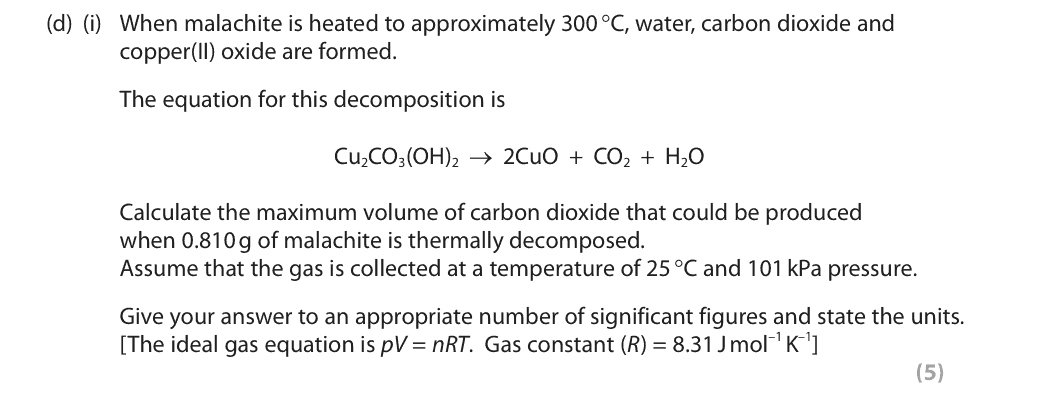
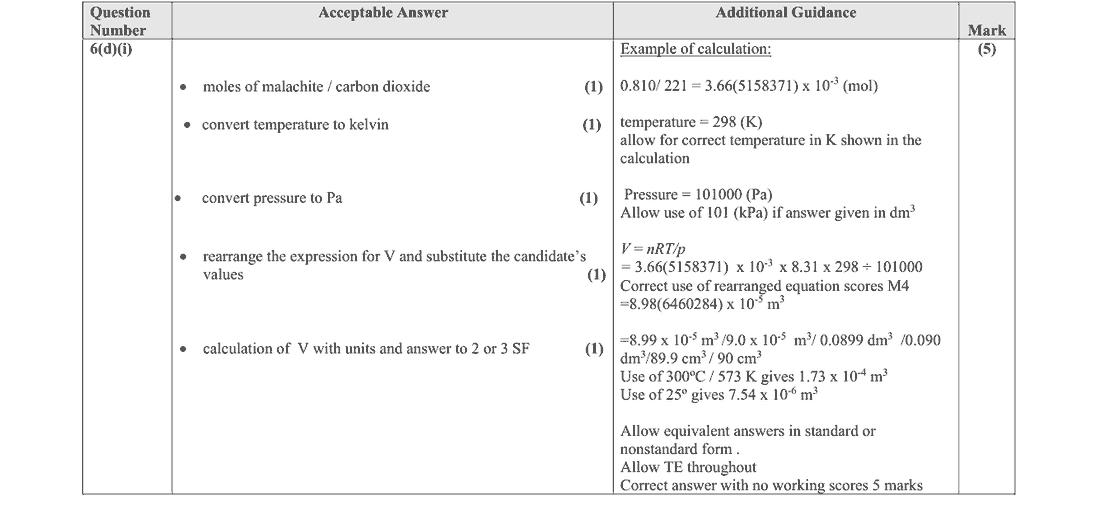
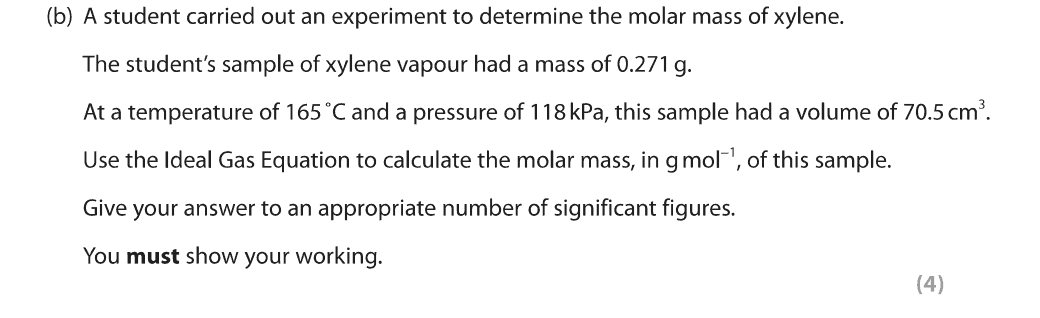
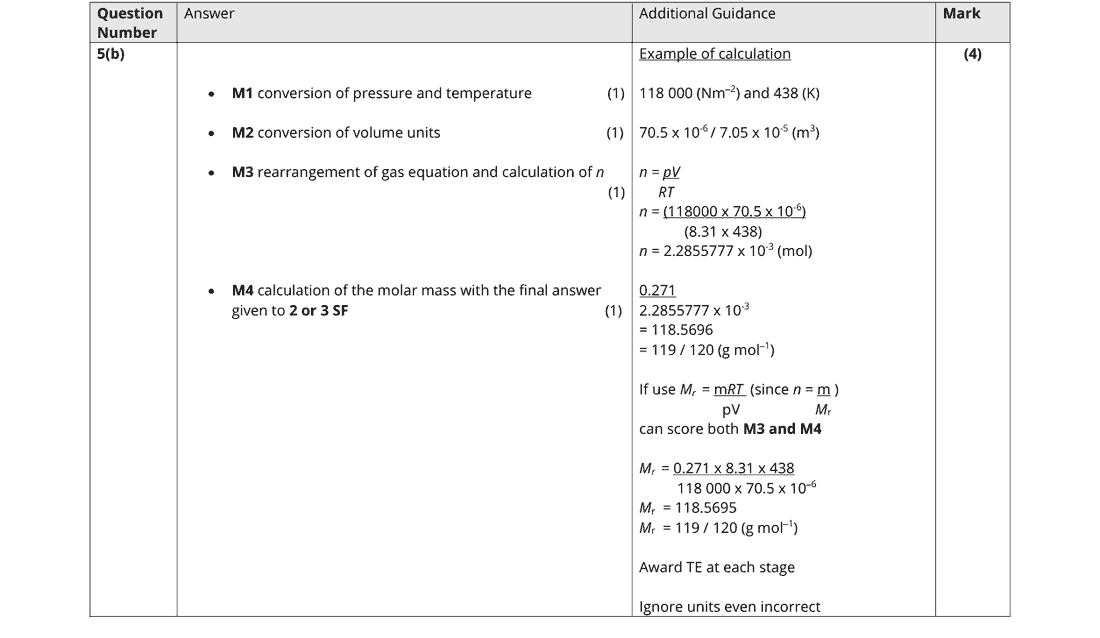
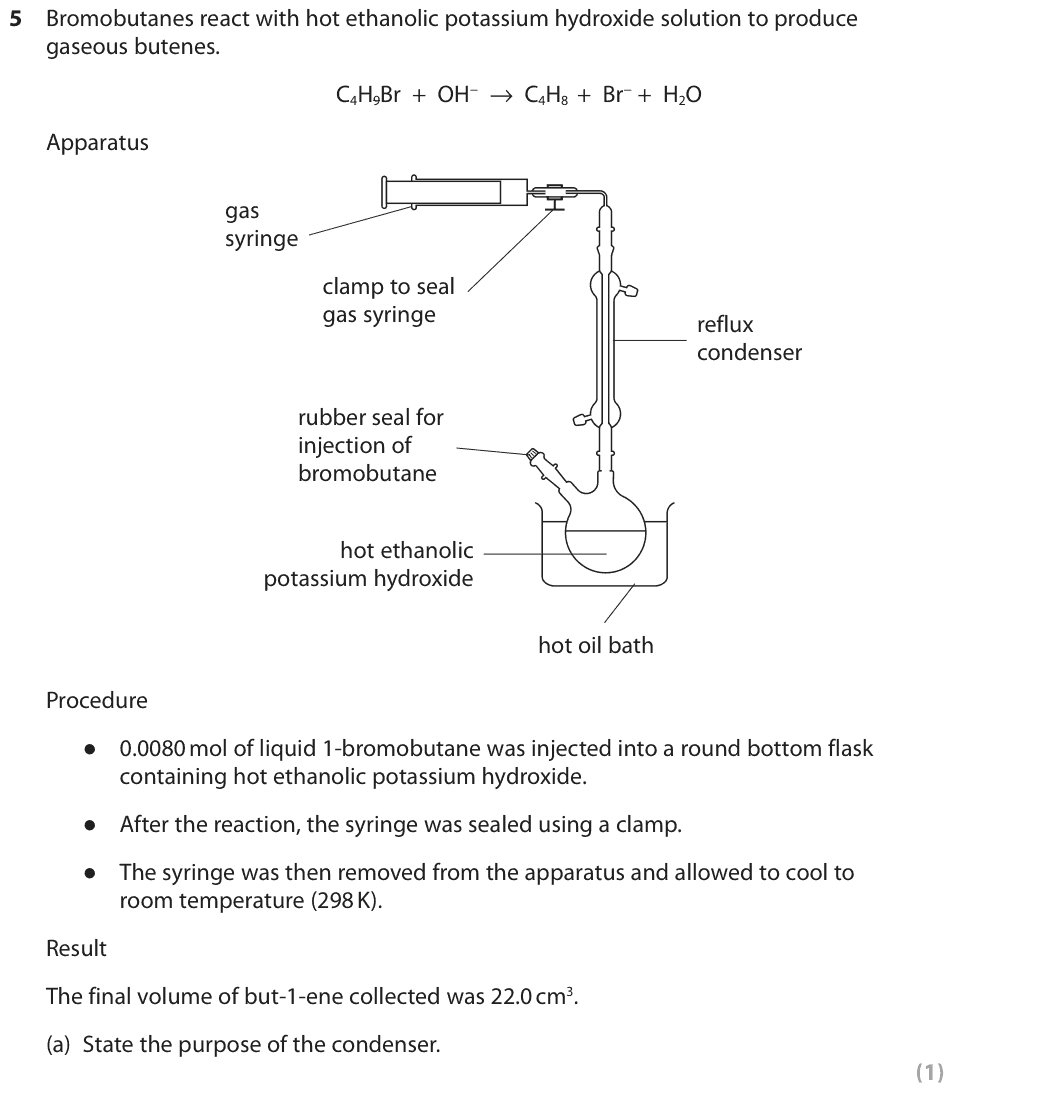
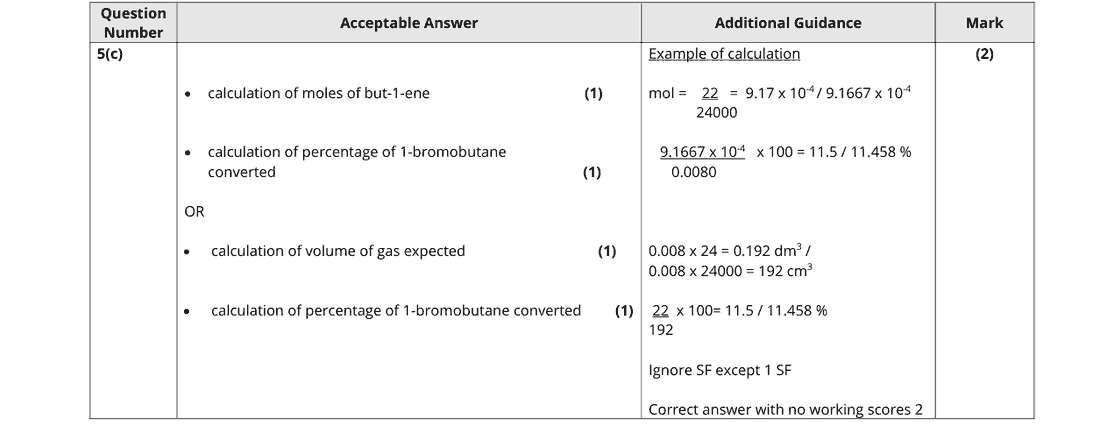
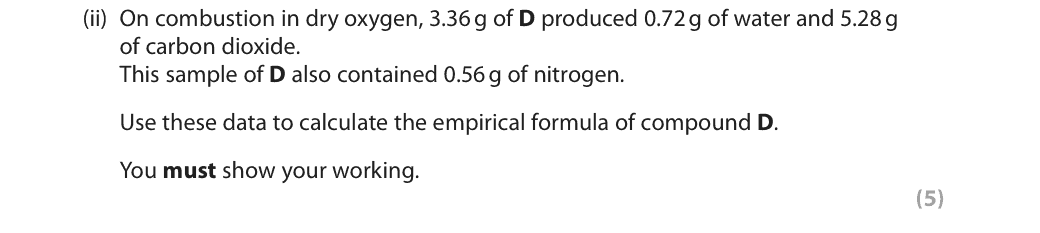
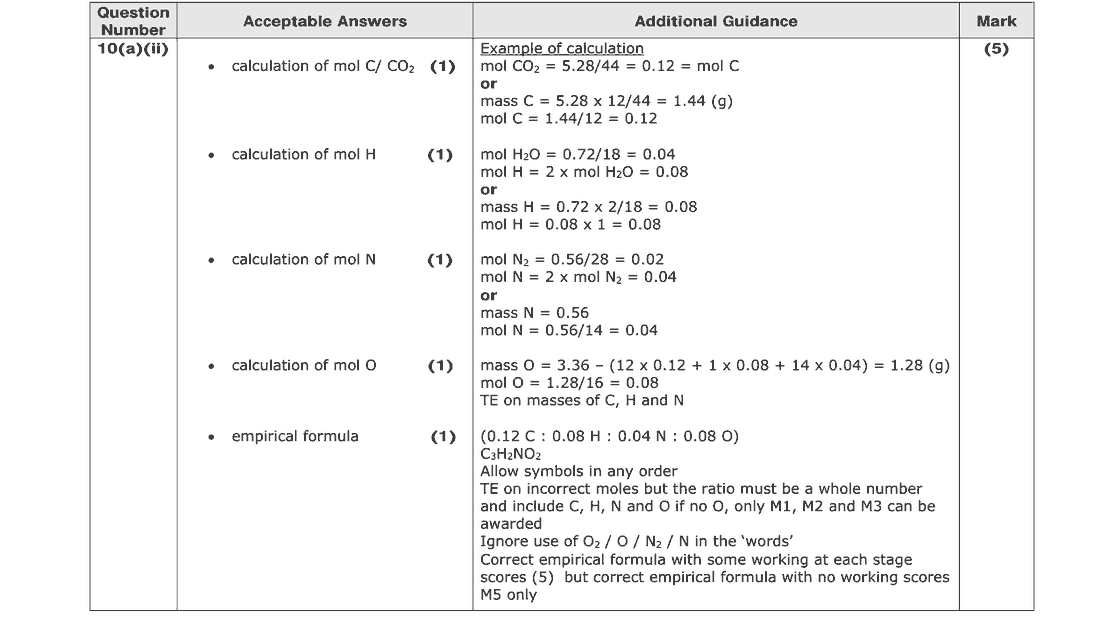
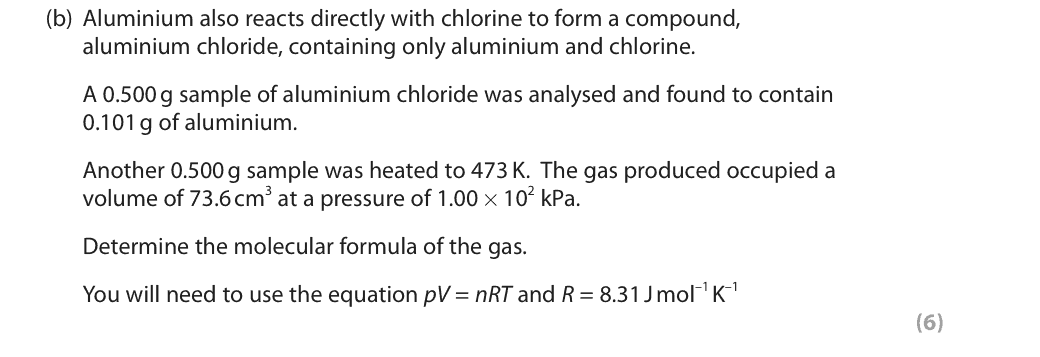
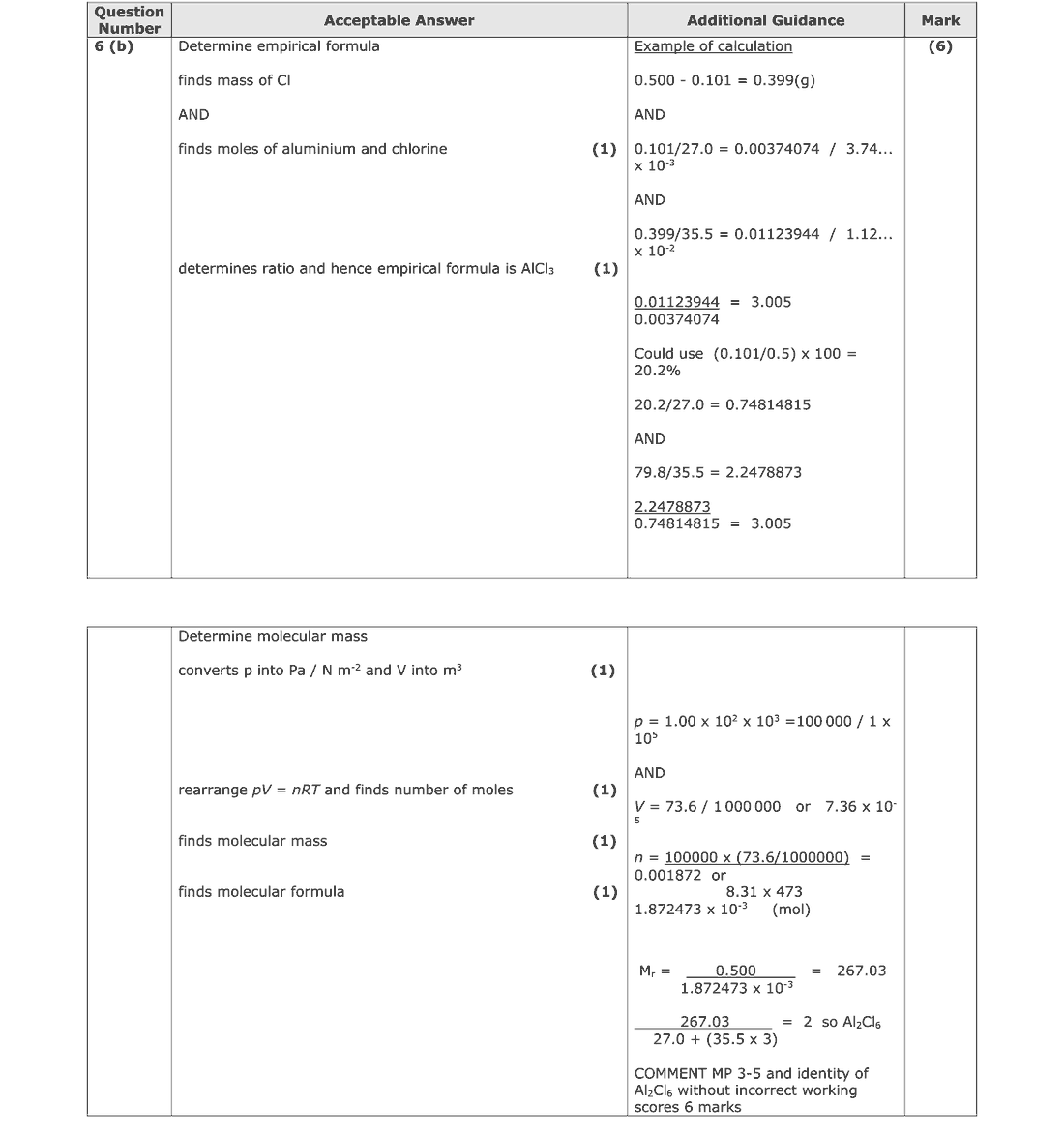
5.5 be able to use experimental data to calculate • i. empirical formulae • ii. molecular formulae including the use of pV = nRT for gases and volatile liquids [Calculations of empirical formula may involve composition by mass or percentage composition by mass data.]
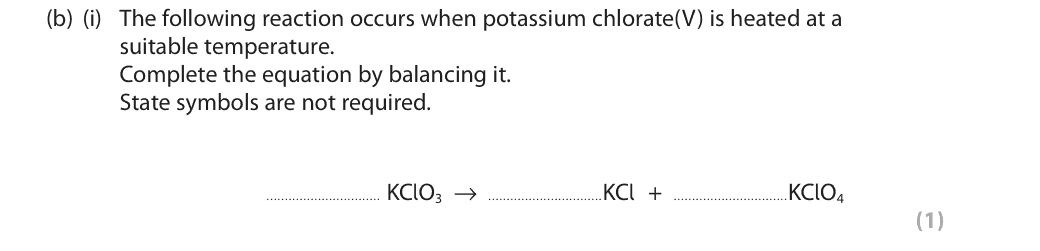
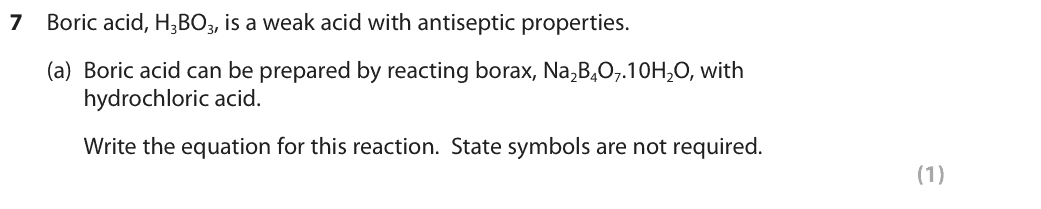
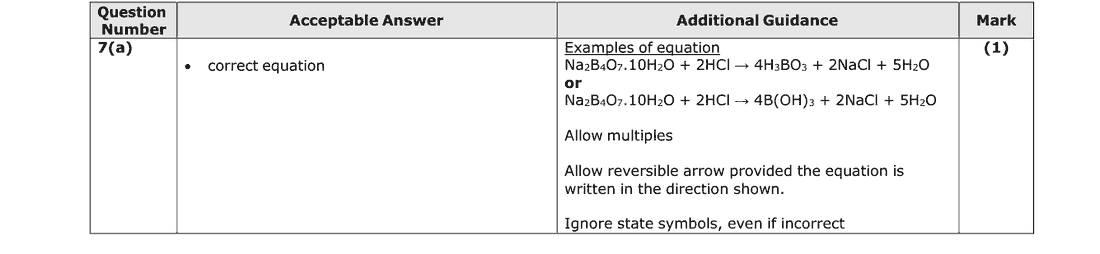
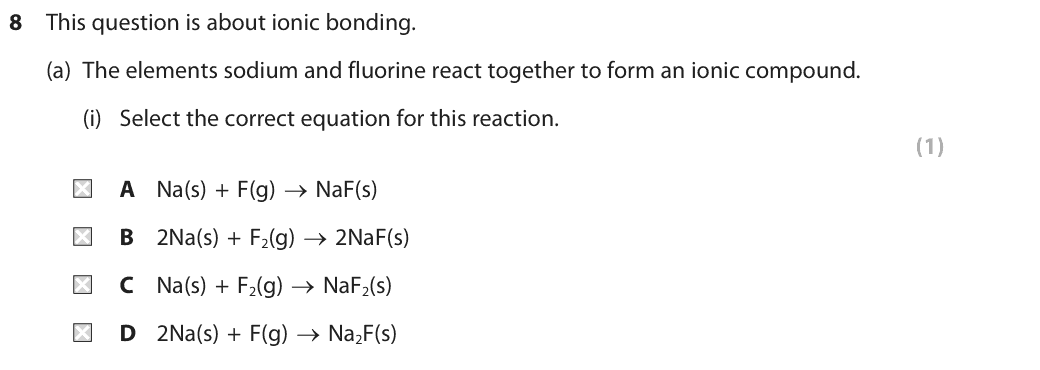
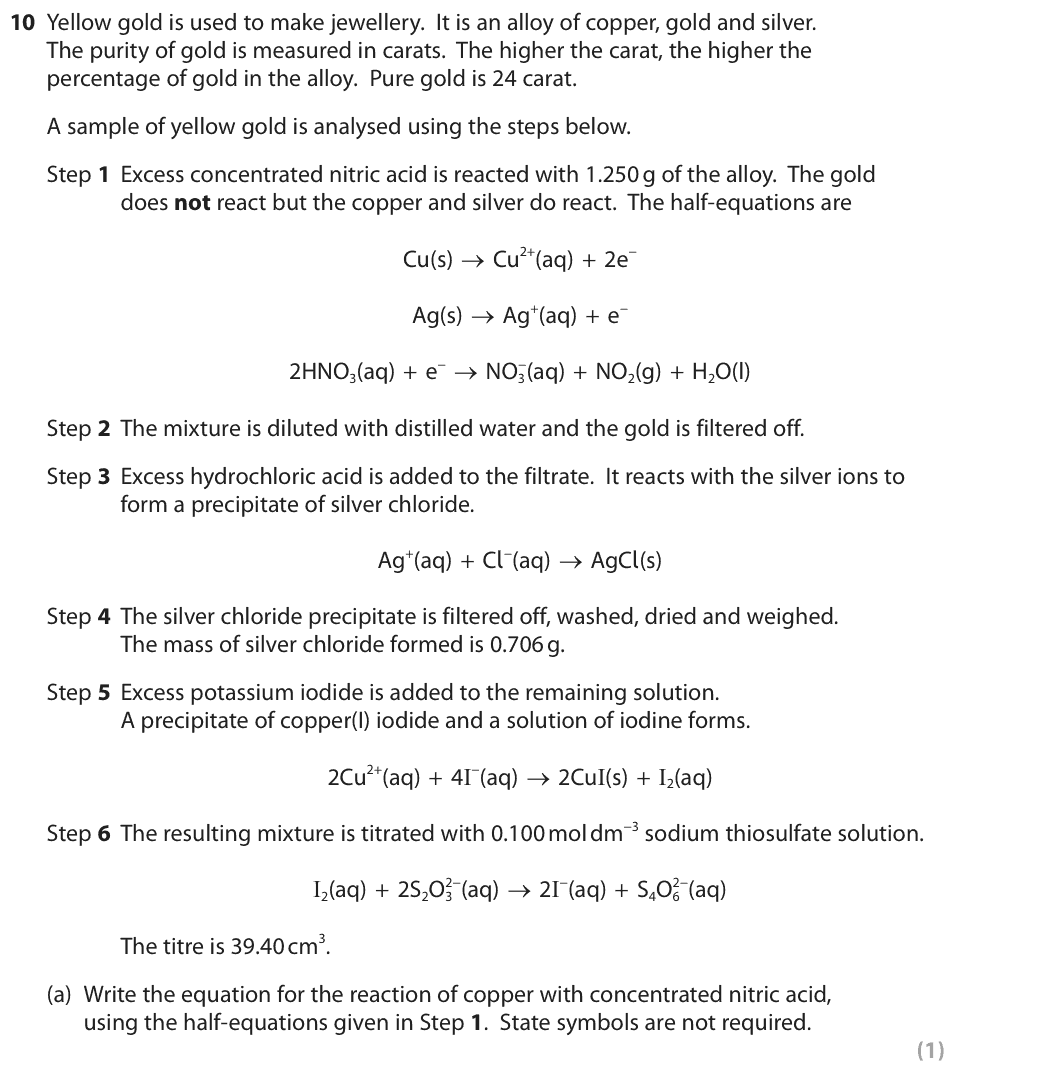
5.6 be able to write balanced full and ionic equations, including state symbols, for chemical reactions
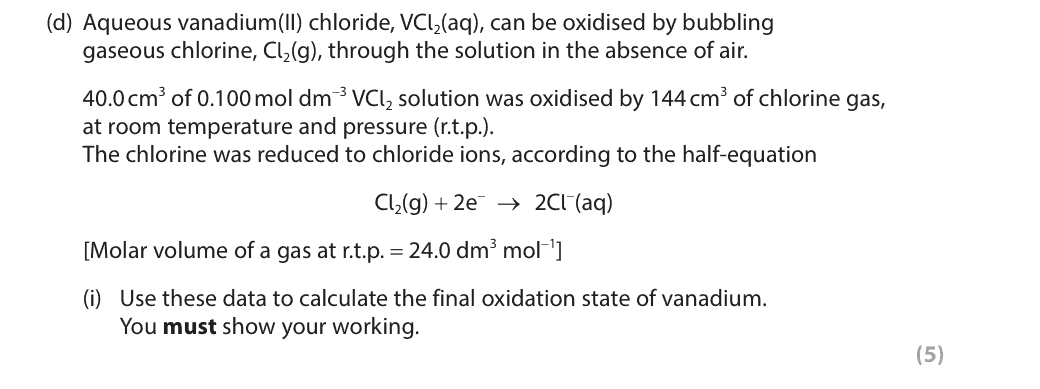
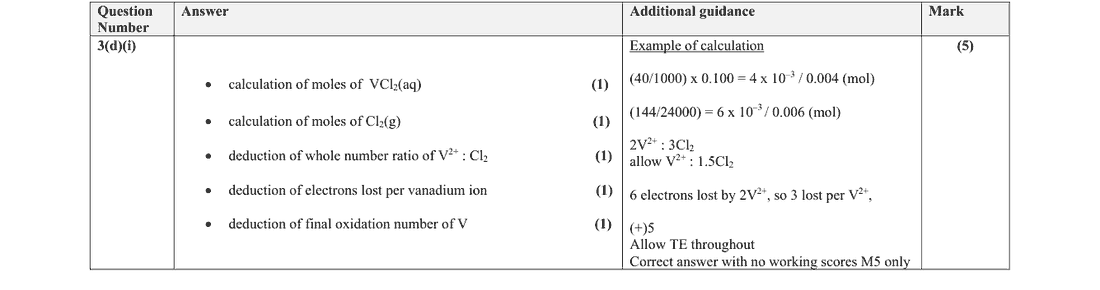
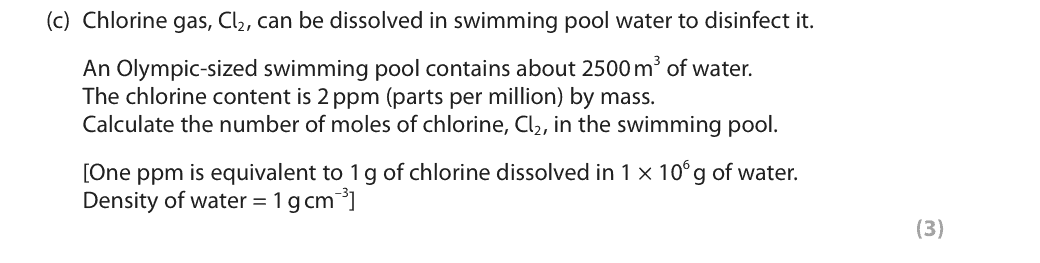
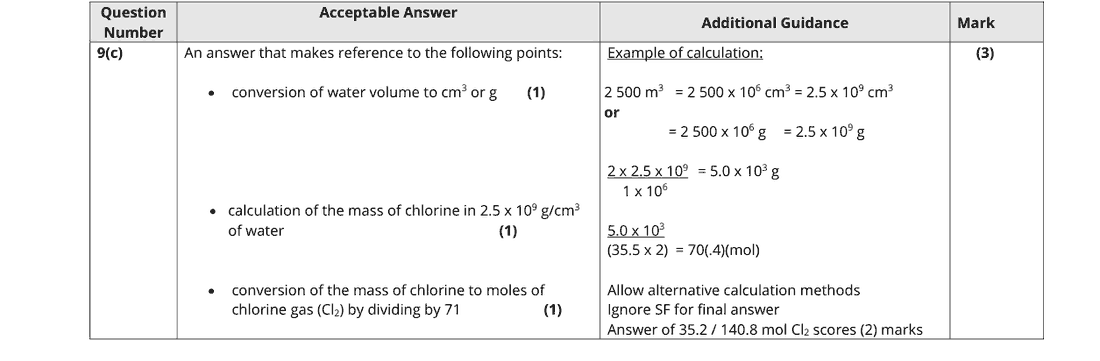
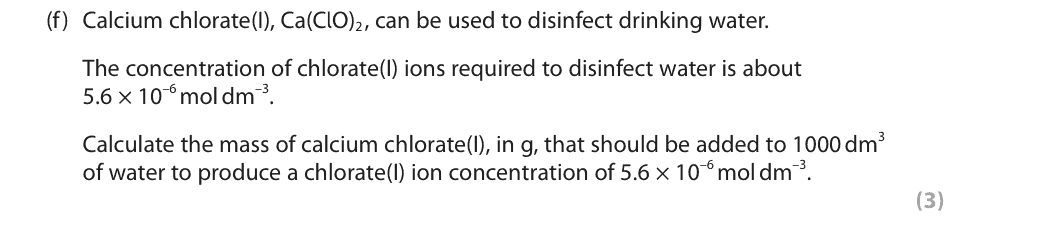
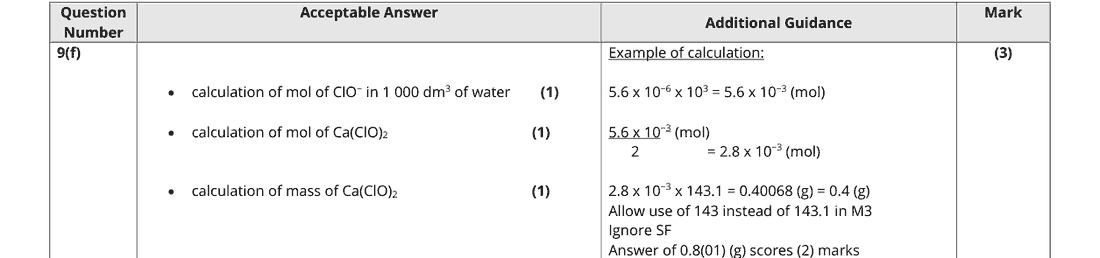
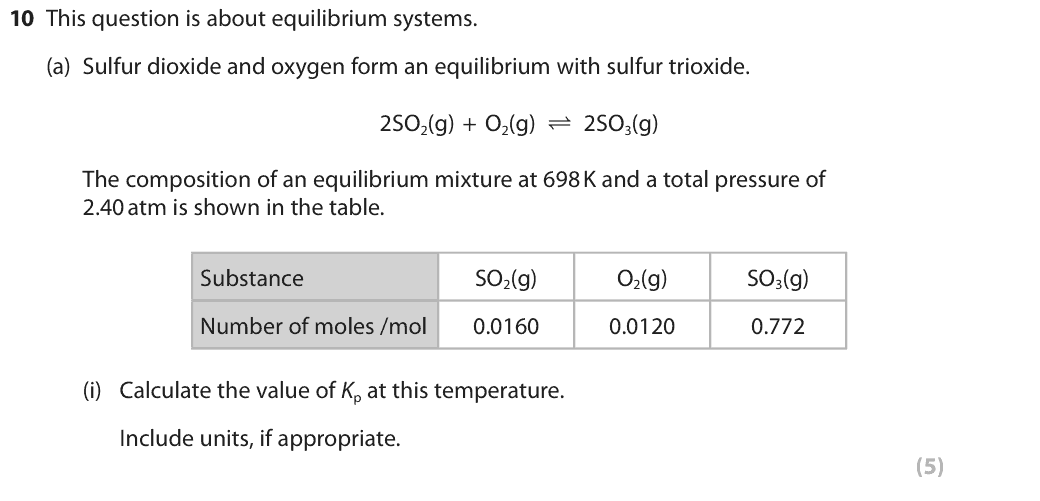
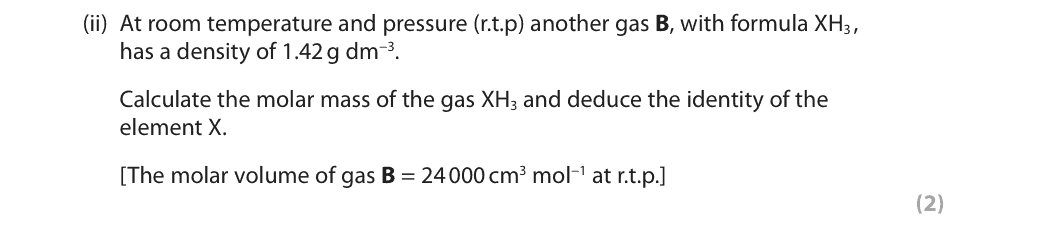
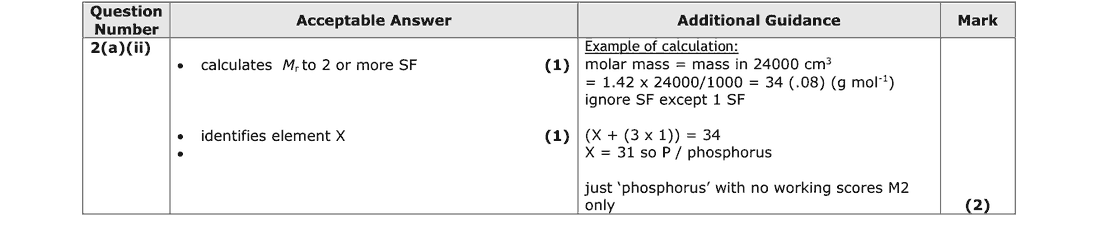
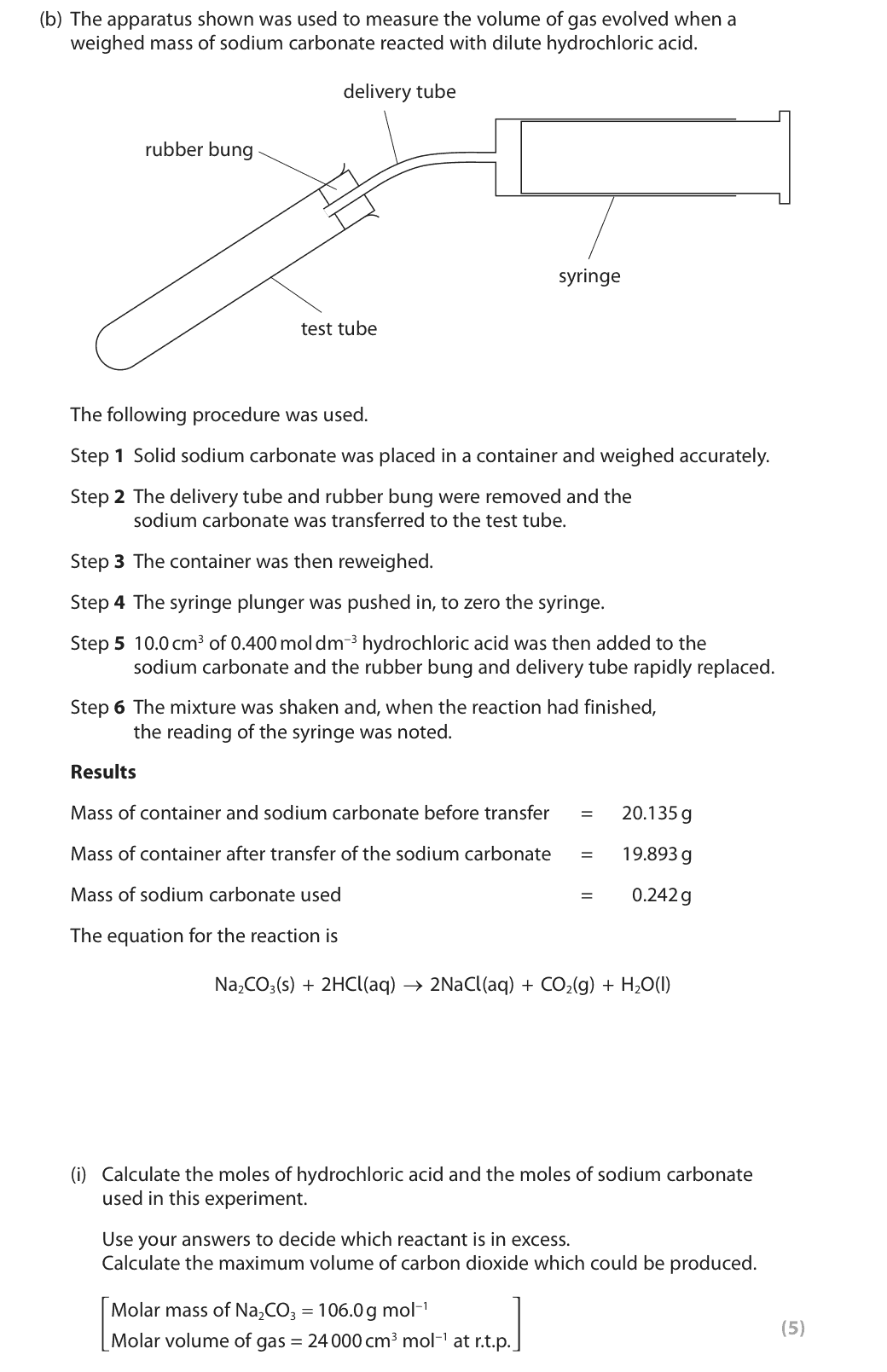
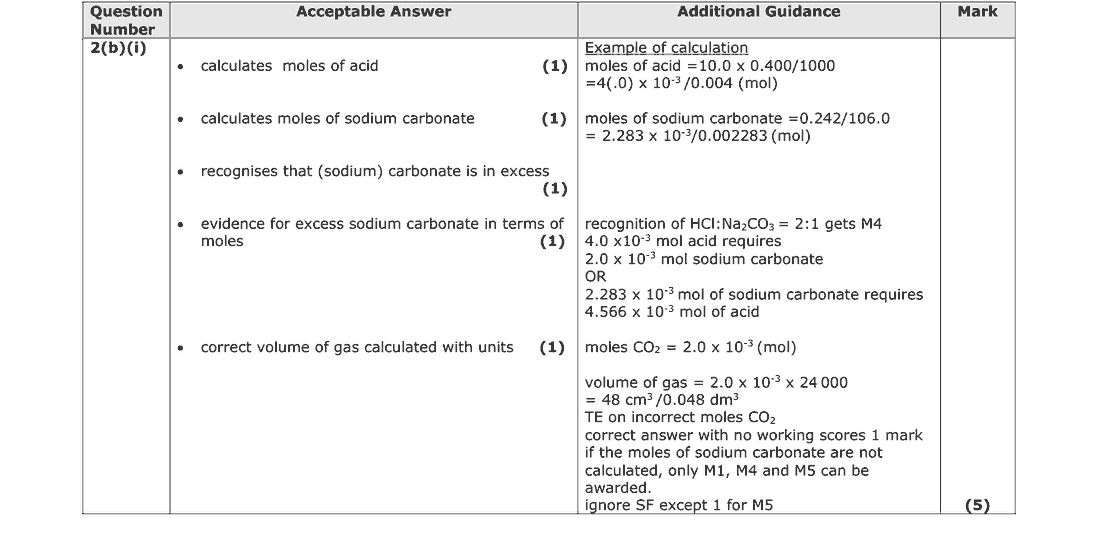
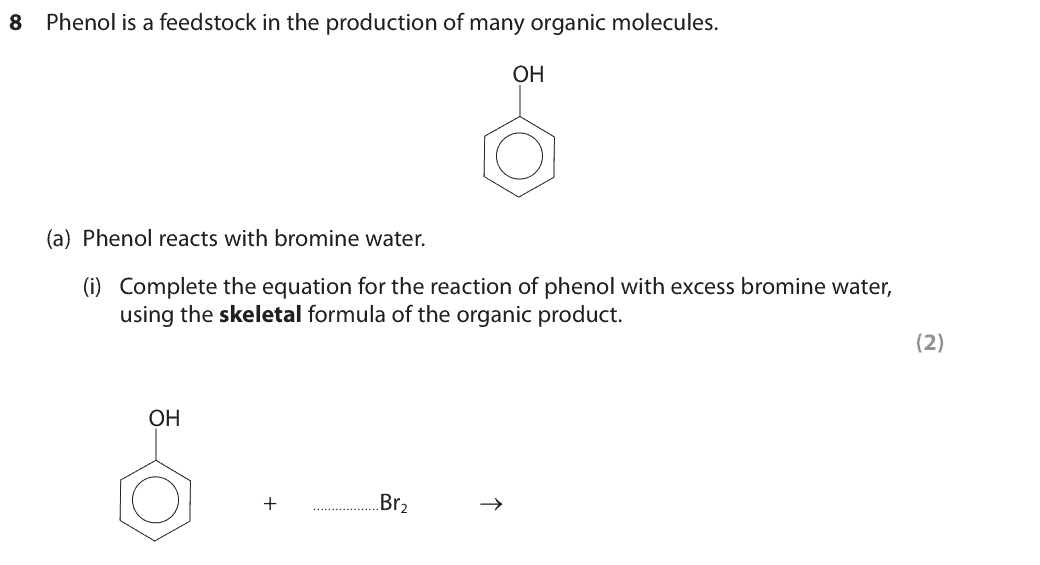
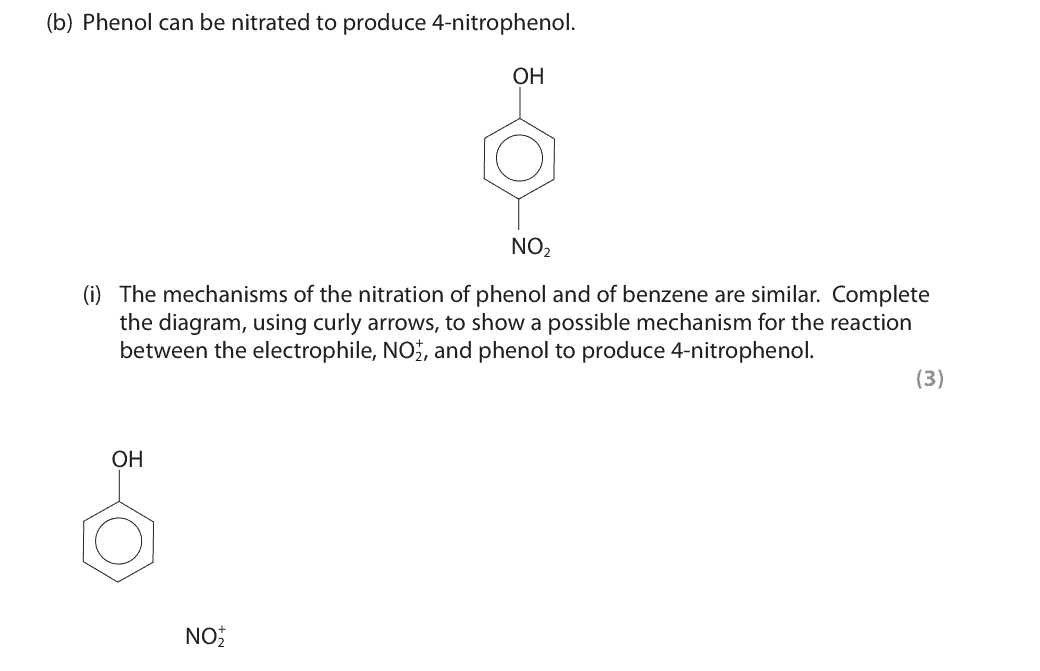
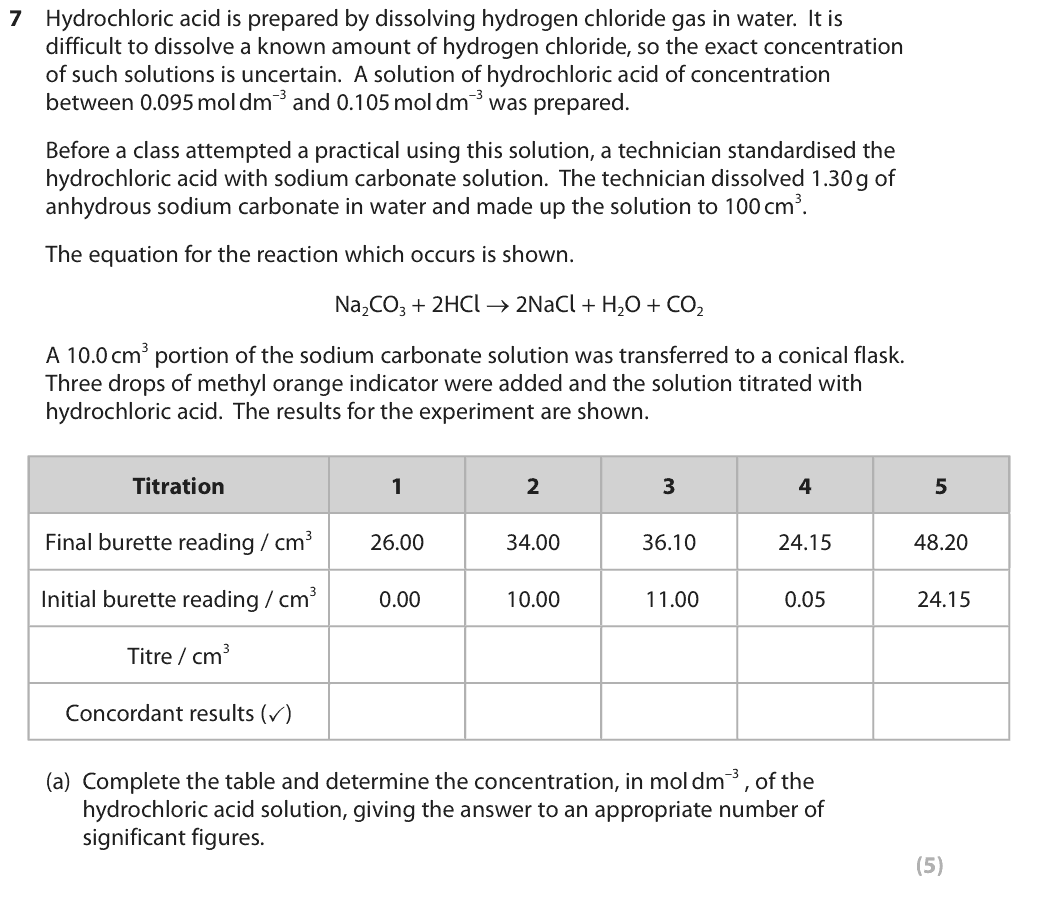
5.7 be able to calculate amounts of substances (in mol) in reactions involving mass, volume of gas, volume of solution and concentration [These calculations may involve reactants and/or products.]
5.8 be able to calculate reacting masses from chemical equations, and vice versa, using the concepts of amount of substance and molar mass
5.9 be able to calculate reacting volumes of gases from chemical equations, and vice versa, using the concepts of amount of substance
5.10 be able to calculate reacting volumes of gases from chemical equations, and vice versa, using the concepts of molar volume of gases
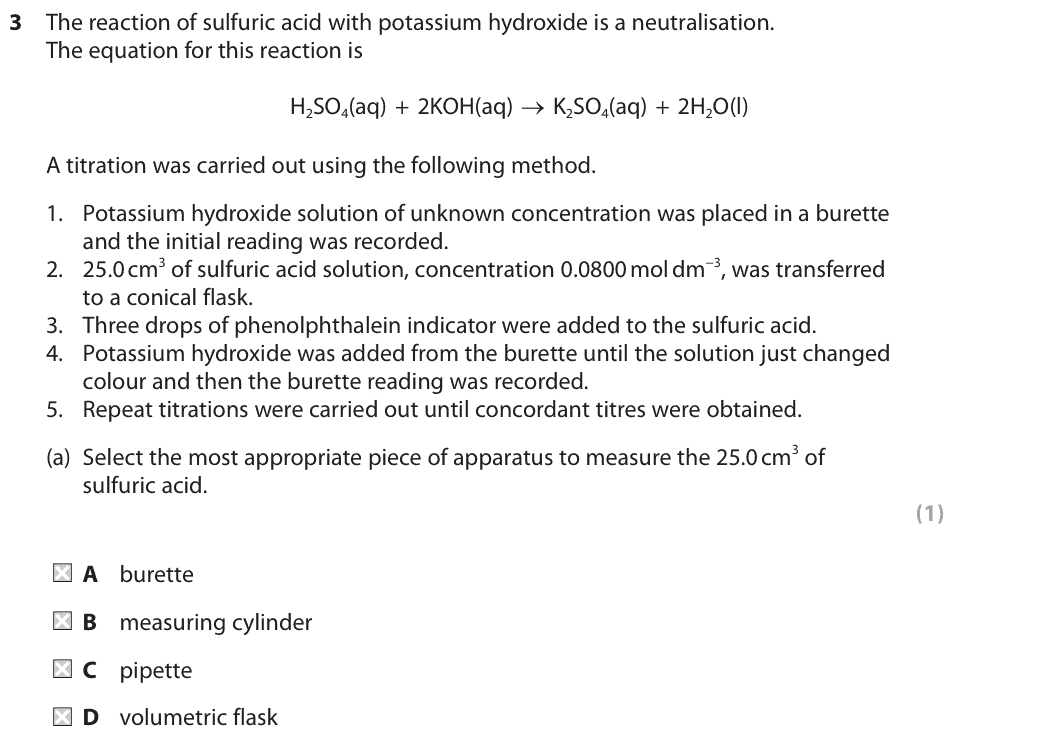
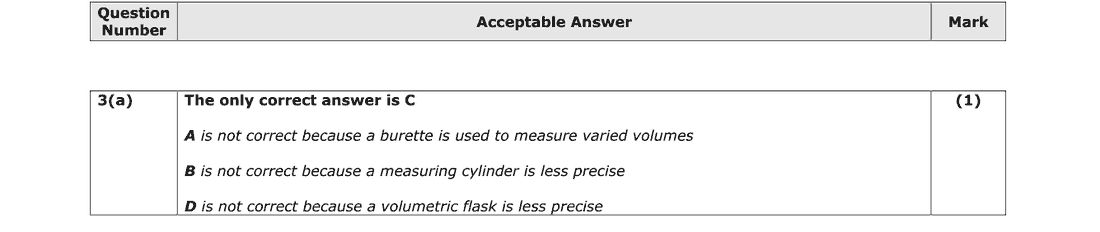
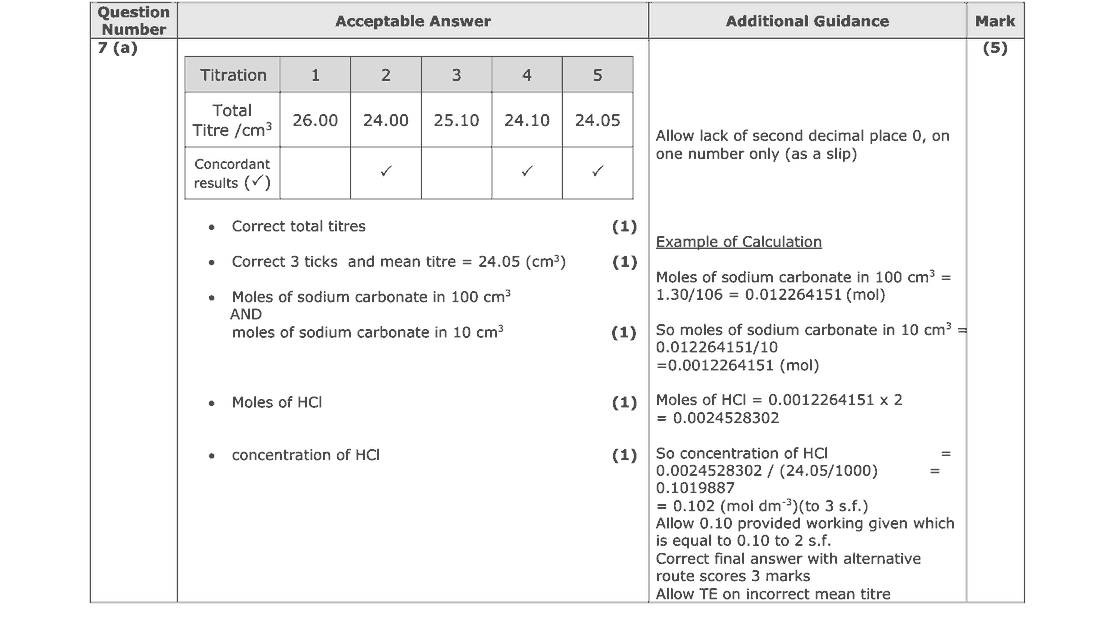
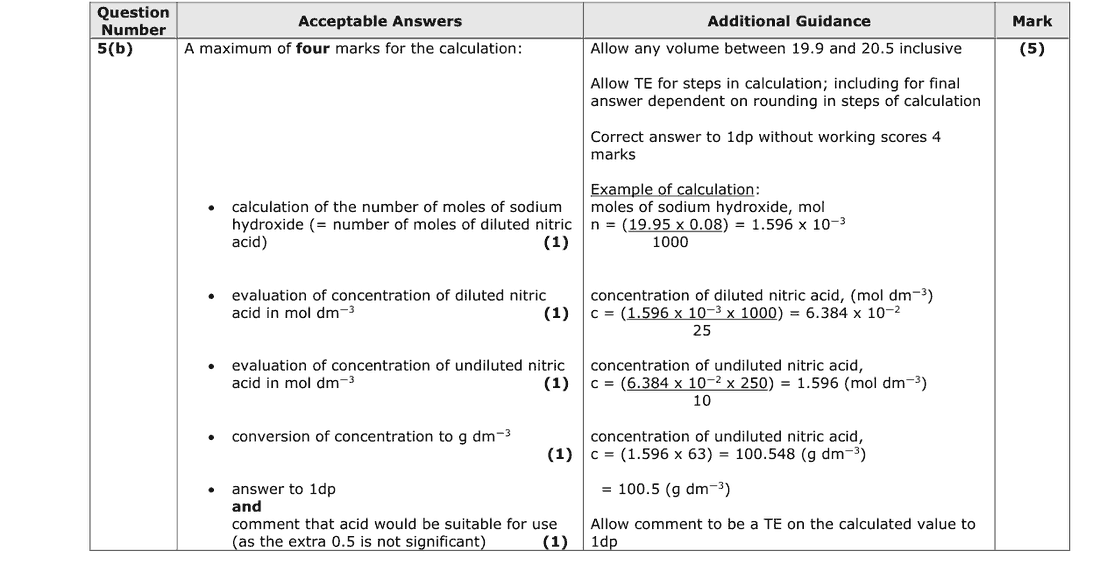
5.11 be able to calculate solution concentrations, in mol dm^-3 and g dm^-3, including simple acid-base titrations using a range of acids, alkalis and indicators [The use of both phenolphthalein and methyl orange as indicators will be expected.]
5.12 be able to: • i calculate measurement uncertainties and measurement errors in experimental results • ii comment on sources of error in experimental procedures
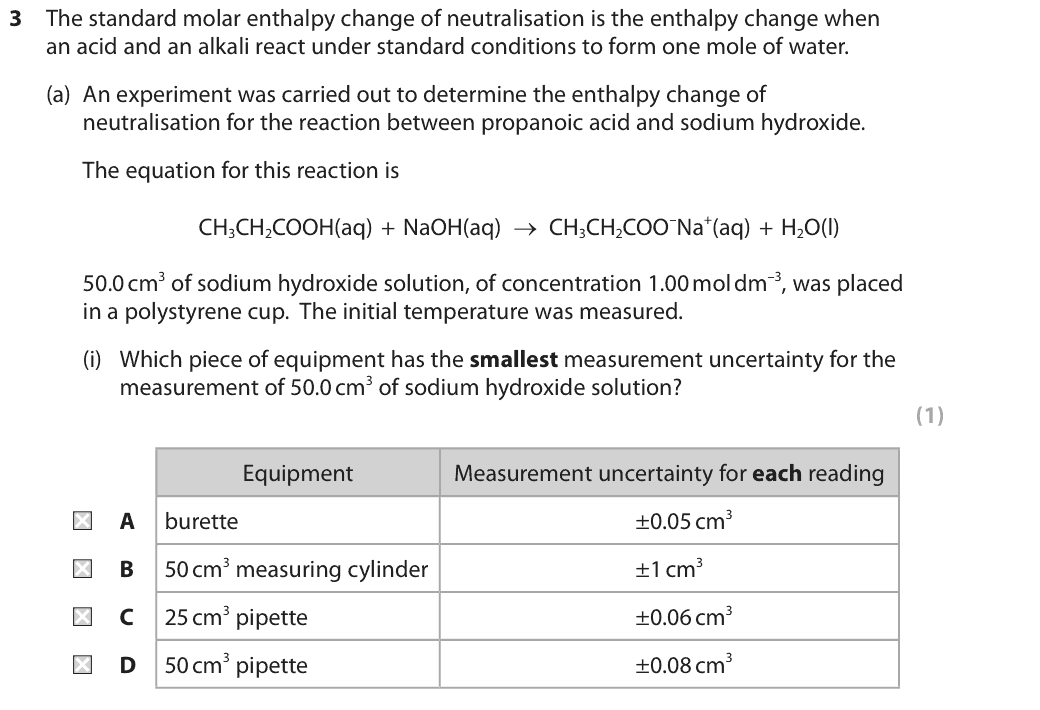
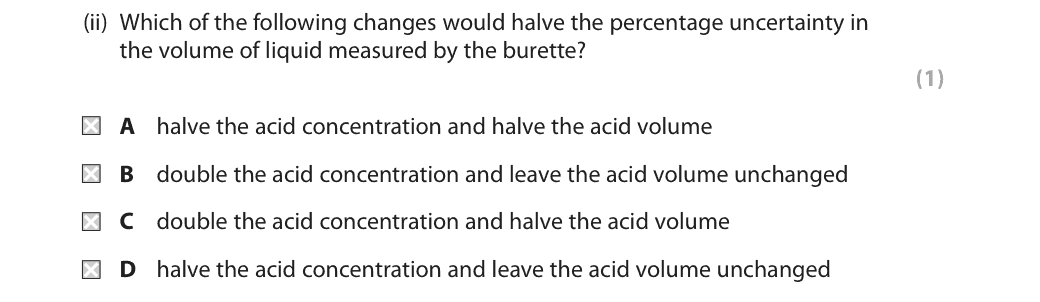
5.13 understand how to minimise the percentage error and percentage uncertainty in experiments involving measurements
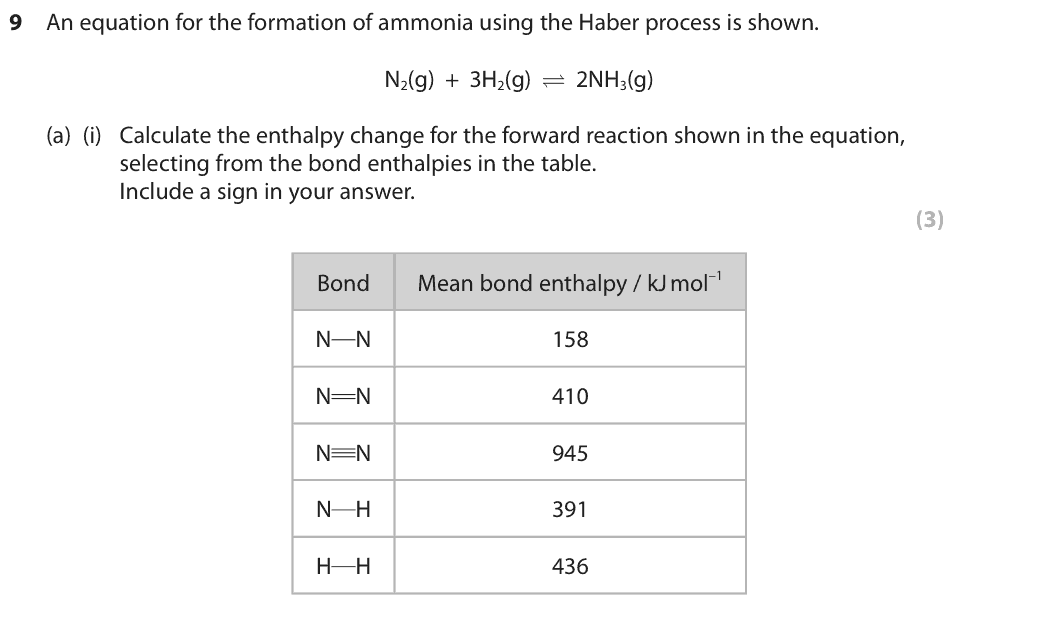
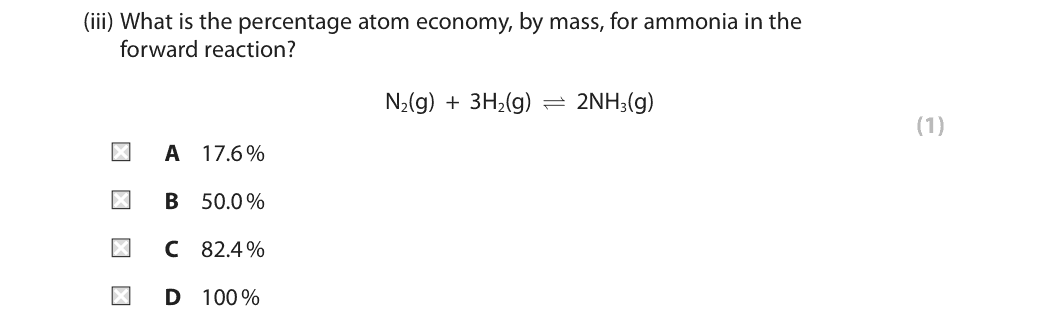
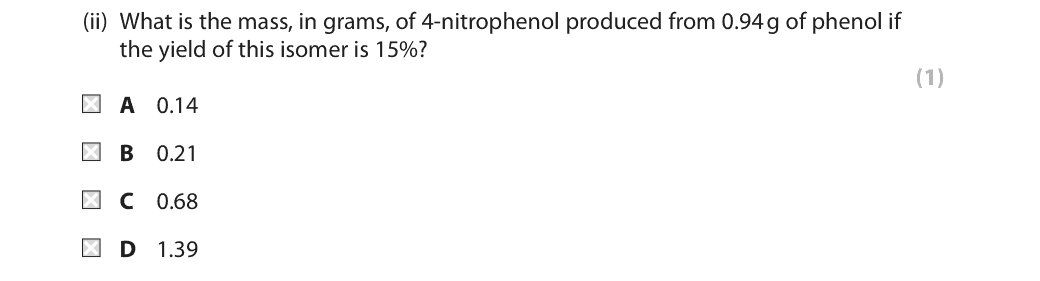
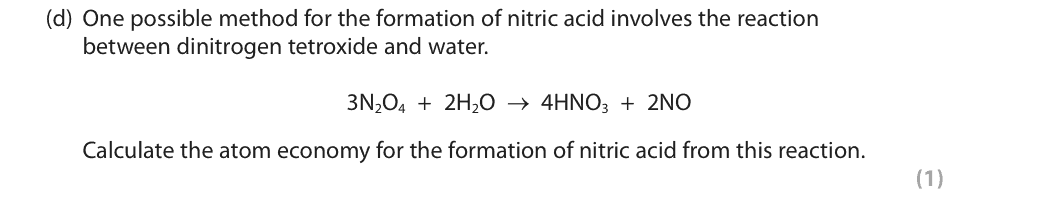
5.14 be able to calculate percentage yields and percentage atom economies using chemical equations and experimental results molar mass of the desired product Atom economy of a reaction = × 100% sum of the molar masses of all products
5.15 be able to relate ionic and full equations, with state symbols, to observations from simple test tube reactions, to include: • i displacement reactions • ii reactions of acids • iii precipitation reactions
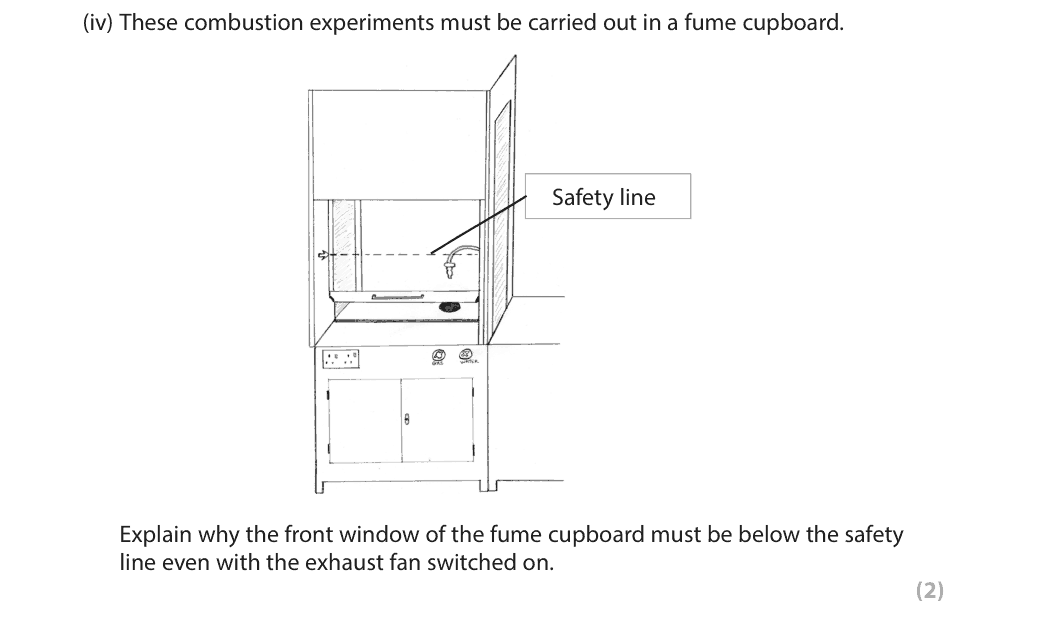
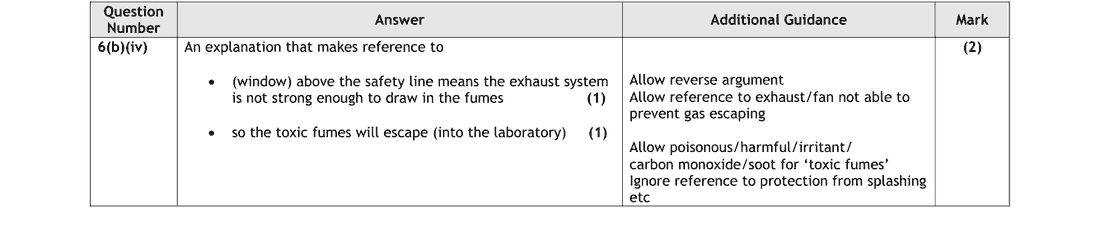
5.16 understand risks and hazards in practical procedures and suggest appropriate precautions where necessary
Six-mark extended response questions on this topic
Tap a question to zoom it. Where a part needs a figure, table or structure from earlier in the question, that part folds out above it; the mark scheme and examiner's comment open underneath. Have Edexcel's Data Booklet beside you; the Periodic Table is on the back page of every paper.
June 2025 · AS Paper 1 · Q2(b)(i)1 markEquation writing
Earlier part of question 2 that this part uses
Mark scheme
Examiner's comment
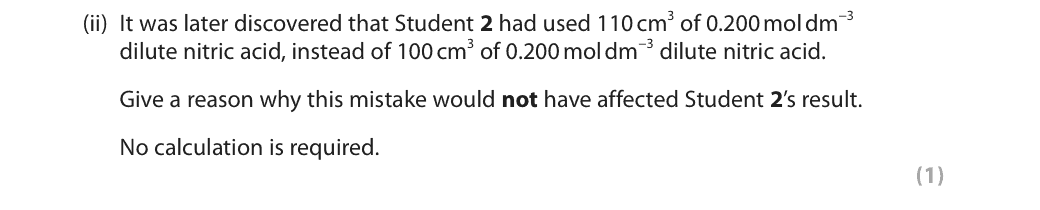
Q2bi required candidates to write the equation for the formation of sodium hydride. This was answered well, with over 70% of candidates correctly answering. Some candidates lost the mark for incorrect balancing, incorrect formula of sodium hydride and incorrect formula of hydrogen.
Notes from the mark scheme and report
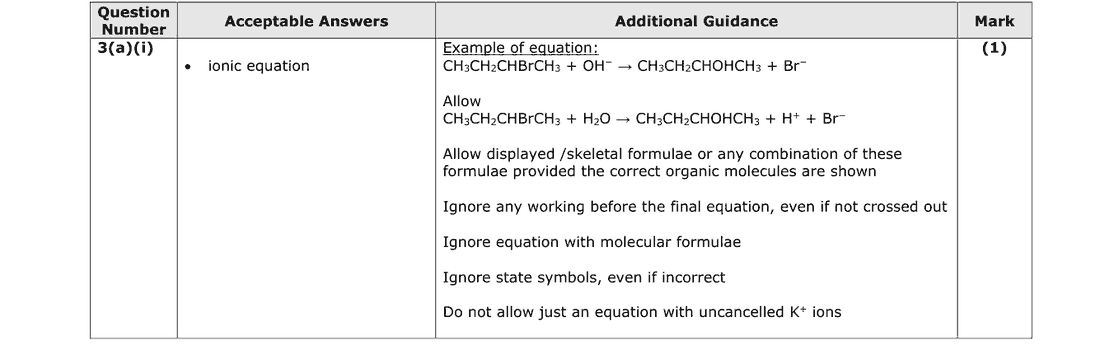
Answer: 2Na + H2 → 2NaH. Multiples allowed
state symbols ignored. Errors: balancing
wrong formula for sodium hydride or for hydrogen
June 2025 · AS Paper 1 · Q2(b)(ii)1 markEquation writing
Earlier parts of question 2 that this part uses
Mark scheme
Examiner's comment
Q2bii required candidates to balance an equation. This was answered well, with over 70% of candidates correctly answering. Candidates do not need to put a number on every line, only where one is required.
a 1 before AlCl3 and NaAlH4 is ignored (a number is not needed on every line)
June 2025 · Paper 1 · Q3(b)(ii)2 marksCalculation
Earlier parts of question 3 that this part uses
Mark scheme
Examiner's comment
This question required the candidates to work though a calculation on enthalpy change for the decomposition of calcium carbonate.
The table was generally completed well. A few struggled with proving that the HCl was in excess. For the calculation most managed Q but then, rather than use the mol value of 0.41 given, they attempted to calculate moles from other values.
When it came to completing the cycle there were a number who were unsure what to put in the bottom box so put the elements rather than the formation of CaCl2(aq), CO2(g) and H2O(l). A few arrows went the wrong way too.
Notes from the mark scheme and report
Moles of HCl = 3.00 × 30 ÷ 1000 = 0.090
moles needed = 2 × 0.041 = 0.082, and 0.090 > 0.082. Also allowed: 0.090 ÷ 2 = 0.045 mol of CaCO3 could react, and 0.045 > 0.041
Skills: MS0.2 Use ratios, fractions and percentages; CP8 Core practical 8: To determine the enthalpy change of a reaction using Hess’s Law
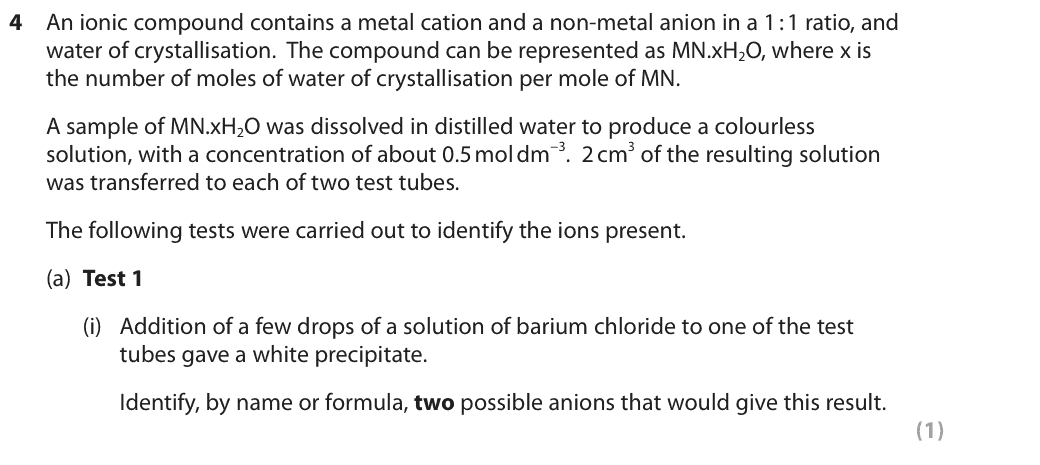
June 2025 · AS Paper 1 · Q4(a)(i)2 marksPractical and data analysisHard
Mark scheme
Examiner's comment
Q4ai was not answered well considering it is GCSE content. This question required candidates to identify the gas and positive test when a metal reacts with an acid. Not many candidates identified the correct gas and fewer described the correct positive test. Those candidates that did identify hydrogen as the gas lost marks for describing the test for oxygen, mentioning a glowing splint or stating that the lit splint should be held above the gas and not in it.
Notes from the mark scheme and report
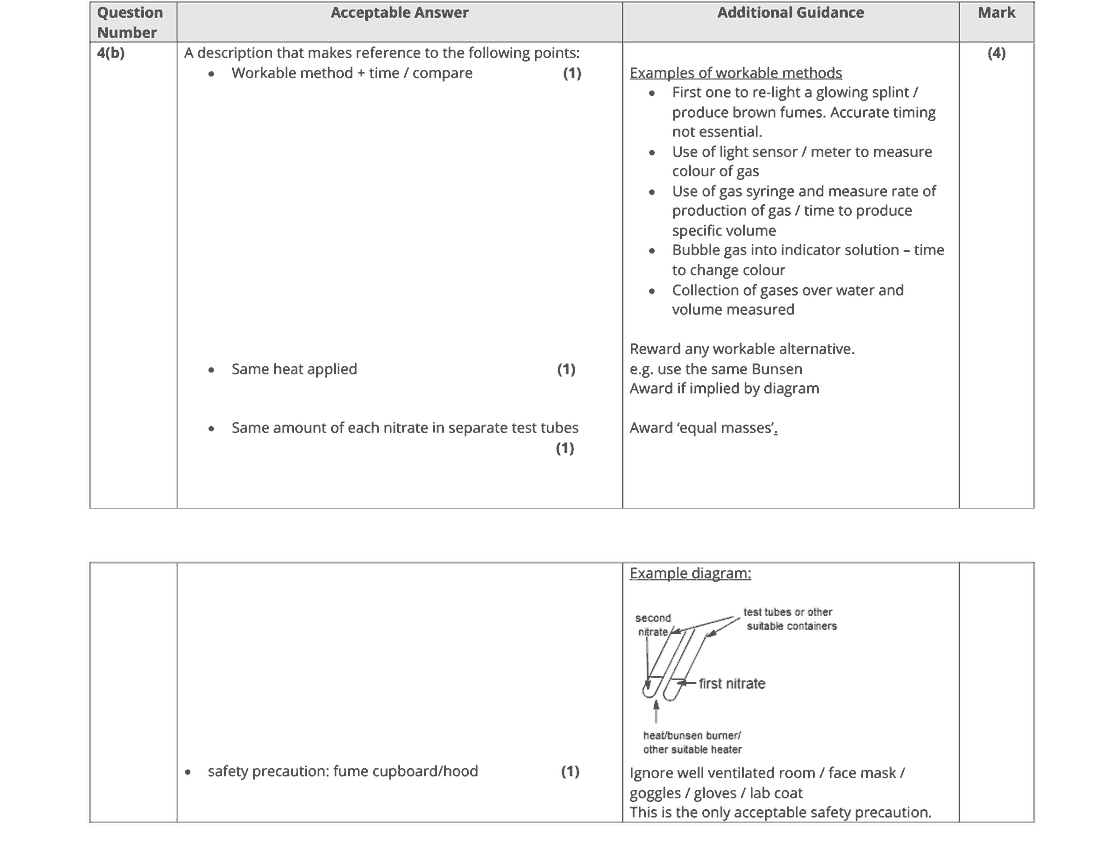
Hydrogen / H2 (not H)
it burns with a (squeaky) pop with a lit splint. Errors: the gas not identified
the oxygen test (glowing splint) described
lit splint held above the gas rather than in it
Skills: PT4 use laboratory apparatus for a variety of experimental techniques, including: titration, using burette and pipette; distillation and heating under reflux, including setting up glassware using retort stand and clamps; qualitative tests for ions and organic functional groups; filtration, including use of fluted filter paper, or filtration under reduced pressure
June 2025 · AS Paper 1 · Q4(a)(ii)2 marksEquation writing
Earlier part of question 4 that this part uses
Mark scheme
Examiner's comment
Q4aii required candidates to write the equation for the reaction between magnesium and nitric acid, including state symbols. This was answered reasonably well. Most candidates lost marks for the incorrect formula of nitric acid, incorrect balancing or incorrect/missing state symbols. Many candidates struggled to identify magnesium nitrate as aqueous.
Notes from the mark scheme and report
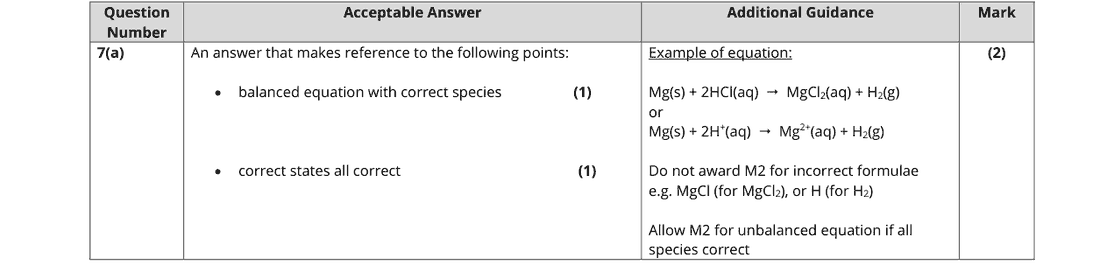
Mg(s) + 2HNO3(aq) → Mg(NO3)2(aq) + H2(g)
allow the ionic equation Mg(s) + 2H+(aq) → Mg2+(aq) + H2(g). One mark for correct substances, one for balancing and state symbols. Common errors: wrong formula for nitric acid
balancing
state symbols wrong or missing, especially magnesium nitrate not given as (aq)
June 2025 · AS Paper 1 · Q4(a)(iii)1 markEquation writingHard
Earlier part of question 4 that this part uses
Mark scheme
Examiner's comment
Q4aiii required candidates to write the equation for the above reaction forming nitrogen dioxide and water. This was not answered well. Some candidates did not attempt the question, others lost marks for incorrect balancing or products. Candidates should ensure they correctly read the question as there were examples where water and nitrogen dioxide were not present as products.
Notes from the mark scheme and report
Answer: Mg + 4HNO3 → Mg(NO3)2 + 2NO2 + 2H2O. State symbols ignored. Errors: left blank
wrong balancing
products that did not include the nitrogen dioxide and water named in the question
June 2025 · AS Paper 1 · Q4(b)(iii)1 markMultiple choice
Earlier parts of question 4 that this part uses
Answer
B
Mark scheme
Examiner's comment
Q4biii was answered well, with over 90% of candidates getting correct. The question required candidates to read the volume of gas collected in a measuring cylinder.
Notes from the mark scheme and report
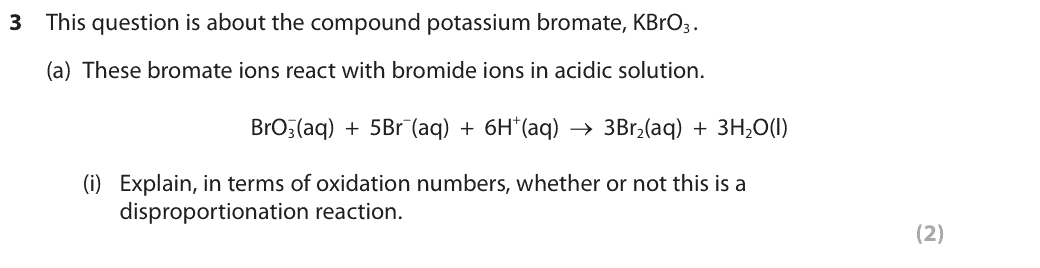
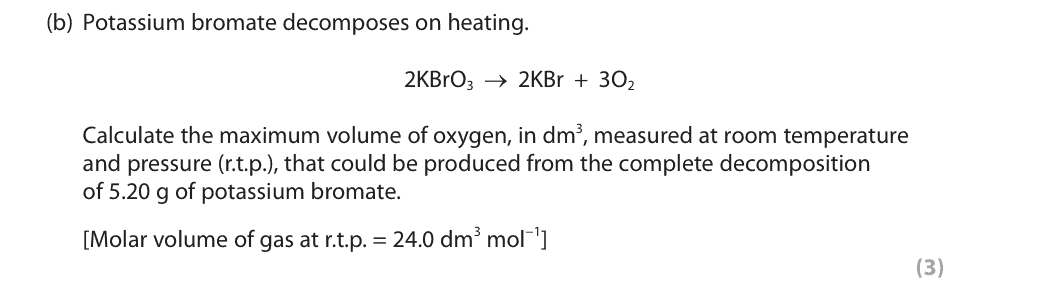
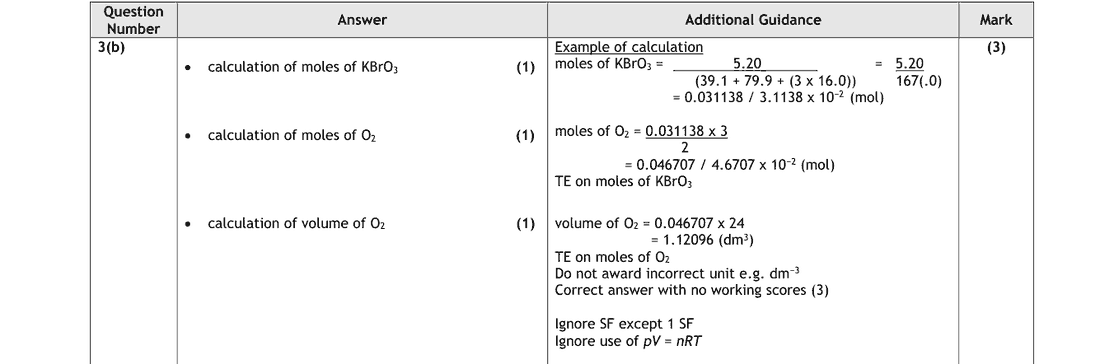
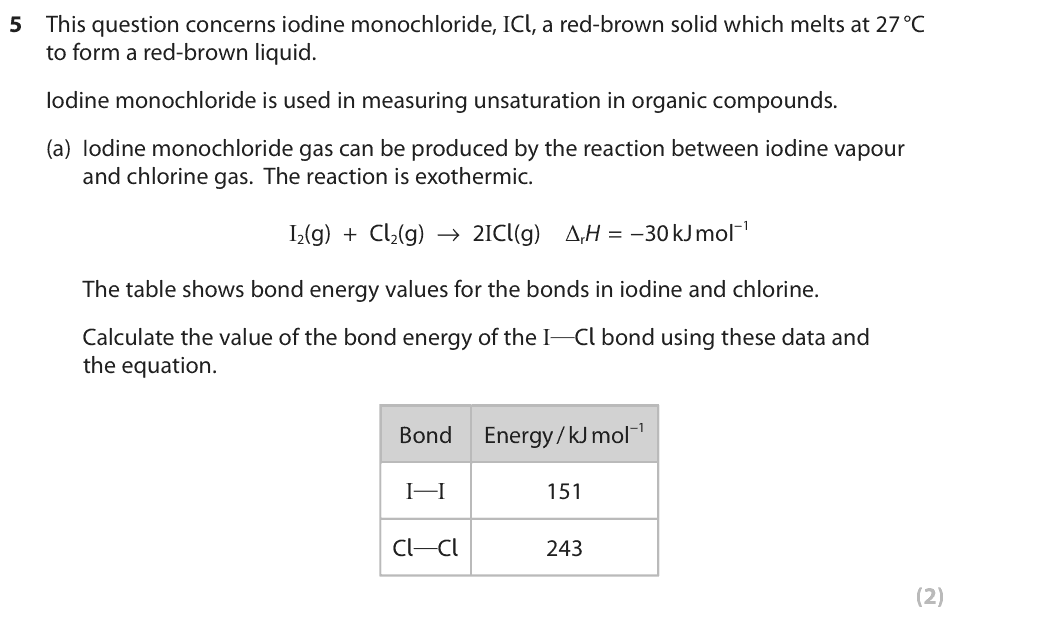
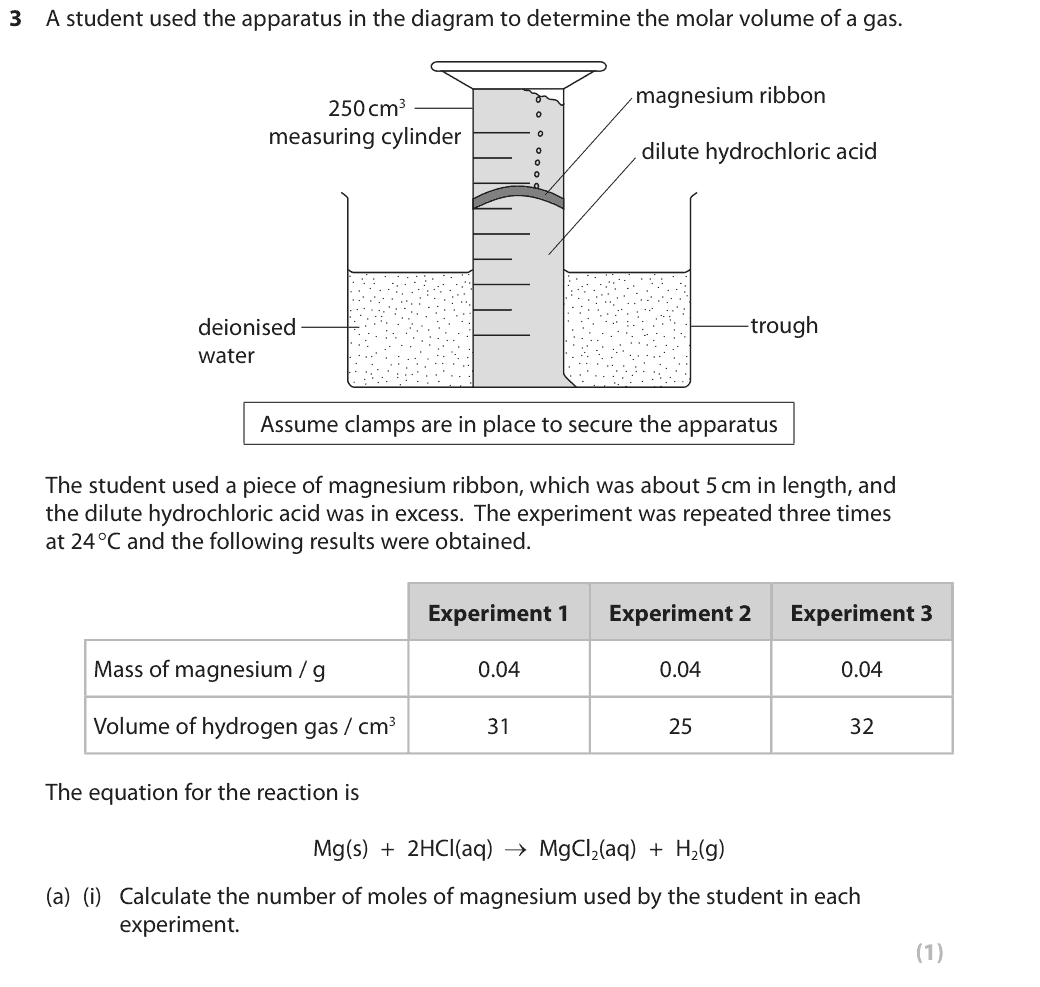
Answer: B. The cylinder is inverted, so the scale reads downwards: each large division is 10 cm3 and each small one 2 cm3, and the water level is at 236 cm3. A and C take the divisions as 5 and 1 cm3
D reads up from 250
Skills: MS3.1 Translate information between graphical, numerical and algebraic forms; PT1 use appropriate apparatus to record a range of measurements (to include mass, time, volume of liquids and gases, temperature); CP1 Core practical 1: Measure the molar volume of a gas
June 2025 · AS Paper 1 · Q4(b)(iv)4 marksCalculation
Earlier parts of question 4 that this part uses
Mark scheme
Examiner's comment
Q4biv required candidates to calculate the molar volume if a gas. This was answered reasonably well, with most candidates gaining marks for calculating the moles of magnesium nitrate. Some candidates lost marks for not calculating the moles of oxygen by halving their moles, or incorrectly doubling their moles, or incorrectly adding all their moles together. Very few candidates divided the volume by moles to calculate the molar volume. Most candidates multiplied their moles by 24 to calculate the volume and thus incorrectly gave cm3 or m3 as their unit rather than cm3 mol-1. A significant number attempted to use PV = nRT, despite being told that this was not required in the rubric.
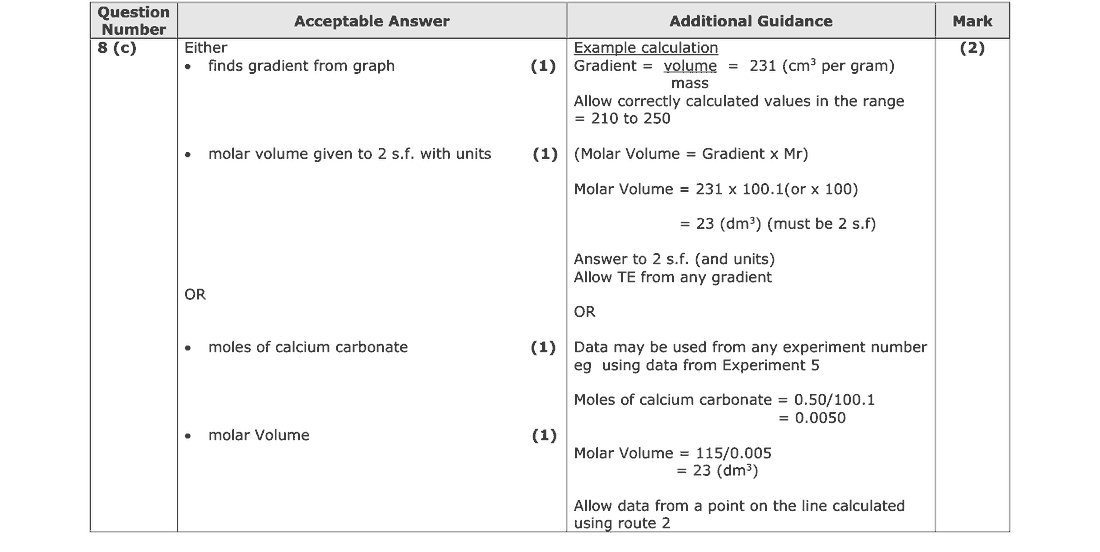
molar volume = 236 ÷ 0.0100. The last mark needs three significant figures and units that include mol–1 (not just cm3 or dm3). Error carried forward from (b)(iii): A gives 21.8, C gives 25.7, D gives 26.4 dm3 mol–1. Common errors: not halving, doubling, or adding all the moles together
multiplying the moles by 24 to get a volume instead of dividing volume by moles
units of cm3
using pV = nRT although told it was not needed
Skills: MS0.0 Recognise and make use of appropriate units in calculation; MS0.2 Use ratios, fractions and percentages; MS1.1 Use an appropriate number of significant figures; CP1 Core practical 1: Measure the molar volume of a gas
June 2025 · AS Paper 1 · Q4(b)(v)2 marksExplanationHard
Earlier parts of question 4 that this part uses
Mark scheme
Examiner's comment
Q4bv required candidates to explain why three significant figures is appropriate in this example. This was answered poorly. Some candidates could recognise that the volume was measured to three significant figures but did not explain that this is the lowest number of significant figures. Many candidates stated that it was accurate so did not achieve the mark.
Notes from the mark scheme and report
The volume is read to 3 significant figures (allow: the measuring cylinder is read to the nearest 1 cm3), whereas the other data are to 4
and this is the least number of significant figures in the data used. References to accuracy and precision are ignored. Some spotted the 3 significant figures in the volume but did not say it is the lowest
many just wrote 'it is accurate'
Skills: MS1.1 Use an appropriate number of significant figures; CP1 Core practical 1: Measure the molar volume of a gas
June 2025 · AS Paper 1 · Q5(b)(iv)1 markCalculationHard
Earlier parts of question 5 that this part uses
Mark scheme
Examiner's comment
Q5biv was not answered well, with only 11% of candidates scoring the mark. The question required candidates to calculate Avogadro constant. Not many candidates attempted this question, and some candidates just stated the value for Avogadro constant without any calculations. A small number of candidates managed to do the correct calculation but very few candidates used the corrected value for isotopic mass and gave their answer to five decimal places.
Notes from the mark scheme and report
Answer: 6.0221 × 10^23 (mol–1), to 4 or 5 significant figures. 63.929 ÷ (1.06157 × 10^–22). The relative isotopic mass 63.929 comes from (b)(ii). Many left it blank or just quoted the Avogadro constant with no calculation
few used 63.929 and gave a suitable number of significant figures
Skills: MS0.1 Recognise and use expressions in decimal and ordinary form; MS1.1 Use an appropriate number of significant figures; MS2.2 Change the subject of an equation
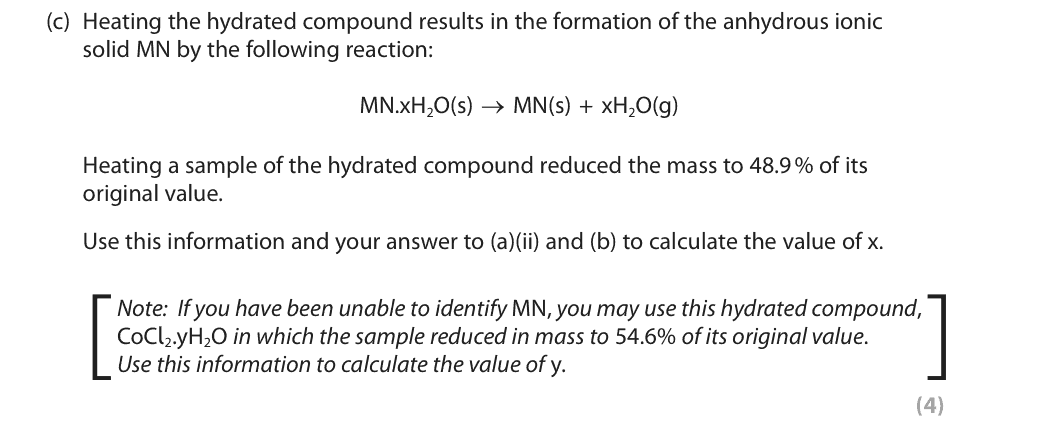
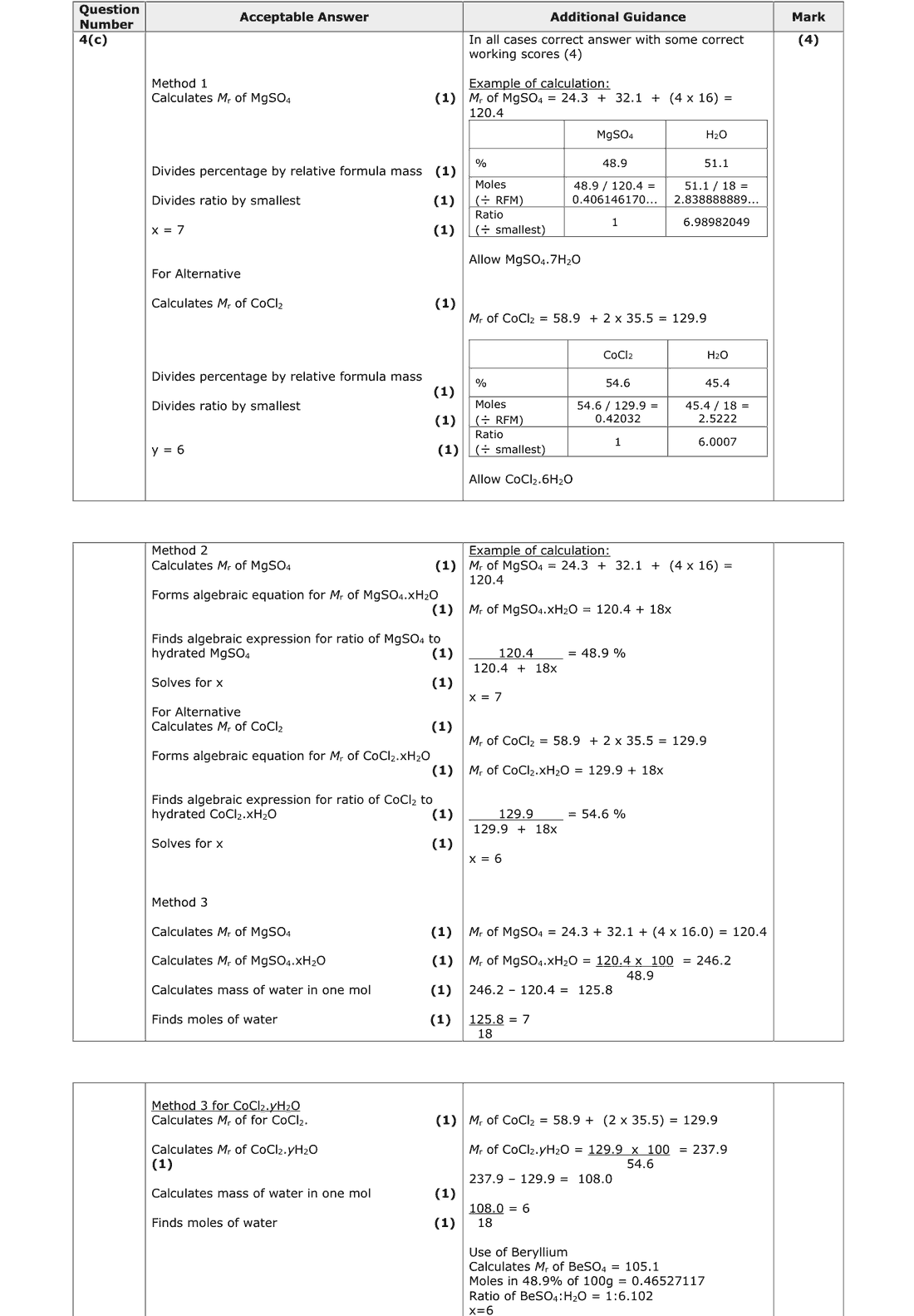
June 2025 · AS Paper 1 · Q5(c)4 marksCalculation
Earlier part of question 5 that this part uses
Mark scheme
Examiner's comment
Q5c required candidates to calculate the moles of water in hydrated zinc sulfate. This question was answered reasonably well. Most candidates could calculate the mass of water lost and many could calculate the moles of water lost. Less candidates were able to calculate the moles of zinc sulfate and calculate the ratio. Some candidates were confused with the mass being given in mg and were converting.
Notes from the mark scheme and report
Answer: x = 7. Mass of water lost = 450 – 253 = 197 mg
moles of water = 197 ÷ 18 = 10.944 mmol
moles of ZnSO4 = 253 ÷ 161.5 = 1.5666 mmol
ratio = 6.99, so x = 7 (must be an integer). Most found the mass and moles of water
fewer found the moles of zinc sulfate and the ratio
the masses in mg confused some
Skills: MS0.0 Recognise and make use of appropriate units in calculation; MS0.2 Use ratios, fractions and percentages
June 2025 · AS Paper 1 · Q6(a)(i)2 marksPractical and data analysis
Mark scheme
Examiner's comment
Q6ai required candidates to explain why a reaction should be carried out in a fume cupboard. This was answered relatively well. Some candidates lost marks for not stating which gas is toxic or stating products that are not gases. Some candidates did not state that the toxic gas should not be inhaled.
so the fume cupboard stops it being released into the laboratory / breathed in (1). Allow 'H2S is hazardous for the environment' for the first mark. If nothing else scores, 1 mark for H2S having a foul smell that the fume cupboard keeps out of the lab. Marks lost for not saying which gas is toxic, naming products that are not gases, or not saying the gas should not be inhaled
Skills: PT11 safely and carefully handle solids and liquids, including corrosive, irritant, flammable and toxic substances
June 2025 · AS Paper 1 · Q86 marksCalculation
Mark scheme
Examiner's comment
Q8 required candidates to calculate the molecular formula of ferrocene. This was answered reasonably well. Although there was a large number of blank answers, those candidates who did answer were able to calculate the moles of hydrogen and carbon and achieve three marks. Very few candidates scored full marks.
Notes from the mark scheme and report
Answer: FeC10H10 (C10H10Fe). Mass of water = 36.74 – 36.34 = 0.40 g and mass of CO2 = 37.23 – 35.28 = 1.95 g (1)
moles H2O = 0.0222 so moles H = 0.0444 (1)
moles C = 1.95 ÷ 44 = 0.0443 (1). Then either: mass of C + H = 0.0444 + (0.0443 × 12) = 0.576 g, so mass Fe = 0.830 – 0.576 = 0.254 g and moles Fe = 0.254 ÷ 55.8 = 0.00455 (1)
Fe : C : H = 1 : 9.8 : 9.8, empirical formula FeC10H10 (1)
empirical formula mass 185.8 matches Mr 186, so this is the molecular formula (1). Or: moles ferrocene = 0.830 ÷ 186 = 0.00446, ratio ferrocene : C : H = 1 : 10 : 10 (1)
Mr of C10H10 = 130, leaving 186 – 130 = 56 for iron (1)
56 ÷ 56 = 1 Fe, so FeC10H10 (1). Many left it blank
those who attempted it usually got the three marks for the moles of hydrogen and carbon
very few scored full marks
Skills: MS0.2 Use ratios, fractions and percentages; MS2.3 Substitute numerical values into algebraic equations using appropriate units for physical quantities
June 2025 · Paper 1 · Q9(e)2 marksCalculation
Earlier part of question 9 that this part uses
Mark scheme
Examiner's comment
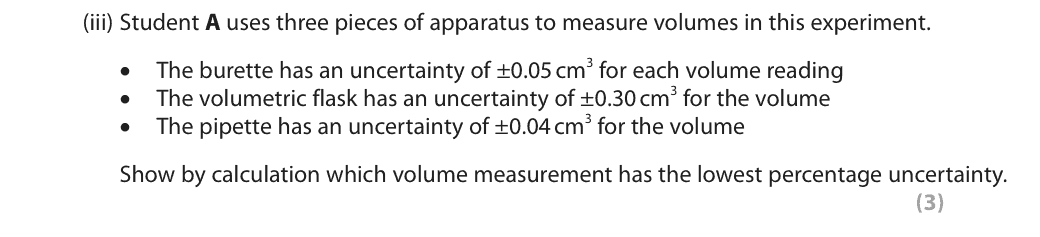
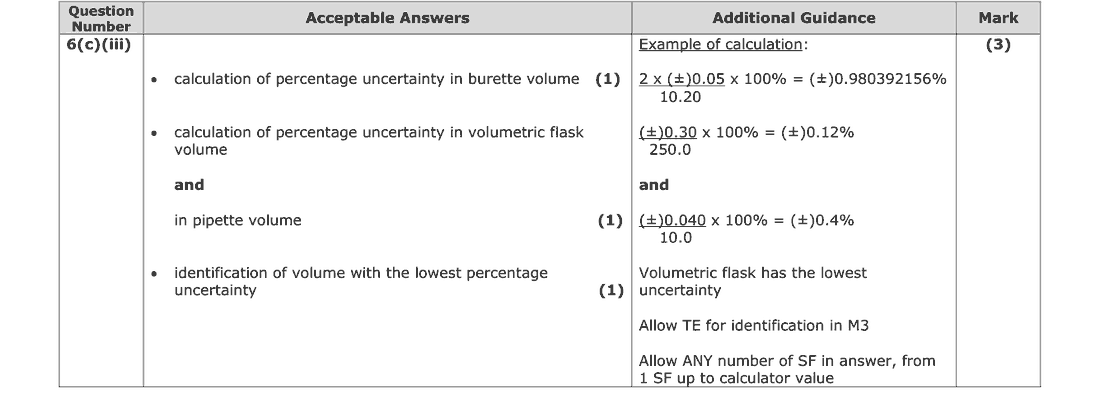
The final question was looking at the percentage uncertainty of apparatus used within a titration namely the pipette and the burette.
The most common error here was the failure to realise that the burette uncertainty involves x2 as there are two readings taken.
Notes from the mark scheme and report
Answer: pipette 0.16%
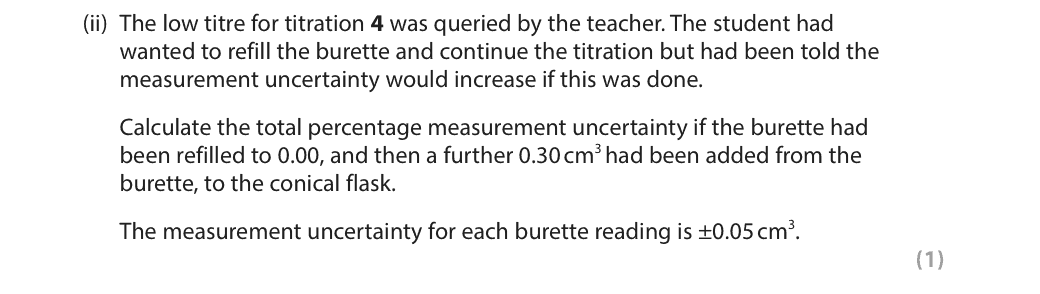
burette 0.64% (0.643). Pipette: 0.04 ÷ 25.00 × 100. Burette: 2 × 0.05 ÷ 15.55 × 100, because a titre comes from two readings. Not 1 significant figure. Most common error: leaving out the × 2 for the burette
Skills: MS0.2 Use ratios, fractions and percentages; MS1.3 Identify uncertainties in measurements and use simple techniques to determine uncertainty when data are; PT1 use appropriate apparatus to record a range of measurements (to include mass, time, volume of liquids and gases, temperature); PT4 use laboratory apparatus for a variety of experimental techniques, including: titration, using burette and pipette; distillation and heating under reflux, including setting up glassware using retort stand and clamps; qualitative tests for ions and organic functional groups; filtration, including use of fluted filter paper, or filtration under reduced pressure; CP11 Core practical 11: Redox titration
June 2025 · Paper 2 · Q3(a)1 markMultiple choice
Answer
C
Mark scheme
Notes from the mark scheme and report
Answer: C (90.9%). (3 × 306) ÷ (890 + (3 × 40)) × 100 = 918 ÷ 1010 × 100. A and B use only one sodium stearate
D uses only one sodium hydroxide
Skills: MS0.2 Use ratios, fractions and percentages
June 2025 · Paper 2 · Q4(a)(i)4 marksCalculation
Mark scheme
Examiner's comment
Although the question was unfamiliar and unusual, many candidates were able to score well on this question and the examining team were impressed by the quality of candidate responses to this question. Even those candidates who were unable to convert nm to m for the wavelength were still able to gain some credit for transposing their values into the equation and evaluating their answer correctly.
Notes from the mark scheme and report
Answer: 380 kJ mol–1 (379.9), which is more than 243 (so Cl–Cl breaks) but less than 413 (so C–H does not). 315 nm = 3.15 × 10^–7 m
E = (6.626 × 10^–34 × 3.00 × 10^8) ÷ 3.15 × 10^–7 = 6.31 × 10^–19 J per photon
× 6.02 × 10^23 = 379 890 J mol–1. Alternative: convert the bond energies to J per bond (6.86 × 10^–19 and 4.04 × 10^–19 J). Transferred error for M1 to M3. Many scored well
those who could not convert nm to m still gained credit for the later steps
Skills: MS0.0 Recognise and make use of appropriate units in calculation; MS0.1 Recognise and use expressions in decimal and ordinary form; MS2.3 Substitute numerical values into algebraic equations using appropriate units for physical quantities
June 2025 · Paper 2 · Q5(a)4 marksCalculationEasy
Mark scheme
Examiner's comment
This question proved to be straightforward, with most candidates securing full marks clearly showing a good understanding of the calculation.
Most were also able to give their answer to the appropriate number of significant figures, although this was most frequently the mark lost by a few candidates.
V = 7.09 × 10^–3 ÷ 0.100 = 0.0709 dm3 = 70.9 cm3, to 2 or 3 SF. 71.0 not accepted if 100.1 was used. Transferred error at each stage. The significant figures mark was the one most often lost
Skills: MS0.0 Recognise and make use of appropriate units in calculation; MS0.2 Use ratios, fractions and percentages; MS1.1 Use an appropriate number of significant figures
June 2025 · Paper 2 · Q5(c)(i)4 marksCalculation
Earlier part of question 5 that this part uses
Mark scheme
Examiner's comment
Most candidates showed that they knew what to do here since their revision must have seen this sort of question before on previous versions of paper 2.
The most common errors were the incorrect conversion of pressure to Pascals or the incorrect conversion of volume when evaluating their final answer.
Candidates who set out their work clearly were more likely to be able to follow through with a logical progression to get to the correct answer.
It is advised that candidates learn the correct units of the Ideal Gas Equation and practise the conversions from data provided.
Notes from the mark scheme and report
Answer: 121 cm3 (1.21 × 10^–4 m3), which is more than the 100 cm3 gas syringe can hold, so it cannot be measured. p = 1 × 10^5 Pa and T = 347.0 K
V = nRT ÷ p = (4.19 × 10^–3 × 8.31 × 347.0) ÷ 1 × 10^5. Final mark needs correct units and the comparison with the syringe. Common errors: converting the pressure to Pa
converting the volume
Skills: MS0.0 Recognise and make use of appropriate units in calculation; MS2.2 Change the subject of an equation; MS2.3 Substitute numerical values into algebraic equations using appropriate units for physical quantities
June 2025 · AS Paper 2 · Q6(b)(i)3 marksCalculation
Earlier part of question 6 that this part uses
Mark scheme
Examiner's comment
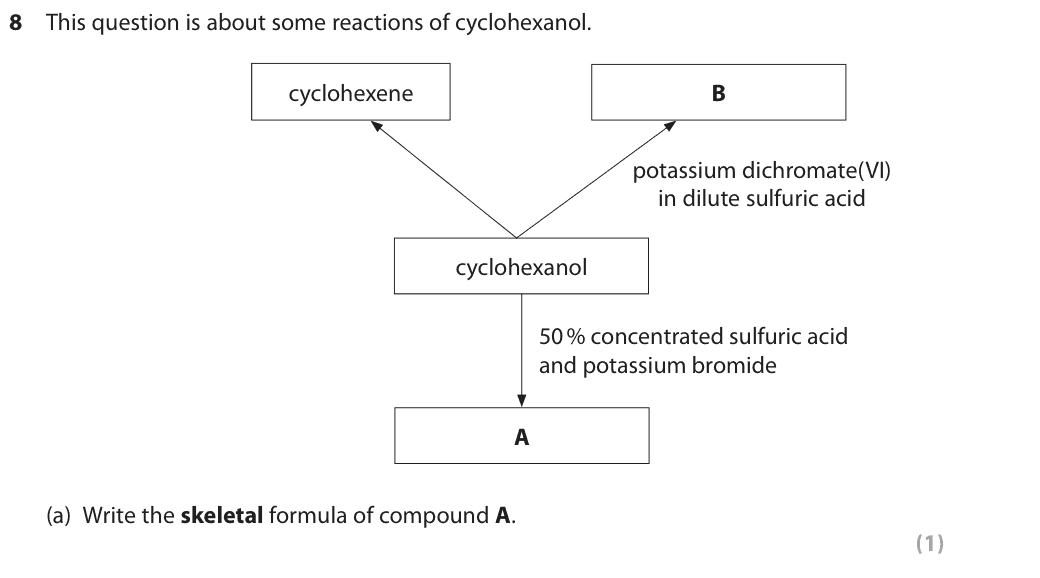
This question was about the reactions of two alcohols and included calculations as well as the description of an organic preparation. (a) This multiple-choice question was very well answered. (bi) Most candidates scored at least two marks. Common errors included incorrect Mr values and stoichiometric ratios (bii) This extended response on a standard practical was very challenging. Many mentioned reflux but described distillation instead. Some suggested inappropriate apparatus such as beakers, conical flasks, volumetric flasks and burettes. Descriptions were often incomplete or incorrect. Many included a thermometer and a bung in the reflux, which would have sealed the system. Distillation following from reflux was rarely seen. While many correctly mentioned the use of a thermometer for distillation, few referred to the still head, and the condenser was often incorrectly positioned horizontally rather than sloping. Candidates frequently included details about water flow in the condenser and the function of anti-bumping granules—both correct but not required in this context. Candidates must remember to move away from giving stock answers and instead address what is being asked. A number of candidates confused this practical with the halogenation of an alcohol, leading to inappropriate suggestions such as using a separating funnel followed by the addition of sodium hydrogencarbonate solution to remove acid impurities. On a more positive note, many could name a suitable drying agent, though fewer described how to remove the dried butanone afterwards. A surprising number of candidates thought that leaving the product on a windowsill or patting with tissue papers was the way to get dry butanone.
Very few candidates included the final distillation , which was essential for full credit. (c) Many candidates identified the correct product but lost the mark for using the structural formula instead of the required skeletal formula. (di) Most scored the first and third marks here, but many struggled with the stoichiometric ratio - some missed it, and others inverted it. (dii) Many fully correct answers were seen, although a sizeable number correctly calculated the experimental and theoretical amounts of product but then got very mixed up, so they divided the experimental yield by the sum of the theoretical and experimental yields. (6e) This apparently straightforward question was answered incorrectly by a large number of candidates – the basic structural formula representing an aldehyde was rarely known and there were many incorrect molecular formulas for the isomers.
Notes from the mark scheme and report
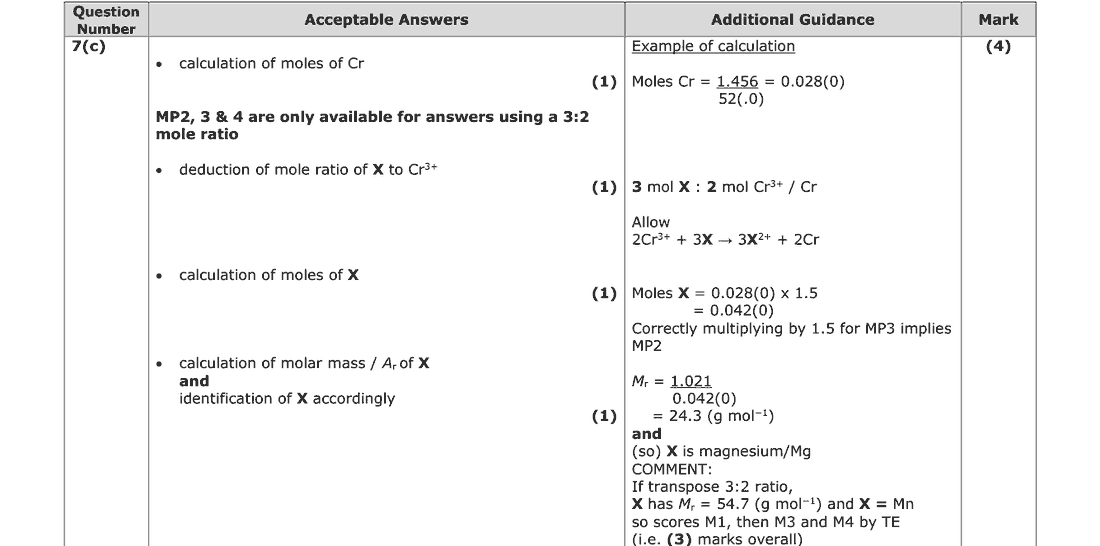
Answer: 13.1 g. Moles of dichromate = 0.150 ÷ 3 = 0.050
molar mass of Na2Cr2O7 = 262 g mol–1
0.050 × 262. 39.3 (no ÷ 3) or 10.8 (Mr of 216 for the ion) scores 2. Most scored at least two
errors were the Mr and the mole ratio
Skills: MS0.2 Use ratios, fractions and percentages; MS2.3 Substitute numerical values into algebraic equations using appropriate units for physical quantities
June 2025 · AS Paper 2 · Q6(d)(i)3 marksCalculation
Earlier part of question 6 that this part uses
Mark scheme
Examiner's comment
This question was about the reactions of two alcohols and included calculations as well as the description of an organic preparation. (a) This multiple-choice question was very well answered. (bi) Most candidates scored at least two marks. Common errors included incorrect Mr values and stoichiometric ratios (bii) This extended response on a standard practical was very challenging. Many mentioned reflux but described distillation instead. Some suggested inappropriate apparatus such as beakers, conical flasks, volumetric flasks and burettes. Descriptions were often incomplete or incorrect. Many included a thermometer and a bung in the reflux, which would have sealed the system. Distillation following from reflux was rarely seen. While many correctly mentioned the use of a thermometer for distillation, few referred to the still head, and the condenser was often incorrectly positioned horizontally rather than sloping. Candidates frequently included details about water flow in the condenser and the function of anti-bumping granules—both correct but not required in this context. Candidates must remember to move away from giving stock answers and instead address what is being asked. A number of candidates confused this practical with the halogenation of an alcohol, leading to inappropriate suggestions such as using a separating funnel followed by the addition of sodium hydrogencarbonate solution to remove acid impurities. On a more positive note, many could name a suitable drying agent, though fewer described how to remove the dried butanone afterwards. A surprising number of candidates thought that leaving the product on a windowsill or patting with tissue papers was the way to get dry butanone.
Very few candidates included the final distillation , which was essential for full credit. (c) Many candidates identified the correct product but lost the mark for using the structural formula instead of the required skeletal formula. (di) Most scored the first and third marks here, but many struggled with the stoichiometric ratio - some missed it, and others inverted it. (dii) Many fully correct answers were seen, although a sizeable number correctly calculated the experimental and theoretical amounts of product but then got very mixed up, so they divided the experimental yield by the sum of the theoretical and experimental yields. (6e) This apparently straightforward question was answered incorrectly by a large number of candidates – the basic structural formula representing an aldehyde was rarely known and there were many incorrect molecular formulas for the isomers.
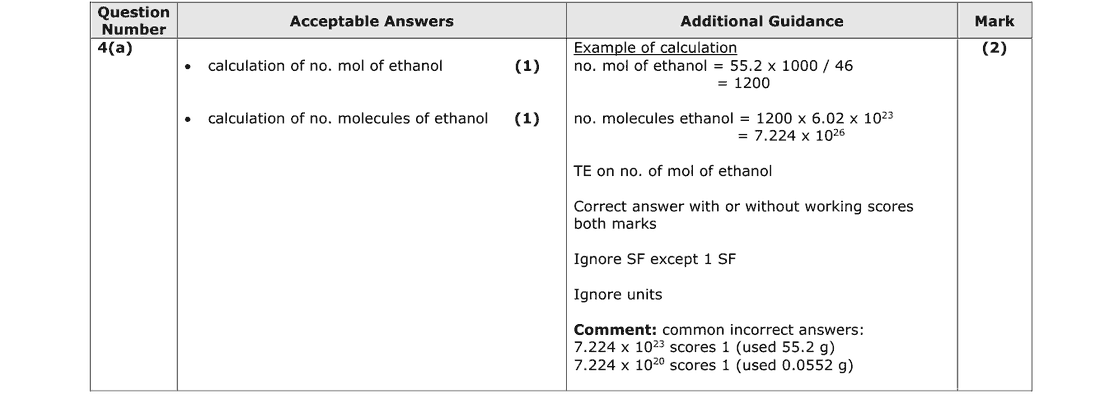
× 6.02 × 10^23. Most scored the first and third marks
the 6 : 4 ratio was often missed or inverted
Skills: MS0.1 Recognise and use expressions in decimal and ordinary form; MS0.2 Use ratios, fractions and percentages
June 2025 · AS Paper 2 · Q6(d)(ii)3 marksCalculation
Earlier parts of question 6 that this part uses
Mark scheme
Examiner's comment
This question was about the reactions of two alcohols and included calculations as well as the description of an organic preparation. (a) This multiple-choice question was very well answered. (bi) Most candidates scored at least two marks. Common errors included incorrect Mr values and stoichiometric ratios (bii) This extended response on a standard practical was very challenging. Many mentioned reflux but described distillation instead. Some suggested inappropriate apparatus such as beakers, conical flasks, volumetric flasks and burettes. Descriptions were often incomplete or incorrect. Many included a thermometer and a bung in the reflux, which would have sealed the system. Distillation following from reflux was rarely seen. While many correctly mentioned the use of a thermometer for distillation, few referred to the still head, and the condenser was often incorrectly positioned horizontally rather than sloping. Candidates frequently included details about water flow in the condenser and the function of anti-bumping granules—both correct but not required in this context. Candidates must remember to move away from giving stock answers and instead address what is being asked. A number of candidates confused this practical with the halogenation of an alcohol, leading to inappropriate suggestions such as using a separating funnel followed by the addition of sodium hydrogencarbonate solution to remove acid impurities. On a more positive note, many could name a suitable drying agent, though fewer described how to remove the dried butanone afterwards. A surprising number of candidates thought that leaving the product on a windowsill or patting with tissue papers was the way to get dry butanone.
Very few candidates included the final distillation , which was essential for full credit. (c) Many candidates identified the correct product but lost the mark for using the structural formula instead of the required skeletal formula. (di) Most scored the first and third marks here, but many struggled with the stoichiometric ratio - some missed it, and others inverted it. (dii) Many fully correct answers were seen, although a sizeable number correctly calculated the experimental and theoretical amounts of product but then got very mixed up, so they divided the experimental yield by the sum of the theoretical and experimental yields. (6e) This apparently straightforward question was answered incorrectly by a large number of candidates – the basic structural formula representing an aldehyde was rarely known and there were many incorrect molecular formulas for the isomers.
theoretical mass of 2-iodobutane = 0.16081 × 183.9 = 29.573 g
22.8 ÷ 29.573 × 100. Or actual moles = 22.8 ÷ 183.9 = 0.12398, then ÷ 0.16081. Many fully correct
a sizeable number divided the actual yield by the sum of the actual and theoretical yields
Skills: MS0.2 Use ratios, fractions and percentages
June 2025 · Paper 3 · Q4(b)(ii)2 marksPractical and data analysis
Earlier parts of question 4 that this part uses
Mark scheme
Examiner's comment
There were many correct answers to the first part of this question, with many candidates selecting a suitable quenching agent. However, the accompanying equation proved more of a challenge.
The list of incorrect quenching agents included calcium chloride (which is a dehydrating agent), sodium thiosulfate (which would be used in the titration later) and potassium permanganate (oxidising agent).
sodium or potassium carbonate accepted), which removes the acid catalyst. Equation to match, e.g. NaHCO3 + H+ → Na+ + CO2 + H2O, HCO3– + H+ → CO2 + H2O, 2NaHCO3 + H2SO4 → Na2SO4 + 2CO2 + 2H2O, or CO3 2– + 2H+ → CO2 + H2O. Name and formula must agree if both given. The compound was often right but the equation was harder. Wrong choices: calcium chloride, sodium thiosulfate, potassium manganate(VII)
Skills: CP13 Core practical 13: Rates of reaction Following the rate of the iodine-propanone reaction by a titrimetric method and investigating a ‘clock reaction’ (Harcourt-Esson, iodine clock)
June 2025 · Paper 3 · Q4(c)2 marksPractical and data analysis
Earlier part of question 4 that this part uses
Mark scheme
Examiner's comment
This was a question about risk and hazard. The candidates were required to note that a corrosive compound might not need handling in a fume cupboard because it was produced in a small amount and would remain in solution. Most of the candidates that were awarded at least one mark, realised that the iodopropane would not be present as a gas, with fewer commenting that its concentration would be low.
Notes from the mark scheme and report
Any two: risk depends on both the hazard and the amount of substance
only a small amount of iodopropanone is formed
it stays in solution / is not a gas / is not volatile. 'Harmful fumes' and 'it is a solid' ignored. Most marks came from saying it is not given off as a gas
fewer mentioned the small amount
Skills: PT11 safely and carefully handle solids and liquids, including corrosive, irritant, flammable and toxic substances; CP13 Core practical 13: Rates of reaction Following the rate of the iodine-propanone reaction by a titrimetric method and investigating a ‘clock reaction’ (Harcourt-Esson, iodine clock)
June 2025 · Paper 3 · Q4(d)4 marksCalculation
Earlier part of question 4 that this part uses
Mark scheme
Examiner's comment
Many candidates were able to calculate the concentration of the iodine and the propanone correctly. Some went on to describe that the iodine would be a limiting factor and scored three of the marks. For the fourth mark, candidates were required to state that the propanone would be in a great excess and hence the change in its concentration would be negligible. This mark was more difficult to score.
Notes from the mark scheme and report
Moles I2 = 0.0500 × 0.0200 = 1.00 × 10^–3
moles propanone = 0.0250 × 2.00 = 0.0500
propanone is in great excess (0.0500 is much greater than 1.00 × 10^–3) so its concentration changes negligibly (just 'in excess' is not enough)
so the change in rate is due only to the changing concentration of iodine (allow iodine is the limiting factor). The sulfuric acid is ignored. The two mole calculations were usually right
the negligible-change mark was the hardest
Skills: MS0.1 Recognise and use expressions in decimal and ordinary form; MS2.1 Understand and use the symbols: =, <, <<, >>, >, ∝, ~, equilibrium sign; CP13 Core practical 13: Rates of reaction Following the rate of the iodine-propanone reaction by a titrimetric method and investigating a ‘clock reaction’ (Harcourt-Esson, iodine clock)
June 2025 · Paper 3 · Q5(a)(i)2 marksCalculation
Mark scheme
Examiner's comment
Most candidates were able to work out the number of moles of each element in the sample of the unknown solid. Some of them did not explain the ratio and how to calculate the empirical formula to compare to the molecular mass.
Notes from the mark scheme and report
Moles: Co 1.26 ÷ 58.9 = 0.0214
N 1.20 ÷ 14.0 = 0.0857
H 0.257 ÷ 1.0 = 0.257
Cl 2.28 ÷ 35.5 = 0.0642. Divide by 0.0214 to get 1 : 4 : 12 : 3. Then show the formula mass of CoN4H12Cl3 = 58.9 + (4 × 14) + 12 + (3 × 35.5) = 233.4, so the molecular formula is the same. A percentage-by-mass method is also credited. Most found the moles
some did not show the ratio or the comparison with the molar mass
Skills: MS0.2 Use ratios, fractions and percentages
June 2025 · Paper 3 · Q5(a)(ii)2 marksCalculation
Earlier part of question 5 that this part uses
Mark scheme
Examiner's comment
Many candidates scored at least one of the available two marks on this question, with many going on to score the second mark and showing that the ratio would be 1:1.
ratio 1 : 1. An answer of 3 Cl– is not credited. Many scored at least one mark
Skills: MS0.2 Use ratios, fractions and percentages
June 2025 · Paper 3 · Q7(b)(ii)3 marksCalculation
Earlier parts of question 7 that this part uses
Mark scheme
Examiner's comment
Q07(b)(i) and Q07(b)(ii) were linked with many opportunities to score marks for correct logical steps and many fully correct answers were seen.
Candidates had the opportunity to gain marks for this part by using their final answer to part (i). This part was found challenging by some candidates, with some making simple errors such as mis - calculating the Mr of ethanol, or dividing by the Mr of ethanol instead of multiplying.
Notes from the mark scheme and report
Answer: 114 g dm–3. Moles ethanol in 250 cm3 = 9.9015 × 10^–4 × (250 ÷ 5) = 0.049508
concentration of the drink = 0.049508 ÷ (20 ÷ 1000) = 2.4754 mol dm–3
× 46 = 113.87 g dm–3. Error carried forward, including from (b)(i). Common errors: wrong Mr for ethanol
dividing by Mr instead of multiplying
Skills: MS0.0 Recognise and make use of appropriate units in calculation; MS0.2 Use ratios, fractions and percentages; CP11 Core practical 11: Redox titration
June 2025 · Paper 3 · Q7(c)2 marksPractical and data analysis
Earlier part of question 7 that this part uses
Mark scheme
Examiner's comment
Many candidates had not quite understood that the question required them to consider how the actual titration method could be improved. The experiment as described only allowed for one titration to be carried out and so candidates needed to indicate that one way to improve would be to repeat the whole experiment, and that another way would be to take smaller samples so that more than one titration could be carried out.
Many candidates were able to score the 'rescue mark' detailed in the additional guidance for repeating the titration and calculating a mean.
Notes from the mark scheme and report
Repeat the whole experiment (or run several set-ups at the same time)
take more than one, smaller, sample of the mixture so that more than one titration can be done. Just 'repeat the titration' is not enough, because all the iodine is used in a single titration
if nothing else scores, 1 mark for repeating the titration to concordant results / calculating a mean. Many scored only this rescue mark
Skills: PT4 use laboratory apparatus for a variety of experimental techniques, including: titration, using burette and pipette; distillation and heating under reflux, including setting up glassware using retort stand and clamps; qualitative tests for ions and organic functional groups; filtration, including use of fluted filter paper, or filtration under reduced pressure; CP11 Core practical 11: Redox titration
June 2025 · Paper 3 · Q9(c)(i)4 marksPractical and data analysis
Earlier part of question 9 that this part uses
Mark scheme
Examiner's comment
This was an accessible question where candidates had to describe how to make up a standard solution, including a dilution. Many good answers were seen. The most common mark which was missed was to invert the volumetric flask at the end to mix the solution. It should be noted that in the correct practical procedure, the flask is not actually shaken, and so this was not allowed for M4.
Notes from the mark scheme and report
Transfer the solution to a 100 cm3 volumetric flask
rinse the conical flask with distilled / deionised water and add the washings
add distilled / deionised water
make up to the mark and then stopper and invert / mix. 'Shake' is not credited. The most commonly missed step was inverting the flask to mix
Skills: PT5 use volumetric flask, including accurate technique for making up a standard solution; CP2 Core practical 2: Prepare a standard solution from a solid acid and use it to find the concentration of a solution of sodium hydroxide
June 2025 · Paper 3 · Q9(c)(ii)5 marksCalculation
Earlier parts of question 9 that this part uses
Mark scheme
Examiner's comment
This was a calculation question worth five marks. Many candidates successfully scored M1, M2 and M3. However, after that some lost their way and were unable to calculate the moles of the acid. This then led them to an incorrect Mr and hence an incorrect value of 'n'. It was possible to be awarded marks as a transferred error at each stage, which allowed candidates to gain additional marks for their method. There were some slips in the calculation of the Mr of the formula of the acid, with some missing off the final 'H' and arriving at 185.1 instead of 186.1. It should also be noted that water of crystallisation should be an integer, and so the final answer needed to be rounded to the nearest whole number.
Notes from the mark scheme and report
Answer: Mr = 222.2 and n = 2. Moles HCl = 22.4 ÷ 1000 × 0.0250 = 5.6 × 10^–4
222.2 – 186.1 = 36.1, ÷ 18 gives n = 2 (must be an integer, not negative). Error carried forward throughout
n alone with no working scores M5 only. Many got M1 to M3 and then went wrong
some used 185.1 for the anhydrous acid
Skills: MS0.2 Use ratios, fractions and percentages; MS2.4 Solve algebraic equations; CP3 Core practical 3: Find the concentration of a solution of hydrochloric acid
June 2025 · Paper 3 · Q9(d)(i)1 markPractical and data analysis
Earlier part of question 9 that this part uses
Mark scheme
Examiner's comment
This should have been a straightforward question about safety in filling a burette. Most candidates gave an answer showing that they knew that the burette should be filled below eye level to avoid the acid splashing into their eyes as the safety glasses would not offer complete protection.
Notes from the mark scheme and report
Lower the burette so that the acid is poured in below eye level (e.g. stand it in the sink, on the floor or on a stable stool). Just 'lower the burette' or 'the burette is too high' is ignored
the student standing on a stool is not credited. Most gave an answer about filling below eye level
Skills: PT11 safely and carefully handle solids and liquids, including corrosive, irritant, flammable and toxic substances; PT4 use laboratory apparatus for a variety of experimental techniques, including: titration, using burette and pipette; distillation and heating under reflux, including setting up glassware using retort stand and clamps; qualitative tests for ions and organic functional groups; filtration, including use of fluted filter paper, or filtration under reduced pressure
June 2025 · Paper 3 · Q9(d)(ii)3 marksPractical and data analysis
Earlier parts of question 9 that this part uses
Mark scheme
Examiner's comment
This final question proved to be challenging. Nevertheless some candidates were able to follow through the logic of what would happen if some extra drops of acid dripped into the burette. For all marks to be awarded the candidate needed to state that the titre would be lower, that this would result in it appearing that there were more moles of the 2,5-dimethylsulfonic acid reacting, and so the Mr would appear smaller which would reduce the value of 'n'.
Notes from the mark scheme and report
The titre recorded is smaller than the true volume added
so the calculated amount of excess NaOH is smaller and the calculated moles of the acid greater
so the calculated Mr is smaller and hence n is smaller (allow: smaller Mr but negligible effect on n). M3 depends on M2. If the titre is said to increase, the reverse argument can score M2 and M3. Found challenging
Skills: PT4 use laboratory apparatus for a variety of experimental techniques, including: titration, using burette and pipette; distillation and heating under reflux, including setting up glassware using retort stand and clamps; qualitative tests for ions and organic functional groups; filtration, including use of fluted filter paper, or filtration under reduced pressure; CP3 Core practical 3: Find the concentration of a solution of hydrochloric acid
June 2024 · Paper 1 · Q3(d)1 markMultiple choice
Earlier part of question 3 that this part uses
Answer
A
Mark scheme
Notes from the mark scheme and report
Answer: A (1.96 g). 0.0450 × 0.250 × 174.3. B is the mass for 1 dm3
C uses 0.45 mol dm–3
Skills: MS0.0 Recognise and make use of appropriate units in calculation; MS2.3 Substitute numerical values into algebraic equations using appropriate units for physical quantities
June 2024 · AS Paper 1 · Q4(b)(iii)2 marksEquation writingHard
Earlier parts of question 4 that this part uses
Mark scheme
Examiner's comment
Q4bi) Overall, this question was well answered. Most candidates could identify white precipitate, however some candidates incorrectly referred to fizzing. Q4bii) This question was answered well. Q4biii) Overall, this question was answered poorly. Candidates struggled to identify an ionic equation and most attempted to use the nitrate ion. Most that did correctly identity H+ and CO32- either had H2CO3 as a product, or incorrectly balanced the equation. Many candidates identified the carbonate ion as a solid.
Notes from the mark scheme and report
Answer: 2H+(aq) + CO3 2–(aq) → CO2(g) + H2O(l). One mark for species and balancing, one for state symbols (state symbols can score on a near-miss such as the non-ionic equation). Common errors: including the nitrate ion
H2CO3 as the product
not balancing
carbonate ion given as a solid
June 2024 · AS Paper 1 · Q5(a)2 marksPractical and data analysis
Mark scheme
Examiner's comment
This question was answered well. Most candidates identified the correct precautions, however some mentioned using a gas mask or washing hands and so were not able to achieve the mark. Some candidates struggled to name a fume cupboard correctly.
Notes from the mark scheme and report
Use a fume cupboard (allow an answer that recognises the toxic gas problem)
wear gloves (allow recognising skin absorption). Masks, respirators and breathing equipment are ignored. Some lost marks for a gas mask or washing hands, or could not name a fume cupboard
Skills: PT11 safely and carefully handle solids and liquids, including corrosive, irritant, flammable and toxic substances
June 2024 · AS Paper 1 · Q5(b)4 marksCalculation
Earlier part of question 5 that this part uses
Mark scheme
Examiner's comment
This question was answered well by candidates. The greatest error was from candidates incorrectly calculating the relative formula mass of the compounds or missing the 5:4 ratio. #
Notes from the mark scheme and report
Answer: 9.05 g. Molar mass ClO2 = 67.5
moles = 5.40 ÷ 67.5 = 0.080
moles NaClO2 = 5 ÷ 4 × 0.080 = 0.10
molar mass NaClO2 = 90.5, mass = 90.5 × 0.10 = 9.05 (9.1) g. Error carried forward at each stage
1 SF not allowed in the final answer. Common errors: wrong formula masses
missing the 5 : 4 ratio
Skills: MS0.2 Use ratios, fractions and percentages; MS2.3 Substitute numerical values into algebraic equations using appropriate units for physical quantities
June 2024 · AS Paper 1 · Q5(c)(i)2 marksCalculationHard
Earlier part of question 5 that this part uses
Mark scheme
Examiner's comment
Q5ci) Overall, this question was answered poorly. Many candidates did not calculate volume correctly. Those that did, struggled to calculate increase in volume or did not convert into cm3. Q5cii) Candidates answered this question relatively well, however there were many mistakes seen in responses to this question. M1 was lost through candidates not converting the volume into dm3 so the calculation for moles was to the incorrect factor. M2 was lost through candidates not referring to the equation at the top of the page and using the molar ratio. M3 was lost through candidates not giving their answer to 2 or 3 significant figures. Most candidates achieved at least 1 mark in this calculation.
Notes from the mark scheme and report
Answer: 1500 cm3. 2 mol of gas gives 3 mol, so increase in moles = 0.125 × 0.5 = 0.0625
× 24 000 = 1500 cm3. Or products 0.125 × 1.5 × 24 000 = 4500 cm3 minus reactant 0.125 × 24 000 = 3000 cm3. Common errors: wrong volume
finding a volume but not the increase
not converting to cm3
Skills: MS0.0 Recognise and make use of appropriate units in calculation; MS0.2 Use ratios, fractions and percentages
June 2024 · AS Paper 1 · Q5(c)(ii)3 marksCalculation
Earlier parts of question 5 that this part uses
Mark scheme
Examiner's comment
Q5ci) Overall, this question was answered poorly. Many candidates did not calculate volume correctly. Those that did, struggled to calculate increase in volume or did not convert into cm3. Q5cii) Candidates answered this question relatively well, however there were many mistakes seen in responses to this question. M1 was lost through candidates not converting the volume into dm3 so the calculation for moles was to the incorrect factor. M2 was lost through candidates not referring to the equation at the top of the page and using the molar ratio. M3 was lost through candidates not giving their answer to 2 or 3 significant figures. Most candidates achieved at least 1 mark in this calculation.
moles ClO2 = 2 × 0.03128 = 0.06256 (from the decomposition equation in (c)(i))
mass = 0.06256 × 67.5 = 4.2228, given to 2 or 3 SF. Error carried forward at each stage unless the final mass exceeds 4220 g. Common errors: not converting m3 to dm3
not using the 2 : 1 ratio
wrong number of significant figures. Most scored at least 1
Skills: MS0.0 Recognise and make use of appropriate units in calculation; MS0.1 Recognise and use expressions in decimal and ordinary form; MS1.1 Use an appropriate number of significant figures
June 2024 · AS Paper 1 · Q6(a)(i)3 marksCalculation
Mark scheme
Examiner's comment
Q6ai) This question was answered well. Some candidates lost marks for answering part ii in part i, therefore not showing an understanding of the term empirical formula. Most candidates achieved at least 1 mark for calculating the percentage of oxygen. Q6aii) Overall, question 6aii was answered well, especially for students that achieved full marks on part i.
Notes from the mark scheme and report
Answer: CO2H (elements in any order). Oxygen = 100 – 26.7 – 2.2 = 71.1%
C 26.7 ÷ 12 = 2.225, H 2.2 ÷ 1 = 2.2, O 71.1 ÷ 16 = 4.444
divide by 2.2 to get 1 : 1 : 2. No error carried forward. Most got the oxygen percentage
some gave the molecular formula here instead
Skills: MS0.2 Use ratios, fractions and percentages
June 2024 · AS Paper 1 · Q6(a)(ii)1 markCalculation
Earlier part of question 6 that this part uses
Mark scheme
Examiner's comment
Q6ai) This question was answered well. Some candidates lost marks for answering part ii in part i, therefore not showing an understanding of the term empirical formula. Most candidates achieved at least 1 mark for calculating the percentage of oxygen. Q6aii) Overall, question 6aii was answered well, especially for students that achieved full marks on part i.
Notes from the mark scheme and report
Answer: C2O4H2 (C2H2O4). Empirical formula mass 45
90 ÷ 45 = 2. Correct answer alone scores the mark. Well answered, especially by those with full marks in (a)(i)
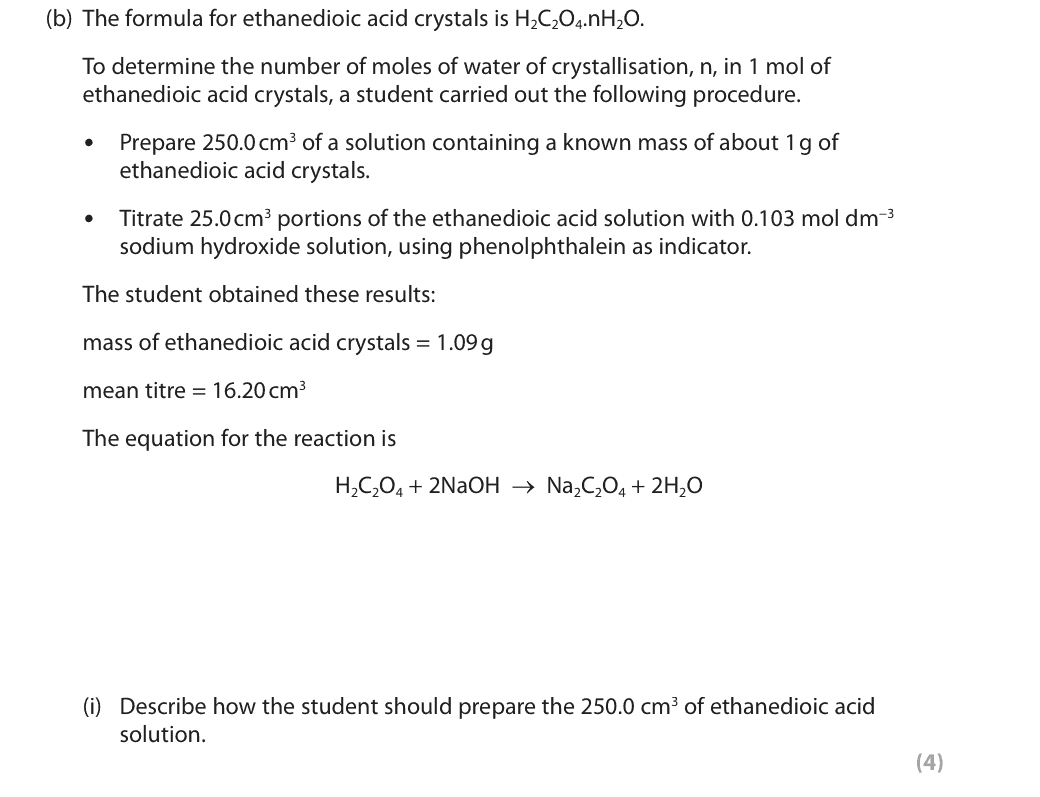
June 2024 · AS Paper 1 · Q9(c)5 marksCalculation
Earlier part of question 9 that this part uses
Mark scheme
Examiner's comment
Candidates generally approached this question well. The average mark on this question was 4. Most candidates correctly converted temperature into Kelvin and could rearrange the equation to calculate volume. The greatest error was from candidates not using the molar ratio to calculate number of moles of oxygen and not converting into cm3 correctly.
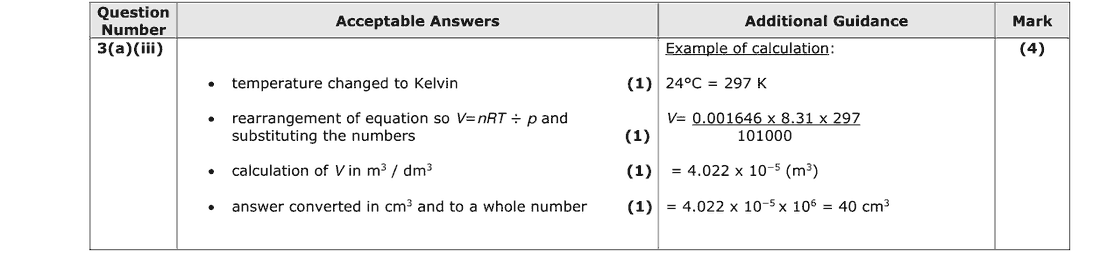
V = nRT ÷ p = (0.061175 × 8.31 × 303) ÷ 110 000 = 1.400 × 10^–3 m3 = 1400 cm3. Error carried forward throughout
1 SF not allowed in the final answer. Average mark was 4. Common errors: not using the 2 : 3 ratio
wrong conversion to cm3
Skills: MS0.0 Recognise and make use of appropriate units in calculation; MS2.2 Change the subject of an equation; MS2.3 Substitute numerical values into algebraic equations using appropriate units for physical quantities
June 2024 · Paper 1 · Q10(b)(i)1 markEquation writing
Earlier part of question 10 that this part uses
Mark scheme
Examiner's comment
This was generally well-answered with many fully balanced equations seen.
Some errors included unbalanced water molecules or adding electrons instead of water.
Notes from the mark scheme and report
IO3– + 5I– + 6H+ → 3I2 + 3H2O. Common errors: water not balanced
electrons added
Skills: CP11 Core practical 11: Redox titration
June 2024 · Paper 1 · Q10(b)(ii)2 marksCalculation
Earlier parts of question 10 that this part uses
Mark scheme
Examiner's comment
This was an accessible question towards the end of the paper and as such, was well-answered.
Nevertheless a few candidates did not make it clear how they had reached the final answer by multiplying their first answer by 3 and lost the mark. A few candidates gave the wrong
'power of 10' to their first answer, for example, 2.3 x 10⁻³ was seen relatively often in responses that did not score.
Notes from the mark scheme and report
Moles of iodate = 0.0100 × 0.0250 = 2.50 × 10^–4
moles of iodine = 3 × 2.50 × 10^–4 = 7.50 × 10^–4. The × 3 step must be shown
Skills: MS0.1 Recognise and use expressions in decimal and ordinary form; MS0.2 Use ratios, fractions and percentages; CP11 Core practical 11: Redox titration
June 2024 · AS Paper 2 · Q1(a)1 markMultiple choice
Answer
D
Mark scheme
Examiner's comment
The first question concerned the titration of a dicarboxylic acid. The first two multiple choice questions in (a) and (b)(i) were accessible to most candidates. In (b)(ii) the calculation of the volume of sodium hydroxide was also well answered. The use of the rough titration in (b)(iii) was not as well understood with relatively few candidates scoring this mark. In (c), the final calculation was often well done, although some candidates forgot to consider the factor of 10 associated with using 25 cm3 samples of the 250 cm3 solution.
Notes from the mark scheme and report
Answer: D (volumetric flask). A burette and a pipette deliver measured volumes of liquid rather than make a solution up to a volume
a measuring cylinder is not accurate enough
Skills: PT5 use volumetric flask, including accurate technique for making up a standard solution; CP2 Core practical 2: Prepare a standard solution from a solid acid and use it to find the concentration of a solution of sodium hydroxide
June 2024 · AS Paper 2 · Q1(b)(i)1 markMultiple choice
Earlier part of question 1 that this part uses
Answer
B
Mark scheme
Examiner's comment
The first question concerned the titration of a dicarboxylic acid. The first two multiple choice questions in (a) and (b)(i) were accessible to most candidates. In (b)(ii) the calculation of the volume of sodium hydroxide was also well answered. The use of the rough titration in (b)(iii) was not as well understood with relatively few candidates scoring this mark. In (c), the final calculation was often well done, although some candidates forgot to consider the factor of 10 associated with using 25 cm3 samples of the 250 cm3 solution.
Notes from the mark scheme and report
Answer: B (2.45 cm3). Read downwards from the 2.0 mark to the bottom of the meniscus. A does not use the bottom of the meniscus
C and D read the scale upwards from 3.0
Skills: PT1 use appropriate apparatus to record a range of measurements (to include mass, time, volume of liquids and gases, temperature); PT4 use laboratory apparatus for a variety of experimental techniques, including: titration, using burette and pipette; distillation and heating under reflux, including setting up glassware using retort stand and clamps; qualitative tests for ions and organic functional groups; filtration, including use of fluted filter paper, or filtration under reduced pressure; CP2 Core practical 2: Prepare a standard solution from a solid acid and use it to find the concentration of a solution of sodium hydroxide
June 2024 · AS Paper 2 · Q1(b)(ii)1 markCalculation
Earlier parts of question 1 that this part uses
Mark scheme
Examiner's comment
The first question concerned the titration of a dicarboxylic acid. The first two multiple choice questions in (a) and (b)(i) were accessible to most candidates. In (b)(ii) the calculation of the volume of sodium hydroxide was also well answered. The use of the rough titration in (b)(iii) was not as well understood with relatively few candidates scoring this mark. In (c), the final calculation was often well done, although some candidates forgot to consider the factor of 10 associated with using 25 cm3 samples of the 250 cm3 solution.
Notes from the mark scheme and report
Answer: 24.05 cm3. 26.50 – 2.45. Error carried forward from a wrong reading in (b)(i)
Skills: PT4 use laboratory apparatus for a variety of experimental techniques, including: titration, using burette and pipette; distillation and heating under reflux, including setting up glassware using retort stand and clamps; qualitative tests for ions and organic functional groups; filtration, including use of fluted filter paper, or filtration under reduced pressure; CP2 Core practical 2: Prepare a standard solution from a solid acid and use it to find the concentration of a solution of sodium hydroxide
June 2024 · AS Paper 2 · Q1(b)(iii)1 markPractical and data analysisHard
Earlier parts of question 1 that this part uses
Mark scheme
Examiner's comment
The first question concerned the titration of a dicarboxylic acid. The first two multiple choice questions in (a) and (b)(i) were accessible to most candidates. In (b)(ii) the calculation of the volume of sodium hydroxide was also well answered. The use of the rough titration in (b)(iii) was not as well understood with relatively few candidates scoring this mark. In (c), the final calculation was often well done, although some candidates forgot to consider the factor of 10 associated with using 25 cm3 samples of the 250 cm3 solution.
Notes from the mark scheme and report
Run the sodium hydroxide in quickly to a volume a little below the rough titre (about 2 cm3 short), then add it drop by drop. Not 'slow down when you reach the rough value', and not 'a value to try to get as close to as possible'
Skills: PT4 use laboratory apparatus for a variety of experimental techniques, including: titration, using burette and pipette; distillation and heating under reflux, including setting up glassware using retort stand and clamps; qualitative tests for ions and organic functional groups; filtration, including use of fluted filter paper, or filtration under reduced pressure; CP2 Core practical 2: Prepare a standard solution from a solid acid and use it to find the concentration of a solution of sodium hydroxide
June 2024 · AS Paper 2 · Q1(c)(i)1 markCalculation
Earlier part of question 1 that this part uses
Mark scheme
Examiner's comment
The first question concerned the titration of a dicarboxylic acid. The first two multiple choice questions in (a) and (b)(i) were accessible to most candidates. In (b)(ii) the calculation of the volume of sodium hydroxide was also well answered. The use of the rough titration in (b)(iii) was not as well understood with relatively few candidates scoring this mark. In (c), the final calculation was often well done, although some candidates forgot to consider the factor of 10 associated with using 25 cm3 samples of the 250 cm3 solution.
Notes from the mark scheme and report
Answer: 23.30 cm3. (23.30 + 23.35 + 23.25) ÷ 3
Skills: MS1.2 Find arithmetic means; CP2 Core practical 2: Prepare a standard solution from a solid acid and use it to find the concentration of a solution of sodium hydroxide
June 2024 · AS Paper 2 · Q1(c)(ii)1 markCalculation
Earlier parts of question 1 that this part uses
Mark scheme
Examiner's comment
The first question concerned the titration of a dicarboxylic acid. The first two multiple choice questions in (a) and (b)(i) were accessible to most candidates. In (b)(ii) the calculation of the volume of sodium hydroxide was also well answered. The use of the rough titration in (b)(iii) was not as well understood with relatively few candidates scoring this mark. In (c), the final calculation was often well done, although some candidates forgot to consider the factor of 10 associated with using 25 cm3 samples of the 250 cm3 solution.
Skills: MS0.1 Recognise and use expressions in decimal and ordinary form; MS2.3 Substitute numerical values into algebraic equations using appropriate units for physical quantities; CP2 Core practical 2: Prepare a standard solution from a solid acid and use it to find the concentration of a solution of sodium hydroxide
June 2024 · AS Paper 2 · Q1(c)(iii)3 marksCalculation
Earlier parts of question 1 that this part uses
Mark scheme
Examiner's comment
The first question concerned the titration of a dicarboxylic acid. The first two multiple choice questions in (a) and (b)(i) were accessible to most candidates. In (b)(ii) the calculation of the volume of sodium hydroxide was also well answered. The use of the rough titration in (b)(iii) was not as well understood with relatively few candidates scoring this mark. In (c), the final calculation was often well done, although some candidates forgot to consider the factor of 10 associated with using 25 cm3 samples of the 250 cm3 solution.
Notes from the mark scheme and report
Answer: Mr = 132, n = 3. Moles of H2A in 25.0 cm3 = 2.33 × 10^–3 ÷ 2 = 1.165 × 10^–3
Mr = (1.54 ÷ 10) ÷ 1.165 × 10^–3 = 132
n = (132 – 90) ÷ 14 = 3, given as an integer. Forgetting the ÷ 10 (25 cm3 out of 250 cm3) gives n = 88 and scores 2: this was the usual slip
Skills: MS0.2 Use ratios, fractions and percentages; MS2.2 Change the subject of an equation; MS2.4 Solve algebraic equations; CP2 Core practical 2: Prepare a standard solution from a solid acid and use it to find the concentration of a solution of sodium hydroxide
June 2024 · Paper 2 · Q1(d)2 marksCalculation
Earlier part of question 1 that this part uses
Mark scheme
Examiner's comment
Over 70% of candidates scored both marks, and it was pleasing to see few errors in the calculations of relative formula masses. Probably the most frequent error was a failure to give a final answer to one decimal place. The specification clearly defines atom economy in percentage terms, but a small number of candidates gave their final answer in decimal format.
Notes from the mark scheme and report
Answer: 49.8 %. Total mass of reactants 74 + 102.9 + 98.1 = 275 (or of products 136.9 + 120.1 + 18 = 275)
(136.9 ÷ 275) × 100 = 49.782 = 49.8. Must be to one decimal place
wrong rounding loses the second mark
correct answer alone scores 2. Over 70% scored both marks
the usual slips were not giving one decimal place and giving a decimal fraction instead of a percentage
Skills: MS0.1 Recognise and use expressions in decimal and ordinary form; MS0.2 Use ratios, fractions and percentages
June 2024 · AS Paper 2 · Q3(a)1 markShort answerEasy
Mark scheme
Examiner's comment
The chemistry of alkenes was tested in Q3. (a) tested candidate’s knowledge and understanding of molecular and empirical formulae. Over 80% of candidates scored this mark. The addition of hydrogen bromide was tested in (b), with (b)(i) being the name and type of this reaction. Again, over 80% knew this was an electrophilic addition reaction. The mechanism of the reaction, in (b)(ii) was extremely well answered. There are a large number of things to consider in this mechanism, but candidates seemed well drilled with 44% scoring full marks. Four marks was the most common score achieved here. The minor product in (b)(iii) proved a little more challenging. Candidates found difficulty expressing themselves with sufficient accuracy to secure full marks, often referring to the stability of halogenoalkanes rather that the carbocation intermediates. Descriptions in (b)(iv) also lacked sufficient detail to score the mark. It was quite common to see that the arrow represented the movement of an electron, or electrons rather than the pair of electrons which was required for the mark. In (c)(i) most candidates recognised the structures of the two isomers and were able to name them, but some needed more care when drawing these structures out. The attachment of methyl groups was often seen via a hydrogen rather than the carbon and this did not score the mark in this question. A fully displayed structure almost invariably scored the mark here as this type of attachment does not occur in these types of structures. The need for two different groups attached to the carbon as well as restricted rotation was not often seen in (c)(ii). The conversion of alkenes to alcohols and subsequent oxidation was examined in (d), and three quarters of candidates recognised the tertiary alcohol in (d)(i) The relative stability of tertiary alcohols to oxidation was not well understood. Those candidates who knew that the carbon with the oxygen attached required a hydrogen attached as well to allow oxidation often scored two marks.
Notes from the mark scheme and report
Answer: molecular formula C4H8 and empirical formula CH2
both needed for the one mark. CH2 is not accepted as the molecular formula
June 2024 · Paper 2 · Q3(d)(i)1 markPractical and data analysis
Mark scheme
Examiner's comment
Around 80% of candidates were able to describe the test for oxygen clearly. Those who missed the mark tended to either discuss a ‘lit splint’ rather than glowing, or mistakenly thought the test outcome would be a ‘squeaky pop’.
Notes from the mark scheme and report
A glowing splint (put into the gas) relights: both test and result needed for the mark. 'Relights a burnt splint' and 'squeaky pop' are not credited. About 80% correct
errors were a lit splint or the hydrogen test
Skills: PT4 use laboratory apparatus for a variety of experimental techniques, including: titration, using burette and pipette; distillation and heating under reflux, including setting up glassware using retort stand and clamps; qualitative tests for ions and organic functional groups; filtration, including use of fluted filter paper, or filtration under reduced pressure
June 2024 · Paper 2 · Q5(b)2 marksCalculation
Earlier part of question 5 that this part uses
Mark scheme
Examiner's comment
Just over 50% of candidates correctly determined the energy density, even though the term may have been unfamiliar. This is a credit to the ability of those candidates to apply their mathematical skills to an unfamiliar context. Some candidates did struggle, but often gained some credit for calculating the volume of cyclopentane correctly. A small but slightly frustrating cohort did the calculation correctly but misquoted the unit as MJ rather than
MJ dm– 3.
1.41 ÷ (39.947 ÷ 1000) = 35.297 MJ dm–3 with units (M2). Equivalent units allowed (3.53 × 10^4 kJ dm–3, 3.53 × 10^7 J dm–3, 3.53 × 10^4 J cm–3)
1 s.f. not accepted. Just over half were right
some gave the unit as MJ
Skills: MS0.0 Recognise and make use of appropriate units in calculation; MS0.1 Recognise and use expressions in decimal and ordinary form; MS2.3 Substitute numerical values into algebraic equations using appropriate units for physical quantities
June 2024 · AS Paper 2 · Q6(a)1 markPractical and data analysis
Mark scheme
Examiner's comment
The rate of the reaction between sodium thiosulfate and hydrochloric acid should be familiar to candidates. As a practical activity it is often encountered both at A level and GCSE. In (a) there were a wide variety of reasons given for the solution becoming cloudy. The formation of sulfur dioxide was a common incorrect answer. The multiple-choice question in (b)(i) was one of the two hardest multiple-choice question on the paper (along with Q6(d)). Only one quarter of candidates scored the mark in both of these multiple-choice questions. (b)(ii) proved much harder than expected with only 1 in 5 candidates scoring this mark. The graph in (c) was slightly unusual as it was already plotted for candidates. The calculation of time taken, though in bold in the question, proved difficult as many just read off the reciprocal of time from the graph and did not then convert. Many candidates recognised that there was a positive correlation between the rate and the concentration in (c)(ii) but this was insufficient to score the mark. The idea of directly proportional was scored by only about 20% of candidates. As mentioned earlier, the multiple choice in (d) was found difficult, while that in (e) was also challenging by about 35% of candidates scored this mark.
Notes from the mark scheme and report
Sulfur is formed and is insoluble in water / forms a (yellow) precipitate
just 'sulfur is formed' allowed. The formation of sulfur dioxide was a common wrong answer
Skills: PT12 measure rates of reaction by at least two different methods, for example: an initial rate method such as a clock reaction; a continuous monitoring method
June 2024 · AS Paper 2 · Q6(b)(i)1 markMultiple choice
Earlier part of question 6 that this part uses
Answer
C
Mark scheme
Examiner's comment
The rate of the reaction between sodium thiosulfate and hydrochloric acid should be familiar to candidates. As a practical activity it is often encountered both at A level and GCSE. In (a) there were a wide variety of reasons given for the solution becoming cloudy. The formation of sulfur dioxide was a common incorrect answer. The multiple-choice question in (b)(i) was one of the two hardest multiple-choice question on the paper (along with Q6(d)). Only one quarter of candidates scored the mark in both of these multiple-choice questions. (b)(ii) proved much harder than expected with only 1 in 5 candidates scoring this mark. The graph in (c) was slightly unusual as it was already plotted for candidates. The calculation of time taken, though in bold in the question, proved difficult as many just read off the reciprocal of time from the graph and did not then convert. Many candidates recognised that there was a positive correlation between the rate and the concentration in (c)(ii) but this was insufficient to score the mark. The idea of directly proportional was scored by only about 20% of candidates. As mentioned earlier, the multiple choice in (d) was found difficult, while that in (e) was also challenging by about 35% of candidates scored this mark.
Notes from the mark scheme and report
Answer: C (0.21). In Experiment 5, 50 cm3 of the solution is diluted to 70 cm3 by the acid: 0.15 × 70 ÷ 50 = 0.21. A and B are diluted concentrations from the table
D is the volume ratio 5/7. Only a quarter of candidates chose correctly
Skills: MS0.2 Use ratios, fractions and percentages; MS2.2 Change the subject of an equation
June 2024 · AS Paper 2 · Q6(d)1 markMultiple choice
Earlier part of question 6 that this part uses
Answer
A
Mark scheme
Examiner's comment
The rate of the reaction between sodium thiosulfate and hydrochloric acid should be familiar to candidates. As a practical activity it is often encountered both at A level and GCSE. In (a) there were a wide variety of reasons given for the solution becoming cloudy. The formation of sulfur dioxide was a common incorrect answer. The multiple-choice question in (b)(i) was one of the two hardest multiple-choice question on the paper (along with Q6(d)). Only one quarter of candidates scored the mark in both of these multiple-choice questions. (b)(ii) proved much harder than expected with only 1 in 5 candidates scoring this mark. The graph in (c) was slightly unusual as it was already plotted for candidates. The calculation of time taken, though in bold in the question, proved difficult as many just read off the reciprocal of time from the graph and did not then convert. Many candidates recognised that there was a positive correlation between the rate and the concentration in (c)(ii) but this was insufficient to score the mark. The idea of directly proportional was scored by only about 20% of candidates. As mentioned earlier, the multiple choice in (d) was found difficult, while that in (e) was also challenging by about 35% of candidates scored this mark.
Notes from the mark scheme and report
Answer: A (rinsing the flask with deionised water before each new experiment). The mark scheme gives reasons only for rejecting the others: stirring affects every run equally (B), cylinders of the same size measure with the same accuracy (C), and re-using the paper does not affect the rate (D). Water left in the flask would change the total volume and so the concentrations. Only a quarter of candidates chose correctly
Skills: PT12 measure rates of reaction by at least two different methods, for example: an initial rate method such as a clock reaction; a continuous monitoring method
June 2024 · Paper 2 · Q7(b)5 marksCalculation
Earlier part of question 7 that this part uses
Mark scheme
Examiner's comment
Candidates are becoming more and more adept at dealing with problems based on the ideal gas equation. Unit conversions were handled with skill with candidates using standard form proficiently. Nearly half of the cohort scored full marks, with the most common errors linked to either a miscalculation of the molar mass of chloropropene, or a failure to quote the final answer to 2 or 3 significant figures.
V = nRT ÷ p = 0.11299 × 8.31 × 353 ÷ 205 000 = 1.6169 × 10^–3 m3 (M4)
convert to cm3 and give 2 or 3 s.f. (M5). Nearly half scored 5
the usual errors were a wrong molar mass and not rounding the final answer to 2 or 3 s.f.
Skills: MS0.0 Recognise and make use of appropriate units in calculation; MS0.1 Recognise and use expressions in decimal and ordinary form; MS1.1 Use an appropriate number of significant figures; MS2.2 Change the subject of an equation; MS2.3 Substitute numerical values into algebraic equations using appropriate units for physical quantities
June 2024 · Paper 2 · Q7(d)(ii)2 marksCalculation
Earlier parts of question 7 that this part uses
Mark scheme
Examiner's comment
Whilst unit conversion when using the ideal gas equation was excellent with few errors, here the conversion of milligrams to grams proved problematic for around 25% of candidates. The two most common mistakes were to omit the conversion altogether or to multiply 4.25 (mg) by a factor of a thousand. The majority of candidates who could calculate a value for the number of moles, nearly always determined a value using the Avogadro constant, so could score at least 1 mark.
error carried forward. About a quarter went wrong on mg to g: either no conversion or multiplying by 1000
Skills: MS0.0 Recognise and make use of appropriate units in calculation; MS0.1 Recognise and use expressions in decimal and ordinary form; MS2.3 Substitute numerical values into algebraic equations using appropriate units for physical quantities
June 2024 · AS Paper 2 · Q8(a)(i)2 marksEquation writingHard
Mark scheme
Examiner's comment
This question was based on the practical activity for determining enthalpy change of combustion, which is a very commonly encountered practical. The equation for the enthalpy of combustion of methanol in (a)(i) was not as well answered as expected, with nearly 40% not scoring either of the marks, and only just over 10% scoring both marks. The calculation in (a)(ii) was slightly unusual and proved a significant challenge. Relatively few candidates were able to score well, with many rather unsure of how to proceed. This made the final two questions difficult. The calculation of percentage error was challenging, although some error is the previous section could be accounted for. This still proved one of the harder questions on the paper. The stock answer to the final question about precision of apparatus is nearly always that higher precision is better, but in this question the other errors in the activity are so high as to make this extra precision unnecessary. Some candidates saw this and were able to score one, or both, of the final marks.
Notes from the mark scheme and report
Answer: CH3OH(l) + 1½O2(g) → CO2(g) + 2H2O(l). One mark for the substances, one for state symbols and balancing. Multiples are not accepted because the equation must be for one mole of methanol
June 2024 · AS Paper 2 · Q8(a)(iii)1 markCalculationHard
Earlier part of question 8 that this part uses
Mark scheme
Examiner's comment
This question was based on the practical activity for determining enthalpy change of combustion, which is a very commonly encountered practical. The equation for the enthalpy of combustion of methanol in (a)(i) was not as well answered as expected, with nearly 40% not scoring either of the marks, and only just over 10% scoring both marks. The calculation in (a)(ii) was slightly unusual and proved a significant challenge. Relatively few candidates were able to score well, with many rather unsure of how to proceed. This made the final two questions difficult. The calculation of percentage error was challenging, although some error is the previous section could be accounted for. This still proved one of the harder questions on the paper. The stock answer to the final question about precision of apparatus is nearly always that higher precision is better, but in this question the other errors in the activity are so high as to make this extra precision unnecessary. Some candidates saw this and were able to score one, or both, of the final marks.
(54.3 – 32.0) ÷ 54.3 × 100 = 41.1%. Error carried forward from the rise in (a)(ii)
Skills: MS0.2 Use ratios, fractions and percentages
June 2024 · AS Paper 2 · Q8(b)2 marksExplanation
Earlier part of question 8 that this part uses
Mark scheme
Examiner's comment
This question was based on the practical activity for determining enthalpy change of combustion, which is a very commonly encountered practical. The equation for the enthalpy of combustion of methanol in (a)(i) was not as well answered as expected, with nearly 40% not scoring either of the marks, and only just over 10% scoring both marks. The calculation in (a)(ii) was slightly unusual and proved a significant challenge. Relatively few candidates were able to score well, with many rather unsure of how to proceed. This made the final two questions difficult. The calculation of percentage error was challenging, although some error is the previous section could be accounted for. This still proved one of the harder questions on the paper. The stock answer to the final question about precision of apparatus is nearly always that higher precision is better, but in this question the other errors in the activity are so high as to make this extra precision unnecessary. Some candidates saw this and were able to score one, or both, of the final marks.
Notes from the mark scheme and report
No need to wait: the uncertainty from the 1 decimal place balance is very small compared with the percentage error
heat loss to the surroundings causes a far bigger error, so greater precision would not give greater accuracy. The stock answer that 'more precise is better' does not score here
June 2024 · Paper 2 · Q8(d)(i)1 markEquation writing
Earlier part of question 8 that this part uses
Mark scheme
Examiner's comment
Many candidates knew that the organic product was sodium ethoxide. However, they attempted to balance the equation in terms of numbers of atoms rather than charge, so often suggested the other product was a single hydrogen ion.
Notes from the mark scheme and report
Answer: C2H5OH + Na → C2H5ONa + ½H2 (C2H5O–Na+ and multiples allowed
state symbols ignored). Not partial charges on O and Na. Many knew sodium ethoxide but gave a single hydrogen ion as the other product
June 2024 · Paper 2 · Q8(d)(iv)3 marksCalculation
Earlier parts of question 8 that this part uses
Mark scheme
Examiner's comment
Virtually all candidates scored at least a mark in this calculation via any one of the three methods. The commonest mistake was effectively to multiply by 0.55 instead of to divide when attempting to take into account the percentage yield. Another common error was a failure to work out correctly the molar mass of compound X.
× 217 (Mr of X) = 66.5 g (M3). The scaling can be done at any stage
error carried forward. If nothing else scores, 1 mark for both Mr values, 89 and 217. Common errors: multiplying by 0.55 instead of dividing
wrong molar mass for X
Skills: MS0.2 Use ratios, fractions and percentages; MS2.3 Substitute numerical values into algebraic equations using appropriate units for physical quantities
June 2024 · Paper 3 · Q3(a)1 markPractical and data analysis
Mark scheme
Examiner's comment
A significant number of candidates got the right idea in part (a) of the small crystals going through the filter paper, while others gave vague comments about the crystals being filtered without stating what this meant. Unfortunately, answers referring to the dissolving of the small crystals were seen regularly. Also a notable number of responses referred to the crystals sticking to the filter paper but this would not lead to a lower mass since the filter paper was wieghed at the end. In part (b) it was rare to see candidates specifically referring to the correct chemicals that could be rinsed and referred just to the solution instead. It was disappointing that so few attempting to explain the consequence if rinsing did not happen. In addition, some referred to the dissolving of “insoluble” impurities showing a fundamental misunderstanding. The calculation in part (c) was competently done by most candidates and all three marks awarded. Candidates are reminded to remain in the answer space for each question. There was a large number of candidates who strayed outside of the designated area and this made it more difficult for examiners to mark. The question of (d)(i) was another were the second mark needed to reason on the consequence of the action from the first mark. Many candidates correctly understood that some of the solution would be lost on the bench and gained M1 but few then reasoned that this would result in fewer moles of M2SO4 and that this would then lead to a higher relative formula mass. A small minority suggested that the glass rod would pick up impurities or such from the bench but then failed to go on and reason the effect of this. Part (d)(ii) illustrates that sometimes an answer for one mark needs more than one facet. In order to gain the mark an answer needed to refer to the action of rinsing, the deionised/distilled water used for the rinsing and that the rinsing would be put back into the beaker. These are all simple parts but essential for the response to score the mark. Not surprisingly these were often not always stated. The origin of a flame colour has been examined many times before and it was evident that most candidates knew the expressions required for part (e)(i). There were only a few occasions when a reference to transmission of light or light being reflected and these were penalised. At times the reference to heat energy being responsible for the excitation of electrons was missing. It was pleasing to see so many correct answers scoring both marks for part (e)(ii) on the advantages and disadvantges of a flame test in identifying metal cations. These were not always clearly identified as such and so examiners had to use their judgement whether the response was ‘for or against’ the use of flame tests. Candidates may not always be so fortunate.
Notes from the mark scheme and report
Extremely small crystals would pass through (the pores of) the filter paper, so not all the barium sulfate is collected. Not crystals 'stuck' on the paper (the paper is weighed with them) and not crystals dissolving
just 'not filtered' is ignored. Dissolving and sticking were both common wrong answers
Skills: PT4 use laboratory apparatus for a variety of experimental techniques, including: titration, using burette and pipette; distillation and heating under reflux, including setting up glassware using retort stand and clamps; qualitative tests for ions and organic functional groups; filtration, including use of fluted filter paper, or filtration under reduced pressure
June 2024 · Paper 3 · Q3(b)2 marksPractical and data analysis
Earlier part of question 3 that this part uses
Mark scheme
Examiner's comment
A significant number of candidates got the right idea in part (a) of the small crystals going through the filter paper, while others gave vague comments about the crystals being filtered without stating what this meant. Unfortunately, answers referring to the dissolving of the small crystals were seen regularly. Also a notable number of responses referred to the crystals sticking to the filter paper but this would not lead to a lower mass since the filter paper was wieghed at the end. In part (b) it was rare to see candidates specifically referring to the correct chemicals that could be rinsed and referred just to the solution instead. It was disappointing that so few attempting to explain the consequence if rinsing did not happen. In addition, some referred to the dissolving of “insoluble” impurities showing a fundamental misunderstanding. The calculation in part (c) was competently done by most candidates and all three marks awarded. Candidates are reminded to remain in the answer space for each question. There was a large number of candidates who strayed outside of the designated area and this made it more difficult for examiners to mark. The question of (d)(i) was another were the second mark needed to reason on the consequence of the action from the first mark. Many candidates correctly understood that some of the solution would be lost on the bench and gained M1 but few then reasoned that this would result in fewer moles of M2SO4 and that this would then lead to a higher relative formula mass. A small minority suggested that the glass rod would pick up impurities or such from the bench but then failed to go on and reason the effect of this. Part (d)(ii) illustrates that sometimes an answer for one mark needs more than one facet. In order to gain the mark an answer needed to refer to the action of rinsing, the deionised/distilled water used for the rinsing and that the rinsing would be put back into the beaker. These are all simple parts but essential for the response to score the mark. Not surprisingly these were often not always stated. The origin of a flame colour has been examined many times before and it was evident that most candidates knew the expressions required for part (e)(i). There were only a few occasions when a reference to transmission of light or light being reflected and these were penalised. At times the reference to heat energy being responsible for the excitation of electrons was missing. It was pleasing to see so many correct answers scoring both marks for part (e)(ii) on the advantages and disadvantges of a flame test in identifying metal cations. These were not always clearly identified as such and so examiners had to use their judgement whether the response was ‘for or against’ the use of flame tests. Candidates may not always be so fortunate.
Notes from the mark scheme and report
To remove excess barium chloride solution / MCl solution (the remaining solution) (1)
which would otherwise crystallise on drying and add to the mass of the barium sulfate (1). If nothing else scores, one mark for 'to remove soluble impurities'
not solid or insoluble impurities
not a decrease in mass. Candidates rarely named the chemicals removed and few gave the consequence of not rinsing
Skills: PT4 use laboratory apparatus for a variety of experimental techniques, including: titration, using burette and pipette; distillation and heating under reflux, including setting up glassware using retort stand and clamps; qualitative tests for ions and organic functional groups; filtration, including use of fluted filter paper, or filtration under reduced pressure
June 2024 · Paper 3 · Q3(c)3 marksCalculation
Earlier part of question 3 that this part uses
Mark scheme
Examiner's comment
A significant number of candidates got the right idea in part (a) of the small crystals going through the filter paper, while others gave vague comments about the crystals being filtered without stating what this meant. Unfortunately, answers referring to the dissolving of the small crystals were seen regularly. Also a notable number of responses referred to the crystals sticking to the filter paper but this would not lead to a lower mass since the filter paper was wieghed at the end. In part (b) it was rare to see candidates specifically referring to the correct chemicals that could be rinsed and referred just to the solution instead. It was disappointing that so few attempting to explain the consequence if rinsing did not happen. In addition, some referred to the dissolving of “insoluble” impurities showing a fundamental misunderstanding. The calculation in part (c) was competently done by most candidates and all three marks awarded. Candidates are reminded to remain in the answer space for each question. There was a large number of candidates who strayed outside of the designated area and this made it more difficult for examiners to mark. The question of (d)(i) was another were the second mark needed to reason on the consequence of the action from the first mark. Many candidates correctly understood that some of the solution would be lost on the bench and gained M1 but few then reasoned that this would result in fewer moles of M2SO4 and that this would then lead to a higher relative formula mass. A small minority suggested that the glass rod would pick up impurities or such from the bench but then failed to go on and reason the effect of this. Part (d)(ii) illustrates that sometimes an answer for one mark needs more than one facet. In order to gain the mark an answer needed to refer to the action of rinsing, the deionised/distilled water used for the rinsing and that the rinsing would be put back into the beaker. These are all simple parts but essential for the response to score the mark. Not surprisingly these were often not always stated. The origin of a flame colour has been examined many times before and it was evident that most candidates knew the expressions required for part (e)(i). There were only a few occasions when a reference to transmission of light or light being reflected and these were penalised. At times the reference to heat energy being responsible for the excitation of electrons was missing. It was pleasing to see so many correct answers scoring both marks for part (e)(ii) on the advantages and disadvantges of a flame test in identifying metal cations. These were not always clearly identified as such and so examiners had to use their judgement whether the response was ‘for or against’ the use of flame tests. Candidates may not always be so fortunate.
Notes from the mark scheme and report
Answer: relative formula mass 110 (109.84)
M is lithium. Mass of BaSO4 = 1.19 – 0.17 = 1.02 g
109.84 – (32.1 + 64.0) = 13.74, so Ar of M = 6.87. Error carried forward if the result is a metal that forms a 1+ ion. The correct answer with no working scores 1. Done competently by most
Skills: MS0.2 Use ratios, fractions and percentages; MS2.3 Substitute numerical values into algebraic equations using appropriate units for physical quantities
June 2024 · Paper 3 · Q3(d)(i)2 marksPractical and data analysis
Earlier part of question 3 that this part uses
Mark scheme
Examiner's comment
A significant number of candidates got the right idea in part (a) of the small crystals going through the filter paper, while others gave vague comments about the crystals being filtered without stating what this meant. Unfortunately, answers referring to the dissolving of the small crystals were seen regularly. Also a notable number of responses referred to the crystals sticking to the filter paper but this would not lead to a lower mass since the filter paper was wieghed at the end. In part (b) it was rare to see candidates specifically referring to the correct chemicals that could be rinsed and referred just to the solution instead. It was disappointing that so few attempting to explain the consequence if rinsing did not happen. In addition, some referred to the dissolving of “insoluble” impurities showing a fundamental misunderstanding. The calculation in part (c) was competently done by most candidates and all three marks awarded. Candidates are reminded to remain in the answer space for each question. There was a large number of candidates who strayed outside of the designated area and this made it more difficult for examiners to mark. The question of (d)(i) was another were the second mark needed to reason on the consequence of the action from the first mark. Many candidates correctly understood that some of the solution would be lost on the bench and gained M1 but few then reasoned that this would result in fewer moles of M2SO4 and that this would then lead to a higher relative formula mass. A small minority suggested that the glass rod would pick up impurities or such from the bench but then failed to go on and reason the effect of this. Part (d)(ii) illustrates that sometimes an answer for one mark needs more than one facet. In order to gain the mark an answer needed to refer to the action of rinsing, the deionised/distilled water used for the rinsing and that the rinsing would be put back into the beaker. These are all simple parts but essential for the response to score the mark. Not surprisingly these were often not always stated. The origin of a flame colour has been examined many times before and it was evident that most candidates knew the expressions required for part (e)(i). There were only a few occasions when a reference to transmission of light or light being reflected and these were penalised. At times the reference to heat energy being responsible for the excitation of electrons was missing. It was pleasing to see so many correct answers scoring both marks for part (e)(ii) on the advantages and disadvantges of a flame test in identifying metal cations. These were not always clearly identified as such and so examiners had to use their judgement whether the response was ‘for or against’ the use of flame tests. Candidates may not always be so fortunate.
Notes from the mark scheme and report
Some of the M2SO4 solution is lost on the rod / bench (1)
so the calculated moles of M2SO4 (or BaSO4) are fewer and the calculated formula mass is higher (1). Second mark depends on an attempt at the first
'less mass of BaSO4' alone is ignored. Many got the loss of solution but few reasoned through to fewer moles and a higher formula mass
June 2024 · Paper 3 · Q3(d)(ii)1 markPractical and data analysis
Earlier parts of question 3 that this part uses
Mark scheme
Examiner's comment
A significant number of candidates got the right idea in part (a) of the small crystals going through the filter paper, while others gave vague comments about the crystals being filtered without stating what this meant. Unfortunately, answers referring to the dissolving of the small crystals were seen regularly. Also a notable number of responses referred to the crystals sticking to the filter paper but this would not lead to a lower mass since the filter paper was wieghed at the end. In part (b) it was rare to see candidates specifically referring to the correct chemicals that could be rinsed and referred just to the solution instead. It was disappointing that so few attempting to explain the consequence if rinsing did not happen. In addition, some referred to the dissolving of “insoluble” impurities showing a fundamental misunderstanding. The calculation in part (c) was competently done by most candidates and all three marks awarded. Candidates are reminded to remain in the answer space for each question. There was a large number of candidates who strayed outside of the designated area and this made it more difficult for examiners to mark. The question of (d)(i) was another were the second mark needed to reason on the consequence of the action from the first mark. Many candidates correctly understood that some of the solution would be lost on the bench and gained M1 but few then reasoned that this would result in fewer moles of M2SO4 and that this would then lead to a higher relative formula mass. A small minority suggested that the glass rod would pick up impurities or such from the bench but then failed to go on and reason the effect of this. Part (d)(ii) illustrates that sometimes an answer for one mark needs more than one facet. In order to gain the mark an answer needed to refer to the action of rinsing, the deionised/distilled water used for the rinsing and that the rinsing would be put back into the beaker. These are all simple parts but essential for the response to score the mark. Not surprisingly these were often not always stated. The origin of a flame colour has been examined many times before and it was evident that most candidates knew the expressions required for part (e)(i). There were only a few occasions when a reference to transmission of light or light being reflected and these were penalised. At times the reference to heat energy being responsible for the excitation of electrons was missing. It was pleasing to see so many correct answers scoring both marks for part (e)(ii) on the advantages and disadvantges of a flame test in identifying metal cations. These were not always clearly identified as such and so examiners had to use their judgement whether the response was ‘for or against’ the use of flame tests. Candidates may not always be so fortunate.
Notes from the mark scheme and report
Rinse the glass rod with deionised / distilled water, with the rinsings going into the beaker. All three ideas are needed for the one mark (the rinsing, the deionised water, and into the beaker), and one was often missing
Skills: PT4 use laboratory apparatus for a variety of experimental techniques, including: titration, using burette and pipette; distillation and heating under reflux, including setting up glassware using retort stand and clamps; qualitative tests for ions and organic functional groups; filtration, including use of fluted filter paper, or filtration under reduced pressure
June 2024 · Paper 3 · Q6(a)3 marksCalculation
Mark scheme
Examiner's comment
The variety of methods for carrying out the molar calculation in part (a) meant that all three marks was frequently awarded. The explanation of the NMR splitting pattern in part (b)(i) was generally done well with only a small minority referring to the adjacent hydrogen atoms rather than the hydrogen atoms bonded to the adjacent carbon atoms. Some answers referred to the fact the the adjcent atom was an oxygen rather than a carbon and this was acceptable. Candidates came up with a range of different labelling approches to part (b)(ii), most of these were acceptable. At times the central CH2 group was though to be different to the other two such groups but this was rare. The splitting patterns and the relative peak areas of part (b)(iii) were usually correct but it was the chemical shift values which caused the most difficulty. The alkane H–C–C environment should have given a value from the Data Booklet of less than 2.0 ppm. Oftentimes a value was missing altogether which was disappointing given that it was the first requirement listed in the question. On other occasions a value of 2 or higher was suggested which did not score.
Notes from the mark scheme and report
Moles of CO2 = 269 ÷ 24 000 = 0.011208 = moles of acid formed
moles of Q at 100% yield = 0.011208 × 100 ÷ 78 = 0.014370
Mr = 2.07 ÷ 0.014370 = 144.05, which is 144. The yield correction can be applied to the volume first (344.87 cm3). Molar volume is from the Data Booklet
pV = nRT giving 148 also scores 3. The range of valid methods meant all three marks were often awarded
Skills: MS0.2 Use ratios, fractions and percentages; MS2.3 Substitute numerical values into algebraic equations using appropriate units for physical quantities
June 2024 · Paper 3 · Q8(c)5 marksCalculation
Mark scheme
Examiner's comment
In parts (a)(i) and (ii) many candidates thought that the issue was the indicator rather than the weak acid – weak base titration. Only the more able identified the true situation and gave appropriate suggestions. It was disappointing that even when some candidates extracted the correct pH range for phenolphthalein from the Data Booklet and quoted it as 8.2 – 10.0 they still wrote that it would change colour. The mark allocation for part (a)(iii) should have highlighted that an in-depth answer or jutification was required for three marks. Large numbers of candidates simply wrote Ka = [H+] or pH = pKa which gained one mark but no more. This provided another opportunity for the more able candidates to demonstrate their understanding and gain the additional available marks. Parts (b) and (c) were multi-stage calculations which were often done absolutely correctly but if not, still gave candidates the opportunity to gain at least some credit. The most common error in part (c) was not realising that sulfuric acid is diprotic. It is importan to remind candidates that with calculations, a logical layout, with clear labels for each step will definitely increase the chances of gaining marks.
excess OH– = 0.029 mol in 70.0 cm3, so [OH–] = 0.41429 mol dm–3
pH = 14 – (–log 0.41429). No final mark for a pH below 7. The most common error was not treating sulfuric acid as diprotic
Skills: MS0.4 Use calculators to find and use power, exponential and logarithmic functions; MS2.3 Substitute numerical values into algebraic equations using appropriate units for physical quantities; MS2.5 Use logarithms in relation to quantities that range over several orders of magnitude
June 2024 · Paper 3 · Q9(a)(i)2 marksPractical and data analysis
Mark scheme
Examiner's comment
In part (a)(i) the tendency for the less able candidates was to be too generic and to refer to the need for goggles, lab coats and to avoid touching hot equipment or concerns over flammability. Those candidates who did identify the fume cupboard as the necessary precaution, needed to state that sulfur dioxide is toxic or corrosive and not just harmful or an irritant. Part (a)(ii) was the first of a number of questions which required the explanation of an effect and candidates must note that credit is not always given just for the effect since this can be a fifty-fifty. In this case, reference to an increased titre did not gian credit unless there was some link to the greater acidity of the mixture if the dissolved gases were not removed. Some candidates related the increased acidity to carbonic acid from carbon dioxide but from the outset of the question, sulfur dioxide is referred to and so it was essential for this to be referred to if both marks were to be awarded. The calculation in part (a)(iii) was generally correctly done. Common errors included switching the volumes around and failure to convert from moles to grams per cubic decimetre. Part (a)(iv) was a second question requiring an explanation of an effect, namely what the presence of an air bubble in a burette tip would do to the titre. The majority of responses did refer to the titre including the volume of the air bubble but those which simply stated that the titre would increase did not score. Another molar calculation which was well-done in part (b)(i). It was pleasing to see that most candidates did not stop at just the calculation but related their value to the fact that it was below the permitted maximum of 200 mg dm−3. Candidates appear to have learned that this is a vital part of their answer from previous such questions. One relatively common error was to use a combined volume of 55 cm3 for the wine calculation but careful review of the procedure shows that a volume of 50 cm3 of wine was used, the additional 5 cm3 was sulfuric acid which should have been discounted. The question in part (b)(ii) was aimed at the very best of candidates who could apply their knowledge to a rather novel situation. Few responses were seen where the production of carbon dioxide was identified as the key to the answer.
Notes from the mark scheme and report
Carry it out in a fume cupboard (allow a well-ventilated laboratory) (1)
because sulfur dioxide is toxic / poisonous (allow corrosive, or causes breathing difficulties) (1). Harmful, irritant and acidic are ignored. Weaker answers were generic: goggles, lab coats, hot equipment, flammability
Skills: PT11 safely and carefully handle solids and liquids, including corrosive, irritant, flammable and toxic substances
June 2024 · Paper 3 · Q9(a)(ii)2 marksPractical and data analysis
Earlier part of question 9 that this part uses
Mark scheme
Examiner's comment
In part (a)(i) the tendency for the less able candidates was to be too generic and to refer to the need for goggles, lab coats and to avoid touching hot equipment or concerns over flammability. Those candidates who did identify the fume cupboard as the necessary precaution, needed to state that sulfur dioxide is toxic or corrosive and not just harmful or an irritant. Part (a)(ii) was the first of a number of questions which required the explanation of an effect and candidates must note that credit is not always given just for the effect since this can be a fifty-fifty. In this case, reference to an increased titre did not gian credit unless there was some link to the greater acidity of the mixture if the dissolved gases were not removed. Some candidates related the increased acidity to carbonic acid from carbon dioxide but from the outset of the question, sulfur dioxide is referred to and so it was essential for this to be referred to if both marks were to be awarded. The calculation in part (a)(iii) was generally correctly done. Common errors included switching the volumes around and failure to convert from moles to grams per cubic decimetre. Part (a)(iv) was a second question requiring an explanation of an effect, namely what the presence of an air bubble in a burette tip would do to the titre. The majority of responses did refer to the titre including the volume of the air bubble but those which simply stated that the titre would increase did not score. Another molar calculation which was well-done in part (b)(i). It was pleasing to see that most candidates did not stop at just the calculation but related their value to the fact that it was below the permitted maximum of 200 mg dm−3. Candidates appear to have learned that this is a vital part of their answer from previous such questions. One relatively common error was to use a combined volume of 55 cm3 for the wine calculation but careful review of the procedure shows that a volume of 50 cm3 of wine was used, the additional 5 cm3 was sulfuric acid which should have been discounted. The question in part (b)(ii) was aimed at the very best of candidates who could apply their knowledge to a rather novel situation. Few responses were seen where the production of carbon dioxide was identified as the key to the answer.
Notes from the mark scheme and report
Dissolved sulfur dioxide is acidic / reacts with the sodium hydroxide (1)
so the titre would be greater than it should be (the wine would appear to contain more tartaric acid) (1). The second mark depends on the first or a near miss
carbon dioxide is ignored. 'Titre increases' with no link to the extra acidity did not score
answers based only on carbonic acid could not gain both marks
Skills: PT4 use laboratory apparatus for a variety of experimental techniques, including: titration, using burette and pipette; distillation and heating under reflux, including setting up glassware using retort stand and clamps; qualitative tests for ions and organic functional groups; filtration, including use of fluted filter paper, or filtration under reduced pressure
June 2024 · Paper 3 · Q9(a)(iii)3 marksCalculation
Earlier part of question 9 that this part uses
Mark scheme
Examiner's comment
In part (a)(i) the tendency for the less able candidates was to be too generic and to refer to the need for goggles, lab coats and to avoid touching hot equipment or concerns over flammability. Those candidates who did identify the fume cupboard as the necessary precaution, needed to state that sulfur dioxide is toxic or corrosive and not just harmful or an irritant. Part (a)(ii) was the first of a number of questions which required the explanation of an effect and candidates must note that credit is not always given just for the effect since this can be a fifty-fifty. In this case, reference to an increased titre did not gian credit unless there was some link to the greater acidity of the mixture if the dissolved gases were not removed. Some candidates related the increased acidity to carbonic acid from carbon dioxide but from the outset of the question, sulfur dioxide is referred to and so it was essential for this to be referred to if both marks were to be awarded. The calculation in part (a)(iii) was generally correctly done. Common errors included switching the volumes around and failure to convert from moles to grams per cubic decimetre. Part (a)(iv) was a second question requiring an explanation of an effect, namely what the presence of an air bubble in a burette tip would do to the titre. The majority of responses did refer to the titre including the volume of the air bubble but those which simply stated that the titre would increase did not score. Another molar calculation which was well-done in part (b)(i). It was pleasing to see that most candidates did not stop at just the calculation but related their value to the fact that it was below the permitted maximum of 200 mg dm−3. Candidates appear to have learned that this is a vital part of their answer from previous such questions. One relatively common error was to use a combined volume of 55 cm3 for the wine calculation but careful review of the procedure shows that a volume of 50 cm3 of wine was used, the additional 5 cm3 was sulfuric acid which should have been discounted. The question in part (b)(ii) was aimed at the very best of candidates who could apply their knowledge to a rather novel situation. Few responses were seen where the production of carbon dioxide was identified as the key to the answer.
Notes from the mark scheme and report
Answer: 7.73 g dm–3 (7.725). Moles of NaOH = 20.60 ÷ 1000 × 0.100 = 2.06 × 10^–3
× 150 = 7.725 g dm–3. Common errors: swapping the two volumes
stopping at mol dm–3
Skills: MS0.0 Recognise and make use of appropriate units in calculation; MS0.2 Use ratios, fractions and percentages; MS2.3 Substitute numerical values into algebraic equations using appropriate units for physical quantities
June 2024 · Paper 3 · Q9(a)(iv)2 marksPractical and data analysis
Earlier part of question 9 that this part uses
Mark scheme
Examiner's comment
In part (a)(i) the tendency for the less able candidates was to be too generic and to refer to the need for goggles, lab coats and to avoid touching hot equipment or concerns over flammability. Those candidates who did identify the fume cupboard as the necessary precaution, needed to state that sulfur dioxide is toxic or corrosive and not just harmful or an irritant. Part (a)(ii) was the first of a number of questions which required the explanation of an effect and candidates must note that credit is not always given just for the effect since this can be a fifty-fifty. In this case, reference to an increased titre did not gian credit unless there was some link to the greater acidity of the mixture if the dissolved gases were not removed. Some candidates related the increased acidity to carbonic acid from carbon dioxide but from the outset of the question, sulfur dioxide is referred to and so it was essential for this to be referred to if both marks were to be awarded. The calculation in part (a)(iii) was generally correctly done. Common errors included switching the volumes around and failure to convert from moles to grams per cubic decimetre. Part (a)(iv) was a second question requiring an explanation of an effect, namely what the presence of an air bubble in a burette tip would do to the titre. The majority of responses did refer to the titre including the volume of the air bubble but those which simply stated that the titre would increase did not score. Another molar calculation which was well-done in part (b)(i). It was pleasing to see that most candidates did not stop at just the calculation but related their value to the fact that it was below the permitted maximum of 200 mg dm−3. Candidates appear to have learned that this is a vital part of their answer from previous such questions. One relatively common error was to use a combined volume of 55 cm3 for the wine calculation but careful review of the procedure shows that a volume of 50 cm3 of wine was used, the additional 5 cm3 was sulfuric acid which should have been discounted. The question in part (b)(ii) was aimed at the very best of candidates who could apply their knowledge to a rather novel situation. Few responses were seen where the production of carbon dioxide was identified as the key to the answer.
Notes from the mark scheme and report
The recorded titre includes the volume of the air bubble (some of the reading is alkali filling the tip, not delivered to the flask) (1)
so the titre is greater than it should be (1). The second mark depends on the first or a near miss
just 'the titre would increase' did not score
Skills: PT4 use laboratory apparatus for a variety of experimental techniques, including: titration, using burette and pipette; distillation and heating under reflux, including setting up glassware using retort stand and clamps; qualitative tests for ions and organic functional groups; filtration, including use of fluted filter paper, or filtration under reduced pressure
June 2023 · AS Paper 1 · Q2(a)(iv)1 markCalculation
Earlier part of question 2 that this part uses
Mark scheme
Examiner's comment
(a)(i) This question proved more challenging than expected. Candidates most often scored the mark by answering that the substance was not a molecule. The idea that giant structures require the use of the relative formula mass was clearly not well understood. Of course, molar mass calculation can be carried out without this knowledge. Common incorrect answers included comments about the mass being relative to 1/12th of the mass of carbon-12, the answer to the next item. (a)(ii) The answer here was better understood. The idea of comparing to the mass of a 1/12th of atom of carbon-12 was quite well known and there were ideas that the mass was a relative mass or a comparison. Some candidates realised that the units would cancel and scored the mark in this way. (a)(iii) The multiple choice questions was mostly answered correctly, with over 85% of candidates scoring this mark.
(a)(iv) Whichever answer was given in (a)(iii) candidates were still able to score by calculating the correct number of moles here. For those who knew the calculation to do, which included most candidates, the only common error was to use only one significant figure, which did not score the mark. (b) Testing for the metal ions using flame test proved to be commonly understood, with most scoring the first mark for the lilac flame of the potassium ion, and many knew that the magnesium ion did not give a flame colour, with candidates often stating that the wavelength associated with the transition was outside of the visible region. Unfortunately, it was common for answers to talk about potassium and magnesium rather than their ions. This was penalised if comments were made about magnesium giving no flame colour. Magnesium metal, of course, burns with a very bright white flame and so the omission of the word ‘ions’ was penalised here. The addition of hydroxide ions proved less well known, though many candidates did recognise the magnesium hydroxide would precipitate. It was quite common for candidates to discuss the lilac flame and the magnesium hydroxide precipitate without mentioning the negative tests, even though that was specifically asked for in the question. Candidates should read the questions with care. (c)(i) Just over half of candidates were able to score this mark. (c)(ii) Ionic equations continue to be something which would benefit from further study. This equation, which is quite commonly asked as it is one of the tests for ions which needs to be known, was not well understood. There were many attempts at full equations. Some candidates did not register that state symbols were required. Although it was possible to score the mark for answers in (c)(i) for options A and B, this was very rarely scored, firstly because these were not often selected, and secondly because the ionic equation was less straightforward, due to the difference in charges on the ions.
1 s.f. does not score). Error carried forward from a wrong choice in (a)(iii): A gives 0.121, B 0.0775, D 0.0420. Answer in mmol allowed
Skills: MS2.3 Substitute numerical values into algebraic equations using appropriate units for physical quantities
June 2023 · AS Paper 1 · Q2(c)(ii)1 markEquation writingHard
Earlier parts of question 2 that this part uses
Mark scheme
Examiner's comment
(a)(i) This question proved more challenging than expected. Candidates most often scored the mark by answering that the substance was not a molecule. The idea that giant structures require the use of the relative formula mass was clearly not well understood. Of course, molar mass calculation can be carried out without this knowledge. Common incorrect answers included comments about the mass being relative to 1/12th of the mass of carbon-12, the answer to the next item. (a)(ii) The answer here was better understood. The idea of comparing to the mass of a 1/12th of atom of carbon-12 was quite well known and there were ideas that the mass was a relative mass or a comparison. Some candidates realised that the units would cancel and scored the mark in this way. (a)(iii) The multiple choice questions was mostly answered correctly, with over 85% of candidates scoring this mark.
(a)(iv) Whichever answer was given in (a)(iii) candidates were still able to score by calculating the correct number of moles here. For those who knew the calculation to do, which included most candidates, the only common error was to use only one significant figure, which did not score the mark. (b) Testing for the metal ions using flame test proved to be commonly understood, with most scoring the first mark for the lilac flame of the potassium ion, and many knew that the magnesium ion did not give a flame colour, with candidates often stating that the wavelength associated with the transition was outside of the visible region. Unfortunately, it was common for answers to talk about potassium and magnesium rather than their ions. This was penalised if comments were made about magnesium giving no flame colour. Magnesium metal, of course, burns with a very bright white flame and so the omission of the word ‘ions’ was penalised here. The addition of hydroxide ions proved less well known, though many candidates did recognise the magnesium hydroxide would precipitate. It was quite common for candidates to discuss the lilac flame and the magnesium hydroxide precipitate without mentioning the negative tests, even though that was specifically asked for in the question. Candidates should read the questions with care. (c)(i) Just over half of candidates were able to score this mark. (c)(ii) Ionic equations continue to be something which would benefit from further study. This equation, which is quite commonly asked as it is one of the tests for ions which needs to be known, was not well understood. There were many attempts at full equations. Some candidates did not register that state symbols were required. Although it was possible to score the mark for answers in (c)(i) for options A and B, this was very rarely scored, firstly because these were not often selected, and secondly because the ionic equation was less straightforward, due to the difference in charges on the ions.
Notes from the mark scheme and report
Answer: Ba2+(aq) + SO4 2–(aq) → BaSO4(s). State symbols required
multiples allowed
no uncancelled spectator ions. If A or B was chosen in (c)(i), 2Ag+(aq) + SO4 2–(aq) → Ag2SO4(s) is credited, but not the AgCl equation. Errors: full (non-ionic) equations
missing state symbols
Skills: CP7 Core practical 7: Analysis of some inorganic and organic unknowns
June 2023 · AS Paper 1 · Q3(a)(v)2 marksCalculation
Earlier part of question 3 that this part uses
Mark scheme
Examiner's comment
(a)(i) Approximately 75% of candidates were able to give B as the correct answer. (a)(ii) Approximately 50% of candidates scored the mark. (a)(iii) The most common mistake was to have on dative covalent bond from a bridging bromine and the other from a terminal one. Candidates could still score for having pairs of electrons in all the bonding environments and the correct numbers of lone pairs. Some candidates who focussed only on the bonding pairs of electrons so could not score the second mark. The majority of candidates scored 2 marks on this item.
(a)(iv) Incorrect responses here included the use of incorrect symbols, e.g., P or Fl. Some answered by keeping the fluorine as a pair, e.g., Pt(F2)3. Others included the oxidation state in their answer. Overall, however, this was relatively well answered. (a)(v) Empirical formula calculations are a good source of marks on AS papers, with most candidates able to carry these out successfully. Again, there were some approaches which gave the correct answer which did not follow the route in the mark scheme, but these were able to score full marks. It is vital, particularly on calculation of inorganic empirical formulae, that all working is shown, as these formulae can often be deduced or guessed. Full marks cannot be scored on these items without working.
(b)(i) Common errors were to talk about the bond enthalpy rather than the bond strength. Full marks here required an understanding that the bond enthalpy and the bond strength were linked. (b)(ii) This reaction, the displacement of a halide of a less reactive halogen by a more reactive one, is commonly tested both at this level and at GCSE. The idea here, to see if candidates could describe the practical techniques as well as the observation and equation for the reaction, proved a very challenging one. Many candidate reacted the solid halide with chlorine gas, failing to realise this really needs to be in solution to be effective. The use of bromine and potassium bromide as an intermediate halogen, though not required by the mark scheme, was able to score full credit. The shear amount of work to describe two tests rather than one and give the correct observations to establish the relative reactivity of iodine and chlorine made this approach harder, however.
Notes from the mark scheme and report
Answer: CrI3. Iodine = 100 – 12.0 = 88.0 %
mol I = 88 ÷ 126.9 = 0.693 (M1)
mol Cr = 12 ÷ 52 = 0.231, ratio 3.005 : 1 so CrI3 (M2). The correct formula with no working, or only part of it, scores 1, because inorganic formulae can be guessed
Skills: MS0.2 Use ratios, fractions and percentages
June 2023 · AS Paper 1 · Q4(b)4 marksCalculation
Earlier part of question 4 that this part uses
Mark scheme
Examiner's comment
(a) Metallic bonding is reasonably well understood at this level with almost all candidates scoring the second mark but the significance of the structure, the giant lattice of positive ions and sea of delocalised electrons, was sometimes not discussed. (b) This calculation was well understood, and the correct value was often obtained, but the significant figures were very often not considered. There are two aspects to this, firstly the mathematical significance which candidates are now quite good at realising, but also the significance associated with the concept. In this case measuring a volume of concentrated acid to more than one decimal place is not practical. (c) A different way to ask a question about hazard warning labels proved quite challenging. All four possible answers were given. The correct answer was scored by only 14% of candidates. This meant that one or more of the alternative answers proved more popular than the correct answer, as candidates, very sensibly, rarely leave multiple choice questions blank.
Notes from the mark scheme and report
Answer: 9.8 cm3 as printed in the mark scheme, whose own working gives 9.7328 cm3
9.7, 10 and 10.0 are also allowed. Mol MgCl2 = 4.00 ÷ 95.3 = 0.04197 (M1
answer in cm3 to 2 s.f., or 3 s.f. with one decimal place (M4). Error carried forward throughout. The calculation was usually right but the final significant figures were very often not considered
Skills: MS0.0 Recognise and make use of appropriate units in calculation; MS0.2 Use ratios, fractions and percentages; MS1.1 Use an appropriate number of significant figures; MS2.3 Substitute numerical values into algebraic equations using appropriate units for physical quantities
June 2023 · AS Paper 1 · Q4(c)1 markMultiple choice
Earlier part of question 4 that this part uses
Answer
D
Mark scheme
Examiner's comment
(a) Metallic bonding is reasonably well understood at this level with almost all candidates scoring the second mark but the significance of the structure, the giant lattice of positive ions and sea of delocalised electrons, was sometimes not discussed. (b) This calculation was well understood, and the correct value was often obtained, but the significant figures were very often not considered. There are two aspects to this, firstly the mathematical significance which candidates are now quite good at realising, but also the significance associated with the concept. In this case measuring a volume of concentrated acid to more than one decimal place is not practical. (c) A different way to ask a question about hazard warning labels proved quite challenging. All four possible answers were given. The correct answer was scored by only 14% of candidates. This meant that one or more of the alternative answers proved more popular than the correct answer, as candidates, very sensibly, rarely leave multiple choice questions blank.
Notes from the mark scheme and report
Answer: D. The flame over a circle is the oxidising symbol, so the substance reacts vigorously with reducing agents. It does not mean flammable (A) or explosive (B), and oxidising agents do not usually react dangerously with oxygen (C). Only 14% chose D
Skills: PT11 safely and carefully handle solids and liquids, including corrosive, irritant, flammable and toxic substances
June 2023 · Paper 1 · Q6(c)(ii)4 marksCalculation
Earlier parts of question 6 that this part uses
Mark scheme
Examiner's comment
(i) The majority of candidates could write the correct expression for the acid dissociation
constant. The common errors included just using HA and A- instead of using the formula of
benzoic acid and the benzoate ion, using the expression with [H+]2, using [C6H5COOH2+] and
including nitric acid or nitrate ions.
(ii) This calculation was carried out correctly by many candidates. Some candidates were
unable to calculate the number of moles of benzoic acid in 250 cm3 and some used an incorrect relative molecular mass for benzoic acid so lost the final mark. A few candidates rounded their final answer to 1 significant figure and lost the last mark.
× 122 = 0.04638 g. The route without the weak-acid approximation (initial concentration = 1.521 × 10^–3 + 3.090 × 10^–4) gives 0.0558 g and is also fully credited. Transferred error throughout
not 1 SF. Done correctly by many
errors were the moles in 250 cm3, a wrong Mr for benzoic acid and rounding to 1 SF
Skills: MS0.4 Use calculators to find and use power, exponential and logarithmic functions; MS2.2 Change the subject of an equation; MS2.3 Substitute numerical values into algebraic equations using appropriate units for physical quantities; MS2.5 Use logarithms in relation to quantities that range over several orders of magnitude
June 2023 · AS Paper 1 · Q7(c)1 markMultiple choice
Earlier part of question 7 that this part uses
Answer
A
Mark scheme
Examiner's comment
(a) A disappointing proportion of candidates drew diagrams of covalently bonded molecules. A few drew the correct electronic structures but swapped around the charges on the ions. Surprisingly only 65% of candidates were able to draw this straightforward dot-and-cross diagram correctly. (b) The main challenge here was to recognise that the three smaller ions were isoelectronic, and then deduce their relative size based on the number of protons in the nucleus. Some candidates relied heavily on their knowledge of the change in ion size down a group, which of course worked well in identifying bromide as a larger ion than chloride ion, and across a period. This gave those candidates a good chance of recognising the relative size of calcium and potassium ions but was not helpful with comparing these to chlorine and bromine. As mentioned earlier the idea of effective charge is a difficult one, lacking clarity and explanation, and generally was not helpful in this question. The best candidates, however, gave very clear and well written answers which clearly explained the relative sizes of the ions.
(c) This question scored well.
Notes from the mark scheme and report
Answer: A (0.0233). Mr of Ca(OH)2 = 74.1
17.3 ÷ 74.1 = 0.2335 mol in 10.0 dm3, so 0.0233 mol dm–3, and one Ca2+ per formula unit. B uses CaOH, C treats 17.3 g as the mass of calcium, D uses the sum of the atomic numbers
Skills: MS0.0 Recognise and make use of appropriate units in calculation; MS2.3 Substitute numerical values into algebraic equations using appropriate units for physical quantities
June 2023 · AS Paper 1 · Q8(a)(i)2 marksPractical and data analysis
Mark scheme
Examiner's comment
This question was based upon the ideas of Core Practical 1, to measure the molar volume of a gas. (a)(i) Decreasing the concentration of the acid proved to be by far the most common correct answer. The idea of using a weak acid, which is used in this experiment in the Core Practical 1 activity did not appear as often as expected in the answers, though some candidates used a less reactive acid the nitric acid, which we allowed as being equivalent. (a)(ii) Those candidates who knew that the calcium carbonate (or the acid) could be put in the conical flask in a separate container most often scored both marks. Only a few did not replace the bung and then mix the reagents somehow. (b) The use of a gas syringe was the most often point to score a mark. Bubbling with carbon dioxide to saturate the water in the trough was seen on occasion. Addition of calcium carbonate to the water to saturate with carbon dioxide was commonly seen, but since we had both water in the trough and acid in the reaction it was assumed that this was the water they were adding it to, not the acid, and this would not have been effective. Quite a good number of candidates scored at least one mark, with all the possible answers in both bullet points seen. (c)(i) Two different approaches were taken to this question. One was to read the volume of gas for a single mass of calcium carbonate, the first approach in the mark scheme. Candidates often scored two marks here, one for correct identification of the point and one for calculating the moles of calcium carbonate. Common mistakes were to use one of the points from the graph rather than the line of best fit. The second approach, finding two points and thus finding the gradient of the graph and finding the molar volume from there, was less common but tended to also score two marks with either the gradient being incorrectly calculated or the candidate not knowing how to convert to molar volume. Knowing that under relatively normal laboratory conditions the molar volume is somewhere around 22 dm3 to 24 dm3 was helpful in both this question and the next. (ii) The conversion of temperature into Kelvin and the rearrangement of the equation scored quite well for candidates. Some candidates were able to then identify the need for the molar volume to have n = 1, and were able to get the correct answer. Most, however, used the number of moles they calculated in (c)(i) in the expression to find the volume, to find the expected molar volume for that many moles of gas. Some then divided again by the moles to give the final correct answer. Overall, relatively few candidates score full marks here.
Notes from the mark scheme and report
M1 use less concentrated nitric acid, or a weak acid such as ethanoic acid (a 'less reactive' acid allowed). M2 (dependent on M1) the reaction is slower, so carbon dioxide forms more slowly and less escapes before the bung is replaced. Lower concentration was by far the commonest answer
the weak acid of the core practical was seen less than expected
Skills: CP1 Core practical 1: Measure the molar volume of a gas
June 2023 · AS Paper 1 · Q8(a)(ii)2 marksPractical and data analysis
Earlier part of question 8 that this part uses
Mark scheme
Examiner's comment
This question was based upon the ideas of Core Practical 1, to measure the molar volume of a gas. (a)(i) Decreasing the concentration of the acid proved to be by far the most common correct answer. The idea of using a weak acid, which is used in this experiment in the Core Practical 1 activity did not appear as often as expected in the answers, though some candidates used a less reactive acid the nitric acid, which we allowed as being equivalent. (a)(ii) Those candidates who knew that the calcium carbonate (or the acid) could be put in the conical flask in a separate container most often scored both marks. Only a few did not replace the bung and then mix the reagents somehow. (b) The use of a gas syringe was the most often point to score a mark. Bubbling with carbon dioxide to saturate the water in the trough was seen on occasion. Addition of calcium carbonate to the water to saturate with carbon dioxide was commonly seen, but since we had both water in the trough and acid in the reaction it was assumed that this was the water they were adding it to, not the acid, and this would not have been effective. Quite a good number of candidates scored at least one mark, with all the possible answers in both bullet points seen. (c)(i) Two different approaches were taken to this question. One was to read the volume of gas for a single mass of calcium carbonate, the first approach in the mark scheme. Candidates often scored two marks here, one for correct identification of the point and one for calculating the moles of calcium carbonate. Common mistakes were to use one of the points from the graph rather than the line of best fit. The second approach, finding two points and thus finding the gradient of the graph and finding the molar volume from there, was less common but tended to also score two marks with either the gradient being incorrectly calculated or the candidate not knowing how to convert to molar volume. Knowing that under relatively normal laboratory conditions the molar volume is somewhere around 22 dm3 to 24 dm3 was helpful in both this question and the next. (ii) The conversion of temperature into Kelvin and the rearrangement of the equation scored quite well for candidates. Some candidates were able to then identify the need for the molar volume to have n = 1, and were able to get the correct answer. Most, however, used the number of moles they calculated in (c)(i) in the expression to find the volume, to find the expected molar volume for that many moles of gas. Some then divided again by the moles to give the final correct answer. Overall, relatively few candidates score full marks here.
Notes from the mark scheme and report
M1 keep the reactants apart inside the flask: put the calcium carbonate (or the acid) in a small container / tube in the flask (may be held on a thread trapped by the bung). M2 replace the bung, then shake or swirl the flask so that they mix. 'Add the carbonate and replace the bung quickly' is not credited. Credit could also be given for this in (a)(i)
Skills: PT1 use appropriate apparatus to record a range of measurements (to include mass, time, volume of liquids and gases, temperature); CP1 Core practical 1: Measure the molar volume of a gas
June 2023 · AS Paper 1 · Q8(b)2 marksPractical and data analysis
Earlier part of question 8 that this part uses
Mark scheme
Examiner's comment
This question was based upon the ideas of Core Practical 1, to measure the molar volume of a gas. (a)(i) Decreasing the concentration of the acid proved to be by far the most common correct answer. The idea of using a weak acid, which is used in this experiment in the Core Practical 1 activity did not appear as often as expected in the answers, though some candidates used a less reactive acid the nitric acid, which we allowed as being equivalent. (a)(ii) Those candidates who knew that the calcium carbonate (or the acid) could be put in the conical flask in a separate container most often scored both marks. Only a few did not replace the bung and then mix the reagents somehow. (b) The use of a gas syringe was the most often point to score a mark. Bubbling with carbon dioxide to saturate the water in the trough was seen on occasion. Addition of calcium carbonate to the water to saturate with carbon dioxide was commonly seen, but since we had both water in the trough and acid in the reaction it was assumed that this was the water they were adding it to, not the acid, and this would not have been effective. Quite a good number of candidates scored at least one mark, with all the possible answers in both bullet points seen. (c)(i) Two different approaches were taken to this question. One was to read the volume of gas for a single mass of calcium carbonate, the first approach in the mark scheme. Candidates often scored two marks here, one for correct identification of the point and one for calculating the moles of calcium carbonate. Common mistakes were to use one of the points from the graph rather than the line of best fit. The second approach, finding two points and thus finding the gradient of the graph and finding the molar volume from there, was less common but tended to also score two marks with either the gradient being incorrectly calculated or the candidate not knowing how to convert to molar volume. Knowing that under relatively normal laboratory conditions the molar volume is somewhere around 22 dm3 to 24 dm3 was helpful in both this question and the next. (ii) The conversion of temperature into Kelvin and the rearrangement of the equation scored quite well for candidates. Some candidates were able to then identify the need for the molar volume to have n = 1, and were able to get the correct answer. Most, however, used the number of moles they calculated in (c)(i) in the expression to find the volume, to find the expected molar volume for that many moles of gas. Some then divided again by the moles to give the final correct answer. Overall, relatively few candidates score full marks here.
Notes from the mark scheme and report
One mark from each pair. M1 collect the gas in a gas syringe (instead of over water), or saturate the water with carbon dioxide first. M2 saturate the nitric acid with carbon dioxide first, by bubbling CO2 through it or by adding a pinch of (calcium) carbonate to the acid before the experiment. Changing the water for another solvent is ignored. The gas syringe was the mark most often scored
Skills: PT1 use appropriate apparatus to record a range of measurements (to include mass, time, volume of liquids and gases, temperature); CP1 Core practical 1: Measure the molar volume of a gas
June 2023 · AS Paper 1 · Q8(c)(i)3 marksCalculation
Earlier part of question 8 that this part uses
Mark scheme
Examiner's comment
This question was based upon the ideas of Core Practical 1, to measure the molar volume of a gas. (a)(i) Decreasing the concentration of the acid proved to be by far the most common correct answer. The idea of using a weak acid, which is used in this experiment in the Core Practical 1 activity did not appear as often as expected in the answers, though some candidates used a less reactive acid the nitric acid, which we allowed as being equivalent. (a)(ii) Those candidates who knew that the calcium carbonate (or the acid) could be put in the conical flask in a separate container most often scored both marks. Only a few did not replace the bung and then mix the reagents somehow. (b) The use of a gas syringe was the most often point to score a mark. Bubbling with carbon dioxide to saturate the water in the trough was seen on occasion. Addition of calcium carbonate to the water to saturate with carbon dioxide was commonly seen, but since we had both water in the trough and acid in the reaction it was assumed that this was the water they were adding it to, not the acid, and this would not have been effective. Quite a good number of candidates scored at least one mark, with all the possible answers in both bullet points seen. (c)(i) Two different approaches were taken to this question. One was to read the volume of gas for a single mass of calcium carbonate, the first approach in the mark scheme. Candidates often scored two marks here, one for correct identification of the point and one for calculating the moles of calcium carbonate. Common mistakes were to use one of the points from the graph rather than the line of best fit. The second approach, finding two points and thus finding the gradient of the graph and finding the molar volume from there, was less common but tended to also score two marks with either the gradient being incorrectly calculated or the candidate not knowing how to convert to molar volume. Knowing that under relatively normal laboratory conditions the molar volume is somewhere around 22 dm3 to 24 dm3 was helpful in both this question and the next. (ii) The conversion of temperature into Kelvin and the rearrangement of the equation scored quite well for candidates. Some candidates were able to then identify the need for the molar volume to have n = 1, and were able to get the correct answer. Most, however, used the number of moles they calculated in (c)(i) in the expression to find the volume, to find the expected molar volume for that many moles of gas. Some then divided again by the moles to give the final correct answer. Overall, relatively few candidates score full marks here.
Notes from the mark scheme and report
Answer: about 22.4 dm3 (21.6 to 23.2 accepted). Either read a volume from the line of best fit for a chosen mass, to within half a square (e.g. 0.25 g gives 56 cm3) (M1)
moles of CaCO3 = 0.25 ÷ 100 = 0.0025 (M2)
molar volume = 56 ÷ 0.0025 = 22 400 cm3 = 22.4 dm3 (M3). Or take two readings from the line (M1, M2), then gradient (56 – 22) ÷ (0.25 – 0.10) = 227 cm3 per g, × 100 = 22.7 dm3 (M3). An answer in range with no working scores 1. Common errors: using a plotted point that is not on the line
not knowing how to turn the gradient into a molar volume
Skills: MS0.0 Recognise and make use of appropriate units in calculation; MS3.1 Translate information between graphical, numerical and algebraic forms; MS3.3 Determine the slope and intercept of a linear graph; CP1 Core practical 1: Measure the molar volume of a gas
June 2023 · AS Paper 1 · Q8(c)(ii)3 marksCalculation
Earlier parts of question 8 that this part uses
Mark scheme
Examiner's comment
This question was based upon the ideas of Core Practical 1, to measure the molar volume of a gas. (a)(i) Decreasing the concentration of the acid proved to be by far the most common correct answer. The idea of using a weak acid, which is used in this experiment in the Core Practical 1 activity did not appear as often as expected in the answers, though some candidates used a less reactive acid the nitric acid, which we allowed as being equivalent. (a)(ii) Those candidates who knew that the calcium carbonate (or the acid) could be put in the conical flask in a separate container most often scored both marks. Only a few did not replace the bung and then mix the reagents somehow. (b) The use of a gas syringe was the most often point to score a mark. Bubbling with carbon dioxide to saturate the water in the trough was seen on occasion. Addition of calcium carbonate to the water to saturate with carbon dioxide was commonly seen, but since we had both water in the trough and acid in the reaction it was assumed that this was the water they were adding it to, not the acid, and this would not have been effective. Quite a good number of candidates scored at least one mark, with all the possible answers in both bullet points seen. (c)(i) Two different approaches were taken to this question. One was to read the volume of gas for a single mass of calcium carbonate, the first approach in the mark scheme. Candidates often scored two marks here, one for correct identification of the point and one for calculating the moles of calcium carbonate. Common mistakes were to use one of the points from the graph rather than the line of best fit. The second approach, finding two points and thus finding the gradient of the graph and finding the molar volume from there, was less common but tended to also score two marks with either the gradient being incorrectly calculated or the candidate not knowing how to convert to molar volume. Knowing that under relatively normal laboratory conditions the molar volume is somewhere around 22 dm3 to 24 dm3 was helpful in both this question and the next. (ii) The conversion of temperature into Kelvin and the rearrangement of the equation scored quite well for candidates. Some candidates were able to then identify the need for the molar volume to have n = 1, and were able to get the correct answer. Most, however, used the number of moles they calculated in (c)(i) in the expression to find the volume, to find the expected molar volume for that many moles of gas. Some then divided again by the moles to give the final correct answer. Overall, relatively few candidates score full marks here.
Notes from the mark scheme and report
Answer: 0.0243 m3 (24.3 dm3) per mole. Rearrange to V = nRT ÷ p (M1)
T = 22 + 273 = 295 K (M2)
V = 1 × 8.31 × 295 ÷ 101 000 = 0.02427 m3 with unit (M3). n must be 1 for a molar volume. Most substituted their number of moles from (c)(i) instead
some of them then divided by the moles to reach the right answer. Relatively few scored full marks
Skills: MS0.0 Recognise and make use of appropriate units in calculation; MS2.2 Change the subject of an equation; MS2.3 Substitute numerical values into algebraic equations using appropriate units for physical quantities; CP1 Core practical 1: Measure the molar volume of a gas
June 2023 · Paper 1 · Q10(c)(ii)1 markCalculationHard
Earlier parts of question 10 that this part uses
Mark scheme
Examiner's comment
Many candidates were able to score 4 or 5 marks for the unstructured titration calculation in (i). Some candidates did not use the mole ratios given in the equations and some just worked
out the concentration of oxygen in mol dm-3 instead of g dm-3. A few used an incorrect Mr of
oxygen as 16 or even 18.
Only a small minority of candidates could calculate the concentration of oxygen in ppm as
most of them didn't notice that one piece of data was in g dm-3 and the other was in g cm-3.
Notes from the mark scheme and report
Answer: 9.45 ppm (9.4483). 1 dm3 of river water has a mass of 1000 g, so 9.448 × 10^–3 g per 1000 g is 9.448 × 10^–3 × (1 000 000 ÷ 1000). Transferred error from (i). Most missed that one quantity is per dm3 and the density is per cm3
Skills: MS0.0 Recognise and make use of appropriate units in calculation; MS0.2 Use ratios, fractions and percentages
June 2023 · AS Paper 2 · Q2(b)(i)1 markEquation writing
Earlier part of question 2 that this part uses
Mark scheme
Examiner's comment
Generally, this question answered well. However, some candidates did display a misunderstanding or struggle with the calculation sections.
The most common error in Q02c was omission of the x12 (MP2) for 12CO2.
Notes from the mark scheme and report
CH4 + Cl2 → CH3Cl + HCl. State symbols ignored
June 2023 · AS Paper 2 · Q2(b)(ii)2 marksCalculation
Earlier parts of question 2 that this part uses
Mark scheme
Examiner's comment
Generally, this question answered well. However, some candidates did display a misunderstanding or struggle with the calculation sections.
The most common error in Q02c was omission of the x12 (MP2) for 12CO2.
Notes from the mark scheme and report
Answer: 4.98 g (5.0 or 5 allowed). Moles of Cl2 = 7.00 ÷ 71 = 0.0986
1 : 1 ratio
× 50.5. Using 70 for the molar mass of chlorine is not accepted
using 35.5 (9.96 g) scores the second mark only. Error carried forward from the equation in (b)(i)
Skills: MS0.2 Use ratios, fractions and percentages
June 2023 · AS Paper 2 · Q2(b)(iv)3 marksCalculation
Earlier parts of question 2 that this part uses
Mark scheme
Examiner's comment
Generally, this question answered well. However, some candidates did display a misunderstanding or struggle with the calculation sections.
The most common error in Q02c was omission of the x12 (MP2) for 12CO2.
Notes from the mark scheme and report
Answer: 15.9 or 16 cm3. Moles of CH3Cl = 12.5 ÷ 50.5 = 0.2475
mass of CH2Cl2 = 0.2475 × 85 = 21.04 g
volume = 21.04 ÷ 1.32 = 15.939. The third mark needs 2 or 3 significant figures. Error carried forward throughout
Skills: MS0.0 Recognise and make use of appropriate units in calculation; MS1.1 Use an appropriate number of significant figures; MS2.2 Change the subject of an equation
June 2023 · AS Paper 2 · Q2(c)(i)4 marksCalculation
Earlier part of question 2 that this part uses
Mark scheme
Examiner's comment
Generally, this question answered well. However, some candidates did display a misunderstanding or struggle with the calculation sections.
The most common error in Q02c was omission of the x12 (MP2) for 12CO2.
V = 70.588 × 8.31 × 473 ÷ (6.0 × 10^6) = 0.046243. Not 1 significant figure. Most common error: leaving out the × 12 for 12CO2, giving 3.85 × 10^–3, which scores 3
Skills: MS0.0 Recognise and make use of appropriate units in calculation; MS0.1 Recognise and use expressions in decimal and ordinary form; MS2.2 Change the subject of an equation; MS2.3 Substitute numerical values into algebraic equations using appropriate units for physical quantities
June 2023 · Paper 2 · Q3(b)2 marksCalculation
Mark scheme
Examiner's comment
Candidates generally found this straightforward with many correct answers scoring both marks. There were a few transcription errors and some candidates did not score the second mark as they divided the moles (0.225) by the mass (9.9).
Notes from the mark scheme and report
Answer: 44.0 g mol–1. Moles of gas = 5.40 ÷ 24.0 = 0.225
molar mass = 9.90 ÷ 0.225. Error carried forward from the moles
units ignored. Generally straightforward
some divided the moles by the mass
Skills: MS2.3 Substitute numerical values into algebraic equations using appropriate units for physical quantities
June 2023 · Paper 2 · Q3(c)4 marksCalculation
Mark scheme
Examiner's comment
This question required candidates to use the ideal gas equation to calculate the molar mass of an unknown compound from given data.
The first step required candidates to change the units to the correct SI units and this caused some confusion. Many candidates knew the ideal gas equation and substituted their numbers correctly, but then were not sure what to do for the next steps. Candidates who set out their work clearly were more likely to be able to follow through with a logical progression to get to the correct answer. Frustratingly, some then lost the final mark as they gave their answer to more than three significant figures.
Notes from the mark scheme and report
Answer: 86.1 g mol–1 (or 86). M1 1.006 × 10^5 Pa, 368 K and 6.00 × 10^–5 m3
M4 0.170 ÷ n = 86.129, given to 2 or 3 significant figures. Errors carried forward
no final mark for an answer below 1. Unit conversion caused confusion
some lost the last mark for more than three significant figures
Skills: MS0.0 Recognise and make use of appropriate units in calculation; MS1.1 Use an appropriate number of significant figures; MS2.2 Change the subject of an equation; MS2.3 Substitute numerical values into algebraic equations using appropriate units for physical quantities
June 2023 · Paper 2 · Q4(a)4 marksCalculation
Mark scheme
Examiner's comment
The multi-step calculation proved challenging for many candidates. Many calculated the moles of CO2 and hence the mass of carbon, but were unsure how to calculate the mass of
hydrogen. Those who completed this step correctly were often able to calculate the ratio as being 1:2.5 but were then unsure how to convert this to an empirical formula. Nevertheless, some good examples of clearly laid out working leading to correct answers were seen.
Notes from the mark scheme and report
Answer: C2H5. Moles of CO2 = 7.59 ÷ 44 = 0.1725
mass of C = 0.1725 × 12 = 2.07 g and mass of H = 2.50 – 2.07 = 0.43 g
moles C 0.1725 and H 0.43, ratio 1 : 2.49 = 2 : 5. Correct answer with no working scores 1 only. Many could not find the mass of hydrogen, or could not turn 1 : 2.5 into a formula
Skills: MS0.2 Use ratios, fractions and percentages
June 2023 · AS Paper 2 · Q4(a)(ii)2 marksExplanation
Earlier part of question 4 that this part uses
Mark scheme
Examiner's comment
Very few candidates seemed to be aware of the role of water in releasing the halide ion. Many answers reacted the silver (ions) with halogenoalkane.
Notes from the mark scheme and report
Any two of: hydrolysis by water releases halide ions (R–X + H2O → R–OH + X– + H+)
the halide ions react with silver ions
giving an insoluble silver halide (precipitate). The equation X–(aq) + Ag+(aq) → AgX(s) with state symbols scores 2. 'Halogen' for halide is not accepted. Very few knew the role of water in releasing the halide ion
many had silver ions reacting with the halogenoalkane itself
Skills: CP4 Core practical 4: Investigation of the rates of hydrolysis of some halogenoalkanes
June 2023 · AS Paper 2 · Q4(d)(i)2 marksShort answer
Mark scheme
Examiner's comment
Candidate answers referring to handling losses were not very common. MP1 was most popular with, sometimes, several of the mark scheme reasons discussed.
Notes from the mark scheme and report
Any two of: many organic reactions are equilibria / reversible / incomplete (or slow, so stopped before equilibrium is reached)
side reactions also occur (by-products, e.g. elimination competing with substitution)
a specific handling loss (e.g. liquid lost in transfer, volatility). The equilibrium point was the most popular
handling losses were not often given
June 2023 · Paper 2 · Q9(b)5 marksCalculation
Mark scheme
Examiner's comment
This question assessed the candidate's ability to deduce the steps required for a multi-step calculation and carry them out in a logical sequence. This proved to be a challenge for many candidates as expected for the last question on the paper. Many gained the mark for calculating the amount of NaoH in the mean titre (M1) and also the amount of HCl at the start (M3). However, a number of candidates failed to carry out the multiplication by 4 to obtain the amount of unreacted HCl in the reaction. The subtraction step was often omitted and from then on only the more proficient candidates were able to work out what to do to obtain the correct answer.
% = 0.2282 ÷ 1.19 × 100. Errors carried forward, but the final answer must be below 100%. Many got the NaOH and starting HCl amounts but missed the × 4 or the subtraction
Skills: MS0.2 Use ratios, fractions and percentages; MS2.3 Substitute numerical values into algebraic equations using appropriate units for physical quantities
June 2023 · Paper 3 · Q1(a)1 markEquation writing
Mark scheme
Examiner's comment
The majority of candidates correctly balanced the combustion equation. It was acceptable to use decimals, fractions and improper fractions. Occasionally a candidate doubled the numbers to avoid the need for fractions or decimals and this was allowed.
June 2023 · Paper 3 · Q2(a)(i)1 markEquation writing
Mark scheme
Examiner's comment
This straightforward equation with state symbols was correctly given by the majority of candidates. Multiples were acceptable. Most of the errors could have been resolved by checking or by considering what candidates had likely experienced in class.
Notes from the mark scheme and report
2Mg(s) + O2(g) → 2MgO(s). Balancing and state symbols both needed for the one mark
multiples accepted
June 2023 · Paper 3 · Q2(c)(ii)1 markEquation writing
Earlier parts of question 2 that this part uses
Mark scheme
Examiner's comment
In part (ii), it was disappointing that many candidates did not know the equation for the decomposition of sodium nitrate, but it was perhaps more worrying that in the answers given it was common to see elemental sodium being produced.
The oxidation number changes required in part (ii) were frequently given correctly for the equations written. However, if the equation was incorrect then only one mark for the reference to oxygen being oxidised from – 2 to 0 was awarded. There was one exception, if the equation given was the decomposition equation was that of lithium nitrate which mirrors Group 2 nitrates decomposition.
Notes from the mark scheme and report
NaNO3 → NaNO2 + ½O2 (multiples allowed). Many did not know it
answers producing sodium metal were common
June 2023 · Paper 3 · Q3(d)(iii)1 markPractical and data analysisEasy
Earlier parts of question 3 that this part uses
Mark scheme
Examiner's comment
This was one of the most accessible questions on the paper, perhaps because many candidates have experienced it in class. If the heat was moved to position X, then the vast majority knew that the rubber would melt or burn.
Notes from the mark scheme and report
The (rubber-coated) clamp may burn
the bung may burn or the rubber melt
Skills: PT11 safely and carefully handle solids and liquids, including corrosive, irritant, flammable and toxic substances
June 2023 · Paper 3 · Q3(d)(vi)2 marksCalculation
Earlier parts of question 3 that this part uses
Mark scheme
Examiner's comment
The greater number of candidates scored both marks here. Occasionally there was a rounding error or an answer was given to only one significant figure, and a small minority divided by 24 or 24000 instead of multiplying. The question did not specify the units that the
volume was required in and so allowed for use of either 24 dm3 or 24000 cm3 as the molar gas volume. A small minority of candidates used pV=nRT which was fine, as was an answer in cubic meters. It is worth candidates noting that calculations involving the use of the ideal gas law are generally worth at least three if not four marks. Reference to the volume a room temperature and pressure involve the mola gas volume and carry a smaller tariff.
pV = nRT also allowed (11.3 cm3 at 298 K). Errors: rounding
dividing by 24 instead of multiplying
Skills: MS0.1 Recognise and use expressions in decimal and ordinary form; MS2.3 Substitute numerical values into algebraic equations using appropriate units for physical quantities
June 2023 · Paper 3 · Q7(a)(i)1 markPractical and data analysis
Mark scheme
Examiner's comment
Inevitably some candidates confused a pipette with a burette, but many gave acceptable answers. A number of alternatives scored the mark. For example, a "gentle flick" of the pipette was not uncommon as a means of dislodging the air bubble. The removal of the air bubble by letting out some of the water was also frequently seen.
Occasionally, responses were seen which referred to "squeezing" and it was unclear if this was referring to a Pasteur pipette or the 'bulb' of a pipette filler. Centres and their candidates are encouraged to make it abundantly clear which piece of apparatus is being referred to.
Notes from the mark scheme and report
Expel some of the solution (and refill with the tip kept below the surface)
or tap the side gently. Not opening a tap (that is a burette)
not inverting the pipette. Some confused the pipette with a burette
Skills: PT4 use laboratory apparatus for a variety of experimental techniques, including: titration, using burette and pipette; distillation and heating under reflux, including setting up glassware using retort stand and clamps; qualitative tests for ions and organic functional groups; filtration, including use of fluted filter paper, or filtration under reduced pressure; CP3 Core practical 3: Find the concentration of a solution of hydrochloric acid
June 2023 · Paper 3 · Q7(a)(ii)1 markCalculation
Earlier part of question 7 that this part uses
Mark scheme
Examiner's comment
The majority of candidates understood both question parts and gained credit. A common error in part (ii) was the careless writing of 50.8 instead of 50.08 and the most common error
in part (iii) was where the volume of a single 25.0 cm3 pipette was used to calculate
percentage uncertainty rather than the total volume measured of 50.0 cm3.
Notes from the mark scheme and report
Answer: 50.08 cm3 (25.04 + 25.04). Careless 50.8 was the common error
Skills: MS1.3 Identify uncertainties in measurements and use simple techniques to determine uncertainty when data are
June 2023 · Paper 3 · Q7(a)(iii)2 marksCalculation
Earlier part of question 7 that this part uses
Mark scheme
Examiner's comment
The majority of candidates understood both question parts and gained credit. A common error in part (ii) was the careless writing of 50.8 instead of 50.08 and the most common error
in part (iii) was where the volume of a single 25.0 cm3 pipette was used to calculate
percentage uncertainty rather than the total volume measured of 50.0 cm3.
Notes from the mark scheme and report
25.0 cm3 pipette twice: 100 × 0.08 ÷ 50 = 0.16%
50.0 cm3 pipette once: 100 × 0.05 ÷ 50 = 0.10%, so the single pipette has the smaller percentage uncertainty (comparison needed for M2). Common error: dividing by 25.0 instead of the total 50.0 cm3
Skills: MS0.2 Use ratios, fractions and percentages; MS1.3 Identify uncertainties in measurements and use simple techniques to determine uncertainty when data are
June 2023 · Paper 3 · Q7(b)(i)1 markPractical and data analysisEasy
Earlier part of question 7 that this part uses
Mark scheme
Examiner's comment
The vast majority of candidates realised that a 100 cm3 measuring cylinder is too large to
measure a small volume of only 2 cm3 and often connected it with the previous question by stating that the percentage measurement uncertainty would be too high. One common error
was to refer to the measuring cylinder being suitable because 2cm3 could be added to the 50
cm3 to give a total of 52 cm3. These candidates missed the point that the volume of buffer was being measured separately.
Notes from the mark scheme and report
Unsuitable: 2 cm3 is too small to measure on a 100 cm3 cylinder (graduations too coarse
percentage uncertainty too large). Also allowed: suitable, because only 'about 2 cm3' is needed so it can be estimated. Error: saying the 2 cm3 could be added to the 50 cm3 to read 52 cm3
Skills: PT1 use appropriate apparatus to record a range of measurements (to include mass, time, volume of liquids and gases, temperature)
June 2023 · Paper 3 · Q7(b)(iii)1 markPractical and data analysisEasy
Earlier parts of question 7 that this part uses
Mark scheme
Examiner's comment
This was one of the more easier questions on the paper and almost all realised that a fume cupboard/hood was required. The few answers referencing a well-ventilated room did not gain the mark.
Notes from the mark scheme and report
Use it in a fume cupboard. A mask or a well-ventilated room is not accepted
Skills: PT11 safely and carefully handle solids and liquids, including corrosive, irritant, flammable and toxic substances
June 2023 · Paper 3 · Q7(d)(i)1 markPractical and data analysisHard
Earlier part of question 7 that this part uses
Mark scheme
Examiner's comment
If there is a question which illustrates that candidates need to read the information given better, then this is it. Almost every chemical technique that a candidate would have experienced was suggested. However, it is not difficult to see in the stem information that a precipitate forms which obviously would be removed by filtering. This should have been an 'easy' question, but in fact was one of the eight questions on the paper which statistics classified as 'hard'.
Notes from the mark scheme and report
Answer: filtration (to remove the precipitate formed on boiling
decanting is ignored). Almost every technique was suggested by candidates who did not use the stem
Skills: PT4 use laboratory apparatus for a variety of experimental techniques, including: titration, using burette and pipette; distillation and heating under reflux, including setting up glassware using retort stand and clamps; qualitative tests for ions and organic functional groups; filtration, including use of fluted filter paper, or filtration under reduced pressure
June 2023 · Paper 3 · Q7(d)(ii)6 marksCalculation
Earlier parts of question 7 that this part uses
Mark scheme
Examiner's comment
This was the second of several longer calculations and again it is worth reminding candidates of the advantages of well-organised and clearly laid out answers. Well marks are much more likely and errors more easily avoided.
There was further evidence of candidates not reading the information given in the stem properly because there were many responses where candidates calculated the total water hardness and thought that it was the temporary water hardness. Looking up on the page to the text in bold font would have quickly and easily corrected this matter, but it seems that this wasn't done.
Another common error, which was rather surprising, was the incorrect conversion from grams to milligrams. Oftentimes, the multiplication by 10 or by 100 instead of by 1000. There was also the error of dividing by 100o instead of multiplying.
Notes from the mark scheme and report
Answer: permanent hardness 41 mg dm–3 and temporary hardness 62 mg dm–3 (61.4 unrounded). Total: moles of EDTA = 12.80 ÷ 1000 × 0.0100 = 1.28 × 10^–4 = moles of Ca2+ in 50.0 cm3
× 20 = 2.56 × 10^–3 mol dm–3
× 40.1 = 0.103 g = 103 mg dm–3. Permanent (after boiling): 5.15 ÷ 1000 × 0.0100 × 20 × 40.1 × 1000 = 41.3. Temporary = 103 – 41. Using 40 for calcium gives 41.2 and 61.2 (full marks). Common errors: taking the total hardness as the temporary hardness
wrong conversion from g to mg
Skills: MS0.0 Recognise and make use of appropriate units in calculation; MS0.2 Use ratios, fractions and percentages; MS2.3 Substitute numerical values into algebraic equations using appropriate units for physical quantities
June 2022 · Paper 1 · Q2(d)2 marksCalculation
Earlier part of question 2 that this part uses
Mark scheme
Examiner's comment
This question required the candidates to calculate the moles of magnesium added to the acid and then to use this information to calculate the molar volume of hydrogen with appropriate units.
Many candidates accessed the first mark, and calculated the number of moles correctly (1.44
X 10-3) and some went on to give the correct answer in cm3 or dm3 as appropriate.
However many candidates found it difficult to work out how to use this to answer the second
part of the question, with many dividing 1.44 X 10-3 by 32cm2 instead of dividing 32 by 1.44 X
10-3 to give the correct answer of 22,200 cm3 or 22.2 dm3.
molar volume = 32 ÷ 1.4403 × 10^–3 = 22 217 cm3 mol–1. Second mark needs the units. 21 942 allowed if 24 is used for Mg. Many found the moles but then divided the moles by 32 instead of 32 by the moles
Skills: MS0.0 Recognise and make use of appropriate units in calculation; MS2.3 Substitute numerical values into algebraic equations using appropriate units for physical quantities; CP1 Core practical 1: Measure the molar volume of a gas
June 2022 · AS Paper 1 · Q4(c)(ii)1 markShort answer
Earlier parts of question 4 that this part uses
Mark scheme
Examiner's comment
The correct hydrocarbon C12H26 required a valid response to 4(c)(i), thus this mark was awarded for any molecule that corresponded to the molar mass provided in 4(c)(i). However, some answers included implausible hydrocarbons, eg C4H9 = 57. Others were only correct if the suggested molecule contained multiple double or triple carbon-carbon bonds. While credit was given for such answers, most students would be unfamiliar with such molecules, and in some instances, the response was perhaps just a fortunate guess. Alkanes and alkenes are both possible provided the appropriate molar mass was given in 4(c)(i). There was a suspicion that a few students had suggested implausible molar masses in 4(c)(i) in order to write a familiar known hydrocarbon here in 4(c)(ii)
Notes from the mark scheme and report
Answer: C12H26 (allow C13H14). Error carried forward from (c)(i) is allowed if the hydrocarbon could exist, so not C4H9 for 57
June 2022 · AS Paper 1 · Q4(d)4 marksCalculation
Mark scheme
Examiner's comment
This was intended to be a straightforward calculation of the empirical formula of a hydrocarbon. A relatively common error was the omission of x2 for the conversion of moles water to moles hydrogen. However, provided that the rest of the working was clear, credit was given for the remainder of the calculation. A few students seemed convinced that the molecule must contain oxygen, ignoring the question that twice states that W is a hydrocarbon. Several creditworthy alternatives routes to the final answer also exist, but all require a modicum of explanation to explain the logic of the calculation.
Notes from the mark scheme and report
Answer: CH2. Moles CO2 = 3.14 ÷ 44 = 0.0714 = moles C
moles H2O = 1.29 ÷ 18 = 0.0717
moles H = 2 × 0.0717 = 0.143
ratio C : H = 1 : 2. If the × 2 is left out, CH scores the last mark as an error carried forward. Common errors: leaving out the × 2 for hydrogen
assuming the compound contains oxygen even though it is a hydrocarbon
Skills: MS0.2 Use ratios, fractions and percentages
June 2022 · Paper 1 · Q6(b)2 marksEquation writing
Mark scheme
Examiner's comment
This question required the candidates to write an ionic equation for the reaction between magnesium oxide and an acid. Many candidates worked a balanced symbol equation for this reaction with hydrochloric acid being the most popular example, and then either did not convert this to an ionic question or used the wrong state symbols. It was common to see (aq) as the state symbol for the solid magnesium oxide and/or (aq) for water.
Notes from the mark scheme and report
Answer: MgO(s) + 2H+(aq) → Mg2+(aq) + H2O(l). One mark for the balanced ionic equation, one for state symbols. A full equation (e.g. with 2HCl) with correct state symbols scores 1. Splitting MgO into Mg2+(s) + O2–(s) loses the first mark. Common errors: a full equation left unconverted
(aq) for solid magnesium oxide or for water
June 2022 · Paper 1 · Q6(f)(ii)1 markEquation writing
Earlier parts of question 6 that this part uses
Mark scheme
Examiner's comment
Candidates were required to identify the reaction occurring at the second equivalence point and to write an equation. Candidates found this more challenging that some of the other questions with many writing equations that showed the sodium hydrogen carbonate reacting with sodium chloride instead of hydrochloric acid.
Notes from the mark scheme and report
Answer: NaHCO3 + HCl → NaCl + H2O + CO2 (or HCO3– + H+ → H2O + CO2
H2CO3 allowed as the product). State symbols ignored. Found harder than neighbouring parts: many had sodium hydrogencarbonate reacting with sodium chloride
June 2022 · AS Paper 1 · Q7(c)(iii)4 marksCalculation
Earlier parts of question 7 that this part uses
Mark scheme
Examiner's comment
This was a relatively straightforward gas volume calculation involving the ideal gas equation (which was provided). Most students successfully calculated the moles of sodium nitrate, although an incorrect molar mass for sodium nitrate was seen on several scripts. The ratio between moles of sodium nitrate and oxygen gas was ignored by many, leading to an answer that was double the correct value. Nearly all students were able to rearrange the ideal gas equation correctly and substitute the relevant values, (many using the incorrect moles of oxygen). Many students lost M4 because they failed to give the final answer to 2 SF, as instructed. Or because the ideal gas equation gives an answer in m3 and students were instructed to calculate their volume in cm3, and they failed to convert correctly (if at all). This calculation provided an excellent example of the need to lay out calculations clearly; even those who used an incorrect molar mass of sodium nitrate at the outset could still score the remaining three marks provided their working was clear and there were no more errors.
V = nRT ÷ p = (2.94 × 10^–3 × 8.31 × 298) ÷ 101 000 = 7.21 × 10^–5 m3 = 72 cm3. The last mark needs 2 significant figures and cm3. Not halving gives 140 cm3 (3 marks) or 144 cm3 (2 marks). Common errors: ignoring the 1 : ½ ratio
wrong molar mass
not giving 2 significant figures
not converting m3 to cm3
Skills: MS0.0 Recognise and make use of appropriate units in calculation; MS1.1 Use an appropriate number of significant figures; MS2.2 Change the subject of an equation; MS2.3 Substitute numerical values into algebraic equations using appropriate units for physical quantities
June 2022 · AS Paper 1 · Q7(c)(iv)1 markPractical and data analysis
Earlier parts of question 7 that this part uses
Mark scheme
Examiner's comment
In this question the students were asked to suggest a reason why the experimental gas volume differs from the theoretical volume. Clearly, many students have experience of practical situations in which the theoretical volume was not achieved. Many of the more obvious experimental errors were excluded by the question or by the rubric in Q7(c)(iii). However, these specific reasons were cited in a significant number of scripts. Students should not suggest side reactions unless they are quite sure that such reactions could occur. Other students lost the mark because they had suggested two reasons and the acceptable answer was the second listed, or the two answers contradicted each other. It is always advisable to check the mark allocation for a question; 1 mark usually means only 1 idea required (Q8(b)(i) was an exception to this general idea). If the student decides to give a second idea, they should ensure that it is correct.
Notes from the mark scheme and report
Incomplete reaction / decomposition. Pressure not 101 kPa or temperature not 298 K is ignored. Not: reversible reaction, impure reactant or product, oxygen dissolving in water, side reactions. Many gave reasons the question had ruled out, or gave two reasons where one was wrong
June 2022 · AS Paper 1 · Q8(a)2 marksCalculation
Mark scheme
Examiner's comment
This calculation to find the number of molecules in a volume of gas was answered well, the majority of students arriving at the correct final answer. The most common error was the use of an incorrect initial volume of gas (usually 20cm3), ie an incorrect use of the equation which shows that 40 cm3 of HCl (g) product is produced. For M1 the correct volume of gas is then converted to moles using the molar gas volume provided. M2 is then scored by correct application of the Avogadro number. Again, the importance of clear working is paramount in this calculation. Examiners might have been able to award M2 even if the moles of gas had been incorrectly calculated. Students should be aware of the possibility of rounding errors in this
calculation: 40÷24000 = 1.67 x 10⁻³, not 1.66 x 10⁻³
Sufficient figures should be retained during calculation to ensure that the accuracy of the final answer is not influenced. Finally beware of transposition errors. The final answer in this calculation is 1.0033 x 10²¹ not 1.03 x 10²¹ as was seen in several scripts.
× 6.02 × 10^23. Error carried forward on the moles. Common errors: using 20 cm3
rounding 40 ÷ 24 000 to 1.66 × 10^–3
copying the answer as 1.03 × 10^21
Skills: MS0.1 Recognise and use expressions in decimal and ordinary form; MS0.2 Use ratios, fractions and percentages
June 2022 · AS Paper 1 · Q8(b)(iii)2 marksPractical and data analysis
Earlier part of question 8 that this part uses
Mark scheme
Examiner's comment
Most students scored at least 1 of the 2 available marks in this question, usually identifying effervescence (some responses gave one of the listed alternative terms for a gas evolved in solution: fizz, bubbles etc.) However, carbon dioxide given off is a conclusion not an observation. The second mark (for disappearance of the solid sodium carbonate) was scored more infrequently. Many incorrect responses claimed the appearance of a precipitate.
Notes from the mark scheme and report
Effervescence / fizzing / bubbles
the (white) solid dissolves / disappears / a colourless solution forms. 'Carbon dioxide given off' is a conclusion, not an observation, and is ignored
naming any other gas loses the mark. Most scored the fizzing mark
the solid disappearing was given less often, and many wrongly said a precipitate forms
June 2022 · AS Paper 1 · Q8(b)(iv)5 marksPractical and data analysis
Earlier part of question 8 that this part uses
Mark scheme
Examiner's comment
This question was correctly identified by many students as a question about titrations. M1 was scored for placing either the acid or the alkali in the burette and a measured volume of the other solution in a suitable container, (strictly this should be a conical flask but, on this occasion, some other vessels were allowed). For future reference, students should not suggest the use a volumetric flask in place of a conical flask. It was expected that the measured volume would be introduced from a pipette (volume specified), a measuring cylinder being insufficiently accurate. Many answers omitted the use of the pipette, thus losing M1. M2 was awarded for a use of a named indicator (usually phenolphthalein or methyl orange) including the correct colour change (which depended on which solutions were used in the burette and pipette respectively). This mark was scored less frequently. A substantial number of students claimed the reverse of the correct colour change, others mixed up the colours of the two different indicators. The use of universal indicator/litmus was rarely suggested.
M3 covered the addition of solution from the burette into the flask until the end point (when the indicator changed colour). An incorrect (or reversed) indicator colour change was not penalised a second time. M4 was awarded for any of the procedure that enhanced the accuracy of titrations (white tile, swirling to mix etc.) M5 covered the use of repeat titrations to improve the overall accuracy of the procedure. The majority of responses included a mention of repeats.
Notes from the mark scheme and report
Pipette a fixed volume of one solution into a conical flask and fill the burette with the other
add a named indicator with its correct colour change (methyl orange, phenolphthalein etc.
litmus and universal indicator ignored)
add from the burette until the indicator changes colour
one technique point (rinsing the burette or pipette with the right solution, white tile, adding slowly near the end point, swirling)
repeat until concordant. A reversed colour change loses the indicator mark only. Common errors: no pipette (measuring cylinder, or nothing)
reversed or muddled indicator colours. A volumetric flask should not be used in place of the conical flask. Most mentioned repeats
Skills: PT1 use appropriate apparatus to record a range of measurements (to include mass, time, volume of liquids and gases, temperature); PT4 use laboratory apparatus for a variety of experimental techniques, including: titration, using burette and pipette; distillation and heating under reflux, including setting up glassware using retort stand and clamps; qualitative tests for ions and organic functional groups; filtration, including use of fluted filter paper, or filtration under reduced pressure; PT6 use acid-base indicators in titrations of weak/strong acids with weak/strong alkalis; CP3 Core practical 3: Find the concentration of a solution of hydrochloric acid
June 2022 · AS Paper 1 · Q8(c)(ii)4 marksCalculation
Earlier parts of question 8 that this part uses
Mark scheme
Examiner's comment
The format of this question appeared to discomfort some students, in that the question expected a comparison with a specified quantity. Without this comparison the final mark could be lost. Most students calculated the moles of HCl and from that the moles of Cl2 produced. This in turn gave a volume and a % yield that could be compared with the expected yield. Just a few students preferred to work in dm3 rather than cm3, which was acceptable. There are several alternative calculation routes to this problem, including the conversion of the 70 cm3 to moles and then comparison with the theoretical yield (in moles). All received due credit although some calculations required extensive investigation to deduce the student’s line of reasoning. A few words to explain the calculations would have been most valuable.
Notes from the mark scheme and report
Answer: 46.7 % (47 %), so the expected yield was not achieved. Moles HCl = 5.0 × 5.0 ÷ 1000 = 0.025
theoretical moles Cl2 = 0.025 ÷ 4 = 0.00625
theoretical volume = 0.00625 × 24 000 = 150 cm3
yield = 70 ÷ 150 × 100. Alternatives: compare 70 cm3 with 75 % of 150 = 112.5 cm3, or work in moles (70 ÷ 24 000 = 2.917 × 10^–3). The last mark needs the comparison with 75 %
some lost it by leaving the comparison out
Skills: MS0.2 Use ratios, fractions and percentages
June 2022 · AS Paper 1 · Q8(d)(ii)3 marksCalculation
Earlier parts of question 8 that this part uses
Mark scheme
Examiner's comment
In some instances, the molar masses were not separated from the use of multiples and the response so the question became worthy of three marks or zero. In other incorrect responses, the numbers used enabled examiners to decide if the problem lay with the molar masses or the multiples and hence award marks accordingly. However, some solutions were presented as a scattering of numbers with little or no explanation; in such instances it is difficult for examiners to give credit in calculations that do not yield the correct final answer. The correct answer was available using either the correct molar mass of reactants or products (including appropriate multiples).
106.5 × 100 ÷ 453. Marks for molar masses, multiples, final value. Unexplained scatterings of numbers were hard to credit
Skills: MS0.2 Use ratios, fractions and percentages
June 2022 · AS Paper 1 · Q9(a)2 marksCalculation
Mark scheme
Examiner's comment
A few students were clearly unfamiliar with this type of calculation and either did not attempt it or their answers were correspondingly incomplete. However, the majority of students were able to complete this calculation successfully. Many used the moles of carbon to calculate the masses of carbon monoxide and hydrogen separately and then add the two masses; a perfectly acceptable route to the correct answer. Of those who arrived at an incorrect answer, the problem was frequently caused by an incorrectly placed decimal point, leading to an incorrect mass of (usually) hydrogen. Hence the addition yielded an incorrect answer. Most students converted the mass of steam to g, which is the recommended approach to the calculation. However, provided the final answer is specified in kg, the use of 1000/18 can still produce a correct answer, although the moles of water are strictly, Mmoles, not moles.
Notes from the mark scheme and report
Answer: 1667 kg (1666.7). Moles of steam = 1 000 000 ÷ 18 = 55 556 = moles of carbon
mass of carbon = 55 556 × 12 = 667 kg
mass of products = mass of reactants = 1000 + 667. Or 1000 × (28 + 2) ÷ 18. Finding the masses of CO and H2 separately and adding is fine. Usual error: a misplaced decimal point in one of the masses, usually hydrogen
Skills: MS0.0 Recognise and make use of appropriate units in calculation; MS0.2 Use ratios, fractions and percentages
June 2022 · AS Paper 1 · Q9(b)5 marksPractical and data analysisHard
Earlier part of question 9 that this part uses
Mark scheme
Examiner's comment
The majority of students identified carbon dioxide as one of the products of combustion and therefore the conclusion that ‘lime water turns cloudy’ was an appropriate response. Hence most students scored these two marks. Relatively few students recognised ‘anhydrous copper sulfate turns blue’ as a suitable test for water. Some responses identified anhydrous copper sulfate as a dehydrating agent rather than a test for water. A substantial number of responses identified hydrogen as a second combustion product and therefore attempted to test for hydrogen instead of water. Very few students proposed to reorganise the equipment such that the ‘U’ tube was placed before the boiling tube; responses that recognised that water from the lime water test could be mistaken for water as a combustion product of water gas, were seldom seen.
This question proved to be very challenging for students but, placed as the final question on the paper, it was designed to make the most able students pause for thought.
Notes from the mark scheme and report
Limewater turns cloudy (1)
this identifies carbon dioxide (1)
anhydrous copper(II) sulfate turns from white to blue (1)
this identifies water (1)
the U-tube should be placed before the boiling tube, so that water from combustion is distinguished from water carried over from the limewater (1). Most scored the two limewater marks
relatively few knew the anhydrous copper(II) sulfate test for water (some called it a drying agent)
a substantial number tested for hydrogen as a product
very few suggested swapping the order
Skills: PT4 use laboratory apparatus for a variety of experimental techniques, including: titration, using burette and pipette; distillation and heating under reflux, including setting up glassware using retort stand and clamps; qualitative tests for ions and organic functional groups; filtration, including use of fluted filter paper, or filtration under reduced pressure
June 2022 · AS Paper 2 · Q3(b)(ii)2 marksEquation writing
Earlier parts of question 3 that this part uses
Mark scheme
Examiner's comment
(a)(i) was the first significant calculation, and this proved a reliable source of marks for most candidates, with three marks out of three being the most commonly scored mark on the item. (a)(ii) was more tricky as candidates answers lacked detail giving answers such as the mean bond enthalpy is an average without explaining what it was an average of. Some candidates gave excellent answers but too many were penalised by the lack of detail. (b)(i) was scored by very nearly 80% of candidates. (b)(ii) was also well answered with only about 10% not getting some credit. This equation was not the easiest to balance, but any candidate starting by balancing the number of carbons, then the number of hydrogens, the number of oxygen atoms required and finally number of nitrogen molecules was able to score 2. 1 mark was often scored for the correct substances or balancing correctly an equation giving monatomic nitrogen as a product. (b)(iii) had a number of possible answers, but was generally not answered particularly well, with too few focussing on the equation and thinking more about combustion in general.
Notes from the mark scheme and report
2C10H22 + 62NO → 20CO2 + 22H2O + 31N2 (multiples allowed, e.g. C10H22 + 31NO → 10CO2 + 11H2O + 15.5N2). One mark for the correct substances, one for balancing
a dot on NO is ignored. One mark was often scored for the products or for balancing with monatomic N
about 10% scored nothing
June 2022 · Paper 2 · Q4(a)(i)4 marksCalculation
Mark scheme
Examiner's comment
Most candidates showed that they knew what to do here since from revision they must have seen this sort of question before on previous versions of paper 2. Just under 50% scored all 4 marks. The most common error was to lose M1 by calculating the moles of nitrogen atoms, instead of molecules.
There were some very questionable conversion of units and it seems that some appear to
have the habit of using the pressure in kPa which then gives the volume in dm3 and so only
requires multiplying by a thousand to give cm3. This is not an approach that is encouraged.
There was evidence that some candidates thought that the volume was in m3 from the use of kPa and still only multiplied by a thousand showing real confusion with the units. It is advised that candidates learn the correct units of the Ideal Gas Equation and stick to those rather than use a supposed 'shortcut'.
Notes from the mark scheme and report
Answer: 304 cm3. n(N2) = 0.420 ÷ 28 = 0.015 mol
120 kPa = 120 000 Pa and 20 °C = 293 K
V = nRT ÷ p = (0.015 × 8.31 × 293) ÷ 120 000 = 3.04 × 10^–4 m3
× 10^6 = 304 cm3. Transferred error throughout
1 SF not allowed. Just under half scored 4. Most common error: moles of nitrogen atoms (÷ 14)
also muddled unit conversions from using kPa
Skills: MS0.0 Recognise and make use of appropriate units in calculation; MS0.1 Recognise and use expressions in decimal and ordinary form; MS2.2 Change the subject of an equation; MS2.3 Substitute numerical values into algebraic equations using appropriate units for physical quantities
June 2022 · AS Paper 2 · Q4(a)(iii)2 marksCalculation
Earlier part of question 4 that this part uses
Mark scheme
Examiner's comment
(a)(i)-(iv) was a set of items focussing on the thermometric titration of ammonia with ethanoic acid, a reaction which cannot be titrated using the usual indicator techniques. The process seemed unfamiliar to a good number of candidates who struggled with practical aspects of the question. The plotting of the points in (a)(i) was a friendly start, and most candidates were able to do this. Those who were familiar with the practical were then able to use lines of best fit and find the maximum temperature rise. Unfortunately too often the candidates included the point at 40cm3 of added acid in the rising line which gave all points above the line and was not accepted as a line of best fit. The temperature rise was required in (a)(ii), but more often the maximum temperature was quoted. Candidates must read the question carefully. In (a)(iii) many candidates were confused by the term ‘end-point’ identifying the end of the neutralisation (at about 39 cm3) and instead used the volume of 80 cm3. The final calculation in (a)(iv) was better understood, though often errors from earlier questions had to be carried forward. (b)(i) proved surprisingly difficult for candidates, with only just over 25% scoring the mark. (b)(ii) was the least scoring part of the paper, with only a tiny number of candidates recognising the heat loss would not be significant at such low temperatures and that the addition of colder ethanoic acid solution would cause the lowering of the temperature.
Notes from the mark scheme and report
Answer: 0.0429 mol. End-point volume read from where the lines meet, 39 cm3 (to half a square
40 cm3 only if the candidate's lines show it)
39 ÷ 1000 × 1.10. Using 80 cm3 (0.088 mol) scores 1, and many did this, misreading 'end-point'
Skills: MS2.3 Substitute numerical values into algebraic equations using appropriate units for physical quantities; MS3.1 Translate information between graphical, numerical and algebraic forms
June 2022 · Paper 2 · Q5(b)3 marksCalculation
Earlier part of question 5 that this part uses
Mark scheme
Examiner's comment
There were a number of different approaches to answering this question and each was given full credit. Generally most candidates could use both the densities and the Avogadro constant correctly.
There remain some important reminders for candidates – namely that rounding of values should only be done for the final answer and it is worthwhile to double-check calculations which helps to eliminate simple errors.
Notes from the mark scheme and report
Answer: 1.34 × 10^22 molecules. Masses 5.00 g of water and 4.60 g of ice (5.00 × 0.92)
difference 0.40 g
÷ 18 = 0.0222 mol
× 6.02 × 10^23. Marks for using both densities and dividing by 18, the subtraction (water – ice), and multiplying by the Avogadro constant, in any order. 1.33 × 10^22 allowed with 6 × 10^23. Round only at the end
Skills: MS0.0 Recognise and make use of appropriate units in calculation; MS0.1 Recognise and use expressions in decimal and ordinary form; MS2.3 Substitute numerical values into algebraic equations using appropriate units for physical quantities
June 2022 · AS Paper 2 · Q6(c)(i)1 markShort answer
Earlier part of question 6 that this part uses
Mark scheme
Examiner's comment
This was another practical based question, and some candidates were able to acquit themselves well, while others struggled to make headway, though (a) was quite commonly scored (b) was a diagram question, and the diagram here, one of the more straightforward required at this level, was not well drawn in general. On average candidates scored about half of the marks in (c) while in (d), about 50% score the mark in (d)(i). The extended writing answer (d)(ii) gave two marks most commonly out of six, though a few candidates were able to score all six marks. The calculation in (e) had a number of valid approaches. Some candidates were able to work through in a step by step fashion, whilst others appeared to quite randomly scatter calculation across the page. Great benefit can be had be identifying each of your calculation so you can follow your route through the calculation. Four out of four was the most common mark obtained. (f)(i) suffered from a lack of clarity in the written answers with candidates identifying the range in the infra-red spectrum to look for, but not saying how this would be used to establish purity. Similarly, in (f)(ii) a lack of detail and clarity meant that marks were not always scored.
Notes from the mark scheme and report
Answer: carbon dioxide, CO2
Skills: CP6 Core practical 6: Chlorination of 2-methylpropan-2-ol using concentrated hydrochloric acid
June 2022 · AS Paper 2 · Q6(c)(ii)1 markShort answer
Earlier parts of question 6 that this part uses
Mark scheme
Examiner's comment
This was another practical based question, and some candidates were able to acquit themselves well, while others struggled to make headway, though (a) was quite commonly scored (b) was a diagram question, and the diagram here, one of the more straightforward required at this level, was not well drawn in general. On average candidates scored about half of the marks in (c) while in (d), about 50% score the mark in (d)(i). The extended writing answer (d)(ii) gave two marks most commonly out of six, though a few candidates were able to score all six marks. The calculation in (e) had a number of valid approaches. Some candidates were able to work through in a step by step fashion, whilst others appeared to quite randomly scatter calculation across the page. Great benefit can be had be identifying each of your calculation so you can follow your route through the calculation. Four out of four was the most common mark obtained. (f)(i) suffered from a lack of clarity in the written answers with candidates identifying the range in the infra-red spectrum to look for, but not saying how this would be used to establish purity. Similarly, in (f)(ii) a lack of detail and clarity meant that marks were not always scored.
Notes from the mark scheme and report
Answer: H+ (or H3O+), from the remaining hydrochloric acid. A formula is needed: 'hydrogen ion' is ignored
Skills: CP6 Core practical 6: Chlorination of 2-methylpropan-2-ol using concentrated hydrochloric acid
June 2022 · Paper 2 · Q6(c)(v)3 marksCalculation
Earlier part of question 6 that this part uses
Mark scheme
Examiner's comment
The majority of candidates (62%) scored all 3 marks by correctly calculating the percentage yield. A minority used both masses to determine a percentage but this did not gain any credit. This type of calculation is well worth considerable practice by all candidates but perhaps especially those at the grade E boundary.
(0.609 ÷ 1.45) × 100 = 42% (or 0.0105 mol ÷ 0.025 mol). Transferred error at each stage
wrong Mr penalised once
1 SF not allowed. A minority just divided the two masses, which scored nothing
Skills: MS0.2 Use ratios, fractions and percentages
June 2022 · AS Paper 2 · Q6(e)4 marksCalculation
Earlier part of question 6 that this part uses
Mark scheme
Examiner's comment
This was another practical based question, and some candidates were able to acquit themselves well, while others struggled to make headway, though (a) was quite commonly scored (b) was a diagram question, and the diagram here, one of the more straightforward required at this level, was not well drawn in general. On average candidates scored about half of the marks in (c) while in (d), about 50% score the mark in (d)(i). The extended writing answer (d)(ii) gave two marks most commonly out of six, though a few candidates were able to score all six marks. The calculation in (e) had a number of valid approaches. Some candidates were able to work through in a step by step fashion, whilst others appeared to quite randomly scatter calculation across the page. Great benefit can be had be identifying each of your calculation so you can follow your route through the calculation. Four out of four was the most common mark obtained. (f)(i) suffered from a lack of clarity in the written answers with candidates identifying the range in the infra-red spectrum to look for, but not saying how this would be used to establish purity. Similarly, in (f)(ii) a lack of detail and clarity meant that marks were not always scored.
Notes from the mark scheme and report
Answer: 65.0%. Mass of product = 11.6 × 0.84 = 9.744 g
moles = 9.744 ÷ 92.5 = 0.10534
maximum moles = 12.0 ÷ 74 = 0.16216
0.10534 ÷ 0.16216 × 100. Or maximum mass = 0.16216 × 92.5 = 15.0 g, maximum volume = 15.0 ÷ 0.84 = 17.855 cm3, and 11.6 ÷ 17.855 × 100. No final mark for a yield over 100%. Four out of four was the commonest mark
working was often scattered and unlabelled
Skills: MS0.2 Use ratios, fractions and percentages; MS2.3 Substitute numerical values into algebraic equations using appropriate units for physical quantities; CP6 Core practical 6: Chlorination of 2-methylpropan-2-ol using concentrated hydrochloric acid
June 2022 · AS Paper 2 · Q7(a)(i)2 marksCalculation
Mark scheme
Examiner's comment
(a) proved very challenging. The initial calculation was not understood by many candidates, though many were able to pick up 1 mark for having half the moles of Cl2 compared to NO in (i). The sketch graph in (ii) was even more difficult, with only a very few candidates getting full marks in these two linked items. The final multiple choice in (iii) was just as high scoring as the first, with over 80% getting the right equation. (b)(i) and (b)(ii) gave a range throughout the possible marks, with two being the most common out of four. Common mistakes included the incorrect substances in the
Hess’ Law cycle. The final calculation proved quite challenging, with only 10% of candidates getting full marks for these two parts.
Notes from the mark scheme and report
Answer: NO 0.18 mol
Cl2 0.09 mol. 2 – 1.82 = 0.18
1 – (1.82 ÷ 2) = 0.09. Many did not understand the calculation but scored one mark for a Cl2 value that was half their NO value
Skills: MS0.2 Use ratios, fractions and percentages
June 2022 · Paper 3 · Q2(b)2 marksPractical and data analysis
Earlier part of question 2 that this part uses
Mark scheme
Examiner's comment
There were many possible reasons why the yield is less than 100% and most candidates were able to write about at least one of them. General answers, such as 'transfer losses', are not acceptable. The candidates should write about one specific transfer loss that is relevant to the question. Credit was not given to reasons such as the crystals would get washed away, unless dissolving was also mentioned. Other general reasons, that might be applicable in other experiments, were not relevant here so did not score, for example, the reaction is reversible or by-products are formed. Some candidates suggested reasons that would give an increase in yield, such as the crystals were not dry when weighed or impurities are present.
Notes from the mark scheme and report
Any two specific losses: solution spitting out of the basin on heating (Step 1)
some product staying in solution
product left on or soaked into the filter paper (Step 2)
a named transfer loss (for example product left in the beaker or evaporating basin)
some dissolving in the ice-cold water (Step 3)
water of crystallisation lost on drying (Step 4). Just 'transfer losses' is not enough
reversible reaction and by-products are ignored. Some gave reasons that would raise the yield (damp crystals, impurities)
Skills: CP12 Core practical 12: The preparation of a transition metal complex
June 2022 · Paper 3 · Q3(c)(i)2 marksPractical and data analysisHard
Earlier part of question 3 that this part uses
Mark scheme
Examiner's comment
Few candidates scored any marks for Q03ci as they did not understand the significance of the lid in the experiment. They often wrote about the water of crystallisation being able to escape if there was no lid and some mentioned that the salt would decompose, releasing a gas. Only a small minority realised that there would be a possibility that some of the solid could be lost from the crucible during heating. Many more candidates scored two marks for Q03cii as they did realise that insufficient heating would result in not all of the water of crystallisation being driven off the solid so the value of n would be lower than expected. Some candidates were unable to relate the mass change to the change in the value of n.
Notes from the mark scheme and report
Without the lid some of the solid can be lost (spits out) from the crucible during heating
so the mass loss is greater and the calculated n is greater. Not 'the salt evaporates'
escaping gas is ignored. Most wrote about water of crystallisation escaping or the salt decomposing
only a small minority saw that solid could be lost
Skills: PT1 use appropriate apparatus to record a range of measurements (to include mass, time, volume of liquids and gases, temperature)
June 2022 · Paper 3 · Q3(c)(ii)2 marksPractical and data analysis
Earlier parts of question 3 that this part uses
Mark scheme
Examiner's comment
Few candidates scored any marks for Q03ci as they did not understand the significance of the lid in the experiment. They often wrote about the water of crystallisation being able to escape if there was no lid and some mentioned that the salt would decompose, releasing a gas. Only a small minority realised that there would be a possibility that some of the solid could be lost from the crucible during heating. Many more candidates scored two marks for Q03cii as they did realise that insufficient heating would result in not all of the water of crystallisation being driven off the solid so the value of n would be lower than expected. Some candidates were unable to relate the mass change to the change in the value of n.
Notes from the mark scheme and report
Not all the water of crystallisation is removed in one minute
so the mass loss is smaller and the calculated n is smaller. The second mark depends on the first. Many more scored both marks here than in (c)(i)
some could not relate the mass change to n
Skills: PT1 use appropriate apparatus to record a range of measurements (to include mass, time, volume of liquids and gases, temperature)
June 2022 · Paper 3 · Q3(c)(iii)3 marksCalculationEasy
Earlier parts of question 3 that this part uses
Mark scheme
Examiner's comment
There were several ways of calculating the value of n and the majority of candidates scored full marks by using one of them. A few candidates were able to work out the percentage of water in the crystals but were unable to proceed any further. A few candidates calculated an incorrect relative formula mass for potassium carbonate, for example, by omitting one of the potassium ions, and they should check their work carefully as the correct formula was given in the question.
Notes from the mark scheme and report
Answer: n = 3. Moles of K2CO3 = 71.9 ÷ 138.2 = 0.520
moles of H2O = 28.1 ÷ 18 = 1.561
ratio 1 : 3. Alternative methods accepted (for example Mr of hydrated salt = 138.2 ÷ 0.719 = 192.2, so 54 ÷ 18 = 3). n must be a whole number
correct answer with no working scores 1 only. Errors: stopping at the percentage of water
wrong formula mass for K2CO3
Skills: MS0.2 Use ratios, fractions and percentages
June 2022 · Paper 3 · Q6(a)4 marksCalculation
Mark scheme
Examiner's comment
Many candidates were able to calculate the masses of carbon, hydrogen and oxygen in ester Q and then confirm the empirical formula. Some candidates were able to calculate the masses of carbon and hydrogen but did not know how to calculate the mass of oxygen. Some candidates worked out the numbers of moles of carbon dioxide and water but were unable to proceed any further. Many candidates would benefit from more practice at this style of calculation.
Notes from the mark scheme and report
Mass of C = 4.594 × 12 ÷ 44 = 1.253 g and mass of H = 1.879 × 2 ÷ 18 = 0.209 g
mass of O = 1.879 – (1.253 + 0.209) = 0.417 g
moles C 0.1044, H 0.209, O 0.0261
ratio 4 : 8 : 1. No mark for just writing C4H8O. Alternative via moles of CO2, H2O and Q (1.879 ÷ 144 = 0.013) giving 1 : 8 : 8 and the balanced equation. Common errors: unable to find the mass of oxygen
stopping at the moles of CO2 and H2O
Skills: MS0.2 Use ratios, fractions and percentages
June 2022 · Paper 3 · Q9(a)(ii)2 marksPractical and data analysis
Earlier part of question 9 that this part uses
Mark scheme
Examiner's comment
Many candidates scored 1 mark for stating that the titre would be greater than expected but they could not all give a clear reason for this. There was quite a lot of confusion between the reading on the burette and the titre, so answers such as 'the initial reading was too high so the titre would be too low' were often seen.
Notes from the mark scheme and report
The titre is greater than it should be
because it includes the volume of the air bubble (some solution goes to fill the jet). The second mark depends on the first. Many gave the effect without a clear reason
the burette reading was often confused with the titre
Skills: PT4 use laboratory apparatus for a variety of experimental techniques, including: titration, using burette and pipette; distillation and heating under reflux, including setting up glassware using retort stand and clamps; qualitative tests for ions and organic functional groups; filtration, including use of fluted filter paper, or filtration under reduced pressure
June 2022 · Paper 3 · Q10(a)(ii)1 markEquation writingHard
Earlier part of question 10 that this part uses
Mark scheme
Examiner's comment
It was disappointing that very few candidates were able to write the ionic equation for the reaction between sodium hydrogencarbonate and acid. A common error was to use carbonate ions instead of hydrogencarbonate ions. However, many candidates tried to include iodine and iodide ions in their equation.
Notes from the mark scheme and report
HCO3– + H+ → CO2 + H2O (also allowed: → H2CO3
NaHCO3 + H+ → CO2 + H2O + Na+). Not the carbonate equation CO3 2– + 2H+ → CO2 + H2O, which was the common error
many also tried to include iodine and iodide ions
Skills: CP13 Core practical 13: Rates of reaction Following the rate of the iodine-propanone reaction by a titrimetric method and investigating a ‘clock reaction’ (Harcourt-Esson, iodine clock)
November 2021 · AS Paper 1 · Q2(a)5 marksPractical and data analysisHard
Mark scheme
Examiner's comment
This question centred on practical techniques in titration and those candidates who had been able to gather experience of these practicals will have been at an advantage. 2(a) The first item in question 2 was a question very commonly asked at this level. Unfortunately, few candidates were able to make a good start to it and it was answered poorly. 2(b)(i) and (ii) These questions concerning titration were much better understood. 2(b)(iii) and (iv) While the average titre was often calculated correctly not all candidates were able to use this in the next part of the calculation to find the molecular mass of the sodium carbonate. 2(c)(i) and (ii) These calculations were relatively straightforward and was accessible to many candidates. 2(d)(i) and (ii) The final calculation for this question was more accessible but still challenging for some.
Notes from the mark scheme and report
Route 1: dissolve the solid in distilled / deionised water in the beaker (not in 250 cm3)
pour the solution into a volumetric flask
rinse the beaker (rod and funnel) and add the washings. Route 2: transfer the solid to the volumetric flask
rinse the container with distilled water and add the washings
dissolve the solid in less than 250 cm3. Both routes: make up to the mark / 250 cm3
shake / mix / invert. Max 4 if distilled or deionised water is never mentioned
Skills: PT5 use volumetric flask, including accurate technique for making up a standard solution; PT1 use appropriate apparatus to record a range of measurements (to include mass, time, volume of liquids and gases, temperature); CP2 Core practical 2: Prepare a standard solution from a solid acid and use it to find the concentration of a solution of sodium hydroxide
November 2021 · AS Paper 1 · Q2(b)(i)1 markMultiple choice
Earlier part of question 2 that this part uses
Answer
C
Mark scheme
Examiner's comment
This question centred on practical techniques in titration and those candidates who had been able to gather experience of these practicals will have been at an advantage. 2(a) The first item in question 2 was a question very commonly asked at this level. Unfortunately, few candidates were able to make a good start to it and it was answered poorly. 2(b)(i) and (ii) These questions concerning titration were much better understood. 2(b)(iii) and (iv) While the average titre was often calculated correctly not all candidates were able to use this in the next part of the calculation to find the molecular mass of the sodium carbonate. 2(c)(i) and (ii) These calculations were relatively straightforward and was accessible to many candidates. 2(d)(i) and (ii) The final calculation for this question was more accessible but still challenging for some.
Notes from the mark scheme and report
Answer: C (yellow to orange). Methyl orange is yellow in the alkaline carbonate solution in the flask and orange at the end-point as acid is added. A and B start from red, which would be acid in the flask
D (to red) is beyond the end-point
Skills: PT6 use acid-base indicators in titrations of weak/strong acids with weak/strong alkalis; CP3 Core practical 3: Find the concentration of a solution of hydrochloric acid
November 2021 · AS Paper 1 · Q2(b)(ii)1 markPractical and data analysis
Earlier parts of question 2 that this part uses
Mark scheme
Examiner's comment
This question centred on practical techniques in titration and those candidates who had been able to gather experience of these practicals will have been at an advantage. 2(a) The first item in question 2 was a question very commonly asked at this level. Unfortunately, few candidates were able to make a good start to it and it was answered poorly. 2(b)(i) and (ii) These questions concerning titration were much better understood. 2(b)(iii) and (iv) While the average titre was often calculated correctly not all candidates were able to use this in the next part of the calculation to find the molecular mass of the sodium carbonate. 2(c)(i) and (ii) These calculations were relatively straightforward and was accessible to many candidates. 2(d)(i) and (ii) The final calculation for this question was more accessible but still challenging for some.
Notes from the mark scheme and report
It is not concordant with the other two titres / not within 0.2 cm3 of them. Allow 'a lot larger than the other results' but not 'a bit larger' or just 'not close to the other results'
Skills: PT4 use laboratory apparatus for a variety of experimental techniques, including: titration, using burette and pipette; distillation and heating under reflux, including setting up glassware using retort stand and clamps; qualitative tests for ions and organic functional groups; filtration, including use of fluted filter paper, or filtration under reduced pressure; CP3 Core practical 3: Find the concentration of a solution of hydrochloric acid
November 2021 · AS Paper 1 · Q2(b)(iii)1 markCalculation
Earlier parts of question 2 that this part uses
Mark scheme
Examiner's comment
This question centred on practical techniques in titration and those candidates who had been able to gather experience of these practicals will have been at an advantage. 2(a) The first item in question 2 was a question very commonly asked at this level. Unfortunately, few candidates were able to make a good start to it and it was answered poorly. 2(b)(i) and (ii) These questions concerning titration were much better understood. 2(b)(iii) and (iv) While the average titre was often calculated correctly not all candidates were able to use this in the next part of the calculation to find the molecular mass of the sodium carbonate. 2(c)(i) and (ii) These calculations were relatively straightforward and was accessible to many candidates. 2(d)(i) and (ii) The final calculation for this question was more accessible but still challenging for some.
Notes from the mark scheme and report
Answer: 28.75 cm3. (28.85 + 28.65) ÷ 2. The mean titre was often correct
Skills: MS1.2 Find arithmetic means; CP3 Core practical 3: Find the concentration of a solution of hydrochloric acid
November 2021 · AS Paper 1 · Q2(b)(iv)4 marksCalculation
Earlier parts of question 2 that this part uses
Mark scheme
Examiner's comment
This question centred on practical techniques in titration and those candidates who had been able to gather experience of these practicals will have been at an advantage. 2(a) The first item in question 2 was a question very commonly asked at this level. Unfortunately, few candidates were able to make a good start to it and it was answered poorly. 2(b)(i) and (ii) These questions concerning titration were much better understood. 2(b)(iii) and (iv) While the average titre was often calculated correctly not all candidates were able to use this in the next part of the calculation to find the molecular mass of the sodium carbonate. 2(c)(i) and (ii) These calculations were relatively straightforward and was accessible to many candidates. 2(d)(i) and (ii) The final calculation for this question was more accessible but still challenging for some.
SF ignored except 1 SF. Not all could carry the mean titre through to the relative formula mass
Skills: MS0.2 Use ratios, fractions and percentages; MS2.3 Substitute numerical values into algebraic equations using appropriate units for physical quantities; CP3 Core practical 3: Find the concentration of a solution of hydrochloric acid
November 2021 · AS Paper 1 · Q2(c)(ii)1 markCalculation
Earlier parts of question 2 that this part uses
Mark scheme
Examiner's comment
This question centred on practical techniques in titration and those candidates who had been able to gather experience of these practicals will have been at an advantage. 2(a) The first item in question 2 was a question very commonly asked at this level. Unfortunately, few candidates were able to make a good start to it and it was answered poorly. 2(b)(i) and (ii) These questions concerning titration were much better understood. 2(b)(iii) and (iv) While the average titre was often calculated correctly not all candidates were able to use this in the next part of the calculation to find the molecular mass of the sodium carbonate. 2(c)(i) and (ii) These calculations were relatively straightforward and was accessible to many candidates. 2(d)(i) and (ii) The final calculation for this question was more accessible but still challenging for some.
Notes from the mark scheme and report
Answer: x = 10. (286 – 106) ÷ 18. Error carried forward from the Mr in (c)(i)
Skills: MS2.4 Solve algebraic equations
November 2021 · AS Paper 1 · Q2(d)3 marksCalculation
Earlier part of question 2 that this part uses
Mark scheme
Examiner's comment
This question centred on practical techniques in titration and those candidates who had been able to gather experience of these practicals will have been at an advantage. 2(a) The first item in question 2 was a question very commonly asked at this level. Unfortunately, few candidates were able to make a good start to it and it was answered poorly. 2(b)(i) and (ii) These questions concerning titration were much better understood. 2(b)(iii) and (iv) While the average titre was often calculated correctly not all candidates were able to use this in the next part of the calculation to find the molecular mass of the sodium carbonate. 2(c)(i) and (ii) These calculations were relatively straightforward and was accessible to many candidates. 2(d)(i) and (ii) The final calculation for this question was more accessible but still challenging for some.
mass = 4273.5 × 106 = 452 991 g. Error carried forward throughout, including a wrong Mr from (c)(i)
SF ignored except 1 SF. Still challenging for some
Skills: MS0.0 Recognise and make use of appropriate units in calculation; MS0.2 Use ratios, fractions and percentages
November 2021 · AS Paper 1 · Q3(a)(i)1 markEquation writing
Mark scheme
Examiner's comment
This question concerned the shape of ammonia molecules and the amide ion. 3(a)(i) This balanced equation was approached with confidence and some good answers were seen. 3(a)(ii) The diagrams were less well understood than the equation, with the wrong numbers of lone pairs of electrons quite common. 3(a)(iii)-(iv) The bond angles formed by the two species was relatively well known by those candidates that knew the numbers of lone pairs, with candidates recognising the pattern of 2.5 degree reductions in bond angle with each additional lone pair of electrons. 3(b) This was a challenging item with few candidates able to suggest that the sodium amide would react vigorously with water or oxygen.
November 2021 · AS Paper 1 · Q3(b)1 markShort answerHard
Mark scheme
Examiner's comment
This question concerned the shape of ammonia molecules and the amide ion. 3(a)(i) This balanced equation was approached with confidence and some good answers were seen. 3(a)(ii) The diagrams were less well understood than the equation, with the wrong numbers of lone pairs of electrons quite common. 3(a)(iii)-(iv) The bond angles formed by the two species was relatively well known by those candidates that knew the numbers of lone pairs, with candidates recognising the pattern of 2.5 degree reductions in bond angle with each additional lone pair of electrons. 3(b) This was a challenging item with few candidates able to suggest that the sodium amide would react vigorously with water or oxygen.
Notes from the mark scheme and report
Sodium amide reacts (vigorously) with water or oxygen (allow reacts with air / would oxidise in air). Not 'sodium reacts with water / oxygen / air'
Skills: PT11 safely and carefully handle solids and liquids, including corrosive, irritant, flammable and toxic substances
November 2021 · AS Paper 1 · Q4(b)5 marksCalculationHard
Earlier part of question 4 that this part uses
Mark scheme
Examiner's comment
Questions were about ionisation energy requiring consideration of the attraction between the nucleus of the atom or ion and the electron being removed. This is affected by the number of protons in the nucleus, the distance of the electron from the nucleus, the number of shells of elctrons repelling or shielding the electron and whether the electron is alone in an orbital or paired with another electron with opposite spin. Some of these factors will be the same when comparing the ionisation energy of two different atoms or ions. 4(a)(i) This multiple choice question was well answered. 4(a)(ii) In this question, the key feature was the increased shielding and distance of the electron from the nucleus. 4(a)(iii) Candidates who were able to identify the importance of the number of protons in the nucleus in a comparison of first ionisation energies of sulfur and chlorine scored well. 4(a)(iv) It was the pairing of electrons in an orbital which explained the ionisation energy difference. 4(b) This calculation provided considerable challenge with relatively few candidates able to work their way to the final answer. 4(c) The graph, which was expected to be familiar to candidates, proved quite challenging. The use of a suitable scale and plotting of points in 4(c)(i) was well attempted, but the estimation of melting temperature in 4(c)(ii) proved more challenging.
Notes from the mark scheme and report
Answer: Mr = 80.1 so X is SO3 (S2O allowed). n = pV ÷ RT
Skills: MS0.0 Recognise and make use of appropriate units in calculation; MS2.2 Change the subject of an equation; MS2.3 Substitute numerical values into algebraic equations using appropriate units for physical quantities
November 2021 · Paper 1 · Q5(d)(i)2 marksEquation writing
Mark scheme
Examiner's comment
In part (a)(i) many candidates were able to deduce the number of bonds in phosphorus from
the diagram but there were still examples of candidates doing the sum ‘bonds broken – bonds
made’ the wrong way round. A sizeable number of candidates also got part (ii) incorrect by
stating that bond enthalpies are exothermic.
The familiar use of oxidation numbers to demonstrate disproportionation in part (b)(i) was
answered correctly by most candidates. A small minority continue to fail to link the terms
“oxidation and reduction” with these changes and consequently lost a mark. It was pleasing to
see many correct answers to the task of balancing the equation in (ii). This was not an easy
example, but the majority scored the mark.
It was surprising to see a significant number of candidates select a distractor in (c) which stated
that chlorine was “orange”.
Part (d) was an effective discriminator at the ‘top end’. It proved worthwhile to award two marks
for the ionic equation with state symbols in (i) because it gave the opportunity for some
candidates to get one mark for a ‘near miss’. The question in (ii) serves as a good example of
the need for candidates to take greater care in their answers. It was not uncommon to see a
candidate deduce correctly the identity of the ion but then to refer to it as “Bromine” instead of
‘Bromide’. Reference to the halogen did not score the first mark.
Notes from the mark scheme and report
Answer: Ag+(aq) + I–(aq) → AgI(s). M1 the ionic equation
M2 state symbols, dependent on M1 or a near miss. Multiples allowed
November 2021 · Paper 1 · Q5(d)(ii)2 marksCalculation
Earlier part of question 5 that this part uses
Mark scheme
Examiner's comment
In part (a)(i) many candidates were able to deduce the number of bonds in phosphorus from
the diagram but there were still examples of candidates doing the sum ‘bonds broken – bonds
made’ the wrong way round. A sizeable number of candidates also got part (ii) incorrect by
stating that bond enthalpies are exothermic.
The familiar use of oxidation numbers to demonstrate disproportionation in part (b)(i) was
answered correctly by most candidates. A small minority continue to fail to link the terms
“oxidation and reduction” with these changes and consequently lost a mark. It was pleasing to
see many correct answers to the task of balancing the equation in (ii). This was not an easy
example, but the majority scored the mark.
It was surprising to see a significant number of candidates select a distractor in (c) which stated
that chlorine was “orange”.
Part (d) was an effective discriminator at the ‘top end’. It proved worthwhile to award two marks
for the ionic equation with state symbols in (i) because it gave the opportunity for some
candidates to get one mark for a ‘near miss’. The question in (ii) serves as a good example of
the need for candidates to take greater care in their answers. It was not uncommon to see a
candidate deduce correctly the identity of the ion but then to refer to it as “Bromine” instead of
‘Bromide’. Reference to the halogen did not score the first mark.
Notes from the mark scheme and report
Answer: bromide, Br–. 0.010 mol of AgCl is 1.43 g, of AgBr 1.88 g and of AgI 2.35 g
or the molar mass of the precipitate is 188 g mol–1 and 188 – 107.9 = 80.1, closest to Br. M1 the halide ion with some attempt at justification
M2 the calculation. A wrong halide scores 0
'bromine' or 'bromine ion' is not accepted. Many worked it out correctly and then wrote bromine
Skills: MS0.2 Use ratios, fractions and percentages; MS2.3 Substitute numerical values into algebraic equations using appropriate units for physical quantities
November 2021 · AS Paper 1 · Q6(b)(ii)2 marksEquation writing
Earlier part of question 6 that this part uses
Mark scheme
Examiner's comment
This question concerned redox and oxidation number. 6(a) Many of the candidates were able to assign oxidation numbers and could answer (a)(i) as a result, but the chemistry required to answer (a)(ii) was less commonly remembered and understood. 6(b) Again, assigning oxidation numbers and using them to explain disproportionation proved to be relatively straightforward in (b)(i) but the equation in (b)(ii) provided much more challenge. 6(c) These calculations proved difficult for even the best candidates.
Notes from the mark scheme and report
Answer: 3Cl2 + 6NaOH → NaClO3 + 5NaCl + 3H2O. One mark for the correct substances, one for balancing. State symbols ignored. Found much harder than (b)(i)
November 2021 · AS Paper 1 · Q6(c)(i)2 marksCalculationHard
Earlier part of question 6 that this part uses
Mark scheme
Examiner's comment
This question concerned redox and oxidation number. 6(a) Many of the candidates were able to assign oxidation numbers and could answer (a)(i) as a result, but the chemistry required to answer (a)(ii) was less commonly remembered and understood. 6(b) Again, assigning oxidation numbers and using them to explain disproportionation proved to be relatively straightforward in (b)(i) but the equation in (b)(ii) provided much more challenge. 6(c) These calculations proved difficult for even the best candidates.
× 2 electrons per molecule = 0.064. M2 is for multiplying by 2 (error carried forward)
Skills: MS0.0 Recognise and make use of appropriate units in calculation; MS0.2 Use ratios, fractions and percentages
November 2021 · AS Paper 1 · Q6(c)(ii)3 marksCalculationHard
Earlier parts of question 6 that this part uses
Mark scheme
Examiner's comment
This question concerned redox and oxidation number. 6(a) Many of the candidates were able to assign oxidation numbers and could answer (a)(i) as a result, but the chemistry required to answer (a)(ii) was less commonly remembered and understood. 6(b) Again, assigning oxidation numbers and using them to explain disproportionation proved to be relatively straightforward in (b)(i) but the equation in (b)(ii) provided much more challenge. 6(c) These calculations proved difficult for even the best candidates.
Notes from the mark scheme and report
Answer: 4 electrons lost per sulfur atom, so sulfur ends at +6. Moles thiosulfate = 40 × 0.20 ÷ 1000 = 0.008
electrons per sulfur = 0.064 ÷ (0.008 × 2) = 4
sulfur is +2 in thiosulfate, so +2 + 4 = +6. Error carried forward throughout, including from (c)(i)
Skills: MS0.2 Use ratios, fractions and percentages
November 2021 · Paper 1 · Q8(d)2 marksShort answerHard
Earlier part of question 8 that this part uses
Mark scheme
Examiner's comment
In part (a) there was a question on the origin of complex ion colour which proved to be an
effective discriminator as it has in the past. Candidates still need to take care with the terms
used, for example when referring to the splitting of the d subshell and not a single d orbital or
the reflection and not emission of light from the complex. Occasional confusion with the
electronic transitions of flame tests was also seen.
The command or instruction for part (c) was “Compare and contrast” and so this should have
elicited some similiarities and some differences. However responses which scored 3 or 4 marks
tended to be rare. Consolidation of this area of complex ions is needed.
The correct formula of the complex in part (d) was not often seen and hence the justification
even less so. Candidates appreciated that there was a 1:2 molar ratio but failed to appreciate
that the two moles of chloride ions able to react with the silver nitrate are not those in the
complex.
Notes from the mark scheme and report
Answer: [Cr(H2O)5Cl]2+. Justification: 0.10 mol of complex gives 0.20 mol of AgCl, so two of the three chloride ions per formula unit are free in solution and one is a ligand in the complex (y = 1, x = 5). Most saw the 1:2 ratio but took the two chlorides to be the ones inside the complex
November 2021 · Paper 2 · Q11 markMultiple choice
Answer
D
Mark scheme
Notes from the mark scheme and report
Answer: D (3.6 × 10^23). 26.4 ÷ 132 = 0.200 mol
each formula unit has 3 ions (2 NH4+ and 1 SO4 2–)
0.200 × 3 × 6.0 × 10^23. A divides by 3
B is the sulfate ions only
C is the ammonium ions only
Skills: MS0.1 Recognise and use expressions in decimal and ordinary form; MS0.2 Use ratios, fractions and percentages
November 2021 · Paper 2 · Q21 markMultiple choice
Answer
C
Mark scheme
Notes from the mark scheme and report
Answer: C (31.2 dm3). 0.200 mol of butane needs 0.200 × 13 ÷ 2 = 1.30 mol of O2
1.30 × 24.0. A assumes 1:1, B 1:2 and D 1:13
Skills: MS0.2 Use ratios, fractions and percentages
November 2021 · AS Paper 2 · Q4(a)1 markEquation writing
Mark scheme
Examiner's comment
Although the chemistry in this question is quite simple, the setting will have been unfamiliar to
most candidates. Consequently, many struggled with the calculations.
(a) Students were given the formula of the starting material and the formula of the major product.
Most candidates at this level were expected to have been able to deduce the equation (although
some omitted the states, which were required by the question)
(b) This was a multiple-choice question and required students to apply basic principles of chemistry
to make their choice of an answer. Most candidates were successful.
(c)(i) and (ii) These questions were calculations based on the practical details supplied in the
question. Q04(c)(i) proved to be difficult for most students at this level, most likely because the
calculation was relatively unstructured. Few candidates scored well on this question. Q4(c)(ii)
proved to be more accessible for candidates, but this was a relatively easy calculation.
Notes from the mark scheme and report
Answer: CaSO4·2H2O(s) → CaSO4·½H2O(s) + 1½H2O(l) (or doubled: 2CaSO4·2H2O(s) → 2CaSO4·½H2O(s) + 3H2O(l)). H2O(l) or H2O(g) allowed. Some left out the state symbols the question asked for
November 2021 · AS Paper 2 · Q4(c)(i)2 marksCalculationHard
Earlier part of question 4 that this part uses
Mark scheme
Examiner's comment
Although the chemistry in this question is quite simple, the setting will have been unfamiliar to
most candidates. Consequently, many struggled with the calculations.
(a) Students were given the formula of the starting material and the formula of the major product.
Most candidates at this level were expected to have been able to deduce the equation (although
some omitted the states, which were required by the question)
(b) This was a multiple-choice question and required students to apply basic principles of chemistry
to make their choice of an answer. Most candidates were successful.
(c)(i) and (ii) These questions were calculations based on the practical details supplied in the
question. Q04(c)(i) proved to be difficult for most students at this level, most likely because the
calculation was relatively unstructured. Few candidates scored well on this question. Q4(c)(ii)
proved to be more accessible for candidates, but this was a relatively easy calculation.
× 18 ÷ 1.00 = 1.86 cm3 (1.86 g allowed). Ignore significant figures except 1 SF. Found difficult because the calculation is unstructured
Skills: MS0.2 Use ratios, fractions and percentages; MS2.3 Substitute numerical values into algebraic equations using appropriate units for physical quantities
November 2021 · AS Paper 2 · Q4(c)(iii)2 marksCalculation
Earlier parts of question 4 that this part uses
Mark scheme
Examiner's comment
Although the chemistry in this question is quite simple, the setting will have been unfamiliar to
most candidates. Consequently, many struggled with the calculations.
(a) Students were given the formula of the starting material and the formula of the major product.
Most candidates at this level were expected to have been able to deduce the equation (although
some omitted the states, which were required by the question)
(b) This was a multiple-choice question and required students to apply basic principles of chemistry
to make their choice of an answer. Most candidates were successful.
(c)(i) and (ii) These questions were calculations based on the practical details supplied in the
question. Q04(c)(i) proved to be difficult for most students at this level, most likely because the
calculation was relatively unstructured. Few candidates scored well on this question. Q4(c)(ii)
proved to be more accessible for candidates, but this was a relatively easy calculation.
Notes from the mark scheme and report
Answer: the thermometer, 36% (35.7 / 40). 2 × 0.5 × 100 ÷ 2.8 (two readings for a temperature change). Measuring cylinder with 5% scores 1
the balance scores nothing
Skills: MS0.2 Use ratios, fractions and percentages; MS1.3 Identify uncertainties in measurements and use simple techniques to determine uncertainty when data are; PT1 use appropriate apparatus to record a range of measurements (to include mass, time, volume of liquids and gases, temperature)
November 2021 · Paper 2 · Q4(d)4 marksCalculation
Mark scheme
Examiner's comment
Again, the text in bold seemed to be ignored by many, as a number of candidates produced
isomers based on a linear five-carbon chain, with no branches. It was common to see two
pent-1-ene structures proposed, though drawn differently. For instance, the C=C bond would
be shown on the far left in the first answer, then on the far right in the second. Others simply
angled their second attempt up or down the page, but did not spot that it was still a five-
carbon chain.
Other candidates could draw a correct structure, but as described above, drew it again in a
different orientation, thinking this was a new isomer. A majority of candidates could identify
which alcohol would form pent-2-ene in (b) and the mechanism in (c) was confidently handled
by many. The most common issues were ones of detail, with the omission of key features
such as the dipole on the H-Br molecule, and a lone pair on the bromide ion. A frustrating
minority ignored the instruction in the question and showed 3-bromopentane as the product.
The calculation in (d) showed most candidates have a secure understanding of the Ideal Gas
Equation. However, minor slips meant some candidates did not access all four marks. These
included:
using an incorrect relative molecular mass of pent-1-ene to determine n
incorrect conversion of temperature to K and/or volume to m3
incorrect number of significant figures and / or units
A small number of candidates converted the volume to dm3. Sometimes this seemed to be a
deliberate strategy, with the candidate realising that this results in a pressure measure in kPa.
Others, however, may have confused the units with those required in titration problems, and
hence made errors in the final units for pressure. Candidates need to be careful that their
rationale is clear if they adopt this route, and the best way is to ensure all steps of the
calculation are clearly labelled and presented in a clearly defined order.
Notes from the mark scheme and report
Answer: 105 000 Pa (1.05 × 10^5 Pa, 1.1 × 10^5 Pa or 105 kPa). n = 1.33 ÷ 70 = 0.019 mol
V = 500 × 10^–6 m3, T = 333 K
p = nRT / V = (0.019 × 8.31 × 333) / (500 × 10^–6) = 105 154.74. Final answer to 2 or 3 significant figures with units (N m–2 allowed
0.5 dm3 allowed if the answer is given in kPa). Errors carried forward. Common slips: wrong Mr
wrong conversion to K or m3
wrong significant figures or units
Skills: MS0.0 Recognise and make use of appropriate units in calculation; MS1.1 Use an appropriate number of significant figures; MS2.2 Change the subject of an equation; MS2.3 Substitute numerical values into algebraic equations using appropriate units for physical quantities
November 2021 · AS Paper 2 · Q5(a)2 marksEquation writing
Mark scheme
Examiner's comment
The chemistry in this question, concerning the combustion of fossil fuels, was quite basic.
(a) This should have been an easy question at this level, requiring recall of the formulae of
methane, carbon monoxide and water.
(b)(i) This was a question involving application of basic chemical principles to an unfamiliar
situation, the combustion of fossil fuels
(b)(ii) This question also supplied candidates with information that they were required to apply to
an unfamiliar situation. In this instance they were asked to interpret two (given) equations that are
relevant in flue gas desulfurisation
(c) It was expected that the dot and cross diagram of sulfur dioxide would provide a challenge for
candidates. It was, however, answered well and many candidates were successful in scoring the
mark.
Notes from the mark scheme and report
Answer: 2CH4 + 3O2 → 2CO + 4H2O (or CH4 + 1½O2 → CO + 2H2O). One mark for the correct species, one for balancing
state symbols ignored
November 2021 · Paper 2 · Q6(b)2 marksCalculation
Earlier part of question 6 that this part uses
Mark scheme
Examiner's comment
The unfamiliar ‘dot and cross’ diagram in (a) was interesting in the sense that there didn’t
seem to be a correlation between ability on the rest of the paper, and gaining credit here. It
was common to see a double bond between the carbon and the oxygen, with candidates then
either leaving the carbon atom electron deficient or incorrectly introducing additional
electrons.
The very familiar atom economy calculation in (b) was accessible to the majority, perhaps not
surprising as it also forms part of the GCSE specification. The manipulation of data to find an
activation energy was more challenging in (c). The best candidates processed the data
successfully, nearly always using the simple method of finding the difference in ln rate and
the difference in 1/T. However, a significant number simply inputted a set of data into the
expression, but then did not realise how to deal with the constant, c. A small number of
candidates, with high levels of numeracy, were able to put both sets of data into the Arrhenius
equation, cancel out the constant and hence derive the activation energy. In (d) many
candidates could deduce the order with respect to haemoglobin in (i). The increased demand
of having to process a change in two variables to find the order with respect to carbon
monoxide led to many candidates ignoring the change in haemoglobin concentration. Hence,
the mark for the justification of first order tended to discriminate effectively at the higher
boundaries. The allowance of transferred error marks in (iii) and (iv) allowed resilient
candidates to gain credit, though surprisingly some candidates struggled to rearrange their
equation to find k.
(106 ÷ 134) × 100 = 79.1% scores 1. Accessible to the majority
Skills: MS0.2 Use ratios, fractions and percentages
November 2021 · Paper 2 · Q8(a)4 marksCalculation
Mark scheme
Examiner's comment
Candidates who approached this question in a systematic, logical fashion by determining the
mass, moles and ratio of the three elements found this problem straightforward. However,
many adopted a ‘scattergun’ approach based on finding the moles of carbon dioxide and
water. Only a few such candidates then managed to determine the moles of carbon and
hydrogen, and then found it difficult to use their work to find the mass or moles of oxygen. A
number confused the mass of oxygen in Y with the mass of molecular oxygen involved in the
combustion of Y.
Some candidates, who perhaps found the unstructured nature of (b) difficult, were able to
look for amounts in moles to calculate, and scored the first mark. Even then, a number of
candidates did not read the stem of the question with enough attention and used an incorrect
volume for the sodium hydroxide solution. Others worked through the calculation with care,
with the most common omission being the realisation that a dicarboxylic acid has a 1:2 ratio
with sodium hydroxide solution, leading to answer of 52 g mol–1. The candidates who could
find the molar mass of Y were often able to propose a correct structure, irrespective of their
answer to (a).
Notes from the mark scheme and report
Answer: C3H4O4. Mass of C = 2.51 × 12 ÷ 44 = 0.68455 g and of H = 0.69 × 2 ÷ 18 = 0.076667 g
mass of O = 1.98 – these = 1.21878 g
moles C 0.05705, H 0.076667, O 0.076174
ratio 1 : 1.34 : 1.34 = 3 : 4 : 4. Errors carried forward. (2.51 + 0.69) – 1.98 = 1.22 g is the oxygen gas used, not the oxygen in Y, and does not score. Many worked from moles of CO2 and H2O and could not get to the oxygen
Skills: MS0.2 Use ratios, fractions and percentages
November 2021 · Paper 2 · Q8(b)5 marksCalculation
Earlier part of question 8 that this part uses
Mark scheme
Examiner's comment
Candidates who approached this question in a systematic, logical fashion by determining the
mass, moles and ratio of the three elements found this problem straightforward. However,
many adopted a ‘scattergun’ approach based on finding the moles of carbon dioxide and
water. Only a few such candidates then managed to determine the moles of carbon and
hydrogen, and then found it difficult to use their work to find the mass or moles of oxygen. A
number confused the mass of oxygen in Y with the mass of molecular oxygen involved in the
combustion of Y.
Some candidates, who perhaps found the unstructured nature of (b) difficult, were able to
look for amounts in moles to calculate, and scored the first mark. Even then, a number of
candidates did not read the stem of the question with enough attention and used an incorrect
volume for the sodium hydroxide solution. Others worked through the calculation with care,
with the most common omission being the realisation that a dicarboxylic acid has a 1:2 ratio
with sodium hydroxide solution, leading to answer of 52 g mol–1. The candidates who could
find the molar mass of Y were often able to propose a correct structure, irrespective of their
answer to (a).
moles of Y in 25.0 cm3 = half of this = 4.176 × 10^–3
in 250 cm3 = 4.176 × 10^–2
M = 4.34 ÷ 4.176 × 10^–2. Any type of formula for the structure. Errors carried forward through M1 to M4. The commonest slip was missing the 1:2 ratio (giving 52 g mol–1)
some used the wrong volume for the sodium hydroxide
Skills: MS0.2 Use ratios, fractions and percentages; MS2.3 Substitute numerical values into algebraic equations using appropriate units for physical quantities
November 2021 · AS Paper 2 · Q8(c)(ii)4 marksCalculationHard
Earlier parts of question 8 that this part uses
Mark scheme
Examiner's comment
This question concerned the reactions of cyclohexanol. In general terms it was answered poorly,
and weaker candidates declined to answer most of the early parts of this question. Most of these
candidates seemed unfamiliar with the reactions of alcohols. A few excellent answers were seen,
but these generally related to the more able candidates.
(a) It appeared that weaker candidates were unsure of what was meant by a skeletal formula.
(b)(i) This question asked about the oxidation of a secondary alcohol, requiring both the name and
displayed formula of the organic product. It was therefore a demanding question requiring
knowledge of the reaction and the ability to write relevant names and formulae.
(b)(ii) This question tested the candidate’s understanding of IR spectra. Although worth just 2
marks on this paper, this specification topic tends to be difficult for many candidates, perhaps
because it requires a considerable investment in time and effort to understand the basics of IR
spectroscopy.
(b)(iii) and (b)(iv) Following on from IR, the question then moved on to another instrumental
technique: mass spectrometry. Part (iii) was a simple question about finding relative molecular
mass from a mass spectrum, but avoided or answered incorrectly by almost all weaker candidates.
Part (iv) was potentially more challenging but was attempted with more success by candidates
across the ability range. Similar questions have been asked in recent years and practice with past
papers may have contributed to the candidate performance seen in this question.
(c)(i) This multiple-choice question on reaction classification proved to be a relatively easy mark for
most candidates. Application of simple chemical principles gives the required answer.
(c)(ii) This was a relatively complicated question involving density calculations, mole calculation,
and % yield. It was intended to discriminate and only the best candidate were able to achieve the
final correct answer. Some candidates were able to gain some of the available marks.
(c)(iii)* This was a longer unstructured question and was concerned with the practical
aspects of producing a dry sample of product from a given organic reaction. As is usual with this
style of question, the data provided gives several clues about the required answer. In general, this
question was very poorly answered, with the majority of candidates failing to score any marks at all.
In this type of practical question, it is a marked advantage to have completed any of the relevant
practical exercises. Practical experience seemed to be lacking for most candidates, with only the
best candidates scoring a modest number of marks for this question.
Notes from the mark scheme and report
Answer: 6.13 cm3 (6 or 6.1 allowed). Mass of cyclohexanol = 10.0 × 0.962 = 9.62 g
moles = 9.62 ÷ 100 = 0.0962
moles of cyclohexene = 0.63 × 0.0962 = 0.0606
mass = × 82.0 = 4.97 g
volume = ÷ 0.811 = 6.13 cm3. Error carried forward at each stage
Skills: MS0.0 Recognise and make use of appropriate units in calculation; MS0.2 Use ratios, fractions and percentages; MS2.3 Substitute numerical values into algebraic equations using appropriate units for physical quantities
November 2021 · AS Paper 2 · Q9(a)(iii)1 markMultiple choice
Earlier part of question 9 that this part uses
Answer
D
Mark scheme
Examiner's comment
Although the last question on this paper, candidates had more success with this question,
indicating that candidates had read the Principal Examiner recommendations for previous years in
which the Principal Examiner had suggested that candidates might be more selective in attempting
different questions.
(a)(i) Students were relatively successful with this calculation of an enthalpy change for a reaction,
using the supplied data. It was simple and should have been familiar from similar questions in
previous years.
(a)(ii) This question followed up on Q09(a)(i) and tested the student’s understanding of the reasons
for a variation in the enthalpy change for a reaction. Although most candidates gained one of the
two available marks, only the better examinees scored the second mark.
(a)(iii) This was a multiple-choice question. Very few candidates were able to answer this question.
This may be because atom economy is not frequently examined.
(a)(iv) This was a multiple-choice question. Most students answered this correctly. The equilibrium
expression is a familiar topic asked, and in this instance, is about an equation that should also be
very familiar.
(b)This question related to the practical aspects of an equilibrium reaction in the chemical industry.
Candidate responses were generally not strong. However, this is a challenging topic towards the
end of the paper.
(c)(i) This question was about an exothermic reaction taking place on the surface of a copper
catalyst. The answer involved an increase in the rate of a reaction as it heated up, and the effect
this might have on the copper catalyst. Many students scored the first marking point but very few
recognized that the copper would melt. Although it is easy to deduce what will happen if the
experiment has not been seen, this is a memorable reaction when observed.
(c)(ii) This question asked the student to produce a reaction profile for the specified exothermic
reaction. It required the student to be aware of the difference between a reaction profile diagram
and an enthalpy level diagram. Most students scored both available marks on this question.
(c)(iii) This question was descriptive and asked about the processes that take place during
heterogeneous catalysis. A question on this topic has featured frequently on this paper in previous
years. Those students who had prepared using past papers will have recognized the question and
consequently scored well.
Notes from the mark scheme and report
Answer: D (100%). Ammonia is the only product. A is the percentage of hydrogen and C the percentage of nitrogen by mass in ammonia
B is half the correct value. The report says very few candidates got this right
Skills: MS0.2 Use ratios, fractions and percentages
November 2021 · Paper 2 · Q9(b)3 marksCalculation
Earlier part of question 9 that this part uses
Mark scheme
Examiner's comment
Completion of the table in (a) was attempted by nearly all candidates, though only a minority
scored both marks. The calculation in (b) yielded marks for many, though not taking into
account the overall yield of the process meant an answer of 622.5 g was common. Whilst many
candidates could identify chiral carbon atoms in (c)(ii) a number seemed unable to work with
skeletal formulae, circling whole sections of the molecule, covering several carbon atoms. Most
candidates in (d) assigned the crystalline structure solely to hydrogen bonds rather than the
formation of zwitterions.
× (100 ÷ 19.04). 3.28 from rounded intermediates allowed
significant figures ignored except 1. Leaving out the overall yield gave the common answer 622.5 g
Skills: MS0.2 Use ratios, fractions and percentages
November 2021 · Paper 3 · Q5(a)(ii)2 marksEquation writingHard
Earlier part of question 5 that this part uses
Mark scheme
Examiner's comment
Some candidates were familiar with the tests for ions listed in the specification so answered
this question very well. Others would benefit from much more practise at this style of
experiment and question. Many candidates recognised the test for a sulfate ion in X but far
fewer identified the iron(II) cation. The ionic equation for the reaction between the cation and
aqueous sodium hydroxide was poorly answered. Many candidates did know that the
precipitate would be oxidised by air, even if they didn’t know what the precipitate was. Many
knew that hydrochloric acid was added in Test 2 to remove any carbonate ions to ensure they
did not give a precipitate with aqueous barium chloride. The tests for copper(II) ions and
chloride ions were often known, although there was some confusion with chromium, cobalt
or nickel ions. The formula of the complex ion in the deep blue solution was rarely done
correctly, with many not even including ammonia ligands. Many candidates did know how to
confirm the presence of chloride ions.
Notes from the mark scheme and report
Fe2+(aq) + 2OH–(aq) → Fe(OH)2(s)
or [Fe(H2O)6]2+(aq) + 2OH–(aq) → Fe(OH)2(H2O)4(s) + 2H2O(l). One mark for species and balancing, one for state symbols (needs correct species or a near miss). Error carried forward from a cation in (i) that gives an insoluble hydroxide
Skills: CP15 Core practical 15: Analysis of some inorganic and organic unknowns
November 2021 · Paper 3 · Q6(d)(ii)5 marksCalculation
Earlier parts of question 6 that this part uses
Mark scheme
Examiner's comment
Some candidates gave clear and concise explanations for why phenol can be nitrated using
milder conditions than benzene while others seemed unfamiliar with this concept or gave
partial answers. Some referred to the lone pair of electrons on the OH group rather than the
oxygen atom. Many candidates struggled to explain the difference in boiling temperatures of
the two isomers and did not refer to intermolecular forces as requested in the question.
Many answers did not mention hydrogen bonding. Many candidates knew that a reducing
agent is needed to convert 4-nitrophenol into 4-aminophenol, although some did not read the
question and gave a specific reagent rather than the type of reagent. There were many poor
diagrams drawn for filtration under reduced pressure, with folded filter paper and no
perforations in the Buchner funnel. Most candidates would benefit from more practise in
drawing clear labelled diagrams of the common practical techniques in the specification. A
few candidates gave clear descriptions of the recrystallisation procedure, but most put steps
in the wrong order, missed out steps such as hot filtration and were generally confused. A
common error in producing dry crystals was to suggest adding an anhydrous salt as a drying
agent. Although this works well for drying liquids as it is easy to separate the substances, it
does not work for drying crystals unless the drying agent is specified as being in a desiccator.
Many candidates knew that impurities lower the melting temperature of a substance and it
will melt over a range of temperatures rather than having a sharp melting point, but many
omitted one of these from their answer. Many candidates were able to work out the
molecular formula of paracetamol but quite a lot had an incorrect number of hydrogen atoms
and some candidates were not aware of the meaning of molecular formula. The calculation in
(d)(ii) was carried out correctly by many candidates. Some omitted to use the mole ratio and
others omitted the use of a 100.0 cm3 volumetric flask. Some candidates calculated a mass
higher than the original 0.500 g of paracetamol and reversed the percentage calculation to
obtain a value less than 100%. These candidates should be advised to check their working to
see where they have made an error instead of doing this.
Notes from the mark scheme and report
Answer: Brand R (99.66%). Moles of Ce4+ = 16.5 × 0.100 ÷ 1000 = 1.65 × 10^–3
paracetamol in 25.0 cm3 = half of this = 8.25 × 10^–4
in 100.0 cm3 = × 4 = 3.30 × 10^–3
Mr = 151, mass = 0.4983 g
percentage = 0.4983 ÷ 0.500 × 100 = 99.66. Errors: mole ratio not used
scaling to 100.0 cm3 missed
some got a mass above 0.500 g and inverted the percentage instead of checking
Skills: MS0.2 Use ratios, fractions and percentages; MS2.3 Substitute numerical values into algebraic equations using appropriate units for physical quantities; CP11 Core practical 11: Redox titration
November 2021 · Paper 3 · Q7(a)(ii)2 marksCalculation
Earlier part of question 7 that this part uses
Mark scheme
Examiner's comment
The first parts of the calculation in (a) were answered well by most candidates, although some
did not state how they knew that hydrochloric acid was in excess. Many candidates made
errors in the calculation of the enthalpy change in (a)(iii). Some added the mass of sodium
hydrogencarbonate to the mass of the reaction mixture, some just worked out the heat
change for the amounts used and others included a minus sign so thought it was an
exothermic reaction, even though there was a fall in temperature. The Hess cycle in (b)(i) was
very poorly completed, with it being extremely rare to see the correct amounts of the correct
substances in the box at the bottom of the triangle. Some candidates did have the arrows
pointing in the correct directions. Many candidates omitted to multiply the enthalpy change
for Experiment 1 by 2 and a lot were not sure how to carry out the calculation in (b)(ii). Most
candidates would benefit from more practise at drawing Hess cycles and using them to
calculate an enthalpy change. The percentage error in (c)(i) was often correct, although some
candidates calculated an answer as 82.2% and did not subtract this from 100 to obtain the
percentage error. Some candidates calculated the percentage uncertainties in the measuring
cylinder and burette correctly, although some thought there were two readings for a
measuring cylinder and only one for a burette. Just a small number of candidates realised
that the uncertainties in the measuring instruments were considerably less than the overall
percentage error in the student’s value. Few candidates seemed familiar with measuring
temperature at regular times intervals, plotting a temperature vs time graph and
extrapolating the lines to obtain the maximum temperature rise in (c)(iv).
Notes from the mark scheme and report
Moles of NaHCO3 = 5.62 ÷ 84 = 0.0669
moles of HCl = 50 × 2.00 ÷ 1000 = 0.10 (1 mark for both)
the ratio is 1 : 1, so 0.0669 mol of NaHCO3 needs only 0.0669 mol of HCl and the acid is in excess (0.10 > 0.0669). Some calculated both amounts but did not say how they showed the excess
Skills: MS0.2 Use ratios, fractions and percentages; MS2.3 Substitute numerical values into algebraic equations using appropriate units for physical quantities; CP8 Core practical 8: To determine the enthalpy change of a reaction using Hess’s Law
November 2021 · Paper 3 · Q7(c)(i)1 markCalculation
Earlier part of question 7 that this part uses
Mark scheme
Examiner's comment
The first parts of the calculation in (a) were answered well by most candidates, although some
did not state how they knew that hydrochloric acid was in excess. Many candidates made
errors in the calculation of the enthalpy change in (a)(iii). Some added the mass of sodium
hydrogencarbonate to the mass of the reaction mixture, some just worked out the heat
change for the amounts used and others included a minus sign so thought it was an
exothermic reaction, even though there was a fall in temperature. The Hess cycle in (b)(i) was
very poorly completed, with it being extremely rare to see the correct amounts of the correct
substances in the box at the bottom of the triangle. Some candidates did have the arrows
pointing in the correct directions. Many candidates omitted to multiply the enthalpy change
for Experiment 1 by 2 and a lot were not sure how to carry out the calculation in (b)(ii). Most
candidates would benefit from more practise at drawing Hess cycles and using them to
calculate an enthalpy change. The percentage error in (c)(i) was often correct, although some
candidates calculated an answer as 82.2% and did not subtract this from 100 to obtain the
percentage error. Some candidates calculated the percentage uncertainties in the measuring
cylinder and burette correctly, although some thought there were two readings for a
measuring cylinder and only one for a burette. Just a small number of candidates realised
that the uncertainties in the measuring instruments were considerably less than the overall
percentage error in the student’s value. Few candidates seemed familiar with measuring
temperature at regular times intervals, plotting a temperature vs time graph and
extrapolating the lines to obtain the maximum temperature rise in (c)(iv).
Notes from the mark scheme and report
Answer: 17.8% (18%). (90 – 74) ÷ 90 × 100. 17.7 is not accepted (17.7 recurring is). Some calculated 82.2% and did not subtract it from 100
Skills: MS0.2 Use ratios, fractions and percentages; CP8 Core practical 8: To determine the enthalpy change of a reaction using Hess’s Law
November 2021 · Paper 3 · Q7(c)(ii)1 markCalculation
Earlier parts of question 7 that this part uses
Mark scheme
Examiner's comment
The first parts of the calculation in (a) were answered well by most candidates, although some
did not state how they knew that hydrochloric acid was in excess. Many candidates made
errors in the calculation of the enthalpy change in (a)(iii). Some added the mass of sodium
hydrogencarbonate to the mass of the reaction mixture, some just worked out the heat
change for the amounts used and others included a minus sign so thought it was an
exothermic reaction, even though there was a fall in temperature. The Hess cycle in (b)(i) was
very poorly completed, with it being extremely rare to see the correct amounts of the correct
substances in the box at the bottom of the triangle. Some candidates did have the arrows
pointing in the correct directions. Many candidates omitted to multiply the enthalpy change
for Experiment 1 by 2 and a lot were not sure how to carry out the calculation in (b)(ii). Most
candidates would benefit from more practise at drawing Hess cycles and using them to
calculate an enthalpy change. The percentage error in (c)(i) was often correct, although some
candidates calculated an answer as 82.2% and did not subtract this from 100 to obtain the
percentage error. Some candidates calculated the percentage uncertainties in the measuring
cylinder and burette correctly, although some thought there were two readings for a
measuring cylinder and only one for a burette. Just a small number of candidates realised
that the uncertainties in the measuring instruments were considerably less than the overall
percentage error in the student’s value. Few candidates seemed familiar with measuring
temperature at regular times intervals, plotting a temperature vs time graph and
extrapolating the lines to obtain the maximum temperature rise in (c)(iv).
Notes from the mark scheme and report
Answer: measuring cylinder 1% (0.5 ÷ 50 × 100)
burette 0.2% (2 × 0.05 ÷ 50 × 100). Both needed for the mark. Some doubled the measuring cylinder uncertainty and used a single reading for the burette
Skills: MS0.2 Use ratios, fractions and percentages; MS1.3 Identify uncertainties in measurements and use simple techniques to determine uncertainty when data are; PT1 use appropriate apparatus to record a range of measurements (to include mass, time, volume of liquids and gases, temperature); CP8 Core practical 8: To determine the enthalpy change of a reaction using Hess’s Law
November 2021 · Paper 3 · Q7(c)(iii)1 markPractical and data analysisHard
Earlier parts of question 7 that this part uses
Mark scheme
Examiner's comment
The first parts of the calculation in (a) were answered well by most candidates, although some
did not state how they knew that hydrochloric acid was in excess. Many candidates made
errors in the calculation of the enthalpy change in (a)(iii). Some added the mass of sodium
hydrogencarbonate to the mass of the reaction mixture, some just worked out the heat
change for the amounts used and others included a minus sign so thought it was an
exothermic reaction, even though there was a fall in temperature. The Hess cycle in (b)(i) was
very poorly completed, with it being extremely rare to see the correct amounts of the correct
substances in the box at the bottom of the triangle. Some candidates did have the arrows
pointing in the correct directions. Many candidates omitted to multiply the enthalpy change
for Experiment 1 by 2 and a lot were not sure how to carry out the calculation in (b)(ii). Most
candidates would benefit from more practise at drawing Hess cycles and using them to
calculate an enthalpy change. The percentage error in (c)(i) was often correct, although some
candidates calculated an answer as 82.2% and did not subtract this from 100 to obtain the
percentage error. Some candidates calculated the percentage uncertainties in the measuring
cylinder and burette correctly, although some thought there were two readings for a
measuring cylinder and only one for a burette. Just a small number of candidates realised
that the uncertainties in the measuring instruments were considerably less than the overall
percentage error in the student’s value. Few candidates seemed familiar with measuring
temperature at regular times intervals, plotting a temperature vs time graph and
extrapolating the lines to obtain the maximum temperature rise in (c)(iv).
Notes from the mark scheme and report
The difference between the two measurement uncertainties (1% and 0.2%) is very much smaller than the percentage error in the result (about 18%), so other factors matter more. Also allowed: the hydrochloric acid is in excess (so its exact volume is not critical). Heat loss is ignored
Skills: CP8 Core practical 8: To determine the enthalpy change of a reaction using Hess’s Law
November 2021 · Paper 3 · Q7(c)(iv)5 marksPractical and data analysisHard
Earlier parts of question 7 that this part uses
Mark scheme
Examiner's comment
The first parts of the calculation in (a) were answered well by most candidates, although some
did not state how they knew that hydrochloric acid was in excess. Many candidates made
errors in the calculation of the enthalpy change in (a)(iii). Some added the mass of sodium
hydrogencarbonate to the mass of the reaction mixture, some just worked out the heat
change for the amounts used and others included a minus sign so thought it was an
exothermic reaction, even though there was a fall in temperature. The Hess cycle in (b)(i) was
very poorly completed, with it being extremely rare to see the correct amounts of the correct
substances in the box at the bottom of the triangle. Some candidates did have the arrows
pointing in the correct directions. Many candidates omitted to multiply the enthalpy change
for Experiment 1 by 2 and a lot were not sure how to carry out the calculation in (b)(ii). Most
candidates would benefit from more practise at drawing Hess cycles and using them to
calculate an enthalpy change. The percentage error in (c)(i) was often correct, although some
candidates calculated an answer as 82.2% and did not subtract this from 100 to obtain the
percentage error. Some candidates calculated the percentage uncertainties in the measuring
cylinder and burette correctly, although some thought there were two readings for a
measuring cylinder and only one for a burette. Just a small number of candidates realised
that the uncertainties in the measuring instruments were considerably less than the overall
percentage error in the student’s value. Few candidates seemed familiar with measuring
temperature at regular times intervals, plotting a temperature vs time graph and
extrapolating the lines to obtain the maximum temperature rise in (c)(iv).
Notes from the mark scheme and report
Measure the temperature of the acid at regular intervals (e.g. every 30 s for 2½ minutes)
add the sodium carbonate at a known time (3 minutes)
keep stirring and measuring the temperature every 30 s for about another 5 minutes
plot temperature against time
draw two best-fit lines and extrapolate to the time of mixing to find the maximum temperature rise. The last two marks can come from a labelled sketch graph
Skills: MS3.1 Translate information between graphical, numerical and algebraic forms; MS3.2 Plot two variables from experimental or other data; PT1 use appropriate apparatus to record a range of measurements (to include mass, time, volume of liquids and gases, temperature); CP8 Core practical 8: To determine the enthalpy change of a reaction using Hess’s Law
October 2020 · AS Paper 1 · Q3(c)2 marksShort answer
Earlier part of question 3 that this part uses
Mark scheme
Examiner's comment
3ai Mistakes and vague thinking were prevalent in this question about the covalent bond: common
mistakes included the use of atoms (rather than nuclei) and mention of a single shared electron
(rather than a pair).
3aii Although students would not have been familiar with hydrazine they were provided with
enough information to apply simple rules and, by analogy with ammonia, the majority of students
were able to produce a correct dot-and-cross diagram.
3aiii Estimation of the bond angle also required an analogy with ammonia.
3b This 3 mark question related to hydrogen bonding. Most students mentioned hydrogen
bonding. Common errors in the diagrams usually involved omission of the relevant lone pair, or the
bond angle was clearly not 180o.
3c This question asked students to recognise the significance of states in an unfamiliar chemical
equation, (i.e. look at the states of reactants and products), and to recognise the nature of the
products.
Notes from the mark scheme and report
M1 (large amounts of) gases are produced from liquids (allow hydrazine is a liquid
nitrogen gas / water vapour is produced). M2 one of: a large amount of energy is released (as the strong triple bond in nitrogen forms)
the hot gases expand
the reaction ignites itself
the reaction is very fast
allow non-polluting / non-toxic products. 'Very exothermic' alone is ignored because it is given in the question. Candidates had to use the state symbols and the nature of the products
October 2020 · Paper 1 · Q3(d)(i)5 marksCalculation
Earlier part of question 3 that this part uses
Mark scheme
Examiner's comment
Most candidates had some knowledge of metallic structure, and the candidates with an eye
for written detail and who took care with any diagrams where able to score full marks.
Probably the most common issue with diagrams was inconsistencies with the number of
electrons shown. For instance the ion would be shown as Cr3+, but too few electrons where
then evident in the diagram. Written answers did not always refer to the regular arrangement
/ lattice of ions, hence without a diagram to support the comments, the first mark could not
be awarded. Some confusion persists with the electrostatic attraction in the model. Many
referred to an attraction between the nucleus and the outer electrons hence it was not always
clear whether the discussion was based around ionisation of metallic bonding.
A small number of candidates needed to take care when reading the question as they
described bonding in chromium complexes and tried to justify a high melting temperature in
this context.
In (b) most candidates could describe the shape of the context, but once again some did not
read the question and gave its formula. In (ii) most candidates realised that the d-orbitals /
subshell splits in a complex ion. A number were imprecise with language though and did not
score the first mark as they described a singular ‘d-orbital’ as splitting. Many understood the
colour was linked to electron promotion, though disappointingly many linked this to the
return of the electron to the ground state and subsequent emission of light, as in a flame test.
Most candidates recognised the increases in entropy in (c), linking it to the increases in the
number of moles of particles, though far fewer appreciated that the value of the equilibrium
constant meant the complex was stable or the equilibrium position was far to the right.
The calculation in (d) allowed nearly all candidates to access some credit, with the first
2 marks often awarded. Although the molar volume of a gas was given in the question, a
number of candidates attempted to find the moles of chlorine using the ideal gas equation,
making life more difficult for themselves. The ability to link the transfer of electrons to the
ratio was discriminating, and such candidates often went on to score full marks in (i) and (ii).
Some answers found in difficult to process the idea that this was an oxidation from +2 to +5,
and focused on the more usual reduction from +5 to +2, giving the colours the wrong way
round.
the answer alone scores only the last mark. The first two marks were often scored
some made it harder by using the ideal gas equation for the chlorine
linking electrons transferred to the ratio discriminated
Skills: MS0.2 Use ratios, fractions and percentages; MS2.3 Substitute numerical values into algebraic equations using appropriate units for physical quantities
October 2020 · AS Paper 1 · Q5(b)(ii)3 marksPractical and data analysis
Earlier part of question 5 that this part uses
Mark scheme
Examiner's comment
Most of Q5 related to practical situations. These questions were answered well with most
candidates having seen the practical experiments or having been well prepared for questions on
the relevant topic.
5ai A multiple choice question. This straightforward redox question was answered correctly by
the majority of learners.
5aii A multiple choice question. This question related to Q5ai but also required the student to use
additional density data and recall the colour of iodine in the relevant solvent. Most students were
either able to deduce the correct answer or, having seen the experiment, correctly recall the result.
5bi A multiple choice question. This question relates to the use of concentrated sulfuric acid as an
oxidising agent in the reaction with iodide ions. Those who had completed the relevant practical
experiment found this relatively straightforward and it could also be answered using redox
principles. However, many learners found this question quite challenging.
5bii Again this is a very straightforward question for any student who has used ammonia gas as a
test for hydrogen chloride. Although the reactant here is hydrogen iodide, the reaction can
reasonably be expected to be similar.
5ci Students generally struggled with this question which is based on a practical situation.
Students were expected to interpret solubility data and apply this to the separation of two solids on
the basis of differential solubility.
Many students seemed to lack knowledge of the methods available to encourage the precipitation
of solutes from a solution. Furthermore, few students seemed familiar with the procedures used to
separate and dry the product of filtration. However, a few extremely good answers were seen,
presumably from students who could recall this or a similar practical situation.
5cii This test for iodide was answered well. It has been set on many past papers and most
students seem very familiar with it.
5d This multiple choice question required students to select some relevant data from a table and
use this to identify a trend within a group. From this they could then make a reasonable prediction.
Few problems were anticipated or seen and most of the responses were correct.
Notes from the mark scheme and report
Observation: white (1) smoke (1). Equation: HI(g) + NH3(g) → NH4I(s) (NH4+I–(s) accepted), which must be balanced with state symbols. By analogy with the test for hydrogen chloride using ammonia
October 2020 · Paper 1 · Q5(b)(ii)5 marksCalculation
Earlier parts of question 5 that this part uses
Mark scheme
Examiner's comment
Nearly all candidates could suggest at least one relevant observation in (a)(i), with brown gas
and white solid probably the most common creditworthy answers. Effervescence alone was
not worth credit in this context and a number described the test for oxygen, which did not
score, as essentially the candidate seemed to be making up their own question.
In (ii) the first two marks linked to ionic size and polarising power were common. Pleasingly
there seemed to be fewer answers referring only to atoms than in previous series. Perhaps as
expected the third mark was discriminating. Of the candidates who discussed the impact of
the polarisation of the anion on bonding, the view persists that it is the impact on the ionic
bond between the ions rather than the covalent bond(s) within the anion that explains the
trend in thermal stability.
In (b)(i) the dot-and-cross diagram was drawn accurately by many, with some candidates
taking great care to show the origin of the electrons. A number of candidates scored only
1 mark as they split the hydroxide ion into separate oxide and hydrogen ions, whilst others
drew a shell of 8 electrons around a central ‘OH’ rather than show the bond pair between
them. Even with a reference to ions in the question, covalent dot-and-cross diagrams were
seen more often than one would like.
The calculation in (ii) allowed many candidates to show a range of elegant solutions, with the
calculation of the relative formula mass of the hydrated salt and subsequent deduction of the
relative mass of water molecules present being the most common route. Even less able
candidates could access marks 1 and 2 , though after then errors started to creep in, most
commonly the calculation of the mass of water, or when working out the relative mass of
anhydrous magnesium nitrate.
Notes from the mark scheme and report
Answer: x = 6. Moles of Mg(OH)2 = 0.174 ÷ 58.3 = 2.985 × 10^–3
mass of Mg(NO3)2 = × 148.3 = 0.4426 g
mass of water = 0.765 – 0.4426 = 0.3224 g
moles of water = ÷ 18 = 0.01791
ratio 0.01791 ÷ 2.985 × 10^–3 = 6. Alternative: molar mass of the hydrate = 0.765 ÷ 2.985 × 10^–3 = 256.3
256.3 – 148.3 = 108
108 ÷ 18 = 6. The answer alone scores only the last mark. The first two marks were widely scored
errors came in the mass of water or the formula mass of anhydrous magnesium nitrate
Skills: MS0.2 Use ratios, fractions and percentages; MS2.3 Substitute numerical values into algebraic equations using appropriate units for physical quantities
October 2020 · AS Paper 1 · Q6(b)3 marksPractical and data analysis
Earlier part of question 6 that this part uses
Mark scheme
Examiner's comment
6a A multiple choice question. This question required students to interpret a given chemical
formula and follow up with a basic calculation. The task was simplified by the provision of the
molar mass of malachite within the question. Most candidates were able to complete this
calculation successfully.
6b This question tested recognition of some of the observable features of a chemical reaction, the
answers being available by application of basic chemical principles. However, many students
seemed to struggle with this practical situation and relatively few fully correct answers were seen.
6ci This question has occurred relatively frequently in past papers, and many of the answers were
clearly well rehearsed. Most students scored very well on this question.
6cii Again, this is a very common question (for the first three marks). It has appeared in most of
the past papers at this level. However, the 4th mark focussed on a slightly different aspect and
many students failed to read the question sufficiently thoroughly to score the 4th mark, which
relates to why different elements produce different coloured flames
6di This was a calculation to find the maximum volume of gas that might be produced by the
thermal decomposition of a fixed mass of malachite. The ideal gas equation was provided, giving a
clue to the expected method of calculation.
Students were generally accurate in giving their answer to an appropriate number of significant
figures. But they were less secure with the units. The ideal gas equation gives an answer in m3 if all
quantities are converted to SI units. If the pressure is left in kPa the answer is in dm3 etc.
Students could be advised to convert to SI units first; this then defines the units of the final answer.
6dii Those who converted their answer to di) into cm3 had already (and perhaps inadvertently)
matched the units for their calculation of uncertainty. Many students knew how to match units,
and did it well.
6diii A variety of different methods can be used for this calculation This illustrates the need for a
logical procedure or a careful explanation of the calculation so that the lines of reasoning are clear.
In such instances marks might be gained for a partially correct answer
Some candidates provided clear calculations that were easy to follow at each stage. In some
instances a few words of explanation were also provided to explain the logic. However, there were
also some less successful answers which were poorly set out, being little more than a scattered
mass of figures.
Notes from the mark scheme and report
M1 the solid disappears (allow dissolves / amount of solid decreases)
M2 effervescence (allow fizzing or bubbles
just 'gas given off' or 'CO2 given off' is ignored, as is a wrong gas)
M3 a blue or green (or blue-green) solution forms. Many struggled with this practical context and relatively few fully correct answers were seen
October 2020 · AS Paper 1 · Q6(d)(i)5 marksCalculation
Earlier part of question 6 that this part uses
Mark scheme
Examiner's comment
6a A multiple choice question. This question required students to interpret a given chemical
formula and follow up with a basic calculation. The task was simplified by the provision of the
molar mass of malachite within the question. Most candidates were able to complete this
calculation successfully.
6b This question tested recognition of some of the observable features of a chemical reaction, the
answers being available by application of basic chemical principles. However, many students
seemed to struggle with this practical situation and relatively few fully correct answers were seen.
6ci This question has occurred relatively frequently in past papers, and many of the answers were
clearly well rehearsed. Most students scored very well on this question.
6cii Again, this is a very common question (for the first three marks). It has appeared in most of
the past papers at this level. However, the 4th mark focussed on a slightly different aspect and
many students failed to read the question sufficiently thoroughly to score the 4th mark, which
relates to why different elements produce different coloured flames
6di This was a calculation to find the maximum volume of gas that might be produced by the
thermal decomposition of a fixed mass of malachite. The ideal gas equation was provided, giving a
clue to the expected method of calculation.
Students were generally accurate in giving their answer to an appropriate number of significant
figures. But they were less secure with the units. The ideal gas equation gives an answer in m3 if all
quantities are converted to SI units. If the pressure is left in kPa the answer is in dm3 etc.
Students could be advised to convert to SI units first; this then defines the units of the final answer.
6dii Those who converted their answer to di) into cm3 had already (and perhaps inadvertently)
matched the units for their calculation of uncertainty. Many students knew how to match units,
and did it well.
6diii A variety of different methods can be used for this calculation This illustrates the need for a
logical procedure or a careful explanation of the calculation so that the lines of reasoning are clear.
In such instances marks might be gained for a partially correct answer
Some candidates provided clear calculations that were easy to follow at each stage. In some
instances a few words of explanation were also provided to explain the logic. However, there were
also some less successful answers which were poorly set out, being little more than a scattered
mass of figures.
Notes from the mark scheme and report
Answer: 8.99 × 10^–5 m3 (= 0.0899 dm3 = 89.9 cm3
2 or 3 s.f. with units). Moles of malachite = moles of CO2 = 0.810 ÷ 221 = 3.665 × 10^–3 (M1)
T = 298 K (M2)
p = 101 000 Pa (M3
101 kPa allowed if the answer is given in dm3)
V = nRT ÷ p = 3.665 × 10^–3 × 8.31 × 298 ÷ 101 000 (M4)
answer with units (M5). Using 573 K gives 1.73 × 10^–4 m3 and using 25 gives 7.54 × 10^–6 m3, with error carried forward. Significant figures were usually right but units were the weak point
converting everything to SI units first gives m3
Skills: MS0.0 Recognise and make use of appropriate units in calculation; MS0.1 Recognise and use expressions in decimal and ordinary form; MS1.1 Use an appropriate number of significant figures; MS2.2 Change the subject of an equation; MS2.3 Substitute numerical values into algebraic equations using appropriate units for physical quantities
October 2020 · AS Paper 1 · Q6(d)(ii)1 markCalculation
Earlier parts of question 6 that this part uses
Mark scheme
Examiner's comment
6a A multiple choice question. This question required students to interpret a given chemical
formula and follow up with a basic calculation. The task was simplified by the provision of the
molar mass of malachite within the question. Most candidates were able to complete this
calculation successfully.
6b This question tested recognition of some of the observable features of a chemical reaction, the
answers being available by application of basic chemical principles. However, many students
seemed to struggle with this practical situation and relatively few fully correct answers were seen.
6ci This question has occurred relatively frequently in past papers, and many of the answers were
clearly well rehearsed. Most students scored very well on this question.
6cii Again, this is a very common question (for the first three marks). It has appeared in most of
the past papers at this level. However, the 4th mark focussed on a slightly different aspect and
many students failed to read the question sufficiently thoroughly to score the 4th mark, which
relates to why different elements produce different coloured flames
6di This was a calculation to find the maximum volume of gas that might be produced by the
thermal decomposition of a fixed mass of malachite. The ideal gas equation was provided, giving a
clue to the expected method of calculation.
Students were generally accurate in giving their answer to an appropriate number of significant
figures. But they were less secure with the units. The ideal gas equation gives an answer in m3 if all
quantities are converted to SI units. If the pressure is left in kPa the answer is in dm3 etc.
Students could be advised to convert to SI units first; this then defines the units of the final answer.
6dii Those who converted their answer to di) into cm3 had already (and perhaps inadvertently)
matched the units for their calculation of uncertainty. Many students knew how to match units,
and did it well.
6diii A variety of different methods can be used for this calculation This illustrates the need for a
logical procedure or a careful explanation of the calculation so that the lines of reasoning are clear.
In such instances marks might be gained for a partially correct answer
Some candidates provided clear calculations that were easy to follow at each stage. In some
instances a few words of explanation were also provided to explain the logic. However, there were
also some less successful answers which were poorly set out, being little more than a scattered
mass of figures.
the volume must be in cm3 to match the uncertainty
Skills: MS0.2 Use ratios, fractions and percentages; MS1.3 Identify uncertainties in measurements and use simple techniques to determine uncertainty when data are
October 2020 · AS Paper 1 · Q6(d)(iii)3 marksCalculation
Earlier parts of question 6 that this part uses
Mark scheme
Examiner's comment
6a A multiple choice question. This question required students to interpret a given chemical
formula and follow up with a basic calculation. The task was simplified by the provision of the
molar mass of malachite within the question. Most candidates were able to complete this
calculation successfully.
6b This question tested recognition of some of the observable features of a chemical reaction, the
answers being available by application of basic chemical principles. However, many students
seemed to struggle with this practical situation and relatively few fully correct answers were seen.
6ci This question has occurred relatively frequently in past papers, and many of the answers were
clearly well rehearsed. Most students scored very well on this question.
6cii Again, this is a very common question (for the first three marks). It has appeared in most of
the past papers at this level. However, the 4th mark focussed on a slightly different aspect and
many students failed to read the question sufficiently thoroughly to score the 4th mark, which
relates to why different elements produce different coloured flames
6di This was a calculation to find the maximum volume of gas that might be produced by the
thermal decomposition of a fixed mass of malachite. The ideal gas equation was provided, giving a
clue to the expected method of calculation.
Students were generally accurate in giving their answer to an appropriate number of significant
figures. But they were less secure with the units. The ideal gas equation gives an answer in m3 if all
quantities are converted to SI units. If the pressure is left in kPa the answer is in dm3 etc.
Students could be advised to convert to SI units first; this then defines the units of the final answer.
6dii Those who converted their answer to di) into cm3 had already (and perhaps inadvertently)
matched the units for their calculation of uncertainty. Many students knew how to match units,
and did it well.
6diii A variety of different methods can be used for this calculation This illustrates the need for a
logical procedure or a careful explanation of the calculation so that the lines of reasoning are clear.
In such instances marks might be gained for a partially correct answer
Some candidates provided clear calculations that were easy to follow at each stage. In some
instances a few words of explanation were also provided to explain the logic. However, there were
also some less successful answers which were poorly set out, being little more than a scattered
mass of figures.
Notes from the mark scheme and report
Answer: 98.0 % (or 98 %). Expected moles of CuO from 0.810 g of pure malachite = 2 × 3.665 × 10^–3 = 7.33 × 10^–3
or find the mass of malachite needed for 0.571 g of CuO (0.794 g) ÷ 0.810
a route adding the masses of CO2, H2O and CuO gives 98.5 or 99 % and is also credited. Error carried forward throughout. Poorly set out working cost marks
Skills: MS0.2 Use ratios, fractions and percentages; MS1.1 Use an appropriate number of significant figures; MS2.3 Substitute numerical values into algebraic equations using appropriate units for physical quantities
October 2020 · AS Paper 1 · Q8(a)2 marksEquation writingHard
Mark scheme
Examiner's comment
8a This question asked for two equations: for the thermal decomposition of a group 1 nitrate and
for the thermal decomposition of a group 2 nitrate. Disappointingly, very few fully correct answers
were seen for either nitrate. Although CaO was often recognized as a product in the second
equation, the other products were usually incorrect. A correct equation for the thermal
decomposition of sodium nitrate seemed to be particularly challenging.
8b The effect of a cation on the thermal stability of anions has proved to be a challenging question
on previous papers. While there were a few correct comments on the relative polarizing powers of
Na+ and Cs+,, students had difficulty in linking this polarizing power to the distortion of electron
clouds (or bonds) in the nitrate anion. The answers to this question were generally poor, perhaps
indicating that students were fatiguing towards the end of the paper.
8ci This equation was correctly recalled (or deduced) by the majority of students.
8cii Most students recognized the presence of ionic bonding but relatively few seemed aware of
covalent bonding within the carbonate ion.
8ciii Disappointingly few candidates were able to link high decomposition temperatures with the
need to break strong bonds within the carbonate ion. Many attributed the high decomposition
temperature to the presence of ionic bonding, thus neglecting the production of ionic bonds in one
of the products.
Notes from the mark scheme and report
Answer: NaNO3 → NaNO2 + ½O2 and Ca(NO3)2 → CaO + 2NO2 + ½O2. One mark each
multiples allowed
state symbols ignored. CaO was often given but with wrong other products
the sodium nitrate equation was found particularly hard
October 2020 · AS Paper 1 · Q8(c)(i)1 markEquation writing
Earlier part of question 8 that this part uses
Mark scheme
Examiner's comment
8a This question asked for two equations: for the thermal decomposition of a group 1 nitrate and
for the thermal decomposition of a group 2 nitrate. Disappointingly, very few fully correct answers
were seen for either nitrate. Although CaO was often recognized as a product in the second
equation, the other products were usually incorrect. A correct equation for the thermal
decomposition of sodium nitrate seemed to be particularly challenging.
8b The effect of a cation on the thermal stability of anions has proved to be a challenging question
on previous papers. While there were a few correct comments on the relative polarizing powers of
Na+ and Cs+,, students had difficulty in linking this polarizing power to the distortion of electron
clouds (or bonds) in the nitrate anion. The answers to this question were generally poor, perhaps
indicating that students were fatiguing towards the end of the paper.
8ci This equation was correctly recalled (or deduced) by the majority of students.
8cii Most students recognized the presence of ionic bonding but relatively few seemed aware of
covalent bonding within the carbonate ion.
8ciii Disappointingly few candidates were able to link high decomposition temperatures with the
need to break strong bonds within the carbonate ion. Many attributed the high decomposition
temperature to the presence of ionic bonding, thus neglecting the production of ionic bonds in one
of the products.
Notes from the mark scheme and report
Answer: CaCO3(s) → CaO(s) + CO2(g). Formulae and state symbols must all be correct. Correct for the majority
October 2020 · AS Paper 2 · Q1(b)(i)3 marksCalculation
Mark scheme
Examiner's comment
In this question the earlier, more familiar parts of the question were answered well with
knowledge demonstrated of organic compounds containing chlorine and fluorine. High marks
were particularly scored on the empirical formula calculation. As the question developed the
more contextual idea of the reaction between fluorine and difluoromethane which required
application of more familiar knowledge was less understood.
Cl 34.0 ÷ 35.5 = 0.958, F 54.5 ÷ 19.0 = 2.868, C 11.5 ÷ 12.0 = 0.958
ratio 1 : 3 : 1. Correct answer with no working scores 3. The report says high marks were scored on this calculation
Skills: MS0.2 Use ratios, fractions and percentages
October 2020 · AS Paper 2 · Q1(c)(i)1 markEquation writing
Mark scheme
Examiner's comment
In this question the earlier, more familiar parts of the question were answered well with
knowledge demonstrated of organic compounds containing chlorine and fluorine. High marks
were particularly scored on the empirical formula calculation. As the question developed the
more contextual idea of the reaction between fluorine and difluoromethane which required
application of more familiar knowledge was less understood.
Notes from the mark scheme and report
CH2F2 + F2 → CHF3 + HF. State symbols ignored. A balanced equation with hydrogen as a product is not accepted. The report says applying familiar ideas to this reaction was less well understood than the earlier parts
October 2020 · Paper 2 · Q2(d)(ii)2 marksCalculation
Earlier part of question 2 that this part uses
Mark scheme
Examiner's comment
The majority of candidates knew that bromoethane is produced when ethene reacts with
hydrogen bromide, although a few showed 1,2-dibromoethane. Many candidates did know
that steam and an acid catalyst are needed to convert ethene into ethanol, however a
significant number of candidates had not learnt this reaction. The structure of the polymer
formed from but-1-ene was generally well-answered, with just a few candidates including a
double bond, not showing the extension bonds or not showing two repeat units. The majority
of candidates could calculate the number of molecules in 70.0 g of but-1-ene, with the most
common errors being an incorrect molar mass’ not converting mass into number of moles
and dividing the number of moles by the Avogadro Constant.
× 6.02 × 10^23. Mass × Avogadro constant does not score the second mark
1 SF not allowed. Common errors: wrong molar mass
not converting mass to moles
dividing the moles by the Avogadro constant
Skills: MS0.1 Recognise and use expressions in decimal and ordinary form; MS2.3 Substitute numerical values into algebraic equations using appropriate units for physical quantities
October 2020 · Paper 2 · Q3(b)3 marksCalculation
Earlier part of question 3 that this part uses
Mark scheme
Examiner's comment
The vast majority of candidates gave the correct oxidation numbers of bromine in the three
species. However, many of them stated the reaction was disproportionation, showing that
they did not understand the meaning of this term. Disproportionation takes place when an
element in a single species is simultaneously oxidised and reduced. In the reaction given, two
different species of bromine are oxidised and reduced. The majority of candidates calculated
the volume of oxygen in (b) correctly. Some used the mole ratio the wrong way around and
some did not use it at all. A few tried to use the ideal gas equation, which was not needed
here as the molar volume of gas was given and there was no change in temperature or
pressure. It was disappointing to see some candidates dividing the number of moles of
oxygen by the molar gas volume instead of multiplying them.
1 SF not allowed. Common errors: mole ratio upside down or not used
dividing by the molar volume
using pV = nRT, which is not needed
Skills: MS0.0 Recognise and make use of appropriate units in calculation; MS0.2 Use ratios, fractions and percentages
October 2020 · AS Paper 2 · Q5(c)(i)3 marksCalculation
Earlier part of question 5 that this part uses
Mark scheme
Examiner's comment
This question had an unusual context with candidates having to apply their knowledge of
reaction mechanisms to an unusual electrophile in iodine monochloride. Where the learners
understood how to do this their answers were clear and diagrams well-constructed. The initial
part of the calculation that followed was more traditional but the second again required the
candidates to apply their knowledge. This final part of the question proved quite challenging.
Skills: MS0.0 Recognise and make use of appropriate units in calculation; MS0.2 Use ratios, fractions and percentages
October 2020 · AS Paper 2 · Q5(c)(ii)2 marksCalculation
Earlier parts of question 5 that this part uses
Mark scheme
Examiner's comment
This question had an unusual context with candidates having to apply their knowledge of
reaction mechanisms to an unusual electrophile in iodine monochloride. Where the learners
understood how to do this their answers were clear and diagrams well-constructed. The initial
part of the calculation that followed was more traditional but the second again required the
candidates to apply their knowledge. This final part of the question proved quite challenging.
Notes from the mark scheme and report
Answer: 88.1 g, so peanut oil (84–106). Mass of iodine for 0.250 g of oil = 8.675 × 10^–4 × 253.8 = 0.2202 g (254 allowed)
× 400 for 100 g. Error carried forward from (c)(i) through to the choice of oil. The report says this second calculation needed candidates to apply their knowledge
Skills: MS0.2 Use ratios, fractions and percentages
October 2020 · Paper 2 · Q5(d)(i)1 markMultiple choice
Earlier part of question 5 that this part uses
Answer
A
Mark scheme
Examiner's comment
Candidates found (d)(ii) to be a challenging question. This type of calculation was unfamiliar to
the majority of candidates and many struggled to start it as they did not realise that the
carbon dioxide would be removed by aqueous sodium hydroxide so the volume of carbon
dioxide was 125 cm3 and the value of x was 5. The unfamiliar mechanism in (e) was clearly
drawn by the majority of candidates. Common errors included: showing the formation of the
minor product instead of the major product, giving an incorrect dipole on ICl and not starting
a curly arrow from a bond or a lone pair of electrons. The vast majority of candidates scored a
mark for calculating the number of moles of bromine used in (f). Some candidates did not
realise that 2 mol of bromine are needed to react with 1 mol limonene as there are two
double covalent bonds, some candidates were unable to calculate the correct molar mass of
limonene. Candidates were able to score a transferred error mark for the final percentage,
provided the answer was less than 100 %. However, some candidates calculated a mass of
limonene that was greater than 0.500 g so reversed the fraction to give a percentage that was
less than 100 % and this was not given credit. Candidates who calculate a percentage greater
than 100 should go back and check their working to see where they have made an error.
Notes from the mark scheme and report
Answer: A (50 cm3). 100 cm3 of ethane and 350 cm3 of oxygen (450 cm3) give 200 cm3 of CO2 and 300 cm3 of steam (500 cm3). B is the increase from 200 cm3 of ethane
C is the volume of CO2
D is the total volume of products
Skills: MS0.2 Use ratios, fractions and percentages
October 2020 · Paper 2 · Q5(d)(ii)3 marksCalculationHard
Earlier parts of question 5 that this part uses
Mark scheme
Examiner's comment
Candidates found (d)(ii) to be a challenging question. This type of calculation was unfamiliar to
the majority of candidates and many struggled to start it as they did not realise that the
carbon dioxide would be removed by aqueous sodium hydroxide so the volume of carbon
dioxide was 125 cm3 and the value of x was 5. The unfamiliar mechanism in (e) was clearly
drawn by the majority of candidates. Common errors included: showing the formation of the
minor product instead of the major product, giving an incorrect dipole on ICl and not starting
a curly arrow from a bond or a lone pair of electrons. The vast majority of candidates scored a
mark for calculating the number of moles of bromine used in (f). Some candidates did not
realise that 2 mol of bromine are needed to react with 1 mol limonene as there are two
double covalent bonds, some candidates were unable to calculate the correct molar mass of
limonene. Candidates were able to score a transferred error mark for the final percentage,
provided the answer was less than 100 %. However, some candidates calculated a mass of
limonene that was greater than 0.500 g so reversed the fraction to give a percentage that was
less than 100 % and this was not given credit. Candidates who calculate a percentage greater
than 100 should go back and check their working to see where they have made an error.
Notes from the mark scheme and report
Answer: C5H8, cyclopentene (skeletal formula
any cyclic C5H8 with a C=C allowed, e.g. a methylcyclobutene). The 125 cm3 removed by sodium hydroxide is CO2, so x = 125 ÷ 25 = 5
from the volume decrease, 25 + 25(5 + y/4) – 75 = 125, so y = 8. Transferred error on x and y for a cyclic hydrocarbon. Many could not start because they did not see that sodium hydroxide removes the carbon dioxide
Skills: MS0.2 Use ratios, fractions and percentages; MS2.4 Solve algebraic equations
October 2020 · Paper 2 · Q5(f)4 marksCalculation
Earlier part of question 5 that this part uses
Mark scheme
Examiner's comment
Candidates found (d)(ii) to be a challenging question. This type of calculation was unfamiliar to
the majority of candidates and many struggled to start it as they did not realise that the
carbon dioxide would be removed by aqueous sodium hydroxide so the volume of carbon
dioxide was 125 cm3 and the value of x was 5. The unfamiliar mechanism in (e) was clearly
drawn by the majority of candidates. Common errors included: showing the formation of the
minor product instead of the major product, giving an incorrect dipole on ICl and not starting
a curly arrow from a bond or a lone pair of electrons. The vast majority of candidates scored a
mark for calculating the number of moles of bromine used in (f). Some candidates did not
realise that 2 mol of bromine are needed to react with 1 mol limonene as there are two
double covalent bonds, some candidates were unable to calculate the correct molar mass of
limonene. Candidates were able to score a transferred error mark for the final percentage,
provided the answer was less than 100 %. However, some candidates calculated a mass of
limonene that was greater than 0.500 g so reversed the fraction to give a percentage that was
less than 100 % and this was not given credit. Candidates who calculate a percentage greater
than 100 should go back and check their working to see where they have made an error.
limonene has two C=C so moles of limonene = 0.00306
× 136 = 0.416 g
÷ 0.500 × 100 = 83.2%, to 2 or 3 SF. Transferred error allowed only if the answer is below 100% with 0.500 as the denominator. Common errors: missing the 1:2 ratio
wrong molar mass of limonene
inverting the fraction to get under 100%
Skills: MS0.0 Recognise and make use of appropriate units in calculation; MS0.2 Use ratios, fractions and percentages; MS1.1 Use an appropriate number of significant figures
October 2020 · Paper 3 · Q3(a)(i)2 marksPractical and data analysis
Mark scheme
Examiner's comment
Part (a)(i) was on the whole well-answered. A small minority of candidates appeared not to have
properly read the question and commented on transfer errors in weighing the sodium
hydroxide pellets. An insufficient answer referring to the solution would be diluted was often
seen in (ii) but the removal of sodium hydroxide or the volume exceeding 250cm3 was needed.
It was pleasing to see in (b)(i) that the majority appreciated the need to remove the funnel and
to fill the tip of the burette before taking the initial burette reading. Likewise many correct
comments on the diluting of the sodium hydroxide solution which would lead to an increased
titre were seen in (ii).
There was good discrimination seen in the answers seen to part (c)(i). Good use of Data
Booklet was evident with the colour change range of methyl red normally given. There was
some carelessness observed in the reading of the pH values for the equivalence point or the
vertical section of the line. Candidates are well-advised to annotate the sketch to obtain the
correct values. The point most frequently missing was the explicit statement that the colour
change of the indicator would be complete before the equivalence point was reached.
A significant number of candidates answered in terms of a replacement indicator for methyl
red but this was not the question and so did not gain any credit.
Students need to practice calculations of percentage uncertainty because part (d)(ii) was very
poorly answered with only a few correct responses. Some candidates who had the right idea
then used the wrong volume and/or did not appreciate that the burette was refilled and so
the measurement uncertainty had to be multiplied by four.
Part (e) proved an effective discriminator with a wide spread of marks observed. Advice for
candidates is always to read the information carefully before beginning and to layout their
answer clearly in order to identify the relevant steps taken.
Notes from the mark scheme and report
Rinse the glass rod, the beaker or the funnel (with deionised water)
transfer the washings to the volumetric flask. Comments about weighing are ignored: a small minority wrote about transfer errors in weighing the pellets
Skills: PT5 use volumetric flask, including accurate technique for making up a standard solution; CP2 Core practical 2: Prepare a standard solution from a solid acid and use it to find the concentration of a solution of sodium hydroxide
October 2020 · Paper 3 · Q3(a)(ii)1 markPractical and data analysis
Earlier part of question 3 that this part uses
Mark scheme
Examiner's comment
Part (a)(i) was on the whole well-answered. A small minority of candidates appeared not to have
properly read the question and commented on transfer errors in weighing the sodium
hydroxide pellets. An insufficient answer referring to the solution would be diluted was often
seen in (ii) but the removal of sodium hydroxide or the volume exceeding 250cm3 was needed.
It was pleasing to see in (b)(i) that the majority appreciated the need to remove the funnel and
to fill the tip of the burette before taking the initial burette reading. Likewise many correct
comments on the diluting of the sodium hydroxide solution which would lead to an increased
titre were seen in (ii).
There was good discrimination seen in the answers seen to part (c)(i). Good use of Data
Booklet was evident with the colour change range of methyl red normally given. There was
some carelessness observed in the reading of the pH values for the equivalence point or the
vertical section of the line. Candidates are well-advised to annotate the sketch to obtain the
correct values. The point most frequently missing was the explicit statement that the colour
change of the indicator would be complete before the equivalence point was reached.
A significant number of candidates answered in terms of a replacement indicator for methyl
red but this was not the question and so did not gain any credit.
Students need to practice calculations of percentage uncertainty because part (d)(ii) was very
poorly answered with only a few correct responses. Some candidates who had the right idea
then used the wrong volume and/or did not appreciate that the burette was refilled and so
the measurement uncertainty had to be multiplied by four.
Part (e) proved an effective discriminator with a wide spread of marks observed. Advice for
candidates is always to read the information carefully before beginning and to layout their
answer clearly in order to identify the relevant steps taken.
Notes from the mark scheme and report
Removing the excess solution also removes some dissolved sodium hydroxide, so the concentration is not known (or: the total volume is more than 250 cm3 so the concentration is not known). Just 'decreases the concentration' or 'diluted' is not enough and was the usual insufficient answer
Skills: PT5 use volumetric flask, including accurate technique for making up a standard solution; CP2 Core practical 2: Prepare a standard solution from a solid acid and use it to find the concentration of a solution of sodium hydroxide
October 2020 · Paper 3 · Q3(b)(i)2 marksPractical and data analysis
Earlier part of question 3 that this part uses
Mark scheme
Examiner's comment
Part (a)(i) was on the whole well-answered. A small minority of candidates appeared not to have
properly read the question and commented on transfer errors in weighing the sodium
hydroxide pellets. An insufficient answer referring to the solution would be diluted was often
seen in (ii) but the removal of sodium hydroxide or the volume exceeding 250cm3 was needed.
It was pleasing to see in (b)(i) that the majority appreciated the need to remove the funnel and
to fill the tip of the burette before taking the initial burette reading. Likewise many correct
comments on the diluting of the sodium hydroxide solution which would lead to an increased
titre were seen in (ii).
There was good discrimination seen in the answers seen to part (c)(i). Good use of Data
Booklet was evident with the colour change range of methyl red normally given. There was
some carelessness observed in the reading of the pH values for the equivalence point or the
vertical section of the line. Candidates are well-advised to annotate the sketch to obtain the
correct values. The point most frequently missing was the explicit statement that the colour
change of the indicator would be complete before the equivalence point was reached.
A significant number of candidates answered in terms of a replacement indicator for methyl
red but this was not the question and so did not gain any credit.
Students need to practice calculations of percentage uncertainty because part (d)(ii) was very
poorly answered with only a few correct responses. Some candidates who had the right idea
then used the wrong volume and/or did not appreciate that the burette was refilled and so
the measurement uncertainty had to be multiplied by four.
Part (e) proved an effective discriminator with a wide spread of marks observed. Advice for
candidates is always to read the information carefully before beginning and to layout their
answer clearly in order to identify the relevant steps taken.
Notes from the mark scheme and report
Any two: fill the tip (jet) of the burette with solution / remove air bubbles
remove the funnel
make sure the burette is vertical
read with the eye level with the bottom of the meniscus. Clamping and use of a stand ignored. The majority gave removing the funnel and filling the tip
Skills: PT4 use laboratory apparatus for a variety of experimental techniques, including: titration, using burette and pipette; distillation and heating under reflux, including setting up glassware using retort stand and clamps; qualitative tests for ions and organic functional groups; filtration, including use of fluted filter paper, or filtration under reduced pressure; CP2 Core practical 2: Prepare a standard solution from a solid acid and use it to find the concentration of a solution of sodium hydroxide
October 2020 · Paper 3 · Q3(b)(ii)1 markPractical and data analysis
Earlier parts of question 3 that this part uses
Mark scheme
Examiner's comment
Part (a)(i) was on the whole well-answered. A small minority of candidates appeared not to have
properly read the question and commented on transfer errors in weighing the sodium
hydroxide pellets. An insufficient answer referring to the solution would be diluted was often
seen in (ii) but the removal of sodium hydroxide or the volume exceeding 250cm3 was needed.
It was pleasing to see in (b)(i) that the majority appreciated the need to remove the funnel and
to fill the tip of the burette before taking the initial burette reading. Likewise many correct
comments on the diluting of the sodium hydroxide solution which would lead to an increased
titre were seen in (ii).
There was good discrimination seen in the answers seen to part (c)(i). Good use of Data
Booklet was evident with the colour change range of methyl red normally given. There was
some carelessness observed in the reading of the pH values for the equivalence point or the
vertical section of the line. Candidates are well-advised to annotate the sketch to obtain the
correct values. The point most frequently missing was the explicit statement that the colour
change of the indicator would be complete before the equivalence point was reached.
A significant number of candidates answered in terms of a replacement indicator for methyl
red but this was not the question and so did not gain any credit.
Students need to practice calculations of percentage uncertainty because part (d)(ii) was very
poorly answered with only a few correct responses. Some candidates who had the right idea
then used the wrong volume and/or did not appreciate that the burette was refilled and so
the measurement uncertainty had to be multiplied by four.
Part (e) proved an effective discriminator with a wide spread of marks observed. Advice for
candidates is always to read the information carefully before beginning and to layout their
answer clearly in order to identify the relevant steps taken.
Notes from the mark scheme and report
The titre will be larger because water left in the burette dilutes the sodium hydroxide solution (allow: the burette should have been rinsed with the sodium hydroxide). Effect and reason are both needed for the one mark
Skills: PT4 use laboratory apparatus for a variety of experimental techniques, including: titration, using burette and pipette; distillation and heating under reflux, including setting up glassware using retort stand and clamps; qualitative tests for ions and organic functional groups; filtration, including use of fluted filter paper, or filtration under reduced pressure; CP2 Core practical 2: Prepare a standard solution from a solid acid and use it to find the concentration of a solution of sodium hydroxide
October 2020 · Paper 3 · Q3(d)(i)1 markShort answer
Earlier part of question 3 that this part uses
Mark scheme
Examiner's comment
Part (a)(i) was on the whole well-answered. A small minority of candidates appeared not to have
properly read the question and commented on transfer errors in weighing the sodium
hydroxide pellets. An insufficient answer referring to the solution would be diluted was often
seen in (ii) but the removal of sodium hydroxide or the volume exceeding 250cm3 was needed.
It was pleasing to see in (b)(i) that the majority appreciated the need to remove the funnel and
to fill the tip of the burette before taking the initial burette reading. Likewise many correct
comments on the diluting of the sodium hydroxide solution which would lead to an increased
titre were seen in (ii).
There was good discrimination seen in the answers seen to part (c)(i). Good use of Data
Booklet was evident with the colour change range of methyl red normally given. There was
some carelessness observed in the reading of the pH values for the equivalence point or the
vertical section of the line. Candidates are well-advised to annotate the sketch to obtain the
correct values. The point most frequently missing was the explicit statement that the colour
change of the indicator would be complete before the equivalence point was reached.
A significant number of candidates answered in terms of a replacement indicator for methyl
red but this was not the question and so did not gain any credit.
Students need to practice calculations of percentage uncertainty because part (d)(ii) was very
poorly answered with only a few correct responses. Some candidates who had the right idea
then used the wrong volume and/or did not appreciate that the burette was refilled and so
the measurement uncertainty had to be multiplied by four.
Part (e) proved an effective discriminator with a wide spread of marks observed. Advice for
candidates is always to read the information carefully before beginning and to layout their
answer clearly in order to identify the relevant steps taken.
Notes from the mark scheme and report
Titres 12.75, 12.50, 12.40 and 12.10 cm3, with ticks for titrations 2 and 3 only. 12.5 / 12.4 / 12.1 allowed
no extra ticks
Skills: PT4 use laboratory apparatus for a variety of experimental techniques, including: titration, using burette and pipette; distillation and heating under reflux, including setting up glassware using retort stand and clamps; qualitative tests for ions and organic functional groups; filtration, including use of fluted filter paper, or filtration under reduced pressure; CP2 Core practical 2: Prepare a standard solution from a solid acid and use it to find the concentration of a solution of sodium hydroxide
October 2020 · Paper 3 · Q3(d)(ii)1 markCalculationHard
Earlier parts of question 3 that this part uses
Mark scheme
Examiner's comment
Part (a)(i) was on the whole well-answered. A small minority of candidates appeared not to have
properly read the question and commented on transfer errors in weighing the sodium
hydroxide pellets. An insufficient answer referring to the solution would be diluted was often
seen in (ii) but the removal of sodium hydroxide or the volume exceeding 250cm3 was needed.
It was pleasing to see in (b)(i) that the majority appreciated the need to remove the funnel and
to fill the tip of the burette before taking the initial burette reading. Likewise many correct
comments on the diluting of the sodium hydroxide solution which would lead to an increased
titre were seen in (ii).
There was good discrimination seen in the answers seen to part (c)(i). Good use of Data
Booklet was evident with the colour change range of methyl red normally given. There was
some carelessness observed in the reading of the pH values for the equivalence point or the
vertical section of the line. Candidates are well-advised to annotate the sketch to obtain the
correct values. The point most frequently missing was the explicit statement that the colour
change of the indicator would be complete before the equivalence point was reached.
A significant number of candidates answered in terms of a replacement indicator for methyl
red but this was not the question and so did not gain any credit.
Students need to practice calculations of percentage uncertainty because part (d)(ii) was very
poorly answered with only a few correct responses. Some candidates who had the right idea
then used the wrong volume and/or did not appreciate that the burette was refilled and so
the measurement uncertainty had to be multiplied by four.
Part (e) proved an effective discriminator with a wide spread of marks observed. Advice for
candidates is always to read the information carefully before beginning and to layout their
answer clearly in order to identify the relevant steps taken.
Notes from the mark scheme and report
Answer: 1.6% (1.61%
allow 2%). (4 × 0.05) ÷ 12.40 × 100: four burette readings because the burette is refilled, and the titre becomes 12.10 + 0.30 = 12.40 cm3. 1.65% rounded to 2% is not accepted. Common errors: wrong volume
not multiplying the uncertainty by four
Skills: MS0.2 Use ratios, fractions and percentages; MS1.3 Identify uncertainties in measurements and use simple techniques to determine uncertainty when data are; CP2 Core practical 2: Prepare a standard solution from a solid acid and use it to find the concentration of a solution of sodium hydroxide
October 2020 · Paper 3 · Q3(e)5 marksCalculation
Earlier part of question 3 that this part uses
Mark scheme
Examiner's comment
Part (a)(i) was on the whole well-answered. A small minority of candidates appeared not to have
properly read the question and commented on transfer errors in weighing the sodium
hydroxide pellets. An insufficient answer referring to the solution would be diluted was often
seen in (ii) but the removal of sodium hydroxide or the volume exceeding 250cm3 was needed.
It was pleasing to see in (b)(i) that the majority appreciated the need to remove the funnel and
to fill the tip of the burette before taking the initial burette reading. Likewise many correct
comments on the diluting of the sodium hydroxide solution which would lead to an increased
titre were seen in (ii).
There was good discrimination seen in the answers seen to part (c)(i). Good use of Data
Booklet was evident with the colour change range of methyl red normally given. There was
some carelessness observed in the reading of the pH values for the equivalence point or the
vertical section of the line. Candidates are well-advised to annotate the sketch to obtain the
correct values. The point most frequently missing was the explicit statement that the colour
change of the indicator would be complete before the equivalence point was reached.
A significant number of candidates answered in terms of a replacement indicator for methyl
red but this was not the question and so did not gain any credit.
Students need to practice calculations of percentage uncertainty because part (d)(ii) was very
poorly answered with only a few correct responses. Some candidates who had the right idea
then used the wrong volume and/or did not appreciate that the burette was refilled and so
the measurement uncertainty had to be multiplied by four.
Part (e) proved an effective discriminator with a wide spread of marks observed. Advice for
candidates is always to read the information carefully before beginning and to layout their
answer clearly in order to identify the relevant steps taken.
Notes from the mark scheme and report
Answer: 10.9 g dm–3 (or 11). Moles of NaOH = 3.80 ÷ 40 = 0.095
concentration = 0.095 ÷ 0.250 = 0.38 mol dm–3
moles in titre = 0.38 × 0.0119 = 0.004522
[CH3COOH] = 0.004522 ÷ 0.025 = 0.18088 mol dm–3
× 60 = 10.85 g dm–3, given to 2 or 3 s.f. (10.90 not accepted). Errors carried forward throughout
wrong units penalised in the last mark only. A wide spread of marks
clear layout of the steps is advised
Skills: MS1.1 Use an appropriate number of significant figures; MS2.3 Substitute numerical values into algebraic equations using appropriate units for physical quantities; CP2 Core practical 2: Prepare a standard solution from a solid acid and use it to find the concentration of a solution of sodium hydroxide
October 2020 · Paper 3 · Q4(a)2 marksCalculation
Mark scheme
Examiner's comment
Many correct answers were seen in (a) but the less able candidates simply deducted the two
masses which showed a complete misunderstanding of the process and that two marks were
available so at least two mathematical processes will be required.
A wide range of answers were seen for (b) and candidates do not to consider if an answer is
sensible. For example answers of a temperature change of over 600oC in a polystyrene cup
are not realistic. In addition temperature change accuracy of more than ±0.1oC are not
detected in a school or college lab. It was also disappointing to see many candidates using
18200 or 18.2 for their value of Q instead of calculating the value from the data provided.
Despite the question stating that an increase or decrease was required, this was frequently
overlooked.
The drawing of the enthalpy level diagram on graph paper for (c)(i) was possibly the most
disappointing on the paper. If the y axis was labelled, and this was rare, then the label was
most often ‘enthalpy change’ rather than ‘enthalpy’. The mark most frequently awarded was for
the entities and their state symbols. The placement of the arrows to show the enthalpy
changes was very poorly done. Candidates should note that, as in previous exam series, double
headed arrows do not gain credit. Although the enthalpy change arrow and value can be
reversed technically, this was not what the question asked and so this type of response did not
score. Likewise in part (ii) the question explicitly stated in bold text that the working ‘must’ be
shown on the diagram since this was part of the set task. A significant number of candidates
did not fulfil this aspect of the question and so, despite getting the correct numerical answer,
did not score the mark.
Answers to part (d) often referred to the process being endothermic or in need of heating
which may relate to questions on previous examination but was not appropriate here. This
reinforces the admonition to ‘read the question twice’ in order to answer the question set.
Few candidates understood the impossibility of adding exactly five moles of water to each
mole of anhydrous salt but some did gain credit for the difficulty of measuring the
temperature change of a solid.
Notes from the mark scheme and report
Answer: 6.24 g. Molar mass of CuSO4.5H2O = 249.6 g mol–1
0.0250 × 249.6. Answer to 2 or 3 s.f.
error carried forward from a wrong Mr. Weaker candidates simply subtracted the two masses of water given in the method
Skills: MS2.3 Substitute numerical values into algebraic equations using appropriate units for physical quantities; CP8 Core practical 8: To determine the enthalpy change of a reaction using Hess’s Law
October 2020 · Paper 3 · Q5(g)3 marksCalculation
Earlier part of question 5 that this part uses
Mark scheme
Examiner's comment
In (a) more candidates had difficulty with the formula of the sodium benzoate rather than the
inorganic species. At times an oxygen was missing from the benzoate and at other times the
sodium ion was incorrectly shown with a covalent bond to the oxygen.
It was pleasing to see in (b) that most students seemed to have some experience of practical
equipment, although it was not uncommon to see reference to the tap being opened without
the separating funnel being inverted.
The answers seen for parts (d) and (e) revealed a poor understanding of the reasons for these
practical steps which are similar to those in one of the core practicals. Centres are always
encouraged to ensure that their candidates understand the reason for the practical steps that
are taken. Reference to the solvent extraction of the sodium benzoate was needed in (d) and
the protonation of the benzoate ion which resulted in lower solubility in (e).
Likewise centres are advised to practice drawing typical apparatus used with their candidates.
From the diagrams seem it was evident that this is an area which requires more work. The
need for a source of vacuum was the most common mark awarded but very few drew the
perforated base of the Buchner funnel but instead drew perforations in the filter paper.
The calculation in (g) was generally well-answered. The most common error seen was the use
of an incorrect molar mass value. Excessive significant figures were occasionally seen and
must be avoided.
It was pleasing to see the majority of candidates understood that the presence of impurities
lowers the melting temperature of crystals.
Notes from the mark scheme and report
Answer: 4.19 × 10^20 (or 4.2 × 10^20) molecules. Mass in 50.0 cm3 = 1.70 × 0.05 = 0.0850 g
six or more penalised. The most common error was a wrong molar mass
Skills: MS0.1 Recognise and use expressions in decimal and ordinary form; MS0.2 Use ratios, fractions and percentages
October 2020 · Paper 3 · Q6(a)2 marksEquation writing
Mark scheme
Examiner's comment
An appreciable number of candidates in (a) simply copied the skeletal formula of phenol from
the question above but this did not help with the balancing of the combustion equation; nor
of the calculation to follow. Nevertheless the majority were able to score at least one mark for
the correct species in the equation.
Candidates who find skeletal formulae challenging are advised to write out the formula in
displayed form which was relatively easy in to with the formulae given at the top of the paper.
It was evident in (b)(i) from the incorrect molar masses quoted that this would have helped a
considerable number of candidates to avoid mistakes.
Parts (b)(ii) and (iii) were often answered correctly but some candidates did not read the
question in (iii) properly and suggested either specific molecules rather than ‘types’.
Part (b)(iv) was a novel question and aimed to differentiate the very best candidates which it
was successful at.
Part (c)(i) was also an effective discriminator. Despite clear instructions in the question to
include reference to ‘bonds’ and ‘wavenumber ranges’ there were still responses which did
not refer to bonds or quoted single wavenumber values.
It was surprising that the answers on the C-13 NMR spectrum in (c)(ii) were rather poor.
Candidates often quoted more wavenumber ranges than were correct and so these negated
correct answers. It was also evident that a significant number of candidates are misreading
the Data Booklet. For example it was not uncommon for the C-OH peak wavenumber range to
go to 80 ppm but the ‘lozenge’ in the Data Booklet does not go anywhere near the 80 ppm
mark.
The most common mass spectrum fragment ion seen in (c)(iii) was COOH+ which was awarded
the mark. Common errors included adding a bond before the fragment ion or either omitting
the charge or even adding a negative charge. The question also asked for the m/z value which
some of the lower ability candidates missed.
Notes from the mark scheme and report
C6H5OH + 7O2 → 6CO2 + 3H2O. One mark for the formula of phenol (C6H6O allowed), one for balancing. Not [O]. Many copied the skeletal formula, which did not help with balancing
writing the formula out in full is advised
October 2020 · Paper 3 · Q6(b)(iv)2 marksPractical and data analysis
Earlier parts of question 6 that this part uses
Mark scheme
Examiner's comment
An appreciable number of candidates in (a) simply copied the skeletal formula of phenol from
the question above but this did not help with the balancing of the combustion equation; nor
of the calculation to follow. Nevertheless the majority were able to score at least one mark for
the correct species in the equation.
Candidates who find skeletal formulae challenging are advised to write out the formula in
displayed form which was relatively easy in to with the formulae given at the top of the paper.
It was evident in (b)(i) from the incorrect molar masses quoted that this would have helped a
considerable number of candidates to avoid mistakes.
Parts (b)(ii) and (iii) were often answered correctly but some candidates did not read the
question in (iii) properly and suggested either specific molecules rather than ‘types’.
Part (b)(iv) was a novel question and aimed to differentiate the very best candidates which it
was successful at.
Part (c)(i) was also an effective discriminator. Despite clear instructions in the question to
include reference to ‘bonds’ and ‘wavenumber ranges’ there were still responses which did
not refer to bonds or quoted single wavenumber values.
It was surprising that the answers on the C-13 NMR spectrum in (c)(ii) were rather poor.
Candidates often quoted more wavenumber ranges than were correct and so these negated
correct answers. It was also evident that a significant number of candidates are misreading
the Data Booklet. For example it was not uncommon for the C-OH peak wavenumber range to
go to 80 ppm but the ‘lozenge’ in the Data Booklet does not go anywhere near the 80 ppm
mark.
The most common mass spectrum fragment ion seen in (c)(iii) was COOH+ which was awarded
the mark. Common errors included adding a bond before the fragment ion or either omitting
the charge or even adding a negative charge. The question also asked for the m/z value which
some of the lower ability candidates missed.
Notes from the mark scheme and report
With the window above the safety line the exhaust fan cannot draw in all the fumes
so toxic fumes (carbon monoxide, soot) escape into the laboratory. Protection from splashing is ignored. A novel question that picked out the very best candidates
Skills: PT11 safely and carefully handle solids and liquids, including corrosive, irritant, flammable and toxic substances
June 2019 · AS Paper 1 · Q11 markMultiple choice
Answer
D
Mark scheme
Examiner's comment
This was an easy introductory question. Most candidates answered correctly.
Notes from the mark scheme and report
Answer: D. 306 ÷ 102 = 3 mol of Al2O3
each formula unit has 5 ions (2 Al3+ and 3 O2–), so 3 × 5 × 6.02 × 10^23 = 9.03 × 10^24. A is 1 mol treated as molecules
B is 3 mol treated as molecules
C is the ions in 1 mol
Skills: MS0.1 Recognise and use expressions in decimal and ordinary form; MS0.2 Use ratios, fractions and percentages
June 2019 · Paper 1 · Q3(a)(i)1 markMultiple choice
Answer
D
Mark scheme
Notes from the mark scheme and report
Answer: D (50 cm3 pipette, ±0.08 cm3). One use of the 50 cm3 pipette gives ±0.08 cm3. The burette needs two readings (2 × 0.05 = ±0.10 cm3) and the 25 cm3 pipette is used twice (2 × 0.06 = ±0.12 cm3)
the measuring cylinder is ±1 cm3
Skills: MS1.3 Identify uncertainties in measurements and use simple techniques to determine uncertainty when data are; PT1 use appropriate apparatus to record a range of measurements (to include mass, time, volume of liquids and gases, temperature)
June 2019 · AS Paper 1 · Q4(b)4 marksPractical and data analysis
Mark scheme
Examiner's comment
(a) This was a straightforward recall of thermal stability of Group 2 nitrates and
carbonates. No explanation of the trends within the group was expected.
(b) Some aspects of this question proved more demanding. MP2 and MP3 were rarely
awarded, although many candidates should have been familiar with the requirement
for controlled conditions from their GCSE studies.
MP1 required candidates to provide an outlined method to compare thermal stabilities
of two Group 2 nitrates. For one mark the fine detail was not required, merely the
outline of a procedure that would work.
A surprising number of answers alluded to the thermal stability of carbonates; bubbling
the gas produced through limewater etc. Some even included both nitrate and
carbonate thermal stability in their answers
MP2 related to control of conditions; any suggestion of equal heating scored the mark.
Only a minority of candidates included any form of heating control.
MP3 also related to control of conditions, namely the same quantity of each nitrate
(volume, moles or mass). Very few candidates included this aspect in their procedure.
MP4 had many correct responses, presumably because similar safety precautions have
been required in previous papers at this level.
Notes from the mark scheme and report
A workable method with a comparison or a time (1): for example heat each nitrate and see which is first to relight a glowing splint or give brown fumes, or time a set volume of gas in a syringe, or collect the gas over water
the same heat applied, e.g. the same Bunsen (may be implied by the diagram) (1)
the same amount of each nitrate (equal masses allowed) in separate test tubes (1)
safety: use a fume cupboard, which is the only precaution accepted (1) (well ventilated room, face mask, goggles, gloves ignored). The second and third points were rarely awarded: only a minority controlled the heating and very few used equal quantities. A surprising number described the carbonate experiment with limewater. The safety mark was often gained
Skills: PT11 safely and carefully handle solids and liquids, including corrosive, irritant, flammable and toxic substances
June 2019 · AS Paper 1 · Q5(c)1 markMultiple choice
Answer
A
Mark scheme
Examiner's comment
(a) Perhaps a little too straightforward. The incorrect responses may have been too
obvious.
(b) Most candidates were familiar with the test for sulfate. Many candidates also
included the use of an acid to remove carbonate ions and also gave a correct reasoning
for doing so, although this was not required to answer this question.
MP1 saw just a few candidates omitting to specify the barium compound used,
responding with just Ba2+. Barium hydroxide is not a recognised reagent for this test
(although it might just be sufficiently soluble to work.)
MP2 was lost for those few who gave an incorrect test result; the common error was a
failure to specify a white ppt.
(c) Again, candidates scored well on this question. The common error (for those few
who gave an incorrect response) was a failure to include the water of crystallisation.
Notes from the mark scheme and report
Answer: A. (2 × 18.0) + 55.8 + (2 × 96.1) + (6 × 18.0) = 392.0 g mol–1. D ignores the water of crystallisation altogether (the usual error)
C counts only one water
B counts only the hydrogen of the six waters
June 2019 · AS Paper 1 · Q7(a)2 marksEquation writing
Mark scheme
Examiner's comment
(a) The majority were able to write a balanced equation here. Common errors included:
an incorrect formula for magnesium chloride (e.g. MgCl), and an incorrect state for
magnesium chloride (often given as (s)).
(b)(i) The calculation of uncertainty was, for the most part, completed correctly.
Common errors included:
1. Uncertainty given as 10% (incorrect in this instance, for equipment which is
only read once).
2. Failure to convert the uncertainty to a percentage.
(b)(ii) The moles of hydrochloric acid (M2) were usually calculated correctly; the moles of
magnesium (M1) less so.
MP3 was scored relatively infrequently. In many answers, no evidence was supplied to
support the reactant in excess. Of those who did perform some kind of calculation,
many just compared the two molar quantities calculated for MP1 and MP2 (which still
gives Mg in excess).
A significant number of answers reversed the mole ratio and decided that 2 x 0.002 =
0.004 mol Mg would be required to react with the 0.002 mol acid.
Some answers to this question were so poorly presented that it was almost impossible
for markers to discern if transferred error marks could be awarded. (See example
below).
(b)(iii) The answer here depended on the answers to 7(a) and 7(b)(ii), with the possibility
of transferred errors from both previous answers. An incorrect decision about the
reagent in excess in 7(b)(ii) could mean an answer based on moles of Mg.
7(b)(iv) This calculation had clearly been taught very thoroughly (although not
necessarily understood by some candidates). It seemed that some centres might have
taught candidates to leave the pressure in kPa and convert the volume to dm3, this
produces the same answer as the (more technically correct) conversion to SI units.
Relatively few failed to correctly convert the temperature to K.
For MP1, reassuringly, most candidates wrote the ideal gas equation with V as the
subject, although provided the equation was used correctly, MP1 was awarded.
(c)(i) Most candidates recognised the loss of gas before the bung (and delivery tube)
were replaced. Occasionally, there were answers relating to leakage from the
apparatus. In general, it should be assumed that experimental incompetence, in this
example, allowing a leak, will not provide acceptable answers.
There were few answers relating to the presence of magnesium oxide. Of those who
gave this answer, even fewer recognised that water would be produced instead of
hydrogen.
A significant number thought that hydrogen would be appreciably soluble in water;
thinking perhaps of carbon dioxide. A surprising number of answers related to
production of carbon dioxide.
(c)(ii) To some extent, the answers in this question depended on recognition of the
reasons for lower volume of gas produced. See typical answer and comment below.
MP1 was awarded for any workable procedure that attempted to delay the start of the
reaction until the bung was replaced. The fine detail of such procedures was not
expected. Acceptable procedures included:
1. Placing the Mg inside a separate container in the acid, replacing the
bung, then shaking to mix reactants.
2. Suspending the Mg from the bung, above the acid then, after securing
the bung, dislodging the Mg into the acid.
MP2 was awarded for cleaning the Mg. Removal of magnesium oxide was recalled by
some candidates, including a few who had not registered the oxide layer as a source of
error in Q7(c)(i).
The use of a gas syringe does not enable more gas to be collected because most of the
gas is lost before the bung is replaced, and, in this account, part of the procedure has
not been modified.
This answer recognises the loss of gas before the bung is replaced but lacks any
practical detail about how this might be achieved.
Notes from the mark scheme and report
Mg(s) + 2HCl(aq) → MgCl2(aq) + H2(g), or the ionic equation Mg(s) + 2H+(aq) → Mg2+(aq) + H2(g). One mark for the balanced equation with correct species, one for all state symbols. The state-symbol mark is allowed on an unbalanced equation if all species are right, but not with wrong formulae such as MgCl or H. Common errors: MgCl
magnesium chloride given as (s)
June 2019 · AS Paper 1 · Q7(b)(i)1 markCalculation
Earlier part of question 7 that this part uses
Mark scheme
Examiner's comment
(a) The majority were able to write a balanced equation here. Common errors included:
an incorrect formula for magnesium chloride (e.g. MgCl), and an incorrect state for
magnesium chloride (often given as (s)).
(b)(i) The calculation of uncertainty was, for the most part, completed correctly.
Common errors included:
1. Uncertainty given as 10% (incorrect in this instance, for equipment which is
only read once).
2. Failure to convert the uncertainty to a percentage.
(b)(ii) The moles of hydrochloric acid (M2) were usually calculated correctly; the moles of
magnesium (M1) less so.
MP3 was scored relatively infrequently. In many answers, no evidence was supplied to
support the reactant in excess. Of those who did perform some kind of calculation,
many just compared the two molar quantities calculated for MP1 and MP2 (which still
gives Mg in excess).
A significant number of answers reversed the mole ratio and decided that 2 x 0.002 =
0.004 mol Mg would be required to react with the 0.002 mol acid.
Some answers to this question were so poorly presented that it was almost impossible
for markers to discern if transferred error marks could be awarded. (See example
below).
(b)(iii) The answer here depended on the answers to 7(a) and 7(b)(ii), with the possibility
of transferred errors from both previous answers. An incorrect decision about the
reagent in excess in 7(b)(ii) could mean an answer based on moles of Mg.
7(b)(iv) This calculation had clearly been taught very thoroughly (although not
necessarily understood by some candidates). It seemed that some centres might have
taught candidates to leave the pressure in kPa and convert the volume to dm3, this
produces the same answer as the (more technically correct) conversion to SI units.
Relatively few failed to correctly convert the temperature to K.
For MP1, reassuringly, most candidates wrote the ideal gas equation with V as the
subject, although provided the equation was used correctly, MP1 was awarded.
(c)(i) Most candidates recognised the loss of gas before the bung (and delivery tube)
were replaced. Occasionally, there were answers relating to leakage from the
apparatus. In general, it should be assumed that experimental incompetence, in this
example, allowing a leak, will not provide acceptable answers.
There were few answers relating to the presence of magnesium oxide. Of those who
gave this answer, even fewer recognised that water would be produced instead of
hydrogen.
A significant number thought that hydrogen would be appreciably soluble in water;
thinking perhaps of carbon dioxide. A surprising number of answers related to
production of carbon dioxide.
(c)(ii) To some extent, the answers in this question depended on recognition of the
reasons for lower volume of gas produced. See typical answer and comment below.
MP1 was awarded for any workable procedure that attempted to delay the start of the
reaction until the bung was replaced. The fine detail of such procedures was not
expected. Acceptable procedures included:
1. Placing the Mg inside a separate container in the acid, replacing the
bung, then shaking to mix reactants.
2. Suspending the Mg from the bung, above the acid then, after securing
the bung, dislodging the Mg into the acid.
MP2 was awarded for cleaning the Mg. Removal of magnesium oxide was recalled by
some candidates, including a few who had not registered the oxide layer as a source of
error in Q7(c)(i).
The use of a gas syringe does not enable more gas to be collected because most of the
gas is lost before the bung is replaced, and, in this account, part of the procedure has
not been modified.
This answer recognises the loss of gas before the bung is replaced but lacks any
practical detail about how this might be achieved.
Notes from the mark scheme and report
Answer: (±)5 % (5.0 or 5.00). 0.5 × 100 ÷ 10.0. Common errors: 10 % (doubling the uncertainty, which is wrong for apparatus read once)
not converting to a percentage
Skills: MS0.2 Use ratios, fractions and percentages; MS1.3 Identify uncertainties in measurements and use simple techniques to determine uncertainty when data are; CP1 Core practical 1: Measure the molar volume of a gas
June 2019 · AS Paper 1 · Q7(b)(ii)3 marksCalculation
Earlier parts of question 7 that this part uses
Mark scheme
Examiner's comment
(a) The majority were able to write a balanced equation here. Common errors included:
an incorrect formula for magnesium chloride (e.g. MgCl), and an incorrect state for
magnesium chloride (often given as (s)).
(b)(i) The calculation of uncertainty was, for the most part, completed correctly.
Common errors included:
1. Uncertainty given as 10% (incorrect in this instance, for equipment which is
only read once).
2. Failure to convert the uncertainty to a percentage.
(b)(ii) The moles of hydrochloric acid (M2) were usually calculated correctly; the moles of
magnesium (M1) less so.
MP3 was scored relatively infrequently. In many answers, no evidence was supplied to
support the reactant in excess. Of those who did perform some kind of calculation,
many just compared the two molar quantities calculated for MP1 and MP2 (which still
gives Mg in excess).
A significant number of answers reversed the mole ratio and decided that 2 x 0.002 =
0.004 mol Mg would be required to react with the 0.002 mol acid.
Some answers to this question were so poorly presented that it was almost impossible
for markers to discern if transferred error marks could be awarded. (See example
below).
(b)(iii) The answer here depended on the answers to 7(a) and 7(b)(ii), with the possibility
of transferred errors from both previous answers. An incorrect decision about the
reagent in excess in 7(b)(ii) could mean an answer based on moles of Mg.
7(b)(iv) This calculation had clearly been taught very thoroughly (although not
necessarily understood by some candidates). It seemed that some centres might have
taught candidates to leave the pressure in kPa and convert the volume to dm3, this
produces the same answer as the (more technically correct) conversion to SI units.
Relatively few failed to correctly convert the temperature to K.
For MP1, reassuringly, most candidates wrote the ideal gas equation with V as the
subject, although provided the equation was used correctly, MP1 was awarded.
(c)(i) Most candidates recognised the loss of gas before the bung (and delivery tube)
were replaced. Occasionally, there were answers relating to leakage from the
apparatus. In general, it should be assumed that experimental incompetence, in this
example, allowing a leak, will not provide acceptable answers.
There were few answers relating to the presence of magnesium oxide. Of those who
gave this answer, even fewer recognised that water would be produced instead of
hydrogen.
A significant number thought that hydrogen would be appreciably soluble in water;
thinking perhaps of carbon dioxide. A surprising number of answers related to
production of carbon dioxide.
(c)(ii) To some extent, the answers in this question depended on recognition of the
reasons for lower volume of gas produced. See typical answer and comment below.
MP1 was awarded for any workable procedure that attempted to delay the start of the
reaction until the bung was replaced. The fine detail of such procedures was not
expected. Acceptable procedures included:
1. Placing the Mg inside a separate container in the acid, replacing the
bung, then shaking to mix reactants.
2. Suspending the Mg from the bung, above the acid then, after securing
the bung, dislodging the Mg into the acid.
MP2 was awarded for cleaning the Mg. Removal of magnesium oxide was recalled by
some candidates, including a few who had not registered the oxide layer as a source of
error in Q7(c)(i).
The use of a gas syringe does not enable more gas to be collected because most of the
gas is lost before the bung is replaced, and, in this account, part of the procedure has
not been modified.
This answer recognises the loss of gas before the bung is replaced but lacks any
practical detail about how this might be achieved.
Notes from the mark scheme and report
Answer: magnesium is in excess. Moles Mg = 0.12 ÷ 24.3 = 4.94 × 10^–3 (allow Ar = 24)
moles HCl = 10.0 × 0.20 ÷ 1000 = 2.0 × 10^–3
evidence using the 1 : 2 ratio: 0.002 mol HCl needs only 0.001 mol Mg (or 4.94 × 10^–3 mol Mg would need 9.88 × 10^–3 mol HCl). The third mark is not given for 0.0049 > 2 × 0.002 (ratio reversed), or if HCl is said to be in excess. The moles of HCl were usually right, the moles of Mg less often
the third mark was scored relatively infrequently because many simply compared the two amounts or reversed the ratio
Skills: MS0.1 Recognise and use expressions in decimal and ordinary form; MS0.2 Use ratios, fractions and percentages; CP1 Core practical 1: Measure the molar volume of a gas
June 2019 · AS Paper 1 · Q7(b)(iii)1 markCalculation
Earlier parts of question 7 that this part uses
Mark scheme
Examiner's comment
(a) The majority were able to write a balanced equation here. Common errors included:
an incorrect formula for magnesium chloride (e.g. MgCl), and an incorrect state for
magnesium chloride (often given as (s)).
(b)(i) The calculation of uncertainty was, for the most part, completed correctly.
Common errors included:
1. Uncertainty given as 10% (incorrect in this instance, for equipment which is
only read once).
2. Failure to convert the uncertainty to a percentage.
(b)(ii) The moles of hydrochloric acid (M2) were usually calculated correctly; the moles of
magnesium (M1) less so.
MP3 was scored relatively infrequently. In many answers, no evidence was supplied to
support the reactant in excess. Of those who did perform some kind of calculation,
many just compared the two molar quantities calculated for MP1 and MP2 (which still
gives Mg in excess).
A significant number of answers reversed the mole ratio and decided that 2 x 0.002 =
0.004 mol Mg would be required to react with the 0.002 mol acid.
Some answers to this question were so poorly presented that it was almost impossible
for markers to discern if transferred error marks could be awarded. (See example
below).
(b)(iii) The answer here depended on the answers to 7(a) and 7(b)(ii), with the possibility
of transferred errors from both previous answers. An incorrect decision about the
reagent in excess in 7(b)(ii) could mean an answer based on moles of Mg.
7(b)(iv) This calculation had clearly been taught very thoroughly (although not
necessarily understood by some candidates). It seemed that some centres might have
taught candidates to leave the pressure in kPa and convert the volume to dm3, this
produces the same answer as the (more technically correct) conversion to SI units.
Relatively few failed to correctly convert the temperature to K.
For MP1, reassuringly, most candidates wrote the ideal gas equation with V as the
subject, although provided the equation was used correctly, MP1 was awarded.
(c)(i) Most candidates recognised the loss of gas before the bung (and delivery tube)
were replaced. Occasionally, there were answers relating to leakage from the
apparatus. In general, it should be assumed that experimental incompetence, in this
example, allowing a leak, will not provide acceptable answers.
There were few answers relating to the presence of magnesium oxide. Of those who
gave this answer, even fewer recognised that water would be produced instead of
hydrogen.
A significant number thought that hydrogen would be appreciably soluble in water;
thinking perhaps of carbon dioxide. A surprising number of answers related to
production of carbon dioxide.
(c)(ii) To some extent, the answers in this question depended on recognition of the
reasons for lower volume of gas produced. See typical answer and comment below.
MP1 was awarded for any workable procedure that attempted to delay the start of the
reaction until the bung was replaced. The fine detail of such procedures was not
expected. Acceptable procedures included:
1. Placing the Mg inside a separate container in the acid, replacing the
bung, then shaking to mix reactants.
2. Suspending the Mg from the bung, above the acid then, after securing
the bung, dislodging the Mg into the acid.
MP2 was awarded for cleaning the Mg. Removal of magnesium oxide was recalled by
some candidates, including a few who had not registered the oxide layer as a source of
error in Q7(c)(i).
The use of a gas syringe does not enable more gas to be collected because most of the
gas is lost before the bung is replaced, and, in this account, part of the procedure has
not been modified.
This answer recognises the loss of gas before the bung is replaced but lacks any
practical detail about how this might be achieved.
Notes from the mark scheme and report
Answer: 0.001 mol (1 × 10^–3). The acid is the limiting reagent and 2 mol HCl give 1 mol H2: 0.002 ÷ 2. Error carried forward from (a) and (b)(ii)
Skills: MS0.2 Use ratios, fractions and percentages; CP1 Core practical 1: Measure the molar volume of a gas
June 2019 · AS Paper 1 · Q7(b)(iv)4 marksCalculation
Earlier parts of question 7 that this part uses
Mark scheme
Examiner's comment
(a) The majority were able to write a balanced equation here. Common errors included:
an incorrect formula for magnesium chloride (e.g. MgCl), and an incorrect state for
magnesium chloride (often given as (s)).
(b)(i) The calculation of uncertainty was, for the most part, completed correctly.
Common errors included:
1. Uncertainty given as 10% (incorrect in this instance, for equipment which is
only read once).
2. Failure to convert the uncertainty to a percentage.
(b)(ii) The moles of hydrochloric acid (M2) were usually calculated correctly; the moles of
magnesium (M1) less so.
MP3 was scored relatively infrequently. In many answers, no evidence was supplied to
support the reactant in excess. Of those who did perform some kind of calculation,
many just compared the two molar quantities calculated for MP1 and MP2 (which still
gives Mg in excess).
A significant number of answers reversed the mole ratio and decided that 2 x 0.002 =
0.004 mol Mg would be required to react with the 0.002 mol acid.
Some answers to this question were so poorly presented that it was almost impossible
for markers to discern if transferred error marks could be awarded. (See example
below).
(b)(iii) The answer here depended on the answers to 7(a) and 7(b)(ii), with the possibility
of transferred errors from both previous answers. An incorrect decision about the
reagent in excess in 7(b)(ii) could mean an answer based on moles of Mg.
7(b)(iv) This calculation had clearly been taught very thoroughly (although not
necessarily understood by some candidates). It seemed that some centres might have
taught candidates to leave the pressure in kPa and convert the volume to dm3, this
produces the same answer as the (more technically correct) conversion to SI units.
Relatively few failed to correctly convert the temperature to K.
For MP1, reassuringly, most candidates wrote the ideal gas equation with V as the
subject, although provided the equation was used correctly, MP1 was awarded.
(c)(i) Most candidates recognised the loss of gas before the bung (and delivery tube)
were replaced. Occasionally, there were answers relating to leakage from the
apparatus. In general, it should be assumed that experimental incompetence, in this
example, allowing a leak, will not provide acceptable answers.
There were few answers relating to the presence of magnesium oxide. Of those who
gave this answer, even fewer recognised that water would be produced instead of
hydrogen.
A significant number thought that hydrogen would be appreciably soluble in water;
thinking perhaps of carbon dioxide. A surprising number of answers related to
production of carbon dioxide.
(c)(ii) To some extent, the answers in this question depended on recognition of the
reasons for lower volume of gas produced. See typical answer and comment below.
MP1 was awarded for any workable procedure that attempted to delay the start of the
reaction until the bung was replaced. The fine detail of such procedures was not
expected. Acceptable procedures included:
1. Placing the Mg inside a separate container in the acid, replacing the
bung, then shaking to mix reactants.
2. Suspending the Mg from the bung, above the acid then, after securing
the bung, dislodging the Mg into the acid.
MP2 was awarded for cleaning the Mg. Removal of magnesium oxide was recalled by
some candidates, including a few who had not registered the oxide layer as a source of
error in Q7(c)(i).
The use of a gas syringe does not enable more gas to be collected because most of the
gas is lost before the bung is replaced, and, in this account, part of the procedure has
not been modified.
This answer recognises the loss of gas before the bung is replaced but lacks any
practical detail about how this might be achieved.
× 10^6 = 25 cm3. Marks for rearranging, kelvin, volume in m3, volume in cm3. Errors carried forward from (b)(iii): 0.002 mol gives 50.2 cm3
0.00494 mol gives 124 cm3
0.004 mol gives 100 cm3
Skills: MS0.0 Recognise and make use of appropriate units in calculation; MS1.1 Use an appropriate number of significant figures; MS2.2 Change the subject of an equation; MS2.3 Substitute numerical values into algebraic equations using appropriate units for physical quantities; CP1 Core practical 1: Measure the molar volume of a gas
June 2019 · AS Paper 1 · Q7(c)(i)2 marksPractical and data analysis
Earlier parts of question 7 that this part uses
Mark scheme
Examiner's comment
(a) The majority were able to write a balanced equation here. Common errors included:
an incorrect formula for magnesium chloride (e.g. MgCl), and an incorrect state for
magnesium chloride (often given as (s)).
(b)(i) The calculation of uncertainty was, for the most part, completed correctly.
Common errors included:
1. Uncertainty given as 10% (incorrect in this instance, for equipment which is
only read once).
2. Failure to convert the uncertainty to a percentage.
(b)(ii) The moles of hydrochloric acid (M2) were usually calculated correctly; the moles of
magnesium (M1) less so.
MP3 was scored relatively infrequently. In many answers, no evidence was supplied to
support the reactant in excess. Of those who did perform some kind of calculation,
many just compared the two molar quantities calculated for MP1 and MP2 (which still
gives Mg in excess).
A significant number of answers reversed the mole ratio and decided that 2 x 0.002 =
0.004 mol Mg would be required to react with the 0.002 mol acid.
Some answers to this question were so poorly presented that it was almost impossible
for markers to discern if transferred error marks could be awarded. (See example
below).
(b)(iii) The answer here depended on the answers to 7(a) and 7(b)(ii), with the possibility
of transferred errors from both previous answers. An incorrect decision about the
reagent in excess in 7(b)(ii) could mean an answer based on moles of Mg.
7(b)(iv) This calculation had clearly been taught very thoroughly (although not
necessarily understood by some candidates). It seemed that some centres might have
taught candidates to leave the pressure in kPa and convert the volume to dm3, this
produces the same answer as the (more technically correct) conversion to SI units.
Relatively few failed to correctly convert the temperature to K.
For MP1, reassuringly, most candidates wrote the ideal gas equation with V as the
subject, although provided the equation was used correctly, MP1 was awarded.
(c)(i) Most candidates recognised the loss of gas before the bung (and delivery tube)
were replaced. Occasionally, there were answers relating to leakage from the
apparatus. In general, it should be assumed that experimental incompetence, in this
example, allowing a leak, will not provide acceptable answers.
There were few answers relating to the presence of magnesium oxide. Of those who
gave this answer, even fewer recognised that water would be produced instead of
hydrogen.
A significant number thought that hydrogen would be appreciably soluble in water;
thinking perhaps of carbon dioxide. A surprising number of answers related to
production of carbon dioxide.
(c)(ii) To some extent, the answers in this question depended on recognition of the
reasons for lower volume of gas produced. See typical answer and comment below.
MP1 was awarded for any workable procedure that attempted to delay the start of the
reaction until the bung was replaced. The fine detail of such procedures was not
expected. Acceptable procedures included:
1. Placing the Mg inside a separate container in the acid, replacing the
bung, then shaking to mix reactants.
2. Suspending the Mg from the bung, above the acid then, after securing
the bung, dislodging the Mg into the acid.
MP2 was awarded for cleaning the Mg. Removal of magnesium oxide was recalled by
some candidates, including a few who had not registered the oxide layer as a source of
error in Q7(c)(i).
The use of a gas syringe does not enable more gas to be collected because most of the
gas is lost before the bung is replaced, and, in this account, part of the procedure has
not been modified.
This answer recognises the loss of gas before the bung is replaced but lacks any
practical detail about how this might be achieved.
Notes from the mark scheme and report
Gas is lost before the bung is replaced
the magnesium was coated with oxide (which forms water with the acid, not hydrogen). Not 'the gas dissolves in the water or acid'. General references to leaks, impurities or incomplete reaction are ignored
Skills: CP1 Core practical 1: Measure the molar volume of a gas
June 2019 · AS Paper 1 · Q7(c)(ii)2 marksPractical and data analysis
Earlier parts of question 7 that this part uses
Mark scheme
Examiner's comment
(a) The majority were able to write a balanced equation here. Common errors included:
an incorrect formula for magnesium chloride (e.g. MgCl), and an incorrect state for
magnesium chloride (often given as (s)).
(b)(i) The calculation of uncertainty was, for the most part, completed correctly.
Common errors included:
1. Uncertainty given as 10% (incorrect in this instance, for equipment which is
only read once).
2. Failure to convert the uncertainty to a percentage.
(b)(ii) The moles of hydrochloric acid (M2) were usually calculated correctly; the moles of
magnesium (M1) less so.
MP3 was scored relatively infrequently. In many answers, no evidence was supplied to
support the reactant in excess. Of those who did perform some kind of calculation,
many just compared the two molar quantities calculated for MP1 and MP2 (which still
gives Mg in excess).
A significant number of answers reversed the mole ratio and decided that 2 x 0.002 =
0.004 mol Mg would be required to react with the 0.002 mol acid.
Some answers to this question were so poorly presented that it was almost impossible
for markers to discern if transferred error marks could be awarded. (See example
below).
(b)(iii) The answer here depended on the answers to 7(a) and 7(b)(ii), with the possibility
of transferred errors from both previous answers. An incorrect decision about the
reagent in excess in 7(b)(ii) could mean an answer based on moles of Mg.
7(b)(iv) This calculation had clearly been taught very thoroughly (although not
necessarily understood by some candidates). It seemed that some centres might have
taught candidates to leave the pressure in kPa and convert the volume to dm3, this
produces the same answer as the (more technically correct) conversion to SI units.
Relatively few failed to correctly convert the temperature to K.
For MP1, reassuringly, most candidates wrote the ideal gas equation with V as the
subject, although provided the equation was used correctly, MP1 was awarded.
(c)(i) Most candidates recognised the loss of gas before the bung (and delivery tube)
were replaced. Occasionally, there were answers relating to leakage from the
apparatus. In general, it should be assumed that experimental incompetence, in this
example, allowing a leak, will not provide acceptable answers.
There were few answers relating to the presence of magnesium oxide. Of those who
gave this answer, even fewer recognised that water would be produced instead of
hydrogen.
A significant number thought that hydrogen would be appreciably soluble in water;
thinking perhaps of carbon dioxide. A surprising number of answers related to
production of carbon dioxide.
(c)(ii) To some extent, the answers in this question depended on recognition of the
reasons for lower volume of gas produced. See typical answer and comment below.
MP1 was awarded for any workable procedure that attempted to delay the start of the
reaction until the bung was replaced. The fine detail of such procedures was not
expected. Acceptable procedures included:
1. Placing the Mg inside a separate container in the acid, replacing the
bung, then shaking to mix reactants.
2. Suspending the Mg from the bung, above the acid then, after securing
the bung, dislodging the Mg into the acid.
MP2 was awarded for cleaning the Mg. Removal of magnesium oxide was recalled by
some candidates, including a few who had not registered the oxide layer as a source of
error in Q7(c)(i).
The use of a gas syringe does not enable more gas to be collected because most of the
gas is lost before the bung is replaced, and, in this account, part of the procedure has
not been modified.
This answer recognises the loss of gas before the bung is replaced but lacks any
practical detail about how this might be achieved.
Notes from the mark scheme and report
Arrange the apparatus so that the magnesium drops into the acid after the bung and delivery tube are in place (any workable method)
clean the magnesium ribbon (to remove the oxide). 'Replace the bung more quickly' is ignored
Skills: PT1 use appropriate apparatus to record a range of measurements (to include mass, time, volume of liquids and gases, temperature); CP1 Core practical 1: Measure the molar volume of a gas
June 2019 · AS Paper 1 · Q9(b)(i)1 markEquation writing
Earlier part of question 9 that this part uses
Mark scheme
Examiner's comment
(a)(i) The optional responses to this question were, on reflection, perhaps a little too
obvious. Candidates had perhaps been taught to expect the paper to include something
on disproportionation.
(a)(ii) This question discriminated well with few able to score all four marks but most
able to gain at least one or two marks.
MP1 required naming the structure, so that drawing skills were not tested (at this level,
many candidates found 3D structures difficult to draw).
MP2 was awarded to candidates that measured bond angle on this compound and
found it to be greater than the tetrahedral bond angle. Candidates were simply
expected to apply VSEPR principles and predict an angle slightly less than the
tetrahedral bond angle. The experimentally determined bond angle was not seen in the
range of answers given.
MP3 was awarded for a broad attempt to illustrate the principles used to predict the
bond angle (MP2).
MP4 was awarded for reference to a position of minimum repulsion/maximum
separation. For an answer at this level, there was no insistence on a link to electron
pairs.
(b)(i) Although the numbers are larger than would have been familiar to some, this
question was answered well. The responses were evenly divided between those who
omitted any number before the KCl and those who inserted a (1). Either response was
acceptable.
(b)(ii) Very few good answers scoring all 3 marks were seen because most candidates
were unable to interpret the data supplied. They were confused by the negative indices.
Their confusion was compounded by the inclusion of data for a second solvent
(ethanol). Consequently, few used water alone as the solvent, most opting for a
combination of water and ethanol.
Considerable leniency was applied for the mention of filtration of undissolved
potassium chlorate (VII) at any stage. However, the mark was not awarded for those
who thought that potassium chloride would be filtered off, i.e. failed to understand that
potassium chloride is the most soluble component in either solvent.
(c) This question asked candidates to calculate the moles of chlorine (Cl2) in a swimming
pool. The meaning of ppm was described in the question so that no prior knowledge
was required. The question also made it clear that chlorine was required as Cl2, not just
Cl. There are several different ways to calculate the answer, but in summary they all
break down to three operations; conversion of the pool volume to cm3 or g, application
of 2ppm, conversion of the mass of chlorine to moles.
It was essential that candidates should set out their answers logically for this question
because there is a possibility that two errors can cancel the marks. If the 2ppm is not
applied (for MP2) and 35.5 is used (instead of 71) for the molar mass of chlorine (MP3),
the final answer can still be 70.4. Hence the MS does not specify, ‘final answer with or
without working scores 3 marks.
(d) Many candidates did not use the equation to reach their conclusions, restricting their
answers simply to the effects of more/less chlorine in solution. These answers were not
awarded any marks. Zero marks were quite common for this question.
MP1/MP2 required recognition of the variation in HClO (concentration), and its effect on
disinfection of the water.
MP3/MP4 required recognition of the variation in HCl (concentration), and its effect on
the acidity of the pool.
(e)(i) There was a marked difference in quality of answers between those who were
familiar with the solvation of ions, and those who were trying to work out the answer
from first principles. Many of the latter suggested hydrogen bonds or attempted to
show solvation of both irons by a single water molecule.
The dipoles were often omitted altogether.
(e)(ii) Almost all candidates scored MP1 (for hydrogen bonds with ethanol). Very few
candidates were awarded MP2 because in chloroethane either the dipole-dipole
attractions or the London forces were recognised, but rarely both.
(f) Frequently the mark awarded for this question was 2 of the available 3. Almost all
candidates ignored the fact that one mole of Ca(ClO)2 contains two moles of ClO− ions.
Therefore, the answer was given as 0.80, and M2 was not scored.
Notes from the mark scheme and report
Answer: 4KClO3 → KCl + 3KClO4. A 1 in front of KCl, or no number, is accepted
multiples allowed. Answered well
June 2019 · AS Paper 1 · Q9(c)3 marksCalculation
Mark scheme
Examiner's comment
(a)(i) The optional responses to this question were, on reflection, perhaps a little too
obvious. Candidates had perhaps been taught to expect the paper to include something
on disproportionation.
(a)(ii) This question discriminated well with few able to score all four marks but most
able to gain at least one or two marks.
MP1 required naming the structure, so that drawing skills were not tested (at this level,
many candidates found 3D structures difficult to draw).
MP2 was awarded to candidates that measured bond angle on this compound and
found it to be greater than the tetrahedral bond angle. Candidates were simply
expected to apply VSEPR principles and predict an angle slightly less than the
tetrahedral bond angle. The experimentally determined bond angle was not seen in the
range of answers given.
MP3 was awarded for a broad attempt to illustrate the principles used to predict the
bond angle (MP2).
MP4 was awarded for reference to a position of minimum repulsion/maximum
separation. For an answer at this level, there was no insistence on a link to electron
pairs.
(b)(i) Although the numbers are larger than would have been familiar to some, this
question was answered well. The responses were evenly divided between those who
omitted any number before the KCl and those who inserted a (1). Either response was
acceptable.
(b)(ii) Very few good answers scoring all 3 marks were seen because most candidates
were unable to interpret the data supplied. They were confused by the negative indices.
Their confusion was compounded by the inclusion of data for a second solvent
(ethanol). Consequently, few used water alone as the solvent, most opting for a
combination of water and ethanol.
Considerable leniency was applied for the mention of filtration of undissolved
potassium chlorate (VII) at any stage. However, the mark was not awarded for those
who thought that potassium chloride would be filtered off, i.e. failed to understand that
potassium chloride is the most soluble component in either solvent.
(c) This question asked candidates to calculate the moles of chlorine (Cl2) in a swimming
pool. The meaning of ppm was described in the question so that no prior knowledge
was required. The question also made it clear that chlorine was required as Cl2, not just
Cl. There are several different ways to calculate the answer, but in summary they all
break down to three operations; conversion of the pool volume to cm3 or g, application
of 2ppm, conversion of the mass of chlorine to moles.
It was essential that candidates should set out their answers logically for this question
because there is a possibility that two errors can cancel the marks. If the 2ppm is not
applied (for MP2) and 35.5 is used (instead of 71) for the molar mass of chlorine (MP3),
the final answer can still be 70.4. Hence the MS does not specify, ‘final answer with or
without working scores 3 marks.
(d) Many candidates did not use the equation to reach their conclusions, restricting their
answers simply to the effects of more/less chlorine in solution. These answers were not
awarded any marks. Zero marks were quite common for this question.
MP1/MP2 required recognition of the variation in HClO (concentration), and its effect on
disinfection of the water.
MP3/MP4 required recognition of the variation in HCl (concentration), and its effect on
the acidity of the pool.
(e)(i) There was a marked difference in quality of answers between those who were
familiar with the solvation of ions, and those who were trying to work out the answer
from first principles. Many of the latter suggested hydrogen bonds or attempted to
show solvation of both irons by a single water molecule.
The dipoles were often omitted altogether.
(e)(ii) Almost all candidates scored MP1 (for hydrogen bonds with ethanol). Very few
candidates were awarded MP2 because in chloroethane either the dipole-dipole
attractions or the London forces were recognised, but rarely both.
(f) Frequently the mark awarded for this question was 2 of the available 3. Almost all
candidates ignored the fact that one mole of Ca(ClO)2 contains two moles of ClO− ions.
Therefore, the answer was given as 0.80, and M2 was not scored.
Notes from the mark scheme and report
Answer: 70.4 mol (allow 70
significant figures ignored). 2500 m3 = 2.5 × 10^9 cm3 = 2.5 × 10^9 g of water
mass of chlorine = 2 × 2.5 × 10^9 ÷ 10^6 = 5.0 × 10^3 g
÷ 71 = 70.4 mol. 35.2 or 140.8 mol scores 2. Working must be set out, because leaving out the 2 ppm and using 35.5 for the molar mass also gives 70.4
Skills: MS0.0 Recognise and make use of appropriate units in calculation; MS0.1 Recognise and use expressions in decimal and ordinary form; MS0.2 Use ratios, fractions and percentages
June 2019 · AS Paper 1 · Q9(f)3 marksCalculation
Mark scheme
Examiner's comment
(a)(i) The optional responses to this question were, on reflection, perhaps a little too
obvious. Candidates had perhaps been taught to expect the paper to include something
on disproportionation.
(a)(ii) This question discriminated well with few able to score all four marks but most
able to gain at least one or two marks.
MP1 required naming the structure, so that drawing skills were not tested (at this level,
many candidates found 3D structures difficult to draw).
MP2 was awarded to candidates that measured bond angle on this compound and
found it to be greater than the tetrahedral bond angle. Candidates were simply
expected to apply VSEPR principles and predict an angle slightly less than the
tetrahedral bond angle. The experimentally determined bond angle was not seen in the
range of answers given.
MP3 was awarded for a broad attempt to illustrate the principles used to predict the
bond angle (MP2).
MP4 was awarded for reference to a position of minimum repulsion/maximum
separation. For an answer at this level, there was no insistence on a link to electron
pairs.
(b)(i) Although the numbers are larger than would have been familiar to some, this
question was answered well. The responses were evenly divided between those who
omitted any number before the KCl and those who inserted a (1). Either response was
acceptable.
(b)(ii) Very few good answers scoring all 3 marks were seen because most candidates
were unable to interpret the data supplied. They were confused by the negative indices.
Their confusion was compounded by the inclusion of data for a second solvent
(ethanol). Consequently, few used water alone as the solvent, most opting for a
combination of water and ethanol.
Considerable leniency was applied for the mention of filtration of undissolved
potassium chlorate (VII) at any stage. However, the mark was not awarded for those
who thought that potassium chloride would be filtered off, i.e. failed to understand that
potassium chloride is the most soluble component in either solvent.
(c) This question asked candidates to calculate the moles of chlorine (Cl2) in a swimming
pool. The meaning of ppm was described in the question so that no prior knowledge
was required. The question also made it clear that chlorine was required as Cl2, not just
Cl. There are several different ways to calculate the answer, but in summary they all
break down to three operations; conversion of the pool volume to cm3 or g, application
of 2ppm, conversion of the mass of chlorine to moles.
It was essential that candidates should set out their answers logically for this question
because there is a possibility that two errors can cancel the marks. If the 2ppm is not
applied (for MP2) and 35.5 is used (instead of 71) for the molar mass of chlorine (MP3),
the final answer can still be 70.4. Hence the MS does not specify, ‘final answer with or
without working scores 3 marks.
(d) Many candidates did not use the equation to reach their conclusions, restricting their
answers simply to the effects of more/less chlorine in solution. These answers were not
awarded any marks. Zero marks were quite common for this question.
MP1/MP2 required recognition of the variation in HClO (concentration), and its effect on
disinfection of the water.
MP3/MP4 required recognition of the variation in HCl (concentration), and its effect on
the acidity of the pool.
(e)(i) There was a marked difference in quality of answers between those who were
familiar with the solvation of ions, and those who were trying to work out the answer
from first principles. Many of the latter suggested hydrogen bonds or attempted to
show solvation of both irons by a single water molecule.
The dipoles were often omitted altogether.
(e)(ii) Almost all candidates scored MP1 (for hydrogen bonds with ethanol). Very few
candidates were awarded MP2 because in chloroethane either the dipole-dipole
attractions or the London forces were recognised, but rarely both.
(f) Frequently the mark awarded for this question was 2 of the available 3. Almost all
candidates ignored the fact that one mole of Ca(ClO)2 contains two moles of ClO− ions.
Therefore, the answer was given as 0.80, and M2 was not scored.
× 143.1 = 0.40 g (143 allowed). 0.80 g scores 2: almost all candidates ignored the two ClO– ions per formula unit and so scored 2 out of 3
Skills: MS0.1 Recognise and use expressions in decimal and ordinary form; MS0.2 Use ratios, fractions and percentages
June 2019 · Paper 1 · Q10(a)(ii)1 markCalculation
Earlier part of question 10 that this part uses
Mark scheme
Examiner's comment
This calculation of the number of molecules using the Avogadro constant produced nearly a 50:50 split over those who could do this type of sum and those who couldn't. This was a bit surprising. It is possible that this is a reflection of other molar calculations being given lots of practice but this type of calculation using the Avogadro constant maybe receiving much less practice. Hence centres and their candidates would benefit from more practice in this area.
Notes from the mark scheme and report
Answer: 9.63 × 10^21 (9.632 × 10^21). 0.0160 × 6.02 × 10^23. No mark if any unit is given
not 1 SF. Roughly half the candidates could do this
Skills: MS0.1 Recognise and use expressions in decimal and ordinary form
June 2019 · Paper 2 · Q2(c)(ii)2 marksCalculation
Earlier parts of question 2 that this part uses
Mark scheme
Examiner's comment
This proved to be a straightforward opening to the free-response questions and pleasingly many candidates scored both marks using a concept from early in the course. Very few examples were seen where candidates had little idea how to proceed, and the most common way to lose credit was to express the final answer as 0.603. An odd, but surprisingly common error was to see the molar mass of HBr shown as 1 + 79.9 = 89.9. Perhaps more predictably some candidates used the atomic mass of chlorine instead of bromine throughout.
volume = 0.38584 × 24.0. Using 123 gives 9.25 / 9.3 dm3. 0.89 dm3 (31.0% used the wrong way) and 2.87 / 2.9 dm3 (100% yield assumed) each score 2. Final answer to 2 or 3 significant figures
wrong units penalised
no third mark if the ideal gas equation is used
Skills: MS0.2 Use ratios, fractions and percentages; MS1.1 Use an appropriate number of significant figures
June 2019 · AS Paper 2 · Q3(a)(ii)2 marksEquation writing
Earlier part of question 3 that this part uses
Mark scheme
Examiner's comment
Part (a) of this question proved to be quite discriminating, with only the most careful learners achieving all 6 marks. In (i), omission of the idea that the reaction was for one mole of fuel or the values for the pressure and a stated temperature meant a mark was lost. Some learners stated that it was the energy required. This also resulted in a lost mark as combustion is always exothermic so it will always release energy, not take it in. Most learners knew the reactants and products in (a)(ii) but some could not balance the equation or remember that the standard state of water was a liquid. A small number used C8H18(g) despite the fact that it was C8H18 (l) was given in the question. In (a)(iii) the currect curve and position of the products was often seen, but the arrows showing the enthalpy of combustion and the activation energy were not drawn with sufficient care. Both energy changes have a particular value and so should not be drawn with double headed arrows. Both also needed to start and finish in an appopriate place. Part (b) proved to be a relatively straightforward question with most learners scoring at least 3 marks. The most common mistake was to not balance the equation by putting H2O rather than 2H2O in the lower box. The calculation proved to be straightforward for many candidates, though occasionally the answer given had the wrong sign. In part (c) the numerical value for the mean bond enthalpy in (i) was quite often calculated correctly but only a small minority of candidates remembered that mean bond enthalpy measure the energy required to break and bond and so are always endothermic, so the sign needed to be changed to give +413 kJ mol-1. Most of those that remembered this went on to calculate the C-C bond enthalpy in (ii) correctly. There were a significant number of candidates, however, who thought that propane contained 3 carbon-carbon bonds. Those who did not get the correct sign in (i) were still able to score both marks in (ii) if they though the answer was - 347 kJ mol-1.
Notes from the mark scheme and report
C8H18(l) + 12½O2(g) → 8CO2(g) + 9H2O(l). One mark for the species, one for balancing and state symbols. Multiples only if one mole was not stated in (a)(i). Common errors: not balanced
water not shown as a liquid
C8H18(g)
June 2019 · Paper 2 · Q4(a)2 marksCalculation
Mark scheme
Examiner's comment
This calculation was accessible to the majority of candidates, and most were able to score 2 marks. Those who didn’t were still able to score 1 for deducing the molar mass of methyl cinnamate. A few candidates persist in the idea that answers in multi-step calculations should be rounded to 2 or 3 significant figures at each step. However, in some cases this can make a significant difference to the final answer, so candidates should remember that this rounding should be left until the final answer.
Notes from the mark scheme and report
Answer: 1.73 g. Molar mass of C10H10O2 = 162 g mol–1
2.34 × (120 ÷ 162). Error carried forward from a wrong molar mass
significant figures ignored except 1. Most scored 2
some rounded at each step
Skills: MS0.2 Use ratios, fractions and percentages
June 2019 · Paper 2 · Q5(b)4 marksCalculation
Earlier part of question 5 that this part uses
Mark scheme
Examiner's comment
Only a very small number of candidates could not recall the Ideal Gas Equation and many candidates went on to gain significant credit. The most common errors were the incorrect conversion of volume to m3 and forgetting to convert temperature to K. Transferred error marks were available so each of these errors in isolation only lost 1 mark. It was surprising to see few candidates who made the volume error, and hence often get a numerical answer of 0.119. It would have been beneficial for candidates to have gone back and looked for a mistake as their value was clearly incorrect.
Inappropriate significant figures were most evident on this question. Even though all the data used was quoted to 3 significant figures, a number gave a final answer of 118.6 or 118.57.
Notes from the mark scheme and report
Answer: 119 g mol–1 (or 120). M1 118 000 Pa and 438 K
M4 0.271 ÷ n = 118.57, given to 2 or 3 significant figures. Mr = mRT / pV scores M3 and M4. Errors carried forward at each stage. Common errors: wrong conversion of cm3 to m3 (giving 0.119)
temperature left in °C
answers of 118.6 or 118.57
Skills: MS0.0 Recognise and make use of appropriate units in calculation; MS1.1 Use an appropriate number of significant figures; MS2.2 Change the subject of an equation; MS2.3 Substitute numerical values into algebraic equations using appropriate units for physical quantities
June 2019 · AS Paper 2 · Q5(c)2 marksCalculation
Earlier part of question 5 that this part uses
Mark scheme
Examiner's comment
A lack of precision in (a) resulted in the loss of the mark for some. Many answers described condensing products back in the the reaction mixture. This is true for butan-1-ol but not for the but-1-ene which is collected in the gas syringe. The use of bromine water as a test for unsaturation was well known. In (c) the percentage yield calculation was very well understood by higher ability candidates, however lower scoring learners seemed unsure where to begin and failed to score. The unusual calculation in 5(d) proved challenging for all. Some candidates clearly understood what to do, showing working indicating they understood that the number of moles and pressure were constant so the volume depended only on the temperature before correctly completing the calculation. Some candidates made an assumption that the pressure was standard pressure (either 100 or 101 kPa) and then did two pV = nRT calculations to find an answer which was close to the correct one. These candidates were awarded one of the two marks. In (e) those who knew the mechanism of the reaction often scored all 5 marks. The answer to (e)(i), substitution, was often accompanied by nucleophilic, which was correct but not required, or electrophilic which was incorrect and lost the mark. The type of reaction is substitution and it is a nucleophilic mechanism. The test for the –OH group in the alcohol and the expected observation were well known. The mechanism scored well for some learners, with careful positioned arrows and all the relevant lone pairs and dipoles included. Marks were lost through the lack of the dipole on OH‒ or the lack of its charge. Dipoles in the 1-bromobutane were not always included. Some did not include the product bromide ion. As a result a range of marks were scored. Some candidates were clearly unsure where to start and so scored 0. The final part of this question was challenging as many learners did not appreciate that, as well as but-1-ene, but-2-ene would be formed. This compound exists as both cis- and trans- isomers and so the number of isomeric alkene products was, in fact, three.
22 ÷ 192 × 100. Stronger candidates did this very well
weaker ones did not know where to begin
Skills: MS0.2 Use ratios, fractions and percentages; MS2.3 Substitute numerical values into algebraic equations using appropriate units for physical quantities
June 2019 · AS Paper 2 · Q5(d)2 marksCalculationHard
Earlier part of question 5 that this part uses
Mark scheme
Examiner's comment
A lack of precision in (a) resulted in the loss of the mark for some. Many answers described condensing products back in the the reaction mixture. This is true for butan-1-ol but not for the but-1-ene which is collected in the gas syringe. The use of bromine water as a test for unsaturation was well known. In (c) the percentage yield calculation was very well understood by higher ability candidates, however lower scoring learners seemed unsure where to begin and failed to score. The unusual calculation in 5(d) proved challenging for all. Some candidates clearly understood what to do, showing working indicating they understood that the number of moles and pressure were constant so the volume depended only on the temperature before correctly completing the calculation. Some candidates made an assumption that the pressure was standard pressure (either 100 or 101 kPa) and then did two pV = nRT calculations to find an answer which was close to the correct one. These candidates were awarded one of the two marks. In (e) those who knew the mechanism of the reaction often scored all 5 marks. The answer to (e)(i), substitution, was often accompanied by nucleophilic, which was correct but not required, or electrophilic which was incorrect and lost the mark. The type of reaction is substitution and it is a nucleophilic mechanism. The test for the –OH group in the alcohol and the expected observation were well known. The mechanism scored well for some learners, with careful positioned arrows and all the relevant lone pairs and dipoles included. Marks were lost through the lack of the dipole on OH‒ or the lack of its charge. Dipoles in the 1-bromobutane were not always included. Some did not include the product bromide ion. As a result a range of marks were scored. Some candidates were clearly unsure where to start and so scored 0. The final part of this question was challenging as many learners did not appreciate that, as well as but-1-ene, but-2-ene would be formed. This compound exists as both cis- and trans- isomers and so the number of isomeric alkene products was, in fact, three.
Notes from the mark scheme and report
Answer: 325 K (52 °C). Moles and pressure are constant so volume is proportional to temperature: 24 ÷ 22 = 1.0909
× 298 = 325 K. pV = nRT giving 325 K scores 2
assuming a pressure of 100 000 or 101 000 Pa and getting 315 or 318 K scores 1, and this was a common route
Skills: MS0.2 Use ratios, fractions and percentages; MS2.2 Change the subject of an equation
June 2019 · AS Paper 2 · Q6(a)(i)1 markPractical and data analysis
Mark scheme
Examiner's comment
This question, based on what should be a familiar practical technique, scored well. In part 6(a)(i), it was known to be a pipette by many. In 6(a)(ii) the use of distilled water to rinse the burette was probably more common than the correct answer.
Many people use distilled water initially but you must then rinse the burette with the solution to be used, in this case sodium hydroxide solution, to ensure that the sodium hydroxide finally in the burette is not diluted by the distilled water, making the concentration no longer accurate. It is the use of the solution you are going to use which is essential. Answers which said sodium hydroxide solution without saying it was the one to be used or without giving the concentration were allowed. Sodium hydroxide on its own, without an indication that it was in solution, was not. Most candidates got (a)(iii) correct, with each of the other answers occasionally seen. Many candidates knew the answer to (a)(iv) but some did not quantify the idea of similar volumes. A number was required with ‘within 0.2 cm3’ or ‘± 0.1 cm3’ the expected answers. ± 0.2 cm3 could lead to a difference of 0.4 cm3 which is too large and so did not score, though it was commonly given as the answer. The calculation in (a)(v) allowed most candidates to score something, while many scored all 5 marks. The final mark in (a) required some consideration of the practical being carried out and those who recognised that red wine being coloured was the key found this an easy mark. The calculation in (b) was an unusual one. Many candidates could not see where to begin and so did not score.
Notes from the mark scheme and report
Answer: a pipette (graduated / volumetric pipette). Not a burette
Skills: PT4 use laboratory apparatus for a variety of experimental techniques, including: titration, using burette and pipette; distillation and heating under reflux, including setting up glassware using retort stand and clamps; qualitative tests for ions and organic functional groups; filtration, including use of fluted filter paper, or filtration under reduced pressure; CP3 Core practical 3: Find the concentration of a solution of hydrochloric acid
June 2019 · AS Paper 2 · Q6(a)(ii)1 markPractical and data analysis
Earlier part of question 6 that this part uses
Mark scheme
Examiner's comment
This question, based on what should be a familiar practical technique, scored well. In part 6(a)(i), it was known to be a pipette by many. In 6(a)(ii) the use of distilled water to rinse the burette was probably more common than the correct answer.
Many people use distilled water initially but you must then rinse the burette with the solution to be used, in this case sodium hydroxide solution, to ensure that the sodium hydroxide finally in the burette is not diluted by the distilled water, making the concentration no longer accurate. It is the use of the solution you are going to use which is essential. Answers which said sodium hydroxide solution without saying it was the one to be used or without giving the concentration were allowed. Sodium hydroxide on its own, without an indication that it was in solution, was not. Most candidates got (a)(iii) correct, with each of the other answers occasionally seen. Many candidates knew the answer to (a)(iv) but some did not quantify the idea of similar volumes. A number was required with ‘within 0.2 cm3’ or ‘± 0.1 cm3’ the expected answers. ± 0.2 cm3 could lead to a difference of 0.4 cm3 which is too large and so did not score, though it was commonly given as the answer. The calculation in (a)(v) allowed most candidates to score something, while many scored all 5 marks. The final mark in (a) required some consideration of the practical being carried out and those who recognised that red wine being coloured was the key found this an easy mark. The calculation in (b) was an unusual one. Many candidates could not see where to begin and so did not score.
Notes from the mark scheme and report
Answer: the sodium hydroxide solution (the solution that will go in the burette). Water then NaOH(aq) is allowed, but not the other way round
just 'sodium hydroxide' without saying it is a solution is not enough. Distilled water was probably a more common answer than the correct one: it would dilute the sodium hydroxide
Skills: PT4 use laboratory apparatus for a variety of experimental techniques, including: titration, using burette and pipette; distillation and heating under reflux, including setting up glassware using retort stand and clamps; qualitative tests for ions and organic functional groups; filtration, including use of fluted filter paper, or filtration under reduced pressure; CP3 Core practical 3: Find the concentration of a solution of hydrochloric acid
June 2019 · AS Paper 2 · Q6(a)(iii)1 markMultiple choice
Earlier part of question 6 that this part uses
Answer
C
Mark scheme
Examiner's comment
This question, based on what should be a familiar practical technique, scored well. In part 6(a)(i), it was known to be a pipette by many. In 6(a)(ii) the use of distilled water to rinse the burette was probably more common than the correct answer.
Many people use distilled water initially but you must then rinse the burette with the solution to be used, in this case sodium hydroxide solution, to ensure that the sodium hydroxide finally in the burette is not diluted by the distilled water, making the concentration no longer accurate. It is the use of the solution you are going to use which is essential. Answers which said sodium hydroxide solution without saying it was the one to be used or without giving the concentration were allowed. Sodium hydroxide on its own, without an indication that it was in solution, was not. Most candidates got (a)(iii) correct, with each of the other answers occasionally seen. Many candidates knew the answer to (a)(iv) but some did not quantify the idea of similar volumes. A number was required with ‘within 0.2 cm3’ or ‘± 0.1 cm3’ the expected answers. ± 0.2 cm3 could lead to a difference of 0.4 cm3 which is too large and so did not score, though it was commonly given as the answer. The calculation in (a)(v) allowed most candidates to score something, while many scored all 5 marks. The final mark in (a) required some consideration of the practical being carried out and those who recognised that red wine being coloured was the key found this an easy mark. The calculation in (b) was an unusual one. Many candidates could not see where to begin and so did not score.
Notes from the mark scheme and report
Answer: C (colourless to pink). Phenolphthalein is colourless in the acidic wine and turns pink when the alkali is in excess
D is for alkali titrated with acid
A and B are methyl orange colours
Skills: PT6 use acid-base indicators in titrations of weak/strong acids with weak/strong alkalis; CP3 Core practical 3: Find the concentration of a solution of hydrochloric acid
June 2019 · AS Paper 2 · Q6(a)(iv)1 markShort answer
Earlier part of question 6 that this part uses
Mark scheme
Examiner's comment
This question, based on what should be a familiar practical technique, scored well. In part 6(a)(i), it was known to be a pipette by many. In 6(a)(ii) the use of distilled water to rinse the burette was probably more common than the correct answer.
Many people use distilled water initially but you must then rinse the burette with the solution to be used, in this case sodium hydroxide solution, to ensure that the sodium hydroxide finally in the burette is not diluted by the distilled water, making the concentration no longer accurate. It is the use of the solution you are going to use which is essential. Answers which said sodium hydroxide solution without saying it was the one to be used or without giving the concentration were allowed. Sodium hydroxide on its own, without an indication that it was in solution, was not. Most candidates got (a)(iii) correct, with each of the other answers occasionally seen. Many candidates knew the answer to (a)(iv) but some did not quantify the idea of similar volumes. A number was required with ‘within 0.2 cm3’ or ‘± 0.1 cm3’ the expected answers. ± 0.2 cm3 could lead to a difference of 0.4 cm3 which is too large and so did not score, though it was commonly given as the answer. The calculation in (a)(v) allowed most candidates to score something, while many scored all 5 marks. The final mark in (a) required some consideration of the practical being carried out and those who recognised that red wine being coloured was the key found this an easy mark. The calculation in (b) was an unusual one. Many candidates could not see where to begin and so did not score.
Notes from the mark scheme and report
Titres that are within 0.2 cm3 of each other (allow ±0.1 cm3, or 'the same'). 'Similar' is ignored
±0.2 cm3 is not allowed (that is a spread of 0.4 cm3) and was commonly given
not cm
Skills: CP3 Core practical 3: Find the concentration of a solution of hydrochloric acid
June 2019 · AS Paper 2 · Q6(a)(v)5 marksCalculation
Earlier parts of question 6 that this part uses
Mark scheme
Examiner's comment
This question, based on what should be a familiar practical technique, scored well. In part 6(a)(i), it was known to be a pipette by many. In 6(a)(ii) the use of distilled water to rinse the burette was probably more common than the correct answer.
Many people use distilled water initially but you must then rinse the burette with the solution to be used, in this case sodium hydroxide solution, to ensure that the sodium hydroxide finally in the burette is not diluted by the distilled water, making the concentration no longer accurate. It is the use of the solution you are going to use which is essential. Answers which said sodium hydroxide solution without saying it was the one to be used or without giving the concentration were allowed. Sodium hydroxide on its own, without an indication that it was in solution, was not. Most candidates got (a)(iii) correct, with each of the other answers occasionally seen. Many candidates knew the answer to (a)(iv) but some did not quantify the idea of similar volumes. A number was required with ‘within 0.2 cm3’ or ‘± 0.1 cm3’ the expected answers. ± 0.2 cm3 could lead to a difference of 0.4 cm3 which is too large and so did not score, though it was commonly given as the answer. The calculation in (a)(v) allowed most candidates to score something, while many scored all 5 marks. The final mark in (a) required some consideration of the practical being carried out and those who recognised that red wine being coloured was the key found this an easy mark. The calculation in (b) was an unusual one. Many candidates could not see where to begin and so did not score.
Notes from the mark scheme and report
Answer: 10.1% (or 10%). Mean titre = (26.75 + 26.85) ÷ 2 = 26.80 cm3
0.2519 ÷ 2.50 × 100. Or original moles of ethanol in 25 cm3 = 0.0625 and 6.298 × 10^–3 ÷ 0.0625 × 100. Final answer to no more than 3 significant figures. Using all three titres (mean 27.16) gives 10.2% and scores 4. Most scored something and many scored all 5
Skills: MS0.2 Use ratios, fractions and percentages; MS1.1 Use an appropriate number of significant figures; MS1.2 Find arithmetic means; MS2.3 Substitute numerical values into algebraic equations using appropriate units for physical quantities; CP3 Core practical 3: Find the concentration of a solution of hydrochloric acid
June 2019 · AS Paper 2 · Q6(a)(vi)1 markPractical and data analysis
Earlier part of question 6 that this part uses
Mark scheme
Examiner's comment
This question, based on what should be a familiar practical technique, scored well. In part 6(a)(i), it was known to be a pipette by many. In 6(a)(ii) the use of distilled water to rinse the burette was probably more common than the correct answer.
Many people use distilled water initially but you must then rinse the burette with the solution to be used, in this case sodium hydroxide solution, to ensure that the sodium hydroxide finally in the burette is not diluted by the distilled water, making the concentration no longer accurate. It is the use of the solution you are going to use which is essential. Answers which said sodium hydroxide solution without saying it was the one to be used or without giving the concentration were allowed. Sodium hydroxide on its own, without an indication that it was in solution, was not. Most candidates got (a)(iii) correct, with each of the other answers occasionally seen. Many candidates knew the answer to (a)(iv) but some did not quantify the idea of similar volumes. A number was required with ‘within 0.2 cm3’ or ‘± 0.1 cm3’ the expected answers. ± 0.2 cm3 could lead to a difference of 0.4 cm3 which is too large and so did not score, though it was commonly given as the answer. The calculation in (a)(v) allowed most candidates to score something, while many scored all 5 marks. The final mark in (a) required some consideration of the practical being carried out and those who recognised that red wine being coloured was the key found this an easy mark. The calculation in (b) was an unusual one. Many candidates could not see where to begin and so did not score.
Notes from the mark scheme and report
The red colour of the wine would hide the colour change of the phenolphthalein (the end-point cannot be seen)
Skills: PT6 use acid-base indicators in titrations of weak/strong acids with weak/strong alkalis; CP3 Core practical 3: Find the concentration of a solution of hydrochloric acid
June 2019 · AS Paper 2 · Q6(b)3 marksCalculation
Earlier part of question 6 that this part uses
Mark scheme
Examiner's comment
This question, based on what should be a familiar practical technique, scored well. In part 6(a)(i), it was known to be a pipette by many. In 6(a)(ii) the use of distilled water to rinse the burette was probably more common than the correct answer.
Many people use distilled water initially but you must then rinse the burette with the solution to be used, in this case sodium hydroxide solution, to ensure that the sodium hydroxide finally in the burette is not diluted by the distilled water, making the concentration no longer accurate. It is the use of the solution you are going to use which is essential. Answers which said sodium hydroxide solution without saying it was the one to be used or without giving the concentration were allowed. Sodium hydroxide on its own, without an indication that it was in solution, was not. Most candidates got (a)(iii) correct, with each of the other answers occasionally seen. Many candidates knew the answer to (a)(iv) but some did not quantify the idea of similar volumes. A number was required with ‘within 0.2 cm3’ or ‘± 0.1 cm3’ the expected answers. ± 0.2 cm3 could lead to a difference of 0.4 cm3 which is too large and so did not score, though it was commonly given as the answer. The calculation in (a)(v) allowed most candidates to score something, while many scored all 5 marks. The final mark in (a) required some consideration of the practical being carried out and those who recognised that red wine being coloured was the key found this an easy mark. The calculation in (b) was an unusual one. Many candidates could not see where to begin and so did not score.
Notes from the mark scheme and report
Answer: ABV = 43.67%, so brand C. 7.50 × 46 = 345 g dm–3 of ethanol
345 ÷ 0.79 = 436.7 cm3 of ethanol in 1 dm3
436.7 ÷ 1000 × 100. The correct ABV with no working scores 2, with brand C scores 3. An unusual calculation: many could not see where to begin
Skills: MS0.0 Recognise and make use of appropriate units in calculation; MS0.2 Use ratios, fractions and percentages; MS2.3 Substitute numerical values into algebraic equations using appropriate units for physical quantities
June 2019 · AS Paper 2 · Q7(a)1 markMultiple choice
Answer
A
Mark scheme
Examiner's comment
The first part of Q7 was relatively straightforward and most candidates got this mark. The 6 mark question involved logical deduction of three compounds. With questions like this it is important to demonstrate how you have identified the three structures, with some candidates just drawing the three. This will give a maximum of 3 marks. The most commonly missed IPs were the structure of C and some demonstration of an understanding that B must have one of the correct structures because it was an E- isomer and must have the higher priority groups above and below the double bond.
Notes from the mark scheme and report
Answer: A (66.67 / 11.11 / 22.22). Mr = 72: C 48 ÷ 72, H 8 ÷ 72, O 16 ÷ 72. B uses atomic numbers, C ignores the number of each atom and D uses only the numbers of atoms
Skills: MS0.2 Use ratios, fractions and percentages
June 2019 · Paper 3 · Q4(b)1 markEquation writingHard
Earlier part of question 4 that this part uses
Mark scheme
Examiner's comment
Many candidates struggled to write the ionic equation for the reaction between ammonium ions and hydroxide ions to produce ammonia and water. Some candidates did not read the questions and tried to write an equation involving cobalt(II) ions. Many candidates would benefit from more practice in writing ionic equations.
Notes from the mark scheme and report
NH4+ + OH– → NH3 + H2O. Multiples allowed
state symbols ignored. Some wrote an equation for cobalt(II) ions instead
Skills: CP15 Core practical 15: Analysis of some inorganic and organic unknowns
June 2019 · Paper 3 · Q7(a)(iii)1 markCalculation
Earlier part of question 7 that this part uses
Mark scheme
Examiner's comment
The majority of candidates calculated the percentage uncertainty in the titre volume correctly. Some did not realise that there are two burette readings for each titre, as shown in the results table, so the uncertainty must be multiplied by 2. A few candidates used the wrong data.
Many candidates were able to calculate the values of y and z and they set out their working clearly so that it was easy to follow. Many candidates were able to score some of the marks in (a)(iv) for calculating some or all of the numbers of moles of manganate(VII) ions, ethanedioate ions and salt but then they struggled to find the final ratio and value of y. Candidates generally found (b)(i) more difficult. They calculated the masses of hydrated salt, anhydrous salt and water but did not go any further. Those who calculated the moles of water scored 1 mark.
Notes from the mark scheme and report
Answer: 0.43% (0.431). (2 × 0.05 ÷ 23.20) × 100
two burette readings make one titre. Commonest error: not doubling the uncertainty
Skills: MS0.2 Use ratios, fractions and percentages; MS1.3 Identify uncertainties in measurements and use simple techniques to determine uncertainty when data are; CP11 Core practical 11: Redox titration
June 2019 · Paper 3 · Q7(a)(iv)4 marksCalculation
Earlier part of question 7 that this part uses
Mark scheme
Examiner's comment
Many candidates were able to calculate the values of y and z and they set out their working clearly so that it was easy to follow. Many candidates were able to score some of the marks in (a)(iv) for calculating some or all of the numbers of moles of manganate(VII) ions, ethanedioate ions and salt but then they struggled to find the final ratio and value of y. Candidates generally found (b)(i) more difficult. They calculated the masses of hydrated salt, anhydrous salt and water but did not go any further. Those who calculated the moles of water scored 1 mark.
Notes from the mark scheme and report
Answer: y = 2. Moles of MnO4– = 23.15 × 0.0203 ÷ 1000 = 4.6995 × 10^–4
moles of C2O4 2– in 25.0 cm3 = × 5/2 = 1.1749 × 10^–3
in 1.00 dm3 = 0.046995
ratio salt : ethanedioate = 0.0235 : 0.046995 = 1 : 2 (or compare with 5.875 × 10^–4 mol of salt in 25.0 cm3). Answer alone scores 1. Many found the moles but could not reach the final ratio
Skills: MS0.2 Use ratios, fractions and percentages; MS2.3 Substitute numerical values into algebraic equations using appropriate units for physical quantities; CP11 Core practical 11: Redox titration
June 2019 · Paper 3 · Q7(b)(i)3 marksCalculation
Earlier parts of question 7 that this part uses
Mark scheme
Examiner's comment
Many candidates were able to calculate the values of y and z and they set out their working clearly so that it was easy to follow. Many candidates were able to score some of the marks in (a)(iv) for calculating some or all of the numbers of moles of manganate(VII) ions, ethanedioate ions and salt but then they struggled to find the final ratio and value of y. Candidates generally found (b)(i) more difficult. They calculated the masses of hydrated salt, anhydrous salt and water but did not go any further. Those who calculated the moles of water scored 1 mark.
Notes from the mark scheme and report
Answer: z = 2. Mass of anhydrous salt 22.52 – 19.56 = 2.96 g
moles = 2.96 ÷ 218.1 = 0.013572
mass of water 22.97 – 22.52 = 0.45 g
moles = 0.45 ÷ 18 = 0.025
ratio 1 : 1.84, so 2. Error carried forward on the value of y. Found harder than (a)(iv): many stopped at the masses
the moles of water alone scored 1
Skills: MS0.2 Use ratios, fractions and percentages
June 2019 · Paper 3 · Q7(b)(ii)5 marksExplanation
Earlier parts of question 7 that this part uses
Mark scheme
Examiner's comment
Many candidates were able to calculate the values of y and z and they set out their working clearly so that it was easy to follow. Many candidates were able to score some of the marks in (a)(iv) for calculating some or all of the numbers of moles of manganate(VII) ions, ethanedioate ions and salt but then they struggled to find the final ratio and value of y. Candidates generally found (b)(i) more difficult. They calculated the masses of hydrated salt, anhydrous salt and water but did not go any further. Those who calculated the moles of water scored 1 mark.
Some candidates gave clear and concise evaluations of the suggestions and how the method could be improved to prevent the errors. Others found it difficult to express their ideas clearly and were contradictory or confused about the effects of the errors on the calculated value of z. Many candidates wrote about the masses of the solids, rather than focussing on z, which is the moles of water. Candidates should clearly structure their answers to questions like this and it is acceptable to use bullet points. The majority of candidates would benefit from much more practice at evaluating results of experiments and suggesting improvements.
Notes from the mark scheme and report
Suggestion 1: z would come out higher, because more mass appears to be lost as water, so it does not explain the low value
prevent by putting a lid on the crucible or heating more gently (not anti-bumping granules). Suggestion 2: less mass / water is lost than expected, so z is lower and this does account for the result
prevent by heating to constant mass (not just 'heat for longer'). Five marks. Many were contradictory about the effect on z, or wrote about masses of solid rather than z, the moles of water
June 2019 · Paper 3 · Q8(b)(iv)2 marksCalculationHard
Earlier parts of question 8 that this part uses
Mark scheme
Examiner's comment
Many candidates struggled to calculate the number of molecules in the sample of 1-bromobutane. Some thought it was a gas, even though the boiling temperature was given, so they divided the volume by the molar gas volume to calculate the number of moles. Others did not use the density and just divided the volume by the molar mass. Some calculated the number of moles but did not then calculate the number of molecules. Candidates should use the Data Booklet to find Avogadro's constant, the gas constant when needed.
Notes from the mark scheme and report
Answer: 6.70 × 10^22 molecules (2 or 3 significant figures). Mass = 12.0 × 1.27 = 15.24 g
moles = 15.24 ÷ 136.9 = 0.11132
× 6.02 × 10^23. Errors: treating the liquid as a gas and dividing by the molar gas volume
not using the density
stopping at the moles
Skills: MS0.1 Recognise and use expressions in decimal and ordinary form; MS1.1 Use an appropriate number of significant figures; MS2.3 Substitute numerical values into algebraic equations using appropriate units for physical quantities
June 2019 · Paper 3 · Q9(a)(ii)2 marksEquation writingHard
Earlier part of question 9 that this part uses
Mark scheme
Examiner's comment
It was disappointing to see that only a minority of candidates could write the correct formula for copper(II) ethanoate or copper(II) glycinate. Most candidates did not realise that as copper has a 2+ charge and the carboxylate ion has a - charge, two carboxylate ions will be needed to balance the charge. Some candidates included the charges and that was acceptable provided both charges were given. A significant minority of candidates showed a covalent bond between the copper and oxygen. Candidates would benefit with more practice in writing the formulae of salts of carboxylic acids.
Notes from the mark scheme and report
(CH3COO)2Cu + 2NH2CH2COOH → (NH2CH2COO)2Cu + 2CH3COOH. One mark for a correct formula of either copper compound, one for the rest. Charges allowed if both are shown
a covalent Cu–O bond loses M1. Most did not see that Cu2+ needs two carboxylate ions
June 2019 · Paper 3 · Q9(a)(iii)4 marksExplanation
Earlier part of question 9 that this part uses
Mark scheme
Examiner's comment
Many candidates were able to give several reasons for the differences in yields. The most common answers were that the crystals were still damp causing the higher yield and a specific handling loss, such as during filtration, for the lower yield. A few candidates were confused between water of crystallisation in the crystals and the water left on the crystals. Some candidates did not relate the reasons to the student or the yield and just gave a list of possible reasons and this limited them to a maximum of 1 mark. Some candidates referred to errors in the calculation, even though this was excluded in the question.
Notes from the mark scheme and report
Any four. Student 1 (yield too high): crystals still damp when weighed (not 'water of crystallisation')
impurities in the crystals. Student 2 (yield low): reaction incomplete / side reactions
not all the copper(II) glycinate crystallised, some stayed in solution
a specific handling loss, e.g. crystals left on the beaker or lost in filtration (not just 'transfer error'). Weighing errors ignored. Reasons not tied to a student or to a higher / lower yield were limited to 1 mark
calculation errors were excluded by the question
Skills: PT4 use laboratory apparatus for a variety of experimental techniques, including: titration, using burette and pipette; distillation and heating under reflux, including setting up glassware using retort stand and clamps; qualitative tests for ions and organic functional groups; filtration, including use of fluted filter paper, or filtration under reduced pressure; CP12 Core practical 12: The preparation of a transition metal complex
June 2019 · Paper 3 · Q10(a)(ii)5 marksCalculation
Earlier part of question 10 that this part uses
Mark scheme
Examiner's comment
It was encouraging to see many correct answers scoring full marks. Most candidates are setting out their working clearly so that the examiners can easily follow it and award intermediate marks if the final answer is not correct. Some candidates did not realise that water contains two hydrogen atoms so the moles of hydrogen atoms will be twice the moles of water. Some candidates omitted the oxygen from their answer or just tried to work it out from the oxygen atoms in carbon dioxide and water.
Notes from the mark scheme and report
Answer: C3H2NO2. Moles of C = 5.28 ÷ 44 = 0.12
moles of H = 2 × 0.72 ÷ 18 = 0.08
moles of N = 0.56 ÷ 14 = 0.04
mass of O = 3.36 – (1.44 + 0.08 + 0.56) = 1.28 g, 0.08 mol
ratio 3 : 2 : 1 : 2. Formula with no working scores 1
without oxygen only the first three marks are available. Errors: not doubling the moles of water for H
leaving out oxygen or taking it from the oxygen in CO2 and H2O
Skills: MS0.2 Use ratios, fractions and percentages
June 2018 · AS Paper 1 · Q3(a)1 markMultiple choice
Answer
C
Mark scheme
Notes from the mark scheme and report
Answer: C. A pipette delivers a fixed 25.0 cm3 precisely. A burette is for variable volumes
a measuring cylinder and a volumetric flask are less precise for this
Skills: PT4 use laboratory apparatus for a variety of experimental techniques, including: titration, using burette and pipette; distillation and heating under reflux, including setting up glassware using retort stand and clamps; qualitative tests for ions and organic functional groups; filtration, including use of fluted filter paper, or filtration under reduced pressure; PT1 use appropriate apparatus to record a range of measurements (to include mass, time, volume of liquids and gases, temperature); CP2 Core practical 2: Prepare a standard solution from a solid acid and use it to find the concentration of a solution of sodium hydroxide
June 2018 · AS Paper 1 · Q3(b)1 markMultiple choice
Earlier part of question 3 that this part uses
Answer
C
Mark scheme
Notes from the mark scheme and report
Answer: C. Phenolphthalein in the acid turns pale pink at the first excess of alkali. A (colourless) is the appearance before any potassium hydroxide is added
B is the methyl orange neutral colour
D (red) is a colour sometimes wrongly given for the end-point
Skills: PT6 use acid-base indicators in titrations of weak/strong acids with weak/strong alkalis; CP2 Core practical 2: Prepare a standard solution from a solid acid and use it to find the concentration of a solution of sodium hydroxide
June 2018 · AS Paper 1 · Q3(c)(i)2 marksPractical and data analysisEasy
Earlier part of question 3 that this part uses
Mark scheme
Examiner's comment
This question was very well answered, demonstrating the familiarity with the practical work in titrations required. Some students omitted trailing 0s on the value 4.60 and so lost one of the marks.
Some students read the numbers upside down, and so found volumes of 5.40 and 33.65.
Notes from the mark scheme and report
Answer: final 32.35, initial 4.60, titre 27.75 cm3. M1 both readings to the nearest 0.05
M2 correct subtraction to 2 d.p. (error carried forward from their readings). Common errors: leaving the trailing zero off 4.60
reading the scale upside down to get 5.40 and 33.65
Skills: PT1 use appropriate apparatus to record a range of measurements (to include mass, time, volume of liquids and gases, temperature); PT4 use laboratory apparatus for a variety of experimental techniques, including: titration, using burette and pipette; distillation and heating under reflux, including setting up glassware using retort stand and clamps; qualitative tests for ions and organic functional groups; filtration, including use of fluted filter paper, or filtration under reduced pressure; CP2 Core practical 2: Prepare a standard solution from a solid acid and use it to find the concentration of a solution of sodium hydroxide
June 2018 · AS Paper 1 · Q3(c)(ii)1 markMultiple choice
Earlier parts of question 3 that this part uses
Answer
A
Mark scheme
Notes from the mark scheme and report
Answer: A (27.00 cm3). Mean of the concordant titres 26.95 and 27.05. B is the mean of titrations 2 to 4
C is the mean of the last two
D is the mean of all four including the rough value
Skills: MS1.2 Find arithmetic means; CP2 Core practical 2: Prepare a standard solution from a solid acid and use it to find the concentration of a solution of sodium hydroxide
June 2018 · AS Paper 1 · Q3(c)(iii)3 marksCalculation
Earlier parts of question 3 that this part uses
Mark scheme
Examiner's comment
Students who could make a start on this calculation generally scored very well, with most quoting the answer to 3 significant figures. Marks could be scored no matter which of the values were selected in part (c)(ii).
concentration = 0.00400 × 1000 ÷ 27.00 = 0.148148..., given to 2 or 3 SF. Error carried forward at every stage, including from the mean titre chosen in (c)(ii). Correct answer alone scores 3
Skills: MS0.2 Use ratios, fractions and percentages; MS1.1 Use an appropriate number of significant figures; MS2.3 Substitute numerical values into algebraic equations using appropriate units for physical quantities; CP2 Core practical 2: Prepare a standard solution from a solid acid and use it to find the concentration of a solution of sodium hydroxide
June 2018 · AS Paper 1 · Q4(c)4 marksCalculation
Earlier parts of question 4 that this part uses
Mark scheme
Examiner's comment
The expected response here was the magnesium ion, though beryllium ions also give no flame test colour. Where students could make a start on the calculation in part (c) they scored well, with a fairly large proportion using the alternative values offered in brackets. The expected values of 7 (or 6 for the alternative) were commonly seen, although students scored a range of marks, with answers using a variety of methods.
Various methods were possible for the solution of this problem. Three methods were given in the mark scheme, but various combinations and alternatives were also possible.
Notes from the mark scheme and report
Answer: x = 7 (MgSO4.7H2O). Mr of MgSO4 = 120.4
48.9 ÷ 120.4 = 0.406 and 51.1 ÷ 18 = 2.839
ratio 1 : 6.99. Alternative methods: 120.4 ÷ (120.4 + 18x) = 0.489, or Mr of hydrate = 120.4 × 100 ÷ 48.9 = 246.2, water = 125.8, ÷ 18 = 7. For the alternative compound y = 6 (CoCl2 Mr 129.9
54.6 ÷ 129.9 = 0.420, 45.4 ÷ 18 = 2.52). BeSO4 (Mr 105.1) gives x = 6. Correct answer with some working scores 4. Those who could start scored well, and a fairly large proportion used the alternative compound
Skills: MS0.2 Use ratios, fractions and percentages; MS2.4 Solve algebraic equations
June 2018 · AS Paper 1 · Q5(a)(i)2 marksPractical and data analysis
Mark scheme
Examiner's comment
This question was testing the ability of the students to understand practical instructions and interpret chemical equations. A familiarity with this type of synthetic practical work involving the reactions of acids would be a great advantage here.
Notes from the mark scheme and report
Fizzing / effervescence stops (allow no more bubbles)
all the metal carbonate / solid disappears (allow 'dissolved', or 'a clear solution forms'). 'Colourless' ignored
June 2018 · AS Paper 1 · Q5(a)(ii)1 markPractical and data analysis
Earlier part of question 5 that this part uses
Mark scheme
Examiner's comment
This part of the practical technique was well understood and familiar to the majority of students, or they were able to interpret the instructions correctly.
Notes from the mark scheme and report
To remove the excess / unreacted metal carbonate (allow unreacted or insoluble solid). Just 'to remove impurities' is not enough
Skills: PT4 use laboratory apparatus for a variety of experimental techniques, including: titration, using burette and pipette; distillation and heating under reflux, including setting up glassware using retort stand and clamps; qualitative tests for ions and organic functional groups; filtration, including use of fluted filter paper, or filtration under reduced pressure
June 2018 · AS Paper 1 · Q5(a)(iii)2 marksPractical and data analysis
Earlier part of question 5 that this part uses
Mark scheme
Examiner's comment
Again a question testing an understanding of why practical techniques might be used. This was much more challenging, and the use of ice cold water to wash off soluble impurities was not commonly understood. The instructions tell the students that it is being used to rinse the crystals, so simply washing the crystals was not sufficient to score the mark. Much more commonly recognised was the idea that the crystals would dissolve if the water was hot or in large volume.
Notes from the mark scheme and report
So that as little product as possible dissolves (allow: product might dissolve in a large volume or in warm water)
to remove soluble impurities. Just 'to rinse / wash / clean the crystals' is ignored because the step already says that. The solubility-of-product idea was seen much more often than removing soluble impurities
Skills: PT7 purify: a solid product by recrystallization; a liquid product, including use of separating funnel
June 2018 · AS Paper 1 · Q5(b)5 marksCalculation
Earlier part of question 5 that this part uses
Mark scheme
Examiner's comment
This calculation provided very good differentiation with most students being able to score 1 or 2 marks and only the better students being able to score all 5 marks. There were two methods; one finding the molecular mass of JCl2 and thus the atomic mass of J and the second finding the mass of J in the sample and hence the atomic mass. Both methods finished by students selecting the element which has the closest mass to their calculated value.
It was quite common for students to score the first three marks, but then to make an incorrect subtraction for the fourth mark. If this occured, the fifth mark could still be scored by looking up the atomic mass found on the Periodic Table.
Notes from the mark scheme and report
Answer: J is nickel (Ar = 58.7). Moles HCl = 150 ÷ 1000 × 0.800 = 0.120
moles JCl2.6H2O = 0.120 ÷ 2 = 0.0600
Mr = 14.26 ÷ 0.0600 = 237.7
Ar of J = 237.7 – (71 + 108) = 58.7. Alternative: mass of water 0.06 × 6 × 18 = 6.48 g, mass JCl2 = 7.78 g, mass J = 7.78 – (0.06 × 71) = 3.52 g, Ar = 3.52 ÷ 0.06 = 58.7. M5 allowed on their Ar. Most scored 1 or 2
the first three marks were common, then a wrong subtraction lost M4
Skills: MS0.2 Use ratios, fractions and percentages; MS2.3 Substitute numerical values into algebraic equations using appropriate units for physical quantities
June 2018 · AS Paper 1 · Q5(c)(iii)2 marksCalculation
Earlier parts of question 5 that this part uses
Mark scheme
Examiner's comment
Students who successfully made a start to this question could often find the percentage yield correctly. Most gave the answer to 2 significant figures.
Notes from the mark scheme and report
Answer: 89%. Molar mass of SrCl2.6H2O = 266.6
then 237.7 ÷ 266.6 × 100 = 89.16%, or maximum mass 0.0600 × 266.6 = 15.996 g and 14.26 ÷ 15.996 × 100 = 89.147%, or 14.26 ÷ 266.6 = 0.0535 mol and 0.0535 ÷ 0.0600 × 100. Answer to 2 SF. Error carried forward only for a wrong choice of metal. Uses the 0.0600 mol from (b). Those who made a start usually got the yield, and most gave 2 SF
Skills: MS0.2 Use ratios, fractions and percentages; MS1.1 Use an appropriate number of significant figures
June 2018 · AS Paper 1 · Q6(b)(v)1 markEquation writingHard
Earlier parts of question 6 that this part uses
Mark scheme
Examiner's comment
Relatively few students were able to score this mark, although it was common for those who had scored both marks in part (b)(iv) to score this mark as well.
Notes from the mark scheme and report
Answer: 4Cl2 + S2O3 2– + 5H2O → 8Cl– + 2SO4 2– + 10H+. Allow HCl in place of H+ and Cl– if balanced (8HCl + 2H+)
allow the OH– version following from an OH– half-equation in (b)(iv). Electrons must be cancelled. Usually scored only by those with both marks in (b)(iv)
June 2018 · Paper 1 · Q7(a)1 markEquation writing
Mark scheme
Examiner's comment
Many candidates could write the balanced equation for the reaction between borax and hydrochloric acid. Some candidates did not balance the equation or balanced it incorrectly. Many candidates were unable to work out that the other products were sodium chloride and water.
state symbols ignored. Common errors: not balanced
not working out that the other products are sodium chloride and water
June 2018 · AS Paper 1 · Q8(a)(i)1 markMultiple choice
Answer
B
Mark scheme
Notes from the mark scheme and report
Answer: B. 2Na(s) + F2(g) → 2NaF(s). A and D treat fluorine as monatomic
C gives NaF2, but sodium forms a 1+ ion
June 2018 · Paper 1 · Q10(c)6 marksCalculation
Earlier part of question 10 that this part uses
Mark scheme
Examiner's comment
It was pleasing to see a large number of completely correct answers scoring 6 marks. However, there are some candidates who would benefit from more practice at redox titration calculations as they struggled to get further than working out the numbers of moles of silver chloride and sodium thiosulfate, although some thought that 0.706g was the mass of silver. Some candidates were unable to use the equations given to work out the mole ratio of copper ions to thiosulfate ions as 1:1.
moles of thiosulfate = moles of Cu2+ = 39.40 × 0.100 ÷ 1000 = 3.94 × 10^–3
mass of Cu = × 63.5 = 0.2502 g
mass of Au = 1.250 – (0.5312 + 0.2502) = 0.4686 g
0.4686 ÷ 1.250 × 100 = 37.5%. Error carried forward at each step
36.3 to 37.9% allowed. Common errors: taking 0.706 g as the mass of silver
not finding the 1:1 ratio of Cu2+ to thiosulfate
stopping after the moles of AgCl and thiosulfate
Skills: MS0.2 Use ratios, fractions and percentages; MS2.3 Substitute numerical values into algebraic equations using appropriate units for physical quantities; CP11 Core practical 11: Redox titration
June 2018 · AS Paper 2 · Q2(a)(i)3 marksCalculation
Mark scheme
Examiner's comment
This was a relatively simple gas volume calculation, designed to give the students confidence with calculations at an early stage of the paper.
Notes from the mark scheme and report
Answer: 0.0055 m3 (5.5 dm3 or 5500 cm3). Convert 60 °C to 333 K and 500 kPa to 500 000 Pa
V = nRT/p = 1 × 8.31 × 333 / 500 000 = 5.53 × 10^–3 m3. Answer must be to 2 significant figures with units. Correct answer with incorrect working scores 2 at most
Skills: MS0.0 Recognise and make use of appropriate units in calculation; MS1.1 Use an appropriate number of significant figures; MS2.2 Change the subject of an equation; MS2.3 Substitute numerical values into algebraic equations using appropriate units for physical quantities
June 2018 · AS Paper 2 · Q2(a)(ii)2 marksCalculation
Earlier part of question 2 that this part uses
Mark scheme
Examiner's comment
This was another relatively simple calculation which should have required minimal time for a confident student.
Some students completed the more challenging section of the question; the determination of Mr, but then made no attempt to identify element X.
Notes from the mark scheme and report
Answer: molar mass 34(.08) g mol–1, so X is phosphorus. 1.42 × 24 000 / 1000 = 34
X + 3 = 34 so X = 31. Ignore significant figures except 1 SF. Just 'phosphorus' with no working scores the second mark only. Some found the molar mass and then made no attempt to identify X
Skills: MS0.0 Recognise and make use of appropriate units in calculation; MS2.3 Substitute numerical values into algebraic equations using appropriate units for physical quantities
June 2018 · AS Paper 2 · Q2(b)(i)5 marksCalculation
Earlier part of question 2 that this part uses
Mark scheme
Examiner's comment
This question was very specific in its requirements. Students were instructed to calculate the moles of acid and sodium carbonate and use this information to decide which regent was in excess. A significant number of students did not calculate the moles of sodium carbonate. This created a problem for the student in deciding which reactant was in excess; it often followed that the evidence for the excess sodium carbonate was omitted.
Units were expected for the final answer. Where units are not specified by the question, it is expected that units will be given in the answer. In this question, some gave an answer in cm3 (a familiar unit for many), but others in dm3 (a logical consequence of the calculation), both were acceptable.
sodium carbonate is in excess, justified by the 2:1 ratio (4.0 × 10^–3 mol acid needs only 2.0 × 10^–3 mol carbonate)
moles of CO2 = 2.0 × 10^–3, × 24 000 = 48 cm3, units needed. Correct answer with no working scores 1. Many did not calculate the moles of sodium carbonate, so could not justify the excess (only M1, M4 and M5 available)
Skills: MS0.1 Recognise and use expressions in decimal and ordinary form; MS0.2 Use ratios, fractions and percentages; MS2.3 Substitute numerical values into algebraic equations using appropriate units for physical quantities; CP1 Core practical 1: Measure the molar volume of a gas
June 2018 · AS Paper 2 · Q2(b)(ii)2 marksPractical and data analysis
Earlier parts of question 2 that this part uses
Mark scheme
Examiner's comment
This question is based on practical work that the student is likely to have experienced.
Even if the student has not carried out the practical, it should still be possible to answer the question from the procedure described in the question.
Notes from the mark scheme and report
Some gas escapes before the bung and delivery tube are replaced
carbon dioxide is (slightly) soluble in the water / acid / solution. Allow 'temperature below 25 °C / room temperature' in place of either. Not incomplete reaction, leaky apparatus or a sticking syringe
ignore the change in volume when the bung is pushed in
Skills: PT1 use appropriate apparatus to record a range of measurements (to include mass, time, volume of liquids and gases, temperature); CP1 Core practical 1: Measure the molar volume of a gas
June 2018 · AS Paper 2 · Q3(b)(ii)2 marksCalculation
Earlier parts of question 3 that this part uses
Mark scheme
Examiner's comment
In general, students either knew how to answer this question, or they had little idea.
Atom economy is expressed as a percentage. Some omitted the conversion to a percentage.
the reactant masses can be used for the denominator instead. 2 or 3 significant figures only. 0.53 / 0.526 scores 1: some forgot to convert to a percentage
Skills: MS0.2 Use ratios, fractions and percentages; MS1.1 Use an appropriate number of significant figures
June 2018 · Paper 2 · Q4(a)(i)1 markEquation writingEasy
Mark scheme
Examiner's comment
A high-scoring question with just under 90% scoring the mark. The most common error was to think that sodium was diatomic.
Notes from the mark scheme and report
2NaN3 → 2Na + 3N2 (multiples allowed, state symbols ignored). The usual error was to write sodium as diatomic
June 2018 · Paper 2 · Q4(a)(ii)4 marksCalculation
Earlier part of question 4 that this part uses
Mark scheme
Examiner's comment
This question discriminated well and the full range of marks was awarded from 0 to 4. The weaker candidates struggled with the conversion of the units. The stronger candidates were evident from their use of the 2:5 molar ratio and the quotation of the final mass to only 2 or 3 SF.
Notes from the mark scheme and report
Answer: 85 g (or 85.4 g). Convert 67 dm3 to 0.067 m3 and 300 °C to 573 K
× 65 = 85.4 g, given to 2 or 3 SF. Transferred error allowed at each stage. Uses the equation from (a)(i). Weaker candidates struggled with the unit conversions
Skills: MS0.0 Recognise and make use of appropriate units in calculation; MS0.2 Use ratios, fractions and percentages; MS1.1 Use an appropriate number of significant figures; MS2.2 Change the subject of an equation; MS2.3 Substitute numerical values into algebraic equations using appropriate units for physical quantities
June 2018 · Paper 2 · Q4(b)3 marksShort answer
Earlier part of question 4 that this part uses
Mark scheme
Examiner's comment
It was surprising that even with incorrect oxidation numbers stated, the equation was often still balanced correctly. Perhaps these candidates balanced by inspection of atoms and then considered the oxidation numbers. If so, then this is inadvisable because balancing by oxidation numbers will always derive the correct answer.
a missing + sign is penalised once. Many balanced the equation correctly even with wrong oxidation numbers
June 2018 · Paper 2 · Q4(c)3 marksExplanationHard
Earlier part of question 4 that this part uses
Mark scheme
Examiner's comment
This proved to be possibly the hardest question on the paper and accessible to only the very best of candidates. One mark for identifying the type of reaction was the most likely scored and only achieved by a small minority of candidates.
It was disappointing to see the rather bizarre comments made by candidates in their justification for why the reaction was necessary. These ranged from stating that silicon dioxide was deadly to that it was worse to breathe than oxygen. Candidates should have known that metal oxides are corrosive and that the salts produced from their reaction with the silicon dioxide are inert or unreactive.
Notes from the mark scheme and report
Neutralisation / acid-base reaction (allow salt formation)
the sodium and potassium oxides are caustic / corrosive ('harmful' and 'alkaline' ignored)
the salts (silicates) formed are inert / unreactive / not harmful ('neutral' ignored). Only a small minority gave even the type of reaction
justifications were often wide of the mark (e.g. that silicon dioxide is deadly)
June 2018 · AS Paper 2 · Q5(b)(iii)1 markPractical and data analysis
Earlier part of question 5 that this part uses
Mark scheme
Examiner's comment
This question required students to recognise that chloroethane will be a carcinogenic gas at room temperature, and to suggest an appropriate precaution.
Keeping below 260 K is not a reasonable suggestion because many of its reactions would be carried out at higher temperatures. The compound would still be carcinogenic as a liquid.
A 'mask' on its own was an inadequate answer. Many simple face masks are designed to filter out solids; they allow gases to pass through freely.
Notes from the mark scheme and report
Use a fume cupboard (allow good ventilation, gas mask or respirator): chloroethene is a gas at room temperature and carcinogenic. Not just 'mask'
gloves and lab coat ignored. Keeping it below 260 K was not accepted
Skills: PT11 safely and carefully handle solids and liquids, including corrosive, irritant, flammable and toxic substances
June 2018 · AS Paper 2 · Q6(b)6 marks6-mark extended response
Mark scheme, with the indicative content and the marks for reasoning
Notes from the mark scheme and report
Six indicative points plus two marks for reasoning. IP1 mass needed: 0.050 × 118 = 5.90 g dm–3, so 1.47(5) g for 250 cm3
IP2 how the mass is weighed out (not just 'weigh by difference')
IP3 transfer to a beaker, add distilled / deionised water and dissolve
IP4 transfer to a (250 cm3) volumetric flask
IP5 add the washings from the beaker
IP6 make up to the mark and shake / invert (just 'mix' is not enough). Anything about the oxidation of the diol is ignored: some candidates wasted time describing it
Skills: MS0.0 Recognise and make use of appropriate units in calculation; MS2.3 Substitute numerical values into algebraic equations using appropriate units for physical quantities; PT1 use appropriate apparatus to record a range of measurements (to include mass, time, volume of liquids and gases, temperature); PT5 use volumetric flask, including accurate technique for making up a standard solution; CP2 Core practical 2: Prepare a standard solution from a solid acid and use it to find the concentration of a solution of sodium hydroxide
June 2018 · AS Paper 2 · Q7(a)(i)2 marksCalculation
Mark scheme
Notes from the mark scheme and report
Answer: ticks for titrations 2, 3 and 4
mean titre 17.65 cm3. (17.60 + 17.70 + 17.65) ÷ 3. Must be to 2 decimal places
units not needed. Follow-through if titration 1 is also ticked (17.74)
Skills: MS1.2 Find arithmetic means; PT4 use laboratory apparatus for a variety of experimental techniques, including: titration, using burette and pipette; distillation and heating under reflux, including setting up glassware using retort stand and clamps; qualitative tests for ions and organic functional groups; filtration, including use of fluted filter paper, or filtration under reduced pressure; CP2 Core practical 2: Prepare a standard solution from a solid acid and use it to find the concentration of a solution of sodium hydroxide
June 2018 · AS Paper 2 · Q7(a)(ii)2 marksPractical and data analysis
Earlier part of question 7 that this part uses
Mark scheme
Examiner's comment
More advanced studies would demand a specific indicator for a weak acid/strong base titration. But at this stage, students have probably encountered only phenolphthalein and methyl orange.
Any indicator was allowed but not universal indicator or litmus.
Minor errors in spelling were allowed, (particularly for phenolphthalein).
Notes from the mark scheme and report
Phenolphthalein: colourless to pink (or methyl orange: red to orange). Any indicator except litmus or universal indicator was allowed with its correct colour change
M2 depends on M1. Not red or pink-red for phenolphthalein
not yellow for methyl orange. Minor misspellings of phenolphthalein allowed but not 'phenyl...'
Skills: PT6 use acid-base indicators in titrations of weak/strong acids with weak/strong alkalis; CP2 Core practical 2: Prepare a standard solution from a solid acid and use it to find the concentration of a solution of sodium hydroxide
June 2018 · AS Paper 2 · Q7(a)(iii)4 marksCalculation
÷ (17.65 / 1000) = 0.1196, to 3 significant figures. One mark only for the first two steps if not divided by 90.0. Uses the mean titre from (a)(i)
Skills: MS0.0 Recognise and make use of appropriate units in calculation; MS0.2 Use ratios, fractions and percentages; MS1.1 Use an appropriate number of significant figures; MS2.3 Substitute numerical values into algebraic equations using appropriate units for physical quantities; CP2 Core practical 2: Prepare a standard solution from a solid acid and use it to find the concentration of a solution of sodium hydroxide
June 2018 · AS Paper 2 · Q7(b)(i)2 marksCalculation
Skills: MS0.2 Use ratios, fractions and percentages; MS1.3 Identify uncertainties in measurements and use simple techniques to determine uncertainty when data are; CP2 Core practical 2: Prepare a standard solution from a solid acid and use it to find the concentration of a solution of sodium hydroxide
June 2018 · AS Paper 2 · Q7(b)(ii)1 markMultiple choice
Earlier parts of question 7 that this part uses
Answer
B
Mark scheme
Notes from the mark scheme and report
Answer: B. Doubling the acid concentration with the same volume doubles the titre, so the percentage uncertainty halves. A: the titre is a quarter, so uncertainty × 4
C: same moles of acid, so no change
D: titre halved, so uncertainty doubled
Skills: MS0.2 Use ratios, fractions and percentages; CP2 Core practical 2: Prepare a standard solution from a solid acid and use it to find the concentration of a solution of sodium hydroxide
June 2018 · Paper 2 · Q8(b)(ii)1 markMultiple choice
Earlier parts of question 8 that this part uses
Answer
B
Mark scheme
Notes from the mark scheme and report
Answer: B (0.21 g). 0.94 ÷ 94 = 0.010 mol of phenol
0.010 × 139 = 1.39 g maximum
15% of 1.39 = 0.21 g. A is 15% of the starting mass
C is the starting mass as a percentage of the maximum mass
D is the 100% yield
Skills: MS0.2 Use ratios, fractions and percentages
June 2018 · Paper 3 · Q3(a)1 markCalculation
Mark scheme
Examiner's comment
The calculations here provided a level of discrimination as virtually all candidates could score at least one or two marks in parts (a) and (b). Part (c) provided more of a challenge, but the most common way to miss a mark was to not give the molar mass of MCO3 to an ‘appropriate number of significant figures’. Others assumed their answer of 87 applied to the metal, not the carbonate, and so suggested M was strontium. A minority, often despite realising the acid is in excess in (d)(ii), tried to base their calculation on the amount of nitric acid, then linked this to the amount of carbonate. Such answers gained some credit via transferred errors.
Notes from the mark scheme and report
Answer: 0.816 g. 13.247 – 12.431
Skills: PT1 use appropriate apparatus to record a range of measurements (to include mass, time, volume of liquids and gases, temperature); CP1 Core practical 1: Measure the molar volume of a gas
June 2018 · Paper 3 · Q3(b)1 markCalculation
Earlier part of question 3 that this part uses
Mark scheme
Examiner's comment
The calculations here provided a level of discrimination as virtually all candidates could score at least one or two marks in parts (a) and (b). Part (c) provided more of a challenge, but the most common way to miss a mark was to not give the molar mass of MCO3 to an ‘appropriate number of significant figures’. Others assumed their answer of 87 applied to the metal, not the carbonate, and so suggested M was strontium. A minority, often despite realising the acid is in excess in (d)(ii), tried to base their calculation on the amount of nitric acid, then linked this to the amount of carbonate. Such answers gained some credit via transferred errors.
Skills: MS0.0 Recognise and make use of appropriate units in calculation; MS2.3 Substitute numerical values into algebraic equations using appropriate units for physical quantities; CP1 Core practical 1: Measure the molar volume of a gas
June 2018 · Paper 3 · Q3(c)4 marksCalculation
Earlier part of question 3 that this part uses
Mark scheme
Examiner's comment
The calculations here provided a level of discrimination as virtually all candidates could score at least one or two marks in parts (a) and (b). Part (c) provided more of a challenge, but the most common way to miss a mark was to not give the molar mass of MCO3 to an ‘appropriate number of significant figures’. Others assumed their answer of 87 applied to the metal, not the carbonate, and so suggested M was strontium. A minority, often despite realising the acid is in excess in (d)(ii), tried to base their calculation on the amount of nitric acid, then linked this to the amount of carbonate. Such answers gained some credit via transferred errors.
Notes from the mark scheme and report
Answer: 87.0 g mol–1 (allow 87 or 90), so the metal is magnesium. Moles of MCO3 = moles of CO2 = 0.009375
molar mass = 0.816 ÷ 0.009375 = 87.04
third mark for 1, 2 or 3 s.f.
87.0 – 60 = 27 so Mg (the metal follows from the candidate's molar mass but must be in Group 2). Alternative via the mass of carbonate ion scores 3 max. Common errors: too many significant figures
treating 87 as the metal's value and giving strontium
basing the calculation on the moles of nitric acid
Skills: MS1.1 Use an appropriate number of significant figures; MS2.2 Change the subject of an equation; CP1 Core practical 1: Measure the molar volume of a gas
June 2018 · Paper 3 · Q3(d)(i)2 marksPractical and data analysis
Earlier part of question 3 that this part uses
Mark scheme
Examiner's comment
Many responses seemed to focus on mistakes Student 2 may have made, rather than on the unavoidable issue with the procedure as described. Hence the idea of carbon dioxide escaping was commonly seen and scored one mark. However this was often linked to a failure to use the delivery tube properly, rather than the unavoidable time lag between adding the acid and replacing the bung.
Notes from the mark scheme and report
The bung was not replaced quickly enough (allow a bung that does not fit tightly)
so carbon dioxide was lost (or a smaller volume of gas was collected). The two points are marked independently. CO2 dissolving and other gas leaks are ignored. Most scored the gas-loss mark but blamed misuse of the delivery tube rather than the delay between adding the acid and replacing the bung
Skills: PT1 use appropriate apparatus to record a range of measurements (to include mass, time, volume of liquids and gases, temperature); CP1 Core practical 1: Measure the molar volume of a gas
June 2018 · Paper 3 · Q3(d)(ii)1 markPractical and data analysis
Earlier parts of question 3 that this part uses
Mark scheme
Examiner's comment
Over 75% of candidates recognised that Student 2’s result would not be affected due to the fact that the nitric acid was already in excess. A minority simply commented that ‘all of the carbonate would react’, which on its own, was insufficient to score.
Notes from the mark scheme and report
The acid was already in excess (the carbonate is the limiting reactant). 'All of the carbonate would react' alone was not enough
Skills: CP1 Core practical 1: Measure the molar volume of a gas
June 2018 · Paper 3 · Q3(d)(iii)2 marksExplanation
Earlier parts of question 3 that this part uses
Mark scheme
Examiner's comment
Examiners noted that the majority of candidates were able to link increase in surface area to an increase in rate. However, a sizeable number believed this would result in the production of a greater volume of gas. Even those who realised the final volume would remain the same, often stated that this volume would take less time to form and did not explain this outcome with reference to the constant amount of carbonate used.
Notes from the mark scheme and report
Rate is faster because the powder has a greater surface area (both parts needed)
no effect on the final volume of gas because the moles of carbonate are unchanged (or: the volume is less because the faster rate means more gas is lost before the bung is replaced). Marked independently. A sizeable number thought more gas would be produced
others said the same volume forms in less time without referring to the amount of carbonate
Skills: CP1 Core practical 1: Measure the molar volume of a gas
June 2018 · Paper 3 · Q3(e)(i)1 markEquation writing
Earlier part of question 3 that this part uses
Mark scheme
Examiner's comment
Over 75% of candidates successfully wrote a correct equation, with some giving a specific example based on a group 2 carbonate, which was allowed. Of those who failed to score the overwhelming reason was the omission of state symbols, despite the guidance in the question. A small number believed elemental oxygen was involved in the reaction, either as a reactant or a product.
Notes from the mark scheme and report
MCO3(s) → MO(s) + CO2(g). A correct equation for any named Group 2 carbonate is allowed. The main error was leaving out the state symbols
a few included O2 as a reactant or product
June 2018 · Paper 3 · Q3(e)(ii)3 marksCalculation
Earlier parts of question 3 that this part uses
Mark scheme
Examiner's comment
Over 65% of candidates managed to score at least 2 marks in this question, and in general examiners found that the performance in calculations was slightly better than in 2017. The majority of successful responses followed the method outlined in the mark scheme, though several elegant alternative approaches were seen and credited. Occasionally such approaches focused on the calculation of the atomic mass of M and did not subsequently determine the molar mass of the carbonate.
Notes from the mark scheme and report
Answer: 82 g mol–1. Mass of CO2 = 20.447 – 20.205 = 0.242 g and mass of MCO3 = 20.447 – 19.996 = 0.451 g
attempts to identify the metal ignored. Some alternative routes stopped at the atomic mass of M without giving the molar mass of the carbonate
Skills: MS2.3 Substitute numerical values into algebraic equations using appropriate units for physical quantities
June 2018 · Paper 3 · Q3(f)1 markPractical and data analysis
Earlier part of question 3 that this part uses
Mark scheme
Examiner's comment
Although nearly 50% of the answers seen were correct, examiners saw many answers that focused on the total number of masses recorded in each experiment, rather than the percentage uncertainty in the mass of the carbonate. Such answers tended to discuss the effect of multiple measurements rather than the idea that student 3 used a smaller mass of carbonate.
Notes from the mark scheme and report
Student 3 used a smaller mass of carbonate (0.451 g against 0.816 g) with the same balance uncertainty
a comparison of the two calculated percentage uncertainties is allowed. Many wrote about the number of weighings made rather than the size of the mass
Skills: MS1.3 Identify uncertainties in measurements and use simple techniques to determine uncertainty when data are
June 2018 · Paper 3 · Q3(g)2 marksPractical and data analysis
Earlier part of question 3 that this part uses
Mark scheme
Examiner's comment
This question proved to be a useful discriminator as, in general, only better candidates could link the loss of solid to the apparent increase in the amount of carbon dioxide produced. Even those who realised this, could not always go on to deduce the effect on the molar mass.
There were many examples that talked about losing or gaining mass but never specifying which substance their comment applied to and consequently were often unable to access any marks.
Notes from the mark scheme and report
More carbon dioxide appears to have been given off
so the calculated molar mass is smaller. (Alternative in the scheme: less MO appears to have formed, so the calculated molar mass is greater.) The second mark depends on the first. Many wrote about mass being lost or gained without saying which substance
June 2018 · Paper 3 · Q6(b)2 marksCalculationEasy
Earlier part of question 6 that this part uses
Mark scheme
Examiner's comment
As expected this was a very straightforward calculation with over 85% of candidates able to score both marks. Of the 15% who didn’t achieve full credit, most were able to score 1 mark for the amount in moles, which they then multiplied by an incorrect molar mass.
mass = 0.0350 × 40.0. Alternative: 5.6 g dm–3 then ÷ 4. The usual error was a wrong molar mass
Skills: MS0.0 Recognise and make use of appropriate units in calculation; MS2.3 Substitute numerical values into algebraic equations using appropriate units for physical quantities
June 2018 · Paper 3 · Q6(c)(i)2 marksPractical and data analysis
Earlier part of question 6 that this part uses
Mark scheme
Examiner's comment
In general questions that tested the ability of candidates to deduce the effect of an experimental mistake on final outcome of a process was better than in 2017, especially amongst candidates likely to achieve the higher grades. However, this may in part be due to the familiarity of acid-base titrations. In this case nearly all candidates realised that Student B’s mistake would lead to fewer moles of sodium hydroxide, so could score at least 1 mark. However, a significant minority of these thought this would result in a greater value for the titre.
Notes from the mark scheme and report
The sodium hydroxide solution is more dilute (fewer moles of NaOH in the 10.0 cm3
some NaOH was removed)
so the titre is smaller. The second mark depends on the first. Nearly all saw there were fewer moles of NaOH but a significant minority said the titre would be greater
Skills: PT4 use laboratory apparatus for a variety of experimental techniques, including: titration, using burette and pipette; distillation and heating under reflux, including setting up glassware using retort stand and clamps; qualitative tests for ions and organic functional groups; filtration, including use of fluted filter paper, or filtration under reduced pressure; PT5 use volumetric flask, including accurate technique for making up a standard solution; CP2 Core practical 2: Prepare a standard solution from a solid acid and use it to find the concentration of a solution of sodium hydroxide
June 2018 · Paper 3 · Q6(c)(ii)2 marksPractical and data analysis
Earlier parts of question 6 that this part uses
Mark scheme
Examiner's comment
Here 10% fewer candidates managed full marks compared to part (c)(i). In general, this was because they made the familiar error of believing that dilution of the solution in the conical flask would affect the outcome of the titre. In one sense, this mistake is entirely predictable, but seems incongruous when one considers their likely laboratory experience, where it seems unlikely they will use a clean, dry conical flask for each titre.
Some answers started with the promising statement that the titre would not be affected much, but went on to make it clear that they believed the reason for this was because the dilution effect of the water was so small.
Notes from the mark scheme and report
No effect on the titre
because the number of moles of sodium hydroxide in the flask is unchanged. The second mark depends on the first. The familiar error was that the water dilutes the solution and so changes the titre, or that the effect is small only because the dilution is slight
Skills: PT4 use laboratory apparatus for a variety of experimental techniques, including: titration, using burette and pipette; distillation and heating under reflux, including setting up glassware using retort stand and clamps; qualitative tests for ions and organic functional groups; filtration, including use of fluted filter paper, or filtration under reduced pressure; CP2 Core practical 2: Prepare a standard solution from a solid acid and use it to find the concentration of a solution of sodium hydroxide
June 2018 · Paper 3 · Q6(c)(iii)3 marksCalculation
Earlier parts of question 6 that this part uses
Mark scheme
Examiner's comment
Most candidates understood how to calculate a percentage uncertainty, with over 80% of candidates scoring at least two marks. The most common error was a failure to recognise the burette is read twice in each titre, so using 0.05 cm3 as the uncertainty, not 0.10 cm3. A small number used an incorrect denominator in the calculation.
pipette 0.04 ÷ 10.0 × 100 = 0.4%. Any number of significant figures. The usual error was to use 0.05 rather than 0.10 cm3 for the burette (two readings)
a few used the wrong denominator
Skills: MS0.2 Use ratios, fractions and percentages; MS1.3 Identify uncertainties in measurements and use simple techniques to determine uncertainty when data are; CP2 Core practical 2: Prepare a standard solution from a solid acid and use it to find the concentration of a solution of sodium hydroxide
June 2018 · Paper 3 · Q6(d)(i)2 marksEquation writing
Earlier part of question 6 that this part uses
Mark scheme
Examiner's comment
An equation for a simple acid-base reaction proved quite challenging for around 50% of candidates. A common error was to fail to transcribe the formula of structure 1 correctly from the question, normally by omitting a carbon atom. Other mistakes included treating the acid as monoprotic, and in some cases not realising the products would simply be a salt and water.
Notes from the mark scheme and report
HOOCCH=CHCOOH + 2NaOH → NaOOCCH=CHCOONa + 2H2O
one mark for each side. Molecular formulae or the ionic equation allowed
no covalent O–Na bond. Common errors: miscopying the formula (a carbon left out)
treating the acid as monoprotic
products other than a salt and water
June 2018 · Paper 3 · Q6(d)(ii)2 marksShort answer
Earlier parts of question 6 that this part uses
Mark scheme
Examiner's comment
Over 50% of candidates realised that the reaction with structure 2 would only involve 1 carboxyl group, but less than 20% realised this would double the titre. By far the most common value suggested was 5.1 cm3. This suggests, as in part (c)(i), that a number believed the acid to be in the conical flask, with the sodium hydroxide solution in the burette. A smaller number stated that the volume would be unchanged, either because both structures had the same molar mass, or because they believed that the hydroxyl group in structure 2 would behave in the same way as the carboxyl group.
Notes from the mark scheme and report
Answer: 20.40 cm3 (double the original titre). Structure 2 has one COOH group so reacts 1:1 with NaOH. Marked independently. By far the most common wrong value was 5.1 cm3 (as if the acid were in the flask)
some said the titre was unchanged because the molar mass is the same or the OH group also reacts
Skills: MS0.2 Use ratios, fractions and percentages
June 2018 · Paper 3 · Q8(b)(i)2 marksCalculation
Earlier part of question 8 that this part uses
Mark scheme
Examiner's comment
This question proved to be challenging for all but the potential A grade candidates. Anecdotal evidence from the examination team suggested a small, but noticeable number seemed to run out of steam in parts b(ii) through to (c), hence not attempting these parts. Of those that did persevere many were able to score 2 marks in part (b)(ii). From then on, despite the scaffolding, many were unable to further process the data, though transferred errors did enable some credit to be given.
Notes from the mark scheme and report
Answer: 0.0472 mol. Moles of NaOH = 0.200 × 23.60 ÷ 1000 = 0.00472 mol = moles of H+ in 25.0 cm3
× 10 for the 250.0 cm3 flask. Significant figures ignored (1 s.f. penalised once across (b)(i) to (c)(ii))
Skills: MS0.2 Use ratios, fractions and percentages; MS2.3 Substitute numerical values into algebraic equations using appropriate units for physical quantities
June 2018 · Paper 3 · Q8(b)(ii)1 markCalculation
Earlier parts of question 8 that this part uses
Mark scheme
Examiner's comment
This question proved to be challenging for all but the potential A grade candidates. Anecdotal evidence from the examination team suggested a small, but noticeable number seemed to run out of steam in parts b(ii) through to (c), hence not attempting these parts. Of those that did persevere many were able to score 2 marks in part (b)(ii). From then on, despite the scaffolding, many were unable to further process the data, though transferred errors did enable some credit to be given.
Notes from the mark scheme and report
Answer: 0.0432 mol. 0.0472 – 0.00400 (the H+ from the hydrochloric acid). Error carried forward from (b)(i)
June 2017 · AS Paper 1 · Q4(c)(ii)2 marksPractical and data analysisEasy
Earlier part of question 4 that this part uses
Mark scheme
Examiner's comment
Candidates were able to answer this very well, with both chlorine and bromine available to choose a hazard that accompanies their use.
Notes from the mark scheme and report
Chlorine / bromine is toxic or poisonous, so use a fume cupboard
OR bromine is corrosive, so wear gloves. The precaution mark depends on the hazard mark. 'Harmful' does not score the hazard, but the fume cupboard mark is then still allowed
Skills: PT11 safely and carefully handle solids and liquids, including corrosive, irritant, flammable and toxic substances
June 2017 · AS Paper 1 · Q6(a)(i)1 markEquation writing
Mark scheme
Examiner's comment
This equation proved more straightforward for candidates than the ionic equations in Question 4. Here, many demonstrated a good understanding of equation writing, with many correct answers in a number of formats. Incorrect answers commonly included Cl3 or B2.
Notes from the mark scheme and report
Answer: 2B + 3Cl2 → 2BCl3. Multiples allowed
state symbols ignored. Common errors: Cl3 or B2
June 2017 · AS Paper 1 · Q6(b)6 marksCalculation
Earlier part of question 6 that this part uses
Mark scheme
Examiner's comment
This calculation, which is of an unusual type compared to the previous specification, was very well answered by some. An approach calculating the empirical formula of aluminium chloride was expected, though not necessarily required. Some candidates used the ideal gas equation to find the number of moles and combined this with the mass of solid to find the molecular mass and hence the formula, which was an acceptable approach.
Notes from the mark scheme and report
Answer: Al2Cl6. Mass of Cl = 0.500 – 0.101 = 0.399 g
mol Al = 0.101 ÷ 27.0 = 0.00374 and mol Cl = 0.399 ÷ 35.5 = 0.01124 (M1)
ratio 1 : 3.005 so empirical formula AlCl3 (M2)
p = 1.00 × 10^5 Pa and V = 7.36 × 10^–5 m3 (M3)
n = pV ÷ RT = 0.001872 mol (M4)
Mr = 0.500 ÷ 0.001872 = 267 (M5)
267 ÷ 133.5 = 2 so Al2Cl6 (M6). M3 to M5 plus Al2Cl6 with no wrong working scores all 6, so going straight from the gas data to the molar mass was accepted
Skills: MS0.0 Recognise and make use of appropriate units in calculation; MS0.1 Recognise and use expressions in decimal and ordinary form; MS0.2 Use ratios, fractions and percentages; MS2.2 Change the subject of an equation; MS2.3 Substitute numerical values into algebraic equations using appropriate units for physical quantities
June 2017 · AS Paper 1 · Q7(a)5 marksCalculation
Mark scheme
Examiner's comment
This question produced a range of scores for candidates. Some found the calculation too difficult to attempt, but could still score either one or two marks for filling in the data correctly and calculating a mean titre. The calculation itself required candidates to calculate the moles of sodium carbonate in the 10cm3 portions; realise that twice as many moles of HCl would be present in the titre volume and hence calculate the concentration of the hydrochloric acid.
ticks for titrations 2, 4 and 5 and mean titre 24.05 cm3 (M2)
mol Na2CO3 in 100 cm3 = 1.30 ÷ 106 = 0.01226, so 0.001226 in 10.0 cm3 (M3)
mol HCl = 2 × 0.001226 = 0.002453 (M4)
concentration = 0.002453 ÷ 0.02405 = 0.102 (M5). 0.10 allowed if the working supports it
error carried forward from a wrong mean titre. A missing second decimal place is allowed on one titre only. Common error: not dividing by 10 for the portion used, giving 1.02
Skills: MS1.1 Use an appropriate number of significant figures; MS1.2 Find arithmetic means; MS2.3 Substitute numerical values into algebraic equations using appropriate units for physical quantities; CP3 Core practical 3: Find the concentration of a solution of hydrochloric acid
June 2017 · AS Paper 1 · Q7(b)1 markMultiple choice
Earlier part of question 7 that this part uses
Answer
C
Mark scheme
Notes from the mark scheme and report
Answer: C. The flask holds the alkaline sodium carbonate solution (methyl orange yellow) and the end-point is orange. A is the reverse change
B is for acid in the flask with carbonate in the burette
D (yellow to red) is past the end-point
Skills: PT6 use acid-base indicators in titrations of weak/strong acids with weak/strong alkalis; CP3 Core practical 3: Find the concentration of a solution of hydrochloric acid
June 2017 · AS Paper 1 · Q7(c)3 marksPractical and data analysis
Earlier part of question 7 that this part uses
Mark scheme
Examiner's comment
Candidates have clearly attempted a considerable amount of titration in their courses. There were many good answers with many candidates scoring full marks. Some candidates needed to read the question more carefully as they were discussing perfectly valid approaches the technician could take to obtain a good result, but not at the point just before and at the neutralisation point as the question required. This question began with the command 'Explain' so the candidates needed to say what could be done and why it would make the result more accurate. We were looking for two major things which should happen in the titration at around the end point which were drop by drop addition to ensure the end point was not overshot and swirling of the mixture to ensure it was homogenous so all the acid and alkali could react. In addition, one of the remaining ideas could be used to secure the third mark, with most candidates using a white background to more clearly see the colour change.
Notes from the mark scheme and report
Each mark needs an action AND its reason. M1 add the acid drop by drop, so the end-point is not overshot (not 'to make it more accurate')
M2 swirl the flask, so the mixture is homogeneous / all the acid and alkali react
M3 any one of: rinse the sides of the flask with distilled water so all the reactants are in the solution
use a white tile to see the colour change clearly
compare the colour with previous titrations for a consistent end-point
rinse the burette jet so no drop of acid is left on it. Three correct actions with no reasons score 1. Not credited: burette vertical, reading the bottom of the meniscus, parallax, fewer drops of indicator. Some described good practice that was not at the end-point
Skills: PT4 use laboratory apparatus for a variety of experimental techniques, including: titration, using burette and pipette; distillation and heating under reflux, including setting up glassware using retort stand and clamps; qualitative tests for ions and organic functional groups; filtration, including use of fluted filter paper, or filtration under reduced pressure; PT6 use acid-base indicators in titrations of weak/strong acids with weak/strong alkalis; CP3 Core practical 3: Find the concentration of a solution of hydrochloric acid
June 2017 · AS Paper 1 · Q8(a)(i)2 marksEquation writing
Mark scheme
Examiner's comment
Although some candidates were unsure of the state of calcium chloride in the product of this reaction, most scored well. In (ii) a relatively straightforward relative formula mass calculation was handled well by most candidates. Many candidates know how to approach part (iii) but were not sufficiently precise in their demonstration that the hydrochloric acid was in excess for the second point so quite a few scored only 1 mark.
Notes from the mark scheme and report
Answer: CaCO3(s) + 2HCl(aq) → CaCl2(aq) + H2O(l) + CO2(g). One mark for the balanced equation and one for state symbols (dependent on the first mark or a near miss). Ionic form with 2H+(aq) and Ca2+(aq) accepted. H2CO3(aq) rejected, though the state symbol mark can still be given. Some were unsure of the state of calcium chloride
Skills: CP1 Core practical 1: Measure the molar volume of a gas
June 2017 · AS Paper 1 · Q8(a)(ii)1 markCalculation
Earlier part of question 8 that this part uses
Mark scheme
Examiner's comment
Although some candidates were unsure of the state of calcium chloride in the product of this reaction, most scored well. In (ii) a relatively straightforward relative formula mass calculation was handled well by most candidates. Many candidates know how to approach part (iii) but were not sufficiently precise in their demonstration that the hydrochloric acid was in excess for the second point so quite a few scored only 1 mark.
Notes from the mark scheme and report
Answer: 100.1 g mol–1. 40.1 + 12 + (16 × 3)
100 allowed. No working needed
June 2017 · AS Paper 1 · Q8(a)(iii)2 marksCalculation
Earlier part of question 8 that this part uses
Mark scheme
Examiner's comment
Although some candidates were unsure of the state of calcium chloride in the product of this reaction, most scored well. In (ii) a relatively straightforward relative formula mass calculation was handled well by most candidates. Many candidates know how to approach part (iii) but were not sufficiently precise in their demonstration that the hydrochloric acid was in excess for the second point so quite a few scored only 1 mark.
Notes from the mark scheme and report
M1 moles of CaCO3 in the largest mass, 0.50 ÷ 100.1 = 0.0050 mol. M2 moles of HCl = 20 ÷ 1000 × 2.00 = 0.040 mol AND use of the 2 : 1 ratio: 0.0050 mol of carbonate needs 0.010 mol of acid (or 0.040 mol of acid reacts with 0.020 mol of carbonate), so the acid is in (four-fold) excess. Many lost M2 by not showing the excess precisely enough
Skills: MS0.2 Use ratios, fractions and percentages; MS2.3 Substitute numerical values into algebraic equations using appropriate units for physical quantities; CP1 Core practical 1: Measure the molar volume of a gas
June 2017 · AS Paper 1 · Q8(b)(i)2 marksDiagram or structure
Earlier part of question 8 that this part uses
Mark scheme
Examiner's comment
These questions were quite challenging. The graph drawing and explanation of the plot were generally of a reasonable standard, though there is some scope for practice here. In general axes were labelled and lines of best fit were appropriate, with most points plotted correctly. The point most likely to be plotted incorrectly was the one for mass 0.5g and volume 115 cm3 which was often plotted at 105 cm3. The data points on a graph should cover at least half the graph paper. Graphs can normally be plotted which conveniently cover all or most of the available graph paper.
Notes from the mark scheme and report
M1 points plotted accurately AND axes labelled (volume of CO2 / cm3 against mass of CaCO3 / g
not reversed axes). M2 the plotted points cover more than half the grid AND a reasonable straight line of best fit, which may extend to the origin (error carried forward on wrongly plotted points). The point (0.50, 115) was often plotted at 105
Skills: MS3.2 Plot two variables from experimental or other data; CP1 Core practical 1: Measure the molar volume of a gas
June 2017 · AS Paper 1 · Q8(b)(ii)1 markShort answer
Earlier parts of question 8 that this part uses
Mark scheme
Examiner's comment
These questions were quite challenging. The graph drawing and explanation of the plot were generally of a reasonable standard, though there is some scope for practice here. In general axes were labelled and lines of best fit were appropriate, with most points plotted correctly. The point most likely to be plotted incorrectly was the one for mass 0.5g and volume 115 cm3 which was often plotted at 105 cm3. The data points on a graph should cover at least half the graph paper. Graphs can normally be plotted which conveniently cover all or most of the available graph paper.
Notes from the mark scheme and report
The graph is a straight line through the origin (so volume is directly proportional to mass). 'There is a positive correlation' allowed
Skills: MS2.1 Understand and use the symbols: =, <, <<, >>, >, ∝, ~, equilibrium sign; MS3.1 Translate information between graphical, numerical and algebraic forms; CP1 Core practical 1: Measure the molar volume of a gas
June 2017 · AS Paper 1 · Q8(c)2 marksCalculation
Earlier part of question 8 that this part uses
Mark scheme
Examiner's comment
These questions were quite challenging. The graph drawing and explanation of the plot were generally of a reasonable standard, though there is some scope for practice here. In general axes were labelled and lines of best fit were appropriate, with most points plotted correctly. The point most likely to be plotted incorrectly was the one for mass 0.5g and volume 115 cm3 which was often plotted at 105 cm3. The data points on a graph should cover at least half the graph paper. Graphs can normally be plotted which conveniently cover all or most of the available graph paper.
Notes from the mark scheme and report
Answer: 23 dm3. Either gradient of the graph = 231 cm3 per gram (allow 210 to 250), then 231 × 100.1 = 23 dm3
or from one experiment, e.g. 0.50 ÷ 100.1 = 0.0050 mol and 115 ÷ 0.0050 = 23 000 cm3 = 23 dm3. Must be to 2 s.f. in dm3
error carried forward from any gradient
Skills: MS0.0 Recognise and make use of appropriate units in calculation; MS1.1 Use an appropriate number of significant figures; MS3.3 Determine the slope and intercept of a linear graph; CP1 Core practical 1: Measure the molar volume of a gas
June 2017 · Paper 1 · Q8(c)(ii)1 markMultiple choice
Earlier parts of question 8 that this part uses
Answer
C
Mark scheme
Notes from the mark scheme and report
Answer: C (0.125). The vertical section is at 20 cm3 of acid, so 25.0 × 0.100 = 20.0 × c, giving c = 0.125 mol dm–3. A has the volumes the wrong way round
B does not use the volume from the graph
D uses a 1:2 ratio
Skills: MS0.2 Use ratios, fractions and percentages; MS3.1 Translate information between graphical, numerical and algebraic forms
June 2017 · AS Paper 1 · Q8(d)1 markPractical and data analysisHard
Earlier part of question 8 that this part uses
Mark scheme
Examiner's comment
This question was a very challenging end to the paper. A few candidates knew that carbon dioxide was soluble in the reaction mixture and were able to deduce that the initial pinch of carbonate would saturate the solution. There were some very interesting attempts to answer the question which had some credit, for example suggesting that the whole apparatus would be filled with carbon dioxide rather than air, but these were not sufficient and with only one mark available, did not score.
Notes from the mark scheme and report
To saturate the solution with carbon dioxide, so that the CO2 produced in the measured reaction does not dissolve. Filling the apparatus with carbon dioxide in place of air was not enough
Skills: CP1 Core practical 1: Measure the molar volume of a gas
June 2017 · Paper 1 · Q9(b)5 marksCalculation
Earlier part of question 9 that this part uses
Mark scheme
Examiner's comment
Although many excellent answers scoring 5 marks were seen, many candidates seemed unfamiliar with this style of calculation for the pH of a buffer solution. It was intended to be a demanding calculation as the candidates had to work out that the sodium hydroxide solution would react with some of the ethanoic acid to form the salt and there would be some ethanoic acid left in excess. A common incorrect answer was pH 4.49 as candidates did not use a subtraction to work out the amount of ethanoic acid left over, however, those candidates still scored 4 marks. Some candidates just worked out the pH of ethanoic acid and a significant number assumed that Ka = [H+]2/[HA]. Many candidates would benefit from more practice at buffer solution calculations.
Notes from the mark scheme and report
Answer: pH = 4.82 (4.817
4.8 allowed). Moles NaOH = moles of salt = 0.100 × 20.0 ÷ 1000 = 0.00200
initial acid = 0.150 × 25.0 ÷ 1000 = 0.00375
acid left = 0.00175
[H+] = Ka × [acid] / [salt] = 1.74 × 10^–5 × 0.00175 / 0.00200 = 1.52 × 10^–5 mol dm–3 (moles may be used in place of concentrations
total volume is 45.0 cm3)
pH = –log[H+]. Transferred error at each step
pH = pKa + log([salt]/[acid]) is an accepted route. Common wrong answer 4.49, from not subtracting to find the acid left (scores 4). Other errors: finding the pH of ethanoic acid alone
using Ka = [H+]^2 / [HA]
Skills: MS0.4 Use calculators to find and use power, exponential and logarithmic functions; MS2.2 Change the subject of an equation; MS2.3 Substitute numerical values into algebraic equations using appropriate units for physical quantities; MS2.5 Use logarithms in relation to quantities that range over several orders of magnitude
June 2017 · AS Paper 2 · Q3(a)4 marksCalculation
Mark scheme
Examiner's comment
Most candidates appeared to have some idea of how to approach this question. Most attempted to convert the mass of carbon dioxide and the mass of water into moles, but then problems were encountered by those who failed to recognise that water contains two hydrogens.
A number of candidates managed to introduce oxygen into this hydrocarbon.
Full marks were awarded if both the correct molecular and empirical formulae were given. There are many different ways to calculate either formula, the other formula can then easily be deduced from the first. Some candidates omitted one or more stages in their calculation, notably the calculation of moles of H. Many of these candidates still progressed to a correct molecular and/or empirical formula. The mark scheme recognised that some stages of the calculation might have been held on a calculator and not therefore written down.
A common error was an attempt to introduce oxygen as an additional element in the compound A, even though the question clearly states that A is a hydrocarbon.
Notes from the mark scheme and report
Answer: empirical formula CH2, molecular formula C6H12. Moles of CO2 = 3.143 ÷ 44 = 0.07143 = moles of C
moles of H2O = 1.284 ÷ 18 = 0.07133, so moles of H = 0.1427
C:H = 1:2
84 ÷ 14 = 6. A correct C:H ratio scores 3 with or without working
the molecular formula mark is independent. Common errors: forgetting that water contains two hydrogens
bringing oxygen into the formula of a hydrocarbon
Skills: MS0.2 Use ratios, fractions and percentages
June 2017 · AS Paper 2 · Q4(a)2 marksShort answer
Mark scheme
Examiner's comment
This question required the conversion of a skeletal formula to a molecular formula. The geraniol molecule used in the question is quite large and considerable care was required to correctly assess the number of hydrogen atoms.
Some candidates were unable to deduce the molecular formula but were still able to successfully calculate the molar mass from the skeletal formula.
Notes from the mark scheme and report
Answer: C10H18O and 154 g mol–1. C10H17OH is ignored for the formula mark but its molar mass can still score
no other error carried forward. Counting the hydrogens on the large skeletal formula was the difficulty
June 2017 · Paper 2 · Q4(a)(i)3 marksCalculation
Mark scheme
Examiner's comment
Over half of candidates could make good progress in the calculation in part (i) and achieve either 2 or 3 marks. The most common error was to note that the question asked for the mass of nitrogen gas and not nitrogen atoms. Occasionally the error of excessive significant figures was seen and is a worthwhile reminder that this is an important skill in the new specification where the mathematical requirement is a minimum of 20%.
In part (ii) many candidates simply wrote that 'pressure increases because temperature increases' without reference to the Ideal Gas equation which the question required. Only the best responses made a suitable reference to this equation and gained the mark.
Notes from the mark scheme and report
Answer: 21.4 g (or 21 g). Convert to 207 000 Pa, 0.00898 m3 and 293 K
mass = 0.7634 × 28 = 21.4 g to 2 or 3 significant figures. Errors carried forward. Common errors: using 14 for nitrogen atoms instead of 28 for N2
too many significant figures
Skills: MS0.0 Recognise and make use of appropriate units in calculation; MS1.1 Use an appropriate number of significant figures; MS2.2 Change the subject of an equation; MS2.3 Substitute numerical values into algebraic equations using appropriate units for physical quantities
June 2017 · Paper 2 · Q4(a)(ii)1 markShort answer
Earlier part of question 4 that this part uses
Mark scheme
Examiner's comment
Over half of candidates could make good progress in the calculation in part (i) and achieve either 2 or 3 marks. The most common error was to note that the question asked for the mass of nitrogen gas and not nitrogen atoms. Occasionally the error of excessive significant figures was seen and is a worthwhile reminder that this is an important skill in the new specification where the mathematical requirement is a minimum of 20%.
In part (ii) many candidates simply wrote that 'pressure increases because temperature increases' without reference to the Ideal Gas equation which the question required. Only the best responses made a suitable reference to this equation and gained the mark.
Notes from the mark scheme and report
Pressure increases because p is (directly) proportional to T (at constant volume and amount of gas)
p = nRT/V credited. Many only wrote 'pressure increases because temperature increases' with no link to the equation
Skills: MS2.1 Understand and use the symbols: =, <, <<, >>, >, ∝, ~, equilibrium sign
June 2017 · AS Paper 2 · Q5(a)1 markShort answer
Mark scheme
Examiner's comment
This was a straightforward definition and it was surprising that so many candidates did not score the mark. Many thought that it had something to do with the number of moles in a fixed volume.
Notes from the mark scheme and report
The volume occupied by one mole of a gas at a specified temperature and pressure (rtp, stp or standard conditions all accepted). Just quoting 22.4 or 24 dm3 is ignored. Many thought it was the number of moles in a fixed volume
June 2017 · AS Paper 2 · Q5(b)(i)2 marksCalculation
Earlier part of question 5 that this part uses
Mark scheme
Examiner's comment
(b)(i) This question required the calculation of the percentage uncertainties in volume and mass based on the uncertainty in the measurements caused by the equipment used.
(b)(ii) The second part of the question required the candidates to determine the effect on the % uncertainty of an increase in volume and also, since the mass increase with the volume of the gas, the effect of an increase in mass on its % uncertainty.
Many candidates seemed unaware that for full marks, the command word 'Determine' requires a mathematical content. For full marks the volume and mass % uncertainties both halve. 1 rescue mark was available for responses which recognised that both uncertainties decreased but where the size of the decrease was not quantified.
Notes from the mark scheme and report
Answer: volume 1%
mass 1.1% (1 / 1.09 / 1.08696 allowed). Volume: 0.5 ÷ 50 × 100. Mass of gas = 107.655 – 107.563 = 0.092 g, found from two readings so the uncertainty is 2 × 0.0005 = 0.001 g
0.001 ÷ 0.092 × 100. No credit for working out the uncertainty in each separate mass reading
Skills: MS0.2 Use ratios, fractions and percentages; MS1.3 Identify uncertainties in measurements and use simple techniques to determine uncertainty when data are; PT1 use appropriate apparatus to record a range of measurements (to include mass, time, volume of liquids and gases, temperature); CP1 Core practical 1: Measure the molar volume of a gas
June 2017 · AS Paper 2 · Q5(b)(ii)2 marksShort answer
Earlier parts of question 5 that this part uses
Mark scheme
Examiner's comment
(b)(i) This question required the calculation of the percentage uncertainties in volume and mass based on the uncertainty in the measurements caused by the equipment used.
(b)(ii) The second part of the question required the candidates to determine the effect on the % uncertainty of an increase in volume and also, since the mass increase with the volume of the gas, the effect of an increase in mass on its % uncertainty.
Many candidates seemed unaware that for full marks, the command word 'Determine' requires a mathematical content. For full marks the volume and mass % uncertainties both halve. 1 rescue mark was available for responses which recognised that both uncertainties decreased but where the size of the decrease was not quantified.
Notes from the mark scheme and report
The percentage volume uncertainty halves (0.5 cm3 in 100 cm3 = 0.5%)
the mass of gas doubles so the percentage mass uncertainty also halves. Error carried forward from (b)(i) ÷ 2. Just saying both decrease scores 1: many did not see that 'Determine' needs a quantitative answer
Skills: MS0.2 Use ratios, fractions and percentages; MS1.3 Identify uncertainties in measurements and use simple techniques to determine uncertainty when data are; PT1 use appropriate apparatus to record a range of measurements (to include mass, time, volume of liquids and gases, temperature); CP1 Core practical 1: Measure the molar volume of a gas
June 2017 · AS Paper 2 · Q5(b)(iii)2 marksCalculation
Earlier parts of question 5 that this part uses
Mark scheme
Examiner's comment
This calculation of molar mass tests the candidate's understanding of the term 'molar mass'.
The first mark is for the (relatively straightforward) calculation.
The second mark requires the candidate to give the final answer to a suitable number of significant figures, and to recall or deduce the correct units for molar mass.
Notes from the mark scheme and report
Answer: 44 or 44.2 g mol–1. Mass of gas = 107.655 – 107.563 = 0.092 g
molar mass = 0.092 × 24 000 ÷ 50 = 44.16. Second mark is for 2 or 3 significant figures with the unit
Skills: MS0.0 Recognise and make use of appropriate units in calculation; MS0.2 Use ratios, fractions and percentages; MS1.1 Use an appropriate number of significant figures; PT1 use appropriate apparatus to record a range of measurements (to include mass, time, volume of liquids and gases, temperature); CP1 Core practical 1: Measure the molar volume of a gas
June 2017 · AS Paper 2 · Q5(b)(iv)2 marksPractical and data analysisHard
Earlier parts of question 5 that this part uses
Mark scheme
Examiner's comment
Candidates found this question particularly difficult. Many thought that the gas inside the syringe would be at a positive pressure relative to the outside pressure. They therefore surmised that gas would escape if there was a leak.
Of those who recognised that a leak would cause air to mix with the gas inside the syringe, very few were aware that the average molar mass of air is significantly less than that of the gas being used here. The average molar mass of the gas mixture in the syringe would therefore decrease.
Notes from the mark scheme and report
The plunger does not return to zero (its original position) when released
the molar mass found would be lower because air, which leaks in, has a lower molar mass than the gas (44 / carbon dioxide). Marked independently
the second mark needs a reference to air. Many thought gas would escape from the syringe
very few knew that air has a lower average molar mass
Skills: PT1 use appropriate apparatus to record a range of measurements (to include mass, time, volume of liquids and gases, temperature); CP1 Core practical 1: Measure the molar volume of a gas
June 2017 · AS Paper 2 · Q5(c)2 marksPractical and data analysis
Earlier parts of question 5 that this part uses
Mark scheme
Examiner's comment
The syringe is used to measure a specified volume of gas, but at lower temperatures the density of the gas is greater and a larger mass of gas will be contained in the fixed volume of the syringe. This will increase the measured molar mass.
The increased density of the gas could be recognised as an increase in the mass/moles/ molecules of gas in the fixed volume of the syringe.
Those who simply state that the volume of a gas decreases with a decrease in temperature, have not understood the experimental procedure; it is the volume that is fixed, not the mass.
M1 for the increased molar mass was designated a standalone mark because many seemed to recognise that the gas density would increase as temperature fell but did not state this in their answers. Answers that simply stated 'it would be greater' were awarded M1 because the question asks about the effect on molar mass.
Notes from the mark scheme and report
The calculated molar mass would be greater (standalone mark)
at a lower temperature there are more molecules / moles / a greater mass in the same volume, or the density is greater. Not credited: answers saying the volume is smaller, since the syringe volume is fixed. Smaller molar volume and 'particles closer together' are ignored
Skills: CP1 Core practical 1: Measure the molar volume of a gas
June 2017 · Paper 2 · Q5(c)1 markMultiple choice
Answer
B
Mark scheme
Notes from the mark scheme and report
Answer: B (2.15 × 10^22). (1.00 ÷ 28) × 6.02 × 10^23. A uses the molar mass of CO2 (44)
C is the number in one mole
D multiplies by 28 instead of dividing
Skills: MS0.1 Recognise and use expressions in decimal and ordinary form; MS2.3 Substitute numerical values into algebraic equations using appropriate units for physical quantities
June 2017 · AS Paper 2 · Q5(d)1 markPractical and data analysis
Earlier part of question 5 that this part uses
Mark scheme
Examiner's comment
Relatively few candidates appreciated the chemistry behind this question.
Water has a lower molar mass than that identified in Question 5(b)(iii), any water vapour would therefore reduce the average molar mass of the gas in the syringe.
Notes from the mark scheme and report
Water vapour would decrease / affect the molar mass found (the gas is then a mixture). Not credited: water reacts with the gas
wet gas is heavier. Ignore the gas dissolving in water. Relatively few saw that water has a lower molar mass than the gas, so lowers the average
Skills: CP1 Core practical 1: Measure the molar volume of a gas
June 2017 · AS Paper 2 · Q7(a)(v)1 markEquation writing
Earlier part of question 7 that this part uses
Mark scheme
Notes from the mark scheme and report
Ag+(aq) + Cl–(aq) → AgCl(s). State symbols required
no uncancelled spectator ions. Test tube X contains 1-chlorobutane, so the halide is chloride
Skills: CP4 Core practical 4: Investigation of the rates of hydrolysis of some halogenoalkanes
June 2017 · Paper 2 · Q7(d)2 marksCalculation
Earlier part of question 7 that this part uses
Mark scheme
Examiner's comment
This question is a useful one to highlight and to re-emphasise two key points. Firstly, the understanding of skeletal formulae by candidates continues to be variable and over half of the candidates failed to determine the molar mass of paracetamol correctly from the skeletal formula given, the number of hydrogen atoms around the ring being the main cause of the problem. Secondly, the Ofqual stipulation for all of the A Level Chemistry specifications is that 20% of the questions are to be of level 2 mathematical demand. One relatively straightforward way that this can be assessed in chemistry is through the correct use of significant figures. It is very important that candidates appreciate these two points if they are to do well.
Notes from the mark scheme and report
Answer: 93.6% (or 94%). Mass of paracetamol = 3.10 × 10^–3 × 151 = 0.4681 g
(0.4681 ÷ 0.500) × 100, to 2 or 3 significant figures. Second mark allowed on a wrong molar mass if the answer is below 100%. Over half got the molar mass wrong from the skeletal formula (ring hydrogens)
significant figures also cost marks
Skills: MS0.2 Use ratios, fractions and percentages; MS1.1 Use an appropriate number of significant figures
June 2017 · AS Paper 2 · Q8(c)(i)2 marksCalculation
Earlier part of question 8 that this part uses
Mark scheme
Examiner's comment
(c)(i) This required the candidate to use the titration results to calculate the moles of sodium hydroxide used. Then to recognise the 2:1 ratio of hydroxide:acid.
(c)(ii) This was a simple scale-up from the quantities used in the titration to find the original total moles of acid, followed by conversion of moles to mass of the original acid.
(c)(iii) This required the candidate to first calculate the theoretical moles of product (20.8 g), then to use this and the result in (c)(ii) to find the % yield.
(c)(iv) Candidates were expected to recognise why, in a practical context, yield might be less than 100%.
divide by 2 because the acid is dibasic (1 : 2 ratio)
Skills: MS0.0 Recognise and make use of appropriate units in calculation; MS0.2 Use ratios, fractions and percentages
June 2017 · AS Paper 2 · Q8(c)(ii)2 marksCalculation
Earlier parts of question 8 that this part uses
Mark scheme
Examiner's comment
(c)(i) This required the candidate to use the titration results to calculate the moles of sodium hydroxide used. Then to recognise the 2:1 ratio of hydroxide:acid.
(c)(ii) This was a simple scale-up from the quantities used in the titration to find the original total moles of acid, followed by conversion of moles to mass of the original acid.
(c)(iii) This required the candidate to first calculate the theoretical moles of product (20.8 g), then to use this and the result in (c)(ii) to find the % yield.
(c)(iv) Candidates were expected to recognise why, in a practical context, yield might be less than 100%.
Notes from the mark scheme and report
Answer: 9.59 g (9.6 / 9.594). Moles in 250 cm3 = 25 × 3.69 × 10^–3 = 0.09225
× 104. Either order allowed
error carried forward from (c)(i), e.g. 0.00738 gives 19.188 g
Skills: MS0.2 Use ratios, fractions and percentages
June 2017 · AS Paper 2 · Q8(c)(iii)2 marksCalculation
Earlier parts of question 8 that this part uses
Mark scheme
Examiner's comment
(c)(i) This required the candidate to use the titration results to calculate the moles of sodium hydroxide used. Then to recognise the 2:1 ratio of hydroxide:acid.
(c)(ii) This was a simple scale-up from the quantities used in the titration to find the original total moles of acid, followed by conversion of moles to mass of the original acid.
(c)(iii) This required the candidate to first calculate the theoretical moles of product (20.8 g), then to use this and the result in (c)(ii) to find the % yield.
(c)(iv) Candidates were expected to recognise why, in a practical context, yield might be less than 100%.
9.594 × 100 ÷ 20.8. Not 1 significant figure. Using 15.2 g as the theoretical yield (63.1%) loses both marks
Skills: MS0.2 Use ratios, fractions and percentages
June 2017 · AS Paper 2 · Q8(c)(iv)1 markShort answer
Earlier part of question 8 that this part uses
Mark scheme
Examiner's comment
(c)(i) This required the candidate to use the titration results to calculate the moles of sodium hydroxide used. Then to recognise the 2:1 ratio of hydroxide:acid.
(c)(ii) This was a simple scale-up from the quantities used in the titration to find the original total moles of acid, followed by conversion of moles to mass of the original acid.
(c)(iii) This required the candidate to first calculate the theoretical moles of product (20.8 g), then to use this and the result in (c)(ii) to find the % yield.
(c)(iv) Candidates were expected to recognise why, in a practical context, yield might be less than 100%.
Notes from the mark scheme and report
One of: transfer losses
incomplete reaction / oxidation (aldehyde formed)
side reactions. Spillage, impure reactants, evaporation and uncertainties are ignored
an extra wrong reason cancels the mark
June 2017 · Paper 3 · Q2(c)(iii)2 marksEquation writing
Earlier parts of question 2 that this part uses
Mark scheme
Examiner's comment
The writing of balanced equations continues to differentiate well between candidates, even for simple inorganic reactions such as this question. Candidates did not appreciate state symbols well, perhaps not considering the solubility of the sodium sulphate product nor the information in the question about the sodium carbonate solid added. The examination team were disappointed to regularly see NaCO3 as the formula for sodium carbonate
ionic version with 2H+(aq) or the 2NaHSO4 version allowed, as is any acid. One mark for formulae, one for state symbols (needs M1 or a near miss). NaCO3 or H2CO3 scores zero. State symbols were weak (the solid carbonate and the soluble sodium sulfate) and NaCO3 was seen regularly
June 2017 · Paper 3 · Q2(f)(ii)2 marksCalculation
Earlier parts of question 2 that this part uses
Mark scheme
Examiner's comment
This twist on a percentage yield calculation proved relatively challenging for many. Many responses simply stopped after scaling up the mass of the product to 3.44 g, taking into account the 62.5% yield. Other common errors included using 65% as the yield, getting the molar masses of the alcohol and ketone the wrong way round, or working out the molar masses incorrectly.
Notes from the mark scheme and report
Answer: 3.52 g. Moles of ketone = 2.15 ÷ 86.0 = 0.0250
moles of alcohol = 0.0250 × 100 ÷ 62.5 = 0.0400
mass = 0.0400 × 88 = 3.52 g (or theoretical mass of ketone = 2.15 × 100 ÷ 62.5 = 3.44 g first). One mark for 3.36 g, 1.375 g or 2.2 g. Many stopped at 3.44 g
others used 65%, swapped the two molar masses or got them wrong
Skills: MS0.2 Use ratios, fractions and percentages; MS2.2 Change the subject of an equation; MS2.3 Substitute numerical values into algebraic equations using appropriate units for physical quantities
June 2017 · Paper 3 · Q4(b)2 marksEquation writing
Earlier part of question 4 that this part uses
Mark scheme
Examiner's comment
More able candidates found this straightforward and often scored 2 marks. However some errors were common and these included:
incorrect balancing of oxygen using 2O2; use of (aq) for the state symbol of methanol; no written equation for 1 mole of methanol.
Notes from the mark scheme and report
CH3OH(l) + 1.5O2(g) → CO2(g) + 2H2O(l). One mark for balancing with ONE mole of methanol (no multiples), one for state symbols (needs M1 or correct species). Common errors: 2O2
(aq) for methanol
an equation not written for 1 mol of methanol
June 2017 · Paper 3 · Q4(d)(i)1 markCalculation
Earlier parts of question 4 that this part uses
Mark scheme
Examiner's comment
Most candidates could calculate the percentage uncertainty correctly.
The most common way to not score was to round the final answer incorrectly, for instance giving an answer of 0.66% rather than 0.67%.
Notes from the mark scheme and report
Answer: (±)0.7%. (1 ÷ 150) × 100 = 0.667
allowed from 1 significant figure up to the calculator value if correctly rounded
0.66 is not accepted. Wrong rounding (0.66) was the usual way to lose the mark
Skills: MS0.2 Use ratios, fractions and percentages; MS1.3 Identify uncertainties in measurements and use simple techniques to determine uncertainty when data are
June 2017 · Paper 3 · Q4(d)(ii)3 marksExplanation
Earlier parts of question 4 that this part uses
Mark scheme
Examiner's comment
In part (d)(ii), most candidates could identify that the percentage uncertainty when using the smaller measuring cylinder six times was greater, and so less preferable to use.
This was often accompanied by the correct value for the percentage uncertainty, scoring 2 of the 3 marks.
Comments on the practicalities of using the two types of cylinder were far less frequent, so the award of 3 marks was relatively rare.
It was evident that candidates were familiar with this type of experiment and as a result, many could discuss at least two of the possible errors that may lead to an inaccurate value in part (d)(iii). Heat loss to the surroundings was by far the most common correct suggestion. Deviating from standard conditions was often cited as a reason, but was not given credit. Errors of the procedure were required, rather than external conditions under which the experiment was carried out.
Notes from the mark scheme and report
One mark for the percentage uncertainty with the 25 cm3 cylinder used six times: 100 × (1.2 ÷ 150) = 0.8% if the errors are added (or 100 × (0.2 ÷ 25) × 6 = 4.8%)
not just (0.2 ÷ 25) × 100 = 0.8%. Then any two of: this is greater than with the 250 cm3 cylinder
repeated use gives greater transfer losses
repeated use takes more time. 'Easier' is not credited. Most scored the value and 'greater'
comments on the practicalities were much rarer
Skills: MS0.2 Use ratios, fractions and percentages; MS1.3 Identify uncertainties in measurements and use simple techniques to determine uncertainty when data are; PT1 use appropriate apparatus to record a range of measurements (to include mass, time, volume of liquids and gases, temperature)
June 2017 · Paper 3 · Q6(c)5 marksCalculation
Earlier part of question 6 that this part uses
Mark scheme
Examiner's comment
Many candidates were aware of the level of precision required for titres in (a), so scored both marks. Candidates did sometimes slip and quote a value of '23.2' for titration 3. In part (b) the best scripts did score the mark. Others tended to get the change of colour the wrong way round or described a change of ‘pink to pale pink’. In practical terms, to the naked eye, solutions of Mn2+ ions of this concentration are colourless.
The calculation in part (c) also discriminated effectively. Most could pick up one or two marks for the amounts of MnO4- of NO2- respectively and some successfully managed to scale up the amount of NO2- ions; a common error here was to assume the scaling factor was 250/25 rather than 250/average titre.
At this point only the more able candidates made further progress using a variety of creditworthy strategies. The most common was to calculate the molar mass of the hydrated salt. However, some failed to recognise that the amount of the hydrated salt was half the amount of the NO2- ions.
Others used the more complex route of using the amount of hydrated salt to calculate the mass of all species present but water, then subtract these masses from the original mass of the hydrated salt. This enabled them to find the amount of water, which could then be compared to the amount of the salt to find x.
Most candidates managed to score at least 1 mark in part (d), the common mistakes being omission of charges on ions and not simplifying the equation by cancelling out species such as water molecules.
Notes from the mark scheme and report
Answer: x = 3. Moles of MnO4– = 0.0200 × 25.0 ÷ 1000 = 5.00 × 10^–4
moles of NO2– in the mean titre = 2.5 × 5.00 × 10^–4 = 1.25 × 10^–3
in 250 cm3 = 1.25 × 10^–3 × 250 ÷ 23.18 = 0.0135
molar mass = 2 × 1.15 ÷ 0.0135 = 170.4 g mol–1
x = (170.4 – 116.3) ÷ 18.0 = 3.01, so 3. Other correct methods allowed for the last two marks
x with no working scores 1. Common errors: scaling by 250/25 instead of 250/mean titre
forgetting that moles of salt are half the moles of NO2–
Skills: MS0.2 Use ratios, fractions and percentages; MS2.3 Substitute numerical values into algebraic equations using appropriate units for physical quantities; MS2.4 Solve algebraic equations; CP11 Core practical 11: Redox titration
June 2017 · Paper 3 · Q6(e)2 marksExplanation
Earlier part of question 6 that this part uses
Mark scheme
Examiner's comment
In part (e) most candidates suggested that the amount or mass of magnesium carbonate would be less than expected.
However, this very often led to a judgement that x would also be lower.
In part (f) there seemed to be some confusion between the terms ‘evaporate’ and ‘decompose’, with some suggesting that magnesium carbonate might do both, so did not score.
A minority of candidates did not score because they referred to generic impurities in the residue rather than specific examples evident from the question, such as sodium carbonate. Only a small number of candidates made a judgement about the quality of the plan.
Notes from the mark scheme and report
Either: the calculated x would be too high, because the mass / moles of MgCO3 collected (and so the moles of the salt) would be too low, making the Mr of the hydrated salt too high. Or: x is unchanged, because only a very small amount of MgCO3 dissolves. M2 depends on M1. Most saw that less MgCO3 would be collected but then said x would be lower
June 2017 · Paper 3 · Q6(f)2 marksPractical and data analysis
Earlier part of question 6 that this part uses
Mark scheme
Examiner's comment
In part (e) most candidates suggested that the amount or mass of magnesium carbonate would be less than expected.
However, this very often led to a judgement that x would also be lower.
In part (f) there seemed to be some confusion between the terms ‘evaporate’ and ‘decompose’, with some suggesting that magnesium carbonate might do both, so did not score.
A minority of candidates did not score because they referred to generic impurities in the residue rather than specific examples evident from the question, such as sodium carbonate. Only a small number of candidates made a judgement about the quality of the plan.
Notes from the mark scheme and report
The residue would also contain the excess Na2CO3 (or NaNO2), or the MgCO3 would decompose on heating
so the proposed method is not valid / suitable (depends on the first mark). Just 'impurities' is ignored. Some confused evaporate and decompose
only a few made a judgement on the plan
June 2017 · Paper 3 · Q6(g)1 markPractical and data analysis
Earlier part of question 6 that this part uses
Mark scheme
Examiner's comment
Some candidates appeared to confuse Method 3 with the reaction between magnesium and oxygen to find the formula of magnesium oxide.
As a result, comments about lifting the crucible lid periodically were quite common in part (g).
Others realised that you had to determine when all the water had been removed, but suggested inappropriate techniques such as testing for water with cobalt chloride paper.
Near misses tended to include the idea of prolonged heating or of checking the mass, but not both.
Part (h) was often well answered, though just the phrase ‘use a more accurate balance’ was not enough to score a mark.
Notes from the mark scheme and report
Heat to constant mass: repeat heating and weighing until the mass no longer changes. References to brown gas are ignored
Skills: PT1 use appropriate apparatus to record a range of measurements (to include mass, time, volume of liquids and gases, temperature)
June 2017 · Paper 3 · Q6(h)2 marksPractical and data analysis
Earlier part of question 6 that this part uses
Mark scheme
Examiner's comment
Some candidates appeared to confuse Method 3 with the reaction between magnesium and oxygen to find the formula of magnesium oxide.
As a result, comments about lifting the crucible lid periodically were quite common in part (g).
Others realised that you had to determine when all the water had been removed, but suggested inappropriate techniques such as testing for water with cobalt chloride paper.
Near misses tended to include the idea of prolonged heating or of checking the mass, but not both.
Part (h) was often well answered, though just the phrase ‘use a more accurate balance’ was not enough to score a mark.
Notes from the mark scheme and report
Use a larger mass of the hydrated salt
use a balance reading to 3 decimal places / with greater resolution (allow more precise or more sensitive
not 'more accurate'). Repeat measurements are ignored
Skills: MS1.3 Identify uncertainties in measurements and use simple techniques to determine uncertainty when data are; PT1 use appropriate apparatus to record a range of measurements (to include mass, time, volume of liquids and gases, temperature)
June 2017 · Paper 3 · Q7(c)4 marksCalculation
Earlier part of question 7 that this part uses
Mark scheme
Examiner's comment
As in Q7(b), in the weaker responses candidates found the unstructured nature of the problem very challenging and rarely scored more than one mark.
Often they were distracted by the idea of the cell and spent valuable time drawing a labelled diagram of the cell.
The data in the question was often ignored. Instead a significant minority of candidates looked up and attempted to use Ecell data. Sometimes this enabled candidates to narrow down the list of possible metals, and then by trial and error, identify X as magnesium, by working backwards from the atomic mass.
Such an approach could score credit but was not efficient in terms of time used.
Others successfully determined the amount of chromium, but did not realise the significance of the formula XSO4, so could not deduce the mole ratio.
Those who did deduce the ratio invariably went on to score full marks.
Notes from the mark scheme and report
Answer: X is magnesium. Moles of Cr = 1.456 ÷ 52.0 = 0.0280
ratio 3 mol X : 2 mol Cr (2Cr3+ + 3X → 3X2+ + 2Cr)
moles of X = 0.0280 × 1.5 = 0.0420
Ar = 1.021 ÷ 0.0420 = 24.3. Reversing the ratio gives 54.7 (Mn) and scores 3. Weaker candidates drew cell diagrams or tried to use E values
others did not see that XSO4 means X2+ so could not get the ratio
Skills: MS0.2 Use ratios, fractions and percentages; MS2.3 Substitute numerical values into algebraic equations using appropriate units for physical quantities
June 2017 · Paper 3 · Q9(c)1 markPractical and data analysis
Earlier part of question 9 that this part uses
Mark scheme
Examiner's comment
The large number of potential hazards associated with the substances used in this experiment meant most scored the mark.
A number missed out because they focussed on the precautions they would take rather than the specific safety risk.
Notes from the mark scheme and report
Hydrogen is flammable / explosive (allow iodine vapour is toxic or damages eyes
hydrogen iodide is corrosive or acidic). High pressure and safety precautions are ignored: the hazard is wanted, not the precaution
June 2016 · AS Paper 1 · Q1(e)1 markMultiple choice
Answer
C
Mark scheme
Notes from the mark scheme and report
Answer: C. 9.53 ÷ 95.3 = 0.100 mol of MgCl2
three ions per formula unit, so 0.300 × 6.02 × 10^23 = 1.81 × 10^23. A is the number of formula units
B is twice that
Skills: MS0.1 Recognise and use expressions in decimal and ordinary form; MS0.2 Use ratios, fractions and percentages
June 2016 · AS Paper 1 · Q3(a)(i)1 markCalculationEasy
Mark scheme
Examiner's comment
These were straight-forward molar calculations which were more akin to the legacy exam papers, but are still within the scope of the new specification in order to enable lower-ability candidates to gain some credit on this type of question. The majority of candidates scored both marks, with even the candidates at the E boundary having a mean of 1.36.
Candidates are advised not to present their final answer as a fraction because of the issue of significant figures. In this particular instance this was not a concern but the practice should not be encouraged.
Notes from the mark scheme and report
Answer: 0.001646 mol (0.04 ÷ 24.3)
allow 0.001667 from Ar = 24. Significant figures ignored, except one. Answers should not be left as fractions
Skills: MS0.1 Recognise and use expressions in decimal and ordinary form; CP1 Core practical 1: Measure the molar volume of a gas
June 2016 · AS Paper 1 · Q3(a)(ii)1 markCalculationEasy
Earlier part of question 3 that this part uses
Mark scheme
Examiner's comment
These were straight-forward molar calculations which were more akin to the legacy exam papers, but are still within the scope of the new specification in order to enable lower-ability candidates to gain some credit on this type of question. The majority of candidates scored both marks, with even the candidates at the E boundary having a mean of 1.36.
Candidates are advised not to present their final answer as a fraction because of the issue of significant figures. In this particular instance this was not a concern but the practice should not be encouraged.
Notes from the mark scheme and report
Answer: the same number of moles as in (a)(i), 0.001646 mol, because the ratio Mg : H2 is 1 : 1
Skills: MS0.2 Use ratios, fractions and percentages; CP1 Core practical 1: Measure the molar volume of a gas
June 2016 · AS Paper 1 · Q3(a)(iii)4 marksCalculation
Earlier part of question 3 that this part uses
Mark scheme
Examiner's comment
Candidates had been well-prepared for this type of calculation which is new to this specification and it was pleasing to see the way that a large number of candidates laid out their answers, although this was not uniformly the case. The use of 'signposting' to indicate the steps in a calculation is to be encouraged.
The point that was missed by the vast majority of candidates was the reference in the question to "produced in each of these experiments" and the precision of the volumes given in the results table. This phrase was meant to direct the candidates to reflect on the apparatus given in the diagram and thus the precision of the volume that could be determined from this apparatus. Sadly this aspect was not appreciated by most and so answers such as 40.3 cm3 were frequently seen.
This specification does not have chemistry coursework and so assessment of understanding of apparatus and practical procedures has to be a part of the examination papers.
Notes from the mark scheme and report
Answer: 40 cm3. T = 24 + 273 = 297 K
V = nRT ÷ p = (0.001646 × 8.31 × 297) ÷ 101 000 = 4.022 × 10^–5 m3
× 10^6 = 40 cm3. The last mark needs cm3 AND a whole number, to match the precision of the measuring cylinder readings in the table. Most candidates missed this and gave answers such as 40.3 cm3
Skills: MS0.0 Recognise and make use of appropriate units in calculation; MS1.1 Use an appropriate number of significant figures; MS2.2 Change the subject of an equation; MS2.3 Substitute numerical values into algebraic equations using appropriate units for physical quantities; CP1 Core practical 1: Measure the molar volume of a gas
June 2016 · AS Paper 1 · Q3(b)1 markPractical and data analysis
Earlier part of question 3 that this part uses
Mark scheme
Examiner's comment
There was considerable confusion in candidates’ answers between reliability and accuracy. In addition it was common to see answers that referred to the identification of erroneous results but then did not give a reason or explanation for what should be done with them. In addition repetition does not make the results more precise but rather it allows imprecise results to be identified and then discarded.
At GCSE the use of terminology in scientific investigations is clearly defined and so at this level candidates should continue with this practice. The commonly used illustration of arrows on a target board is a helpful way to explain these points to candidates.
Notes from the mark scheme and report
To identify anomalies (or random errors, or imprecise results) and discard them
or to identify precise (concordant) results and use them. Allow 'to improve reliability / reproducibility'. Not 'to improve accuracy'
'make results more precise' and 'confidence in the results' are ignored. Candidates confused reliability with accuracy, or spotted anomalous results without saying what to do with them
Skills: CP1 Core practical 1: Measure the molar volume of a gas
June 2016 · AS Paper 1 · Q3(c)6 marksPractical and data analysis
Earlier parts of question 3 that this part uses
Mark scheme
Examiner's comment
The question proved to be a good discriminator and tested the candidates understanding of chemistry in a practical setting. This is certainly an area that centres can focus on with their candidates.
The question asked for three reasons and three changes but candidates often just seemed to write everything that they could without structuring their answer appropriately. A number of neutral points were ignored such as any reference to change in temperature or the need to measure the length of magnesium more accurately. However incorrect chemistry was penalised, such as references to "not all of the magnesium reacting" because the question clearly stated that the hydrochloric acid was in excess.
There were four different issues and their associated improvements that were awarded credit and so candidates had ample opportunity to gain credit. The most common correct response seen involved reference to the 'loss of gas' which would have occurred but the improvement frequently suggested was just to 'use a gas syringe' but the replacement of a measuring cylinder with a gas syringe would not be a suitable improvement. The candidates needed to refer to the use of a sealed apparatus such as a conical flask that was then connected to the gas syringe. The size of the measuring cylinder was also often mentioned but the large graduations resulting in an inaccurate reading was poorly expressed.
Notes from the mark scheme and report
Three linked pairs of issue and improvement (max three marks for issues, three for improvements) from: hydrogen escapes before the cylinder is in place / use a sealed apparatus, such as a conical flask and bung connected to a gas syringe
magnesium ribbon is coated with oxide / clean it with an abrasive before weighing
the mass of magnesium is too small for the balance (could be as low as 0.035 g) / use a more precise balance or a larger mass
the 250 cm3 measuring cylinder cannot measure the volume accurately / use a smaller measuring cylinder, a burette or a gas syringe. Not 'impurities in the magnesium'. Ignored: solubility of hydrogen, temperature changes, acid concentration, air in the apparatus, measuring the length of magnesium. If more than three issues are given, incorrect chemistry such as 'not all the magnesium reacted' (the acid was in excess) caps the mark at 4. Common errors: unstructured lists
'use a gas syringe' without a sealed flask
poorly expressed point about the cylinder's graduations
Skills: PT1 use appropriate apparatus to record a range of measurements (to include mass, time, volume of liquids and gases, temperature); CP1 Core practical 1: Measure the molar volume of a gas
June 2016 · AS Paper 1 · Q4(e)2 marksEquation writing
Earlier part of question 4 that this part uses
Mark scheme
Examiner's comment
Part (e) proved to be much harder for candidates to get right than part (d) with even the candidates at the grade A boundary scoring a mean of about 1.5 out of 2.
The ionic equation, as usual, was a key discriminator with only the more able candidates able to select the correct species and to produce a balanced equation.
Notes from the mark scheme and report
Observation: fizzing / bubbles / effervescence (naming the gas alone is ignored
reject 'solid dissolves', a precipitate, or hydrogen). Ionic equation: 2H+ + CO3 2– → CO2 + H2O (state symbols ignored). The ionic equation was the discriminator: only the more able chose the right species and balanced it. Found much harder than (d)
Skills: CP7 Core practical 7: Analysis of some inorganic and organic unknowns
June 2016 · AS Paper 1 · Q5(a)1 markCalculation
Mark scheme
Examiner's comment
Another useful discriminating question where the less able candidates included the outlier in their calculation of the mean, whereas the more able correctly omitted it.
Notes from the mark scheme and report
Answer: 19.95 cm3. (19.90 + 20.00) ÷ 2
the titre from titration 1 (20.50) is not concordant and must be left out. Less able candidates included the outlier in the mean
Skills: MS1.2 Find arithmetic means; CP3 Core practical 3: Find the concentration of a solution of hydrochloric acid
June 2016 · AS Paper 1 · Q5(b)5 marksCalculation
Earlier part of question 5 that this part uses
Mark scheme
Examiner's comment
This was the first completely unstructured calculation question on the paper, given that the previous Q3(a)(iii) gave the instruction to use the Ideal Gas Equation. The full range of marks were seen and thus was very discriminatory between different ability candidates, with scores of 1–4 being of similar percentages. The fifth mark proved the most elusive with only 6.6% of candidates gaining full marks. However it was often felt that if the candidates had re-read the question then a number of 4 mark scores would have been increased to 5 marks by either quoting to one decimal place as required in the question, or by adding a statement of the suitability of the use of the acid for the aging of wood.
There was more than one calculation method that could have been used to solve this problem and full credit was given for each method.
Notes from the mark scheme and report
Answer: 100.5 g dm–3, so the acid is suitable. Moles NaOH = 19.95 × 0.0800 ÷ 1000 = 1.596 × 10^–3 = moles of diluted HNO3 in 25.00 cm3
diluted concentration = 6.384 × 10^–2 mol dm–3
undiluted = × 250 ÷ 10 = 1.596 mol dm–3
× 63 = 100.548 g dm–3. Four marks for the calculation (any titre from 19.9 to 20.5 allowed, with errors carried forward)
the fifth needs the answer to one decimal place AND a comment on suitability (the extra 0.5 is not significant
the comment may follow from the candidate's value). The fifth mark was the elusive one: only 6.6 % scored full marks, usually through not giving one decimal place or leaving out the comment
Skills: MS0.0 Recognise and make use of appropriate units in calculation; MS0.2 Use ratios, fractions and percentages; MS1.1 Use an appropriate number of significant figures; MS2.3 Substitute numerical values into algebraic equations using appropriate units for physical quantities; CP3 Core practical 3: Find the concentration of a solution of hydrochloric acid
June 2016 · AS Paper 1 · Q5(d)1 markCalculation
Earlier part of question 5 that this part uses
Mark scheme
Examiner's comment
Over a third of candidates could correctly calculate the atom economy and these proved to be the more able candidates. Occasionally the mark was lost despite correct working because of incorrect rounding.
80.7 is not credited (wrong rounding). Over a third were correct
some lost the mark by rounding wrongly
Skills: MS0.2 Use ratios, fractions and percentages
June 2016 · AS Paper 1 · Q8(b)(i)2 marksCalculation
Earlier part of question 8 that this part uses
Mark scheme
Examiner's comment
Empirical formulae calculations are generally high-scoring questions and this was the case here. However there remain the common errors seen on previous specifications, see below, and which candidates need to avoid.
Notes from the mark scheme and report
Answer: SF2. Moles S = 45.79 ÷ 32.1 = 1.426
moles F = 54.21 ÷ 19.0 = 2.853
ratio 1 : 2. S = 32 allowed. Using atomic numbers or a wrong atomic mass scores 0. Correct answer alone scores 2
Skills: MS0.2 Use ratios, fractions and percentages
June 2016 · AS Paper 1 · Q8(b)(ii)1 markEquation writing
Earlier parts of question 8 that this part uses
Mark scheme
Examiner's comment
This question was another effective discriminator with a very good spread of marks across the whole ability range. Generally redox appears to be a concept that is well-understood.
One point to highlight is that the question required the oxidation numbers of 'all' of the atoms, with 'all' in bold. A significant number of candidates omitted reference to the fluorine, presumably because the oxidation number didn't change, but this was required and so its absence was penalised. However a number of candidates 'rescued' the mark by annotating the equation above with the respective oxidation numbers.
June 2016 · AS Paper 2 · Q3(a)(i)1 markEquation writing
Mark scheme
Examiner's comment
Many candidates found it difficult to write the ionic equation for the hydrolysis of 2-bromobutane and they would benefit from more practice at this skill.
Notes from the mark scheme and report
CH3CH2CHBrCH3 + OH– → CH3CH2CH(OH)CH3 + Br–. Allowed with H2O giving the alcohol + H+ + Br–
displayed or skeletal formulae allowed
molecular formulae are not
an equation with uncancelled K+ ions does not score. Many found the ionic equation difficult
June 2016 · AS Paper 2 · Q4(a)2 marksCalculationEasy
Mark scheme
Examiner's comment
The majority of candidates scored 2 marks for this question. Some candidates did not convert the 55.2 kg into g before calculating the number of moles of ethanol while others divided it by 1000 instead of multiplying it by 1000. A small number of candidates worked out an incorrect molar mass for ethanol, even though the formula was given.
× 6.02 × 10^23. 7.224 × 10^23 (used 55.2 g) or 7.224 × 10^20 scores 1. Common errors: not converting kg to g, or dividing by 1000
wrong molar mass
Skills: MS0.0 Recognise and make use of appropriate units in calculation; MS0.1 Recognise and use expressions in decimal and ordinary form
June 2016 · AS Paper 2 · Q4(b)2 marksEquation writingHard
Mark scheme
Examiner's comment
It was surprising that only about one third of candidates scored both marks for writing the balanced equation for the standard enthalpy change of formation of ethanol. Some candidates didn't understand what is meant by the standard enthalpy change of formation so they wrote other equations involving ethanol, such as the hydration of ethene or combustion of ethanol. Those that did realise that they need to start with the elements gave incorrect formulae, for example 6H instead of 3H2, doubled the balancing numbers to produce 2 moles of ethanol instead of one mole or gave an incorrect state symbol. (aq) was a common incorrect state symbol for ethanol. A minority of candidates attempted to draw a Hess cycle.
Notes from the mark scheme and report
2C(s, graphite) + 3H2(g) + ½O2(g) → C2H5OH(l). One mark for the balanced equation (no multiples: one mole of ethanol), one for the state symbols, conditional on all species being correct
C(s) allowed. Common errors: equations for the hydration of ethene or combustion of ethanol
6H instead of 3H2
doubling to give two moles of ethanol
ethanol as (aq)
June 2016 · AS Paper 2 · Q5(e)3 marksCalculation
Earlier part of question 5 that this part uses
Mark scheme
Examiner's comment
Some candidates gave clear working to the calculation on the percentage yield, with a correct answer. Many candidates did not know how to convert the volumes of liquids into masses using the densities given so they just treated the volumes as masses and converted them into moles. Candidates would benefit from much more practice at this style of calculation. A few candidates attempted to calculate the atom economy of the reaction instead of the percentage yield.
Notes from the mark scheme and report
Answer: 39.1%. Mass of alcohol = 15.0 × 0.79 = 11.85 g
moles = 11.85 ÷ 74.0 = 0.16014
theoretical mass of product = 0.16014 × 92.5 = 14.8125 g, theoretical volume = 14.8125 ÷ 0.84 = 17.634 cm3
(6.9 ÷ 17.634) × 100. Or actual moles = 6.9 × 0.84 ÷ 92.5 = 0.062659, then ÷ 0.16014. Common errors: treating the volumes as masses (not using the densities)
working out atom economy
Skills: MS0.2 Use ratios, fractions and percentages; MS2.3 Substitute numerical values into algebraic equations using appropriate units for physical quantities; CP6 Core practical 6: Chlorination of 2-methylpropan-2-ol using concentrated hydrochloric acid
June 2016 · AS Paper 2 · Q7(a)2 marksCalculation
Mark scheme
Examiner's comment
Most candidates are familiar with one of the methods of calculating a formula so the majority scored the first mark. Some candidates who calculated the empirical formula did not mention the molecular ion peak at 88 gives the relative formula mass so shows that the molecular formula is the same as the empirical formula so they lost the second mark.
Notes from the mark scheme and report
C 68.2 ÷ 12 = 5.68, H 13.6 ÷ 1 = 13.6, O 18.2 ÷ 16 = 1.14, ratio 5 : 12 : 1, so empirical formula C5H12O
its Mr is (5 × 12) + 12 + 16 = 88, the same as the molecular ion, so the molecular formula is C5H12O. Alternatives: the percentage of each element in C5H12O with Mr 88, or the number of atoms of each element directly (all three correct 2, two correct 1). Most scored the first mark
the second was lost by not using the peak at 88
Skills: MS0.2 Use ratios, fractions and percentages
June 2016 · AS Paper 2 · Q8(b)(i)4 marksPractical and data analysis
Earlier part of question 8 that this part uses
Mark scheme
Examiner's comment
It was disappointing that a significant number of candidates could not describe how to prepare a standard solution. Many of them did not mention to use of a volumetric flask and just added 250cm3 of water to the crystals in a beaker. Candidates should be given the opportunity to carry out practical techniques such as this as this will help them to answer questions based on these in the examination. There were a lot of excellent answers from candidates who were familiar with this technique but some dropped a mark by not weighing the crystals or forgetting the importance of shaking the volumetric flask at the end.
Notes from the mark scheme and report
Weigh the ethanedioic acid (in a weighed container, recording the exact mass)
dissolve it in distilled / deionised water, transfer to a 250 cm3 volumetric (graduated) flask with the washings
make up to the mark and mix (invert / swirl). One mark is for naming the volumetric flask: not just 'flask' or a conical flask. Distilled water must be mentioned once. Common errors: no volumetric flask (250 cm3 of water added to the crystals in a beaker)
not weighing
not mixing at the end
Skills: PT1 use appropriate apparatus to record a range of measurements (to include mass, time, volume of liquids and gases, temperature); PT5 use volumetric flask, including accurate technique for making up a standard solution; CP2 Core practical 2: Prepare a standard solution from a solid acid and use it to find the concentration of a solution of sodium hydroxide
June 2016 · AS Paper 2 · Q8(b)(ii)1 markPractical and data analysisHard
Earlier parts of question 8 that this part uses
Mark scheme
Examiner's comment
It was surprising how few candidates were familiar with the colours of phenolphthalein and were then able to work out the correct colour change for this titration. The specification does state that candidates should be familiar with the use of phenolphthalein and methyl orange.
Notes from the mark scheme and report
Answer: colourless to pink (allow red). Not purple
not 'clear'. The acid is in the flask with phenolphthalein and sodium hydroxide is added
Skills: PT6 use acid-base indicators in titrations of weak/strong acids with weak/strong alkalis; CP2 Core practical 2: Prepare a standard solution from a solid acid and use it to find the concentration of a solution of sodium hydroxide
June 2016 · AS Paper 2 · Q8(b)(iii)5 marksCalculationHard
Earlier parts of question 8 that this part uses
Mark scheme
Examiner's comment
This was the most difficult calculation on the paper and many candidates failed to get started as there was no scaffolding, as in past papers on the previous specification. Candidates would benefit from much more practice at this style of unstructured titration calculation. Some candidates at least made a start by calculating the amount of sodium hydroxide used then the amount of ethanedioic acid from the mole ratio in the equation. There was a significant minority of candidates who set out their working clearly and achieved full marks.
Notes from the mark scheme and report
Answer: n = 2.26 (2.2582
2.3, or 2 with working from a value between 2.2 and 2.3). Moles NaOH = 16.2 × 0.103 ÷ 1000 = 1.6686 × 10^–3
moles H2C2O4 in 25 cm3 = 8.343 × 10^–4
in 250 cm3 = 8.343 × 10^–3
Mr of crystals = 1.09 ÷ 8.343 × 10^–3 = 130.65
130.65 = 90 + 18n. Alternative: mass of H2C2O4 = 8.343 × 10^–3 × 90 = 0.75087 g, mass of water = 0.3391 g, moles of water = 0.01884, ratio 1 : 2.26. A bare answer of 2 scores 1. Many could not start
those who did usually found the moles of NaOH and of acid
Skills: MS0.1 Recognise and use expressions in decimal and ordinary form; MS0.2 Use ratios, fractions and percentages; MS2.3 Substitute numerical values into algebraic equations using appropriate units for physical quantities; MS2.4 Solve algebraic equations; CP2 Core practical 2: Prepare a standard solution from a solid acid and use it to find the concentration of a solution of sodium hydroxide
June 2016 · AS Paper 2 · Q8(b)(iv)2 marksExplanation
Earlier parts of question 8 that this part uses
Mark scheme
Examiner's comment
This is another question where candidates have to think about the effect a change will make on the results. Some candidates realised that if the crystals were damp they would contain more water so less ethanedoic acid leading to a lower titre and a higher value for n. Others were really not sure how to approach this style of question. Candidates would benefit from evaluating the results they get for the practicals they carry out in the laboratory.
Notes from the mark scheme and report
Damp crystals contain more water, so a lower mass / moles / concentration of H2C2O4 in the weighed sample
so the titre will be lower and the value of n higher
Skills: CP2 Core practical 2: Prepare a standard solution from a solid acid and use it to find the concentration of a solution of sodium hydroxide
Work with an A-level chemistry tutor
Dropping marks on calculations, mechanisms or the core practicals? Book a trial session with an A-level chemistry tutor.
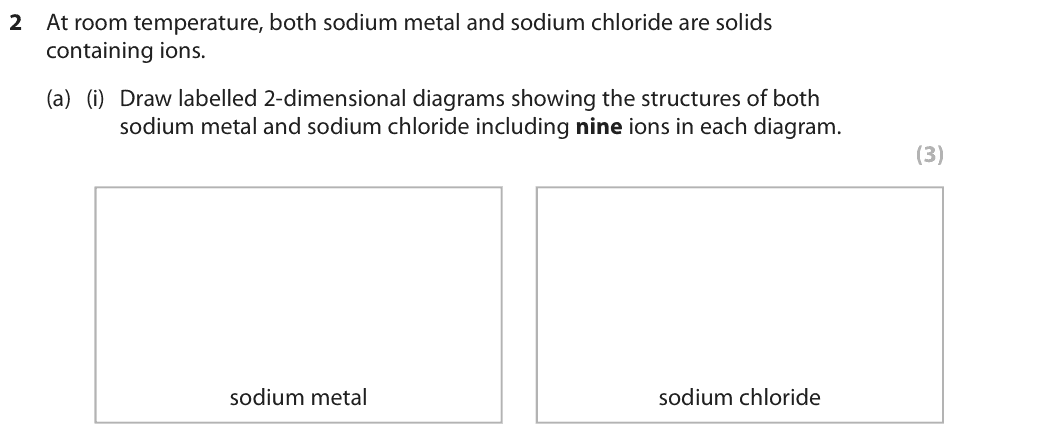
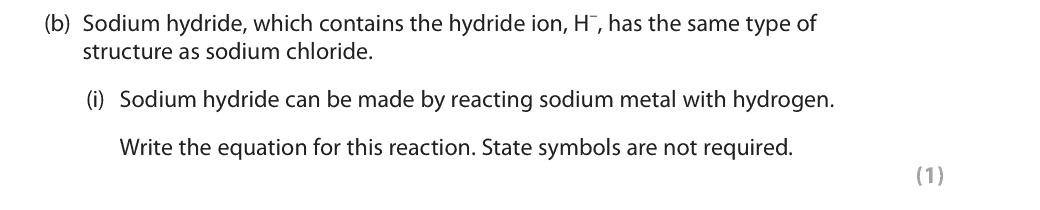

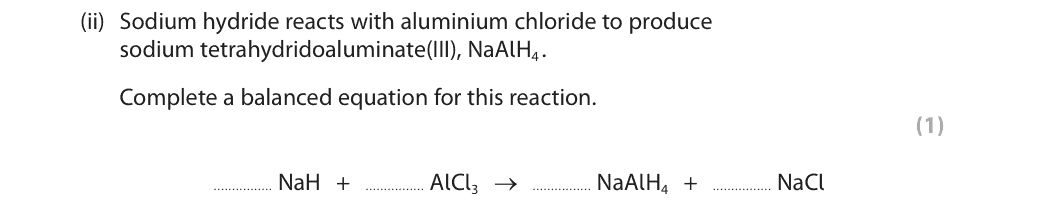

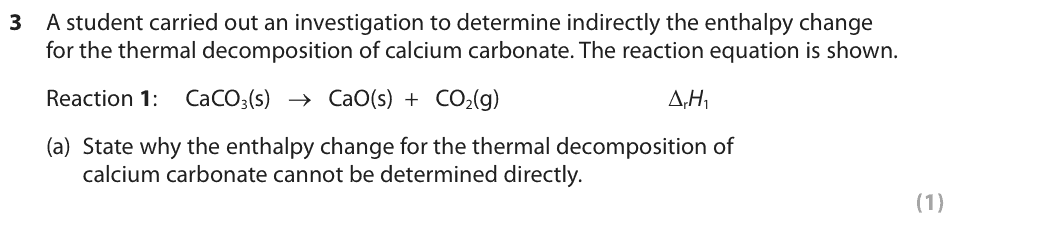
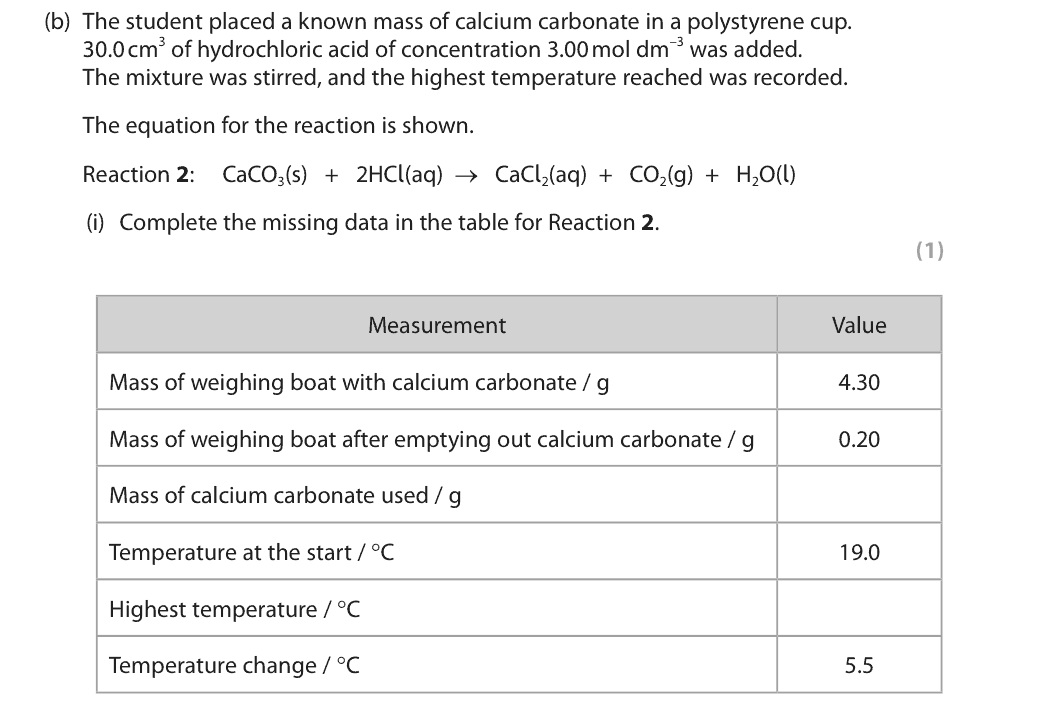

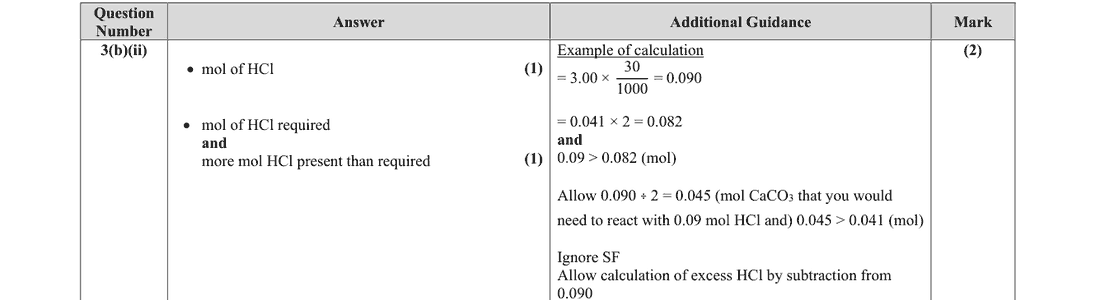
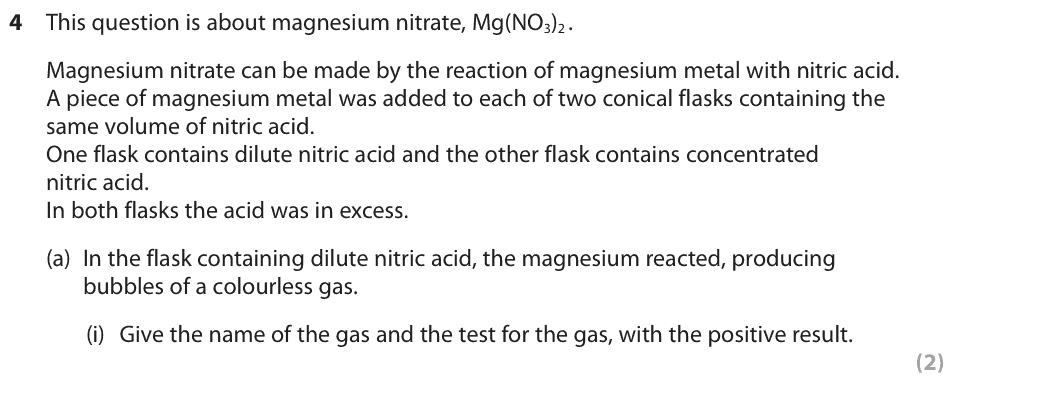



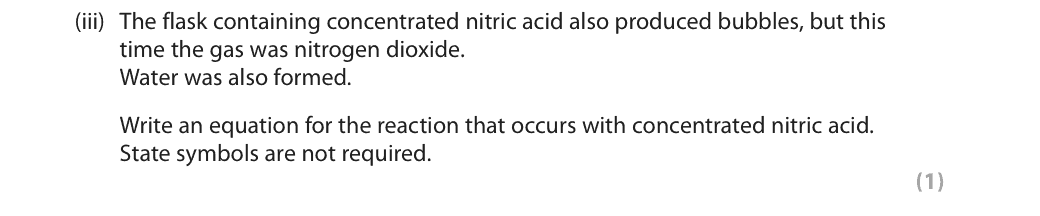

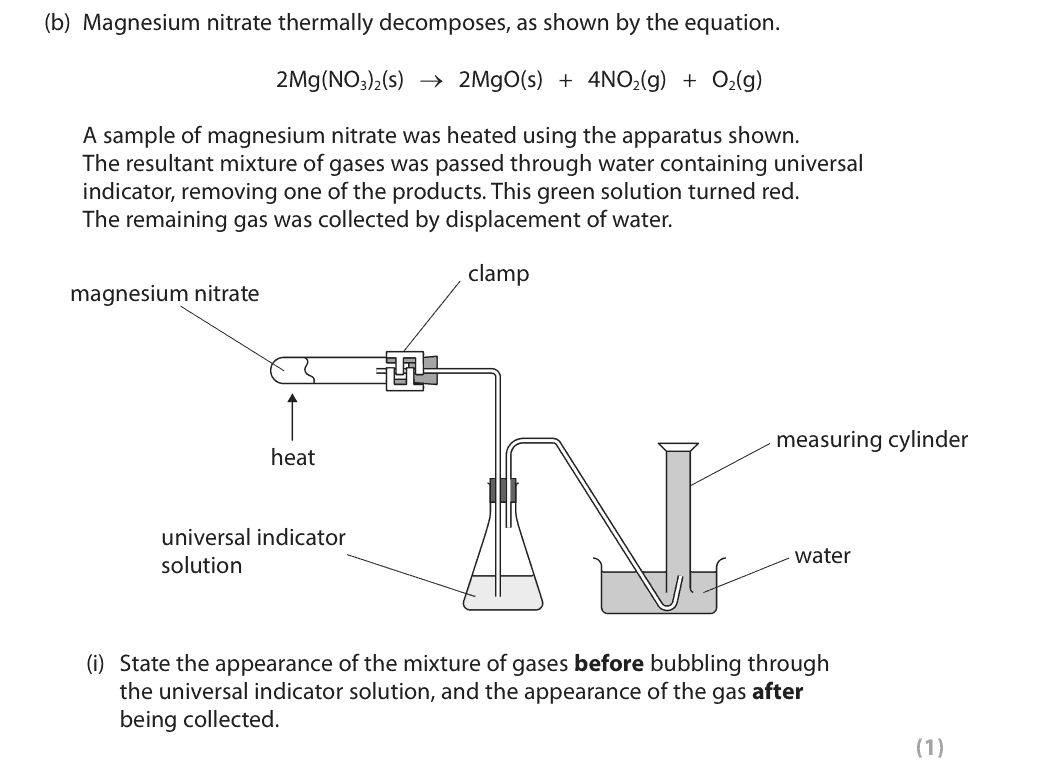
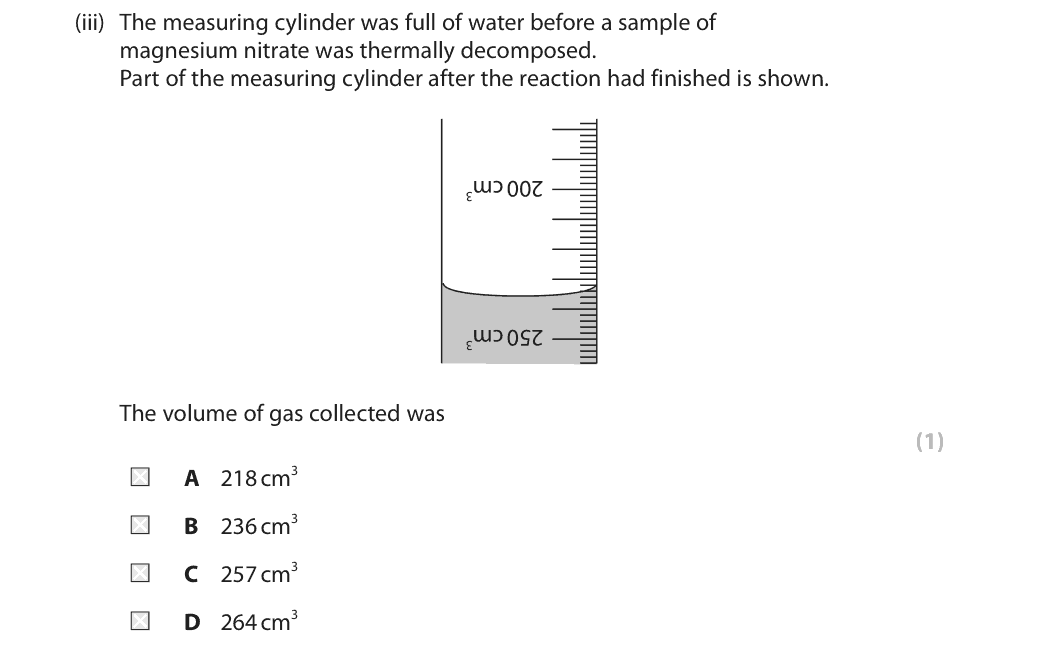


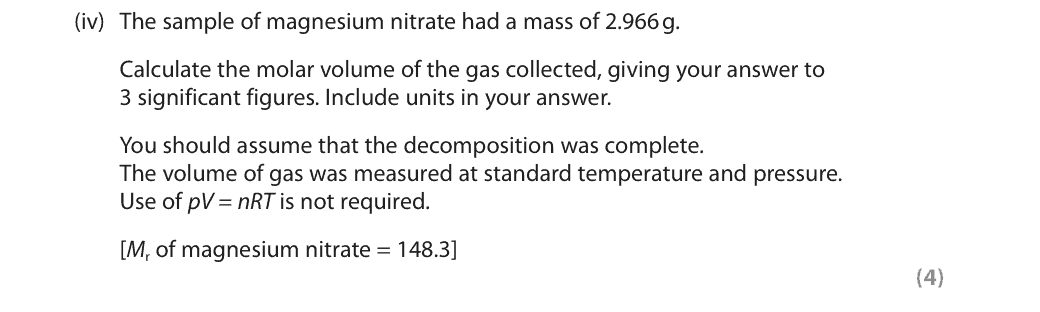
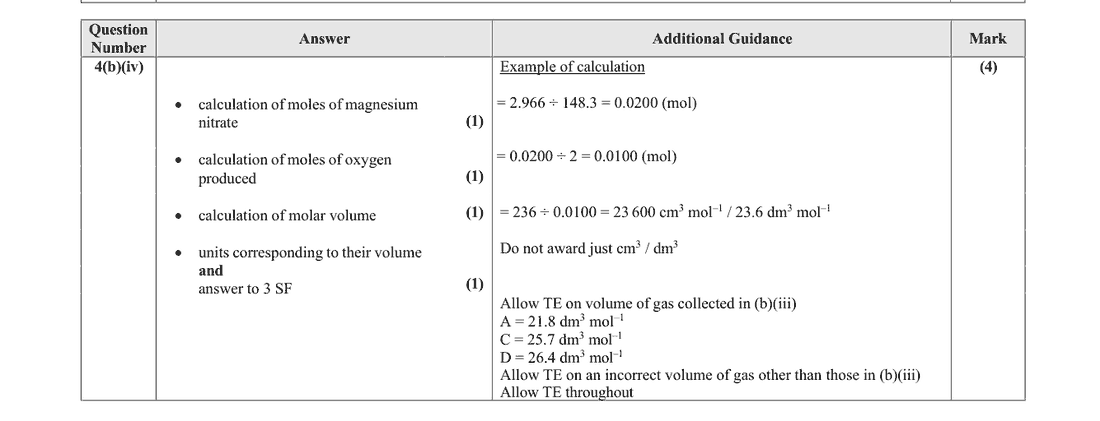


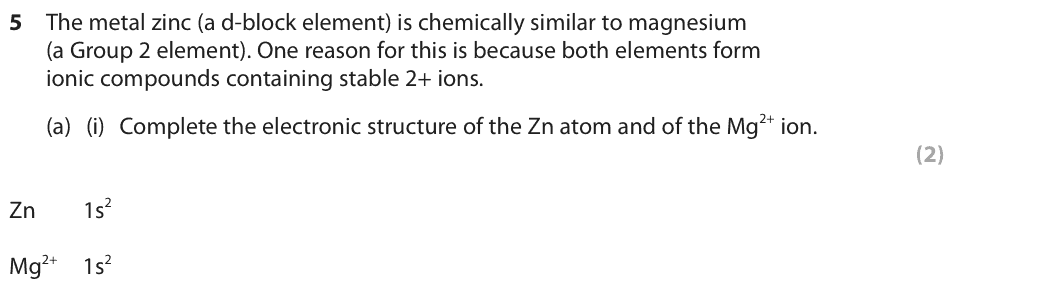
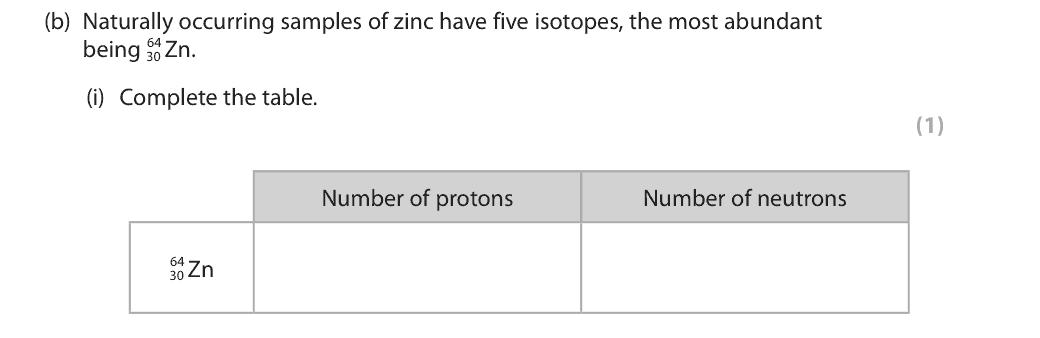

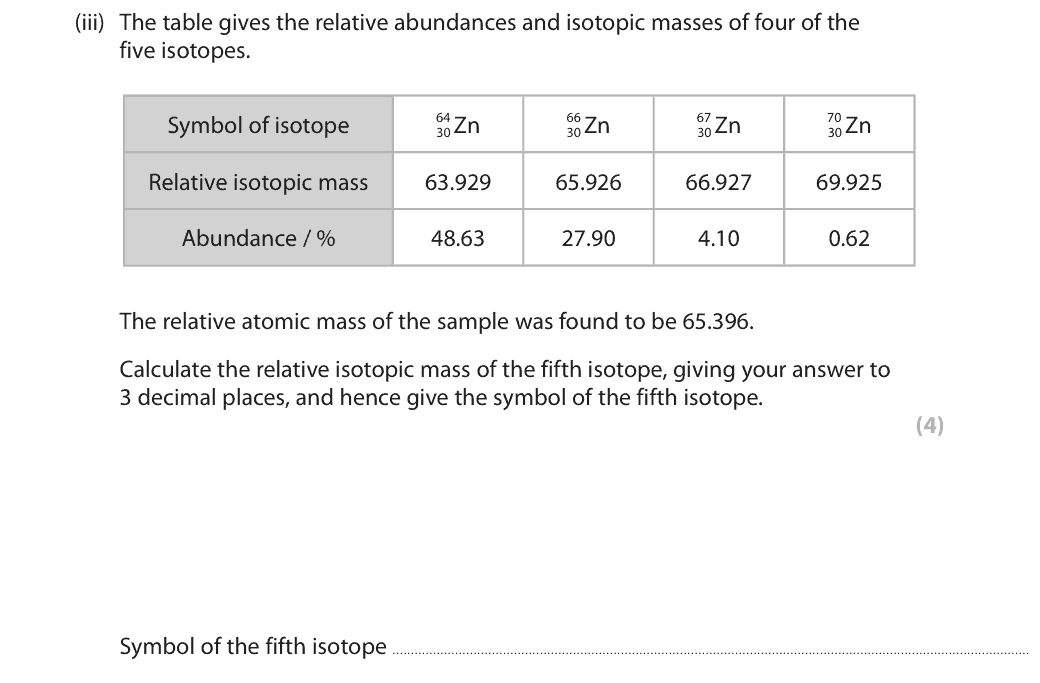


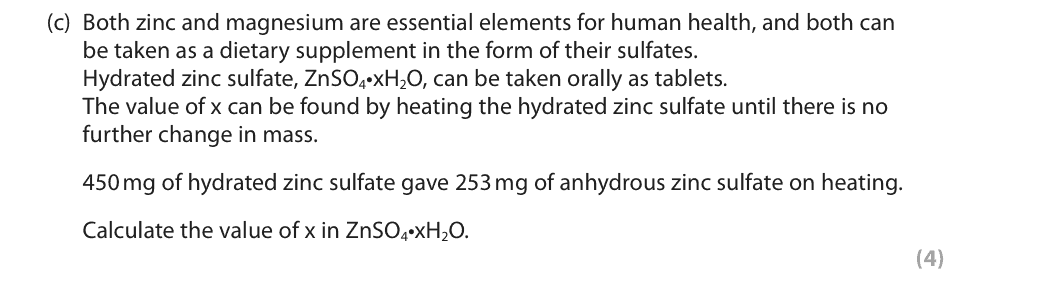
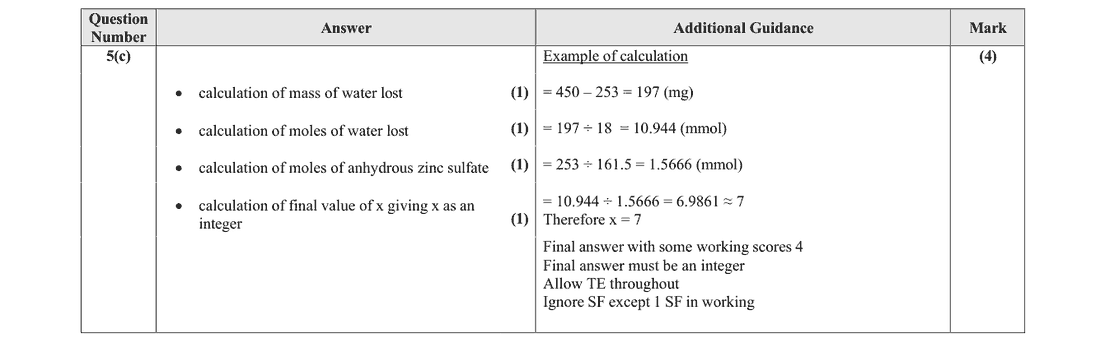
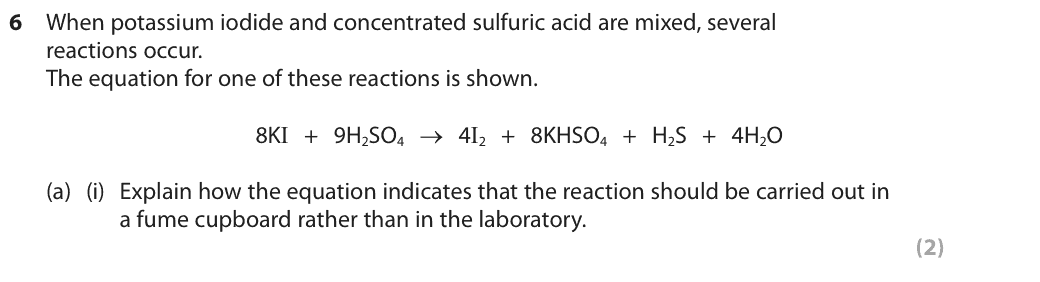
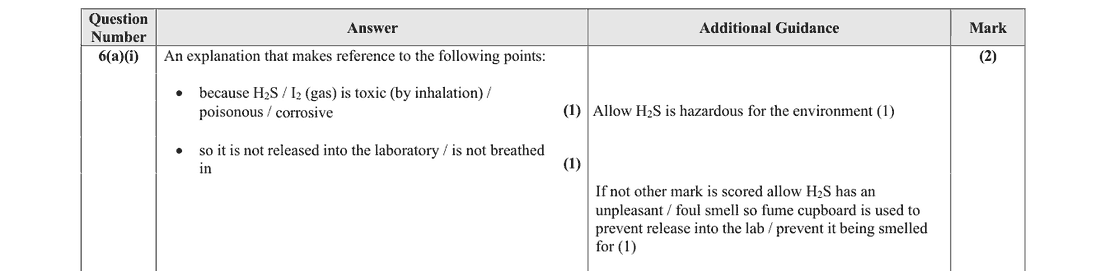
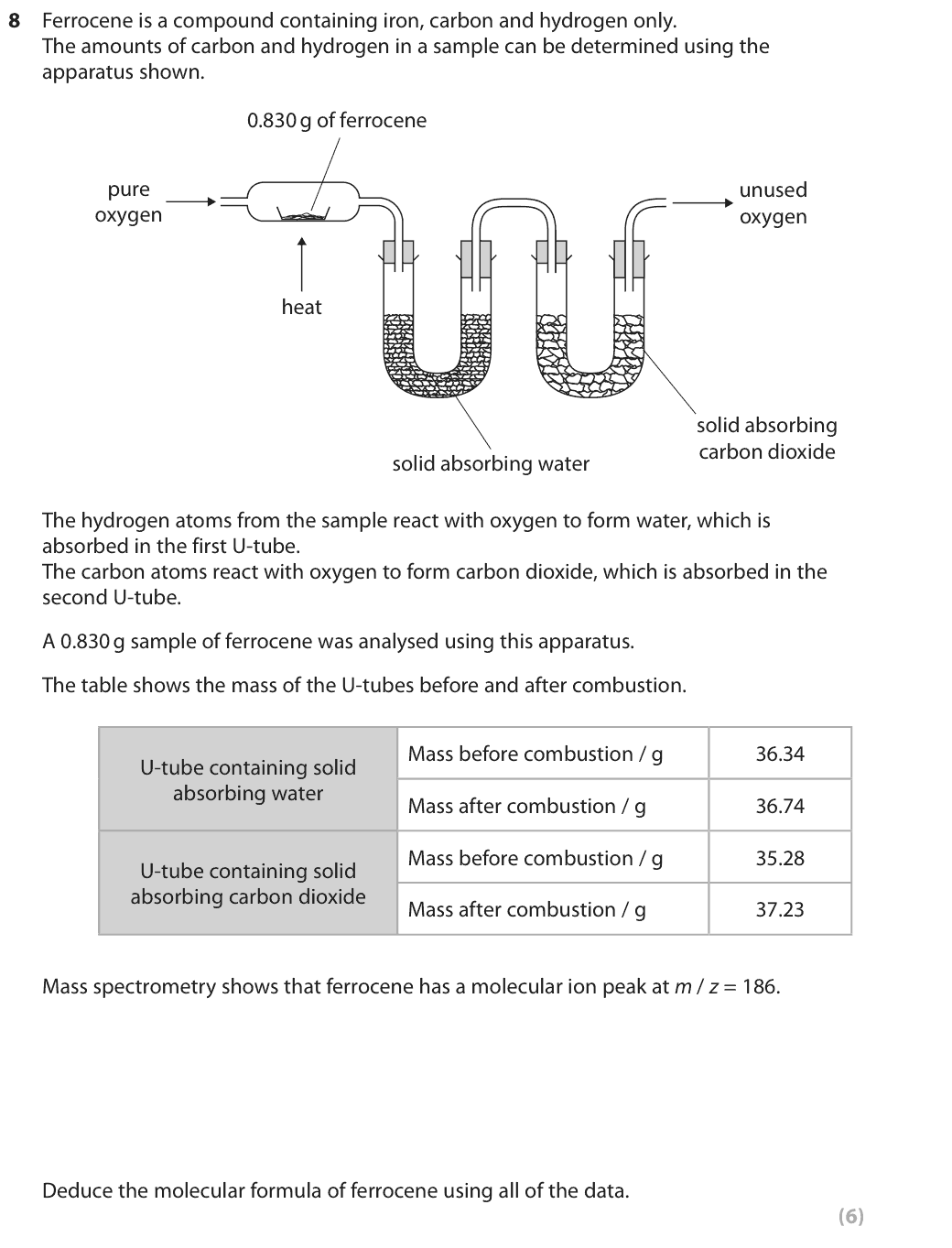
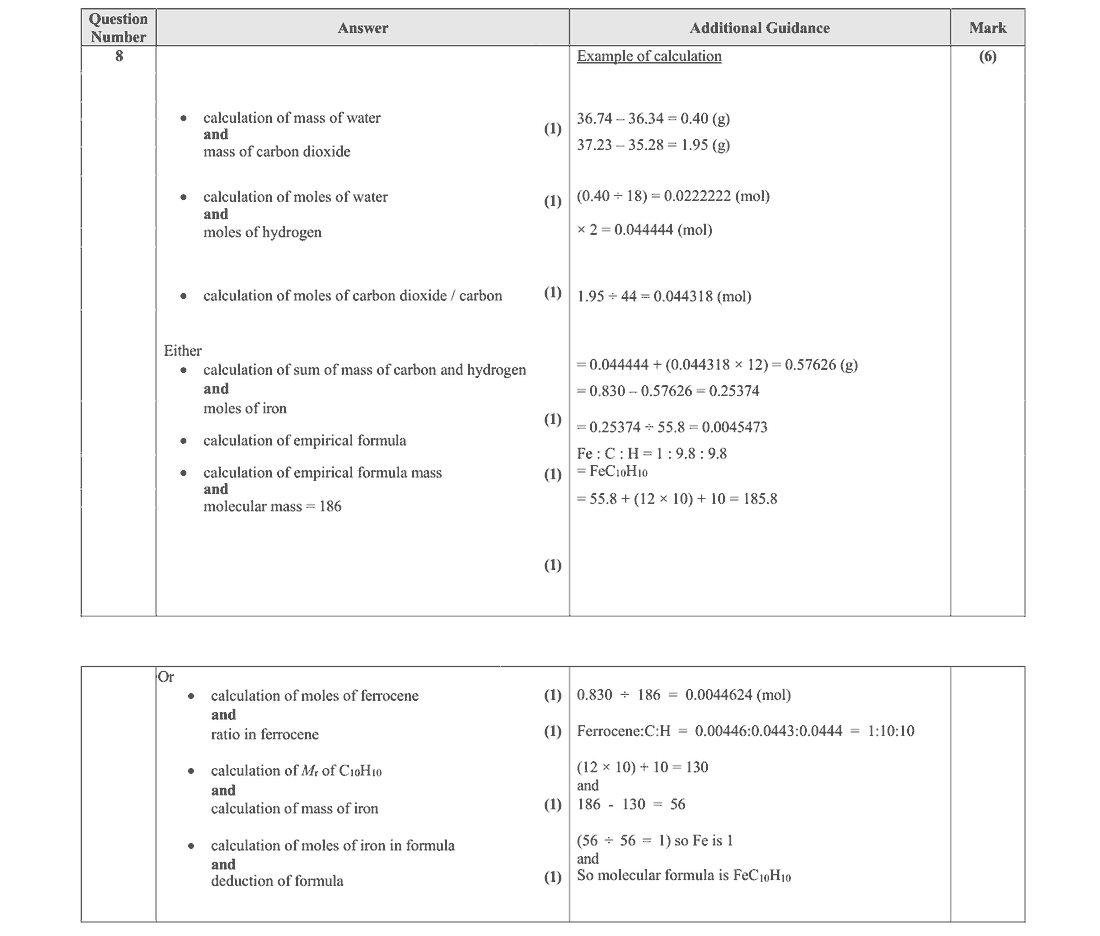
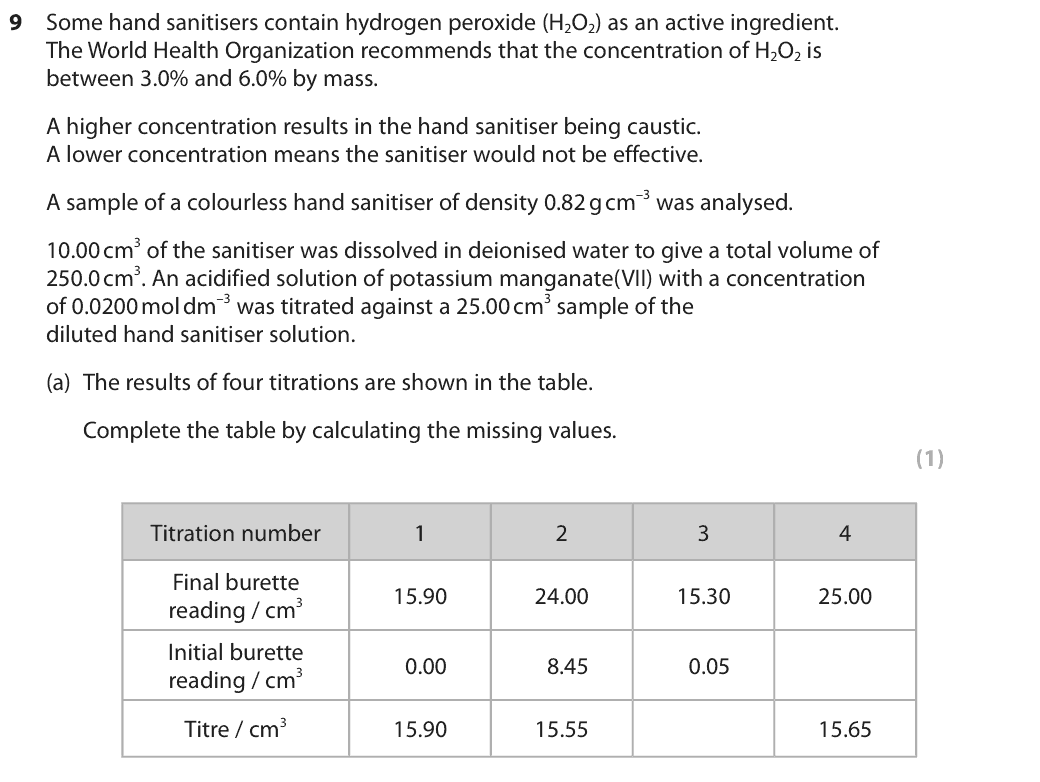

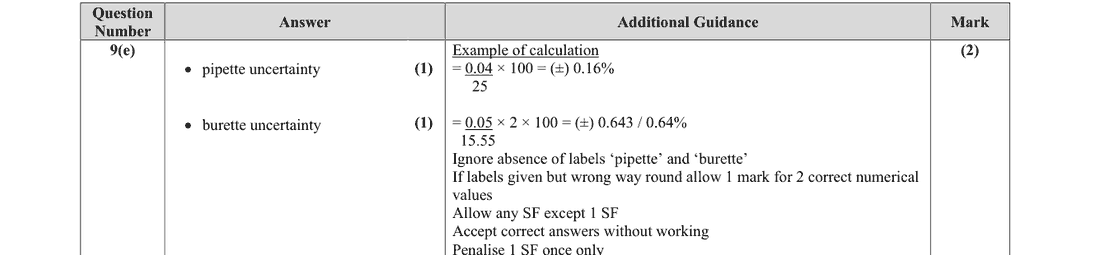
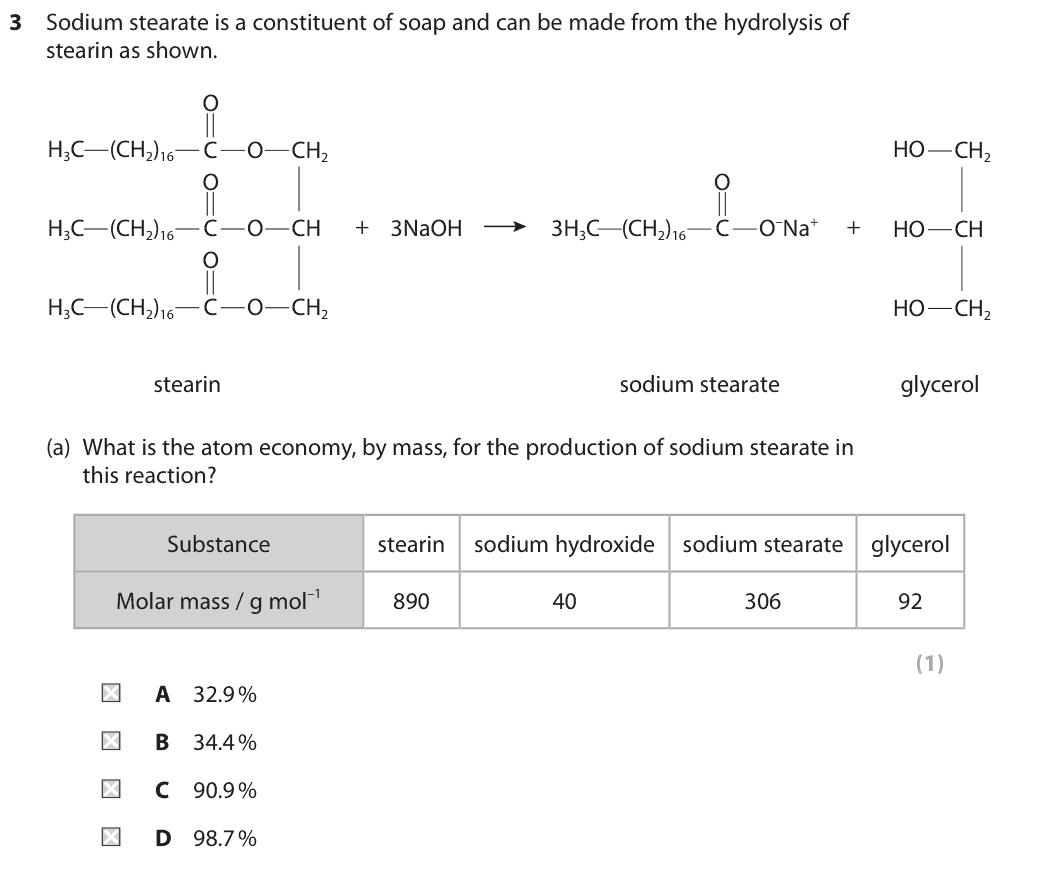
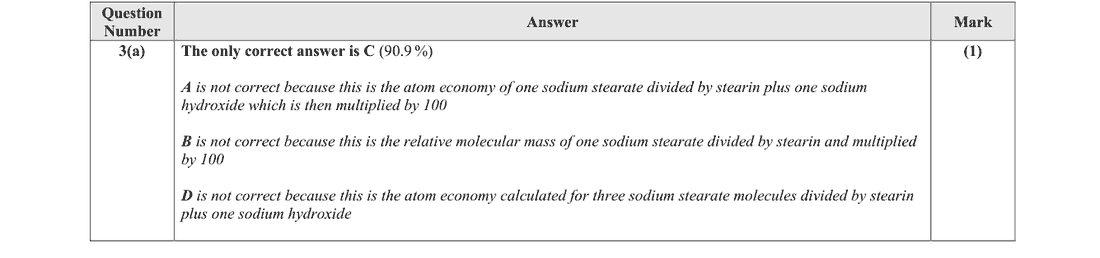
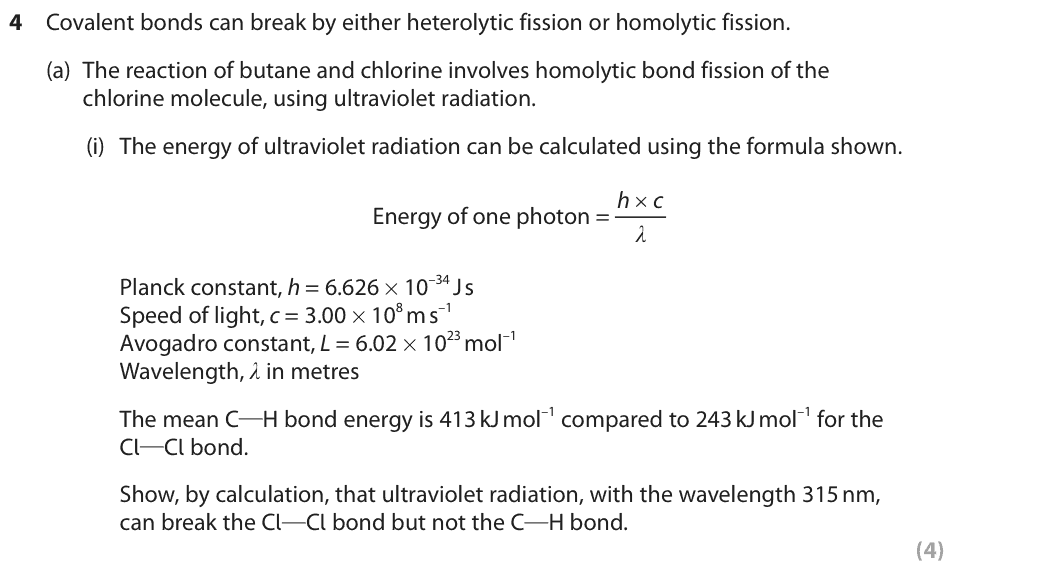
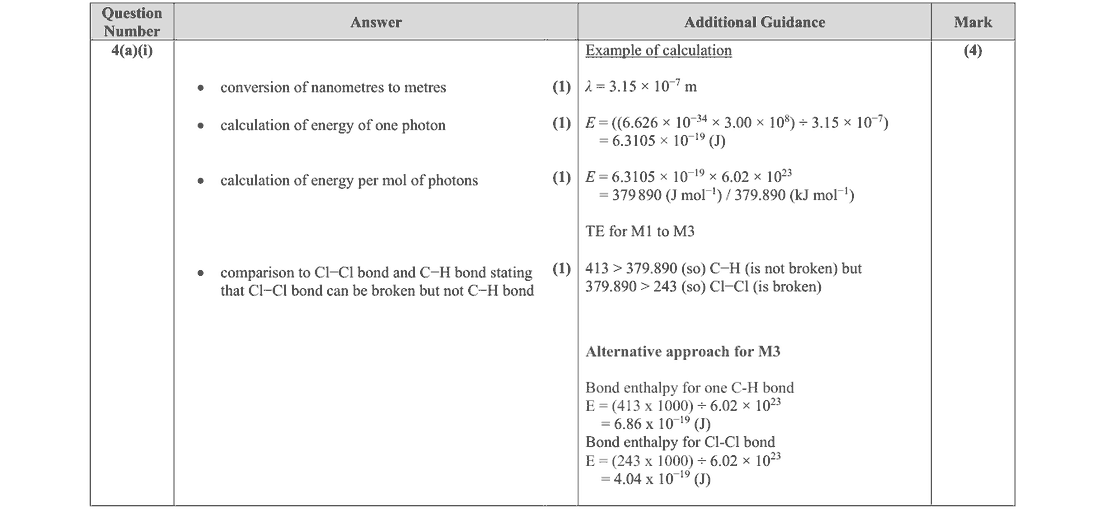
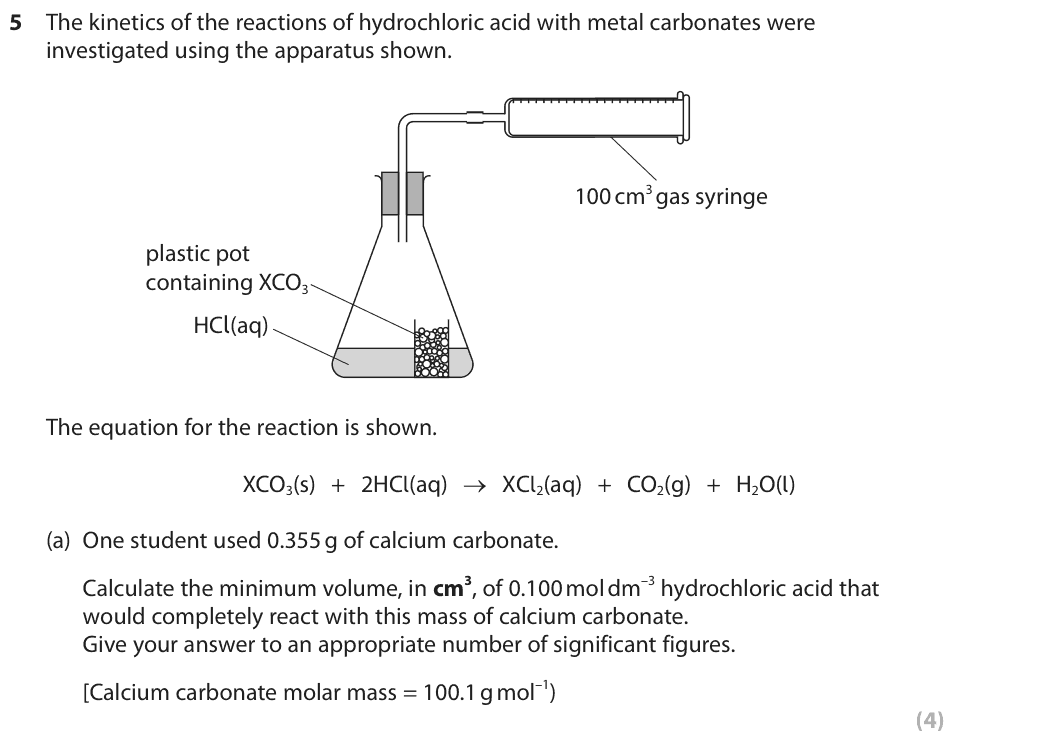
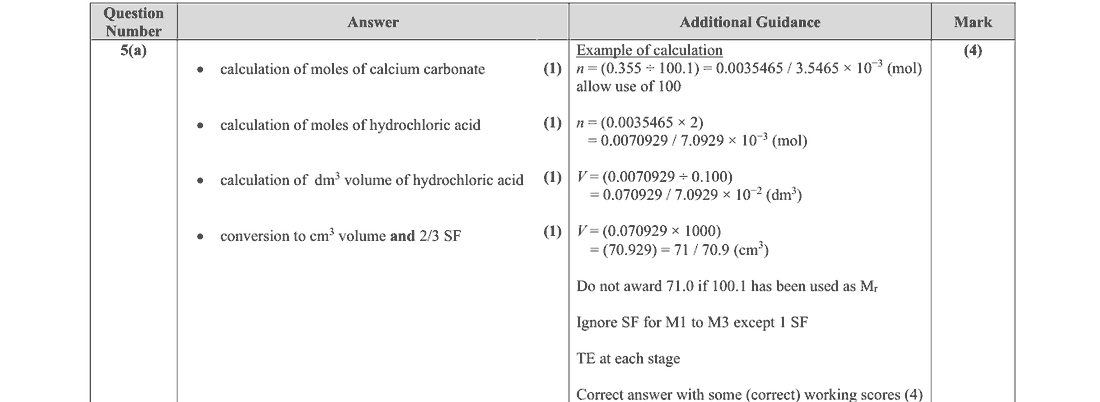
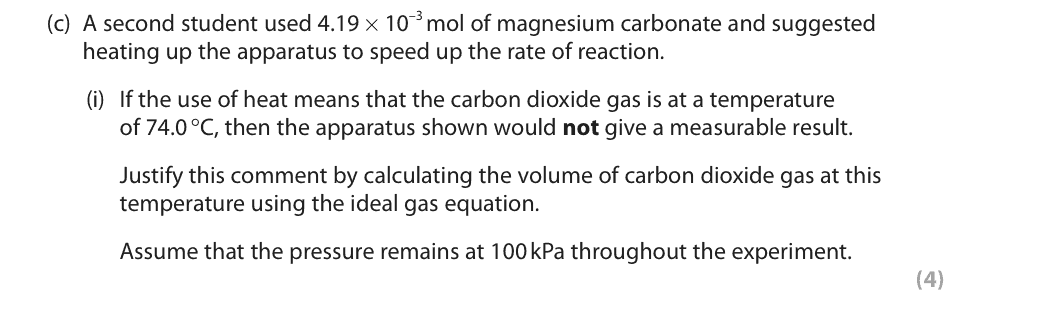
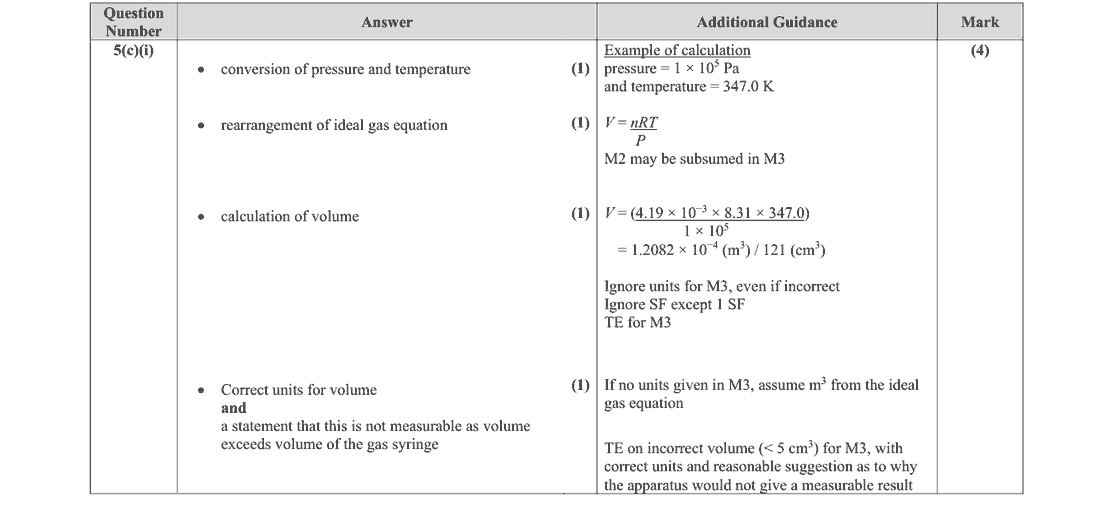
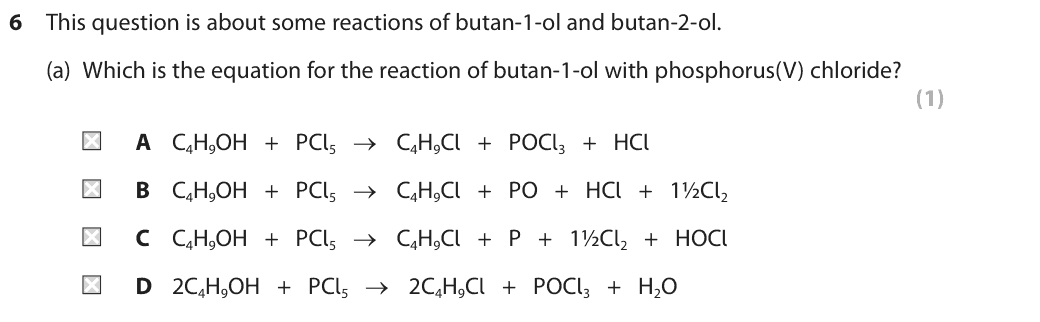
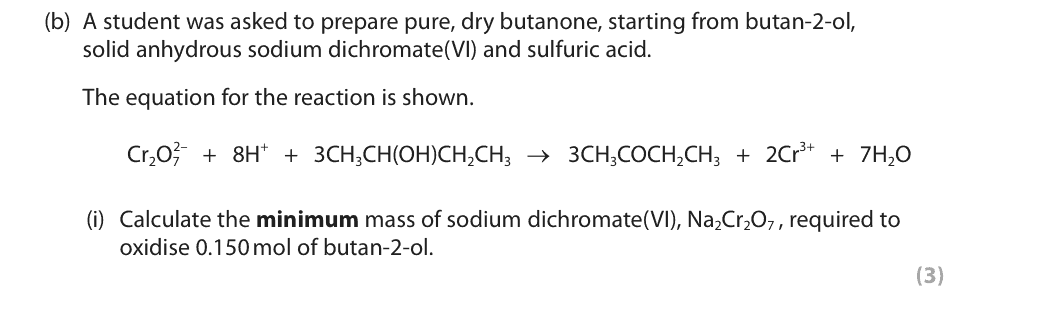
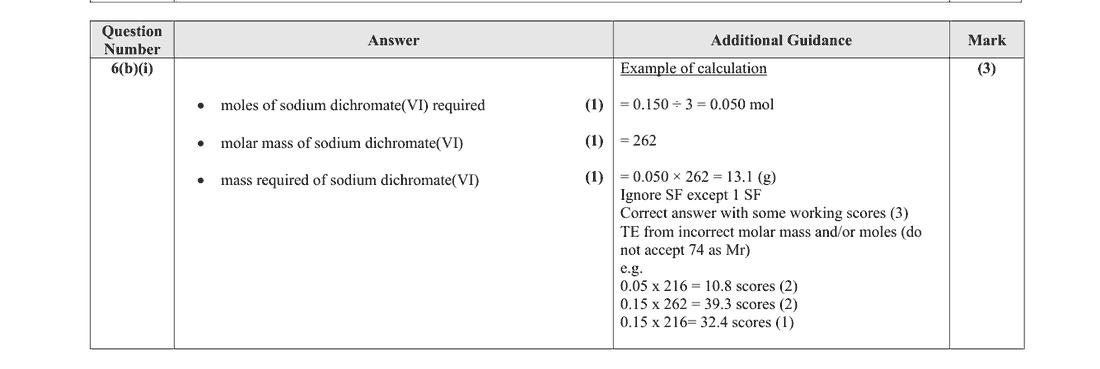
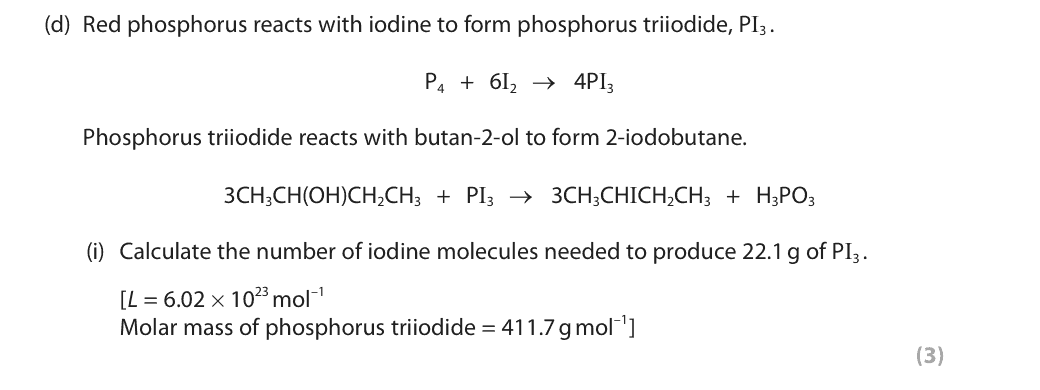
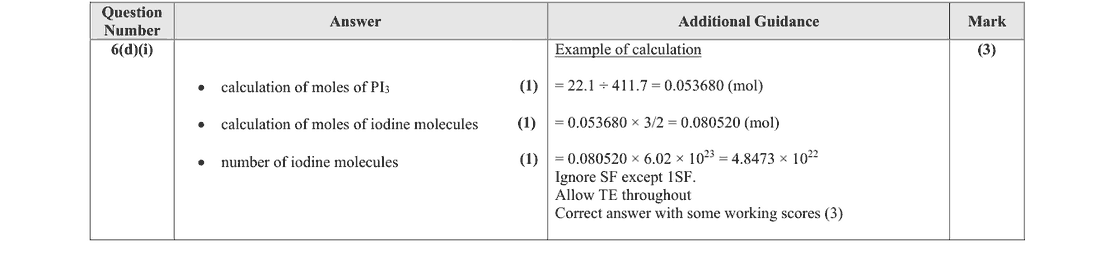
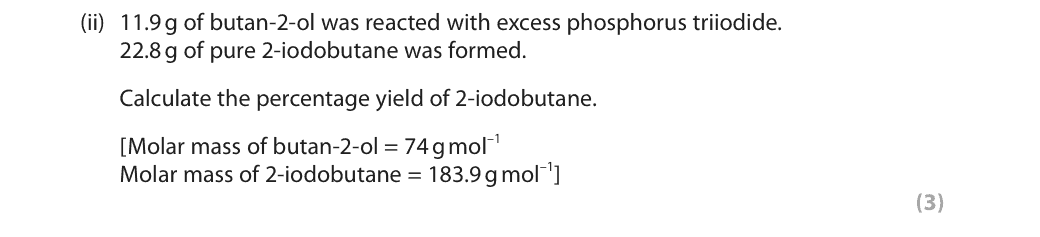
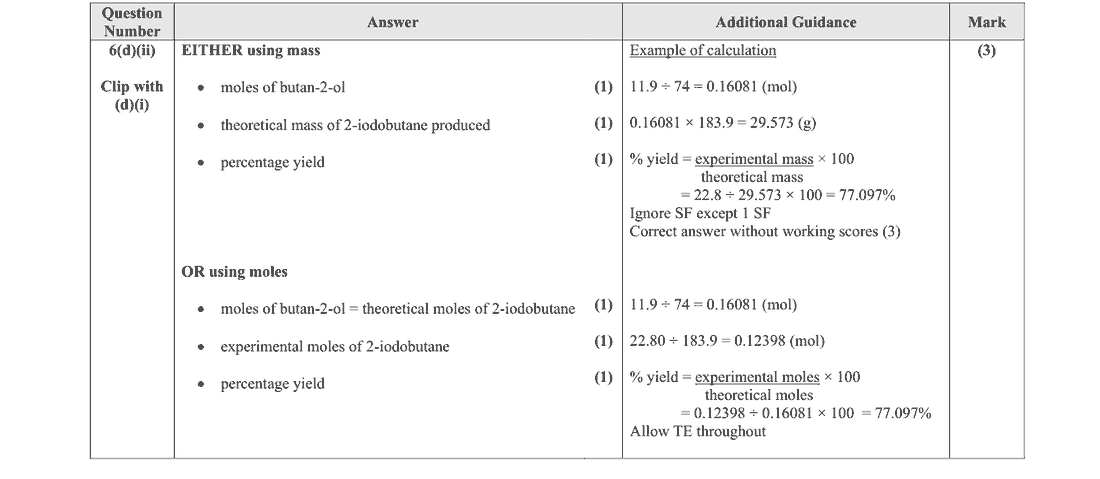
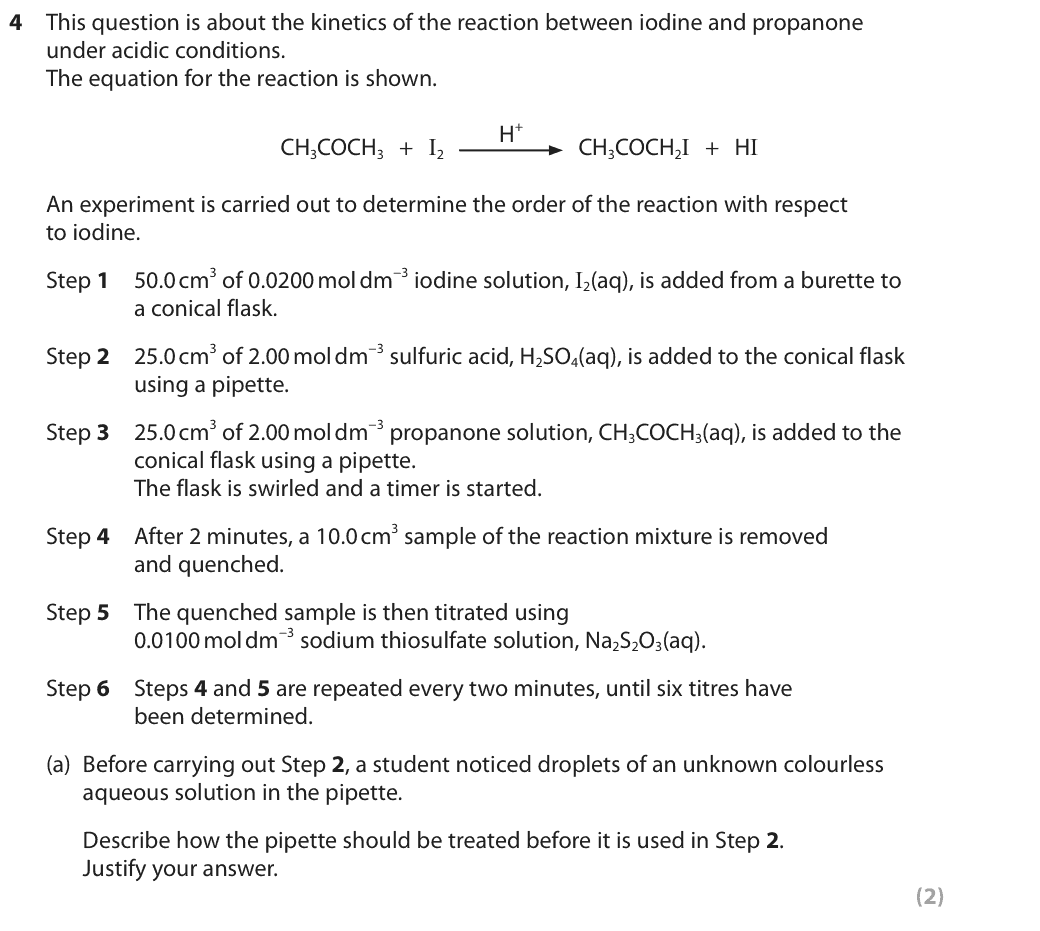

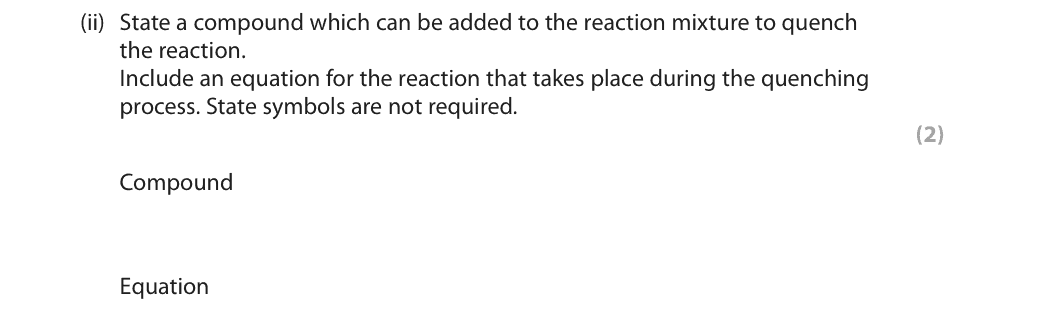
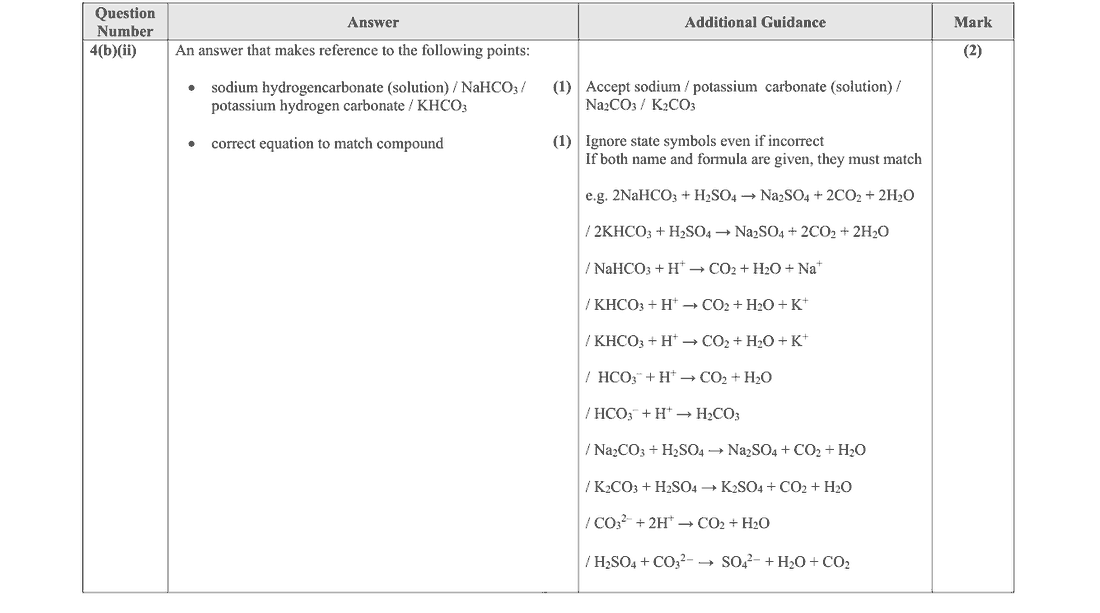

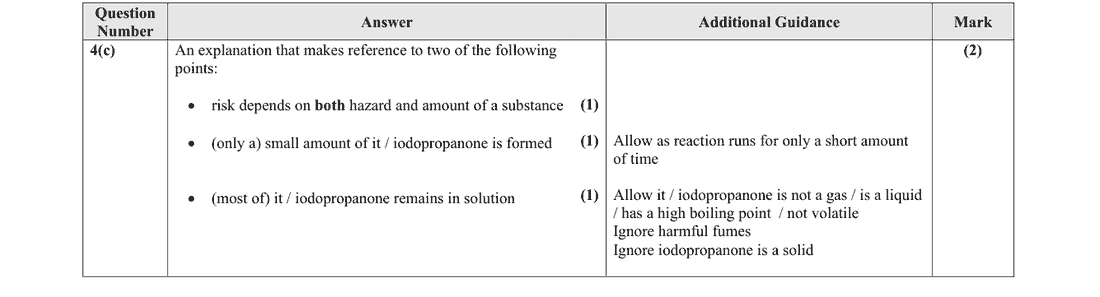

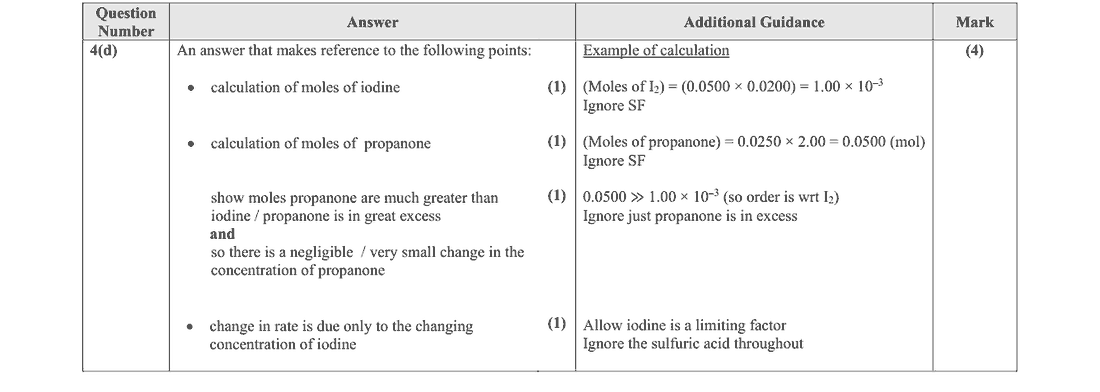
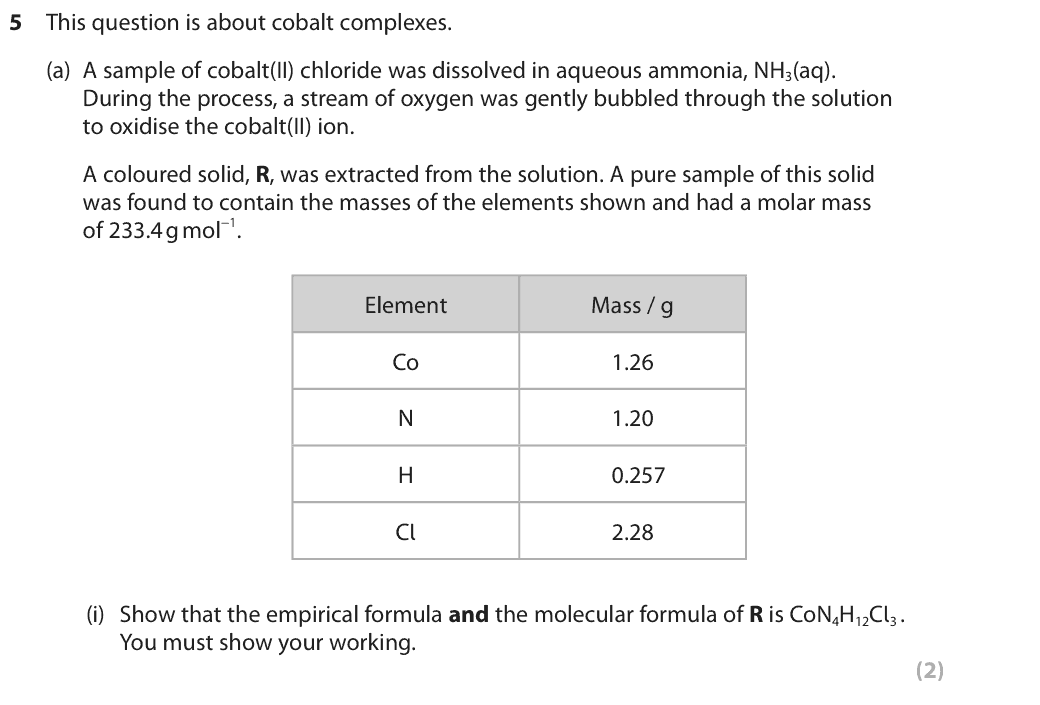
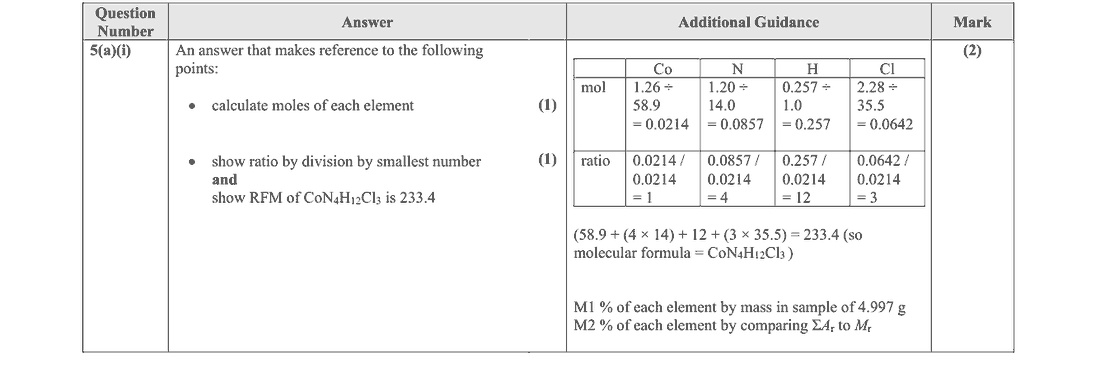
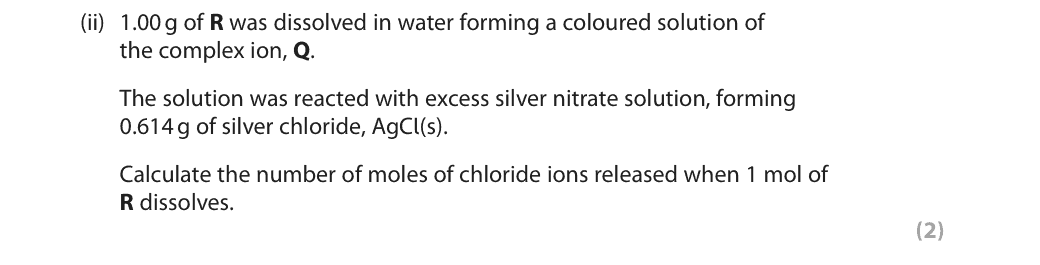
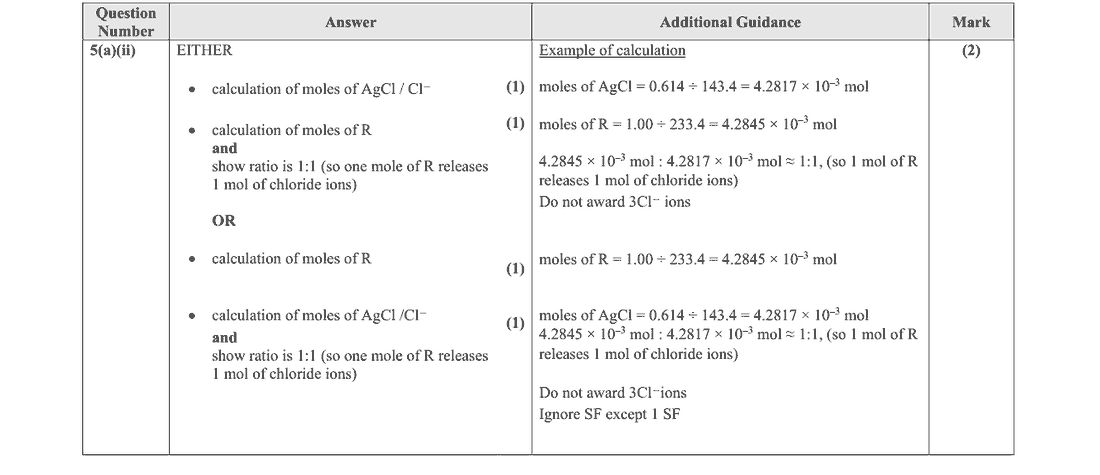
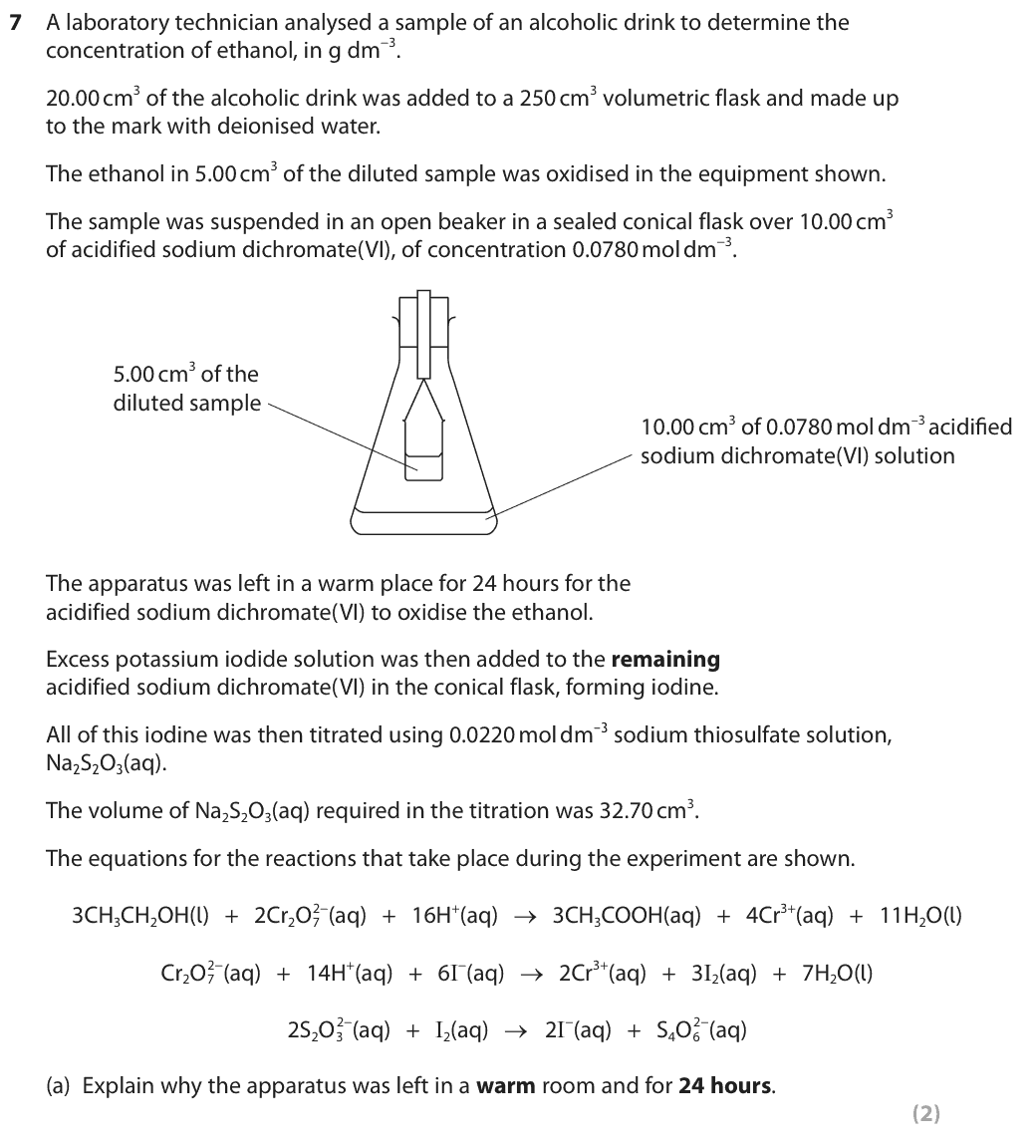


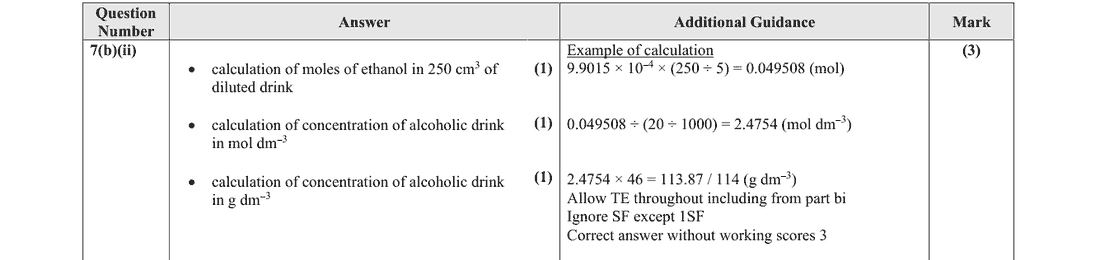

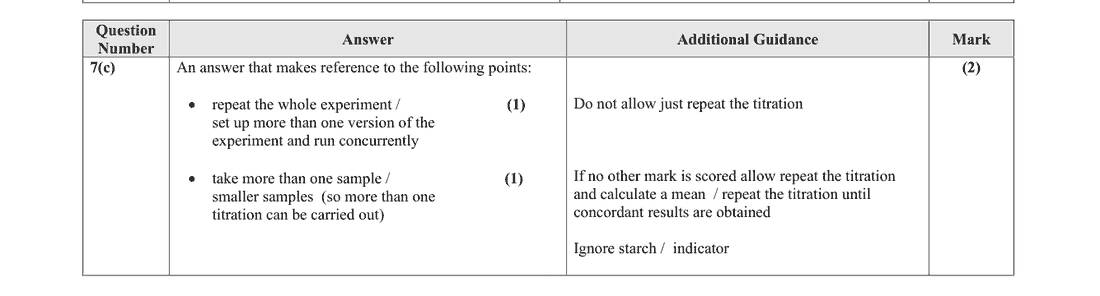
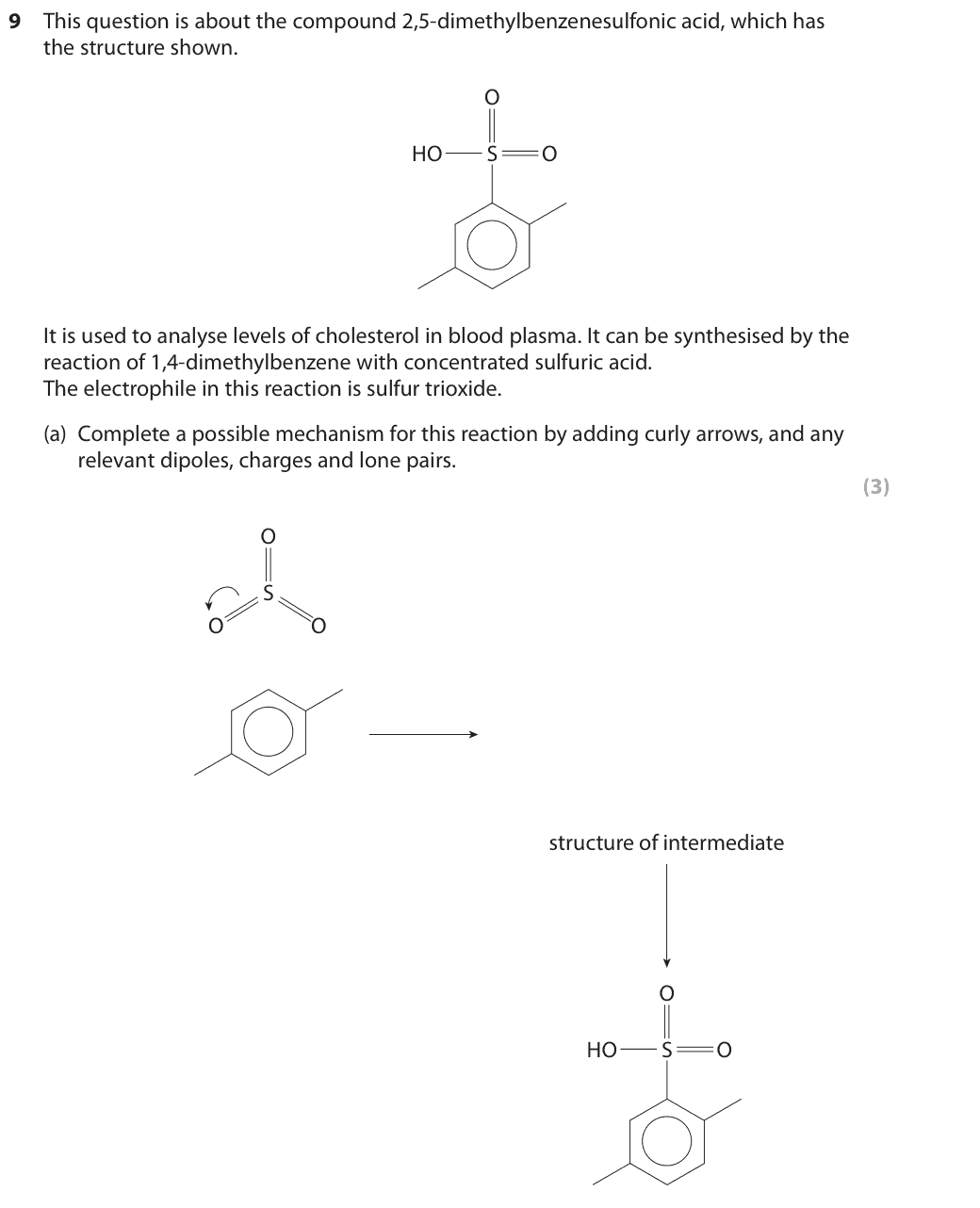
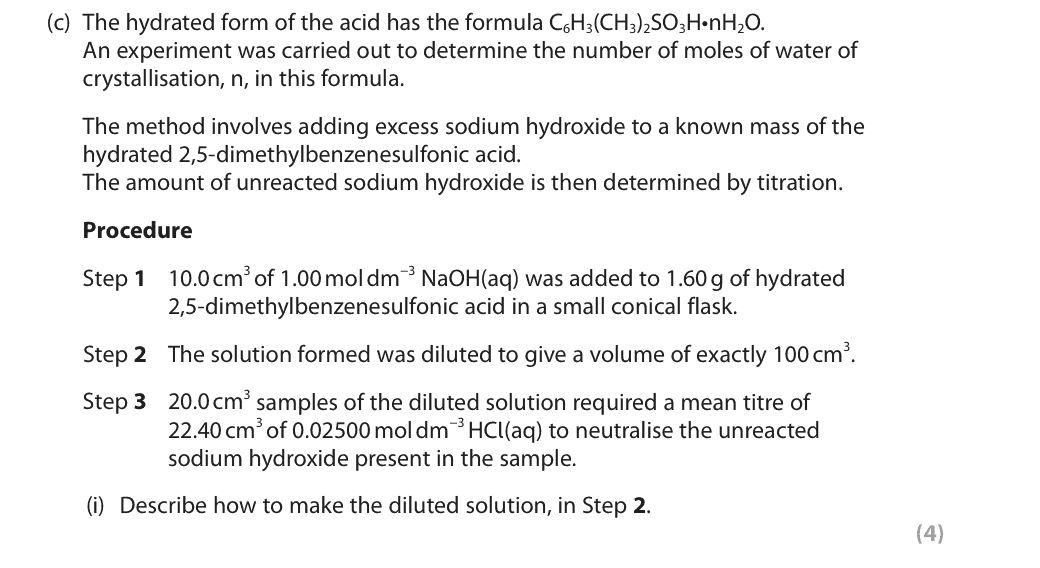
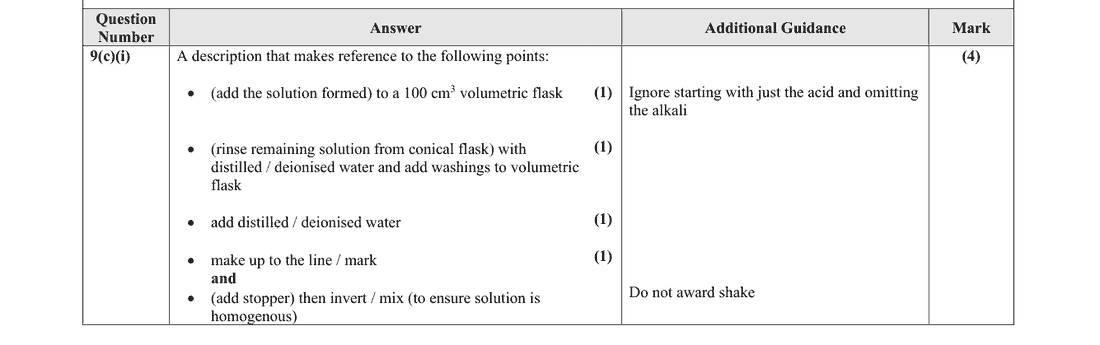

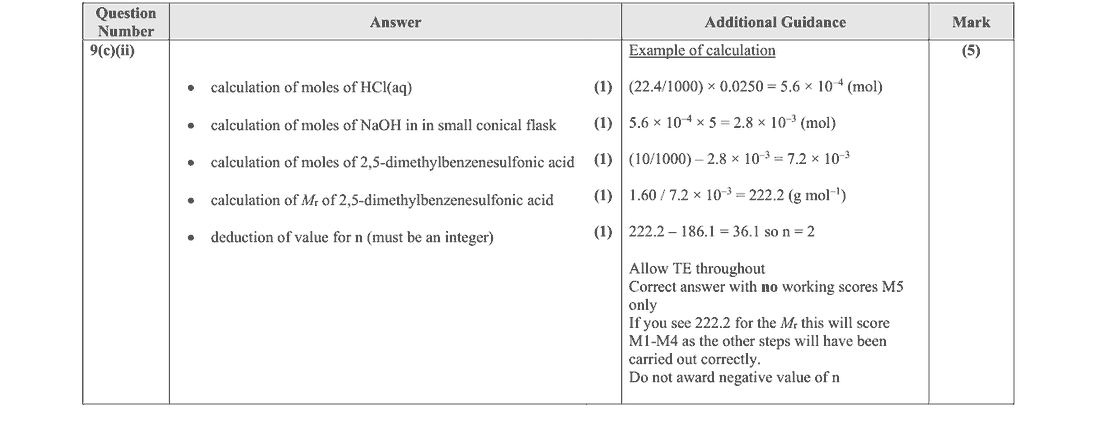
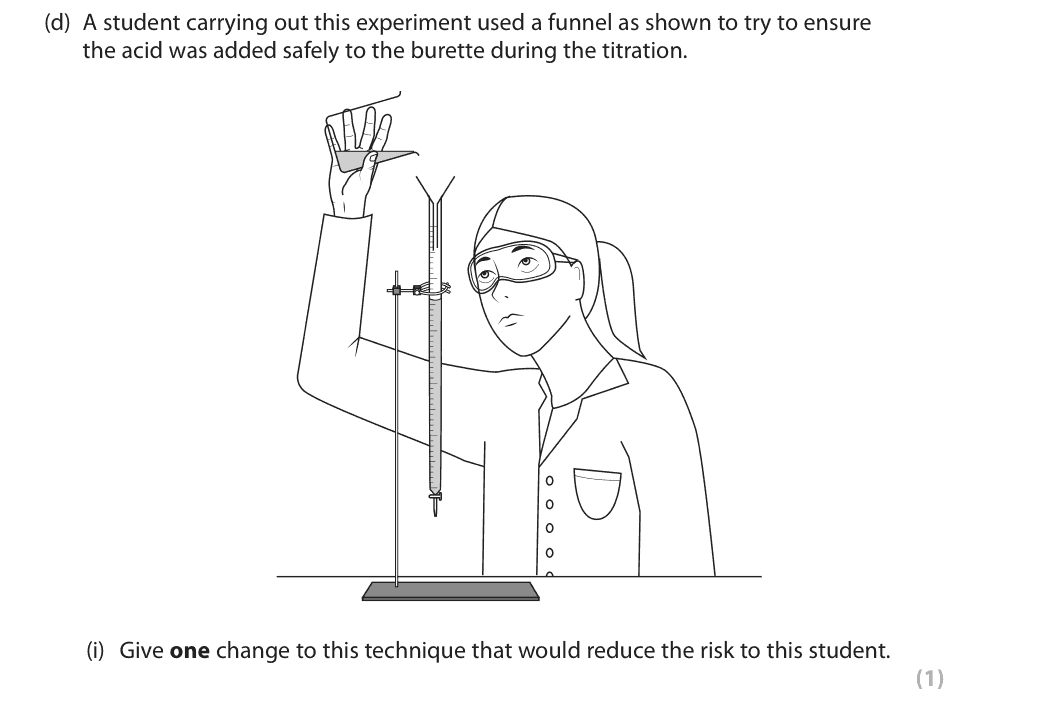


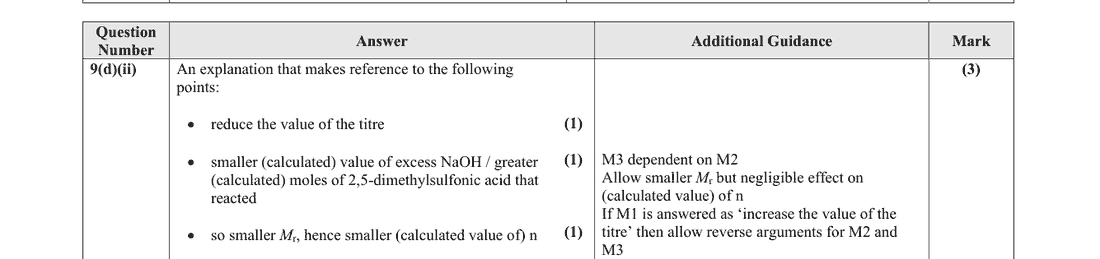
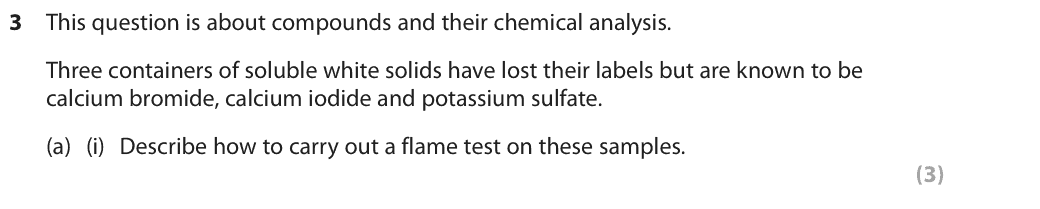
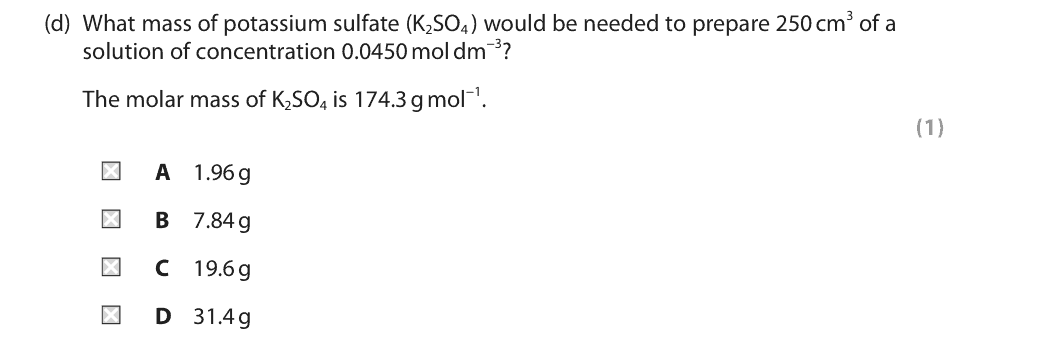

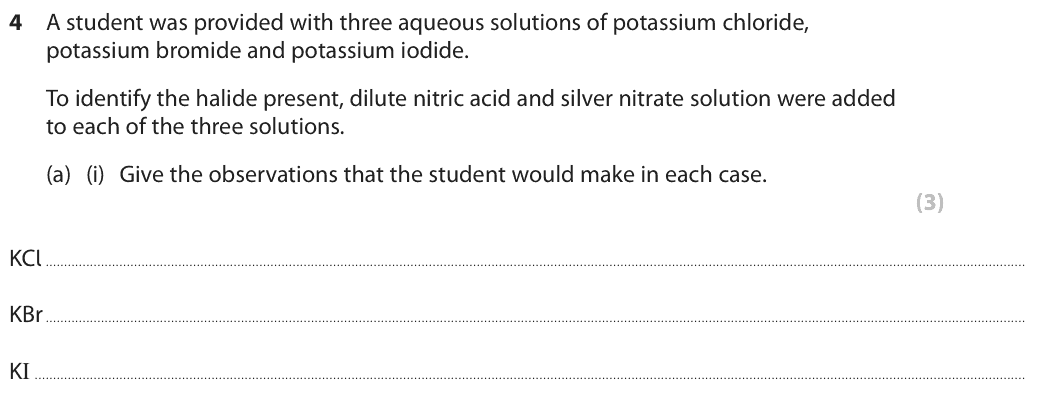



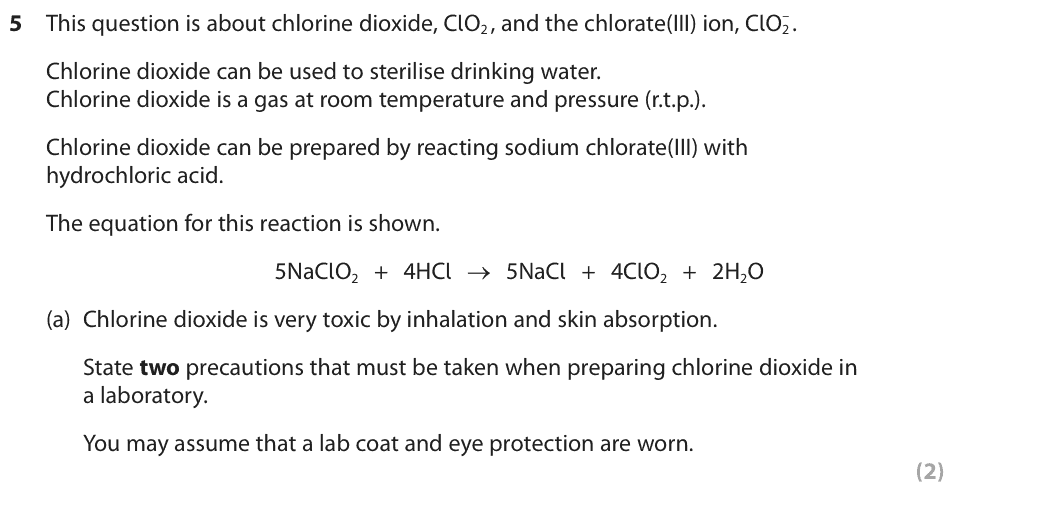
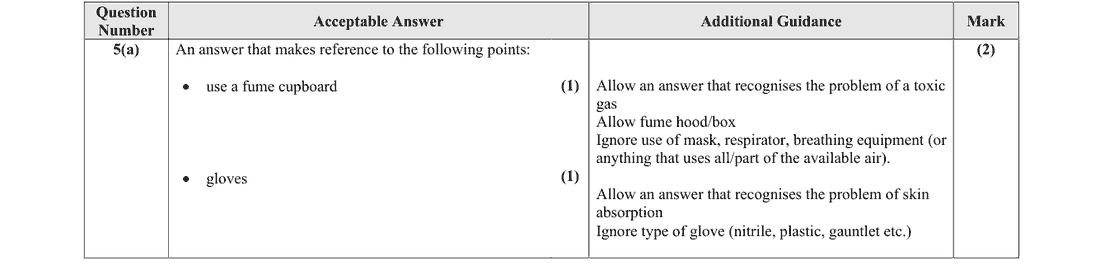

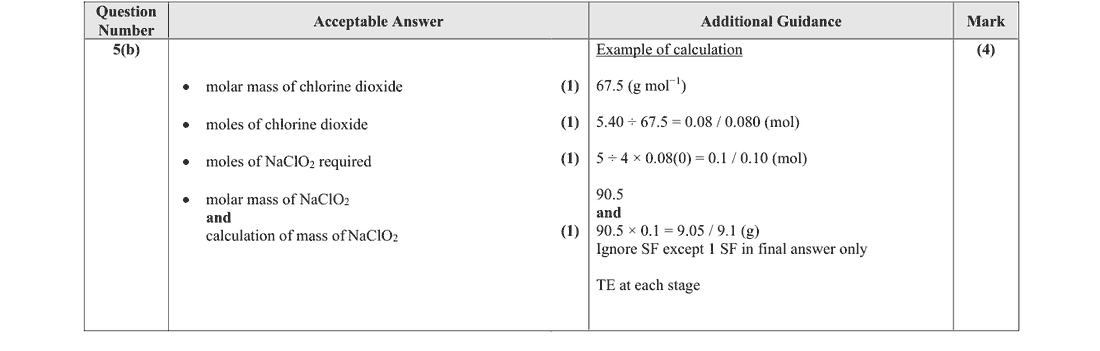
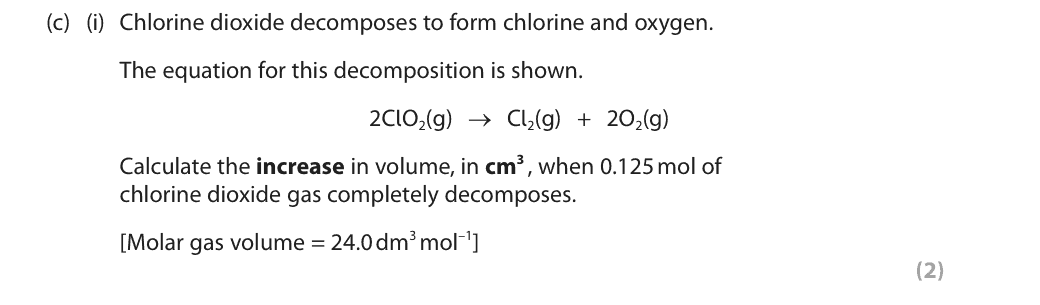
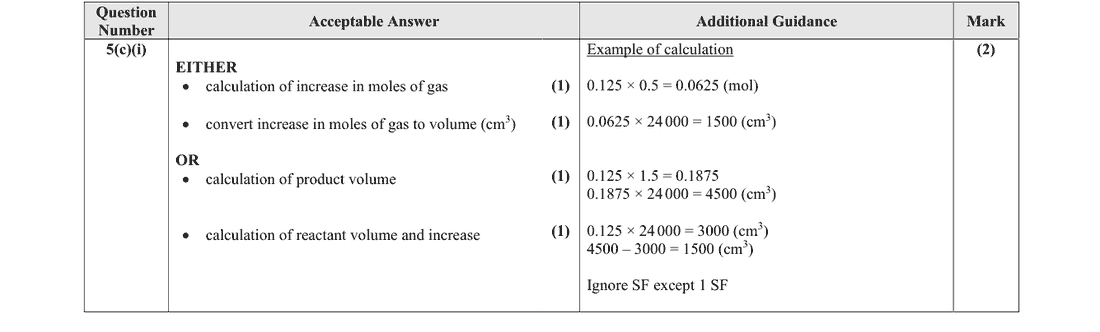
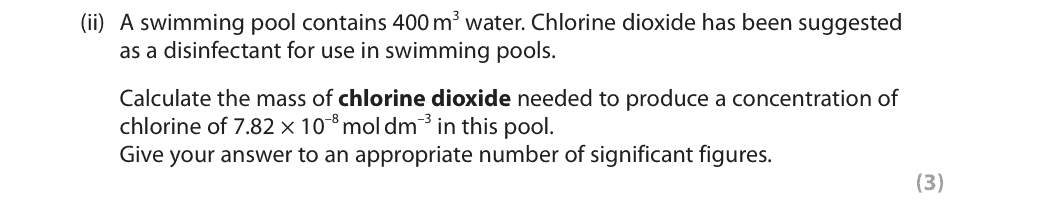
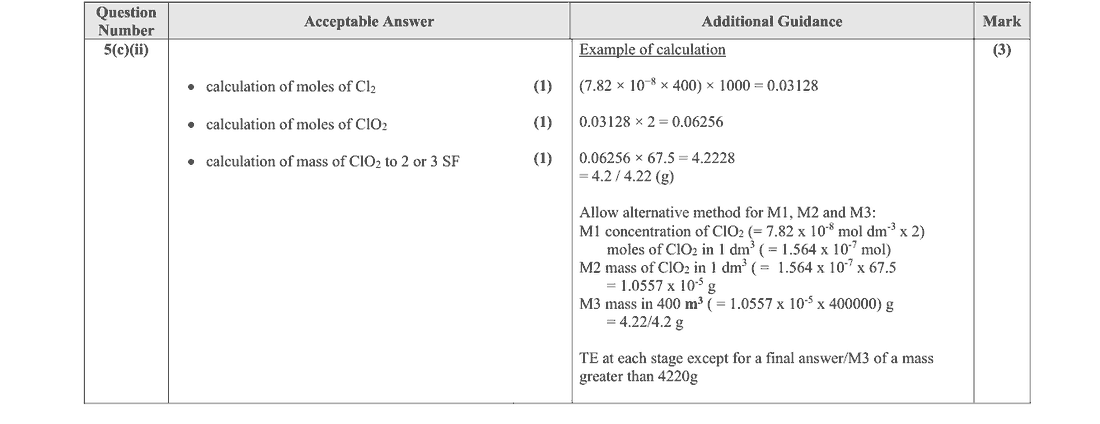
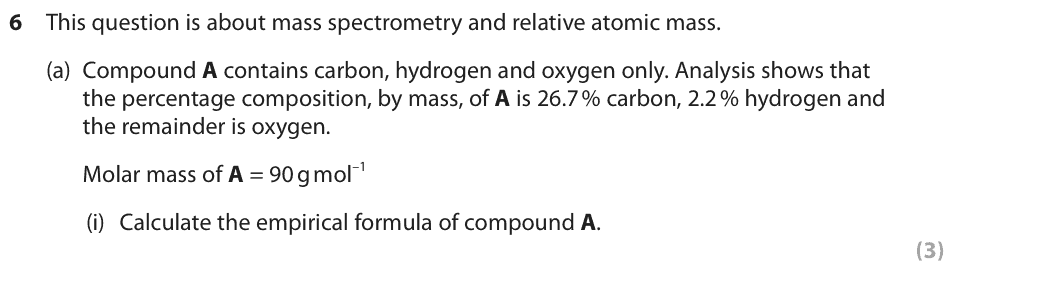
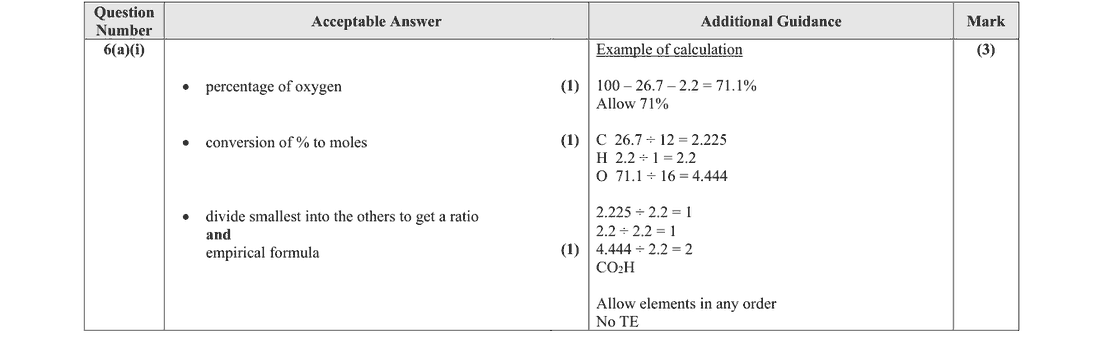


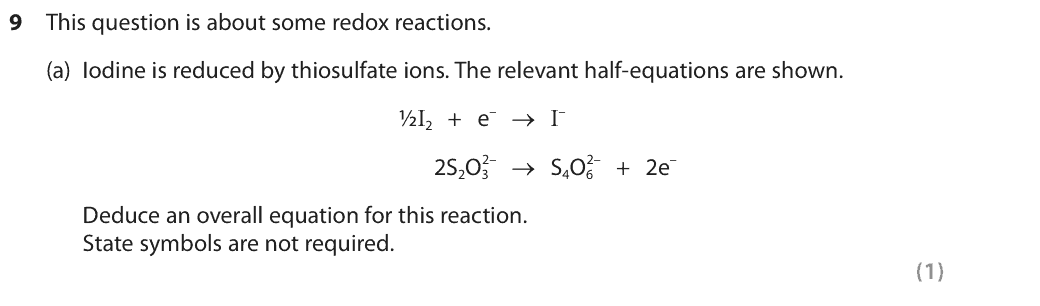
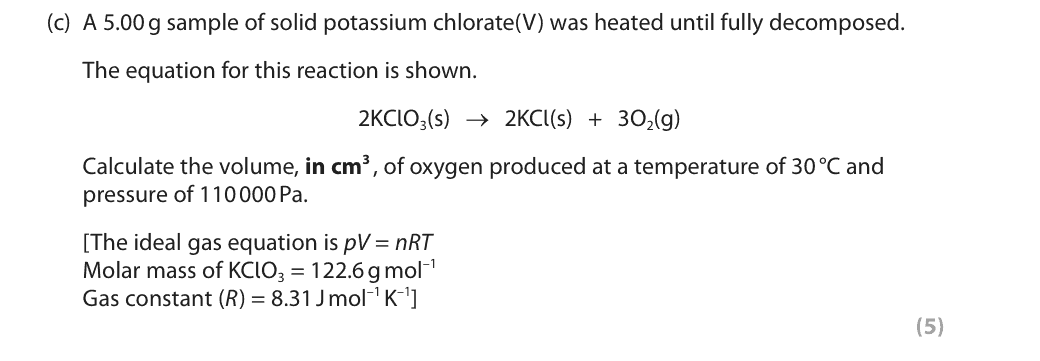
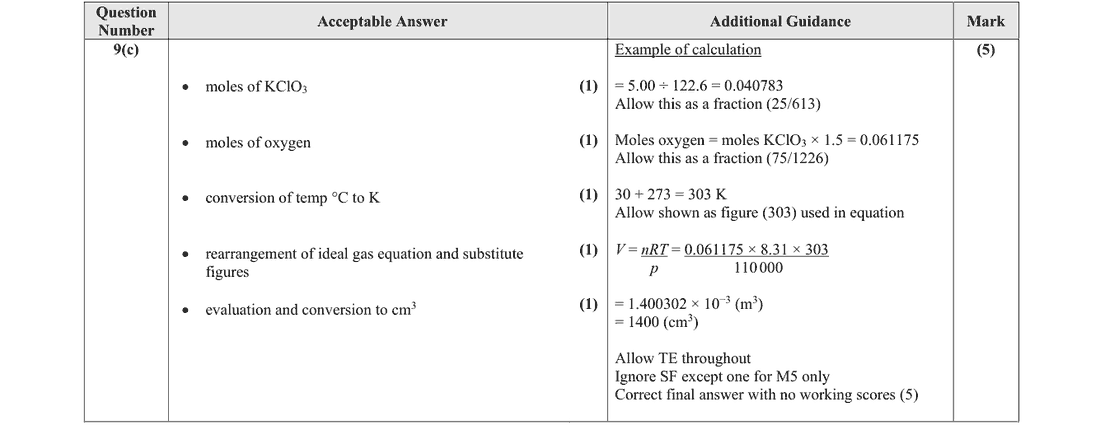
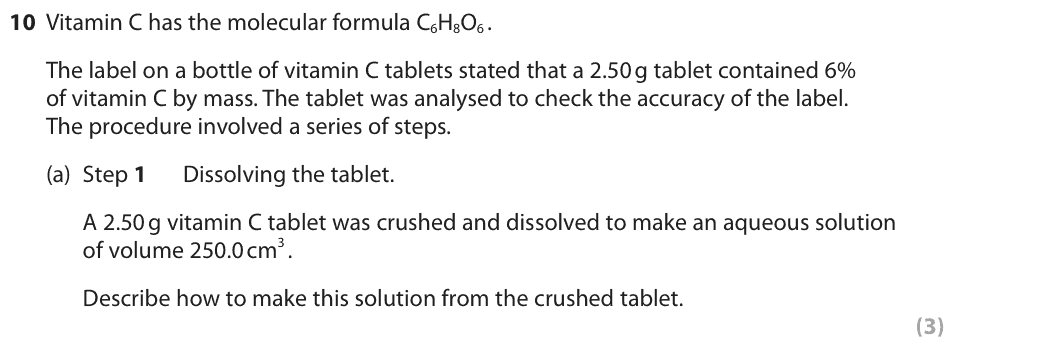
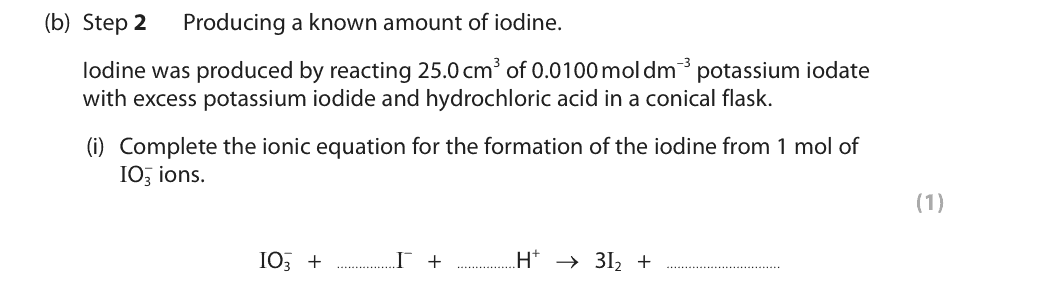


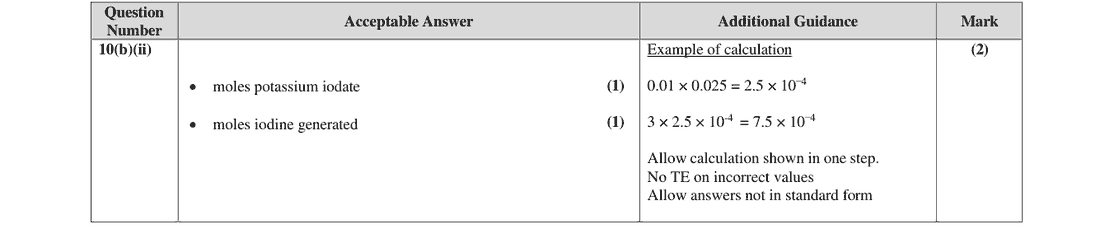
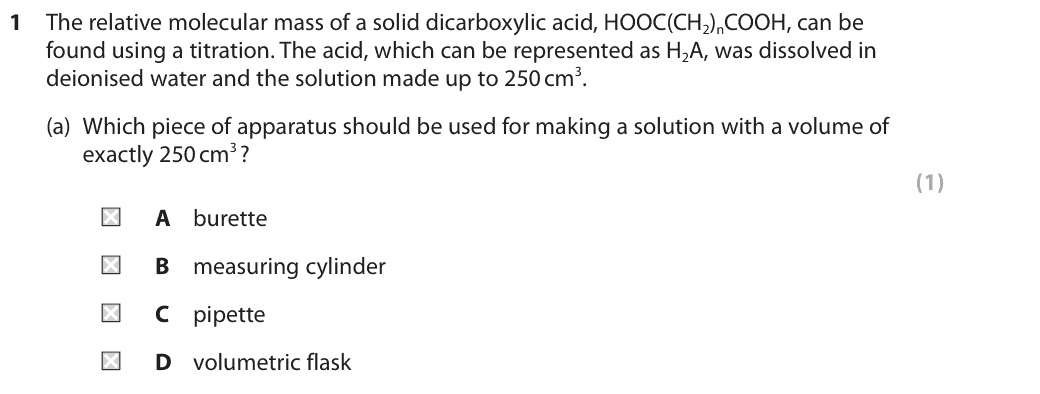

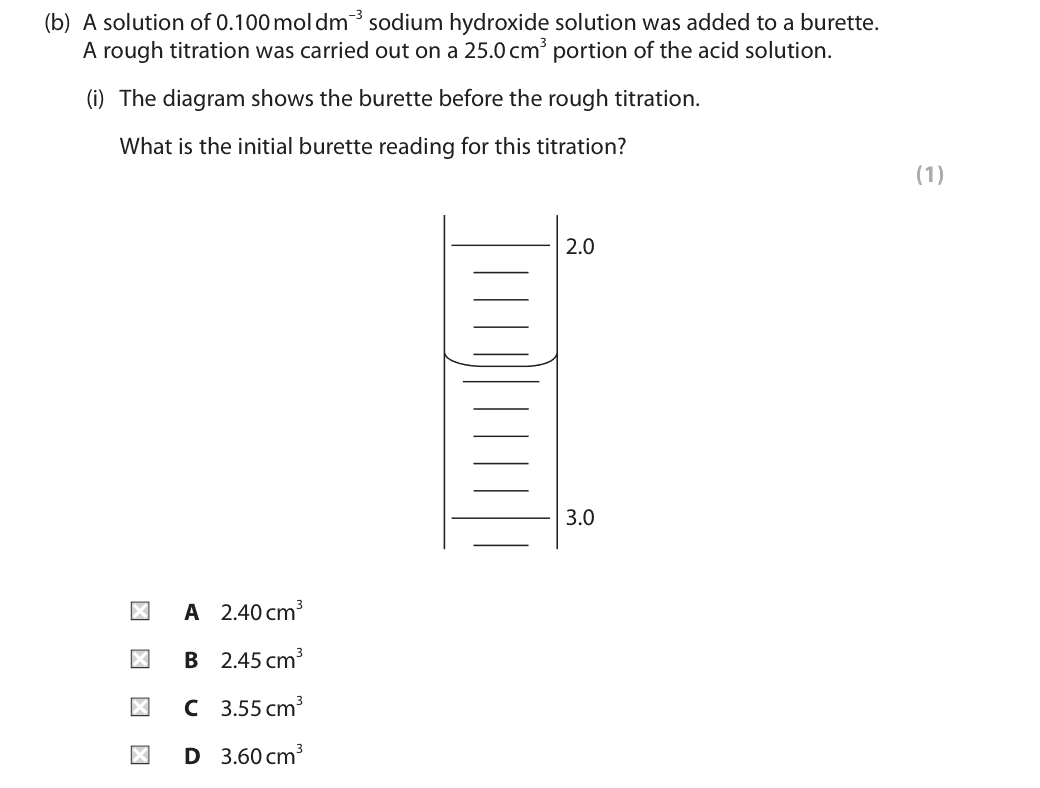




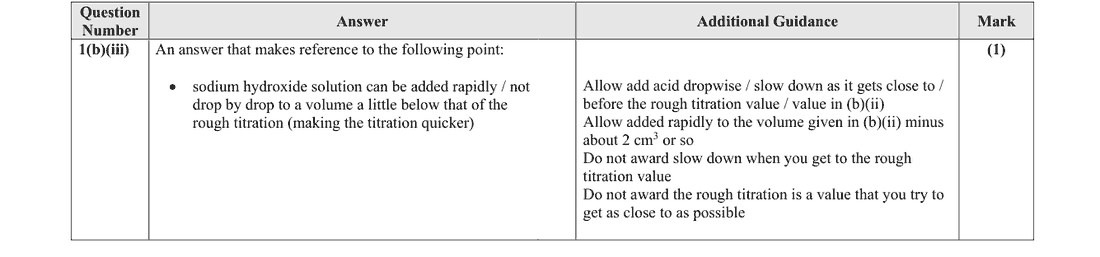
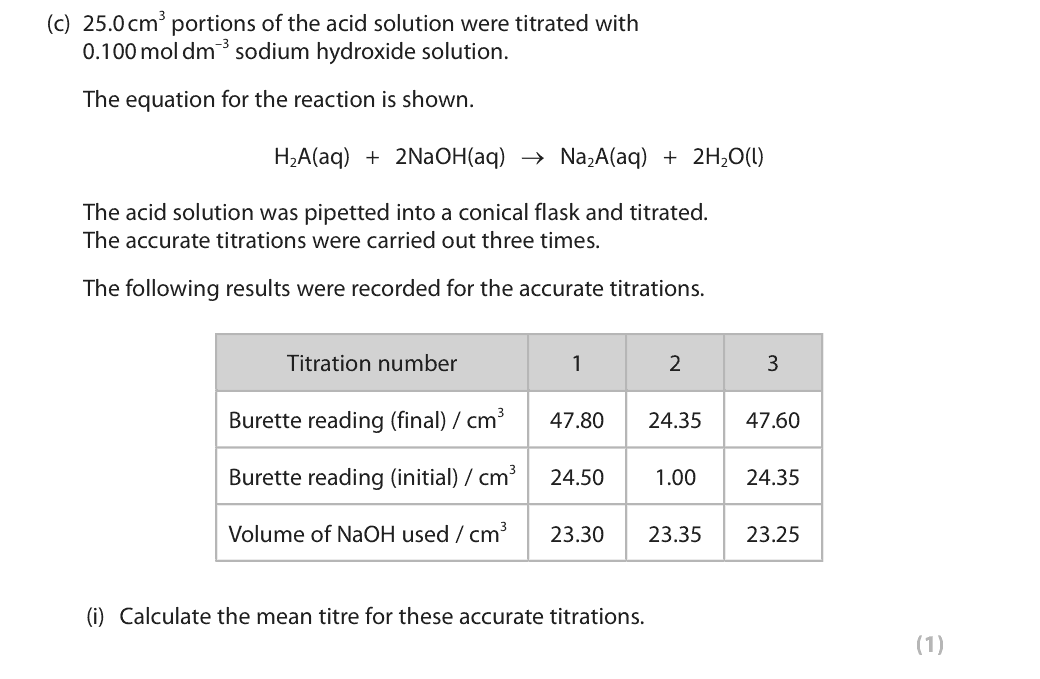



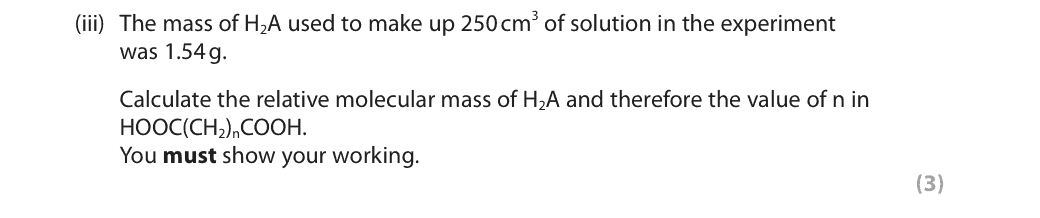
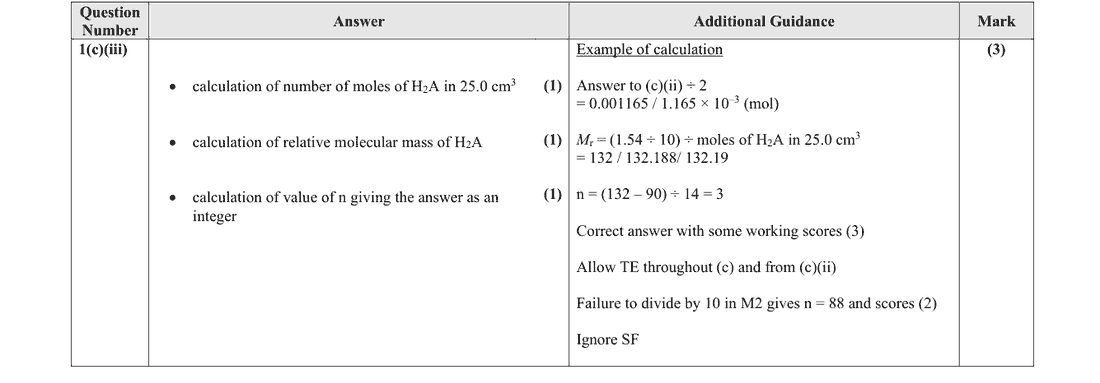
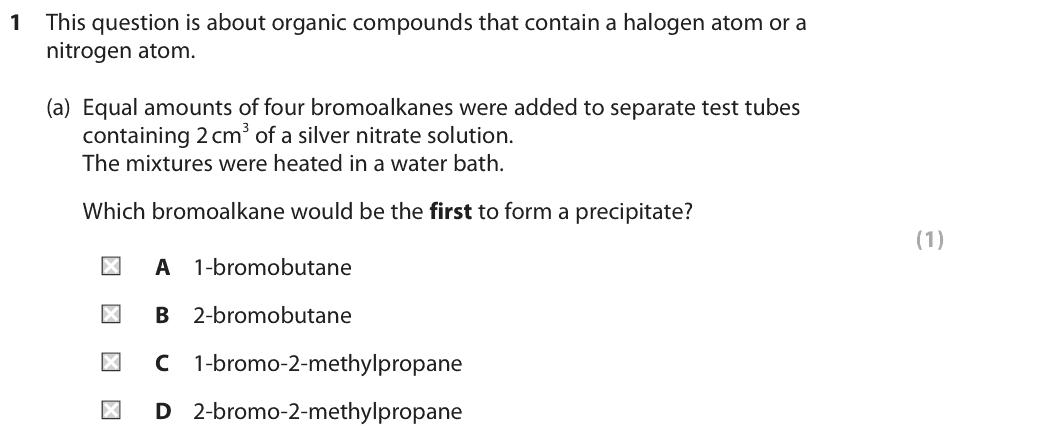
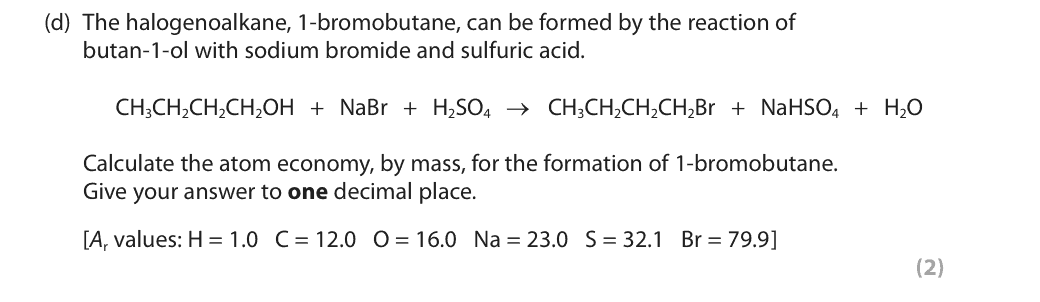
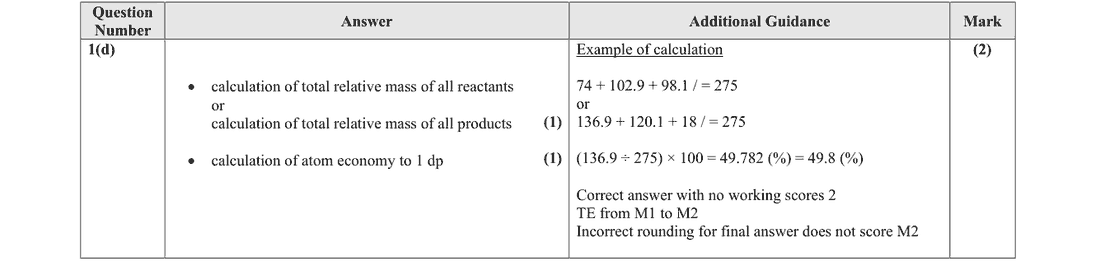
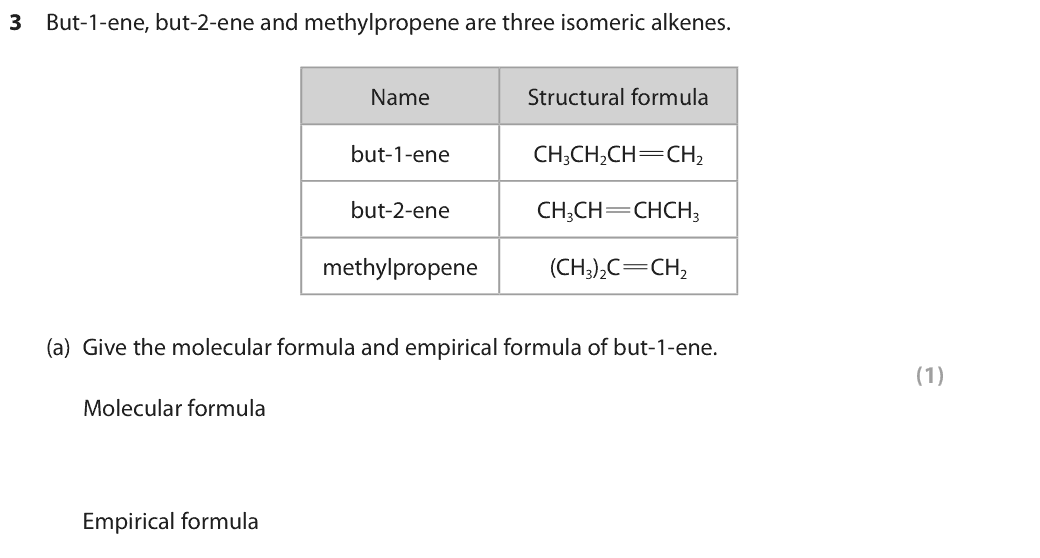

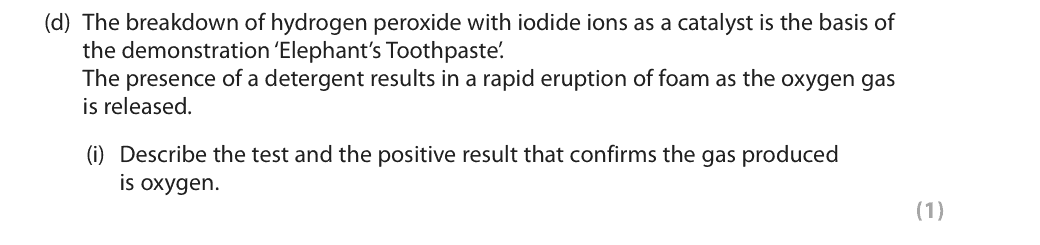

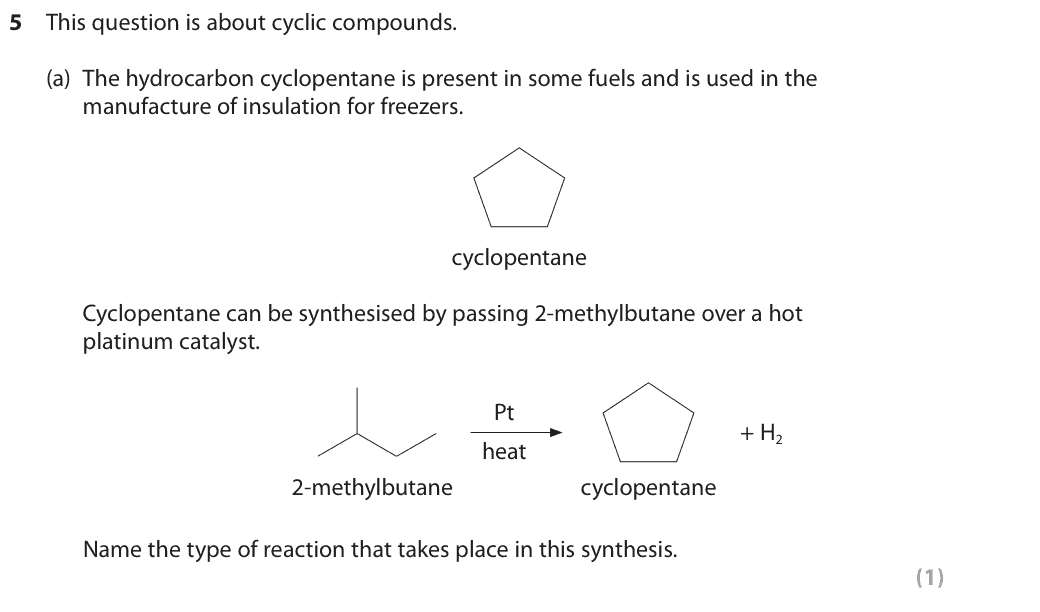
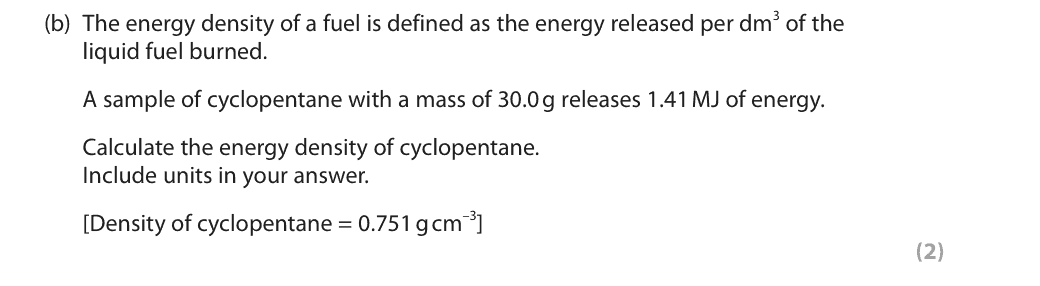
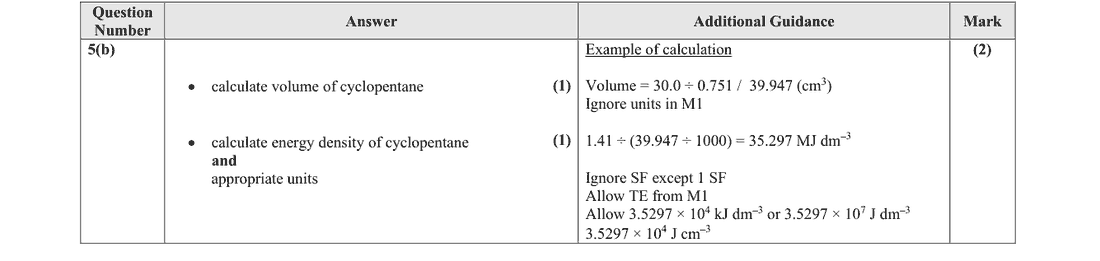
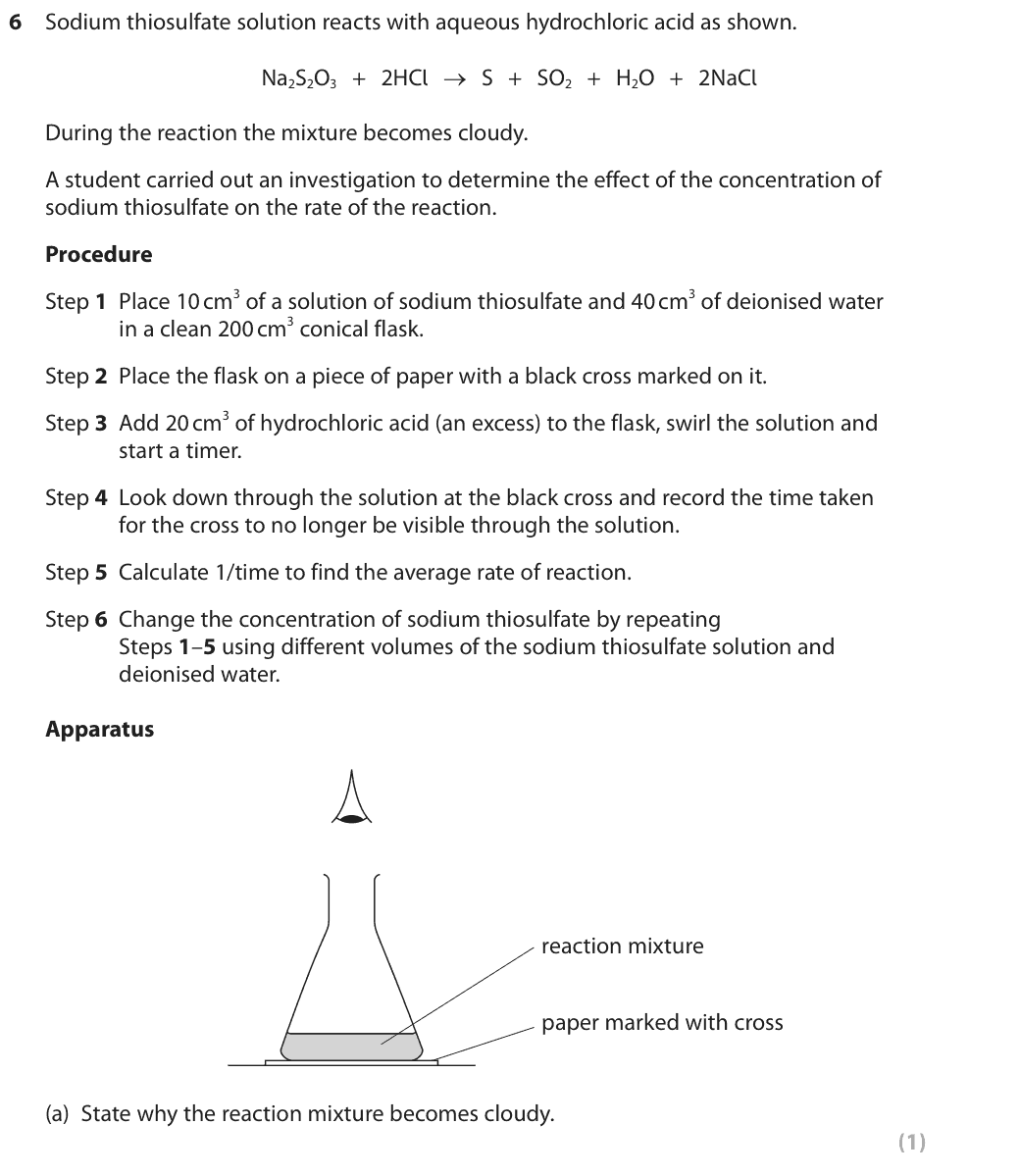

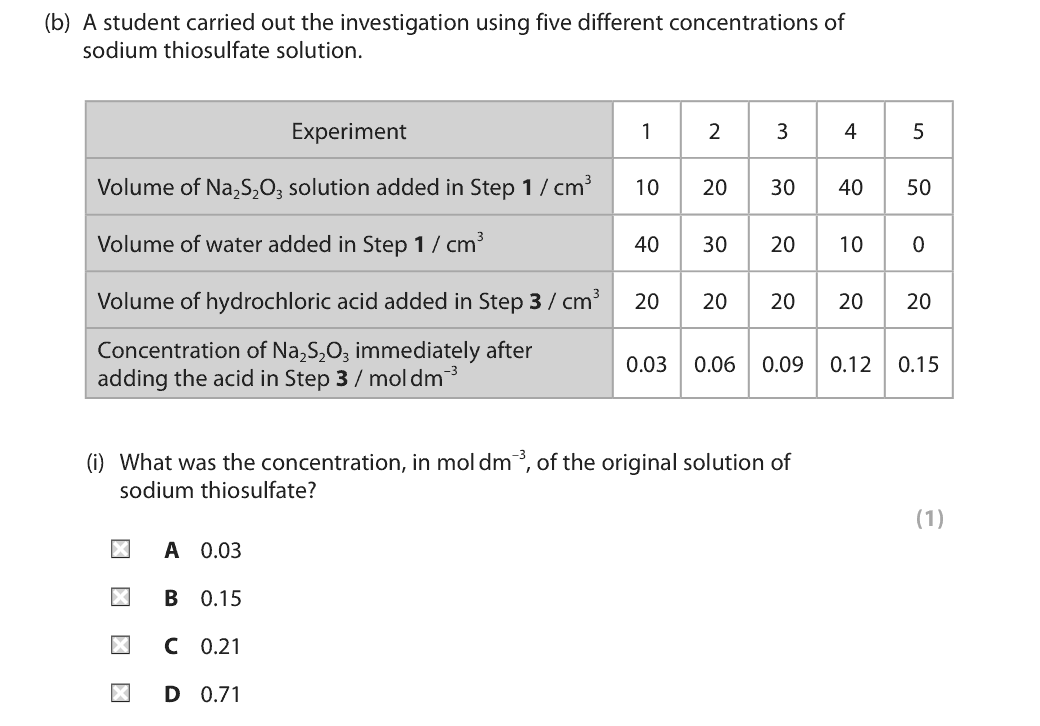

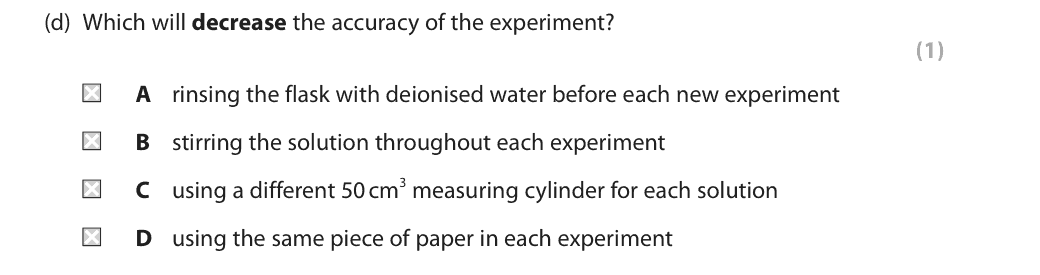

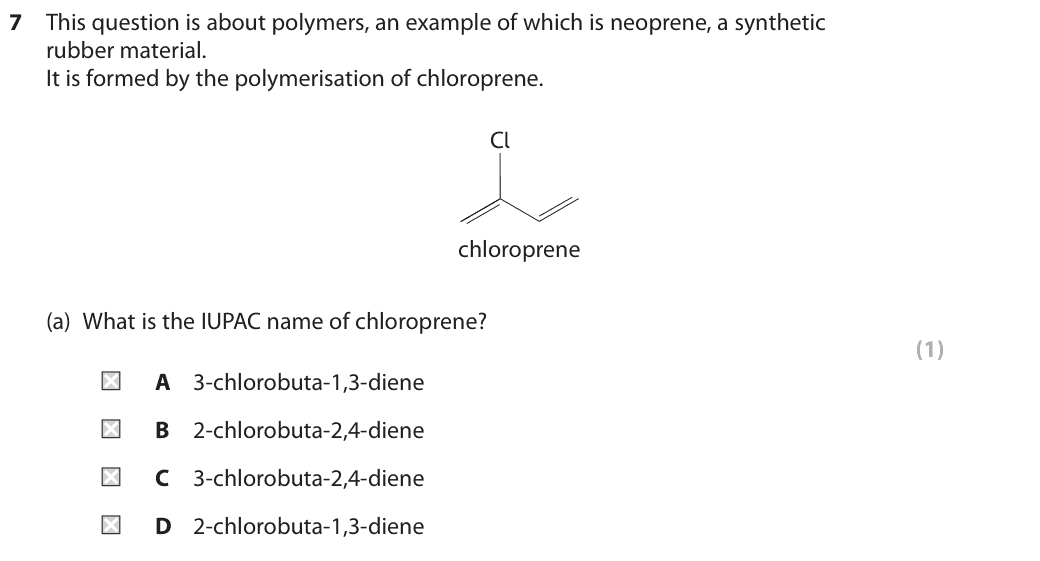

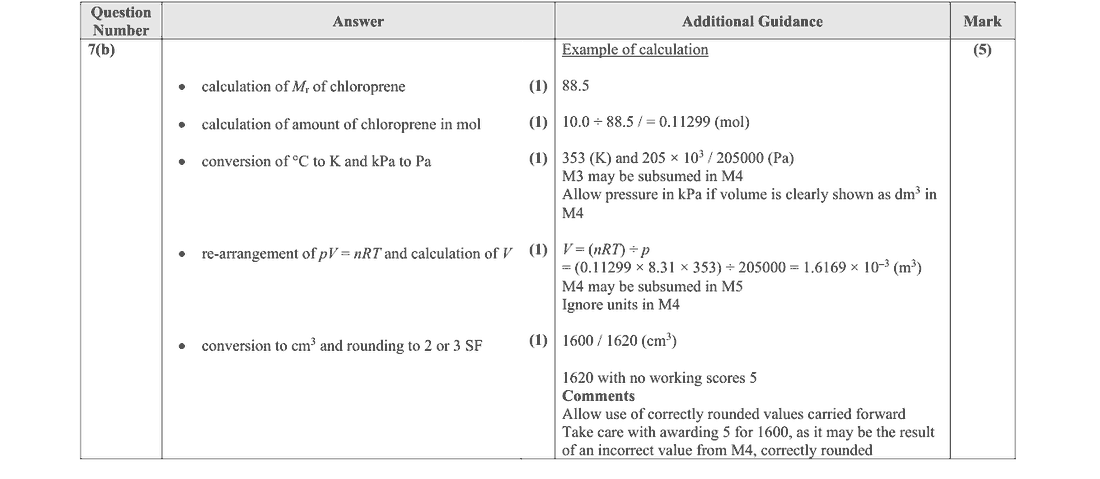

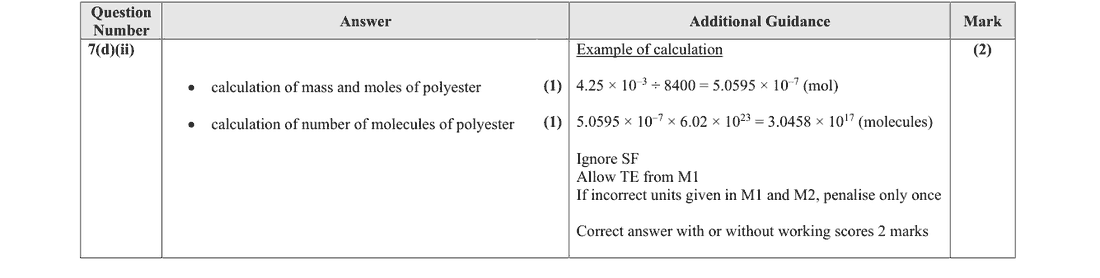
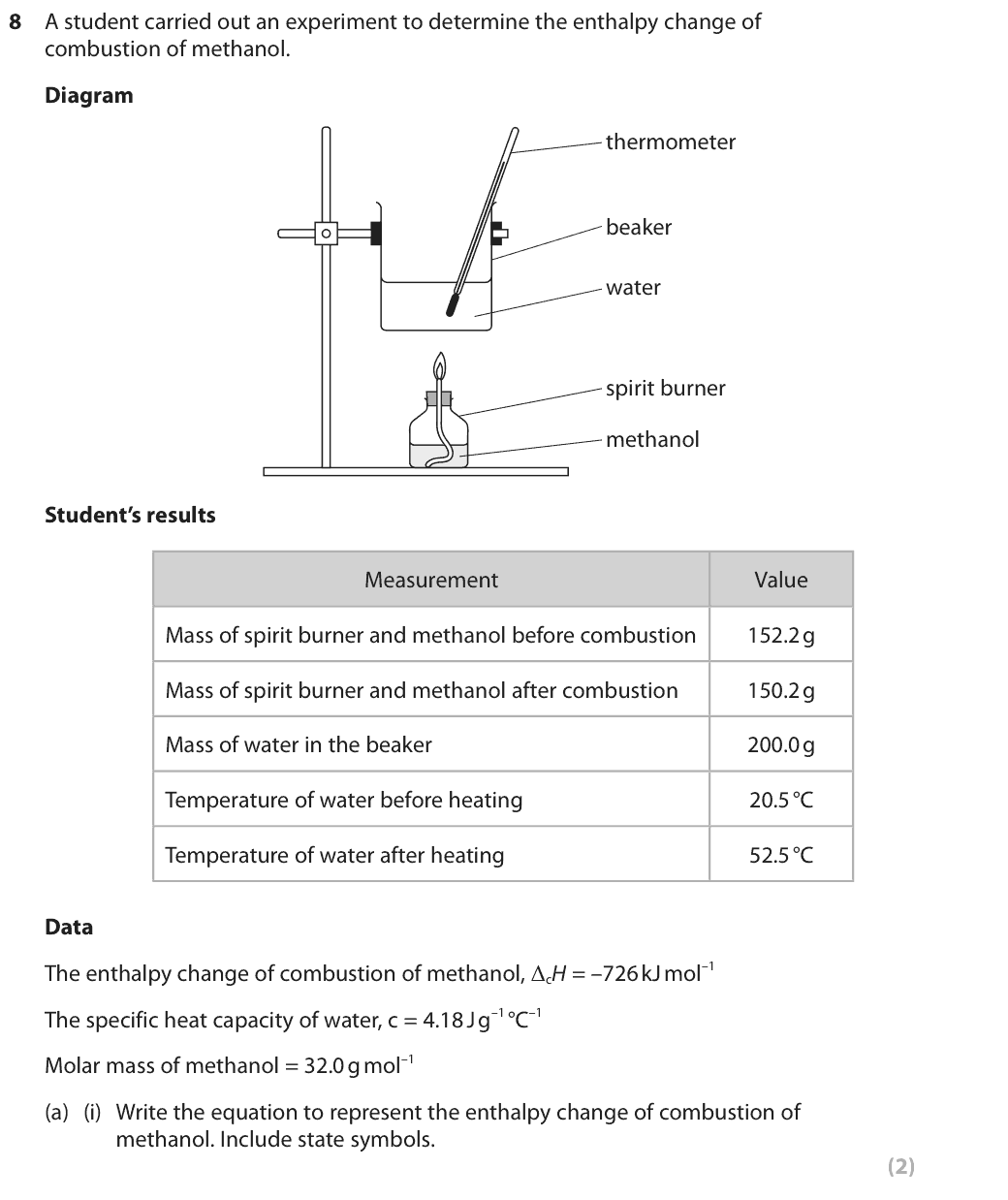


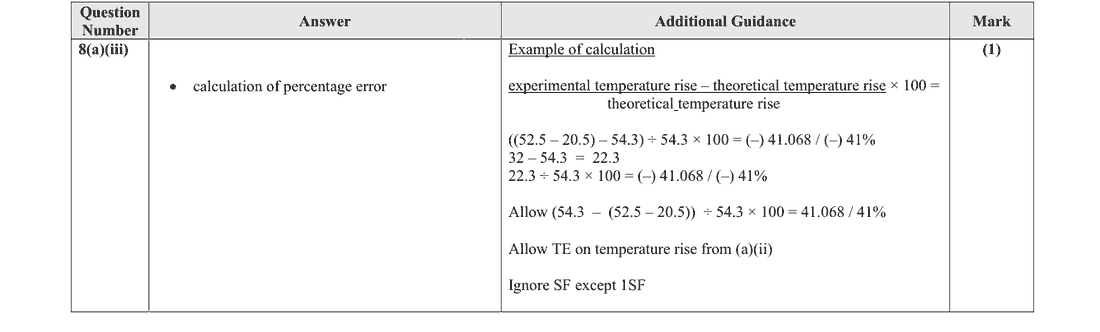
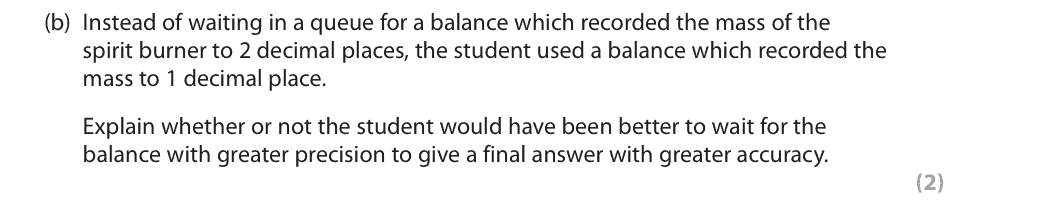
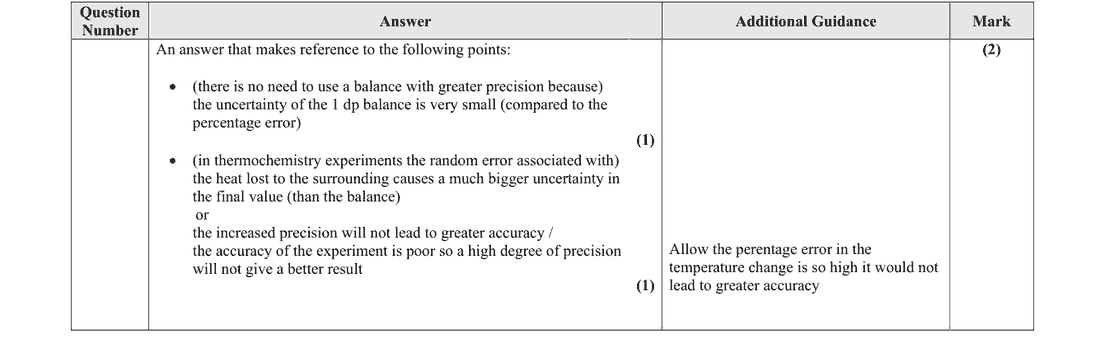
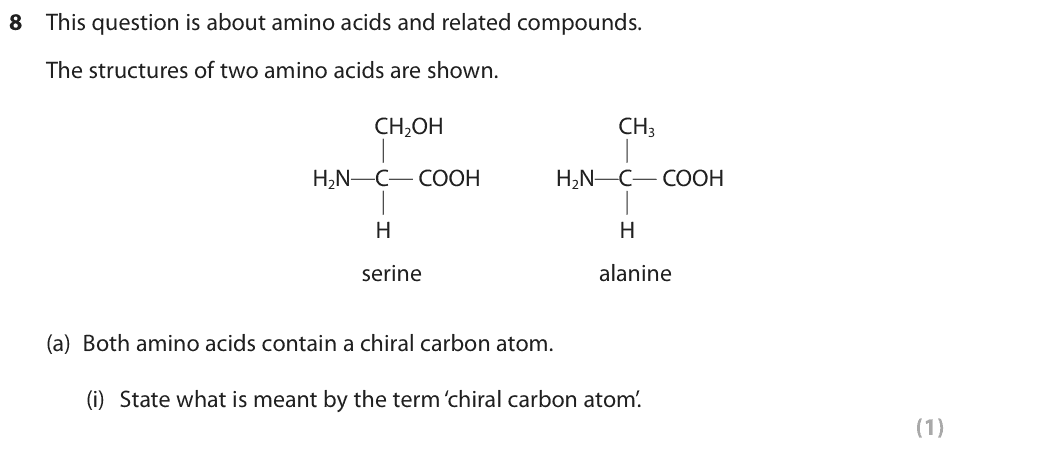
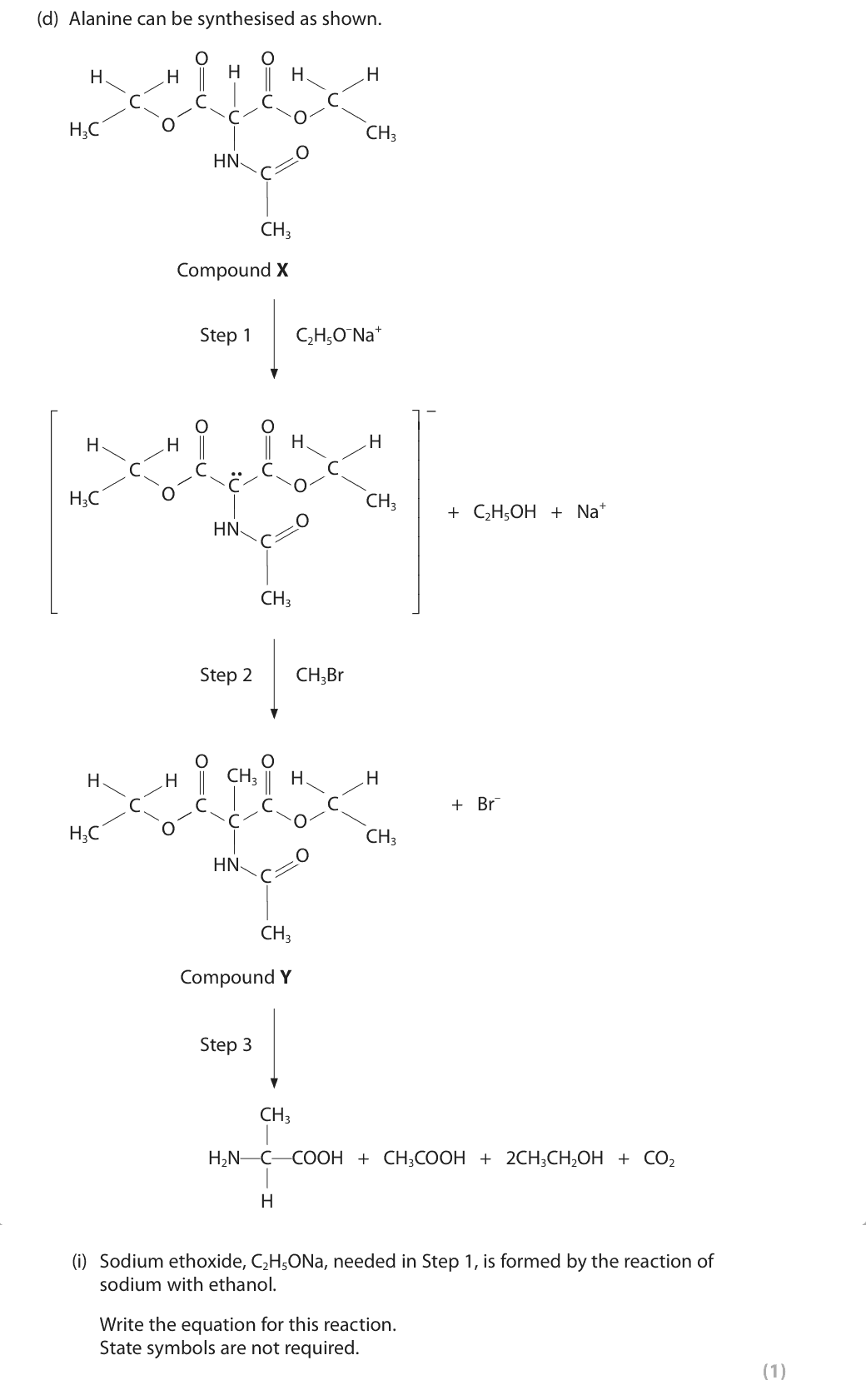
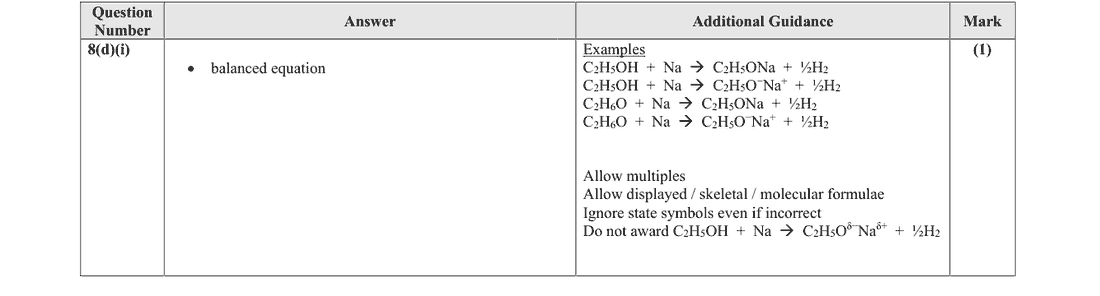

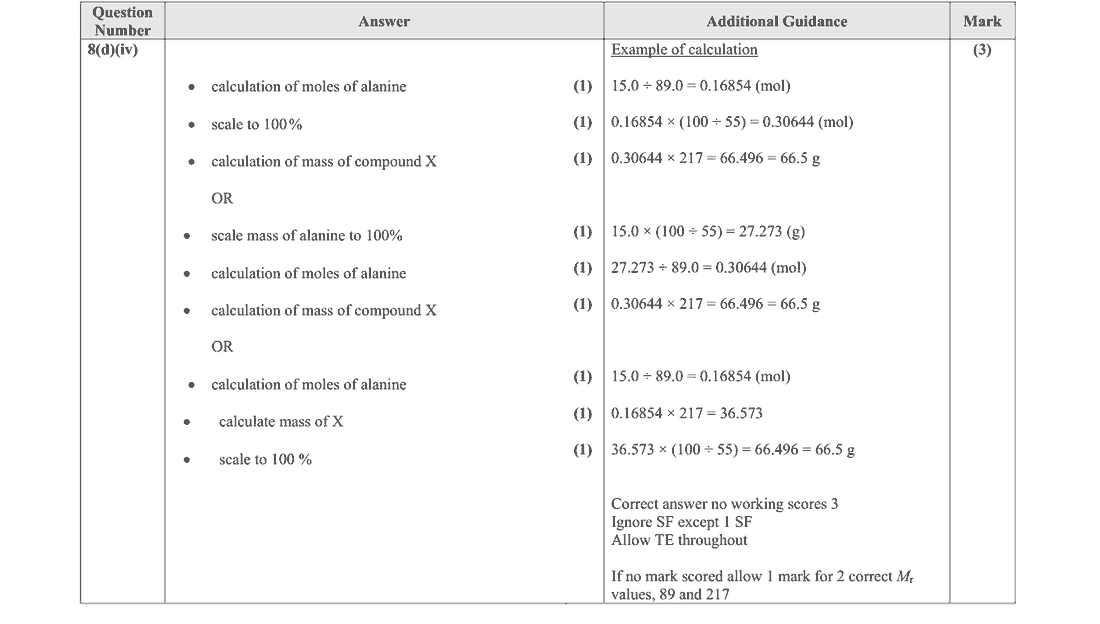
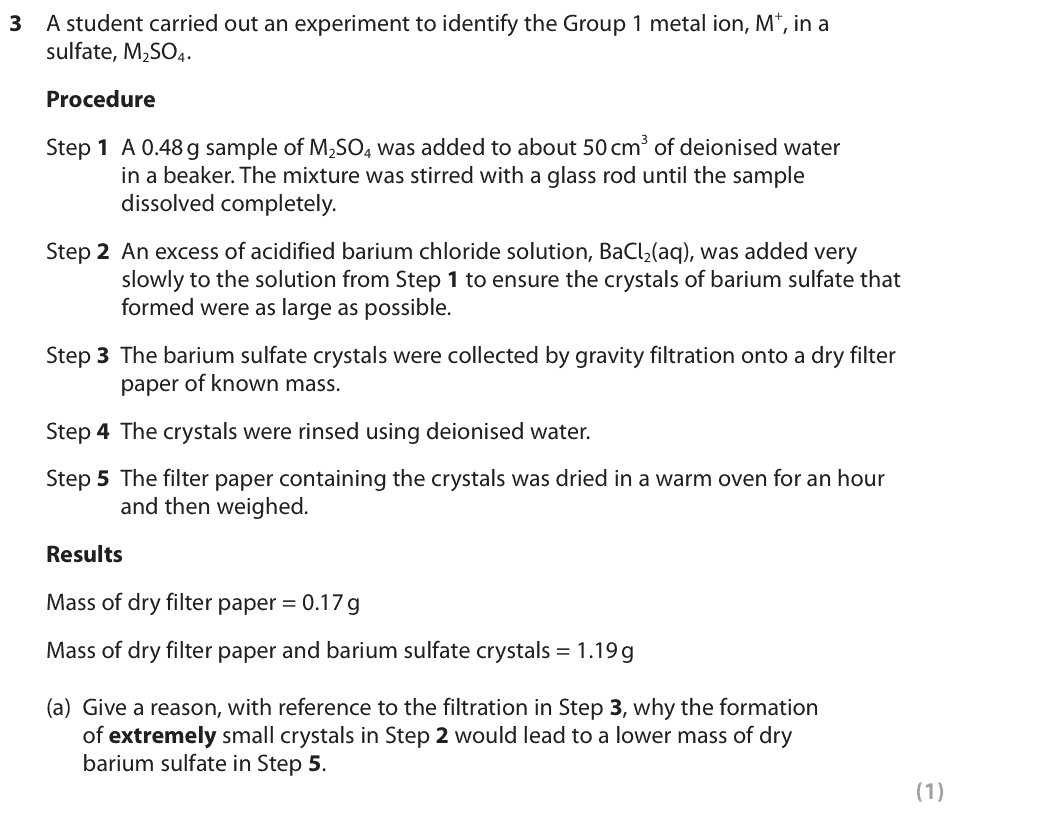


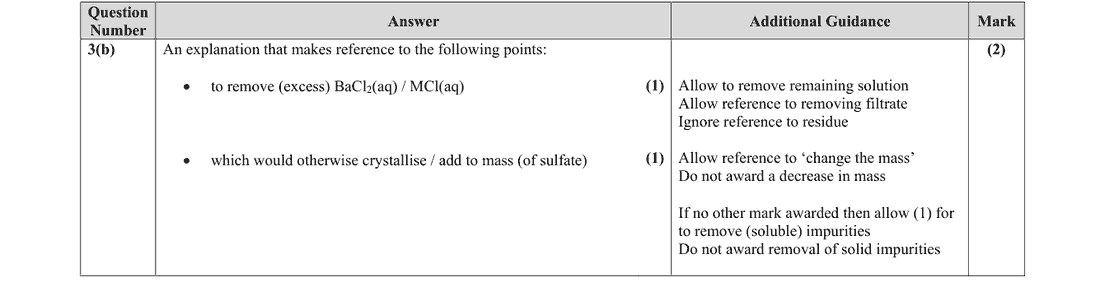

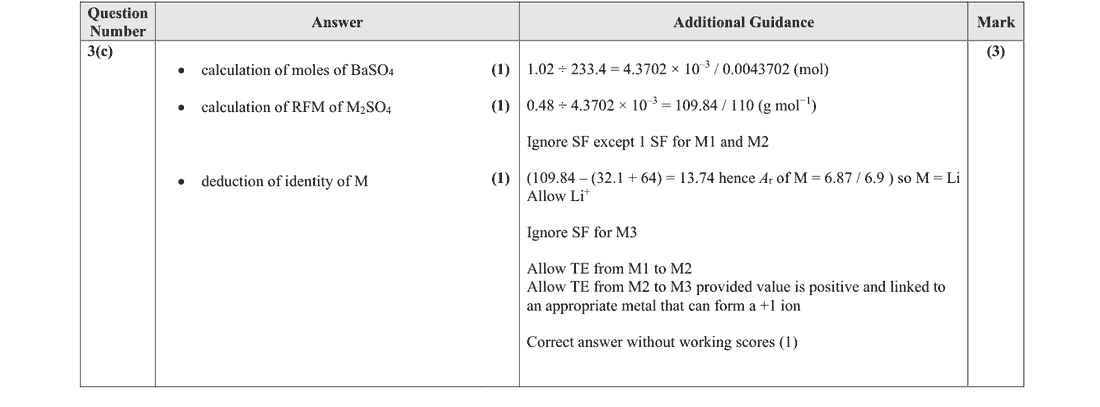

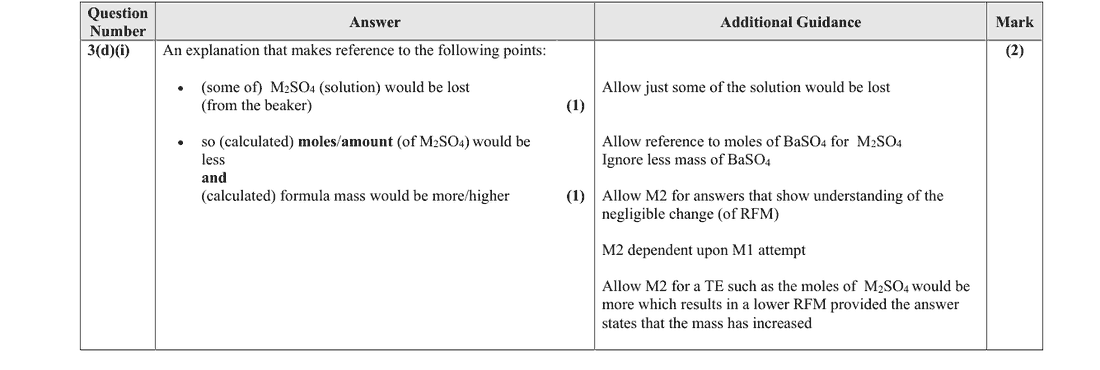


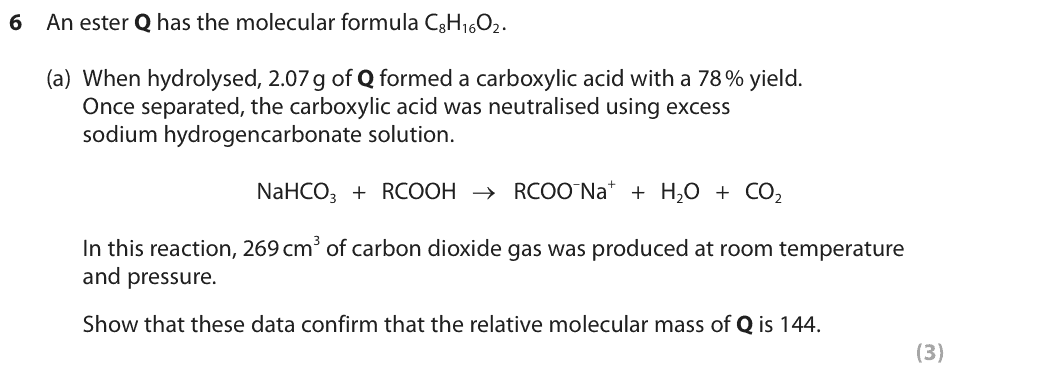
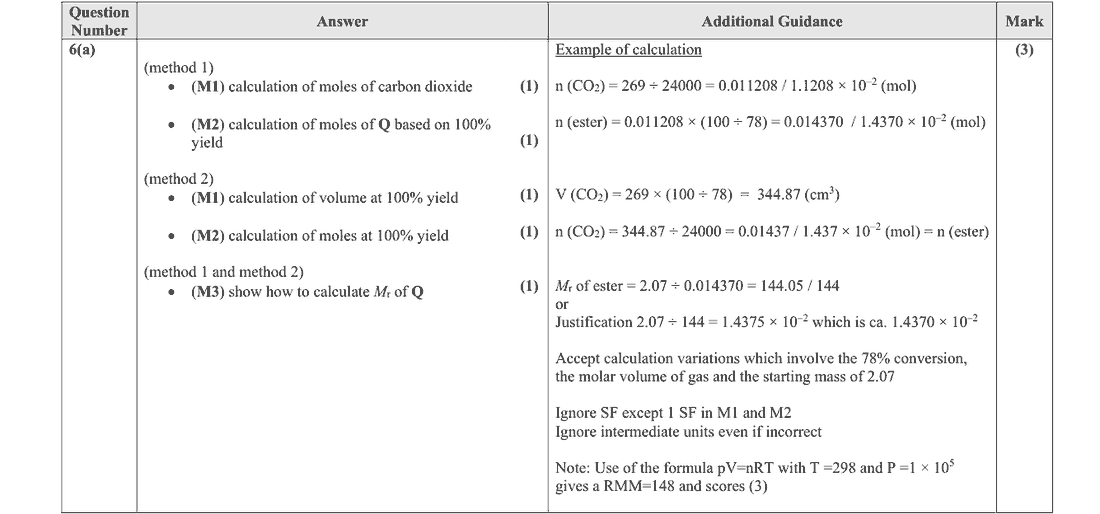
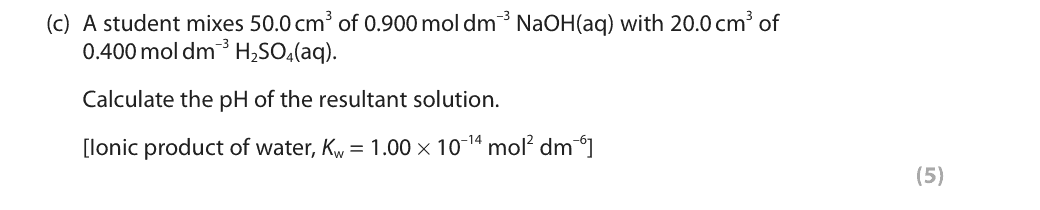
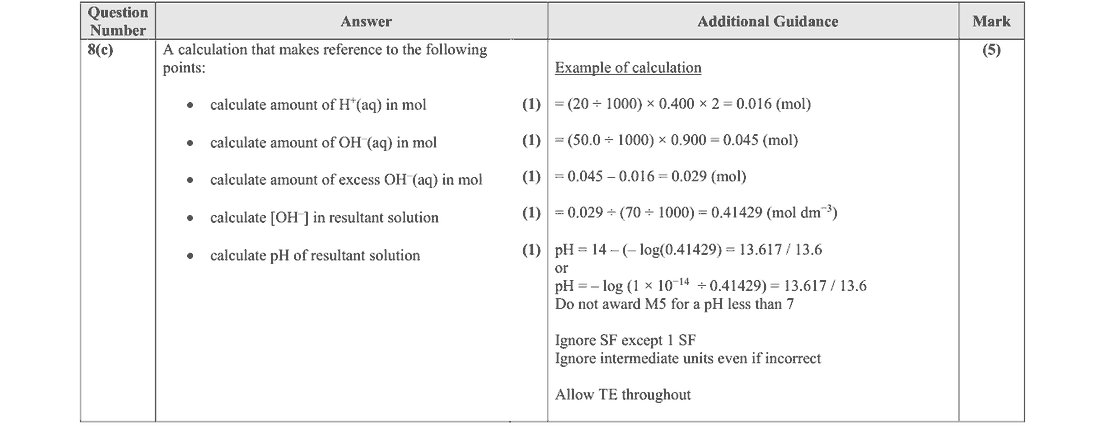
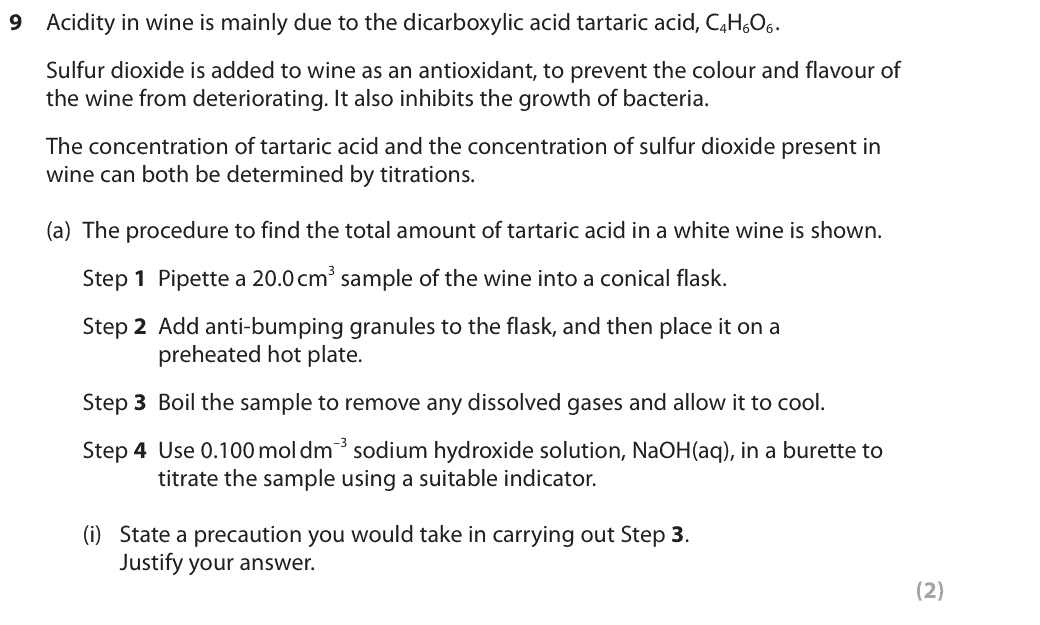
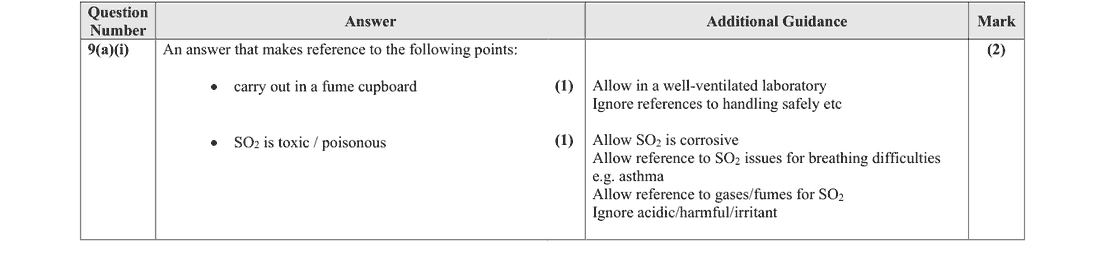

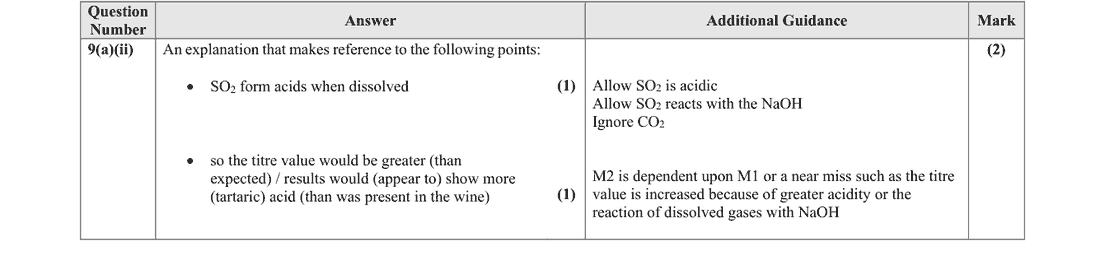

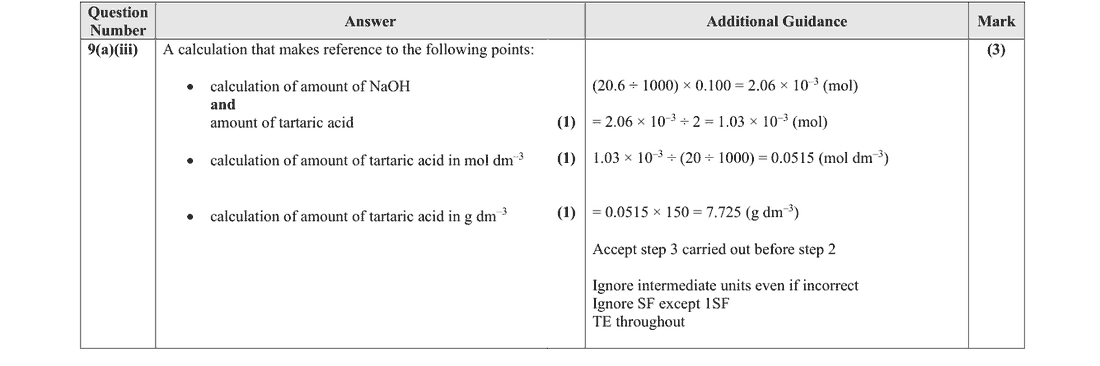




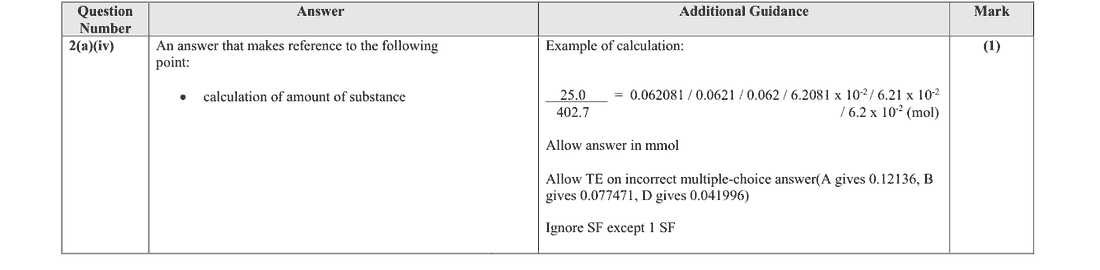
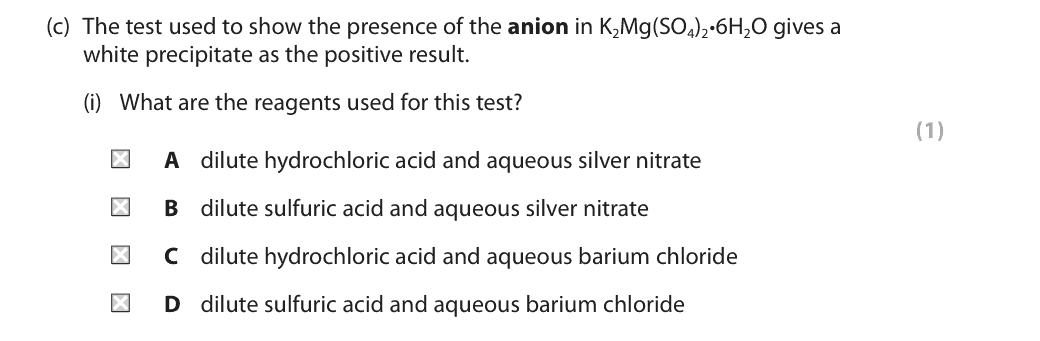

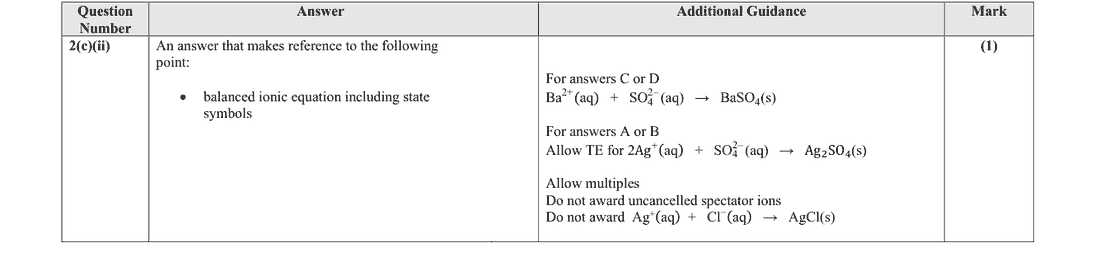
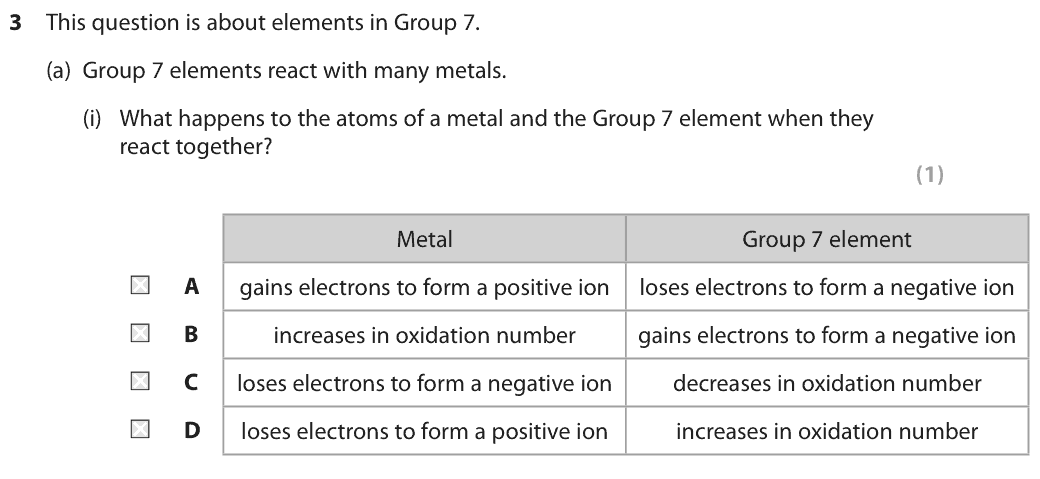

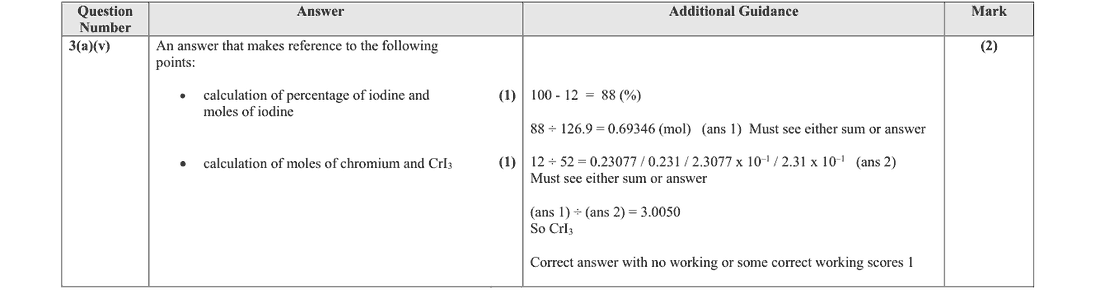
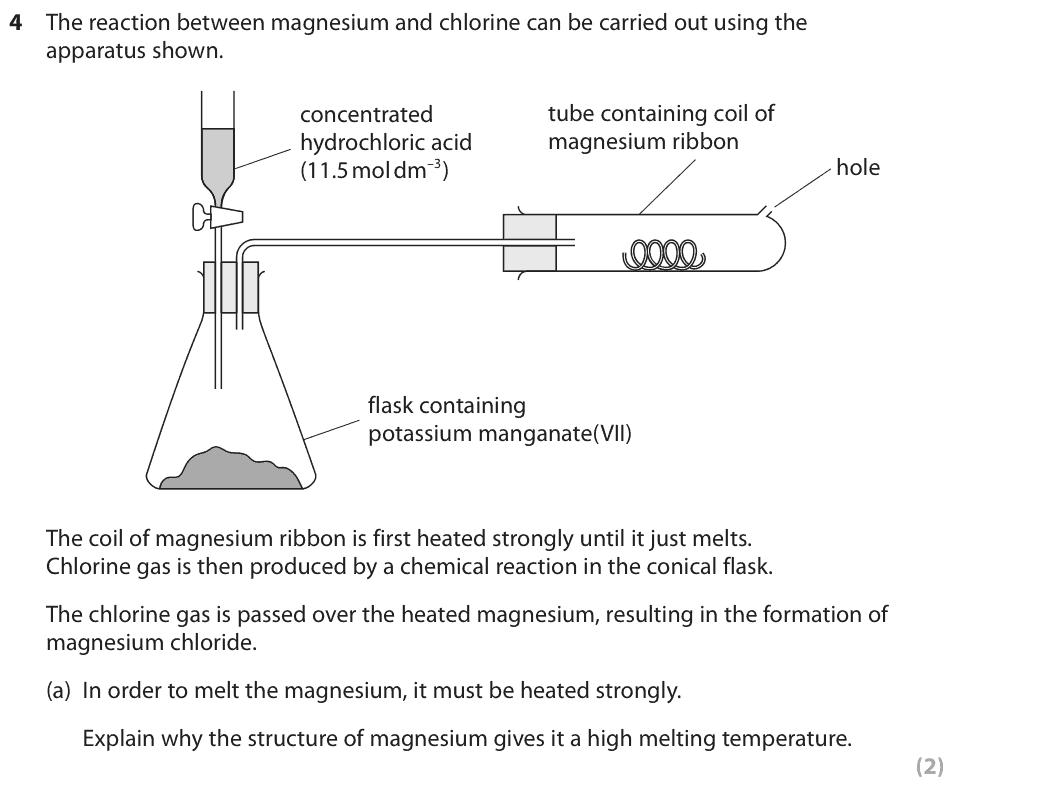
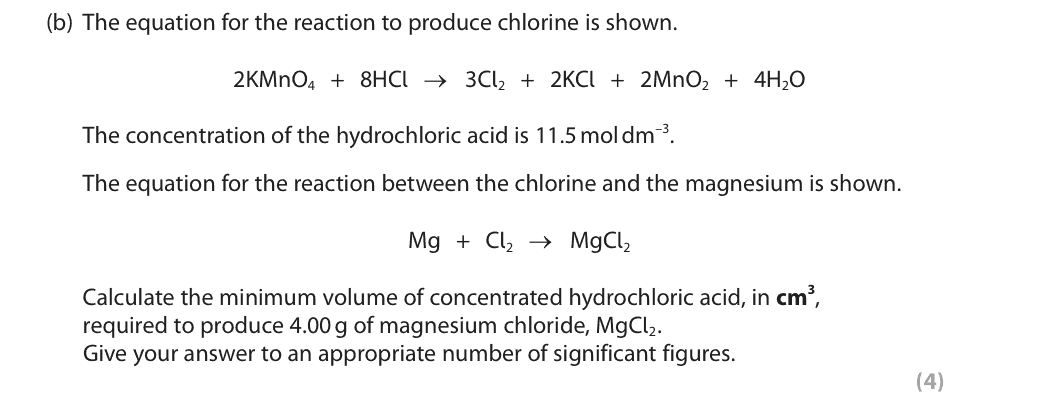
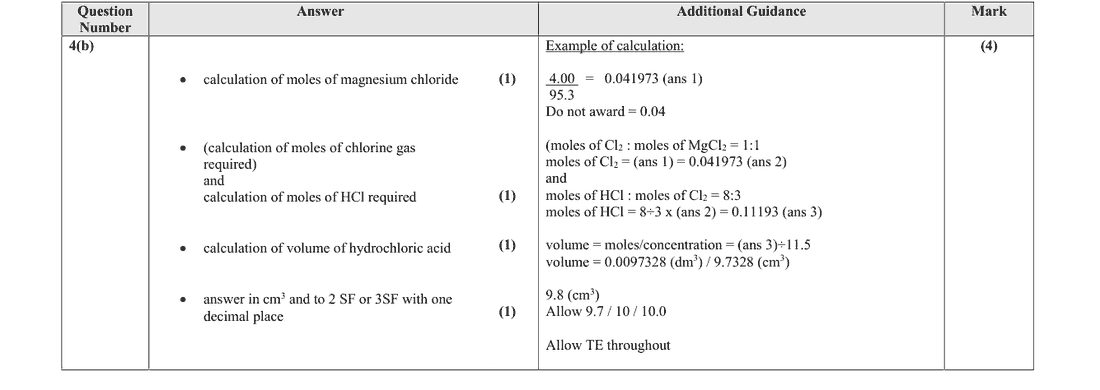
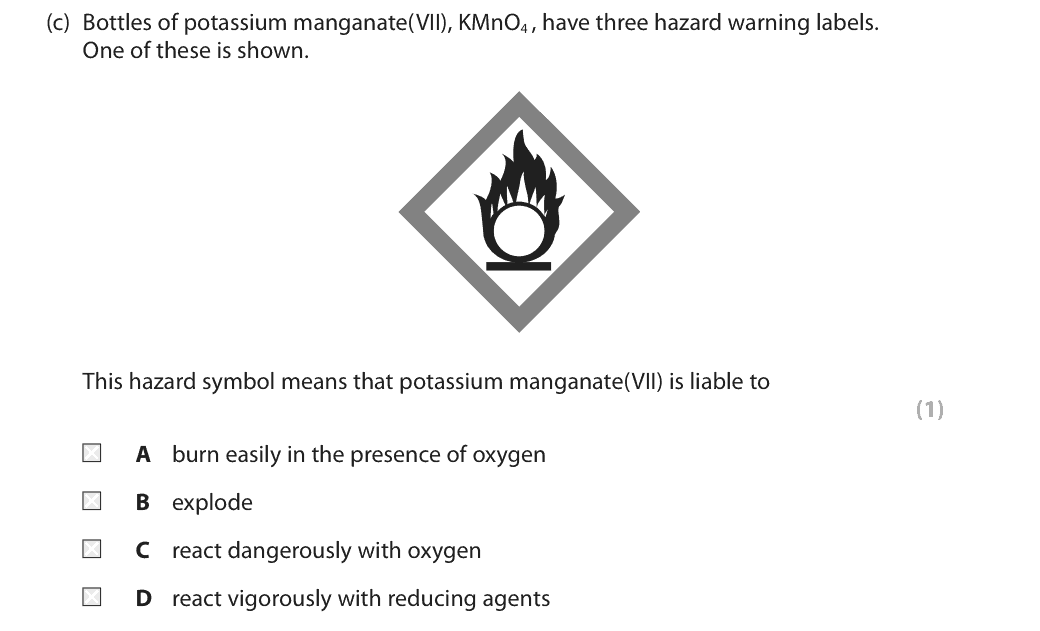

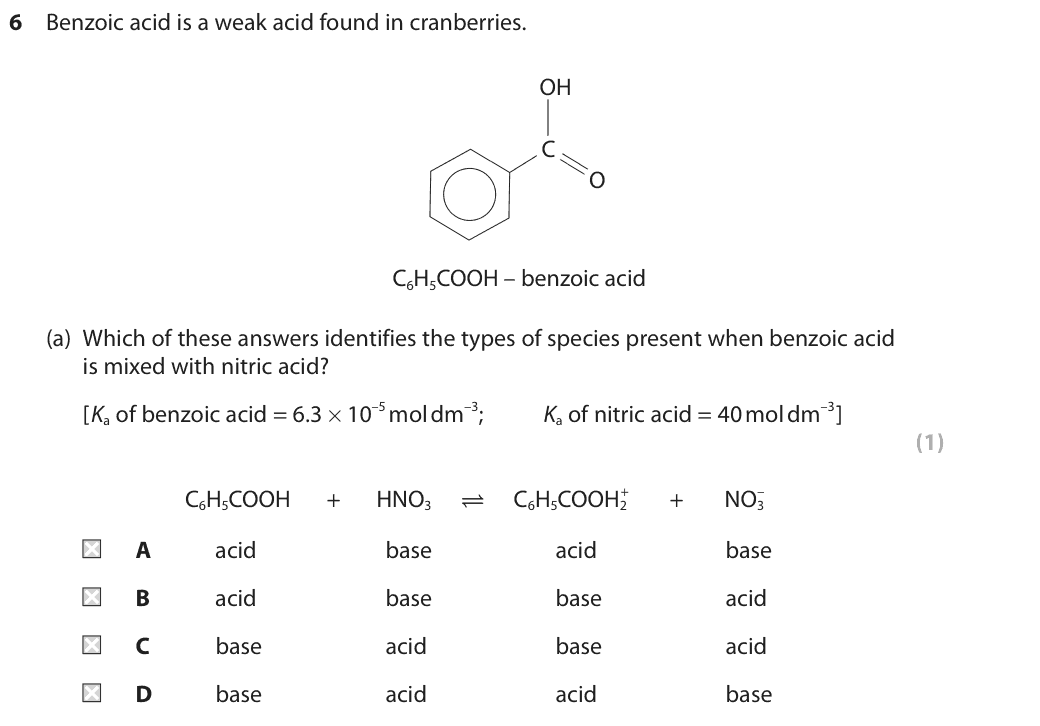


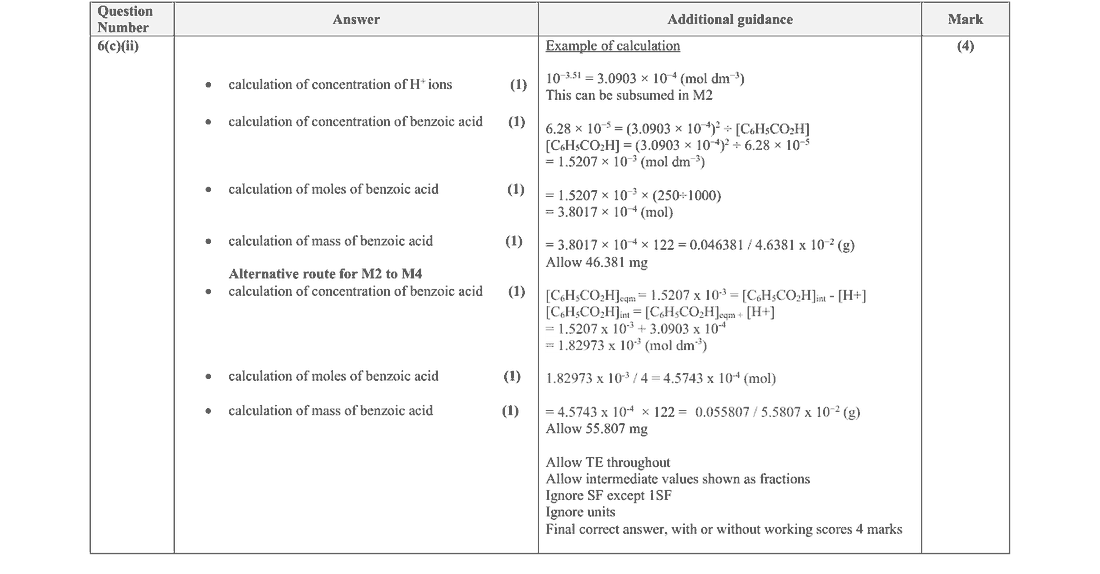

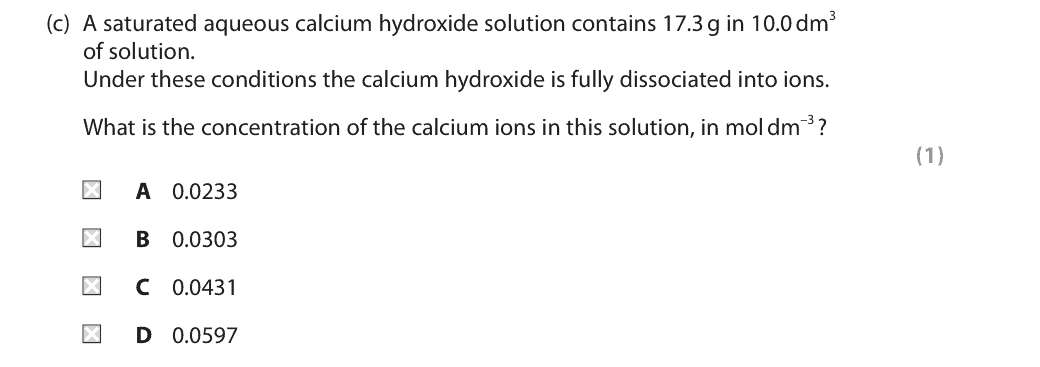

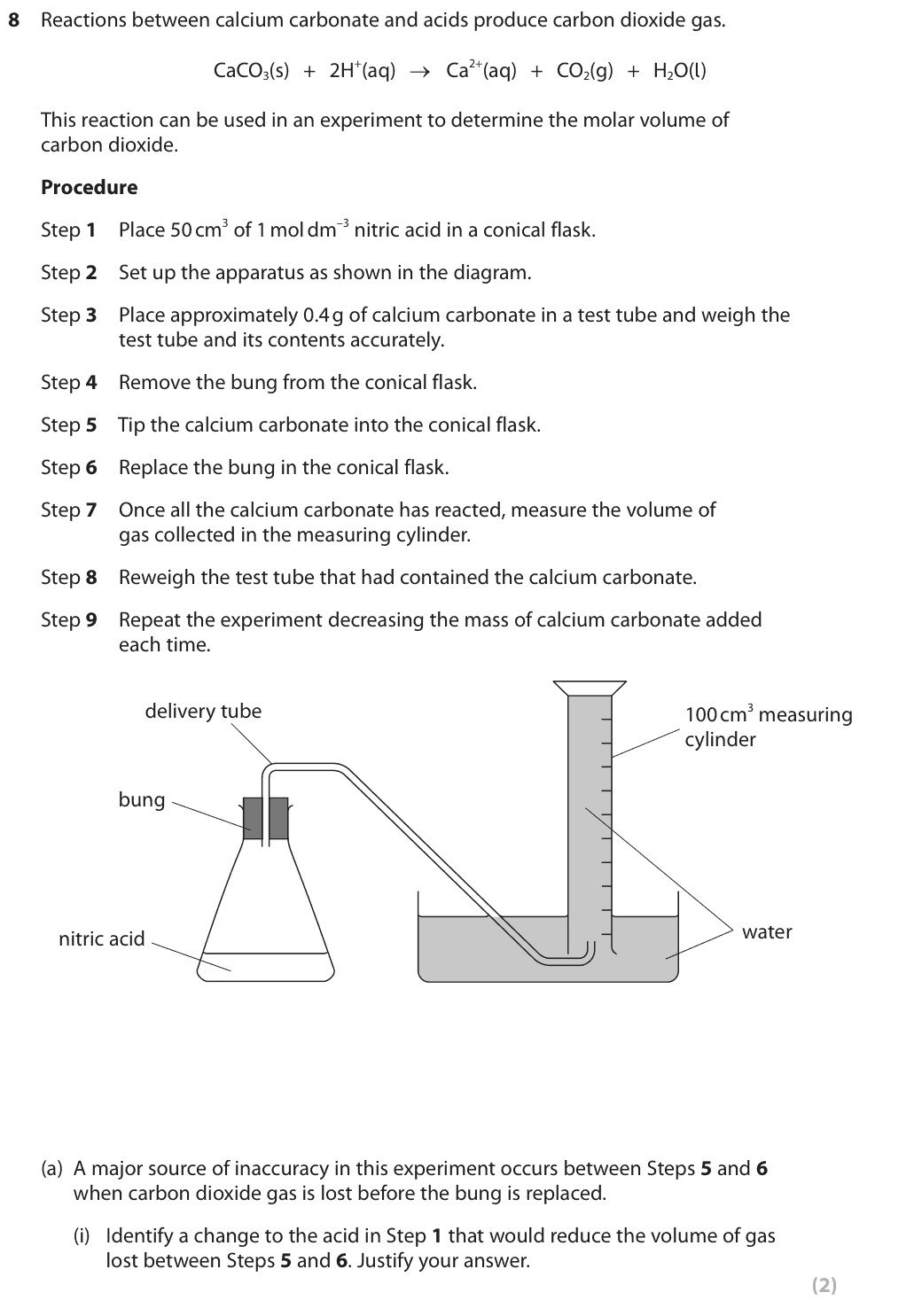
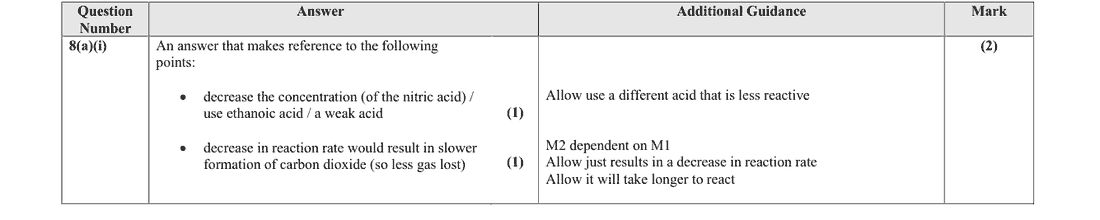

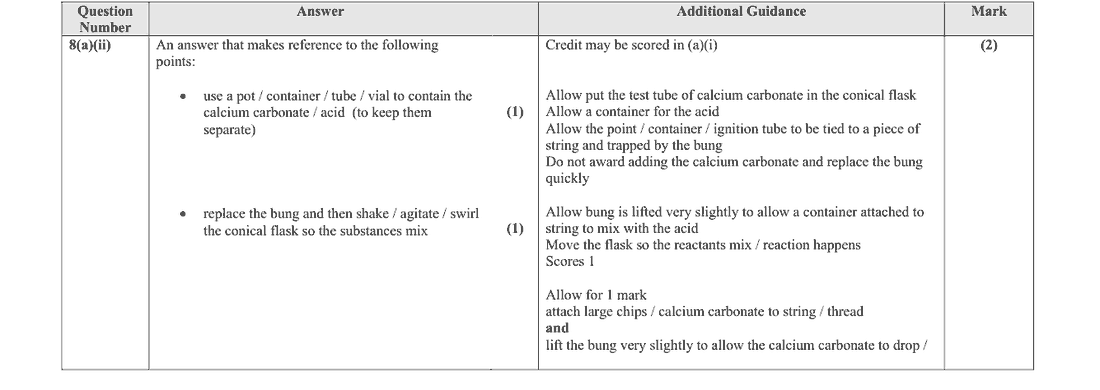

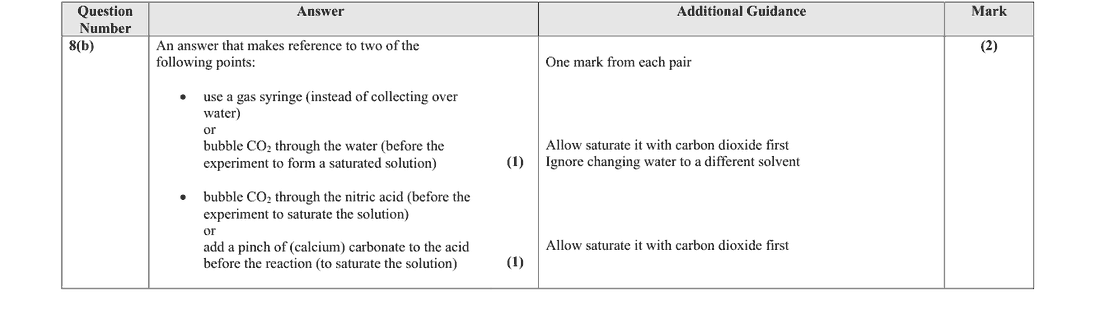
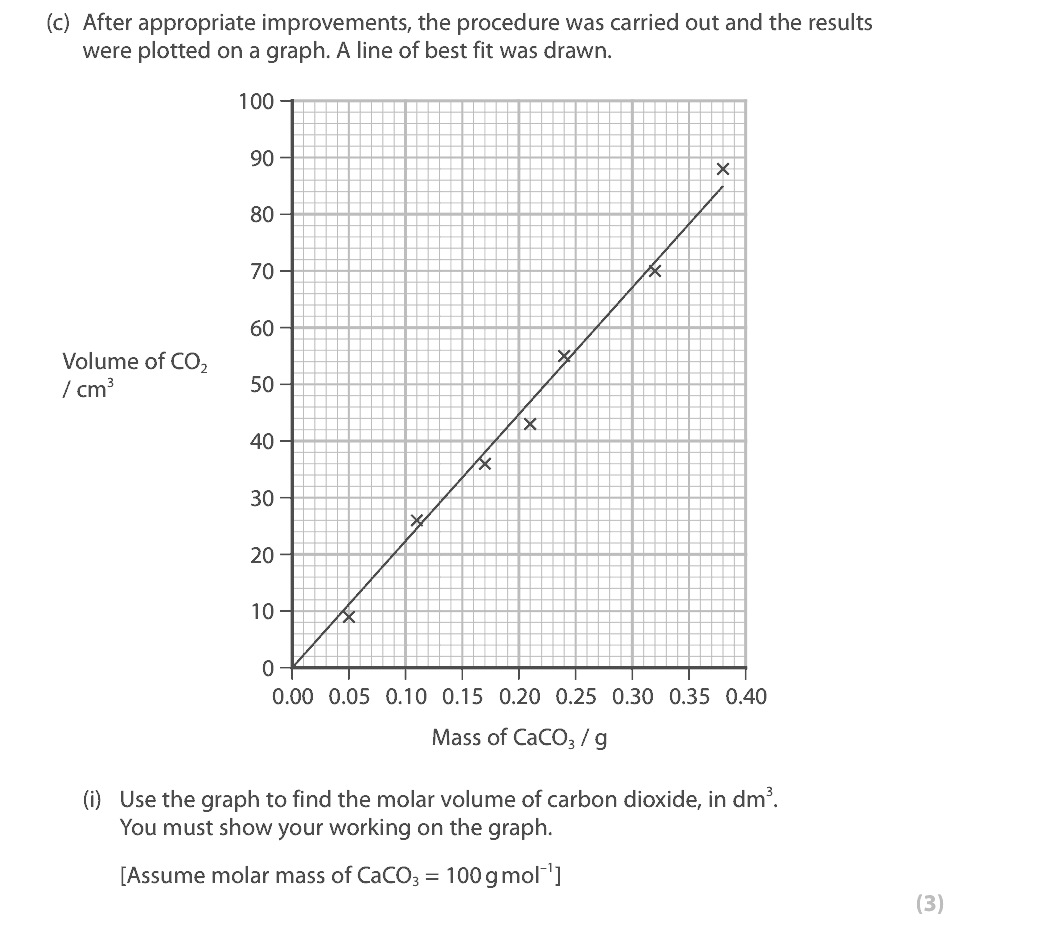
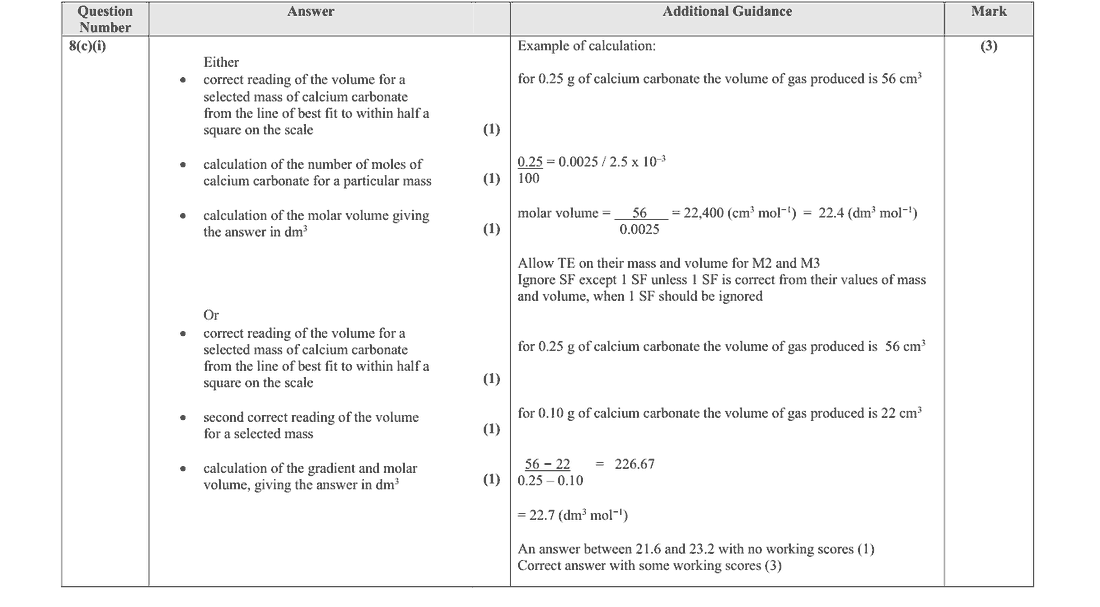
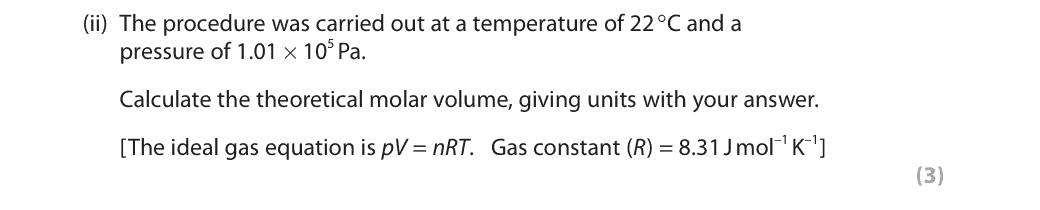
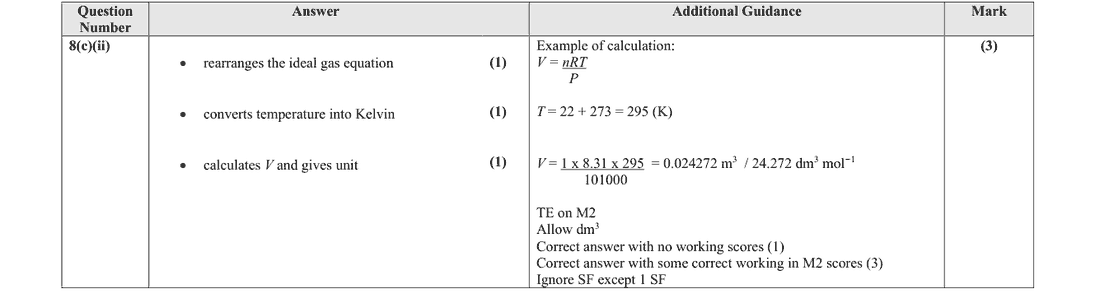

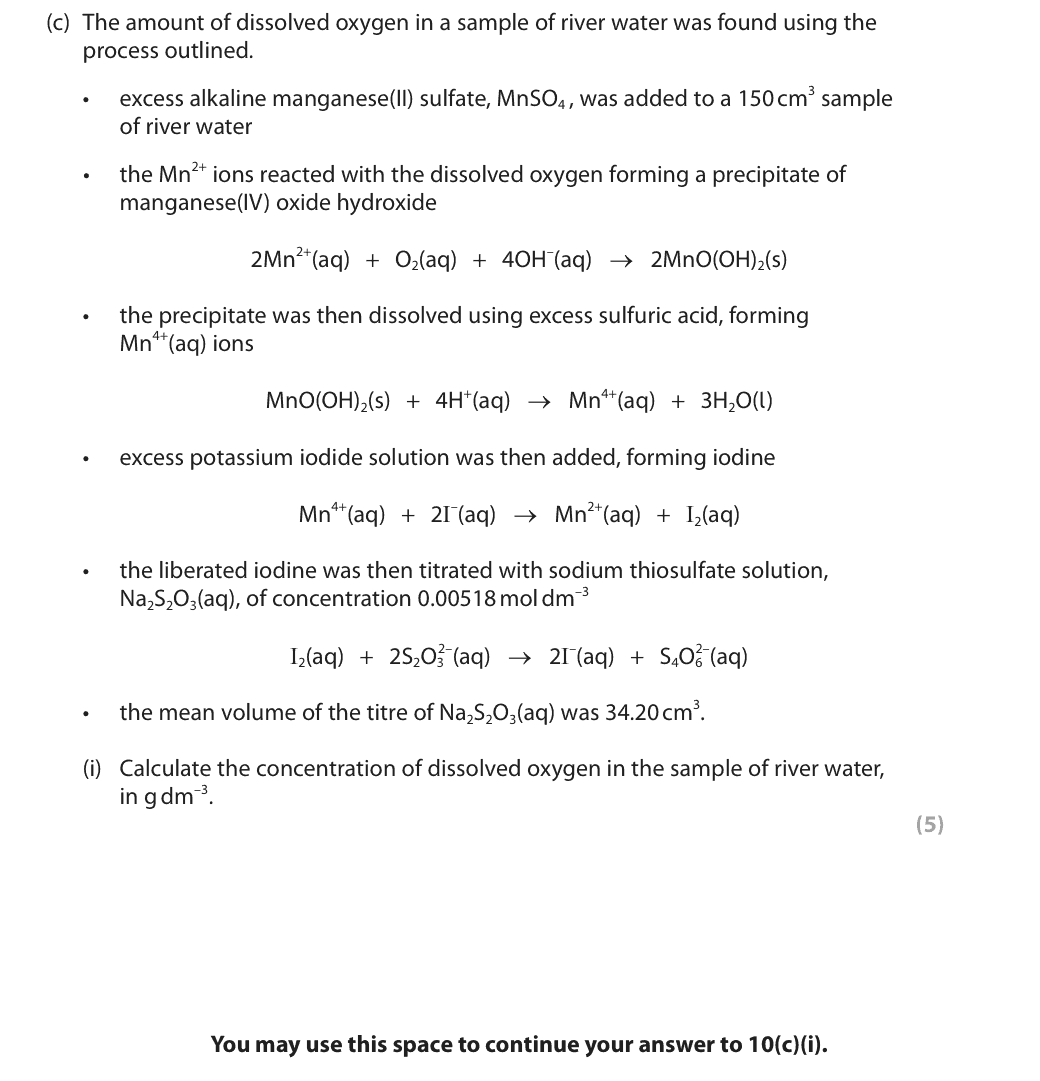


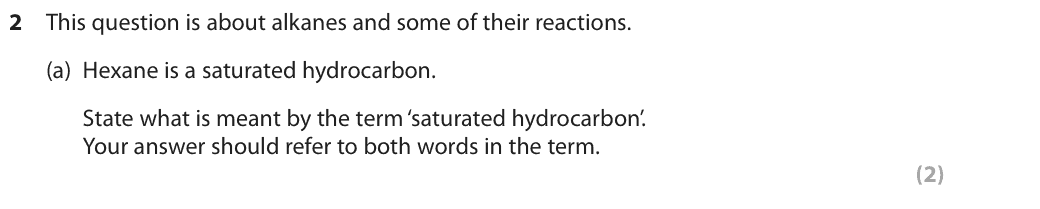
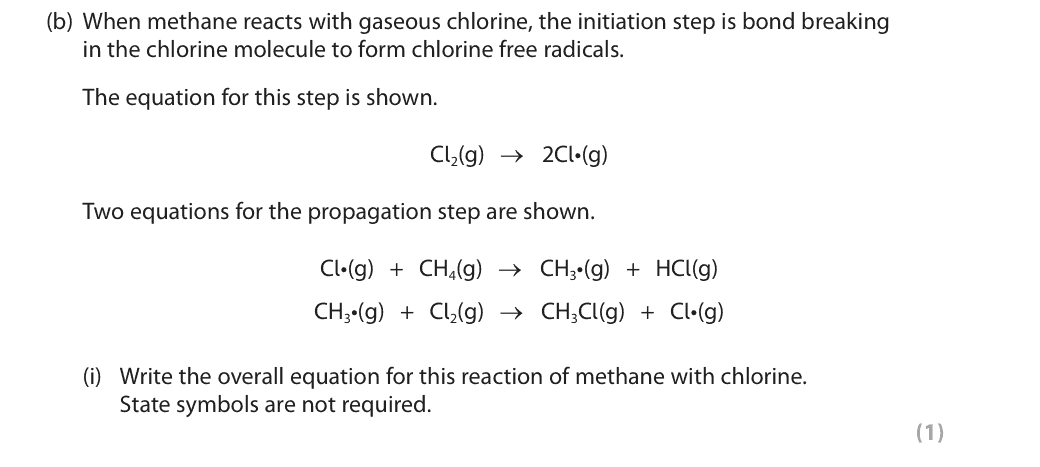


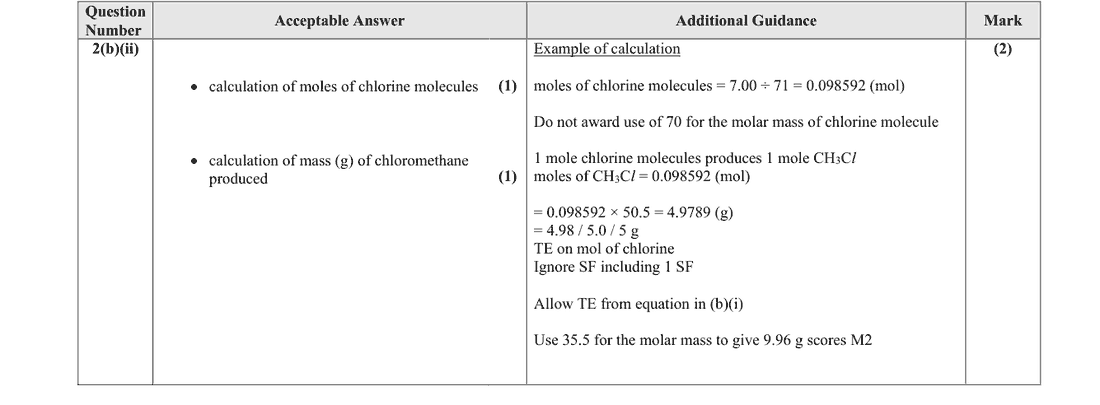

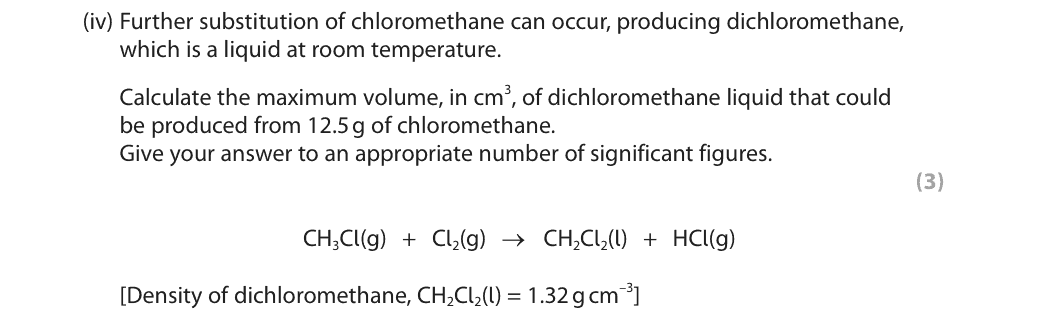
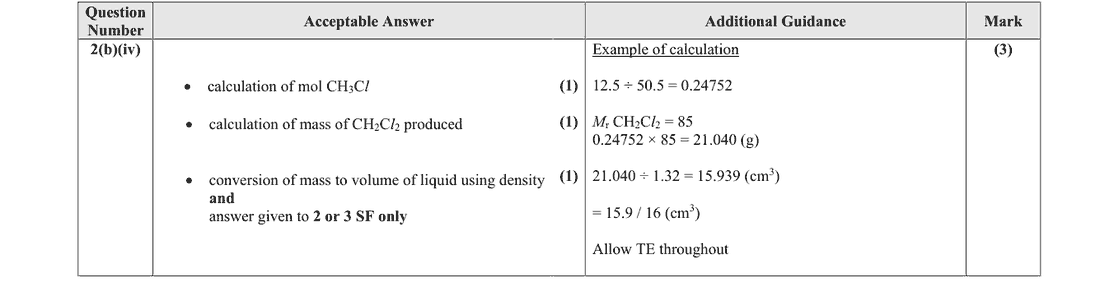
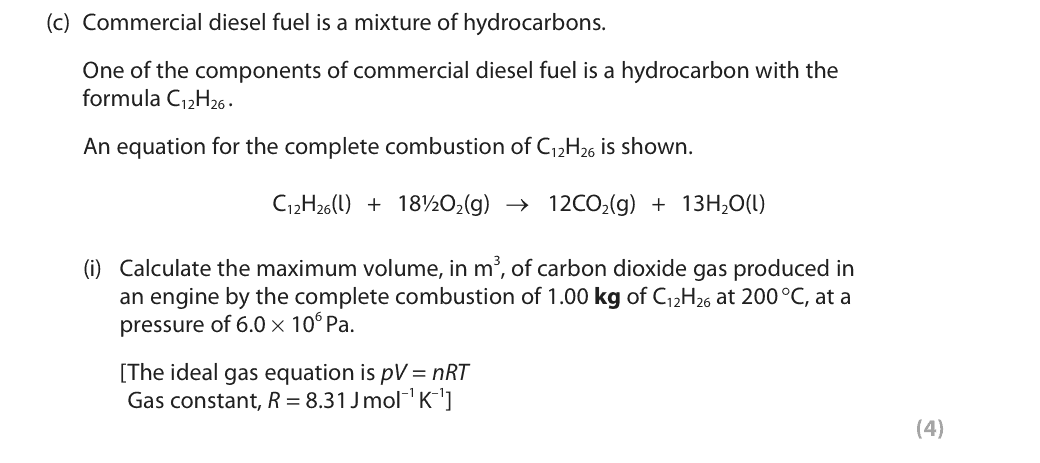
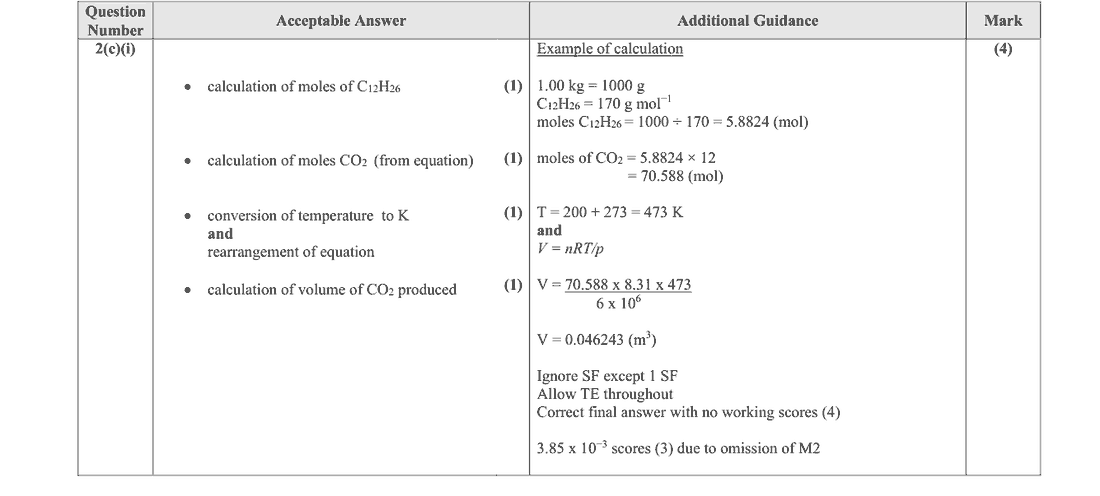
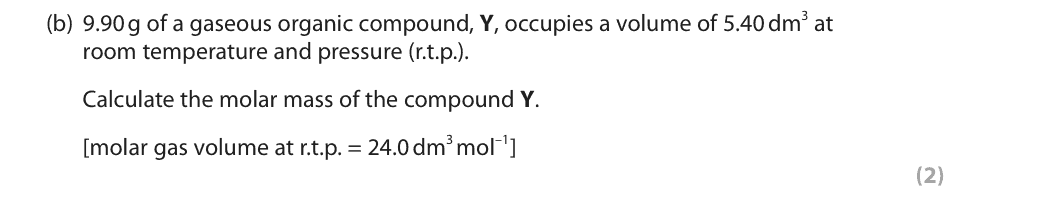
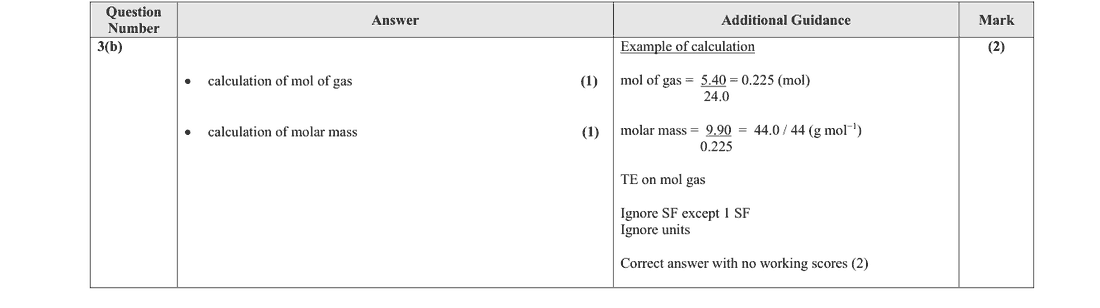
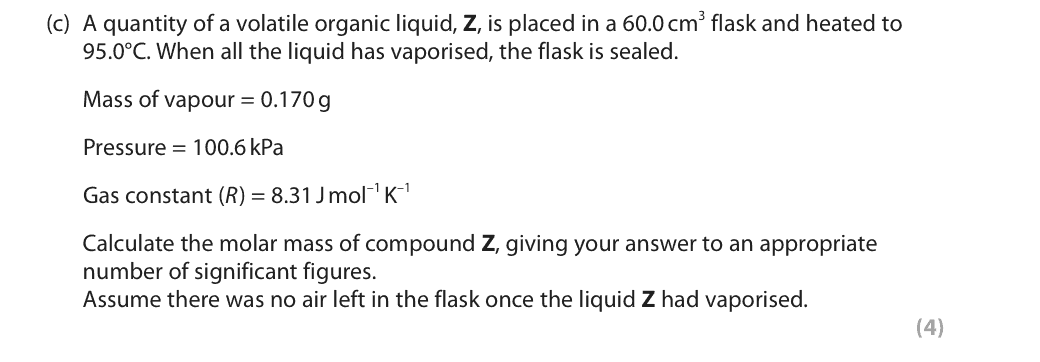
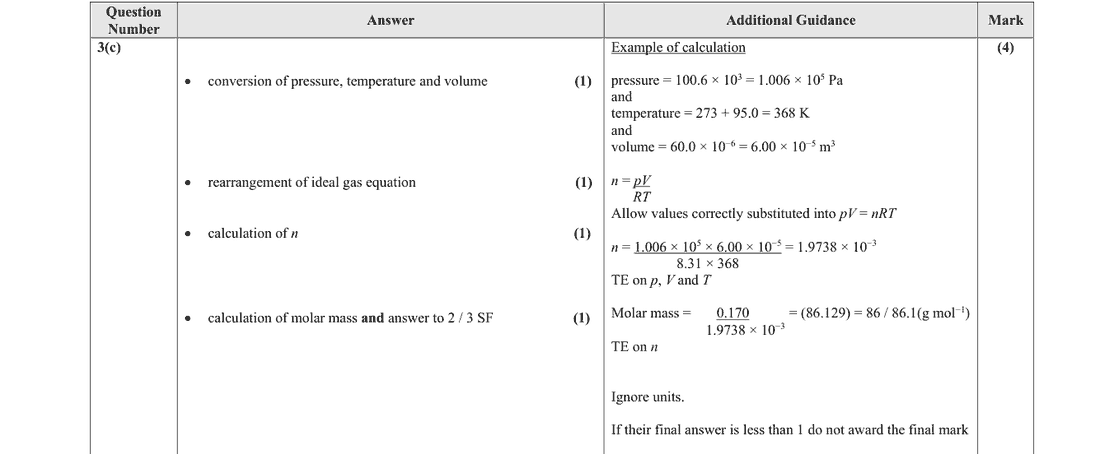
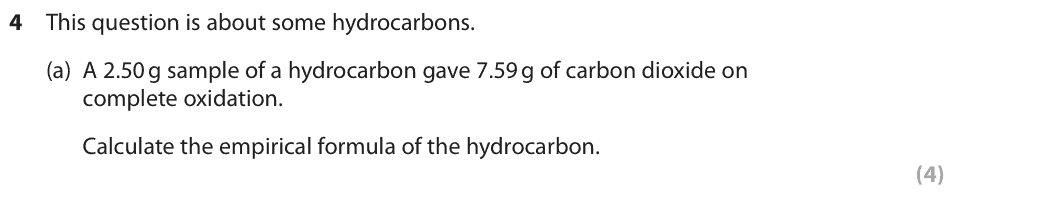
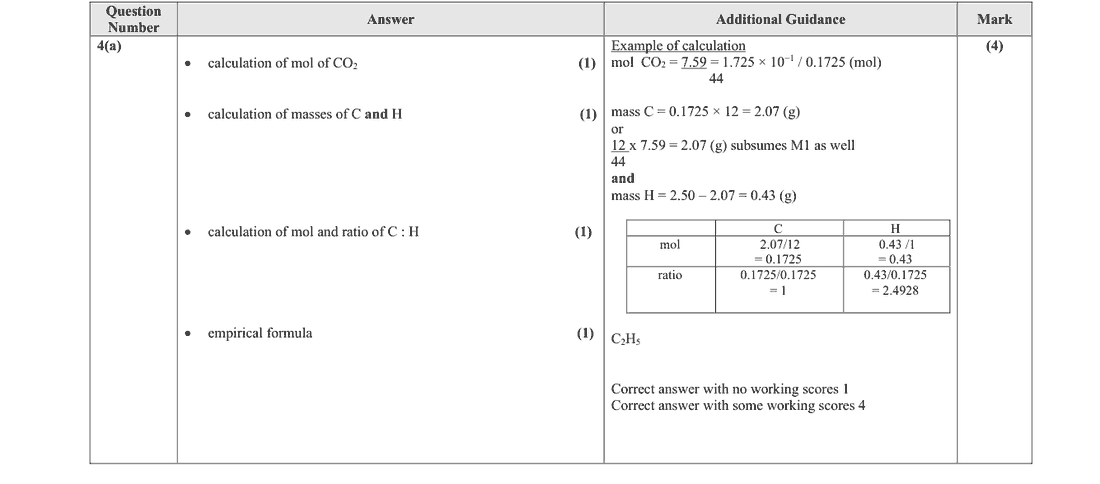
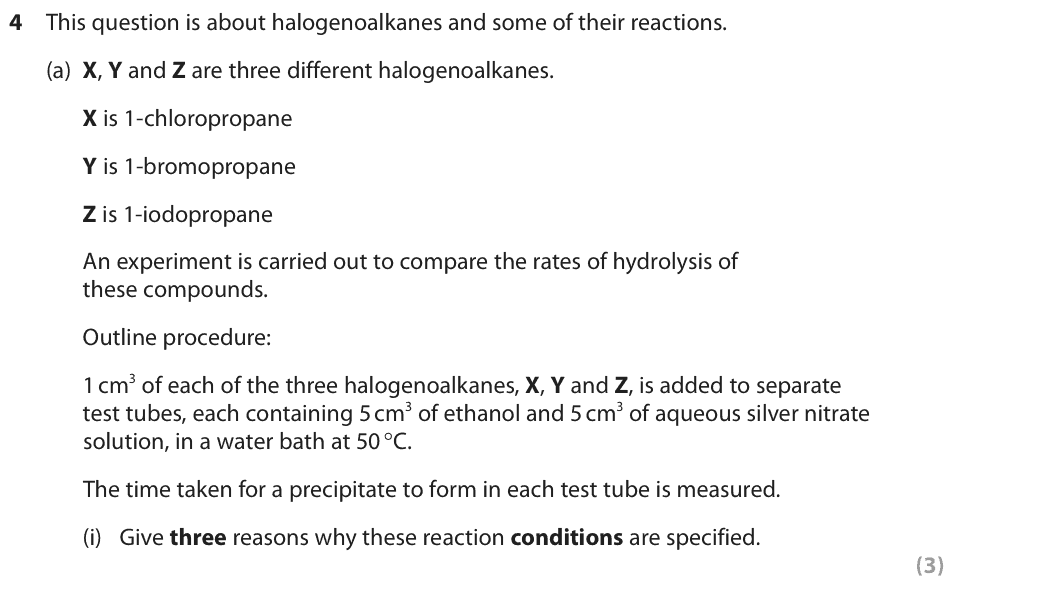

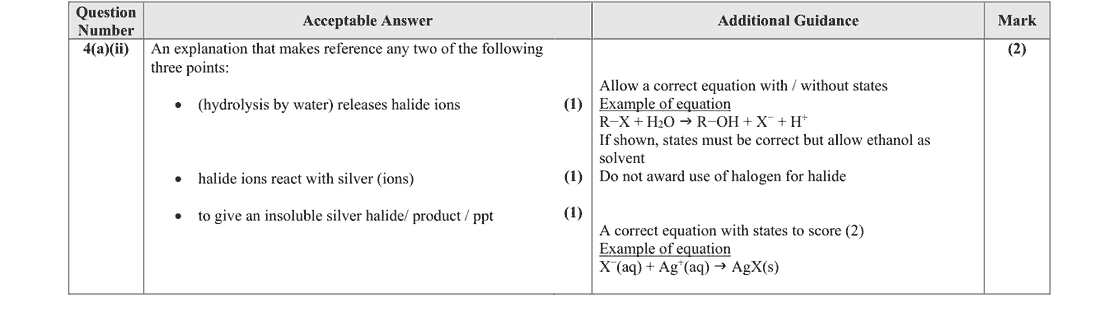

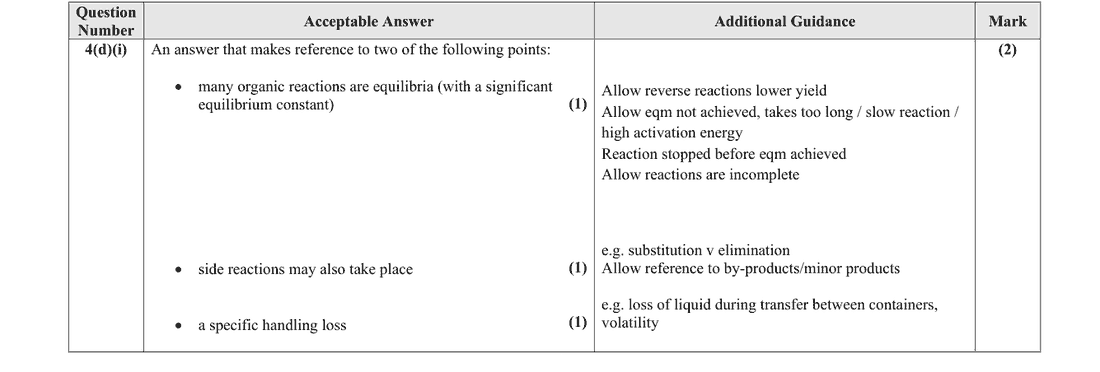
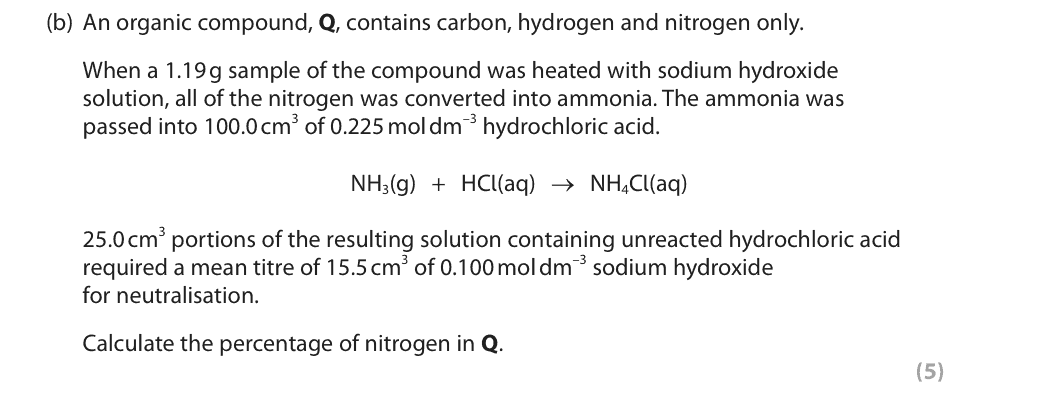
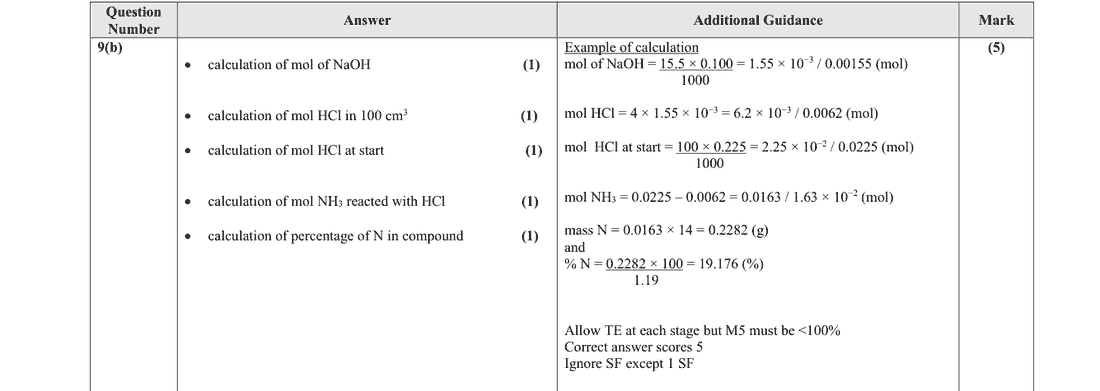
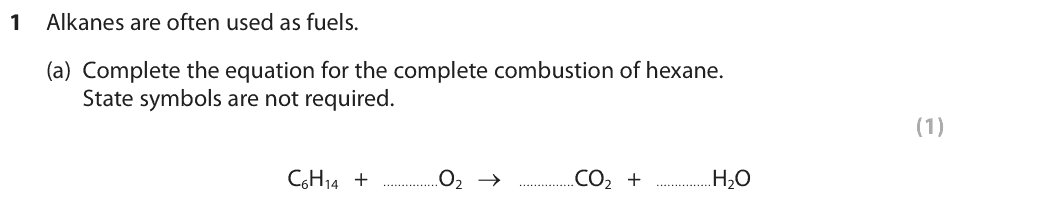

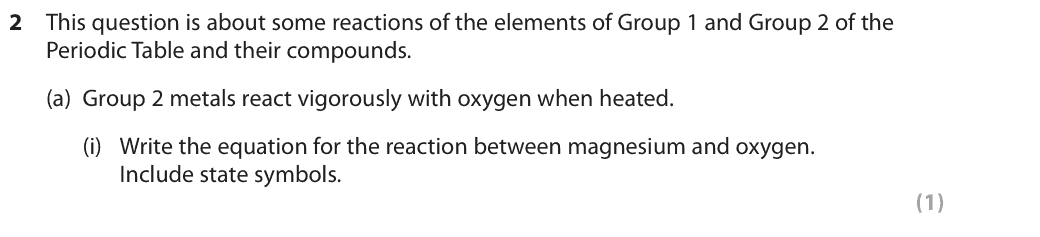





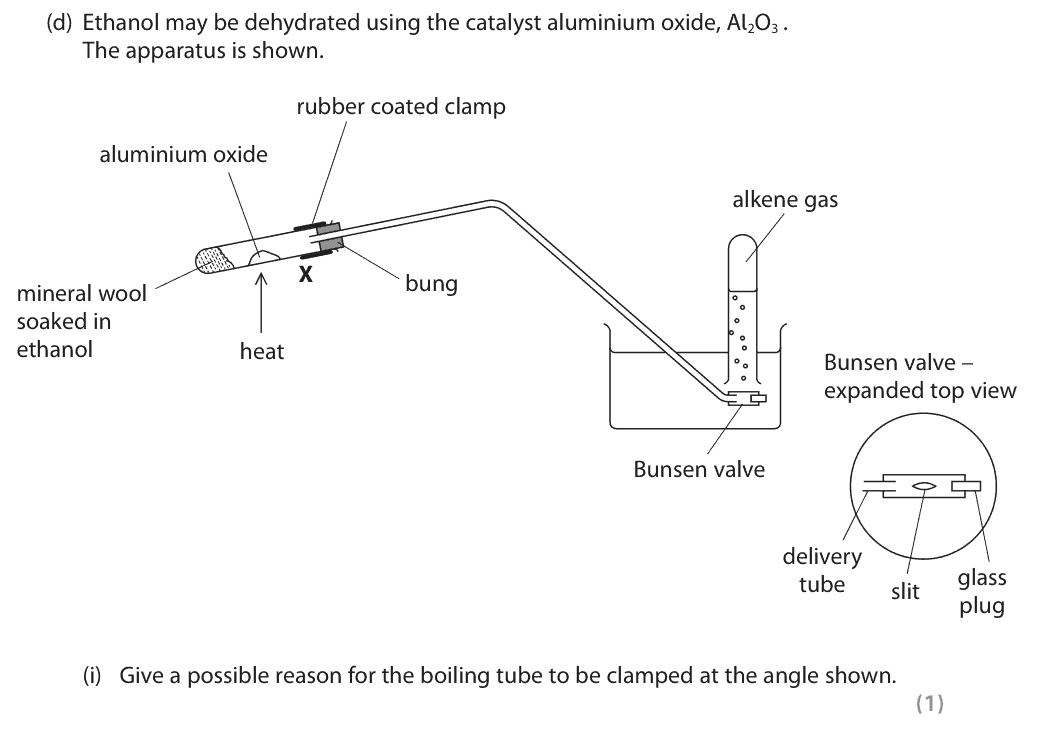



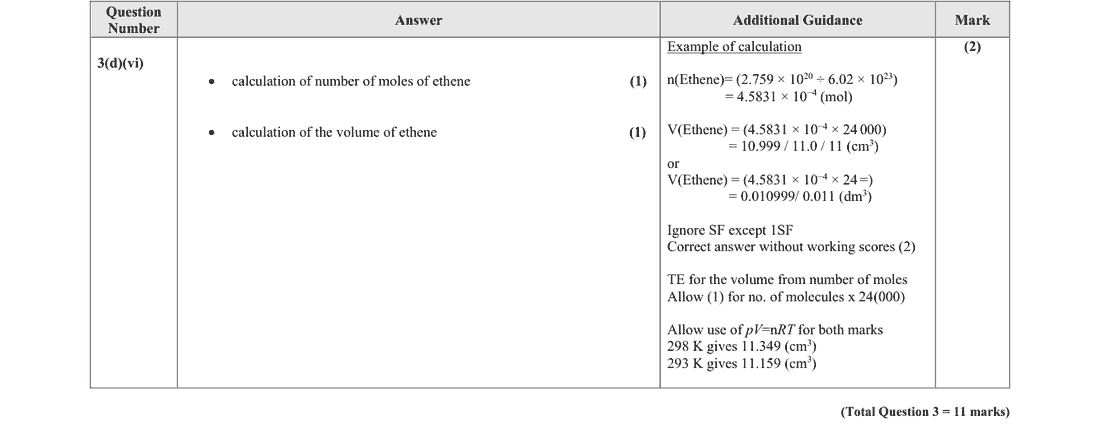
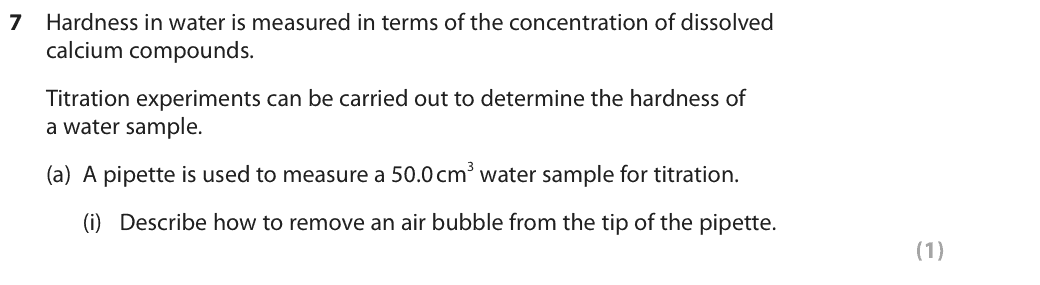




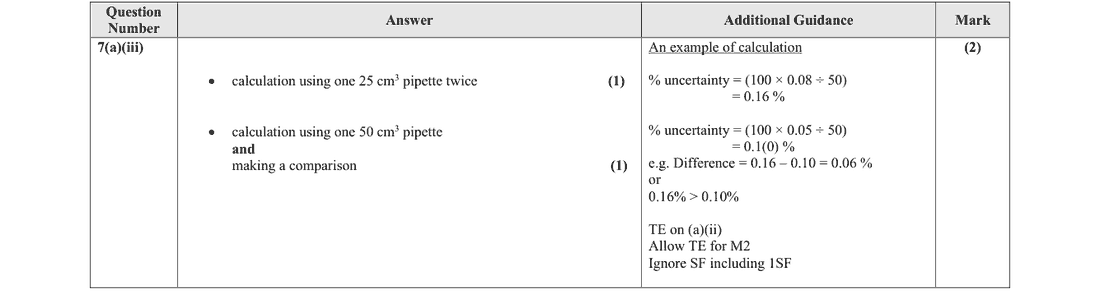

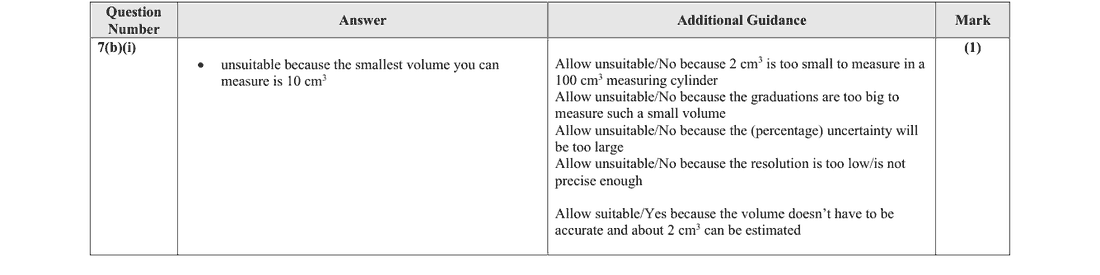



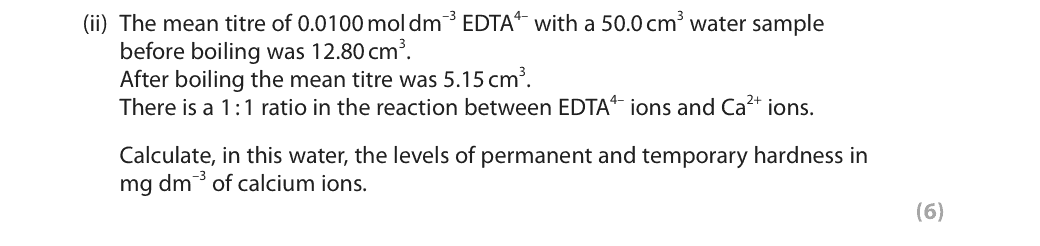
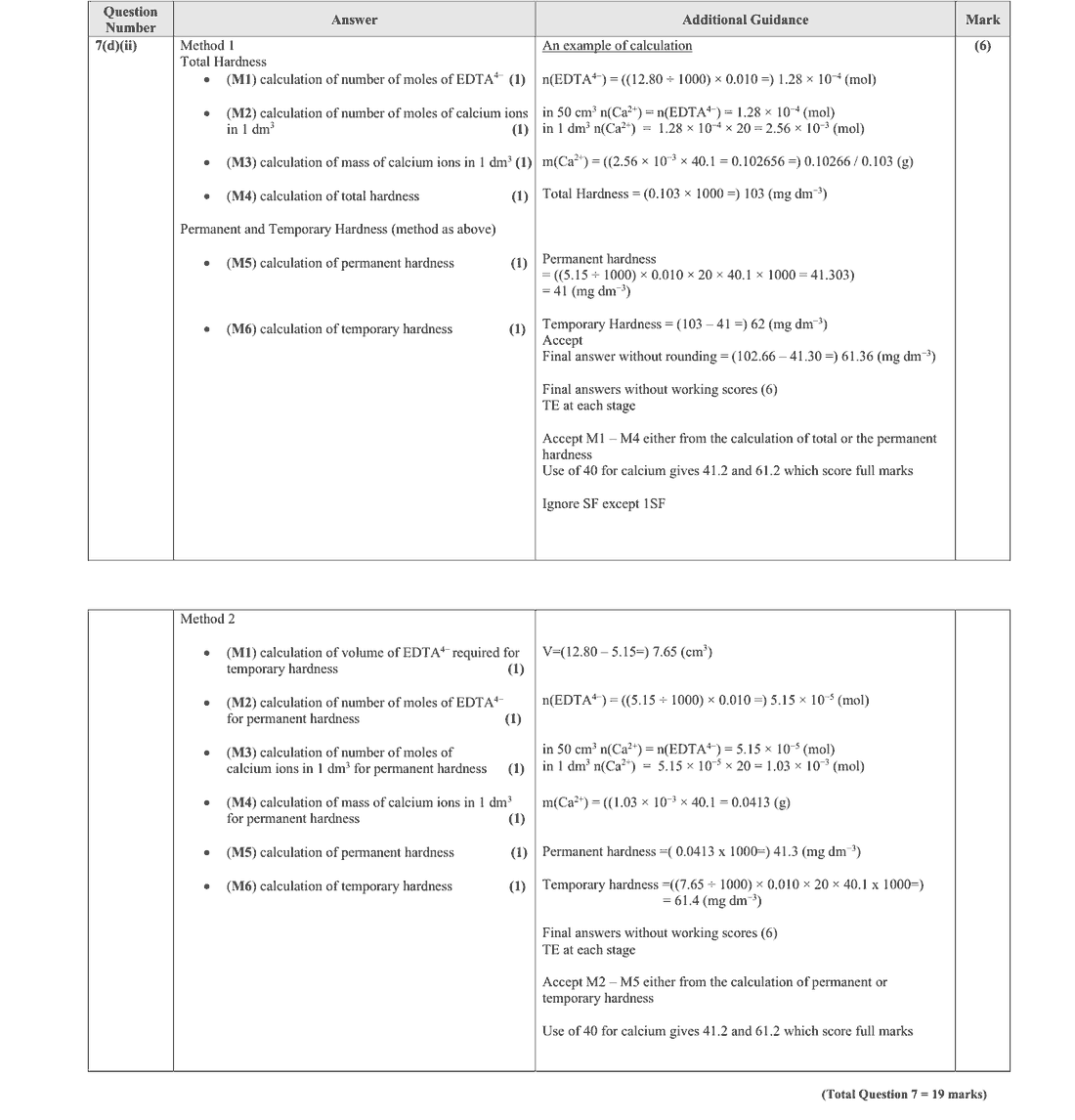
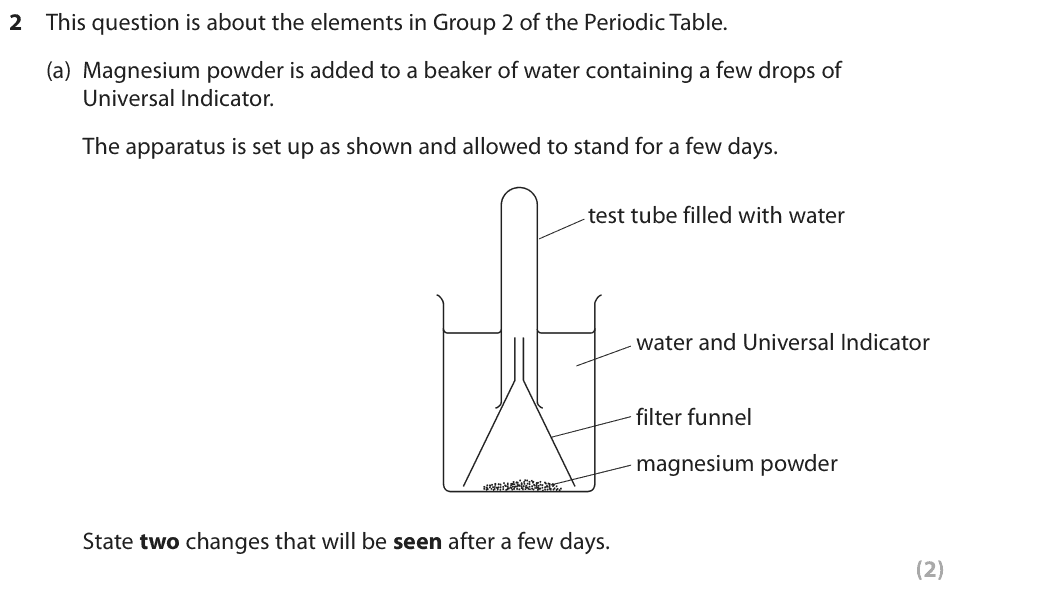
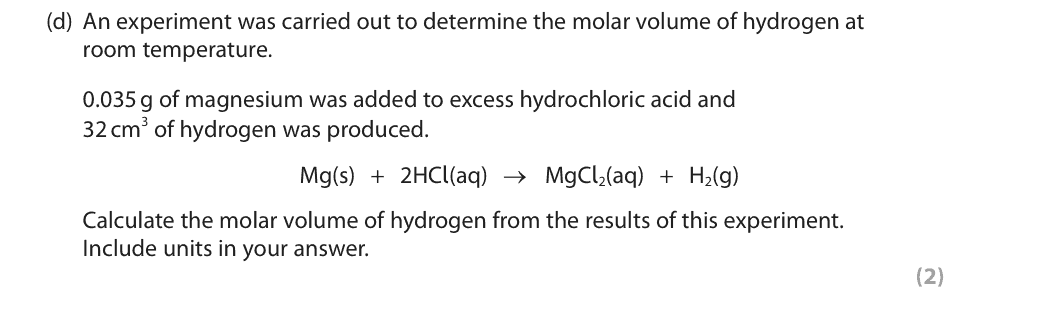
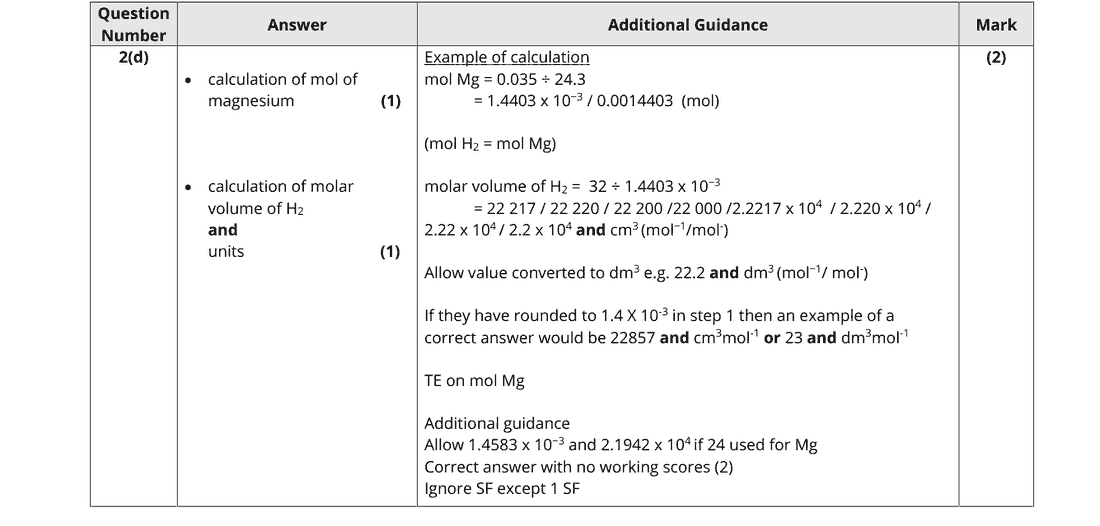
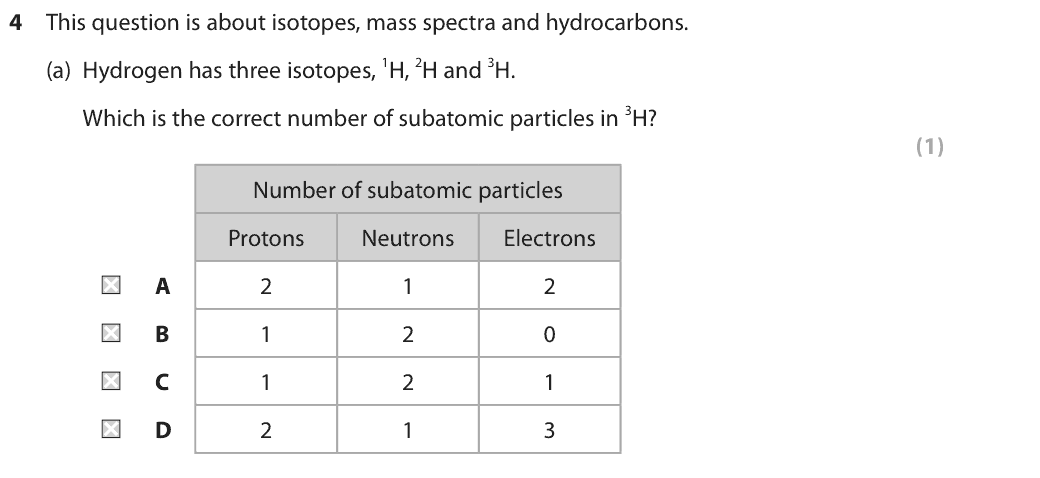
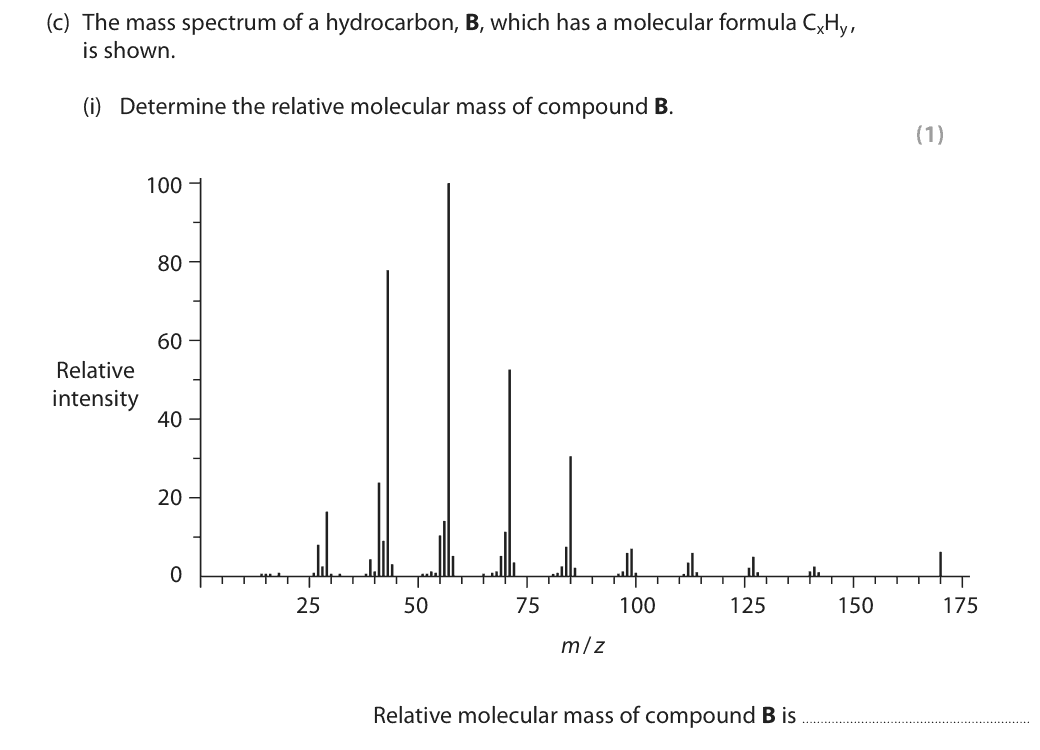


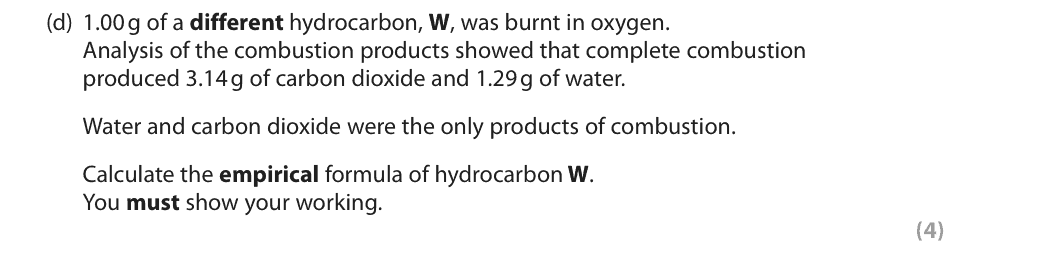
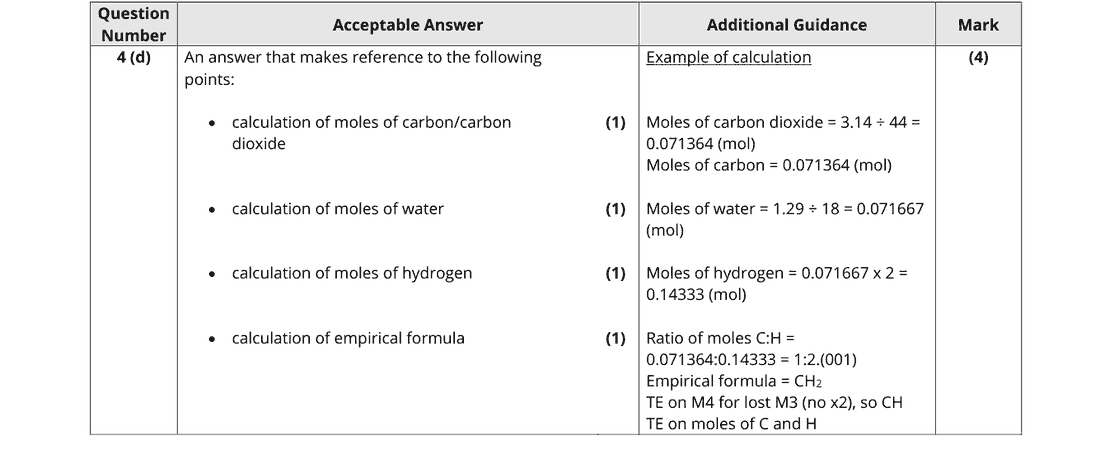

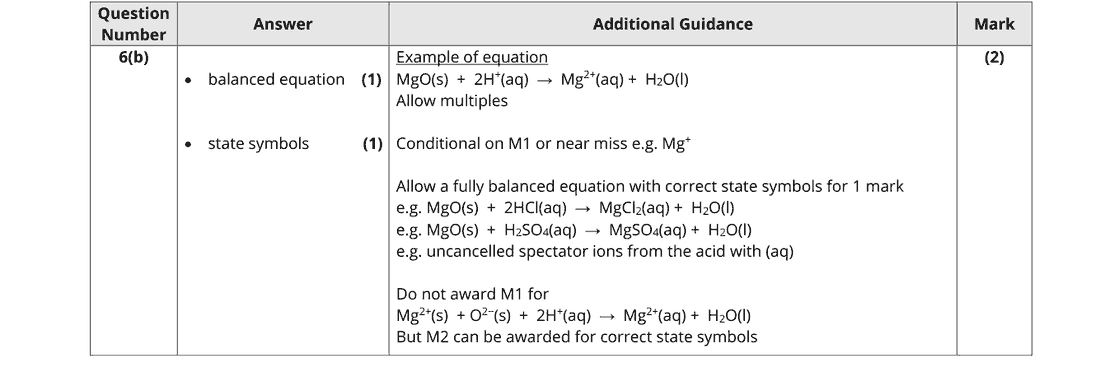

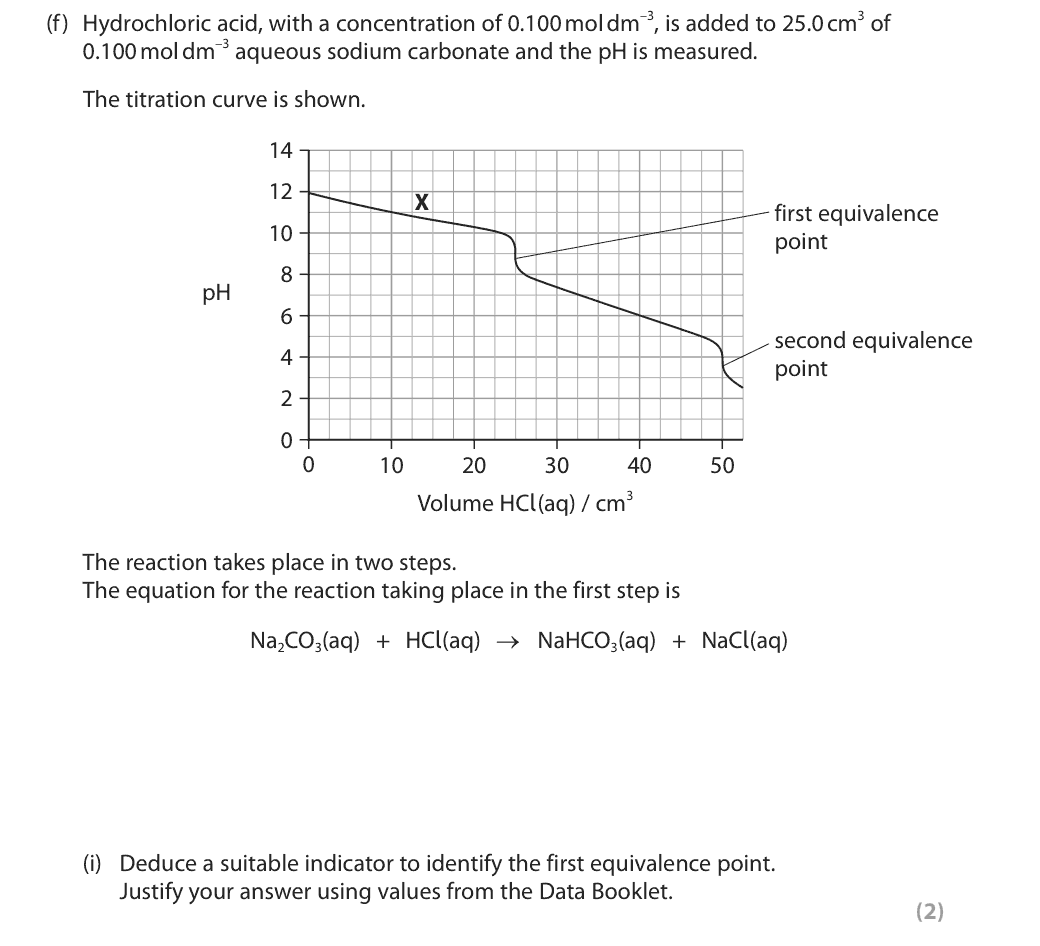

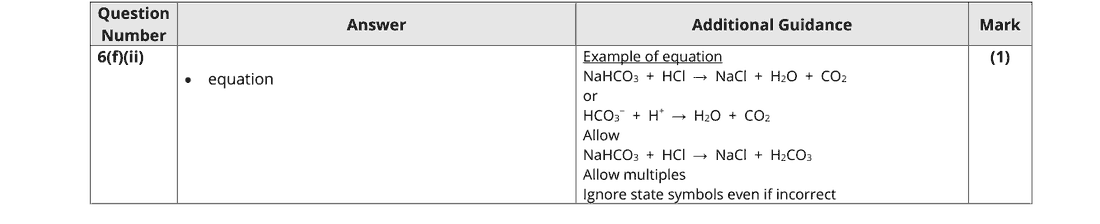
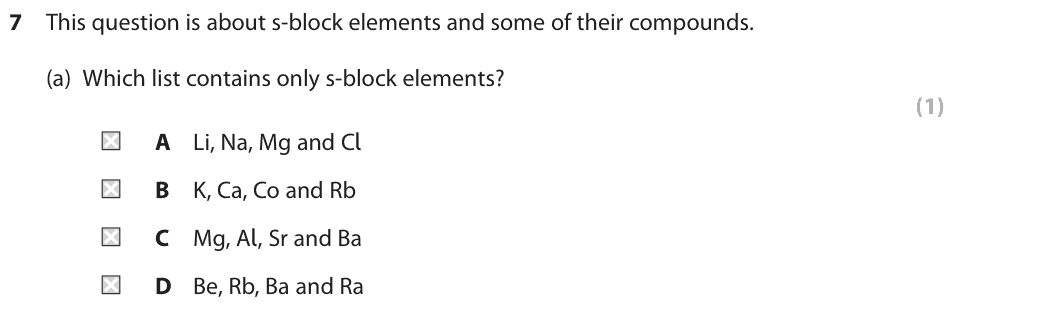
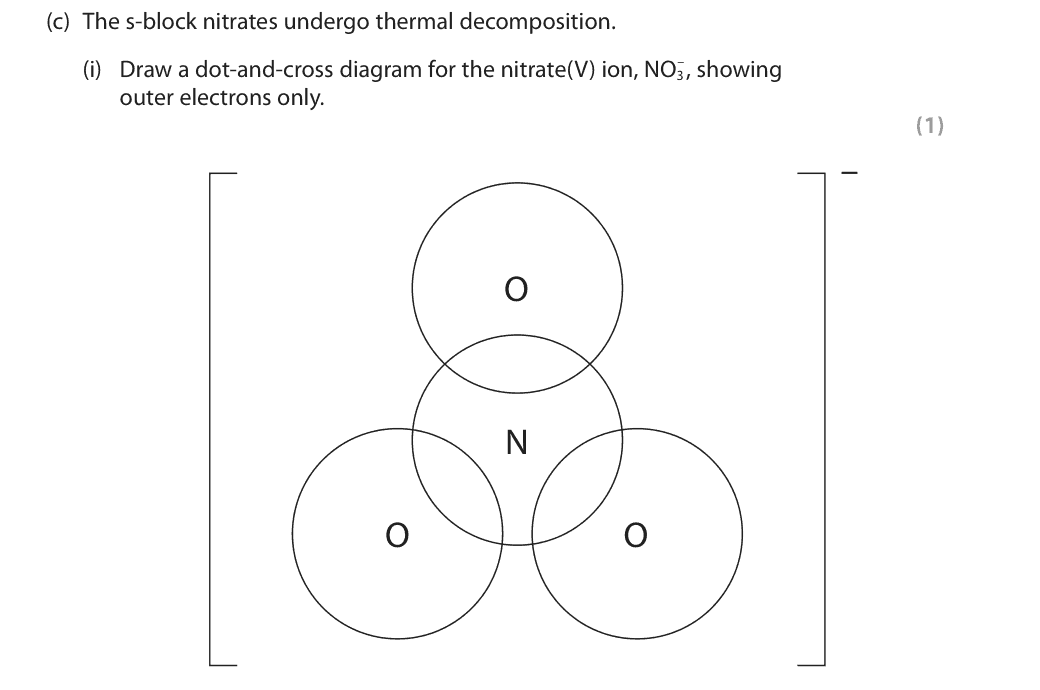

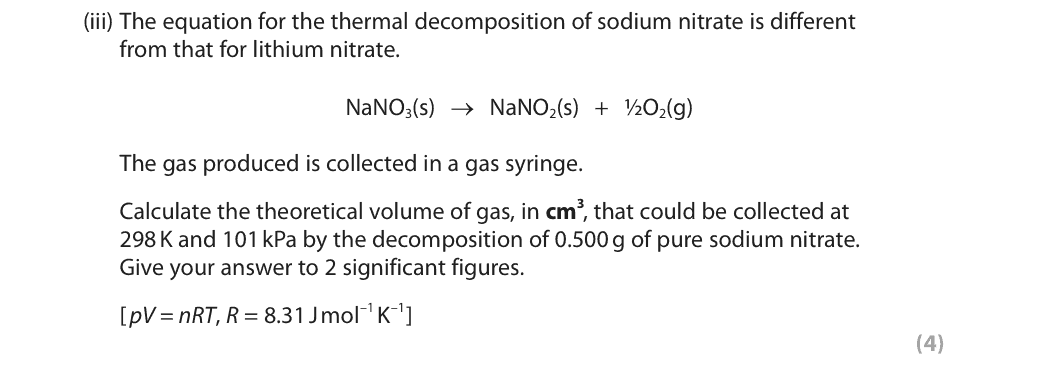
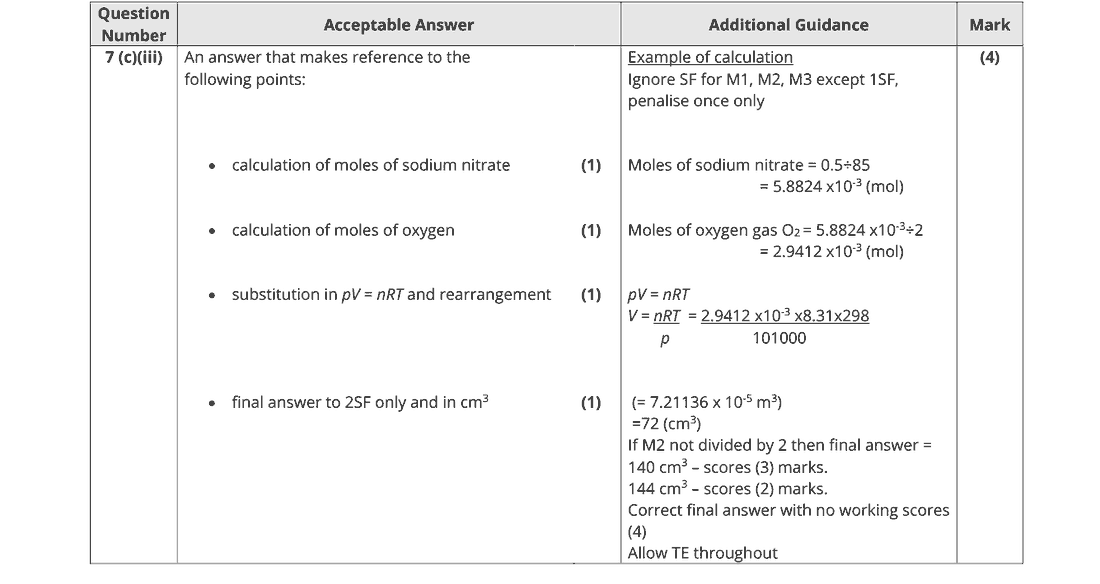

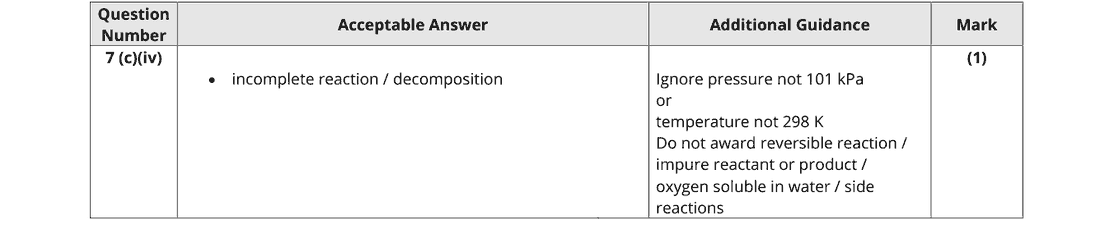
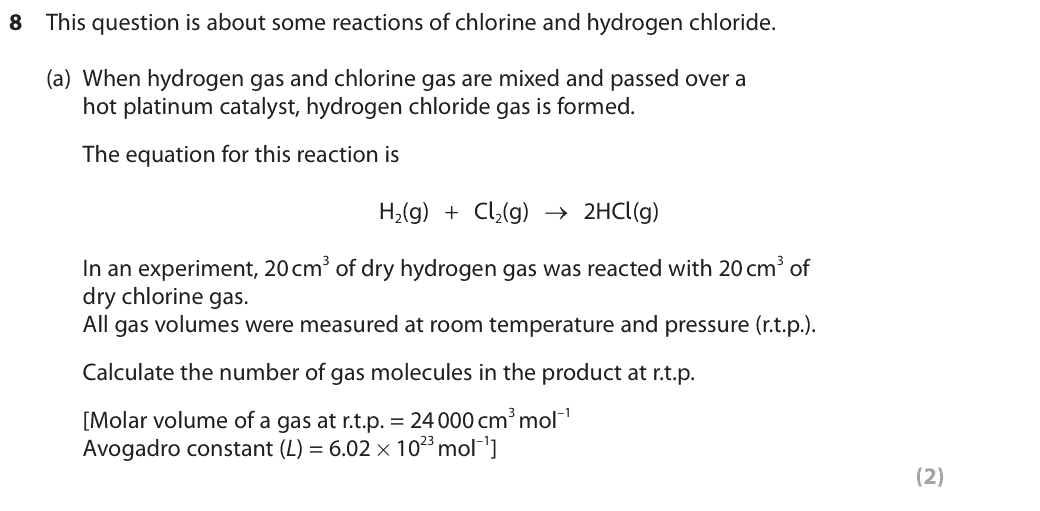
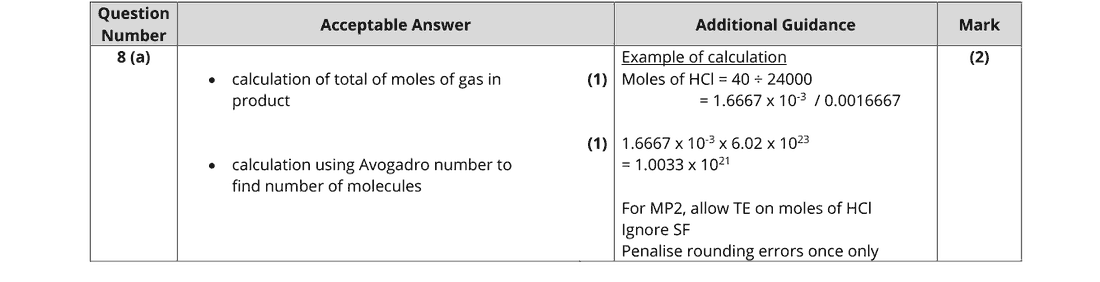
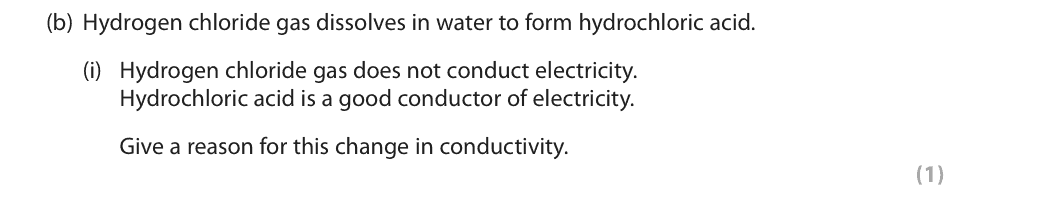

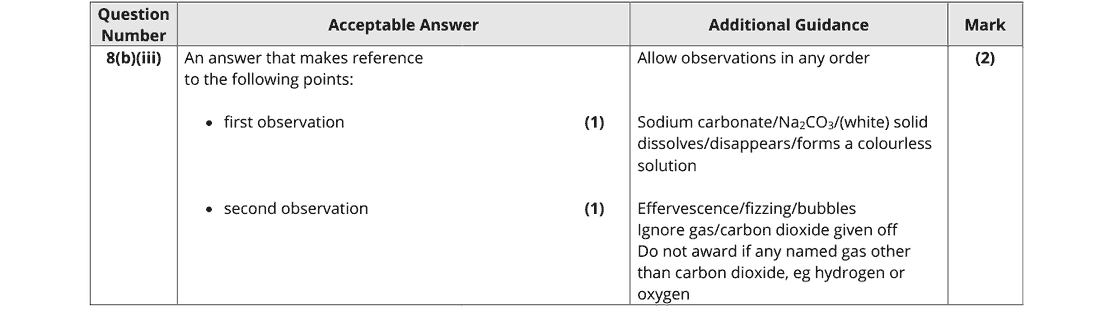

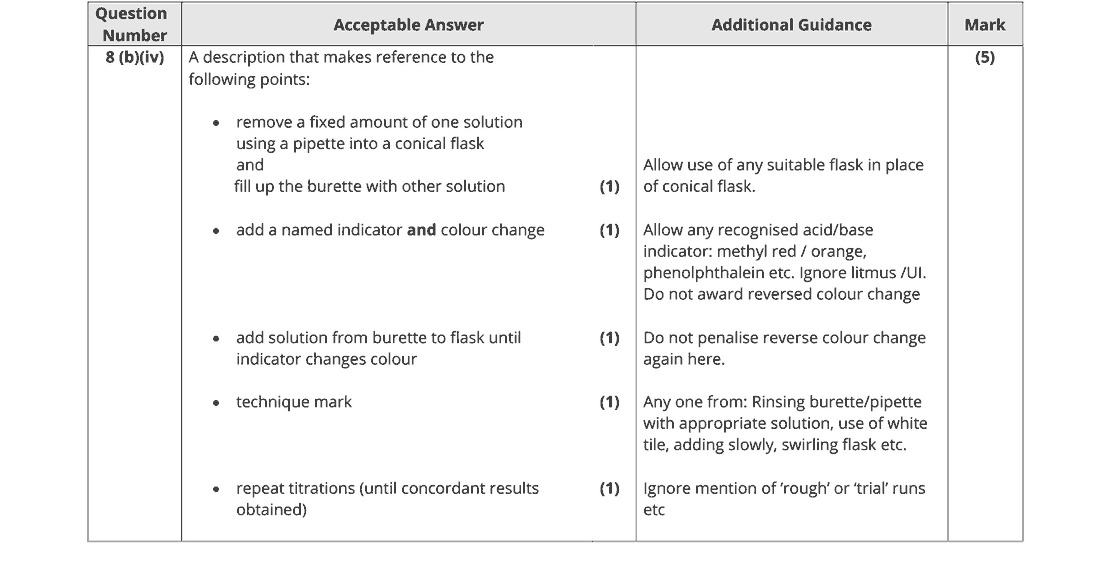
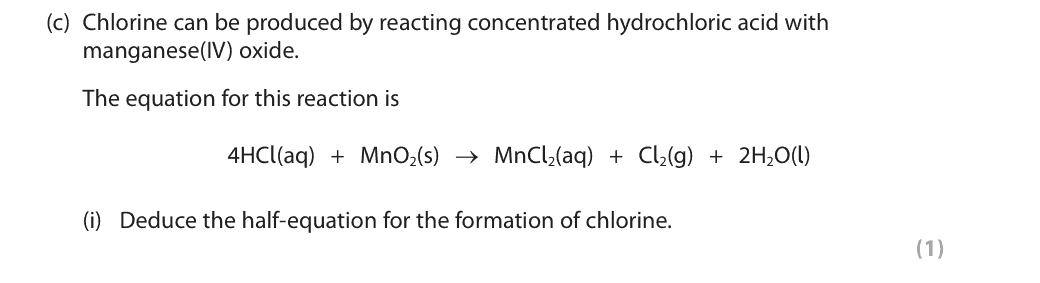
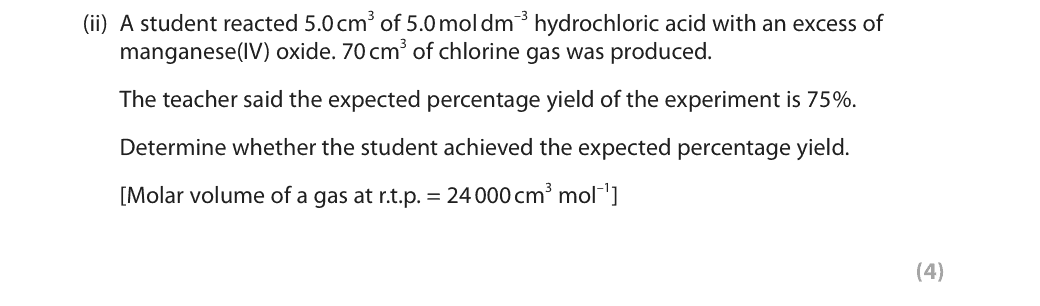
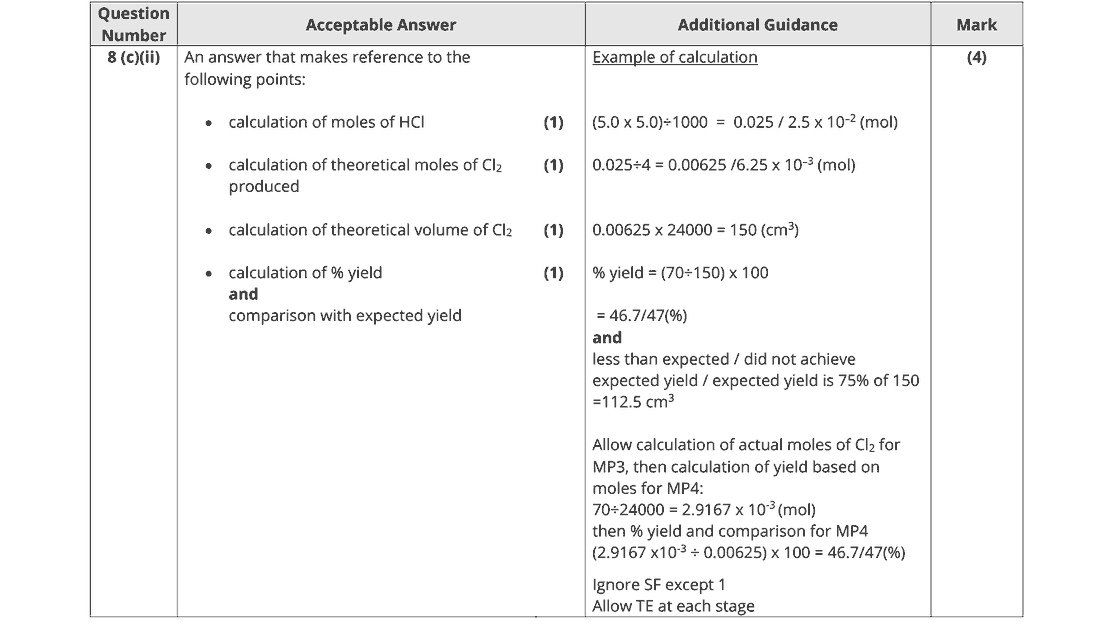
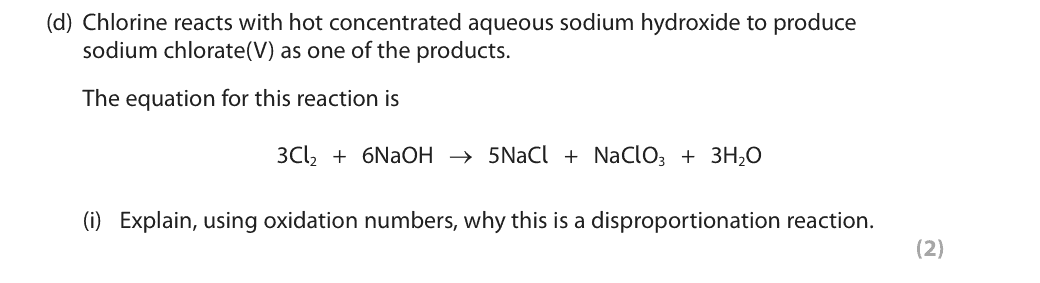

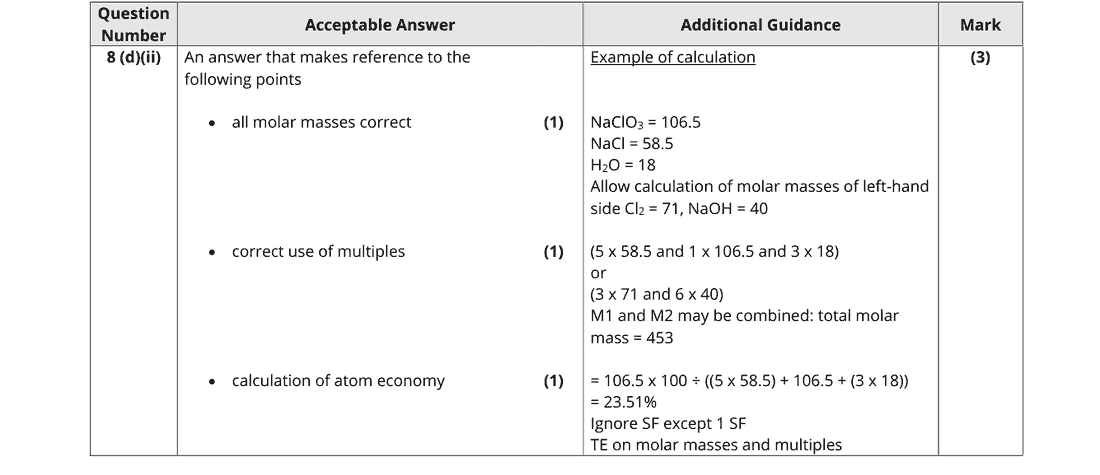
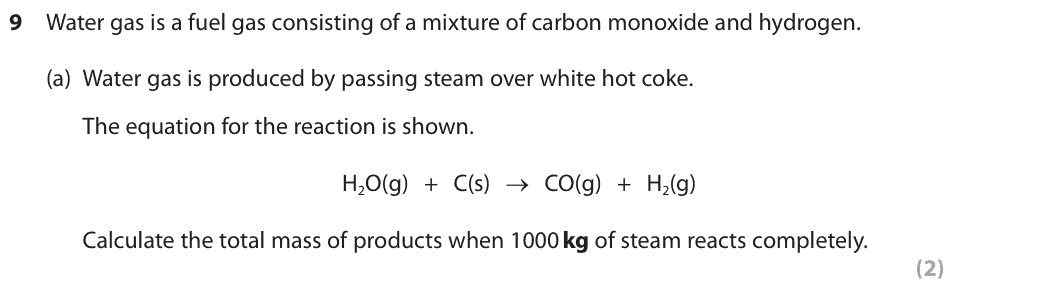
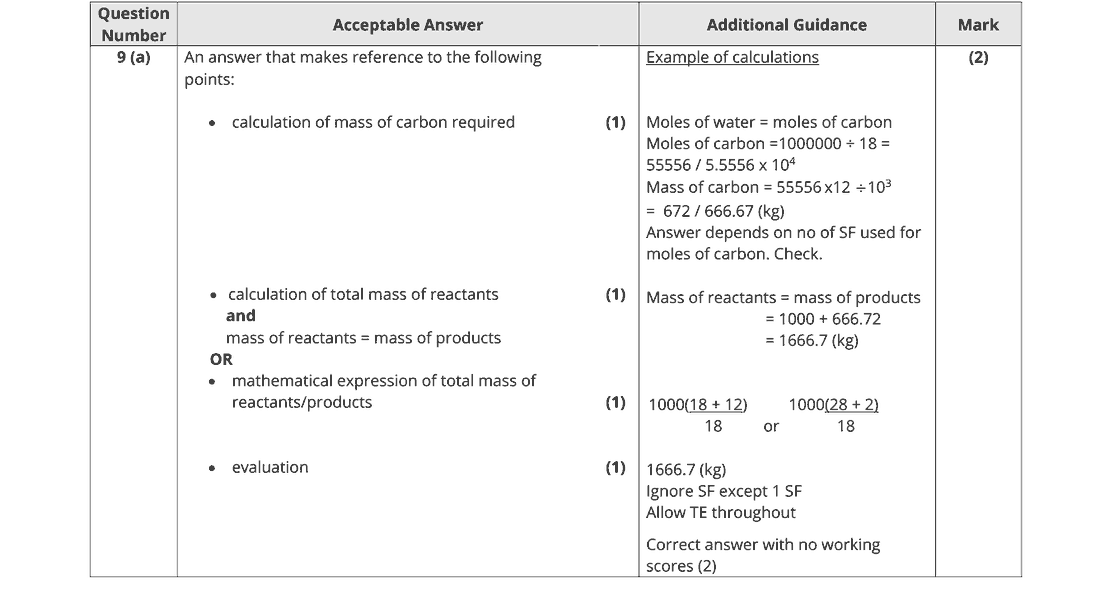
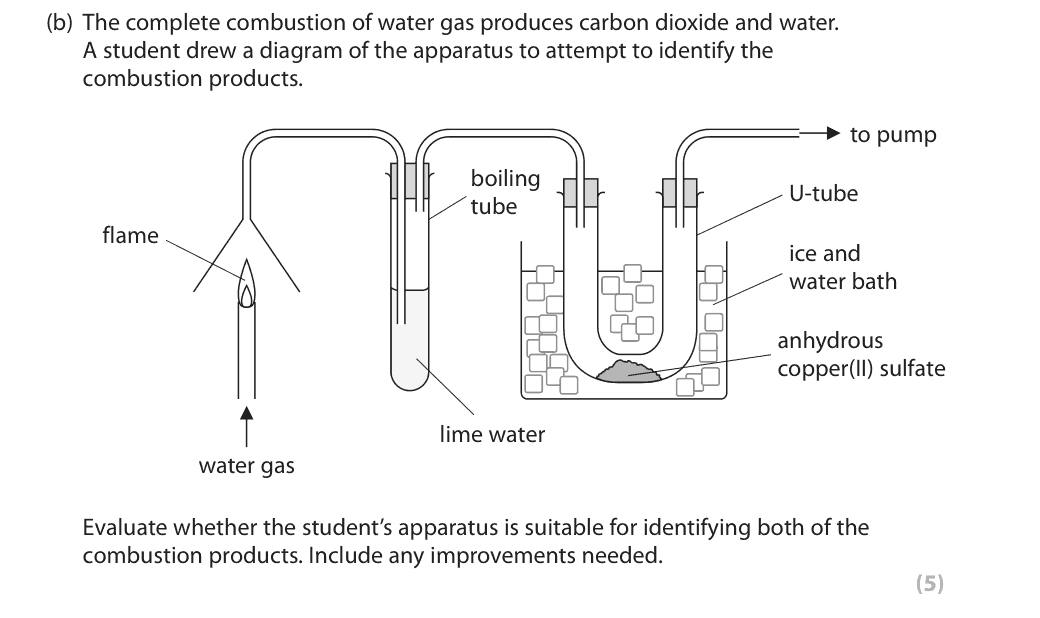
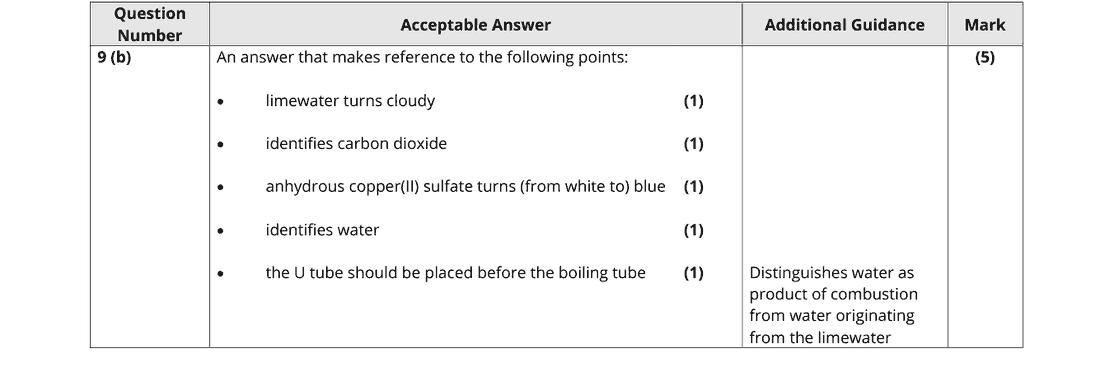
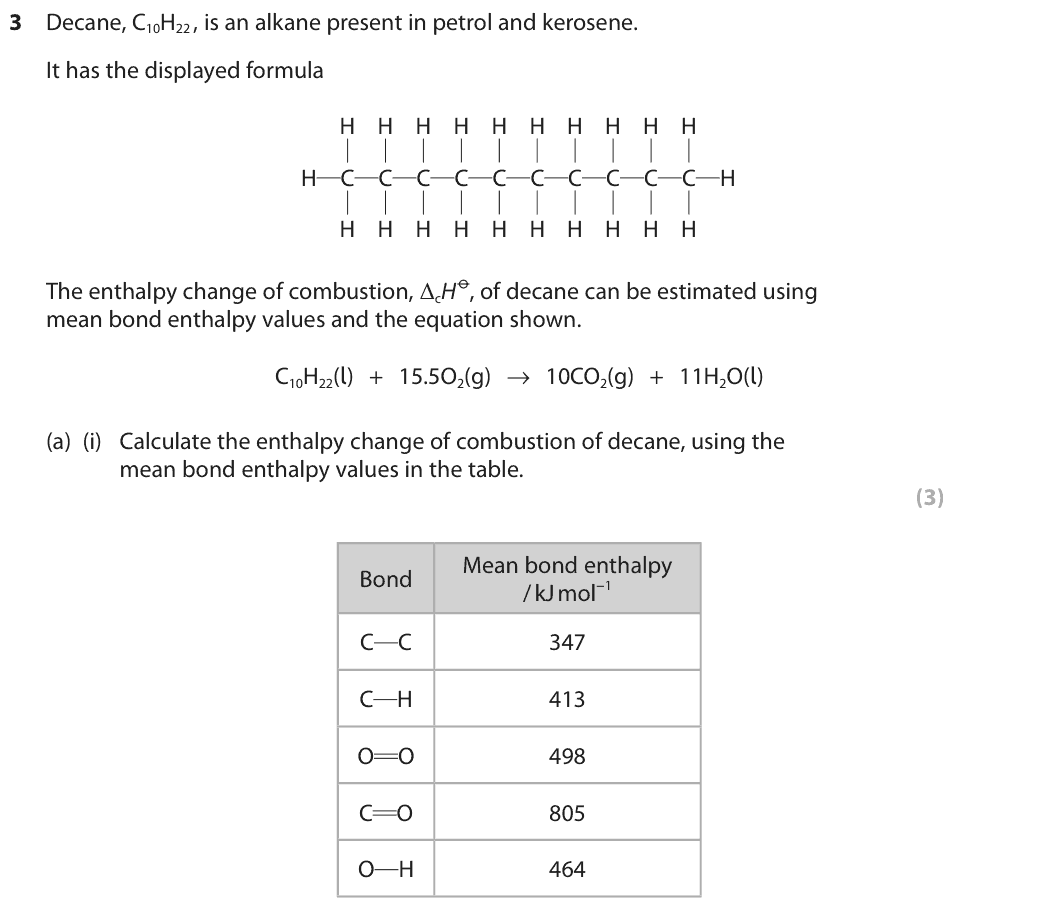
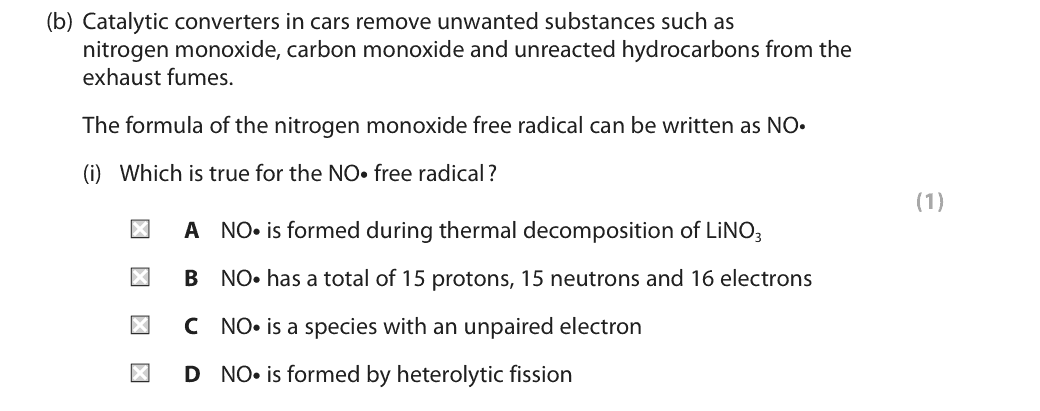
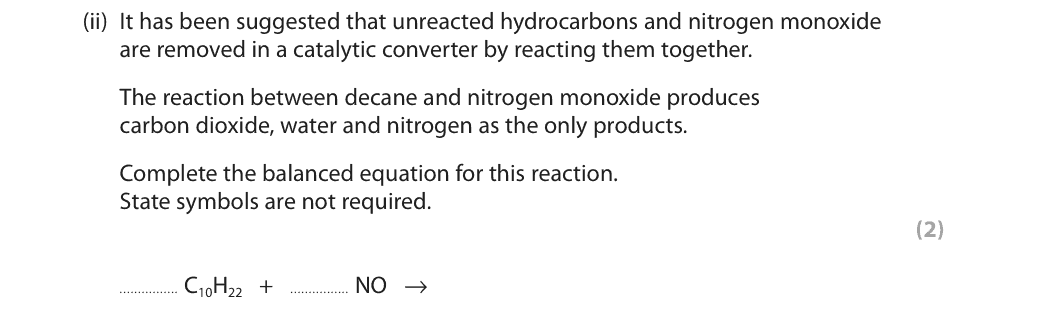

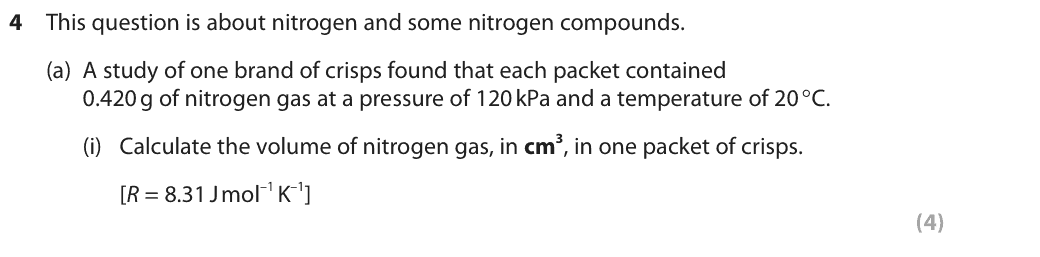
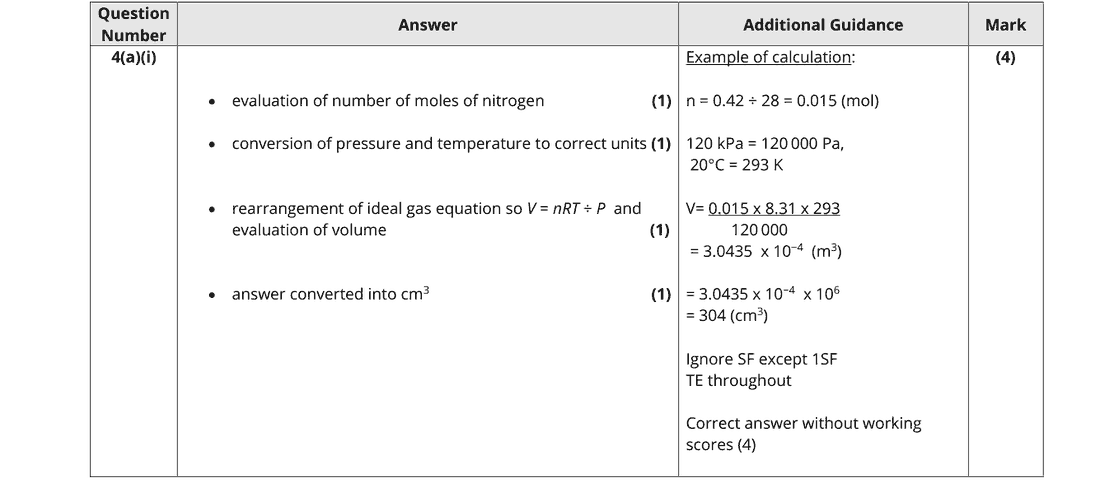
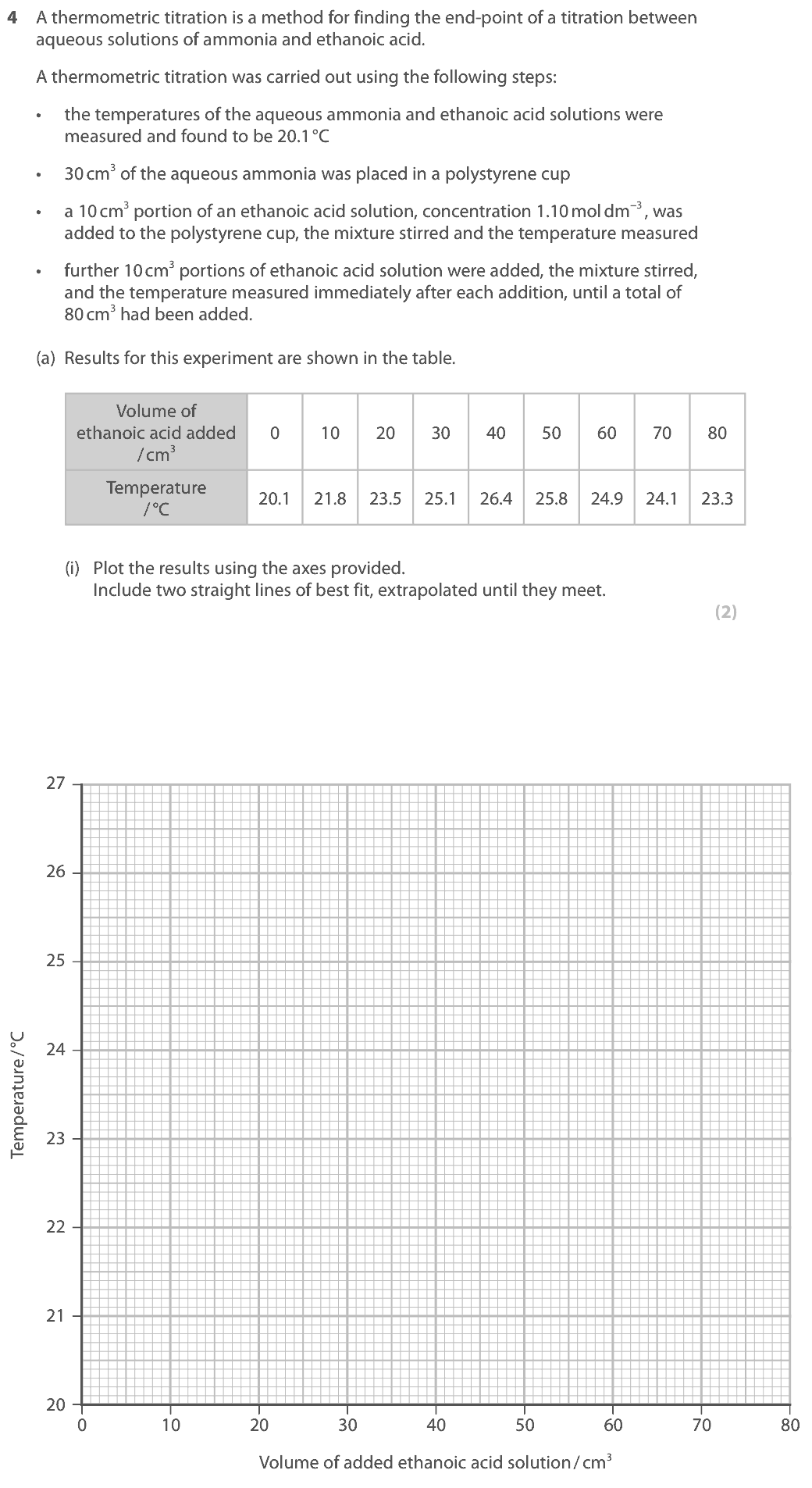

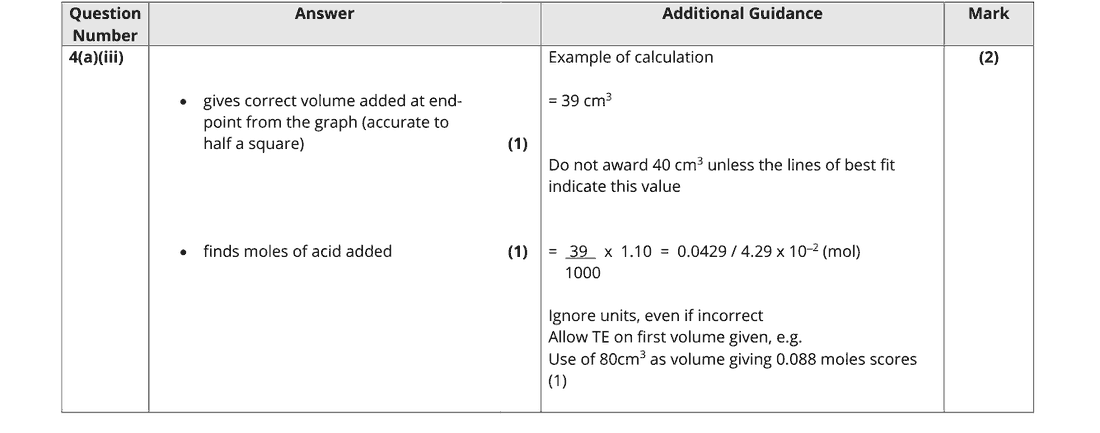
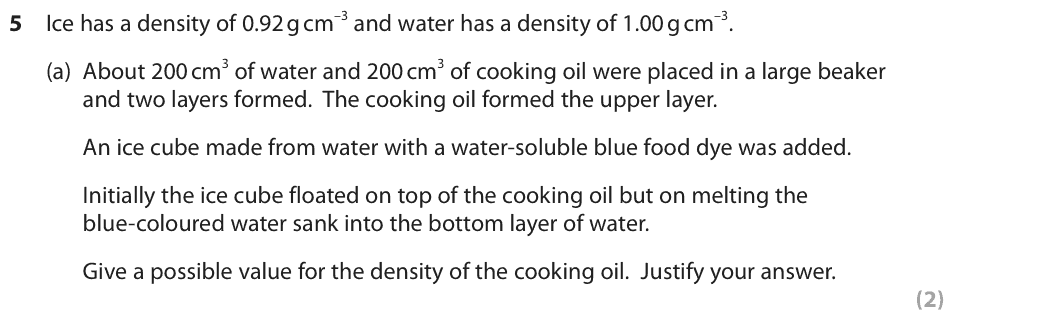

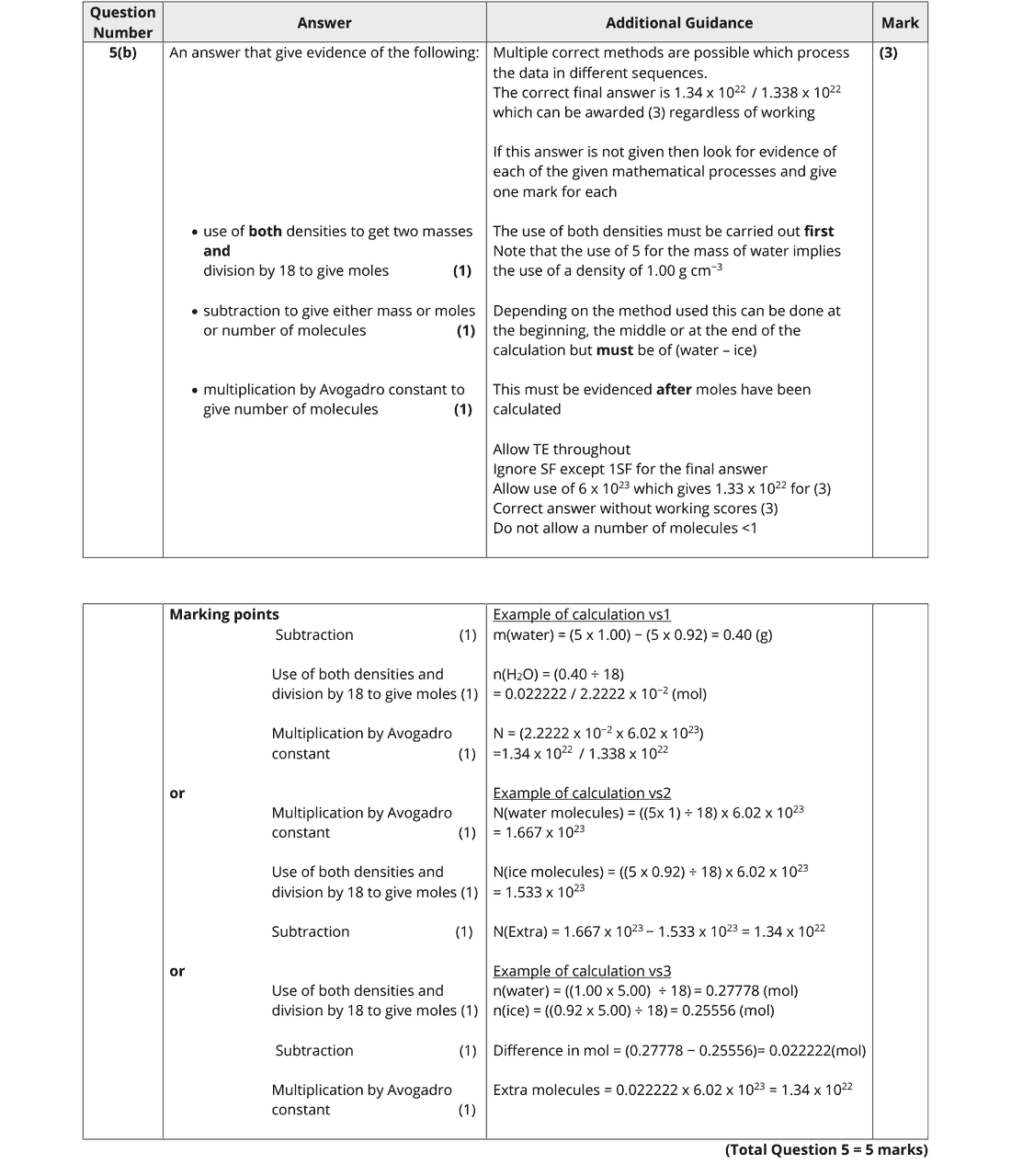
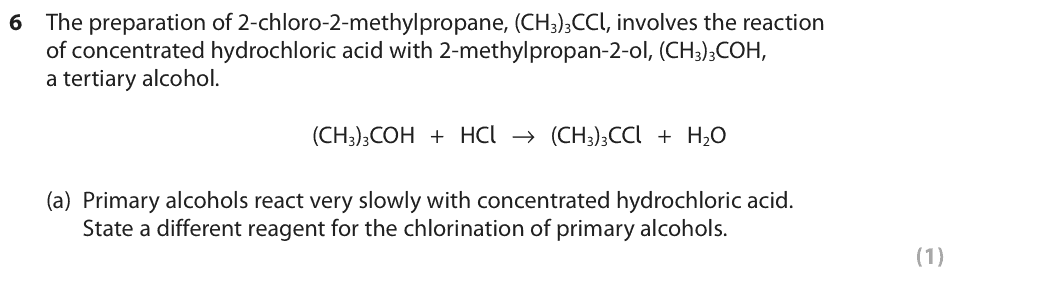




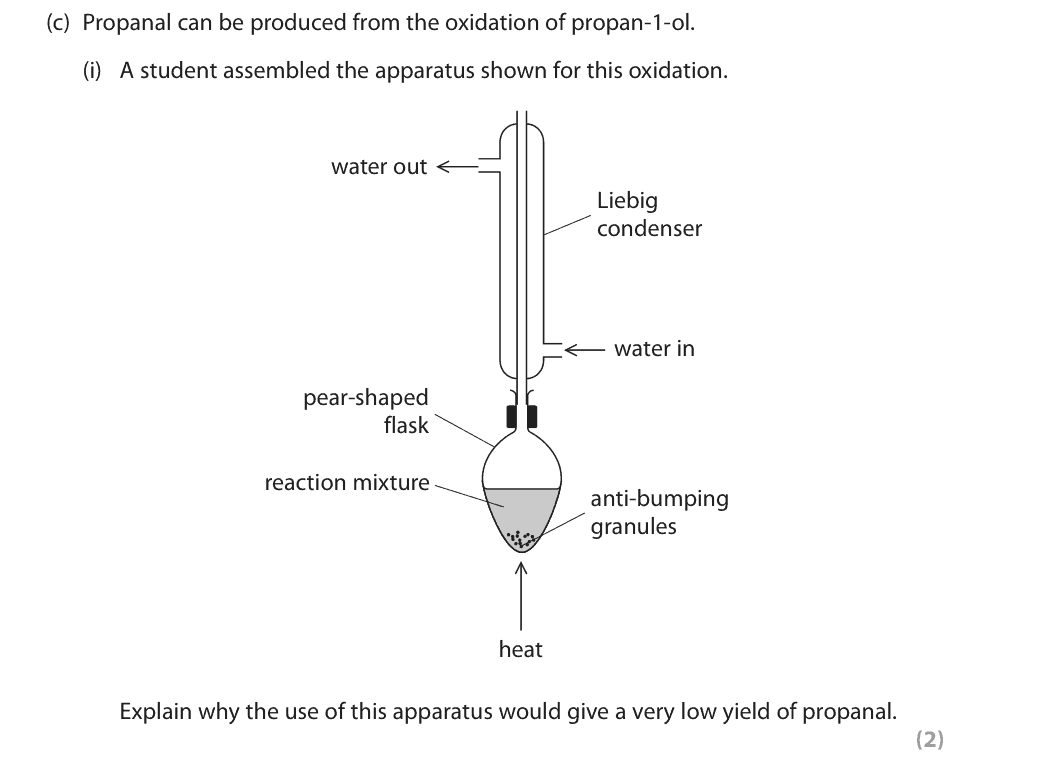

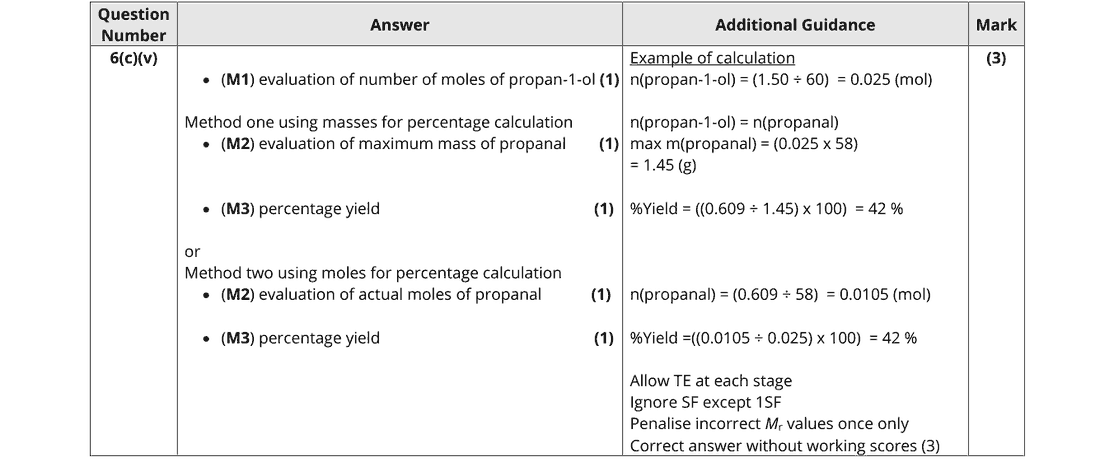
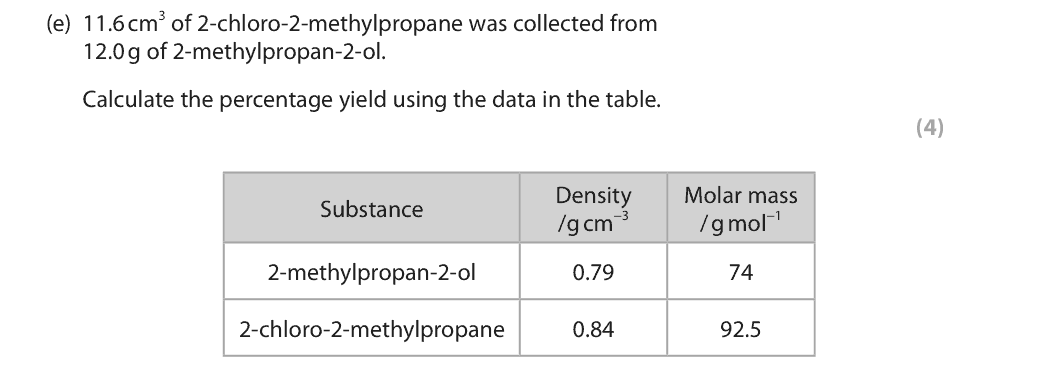
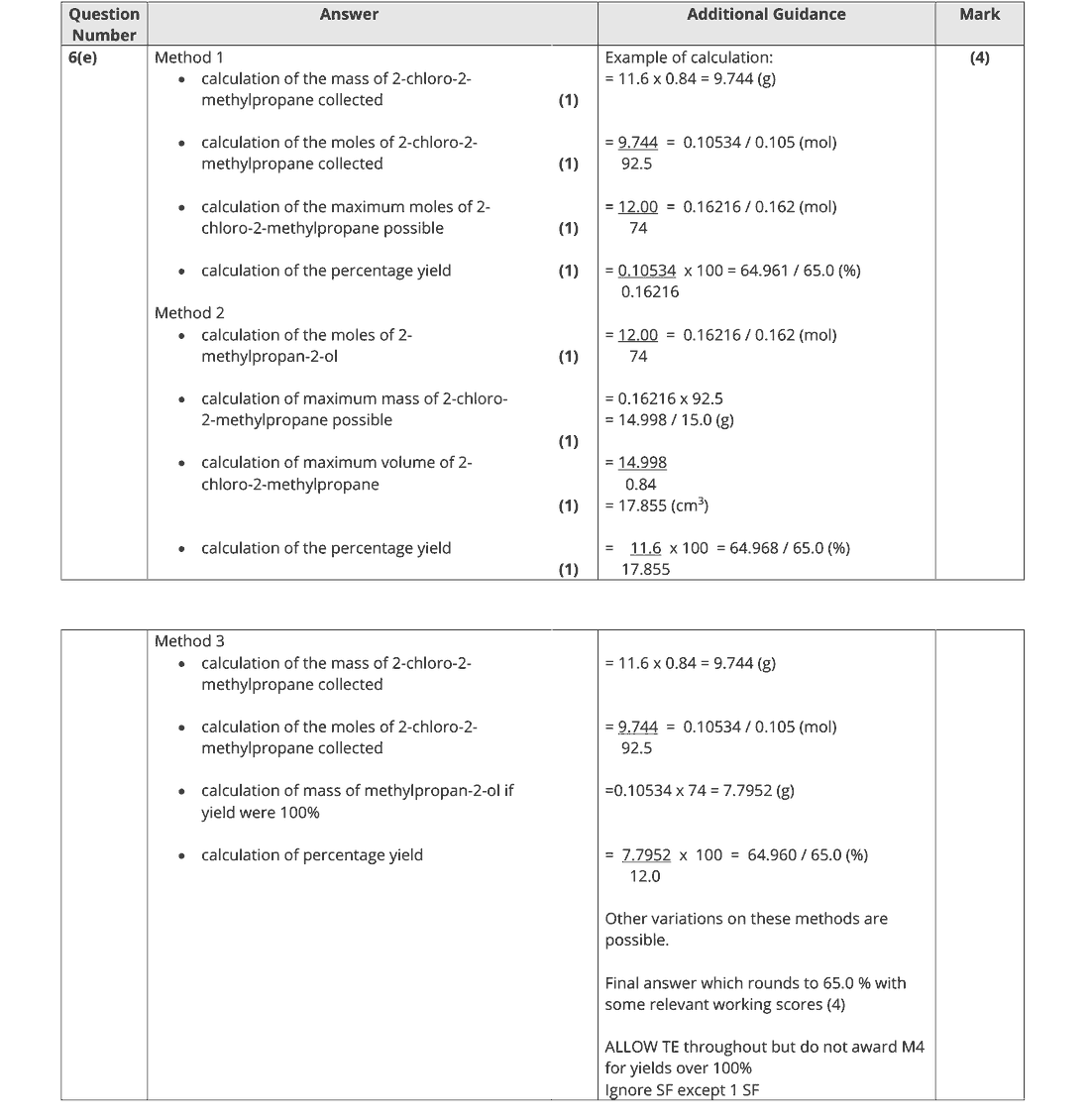
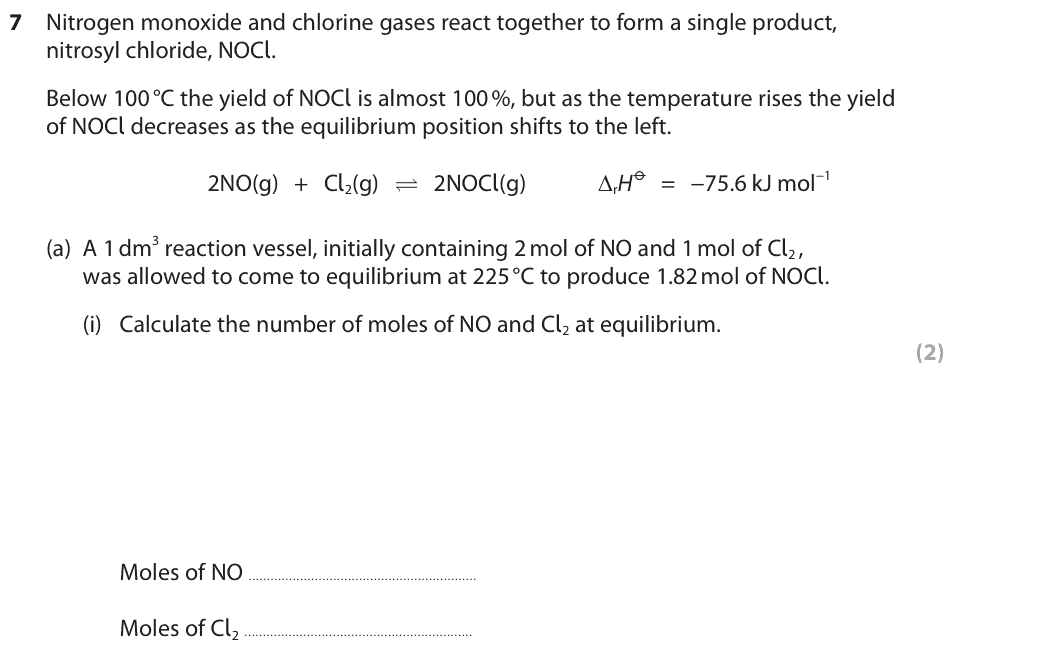
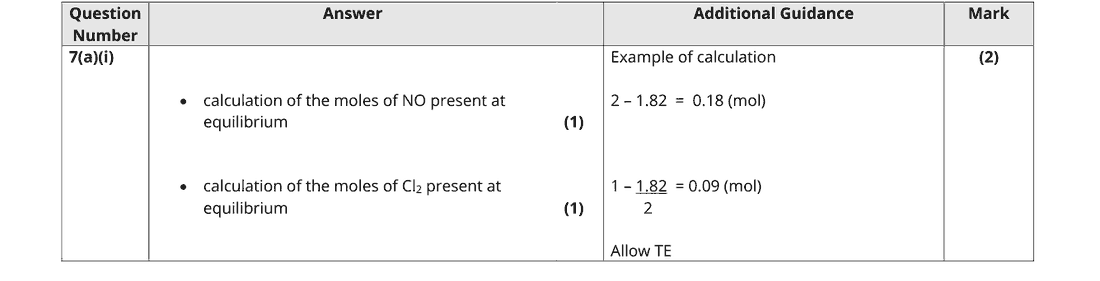
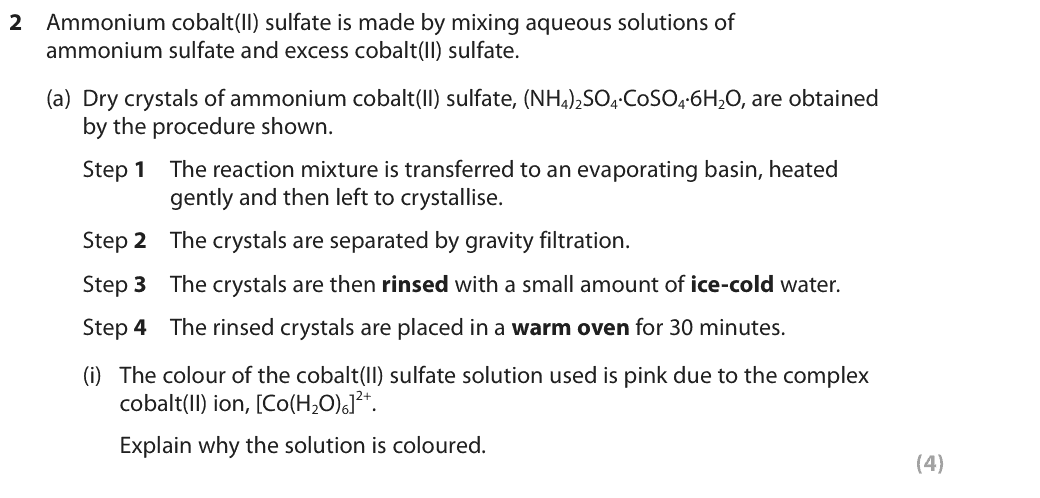

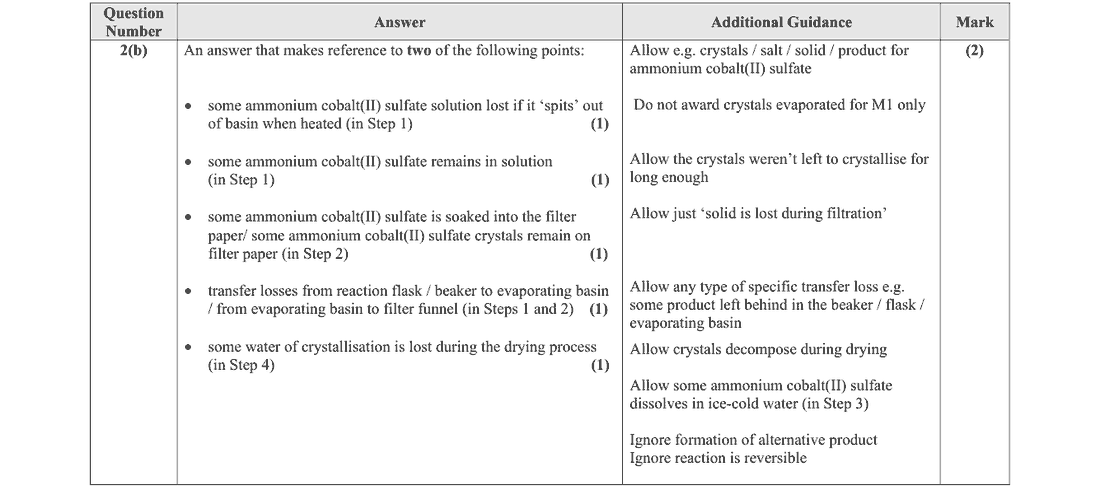
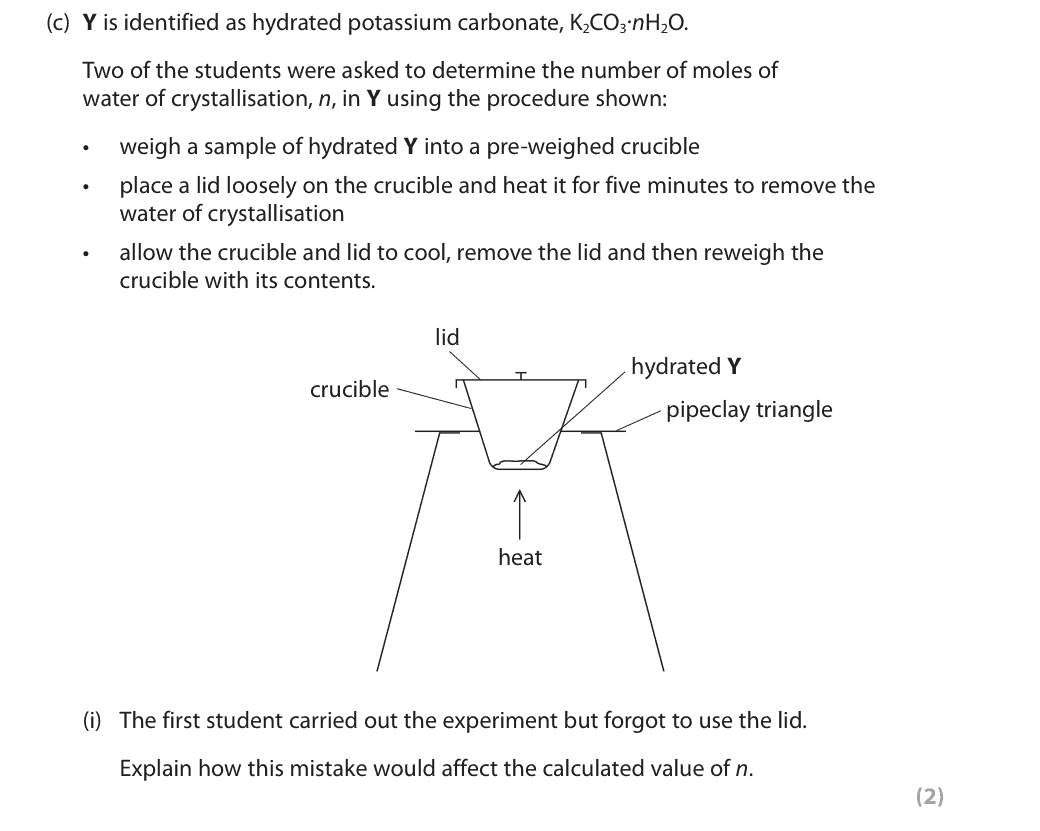
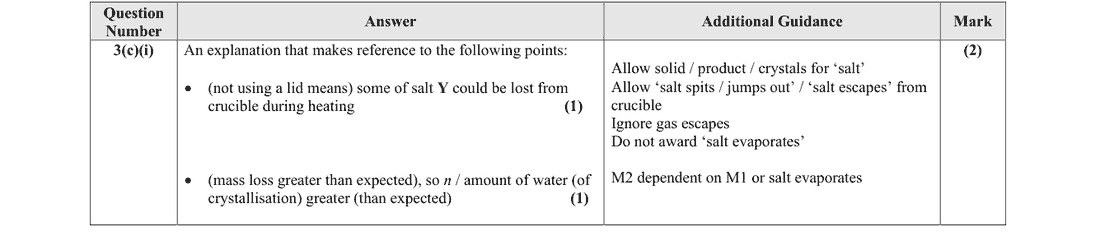

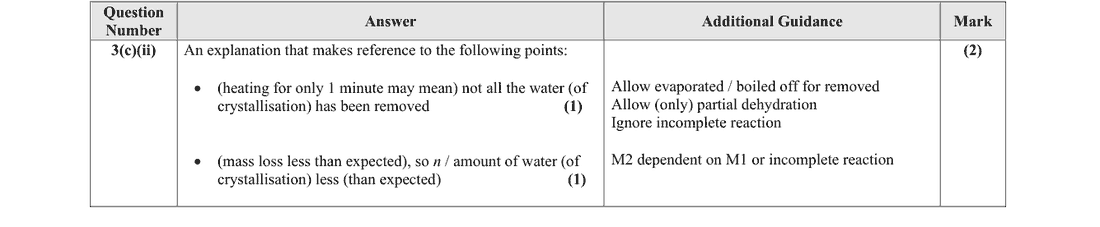

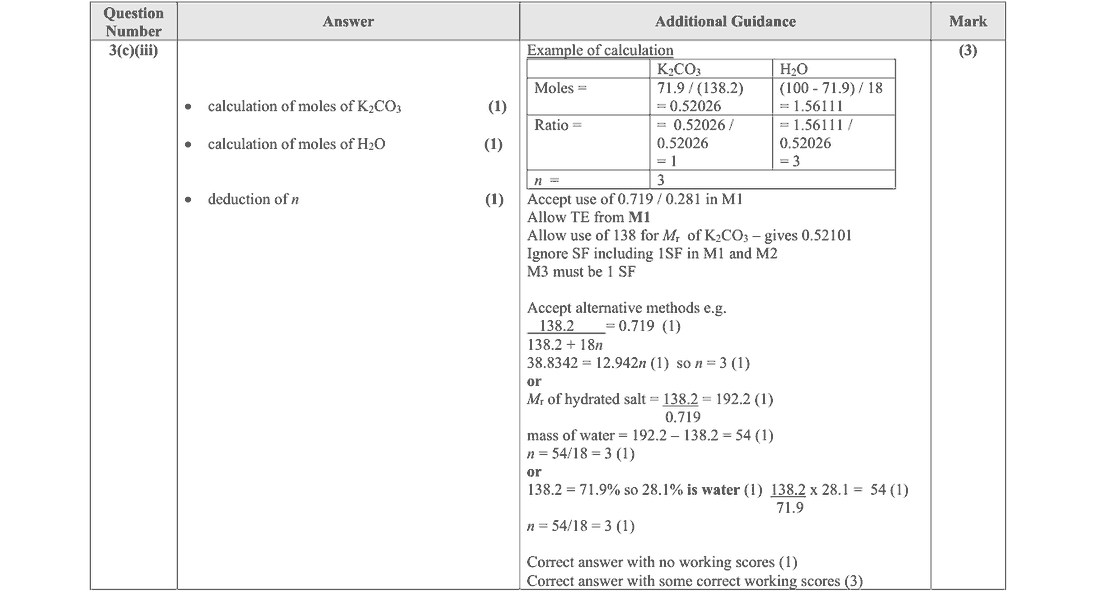
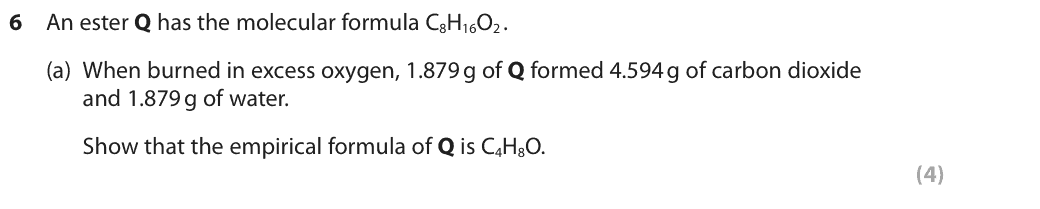
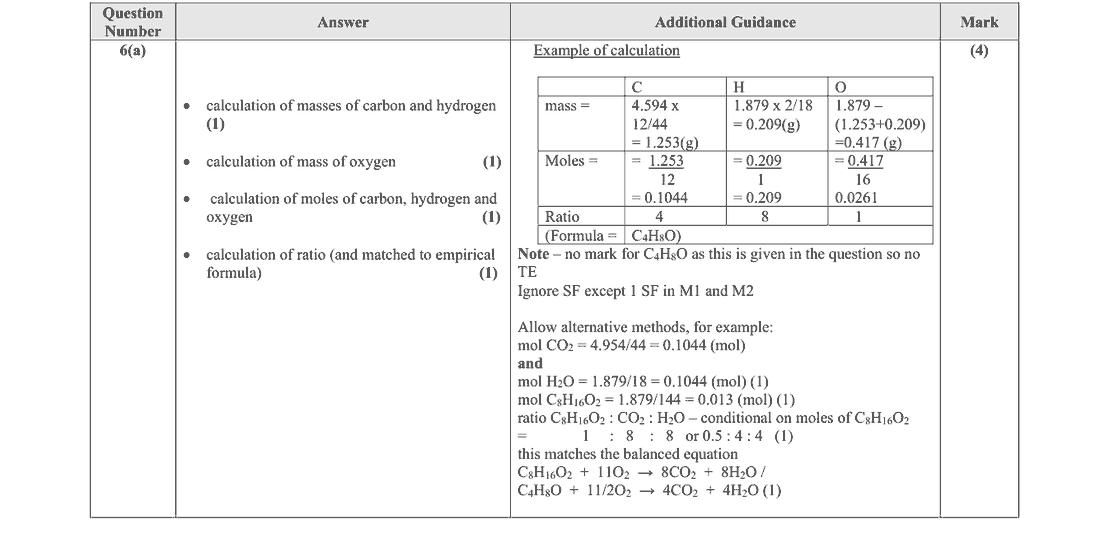
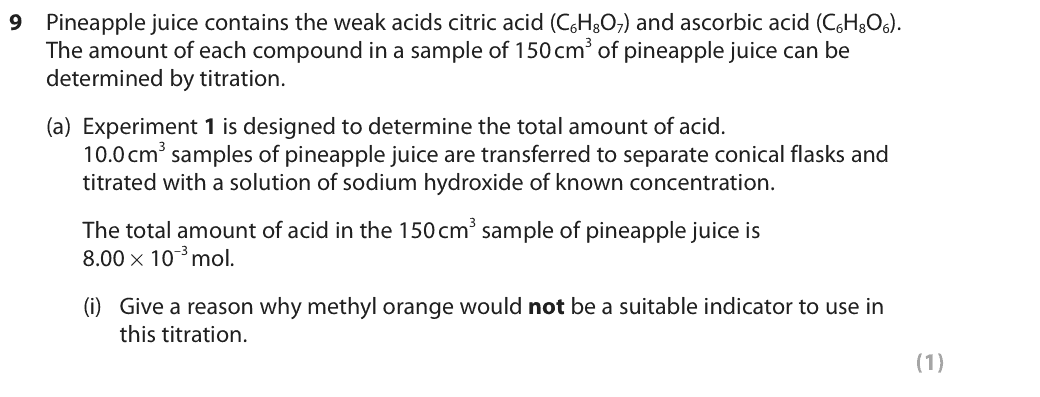

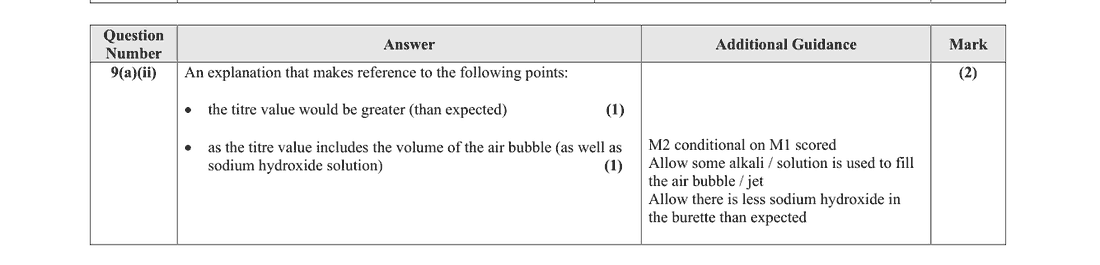
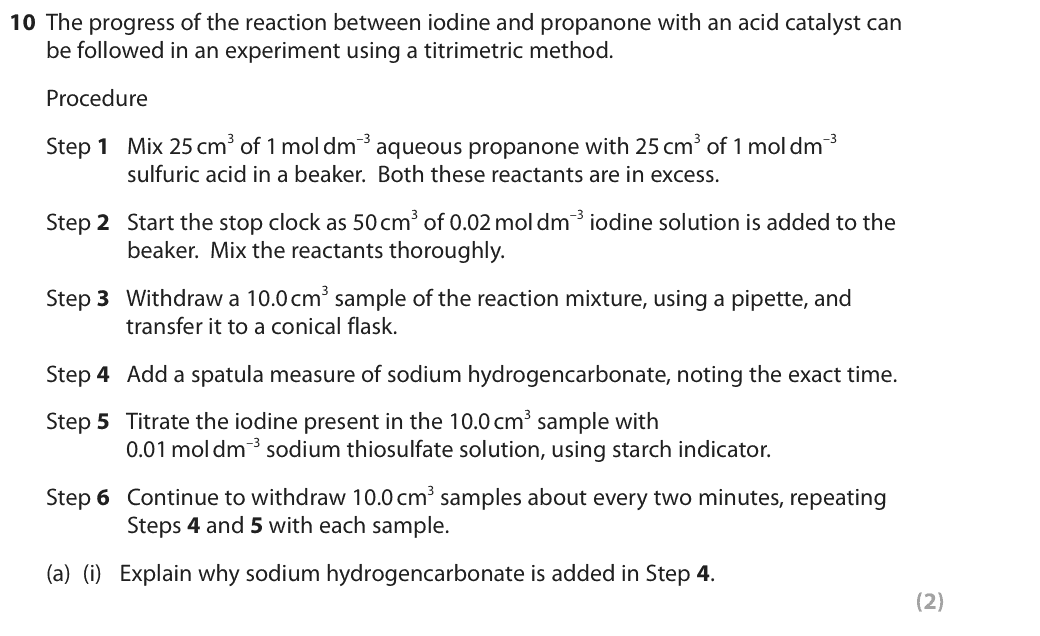

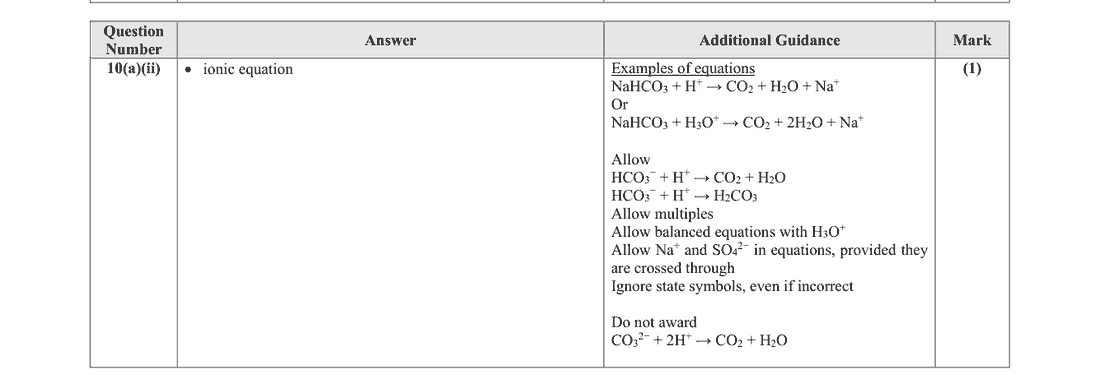
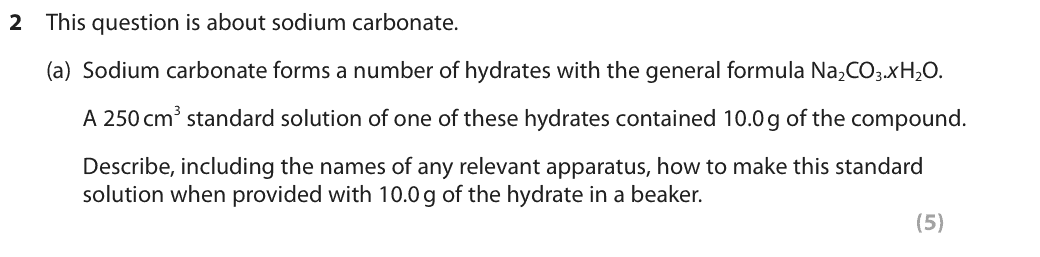
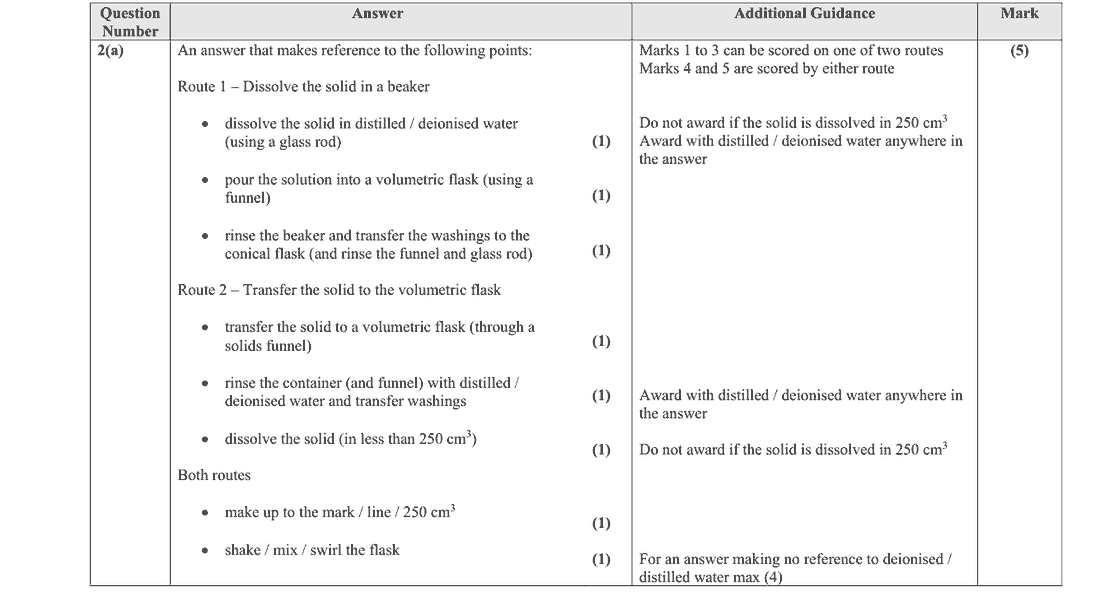
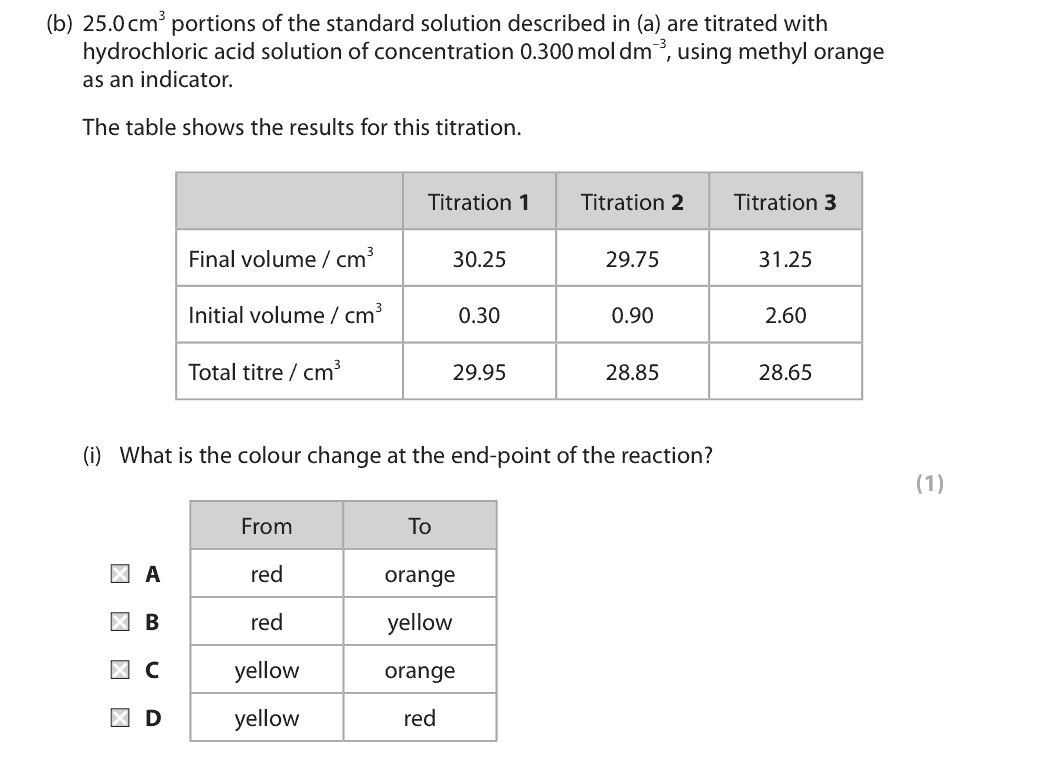





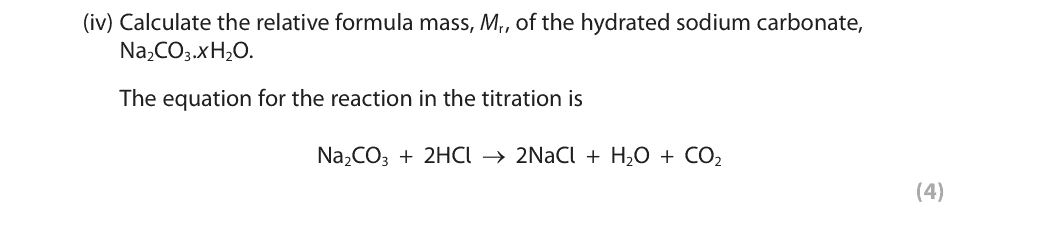
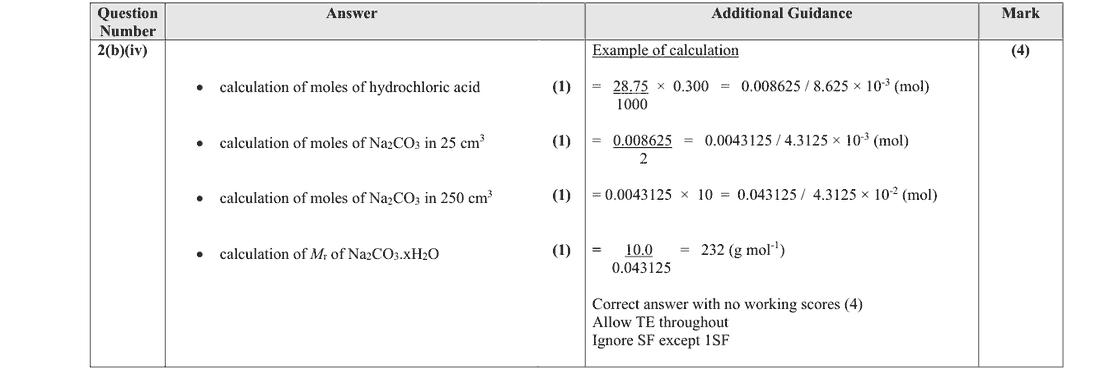



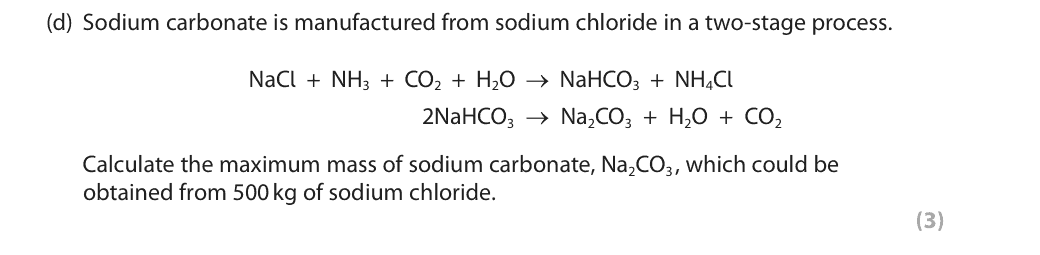
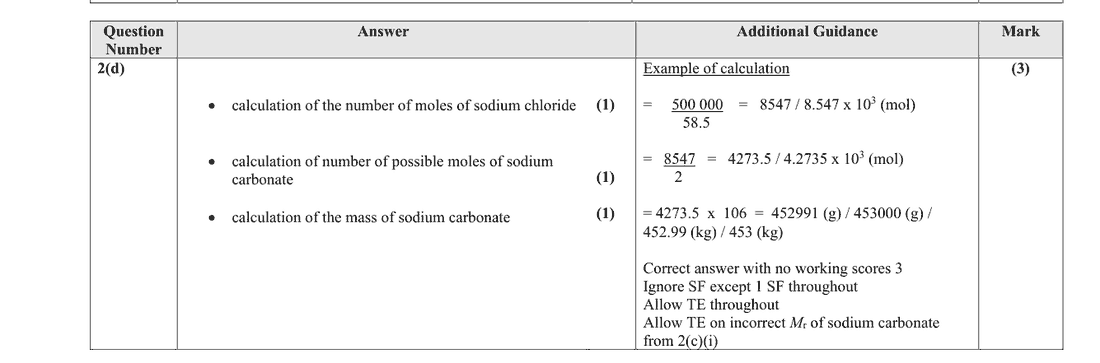




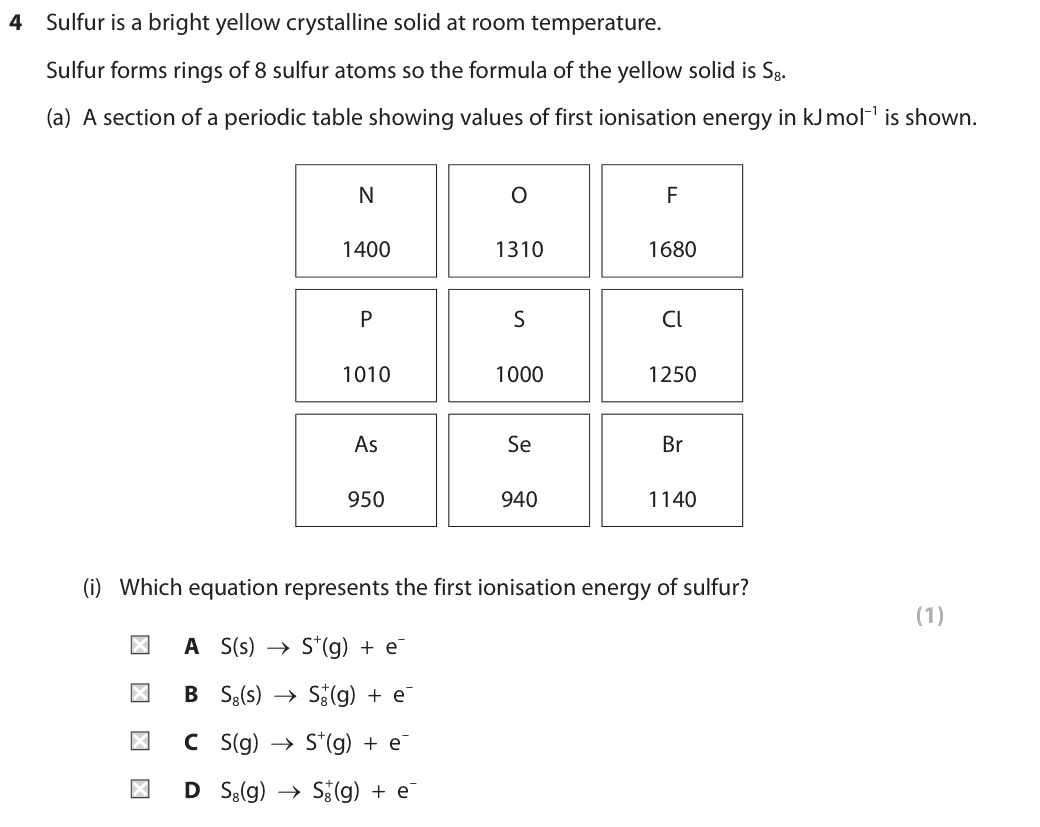
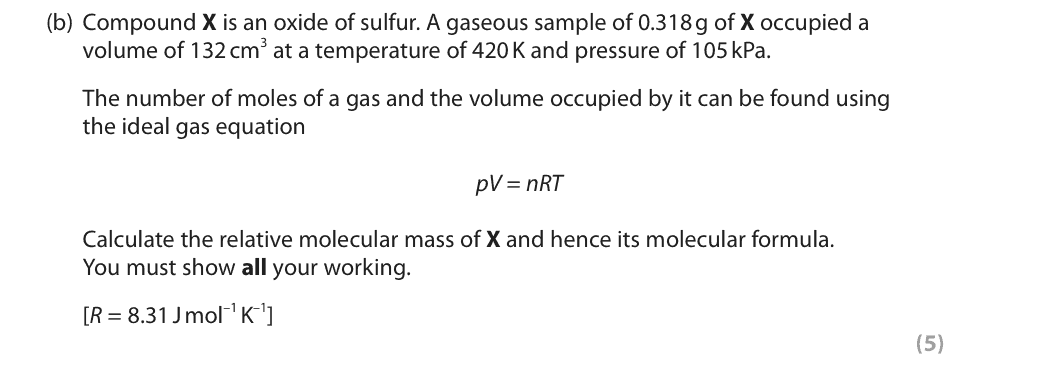
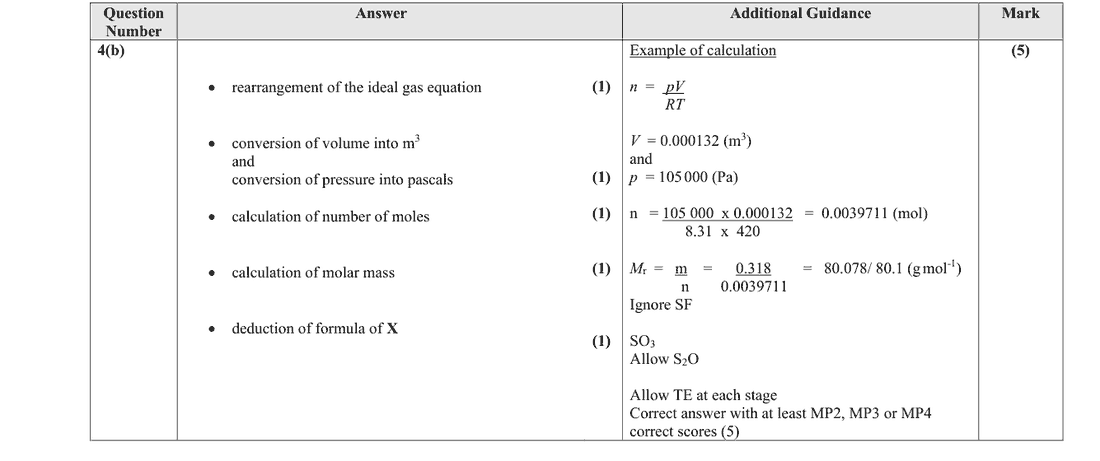



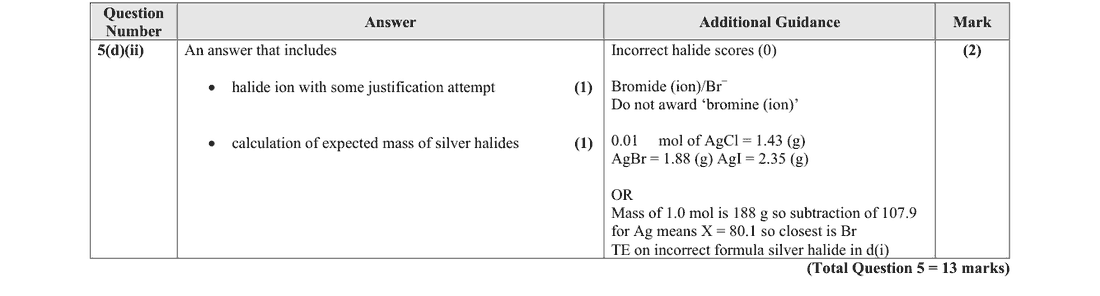
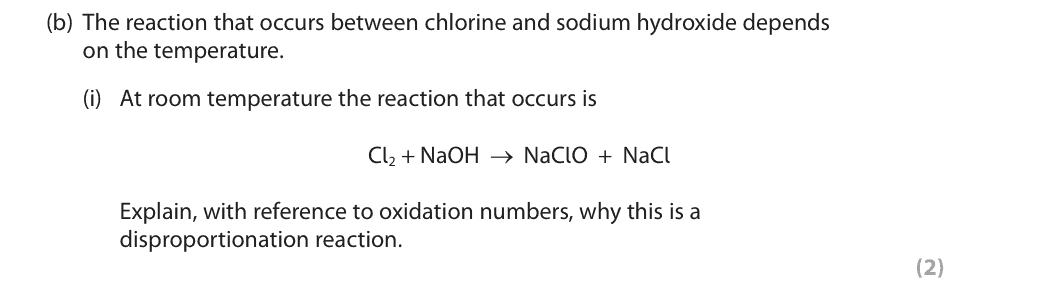
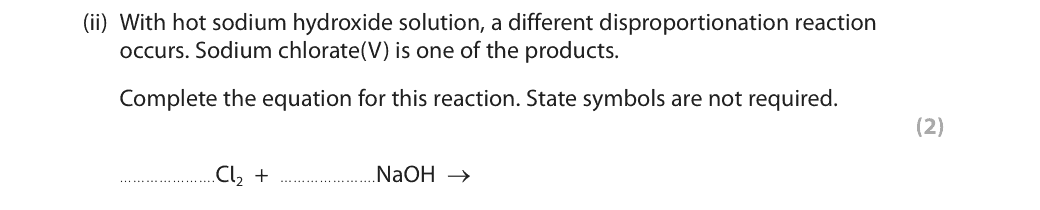
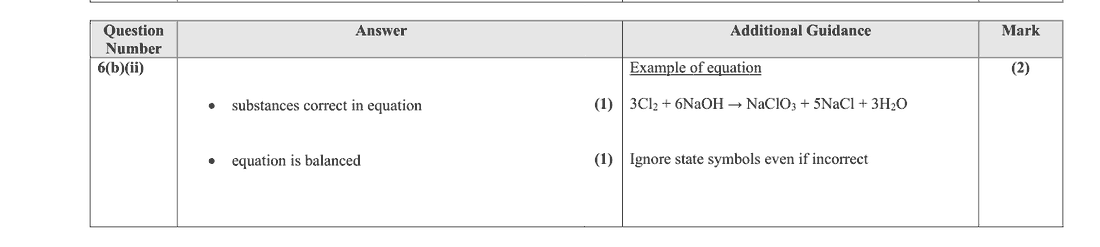
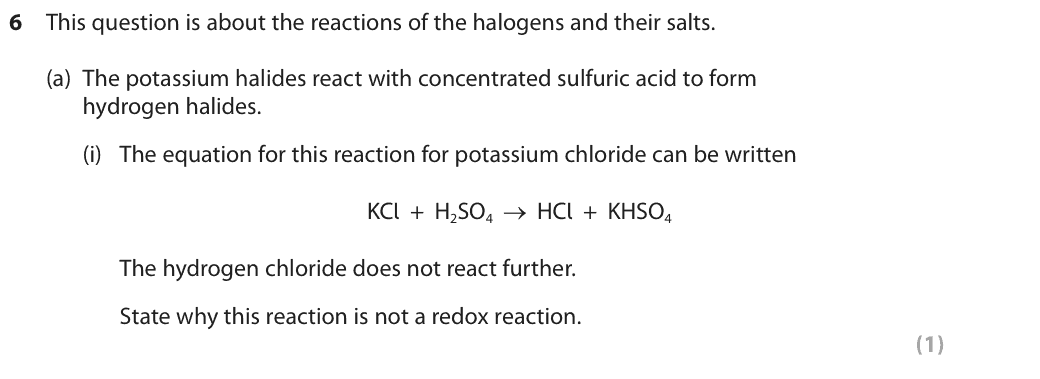
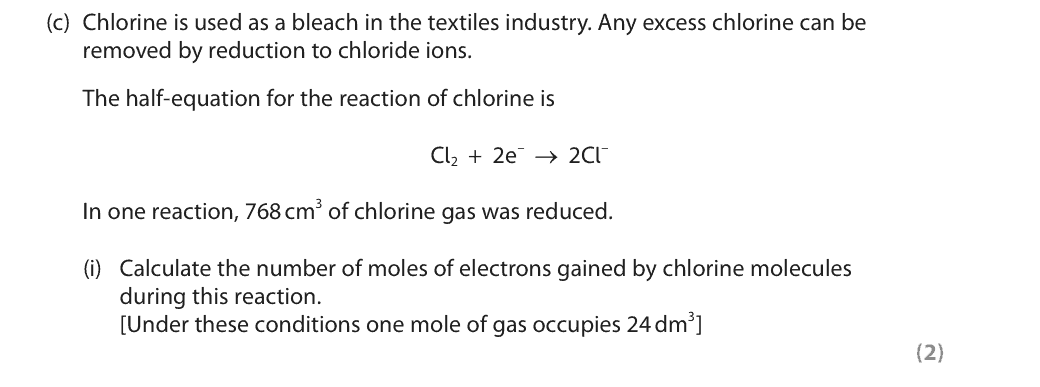
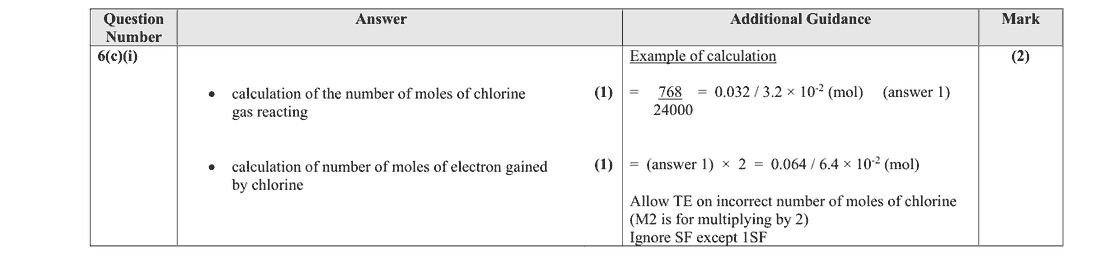

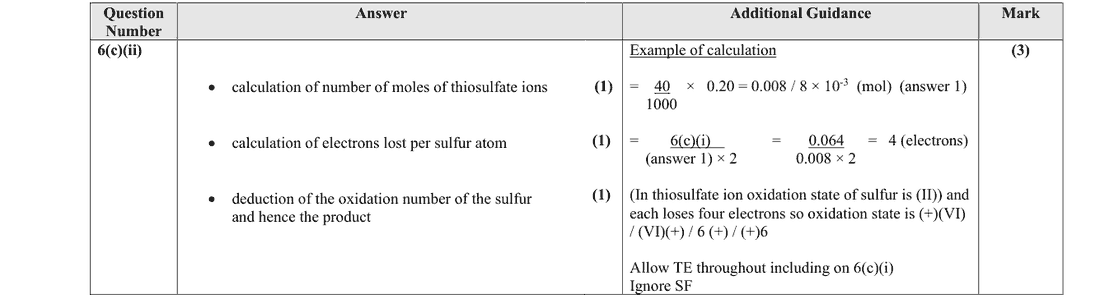

+
In an experiment, 0.10 mol of a complex reacted with excess silver nitrate solution
to produce 0.20 mol of silver chloride.
Chloride ions which are ligands within the complex do not react with
silver nitrate.
Deduce the formula of this chromium(III) complex ion. Justify your answer.](/img/NOV21_9CH01/NOV21_9CH01_8-d_qp.webp)