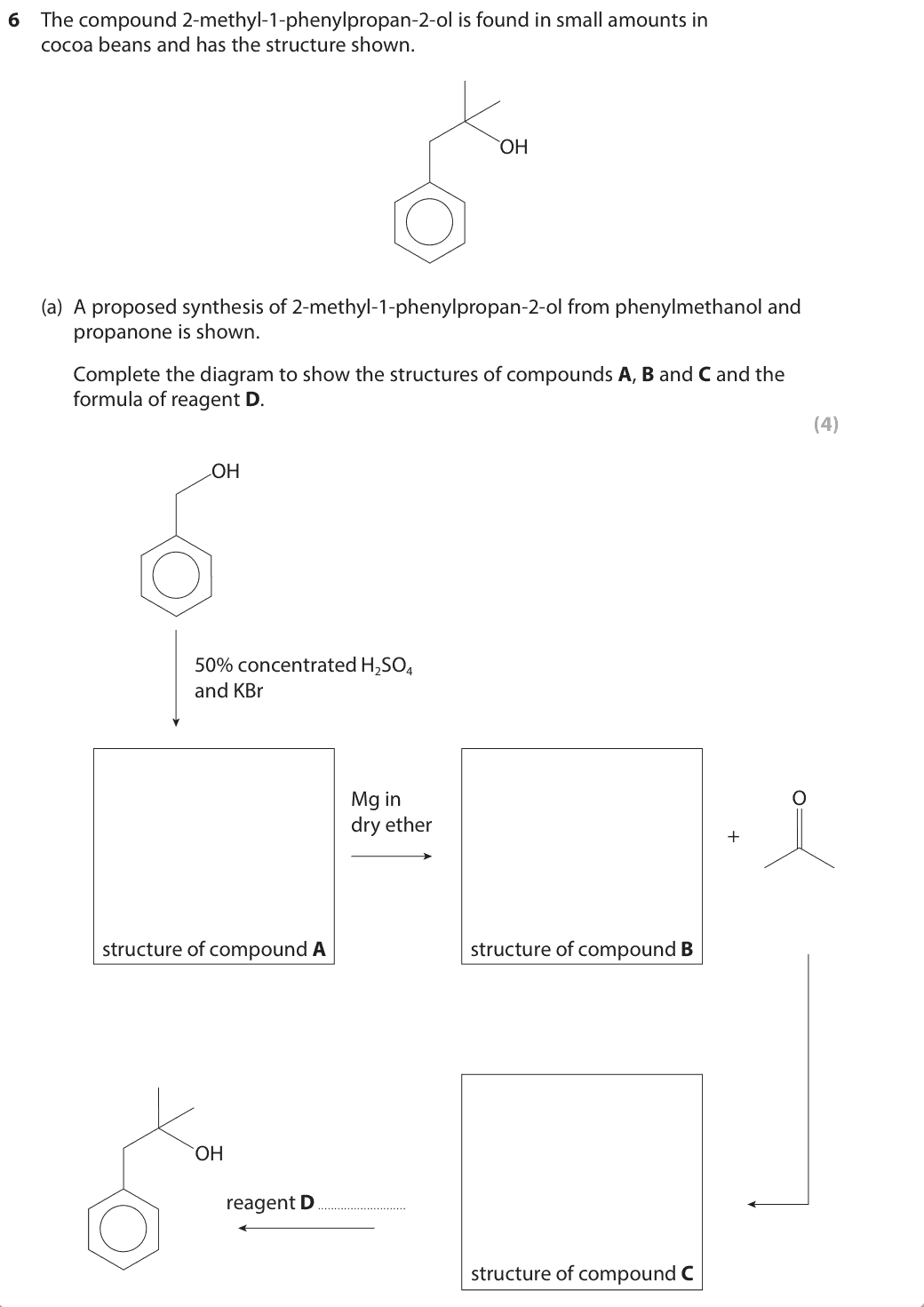
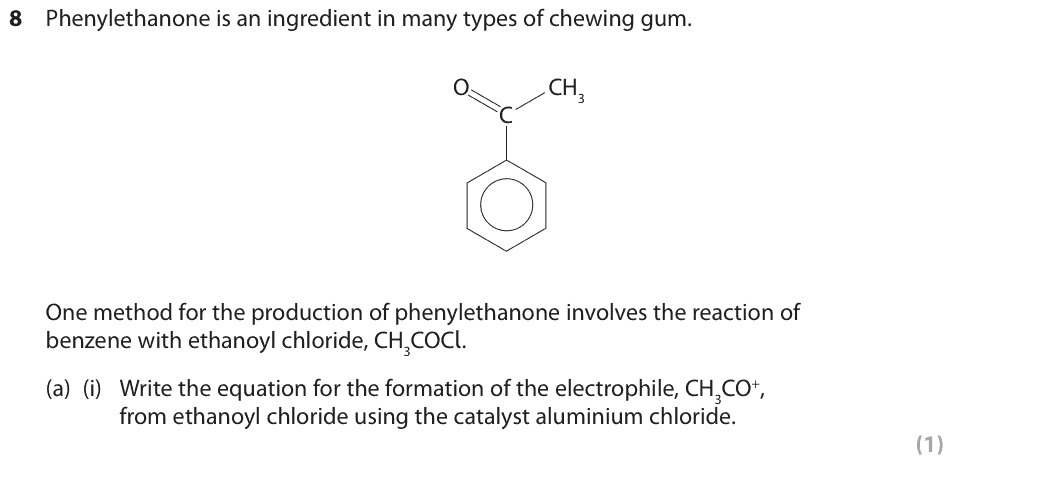
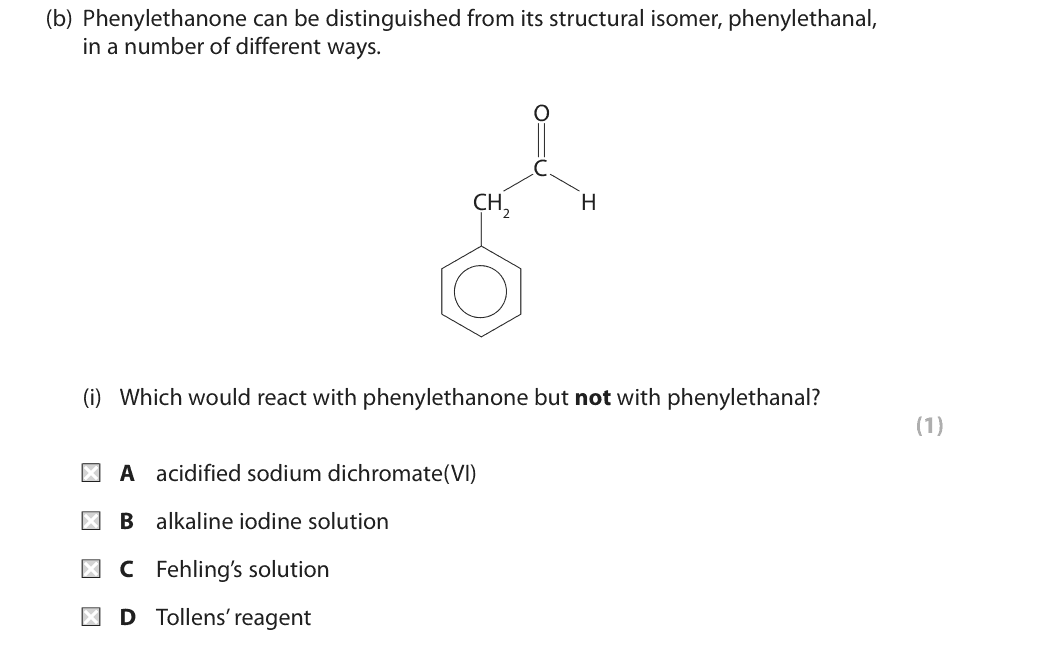
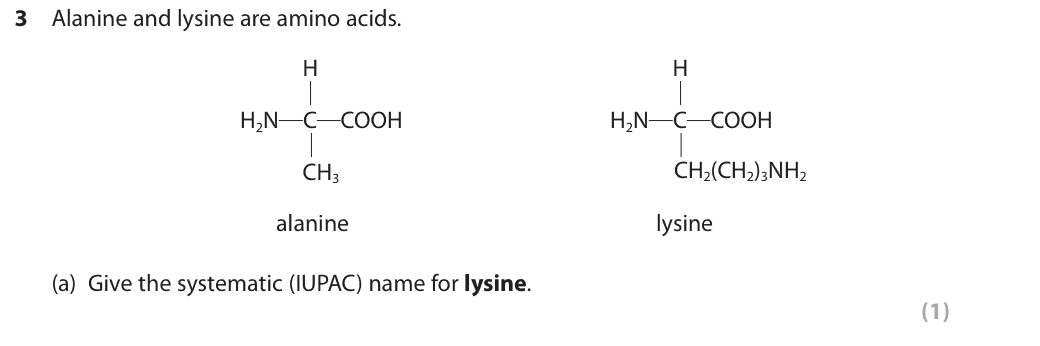
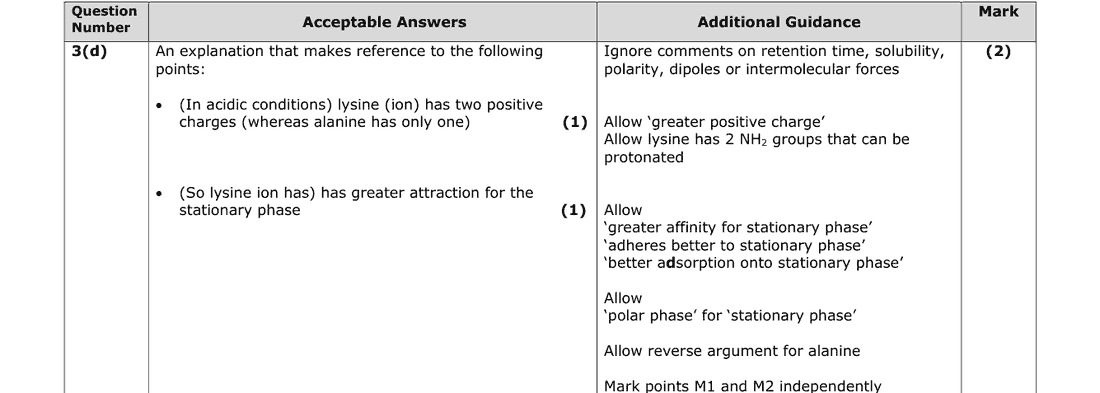
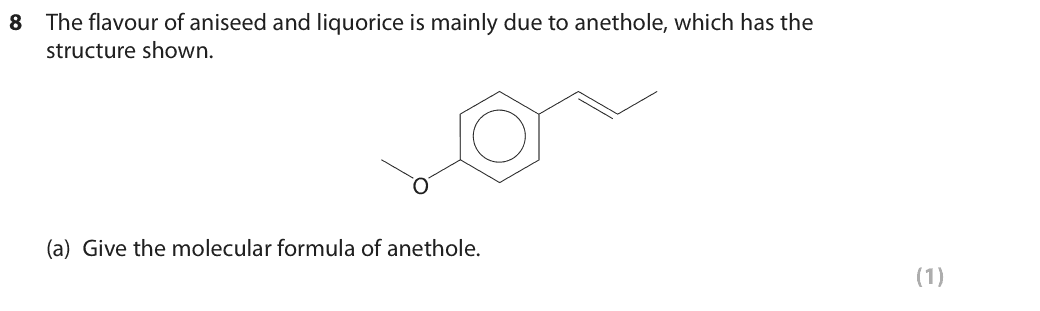
Earlier part of question 8 that this part uses
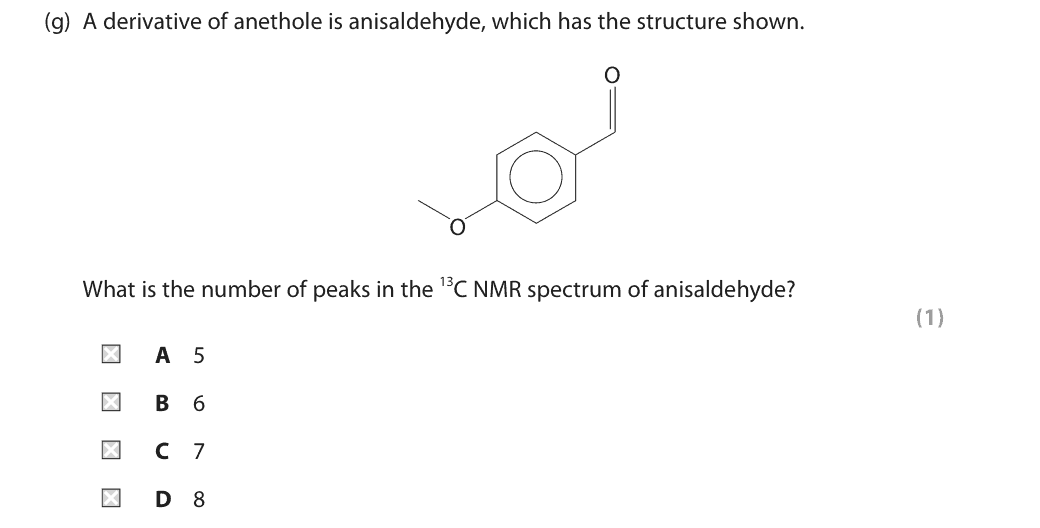
Answer
B
Mark scheme

Notes from the mark scheme and report
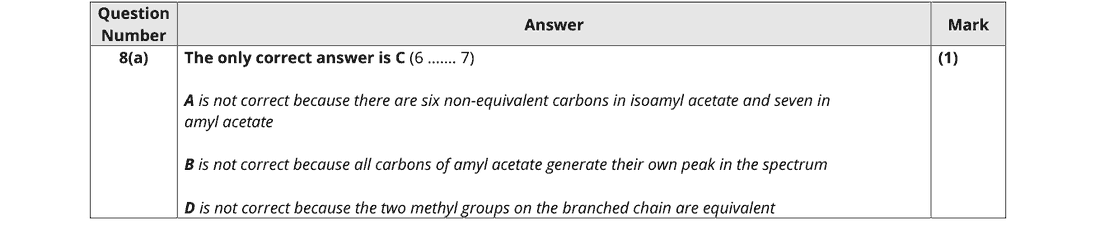
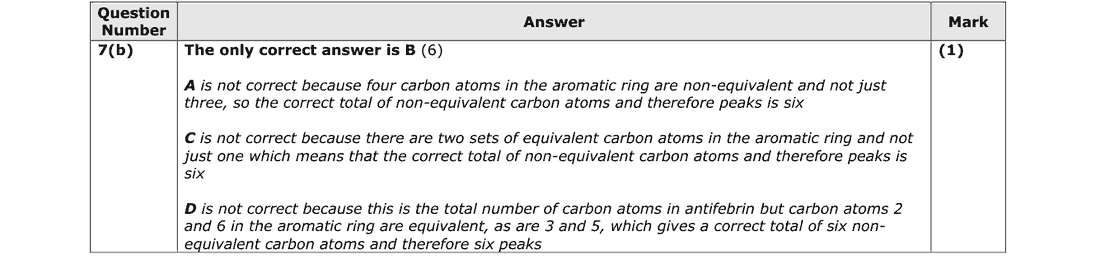
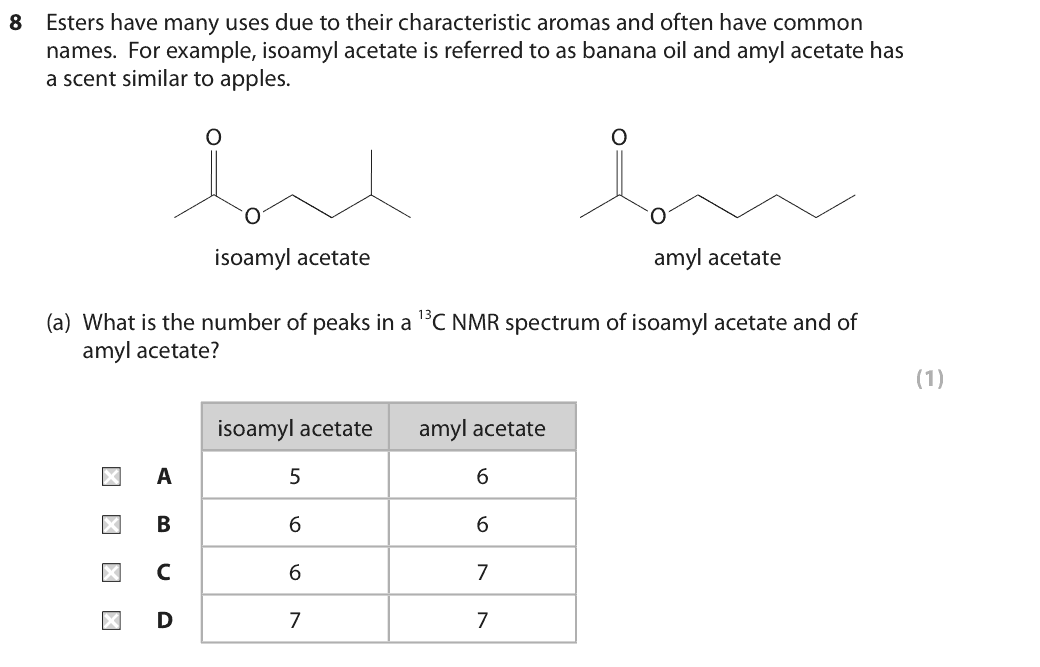
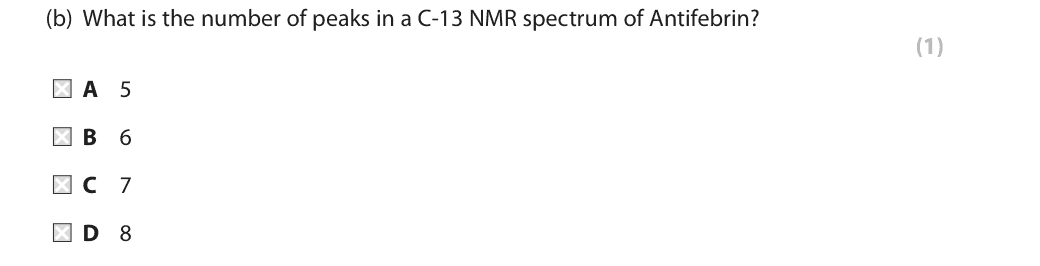
- Answer: B (6). Four different carbon environments in the 1,4-disubstituted ring, plus the CHO carbon and the OCH3 carbon
Notes and key-term cards for this topic are being written by our tutors. The past-paper questions below are ready now.
| Series | Paper | Q | What it asks |
|---|---|---|---|
| October 2020 | Paper 2 | 8(b) | the NMR spectra of propan-1-ol with those of propan-2-ol. |
| June 2017 | Paper 2 | 8(b)(iii) | and contrast the high resolution proton NMR spectra of |
B
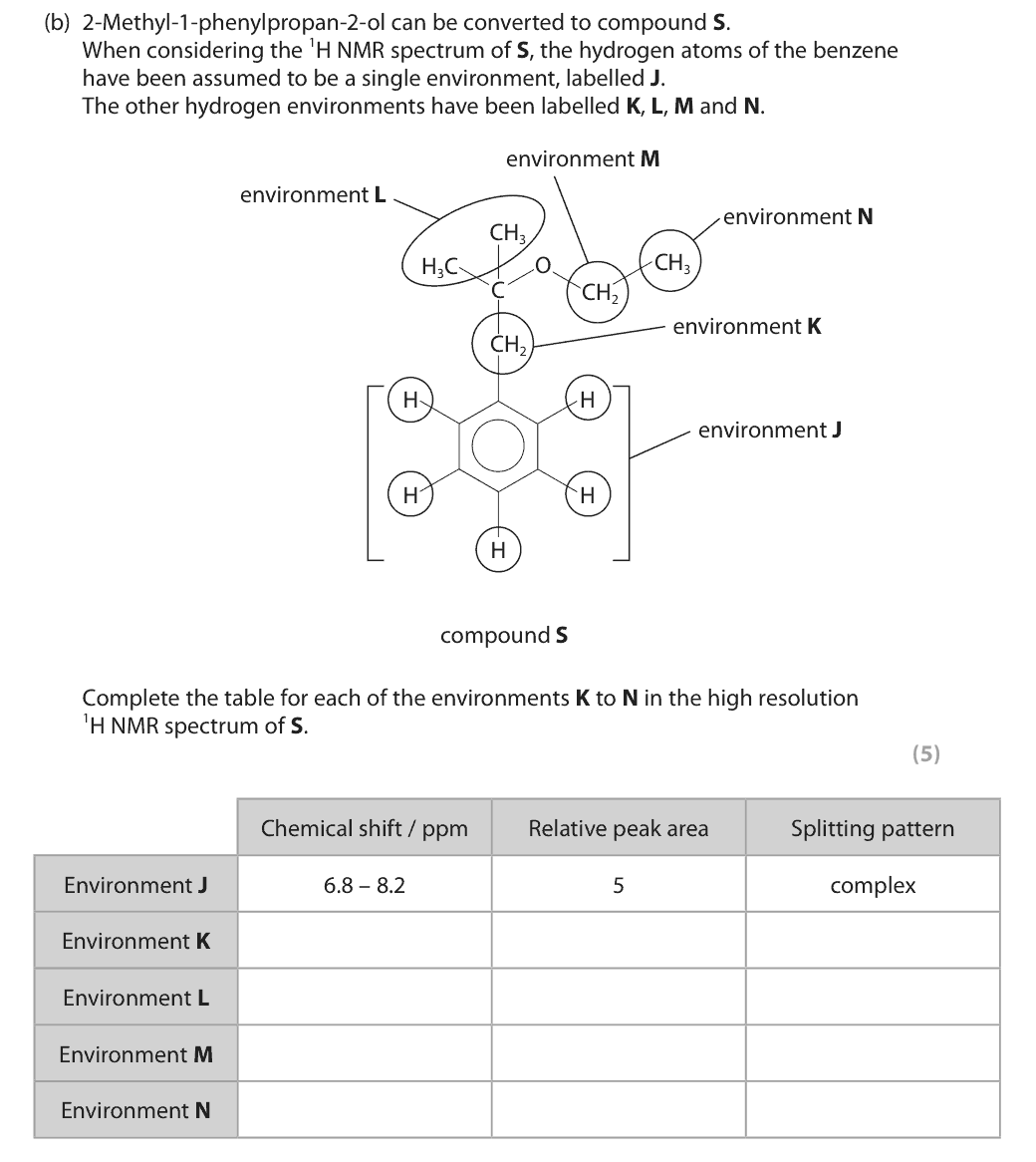
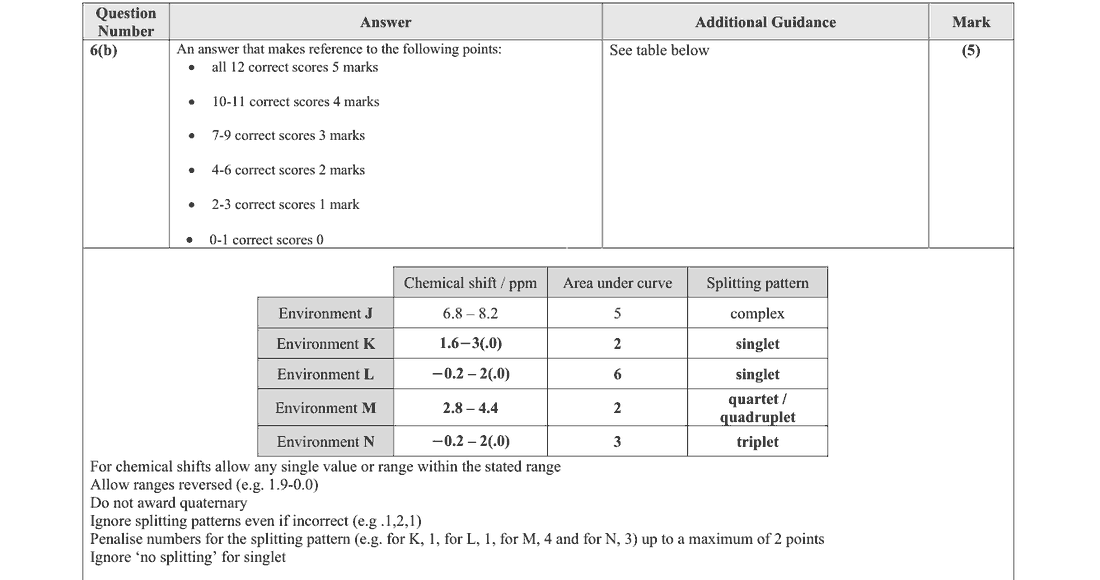
For this question, the areas were often given correctly, with many candidates also identifying the correct splitting pattern. However, it was common to see that candidates ignored the adjacent aryl group for environment K and so suggested a range of -0.2-2.0. Please note that to take into account the various data booklets that candidates might have used, the ranges of the acceptable chemical shifts were widened, including to below '0'.
B

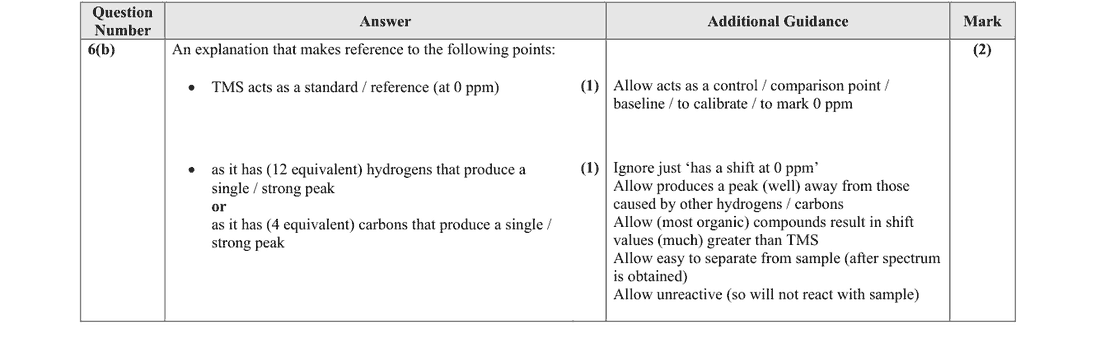
Candidates usually mentioned the function of TMS as a standard or reference and the most common way to access the second mark was to discuss the idea that TMS was inert, so would not react with the sample. Other candidates tried to justify the concept of a single or strong peak, but didn’t always link this with the equivalent carbon or hydrogen environments.

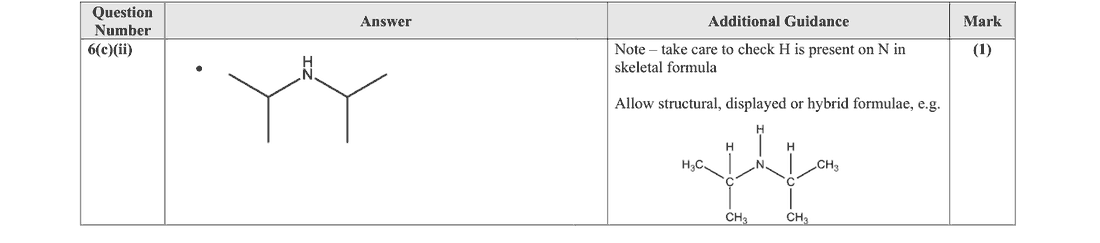
This was probably the most challenging item on the paper, with less than 20% of the cohort able to deduce the structure. In many cases candidates were hindered by their inability to recognise a secondary amine, so included a NH2 group. Even those candidates who suggested a secondary amine tended to draw N-propylpropan-1-amine, perhaps forgetting that the hydrogen atom attached to the nitrogen atom would also be responsible for a peak in the 1H NMR spectrum.
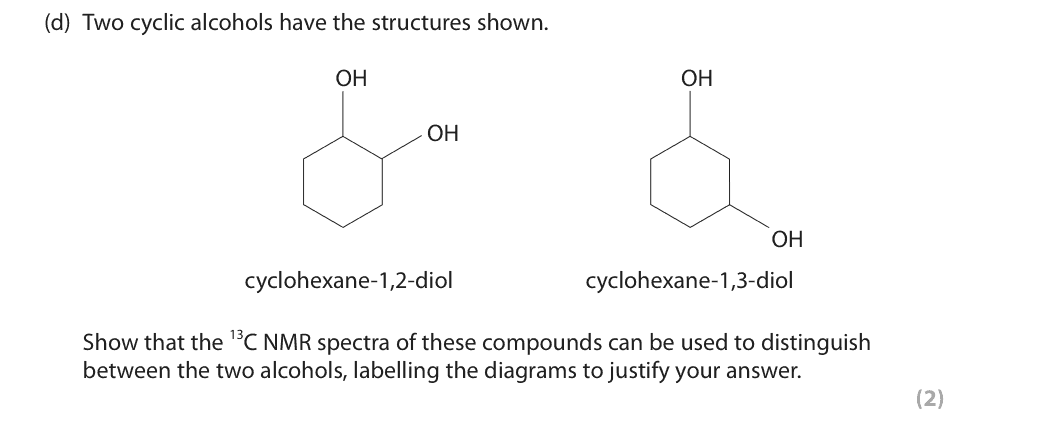
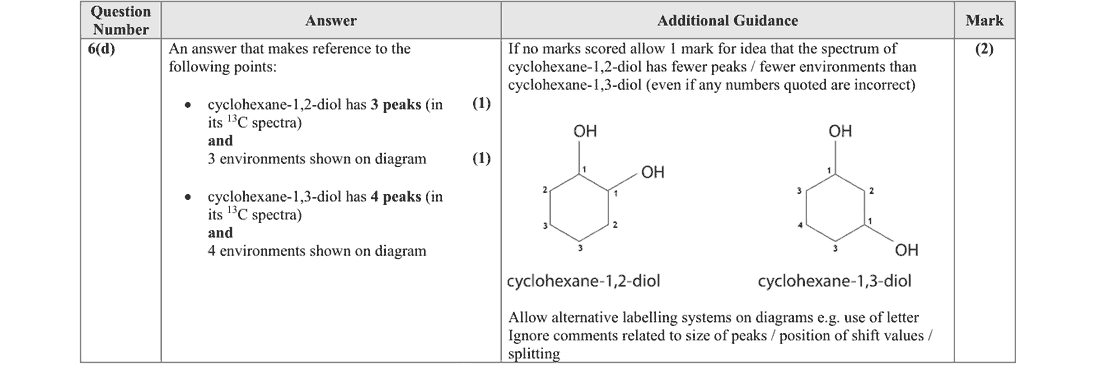
The marking team were pleased to see so many carefully labelled diagrams showing the carbon environments in each structure. Those candidates who didn’t manage to score the second mark usually missed out because they didn’t link the number of environments to the number of peaks one would see in the 13C NMR spectrum.
Skills: MS4.3 Understand the symmetry of 2D and 3D shapes
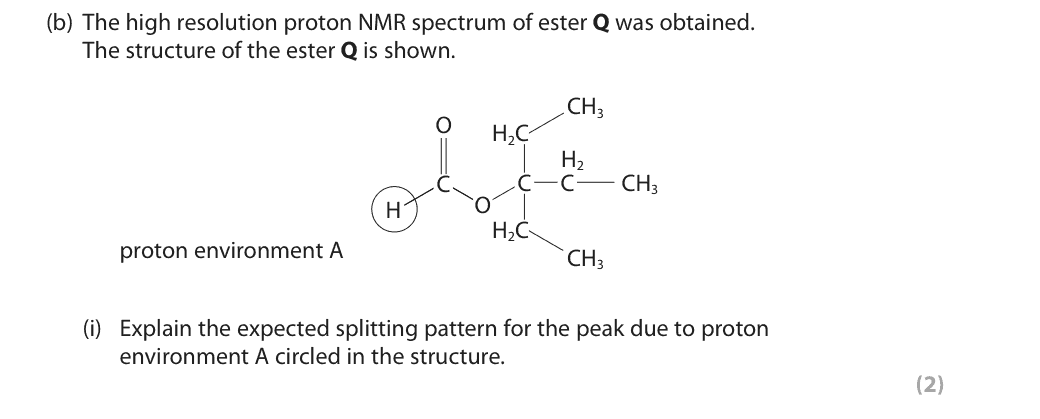
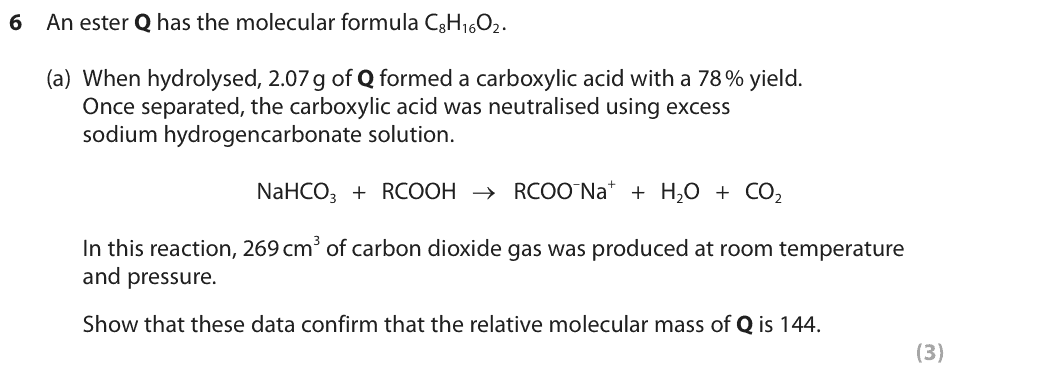
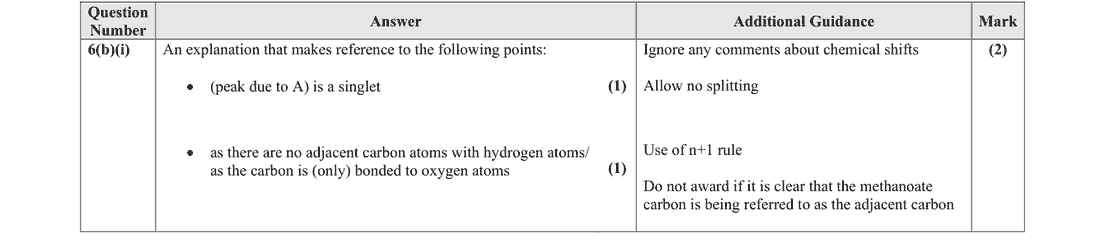
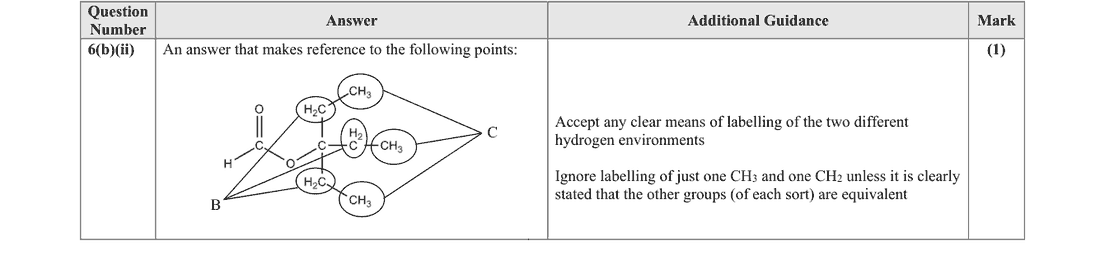
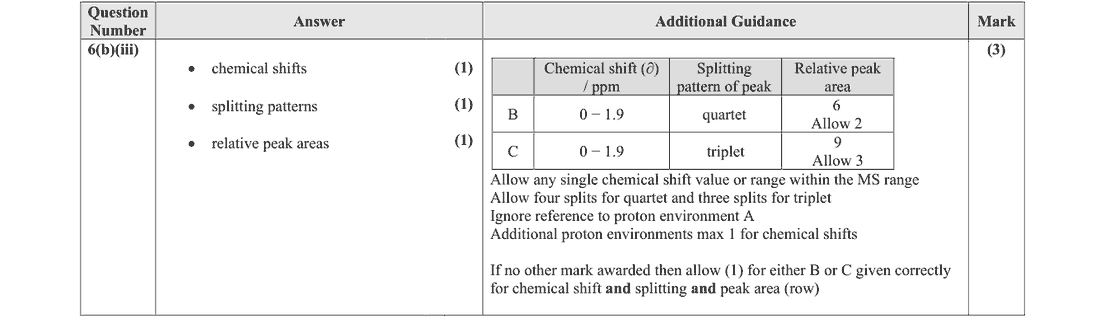
The variety of methods for carrying out the molar calculation in part (a) meant that all three marks was frequently awarded. The explanation of the NMR splitting pattern in part (b)(i) was generally done well with only a small minority referring to the adjacent hydrogen atoms rather than the hydrogen atoms bonded to the adjacent carbon atoms. Some answers referred to the fact the the adjcent atom was an oxygen rather than a carbon and this was acceptable. Candidates came up with a range of different labelling approches to part (b)(ii), most of these were acceptable. At times the central CH2 group was though to be different to the other two such groups but this was rare. The splitting patterns and the relative peak areas of part (b)(iii) were usually correct but it was the chemical shift values which caused the most difficulty. The alkane H–C–C environment should have given a value from the Data Booklet of less than 2.0 ppm. Oftentimes a value was missing altogether which was disappointing given that it was the first requirement listed in the question. On other occasions a value of 2 or higher was suggested which did not score.

The variety of methods for carrying out the molar calculation in part (a) meant that all three marks was frequently awarded. The explanation of the NMR splitting pattern in part (b)(i) was generally done well with only a small minority referring to the adjacent hydrogen atoms rather than the hydrogen atoms bonded to the adjacent carbon atoms. Some answers referred to the fact the the adjcent atom was an oxygen rather than a carbon and this was acceptable. Candidates came up with a range of different labelling approches to part (b)(ii), most of these were acceptable. At times the central CH2 group was though to be different to the other two such groups but this was rare. The splitting patterns and the relative peak areas of part (b)(iii) were usually correct but it was the chemical shift values which caused the most difficulty. The alkane H–C–C environment should have given a value from the Data Booklet of less than 2.0 ppm. Oftentimes a value was missing altogether which was disappointing given that it was the first requirement listed in the question. On other occasions a value of 2 or higher was suggested which did not score.

The variety of methods for carrying out the molar calculation in part (a) meant that all three marks was frequently awarded. The explanation of the NMR splitting pattern in part (b)(i) was generally done well with only a small minority referring to the adjacent hydrogen atoms rather than the hydrogen atoms bonded to the adjacent carbon atoms. Some answers referred to the fact the the adjcent atom was an oxygen rather than a carbon and this was acceptable. Candidates came up with a range of different labelling approches to part (b)(ii), most of these were acceptable. At times the central CH2 group was though to be different to the other two such groups but this was rare. The splitting patterns and the relative peak areas of part (b)(iii) were usually correct but it was the chemical shift values which caused the most difficulty. The alkane H–C–C environment should have given a value from the Data Booklet of less than 2.0 ppm. Oftentimes a value was missing altogether which was disappointing given that it was the first requirement listed in the question. On other occasions a value of 2 or higher was suggested which did not score.

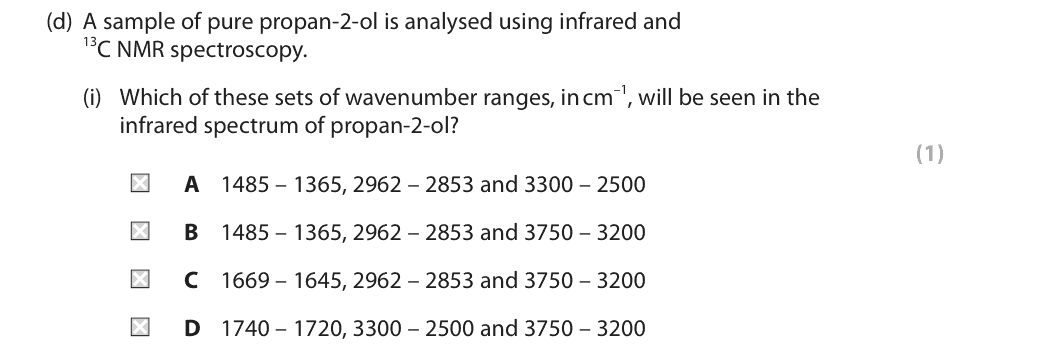
This was a straightforward question and many correct answers stating that there would be two peaks in the 13C NMR spectrum of propan-2-ol were seen. This was a straightforward question and was well-answered with many correct answers stating that there would be two peaks in the 13C NMR spectrum of propan-2-ol.
Skills: MS4.3 Understand the symmetry of 2D and 3D shapes
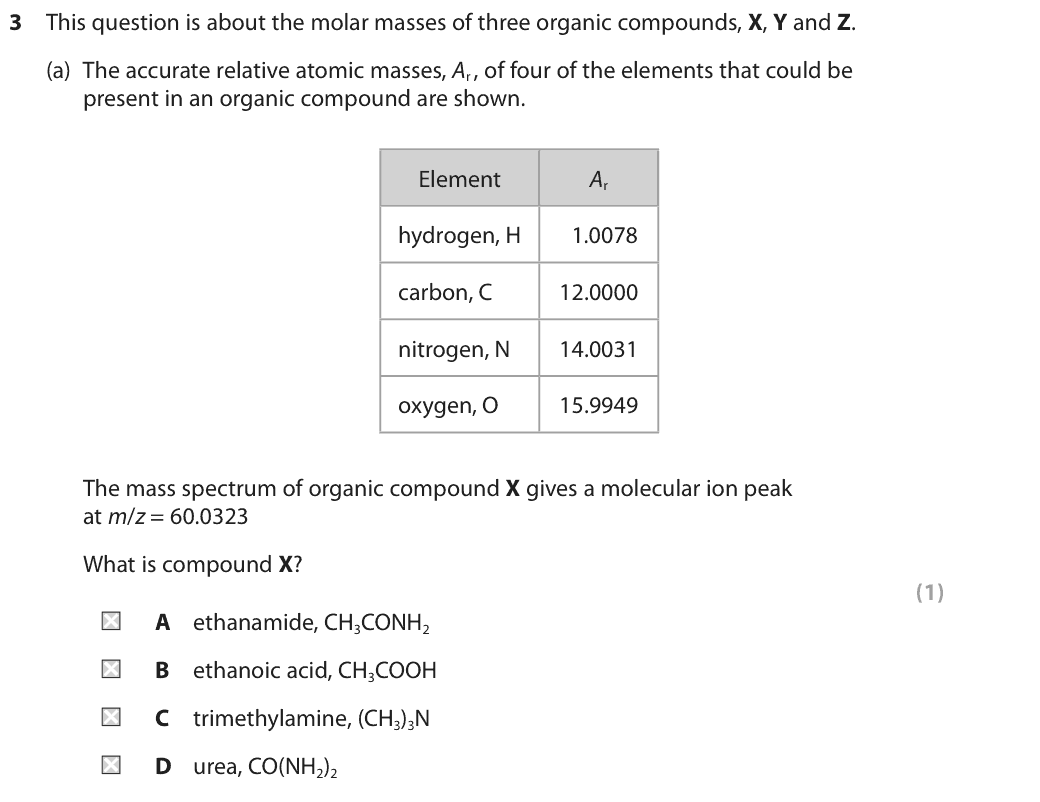
D
Skills: MS0.1 Recognise and use expressions in decimal and ordinary form
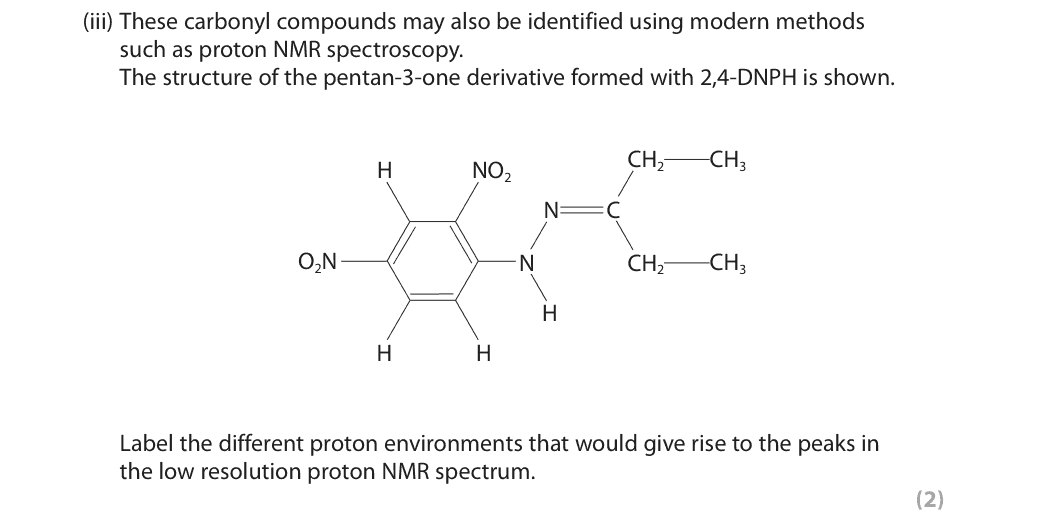
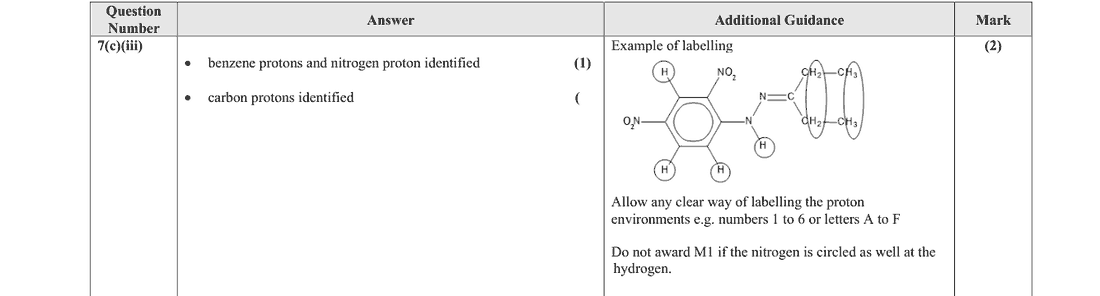
Many candidates were able to label the hydrogen environments on the benzene ring and on the nitrogen correctly, but failed to realise that the two CH2 groups would form one environment and that the two CH3 groups would form another. A few candidates labelled carbon environments instead.
Skills: MS4.3 Understand the symmetry of 2D and 3D shapes

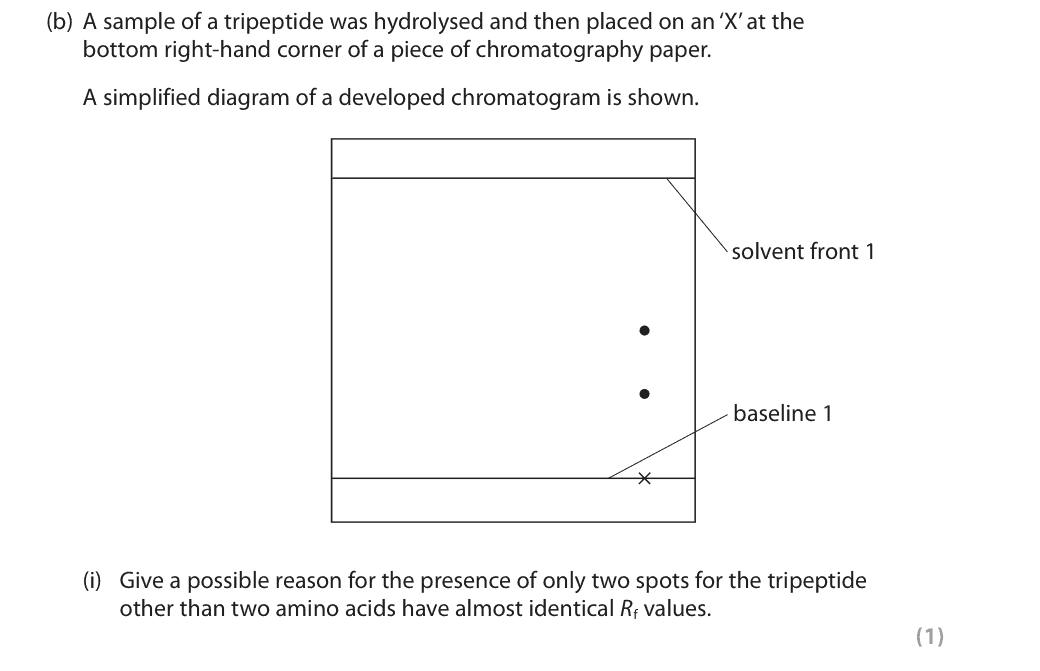
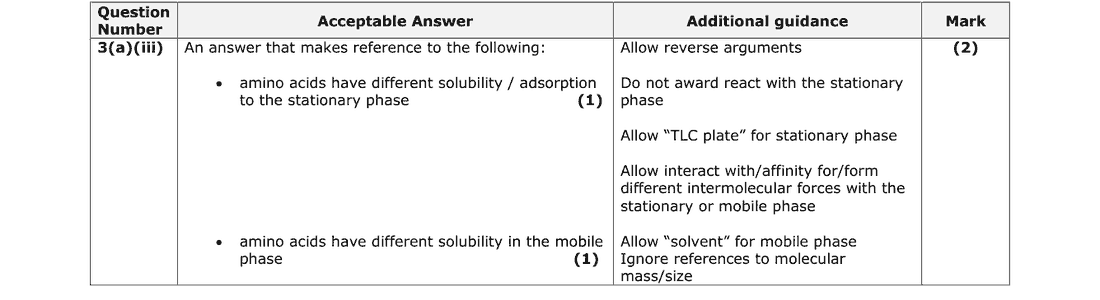
Approximately half of the candidates correctly compared the different interactions between the amino acids and the stationary or mobile phases. A significant number of candidates referred to differences in solubility, but without relating it to chromatography.
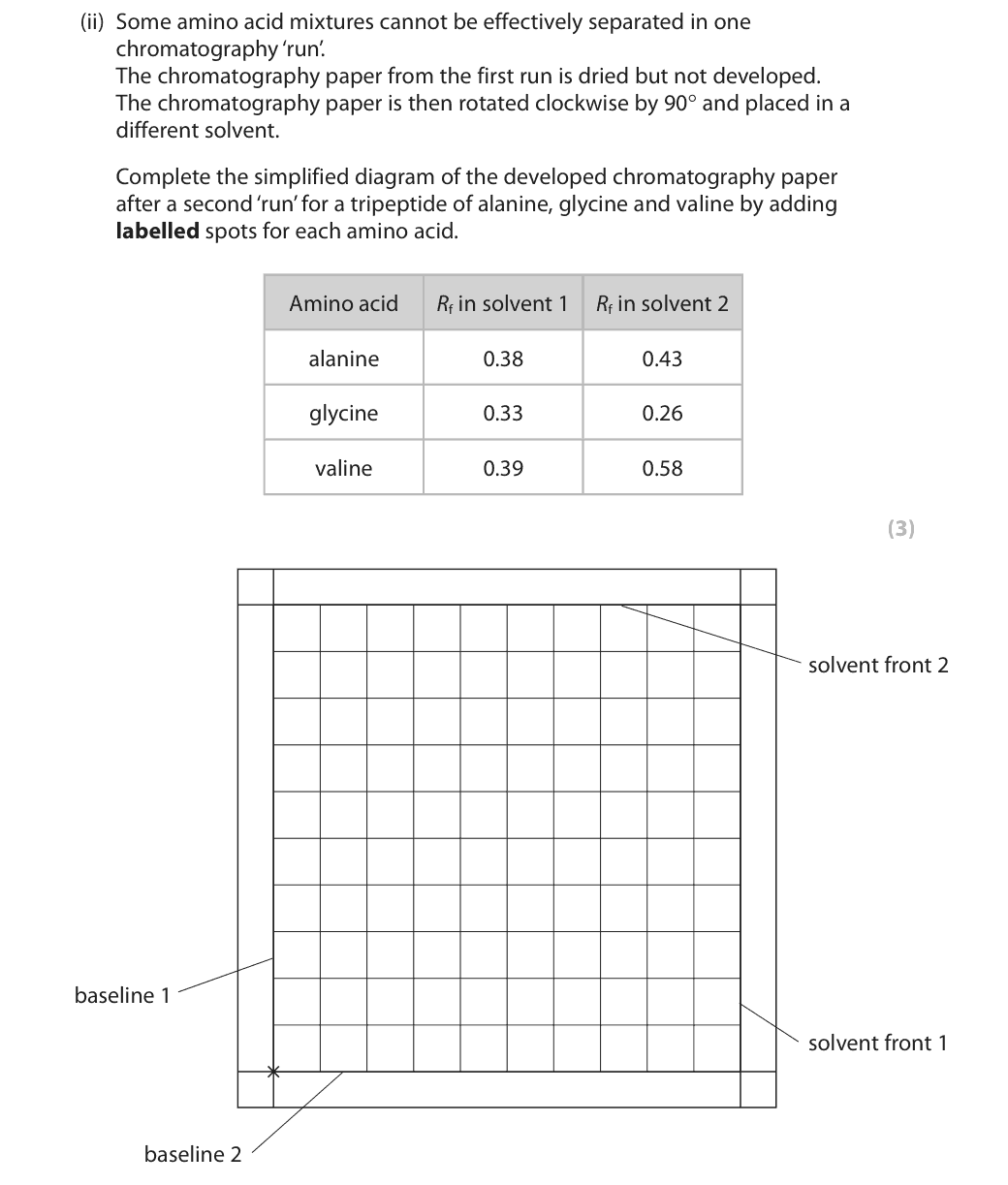
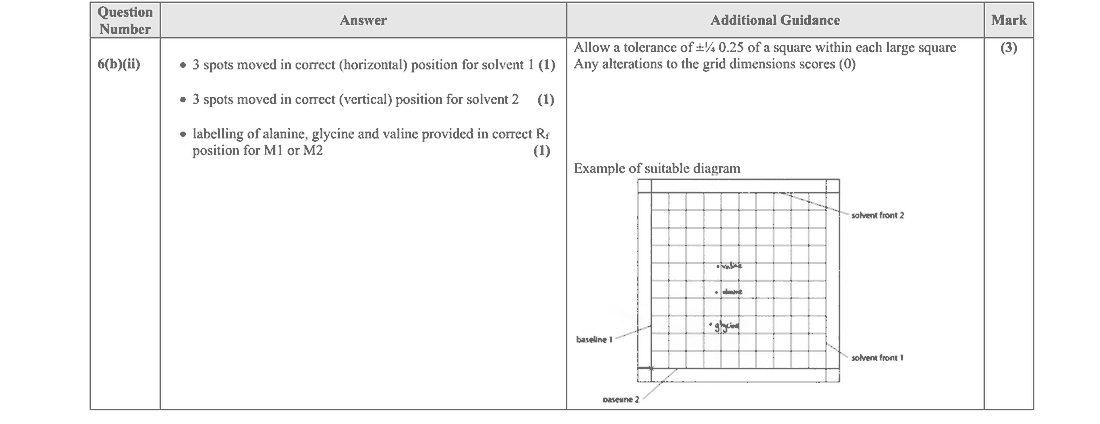
A minority of candidates was able to draw a correct fully labelled chromatogram. It was clear that most candidates had not met this two solvent process before. There was also a significant number of candidates that didn't realise the three amino acids would occupy the same position at the beginning and instead started them from different positions on the baseline. Some candidates who understood the basic principle still lost credit through inaccurate placement of their spots.
Skills: MS0.2 Use ratios, fractions and percentages; MS3.2 Plot two variables from experimental or other data; PT9 use thin-layer or paper chromatography

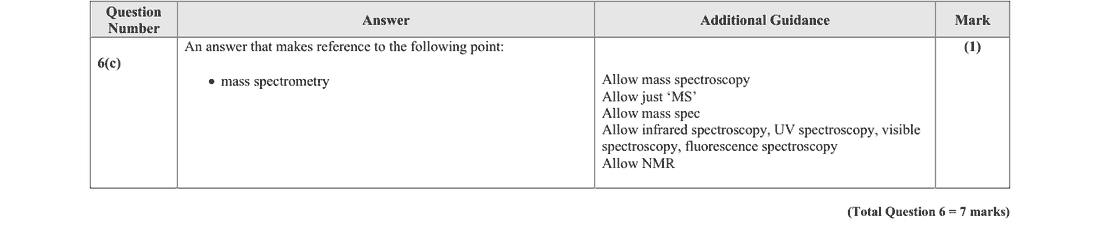
It was not uncommon to see that the basic principle of separation followed by identification was not understood. Many responses gave a second separation technique such as electrophoresis or TLC. However, just under half of candidates either gave mass spectrometry or infrared spectroscopy.
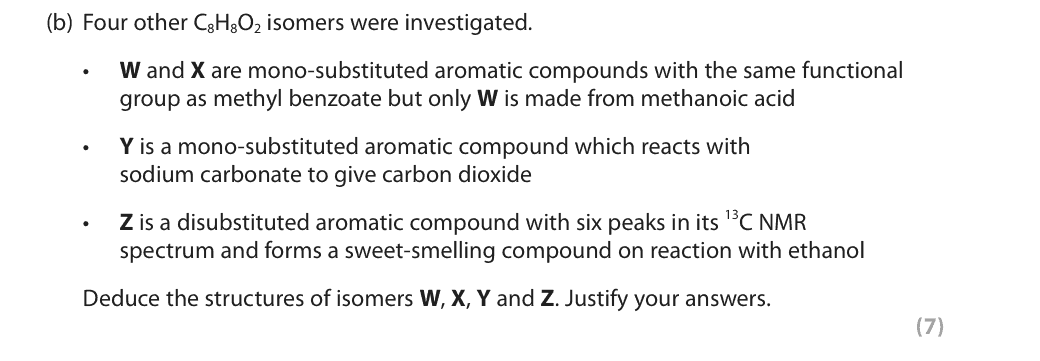
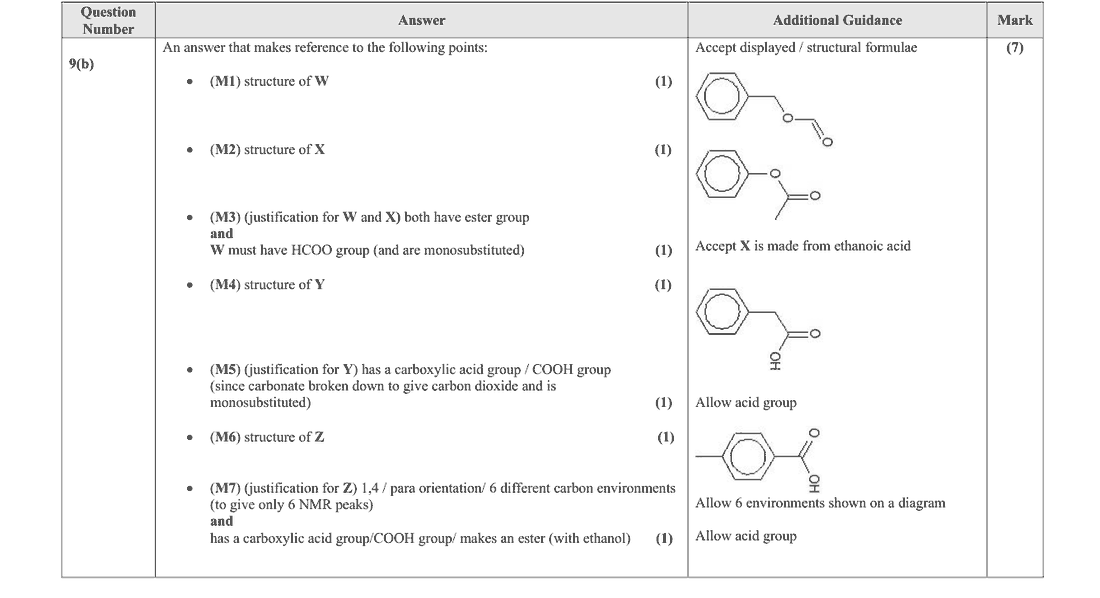
This question proved to be an effective discriminator and provided the vast majority of candidates with the opportunity to gain some credit. The structure of Y was the one that was most often correct, then Z and then W, with finally X being the least likely structure to be correct. The reasoning for Y being a carboxylic acid from the test with a carbonate proved to be the most accessible, possibly because there was the least information to process. It was pleasing to see many candidates understood that six peaks in a 13C NMR spectrum for Z meant six different carbon environments for Z and that this led onto a 1,4 or para- substituted benzene ring. In the consideration of the structures of W and X, it was apparent that some candidates missed the significant statement that W and X had the same functional group because methyl benzoate was suggested instead of phenyl ethanoate.
Skills: MS4.3 Understand the symmetry of 2D and 3D shapes
C
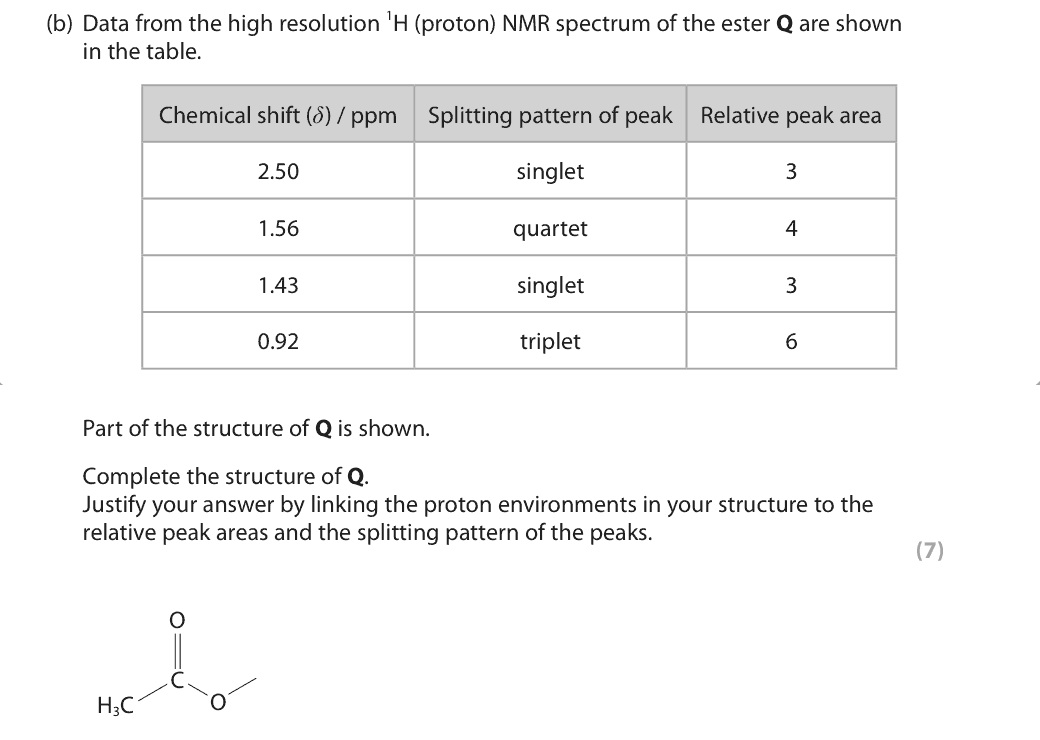
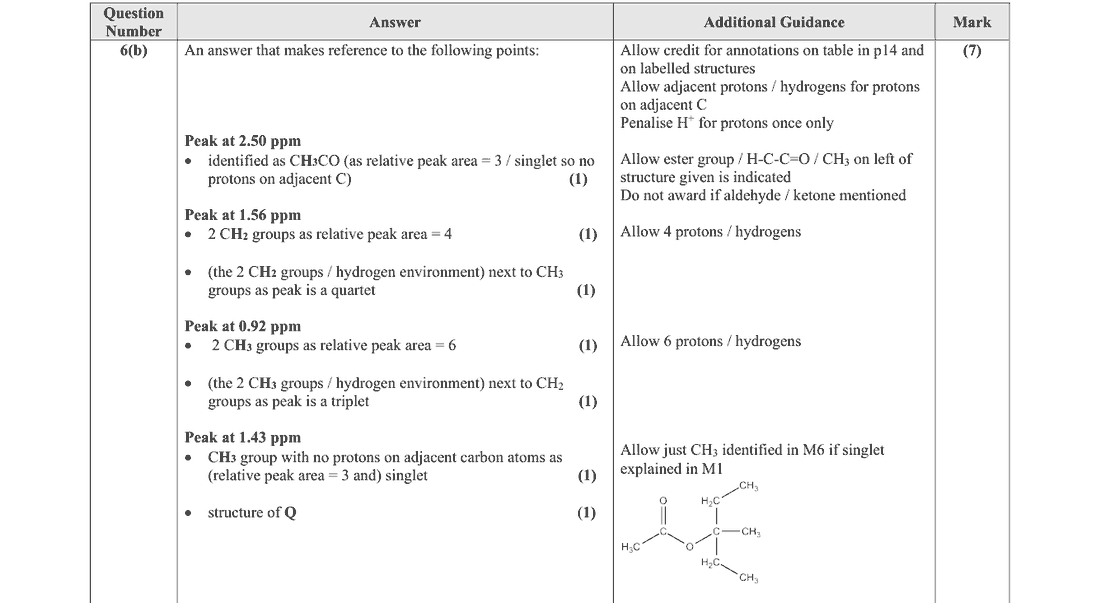
This was a challenging question using data from proton NMR spectroscopy and it was pleasing to see many candidates using all the information to deduce the correct structure of Q and justify their answers. The clearest answers labelled the different proton environments on their diagrams of the structures and related them to the chemical shifts in the table. Even if candidates could not deduce the correct structure, they received credit for each piece of data they interpreted from the table, for example, relating the peak areas to the numbers of protons in each environment or explaining the meaning of the splitting patterns. It was expected that all candidates would identify the peak at 2.50 ppm due to the CH3CO part of the ester as that part of the structure was given on the question paper, however, not all candidates were able to do that. Some candidates were confused between proton NMR and 13C NMR so wrote about carbon environments.
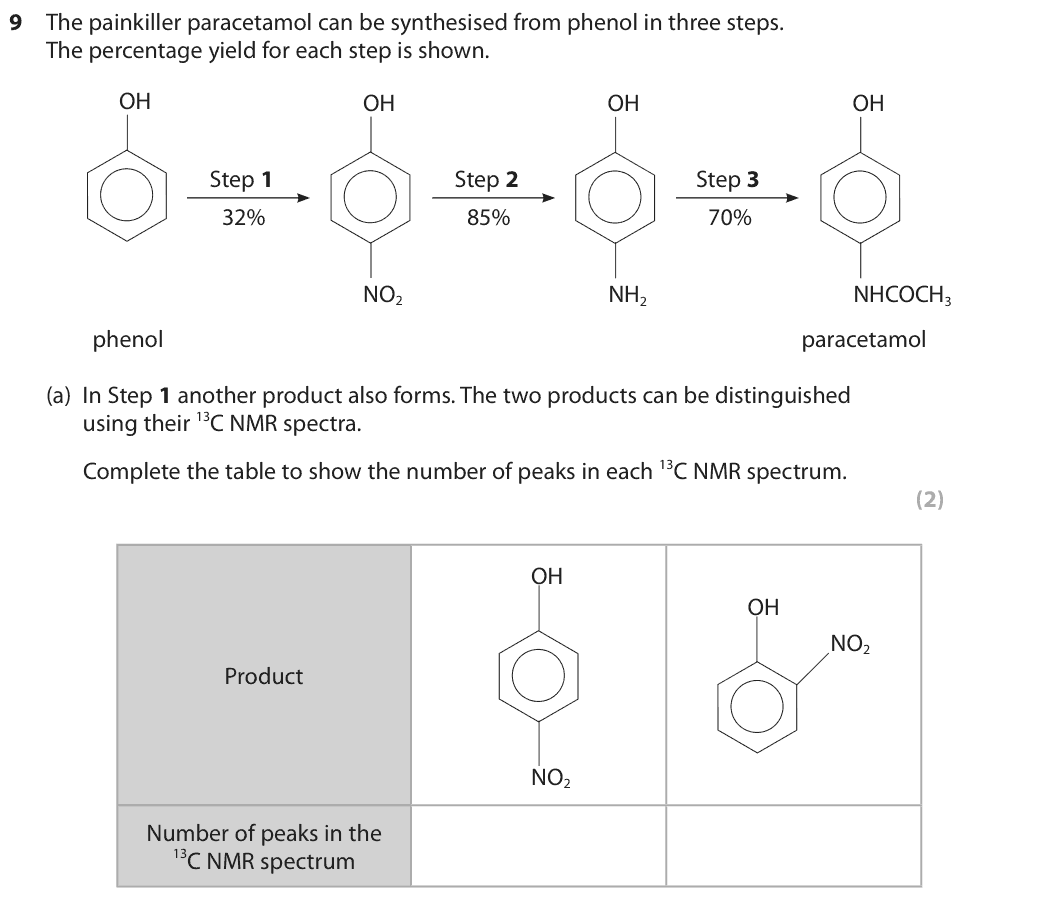
Completion of the table in (a) was attempted by nearly all candidates, though only a minority scored both marks. The calculation in (b) yielded marks for many, though not taking into account the overall yield of the process meant an answer of 622.5 g was common. Whilst many candidates could identify chiral carbon atoms in (c)(ii) a number seemed unable to work with skeletal formulae, circling whole sections of the molecule, covering several carbon atoms. Most candidates in (d) assigned the crystalline structure solely to hydrogen bonds rather than the formation of zwitterions.
Skills: MS4.3 Understand the symmetry of 2D and 3D shapes
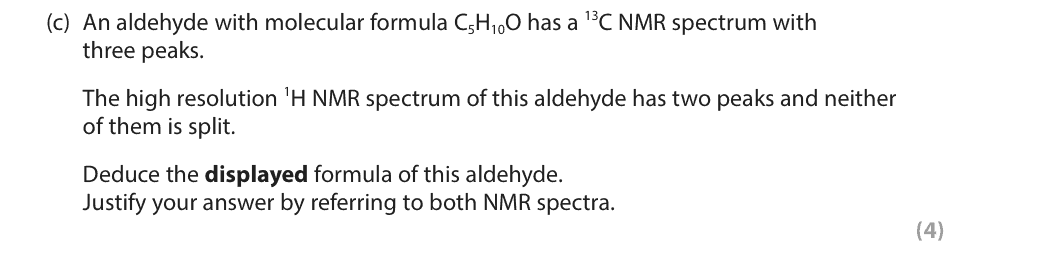
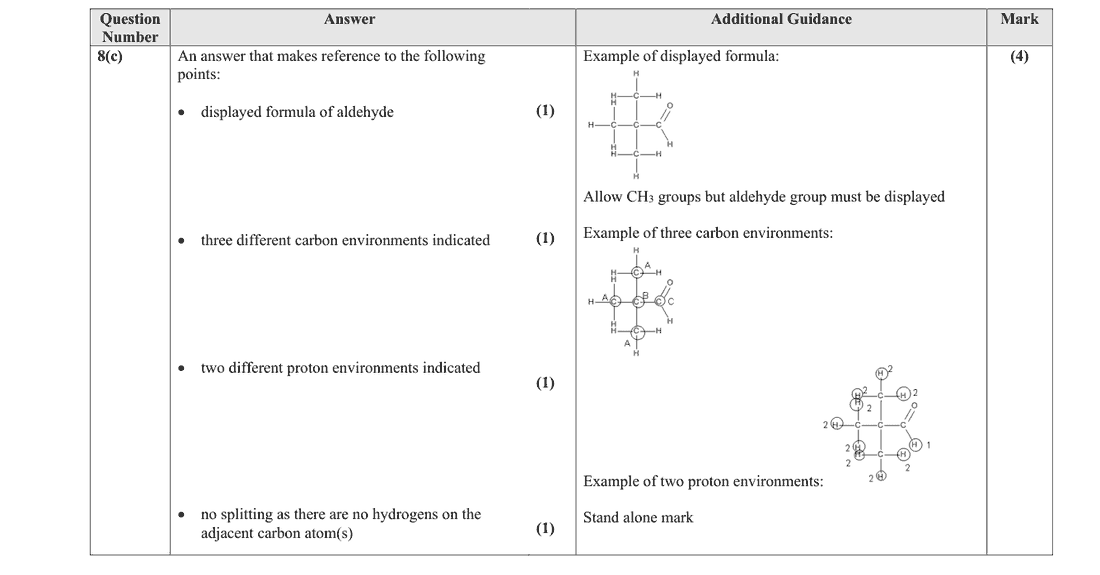
Many candidates were familiar with the ‘iodoform’ test to identify a methyl ketone, although some lost a mark as they did not mention the reagents as aqueous iodine and aqueous sodium hydroxide. The mechanism was well drawn by a few candidates, but many made a mistake such as not starting a curly arrow from a lone pair or a bond or drawing an incorrect intermediate. Some candidates seemed unfamiliar with this mechanism and produced a carbocation before attacking with cyanide ions. Many candidates realised that the nucleophile could attack the intermediate from either side but most omitted to mention that the intermediate is planar around the carbonyl carbon. Many candidates used the data to identify the correct aldehyde, but they did not score full marks unless they justified their answer using all of the data. For example, many did not show the three carbon environments and two hydrogen environments. The extended open response question was answered well by many candidates, showing that they had a good knowledge and understanding of the redox reactions of carbonyl compounds. Some candidates lost marks as they did not draw the structures of the products, did not show five of carbon atoms in the products, confused oxidation and reduction and omitted part of the oxidising agent or reducing agent, for example the acid from potassium dichromate or the dry ether from lithium tetrahydridoaluminate. Some candidates showed a lack of understanding and referred to pantan-3-one as a tertiary ketone and reduced it to pentan-2-ol instead of pentan-3-ol.
Skills: MS4.3 Understand the symmetry of 2D and 3D shapes
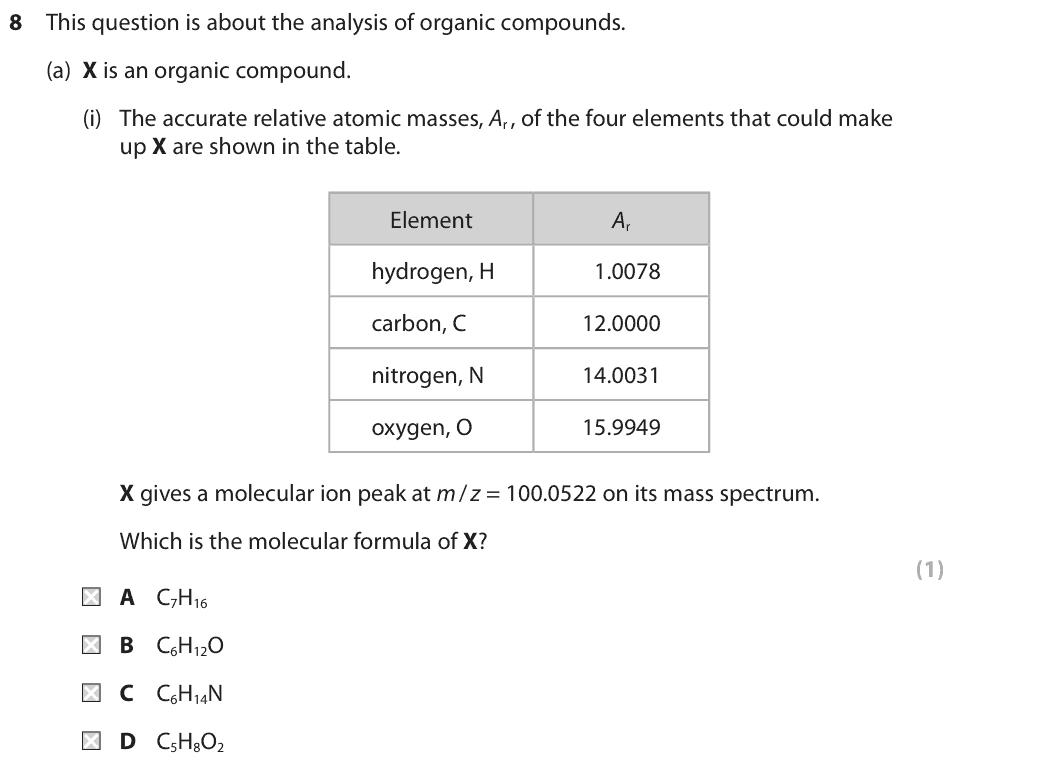
D
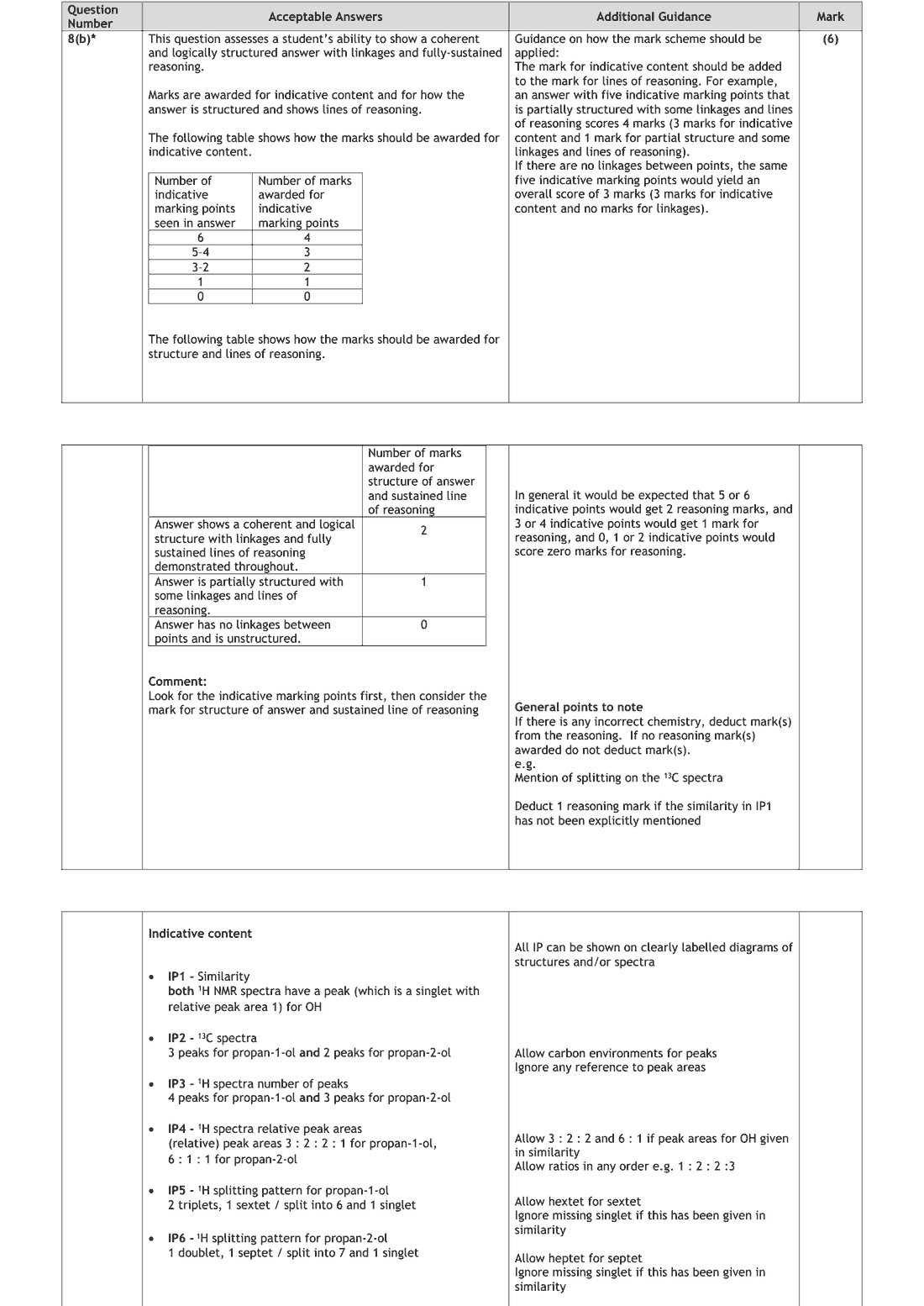
Many candidates identified the alkene and carboxylic acid functional groups in X but some just showed C=O and OH. The deduction of the skeletal formula of X was done well by many but some did not read the question and lost the mark by drawing a displayed formula. Some candidates ignored the information given about X and drew a branched chain or a compound that would exhibit geometrical isomerism. Some candidates have a clear understanding of 13C NMR and 1H NMR spectroscopy and constructed concise, logical, well-explained answers to the extended writing question in (b). There was a space before the writing lines and the most successful candidates used that to draw the displayed formulae of propan-1-ol and propan-2-ol and many of them annotated those formulae to help with their answers. There were many answers that jumped from one structure to another and one type of spectroscopy to the other without making it clear which was being discussed. This question asked candidates to compare the NMR spectra so they must include at least one similarity and one difference between them. Some candidates just wrote about the spectra and did not make the similarity of the OH proton clear. Some candidates seemed unsure what to do about the OH proton and either ignored it or did not realise that the 1H NMR spectrum would just have a singlet peak as it is not split and does not cause splitting. A few candidates included chemical shift values, even though they were told they were not needed and there was no credit for them. A few candidates were not clear on analytical techniques and wrote about mass spectrometry or infrared spectroscopy. The majority of candidates would benefit from more work on both types of NMR spectroscopy and more practise in answering ‘compare’ style extended writing questions.
Skills: MS2.3 Substitute numerical values into algebraic equations using appropriate units for physical quantities
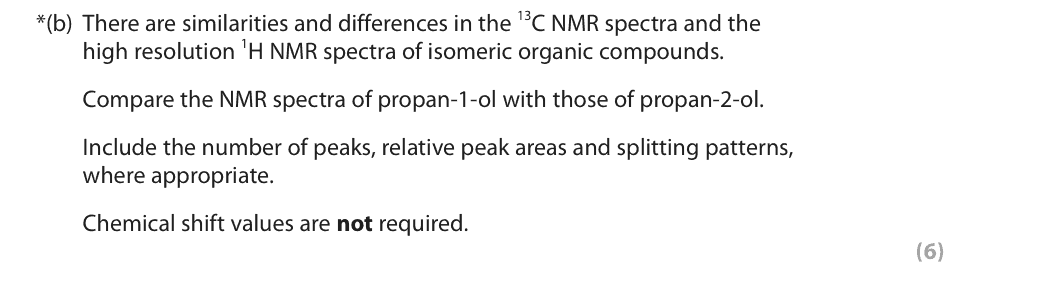
Many candidates identified the alkene and carboxylic acid functional groups in X but some just showed C=O and OH. The deduction of the skeletal formula of X was done well by many but some did not read the question and lost the mark by drawing a displayed formula. Some candidates ignored the information given about X and drew a branched chain or a compound that would exhibit geometrical isomerism. Some candidates have a clear understanding of 13C NMR and 1H NMR spectroscopy and constructed concise, logical, well-explained answers to the extended writing question in (b). There was a space before the writing lines and the most successful candidates used that to draw the displayed formulae of propan-1-ol and propan-2-ol and many of them annotated those formulae to help with their answers. There were many answers that jumped from one structure to another and one type of spectroscopy to the other without making it clear which was being discussed. This question asked candidates to compare the NMR spectra so they must include at least one similarity and one difference between them. Some candidates just wrote about the spectra and did not make the similarity of the OH proton clear. Some candidates seemed unsure what to do about the OH proton and either ignored it or did not realise that the 1H NMR spectrum would just have a singlet peak as it is not split and does not cause splitting. A few candidates included chemical shift values, even though they were told they were not needed and there was no credit for them. A few candidates were not clear on analytical techniques and wrote about mass spectrometry or infrared spectroscopy. The majority of candidates would benefit from more work on both types of NMR spectroscopy and more practise in answering ‘compare’ style extended writing questions.
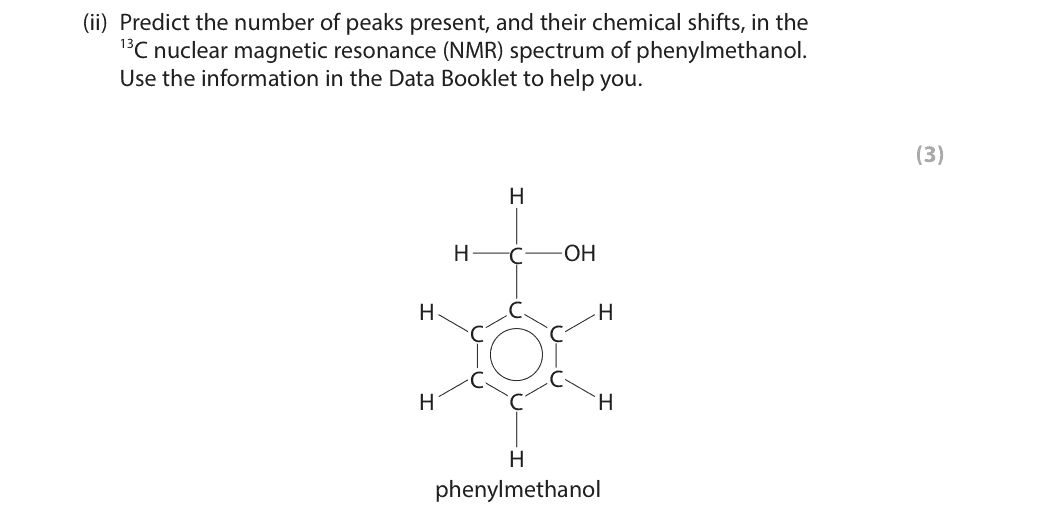
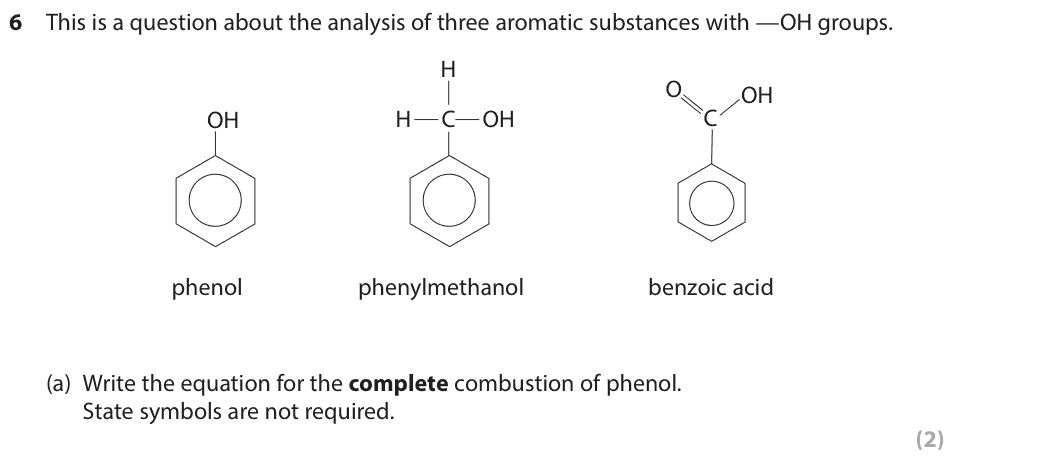
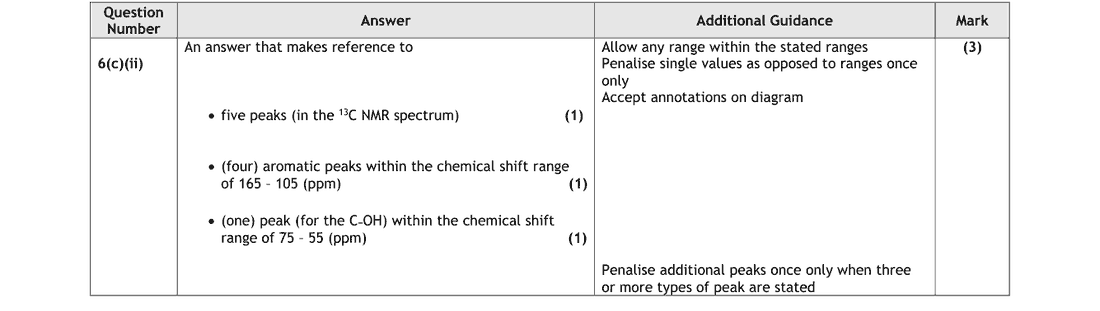
An appreciable number of candidates in (a) simply copied the skeletal formula of phenol from the question above but this did not help with the balancing of the combustion equation; nor of the calculation to follow. Nevertheless the majority were able to score at least one mark for the correct species in the equation. Candidates who find skeletal formulae challenging are advised to write out the formula in displayed form which was relatively easy in to with the formulae given at the top of the paper. It was evident in (b)(i) from the incorrect molar masses quoted that this would have helped a considerable number of candidates to avoid mistakes. Parts (b)(ii) and (iii) were often answered correctly but some candidates did not read the question in (iii) properly and suggested either specific molecules rather than ‘types’. Part (b)(iv) was a novel question and aimed to differentiate the very best candidates which it was successful at. Part (c)(i) was also an effective discriminator. Despite clear instructions in the question to include reference to ‘bonds’ and ‘wavenumber ranges’ there were still responses which did not refer to bonds or quoted single wavenumber values. It was surprising that the answers on the C-13 NMR spectrum in (c)(ii) were rather poor. Candidates often quoted more wavenumber ranges than were correct and so these negated correct answers. It was also evident that a significant number of candidates are misreading the Data Booklet. For example it was not uncommon for the C-OH peak wavenumber range to go to 80 ppm but the ‘lozenge’ in the Data Booklet does not go anywhere near the 80 ppm mark. The most common mass spectrum fragment ion seen in (c)(iii) was COOH+ which was awarded the mark. Common errors included adding a bond before the fragment ion or either omitting the charge or even adding a negative charge. The question also asked for the m/z value which some of the lower ability candidates missed.
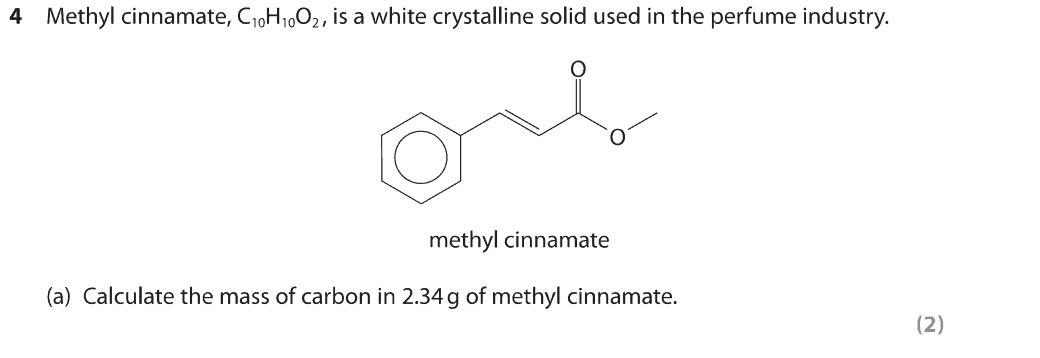
![A sample of methyl cinnamate was analysed by high resolution proton NMR spectroscopy.
A simplified spectrum is shown.
relative peak area
relative peak areas [1]
1]
10
8
6
4
2
8
pp m
(ppm)
Name the compound responsible for the peak at a chemical shift of 0 ppm,
stating its purpose.](/img/JUN19_9CH02/JUN19_9CH02_4-b-i_qp.webp)
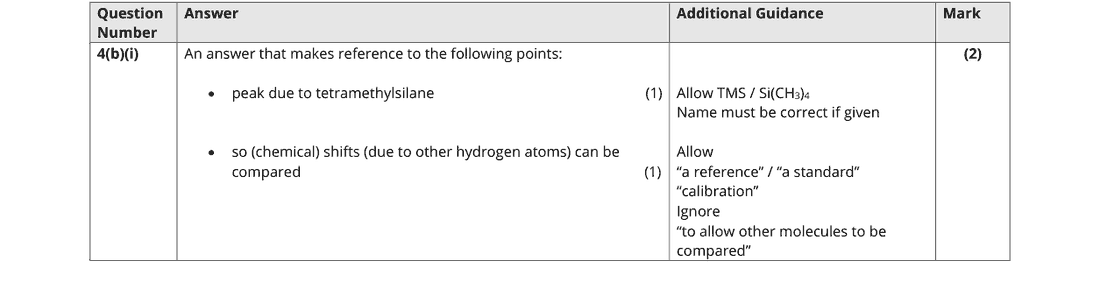
Whilst many candidates knew the role of TMS as a reference compound, a surprising number could not name it accurately. ‘Silicate’, ‘saline’, ‘silicone’ were amongst a variety of misspellings seen by examiners. References to the 12 equivalent hydrogen environments were often included, but students should remember to use the command words to help guide their answer. Here the stem required the purpose of TMS to be stated, not to explain why it was suitable.
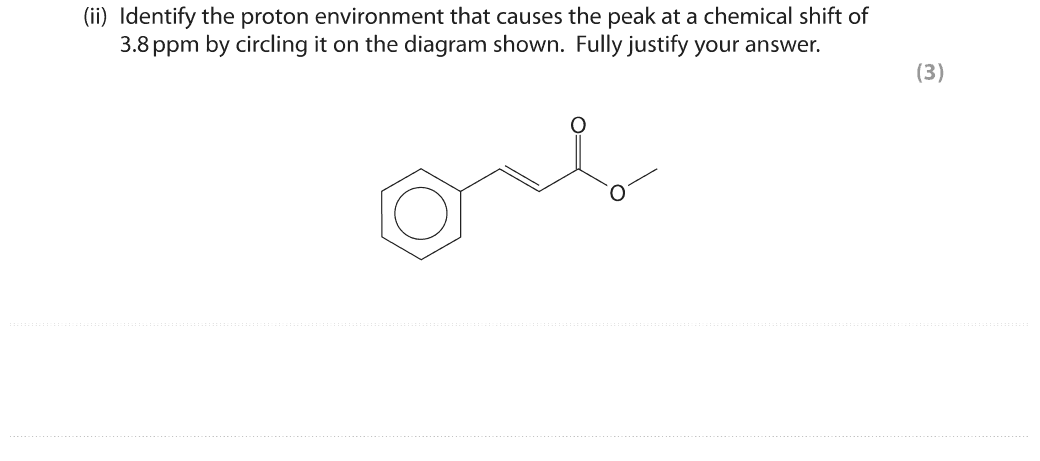
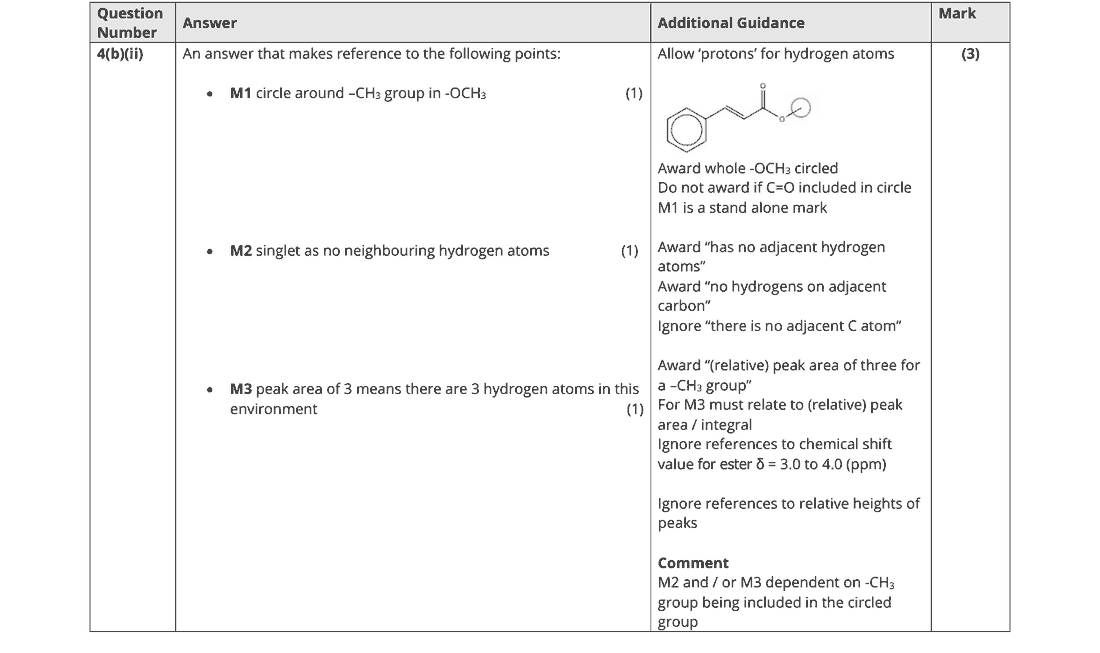
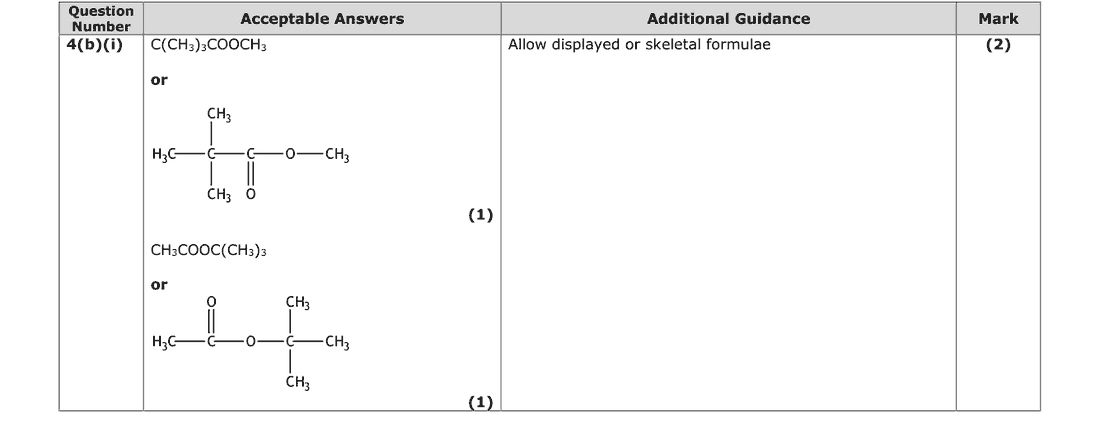
Many candidates were able to identify the methyl group on the far right of the structure, interpreting the skeletal format successfully. The justification allowed a degree of discrimination and some candidates missed out on full credit because of a lack of clarity. For instance, some responses, despite the stem using the terminology ‘relative peak area’, talked solely about peak height. Others were imprecise when discussing the splitting, suggesting it was caused by the fact that ‘there are no hydrogens attached’ or ‘because of the n+1 rule’. In each case, a little more detail could have scored the mark.
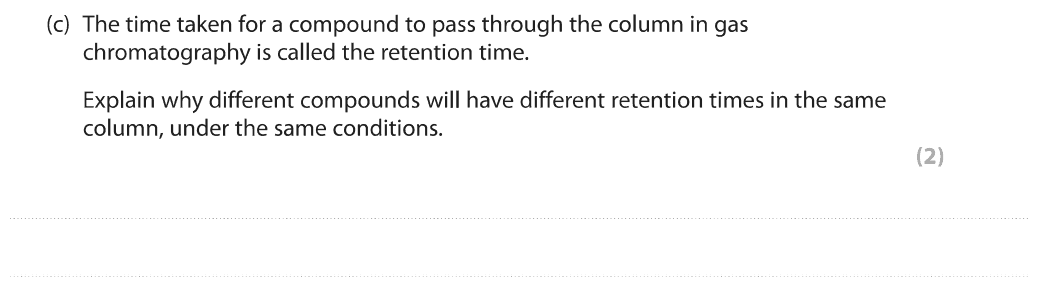
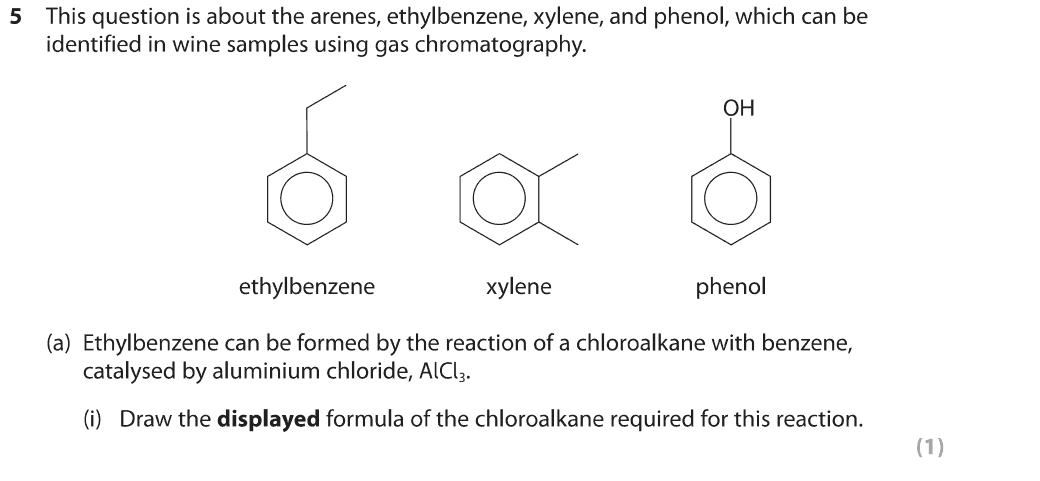
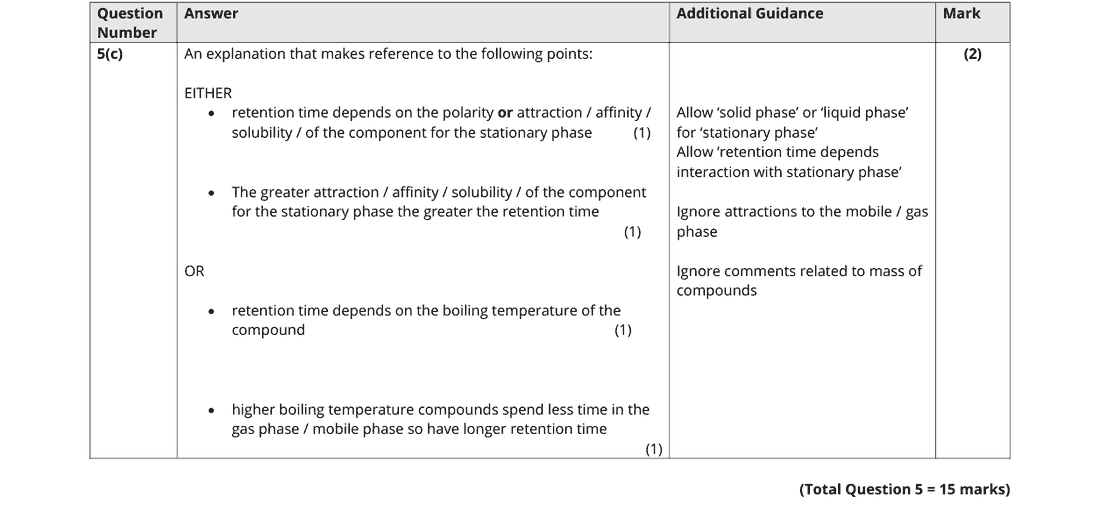
Perhaps because candidates are unlikely to have direct experience of gas chromatography answers often lacked detail. The best answers made clear reference to the affinity with the stationary phase, though a surprising number didn’t make the link between the strength of affinity and the resultant impact on retention, just stating that ‘different affinities lead to different retention times’. Weaker answers concentrated solely on the mobile phase or on the very simplistic model that heavier molecules take longer to move. Such answers did not gain credit.

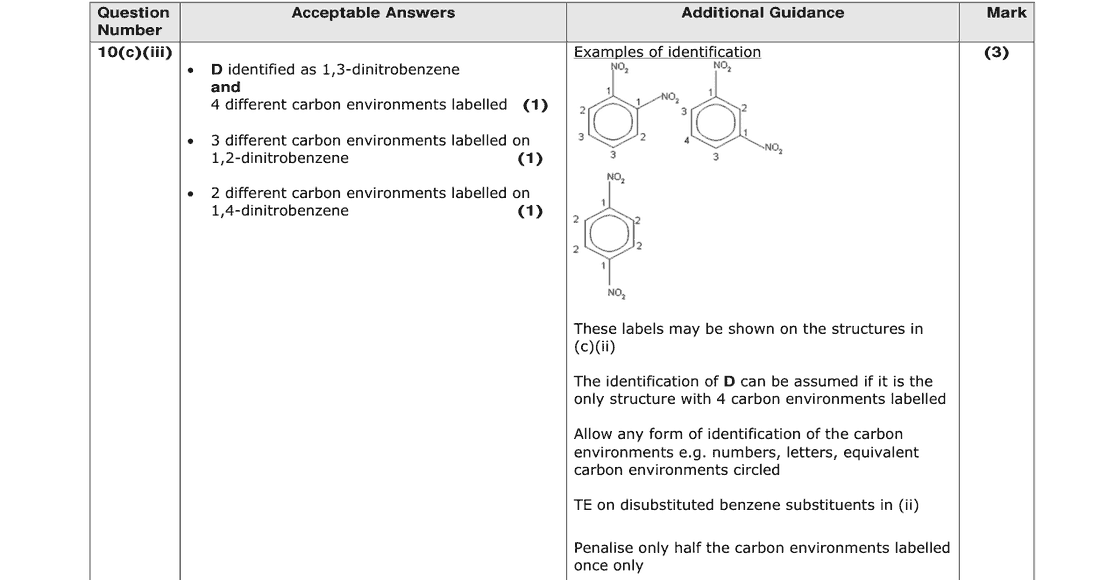
Many candidates gave the three isomers of dinitrobenzene in (c)(ii). Candidates could score the marks for any three disubstituted benzenes to allow for the incorrect molecular formulae they may have given earlier. Many candidates correctly identified D and showed the correct carbon environments on the isomers. The most common error was to show three carbon environments on 1,4-dinitrobenzene. Again, transferred error marks were available for any disubstituted benzenes.
Skills: MS4.3 Understand the symmetry of 2D and 3D shapes
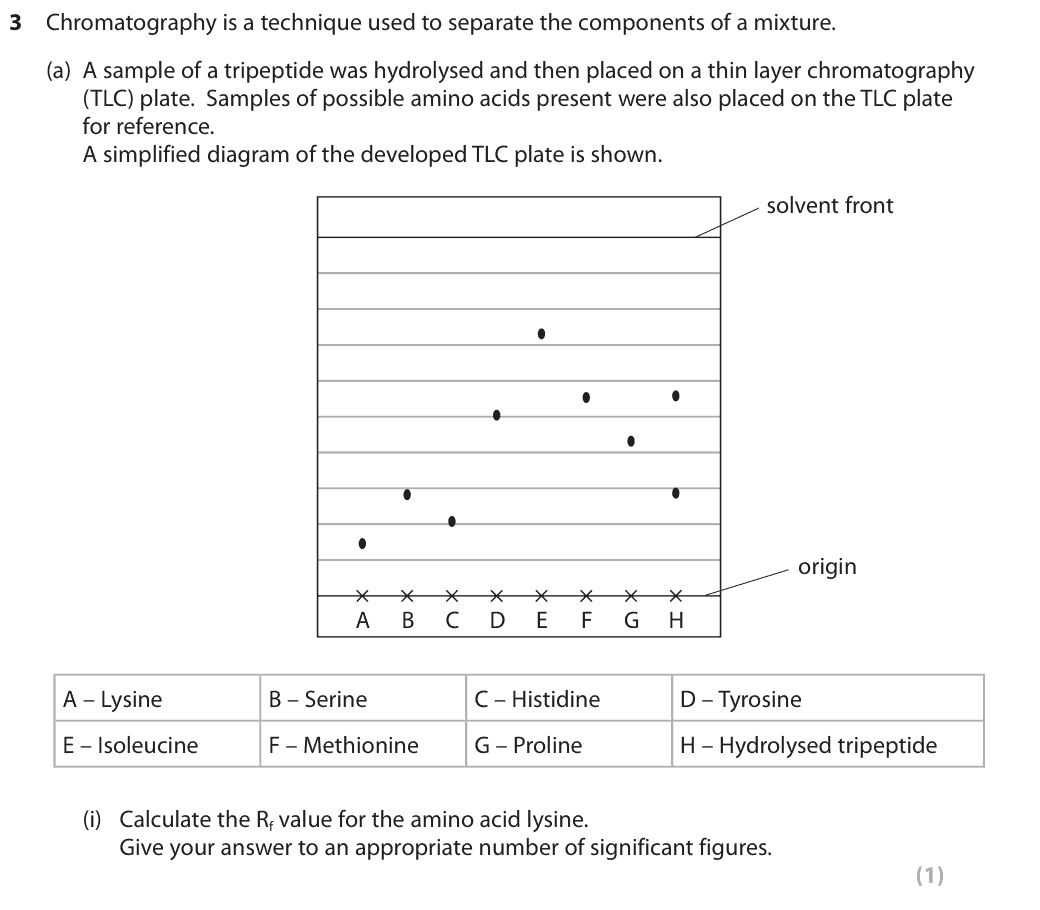
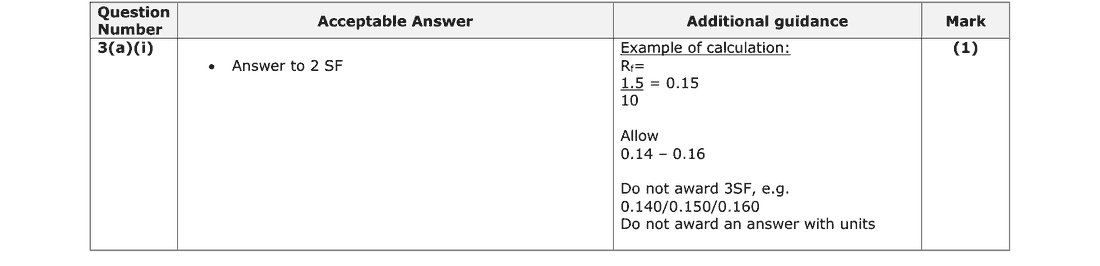
In this specification the mathematical demand of 20% at level 2 or above is met, in part, by candidates deciding the appropriate number of significant figures and this question is an example of such. Chromatographic techniques are rarely very accurate but instead rather crude and so caution is needed when carrying out calculations such as on Rf values. Hence while it can be common to have 'three significant figures' as appropriate in many chemical calculations (a so-called default option), this is not the case with Rf values. One significant figure would not be accurate enough and fail to distinguish between samples so only two significant figures are appropriate in this example. Although only given occasionally, an answer such as 0.16 was seen with brackets and 3SF after it. The answer 0.16 is not to 3SF and reflects a misunderstanding by the candidate. Therefore this suggests that further practise by candidates on the difference between significant figures and decimal places, with appreciating what is appropriate given the circumstances, would be very useful. In contrast it was pleasing to see the Rf value rarely being given with units because of course there aren't any.
Skills: MS0.2 Use ratios, fractions and percentages; MS1.1 Use an appropriate number of significant figures; PT9 use thin-layer or paper chromatography

In an acceptable answer there needed to be reference to the mobile and the stationary phase. Just over 40% of candidates failed to include a comment on either of these phases and so did not score. However about a quarter of candidates wrote an effective response which includes reference to both the mobile and stationary phases and so this question was another useful grade discriminator.

The vast majority of candidates correctly wrote about the inertness of the carrier gases. A small minority of candidates 'fudged' their answers by inserting descriptive terms such as 'not very/weakly/rarely' or similar in front of 'reactive' which makes the answer doubtful and so did not score.
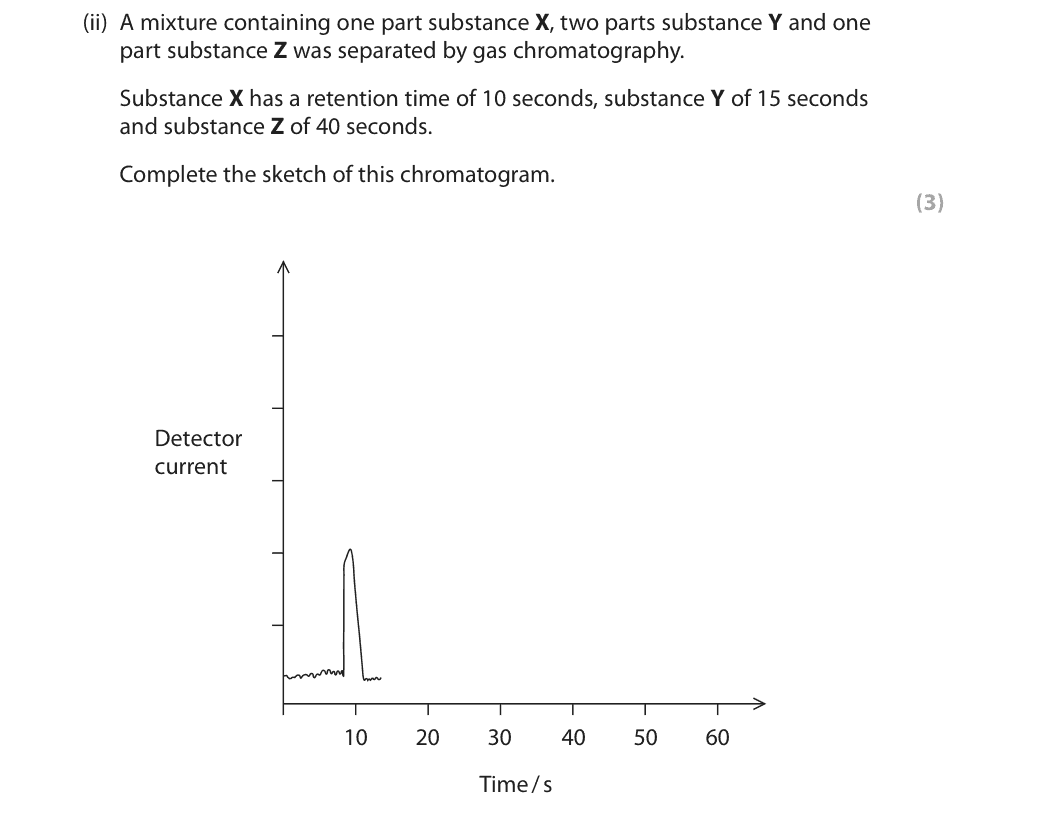
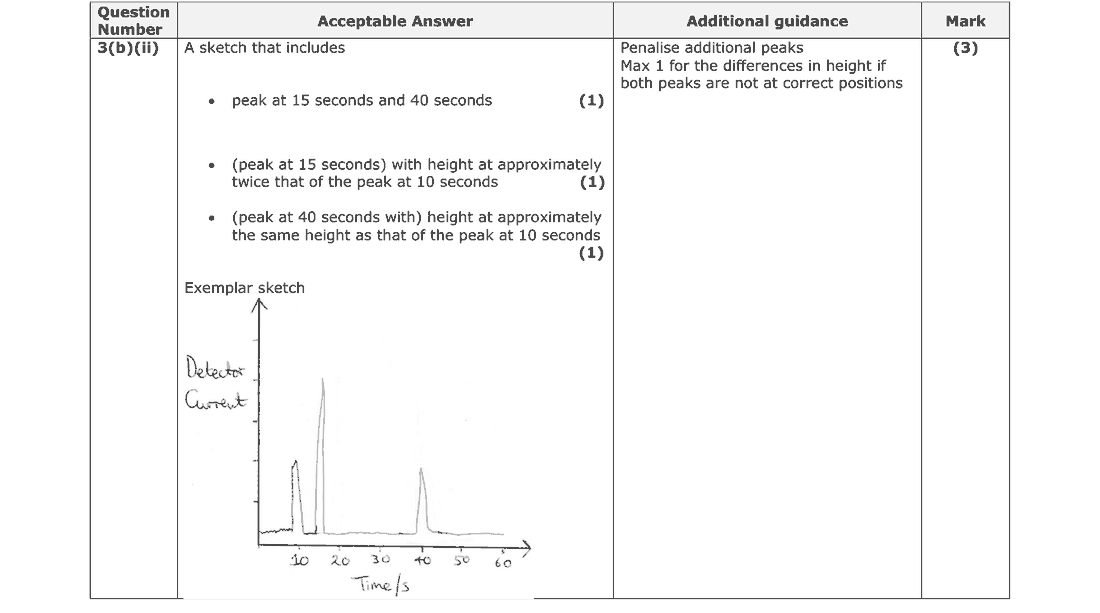
This was a well-answered question with just under three-quarters of candidates scoring all three marks for their sketch. The most common errors seen were: an incorrect height for the 'X' peak, an incorrect timing of the 'Y' peak and additional incorrect peaks.
Skills: MS3.1 Translate information between graphical, numerical and algebraic forms
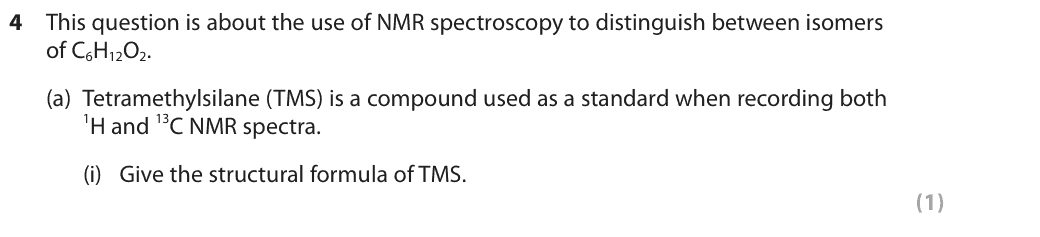
A surprisingly significant minority used the symbol ‘S’ for silicon in this question, so despite knowing the outline structure, did not score. A few lost the mark as they struggled to construct the structural formula, presenting their answer as though the silicon atom was at the end of a hydrocarbon chain.

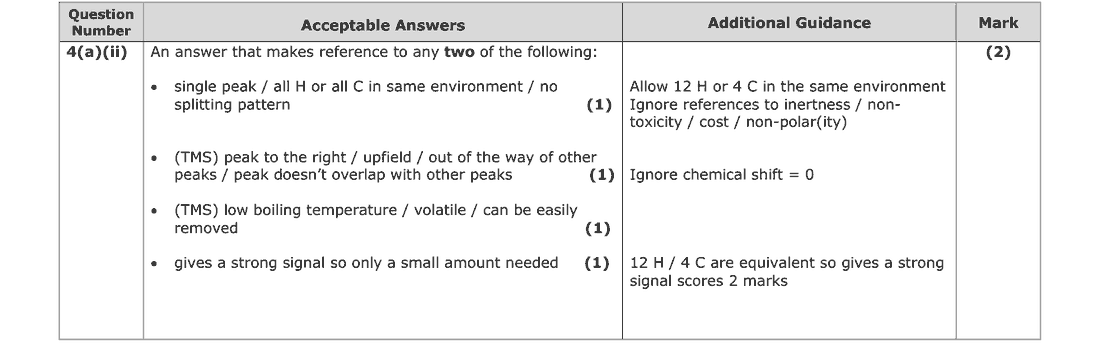
Examiners were a little frustrated to see lots of examples here that referred to the fact that TMS is inert and non-toxic, despite the request in the question for ‘two other reasons’. Over 50% scored at least one mark, and this was most commonly for the idea that all the hydrogen atoms are in the same environment. Many candidates concentrated on the idea that TMS has a chemical shift at 0ppm, without appreciating the significance of the position of the TMS peak in relation to other possible peaks.

This question polarized answers in the sense that most candidates who could work out one structure with only two hydrogen environments, could then easily deduce a second. Many answers that failed to score did so because they could not draw the structure of an ester, often suggesting carboxylic acids. Others did show esters but focused on showing two isomers rather than considering the hydrogen environments.
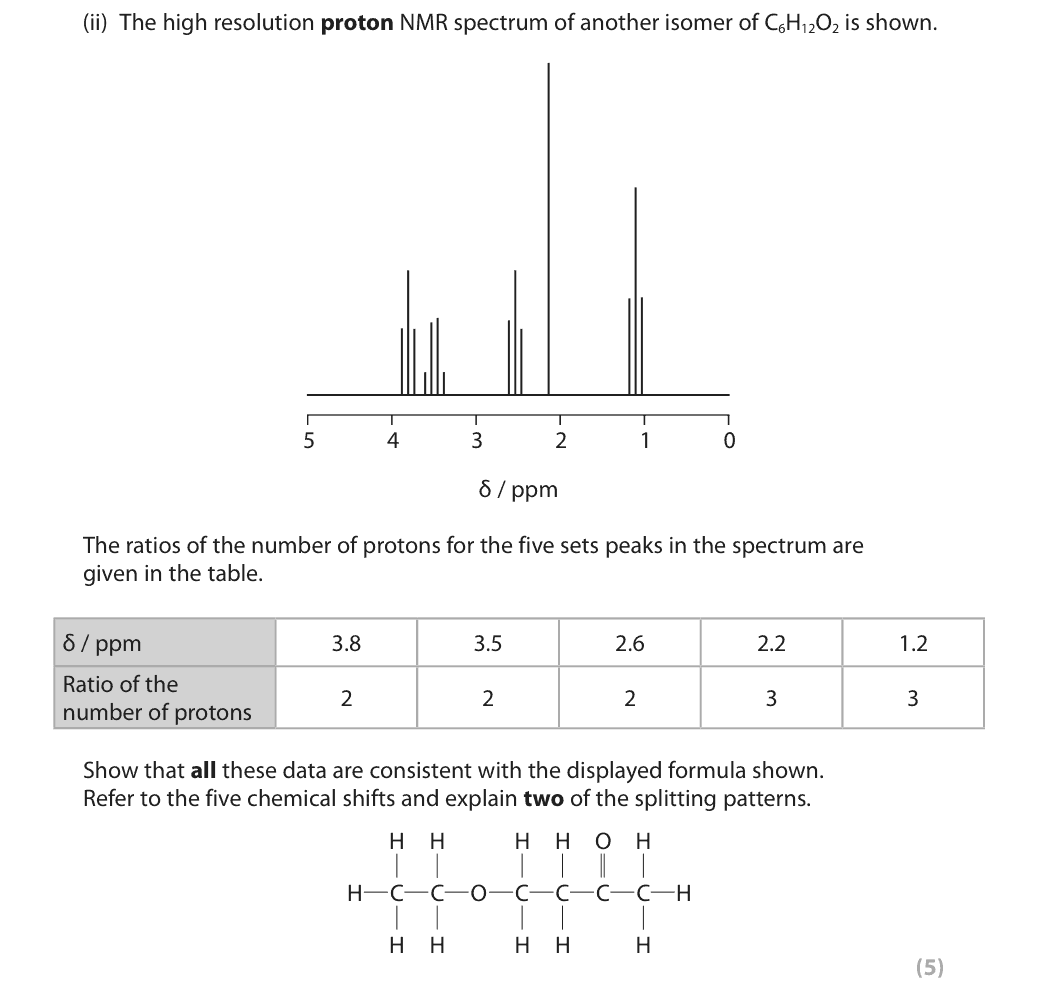
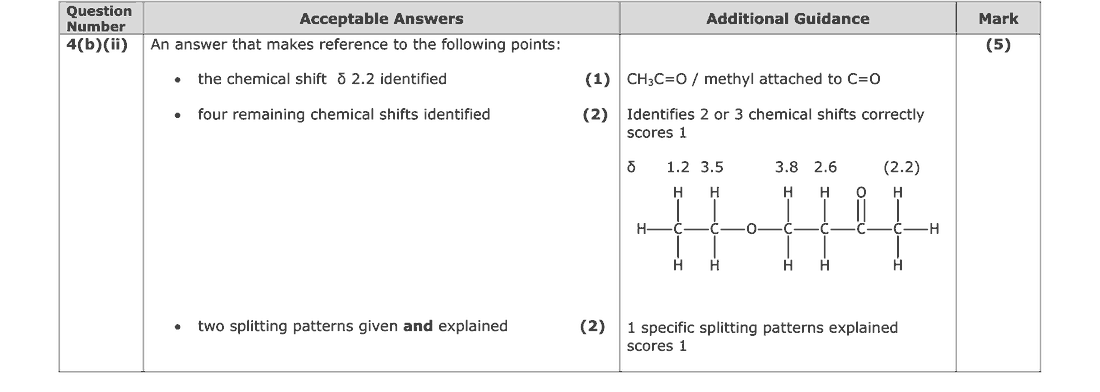
This question discriminated successfully, with able candidates able to score four or five marks. The best answers annotated the displayed formula in the question to link hydrogen environments to the chemical shift data. Others carefully described the position of the groups to ensure the examiner could clearly see which part of the molecule the candidate was referring to. This was often achieved using phrases such as ‘the methyl group on the far left of the molecule.' Weaker responses lacked clarity, for instance discussing methyl groups without making it clear which of the two possible such groups they were discussing. Other common issues included answers which stated that carbon atoms had caused the peaks, and answers that when trying to justify splitting patterns talked about ‘neighbouring hydrogens’ without always making it clear that such atoms were on an adjacent carbon.

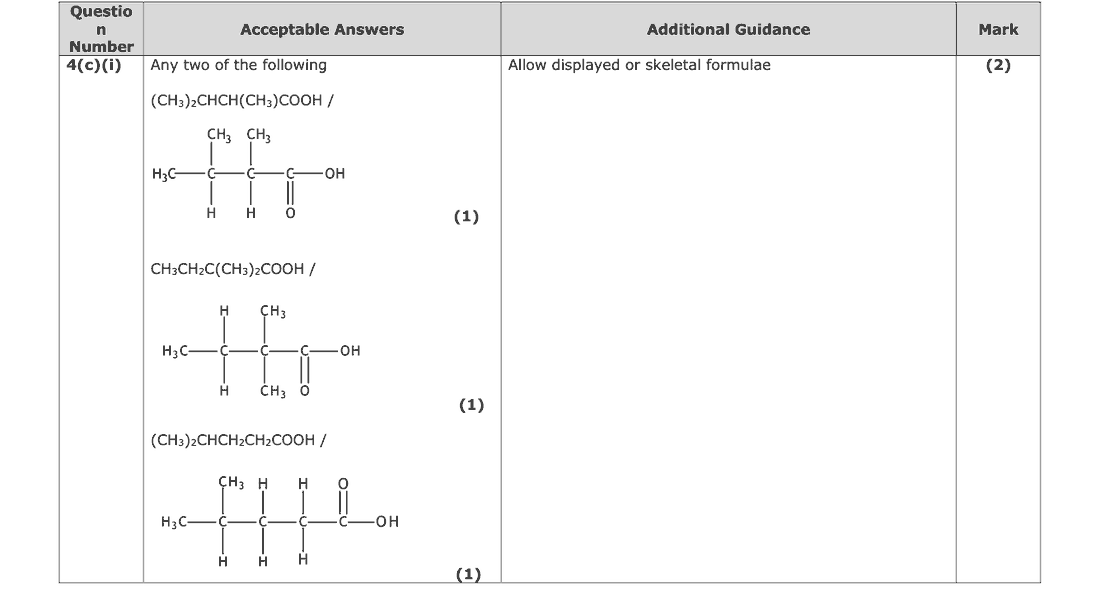
Part (i) proved a significant level of challenge for many.In a similar way to (b)(i), answers that gave two structural isomers rather than considering the carbon environments were common. Others, concentrating on the five environments, ignored the need for the structures to be carboxylic acids, so lost both marks.Several otherwise good answers missed out because they made a mistake when drawing a structural formula, having correctly shown a displayed formula. Most students were able to score in (c)(ii).The most common mistakes were the inclusion of a benzene ring, or showing OH groups in the 1,2- positions.

Part (i) proved a significant level of challenge for many.In a similar way to (b)(i), answers that gave two structural isomers rather than considering the carbon environments were common. Others, concentrating on the five environments, ignored the need for the structures to be carboxylic acids, so lost both marks.Several otherwise good answers missed out because they made a mistake when drawing a structural formula, having correctly shown a displayed formula. Most students were able to score in (c)(ii).The most common mistakes were the inclusion of a benzene ring, or showing OH groups in the 1,2- positions.
B
Skills: MS4.3 Understand the symmetry of 2D and 3D shapes
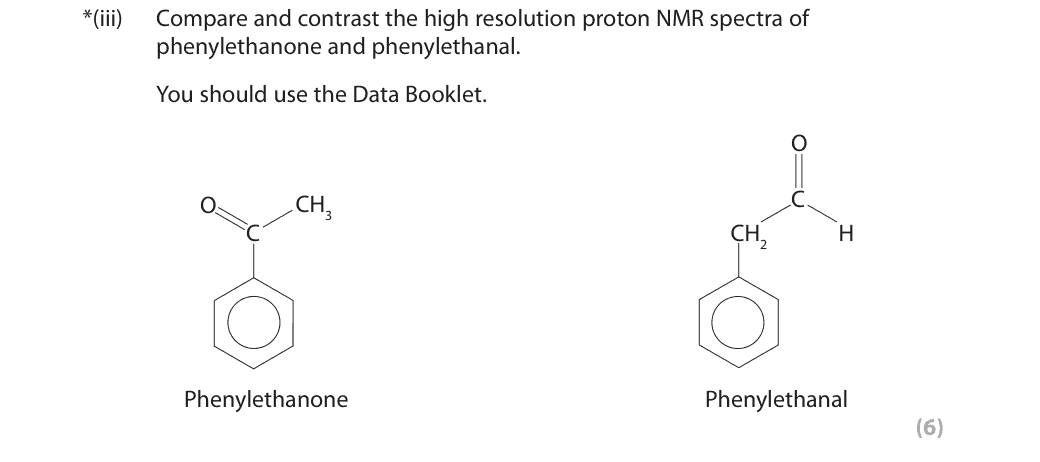
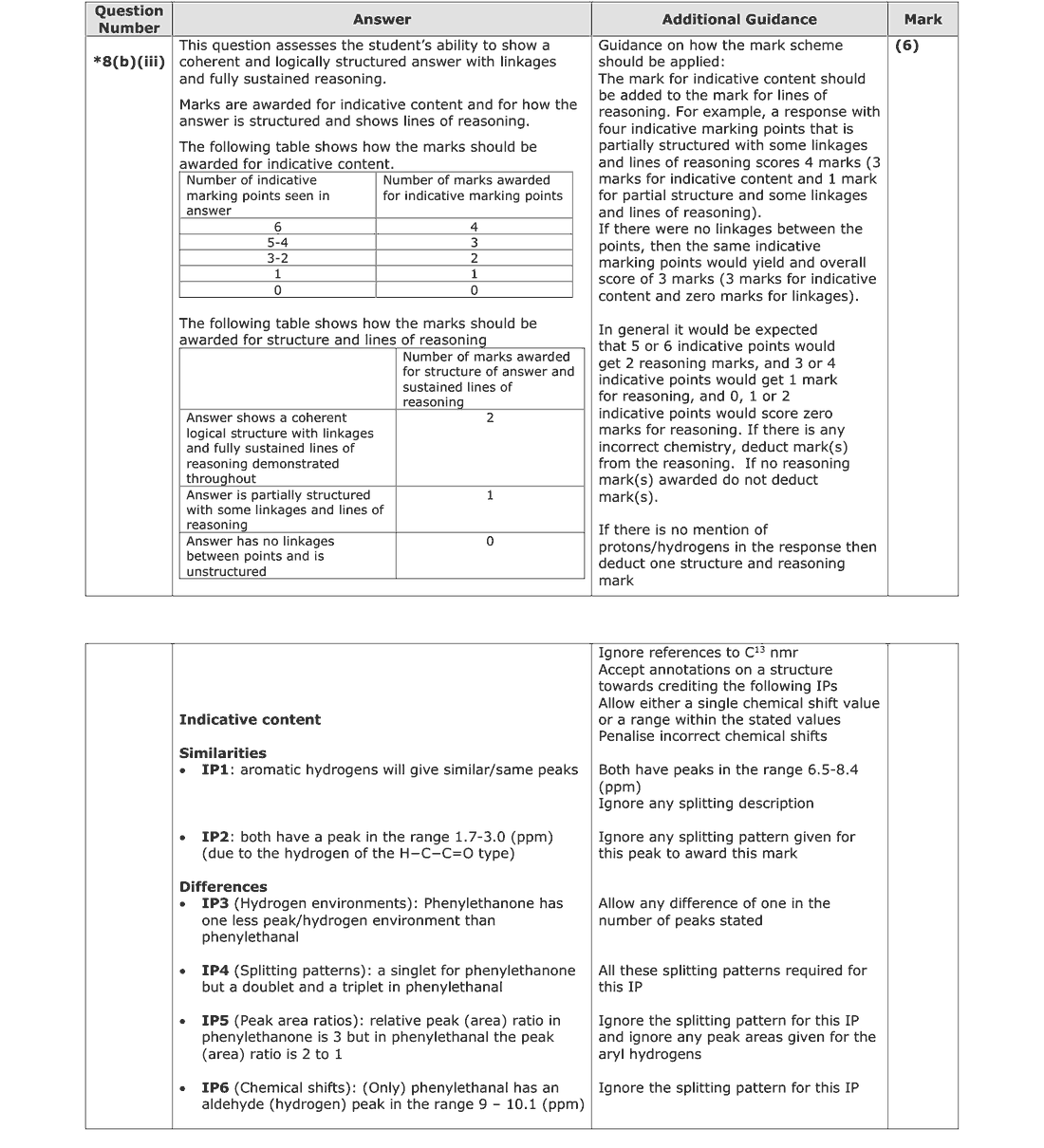
This question proved to be challenging for candidates, and the vast majority of responses lacked clear structure and reasoning. However, it did produce a spread of marks. There were a few common errors which are worth noting. A significant number did not refer to hydrogens/protons at all and simply referred to peaks or to peaks due to the C=O bond. The number of hydrogen atoms as part of the aromatic ring was frequently incorrect, with numbers ranging from 6 to 11. These lost a structure and reasoning mark, if there was to be any awarded. The chemical shift ranges quoted for the peaks by a large number of candidates were excessive and outside the ranges of the mark scheme. At times this could be by just a difference of 0.1 but the mark schemes gives specific ranges to allow and these are important for candidates to appreciate. The peaks of the aromatic hydrogens are complex in nature and often do not adhere to the simplified splitting rules that A Level candidates are expected to know. It had been anticipated that candidates would just state that the aromatic hydrogens of both compounds would produce similar peak patterns, and some candidates did do this; others spent time predicting splitting patterns and hydrogen equivalency for these hydrogen atoms which does not exist - this was ignored. The splitting patterns of the alkyl hydrogens were least well-known and is the main area of improvement for candidates. The peak area ratios for the hydrogen atom peaks were often rather 'buried' in the response or unclear. Candidates should lay out their response as clearly as possible.

In better responses, candidates took notice of the emboldened phrase ‘acidic conditions,’ and were able to justify the greater attraction of lysine to the stationary phase in terms of its greater positive charge. The majority of other responses did score the ‘attraction’ mark, but tried to justify it with generally vague statements related to intermolecular forces or polarity. Disappointingly, a number of candidates seemed not to have developed an understanding of chromatography beyond the idea that ‘heavier molecules will take longer to move through the column’.
Dropping marks on calculations, mechanisms or the core practicals? Book a trial session with an A-level chemistry tutor.