Notes and key-term cards for this topic are being written by our tutors. The past-paper questions below are ready now.
Specification statements
Show the 5 statements from the specification
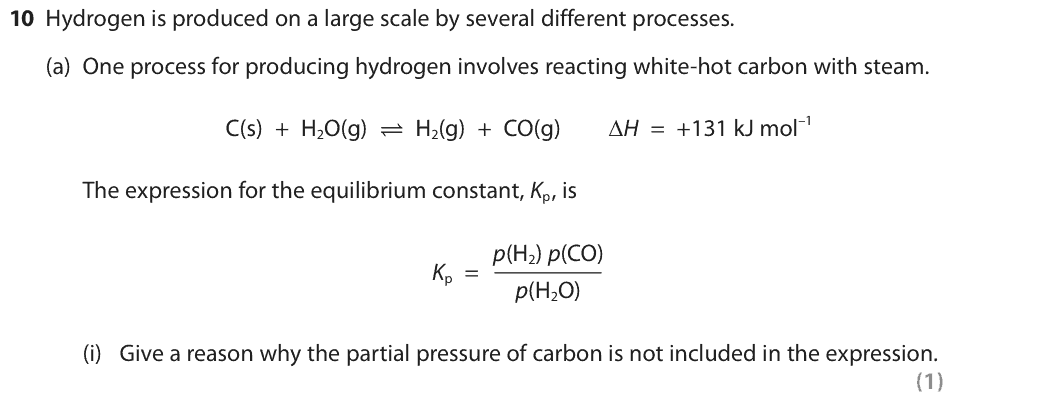
11.1 be able to deduce an expression for Kp, for homogeneous and heterogeneous systems, in terms of equilibrium partial pressures in atm
11.2 be able to calculate a value, with units where appropriate, for the equilibrium constant (Kc and Kp) for homogeneous and heterogeneous reactions, from experimental data
11.3 know the effect of changing temperature on the equilibrium constant (Kc and Kp), for both exothermic and endothermic reactions
11.4 understand that the effect of temperature on the position of equilibrium is explained using a change in the value of the equilibrium constant
11.5 understand that the value of the equilibrium constant is not affected by changes in concentration or pressure or by the addition of a catalyst
Tap a question to zoom it. Where a part needs a figure, table or structure from earlier in the question, that part folds out above it; the mark scheme and examiner's comment open underneath. Have Edexcel's Data Booklet beside you; the Periodic Table is on the back page of every paper.
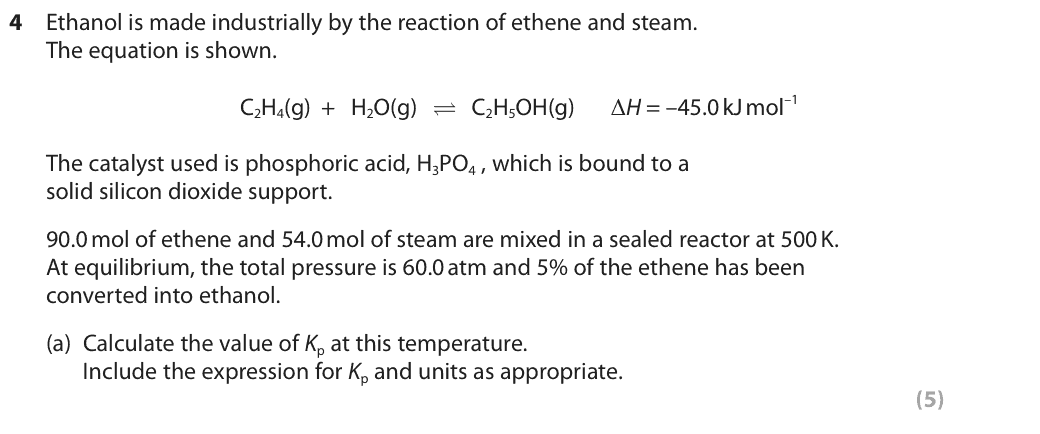
June 2025 · Paper 1 · Q4(a)5 marksCalculation
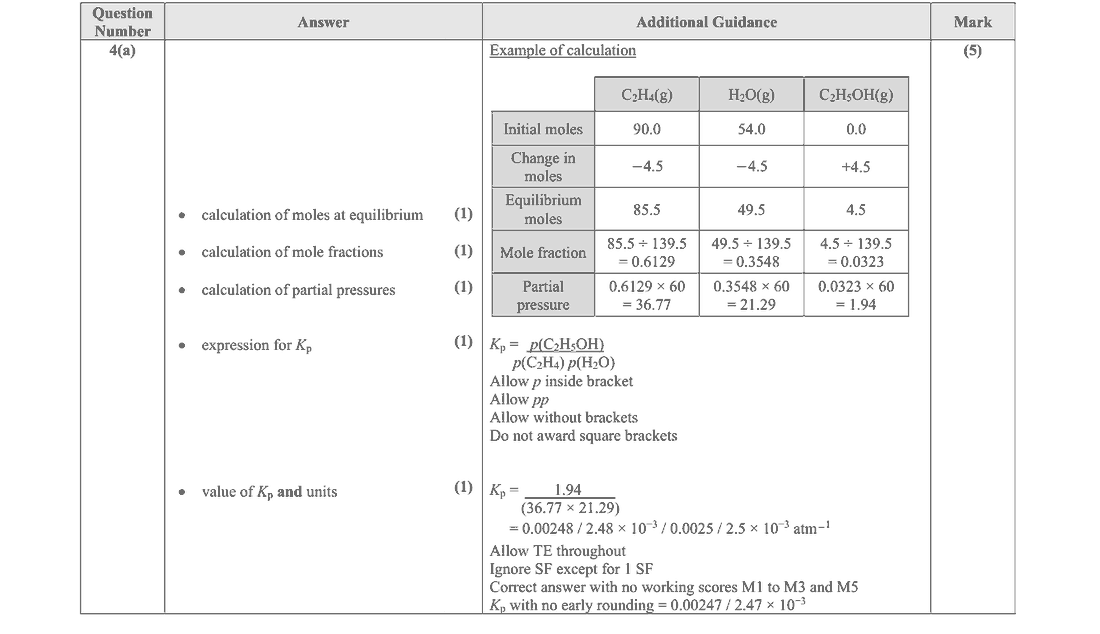
Mark scheme
Examiner's comment
This question asked the candidates to calculate the Kp for a reaction, including both the expression and the units. Those who did best in this question laid out the calculation in table form.
A common error was the first step in the calculation ending up with the wrong number of moles at equilibrium.
Another less common error was the presence of square brackets in the expression.
Notes from the mark scheme and report
Answer: Kp = 2.48 × 10^–3 atm–1 (0.0025
2.47 × 10^–3 with no early rounding). Equilibrium moles: C2H4 85.5, H2O 49.5, C2H5OH 4.5 (total 139.5)
mole fractions 0.6129, 0.3548, 0.0323
partial pressures 36.77, 21.29, 1.94 atm
Kp = p(C2H5OH) ÷ (p(C2H4) × p(H2O)), no square brackets. Those who set the working out as a table did best. Common error: wrong equilibrium moles at the first step
less often, square brackets in the expression
Skills: MS0.0 Recognise and make use of appropriate units in calculation; MS0.2 Use ratios, fractions and percentages; MS2.3 Substitute numerical values into algebraic equations using appropriate units for physical quantities
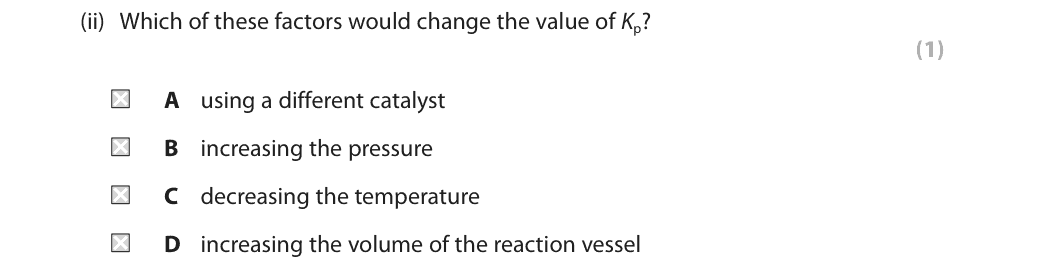
June 2025 · Paper 1 · Q4(b)(ii)1 markMultiple choice
Earlier parts of question 4 that this part uses
Answer
C
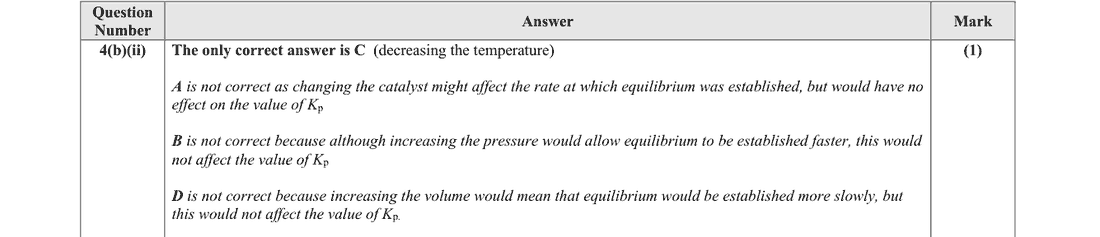
Mark scheme
Notes from the mark scheme and report
Answer: C (decreasing the temperature). Only temperature changes Kp
a different catalyst, a higher pressure or a larger volume change how quickly equilibrium is reached but not the value of Kp
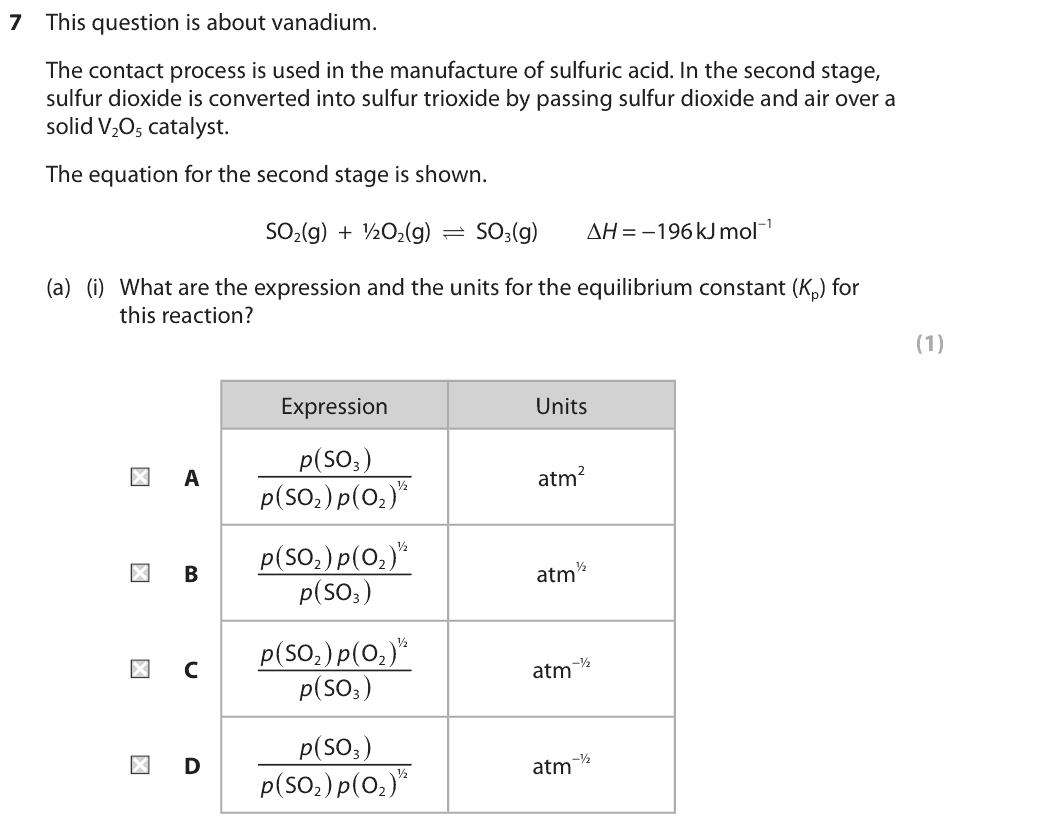
June 2024 · Paper 1 · Q7(a)(i)1 markMultiple choice
Answer
D
Mark scheme
Notes from the mark scheme and report
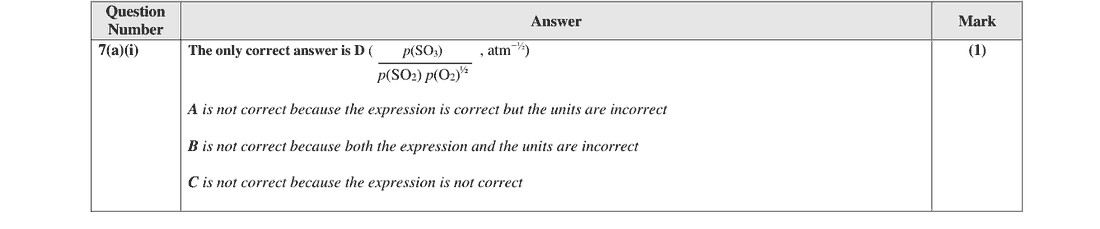
Answer: D. Kp = p(SO3) / (p(SO2) × p(O2)^½), units atm^–½
Skills: MS0.0 Recognise and make use of appropriate units in calculation
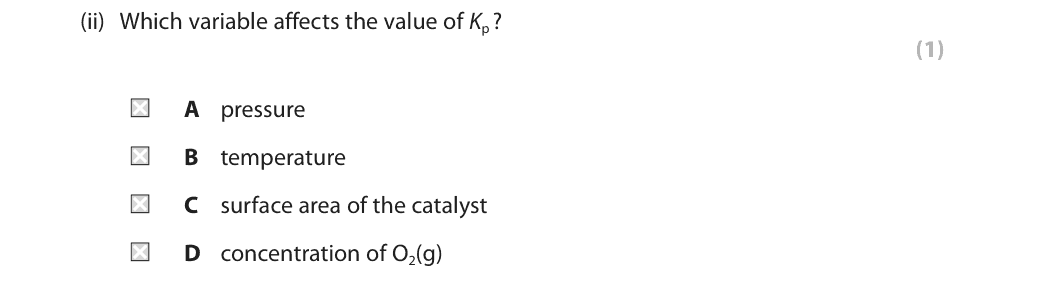
June 2024 · Paper 1 · Q7(a)(ii)1 markMultiple choice
Earlier part of question 7 that this part uses
Answer
B
Mark scheme
Notes from the mark scheme and report
Answer: B (temperature). Pressure, catalyst surface area and concentration do not change Kp
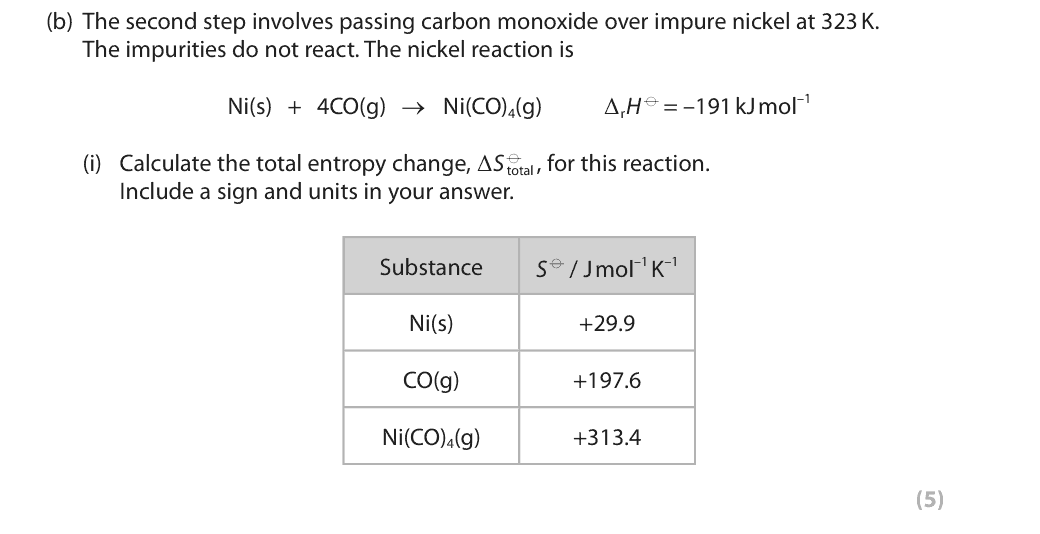
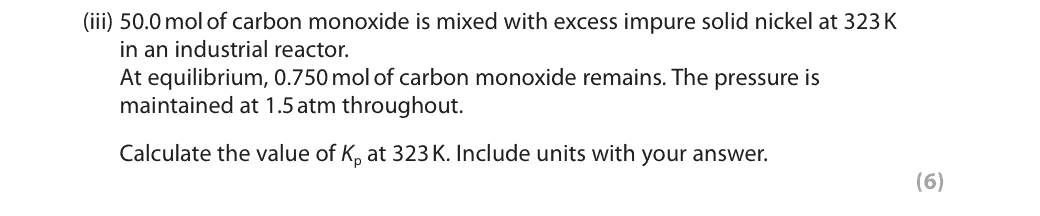
June 2023 · Paper 3 · Q10(b)(iii)6 marksCalculation
Earlier parts of question 10 that this part uses
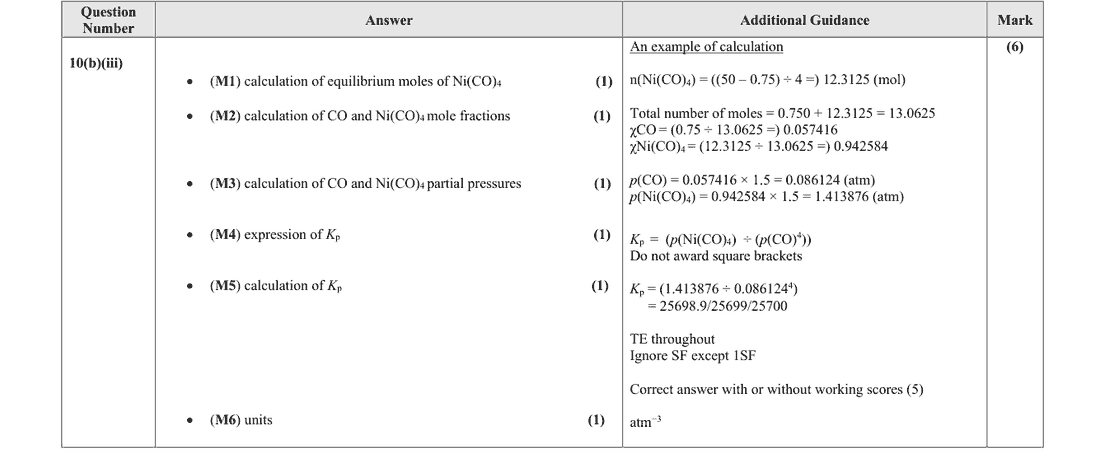
Mark scheme
Examiner's comment
It was pleasing to see that this far into the paper that candidates still had the stamina for a long calculation. The criticisms of the poor layout remain, but there was no evidence of candidates having run out of time.
Occasionally, there were intermediate errors such as confusing mole fractions with partial pressures. There were also a few candidates who included solid nickel in their Kp expressions
which meant that they could only score a maximum of three.
units atm–3. Errors: mole fractions confused with partial pressures
nickel included in Kp (maximum 3)
Skills: MS0.0 Recognise and make use of appropriate units in calculation; MS0.2 Use ratios, fractions and percentages; MS2.3 Substitute numerical values into algebraic equations using appropriate units for physical quantities
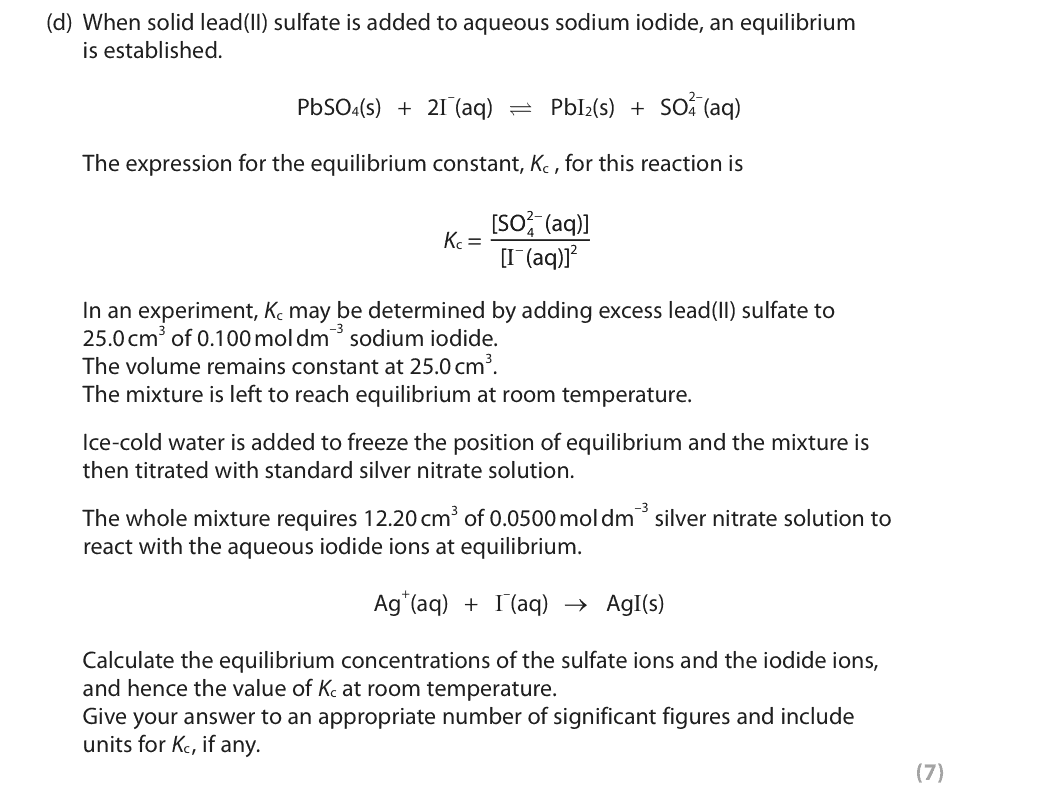
June 2022 · Paper 1 · Q8(d)7 marksCalculation
Earlier part of question 8 that this part uses
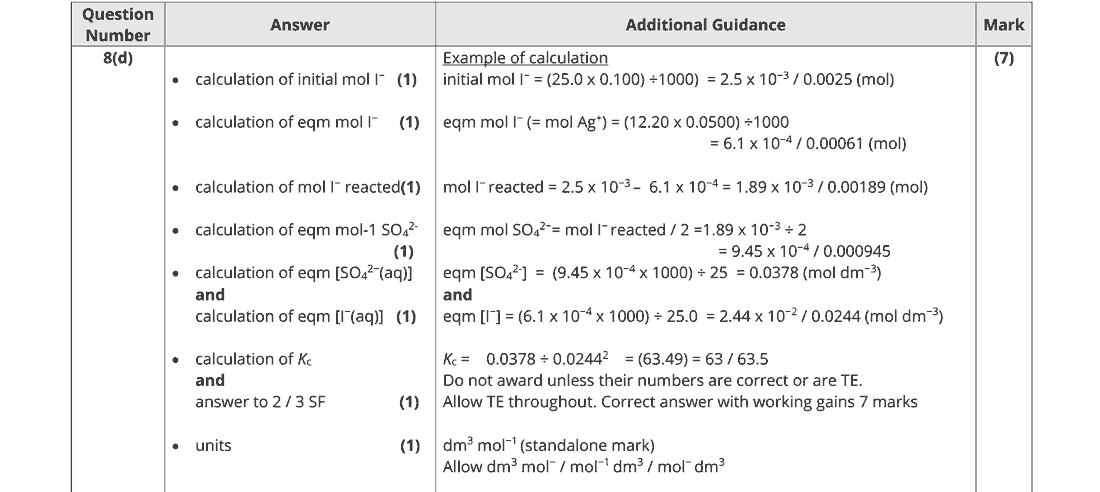
Mark scheme
Examiner's comment
This question was the last on the paper and was a relatively complex multi-step calculation. Candidates who were able to devise a logical progression through the calculation scored highly. Common errors included confusion over which moles should be subtracted and which volume should be used to determine the concentrations. The Kc expression was given in the question and so many correct units were seen, although some candidates derived their own expression and so did not score the units mark.
equilibrium moles of I– = moles of Ag+ = 12.20 × 0.0500 ÷ 1000 = 6.1 × 10^–4
I– reacted = 1.89 × 10^–3
moles of SO4 2– = half of that = 9.45 × 10^–4
[SO4 2–] = 0.0378 mol dm–3 and [I–] = 0.0244 mol dm–3 (both in 25.0 cm3)
Kc = 0.0378 ÷ 0.0244^2 = 63.49. Sixth mark needs 2 or 3 significant figures
the units mark stands alone. Common errors: subtracting the wrong amounts
using the wrong volume for the concentrations
units from a self-made Kc expression
Skills: MS0.0 Recognise and make use of appropriate units in calculation; MS0.2 Use ratios, fractions and percentages; MS1.1 Use an appropriate number of significant figures; MS2.3 Substitute numerical values into algebraic equations using appropriate units for physical quantities
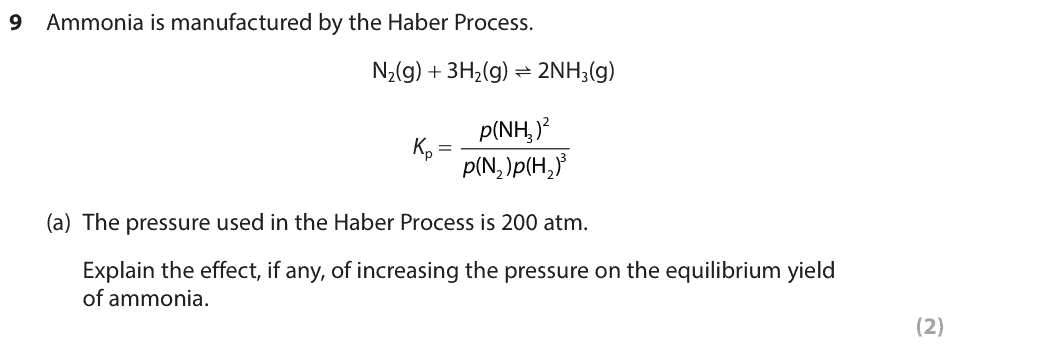
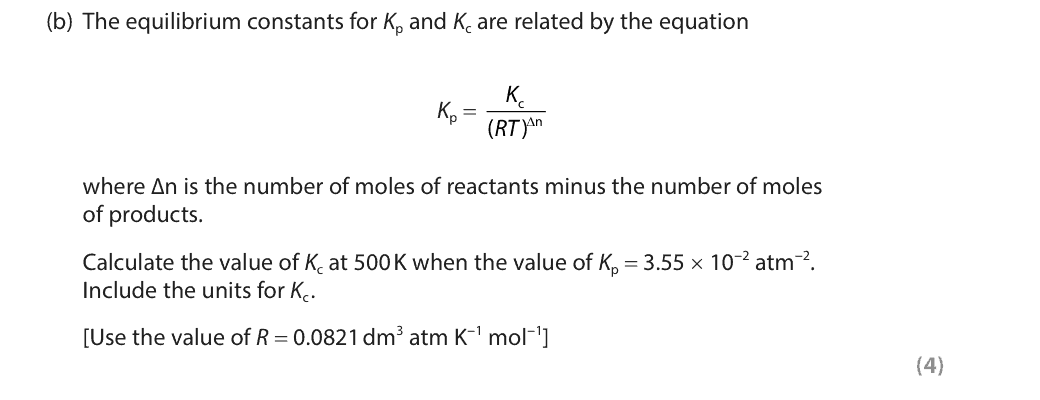
November 2021 · Paper 3 · Q9(b)4 marksCalculation
Earlier part of question 9 that this part uses
Mark scheme
Examiner's comment
The majority of candidates could explain the effect of increasing the pressure on the
equilibrium yield of ammonia, with just a few confusing right and left. The unfamiliar
calculation in (b) was generally well answered, with marks available for substitution of correct
numbers into the expression and rearranging it. Many candidates were unable to substitute
the units into the expression to work out the units of Kc. The majority of candidates found
the calculate in (c) to be very challenging. Most candidates were unable to work out the
number of moles of each substance at equilibrium. However, they were able to score
transferred error marks if they could complete the calculation with their values.
Unfortunately, many were unable to work out the mole fractions and partial pressures. Some
candidates tried to use the ideal gas equation. Many candidates were able to substitute the
correct values into the expression in (d) and evaluate the right-hand side so received credit for
this. Some candidates were then able to rearrange the expression and calculate a correct
value for the equilibrium constant at 310 K.
Notes from the mark scheme and report
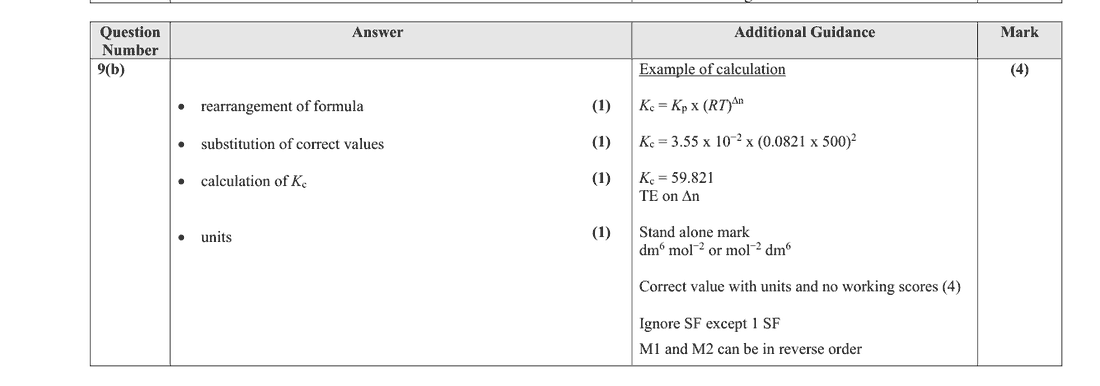
Answer: Kc = 59.8 dm6 mol–2. Kc = Kp × (RT)^Δn with Δn = 4 – 2 = 2: 3.55 × 10^–2 × (0.0821 × 500)^2 = 59.821. Units are a stand-alone mark. Generally well answered, but many could not work out the units of Kc
Skills: MS0.0 Recognise and make use of appropriate units in calculation; MS2.2 Change the subject of an equation; MS2.3 Substitute numerical values into algebraic equations using appropriate units for physical quantities
November 2021 · Paper 3 · Q9(c)5 marksCalculationHard
Earlier part of question 9 that this part uses
Mark scheme
Examiner's comment
The majority of candidates could explain the effect of increasing the pressure on the
equilibrium yield of ammonia, with just a few confusing right and left. The unfamiliar
calculation in (b) was generally well answered, with marks available for substitution of correct
numbers into the expression and rearranging it. Many candidates were unable to substitute
the units into the expression to work out the units of Kc. The majority of candidates found
the calculate in (c) to be very challenging. Most candidates were unable to work out the
number of moles of each substance at equilibrium. However, they were able to score
transferred error marks if they could complete the calculation with their values.
Unfortunately, many were unable to work out the mole fractions and partial pressures. Some
candidates tried to use the ideal gas equation. Many candidates were able to substitute the
correct values into the expression in (d) and evaluate the right-hand side so received credit for
this. Some candidates were then able to rearrange the expression and calculate a correct
value for the equilibrium constant at 310 K.
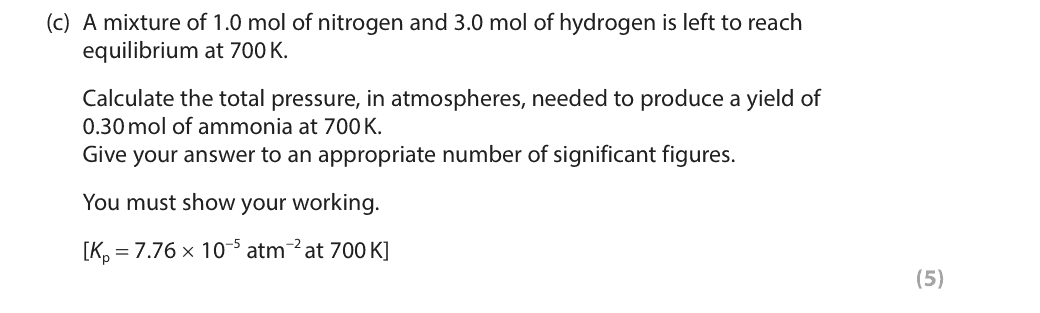
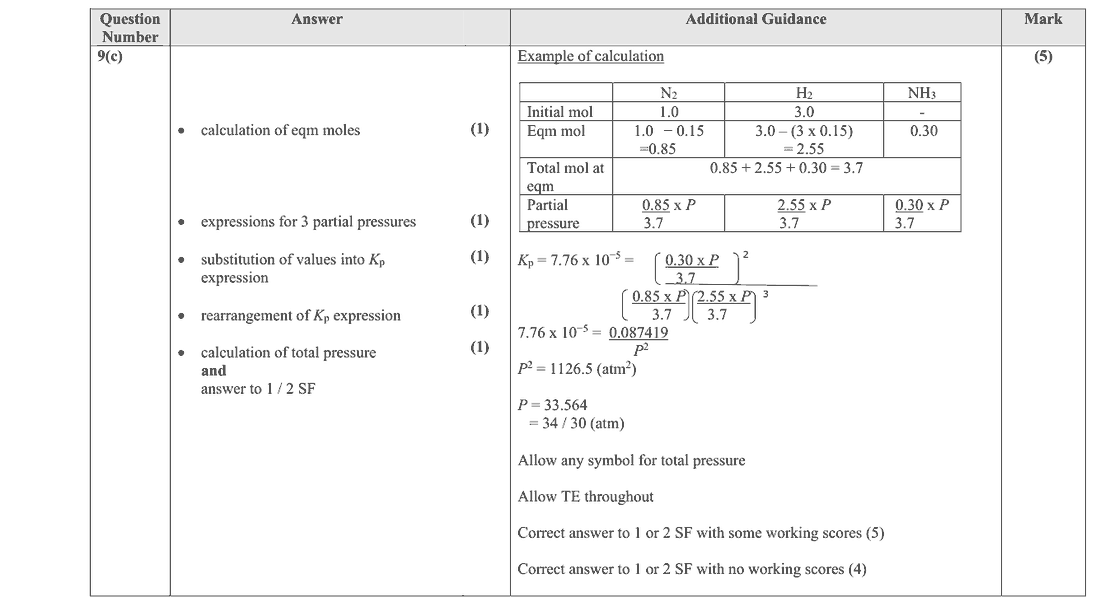
this gives 7.76 × 10^–5 = 0.087419 ÷ P^2, so P^2 = 1126.5 and P = 33.6. Most could not find the equilibrium moles, then struggled with mole fractions and partial pressures
some tried pV = nRT
Skills: MS0.2 Use ratios, fractions and percentages; MS1.1 Use an appropriate number of significant figures; MS2.2 Change the subject of an equation; MS2.4 Solve algebraic equations
November 2021 · Paper 3 · Q9(d)4 marksCalculation
Earlier part of question 9 that this part uses
Mark scheme
Examiner's comment
The majority of candidates could explain the effect of increasing the pressure on the
equilibrium yield of ammonia, with just a few confusing right and left. The unfamiliar
calculation in (b) was generally well answered, with marks available for substitution of correct
numbers into the expression and rearranging it. Many candidates were unable to substitute
the units into the expression to work out the units of Kc. The majority of candidates found
the calculate in (c) to be very challenging. Most candidates were unable to work out the
number of moles of each substance at equilibrium. However, they were able to score
transferred error marks if they could complete the calculation with their values.
Unfortunately, many were unable to work out the mole fractions and partial pressures. Some
candidates tried to use the ideal gas equation. Many candidates were able to substitute the
correct values into the expression in (d) and evaluate the right-hand side so received credit for
this. Some candidates were then able to rearrange the expression and calculate a correct
value for the equilibrium constant at 310 K.
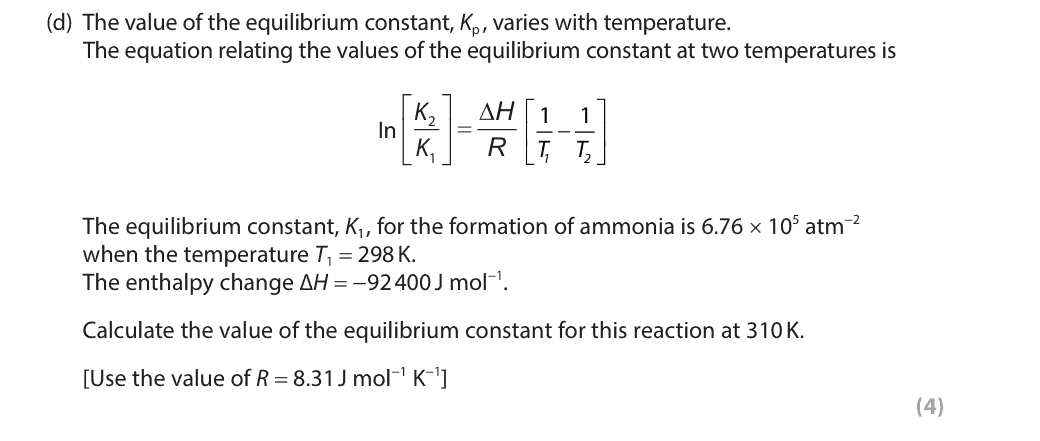
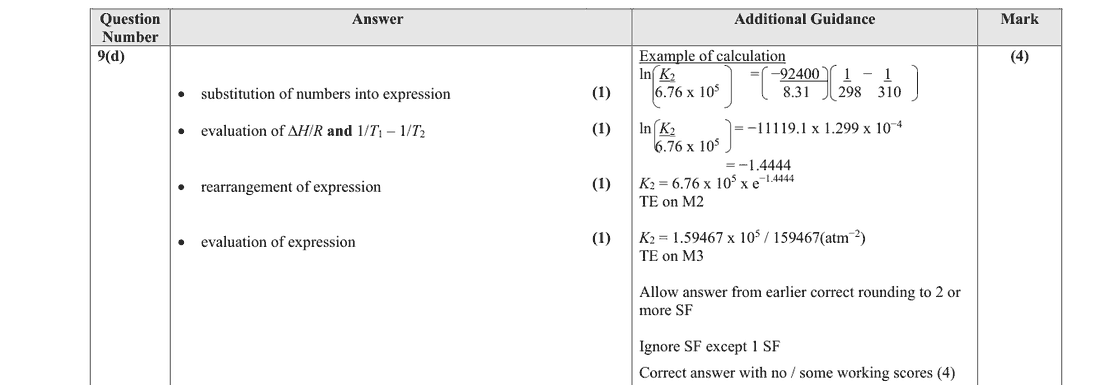
K2 = 6.76 × 10^5 × e^–1.4444. Many could substitute and evaluate the right-hand side
fewer could rearrange to find K2
Skills: MS0.4 Use calculators to find and use power, exponential and logarithmic functions; MS2.2 Change the subject of an equation; MS2.3 Substitute numerical values into algebraic equations using appropriate units for physical quantities; MS2.5 Use logarithms in relation to quantities that range over several orders of magnitude
October 2020 · Paper 1 · Q7(a)(ii)3 marksCalculationHard
Earlier part of question 7 that this part uses
Mark scheme
Examiner's comment
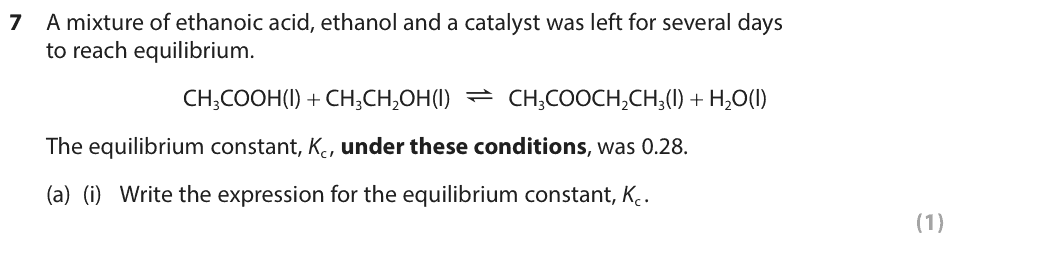
The majority of candidates could write the correct equilibrium expression in (a)(i), with the
most common error being the omission of water. However, the unfamiliar style of calculation
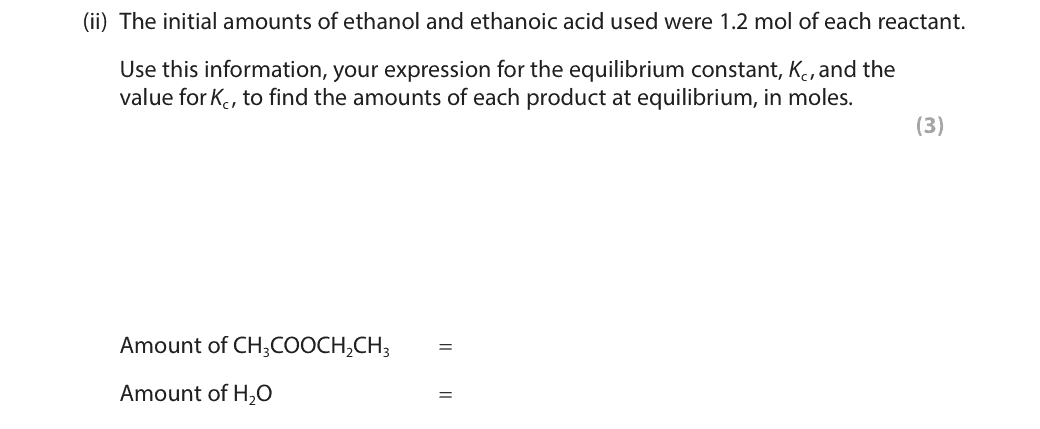
in (ii) proved challenging for all but the most able. Most candidates did not consider that the
number of moles of product formed could be linked back to the moles of reactant remaining
and simply assumed that 1.2 mol of each reactant will still be left at equilibrium. Some did
appreciate the link, deducing 1.2 – x mol of reactant would remain, where x = the number of
moles product formed. Only a small number then realised they could input their findings into
equilibrium expression and simplify it by taking square roots, without the need for a quadratic
equation. Most candidates who scored 3 marks did so by writing and solving the quadratic
equation.
Questions similar in format to (b)(iii) have been asked many times, and the simplest answers
where often the highest scoring, based on the idea that only temperature affects Kp. Some of
those who started to discuss the position of the equilibrium moving to the right made the
mistake of thinking this would increase Kp, though perhaps more than in the past linked this
movement as a way of keeping Kp constant.
Notes from the mark scheme and report
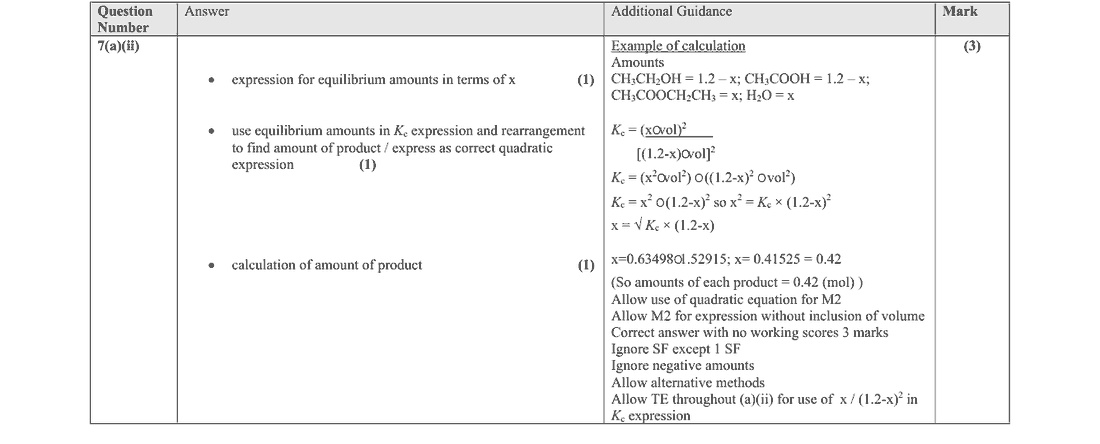
Answer: 0.42 mol of each product. At equilibrium each reactant is 1.2 – x and each product x
Kc = x^2 ÷ (1.2 – x)^2 = 0.28 (volumes cancel)
take square roots: x = √0.28 × (1.2 – x), so x = 0.63498 ÷ 1.52915 = 0.415. A quadratic is also allowed. Most assumed 1.2 mol of each reactant was still present at equilibrium
those scoring 3 usually solved the quadratic
Skills: MS2.2 Change the subject of an equation; MS2.4 Solve algebraic equations
October 2020 · Paper 1 · Q7(b)(ii)1 markMultiple choice
Earlier parts of question 7 that this part uses
Answer
D
Mark scheme
Examiner's comment
The majority of candidates could write the correct equilibrium expression in (a)(i), with the
most common error being the omission of water. However, the unfamiliar style of calculation
in (ii) proved challenging for all but the most able. Most candidates did not consider that the
number of moles of product formed could be linked back to the moles of reactant remaining
and simply assumed that 1.2 mol of each reactant will still be left at equilibrium. Some did
appreciate the link, deducing 1.2 – x mol of reactant would remain, where x = the number of
moles product formed. Only a small number then realised they could input their findings into
equilibrium expression and simplify it by taking square roots, without the need for a quadratic
equation. Most candidates who scored 3 marks did so by writing and solving the quadratic
equation.
Questions similar in format to (b)(iii) have been asked many times, and the simplest answers
where often the highest scoring, based on the idea that only temperature affects Kp. Some of
those who started to discuss the position of the equilibrium moving to the right made the
mistake of thinking this would increase Kp, though perhaps more than in the past linked this
movement as a way of keeping Kp constant.
Notes from the mark scheme and report
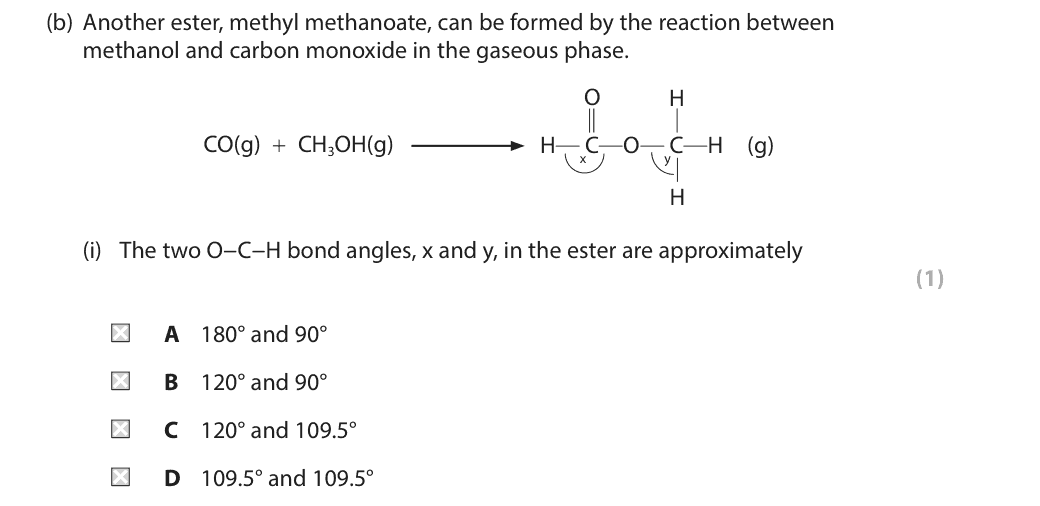
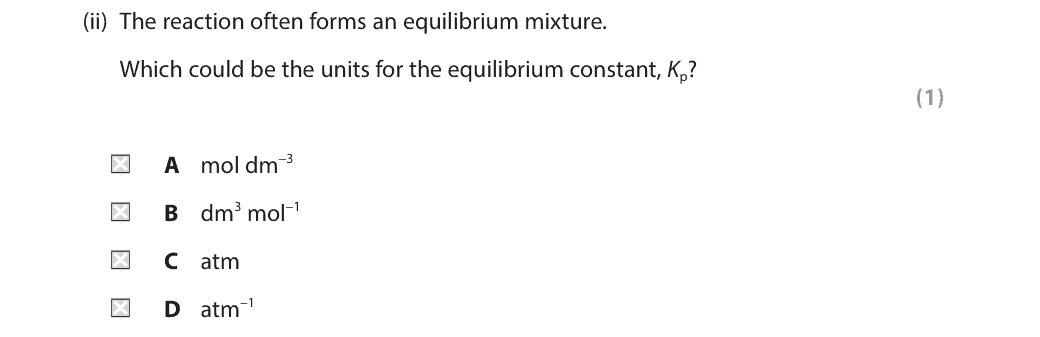
Answer: D. Kp = p(ester) ÷ (p(CO) × p(CH3OH)), so atm ÷ atm^2 = atm–1. B is the unit of Kc and A its inverse
C is the inverse of the Kp unit
Skills: MS0.0 Recognise and make use of appropriate units in calculation
October 2020 · Paper 1 · Q7(b)(iii)2 marksExplanation
Earlier parts of question 7 that this part uses
Mark scheme
Examiner's comment
The majority of candidates could write the correct equilibrium expression in (a)(i), with the
most common error being the omission of water. However, the unfamiliar style of calculation
in (ii) proved challenging for all but the most able. Most candidates did not consider that the
number of moles of product formed could be linked back to the moles of reactant remaining
and simply assumed that 1.2 mol of each reactant will still be left at equilibrium. Some did
appreciate the link, deducing 1.2 – x mol of reactant would remain, where x = the number of
moles product formed. Only a small number then realised they could input their findings into
equilibrium expression and simplify it by taking square roots, without the need for a quadratic
equation. Most candidates who scored 3 marks did so by writing and solving the quadratic
equation.
Questions similar in format to (b)(iii) have been asked many times, and the simplest answers
where often the highest scoring, based on the idea that only temperature affects Kp. Some of
those who started to discuss the position of the equilibrium moving to the right made the
mistake of thinking this would increase Kp, though perhaps more than in the past linked this
movement as a way of keeping Kp constant.
Notes from the mark scheme and report
Kp stays the same (1)
because only temperature changes Kp, or the equilibrium moves to the right to keep Kp constant (1). No second mark if Kp is described as changing. The simplest answers (only temperature affects Kp) scored best
some said the shift to the right increases Kp
June 2019 · Paper 1 · Q6(d)(iii)1 markShort answer
Earlier parts of question 6 that this part uses
Mark scheme
Examiner's comment
An appreciable number of candidates gave a suitable explanation but failed to state the sign of the enthalpy change and so did not gain the mark. A range of acceptable reasons were allowed for the positive sign of the enthalpy change. A small minority of candidates appeared to confuse entropy with enthalpy and so gave answers relating to the increase in the number of moles of products.
Notes from the mark scheme and report
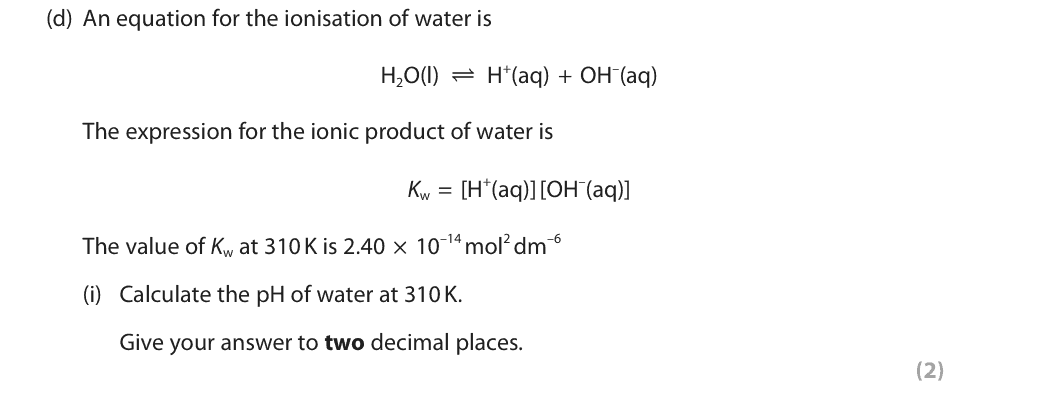
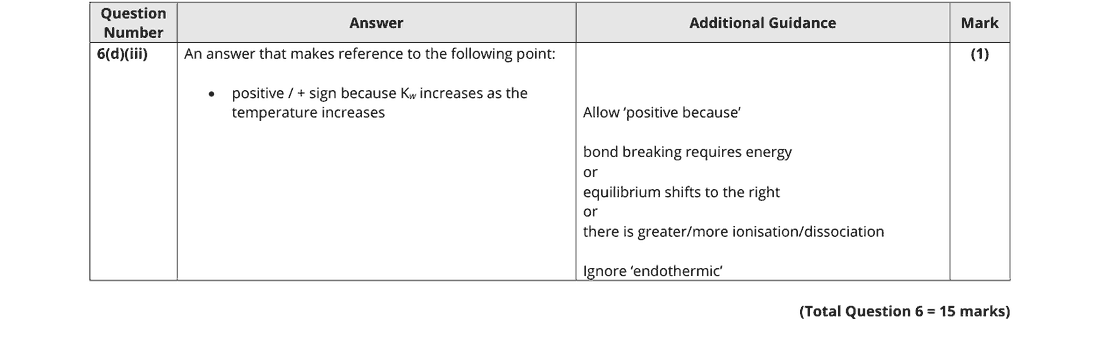
Positive, because Kw increases as the temperature increases (Kw is 2.40 × 10^–14 at 310 K, larger than at 298 K) / the equilibrium shifts to the right / more ionisation
'positive because bond breaking requires energy' also allowed. 'Endothermic' alone is ignored: the sign must be stated. Common errors: a good reason with no sign
confusing enthalpy with entropy
June 2019 · Paper 1 · Q10(a)(i)5 marksCalculation
Mark scheme
Examiner's comment
Candidates clearly have been practicing this type of calculation as just under half of all responses scored full marks. Revision had paid off. When errors were seen it was often a case of candidates using moles directly to calculate partial pressures rather than mole fractions. Occasionally candidates were rather careless with their transfer of numbers and inserted or omitted a zero which resulted in an incorrect final value. A reminder to always double-check working.
Notes from the mark scheme and report
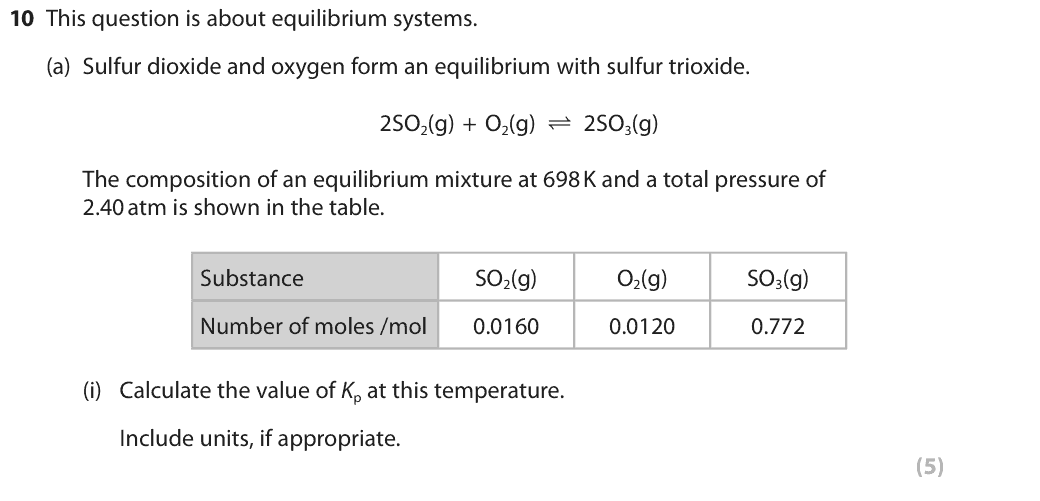
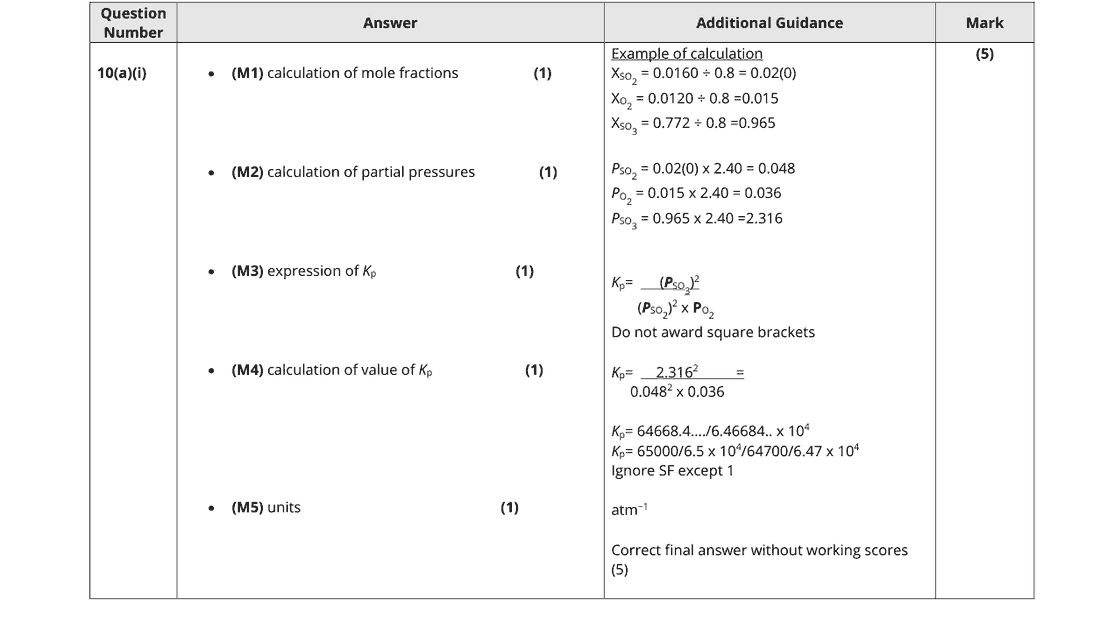
Answer: Kp = 6.47 × 10^4 atm–1 (64 668
65 000). Total moles = 0.800
mole fractions SO2 0.0200, O2 0.0150, SO3 0.965
partial pressures (× 2.40) 0.048, 0.036 and 2.316 atm
Kp = p(SO3)^2 / (p(SO2)^2 × p(O2)) = 2.316^2 / (0.048^2 × 0.036). M1 mole fractions, M2 partial pressures, M3 expression (no square brackets), M4 value, M5 units. Not 1 SF. Just under half scored full marks. Common errors: using moles directly in place of mole fractions
a zero dropped or added when copying numbers
Skills: MS0.0 Recognise and make use of appropriate units in calculation; MS0.2 Use ratios, fractions and percentages; MS2.3 Substitute numerical values into algebraic equations using appropriate units for physical quantities
June 2019 · Paper 1 · Q10(a)(iii)2 marksExplanation
Earlier part of question 10 that this part uses
Mark scheme
Examiner's comment
This question was worth two marks and two points were required from careful reading of the question. It was noteworthy that a large number of candidates addressed their answer to one or other of these points but rarely both. This emphasises the need to read the question again to ensure that all parts are being addressed.
The question required a statement about what happened to the number of sulfur dioxide molecules and why for one mark, and also to include a reference to the value of Kp. It was rather surprising the significant number of candidates who referred to Kp changing, whereas temperature is the only factor that changes Kp. This is a topic area which would benefit from renewed emphasis by centres and their candidates.
Notes from the mark scheme and report
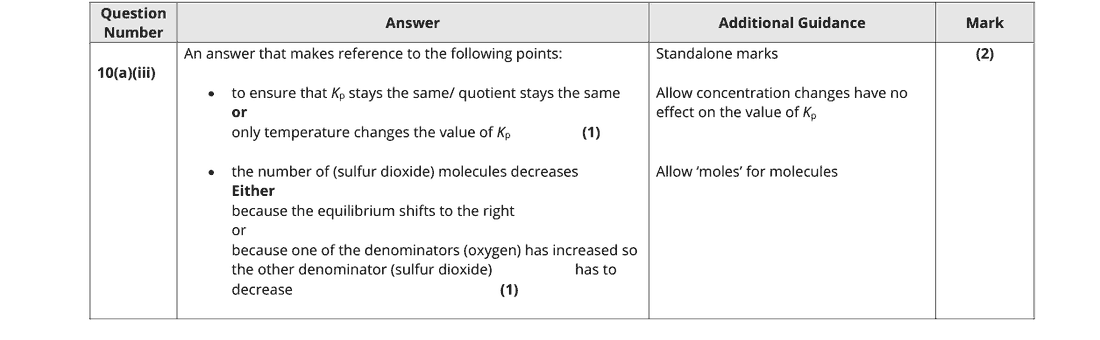
M1: Kp must stay the same (only temperature changes Kp). M2: so the number of sulfur dioxide molecules decreases, because the equilibrium shifts to the right / the oxygen term in the denominator has increased so the sulfur dioxide term must fall. Stand-alone marks. Most answers covered only one of the two points
a significant number said that Kp changes
June 2018 · Paper 1 · Q6(b)(ii)1 markShort answer
Earlier parts of question 6 that this part uses
Mark scheme
Examiner's comment
Many candidates could work out the correct units for Kc, but there were many careless errors. Some candidates did not look at the expression carefully and forgot to square the units for the concentration of hydroxide ions. Candidates are advised to write down their working when deducing the units as they will be less likely to make careless errors.
Notes from the mark scheme and report
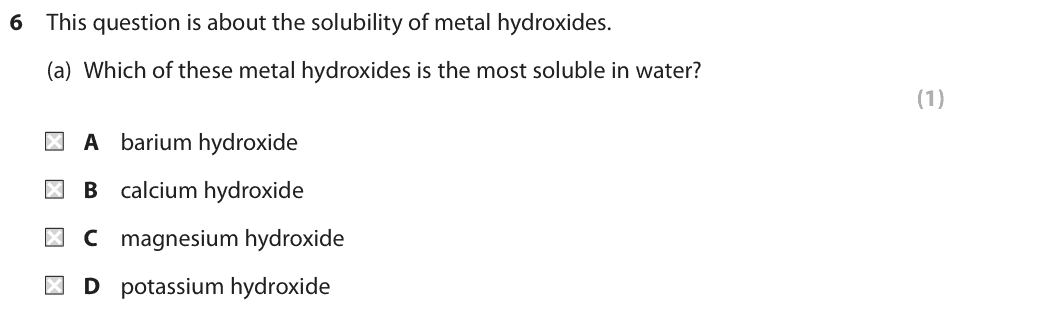
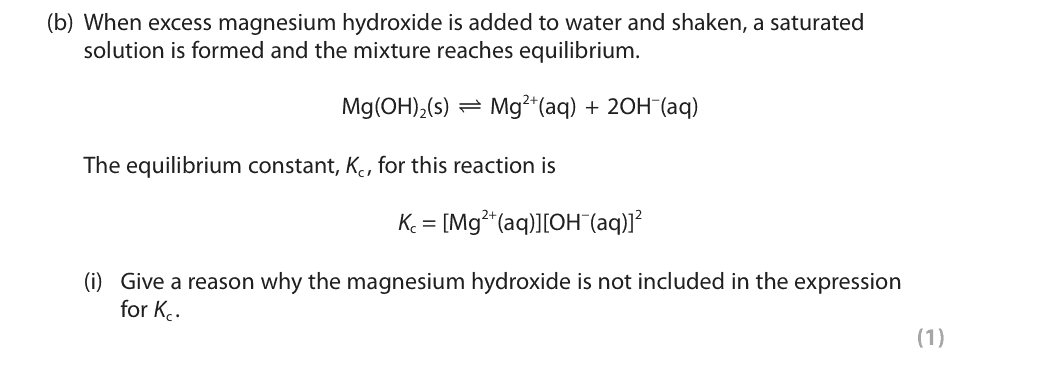
Answer: mol3 dm–9. (mol dm–3) × (mol dm–3)^2. Common error: not squaring the units for the hydroxide ion concentration
Skills: MS0.0 Recognise and make use of appropriate units in calculation
June 2018 · Paper 3 · Q8(c)(i)1 markCalculation
Earlier parts of question 8 that this part uses
Mark scheme
Examiner's comment
This question proved to be challenging for all but the potential A grade candidates. Anecdotal evidence from the examination team suggested a small, but noticeable number seemed to run out of steam in parts b(ii) through to (c), hence not attempting these parts. Of those that did persevere many were able to score 2 marks in part (b)(ii). From then on, despite the scaffolding, many were unable to further process the data, though transferred errors did enable some credit to be given.
Notes from the mark scheme and report
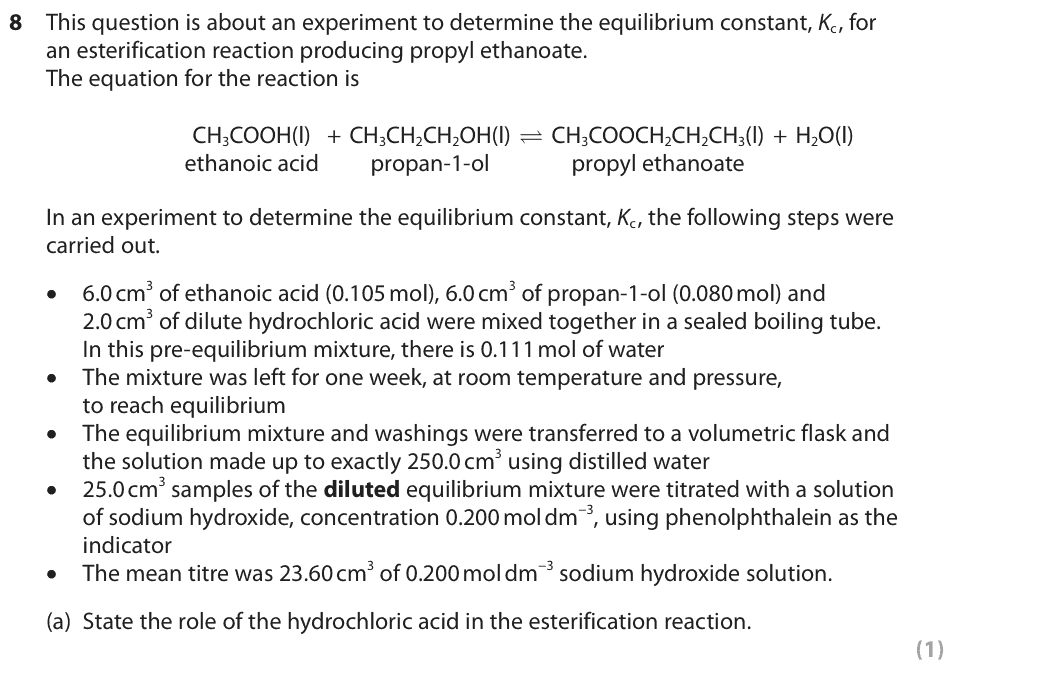
Answer: 0.0618 mol. 0.105 – 0.0432. Error carried forward from (b)(ii) unless the value is negative
June 2018 · Paper 3 · Q8(c)(ii)3 marksCalculation
Earlier parts of question 8 that this part uses
Mark scheme
Examiner's comment
This question proved to be challenging for all but the potential A grade candidates. Anecdotal evidence from the examination team suggested a small, but noticeable number seemed to run out of steam in parts b(ii) through to (c), hence not attempting these parts. Of those that did persevere many were able to score 2 marks in part (b)(ii). From then on, despite the scaffolding, many were unable to further process the data, though transferred errors did enable some credit to be given.
Notes from the mark scheme and report
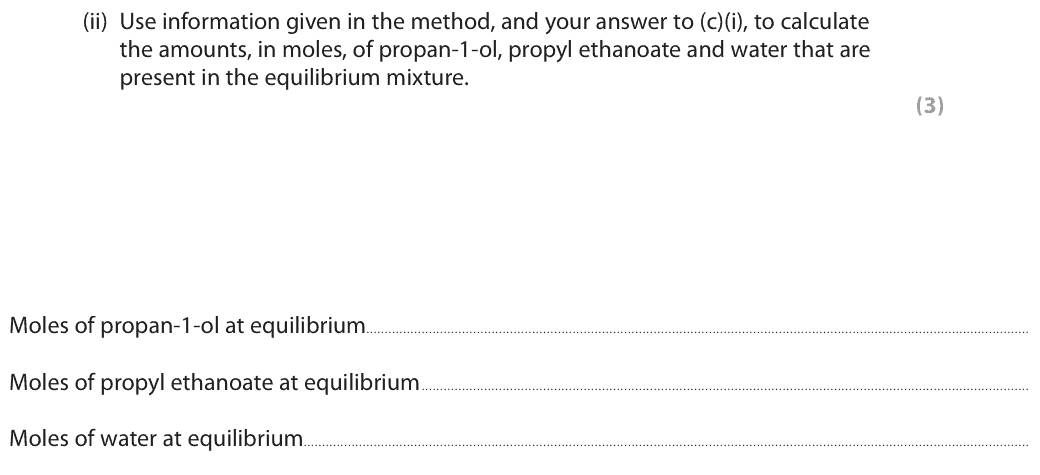
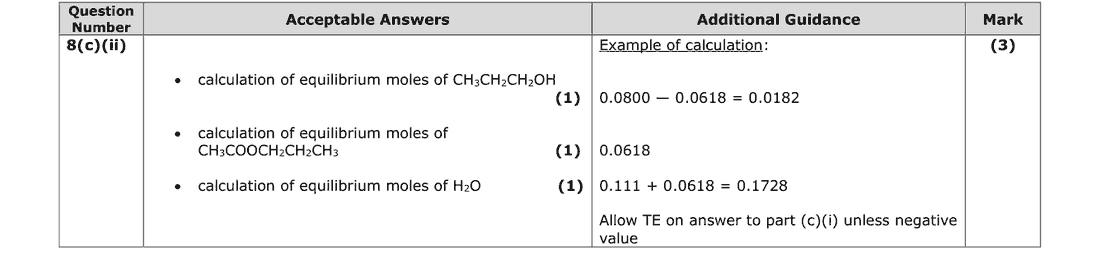
Answer: propan-1-ol 0.0182 mol (0.0800 – 0.0618)
propyl ethanoate 0.0618 mol
water 0.1728 mol (0.111 + 0.0618). One mark each
error carried forward from (c)(i) unless negative. Many could not process the data beyond (b)(ii)
June 2018 · Paper 3 · Q8(d)(ii)2 marksExplanation
Earlier parts of question 8 that this part uses
Mark scheme
Examiner's comment
Most candidates could construct the expression in (d)(i). Errors tended to either be the omission of a CH2 group from either the ester or the acid or leaving out water completely from the numerator. The idea of ‘volume cancels out’ was prevalent in (d)(ii). A common idea was to state that all substances were in the same state, which was not worth credit on its own. Candidates found it much more difficult to get across the idea of the same number of molecules on both sides of the equation, with the result that sometimes it was difficult to judge whether they were describing an equal number of moles of each substance in the equilibrium mixture. The best answers often used mathematical manipulation of the units in the expression to make their point.
A wide variety of transferred errors were credited in (d)(iii), although a pleasing number got the precise answer as per the mark scheme.
The expression is correct in (d)(i) and both marks in (d)(iii) are obtained through transferred errors. However in (d)(ii) only the volume has been considered when explaining why the use of amount in moles is acceptable.
Notes from the mark scheme and report
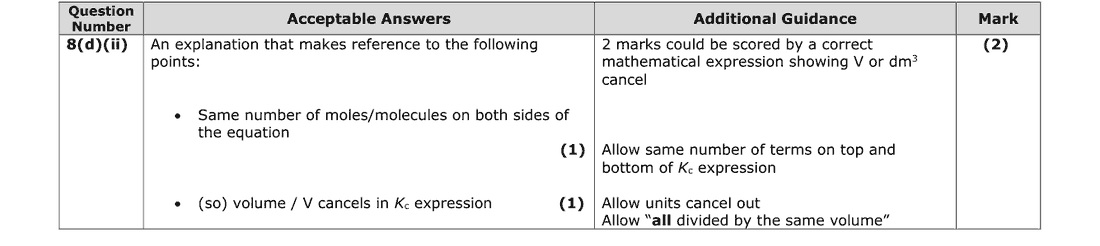
The same number of moles on each side of the equation (same number of terms top and bottom of the Kc expression)
so the volume cancels in the Kc expression (units cancel). A correct algebraic expression showing V cancelling scores both. 'All in the same state' earned nothing on its own
the mole point was the one more often missed
Skills: MS0.0 Recognise and make use of appropriate units in calculation
June 2018 · Paper 3 · Q8(d)(iii)2 marksCalculation
Earlier parts of question 8 that this part uses
Mark scheme
Examiner's comment
Most candidates could construct the expression in (d)(i). Errors tended to either be the omission of a CH2 group from either the ester or the acid or leaving out water completely from the numerator. The idea of ‘volume cancels out’ was prevalent in (d)(ii). A common idea was to state that all substances were in the same state, which was not worth credit on its own. Candidates found it much more difficult to get across the idea of the same number of molecules on both sides of the equation, with the result that sometimes it was difficult to judge whether they were describing an equal number of moles of each substance in the equilibrium mixture. The best answers often used mathematical manipulation of the units in the expression to make their point.
A wide variety of transferred errors were credited in (d)(iii), although a pleasing number got the precise answer as per the mark scheme.
The expression is correct in (d)(i) and both marks in (d)(iii) are obtained through transferred errors. However in (d)(ii) only the volume has been considered when explaining why the use of amount in moles is acceptable.
Notes from the mark scheme and report
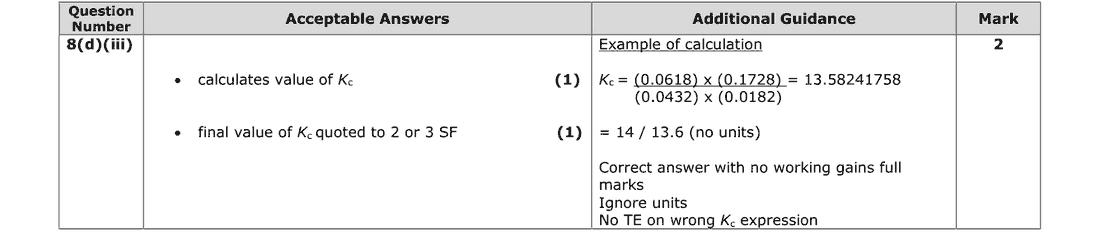
Answer: 14 or 13.6 (no units). Kc = (0.0618 × 0.1728) ÷ (0.0432 × 0.0182) = 13.58
second mark for 2 or 3 s.f. Units ignored. No error carried forward from a wrong Kc expression, but transferred errors from the earlier amounts are credited
Skills: MS1.1 Use an appropriate number of significant figures; MS2.3 Substitute numerical values into algebraic equations using appropriate units for physical quantities
June 2018 · Paper 3 · Q8(g)2 marksShort answer
Earlier parts of question 8 that this part uses
Mark scheme
Examiner's comment
This proved a successful end to the paper for many, with over 70% scoring at least 1 mark. Those who did not score nearly always suggested that Kc would decrease, and so were unable to justify their incorrect deduction.
Notes from the mark scheme and report
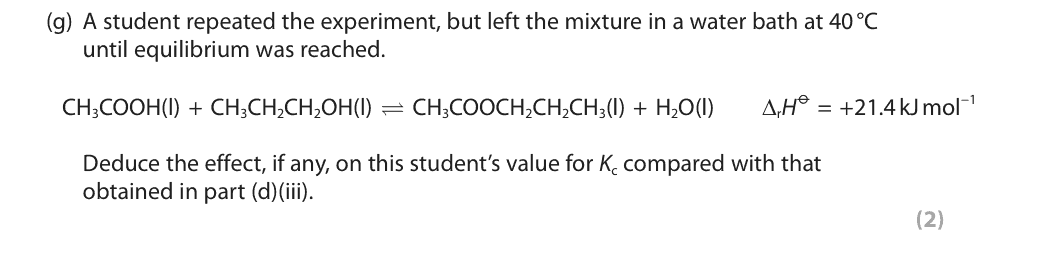
Kc is greater than the value in (d)(iii)
because the forward reaction is endothermic. The second mark depends on the first
references to the position of equilibrium shifting right are ignored. Those who did not score nearly always said Kc would decrease
June 2017 · Paper 1 · Q10(a)(i)1 markShort answer
Mark scheme
Examiner's comment
It was disappointing that many candidates just wrote short answers such as 'carbon is a solid' or 'carbon is not a gas'. The question asks about the partial pressure of carbon so the answer should refer to that. A small number of candidates had the right idea but they referred to carbon having a constant concentration instead of a constant partial pressure so they did not score a mark.
Notes from the mark scheme and report
Carbon is a solid so it has no partial (vapour) pressure / its partial pressure is constant / it does not contribute to the total pressure
or the reaction is heterogeneous and pure solids are left out of Kp. Just 'carbon is a solid' or 'carbon is not a gas' is not enough. Many gave only those short answers
'constant concentration' was not credited
June 2017 · Paper 1 · Q10(a)(iii)2 marksExplanation
Earlier parts of question 10 that this part uses
Mark scheme
Examiner's comment
Many candidates scored 2 marks for this question. Some candidates omitted to state what would happen to the value of the equilibrium constant and some were confused and thought it would decrease. Some candidates realised that Kp would increase but did not relate this to the forward reaction being endothermic.
Notes from the mark scheme and report
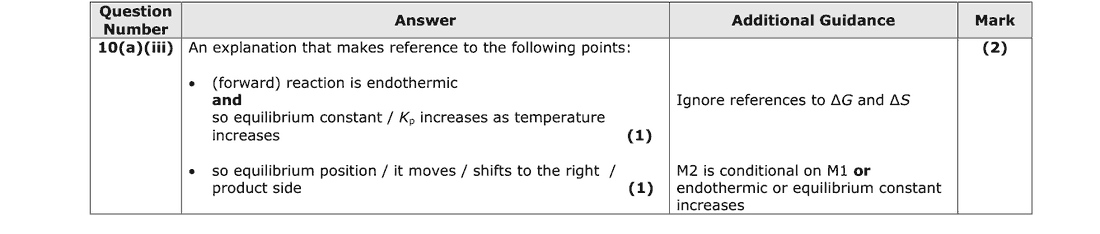
M1: the forward reaction is endothermic, so Kp increases when the temperature rises. M2: so the equilibrium position moves to the right (conditional on M1, or on endothermic, or on Kp increasing). Ignore ΔG and ΔS. Common errors: no statement about Kp
Kp said to decrease
Kp increasing not linked to the reaction being endothermic
June 2017 · Paper 1 · Q10(a)(iv)4 marksCalculation
Earlier part of question 10 that this part uses
Mark scheme
Examiner's comment
The majority of candidates made a very good attempt at this calculation, with many scoring 4 marks. Some candidates were unable to work out the partial pressures correctly but they could still score 3 marks. The use of a table for working, as in the mark scheme, would help candidates to see what they are doing and examiners to award marks when the final answer is incorrect. Some candidates worked out a partial pressure for carbon, even though they were told that it is not included in the expression for Kp. Almost all candidates scored the mark for units, although a few included mol-1 and some converted it to Pascals. Candidates are encouraged to convert their answers to decimals and not leave them as fractions.
Notes from the mark scheme and report
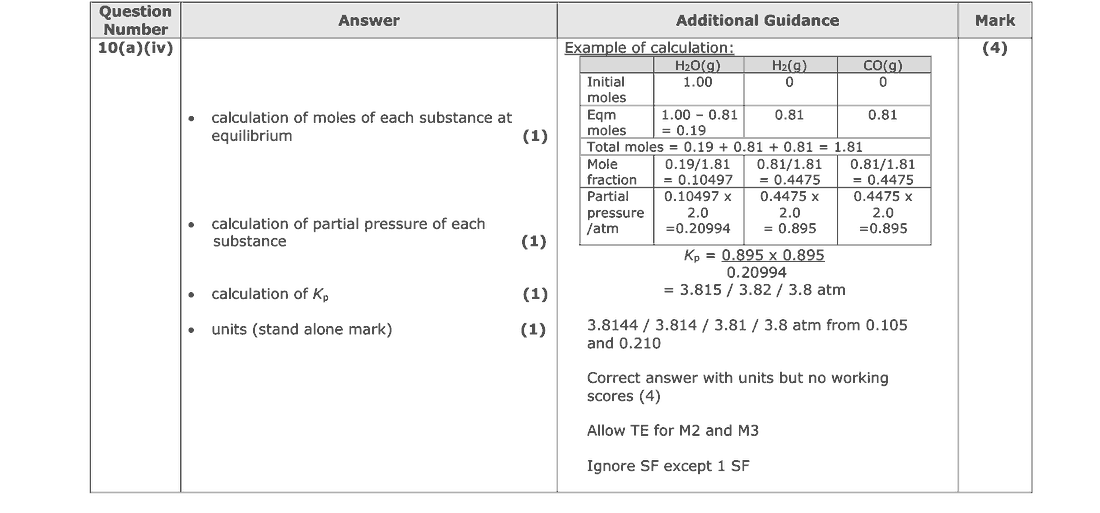
Answer: Kp = 3.8 atm (3.815
3.82). Equilibrium moles: H2O 1.00 – 0.81 = 0.19, H2 0.81, CO 0.81, total 1.81
Kp = (0.895 × 0.895) / 0.210. M1 moles, M2 partial pressures, M3 value, M4 units (stand alone). Not 1 SF. Common errors: wrong partial pressures
a partial pressure worked out for carbon
mol–1 in the units or conversion to pascals
answers left as fractions
Skills: MS0.0 Recognise and make use of appropriate units in calculation; MS0.2 Use ratios, fractions and percentages; MS2.3 Substitute numerical values into algebraic equations using appropriate units for physical quantities
June 2017 · Paper 1 · Q10(b)3 marksExplanation
Earlier part of question 10 that this part uses
Mark scheme
Examiner's comment
Candidates found it difficult to express their ideas clearly to explain what would happen in this question. There were many vague answers and candidates should give careful consideration to all the information given. Many candidates did not read the question carefully and assumed that the reaction was at equilibrium at the start and then it would shift left as there are more moles on the right; this idea scored 1 mark. In the best answers, candidates realised that at equilibrium, the numbers of moles of reactants and products must be equal so the number of moles of the products needs to decrease and the number of moles of reactants to increase to achieve this.
Notes from the mark scheme and report
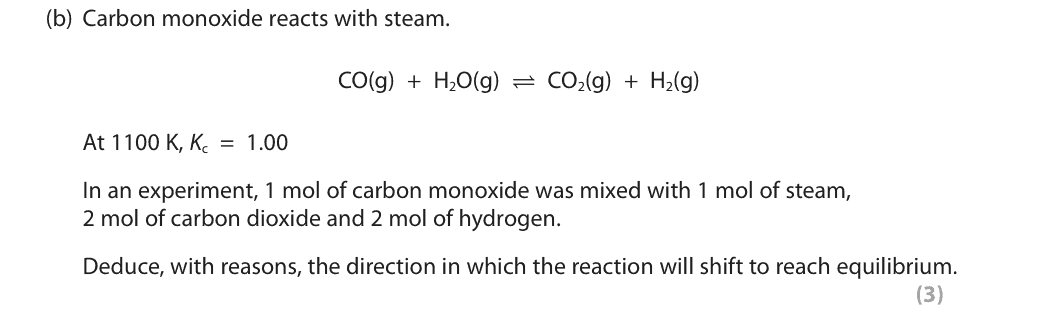
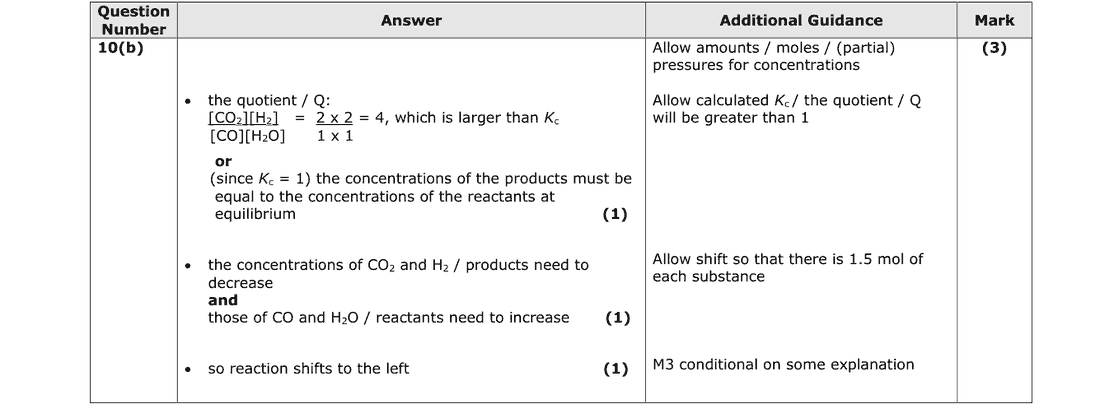
M1: the quotient [CO2][H2] / [CO][H2O] = (2 × 2) / (1 × 1) = 4, larger than Kc (or: as Kc = 1 the product and reactant concentrations must be equal at equilibrium). M2: so the concentrations of CO2 and H2 must fall and those of CO and H2O rise (to 1.5 mol of each). M3: so the reaction shifts to the left (needs some explanation). Moles may be used for concentrations. Candidates found it hard to express: many assumed the mixture was already at equilibrium and argued from 'more moles on the right', which scored 1
Skills: MS0.2 Use ratios, fractions and percentages; MS2.1 Understand and use the symbols: =, <, <<, >>, >, ∝, ~, equilibrium sign
June 2017 · Paper 3 · Q9(b)(i)1 markCalculation
Earlier parts of question 9 that this part uses
Mark scheme
Examiner's comment
Most candidates successfully completed the table in part (i), and as a result plotted the graph with care. However, a minority did not extrapolate their line of best fir through (0,0) and so lost 1 mark. It was common to see gradients calculated correctly, within the acceptable range. On occasions, candidates lost marks because they simply chose a point from each axis to determine a gradient.
Others failed to show their working on the graph, and as a result it was not always clear to examiners how their value was derived. The determination of Kc in part (iv) discriminated effectively, and a significant minority managed to make the gradient the subject of the formula, even if they could not process the data any further.
A number ignored the stem of the question and tried to determine Kc inserting a pair of values from the table into the expression.
Notes from the mark scheme and report
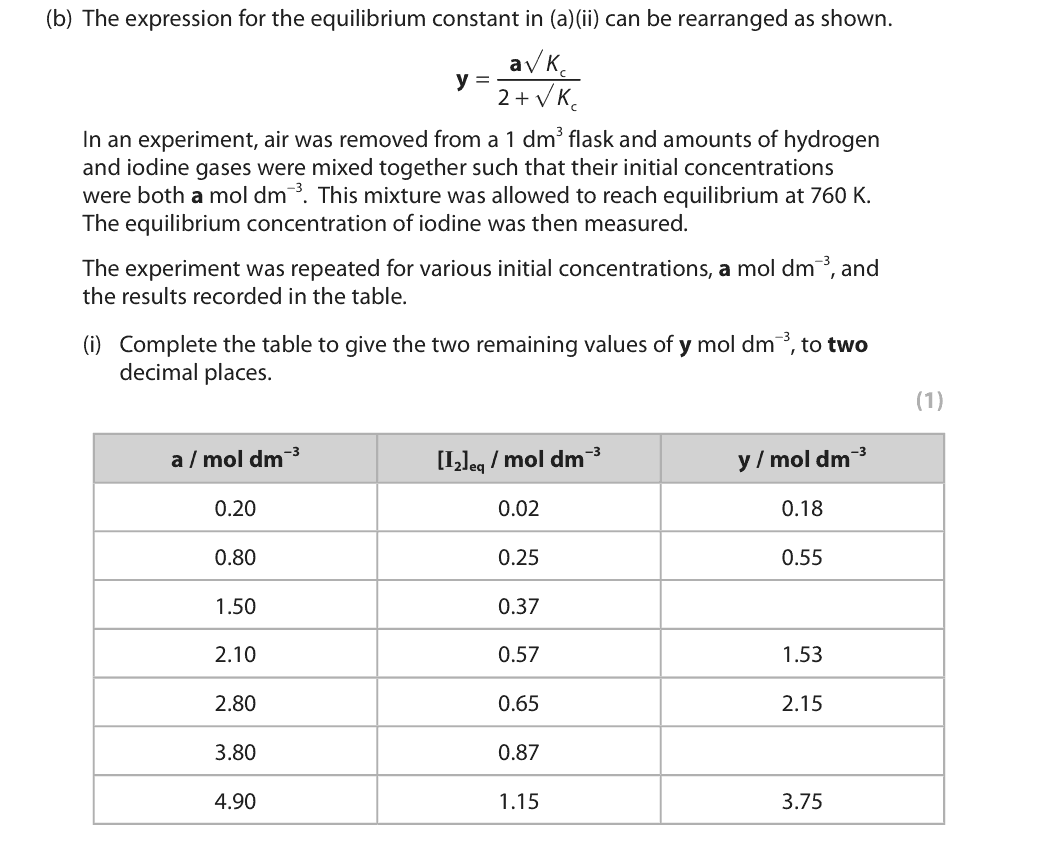
Answer: 1.13 and 2.93 (both needed, to two decimal places). y = a – [I2]eq: 1.50 – 0.37 and 3.80 – 0.87
Skills: MS0.1 Recognise and use expressions in decimal and ordinary form
June 2017 · Paper 3 · Q9(b)(ii)2 marksDiagram or structure
Earlier parts of question 9 that this part uses
Mark scheme
Examiner's comment
Most candidates successfully completed the table in part (i), and as a result plotted the graph with care. However, a minority did not extrapolate their line of best fir through (0,0) and so lost 1 mark. It was common to see gradients calculated correctly, within the acceptable range. On occasions, candidates lost marks because they simply chose a point from each axis to determine a gradient.
Others failed to show their working on the graph, and as a result it was not always clear to examiners how their value was derived. The determination of Kc in part (iv) discriminated effectively, and a significant minority managed to make the gradient the subject of the formula, even if they could not process the data any further.
A number ignored the stem of the question and tried to determine Kc inserting a pair of values from the table into the expression.
Notes from the mark scheme and report
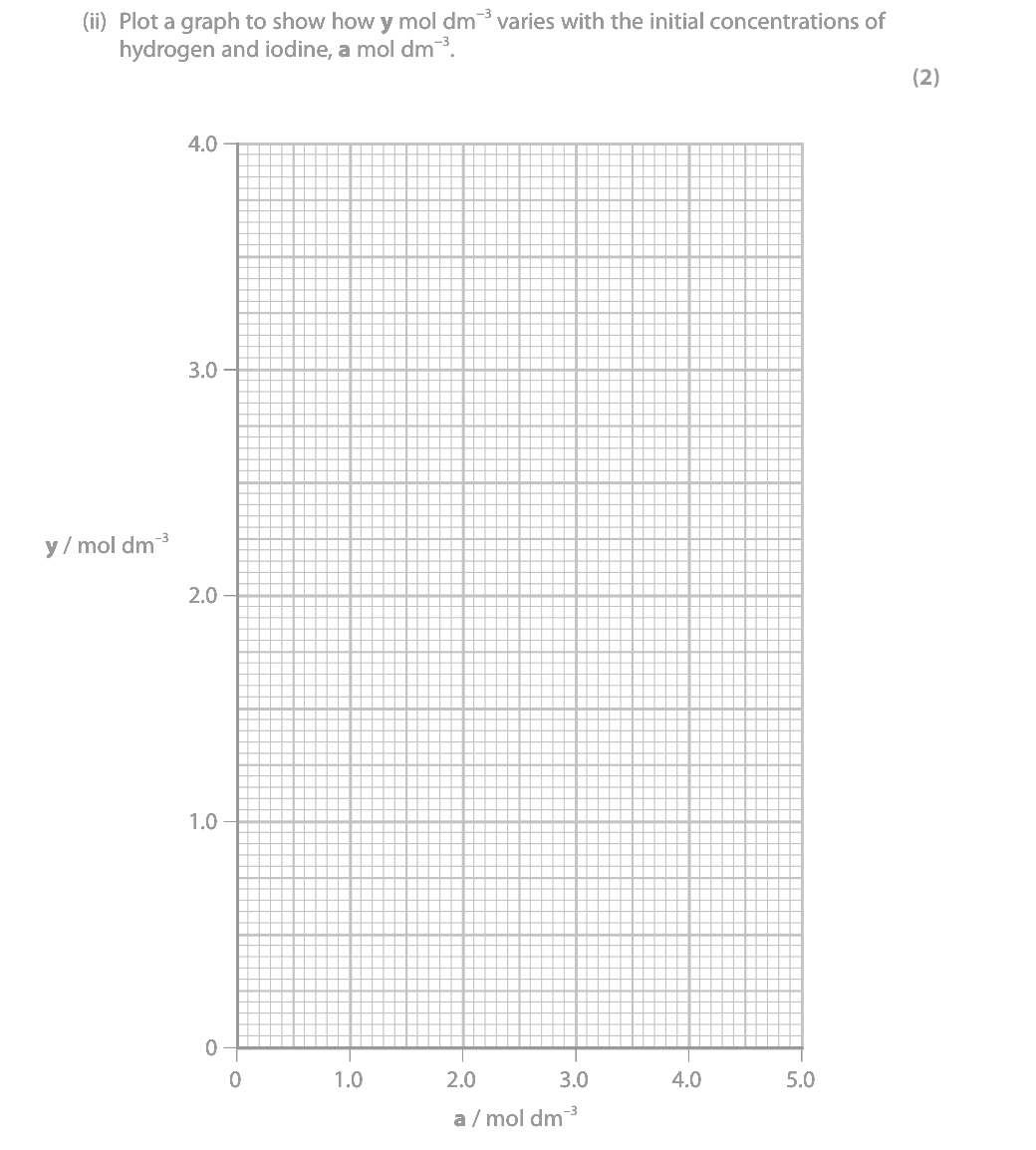
All seven points plotted correctly (error carried forward from (b)(i))
straight line of best fit through the origin (within one square), not with all points on one side of it. A minority did not take the line back through (0,0)
Skills: MS3.2 Plot two variables from experimental or other data
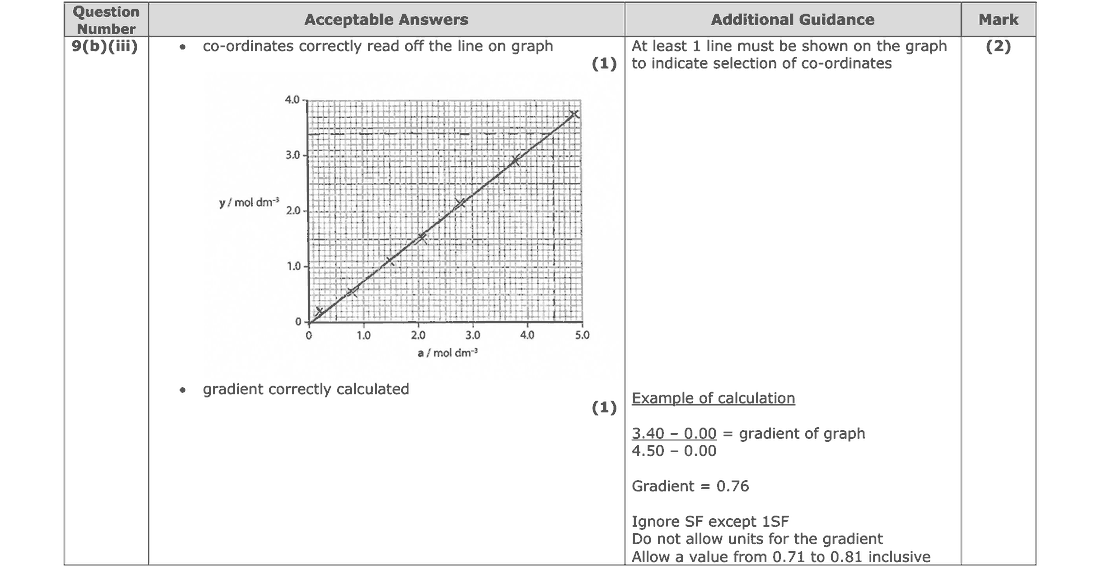
June 2017 · Paper 3 · Q9(b)(iii)2 marksCalculation
Earlier parts of question 9 that this part uses
Mark scheme
Examiner's comment
Most candidates successfully completed the table in part (i), and as a result plotted the graph with care. However, a minority did not extrapolate their line of best fir through (0,0) and so lost 1 mark. It was common to see gradients calculated correctly, within the acceptable range. On occasions, candidates lost marks because they simply chose a point from each axis to determine a gradient.
Others failed to show their working on the graph, and as a result it was not always clear to examiners how their value was derived. The determination of Kc in part (iv) discriminated effectively, and a significant minority managed to make the gradient the subject of the formula, even if they could not process the data any further.
A number ignored the stem of the question and tried to determine Kc inserting a pair of values from the table into the expression.
Notes from the mark scheme and report
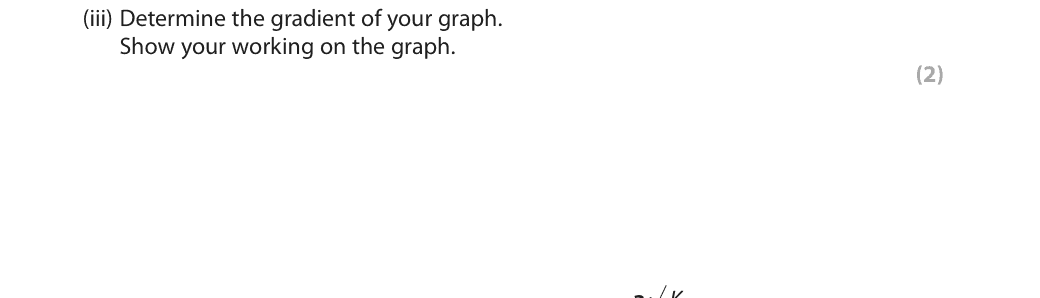
Answer: 0.76 (allow 0.71 to 0.81), no units. One mark for co-ordinates read from the line with at least one construction line shown on the graph, e.g. (3.40 – 0.00) ÷ (4.50 – 0.00)
one for the value. Errors: taking one value from each axis rather than a point on the line
no working on the graph
Skills: MS3.3 Determine the slope and intercept of a linear graph
June 2017 · Paper 3 · Q9(b)(iv)2 marksCalculation
Earlier parts of question 9 that this part uses
Mark scheme
Examiner's comment
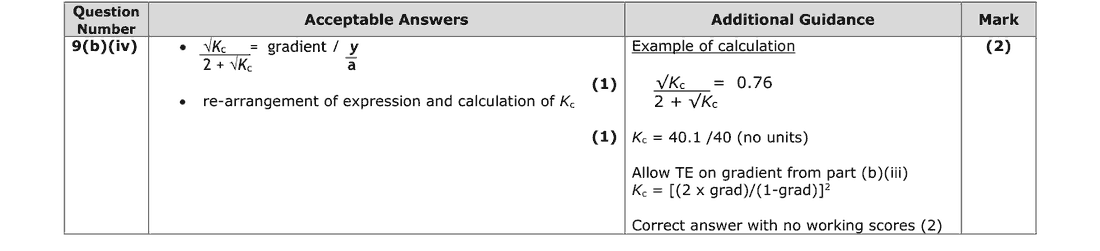
Most candidates successfully completed the table in part (i), and as a result plotted the graph with care. However, a minority did not extrapolate their line of best fir through (0,0) and so lost 1 mark. It was common to see gradients calculated correctly, within the acceptable range. On occasions, candidates lost marks because they simply chose a point from each axis to determine a gradient.
Others failed to show their working on the graph, and as a result it was not always clear to examiners how their value was derived. The determination of Kc in part (iv) discriminated effectively, and a significant minority managed to make the gradient the subject of the formula, even if they could not process the data any further.
A number ignored the stem of the question and tried to determine Kc inserting a pair of values from the table into the expression.
Notes from the mark scheme and report
Answer: Kc = 40 (40.1), no units. Gradient = y ÷ a = √Kc ÷ (2 + √Kc) = 0.76
rearranged, Kc = ((2 × gradient) ÷ (1 – gradient))^2. Error carried forward from the gradient. Some set gradient equal to the expression but could go no further
others ignored the instruction and substituted a pair of values from the table
Skills: MS2.2 Change the subject of an equation; MS2.4 Solve algebraic equations; MS3.3 Determine the slope and intercept of a linear graph
June 2017 · Paper 3 · Q9(d)2 marksShort answer
Earlier parts of question 9 that this part uses
Mark scheme
Examiner's comment
Candidates not spotting that a comment was required on both the rate and Kc was common. Those who did, often scored both marks. It was also quite common to see candidates try to explain their deductions, which was not required.
Notes from the mark scheme and report
Rate of reaction is faster (higher concentration in the smaller volume)
Kc is unchanged. References to the position of equilibrium are ignored
June 2017 · Paper 3 · Q9(e)(i)2 marksExplanation
Earlier part of question 9 that this part uses
Mark scheme
Examiner's comment
Most could explain the effect of a temperature increase on Kc, but a number failed to score both marks because they described the change in equilibrium position but did not relate it to the exothermic nature of the reaction.
Notes from the mark scheme and report
Kc decreases
because the forward reaction is exothermic (or the reverse is endothermic). M2 depends on M1. Some described the shift in position without relating it to the reaction being exothermic
June 2017 · Paper 3 · Q9(e)(ii)1 markDiagram or structure
Earlier parts of question 9 that this part uses
Mark scheme
Examiner's comment
Nearly all attempts here were either a steeper straight line or a less steep straight line.
Notes from the mark scheme and report
A straight line through the origin with a smaller gradient than the 760 K line (the lines must not cross). Answers were split between a steeper and a less steep line
Skills: MS3.1 Translate information between graphical, numerical and algebraic forms
Work with an A-level chemistry tutor
Dropping marks on calculations, mechanisms or the core practicals? Book a trial session with an A-level chemistry tutor.