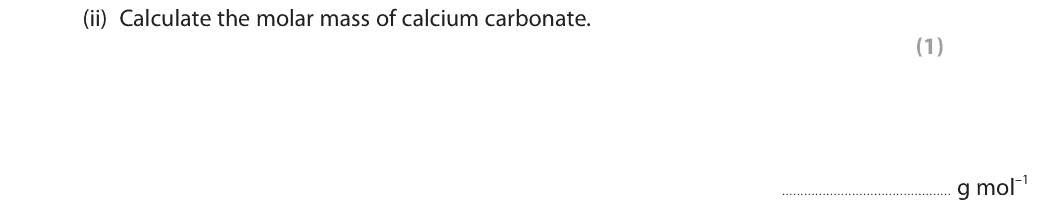
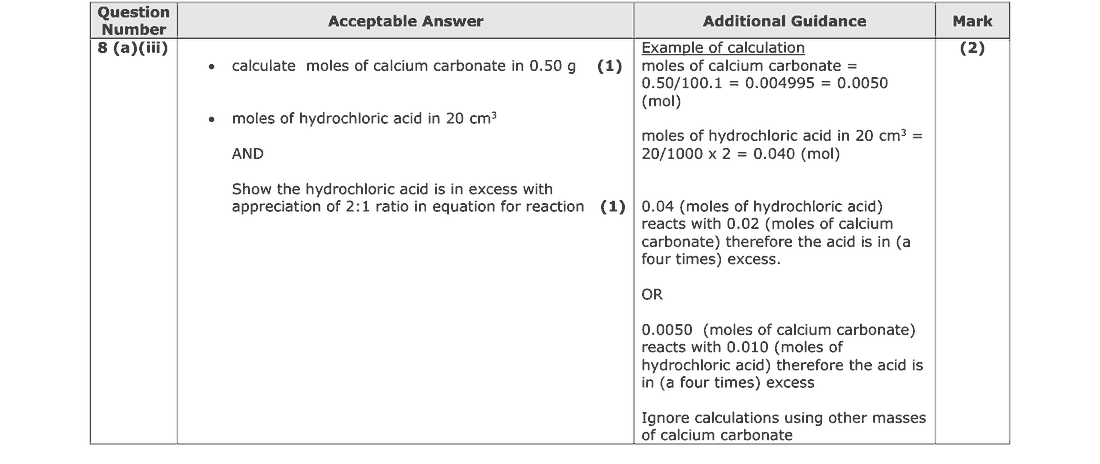
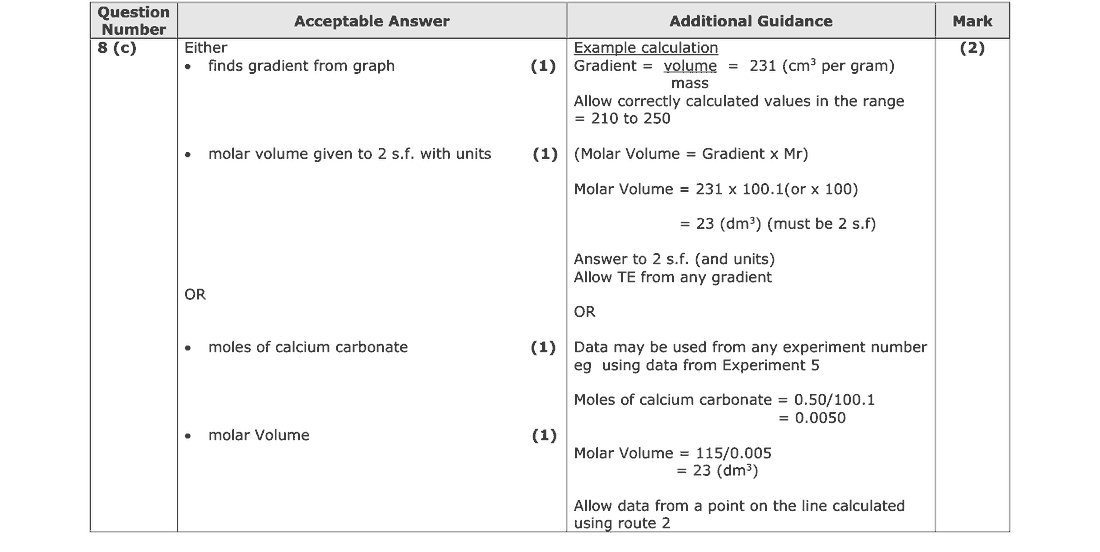
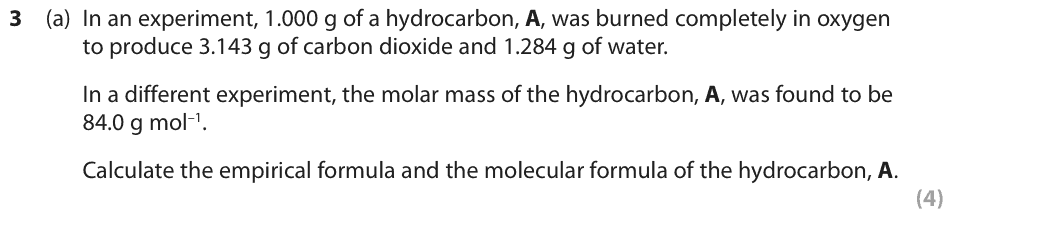
Calculation questions

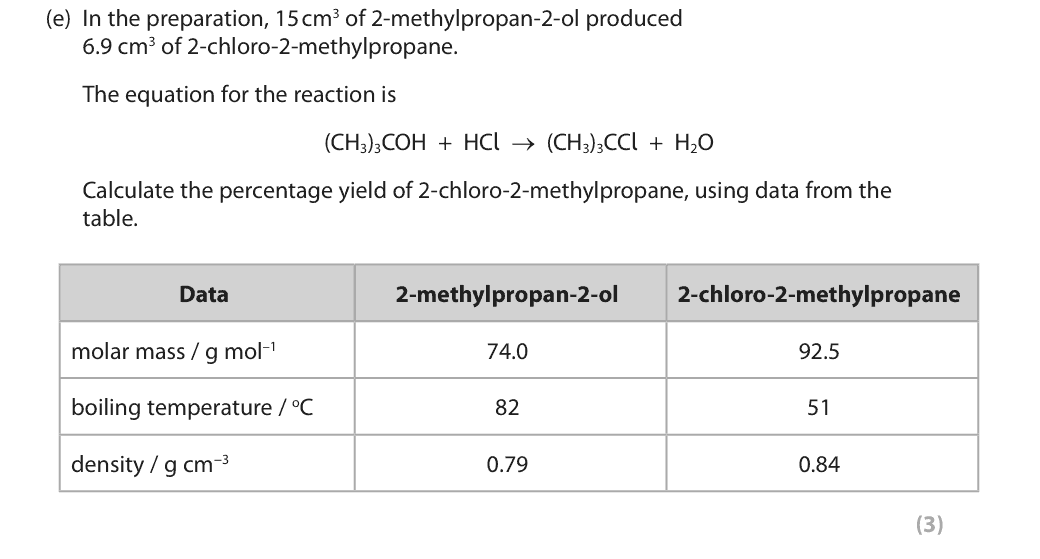
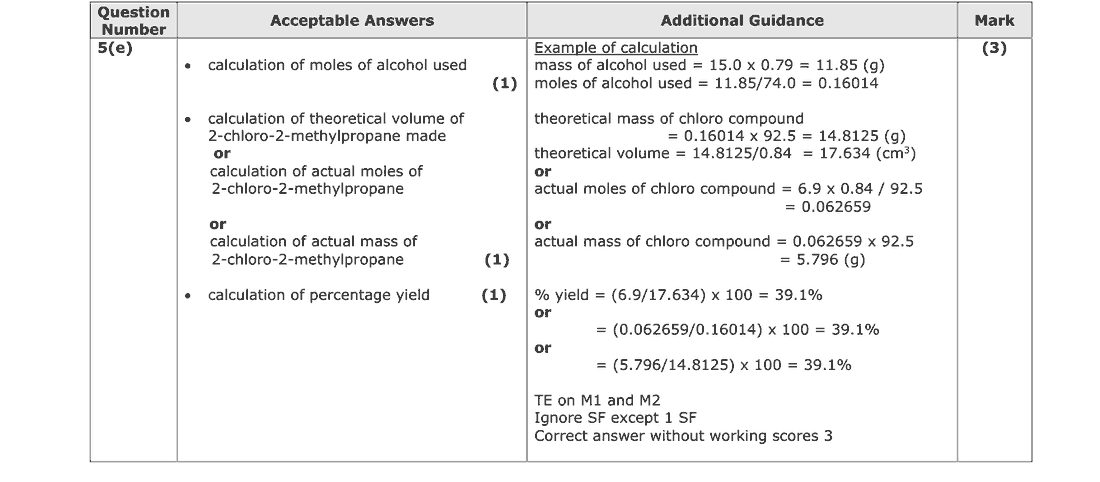
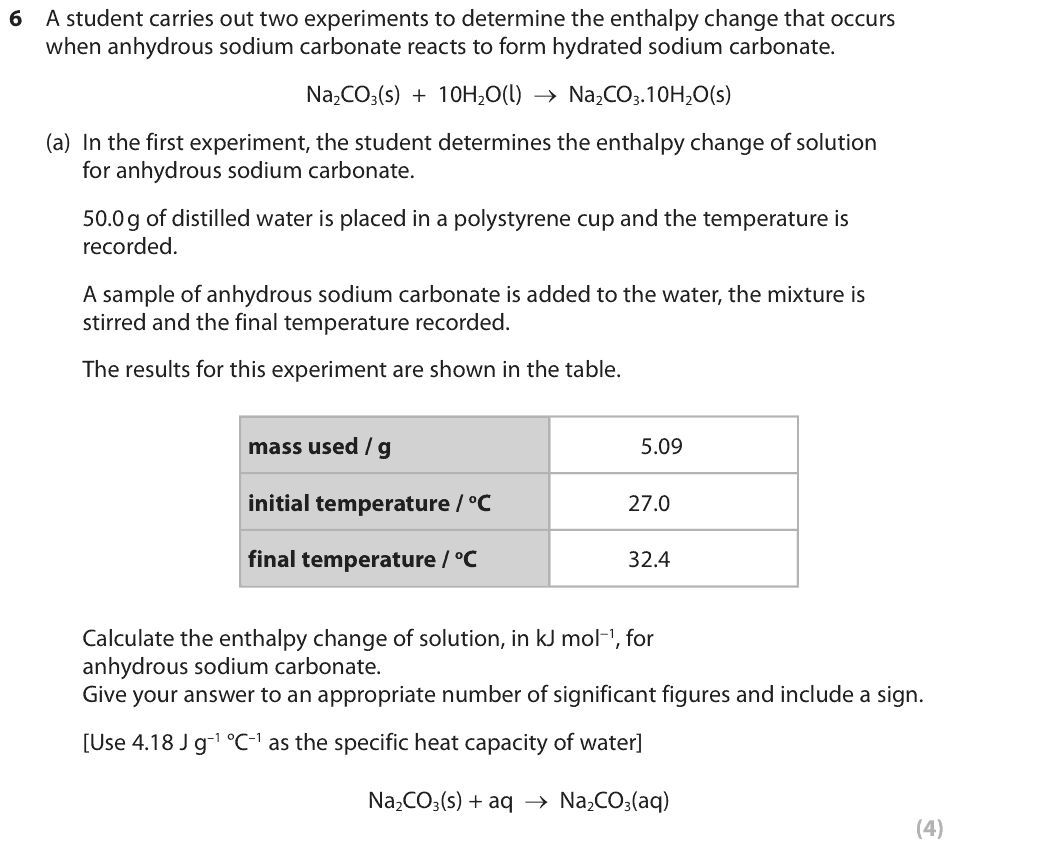
Moles, titrations, enthalpy, equilibrium constants, pH, rates and electrode potentials. Set out every step: the mark schemes give marks for the method, and an error carried forward still scores. 350 questions.

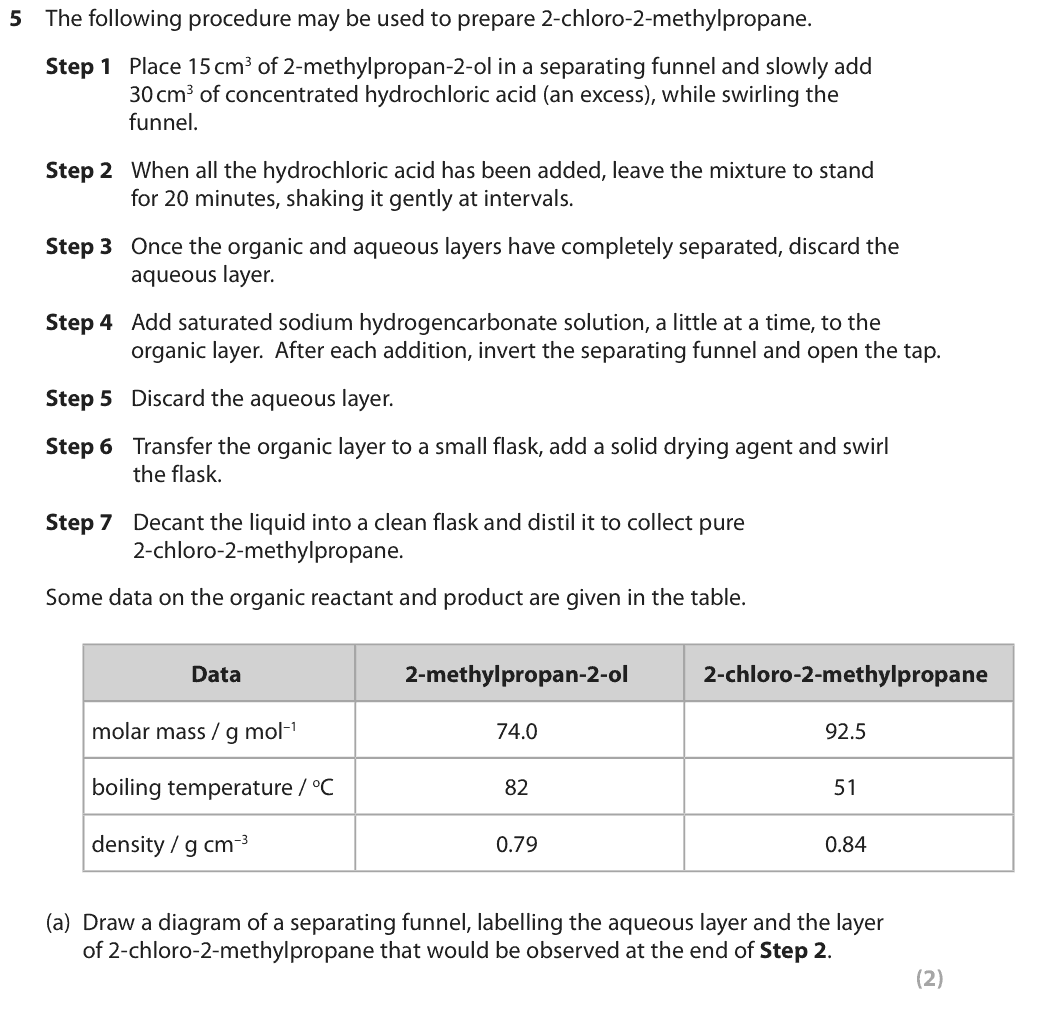
Other types: Multiple-choice questions · Equation questions · Mechanism questions · Structure and diagram questions · Explanation questions · Six-mark extended-response questions · Practical questions · Short-answer questions

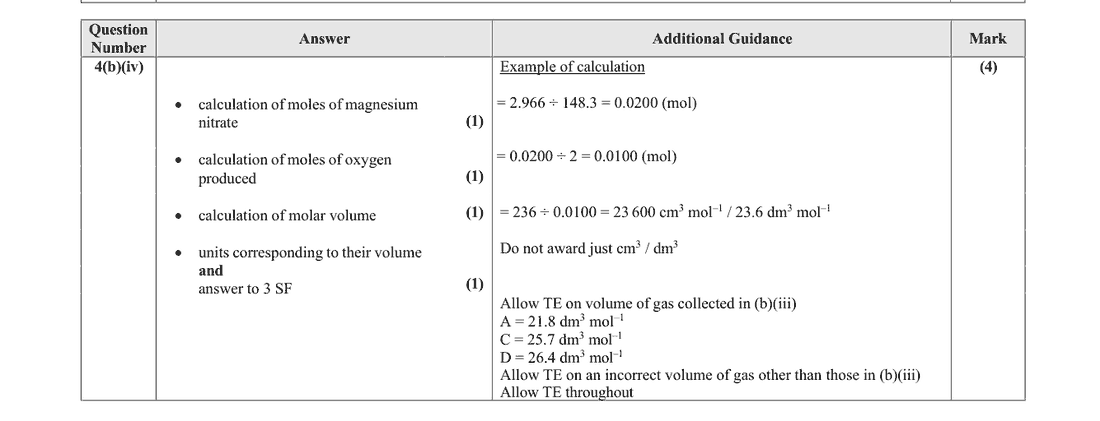
June 2025 · AS Paper 1 · Q4(b)(iv) 4 marks Calculation formulae equations and amounts of substance
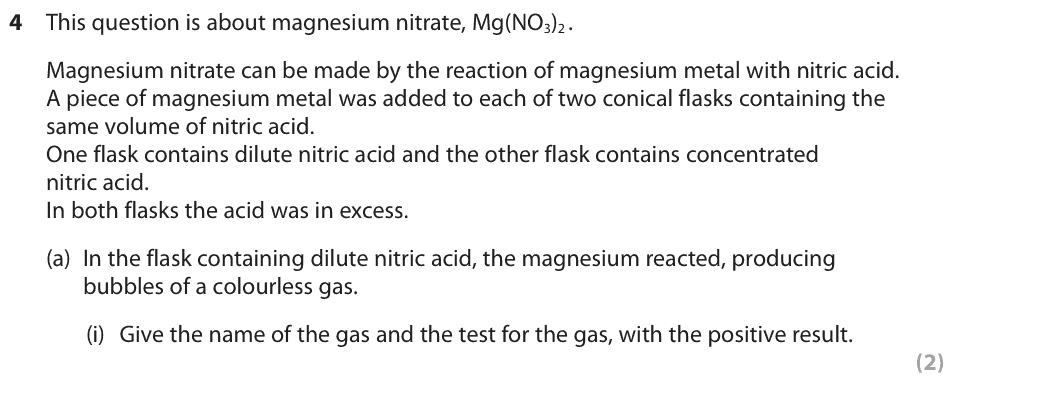
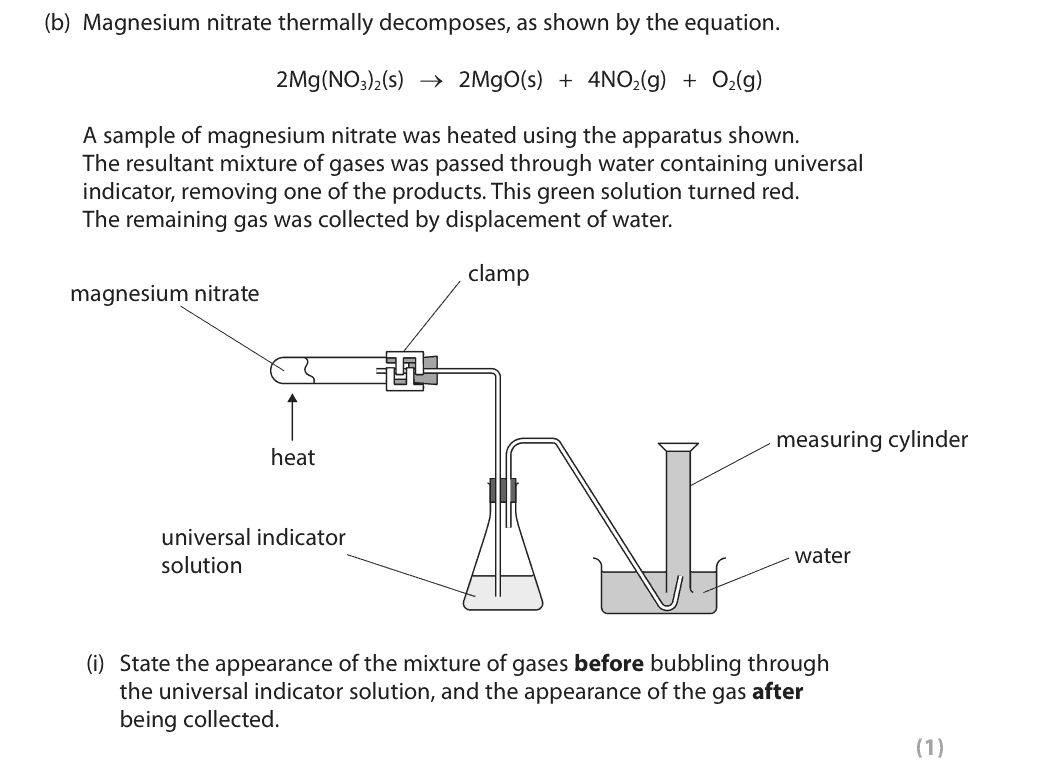
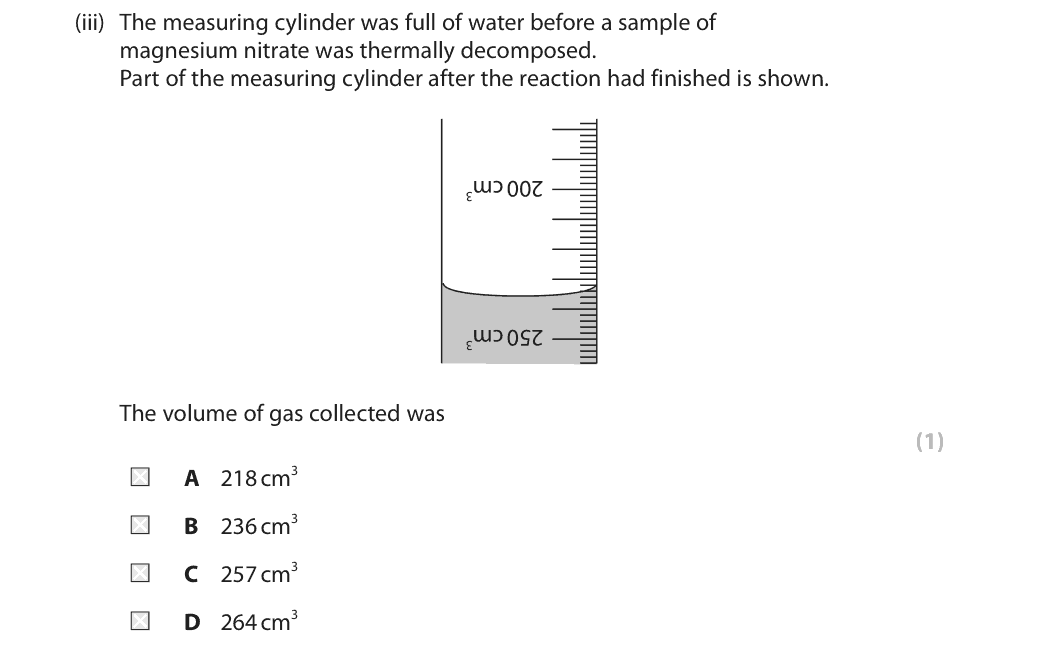
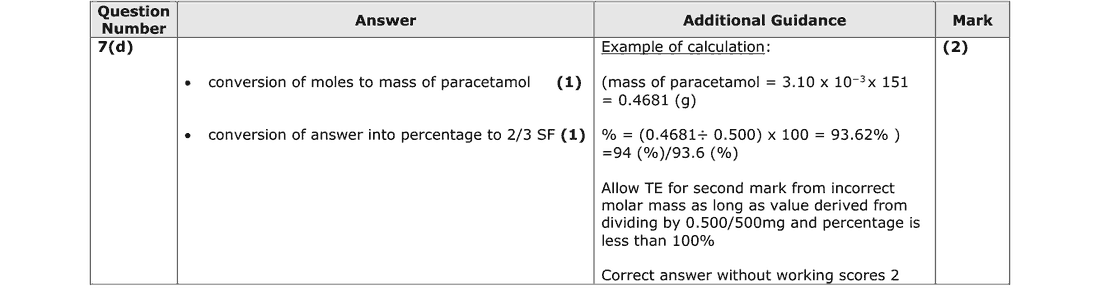
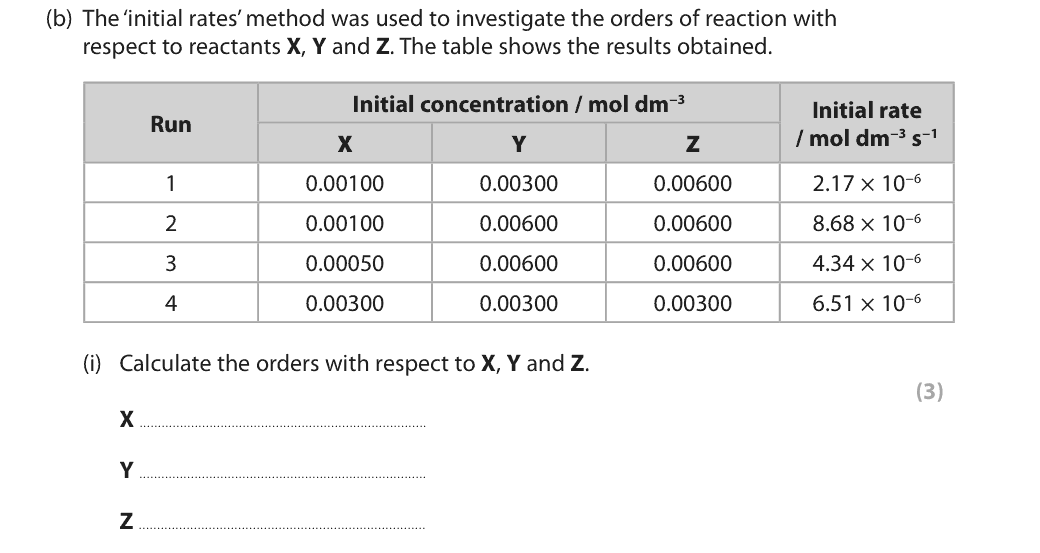
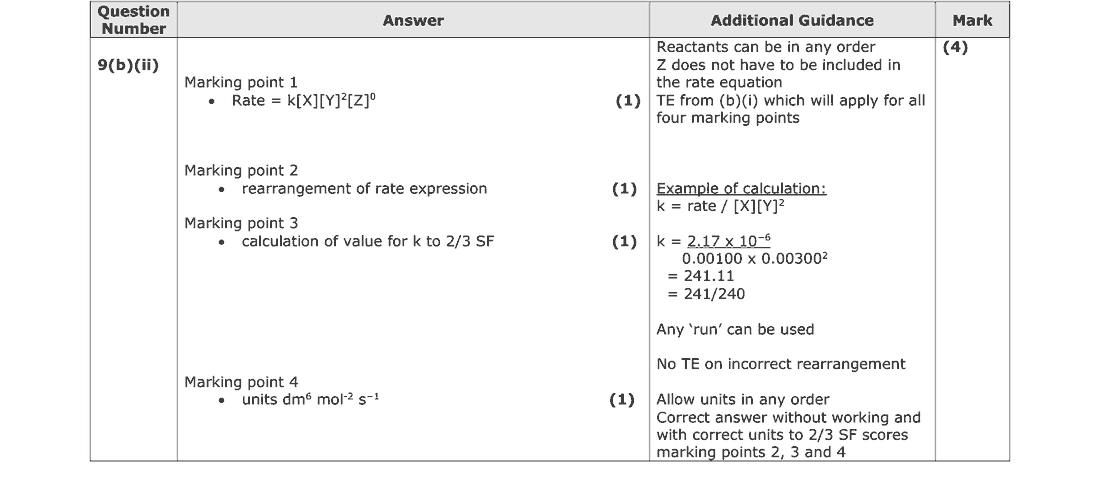
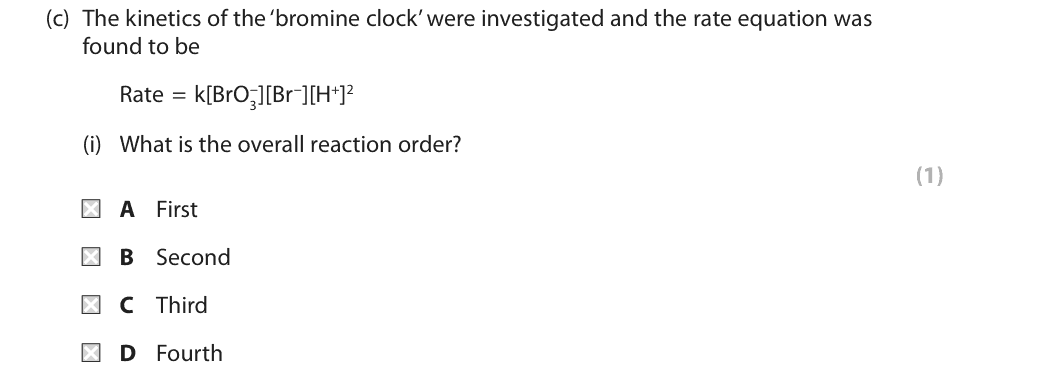
Earlier parts of question 4 that this part usesEarlier part of June 2025 Paper 1 question 4Earlier part of June 2025 Paper 1 question 4Earlier part of June 2025 Paper 1 question 4Earlier part of June 2025 Paper 1 question 4
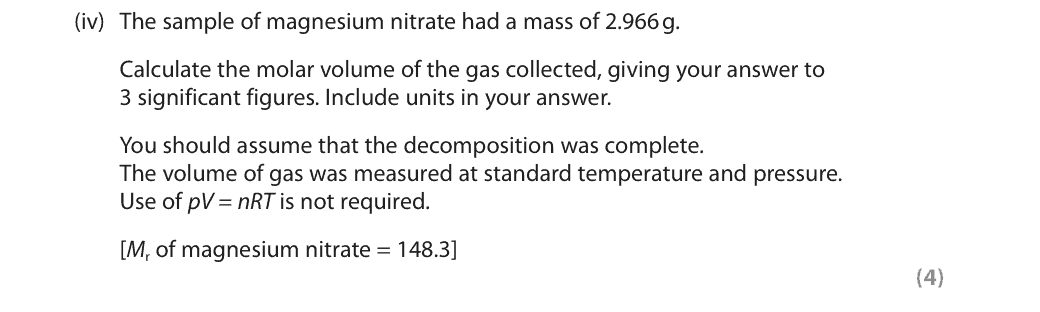
The sample of magnesium nitrate had a mass of 2.966 g.
Calculate the molar volume of the gas collected, giving your answer to
3 significant figures. Include units in your answer.
You should assume that the decomposition was complete.
The volume of gas was measured at standard temperature and pressure.
Use of pV = nRT is not required.
[Mr of magnesium nitrate = 148.3]
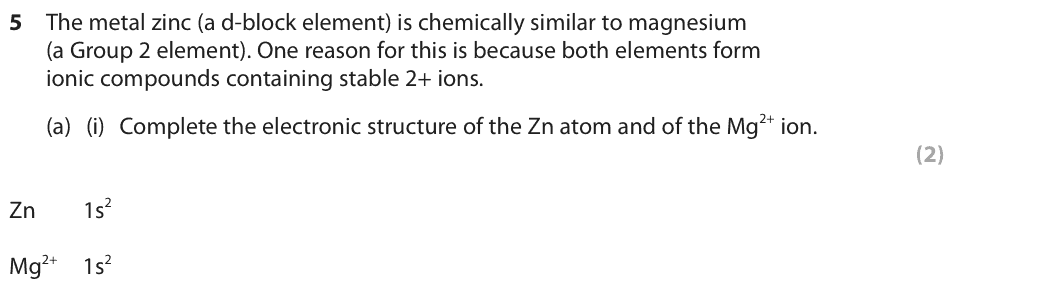
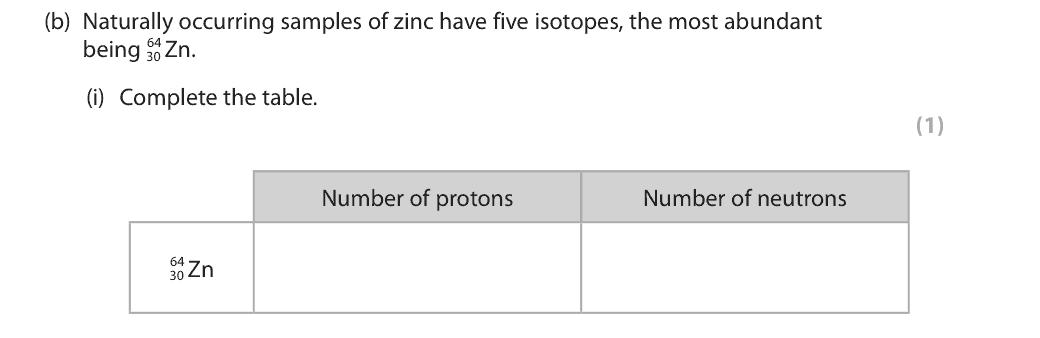
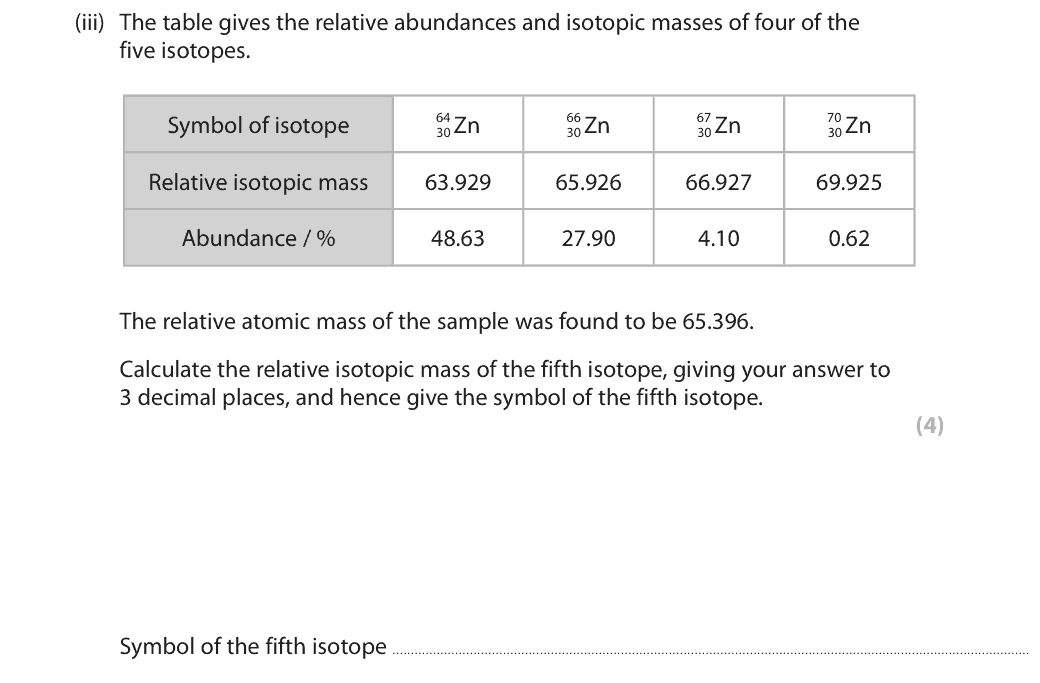
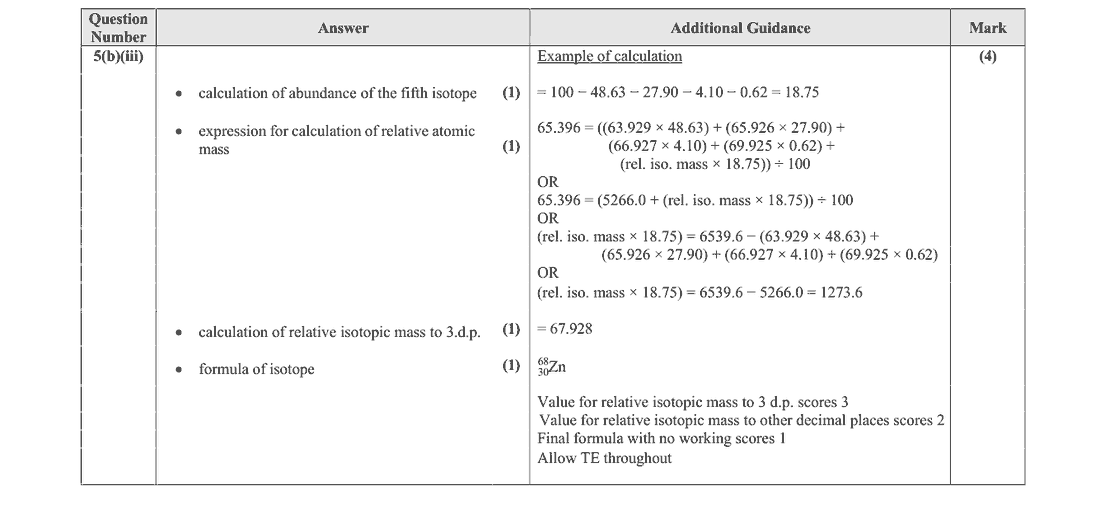
June 2025 · AS Paper 1 · Q5(b)(iii) 4 marks Calculation atomic structure and the periodic table
Earlier parts of question 5 that this part usesEarlier part of June 2025 Paper 1 question 5Earlier part of June 2025 Paper 1 question 5Earlier part of June 2025 Paper 1 question 5
The table gives the relative abundances and isotopic masses of four of the
five isotopes.
Symbol of isotope
64
30 Zn
66
30 Zn
67
30 Zn
70
30 Zn
Relative isotopic mass
63.929
65.926
66.927
69.925
Abundance / %
48.63
27.90
4.10
0.62
The relative atomic mass of the sample was found to be 65.396.
Calculate the relative isotopic mass of the fifth isotope, giving your answer to
3 decimal places, and hence give the symbol of the fifth isotope.
Symbol of the fifth isotope
June 2025 · AS Paper 1 · Q5(b)(iv) 1 mark Calculation Hard formulae equations and amounts of substance
Earlier parts of question 5 that this part usesEarlier part of June 2025 Paper 1 question 5Earlier part of June 2025 Paper 1 question 5Earlier part of June 2025 Paper 1 question 5Earlier part of June 2025 Paper 1 question 5
The mass of an atom of  64
30 Zn = 1.06157 × 10⁻²² g.
Calculate the value of the Avogadro constant using the mass of this atom and
the relative isotopic mass, giving your answer to an appropriate number of
significant figures. You must show your working.
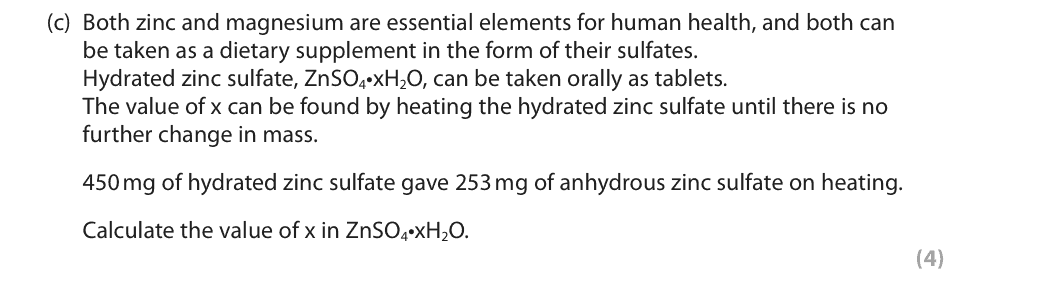
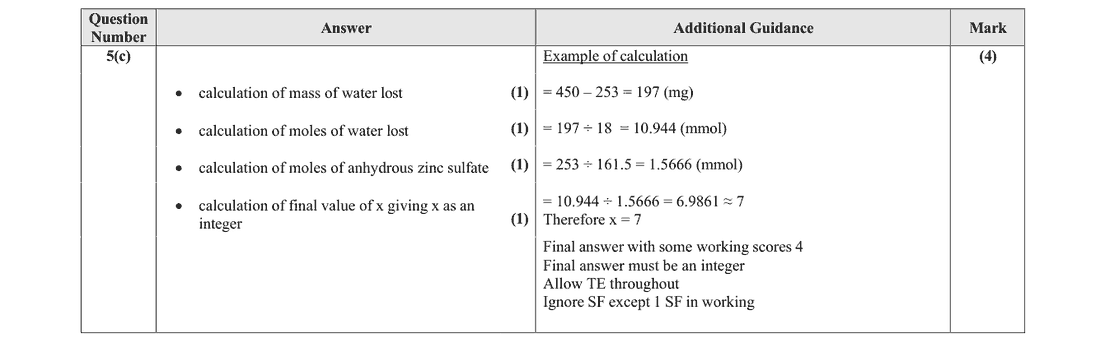
June 2025 · AS Paper 1 · Q5(c) 4 marks Calculation formulae equations and amounts of substance
Earlier part of question 5 that this part usesEarlier part of June 2025 Paper 1 question 5
Both zinc and magnesium are essential elements for human health, and both can
be taken as a dietary supplement in the form of their sulfates.
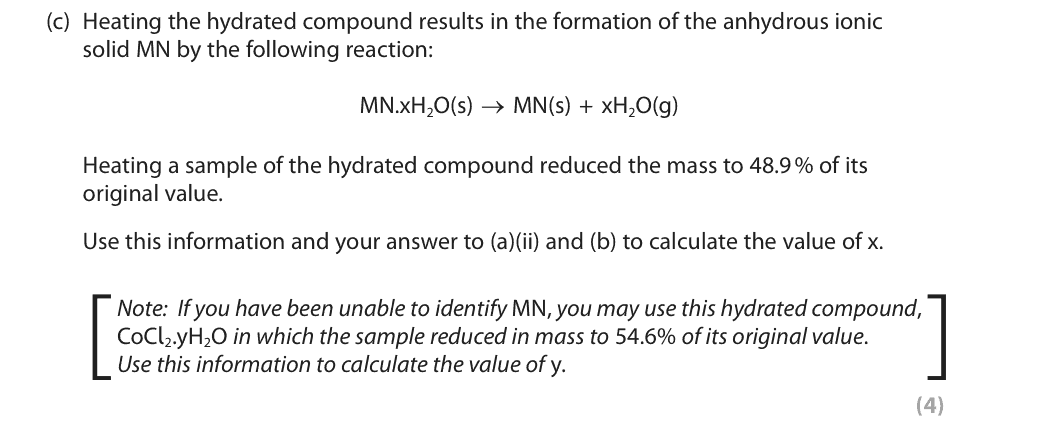
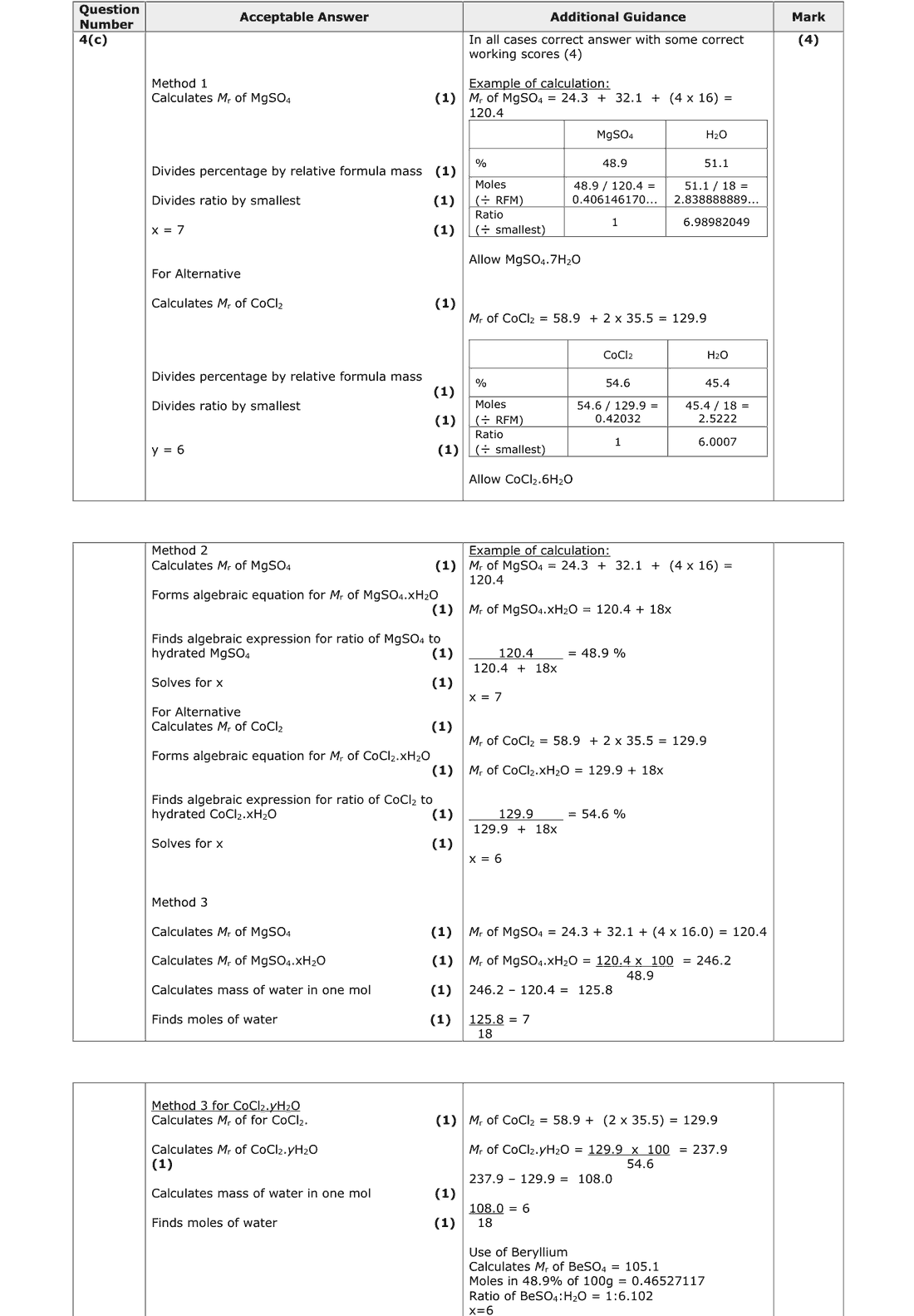
Hydrated zinc sulfate, ZnSO4•xH2O, can be taken orally as tablets.
The value of x can be found by heating the hydrated zinc sulfate until there is no
further change in mass.
450 mg of hydrated zinc sulfate gave 253 mg of anhydrous zinc sulfate on heating.
Calculate the value of x in ZnSO4•xH2O.
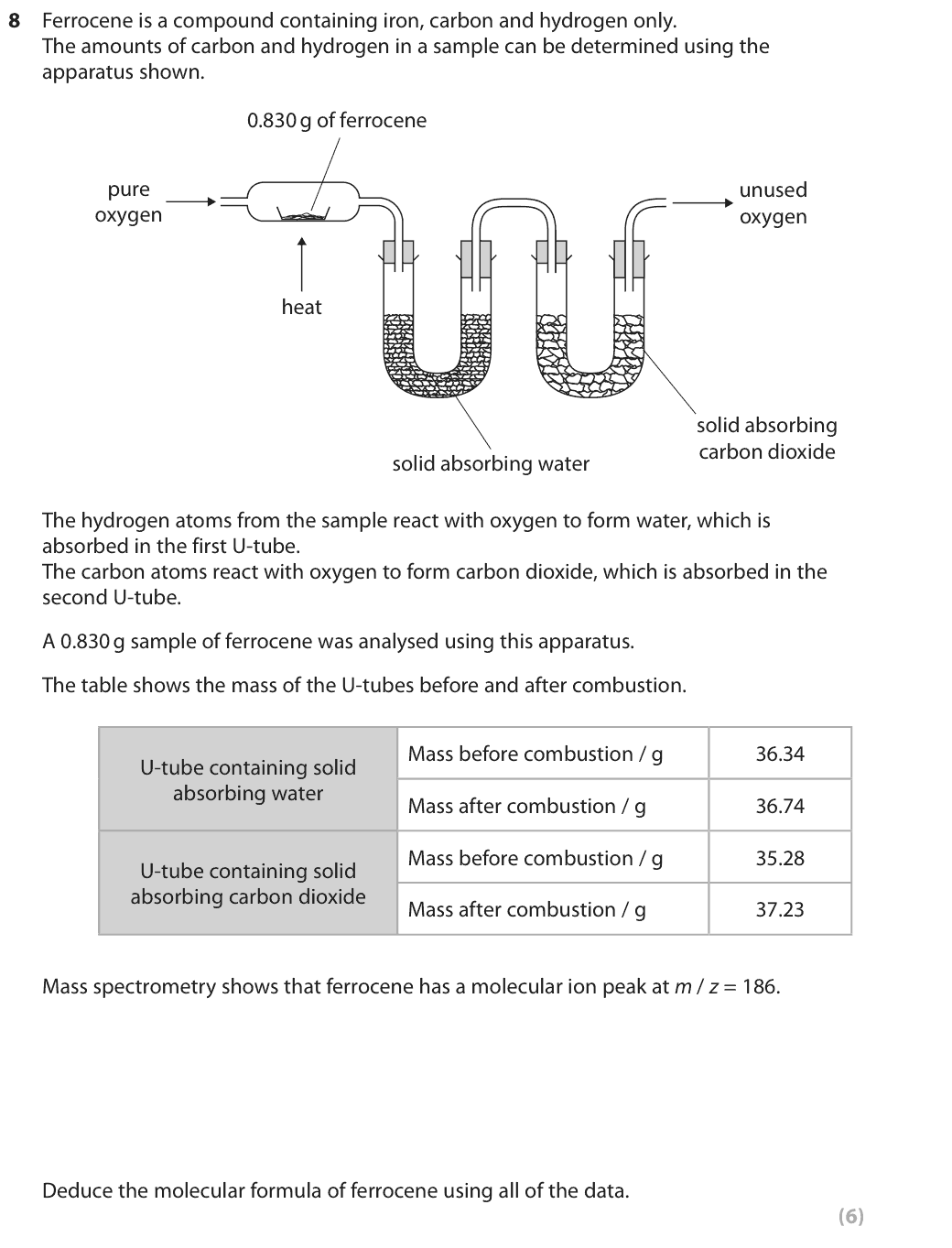
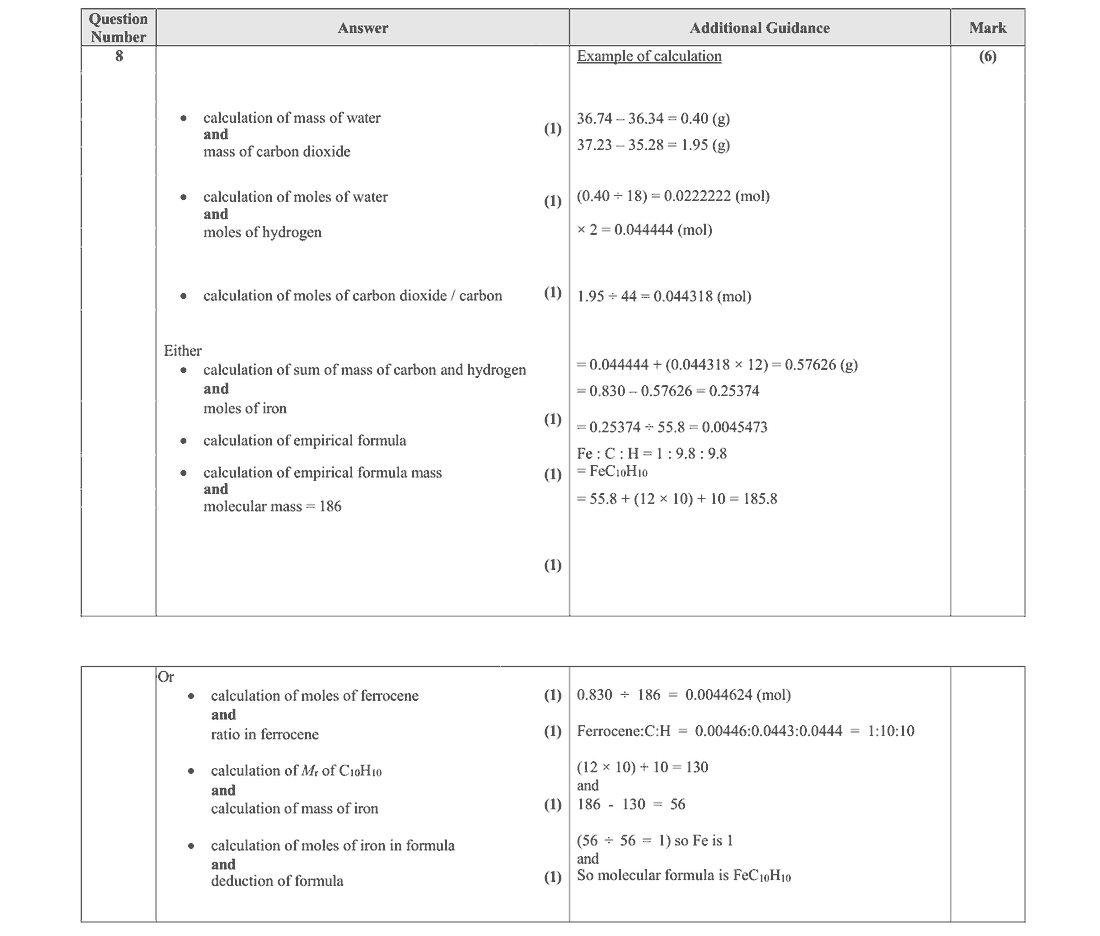
June 2025 · AS Paper 1 · Q8 6 marks Calculation formulae equations and amounts of substance
Ferrocene is a compound containing iron, carbon and hydrogen only.
The amounts of carbon and hydrogen in a sample can be determined using the
apparatus shown.
0.830 g of ferrocene
pure
unused
oxygen
oxygen
heat
solid absorbing
carbon dioxide
solid absorbing water
The hydrogen atoms from the sample react with oxygen to form water, which is
absorbed in the first U-tube.
The carbon atoms react with oxygen to form carbon dioxide, which is absorbed in the
second U-tube.
A 0.830 g sample of ferrocene was analysed using this apparatus.
The table shows the mass of the U-tubes before and after combustion.
Mass before combustion / g
36.34
U-tube containing solid
absorbing water
Mass after combustion / g
36.74
Mass before combustion / g
35.28
U-tube containing solid
absorbing carbon dioxide
Mass after combustion / g
37.23
Mass spectrometry shows that ferrocene has a molecular ion peak at m / z = 186.
Deduce the molecular formula of ferrocene using all of the data.
June 2025 · AS Paper 2 · Q3(a) 1 mark Calculation introduction to organic chemistry
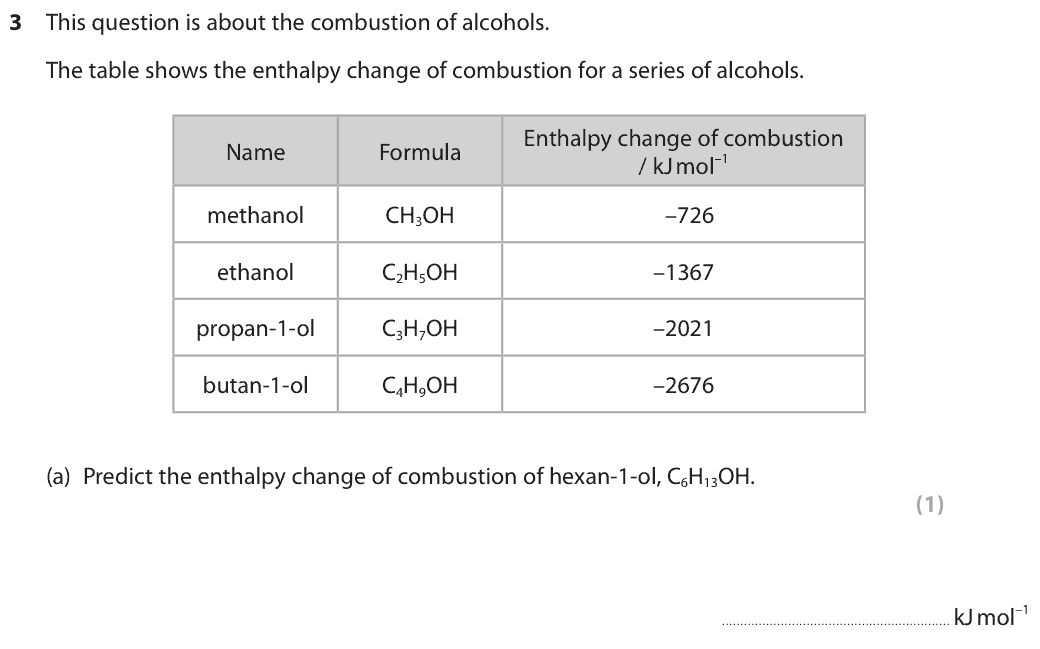
This question is about the combustion of alcohols.
The table shows the enthalpy change of combustion for a series of alcohols.
Enthalpy change of combustion
Name
Formula
/ kJ mol–1
methanol
CH3OH
–726
ethanol
C2H5OH
–1367
propan‑1‑ol
C3H7OH
–2021
butan‑1‑ol
C4H9OH
–2676
Predict the enthalpy change of combustion of hexan‑1‑ol, C6H13OH.
 kJ mol–1
June 2025 · AS Paper 2 · Q3(b) 4 marks Calculation energetics i
Earlier part of question 3 that this part usesEarlier part of June 2025 Paper 2 question 3
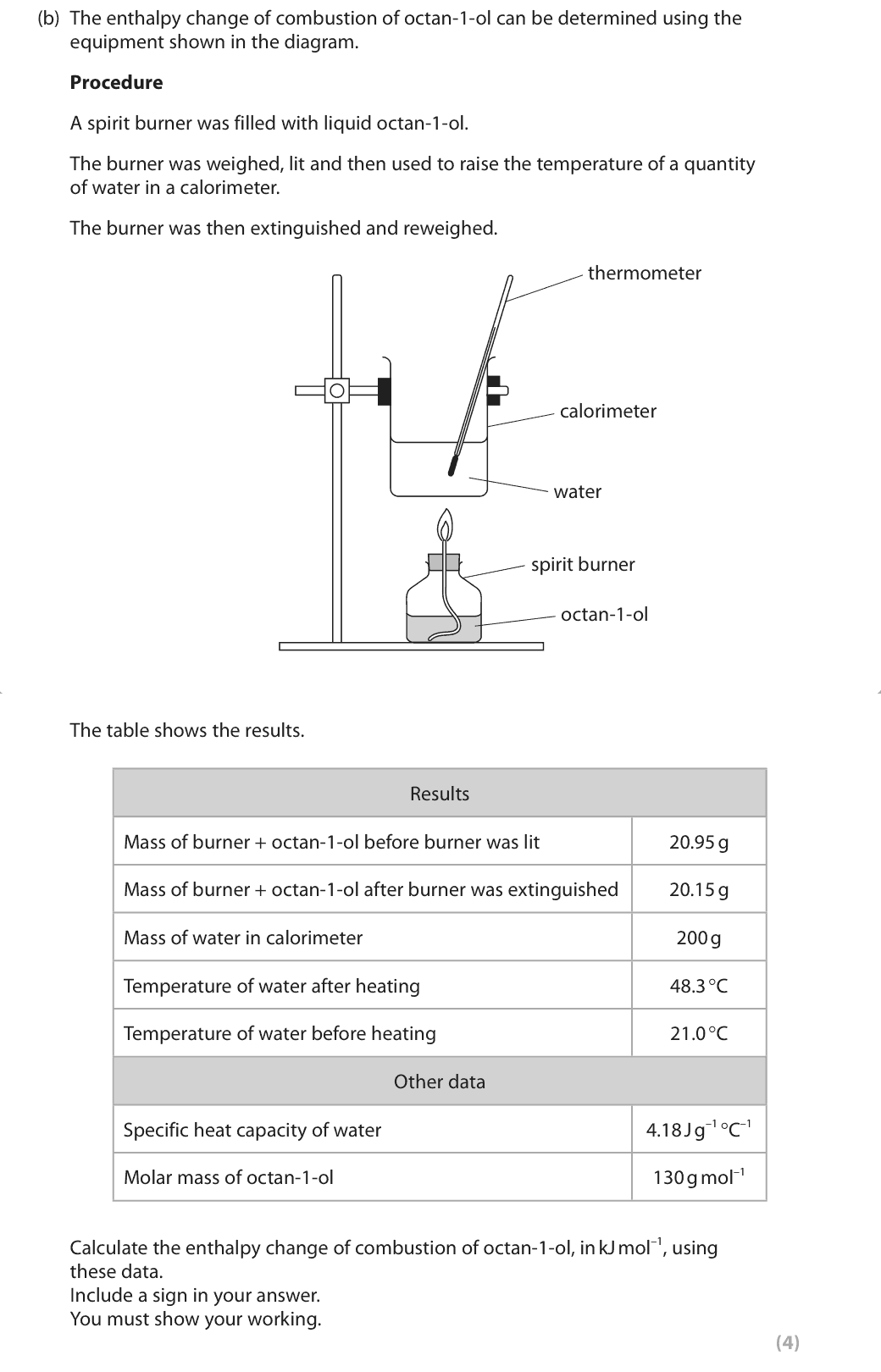
The enthalpy change of combustion of octan‑1‑ol can be determined using the
equipment shown in the diagram.
Procedure
A spirit burner was filled with liquid octan‑1‑ol.
The burner was weighed, lit and then used to raise the temperature of a quantity
of water in a calorimeter.
The burner was then extinguished and reweighed.
thermometer
calorimeter
water
spirit burner
octan-1-ol
The table shows the results.
Results
Mass of burner + octan‑1‑ol before burner was lit
20.95 g
Mass of burner + octan‑1‑ol after burner was extinguished
20.15 g
Mass of water in calorimeter
200 g
Temperature of water after heating
48.3 °C
Temperature of water before heating
21.0 °C
Other data
4.18 J g–1 °C–1
Specific heat capacity of water
Molar mass of octan‑1‑ol
130 g mol–1
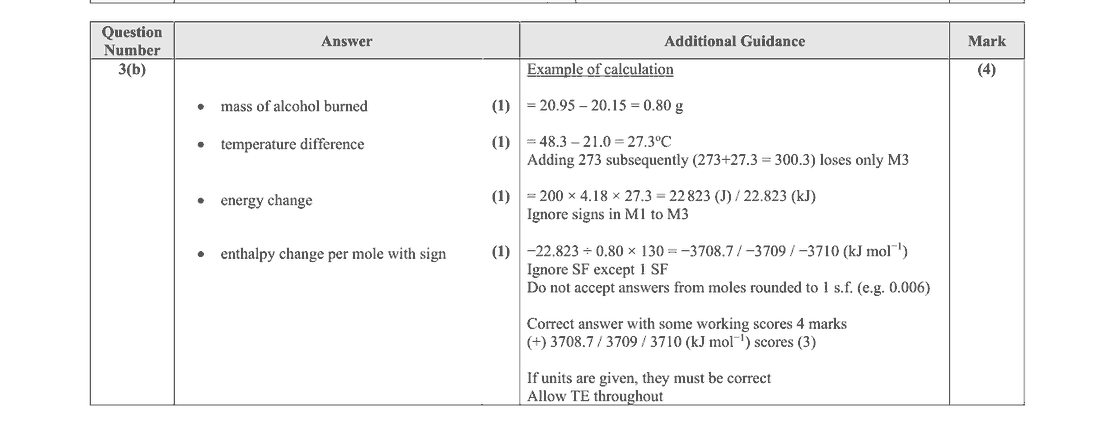
Calculate the enthalpy change of combustion of octan‑1‑ol, in kJ mol–1, using
these data.
Include a sign in your answer.
You must show your working.
June 2025 · AS Paper 2 · Q6(b)(i) 3 marks Calculation formulae equations and amounts of substance
Earlier part of question 6 that this part usesEarlier part of June 2025 Paper 2 question 6
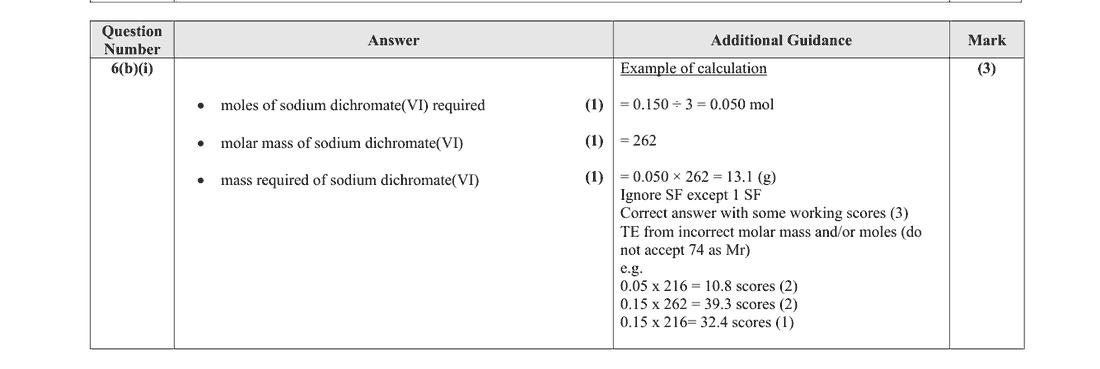
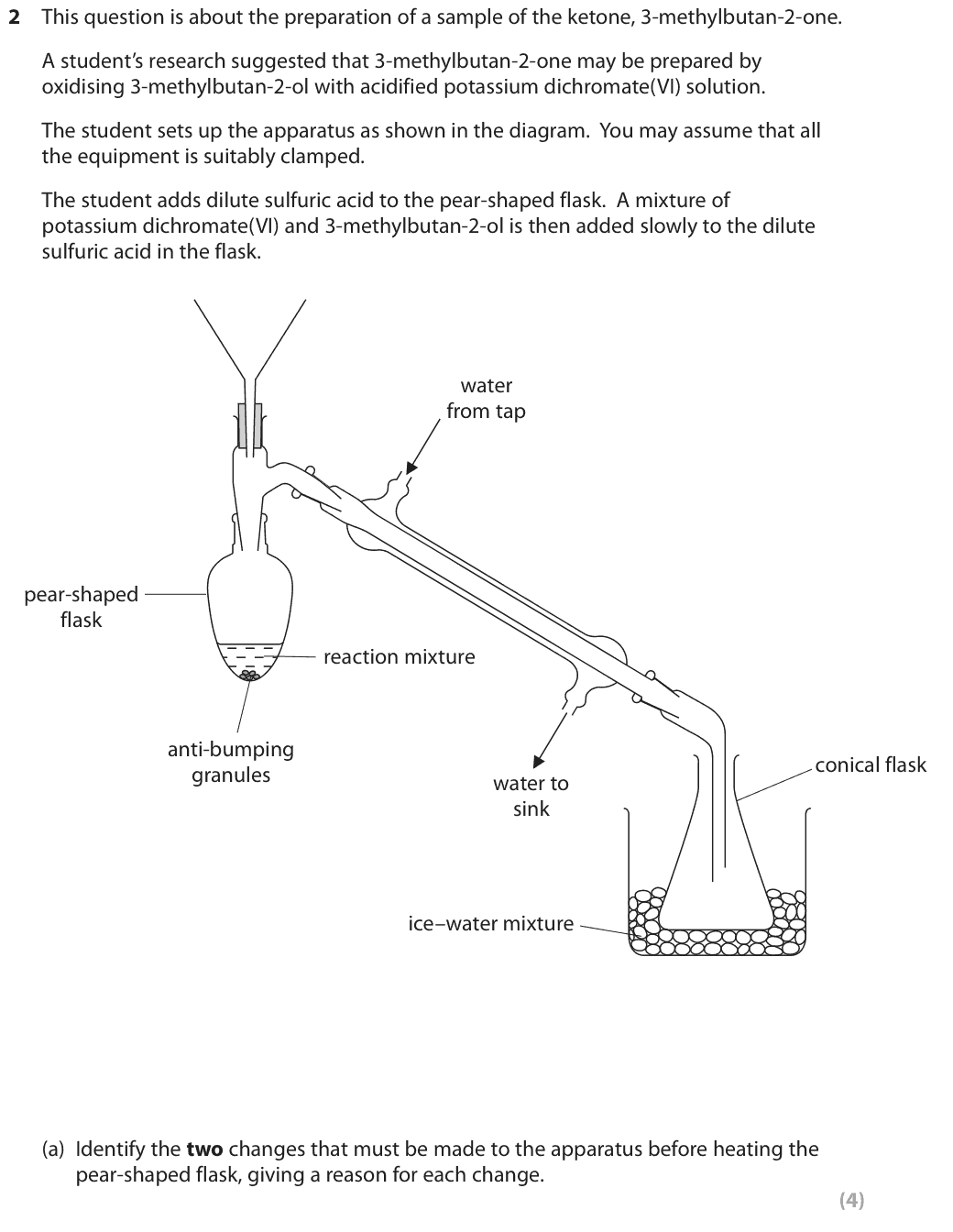
A student was asked to prepare pure, dry butanone, starting from butan‑2‑ol,
solid anhydrous sodium dichromate(VI) and sulfuric acid.
The equation for the reaction is shown.
Cr2O7
2–   +   8H+   +   3CH3CH(OH)CH2CH3   →   3CH3COCH2CH3   +   2Cr3+   +   7H2O
Calculate the minimum mass of sodium dichromate(VI), Na2Cr2O7 , required to
oxidise 0.150 mol of butan‑2‑ol.
June 2025 · AS Paper 2 · Q6(d)(i) 3 marks Calculation formulae equations and amounts of substance
Earlier part of question 6 that this part usesEarlier part of June 2025 Paper 2 question 6
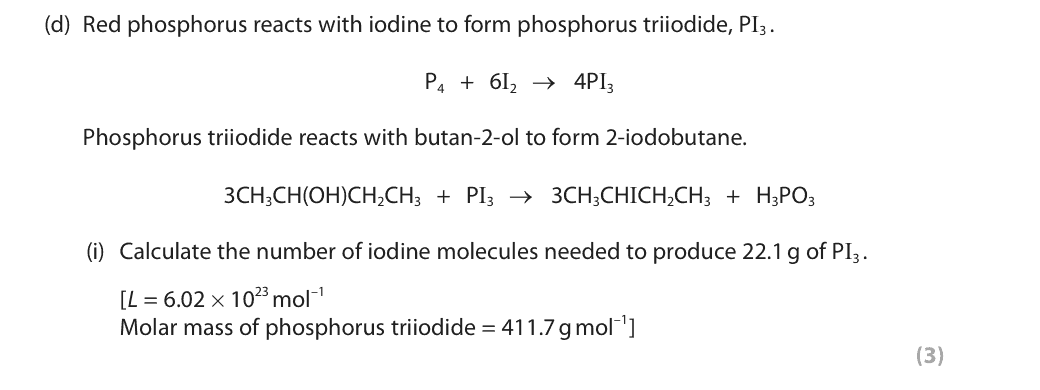
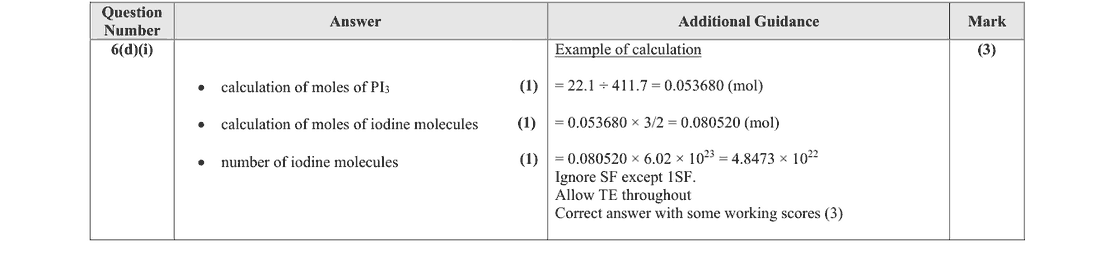
Red phosphorus reacts with iodine to form phosphorus triiodide, PI3 .
P4   +   6I2   →   4PI3
Phosphorus triiodide reacts with butan‑2‑ol to form 2‑iodobutane.
3CH3CH(OH)CH2CH3   +   PI3   →   3CH3CHICH2CH3   +   H3PO3
Calculate the number of iodine molecules needed to produce 22.1 g of PI3 .
[L = 6.02 × 1023 mol–1
Molar mass of phosphorus triiodide = 411.7 g mol–1]
June 2025 · AS Paper 2 · Q6(d)(ii) 3 marks Calculation formulae equations and amounts of substance
Earlier parts of question 6 that this part usesEarlier part of June 2025 Paper 2 question 6Earlier part of June 2025 Paper 2 question 6
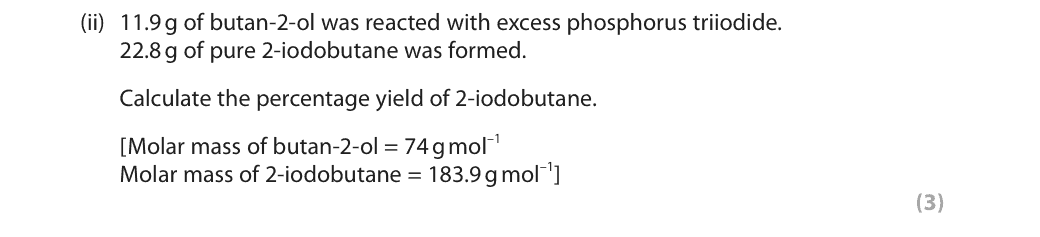
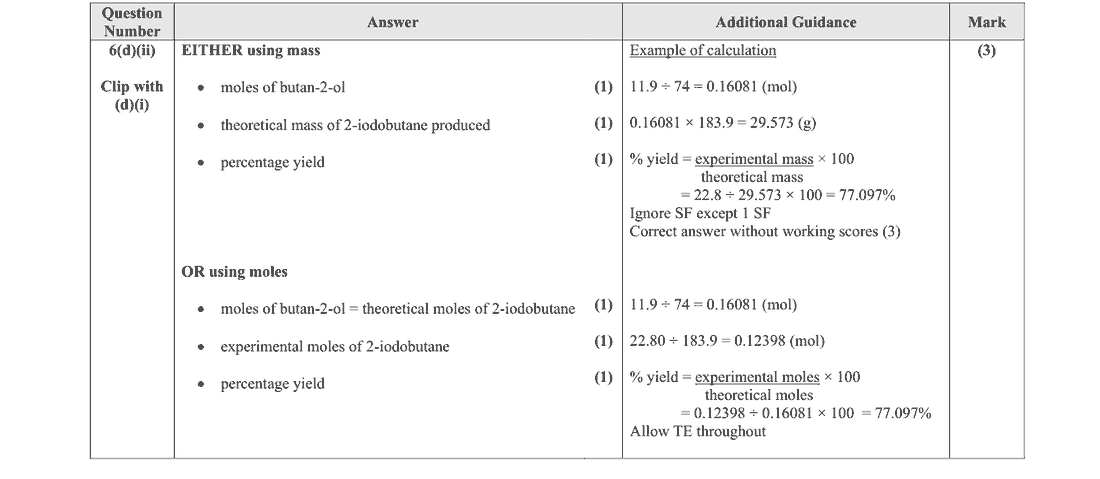
11.9 g of butan‑2‑ol was reacted with excess phosphorus triiodide.
22.8 g of pure 2‑iodobutane was formed.
Calculate the percentage yield of 2‑iodobutane.
[Molar mass of butan‑2‑ol = 74 g mol–1
Molar mass of 2‑iodobutane = 183.9 g mol–1]
June 2025 · AS Paper 2 · Q9(a)(ii) 3 marks Calculation energetics i
Earlier part of question 9 that this part usesEarlier part of June 2025 Paper 2 question 9
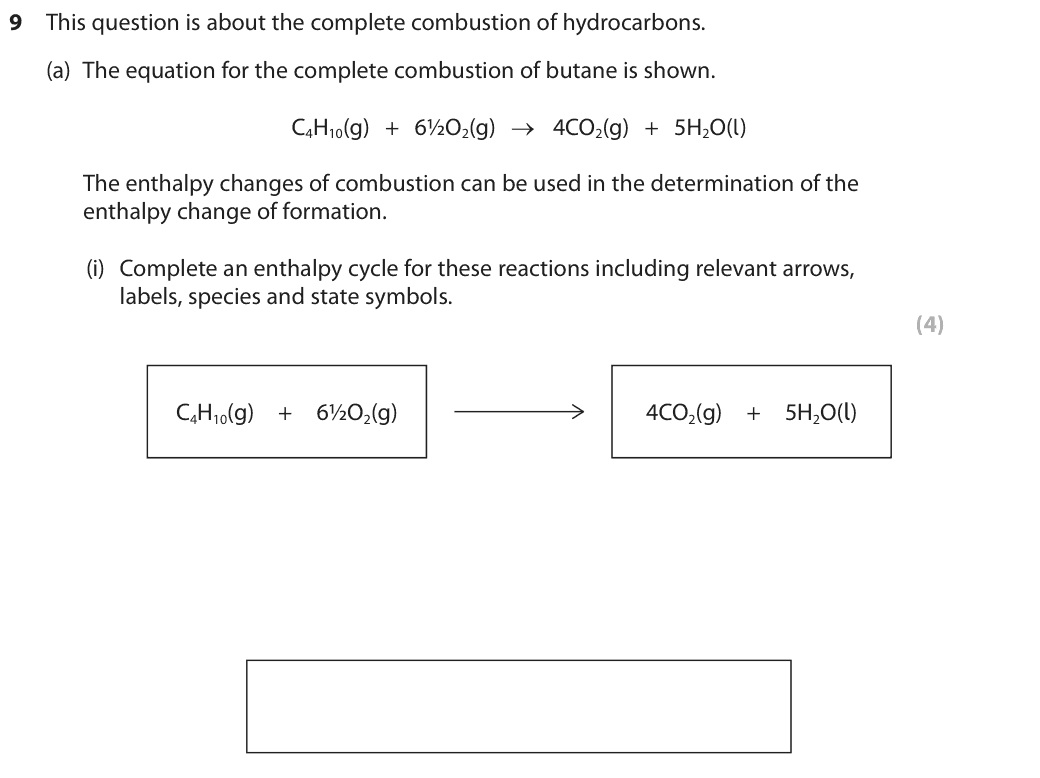
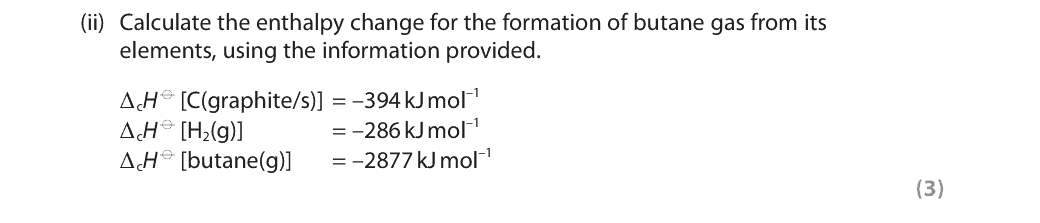
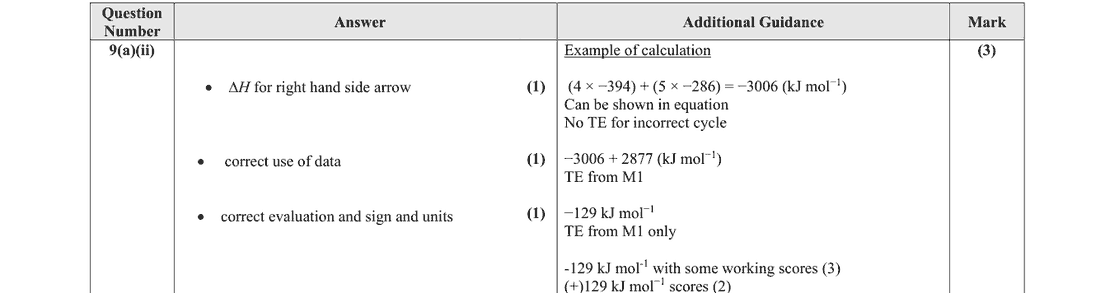
Calculate the enthalpy change for the formation of butane gas from its
elements, using the information provided.
ΔcH d [C(graphite/s)] = –394 kJ mol–1
ΔcH d [H2(g)]
= –286 kJ mol–1
ΔcH d [butane(g)]
= –2877 kJ mol–1
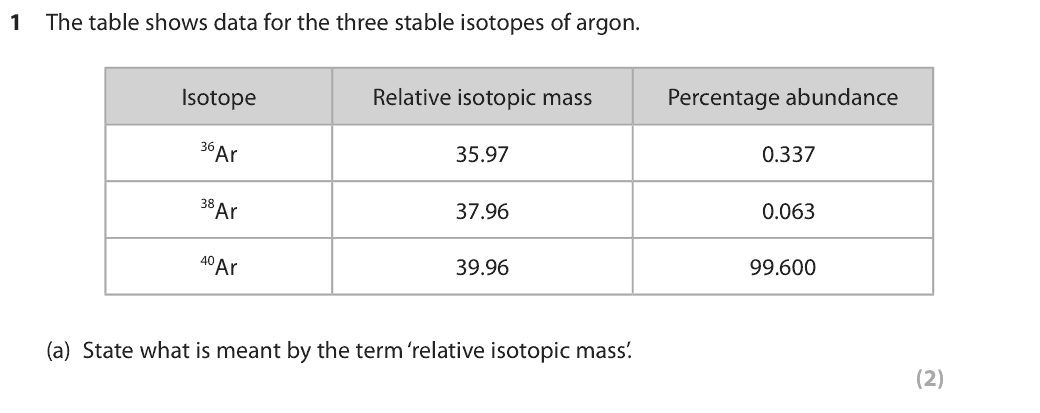
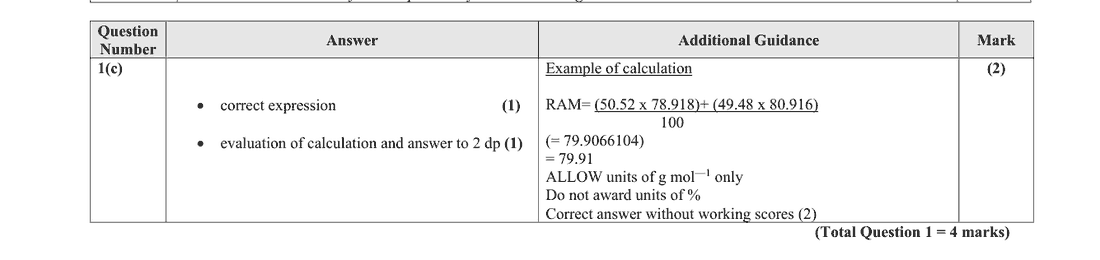
June 2025 · Paper 1 · Q1(c) 2 marks Calculation atomic structure and the periodic table
Earlier part of question 1 that this part usesEarlier part of June 2025 Paper 1 question 1
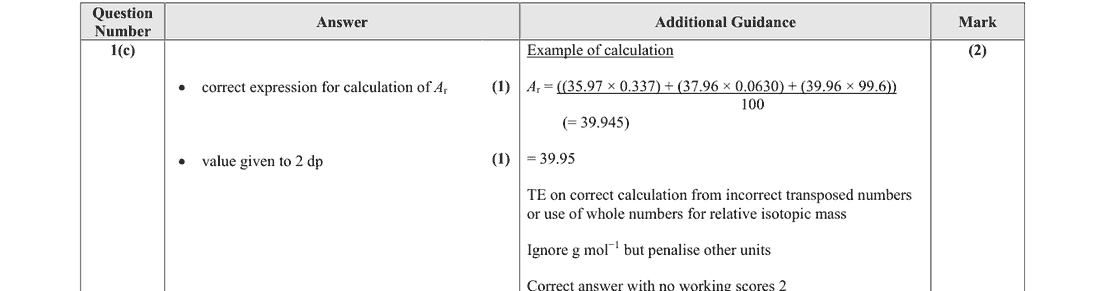
Calculate the relative atomic mass of argon.
Give your answer to two decimal places.
June 2025 · Paper 1 · Q3(b)(ii) 2 marks Calculation formulae equations and amounts of substance
Earlier parts of question 3 that this part usesEarlier part of June 2025 Paper 1 question 3Earlier part of June 2025 Paper 1 question 3
0.041 mol of CaCO3(s) was used in the experiment.
Show, by calculation, that the hydrochloric acid is in excess for Reaction 2.
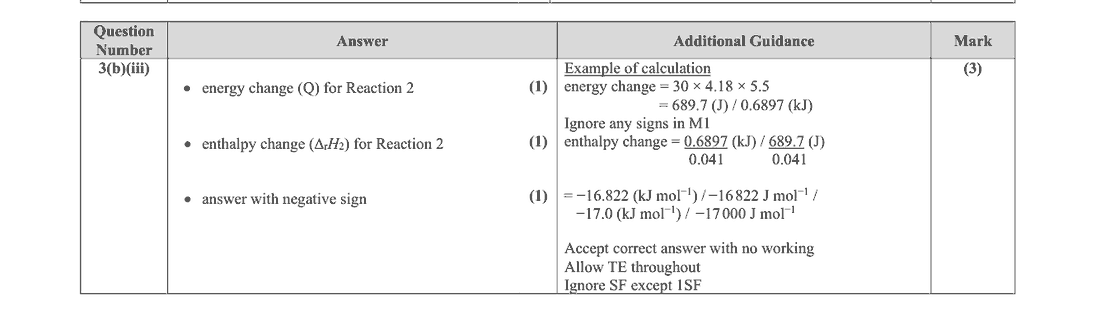
June 2025 · Paper 1 · Q3(b)(iii) 3 marks Calculation energetics i
Earlier parts of question 3 that this part usesEarlier part of June 2025 Paper 1 question 3Earlier part of June 2025 Paper 1 question 3Earlier part of June 2025 Paper 1 question 3
Calculate the enthalpy change, ΔrH2 , for Reaction 2 in kJ mol–1.
Include a sign in your answer.
[Assume the specific heat capacity of the solution = 4.18 J g–1 °C–1
and the mass of the solution = 30 g]
June 2025 · Paper 1 · Q3(b)(v) 1 mark Calculation energetics i
Earlier parts of question 3 that this part usesEarlier part of June 2025 Paper 1 question 3Earlier part of June 2025 Paper 1 question 3Earlier part of June 2025 Paper 1 question 3Earlier part of June 2025 Paper 1 question 3Earlier part of June 2025 Paper 1 question 3
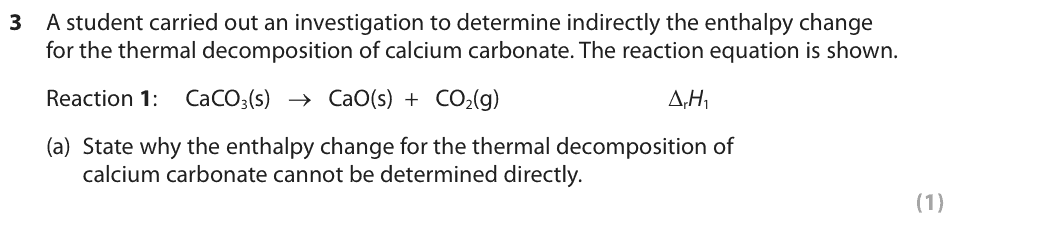
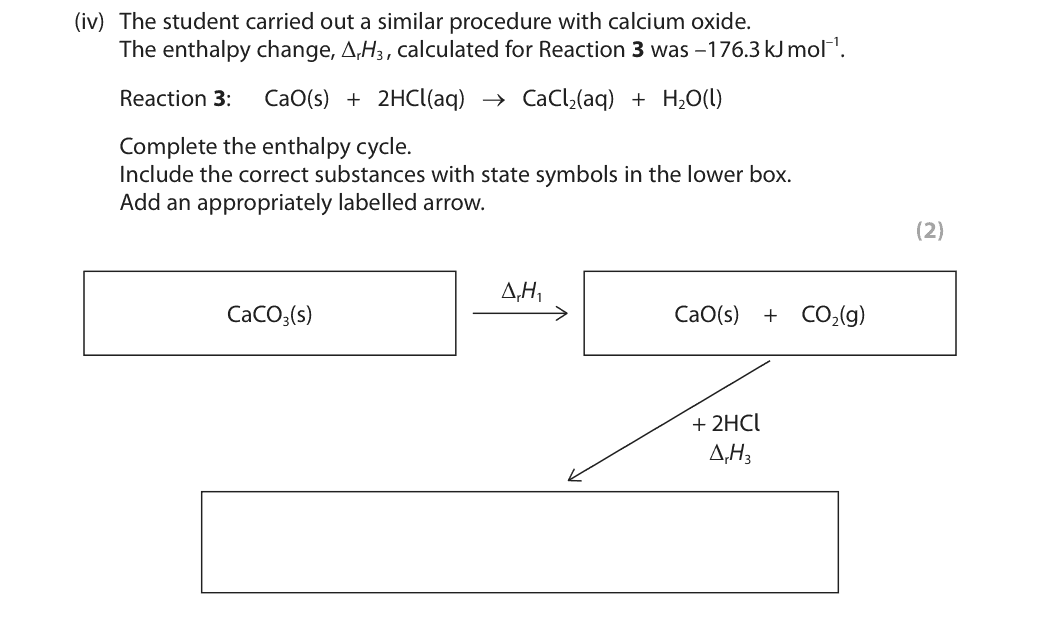
Calculate a value for the enthalpy change ΔrH1 for the thermal decomposition
of calcium carbonate by using your cycle.
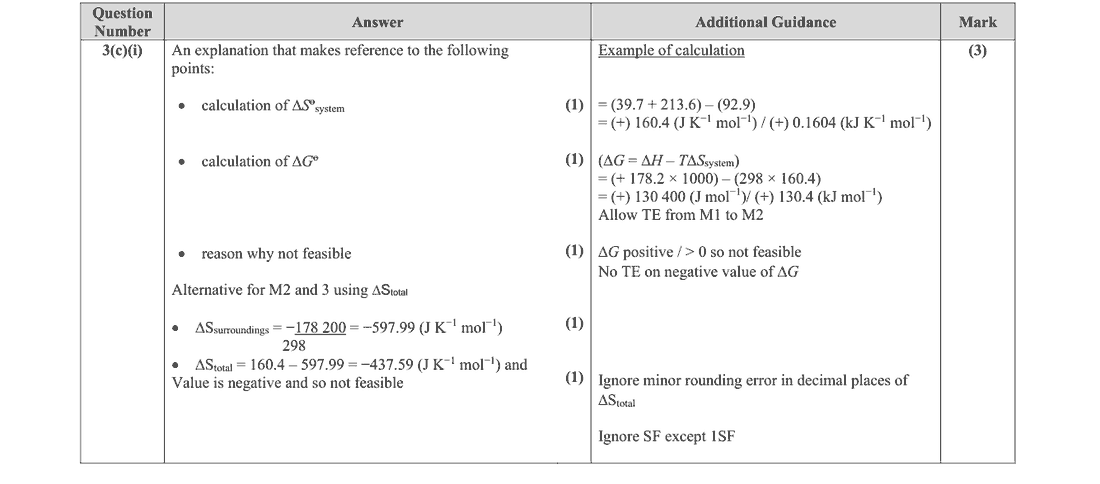
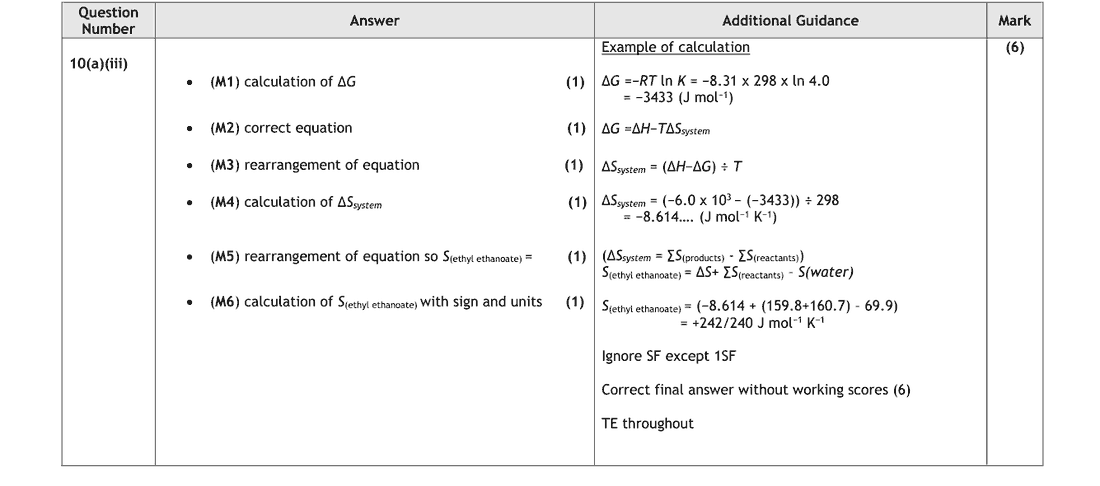
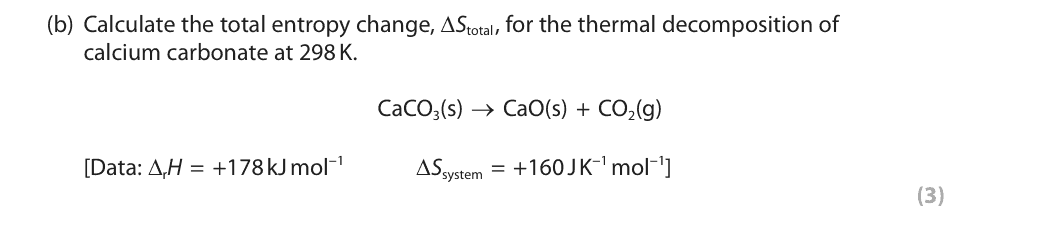
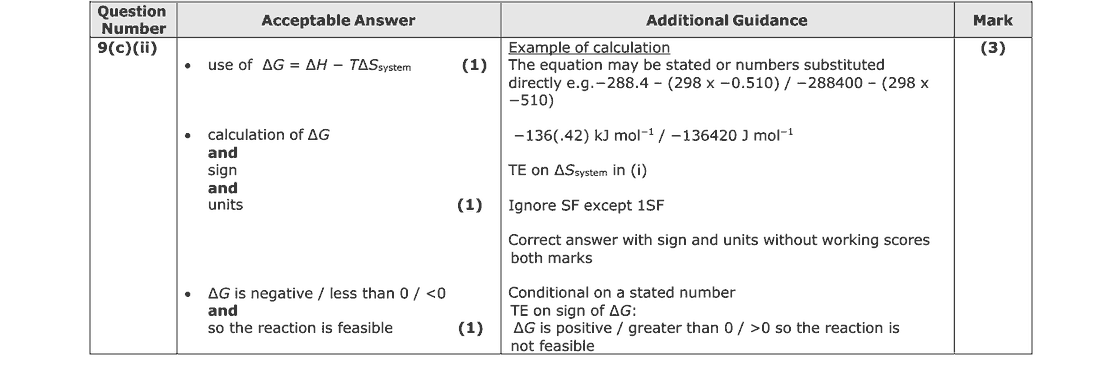
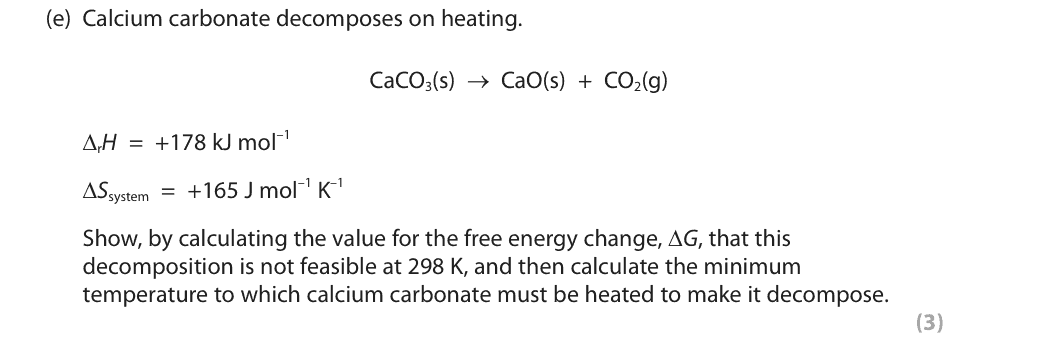
June 2025 · Paper 1 · Q3(c)(i) 3 marks Calculation entropy
Earlier part of question 3 that this part usesEarlier part of June 2025 Paper 1 question 3
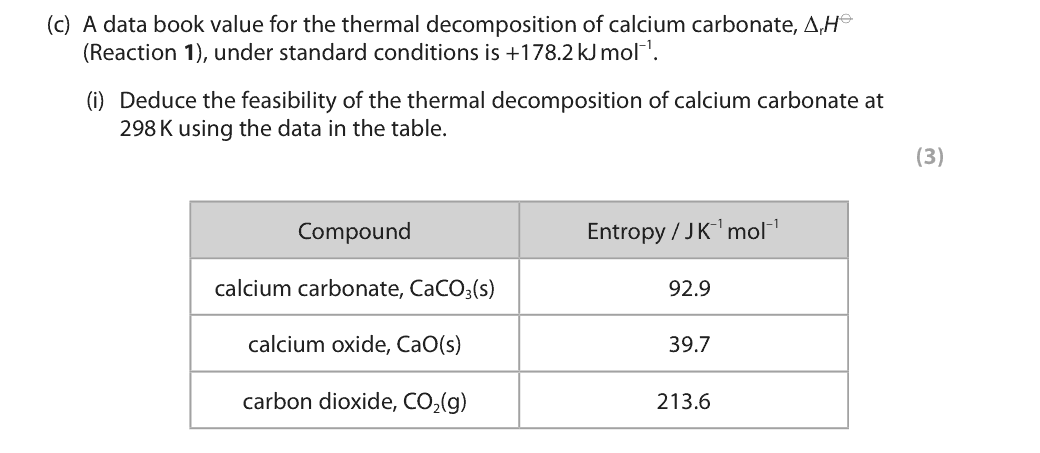
A data book value for the thermal decomposition of calcium carbonate, ΔrHd
(Reaction 1), under standard conditions is +178.2 kJ mol–1.
Deduce the feasibility of the thermal decomposition of calcium carbonate at
298 K using the data in the table.
Compound
Entropy / J K–1 mol–1
calcium carbonate, CaCO3(s)
92.9
calcium oxide, CaO(s)
39.7
carbon dioxide, CO2(g)
213.6
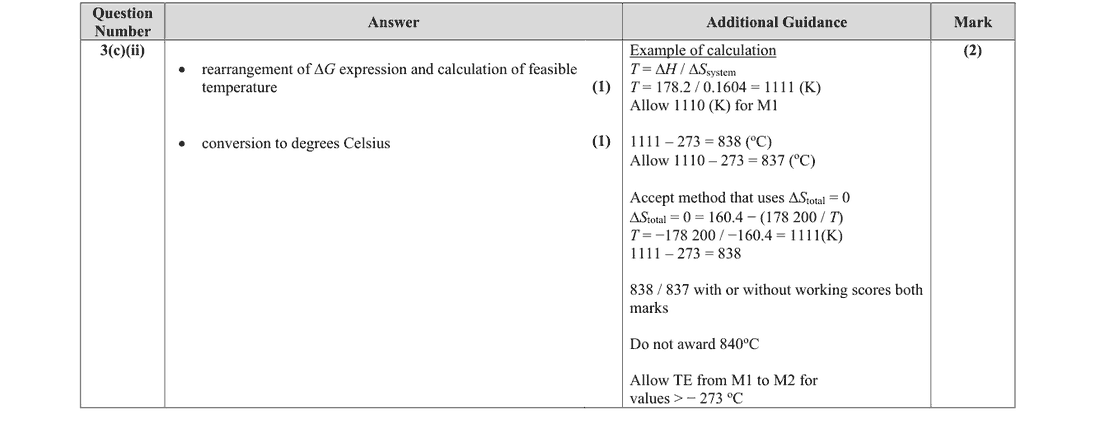
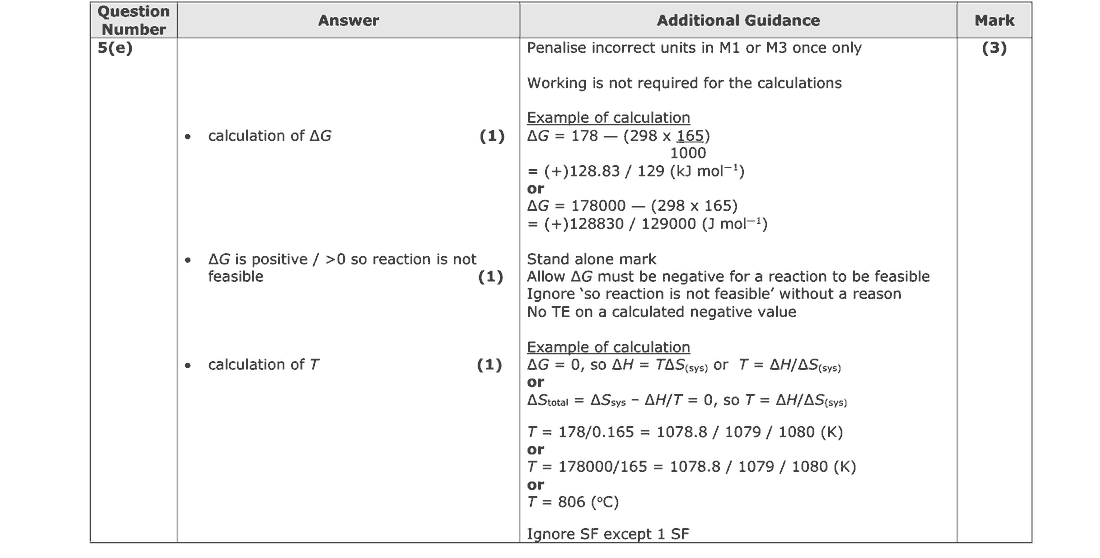
June 2025 · Paper 1 · Q3(c)(ii) 2 marks Calculation entropy
Earlier parts of question 3 that this part usesEarlier part of June 2025 Paper 1 question 3Earlier part of June 2025 Paper 1 question 3
Calculate the minimum temperature, in °C, at which thermal decomposition
would occur.
Give your answer to 3 significant figures.
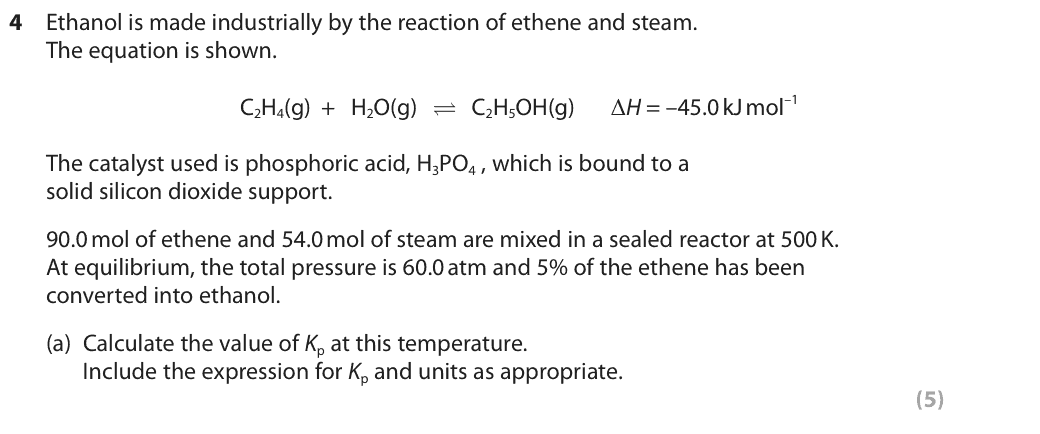
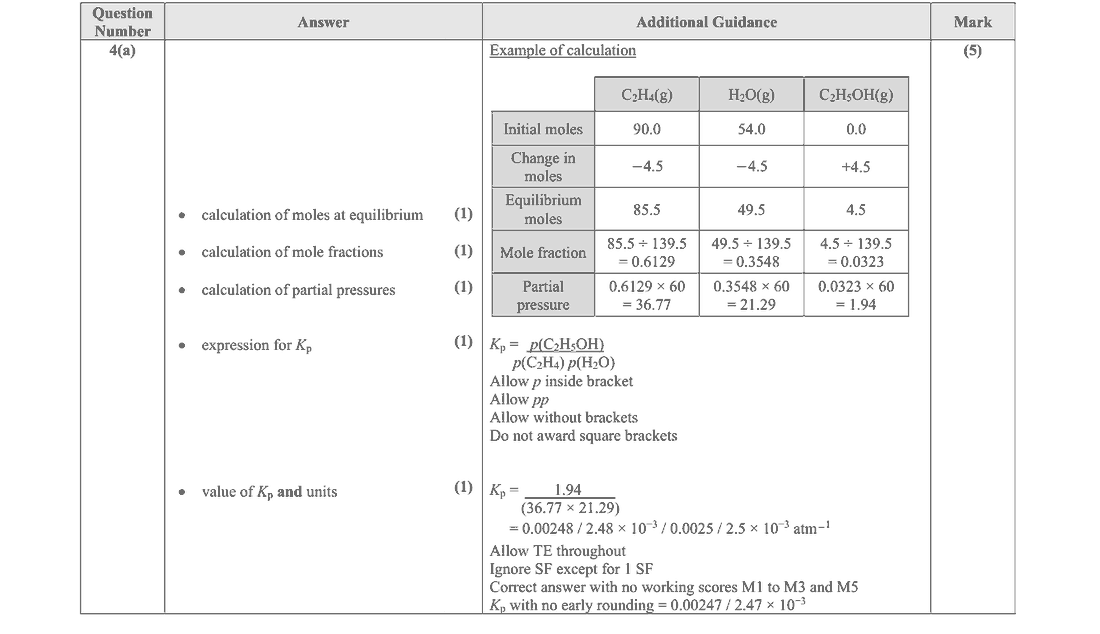
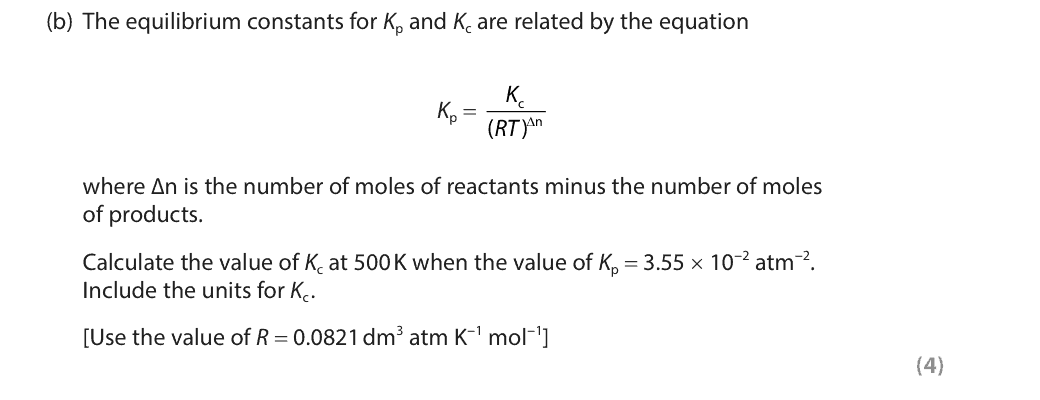
June 2025 · Paper 1 · Q4(a) 5 marks Calculation equilibrium ii
Ethanol is made industrially by the reaction of ethene and steam.
The equation is shown.
C2H4(g)  +   H2O(g)      C2H5OH(g)       ΔH = –45.0 kJ mol–1
The catalyst used is phosphoric acid, H3PO4 , which is bound to a
solid silicon dioxide support.
90.0 mol of ethene and 54.0 mol of steam are mixed in a sealed reactor at 500 K.
At equilibrium, the total pressure is 60.0 atm and 5% of the ethene has been
converted into ethanol.
Calculate the value of Kp at this temperature.
Include the expression for Kp and units as appropriate.
June 2025 · Paper 1 · Q6(f)(ii) 2 marks Calculation redox ii
Earlier parts of question 6 that this part usesEarlier part of June 2025 Paper 1 question 6Earlier part of June 2025 Paper 1 question 6
Calculate the Ed
cell for this reaction.
Include a reason whether or not the reaction is thermodynamically feasible.
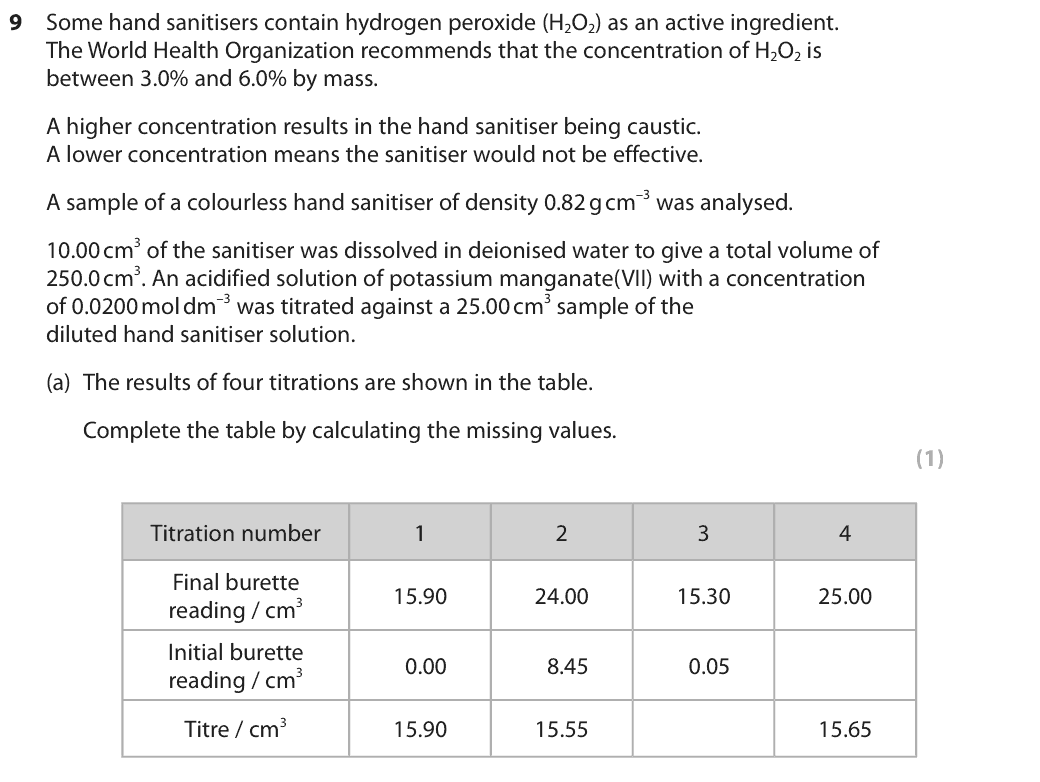
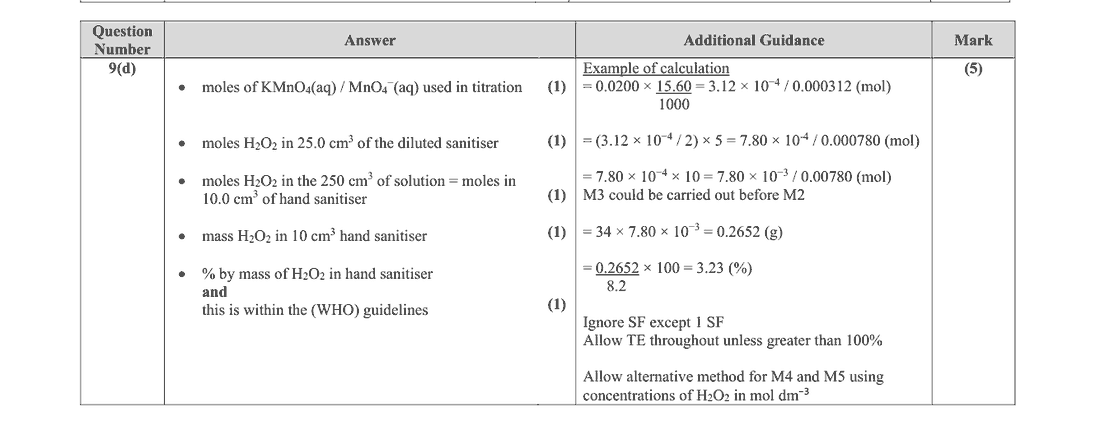
June 2025 · Paper 1 · Q9(d) 5 marks Calculation redox ii
Earlier part of question 9 that this part usesEarlier part of June 2025 Paper 1 question 9
Deduce by calculation whether the concentration of hydrogen peroxide in the
hand sanitiser is within World Health Organization guidelines.
June 2025 · Paper 1 · Q9(e) 2 marks Calculation formulae equations and amounts of substance
Earlier part of question 9 that this part usesEarlier part of June 2025 Paper 1 question 9
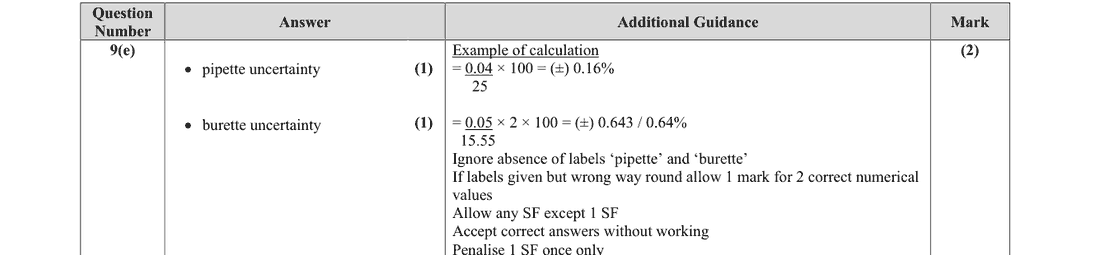
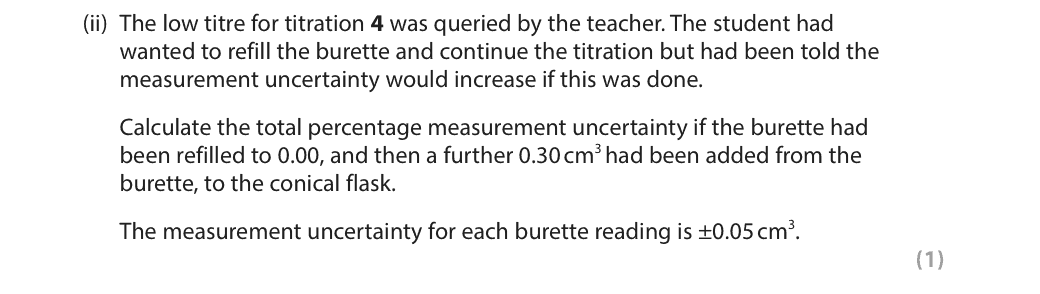
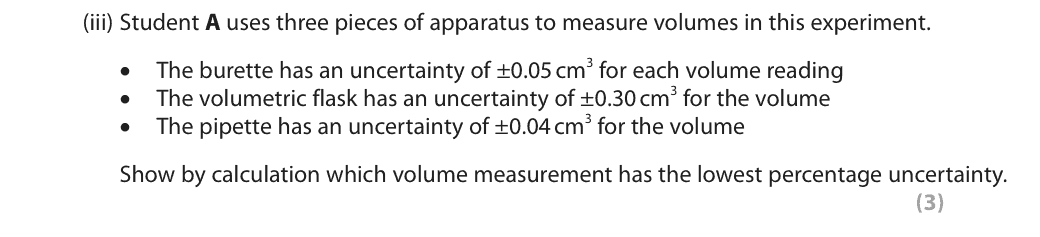
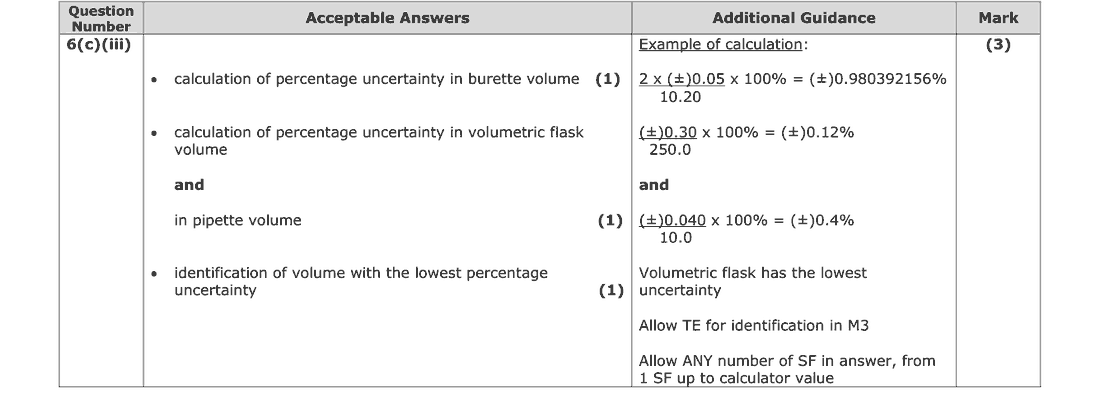
The uncertainty in the pipette volume is ± 0.04 cm3. The uncertainty in each
burette reading is ± 0.05 cm3.
Calculate the percentage uncertainties for the pipette volume of 25.00 cm3 and
the burette volume of 15.55 cm3 for titre 2.
June 2025 · Paper 2 · Q4(a)(i) 4 marks Calculation formulae equations and amounts of substance
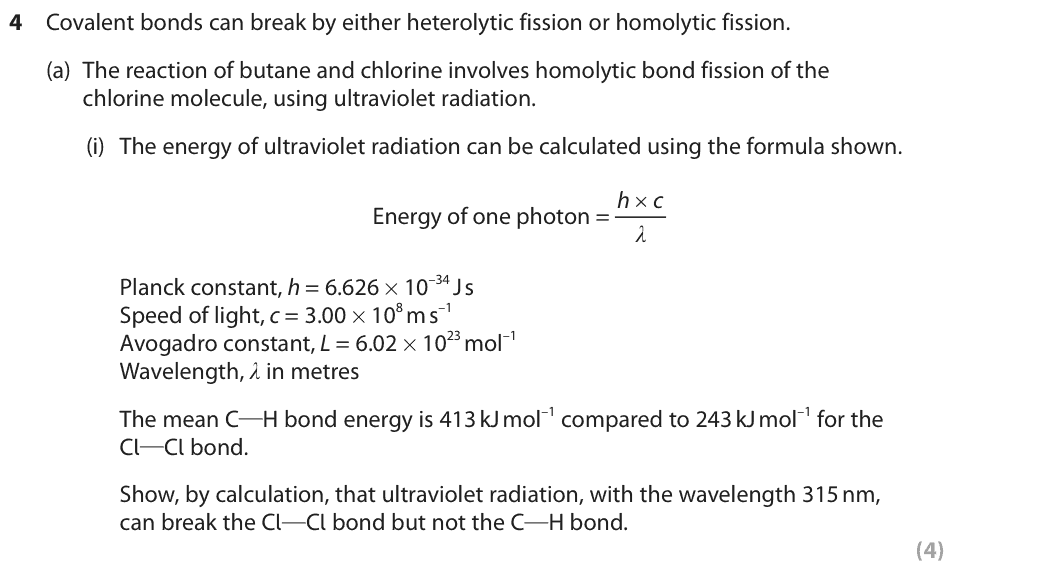
Covalent bonds can break by either heterolytic fission or homolytic fission.
The reaction of butane and chlorine involves homolytic bond fission of the
chlorine molecule, using ultraviolet radiation.
The energy of ultraviolet radiation can be calculated using the formula shown.
h
c
Energy of one photon =
λ
Planck constant, h = 6.626 × 10–34 J s
Speed of light, c = 3.00 × 108 m s–1
Avogadro constant, L = 6.02 × 1023 mol–1
Wavelength, λ in metres
The mean C
H bond energy is 413 kJ mol–1 compared to 243 kJ mol–1 for the
Cl
Cl bond.
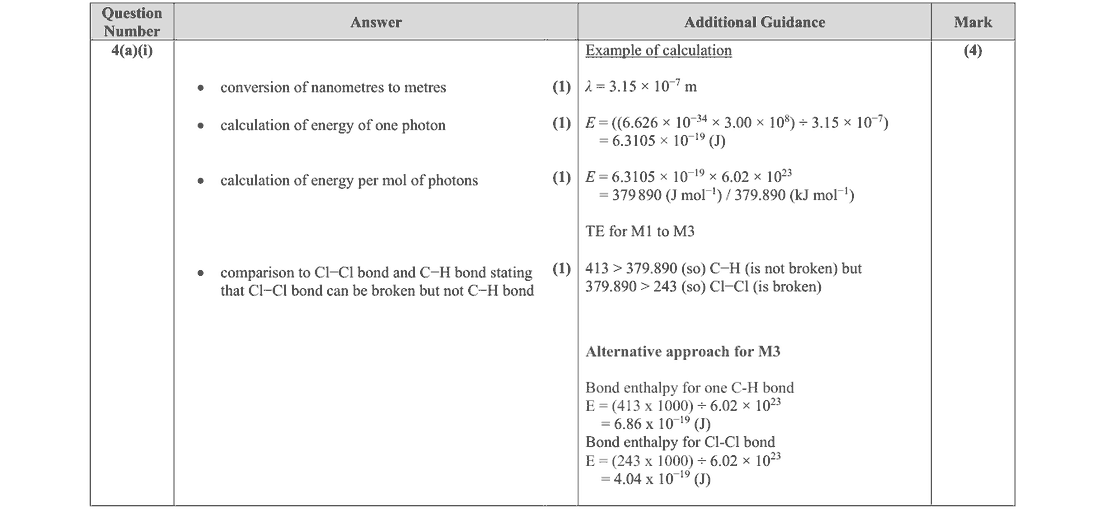
Show, by calculation, that ultraviolet radiation, with the wavelength 315 nm,
can break the Cl
Cl bond but not the C
H bond.
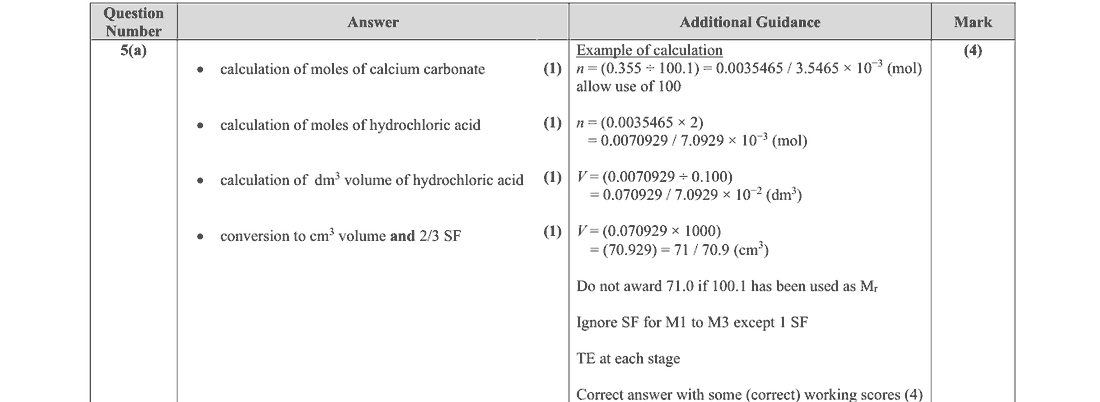
June 2025 · Paper 2 · Q5(a) 4 marks Calculation Easy formulae equations and amounts of substance
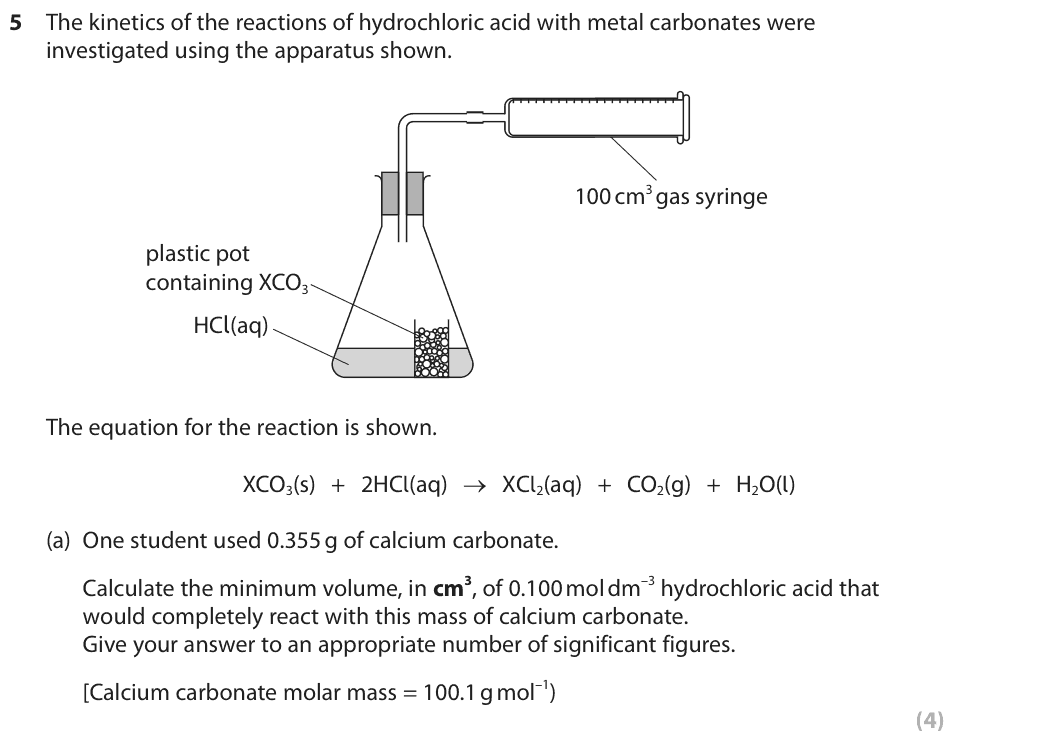
The kinetics of the reactions of hydrochloric acid with metal carbonates were
investigated using the apparatus shown.
100 cm3 gas syringe
plastic pot
containing XCO3
HCl(aq)
The equation for the reaction is shown.
XCO3(s)   +   2HCl(aq)   →   XCl2(aq)   +   CO2(g)   +   H2O(l)
One student used 0.355 g of calcium carbonate.
Calculate the minimum volume, in cm3, of 0.100 mol dm–3 hydrochloric acid that
would completely react with this mass of calcium carbonate.
Give your answer to an appropriate number of significant figures.
[Calcium carbonate molar mass = 100.1 g mol–1)
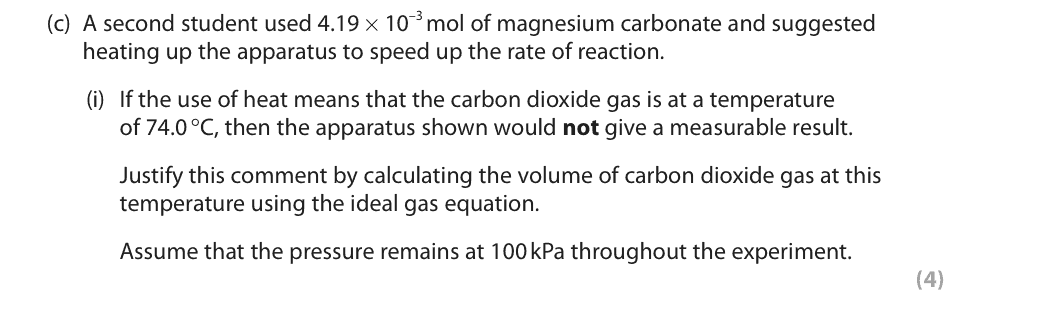
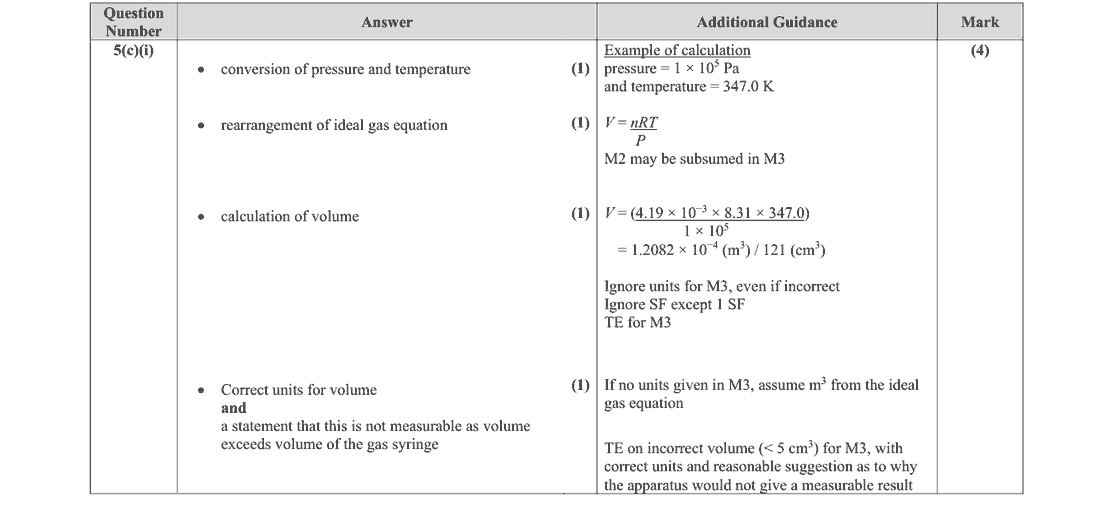
June 2025 · Paper 2 · Q5(c)(i) 4 marks Calculation formulae equations and amounts of substance
Earlier part of question 5 that this part usesEarlier part of June 2025 Paper 2 question 5
A second student used 4.19 × 10–3 mol of magnesium carbonate and suggested
heating up the apparatus to speed up the rate of reaction.
If the use of heat means that the carbon dioxide gas is at a temperature
of 74.0 °C, then the apparatus shown would not give a measurable result.
Justify this comment by calculating the volume of carbon dioxide gas at this
temperature using the ideal gas equation.
Assume that the pressure remains at 100 kPa throughout the experiment.
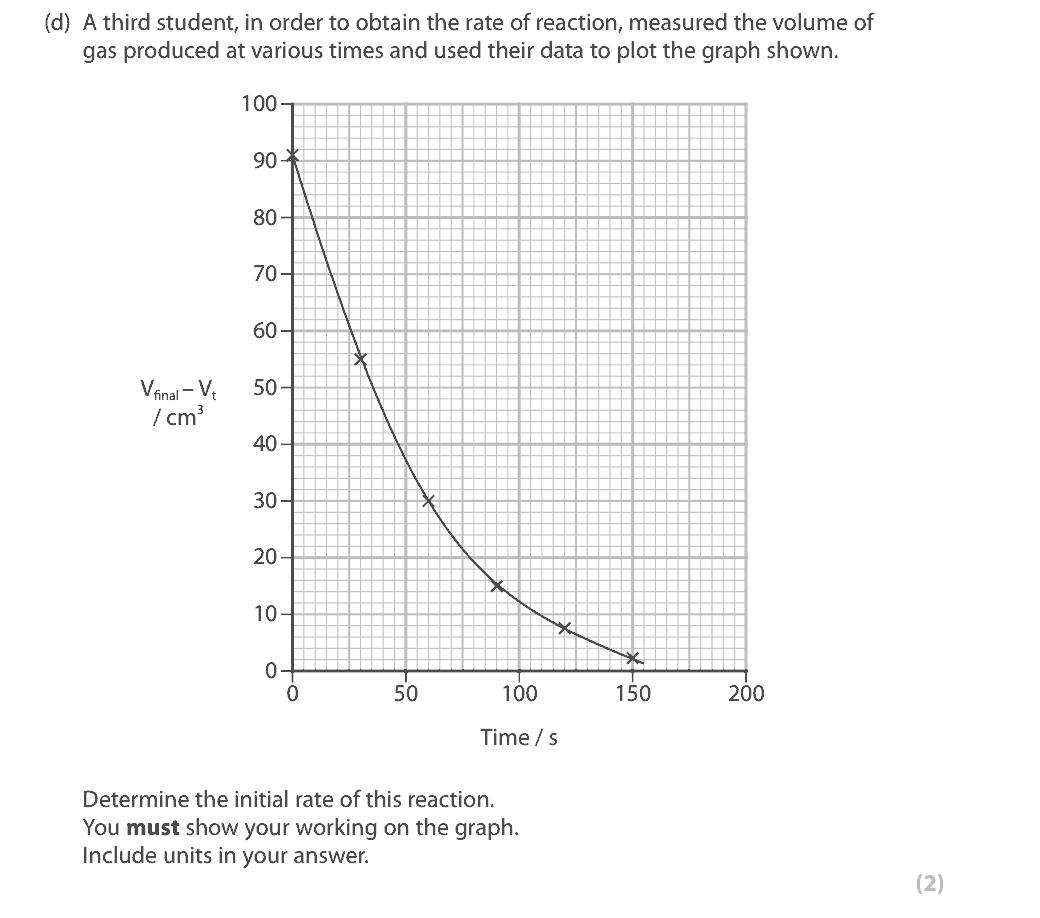
June 2025 · Paper 2 · Q5(d) 2 marks Calculation kinetics i
Earlier part of question 5 that this part usesEarlier part of June 2025 Paper 2 question 5
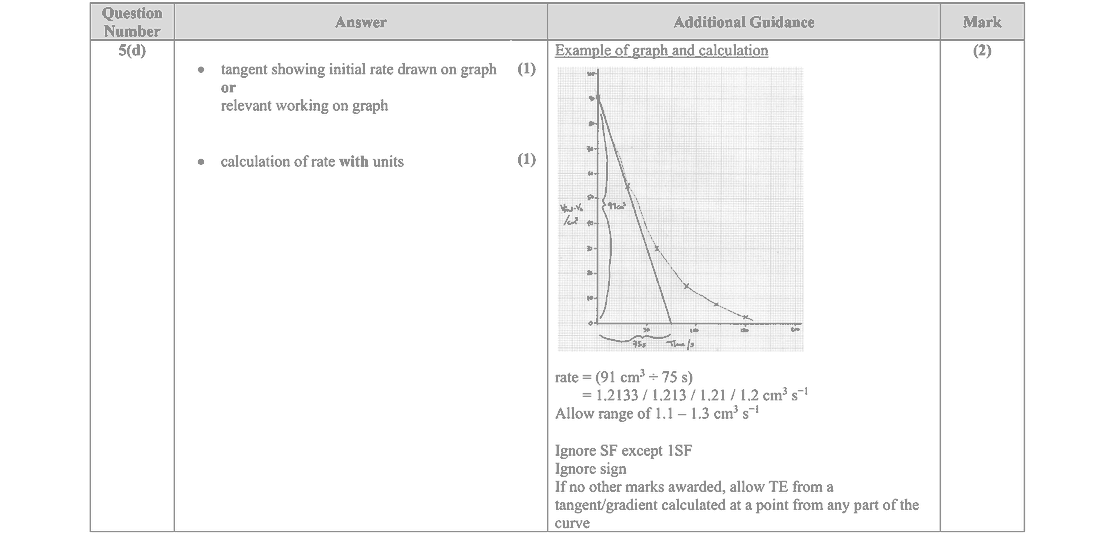
A third student, in order to obtain the rate of reaction, measured the volume of
gas produced at various times and used their data to plot the graph shown.
100
90
80
70
60
Vfinal – Vt
50
/ cm3
40
30
20
10
0
0
50
100
150
200
Time / s
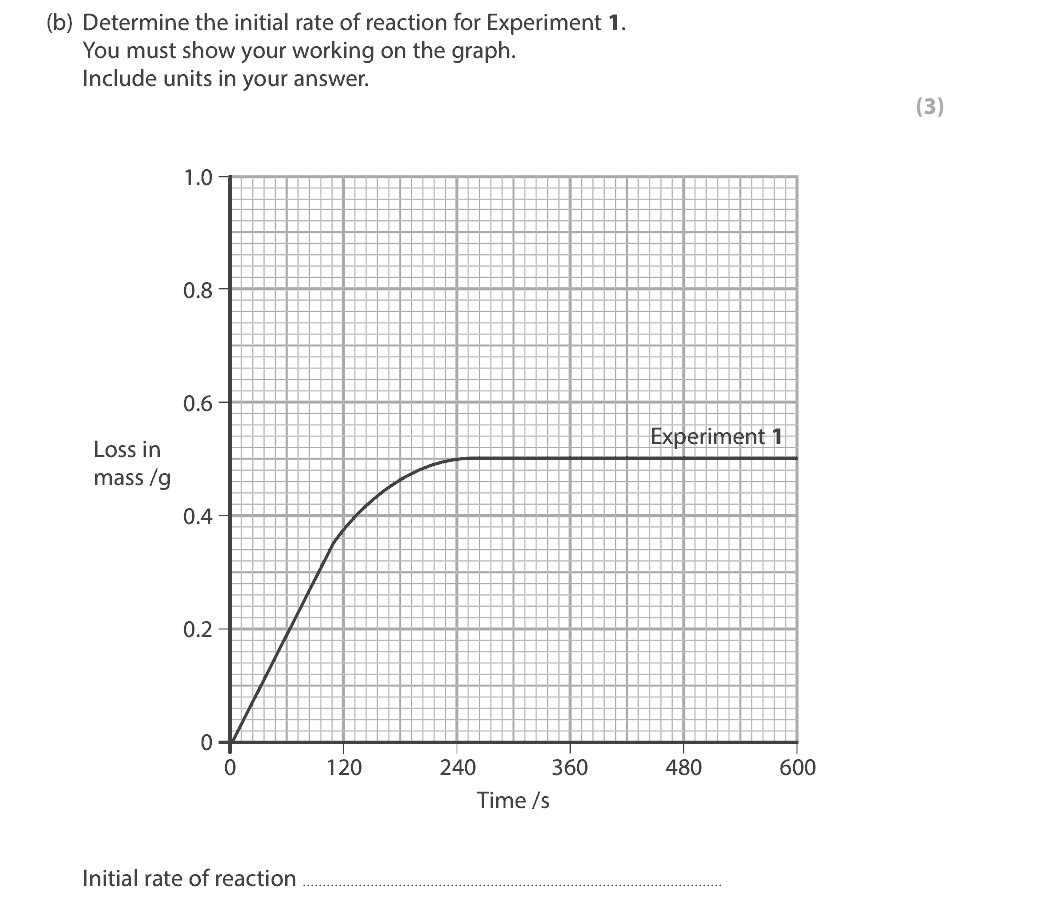
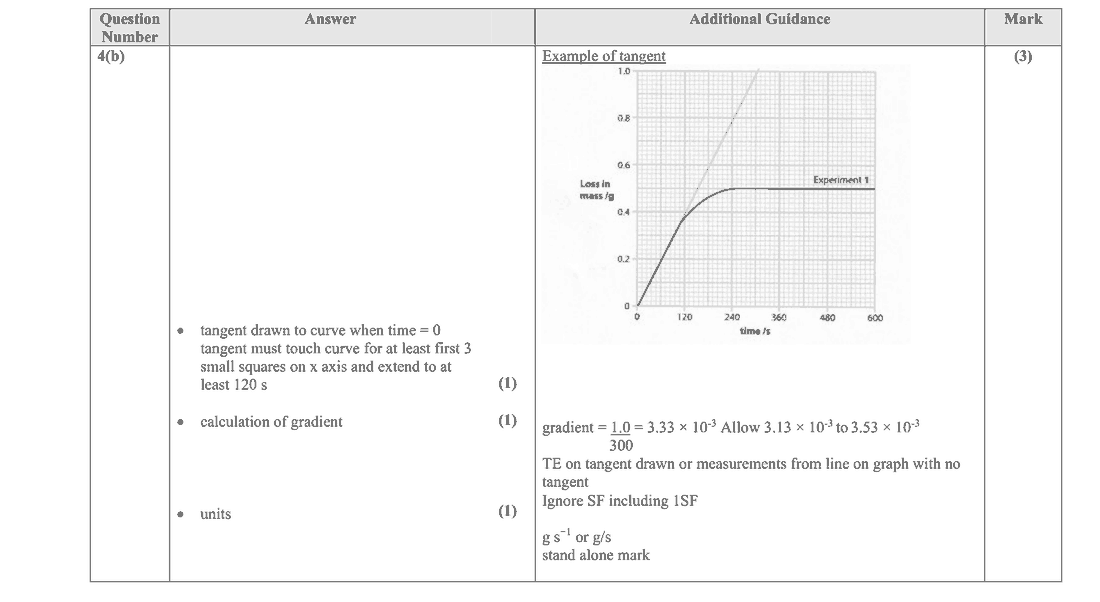
Determine the initial rate of this reaction.
You must show your working on the graph.
Include units in your answer.
June 2025 · Paper 2 · Q9(a)(i) 2 marks Calculation kinetics ii
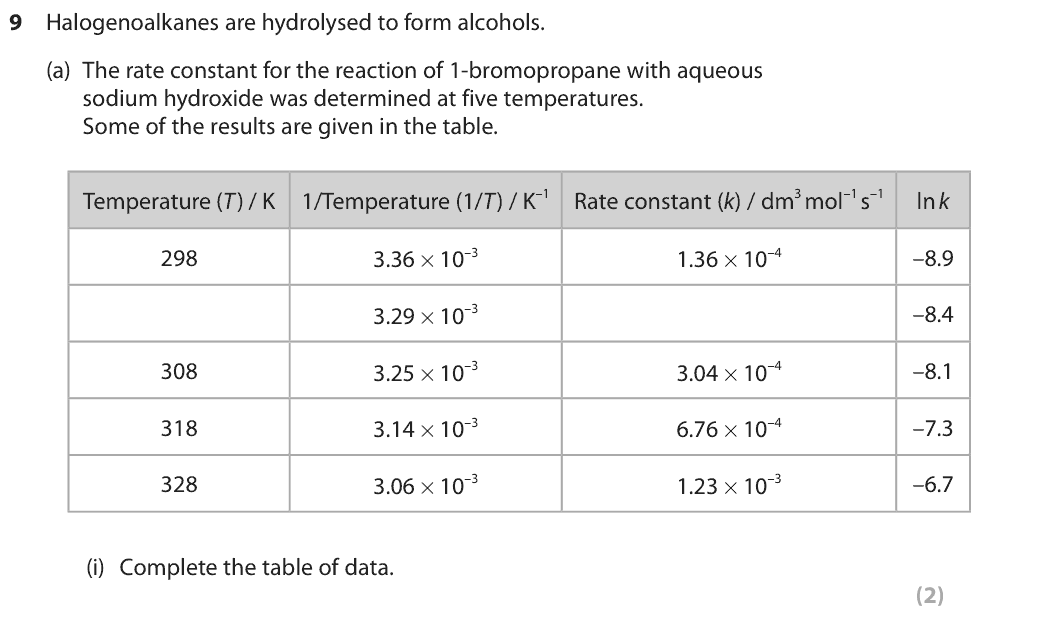
Halogenoalkanes are hydrolysed to form alcohols.
The rate constant for the reaction of 1‑bromopropane with aqueous
sodium hydroxide was determined at five temperatures.
Some of the results are given in the table.
Temperature (T) / K
1/Temperature (1/T) / K–1
Rate constant (k) / dm3 mol–1 s–1
ln k
298
3.36 × 10–3
1.36 × 10–4
–8.9
3.29 × 10–3
–8.4
308
3.25 × 10–3
3.04 × 10–4
–8.1
318
3.14 × 10–3
6.76 × 10–4
–7.3
328
3.06 × 10–3
1.23 × 10–3
–6.7
Complete the table of data.
June 2025 · Paper 2 · Q9(a)(ii) 5 marks Calculation kinetics ii
Earlier part of question 9 that this part usesEarlier part of June 2025 Paper 2 question 9
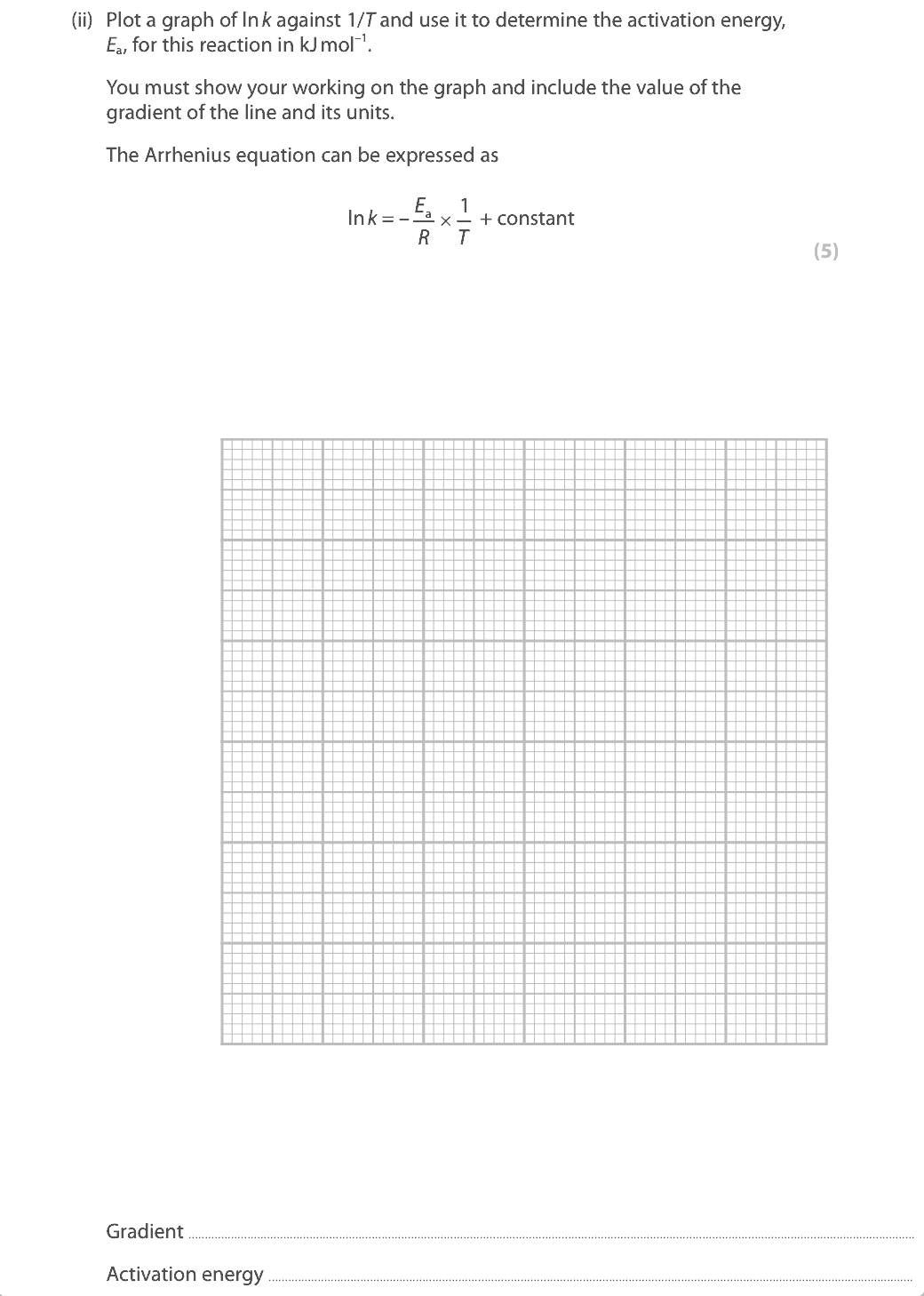
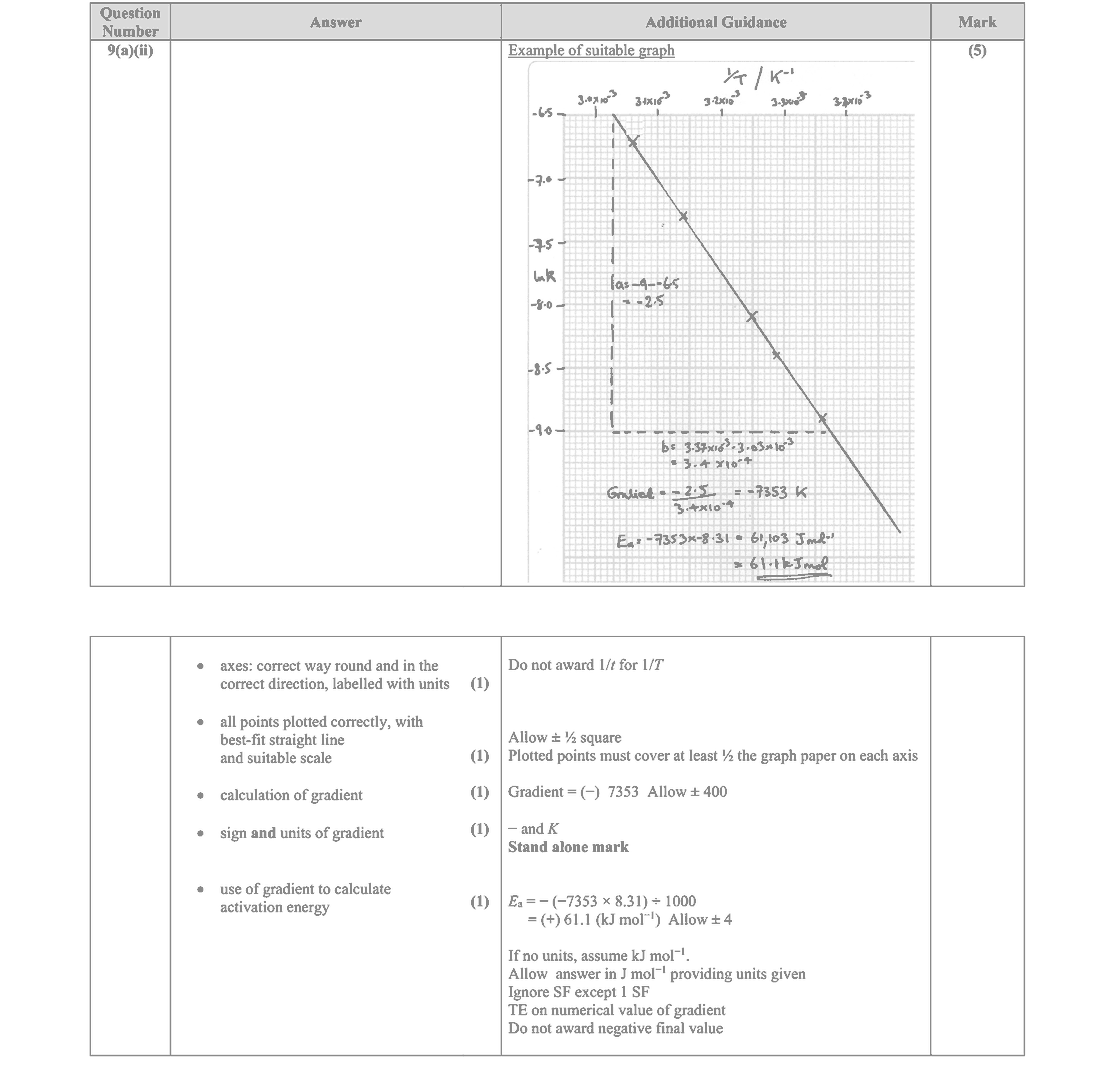
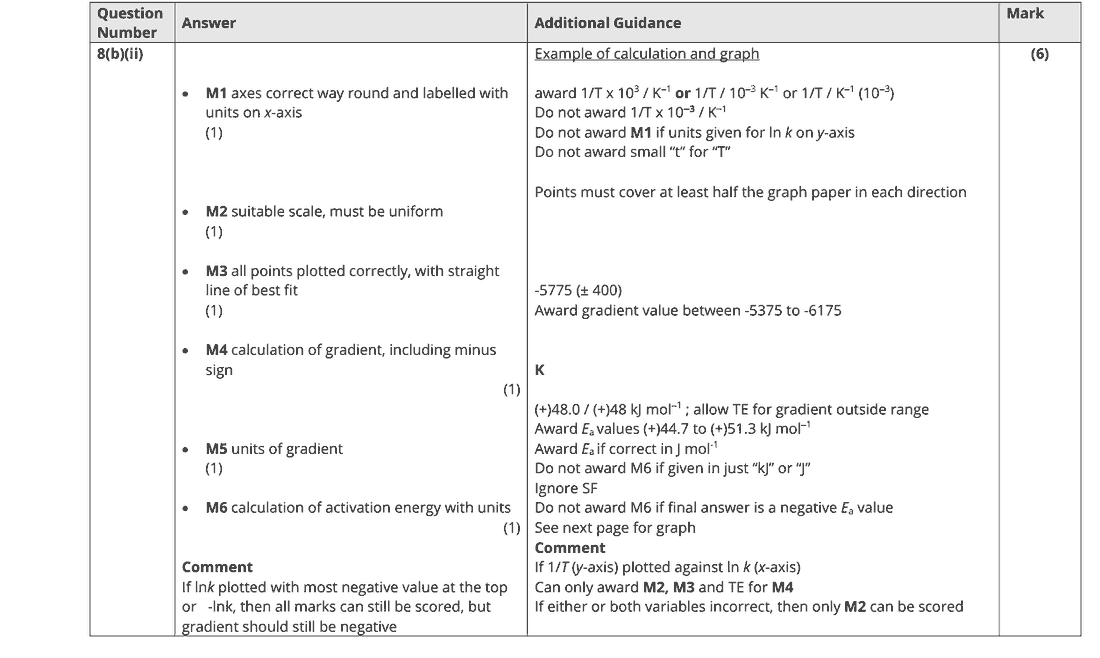
Plot a graph of ln k against 1/T and use it to determine the activation energy,
Ea, for this reaction in  kJ mol–1.
You must show your working on the graph and include the value of the
gradient of the line and its units.
The Arrhenius equation can be expressed as
ln k = – E
a × 1 + constant
R
T
Gradient 
Activation energy
June 2025 · Paper 3 · Q4(d) 4 marks Calculation kinetics iiformulae equations and amounts of substance
Earlier part of question 4 that this part usesEarlier part of June 2025 Paper 3 question 4
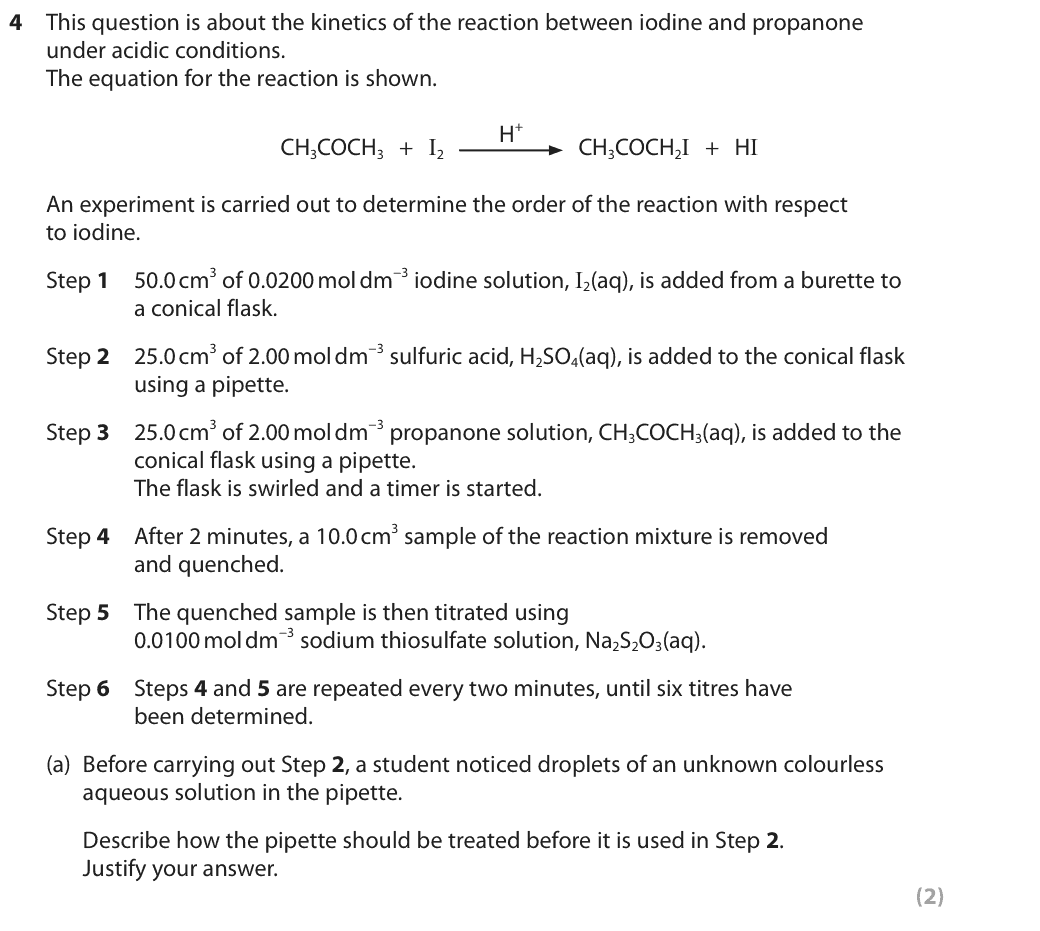
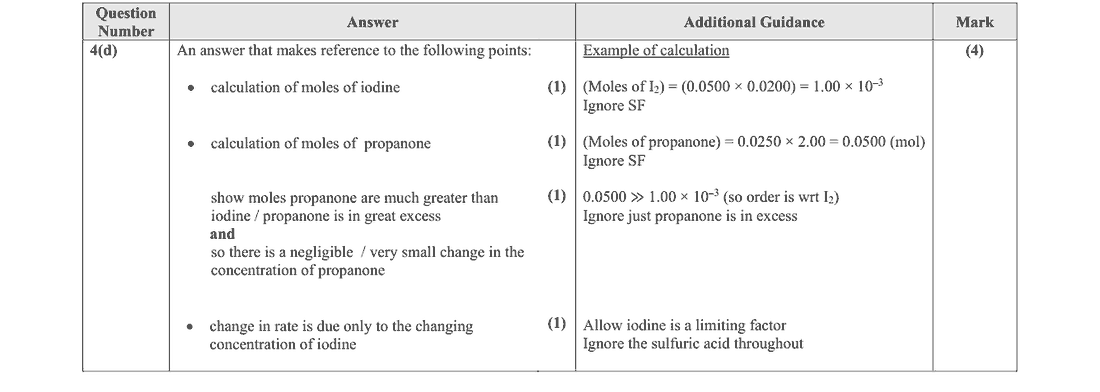
Show, by calculating the initial quantities of the reactants involved, that this
experiment provides evidence for the order with respect to iodine only.
June 2025 · Paper 3 · Q5(a)(i) 2 marks Calculation formulae equations and amounts of substance
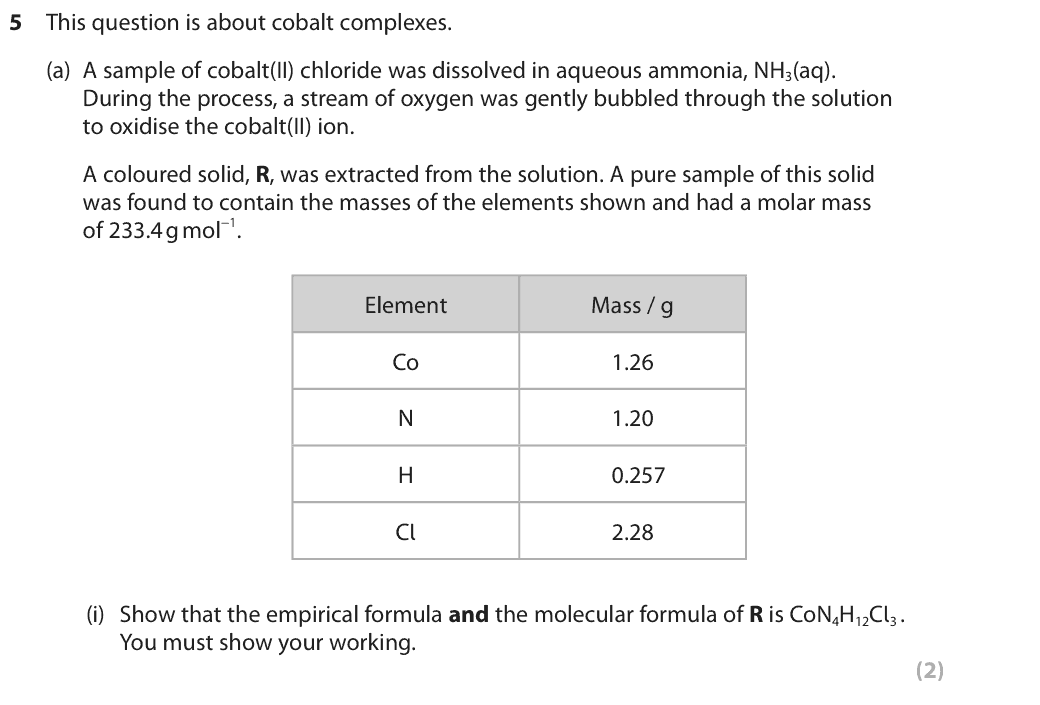
This question is about cobalt complexes.
A sample of cobalt(II) chloride was dissolved in aqueous ammonia, NH3(aq).
During the process, a stream of oxygen was gently bubbled through the solution
to oxidise the cobalt(II) ion.
A coloured solid, R, was extracted from the solution. A pure sample of this solid
was found to contain the masses of the elements shown and had a molar mass
of 233.4 g mol−1.
Element
Mass / g
Co
1.26
N
1.20
H
0.257
Cl
2.28
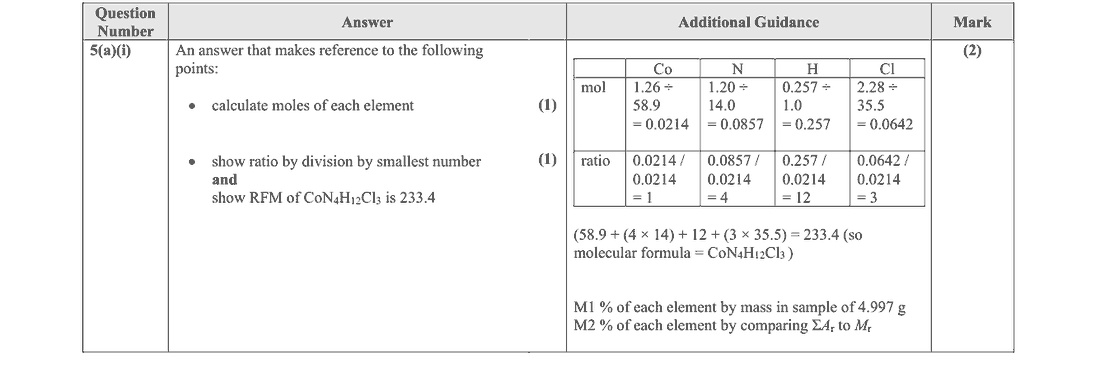
Show that the empirical formula and the molecular formula of R is CoN4H12Cl3 .
You must show your working.
June 2025 · Paper 3 · Q5(a)(ii) 2 marks Calculation formulae equations and amounts of substance
Earlier part of question 5 that this part usesEarlier part of June 2025 Paper 3 question 5
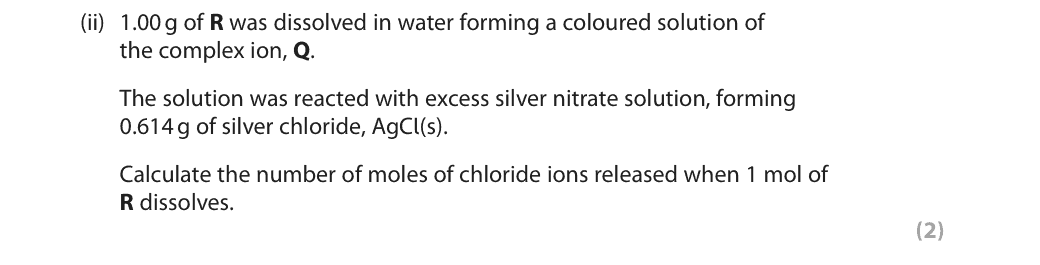
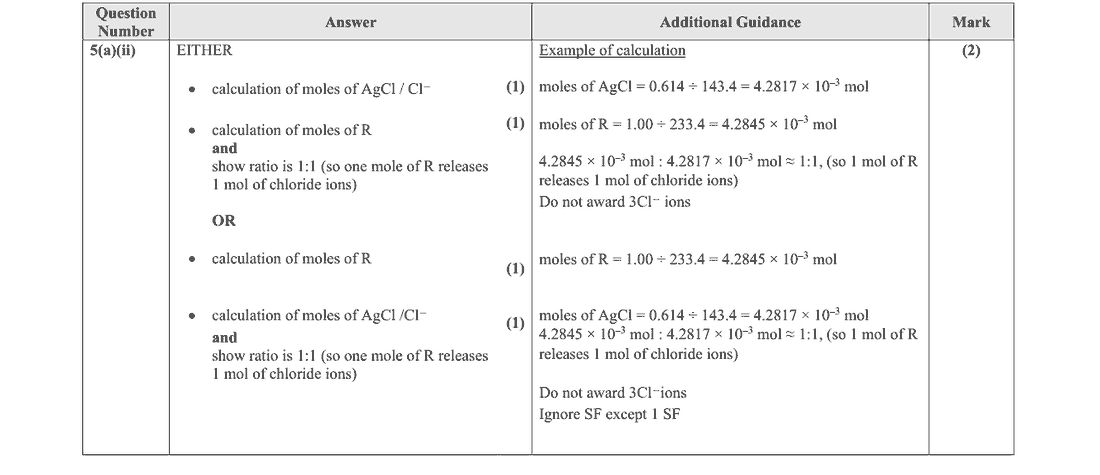
1.00 g of R was dissolved in water forming a coloured solution of
the complex ion, Q.
The solution was reacted with excess silver nitrate solution, forming
0.614 g of silver chloride, AgCl(s).
Calculate the number of moles of chloride ions released when 1 mol of
R dissolves.
June 2025 · Paper 3 · Q7(b)(i) 5 marks Calculation redox ii
Earlier part of question 7 that this part usesEarlier part of June 2025 Paper 3 question 7
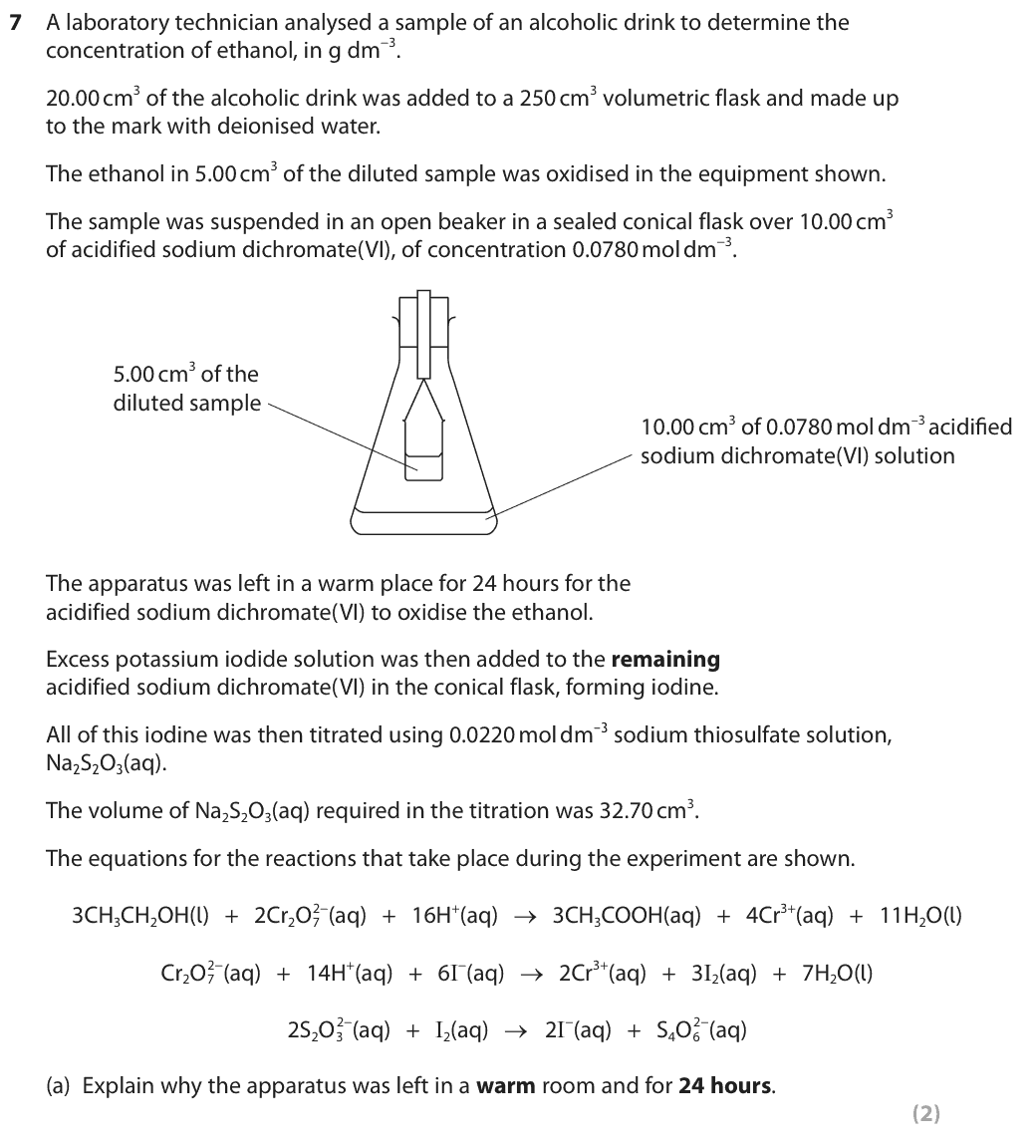
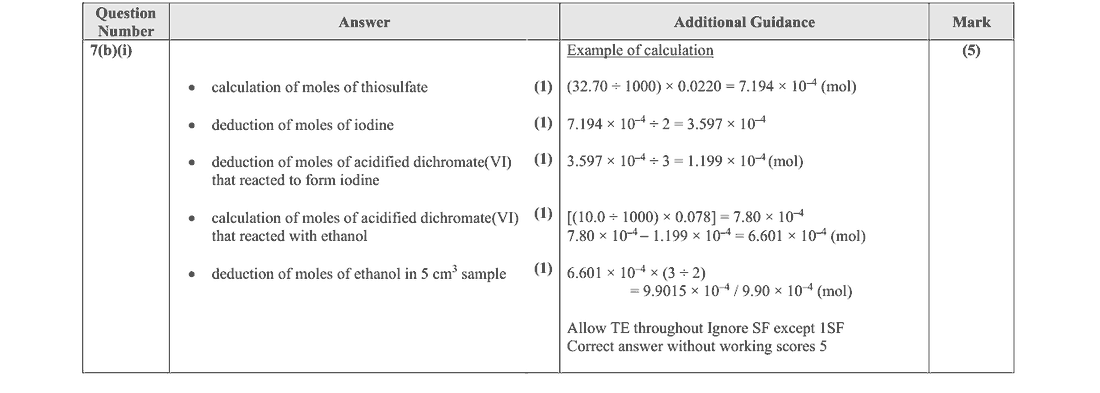
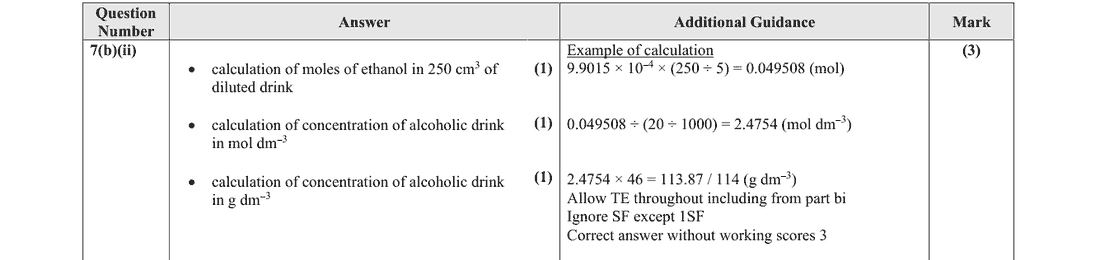
Calculate the number of moles of ethanol in 5 cm3 of the diluted drink.
June 2025 · Paper 3 · Q7(b)(ii) 3 marks Calculation redox iiformulae equations and amounts of substance
Earlier parts of question 7 that this part usesEarlier part of June 2025 Paper 3 question 7Earlier part of June 2025 Paper 3 question 7
Calculate the concentration of ethanol in the alcoholic drink in g dm−3.
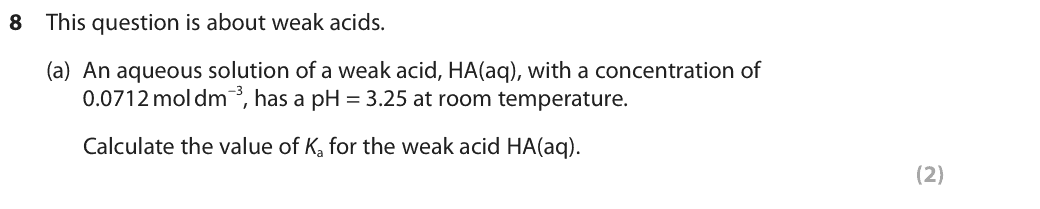
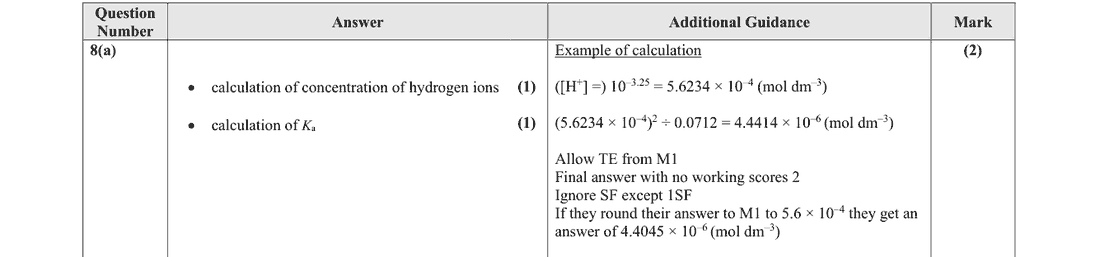
June 2025 · Paper 3 · Q8(a) 2 marks Calculation acid base equilibria
This question is about weak acids.
An aqueous solution of a weak acid, HA(aq), with a concentration of
0.0712 mol dm−3, has a pH = 3.25 at room temperature.
Calculate the value of Ka for the weak acid HA(aq).
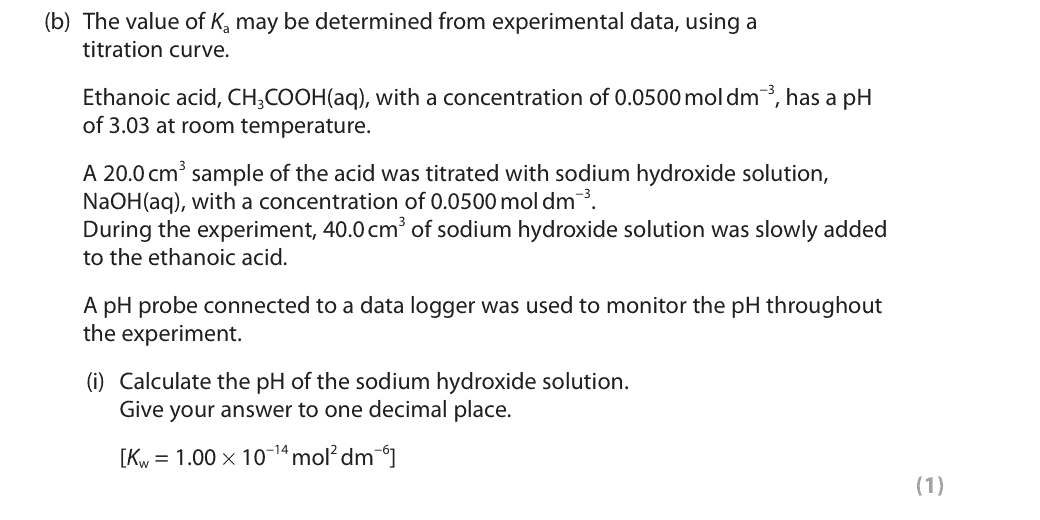
June 2025 · Paper 3 · Q8(b)(i) 1 mark Calculation acid base equilibria
Earlier part of question 8 that this part usesEarlier part of June 2025 Paper 3 question 8
The value of Ka may be determined from experimental data, using a
titration curve.
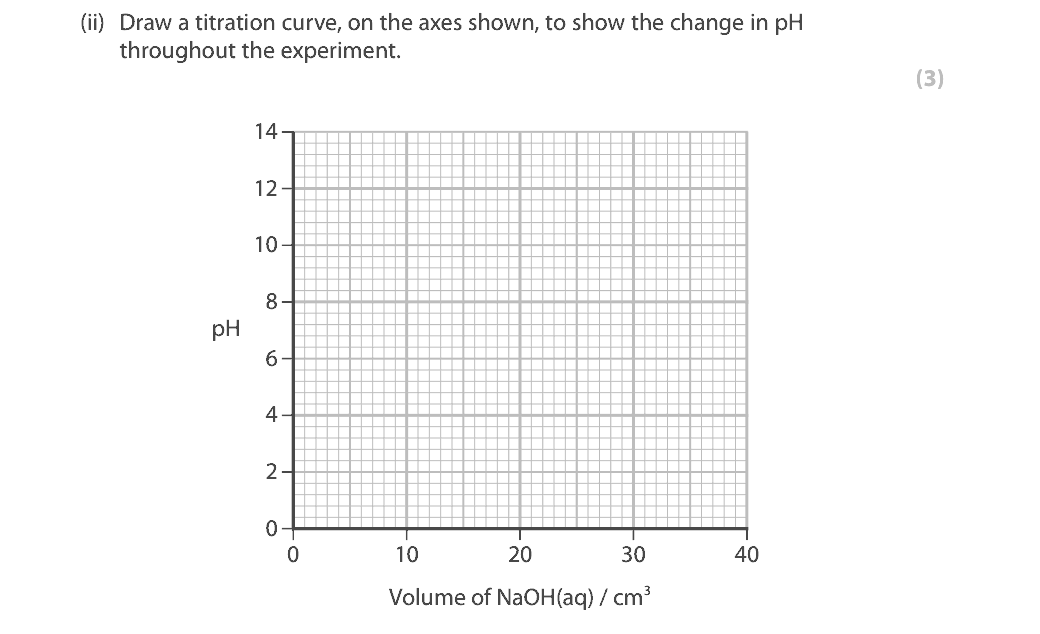
Ethanoic acid, CH3COOH(aq), with a concentration of 0.0500 mol dm−3, has a pH
of 3.03 at room temperature.
A 20.0 cm3 sample of the acid was titrated with sodium hydroxide solution,
NaOH(aq), with a concentration of 0.0500 mol dm−3.
During the experiment, 40.0 cm3 of sodium hydroxide solution was slowly added
to the ethanoic acid.
A pH probe connected to a data logger was used to monitor the pH throughout
the experiment.
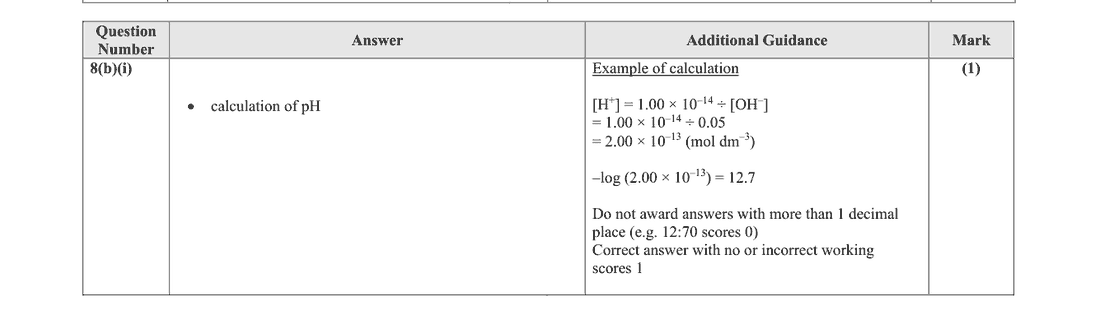
Calculate the pH of the sodium hydroxide solution.
Give your answer to one decimal place.
[Kw = 1.00 × 10−14 mol2 dm−6]
June 2025 · Paper 3 · Q8(b)(iv) 3 marks Calculation acid base equilibria
Earlier parts of question 8 that this part usesEarlier part of June 2025 Paper 3 question 8Earlier part of June 2025 Paper 3 question 8Earlier part of June 2025 Paper 3 question 8Earlier part of June 2025 Paper 3 question 8
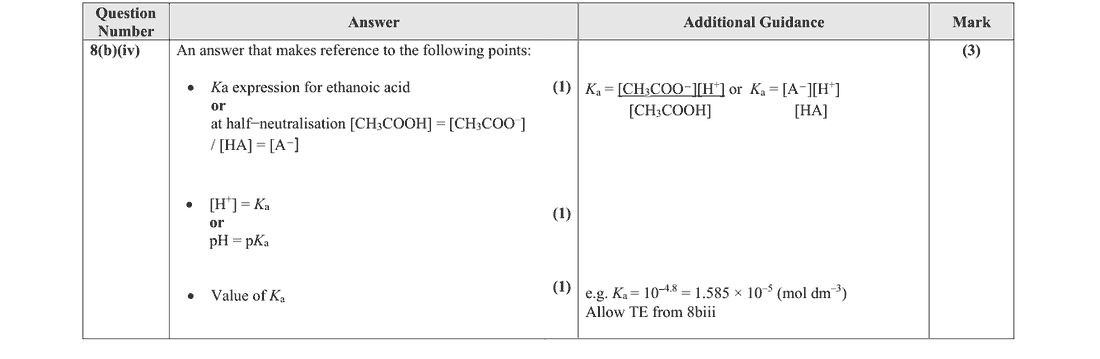
Calculate a value for Ka of ethanoic acid using your answer to (b)(iii).
You must show your working.
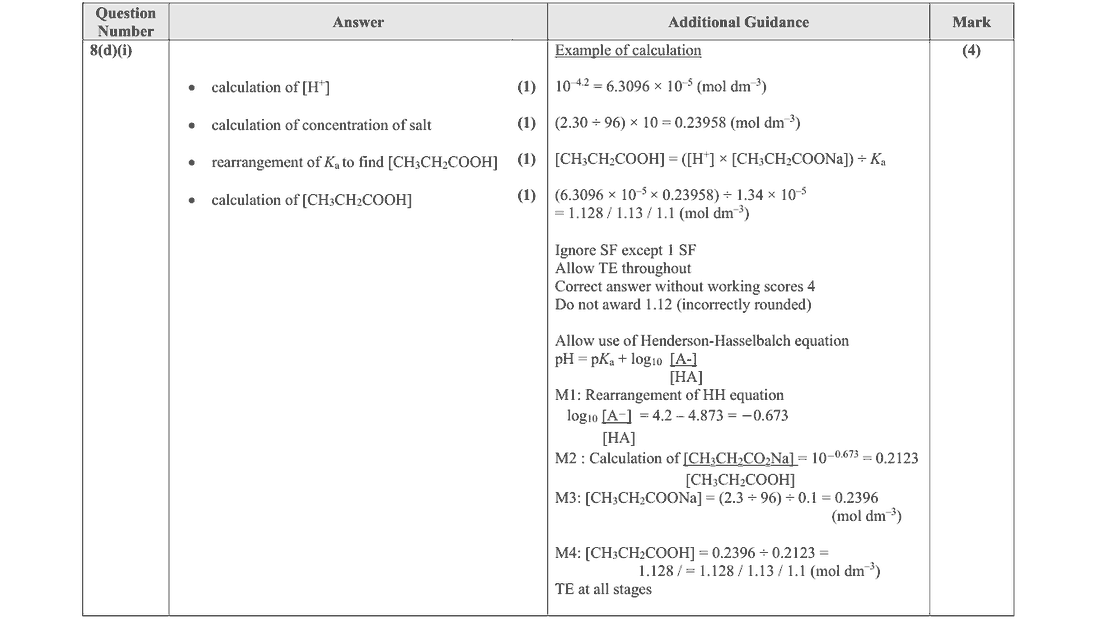
June 2025 · Paper 3 · Q8(d)(i) 4 marks Calculation acid base equilibria
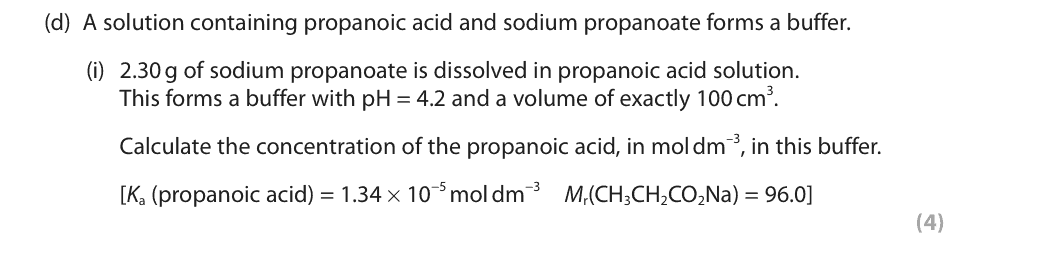
A solution containing propanoic acid and sodium propanoate forms a buffer.
2.30 g of sodium propanoate is dissolved in propanoic acid solution.
This forms a buffer with pH = 4.2 and a volume of exactly 100 cm3.
Calculate the concentration of the propanoic acid, in mol dm–3, in this buffer.
[Ka (propanoic acid) = 1.34 × 10−5 mol dm−3  Mr(CH3CH2CO2Na) = 96.0]
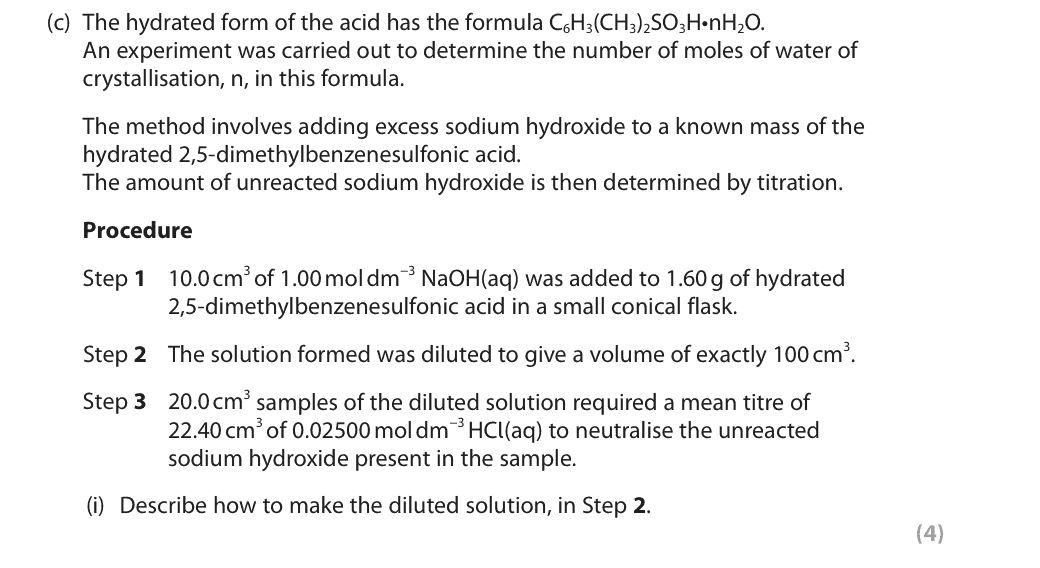
June 2025 · Paper 3 · Q9(c)(ii) 5 marks Calculation formulae equations and amounts of substance
Earlier parts of question 9 that this part usesEarlier part of June 2025 Paper 3 question 9Earlier part of June 2025 Paper 3 question 9
Calculate the relative formula mass of hydrated
2,5-dimethylbenzenesulfonic acid and hence deduce the value of n.
June 2024 · AS Paper 1 · Q5(b) 4 marks Calculation formulae equations and amounts of substance
Earlier part of question 5 that this part usesEarlier part of June 2024 Paper 1 question 5
Calculate the mass of sodium chlorate(III) needed to make
5.40 g of chlorine dioxide.
[Ar values: H = 1.00      O = 16.0      Na = 23.0      Cl = 35.5]
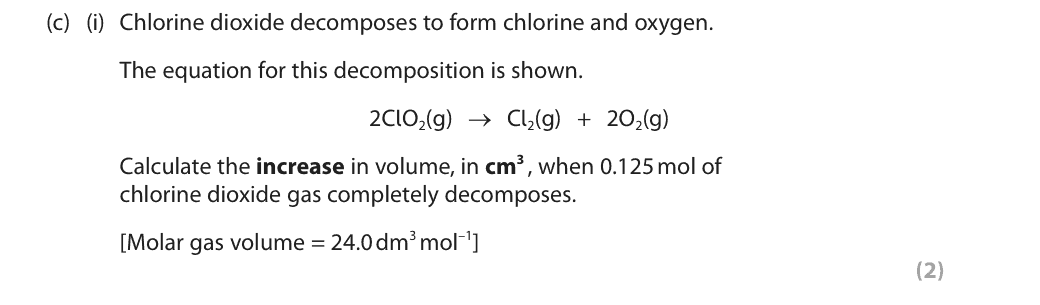
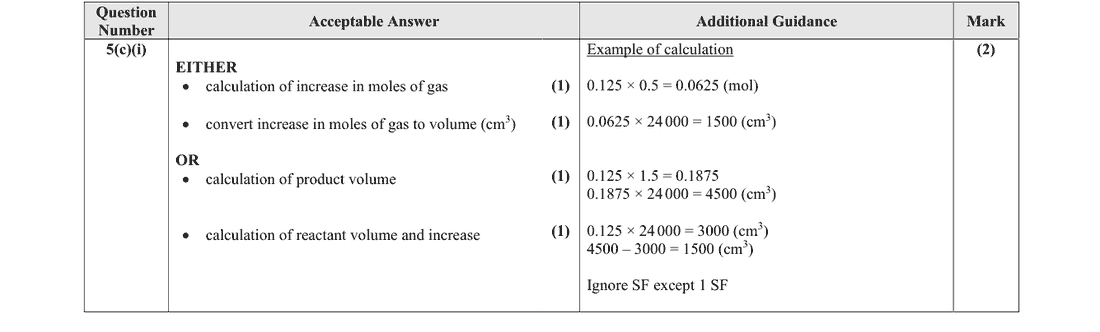
June 2024 · AS Paper 1 · Q5(c)(i) 2 marks Calculation Hard formulae equations and amounts of substance
Earlier part of question 5 that this part usesEarlier part of June 2024 Paper 1 question 5
Chlorine dioxide decomposes to form chlorine and oxygen.
The equation for this decomposition is shown.
2ClO2(g)   →   Cl2(g)   +   2O2(g)
Calculate the increase in volume, in cm3 , when 0.125 mol of
chlorine dioxide gas completely decomposes.
[Molar gas volume = 24.0 dm3 mol–1]
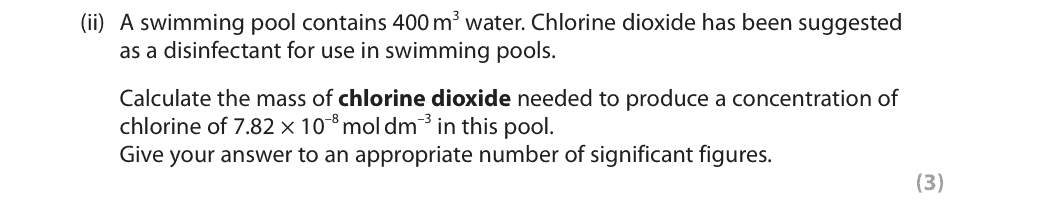
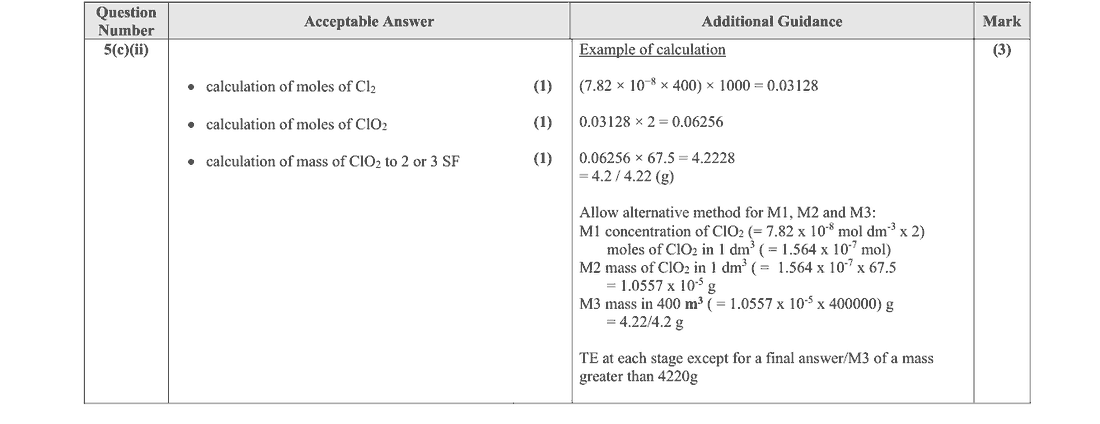
June 2024 · AS Paper 1 · Q5(c)(ii) 3 marks Calculation formulae equations and amounts of substance
Earlier parts of question 5 that this part usesEarlier part of June 2024 Paper 1 question 5Earlier part of June 2024 Paper 1 question 5
A swimming pool contains 400 m3 water. Chlorine dioxide has been suggested
as a disinfectant for use in swimming pools.
Calculate the mass of chlorine dioxide needed to produce a concentration of
chlorine of 7.82 × 10⁻⁸ mol dm–3 in this pool.
Give your answer to an appropriate number of significant figures.
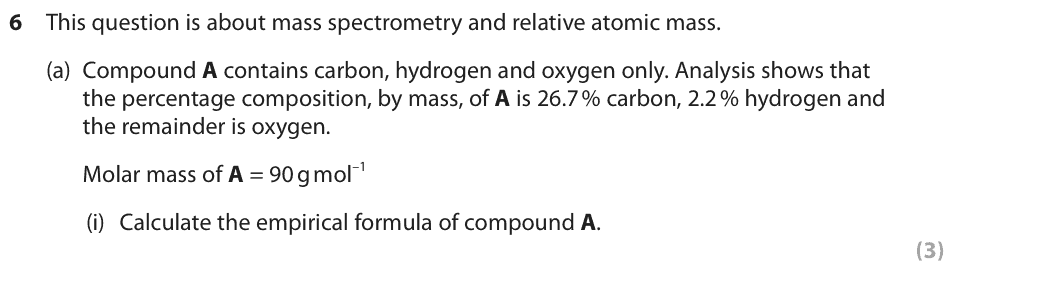
June 2024 · AS Paper 1 · Q6(a)(i) 3 marks Calculation formulae equations and amounts of substance
This question is about mass spectrometry and relative atomic mass.
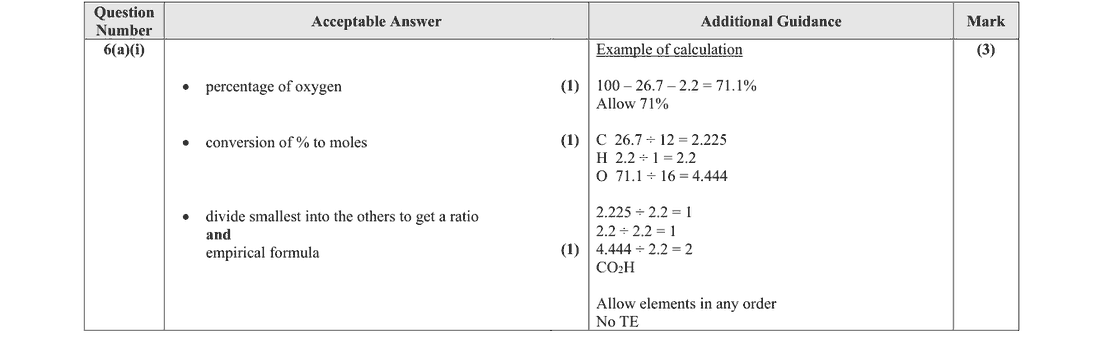
Compound A contains carbon, hydrogen and oxygen only. Analysis shows that
the percentage composition, by mass, of A is 26.7 % carbon, 2.2 % hydrogen and
the remainder is oxygen.
Molar mass of A = 90 g mol–1
Calculate the empirical formula of compound A.
June 2024 · AS Paper 1 · Q6(a)(ii) 1 mark Calculation formulae equations and amounts of substance
Earlier part of question 6 that this part usesEarlier part of June 2024 Paper 1 question 6
Calculate the molecular formula of compound A.
June 2024 · AS Paper 1 · Q6(b) 2 marks Calculation Easy atomic structure and the periodic table
Earlier part of question 6 that this part usesEarlier part of June 2024 Paper 1 question 6
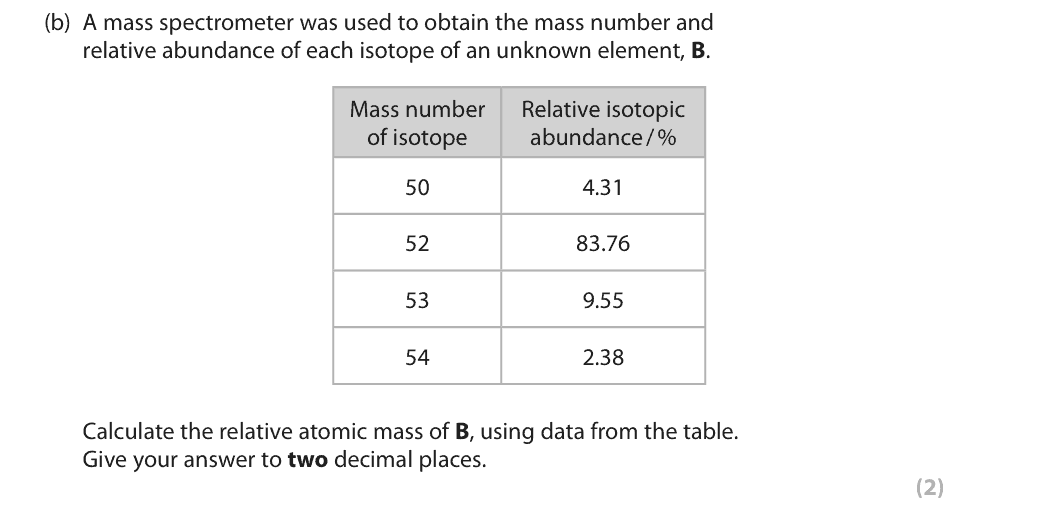
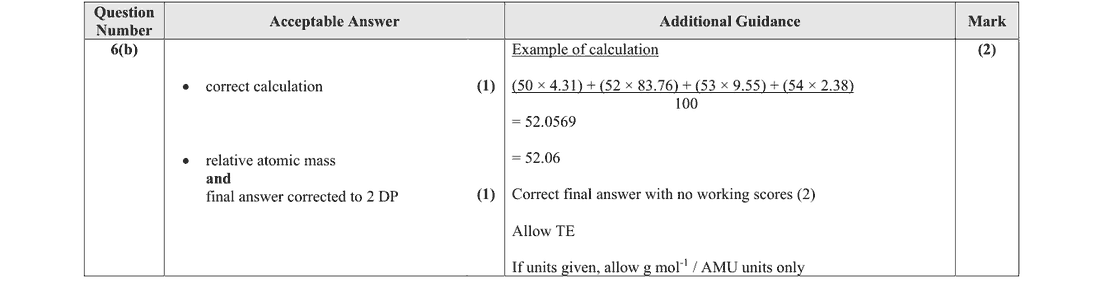
A mass spectrometer was used to obtain the mass number and
relative abundance of each isotope of an unknown element, B.
Mass number
Relative isotopic
of isotope
abundance / %
50
4.31
52
83.76
53
9.55
54
2.38
Calculate the relative atomic mass of B, using data from the table.
Give your answer to two decimal places.
June 2024 · AS Paper 1 · Q9(c) 5 marks Calculation formulae equations and amounts of substance
Earlier part of question 9 that this part usesEarlier part of June 2024 Paper 1 question 9
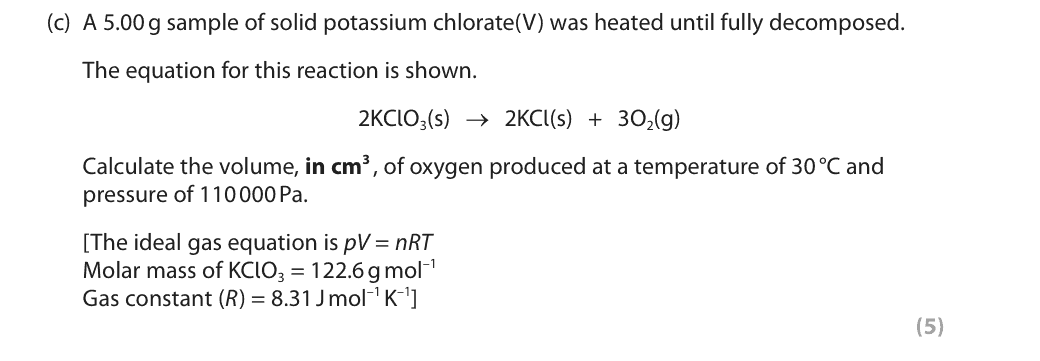
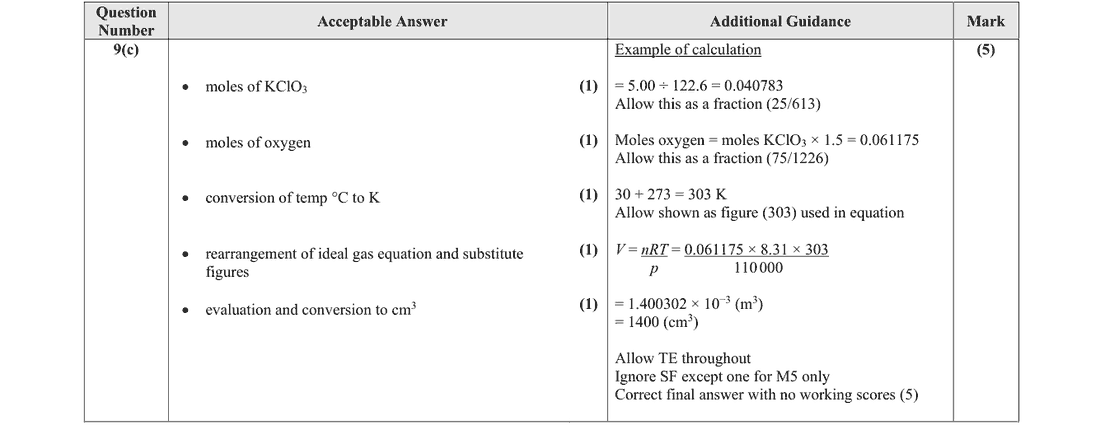
A 5.00 g sample of solid potassium chlorate(V) was heated until fully decomposed.
The equation for this reaction is shown.
2KClO3(s)   →   2KCl(s)   +   3O2(g)
Calculate the volume, in cm3 , of oxygen produced at a temperature of 30 °C and
pressure of 110 000 Pa.
[The ideal gas equation is pV = nRT
Molar mass of KClO3 = 122.6 g mol–1
Gas constant (R) = 8.31 J mol–1 K–1]
June 2024 · AS Paper 2 · Q1(b)(ii) 1 mark Calculation formulae equations and amounts of substance
Earlier parts of question 1 that this part usesEarlier part of June 2024 Paper 2 question 1Earlier part of June 2024 Paper 2 question 1
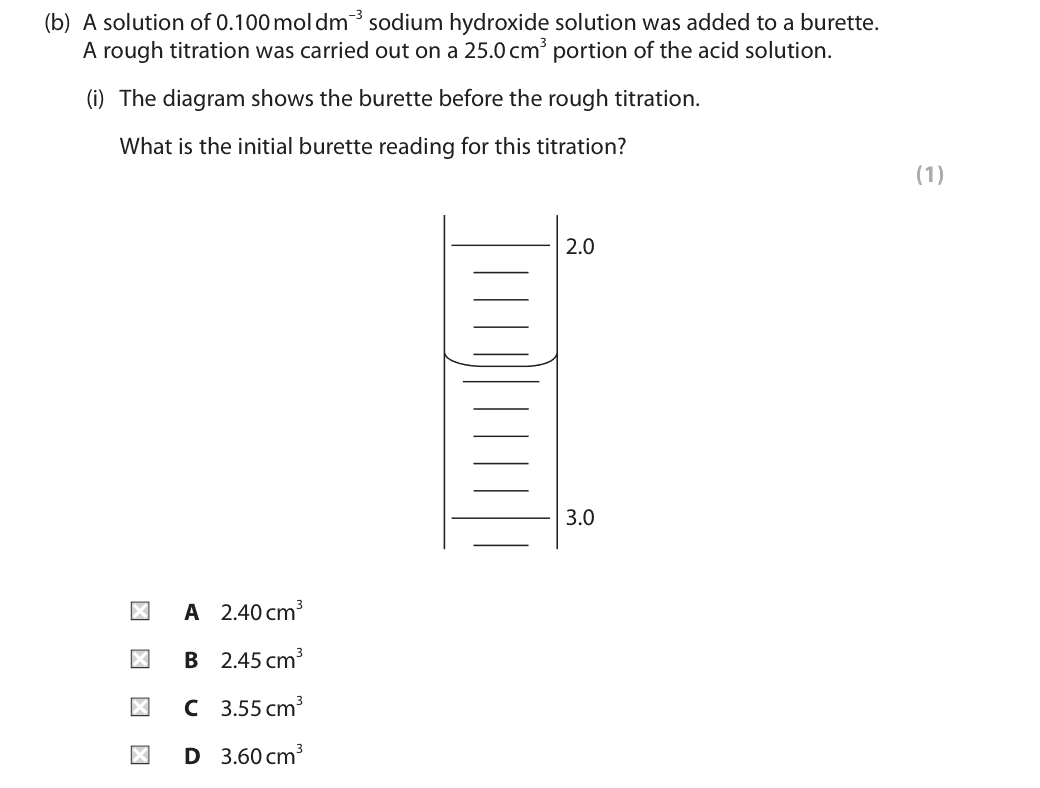
The final burette reading for the rough titration was 26.50 cm3.
Calculate the volume of sodium hydroxide solution added in the
rough titration, using your answer to (b)(i).
June 2024 · AS Paper 2 · Q1(c)(i) 1 mark Calculation formulae equations and amounts of substance
Earlier part of question 1 that this part usesEarlier part of June 2024 Paper 2 question 1
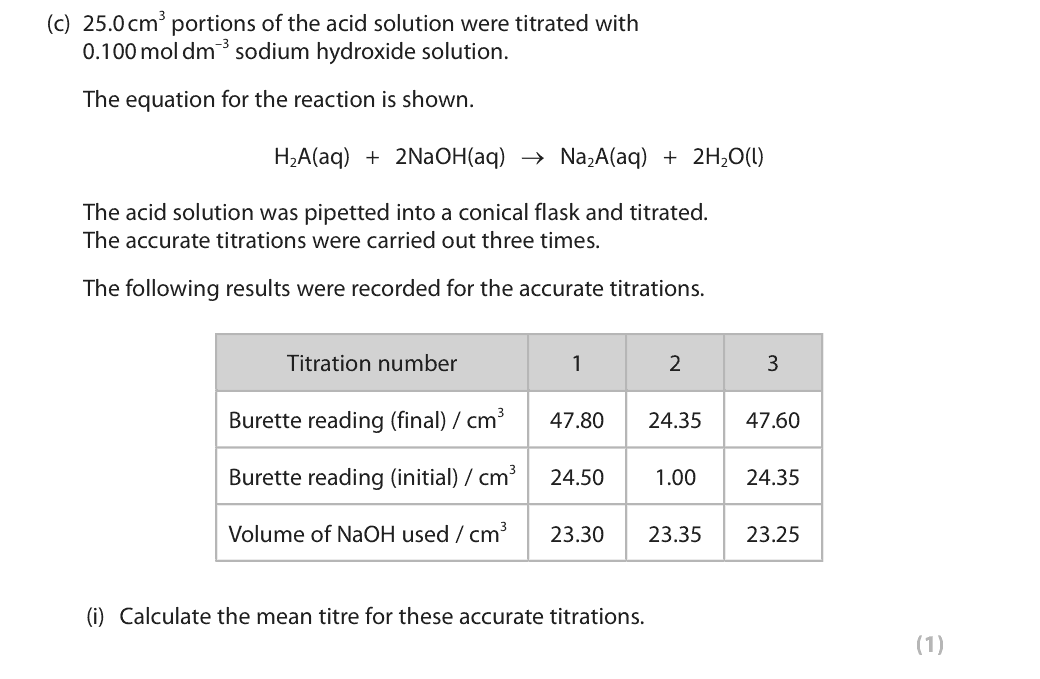
25.0 cm3 portions of the acid solution were titrated with
0.100 mol dm–3 sodium hydroxide solution.
The equation for the reaction is shown.
H2A(aq)   +   2NaOH(aq)   →   Na2A(aq)   +   2H2O(l)
The acid solution was pipetted into a conical flask and titrated.
The accurate titrations were carried out three times.
The following results were recorded for the accurate titrations.
Titration number
1
2
3
Burette reading (final) / cm3
47.80
24.35
47.60
Burette reading (initial) / cm3
24.50
1.00
24.35
Volume of NaOH used / cm3
23.30
23.35
23.25
Calculate the mean titre for these accurate titrations.
June 2024 · AS Paper 2 · Q1(c)(ii) 1 mark Calculation formulae equations and amounts of substance
Earlier parts of question 1 that this part usesEarlier part of June 2024 Paper 2 question 1Earlier part of June 2024 Paper 2 question 1
Calculate the number of moles of sodium hydroxide in the mean titre.
June 2024 · AS Paper 2 · Q1(c)(iii) 3 marks Calculation formulae equations and amounts of substance
Earlier parts of question 1 that this part usesEarlier part of June 2024 Paper 2 question 1Earlier part of June 2024 Paper 2 question 1
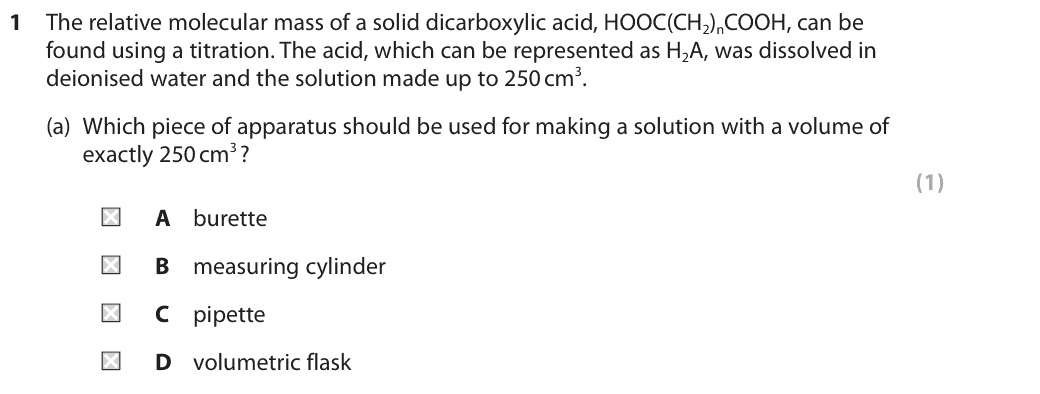
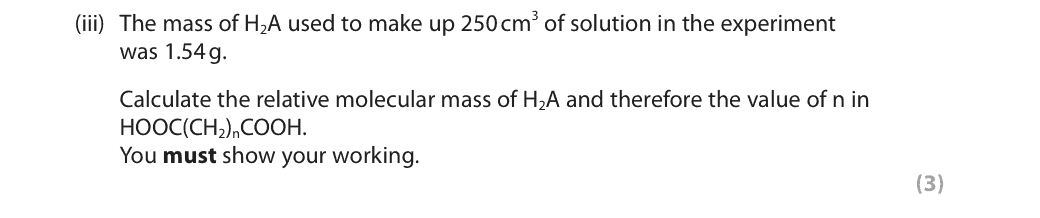
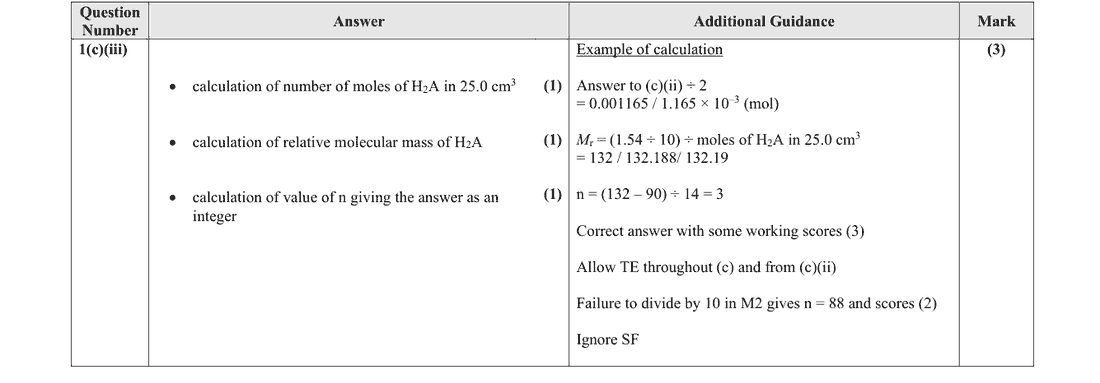
The mass of H2A used to make up 250 cm3 of solution in the experiment
was 1.54 g.
Calculate the relative molecular mass of H2A and therefore the value of n in
HOOC(CH2)nCOOH.
You must show your working.
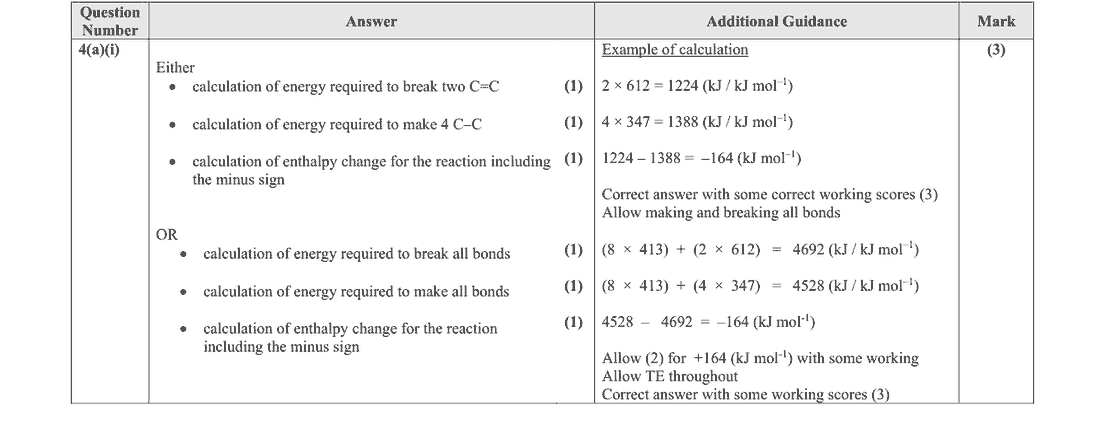
June 2024 · AS Paper 2 · Q4(a)(i) 3 marks Calculation Easy energetics i
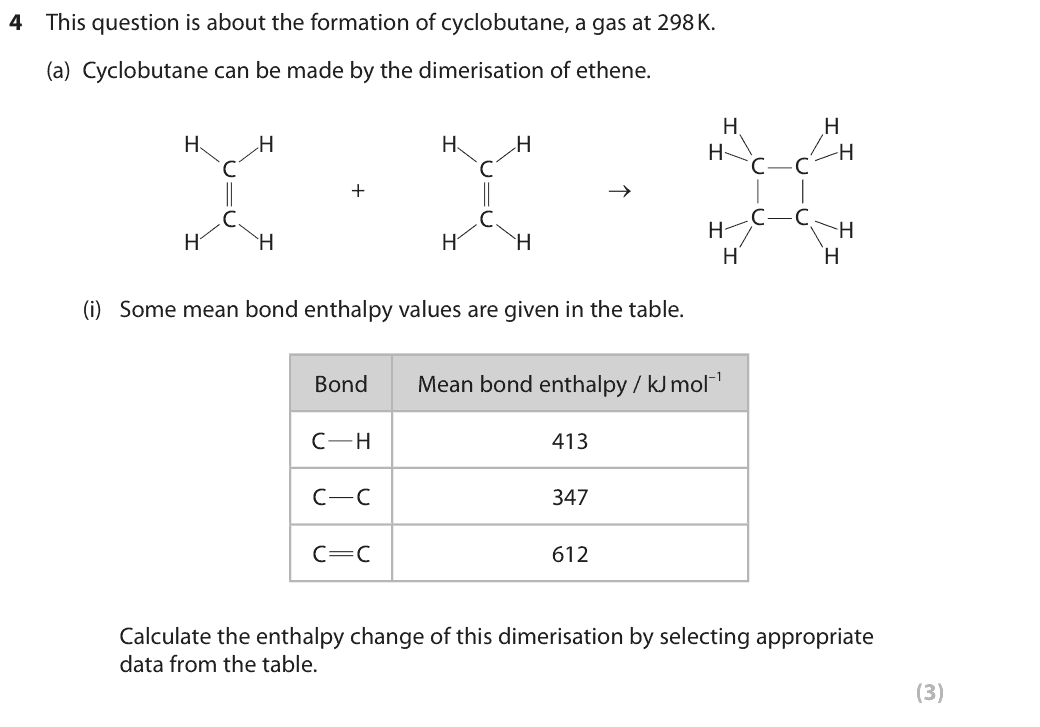
This question is about the formation of cyclobutane, a gas at 298 K.
Cyclobutane can be made by the dimerisation of ethene.
H
H
H
H
H
H
H
H
C
C
C
C
+
→
C
C
C
C
H
H
H
H
H
H
H
H
Some mean bond enthalpy values are given in the table.
Bond
Mean bond enthalpy / kJ mol–1
C
H
413
C
C
347
C
C
612
Calculate the enthalpy change of this dimerisation by selecting appropriate
data from the table.
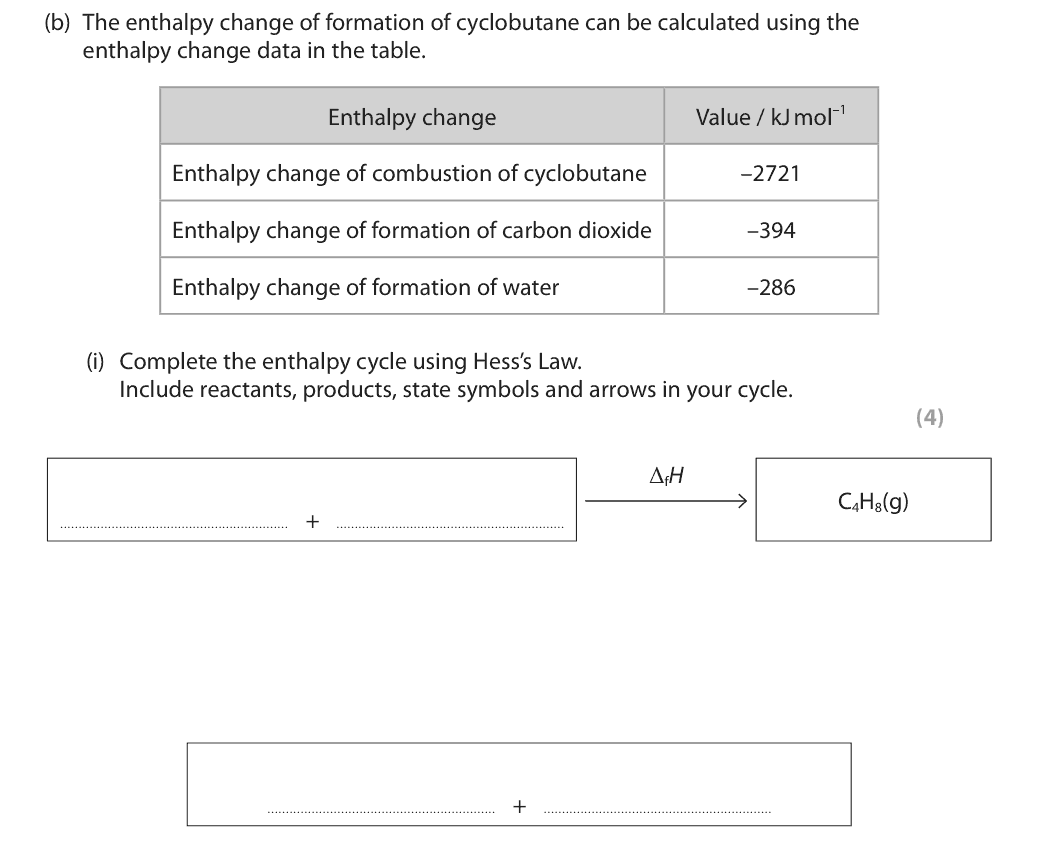
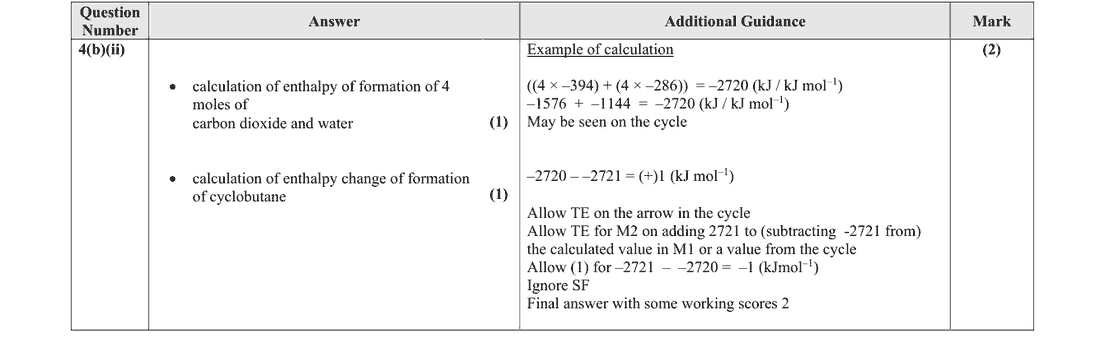
June 2024 · AS Paper 2 · Q4(b)(ii) 2 marks Calculation energetics i
Earlier parts of question 4 that this part usesEarlier part of June 2024 Paper 2 question 4Earlier part of June 2024 Paper 2 question 4
Calculate the enthalpy change of formation of cyclobutane.
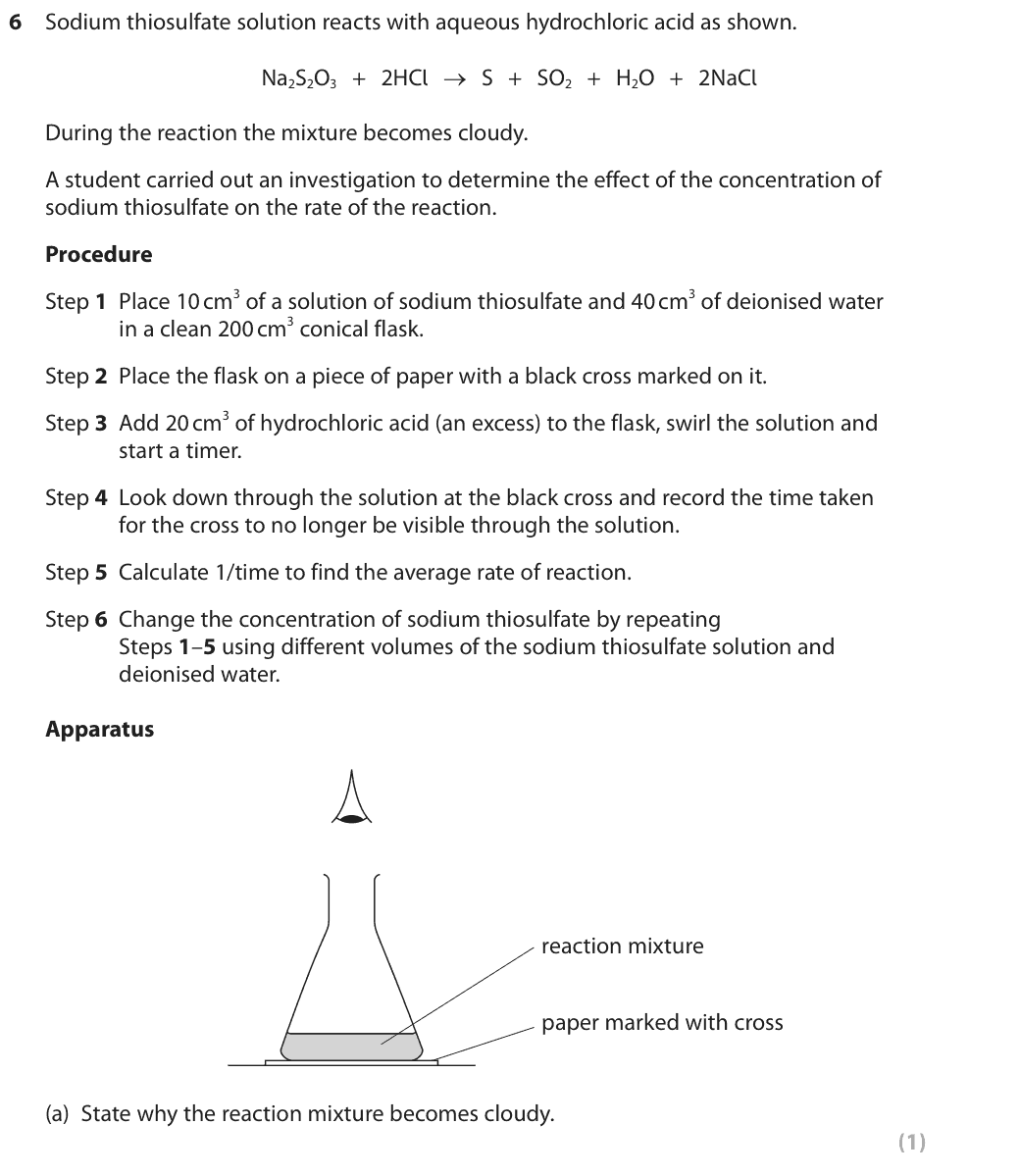
June 2024 · AS Paper 2 · Q6(c)(i) 1 mark Calculation kinetics i
Earlier part of question 6 that this part usesEarlier part of June 2024 Paper 2 question 6
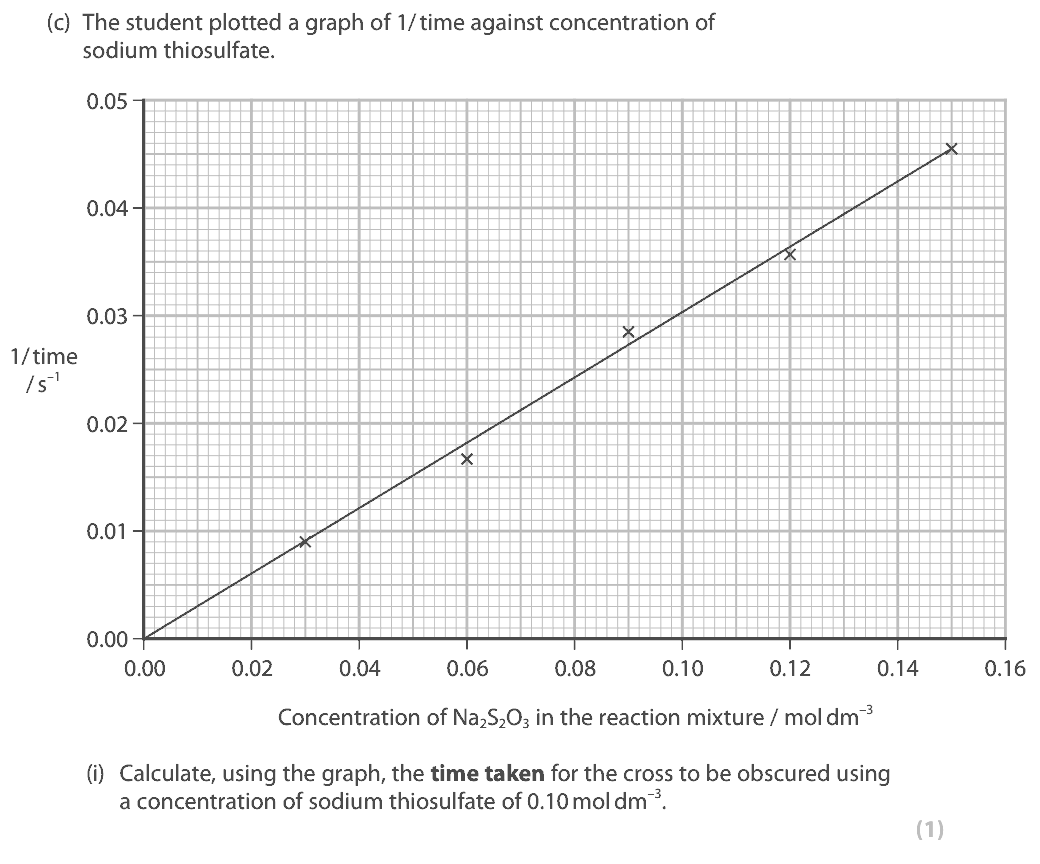
The student plotted a graph of 1/ time against concentration of
sodium thiosulfate.
0.05
0.04
0.03
1/ time
/ s–1
0.02
0.01
0.00
0.00
0.02
0.04
0.06
0.08
0.10
0.12
0.14
0.16
Concentration of Na2S2O3 in the reaction mixture / mol dm–3
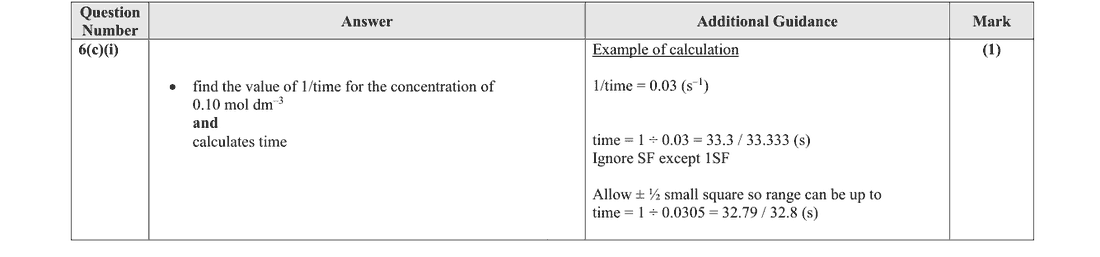
Calculate, using the graph, the time taken for the cross to be obscured using
a concentration of sodium thiosulfate of 0.10 mol dm–3.
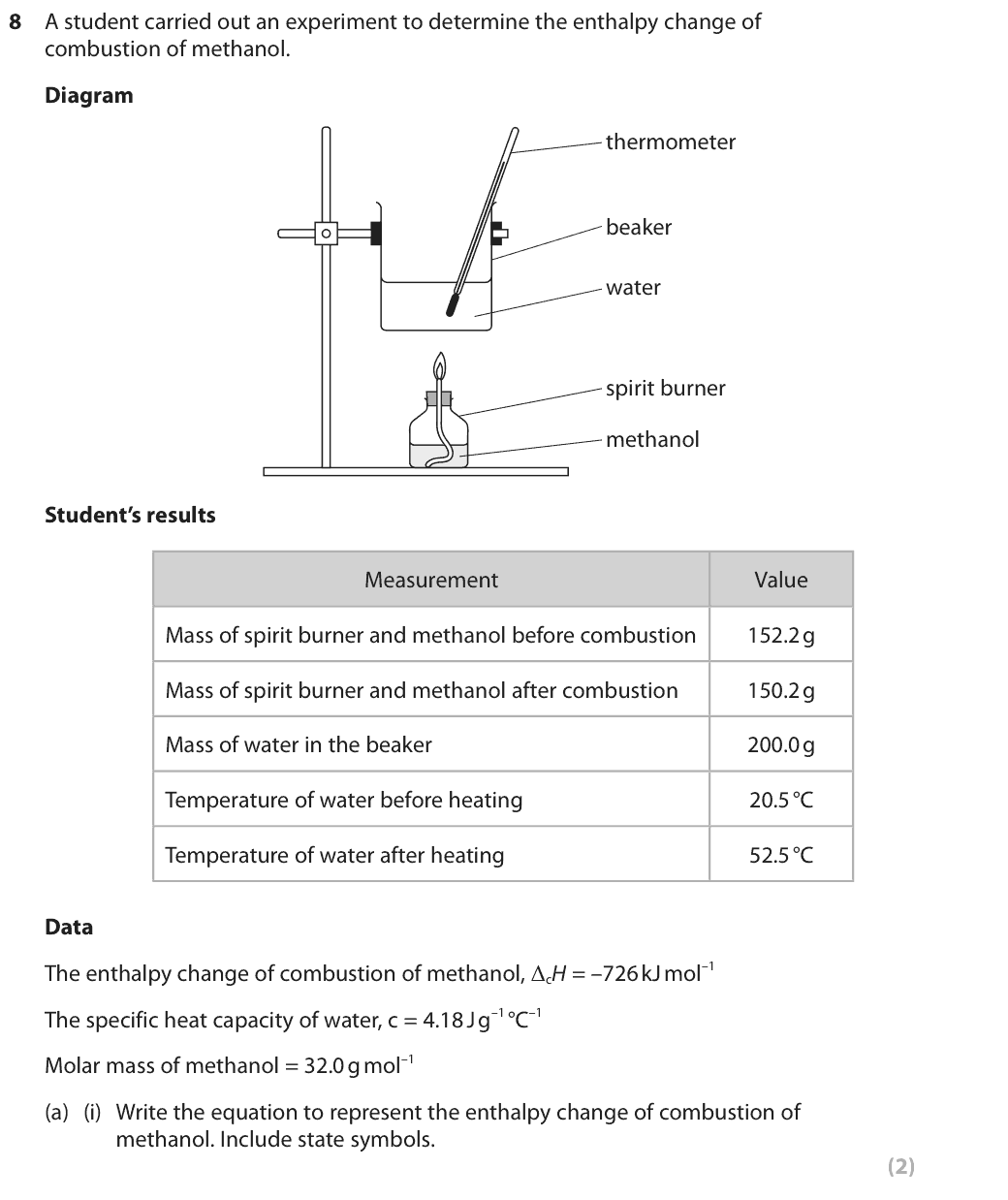
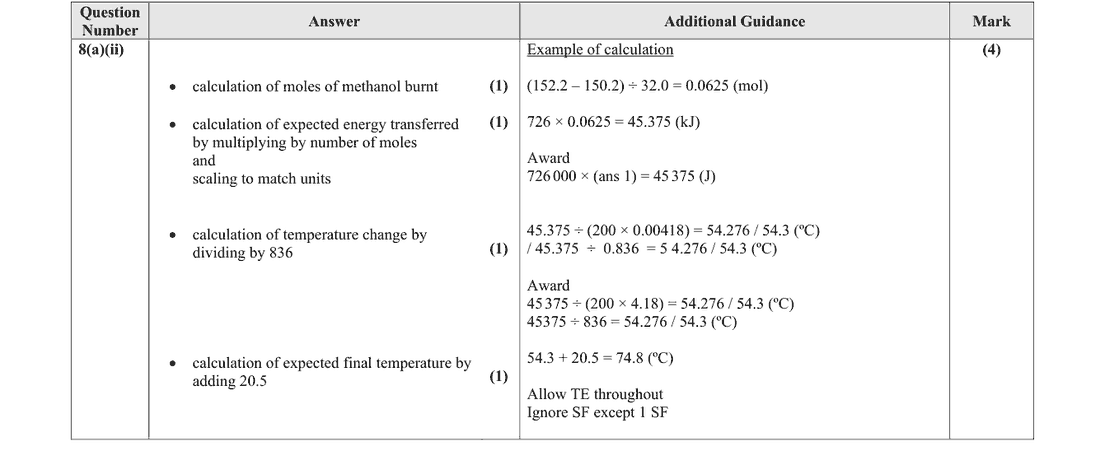
June 2024 · AS Paper 2 · Q8(a)(ii) 4 marks Calculation Hard energetics i
Earlier part of question 8 that this part usesEarlier part of June 2024 Paper 2 question 8
Calculate the expected final temperature of the water in the student’s
experiment, assuming no experimental errors.
June 2024 · AS Paper 2 · Q8(a)(iii) 1 mark Calculation Hard formulae equations and amounts of substance
Earlier part of question 8 that this part usesEarlier part of June 2024 Paper 2 question 8
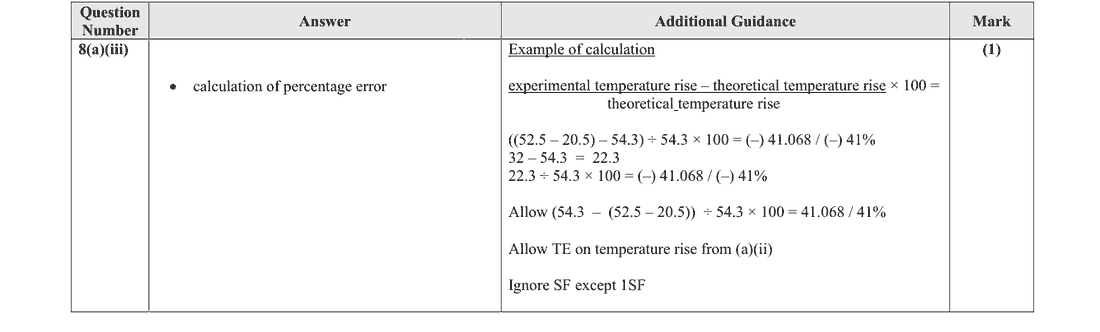
Calculate the percentage error in the experimental temperature rise
compared to the theoretical temperature rise from your calculation.
June 2024 · Paper 1 · Q1(b)(i) 1 mark Calculation atomic structure and the periodic table
Earlier part of question 1 that this part usesEarlier part of June 2024 Paper 1 question 1
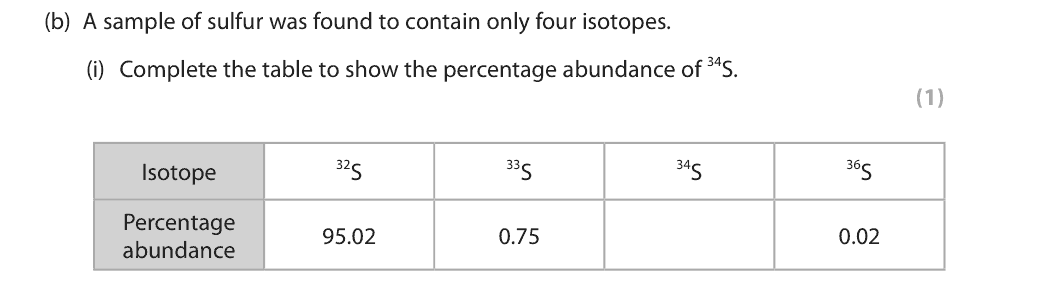
A sample of sulfur was found to contain only four isotopes.
Complete the table to show the percentage abundance of 34S.
Isotope
32S
33S
34S
36S
Percentage
95.02
0.75
0.02
abundance
June 2024 · Paper 1 · Q1(b)(ii) 2 marks Calculation atomic structure and the periodic table
Earlier parts of question 1 that this part usesEarlier part of June 2024 Paper 1 question 1Earlier part of June 2024 Paper 1 question 1
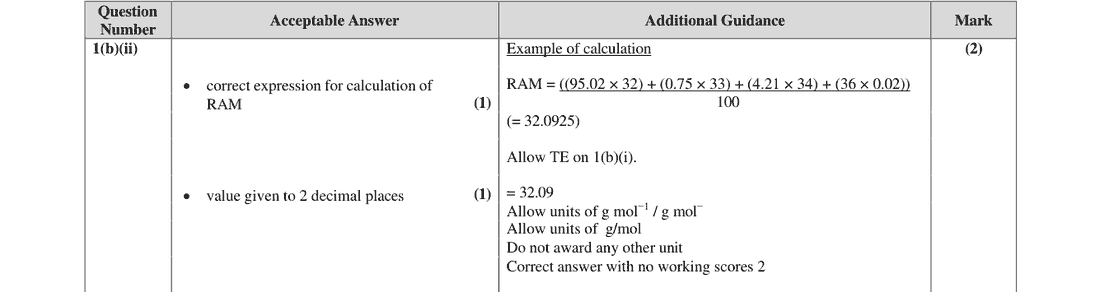
Calculate the relative atomic mass (Ar ) of the sulfur in this sample using the
data in the table. Give your answer to two decimal places.
June 2024 · Paper 1 · Q4(d)(ii) 3 marks Calculation acid base equilibria
Earlier parts of question 4 that this part usesEarlier part of June 2024 Paper 1 question 4Earlier part of June 2024 Paper 1 question 4
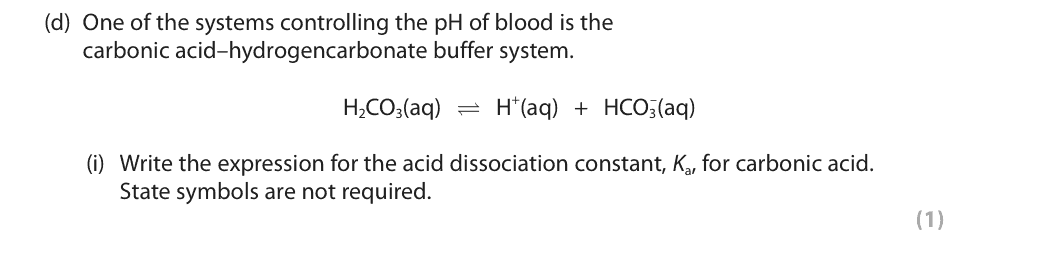
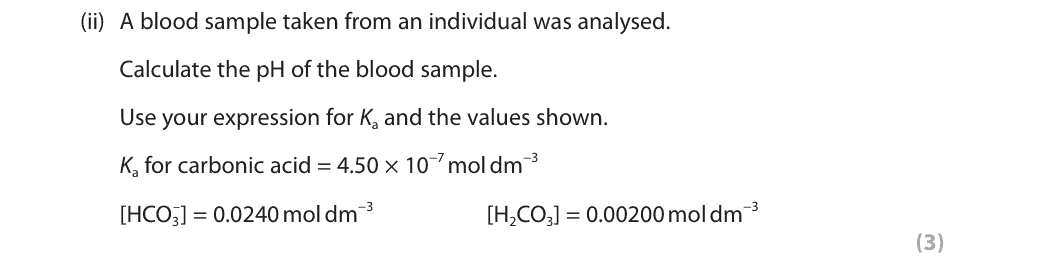
A blood sample taken from an individual was analysed.
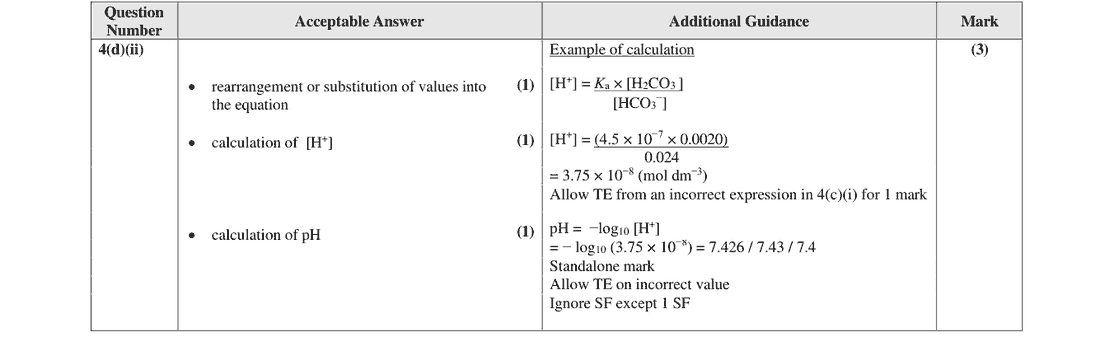
Calculate the pH of the blood sample.
Use your expression for Ka and the values shown.
Ka for carbonic acid = 4.50 × 10⁻⁷ mol dm−3
[HCO3
–] = 0.0240 mol dm−3
[H2CO3] = 0.00200 mol dm−3
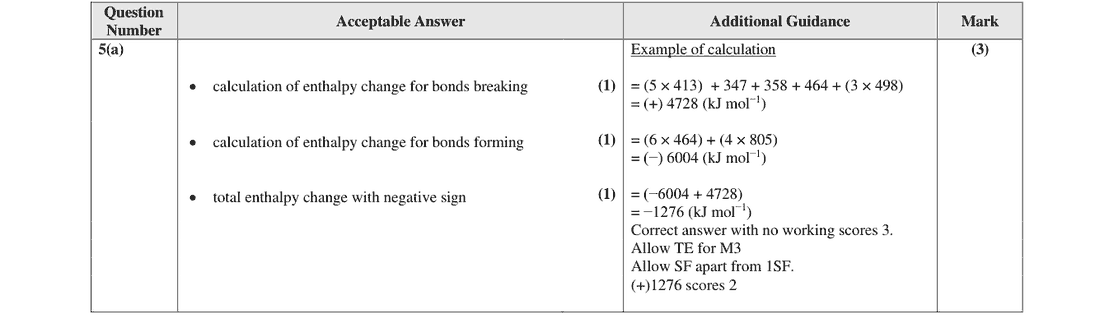
June 2024 · Paper 1 · Q5(a) 3 marks Calculation energetics i
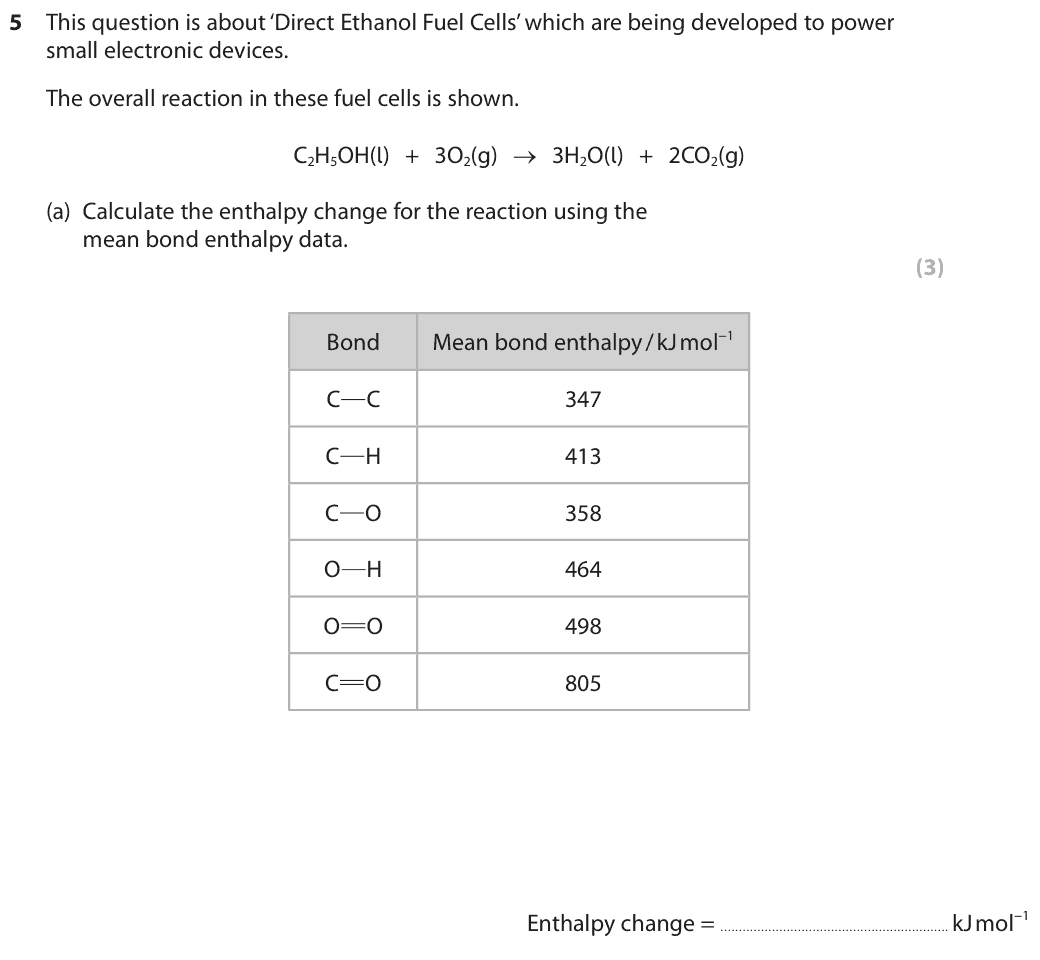
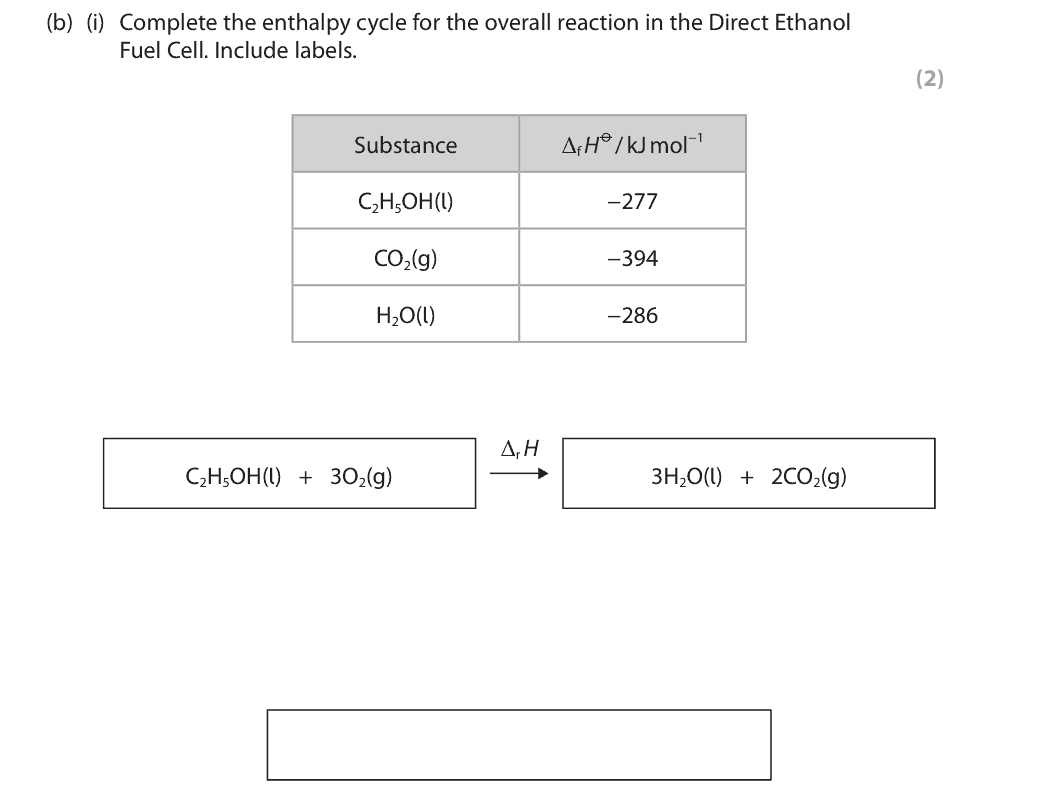
This question is about ‘Direct Ethanol Fuel Cells’ which are being developed to power
small electronic devices.
The overall reaction in these fuel cells is shown.
C2H5OH(l)   +   3O2(g)   →   3H2O(l)   +   2CO2(g)
Calculate the enthalpy change for the reaction using the
mean bond enthalpy data.
Bond
Mean bond enthalpy / kJ mol−1
C
C
347
C
H
413
C
O
358
O
H
464
O
O
498
C
O
805
Enthalpy change =  kJ mol−1
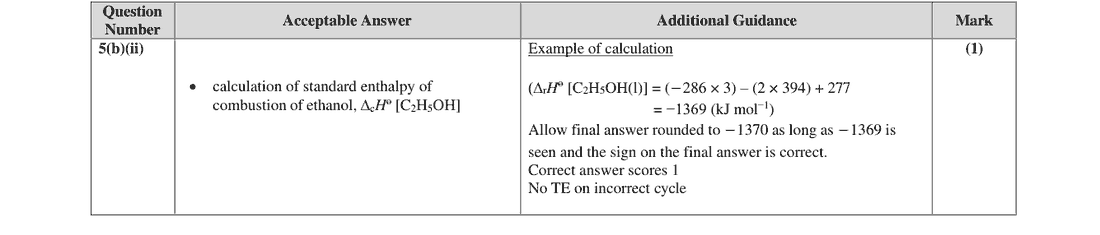
June 2024 · Paper 1 · Q5(b)(ii) 1 mark Calculation energetics i
Earlier parts of question 5 that this part usesEarlier part of June 2024 Paper 1 question 5Earlier part of June 2024 Paper 1 question 5
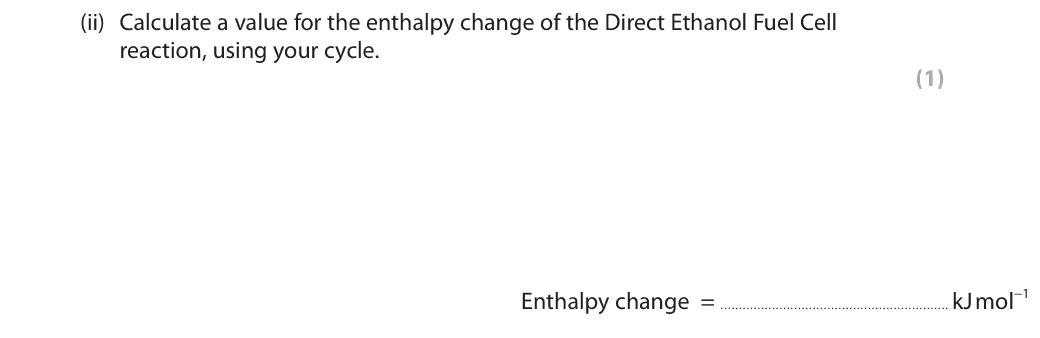
Calculate a value for the enthalpy change of the Direct Ethanol Fuel Cell
reaction, using your cycle.
Enthalpy change  =  kJ mol−1
June 2024 · Paper 1 · Q8(c)(ii) 1 mark Calculation lattice energy
Earlier parts of question 8 that this part usesEarlier part of June 2024 Paper 1 question 8Earlier part of June 2024 Paper 1 question 8
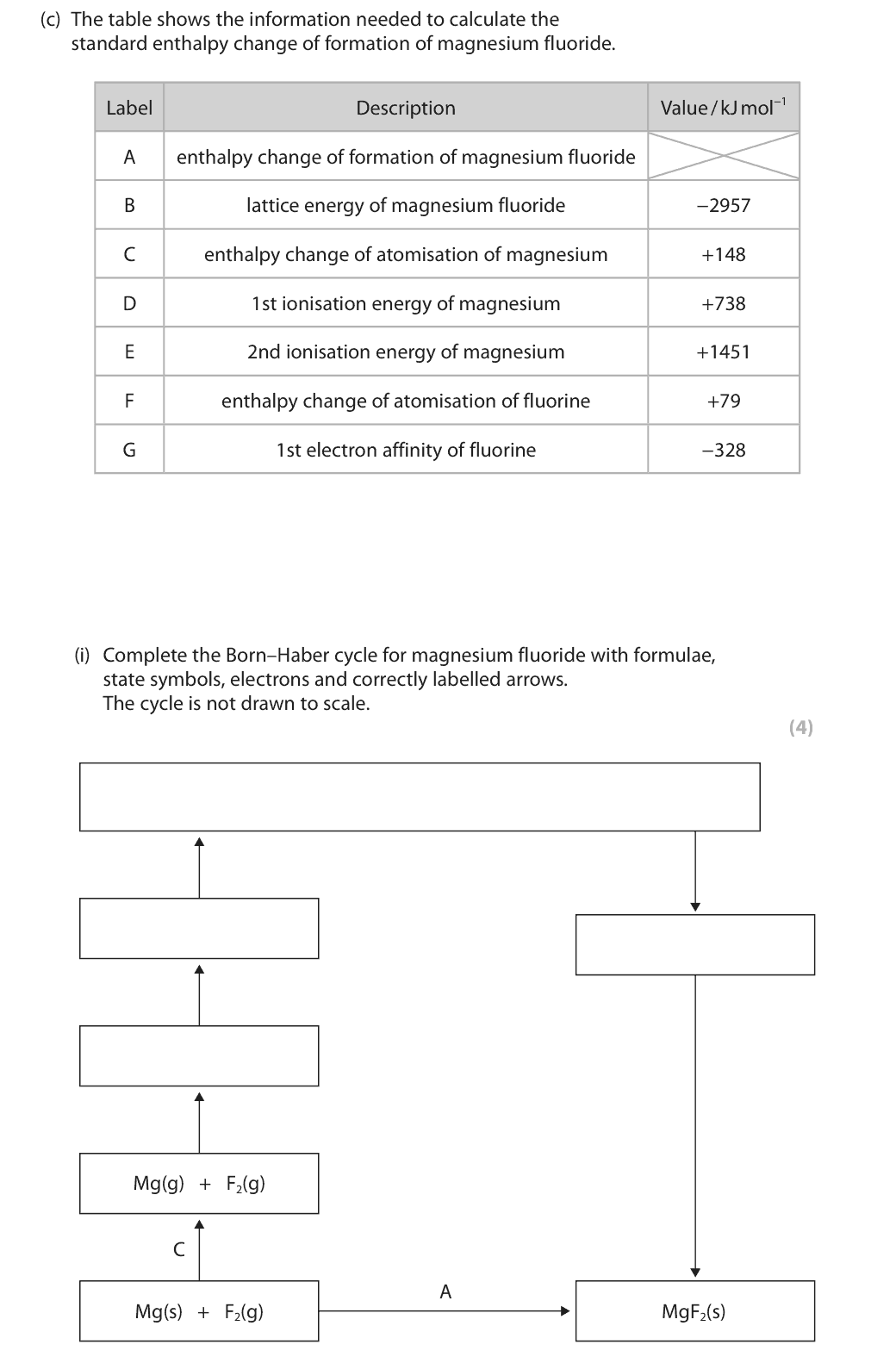
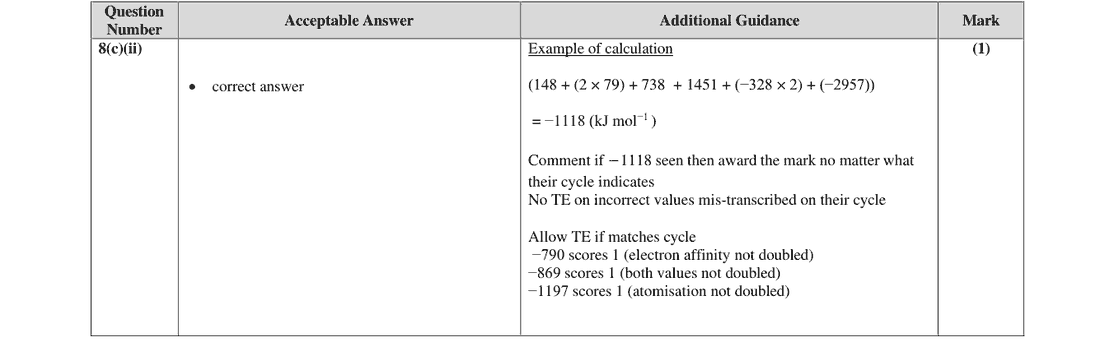
Calculate the value of Δf H   [MgF2(s)].
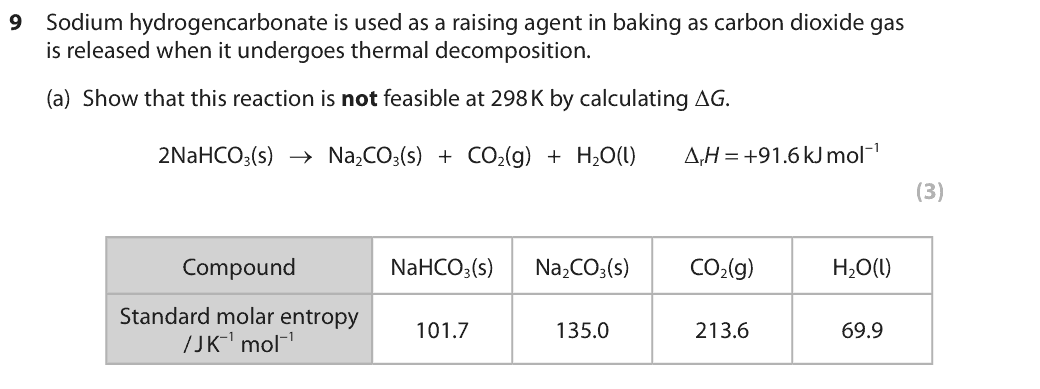
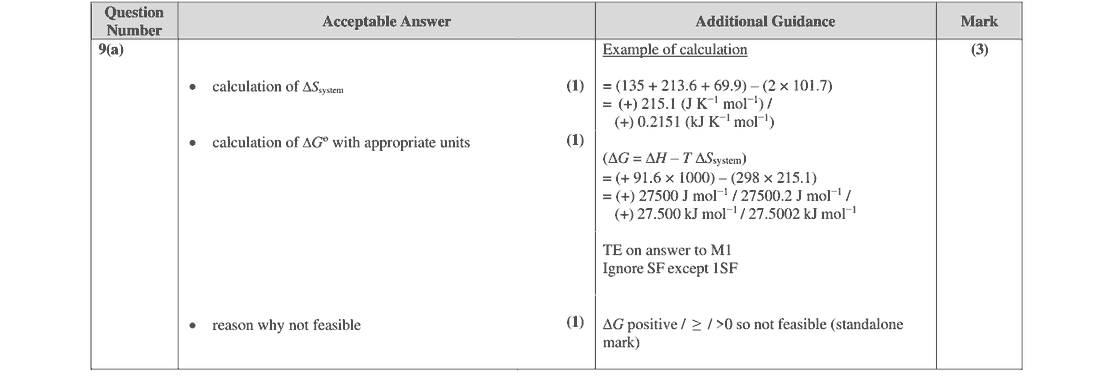
June 2024 · Paper 1 · Q9(a) 3 marks Calculation entropy
Sodium hydrogencarbonate is used as a raising agent in baking as carbon dioxide gas
is released when it undergoes thermal decomposition.
Show that this reaction is not feasible at 298 K by calculating ΔG.
2NaHCO3(s)   →   Na2CO3(s)   +   CO2(g)   +   H2O(l)        ΔrH = +91.6 kJ mol−1
Compound
NaHCO3(s)
Na2CO3(s)
CO2(g)
H2O(l)
Standard molar entropy
101.7
135.0
213.6
69.9
/ J K−1 mol−1
June 2024 · Paper 1 · Q9(b) 2 marks Calculation entropy
Earlier part of question 9 that this part usesEarlier part of June 2024 Paper 1 question 9
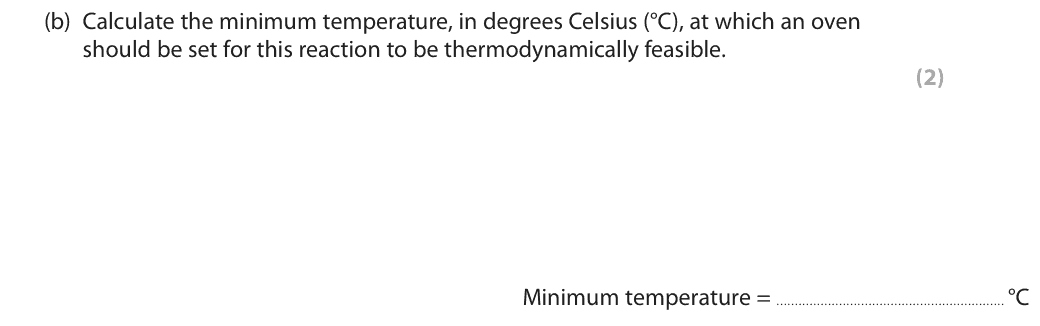
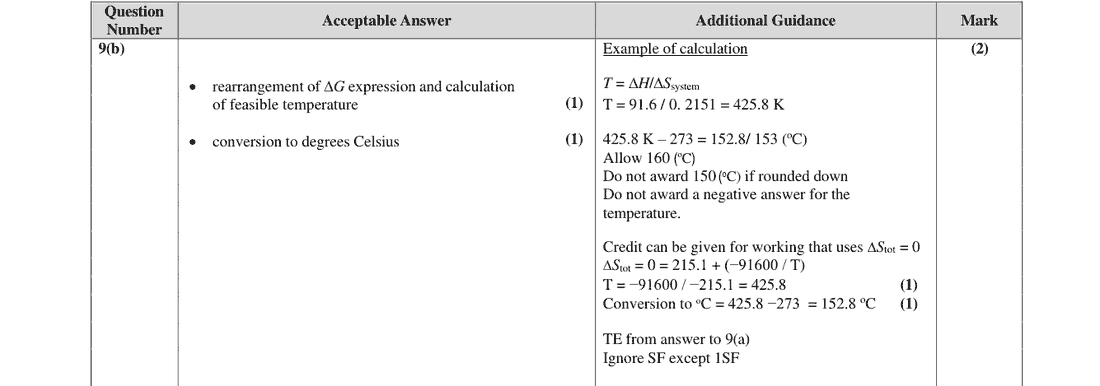
Calculate the minimum temperature, in degrees Celsius (°C), at which an oven
should be set for this reaction to be thermodynamically feasible.
Minimum temperature =  °C
June 2024 · Paper 1 · Q10(b)(ii) 2 marks Calculation redox iiformulae equations and amounts of substance
Earlier parts of question 10 that this part usesEarlier part of June 2024 Paper 1 question 10Earlier part of June 2024 Paper 1 question 10
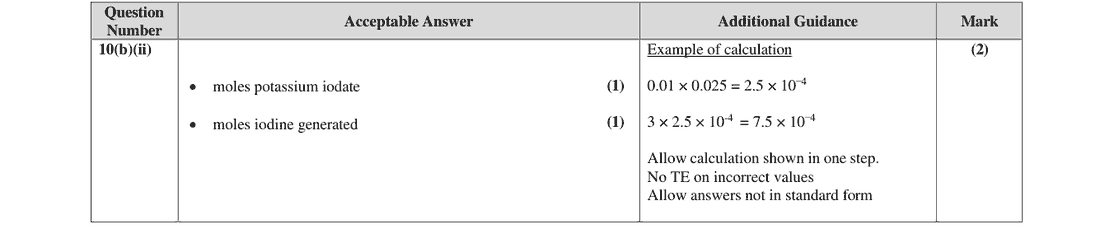
Show, by calculation, that 7.50 × 10⁻⁴ moles of iodine were produced in
the flask.
June 2024 · Paper 1 · Q10(c)(ii) 6 marks Calculation redox ii
Earlier parts of question 10 that this part usesEarlier part of June 2024 Paper 1 question 10Earlier part of June 2024 Paper 1 question 10Earlier part of June 2024 Paper 1 question 10
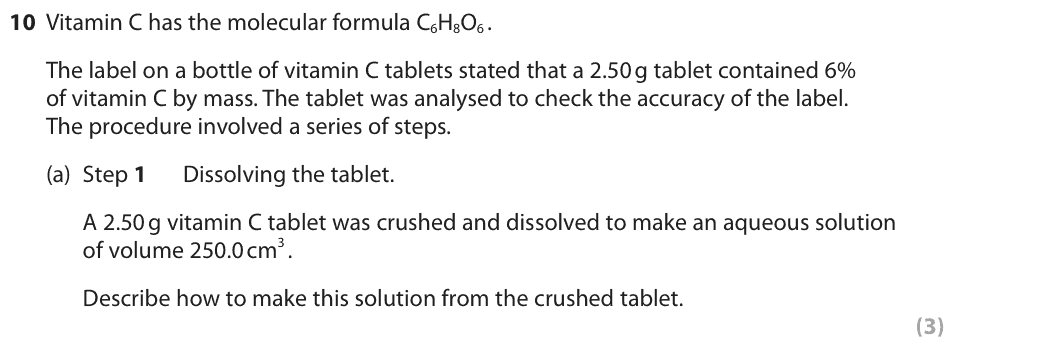
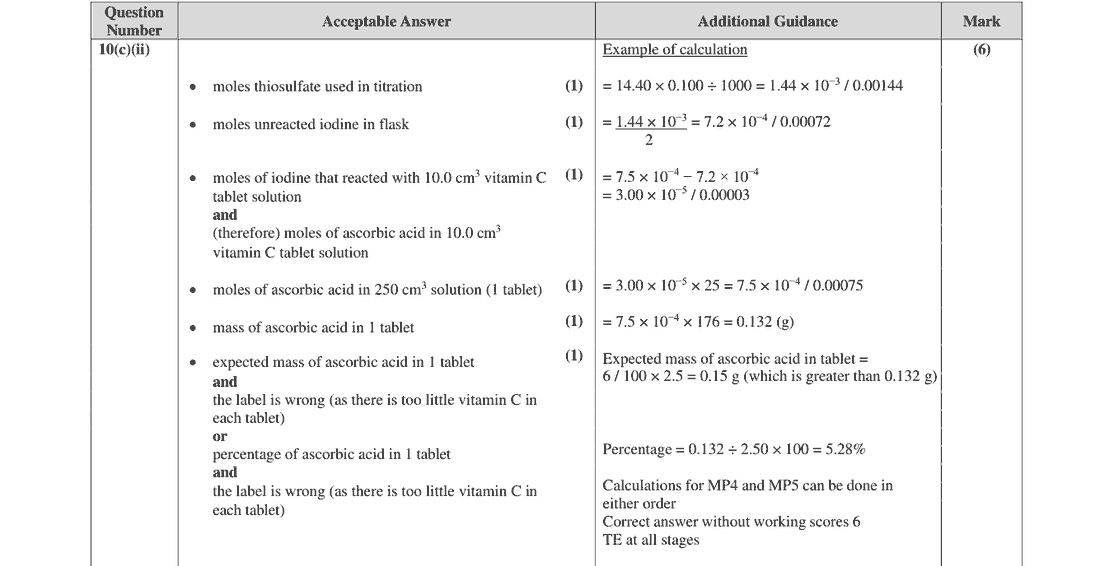
Deduce, by calculation, whether the label on the bottle of vitamin C tablets
is correct.
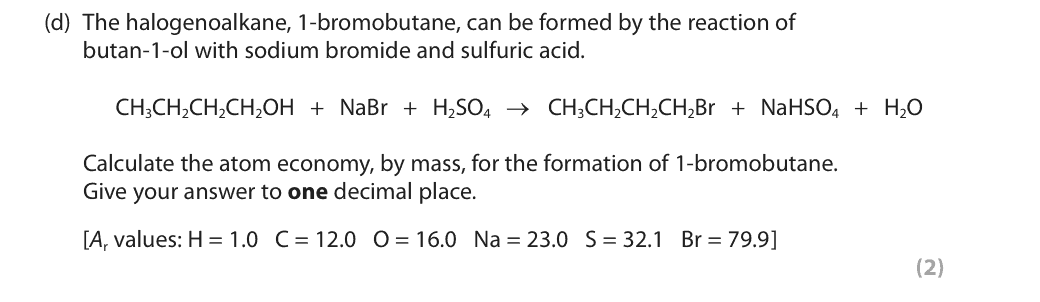
June 2024 · Paper 2 · Q1(d) 2 marks Calculation formulae equations and amounts of substance
Earlier part of question 1 that this part usesEarlier part of June 2024 Paper 2 question 1
The halogenoalkane, 1‑bromobutane, can be formed by the reaction of
butan‑1‑ol with sodium bromide and sulfuric acid.
CH3CH2CH2CH2OH   +   NaBr   +   H2SO4   →   CH3CH2CH2CH2Br   +   NaHSO4   +   H2O
Calculate the atom economy, by mass, for the formation of 1‑bromobutane.
Give your answer to one decimal place.
[Ar values: H = 1.0   C = 12.0   O = 16.0   Na = 23.0   S = 32.1   Br = 79.9]
June 2024 · Paper 2 · Q3(c)(iii) 2 marks Calculation kinetics ii
Earlier parts of question 3 that this part usesEarlier part of June 2024 Paper 2 question 3Earlier part of June 2024 Paper 2 question 3Earlier part of June 2024 Paper 2 question 3
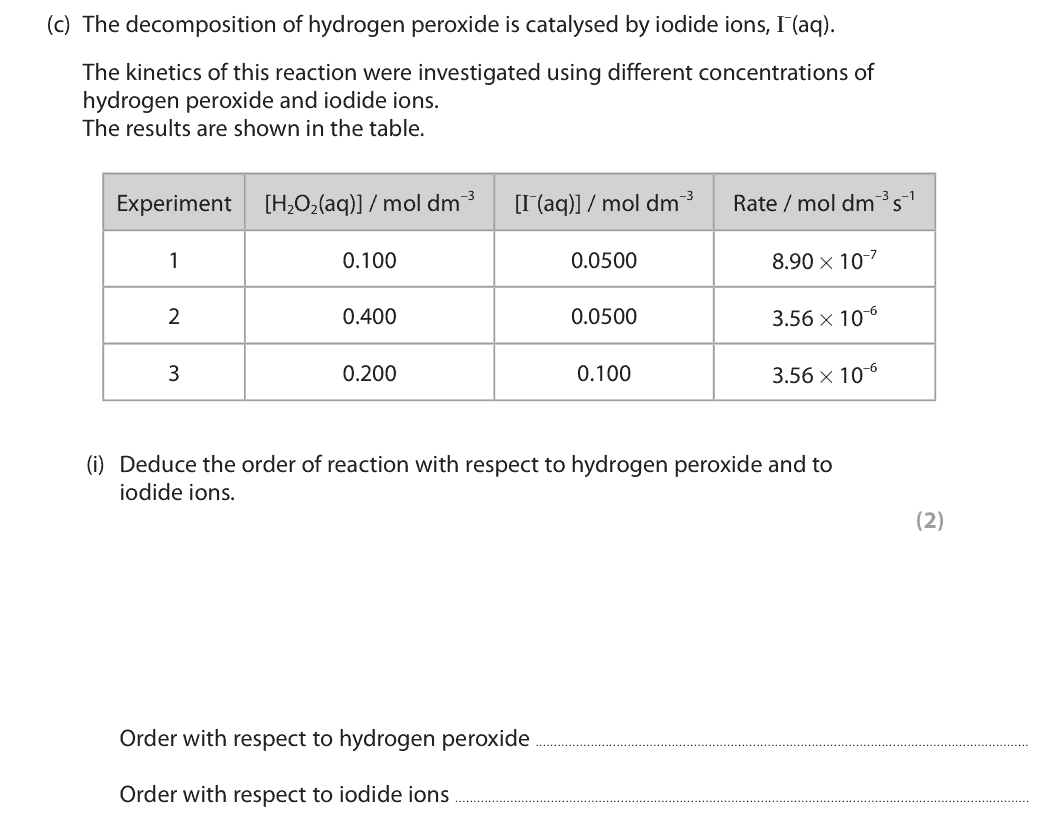
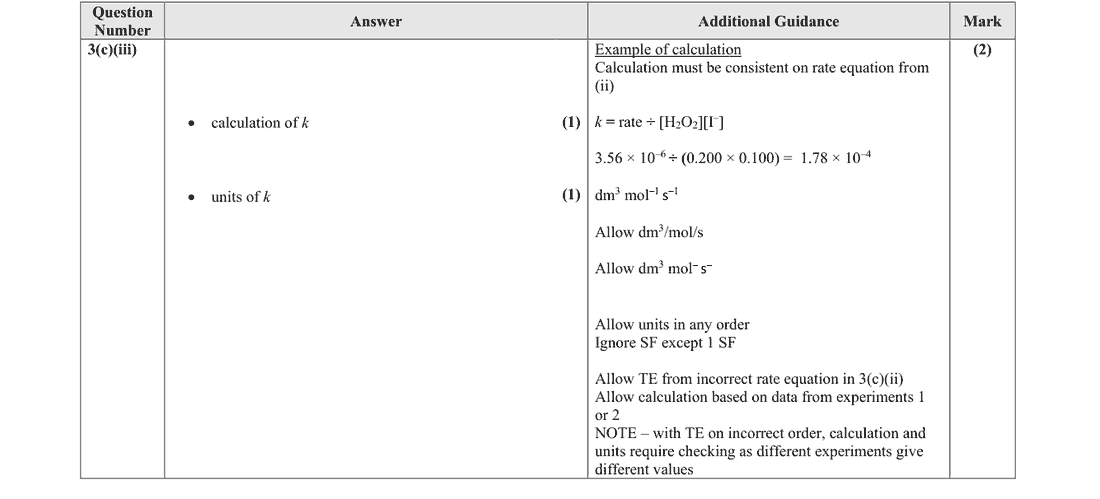
Calculate the rate constant, k, using data from Experiment 3.
Include units in your answer.
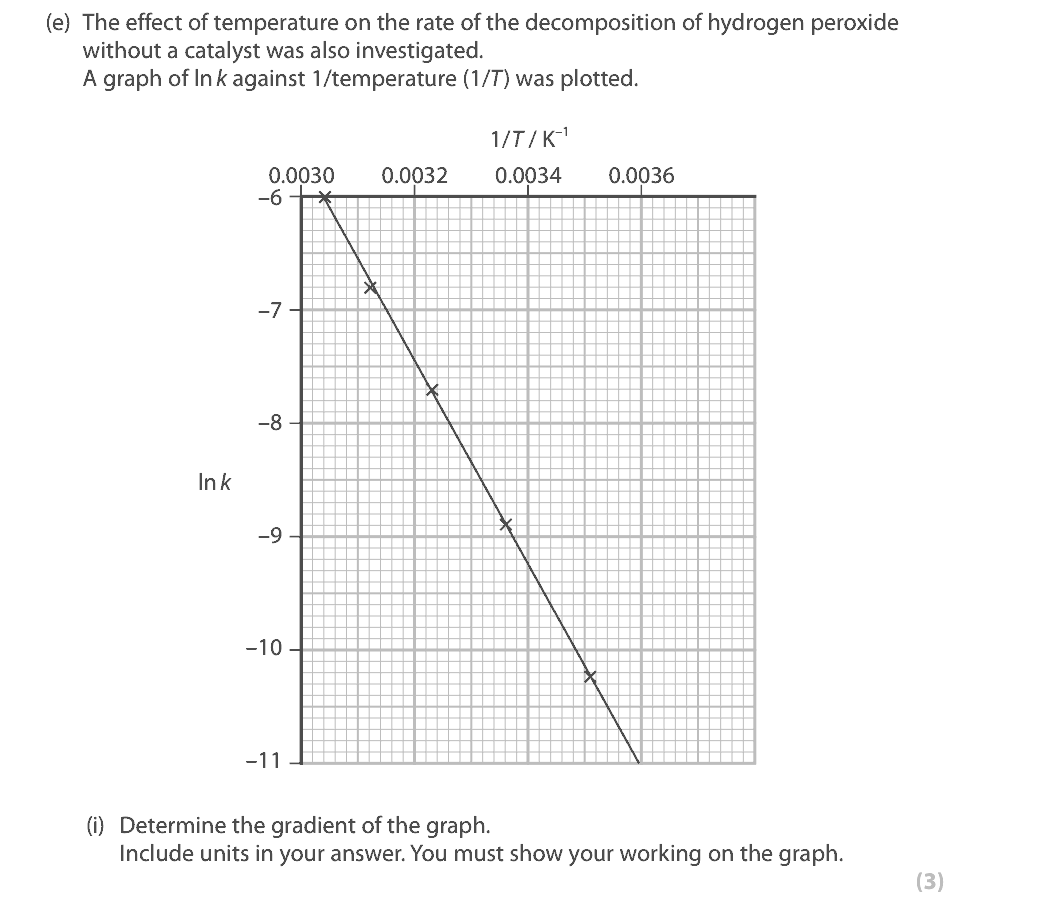
June 2024 · Paper 2 · Q3(e)(i) 3 marks Calculation kinetics ii
Earlier part of question 3 that this part usesEarlier part of June 2024 Paper 2 question 3
The effect of temperature on the rate of the decomposition of hydrogen peroxide
without a catalyst was also investigated.
A graph of ln k against 1/temperature (1/T) was plotted.
1/T / K–1
0.0030
0.0032
0.0034
0.0036
–6
–7
–8
ln k
–9
–10
–11
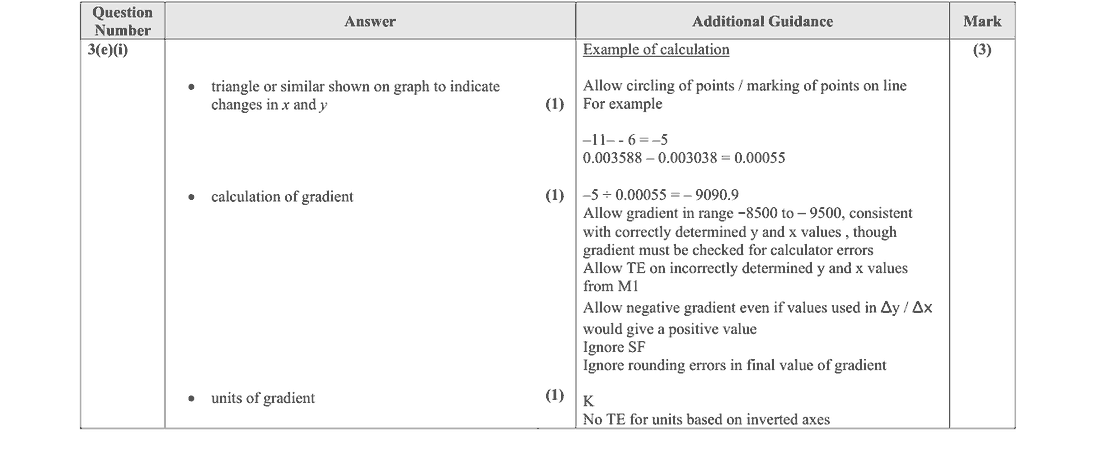
Determine the gradient of the graph.
Include units in your answer. You must show your working on the graph.
June 2024 · Paper 2 · Q3(e)(ii) 1 mark Calculation kinetics ii
Earlier parts of question 3 that this part usesEarlier part of June 2024 Paper 2 question 3Earlier part of June 2024 Paper 2 question 3
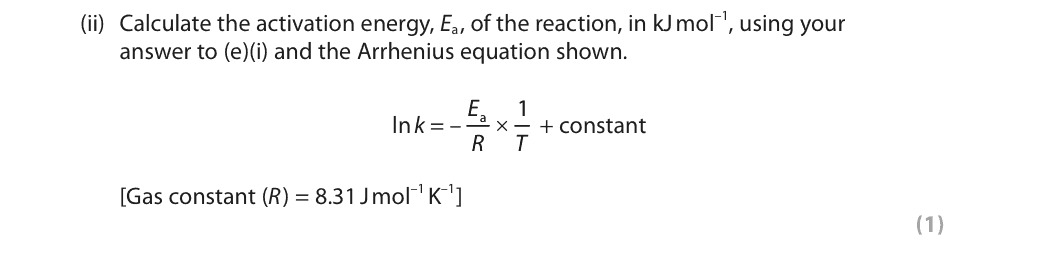
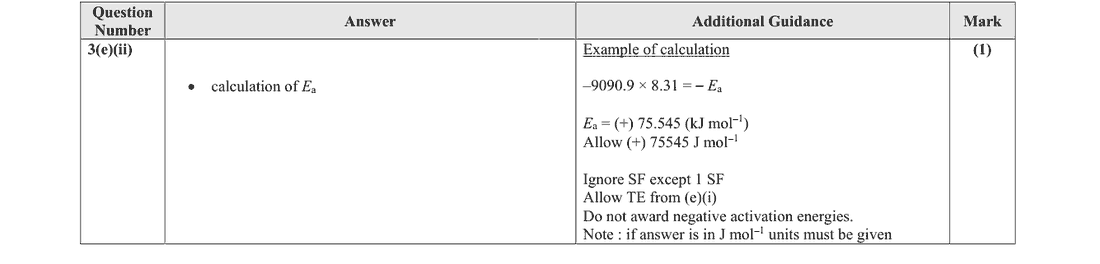
Calculate the activation energy, Ea, of the reaction, in kJ mol–1, using your
answer to (e)(i) and the Arrhenius equation shown.
ln k = – E
a × 1 + constant
R
T
[Gas constant (R) = 8.31 J mol–1 K–1]
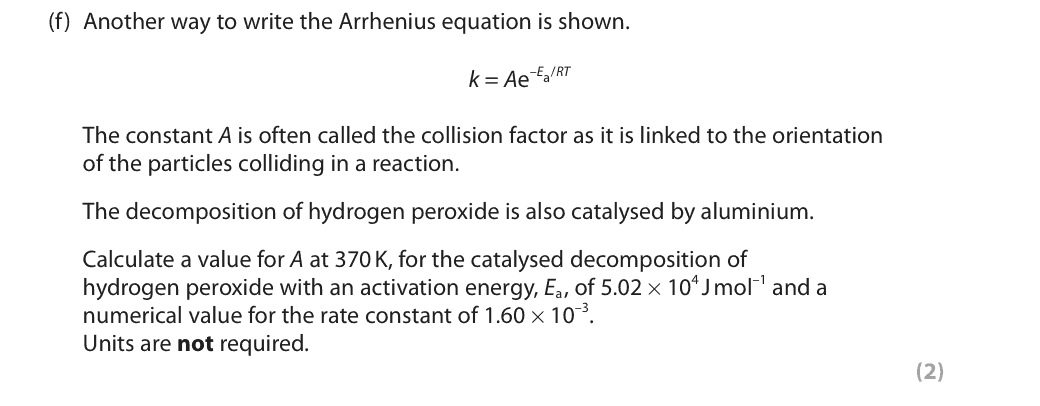
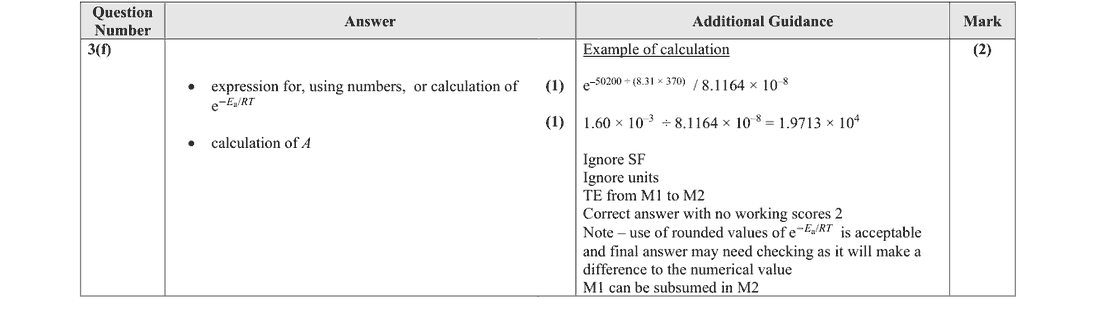
June 2024 · Paper 2 · Q3(f) 2 marks Calculation kinetics ii
Earlier part of question 3 that this part usesEarlier part of June 2024 Paper 2 question 3
Another way to write the Arrhenius equation is shown.
k = Ae–Ea/RT
The constant A is often called the collision factor as it is linked to the orientation
of the particles colliding in a reaction.
The decomposition of hydrogen peroxide is also catalysed by aluminium.
Calculate a value for A at 370 K, for the catalysed decomposition of
hydrogen peroxide with an activation energy, Ea, of 5.02 × 104 J mol–1 and a
numerical value for the rate constant of 1.60 × 10–3.
Units are not required.
June 2024 · Paper 2 · Q5(b) 2 marks Calculation formulae equations and amounts of substance
Earlier part of question 5 that this part usesEarlier part of June 2024 Paper 2 question 5
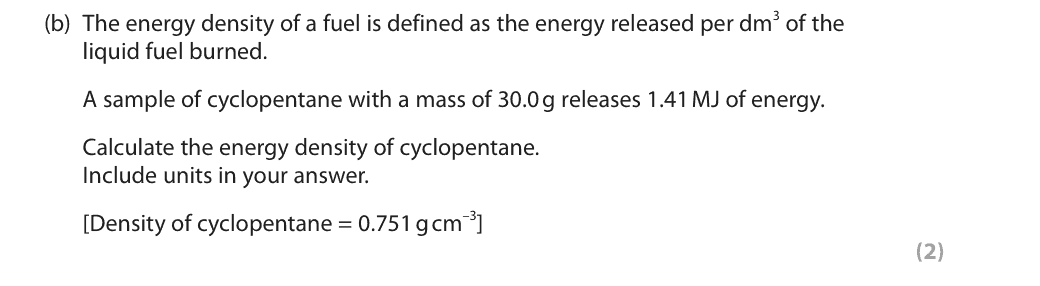
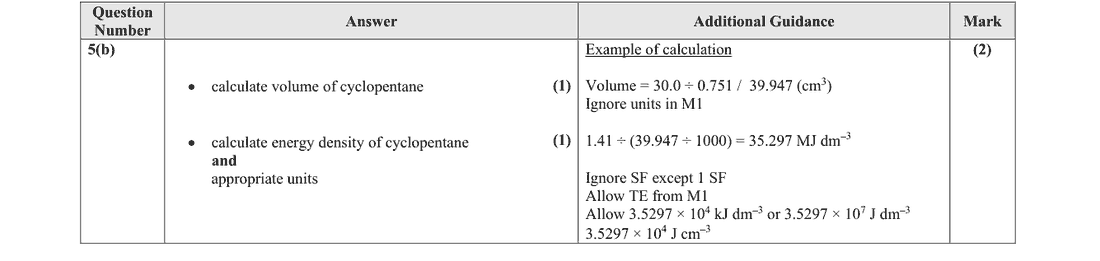
The energy density of a fuel is defined as the energy released per dm3 of the
liquid fuel burned.
A sample of cyclopentane with a mass of 30.0 g releases 1.41 MJ of energy.
Calculate the energy density of cyclopentane.
Include units in your answer.
[Density of cyclopentane = 0.751 g cm–3]
June 2024 · Paper 2 · Q7(b) 5 marks Calculation formulae equations and amounts of substance
Earlier part of question 7 that this part usesEarlier part of June 2024 Paper 2 question 7
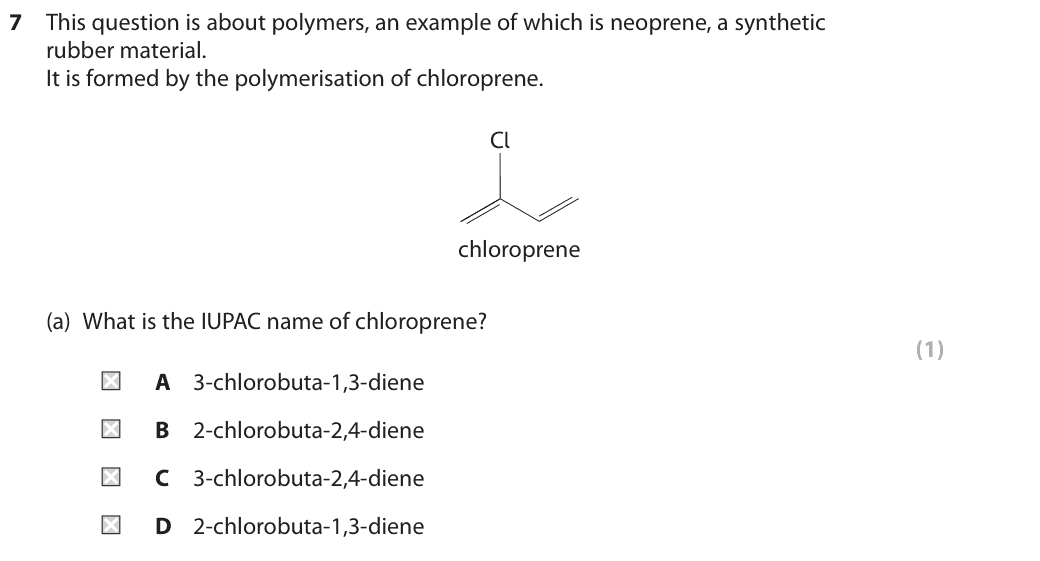
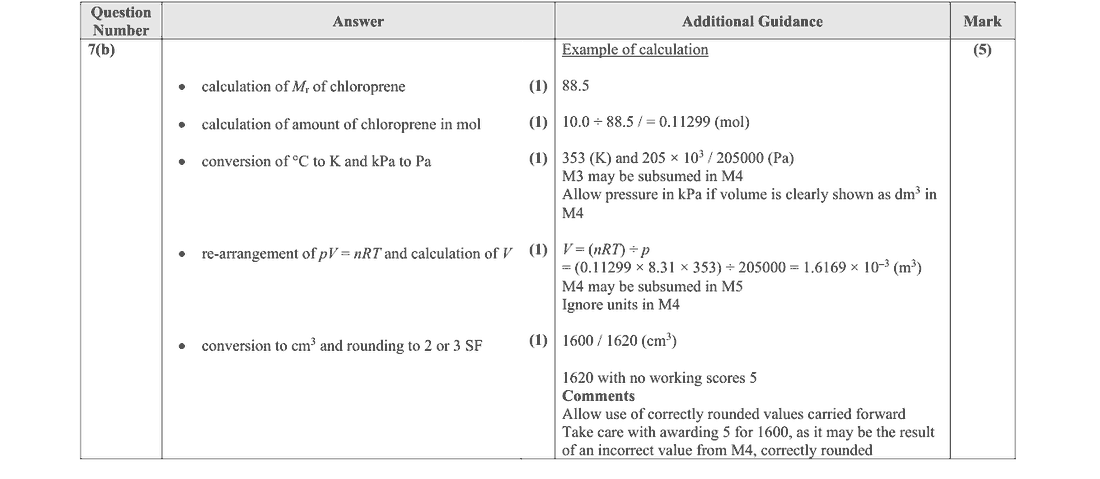
Calculate the volume, in cm3, occupied by 10.0 g of chloroprene in the
gaseous phase, at 80.0 °C and 205 kPa.
Give your answer to an appropriate number of significant figures.
[Gas constant (R) = 8.31 J mol–1 K–1]
June 2024 · Paper 2 · Q7(d)(ii) 2 marks Calculation formulae equations and amounts of substance
Earlier parts of question 7 that this part usesEarlier part of June 2024 Paper 2 question 7Earlier part of June 2024 Paper 2 question 7
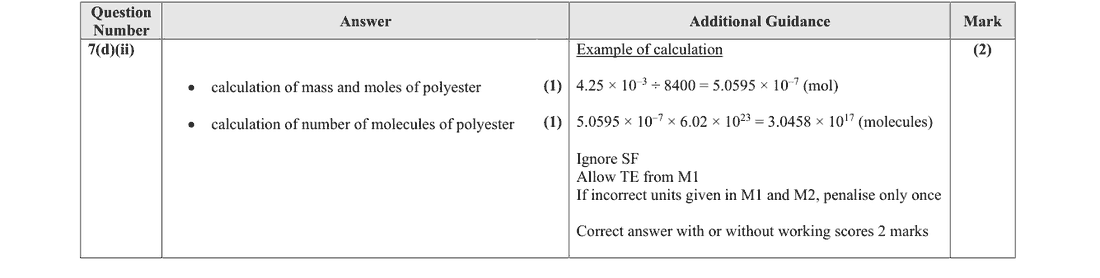
The molar mass of a polyester is 8400 g mol–1.
Calculate the number of polymer molecules in 4.25 mg of this polyester.
[Avogadro constant (L) = 6.02 × 1023 mol–1]
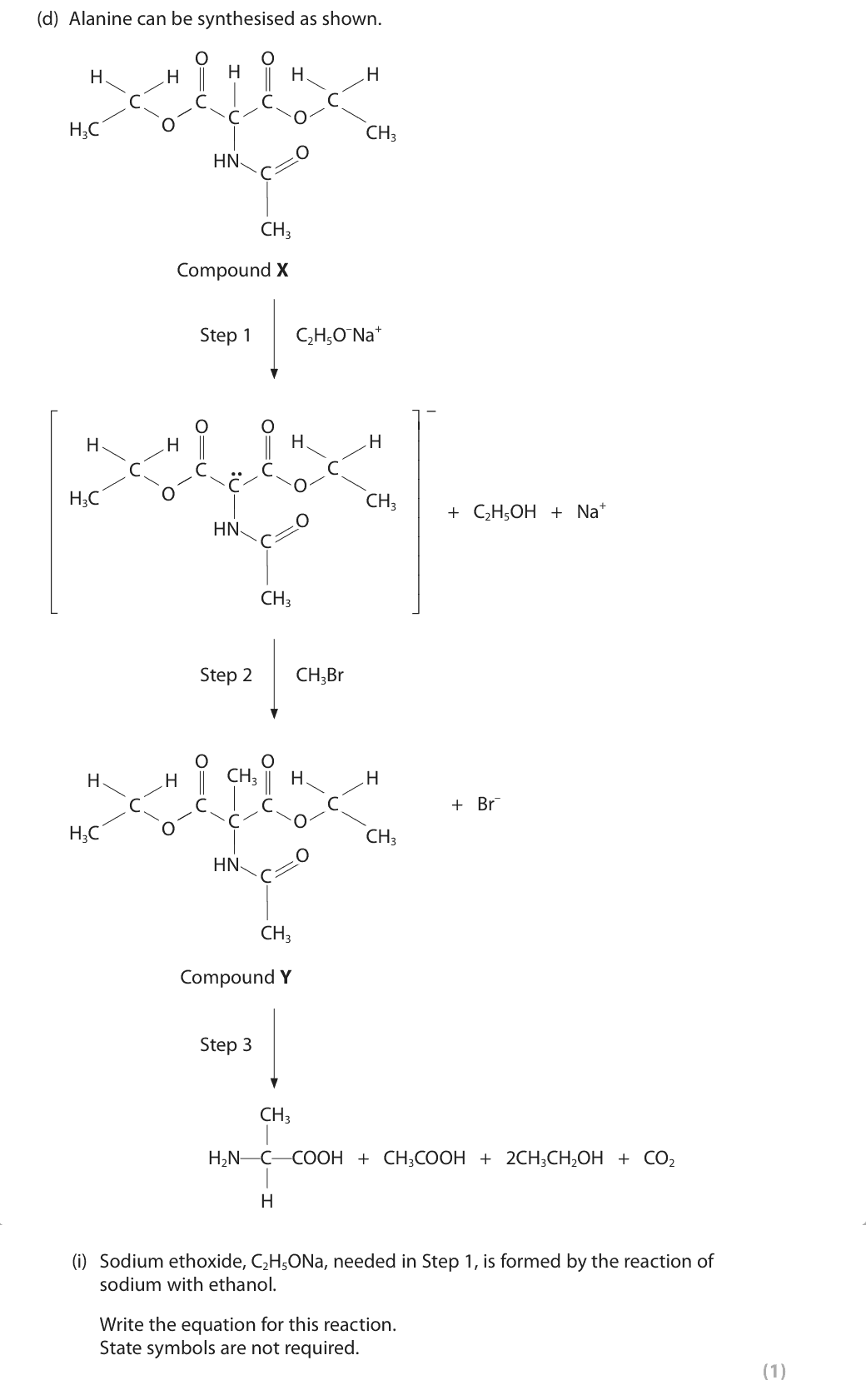
June 2024 · Paper 2 · Q8(d)(iv) 3 marks Calculation formulae equations and amounts of substance
Earlier parts of question 8 that this part usesEarlier part of June 2024 Paper 2 question 8Earlier part of June 2024 Paper 2 question 8
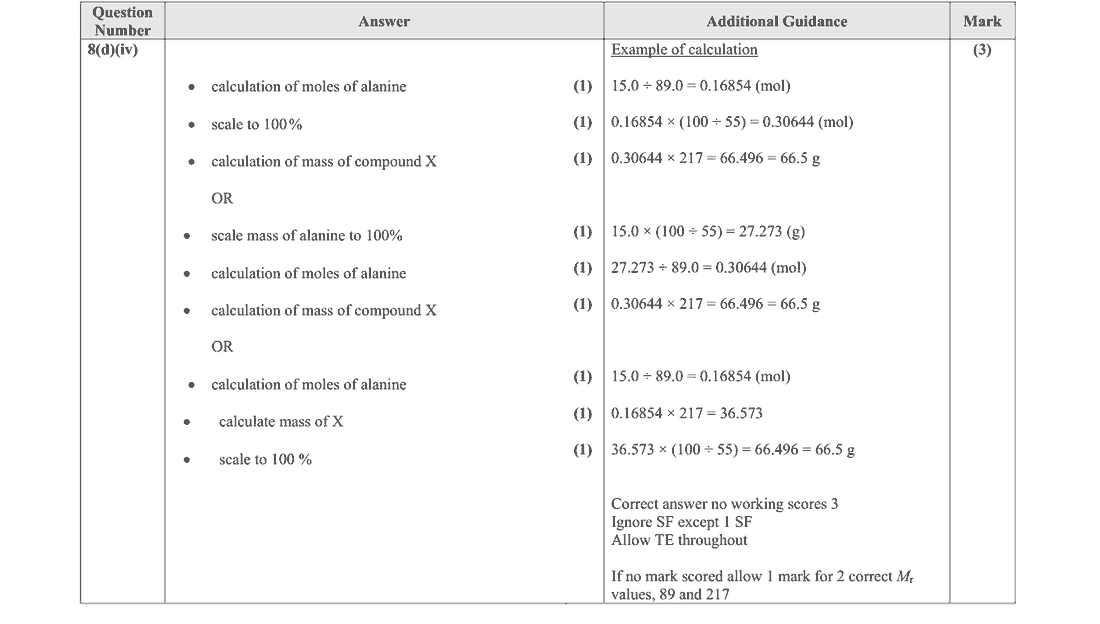
Calculate the mass of Compound X required to make 15.0 g of alanine,
assuming the overall yield of the synthesis is 55 %.
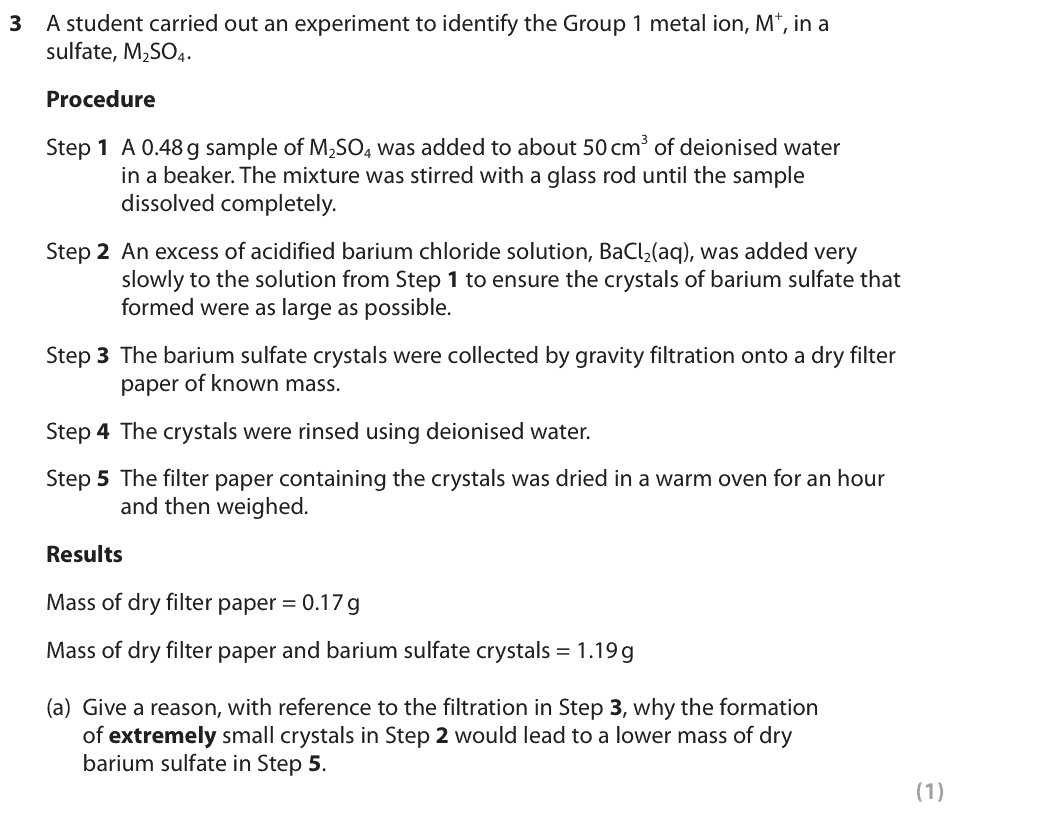
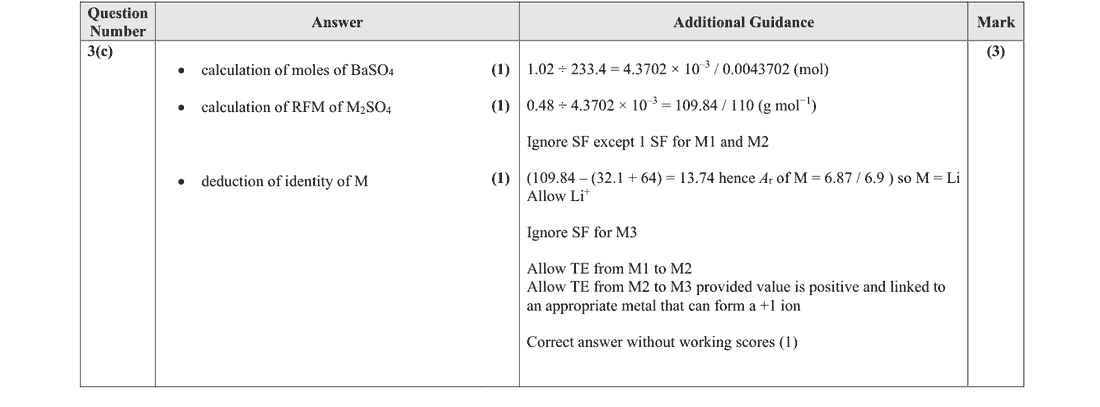
June 2024 · Paper 3 · Q3(c) 3 marks Calculation formulae equations and amounts of substance
Earlier part of question 3 that this part usesEarlier part of June 2024 Paper 3 question 3
Calculate the relative formula mass of M2SO4 and hence identify M.
M2SO4(aq)   +   BaCl2(aq)   →   BaSO4(s)   +   2MCl(aq)
[Mr of BaSO4 = 233.4]
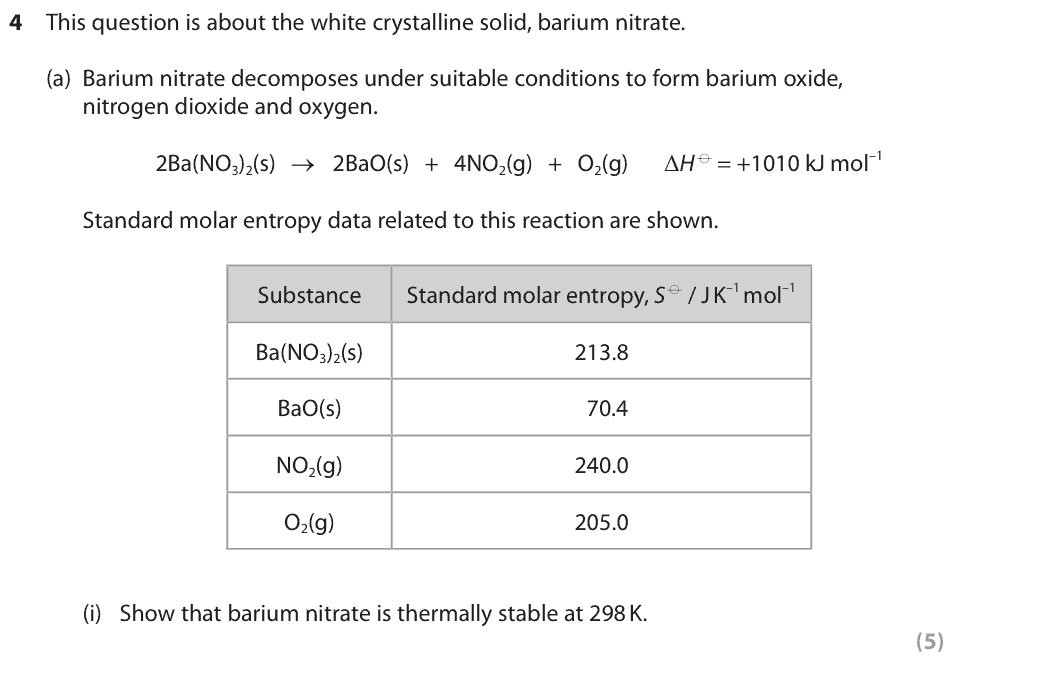
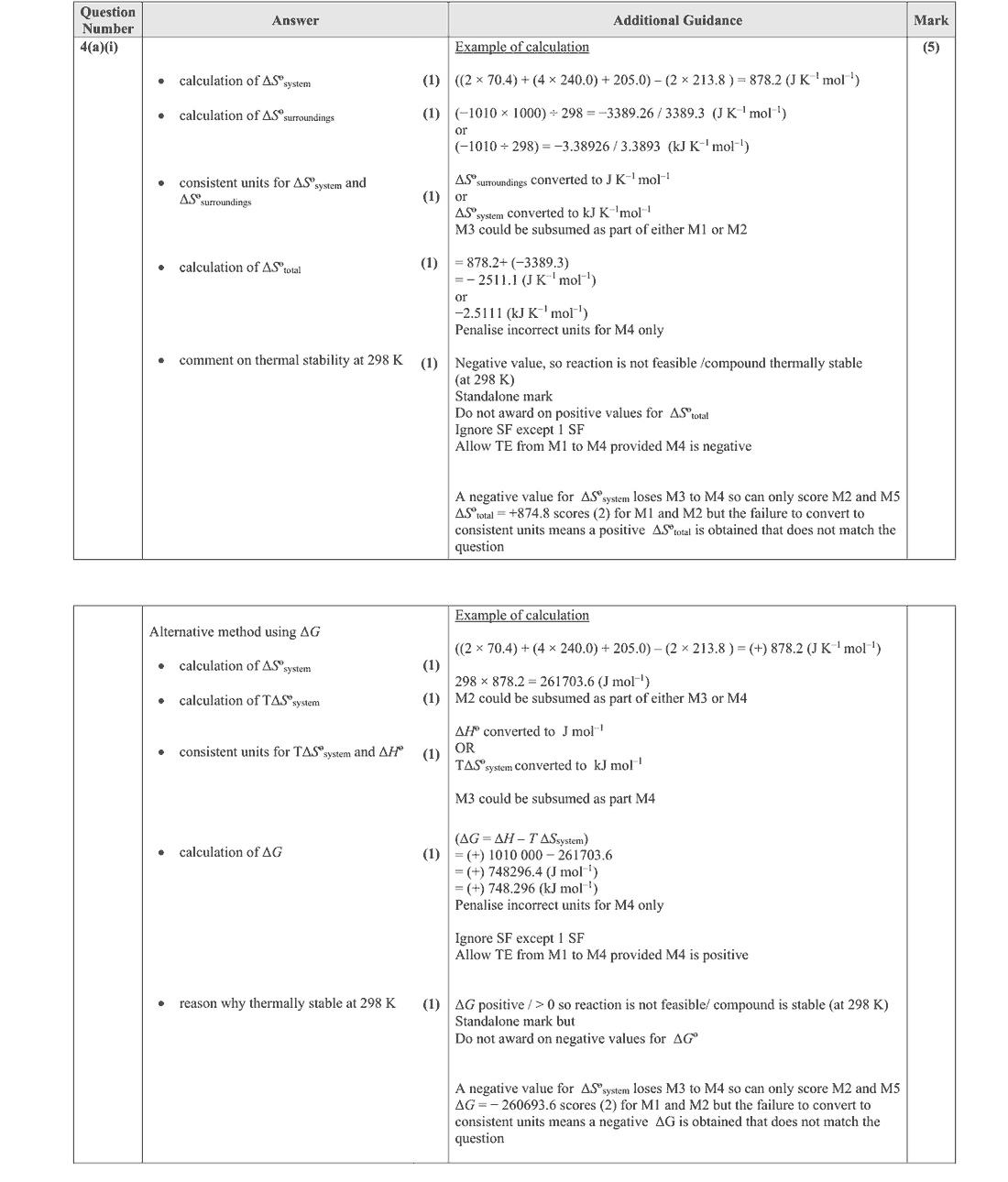
June 2024 · Paper 3 · Q4(a)(i) 5 marks Calculation entropy
This question is about the white crystalline solid, barium nitrate.
Barium nitrate decomposes under suitable conditions to form barium oxide,
nitrogen dioxide and oxygen.
2Ba(NO3)2(s)   →   2BaO(s)   +   4NO2(g)   +   O2(g)       ΔH d = +1010 kJ mol–1
Standard molar entropy data related to this reaction are shown.
Standard molar entropy, S d / J K–1 mol–1
Substance
Ba(NO3)2(s)
213.8
BaO(s)
70.4
NO2(g)
240.0
O2(g)
205.0
Show that barium nitrate is thermally stable at 298 K.
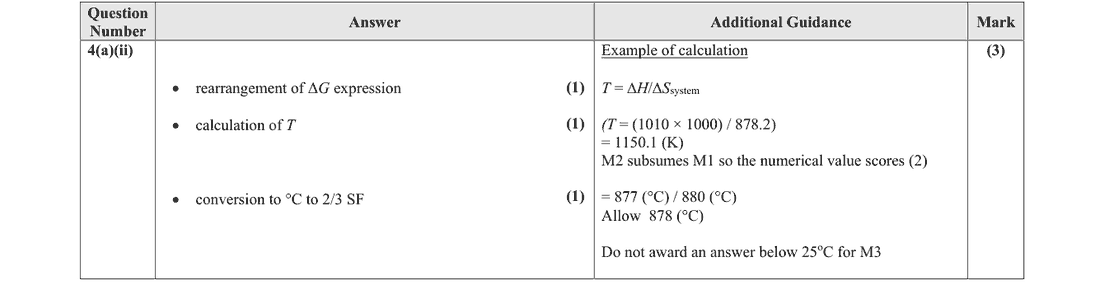
June 2024 · Paper 3 · Q4(a)(ii) 3 marks Calculation entropy
Earlier part of question 4 that this part usesEarlier part of June 2024 Paper 3 question 4
Calculate the minimum temperature, in °C, at which it is thermodynamically
feasible for barium nitrate to decompose.
Give your answer to an appropriate number of significant figures.
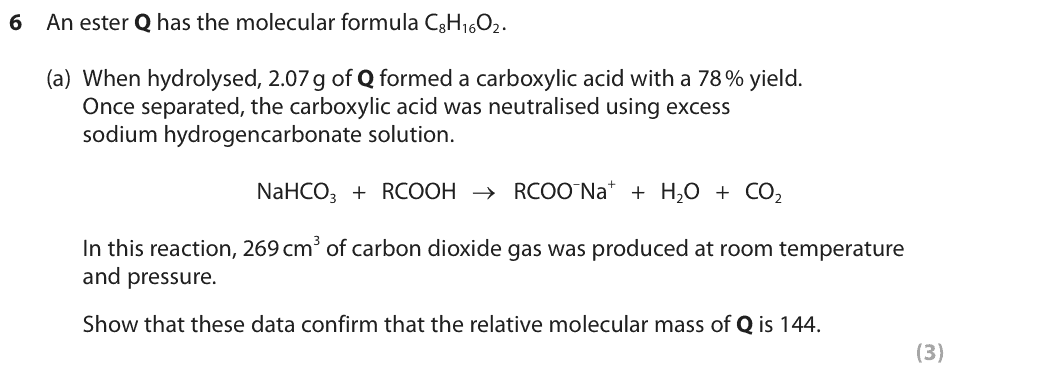
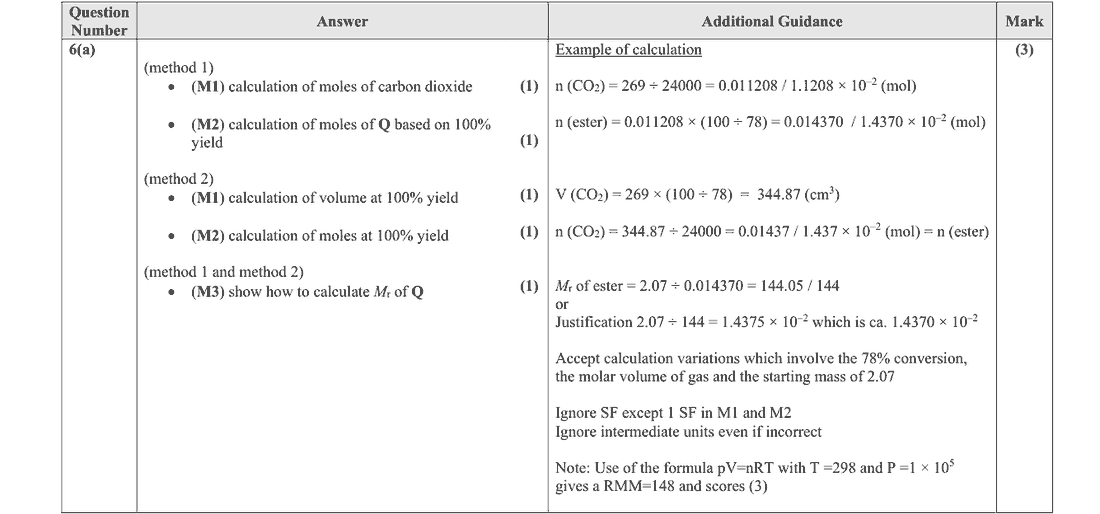
June 2024 · Paper 3 · Q6(a) 3 marks Calculation formulae equations and amounts of substance
An ester Q has the molecular formula C8H16O2.
When hydrolysed, 2.07 g of Q formed a carboxylic acid with a 78 % yield.
Once separated, the carboxylic acid was neutralised using excess
sodium hydrogencarbonate solution.
NaHCO3   +   RCOOH   →   RCOO–Na+   +   H2O   +   CO2
In this reaction, 269 cm3 of carbon dioxide gas was produced at room temperature
and pressure.
Show that these data confirm that the relative molecular mass of Q is 144.
June 2024 · Paper 3 · Q8(b) 5 marks Calculation acid base equilibria
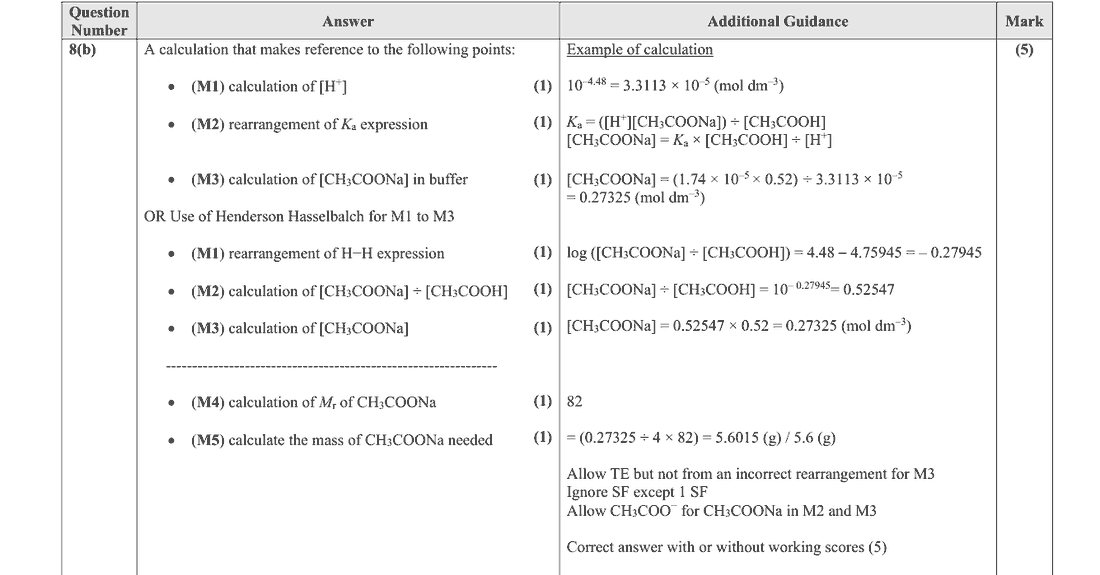
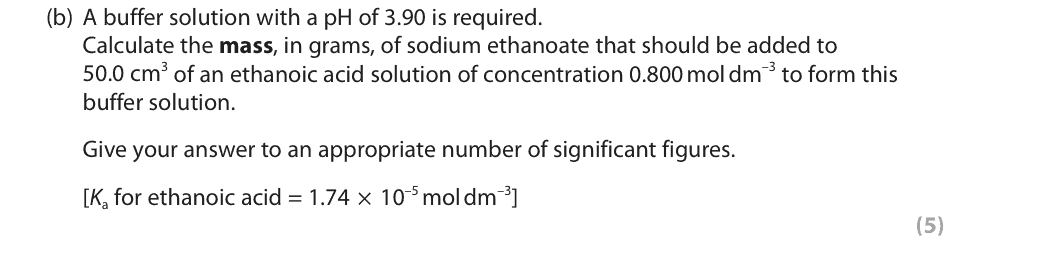
Calculate the mass of sodium ethanoate needed to be dissolved in 250 cm3 of
0.520 mol dm–3 ethanoic acid to form a buffer solution with pH = 4.48
[Ka for ethanoic acid = 1.74 × 10–5 mol dm–3]
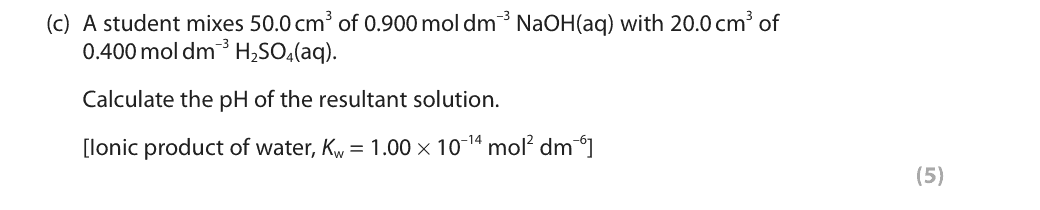
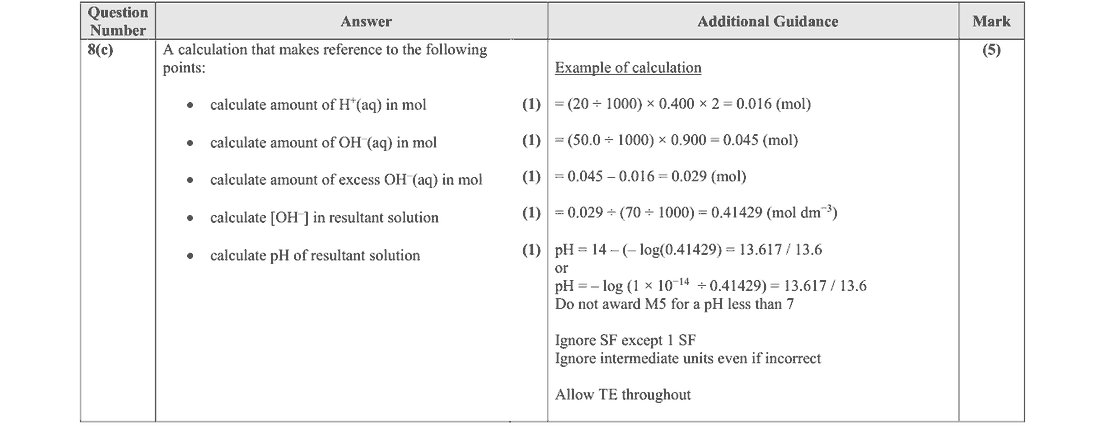
June 2024 · Paper 3 · Q8(c) 5 marks Calculation acid base equilibriaformulae equations and amounts of substance
A student mixes 50.0 cm3 of 0.900 mol dm–3 NaOH(aq) with 20.0 cm3 of
0.400 mol dm–3 H2SO4(aq).
Calculate the pH of the resultant solution.
[Ionic product of water, Kw = 1.00 × 10–14 mol2 dm–6]
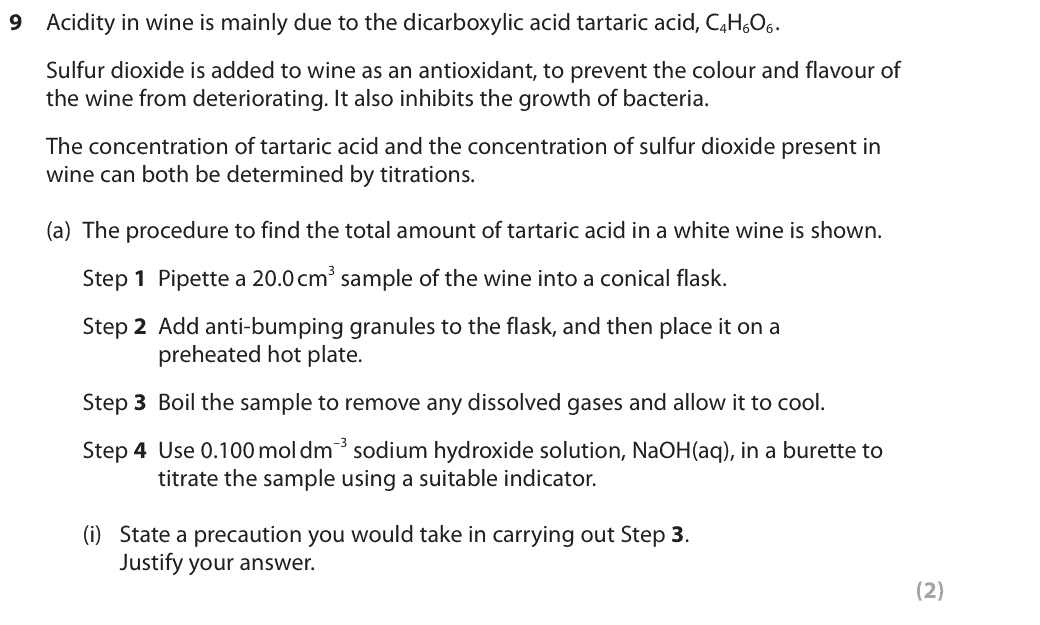
June 2024 · Paper 3 · Q9(a)(iii) 3 marks Calculation formulae equations and amounts of substance
Earlier part of question 9 that this part usesEarlier part of June 2024 Paper 3 question 9
A mean titre of 20.60 cm3 was obtained.
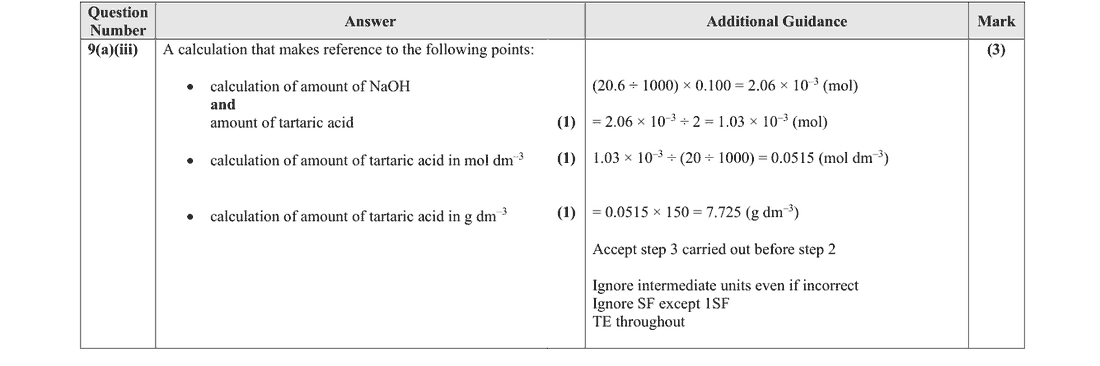
Calculate the concentration, in  g dm–3, of tartaric acid in the white wine.
C4H6O6   +   2NaOH   →   C4H4O6Na2   +   2H2O
June 2024 · Paper 3 · Q9(b)(i) 4 marks Calculation redox ii
Earlier part of question 9 that this part usesEarlier part of June 2024 Paper 3 question 9
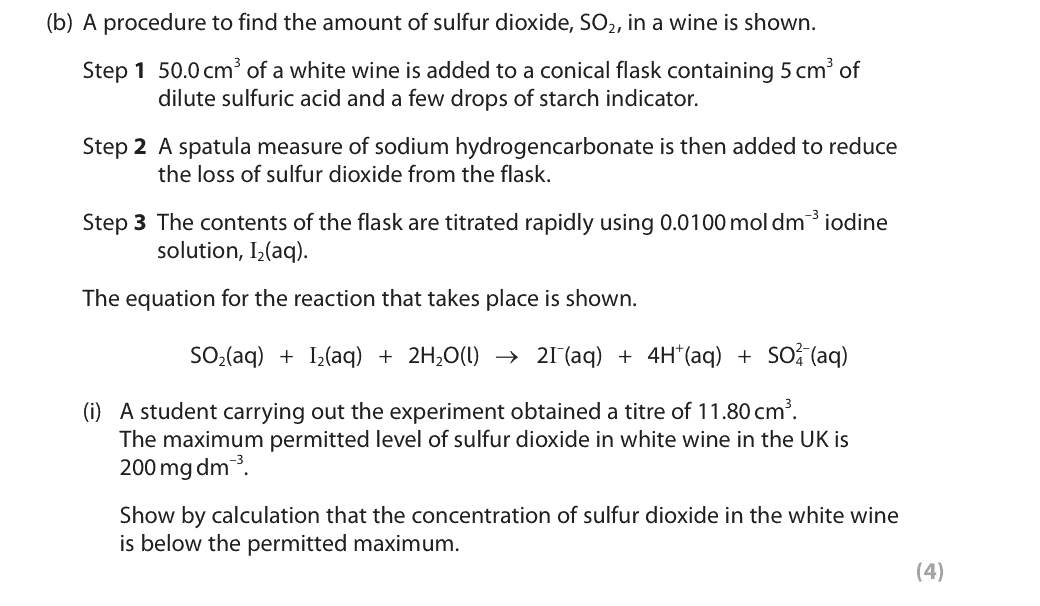
A procedure to find the amount of sulfur dioxide, SO2, in a wine is shown.
Step 1  50.0 cm3 of a white wine is added to a conical flask containing 5 cm3 of
dilute sulfuric acid and a few drops of starch indicator.
Step 2  A spatula measure of sodium hydrogencarbonate is then added to reduce
the loss of sulfur dioxide from the flask.
Step 3  The contents of the flask are titrated rapidly using 0.0100 mol dm–3 iodine
solution, I2(aq).
The equation for the reaction that takes place is shown.
SO2(aq)   +   I2(aq)   +   2H2O(l)   →   2I–(aq)   +   4H+(aq)   +   SO4
2–(aq)
A student carrying out the experiment obtained a titre of 11.80 cm3.
The maximum permitted level of sulfur dioxide in white wine in the UK is
200 mg dm–3.
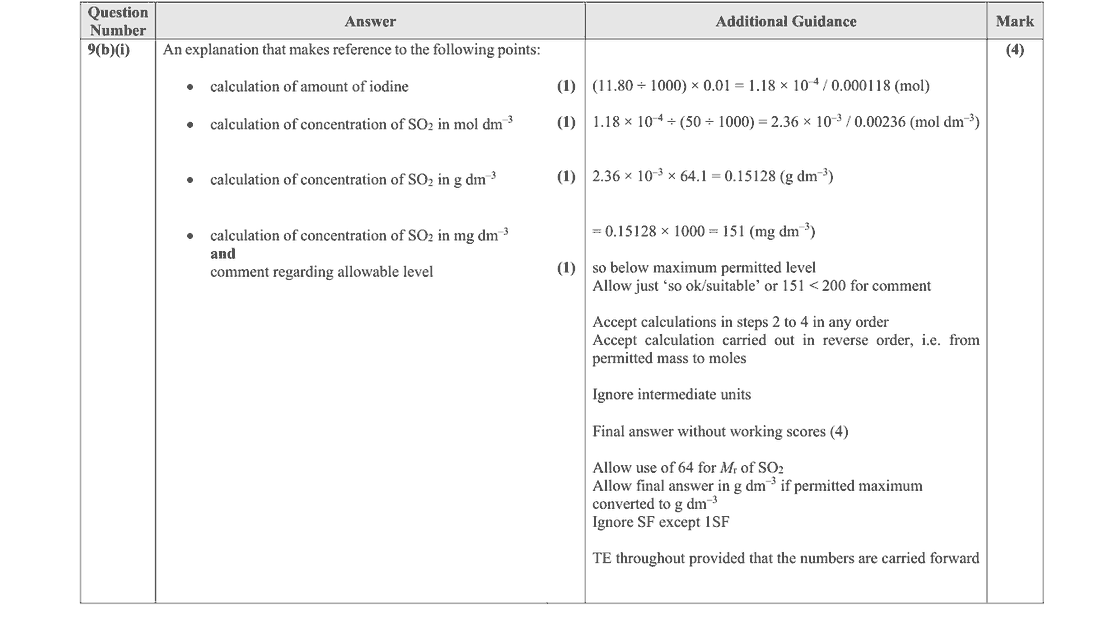
Show by calculation that the concentration of sulfur dioxide in the white wine
is below the permitted maximum.
June 2023 · AS Paper 1 · Q1(c) 2 marks Calculation atomic structure and the periodic table
Earlier part of question 1 that this part usesEarlier part of June 2023 Paper 1 question 1
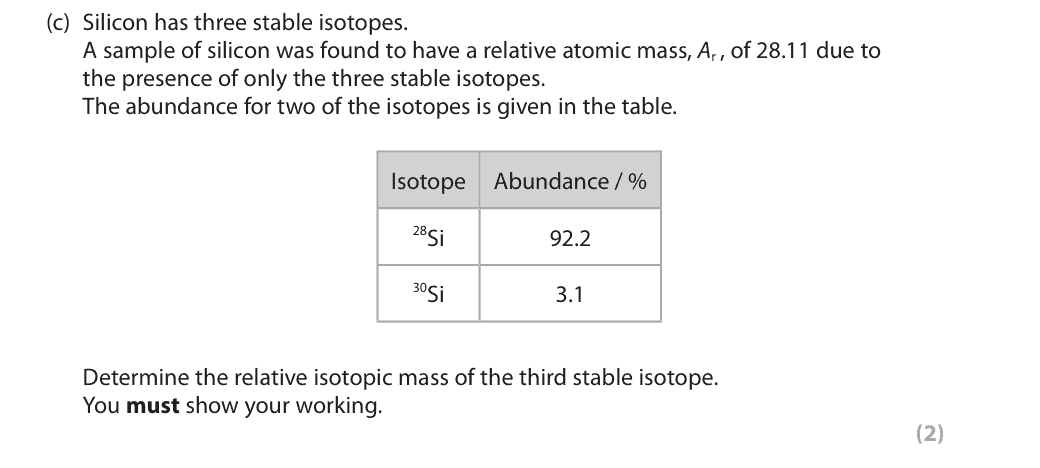
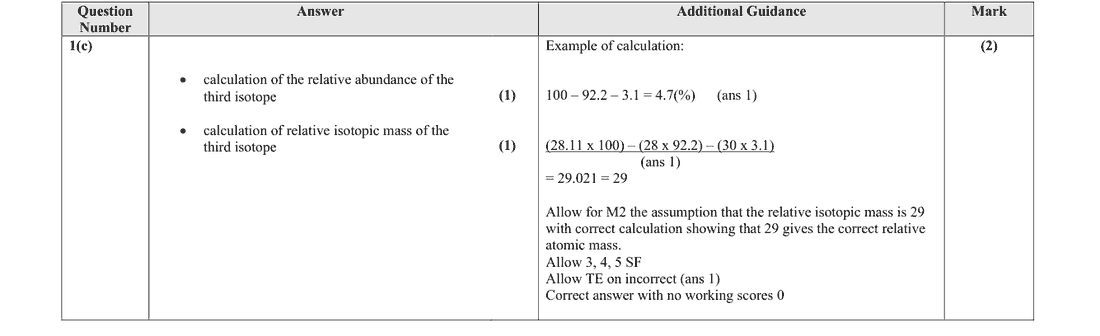
Silicon has three stable isotopes.
A sample of silicon was found to have a relative atomic mass, Ar , of 28.11 due to
the presence of only the three stable isotopes.
The abundance for two of the isotopes is given in the table.
Isotope
Abundance / %
28Si
92.2
30Si
3.1
Determine the relative isotopic mass of the third stable isotope.
You must show your working.
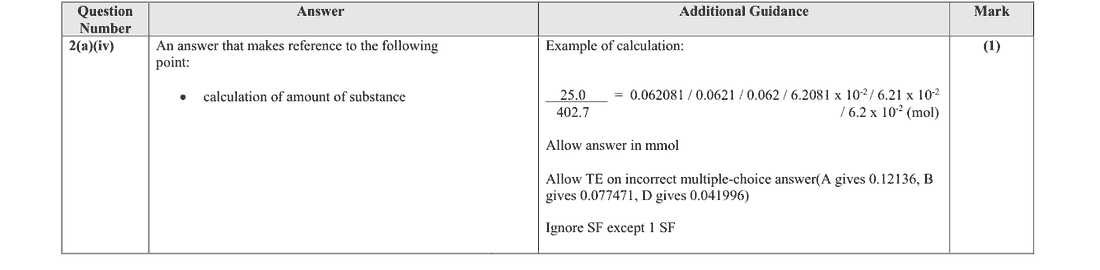
June 2023 · AS Paper 1 · Q2(a)(iv) 1 mark Calculation formulae equations and amounts of substance
Earlier part of question 2 that this part usesEarlier part of June 2023 Paper 1 question 2
Calculate the amount of substance, in mol, in 25.0 g of K2Mg(SO4)2.6H2O.
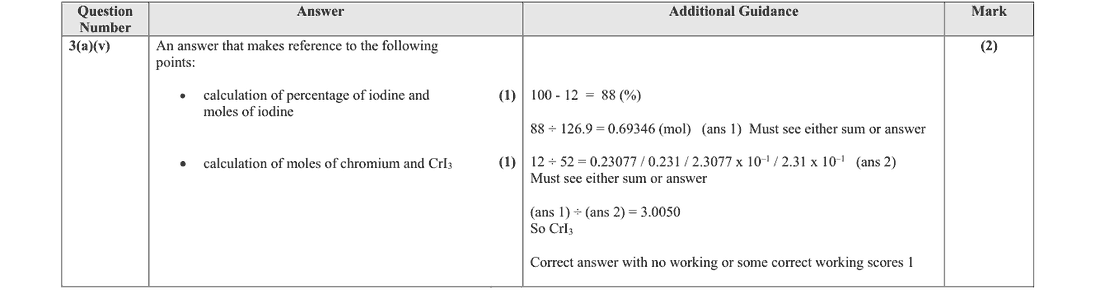
June 2023 · AS Paper 1 · Q3(a)(v) 2 marks Calculation formulae equations and amounts of substance
Earlier part of question 3 that this part usesEarlier part of June 2023 Paper 1 question 3
Chromium reacts with iodine.
The only product contains 12.0 % chromium by mass.
Calculate the empirical formula of the chromium iodide formed.
You must show your working.
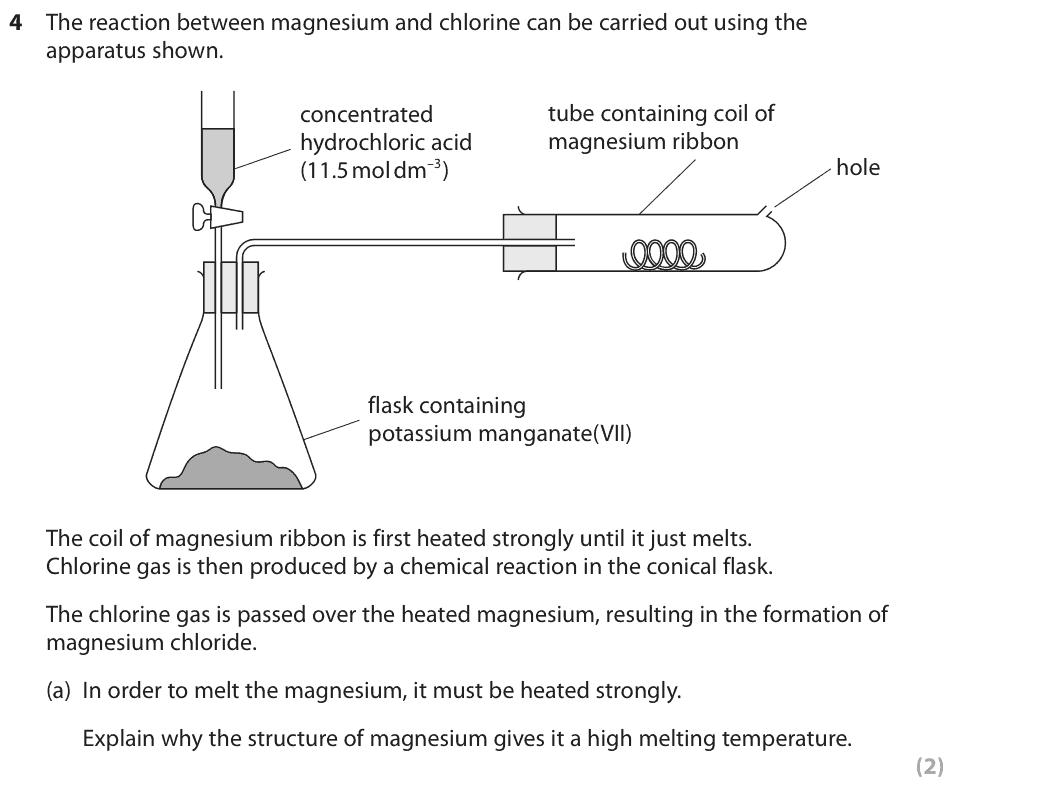
June 2023 · AS Paper 1 · Q4(b) 4 marks Calculation formulae equations and amounts of substance
Earlier part of question 4 that this part usesEarlier part of June 2023 Paper 1 question 4
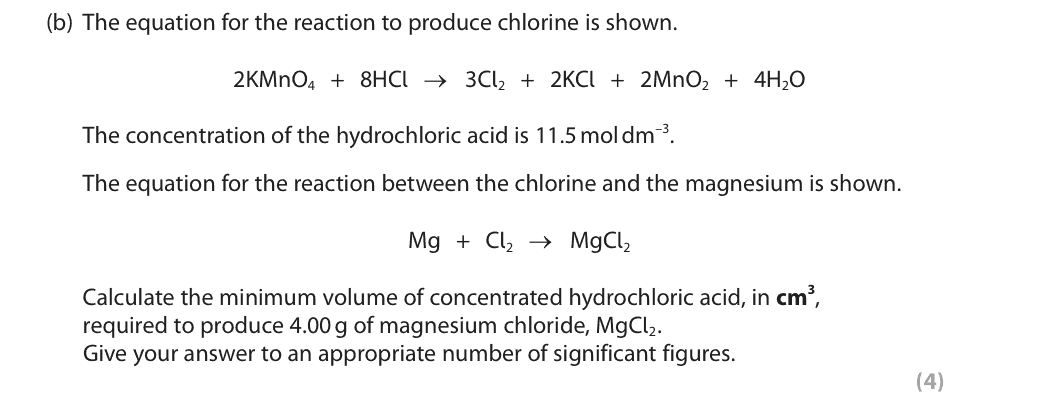
The equation for the reaction to produce chlorine is shown.
2KMnO4   +   8HCl   →   3Cl2   +   2KCl   +   2MnO2   +   4H2O
The concentration of the hydrochloric acid is 11.5 mol dm–3.
The equation for the reaction between the chlorine and the magnesium is shown.
Mg   +   Cl2   →   MgCl2
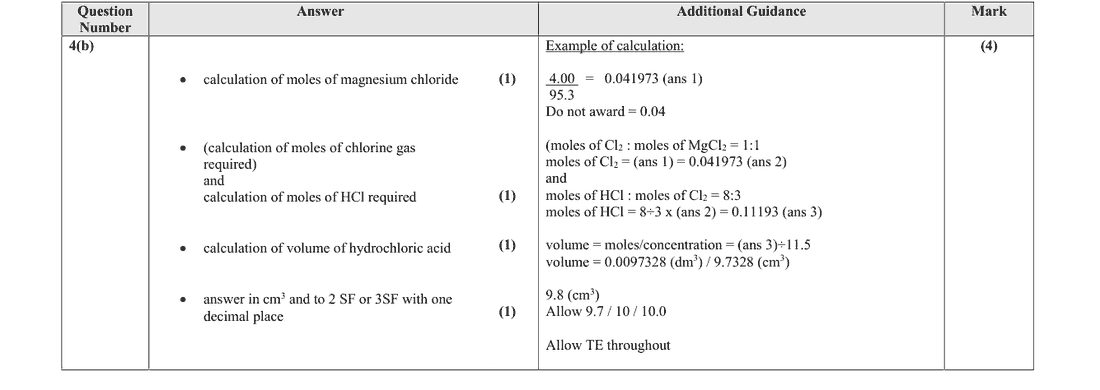
Calculate the minimum volume of concentrated hydrochloric acid, in cm3,
required to produce 4.00 g of magnesium chloride, MgCl2.
Give your answer to an appropriate number of significant figures.
June 2023 · AS Paper 1 · Q8(c)(i) 3 marks Calculation formulae equations and amounts of substance
Earlier part of question 8 that this part usesEarlier part of June 2023 Paper 1 question 8
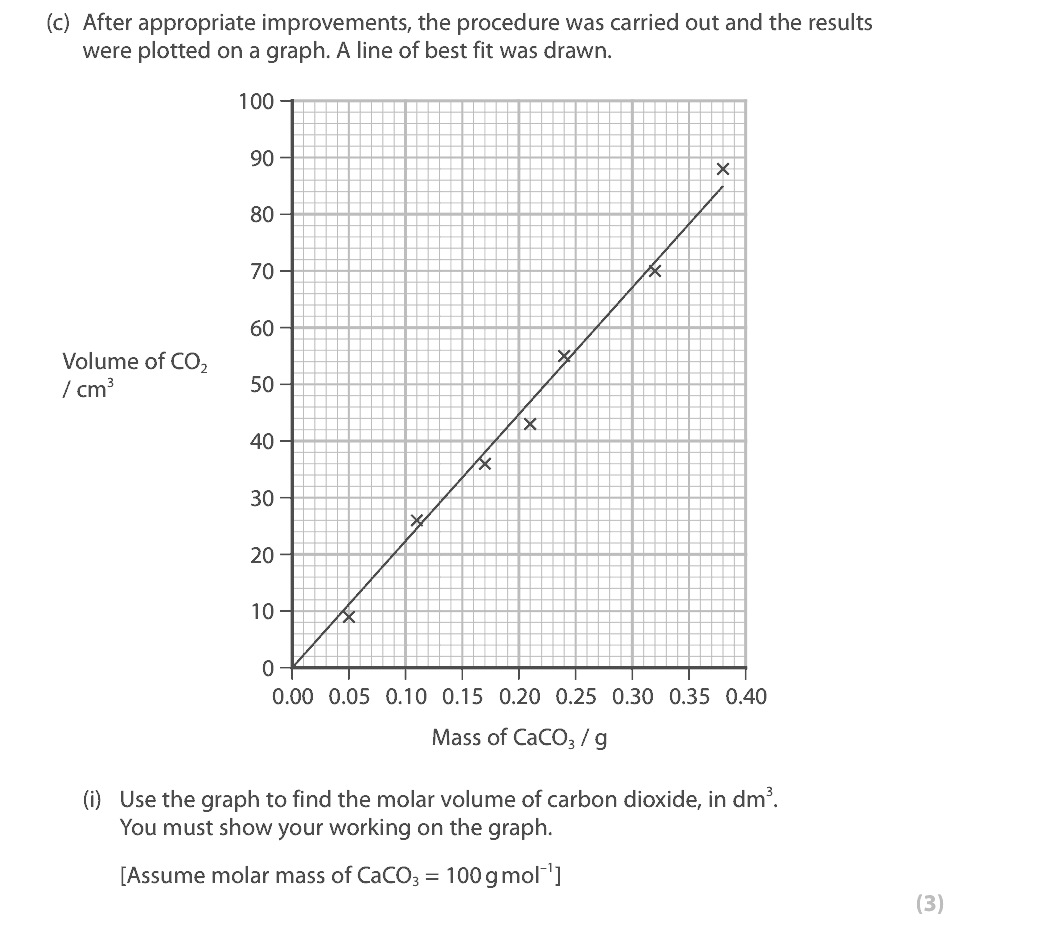
After appropriate improvements, the procedure was carried out and the results
were plotted on a graph. A line of best fit was drawn.
100
90
80
70
60
Volume of CO2
50
/ cm3
40
30
20
10
0
0.00
0.05
0.10
0.15
0.20
0.25
0.30
0.35
0.40
Mass of CaCO3 / g
Use the graph to find the molar volume of carbon dioxide, in dm3.
You must show your working on the graph.
[Assume molar mass of CaCO3 = 100 g mol–1]
June 2023 · AS Paper 1 · Q8(c)(ii) 3 marks Calculation formulae equations and amounts of substance
Earlier parts of question 8 that this part usesEarlier part of June 2023 Paper 1 question 8Earlier part of June 2023 Paper 1 question 8
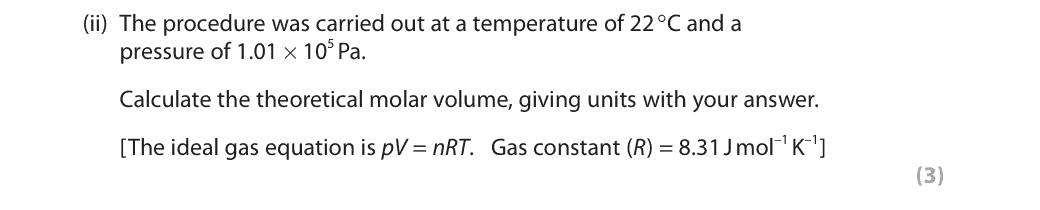
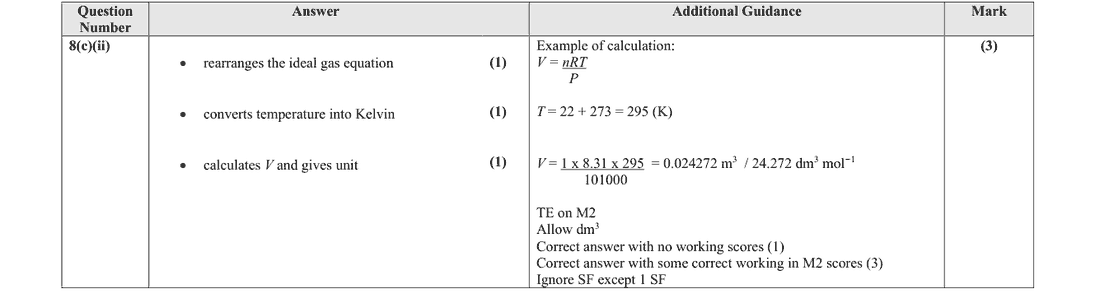
The procedure was carried out at a temperature of 22 °C and a
pressure of 1.01 × 105 Pa.
Calculate the theoretical molar volume, giving units with your answer.
[The ideal gas equation is pV = nRT.   Gas constant (R) = 8.31 J mol–1 K–1]
June 2023 · AS Paper 2 · Q2(b)(ii) 2 marks Calculation formulae equations and amounts of substance
Earlier parts of question 2 that this part usesEarlier part of June 2023 Paper 2 question 2Earlier part of June 2023 Paper 2 question 2
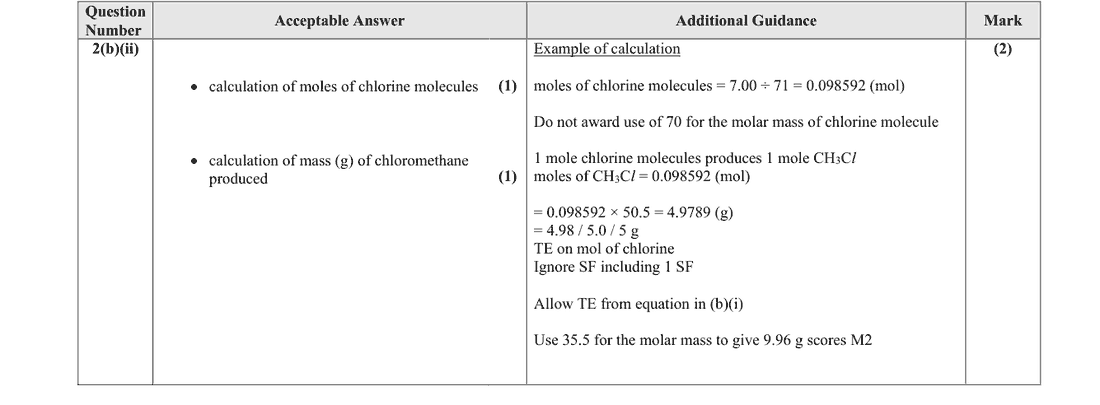
Calculate the maximum mass, in grams, of chloromethane produced when
7.00 g of chlorine gas reacts completely with excess methane.
[Molar mass of CH3Cl = 50.5 g mol–1]
June 2023 · AS Paper 2 · Q2(b)(iv) 3 marks Calculation formulae equations and amounts of substance
Earlier parts of question 2 that this part usesEarlier part of June 2023 Paper 2 question 2Earlier part of June 2023 Paper 2 question 2Earlier part of June 2023 Paper 2 question 2
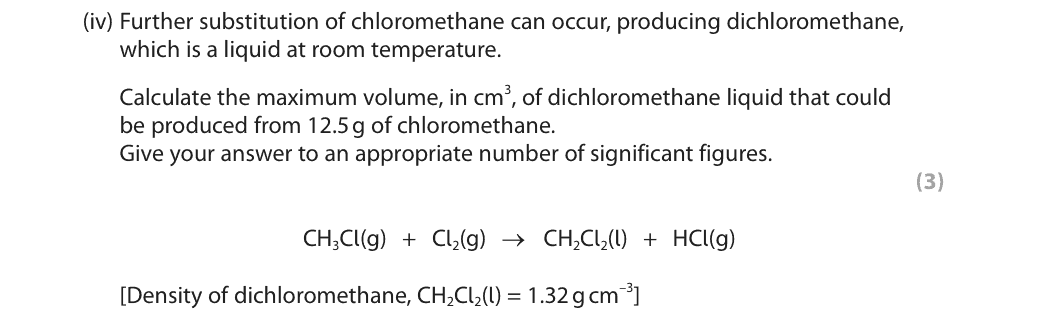
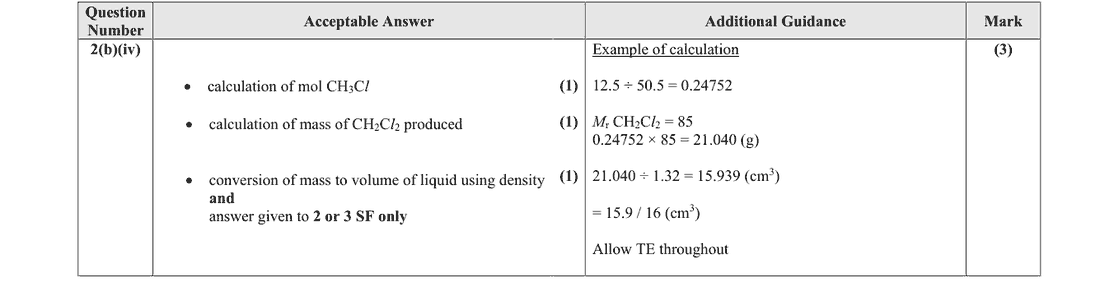
Further substitution of chloromethane can occur, producing dichloromethane,
which is a liquid at room temperature.
Calculate the maximum volume, in cm3, of dichloromethane liquid that could
be produced from 12.5 g of chloromethane.
Give your answer to an appropriate number of significant figures.
CH3Cl(g)   +   Cl2(g)   →   CH2Cl2(l)   +   HCl(g)
[Density of dichloromethane, CH2Cl2(l) = 1.32 g cm–3]
June 2023 · AS Paper 2 · Q2(c)(i) 4 marks Calculation formulae equations and amounts of substance
Earlier part of question 2 that this part usesEarlier part of June 2023 Paper 2 question 2
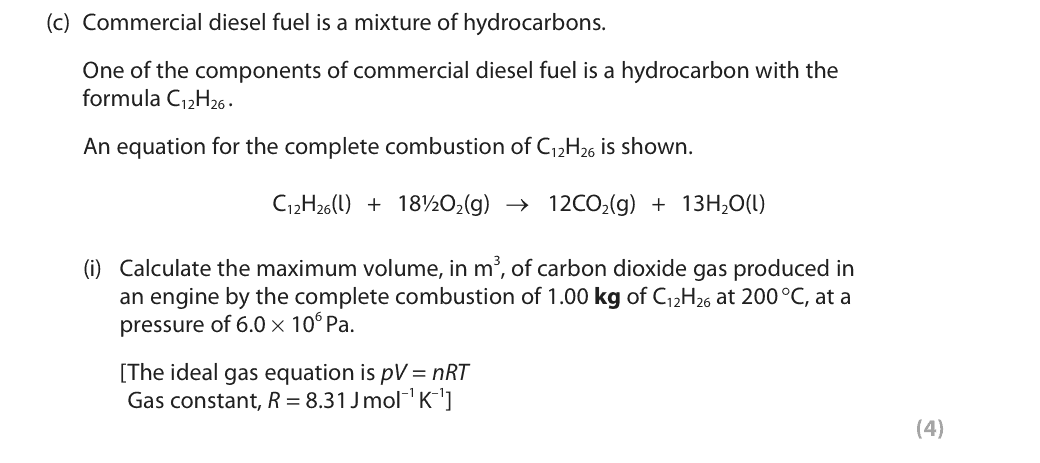
Commercial diesel fuel is a mixture of hydrocarbons.
One of the components of commercial diesel fuel is a hydrocarbon with the
formula C12H26 .
An equation for the complete combustion of C12H26 is shown.
C12H26(l)   +   18½O2(g)   →   12CO2(g)   +   13H2O(l)
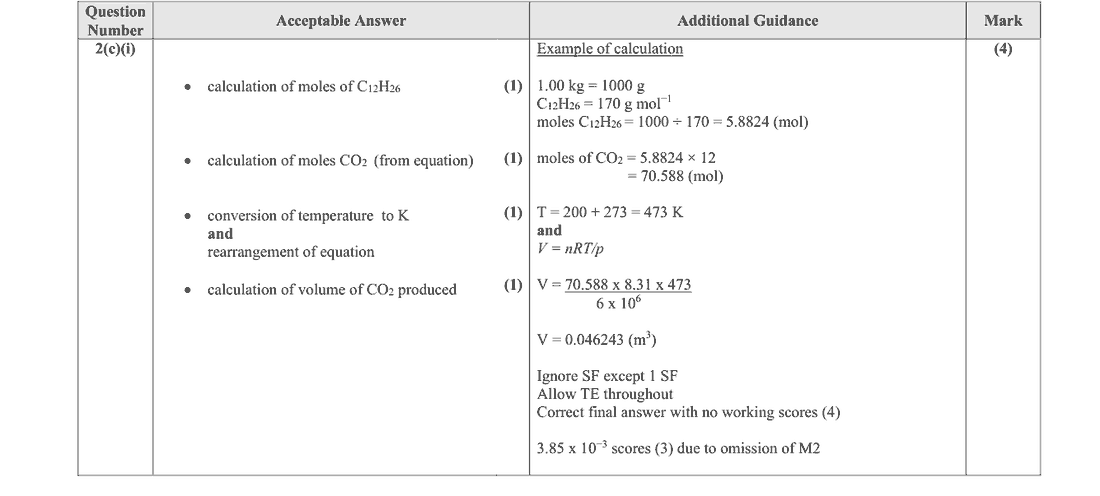
Calculate the maximum volume, in m3, of carbon dioxide gas produced in
an engine by the complete combustion of 1.00 kg of C12H26 at 200 °C, at a
pressure of 6.0 × 106 Pa.
[The ideal gas equation is pV = nRT
Gas constant, R = 8.31 J mol–1 K–1]
June 2023 · AS Paper 2 · Q5(a)(i) 3 marks Calculation energetics i
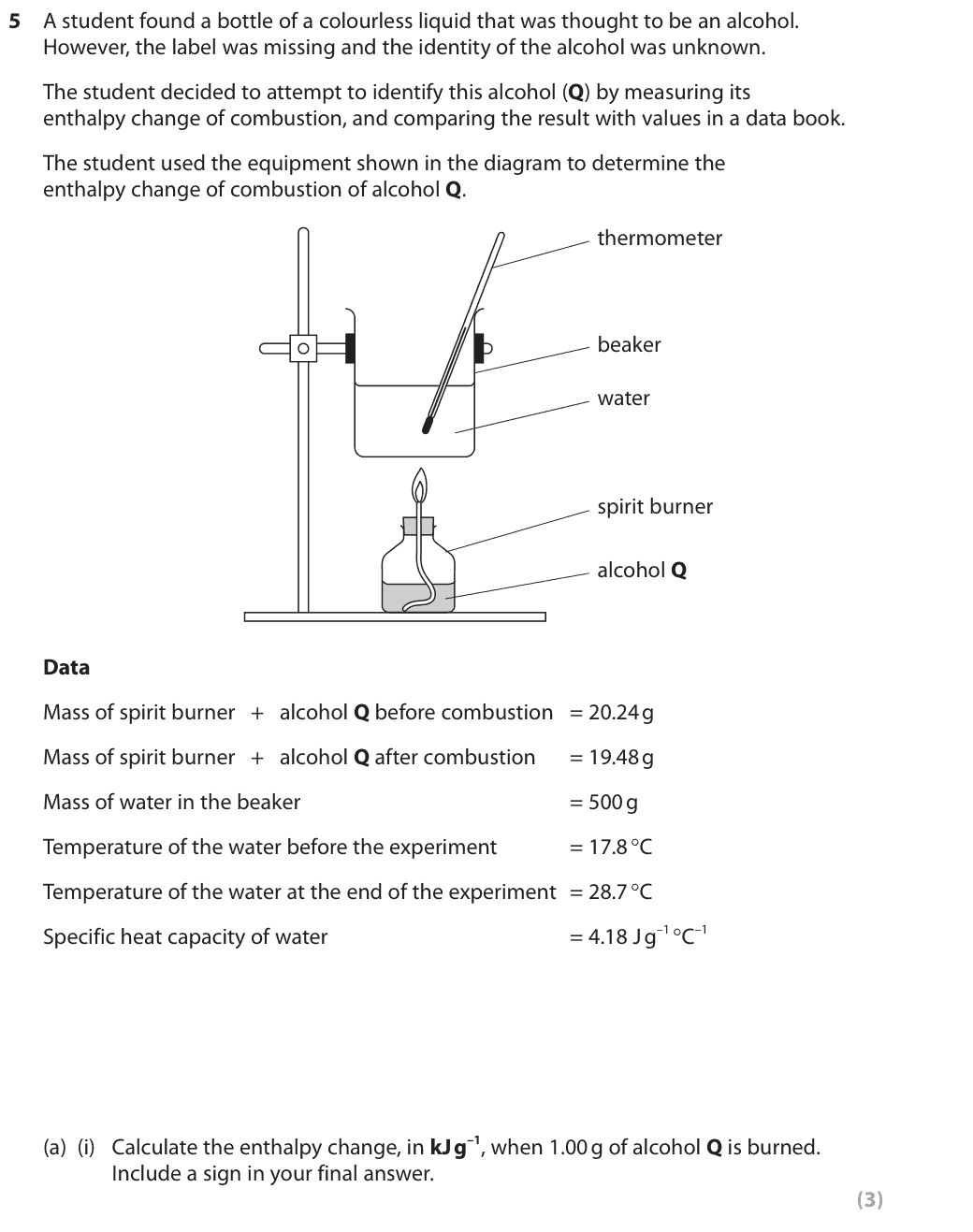
A student found a bottle of a colourless liquid that was thought to be an alcohol.
However, the label was missing and the identity of the alcohol was unknown.
The student decided to attempt to identify this alcohol (Q) by measuring its
enthalpy change of combustion, and comparing the result with values in a data book.
The student used the equipment shown in the diagram to determine the
enthalpy change of combustion of alcohol Q.
thermometer
beaker
water
spirit burner
alcohol Q
Data
Mass of spirit burner   +   alcohol Q before combustion  = 20.24 g
Mass of spirit burner   +   alcohol Q after combustion
= 19.48 g
Mass of water in the beaker
= 500 g
Temperature of the water before the experiment
= 17.8 °C
Temperature of the water at the end of the experiment  = 28.7 °C
Specific heat capacity of water
= 4.18 J g–1 °C–1
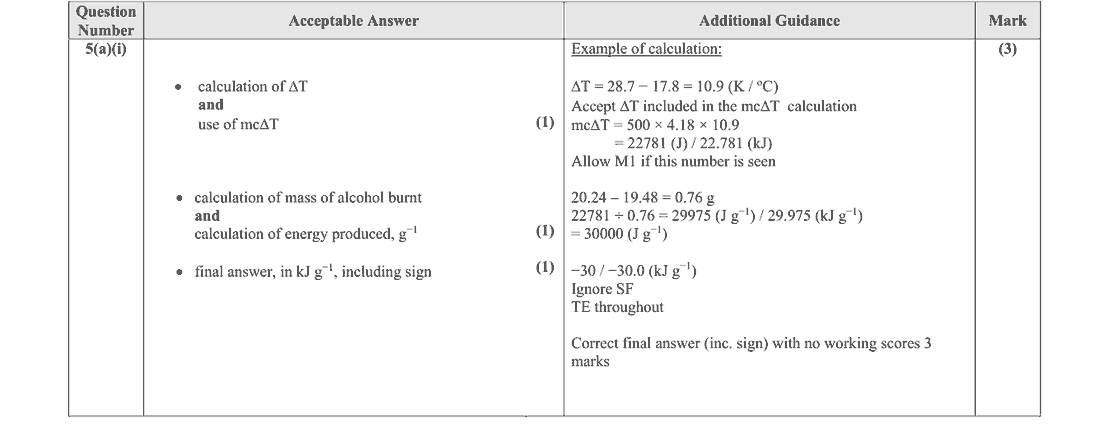
Calculate the enthalpy change, in kJ g–1, when 1.00 g of alcohol Q is burned.
Include a sign in your final answer.
June 2023 · AS Paper 2 · Q8(b)(ii) 3 marks Calculation energetics i
Earlier parts of question 8 that this part usesEarlier part of June 2023 Paper 2 question 8Earlier part of June 2023 Paper 2 question 8
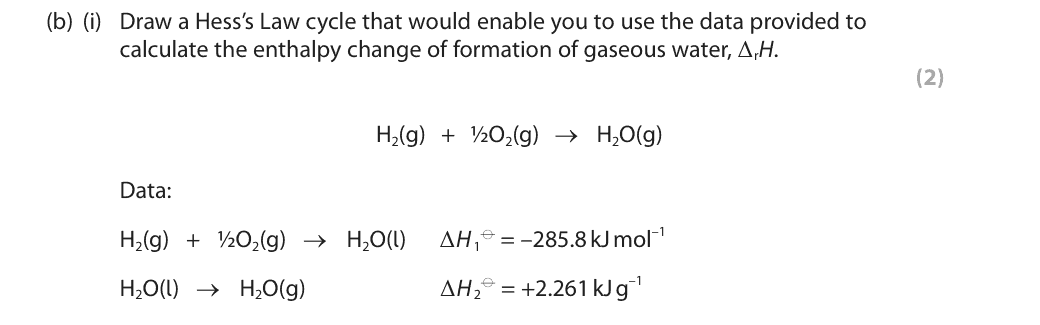
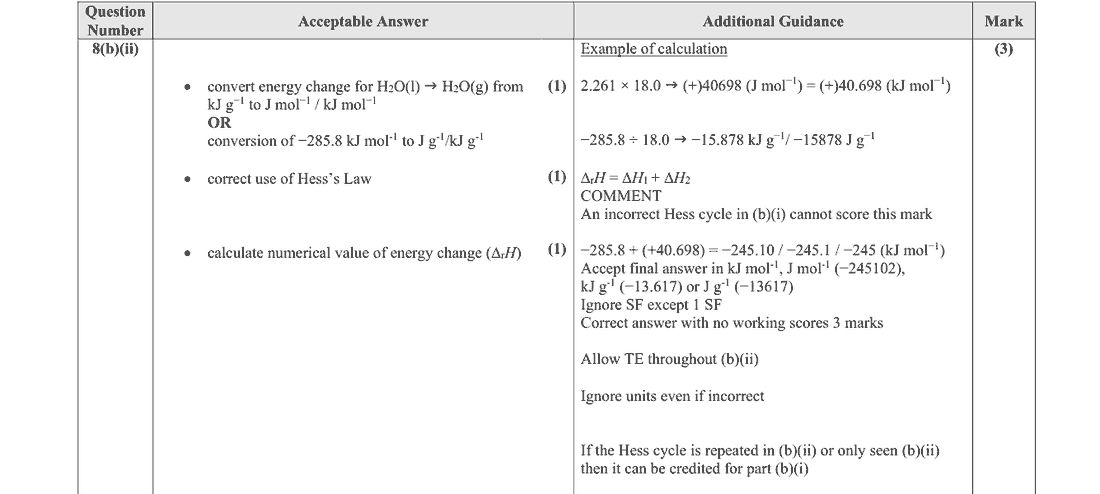
Calculate the enthalpy change for the reaction shown.
H2(g)   +   ½O2(g)   →   H2O(g)
June 2023 · Paper 1 · Q5(a)(ii) 3 marks Calculation entropy
Earlier part of question 5 that this part usesEarlier part of June 2023 Paper 1 question 5
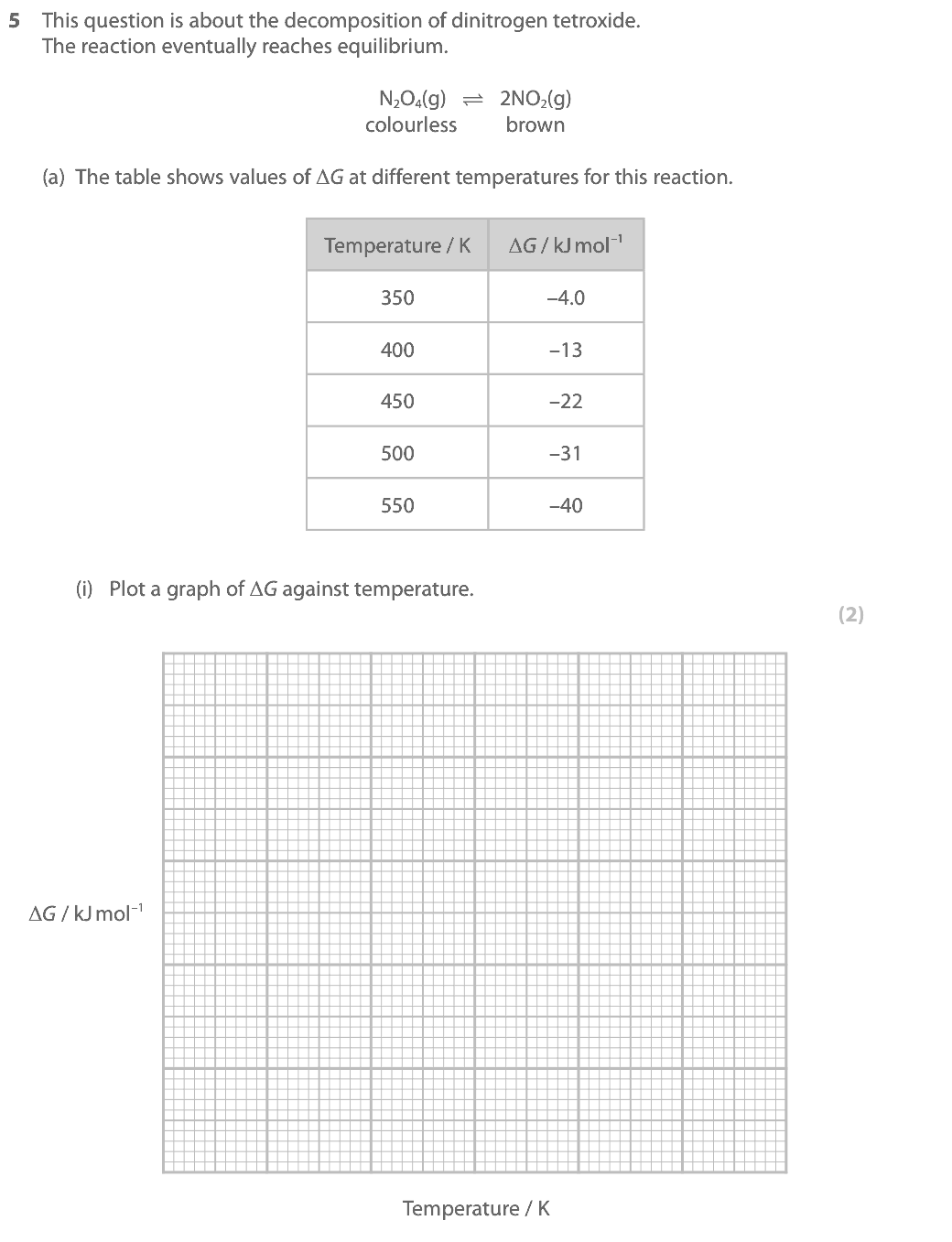
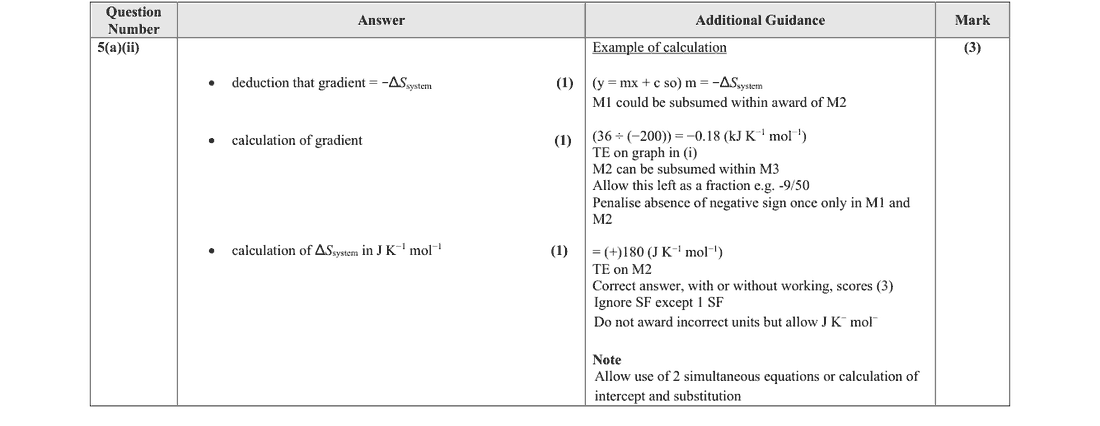
Calculate the entropy change of the system, ΔSsystem , in J K–1 mol–1, using your
straight line from the graph in (a)(i) and the equation shown.
ΔG = –TΔSsystem   +   ΔH
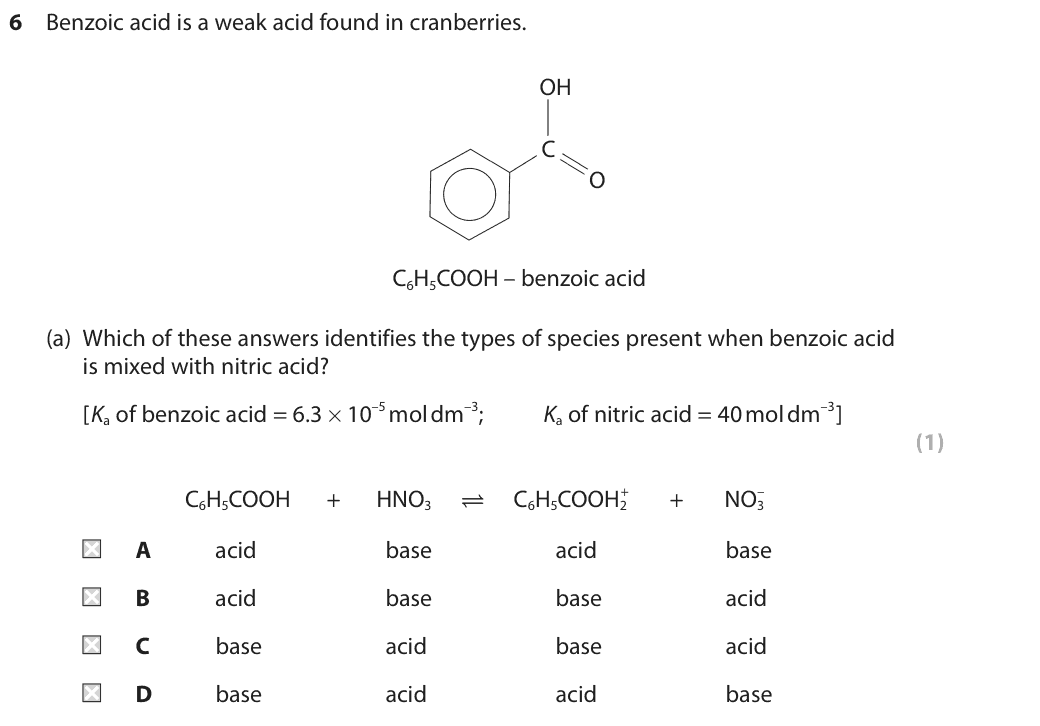
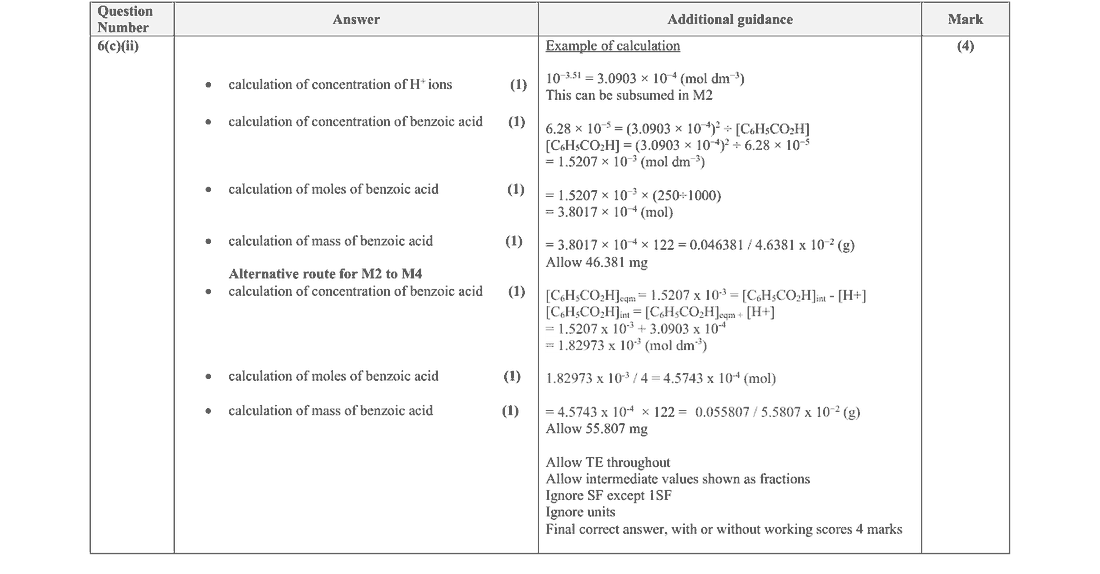
June 2023 · Paper 1 · Q6(c)(ii) 4 marks Calculation acid base equilibriaformulae equations and amounts of substance
Earlier parts of question 6 that this part usesEarlier part of June 2023 Paper 1 question 6Earlier part of June 2023 Paper 1 question 6
Calculate the mass of benzoic acid needed to prepare 250 cm3 of a solution
with a pH = 3.51
June 2023 · Paper 1 · Q6(d)(ii) 3 marks Calculation energetics i
Earlier parts of question 6 that this part usesEarlier part of June 2023 Paper 1 question 6Earlier part of June 2023 Paper 1 question 6
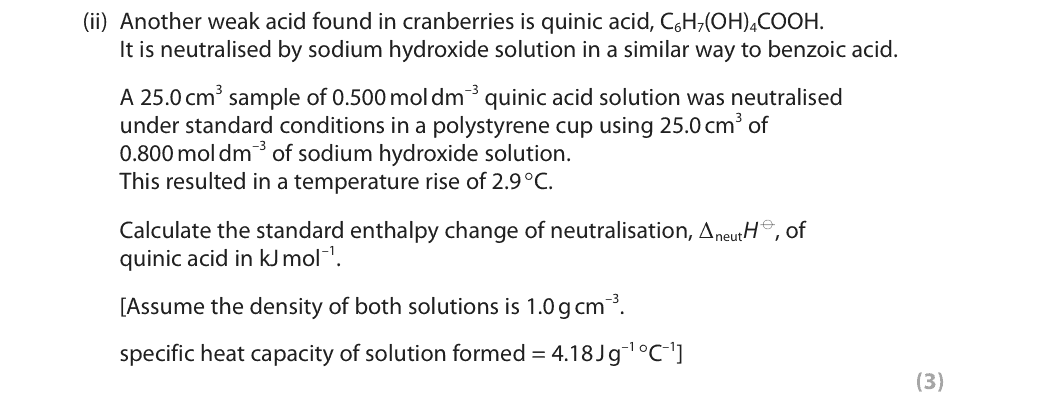
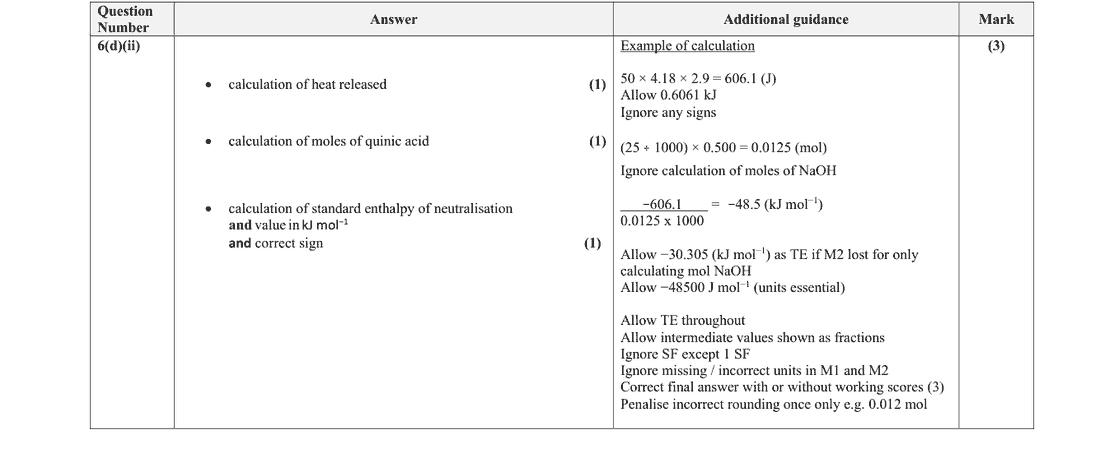
Another weak acid found in cranberries is quinic acid, C6H7(OH)4COOH.
It is neutralised by sodium hydroxide solution in a similar way to benzoic acid.
A 25.0 cm3 sample of 0.500 mol dm–3 quinic acid solution was neutralised
under standard conditions in a polystyrene cup using 25.0 cm3 of
0.800 mol dm–3 of sodium hydroxide solution.
This resulted in a temperature rise of 2.9 °C.
Calculate the standard enthalpy change of neutralisation, ΔneutH d, of
quinic acid in kJ mol–1.
[Assume the density of both solutions is 1.0 g cm–3.
specific heat capacity of solution formed = 4.18 J g–1 °C–1]
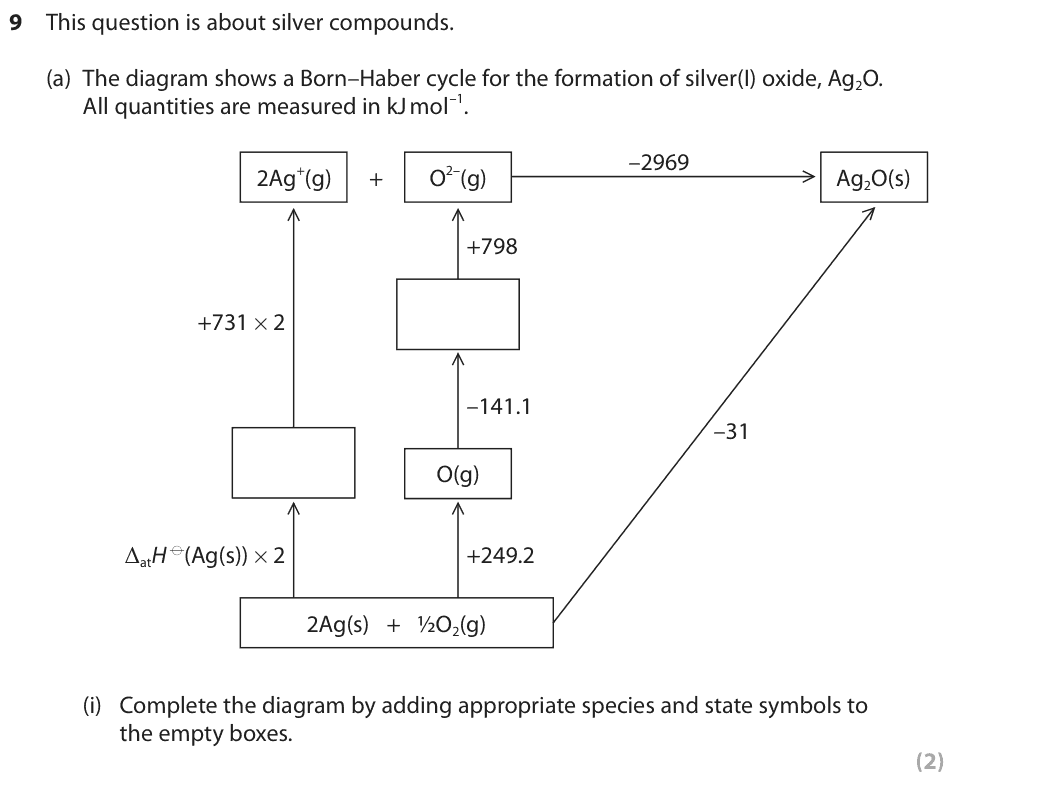
June 2023 · Paper 1 · Q9(a)(iii) 3 marks Calculation lattice energy
Earlier part of question 9 that this part usesEarlier part of June 2023 Paper 1 question 9
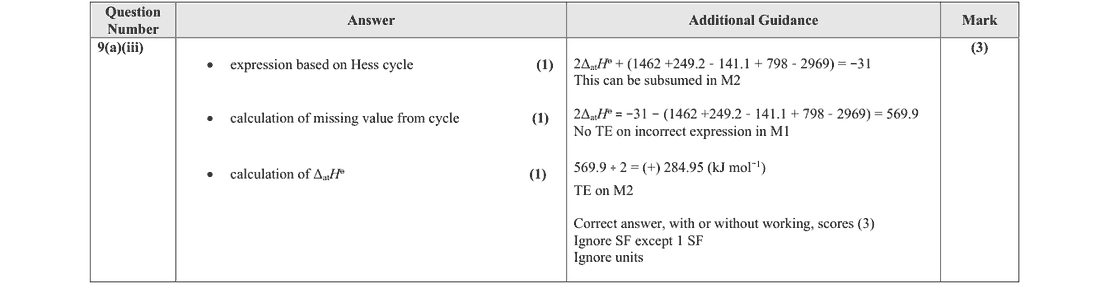
Calculate a value for the standard enthalpy change of atomisation of silver,
ΔatH d, using the Born–Haber cycle.
June 2023 · Paper 1 · Q10(c)(i) 5 marks Calculation redox ii
Earlier part of question 10 that this part usesEarlier part of June 2023 Paper 1 question 10
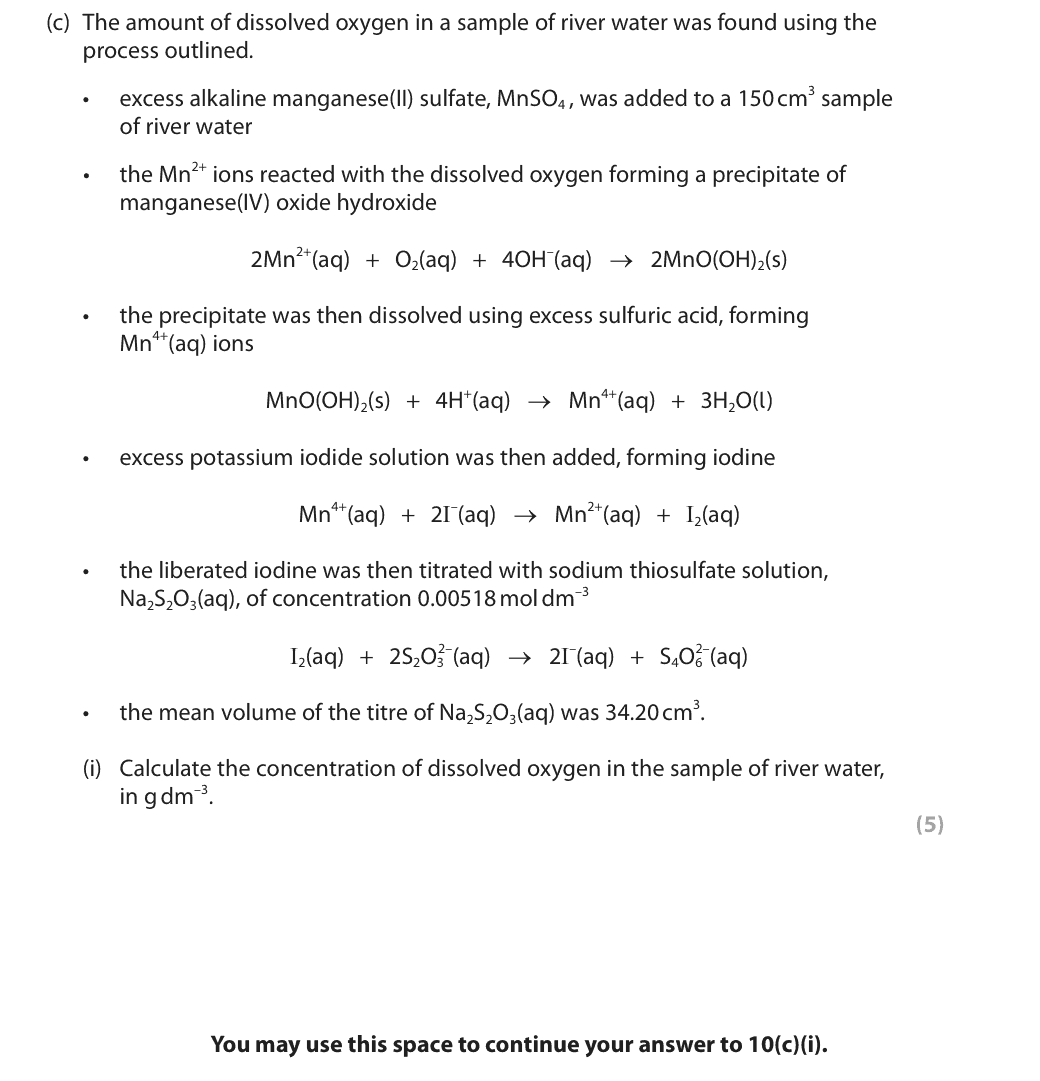
The amount of dissolved oxygen in a sample of river water was found using the
process outlined.
excess alkaline manganese(II) sulfate, MnSO4 , was added to a 150 cm3 sample
•
of river water
•
the Mn2+ ions reacted with the dissolved oxygen forming a precipitate of
manganese(IV) oxide hydroxide
2Mn2+(aq)   +   O2(aq)   +   4OH–(aq)   →   2MnO(OH)2(s)
•
the precipitate was then dissolved using excess sulfuric acid, forming
Mn4+(aq) ions
MnO(OH)2(s)   +   4H+(aq)   →   Mn4+(aq)   +   3H2O(l)
•
excess potassium iodide solution was then added, forming iodine
Mn4+(aq)   +   2I–(aq)   →   Mn2+(aq)   +   I2(aq)
•
the liberated iodine was then titrated with sodium thiosulfate solution,
Na2S2O3(aq), of concentration 0.00518 mol dm–3
I2(aq)   +   2S2O3
2–(aq)   →   2I–(aq)   +   S4O6
2–(aq)
•
the mean volume of the titre of Na2S2O3(aq) was 34.20 cm3.
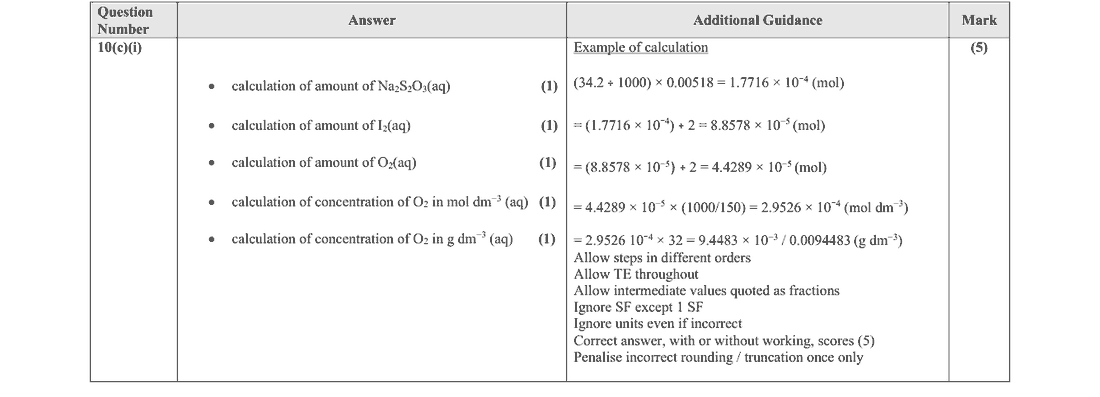
Calculate the concentration of dissolved oxygen in the sample of river water,
in g dm–3.
You may use this space to continue your answer to 10(c)(i).
June 2023 · Paper 1 · Q10(c)(ii) 1 mark Calculation Hard formulae equations and amounts of substance
Earlier parts of question 10 that this part usesEarlier part of June 2023 Paper 1 question 10Earlier part of June 2023 Paper 1 question 10
The concentration of oxygen in water is often expressed in parts per million
(ppm), where 1 ppm equals 1 g of solute dissolved in 1 × 106 g of solvent.
Calculate the concentration of the oxygen in the sample of river water in ppm.
Assume the density of the river water is 1.00 g cm–3.
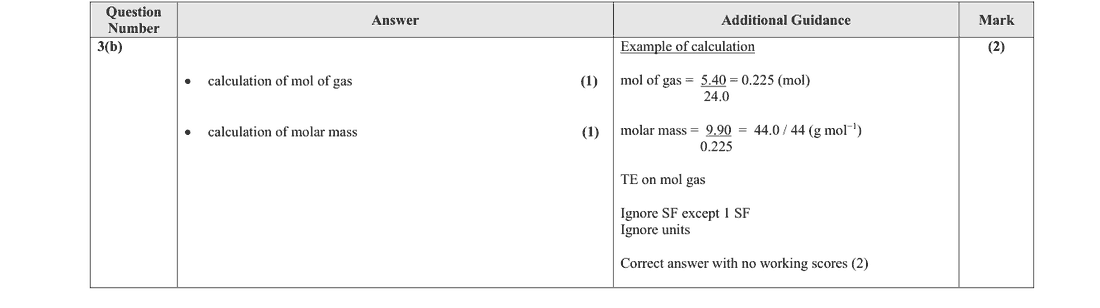
June 2023 · Paper 2 · Q3(b) 2 marks Calculation formulae equations and amounts of substance
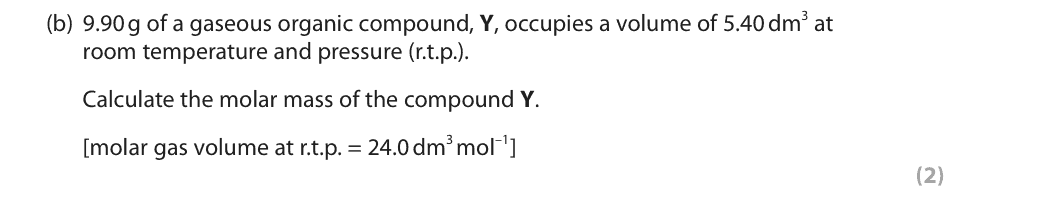
9.90 g of a gaseous organic compound, Y, occupies a volume of 5.40 dm3 at
room temperature and pressure (r.t.p.).
Calculate the molar mass of the compound Y.
[molar gas volume at r.t.p. = 24.0 dm3 mol–1]
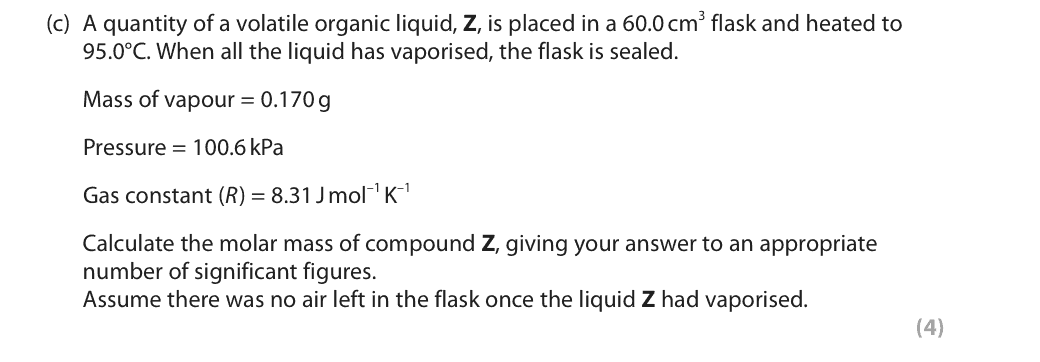
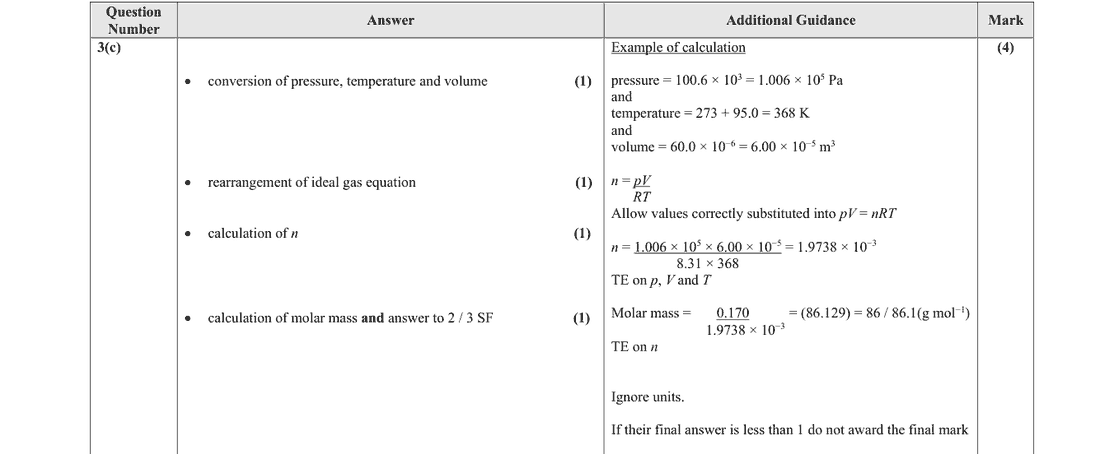
June 2023 · Paper 2 · Q3(c) 4 marks Calculation formulae equations and amounts of substance
A quantity of a volatile organic liquid, Z, is placed in a 60.0 cm3 flask and heated to
95.0°C. When all the liquid has vaporised, the flask is sealed.
Mass of vapour = 0.170 g
Pressure = 100.6 kPa
Gas constant (R) = 8.31 J mol–1 K–1
Calculate the molar mass of compound Z, giving your answer to an appropriate
number of significant figures.
Assume there was no air left in the flask once the liquid Z had vaporised.
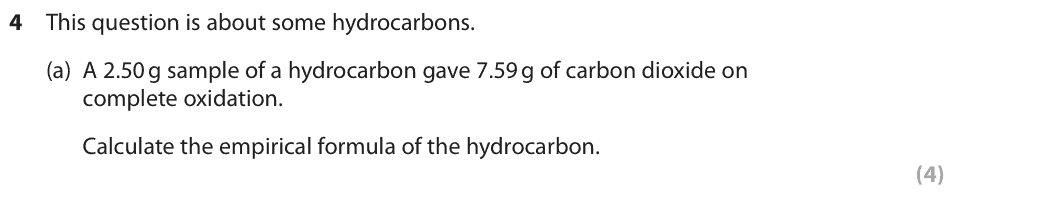
June 2023 · Paper 2 · Q4(a) 4 marks Calculation formulae equations and amounts of substance
This question is about some hydrocarbons.
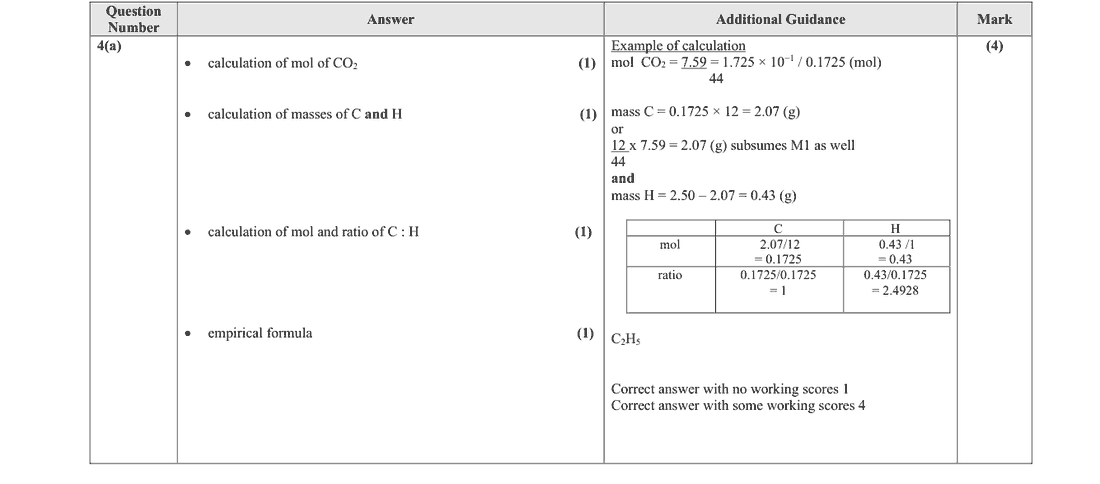
A 2.50 g sample of a hydrocarbon gave 7.59 g of carbon dioxide on
complete oxidation.
Calculate the empirical formula of the hydrocarbon.
June 2023 · Paper 2 · Q9(b) 5 marks Calculation formulae equations and amounts of substance
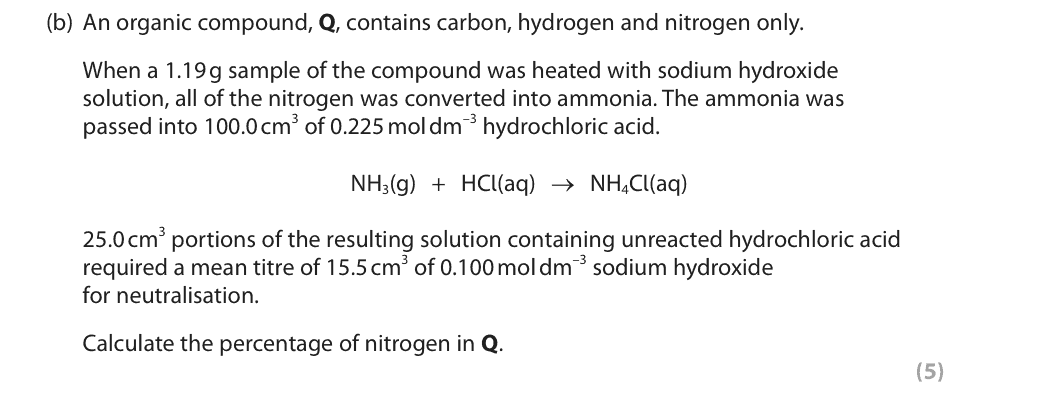
An organic compound, Q, contains carbon, hydrogen and nitrogen only.
When a 1.19 g sample of the compound was heated with sodium hydroxide
solution, all of the nitrogen was converted into ammonia. The ammonia was
passed into 100.0 cm3 of 0.225 mol dm–3 hydrochloric acid.
NH3(g)   +   HCl(aq)   →   NH4Cl(aq)
25.0 cm3 portions of the resulting solution containing unreacted hydrochloric acid
required a mean titre of 15.5 cm3 of 0.100 mol dm–3 sodium hydroxide
for neutralisation.
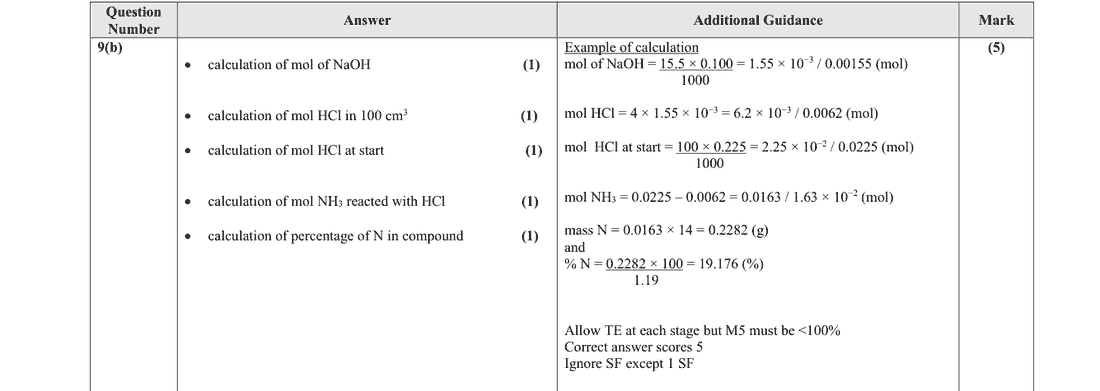
Calculate the percentage of nitrogen in Q.
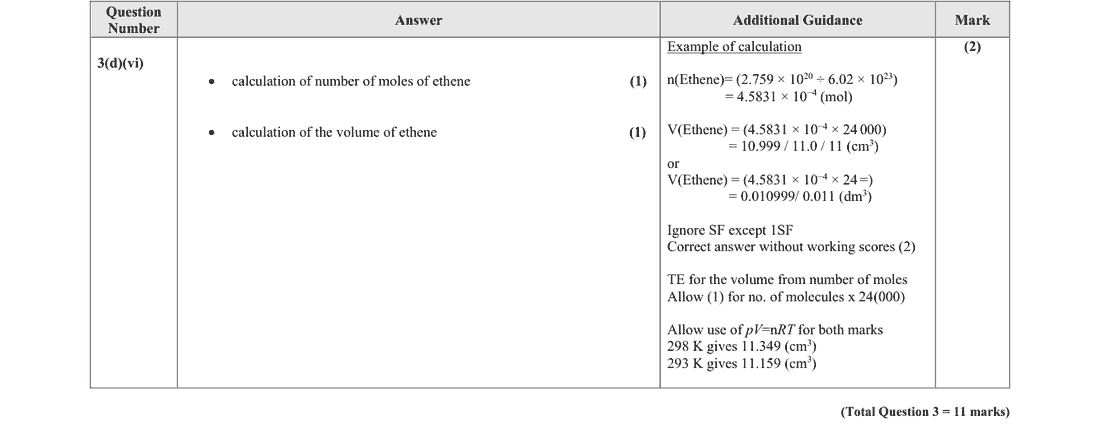
June 2023 · Paper 3 · Q3(d)(vi) 2 marks Calculation formulae equations and amounts of substance
Earlier parts of question 3 that this part usesEarlier part of June 2023 Paper 3 question 3Earlier part of June 2023 Paper 3 question 3
Calculate the volume of 2.759 × 1020 molecules of alkene gas
at room temperature and pressure (r.t.p.).
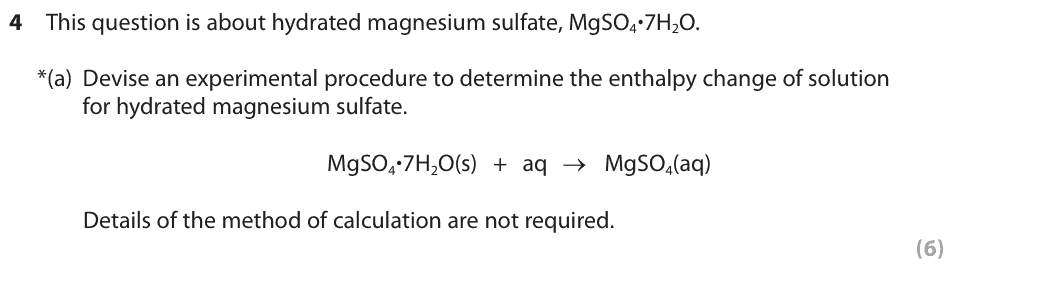
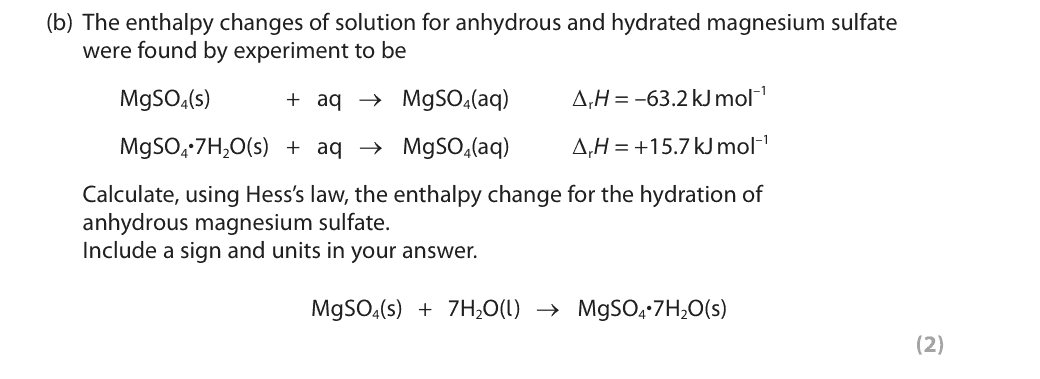
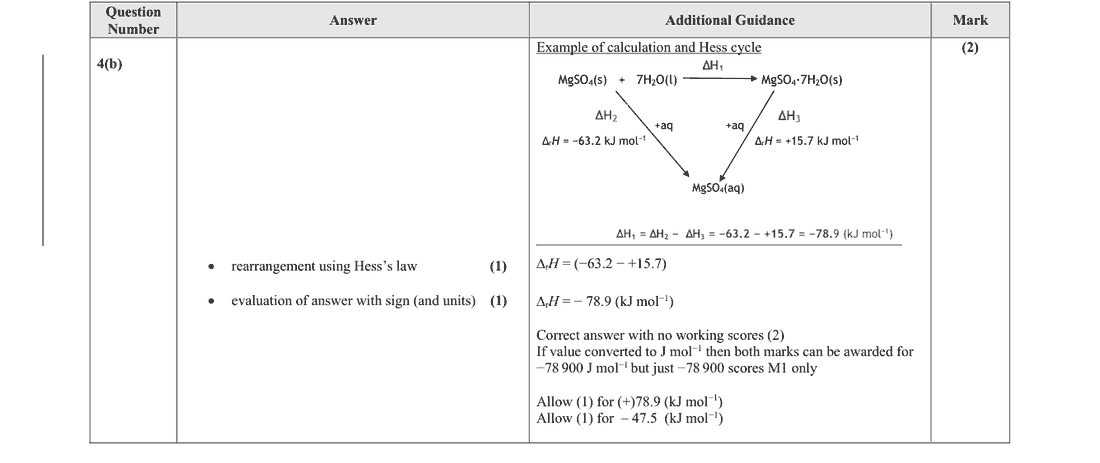
June 2023 · Paper 3 · Q4(b) 2 marks Calculation energetics i
Earlier part of question 4 that this part usesEarlier part of June 2023 Paper 3 question 4
The enthalpy changes of solution for anhydrous and hydrated magnesium sulfate
were found by experiment to be
MgSO4(s)            +   aq   →   MgSO4(aq)
ΔrH = –63.2 kJ mol–1
ΔrH = +15.7 kJ mol–1
MgSO4·7H2O(s)   +   aq   →   MgSO4(aq)
Calculate, using Hess’s law, the enthalpy change for the hydration of
anhydrous magnesium sulfate.
Include a sign and units in your answer.
MgSO4(s)   +   7H2O(l)   →   MgSO4·7H2O(s)
June 2023 · Paper 3 · Q7(a)(ii) 1 mark Calculation formulae equations and amounts of substance
Earlier part of question 7 that this part usesEarlier part of June 2023 Paper 3 question 7
Calculate the maximum volume that would be obtained by using a
25.0 cm3 pipette twice to measure a total volume of 50.0 cm3.
The uncertainty in each 25.0 cm3 pipette measurement is ±0.04 cm3.
June 2023 · Paper 3 · Q7(a)(iii) 2 marks Calculation formulae equations and amounts of substance
Earlier part of question 7 that this part usesEarlier part of June 2023 Paper 3 question 7
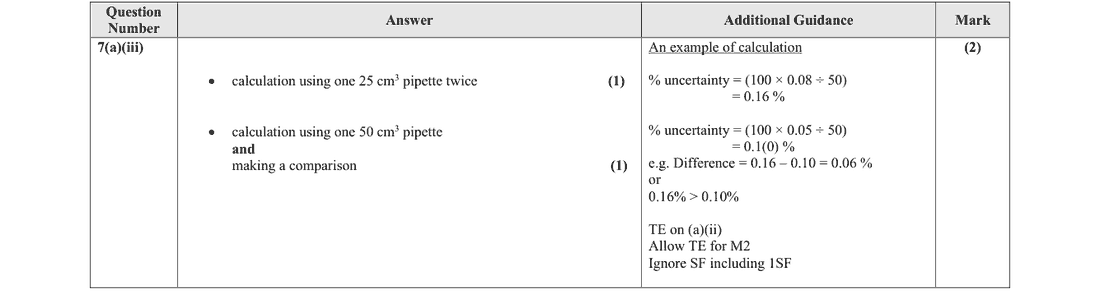
Compare the percentage uncertainty in using a 25.0 cm3 pipette twice with
using a 50.0 cm3 pipette once to measure 50.0 cm3 of water.
The uncertainty in the 50.0 cm3 pipette measurement is ±0.05 cm3.
June 2023 · Paper 3 · Q7(b)(ii) 4 marks Calculation acid base equilibria
Earlier parts of question 7 that this part usesEarlier part of June 2023 Paper 3 question 7Earlier part of June 2023 Paper 3 question 7
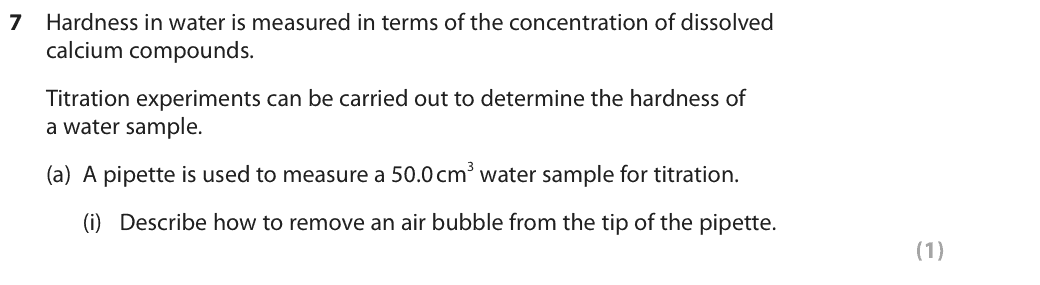
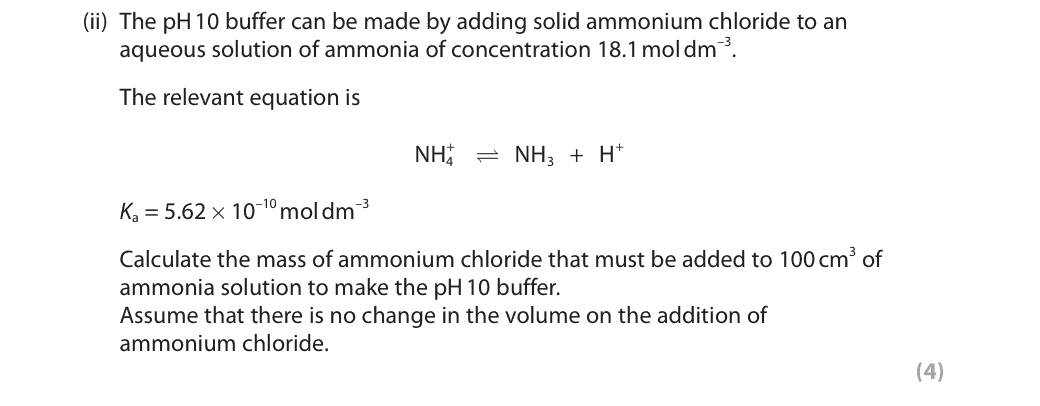
The pH 10 buffer can be made by adding solid ammonium chloride to an
aqueous solution of ammonia of concentration 18.1 mol dm–3.
The relevant equation is
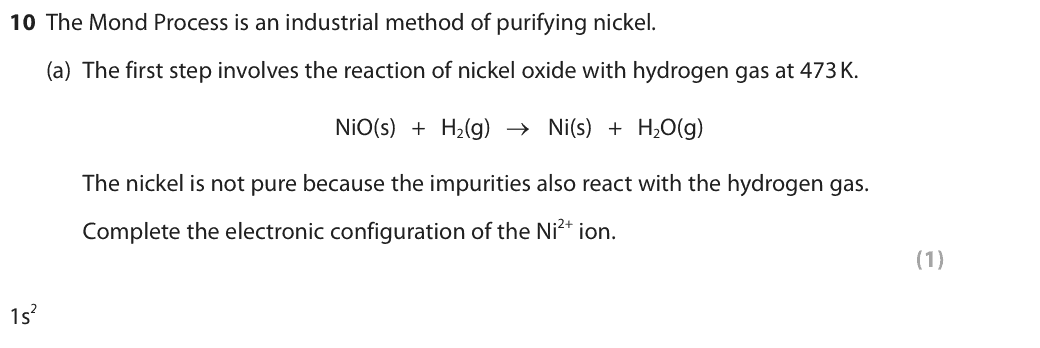
NH4
+       NH3   +   H+
Ka = 5.62 × 10–10 mol dm–3
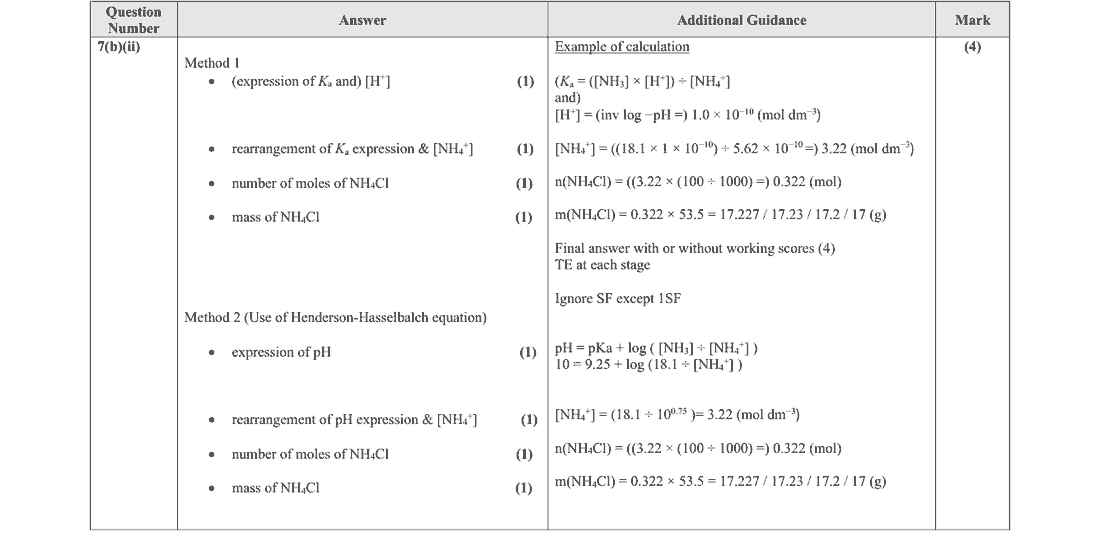
Calculate the mass of ammonium chloride that must be added to 100 cm3 of
ammonia solution to make the pH 10 buffer.
Assume that there is no change in the volume on the addition of
ammonium chloride.
June 2023 · Paper 3 · Q7(d)(ii) 6 marks Calculation formulae equations and amounts of substance
Earlier parts of question 7 that this part usesEarlier part of June 2023 Paper 3 question 7Earlier part of June 2023 Paper 3 question 7
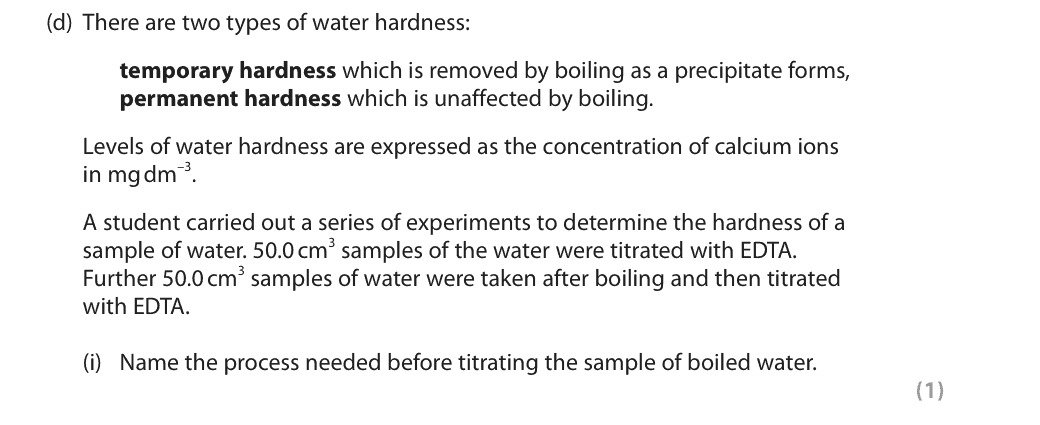
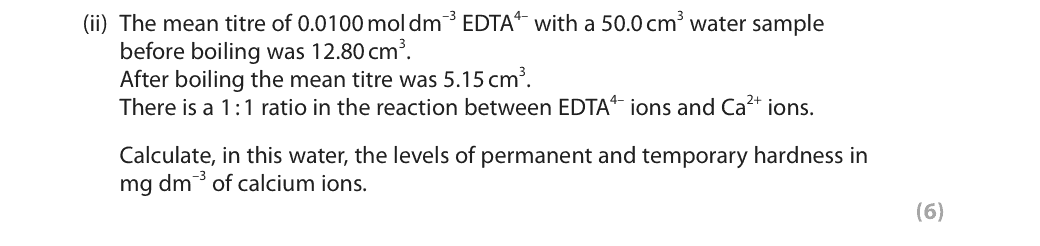
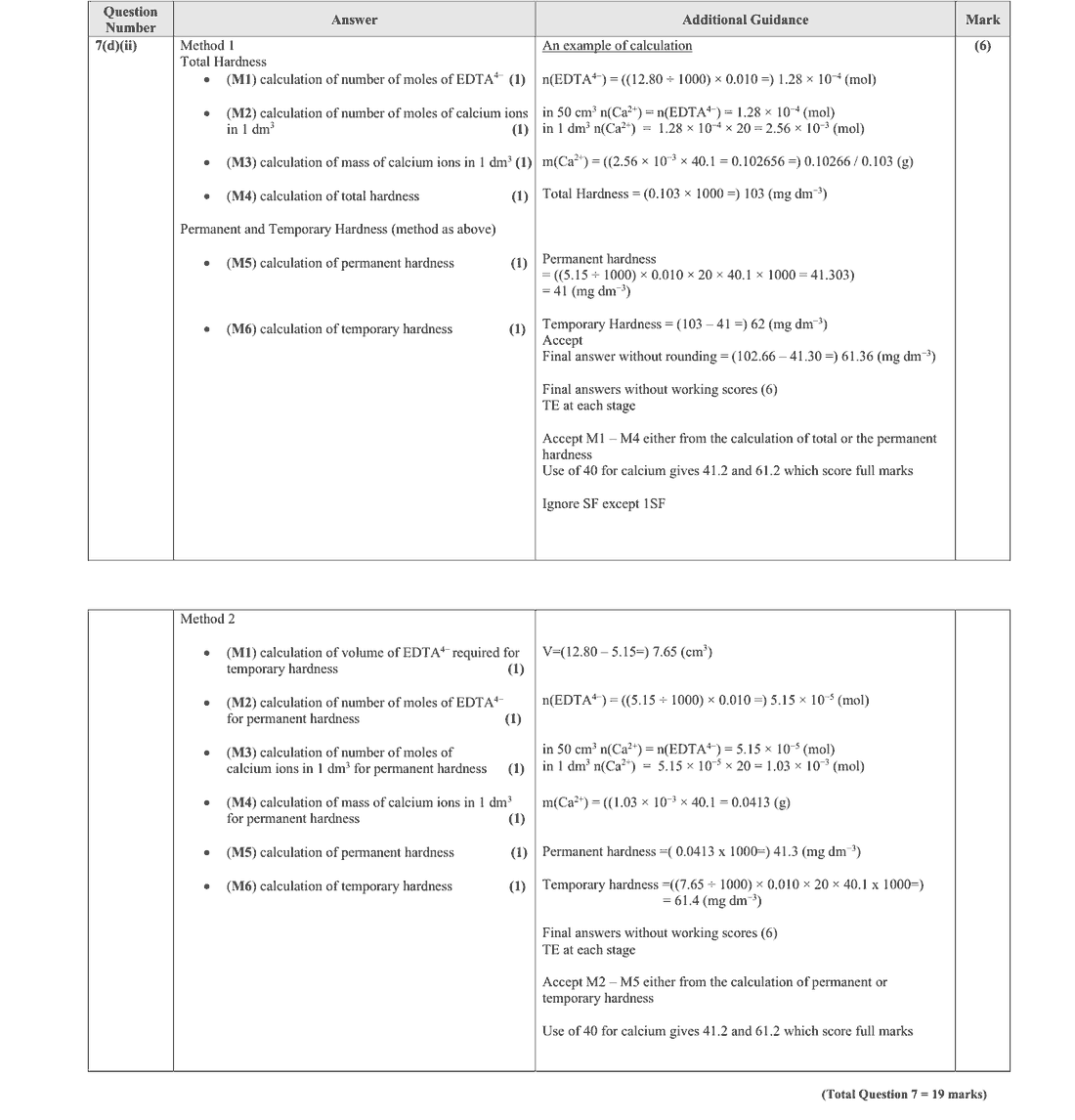
The mean titre of 0.0100 mol dm–3 EDTA4– with a 50.0 cm3 water sample
before boiling was 12.80 cm3.
After boiling the mean titre was 5.15 cm3.
There is a 1 : 1 ratio in the reaction between EDTA4– ions and Ca2+ ions.
Calculate, in this water, the levels of permanent and temporary hardness in
mg dm–3 of calcium ions.
June 2023 · Paper 3 · Q8(c)(i) 3 marks Calculation kinetics ii
Earlier part of question 8 that this part usesEarlier part of June 2023 Paper 3 question 8
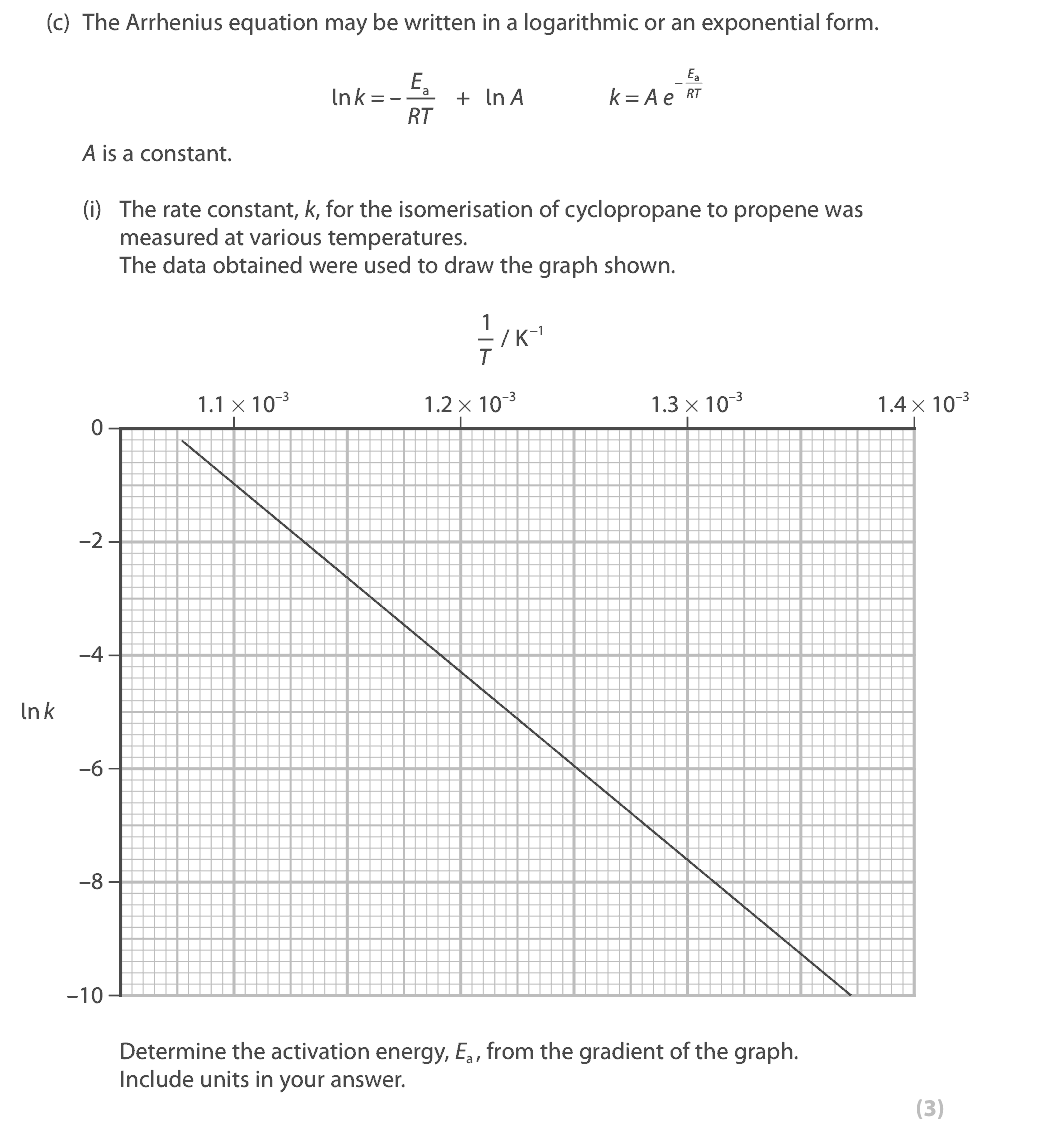
The Arrhenius equation may be written in a logarithmic or an exponential form.
ln k = – E
−E
a
a   +   ln A
k = A e
RT
RT
A is a constant.
The rate constant, k, for the isomerisation of cyclopropane to propene was
measured at various temperatures.
The data obtained were used to draw the graph shown.
1
T / K −
1
1.1 × 10–3
1.2 × 10–3
1.3 × 10–3
1.4 × 10–3
0
–2
–4
ln k
–6
–8
–10
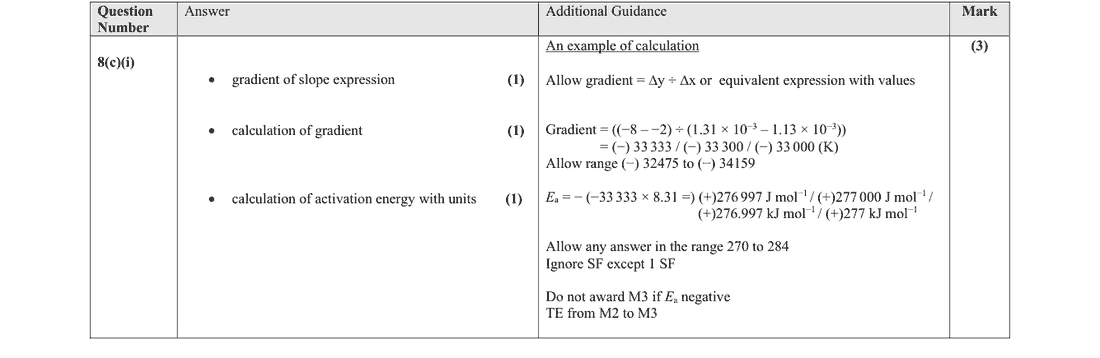
Determine the activation energy, Ea , from the gradient of the graph.
Include units in your answer.
June 2023 · Paper 3 · Q8(c)(ii) 3 marks Calculation kinetics i
Earlier parts of question 8 that this part usesEarlier part of June 2023 Paper 3 question 8Earlier part of June 2023 Paper 3 question 8
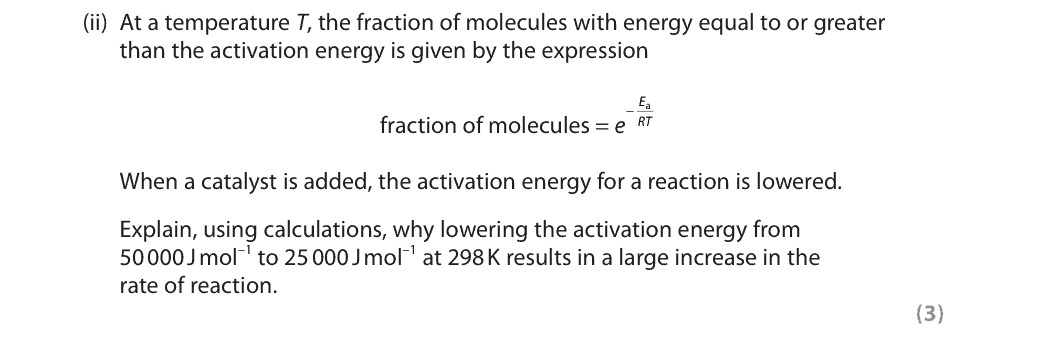
At a temperature T, the fraction of molecules with energy equal to or greater
than the activation energy is given by the expression
−E
a
fraction of molecules = e
RT
When a catalyst is added, the activation energy for a reaction is lowered.
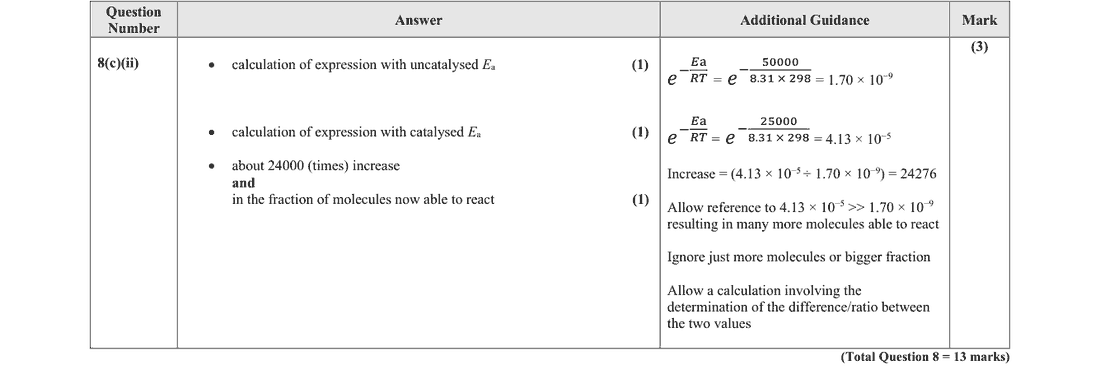
Explain, using calculations, why lowering the activation energy from
50 000 J mol–1 to 25 000 J mol–1 at 298 K results in a large increase in the
rate of reaction.
June 2023 · Paper 3 · Q10(b)(i) 5 marks Calculation entropy
Earlier part of question 10 that this part usesEarlier part of June 2023 Paper 3 question 10
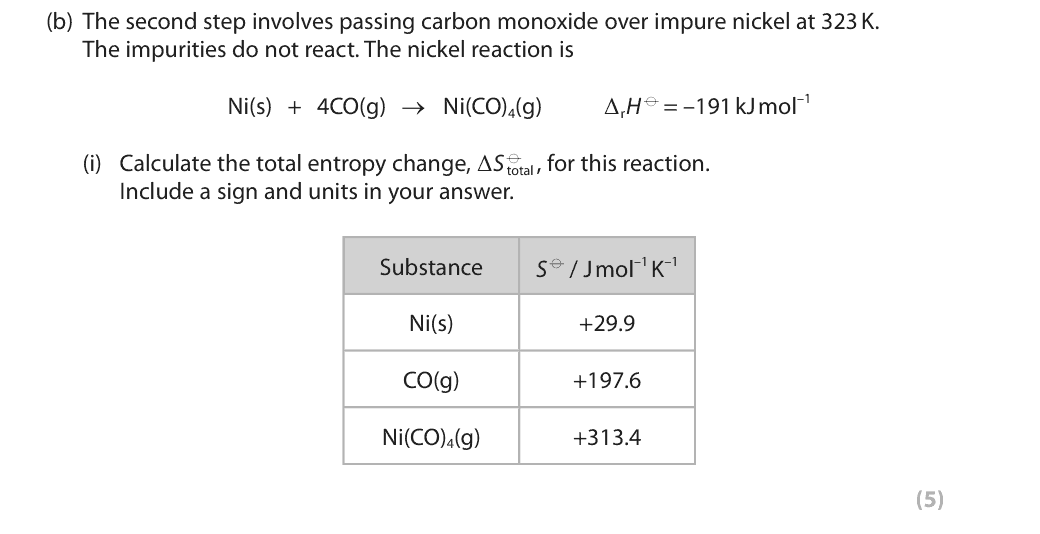
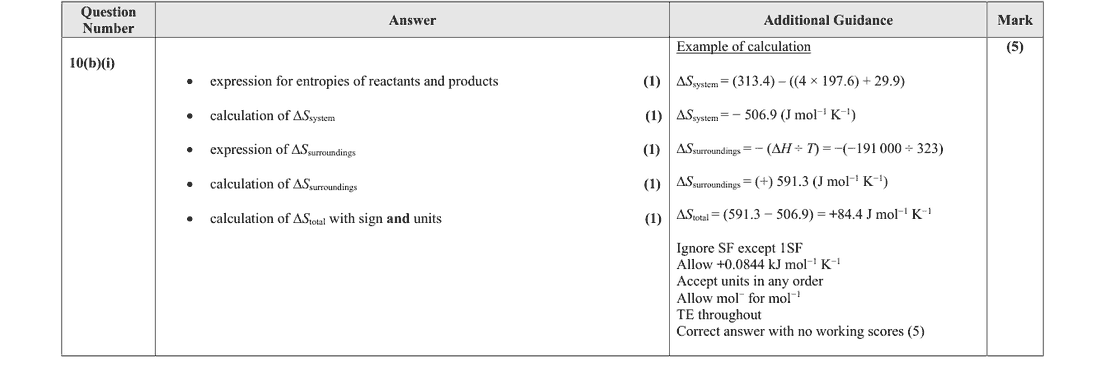
The second step involves passing carbon monoxide over impure nickel at 323 K.
The impurities do not react. The nickel reaction is
Ni(s)   +   4CO(g)   →   Ni(CO)4(g)
ΔrH d = –191 kJ mol–1
Calculate the total entropy change, ΔS d
total , for this reaction.
Include a sign and units in your answer.
Substance
S d / J mol–1 K–1
Ni(s)
+29.9
CO(g)
+197.6
Ni(CO)4(g)
+313.4
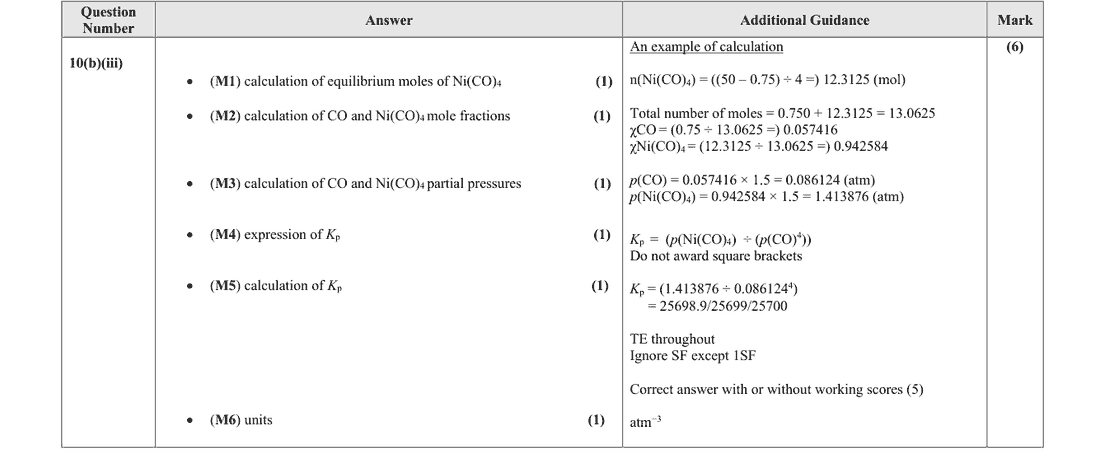
June 2023 · Paper 3 · Q10(b)(iii) 6 marks Calculation equilibrium ii
Earlier parts of question 10 that this part usesEarlier part of June 2023 Paper 3 question 10Earlier part of June 2023 Paper 3 question 10
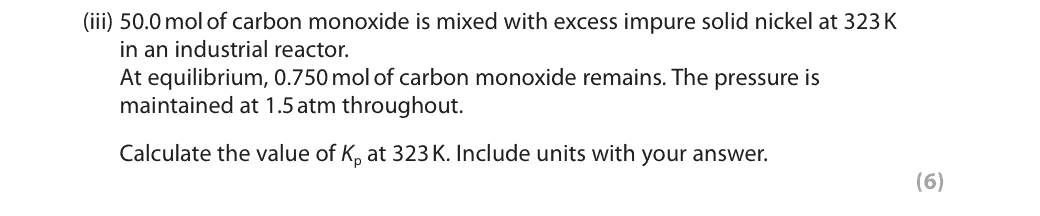
50.0 mol of carbon monoxide is mixed with excess impure solid nickel at 323 K
in an industrial reactor.
At equilibrium, 0.750 mol of carbon monoxide remains. The pressure is
maintained at 1.5 atm throughout.
Calculate the value of Kp at 323 K. Include units with your answer.
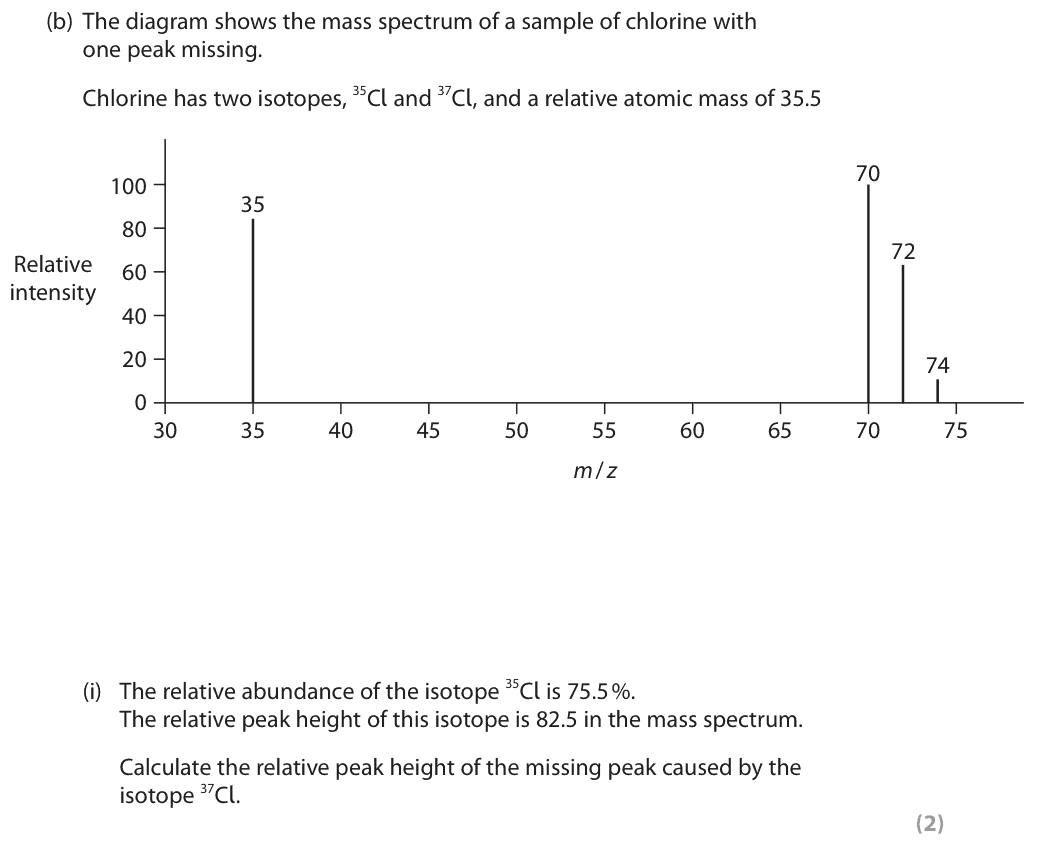
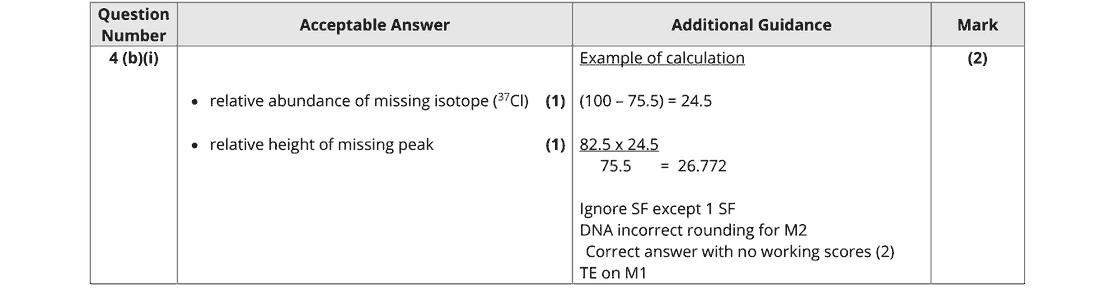
June 2022 · AS Paper 1 · Q4(b)(i) 2 marks Calculation atomic structure and the periodic table
Earlier part of question 4 that this part usesEarlier part of June 2022 Paper 1 question 4
The diagram shows the mass spectrum of a sample of chlorine with
one peak missing.
Chlorine has two isotopes, 35Cl and 37Cl, and a relative atomic mass of 35.5
70
100
35
80
72
Relative
60
intensity
40
20
74
0
30
35
40
45
50
55
60
65
70
75
m / z
The relative abundance of the isotope 35Cl is 75.5 %.
The relative peak height of this isotope is 82.5 in the mass spectrum.
Calculate the relative peak height of the missing peak caused by the
isotope 37Cl.
June 2022 · AS Paper 1 · Q4(b)(iii) 3 marks Calculation atomic structure and the periodic table
Earlier parts of question 4 that this part usesEarlier part of June 2022 Paper 1 question 4Earlier part of June 2022 Paper 1 question 4
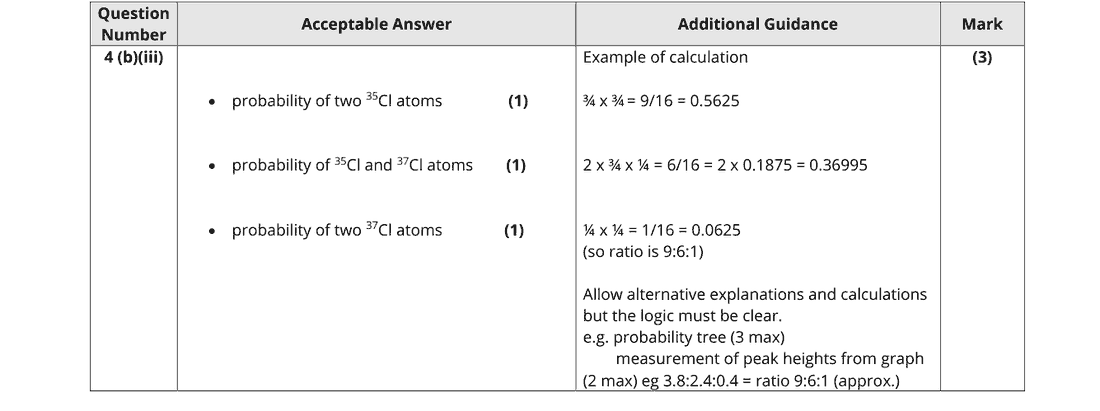
Explain, using calculations, why there is an approximate ratio of 9 : 6 : 1 for the
peak heights corresponding to the m / z values of 70, 72 and 74.
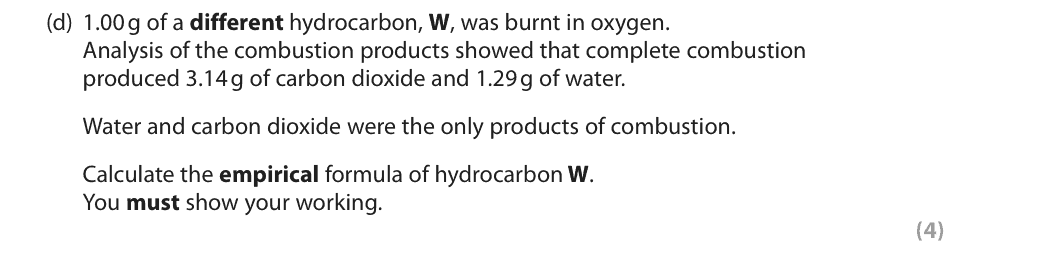
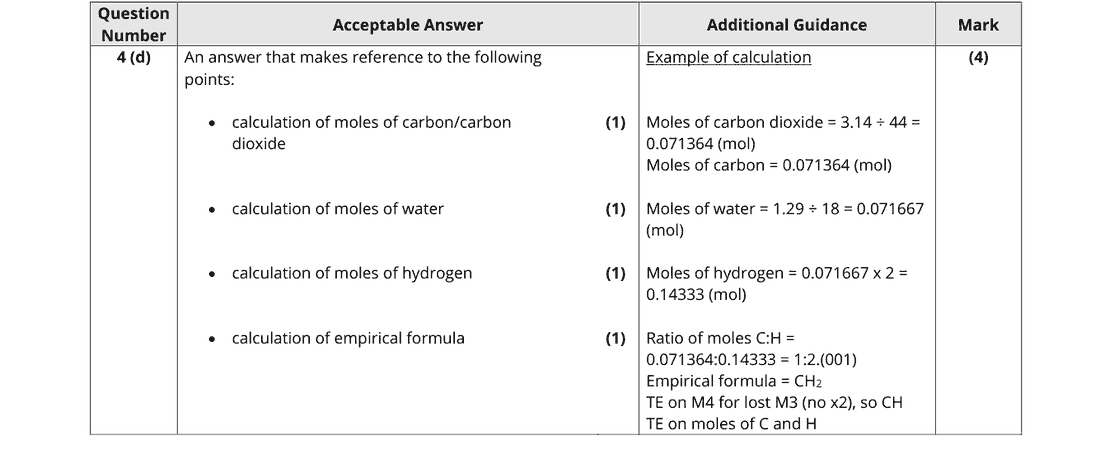
June 2022 · AS Paper 1 · Q4(d) 4 marks Calculation formulae equations and amounts of substance
1.00 g of a different hydrocarbon, W, was burnt in oxygen.
Analysis of the combustion products showed that complete combustion
produced 3.14 g of carbon dioxide and 1.29 g of water.
Water and carbon dioxide were the only products of combustion.
Calculate the empirical formula of hydrocarbon W.
You must show your working.
June 2022 · AS Paper 1 · Q7(c)(iii) 4 marks Calculation formulae equations and amounts of substance
Earlier parts of question 7 that this part usesEarlier part of June 2022 Paper 1 question 7Earlier part of June 2022 Paper 1 question 7Earlier part of June 2022 Paper 1 question 7
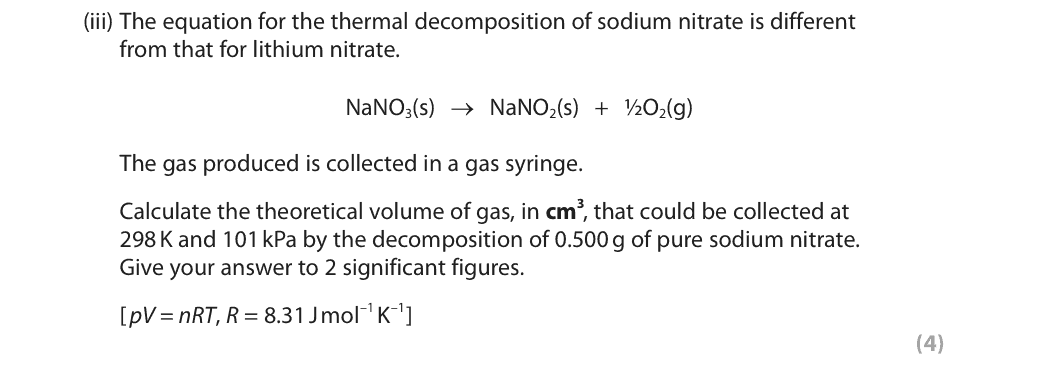
The equation for the thermal decomposition of sodium nitrate is different
from that for lithium nitrate.
NaNO3(s)   →   NaNO2(s)   +   ½O2(g)
The gas produced is collected in a gas syringe.
Calculate the theoretical volume of gas, in cm3, that could be collected at
298 K and 101 kPa by the decomposition of 0.500 g of pure sodium nitrate.
Give your answer to 2 significant figures.
[pV = nRT, R = 8.31 J mol–1 K–1]
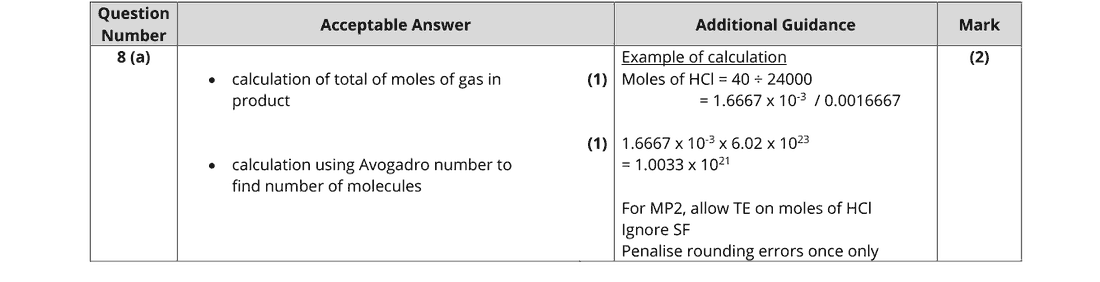
June 2022 · AS Paper 1 · Q8(a) 2 marks Calculation formulae equations and amounts of substance
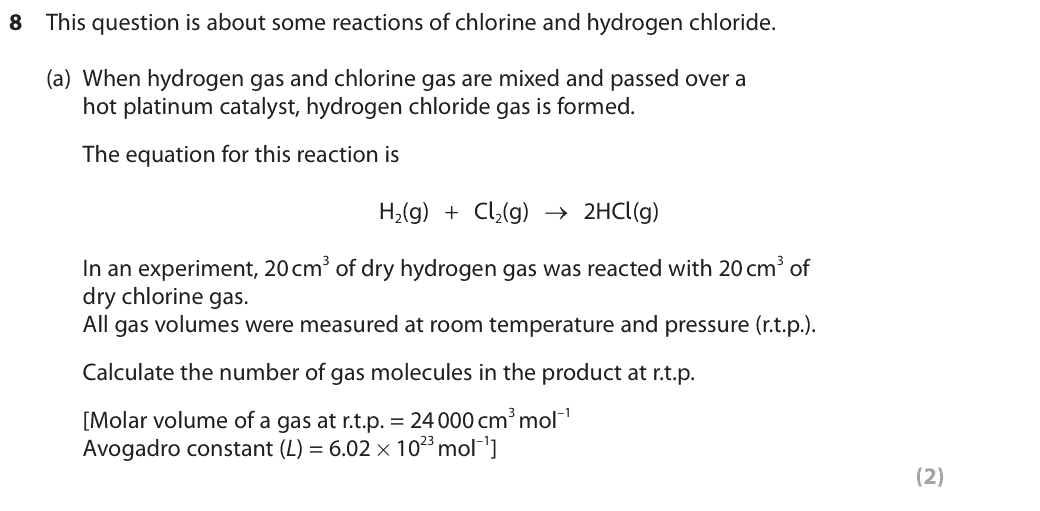
This question is about some reactions of chlorine and hydrogen chloride.
When hydrogen gas and chlorine gas are mixed and passed over a
hot platinum catalyst, hydrogen chloride gas is formed.
The equation for this reaction is
H2(g)   +   Cl2(g)   →   2HCl(g)
In an experiment, 20 cm3 of dry hydrogen gas was reacted with 20 cm3 of
dry chlorine gas.
All gas volumes were measured at room temperature and pressure (r.t.p.).
Calculate the number of gas molecules in the product at r.t.p.
[Molar volume of a gas at r.t.p. = 24 000 cm3 mol–1
Avogadro constant (L) = 6.02 × 1023 mol–1]
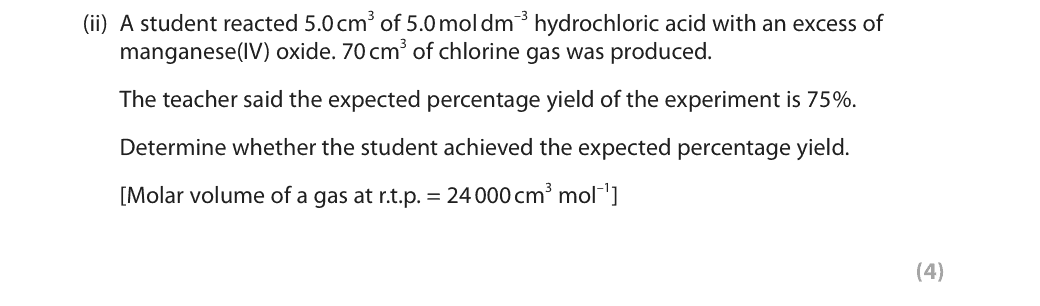
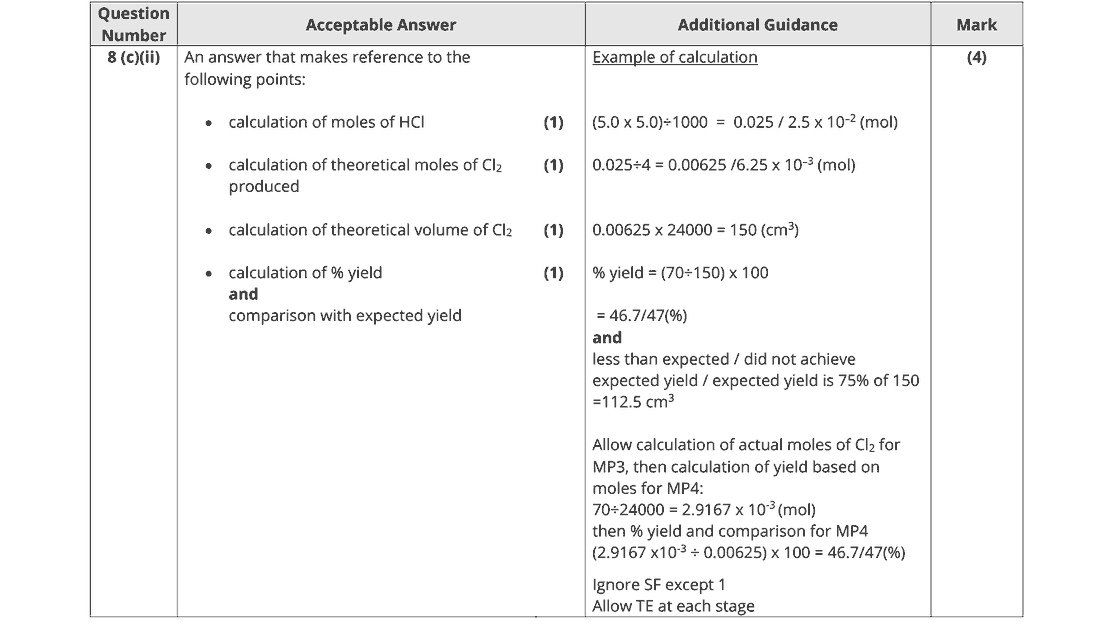
June 2022 · AS Paper 1 · Q8(c)(ii) 4 marks Calculation formulae equations and amounts of substance
Earlier parts of question 8 that this part usesEarlier part of June 2022 Paper 1 question 8Earlier part of June 2022 Paper 1 question 8
A student reacted 5.0 cm3 of 5.0 mol dm–3 hydrochloric acid with an excess of
manganese(IV) oxide. 70 cm3 of chlorine gas was produced.
The teacher said the expected percentage yield of the experiment is 75 %.
Determine whether the student achieved the expected percentage yield.
[Molar volume of a gas at r.t.p. = 24 000 cm3 mol–1]
June 2022 · AS Paper 1 · Q8(d)(ii) 3 marks Calculation formulae equations and amounts of substance
Earlier parts of question 8 that this part usesEarlier part of June 2022 Paper 1 question 8Earlier part of June 2022 Paper 1 question 8
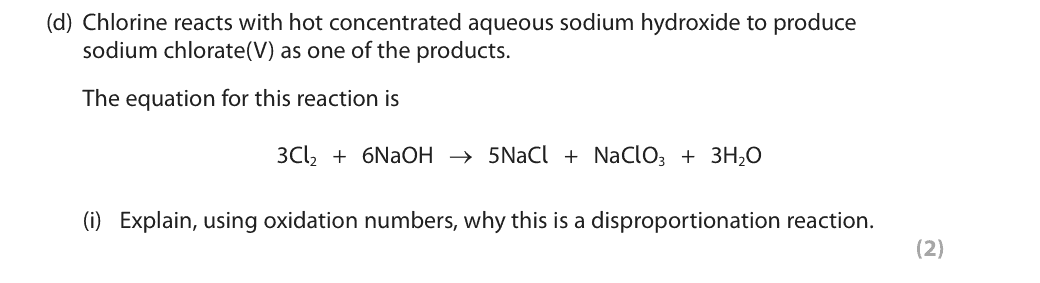
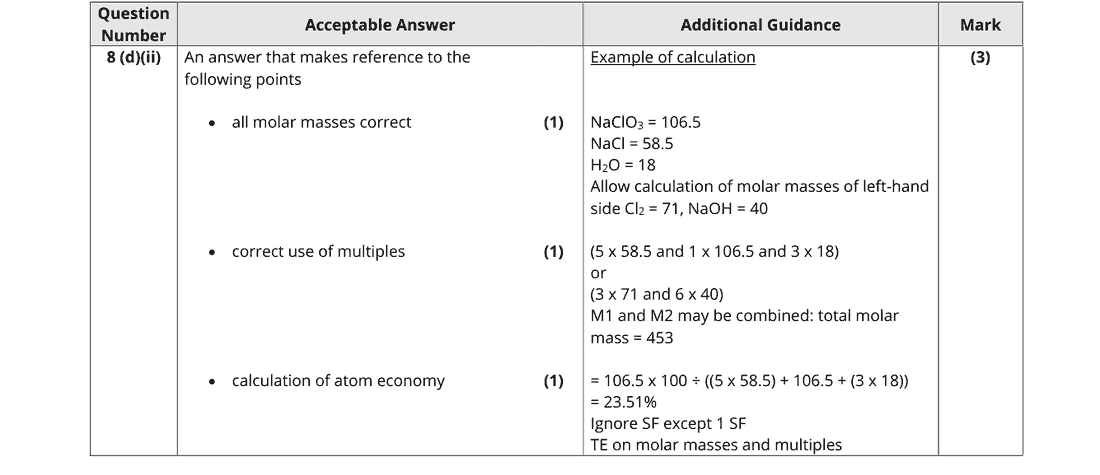
Calculate the atom economy, by mass, of sodium chlorate(V) in this reaction.
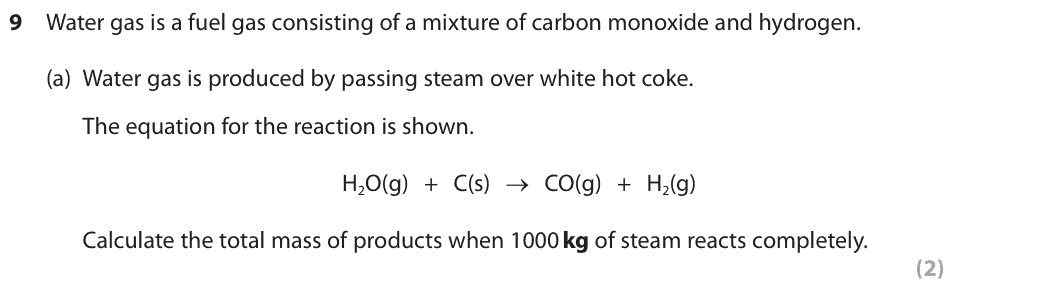
June 2022 · AS Paper 1 · Q9(a) 2 marks Calculation formulae equations and amounts of substance
Water gas is a fuel gas consisting of a mixture of carbon monoxide and hydrogen.
Water gas is produced by passing steam over white hot coke.
The equation for the reaction is shown.
H2O(g)   +   C(s)   →   CO(g)   +   H2(g)
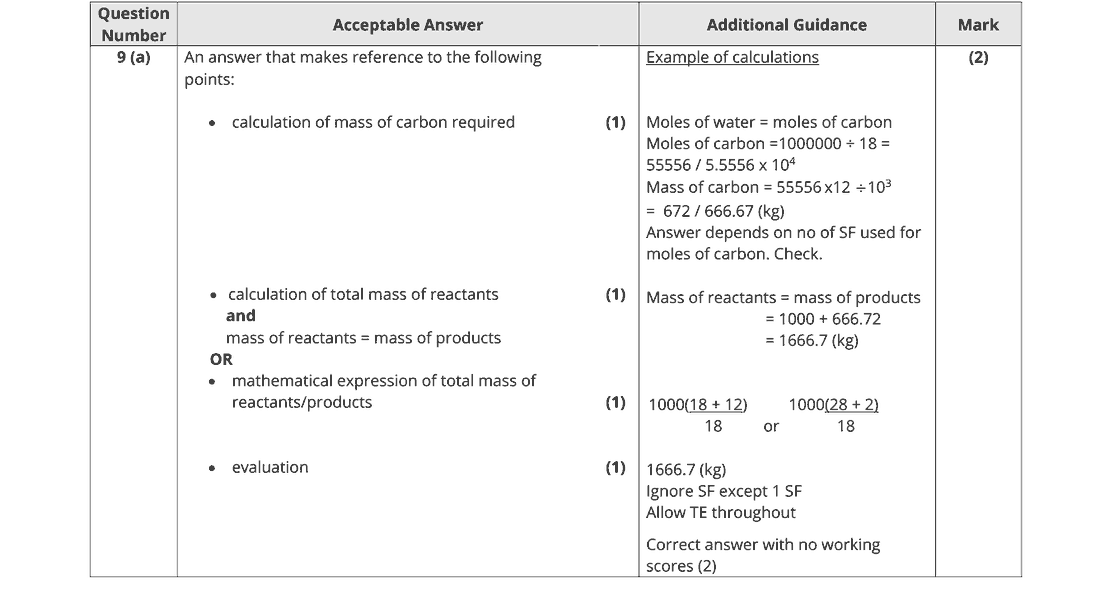
Calculate the total mass of products when 1000 kg of steam reacts completely.
June 2022 · AS Paper 2 · Q3(a)(i) 3 marks Calculation energetics i
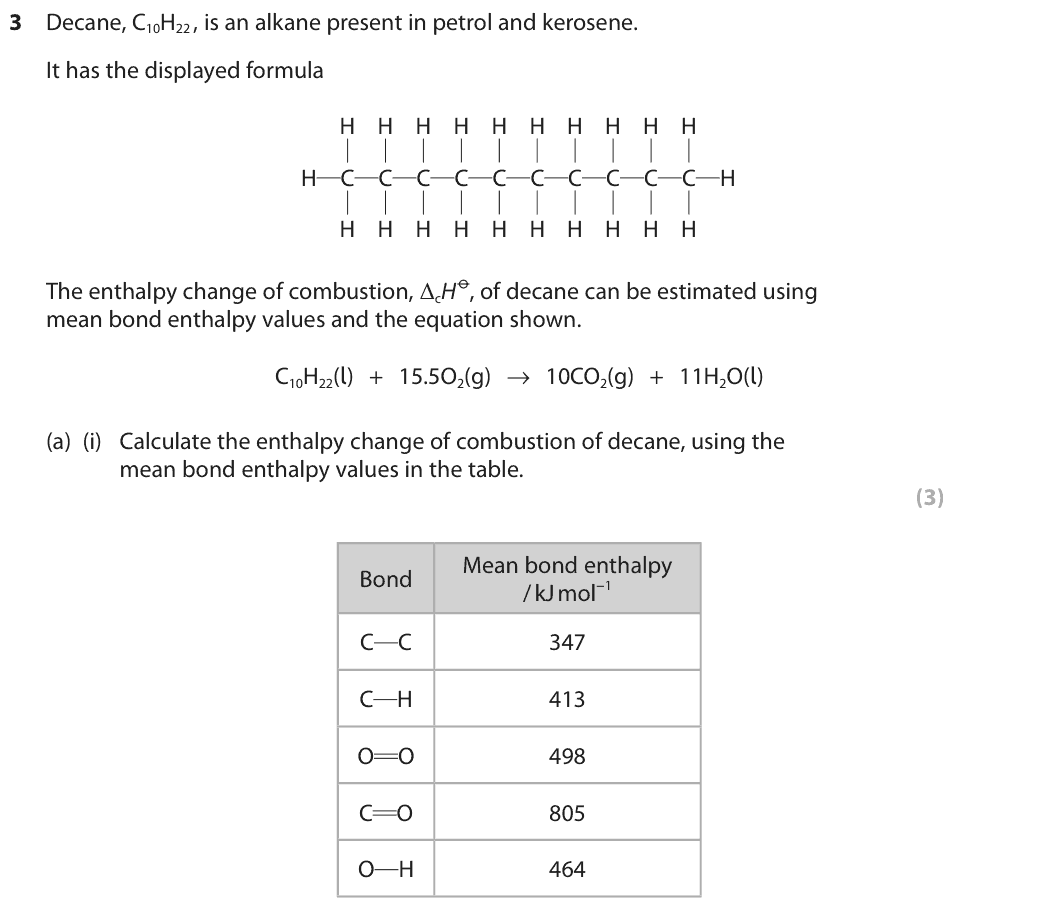
Decane, C10H22 , is an alkane present in petrol and kerosene.
It has the displayed formula
H
H
H
H
H
H
H
H
H
H
H
C
C
C
C
C
C
C
C
C
C
H
H
H
H
H
H
H
H
H
H
H
The enthalpy change of combustion, ΔcH , of decane can be estimated using
mean bond enthalpy values and the equation shown.
C10H22(l)   +   15.5O2(g)   →   10CO2(g)   +   11H2O(l)
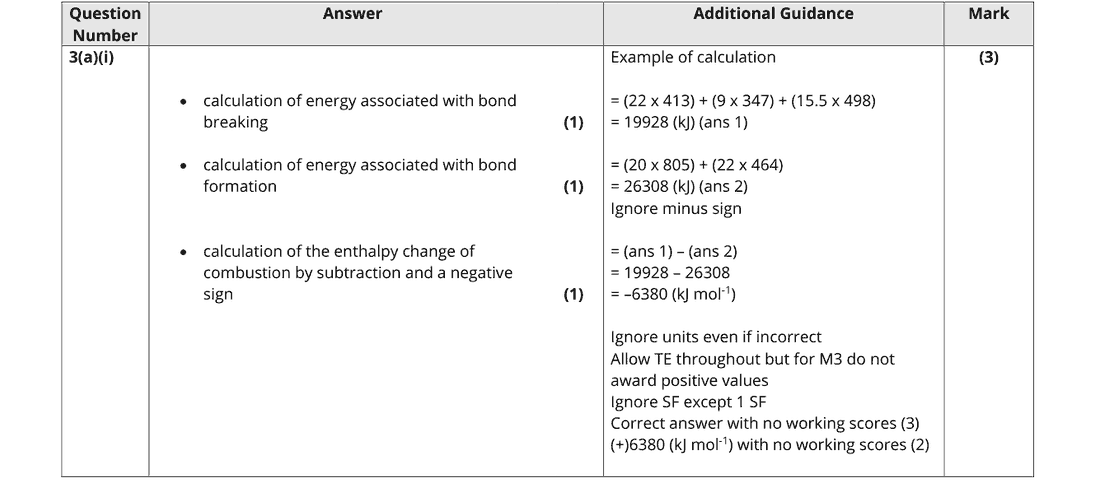
Calculate the enthalpy change of combustion of decane, using the
mean bond enthalpy values in the table.
Mean bond enthalpy
Bond
/ kJ mol−1
C
C
347
C
H
413
O
O
498
C
O
805
O
H
464
June 2022 · AS Paper 2 · Q4(a)(ii) 1 mark Calculation energetics i
Earlier part of question 4 that this part usesEarlier part of June 2022 Paper 2 question 4
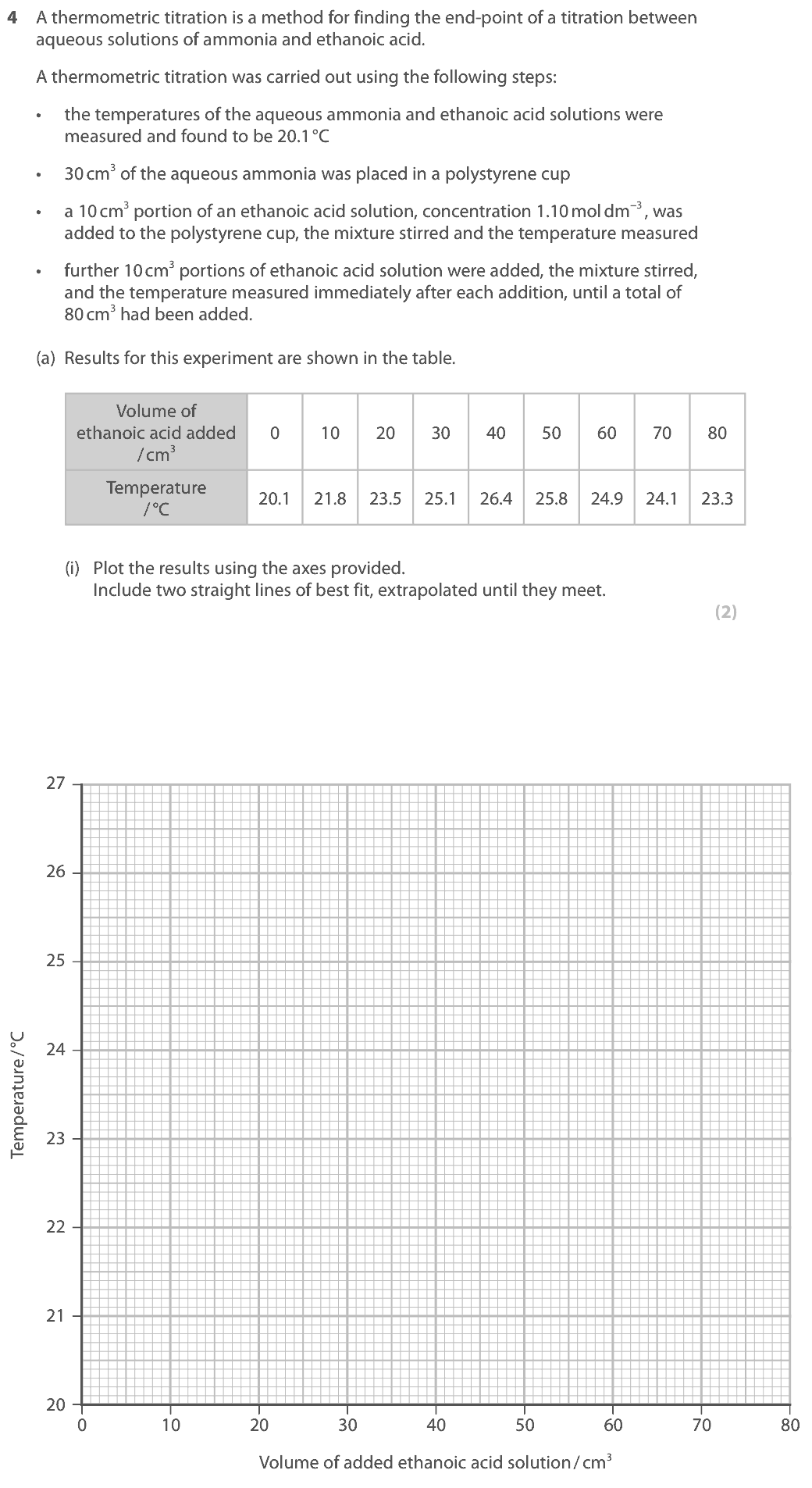
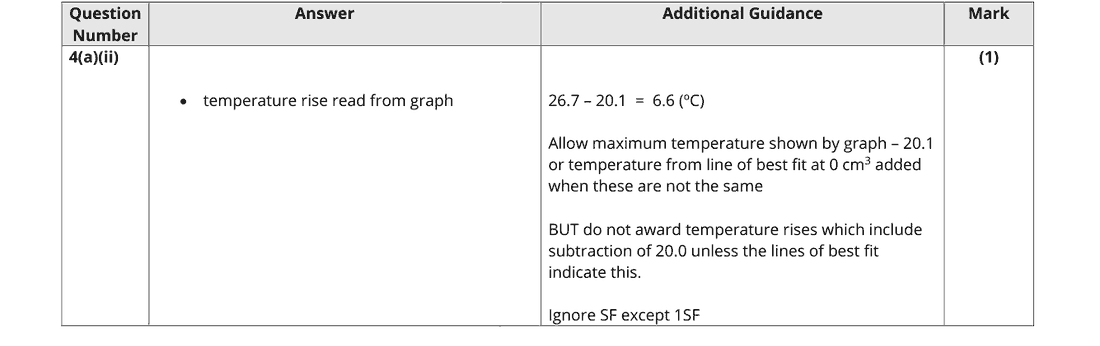
Determine the maximum temperature rise from your graph.
June 2022 · AS Paper 2 · Q4(a)(iii) 2 marks Calculation formulae equations and amounts of substance
Earlier part of question 4 that this part usesEarlier part of June 2022 Paper 2 question 4
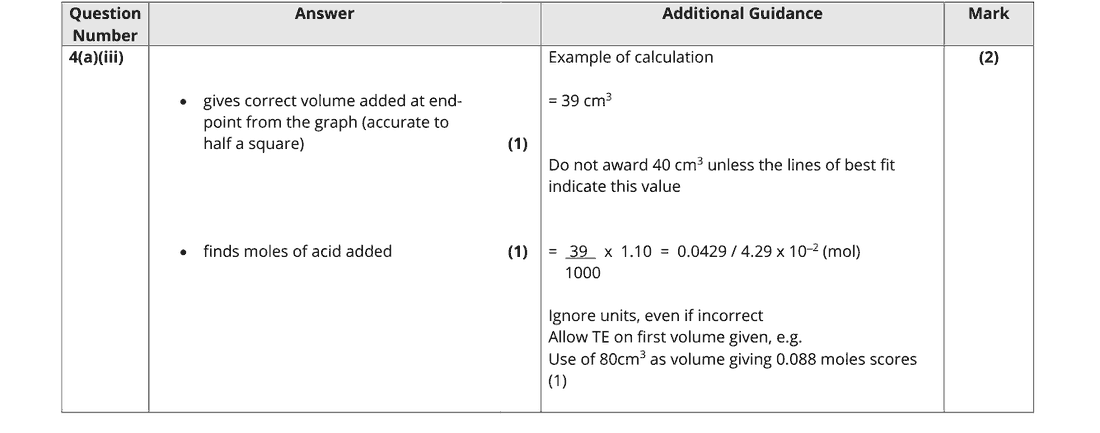
Calculate the number of moles of ethanoic acid, with a concentration of
1.10 mol dm−3 , added at the end‑point of the reaction.
June 2022 · AS Paper 2 · Q4(a)(iv) 3 marks Calculation energetics i
Earlier parts of question 4 that this part usesEarlier part of June 2022 Paper 2 question 4Earlier part of June 2022 Paper 2 question 4Earlier part of June 2022 Paper 2 question 4
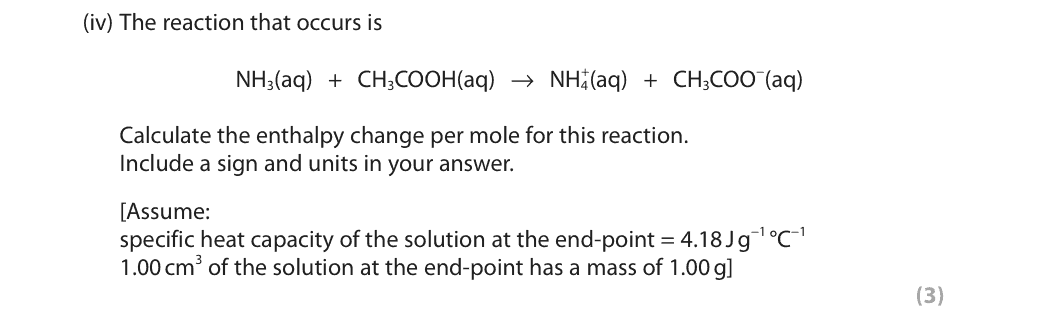
The reaction that occurs is
NH3(aq)   +   CH3COOH(aq)   →   NH4
+(aq)   +   CH3COO−(aq)
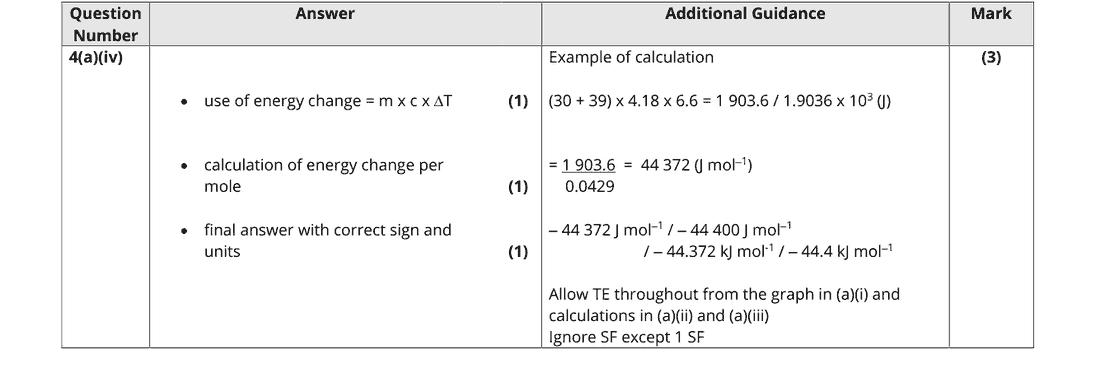
Calculate the enthalpy change per mole for this reaction.
Include a sign and units in your answer.
[Assume:
specific heat capacity of the solution at the end‑point = 4.18 J g−1 °C−1
1.00 cm3 of the solution at the end‑point has a mass of 1.00 g]
June 2022 · AS Paper 2 · Q6(e) 4 marks Calculation formulae equations and amounts of substance
Earlier part of question 6 that this part usesEarlier part of June 2022 Paper 2 question 6
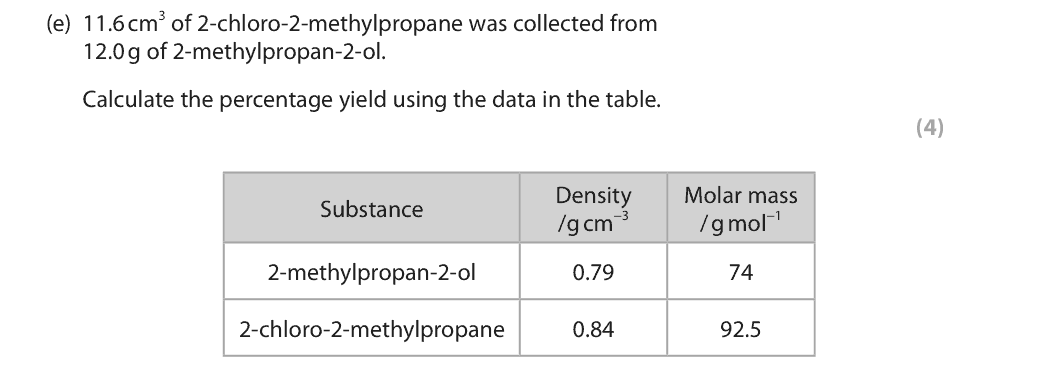
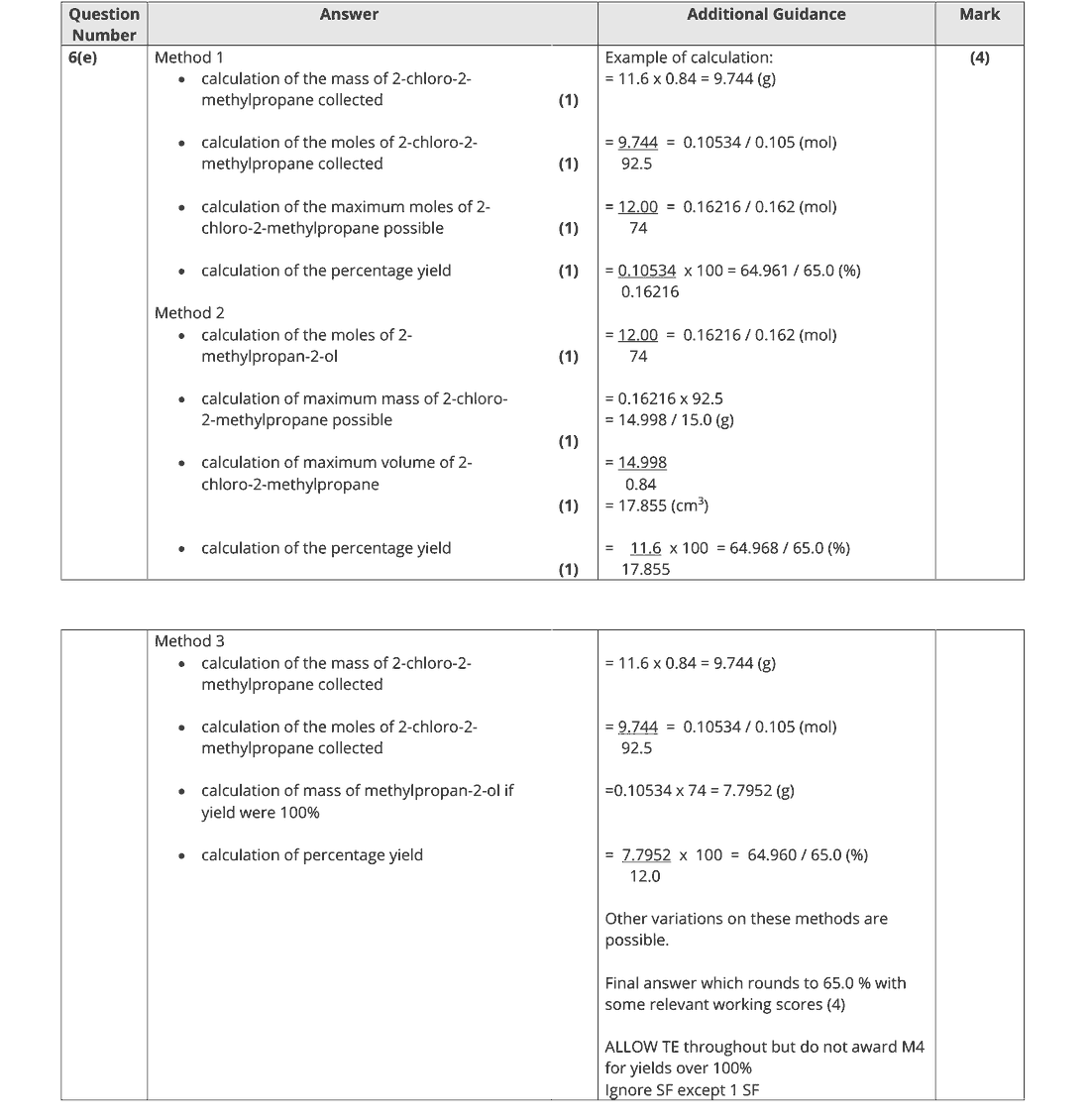
11.6 cm3 of 2‑chloro‑2‑methylpropane was collected from
12.0 g of 2‑methylpropan‑2‑ol.
Calculate the percentage yield using the data in the table.
Density
Molar mass
Substance
/g cm−3
/ g mol−1
2‑methylpropan‑2‑ol
0.79
74
2‑chloro‑2‑methylpropane
0.84
92.5
June 2022 · AS Paper 2 · Q7(a)(i) 2 marks Calculation formulae equations and amounts of substance
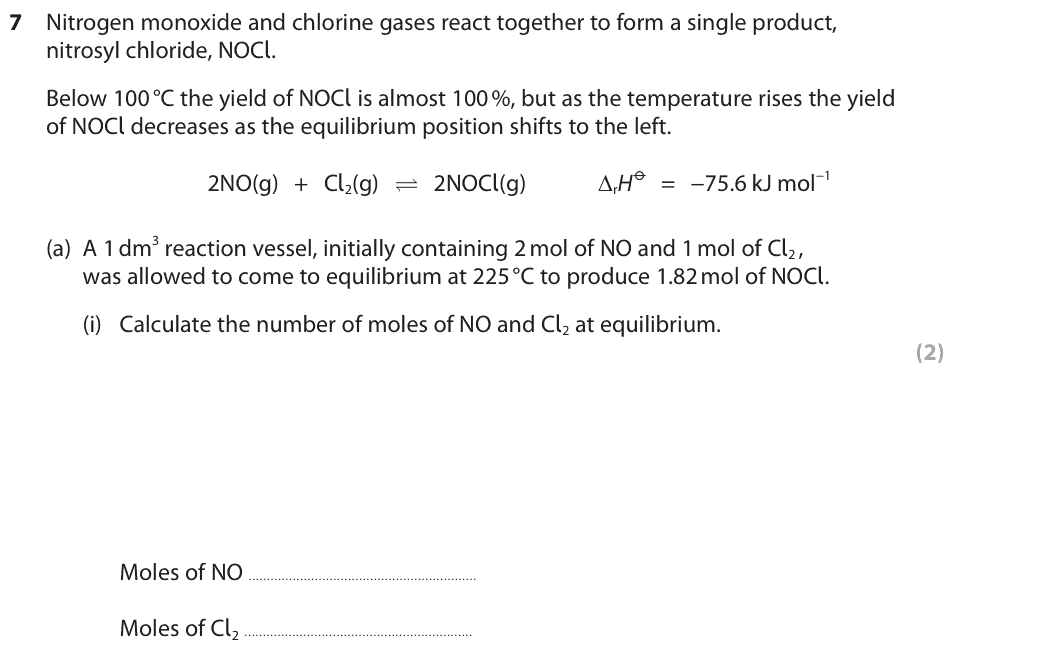
Nitrogen monoxide and chlorine gases react together to form a single product,
nitrosyl chloride, NOCl.
Below 100 °C the yield of NOCl is almost 100 %, but as the temperature rises the yield
of NOCl decreases as the equilibrium position shifts to the left.
2NO(g)   +   Cl2(g)      2NOCl(g)            ∆rH    =   −75.6 kJ mol−1
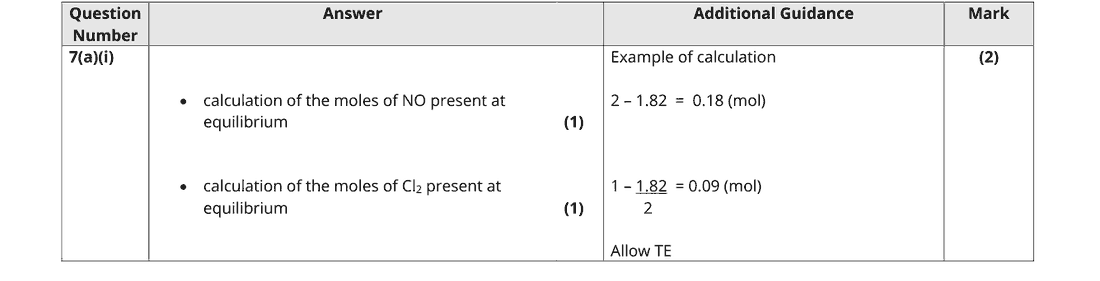
A 1 dm3 reaction vessel, initially containing 2 mol of NO and 1 mol of Cl2 ,
was allowed to come to equilibrium at 225 °C to produce 1.82 mol of NOCl.
Calculate the number of moles of NO and Cl2 at equilibrium.
Moles of NO 
Moles of Cl2
June 2022 · AS Paper 2 · Q7(b)(ii) 2 marks Calculation energetics i
Earlier parts of question 7 that this part usesEarlier part of June 2022 Paper 2 question 7Earlier part of June 2022 Paper 2 question 7
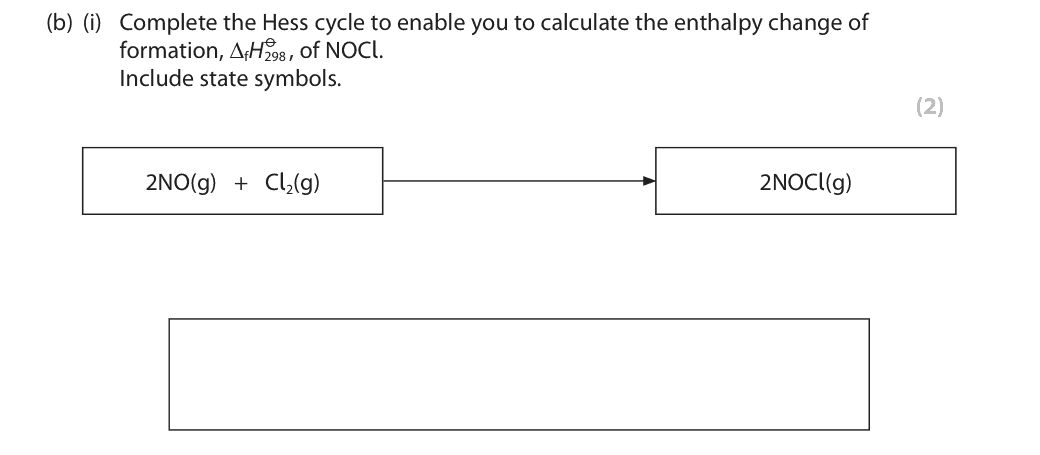
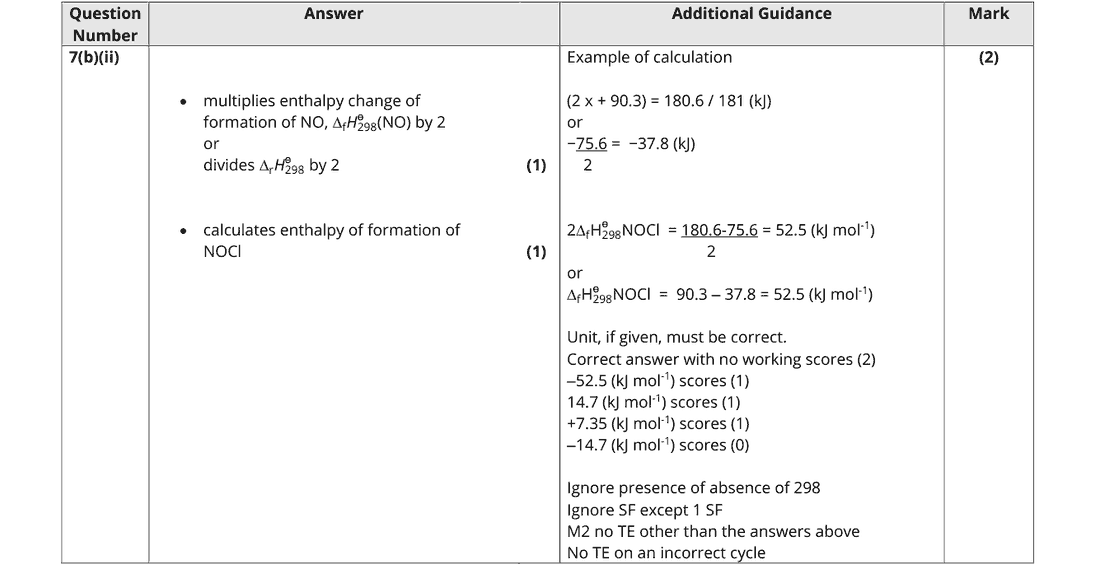
Calculate the enthalpy change of formation, ∆fH 298 , of NOCl given the data
2NO(g)   +   Cl2(g)      2NOCl(g)          ∆rH 298    =   −75.6 kJ mol−1
enthalpy change of formation of NO, ∆fH 298 ,   =   +90.3 kJ mol−1
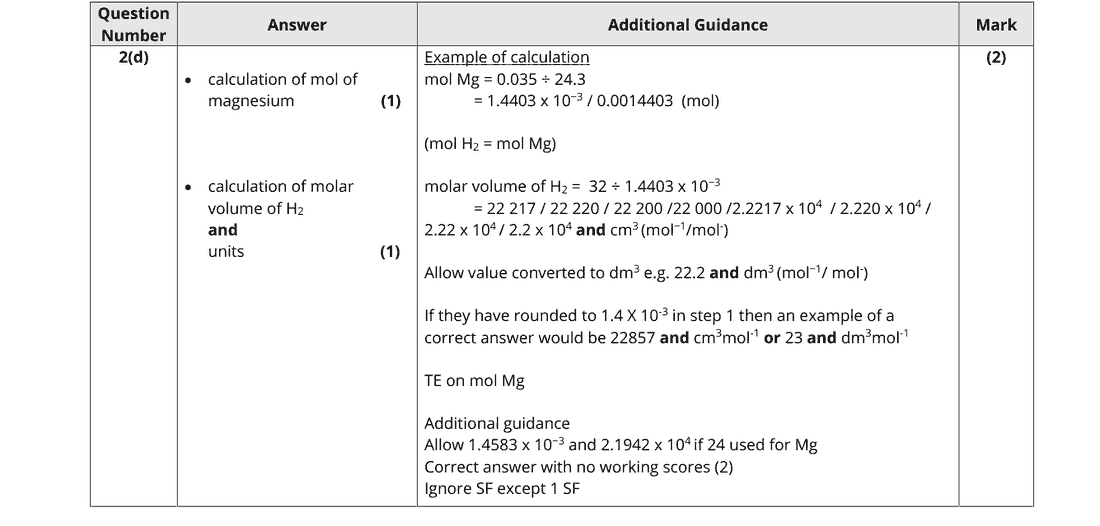
June 2022 · Paper 1 · Q2(d) 2 marks Calculation formulae equations and amounts of substance
Earlier part of question 2 that this part usesEarlier part of June 2022 Paper 1 question 2
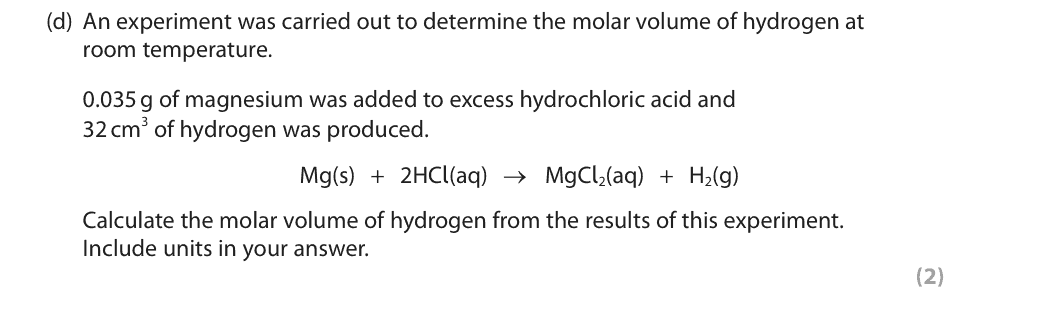
An experiment was carried out to determine the molar volume of hydrogen at
room temperature.
0.035 g of magnesium was added to excess hydrochloric acid and
32 cm3 of hydrogen was produced.
Mg(s)   +   2HCl(aq)   →   MgCl2(aq)   +   H2(g)
Calculate the molar volume of hydrogen from the results of this experiment.
Include units in your answer.
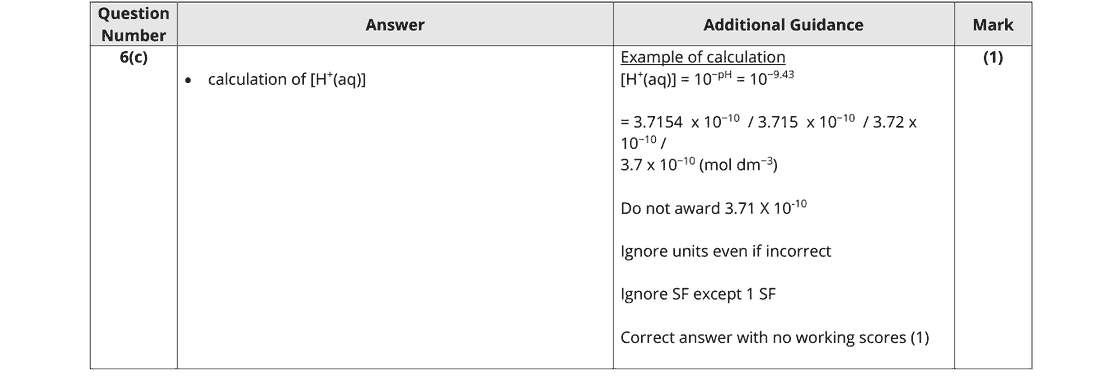
June 2022 · Paper 1 · Q6(c) 1 mark Calculation acid base equilibria
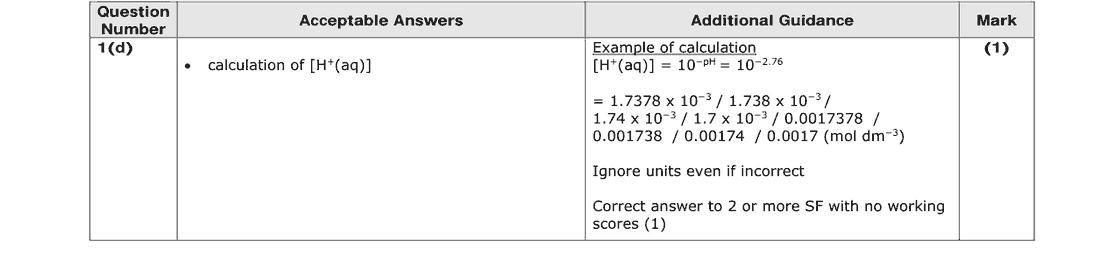
Calculate the concentration of hydrogen ions, in mol dm
pH of 9.43
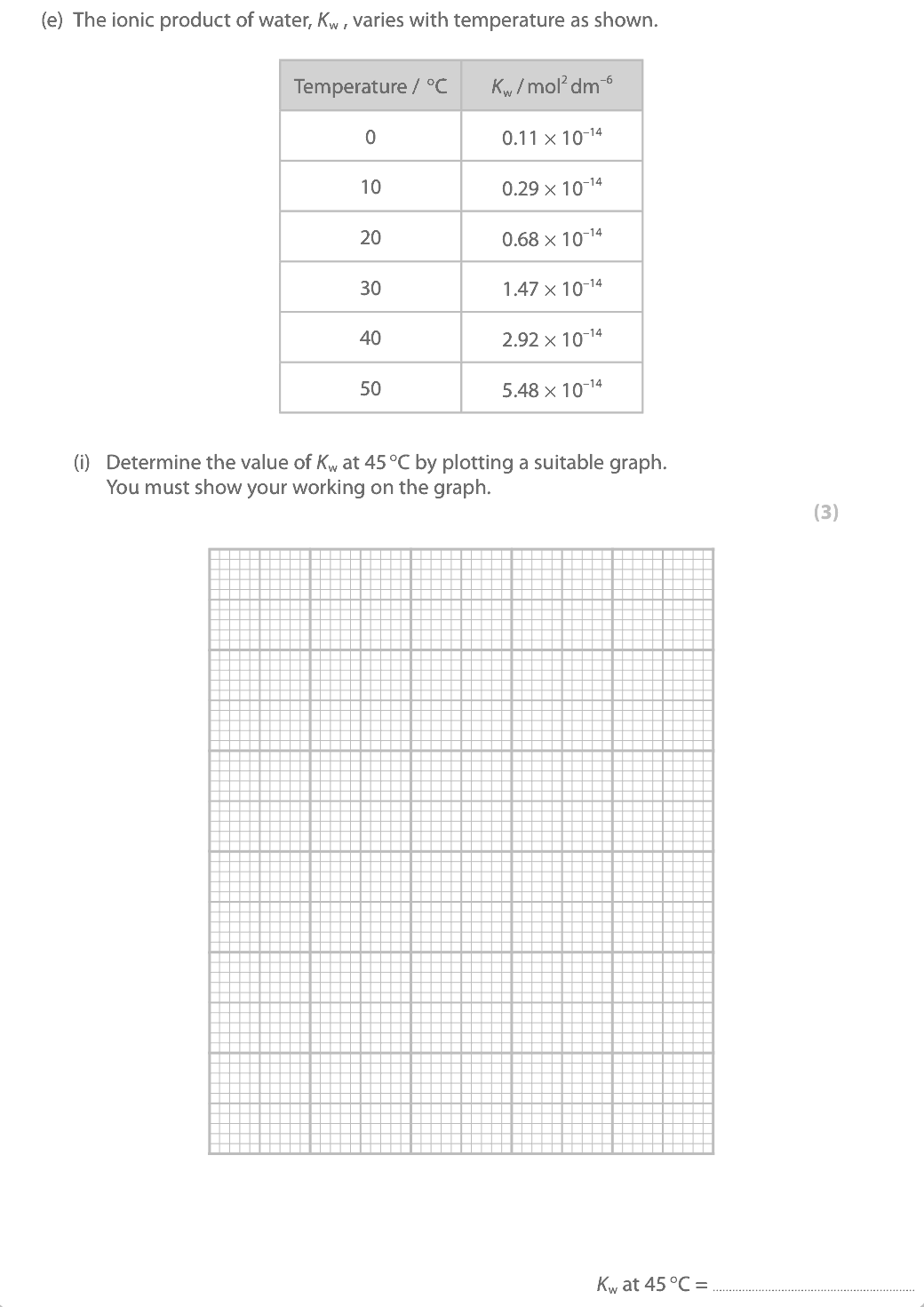
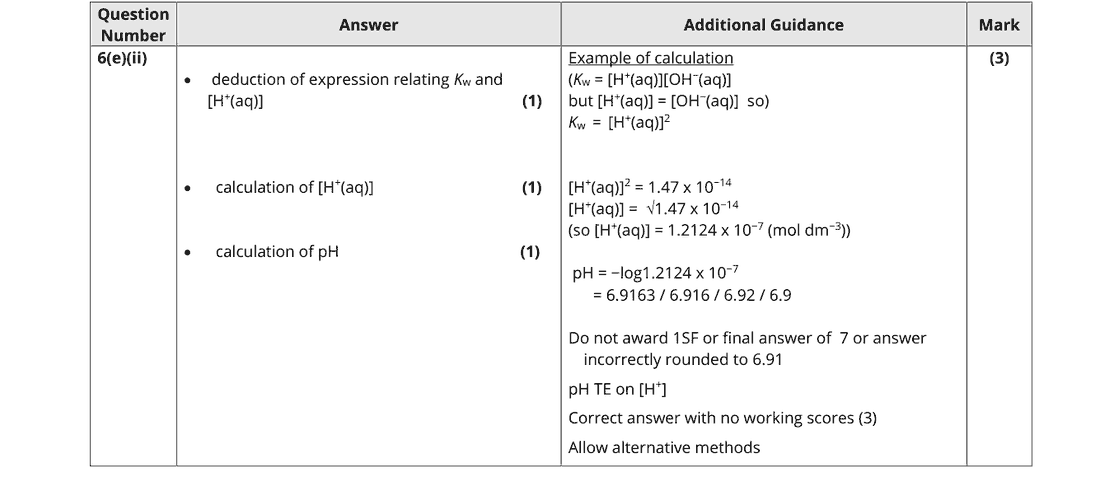
June 2022 · Paper 1 · Q6(e)(ii) 3 marks Calculation acid base equilibria
Earlier part of question 6 that this part usesEarlier part of June 2022 Paper 1 question 6
The ionic product of water at 30 °C is 1.47 × 10–14 mol2 dm–6.
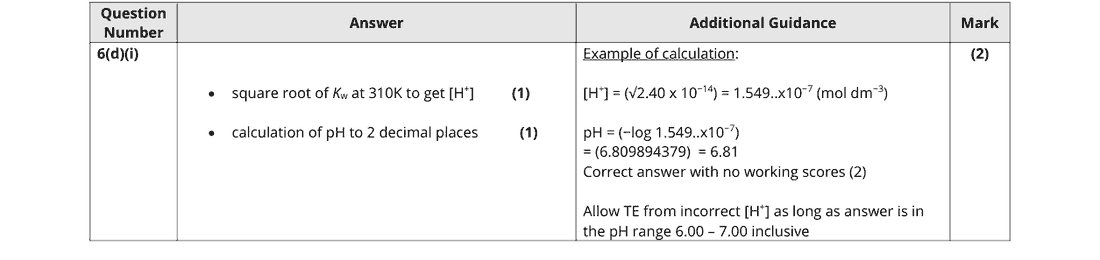
Calculate the pH of water at this temperature.
June 2022 · Paper 1 · Q7(c)(ii) 1 mark Calculation redox ii
Earlier parts of question 7 that this part usesEarlier part of June 2022 Paper 1 question 7Earlier part of June 2022 Paper 1 question 7
Calculate E
cell  for the reaction in (c)(i).
June 2022 · Paper 1 · Q7(d) 5 marks Calculation redox ii
Earlier part of question 7 that this part usesEarlier part of June 2022 Paper 1 question 7
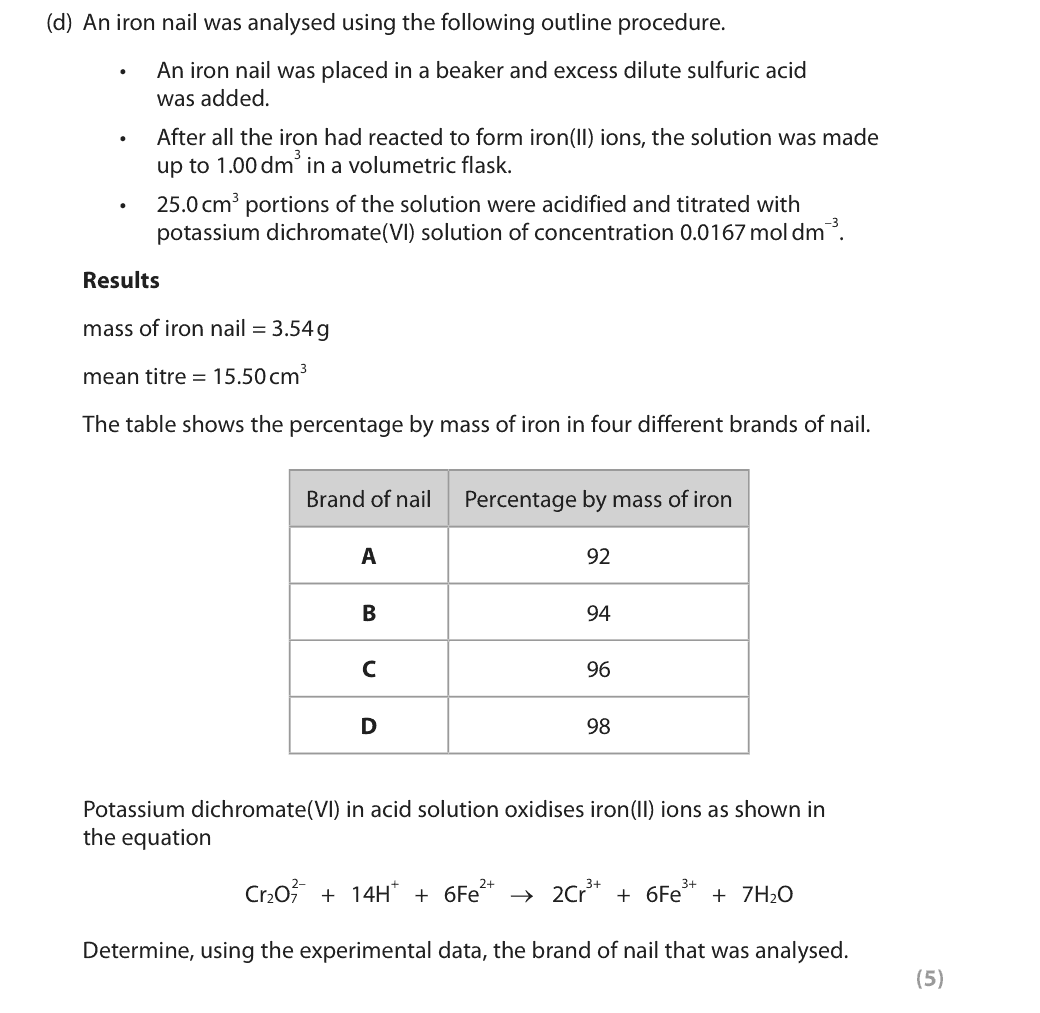
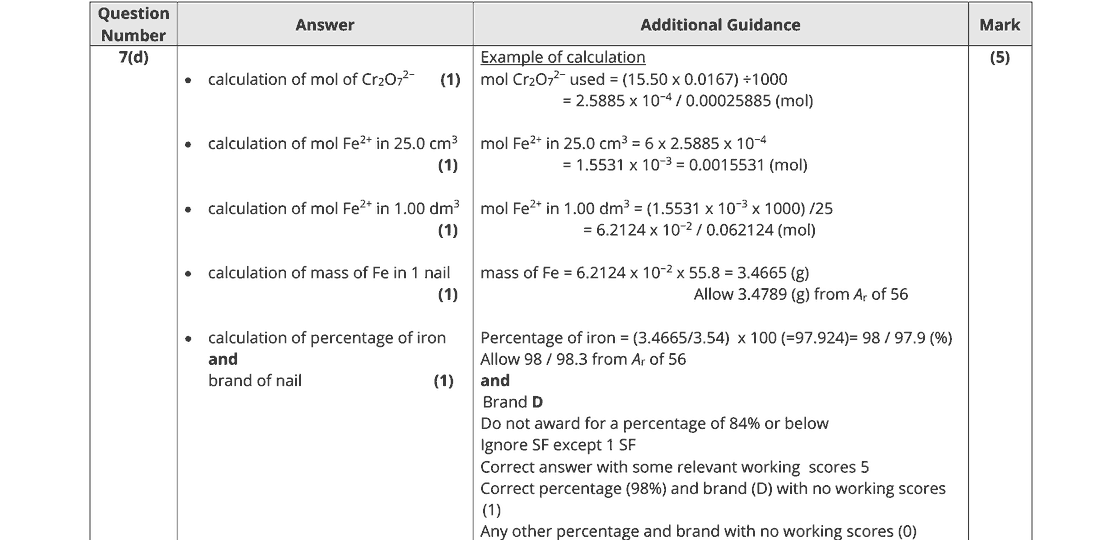
An iron nail was analysed using the following outline procedure.
•
An iron nail was placed in a beaker and excess dilute sulfuric acid
was added.
•
After all the iron had reacted to form iron(II) ions, the solution was made
3 in a volumetric flask.
up to 1.00 dm
•
25.0 cm3 portions of the solution were acidified and titrated with
–3.
potassium dichromate(VI) solution of concentration 0.0167 mol dm
Results
mass of iron nail = 3.54 g
mean titre = 15.50 cm3
The table shows the percentage by mass of iron in four different brands of nail.
Brand of nail
Percentage by mass of iron
A
92
B
94
C
96
D
98
Potassium dichromate(VI) in acid solution oxidises iron(II) ions as shown in
the equation
Cr2O7
2–   +   14H
+   +   6Fe
2+   →   2Cr
3+   +   6Fe
3+   +   7H2O
Determine, using the experimental data, the brand of nail that was analysed.
June 2022 · Paper 1 · Q8(a) 2 marks Calculation redox ii
This question is about electrode potentials, cells and equilibrium constants.
Chlorine gas can be prepared by the oxidation of chloride ions with
manganate(VII) ions in acid solution.
–(aq)   +   5Cl
–(aq)   +   8H
+(aq)      Mn
2+(aq)   +   2½Cl2(g)   +   4H2O(l)
d
MnO4
E
cell = +0.15 V
During this reaction, each manganate(VII) ion accepts five electrons.
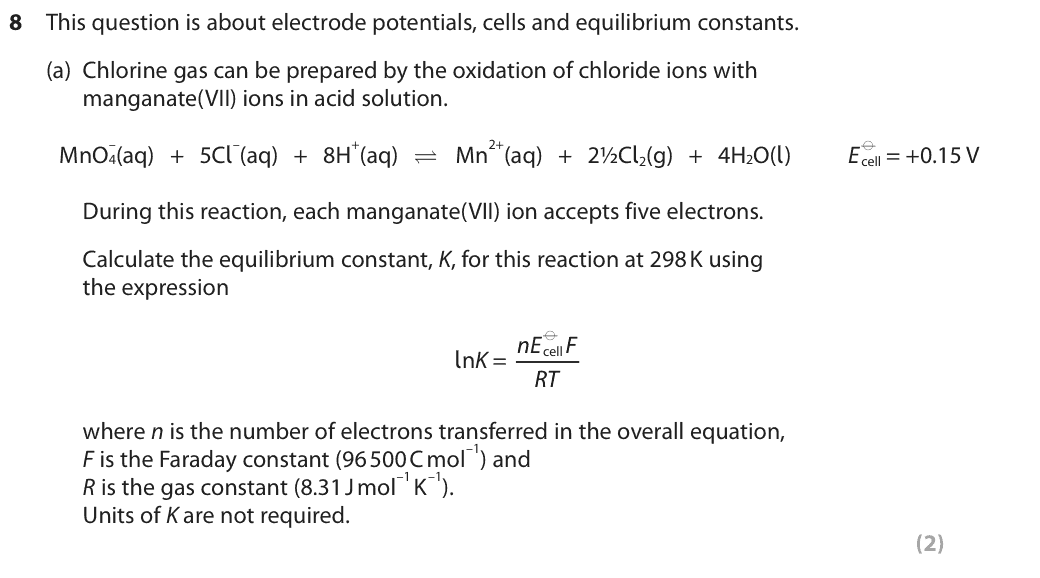
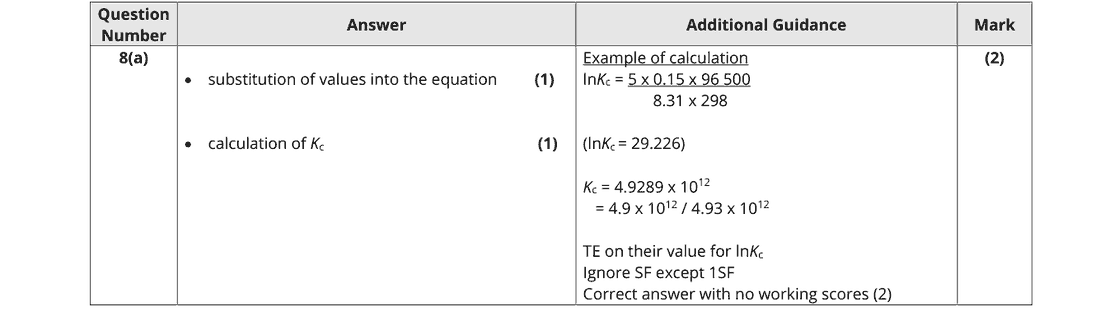
Calculate the equilibrium constant, K, for this reaction at 298 K using
the expression
d
lnK =  n
E
F
cell
RT
where n is the number of electrons transferred in the overall equation,
–1) and
F is the Faraday constant (96 500 C mol
–1 K
–1).
R is the gas constant (8.31 J mol
Units of K are not required.
June 2022 · Paper 1 · Q8(d) 7 marks Calculation equilibrium ii
Earlier part of question 8 that this part usesEarlier part of June 2022 Paper 1 question 8
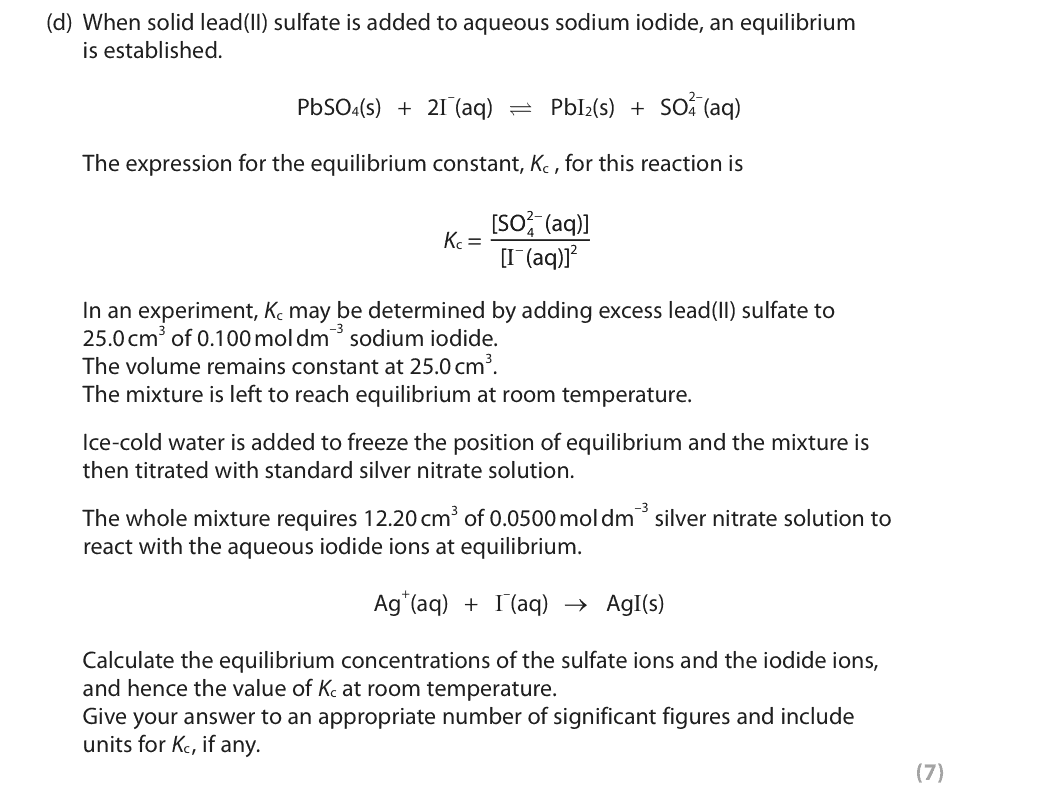
When solid lead(II) sulfate is added to aqueous sodium iodide, an equilibrium
is established.
–(aq)      PbI2(s)   +   SO4
2–(aq)
PbSO4(s)   +   2I
The expression for the equilibrium constant, Kc , for this reaction is
Kc =  [SO (aq)]
2−
4
[ (aq)]2
−I
In an experiment, Kc may be determined by adding excess lead(II) sulfate to
–3 sodium iodide.
25.0 cm3 of 0.100 mol dm
The volume remains constant at 25.0 cm3.
The mixture is left to reach equilibrium at room temperature.
Ice‑cold water is added to freeze the position of equilibrium and the mixture is
then titrated with standard silver nitrate solution.
The whole mixture requires 12.20 cm3 of 0.0500 mol dm
–3 silver nitrate solution to
react with the aqueous iodide ions at equilibrium.
+(aq)   +   I
–(aq)   →   AgI(s)
Ag
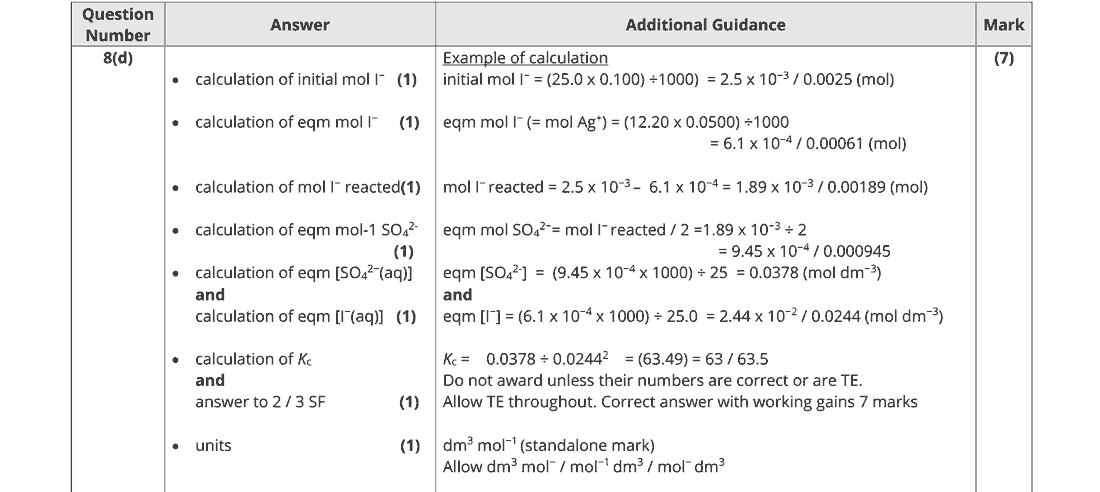
Calculate the equilibrium concentrations of the sulfate ions and the iodide ions,
and hence the value of Kc at room temperature.
Give your answer to an appropriate number of significant figures and include
units for Kc , if any.
June 2022 · Paper 2 · Q4(a)(i) 4 marks Calculation formulae equations and amounts of substance
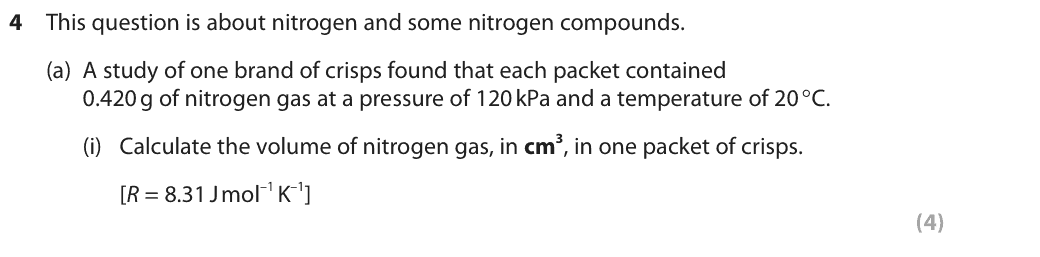
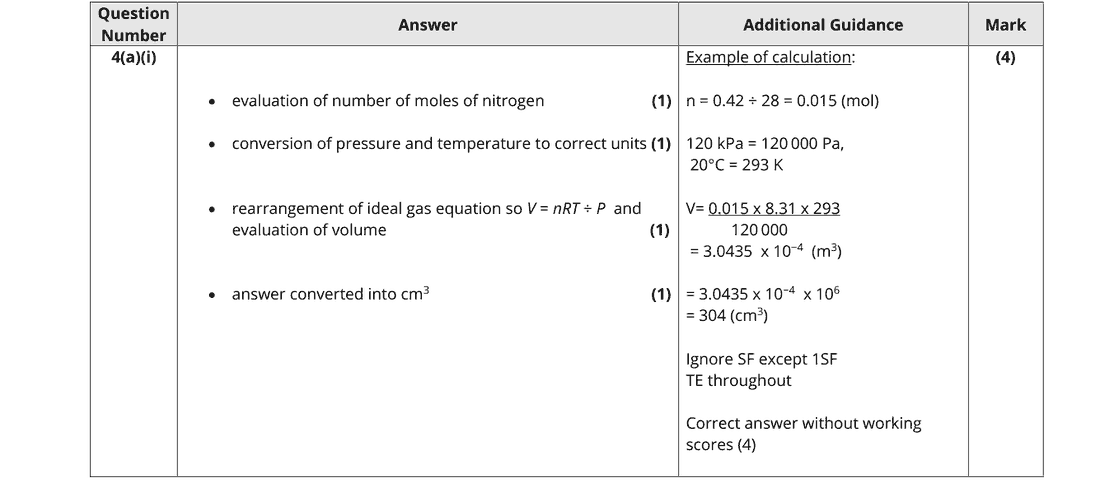
This question is about nitrogen and some nitrogen compounds.
A study of one brand of crisps found that each packet contained
0.420 g of nitrogen gas at a pressure of 120 kPa and a temperature of 20 °C.
Calculate the volume of nitrogen gas, in cm3, in one packet of crisps.
[R = 8.31 J mol–1 K–1]
June 2022 · Paper 2 · Q5(b) 3 marks Calculation formulae equations and amounts of substance
Earlier part of question 5 that this part usesEarlier part of June 2022 Paper 2 question 5
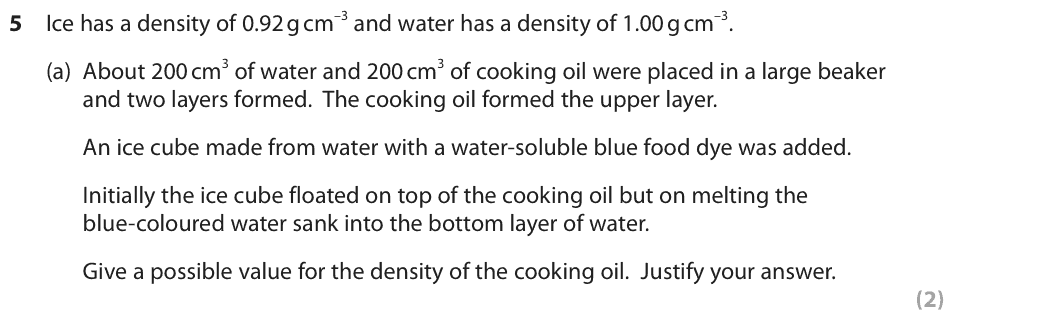
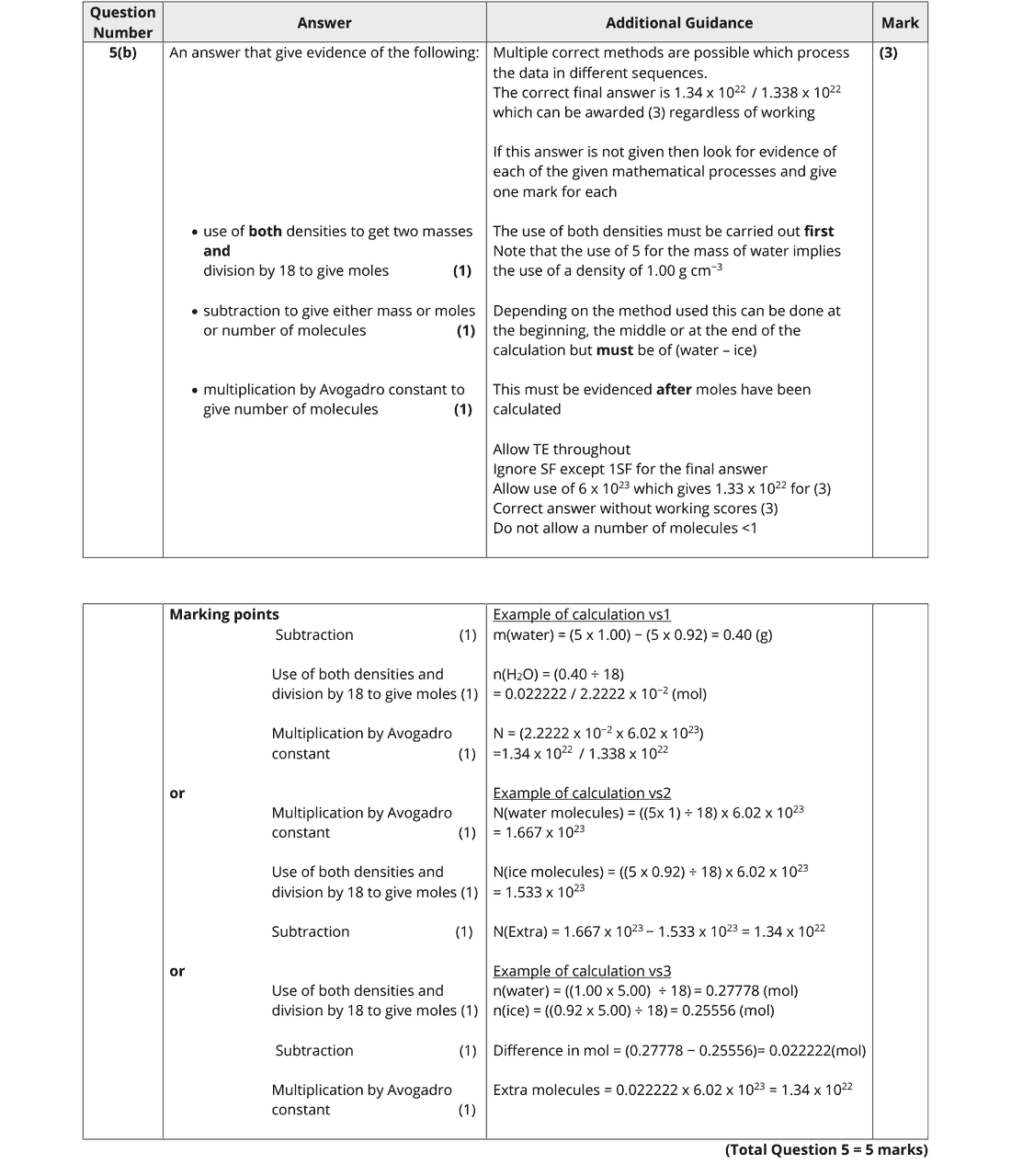
Calculate how many more molecules there are in 5.00 cm3 of water compared to
5.00 cm3 of ice.
June 2022 · Paper 2 · Q6(c)(v) 3 marks Calculation formulae equations and amounts of substance
Earlier part of question 6 that this part usesEarlier part of June 2022 Paper 2 question 6
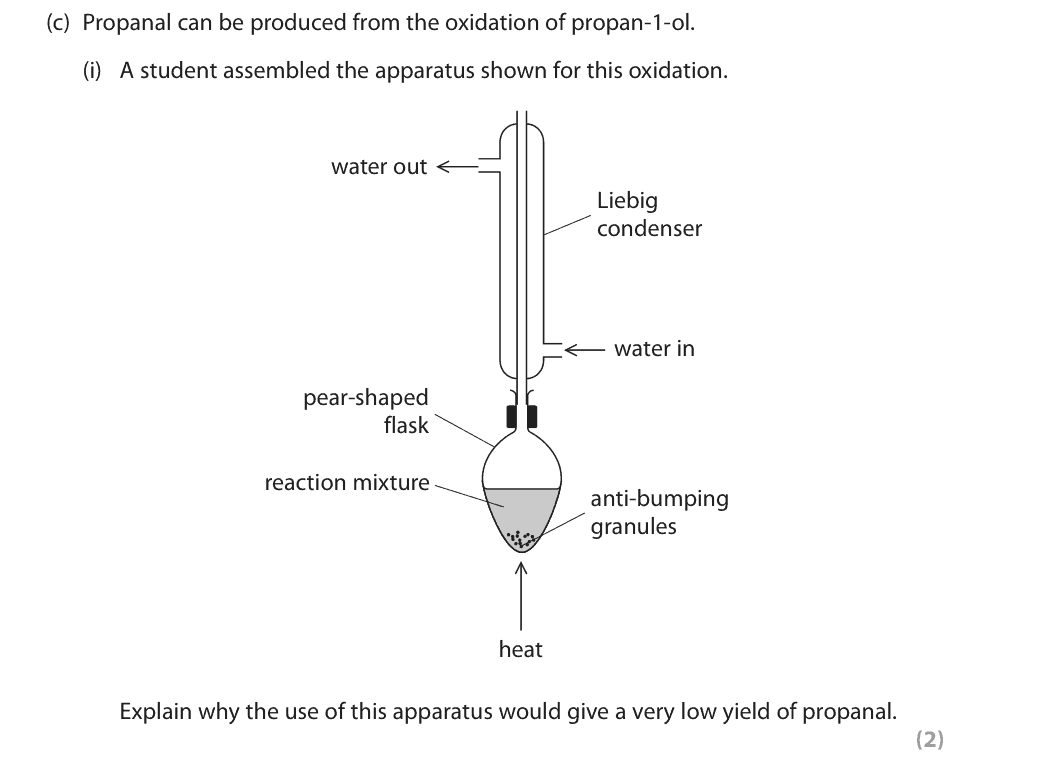
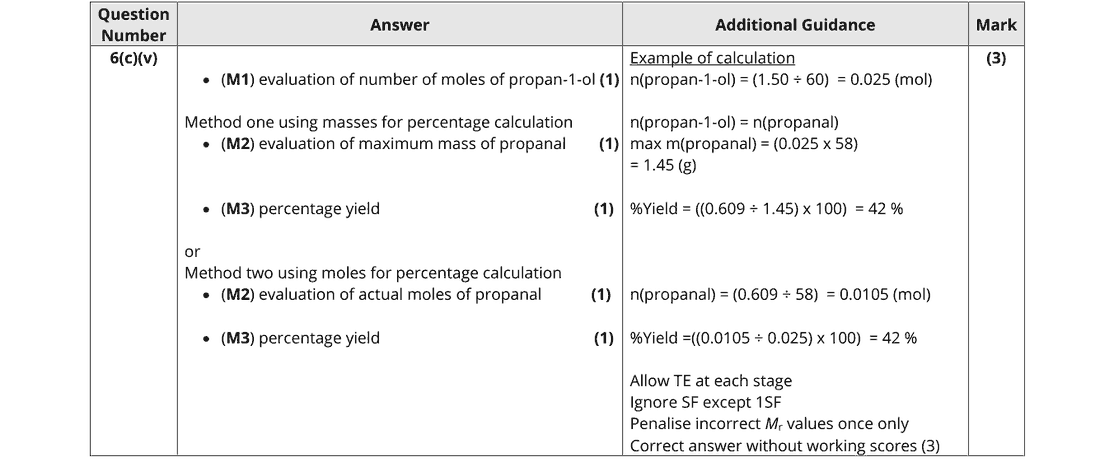
Another student used the correct apparatus for this oxidation.
1.50 g of propan‑1‑ol produced 0.609 g of propanal.
Calculate the percentage yield of propanal by mass.
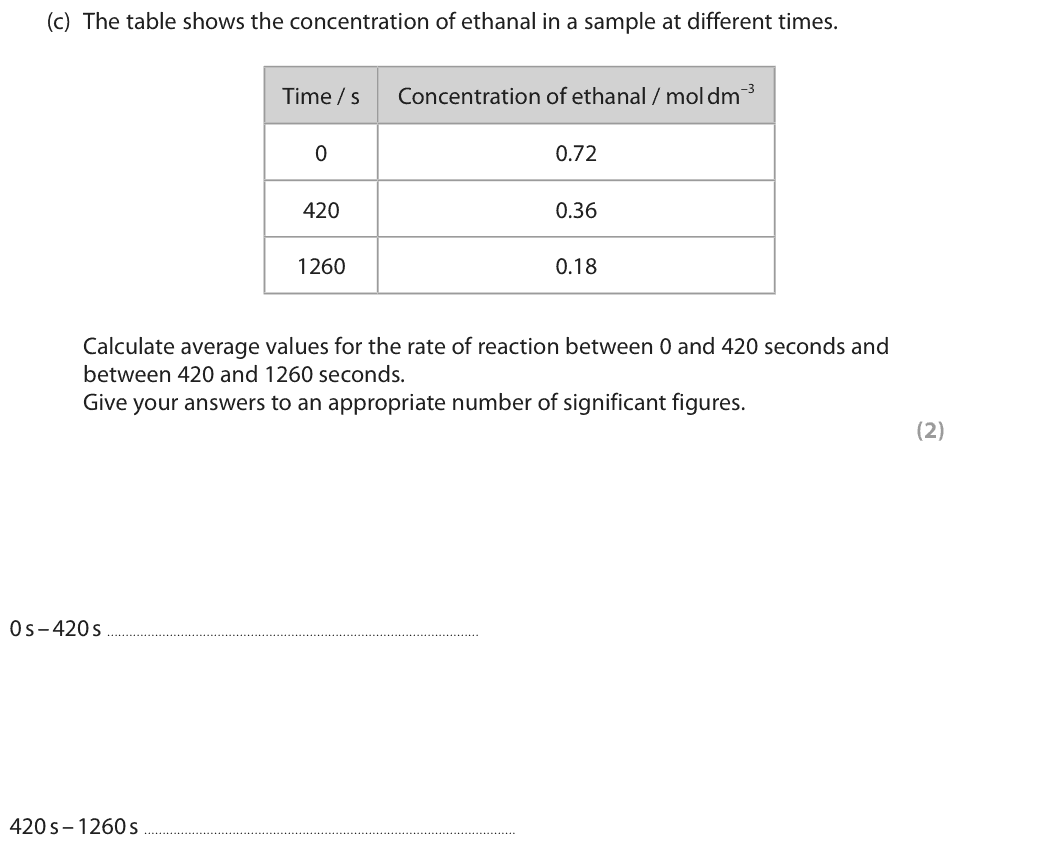
June 2022 · Paper 2 · Q9(c) 2 marks Calculation kinetics ii
Earlier part of question 9 that this part usesEarlier part of June 2022 Paper 2 question 9
The table shows the concentration of ethanal in a sample at different times.
Time / s
Concentration of ethanal / mol dm–3
0
0.72
420
0.36
1260
0.18
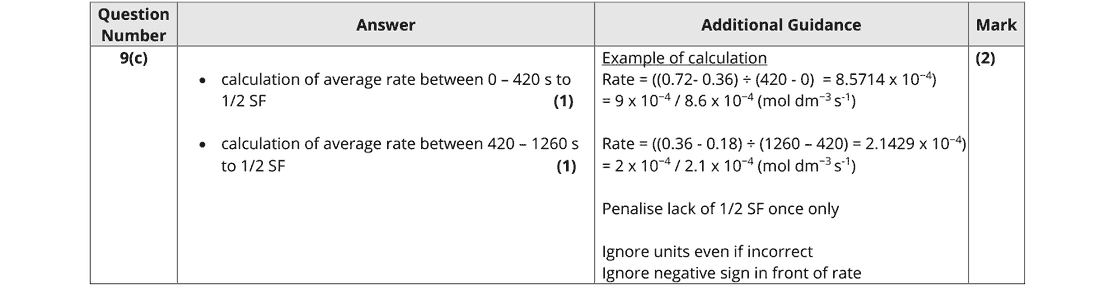
Calculate average values for the rate of reaction between 0 and 420 seconds and
between 420 and 1260 seconds.
Give your answers to an appropriate number of significant figures.
0 s – 420 s 
420 s – 1260 s
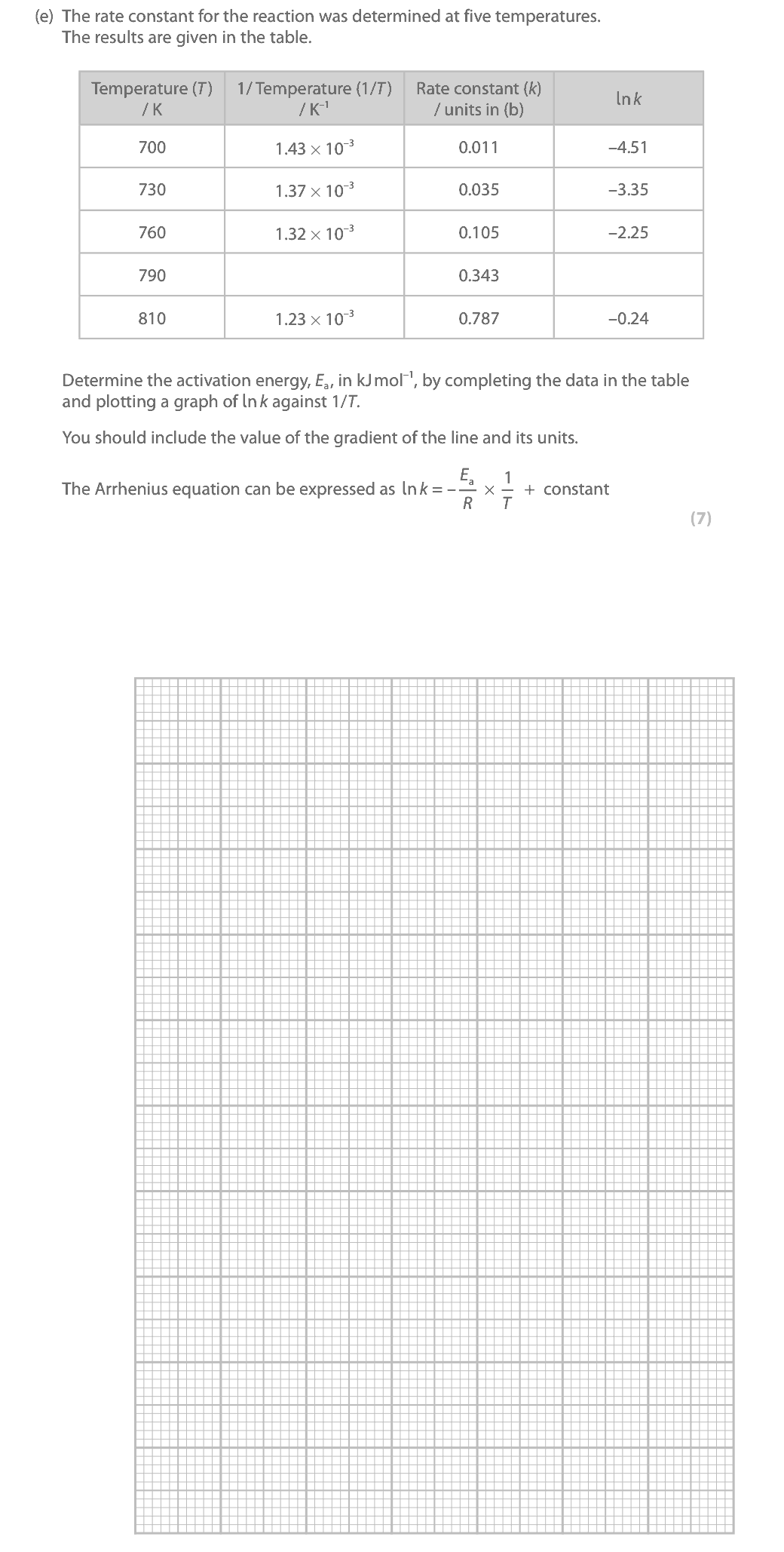
June 2022 · Paper 2 · Q9(e) 7 marks Calculation kinetics ii
Earlier parts of question 9 that this part usesEarlier part of June 2022 Paper 2 question 9Earlier part of June 2022 Paper 2 question 9
The rate constant for the reaction was determined at five temperatures.
The results are given in the table.
Temperature (T)
1/ Temperature (1/T)
Rate constant (k)
ln k
/ K
/ K–1
/ units in (b)
700
1.43 × 10–3
0.011
–4.51
730
1.37 × 10–3
0.035
–3.35
760
1.32 × 10–3
0.105
–2.25
790
0.343
810
0.787
–0.24
1.23 × 10–3
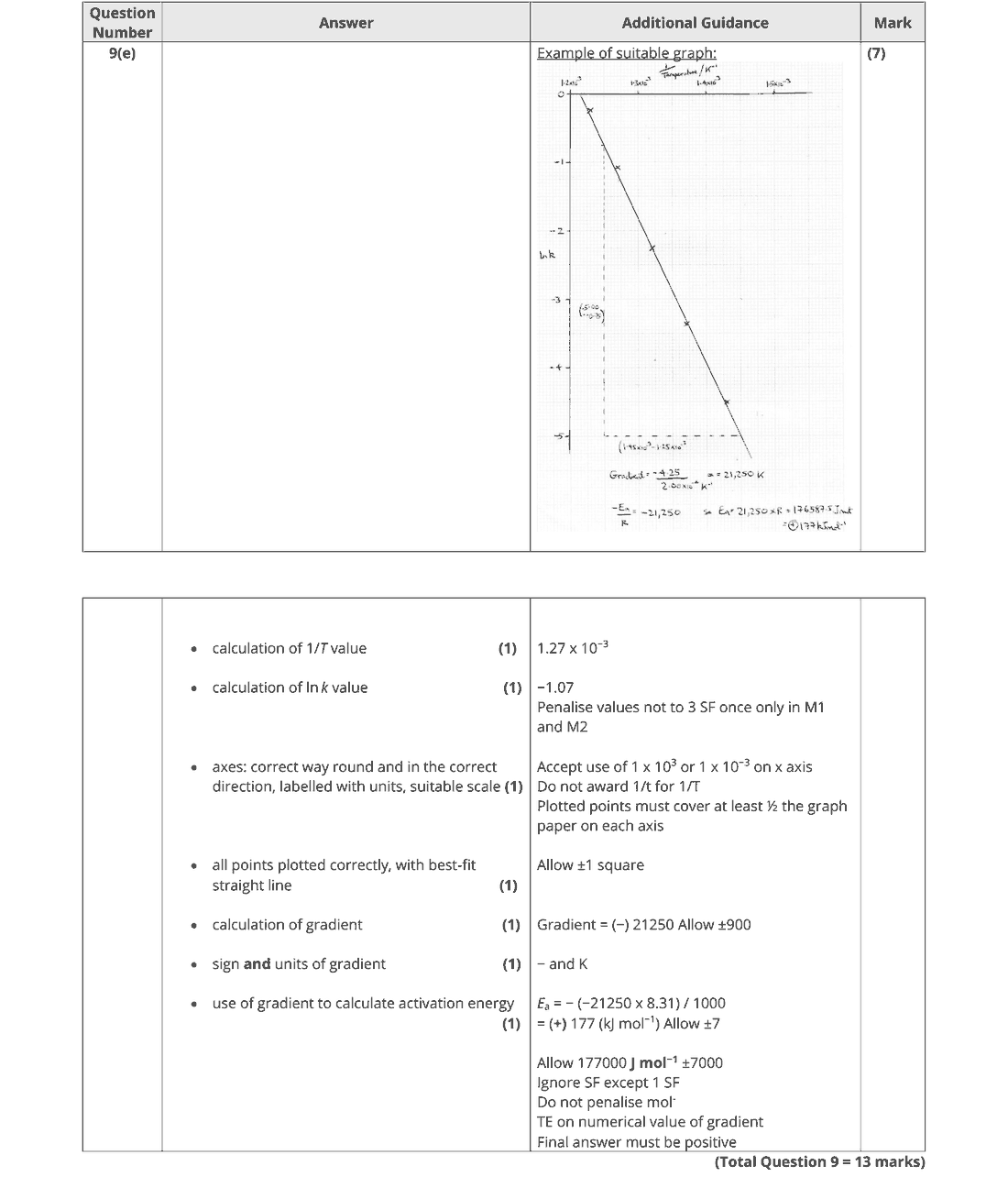
Determine the activation energy, Ea , in kJ mol–1, by completing the data in the table
and plotting a graph of ln k against 1/T.
You should include the value of the gradient of the line and its units.
The Arrhenius equation can be expressed as  ln k = – E
a  ×  1
+  constant
R
T
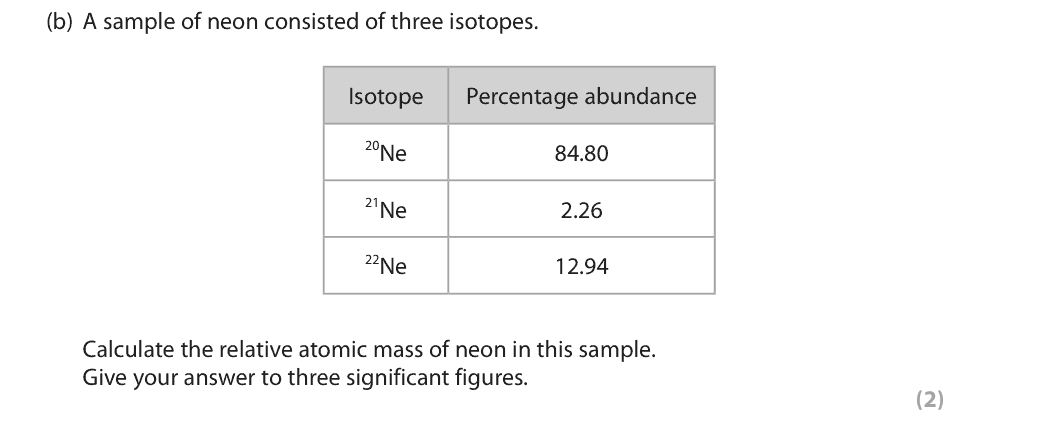
June 2022 · Paper 3 · Q1(b) 2 marks Calculation Easy atomic structure and the periodic table
Earlier part of question 1 that this part usesEarlier part of June 2022 Paper 3 question 1
A sample of neon consisted of three isotopes.
Isotope
Percentage abundance
20Ne
84.80
21Ne
2.26
22Ne
12.94
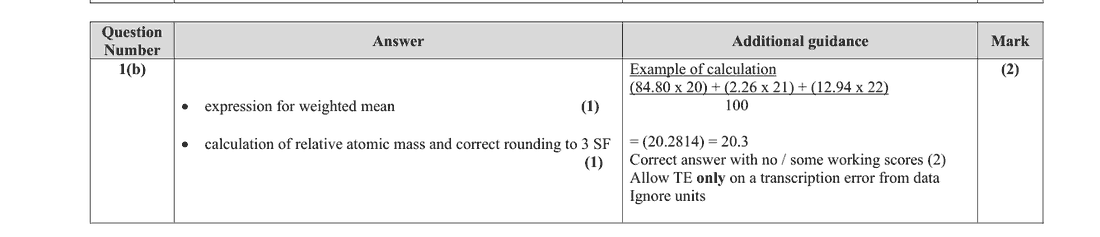
Calculate the relative atomic mass of neon in this sample.
Give your answer to three significant figures.
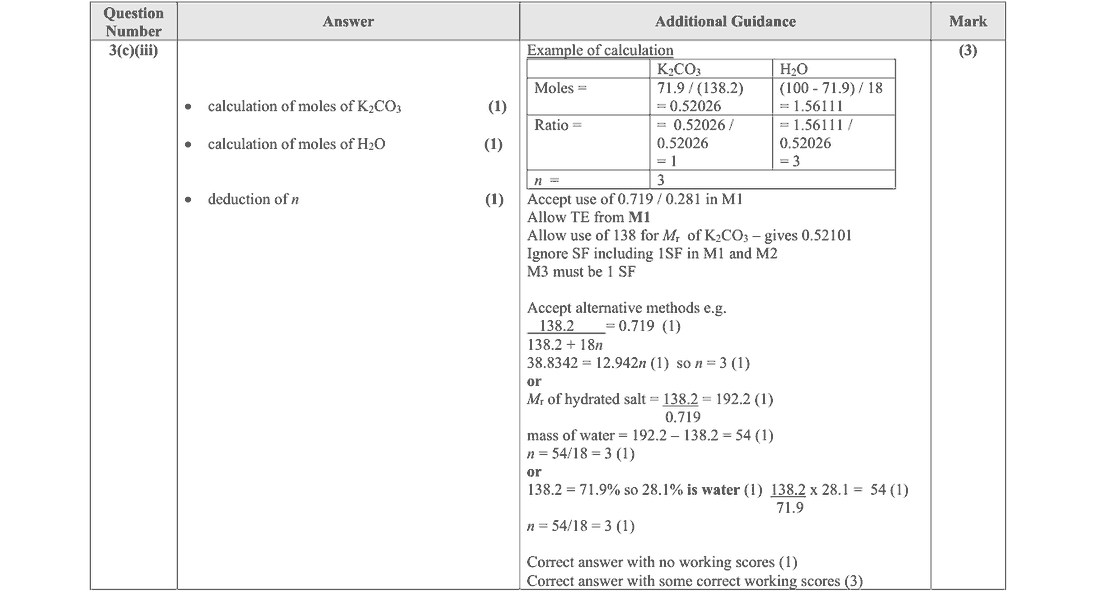
June 2022 · Paper 3 · Q3(c)(iii) 3 marks Calculation Easy formulae equations and amounts of substance
Earlier parts of question 3 that this part usesEarlier part of June 2022 Paper 3 question 3Earlier part of June 2022 Paper 3 question 3
In an accurate experiment, Y is found to consist of 71.9 % K2CO3 by mass.
Calculate the value of n.
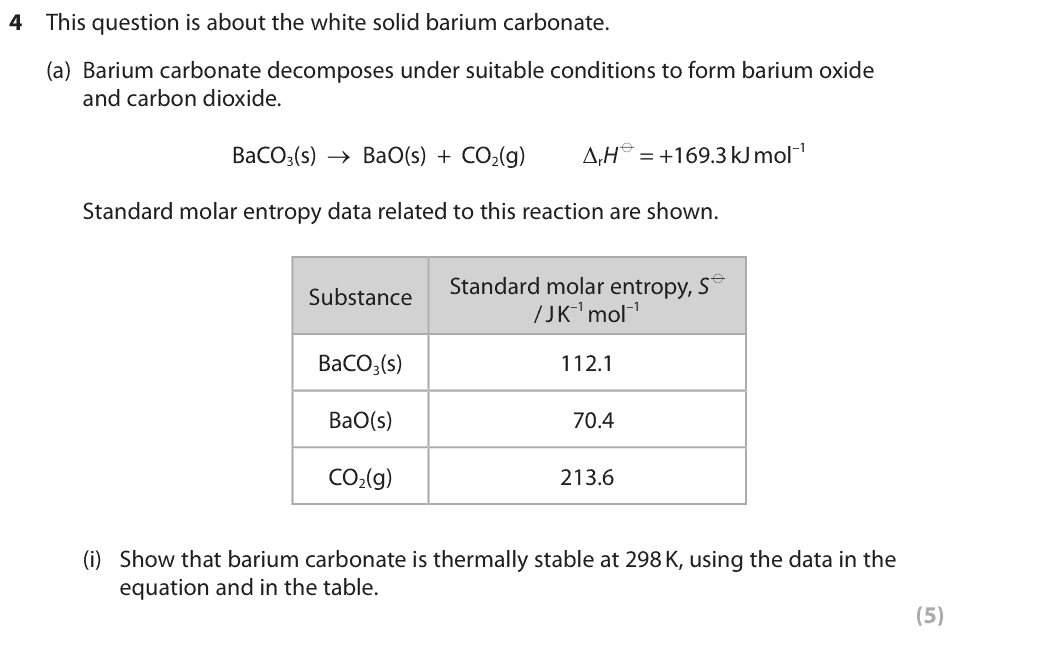
June 2022 · Paper 3 · Q4(a)(i) 5 marks Calculation entropy
This question is about the white solid barium carbonate.
Barium carbonate decomposes under suitable conditions to form barium oxide
and carbon dioxide.
BaCO3(s)  →  BaO(s)  +  CO2(g)
ΔrH
d = +169.3 kJ mol–1
Standard molar entropy data related to this reaction are shown.
Standard molar entropy, S
d
Substance
/ J K–1 mol–1
BaCO3(s)
112.1
BaO(s)
70.4
CO2(g)
213.6
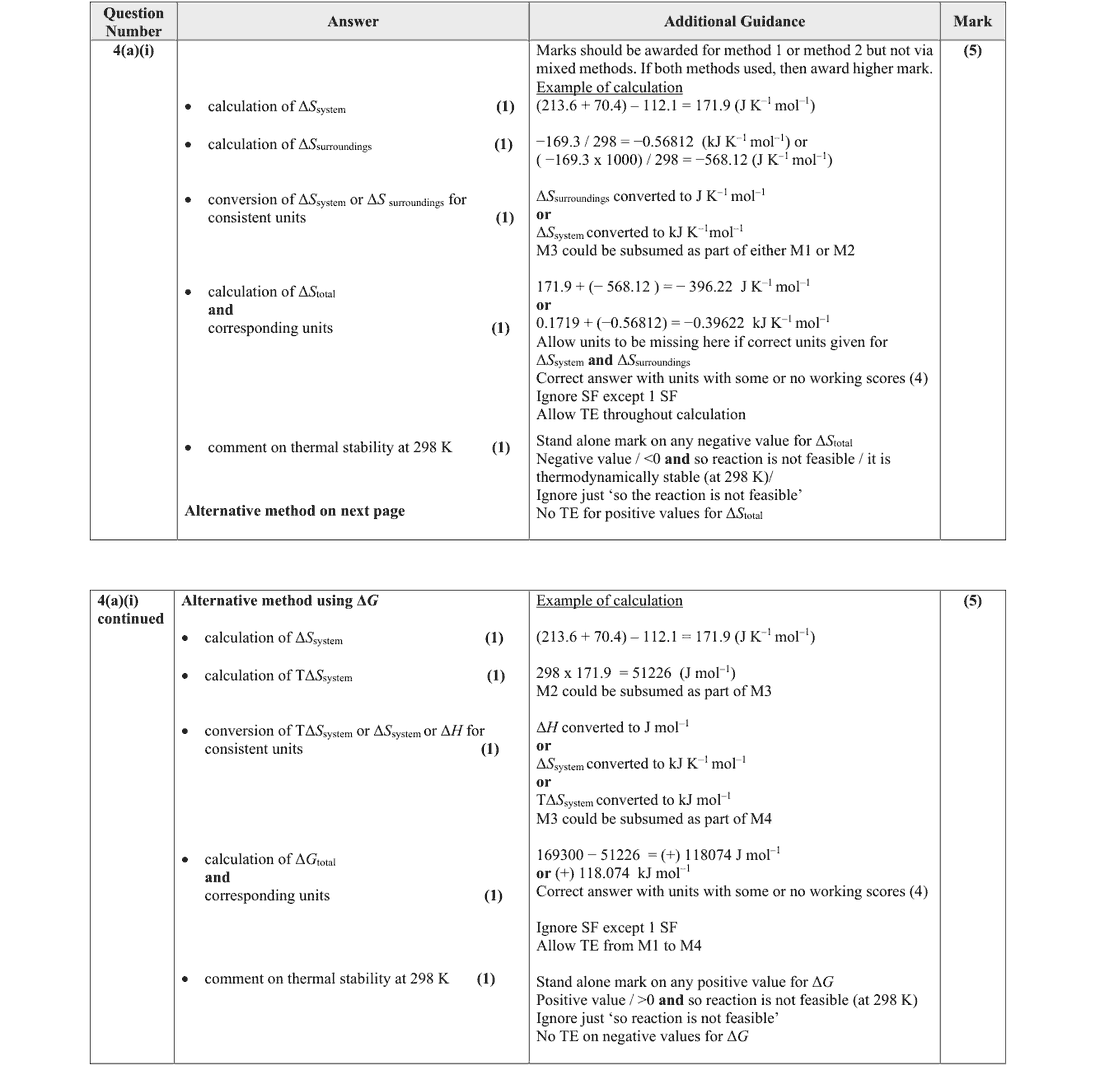
Show that barium carbonate is thermally stable at 298 K, using the data in the
equation and in the table.
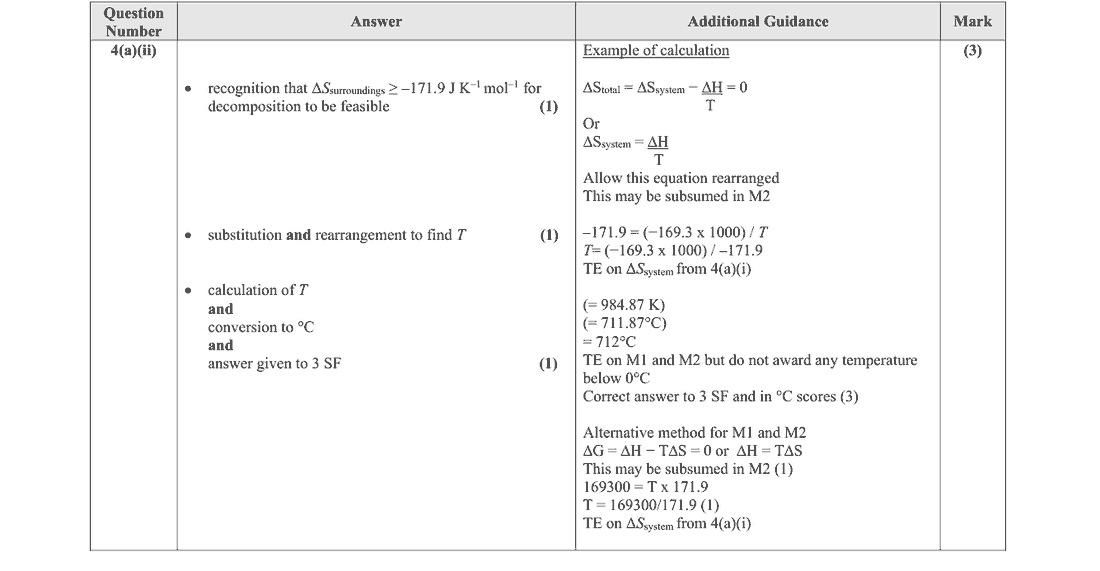
June 2022 · Paper 3 · Q4(a)(ii) 3 marks Calculation entropy
Earlier part of question 4 that this part usesEarlier part of June 2022 Paper 3 question 4
Calculate the lowest temperature, in °C, at which it is thermodynamically
feasible for barium carbonate to decompose.
Give your answer to three significant figures.
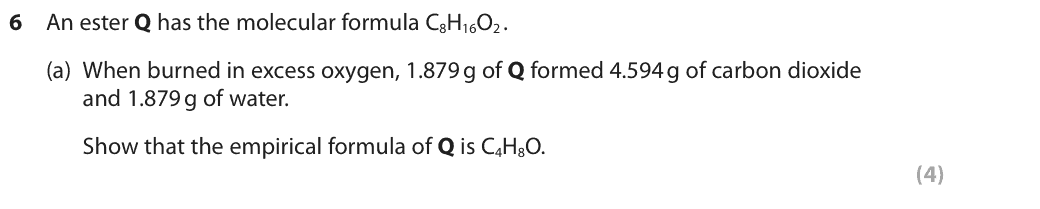
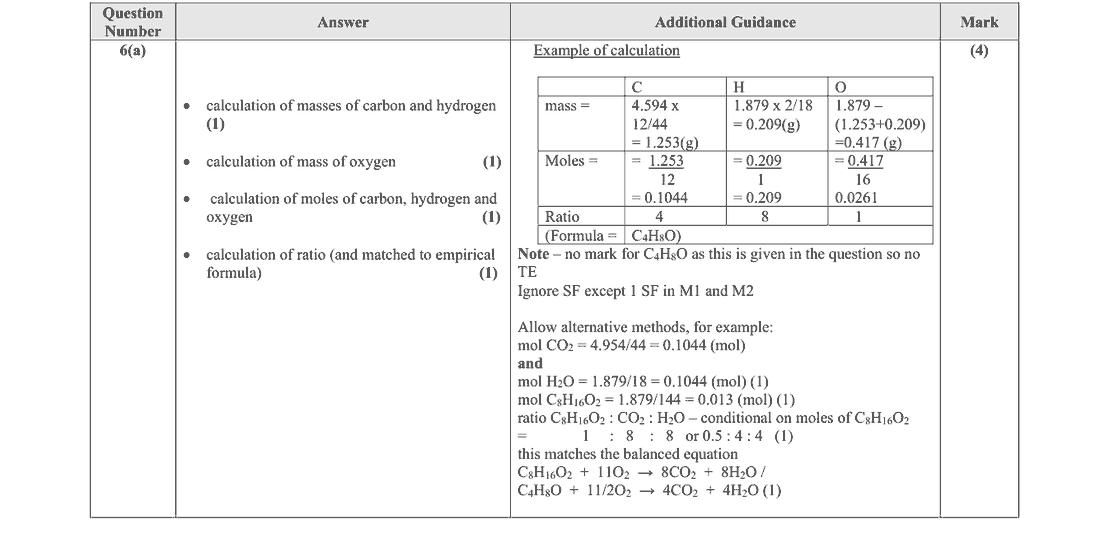
June 2022 · Paper 3 · Q6(a) 4 marks Calculation organic synthesisformulae equations and amounts of substance
An ester Q has the molecular formula C8H16O2 .
When burned in excess oxygen, 1.879 g of Q formed 4.594 g of carbon dioxide
and 1.879 g of water.
Show that the empirical formula of Q is C4H8O.
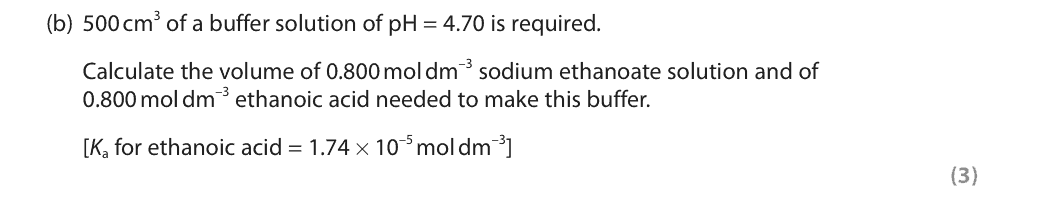
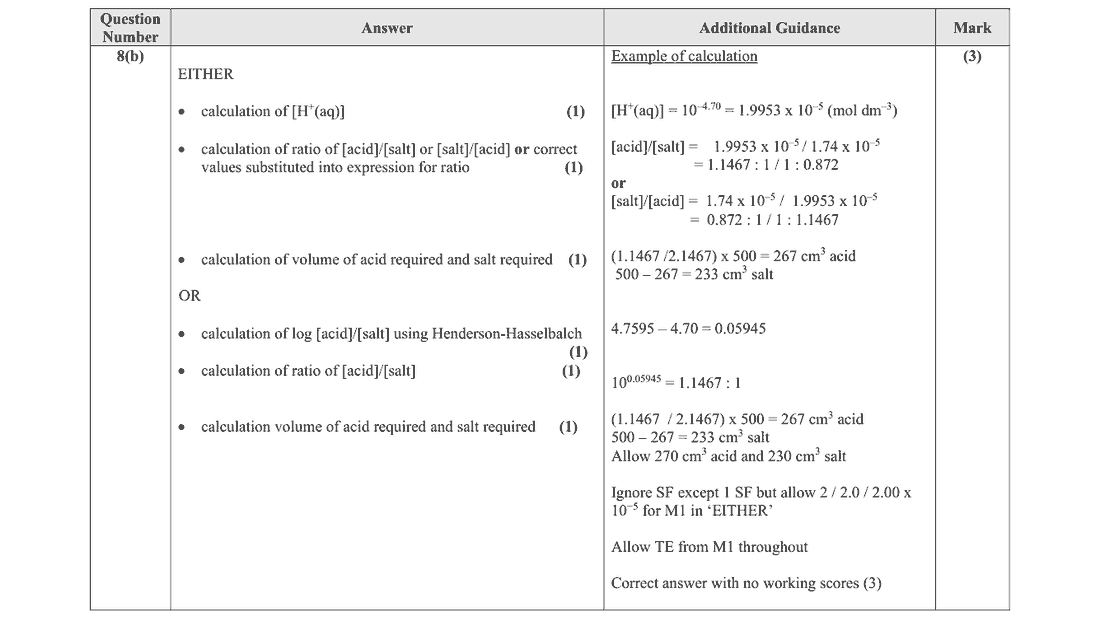
June 2022 · Paper 3 · Q8(b) 3 marks Calculation Hard acid base equilibria
500 cm3 of a buffer solution of pH = 4.70 is required.
Calculate the volume of 0.800 mol dm–3 sodium ethanoate solution and of
0.800 mol dm–3 ethanoic acid needed to make this buffer.
[Ka for ethanoic acid = 1.74 × 10–5 mol dm–3]
(3).
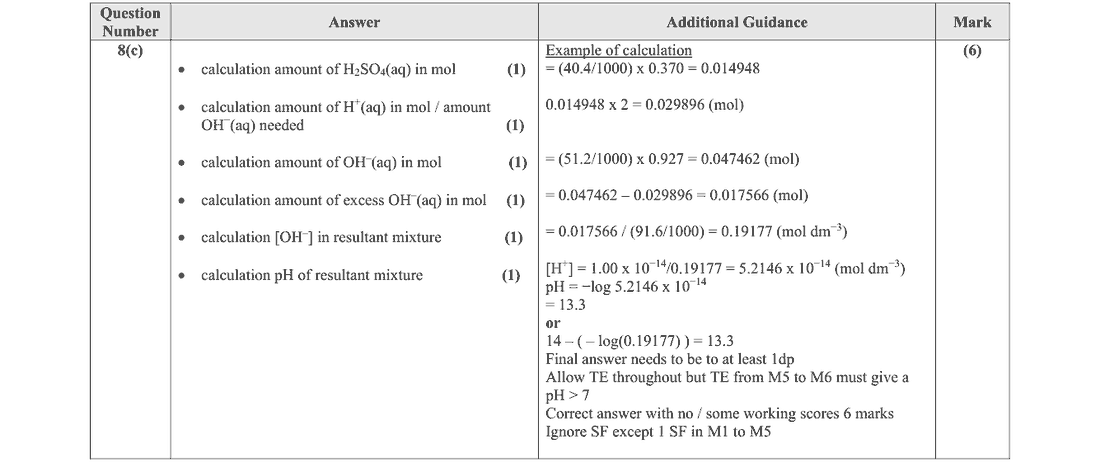
June 2022 · Paper 3 · Q8(c) 6 marks Calculation acid base equilibria
Calculate the pH of the solution formed when
51.2 cm3 of 0.927 mol dm–3 NaOH(aq) is mixed with
40.4 cm3 of 0.370 mol dm–3 H2SO4(aq).
[Ionic product of water Kw = 1.00 × 10–14 mol2 dm–6]
June 2022 · Paper 3 · Q9(b)(ii) 5 marks Calculation redox ii
Earlier parts of question 9 that this part usesEarlier part of June 2022 Paper 3 question 9Earlier part of June 2022 Paper 3 question 9
The total amount of acid in the 150 cm3 sample is 8.00 × 10–3 mol.
The mean titre in Experiment 2 using 5.00 cm3 of pineapple juice is 9.50 cm3.
Calculate the mass of citric acid in the 150 cm3 sample.
November 2021 · AS Paper 1 · Q2(b)(iii) 1 mark Calculation formulae equations and amounts of substance
Earlier parts of question 2 that this part usesEarlier part of November 2021 Paper 1 question 2Earlier part of November 2021 Paper 1 question 2
Calculate the mean titre.
November 2021 · AS Paper 1 · Q2(b)(iv) 4 marks Calculation formulae equations and amounts of substance
Earlier parts of question 2 that this part usesEarlier part of November 2021 Paper 1 question 2Earlier part of November 2021 Paper 1 question 2
Calculate the relative formula mass, Mr , of the hydrated sodium carbonate,
Na2CO3.xH2O.
The equation for the reaction in the titration is
Na2CO3  +  2HCl  →  2NaCl  +  H2O  +  CO2
November 2021 · AS Paper 1 · Q2(c)(i) 1 mark Calculation atomic structure and the periodic table
In an experiment, the Mr of a different hydrated sodium carbonate was found to
be 286 g mol–1.
Calculate the relative formula mass of anhydrous sodium carbonate, Na2CO3 .
November 2021 · AS Paper 1 · Q2(c)(ii) 1 mark Calculation atomic structure and the periodic tableformulae equations and amounts of substance
Earlier parts of question 2 that this part usesEarlier part of November 2021 Paper 1 question 2Earlier part of November 2021 Paper 1 question 2
Calculate the number of molecules of water of crystallisation, x, for this
hydrated sodium carbonate, Na2CO3.xH2O.
November 2021 · AS Paper 1 · Q2(d) 3 marks Calculation formulae equations and amounts of substance
Earlier part of question 2 that this part usesEarlier part of November 2021 Paper 1 question 2
Sodium carbonate is manufactured from sodium chloride in a two-stage process.
NaCl  +  NH3  +  CO2  +  H2O  →  NaHCO3  +  NH4Cl
2NaHCO3  →  Na2CO3  +  H2O  +  CO2
Calculate the maximum mass of sodium carbonate, Na2CO3 , which could be
obtained from 500 kg of sodium chloride.
November 2021 · AS Paper 1 · Q4(b) 5 marks Calculation Hard formulae equations and amounts of substance
Earlier part of question 4 that this part usesEarlier part of November 2021 Paper 1 question 4
Compound X is an oxide of sulfur. A gaseous sample of 0.318 g of X occupied a
volume of 132 cm3 at a temperature of 420 K and pressure of 105 kPa.
The number of moles of a gas and the volume occupied by it can be found using
the ideal gas equation
pV = nRT
Calculate the relative molecular mass of X and hence its molecular formula.
You must show all your working.
[R = 8.31 J mol–1 K–1]
November 2021 · AS Paper 1 · Q6(c)(i) 2 marks Calculation Hard formulae equations and amounts of substance
Earlier part of question 6 that this part usesEarlier part of November 2021 Paper 1 question 6
Chlorine is used as a bleach in the textiles industry. Any excess chlorine can be
removed by reduction to chloride ions.
The half-equation for the reaction of chlorine is
Cl2  +  2e–  →  2Cl–
In one reaction, 768 cm3 of chlorine gas was reduced.
Calculate the number of moles of electrons gained by chlorine molecules
during this reaction.
[Under these conditions one mole of gas occupies 24 dm3]
November 2021 · AS Paper 1 · Q6(c)(ii) 3 marks Calculation Hard redox iformulae equations and amounts of substance
Earlier parts of question 6 that this part usesEarlier part of November 2021 Paper 1 question 6Earlier part of November 2021 Paper 1 question 6
The reducing agent was a solution containing thiosulfate ions, S2O3
2–.
The chlorine reacted with 40 cm3 of a 0.20 mol dm–3 solution of these ions.
Deduce the number of moles of electrons lost by each atom of sulfur in the
thiosulfate ion, and hence the final oxidation state of the sulfur in the product.
November 2021 · AS Paper 2 · Q2(a)(ii) 2 marks Calculation energetics i
Earlier part of question 2 that this part usesEarlier part of November 2021 Paper 2 question 2
Calculate the enthalpy change for the thermal decomposition of PCl5(g) to
PCl3(g) and Cl2(g), using the data given in the table.
Include a sign and units in your answer.
Enthalpy change / kJ mol–1
ΔfH [PCl5(s)]
–443.5
ΔfH [PCl3(l)]
–319.7
ΔvH [PCl5(s)]
+64.9
ΔvH [PCl3(l)]
+30.5
November 2021 · AS Paper 2 · Q4(c)(i) 2 marks Calculation Hard formulae equations and amounts of substance
Earlier part of question 4 that this part usesEarlier part of November 2021 Paper 2 question 4
When water is added to calcium sulfate hemihydrate, there is a rise
in temperature.
A student decided to investigate this reaction using the following procedure:
Step 1    10 cm3 of distilled water is measured using a measuring cylinder having
an uncertainty of ±0.5 cm3, and is placed in an insulated cup with a lid.
Step 2    A thermometer with an uncertainty of ±0.5 °C is placed in the water.
Step 3    Exactly 10.00 g of calcium sulfate hemihydrate is weighed out using a
balance with an uncertainty of ±0.005 g.
Step 4    The weighed quantity of calcium sulfate hemihydrate is added to the
water in the insulated cup.
Step 5    The mixture in the insulated cup is stirred until no further temperature
change is observed.
Results
Temperature of the water before adding the solid
= 23.5 °C
Maximum temperature of the mixture after adding the solid
= 26.3 °C
Other data
Molar mass of calcium sulfate hemihydrate, CaSO4·½H2O
= 145.2 g mol–1
Density of water
= 1.00 g cm–3
Calculate the minimum volume of water needed to convert 10.00 g of
CaSO4·½H2O into CaSO4·2H2O.
November 2021 · AS Paper 2 · Q4(c)(ii) 4 marks Calculation energetics i
Earlier parts of question 4 that this part usesEarlier part of November 2021 Paper 2 question 4Earlier part of November 2021 Paper 2 question 4
Calculate the enthalpy change, in kJ mol–1, for this reaction.
Include a sign in your answer and give your answer to an appropriate number
of significant figures.
Assume that the liquid has a mass of 10.00 g and a specific heat capacity
of 4.18 J g–1 °C–1.
November 2021 · AS Paper 2 · Q4(c)(iii) 2 marks Calculation formulae equations and amounts of substance
Earlier parts of question 4 that this part usesEarlier part of November 2021 Paper 2 question 4Earlier part of November 2021 Paper 2 question 4Earlier part of November 2021 Paper 2 question 4
Deduce which measurement has the greatest uncertainty in this experiment.
Justify your answer by calculating the percentage uncertainty of this piece
of apparatus.
November 2021 · AS Paper 2 · Q6(a) 3 marks Calculation kinetics i
This question is about halogenoalkanes.
2‑chloro‑2‑methylpropane can be hydrolysed by water.
The equation for this reaction is
(CH3)3CCl  +  H2O  →  (CH3)3COH  +  H+  +  Cl−
The graph shows how the concentration of 2‑chloro‑2‑methylpropane changes with
time during an investigation of this reaction.
0.07
0.06
0.05
0.04
[(CH3)3CCl]
/ mol dm–3
0.03
0.02
0.01
0
0
50
100
150
200
Time / s
Calculate the rate of reaction at 50 s. Show your working on the graph.
Include units with your final answer.
Rate of reaction at 50 s =
November 2021 · AS Paper 2 · Q8(c)(ii) 4 marks Calculation Hard formulae equations and amounts of substance
Earlier parts of question 8 that this part usesEarlier part of November 2021 Paper 2 question 8Earlier part of November 2021 Paper 2 question 8
In an experiment, 10.0 cm3 of cyclohexanol was converted to cyclohexene
with a 63.0 % yield.
Compound
Molar mass / g mol–1
Density / g cm–3
cyclohexanol
100
0.962
cyclohexene
82.0
0.811
Calculate the volume of cyclohexene produced.
November 2021 · AS Paper 2 · Q9(a)(i) 3 marks Calculation energetics i
An equation for the formation of ammonia using the Haber process is shown.
N2(g)  +  3H2(g)    2NH3(g)
Calculate the enthalpy change for the forward reaction shown in the equation,
selecting from the bond enthalpies in the table.
Include a sign in your answer.
Bond
Mean bond enthalpy / kJ mol–1
N
N
158
N
N
410
N
N
945
N
H
391
H
H
436
November 2021 · Paper 1 · Q1(c) 2 marks Calculation atomic structure and the periodic table
Earlier part of question 1 that this part usesEarlier part of November 2021 Paper 1 question 1
The percentage composition of the two bromine isotopes in a sample is given in
the table.
Isotope
Relative isotopic mass
Percentage abundance
bromine-79
78.918
50.52
bromine-81
80.916
49.48
Calculate the relative atomic mass of bromine in this sample.
Give your answer to two decimal places.
November 2021 · Paper 1 · Q4(d)(i) 1 mark Calculation atomic structure and the periodic table
Earlier part of question 4 that this part usesEarlier part of November 2021 Paper 1 question 4
The successive ionisation energies for magnesium are given in the table.
Electron
number
1
2
3
4
5
6
7
8
9
10
11
12
removed
Ionisation
energy
738 1451 7733 10 541 13 629 17 995 21 704 25 657 31 644 35 463 169 996 189 371
/ kJ mol–1
Log
(ionisation
2.87 3.16
3.89
4.02
4.13
4.34
4.41
4.50
4.55
5.23
energy)
Complete the table.
November 2021 · Paper 1 · Q5(a)(i) 3 marks Calculation energetics i
The halogens are elements in Group 7 of the Periodic Table.
Chlorine compounds have many uses, including water treatment.
Chlorine and phosphorus (P4) can react to form phosphorus(V) chloride.
The structure of a molecule of phosphorus is
P
P
P
P
Some mean bond enthalpy values are shown in the table.
Bond
Mean bond enthalpy / kJ mol–1
P
P
+198
Cl
Cl
+243
P
Cl
+326
Calculate the enthalpy change for the reaction between chlorine and
phosphorus to form phosphorus(V) chloride.
10Cl2  +  P4  →  4PCl5
November 2021 · Paper 1 · Q5(d)(ii) 2 marks Calculation group 7 the halogensformulae equations and amounts of substance
Earlier part of question 5 that this part usesEarlier part of November 2021 Paper 1 question 5
A solution containing 0.010 mol of a halide ion was reacted with excess
silver nitrate and produced 1.88 g of precipitate.
Identify the halide ion.
Justify your answer.
November 2021 · Paper 1 · Q7(c) 2 marks Calculation acid base equilibria
A commercial nitric acid solution, HNO3(aq), has a concentration of 15.9 mol dm–3.
A 15.0 cm3 sample was made up to 100 cm3 by adding deionised water.
Calculate the pH of this diluted solution.
November 2021 · Paper 1 · Q7(d)(i) 3 marks Calculation acid base equilibria
Earlier part of question 7 that this part usesEarlier part of November 2021 Paper 1 question 7
Propanoic acid is a weak acid.
Calculate the pH of a 0.100 mol dm–3 solution of propanoic acid at 298 K.
Give your answer to an appropriate number of significant figures.
[Ka = 1.35 × 10–5 mol dm–3 at 298 K]
November 2021 · Paper 1 · Q7(e)(i) 4 marks Calculation acid base equilibria
Earlier part of question 7 that this part usesEarlier part of November 2021 Paper 1 question 7
A buffer solution was made using 20.0 cm3 of a butanoic acid solution, of
concentration 0.100 mol dm–3 and 30.0 cm3 of sodium butanoate solution,
of concentration 0.305 mol dm–3.
[Ka = 1.52 × 10–5 mol dm–3 at 298K]
Calculate the pH of this buffer solution at 298 K.
November 2021 · Paper 1 · Q9(b)(ii) 1 mark Calculation lattice energy
Earlier parts of question 9 that this part usesEarlier part of November 2021 Paper 1 question 9Earlier part of November 2021 Paper 1 question 9
Calculate the lattice energy of copper(II) oxide.
November 2021 · Paper 1 · Q9(c) 2 marks Calculation lattice energy
Earlier part of question 9 that this part usesEarlier part of November 2021 Paper 1 question 9
A different energy cycle can be used to calculate lattice energy.
Ca2+(g)  +  2Br–(g)
CaBr2(s)
Ca2+(aq)  +  2Br–(aq)
Value / kJ mol–1
Enthalpy change
enthalpy change of solution of CaBr2
–73
enthalpy change of hydration of Ca2+
–1577
enthalpy change of hydration of Br–
–336
Calculate the lattice energy of calcium bromide.
November 2021 · Paper 2 · Q4(d) 4 marks Calculation formulae equations and amounts of substance
A sample of pent-1-ene, with a mass of 1.33 g, is warmed to 60 °C in a
sealed container.  The volume of the container is 500 cm3.
Calculate the pressure inside the container.
Include units and give your answer to an appropriate number of significant figures.
[Gas constant (R) = 8.31 J mol−1 K−1]
November 2021 · Paper 2 · Q6(b) 2 marks Calculation formulae equations and amounts of substance
Earlier part of question 6 that this part usesEarlier part of November 2021 Paper 2 question 6
Carbon monoxide can be made by the thermal decomposition of
sodium ethanedioate.
Na2C2O4  →  Na2CO3 + CO
Calculate the atom economy, by mass, for the production of carbon monoxide in
this reaction.
November 2021 · Paper 2 · Q6(c)(i) 1 mark Calculation kinetics ii
Earlier part of question 6 that this part usesEarlier part of November 2021 Paper 2 question 6
Carbon monoxide can also be made by the thermal decomposition of
ethanal, CH3CHO, in the gas phase.
CH3CHO(g)  →  CH4(g) + CO(g)
This reaction was carried out at two different temperatures, and all other variables
were kept constant.
Temperature
Rate
1/Temperature (1/T)
ln rate
/ K
/ mol dm−3 s−1
/ K−1
700
0.0108
1.43 × 10−3
850
4.90
1.59
Complete the data in the table.
November 2021 · Paper 2 · Q6(c)(ii) 3 marks Calculation kinetics ii
Earlier parts of question 6 that this part usesEarlier part of November 2021 Paper 2 question 6Earlier part of November 2021 Paper 2 question 6
Calculate the activation energy, Ea , for the reaction without plotting a graph.
Include a sign and units in your answer.
The Arrhenius equation may be written as
E
1
a
In rate = −
×
T + constant
[R = 8.31 J mol−1 K−1]
R
November 2021 · Paper 2 · Q6(d)(iv) 3 marks Calculation kinetics ii
Earlier parts of question 6 that this part usesEarlier part of November 2021 Paper 2 question 6Earlier part of November 2021 Paper 2 question 6Earlier part of November 2021 Paper 2 question 6Earlier part of November 2021 Paper 2 question 6
Calculate the rate constant, k, for the reaction, using the data from Experiment 1
and the rate equation from (d)(iii).
Include units in your answer.
November 2021 · Paper 2 · Q8(a) 4 marks Calculation formulae equations and amounts of substance
This question is about a dicarboxylic acid Y which is present in some citrus fruits.
Y contains only the elements carbon, hydrogen and oxygen.
A sample of Y with a mass of 1.98 g was burned completely in excess oxygen.
The reaction formed 2.51 g of carbon dioxide, CO2 , and 0.69 g of water, H2O.
Use these data to calculate the empirical formula of Y.
November 2021 · Paper 2 · Q8(b) 5 marks Calculation formulae equations and amounts of substanceorganic synthesis
Earlier part of question 8 that this part usesEarlier part of November 2021 Paper 2 question 8
A solution was prepared using 4.34 g of the dicarboxylic acid Y made up to a
volume of 250 cm3 with distilled water.
A 25.0 cm3 sample of this solution was then titrated using sodium hydroxide solution,
NaOH(aq), of concentration 0.320 mol dm−3.
The mean titre of sodium hydroxide solution was 26.10 cm3.
Calculate the molar mass of Y using the titration data, and hence
deduce its structure. You must show your working.
November 2021 · Paper 2 · Q9(b) 3 marks Calculation formulae equations and amounts of substance
Earlier part of question 9 that this part usesEarlier part of November 2021 Paper 2 question 9
Calculate the minimum mass of phenol needed to synthesise 1.00 kg of paracetamol.
[Mr values:  paracetamol = 151.0     phenol = 94.0]
November 2021 · Paper 3 · Q1(d)(ii) 1 mark Calculation redox ii
Earlier parts of question 1 that this part usesEarlier part of November 2021 Paper 3 question 1Earlier part of November 2021 Paper 3 question 1
Calculate the value of E
cell for the reaction in (d)(i).
O
November 2021 · Paper 3 · Q4(b) 3 marks Calculation kinetics i
Earlier part of question 4 that this part usesEarlier part of November 2021 Paper 3 question 4
Determine the initial rate of reaction for Experiment 1.
You must show your working on the graph.
Include units in your answer.
1.0
0.8
0.6
Experiment 1
Loss in
mass /g
0.4
0.2
0
0
120
240
360
480
600
Time /s
Initial rate of reaction ……………………………………………………………………………………………
November 2021 · Paper 3 · Q6(d)(ii) 5 marks Calculation redox iiformulae equations and amounts of substance
Earlier parts of question 6 that this part usesEarlier part of November 2021 Paper 3 question 6Earlier part of November 2021 Paper 3 question 6
Determine, by calculation, which brand of tablet was analysed.
November 2021 · Paper 3 · Q7(a)(ii) 2 marks Calculation formulae equations and amounts of substance
Earlier part of question 7 that this part usesEarlier part of November 2021 Paper 3 question 7
Show, by calculation, that the hydrochloric acid is in excess.
You must show your working.
NaHCO3(s) + HCl(aq) → NaCl(aq) + H2O(l) + CO2(g)
November 2021 · Paper 3 · Q7(a)(iii) 3 marks Calculation energetics i
Earlier parts of question 7 that this part usesEarlier part of November 2021 Paper 3 question 7Earlier part of November 2021 Paper 3 question 7
Calculate the enthalpy change for the reaction between
sodium hydrogencarbonate and hydrochloric acid, using the results
of the experiment.
Include a sign and units in your answer.
f
Assume: mass of reaction mixture
= 50.0 g
p
specific heat capacity of the reaction mixture  = 4.18 J g−1 °C−1
November 2021 · Paper 3 · Q7(b)(ii) 3 marks Calculation energetics i
Earlier parts of question 7 that this part usesEarlier part of November 2021 Paper 3 question 7Earlier part of November 2021 Paper 3 question 7
Calculate the enthalpy change for the decomposition of
sodium hydrogencarbonate.
Include a sign and units in your answer.
∆rH
2NaHCO3(s)
Na2CO3(s) + H2O(l) + CO2(g)
November 2021 · Paper 3 · Q7(c)(i) 1 mark Calculation formulae equations and amounts of substance
Earlier part of question 7 that this part usesEarlier part of November 2021 Paper 3 question 7
Another student carried out the same two experiments and obtained
a value for the enthalpy change of decomposition of
sodium hydrogencarbonate of +74 kJ mol−1.
The data book value for this enthalpy change is +90 kJ mol−1.
Calculate the percentage error in this student’s value.
November 2021 · Paper 3 · Q7(c)(ii) 1 mark Calculation formulae equations and amounts of substance
Earlier parts of question 7 that this part usesEarlier part of November 2021 Paper 3 question 7Earlier part of November 2021 Paper 3 question 7
Calculate the percentage uncertainties in measuring 50 cm3 of
hydrochloric acid using a burette and using a measuring cylinder.
Apparatus
Uncertainty
Percentage uncertainty
Measuring cylinder
±0.5 cm3 for each volume measured
Burette
±0.05 cm3 for each reading
November 2021 · Paper 3 · Q9(b) 4 marks Calculation equilibrium ii
Earlier part of question 9 that this part usesEarlier part of November 2021 Paper 3 question 9
The equilibrium constants for Kp and Kc are related by the equation
K
Kp =
c
(
RT
)∆
n
where ∆n is the number of moles of reactants minus the number of moles
of products.
Calculate the value of Kc at 500 K when the value of Kp = 3.55 × 10⁻² atm−2.
Include the units for Kc .
[Use the value of R = 0.0821 dm3 atm K−1 mol−1]
November 2021 · Paper 3 · Q9(c) 5 marks Calculation Hard equilibrium ii
Earlier part of question 9 that this part usesEarlier part of November 2021 Paper 3 question 9
A mixture of 1.0 mol of nitrogen and 3.0 mol of hydrogen is left to reach
equilibrium at 700 K.
Calculate the total pressure, in atmospheres, needed to produce a yield of
0.30 mol of ammonia at 700 K.
Give your answer to an appropriate number of significant figures.
You must show your working.
[Kp = 7.76 × 10⁻⁵ atm−2 at 700 K]
November 2021 · Paper 3 · Q9(d) 4 marks Calculation equilibrium ii
Earlier part of question 9 that this part usesEarlier part of November 2021 Paper 3 question 9
The value of the equilibrium constant, Kp , varies with temperature.
The equation relating the values of the equilibrium constant at two temperatures is
H
In K

1
1
2
3

K
R
T
T
1
1
2
The equilibrium constant, K1 , for the formation of ammonia is 6.76 × 10⁵ atm−2
when the temperature T1 = 298 K.
The enthalpy change ∆H = −92 400 J mol−1.
Calculate the value of the equilibrium constant for this reaction at 310 K.
[Use the value of R = 8.31 J mol−1 K−1]
October 2020 · AS Paper 1 · Q4(a)(iii) 2 marks Calculation Easy atomic structure and the periodic table
Earlier parts of question 4 that this part usesEarlier part of October 2020 Paper 1 question 4Earlier part of October 2020 Paper 1 question 4
Use the data in the table to calculate the relative atomic mass of potassium.
Give your answer to 4 significant figures.
October 2020 · AS Paper 1 · Q6(d)(i) 5 marks Calculation formulae equations and amounts of substance
Earlier part of question 6 that this part usesEarlier part of October 2020 Paper 1 question 6
When malachite is heated to approximately 300 °C, water, carbon dioxide and
copper(II) oxide are formed.
The equation for this decomposition is
Cu2CO3(OH)2  →  2CuO  +  CO2  +  H2O
Calculate the maximum volume of carbon dioxide that could be produced
when 0.810 g of malachite is thermally decomposed.
Assume that the gas is collected at a temperature of 25 °C and 101 kPa pressure.
Give your answer to an appropriate number of significant figures and state the units.
[The ideal gas equation is pV = nRT.  Gas constant (R) = 8.31 J mol–1 K–1]
October 2020 · AS Paper 1 · Q6(d)(ii) 1 mark Calculation formulae equations and amounts of substance
Earlier parts of question 6 that this part usesEarlier part of October 2020 Paper 1 question 6Earlier part of October 2020 Paper 1 question 6
The gas was collected in a gas syringe with a stated accuracy of ± 0.5 cm3.
Calculate the percentage uncertainty in the volume of gas collected.
October 2020 · AS Paper 1 · Q6(d)(iii) 3 marks Calculation formulae equations and amounts of substance
Earlier parts of question 6 that this part usesEarlier part of October 2020 Paper 1 question 6Earlier part of October 2020 Paper 1 question 6Earlier part of October 2020 Paper 1 question 6
Malachite ore is a mixture of malachite and rock.  A 0.810 g sample of malachite ore
was thermally decomposed, producing 0.571 g of copper(II) oxide.
Calculate the percentage purity of this malachite ore sample.
Give your answer to an appropriate number of significant figures.
October 2020 · AS Paper 2 · Q1(b)(i) 3 marks Calculation formulae equations and amounts of substance
A different refrigerant contains 34.0% chlorine and 54.5% fluorine by mass,
with the remainder carbon.
Calculate the empirical formula of this compound.
October 2020 · AS Paper 2 · Q4(a) 4 marks Calculation energetics i
Methanol, CH3OH, is a liquid fuel.
An experiment was carried out to determine the enthalpy change of combustion of
liquid methanol.
thermometer
beaker
water
spirit burner
methanol
The energy obtained from burning 2.08 g of methanol was used to heat 75.0 g of water.
The temperature of the water rose from 25.0 °C to 91.0 °C.
[Specific heat capacity of water = 4.18 J g−1 °C−1]
Use the data to calculate a value for the enthalpy change of combustion of
one mole of methanol.
Give your answer to an appropriate number of significant figures and include
a sign and units.
October 2020 · AS Paper 2 · Q4(c) 3 marks Calculation energetics i
Earlier part of question 4 that this part usesEarlier part of October 2020 Paper 2 question 4
Calculate a value for the standard enthalpy change of combustion of gaseous
methanol using the enthalpy change for Step 2 and the standard enthalpy
change of combustion of gaseous carbon monoxide and of hydrogen.
Standard enthalpy change
Substance
of combustion / kJ mol−1
CO
−283
H2
−286
October 2020 · AS Paper 2 · Q5(a) 2 marks Calculation energetics i
This question concerns iodine monochloride, ICl, a red‑brown solid which melts at 27 °C
to form a red‑brown liquid.
Iodine monochloride is used in measuring unsaturation in organic compounds.
Iodine monochloride gas can be produced by the reaction between iodine vapour
and chlorine gas.  The reaction is exothermic.
I2(g)  +  Cl2(g)  →  2ICl(g)    ΔrH = −30 kJ mol−1
The table shows bond energy values for the bonds in iodine and chlorine.
Calculate the value of the bond energy of the I
Cl bond using these data and
the equation.
Bond
Energy / kJ mol−1
I
I
151
Cl
Cl
243
October 2020 · AS Paper 2 · Q5(c)(i) 3 marks Calculation formulae equations and amounts of substance
Earlier part of question 5 that this part usesEarlier part of October 2020 Paper 2 question 5
To determine the extent of unsaturation of an oil, 0.250 g of the oil was treated
with 25.00 cm3 of a 0.100 mol dm−3 ICl solution.  Unreacted ICl reacted with
excess potassium iodide solution, forming iodine according to the equation:
ICl  +  KI  →  I2  +  KCl
The amount of iodine produced was measured by reacting the mixture with a
solution of sodium thiosulfate, Na2S2O3.
The iodine released reacted with 32.65 cm3 of 0.100 mol dm−3 sodium thiosulfate
solution in the mole ratio of 1 mol I2 : 2 mol Na2S2O3.
Calculate the number of moles of iodine monochloride which reacted with
0.250 g of the oil.
October 2020 · AS Paper 2 · Q5(c)(ii) 2 marks Calculation formulae equations and amounts of substance
Earlier parts of question 5 that this part usesEarlier part of October 2020 Paper 2 question 5Earlier part of October 2020 Paper 2 question 5
Unsaturation in oils is measured using a scale called ‘Iodine number’.
This is the mass of iodine which will react with 100 g of the oil.
Because iodine adds very slowly to double bonds, the reaction of iodine monochloride
is used instead.
Given that 1 mol of I2 is equivalent to 1 mol of ICl, use your answer in (c)(i) to
calculate the mass of iodine that would react with 100 g of oil and hence identify
the unsaturated oil from the list of possible oils and their iodine numbers.
Oil
Iodine number
cocoa butter
35–40
coconut oil
7–10
cod liver oil
145–180
palm oil
44–51
peanut oil
84–106
October 2020 · AS Paper 2 · Q6(b)(i) 1 mark Calculation kinetics i
Earlier part of question 6 that this part usesEarlier part of October 2020 Paper 2 question 6
An experiment was carried out using 0.25 g of manganese(IV) oxide granules and
50 cm3 of aqueous hydrogen peroxide of concentration 0.16 mol dm−3.  The results
are shown in the table and plotted on a graph.
Time / s
0.0
20.0
30.0
50.0
60.0
80.0
100
120
150
Volume of O2 / cm3
0
51
68
85
88
91
92
92
92
120
100
80
Volume
60
/ cm3
40
20
0
0
10
20
30
40
50
60
70
80
90
100
110
120
130
140
150
Time / s
The rate of reaction may be assumed to be approximately constant up to the
first volume measurement (20.0 s in this experiment).
Use this approximation to calculate the initial rate of this reaction, giving the
units with your answer.
October 2020 · AS Paper 2 · Q6(b)(ii) 2 marks Calculation kinetics i
Earlier parts of question 6 that this part usesEarlier part of October 2020 Paper 2 question 6Earlier part of October 2020 Paper 2 question 6
Draw a tangent at 40 s on the graph on Page 20 and use it to calculate the rate
of reaction at this time.
October 2020 · Paper 1 · Q2(b) 3 marks Calculation acid base equilibria
A solution of methanoic acid, HCOOH, has a concentration of 0.240 mol dm−3 and
a pH of 2.20.
Calculate the value of pKa for methanoic acid.
October 2020 · Paper 1 · Q3(d)(i) 5 marks Calculation formulae equations and amounts of substanceredox ii
Earlier part of question 3 that this part usesEarlier part of October 2020 Paper 1 question 3
Aqueous vanadium(II) chloride, VCl2(aq), can be oxidised by bubbling
gaseous chlorine, Cl2(g), through the solution in the absence of air.
40.0 cm3 of 0.100 mol dm−3 VCl2 solution was oxidised by 144 cm3 of chlorine gas,
at room temperature and pressure (r.t.p.).
The chlorine was reduced to chloride ions, according to the half-equation
Cl2(g) + 2e−  →  2Cl−(aq)
[Molar volume of a gas at r.t.p. = 24.0 dm3 mol−1]
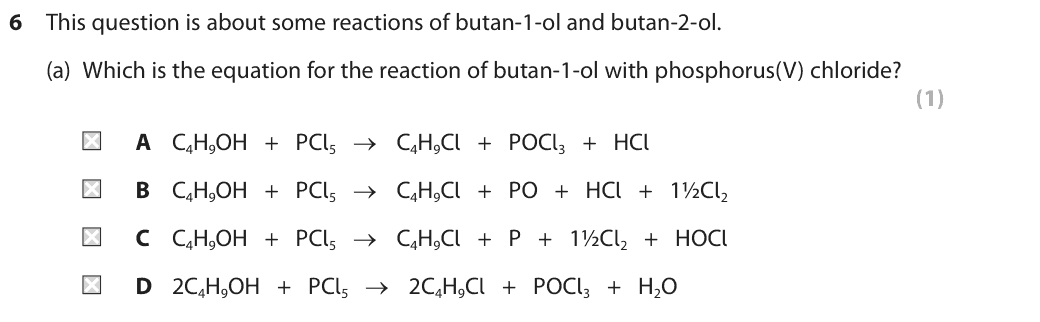
Use these data to calculate the final oxidation state of vanadium.
You must show your working.
October 2020 · Paper 1 · Q5(b)(ii) 5 marks Calculation formulae equations and amounts of substance
Earlier parts of question 5 that this part usesEarlier part of October 2020 Paper 1 question 5Earlier part of October 2020 Paper 1 question 5
Use the experimental data to calculate the value for x in the formula
Mg(NO3)2.xH2O .
You must show all your working.
October 2020 · Paper 1 · Q6(a)(ii) 3 marks Calculation energetics i
Earlier part of question 6 that this part usesEarlier part of October 2020 Paper 1 question 6
Calculate a value for the enthalpy of combustion of prop-2-en-1-ol using the
data shown.
C3H6O(g) + 4O2(g)  →  3CO2(g) + 3H2O(g)
Bond
C−C
C=C
C−O
C=O
O−H
C−H
O=O
Bond enthalpy /
347
612
358
805
464
413
498
kJ mol−1
October 2020 · Paper 1 · Q6(b) 5 marks Calculation entropy
Earlier part of question 6 that this part usesEarlier part of October 2020 Paper 1 question 6
Chemists are researching a process to make ethanol and ethene directly from
carbon dioxide and water.
4CO2(g) + 5H2O(l)  →  CH3CH2OH(l) + C2H4(g) + 6O2(g)    ∆HO= +2778 kJ mol−1
CO2(g)
H2O(l)
CH3CH2OH(l)
C2H4(g)
O2(g)
SO / J K−1 mol−1
213.6
69.9
160.7
219.5
205.0
Calculate ∆SO
total for the reaction and hence determine whether the reaction is
feasible under standard conditions.
October 2020 · Paper 1 · Q7(a)(ii) 3 marks Calculation Hard equilibrium ii
Earlier part of question 7 that this part usesEarlier part of October 2020 Paper 1 question 7
The initial amounts of ethanol and ethanoic acid used were 1.2 mol of each reactant.
Use this information, your expression for the equilibrium constant, Kc , and the
value for Kc , to find the amounts of each product at equilibrium, in moles.
=
Amount of CH3COOCH2CH3
=
Amount of H2O
October 2020 · Paper 1 · Q8(e)(ii) 5 marks Calculation redox ii
Earlier parts of question 8 that this part usesEarlier part of October 2020 Paper 1 question 8Earlier part of October 2020 Paper 1 question 8
The equation for the reaction between MnO4
− ions from the KMnO4 and C2O4
2− ions
from the sodium ethanedioate solution is shown.
16H+(aq) + 2MnO4
−(aq) +  5C2O4
2−(aq)  →  2Mn2+(aq) + 10CO2(g) + 8H2O(l)
Use this equation and your mean titre from (e)(i) to calculate the mass, in mg,
of KMnO4 in one tablet.
Give your answer to an appropriate number of significant figures.
October 2020 · Paper 2 · Q2(d)(ii) 2 marks Calculation formulae equations and amounts of substance
Earlier part of question 2 that this part usesEarlier part of October 2020 Paper 2 question 2
Calculate the number of molecules in 70.0 g of but-1-ene.
[Avogadro constant = 6.02 × 10²³ mol−1]
October 2020 · Paper 2 · Q3(b) 3 marks Calculation formulae equations and amounts of substance
Earlier part of question 3 that this part usesEarlier part of October 2020 Paper 2 question 3
Potassium bromate decomposes on heating.
2KBrO3  →  2KBr  +  3O2
Calculate the maximum volume of oxygen, in dm3, measured at room temperature
and pressure (r.t.p.), that could be produced from the complete decomposition
of 5.20 g of potassium bromate.
[Molar volume of gas at r.t.p. = 24.0 dm3 mol−1]
October 2020 · Paper 2 · Q5(d)(ii) 3 marks Calculation Hard formulae equations and amounts of substance
Earlier parts of question 5 that this part usesEarlier part of October 2020 Paper 2 question 5Earlier part of October 2020 Paper 2 question 5
A combustion experiment was carried out using conditions under which
water was a liquid.
A cyclic hydrocarbon, CxHy , was mixed with excess oxygen and ignited.
Under the conditions of the experiment, this hydrocarbon was gaseous
and had a volume of 25 cm3.
The equation for the complete combustion of CxHy is
CxHy(g)  +  (x  +  y
4 )O2(g)  →  xCO2(g)  +  y
2 H2O(l)
The total gas volume decreased by 75 cm3.
The remaining gases were shaken with aqueous sodium hydroxide and the
total gas volume decreased by a further 125 cm3.
All gas volumes were measured at the same temperature and pressure.
Suggest the identity of the cyclic hydrocarbon by calculating the molecular
formula of CxHy .
Include the skeletal formula of the cyclic hydrocarbon.
October 2020 · Paper 2 · Q5(f) 4 marks Calculation formulae equations and amounts of substance
Earlier part of question 5 that this part usesEarlier part of October 2020 Paper 2 question 5
Limonene is obtained from the oil in lemon peel and it is the only alkene present.
0.500 g of the oil reacted with exactly 30.6 cm3 of a solution of bromine dissolved
in cyclohexane with a concentration of 0.200 mol dm−3.
Calculate the percentage by mass of limonene in the oil.
Give your answer to an appropriate number of significant figures.
Assume that there is nothing else in the oil that reacts with bromine.
October 2020 · Paper 2 · Q9(b) 5 marks Calculation kinetics ii
Earlier part of question 9 that this part usesEarlier part of October 2020 Paper 2 question 9
The rate constant for the decomposition of nitrogen(V) oxide was determined at
two temperatures.
Temperature / K
Rate constant / s−1
328
1.50 × 10−3
338
4.87 × 10−3
Calculate the activation energy for this reaction.
Include units and give your answer to an appropriate number of significant figures.
You should not attempt to use any graphical method to answer this question.
The Arrhenius equation relating two rate constants, k1 and k2 , at two different
temperatures, T1 and T2 , can be expressed as
ln k


E

1
1

2
= −
a
−



k
R
T
T
1
2
1
October 2020 · Paper 3 · Q3(d)(ii) 1 mark Calculation Hard formulae equations and amounts of substance
Earlier parts of question 3 that this part usesEarlier part of October 2020 Paper 3 question 3Earlier part of October 2020 Paper 3 question 3
The low titre for titration 4 was queried by the teacher. The student had
wanted to refill the burette and continue the titration but had been told the
measurement uncertainty would increase if this was done.
Calculate the total percentage measurement uncertainty if the burette had
been refilled to 0.00, and then a further 0.30 cm3 had been added from the
burette, to the conical flask.
The measurement uncertainty for each burette reading is ±0.05 cm3.
October 2020 · Paper 3 · Q3(e) 5 marks Calculation formulae equations and amounts of substance
Earlier part of question 3 that this part usesEarlier part of October 2020 Paper 3 question 3
The teacher carried out the experiment and obtained the following results.
Mass of sodium hydroxide used to make 250.0 cm3 solution = 3.80 g
Volume of ethanoic acid solution = 25.00 cm3
Mean titre of sodium hydroxide = 11.90 cm3
CH3COOH(aq)  +  NaOH(aq)  →   CH3COONa(aq)  +  H2O(l)
Calculate the concentration of the ethanoic acid solution in g dm−3.
Give your answer to an appropriate number of significant figures.
October 2020 · Paper 3 · Q4(a) 2 marks Calculation formulae equations and amounts of substanceatomic structure and the periodic table
Hess’s law can be used to determine enthalpy changes for reactions which cannot be
obtained directly.
An example is the reaction of anhydrous copper(II) sulfate with water to form
hydrated copper(II) sulfate, CuSO4.5H2O.
The following outline procedure was carried out.
Step 1
42.75 g of deionised water was weighed out in a polystyrene cup and the
temperature measured.
Step 2
0.0250 mol of hydrated copper(II) sulfate was added to the water in the
polystyrene cup with stirring, making a total of 45.00 g of water.
Step 3
The temperature change was recorded.
Step 4
Steps 1 to 3 were repeated using 45.00 g of deionised water and
0.0250 mol of anhydrous copper(II) sulfate.
Calculate the mass of 0.0250 mol of hydrated copper(II) sulfate, CuSO4.5H2O .
October 2020 · Paper 3 · Q4(b) 3 marks Calculation energetics i
Earlier part of question 4 that this part usesEarlier part of October 2020 Paper 3 question 4
The reaction of hydrated copper(II) sulfate with water is shown.
CuSO4.5H2O(s)  +  aq  →   CuSO4(aq)          ∆H1 = +18.2 kJ mol−1
Calculate the temperature change that would have given this enthalpy change for
the stated experimental procedure.
Give your answer to a measurable number of significant figures and state whether
the temperature increases or decreases.
[Specific heat capacity of the solution = 4.18 J g−1
oC−1]
October 2020 · Paper 3 · Q4(c)(ii) 1 mark Calculation energetics i
Earlier parts of question 4 that this part usesEarlier part of October 2020 Paper 3 question 4Earlier part of October 2020 Paper 3 question 4
Use your enthalpy level diagram in (c)(i) to determine the enthalpy change, ∆rH,
for the reaction
CuSO4(s)  +  5H2O(l)  →   CuSO4.5H2O(s)
You must show your working on the diagram.
∆rH……………………………………………………………..
October 2020 · Paper 3 · Q5(g) 3 marks Calculation formulae equations and amounts of substance
Earlier part of question 5 that this part usesEarlier part of October 2020 Paper 3 question 5
Benzoic acid can be purified in Step 8 because of its high solubility in hot water
and low solubility in cold water.
Calculate the maximum number of benzoic acid molecules that can dissolve in
50.0 cm3 of cold water if the solubility is 1.70 g per 1000 cm3.
October 2020 · Paper 3 · Q6(b)(i) 3 marks Calculation atomic structure and the periodic table
Earlier part of question 6 that this part usesEarlier part of October 2020 Paper 3 question 6
When burned in air, these aromatic compounds undergo incomplete combustion.
Calculate the percentage composition by mass of carbon in both
phenylmethanol and benzoic acid.
October 2020 · Paper 3 · Q10(a)(iii) 6 marks Calculation entropy
Earlier parts of question 10 that this part usesEarlier part of October 2020 Paper 3 question 10Earlier part of October 2020 Paper 3 question 10
Calculate the standard molar entropy of ethyl ethanoate using your
knowledge of Gibbs free energy, ∆G, and the data in the table.
Include sign and units in your answer.
Use ∆G = −RT ln K and other appropriate equations.
Quantity
Value
Gas constant, R
8.31 J mol−1 K−1
Temperature, T
298 K
Equilibrium constant of esterification reaction, K
4.0
Enthalpy change of esterification reaction, ∆H
−6.0 kJ mol−1
159.8 J K−1 mol−1
Standard molar entropy of ethanoic acid, SO
Standard molar entropy of ethanol, SO
160.7 J K−1 mol−1
69.9 J K−1mol−1
Standard molar entropy of water, SO
June 2019 · AS Paper 1 · Q3(b) 2 marks Calculation Easy atomic structure and the periodic table
The element gallium has a relative atomic mass of 69.735 and only contains two
isotopes.
A sample of gallium contained the isotope 69Ga, with a relative abundance of 63.25 %.
Calculate the mass number of the other isotope.
You must show all your working.
June 2019 · AS Paper 1 · Q7(b)(i) 1 mark Calculation formulae equations and amounts of substance
Earlier part of question 7 that this part usesEarlier part of June 2019 Paper 1 question 7
The apparatus shown in the diagram can be used to collect the gas produced
during the reaction of magnesium with dilute hydrochloric acid.
inverted measuring cylinder
rubber
bung
delivery tube
hydrochloric acid
test tube
water
The following procedure was used.
Step 1
The apparatus was set up as shown in the diagram.  The test tube contained
10.0 cm3 of 0.20 mol dm–3 hydrochloric acid.
Step 2
A piece of magnesium ribbon was weighed.  It had a mass of 0.12 g.
Step 3
The delivery tube and bung were removed from the test tube,
the magnesium ribbon was added and the delivery tube and bung
quickly replaced.
Step 4
When the reaction was complete, the final volume of gas was recorded.
A measuring cylinder was used to measure the 10.0 cm3 of dilute hydrochloric acid
in Step 1.  The uncertainty for a volume measurement is ± 0.5 cm3.
Calculate the percentage uncertainty in the volume of hydrochloric acid.
June 2019 · AS Paper 1 · Q7(b)(ii) 3 marks Calculation formulae equations and amounts of substance
Earlier parts of question 7 that this part usesEarlier part of June 2019 Paper 1 question 7Earlier part of June 2019 Paper 1 question 7
Determine which reactant is in excess by calculating the number of moles of
magnesium and of hydrochloric acid used in the experiment.
June 2019 · AS Paper 1 · Q7(b)(iii) 1 mark Calculation formulae equations and amounts of substance
Earlier parts of question 7 that this part usesEarlier part of June 2019 Paper 1 question 7Earlier part of June 2019 Paper 1 question 7Earlier part of June 2019 Paper 1 question 7
Calculate the maximum number of moles of gas that could be produced,
using your answers to (a) and (b)(ii).
June 2019 · AS Paper 1 · Q7(b)(iv) 4 marks Calculation formulae equations and amounts of substance
Earlier parts of question 7 that this part usesEarlier part of June 2019 Paper 1 question 7Earlier part of June 2019 Paper 1 question 7Earlier part of June 2019 Paper 1 question 7Earlier part of June 2019 Paper 1 question 7
Under the conditions of the experiment, the temperature was 23°C and the
pressure 98 000 Pa.
Calculate the maximum volume of gas, in cm3, that could be produced using
your answer in (b)(iii).
Give your answer to an appropriate number of significant figures.
[The ideal gas equation is pV = nRT.  Gas constant (R) = 8.31 J mol–1 K–1]
June 2019 · AS Paper 1 · Q9(c) 3 marks Calculation formulae equations and amounts of substance
Chlorine gas, Cl2 , can be dissolved in swimming pool water to disinfect it.
An Olympic-sized swimming pool contains about 2500 m3 of water.
The chlorine content is 2 ppm (parts per million) by mass.
Calculate the number of moles of chlorine, Cl2 , in the swimming pool.
[One ppm is equivalent to 1 g of chlorine dissolved in 1 × 10⁶ g of water.
Density of water = 1 g cm–3]
June 2019 · AS Paper 1 · Q9(f) 3 marks Calculation formulae equations and amounts of substance
Calcium chlorate(I), Ca(ClO)2 , can be used to disinfect drinking water.
The concentration of chlorate(I) ions required to disinfect water is about
5.6 × 10⁻⁶ mol dm–3.
Calculate the mass of calcium chlorate(I), in g, that should be added to 1000 dm3
of water to produce a chlorate(I) ion concentration of 5.6 × 10⁻⁶ mol dm–3.
June 2019 · AS Paper 2 · Q3(b) 4 marks Calculation energetics i
Earlier part of question 3 that this part usesEarlier part of June 2019 Paper 2 question 3
Enthalpy changes of reactions which cannot be measured directly can be
calculated using standard enthalpy changes of combustion.
The table shows some of these values.
9 / kJ mol−1
Substance
ǻcH
C(s)
−394
H2(g)
−286
CH4(g)
−890
Complete the Hess cycle and use it to calculate the standard enthalpy change for
the following reaction.
C(s)   +  2H2(g)                         →                         CH4(g)
June 2019 · AS Paper 2 · Q3(c)(i) 1 mark Calculation Hard energetics i
Earlier part of question 3 that this part usesEarlier part of June 2019 Paper 2 question 3
The equations for the combination of gaseous atoms of carbon and hydrogen to
form methane, CH4, and propane, C3H8, are
C(g)  +  4H(g)  →  CH4(g)       ǻH = −1652 kJ mol−1
3C(g)  +  8H(g)  →  C3H8(g)      ǻH = −3998 kJ mol−1
Calculate:
the mean bond enthalpy of a C−−H bond.
June 2019 · AS Paper 2 · Q3(c)(ii) 2 marks Calculation energetics i
Earlier parts of question 3 that this part usesEarlier part of June 2019 Paper 2 question 3Earlier part of June 2019 Paper 2 question 3
the mean bond enthalpy of a C−−C bond.
June 2019 · AS Paper 2 · Q5(c) 2 marks Calculation formulae equations and amounts of substance
Earlier part of question 5 that this part usesEarlier part of June 2019 Paper 2 question 5
Calculate the percentage of 1-bromobutane which was converted to but-1-ene.
[Molar volume of a gas at r.t.p. = 24 000 cm3 mol–1]
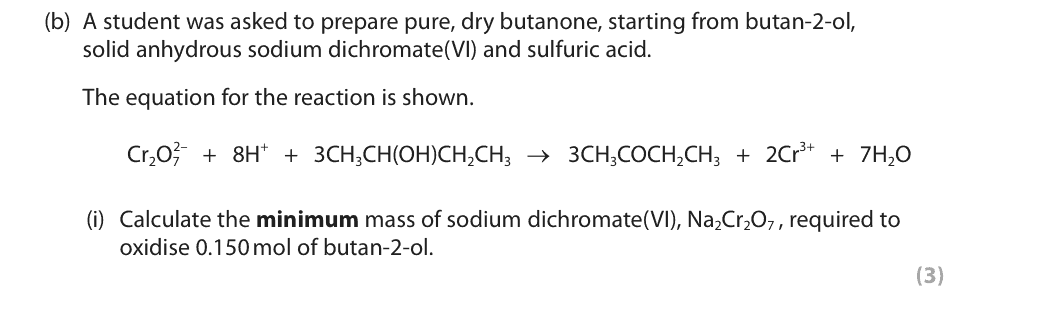
June 2019 · AS Paper 2 · Q5(d) 2 marks Calculation Hard formulae equations and amounts of substance
Earlier part of question 5 that this part usesEarlier part of June 2019 Paper 2 question 5
Before cooling, the volume of but-1-ene in the gas syringe was 24.0 cm3.
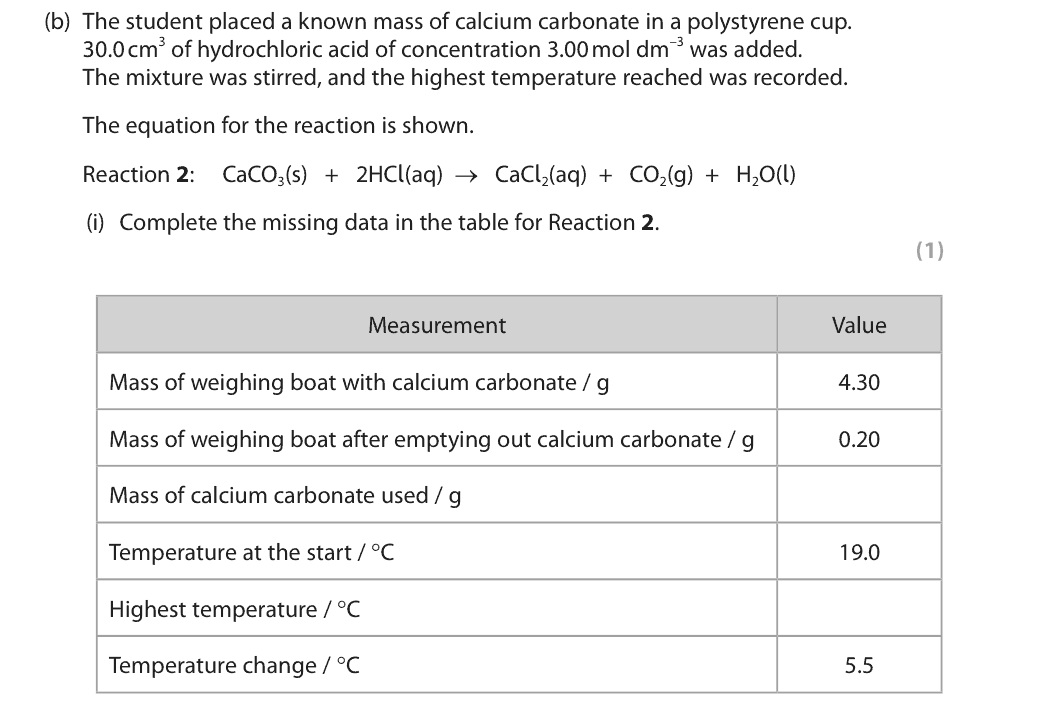
Calculate the temperature of the gas in the syringe before it cooled.

[Assume no loss from the gas syringe during cooling, and a constant pressure]
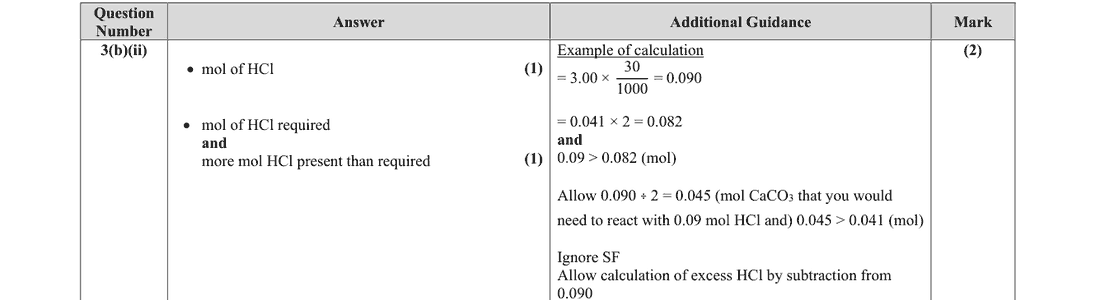
June 2019 · AS Paper 2 · Q6(a)(v) 5 marks Calculation formulae equations and amounts of substance

Earlier parts of question 6 that this part usesEarlier part of June 2019 Paper 2 question 6Earlier part of June 2019 Paper 2 question 6Earlier part of June 2019 Paper 2 question 6Earlier part of June 2019 Paper 2 question 6
Calculate the percentage of ethanol that has oxidised, given that one mole of
ethanol forms one mole of ethanoic acid.
Give your answer to an appropriate number of significant figures.
June 2019 · AS Paper 2 · Q6(b) 3 marks Calculation formulae equations and amounts of substance
Earlier part of question 6 that this part usesEarlier part of June 2019 Paper 2 question 6
The ethanol content of alcoholic drinks is usually measured as the percentage of
alcohol by volume (ABV).
ABV = Volume of ethanol in a solution
× 100
Total volume of the solution
The ABV values of four different brands of gin are shown.
Brand of gin
ABV (%)
A
40
B
42
C
44
D
46
A sample of one of these gins was found to contain an ethanol concentration of
7.50 mol dm–3.
By calculating the percentage of ethanol by volume (ABV) of this sample, deduce
the brand of this gin.
[Assume the density of ethanol, C2H5OH = 0.79 g cm–3]
June 2019 · Paper 1 · Q3(a)(ii) 3 marks Calculation energetics i
Earlier part of question 3 that this part usesEarlier part of June 2019 Paper 1 question 3
50.0 cm3 of propanoic acid solution, of concentration 1.00 mol dm–3, was
added and thoroughly mixed with the sodium hydroxide solution in the
polystyrene cup.
The maximum temperature rise was 6.5 °C.
Calculate the enthalpy change of neutralisation for propanoic acid, in kJ mol–1,
giving your answer to the nearest whole number.
[Assume density of the mixture = 1.00 g cm–3, specific heat capacity of the
mixture = 4.18 J g–1 °C–1]
June 2019 · Paper 1 · Q6(d)(i) 2 marks Calculation Easy acid base equilibria
Earlier part of question 6 that this part usesEarlier part of June 2019 Paper 1 question 6
An equation for the ionisation of water is
` H+(aq) + OH–(aq)
H2O(l) _
The expression for the ionic product of water is
Kw = [H+(aq)] [OH–(aq)]
The value of Kw at 310 K is 2.40 × 10⁻¹⁴ mol2 dm–6
Calculate the pH of water at 310 K.
Give your answer to two decimal places.
June 2019 · Paper 1 · Q8(a)(ii) 1 mark Calculation lattice energy
Earlier part of question 8 that this part usesEarlier part of June 2019 Paper 1 question 8
Calculate the first electron affinity, in kJ mol–1, of hydrogen, using the values
given in the cycle.
June 2019 · Paper 1 · Q8(b)(i) 2 marks Calculation entropy
Earlier part of question 8 that this part usesEarlier part of June 2019 Paper 1 question 8
The equation for the formation of sodium hydride is
Na(s) + ½H2(g) o NaH(s)      ¨fH  = –56 kJ mol–1
The standard entropy change of the system, ¨S system , for this reaction is
–76.5 J K–1 mol–1.
Deduce the feasibility of this reaction at 298 K by calculating the free energy
change, ¨G.
June 2019 · Paper 1 · Q8(b)(ii) 1 mark Calculation entropy
Earlier parts of question 8 that this part usesEarlier part of June 2019 Paper 1 question 8Earlier part of June 2019 Paper 1 question 8
Calculate the temperature at which ¨G = 0.
June 2019 · Paper 1 · Q9(b) 5 marks Calculation acid base equilibria
Earlier part of question 9 that this part usesEarlier part of June 2019 Paper 1 question 9
A buffer solution with a pH of 3.90 is required.
Calculate the mass, in grams, of sodium ethanoate that should be added to
50.0 cm3 of an ethanoic acid solution of concentration 0.800 mol dm–3 to form this
buffer solution.
Give your answer to an appropriate number of significant figures.
[Ka for ethanoic acid = 1.74 × 10⁻⁵ mol dm–3]
June 2019 · Paper 1 · Q10(a)(i) 5 marks Calculation equilibrium ii
This question is about equilibrium systems.
Sulfur dioxide and oxygen form an equilibrium with sulfur trioxide.
` 2SO3(g)
2SO2(g) + O2(g) _
The composition of an equilibrium mixture at 698 K and a total pressure of
2.40 atm is shown in the table.
Substance
SO2(g)
O2(g)
SO3(g)
Number of moles /mol
0.0160
0.0120
0.772
Calculate the value of Kp at this temperature.
Include units, if appropriate.
June 2019 · Paper 1 · Q10(a)(ii) 1 mark Calculation formulae equations and amounts of substance
Earlier part of question 10 that this part usesEarlier part of June 2019 Paper 1 question 10
Calculate the number of sulfur dioxide molecules present in this equilibrium mixture.
June 2019 · Paper 2 · Q2(c)(ii) 2 marks Calculation formulae equations and amounts of substance
Earlier parts of question 2 that this part usesEarlier part of June 2019 Paper 2 question 2Earlier part of June 2019 Paper 2 question 2
Calculate the atom economy by mass for the formation of 1-bromopropane in
the reaction in (c).
June 2019 · Paper 2 · Q2(c)(iv) 3 marks Calculation formulae equations and amounts of substance
Earlier parts of question 2 that this part usesEarlier part of June 2019 Paper 2 question 2Earlier part of June 2019 Paper 2 question 2Earlier part of June 2019 Paper 2 question 2Earlier part of June 2019 Paper 2 question 2
Calculate the volume of propane, in dm’, measured at room temperature and
pressure, that is needed to produce 14.7g of 1-bromopropane, assuming a
percentage yield of 31.0%.
Give your answer to an appropriate number of significant figures.
[Molar gas volume at r.t.p. = 24.0dm’ mol”']
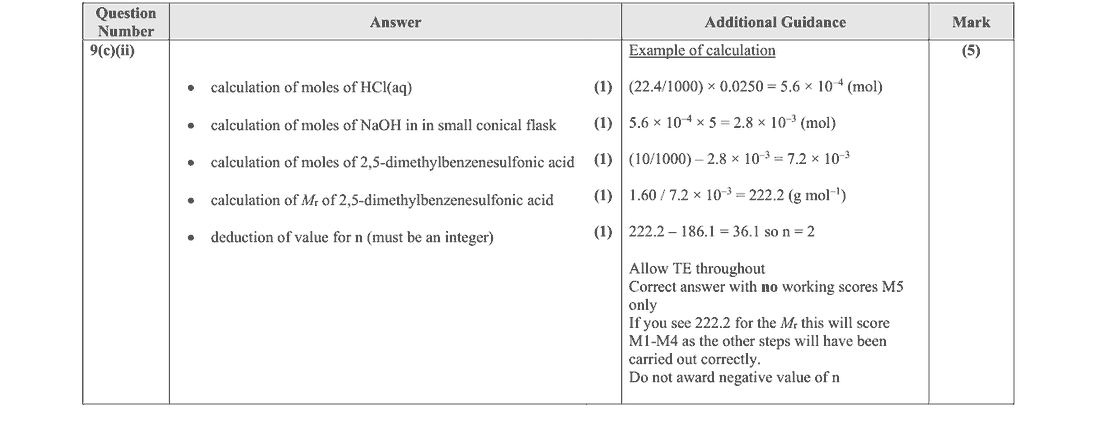
June 2019 · Paper 2 · Q4(a) 2 marks Calculation formulae equations and amounts of substance
Methyl cinnamate, C,,H;.02, is a white crystalline solid used in the perfume industry.
O
WN
a
methyl cinnamate
Calculate the mass of carbon in 2.34g of methyl cinnamate.
June 2019 · Paper 2 · Q5(b) 4 marks Calculation formulae equations and amounts of substance
Earlier part of question 5 that this part usesEarlier part of June 2019 Paper 2 question 5
A student carried out an experiment to determine the molar mass of xylene.
The student's sample of xylene vapour had a mass of 0.271 g.
At a temperature of 165°C and a pressure of 118kPa, this sample had a volume of 70.5 cm’.
Use the Ideal Gas Equation to calculate the molar mass, in g mol", of this sample.
Give your answer to an appropriate number of significant figures.
You must show your working.
June 2019 · Paper 2 · Q7(b)(i) 2 marks Calculation kinetics ii
Earlier part of question 7 that this part usesEarlier part of June 2019 Paper 2 question 7
The rate equation for the formation of nitrosyl chloride is
Rate = k[NOJ’[Cl,]
Complete the table by adding the missing values.
June 2019 · Paper 2 · Q7(b)(ii) 3 marks Calculation kinetics ii
Earlier parts of question 7 that this part usesEarlier part of June 2019 Paper 2 question 7Earlier part of June 2019 Paper 2 question 7
Calculate the rate constant, k, using data from Experiment 1.
Include units with your answer.
June 2019 · Paper 2 · Q8(b)(i) 1 mark Calculation kinetics ii
Earlier part of question 8 that this part usesEarlier part of June 2019 Paper 2 question 8
The rate constant for the reaction between a solution of gentian violet and
aqueous sodium hydroxide was determined at different temperatures.
Temperature (7)
1 /Temperature (1/7)
Rate constant, k
/K
/K'
/ dm?’ mol's"'
283.5
3.53 x 10°
2.71 x 10°
287.5
3
3
3.48 x 10⁷
3.55 xX 10°
291.5
4.75 x 10°
295.0
3.39 x 10°
6.10 x 10°
298.5
3.35 x 10°
7.60 x 10°
Complete the data in the table.
June 2019 · Paper 2 · Q8(b)(ii) 6 marks Calculation kinetics ii
Earlier parts of question 8 that this part usesEarlier part of June 2019 Paper 2 question 8Earlier part of June 2019 Paper 2 question 8
Plot a graph and use it to determine the activation energy for the reaction in kJ mol".
You should include the value and units of the gradient of the line.
The Arrhenius equation can be shown as
Ink |
= -—* x — + constant
R T
ee pes=Hit Gre iste
Bd
a
He=ttitt: HCE
BEE ue BEE
Het eae
ELH CEH
TF
HE FEEFEEEtreFEE
ELEY EHH ECE eH
EEEA
CHEHt0 EEEita7. HE
isetteis
HH HH
sat teattCEEAH rE
HCEFEE
cr
FE-
CHEFE FE
He erieECEHHHCE
FECEEcit
mopoeCEEHEECEEEttHE IE neeHHCEEtteHC teEteseitire
Et
iat
ae
tsLE
tHEtetECE
CEEHEEEt CEEFE
oo
tieFEECEEBitmo ——
HH
sieHH EE
a
aete
EteHtpsEt CHE
oS
EEE HEae FEE ESECEEet
ECE
ae
HCE FE
aes
ECE HH
Ht ae
ECECHEHHHE HE Ete
ECEHeHEE
a HiieitaHECEEtt HEEEEEtttHt
ae co
sit HEHE HCEFt
ae
LEH
iste
ae
EH
ce
oe
Hue
at
teHEtttise HE ite
rE
oo ae
iteFEECEEtreiancrite
ECE
Le --
ae
a:
EE
are
ee
7 HCE
fieoe HEEEte Htae CEEFEE
te
ee He 3 bie H
sss
ae
ae
ae
a
ae
HH
To Ete
ai iia
eea
ee
LEa ae
HE HCE
ae
ae= ee HCE
eea EteceHCE ane te HH a ELE EEE
ECEiiECE
He= Le
HEE isisHHHtEte —=
te te
ans
ECEcE EH
“FHa
Bee
HH
He 3
ae as
ELE a"ae HEE
HEE HCE—Ete Hh a
aosHtceaa
HeceCEEFEE ee Hate
ae
rae
ee
HE
iris
ie
He i:
IE
po
He
rTae ane
oS ae ae Htee
HaHE
ee ate
He
Bat
ae
ae
ate rte
as
HEE H
aeae
He
TEE—
fet rae
osne Hoea To
e/- Ee ita os =
He Be co
te eine
aE eine a
EH EH
cH cH
G r ° di i m
- ve ” con oe ses “ os se ” ~ ~ “ ~
bee . . ve ~ . ~ a ae
cti u va ton n e er
g y
: vo - os ~ i ” ” ~ a ~
i . i so ve . _ “ ”
os
—
otal f
S =]
P
‘AP
90 M ARKSs
June 2019 · Paper 3 · Q1(d) 1 mark Calculation acid base equilibria
Calculate the concentration of hydrogen ions, in mol dm–3, in a solution with a
pH of 2.76
June 2019 · Paper 3 · Q2(b) 3 marks Calculation redox ii
Earlier part of question 2 that this part usesEarlier part of June 2019 Paper 3 question 2
The standard electrode potential, E , of the Ag+(aq)|Ag(s) half-cell is +0.80 V.
The effect of changing the concentration of the ions on the value of the electrode
potential, E, in this half-cell is calculated using the equation
RT
E = E  +
96500 × ln[Ag+(aq)]
where T is the temperature in kelvin and R is the gas constant.
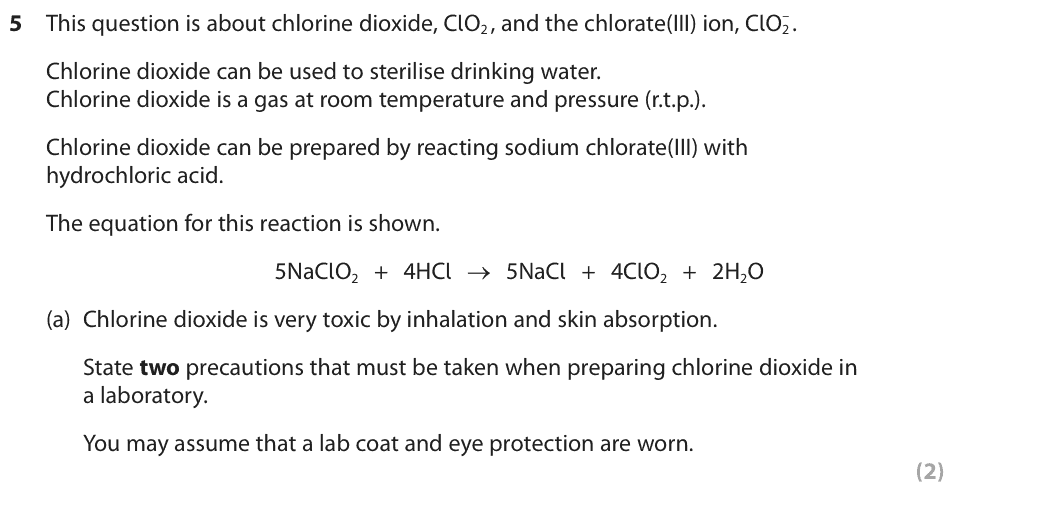
The electrode potential of a Ag+(aq)|Ag(s) half-cell was measured at 20 °C and

found to be +0.72 V.
Calculate the concentration of silver ions, in mol dm–3, in this half-cell.
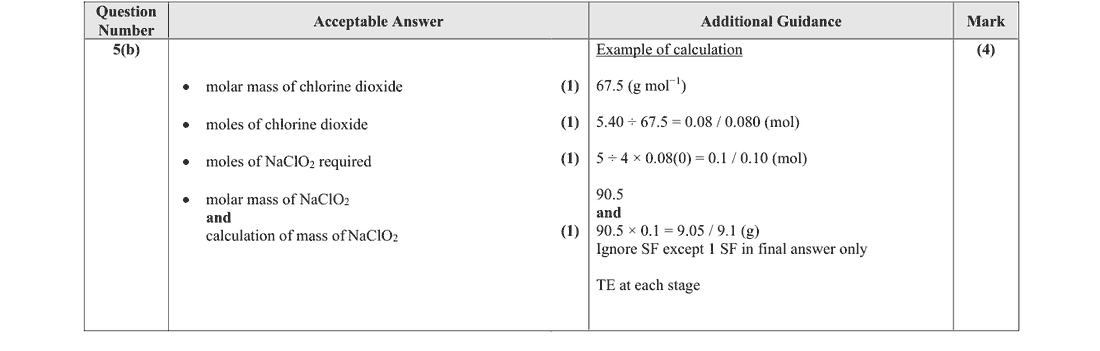
June 2019 · Paper 3 · Q6(c)(iii) 2 marks Calculation kinetics iikinetics i
Earlier parts of question 6 that this part usesEarlier part of June 2019 Paper 3 question 6Earlier part of June 2019 Paper 3 question 6Earlier part of June 2019 Paper 3 question 6
Use the graph to calculate the rate constant.  Include units in your answer.
June 2019 · Paper 3 · Q7(a)(iii) 1 mark Calculation formulae equations and amounts of substance
Earlier part of question 7 that this part usesEarlier part of June 2019 Paper 3 question 7
The uncertainty in each burette reading is ±0.05 cm3.
Calculate the percentage uncertainty in the titre volume of
potassium manganate(VII) solution used in Titration 2.
June 2019 · Paper 3 · Q7(a)(iv) 4 marks Calculation redox iiformulae equations and amounts of substance
Earlier part of question 7 that this part usesEarlier part of June 2019 Paper 3 question 7
The equation for the reaction is
2– + 16H+ o 2Mn2+ + 10CO2 + 8H2O
2MnO4
– + 5C2O4
Deduce, by calculation, the value of y, to the nearest whole number, in the
formula KH3(C2O4)y. zH2O.
Use the mean titre of 23.15 cm3 and other data from Experiment 1.
You must show your working.
June 2019 · Paper 3 · Q7(b)(i) 3 marks Calculation formulae equations and amounts of substance
Earlier parts of question 7 that this part usesEarlier part of June 2019 Paper 3 question 7Earlier part of June 2019 Paper 3 question 7
Experiment 2 – to determine the value of z
Another student wrote an account of the method for this experiment.
A crucible was weighed.
A sample of the hydrated salt was added to the crucible and it was reweighed.
The crucible and salt were heated to remove the water of crystallisation and
then allowed to cool.
The crucible and contents were weighed again.
Results
Mass of crucible
= 19.56 g
Mass of crucible + KH3(C2O4) y.zH2O
= 22.97 g
Mass of crucible + KH3(C2O4) y
= 22.52 g
Deduce, by calculation, the value of z, to the nearest whole number, in the
formula KH3(C2O4)y. zH2O.
You must use the data from Experiment 2 and your value of y in (a)(iv).
You must show your working.
June 2019 · Paper 3 · Q8(b)(iv) 2 marks Calculation Hard formulae equations and amounts of substance
Earlier parts of question 8 that this part usesEarlier part of June 2019 Paper 3 question 8Earlier part of June 2019 Paper 3 question 8Earlier part of June 2019 Paper 3 question 8Earlier part of June 2019 Paper 3 question 8
The volume of 1-bromobutane collected was 12.0 cm3.
Calculate the number of molecules of 1-bromobutane produced in this experiment.
Give your answer to an appropriate number of significant figures.
June 2019 · Paper 3 · Q10(a)(ii) 5 marks Calculation formulae equations and amounts of substanceorganic synthesis
Earlier part of question 10 that this part usesEarlier part of June 2019 Paper 3 question 10
On combustion in dry oxygen, 3.36 g of D produced 0.72 g of water and 5.28 g
of carbon dioxide.
This sample of D also contained 0.56 g of nitrogen.
Use these data to calculate the empirical formula of compound D.
You must show your working.
June 2018 · AS Paper 1 · Q2(b)(ii) 2 marks Calculation atomic structure and the periodic table
Earlier parts of question 2 that this part usesEarlier part of June 2018 Paper 1 question 2Earlier part of June 2018 Paper 1 question 2
Calculate the relative atomic mass of hydrogen from these data, giving your
answer to four decimal places.
June 2018 · AS Paper 1 · Q3(c)(iii) 3 marks Calculation formulae equations and amounts of substance
Earlier parts of question 3 that this part usesEarlier part of June 2018 Paper 1 question 3Earlier part of June 2018 Paper 1 question 3Earlier part of June 2018 Paper 1 question 3
Calculate the concentration, in mol dm−3, of the potassium hydroxide solution,
giving your answer to an appropriate number of significant figures.
June 2018 · AS Paper 1 · Q4(c) 4 marks Calculation formulae equations and amounts of substance
Earlier parts of question 4 that this part usesEarlier part of June 2018 Paper 1 question 4Earlier part of June 2018 Paper 1 question 4Earlier part of June 2018 Paper 1 question 4
Heating the hydrated compound results in the formation of the anhydrous ionic
solid MN by the following reaction:
MN.xH2O(s) → MN(s) + xH2O(g)
Heating a sample of the hydrated compound reduced the mass to 48.9 % of its
original value.
Use this information and your answer to (a)(ii) and (b) to calculate the value of x.
[
]
Note:  If you have been unable to identify MN, you may use this hydrated compound,
CoCl2.yH2O in which the sample reduced in mass to 54.6% of its original value.
Use this information to calculate the value of y.
June 2018 · AS Paper 1 · Q5(b) 5 marks Calculation formulae equations and amounts of substance
Earlier part of question 5 that this part usesEarlier part of June 2018 Paper 1 question 5
The student obtained a mass of 14.26 g of hydrated crystals.
Assuming that the percentage yield is 100%, use the information in the procedure
to give a possible identity of J.
June 2018 · AS Paper 1 · Q5(c)(iii) 2 marks Calculation formulae equations and amounts of substance
Earlier parts of question 5 that this part usesEarlier part of June 2018 Paper 1 question 5Earlier part of June 2018 Paper 1 question 5Earlier part of June 2018 Paper 1 question 5
Calculate the actual percentage yield of the reaction, which produced 14.26 g
of crystals.
Give your answer to two significant figures.
June 2018 · AS Paper 2 · Q2(a)(i) 3 marks Calculation formulae equations and amounts of substance
This question is about the molar volume of gases.
Calculate the volume of one mole of an ideal gas, A, at 60 °C and 500 kPa pressure.
Give your answer to two significant figures and include units.
[The ideal gas equation is pV = nRT.  Gas constant (R ) = 8.31 J K−1 mol−1]
June 2018 · AS Paper 2 · Q2(a)(ii) 2 marks Calculation formulae equations and amounts of substance
Earlier part of question 2 that this part usesEarlier part of June 2018 Paper 2 question 2
At room temperature and pressure (r.t.p) another gas B, with formula XH3 ,

has a density of 1.42 g dm−3.
Calculate the molar mass of the gas XH3 and deduce the identity of the
element X.
[The molar volume of gas B = 24 000 cm3 mol−1 at r.t.p.]
June 2018 · AS Paper 2 · Q2(b)(i) 5 marks Calculation formulae equations and amounts of substance

Earlier part of question 2 that this part usesEarlier part of June 2018 Paper 2 question 2
The apparatus shown was used to measure the volume of gas evolved when a
weighed mass of sodium carbonate reacted with dilute hydrochloric acid.
delivery tube
rubber bung
syringe
test tube
The following procedure was used.
Step 1  Solid sodium carbonate was placed in a container and weighed accurately.
Step 2  The delivery tube and rubber bung were removed and the
sodium carbonate was transferred to the test tube.
Step 3  The container was then reweighed.
Step 4  The syringe plunger was pushed in, to zero the syringe.
Step 5  10.0 cm3 of 0.400 mol dm−3 hydrochloric acid was then added to the
sodium carbonate and the rubber bung and delivery tube rapidly replaced.
Step 6  The mixture was shaken and, when the reaction had finished,
the reading of the syringe was noted.
Results
Mass of container and sodium carbonate before transfer
=
20.135 g
Mass of container after transfer of the sodium carbonate
=
19.893 g
Mass of sodium carbonate used
=
0.242 g
The equation for the reaction is
Na2CO3(s) + 2HCl(aq) → 2NaCl(aq) + CO2(g) + H2O(l)
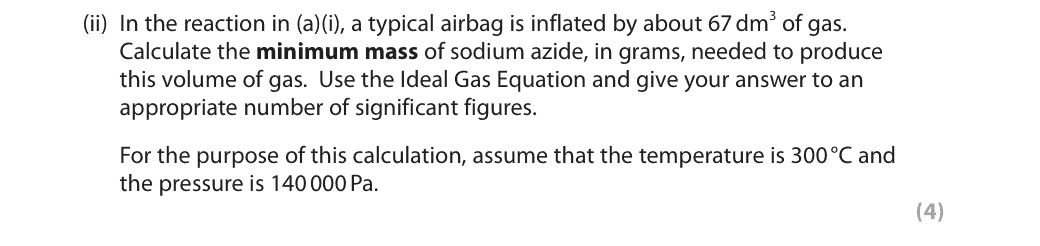
Calculate the moles of hydrochloric acid and the moles of sodium carbonate
used in this experiment.
Use your answers to decide which reactant is in excess.
Calculate the maximum volume of carbon dioxide which could be produced.
Molar mass of Na2CO3  = 106.0 g mol−1
Molar volume of gas = 24 000 cm3 mol−1 at r.t.p.
June 2018 · AS Paper 2 · Q3(b)(i) 3 marks Calculation energetics i
Earlier part of question 3 that this part usesEarlier part of June 2018 Paper 2 question 3
Nitric acid is made from ammonia.  One of the stages in nitric acid production
involves the oxidation of ammonia to produce nitrogen(II) oxide, NO.  In this
process, a mixture of ammonia and oxygen is passed over a platinum-rhodium
catalyst.  One manufacturer uses a pressure of 5 atm and a temperature of 850 °C.
The equation for this reaction is different from that in 3(a).
4NH3(g) + 5O2(g) → 4NO(g) + 6H2O(g)                ΔrH = −904.8 kJ mol−1
Use this equation, and the enthalpy changes of formation of nitrogen(II) oxide
and water, to calculate the enthalpy change of formation of ammonia in kJ mol−1.
You may find it helpful to draw a Hess cycle first.  You must show your working.
ΔfH (NO(g)) = +90.4 kJ mol−1
ΔfH (H2O(g)) = −241.8 kJ mol−1
June 2018 · AS Paper 2 · Q3(b)(ii) 2 marks Calculation formulae equations and amounts of substance
Earlier parts of question 3 that this part usesEarlier part of June 2018 Paper 2 question 3Earlier part of June 2018 Paper 2 question 3
Calculate the atom economy by mass for the formation of NO in this reaction.
Give your answer to an appropriate number of significant figures.
June 2018 · AS Paper 2 · Q7(a)(i) 2 marks Calculation formulae equations and amounts of substance
This question is about the titration of a weak acid with a strong base.
A standard solution of ethanedioic acid, which is a weak, diprotic acid, can be
used to determine the concentration of a sodium hydroxide solution.  25.0 cm3 of
the ethanedioic acid solution, with concentration 3.80 g dm−3, was pipetted into a
conical flask.  A few drops of indicator solution were added.  The ethanedioic acid
was titrated with the sodium hydroxide solution which was in the burette.  The
titration was repeated and the following results were obtained.
[Molar mass of  ethanedioic acid = 90.0 g mol−1]
Titration 1
Titration 2
Titration 3
Titration 4
Final reading / cm3
18.00
17.60
35.30
27.70
Initial reading / cm3
0.00
0.00
17.60
10.05
Titre / cm3
18.00
17.60
17.70
17.65
Titre used to find the
mean titre (
)
Mean titre / cm3
In the appropriate row, tick () those titre values that should be used to find
the mean, and use these titres to calculate it.
Write the value of the mean titre in the box provided in the table of results.
June 2018 · AS Paper 2 · Q7(a)(iii) 4 marks Calculation formulae equations and amounts of substance
Earlier parts of question 7 that this part usesEarlier part of June 2018 Paper 2 question 7Earlier part of June 2018 Paper 2 question 7
The equation for the reaction of ethanedioic acid with sodium hydroxide is
C2H2O4 + 2NaOH → C2O4Na2 + 2H2O
Calculate the concentration of the sodium hydroxide solution, in mol dm−3.
Give your answer to three significant figures.
June 2018 · AS Paper 2 · Q7(b)(i) 2 marks Calculation formulae equations and amounts of substance
Earlier part of question 7 that this part usesEarlier part of June 2018 Paper 2 question 7
The uncertainty in each burette reading is ± 0.05 cm3.  The uncertainty in the
pipette volume is ± 0.06 cm3.
Calculate the percentage uncertainties for titre 4, and the pipette volume.
June 2018 · AS Paper 2 · Q8(c)(i) 4 marks Calculation energetics i
Earlier part of question 8 that this part usesEarlier part of June 2018 Paper 2 question 8
The equation for the complete combustion of 2-methylpropan-2-ol is
C4H10O(l) + 6O2(g) → 4CO2(g) + 5H2O(l)
Using the bond enthalpies shown in the table, calculate a value for the
enthalpy change, in kJ mol−1, for the complete combustion of
2-methylpropan-2-ol.
Bond
Mean bond enthalpy / kJ mol−1
C
C
347
C
H
413
C
O
358
O
H
464
O
O
498
C
O
805
June 2018 · Paper 1 · Q3(b) 4 marks Calculation energetics i
Earlier part of question 3 that this part usesEarlier part of June 2018 Paper 1 question 3
Calculate the enthalpy change of neutralisation for the reaction between nitric acid
and sodium hydroxide solution, using the results of the experiment.
Give your answer to an appropriate number of significant figures.
Assume:  density of the reaction mixture
= 1.0 g cm−3
specific heat capacity of the reaction mixture  = 4.18 J g−1 °C−1
June 2018 · Paper 1 · Q5(c)(ii) 1 mark Calculation redox ii
Earlier parts of question 5 that this part usesEarlier part of June 2018 Paper 1 question 5Earlier part of June 2018 Paper 1 question 5
Calculate the value of the standard electrode potential for the
Mn3+(aq) Ι Mn2+(aq) half-cell.
June 2018 · Paper 1 · Q6(b)(iii) 2 marks Calculation lattice energy
Earlier parts of question 6 that this part usesEarlier part of June 2018 Paper 1 question 6Earlier part of June 2018 Paper 1 question 6
Calculate the enthalpy change of solution of magnesium hydroxide, using the
following data.
Energy or enthalpy change
Value / kJ mol−1
Lattice energy of Mg(OH)2(s)
−2842
∆hydH (Mg2+(aq))
−1920
∆hydH (OH−(aq))
−460
June 2018 · Paper 1 · Q7(d)(i) 3 marks Calculation acid base equilibria
Earlier part of question 7 that this part usesEarlier part of June 2018 Paper 1 question 7
In aqueous solution, boric acid dissociates into ions in three stages.
The equation for the first dissociation is
 H+(aq) + H2BO3
H3BO3(aq) 
−(aq)
pKa for this dissociation is 9.24
Calculate the pH of a 0.0500 mol dm−3 solution of boric acid from the pKa value
for the first dissociation.
June 2018 · Paper 1 · Q9(b) 3 marks Calculation Easy entropy
Earlier part of question 9 that this part usesEarlier part of June 2018 Paper 1 question 9
Calculate the total entropy change, ∆Stotal, for the thermal decomposition of
calcium carbonate at 298 K.
CaCO3(s) → CaO(s) + CO2(g)
[Data: ∆rH = +178 kJ mol−1            ∆Ssystem = +160 J K−1 mol−1]
June 2018 · Paper 1 · Q9(c)(i) 2 marks Calculation entropy
Earlier part of question 9 that this part usesEarlier part of June 2018 Paper 1 question 9
Sulfur dioxide reacts with oxygen to form sulfur trioxide.
2S0,(g) + O.(g) = 2S0;(g)
A,H = —288.4kJ mol"'
The standard molar entropy values at 298 K are given in the table.
S*/ JK" mol"
+248.1
+205.0
Calculate the entropy change of the system, AS.\stem, for the forward reaction.
Include a sign and units in your answer.
2S0,(g) + O2(g) > 2S0,(g)
June 2018 · Paper 1 · Q9(c)(ii) 3 marks Calculation entropy
Earlier parts of question 9 that this part usesEarlier part of June 2018 Paper 1 question 9Earlier part of June 2018 Paper 1 question 9
Calculate the free energy change, AG, at 298 K and hence deduce whether the
reaction is feasible.
June 2018 · Paper 1 · Q9(c)(iii) 3 marks Calculation entropy
Earlier parts of question 9 that this part usesEarlier part of June 2018 Paper 1 question 9Earlier part of June 2018 Paper 1 question 9
In industry, the reaction is carried out at about 700 K using a
vanadium(V) oxide catalyst.
Calculate the value of the equilibrium constant, K, at 700 K.
∆G at 700 K is –60 kJ mol−1
June 2018 · Paper 1 · Q10(c) 6 marks Calculation redox iiformulae equations and amounts of substance
Earlier part of question 10 that this part usesEarlier part of June 2018 Paper 1 question 10
The table shows the percentage by mass of gold in four different carats of yellow gold.
Percentage by
Carat
mass of gold
9
37.5
10
41.7
14
58.3
18
75.0
Determine, using the experimental data, the carat of the sample of yellow gold
that was analysed.
June 2018 · Paper 2 · Q3(a)(i) 1 mark Calculation nmr mass spectrometry and chromatography
Chromatography is a technique used to separate the components of a mixture.
A sample of a tripeptide was hydrolysed and then placed on a thin layer chromatography
(TLC) plate.  Samples of possible amino acids present were also placed on the TLC plate
for reference.
A simplified diagram of the developed TLC plate is shown.
solvent front
origin
A
B
C
D
E
F
G
H
A – Lysine
B – Serine
C – Histidine
D – Tyrosine
E – Isoleucine
F – Methionine
G – Proline
H – Hydrolysed tripeptide
Calculate the Rf value for the amino acid lysine.
Give your answer to an appropriate number of significant figures.
June 2018 · Paper 2 · Q4(a)(ii) 4 marks Calculation formulae equations and amounts of substance
Earlier part of question 4 that this part usesEarlier part of June 2018 Paper 2 question 4
In the reaction in (a)(i), a typical airbag is inflated by about 67 dm3 of gas.
Calculate the minimum mass of sodium azide, in grams, needed to produce
this volume of gas.  Use the Ideal Gas Equation and give your answer to an
appropriate number of significant figures.
For the purpose of this calculation, assume that the temperature is 300 °C and
the pressure is 140 000 Pa.
June 2018 · Paper 2 · Q7(e) 2 marks Calculation atomic structure and the periodic table
Earlier part of question 7 that this part usesEarlier part of June 2018 Paper 2 question 7
Calculate the percentage by mass of carbon in phenylethene, giving your answer
to an appropriate number of significant figures.
June 2018 · Paper 2 · Q9(c)(i) 2 marks Calculation kinetics ii
Earlier part of question 9 that this part usesEarlier part of June 2018 Paper 2 question 9
A different version of the ‘iodine clock’ reaction involves mixing hydrogen peroxide with
aqueous solutions of potassium iodide, sodium thiosulfate and starch.
The main reaction is
H2O2(aq)  +  2I−(aq)  +  2H+(aq)  →  I2(aq)  +  2H2O(l)
The reaction is first order with respect to hydrogen peroxide and iodide ions but
zero order with respect to hydrogen ions.
In one experiment, the following data were obtained:
Reactants
Initial concentration / mol dm−3
H2O2(aq)
1.50 × 10⁻³
I−(aq)
2.10 × 10⁻³
H+(aq)
2.10 × 10⁻³
Initial rate = 1.24 × 10⁻³ mol dm−3 s−1
Write the rate equation and hence deduce the value of the rate constant, k,
from these data.  Include units and give your answer to an appropriate
number of significant figures.
June 2018 · Paper 2 · Q9(d)(i) 3 marks Calculation kinetics ii
Earlier part of question 9 that this part usesEarlier part of June 2018 Paper 2 question 9
Another ‘iodine clock’ reaction produced data that enabled the following graph of
ln k against 1/T to be drawn.
1 –
1 / T / K–1
0 –
1.3 × 10⁻³
1.4 × 10⁻³
1.5 × 10⁻³
1.6 × 10⁻³
1.7 × 10⁻³
1.8 × 10⁻³
–1 –
–2 –
–3 –
ln k
–4 –
–5 –
–6 –
–7 –
–8 –
The Arrhenius equation can be expressed as
E
× 
1 +

ln k = −
a
constant


R
T
From the gradient of the graph, determine the activation energy, Ea, for this reaction.
Include a sign and units in your answer.
June 2018 · Paper 3 · Q3(a) 1 mark Calculation formulae equations and amounts of substance
This question is about the identification of a Group 2 carbonate.
A chemistry teacher found a bottle containing lumps of a white solid.  The original
label was missing from the bottle.  However, someone had written ‘Group 2 carbonate’
on the bottle.  The lumps of the anhydrous white solid were pure and dry.
The chemistry teacher tried to identify the carbonate with the help of three students.
The three students worked under identical conditions and shared the same weighing balance.
Student 1 recognised that if an acid is added to a carbonate, carbon dioxide is
evolved.  The student decided to measure the volume of carbon dioxide evolved
when the Group 2 carbonate reacts with excess nitric acid.
The student knew that 1 mol of a Group 2 carbonate produces 1 mol of carbon dioxide.
Student 1 set up the apparatus shown below.
delivery tube
250 cm3
measuring
cylinder
bung
water
nitric acid
lumps of carbonate
•
Student 1 weighed out some of the Group 2 carbonate and added it to a 250 cm3
conical flask.
•
Student 1 then added 100 cm3 of 0.200 mol dm−3 nitric acid to the conical flask
and replaced the bung.
•
Student 1 measured the volume of gas collected in the inverted measuring cylinder
at room temperature and pressure (r.t.p.) when all the Group 2 carbonate had reacted.
•
Student 1 obtained the results shown in Table 1.
Measurement
Value
Mass of weighing bottle and carbonate
/ g
13.247
Mass of empty weighing bottle
/ g
12.431
Mass of carbonate used
/ g
/ cm3
Volume of acid used
100
Volume of gas collected
/ cm3
225
Table 1
Complete Table 1 to show the mass of the carbonate used.
June 2018 · Paper 3 · Q3(b) 1 mark Calculation formulae equations and amounts of substance
Earlier part of question 3 that this part usesEarlier part of June 2018 Paper 3 question 3
Calculate the amount, in moles, of carbon dioxide collected in the
measuring cylinder at r.t.p.
June 2018 · Paper 3 · Q3(c) 4 marks Calculation formulae equations and amounts of substance
Earlier part of question 3 that this part usesEarlier part of June 2018 Paper 3 question 3
Calculate the molar mass of the Group 2 carbonate to an appropriate number of
significant figures and hence deduce the identity of the Group 2 metal.
June 2018 · Paper 3 · Q3(e)(ii) 3 marks Calculation formulae equations and amounts of substance
Earlier parts of question 3 that this part usesEarlier part of June 2018 Paper 3 question 3Earlier part of June 2018 Paper 3 question 3
Using Student 3’s results, calculate the molar mass of the Group 2 carbonate.
June 2018 · Paper 3 · Q6(b) 2 marks Calculation Easy formulae equations and amounts of substance
Earlier part of question 6 that this part usesEarlier part of June 2018 Paper 3 question 6
The students decide to carry out an acid-base titration to obtain further
information about compound X.
Each student uses solid sodium hydroxide, NaOH, to prepare a solution of
concentration 0.140 mol dm−3.
Calculate the mass, in grams, of solid sodium hydroxide that each student should
weigh out to prepare 250.0 cm3 of a 0.140 mol dm−3 solution.
June 2018 · Paper 3 · Q6(c)(iii) 3 marks Calculation formulae equations and amounts of substance
Earlier parts of question 6 that this part usesEarlier part of June 2018 Paper 3 question 6Earlier part of June 2018 Paper 3 question 6Earlier part of June 2018 Paper 3 question 6
Student A uses three pieces of apparatus to measure volumes in this experiment.
•
The burette has an uncertainty of ±0.05 cm3 for each volume reading
•
The volumetric flask has an uncertainty of ±0.30 cm3 for the volume
•
The pipette has an uncertainty of ±0.04 cm3 for the volume
Show by calculation which volume measurement has the lowest percentage uncertainty.
June 2018 · Paper 3 · Q7(a) 5 marks Calculation acid base equilibria
This question is about weak acids.
A weak acid, HX, has a Ka value of 5.25 × 10⁻⁵ mol dm−3.  A solution was formed by
mixing 10.5 cm3 of 0.800 mol dm−3 dilute sodium hydroxide with
25.0 cm3 of 0.920 mol dm−3 HX(aq).
Calculate the pH of the solution formed, showing all your working.
June 2018 · Paper 3 · Q8(b)(i) 2 marks Calculation formulae equations and amounts of substance
Earlier part of question 8 that this part usesEarlier part of June 2018 Paper 3 question 8
Calculate the total amount, in moles, of acid present in the volumetric flask
in the equilibrium mixture.
June 2018 · Paper 3 · Q8(b)(ii) 1 mark Calculation formulae equations and amounts of substance
Earlier parts of question 8 that this part usesEarlier part of June 2018 Paper 3 question 8Earlier part of June 2018 Paper 3 question 8
The 2.0 cm3 of dilute hydrochloric acid contained 0.00400 mol of H+(aq) ions.
Use this and your answer to part (b)(i) to calculate the amount, in moles, of
ethanoic acid present in the equilibrium mixture.
June 2018 · Paper 3 · Q8(c)(i) 1 mark Calculation equilibrium ii
Earlier parts of question 8 that this part usesEarlier part of June 2018 Paper 3 question 8Earlier part of June 2018 Paper 3 question 8
The initial mixture in the boiling tube contained 0.105 mol of ethanoic acid.
Use your answer to (b)(ii) to calculate the amount, in moles, of ethanoic acid
that reacted to form the ester in the equilibrium mixture.
June 2018 · Paper 3 · Q8(c)(ii) 3 marks Calculation equilibrium ii
Earlier parts of question 8 that this part usesEarlier part of June 2018 Paper 3 question 8Earlier part of June 2018 Paper 3 question 8
Use information given in the method, and your answer to (c)(i), to calculate
the amounts, in moles, of propan-1-ol, propyl ethanoate and water that are
present in the equilibrium mixture.
Moles of propan-1-ol at equilibrium
Moles of propyl ethanoate at equilibrium
Moles of water at equilibrium
June 2018 · Paper 3 · Q8(d)(iii) 2 marks Calculation equilibrium ii
Earlier parts of question 8 that this part usesEarlier part of June 2018 Paper 3 question 8Earlier part of June 2018 Paper 3 question 8Earlier part of June 2018 Paper 3 question 8
Calculate the value of Kc.
Give your answer to an appropriate number of significant figures.
June 2017 · AS Paper 1 · Q5(d) 4 marks Calculation Easy atomic structure and the periodic table
Earlier part of question 5 that this part usesEarlier part of June 2017 Paper 1 question 5
The relative atomic mass of a sample of magnesium was found to be 24.3.
The percentage composition for two of the three isotopes is given in the table.
Use these data to calculate the percentage composition of the third isotope and
hence its relative isotopic mass.  Give your answer to an appropriate number of
significant figures.  You must show your working.
Relative isotopic mass
Percentage abundance
25.0
10.00
26.0
11.01
June 2017 · AS Paper 1 · Q6(b) 6 marks Calculation formulae equations and amounts of substance
Earlier part of question 6 that this part usesEarlier part of June 2017 Paper 1 question 6
Aluminium also reacts directly with chlorine to form a compound,
aluminium chloride, containing only aluminium and chlorine.
A 0.500 g sample of aluminium chloride was analysed and found to contain
0.101 g of aluminium.
Another 0.500 g sample was heated to 473 K.  The gas produced occupied a
volume of 73.6 cm3 at a pressure of 1.00 × 10² kPa.
Determine the molecular formula of the gas.
You will need to use the equation pV = nRT and R = 8.31 J mol–1 K–1
June 2017 · AS Paper 1 · Q7(a) 5 marks Calculation formulae equations and amounts of substance
Hydrochloric acid is prepared by dissolving hydrogen chloride gas in water.  It is
difficult to dissolve a known amount of hydrogen chloride, so the exact concentration
of such solutions is uncertain.  A solution of hydrochloric acid of concentration
between 0.095 mol dm–3 and 0.105 mol dm–3 was prepared.
Before a class attempted a practical using this solution, a technician standardised the
hydrochloric acid with sodium carbonate solution.  The technician dissolved 1.30 g of
anhydrous sodium carbonate in water and made up the solution to 100 cm3.
The equation for the reaction which occurs is shown.
Na2CO3 + 2HCl o 2NaCl + H2O + CO2
A 10.0 cm3 portion of the sodium carbonate solution was transferred to a conical flask.
Three drops of methyl orange indicator were added and the solution titrated with
hydrochloric acid.  The results for the experiment are shown.
Titration
1
2
3
4
5
Final burette reading / cm3
26.00
34.00
36.10
24.15
48.20
Initial burette reading / cm3
0.00
10.00
11.00
0.05
24.15
Titre / cm3
Concordant results (3)
Complete the table and determine the concentration, in mol dm–3 , of the
hydrochloric acid solution, giving the answer to an appropriate number of
significant figures.
June 2017 · AS Paper 1 · Q8(a)(ii) 1 mark Calculation formulae equations and amounts of substanceatomic structure and the periodic table
Earlier part of question 8 that this part usesEarlier part of June 2017 Paper 1 question 8
Calculate the molar mass of calcium carbonate.
 g mol–1
June 2017 · AS Paper 1 · Q8(a)(iii) 2 marks Calculation formulae equations and amounts of substance
Earlier part of question 8 that this part usesEarlier part of June 2017 Paper 1 question 8
Show that, in each experiment, the hydrochloric acid is in excess.
June 2017 · AS Paper 1 · Q8(c) 2 marks Calculation formulae equations and amounts of substance
Earlier part of question 8 that this part usesEarlier part of June 2017 Paper 1 question 8
Calculate the volume, under these conditions, of one mole of carbon dioxide gas
from these data.  Give your answer in dm3 to two significant figures.
June 2017 · AS Paper 2 · Q3(a) 4 marks Calculation formulae equations and amounts of substance
In an experiment, 1.000 g of a hydrocarbon, A, was burned completely in oxygen
to produce 3.143 g of carbon dioxide and 1.284 g of water.
In a different experiment, the molar mass of the hydrocarbon, A, was found to be
84.0 g mol–1.
Calculate the empirical formula and the molecular formula of the hydrocarbon, A.
June 2017 · AS Paper 2 · Q3(b)(i) 3 marks Calculation energetics i
Earlier part of question 3 that this part usesEarlier part of June 2017 Paper 2 question 3
A spirit burner was filled with the liquid hydrocarbon, A.  The burner was weighed,
lit and then used to raise the temperature of a quantity of water in a beaker, as
shown in the diagram.  The burner was then reweighed.
thermometer
beaker
water
spirit burner
hydrocarbon A
Results
Mass of spirit burner + hydrocarbon A before use
112.990 g
Mass of spirit burner + hydrocarbon A after use
112.732 g
Volume of water in the beaker
250 cm3
Temperature of water before heating
21.3°C
Temperature of water after heating
29.5°C
Other data
Density of water
1.00 g cm–3
Specific heat capacity of water
4.18 J g–1 °C–1
Molar mass of hydrocarbon A
84.0 g mol–1
Use these results to calculate the enthalpy change of combustion of
hydrocarbon A in kJ mol–1.
Give your answer to an appropriate number of significant figures and include a sign.
June 2017 · AS Paper 2 · Q5(b)(i) 2 marks Calculation formulae equations and amounts of substance
Earlier part of question 5 that this part usesEarlier part of June 2017 Paper 2 question 5
The following steps were carried out by a student to find the molar mass of a gas.  The
experiment was carried out at 20 oC and one atmosphere pressure.  The dry gas was
supplied in a plastic bag fitted with a self-sealing device.  The student had a choice of
two different gas syringes.  The student decided to use a 50 cm3 syringe.
Step 1.   The 50 cm3 syringe was fitted with a needle and then emptied of air by
pushing in the plunger to zero.  The needle was sealed by pushing the
needle into a rubber bung and the syringe and bung were then weighed
on a balance.
Step 2.   The syringe was checked for leaks by pulling the plunger out by about
10 cm3 for a few seconds before releasing it.
Step 3.   The rubber bung was removed from the needle which was then inserted
through the self-sealing device in the plastic bag of the dry gas.
Step 4.   50 cm3 of the dry gas was withdrawn from the plastic bag into the syringe
and the needle resealed with the same rubber bung used in step 1.
Step 5.   The syringe and rubber bung were then reweighed on the balance.
Results
volume of gas used
50 cm3
initial mass of empty syringe
107.563 g
final mass of syringe + gas
107.655 g
The gas syringe has a total uncertainty of ±0.5 cm3.
Each reading on the balance has an uncertainty of ±0.0005 g.
Calculate the percentage uncertainty in the measurement of the volume and
mass of gas used in this procedure.
June 2017 · AS Paper 2 · Q5(b)(iii) 2 marks Calculation formulae equations and amounts of substance
Earlier parts of question 5 that this part usesEarlier part of June 2017 Paper 2 question 5Earlier part of June 2017 Paper 2 question 5Earlier part of June 2017 Paper 2 question 5
Calculate the molar mass of the gas used in the procedure outlined in part (b).
You may assume that one mole of gas occupies 24 000 cm3 under these
conditions.
Give your answer to an appropriate number of significant figures and include
units in your answer.
June 2017 · AS Paper 2 · Q7(b)(ii) 3 marks Calculation kinetics i
Earlier parts of question 7 that this part usesEarlier part of June 2017 Paper 2 question 7Earlier part of June 2017 Paper 2 question 7
Use your graph to calculate a value for the rate of reaction at 100 s.
Include units in your answer.
June 2017 · AS Paper 2 · Q8(c)(i) 2 marks Calculation formulae equations and amounts of substance
Earlier part of question 8 that this part usesEarlier part of June 2017 Paper 2 question 8
In an experiment, 15.2 g of propane-1,3-diol was oxidised to propanedioic acid,
which is a solid dibasic acid.  This acid may be represented as H2X.
250 cm3 of a solution was prepared from all of the acid in a volumetric flask.
10.0 cm3 portions of this solution were then titrated with 0.400 mol dm–3
sodium hydroxide solution.  The mean titre was 18.45 cm3.
H2X  +  2NaOH  o  Na2X  +  2H2O
[Relative formula masses: propane-1,3-diol = 76.0; propanedioic acid = 104.0]
Calculate the moles of propanedioic acid in 10.0 cm3 of the acid solution.
June 2017 · AS Paper 2 · Q8(c)(ii) 2 marks Calculation formulae equations and amounts of substance
Earlier parts of question 8 that this part usesEarlier part of June 2017 Paper 2 question 8Earlier part of June 2017 Paper 2 question 8
Calculate the mass of propanedioic acid in the 250 cm3 solution.
June 2017 · AS Paper 2 · Q8(c)(iii) 2 marks Calculation formulae equations and amounts of substance
Earlier parts of question 8 that this part usesEarlier part of June 2017 Paper 2 question 8Earlier part of June 2017 Paper 2 question 8
Calculate the percentage yield for the oxidation of propane-1,3-diol to
propanedioic acid.
June 2017 · Paper 1 · Q5(b) 3 marks Calculation energetics i
Earlier part of question 5 that this part usesEarlier part of June 2017 Paper 1 question 5
Propan-1-ol is dehydrated to form propene.
H
H
H
H
H
C
C
¨r H  = +42 kJ mol−1
H
C
C
C
O
H
+
H2O
H
C
H
H
H
H
H
H
The relevant mean bond enthalpies are given in the table.
Mean bond enthalpy
Bond
/ kJ mol–1
C
C
347
C
C
612
C
H
413
O
H
464
Calculate the C
O mean bond enthalpy, using the mean bond enthalpies given
in the table and the enthalpy change of reaction.
June 2017 · Paper 1 · Q5(e) 3 marks Calculation Easy entropy
Earlier part of question 5 that this part usesEarlier part of June 2017 Paper 1 question 5
Calcium carbonate decomposes on heating.
CaCO3(s) r CaO(s) + CO2(g)
¨rH = +178 kJ mol–1
¨Ssystem = +165 J mol–1 K–1
Show, by calculating the value for the free energy change, ¨G, that this
decomposition is not feasible at 298 K, and then calculate the minimum
temperature to which calcium carbonate must be heated to make it decompose.
June 2017 · Paper 1 · Q6(b)(ii) 2 marks Calculation lattice energy
Earlier parts of question 6 that this part usesEarlier part of June 2017 Paper 1 question 6Earlier part of June 2017 Paper 1 question 6
Calculate the first electron affinity of bromine, in kJ mol–1.
June 2017 · Paper 1 · Q7(a) 3 marks Calculation energetics i
In acid-base neutralisation reactions, there is a temperature change.
The enthalpy change when hydrochloric acid reacts with aqueous ammonia is –53.4 kJ mol–1.
HCl(aq) + NH3(aq) r NH4Cl(aq)
Calculate the temperature change you would expect when
25.0 cm3 of 1.00 mol dm–3 hydrochloric acid is mixed with
25.0 cm3 of 1.00 mol dm–3 aqueous ammonia.
Give your answer to an appropriate number of significant figures.
Assume:  the density of the solution is 1.00 g cm–3
[
the specific heat capacity of the solution is 4.18 J g–1 qC–1]
June 2017 · Paper 1 · Q8(b) 3 marks Calculation Easy acid base equilibria
Earlier part of question 8 that this part usesEarlier part of June 2017 Paper 1 question 8
Another solution of glycolic acid has a pH of 2.0
Calculate the concentration of this solution.
June 2017 · Paper 1 · Q9(b) 5 marks Calculation acid base equilibriaformulae equations and amounts of substance
Earlier part of question 9 that this part usesEarlier part of June 2017 Paper 1 question 9
Another buffer solution was formed by mixing 20.0 cm3 of sodium hydroxide solution
of concentration 0.100 mol dm–3 with 25.0 cm3 of ethanoic acid of concentration
0.150 mol dm–3.
CH3COOH + NaOH r CH3COONa + H2O
Calculate the pH of this buffer solution.
[Ka for ethanoic acid = 1.74 × 10⁻⁵ mol dm–3]
June 2017 · Paper 1 · Q10(a)(iv) 4 marks Calculation equilibrium ii
Earlier part of question 10 that this part usesEarlier part of June 2017 Paper 1 question 10
At 1000 K and a total pressure of 2.0 atm, 1.00 mol of steam reacted with excess carbon.
At equilibrium, 0.81 mol of hydrogen was present.
Calculate the value of Kp at 1000 K, stating any units.
June 2017 · Paper 2 · Q4(a)(i) 3 marks Calculation formulae equations and amounts of substance
Traditionally, high-flying aircraft and Formula 1 racing cars have had their tyres
inflated with nitrogen gas instead of air.  Recently, this practice has been extended to
some other cars.
A car tyre is filled with nitrogen gas to a volume of 8.98 dm3 and a pressure of
207 kPa at 20 °C.
Using the Ideal Gas Equation, calculate the mass of nitrogen gas, in grams,
present in the car tyre under these conditions.  Give your answer to an
appropriate number of significant figures.
June 2017 · Paper 2 · Q7(d) 2 marks Calculation formulae equations and amounts of substance
Earlier part of question 7 that this part usesEarlier part of June 2017 Paper 2 question 7
A tablet with a total mass of 500 mg contained 3.10 × 10⁻³ mol of paracetamol.
Calculate the percentage by mass of paracetamol in the tablet, quoting your
answer to an appropriate number of significant figures.
June 2017 · Paper 2 · Q9(a) 1 mark Calculation Easy kinetics ii
This question is about reaction kinetics.
Compound A decomposes in a first order reaction.
Calculate the time it takes for the mass of A to decrease from 600 g to 37.5 g if the
decomposition has a constant half-life of 14 minutes.
June 2017 · Paper 2 · Q9(b)(ii) 4 marks Calculation Easy kinetics ii
Earlier parts of question 9 that this part usesEarlier part of June 2017 Paper 2 question 9Earlier part of June 2017 Paper 2 question 9
Give the rate equation for the reaction and hence calculate the rate constant, k,
to an appropriate number of significant figures.  Include units in your answer.
June 2017 · Paper 2 · Q9(c)(ii) 2 marks Calculation Easy kinetics ii
Earlier parts of question 9 that this part usesEarlier part of June 2017 Paper 2 question 9Earlier part of June 2017 Paper 2 question 9
Calculate the concentration of bromide ions required to produce a
reaction rate of 4.08 × 10⁻³ mol dm−3 s−1 at 298 K given that
k = 8.00 dm9 mol−3 s−1
[BrO3
−] = 0.200 mol dm−3
[H+] = 0.100 mol dm−3
June 2017 · Paper 2 · Q9(d) 7 marks Calculation kinetics ii
Earlier part of question 9 that this part usesEarlier part of June 2017 Paper 2 question 9
The rate constant for the reaction between bromoethane and
aqueous hydroxide ions was determined at five different temperatures.
The results are given in the table.
Temperature (T)
1 / Temperature (1 / T)
Rate constant, k
ln k
/ K
/ K−1
/ dm3 mol–1 s–1
293
3.41 × 10⁻³
5.83 × 10⁻⁵
−9.75
303
1.67 × 10⁻⁴
313
5.26 × 10⁻⁴
323
1.36 × 10⁻³
333
3.00 × 10⁻³
3.77 × 10⁻³
−5.58
Complete the data in the table and use them to plot a graph of ln k against 1 / T
and hence determine the activation energy, Ea , in kJ mol−1.
You should include the value and units of the gradient of the line.
The Arrhenius equation can be expressed as
ln k = – E
a × 1
T + constant
R
June 2017 · Paper 3 · Q2(f)(ii) 2 marks Calculation formulae equations and amounts of substance
Earlier parts of question 2 that this part usesEarlier part of June 2017 Paper 3 question 2Earlier part of June 2017 Paper 3 question 2
Calculate the mass of 3-methylbutan-2-ol that the student uses at the start of
the preparation.
June 2017 · Paper 3 · Q4(c) 4 marks Calculation energetics i
Earlier part of question 4 that this part usesEarlier part of June 2017 Paper 3 question 4
Use Student 1’s result to calculate the enthalpy change of combustion of
methanol in kJ mol–1.
Give your answer to an appropriate number of significant figures.
Specific heat capacity of water = 4.18 J g–1 °C–1
Density of water = 1.00 g cm–3
June 2017 · Paper 3 · Q4(d)(i) 1 mark Calculation formulae equations and amounts of substance
Earlier parts of question 4 that this part usesEarlier part of June 2017 Paper 3 question 4Earlier part of June 2017 Paper 3 question 4
Student 1 compared the experimental value for the enthalpy change of combustion of
methanol obtained in part (c) with the standard value given on the internet.
The student’s value was less exothermic than the standard value.
Student 1 decided to evaluate the uncertainty in the measurements made in this
experiment.
Student 1 used a 250 cm3 measuring cylinder to measure the volume of 150 cm3
distilled water.  The uncertainty in this volume measurement is ±1 cm3.
Calculate the percentage uncertainty in the volume of distilled water that
Student 1 measured in the experiment.
June 2017 · Paper 3 · Q6(c) 5 marks Calculation redox iiformulae equations and amounts of substance
Earlier part of question 6 that this part usesEarlier part of June 2017 Paper 3 question 6
In the titration reaction, 2 mol MnO4
Calculate the number of moles of NO2
−, in the 250 cm3 of solution prepared by the
student and hence the value of x in Mg(NO2)2•xH2O.
Give your answer to the nearest whole number.
June 2017 · Paper 3 · Q7(b) 5 marks Calculation redox ii
Earlier part of question 7 that this part usesEarlier part of June 2017 Paper 3 question 7
Under certain conditions, dichromate(VI) ions, Cr2O7
In this reaction, dichromate(VI) ions are reduced to chromium(III) ions, in acidic
conditions, according to the half-equation
Cr2O7
2−(aq)  +  14H+(aq)  +  6e−  U  2Cr3+(aq)  +  7H2O(l)
In an experiment it was found that 20.0 cm3 of 0.100 mol dm−3 potassium dichromate(VI)
was required to oxidise 30.0 cm3 of 0.200 mol dm−3 manganese(II) sulfate solution.
Use these data to calculate the final oxidation state of the manganese.
June 2017 · Paper 3 · Q7(c) 4 marks Calculation formulae equations and amounts of substanceredox ii
Earlier part of question 7 that this part usesEarlier part of June 2017 Paper 3 question 7
A student constructed an electrochemical cell as follows:
•
a half-cell was made from a strip of chromium metal and a solution of
aqueous chromium(III) sulfate
•
a second half-cell was made from a piece of metal, X, and a solution of its sulfate, XSO4(aq)
•
the two half-cells were connected and a current allowed to pass for some time.
Results
•
the chromium electrode increased in mass by 1.456 g
•
the electrode made of metal X decreased in mass by 1.021 g.
Use these data to determine the identity of the metal, X.
June 2017 · Paper 3 · Q9(b)(i) 1 mark Calculation equilibrium ii
Earlier parts of question 9 that this part usesEarlier part of June 2017 Paper 3 question 9Earlier part of June 2017 Paper 3 question 9
The expression for the equilibrium constant in (a)(ii) can be rearranged as shown.

a
K
c
y
=

2 +
K
c
In an experiment, air was removed from a 1 dm3 flask and amounts of hydrogen
and iodine gases were mixed together such that their initial concentrations
were both a mol dm−3.  This mixture was allowed to reach equilibrium at 760 K.
The equilibrium concentration of iodine was then measured.
The experiment was repeated for various initial concentrations, a mol dm−3, and
the results recorded in the table.
Complete the table to give the two remaining values of y mol dm−3, to two
decimal places.
a / mol dm−3
[I2]eq / mol dm−3
y / mol dm−3
0.20
0.02
0.18
0.80
0.25
0.55
1.50
0.37
2.10
0.57
1.53
2.80
0.65
2.15
3.80
0.87
4.90
1.15
3.75
June 2017 · Paper 3 · Q9(b)(iii) 2 marks Calculation equilibrium ii
Earlier parts of question 9 that this part usesEarlier part of June 2017 Paper 3 question 9Earlier part of June 2017 Paper 3 question 9Earlier part of June 2017 Paper 3 question 9
Determine the gradient of your graph.
Show your working on the graph.

a
K
c
June 2017 · Paper 3 · Q9(b)(iv) 2 marks Calculation equilibrium ii
Earlier parts of question 9 that this part usesEarlier part of June 2017 Paper 3 question 9Earlier part of June 2017 Paper 3 question 9Earlier part of June 2017 Paper 3 question 9Earlier part of June 2017 Paper 3 question 9
Use your answer to (b)(iii) and the expression y
=
to calculate the

2 +
K
value of Kc.
c
June 2016 · AS Paper 1 · Q2(c)(ii) 3 marks Calculation atomic structure and the periodic table
Earlier parts of question 2 that this part usesEarlier part of June 2016 Paper 1 question 2Earlier part of June 2016 Paper 1 question 2
A 5.000 g sample of lithium, containing the two isotopes lithium-6 and
lithium-7, was found to contain 0.460 g of the isotope lithium-6.
Calculate the relative atomic mass of lithium for this sample.  Give your answer
to an appropriate number of significant figures.
Isotope
Relative isotopic mass
Lithium-6
6.015
Lithium-7
7.016
June 2016 · AS Paper 1 · Q3(a)(i) 1 mark Calculation Easy formulae equations and amounts of substance
A student used the apparatus in the diagram to determine the molar volume of a gas.
magnesium ribbon
250 cm3
measuring cylinder
dilute hydrochloric acid
deionised
trough
water
Assume clamps are in place to secure the apparatus
The student used a piece of magnesium ribbon, which was about 5 cm in length, and
the dilute hydrochloric acid was in excess.  The experiment was repeated three times
at 24°C and the following results were obtained.
Experiment 1
Experiment 2
Experiment 3
Mass of magnesium / g
0.04
0.04
0.04
Volume of hydrogen gas / cm3
31
25
32
The equation for the reaction is
Mg(s) + 2HCl(aq) r MgCl2(aq) + H2(g)
Calculate the number of moles of magnesium used by the student in each
experiment.
June 2016 · AS Paper 1 · Q3(a)(ii) 1 mark Calculation Easy formulae equations and amounts of substance
Earlier part of question 3 that this part usesEarlier part of June 2016 Paper 1 question 3
Use your answer from part (a)(i) to deduce the number of moles of hydrogen
gas that should be produced.
June 2016 · AS Paper 1 · Q3(a)(iii) 4 marks Calculation formulae equations and amounts of substance
Earlier part of question 3 that this part usesEarlier part of June 2016 Paper 1 question 3
Calculate, using the Ideal Gas Equation, the volume of hydrogen gas, in cm3,
that should be produced in each of these experiments.
[pV = nRT    R = 8.31 J mol–1 K–1    p = 101 000 Pa]
June 2016 · AS Paper 1 · Q5(a) 1 mark Calculation formulae equations and amounts of substance
A solution of nitric acid, HNO3, of concentration 100 g dm–3, can be used to artificially
age wood.
A sample of nitric acid, thought to be suitable for this use, was diluted by pipetting
10.00 cm3 of this acid into a 250 cm3 volumetric flask, adding deionised water and
making the solution up to the mark.  The solution was thoroughly mixed.
A titration was carried out using this diluted solution of nitric acid.  The burette was
filled with 0.0800 mol dm–3 sodium hydroxide solution and 25.00 cm3 of the diluted
nitric acid was pipetted into each of three conical flasks.  The following results were
obtained.
Titration 1
Titration 2
Titration 3
Final burette reading / cm3
20.50
40.40
20.00
Initial burette reading / cm3
0.00
20.50
0.00
Volume added / cm3
20.50
19.90
20.00
The equation for the reaction is
HNO3 + NaOH r NaNO3 + H2O
Select the appropriate titres and calculate the mean titre in cm3.
June 2016 · AS Paper 1 · Q5(b) 5 marks Calculation formulae equations and amounts of substance
Earlier part of question 5 that this part usesEarlier part of June 2016 Paper 1 question 5
Calculate the concentration of the undiluted nitric acid in g dm–3.  Give your
answer to one decimal place.
Deduce whether this nitric acid is suitable for use in artificially ageing wood.
June 2016 · AS Paper 1 · Q5(d) 1 mark Calculation formulae equations and amounts of substance
Earlier part of question 5 that this part usesEarlier part of June 2016 Paper 1 question 5
One possible method for the formation of nitric acid involves the reaction
between dinitrogen tetroxide and water.
3N2O4 + 2H2O r 4HNO3 + 2NO
Calculate the atom economy for the formation of nitric acid from this reaction.
June 2016 · AS Paper 1 · Q8(b)(i) 2 marks Calculation formulae equations and amounts of substance
Earlier part of question 8 that this part usesEarlier part of June 2016 Paper 1 question 8
Sulfur reacts with fluorine to form a number of different compounds.
One compound contains 45.79% sulfur and 54.21% fluorine by mass.
Calculate the empirical formula of this compound.
June 2016 · AS Paper 2 · Q4(a) 2 marks Calculation Easy formulae equations and amounts of substance
Ethanol, C2H5OH, is a member of the homologous series of alcohols.
Calculate the number of molecules in 55.2kg of ethanol.
[Avogadro Constant = 6.02 × 10²³ mol–1]
June 2016 · AS Paper 2 · Q4(c)(i) 3 marks Calculation energetics i
Earlier part of question 4 that this part usesEarlier part of June 2016 Paper 2 question 4
Ethanol burns completely in excess oxygen.
C2H5OH(l)  +  3O2(g)  o  2CO2(g)  +  3H2O(l)
The table shows some mean bond enthalpy data.
Bond
C
C
C
H
C
O
O
H
O
O
C
O
Mean bond enthalpy
347
413
358
464
498
805
/ kJ mol−1
Calculate the enthalpy change, in kJ mol−1, for the complete combustion of
1 mol of ethanol.
June 2016 · AS Paper 2 · Q5(e) 3 marks Calculation formulae equations and amounts of substance
Earlier part of question 5 that this part usesEarlier part of June 2016 Paper 2 question 5
In the preparation, 15cm3 of 2-methylpropan-2-ol produced
6.9 cm3 of 2-chloro-2-methylpropane.
The equation for the reaction is
(CH3)3COH  +  HCl  o  (CH3)3CCl  +  H2O
Calculate the percentage yield of 2-chloro-2-methylpropane, using data from the
table.
Data
2-methylpropan-2-ol
2-chloro-2-methylpropane
molar mass / g mol–1
74.0
92.5
boiling temperature / oC
82
51
density / g cm−3
0.79
0.84
June 2016 · AS Paper 2 · Q6(a) 4 marks Calculation energetics i
A student carries out two experiments to determine the enthalpy change that occurs
when anhydrous sodium carbonate reacts to form hydrated sodium carbonate.
Na2CO3(s)  +  10H2O(l)  o  Na2CO3.10H2O(s)
In the first experiment, the student determines the enthalpy change of solution
for anhydrous sodium carbonate.
50.0g of distilled water is placed in a polystyrene cup and the temperature is
recorded.
A sample of anhydrous sodium carbonate is added to the water, the mixture is
stirred and the final temperature recorded.
The results for this experiment are shown in the table.
mass used / g
5.09
initial temperature / oC
27.0
final temperature / oC
32.4
Calculate the enthalpy change of solution, in kJ mol−1, for
anhydrous sodium carbonate.
Give your answer to an appropriate number of significant figures and include a sign.
[Use 4.18 J g–1 °C–1 as the specific heat capacity of water]
Na2CO3(s) + aq  o  Na2CO3(aq)
June 2016 · AS Paper 2 · Q6(b) 2 marks Calculation energetics i
Earlier part of question 6 that this part usesEarlier part of June 2016 Paper 2 question 6
In the second experiment, the student determines the enthalpy change of
solution for hydrated sodium carbonate.
Na2CO3.10H2O(s) + aq  o  Na2CO3(aq)           ¨H = + 53.7kJ mol–1
Complete the Hess cycle and, together with your answer to (a) calculate the
enthalpy change when anhydrous sodium carbonate reacts to form hydrated
sodium carbonate.  Include a sign in your answer.
Na2CO3(s) + 10H2O(l)
Na2CO3.10H2O(s)
This question is about the identification of an alcohol, X.
Alcohol X has the following percentage composition by mass:
carbon, C         = 68.2%
hydrogen, H    = 13.6%
oxygen, O        = 18.2%
The molecular ion peak in the mass spectrum for alcohol X occurs at m/z = 88.
Use all of these data to show that the molecular formula for alcohol X is C5H12O.
Include your working.
June 2016 · AS Paper 2 · Q8(b)(iii) 5 marks Calculation Hard formulae equations and amounts of substance
Earlier parts of question 8 that this part usesEarlier part of June 2016 Paper 2 question 8Earlier part of June 2016 Paper 2 question 8Earlier part of June 2016 Paper 2 question 8
Calculate a value of n in the formula H2C2O4.nH2O from these data.

Work with an A-level chemistry tutor

Dropping marks on calculations, mechanisms or the core practicals? Book a trial session with an A-level chemistry tutor.

Prefer email? Send an enquiry

If you are under 18, please include a parent's contact details. Enquiries go to enquiries@chemistryaleveltutor.com and are deleted once handled. All tutoring is online.