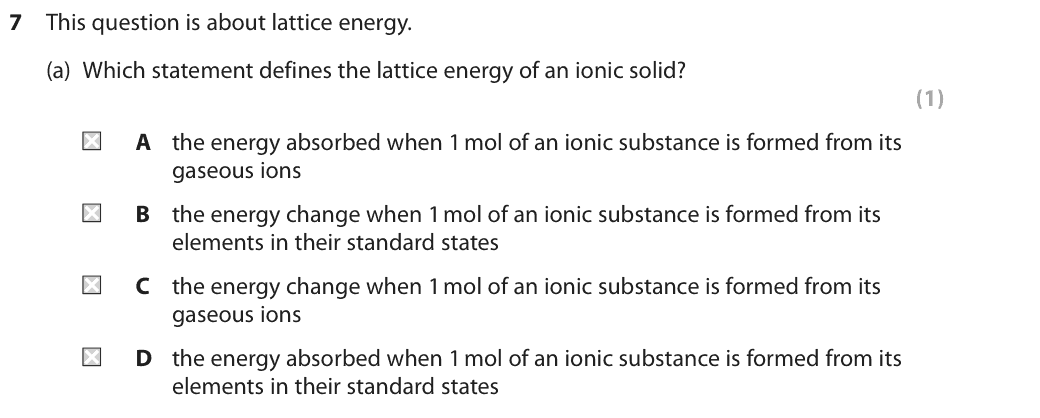
Answer
C
Mark scheme

Notes from the mark scheme and report
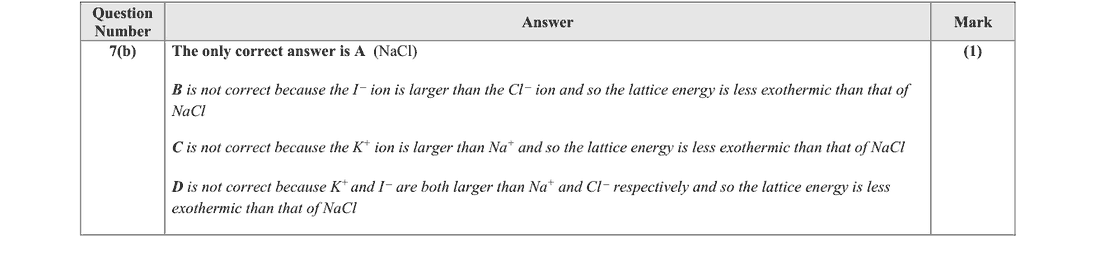
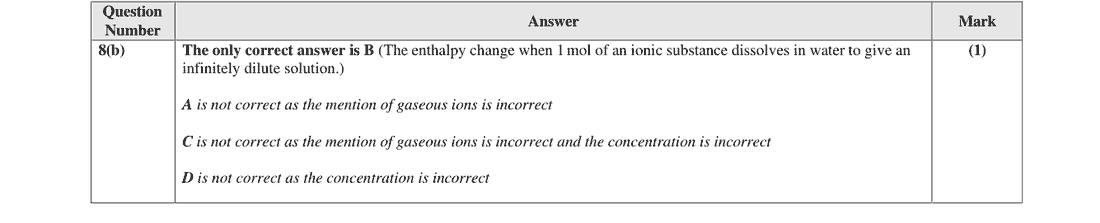
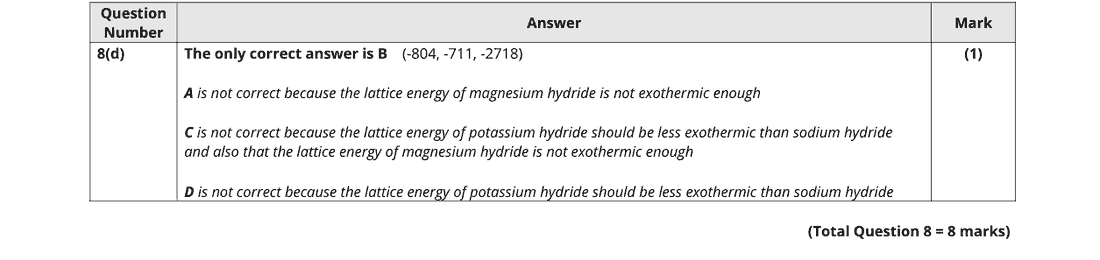
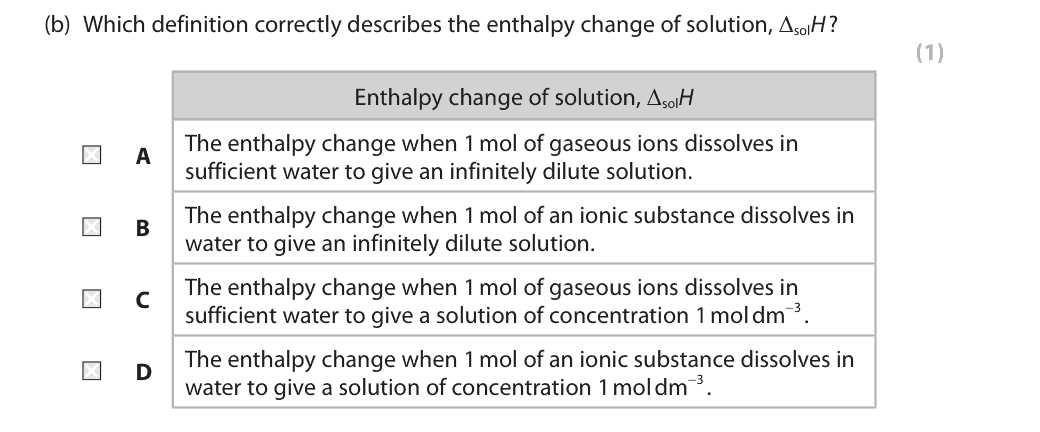
- Answer: C. The energy change when 1 mol of an ionic substance is formed from its gaseous ions
- 'energy absorbed' is wrong, and so is 'from its elements in their standard states'
| Series | Paper | Q | What it asks |
|---|---|---|---|
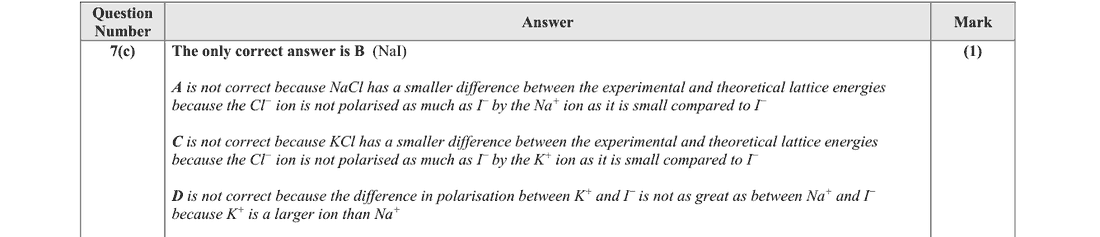
| June 2018 | Paper 1 | 8(c) | table shows the theoretical and experimental lattice energy values of two compounds. |
C
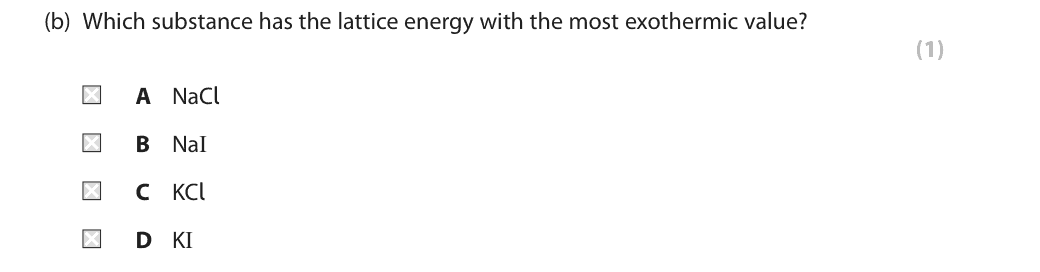
A
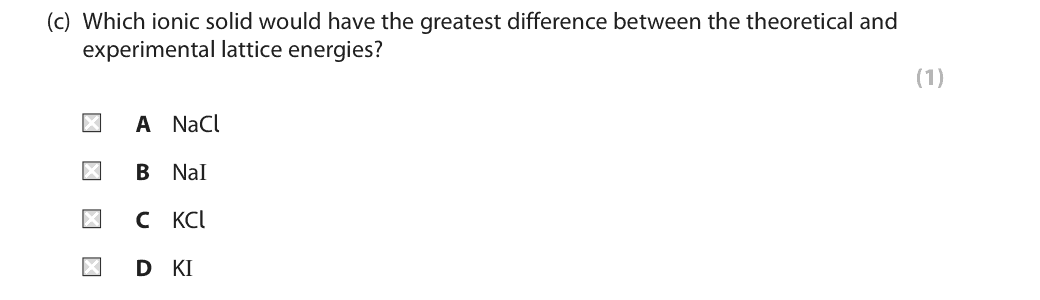
B
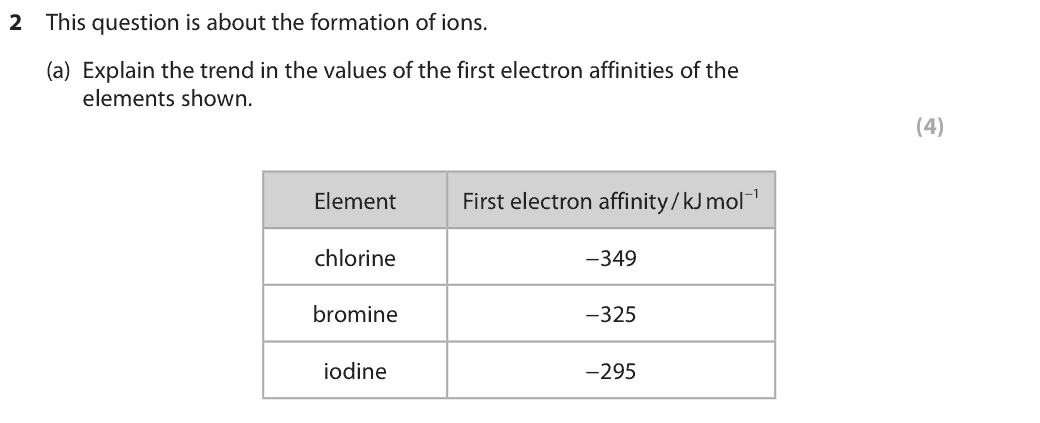
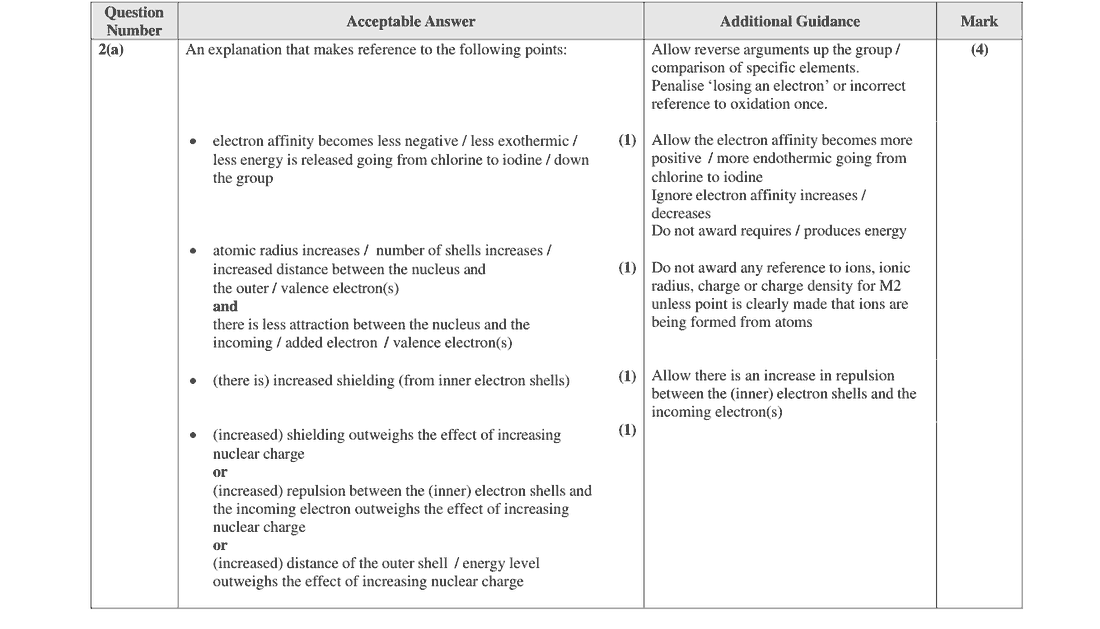
This question proved challenging with many candidates confusing first electron affinity with first ionisation energy. Many candidates suggested that energy was required for the process, despite the values given in the question being for an exothermic change. There were also a number of candidates who referred to losing an electron instead of gaining it. The last marking point, relating to the effects of shielding and distance from the nucleus outweighing the effect of increased nuclear charge, was rarely awarded.
B
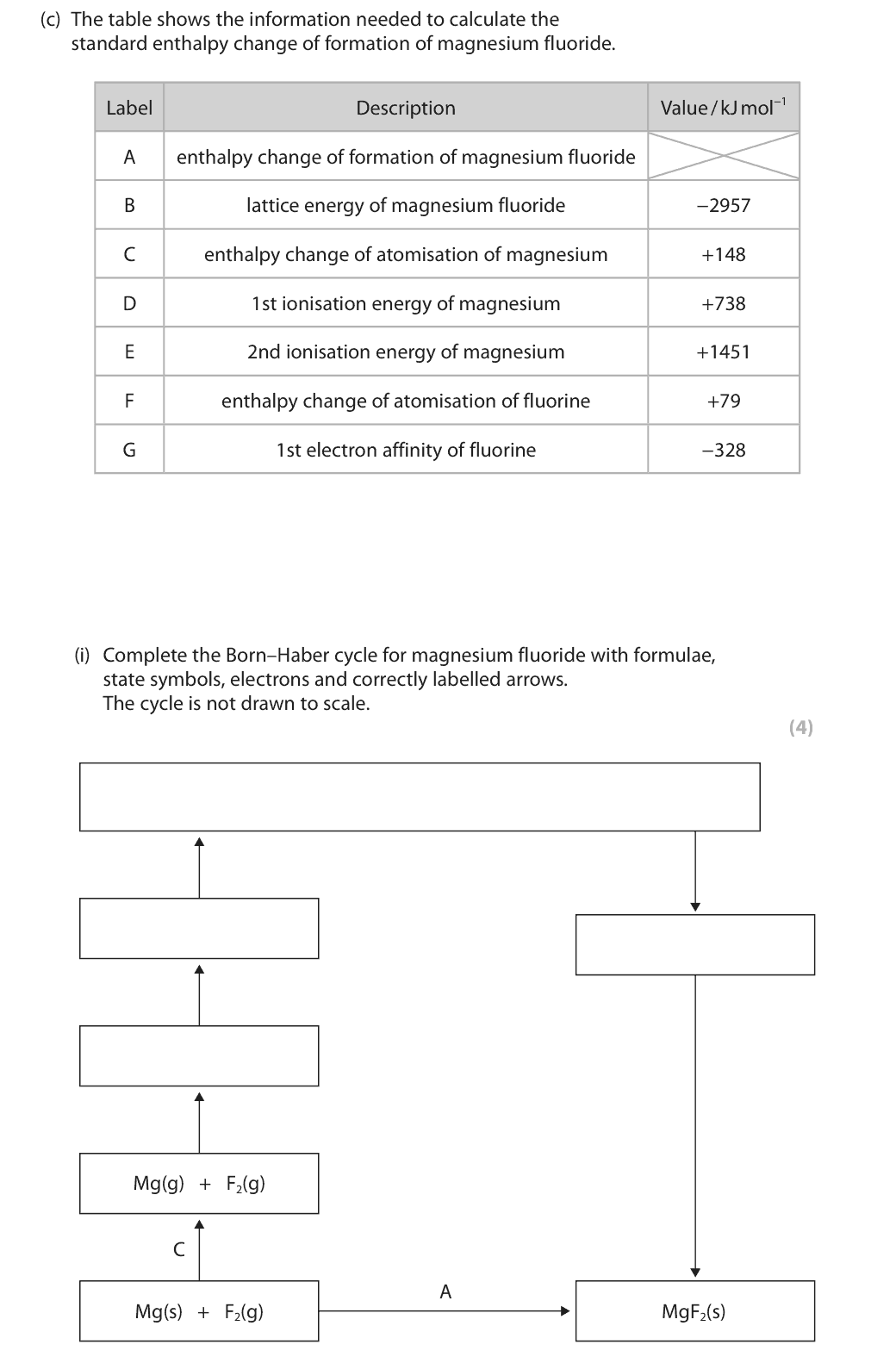
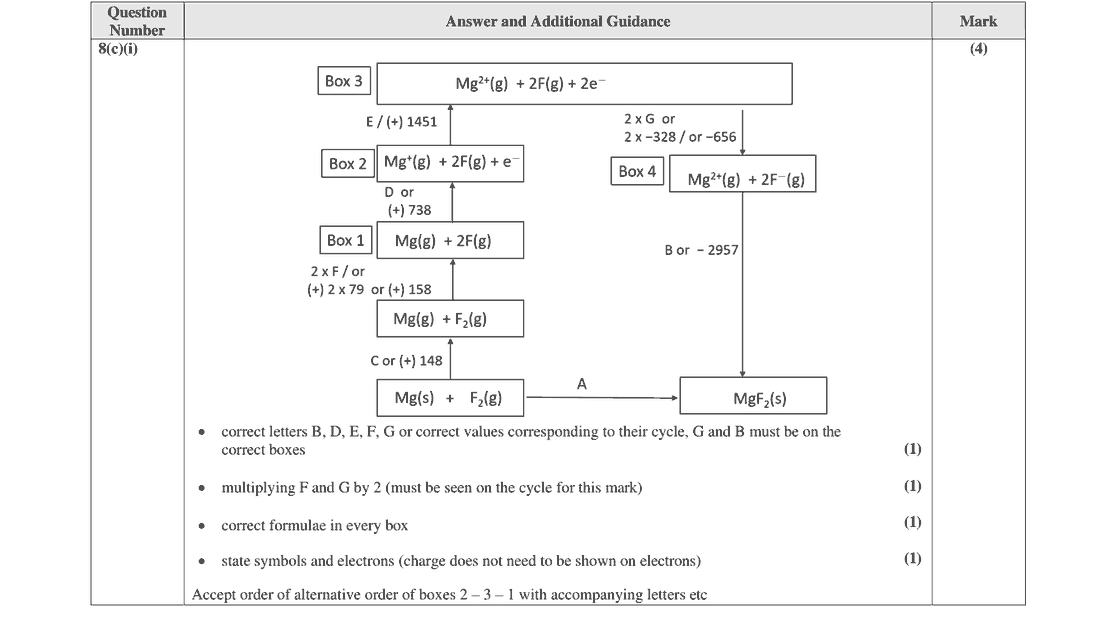
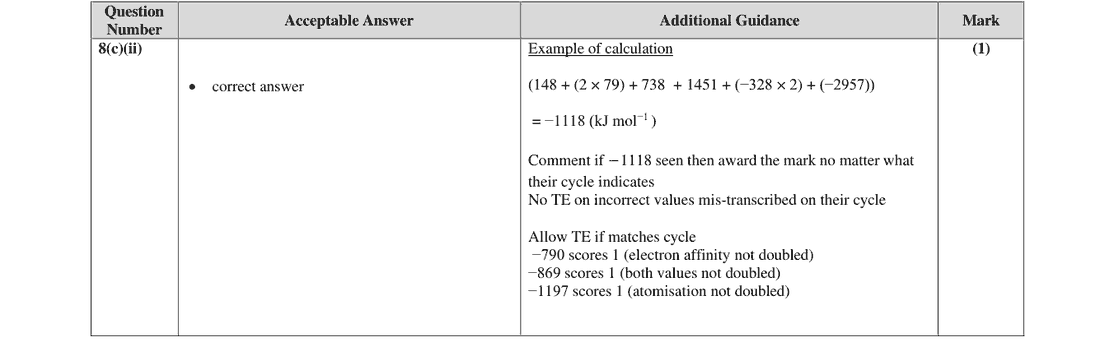
This question required candidates to complete a Born-Haber cycle for MgF2 and calculate the standard enthalpy of formation. Four marks were allocated for the completion of the cycle and one for the calculation. Most candidates scored the first mark for adding the labels in the correct places and many realised that they would need to double the enthalpy change of atomisation of fluorine and first electron affinity of fluorine. Some candidates failed to write the correct species in the boxes, in particular when converting F2 to 2F, and on occasion the electrons and state symbols were missing.

This question required candidates to complete a Born-Haber cycle for MgF2 and calculate the standard enthalpy of formation. Four marks were allocated for the completion of the cycle and one for the calculation. Most candidates scored the first mark for adding the labels in the correct places and many realised that they would need to double the enthalpy change of atomisation of fluorine and first electron affinity of fluorine. Some candidates failed to write the correct species in the boxes, in particular when converting F2 to 2F, and on occasion the electrons and state symbols were missing.
Skills: MS2.4 Solve algebraic equations
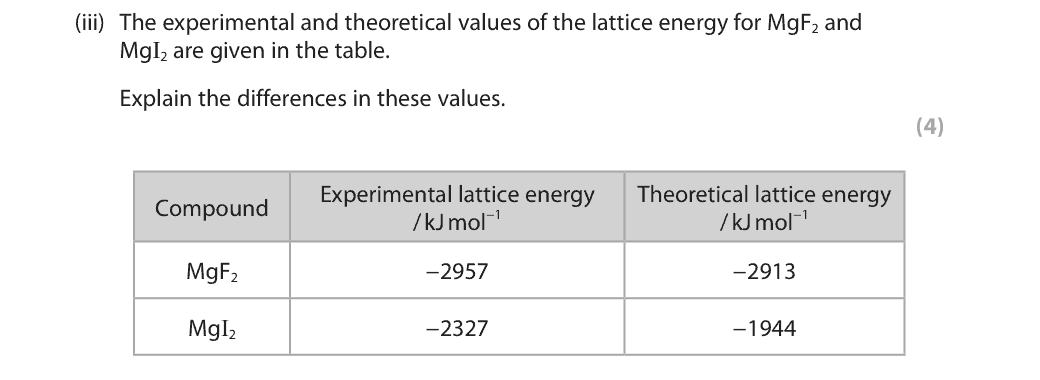
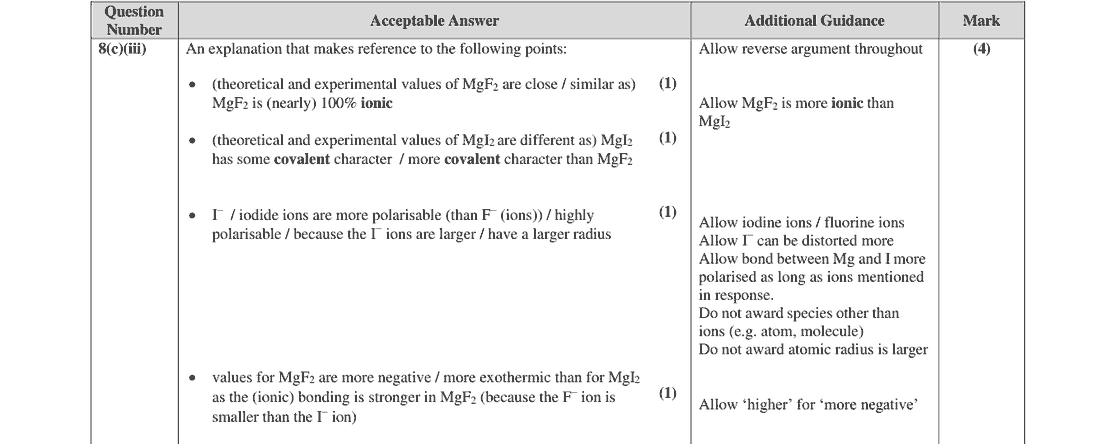
Candidates were required to evaluate data on the theoretical and experimental lattice energies of two compounds. Candidates were generally able to make a link between the data and the bonding in the compounds, with many candidates realising that MgI2 would have some covalent character thus scoring the second mark. Some candidates clearly understood that the MgF2 would be almost 100% ionic, but just stated that MgF2 had less covalent character than MgI2 and so did not score M1. Candidates sometimes did not score M3 due to careless slips when describing species. Examples included describing the ionic lattice as a 'molecule' and referring to iodine atoms or molecules being more polarisable. Very few candidates were awarded M4 as they were focused on the differences between the experimental and theoretical lattice energies in their answers and so did not compare the values for MgF2 and MgI2.

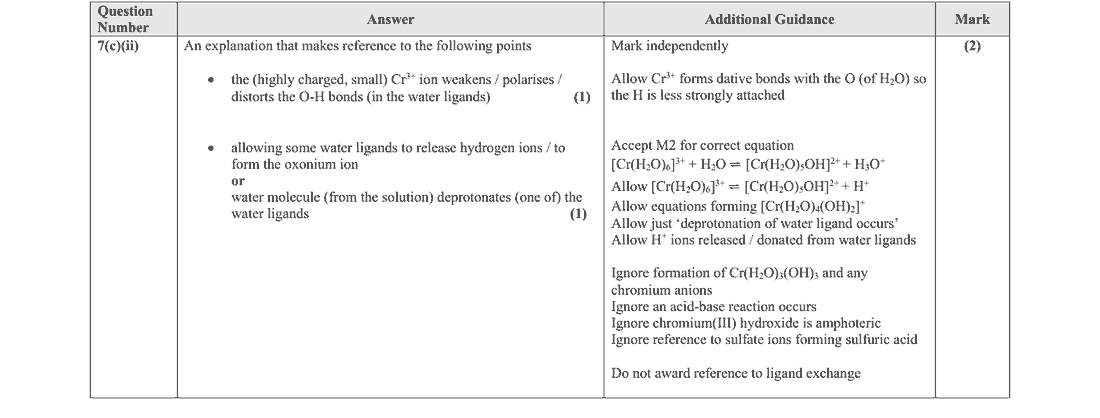
The majority of candidates scored a mark for realising that the water ligands release H+ ions that make the solution acidic. Very few candidates realised that it is the small, highly charged Cr3+ ion that weakens the O-H bonds in the water ligands that allows this to happen. Some candidates thought that OH- ions deprotonated the water ligands. A few candidates thought that a precipitate of chromium(III) hydroxide would form and some referred to ligand exchange.
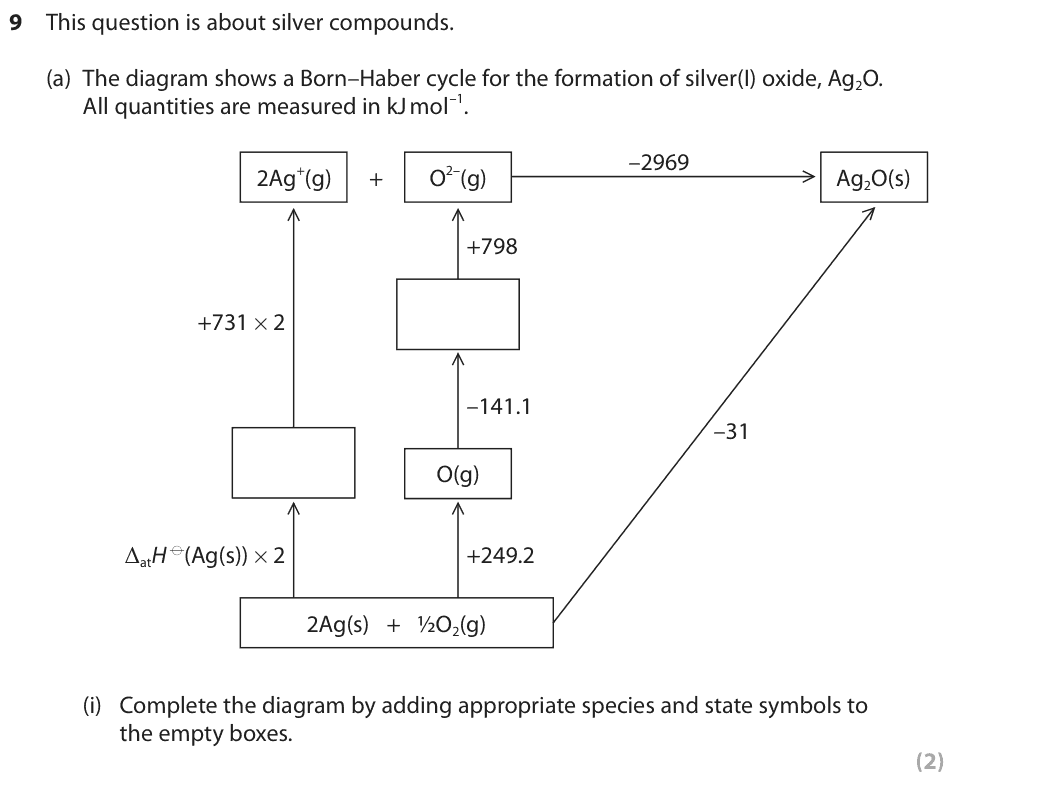
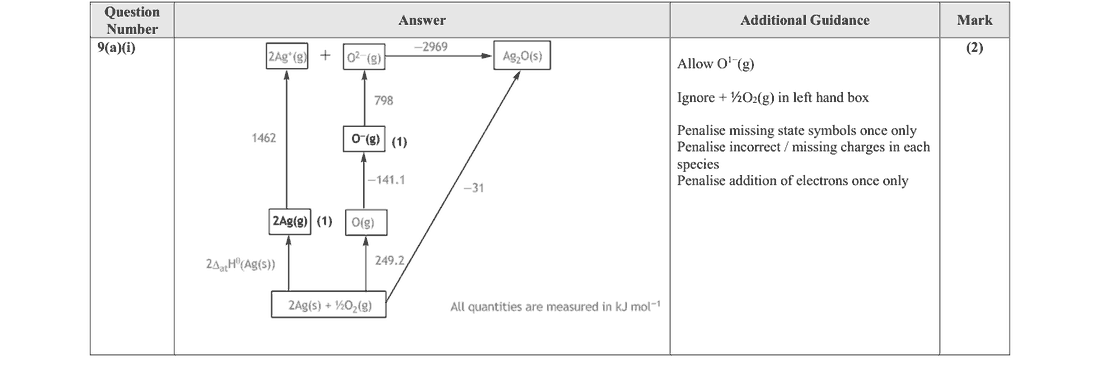
The majority of candidates scored 2 marks for this question. Common errors included: giving (s) as the state symbol for silver, omitting the 2 in front of Ag and adding an electron to the box with the O-(g).

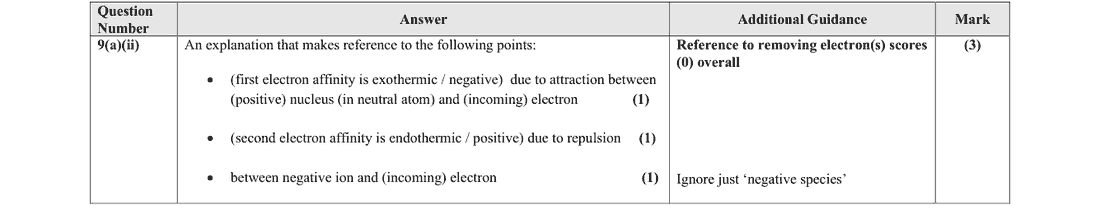
This question showed that many candidates are confused between positive and negative enthalpy change values and whether the process is endothermic or exothermic. Only a small minority of candidates understood why the first electron affinity of oxygen (and other elements) is exothermic. The majority realised that the second electron affinity is endothermic due to repulsion but some just referred to electron-electron repulsion. Some candidates were confused and thought a negative value indicated an endothermic process and some thought that energy is needed to form bonds or attractions. Some candidates discussed removing electrons and scored 0 for this question.

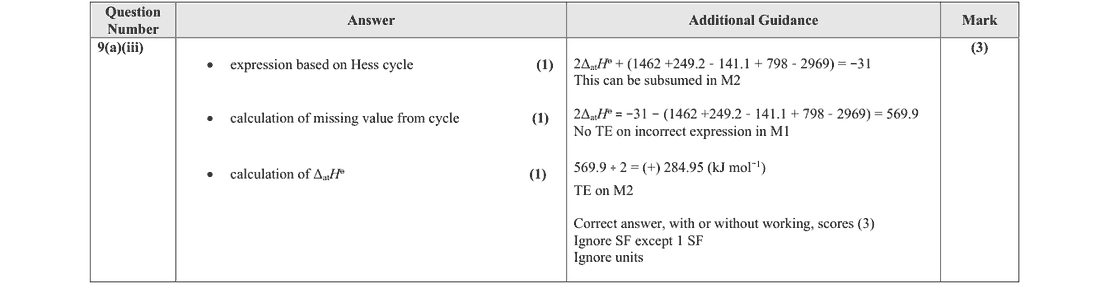
Many candidates carried out a correct calculation using the Born-Haber cycle and scored full marks. Some candidates were unable to use the cycle to calculate the standard enthalpy change of atomisation of silver and some omitted to divide by 2 as there are two silver atoms.
Skills: MS2.2 Change the subject of an equation; MS2.4 Solve algebraic equations
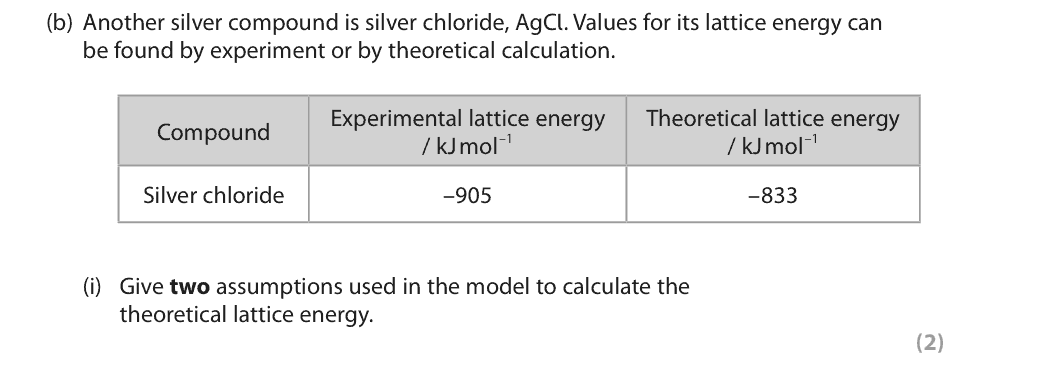
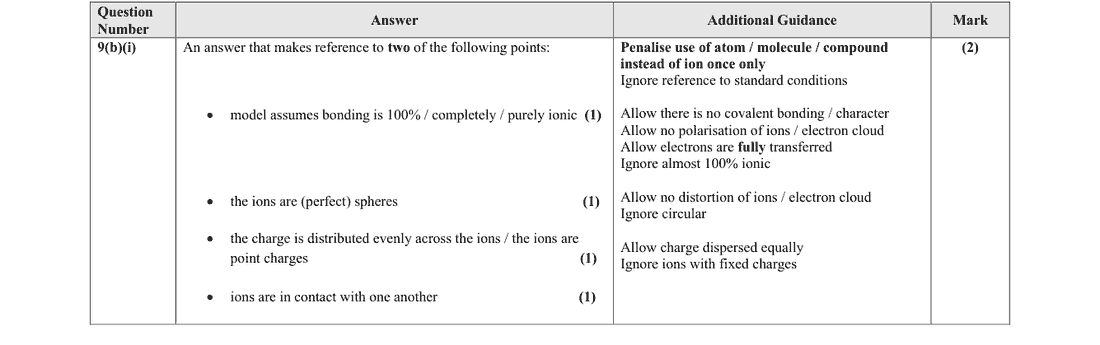
Many candidates could give two of the assumptions used in the model to calculate the theoretical lattice energy. However, many gave some of the general assumptions made in enthalpy change calculations, such as no heat lost to the surroundings.

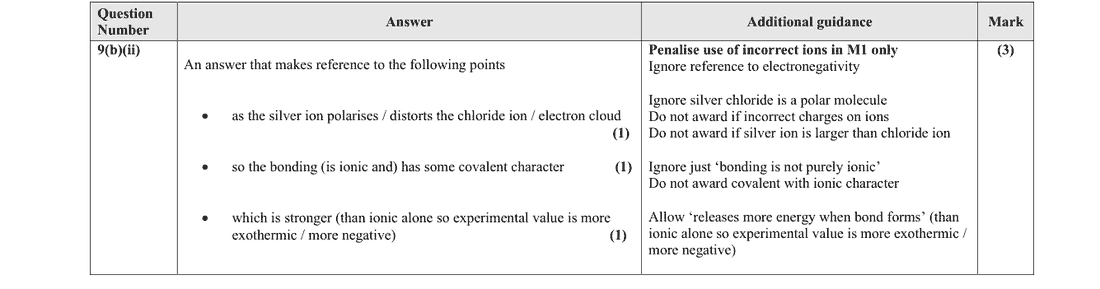
The majority of candidates realised that the difference in the two values of lattice energy is due to some covalent character in silver chloride and that it is the small silver cation that polarises the larger chloride anion. Some candidates thought the silver ion is larger than the chloride ion or gave incorrect charges on the ions. Not many candidates stated that the experimental lattice energy is more exothermic than the theoretical lattice energy as the covalent character makes the bonding stronger.

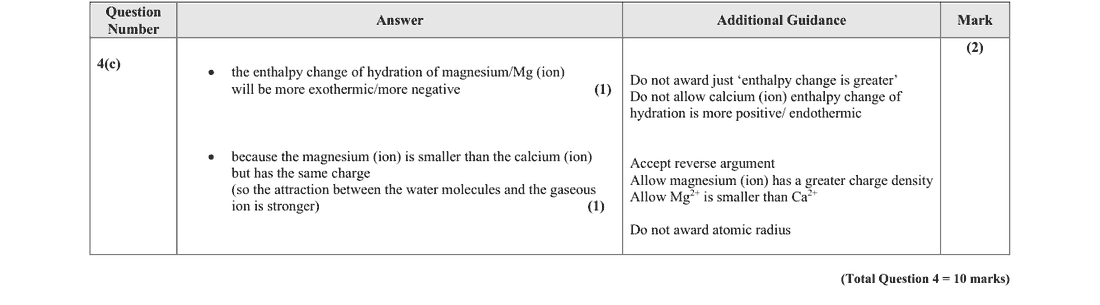
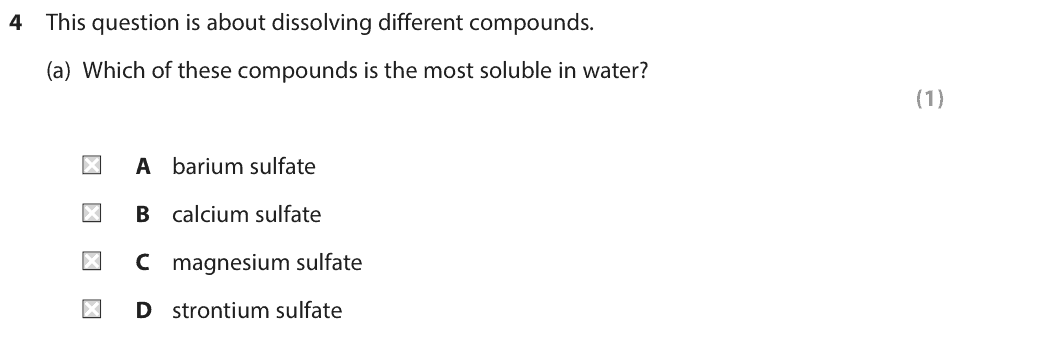
Centres and their candidates are reminded that when exothermic enthalpy changes or those with a negative sign are being considered that a description of the value being bigger/larger/greater do not score. These terms are ambiguous when dealing with negative numbers. A small minority of candidates did not focus on the Group 2 ions and referred to the hydration of the salt instead which did not score. At times, a correct reference to the magnesium ion hydration energy being more exothermic was then spoilt by then stating that more energy was "required".
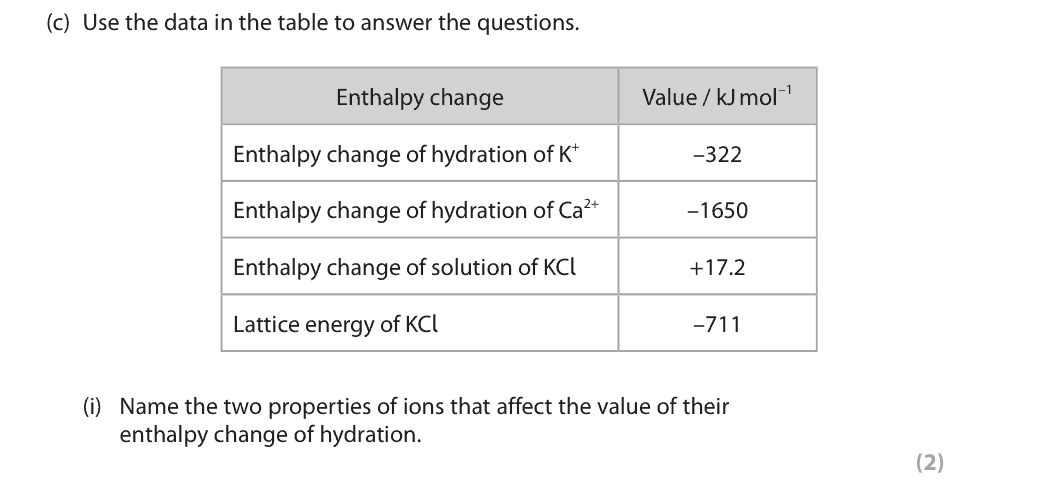
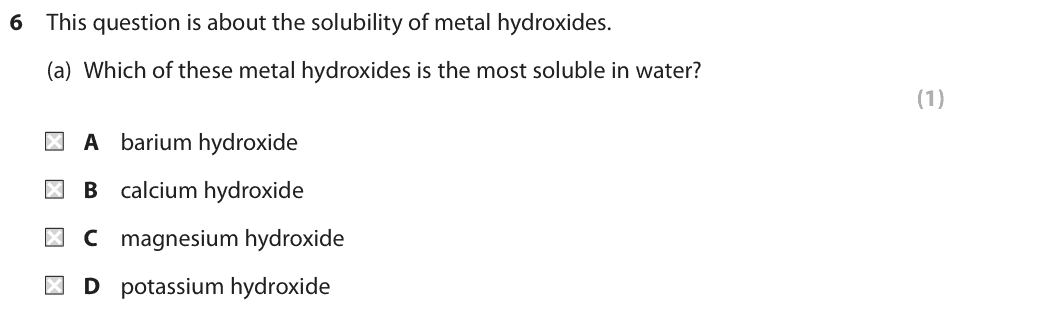
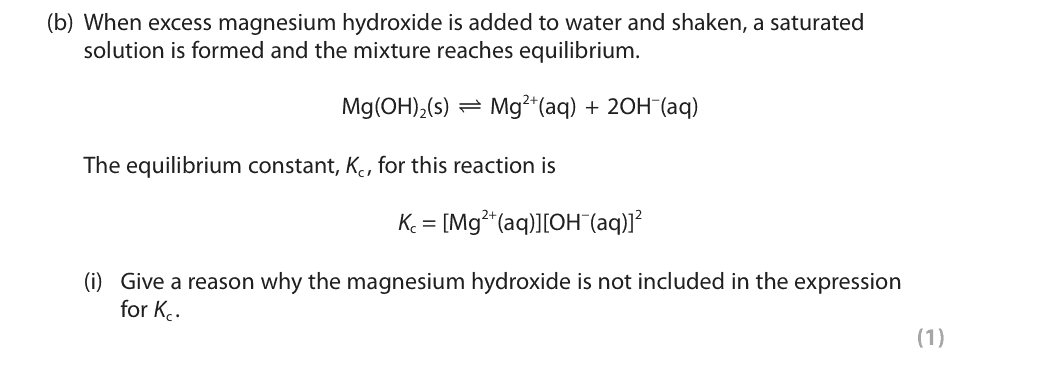
This question was about the factors that affect the solubility of ionic compounds.
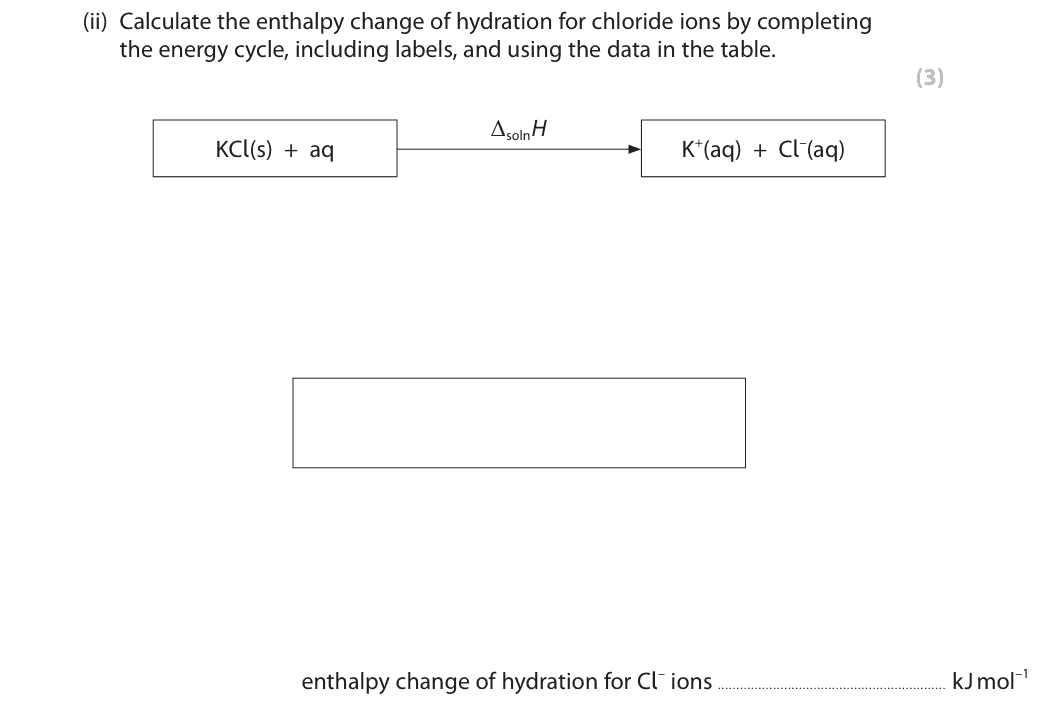
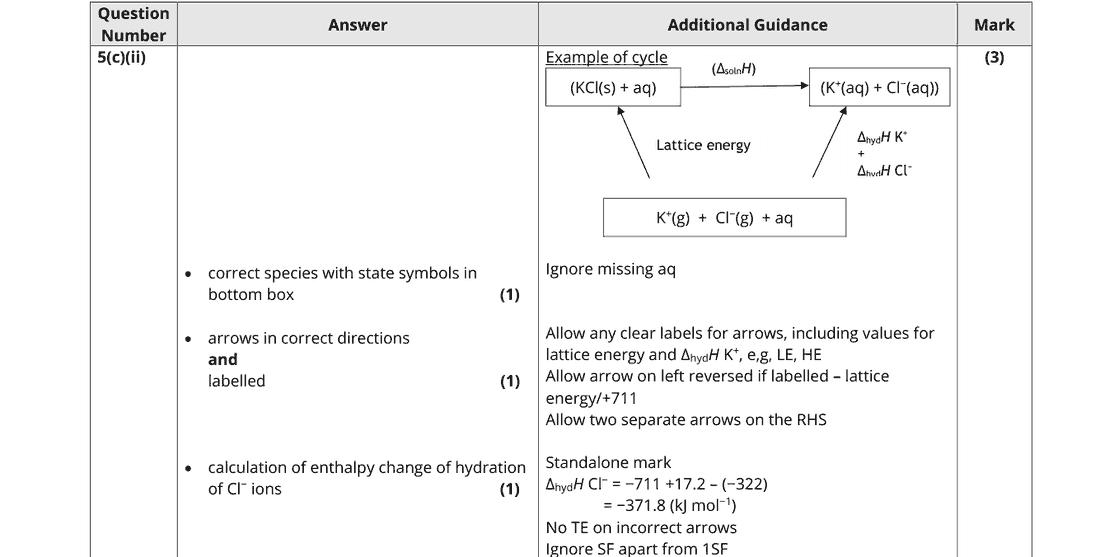
This question required candidates to complete an energy cycle to calculate the enthalpy change of hydration for chloride ions. There were many correct answers seen, although it was also common to see arrows the wrong way round and incorrect states for the ions in the bottom box.
Skills: MS2.3 Substitute numerical values into algebraic equations using appropriate units for physical quantities
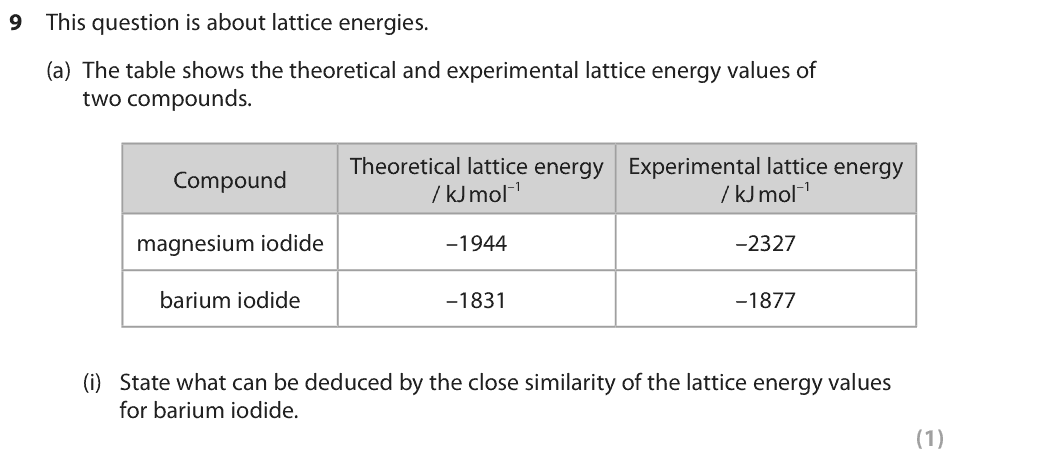
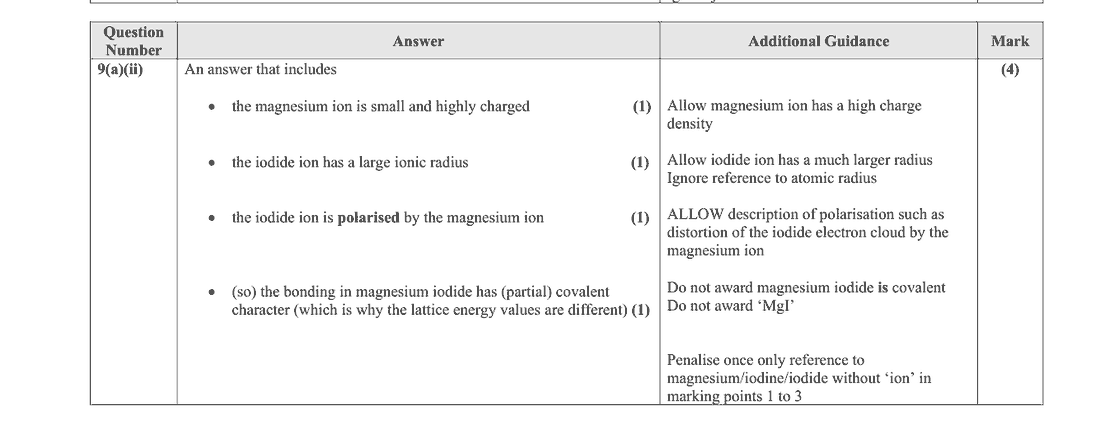
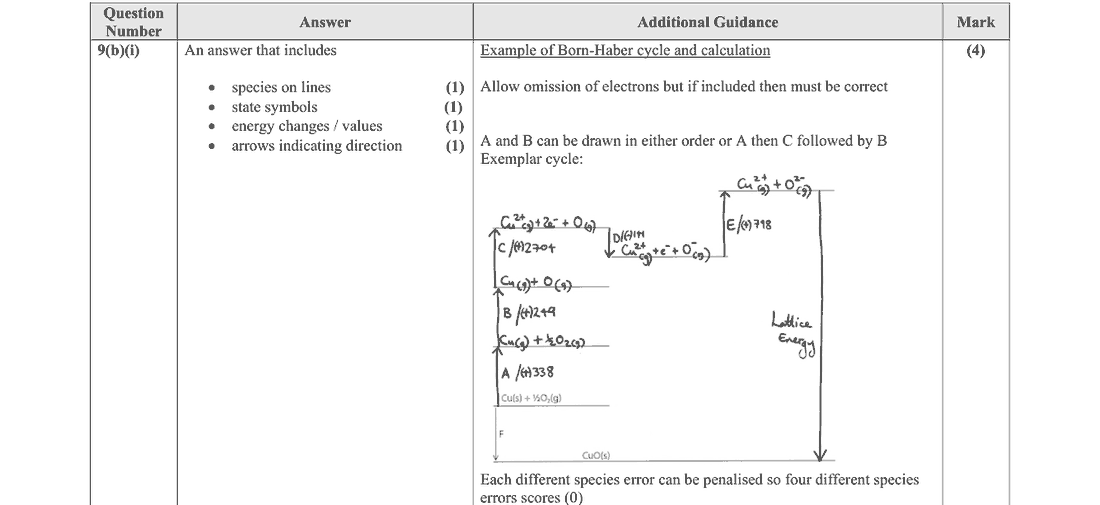
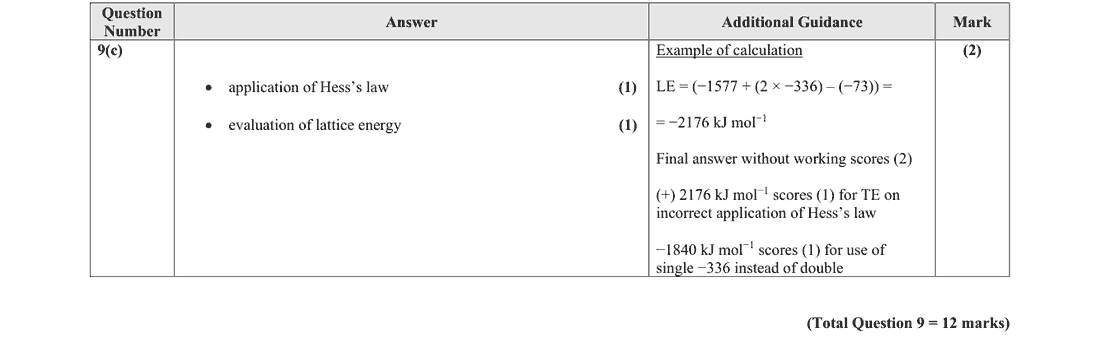
In part (a) there were some good explanations of the effect of polarisation by the small, highly charged magnesium cation. The mark most frequently missing was the refence to the iodide ion being large and therefore easily polarised. It was good to see the majority of candidates referring to the ions rather than the elements as has been an issue previously. The completion of the Born-Haber cycle produced the full spread of marks and so proved to be an effective discriminator. Thos who took extra care with the respective species tended to do very well. There were a few blank responses to the Hess’ law application in part (c) but generally one if not both marks were scored.

In part (a) there were some good explanations of the effect of polarisation by the small, highly charged magnesium cation. The mark most frequently missing was the refence to the iodide ion being large and therefore easily polarised. It was good to see the majority of candidates referring to the ions rather than the elements as has been an issue previously. The completion of the Born-Haber cycle produced the full spread of marks and so proved to be an effective discriminator. Thos who took extra care with the respective species tended to do very well. There were a few blank responses to the Hess’ law application in part (c) but generally one if not both marks were scored.
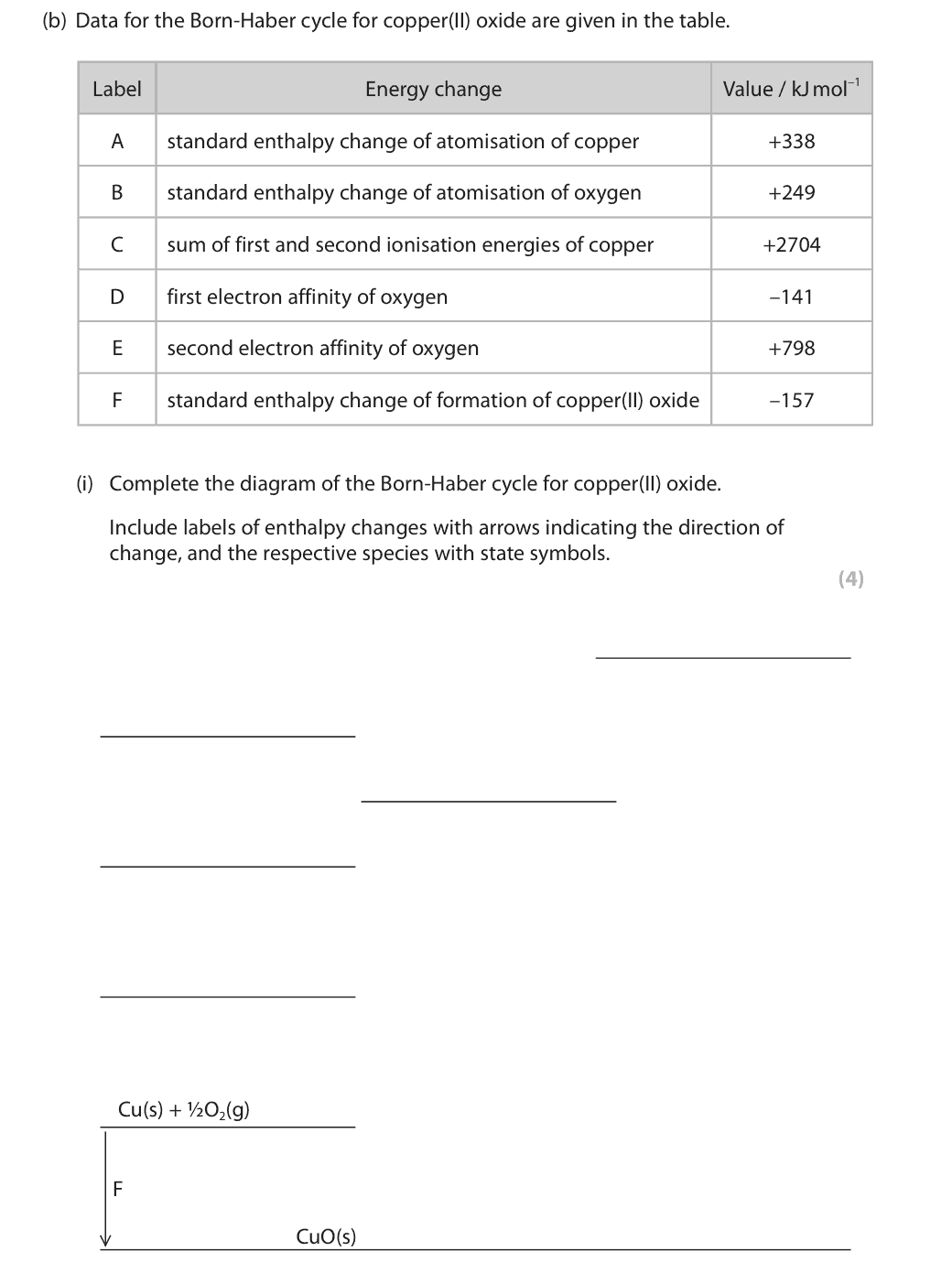
In part (a) there were some good explanations of the effect of polarisation by the small, highly charged magnesium cation. The mark most frequently missing was the refence to the iodide ion being large and therefore easily polarised. It was good to see the majority of candidates referring to the ions rather than the elements as has been an issue previously. The completion of the Born-Haber cycle produced the full spread of marks and so proved to be an effective discriminator. Thos who took extra care with the respective species tended to do very well. There were a few blank responses to the Hess’ law application in part (c) but generally one if not both marks were scored.

In part (a) there were some good explanations of the effect of polarisation by the small, highly charged magnesium cation. The mark most frequently missing was the refence to the iodide ion being large and therefore easily polarised. It was good to see the majority of candidates referring to the ions rather than the elements as has been an issue previously. The completion of the Born-Haber cycle produced the full spread of marks and so proved to be an effective discriminator. Thos who took extra care with the respective species tended to do very well. There were a few blank responses to the Hess’ law application in part (c) but generally one if not both marks were scored.
Skills: MS2.4 Solve algebraic equations
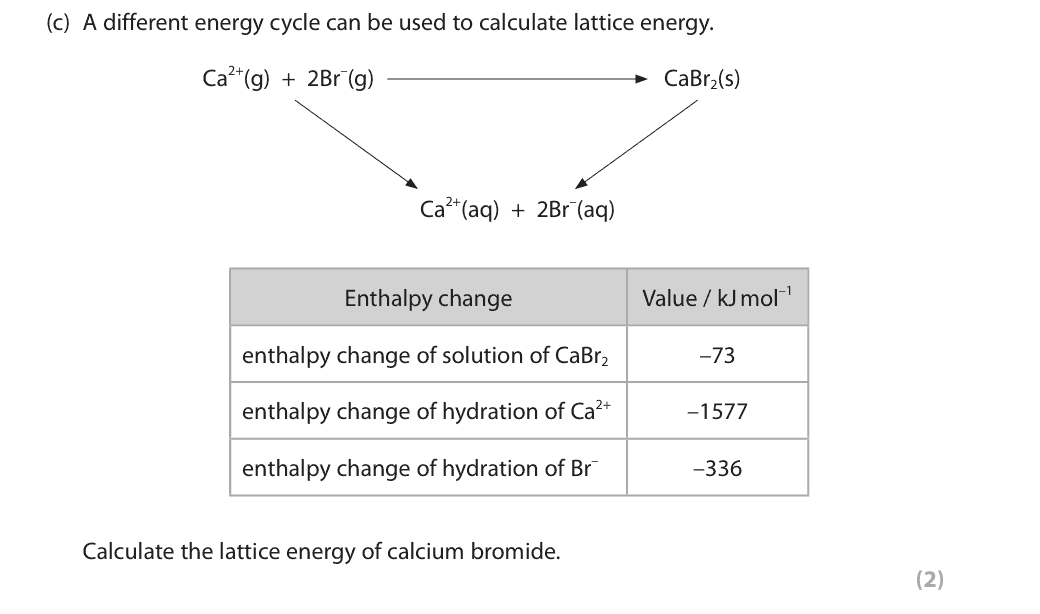
In part (a) there were some good explanations of the effect of polarisation by the small, highly charged magnesium cation. The mark most frequently missing was the refence to the iodide ion being large and therefore easily polarised. It was good to see the majority of candidates referring to the ions rather than the elements as has been an issue previously. The completion of the Born-Haber cycle produced the full spread of marks and so proved to be an effective discriminator. Thos who took extra care with the respective species tended to do very well. There were a few blank responses to the Hess’ law application in part (c) but generally one if not both marks were scored.
Skills: MS2.4 Solve algebraic equations

The majority of candidates could complete the table to show the numbers of subatomic particles. However, some candidates did not realise that a negative ion gains an electron. The mass spectrum in (a)(ii) proved much more challenging for many candidates. Some candidates worked out that there would be peaks at m / z values of 70, 72 and 74 for the molecular ion but only a small number could work out the ratio of the heights of the peaks. The most common error was to omit the peak at 72. Many candidates were unable to write the formula for potassium chlorate(V) and many used incorrect symbols, e.g., P for potassium, and oxygen omitted. Many candidates could write the equation for the first electron affinity of chlorine, but some wrote the equation for first ionisation energy and others included Cl2. Many candidates omitted the acid from the oxidising agent in (d)(i), although they could still score the mark for calculating the Eocell value. Those that chose an incorrect oxidising agent should have checked their answer when their Eocell value was negative.
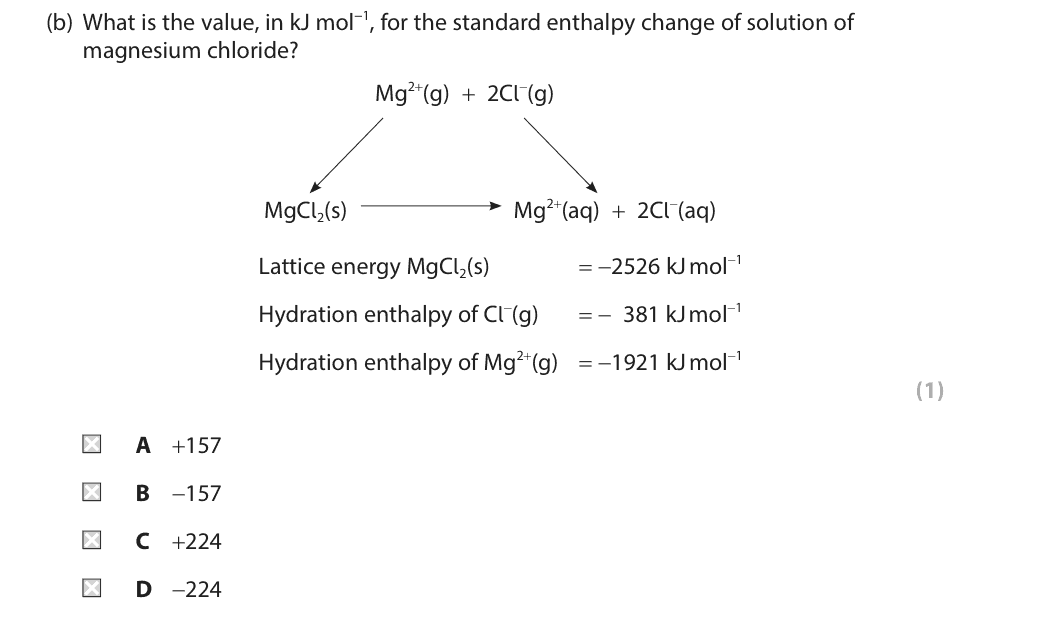
B
Parts (a) and (b) were accessible to most candidates, but part (c) provided a significant degree of challenge for all. The best answers took time to structure their response into discrete sections, in each case considering correctly the types and relative strength of forces present in the solute and solvent individually and any potential resultant solute-solvent forces. However, a number of responses didn’t develop much beyond the idea of ‘like dissolves like’ so struggled to access the higher marks. Those who did discuss the forces often made mistakes. For instance, it was common to see the alkanes described as having London forces and dipole-dipole attractions and many described potassium bromide as a polar molecule often frustratingly in the same paragraph as discussing it’s ions. Few candidates releasing that water molecules would hydrate the ions, with a number explaining its solubility with the claim the London forces between the ions and water would compensate for the breakdown of the lattice.
Skills: MS2.4 Solve algebraic equations
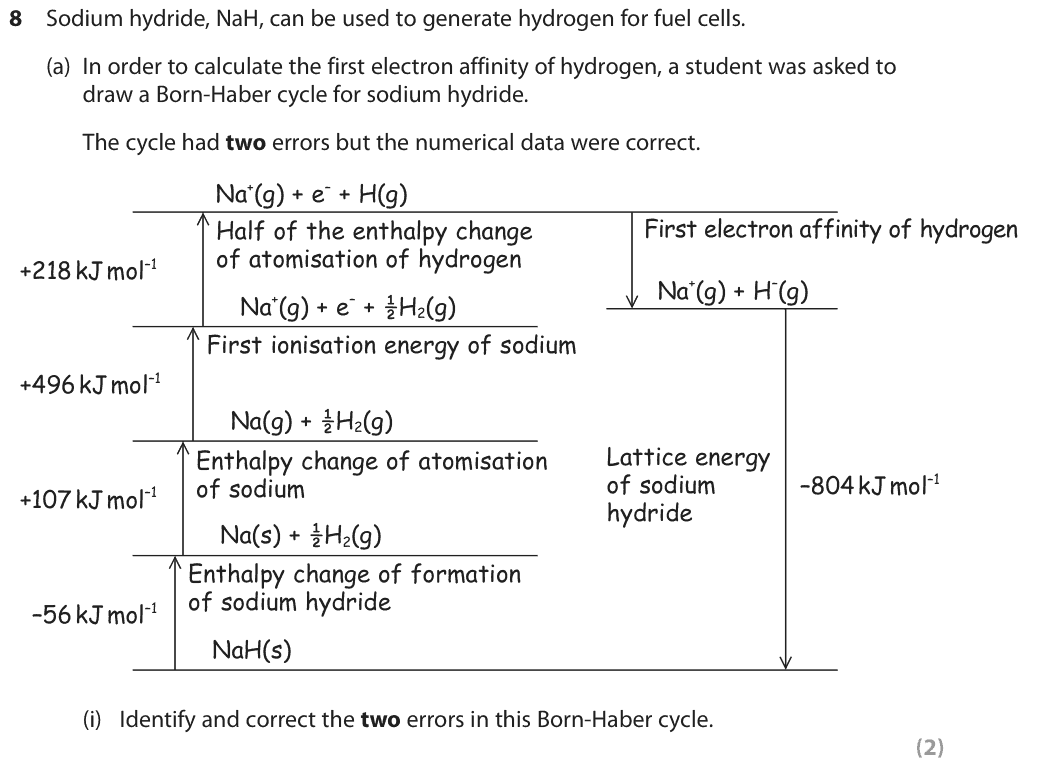
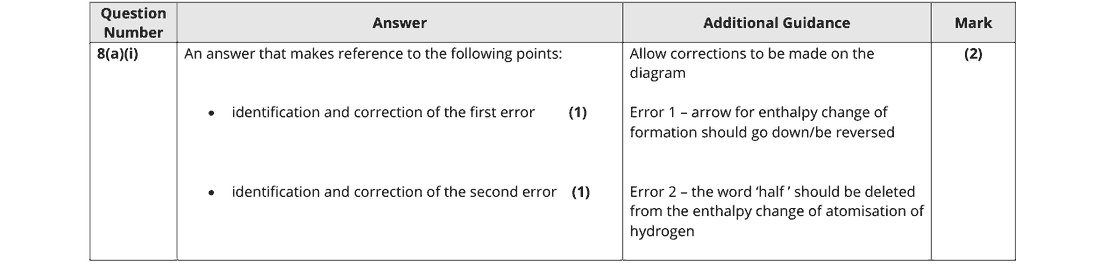
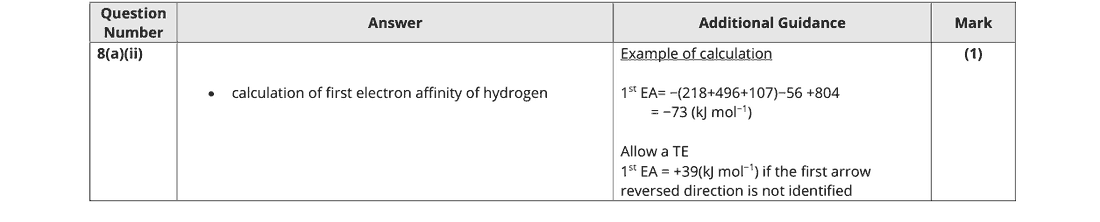
In part (i) only a small minority of candidates scored zero for these questions. The vast majority of candidates correctly identified the error in the diagram of the arrow for the enthalpy change of formation going up when it should be drawn going down. The second error of the 'half' of atomisation was less often identified and serves as a useful reminder to candidates that learning definitions is a very useful exercise as it helps in such situations. The question introduction stated that the numerical data was correct but some candidates appeared not to have noticed this when they calculated their electron affinity in part (ii) and so obtained an incorrect value. Another useful reminder to candidates to make sure that the introduction to a question often contains vital information to the successful completion of a question.

In part (i) only a small minority of candidates scored zero for these questions. The vast majority of candidates correctly identified the error in the diagram of the arrow for the enthalpy change of formation going up when it should be drawn going down. The second error of the 'half' of atomisation was less often identified and serves as a useful reminder to candidates that learning definitions is a very useful exercise as it helps in such situations. The question introduction stated that the numerical data was correct but some candidates appeared not to have noticed this when they calculated their electron affinity in part (ii) and so obtained an incorrect value. Another useful reminder to candidates to make sure that the introduction to a question often contains vital information to the successful completion of a question.
Skills: MS2.4 Solve algebraic equations
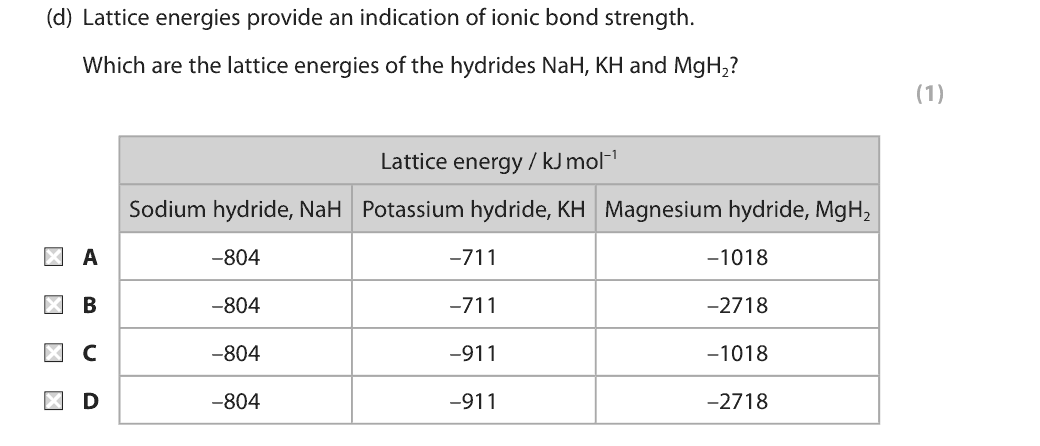
B
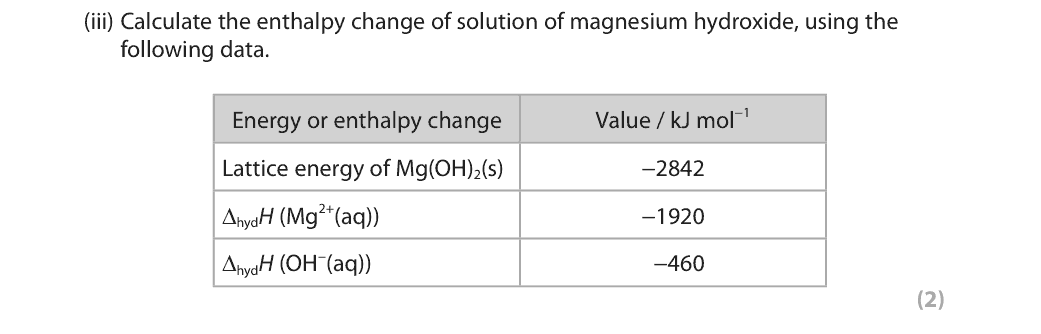
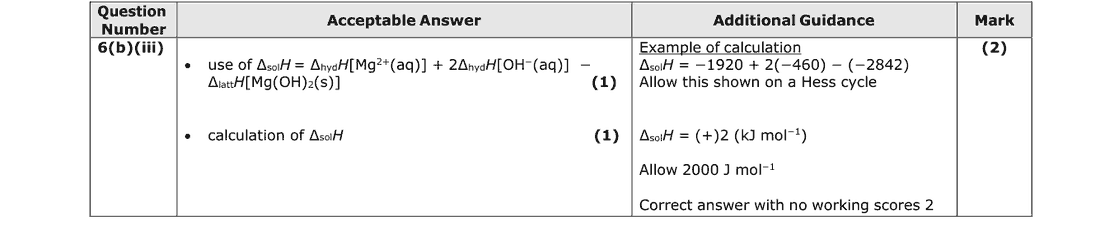
Many candidates calculated the correct enthalpy change of solution. The calculation can be carried out without using a Hess cycle but many candidates who tried this got an incorrect final answer. The most common errors were, not multiplying the enthalpy change of hydration of hydroxide ions by 2 and using the Hess cycle the wrong way around.
Skills: MS2.3 Substitute numerical values into algebraic equations using appropriate units for physical quantities
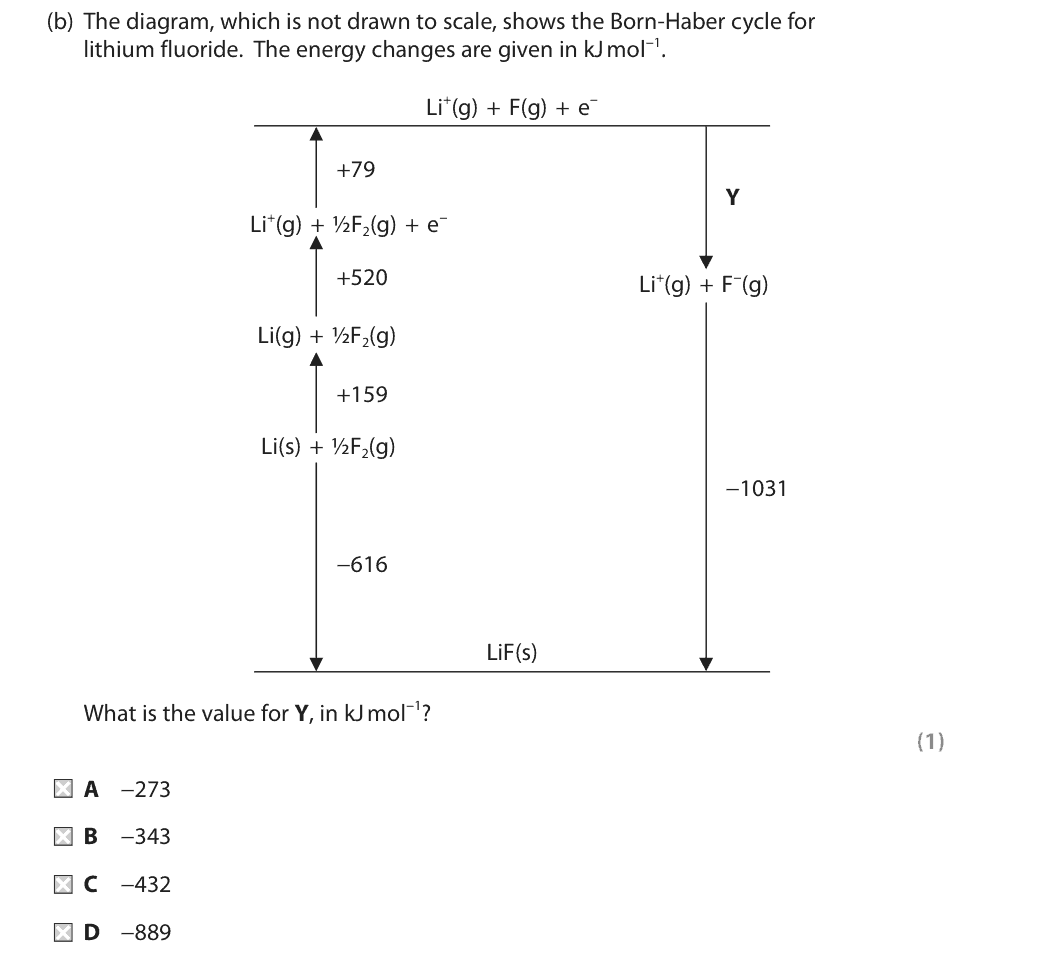
B
Skills: MS2.4 Solve algebraic equations
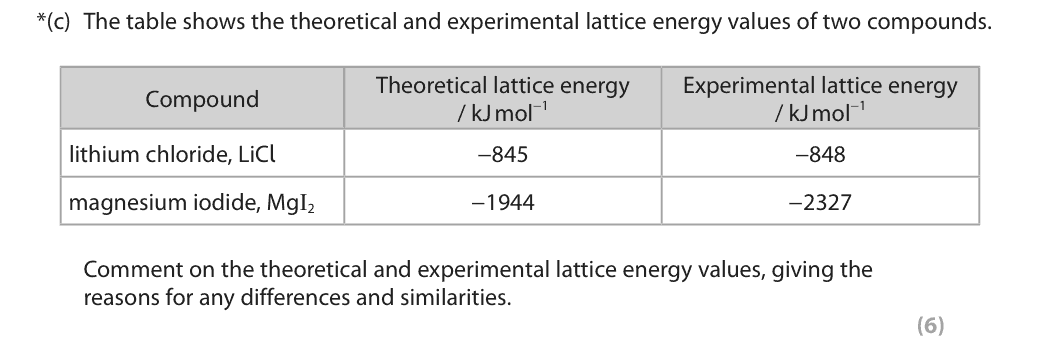
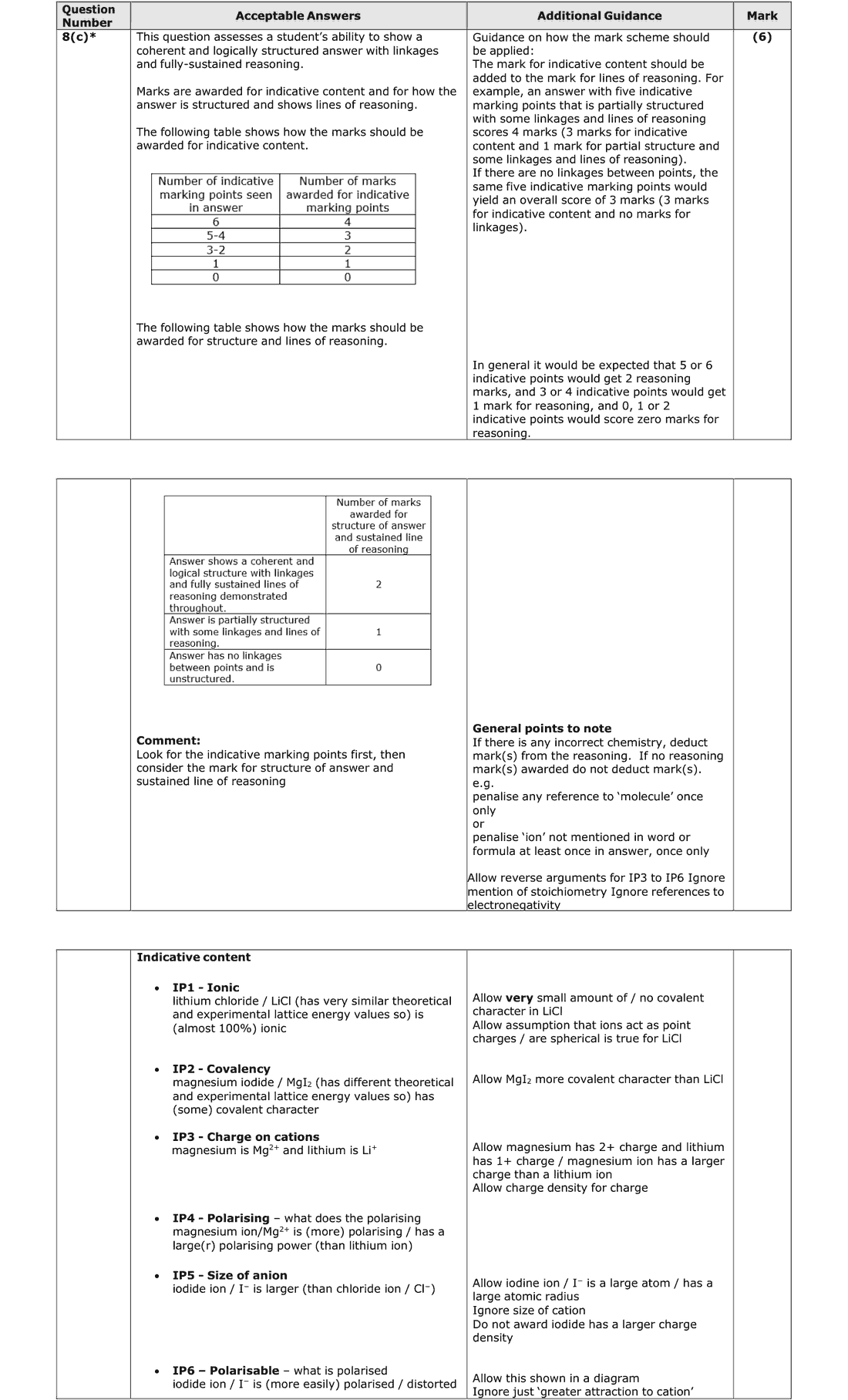
It was pleasing to see many excellent answers scoring 6 marks but the full range of marks was seen in other answers. Some candidates gave lengthy descriptions of theoretical and experimental lattice energies but did not always relate these to the two compounds given in the question. Some candidates referred to electronegativity differences, which were not required in this question. The most common indicative points omitted from answers stated that lithium chloride is almost 100% ionic and also there was a tendency to compare the sizes of the chloride and iodide ions. Some candidates showed a lack of understanding by writing that the bond between magnesium and iodine is polarised, or that there is a bond between the two iodide ions, or they completely missed the point and wrote about experimental error. Candidates would benefit from more practice in answering this style of question as some candidates wrote very little and others wrote far too much, often repeating the same points several times. They also need to consider the use of correct scientific terminology. It was not uncommon to see a discussion about ions, then (in the same sentence) 'molecules' being included.
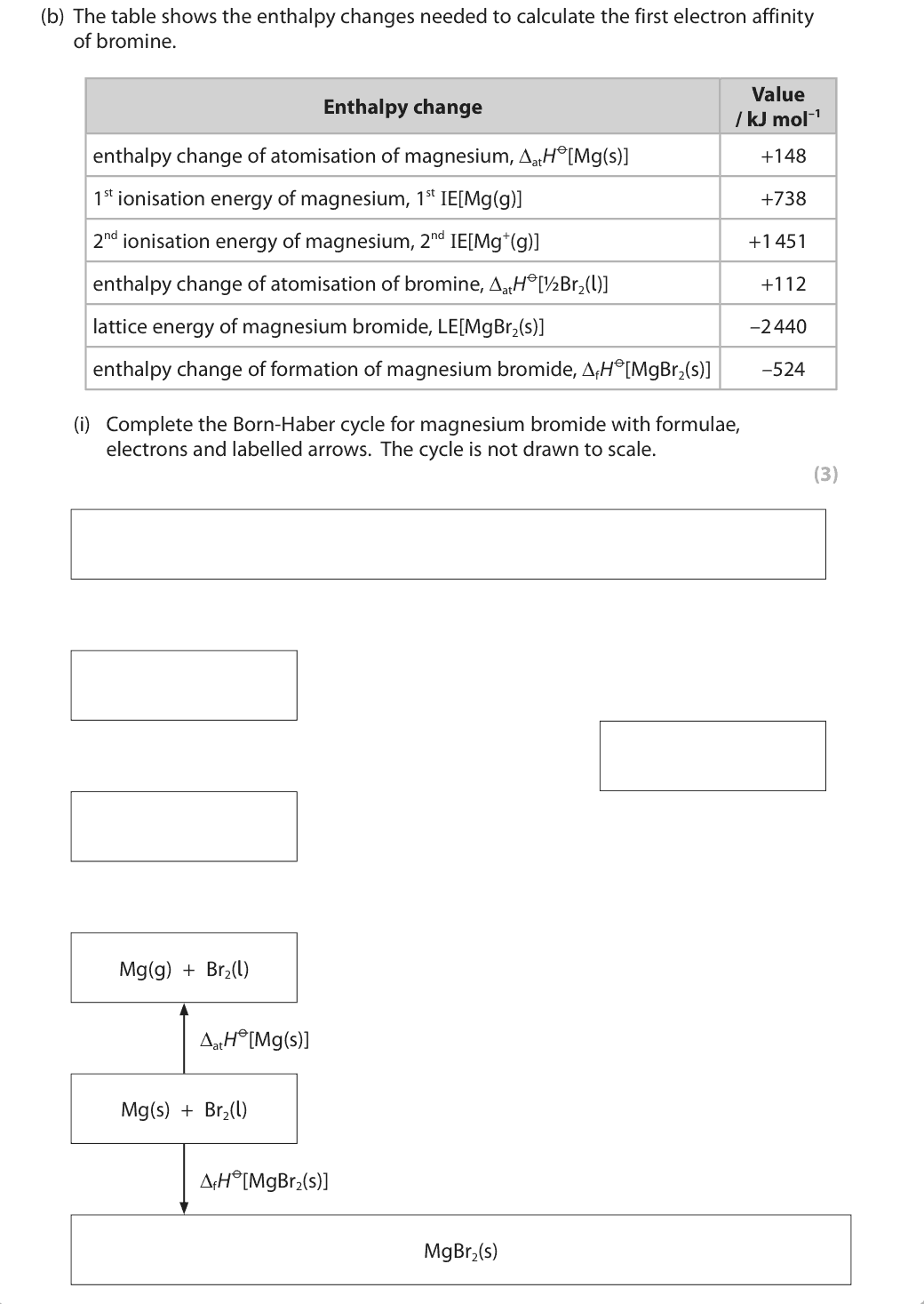
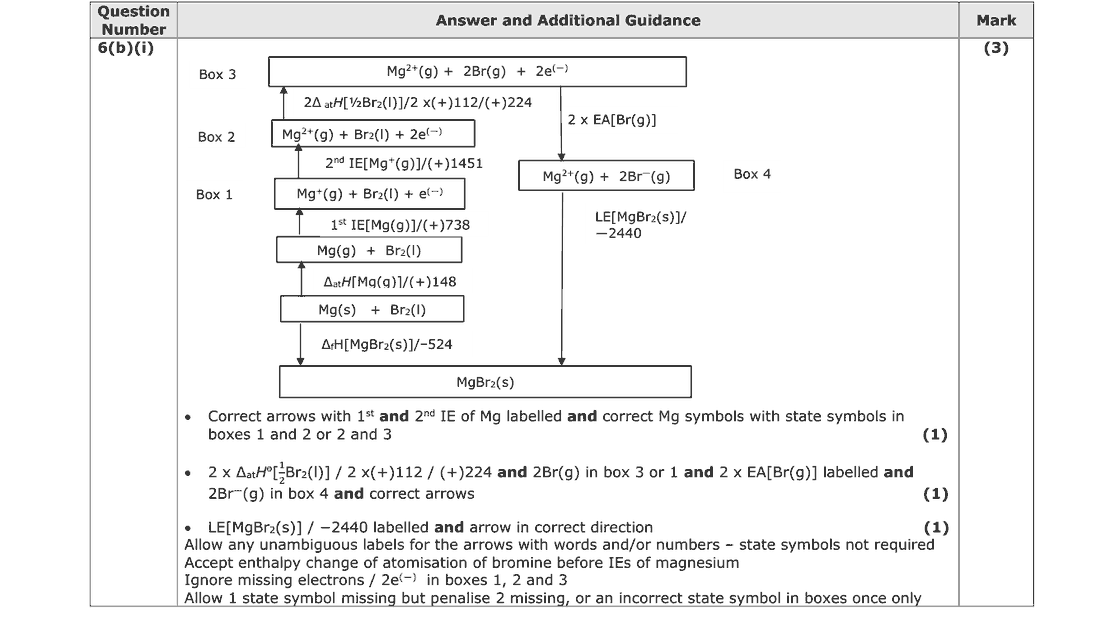
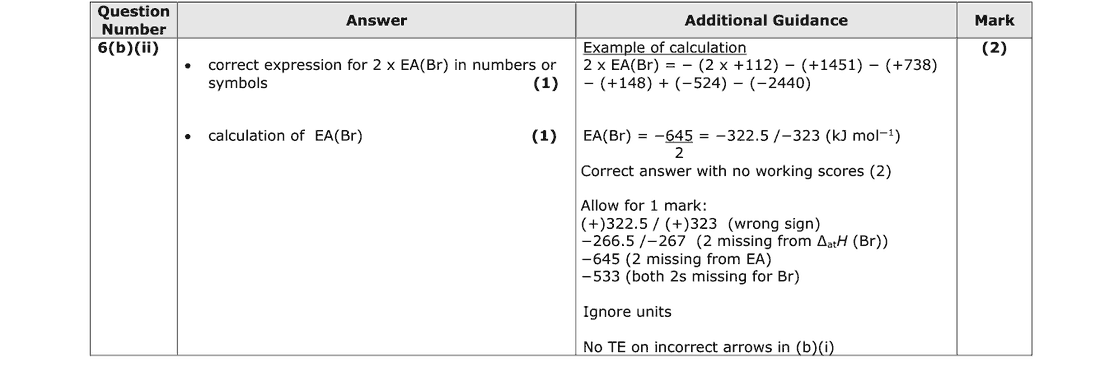
The majority of candidates made a good attempt at completing the Born-Haber cycle. Errors occurred in omitting some state symbols, not showing that the bromine enthalpy changes need to be multiplied by 2 and showing that during atomisation, bromine forms Br2(g). Candidates should give clear labels for the enthalpy changes and not just x for electron affinity. A few candidates seemed unfamiliar with the Born-Haber cycle shown in the question and they wrote the equations for the enthalpy changes in the boxes. It was rare to see the arrows in the wrong directions. Many candidates scored both marks for calculating the first electron affinity of bromine, although many candidates omitted to double one or both of the bromine enthalpy changes, even when they were correct on the cycle.

The majority of candidates made a good attempt at completing the Born-Haber cycle. Errors occurred in omitting some state symbols, not showing that the bromine enthalpy changes need to be multiplied by 2 and showing that during atomisation, bromine forms Br2(g). Candidates should give clear labels for the enthalpy changes and not just x for electron affinity. A few candidates seemed unfamiliar with the Born-Haber cycle shown in the question and they wrote the equations for the enthalpy changes in the boxes. It was rare to see the arrows in the wrong directions. Many candidates scored both marks for calculating the first electron affinity of bromine, although many candidates omitted to double one or both of the bromine enthalpy changes, even when they were correct on the cycle.
Skills: MS2.2 Change the subject of an equation; MS2.4 Solve algebraic equations
Dropping marks on calculations, mechanisms or the core practicals? Book a trial session with an A-level chemistry tutor.