Practical questions

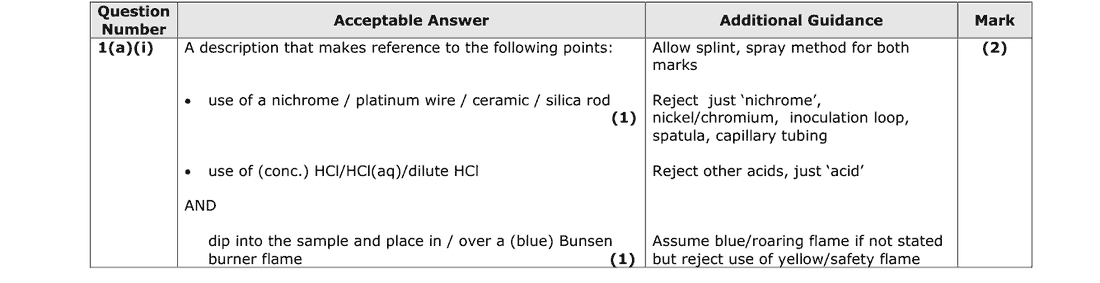
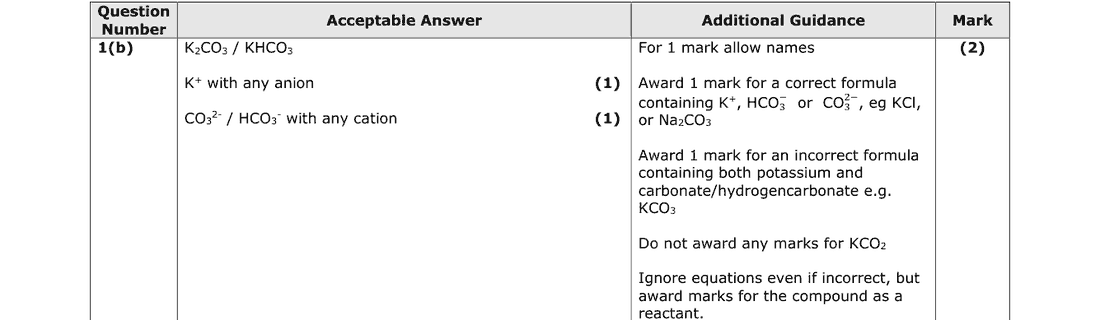
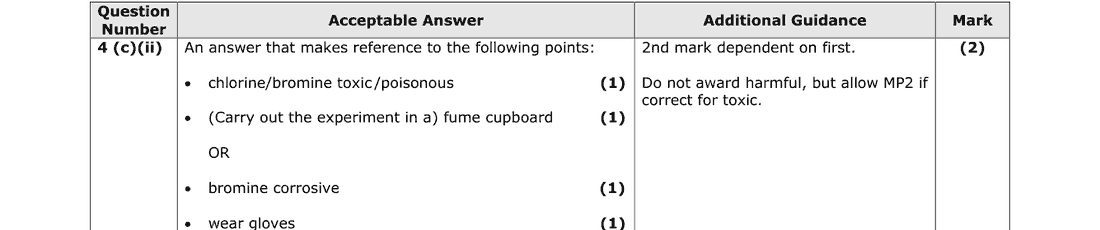
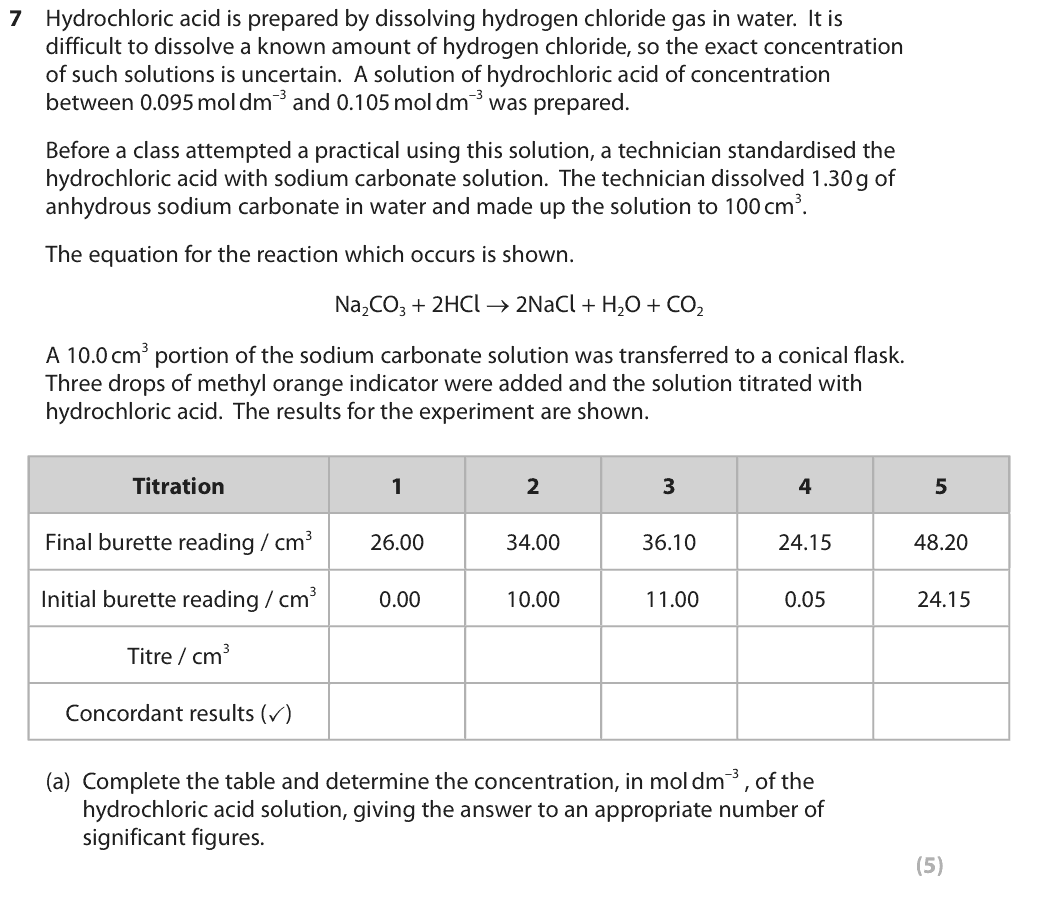
Questions on the sixteen core practicals and on apparatus, measurements, uncertainties and evaluation. Paper 3 carries many of them. 439 questions.

Other types: Multiple-choice questions · Calculation questions · Equation questions · Mechanism questions · Structure and diagram questions · Explanation questions · Six-mark extended-response questions · Short-answer questions

June 2025 · AS Paper 1 · Q4(a)(i) 2 marks Practical and data analysis Hard formulae equations and amounts of substance
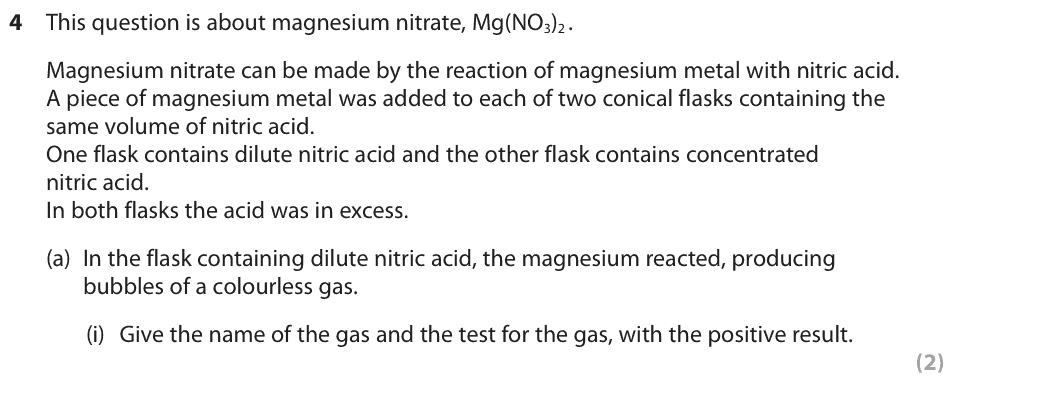
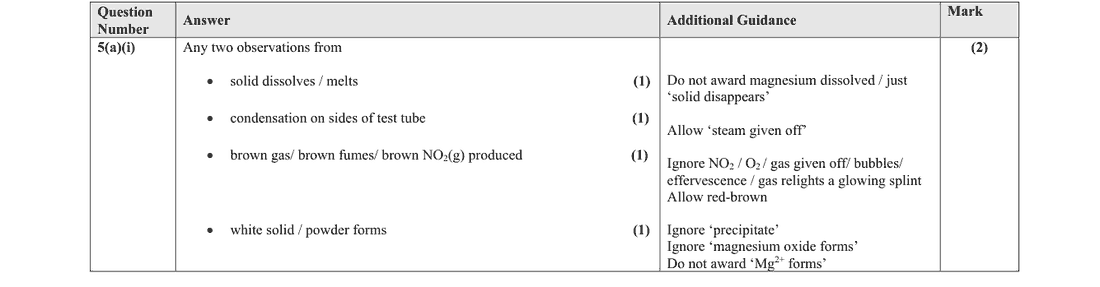
This question is about magnesium nitrate, Mg(NO3)2 .
Magnesium nitrate can be made by the reaction of magnesium metal with nitric acid.
A piece of magnesium metal was added to each of two conical flasks containing the
same volume of nitric acid.
One flask contains dilute nitric acid and the other flask contains concentrated
nitric acid.
In both flasks the acid was in excess.
In the flask containing dilute nitric acid, the magnesium reacted, producing
bubbles of a colourless gas.
Give the name of the gas and the test for the gas, with the positive result.
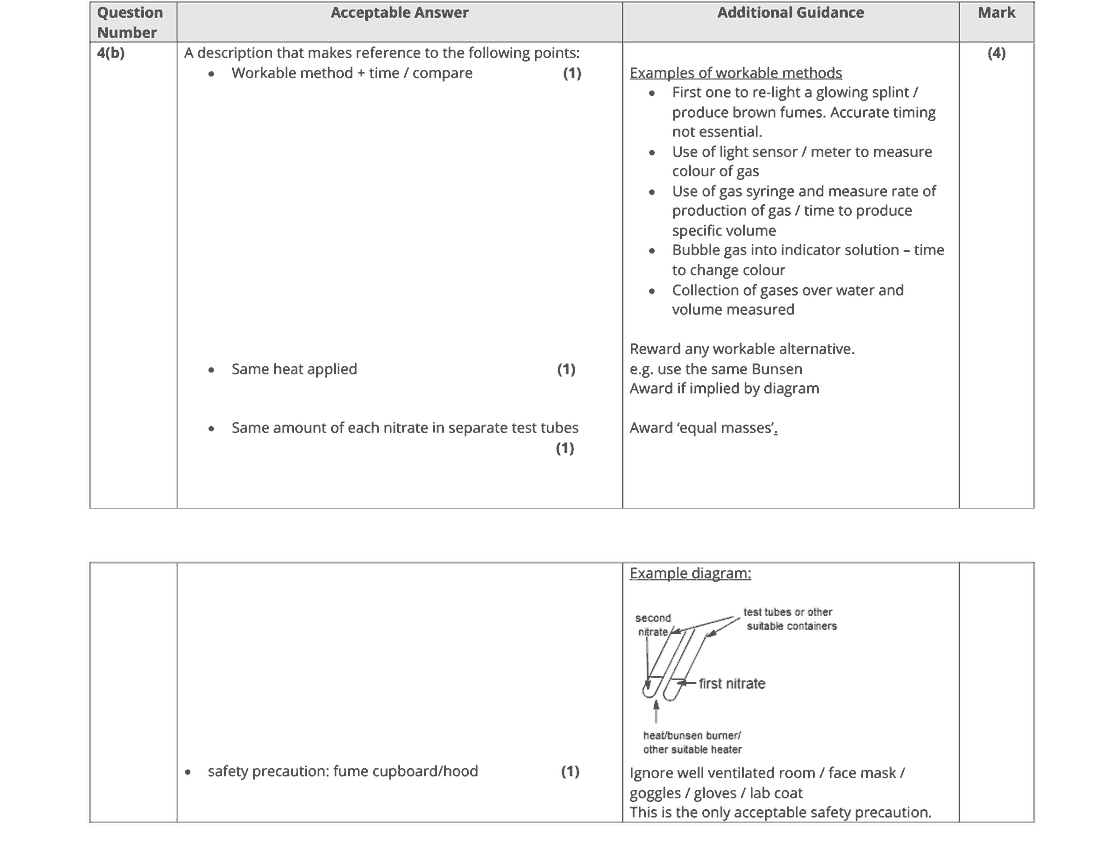
June 2025 · AS Paper 1 · Q4(b)(i) 1 mark Practical and data analysis groups 1 and 2
Earlier part of question 4 that this part usesEarlier part of June 2025 Paper 1 question 4
Magnesium nitrate thermally decomposes, as shown by the equation.
2Mg(NO3)2(s)   →   2MgO(s)   +   4NO2(g)   +   O2(g)
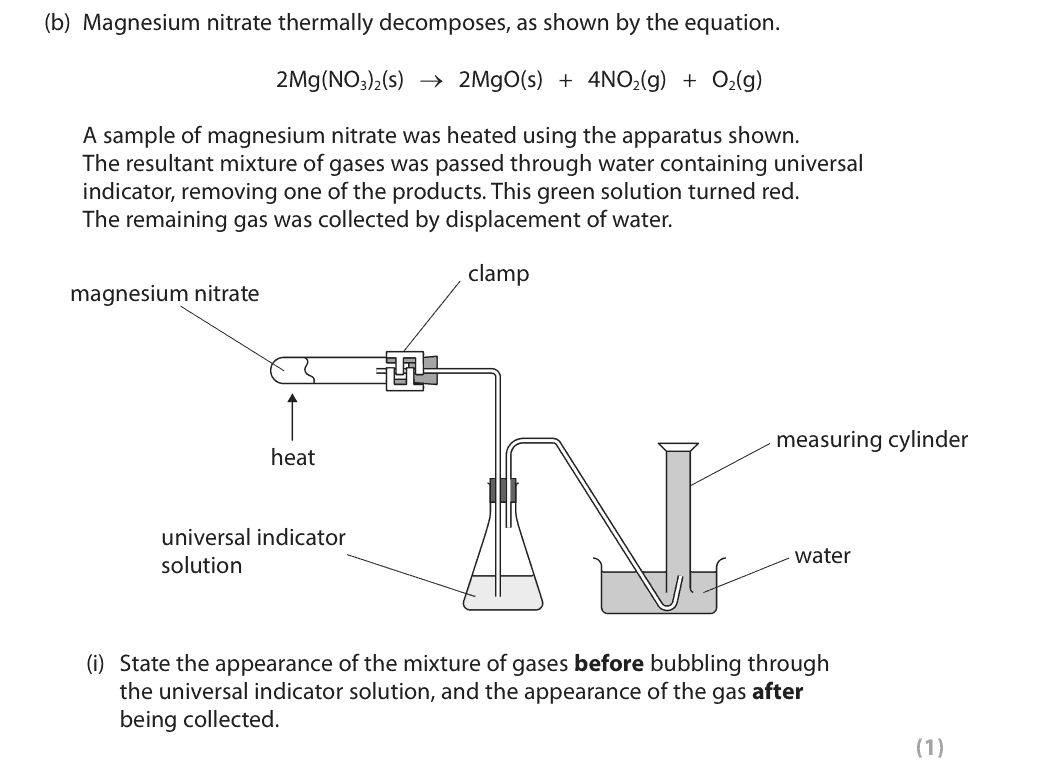
A sample of magnesium nitrate was heated using the apparatus shown.
The resultant mixture of gases was passed through water containing universal
indicator, removing one of the products. This green solution turned red.
The remaining gas was collected by displacement of water.
clamp
magnesium nitrate
measuring cylinder
heat
universal indicator
water
solution
State the appearance of the mixture of gases before bubbling through
the universal indicator solution, and the appearance of the gas after
being collected.
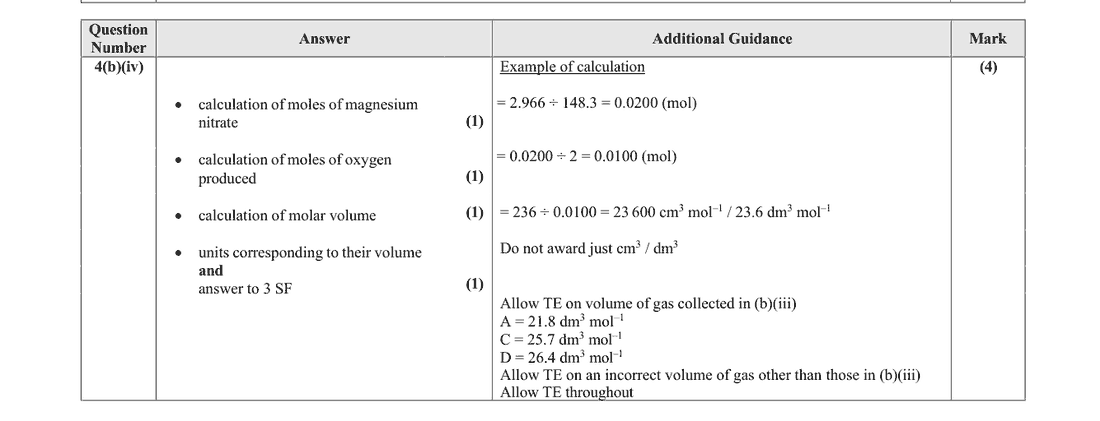
June 2025 · AS Paper 1 · Q4(b)(iv) 4 marks Calculation formulae equations and amounts of substance
Earlier parts of question 4 that this part usesEarlier part of June 2025 Paper 1 question 4Earlier part of June 2025 Paper 1 question 4Earlier part of June 2025 Paper 1 question 4Earlier part of June 2025 Paper 1 question 4
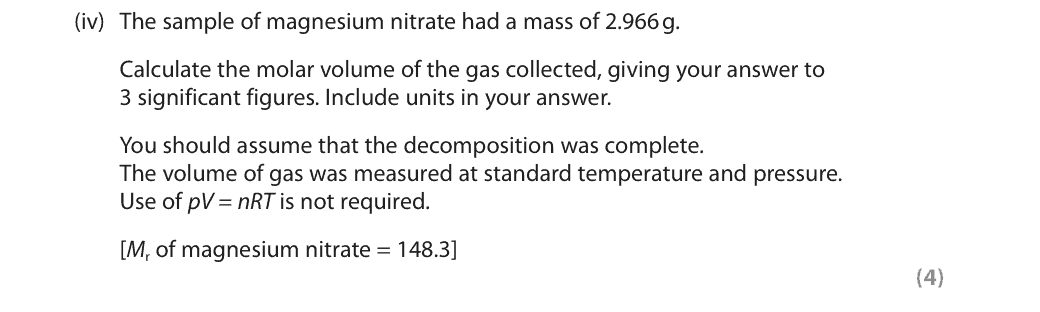
The sample of magnesium nitrate had a mass of 2.966 g.
Calculate the molar volume of the gas collected, giving your answer to
3 significant figures. Include units in your answer.
You should assume that the decomposition was complete.
The volume of gas was measured at standard temperature and pressure.
Use of pV = nRT is not required.
[Mr of magnesium nitrate = 148.3]
June 2025 · AS Paper 1 · Q4(b)(v) 2 marks Explanation Hard formulae equations and amounts of substance
Earlier parts of question 4 that this part usesEarlier part of June 2025 Paper 1 question 4Earlier part of June 2025 Paper 1 question 4
Explain why three significant figures is appropriate for the answer in
this calculation.
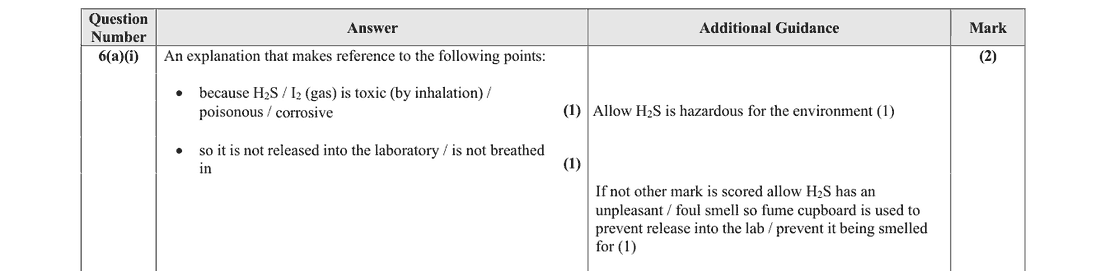
June 2025 · AS Paper 1 · Q6(a)(i) 2 marks Practical and data analysis formulae equations and amounts of substance
When potassium iodide and concentrated sulfuric acid are mixed, several
reactions occur.
The equation for one of these reactions is shown.
8KI   +   9H2SO4   →   4I2   +   8KHSO4   +   H2S   +   4H2O
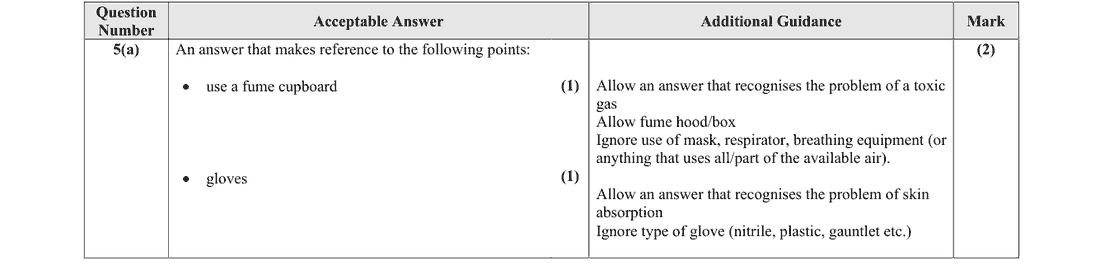
Explain how the equation indicates that the reaction should be carried out in
a fume cupboard rather than in the laboratory.
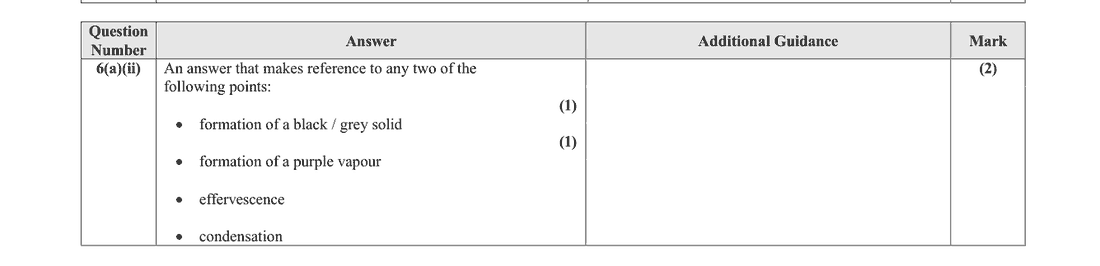
June 2025 · AS Paper 1 · Q6(a)(ii) 2 marks Practical and data analysis group 7 the halogens
Earlier part of question 6 that this part usesEarlier part of June 2025 Paper 1 question 6
Give two observations that would be made when the reaction shown by the
equation is carried out in a fume cupboard.
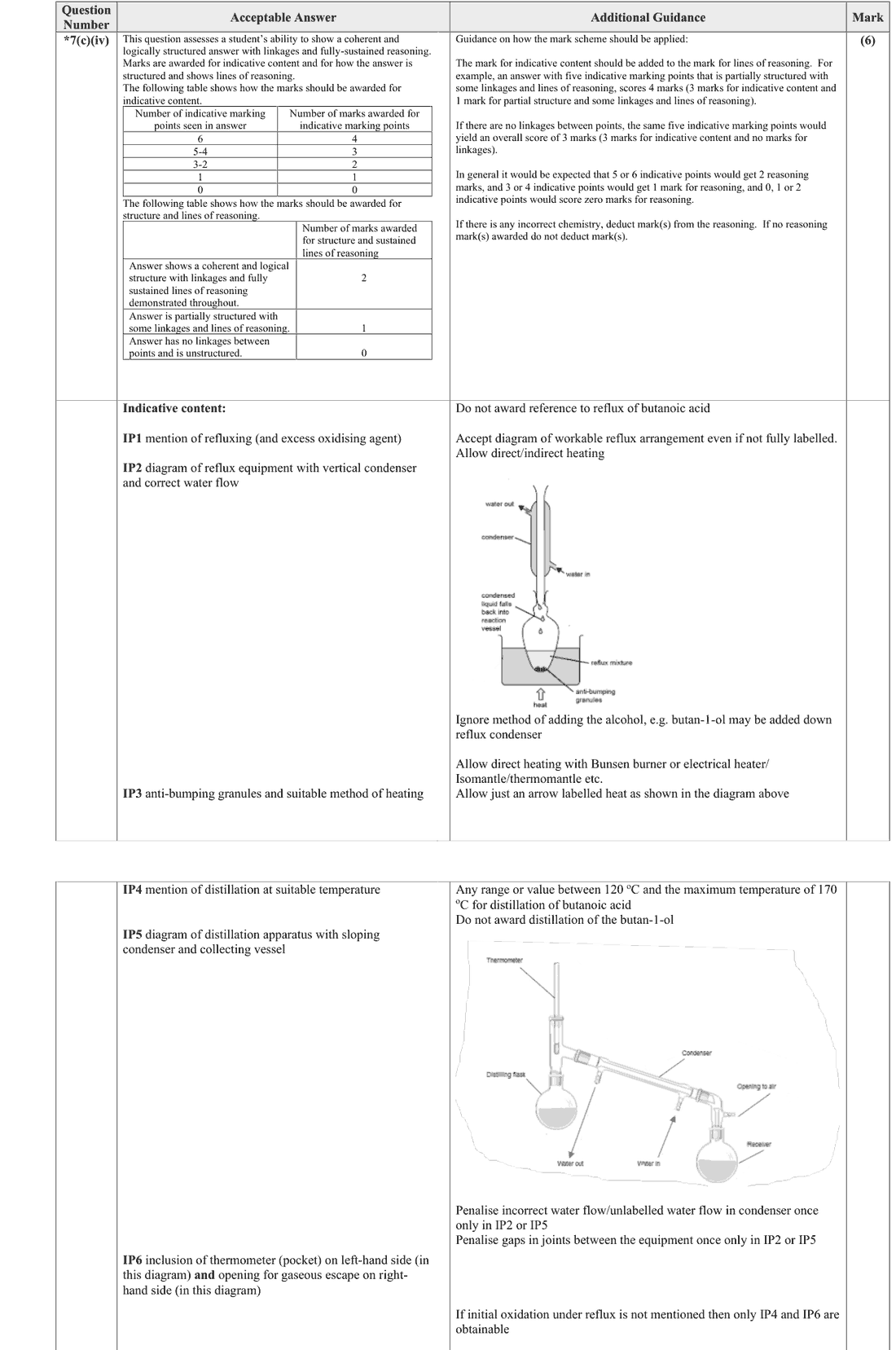
June 2025 · AS Paper 2 · Q6(b)(ii) 6 marks 6-mark extended response Hard alcohols
Earlier parts of question 6 that this part usesEarlier part of June 2025 Paper 2 question 6Earlier part of June 2025 Paper 2 question 6
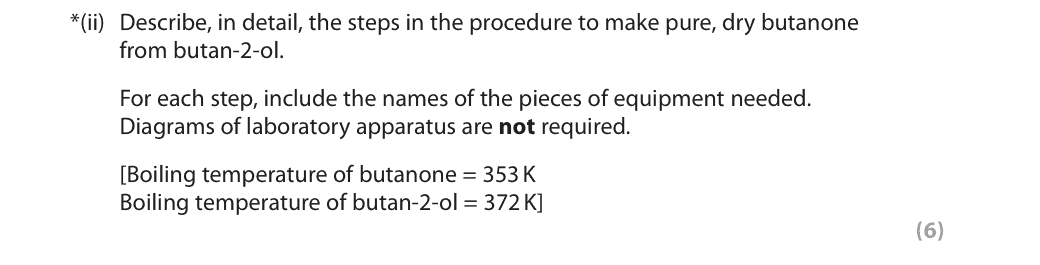
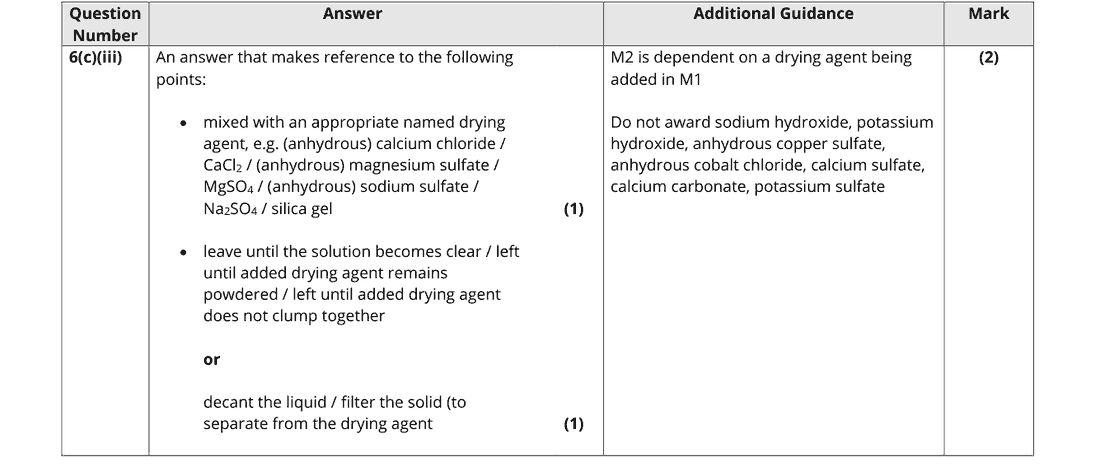
Describe, in detail, the steps in the procedure to make pure, dry butanone
from butan‑2‑ol.
For each step, include the names of the pieces of equipment needed.
Diagrams of laboratory apparatus are not required.
[Boiling temperature of butanone = 353 K
Boiling temperature of butan‑2‑ol = 372 K]
June 2025 · Paper 1 · Q3(a) 1 mark Practical and data analysis energetics i
A student carried out an investigation to determine indirectly the enthalpy change
for the thermal decomposition of calcium carbonate. The reaction equation is shown.
Reaction 1:     CaCO3(s)   →   CaO(s)  +   CO2(g)              ΔrH1
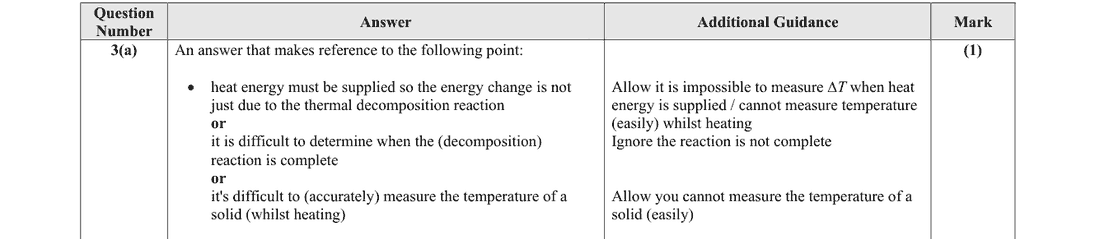
State why the enthalpy change for the thermal decomposition of
calcium carbonate cannot be determined directly.
June 2025 · Paper 1 · Q3(b)(i) 1 mark Short answer energetics i
Earlier part of question 3 that this part usesEarlier part of June 2025 Paper 1 question 3
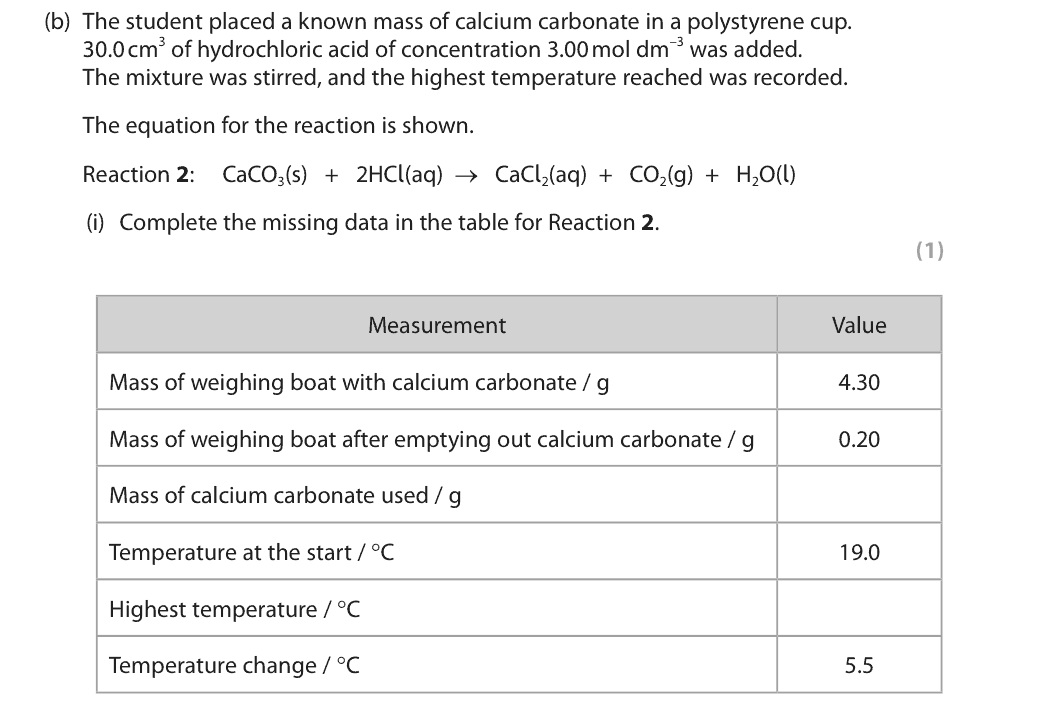
The student placed a known mass of calcium carbonate in a polystyrene cup.
30.0 cm3 of hydrochloric acid of concentration 3.00 mol dm–3 was added.
The mixture was stirred, and the highest temperature reached was recorded.
The equation for the reaction is shown.
Reaction 2:     CaCO3(s)   +   2HCl(aq)  →   CaCl2(aq)  +   CO2(g)  +   H2O(l)
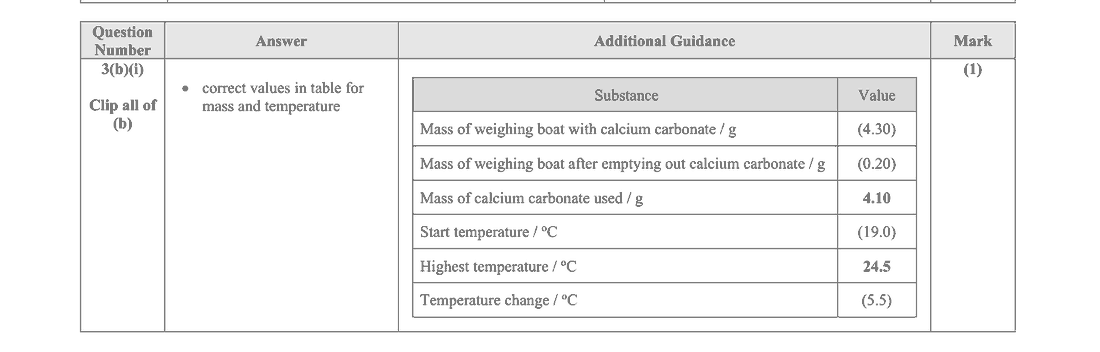
Complete the missing data in the table for Reaction 2.
Measurement
Value
Mass of weighing boat with calcium carbonate / g
4.30
Mass of weighing boat after emptying out calcium carbonate / g
0.20
Mass of calcium carbonate used / g
Temperature at the start / °C
19.0
Highest temperature / °C
Temperature change / °C
5.5
June 2025 · Paper 1 · Q3(b)(ii) 2 marks Calculation formulae equations and amounts of substance
Earlier parts of question 3 that this part usesEarlier part of June 2025 Paper 1 question 3Earlier part of June 2025 Paper 1 question 3
0.041 mol of CaCO3(s) was used in the experiment.
Show, by calculation, that the hydrochloric acid is in excess for Reaction 2.
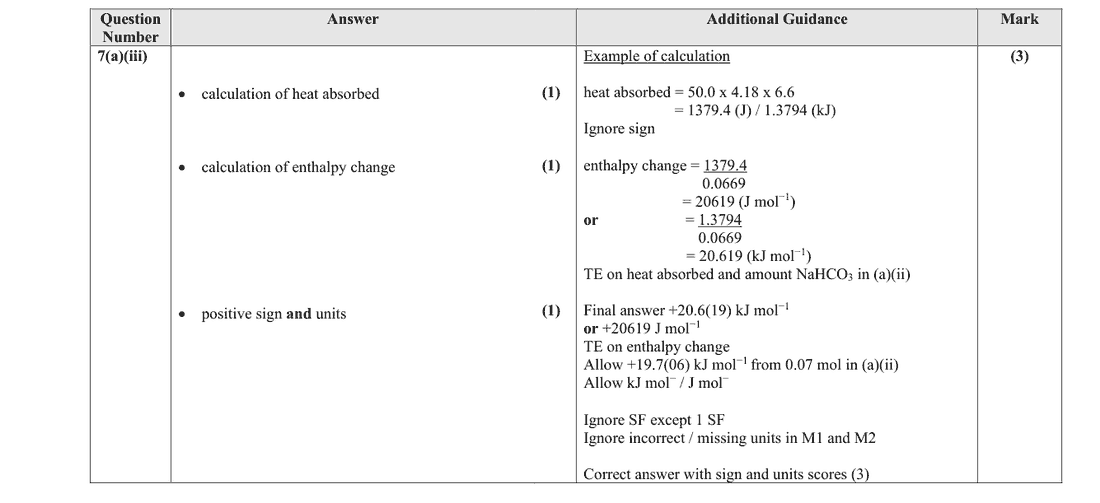
June 2025 · Paper 1 · Q3(b)(iii) 3 marks Calculation energetics i
Earlier parts of question 3 that this part usesEarlier part of June 2025 Paper 1 question 3Earlier part of June 2025 Paper 1 question 3Earlier part of June 2025 Paper 1 question 3
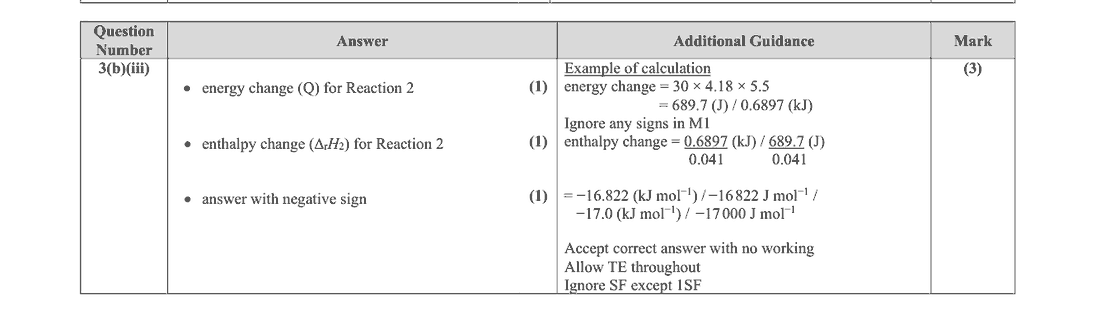
Calculate the enthalpy change, ΔrH2 , for Reaction 2 in kJ mol–1.
Include a sign in your answer.
[Assume the specific heat capacity of the solution = 4.18 J g–1 °C–1
and the mass of the solution = 30 g]
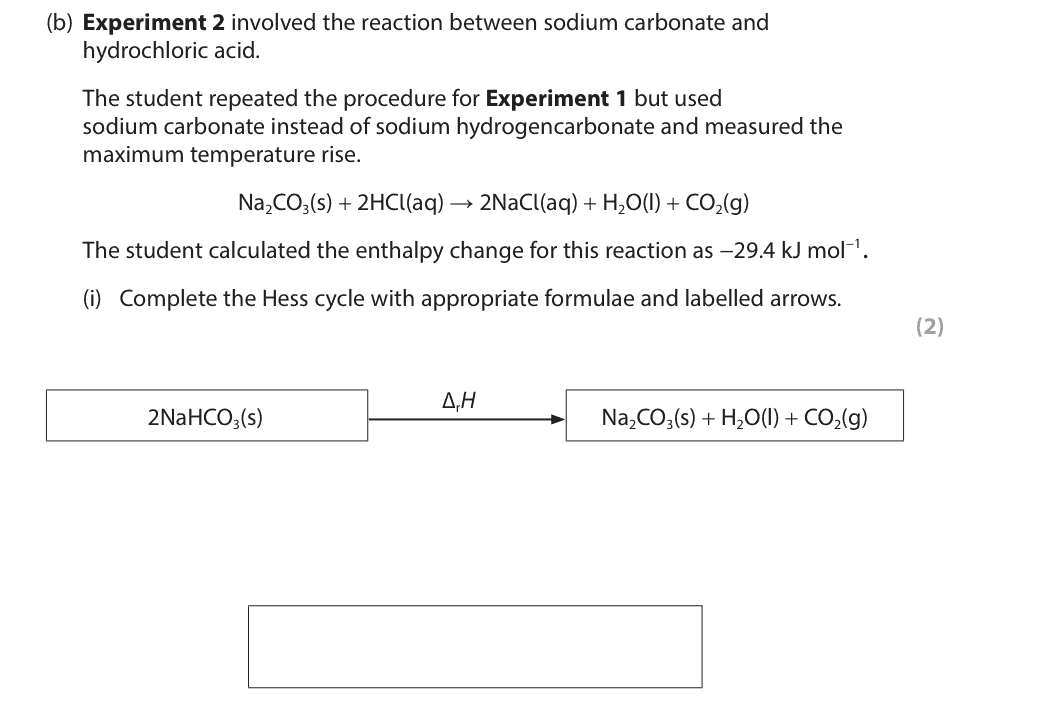
June 2025 · Paper 1 · Q3(b)(iv) 2 marks Diagram or structure energetics i
Earlier parts of question 3 that this part usesEarlier part of June 2025 Paper 1 question 3Earlier part of June 2025 Paper 1 question 3
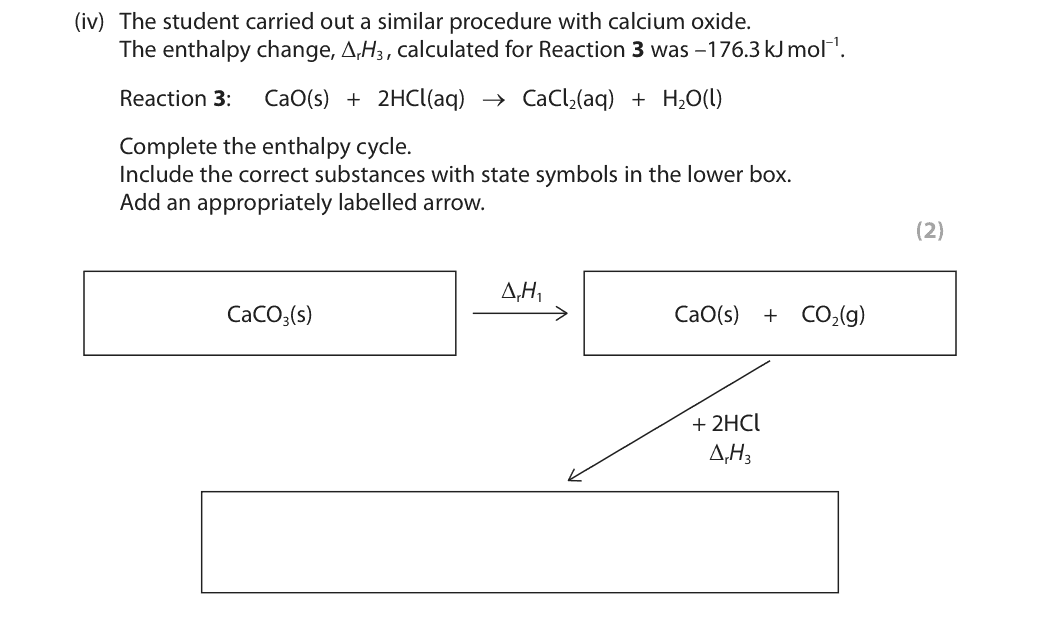
The student carried out a similar procedure with calcium oxide.
The enthalpy change, ΔrH3 , calculated for Reaction 3 was –176.3 kJ mol–1.
Reaction 3:      CaO(s)   +   2HCl(aq)   →   CaCl2(aq)   +   H2O(l)
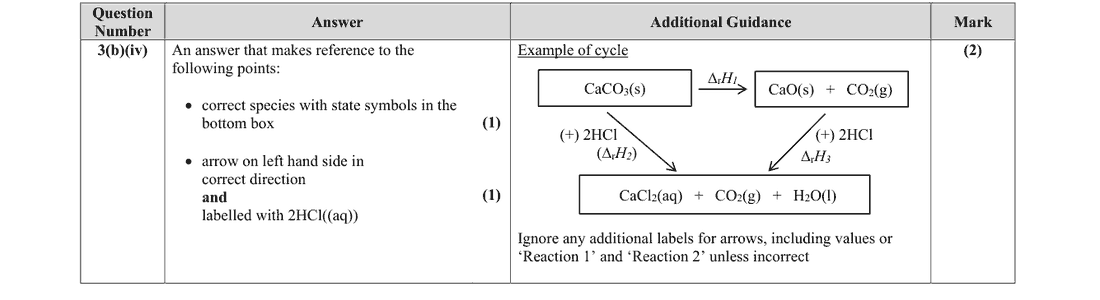
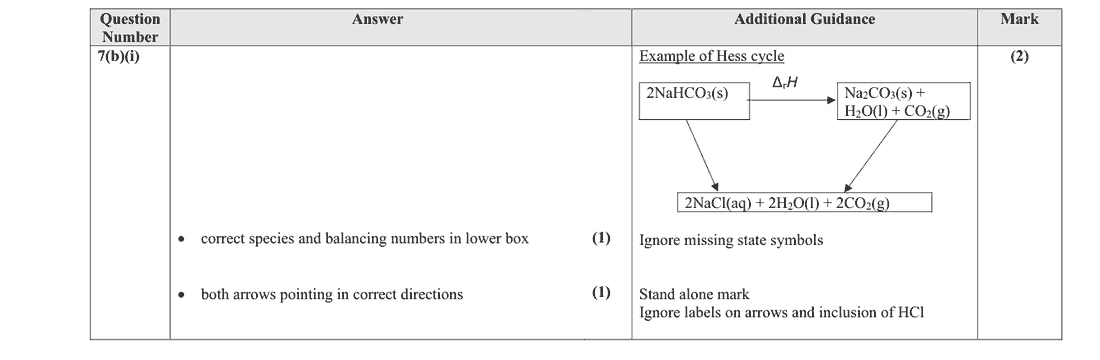
Complete the enthalpy cycle.
Include the correct substances with state symbols in the lower box.
Add an appropriately labelled arrow.
ΔrH1
CaCO3(s)
CaO(s) + CO2(g)
+ 2HCl
ΔrH3
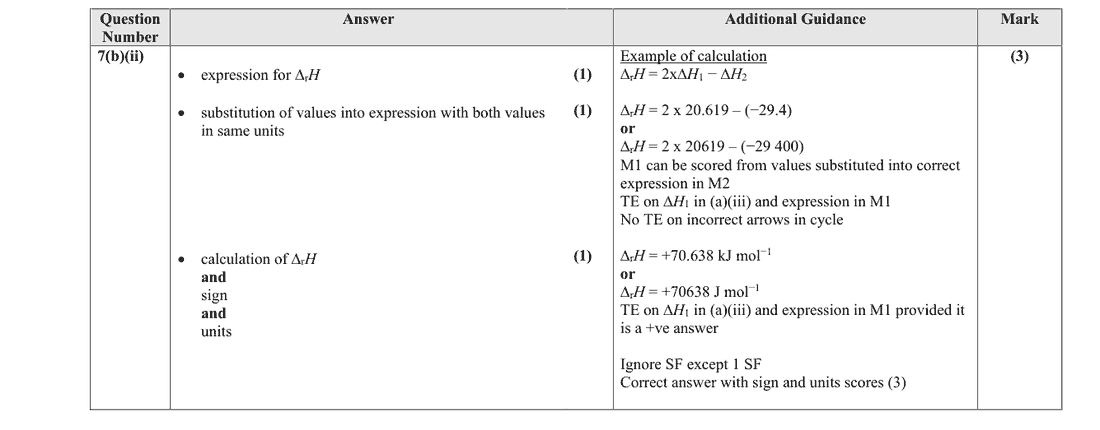
June 2025 · Paper 1 · Q3(b)(v) 1 mark Calculation energetics i
Earlier parts of question 3 that this part usesEarlier part of June 2025 Paper 1 question 3Earlier part of June 2025 Paper 1 question 3Earlier part of June 2025 Paper 1 question 3Earlier part of June 2025 Paper 1 question 3Earlier part of June 2025 Paper 1 question 3
Calculate a value for the enthalpy change ΔrH1 for the thermal decomposition
of calcium carbonate by using your cycle.
June 2025 · Paper 1 · Q9(a) 1 mark Short answer redox ii
Some hand sanitisers contain hydrogen peroxide (H2O2) as an active ingredient.
The World Health Organization recommends that the concentration of H2O2 is
between 3.0% and 6.0% by mass.
A higher concentration results in the hand sanitiser being caustic.
A lower concentration means the sanitiser would not be effective.
A sample of a colourless hand sanitiser of density 0.82 g cm–3 was analysed.
10.00 cm3 of the sanitiser was dissolved in deionised water to give a total volume of
250.0 cm3. An acidified solution of potassium manganate(VII) with a concentration
of 0.0200 mol dm–3 was titrated against a 25.00 cm3 sample of the
diluted hand sanitiser solution.
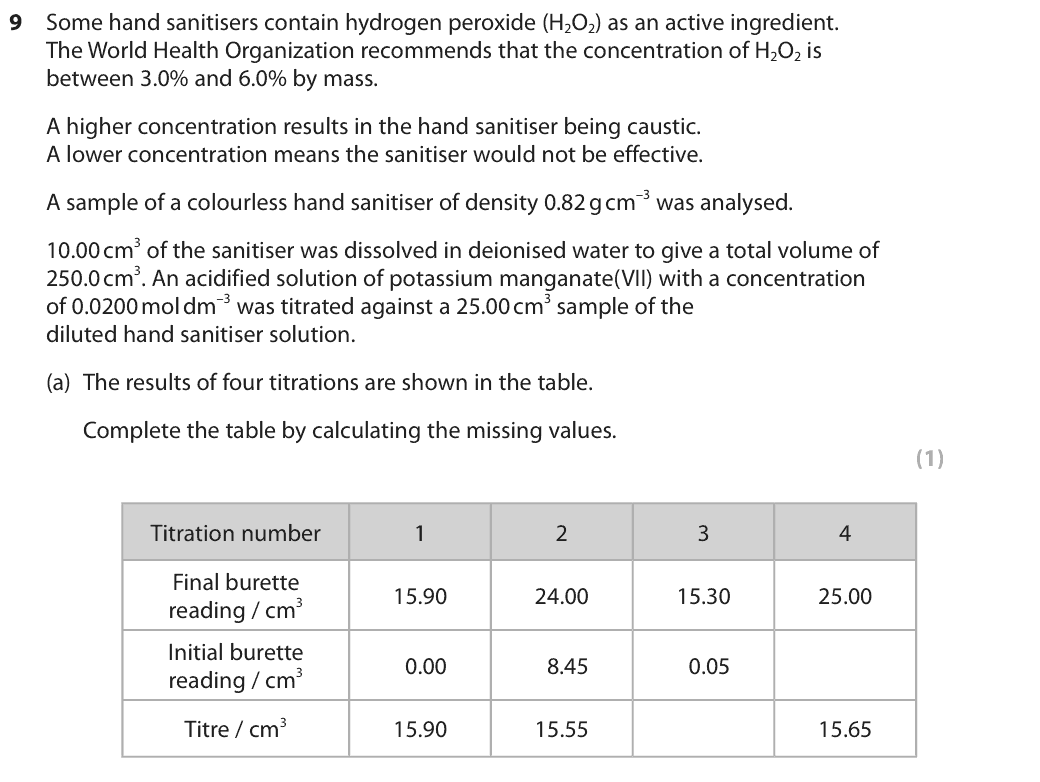
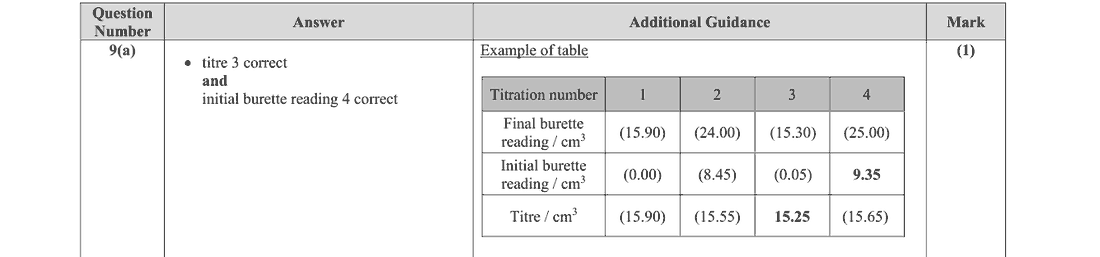
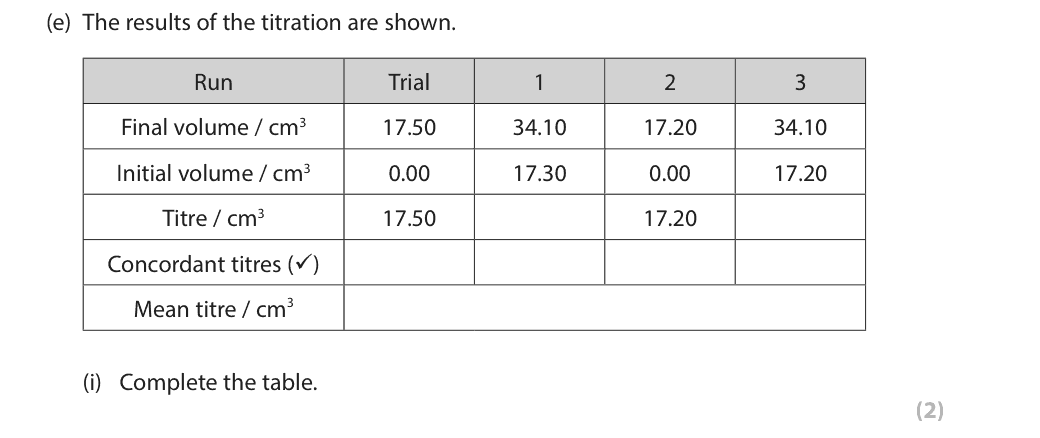
The results of four titrations are shown in the table.
Complete the table by calculating the missing values.
Titration number
1
2
3
4
Final burette
15.90
24.00
15.30
25.00
reading / cm3
Initial burette
0.00
8.45
0.05
reading / cm3
Titre / cm3
15.90
15.55
15.65
June 2025 · Paper 1 · Q9(b) 1 mark Practical and data analysis redox ii
Earlier part of question 9 that this part usesEarlier part of June 2025 Paper 1 question 9
The mean titre was calculated to be 15.60 cm3.
State how this value was determined.
June 2025 · Paper 1 · Q9(c) 2 marks Practical and data analysis redox ii
Earlier part of question 9 that this part usesEarlier part of June 2025 Paper 1 question 9
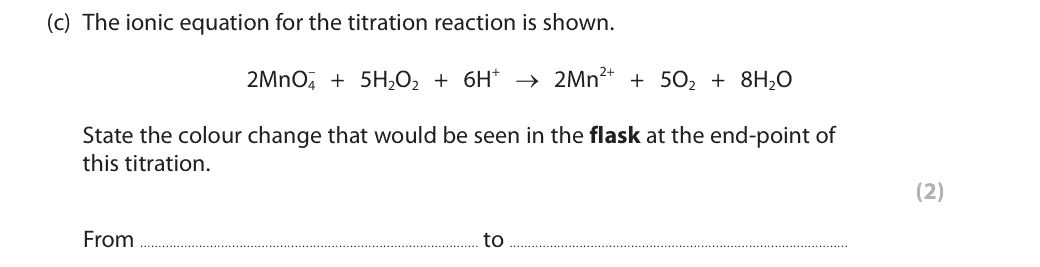
The ionic equation for the titration reaction is shown.
–   +   5H2O2   +   6H+   →   2Mn2+   +   5O2   +   8H2O
2MnO4
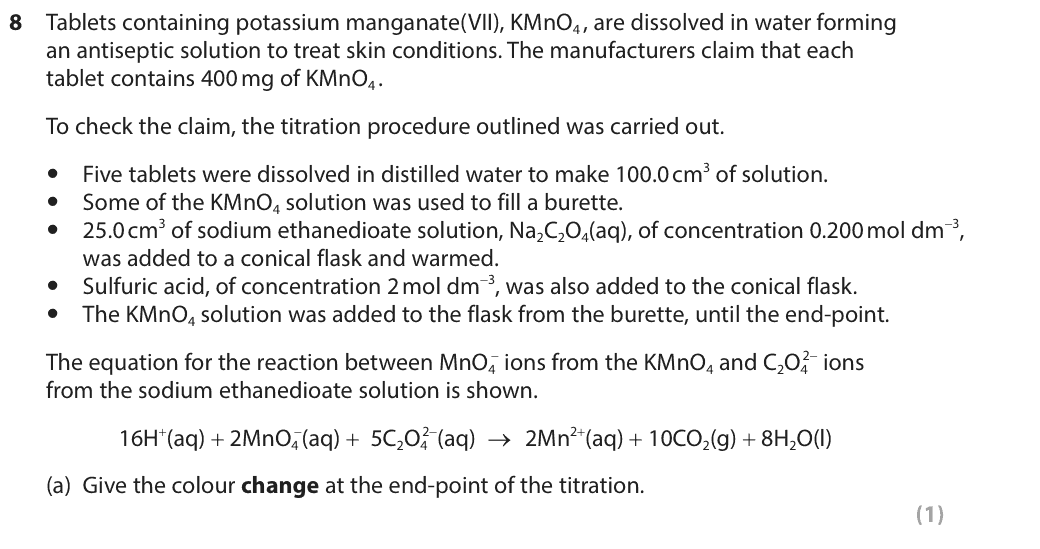
State the colour change that would be seen in the flask at the end‑point of
this titration.
From  to
June 2025 · Paper 1 · Q9(d) 5 marks Calculation redox ii
Earlier part of question 9 that this part usesEarlier part of June 2025 Paper 1 question 9
Deduce by calculation whether the concentration of hydrogen peroxide in the
hand sanitiser is within World Health Organization guidelines.
June 2025 · Paper 1 · Q9(e) 2 marks Calculation formulae equations and amounts of substance
Earlier part of question 9 that this part usesEarlier part of June 2025 Paper 1 question 9
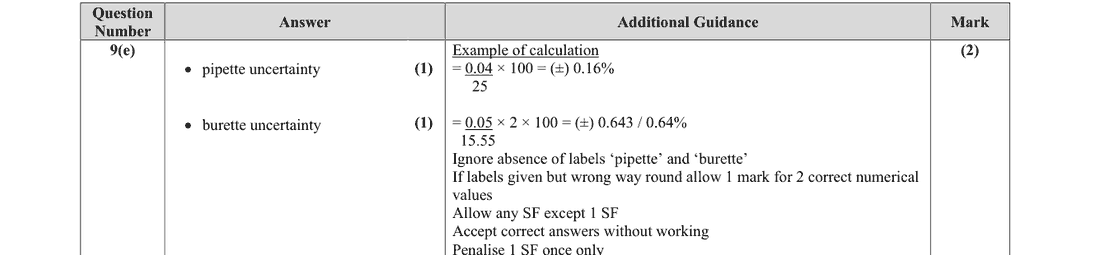
The uncertainty in the pipette volume is ± 0.04 cm3. The uncertainty in each
burette reading is ± 0.05 cm3.
Calculate the percentage uncertainties for the pipette volume of 25.00 cm3 and
the burette volume of 15.55 cm3 for titre 2.
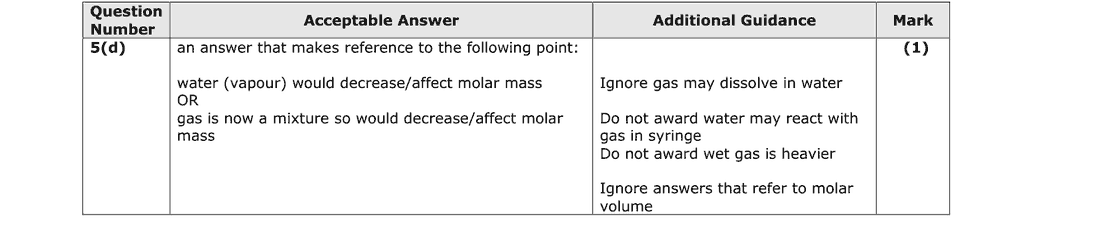
June 2025 · Paper 2 · Q5(d) 2 marks Calculation kinetics i
Earlier part of question 5 that this part usesEarlier part of June 2025 Paper 2 question 5
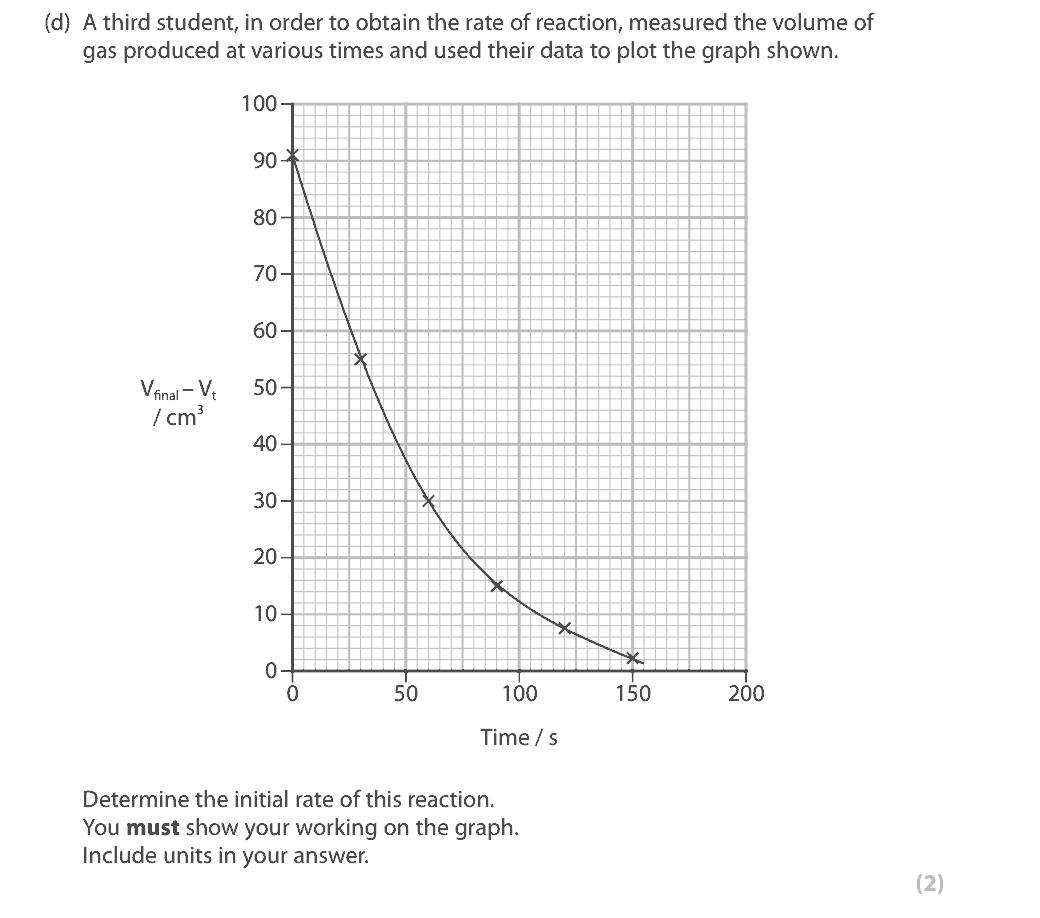
A third student, in order to obtain the rate of reaction, measured the volume of
gas produced at various times and used their data to plot the graph shown.
100
90
80
70
60
Vfinal – Vt
50
/ cm3
40
30
20
10
0
0
50
100
150
200
Time / s
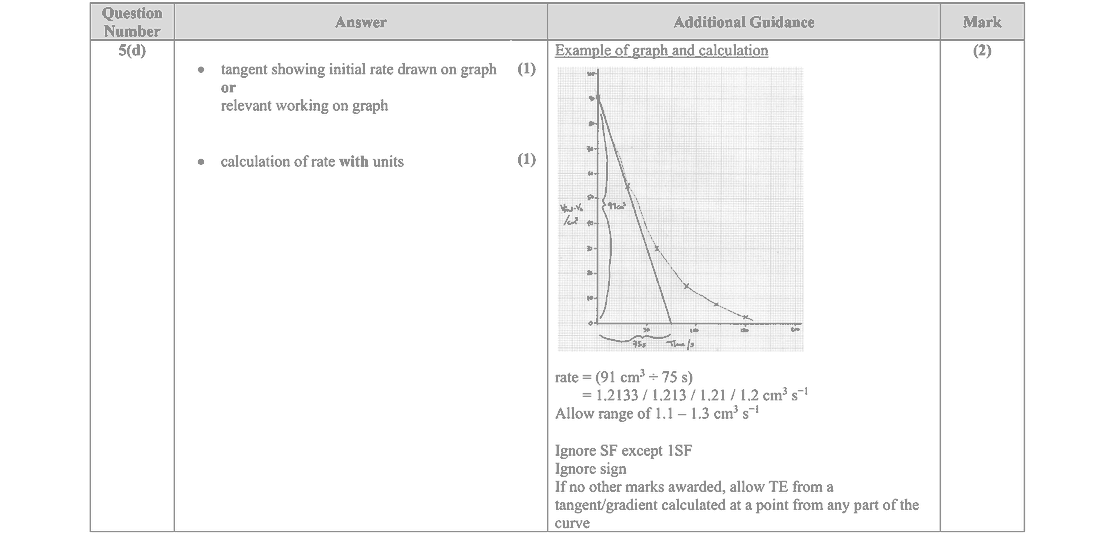
Determine the initial rate of this reaction.
You must show your working on the graph.
Include units in your answer.
June 2025 · Paper 2 · Q6(a) 6 marks 6-mark extended response carbonyl compoundscarboxylic acids
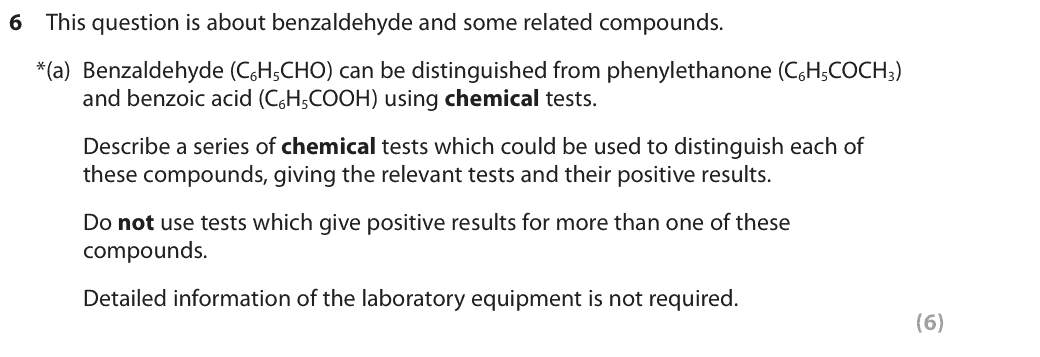
This question is about benzaldehyde and some related compounds.
Benzaldehyde (C6H5CHO) can be distinguished from phenylethanone (C6H5COCH3)
and benzoic acid (C6H5COOH) using chemical tests.
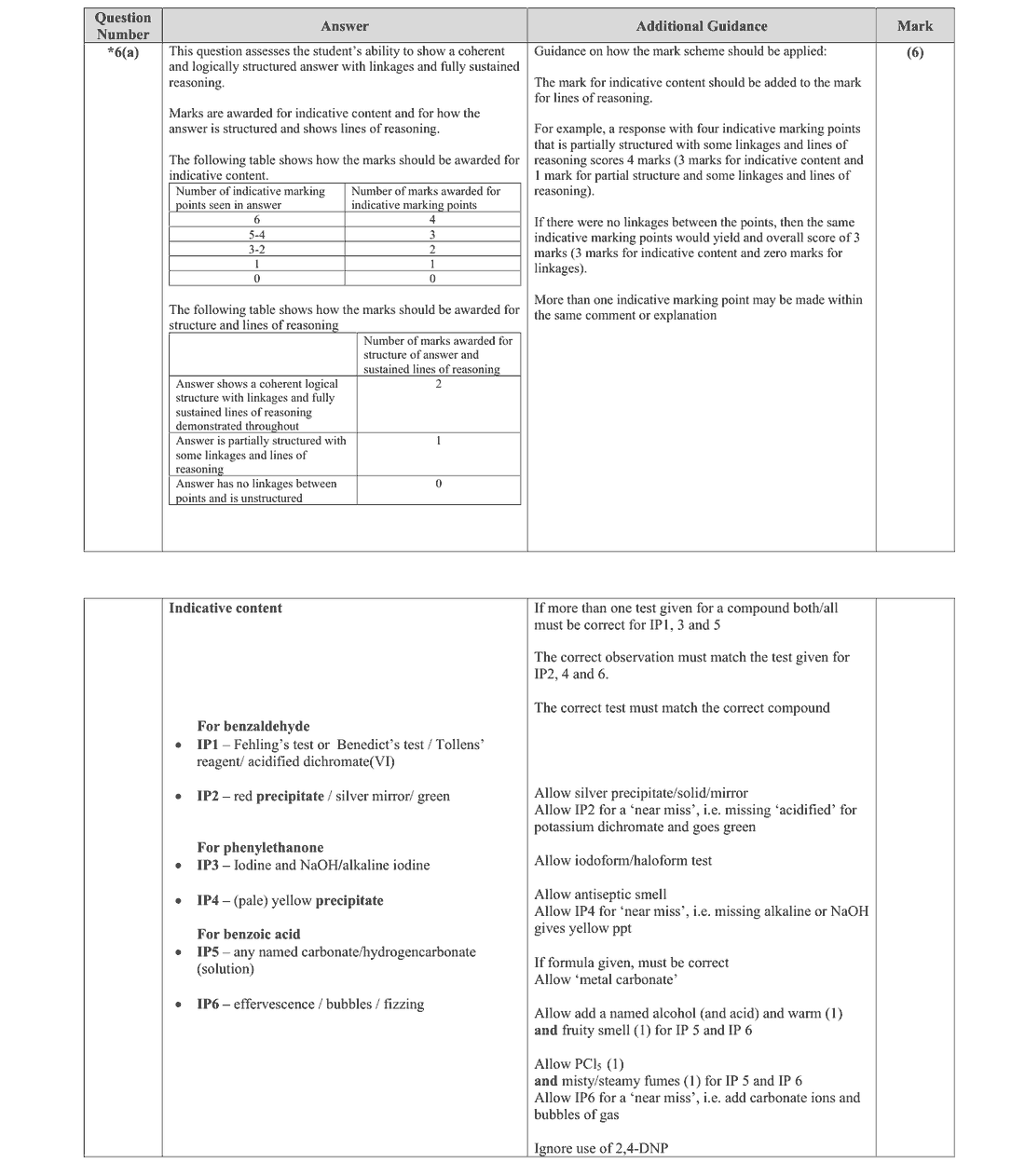
Describe a series of chemical tests which could be used to distinguish each of
these compounds, giving the relevant tests and their positive results.
Do not use tests which give positive results for more than one of these
compounds.
Detailed information of the laboratory equipment is not required.
June 2025 · Paper 2 · Q9(a)(i) 2 marks Calculation kinetics ii
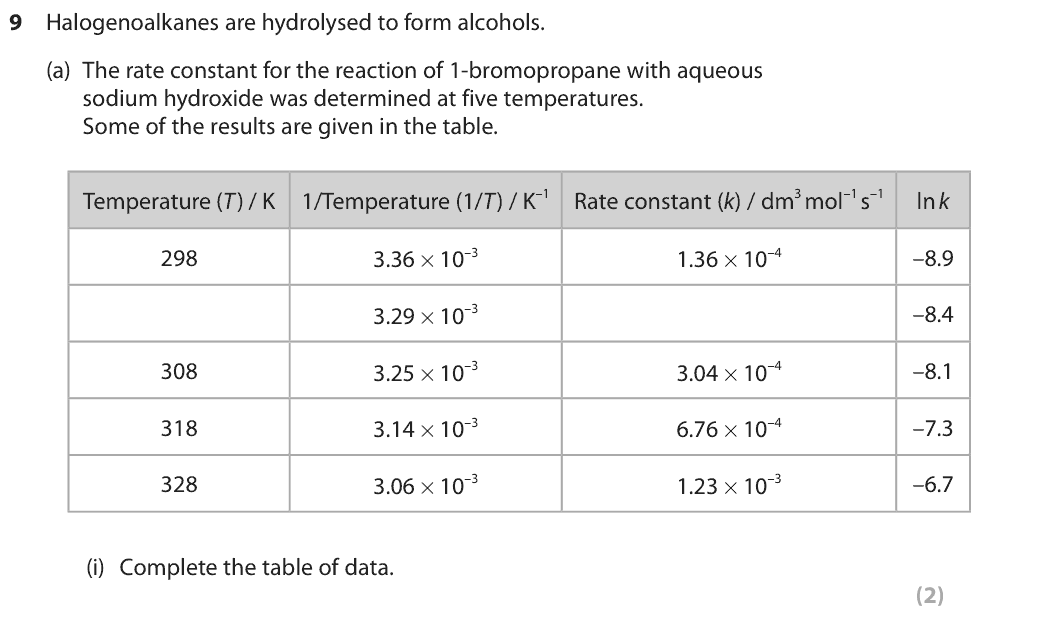
Halogenoalkanes are hydrolysed to form alcohols.
The rate constant for the reaction of 1‑bromopropane with aqueous
sodium hydroxide was determined at five temperatures.
Some of the results are given in the table.
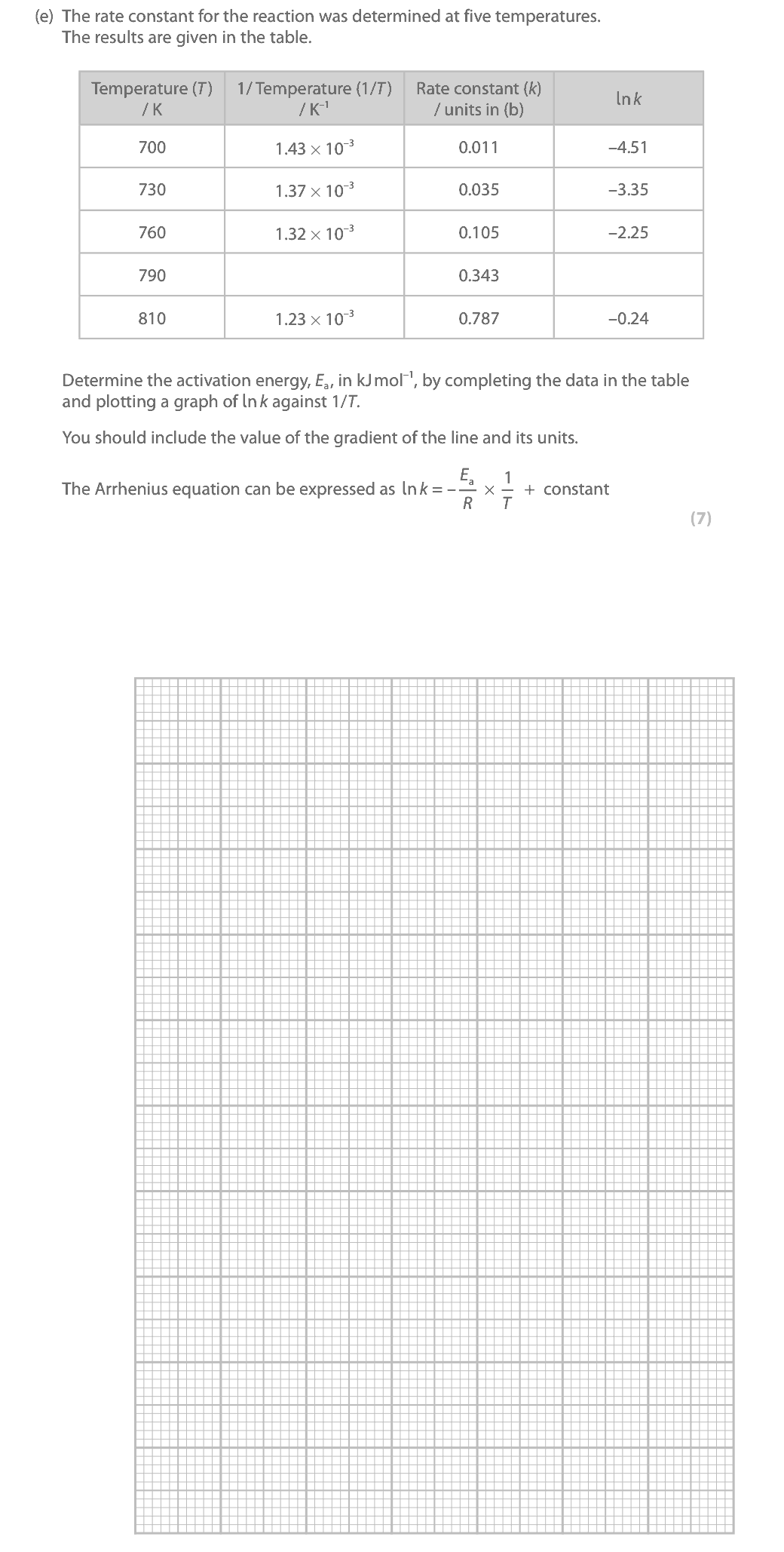
Temperature (T) / K
1/Temperature (1/T) / K–1
Rate constant (k) / dm3 mol–1 s–1
ln k
298
3.36 × 10–3
1.36 × 10–4
–8.9
3.29 × 10–3
–8.4
308
3.25 × 10–3
3.04 × 10–4
–8.1
318
3.14 × 10–3
6.76 × 10–4
–7.3
328
3.06 × 10–3
1.23 × 10–3
–6.7
Complete the table of data.
June 2025 · Paper 2 · Q9(a)(ii) 5 marks Calculation kinetics ii
Earlier part of question 9 that this part usesEarlier part of June 2025 Paper 2 question 9
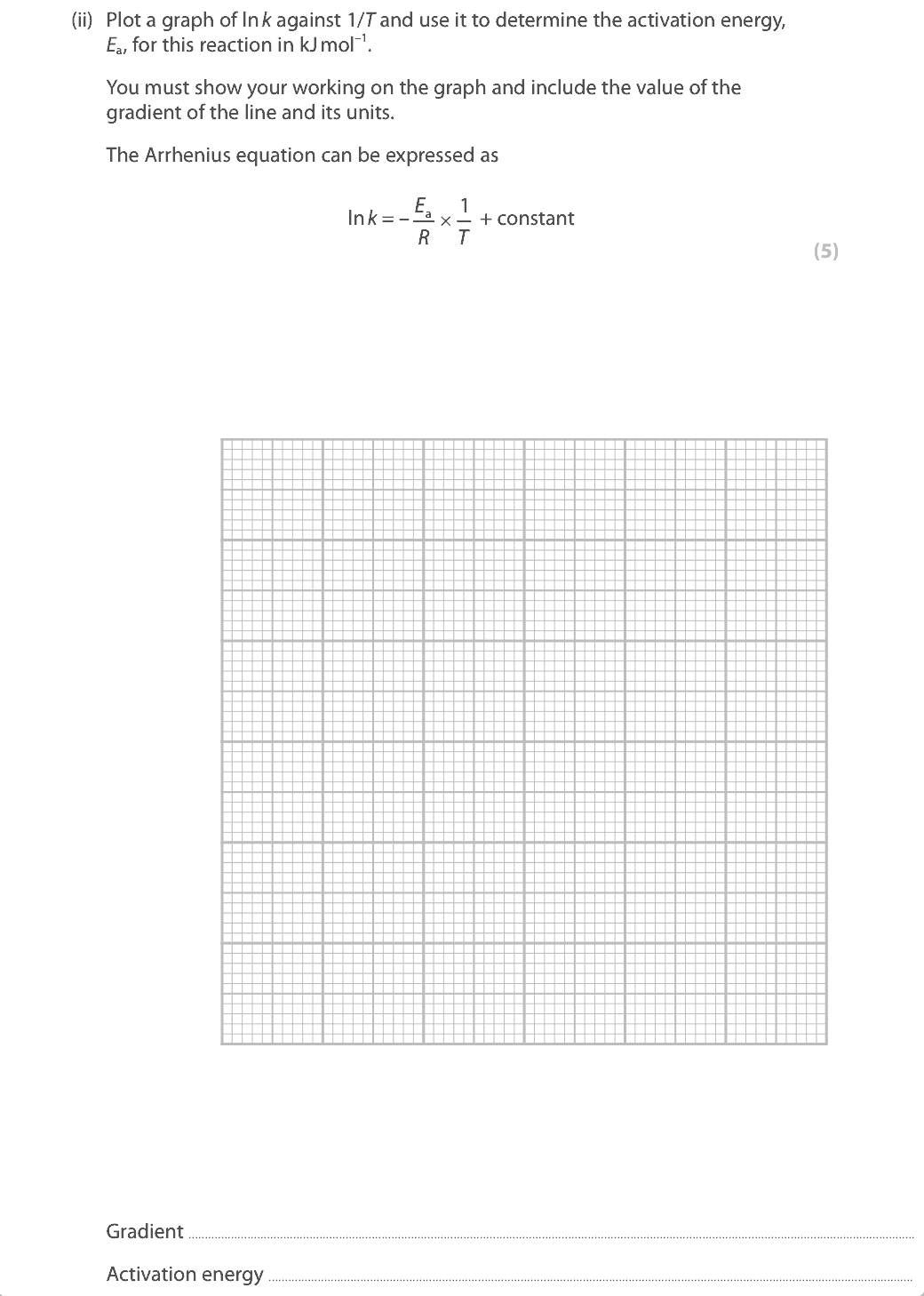
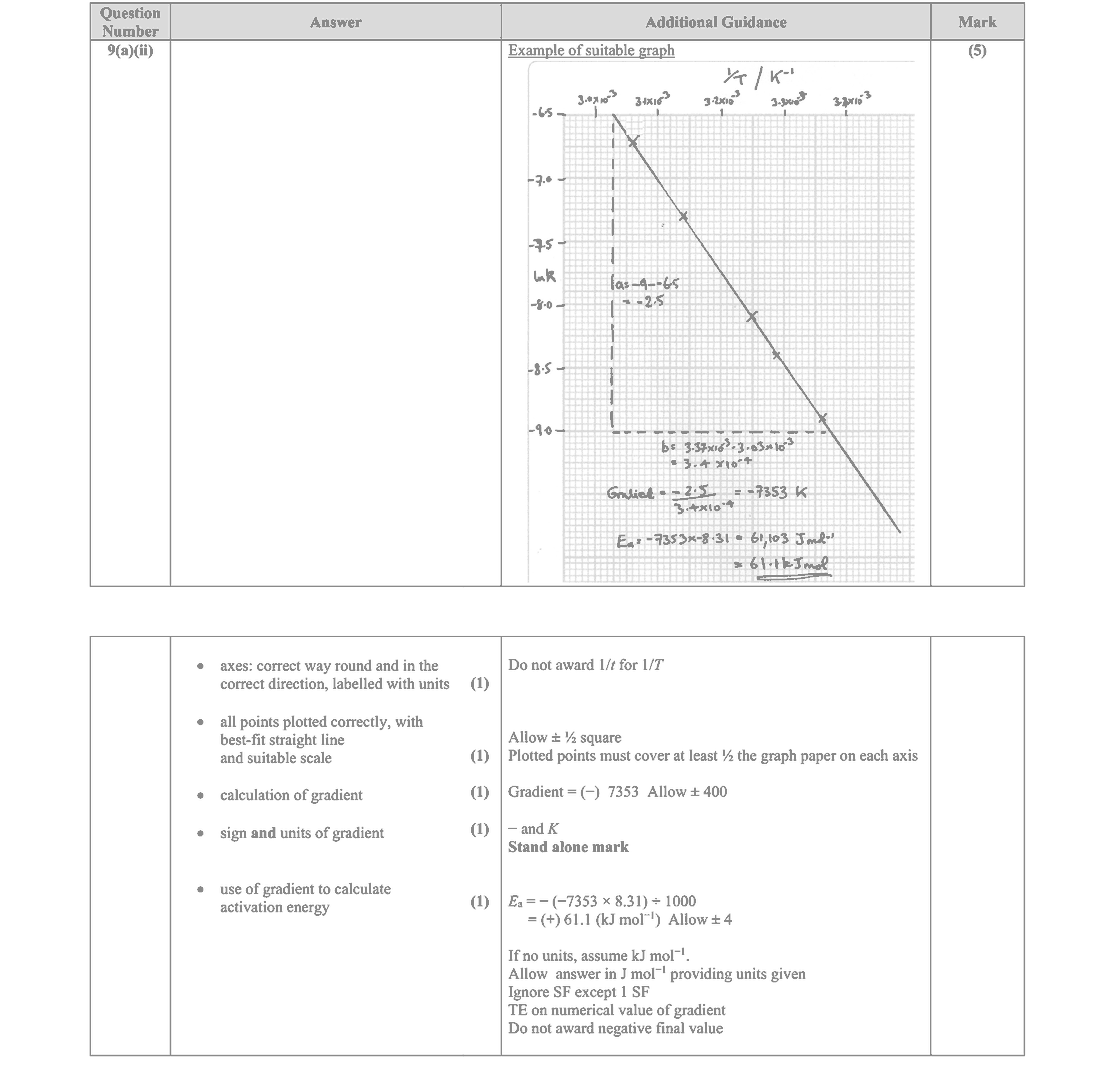
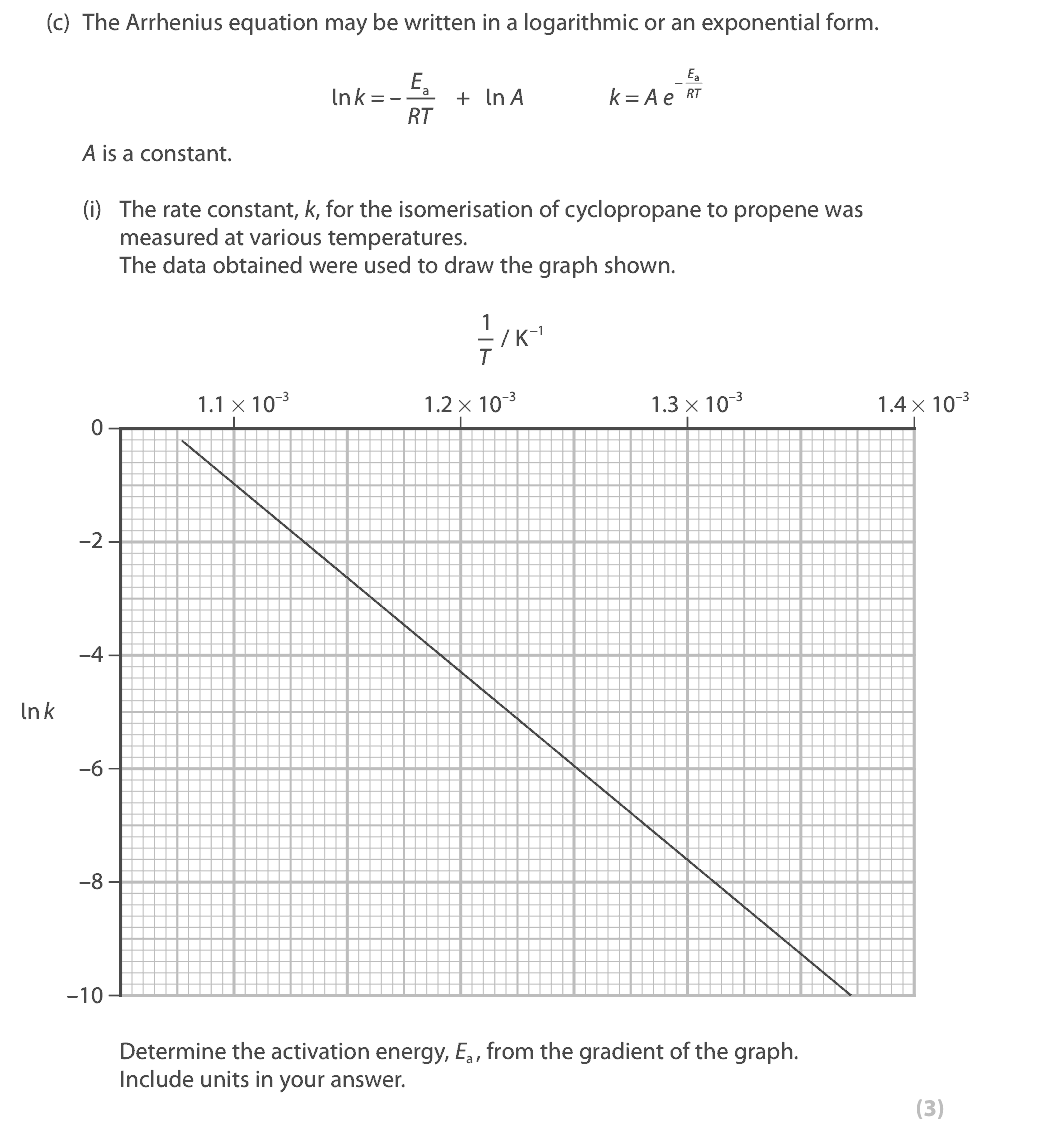
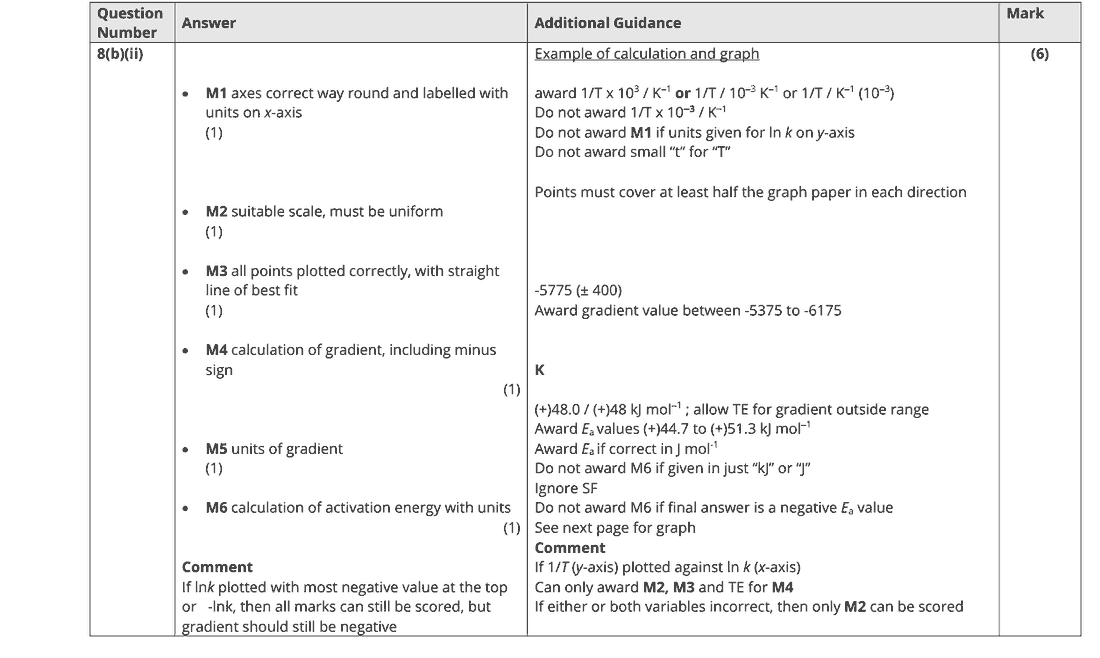
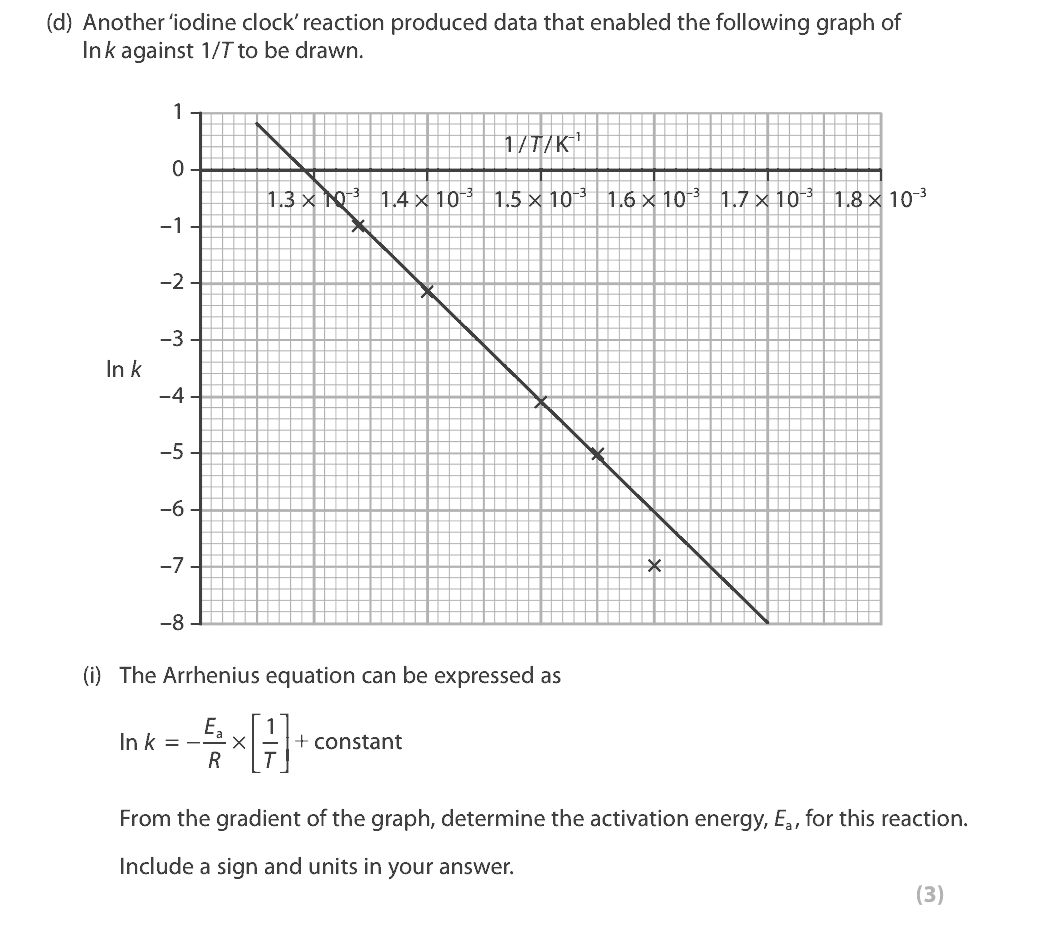
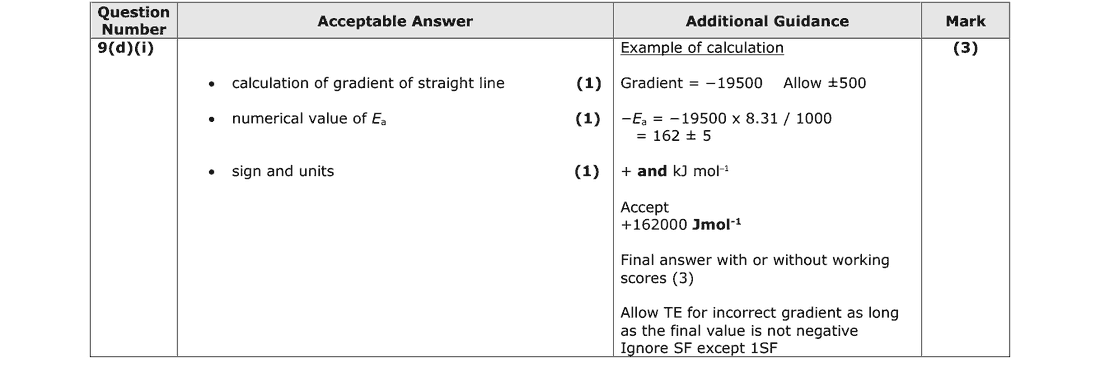
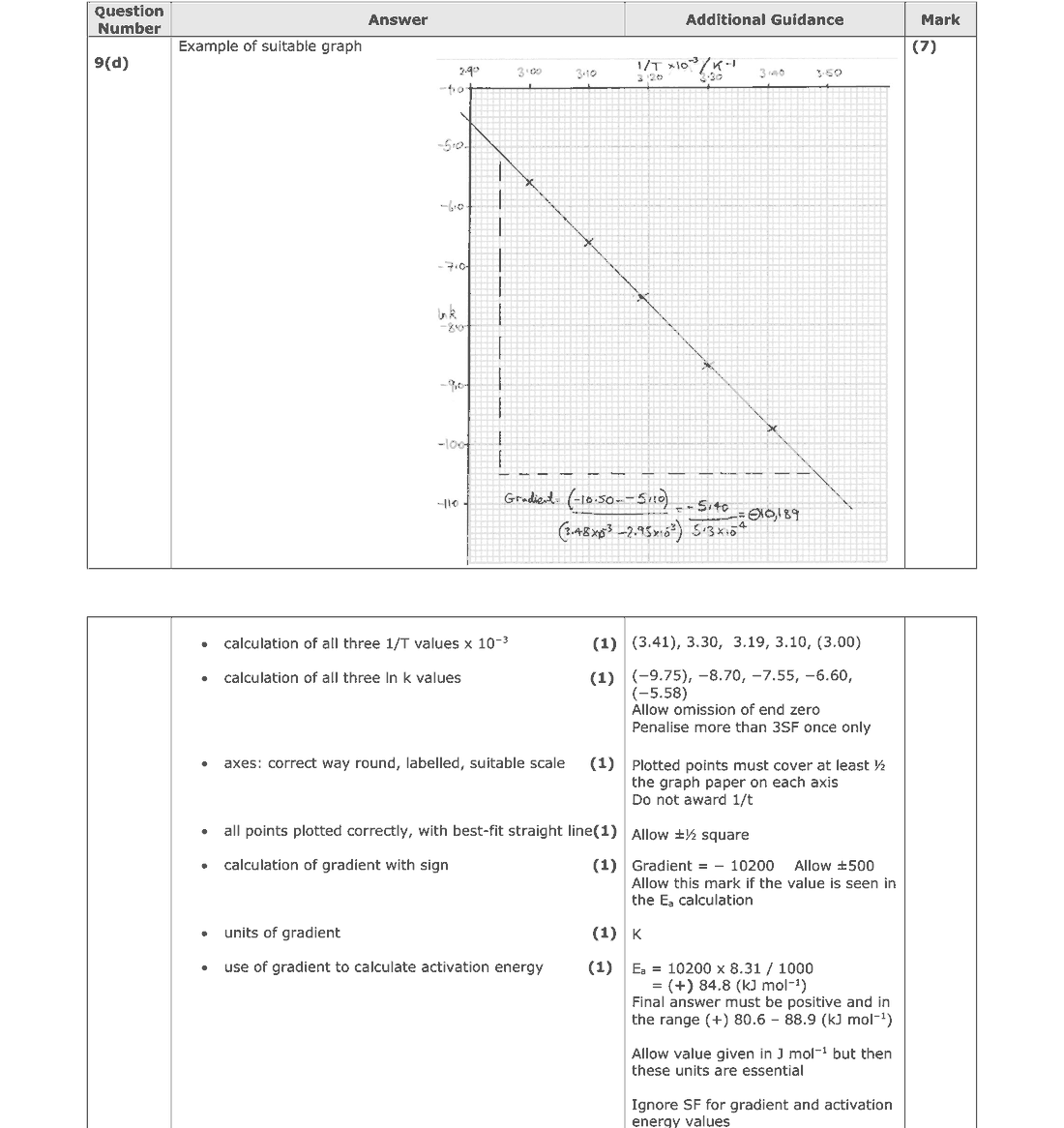
Plot a graph of ln k against 1/T and use it to determine the activation energy,
Ea, for this reaction in  kJ mol–1.
You must show your working on the graph and include the value of the
gradient of the line and its units.
The Arrhenius equation can be expressed as
ln k = – E
a × 1 + constant
R
T
Gradient 
Activation energy
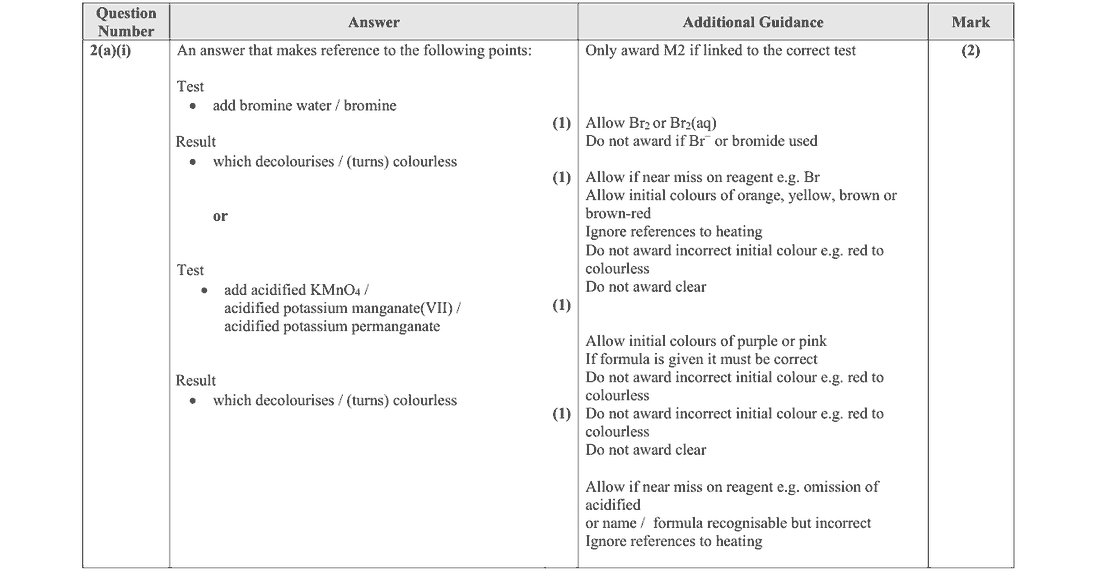
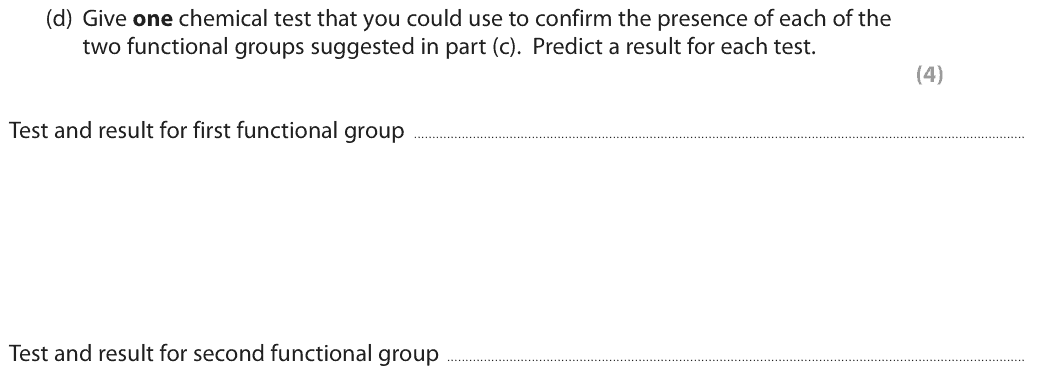
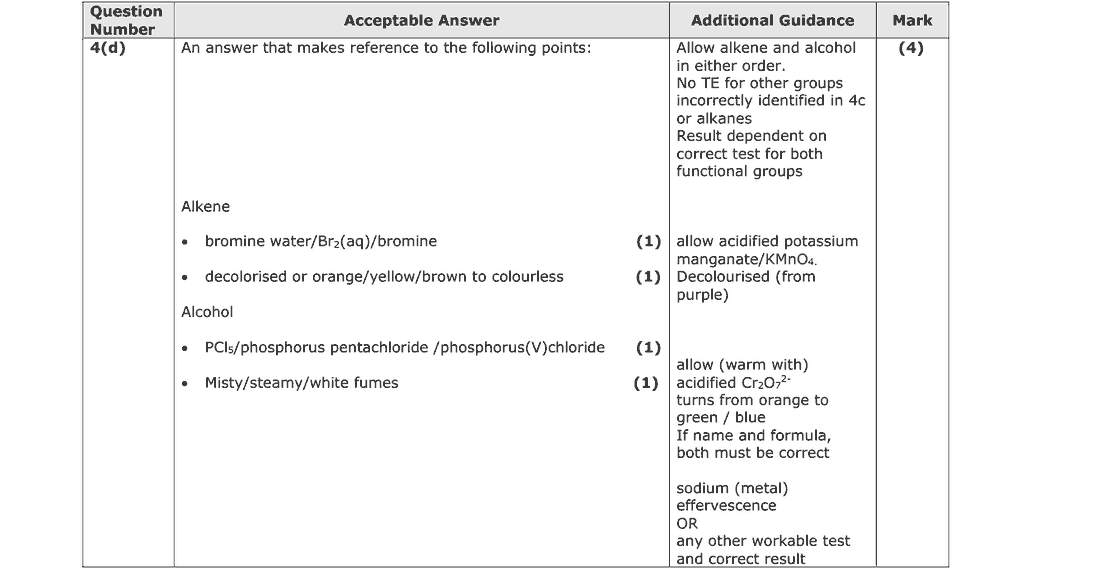
June 2025 · Paper 3 · Q2(a)(i) 2 marks Practical and data analysis alkenes
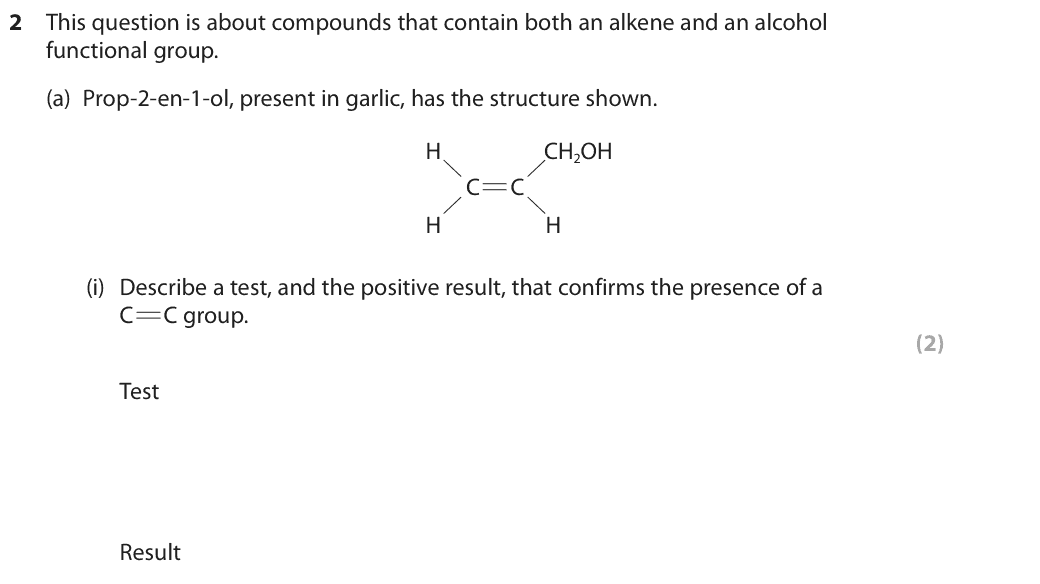
This question is about compounds that contain both an alkene and an alcohol
functional group.
Prop-2-en-1-ol, present in garlic, has the structure shown.
H
CH2OH
C
C
H
H
Describe a test, and the positive result, that confirms the presence of a
C
C group.
Test
Result
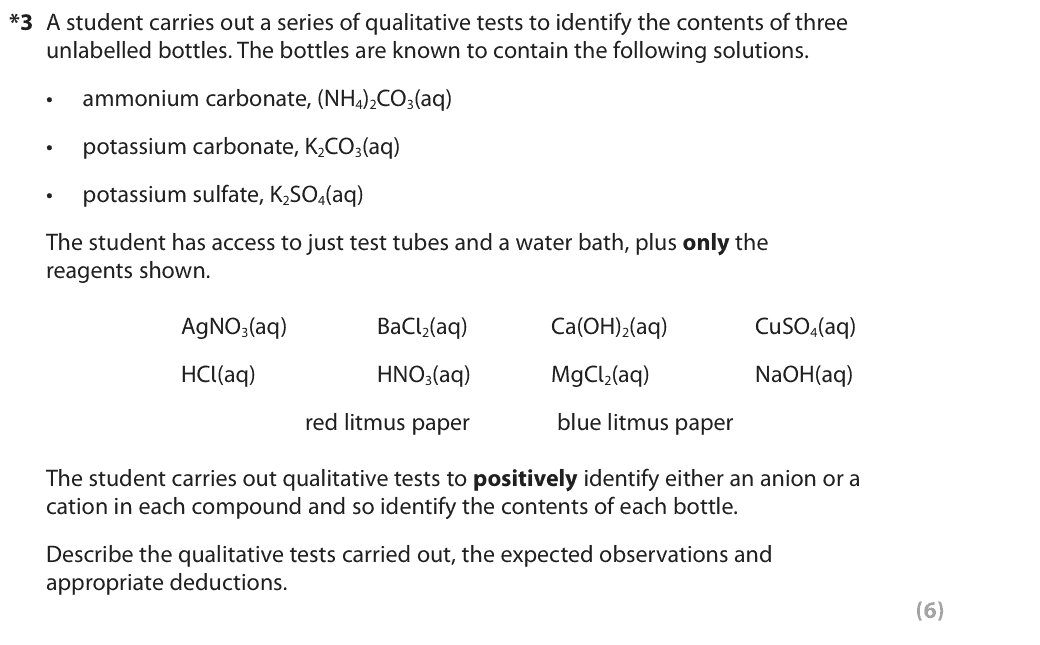
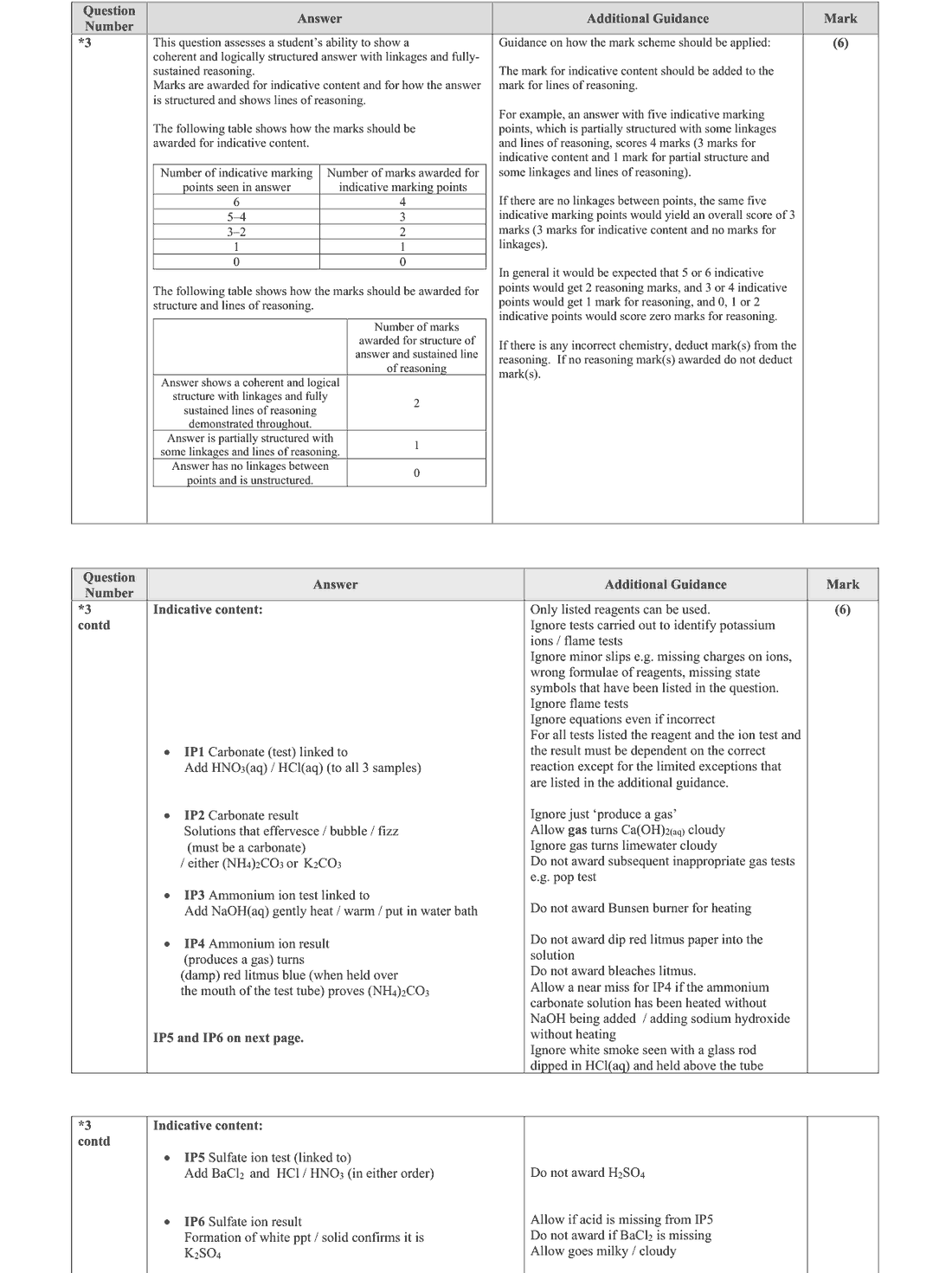
June 2025 · Paper 3 · Q3 6 marks 6-mark extended response analysis of inorganic compounds
A student carries out a series of qualitative tests to identify the contents of three
unlabelled bottles. The bottles are known to contain the following solutions.
•
ammonium carbonate, (NH4)2CO3(aq)
•
potassium carbonate, K2CO3(aq)
•
potassium sulfate, K2SO4(aq)
The student has access to just test tubes and a water bath, plus only the
reagents shown.
AgNO3(aq)
BaCl2(aq)
Ca(OH)2(aq)
CuSO4(aq)
HCl(aq)
HNO3(aq)
MgCl2(aq)
NaOH(aq)
red litmus paper
blue litmus paper
The student carries out qualitative tests to positively identify either an anion or a
cation in each compound and so identify the contents of each bottle.
Describe the qualitative tests carried out, the expected observations and
appropriate deductions.
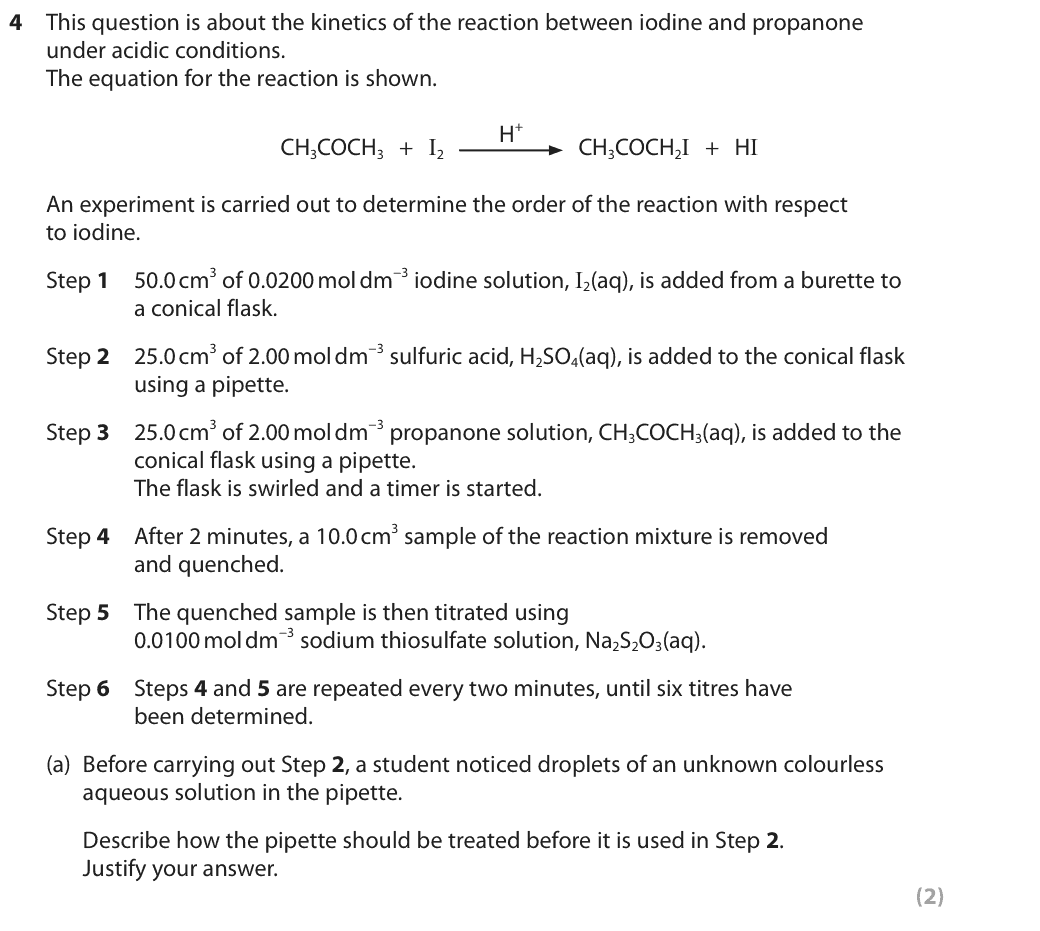
June 2025 · Paper 3 · Q4(a) 2 marks Practical and data analysis kinetics ii
This question is about the kinetics of the reaction between iodine and propanone
under acidic conditions.
The equation for the reaction is shown.
H+
CH3COCH3   +   I2
CH3COCH2I   +   HI
An experiment is carried out to determine the order of the reaction with respect
to iodine.
Step 1  50.0 cm3 of 0.0200 mol dm−3 iodine solution, I2(aq), is added from a burette to
a conical flask.
Step 2  25.0 cm3 of 2.00 mol dm−3 sulfuric acid, H2SO4(aq), is added to the conical flask
using a pipette.
Step 3  25.0 cm3 of 2.00 mol dm−3 propanone solution, CH3COCH3(aq), is added to the
conical flask using a pipette.
The flask is swirled and a timer is started.
Step 4  After 2 minutes, a 10.0 cm3 sample of the reaction mixture is removed
and quenched.
Step 5  The quenched sample is then titrated using
0.0100 mol dm−3 sodium thiosulfate solution, Na2S2O3(aq).
Step 6  Steps 4 and 5 are repeated every two minutes, until six titres have
been determined.
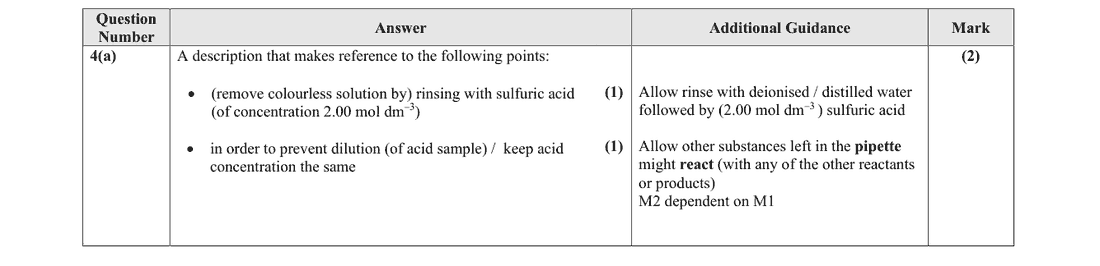
Before carrying out Step 2, a student noticed droplets of an unknown colourless
aqueous solution in the pipette.
Describe how the pipette should be treated before it is used in Step 2.
Justify your answer.
June 2025 · Paper 3 · Q4(b)(i) 2 marks Practical and data analysis kinetics ii
Earlier part of question 4 that this part usesEarlier part of June 2025 Paper 3 question 4
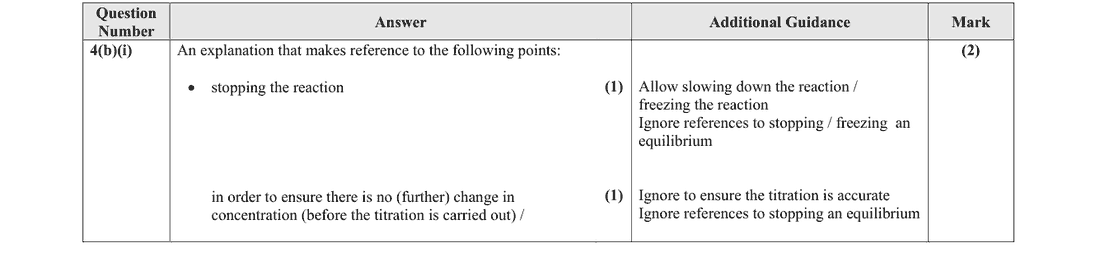
Samples from the reaction mixture are quenched in Step 4.
Explain why quenching is necessary.
June 2025 · Paper 3 · Q4(b)(ii) 2 marks Practical and data analysis kinetics iiformulae equations and amounts of substance
Earlier parts of question 4 that this part usesEarlier part of June 2025 Paper 3 question 4Earlier part of June 2025 Paper 3 question 4
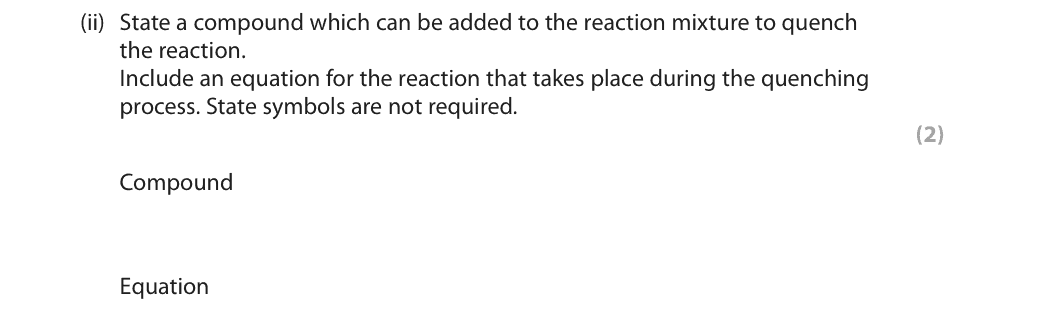
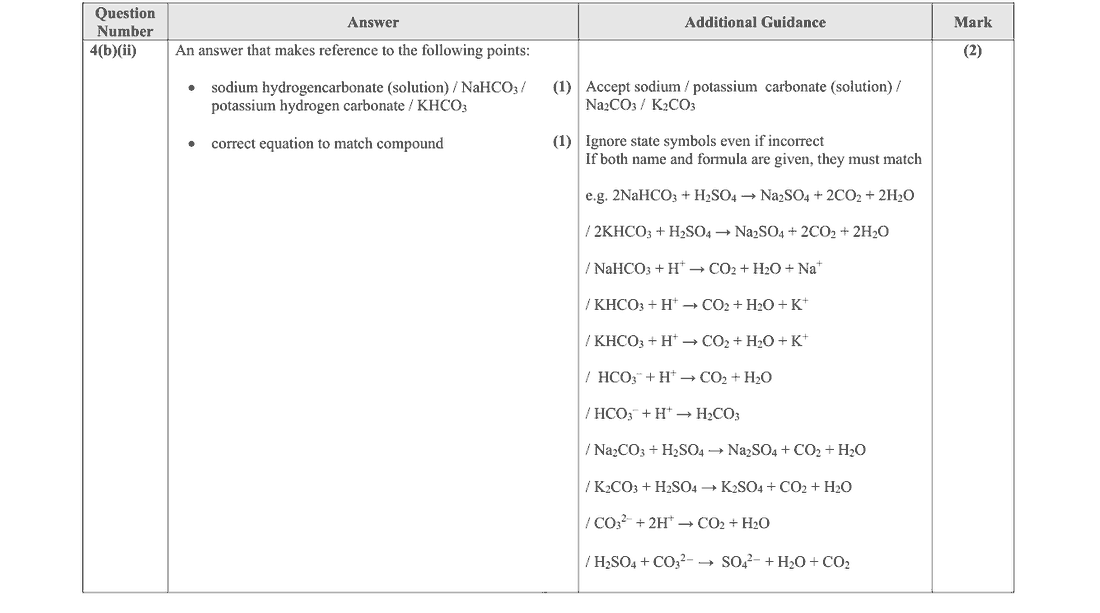
State a compound which can be added to the reaction mixture to quench
the reaction.
Include an equation for the reaction that takes place during the quenching
process. State symbols are not required.
Compound
Equation
June 2025 · Paper 3 · Q4(c) 2 marks Practical and data analysis formulae equations and amounts of substance
Earlier part of question 4 that this part usesEarlier part of June 2025 Paper 3 question 4
One of the products of the reaction, iodopropanone (CH3COCH2I) is corrosive,
strongly irritating to the eyes and can cause breathing difficulties.
Explain why a risk assessment for this experiment says it does not have to be
carried out in a fume cupboard.
June 2025 · Paper 3 · Q4(d) 4 marks Calculation kinetics iiformulae equations and amounts of substance
Earlier part of question 4 that this part usesEarlier part of June 2025 Paper 3 question 4
Show, by calculating the initial quantities of the reactants involved, that this
experiment provides evidence for the order with respect to iodine only.
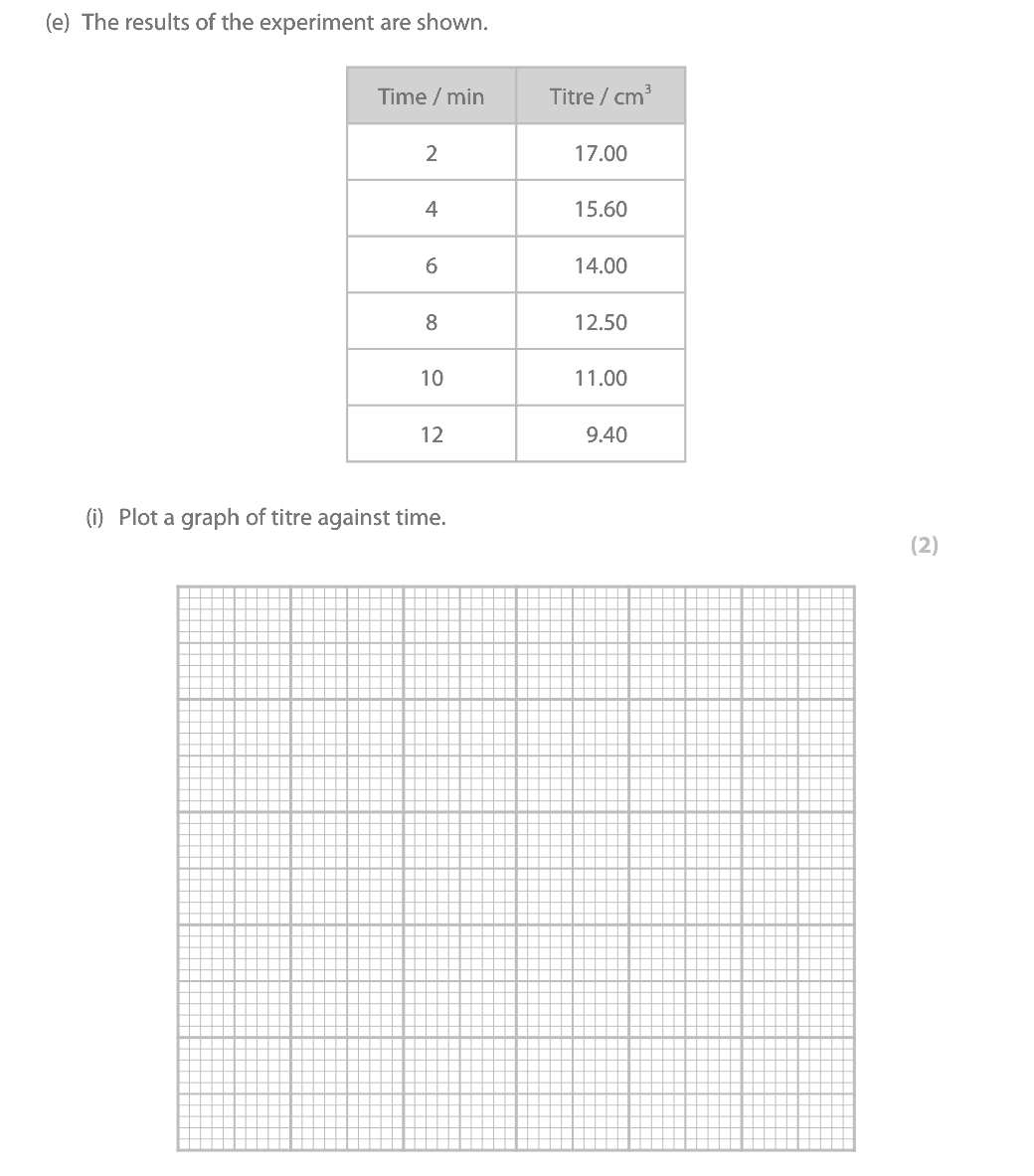
June 2025 · Paper 3 · Q4(e)(i) 2 marks Diagram or structure kinetics ii
Earlier part of question 4 that this part usesEarlier part of June 2025 Paper 3 question 4
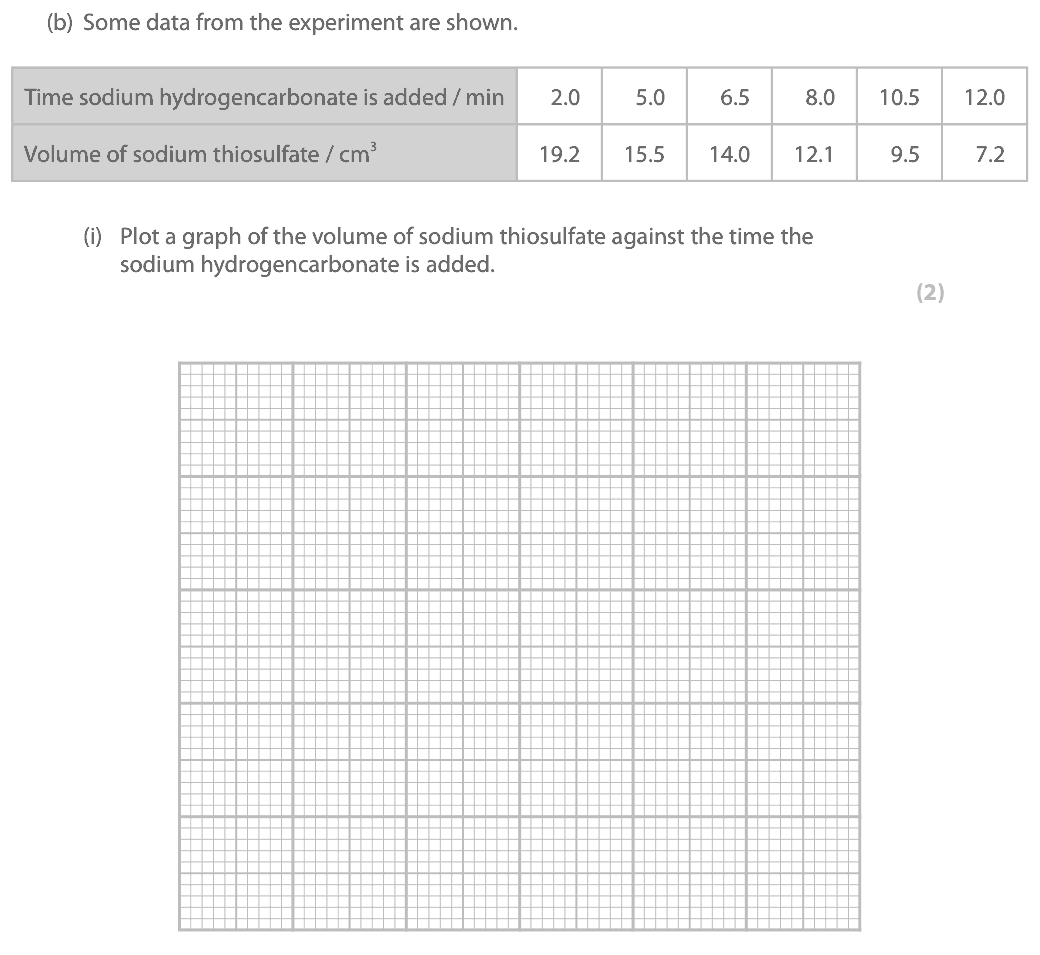
The results of the experiment are shown.
Titre / cm3
Time / min
2
17.00
4
15.60
6
14.00
8
12.50
10
11.00
12
9.40
Plot a graph of titre against time.
June 2025 · Paper 3 · Q4(e)(ii) 1 mark Short answer kinetics ii
Earlier parts of question 4 that this part usesEarlier part of June 2025 Paper 3 question 4Earlier part of June 2025 Paper 3 question 4
Give the reason why it is not necessary to calculate the concentration of
iodine so that the order can be deduced.
June 2025 · Paper 3 · Q4(e)(iii) 2 marks Short answer kinetics ii
Earlier parts of question 4 that this part usesEarlier part of June 2025 Paper 3 question 4Earlier part of June 2025 Paper 3 question 4Earlier part of June 2025 Paper 3 question 4
Deduce the order with respect to iodine. Justify your answer.
June 2025 · Paper 3 · Q7(a) 2 marks Practical and data analysis alcohols
A laboratory technician analysed a sample of an alcoholic drink to determine the
concentration of ethanol, in g dm−3.
20.00 cm3 of the alcoholic drink was added to a 250 cm3 volumetric flask and made up
to the mark with deionised water.
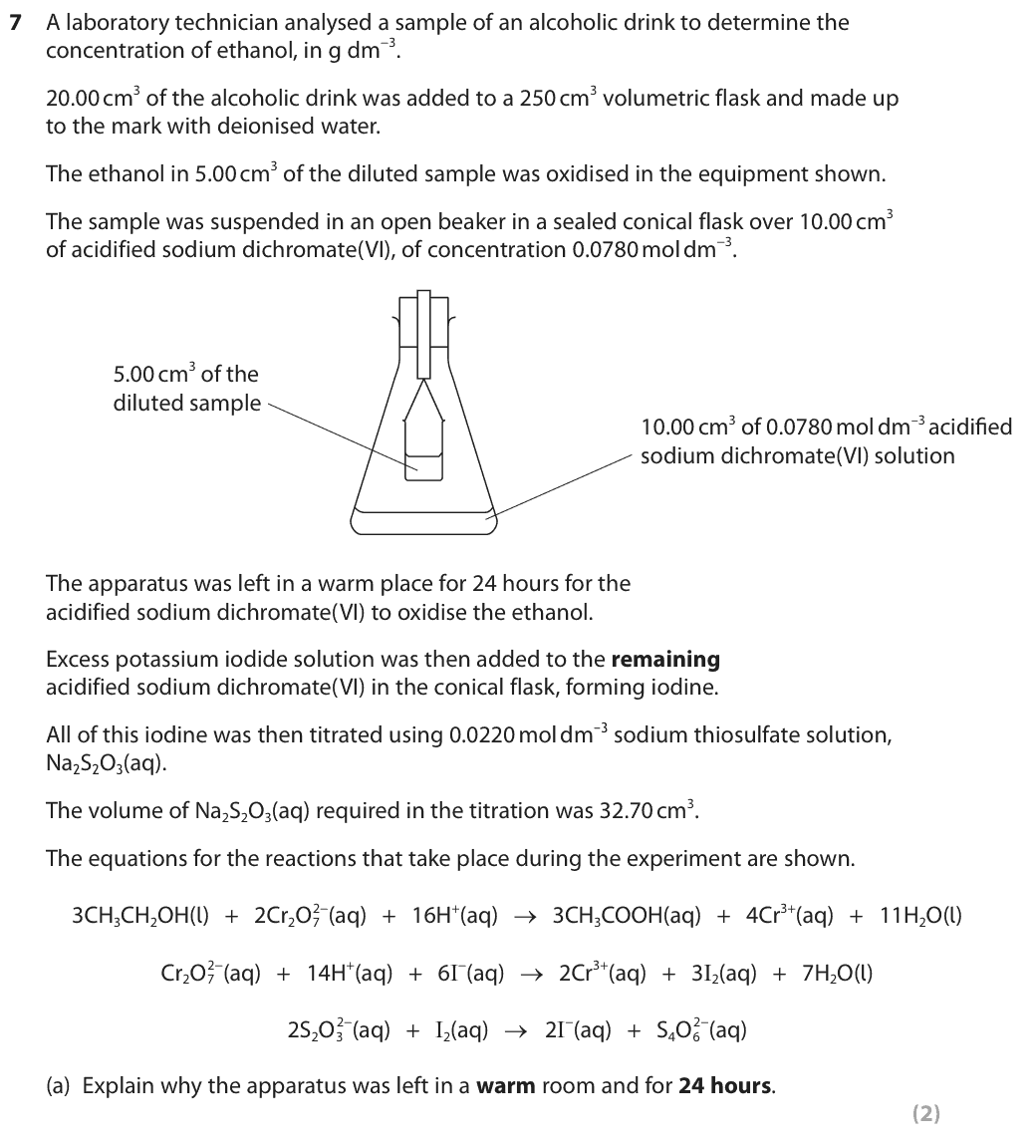
The ethanol in 5.00 cm3 of the diluted sample was oxidised in the equipment shown.
The sample was suspended in an open beaker in a sealed conical flask over 10.00 cm3
of acidified sodium dichromate(VI), of concentration 0.0780 mol dm−3.
5.00 cm3 of the
diluted sample
10.00 cm3 of 0.0780 mol dm–3 acidified
sodium dichromate(VI) solution
The apparatus was left in a warm place for 24 hours for the
acidified sodium dichromate(VI) to oxidise the ethanol.
Excess potassium iodide solution was then added to the remaining
acidified sodium dichromate(VI) in the conical flask, forming iodine.
All of this iodine was then titrated using 0.0220 mol dm−3 sodium thiosulfate solution,
Na2S2O3(aq).
The volume of Na2S2O3(aq) required in the titration was 32.70 cm3.
The equations for the reactions that take place during the experiment are shown.
3CH3CH2OH(l)   +   2Cr2O 7
2−(aq)   +   16H+(aq)   →   3CH3COOH(aq)   +   4Cr3+(aq)   +   11H2O(l)
Cr2O 7
2−(aq)   +   14H+(aq)   +   6I−(aq)   →   2Cr3+(aq)   +   3I2(aq)   +   7H2O(l)
2−(aq)   +   I2(aq)   →   2I−(aq)   +   S4O 6
2−(aq)
2S2O 3
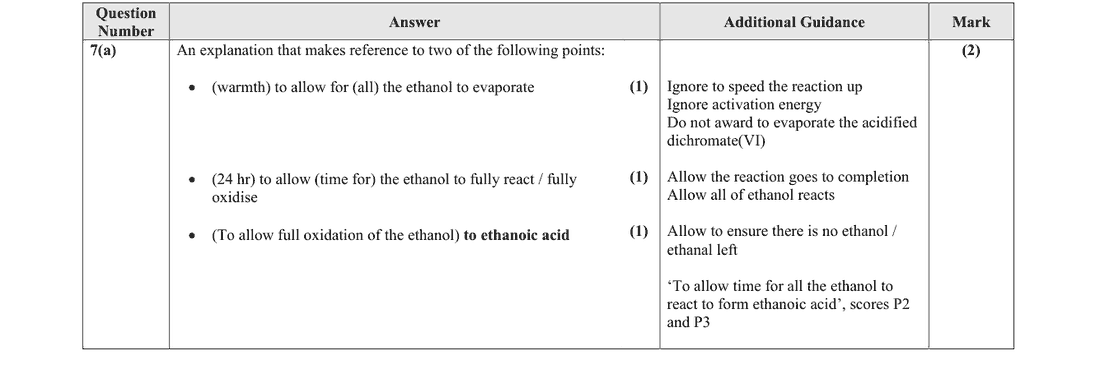
Explain why the apparatus was left in a warm room and for 24 hours.
June 2025 · Paper 3 · Q7(b)(i) 5 marks Calculation redox ii
Earlier part of question 7 that this part usesEarlier part of June 2025 Paper 3 question 7
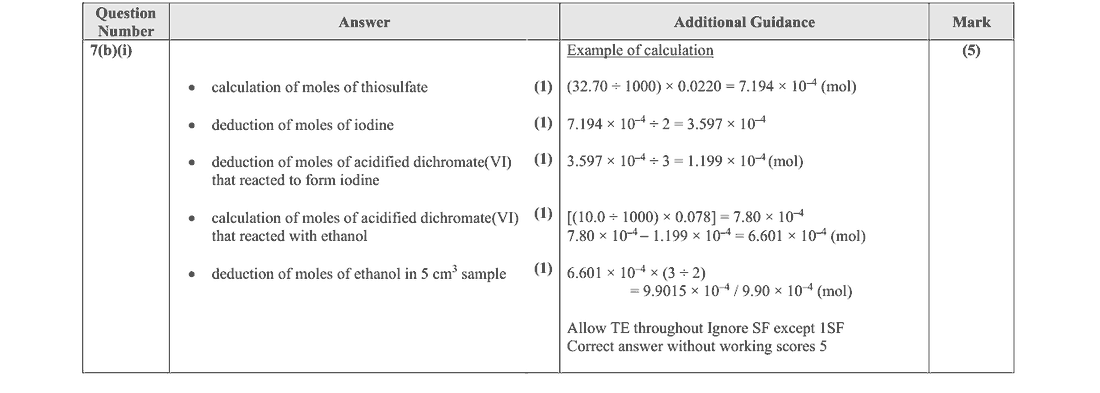
Calculate the number of moles of ethanol in 5 cm3 of the diluted drink.
June 2025 · Paper 3 · Q7(b)(ii) 3 marks Calculation redox iiformulae equations and amounts of substance
Earlier parts of question 7 that this part usesEarlier part of June 2025 Paper 3 question 7Earlier part of June 2025 Paper 3 question 7
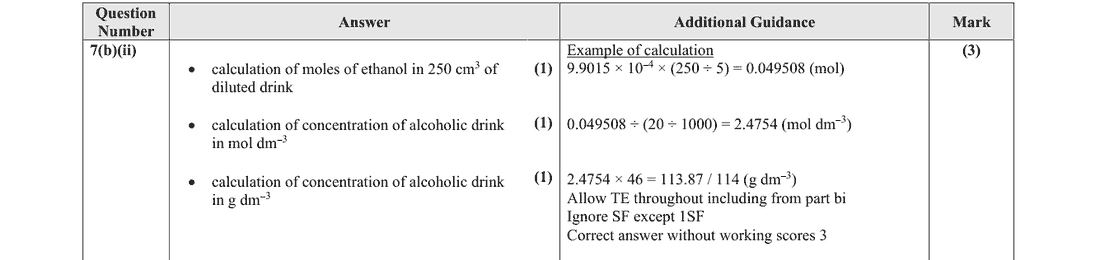
Calculate the concentration of ethanol in the alcoholic drink in g dm−3.
June 2025 · Paper 3 · Q7(c) 2 marks Practical and data analysis redox iiformulae equations and amounts of substance
Earlier part of question 7 that this part usesEarlier part of June 2025 Paper 3 question 7
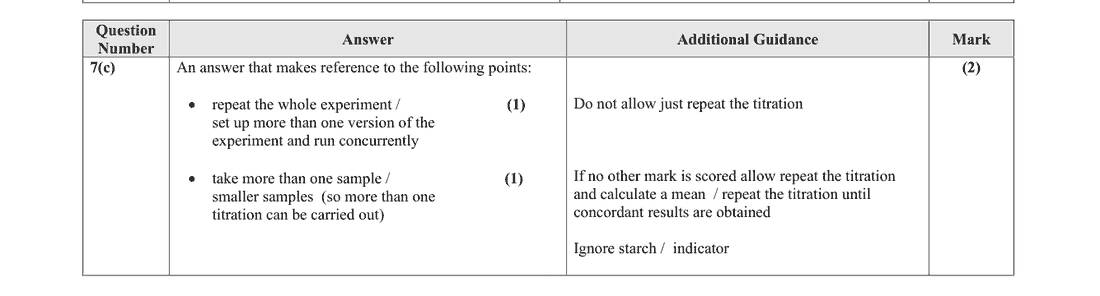
It was suggested that the titration as described might lead to an unreliable result.
State two ways the procedure could be amended to counter this suggestion.
June 2025 · Paper 3 · Q7(d) 2 marks Practical and data analysis alcohols
Earlier part of question 7 that this part usesEarlier part of June 2025 Paper 3 question 7
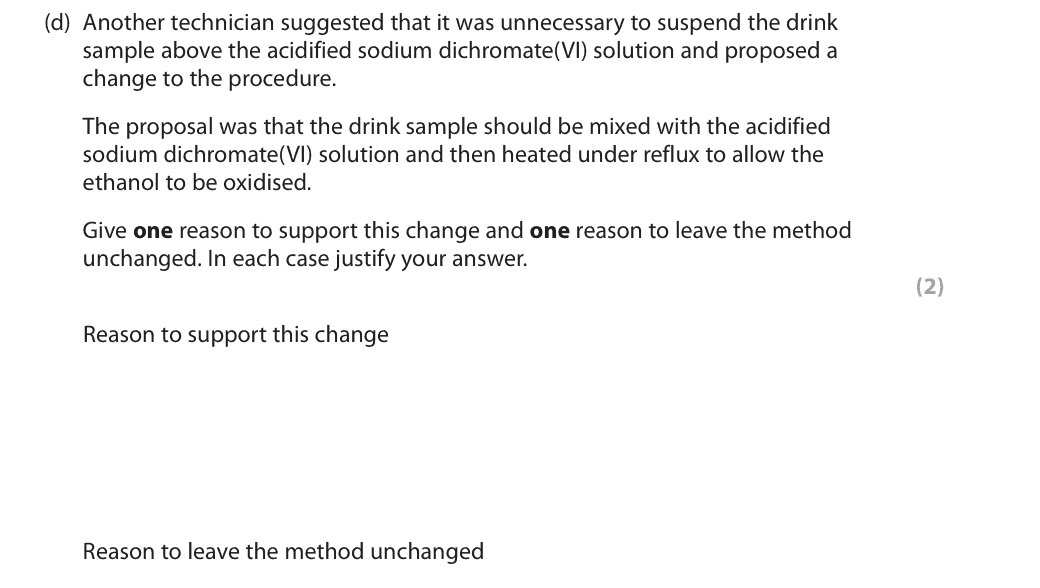
Another technician suggested that it was unnecessary to suspend the drink
sample above the acidified sodium dichromate(VI) solution and proposed a
change to the procedure.
The proposal was that the drink sample should be mixed with the acidified
sodium dichromate(VI) solution and then heated under reflux to allow the
ethanol to be oxidised.
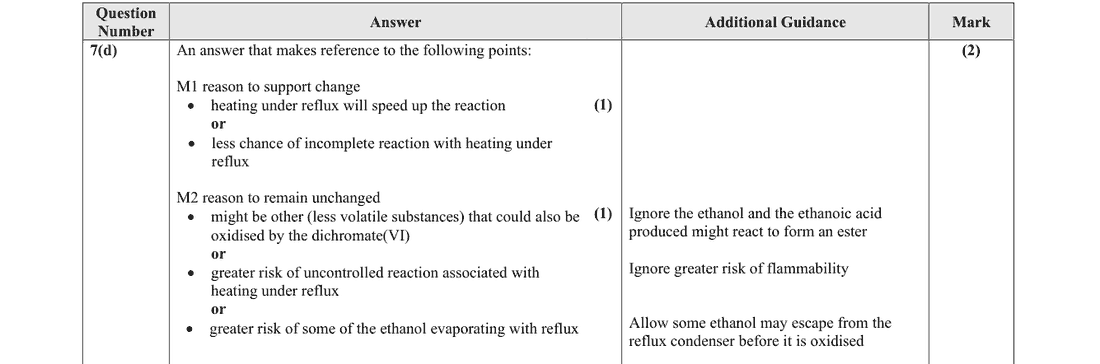
Give one reason to support this change and one reason to leave the method
unchanged. In each case justify your answer.
Reason to support this change
Reason to leave the method unchanged
June 2025 · Paper 3 · Q8(b)(ii) 3 marks Diagram or structure acid base equilibria
Earlier parts of question 8 that this part usesEarlier part of June 2025 Paper 3 question 8Earlier part of June 2025 Paper 3 question 8
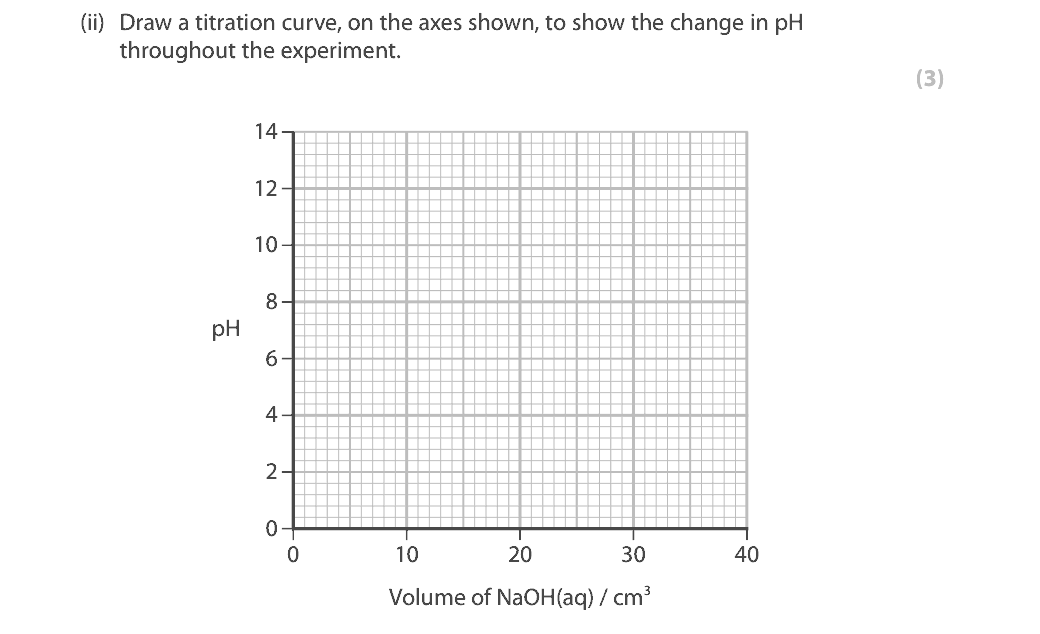
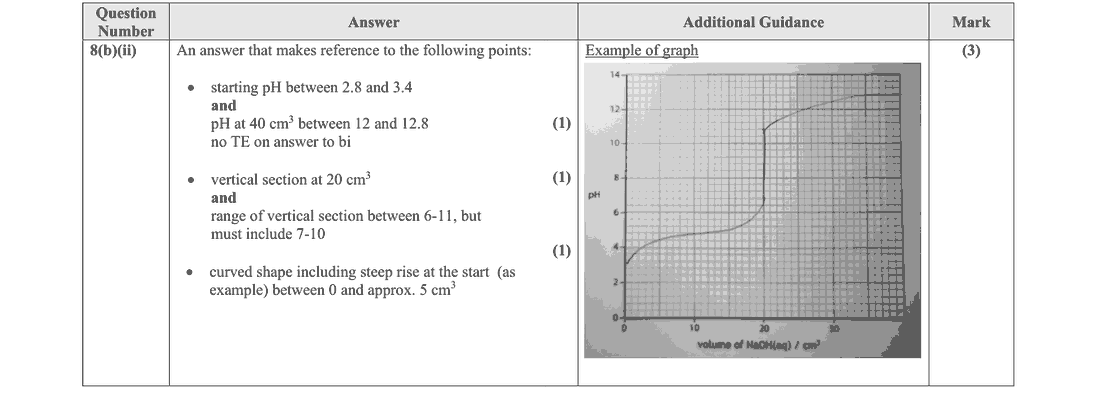
Draw a titration curve, on the axes shown, to show the change in pH
throughout the experiment.
14
12
10
8
pH
6
4
2
0
0
10
20
30
40
Volume of NaOH(aq) / cm3
June 2025 · Paper 3 · Q8(b)(iii) 1 mark Short answer acid base equilibria
Earlier parts of question 8 that this part usesEarlier part of June 2025 Paper 3 question 8Earlier part of June 2025 Paper 3 question 8
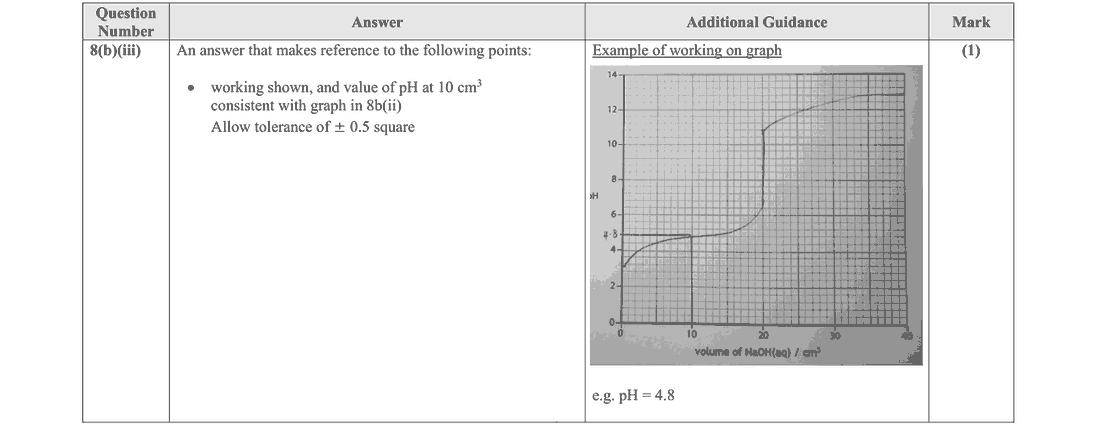
Give an estimate of the pH value at the half-equivalence point.
Show your working on the titration curve.
June 2025 · Paper 3 · Q8(b)(iv) 3 marks Calculation acid base equilibria
Earlier parts of question 8 that this part usesEarlier part of June 2025 Paper 3 question 8Earlier part of June 2025 Paper 3 question 8Earlier part of June 2025 Paper 3 question 8Earlier part of June 2025 Paper 3 question 8
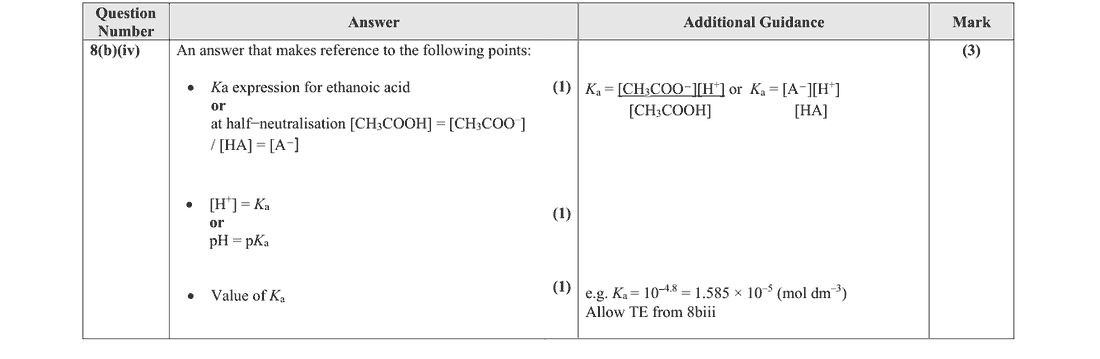
Calculate a value for Ka of ethanoic acid using your answer to (b)(iii).
You must show your working.
June 2025 · Paper 3 · Q8(c) 3 marks Practical and data analysis acid base equilibria
Earlier part of question 8 that this part usesEarlier part of June 2025 Paper 3 question 8
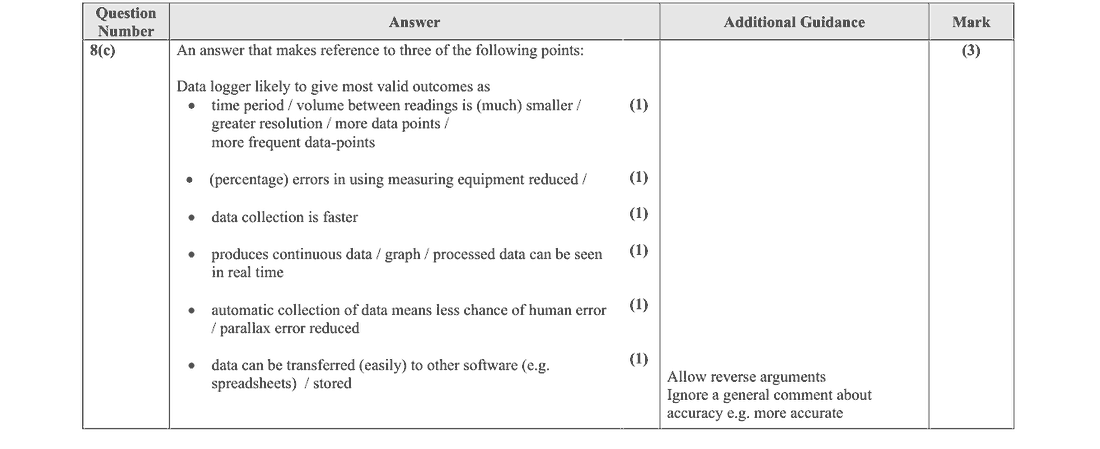
Another method used to monitor the titration is to use a pH meter without a
data logger. The pH is measured and recorded after the addition of each 1.00 cm3
portion of NaOH(aq).
A student assessed the two methods and concluded that using the data logger
was a more effective way to carry out the experiment.
Give three reasons that support this conclusion.
June 2025 · Paper 3 · Q9(b)(i) 3 marks Practical and data analysis organic synthesis
Earlier part of question 9 that this part usesEarlier part of June 2025 Paper 3 question 9
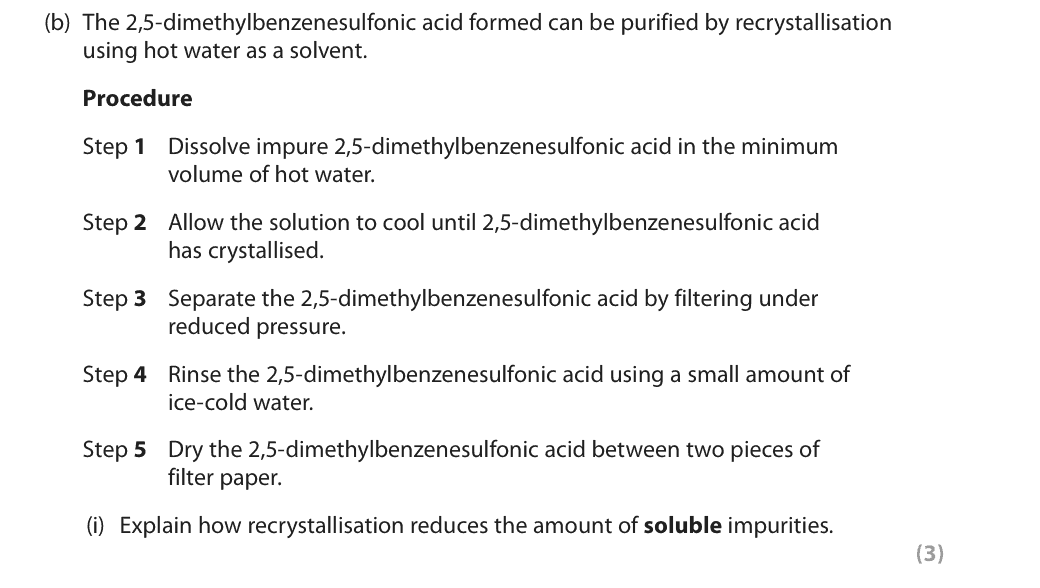
The 2,5-dimethylbenzenesulfonic acid formed can be purified by recrystallisation
using hot water as a solvent.
Procedure
Step 1  Dissolve impure 2,5-dimethylbenzenesulfonic acid in the minimum
volume of hot water.
Step 2  Allow the solution to cool until 2,5-dimethylbenzenesulfonic acid
has crystallised.
Step 3  Separate the 2,5-dimethylbenzenesulfonic acid by filtering under
reduced pressure.
Step 4  Rinse the 2,5-dimethylbenzenesulfonic acid using a small amount of
ice‑cold water.
Step 5  Dry the 2,5-dimethylbenzenesulfonic acid between two pieces of
filter paper.
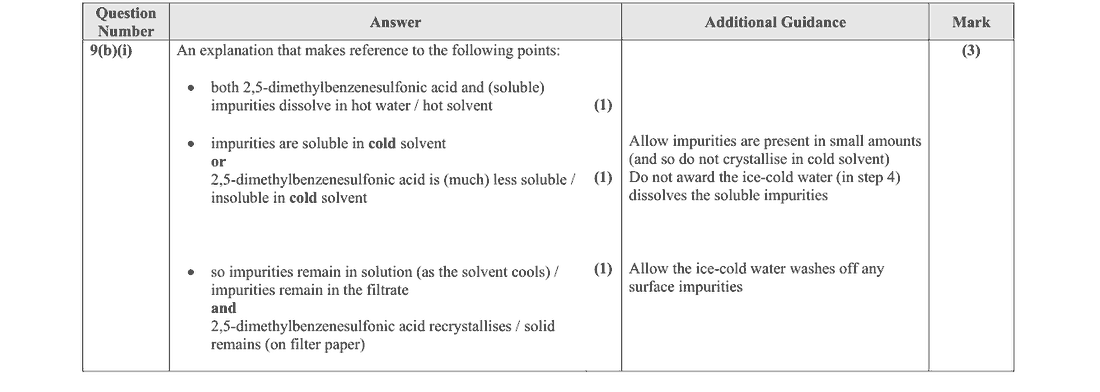
Explain how recrystallisation reduces the amount of soluble impurities.
June 2025 · Paper 3 · Q9(b)(ii) 2 marks Practical and data analysis organic synthesis
Earlier parts of question 9 that this part usesEarlier part of June 2025 Paper 3 question 9Earlier part of June 2025 Paper 3 question 9
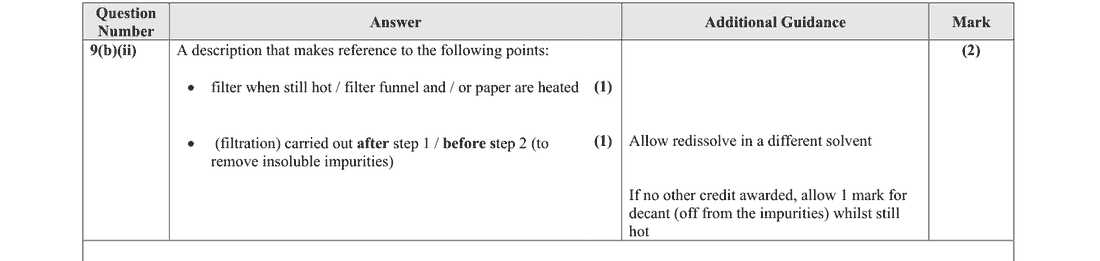
A student carrying out this procedure noticed some insoluble impurities in
their sample.
Describe how the procedure should be amended to remove these
insoluble impurities.
June 2025 · Paper 3 · Q9(c)(i) 4 marks Practical and data analysis formulae equations and amounts of substance
Earlier part of question 9 that this part usesEarlier part of June 2025 Paper 3 question 9
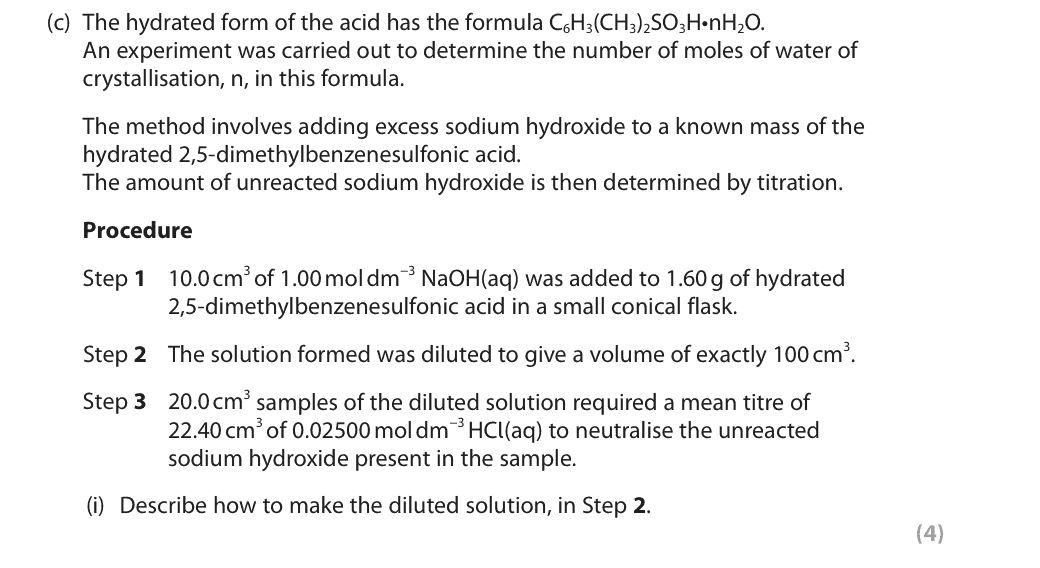
The hydrated form of the acid has the formula C6H3(CH3)2SO3H•nH2O.
An experiment was carried out to determine the number of moles of water of
crystallisation, n, in this formula.
The method involves adding excess sodium hydroxide to a known mass of the
hydrated 2,5-dimethylbenzenesulfonic acid.
The amount of unreacted sodium hydroxide is then determined by titration.
Procedure
Step 1  10.0 cm3 of 1.00 mol dm−3 NaOH(aq) was added to 1.60 g of hydrated
2,5-dimethylbenzenesulfonic acid in a small conical flask.
Step 2  The solution formed was diluted to give a volume of exactly 100 cm3.
Step 3  20.0 cm3 samples of the diluted solution required a mean titre of
22.40 cm3 of 0.02500 mol dm−3 HCl(aq) to neutralise the unreacted
sodium hydroxide present in the sample.
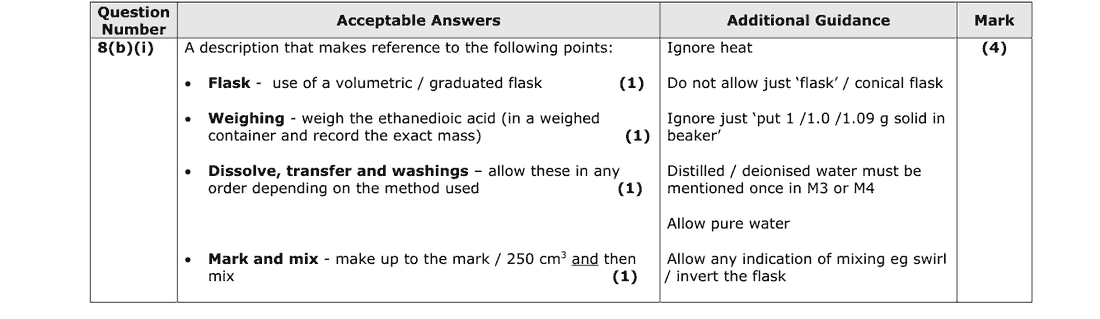
Describe how to make the diluted solution, in Step 2.
June 2025 · Paper 3 · Q9(c)(ii) 5 marks Calculation formulae equations and amounts of substance
Earlier parts of question 9 that this part usesEarlier part of June 2025 Paper 3 question 9Earlier part of June 2025 Paper 3 question 9
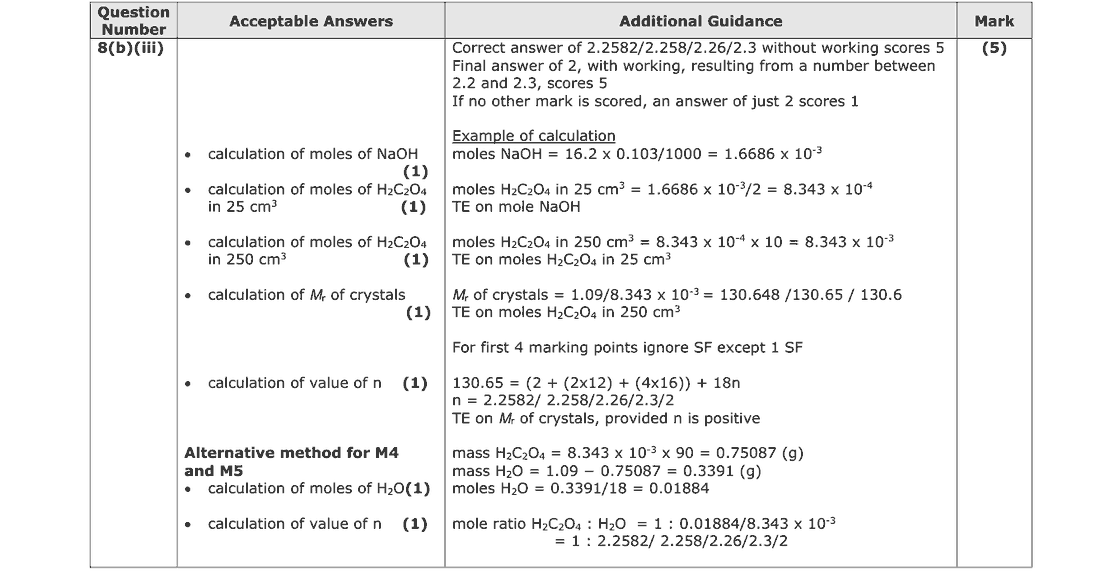
Calculate the relative formula mass of hydrated
2,5-dimethylbenzenesulfonic acid and hence deduce the value of n.
June 2025 · Paper 3 · Q9(d)(i) 1 mark Practical and data analysis formulae equations and amounts of substance
Earlier part of question 9 that this part usesEarlier part of June 2025 Paper 3 question 9
A student carrying out this experiment used a funnel as shown to try to ensure
the acid was added safely to the burette during the titration.
Give one change to this technique that would reduce the risk to this student.
June 2025 · Paper 3 · Q9(d)(ii) 3 marks Practical and data analysis formulae equations and amounts of substance
Earlier parts of question 9 that this part usesEarlier part of June 2025 Paper 3 question 9Earlier part of June 2025 Paper 3 question 9
The student forgot to remove the funnel from the burette and during the
titration five drops of acid from the funnel dripped into the burette.
Explain what effect, if any, this error will have on the final value for n.
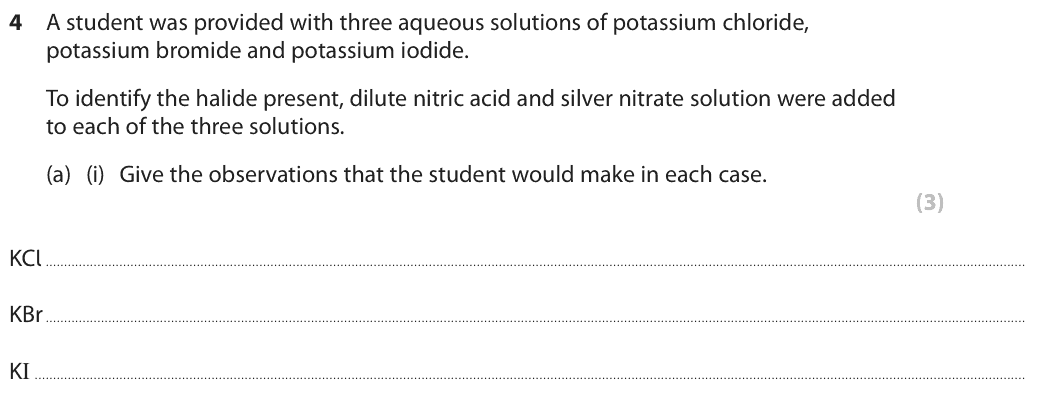
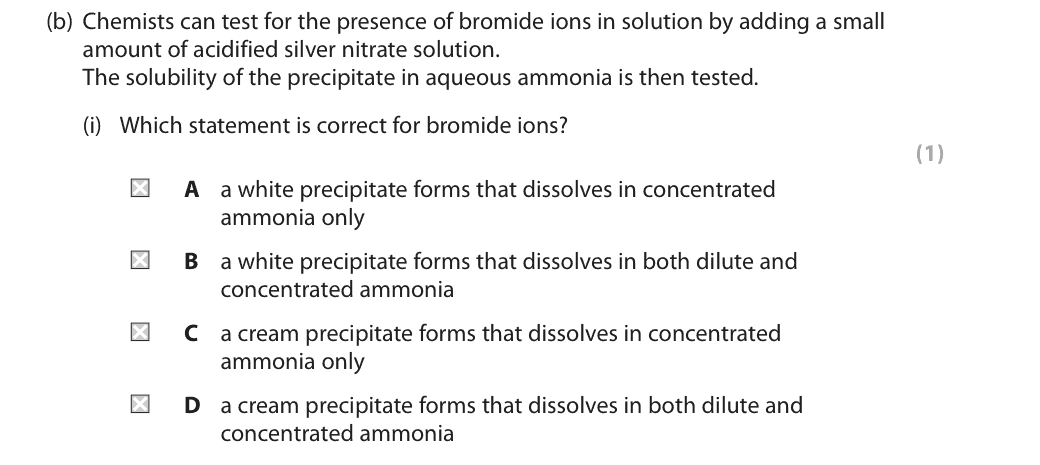
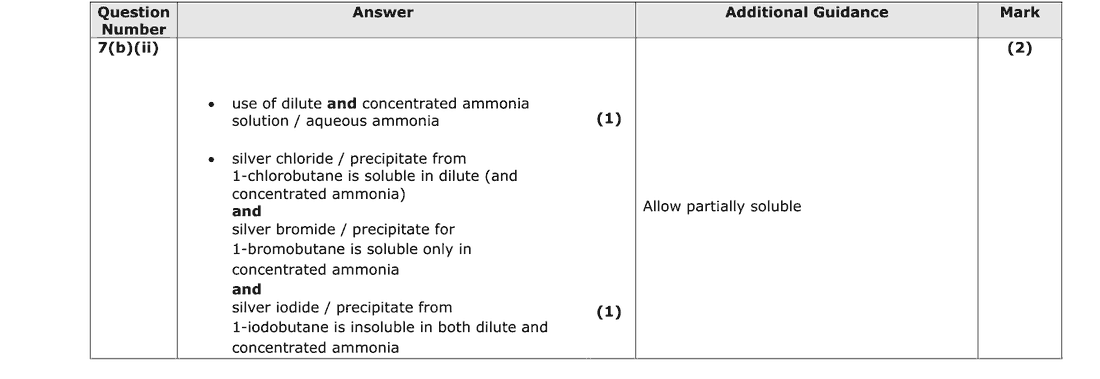
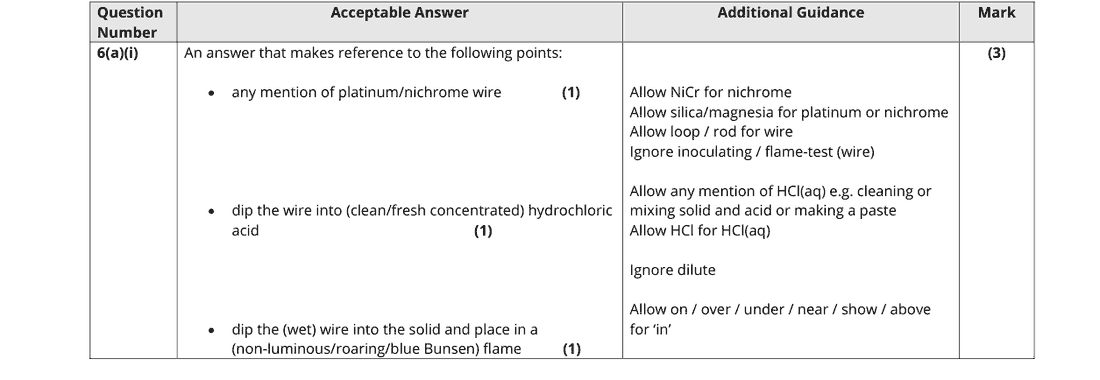
June 2024 · AS Paper 1 · Q4(a)(i) 3 marks Practical and data analysis group 7 the halogens
A student was provided with three aqueous solutions of potassium chloride,
potassium bromide and potassium iodide.
To identify the halide present, dilute nitric acid and silver nitrate solution were added
to each of the three solutions.
Give the observations that the student would make in each case.
KCl . 
KBr
KI
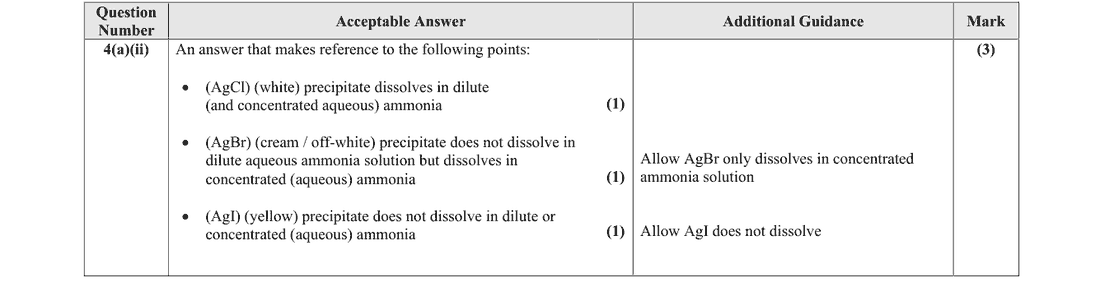
June 2024 · AS Paper 1 · Q4(a)(ii) 3 marks Practical and data analysis group 7 the halogens
Earlier part of question 4 that this part usesEarlier part of June 2024 Paper 1 question 4
Describe how the student could confirm the halide ions present in the
products of (a)(i) by adding ammonia solutions.
June 2024 · AS Paper 1 · Q4(b)(i) 1 mark Practical and data analysis group 7 the halogens
Earlier part of question 4 that this part usesEarlier part of June 2024 Paper 1 question 4
Nitric acid removes other ions that would interfere with the halide test,
for example carbonate ions.
State the observation when silver nitrate is added to a solution of
carbonate ions in the absence of nitric acid.
June 2024 · AS Paper 1 · Q4(b)(ii) 1 mark Practical and data analysis analysis of inorganic compounds
Earlier parts of question 4 that this part usesEarlier part of June 2024 Paper 1 question 4Earlier part of June 2024 Paper 1 question 4
State the observation when nitric acid is added to a solution of
carbonate ions.
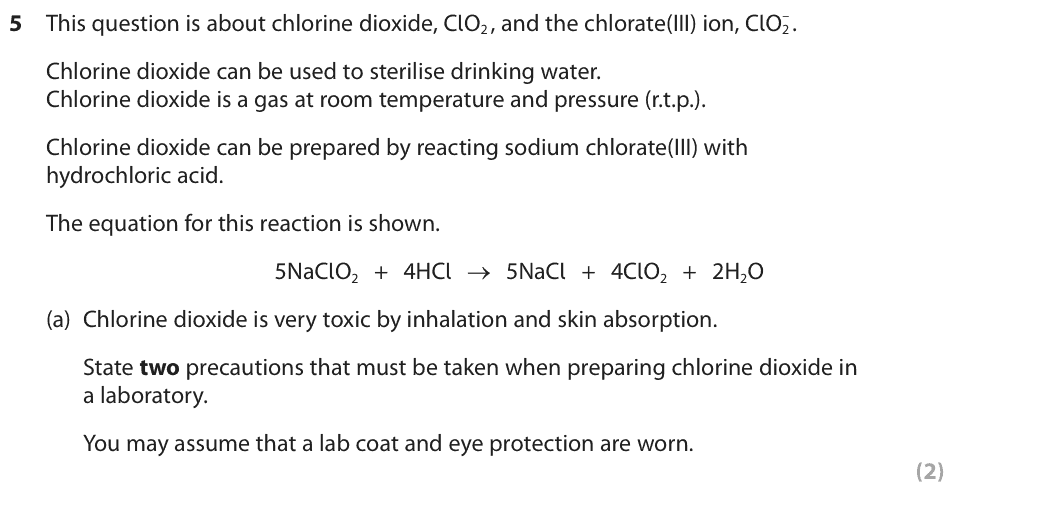
June 2024 · AS Paper 1 · Q5(a) 2 marks Practical and data analysis formulae equations and amounts of substance
This question is about chlorine dioxide, ClO2 , and the chlorate(III) ion, ClO2
– .
Chlorine dioxide can be used to sterilise drinking water.
Chlorine dioxide is a gas at room temperature and pressure (r.t.p.).
Chlorine dioxide can be prepared by reacting sodium chlorate(III) with
hydrochloric acid.
The equation for this reaction is shown.
5NaClO2   +   4HCl   →   5NaCl   +   4ClO2   +   2H2O
Chlorine dioxide is very toxic by inhalation and skin absorption.
State two precautions that must be taken when preparing chlorine dioxide in
a laboratory.
You may assume that a lab coat and eye protection are worn.
June 2024 · AS Paper 1 · Q7(b)(i) 1 mark Practical and data analysis Hard groups 1 and 2
Earlier part of question 7 that this part usesEarlier part of June 2024 Paper 1 question 7
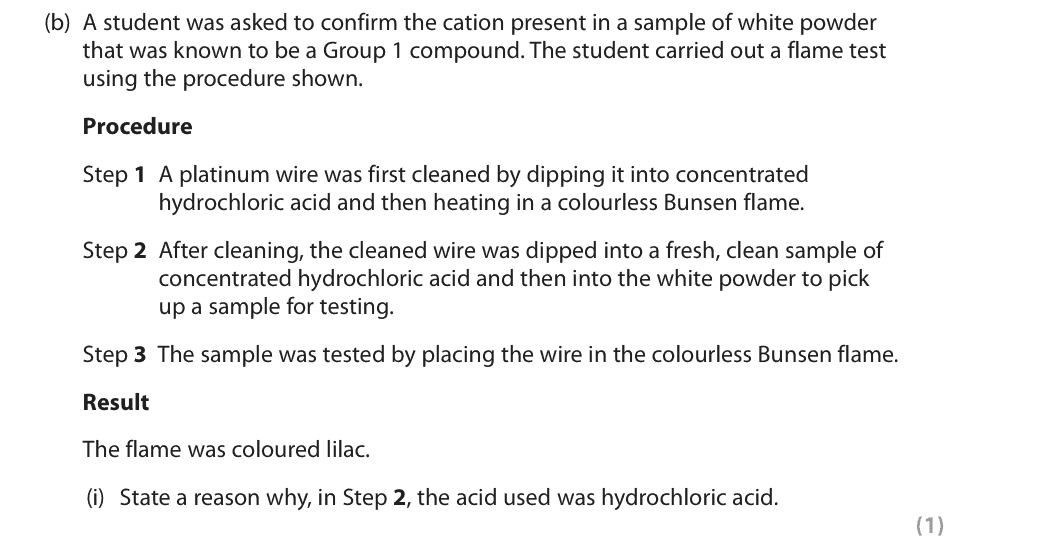
A student was asked to confirm the cation present in a sample of white powder
that was known to be a Group 1 compound. The student carried out a flame test
using the procedure shown.
Procedure
Step 1  A platinum wire was first cleaned by dipping it into concentrated
hydrochloric acid and then heating in a colourless Bunsen flame.
Step 2  After cleaning, the cleaned wire was dipped into a fresh, clean sample of
concentrated hydrochloric acid and then into the white powder to pick
up a sample for testing.
Step 3  The sample was tested by placing the wire in the colourless Bunsen flame.
Result
The flame was coloured lilac.
State a reason why, in Step 2, the acid used was hydrochloric acid.
June 2024 · AS Paper 1 · Q7(b)(ii) 1 mark Practical and data analysis Easy groups 1 and 2
Earlier parts of question 7 that this part usesEarlier part of June 2024 Paper 1 question 7Earlier part of June 2024 Paper 1 question 7
Identify the cation present in this sample of white powder.
June 2024 · AS Paper 1 · Q7(c)(i) 2 marks Diagram or structure Hard groups 1 and 2
Earlier part of question 7 that this part usesEarlier part of June 2024 Paper 1 question 7
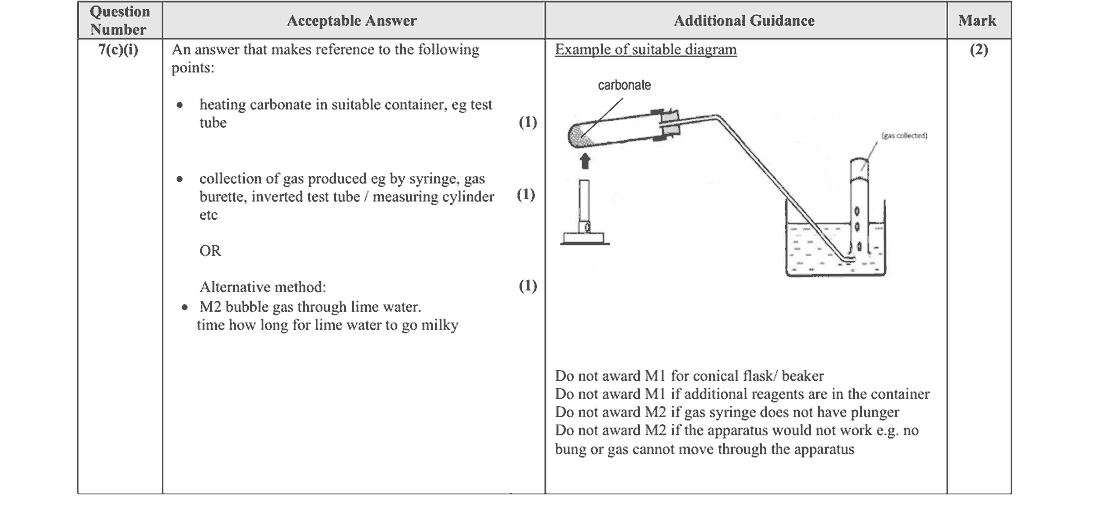
The thermal stability of compounds in Group 2 is investigated.
Draw a labelled diagram of apparatus that would enable you to compare the
thermal stability of Group 2 carbonates.
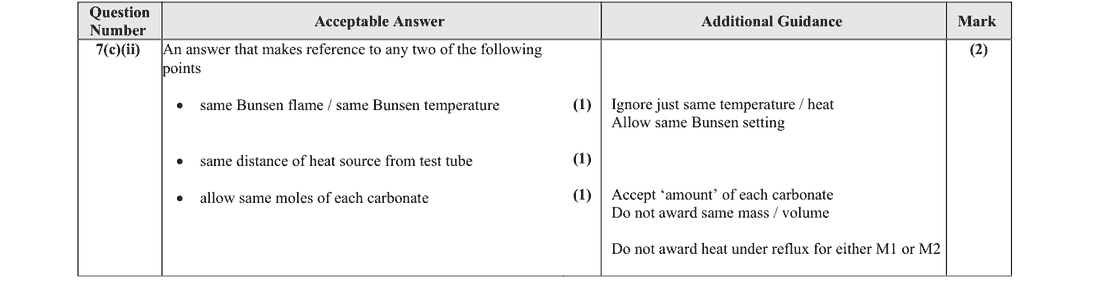
June 2024 · AS Paper 1 · Q7(c)(ii) 2 marks Practical and data analysis Hard groups 1 and 2
Earlier parts of question 7 that this part usesEarlier part of June 2024 Paper 1 question 7Earlier part of June 2024 Paper 1 question 7
State the conditions that must be used with the apparatus shown in your
diagram to ensure that the test is fair.
June 2024 · AS Paper 1 · Q7(c)(iii) 1 mark Practical and data analysis groups 1 and 2
Earlier parts of question 7 that this part usesEarlier part of June 2024 Paper 1 question 7Earlier part of June 2024 Paper 1 question 7Earlier part of June 2024 Paper 1 question 7
State what data could be obtained in this experiment to compare
thermal stability.
June 2024 · AS Paper 2 · Q1(b)(ii) 1 mark Calculation formulae equations and amounts of substance
Earlier parts of question 1 that this part usesEarlier part of June 2024 Paper 2 question 1Earlier part of June 2024 Paper 2 question 1
The final burette reading for the rough titration was 26.50 cm3.
Calculate the volume of sodium hydroxide solution added in the
rough titration, using your answer to (b)(i).
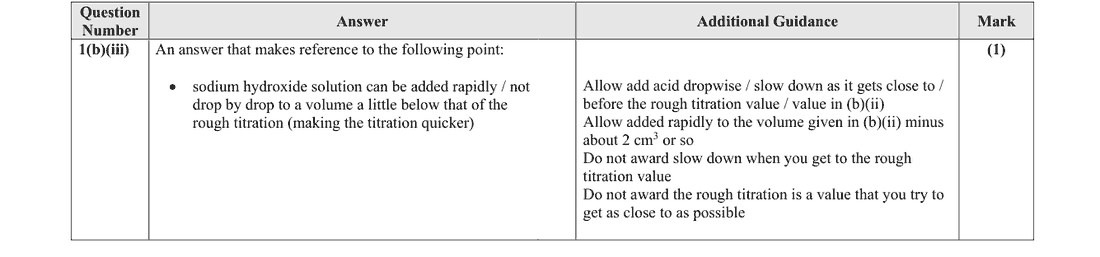
June 2024 · AS Paper 2 · Q1(b)(iii) 1 mark Practical and data analysis Hard formulae equations and amounts of substance
Earlier parts of question 1 that this part usesEarlier part of June 2024 Paper 2 question 1Earlier part of June 2024 Paper 2 question 1
Describe how you would use the rough titration value when carrying out the
accurate titrations.
June 2024 · AS Paper 2 · Q1(c)(i) 1 mark Calculation formulae equations and amounts of substance
Earlier part of question 1 that this part usesEarlier part of June 2024 Paper 2 question 1
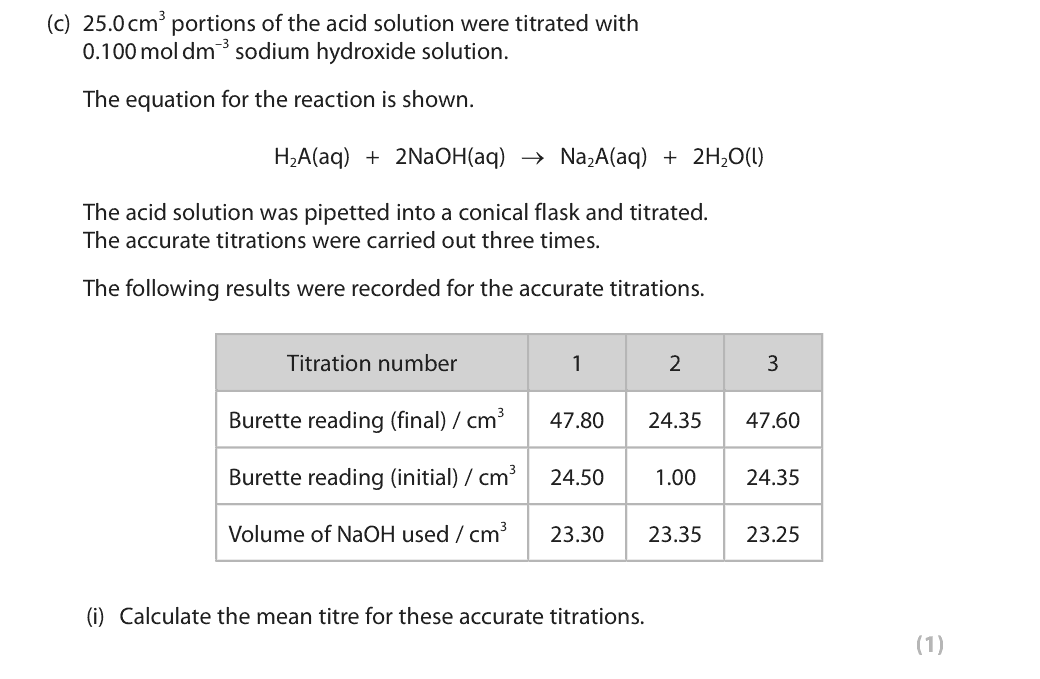
25.0 cm3 portions of the acid solution were titrated with
0.100 mol dm–3 sodium hydroxide solution.
The equation for the reaction is shown.
H2A(aq)   +   2NaOH(aq)   →   Na2A(aq)   +   2H2O(l)
The acid solution was pipetted into a conical flask and titrated.
The accurate titrations were carried out three times.
The following results were recorded for the accurate titrations.
Titration number
1
2
3
Burette reading (final) / cm3
47.80
24.35
47.60
Burette reading (initial) / cm3
24.50
1.00
24.35
Volume of NaOH used / cm3
23.30
23.35
23.25
Calculate the mean titre for these accurate titrations.
June 2024 · AS Paper 2 · Q1(c)(ii) 1 mark Calculation formulae equations and amounts of substance
Earlier parts of question 1 that this part usesEarlier part of June 2024 Paper 2 question 1Earlier part of June 2024 Paper 2 question 1
Calculate the number of moles of sodium hydroxide in the mean titre.
June 2024 · AS Paper 2 · Q1(c)(iii) 3 marks Calculation formulae equations and amounts of substance
Earlier parts of question 1 that this part usesEarlier part of June 2024 Paper 2 question 1Earlier part of June 2024 Paper 2 question 1
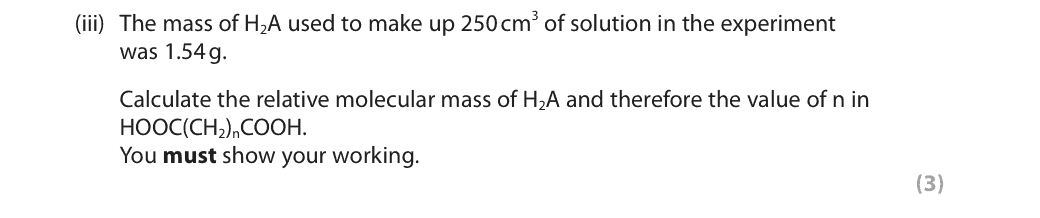
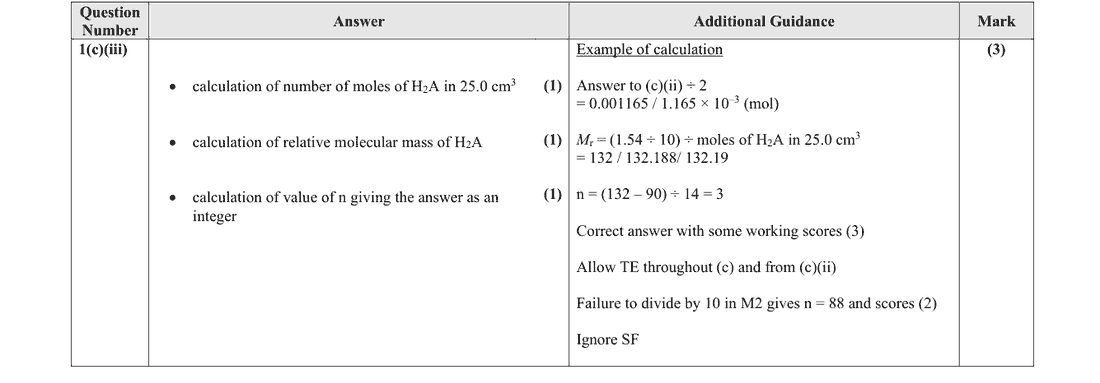
The mass of H2A used to make up 250 cm3 of solution in the experiment
was 1.54 g.
Calculate the relative molecular mass of H2A and therefore the value of n in
HOOC(CH2)nCOOH.
You must show your working.
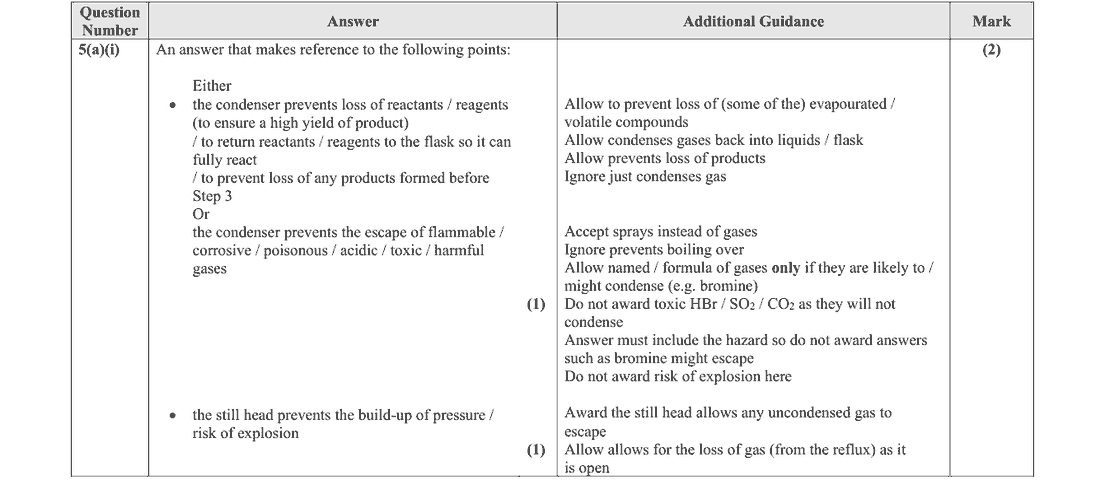
June 2024 · AS Paper 2 · Q5(a)(i) 2 marks Practical and data analysis alcohols
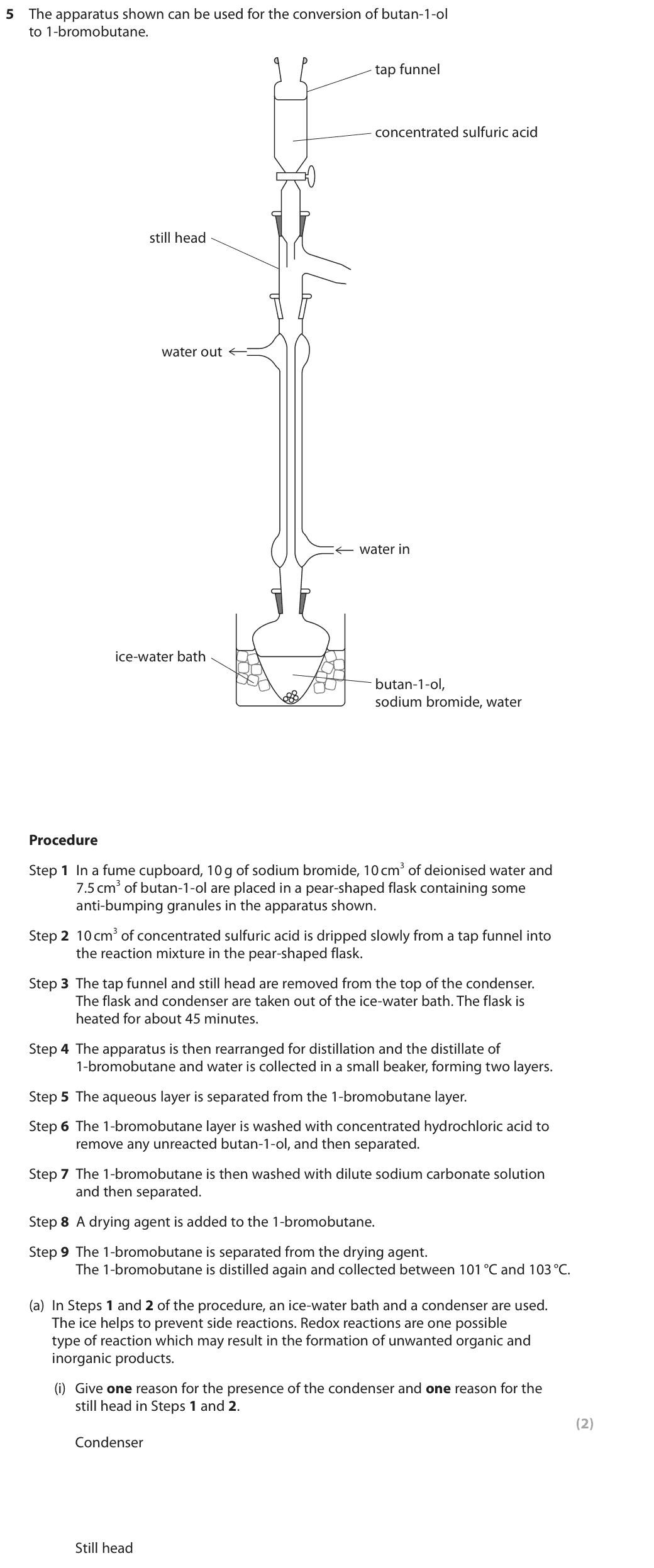
The apparatus shown can be used for the conversion of butan‑1‑ol
to 1‑bromobutane.
tap funnel
concentrated sulfuric acid
still head
water out
water in
ice‑water bath
butan‑1‑ol,
sodium bromide, water
Procedure
Step 1  In a fume cupboard, 10 g of sodium bromide, 10 cm3 of deionised water and
7.5 cm3 of butan‑1‑ol are placed in a pear‑shaped flask containing some
anti‑bumping granules in the apparatus shown.
Step 2  10 cm3 of concentrated sulfuric acid is dripped slowly from a tap funnel into
the reaction mixture in the pear‑shaped flask.
Step 3  The tap funnel and still head are removed from the top of the condenser.
The flask and condenser are taken out of the ice‑water bath. The flask is
heated for about 45 minutes.
Step 4  The apparatus is then rearranged for distillation and the distillate of
1‑bromobutane and water is collected in a small beaker, forming two layers.
Step 5  The aqueous layer is separated from the 1‑bromobutane layer.
Step 6  The 1‑bromobutane layer is washed with concentrated hydrochloric acid to
remove any unreacted butan‑1‑ol, and then separated.
Step 7  The 1‑bromobutane is then washed with dilute sodium carbonate solution
and then separated.
Step 8  A drying agent is added to the 1‑bromobutane.
Step 9  The 1‑bromobutane is separated from the drying agent.
The 1‑bromobutane is distilled again and collected between 101 °C and 103 °C.
In Steps 1 and 2 of the procedure, an ice‑water bath and a condenser are used.
The ice helps to prevent side reactions. Redox reactions are one possible
type of reaction which may result in the formation of unwanted organic and
inorganic products.
Give one reason for the presence of the condenser and one reason for the
still head in Steps 1 and 2.
Condenser
Still head
June 2024 · AS Paper 2 · Q5(b) 3 marks Practical and data analysis alcohols
Earlier part of question 5 that this part usesEarlier part of June 2024 Paper 2 question 5
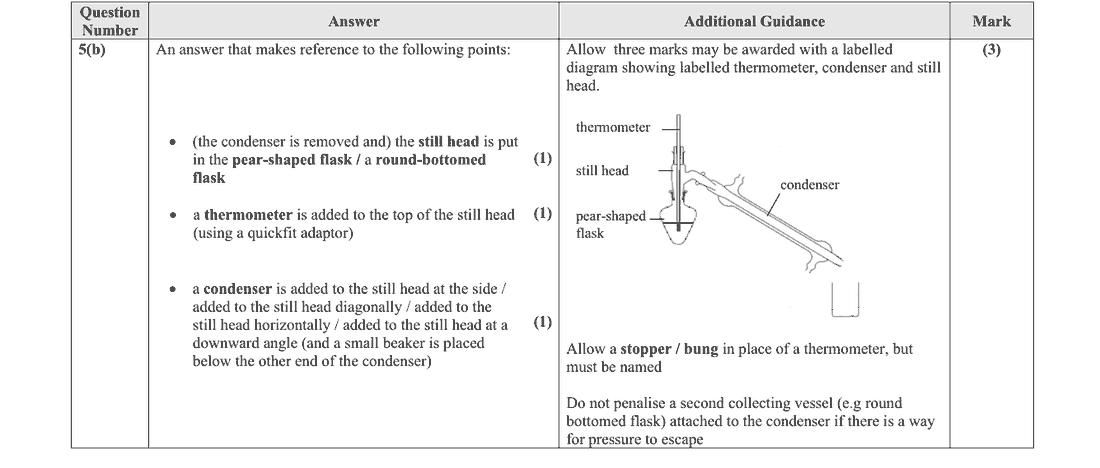
Describe how the apparatus is rearranged for distillation, including the name of
any additional apparatus required.
June 2024 · AS Paper 2 · Q5(c)(i) 1 mark Diagram or structure alcohols
Earlier part of question 5 that this part usesEarlier part of June 2024 Paper 2 question 5
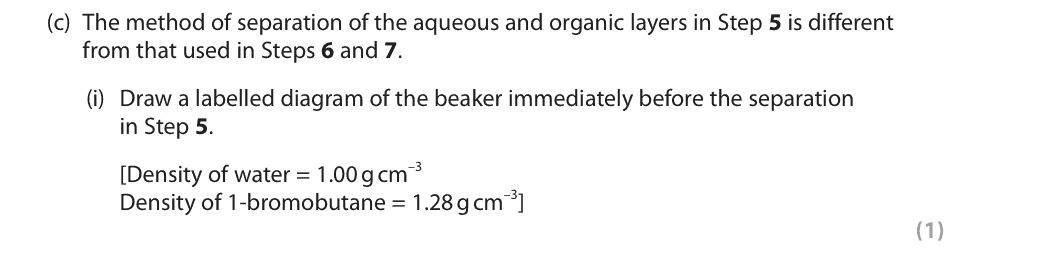
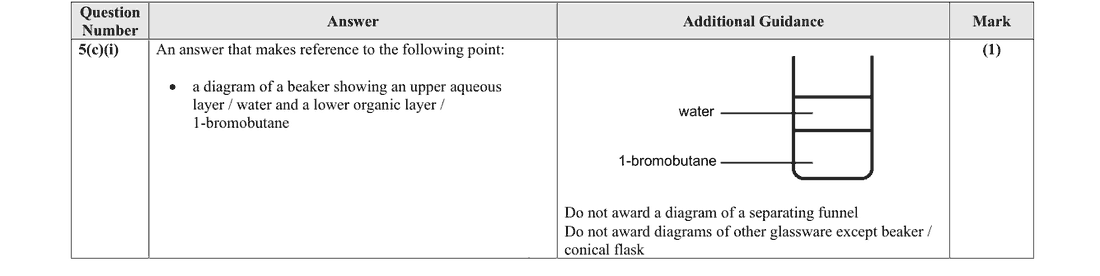
The method of separation of the aqueous and organic layers in Step 5 is different
from that used in Steps 6 and 7.
Draw a labelled diagram of the beaker immediately before the separation
in Step 5.
[Density of water = 1.00 g cm–3
Density of 1‑bromobutane = 1.28 g cm–3]
June 2024 · AS Paper 2 · Q5(c)(ii) 1 mark Practical and data analysis alcohols
Earlier parts of question 5 that this part usesEarlier part of June 2024 Paper 2 question 5Earlier part of June 2024 Paper 2 question 5
Describe how the aqueous layer can be removed from the beaker in Step 5.
June 2024 · AS Paper 2 · Q5(c)(iii) 1 mark Practical and data analysis alcohols
Earlier parts of question 5 that this part usesEarlier part of June 2024 Paper 2 question 5Earlier part of June 2024 Paper 2 question 5
Name the piece of apparatus used to separate the organic layer in
Steps 6 and 7.
June 2024 · AS Paper 2 · Q6(a) 1 mark Practical and data analysis formulae equations and amounts of substance
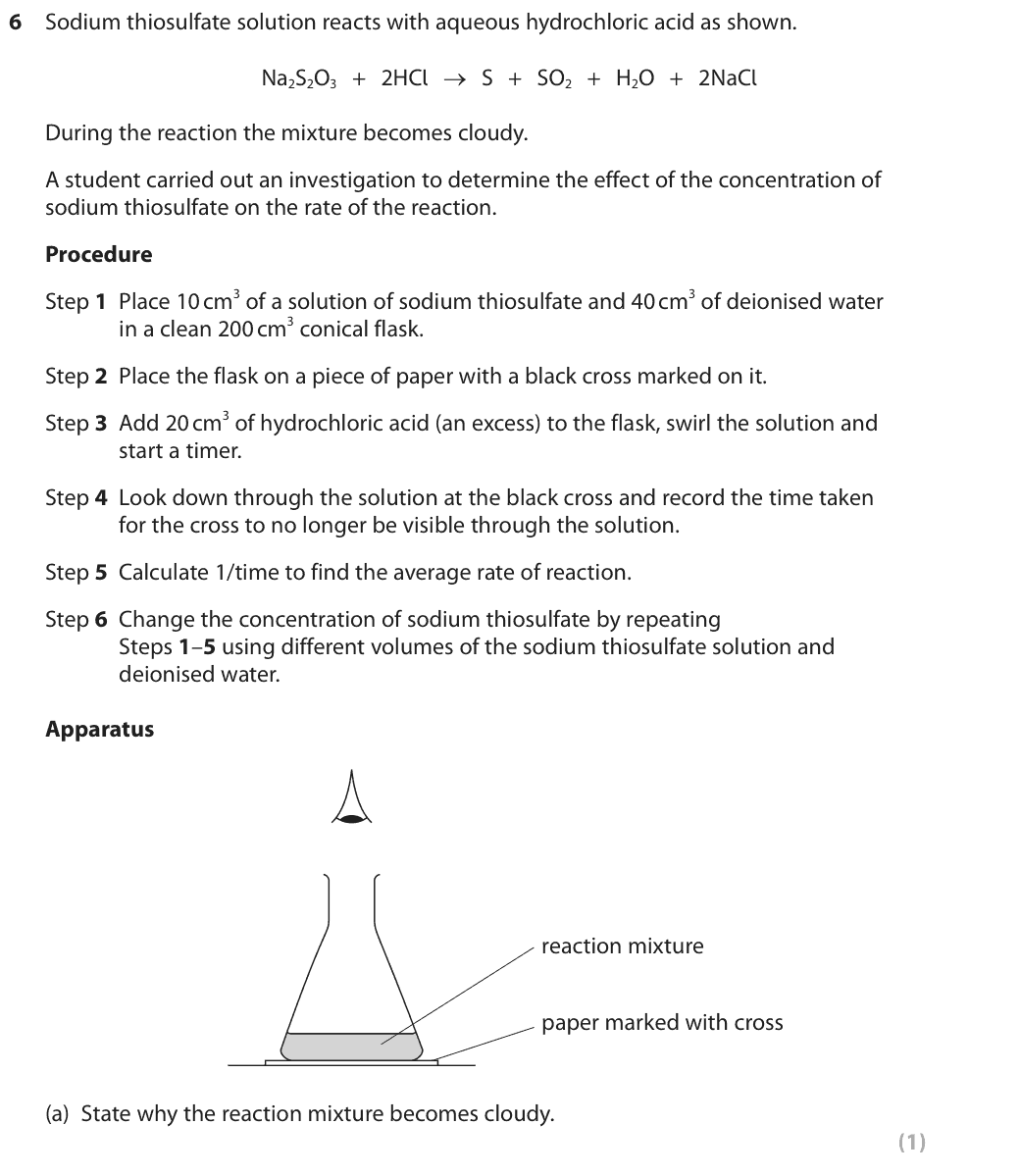
Sodium thiosulfate solution reacts with aqueous hydrochloric acid as shown.
Na2S2O3   +   2HCl   →   S   +   SO2   +   H2O   +   2NaCl
During the reaction the mixture becomes cloudy.
A student carried out an investigation to determine the effect of the concentration of
sodium thiosulfate on the rate of the reaction.
Procedure
Step 1  Place 10 cm3 of a solution of sodium thiosulfate and 40 cm3 of deionised water
in a clean 200 cm3 conical flask.
Step 2  Place the flask on a piece of paper with a black cross marked on it.
Step 3  Add 20 cm3 of hydrochloric acid (an excess) to the flask, swirl the solution and
start a timer.
Step 4  Look down through the solution at the black cross and record the time taken
for the cross to no longer be visible through the solution.
Step 5  Calculate 1/time to find the average rate of reaction.
Step 6  Change the concentration of sodium thiosulfate by repeating
Steps 1–5 using different volumes of the sodium thiosulfate solution and
deionised water.
Apparatus
reaction mixture
paper marked with cross
State why the reaction mixture becomes cloudy.
June 2024 · AS Paper 2 · Q6(b)(ii) 1 mark Practical and data analysis Hard kinetics i
Earlier parts of question 6 that this part usesEarlier part of June 2024 Paper 2 question 6Earlier part of June 2024 Paper 2 question 6
State why water is added in Experiments 1 to 4, but not in Experiment 5.
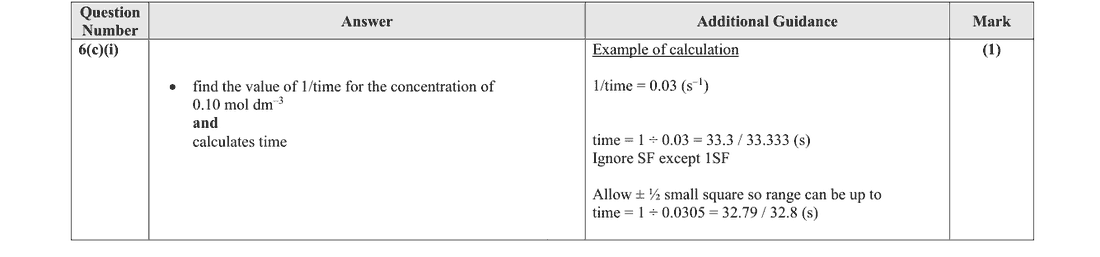
June 2024 · AS Paper 2 · Q6(c)(i) 1 mark Calculation kinetics i
Earlier part of question 6 that this part usesEarlier part of June 2024 Paper 2 question 6
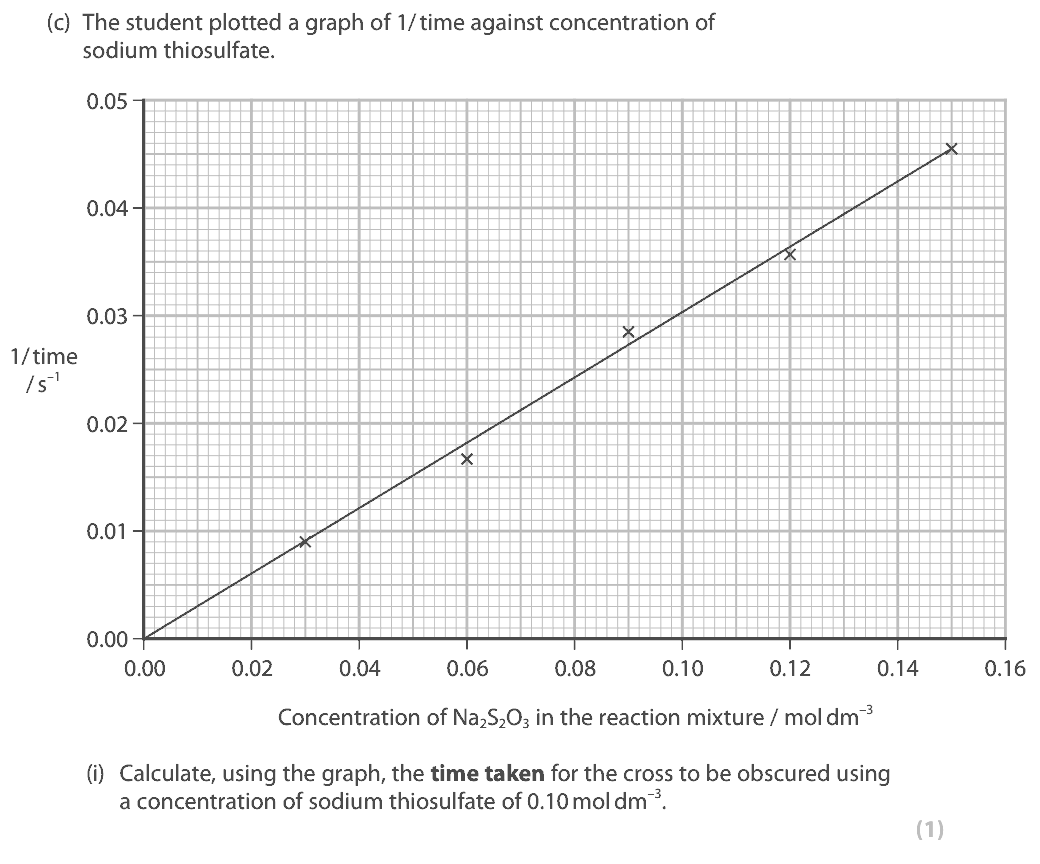
The student plotted a graph of 1/ time against concentration of
sodium thiosulfate.
0.05
0.04
0.03
1/ time
/ s–1
0.02
0.01
0.00
0.00
0.02
0.04
0.06
0.08
0.10
0.12
0.14
0.16
Concentration of Na2S2O3 in the reaction mixture / mol dm–3
Calculate, using the graph, the time taken for the cross to be obscured using
a concentration of sodium thiosulfate of 0.10 mol dm–3.
June 2024 · AS Paper 2 · Q6(c)(ii) 1 mark Short answer Hard kinetics i
Earlier parts of question 6 that this part usesEarlier part of June 2024 Paper 2 question 6Earlier part of June 2024 Paper 2 question 6
State and justify the relationship between the rate of reaction and the
concentration of sodium thiosulfate as shown by the graph.
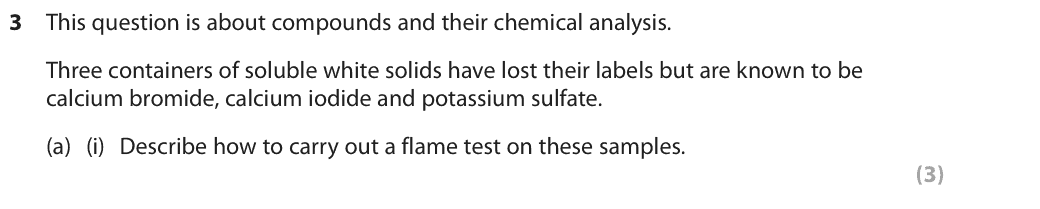
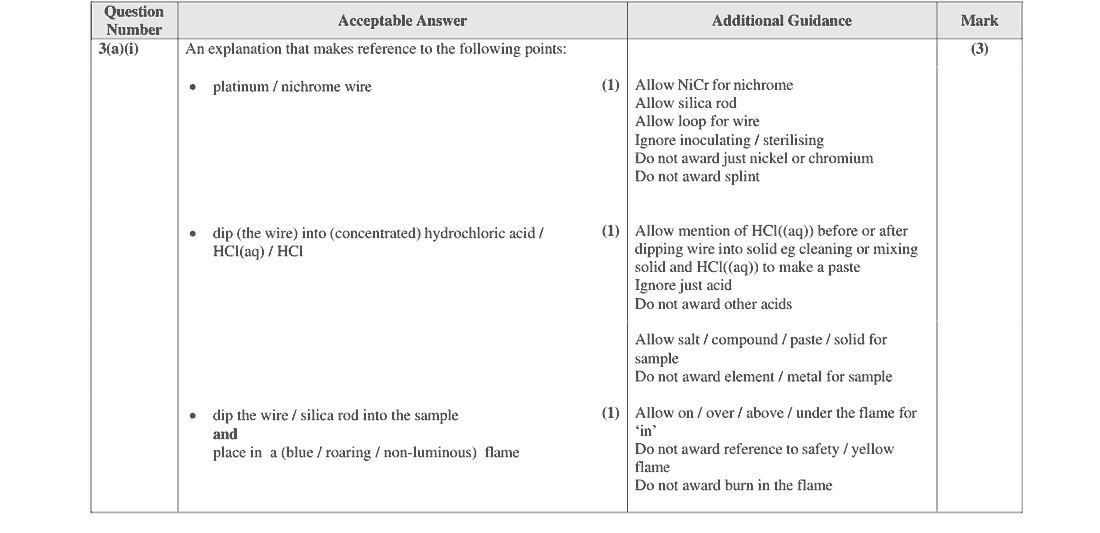
June 2024 · Paper 1 · Q3(a)(i) 3 marks Practical and data analysis groups 1 and 2
This question is about compounds and their chemical analysis.
Three containers of soluble white solids have lost their labels but are known to be
calcium bromide, calcium iodide and potassium sulfate.
Describe how to carry out a flame test on these samples.
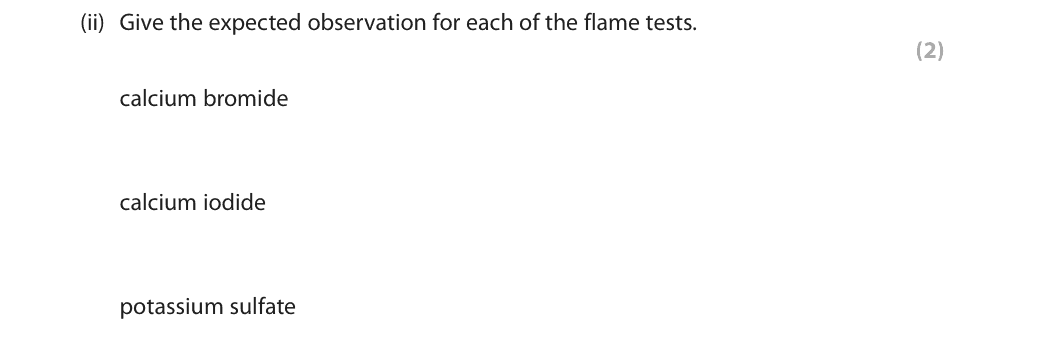
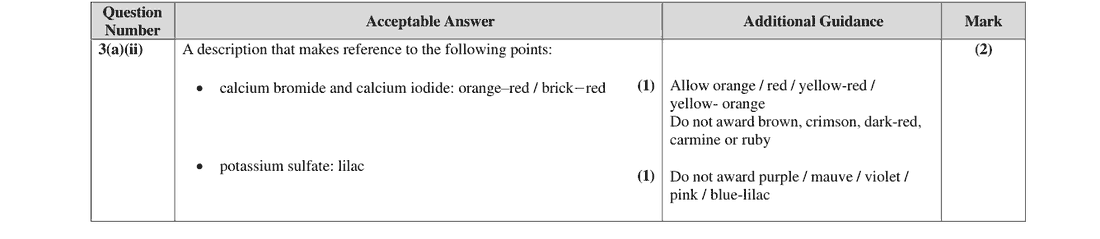
June 2024 · Paper 1 · Q3(a)(ii) 2 marks Practical and data analysis groups 1 and 2
Earlier part of question 3 that this part usesEarlier part of June 2024 Paper 1 question 3
Give the expected observation for each of the flame tests.
calcium bromide
calcium iodide
potassium sulfate
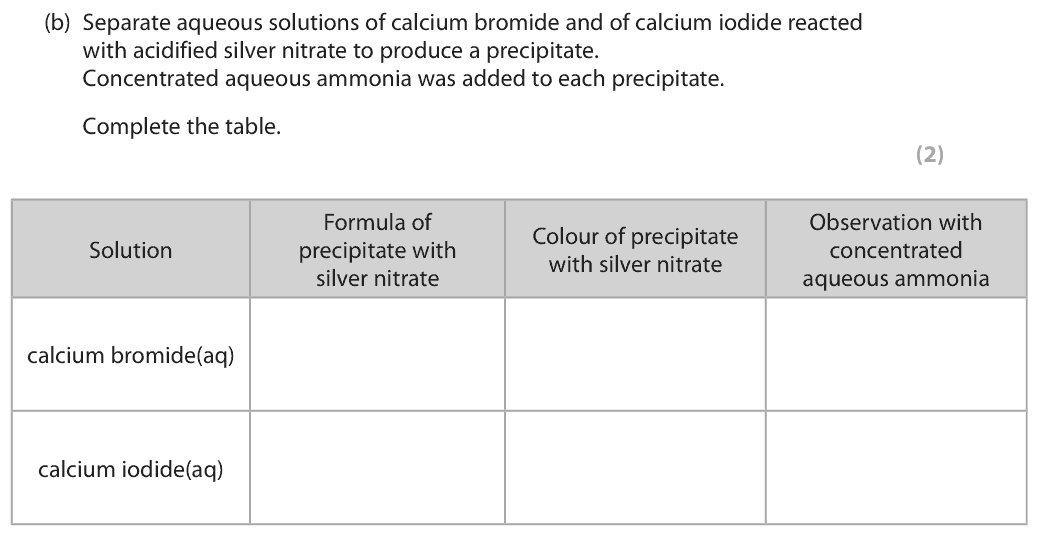
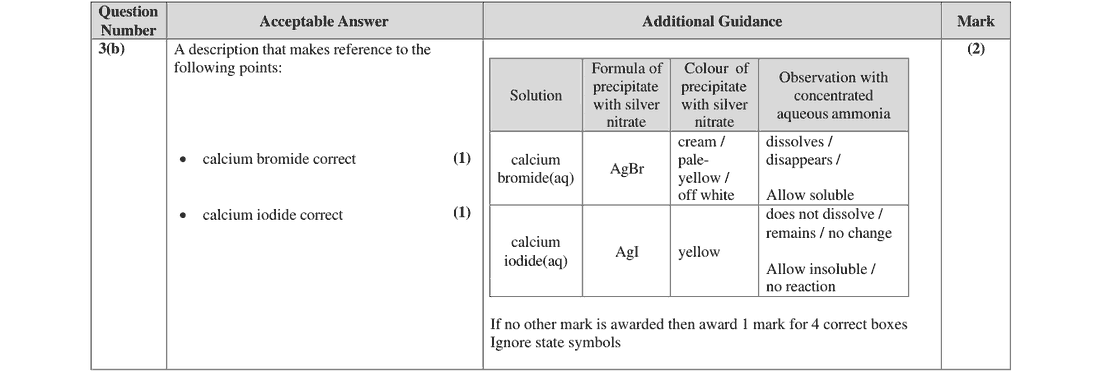
June 2024 · Paper 1 · Q3(b) 2 marks Practical and data analysis group 7 the halogens
Earlier part of question 3 that this part usesEarlier part of June 2024 Paper 1 question 3
Separate aqueous solutions of calcium bromide and of calcium iodide reacted
with acidified silver nitrate to produce a precipitate.
Concentrated aqueous ammonia was added to each precipitate.
Complete the table.
Formula of
Observation with
Colour of precipitate
Solution
precipitate with
concentrated
with silver nitrate
silver nitrate
aqueous ammonia
calcium bromide(aq)
calcium iodide(aq)
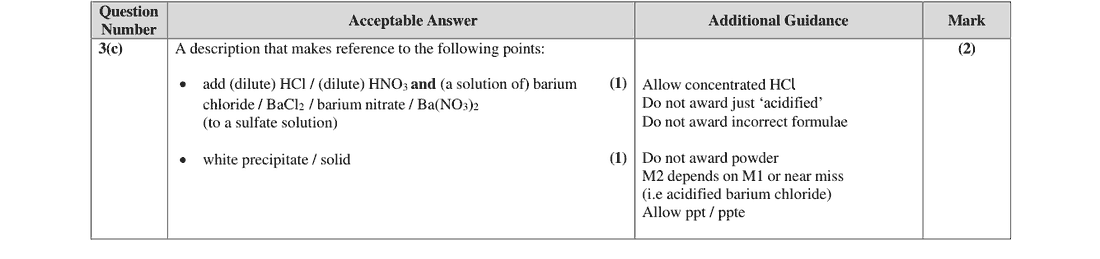
June 2024 · Paper 1 · Q3(c) 2 marks Practical and data analysis analysis of inorganic compounds
Earlier part of question 3 that this part usesEarlier part of June 2024 Paper 1 question 3
Describe a chemical test for the sulfate ion giving the positive result.
June 2024 · Paper 1 · Q10(a) 3 marks Practical and data analysis redox ii
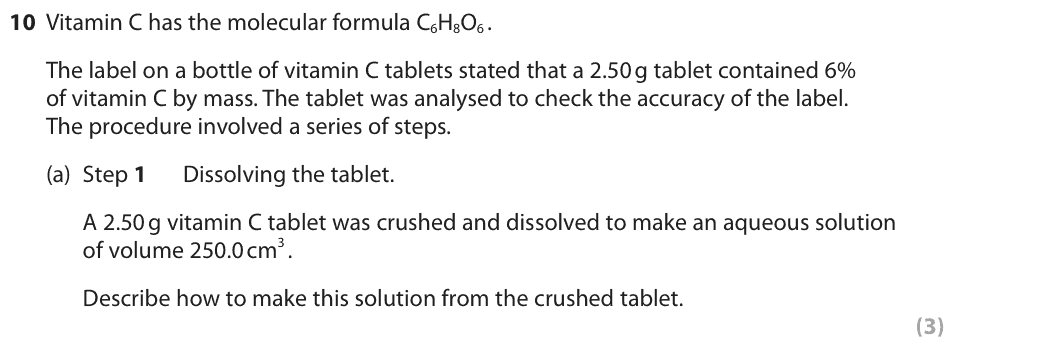
Vitamin C has the molecular formula C6H8O6 .
The label on a bottle of vitamin C tablets stated that a 2.50 g tablet contained 6%
of vitamin C by mass. The tablet was analysed to check the accuracy of the label.
The procedure involved a series of steps.
Step 1      Dissolving the tablet.
A 2.50 g vitamin C tablet was crushed and dissolved to make an aqueous solution
of volume 250.0 cm3 .
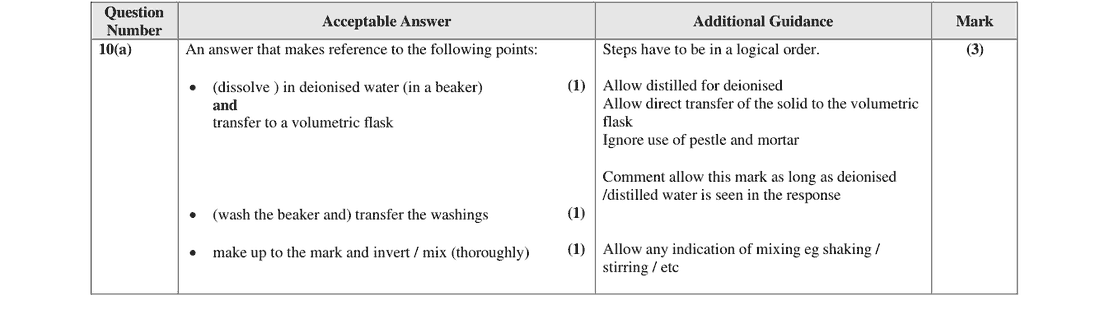
Describe how to make this solution from the crushed tablet.
June 2024 · Paper 1 · Q10(b)(i) 1 mark Equation writing redox iformulae equations and amounts of substance
Earlier part of question 10 that this part usesEarlier part of June 2024 Paper 1 question 10
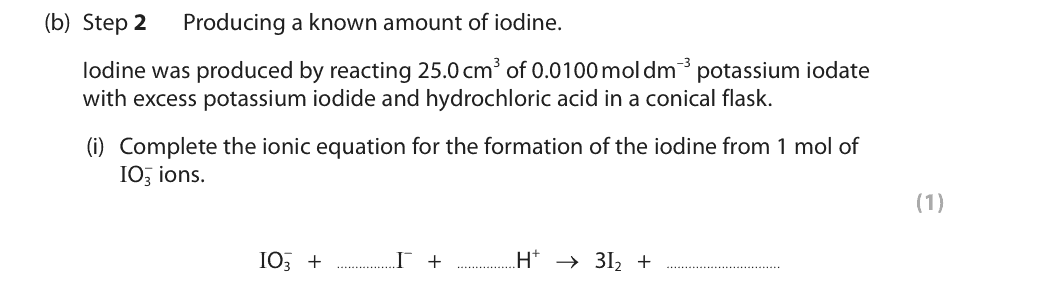
Step 2      Producing a known amount of iodine.
Iodine was produced by reacting 25.0 cm3 of 0.0100 mol dm–3 potassium iodate
with excess potassium iodide and hydrochloric acid in a conical flask.
Complete the ionic equation for the formation of the iodine from 1 mol of
IO3
− ions.
IO3
−   +   I−   +   H+   →   3I2   +
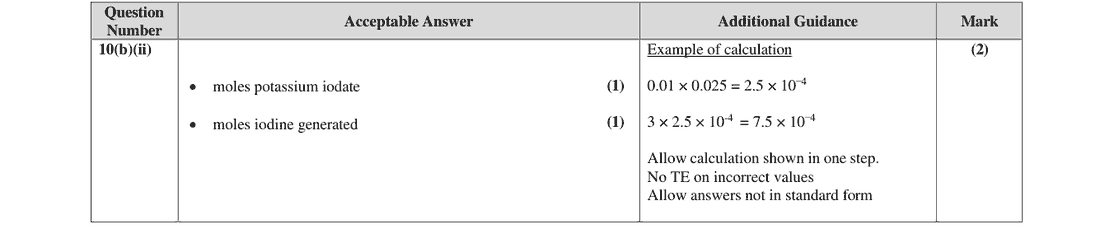
June 2024 · Paper 1 · Q10(b)(ii) 2 marks Calculation redox iiformulae equations and amounts of substance
Earlier parts of question 10 that this part usesEarlier part of June 2024 Paper 1 question 10Earlier part of June 2024 Paper 1 question 10
Show, by calculation, that 7.50 × 10⁻⁴ moles of iodine were produced in
the flask.
June 2024 · Paper 1 · Q10(c)(i) 2 marks Practical and data analysis redox ii
Earlier part of question 10 that this part usesEarlier part of June 2024 Paper 1 question 10
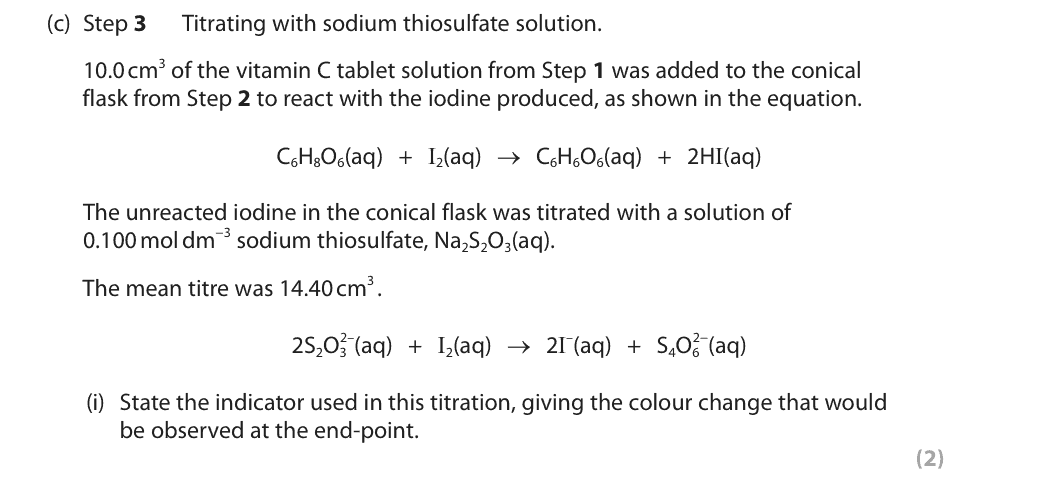
Step 3      Titrating with sodium thiosulfate solution.
10.0 cm3 of the vitamin C tablet solution from Step 1 was added to the conical
flask from Step 2 to react with the iodine produced, as shown in the equation.
C6H8O6(aq)   +   I2(aq)   →   C6H6O6(aq)   +   2HI(aq)
The unreacted iodine in the conical flask was titrated with a solution of
0.100 mol dm−3 sodium thiosulfate, Na2S2O3(aq).
The mean titre was 14.40 cm3 .
2–(aq)   +   I2(aq)   →   2I–(aq)   +   S4O6
2−(aq)
2S2O3
State the indicator used in this titration, giving the colour change that would
be observed at the end-point.
June 2024 · Paper 1 · Q10(c)(ii) 6 marks Calculation redox ii
Earlier parts of question 10 that this part usesEarlier part of June 2024 Paper 1 question 10Earlier part of June 2024 Paper 1 question 10Earlier part of June 2024 Paper 1 question 10
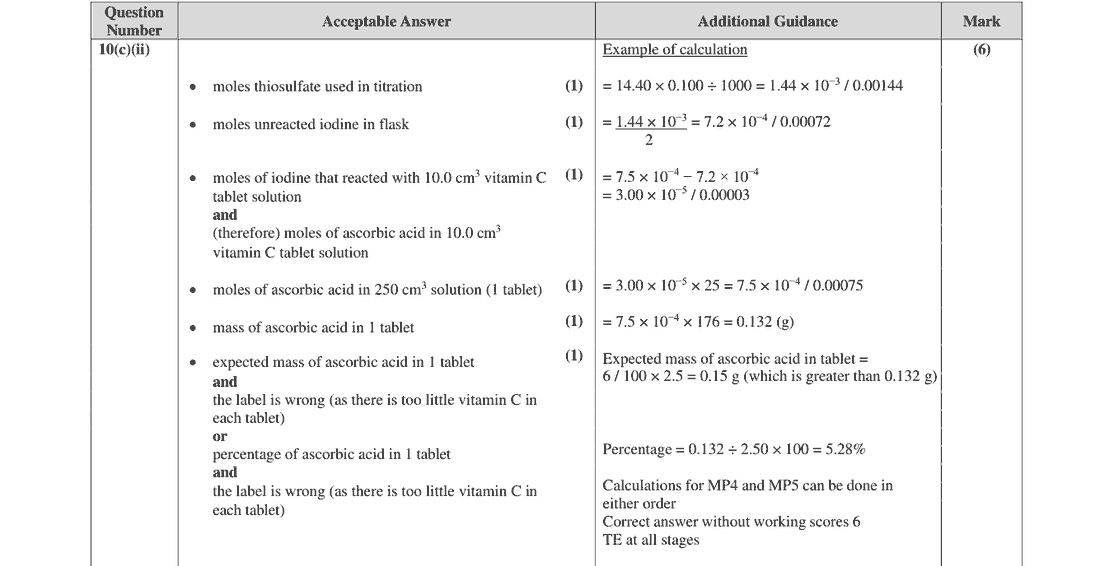
Deduce, by calculation, whether the label on the bottle of vitamin C tablets
is correct.
June 2024 · Paper 2 · Q3(d)(i) 1 mark Practical and data analysis formulae equations and amounts of substance
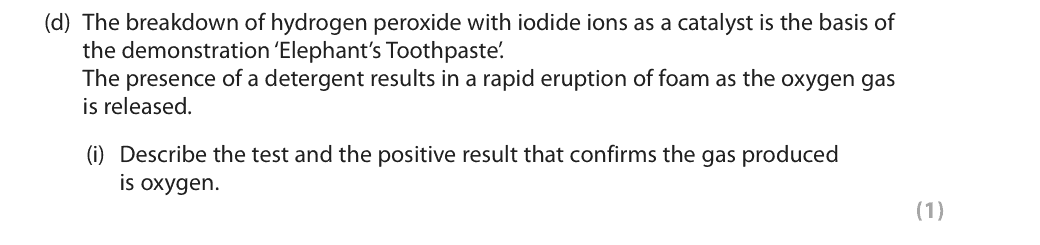
The breakdown of hydrogen peroxide with iodide ions as a catalyst is the basis of
the demonstration ‘Elephant’s Toothpaste’.
The presence of a detergent results in a rapid eruption of foam as the oxygen gas
is released.
Describe the test and the positive result that confirms the gas produced
is oxygen.
June 2024 · Paper 2 · Q3(e)(i) 3 marks Calculation kinetics ii
Earlier part of question 3 that this part usesEarlier part of June 2024 Paper 2 question 3
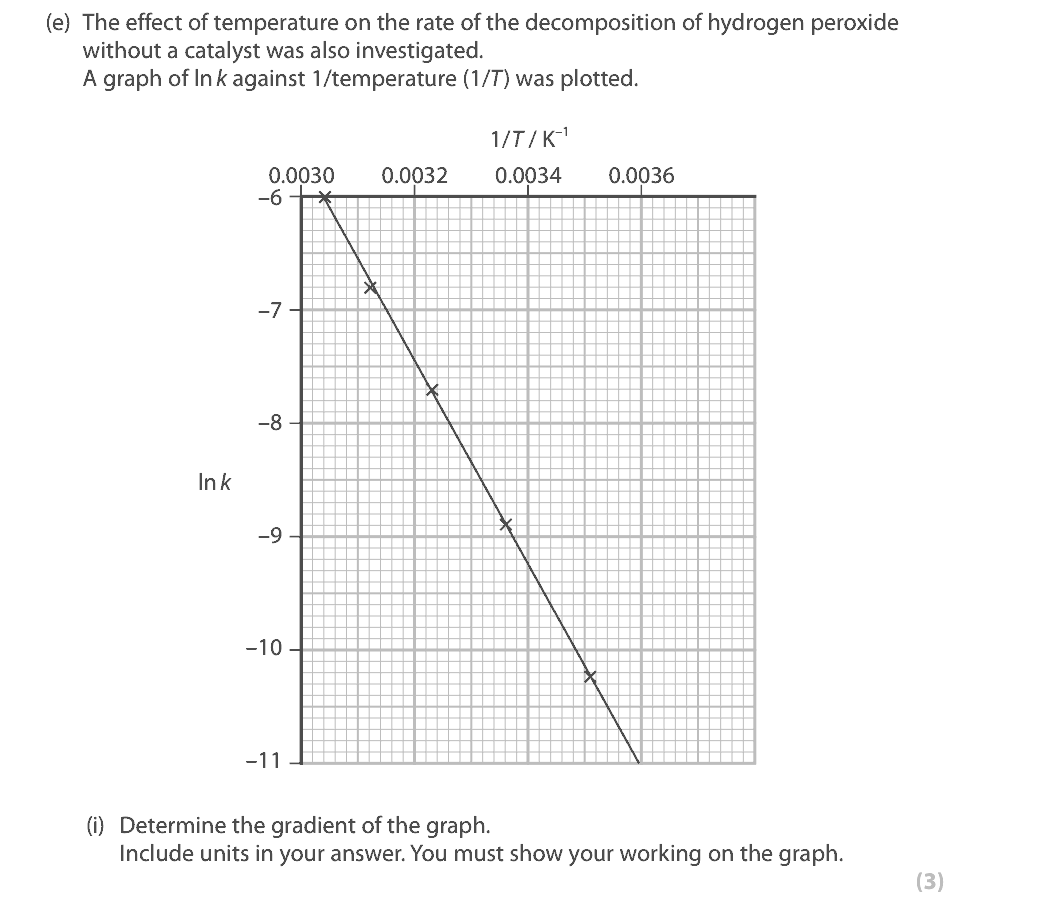
The effect of temperature on the rate of the decomposition of hydrogen peroxide
without a catalyst was also investigated.
A graph of ln k against 1/temperature (1/T) was plotted.
1/T / K–1
0.0030
0.0032
0.0034
0.0036
–6
–7
–8
ln k
–9
–10
–11
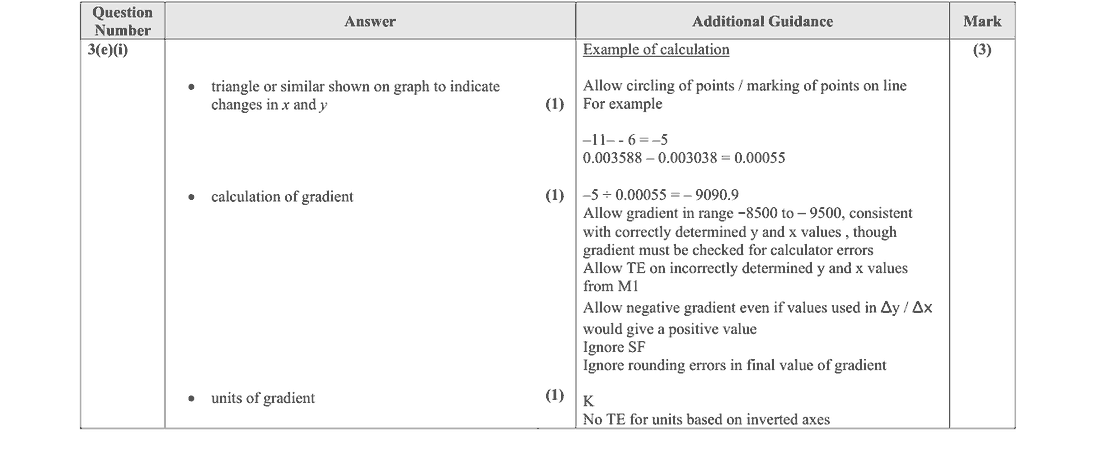
Determine the gradient of the graph.
Include units in your answer. You must show your working on the graph.
June 2024 · Paper 2 · Q3(e)(ii) 1 mark Calculation kinetics ii
Earlier parts of question 3 that this part usesEarlier part of June 2024 Paper 2 question 3Earlier part of June 2024 Paper 2 question 3
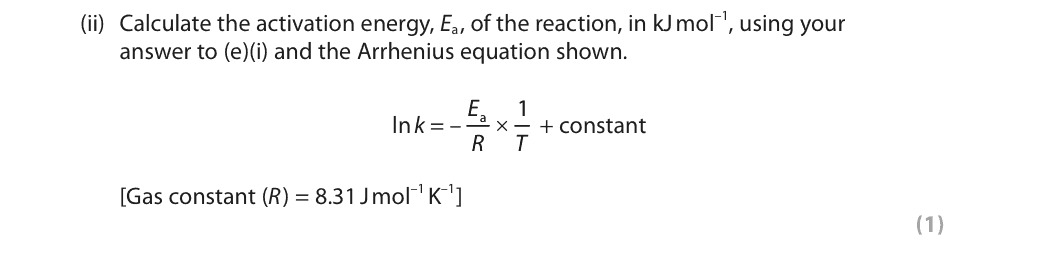
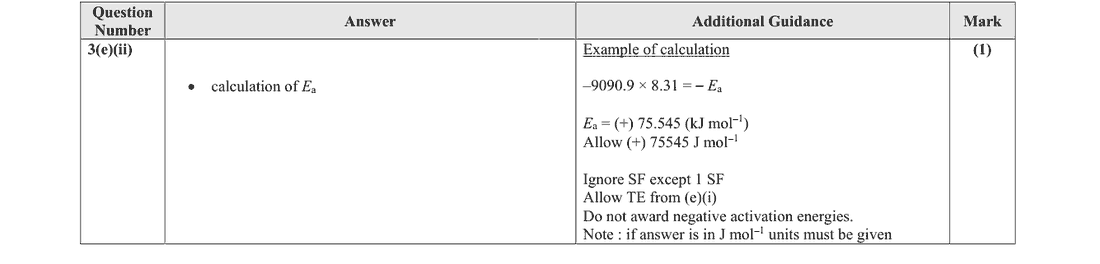
Calculate the activation energy, Ea, of the reaction, in kJ mol–1, using your
answer to (e)(i) and the Arrhenius equation shown.
ln k = – E
a × 1 + constant
R
T
[Gas constant (R) = 8.31 J mol–1 K–1]
June 2024 · Paper 2 · Q8(d)(iii) 2 marks Short answer carboxylic acids
Earlier parts of question 8 that this part usesEarlier part of June 2024 Paper 2 question 8Earlier part of June 2024 Paper 2 question 8
Give the reagent needed and conditions required for Step 3.
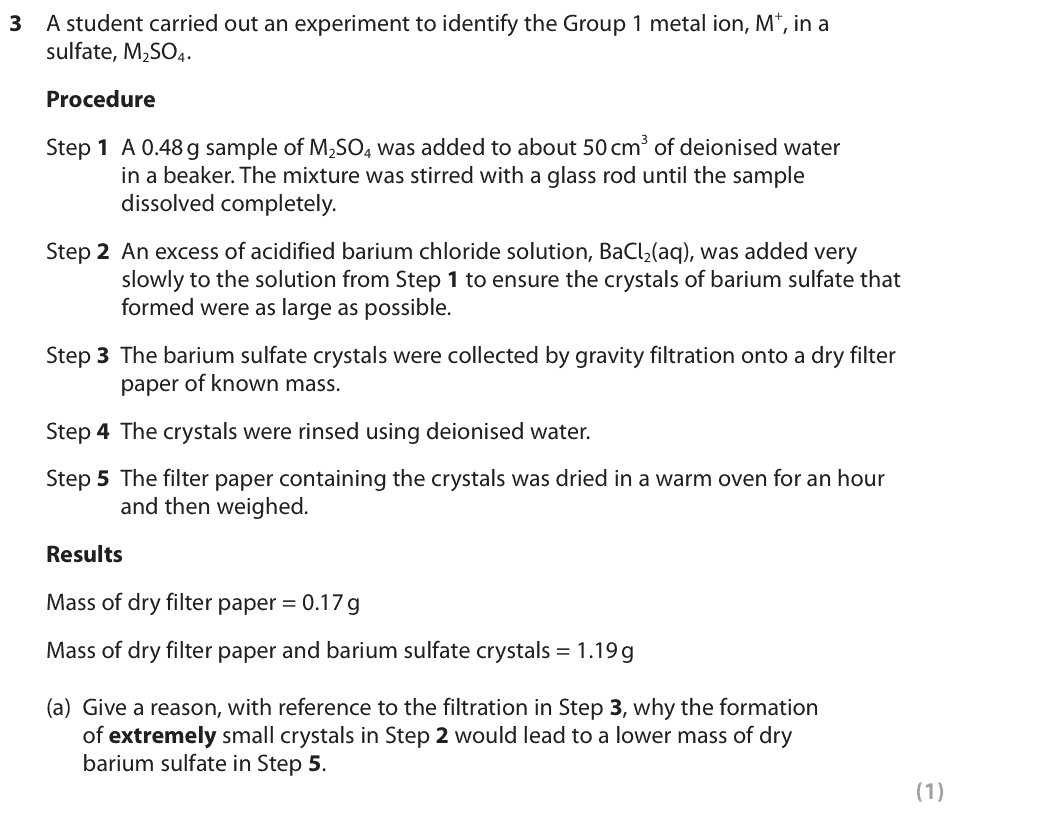
June 2024 · Paper 3 · Q3(a) 1 mark Practical and data analysis formulae equations and amounts of substance
A student carried out an experiment to identify the Group 1 metal ion, M+, in a
sulfate, M2SO4.
Procedure
Step 1  A 0.48 g sample of M2SO4 was added to about 50 cm3 of deionised water
in a beaker. The mixture was stirred with a glass rod until the sample
dissolved completely.
Step 2  An excess of acidified barium chloride solution, BaCl2(aq), was added very
slowly to the solution from Step 1 to ensure the crystals of barium sulfate that
formed were as large as possible.
Step 3  The barium sulfate crystals were collected by gravity filtration onto a dry filter
paper of known mass.
Step 4  The crystals were rinsed using deionised water.
Step 5  The filter paper containing the crystals was dried in a warm oven for an hour
and then weighed.
Results
Mass of dry filter paper = 0.17 g
Mass of dry filter paper and barium sulfate crystals = 1.19 g
Give a reason, with reference to the filtration in Step 3, why the formation
of extremely small crystals in Step 2 would lead to a lower mass of dry
barium sulfate in Step 5.
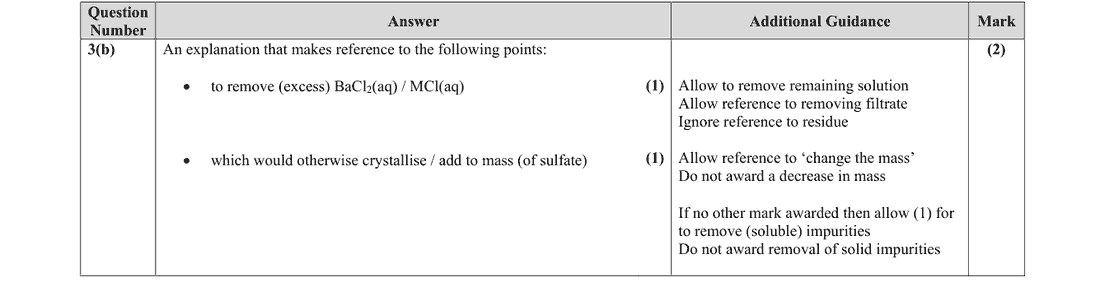
June 2024 · Paper 3 · Q3(b) 2 marks Practical and data analysis formulae equations and amounts of substance
Earlier part of question 3 that this part usesEarlier part of June 2024 Paper 3 question 3
Explain why the crystals are rinsed in Step 4.
June 2024 · Paper 3 · Q3(d)(i) 2 marks Practical and data analysis formulae equations and amounts of substance
Earlier part of question 3 that this part usesEarlier part of June 2024 Paper 3 question 3
Another student carrying out the experiment placed the glass rod on the
laboratory bench when the stirring was complete in Step 1.
Explain what effect this would have on the calculated value of the relative
formula mass of M2SO4.
June 2024 · Paper 3 · Q3(d)(ii) 1 mark Practical and data analysis formulae equations and amounts of substance
Earlier parts of question 3 that this part usesEarlier part of June 2024 Paper 3 question 3Earlier part of June 2024 Paper 3 question 3
Describe how the student should amend the procedure.
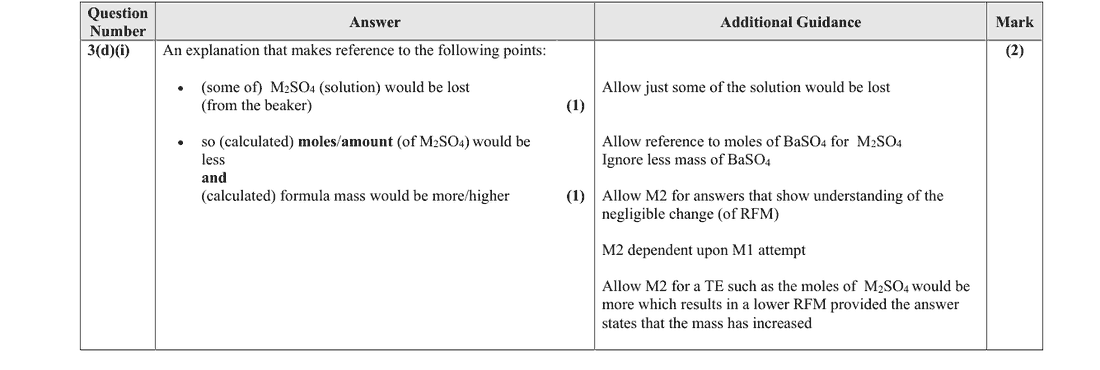
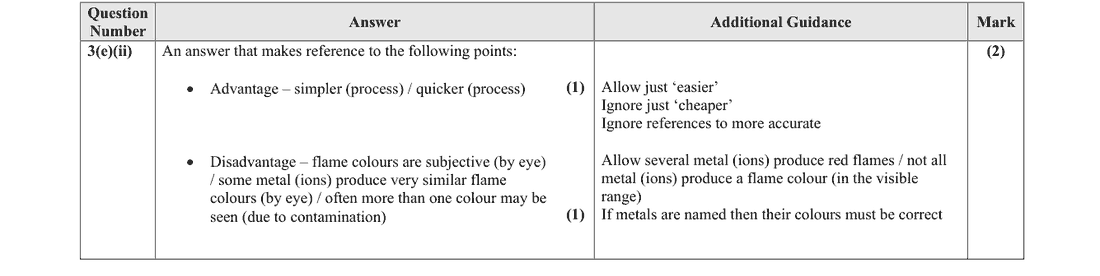
June 2024 · Paper 3 · Q3(e)(ii) 2 marks Practical and data analysis groups 1 and 2
Earlier parts of question 3 that this part usesEarlier part of June 2024 Paper 3 question 3Earlier part of June 2024 Paper 3 question 3
Give one advantage and one disadvantage of using a flame test to identify a
metal cation, rather than the method followed by the students in Steps 1–5.
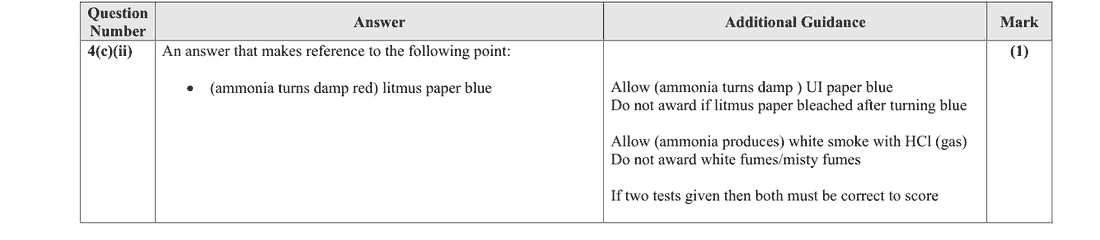
June 2024 · Paper 3 · Q4(c)(ii) 1 mark Practical and data analysis analysis of inorganic compounds
Earlier part of question 4 that this part usesEarlier part of June 2024 Paper 3 question 4
Describe a test to confirm that ammonia, NH3, has been produced.
June 2024 · Paper 3 · Q7(c)(ii) 2 marks Practical and data analysis organic synthesis
Earlier parts of question 7 that this part usesEarlier part of June 2024 Paper 3 question 7Earlier part of June 2024 Paper 3 question 7
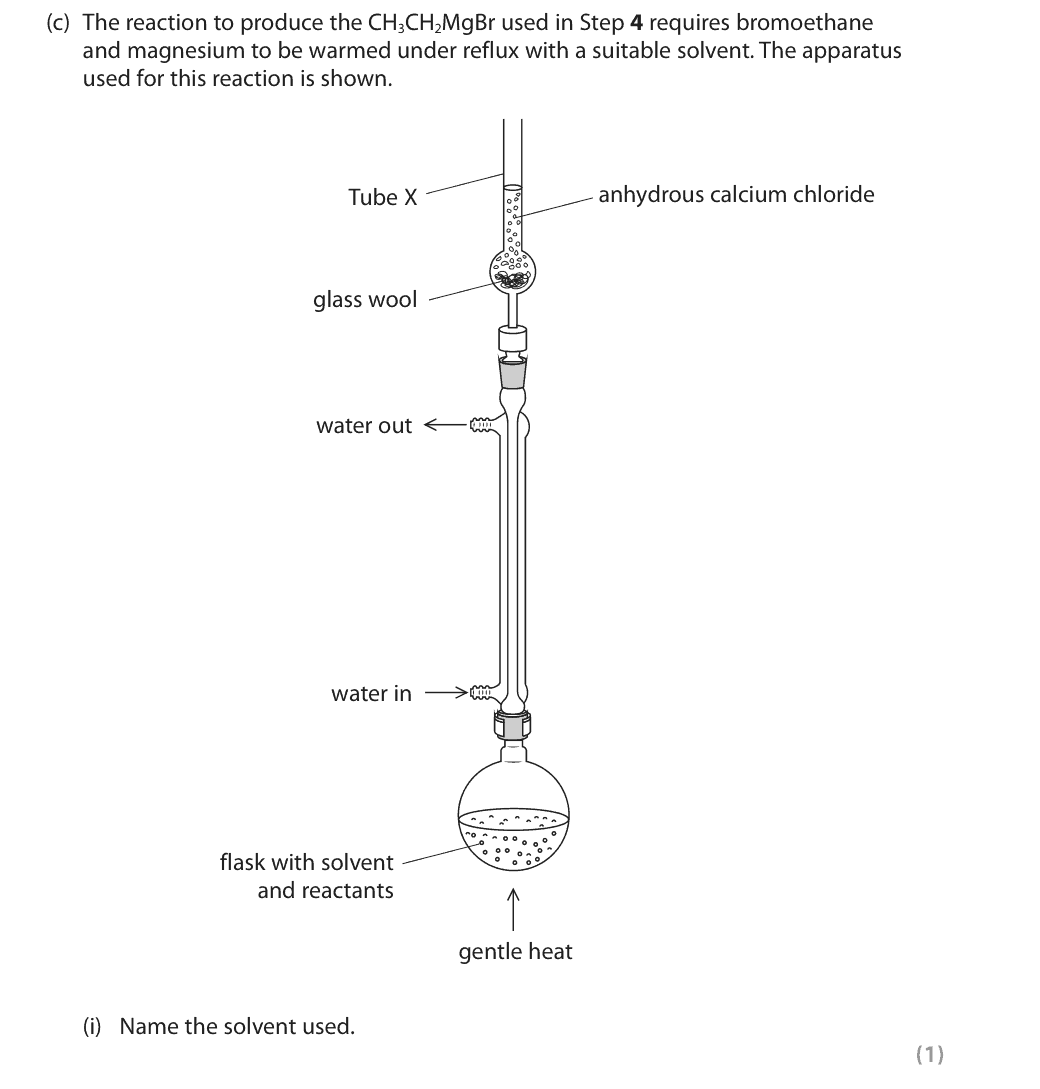
Explain why the anhydrous calcium chloride in Tube X is necessary.
June 2024 · Paper 3 · Q7(c)(iii) 1 mark Practical and data analysis organic synthesis
Earlier parts of question 7 that this part usesEarlier part of June 2024 Paper 3 question 7Earlier part of June 2024 Paper 3 question 7
Give a reason why it is best practice for the water in the condenser to flow in
the direction shown in the diagram.
June 2024 · Paper 3 · Q7(d)(i) 1 mark Practical and data analysis carbonyl compounds
Earlier part of question 7 that this part usesEarlier part of June 2024 Paper 3 question 7
Carbonyl compounds such as cyclohexanone can be identified by the reaction
with 2,4-dinitrophenylhydrazine.
Give the colour of the precipitate formed in this reaction.
June 2024 · Paper 3 · Q7(d)(iii) 4 marks Practical and data analysis organic synthesis
Earlier parts of question 7 that this part usesEarlier part of June 2024 Paper 3 question 7Earlier part of June 2024 Paper 3 question 7
Describe how you would obtain pure dry crystals from the precipitate.
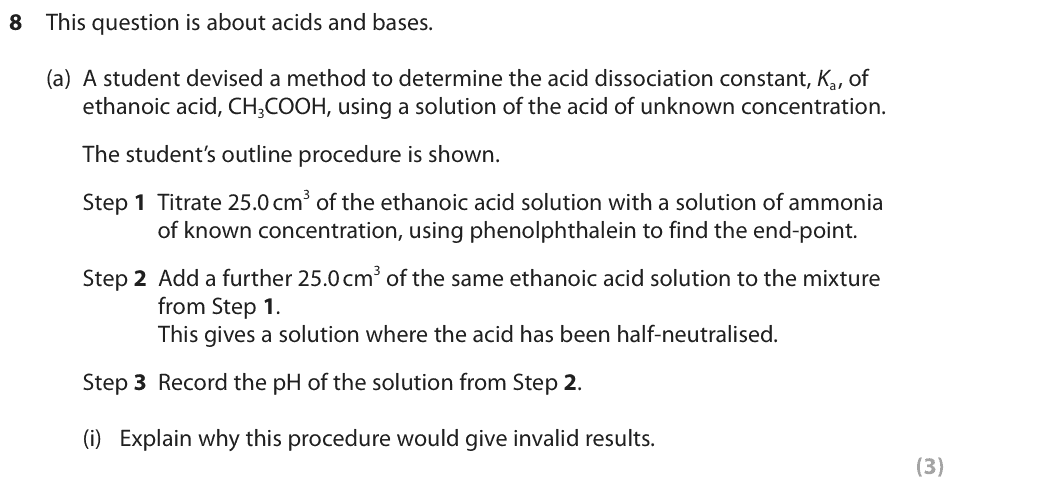
June 2024 · Paper 3 · Q8(a)(i) 3 marks Practical and data analysis acid base equilibria
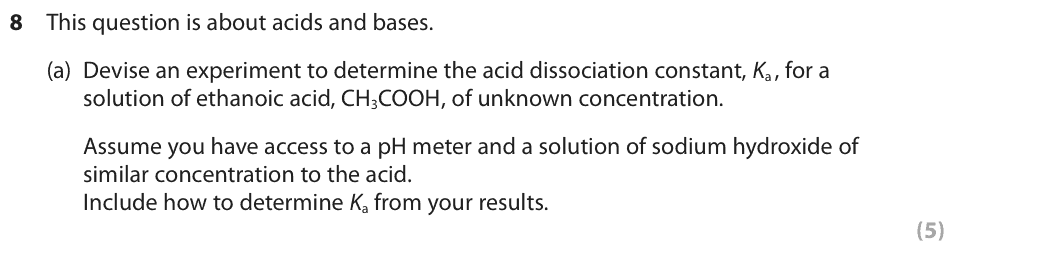
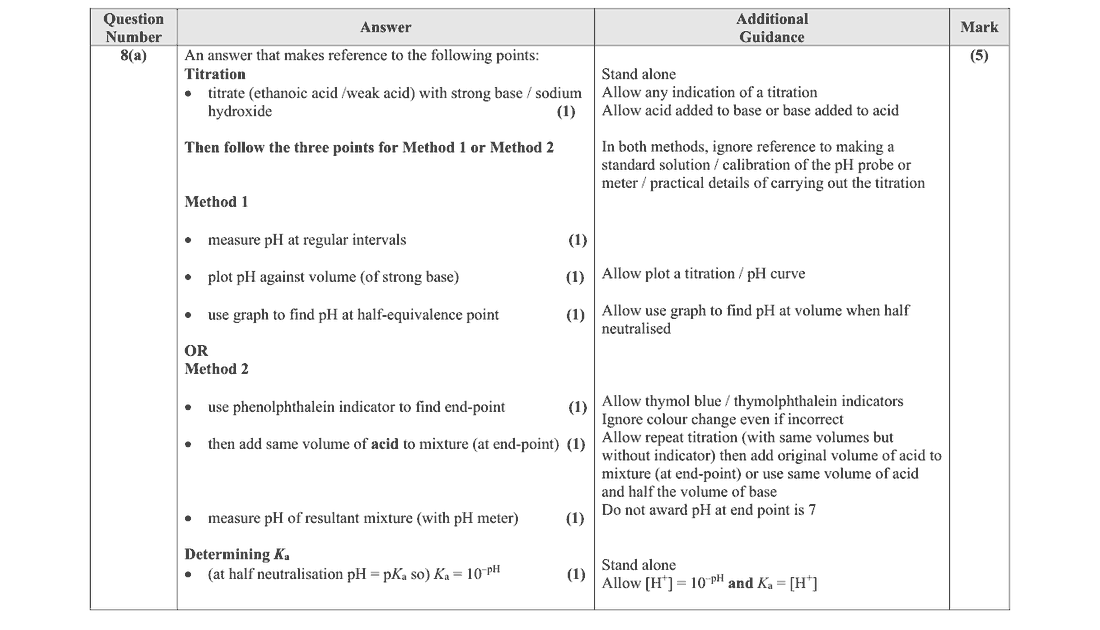
This question is about acids and bases.
A student devised a method to determine the acid dissociation constant, Ka, of
ethanoic acid, CH3COOH, using a solution of the acid of unknown concentration.
The student’s outline procedure is shown.
Step 1  Titrate 25.0 cm3 of the ethanoic acid solution with a solution of ammonia
of known concentration, using phenolphthalein to find the end-point.
Step 2  Add a further 25.0 cm3 of the same ethanoic acid solution to the mixture
from Step 1.
This gives a solution where the acid has been half-neutralised.
Step 3  Record the pH of the solution from Step 2.
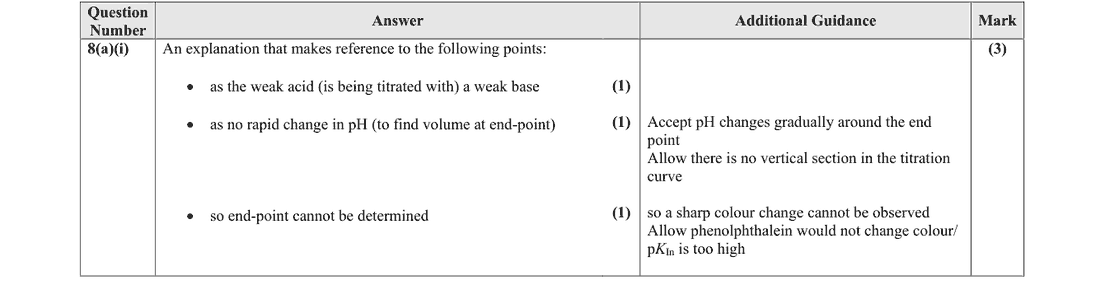
Explain why this procedure would give invalid results.
June 2024 · Paper 3 · Q8(a)(ii) 1 mark Practical and data analysis acid base equilibria
Earlier part of question 8 that this part usesEarlier part of June 2024 Paper 3 question 8
State how Step 1 should be amended to give valid results.
June 2024 · Paper 3 · Q8(a)(iii) 3 marks Short answer acid base equilibria
Earlier part of question 8 that this part usesEarlier part of June 2024 Paper 3 question 8
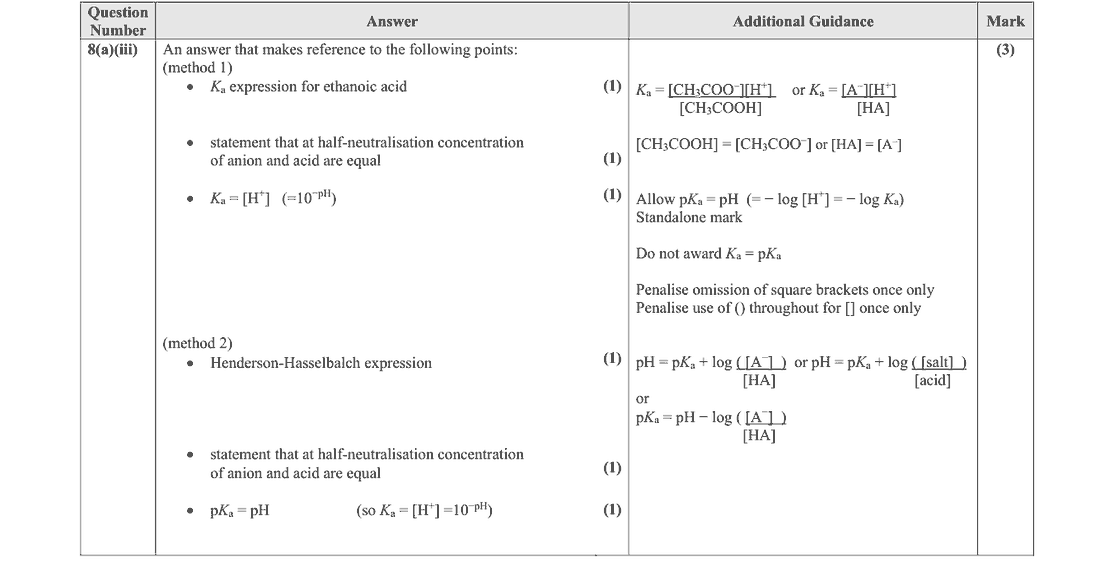
Show that when the solution has been half-neutralised, the acid dissociation
constant is given by the expression
Ka = 10–pH
June 2024 · Paper 3 · Q9(a)(i) 2 marks Practical and data analysis formulae equations and amounts of substance
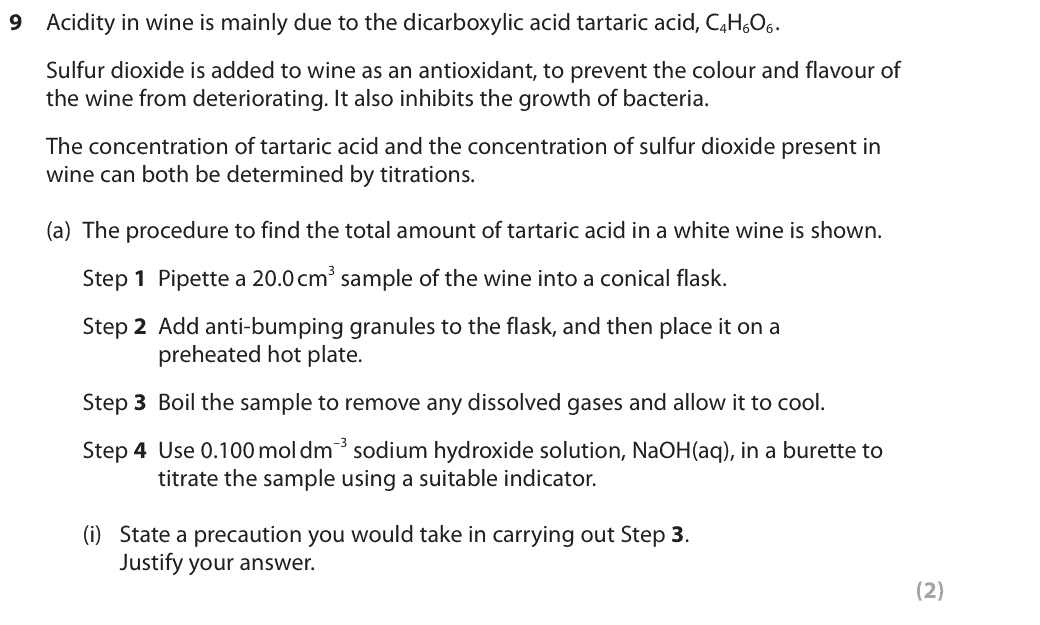
Acidity in wine is mainly due to the dicarboxylic acid tartaric acid, C4H6O6.
Sulfur dioxide is added to wine as an antioxidant, to prevent the colour and flavour of
the wine from deteriorating. It also inhibits the growth of bacteria.
The concentration of tartaric acid and the concentration of sulfur dioxide present in
wine can both be determined by titrations.
The procedure to find the total amount of tartaric acid in a white wine is shown.
Step 1  Pipette a 20.0 cm3 sample of the wine into a conical flask.
Step 2  Add anti-bumping granules to the flask, and then place it on a
preheated hot plate.
Step 3  Boil the sample to remove any dissolved gases and allow it to cool.
Step 4  Use 0.100 mol dm–3 sodium hydroxide solution, NaOH(aq), in a burette to
titrate the sample using a suitable indicator.
State a precaution you would take in carrying out Step 3.
Justify your answer.
June 2024 · Paper 3 · Q9(a)(ii) 2 marks Practical and data analysis formulae equations and amounts of substance
Earlier part of question 9 that this part usesEarlier part of June 2024 Paper 3 question 9
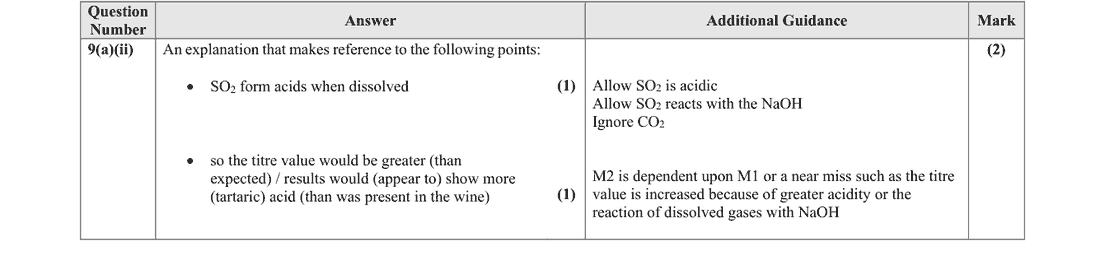
Explain what effect the omission of Step 3 would have on the titre.
June 2024 · Paper 3 · Q9(a)(iv) 2 marks Practical and data analysis formulae equations and amounts of substance
Earlier part of question 9 that this part usesEarlier part of June 2024 Paper 3 question 9
A student carrying out the experiment forgot to remove an air bubble from
the tip of the burette before carrying out a titration. During the titration, the
air bubble escaped.
Explain the effect this mistake would have on the value of this titre.
June 2024 · Paper 3 · Q9(b)(i) 4 marks Calculation redox ii
Earlier part of question 9 that this part usesEarlier part of June 2024 Paper 3 question 9
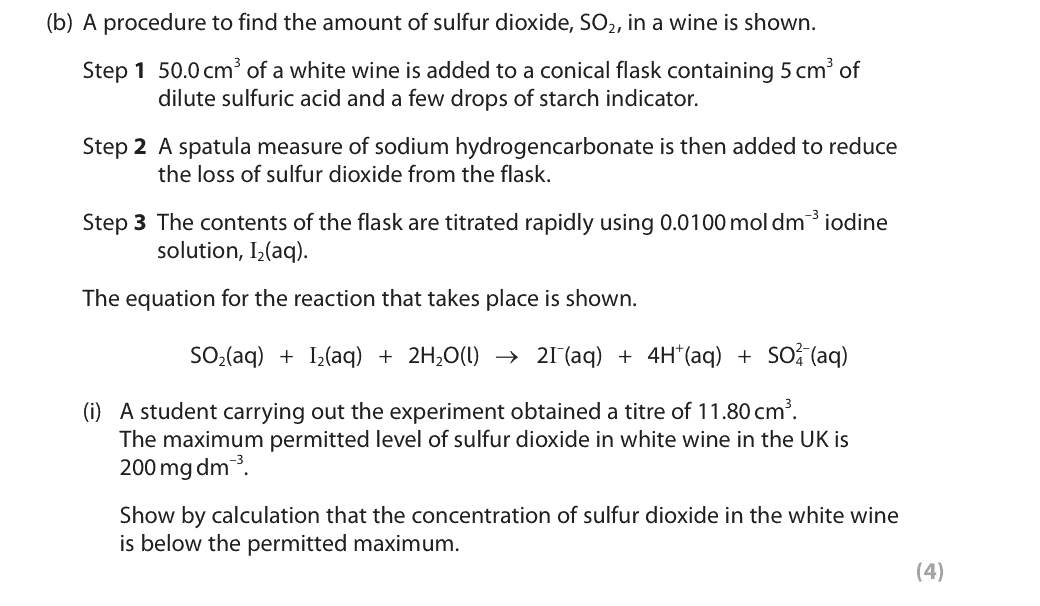
A procedure to find the amount of sulfur dioxide, SO2, in a wine is shown.
Step 1  50.0 cm3 of a white wine is added to a conical flask containing 5 cm3 of
dilute sulfuric acid and a few drops of starch indicator.
Step 2  A spatula measure of sodium hydrogencarbonate is then added to reduce
the loss of sulfur dioxide from the flask.
Step 3  The contents of the flask are titrated rapidly using 0.0100 mol dm–3 iodine
solution, I2(aq).
The equation for the reaction that takes place is shown.
SO2(aq)   +   I2(aq)   +   2H2O(l)   →   2I–(aq)   +   4H+(aq)   +   SO4
2–(aq)
A student carrying out the experiment obtained a titre of 11.80 cm3.
The maximum permitted level of sulfur dioxide in white wine in the UK is
200 mg dm–3.
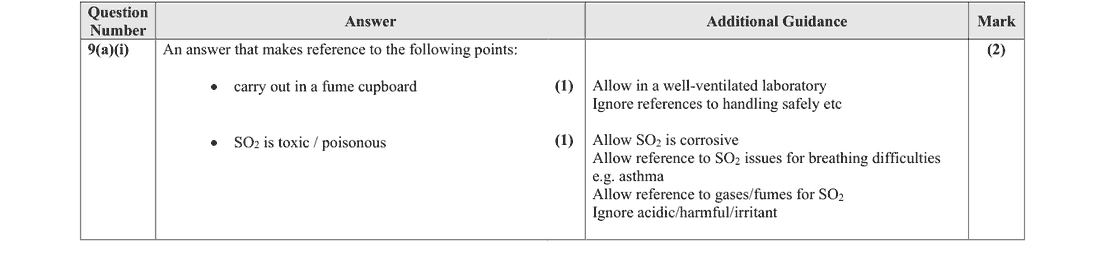
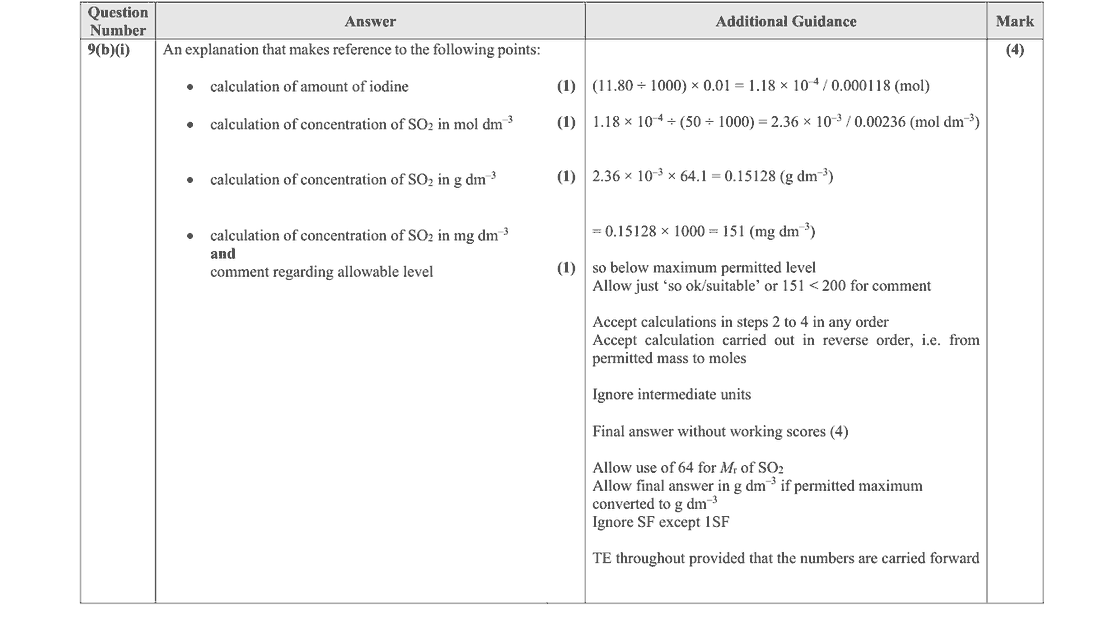
Show by calculation that the concentration of sulfur dioxide in the white wine
is below the permitted maximum.
June 2024 · Paper 3 · Q9(b)(ii) 2 marks Practical and data analysis Hard redox ii
Earlier parts of question 9 that this part usesEarlier part of June 2024 Paper 3 question 9Earlier part of June 2024 Paper 3 question 9
Explain how the addition of sodium hydrogencarbonate in Step 2 reduces the
loss of sulfur dioxide from the flask.
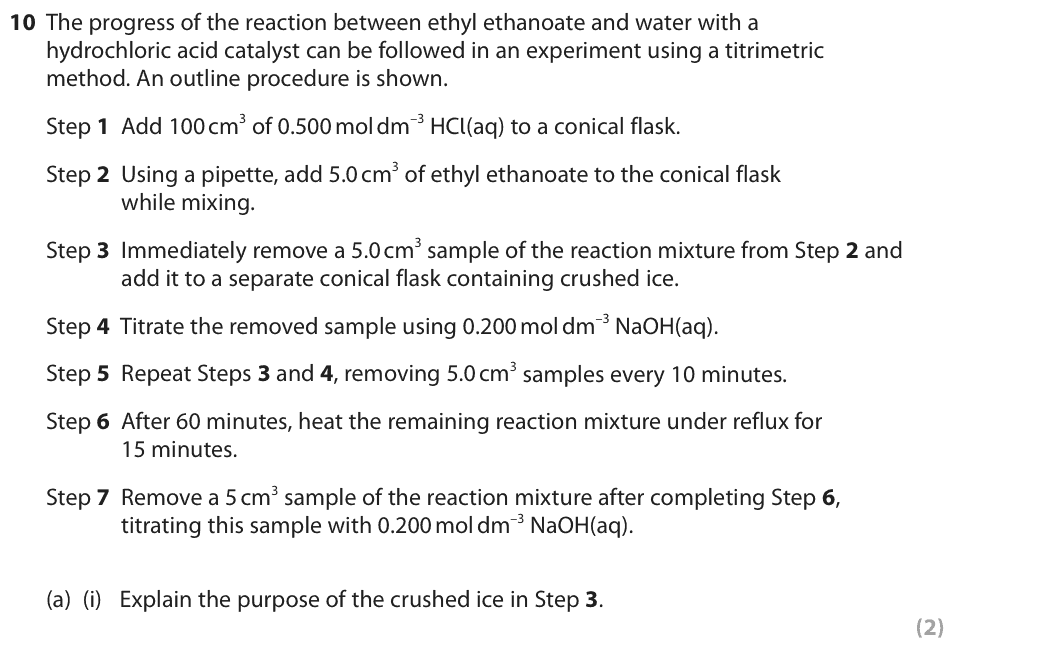
June 2024 · Paper 3 · Q10(a)(i) 2 marks Practical and data analysis kinetics ii
The progress of the reaction between ethyl ethanoate and water with a
hydrochloric acid catalyst can be followed in an experiment using a titrimetric
method. An outline procedure is shown.
Step 1  Add 100 cm3 of 0.500 mol dm–3 HCl(aq) to a conical flask.
Step 2  Using a pipette, add 5.0 cm3 of ethyl ethanoate to the conical flask
while mixing.
Step 3  Immediately remove a 5.0 cm3 sample of the reaction mixture from Step 2 and
add it to a separate conical flask containing crushed ice.
Step 4  Titrate the removed sample using 0.200 mol dm–3 NaOH(aq).
Step 5  Repeat Steps 3 and 4, removing 5.0 cm3 samples every 10 minutes.
Step 6  After 60 minutes, heat the remaining reaction mixture under reflux for
15 minutes.
Step 7  Remove a 5 cm3 sample of the reaction mixture after completing Step 6,
titrating this sample with 0.200 mol dm–3 NaOH(aq).
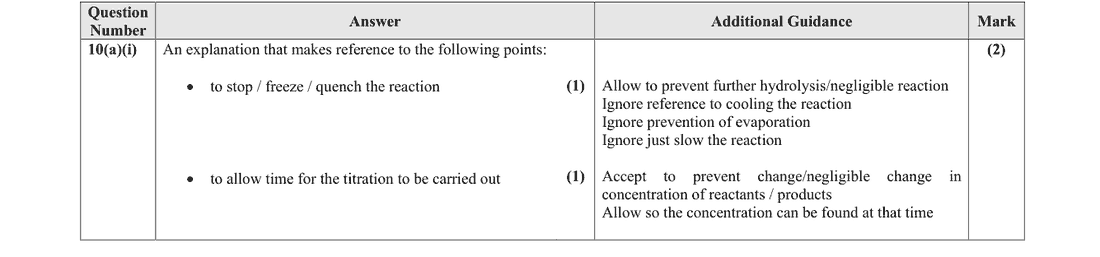
Explain the purpose of the crushed ice in Step 3.
June 2024 · Paper 3 · Q10(a)(ii) 2 marks Practical and data analysis kinetics ii
Earlier part of question 10 that this part usesEarlier part of June 2024 Paper 3 question 10
Explain why Step 6 is carried out before the final sample is removed and
titrated in Step 7.
June 2024 · Paper 3 · Q10(b)(i) 3 marks Diagram or structure kinetics ii
Earlier part of question 10 that this part usesEarlier part of June 2024 Paper 3 question 10
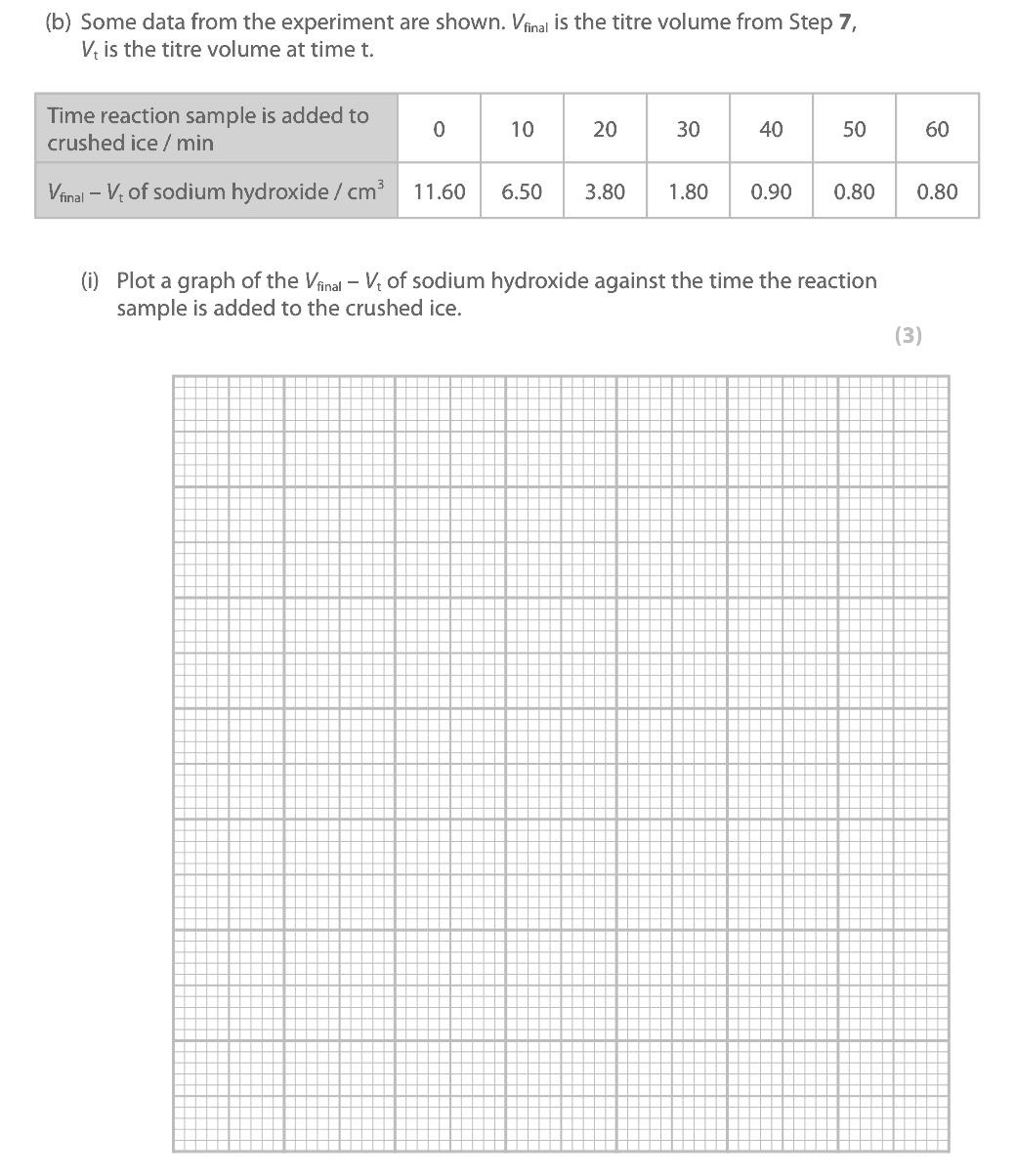
Some data from the experiment are shown. Vfinal is the titre volume from Step 7,
Vt is the titre volume at time t.
Time reaction sample is added to
0
10
20
30
40
50
60
crushed ice / min
Vfinal – Vt of sodium hydroxide / cm3
11.60
6.50
3.80
1.80
0.90
0.80
0.80
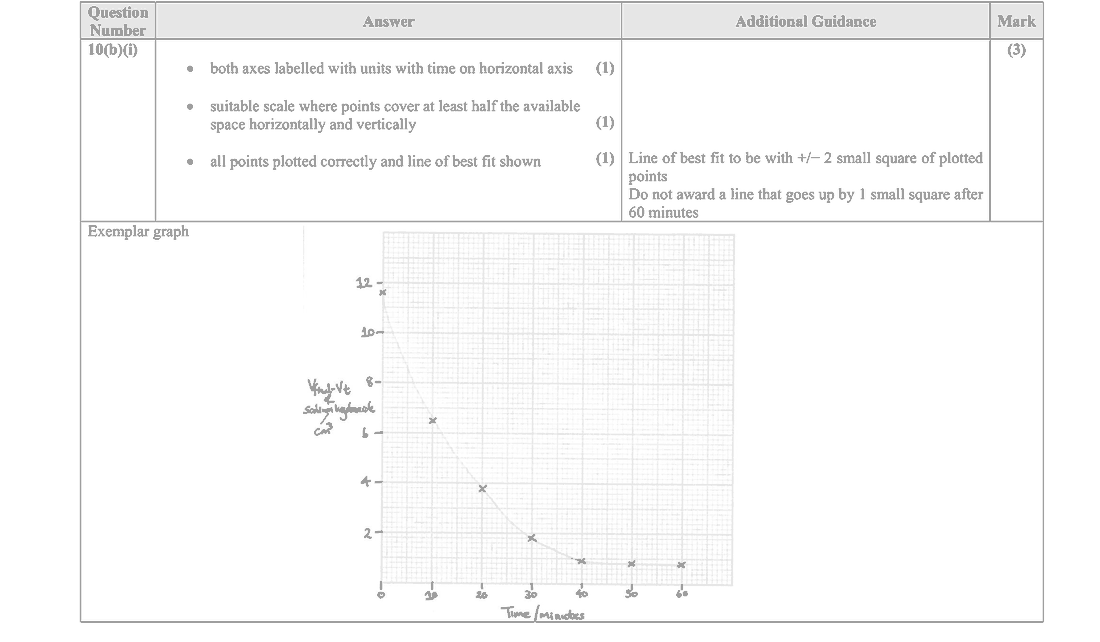
Plot a graph of the Vfinal – Vt of sodium hydroxide against the time the reaction
sample is added to the crushed ice.
June 2024 · Paper 3 · Q10(b)(ii) 2 marks Explanation Hard kinetics ii
Earlier parts of question 10 that this part usesEarlier part of June 2024 Paper 3 question 10Earlier part of June 2024 Paper 3 question 10
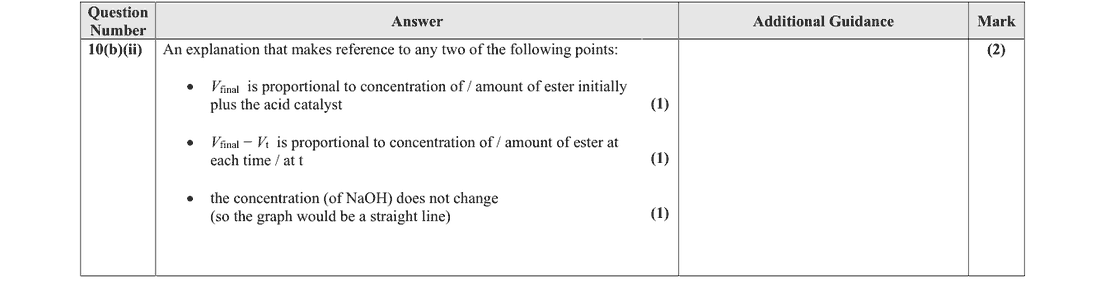
Explain why Vfinal – Vt is plotted rather than the concentration of
sodium hydroxide solution for each titre.
June 2024 · Paper 3 · Q10(b)(iii) 2 marks Short answer kinetics ii
Earlier parts of question 10 that this part usesEarlier part of June 2024 Paper 3 question 10Earlier part of June 2024 Paper 3 question 10Earlier part of June 2024 Paper 3 question 10
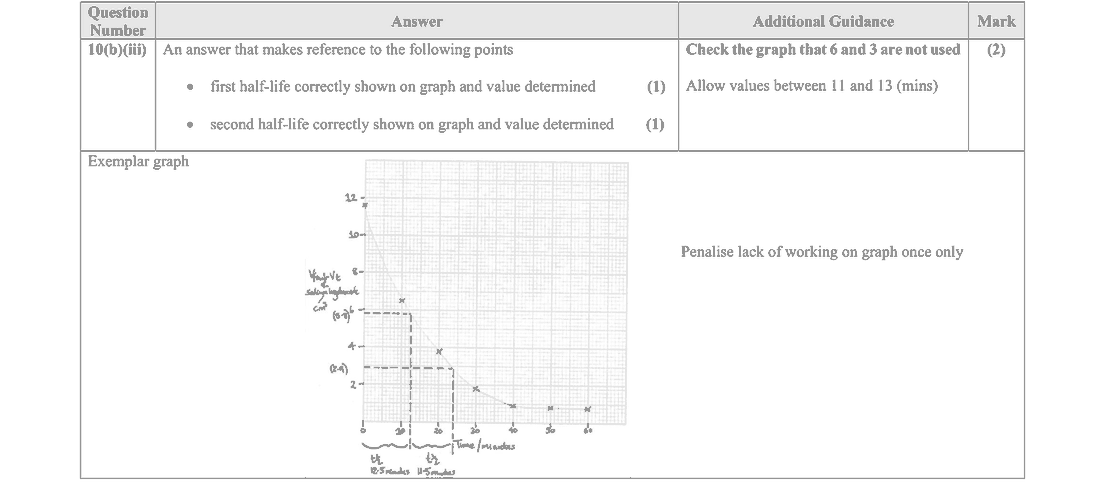
Determine two half-lives for the reaction, showing your working on the graph.
June 2024 · Paper 3 · Q10(b)(iv) 1 mark Short answer kinetics ii
Earlier parts of question 10 that this part usesEarlier part of June 2024 Paper 3 question 10Earlier part of June 2024 Paper 3 question 10Earlier part of June 2024 Paper 3 question 10Earlier part of June 2024 Paper 3 question 10
Deduce the order of the reaction, using your answer from (b)(iii) to justify
your deduction.
June 2023 · AS Paper 1 · Q2(b) 4 marks Practical and data analysis groups 1 and 2
Earlier part of question 2 that this part usesEarlier part of June 2023 Paper 1 question 2
Cations may be identified using a flame test on a solid or by the addition of
aqueous sodium hydroxide to an aqueous solution containing the cation.
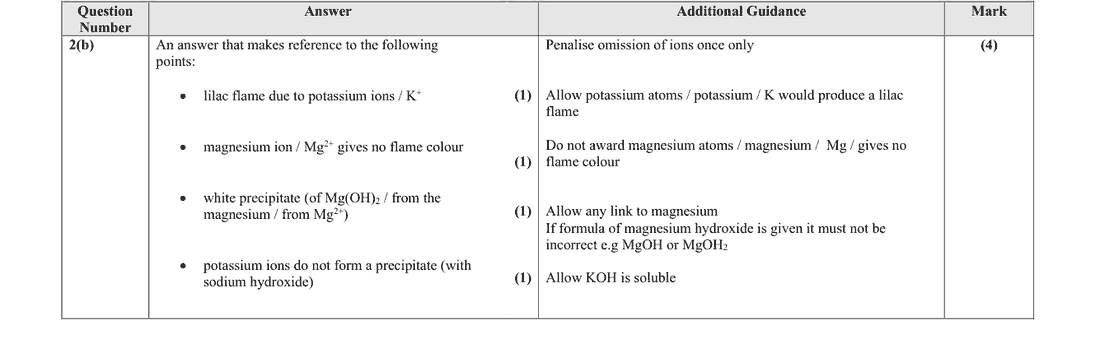
Describe the expected results of performing these tests on K2Mg(SO4)2.6H2O.
Include the observation for each cation in each test.
June 2023 · AS Paper 1 · Q2(c)(ii) 1 mark Equation writing Hard analysis of inorganic compoundsformulae equations and amounts of substance
Earlier parts of question 2 that this part usesEarlier part of June 2023 Paper 1 question 2Earlier part of June 2023 Paper 1 question 2
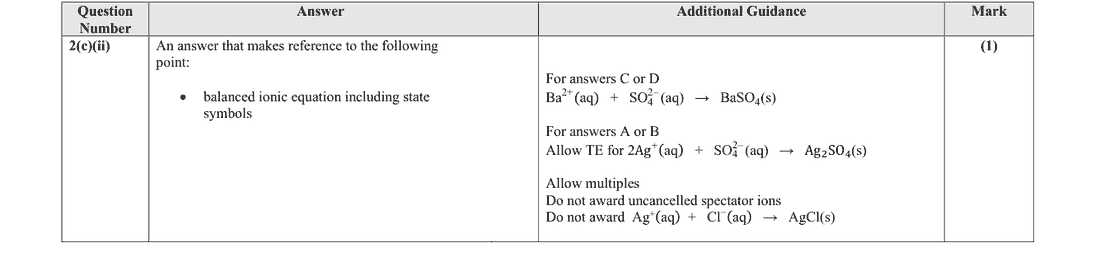
Write an ionic equation, including state symbols, for the formation of the
white precipitate in the test for the anion in the double salt.
June 2023 · AS Paper 1 · Q3(b)(ii) 3 marks Practical and data analysis Hard group 7 the halogens
Earlier part of question 3 that this part usesEarlier part of June 2023 Paper 1 question 3
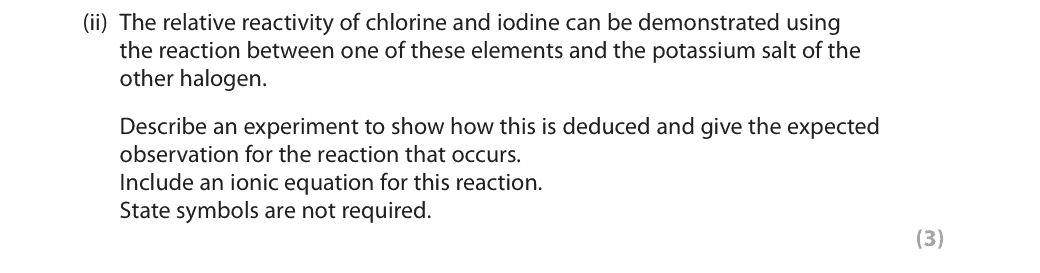
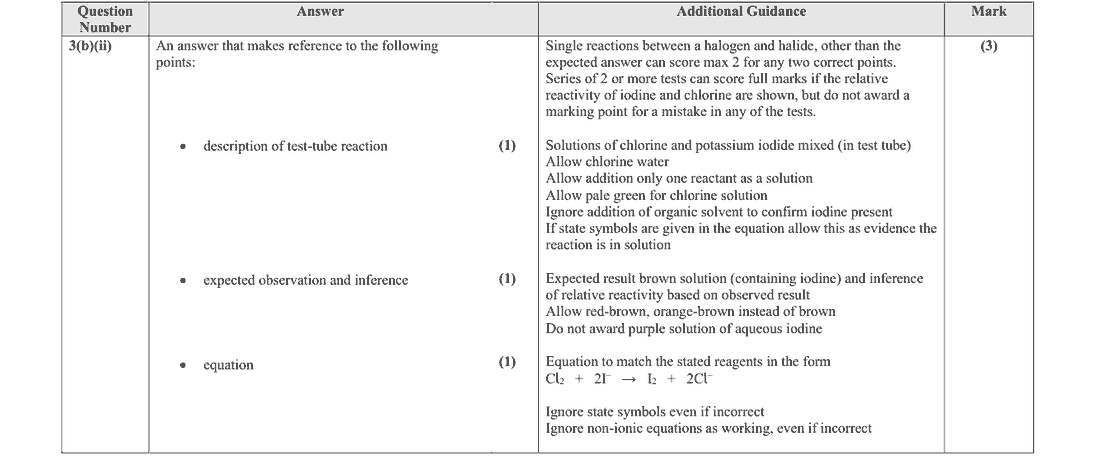
The relative reactivity of chlorine and iodine can be demonstrated using
the reaction between one of these elements and the potassium salt of the
other halogen.
Describe an experiment to show how this is deduced and give the expected
observation for the reaction that occurs.
Include an ionic equation for this reaction.
State symbols are not required.
June 2023 · AS Paper 1 · Q8(a)(i) 2 marks Practical and data analysis formulae equations and amounts of substancekinetics i
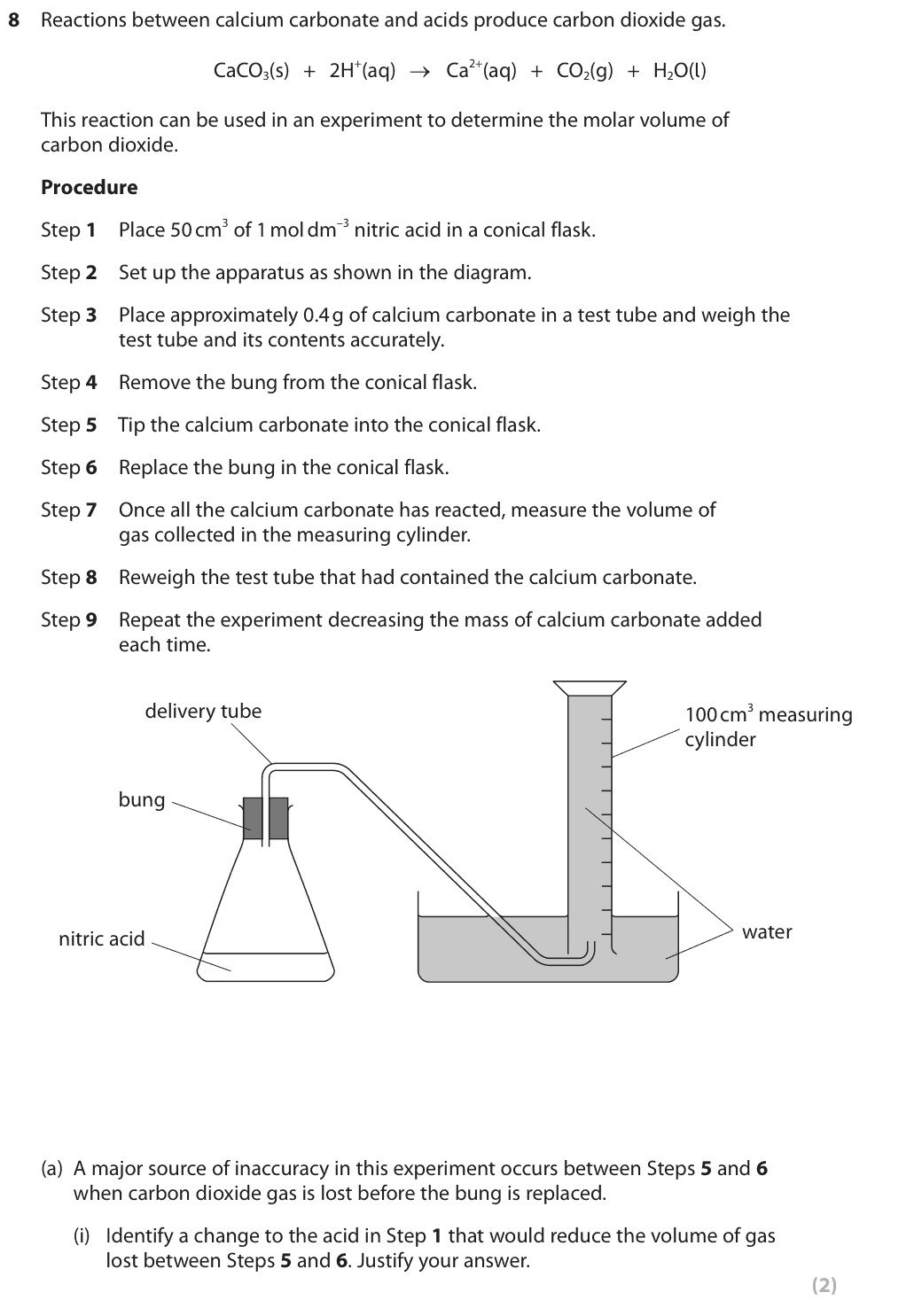
Reactions between calcium carbonate and acids produce carbon dioxide gas.
CaCO3(s)   +   2H+(aq)   →   Ca2+(aq)   +   CO2(g)   +   H2O(l)
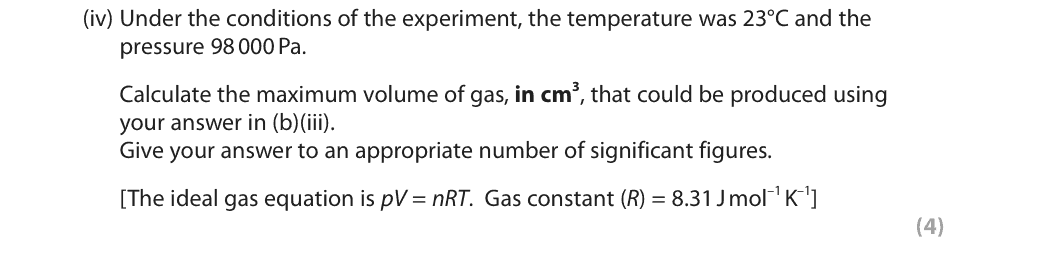
This reaction can be used in an experiment to determine the molar volume of
carbon dioxide.
Procedure
Step 1    Place 50 cm3 of 1 mol dm–3 nitric acid in a conical flask.
Step 2    Set up the apparatus as shown in the diagram.
Step 3    Place approximately 0.4 g of calcium carbonate in a test tube and weigh the
test tube and its contents accurately.
Step 4    Remove the bung from the conical flask.
Step 5    Tip the calcium carbonate into the conical flask.
Step 6    Replace the bung in the conical flask.
Step 7    Once all the calcium carbonate has reacted, measure the volume of
gas collected in the measuring cylinder.
Step 8    Reweigh the test tube that had contained the calcium carbonate.
Step 9    Repeat the experiment decreasing the mass of calcium carbonate added
each time.
delivery tube
100 cm3 measuring
cylinder
bung
water
nitric acid
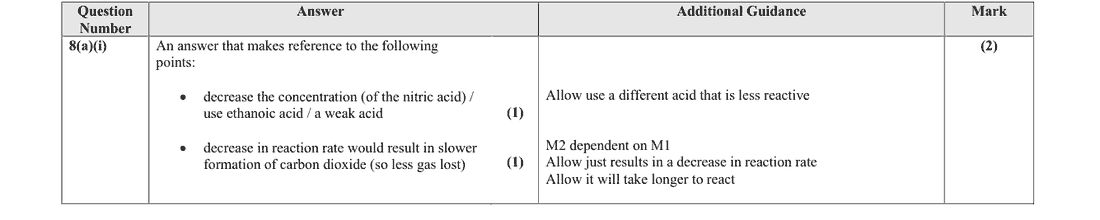
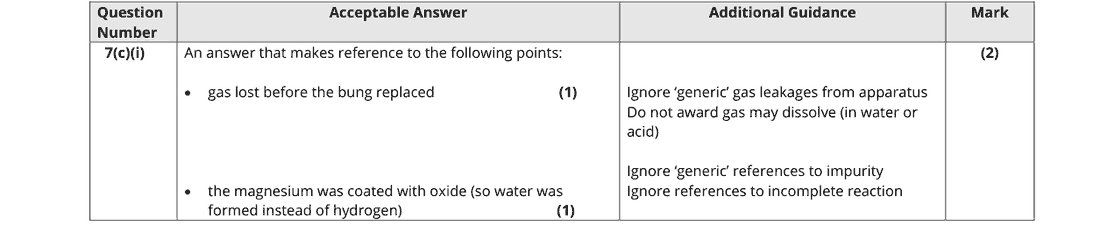
A major source of inaccuracy in this experiment occurs between Steps 5 and 6
when carbon dioxide gas is lost before the bung is replaced.
Identify a change to the acid in Step 1 that would reduce the volume of gas
lost between Steps 5 and 6. Justify your answer.
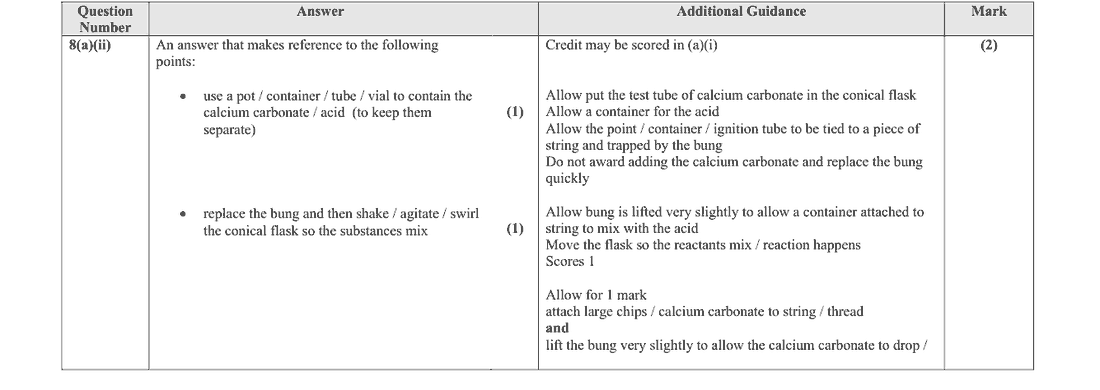
June 2023 · AS Paper 1 · Q8(a)(ii) 2 marks Practical and data analysis formulae equations and amounts of substance
Earlier part of question 8 that this part usesEarlier part of June 2023 Paper 1 question 8
Identify a change to the procedure in Steps 5 and 6 that would prevent loss
of gas.
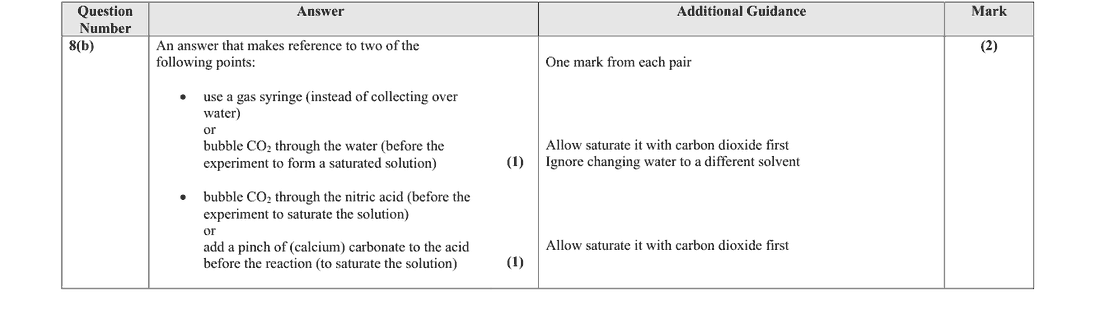
June 2023 · AS Paper 1 · Q8(b) 2 marks Practical and data analysis formulae equations and amounts of substance
Earlier part of question 8 that this part usesEarlier part of June 2023 Paper 1 question 8
A second source of inaccuracy results from the significant solubility in water of
carbon dioxide.
Give two improvements which together prevent this problem.
June 2023 · AS Paper 1 · Q8(c)(i) 3 marks Calculation formulae equations and amounts of substance
Earlier part of question 8 that this part usesEarlier part of June 2023 Paper 1 question 8
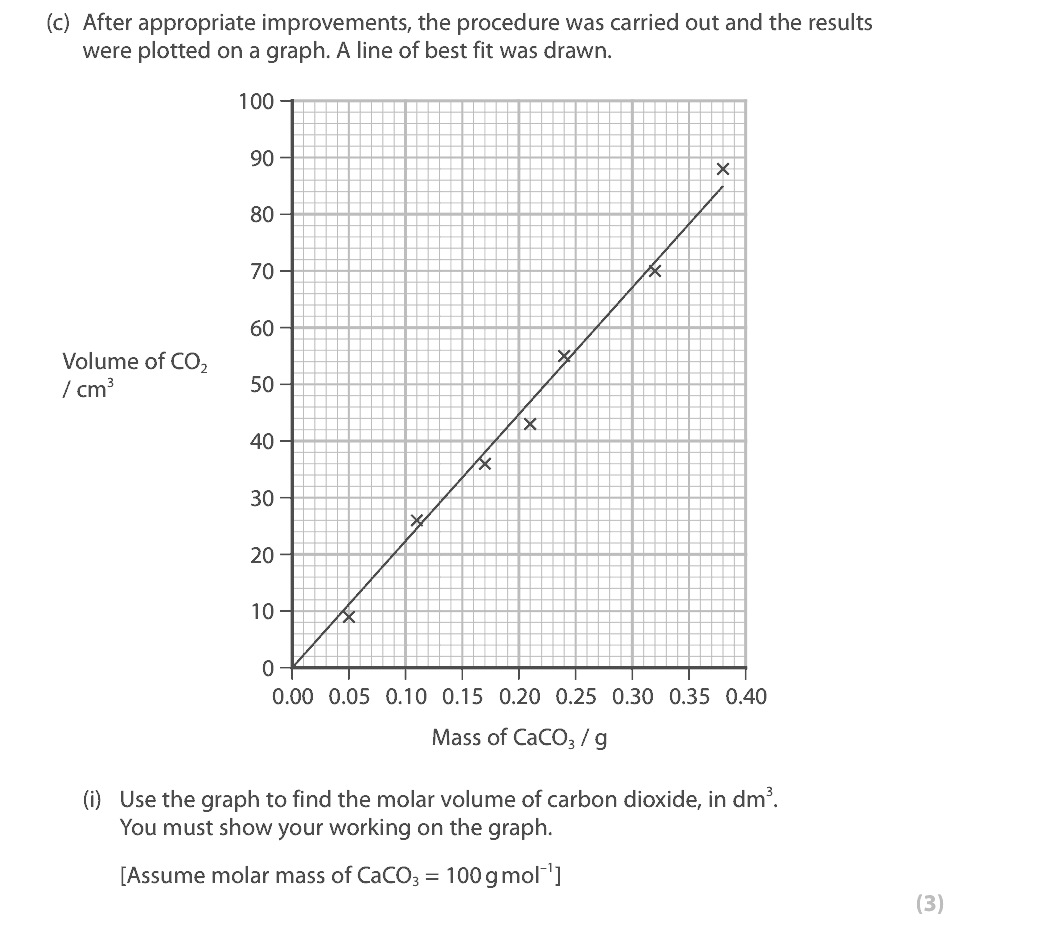
After appropriate improvements, the procedure was carried out and the results
were plotted on a graph. A line of best fit was drawn.
100
90
80
70
60
Volume of CO2
50
/ cm3
40
30
20
10
0
0.00
0.05
0.10
0.15
0.20
0.25
0.30
0.35
0.40
Mass of CaCO3 / g
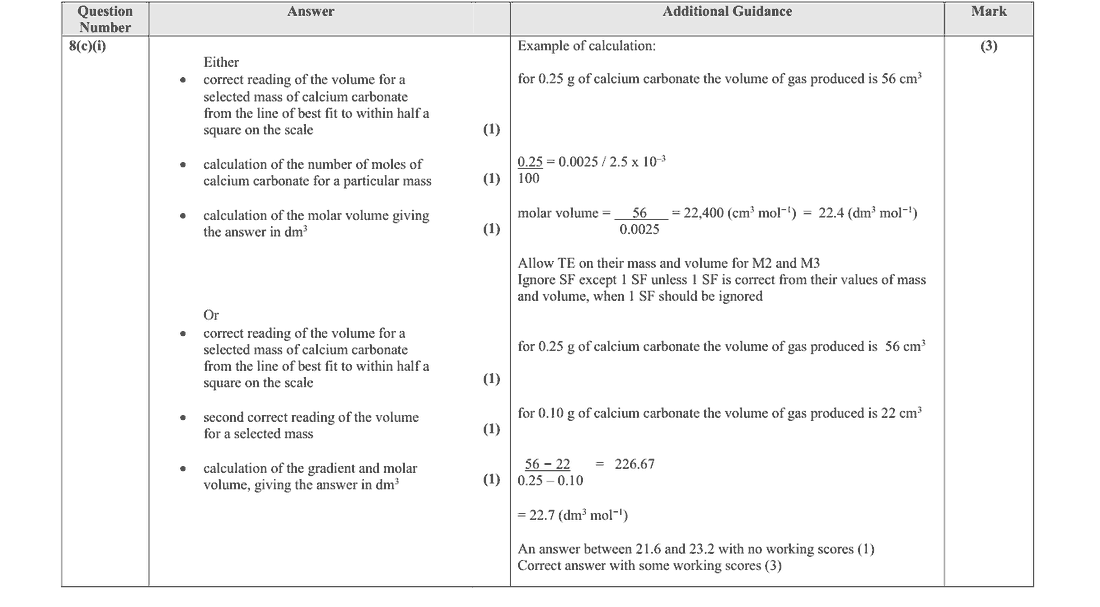
Use the graph to find the molar volume of carbon dioxide, in dm3.
You must show your working on the graph.
[Assume molar mass of CaCO3 = 100 g mol–1]
June 2023 · AS Paper 1 · Q8(c)(ii) 3 marks Calculation formulae equations and amounts of substance
Earlier parts of question 8 that this part usesEarlier part of June 2023 Paper 1 question 8Earlier part of June 2023 Paper 1 question 8
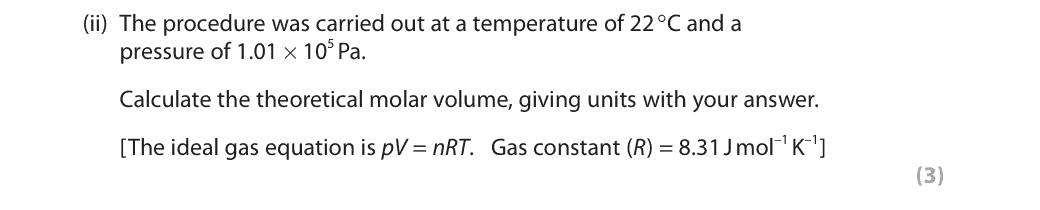
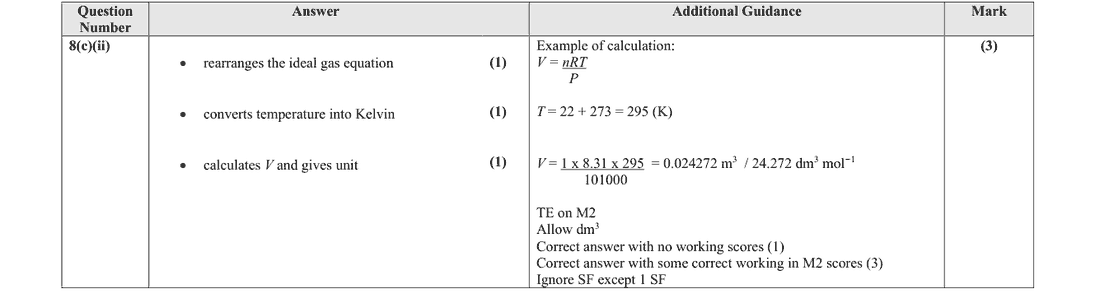
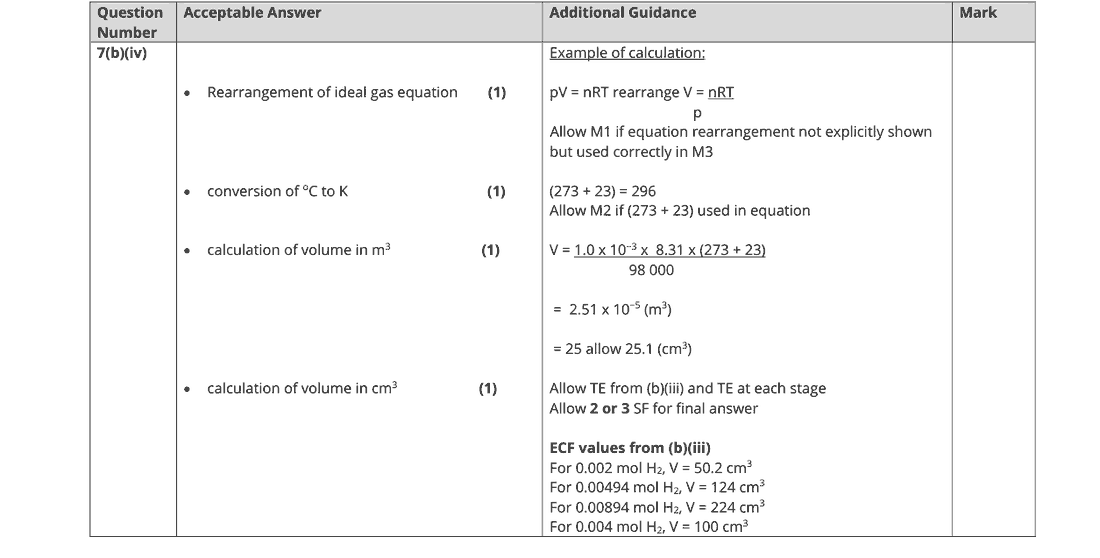
The procedure was carried out at a temperature of 22 °C and a
pressure of 1.01 × 105 Pa.
Calculate the theoretical molar volume, giving units with your answer.
[The ideal gas equation is pV = nRT.   Gas constant (R) = 8.31 J mol–1 K–1]
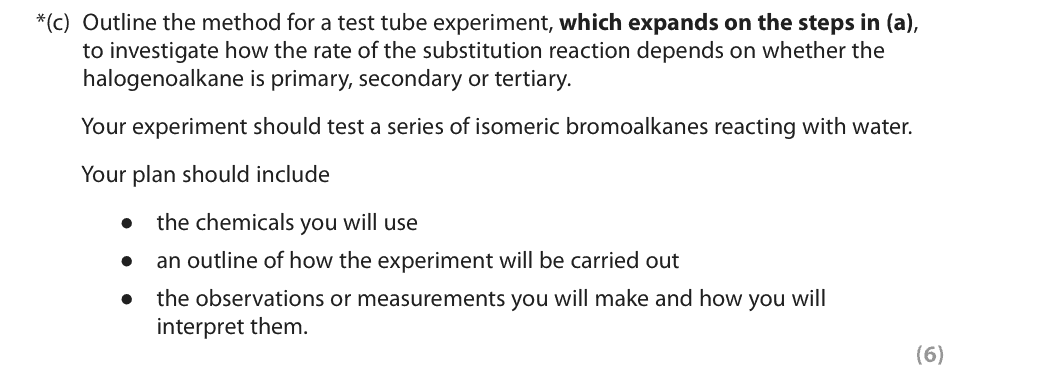
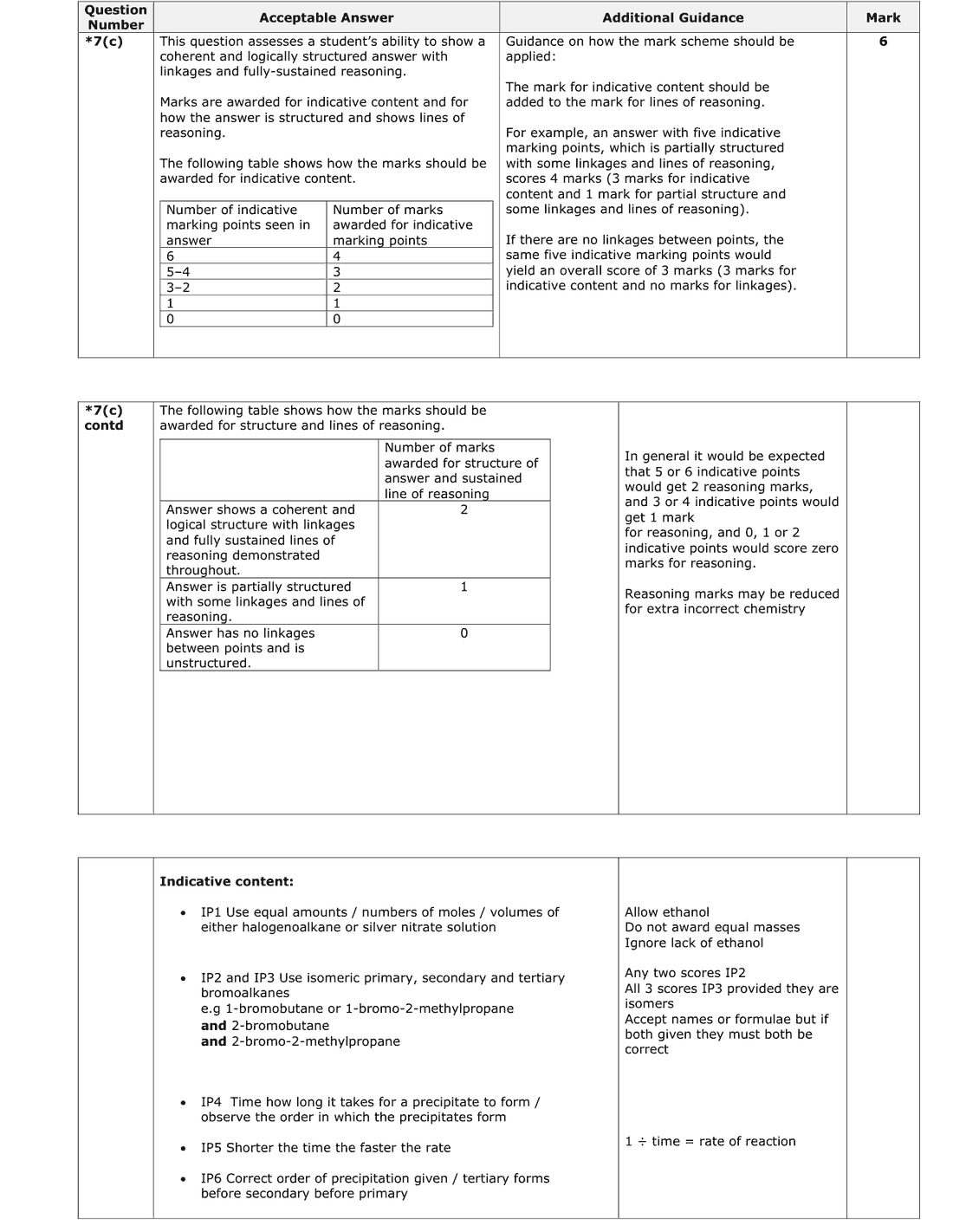
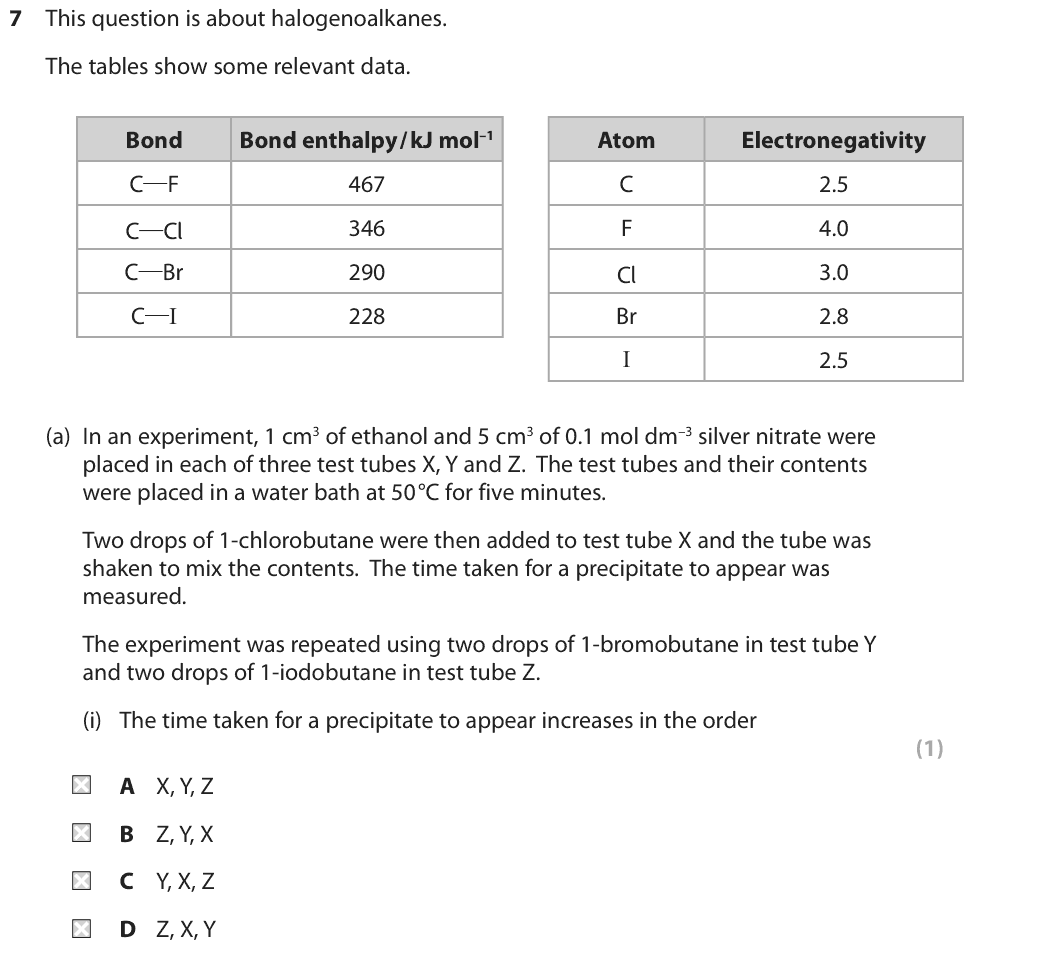
June 2023 · AS Paper 2 · Q4(a)(i) 3 marks Practical and data analysis halogenoalkanes
This question is about halogenoalkanes and some of their reactions.
X, Y and Z are three different halogenoalkanes.
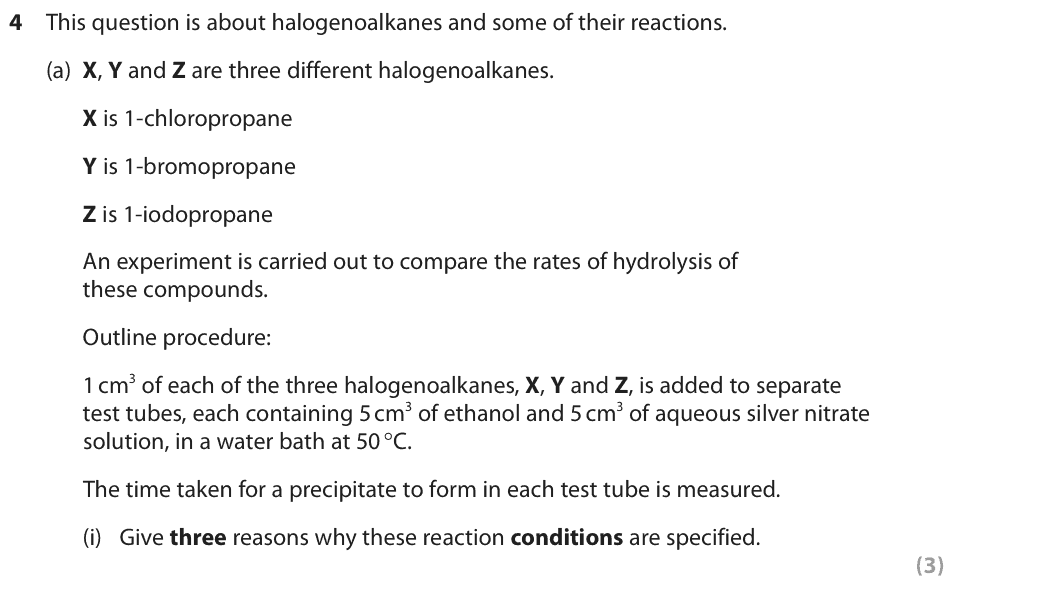
X is 1‑chloropropane
Y is 1‑bromopropane
Z is 1‑iodopropane
An experiment is carried out to compare the rates of hydrolysis of
these compounds.
Outline procedure:
1 cm3 of each of the three halogenoalkanes, X, Y and Z, is added to separate
test tubes, each containing 5 cm3 of ethanol and 5 cm3 of aqueous silver nitrate
solution, in a water bath at 50 °C.
The time taken for a precipitate to form in each test tube is measured.
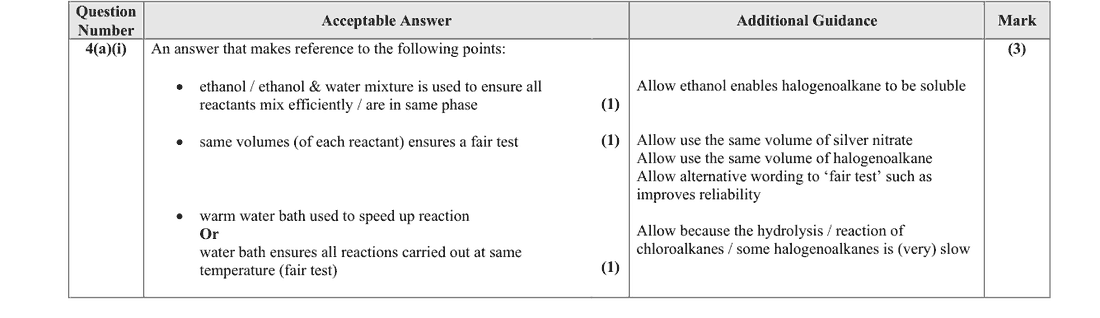
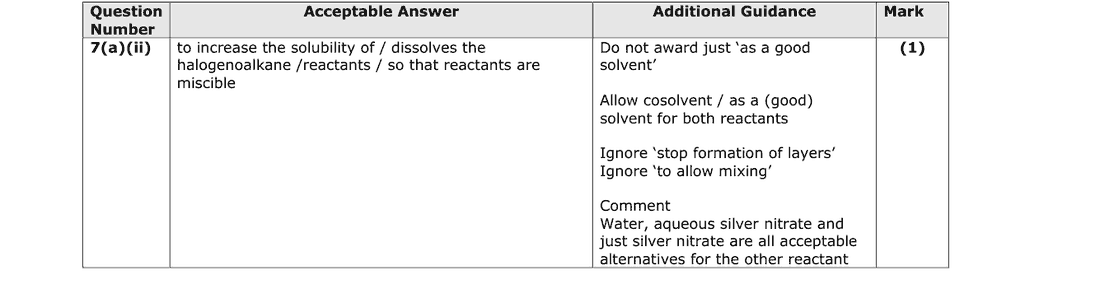
Give three reasons why these reaction conditions are specified.
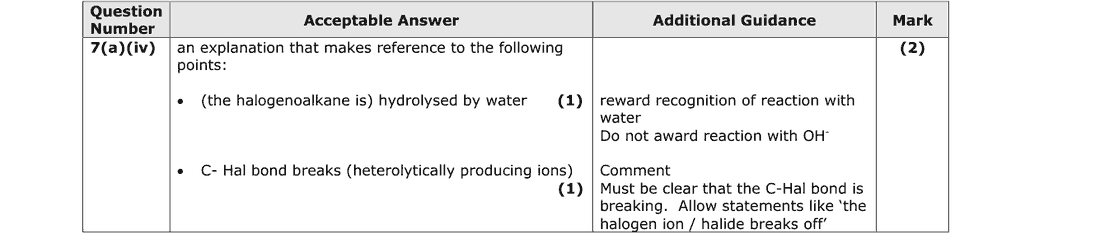
June 2023 · AS Paper 2 · Q4(a)(ii) 2 marks Explanation halogenoalkanesformulae equations and amounts of substance
Earlier part of question 4 that this part usesEarlier part of June 2023 Paper 2 question 4
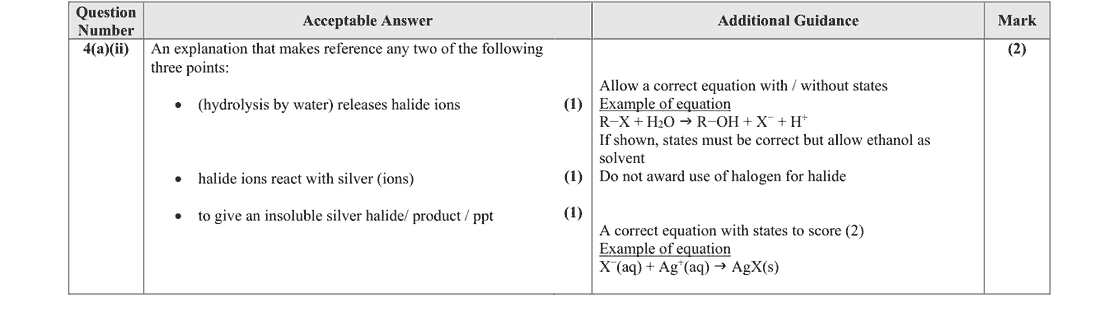
Explain why a precipitate forms.
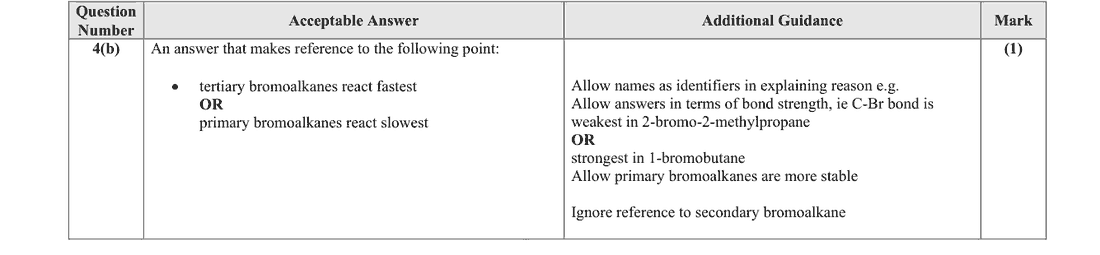
June 2023 · AS Paper 2 · Q4(b) 1 mark Short answer halogenoalkanes
Earlier part of question 4 that this part usesEarlier part of June 2023 Paper 2 question 4
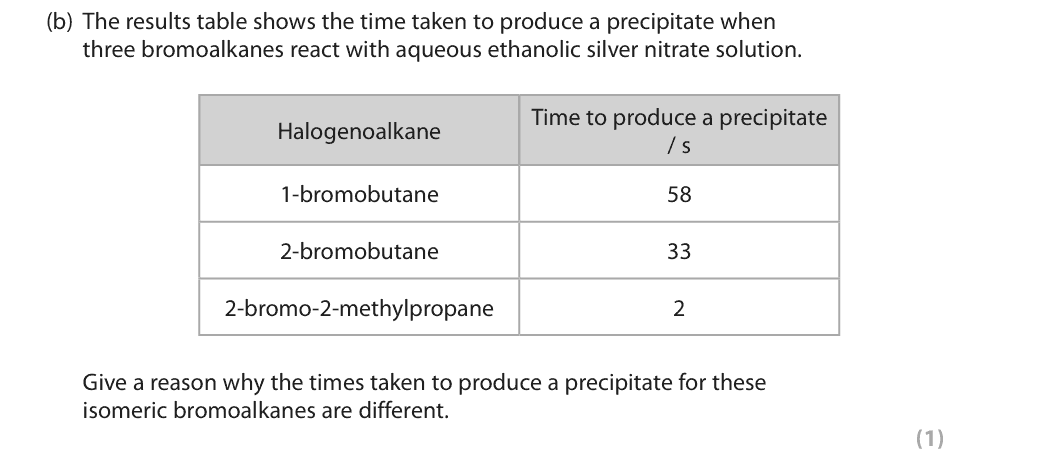
The results table shows the time taken to produce a precipitate when
three bromoalkanes react with aqueous ethanolic silver nitrate solution.
Time to produce a precipitate
Halogenoalkane
/ s
1‑bromobutane
58
2‑bromobutane
33
2‑bromo‑2‑methylpropane
2
Give a reason why the times taken to produce a precipitate for these
isomeric bromoalkanes are different.
June 2023 · AS Paper 2 · Q5(a)(i) 3 marks Calculation energetics i
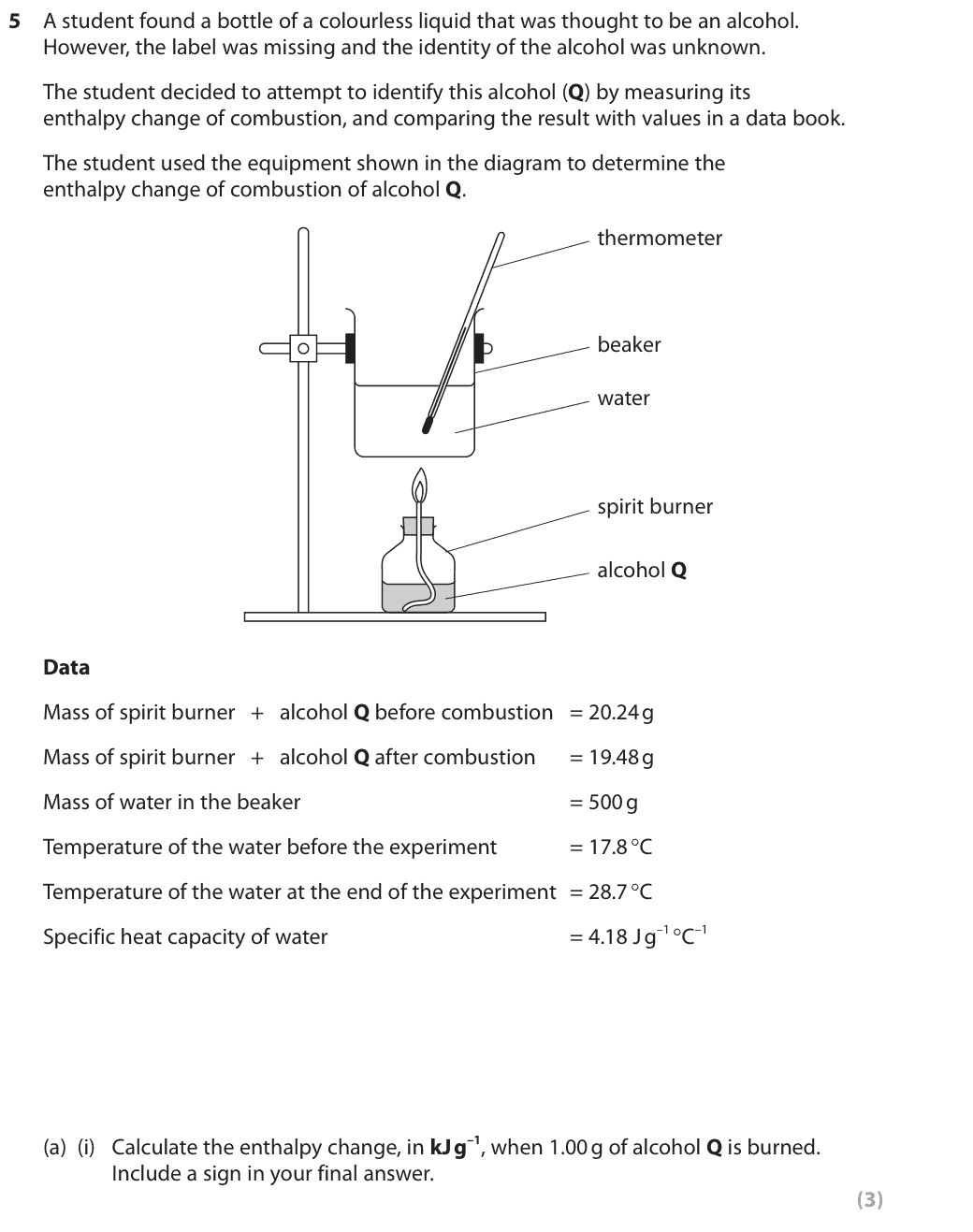
A student found a bottle of a colourless liquid that was thought to be an alcohol.
However, the label was missing and the identity of the alcohol was unknown.
The student decided to attempt to identify this alcohol (Q) by measuring its
enthalpy change of combustion, and comparing the result with values in a data book.
The student used the equipment shown in the diagram to determine the
enthalpy change of combustion of alcohol Q.
thermometer
beaker
water
spirit burner
alcohol Q
Data
Mass of spirit burner   +   alcohol Q before combustion  = 20.24 g
Mass of spirit burner   +   alcohol Q after combustion
= 19.48 g
Mass of water in the beaker
= 500 g
Temperature of the water before the experiment
= 17.8 °C
Temperature of the water at the end of the experiment  = 28.7 °C
Specific heat capacity of water
= 4.18 J g–1 °C–1
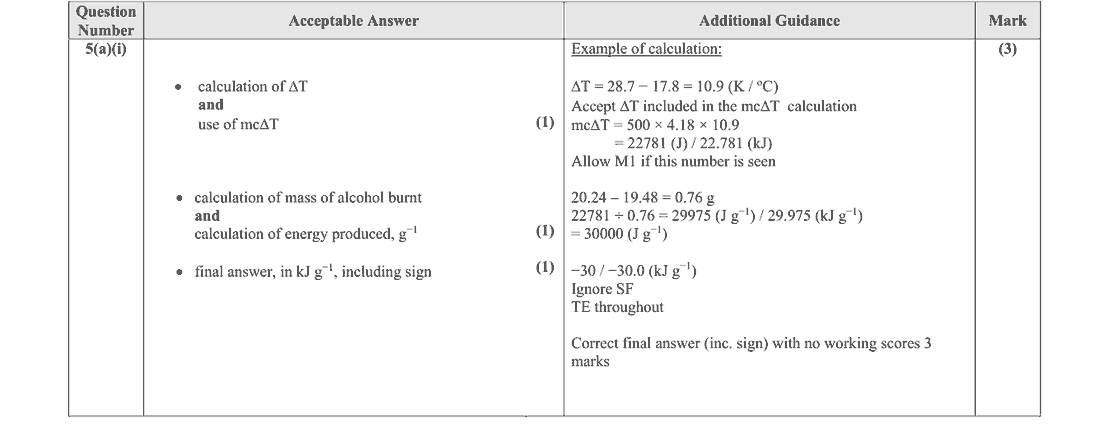
Calculate the enthalpy change, in kJ g–1, when 1.00 g of alcohol Q is burned.
Include a sign in your final answer.
June 2023 · AS Paper 2 · Q5(b) 2 marks Practical and data analysis energetics i
Earlier part of question 5 that this part usesEarlier part of June 2023 Paper 2 question 5
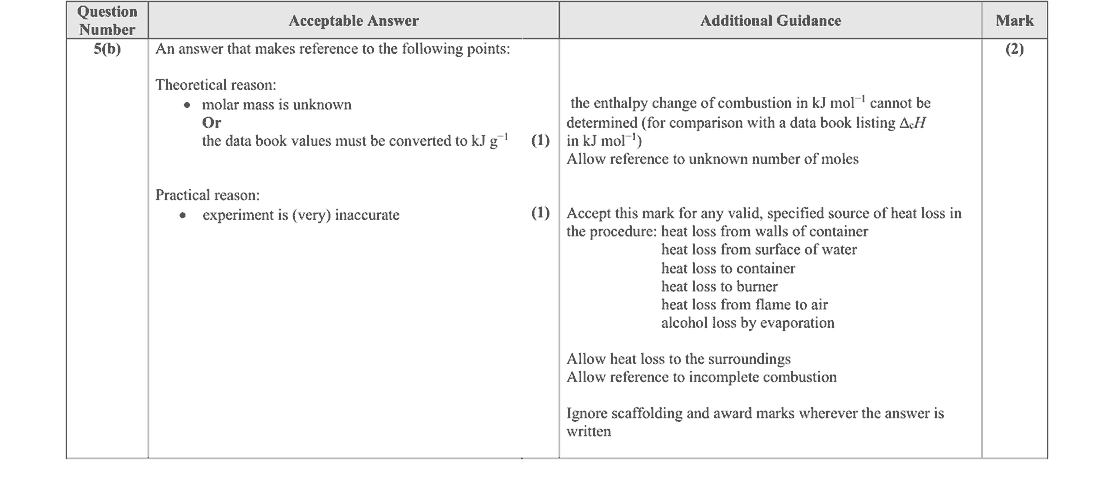
Give one theoretical and one practical reason why this procedure is insufficient to
identify the alcohol.
Theoretical reason
Practical reason
June 2023 · AS Paper 2 · Q7(c)(ii) 1 mark Short answer alcohols
Earlier part of question 7 that this part usesEarlier part of June 2023 Paper 2 question 7
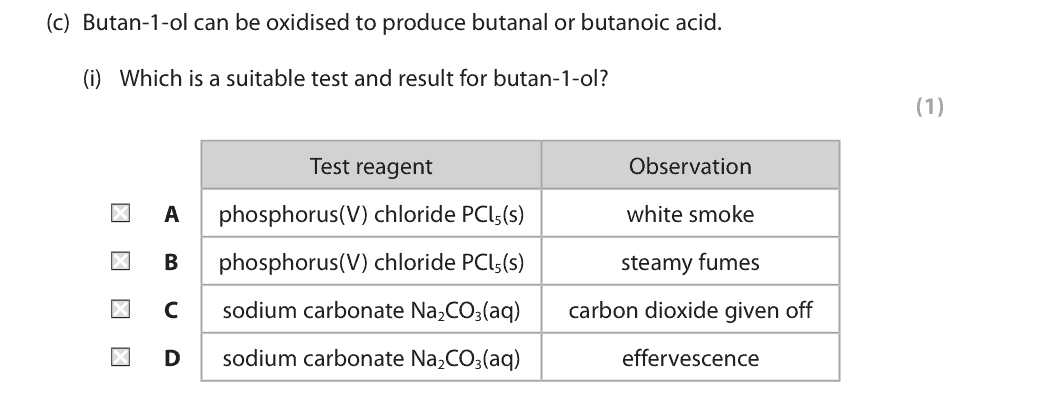
State how to produce butanal in high yield when butan‑1‑ol reacts
with acidified potassium dichromate(VI).
June 2023 · AS Paper 2 · Q7(c)(iii) 2 marks Practical and data analysis alcohols
Earlier part of question 7 that this part usesEarlier part of June 2023 Paper 2 question 7
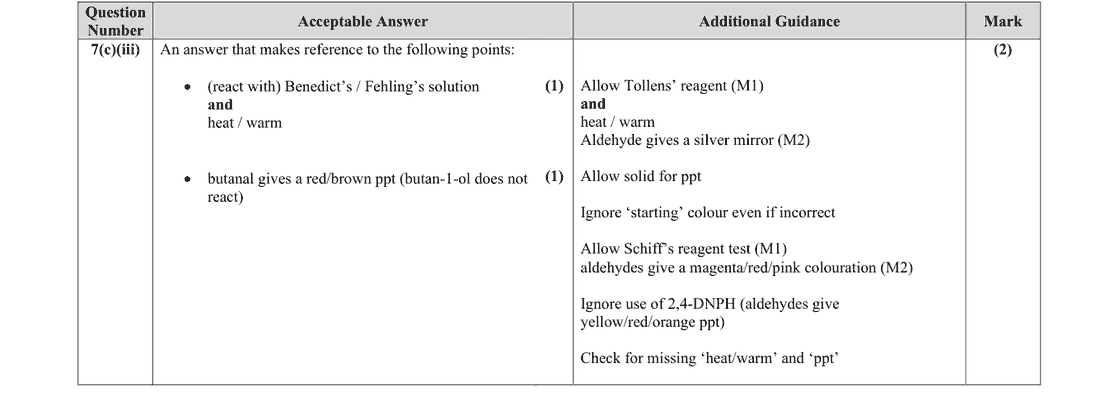
Describe a chemical test, including the expected results, that would confirm
the presence of an aldehyde such as butanal.
June 2023 · AS Paper 2 · Q7(c)(iv) 6 marks 6-mark extended response Hard alcohols
Earlier part of question 7 that this part usesEarlier part of June 2023 Paper 2 question 7
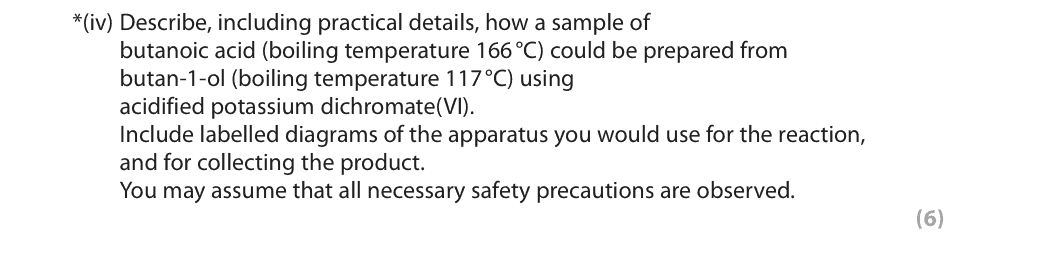
Describe, including practical details, how a sample of
butanoic acid (boiling temperature 166 °C) could be prepared from
butan‑1‑ol (boiling temperature 117 °C) using
acidified potassium dichromate(VI).
Include labelled diagrams of the apparatus you would use for the reaction,
and for collecting the product.
You may assume that all necessary safety precautions are observed.
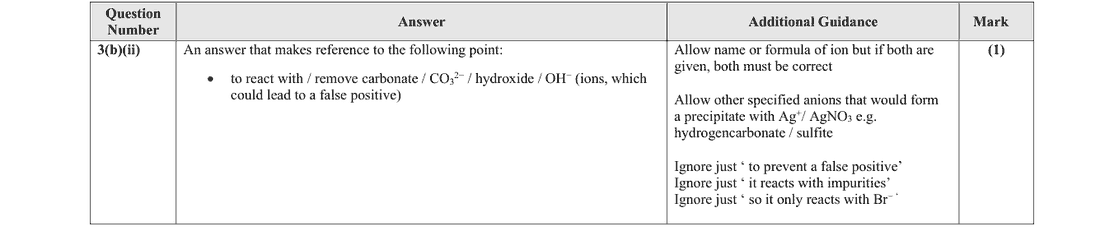
June 2023 · Paper 1 · Q3(b)(ii) 1 mark Practical and data analysis group 7 the halogens
Earlier part of question 3 that this part usesEarlier part of June 2023 Paper 1 question 3
Give a reason why the silver nitrate must be acidified.
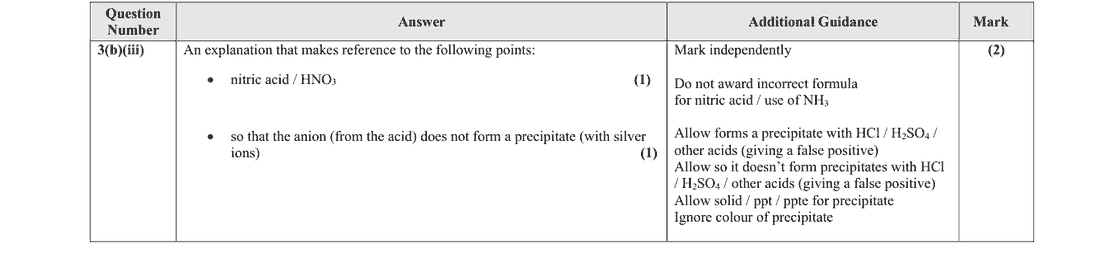
June 2023 · Paper 1 · Q3(b)(iii) 2 marks Practical and data analysis group 7 the halogens
Earlier part of question 3 that this part usesEarlier part of June 2023 Paper 1 question 3
Explain which acid needs to be used to acidify the silver nitrate solution and
why other acids are unsuitable.
June 2023 · Paper 1 · Q3(c)(i) 2 marks Practical and data analysis bonding
Earlier part of question 3 that this part usesEarlier part of June 2023 Paper 1 question 3
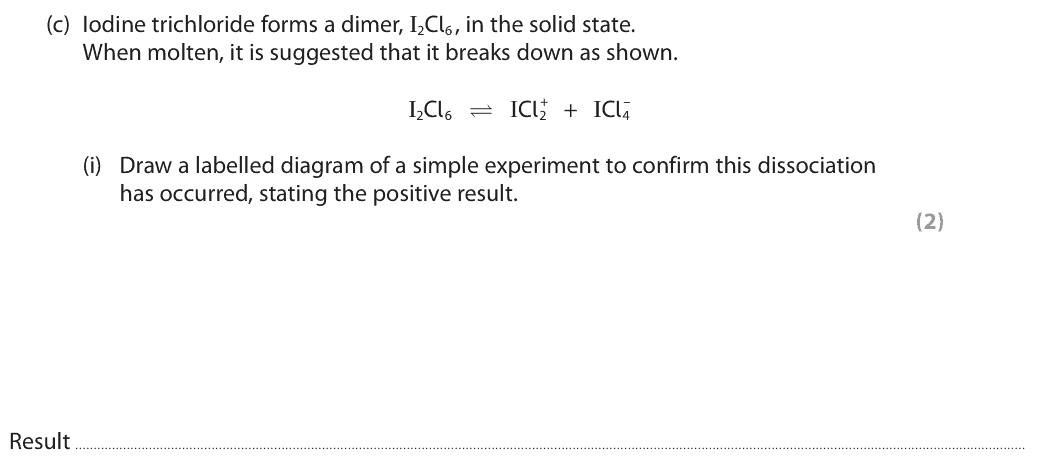
Iodine trichloride forms a dimer, I2Cl6 , in the solid state.
When molten, it is suggested that it breaks down as shown.
I2Cl6      ICl2
+   +   ICl4
–
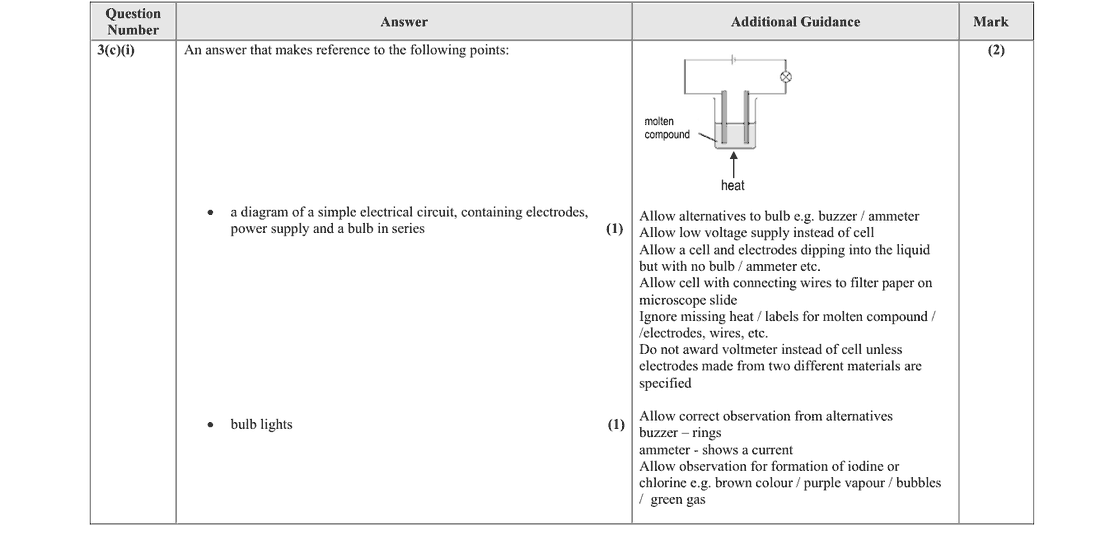
Draw a labelled diagram of a simple experiment to confirm this dissociation
has occurred, stating the positive result.
Result
June 2023 · Paper 1 · Q10(c)(i) 5 marks Calculation redox ii
Earlier part of question 10 that this part usesEarlier part of June 2023 Paper 1 question 10
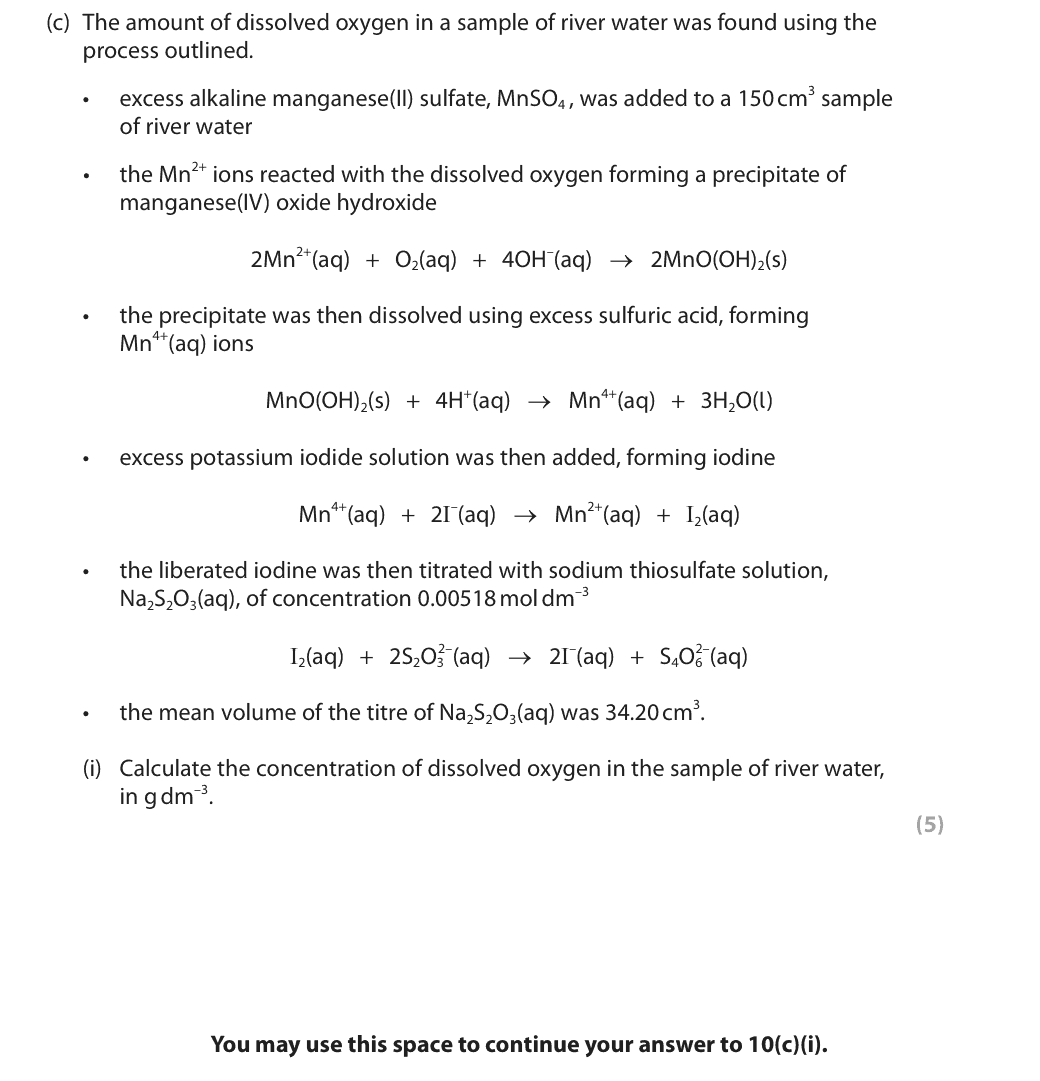
The amount of dissolved oxygen in a sample of river water was found using the
process outlined.
excess alkaline manganese(II) sulfate, MnSO4 , was added to a 150 cm3 sample
•
of river water
•
the Mn2+ ions reacted with the dissolved oxygen forming a precipitate of
manganese(IV) oxide hydroxide
2Mn2+(aq)   +   O2(aq)   +   4OH–(aq)   →   2MnO(OH)2(s)
•
the precipitate was then dissolved using excess sulfuric acid, forming
Mn4+(aq) ions
MnO(OH)2(s)   +   4H+(aq)   →   Mn4+(aq)   +   3H2O(l)
•
excess potassium iodide solution was then added, forming iodine
Mn4+(aq)   +   2I–(aq)   →   Mn2+(aq)   +   I2(aq)
•
the liberated iodine was then titrated with sodium thiosulfate solution,
Na2S2O3(aq), of concentration 0.00518 mol dm–3
I2(aq)   +   2S2O3
2–(aq)   →   2I–(aq)   +   S4O6
2–(aq)
•
the mean volume of the titre of Na2S2O3(aq) was 34.20 cm3.
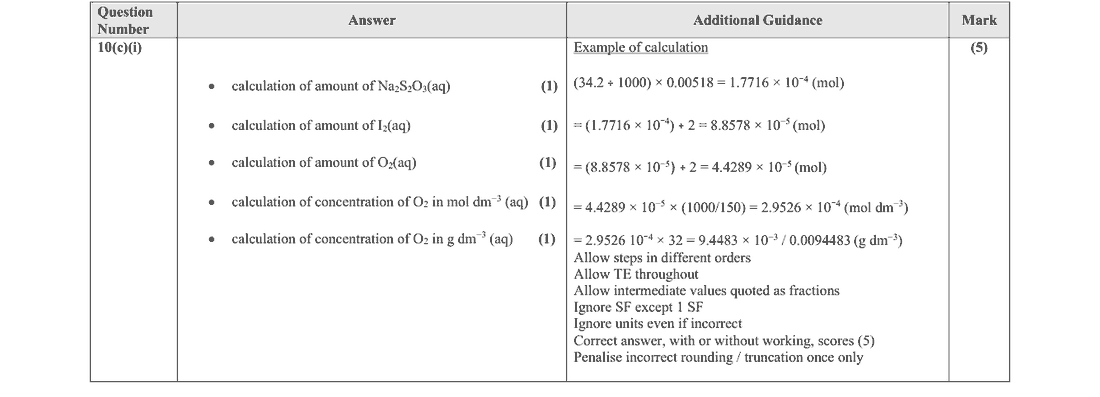
Calculate the concentration of dissolved oxygen in the sample of river water,
in g dm–3.
You may use this space to continue your answer to 10(c)(i).
June 2023 · Paper 2 · Q6(a)(i) 1 mark Practical and data analysis kinetics ii
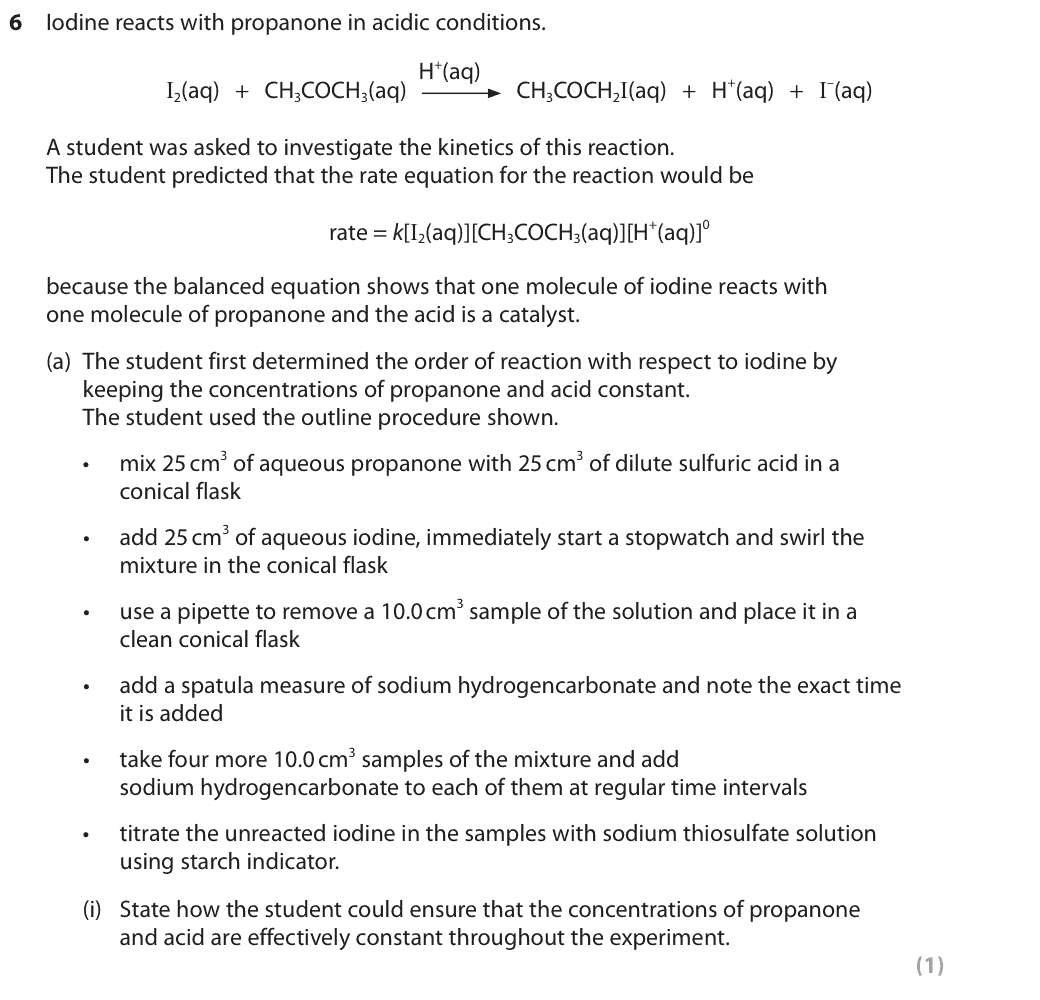
Iodine reacts with propanone in acidic conditions.
H+(aq)
I2(aq)   +   CH3COCH3(aq)
CH3COCH2I(aq)   +   H+(aq)   +   I–(aq)
A student was asked to investigate the kinetics of this reaction.
The student predicted that the rate equation for the reaction would be
rate = k[I2(aq)][CH3COCH3(aq)][H+(aq)]0
because the balanced equation shows that one molecule of iodine reacts with
one molecule of propanone and the acid is a catalyst.
The student first determined the order of reaction with respect to iodine by
keeping the concentrations of propanone and acid constant.
The student used the outline procedure shown.
•
mix 25 cm3 of aqueous propanone with 25 cm3 of dilute sulfuric acid in a
conical flask
•
add 25 cm3 of aqueous iodine, immediately start a stopwatch and swirl the
mixture in the conical flask
•
use a pipette to remove a 10.0 cm3 sample of the solution and place it in a
clean conical flask
•
add a spatula measure of sodium hydrogencarbonate and note the exact time
it is added
•
take four more 10.0 cm3 samples of the mixture and add
sodium hydrogencarbonate to each of them at regular time intervals
•
titrate the unreacted iodine in the samples with sodium thiosulfate solution
using starch indicator.
State how the student could ensure that the concentrations of propanone
and acid are effectively constant throughout the experiment.
June 2023 · Paper 2 · Q6(a)(ii) 2 marks Practical and data analysis kinetics ii
Earlier part of question 6 that this part usesEarlier part of June 2023 Paper 2 question 6
Explain why sodium hydrogencarbonate is added.
June 2023 · Paper 2 · Q6(b)(i) 1 mark Practical and data analysis kinetics ii
Earlier part of question 6 that this part usesEarlier part of June 2023 Paper 2 question 6
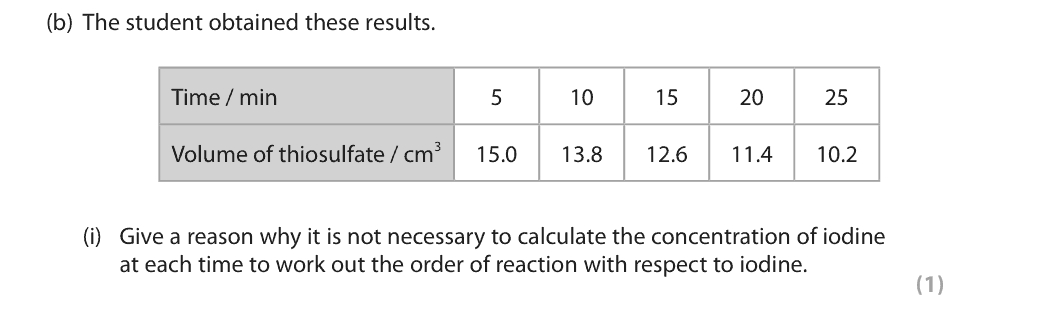
The student obtained these results.
Time / min
5
10
15
20
25
Volume of thiosulfate / cm3
15.0
13.8
12.6
11.4
10.2
Give a reason why it is not necessary to calculate the concentration of iodine
at each time to work out the order of reaction with respect to iodine.
June 2023 · Paper 2 · Q6(b)(ii) 2 marks Diagram or structure kinetics ii
Earlier parts of question 6 that this part usesEarlier part of June 2023 Paper 2 question 6Earlier part of June 2023 Paper 2 question 6
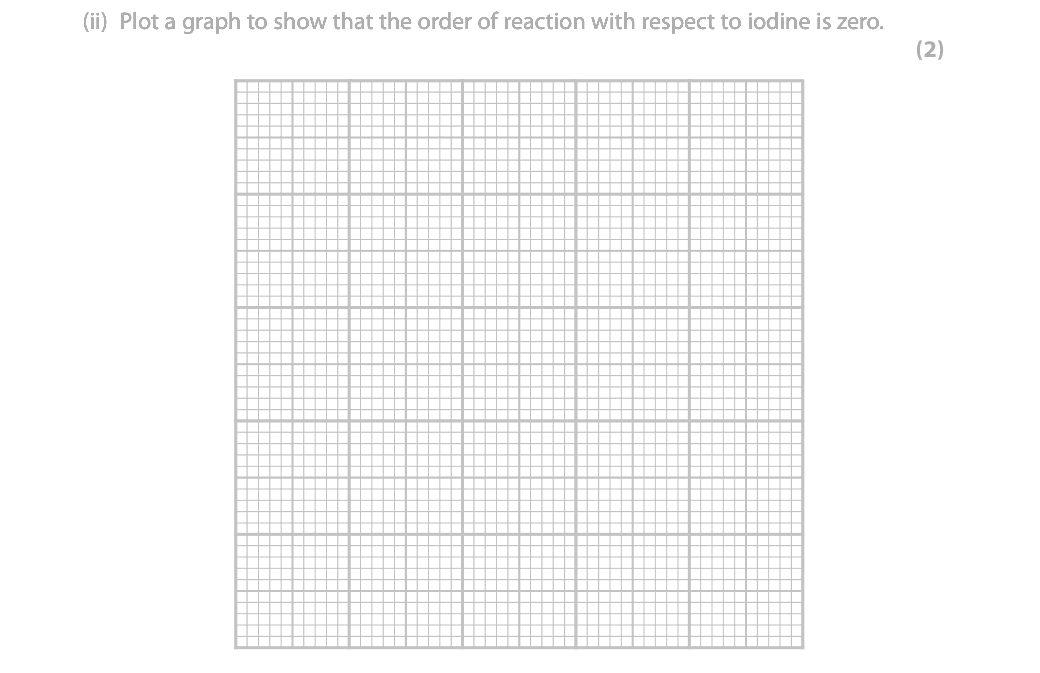
Plot a graph to show that the order of reaction with respect to iodine is zero.
June 2023 · Paper 2 · Q6(b)(iii) 1 mark Short answer kinetics ii
Earlier parts of question 6 that this part usesEarlier part of June 2023 Paper 2 question 6Earlier part of June 2023 Paper 2 question 6Earlier part of June 2023 Paper 2 question 6
Give a reason why the graph shows that the order of reaction with respect to
iodine is zero.
June 2023 · Paper 2 · Q7(c)(i) 3 marks Practical and data analysis Hard carbonyl compoundsorganic synthesis
Earlier part of question 7 that this part usesEarlier part of June 2023 Paper 2 question 7
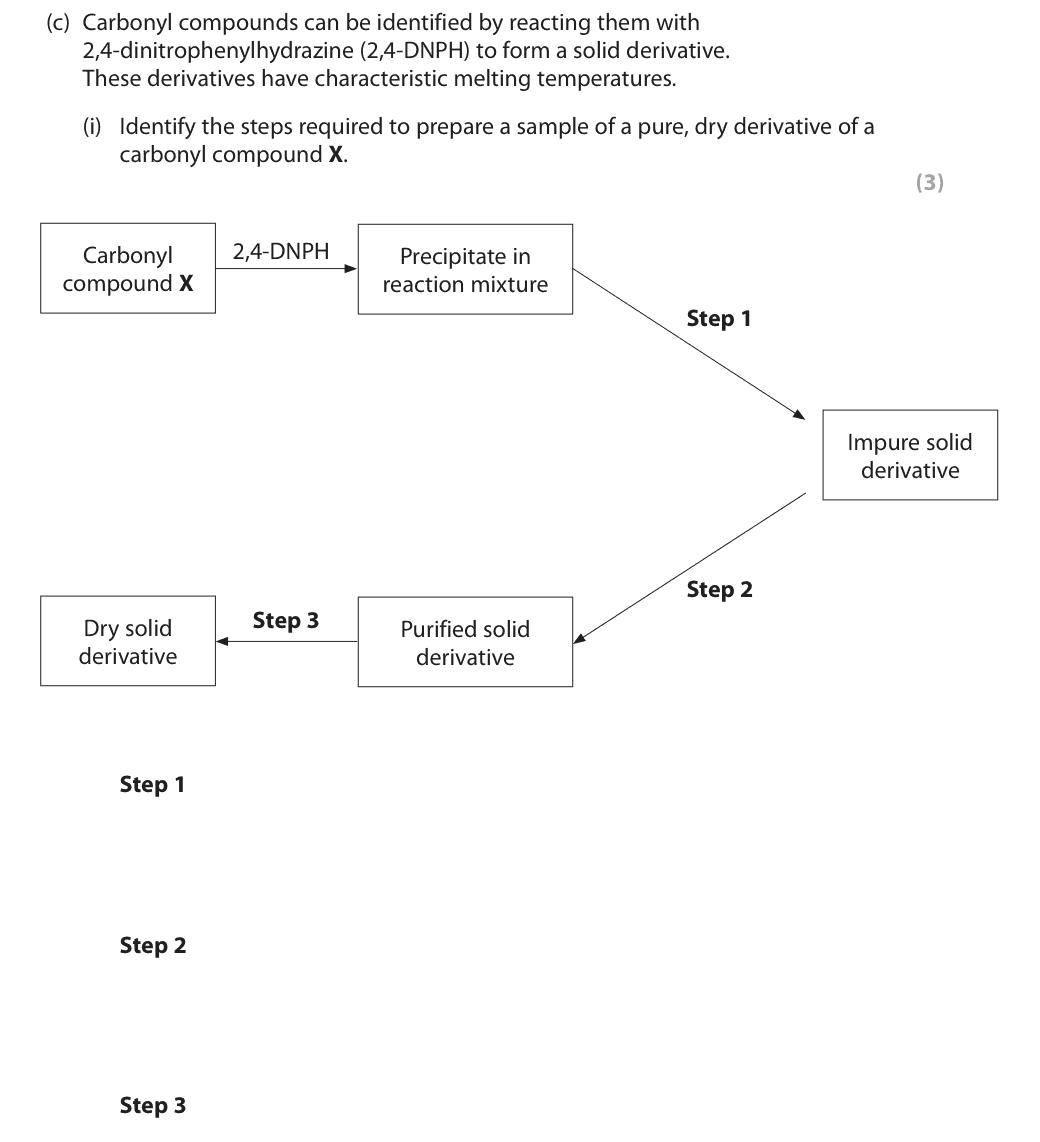
Carbonyl compounds can be identified by reacting them with
2,4‑dinitrophenylhydrazine (2,4‑DNPH) to form a solid derivative.
These derivatives have characteristic melting temperatures.
Identify the steps required to prepare a sample of a pure, dry derivative of a
carbonyl compound X.
2,4‑DNPH
Carbonyl
Precipitate in
compound X
reaction mixture
Step 1
Impure solid
derivative
Step 2
Step 3
Dry solid
Purified solid
derivative
derivative
Step 1
Step 2
Step 3
June 2023 · Paper 3 · Q2(c)(i) 1 mark Practical and data analysis groups 1 and 2
Earlier part of question 2 that this part usesEarlier part of June 2023 Paper 3 question 2
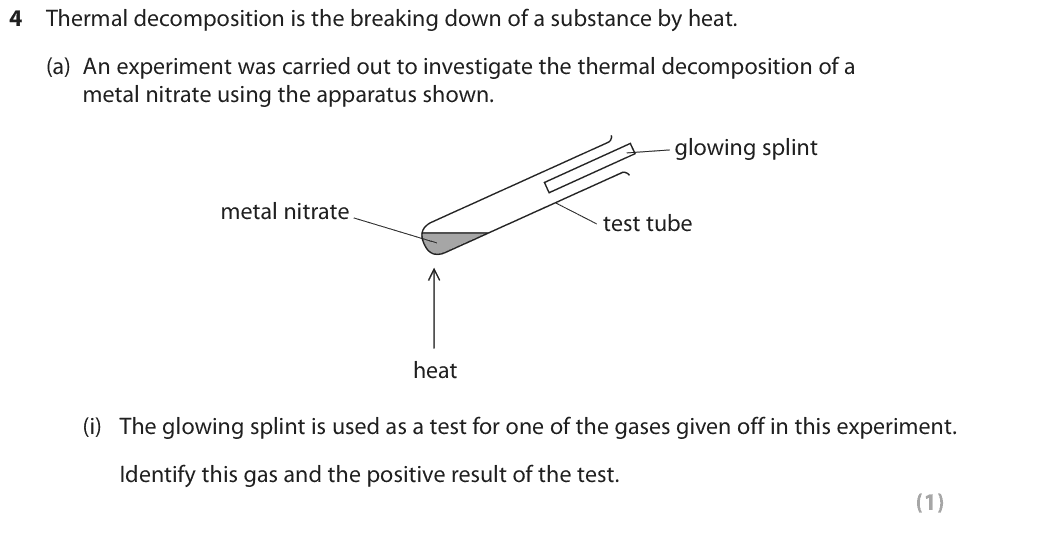
Sodium nitrate undergoes thermal decomposition to produce oxygen as one of
the products.
Describe the test, with the positive result, for oxygen.
June 2023 · Paper 3 · Q3(d)(i) 1 mark Practical and data analysis alcohols
Earlier part of question 3 that this part usesEarlier part of June 2023 Paper 3 question 3
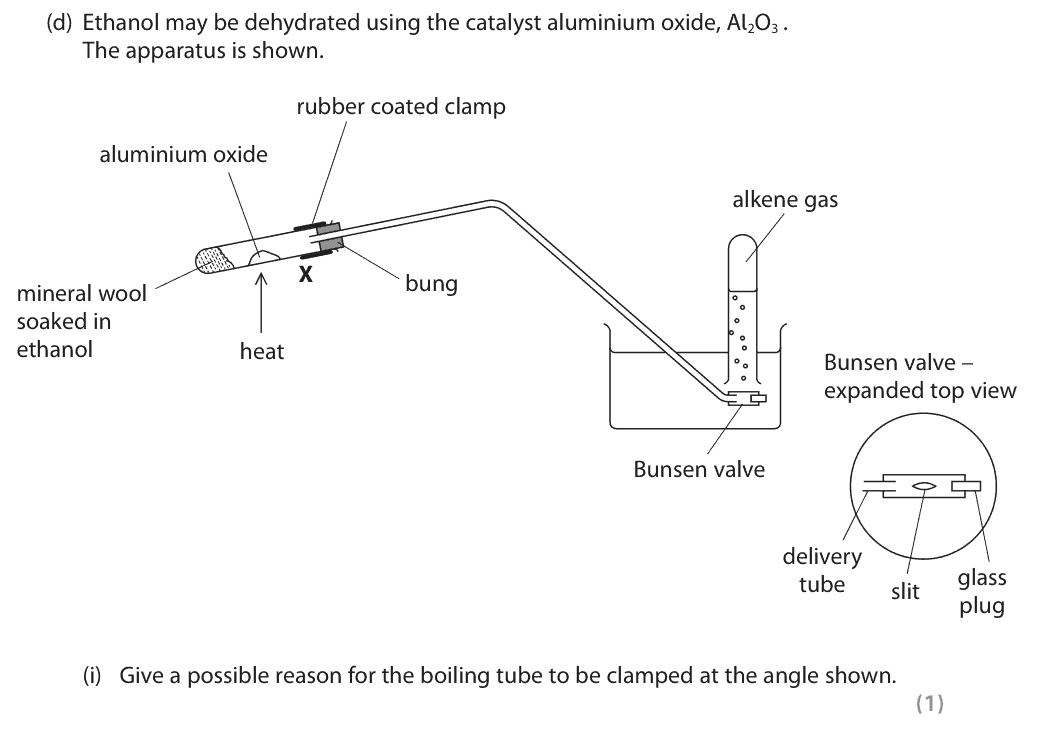
Ethanol may be dehydrated using the catalyst aluminium oxide, Al2O3 .
The apparatus is shown.
rubber coated clamp
aluminium oxide
alkene gas
X
bung
mineral wool
soaked in
ethanol
heat
Bunsen valve –
expanded top view
Bunsen valve
delivery
glass
tube
slit
plug
Give a possible reason for the boiling tube to be clamped at the angle shown.
June 2023 · Paper 3 · Q3(d)(ii) 1 mark Practical and data analysis alcohols
Earlier parts of question 3 that this part usesEarlier part of June 2023 Paper 3 question 3Earlier part of June 2023 Paper 3 question 3
Describe the problem if the ethanol is heated instead of the catalyst.
June 2023 · Paper 3 · Q3(d)(iii) 1 mark Practical and data analysis Easy formulae equations and amounts of substance
Earlier parts of question 3 that this part usesEarlier part of June 2023 Paper 3 question 3Earlier part of June 2023 Paper 3 question 3
Identify a safety issue if the heat source was moved to the position labelled X
on the diagram.
June 2023 · Paper 3 · Q3(d)(iv) 1 mark Practical and data analysis alcohols
Earlier parts of question 3 that this part usesEarlier part of June 2023 Paper 3 question 3Earlier part of June 2023 Paper 3 question 3
Give a possible reason for the use of the Bunsen valve in the apparatus.
June 2023 · Paper 3 · Q3(d)(v) 1 mark Practical and data analysis Easy alkenes
Earlier parts of question 3 that this part usesEarlier part of June 2023 Paper 3 question 3Earlier part of June 2023 Paper 3 question 3
Describe a test, with the positive result, which would confirm the presence of
an alkene in the test tube.
June 2023 · Paper 3 · Q4(a) 6 marks 6-mark extended response energetics i
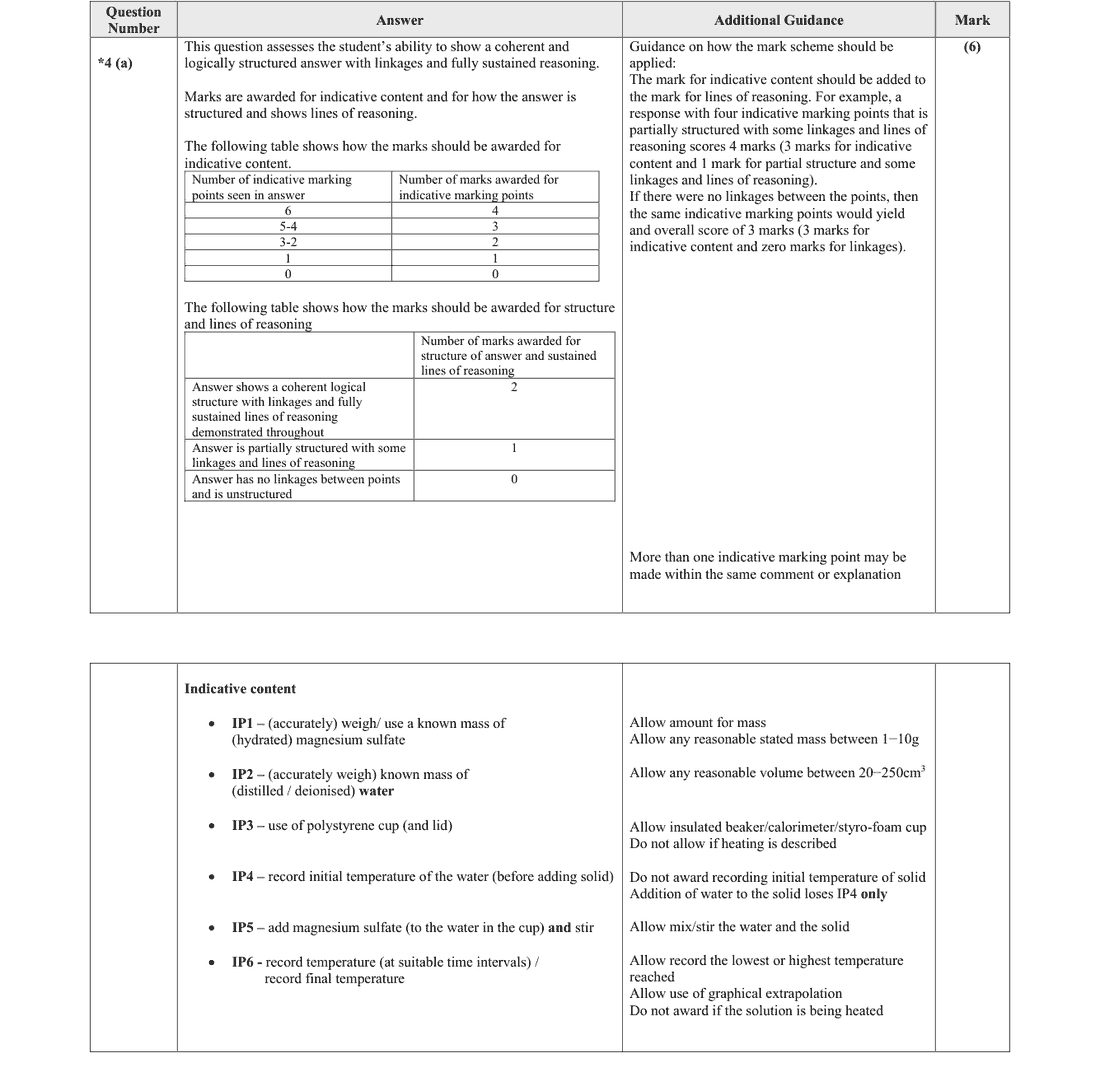
This question is about hydrated magnesium sulfate, MgSO4·7H2O.
Devise an experimental procedure to determine the enthalpy change of solution
for hydrated magnesium sulfate.
MgSO4·7H2O(s)   +   aq   →   MgSO4(aq)
Details of the method of calculation are not required.
June 2023 · Paper 3 · Q5(a) 3 marks Practical and data analysis redox ii
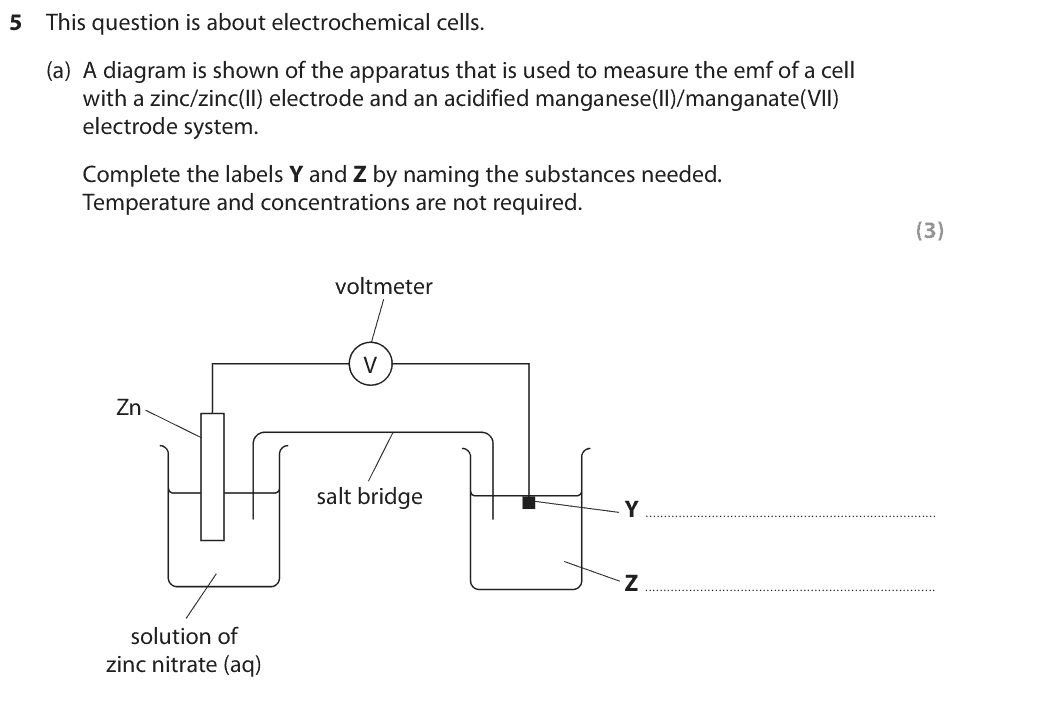
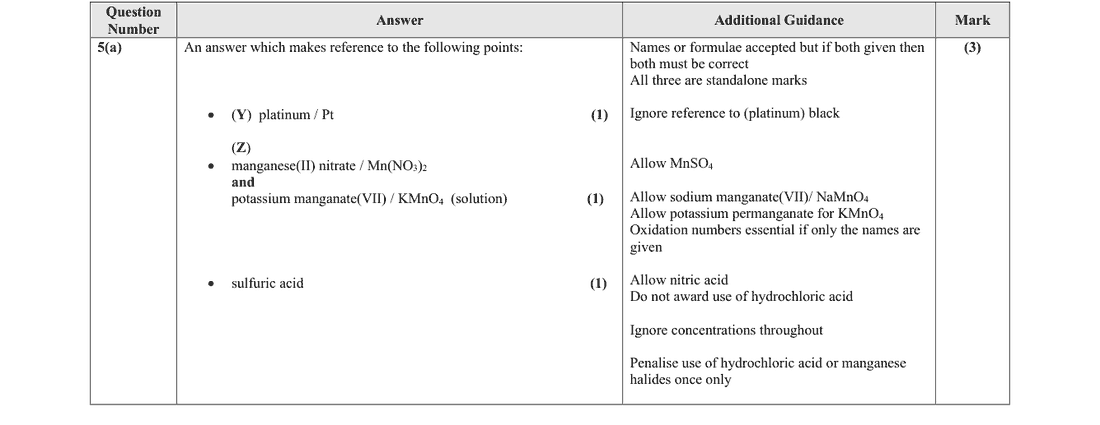
This question is about electrochemical cells.
A diagram is shown of the apparatus that is used to measure the emf of a cell
with a zinc/zinc(II) electrode and an acidified manganese(II)/manganate(VII)
electrode system.
Complete the labels Y and Z by naming the substances needed.
Temperature and concentrations are not required.
voltmeter
V
Zn
salt bridge
Y 
Z 
solution of
zinc nitrate (aq)
June 2023 · Paper 3 · Q6(b)(i) 1 mark Short answer amines amides amino acids and proteins
Earlier part of question 6 that this part usesEarlier part of June 2023 Paper 3 question 6
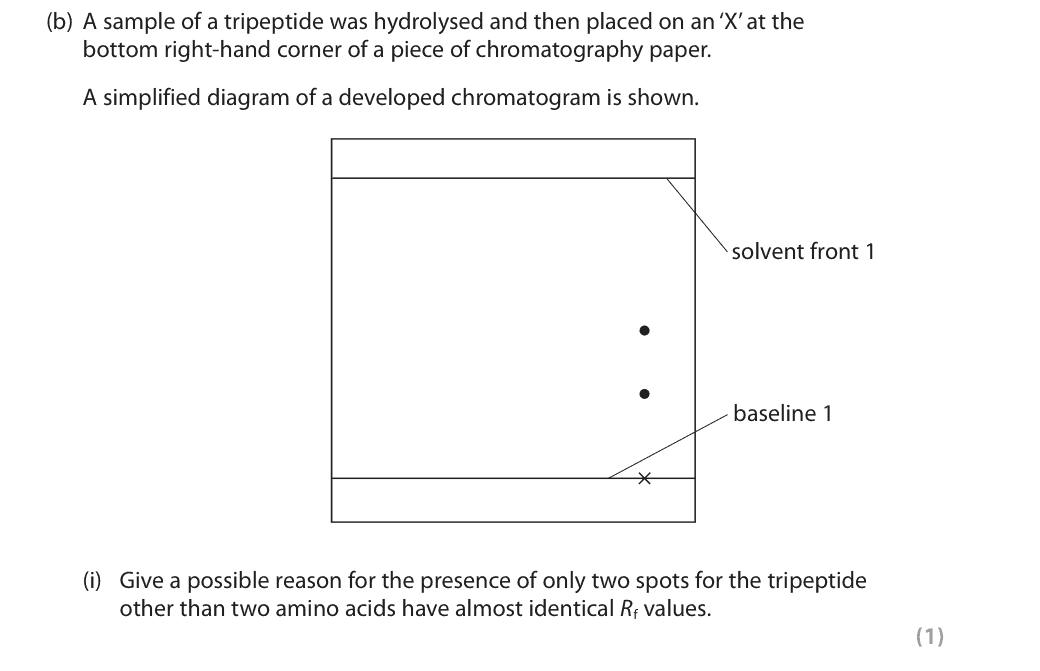
A sample of a tripeptide was hydrolysed and then placed on an ‘X’ at the
bottom right‑hand corner of a piece of chromatography paper.
A simplified diagram of a developed chromatogram is shown.
solvent front 1
baseline 1
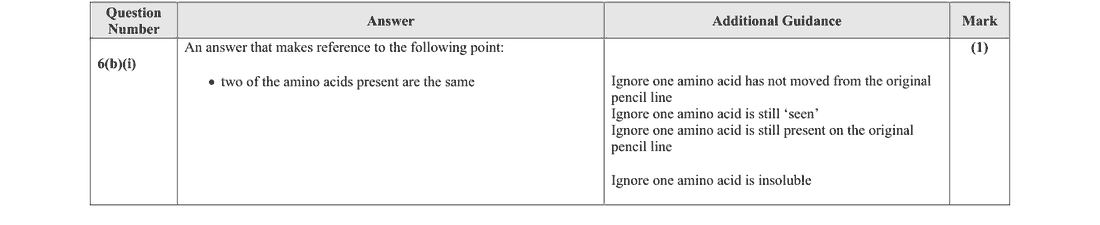
Give a possible reason for the presence of only two spots for the tripeptide
other than two amino acids have almost identical Rf values.
June 2023 · Paper 3 · Q6(b)(ii) 3 marks Diagram or structure nmr mass spectrometry and chromatography
Earlier parts of question 6 that this part usesEarlier part of June 2023 Paper 3 question 6Earlier part of June 2023 Paper 3 question 6
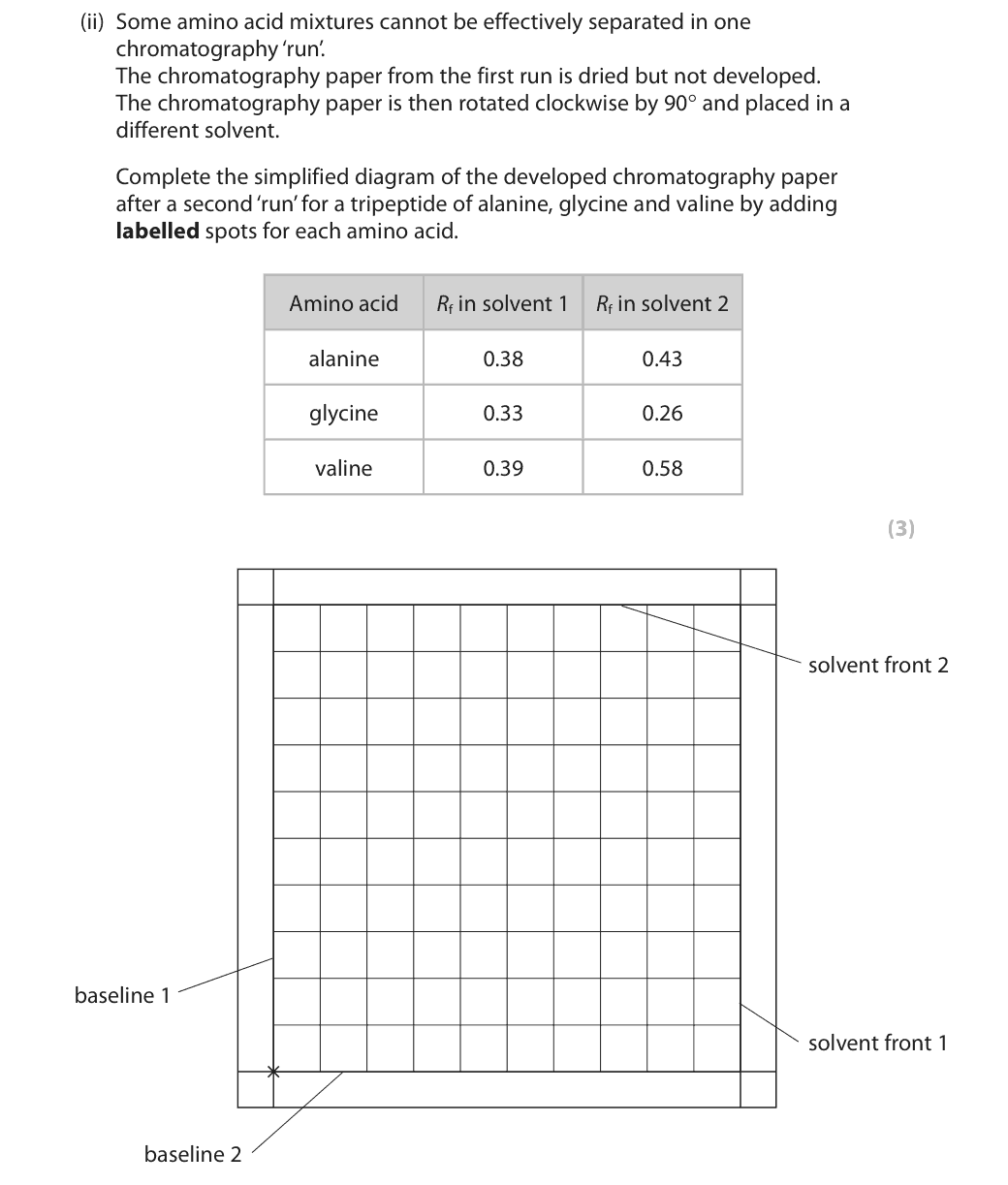
Some amino acid mixtures cannot be effectively separated in one
chromatography ‘run’.
The chromatography paper from the first run is dried but not developed.
The chromatography paper is then rotated clockwise by 90° and placed in a
different solvent.
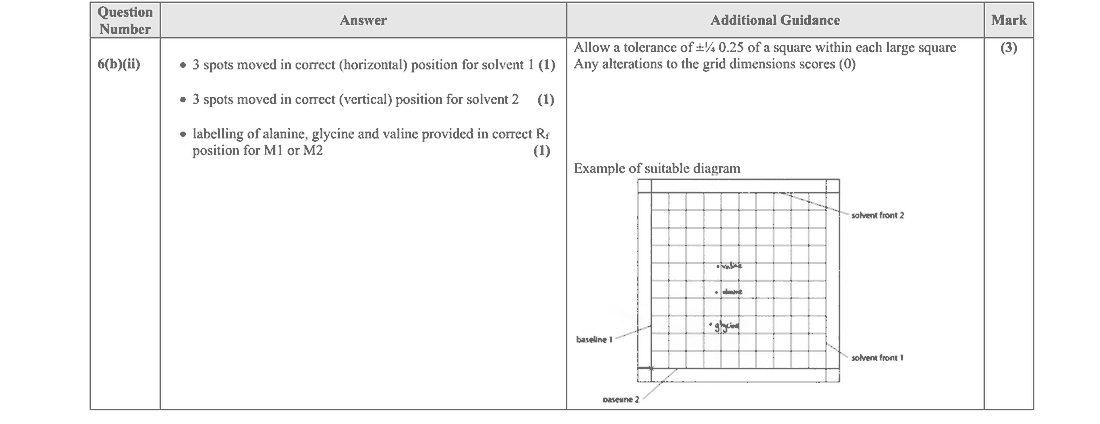
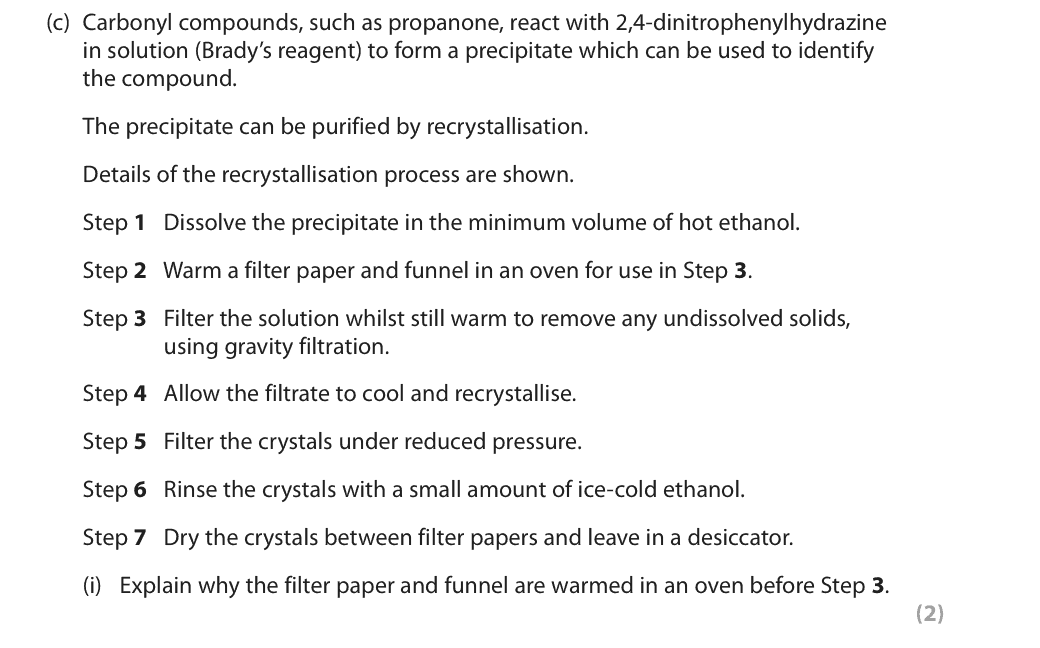
Complete the simplified diagram of the developed chromatography paper
after a second ‘run’ for a tripeptide of alanine, glycine and valine by adding
labelled spots for each amino acid.
Amino acid
Rf in solvent 1
Rf in solvent 2
alanine
0.38
0.43
glycine
0.33
0.26
valine
0.39
0.58
solvent front 2
baseline 1
solvent front 1
baseline 2
June 2023 · Paper 3 · Q6(b)(iii) 1 mark Short answer amines amides amino acids and proteins
Earlier part of question 6 that this part usesEarlier part of June 2023 Paper 3 question 6
Name a reagent that locates colourless amino acids by producing a
coloured compound.
June 2023 · Paper 3 · Q7(a)(i) 1 mark Practical and data analysis formulae equations and amounts of substance
Hardness in water is measured in terms of the concentration of dissolved
calcium compounds.
Titration experiments can be carried out to determine the hardness of
a water sample.
A pipette is used to measure a 50.0 cm3 water sample for titration.
Describe how to remove an air bubble from the tip of the pipette.
June 2023 · Paper 3 · Q7(b)(i) 1 mark Practical and data analysis Easy formulae equations and amounts of substance
Earlier part of question 7 that this part usesEarlier part of June 2023 Paper 3 question 7
About 2 cm3 of a pH 10 buffer is added to each 50.0 cm3 water sample.
State whether or not a 100 cm3 measuring cylinder is suitable to measure this
volume of buffer solution. Justify your answer.
June 2023 · Paper 3 · Q7(b)(iii) 1 mark Practical and data analysis Easy formulae equations and amounts of substance
Earlier parts of question 7 that this part usesEarlier part of June 2023 Paper 3 question 7Earlier part of June 2023 Paper 3 question 7
State a necessary laboratory precaution, other than wearing a laboratory coat,
gloves and goggles, that must be taken when using concentrated ammonia.
June 2023 · Paper 3 · Q7(d)(i) 1 mark Practical and data analysis Hard formulae equations and amounts of substance
Earlier part of question 7 that this part usesEarlier part of June 2023 Paper 3 question 7
There are two types of water hardness:
temporary hardness which is removed by boiling as a precipitate forms,
permanent hardness which is unaffected by boiling.
Levels of water hardness are expressed as the concentration of calcium ions
in mg dm–3.
A student carried out a series of experiments to determine the hardness of a
sample of water. 50.0 cm3 samples of the water were titrated with EDTA.
Further 50.0 cm3 samples of water were taken after boiling and then titrated
with EDTA.
Name the process needed before titrating the sample of boiled water.
June 2023 · Paper 3 · Q8(a)(i) 2 marks Practical and data analysis Hard kinetics ii
This question is about reaction kinetics and the Arrhenius equation.
Different iodine clock reactions are often used to investigate reaction kinetics.
The iodine clock reaction with hydrogen peroxide involves the
reaction shown.
H2O2   +   2I–   +   2H+   →   I2   +   2H2O
Deduce two possible experimental techniques which could be used to
monitor the progress of this reaction.
June 2023 · Paper 3 · Q8(c)(i) 3 marks Calculation kinetics ii
Earlier part of question 8 that this part usesEarlier part of June 2023 Paper 3 question 8
The Arrhenius equation may be written in a logarithmic or an exponential form.
ln k = – E
−E
a
a   +   ln A
k = A e
RT
RT
A is a constant.
The rate constant, k, for the isomerisation of cyclopropane to propene was
measured at various temperatures.
The data obtained were used to draw the graph shown.
1
T / K −
1
1.1 × 10–3
1.2 × 10–3
1.3 × 10–3
1.4 × 10–3
0
–2
–4
ln k
–6
–8
–10
Determine the activation energy, Ea , from the gradient of the graph.
Include units in your answer.
June 2023 · Paper 3 · Q9(c)(ii) 2 marks Practical and data analysis Hard carbonyl compounds
Earlier parts of question 9 that this part usesEarlier part of June 2023 Paper 3 question 9Earlier part of June 2023 Paper 3 question 9
Piceol can be distinguished from HOC6H4CH2CHO using simple chemical tests.
Give the reagents for a chemical test, and the observation that would only be
positive for piceol.
June 2022 · AS Paper 1 · Q3(d)(i) 1 mark Short answer group 7 the halogens
An aqueous solution is suspected to be potassium bromide and is tested for the
presence of the anion.
Write the name of the reagent used to test for the anion.
June 2022 · AS Paper 1 · Q3(d)(ii) 2 marks Practical and data analysis group 7 the halogens
Earlier parts of question 3 that this part usesEarlier part of June 2022 Paper 1 question 3Earlier part of June 2022 Paper 1 question 3
State the expected result of this test and the formula of the product.
Result of test
Formula of the product
June 2022 · AS Paper 1 · Q7(c)(iv) 1 mark Practical and data analysis formulae equations and amounts of substance
Earlier parts of question 7 that this part usesEarlier part of June 2022 Paper 1 question 7Earlier part of June 2022 Paper 1 question 7
State one reason why the experimental gas volume may differ from the
calculated theoretical volume.
Assume that no gas escapes and measurements have been made accurately.
June 2022 · AS Paper 1 · Q8(b)(iii) 2 marks Practical and data analysis formulae equations and amounts of substanceanalysis of inorganic compounds
Earlier part of question 8 that this part usesEarlier part of June 2022 Paper 1 question 8
Hydrochloric acid is added to a test tube containing a sample of
solid sodium carbonate.
Give two observations.
June 2022 · AS Paper 1 · Q8(b)(iv) 5 marks Practical and data analysis formulae equations and amounts of substance
Earlier part of question 8 that this part usesEarlier part of June 2022 Paper 1 question 8
Describe an experiment to enable you to accurately determine the
concentration of an approximately 1 mol dm–3 solution of hydrochloric acid,
using a solution of sodium hydroxide of concentration 1.00 mol dm–3.
Details of the calculation are not required.
June 2022 · AS Paper 1 · Q9(b) 5 marks Practical and data analysis Hard formulae equations and amounts of substance
Earlier part of question 9 that this part usesEarlier part of June 2022 Paper 1 question 9
The complete combustion of water gas produces carbon dioxide and water.
A student drew a diagram of the apparatus to attempt to identify the
combustion products.
to pump
boiling
U-tube
tube
flame
ice and
water bath
anhydrous
copper(II) sulfate
lime water
water gas
Evaluate whether the student’s apparatus is suitable for identifying both of the
combustion products. Include any improvements needed.
June 2022 · AS Paper 2 · Q4(a)(i) 2 marks Diagram or structure energetics i
A thermometric titration is a method for finding the end‑point of a titration between
aqueous solutions of ammonia and ethanoic acid.
A thermometric titration was carried out using the following steps:
•
the temperatures of the aqueous ammonia and ethanoic acid solutions were
measured and found to be 20.1 °C
•
30 cm3 of the aqueous ammonia was placed in a polystyrene cup
•
a 10 cm3 portion of an ethanoic acid solution, concentration 1.10 mol dm−3 , was
added to the polystyrene cup, the mixture stirred and the temperature measured
•
further 10 cm3 portions of ethanoic acid solution were added, the mixture stirred,
and the temperature measured immediately after each addition, until a total of
80 cm3 had been added.
Results for this experiment are shown in the table.
Volume of
ethanoic acid added
0
10
20
30
40
50
60
70
80
/ cm3
Temperature
20.1
21.8
23.5
25.1
26.4
25.8
24.9
24.1
23.3
/ °C
Plot the results using the axes provided.
Include two straight lines of best fit, extrapolated until they meet.
27
26
25
24
23
22
21
20
0
10
20
30
40
50
60
70
80
Volume of added ethanoic acid solution / cm3
June 2022 · AS Paper 2 · Q6(b) 2 marks Diagram or structure alcohols
Earlier part of question 6 that this part usesEarlier part of June 2022 Paper 2 question 6
In an experiment, 12.0 g of 2‑methylpropan‑2‑ol was shaken with excess
concentrated hydrochloric acid in a separating funnel.
After about 15 minutes, the product formed as a separate layer.
Data:
Boiling temperature
Density
Substance
/ °C
/ g cm−3
2‑methylpropan‑2‑ol
82
0.79
2‑chloro‑2‑methylpropane
51
0.84
water
100
1.00
Draw a diagram of the separating funnel after 15 minutes, labelling the layer
containing 2‑chloro‑2‑methylpropane.
June 2022 · AS Paper 2 · Q6(c)(i) 1 mark Short answer formulae equations and amounts of substance
Earlier part of question 6 that this part usesEarlier part of June 2022 Paper 2 question 6
After separation, the organic layer was shaken with
sodium hydrogencarbonate solution. Fizzing was observed.
Identify, by name or formula, the gas that was given off.
June 2022 · AS Paper 2 · Q6(c)(ii) 1 mark Short answer formulae equations and amounts of substance
Earlier parts of question 6 that this part usesEarlier part of June 2022 Paper 2 question 6Earlier part of June 2022 Paper 2 question 6
Give the formula of the ion that reacted with the hydrogencarbonate ion to
form the gas.
June 2022 · AS Paper 2 · Q6(c)(iii) 2 marks Practical and data analysis alcohols
Earlier parts of question 6 that this part usesEarlier part of June 2022 Paper 2 question 6Earlier part of June 2022 Paper 2 question 6
Describe how to dry the organic layer to prepare it for distillation.
Include the name of a suitable drying agent.
June 2022 · AS Paper 2 · Q6(d)(i) 1 mark Practical and data analysis alcohols
Earlier part of question 6 that this part usesEarlier part of June 2022 Paper 2 question 6
The dried 2‑chloro‑2‑methylpropane was transferred to the distillation apparatus.
State the appropriate temperature range over which to collect the product.
June 2022 · AS Paper 2 · Q6(d)(ii) 6 marks 6-mark extended response alcohols
Earlier parts of question 6 that this part usesEarlier part of June 2022 Paper 2 question 6Earlier part of June 2022 Paper 2 question 6
A diagram of the distillation apparatus is shown.
thermometer
water to sink
pear‑shaped
flask
reaction mixture
heat using
pear‑shaped
water from tap
water bath
flask
ice‑water mixture
Discuss the improvements that should be made to the set‑up of the
apparatus. Include the likely effect of the errors identified on the yield or
purity of the product.
Assume the apparatus is suitably clamped.
June 2022 · AS Paper 2 · Q6(e) 4 marks Calculation formulae equations and amounts of substance
Earlier part of question 6 that this part usesEarlier part of June 2022 Paper 2 question 6
11.6 cm3 of 2‑chloro‑2‑methylpropane was collected from
12.0 g of 2‑methylpropan‑2‑ol.
Calculate the percentage yield using the data in the table.
Density
Molar mass
Substance
/g cm−3
/ g mol−1
2‑methylpropan‑2‑ol
0.79
74
2‑chloro‑2‑methylpropane
0.84
92.5
June 2022 · Paper 1 · Q2(a) 2 marks Practical and data analysis groups 1 and 2
This question is about the elements in Group 2 of the Periodic Table.
Magnesium powder is added to a beaker of water containing a few drops of
Universal Indicator.
The apparatus is set up as shown and allowed to stand for a few days.
test tube filled with water
water and Universal Indicator
filter funnel
magnesium powder
State two changes that will be seen after a few days.
June 2022 · Paper 1 · Q2(d) 2 marks Calculation formulae equations and amounts of substance
Earlier part of question 2 that this part usesEarlier part of June 2022 Paper 1 question 2
An experiment was carried out to determine the molar volume of hydrogen at
room temperature.
0.035 g of magnesium was added to excess hydrochloric acid and
32 cm3 of hydrogen was produced.
Mg(s)   +   2HCl(aq)   →   MgCl2(aq)   +   H2(g)
Calculate the molar volume of hydrogen from the results of this experiment.
Include units in your answer.
June 2022 · Paper 1 · Q7(d) 5 marks Calculation redox ii
Earlier part of question 7 that this part usesEarlier part of June 2022 Paper 1 question 7
An iron nail was analysed using the following outline procedure.
•
An iron nail was placed in a beaker and excess dilute sulfuric acid
was added.
•
After all the iron had reacted to form iron(II) ions, the solution was made
3 in a volumetric flask.
up to 1.00 dm
•
25.0 cm3 portions of the solution were acidified and titrated with
–3.
potassium dichromate(VI) solution of concentration 0.0167 mol dm
Results
mass of iron nail = 3.54 g
mean titre = 15.50 cm3
The table shows the percentage by mass of iron in four different brands of nail.
Brand of nail
Percentage by mass of iron
A
92
B
94
C
96
D
98
Potassium dichromate(VI) in acid solution oxidises iron(II) ions as shown in
the equation
Cr2O7
2–   +   14H
+   +   6Fe
2+   →   2Cr
3+   +   6Fe
3+   +   7H2O
Determine, using the experimental data, the brand of nail that was analysed.
June 2022 · Paper 2 · Q6(c)(i) 2 marks Explanation alcohols
Earlier part of question 6 that this part usesEarlier part of June 2022 Paper 2 question 6
Propanal can be produced from the oxidation of propan‑1‑ol.
A student assembled the apparatus shown for this oxidation.
water out
Liebig
condenser
water in
pear-shaped
flask
reaction mixture
anti-bumping
granules
heat
Explain why the use of this apparatus would give a very low yield of propanal.
June 2022 · Paper 2 · Q6(c)(iv) 1 mark Practical and data analysis alcohols
Earlier part of question 6 that this part usesEarlier part of June 2022 Paper 2 question 6
State how the use of anti‑bumping granules gives smoother boiling.
June 2022 · Paper 2 · Q9(e) 7 marks Calculation kinetics ii
Earlier parts of question 9 that this part usesEarlier part of June 2022 Paper 2 question 9Earlier part of June 2022 Paper 2 question 9
The rate constant for the reaction was determined at five temperatures.
The results are given in the table.
Temperature (T)
1/ Temperature (1/T)
Rate constant (k)
ln k
/ K
/ K–1
/ units in (b)
700
1.43 × 10–3
0.011
–4.51
730
1.37 × 10–3
0.035
–3.35
760
1.32 × 10–3
0.105
–2.25
790
0.343
810
0.787
–0.24
1.23 × 10–3
Determine the activation energy, Ea , in kJ mol–1, by completing the data in the table
and plotting a graph of ln k against 1/T.
You should include the value of the gradient of the line and its units.
The Arrhenius equation can be expressed as  ln k = – E
a  ×  1
+  constant
R
T
June 2022 · Paper 3 · Q2(a)(iii) 3 marks Practical and data analysis transition metals principles
Earlier part of question 2 that this part usesEarlier part of June 2022 Paper 3 question 2
Give the reasons for carrying out Steps 3 and 4 of the procedure, referring
particularly to the words in bold.
June 2022 · Paper 3 · Q2(b) 2 marks Practical and data analysis formulae equations and amounts of substance
Earlier part of question 2 that this part usesEarlier part of June 2022 Paper 3 question 2
The percentage yield of this reaction is 70.0 %.
Give two possible reasons, other than an incomplete reaction, why the yield is
less than 100 %.
June 2022 · Paper 3 · Q3(a)(i) 3 marks Practical and data analysis groups 1 and 2
A group of students design and carry out experiments to deduce the formulae of
two salts, X and Y.
X contains one cation and one anion.
Y contains water of crystallisation.
A flame test is carried out on X.
Describe how to carry out a flame test.
June 2022 · Paper 3 · Q3(a)(ii) 1 mark Practical and data analysis groups 1 and 2
Earlier part of question 3 that this part usesEarlier part of June 2022 Paper 3 question 3
The colour of the flame is yellow.
Give the formula of the metal ion present in salt X.
June 2022 · Paper 3 · Q3(b)(i) 1 mark Practical and data analysis analysis of inorganic compounds
Earlier part of question 3 that this part usesEarlier part of June 2022 Paper 3 question 3
A sample of X is placed in a test tube and dissolved in deionised water.
The solution is acidified with hydrochloric acid and barium chloride solution
is added.
A white precipitate forms.
Give the formula of the anion present in X.
June 2022 · Paper 3 · Q3(b)(ii) 1 mark Short answer analysis of inorganic compounds
Earlier parts of question 3 that this part usesEarlier part of June 2022 Paper 3 question 3Earlier part of June 2022 Paper 3 question 3Earlier part of June 2022 Paper 3 question 3
Deduce the formula of X, using your answers to (a)(ii) and (b)(i).
June 2022 · Paper 3 · Q3(c)(i) 2 marks Practical and data analysis Hard formulae equations and amounts of substance
Earlier part of question 3 that this part usesEarlier part of June 2022 Paper 3 question 3
Y is identified as hydrated potassium carbonate, K2CO3·nH2O.
Two of the students were asked to determine the number of moles of
water of crystallisation, n, in Y using the procedure shown:
weigh a sample of hydrated Y into a pre‑weighed crucible
•
•
place a lid loosely on the crucible and heat it for five minutes to remove the
water of crystallisation
•
allow the crucible and lid to cool, remove the lid and then reweigh the
crucible with its contents.
lid
hydrated Y
crucible
pipeclay triangle
heat
The first student carried out the experiment but forgot to use the lid.
Explain how this mistake would affect the calculated value of n.
June 2022 · Paper 3 · Q3(c)(ii) 2 marks Practical and data analysis formulae equations and amounts of substance
Earlier parts of question 3 that this part usesEarlier part of June 2022 Paper 3 question 3Earlier part of June 2022 Paper 3 question 3
The second student carried out the experiment but heated the apparatus for
only one minute.
Explain how this mistake would affect the calculated value of n.
June 2022 · Paper 3 · Q4(c) 2 marks Practical and data analysis analysis of inorganic compoundsgroups 1 and 2
A white solid was thought to be barium carbonate.  A student suggested that the
presence of the carbonate ion could be tested for by adding a small amount of
sulfuric acid.
Explain whether or not this suggestion is valid.
June 2022 · Paper 3 · Q7(b) 3 marks Diagram or structure alcohols
Propanone can be formed from the fermentation of polysaccharides such
as starch.  The propanone can be separated from the fermentation mixture
by distillation.
Draw the apparatus used in the laboratory for distillation of propanone from the
reaction mixture.
June 2022 · Paper 3 · Q7(c)(i) 2 marks Practical and data analysis organic synthesis
Earlier part of question 7 that this part usesEarlier part of June 2022 Paper 3 question 7
Carbonyl compounds, such as propanone, react with 2,4‑dinitrophenylhydrazine
in solution (Brady’s reagent) to form a precipitate which can be used to identify
the compound.
The precipitate can be purified by recrystallisation.
Details of the recrystallisation process are shown.
Step 1   Dissolve the precipitate in the minimum volume of hot ethanol.
Step 2   Warm a filter paper and funnel in an oven for use in Step 3.
Step 3   Filter the solution whilst still warm to remove any undissolved solids,
using gravity filtration.
Step 4   Allow the filtrate to cool and recrystallise.
Step 5   Filter the crystals under reduced pressure.
Step 6   Rinse the crystals with a small amount of ice‑cold ethanol.
Step 7   Dry the crystals between filter papers and leave in a desiccator.
Explain why the filter paper and funnel are warmed in an oven before Step 3.
June 2022 · Paper 3 · Q7(c)(ii) 2 marks Practical and data analysis Hard organic synthesis
Earlier parts of question 7 that this part usesEarlier part of June 2022 Paper 3 question 7Earlier part of June 2022 Paper 3 question 7
Explain how Steps 4 and 5 remove impurities from the crystalline product.
June 2022 · Paper 3 · Q7(c)(iii) 2 marks Practical and data analysis carbonyl compounds
Earlier part of question 7 that this part usesEarlier part of June 2022 Paper 3 question 7
State how the purified crystals can be used to identify the carbonyl
compound that reacts with 2,4‑dinitrophenylhydrazine.
Detailed descriptions of practical procedures are not required.
June 2022 · Paper 3 · Q8(a) 5 marks Practical and data analysis acid base equilibria
This question is about acids and bases.
Devise an experiment to determine the acid dissociation constant, Ka , for a
solution of ethanoic acid, CH3COOH, of unknown concentration.
Assume you have access to a pH meter and a solution of sodium hydroxide of
similar concentration to the acid.
Include how to determine Ka from your results.
June 2022 · Paper 3 · Q9(a)(i) 1 mark Short answer acid base equilibria
Pineapple juice contains the weak acids citric acid (C6H8O7) and ascorbic acid (C6H8O6).
The amount of each compound in a sample of 150 cm3 of pineapple juice can be
determined by titration.
Experiment 1 is designed to determine the total amount of acid.
10.0 cm3 samples of pineapple juice are transferred to separate conical flasks and
titrated with a solution of sodium hydroxide of known concentration.
The total amount of acid in the 150 cm3 sample of pineapple juice is
8.00 × 10–3 mol.
Give a reason why methyl orange would not be a suitable indicator to use in
this titration.
June 2022 · Paper 3 · Q9(a)(ii) 2 marks Practical and data analysis formulae equations and amounts of substance
Earlier part of question 9 that this part usesEarlier part of June 2022 Paper 3 question 9
A student did not notice an air bubble in the tip of the burette before
carrying out one of their accurate titrations.  During this titration, the air
bubble escaped.
Explain the effect this mistake would have on the value of this titre.
June 2022 · Paper 3 · Q9(b)(i) 3 marks Practical and data analysis Hard redox ii
Earlier part of question 9 that this part usesEarlier part of June 2022 Paper 3 question 9
Experiment 2 is carried out to determine the amount of ascorbic acid (C6H8O6) in
the pineapple juice.
An outline procedure for this experiment is given.
Step 1   5.00 cm3 of the pineapple juice is added to a conical flask.
Step 2   Deionised water, a small amount of HCl(aq), a few crystals of
potassium iodide, KI, and 3 drops of starch solution are also added to
the flask.
Step 3   The contents of the flask are swirled to ensure the KI dissolves fully.
Step 4   The resultant mixture is titrated with a solution of
potassium iodate(V), KIO3(aq), of concentration 0.00100 mol dm–3.
The reactions that take place are
IO3
–(aq)  +  5I–(aq)  +  6H+(aq)  →  3I2(aq)  +  3H2O(l)
C6H8O6(aq)  +  I2(aq)  →  C6H6O6(aq)  +  2H+(aq)  +  2I–(aq)
Only the ascorbic acid reacts with the iodine.
The end-point of the titration is when the starch changes colour.
Explain how this occurs, including the colour change.
June 2022 · Paper 3 · Q9(b)(ii) 5 marks Calculation redox ii
Earlier parts of question 9 that this part usesEarlier part of June 2022 Paper 3 question 9Earlier part of June 2022 Paper 3 question 9
The total amount of acid in the 150 cm3 sample is 8.00 × 10–3 mol.
The mean titre in Experiment 2 using 5.00 cm3 of pineapple juice is 9.50 cm3.
Calculate the mass of citric acid in the 150 cm3 sample.
June 2022 · Paper 3 · Q10(a)(i) 2 marks Practical and data analysis kinetics ii
The progress of the reaction between iodine and propanone with an acid catalyst can
be followed in an experiment using a titrimetric method.
Procedure
Step 1   Mix 25 cm3 of 1 mol dm–3 aqueous propanone with 25 cm3 of 1 mol dm–3
sulfuric acid in a beaker.  Both these reactants are in excess.
Step 2   Start the stop clock as 50 cm3 of 0.02 mol dm–3 iodine solution is added to the
beaker.  Mix the reactants thoroughly.
Step 3   Withdraw a 10.0 cm3 sample of the reaction mixture, using a pipette, and
transfer it to a conical flask.
Step 4   Add a spatula measure of sodium hydrogencarbonate, noting the exact time.
Step 5   Titrate the iodine present in the 10.0 cm3 sample with
0.01 mol dm–3 sodium thiosulfate solution, using starch indicator.
Step 6   Continue to withdraw 10.0 cm3 samples about every two minutes, repeating
Steps 4 and 5 with each sample.
Explain why sodium hydrogencarbonate is added in Step 4.
June 2022 · Paper 3 · Q10(a)(ii) 1 mark Equation writing Hard formulae equations and amounts of substanceanalysis of inorganic compounds
Earlier part of question 10 that this part usesEarlier part of June 2022 Paper 3 question 10
Write the ionic equation for the reaction that takes place during Step 4.
State symbols are not required.
June 2022 · Paper 3 · Q10(b)(i) 2 marks Diagram or structure kinetics ii
Earlier part of question 10 that this part usesEarlier part of June 2022 Paper 3 question 10
Some data from the experiment are shown.
Time sodium hydrogencarbonate is added / min
2.0
5.0
6.5
8.0
10.5
12.0
Volume of sodium thiosulfate / cm3
19.2
15.5
14.0
12.1
9.5
7.2
Plot a graph of the volume of sodium thiosulfate against the time the
sodium hydrogencarbonate is added.
June 2022 · Paper 3 · Q10(b)(ii) 3 marks Explanation kinetics ii
Earlier parts of question 10 that this part usesEarlier part of June 2022 Paper 3 question 10Earlier part of June 2022 Paper 3 question 10
Explain how the graph of volume of thiosulfate against time confirms the
reaction is zero order with respect to iodine, I2.
November 2021 · AS Paper 1 · Q2(a) 5 marks Practical and data analysis Hard formulae equations and amounts of substance
This question is about sodium carbonate.
Sodium carbonate forms a number of hydrates with the general formula Na2CO3.xH2O.
A 250 cm3 standard solution of one of these hydrates contained 10.0 g of the compound.
Describe, including the names of any relevant apparatus, how to make this standard
solution when provided with 10.0 g of the hydrate in a beaker.
November 2021 · AS Paper 1 · Q2(b)(ii) 1 mark Practical and data analysis formulae equations and amounts of substance
Earlier parts of question 2 that this part usesEarlier part of November 2021 Paper 1 question 2Earlier part of November 2021 Paper 1 question 2
State why the value for the total titre in Titration 1 should not be used to
calculate the mean titre.
November 2021 · AS Paper 1 · Q2(b)(iii) 1 mark Calculation formulae equations and amounts of substance
Earlier parts of question 2 that this part usesEarlier part of November 2021 Paper 1 question 2Earlier part of November 2021 Paper 1 question 2
Calculate the mean titre.
November 2021 · AS Paper 1 · Q2(b)(iv) 4 marks Calculation formulae equations and amounts of substance
Earlier parts of question 2 that this part usesEarlier part of November 2021 Paper 1 question 2Earlier part of November 2021 Paper 1 question 2
Calculate the relative formula mass, Mr , of the hydrated sodium carbonate,
Na2CO3.xH2O.
The equation for the reaction in the titration is
Na2CO3  +  2HCl  →  2NaCl  +  H2O  +  CO2
November 2021 · AS Paper 1 · Q3(b) 1 mark Short answer Hard formulae equations and amounts of substance
Give a possible reason why samples of sodium amide are stored in oil.
November 2021 · AS Paper 1 · Q7(d) 6 marks 6-mark extended response Hard groups 1 and 2
Earlier part of question 7 that this part usesEarlier part of November 2021 Paper 1 question 7
Devise a procedure to identify the nitrates of lithium, rubidium and strontium using the
effect of heat on the three solids and any precipitation reactions of the compounds.
Practical details are not required, but you should give the observations expected in
each case.
November 2021 · AS Paper 2 · Q4(c)(iii) 2 marks Calculation formulae equations and amounts of substance
Earlier parts of question 4 that this part usesEarlier part of November 2021 Paper 2 question 4Earlier part of November 2021 Paper 2 question 4Earlier part of November 2021 Paper 2 question 4
Deduce which measurement has the greatest uncertainty in this experiment.
Justify your answer by calculating the percentage uncertainty of this piece
of apparatus.
November 2021 · AS Paper 2 · Q6(c)(i) 2 marks Practical and data analysis halogenoalkanes
Earlier part of question 6 that this part usesEarlier part of November 2021 Paper 2 question 6
The letters X, Y and Z refer to three different halogenoalkanes:
X
1‑bromobutane
Y
2‑bromobutane
Z
2‑bromo‑2‑methylpropane
1 cm3 of each of these halogenoalkanes was added to separate test tubes
containing 5 cm3 of ethanol and 5 cm3 of aqueous silver nitrate solution in a
water bath at 50 °C.
State the visible change in the reaction of an ethanol/silver nitrate solution
with halogenoalkane X.
Include the formula of the compound responsible for this observation.
November 2021 · AS Paper 2 · Q8(c)(iii) 6 marks 6-mark extended response Hard alcohols
Earlier parts of question 8 that this part usesEarlier part of November 2021 Paper 2 question 8Earlier part of November 2021 Paper 2 question 8
Cyclohexene can be prepared by reacting cyclohexanol with phosphoric(V) acid.
The mixture is warmed in a water bath for 15 minutes before distilling off a
mixture of cyclohexene and water.
Devise a procedure to obtain a pure, dry sample of cyclohexene from the distillate.
Include a reason for each step.
[Boiling temperature of cyclohexene = 83 °C
Density of cyclohexene = 0.811 g cm–3]
November 2021 · Paper 3 · Q2(a) 2 marks Practical and data analysis Hard carboxylic acids
Analysis shows that a compound has the molecular formula C4H8O2.
A student suggests that the compound could be either A or B.
CH3CH2CH2COOH
or
HOCH2CH=CHCH2OH
A
B
Deduce a chemical test which would give a positive result for A but not for B.
Include the reagent and observation.
November 2021 · Paper 3 · Q2(b) 2 marks Practical and data analysis alkenes
Earlier part of question 2 that this part usesEarlier part of November 2021 Paper 3 question 2
Deduce a chemical test which would give a positive result for B but not for A.
Include the reagent and observation.
November 2021 · Paper 3 · Q4(a) 3 marks Diagram or structure kinetics i
A series of experiments was carried out to investigate the factors which affect the
rate of reaction between calcium carbonate and dilute hydrochloric acid.
CaCO3(s) + 2HCl(aq) → CaCl2(aq) + H2O(l) + CO2(g)
•
50.0 cm3 of hydrochloric acid was added to 10 g of calcium carbonate (an excess)
in a conical flask placed on an electronic balance.
•
The loss in mass of the flask and its contents was recorded every 30 seconds for
10 minutes.
•
The experiment was repeated using different sized pieces of calcium carbonate,
a different concentration of hydrochloric acid or a different temperature.
Concentration of
Size of calcium
Temperature
Experiment
hydrochloric acid
/°C
carbonate
/ mol dm−3
1
small pieces
0.50
20
2
small pieces
0.50
60
3
one large piece
0.50
20
4
small pieces
1.00
20
The results of Experiment 1 are shown on the graph.
1.0
0.8
0.6
Experiment 1
Loss in
mass /g
0.4
0.2
0
0
120
240
360
480
600
Time /s
Draw curves on the graph to show the results you would expect for
Experiments 2, 3 and 4. Label the curves 2, 3 and 4.
November 2021 · Paper 3 · Q4(c) 4 marks Practical and data analysis Hard kinetics ii
Earlier part of question 4 that this part usesEarlier part of November 2021 Paper 3 question 4
A student was required to devise an alternative method of carrying out this
experiment that involved collecting the gas produced.
Outline the procedure that the student could use, including a diagram and the
measurements needed.
November 2021 · Paper 3 · Q5(a)(i) 2 marks Practical and data analysis transition metals reactionsanalysis of inorganic compounds
Tests are carried out on aqueous solutions of two salts, X and Y.
X contains one cation and one anion.
The observations for each test are recorded in the table.
Complete the table by writing the names or formulae of the species.
Test
Observation
Inference
Test 1
The cation in X is
Add aqueous sodium hydroxide
A green precipitate
to an aqueous solution of X
forms
The precipitate turns
brown on the top after
a few minutes
Test 2
The anion in X is
To an aqueous solution of X, add
A white precipitate
dilute hydrochloric acid followed
forms
by aqueous barium chloride
November 2021 · Paper 3 · Q5(a)(ii) 2 marks Equation writing Hard transition metals reactionsformulae equations and amounts of substance
Earlier part of question 5 that this part usesEarlier part of November 2021 Paper 3 question 5
Write the ionic equation for the reaction between the cation in X and aqueous
sodium hydroxide in Test 1. Include state symbols.
November 2021 · Paper 3 · Q5(a)(iii) 1 mark Short answer transition metals principles
Earlier part of question 5 that this part usesEarlier part of November 2021 Paper 3 question 5
Give a reason why the green precipitate turns brown on the top after a
few minutes.
November 2021 · Paper 3 · Q5(a)(iv) 1 mark Practical and data analysis analysis of inorganic compounds
Earlier part of question 5 that this part usesEarlier part of November 2021 Paper 3 question 5
Give a reason why dilute hydrochloric acid is needed in Test 2.
November 2021 · Paper 3 · Q5(b)(i) 2 marks Practical and data analysis transition metals reactionsgroup 7 the halogens
Earlier part of question 5 that this part usesEarlier part of November 2021 Paper 3 question 5
Y contains one cation and one anion.
The observations for each test are recorded in the table.
Complete the table by writing the names or formulae of the species.
Test
Observation
Inference
Test 3
The cation in Y is
Add dilute aqueous ammonia to
A pale blue
an aqueous solution of Y until it
precipitate forms
is present in excess
The precipitate
dissolves in excess
ammonia to form a
deep blue solution
Test 4
The anion in Y is
To an aqueous solution of Y, add
A white precipitate
dilute nitric acid followed by
forms
aqueous silver nitrate
November 2021 · Paper 3 · Q5(b)(ii) 1 mark Short answer Hard transition metals reactions
Earlier parts of question 5 that this part usesEarlier part of November 2021 Paper 3 question 5Earlier part of November 2021 Paper 3 question 5
Give the formula of the complex ion present in the deep blue solution at the
end of Test 3.
November 2021 · Paper 3 · Q5(b)(iii) 2 marks Practical and data analysis group 7 the halogens
Earlier parts of question 5 that this part usesEarlier part of November 2021 Paper 3 question 5Earlier part of November 2021 Paper 3 question 5
Give a reagent that could be added to the mixture at the end of Test 4
to confirm the identity of the anion in Y.
Include the observation when this reagent is added.
November 2021 · Paper 3 · Q6(c)(i) 3 marks Diagram or structure organic synthesis
Earlier part of question 6 that this part usesEarlier part of November 2021 Paper 3 question 6
The outline procedure for Stage 3 is:
•
place 1.0 g of 4-aminophenol in a conical flask. Add 9 cm3 of distilled water
and stir the mixture
•
add 1 cm3 of ethanoic anhydride to the flask and shake the mixture until a
precipitate of impure paracetamol forms
•
remove the paracetamol by filtration under reduced pressure
•
recrystallise the paracetamol using water as the solvent
•
determine the melting temperature of the pure, dry paracetamol.
Draw a labelled diagram of the apparatus used for filtration under
reduced pressure.
November 2021 · Paper 3 · Q6(c)(ii) 5 marks Practical and data analysis organic synthesis
Earlier parts of question 6 that this part usesEarlier part of November 2021 Paper 3 question 6Earlier part of November 2021 Paper 3 question 6
Describe the recrystallisation process to obtain a pure, dry sample
of paracetamol.
November 2021 · Paper 3 · Q6(c)(iii) 2 marks Practical and data analysis organic synthesis
Earlier parts of question 6 that this part usesEarlier part of November 2021 Paper 3 question 6Earlier part of November 2021 Paper 3 question 6
The melting temperature of pure paracetamol is 170°C.
Describe what happens to the melting temperature if the paracetamol is
not pure.
November 2021 · Paper 3 · Q6(d)(ii) 5 marks Calculation redox iiformulae equations and amounts of substance
Earlier parts of question 6 that this part usesEarlier part of November 2021 Paper 3 question 6Earlier part of November 2021 Paper 3 question 6
Determine, by calculation, which brand of tablet was analysed.
November 2021 · Paper 3 · Q7(a)(i) 1 mark Short answer energetics i
The enthalpy change for the decomposition of sodium hydrogencarbonate can be
determined indirectly using Hess’s Law.
∆rH
2NaHCO3(s)
Na2CO3(s) + H2O(l) + CO2(g)
A student carried out two experiments.
Experiment 1 involved the reaction between sodium hydrogencarbonate and
hydrochloric acid.
The student used the following procedure:
•
use a measuring cylinder to measure 50 cm3 of 2.00 mol dm−3
hydrochloric acid and pour it into a polystyrene cup
•
measure the initial temperature of the acid
•
weigh the test tube containing sodium hydrogencarbonate
•
tip the sodium hydrogencarbonate into the hydrochloric acid in the
polystyrene cup, stir the mixture and record the lowest temperature reached
•
weigh the empty test tube.
Results
Measurement
Value
Mass of test tube + NaHCO3 / g
21.23
Mass of empty test tube / g
15.61
Mass of NaHCO3 used / g
Initial temperature / °C
21.0
Final temperature / °C
14.4
Temperature fall / °C
Complete the table.
November 2021 · Paper 3 · Q7(a)(ii) 2 marks Calculation formulae equations and amounts of substance
Earlier part of question 7 that this part usesEarlier part of November 2021 Paper 3 question 7
Show, by calculation, that the hydrochloric acid is in excess.
You must show your working.
NaHCO3(s) + HCl(aq) → NaCl(aq) + H2O(l) + CO2(g)
November 2021 · Paper 3 · Q7(a)(iii) 3 marks Calculation energetics i
Earlier parts of question 7 that this part usesEarlier part of November 2021 Paper 3 question 7Earlier part of November 2021 Paper 3 question 7
Calculate the enthalpy change for the reaction between
sodium hydrogencarbonate and hydrochloric acid, using the results
of the experiment.
Include a sign and units in your answer.
f
Assume: mass of reaction mixture
= 50.0 g
p
specific heat capacity of the reaction mixture  = 4.18 J g−1 °C−1
November 2021 · Paper 3 · Q7(b)(i) 2 marks Diagram or structure Hard energetics i
Earlier part of question 7 that this part usesEarlier part of November 2021 Paper 3 question 7
Experiment 2 involved the reaction between sodium carbonate and
hydrochloric acid.
The student repeated the procedure for Experiment 1 but used
sodium carbonate instead of sodium hydrogencarbonate and measured the
maximum temperature rise.
Na2CO3(s) + 2HCl(aq) → 2NaCl(aq) + H2O(l) + CO2(g)
The student calculated the enthalpy change for this reaction as −29.4 kJ mol−1.
Complete the Hess cycle with appropriate formulae and labelled arrows.
∆rH
2NaHCO3(s)
Na2CO3(s) + H2O(l) + CO2(g)
November 2021 · Paper 3 · Q7(b)(ii) 3 marks Calculation energetics i
Earlier parts of question 7 that this part usesEarlier part of November 2021 Paper 3 question 7Earlier part of November 2021 Paper 3 question 7
Calculate the enthalpy change for the decomposition of
sodium hydrogencarbonate.
Include a sign and units in your answer.
∆rH
2NaHCO3(s)
Na2CO3(s) + H2O(l) + CO2(g)
November 2021 · Paper 3 · Q7(c)(i) 1 mark Calculation formulae equations and amounts of substance
Earlier part of question 7 that this part usesEarlier part of November 2021 Paper 3 question 7
Another student carried out the same two experiments and obtained
a value for the enthalpy change of decomposition of
sodium hydrogencarbonate of +74 kJ mol−1.
The data book value for this enthalpy change is +90 kJ mol−1.
Calculate the percentage error in this student’s value.
November 2021 · Paper 3 · Q7(c)(ii) 1 mark Calculation formulae equations and amounts of substance
Earlier parts of question 7 that this part usesEarlier part of November 2021 Paper 3 question 7Earlier part of November 2021 Paper 3 question 7
Calculate the percentage uncertainties in measuring 50 cm3 of
hydrochloric acid using a burette and using a measuring cylinder.
Apparatus
Uncertainty
Percentage uncertainty
Measuring cylinder
±0.5 cm3 for each volume measured
Burette
±0.05 cm3 for each reading
November 2021 · Paper 3 · Q7(c)(iii) 1 mark Practical and data analysis Hard formulae equations and amounts of substance
Earlier parts of question 7 that this part usesEarlier part of November 2021 Paper 3 question 7Earlier part of November 2021 Paper 3 question 7
Give a reason why using a burette rather than a measuring cylinder will not
improve the accuracy of the experiment.
November 2021 · Paper 3 · Q7(c)(iv) 5 marks Practical and data analysis Hard energetics iformulae equations and amounts of substance
Earlier parts of question 7 that this part usesEarlier part of November 2021 Paper 3 question 7Earlier part of November 2021 Paper 3 question 7Earlier part of November 2021 Paper 3 question 7Earlier part of November 2021 Paper 3 question 7
Describe changes to the method and how the data is used that would improve
the accuracy of the determination of the temperature change in Experiment 2.
Your description should involve the use of a clock and plotting a graph.
November 2021 · Paper 3 · Q8(a) 2 marks Practical and data analysis carbonyl compounds
This question is about some carbonyl compounds with the molecular formula C5H10O.
Describe a chemical test, and its result, to distinguish between
pentan-2-one, CH3CH2CH2COCH3, and pentan-3-one, CH3CH2COCH2CH3.
October 2020 · AS Paper 1 · Q5(b)(ii) 3 marks Practical and data analysis group 7 the halogensformulae equations and amounts of substance
Earlier part of question 5 that this part usesEarlier part of October 2020 Paper 1 question 5
Hydrogen iodide is a gas which reacts in a similar way to hydrogen chloride.
State the observation when the hydrogen iodide gas is passed over the
mouth of an open bottle of concentrated ammonia solution.
Write an equation, including state symbols, for the reaction.
Observation 
Equation
October 2020 · AS Paper 1 · Q5(c)(i) 3 marks Practical and data analysis Hard group 7 the halogens
Earlier part of question 5 that this part usesEarlier part of October 2020 Paper 1 question 5
Potassium iodate(V) can be prepared by adding solid iodine to a hot aqueous solution
of potassium hydroxide.
The equation for the reaction is
3I2  +  6KOH  →  KIO3  +  5KI  +  3H2O
Potassium iodate(V) can be separated from the other reaction product using their
differing solubilities in water.
Solubility in water at 25 °C
/ mol dm–3
KI
8.92
KIO3
0.43
Outline a procedure that you could use to obtain a sample of dry, solid
potassium iodate(V) from the reaction mixture.
October 2020 · AS Paper 1 · Q5(c)(ii) 2 marks Practical and data analysis group 7 the halogens
Earlier part of question 5 that this part usesEarlier part of October 2020 Paper 1 question 5
Describe how you would show that iodide ions are present in an aqueous
solution of potassium iodide.
October 2020 · AS Paper 1 · Q6(b) 3 marks Practical and data analysis formulae equations and amounts of substanceanalysis of inorganic compounds
Earlier part of question 6 that this part usesEarlier part of October 2020 Paper 1 question 6
Describe what you would expect to see when an excess of dilute hydrochloric acid
is added to a sample of pure solid malachite.
October 2020 · AS Paper 1 · Q6(c)(i) 3 marks Practical and data analysis Easy groups 1 and 2
Earlier part of question 6 that this part usesEarlier part of October 2020 Paper 1 question 6
Describe how you would carry out a flame test on a sample of powdered malachite.
October 2020 · AS Paper 2 · Q6(a) 2 marks Diagram or structure kinetics i
Aqueous hydrogen peroxide decomposes according to the following equation.
2H2O2(aq)  →  2H2O(l)  +  O2(g)
The decomposition is catalysed by manganese(IV) oxide.
This can be investigated by measuring the volume of oxygen produced at various
times as the reaction proceeds.  Part of the apparatus used in the experiment is shown.
The manganese(IV) oxide is placed in a small glass container, which is then tipped
over to start the reaction.  A stop clock is started at the same time.
Complete the diagram to show how the gas can be collected and its volume measured,
labelling the apparatus used.
aqueous
hydrogen peroxide
manganese(IV) oxide
October 2020 · AS Paper 2 · Q6(c) 4 marks Practical and data analysis kinetics i
Earlier part of question 6 that this part usesEarlier part of October 2020 Paper 2 question 6
Catalysts are not used up during a reaction.  Manganese(IV) oxide acts as a
heterogeneous catalyst.
Describe in outline a method to show that the manganese(IV) oxide is not used up
in the decomposition of hydrogen peroxide and that it still functions as a catalyst.
October 2020 · AS Paper 2 · Q7(a)(i) 1 mark Practical and data analysis halogenoalkanesbonding
Halogenoalkanes react with water to produce alcohols and halide ions.
C4H9X  +  H2O  →  C4H9OH  +  X−  +  H+
Test tube experiments can be carried out to investigate the relative rates of these
substitution reactions.
The halogenoalkanes 1‑chlorobutane, 1‑bromobutane and 1‑iodobutane can be used.
Some of the steps in these experiments are
●  each halogenoalkane is added to a different tube containing 1 cm3 of ethanol
●  the test tubes are placed in the same beaker of hot water
●  aqueous silver nitrate is added to each tube and the tubes are shaken
●  a precipitate forms in each tube.
State the purpose of adding ethanol to each of the test tubes.
October 2020 · AS Paper 2 · Q7(a)(ii) 1 mark Practical and data analysis halogenoalkanes
Earlier part of question 7 that this part usesEarlier part of October 2020 Paper 2 question 7
Give one reason why the test tubes were put in the same beaker of hot water.
October 2020 · AS Paper 2 · Q7(a)(iii) 1 mark Practical and data analysis halogenoalkanes
Earlier part of question 7 that this part usesEarlier part of October 2020 Paper 2 question 7
Give one reason why the test tubes were shaken after the addition of
aqueous silver nitrate.
October 2020 · AS Paper 2 · Q7(b)(i) 1 mark Practical and data analysis halogenoalkanesgroup 7 the halogens
Earlier parts of question 7 that this part usesEarlier part of October 2020 Paper 2 question 7Earlier part of October 2020 Paper 2 question 7Earlier part of October 2020 Paper 2 question 7
State how the halogen atom present in each halogenoalkane can be
identified using observations from this experiment in (a).
October 2020 · AS Paper 2 · Q7(b)(ii) 2 marks Practical and data analysis group 7 the halogens
Earlier parts of question 7 that this part usesEarlier part of October 2020 Paper 2 question 7Earlier part of October 2020 Paper 2 question 7
Identify further reagents that can be added, including relevant observations,
to confirm the identity of the halogen atom present in each halogenoalkane.
October 2020 · AS Paper 2 · Q7(c) 6 marks 6-mark extended response Hard halogenoalkanes
Earlier parts of question 7 that this part usesEarlier part of October 2020 Paper 2 question 7Earlier part of October 2020 Paper 2 question 7Earlier part of October 2020 Paper 2 question 7
Outline the method for a test tube experiment, which expands on the steps in (a),
to investigate how the rate of the substitution reaction depends on whether the
halogenoalkane is primary, secondary or tertiary.
Your experiment should test a series of isomeric bromoalkanes reacting with water.
Your plan should include
●  the chemicals you will use
●  an outline of how the experiment will be carried out
●  the observations or measurements you will make and how you will
interpret them.
October 2020 · Paper 1 · Q5(a)(i) 2 marks Practical and data analysis groups 1 and 2
This question is about the chemistry of hydrated magnesium nitrate, Mg(NO3)2.xH2O .
Group 2 nitrates decompose when heated.
State two observations you would see when hydrated magnesium nitrate is heated.
October 2020 · Paper 1 · Q8(a) 1 mark Practical and data analysis redox ii
Tablets containing potassium manganate(VII), KMnO4 , are dissolved in water forming
an antiseptic solution to treat skin conditions. The manufacturers claim that each
tablet contains 400 mg of KMnO4 .
To check the claim, the titration procedure outlined was carried out.
  Five tablets were dissolved in distilled water to make 100.0 cm3 of solution.
  Some of the KMnO4 solution was used to fill a burette.
  25.0 cm3 of sodium ethanedioate solution, Na2C2O4(aq), of concentration 0.200 mol dm−3,
was added to a conical flask and warmed.
  Sulfuric acid, of concentration 2 mol dm−3, was also added to the conical flask.
  The KMnO4 solution was added to the flask from the burette, until the end-point.
− ions from the KMnO4 and C2O4
2− ions
The equation for the reaction between MnO4
from the sodium ethanedioate solution is shown.
16H+(aq) + 2MnO4
−(aq) +  5C2O4
2−(aq)  →  2Mn2+(aq) + 10CO2(g) + 8H2O(l)
Give the colour change at the end-point of the titration.
October 2020 · Paper 1 · Q8(c) 1 mark Practical and data analysis redox ii
Earlier part of question 8 that this part usesEarlier part of October 2020 Paper 1 question 8
Give the reason why sulfuric acid was also added to the conical flask.
October 2020 · Paper 1 · Q8(e)(i) 2 marks Practical and data analysis redox ii
Earlier part of question 8 that this part usesEarlier part of October 2020 Paper 1 question 8
The results of the titration are shown.
Run
Trial
1
2
3
Final volume / cm3
17.50
34.10
17.20
34.10
Initial volume / cm3
0.00
17.30
0.00
17.20
Titre / cm3
17.50
17.20
Concordant titres ()
Mean titre / cm3
Complete the table.
October 2020 · Paper 1 · Q8(e)(ii) 5 marks Calculation redox ii
Earlier parts of question 8 that this part usesEarlier part of October 2020 Paper 1 question 8Earlier part of October 2020 Paper 1 question 8
The equation for the reaction between MnO4
− ions from the KMnO4 and C2O4
2− ions
from the sodium ethanedioate solution is shown.
16H+(aq) + 2MnO4
−(aq) +  5C2O4
2−(aq)  →  2Mn2+(aq) + 10CO2(g) + 8H2O(l)
Use this equation and your mean titre from (e)(i) to calculate the mass, in mg,
of KMnO4 in one tablet.
Give your answer to an appropriate number of significant figures.
October 2020 · Paper 3 · Q1(a) 2 marks Practical and data analysis analysis of inorganic compounds
Aqueous sodium carbonate and aqueous sodium sulfate are both colourless solutions.
Give the reagent and the observation to show the presence of carbonate ions.
October 2020 · Paper 3 · Q1(b) 2 marks Practical and data analysis analysis of inorganic compounds
Give the reagent and the observation to show the presence of sulfate ions.
October 2020 · Paper 3 · Q2(a)(i) 1 mark Practical and data analysis groups 1 and 2
This question is about flame tests for Group 1 and 2 metal ions.
State the colour of the flame produced by separate samples of potassium and
strontium ions.
Potassium ions 
Strontium ions
October 2020 · Paper 3 · Q2(a)(ii) 1 mark Practical and data analysis groups 1 and 2
Earlier part of question 2 that this part usesEarlier part of October 2020 Paper 3 question 2
Give a reason why carrying out a flame test on a mixture of potassium chloride
and strontium chloride does not clearly show that two different metal ions
are present.
October 2020 · Paper 3 · Q2(b)(i) 2 marks Practical and data analysis groups 1 and 2
Earlier part of question 2 that this part usesEarlier part of October 2020 Paper 3 question 2
In the first stage of the flame test, the nichrome wire is dipped into
concentrated hydrochloric acid and then heated in a Bunsen flame.
In the second stage, this nichrome wire is dipped into fresh hydrochloric acid and
then into the metal salt to be tested before being reheated in the Bunsen flame.
Give two reasons why the wire is made of nichrome and not iron.
October 2020 · Paper 3 · Q2(b)(ii) 1 mark Practical and data analysis groups 1 and 2
Earlier parts of question 2 that this part usesEarlier part of October 2020 Paper 3 question 2Earlier part of October 2020 Paper 3 question 2
Give a reason why the wire is dipped into acid and then heated in the first stage.
October 2020 · Paper 3 · Q2(b)(iii) 1 mark Practical and data analysis groups 1 and 2
Earlier parts of question 2 that this part usesEarlier part of October 2020 Paper 3 question 2Earlier part of October 2020 Paper 3 question 2
State why fresh concentrated hydrochloric acid is used in the second stage of
the flame test.
October 2020 · Paper 3 · Q2(b)(iv) 1 mark Practical and data analysis Hard groups 1 and 2
Earlier parts of question 2 that this part usesEarlier part of October 2020 Paper 3 question 2Earlier part of October 2020 Paper 3 question 2
State why hydrochloric acid is used in the second stage of the flame test.
October 2020 · Paper 3 · Q3(a)(i) 2 marks Practical and data analysis formulae equations and amounts of substance
This question is about a titration experiment carried out by a group of students to
determine the concentration of a solution of ethanoic acid using sodium hydroxide.
A student weighed about 4.00 g of sodium hydroxide pellets and added them to a
beaker containing 50 cm3 of deionised water.
The mixture was stirred with a glass rod to dissolve the pellets and to give a
homogenous solution.
The solution was poured through a funnel into a 250.0 cm3 volumetric flask and
deionised water was added up to the mark and then the flask was shaken.
Describe how you would ensure that all the sodium hydroxide was transferred
to the volumetric flask.
October 2020 · Paper 3 · Q3(a)(ii) 1 mark Practical and data analysis formulae equations and amounts of substance
Earlier part of question 3 that this part usesEarlier part of October 2020 Paper 3 question 3
A student adds deionised water above the mark and shakes the flask.
State why the procedure has to be restarted rather than using a teat pipette
to remove the excess water.
October 2020 · Paper 3 · Q3(b)(i) 2 marks Practical and data analysis formulae equations and amounts of substance
Earlier part of question 3 that this part usesEarlier part of October 2020 Paper 3 question 3
Two students each cleaned a burette, then poured sodium hydroxide solution into
their burettes.
Student 1 used a funnel to pour sodium hydroxide solution into the burette.
Give two steps needed before the student takes the initial burette reading.
October 2020 · Paper 3 · Q3(b)(ii) 1 mark Practical and data analysis formulae equations and amounts of substance
Earlier parts of question 3 that this part usesEarlier part of October 2020 Paper 3 question 3Earlier part of October 2020 Paper 3 question 3
Student 2 cleaned the burette by rinsing it with deionised water immediately
before filling it with the sodium hydroxide solution.
Give the effect, if any, on the value of the first titre. Justify your answer.
October 2020 · Paper 3 · Q3(c)(i) 4 marks Explanation acid base equilibria
Earlier part of question 3 that this part usesEarlier part of October 2020 Paper 3 question 3
The sketch shows the pH changes during a titration of 25.0 cm3 of ethanoic acid
with sodium hydroxide of the same concentration.
14
12
10
8
pH
6
4
2
0
0
10
20
30
40
50
Volume of NaOH(aq) / cm3
The ideal indicator for this titration will change colour on the addition of a very
small volume of sodium hydroxide solution at a titre value very close to the
equivalence point of the reaction.
Assess the suitability of methyl red as an indicator for this titration. Make use
of the Data Booklet in answering this question.
October 2020 · Paper 3 · Q3(c)(ii) 1 mark Short answer acid base equilibria
Earlier parts of question 3 that this part usesEarlier part of October 2020 Paper 3 question 3Earlier part of October 2020 Paper 3 question 3
Complete the table, with a tick (✓) or a cross (✗), to show whether or not the
indicator would be suitable for use in this titration.
Indicator
pH range
Tick or Cross
Bromocresol purple
5.2 – 6.8
Thymol blue
8.0 – 9.6
Thymolphthalein
8.3 – 10.6
Alizarin yellow R
10.1 – 13.0
October 2020 · Paper 3 · Q3(d)(i) 1 mark Short answer formulae equations and amounts of substance
Earlier part of question 3 that this part usesEarlier part of October 2020 Paper 3 question 3
Each student used a pipette to measure 25.0 cm3 of the ethanoic acid solution
into four separate conical flasks and added an indicator.
The results of one student’s titrations are shown in the table.
Titration number
1
2
3
4
Final burette reading / cm3
13.00
25.50
37.90
50.00
Initial burette reading / cm3
0.25
13.00
25.50
37.90
Titre / cm3
Concordant titres (✓)
Complete the table.
October 2020 · Paper 3 · Q3(d)(ii) 1 mark Calculation Hard formulae equations and amounts of substance
Earlier parts of question 3 that this part usesEarlier part of October 2020 Paper 3 question 3Earlier part of October 2020 Paper 3 question 3
The low titre for titration 4 was queried by the teacher. The student had
wanted to refill the burette and continue the titration but had been told the
measurement uncertainty would increase if this was done.
Calculate the total percentage measurement uncertainty if the burette had
been refilled to 0.00, and then a further 0.30 cm3 had been added from the
burette, to the conical flask.
The measurement uncertainty for each burette reading is ±0.05 cm3.
October 2020 · Paper 3 · Q3(e) 5 marks Calculation formulae equations and amounts of substance
Earlier part of question 3 that this part usesEarlier part of October 2020 Paper 3 question 3
The teacher carried out the experiment and obtained the following results.
Mass of sodium hydroxide used to make 250.0 cm3 solution = 3.80 g
Volume of ethanoic acid solution = 25.00 cm3
Mean titre of sodium hydroxide = 11.90 cm3
CH3COOH(aq)  +  NaOH(aq)  →   CH3COONa(aq)  +  H2O(l)
Calculate the concentration of the ethanoic acid solution in g dm−3.
Give your answer to an appropriate number of significant figures.
October 2020 · Paper 3 · Q4(a) 2 marks Calculation formulae equations and amounts of substanceatomic structure and the periodic table
Hess’s law can be used to determine enthalpy changes for reactions which cannot be
obtained directly.
An example is the reaction of anhydrous copper(II) sulfate with water to form
hydrated copper(II) sulfate, CuSO4.5H2O.
The following outline procedure was carried out.
Step 1
42.75 g of deionised water was weighed out in a polystyrene cup and the
temperature measured.
Step 2
0.0250 mol of hydrated copper(II) sulfate was added to the water in the
polystyrene cup with stirring, making a total of 45.00 g of water.
Step 3
The temperature change was recorded.
Step 4
Steps 1 to 3 were repeated using 45.00 g of deionised water and
0.0250 mol of anhydrous copper(II) sulfate.
Calculate the mass of 0.0250 mol of hydrated copper(II) sulfate, CuSO4.5H2O .
October 2020 · Paper 3 · Q4(b) 3 marks Calculation energetics i
Earlier part of question 4 that this part usesEarlier part of October 2020 Paper 3 question 4
The reaction of hydrated copper(II) sulfate with water is shown.
CuSO4.5H2O(s)  +  aq  →   CuSO4(aq)          ∆H1 = +18.2 kJ mol−1
Calculate the temperature change that would have given this enthalpy change for
the stated experimental procedure.
Give your answer to a measurable number of significant figures and state whether
the temperature increases or decreases.
[Specific heat capacity of the solution = 4.18 J g−1
oC−1]
October 2020 · Paper 3 · Q4(c)(i) 3 marks Diagram or structure Hard energetics i
Earlier part of question 4 that this part usesEarlier part of October 2020 Paper 3 question 4
The reaction of anhydrous copper(II) sulfate with water is shown.
CuSO4(s)      +    aq     →   CuSO4(aq)       ∆H2 = −84.5 kJ mol−1
Draw to scale, on the graph paper, a labelled enthalpy level diagram which
shows the enthalpy changes for the reactions of water with hydrated
copper(II) sulfate (∆H1) and anhydrous copper(II) sulfate (∆H2) .
CuSO4(aq)
Arbitrary
zero
October 2020 · Paper 3 · Q4(c)(ii) 1 mark Calculation energetics i
Earlier parts of question 4 that this part usesEarlier part of October 2020 Paper 3 question 4Earlier part of October 2020 Paper 3 question 4
Use your enthalpy level diagram in (c)(i) to determine the enthalpy change, ∆rH,
for the reaction
CuSO4(s)  +  5H2O(l)  →   CuSO4.5H2O(s)
You must show your working on the diagram.
∆rH……………………………………………………………..
October 2020 · Paper 3 · Q4(d) 1 mark Practical and data analysis Hard energetics i
Earlier part of question 4 that this part usesEarlier part of October 2020 Paper 3 question 4
State why the enthalpy change for the reaction of one mole of
anhydrous copper(II) sulfate with five moles of water to form
hydrated copper(II) sulfate, CuSO4.5H2O, cannot be measured directly.
October 2020 · Paper 3 · Q5(b) 1 mark Practical and data analysis organic synthesis
Earlier part of question 5 that this part usesEarlier part of October 2020 Paper 3 question 5
In Step 2 there is a pressure build-up in the separating funnel.
Describe how you would lower the pressure.
October 2020 · Paper 3 · Q5(c) 1 mark Practical and data analysis organic synthesis
Earlier part of question 5 that this part usesEarlier part of October 2020 Paper 3 question 5
State why, in Step 4, the aqueous layer was the lower of the two layers.
October 2020 · Paper 3 · Q5(d) 1 mark Practical and data analysis organic synthesis
Earlier part of question 5 that this part usesEarlier part of October 2020 Paper 3 question 5
Give a reason why, in Step 5, the ether layer was washed with deionised water.
October 2020 · Paper 3 · Q5(f) 2 marks Diagram or structure organic synthesis
Earlier part of question 5 that this part usesEarlier part of October 2020 Paper 3 question 5
Draw a diagram of the apparatus used in Step 7 to filter under reduced pressure.
October 2020 · Paper 3 · Q5(h) 2 marks Practical and data analysis organic synthesis
Earlier part of question 5 that this part usesEarlier part of October 2020 Paper 3 question 5
The melting temperature range of the purified benzoic acid in Step 9 was
oC.
116–121
Compare this result with the literature value, giving a reason for any differences.
October 2020 · Paper 3 · Q6(b)(iv) 2 marks Practical and data analysis formulae equations and amounts of substance
Earlier parts of question 6 that this part usesEarlier part of October 2020 Paper 3 question 6Earlier part of October 2020 Paper 3 question 6
These combustion experiments must be carried out in a fume cupboard.
Safety line
Explain why the front window of the fume cupboard must be below the safety
line even with the exhaust fan switched on.
October 2020 · Paper 3 · Q8(a) 2 marks Practical and data analysis transition metals reactions
This is a question about chromium(III) and chromium(VI) compounds.
Describe the observations when aqueous sodium hydroxide is added drop by
drop until in excess to a solution of chromium(III) ions.
October 2020 · Paper 3 · Q8(c) 7 marks Diagram or structure redox ii
Draw a labelled diagram of the apparatus that you would use to measure the
standard emf of a cell with a zinc-zinc(II) electrode system and
a chromium(III)-dichromate(VI) electrode system.
Include the formulae of all the compounds required and the concentrations of
the solutions.
June 2019 · AS Paper 1 · Q4(b) 4 marks Practical and data analysis groups 1 and 2formulae equations and amounts of substance
Describe, with the aid of a labelled diagram, how you would compare the thermal
stability of two different Group 2 nitrates using simple laboratory equipment.
Your answer must include one safety precaution (excluding the use of gloves, laboratory coat
and eye protection).
June 2019 · AS Paper 1 · Q5(b) 2 marks Practical and data analysis analysis of inorganic compounds
Describe a chemical test, and the expected result, to show that sulfate ions are
present in a solution of iron(II) sulfate in water.
June 2019 · AS Paper 1 · Q6(a)(i) 3 marks Practical and data analysis Easy groups 1 and 2
A solid, white, water-soluble compound was thought to be magnesium bromide.
A student carried out tests to confirm the identity of both ions present.
A flame test was carried out to test for the cation.
Describe how a flame test is carried out.
June 2019 · AS Paper 1 · Q6(b)(i) 1 mark Short answer group 7 the halogens
Earlier part of question 6 that this part usesEarlier part of June 2019 Paper 1 question 6
Give the formula of a reagent that would produce a cream-coloured
precipitate when added to an aqueous solution of magnesium bromide.
June 2019 · AS Paper 1 · Q7(b)(i) 1 mark Calculation formulae equations and amounts of substance
Earlier part of question 7 that this part usesEarlier part of June 2019 Paper 1 question 7
The apparatus shown in the diagram can be used to collect the gas produced
during the reaction of magnesium with dilute hydrochloric acid.
inverted measuring cylinder
rubber
bung
delivery tube
hydrochloric acid
test tube
water
The following procedure was used.
Step 1
The apparatus was set up as shown in the diagram.  The test tube contained
10.0 cm3 of 0.20 mol dm–3 hydrochloric acid.
Step 2
A piece of magnesium ribbon was weighed.  It had a mass of 0.12 g.
Step 3
The delivery tube and bung were removed from the test tube,
the magnesium ribbon was added and the delivery tube and bung
quickly replaced.
Step 4
When the reaction was complete, the final volume of gas was recorded.
A measuring cylinder was used to measure the 10.0 cm3 of dilute hydrochloric acid
in Step 1.  The uncertainty for a volume measurement is ± 0.5 cm3.
Calculate the percentage uncertainty in the volume of hydrochloric acid.
June 2019 · AS Paper 1 · Q7(b)(ii) 3 marks Calculation formulae equations and amounts of substance
Earlier parts of question 7 that this part usesEarlier part of June 2019 Paper 1 question 7Earlier part of June 2019 Paper 1 question 7
Determine which reactant is in excess by calculating the number of moles of
magnesium and of hydrochloric acid used in the experiment.
June 2019 · AS Paper 1 · Q7(b)(iii) 1 mark Calculation formulae equations and amounts of substance
Earlier parts of question 7 that this part usesEarlier part of June 2019 Paper 1 question 7Earlier part of June 2019 Paper 1 question 7Earlier part of June 2019 Paper 1 question 7
Calculate the maximum number of moles of gas that could be produced,
using your answers to (a) and (b)(ii).
June 2019 · AS Paper 1 · Q7(b)(iv) 4 marks Calculation formulae equations and amounts of substance
Earlier parts of question 7 that this part usesEarlier part of June 2019 Paper 1 question 7Earlier part of June 2019 Paper 1 question 7Earlier part of June 2019 Paper 1 question 7Earlier part of June 2019 Paper 1 question 7
Under the conditions of the experiment, the temperature was 23°C and the
pressure 98 000 Pa.
Calculate the maximum volume of gas, in cm3, that could be produced using
your answer in (b)(iii).
Give your answer to an appropriate number of significant figures.
[The ideal gas equation is pV = nRT.  Gas constant (R) = 8.31 J mol–1 K–1]
June 2019 · AS Paper 1 · Q7(c)(i) 2 marks Practical and data analysis formulae equations and amounts of substance
Earlier parts of question 7 that this part usesEarlier part of June 2019 Paper 1 question 7Earlier part of June 2019 Paper 1 question 7
Deduce two possible reasons why the volume of gas collected in the
experiment was smaller than that calculated in (b)(iv).
June 2019 · AS Paper 1 · Q7(c)(ii) 2 marks Practical and data analysis formulae equations and amounts of substance
Earlier parts of question 7 that this part usesEarlier part of June 2019 Paper 1 question 7Earlier part of June 2019 Paper 1 question 7Earlier part of June 2019 Paper 1 question 7
Describe two changes to the procedure that would enable the volume of gas
collected to be closer to that calculated in (b)(iv).
June 2019 · AS Paper 1 · Q9(b)(ii) 3 marks Practical and data analysis Hard bonding
Earlier parts of question 9 that this part usesEarlier part of June 2019 Paper 1 question 9Earlier part of June 2019 Paper 1 question 9
The table shows some properties of potassium chloride and potassium chlorate(VII).
Potassium chloride
Potassium chlorate(VII)
KCl
KClO4
Solubility in water
4.81 × 10⁻¹
1.29 × 10⁻²
(mol/100 g)
Solubility in ethanol
2.9 × 10⁻⁴
8.7 × 10⁻⁶
(mol/100 g)
Devise a brief method to show how the compounds produced in the
decomposition of potassium chlorate(V) could most effectively be separated.
Use information from the table.
June 2019 · AS Paper 2 · Q5(a) 1 mark Practical and data analysis alcohols
Bromobutanes react with hot ethanolic potassium hydroxide solution to produce
gaseous butenes.
C4H9Br  +  OH−  →  C4H8  +  Br− +  H2O
Apparatus
gas
syringe
clamp to seal
gas syringe
reflux
condenser
rubber seal for
injection of
bromobutane
hot ethanolic
potassium hydroxide
hot oil bath
Procedure
Ɣ 0.0080 mol of liquid 1-bromobutane was injected into a round bottom flask
containing hot ethanolic potassium hydroxide.
Ɣ After the reaction, the syringe was sealed using a clamp.
Ɣ The syringe was then removed from the apparatus and allowed to cool to
room temperature (298 K).
Result
The final volume of but-1-ene collected was 22.0 cm3.
State the purpose of the condenser.
June 2019 · AS Paper 2 · Q5(b) 2 marks Practical and data analysis alkenes
Earlier part of question 5 that this part usesEarlier part of June 2019 Paper 2 question 5
Describe a chemical test on the gas in the syringe to identify its functional group.
Include the expected result.
June 2019 · AS Paper 2 · Q6(a)(i) 1 mark Practical and data analysis formulae equations and amounts of substance
Wine and gin are aqueous solutions of ethanol with traces of other organic
compounds which give these drinks their characteristic flavours and aromas.
When a bottle of wine is opened, oxidation of the ethanol in the wine produces
ethanoic acid.
An experiment was carried out to determine the percentage of the ethanol that
had been oxidised.
Ɣ A bottle of white wine, with an ethanol concentration of 2.50 mol dm–3,
was opened and left to stand at room temperature for three weeks.
Ɣ A 25.0 cm3 sample of the wine was transferred to a conical flask and
phenolphthalein indicator added.
Ɣ Aqueous sodium hydroxide of concentration 0.235 mol dm–3 was added
from a burette until the colour of the indicator permanently changed.
Ɣ The titration was repeated and the titre values, in cm3, were 27.90, 26.75
and 26.85.
The equation for the neutralisation reaction is
CH3COOH  +  NaOH  →  CH3COO–Na+  +  H2O
Name the piece of apparatus used to measure 25.0 cm3 of wine.
June 2019 · AS Paper 2 · Q6(a)(ii) 1 mark Practical and data analysis formulae equations and amounts of substance
Earlier part of question 6 that this part usesEarlier part of June 2019 Paper 2 question 6
To improve the accuracy, the burette should be rinsed.
State what should be used.
June 2019 · AS Paper 2 · Q6(a)(iv) 1 mark Short answer formulae equations and amounts of substance
Earlier part of question 6 that this part usesEarlier part of June 2019 Paper 2 question 6
State what is meant by the term ‘concordant results’ as applied to a titration experiment.
June 2019 · AS Paper 2 · Q6(a)(v) 5 marks Calculation formulae equations and amounts of substance
Earlier parts of question 6 that this part usesEarlier part of June 2019 Paper 2 question 6Earlier part of June 2019 Paper 2 question 6Earlier part of June 2019 Paper 2 question 6Earlier part of June 2019 Paper 2 question 6
Calculate the percentage of ethanol that has oxidised, given that one mole of
ethanol forms one mole of ethanoic acid.
Give your answer to an appropriate number of significant figures.
June 2019 · AS Paper 2 · Q6(a)(vi) 1 mark Practical and data analysis formulae equations and amounts of substance
Earlier part of question 6 that this part usesEarlier part of June 2019 Paper 2 question 6
Deduce why this method would not be effective for the analysis of the acid
content of a red wine.
June 2019 · Paper 1 · Q2(a)(ii) 3 marks Explanation group 7 the halogens
Earlier part of question 2 that this part usesEarlier part of June 2019 Paper 1 question 2
Silver nitrate solution was added to the mixture in (a) and excess
dilute ammonia solution was then added to the precipitate formed.
Only some of the precipitate dissolved.
Deduce why only some of the precipitate dissolved.
June 2019 · Paper 1 · Q4(a)(i) 1 mark Practical and data analysis groups 1 and 2
Thermal decomposition is the breaking down of a substance by heat.
An experiment was carried out to investigate the thermal decomposition of a
metal nitrate using the apparatus shown.
glowing splint
metal nitrate
test tube
heat
The glowing splint is used as a test for one of the gases given off in this experiment.
Identify this gas and the positive result of the test.
June 2019 · Paper 1 · Q4(a)(ii) 1 mark Practical and data analysis groups 1 and 2
Earlier part of question 4 that this part usesEarlier part of June 2019 Paper 1 question 4
Give the name and appearance of the other gas given off in this experiment
when a Group 2 nitrate is heated.
June 2019 · Paper 1 · Q4(a)(iv) 2 marks Practical and data analysis groups 1 and 2
Earlier part of question 4 that this part usesEarlier part of June 2019 Paper 1 question 4
Describe the apparatus that would be used to compare the decomposition of
metal carbonates.  Include how the rate of decomposition would be compared.
June 2019 · Paper 2 · Q8(a)(iii) 4 marks Practical and data analysis organic synthesis
Earlier part of question 8 that this part usesEarlier part of June 2019 Paper 2 question 8
Describe, in outline, how a sample of a solid, such as gentian violet, is purified
by recrystallisation.
Specific details of the solvent used are not required.
ee
sentnininsinnnininnintinniinnnntnninnnnnnmnnnnnnmnnn
June 2019 · Paper 2 · Q8(b)(i) 1 mark Calculation kinetics ii
Earlier part of question 8 that this part usesEarlier part of June 2019 Paper 2 question 8
The rate constant for the reaction between a solution of gentian violet and
aqueous sodium hydroxide was determined at different temperatures.
Temperature (7)
1 /Temperature (1/7)
Rate constant, k
/K
/K'
/ dm?’ mol's"'
283.5
3.53 x 10°
2.71 x 10°
287.5
3
3
3.48 x 10⁷
3.55 xX 10°
291.5
4.75 x 10°
295.0
3.39 x 10°
6.10 x 10°
298.5
3.35 x 10°
7.60 x 10°
Complete the data in the table.
June 2019 · Paper 2 · Q8(b)(ii) 6 marks Calculation kinetics ii
Earlier parts of question 8 that this part usesEarlier part of June 2019 Paper 2 question 8Earlier part of June 2019 Paper 2 question 8
Plot a graph and use it to determine the activation energy for the reaction in kJ mol".
You should include the value and units of the gradient of the line.
The Arrhenius equation can be shown as
Ink |
= -—* x — + constant
R T
ee pes=Hit Gre iste
Bd
a
He=ttitt: HCE
BEE ue BEE
Het eae
ELH CEH
TF
HE FEEFEEEtreFEE
ELEY EHH ECE eH
EEEA
CHEHt0 EEEita7. HE
isetteis
HH HH
sat teattCEEAH rE
HCEFEE
cr
FE-
CHEFE FE
He erieECEHHHCE
FECEEcit
mopoeCEEHEECEEEttHE IE neeHHCEEtteHC teEteseitire
Et
iat
ae
tsLE
tHEtetECE
CEEHEEEt CEEFE
oo
tieFEECEEBitmo ——
HH
sieHH EE
a
aete
EteHtpsEt CHE
oS
EEE HEae FEE ESECEEet
ECE
ae
HCE FE
aes
ECE HH
Ht ae
ECECHEHHHE HE Ete
ECEHeHEE
a HiieitaHECEEtt HEEEEEtttHt
ae co
sit HEHE HCEFt
ae
LEH
iste
ae
EH
ce
oe
Hue
at
teHEtttise HE ite
rE
oo ae
iteFEECEEtreiancrite
ECE
Le --
ae
a:
EE
are
ee
7 HCE
fieoe HEEEte Htae CEEFEE
te
ee He 3 bie H
sss
ae
ae
ae
a
ae
HH
To Ete
ai iia
eea
ee
LEa ae
HE HCE
ae
ae= ee HCE
eea EteceHCE ane te HH a ELE EEE
ECEiiECE
He= Le
HEE isisHHHtEte —=
te te
ans
ECEcE EH
“FHa
Bee
HH
He 3
ae as
ELE a"ae HEE
HEE HCE—Ete Hh a
aosHtceaa
HeceCEEFEE ee Hate
ae
rae
ee
HE
iris
ie
He i:
IE
po
He
rTae ane
oS ae ae Htee
HaHE
ee ate
He
Bat
ae
ae
ate rte
as
HEE H
aeae
He
TEE—
fet rae
osne Hoea To
e/- Ee ita os =
He Be co
te eine
aE eine a
EH EH
cH cH
G r ° di i m
- ve ” con oe ses “ os se ” ~ ~ “ ~
bee . . ve ~ . ~ a ae
cti u va ton n e er
g y
: vo - os ~ i ” ” ~ a ~
i . i so ve . _ “ ”
os
—
otal f
S =]
P
‘AP
90 M ARKSs
June 2019 · Paper 3 · Q2(a)(ii) 3 marks Practical and data analysis redox ii
Earlier part of question 2 that this part usesEarlier part of June 2019 Paper 3 question 2
The student drew the diagram shown.
A
hydrogen gas
platinum electrode
silver electrode
1 mol dm–3
1 mol dm–3
salt bridge
ethanoic acid
silver nitrate
containing aqueous
potassium chloride
Identify three mistakes in this diagram and the modifications that should be
made to correct them.
Mistake in diagram
Modification needed to correct mistake
June 2019 · Paper 3 · Q4(a)(i) 6 marks Practical and data analysis analysis of inorganic compoundstransition metals reactions
Compound C is a pink crystalline solid containing two cations and one anion.
Three tests were carried out on C.  The observation made for each test was
recorded in the table.
Complete the statements in the inference column by writing the names or
formulae of the species.
Test
Observation
Inference
Test 1
The gas evolved was
Aqueous sodium hydroxide was
added to solid C and the mixture
warmed
One of the cations in C is
The gas evolved was tested with
The red litmus
damp red litmus paper
paper turned blue
The other cation in C is
Test 2
The pink solution
Concentrated hydrochloric acid
The formula of the complex
turned blue
was added to an aqueous
ion in the blue solution is
solution of C
The white precipitate is
Test 3
Dilute hydrochloric acid and
A white precipitate
aqueous barium chloride were
formed
The anion in C is
added to an aqueous solution
of C
June 2019 · Paper 3 · Q4(a)(ii) 1 mark Short answer redox i
Earlier part of question 4 that this part usesEarlier part of June 2019 Paper 3 question 4
Use the results of the tests in (a)(i) to give a formula of C.
Do not include water of crystallisation.
June 2019 · Paper 3 · Q4(b) 1 mark Equation writing Hard analysis of inorganic compoundsformulae equations and amounts of substance
Earlier part of question 4 that this part usesEarlier part of June 2019 Paper 3 question 4
Write the ionic equation for the reaction between the cation in C and
sodium hydroxide producing the gas in Test 1.
State symbols are not required.
June 2019 · Paper 3 · Q4(d) 1 mark Practical and data analysis analysis of inorganic compounds
Earlier part of question 4 that this part usesEarlier part of June 2019 Paper 3 question 4
Give a reason why dilute hydrochloric acid is needed in Test 3.
June 2019 · Paper 3 · Q7(a)(i) 2 marks Diagram or structure redox ii
A group of students analysed a hydrated salt with the formula KH3(C2O4)y. zH2O
where y and z are whole numbers.
The students carried out experiments to determine the values of y and z.
Experiment 1 – to determine the value of y
One student was provided with a 0.0235 mol dm–3 solution of the salt.
25.0 cm3 portions of the salt solution were acidified with excess dilute sulfuric acid
and heated to about 60 °C.
Each portion was titrated with 0.0203 mol dm–3 potassium manganate(VII).
The results of four titrations are shown in the table.
Titration number
1
2
3
4
Final burette reading / cm3
23.85
47.20
24.05
48.10
Initial burette reading / cm3
0.00
24.00
0.50
25.00
Titre / cm3
23.85
23.20
23.55
23.10
Complete the diagram to show the final burette reading in Titration 1.
22
23
24
June 2019 · Paper 3 · Q7(a)(ii) 2 marks Explanation redox ii
Earlier part of question 7 that this part usesEarlier part of June 2019 Paper 3 question 7
Explain why this student should use a mean titre of 23.15 cm3 and not
23.43 cm3 in the calculation.
June 2019 · Paper 3 · Q7(a)(iii) 1 mark Calculation formulae equations and amounts of substance
Earlier part of question 7 that this part usesEarlier part of June 2019 Paper 3 question 7
The uncertainty in each burette reading is ±0.05 cm3.
Calculate the percentage uncertainty in the titre volume of
potassium manganate(VII) solution used in Titration 2.
June 2019 · Paper 3 · Q7(a)(iv) 4 marks Calculation redox iiformulae equations and amounts of substance
Earlier part of question 7 that this part usesEarlier part of June 2019 Paper 3 question 7
The equation for the reaction is
2– + 16H+ o 2Mn2+ + 10CO2 + 8H2O
2MnO4
– + 5C2O4
Deduce, by calculation, the value of y, to the nearest whole number, in the
formula KH3(C2O4)y. zH2O.
Use the mean titre of 23.15 cm3 and other data from Experiment 1.
You must show your working.
June 2019 · Paper 3 · Q8(a)(i) 3 marks Practical and data analysis alcohols
1-bromobutane can be prepared from butan-1-ol and hydrogen bromide.
CH3CH2CH2CH2OH + HBr o CH3CH2CH2CH2Br + H2O
Hydrogen bromide can be made from sodium bromide and 50% concentrated sulfuric acid.
The steps for the preparation of impure 1-bromobutane are summarised.
Step 1 Dissolve the sodium bromide in distilled water in a pear-shaped flask and
then add 20.0 cm3 of butan-1-ol.
Step 2 Surround the flask with an ice bath to cool the mixture, before adding
concentrated sulfuric acid drop by drop.
Step 3 Remove the flask from the ice bath and add a few anti-bumping granules
to the reaction mixture.
Step 4 Set up the apparatus for heating under reflux.  Heat the mixture in the
flask for 30 minutes and then allow the apparatus to cool.
Step 5 Rearrange the apparatus for distillation and heat the mixture until no
more 1-bromobutane distils over.
Parts of the method are given in bold type in Steps 2, 3 and 4.
Give a reason why each of these parts is necessary.
June 2019 · Paper 3 · Q8(a)(ii) 3 marks Practical and data analysis alcohols
Earlier part of question 8 that this part usesEarlier part of June 2019 Paper 3 question 8
A student drew a diagram of the apparatus used for heating under reflux in
Step 4.  There are three errors in the apparatus shown in the diagram.
Assume the apparatus is suitably clamped.
Identify the three errors, including the effect of each error.
June 2019 · Paper 3 · Q8(b)(i) 1 mark Practical and data analysis alcohols
Earlier part of question 8 that this part usesEarlier part of June 2019 Paper 3 question 8
The distillate collected in Step 5 is a mixture consisting of two layers.
There is an aqueous layer and a layer containing impure 1-bromobutane.
Data
Densities:
1.00 g cm–3
water
0.81 g cm–3
butan-1-ol
1.27 g cm–3
1-bromobutane
Boiling temperature of 1-bromobutane = 102 °C
The steps for the purification of the 1-bromobutane are summarised.
Step 6
Transfer the mixture from Step 5 to a separating funnel and remove the
aqueous layer.
Step 7
Wash the impure 1-bromobutane with concentrated hydrochloric acid in
the separating funnel.  Remove the aqueous layer.
Step 8
Add aqueous sodium hydrogencarbonate to the impure 1-bromobutane
in the separating funnel.
Step 9
Shake the mixture in the separating funnel and, from time to time, invert
the funnel and open the tap.
Step 10 Collect the 1-bromobutane layer from Step 9 in a small conical flask.
Add anhydrous sodium sulfate and swirl the flask until the liquid
becomes clear.
Step 11 Decant the 1-bromobutane into a clean pear-shaped flask and redistil it.
Measure the volume of 1-bromobutane produced.
State the position of the aqueous layer in the separating funnel at the start of
Step 6.  Justify your answer.
June 2019 · Paper 3 · Q8(b)(ii) 3 marks Practical and data analysis alcohols
Earlier parts of question 8 that this part usesEarlier part of June 2019 Paper 3 question 8Earlier part of June 2019 Paper 3 question 8
Concentrated hydrochloric acid is used to remove any unreacted butan-1-ol in
the mixture in Step 7.
Give the reasons for carrying out Steps 8, 9 and 10.
June 2019 · Paper 3 · Q8(b)(iii) 1 mark Practical and data analysis alcohols
Earlier parts of question 8 that this part usesEarlier part of June 2019 Paper 3 question 8Earlier part of June 2019 Paper 3 question 8
Give a suitable temperature range over which to collect the pure
1-bromobutane in the redistillation in Step 11.
June 2019 · Paper 3 · Q9(a)(iii) 4 marks Explanation formulae equations and amounts of substance
Earlier part of question 9 that this part usesEarlier part of June 2019 Paper 3 question 9
In an experiment, the crystals are filtered, weighed and the percentage yield calculated.
Student 1 obtained a yield of 102.6%.
Student 2 obtained a yield of 56.4%.
The expected yield is 82% and the students carried out the calculation correctly.
Discuss possible reasons for the yields obtained by these students.
June 2018 · AS Paper 1 · Q3(c)(i) 2 marks Practical and data analysis Easy formulae equations and amounts of substance
Earlier part of question 3 that this part usesEarlier part of June 2018 Paper 1 question 3
Complete the table of results for titration number 1, using the diagrams to
find the initial and final burette readings.
4
32
5
33
Initial reading
Final reading
Table of results
Titration number
Final reading / cm3
Initial reading / cm3
Titration volume / cm3
1
2
28.05
1.10
26.95
3
37.65
10.20
27.45
4
32.05
5.00
27.05
June 2018 · AS Paper 1 · Q3(c)(iii) 3 marks Calculation formulae equations and amounts of substance
Earlier parts of question 3 that this part usesEarlier part of June 2018 Paper 1 question 3Earlier part of June 2018 Paper 1 question 3Earlier part of June 2018 Paper 1 question 3
Calculate the concentration, in mol dm−3, of the potassium hydroxide solution,
giving your answer to an appropriate number of significant figures.
June 2018 · AS Paper 1 · Q4(a)(i) 1 mark Practical and data analysis analysis of inorganic compounds
An ionic compound contains a metal cation and a non-metal anion in a 1 : 1 ratio, and
water of crystallisation.  The compound can be represented as MN.xH2O, where x is
the number of moles of water of crystallisation per mole of MN.
A sample of MN.xH2O was dissolved in distilled water to produce a colourless
solution, with a concentration of about 0.5 mol dm−3.  2 cm3 of the resulting solution
was transferred to each of two test tubes.
The following tests were carried out to identify the ions present.
Test 1
Addition of a few drops of a solution of barium chloride to one of the test
tubes gave a white precipitate.
Identify, by name or formula, two possible anions that would give this result.
June 2018 · AS Paper 1 · Q4(a)(ii) 1 mark Practical and data analysis analysis of inorganic compounds
Earlier part of question 4 that this part usesEarlier part of June 2018 Paper 1 question 4
Addition of 1 cm3 of dilute hydrochloric acid to the test tube in (a)(i) resulted
in no further change.
Give the formula of the anion.
June 2018 · AS Paper 1 · Q4(b) 1 mark Practical and data analysis groups 1 and 2
Earlier part of question 4 that this part usesEarlier part of June 2018 Paper 1 question 4
Test 2
A flame test on a sample of solid MN.xH2O gave no change in the flame colour.
Give a possible identity of the cation, M.
June 2018 · AS Paper 1 · Q5(a)(i) 2 marks Practical and data analysis formulae equations and amounts of substance
A student made crystals of a metal chloride, JCl2.6H2O, by reacting the
metal carbonate, JCO3, with hydrochloric acid, HCl(aq).  The product was purified.
Procedure
Step 1  150 cm3 of hydrochloric acid, concentration 0.80 mol dm−3, was transferred to a
400 cm3 conical flask.  The flask was warmed gently using a Bunsen burner.
A spatula measure (about 1.0 g) of metal carbonate was added to the acid.
Step 2  When the reaction in Step 1 was finished, more metal carbonate was added
until the metal carbonate was in excess.
Step 3  The resulting mixture was filtered into an evaporating basin.
Step 4  The evaporating basin was heated using a Bunsen burner to concentrate the
solution.  The concentrated solution was allowed to cool and crystallise.
Step 5  Once crystal formation was complete, the resulting mixture was filtered for a
second time.
Step 6  The resulting white crystals were rinsed with a small volume of ice-cold water.
The equation for the reaction between the metal carbonate and hydrochloric acid is
JCO3(s) + 2HCl(aq) → JCl2(aq) + H2O(l) + CO2(g)
Describe two observations that the student might make which show that the
reaction in Step 1 has finished.
June 2018 · AS Paper 1 · Q5(a)(ii) 1 mark Practical and data analysis formulae equations and amounts of substance
Earlier part of question 5 that this part usesEarlier part of June 2018 Paper 1 question 5
State the purpose of the filtration in Step 3.
June 2018 · AS Paper 1 · Q5(a)(iii) 2 marks Practical and data analysis formulae equations and amounts of substance
Earlier part of question 5 that this part usesEarlier part of June 2018 Paper 1 question 5
Explain the use of a small volume of ice-cold water in Step 6.
June 2018 · AS Paper 1 · Q5(c)(i) 2 marks Explanation groups 1 and 2atomic structure and the periodic table
Earlier parts of question 5 that this part usesEarlier part of June 2018 Paper 1 question 5Earlier part of June 2018 Paper 1 question 5
The student was surprised by the white colour of the crystals of JCl2.6H2O in Step 6.
This did not agree with the possible identity for J from the calculation in (b).
The student decided to perform a flame test on the crystals.
Explain why the student was surprised and decided to carry out a flame test.
June 2018 · AS Paper 2 · Q2(b)(i) 5 marks Calculation formulae equations and amounts of substance
Earlier part of question 2 that this part usesEarlier part of June 2018 Paper 2 question 2
The apparatus shown was used to measure the volume of gas evolved when a
weighed mass of sodium carbonate reacted with dilute hydrochloric acid.
delivery tube
rubber bung
syringe
test tube
The following procedure was used.
Step 1  Solid sodium carbonate was placed in a container and weighed accurately.
Step 2  The delivery tube and rubber bung were removed and the
sodium carbonate was transferred to the test tube.
Step 3  The container was then reweighed.
Step 4  The syringe plunger was pushed in, to zero the syringe.
Step 5  10.0 cm3 of 0.400 mol dm−3 hydrochloric acid was then added to the
sodium carbonate and the rubber bung and delivery tube rapidly replaced.
Step 6  The mixture was shaken and, when the reaction had finished,
the reading of the syringe was noted.
Results
Mass of container and sodium carbonate before transfer
=
20.135 g
Mass of container after transfer of the sodium carbonate
=
19.893 g
Mass of sodium carbonate used
=
0.242 g
The equation for the reaction is
Na2CO3(s) + 2HCl(aq) → 2NaCl(aq) + CO2(g) + H2O(l)
Calculate the moles of hydrochloric acid and the moles of sodium carbonate
used in this experiment.
Use your answers to decide which reactant is in excess.
Calculate the maximum volume of carbon dioxide which could be produced.
Molar mass of Na2CO3  = 106.0 g mol−1
Molar volume of gas = 24 000 cm3 mol−1 at r.t.p.
June 2018 · AS Paper 2 · Q2(b)(ii) 2 marks Practical and data analysis formulae equations and amounts of substance
Earlier parts of question 2 that this part usesEarlier part of June 2018 Paper 2 question 2Earlier part of June 2018 Paper 2 question 2
The actual volume of carbon dioxide collected was less than calculated.
Give two reasons for this.
June 2018 · AS Paper 2 · Q5(b)(iii) 1 mark Practical and data analysis formulae equations and amounts of substance
Earlier part of question 5 that this part usesEarlier part of June 2018 Paper 2 question 5
Chloroethene has a boiling temperature of 260 K and is known to be
carcinogenic.  Use these facts to state one precaution that chemists should
take when using this compound.
June 2018 · AS Paper 2 · Q6(b) 6 marks 6-mark extended response formulae equations and amounts of substance
Butane-1,4-diol can be oxidised to form butanedioic acid.  The molecular formula
of butanedioic acid is C4H6O4 and it is a solid at room temperature.
Describe how you would make 250 cm3 of a solution of butanedioic acid with an
accurately known concentration of approximately 0.0500 mol dm−3.
Butanedioic acid is sufficiently soluble in water to achieve this concentration.
[Molar mass of butanedioic acid = 118 g mol−1]
June 2018 · AS Paper 2 · Q7(a)(i) 2 marks Calculation formulae equations and amounts of substance
This question is about the titration of a weak acid with a strong base.
A standard solution of ethanedioic acid, which is a weak, diprotic acid, can be
used to determine the concentration of a sodium hydroxide solution.  25.0 cm3 of
the ethanedioic acid solution, with concentration 3.80 g dm−3, was pipetted into a
conical flask.  A few drops of indicator solution were added.  The ethanedioic acid
was titrated with the sodium hydroxide solution which was in the burette.  The
titration was repeated and the following results were obtained.
[Molar mass of  ethanedioic acid = 90.0 g mol−1]
Titration 1
Titration 2
Titration 3
Titration 4
Final reading / cm3
18.00
17.60
35.30
27.70
Initial reading / cm3
0.00
0.00
17.60
10.05
Titre / cm3
18.00
17.60
17.70
17.65
Titre used to find the
mean titre (
)
Mean titre / cm3
In the appropriate row, tick () those titre values that should be used to find
the mean, and use these titres to calculate it.
Write the value of the mean titre in the box provided in the table of results.
June 2018 · AS Paper 2 · Q7(a)(ii) 2 marks Practical and data analysis formulae equations and amounts of substance
Earlier part of question 7 that this part usesEarlier part of June 2018 Paper 2 question 7
Ethanedioic acid is a weak acid.  Name a suitable indicator for this titration
and state the colour change at the end-point.
Name of indicator 
Colour change at the end-point from  to
June 2018 · AS Paper 2 · Q7(a)(iii) 4 marks Calculation formulae equations and amounts of substance
Earlier parts of question 7 that this part usesEarlier part of June 2018 Paper 2 question 7Earlier part of June 2018 Paper 2 question 7
The equation for the reaction of ethanedioic acid with sodium hydroxide is
C2H2O4 + 2NaOH → C2O4Na2 + 2H2O
Calculate the concentration of the sodium hydroxide solution, in mol dm−3.
Give your answer to three significant figures.
June 2018 · AS Paper 2 · Q7(b)(i) 2 marks Calculation formulae equations and amounts of substance
Earlier part of question 7 that this part usesEarlier part of June 2018 Paper 2 question 7
The uncertainty in each burette reading is ± 0.05 cm3.  The uncertainty in the
pipette volume is ± 0.06 cm3.
Calculate the percentage uncertainties for titre 4, and the pipette volume.
June 2018 · Paper 1 · Q1(a) 2 marks Short answer analysis of inorganic compoundsgroup 7 the halogens
An inorganic salt A contains one cation and one anion.
The results of two tests on salt A are shown in the table.
Test
Observation
Add aqueous sodium hydroxide to solid A.
Warm the mixture.
A gas was evolved.
Test any gas evolved with damp red
The gas turned red litmus paper blue.
litmus paper.
Add dilute nitric acid followed by aqueous
A cream precipitate formed.
silver nitrate to an aqueous solution of A.
Deduce the name of salt A.
June 2018 · Paper 1 · Q1(b) 2 marks Practical and data analysis group 7 the halogens
Earlier part of question 1 that this part usesEarlier part of June 2018 Paper 1 question 1
Describe additional tests, with the results, that will confirm the identity of the
anion in the cream precipitate.
June 2018 · Paper 1 · Q3(a) 1 mark Practical and data analysis Easy energetics i
Nitric acid reacts with sodium hydroxide solution in a neutralisation reaction.
HNO3(aq) + NaOH(aq) → NaNO3(aq) + H2O(l)
In an experiment to determine the enthalpy change of neutralisation, the following
results were obtained.
Volume of 1.00 mol dm−3 HNO3 = 25.0 cm3
Volume of 1.05 mol dm−3 NaOH = 25.0 cm3
Temperature rise = 6.8 °C
Give a reason why excess sodium hydroxide was used.
June 2018 · Paper 1 · Q5(a) 3 marks Diagram or structure redox ii
An electrochemical cell is made from the electrode systems represented by these
half-equations.
Cu2+(aq) + 2e− 
 Cu(s)
Mn3+(aq) + e− 
 Mn2+(aq)
The E cell value is measured using the apparatus shown.
copper
1 mol dm−3
Cu2+(aq)
salt
bridge
Complete the diagram by adding labels on the dotted lines provided.
June 2018 · Paper 1 · Q5(b)(i) 1 mark Practical and data analysis Easy redox ii
Earlier part of question 5 that this part usesEarlier part of June 2018 Paper 1 question 5
A salt bridge is used to connect the two half-cells.
State what chemical is contained in the salt bridge.
June 2018 · Paper 1 · Q5(b)(ii) 1 mark Short answer redox ii
Earlier parts of question 5 that this part usesEarlier part of June 2018 Paper 1 question 5Earlier part of June 2018 Paper 1 question 5
Give a possible reason why the salt bridge cannot be replaced by an
unreactive metal wire.
June 2018 · Paper 1 · Q10(b) 2 marks Practical and data analysis redox ii
Earlier part of question 10 that this part usesEarlier part of June 2018 Paper 1 question 10
State the indicator used and its colour change at the end-point in the titration
in Step 6.
June 2018 · Paper 1 · Q10(c) 6 marks Calculation redox iiformulae equations and amounts of substance
Earlier part of question 10 that this part usesEarlier part of June 2018 Paper 1 question 10
The table shows the percentage by mass of gold in four different carats of yellow gold.
Percentage by
Carat
mass of gold
9
37.5
10
41.7
14
58.3
18
75.0
Determine, using the experimental data, the carat of the sample of yellow gold
that was analysed.
June 2018 · Paper 2 · Q3(a)(i) 1 mark Calculation nmr mass spectrometry and chromatography
Chromatography is a technique used to separate the components of a mixture.
A sample of a tripeptide was hydrolysed and then placed on a thin layer chromatography
(TLC) plate.  Samples of possible amino acids present were also placed on the TLC plate
for reference.
A simplified diagram of the developed TLC plate is shown.
solvent front
origin
A
B
C
D
E
F
G
H
A – Lysine
B – Serine
C – Histidine
D – Tyrosine
E – Isoleucine
F – Methionine
G – Proline
H – Hydrolysed tripeptide
Calculate the Rf value for the amino acid lysine.
Give your answer to an appropriate number of significant figures.
June 2018 · Paper 2 · Q3(a)(ii) 3 marks Short answer amines amides amino acids and proteins
Earlier part of question 3 that this part usesEarlier part of June 2018 Paper 2 question 3
Identify by name the two amino acids present in the tripeptide, giving a
reason for the lack of a third spot.
June 2018 · Paper 2 · Q5(b)(i) 1 mark Diagram or structure alcohols
Earlier part of question 5 that this part usesEarlier part of June 2018 Paper 2 question 5
Reflux apparatus can be used to carry out the oxidation of alcohols.
This Liebig condenser has been set up incorrectly.  Add shading to the
diagram to show the water in the condenser, illustrating the effect of the
incorrect water flow.
open top
water in
Liebig
condenser
water out
pear-shaped
flask
anti-bumping
granules
heat
June 2018 · Paper 2 · Q5(b)(ii) 1 mark Practical and data analysis Hard alcohols
Earlier part of question 5 that this part usesEarlier part of June 2018 Paper 2 question 5
State how the granules prevent bumping.
June 2018 · Paper 2 · Q5(d) 2 marks Explanation alcohols
Using the apparatus for distillation instead of reflux is not an efficient way to
produce ethanoic acid from ethanol.  Explain why.
June 2018 · Paper 2 · Q6(a) 5 marks Practical and data analysis halogenoalkanes
This is a question about the hydrolysis of halogenoalkanes.
Devise an experiment, giving outline details only, that would enable the relative
rates of hydrolysis of halogenoalkanes to be compared.
June 2018 · Paper 2 · Q9(b)(i) 1 mark Practical and data analysis Hard kinetics ii
Earlier part of question 9 that this part usesEarlier part of June 2018 Paper 2 question 9
A series of experiments was carried out by a student to determine the order of reaction
with respect to iodate(V) ions.  The concentrations of the iodide ions and the acid were
in large excess and the volume of the iodate(V) solution was varied.
The total volume of the reaction mixture was kept constant by the addition of suitable
volumes of deionised water.
The following results were obtained:
Experiment Number
1
2
3
4
5
6
Volume of iodate(V) solution / cm3
10.0
7.0
5.0
3.0
2.0
1.0
Time (t) / s
180
260
357
606
900
800
(1000/t) / s−1
5.56
1.11
1.25
In experiment 6, the student forgot to add deionised water to keep the total
volume the same for each experiment.
State why the total volume should be kept the same.
June 2018 · Paper 2 · Q9(b)(ii) 4 marks Diagram or structure kinetics iikinetics i
Earlier parts of question 9 that this part usesEarlier part of June 2018 Paper 2 question 9Earlier part of June 2018 Paper 2 question 9
Complete the table and use the results from experiments 1, 2, 3, 4 and 5 to
plot a graph of 1000/t against volume of iodate(V) ions.
June 2018 · Paper 2 · Q9(b)(iii) 2 marks Short answer kinetics ii
Earlier parts of question 9 that this part usesEarlier part of June 2018 Paper 2 question 9Earlier part of June 2018 Paper 2 question 9Earlier part of June 2018 Paper 2 question 9
Deduce the order of reaction with respect to the iodate(V) ions.  Justify your answer.
June 2018 · Paper 2 · Q9(c)(ii) 2 marks Practical and data analysis kinetics ii
Earlier parts of question 9 that this part usesEarlier part of June 2018 Paper 2 question 9Earlier part of June 2018 Paper 2 question 9
Explain the purpose of the starch present in the reaction mixture when starch
is neither in the rate equation, nor in the reaction equation.
June 2018 · Paper 2 · Q9(d)(i) 3 marks Calculation kinetics ii
Earlier part of question 9 that this part usesEarlier part of June 2018 Paper 2 question 9
Another ‘iodine clock’ reaction produced data that enabled the following graph of
ln k against 1/T to be drawn.
1 –
1 / T / K–1
0 –
1.3 × 10⁻³
1.4 × 10⁻³
1.5 × 10⁻³
1.6 × 10⁻³
1.7 × 10⁻³
1.8 × 10⁻³
–1 –
–2 –
–3 –
ln k
–4 –
–5 –
–6 –
–7 –
–8 –
The Arrhenius equation can be expressed as
E
× 
1 +

ln k = −
a
constant


R
T
From the gradient of the graph, determine the activation energy, Ea, for this reaction.
Include a sign and units in your answer.
June 2018 · Paper 2 · Q9(d)(ii) 1 mark Short answer Easy kinetics ii
Earlier parts of question 9 that this part usesEarlier part of June 2018 Paper 2 question 9Earlier part of June 2018 Paper 2 question 9
Give a reason for the point at ln k = −7 not being included in the line drawn
on the graph.
June 2018 · Paper 3 · Q1(b) 5 marks Practical and data analysis group 7 the halogensredox i
Earlier part of question 1 that this part usesEarlier part of June 2018 Paper 3 question 1
A student carries out experiments to determine the order of reactivity of three halogens:
bromine, chlorine and iodine.
The student is provided with aqueous solutions of the following five substances:
•
bromine
•
iodine
•
potassium chloride
•
potassium bromide
•
potassium iodide.
The student has no access to chlorine gas or chlorine water.
The student uses cyclohexane, an organic solvent, to identify the halogen present
at the end of each experiment.
The student carries out the smallest number of experiments required to
determine the order of reactivity of the halogens.
Describe the experiments and the expected observations.
Include in your answer ionic equations for any reactions that occur.
State symbols are not required.
June 2018 · Paper 3 · Q3(a) 1 mark Calculation formulae equations and amounts of substance
This question is about the identification of a Group 2 carbonate.
A chemistry teacher found a bottle containing lumps of a white solid.  The original
label was missing from the bottle.  However, someone had written ‘Group 2 carbonate’
on the bottle.  The lumps of the anhydrous white solid were pure and dry.
The chemistry teacher tried to identify the carbonate with the help of three students.
The three students worked under identical conditions and shared the same weighing balance.
Student 1 recognised that if an acid is added to a carbonate, carbon dioxide is
evolved.  The student decided to measure the volume of carbon dioxide evolved
when the Group 2 carbonate reacts with excess nitric acid.
The student knew that 1 mol of a Group 2 carbonate produces 1 mol of carbon dioxide.
Student 1 set up the apparatus shown below.
delivery tube
250 cm3
measuring
cylinder
bung
water
nitric acid
lumps of carbonate
•
Student 1 weighed out some of the Group 2 carbonate and added it to a 250 cm3
conical flask.
•
Student 1 then added 100 cm3 of 0.200 mol dm−3 nitric acid to the conical flask
and replaced the bung.
•
Student 1 measured the volume of gas collected in the inverted measuring cylinder
at room temperature and pressure (r.t.p.) when all the Group 2 carbonate had reacted.
•
Student 1 obtained the results shown in Table 1.
Measurement
Value
Mass of weighing bottle and carbonate
/ g
13.247
Mass of empty weighing bottle
/ g
12.431
Mass of carbonate used
/ g
/ cm3
Volume of acid used
100
Volume of gas collected
/ cm3
225
Table 1
Complete Table 1 to show the mass of the carbonate used.
June 2018 · Paper 3 · Q3(b) 1 mark Calculation formulae equations and amounts of substance
Earlier part of question 3 that this part usesEarlier part of June 2018 Paper 3 question 3
Calculate the amount, in moles, of carbon dioxide collected in the
measuring cylinder at r.t.p.
June 2018 · Paper 3 · Q3(c) 4 marks Calculation formulae equations and amounts of substance
Earlier part of question 3 that this part usesEarlier part of June 2018 Paper 3 question 3
Calculate the molar mass of the Group 2 carbonate to an appropriate number of
significant figures and hence deduce the identity of the Group 2 metal.
June 2018 · Paper 3 · Q3(d)(i) 2 marks Practical and data analysis formulae equations and amounts of substance
Earlier part of question 3 that this part usesEarlier part of June 2018 Paper 3 question 3
Student 2 carried out the same experiment as Student 1, using the same mass of
the Group 2 carbonate.
Student 2 made no errors in their measurements or calculations but obtained a
value for the molar mass which was 10 g mol−1 greater than the value obtained by
Student 1.
Explain one procedural error which could have resulted in Student 2
obtaining a molar mass greater than that of Student 1.
June 2018 · Paper 3 · Q3(d)(ii) 1 mark Practical and data analysis formulae equations and amounts of substance
Earlier parts of question 3 that this part usesEarlier part of June 2018 Paper 3 question 3Earlier part of June 2018 Paper 3 question 3
It was later discovered that Student 2 had used 110 cm3 of 0.200 mol dm−3
dilute nitric acid, instead of 100 cm3 of 0.200 mol dm−3 dilute nitric acid.
Give a reason why this mistake would not have affected Student 2’s result.
No calculation is required.
June 2018 · Paper 3 · Q3(d)(iii) 2 marks Explanation kinetics iformulae equations and amounts of substance
Earlier parts of question 3 that this part usesEarlier part of June 2018 Paper 3 question 3Earlier part of June 2018 Paper 3 question 3
The teacher noticed that Student 2 had used the Group 2 carbonate in
powdered form rather than in lumps.
Explain how, if at all, this would affect the rate of reaction and the final volume
of gas produced in the reaction.
June 2018 · Paper 3 · Q3(f) 1 mark Practical and data analysis formulae equations and amounts of substance
Earlier part of question 3 that this part usesEarlier part of June 2018 Paper 3 question 3
Student 3 used the same balance as Student 1.
Give a reason why the mass of the carbonate measured by Student 3 has a
greater percentage uncertainty than that measured by Student 1.
June 2018 · Paper 3 · Q3(g) 2 marks Practical and data analysis formulae equations and amounts of substance
Earlier part of question 3 that this part usesEarlier part of June 2018 Paper 3 question 3
Student 3 noticed that on heating the test tube some solid was lost.
Explain how this would affect the calculated value for the molar mass of the
Group 2 carbonate.
June 2018 · Paper 3 · Q6(c)(i) 2 marks Practical and data analysis formulae equations and amounts of substance
Earlier part of question 6 that this part usesEarlier part of June 2018 Paper 3 question 6
Each of the students makes up 250.0 cm3 of 0.140 mol dm−3 sodium hydroxide
solution in a volumetric flask and titrates this solution with the same solution of X
of known concentration.
Student A
•
correctly prepares the 0.140 mol dm−3 sodium hydroxide solution and pipettes
a volume of 10.0 cm3 of the solution into a conical flask
•
fills a burette with the solution of X and carries out a titration
•
repeats the procedure until obtaining concordant results
•
obtains a mean titre of 10.20 cm3.
Student B
•
dissolves the sodium hydroxide in distilled water and transfers the solution to
a volumetric flask
•
adds more distilled water to the volumetric flask and mixes the solution
•
notices that the volumetric flask has been filled with distilled water several
cm3 beyond the graduation mark
•
realises the mistake, removes the extra solution and discards it
•
pipettes 10.0 cm3 of the sodium hydroxide solution into a conical flask and
titrates this with the solution of X.
Student C
•
correctly prepares the 0.140 mol dm−3 sodium hydroxide solution
•
washes a conical flask thoroughly with distilled water and pipettes 10.0 cm3 of
the sodium hydroxide solution into the wet conical flask
•
titrates the contents of the conical flask with the solution of X.
Explain how, if at all, Student B’s mistake affects the value of the titre.
June 2018 · Paper 3 · Q6(c)(ii) 2 marks Practical and data analysis formulae equations and amounts of substance
Earlier parts of question 6 that this part usesEarlier part of June 2018 Paper 3 question 6Earlier part of June 2018 Paper 3 question 6
Explain how, if at all, Student C’s use of a wet conical flask affects the value of
the titre.
June 2018 · Paper 3 · Q6(c)(iii) 3 marks Calculation formulae equations and amounts of substance
Earlier parts of question 6 that this part usesEarlier part of June 2018 Paper 3 question 6Earlier part of June 2018 Paper 3 question 6Earlier part of June 2018 Paper 3 question 6
Student A uses three pieces of apparatus to measure volumes in this experiment.
•
The burette has an uncertainty of ±0.05 cm3 for each volume reading
•
The volumetric flask has an uncertainty of ±0.30 cm3 for the volume
•
The pipette has an uncertainty of ±0.04 cm3 for the volume
Show by calculation which volume measurement has the lowest percentage uncertainty.
June 2018 · Paper 3 · Q6(e) 2 marks Practical and data analysis alkenesalcohols
Earlier part of question 6 that this part usesEarlier part of June 2018 Paper 3 question 6
The students could have identified the three structures using chemical tests.
Complete the table to show whether or not the suggested structures react with
bromine water and when heated with acidified potassium dichromate(VI).
Use a tick () if a reaction occurs.
Use a cross () if no reaction occurs.
Test with acidified
Structure
Test with bromine water
potassium dichromate(VI)
HOOCCH
CHCOOH
HOCH2CH
CHCH2COOH
CH3CH2CH2CH2CH2COOH
June 2018 · Paper 3 · Q7(b)(ii) 2 marks Explanation acid base equilibria
Earlier parts of question 7 that this part usesEarlier part of June 2018 Paper 3 question 7Earlier part of June 2018 Paper 3 question 7
Explain how you would use the graph in (b)(i) to obtain the value of the acid
dissociation constant, Ka , for propanoic acid.
You are not expected to calculate this value.
June 2018 · Paper 3 · Q8(e) 2 marks Explanation equilibrium i
Earlier part of question 8 that this part usesEarlier part of June 2018 Paper 3 question 8
The pink colour of the phenolphthalein fades after the end-point of the titration
has been reached.
Give a possible explanation for this observation.
June 2018 · Paper 3 · Q8(f) 2 marks Practical and data analysis equilibrium i
Earlier part of question 8 that this part usesEarlier part of June 2018 Paper 3 question 8
Explain what you could do to confirm that one week is sufficient time for the
mixture to reach equilibrium.
June 2017 · AS Paper 1 · Q1(a)(i) 2 marks Practical and data analysis groups 1 and 2
The presence of some ions in compounds can be identified using a Bunsen burner flame.
Some metal ions give characteristic colours in a flame test.
Describe how to carry out a flame test on an unknown solid.
June 2017 · AS Paper 1 · Q1(b) 2 marks Short answer groups 1 and 2analysis of inorganic compounds
Earlier part of question 1 that this part usesEarlier part of June 2017 Paper 1 question 1
A flame test on a white powder gave a lilac flame colour.  Dilute hydrochloric acid
was added to a second sample of the same powder in a boiling tube and the gas
produced bubbled into limewater.  The limewater turned cloudy.
Give a possible formula for the white powder.
June 2017 · AS Paper 1 · Q4(c)(ii) 2 marks Practical and data analysis Easy formulae equations and amounts of substance
Earlier part of question 4 that this part usesEarlier part of June 2017 Paper 1 question 4
Identify one hazard associated with carrying out this reaction in a school
laboratory and a safety precaution other than wearing a laboratory coat and
eye protection.
June 2017 · AS Paper 1 · Q7(a) 5 marks Calculation formulae equations and amounts of substance
Hydrochloric acid is prepared by dissolving hydrogen chloride gas in water.  It is
difficult to dissolve a known amount of hydrogen chloride, so the exact concentration
of such solutions is uncertain.  A solution of hydrochloric acid of concentration
between 0.095 mol dm–3 and 0.105 mol dm–3 was prepared.
Before a class attempted a practical using this solution, a technician standardised the
hydrochloric acid with sodium carbonate solution.  The technician dissolved 1.30 g of
anhydrous sodium carbonate in water and made up the solution to 100 cm3.
The equation for the reaction which occurs is shown.
Na2CO3 + 2HCl o 2NaCl + H2O + CO2
A 10.0 cm3 portion of the sodium carbonate solution was transferred to a conical flask.
Three drops of methyl orange indicator were added and the solution titrated with
hydrochloric acid.  The results for the experiment are shown.
Titration
1
2
3
4
5
Final burette reading / cm3
26.00
34.00
36.10
24.15
48.20
Initial burette reading / cm3
0.00
10.00
11.00
0.05
24.15
Titre / cm3
Concordant results (3)
Complete the table and determine the concentration, in mol dm–3 , of the
hydrochloric acid solution, giving the answer to an appropriate number of
significant figures.
June 2017 · AS Paper 1 · Q7(c) 3 marks Practical and data analysis formulae equations and amounts of substance
Earlier part of question 7 that this part usesEarlier part of June 2017 Paper 1 question 7
Explain three actions the technician might take in the procedure, just before
the end-point of the titration, to ensure that the volume of acid added at the
end-point is accurate.
June 2017 · AS Paper 1 · Q8(a)(i) 2 marks Equation writing formulae equations and amounts of substance
A student wanted to measure the volume of a gas and use the results to find the
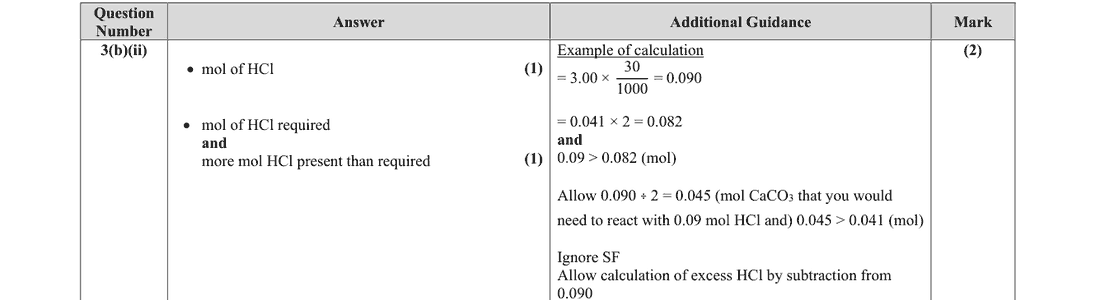
volume occupied by one mole of the gas.  The following method was used.
Ɣ A sample of calcium carbonate was weighed out in a small plastic container.
Ɣ 20 cm3 of hydrochloric acid of concentration 2.00 mol dm–3 was added to a
conical flask.  A small pinch of calcium carbonate was added to the acid.
Ɣ The container was placed in the conical flask and a gas syringe was connected to

the top of the conical flask.
Ɣ The flask was carefully shaken so that the small plastic container fell over, allowing
the acid and calcium carbonate to mix.
The apparatus set up is shown.
The student repeated the experiment five times using different masses of
calcium carbonate on each occasion, with the concentration and volume of the
hydrochloric acid constant.
Experiment number
Mass / g
Volume of CO2 / cm3
1
0.10
23
2
0.20
44
3
0.30
67
4
0.40
96
5
0.50
115
Write the equation for the reaction between calcium carbonate and
hydrochloric acid.  Include state symbols.
June 2017 · AS Paper 1 · Q8(a)(iii) 2 marks Calculation formulae equations and amounts of substance
Earlier part of question 8 that this part usesEarlier part of June 2017 Paper 1 question 8
Show that, in each experiment, the hydrochloric acid is in excess.
June 2017 · AS Paper 1 · Q8(b)(i) 2 marks Diagram or structure formulae equations and amounts of substance
Earlier part of question 8 that this part usesEarlier part of June 2017 Paper 1 question 8
Plot a graph of volume of carbon dioxide produced against mass of
calcium carbonate on the grid.  Include a line of best fit.
June 2017 · AS Paper 1 · Q8(b)(ii) 1 mark Short answer formulae equations and amounts of substance
Earlier parts of question 8 that this part usesEarlier part of June 2017 Paper 1 question 8Earlier part of June 2017 Paper 1 question 8
State how your graph supports the idea that the volume of gas produced

depends directly on the mass of calcium carbonate added.
June 2017 · AS Paper 1 · Q8(c) 2 marks Calculation formulae equations and amounts of substance
Earlier part of question 8 that this part usesEarlier part of June 2017 Paper 1 question 8
Calculate the volume, under these conditions, of one mole of carbon dioxide gas

from these data.  Give your answer in dm3 to two significant figures.
June 2017 · AS Paper 1 · Q8(d) 1 mark Practical and data analysis Hard formulae equations and amounts of substance
Earlier part of question 8 that this part usesEarlier part of June 2017 Paper 1 question 8
Give a reason why the student added a small pinch of calcium carbonate to
the acid before starting the reaction.
June 2017 · AS Paper 2 · Q3(b)(ii) 1 mark Practical and data analysis energetics i
Earlier parts of question 3 that this part usesEarlier part of June 2017 Paper 2 question 3Earlier part of June 2017 Paper 2 question 3
The beaker used in this experiment was made of copper rather than glass.
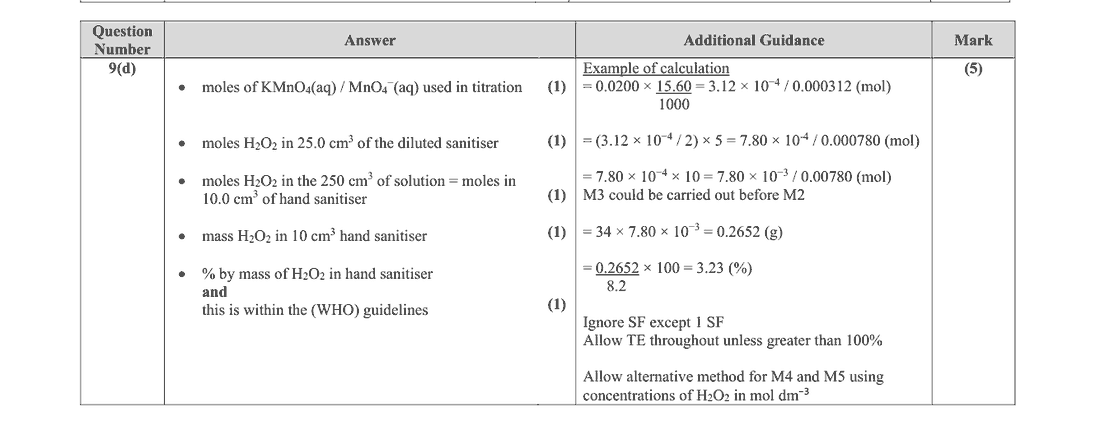
Give a reason for this.
June 2017 · AS Paper 2 · Q4(d) 4 marks Practical and data analysis alkenesalcohols

Earlier parts of question 4 that this part usesEarlier part of June 2017 Paper 2 question 4Earlier part of June 2017 Paper 2 question 4
Give one chemical test that you could use to confirm the presence of each of the
two functional groups suggested in part (c).  Predict a result for each test.
Test and result for first functional group  
Test and result for second functional group
June 2017 · AS Paper 2 · Q5(b)(i) 2 marks Calculation formulae equations and amounts of substance
Earlier part of question 5 that this part usesEarlier part of June 2017 Paper 2 question 5
The following steps were carried out by a student to find the molar mass of a gas.  The
experiment was carried out at 20 oC and one atmosphere pressure.  The dry gas was
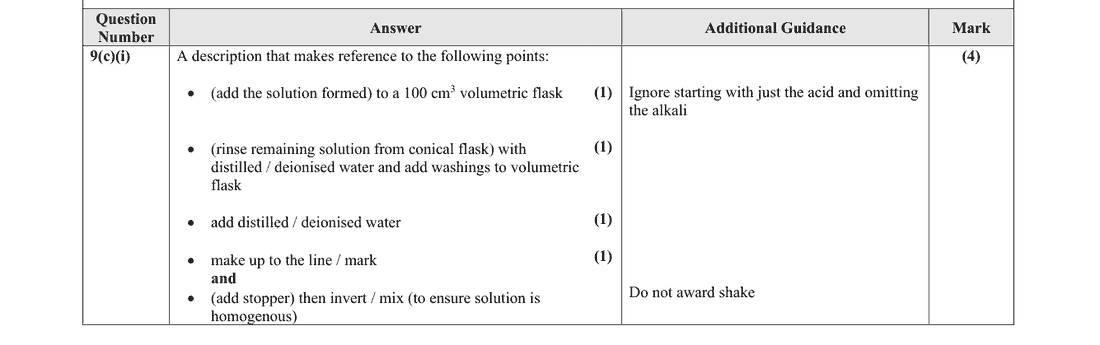
supplied in a plastic bag fitted with a self-sealing device.  The student had a choice of
two different gas syringes.  The student decided to use a 50 cm3 syringe.

Step 1.   The 50 cm3 syringe was fitted with a needle and then emptied of air by
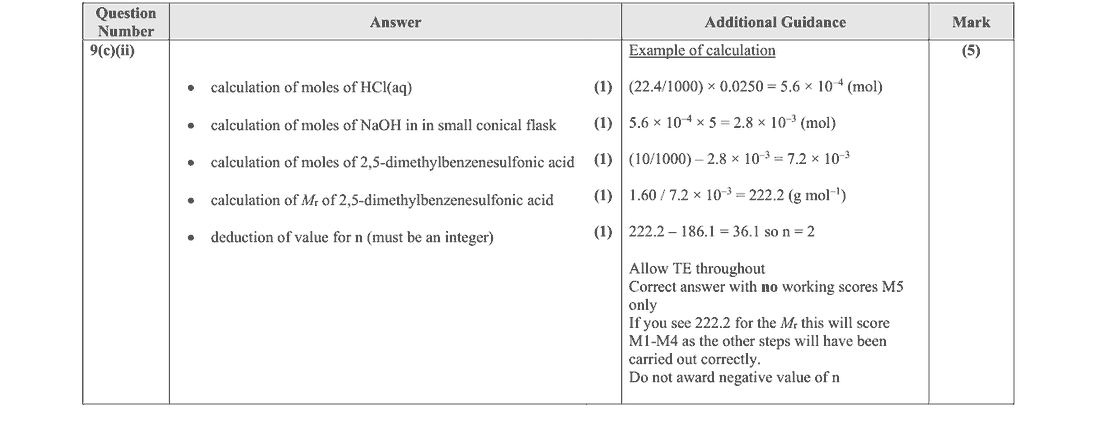
pushing in the plunger to zero.  The needle was sealed by pushing the
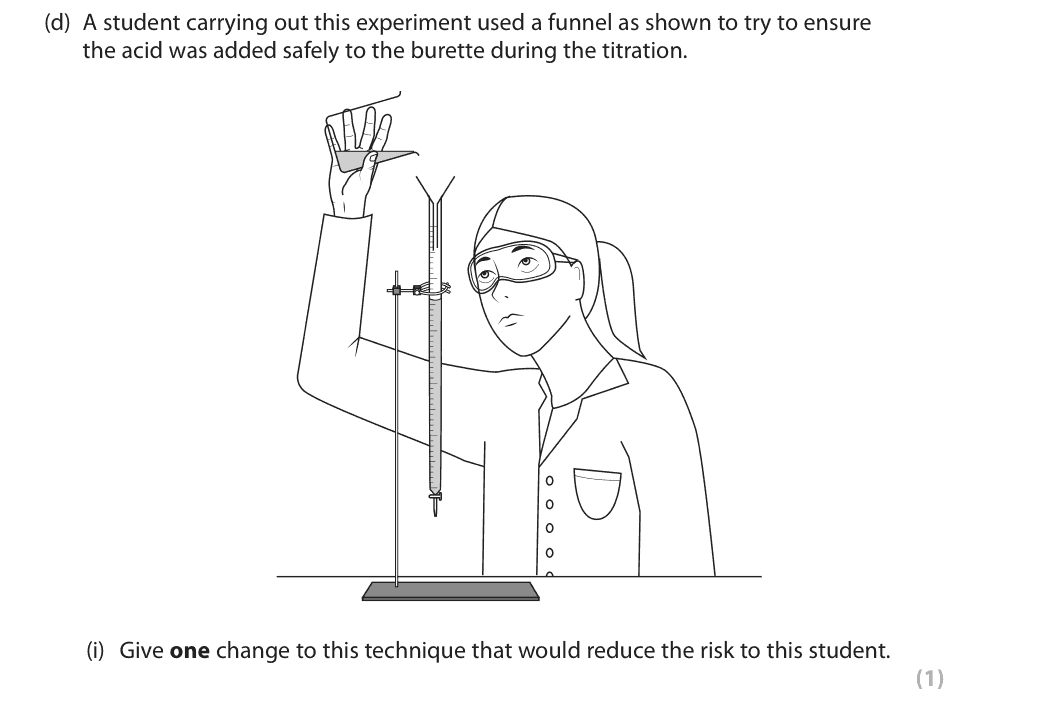
needle into a rubber bung and the syringe and bung were then weighed
on a balance.
Step 2.   The syringe was checked for leaks by pulling the plunger out by about
10 cm3 for a few seconds before releasing it.
Step 3.   The rubber bung was removed from the needle which was then inserted
through the self-sealing device in the plastic bag of the dry gas.
Step 4.   50 cm3 of the dry gas was withdrawn from the plastic bag into the syringe
and the needle resealed with the same rubber bung used in step 1.
Step 5.   The syringe and rubber bung were then reweighed on the balance.
Results
volume of gas used
50 cm3
initial mass of empty syringe
107.563 g
final mass of syringe + gas
107.655 g
The gas syringe has a total uncertainty of ±0.5 cm3.
Each reading on the balance has an uncertainty of ±0.0005 g.
Calculate the percentage uncertainty in the measurement of the volume and
mass of gas used in this procedure.
June 2017 · AS Paper 2 · Q5(b)(ii) 2 marks Short answer formulae equations and amounts of substance
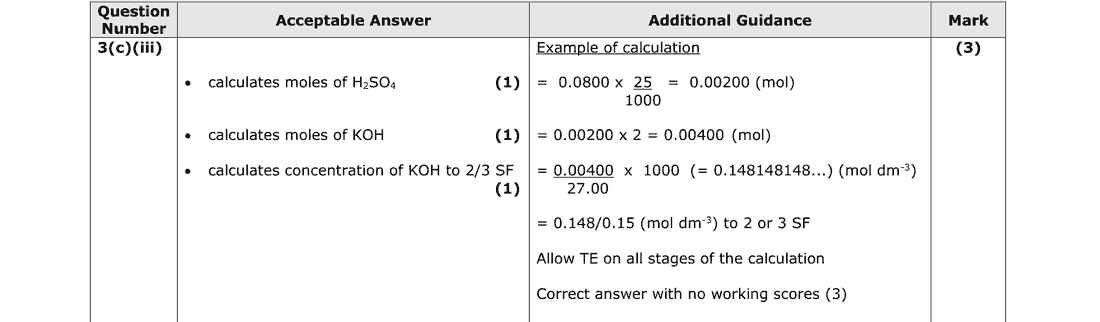
Earlier parts of question 5 that this part usesEarlier part of June 2017 Paper 2 question 5Earlier part of June 2017 Paper 2 question 5
The student repeated the experiment with 100 cm3 of the gas using a
100 cm3 syringe.
The total uncertainty for this larger syringe was also ±0.5 cm3.
Determine the effect, if any, on the volume and mass uncertainties.
June 2017 · AS Paper 2 · Q5(b)(iii) 2 marks Calculation formulae equations and amounts of substance

Earlier parts of question 5 that this part usesEarlier part of June 2017 Paper 2 question 5Earlier part of June 2017 Paper 2 question 5Earlier part of June 2017 Paper 2 question 5
Calculate the molar mass of the gas used in the procedure outlined in part (b).
You may assume that one mole of gas occupies 24 000 cm3 under these
conditions.
Give your answer to an appropriate number of significant figures and include
units in your answer.
June 2017 · AS Paper 2 · Q5(b)(iv) 2 marks Practical and data analysis Hard formulae equations and amounts of substance
Earlier parts of question 5 that this part usesEarlier part of June 2017 Paper 2 question 5Earlier part of June 2017 Paper 2 question 5Earlier part of June 2017 Paper 2 question 5
Explain how the student would know if the syringe had a leak in step 2 and
what effect this leak would have on the molar mass determined in part (b)(iii).
June 2017 · AS Paper 2 · Q5(c) 2 marks Practical and data analysis formulae equations and amounts of substance
Earlier parts of question 5 that this part usesEarlier part of June 2017 Paper 2 question 5Earlier part of June 2017 Paper 2 question 5
If the temperature had been less than 20 °C and the pressure remained at one
atmosphere, deduce the effect, if any, on the molar mass calculated in part (b)(iii).
June 2017 · AS Paper 2 · Q5(d) 1 mark Practical and data analysis formulae equations and amounts of substance
Earlier part of question 5 that this part usesEarlier part of June 2017 Paper 2 question 5
Give a reason why the gas should be dry.
June 2017 · AS Paper 2 · Q7(a)(ii) 1 mark Practical and data analysis halogenoalkanesbonding
Earlier part of question 7 that this part usesEarlier part of June 2017 Paper 2 question 7
Give a reason for the addition of ethanol to each test tube.
June 2017 · AS Paper 2 · Q7(a)(iii) 1 mark Practical and data analysis halogenoalkanes
Earlier part of question 7 that this part usesEarlier part of June 2017 Paper 2 question 7
Give a reason why the test tubes were left in the water bath for five minutes
before adding the halogenoalkanes.
June 2017 · AS Paper 2 · Q7(a)(iv) 2 marks Explanation halogenoalkanesalkenes
Earlier part of question 7 that this part usesEarlier part of June 2017 Paper 2 question 7
The precipitates form as a result of reactions between aqueous silver ions and
aqueous halide ions.
Explain why halide ions are present in the mixture containing a
halogenoalkane which has only covalent bonds.
June 2017 · AS Paper 2 · Q7(a)(v) 1 mark Equation writing formulae equations and amounts of substance
Earlier part of question 7 that this part usesEarlier part of June 2017 Paper 2 question 7
Write the ionic equation, including state symbols, for the reaction involving
the silver nitrate in test tube X.
June 2017 · Paper 1 · Q8(c)(i) 3 marks Short answer Easy acid base equilibria
Earlier part of question 8 that this part usesEarlier part of June 2017 Paper 1 question 8
The titration curve for adding glycolic acid to 25.0 cm3 of 0.100 mol dm–3 sodium hydroxide
is shown.
14 –
12 –
10 –
8 –
pH
6 –
4 –
2 –
0
5
10
15
20
25
30
35
40
Volume of glycolic acid / cm3
Use the information given in your Data Booklet to select a suitable indicator
for this titration, including the colour change you would expect to see.
Justify your selection.
June 2017 · Paper 2 · Q3(b)(ii) 2 marks Practical and data analysis group 7 the halogens
Earlier part of question 3 that this part usesEarlier part of June 2017 Paper 2 question 3
Give the reagents that are used to test that bromide ions are formed in this
reaction mixture. Include the result of the test.
June 2017 · Paper 2 · Q8(b)(ii) 4 marks Practical and data analysis carbonyl compoundsorganic synthesis
Earlier parts of question 8 that this part usesEarlier part of June 2017 Paper 2 question 8Earlier part of June 2017 Paper 2 question 8
Give the steps to show how 2,4-dinitrophenylhydrazine could be used to
distinguish between phenylethanone and phenylethanal.
June 2017 · Paper 2 · Q9(d) 7 marks Calculation kinetics ii
Earlier part of question 9 that this part usesEarlier part of June 2017 Paper 2 question 9
The rate constant for the reaction between bromoethane and
aqueous hydroxide ions was determined at five different temperatures.
The results are given in the table.
Temperature (T)
1 / Temperature (1 / T)
Rate constant, k
ln k
/ K
/ K−1
/ dm3 mol–1 s–1
293
3.41 × 10⁻³
5.83 × 10⁻⁵
−9.75
303
1.67 × 10⁻⁴
313
5.26 × 10⁻⁴
323
1.36 × 10⁻³
333
3.00 × 10⁻³
3.77 × 10⁻³
−5.58
Complete the data in the table and use them to plot a graph of ln k against 1 / T
and hence determine the activation energy, Ea , in kJ mol−1.
You should include the value and units of the gradient of the line.
The Arrhenius equation can be expressed as
ln k = – E
a × 1
T + constant
R
June 2017 · Paper 3 · Q1(a)(ii) 2 marks Practical and data analysis transition metals reactions
Earlier part of question 1 that this part usesEarlier part of June 2017 Paper 3 question 1
Describe the changes you would see when the reaction in (a)(i) is carried out.
June 2017 · Paper 3 · Q1(a)(iv) 1 mark Practical and data analysis transition metals reactions
Earlier parts of question 1 that this part usesEarlier part of June 2017 Paper 3 question 1Earlier part of June 2017 Paper 3 question 1
State the final appearance of the reaction mixture in (a)(iii).
June 2017 · Paper 3 · Q1(b)(i) 2 marks Practical and data analysis transition metals reactions
Dilute aqueous ammonia is added, drop by drop, to an aqueous solution of
copper(II) sulfate until the aqueous ammonia is in excess.
Describe what you would see during this experiment.
June 2017 · Paper 3 · Q2(a) 4 marks Practical and data analysis alcohols
This question is about the preparation of a sample of the ketone, 3-methylbutan-2-one.
A student’s research suggested that 3-methylbutan-2-one may be prepared by
oxidising 3-methylbutan-2-ol with acidified potassium dichromate(VI) solution.
The student sets up the apparatus as shown in the diagram.  You may assume that all
the equipment is suitably clamped.
The student adds dilute sulfuric acid to the pear-shaped flask.  A mixture of
potassium dichromate(VI) and 3-methylbutan-2-ol is then added slowly to the dilute
sulfuric acid in the flask.
water
from tap
pear-shaped
flask
reaction mixture
anti-bumping
conical flask
granules
water to
sink
ice–water mixture
Identify the two changes that must be made to the apparatus before heating the
pear-shaped flask, giving a reason for each change.
June 2017 · Paper 3 · Q2(c)(ii) 1 mark Short answer alcohols
Earlier parts of question 2 that this part usesEarlier part of June 2017 Paper 3 question 2Earlier part of June 2017 Paper 3 question 2
Deduce the formula of the compound that could cause the distillate to have a
pH value of 2.
June 2017 · Paper 3 · Q2(d)(i) 2 marks Short answer mass spectrometry and infrared spectroscopy
Earlier part of question 2 that this part usesEarlier part of June 2017 Paper 3 question 2
The organic mixture was separated from the aqueous layer and dried.
The infrared spectrum of the organic mixture is shown.
100
50
0
4000
3000
2000
1500
1000
500
wavenumber / cm–1
By reference to any relevant peak(s), deduce how the infrared spectrum shows
that the mixture contains 3-methylbutan-2-one.
June 2017 · Paper 3 · Q2(d)(ii) 2 marks Explanation mass spectrometry and infrared spectroscopy
Earlier parts of question 2 that this part usesEarlier part of June 2017 Paper 3 question 2Earlier part of June 2017 Paper 3 question 2
From the infrared spectrum, the student concludes that the mixture contains
another organic compound.
The mixture is redistilled and the fraction that boils in the range 93–95°C is collected.
The boiling temperature of 3-methylbutan-2-one is 94°C.
Predict any change(s) you would see in the infrared spectrum after redistillation,
justifying your answer.
June 2017 · Paper 3 · Q4(a) 2 marks Short answer energetics i
This question is about the enthalpy change of combustion of methanol.
A teacher asked two students to carry out a practical task to determine the enthalpy
change of combustion of methanol.
Both students were provided with the same apparatus and chemicals.
The following procedure was provided for the students.
Procedure
•
Measure out 150 cm3 of distilled water, using a 250 cm3 measuring cylinder.
•
Transfer the water to a copper calorimeter and note the initial temperature of the
water (to the nearest 0.5°C) in Table 1.
•
Weigh the spirit burner containing methanol and record its mass in Table 1.
•
Place the spirit burner under the copper calorimeter, as shown in the diagram.
•
Ignite the spirit burner and burn the methanol, whilst stirring the water with the
thermometer.
•
After heating the water for three minutes, extinguish the flame and immediately
record the highest temperature reached by the water.
•
As soon as possible, reweigh the spirit burner containing the methanol and
record its mass in Table 1.
thermometer
copper calorimeter
water
spirit burner
methanol
The results of Student 1 are recorded in Table 1.
Mass of spirit burner plus methanol before burning / g
213.47
Mass of spirit burner plus methanol after burning / g
211.87
Mass of methanol burned / g
Highest temperature of the water  / °C
64.5
Initial temperature of the water / °C
22.0
Temperature change of the water / °C
Table 1
Complete Table 1, giving the values to an appropriate number of decimal places.
June 2017 · Paper 3 · Q4(d)(ii) 3 marks Explanation formulae equations and amounts of substance
Earlier parts of question 4 that this part usesEarlier part of June 2017 Paper 3 question 4Earlier part of June 2017 Paper 3 question 4
Compare and contrast the use of a 250 cm3 measuring cylinder to measure out the
150 cm3 distilled water with the use of a 25 cm3 measuring cylinder (uncertainty
±0.2 cm3 for each volume measurement) six times to measure the same volume.
June 2017 · Paper 3 · Q4(d)(iii) 3 marks Practical and data analysis energetics i
Earlier parts of question 4 that this part usesEarlier part of June 2017 Paper 3 question 4Earlier part of June 2017 Paper 3 question 4Earlier part of June 2017 Paper 3 question 4
Student 1 calculated the uncertainties in the remaining measurements.  However,
Student 1 realised that the measurement uncertainties did not explain the difference
between the experimental value for the enthalpy change of combustion of methanol
calculated in part (c) and the value obtained from the internet.
Other than human error, give three reasons for the difference in the values.
June 2017 · Paper 3 · Q6(a) 2 marks Short answer redox ii
A student carried out an investigation to determine the value of x in hydrated
magnesium nitrate(III), Mg(NO2)2•xH2O, using three different methods.
Method 1
•
The student prepared an aqueous solution by dissolving 1.15 g of Mg(NO2)2•xH2O
in distilled water, making up the solution to 250.0 cm3 in a volumetric flask and
shaking the mixture.
•
The student titrated this solution against 25.0 cm3 portions of an acidified
solution of 0.0200 mol dm−3 potassium manganate(VII), KMnO4(aq).
Method 2
•
The student mixed a solution of Mg(NO2)2•xH2O with an excess of aqueous
sodium carbonate solution, Na2CO3(aq).
•
The student obtained a precipitate of magnesium carbonate, MgCO3(s), and
determined the mass of this precipitate.
Method 3
•
The student heated a known mass of Mg(NO2)2•xH2O(s).
•
The student determined the mass of the anhydrous residue formed.
Method 1 – Titration
The student filled the burette with the solution made from Mg(NO2)2•xH2O.
In each titration
•
25.0 cm3 of 0.0200 mol dm−3 KMnO4(aq) was transferred to a conical flask
using a pipette.
•
An excess of dilute sulfuric acid was added to the conical flask and the mixture heated.
•
Mg(NO2)2(aq) was added from the burette until the end-point was reached.
The student’s titration results are shown in the table (the rough titration results have
not been included in the table).
Titration number
1
2
3
Final burette reading / cm3
23.95
48.05
23.85
Initial burette reading / cm3
0.80
24.50
0.65
Titre / cm3
Concordant titres (9)
Mean titre / cm3
Complete the table.
June 2017 · Paper 3 · Q6(b) 1 mark Practical and data analysis redox ii
Earlier part of question 6 that this part usesEarlier part of June 2017 Paper 3 question 6
Deduce the colour change that the student would see at the end-point in this titration.
From  to 
− react with 5 mol NO2
−.
June 2017 · Paper 3 · Q6(c) 5 marks Calculation redox iiformulae equations and amounts of substance
Earlier part of question 6 that this part usesEarlier part of June 2017 Paper 3 question 6
In the titration reaction, 2 mol MnO4
Calculate the number of moles of NO2
−, in the 250 cm3 of solution prepared by the
student and hence the value of x in Mg(NO2)2•xH2O.
Give your answer to the nearest whole number.
June 2017 · Paper 3 · Q6(d) 2 marks Equation writing redox i
Earlier part of question 6 that this part usesEarlier part of June 2017 Paper 3 question 6
The half-equations for the reaction in the titration are
− + 8H+ + 5e−  o  Mn2+ + 4H2O
MnO4
− + H2O  o  NO3
− + 2H+ + 2e−
NO2
Use these half-equations to derive the overall ionic equation for the reaction
between manganate(VII) and nitrate(III) ions in acidic conditions.
State symbols are not required.
Method 2 – Precipitation
The student used the following procedure.
•
Dissolve a known mass of Mg(NO2)2•xH2O in distilled water.
•
Add an excess of aqueous sodium carbonate solution, Na2CO3(aq), to obtain a
precipitate of magnesium carbonate, MgCO3(s).
Mg2+(aq)  +  CO3
2−(aq)  o  MgCO3(s)
•
Weigh a piece of filter paper.
•
Filter the mixture from the above reaction through the pre-weighed filter paper.
•
Wash the precipitate of MgCO3(s) with distilled water.
•
Dry the filter paper and precipitate in a desiccator.
•
Reweigh the filter paper and the precipitate.
•
Calculate the value of x from the results obtained.
The student found that the value of x calculated using Method 2 was different from
that obtained using Method 1.  This difference occurred despite having used a pure
sample of the hydrated salt and without making any errors in technique during the
experiment.
The student found out from a data book that the compound magnesium carbonate is
very slightly soluble in water.
June 2017 · Paper 3 · Q6(f) 2 marks Practical and data analysis formulae equations and amounts of substance
Earlier part of question 6 that this part usesEarlier part of June 2017 Paper 3 question 6
The student planned to obtain any dissolved magnesium carbonate by
evaporating the filtrate, and then weighing the residue.
Criticise this student’s plan.
Method 3 – Thermal decomposition
NOTE:  On heating, Mg(NO2)2•xH2O(s) loses its water of crystallisation and then
undergoes further decomposition to give magnesium oxide, MgO.
The student used the following procedure.
•
Weigh an empty crucible.
•
Add some Mg(NO2)2•xH2O(s) and then reweigh the crucible plus contents.
•
Heat the crucible plus contents and allow to cool.
•
Weigh the crucible plus magnesium oxide residue.
•
Use these data to calculate a value for x.
The student’s results are shown in the table.
Mass of crucible / g
18.02
Mass of crucible + Mg(NO2)2•xH2O / g
18.84
Mass of crucible + MgO residue / g
18.27
June 2017 · Paper 3 · Q6(g) 1 mark Practical and data analysis formulae equations and amounts of substance
Earlier part of question 6 that this part usesEarlier part of June 2017 Paper 3 question 6
Identify how the student should ensure that the hydrated salt was fully decomposed.
June 2017 · Paper 3 · Q6(h) 2 marks Practical and data analysis formulae equations and amounts of substance
Earlier part of question 6 that this part usesEarlier part of June 2017 Paper 3 question 6
The student carried out an evaluation of the results obtained from Method 3
Identify two modifications to the method that would enable the student to lower
the percentage uncertainty in the measurement of the mass of the solid residue.
June 2017 · Paper 3 · Q9(c) 1 mark Practical and data analysis formulae equations and amounts of substance
Earlier part of question 9 that this part usesEarlier part of June 2017 Paper 3 question 9
Identify a safety issue associated with this experiment.
June 2016 · AS Paper 1 · Q3(a)(i) 1 mark Calculation Easy formulae equations and amounts of substance
A student used the apparatus in the diagram to determine the molar volume of a gas.
magnesium ribbon
250 cm3
measuring cylinder
dilute hydrochloric acid
deionised
trough
water
Assume clamps are in place to secure the apparatus
The student used a piece of magnesium ribbon, which was about 5 cm in length, and
the dilute hydrochloric acid was in excess.  The experiment was repeated three times
at 24°C and the following results were obtained.
Experiment 1
Experiment 2
Experiment 3
Mass of magnesium / g
0.04
0.04
0.04
Volume of hydrogen gas / cm3
31
25
32
The equation for the reaction is
Mg(s) + 2HCl(aq) r MgCl2(aq) + H2(g)
Calculate the number of moles of magnesium used by the student in each
experiment.
June 2016 · AS Paper 1 · Q3(a)(ii) 1 mark Calculation Easy formulae equations and amounts of substance
Earlier part of question 3 that this part usesEarlier part of June 2016 Paper 1 question 3
Use your answer from part (a)(i) to deduce the number of moles of hydrogen
gas that should be produced.
June 2016 · AS Paper 1 · Q3(a)(iii) 4 marks Calculation formulae equations and amounts of substance
Earlier part of question 3 that this part usesEarlier part of June 2016 Paper 1 question 3
Calculate, using the Ideal Gas Equation, the volume of hydrogen gas, in cm3,
that should be produced in each of these experiments.
[pV = nRT    R = 8.31 J mol–1 K–1    p = 101 000 Pa]
June 2016 · AS Paper 1 · Q3(b) 1 mark Practical and data analysis formulae equations and amounts of substance
Earlier part of question 3 that this part usesEarlier part of June 2016 Paper 1 question 3
Give a reason why the student repeated the experiment three times.
June 2016 · AS Paper 1 · Q3(c) 6 marks Practical and data analysis formulae equations and amounts of substance
Earlier parts of question 3 that this part usesEarlier part of June 2016 Paper 1 question 3Earlier part of June 2016 Paper 1 question 3
Give three reasons for the difference between your calculated value in (a)(iii) and
the actual volumes of hydrogen gas obtained by the student.
For each reason, identify a change to either the apparatus or the chemicals that
could be made by the student to improve the result.
June 2016 · AS Paper 1 · Q4(d) 2 marks Practical and data analysis group 7 the halogens
Earlier part of question 4 that this part usesEarlier part of June 2016 Paper 1 question 4
Two of the solutions produce the same result on the addition of dilute nitric acid
followed by silver nitrate solution.
State the observation with this test and the two solutions that give this result.
Observation  
Solutions
June 2016 · AS Paper 1 · Q4(e) 2 marks Equation writing analysis of inorganic compoundsformulae equations and amounts of substance
Earlier part of question 4 that this part usesEarlier part of June 2016 Paper 1 question 4
The hydrochloric acid and the sodium carbonate solution react together.  State an
observation you would make and write the ionic equation for the reaction.  State
symbols are not required.
Observation  
Ionic equation
June 2016 · AS Paper 1 · Q5(a) 1 mark Calculation formulae equations and amounts of substance
A solution of nitric acid, HNO3, of concentration 100 g dm–3, can be used to artificially
age wood.
A sample of nitric acid, thought to be suitable for this use, was diluted by pipetting
10.00 cm3 of this acid into a 250 cm3 volumetric flask, adding deionised water and
making the solution up to the mark.  The solution was thoroughly mixed.
A titration was carried out using this diluted solution of nitric acid.  The burette was
filled with 0.0800 mol dm–3 sodium hydroxide solution and 25.00 cm3 of the diluted
nitric acid was pipetted into each of three conical flasks.  The following results were
obtained.
Titration 1
Titration 2
Titration 3
Final burette reading / cm3
20.50
40.40
20.00
Initial burette reading / cm3
0.00
20.50
0.00
Volume added / cm3
20.50
19.90
20.00
The equation for the reaction is
HNO3 + NaOH r NaNO3 + H2O
Select the appropriate titres and calculate the mean titre in cm3.
June 2016 · AS Paper 1 · Q5(b) 5 marks Calculation formulae equations and amounts of substance
Earlier part of question 5 that this part usesEarlier part of June 2016 Paper 1 question 5
Calculate the concentration of the undiluted nitric acid in g dm–3.  Give your
answer to one decimal place.
Deduce whether this nitric acid is suitable for use in artificially ageing wood.
June 2016 · AS Paper 1 · Q7(d)(ii) 1 mark Practical and data analysis Hard groups 1 and 2
Earlier part of question 7 that this part usesEarlier part of June 2016 Paper 1 question 7
State one way in which you would ensure a fair test.
June 2016 · AS Paper 1 · Q7(d)(iii) 1 mark Practical and data analysis groups 1 and 2
Earlier parts of question 7 that this part usesEarlier part of June 2016 Paper 1 question 7Earlier part of June 2016 Paper 1 question 7
State how data obtained in this experiment could be used to make a
comparison.
June 2016 · AS Paper 2 · Q3(a)(ii) 6 marks 6-mark extended response halogenoalkanes
Earlier part of question 3 that this part usesEarlier part of June 2016 Paper 2 question 3
Devise an experiment to compare the rates of hydrolysis of 2-chlorobutane,
2-bromobutane and 2-iodobutane.
State the trend in the rates of reaction.  Justify your answer.
June 2016 · AS Paper 2 · Q5(a) 2 marks Diagram or structure alcohols
The following procedure may be used to prepare 2-chloro-2-methylpropane.
Step 1 Place 15cm3 of 2-methylpropan-2-ol in a separating funnel and slowly add
30cm3 of concentrated hydrochloric acid (an excess), while swirling the
funnel.
Step 2 When all the hydrochloric acid has been added, leave the mixture to stand
for 20 minutes, shaking it gently at intervals.
Step 3 Once the organic and aqueous layers have completely separated, discard the
aqueous layer.
Step 4 Add saturated sodium hydrogencarbonate solution, a little at a time, to the
organic layer.  After each addition, invert the separating funnel and open the tap.
Step 5 Discard the aqueous layer.
Step 6 Transfer the organic layer to a small flask, add a solid drying agent and swirl
the flask.
Step 7 Decant the liquid into a clean flask and distil it to collect pure
2-chloro-2-methylpropane.
Some data on the organic reactant and product are given in the table.
Data
2-methylpropan-2-ol
2-chloro-2-methylpropane
molar mass / g mol–1
74.0
92.5
boiling temperature / oC
82
51
density / g cm–3
0.79
0.84
Draw a diagram of a separating funnel, labelling the aqueous layer and the layer
of 2-chloro-2-methylpropane that would be observed at the end of Step 2.
June 2016 · AS Paper 2 · Q5(b) 2 marks Practical and data analysis alcohols
Earlier part of question 5 that this part usesEarlier part of June 2016 Paper 2 question 5
Give the reason why sodium hydrogencarbonate solution is added to the organic
layer in Step 4 and why it is important to open the tap after adding this solution.
June 2016 · AS Paper 2 · Q5(d)(i) 3 marks Practical and data analysis alcohols
Earlier part of question 5 that this part usesEarlier part of June 2016 Paper 2 question 5
A student set up this apparatus for distillation in Step 7 as shown.
water
in
water
anti-bumping
out
granules
electric
heater
Describe three ways in which this apparatus must be modified for safe and
efficient use.  Assume the apparatus is suitably clamped.
June 2016 · AS Paper 2 · Q5(d)(ii) 1 mark Practical and data analysis Hard alcohols
Earlier parts of question 5 that this part usesEarlier part of June 2016 Paper 2 question 5Earlier part of June 2016 Paper 2 question 5
Give a suitable temperature range over which to collect the final product
during the distillation.
June 2016 · AS Paper 2 · Q5(e) 3 marks Calculation formulae equations and amounts of substance
Earlier part of question 5 that this part usesEarlier part of June 2016 Paper 2 question 5
In the preparation, 15cm3 of 2-methylpropan-2-ol produced
6.9 cm3 of 2-chloro-2-methylpropane.
The equation for the reaction is
(CH3)3COH  +  HCl  o  (CH3)3CCl  +  H2O
Calculate the percentage yield of 2-chloro-2-methylpropane, using data from the
table.
Data
2-methylpropan-2-ol
2-chloro-2-methylpropane
molar mass / g mol–1
74.0
92.5
boiling temperature / oC
82
51
density / g cm−3
0.79
0.84
June 2016 · AS Paper 2 · Q5(f) 2 marks Mechanism alkeneshalogenoalkanes
Earlier part of question 5 that this part usesEarlier part of June 2016 Paper 2 question 5
The mechanism for the reaction is in three stages.
CH3
CH3
Stage 1
H3C
C
CH3
H3C
C
CH3
O:
H+
O+
H
H
CH3
CH3
Stage 2
H3C
C
CH3
H3C
C+
CH3       + H2O
O+
H
CH3
CH3
Stage 3
H3C
C+
CH3
H3C
C
CH3
:Cl–
Cl
Add curly arrows to the reactants in Stages 2 and 3 to complete the mechanism.
June 2016 · AS Paper 2 · Q6(a) 4 marks Calculation energetics i
A student carries out two experiments to determine the enthalpy change that occurs
when anhydrous sodium carbonate reacts to form hydrated sodium carbonate.
Na2CO3(s)  +  10H2O(l)  o  Na2CO3.10H2O(s)
In the first experiment, the student determines the enthalpy change of solution
for anhydrous sodium carbonate.
50.0g of distilled water is placed in a polystyrene cup and the temperature is
recorded.
A sample of anhydrous sodium carbonate is added to the water, the mixture is
stirred and the final temperature recorded.
The results for this experiment are shown in the table.
mass used / g
5.09
initial temperature / oC
27.0
final temperature / oC
32.4
Calculate the enthalpy change of solution, in kJ mol−1, for
anhydrous sodium carbonate.
Give your answer to an appropriate number of significant figures and include a sign.
[Use 4.18 J g–1 °C–1 as the specific heat capacity of water]
Na2CO3(s) + aq  o  Na2CO3(aq)
June 2016 · AS Paper 2 · Q6(b) 2 marks Calculation energetics i
Earlier part of question 6 that this part usesEarlier part of June 2016 Paper 2 question 6
In the second experiment, the student determines the enthalpy change of
solution for hydrated sodium carbonate.
Na2CO3.10H2O(s) + aq  o  Na2CO3(aq)           ¨H = + 53.7kJ mol–1
Complete the Hess cycle and, together with your answer to (a) calculate the
enthalpy change when anhydrous sodium carbonate reacts to form hydrated
sodium carbonate.  Include a sign in your answer.
Na2CO3(s) + 10H2O(l)
Na2CO3.10H2O(s)
June 2016 · AS Paper 2 · Q6(c) 2 marks Explanation energetics i
Earlier part of question 6 that this part usesEarlier part of June 2016 Paper 2 question 6
Hydrated sodium carbonate slowly loses some water of crystallisation when left in air.
Explain how the enthalpy change in the second experiment would compare with
the data book value if an old sample of hydrated sodium carbonate had been
used.
June 2016 · AS Paper 2 · Q8(b)(i) 4 marks Practical and data analysis formulae equations and amounts of substance
Earlier part of question 8 that this part usesEarlier part of June 2016 Paper 2 question 8
The formula for ethanedioic acid crystals is H2C2O4.nH2O.
To determine the number of moles of water of crystallisation, n, in 1 mol of
ethanedioic acid crystals, a student carried out the following procedure.
•
Prepare 250.0cm3 of a solution containing a known mass of about 1g of
ethanedioic acid crystals.
•
Titrate 25.0cm3 portions of the ethanedioic acid solution with 0.103 mol dm−3
sodium hydroxide solution, using phenolphthalein as indicator.
The student obtained these results:
mass of ethanedioic acid crystals = 1.09g
mean titre = 16.20cm3
The equation for the reaction is
H2C2O4 + 2NaOH  o  Na2C2O4 + 2H2O
Describe how the student should prepare the 250.0 cm3 of ethanedioic acid
solution.
June 2016 · AS Paper 2 · Q8(b)(ii) 1 mark Practical and data analysis Hard formulae equations and amounts of substance
Earlier parts of question 8 that this part usesEarlier part of June 2016 Paper 2 question 8Earlier part of June 2016 Paper 2 question 8
Give the colour change at the end-point in this titration.
From   to
June 2016 · AS Paper 2 · Q8(b)(iii) 5 marks Calculation Hard formulae equations and amounts of substance
Earlier parts of question 8 that this part usesEarlier part of June 2016 Paper 2 question 8Earlier part of June 2016 Paper 2 question 8Earlier part of June 2016 Paper 2 question 8
Calculate a value of n in the formula H2C2O4.nH2O from these data.
June 2016 · AS Paper 2 · Q8(b)(iv) 2 marks Explanation formulae equations and amounts of substance
Earlier parts of question 8 that this part usesEarlier part of June 2016 Paper 2 question 8Earlier part of June 2016 Paper 2 question 8
The student thought that the ethanedioic acid crystals used may have been
slightly damp.
Explain the effect of using damp crystals on the titre and on the value of n.

Work with an A-level chemistry tutor

Dropping marks on calculations, mechanisms or the core practicals? Book a trial session with an A-level chemistry tutor.

Prefer email? Send an enquiry

If you are under 18, please include a parent's contact details. Enquiries go to enquiries@chemistryaleveltutor.com and are deleted once handled. All tutoring is online.