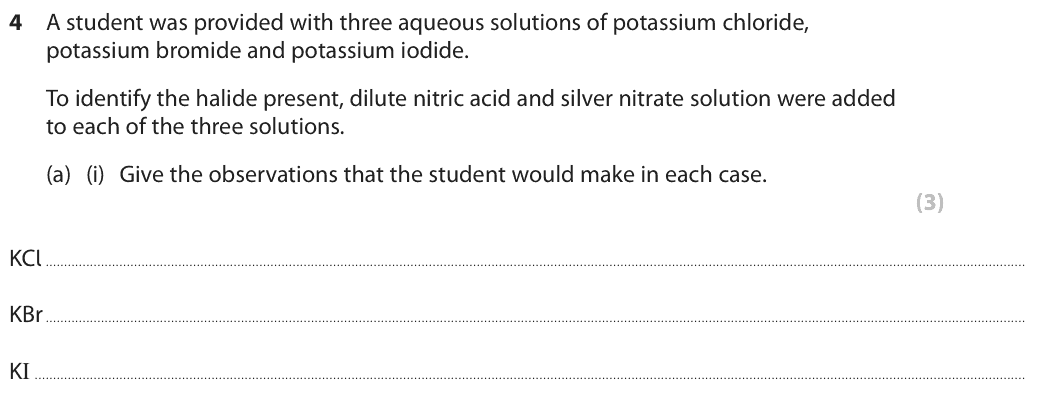
Notes and key-term cards for this topic are being written by our tutors. The past-paper questions below are ready now.
Specification statements
Show the 1 statements from the specification
4.15 know reactions, including ionic equations where appropriate, for identifying: • i carbonate ions, CO3^2-, and hydrogencarbonate ions, HCO3^–, using an aqueous acid to form carbon dioxide • ii sulfate ions, SO4^2-, using acidified barium chloride solution • iii ammonium ions, NH4^+, using sodium hydroxide solution and warming to form ammonia [Tests for halide ions and for the ions of Group 1 and 2 metals are also required, but are covered elsewhere in this Topic.]
Six-mark extended response questions on this topic
Tap a question to zoom it. Where a part needs a figure, table or structure from earlier in the question, that part folds out above it; the mark scheme and examiner's comment open underneath. Have Edexcel's Data Booklet beside you; the Periodic Table is on the back page of every paper.
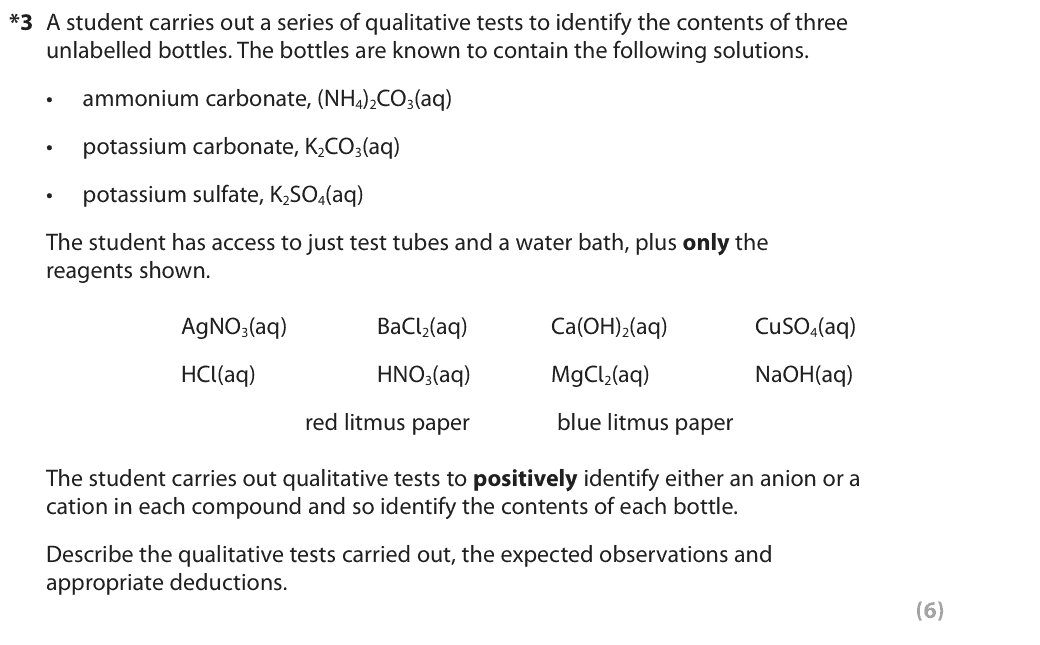
June 2025 · Paper 3 · Q36 marks6-mark extended response
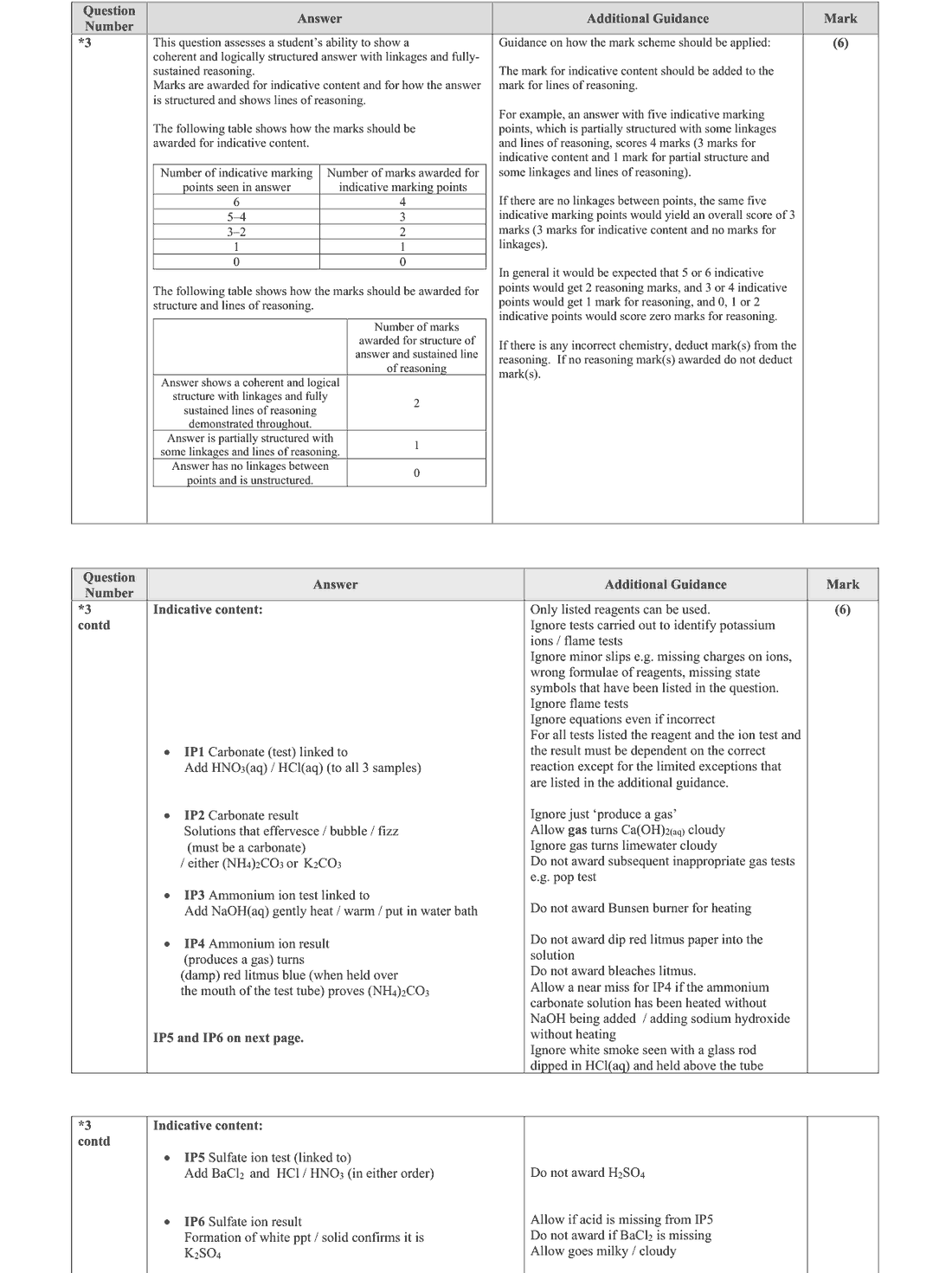
Mark scheme, with the indicative content and the marks for reasoning
Examiner's comment
The question tested a candidate’s ability to design a series of qualitative tests to identify three unknown solutions. A selection of reagents was given for the candidates to select from. Many candidates made a good attempt at answering this question, even if they did not score all of the marks because some of the details were omitted.
Common errors for each test were:
• Carbonate: to state that a gas was produced, instead of the observation of effervescence.
• Ammonium: to omit the addition of NaOH, or of heating, or to dip the red litmus paper into the solution.
• Sulfate: to omit the addition of acid before the BaCl2.
Notes from the mark scheme and report
Six indicative points plus two marks for reasoning
only the listed reagents may be used. IP1 add HNO3(aq) or HCl(aq) to all three samples
IP2 the two that effervesce / fizz are carbonates (just 'a gas is produced' is not enough
allow gas turns Ca(OH)2(aq) cloudy)
IP3 add NaOH(aq) and warm gently / use the water bath (not a Bunsen burner)
IP4 the gas turns damp red litmus blue, held at the mouth of the tube, proving ammonium carbonate (litmus dipped into the solution not credited)
IP5 add BaCl2(aq) with HCl or HNO3 (not H2SO4)
IP6 a white precipitate confirms potassium sulfate (IP6 allowed if the acid is missing). Flame tests and tests for potassium ignored. Common errors: 'gas produced' instead of effervescence
leaving out NaOH or the warming
dipping the litmus in
no acid before BaCl2
Skills: PT4 use laboratory apparatus for a variety of experimental techniques, including: titration, using burette and pipette; distillation and heating under reflux, including setting up glassware using retort stand and clamps; qualitative tests for ions and organic functional groups; filtration, including use of fluted filter paper, or filtration under reduced pressure; PT2 use water bath or electric heater or sand bath for heating; CP7 Core practical 7: Analysis of some inorganic and organic unknowns; CP15 Core practical 15: Analysis of some inorganic and organic unknowns
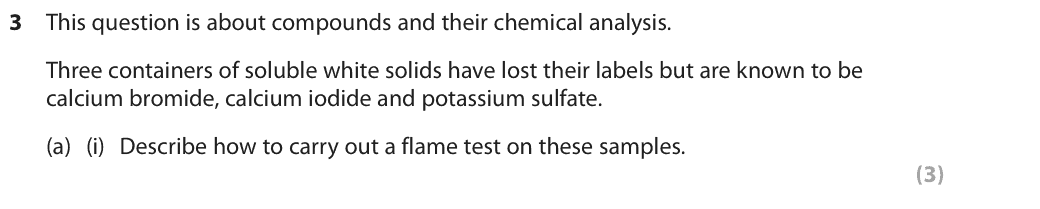
June 2024 · Paper 1 · Q3(c)2 marksPractical and data analysis
Earlier part of question 3 that this part uses
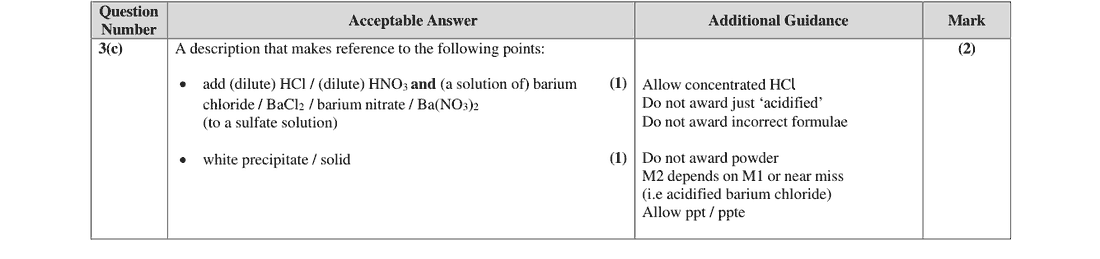
Mark scheme
Examiner's comment
This question required candidates to recall a chemical test for sulfate ions. Many correct answers were seen, although some candidates did not specify the acid that would need to be added to the barium chloride to give a white precipitate specific for sulfate ions. A few candidates wrote the formula for barium chloride as BaCl instead of BaCl2 and so were not
credited.
white precipitate. Just 'acidified' is not enough: the acid must be named. BaCl was not credited. M2 depends on M1
Skills: CP7 Core practical 7: Analysis of some inorganic and organic unknowns
June 2024 · AS Paper 1 · Q4(b)(ii)1 markPractical and data analysis
Earlier parts of question 4 that this part uses
Mark scheme
Examiner's comment
Q4bi) Overall, this question was well answered. Most candidates could identify white precipitate, however some candidates incorrectly referred to fizzing. Q4bii) This question was answered well. Q4biii) Overall, this question was answered poorly. Candidates struggled to identify an ionic equation and most attempted to use the nitrate ion. Most that did correctly identity H+ and CO32- either had H2CO3 as a product, or incorrectly balanced the equation. Many candidates identified the carbonate ion as a solid.
Notes from the mark scheme and report
Bubbles / effervescence / fizzing (of carbon dioxide). Just 'gas given off that turns limewater cloudy' is ignored
an extra wrong observation (cloudy solution) or a wrong gas loses the mark
Skills: PT4 use laboratory apparatus for a variety of experimental techniques, including: titration, using burette and pipette; distillation and heating under reflux, including setting up glassware using retort stand and clamps; qualitative tests for ions and organic functional groups; filtration, including use of fluted filter paper, or filtration under reduced pressure; CP7 Core practical 7: Analysis of some inorganic and organic unknowns
June 2024 · AS Paper 1 · Q4(b)(iii)2 marksEquation writingHard
Earlier parts of question 4 that this part uses
Mark scheme
Examiner's comment
Q4bi) Overall, this question was well answered. Most candidates could identify white precipitate, however some candidates incorrectly referred to fizzing. Q4bii) This question was answered well. Q4biii) Overall, this question was answered poorly. Candidates struggled to identify an ionic equation and most attempted to use the nitrate ion. Most that did correctly identity H+ and CO32- either had H2CO3 as a product, or incorrectly balanced the equation. Many candidates identified the carbonate ion as a solid.
Notes from the mark scheme and report
Answer: 2H+(aq) + CO3 2–(aq) → CO2(g) + H2O(l). One mark for species and balancing, one for state symbols (state symbols can score on a near-miss such as the non-ionic equation). Common errors: including the nitrate ion
H2CO3 as the product
not balancing
carbonate ion given as a solid
June 2024 · Paper 3 · Q4(c)(ii)1 markPractical and data analysis
Earlier part of question 4 that this part uses
Mark scheme
Examiner's comment
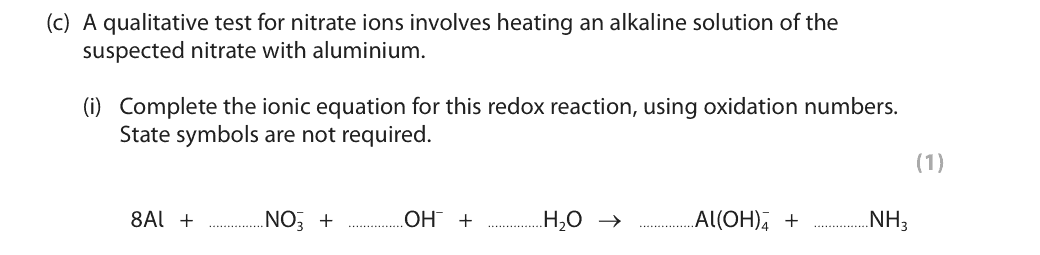
There were large numbers of correct answers to part (a)(i) either by the total entropy change ‘route’ or the Gibbs Free Energy change ‘route’. Occasionally a mark was lost for giving incorrect units for the final answer, either including Kelvin for the Gibbs Free Energy change value or for omitting such for the total entropy change value. A small minority confused the two methods. There was also a small number of candidates that calculated a negative value for the entropy change of the system and use of this value would result in a final value that suggested the reaction was feasible instead of not so. This should have prompted candidates to revisit their initial calculation to determine their error. Alas this seemed to be rarely the case. The vast majority of candidates found the calculation in part (a)(ii) very accessible but there were a sizeable number who missed the requirement in the question to firstly convert to degrees Celsius and secondly, to give the answer to two or three significant figures. The third mark was dependent on doing both of these two things. Part (b) was another question on a familiar topic for candidates and this was evident in the many excellent answers covering all three necessary points. The marks which were lost tended to be more likely as a result of lack of precision than of understanding. For example, polarising the nitrate ion by the calcium ion means a distortion of the nitrate electron cloud. Use of the specialist term ‘polarising’ covers this. If a candidate chooses to describe this rather than use the specialist term then fine, but all aspects are required. It is not enough to just state that the calcium ion distorts the nitrate ion, there needs to be explicit reference to the electron cloud. Likewise, the effect of this polarisation is the weakening of the bonds within the nitrate. It is not the bond between the calcium ion and the nitrate ion which is weakened and this needed to be made clear. Also it is worth reminding candidates that charge density is not the same as electron density. The balancing of the ionic equation in part (c)(i) was only achieved by the more able candidates. The suggestion to use oxidation numbers in the question was given to aid the candidates but this was not often heeded. Nevertheless, there were a reasonable number of candidates that scored the mark. The simple test for ammonia in part (c)(ii) was well-known with only the occasional reverse colour change to red being stated.
Notes from the mark scheme and report
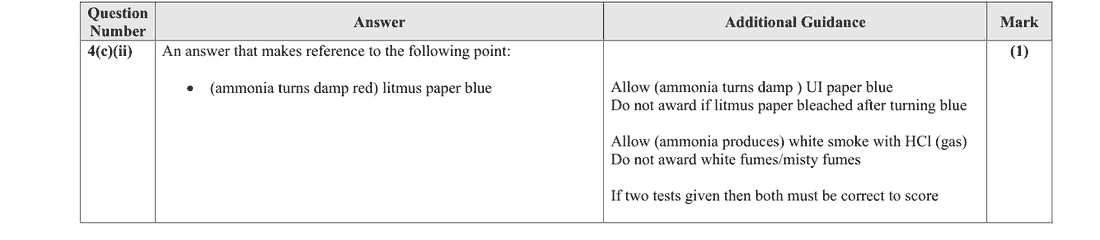
Damp red litmus paper turns blue (allow damp universal indicator paper turns blue)
or white smoke with hydrogen chloride gas (not white fumes or misty fumes). If two tests are given both must be right. Well known
occasionally the colour change was reversed
Skills: PT4 use laboratory apparatus for a variety of experimental techniques, including: titration, using burette and pipette; distillation and heating under reflux, including setting up glassware using retort stand and clamps; qualitative tests for ions and organic functional groups; filtration, including use of fluted filter paper, or filtration under reduced pressure; CP7 Core practical 7: Analysis of some inorganic and organic unknowns
June 2023 · AS Paper 1 · Q2(c)(i)1 markMultiple choice
Earlier part of question 2 that this part uses
Answer
C
Mark scheme
Examiner's comment
(a)(i) This question proved more challenging than expected. Candidates most often scored the mark by answering that the substance was not a molecule. The idea that giant structures require the use of the relative formula mass was clearly not well understood. Of course, molar mass calculation can be carried out without this knowledge. Common incorrect answers included comments about the mass being relative to 1/12th of the mass of carbon-12, the answer to the next item. (a)(ii) The answer here was better understood. The idea of comparing to the mass of a 1/12th of atom of carbon-12 was quite well known and there were ideas that the mass was a relative mass or a comparison. Some candidates realised that the units would cancel and scored the mark in this way. (a)(iii) The multiple choice questions was mostly answered correctly, with over 85% of candidates scoring this mark.
(a)(iv) Whichever answer was given in (a)(iii) candidates were still able to score by calculating the correct number of moles here. For those who knew the calculation to do, which included most candidates, the only common error was to use only one significant figure, which did not score the mark. (b) Testing for the metal ions using flame test proved to be commonly understood, with most scoring the first mark for the lilac flame of the potassium ion, and many knew that the magnesium ion did not give a flame colour, with candidates often stating that the wavelength associated with the transition was outside of the visible region. Unfortunately, it was common for answers to talk about potassium and magnesium rather than their ions. This was penalised if comments were made about magnesium giving no flame colour. Magnesium metal, of course, burns with a very bright white flame and so the omission of the word ‘ions’ was penalised here. The addition of hydroxide ions proved less well known, though many candidates did recognise the magnesium hydroxide would precipitate. It was quite common for candidates to discuss the lilac flame and the magnesium hydroxide precipitate without mentioning the negative tests, even though that was specifically asked for in the question. Candidates should read the questions with care. (c)(i) Just over half of candidates were able to score this mark. (c)(ii) Ionic equations continue to be something which would benefit from further study. This equation, which is quite commonly asked as it is one of the tests for ions which needs to be known, was not well understood. There were many attempts at full equations. Some candidates did not register that state symbols were required. Although it was possible to score the mark for answers in (c)(i) for options A and B, this was very rarely scored, firstly because these were not often selected, and secondly because the ionic equation was less straightforward, due to the difference in charges on the ions.
Notes from the mark scheme and report
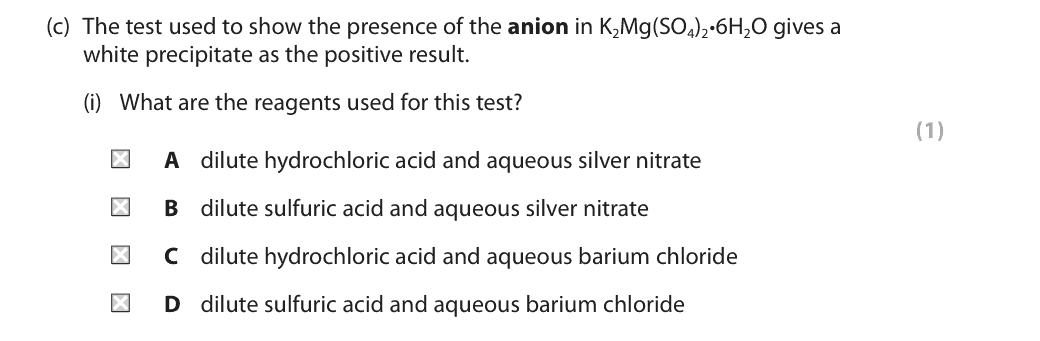
Answer: C. Sulfate is tested with dilute hydrochloric acid and aqueous barium chloride. D adds sulfate ions in the sulfuric acid, so would give a precipitate anyway
A gives silver chloride from the acid and silver nitrate
silver nitrate is the halide test. Just over half were correct
Skills: CP7 Core practical 7: Analysis of some inorganic and organic unknowns
June 2023 · AS Paper 1 · Q2(c)(ii)1 markEquation writingHard
Earlier parts of question 2 that this part uses
Mark scheme
Examiner's comment
(a)(i) This question proved more challenging than expected. Candidates most often scored the mark by answering that the substance was not a molecule. The idea that giant structures require the use of the relative formula mass was clearly not well understood. Of course, molar mass calculation can be carried out without this knowledge. Common incorrect answers included comments about the mass being relative to 1/12th of the mass of carbon-12, the answer to the next item. (a)(ii) The answer here was better understood. The idea of comparing to the mass of a 1/12th of atom of carbon-12 was quite well known and there were ideas that the mass was a relative mass or a comparison. Some candidates realised that the units would cancel and scored the mark in this way. (a)(iii) The multiple choice questions was mostly answered correctly, with over 85% of candidates scoring this mark.
(a)(iv) Whichever answer was given in (a)(iii) candidates were still able to score by calculating the correct number of moles here. For those who knew the calculation to do, which included most candidates, the only common error was to use only one significant figure, which did not score the mark. (b) Testing for the metal ions using flame test proved to be commonly understood, with most scoring the first mark for the lilac flame of the potassium ion, and many knew that the magnesium ion did not give a flame colour, with candidates often stating that the wavelength associated with the transition was outside of the visible region. Unfortunately, it was common for answers to talk about potassium and magnesium rather than their ions. This was penalised if comments were made about magnesium giving no flame colour. Magnesium metal, of course, burns with a very bright white flame and so the omission of the word ‘ions’ was penalised here. The addition of hydroxide ions proved less well known, though many candidates did recognise the magnesium hydroxide would precipitate. It was quite common for candidates to discuss the lilac flame and the magnesium hydroxide precipitate without mentioning the negative tests, even though that was specifically asked for in the question. Candidates should read the questions with care. (c)(i) Just over half of candidates were able to score this mark. (c)(ii) Ionic equations continue to be something which would benefit from further study. This equation, which is quite commonly asked as it is one of the tests for ions which needs to be known, was not well understood. There were many attempts at full equations. Some candidates did not register that state symbols were required. Although it was possible to score the mark for answers in (c)(i) for options A and B, this was very rarely scored, firstly because these were not often selected, and secondly because the ionic equation was less straightforward, due to the difference in charges on the ions.
Notes from the mark scheme and report
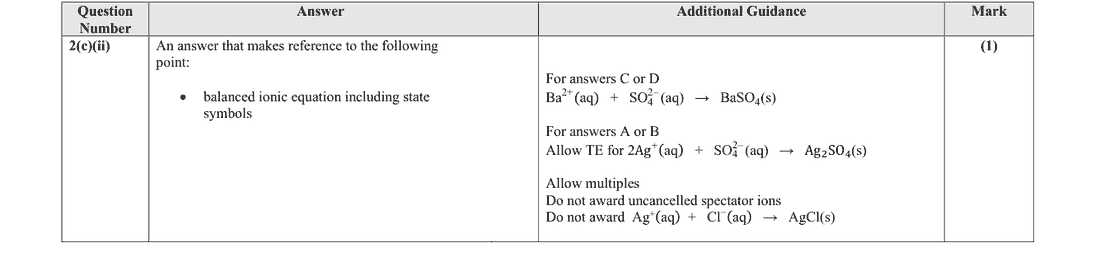
Answer: Ba2+(aq) + SO4 2–(aq) → BaSO4(s). State symbols required
multiples allowed
no uncancelled spectator ions. If A or B was chosen in (c)(i), 2Ag+(aq) + SO4 2–(aq) → Ag2SO4(s) is credited, but not the AgCl equation. Errors: full (non-ionic) equations
missing state symbols
Skills: CP7 Core practical 7: Analysis of some inorganic and organic unknowns
June 2022 · AS Paper 1 · Q8(b)(iii)2 marksPractical and data analysis
Earlier part of question 8 that this part uses
Mark scheme
Examiner's comment
Most students scored at least 1 of the 2 available marks in this question, usually identifying effervescence (some responses gave one of the listed alternative terms for a gas evolved in solution: fizz, bubbles etc.) However, carbon dioxide given off is a conclusion not an observation. The second mark (for disappearance of the solid sodium carbonate) was scored more infrequently. Many incorrect responses claimed the appearance of a precipitate.
Notes from the mark scheme and report
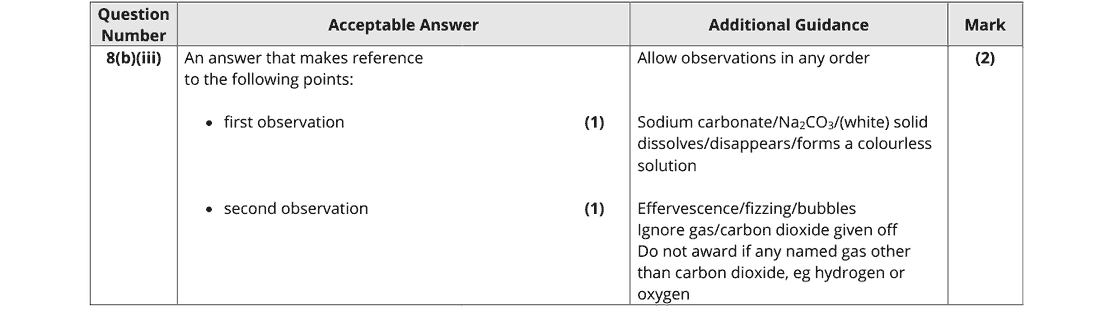
Effervescence / fizzing / bubbles
the (white) solid dissolves / disappears / a colourless solution forms. 'Carbon dioxide given off' is a conclusion, not an observation, and is ignored
naming any other gas loses the mark. Most scored the fizzing mark
the solid disappearing was given less often, and many wrongly said a precipitate forms
June 2022 · Paper 3 · Q3(b)(i)1 markPractical and data analysis
Earlier part of question 3 that this part uses
Mark scheme
Examiner's comment
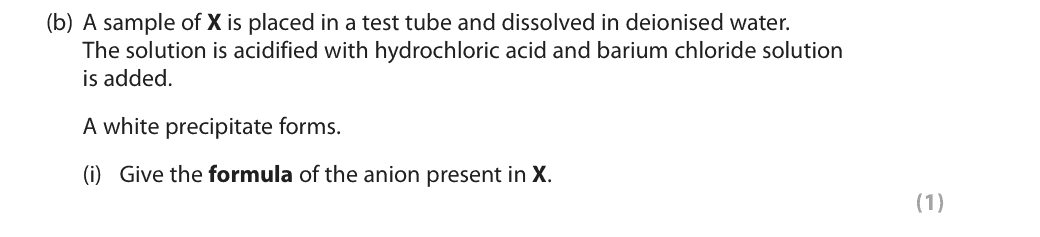
The majority of candidates were familiar with the results of the tests and could identify the ions present. Some candidates did not read the question so wrote the names of the ions instead of the formulae and some did not include charges on the ions. Some candidates were confused between the sulfate test using barium chloride solution and the chloride test using silver nitrate solution. A small number of candidates were unable to balance the charges on the ions to write the overall formula.
Notes from the mark scheme and report
Answer: SO4 2–. The name alone is ignored
not sulfite or hydrogensulfate
the charge must be correct
Skills: CP7 Core practical 7: Analysis of some inorganic and organic unknowns
June 2022 · Paper 3 · Q3(b)(ii)1 markShort answer
Earlier parts of question 3 that this part uses
Mark scheme
Examiner's comment
The majority of candidates were familiar with the results of the tests and could identify the ions present. Some candidates did not read the question so wrote the names of the ions instead of the formulae and some did not include charges on the ions. Some candidates were confused between the sulfate test using barium chloride solution and the chloride test using silver nitrate solution. A small number of candidates were unable to balance the charges on the ions to write the overall formula.
Notes from the mark scheme and report
Answer: Na2SO4. Error carried forward from the ions given in (a)(ii) and (b)(i) if their charges are correct. A small number could not balance the charges
Skills: CP7 Core practical 7: Analysis of some inorganic and organic unknowns
June 2022 · Paper 3 · Q4(c)2 marksPractical and data analysis
Mark scheme
Examiner's comment
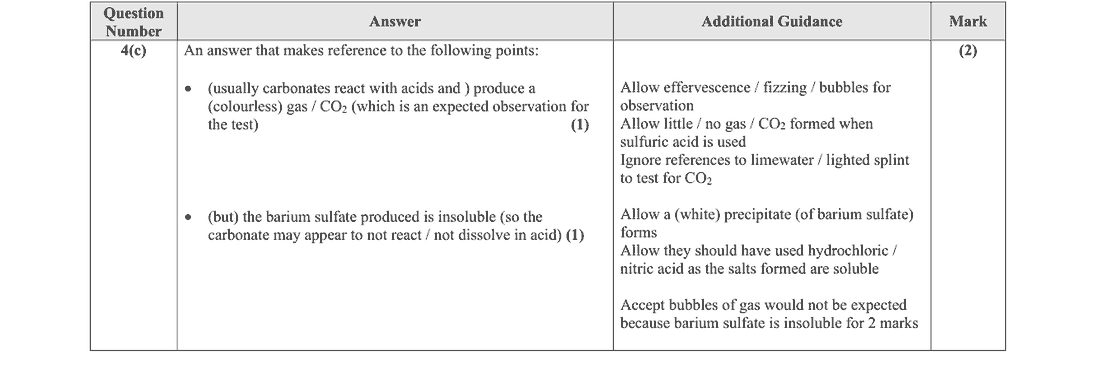
Most candidates were unsure about how to answer this question. Many knew that the usual reaction between an acid and a carbonate produces carbon dioxide and some realised that barium sulfate would form as a white precipitate. Few candidates could link those two ideas together to deduce that bubbles of gas would not be expected when sulfuric acid is used due to the insoluble surface layer of barium sulfate formed.
Notes from the mark scheme and report
Carbonates normally give carbon dioxide gas (effervescence) with an acid
but with sulfuric acid insoluble barium sulfate forms (a white precipitate coats the solid), so little or no gas is seen and the test is not valid: hydrochloric or nitric acid should be used. Most knew one of the two ideas but few linked them
Skills: PT4 use laboratory apparatus for a variety of experimental techniques, including: titration, using burette and pipette; distillation and heating under reflux, including setting up glassware using retort stand and clamps; qualitative tests for ions and organic functional groups; filtration, including use of fluted filter paper, or filtration under reduced pressure; CP7 Core practical 7: Analysis of some inorganic and organic unknowns
June 2022 · Paper 3 · Q10(a)(ii)1 markEquation writingHard
Earlier part of question 10 that this part uses
Mark scheme
Examiner's comment
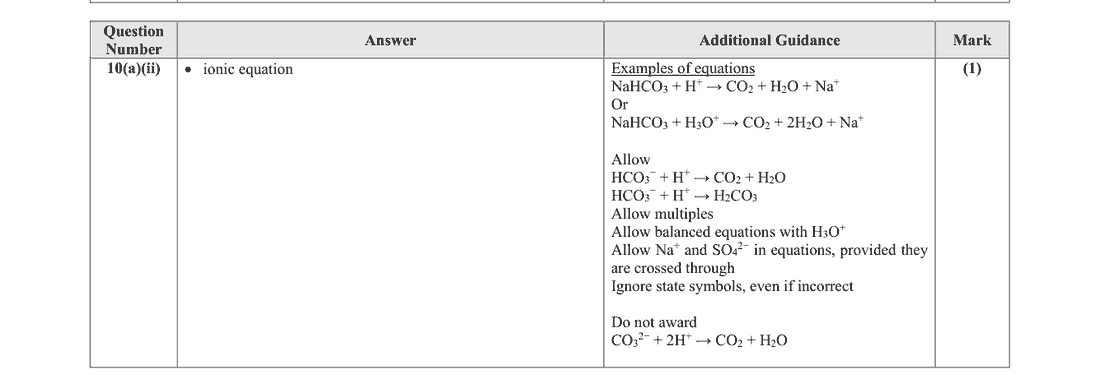
It was disappointing that very few candidates were able to write the ionic equation for the reaction between sodium hydrogencarbonate and acid. A common error was to use carbonate ions instead of hydrogencarbonate ions. However, many candidates tried to include iodine and iodide ions in their equation.
Notes from the mark scheme and report
HCO3– + H+ → CO2 + H2O (also allowed: → H2CO3
NaHCO3 + H+ → CO2 + H2O + Na+). Not the carbonate equation CO3 2– + 2H+ → CO2 + H2O, which was the common error
many also tried to include iodine and iodide ions
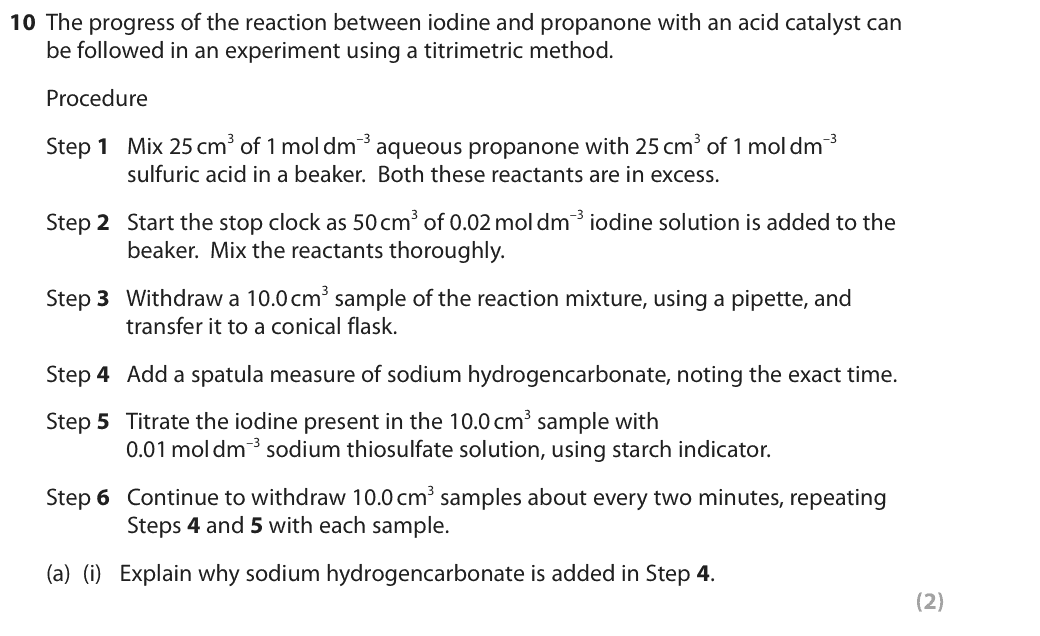
Skills: CP13 Core practical 13: Rates of reaction Following the rate of the iodine-propanone reaction by a titrimetric method and investigating a ‘clock reaction’ (Harcourt-Esson, iodine clock)
November 2021 · Paper 3 · Q5(a)(i)2 marksPractical and data analysis
Mark scheme
Examiner's comment
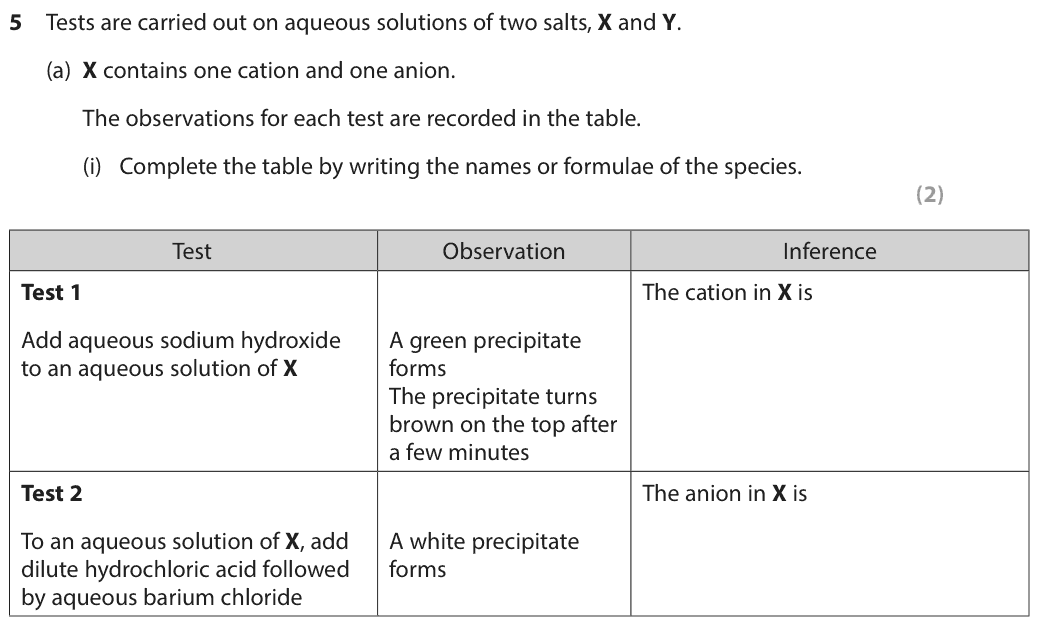
Some candidates were familiar with the tests for ions listed in the specification so answered
this question very well. Others would benefit from much more practise at this style of
experiment and question. Many candidates recognised the test for a sulfate ion in X but far
fewer identified the iron(II) cation. The ionic equation for the reaction between the cation and
aqueous sodium hydroxide was poorly answered. Many candidates did know that the
precipitate would be oxidised by air, even if they didn’t know what the precipitate was. Many
knew that hydrochloric acid was added in Test 2 to remove any carbonate ions to ensure they
did not give a precipitate with aqueous barium chloride. The tests for copper(II) ions and
chloride ions were often known, although there was some confusion with chromium, cobalt
or nickel ions. The formula of the complex ion in the deep blue solution was rarely done
correctly, with many not even including ammonia ligands. Many candidates did know how to
confirm the presence of chloride ions.
Notes from the mark scheme and report
Answer: cation Fe2+ / iron(II)
anion SO4 2– / sulfate (not sulfite). Many recognised the sulfate test but far fewer identified iron(II)
Skills: PT4 use laboratory apparatus for a variety of experimental techniques, including: titration, using burette and pipette; distillation and heating under reflux, including setting up glassware using retort stand and clamps; qualitative tests for ions and organic functional groups; filtration, including use of fluted filter paper, or filtration under reduced pressure; CP15 Core practical 15: Analysis of some inorganic and organic unknowns
November 2021 · Paper 3 · Q5(a)(iv)1 markPractical and data analysis
Earlier part of question 5 that this part uses
Mark scheme
Examiner's comment
Some candidates were familiar with the tests for ions listed in the specification so answered
this question very well. Others would benefit from much more practise at this style of
experiment and question. Many candidates recognised the test for a sulfate ion in X but far
fewer identified the iron(II) cation. The ionic equation for the reaction between the cation and
aqueous sodium hydroxide was poorly answered. Many candidates did know that the
precipitate would be oxidised by air, even if they didn’t know what the precipitate was. Many
knew that hydrochloric acid was added in Test 2 to remove any carbonate ions to ensure they
did not give a precipitate with aqueous barium chloride. The tests for copper(II) ions and
chloride ions were often known, although there was some confusion with chromium, cobalt
or nickel ions. The formula of the complex ion in the deep blue solution was rarely done
correctly, with many not even including ammonia ligands. Many candidates did know how to
confirm the presence of chloride ions.
Notes from the mark scheme and report
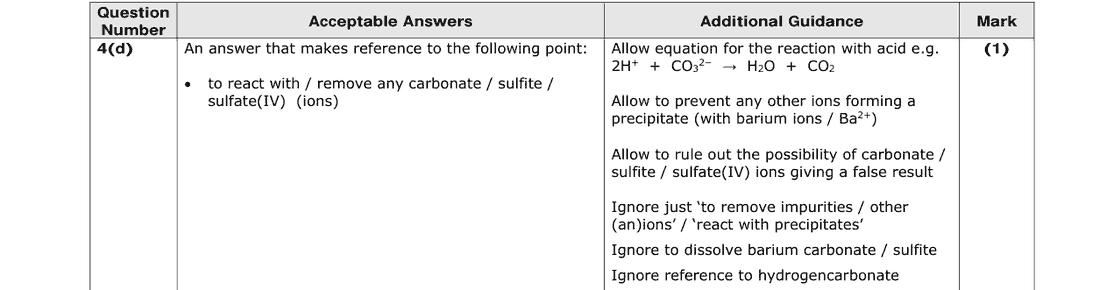
To react with / remove any carbonate (or sulfite) ions, which would otherwise also give a white precipitate with barium ions
Skills: PT4 use laboratory apparatus for a variety of experimental techniques, including: titration, using burette and pipette; distillation and heating under reflux, including setting up glassware using retort stand and clamps; qualitative tests for ions and organic functional groups; filtration, including use of fluted filter paper, or filtration under reduced pressure; CP15 Core practical 15: Analysis of some inorganic and organic unknowns
October 2020 · AS Paper 1 · Q6(b)3 marksPractical and data analysis
Earlier part of question 6 that this part uses
Mark scheme
Examiner's comment
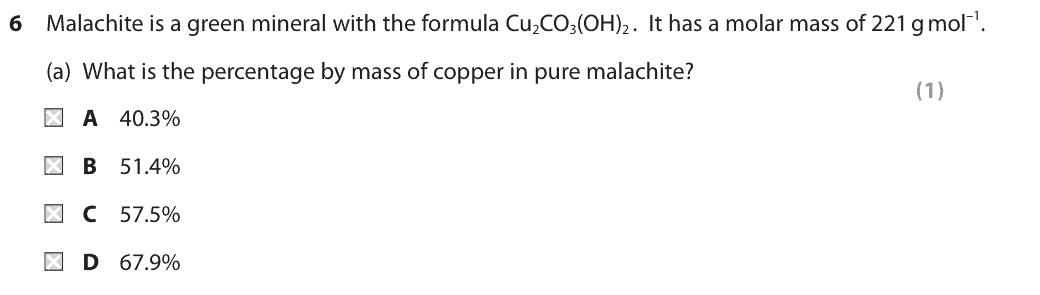
6a A multiple choice question. This question required students to interpret a given chemical
formula and follow up with a basic calculation. The task was simplified by the provision of the
molar mass of malachite within the question. Most candidates were able to complete this
calculation successfully.
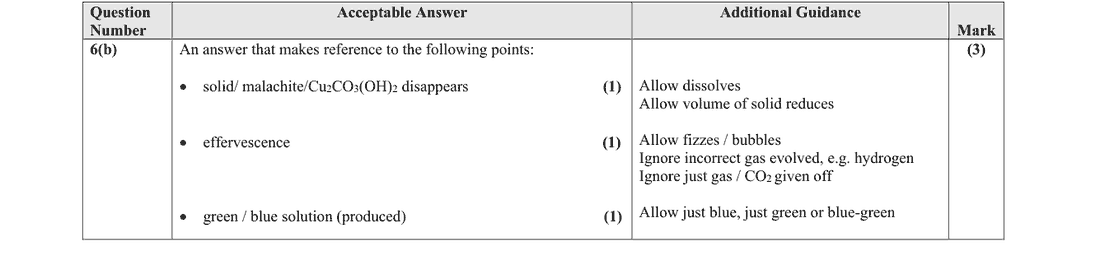
6b This question tested recognition of some of the observable features of a chemical reaction, the
answers being available by application of basic chemical principles. However, many students
seemed to struggle with this practical situation and relatively few fully correct answers were seen.
6ci This question has occurred relatively frequently in past papers, and many of the answers were
clearly well rehearsed. Most students scored very well on this question.
6cii Again, this is a very common question (for the first three marks). It has appeared in most of
the past papers at this level. However, the 4th mark focussed on a slightly different aspect and
many students failed to read the question sufficiently thoroughly to score the 4th mark, which
relates to why different elements produce different coloured flames
6di This was a calculation to find the maximum volume of gas that might be produced by the
thermal decomposition of a fixed mass of malachite. The ideal gas equation was provided, giving a
clue to the expected method of calculation.
Students were generally accurate in giving their answer to an appropriate number of significant
figures. But they were less secure with the units. The ideal gas equation gives an answer in m3 if all
quantities are converted to SI units. If the pressure is left in kPa the answer is in dm3 etc.
Students could be advised to convert to SI units first; this then defines the units of the final answer.
6dii Those who converted their answer to di) into cm3 had already (and perhaps inadvertently)
matched the units for their calculation of uncertainty. Many students knew how to match units,
and did it well.
6diii A variety of different methods can be used for this calculation This illustrates the need for a
logical procedure or a careful explanation of the calculation so that the lines of reasoning are clear.
In such instances marks might be gained for a partially correct answer
Some candidates provided clear calculations that were easy to follow at each stage. In some
instances a few words of explanation were also provided to explain the logic. However, there were
also some less successful answers which were poorly set out, being little more than a scattered
mass of figures.
Notes from the mark scheme and report
M1 the solid disappears (allow dissolves / amount of solid decreases)
M2 effervescence (allow fizzing or bubbles
just 'gas given off' or 'CO2 given off' is ignored, as is a wrong gas)
M3 a blue or green (or blue-green) solution forms. Many struggled with this practical context and relatively few fully correct answers were seen
October 2020 · Paper 3 · Q1(a)2 marksPractical and data analysis
Mark scheme
Examiner's comment
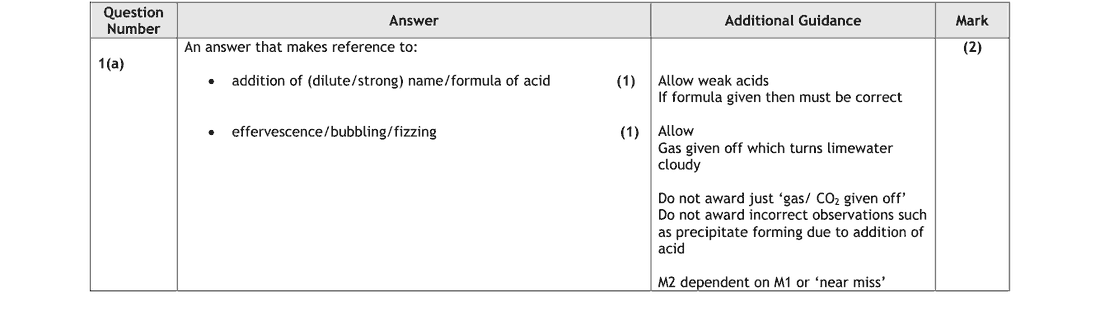
Many candidates knew the reagents required for the tests in both question parts. A relatively
common error in (b) was the inclusion of sulfuric acid along with barium chloride/nitrate.
Evidently these candidates did not appreciate that this acid would provide the sulfate ions
being tested for. Another error in (b) but also seen in (a) was the wrong formula given for the
reagent or product and so negated the mark. For example BaCl was frequently seen for
barium chloride.
Notes from the mark scheme and report
Add a named acid (dilute or strong
weak acids allowed
any formula must be correct)
effervescence / bubbling / fizzing (or gas given off that turns limewater cloudy). Not just 'gas or CO2 given off'
not a precipitate. The observation mark depends on the reagent mark or a near miss. A wrong formula for the reagent lost the mark
Skills: PT4 use laboratory apparatus for a variety of experimental techniques, including: titration, using burette and pipette; distillation and heating under reflux, including setting up glassware using retort stand and clamps; qualitative tests for ions and organic functional groups; filtration, including use of fluted filter paper, or filtration under reduced pressure; CP7 Core practical 7: Analysis of some inorganic and organic unknowns
October 2020 · Paper 3 · Q1(b)2 marksPractical and data analysis
Mark scheme
Examiner's comment
Many candidates knew the reagents required for the tests in both question parts. A relatively
common error in (b) was the inclusion of sulfuric acid along with barium chloride/nitrate.
Evidently these candidates did not appreciate that this acid would provide the sulfate ions
being tested for. Another error in (b) but also seen in (a) was the wrong formula given for the
reagent or product and so negated the mark. For example BaCl was frequently seen for
barium chloride.
Notes from the mark scheme and report
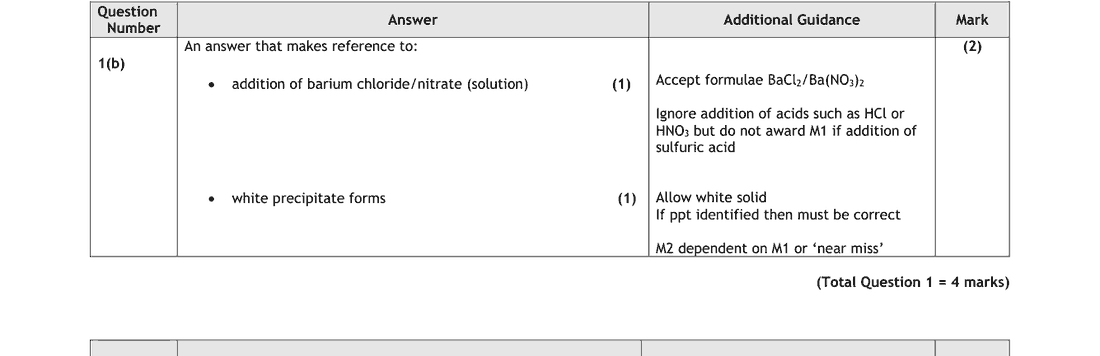
Add barium chloride or barium nitrate solution (BaCl2 / Ba(NO3)2)
white precipitate. Added HCl or HNO3 is ignored but sulfuric acid loses the reagent mark
if the precipitate is identified it must be correct. Common errors: adding sulfuric acid with the barium chloride (it supplies sulfate ions)
BaCl as the formula
Skills: PT4 use laboratory apparatus for a variety of experimental techniques, including: titration, using burette and pipette; distillation and heating under reflux, including setting up glassware using retort stand and clamps; qualitative tests for ions and organic functional groups; filtration, including use of fluted filter paper, or filtration under reduced pressure; CP7 Core practical 7: Analysis of some inorganic and organic unknowns
June 2019 · AS Paper 1 · Q5(b)2 marksPractical and data analysis
Mark scheme
Examiner's comment
(a) Perhaps a little too straightforward. The incorrect responses may have been too
obvious.
(b) Most candidates were familiar with the test for sulfate. Many candidates also
included the use of an acid to remove carbonate ions and also gave a correct reasoning
for doing so, although this was not required to answer this question.
MP1 saw just a few candidates omitting to specify the barium compound used,
responding with just Ba2+. Barium hydroxide is not a recognised reagent for this test
(although it might just be sufficiently soluble to work.)
MP2 was lost for those few who gave an incorrect test result; the common error was a
failure to specify a white ppt.
(c) Again, candidates scored well on this question. The common error (for those few
who gave an incorrect response) was a failure to include the water of crystallisation.
Notes from the mark scheme and report
Add barium chloride or barium nitrate solution (with hydrochloric or nitric acid
leaving out the acid is ignored here)
white precipitate / white solid. Just 'barium ions / Ba2+' does not score the reagent mark but the result mark can still be given. Otherwise the second mark depends on the first. Barium hydroxide is not accepted. Common errors: reagent given only as Ba2+
not saying the precipitate is white
Skills: PT4 use laboratory apparatus for a variety of experimental techniques, including: titration, using burette and pipette; distillation and heating under reflux, including setting up glassware using retort stand and clamps; qualitative tests for ions and organic functional groups; filtration, including use of fluted filter paper, or filtration under reduced pressure; CP7 Core practical 7: Analysis of some inorganic and organic unknowns
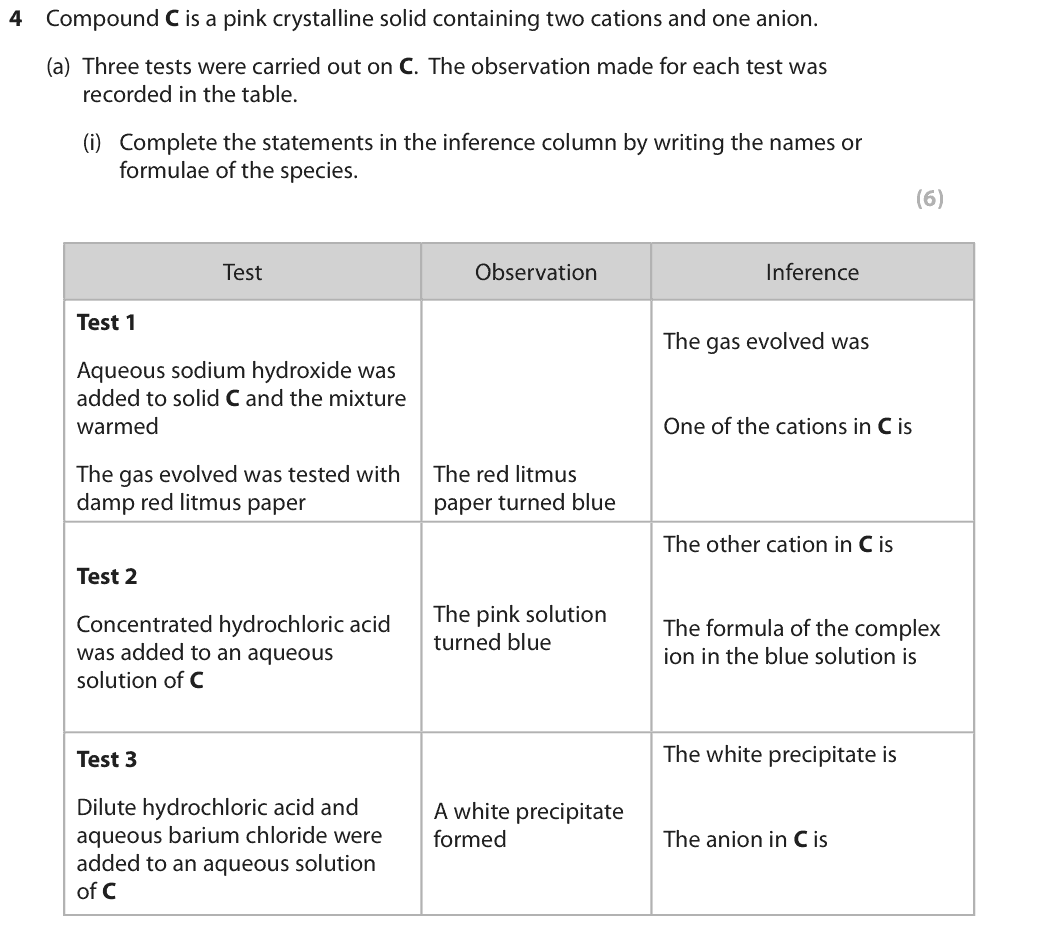
June 2019 · Paper 3 · Q4(a)(i)6 marksPractical and data analysis
Mark scheme
Examiner's comment
Candidates who have carried out tests to identify inorganic substances found this question straightforward. In part (a)(i) the most common error was to omit the oxidation state of cobalt. When a metal ion can have more than one oxidation state, it is important to give the name and oxidation state or the symbol with the charge ie cobalt(II) or Co2+. A number of candidates thought that copper(II) salts changed from pink to blue when concentrated hydrochloric acid is added. This is incorrect, but they were awarded marks for the correct tetrchloro complex of copper(II) and a consequential formula of C in (ii). Some candidates were unfamiliar with the tetrachloro complex ion of cobalt(II). Candidates found it much more challenging to combine the formulae of the three ions to give an overall neutral species. They would benefit from more practice in using formulae of double salts.
Notes from the mark scheme and report
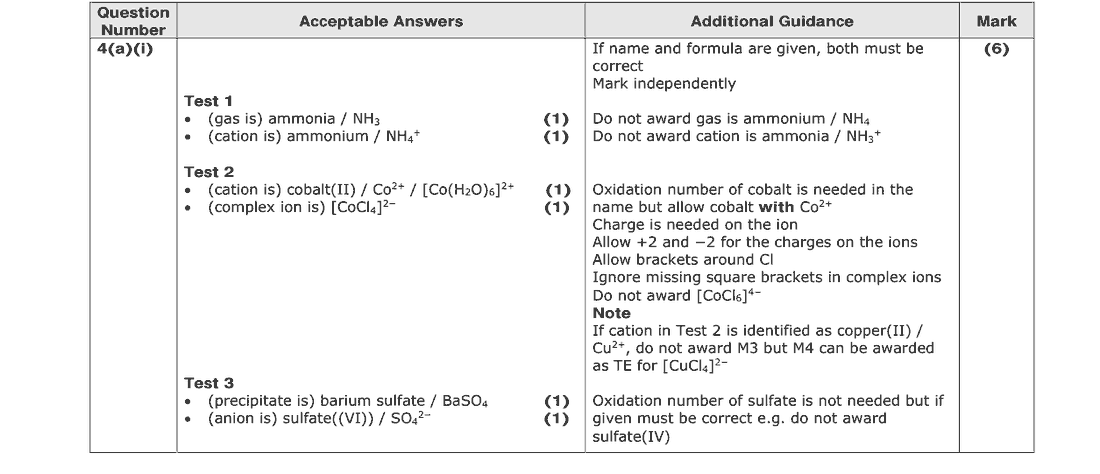
Test 1: gas is ammonia, NH3
cation is ammonium, NH4+. Test 2: cation is cobalt(II) / Co2+ (oxidation number needed in the name)
complex is [CoCl4]2– (charge needed
not [CoCl6]4–). Test 3: precipitate is barium sulfate, BaSO4
anion is sulfate, SO4 2–. Marked independently. If copper(II) is given in Test 2, [CuCl4]2– earns the complex mark only. Commonest error: no oxidation state for cobalt
some chose copper(II)
some did not know the tetrachloro complex
Skills: PT4 use laboratory apparatus for a variety of experimental techniques, including: titration, using burette and pipette; distillation and heating under reflux, including setting up glassware using retort stand and clamps; qualitative tests for ions and organic functional groups; filtration, including use of fluted filter paper, or filtration under reduced pressure; CP15 Core practical 15: Analysis of some inorganic and organic unknowns
June 2019 · Paper 3 · Q4(b)1 markEquation writingHard
Earlier part of question 4 that this part uses
Mark scheme
Examiner's comment
Many candidates struggled to write the ionic equation for the reaction between ammonium ions and hydroxide ions to produce ammonia and water. Some candidates did not read the questions and tried to write an equation involving cobalt(II) ions. Many candidates would benefit from more practice in writing ionic equations.
Notes from the mark scheme and report
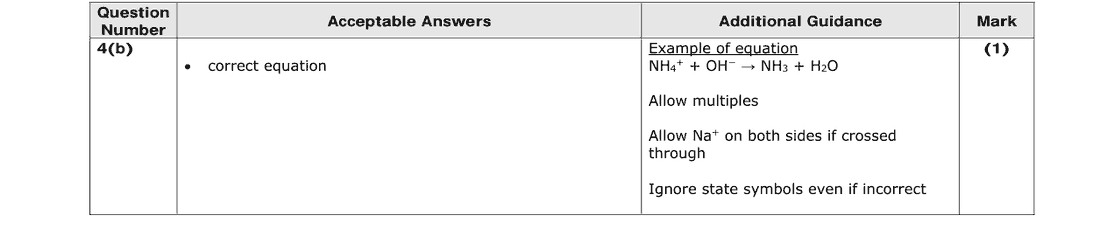
NH4+ + OH– → NH3 + H2O. Multiples allowed
state symbols ignored. Some wrote an equation for cobalt(II) ions instead
Skills: CP15 Core practical 15: Analysis of some inorganic and organic unknowns
June 2019 · Paper 3 · Q4(d)1 markPractical and data analysis
Earlier part of question 4 that this part uses
Mark scheme
Examiner's comment
Candidates who are familiar with the test for sulfate ions knew that hydrochloric acid is needed to prevent other anions, such as carbonate ions, from forming a precipitate with the barium ions. Many vague answers, such as 'to remove impurities' or 'to remove other ions' were seen and these did not receive any credit. Some candidates thought that the acid was a catalyst to speed up the reaction. Some candidates would benefit from a greater understanding of the tests for the ions in the specification.
Notes from the mark scheme and report
To react with / remove any carbonate (or sulfite) ions, which would also give a white precipitate with barium ions and so a false positive. 'To remove impurities / other ions' is too vague
some thought the acid was a catalyst
Skills: PT4 use laboratory apparatus for a variety of experimental techniques, including: titration, using burette and pipette; distillation and heating under reflux, including setting up glassware using retort stand and clamps; qualitative tests for ions and organic functional groups; filtration, including use of fluted filter paper, or filtration under reduced pressure; CP15 Core practical 15: Analysis of some inorganic and organic unknowns
June 2018 · Paper 1 · Q1(a)2 marksShort answer
Mark scheme
Examiner's comment
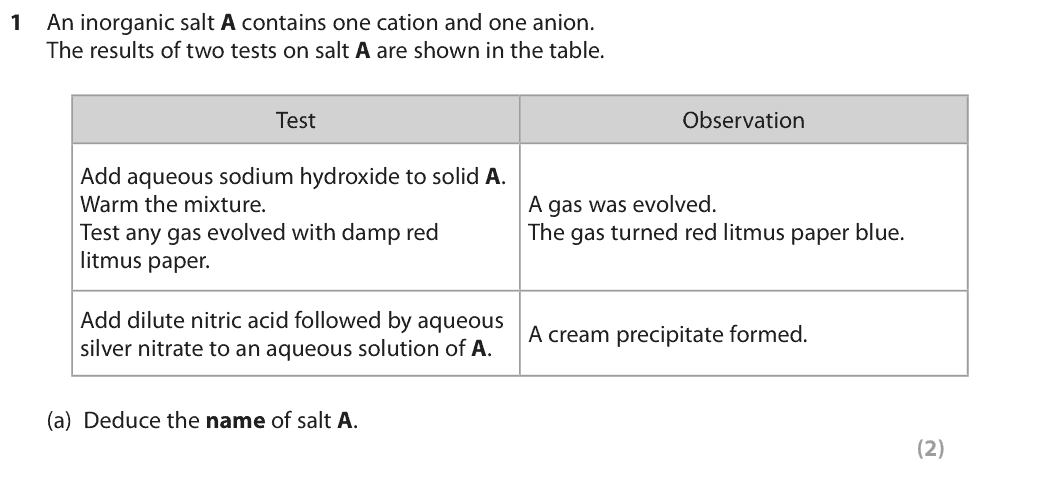
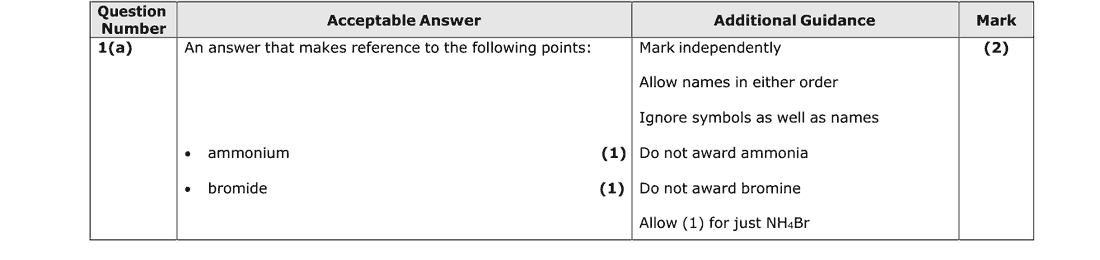
The majority of candidates could identify at least one ion from ammonium and bromide from the tests and their results, although some did not identify the cation as they did not recognise the test for ammonia gas. Some candidates did not read the question and gave the formula instead of the name, with some giving NH3Br as an incorrect formula. Candidates are advised to read the questions carefully and take particular note of any words in bold print.
Notes from the mark scheme and report
Answer: ammonium bromide. One mark for ammonium (alkaline gas with warm NaOH is ammonia) and one for bromide (cream precipitate with acidified silver nitrate), marked independently, either order. Just NH4Br scores 1
not ammonia, not bromine. Common errors: giving a formula instead of the name (some wrote NH3Br)
not recognising the test for ammonia gas
Skills: CP7 Core practical 7: Analysis of some inorganic and organic unknowns
June 2018 · AS Paper 1 · Q4(a)(i)1 markPractical and data analysis
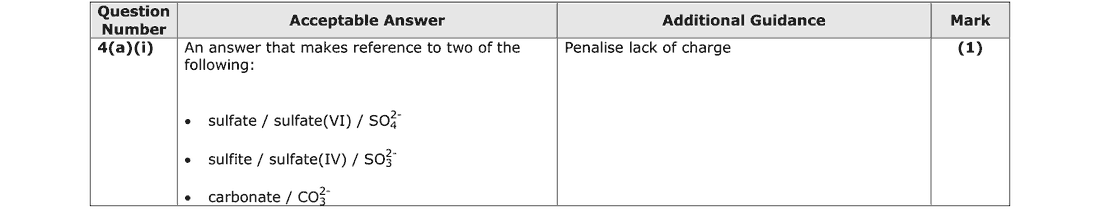
Mark scheme
Examiner's comment
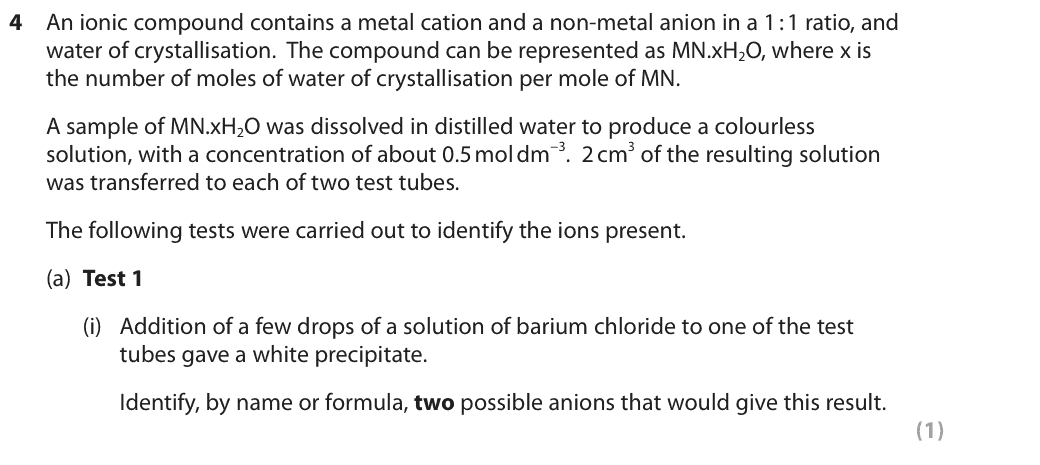
This question was also well answered in general. The expected answers in part (i), sulfate(VI) and carbonate were often seen, with sulfate(IV), a perfectly correct answer which is less commonly covered in this specification, also seen regularly.
Incorrect answers tended to revolve around halide ions, particularly chloride ion which does give a white precipitate under the correct circumstances (with acidified silver nitrate solution).
Notes from the mark scheme and report
Any two of sulfate (SO4 2–), sulfite (SO3 2–), carbonate (CO3 2–), by name or formula
a formula without its charge is penalised. Common error: halide ions, especially chloride (which gives a white precipitate with silver nitrate, not barium chloride)
Skills: PT4 use laboratory apparatus for a variety of experimental techniques, including: titration, using burette and pipette; distillation and heating under reflux, including setting up glassware using retort stand and clamps; qualitative tests for ions and organic functional groups; filtration, including use of fluted filter paper, or filtration under reduced pressure; CP7 Core practical 7: Analysis of some inorganic and organic unknowns
June 2018 · AS Paper 1 · Q4(a)(ii)1 markPractical and data analysis
Earlier part of question 4 that this part uses
Mark scheme
Examiner's comment
This question was also well answered in general. The expected answers in part (i), sulfate(VI) and carbonate were often seen, with sulfate(IV), a perfectly correct answer which is less commonly covered in this specification, also seen regularly.
Incorrect answers tended to revolve around halide ions, particularly chloride ion which does give a white precipitate under the correct circumstances (with acidified silver nitrate solution).
Notes from the mark scheme and report
Answer: SO4 2–. The precipitate does not dissolve in dilute hydrochloric acid, so it is barium sulfate. The name alone is ignored (formula asked for)
missing charge penalised only if not already penalised in (a)(i)
Skills: PT4 use laboratory apparatus for a variety of experimental techniques, including: titration, using burette and pipette; distillation and heating under reflux, including setting up glassware using retort stand and clamps; qualitative tests for ions and organic functional groups; filtration, including use of fluted filter paper, or filtration under reduced pressure; CP7 Core practical 7: Analysis of some inorganic and organic unknowns
June 2017 · AS Paper 1 · Q1(b)2 marksShort answer
Earlier part of question 1 that this part uses
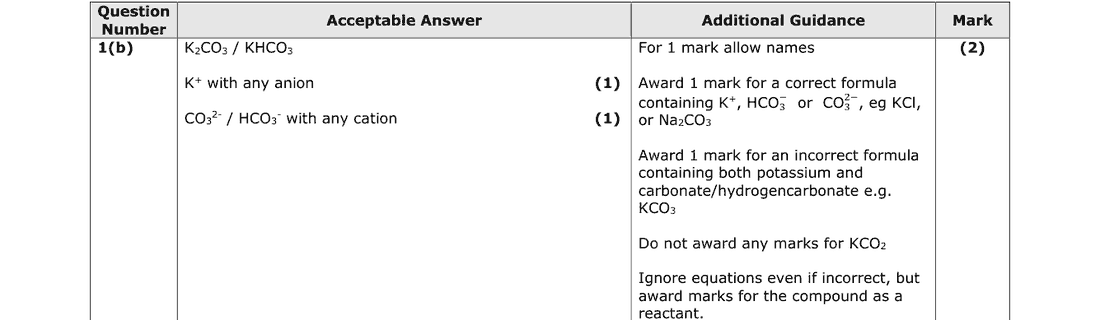
Mark scheme
Examiner's comment
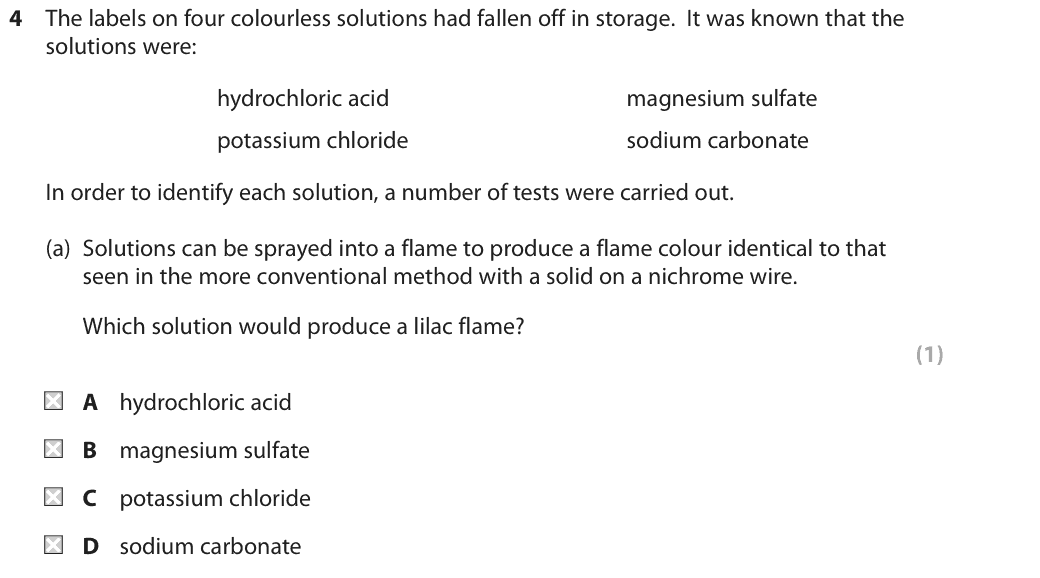
Many candidates interpreted their test results and identified the presence of potassium ions and the production of carbon dioxide. Many came up with the answer of K2CO3, whilst a few suggested KHCO3. Incorrect answers included KCO3 which scored one mark and KCO2, which did not. Some wrote equations, but generally could still score the mark if it was clear what they were suggesting the substance was, but all candidates should be encouraged to read the questions very carefully.
Notes from the mark scheme and report
Answer: K2CO3 or KHCO3. One mark for K+ (lilac flame) with any anion
one mark for carbonate or hydrogencarbonate (CO2 turns limewater cloudy) with any cation. Names score 1 only
KCO3 scores 1
KCO2 scores 0. Equations ignored, though the compound shown as a reactant was credited. Common wrong answers: KCO3 and KCO2
Skills: CP7 Core practical 7: Analysis of some inorganic and organic unknowns
June 2017 · Paper 3 · Q2(c)(iii)2 marksEquation writing
Earlier parts of question 2 that this part uses
Mark scheme
Examiner's comment
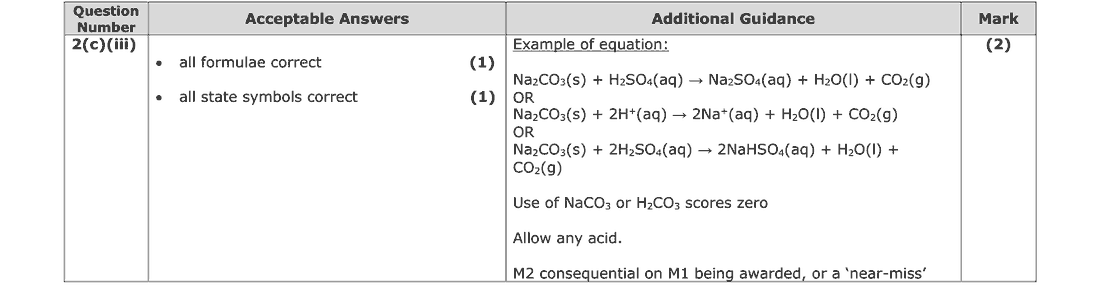
The writing of balanced equations continues to differentiate well between candidates, even for simple inorganic reactions such as this question. Candidates did not appreciate state symbols well, perhaps not considering the solubility of the sodium sulphate product nor the information in the question about the sodium carbonate solid added. The examination team were disappointed to regularly see NaCO3 as the formula for sodium carbonate
ionic version with 2H+(aq) or the 2NaHSO4 version allowed, as is any acid. One mark for formulae, one for state symbols (needs M1 or a near miss). NaCO3 or H2CO3 scores zero. State symbols were weak (the solid carbonate and the soluble sodium sulfate) and NaCO3 was seen regularly
June 2016 · AS Paper 1 · Q4(c)1 markMultiple choice
Earlier part of question 4 that this part uses
Answer
B
Mark scheme
Notes from the mark scheme and report
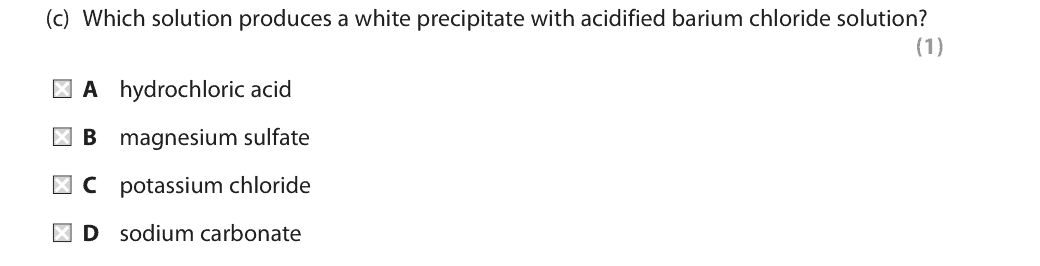
Answer: B. Sulfate ions give a white precipitate of barium sulfate with acidified barium chloride. Sodium carbonate would not, because the acid removes the carbonate ions
Skills: CP7 Core practical 7: Analysis of some inorganic and organic unknowns
June 2016 · AS Paper 1 · Q4(e)2 marksEquation writing
Earlier part of question 4 that this part uses
Mark scheme
Examiner's comment
Part (e) proved to be much harder for candidates to get right than part (d) with even the candidates at the grade A boundary scoring a mean of about 1.5 out of 2.
The ionic equation, as usual, was a key discriminator with only the more able candidates able to select the correct species and to produce a balanced equation.
Notes from the mark scheme and report
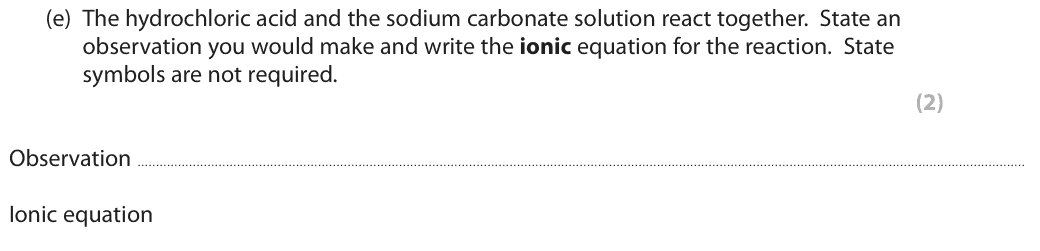
Observation: fizzing / bubbles / effervescence (naming the gas alone is ignored
reject 'solid dissolves', a precipitate, or hydrogen). Ionic equation: 2H+ + CO3 2– → CO2 + H2O (state symbols ignored). The ionic equation was the discriminator: only the more able chose the right species and balanced it. Found much harder than (d)
Skills: CP7 Core practical 7: Analysis of some inorganic and organic unknowns
Work with an A-level chemistry tutor
Dropping marks on calculations, mechanisms or the core practicals? Book a trial session with an A-level chemistry tutor.