Six-mark extended-response questions

The six-mark questions marked with an asterisk. Up to four marks are for the indicative points you make and up to two for how well the answer is structured and reasoned. 47 questions.

Other types: Multiple-choice questions · Calculation questions · Equation questions · Mechanism questions · Structure and diagram questions · Explanation questions · Practical questions · Short-answer questions

June 2025 · AS Paper 1 · Q7(d) 6 marks 6-mark extended response atomic structure and the periodic table
Earlier part of question 7 that this part usesEarlier part of June 2025 Paper 1 question 7
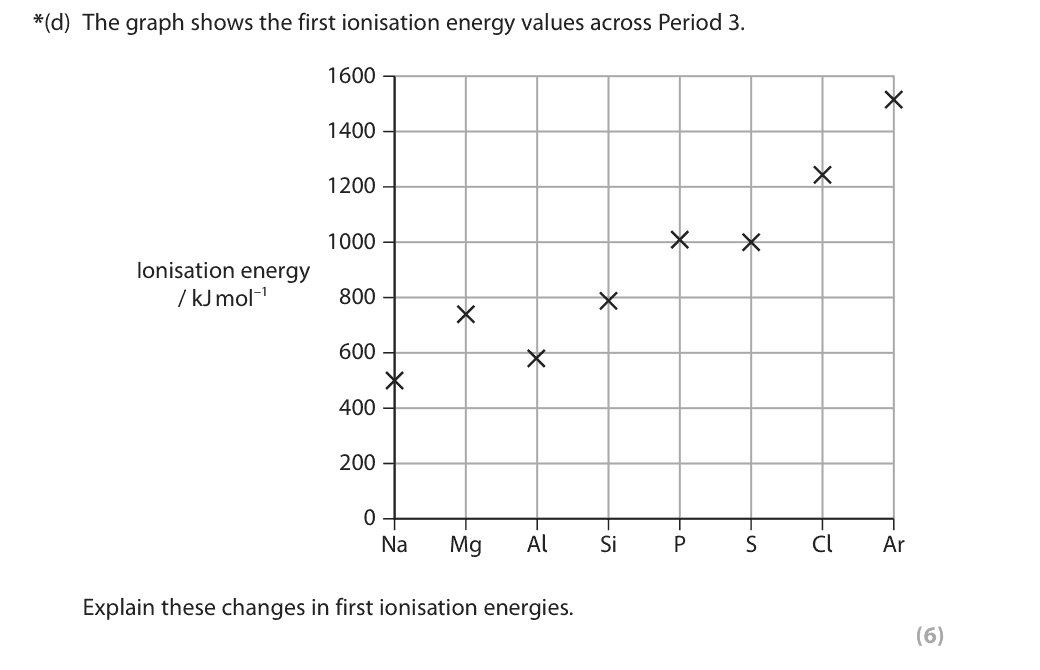
The graph shows the first ionisation energy values across Period 3.
1600
1400
1200
1000
Ionisation energy
/ kJ mol–1
800
600
400
200
0
Na
Mg
Al
Si
P
S
Cl
Ar
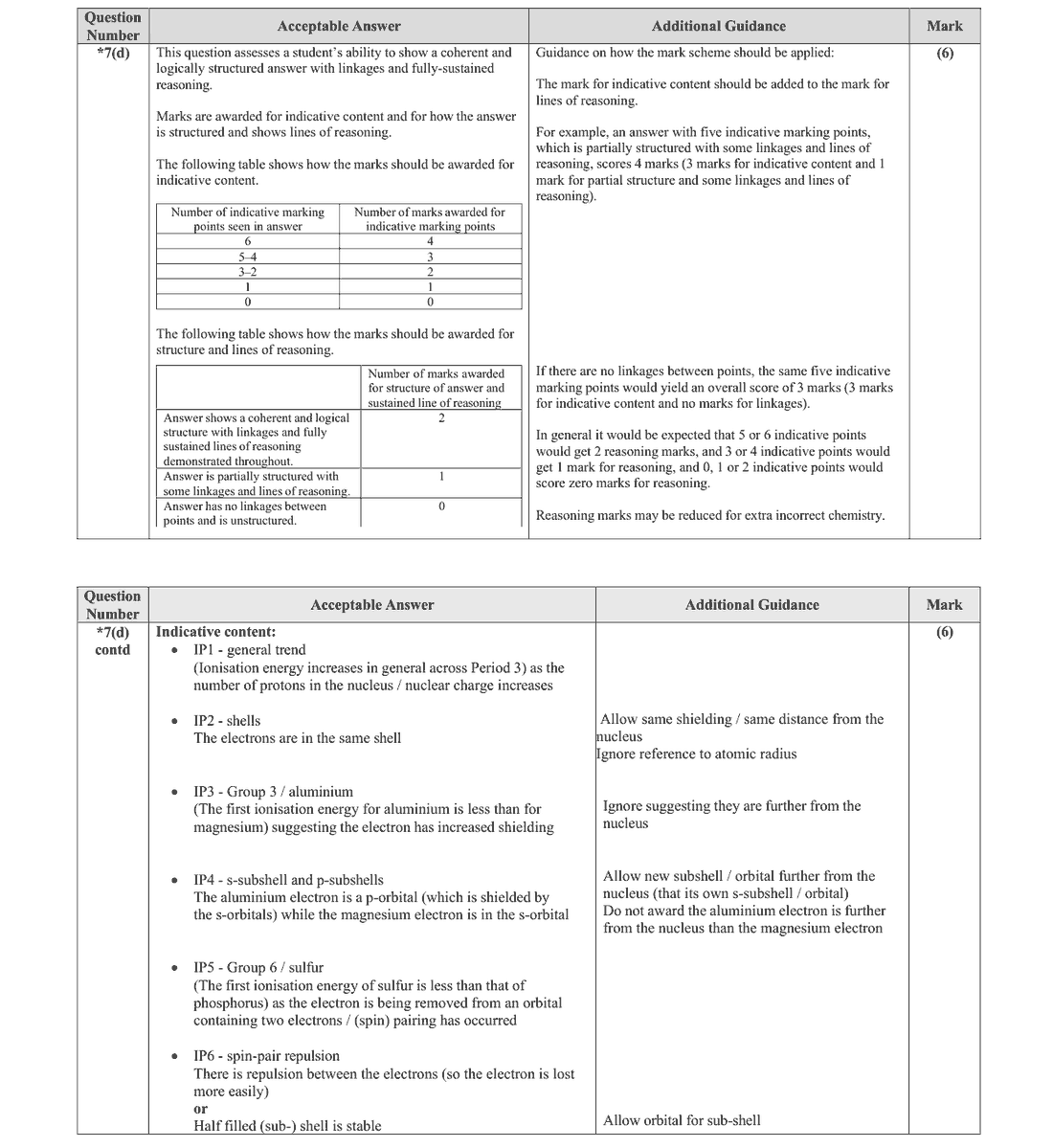
Explain these changes in first ionisation energies.
June 2025 · AS Paper 2 · Q6(b)(ii) 6 marks 6-mark extended response Hard alcohols
Earlier parts of question 6 that this part usesEarlier part of June 2025 Paper 2 question 6Earlier part of June 2025 Paper 2 question 6
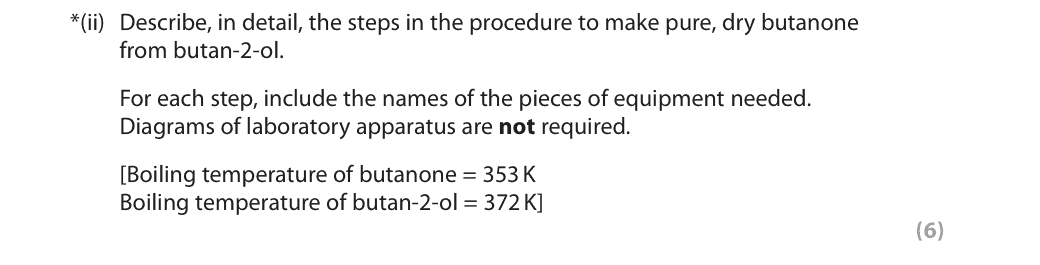
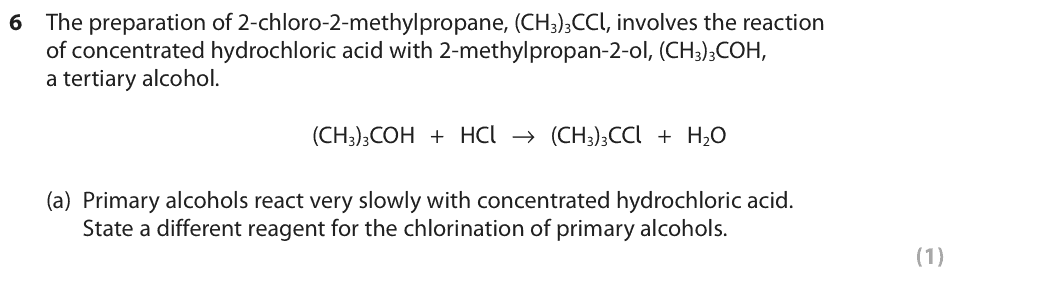
Describe, in detail, the steps in the procedure to make pure, dry butanone
from butan‑2‑ol.
For each step, include the names of the pieces of equipment needed.
Diagrams of laboratory apparatus are not required.
[Boiling temperature of butanone = 353 K
Boiling temperature of butan‑2‑ol = 372 K]
June 2025 · Paper 1 · Q8 6 marks 6-mark extended response transition metals reactions
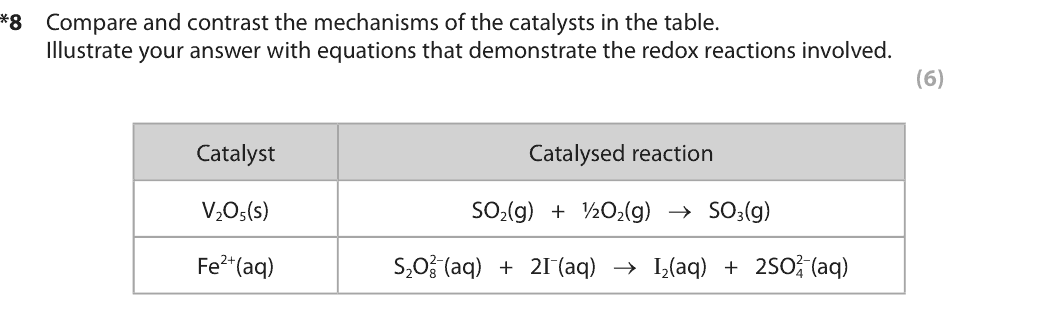
Compare and contrast the mechanisms of the catalysts in the table.
Illustrate your answer with equations that demonstrate the redox reactions involved.
Catalyst
Catalysed reaction
V2O5(s)
SO2(g)   +   ½O2(g)   →   SO3(g)
2–(aq)   +   2I–(aq)   →   I2(aq)   +   2SO4
Fe2+(aq)
S2O8
2–(aq)
June 2025 · Paper 2 · Q6(a) 6 marks 6-mark extended response carbonyl compoundscarboxylic acids
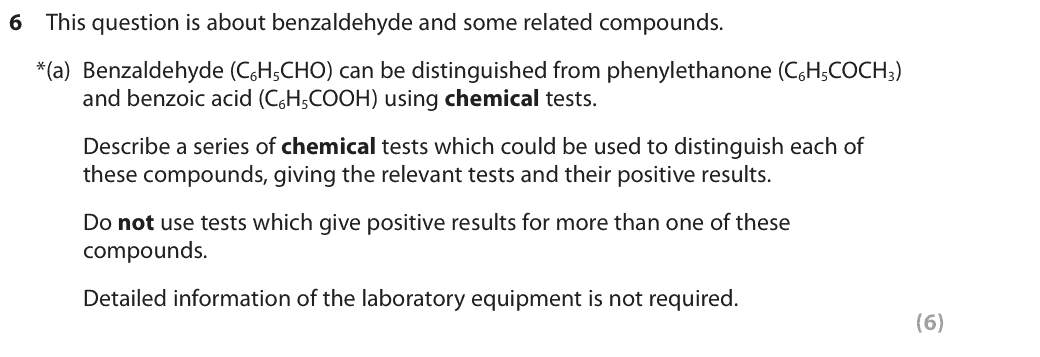
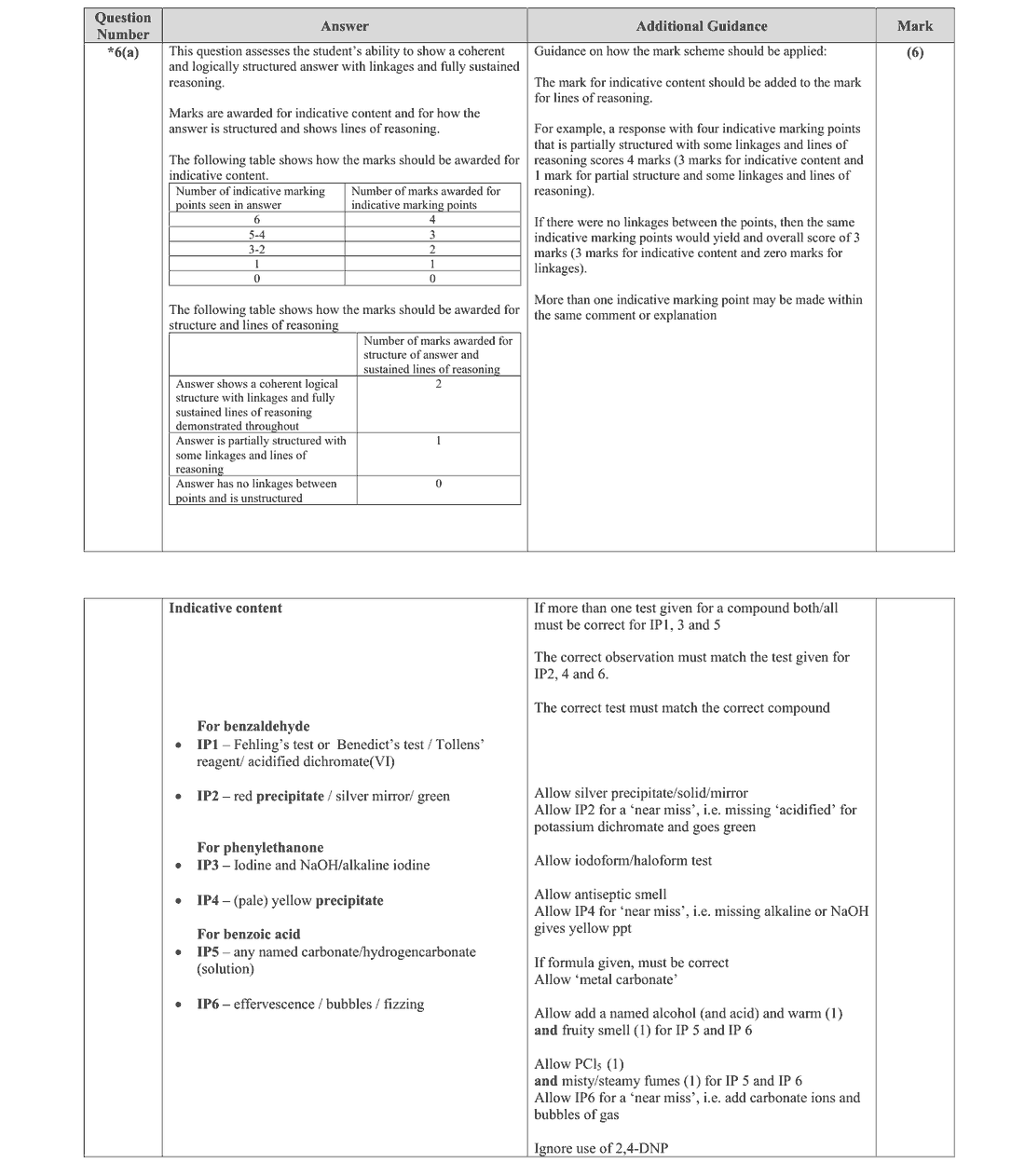
This question is about benzaldehyde and some related compounds.
Benzaldehyde (C6H5CHO) can be distinguished from phenylethanone (C6H5COCH3)
and benzoic acid (C6H5COOH) using chemical tests.
Describe a series of chemical tests which could be used to distinguish each of
these compounds, giving the relevant tests and their positive results.
Do not use tests which give positive results for more than one of these
compounds.
Detailed information of the laboratory equipment is not required.
June 2025 · Paper 3 · Q3 6 marks 6-mark extended response analysis of inorganic compounds
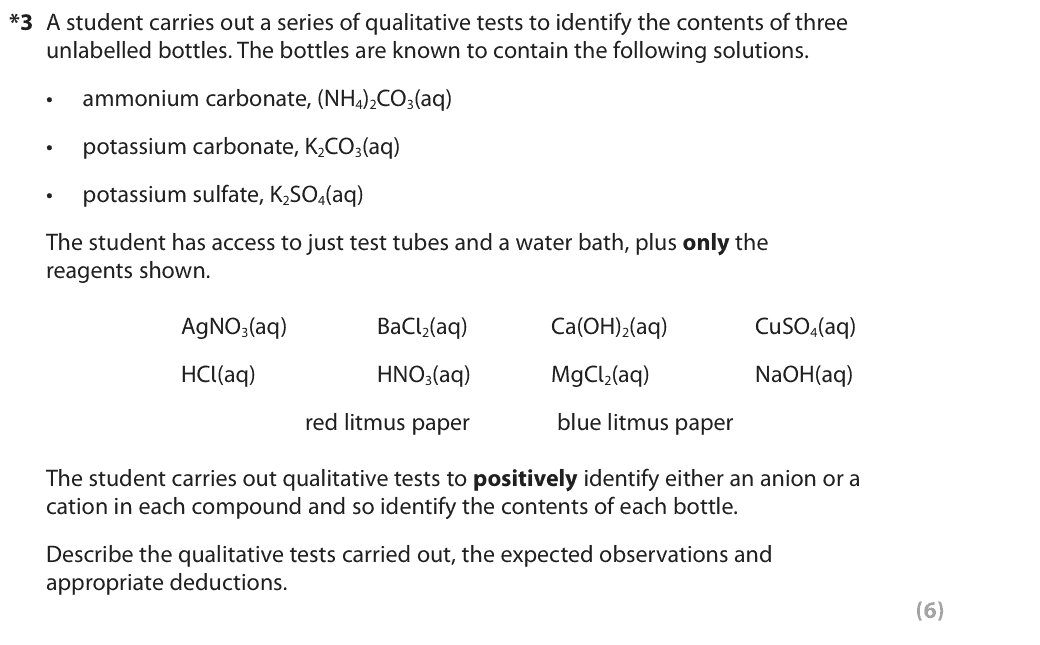
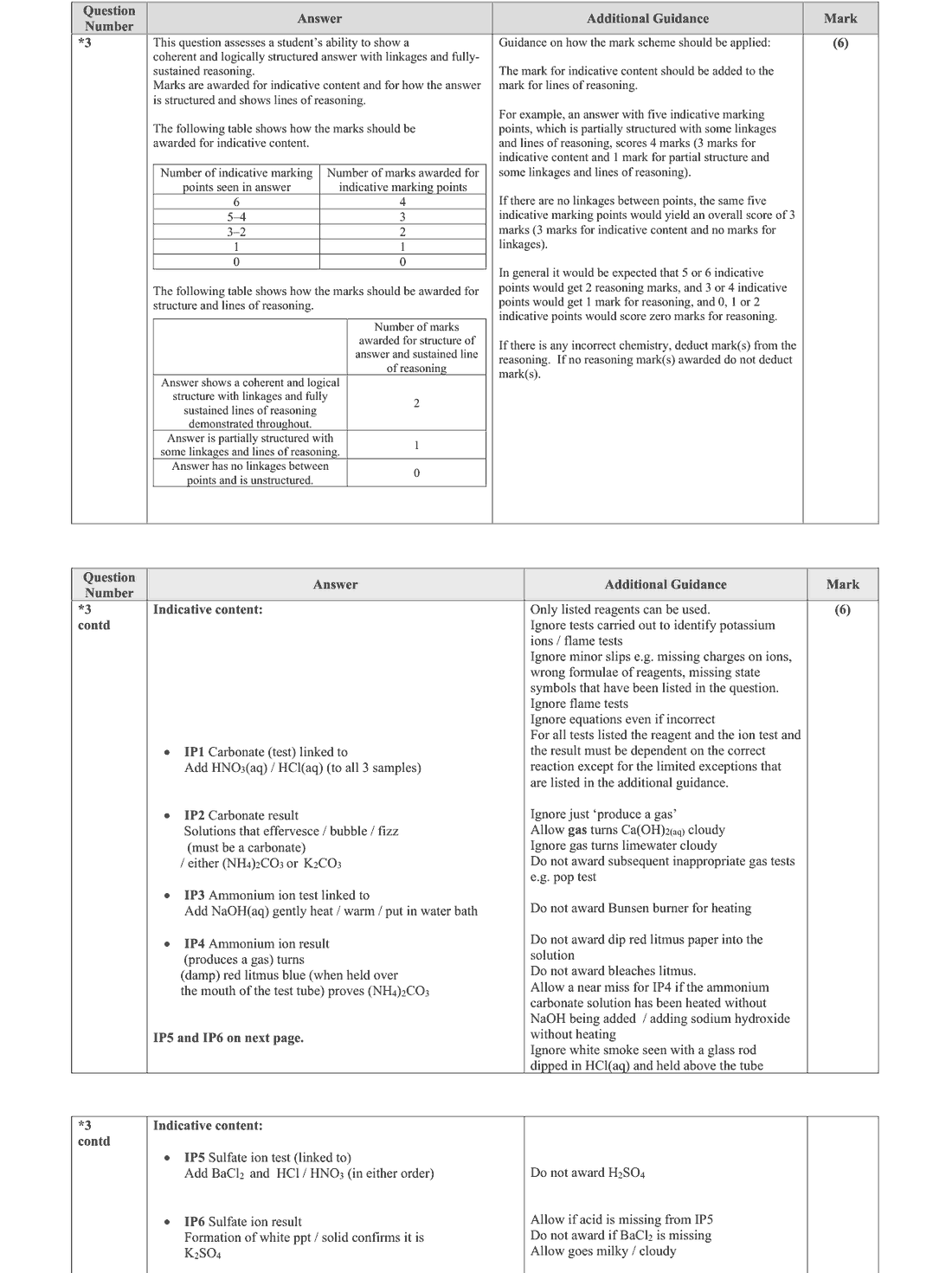
A student carries out a series of qualitative tests to identify the contents of three
unlabelled bottles. The bottles are known to contain the following solutions.
•
ammonium carbonate, (NH4)2CO3(aq)
•
potassium carbonate, K2CO3(aq)
•
potassium sulfate, K2SO4(aq)
The student has access to just test tubes and a water bath, plus only the
reagents shown.
AgNO3(aq)
BaCl2(aq)
Ca(OH)2(aq)
CuSO4(aq)
HCl(aq)
HNO3(aq)
MgCl2(aq)
NaOH(aq)
red litmus paper
blue litmus paper
The student carries out qualitative tests to positively identify either an anion or a
cation in each compound and so identify the contents of each bottle.
Describe the qualitative tests carried out, the expected observations and
appropriate deductions.
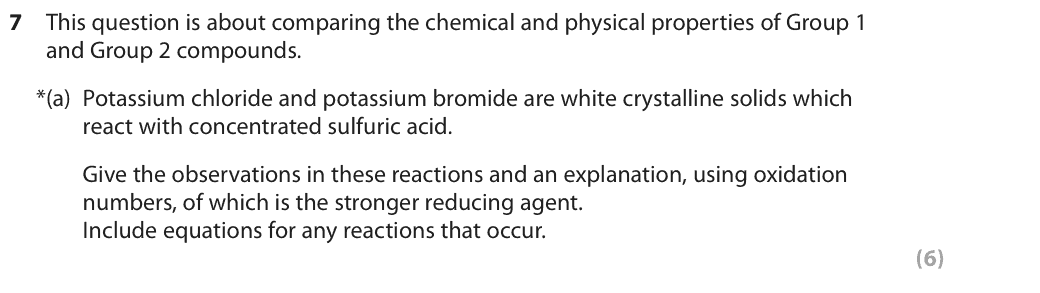
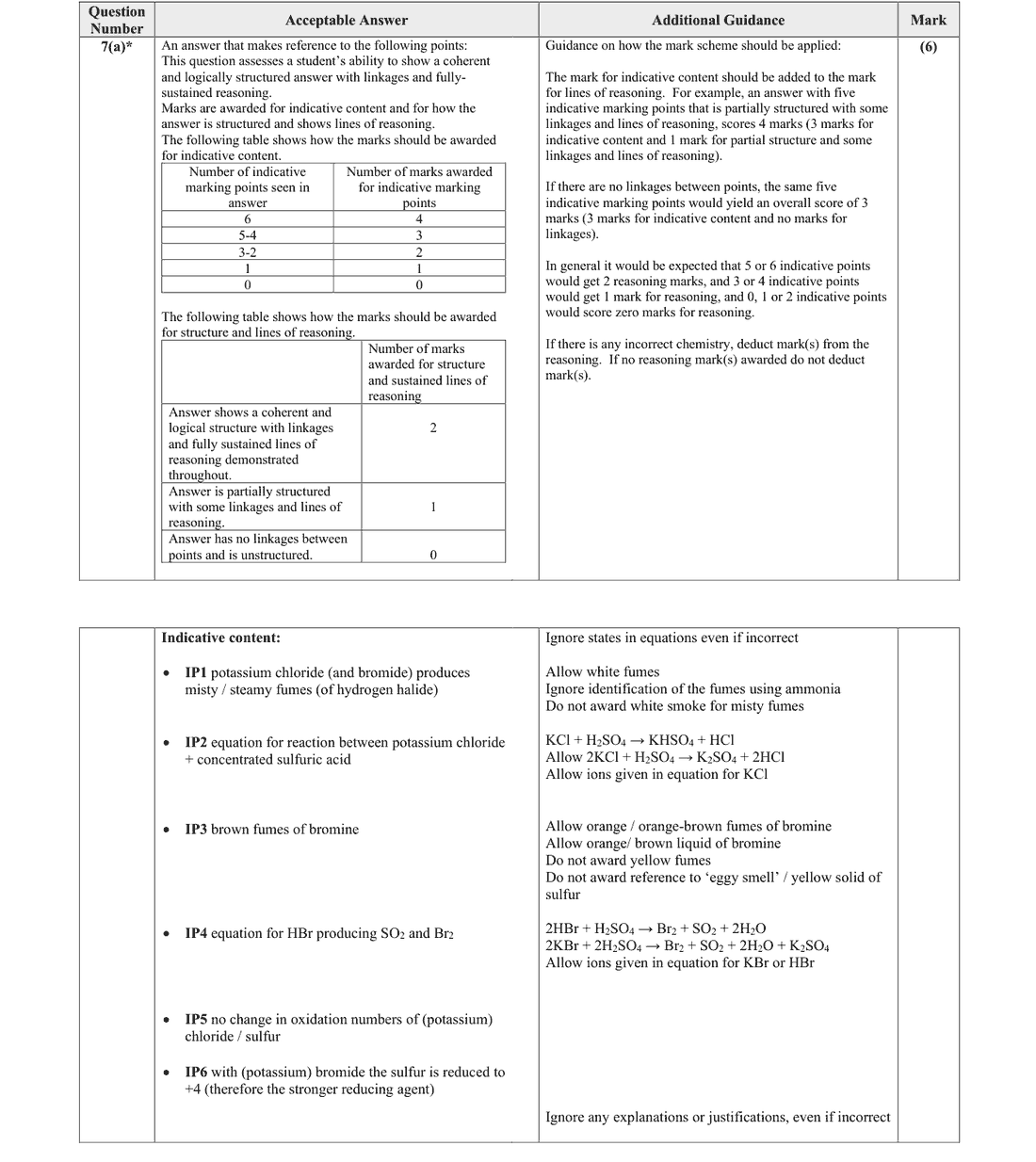
June 2024 · AS Paper 1 · Q7(a) 6 marks 6-mark extended response group 7 the halogensredox i
This question is about comparing the chemical and physical properties of Group 1
and Group 2 compounds.
Potassium chloride and potassium bromide are white crystalline solids which
react with concentrated sulfuric acid.
Give the observations in these reactions and an explanation, using oxidation
numbers, of which is the stronger reducing agent.
Include equations for any reactions that occur.
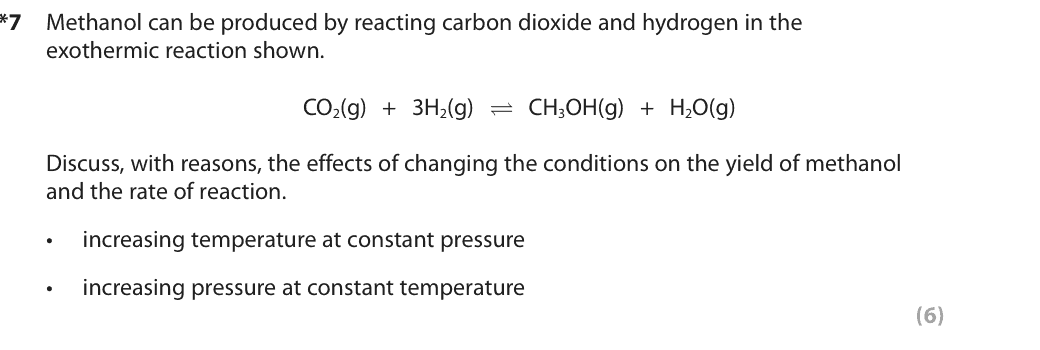
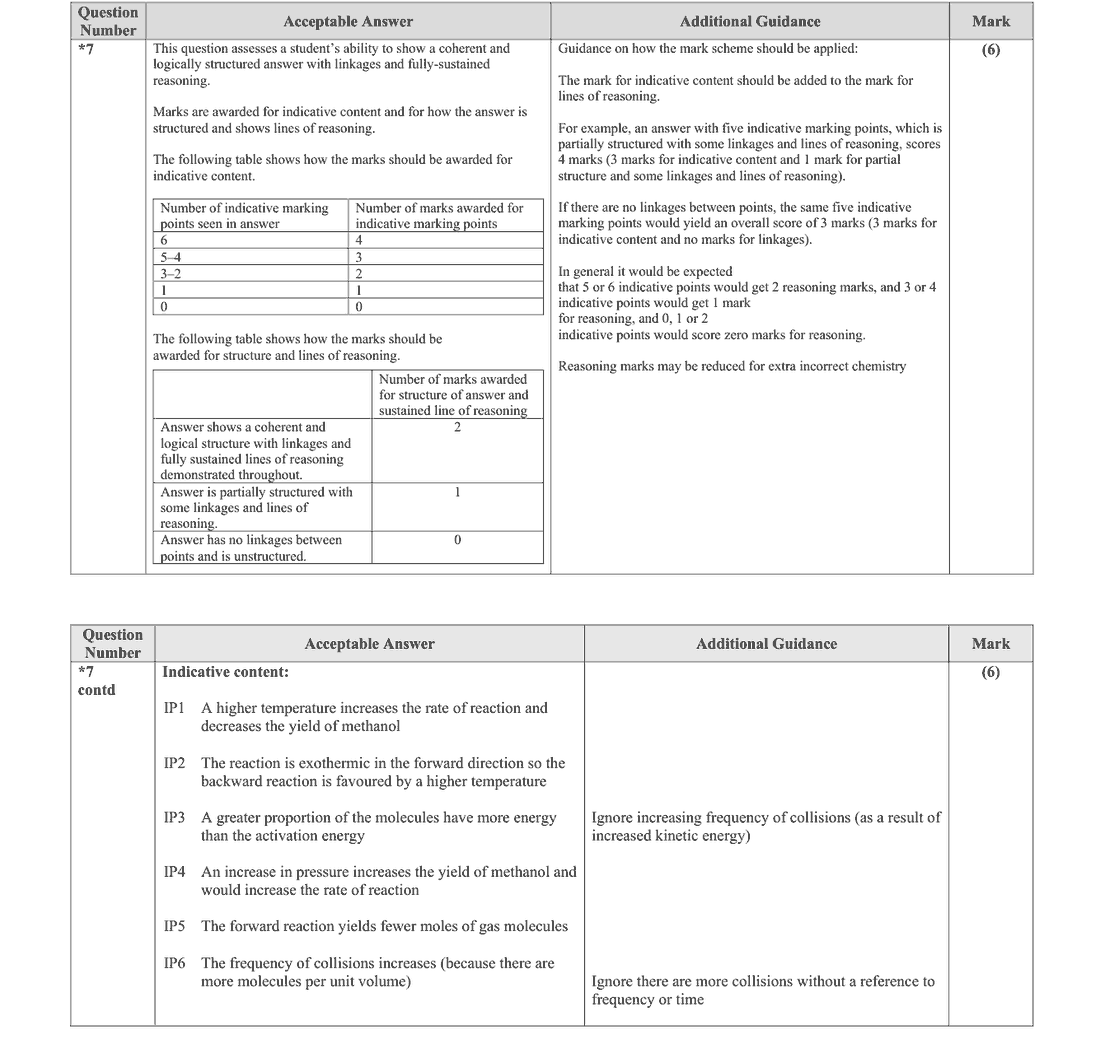
June 2024 · AS Paper 2 · Q7 6 marks 6-mark extended response equilibrium ikinetics i
Methanol can be produced by reacting carbon dioxide and hydrogen in the
exothermic reaction shown.
CO2(g)   +   3H2(g)      CH3OH(g)   +   H2O(g)
Discuss, with reasons, the effects of changing the conditions on the yield of methanol
and the rate of reaction.
•
increasing temperature at constant pressure
•
increasing pressure at constant temperature
June 2024 · Paper 1 · Q6 6 marks 6-mark extended response transition metals principles
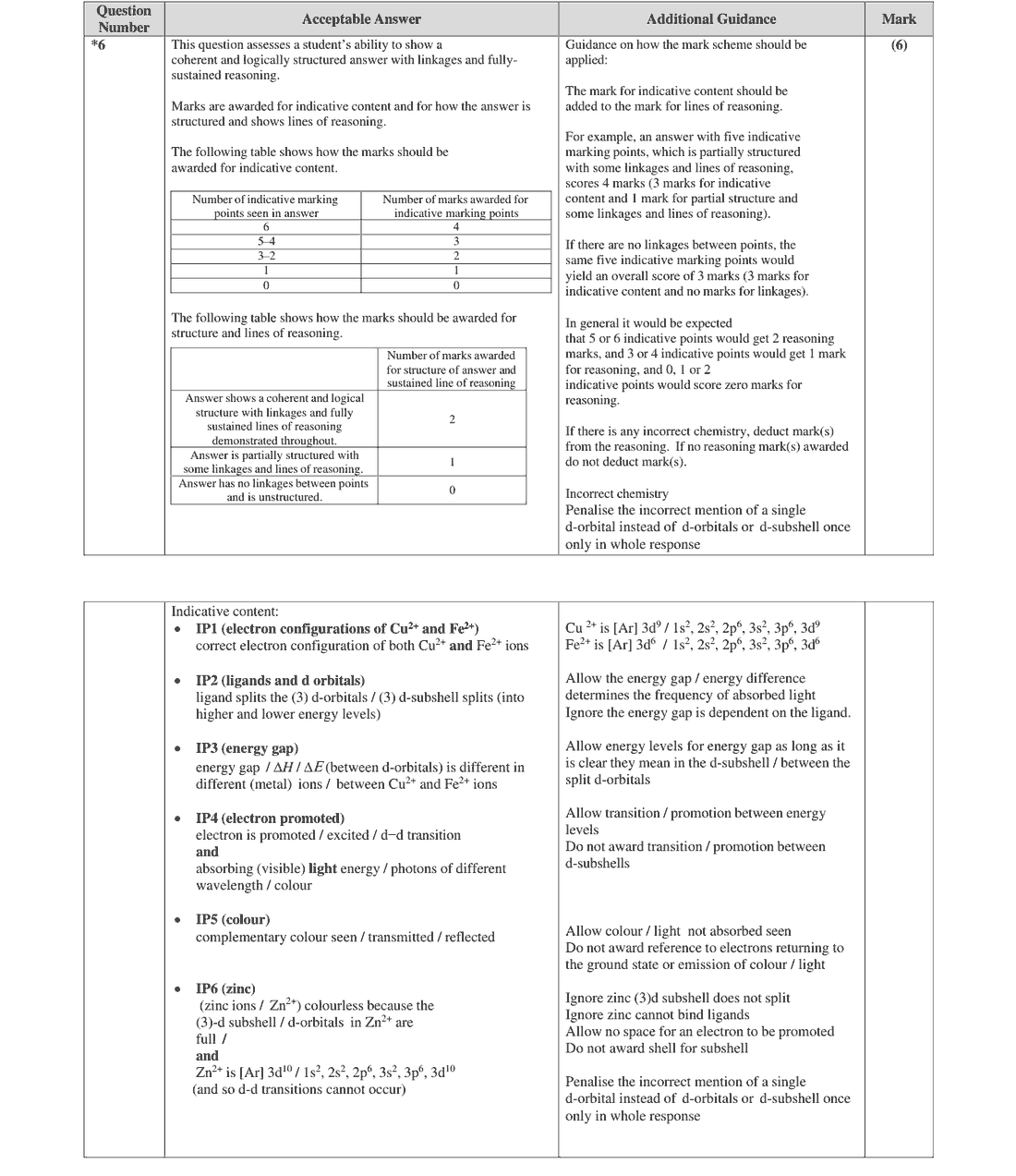
Explain why aqueous solutions of Cu2+ ions and Fe2+ ions are coloured but have
different colours, whereas aqueous solutions of Zn2+ ions are colourless.
Include any relevant electronic configurations.
June 2024 · Paper 2 · Q4 6 marks 6-mark extended response alkenes
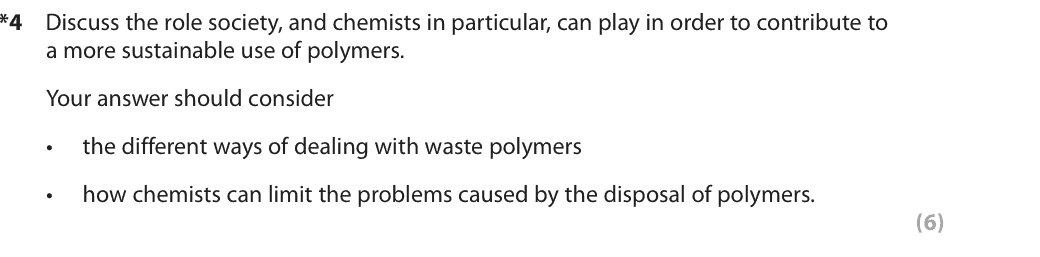
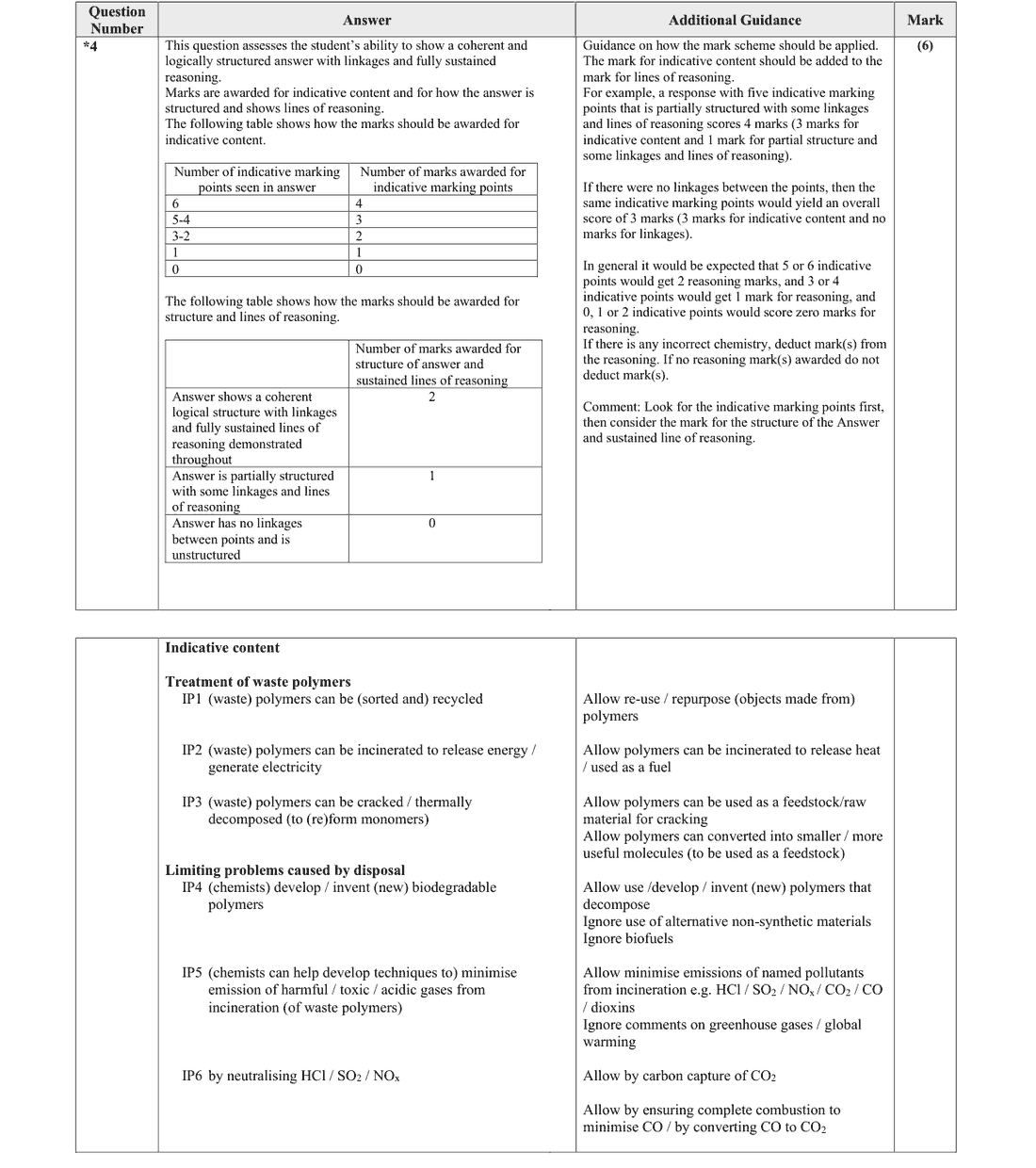
Discuss the role society, and chemists in particular, can play in order to contribute to
a more sustainable use of polymers.
Your answer should consider
•
the different ways of dealing with waste polymers
•
how chemists can limit the problems caused by the disposal of polymers.
June 2024 · Paper 3 · Q5 6 marks 6-mark extended response Easy arenes benzenealkenes
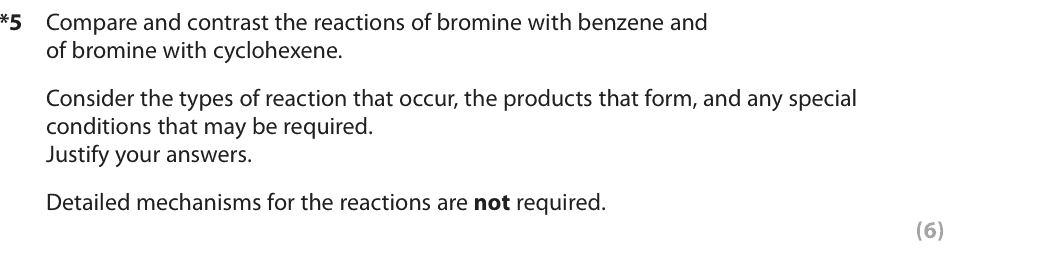
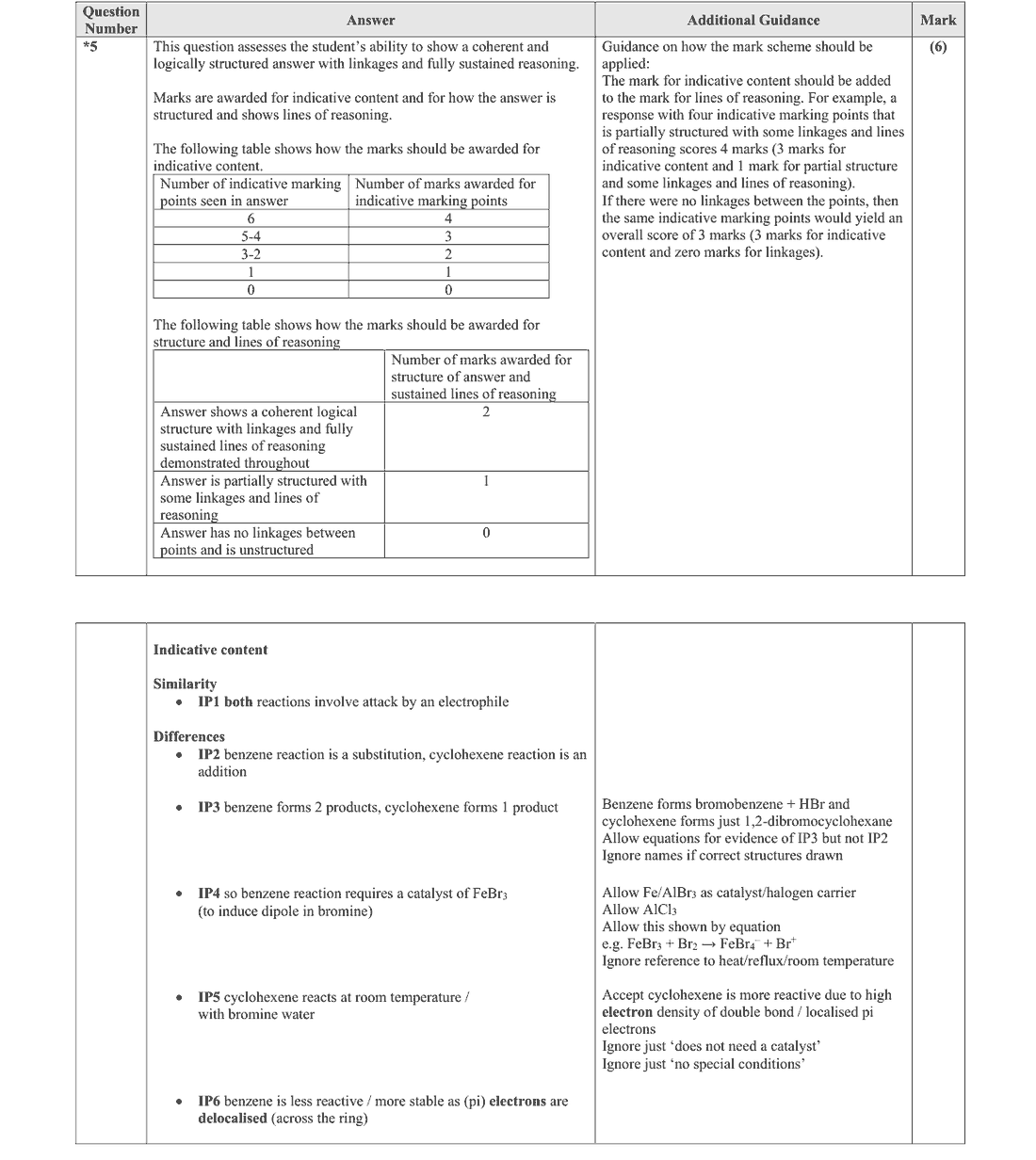
Compare and contrast the reactions of bromine with benzene and
of bromine with cyclohexene.
Consider the types of reaction that occur, the products that form, and any special
conditions that may be required.
Justify your answers.
Detailed mechanisms for the reactions are not required.
June 2023 · AS Paper 1 · Q9(b)(ii) 6 marks 6-mark extended response groups 1 and 2atomic structure and the periodic table
Earlier part of question 9 that this part usesEarlier part of June 2023 Paper 1 question 9
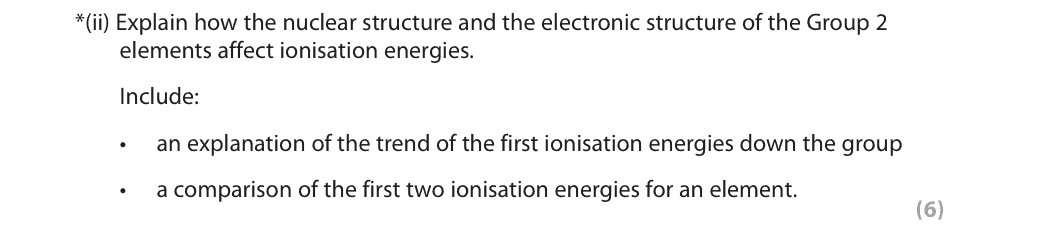
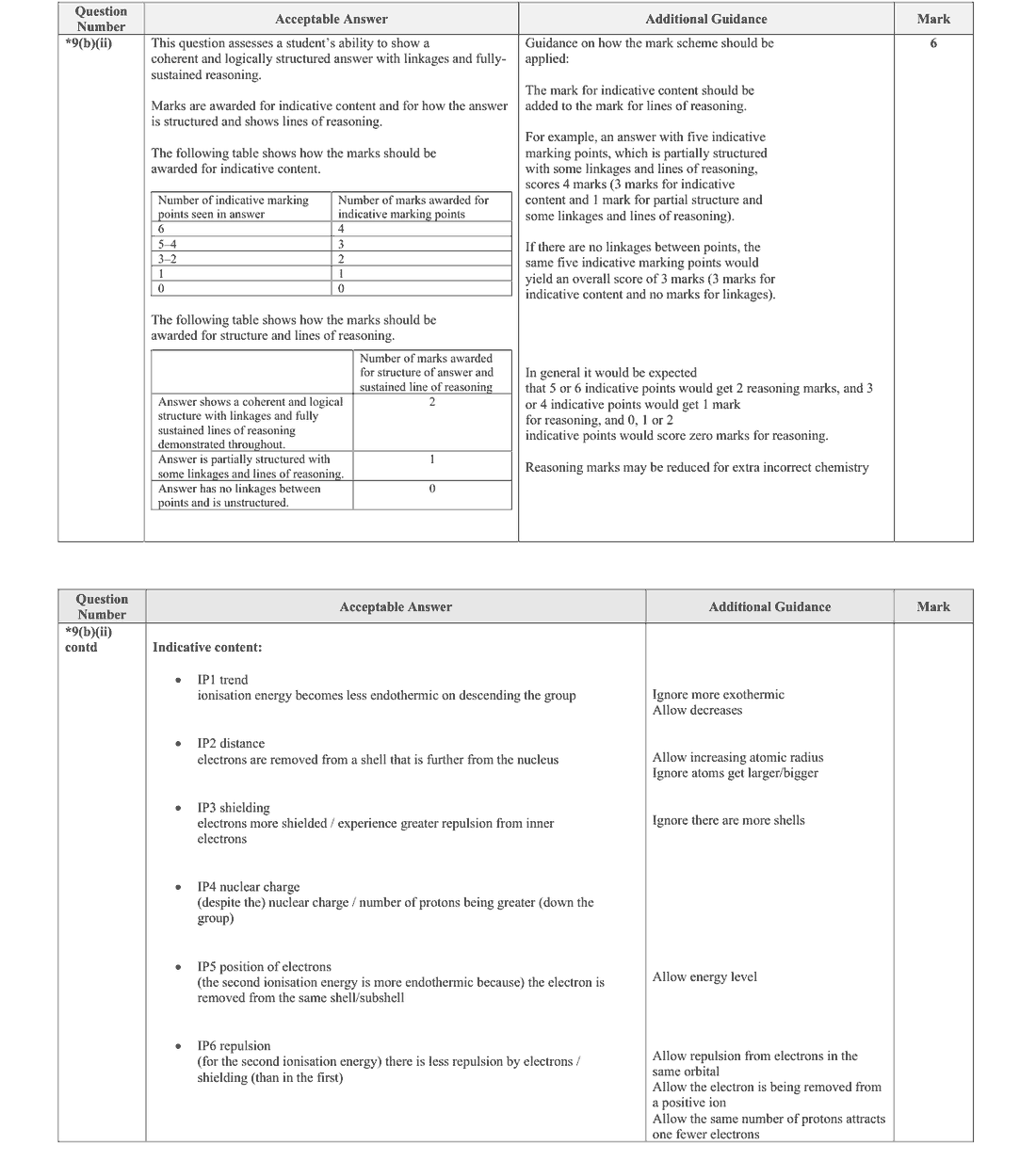
Explain how the nuclear structure and the electronic structure of the Group 2
elements affect ionisation energies.
Include:
•
an explanation of the trend of the first ionisation energies down the group
•
a comparison of the first two ionisation energies for an element.
June 2023 · AS Paper 2 · Q7(c)(iv) 6 marks 6-mark extended response Hard alcohols
Earlier part of question 7 that this part usesEarlier part of June 2023 Paper 2 question 7
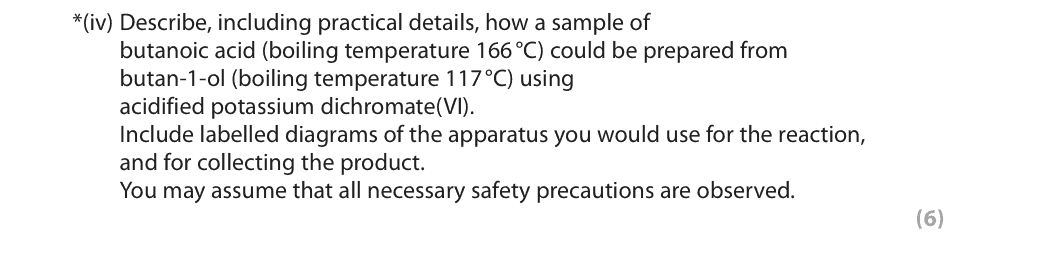
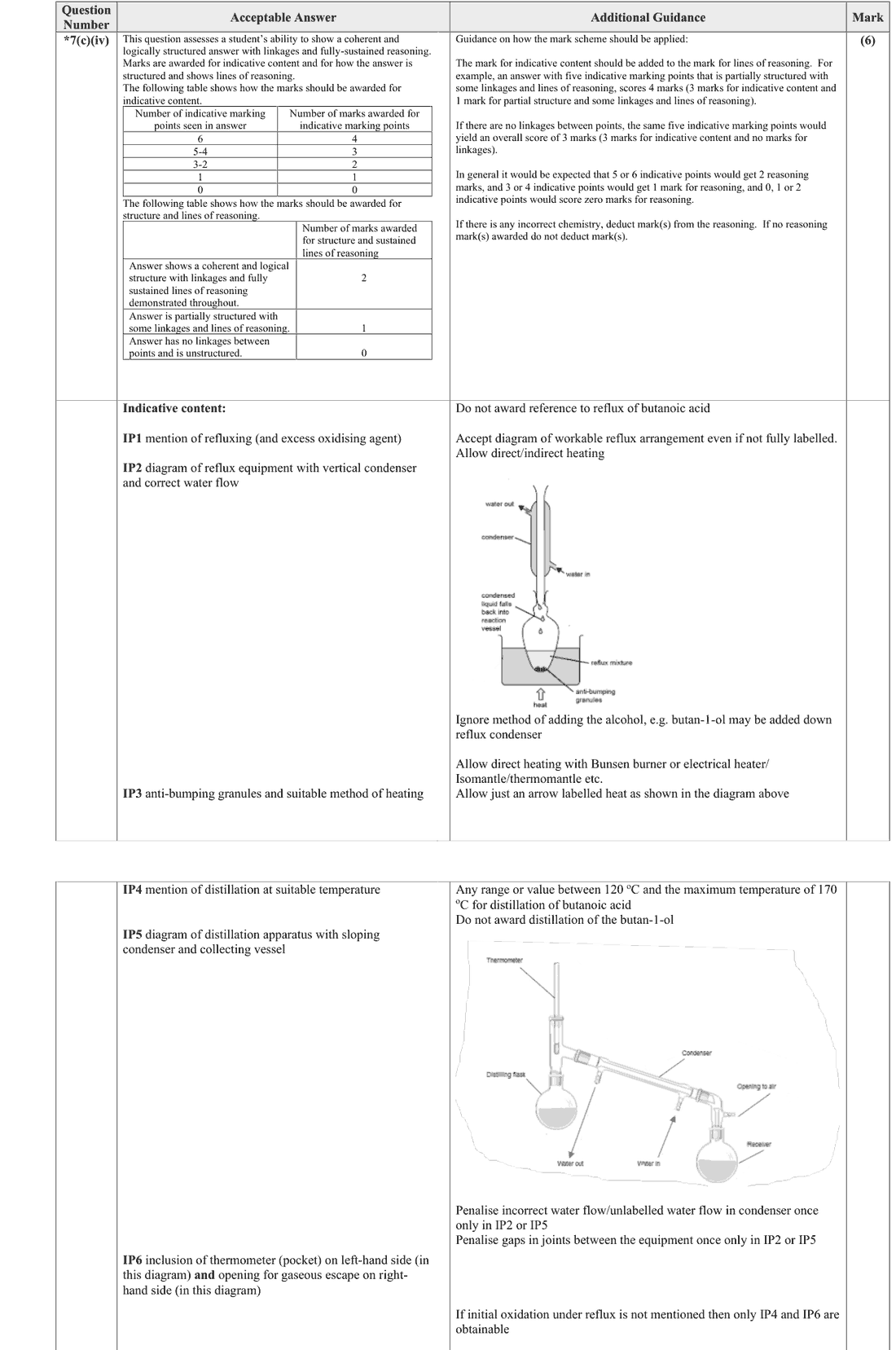
Describe, including practical details, how a sample of
butanoic acid (boiling temperature 166 °C) could be prepared from
butan‑1‑ol (boiling temperature 117 °C) using
acidified potassium dichromate(VI).
Include labelled diagrams of the apparatus you would use for the reaction,
and for collecting the product.
You may assume that all necessary safety precautions are observed.
June 2023 · Paper 1 · Q8 6 marks 6-mark extended response transition metals reactions
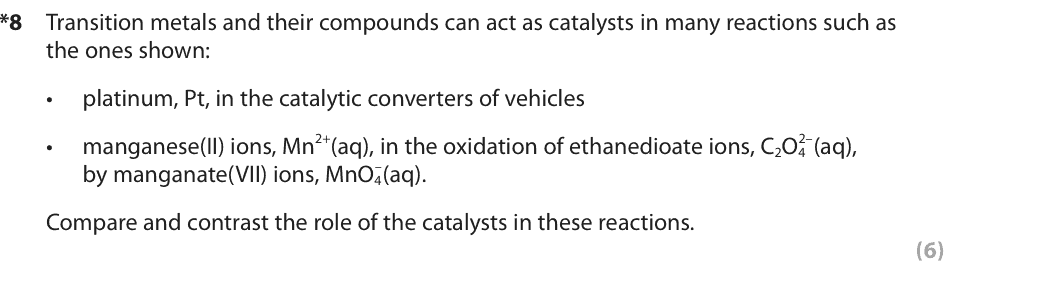
Transition metals and their compounds can act as catalysts in many reactions such as
the ones shown:
•
platinum, Pt, in the catalytic converters of vehicles
manganese(II) ions, Mn2+(aq), in the oxidation of ethanedioate ions, C2O4
2–(aq),
•
by manganate(VII) ions, MnO4
–(aq).
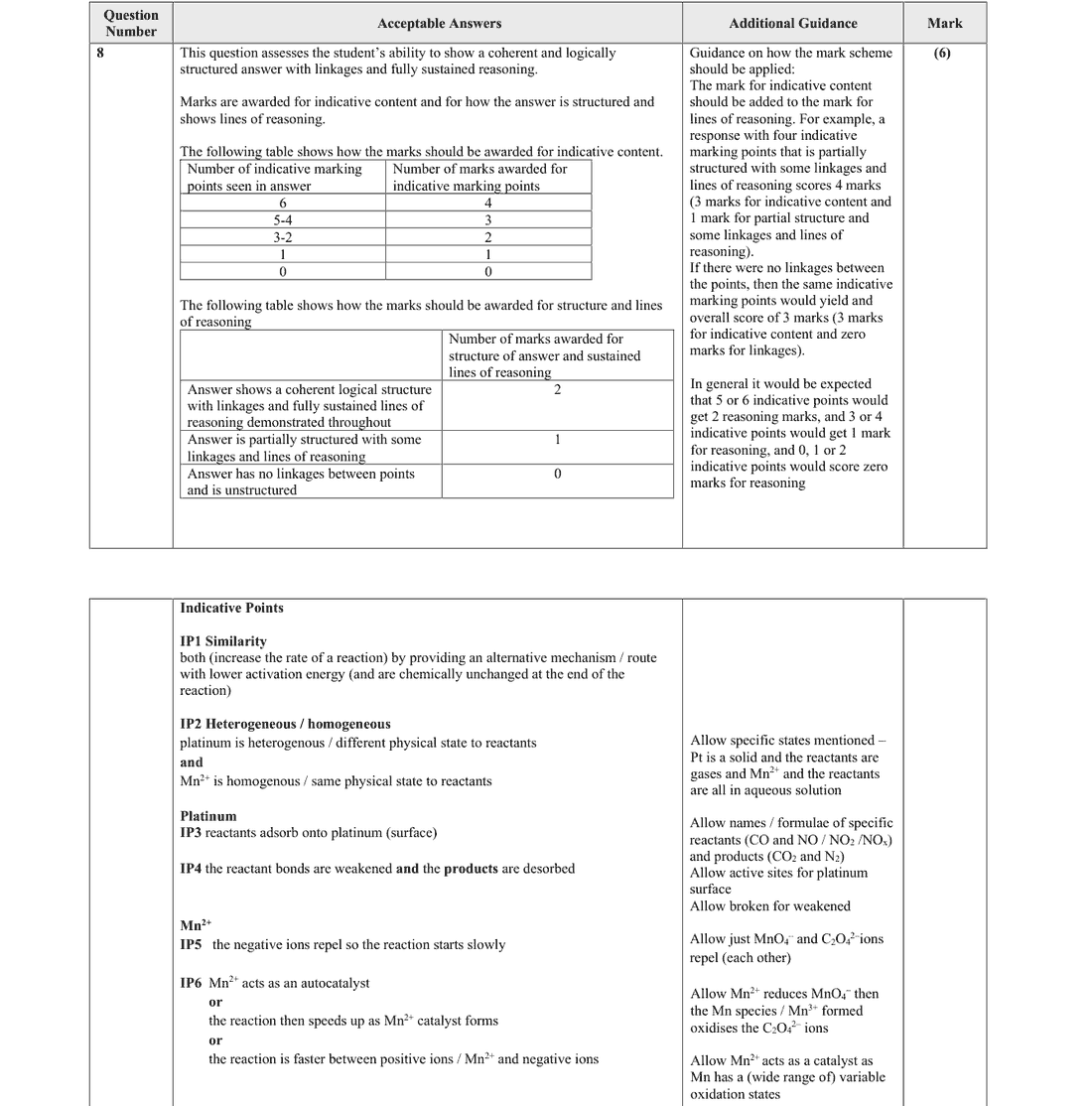
Compare and contrast the role of the catalysts in these reactions.
June 2023 · Paper 2 · Q8(d) 6 marks 6-mark extended response introduction to organic chemistrychirality
Earlier part of question 8 that this part usesEarlier part of June 2023 Paper 2 question 8
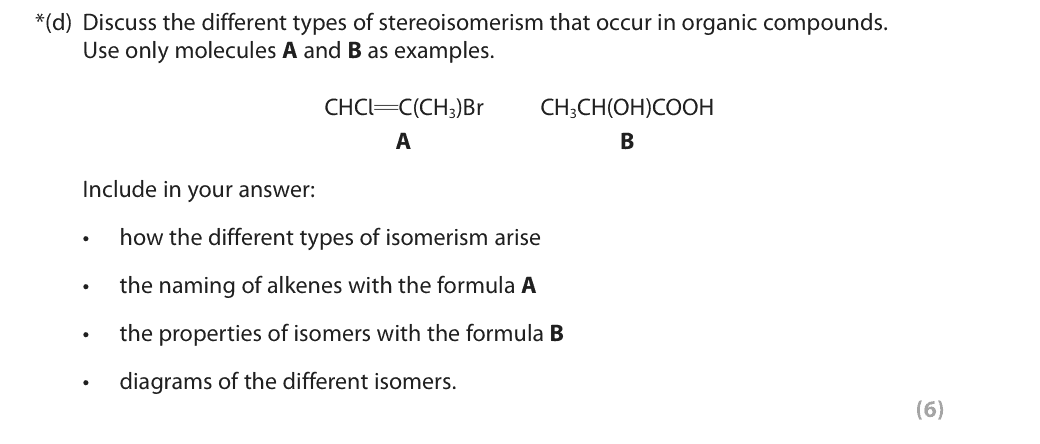
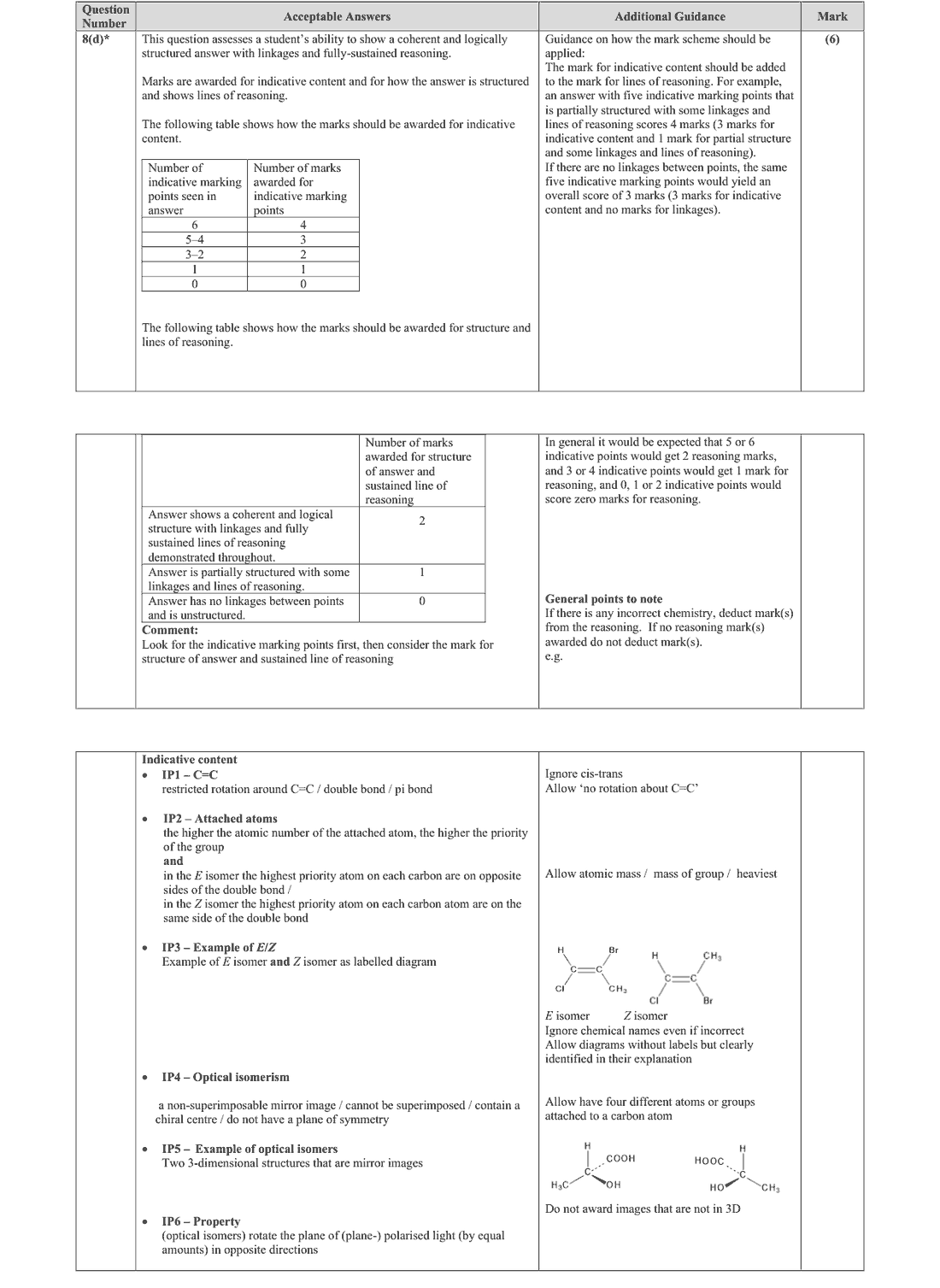
Discuss the different types of stereoisomerism that occur in organic compounds.
Use only molecules A and B as examples.
CHCl
C(CH3)Br
CH3CH(OH)COOH
A                                         B
Include in your answer:
•
how the different types of isomerism arise
•
the naming of alkenes with the formula A
•
the properties of isomers with the formula B
•
diagrams of the different isomers.
June 2023 · Paper 3 · Q4(a) 6 marks 6-mark extended response energetics i
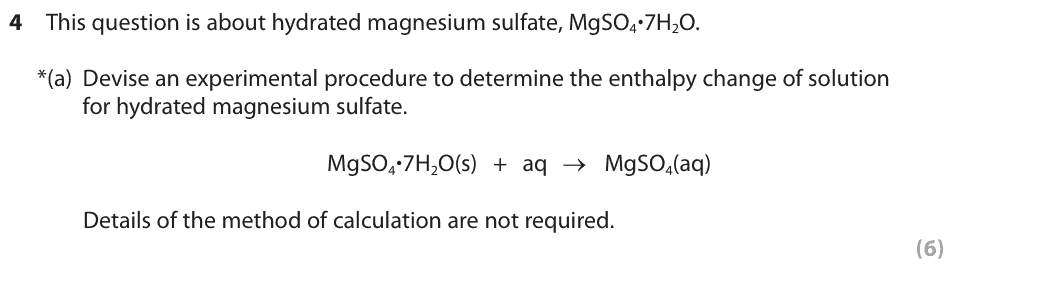
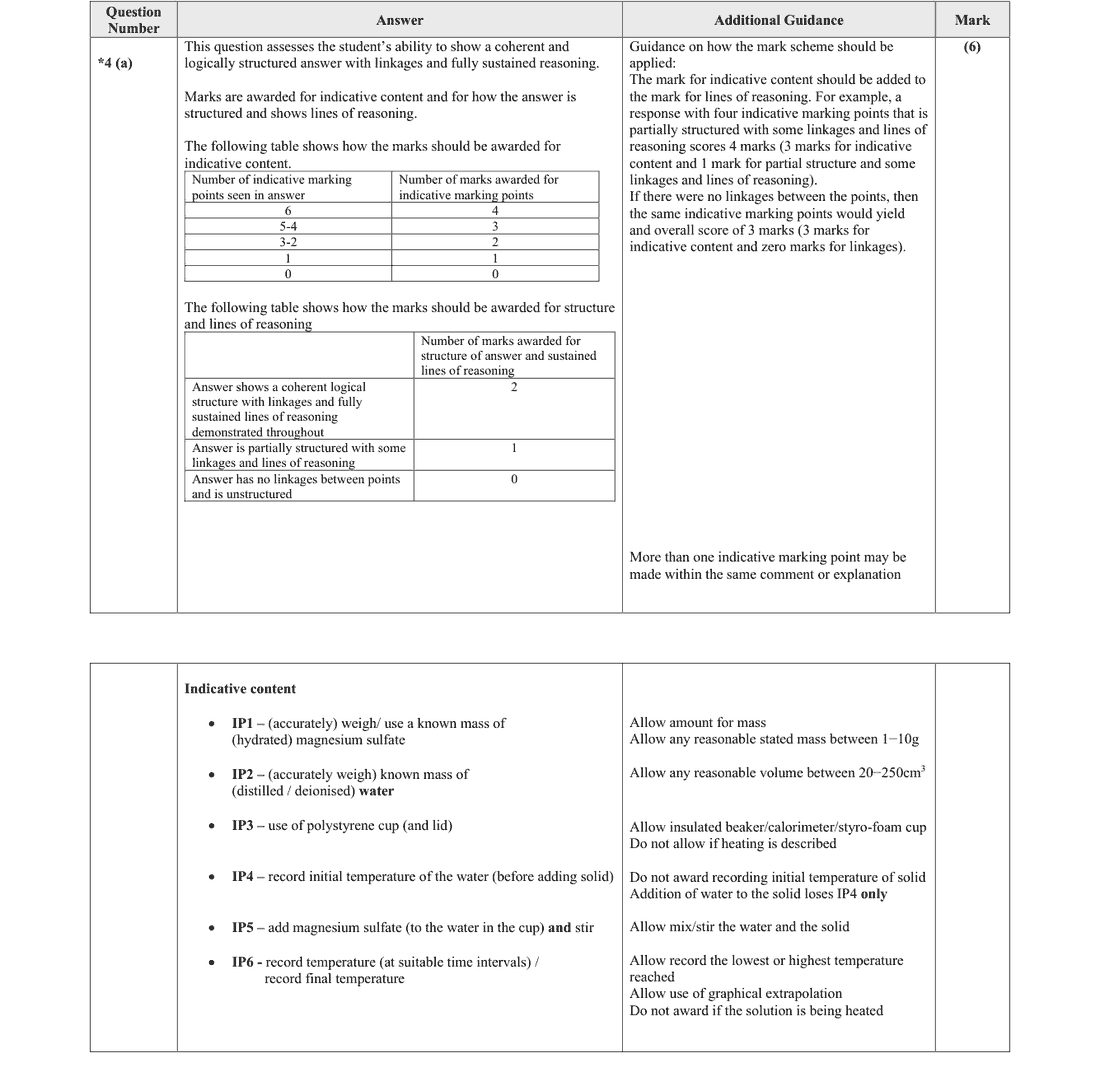
This question is about hydrated magnesium sulfate, MgSO4·7H2O.
Devise an experimental procedure to determine the enthalpy change of solution
for hydrated magnesium sulfate.
MgSO4·7H2O(s)   +   aq   →   MgSO4(aq)
Details of the method of calculation are not required.
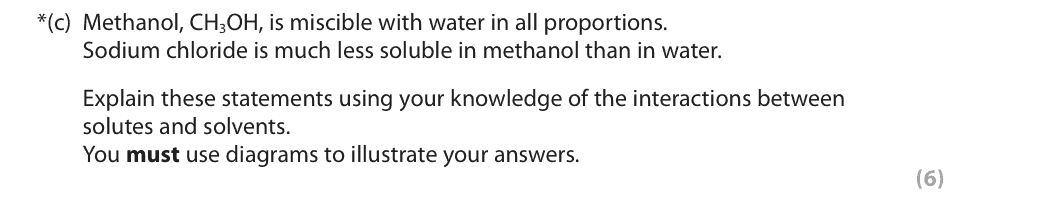
June 2022 · AS Paper 1 · Q5(c) 6 marks 6-mark extended response bonding
Earlier part of question 5 that this part usesEarlier part of June 2022 Paper 1 question 5
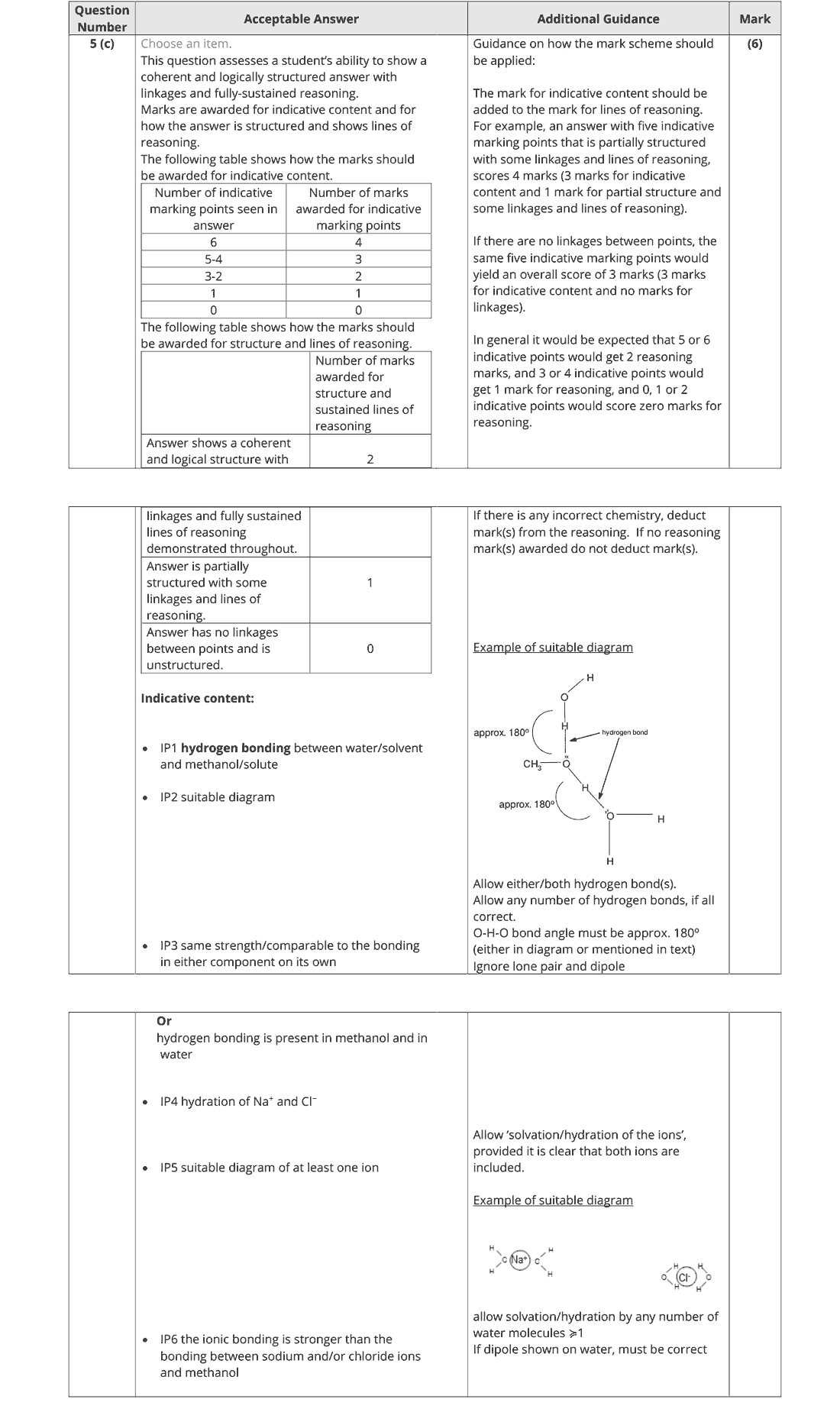
Methanol, CH3OH, is miscible with water in all proportions.
Sodium chloride is much less soluble in methanol than in water.
Explain these statements using your knowledge of the interactions between
solutes and solvents.
You must use diagrams to illustrate your answers.
June 2022 · AS Paper 2 · Q6(d)(ii) 6 marks 6-mark extended response alcohols
Earlier parts of question 6 that this part usesEarlier part of June 2022 Paper 2 question 6Earlier part of June 2022 Paper 2 question 6
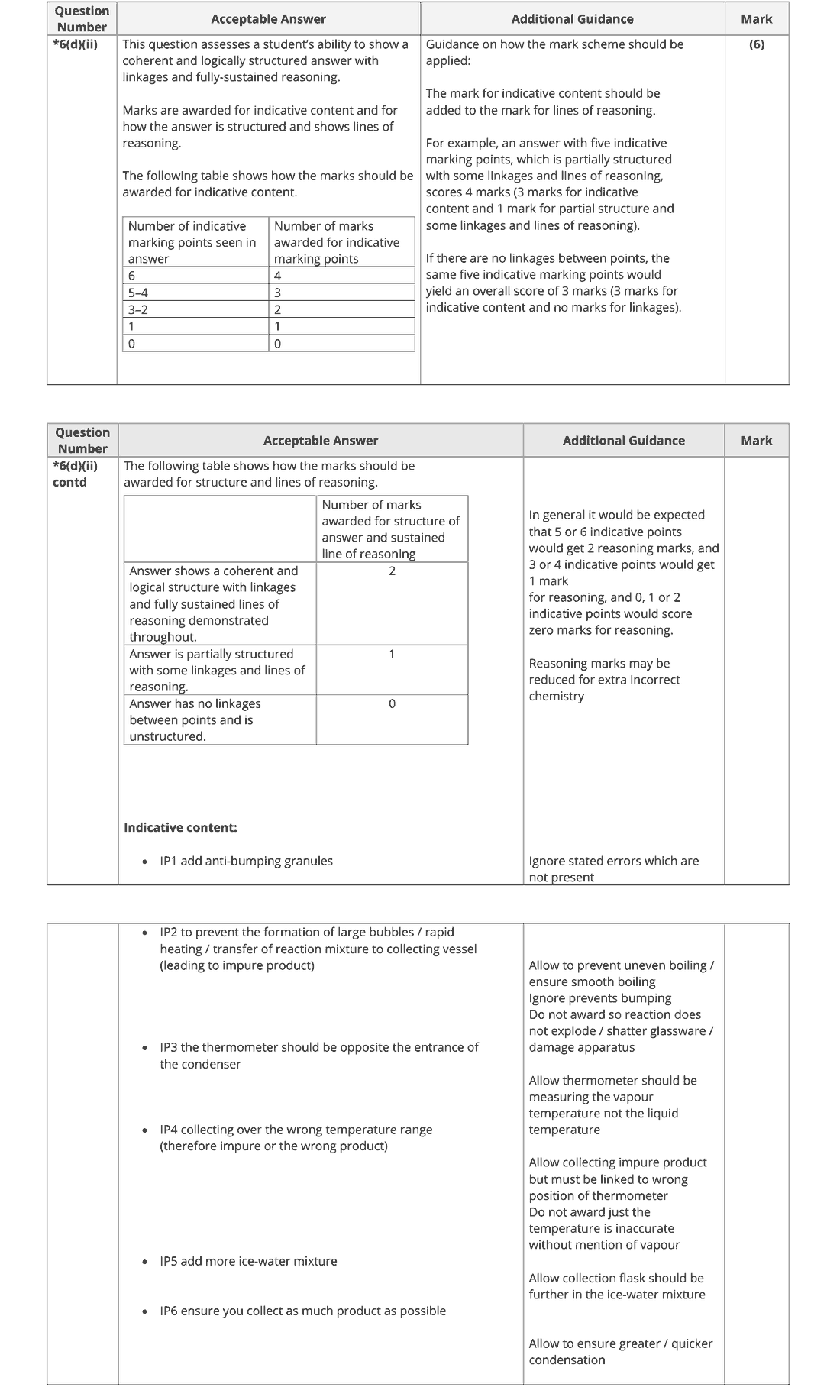
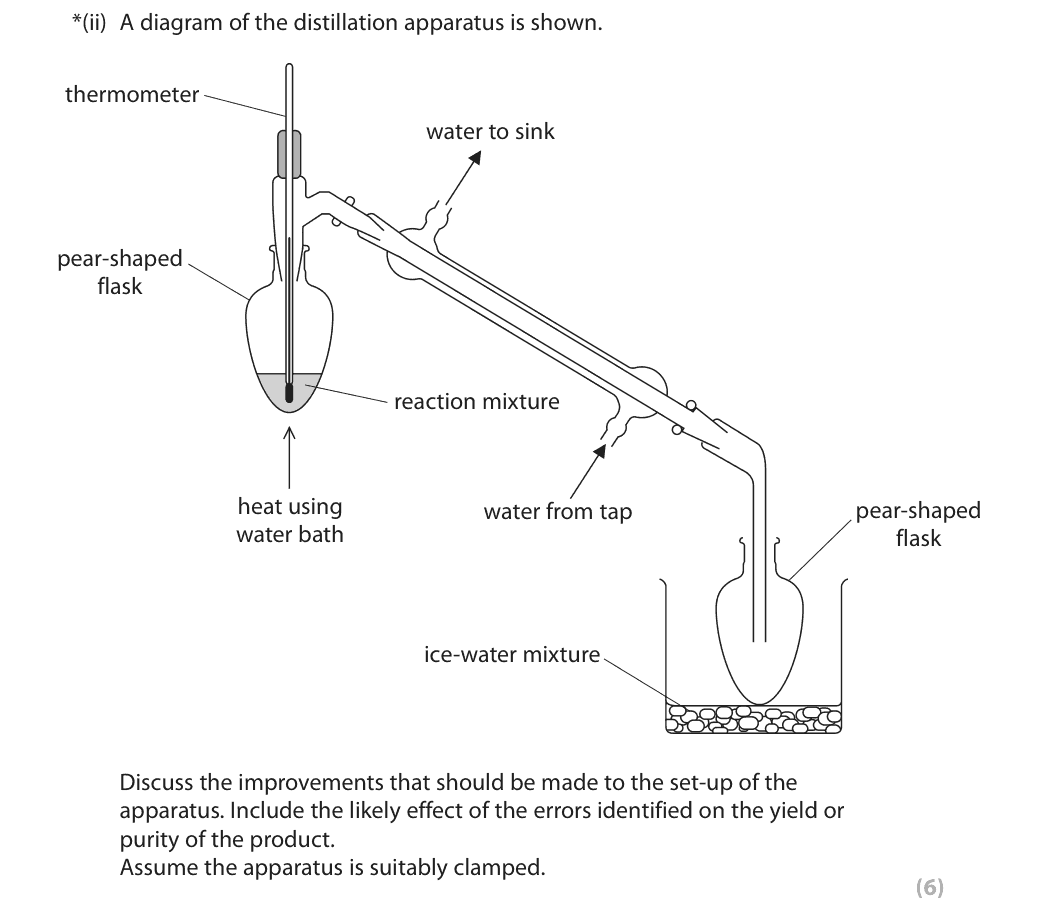
A diagram of the distillation apparatus is shown.
thermometer
water to sink
pear‑shaped
flask
reaction mixture
heat using
pear‑shaped
water from tap
water bath
flask
ice‑water mixture
Discuss the improvements that should be made to the set‑up of the
apparatus. Include the likely effect of the errors identified on the yield or
purity of the product.
Assume the apparatus is suitably clamped.
June 2022 · Paper 1 · Q4(e) 6 marks 6-mark extended response bonding
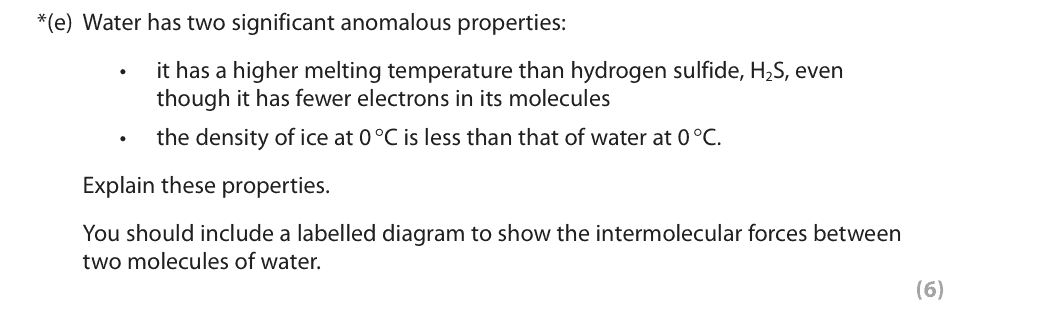
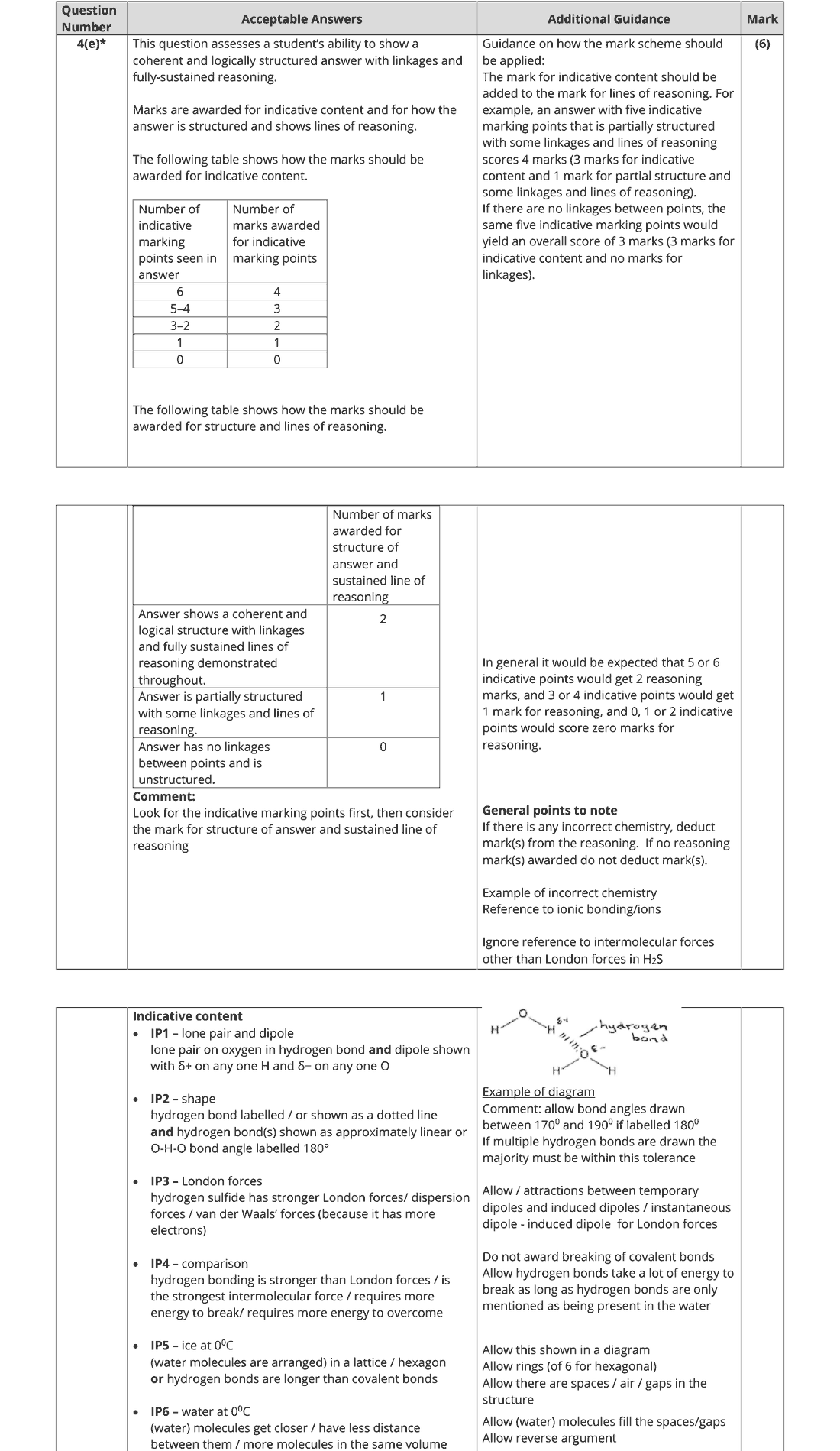
Water has two significant anomalous properties:
•
it has a higher melting temperature than hydrogen sulfide, H2S, even
though it has fewer electrons in its molecules
•
the density of ice at 0 °C is less than that of water at 0 °C.
Explain these properties.
You should include a labelled diagram to show the intermolecular forces between
two molecules of water.
June 2022 · Paper 2 · Q7(c) 6 marks 6-mark extended response amines amides amino acids and proteinschirality
Earlier part of question 7 that this part usesEarlier part of June 2022 Paper 2 question 7
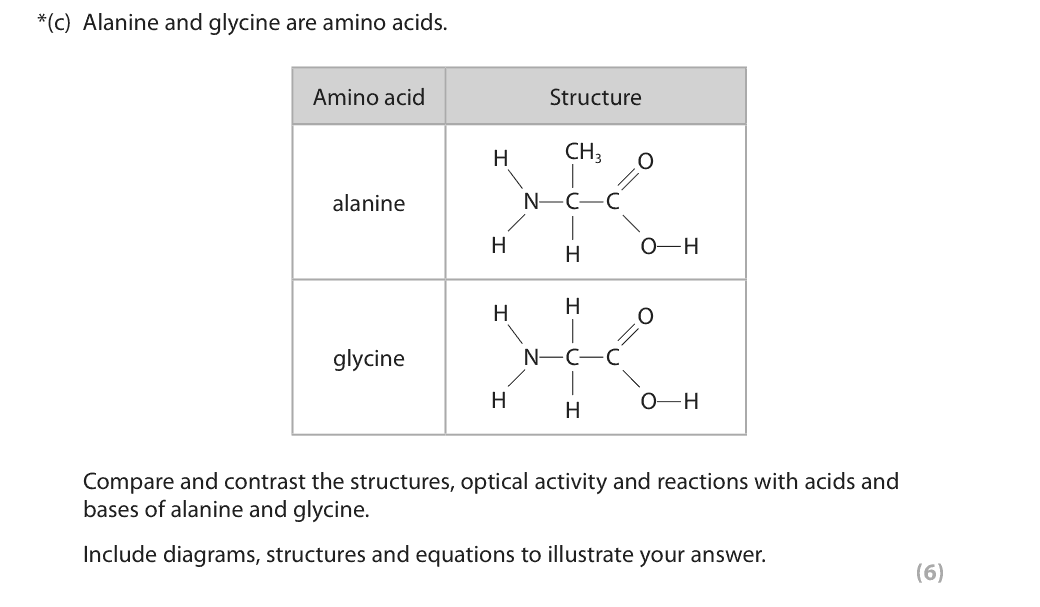
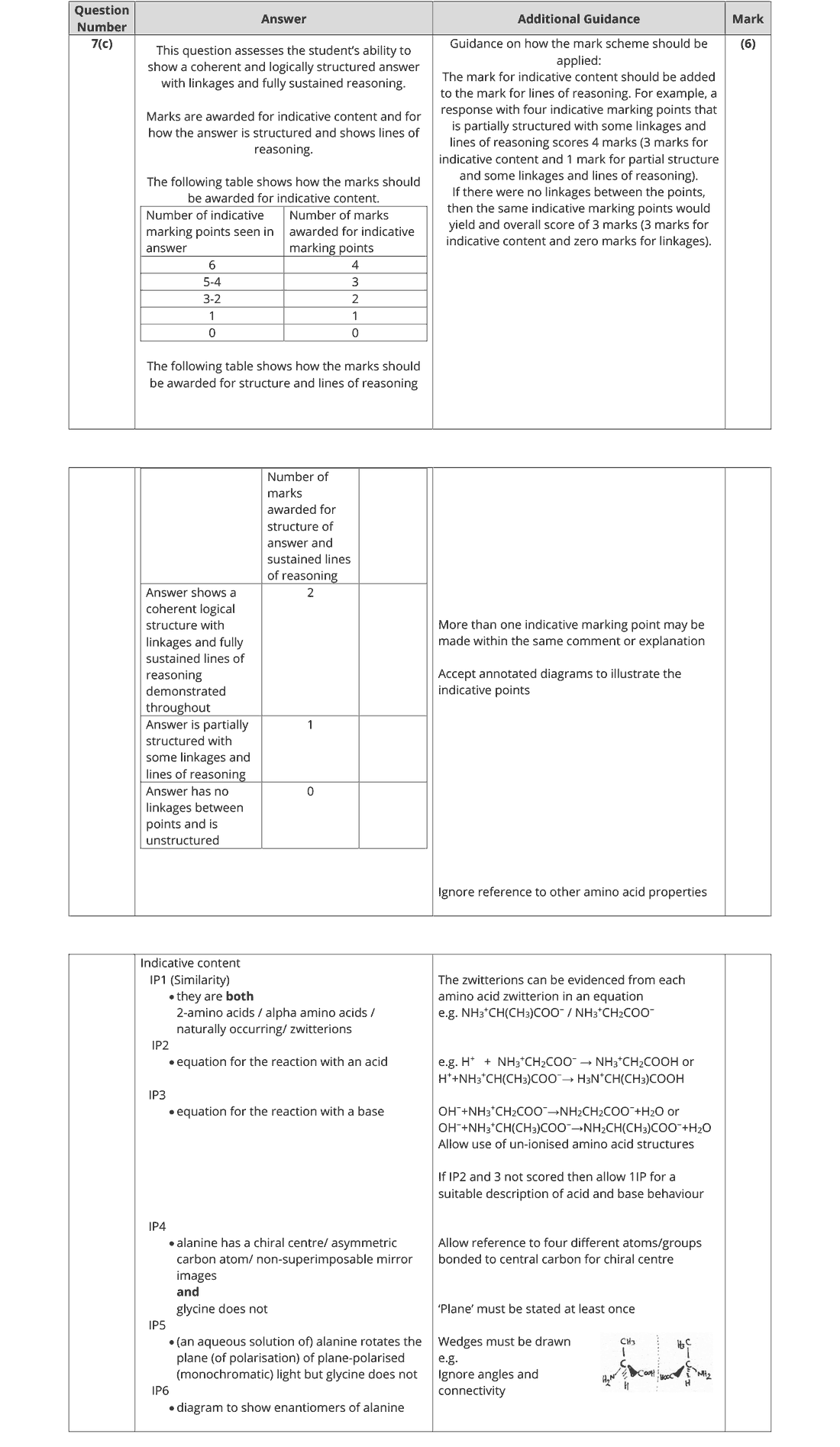
Alanine and glycine are amino acids.
Amino acid
Structure
CH3
H
O
alanine
N
C
C
H
O
H
H
H
H
O
glycine
N
C
C
H
O
H
H
Compare and contrast the structures, optical activity and reactions with acids and
bases of alanine and glycine.
Include diagrams, structures and equations to illustrate your answer.
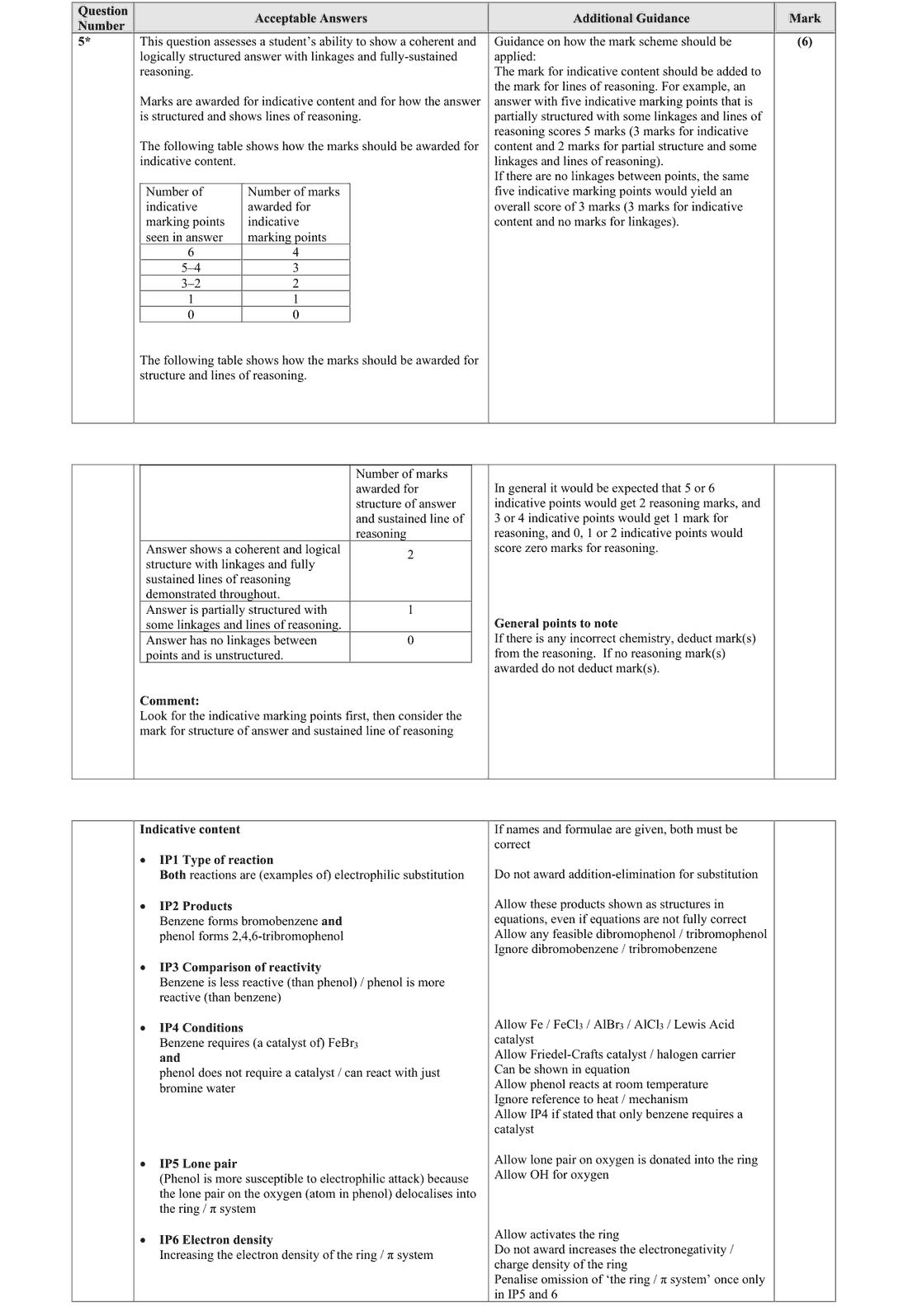
June 2022 · Paper 3 · Q5 6 marks 6-mark extended response arenes benzene
Explain the difference in the reactivity of bromine with benzene and with phenol.
Include the type of reaction, the products that form, and any conditions required.
Mechanisms for the reactions are not required.
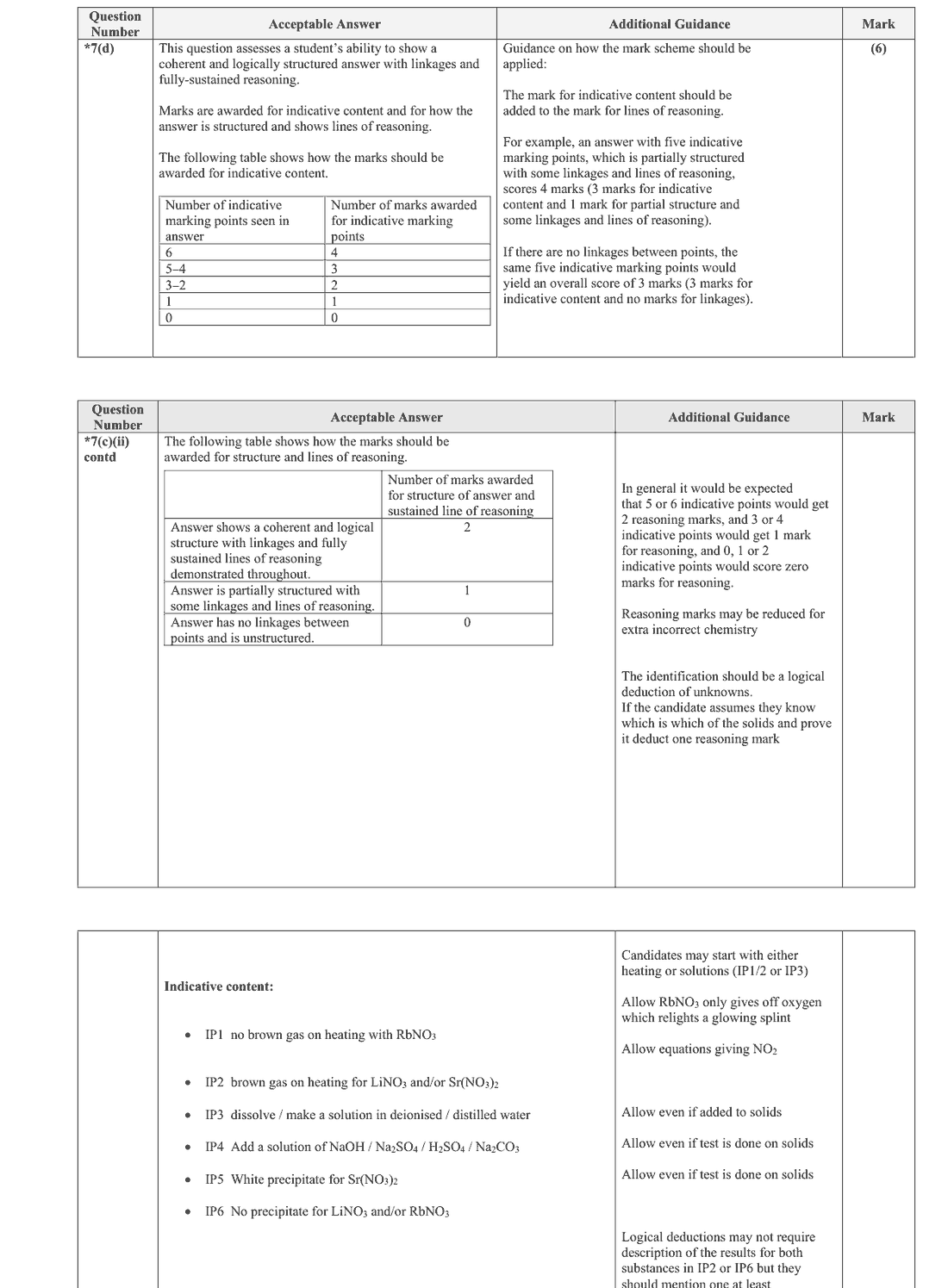
November 2021 · AS Paper 1 · Q7(d) 6 marks 6-mark extended response Hard groups 1 and 2
Earlier part of question 7 that this part usesEarlier part of November 2021 Paper 1 question 7
Devise a procedure to identify the nitrates of lithium, rubidium and strontium using the
effect of heat on the three solids and any precipitation reactions of the compounds.
Practical details are not required, but you should give the observations expected in
each case.
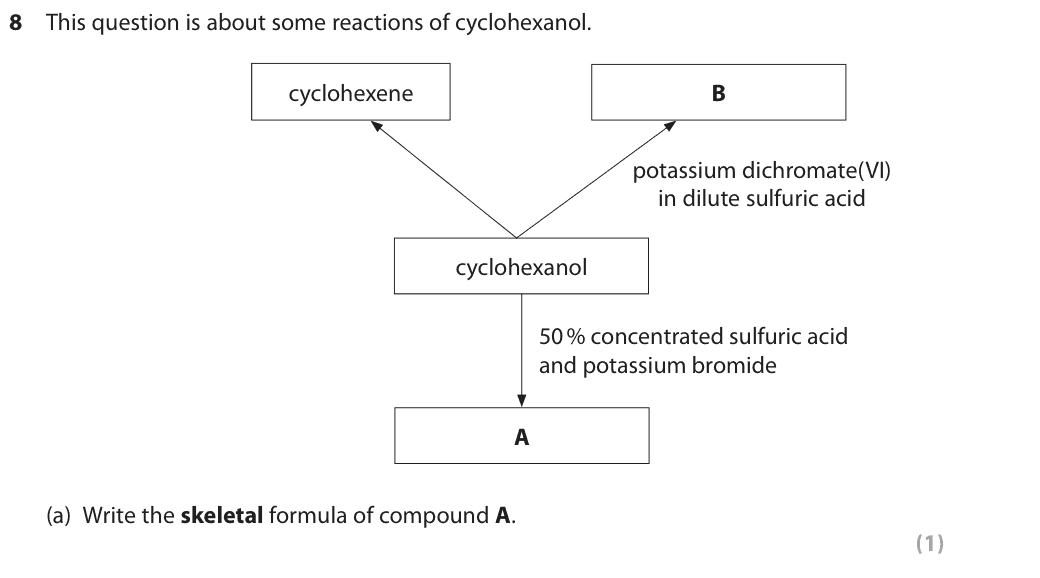
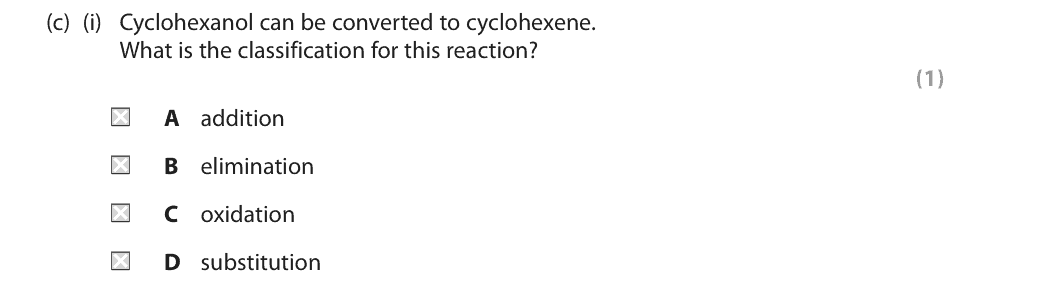
November 2021 · AS Paper 2 · Q8(c)(iii) 6 marks 6-mark extended response Hard alcohols
Earlier parts of question 8 that this part usesEarlier part of November 2021 Paper 2 question 8Earlier part of November 2021 Paper 2 question 8
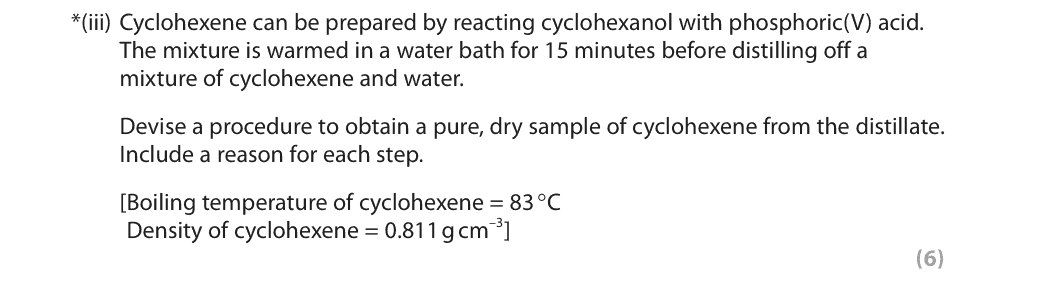
Cyclohexene can be prepared by reacting cyclohexanol with phosphoric(V) acid.
The mixture is warmed in a water bath for 15 minutes before distilling off a
mixture of cyclohexene and water.
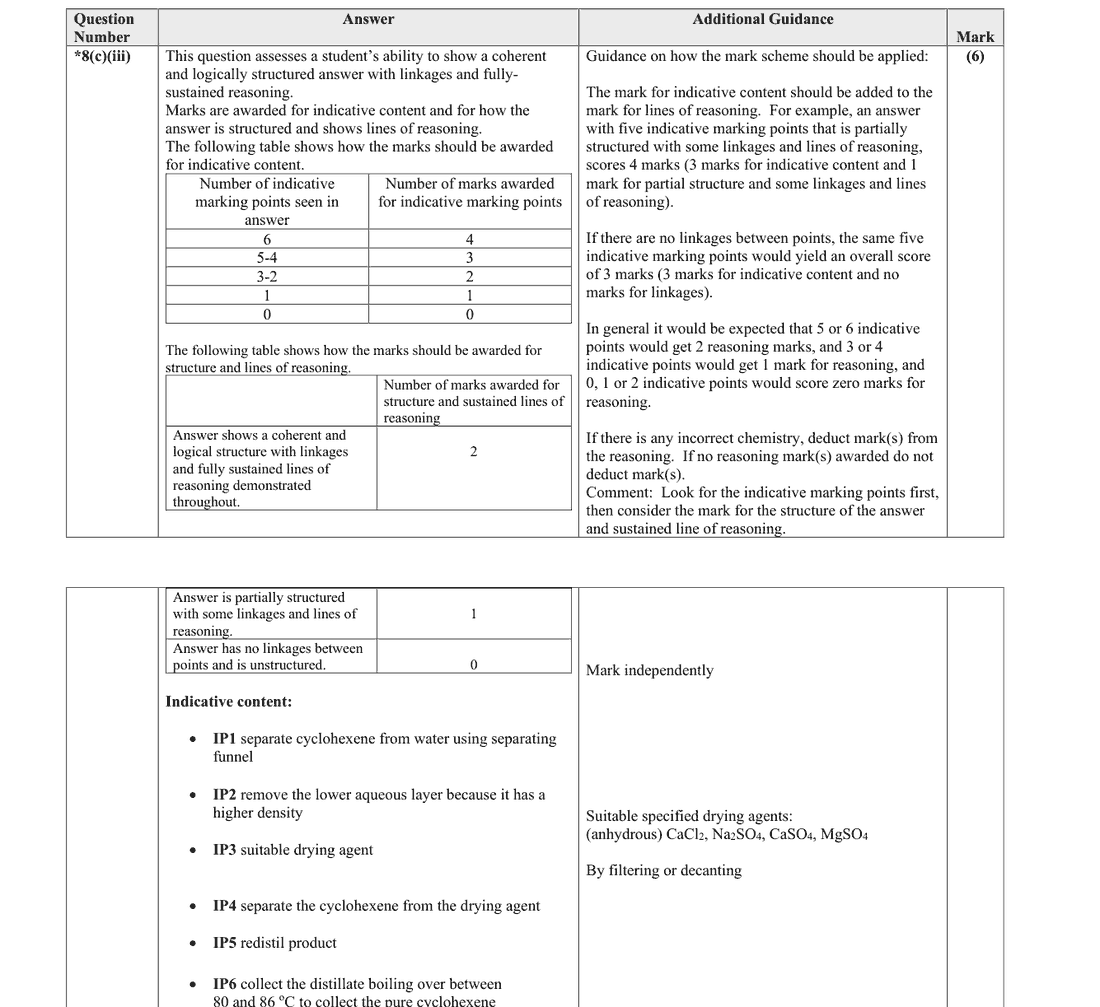
Devise a procedure to obtain a pure, dry sample of cyclohexene from the distillate.
Include a reason for each step.
[Boiling temperature of cyclohexene = 83 °C
Density of cyclohexene = 0.811 g cm–3]
November 2021 · Paper 1 · Q10 6 marks 6-mark extended response entropy
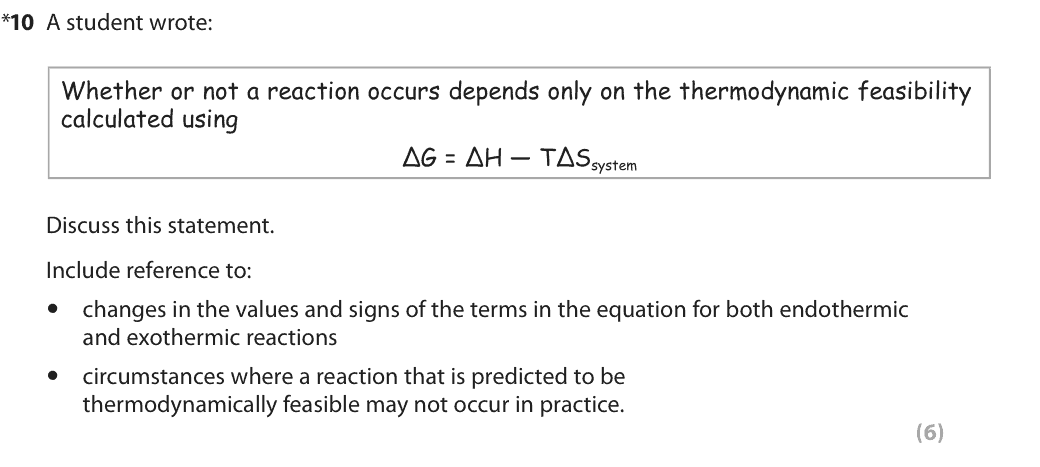
A student wrote:
Whether or not a reaction occurs depends only on the thermodynamic feasibility
calculated using
∆G = ∆H — T∆Ssystem
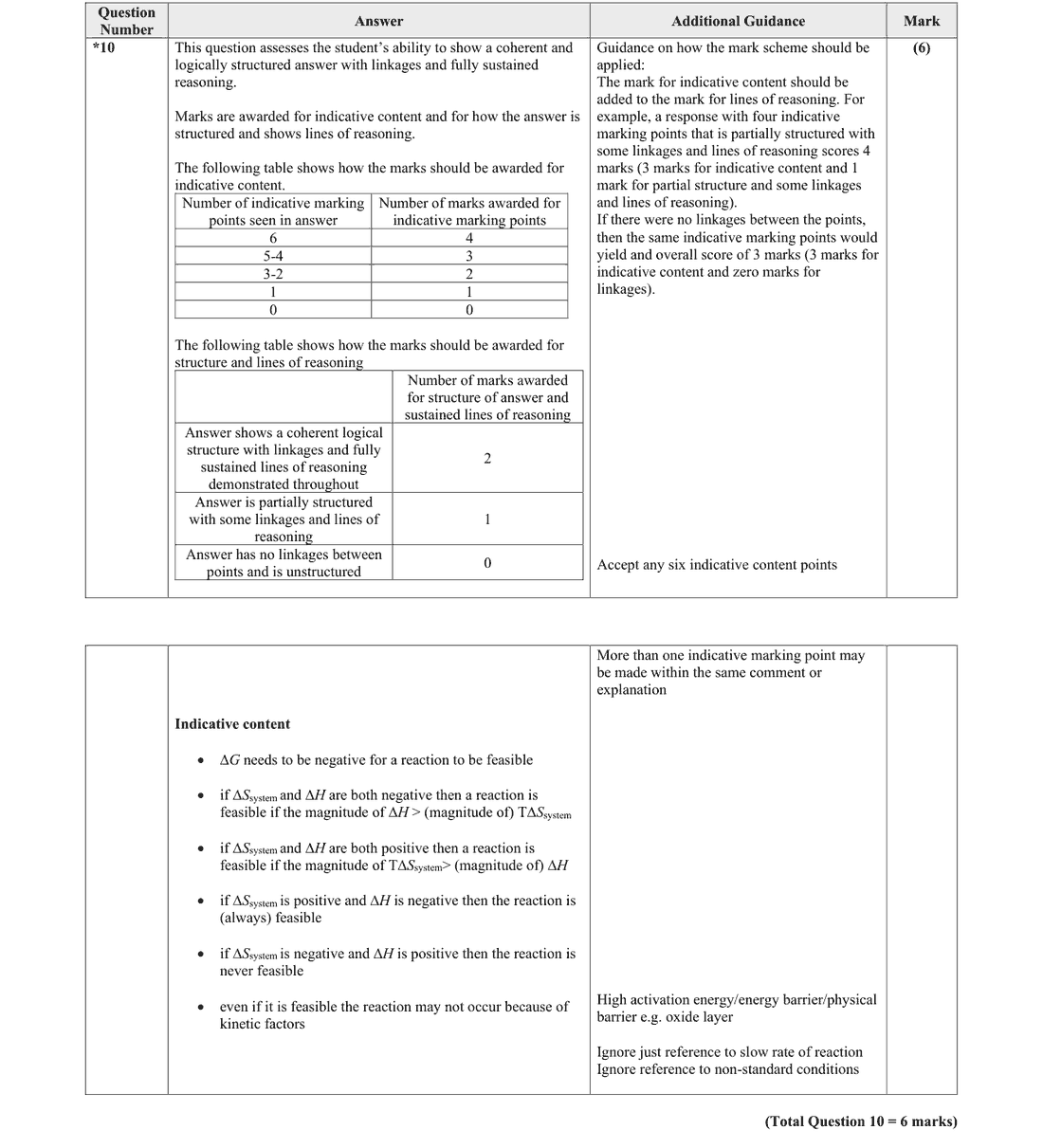
Discuss this statement.
Include reference to:
  changes in the values and signs of the terms in the equation for both endothermic
and exothermic reactions
  circumstances where a reaction that is predicted to be
thermodynamically feasible may not occur in practice.
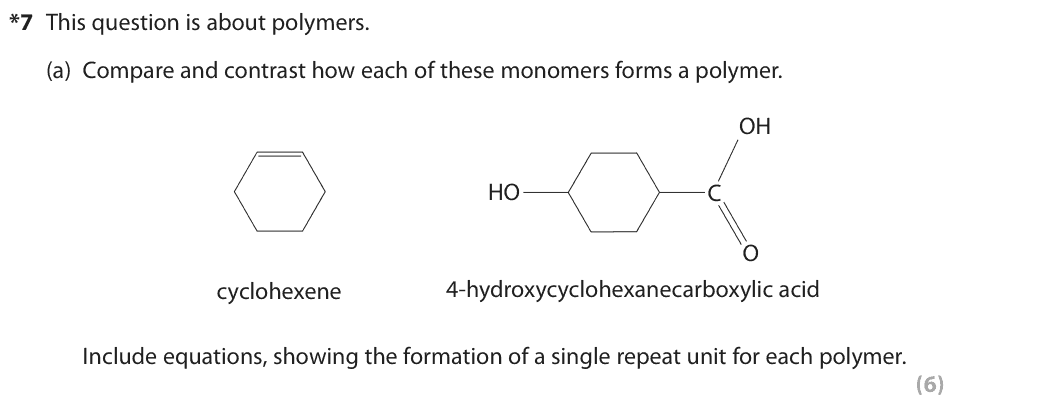
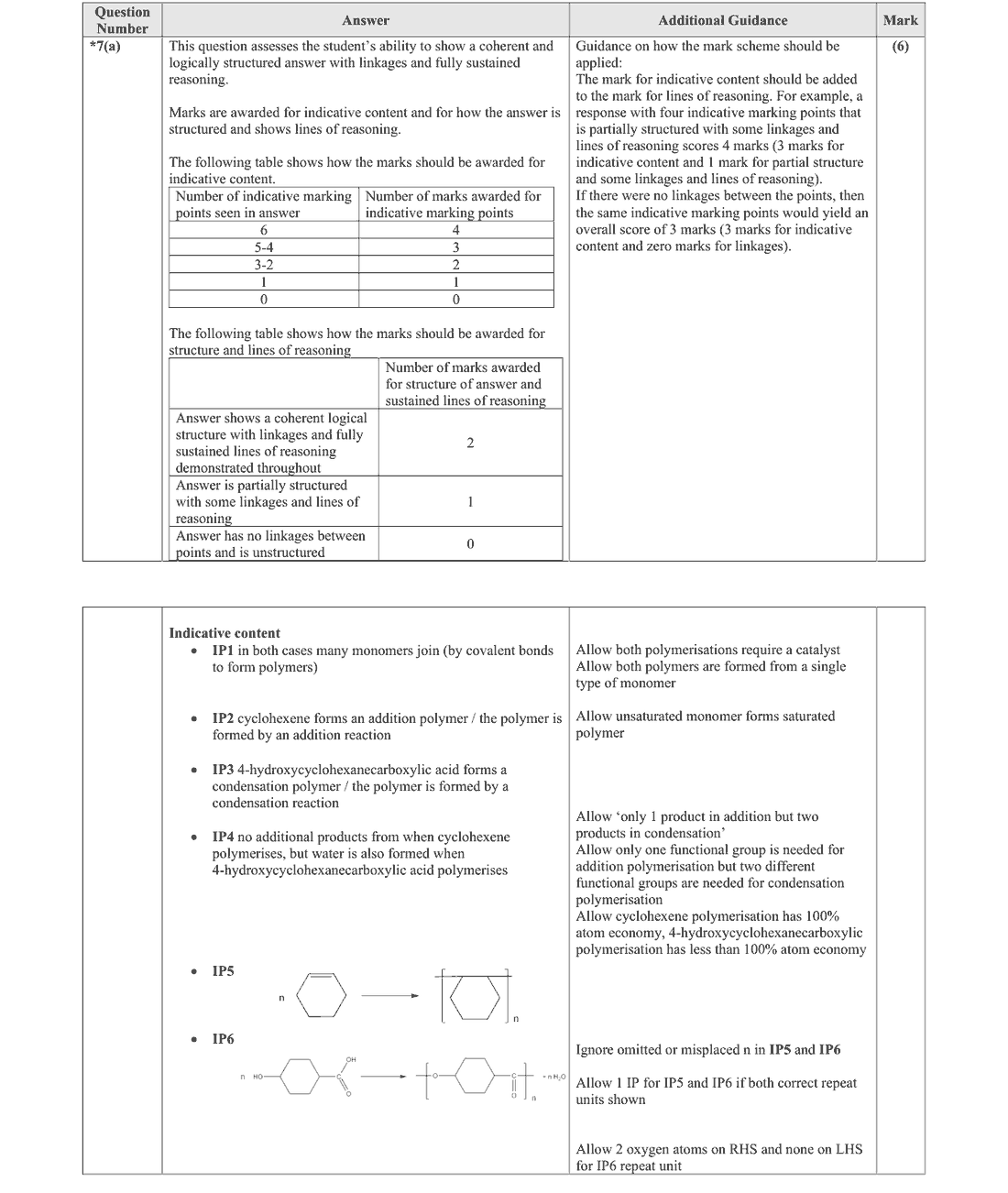
November 2021 · Paper 2 · Q7(a) 6 marks 6-mark extended response alkenescarboxylic acids
This question is about polymers.
Compare and contrast how each of these monomers forms a polymer.
OH
HO
C
O
cyclohexene
4-hydroxycyclohexanecarboxylic acid
Include equations, showing the formation of a single repeat unit for each polymer.
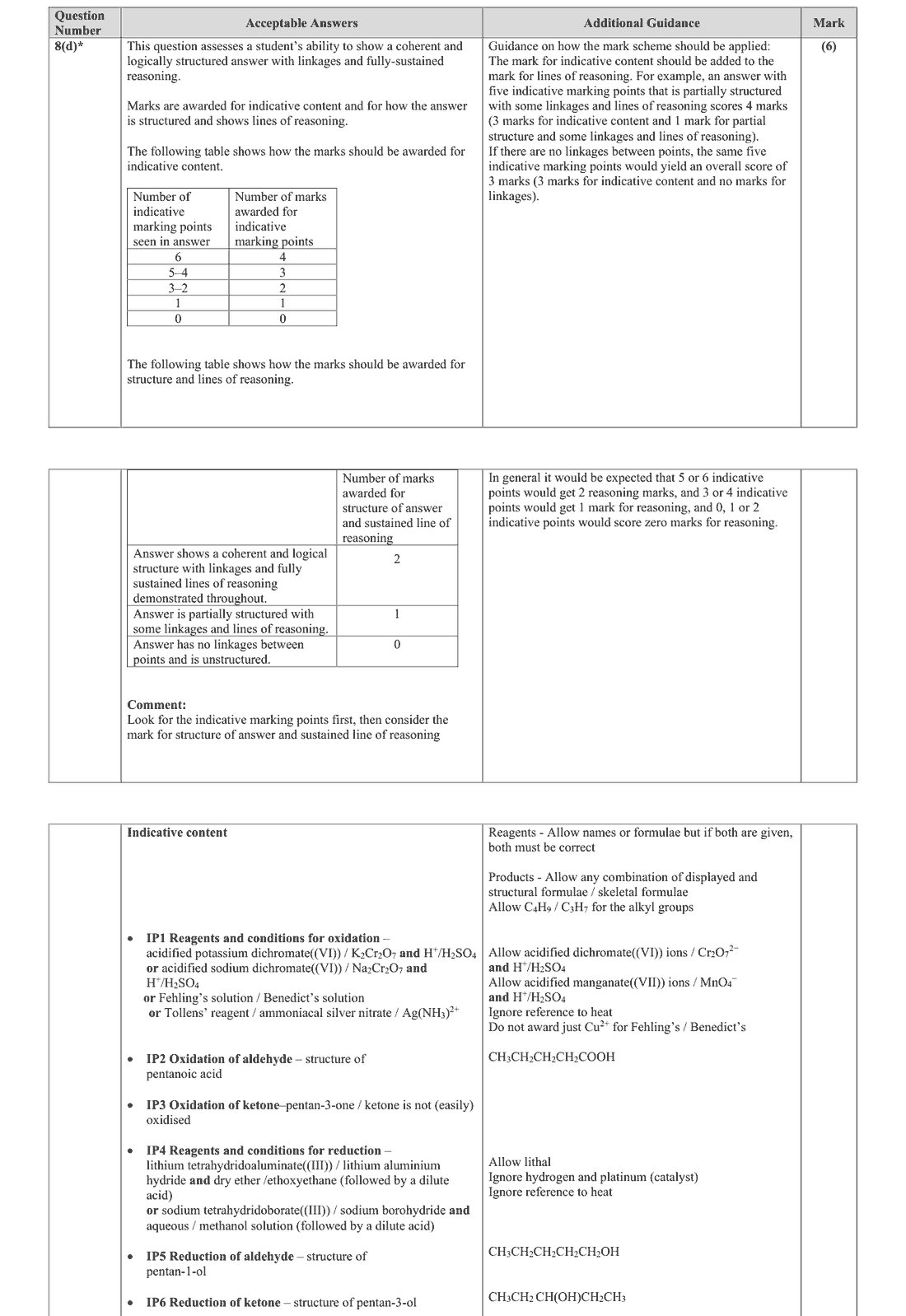
November 2021 · Paper 3 · Q8(d) 6 marks 6-mark extended response carbonyl compounds
Describe the oxidation and reduction reactions of pentanal and pentan-3-one.
Include the reagents and the structures of the organic products formed in any
reactions that take place.
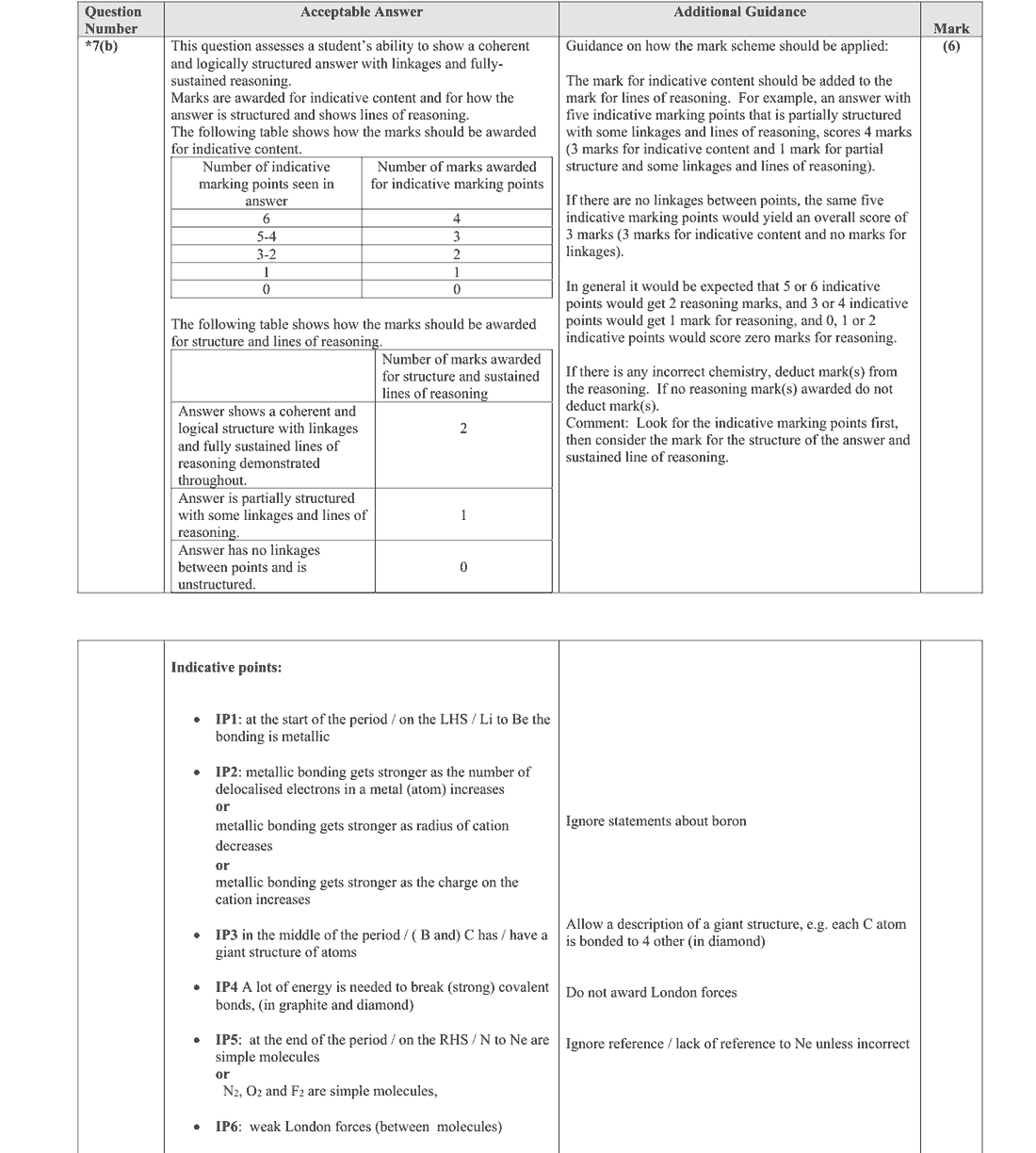
October 2020 · AS Paper 1 · Q7(b) 6 marks 6-mark extended response atomic structure and the periodic tablestructure
Earlier part of question 7 that this part usesEarlier part of October 2020 Paper 1 question 7
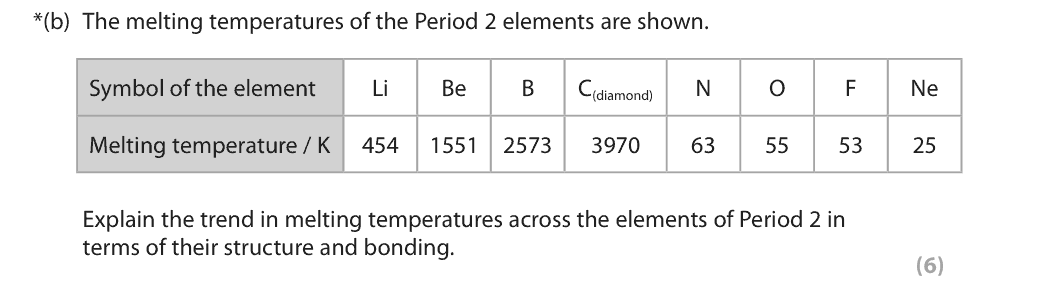
The melting temperatures of the Period 2 elements are shown.
Symbol of the element
Li
Be
B
C(diamond)
N
O
F
Ne
Melting temperature / K
454
1551
2573
3970
63
55
53
25
Explain the trend in melting temperatures across the elements of Period 2 in
terms of their structure and bonding.
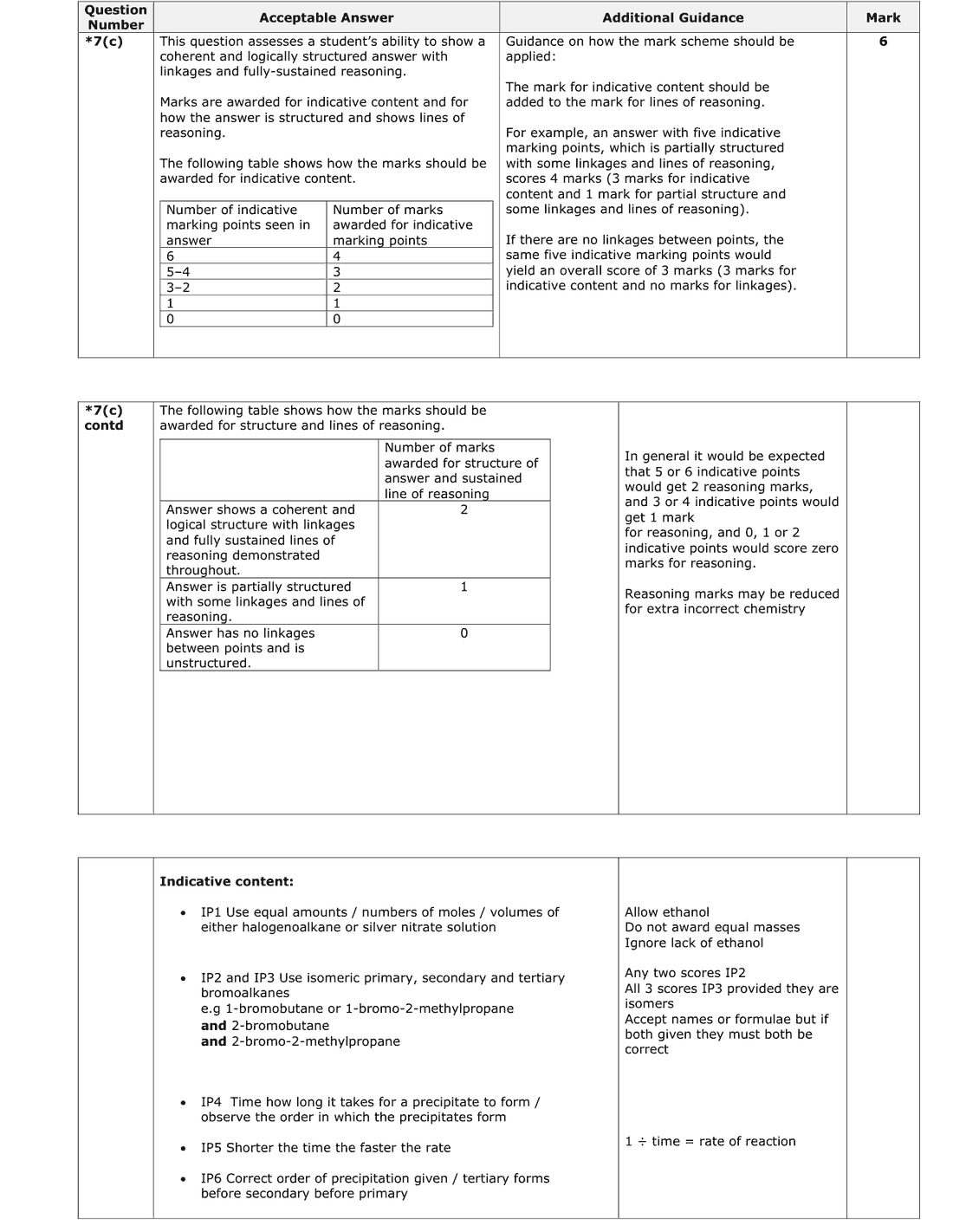
October 2020 · AS Paper 2 · Q7(c) 6 marks 6-mark extended response Hard halogenoalkanes
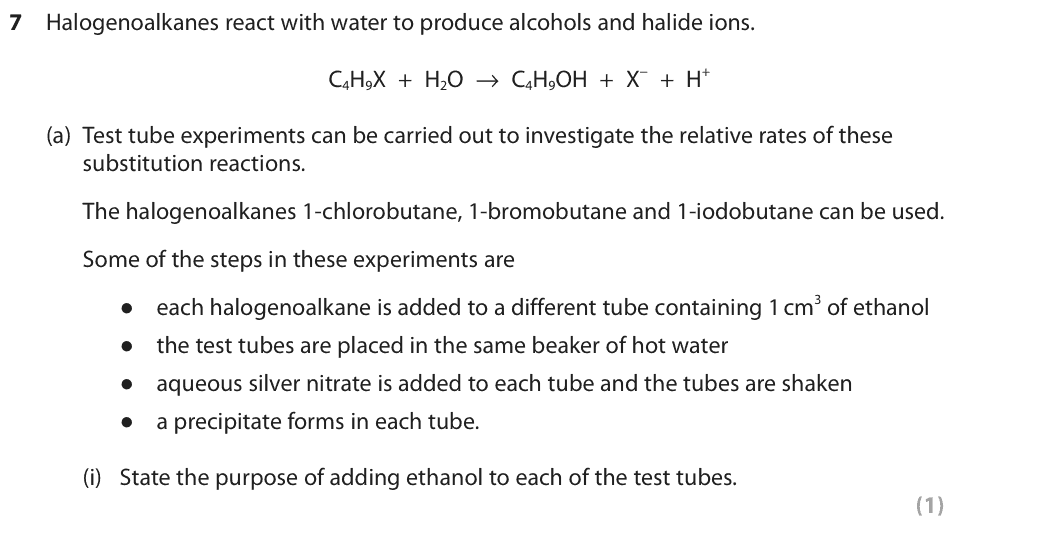
Earlier parts of question 7 that this part usesEarlier part of October 2020 Paper 2 question 7Earlier part of October 2020 Paper 2 question 7Earlier part of October 2020 Paper 2 question 7
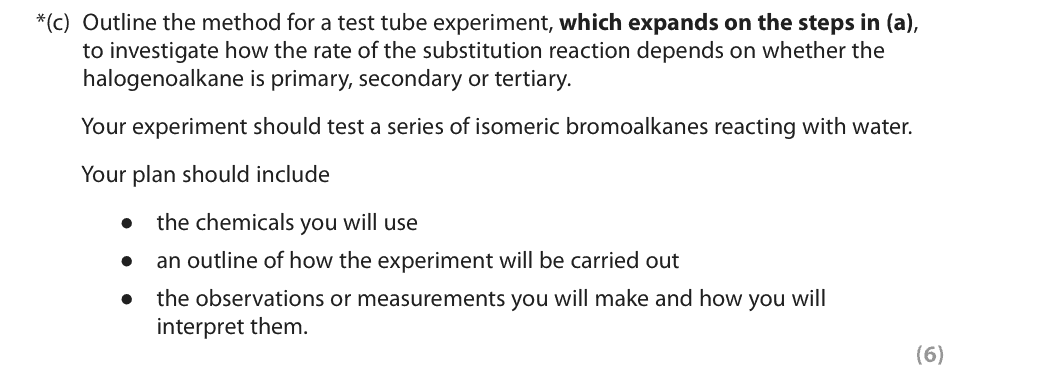
Outline the method for a test tube experiment, which expands on the steps in (a),
to investigate how the rate of the substitution reaction depends on whether the
halogenoalkane is primary, secondary or tertiary.
Your experiment should test a series of isomeric bromoalkanes reacting with water.
Your plan should include
●  the chemicals you will use
●  an outline of how the experiment will be carried out
●  the observations or measurements you will make and how you will
interpret them.
October 2020 · Paper 1 · Q4(c) 6 marks 6-mark extended response Hard bonding
Earlier part of question 4 that this part usesEarlier part of October 2020 Paper 1 question 4
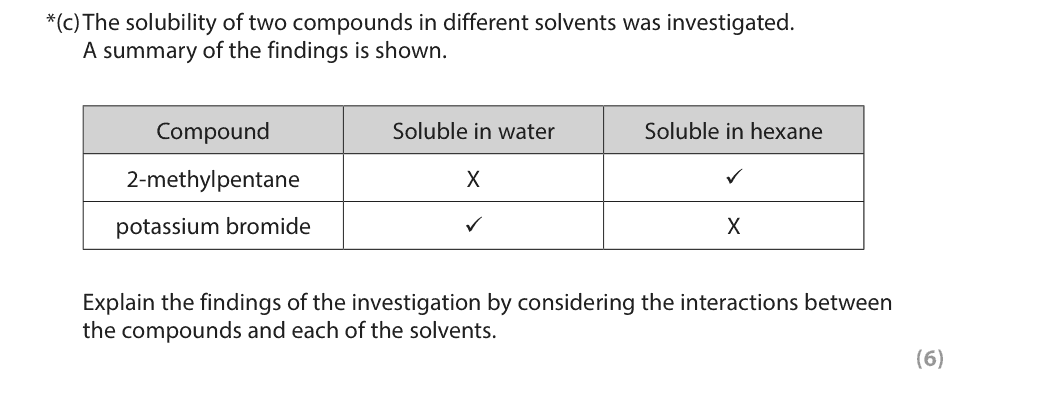
The solubility of two compounds in different solvents was investigated.
A summary of the findings is shown.
Compound
Soluble in water
Soluble in hexane
2-methylpentane
X

potassium bromide

X
Explain the findings of the investigation by considering the interactions between
the compounds and each of the solvents.
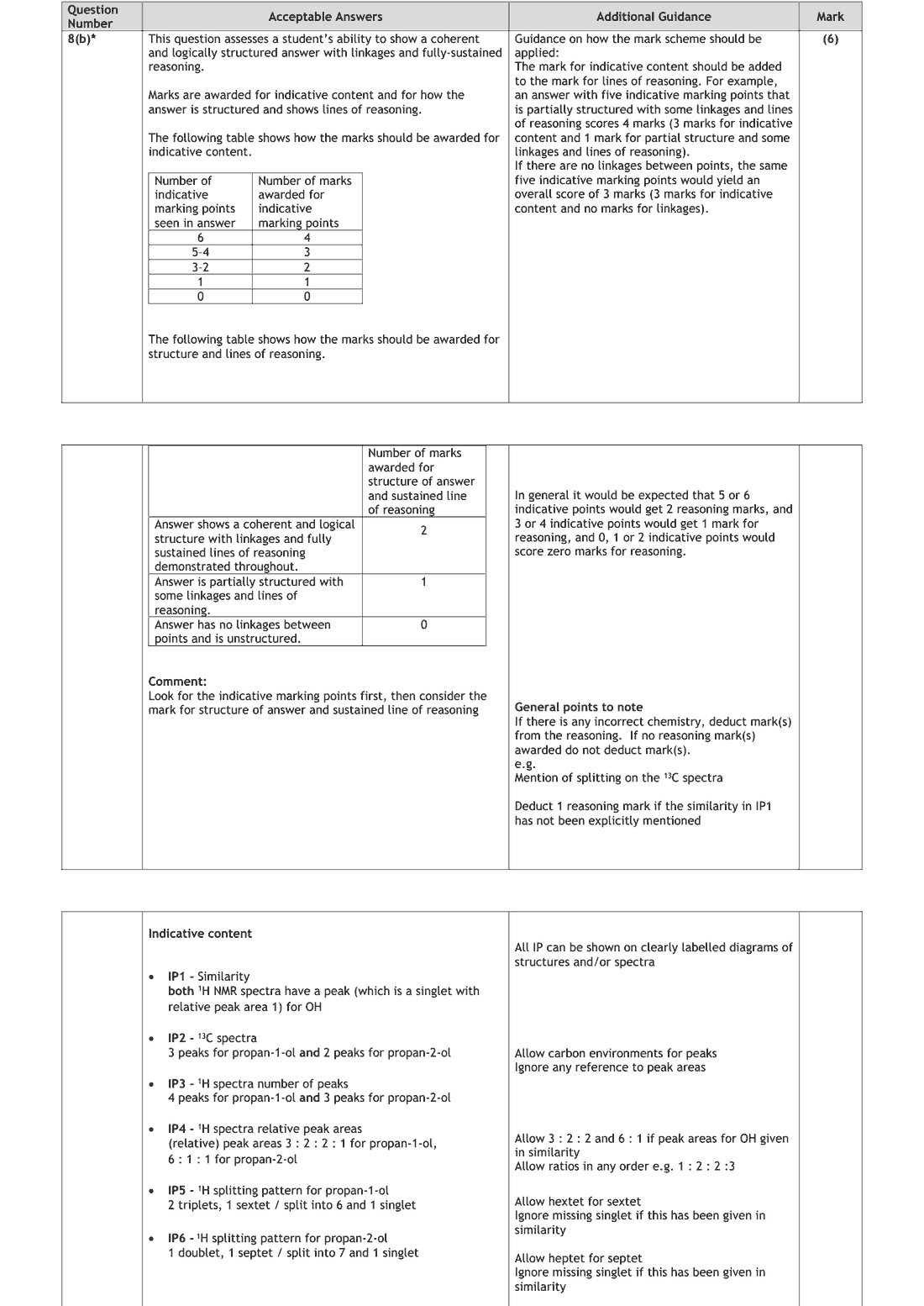
October 2020 · Paper 2 · Q8(b) 6 marks 6-mark extended response nmr mass spectrometry and chromatography
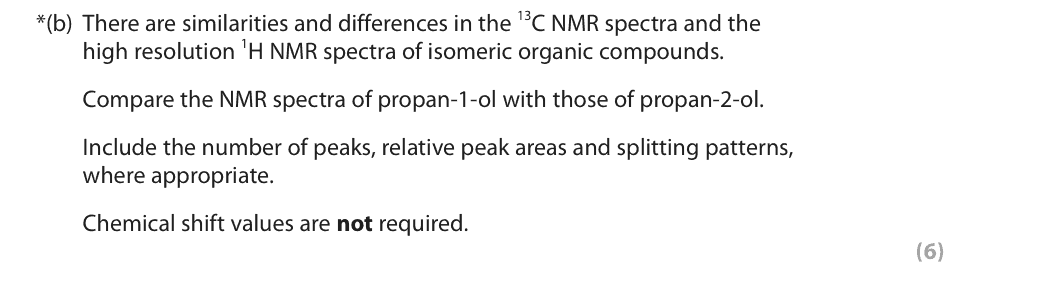
There are similarities and differences in the 13C NMR spectra and the
high resolution 1H NMR spectra of isomeric organic compounds.
Compare the NMR spectra of propan-1-ol with those of propan-2-ol.
Include the number of peaks, relative peak areas and splitting patterns,
where appropriate.
Chemical shift values are not required.
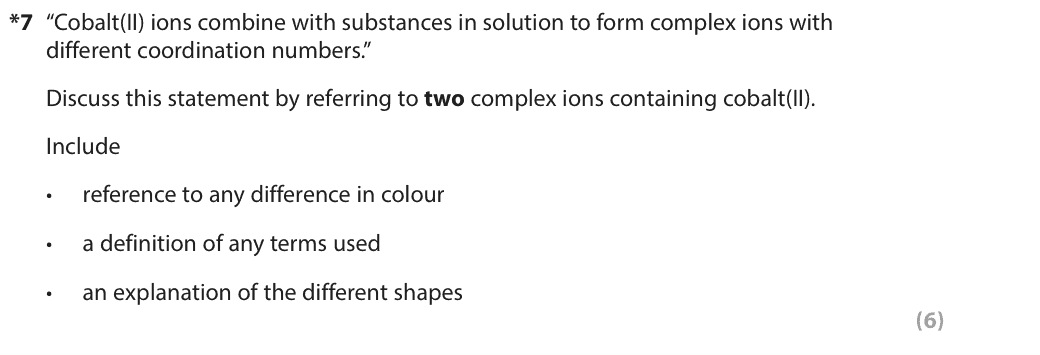
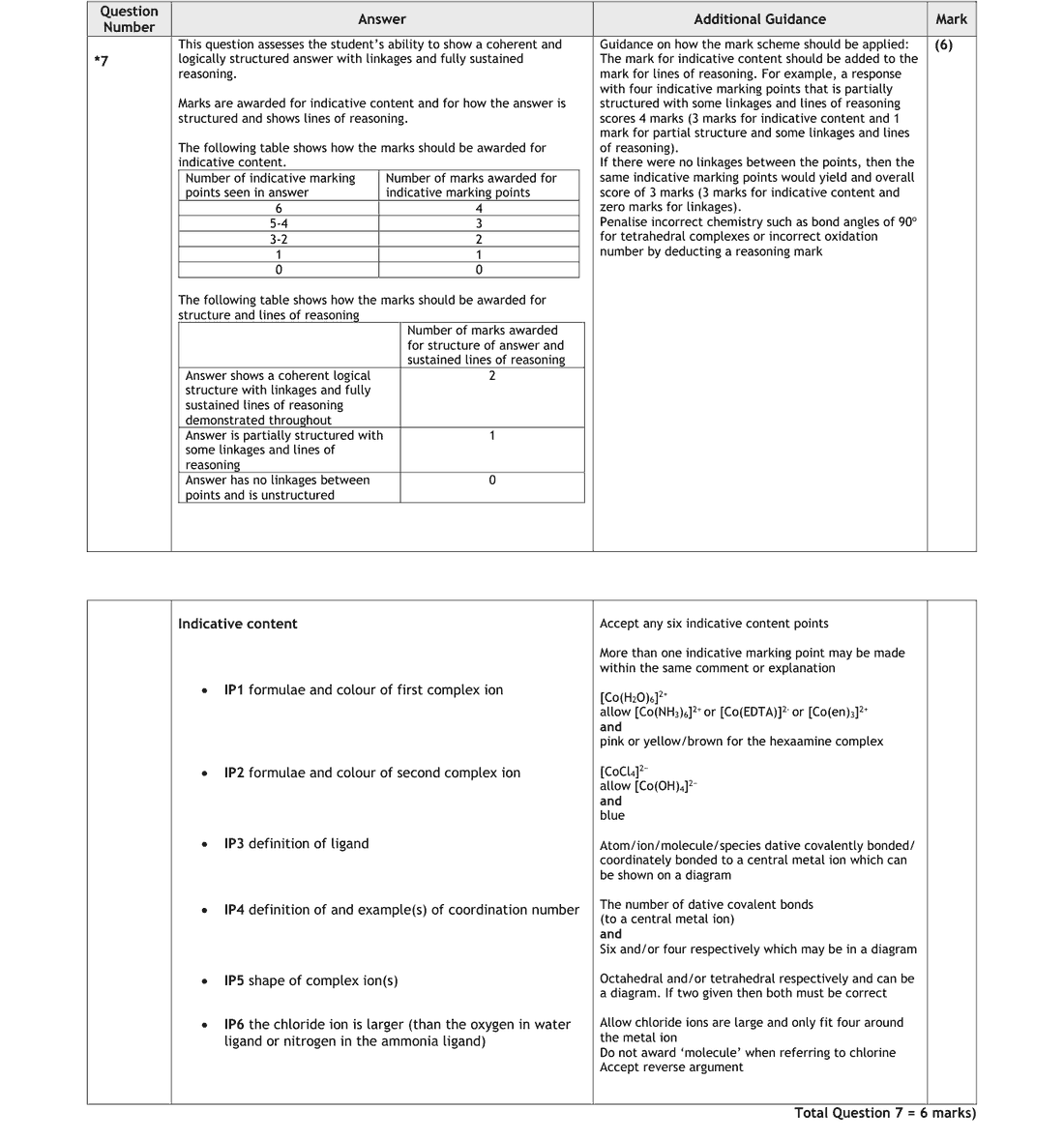
October 2020 · Paper 3 · Q7 6 marks 6-mark extended response transition metals principles
“Cobalt(II) ions combine with substances in solution to form complex ions with
different coordination numbers.”
Discuss this statement by referring to two complex ions containing cobalt(II).
Include
•
reference to any difference in colour
•
a definition of any terms used
•
an explanation of the different shapes
June 2019 · AS Paper 1 · Q8(c) 6 marks 6-mark extended response structure
Earlier part of question 8 that this part usesEarlier part of June 2019 Paper 1 question 8
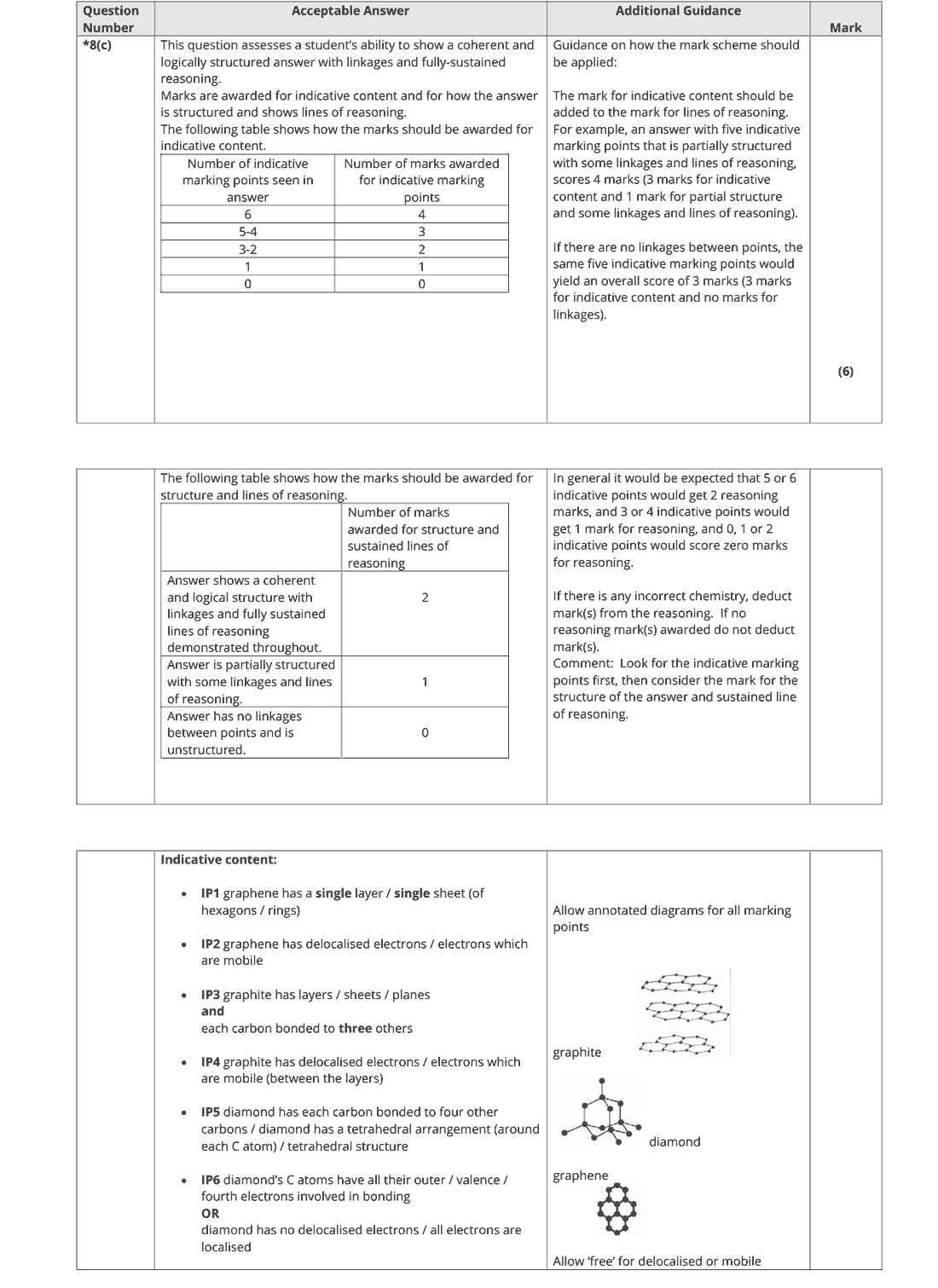
Graphene, graphite and diamond are all forms of solid carbon.
Explain, in terms of structure and bonding, why graphene and graphite are good
electrical conductors but diamond is a poor electrical conductor.
You may include labelled diagrams in your answer.

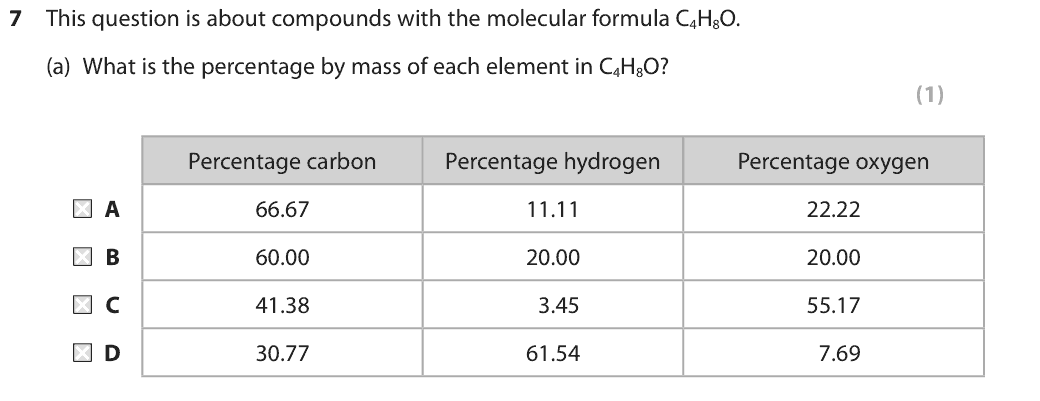
June 2019 · AS Paper 2 · Q7(b) 6 marks 6-mark extended response mass spectrometry and infrared spectroscopyintroduction to organic chemistry
Earlier part of question 7 that this part usesEarlier part of June 2019 Paper 2 question 7
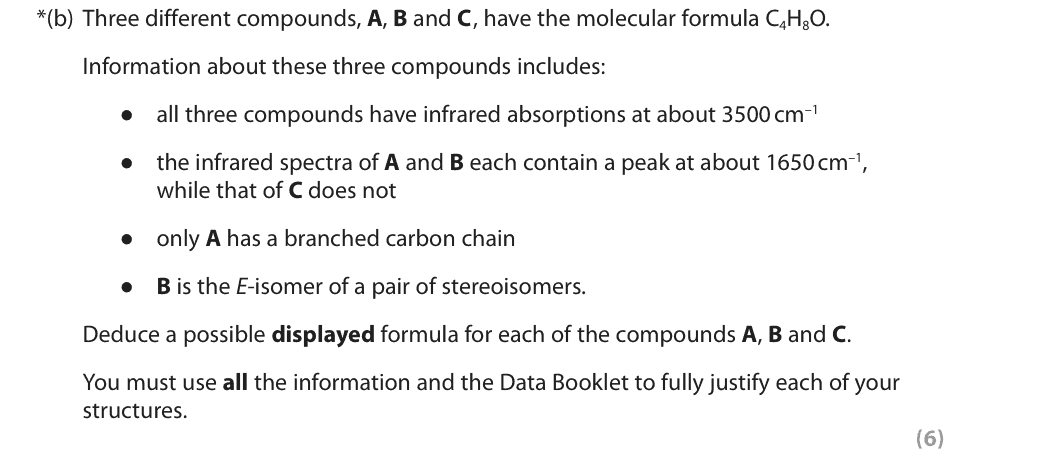
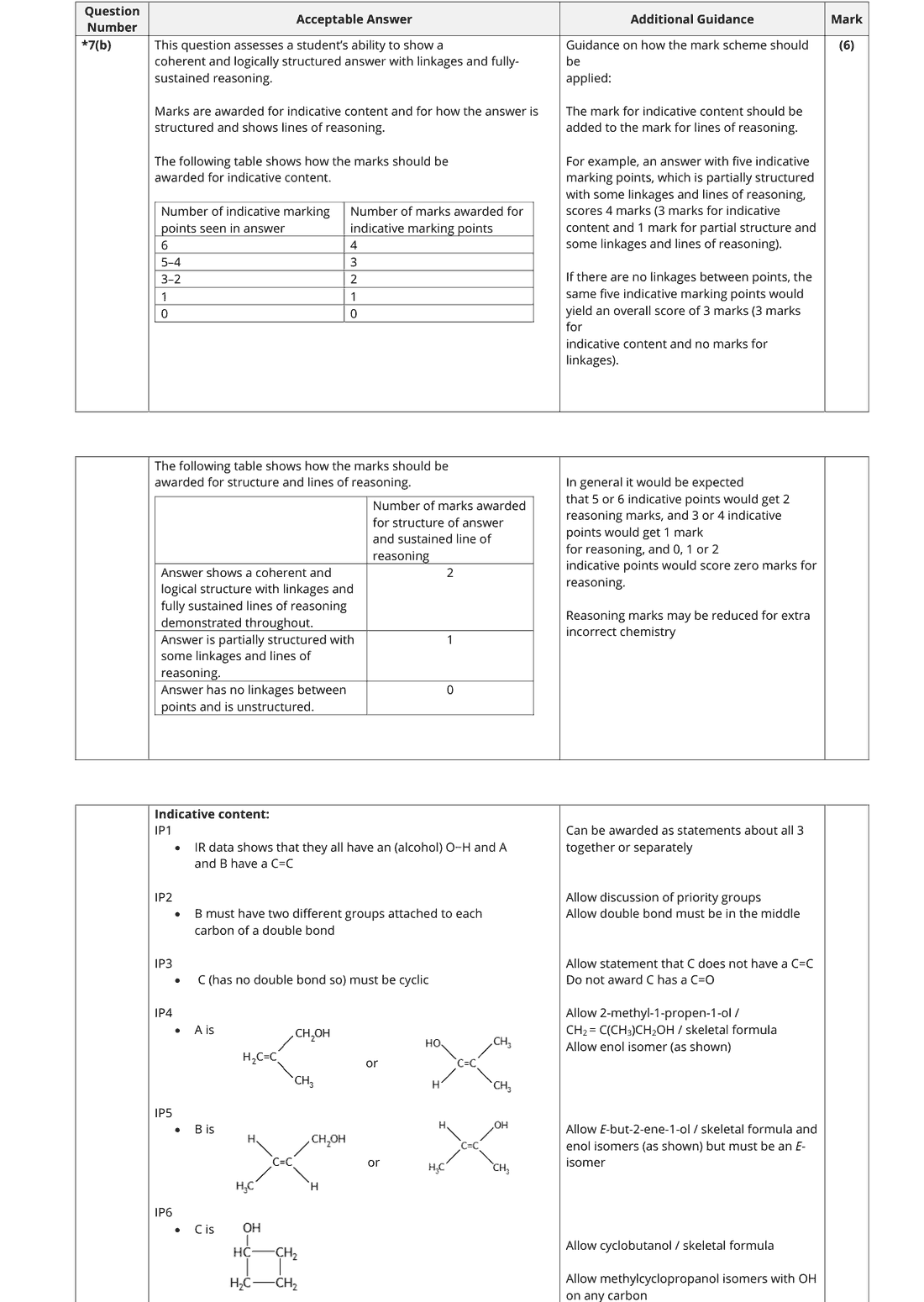
Three different compounds, A, B and C, have the molecular formula C4H8O.
Information about these three compounds includes:
Ɣ all three compounds have infrared absorptions at about 3500 cm–1
Ɣ the infrared spectra of A and B each contain a peak at about 1650 cm–1,
while that of C does not
Ɣ only A has a branched carbon chain
Ɣ B is the E-isomer of a pair of stereoisomers.
Deduce a possible displayed formula for each of the compounds A, B and C.
You must use all the information and the Data Booklet to fully justify each of your
structures.
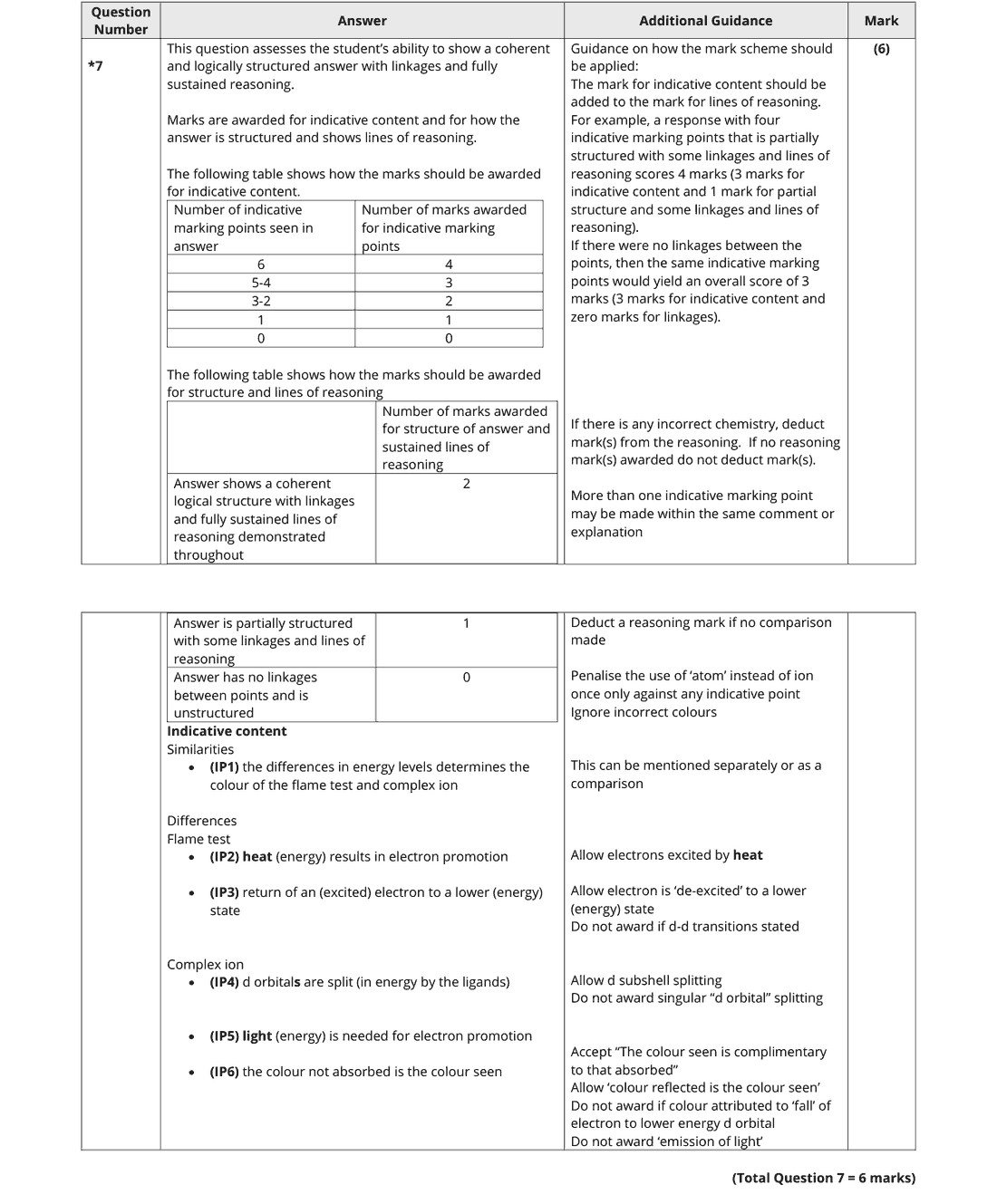
June 2019 · Paper 1 · Q7 6 marks 6-mark extended response transition metals principlesgroups 1 and 2
Colour is often used in chemistry to identify substances.
Compare and contrast the origin of the colour of a copper(II) complex with the origin
of the colour of the copper(II) ion in a flame test.
You do not need to state any specific colours.
June 2019 · Paper 2 · Q6(c) 6 marks 6-mark extended response alcoholscarboxylic acids
Earlier part of question 6 that this part usesEarlier part of June 2019 Paper 2 question 6
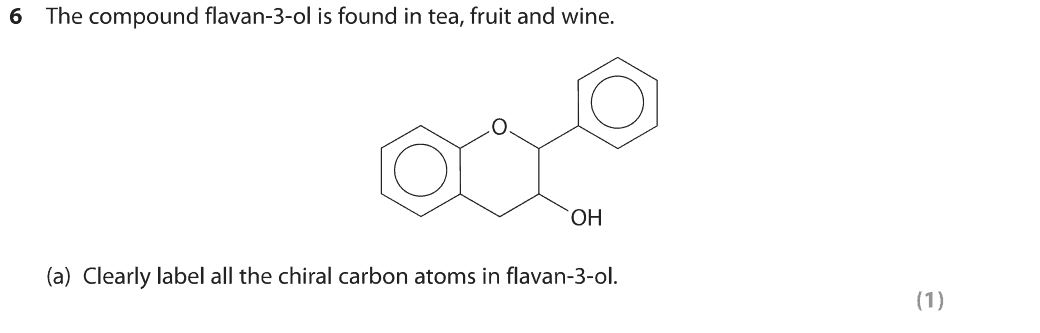
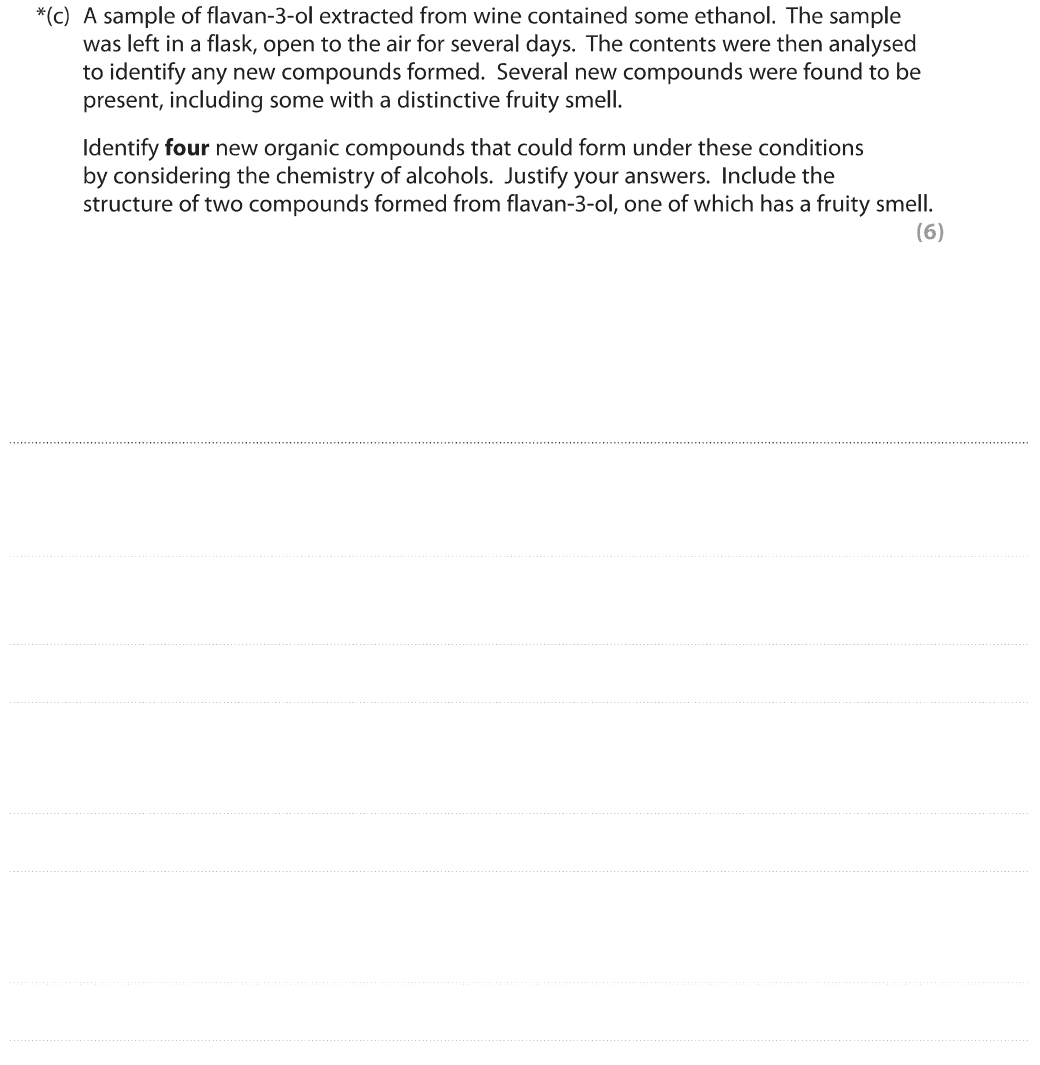
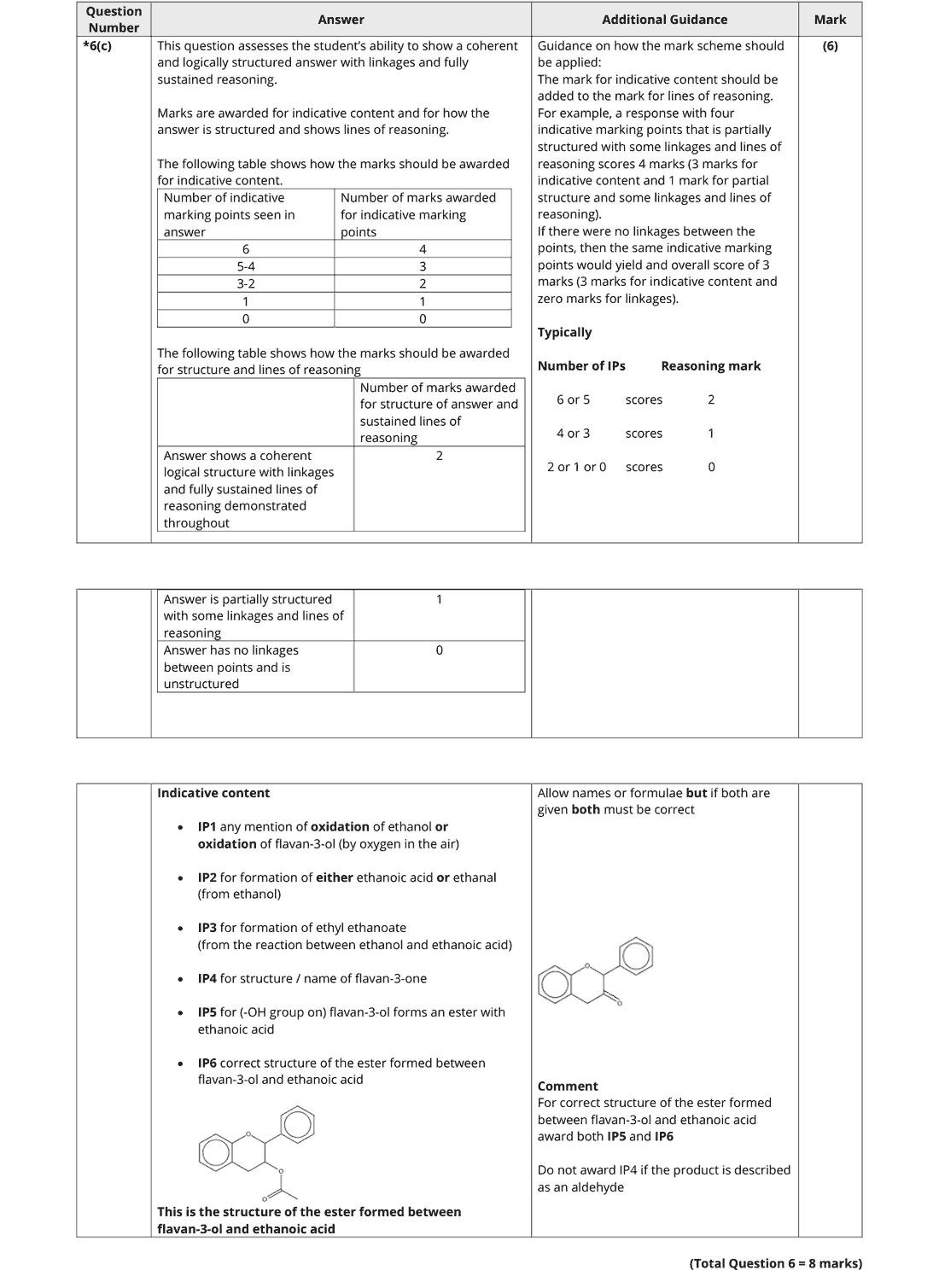
A sample of flavan-3-ol extracted from wine contained some ethanol. The sample
was left in a flask, open to the air for several days. The contents were then analysed
to identify any new compounds formed. Several new compounds were found to be
present, including some witha distinctive fruity smell.
Identify four new organic compounds that could form under these conditions
by considering the chemistry of alcohols. Justify your answers. Include the
structure of two compounds formed from flavan-3-ol, one of which has a fruity smell.
eeeeee eeeeereece errr eee eee eeereer ee eeereer eee eee eeeee eeeeeeee eee eee eee ee ee eeeeeee eee eee ee eeeeee eee eee ee eee ee eee eee eee eee eee eee eeeeee eee eeeeeeee eeeee eee eee ee eeeeee eee eee eeeee eee eeeee eee eeeee eee ee eee eeeeee ee ee eee eeeee eee eee ee eee ee eee eee eee e reer e eeeee rere ee
cesesnsssnnmnsnnsnnnnnnnnunnnusunuuuauunisnua
eee eeeeeeeeeeee eee reereeee eee reereeeeeeeeerere eee eeeeeeeee eee eee eee eee eee eee eee eee eee ee eeeeee eeeeeeee eee eee eeeeeeee eeeeee ee ee eee eeeeeeeeeeeee eee eeeeeeeeeeeeee eTeee eeeeeeee eeeeeeeeeee eee eee eee eee eee eeeeeeee eeeeeeee eee eee eee eee eee eee eee eee eeeee eeeeee eee eeeee eee eee eee eres
June 2019 · Paper 3 · Q9(c) 6 marks 6-mark extended response organic synthesis
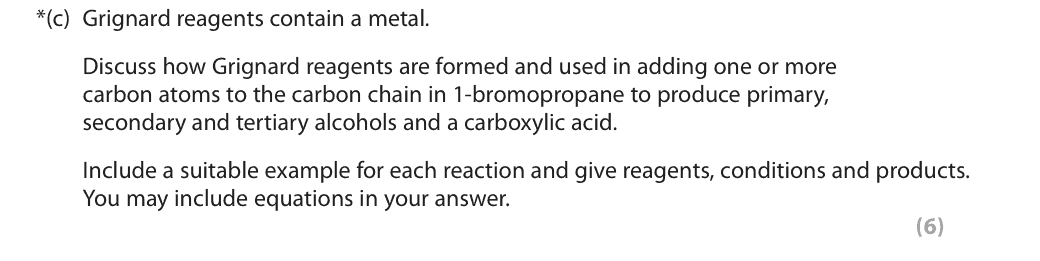
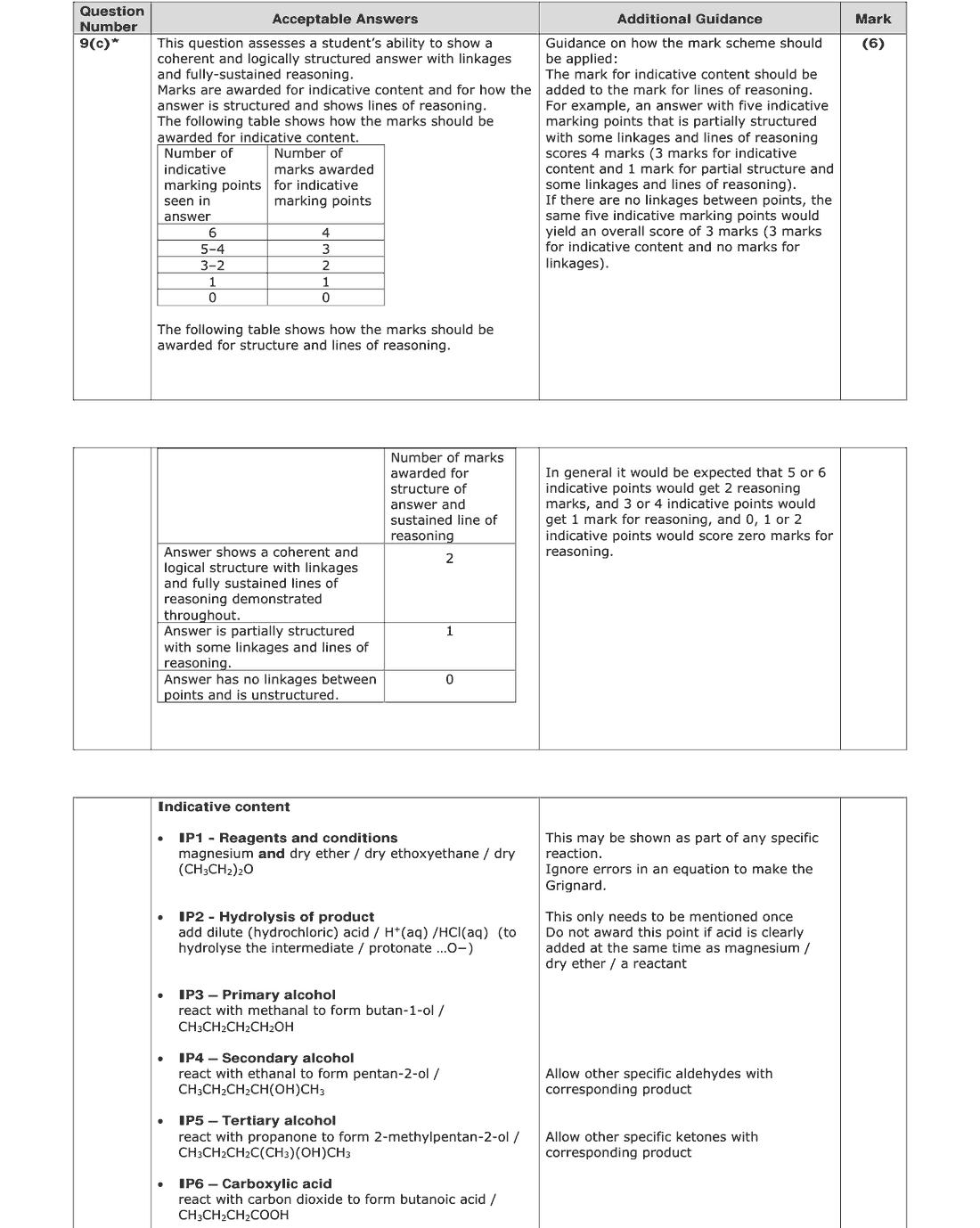
Grignard reagents contain a metal.
Discuss how Grignard reagents are formed and used in adding one or more
carbon atoms to the carbon chain in 1-bromopropane to produce primary,
secondary and tertiary alcohols and a carboxylic acid.
Include a suitable example for each reaction and give reagents, conditions and products.
You may include equations in your answer.
June 2018 · AS Paper 1 · Q7 6 marks 6-mark extended response bonding
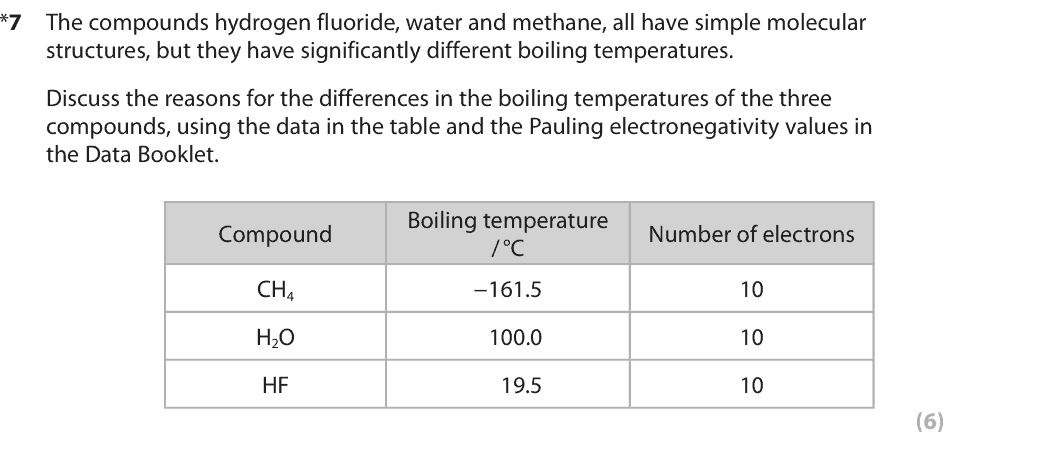
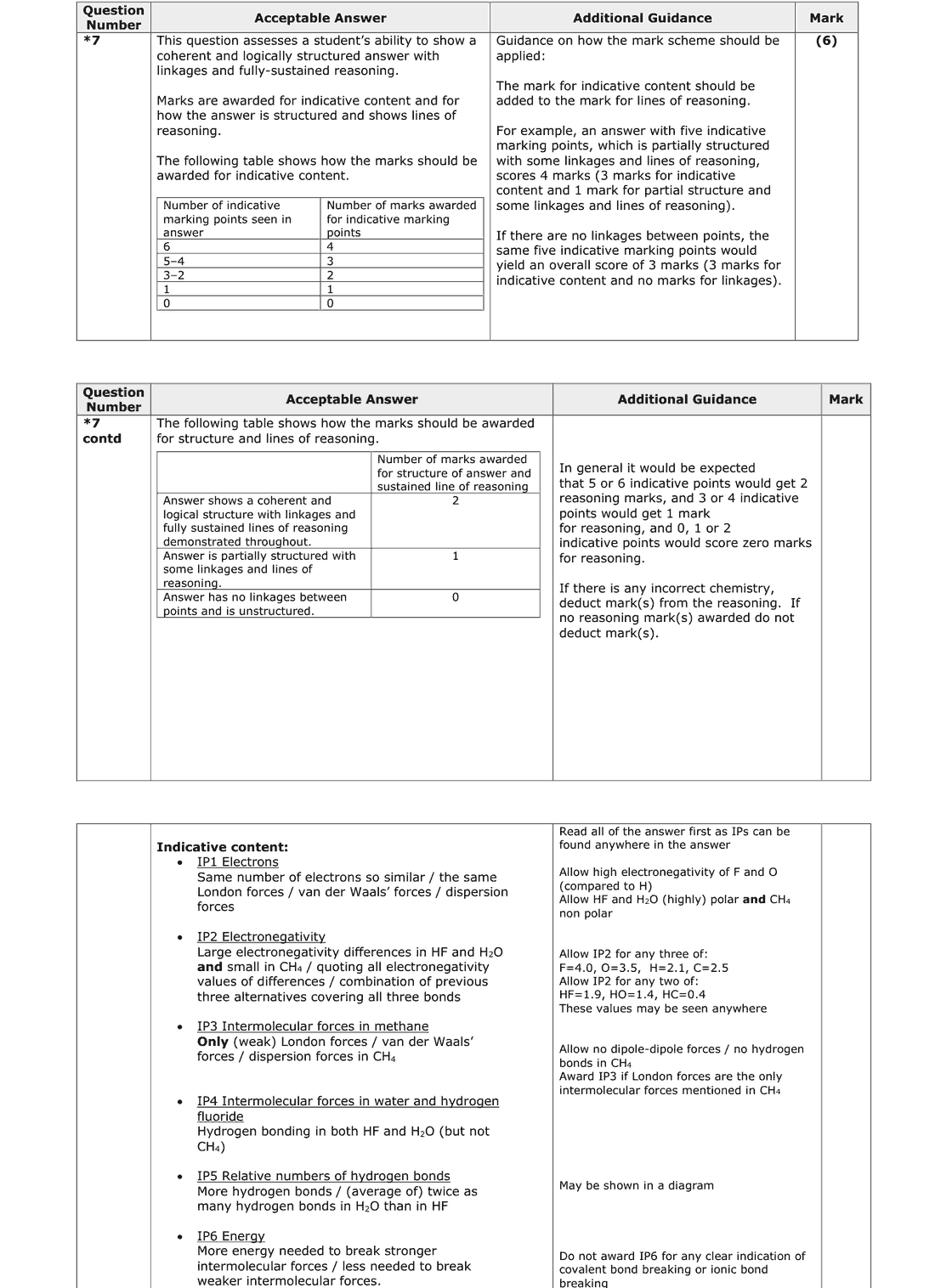
The compounds hydrogen fluoride, water and methane, all have simple molecular
structures, but they have significantly different boiling temperatures.
Discuss the reasons for the differences in the boiling temperatures of the three
compounds, using the data in the table and the Pauling electronegativity values in
the Data Booklet.
Boiling temperature
Compound
Number of electrons
/ °C
CH4
−161.5
10
H2O
100.0
10
HF
19.5
10
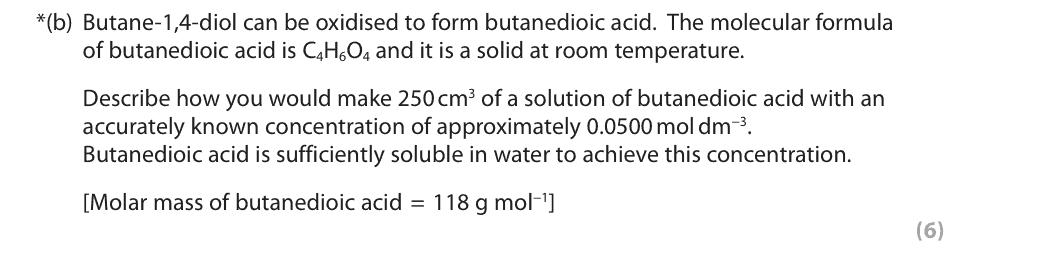
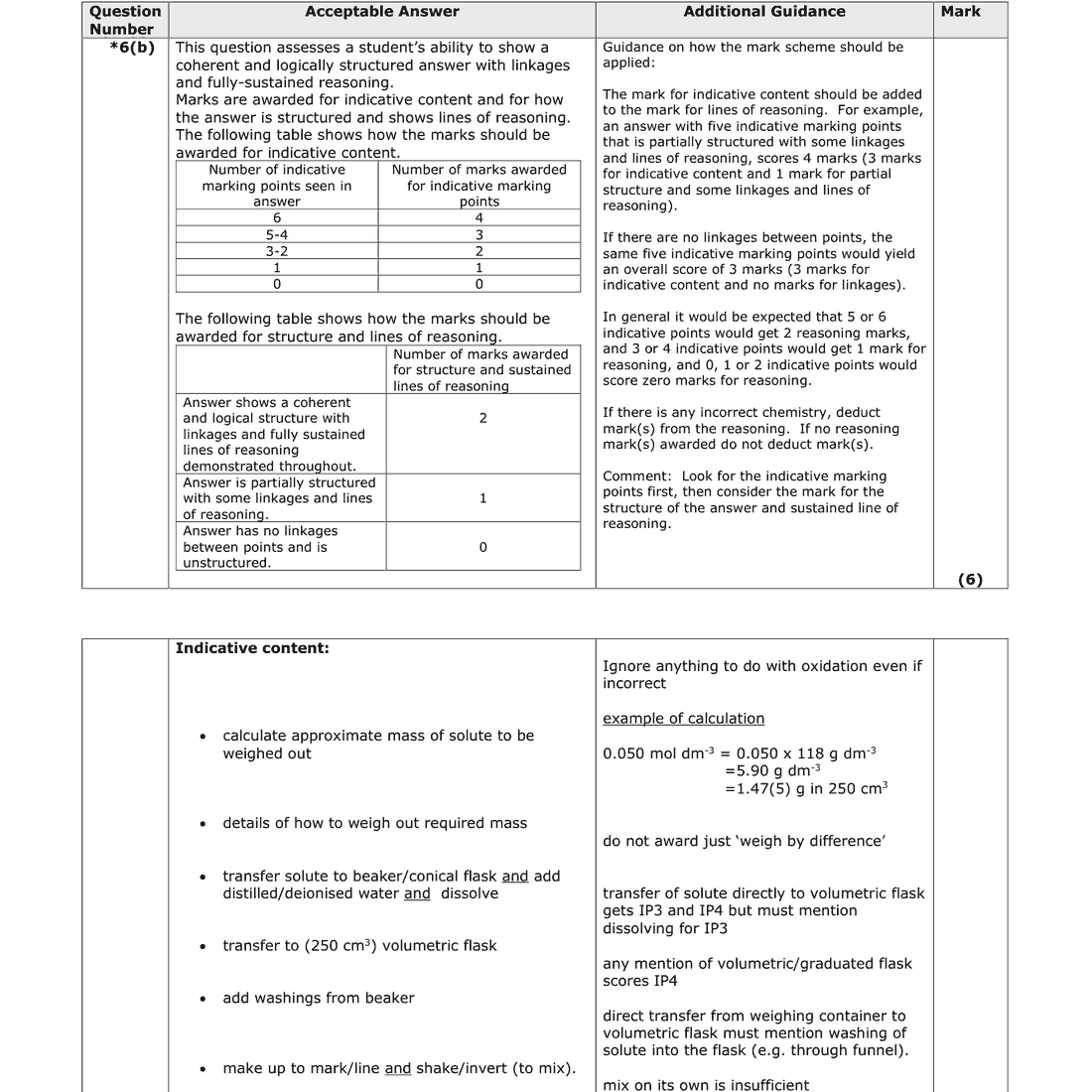
June 2018 · AS Paper 2 · Q6(b) 6 marks 6-mark extended response formulae equations and amounts of substance
Butane-1,4-diol can be oxidised to form butanedioic acid.  The molecular formula
of butanedioic acid is C4H6O4 and it is a solid at room temperature.
Describe how you would make 250 cm3 of a solution of butanedioic acid with an
accurately known concentration of approximately 0.0500 mol dm−3.
Butanedioic acid is sufficiently soluble in water to achieve this concentration.
[Molar mass of butanedioic acid = 118 g mol−1]
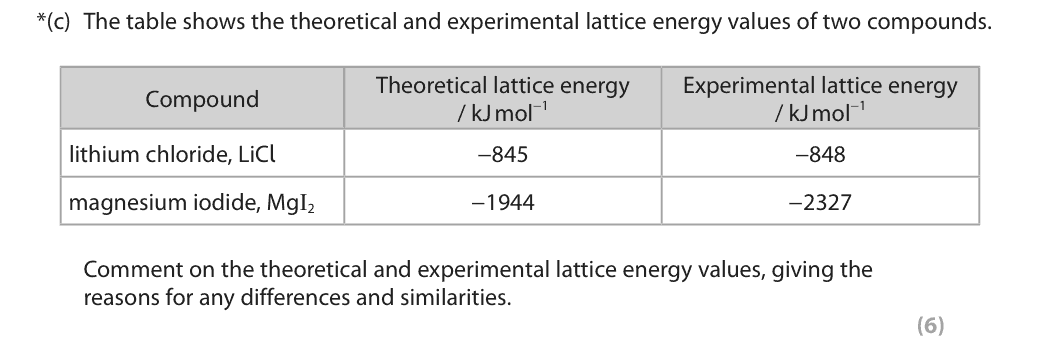
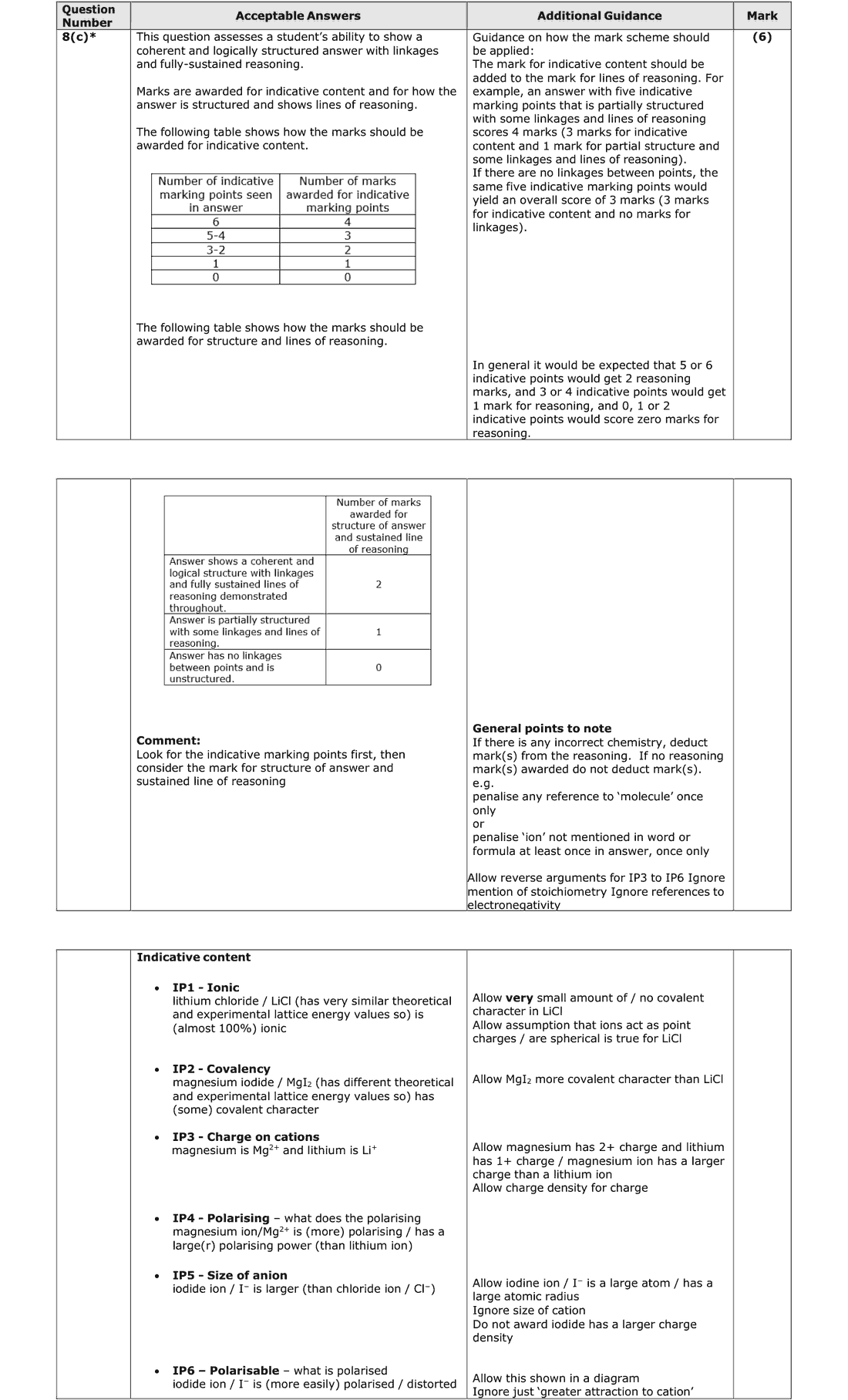
June 2018 · Paper 1 · Q8(c) 6 marks 6-mark extended response lattice energy
Earlier part of question 8 that this part usesEarlier part of June 2018 Paper 1 question 8
The table shows the theoretical and experimental lattice energy values of two compounds.
Theoretical lattice energy
Experimental lattice energy
Compound
/ kJ mol−1
/ kJ mol−1
lithium chloride, LiCl
−845
−848
magnesium iodide, MgI2
−1944
−2327
Comment on the theoretical and experimental lattice energy values, giving the
reasons for any differences and similarities.
June 2018 · Paper 2 · Q6(d) 6 marks 6-mark extended response kinetics iihalogenoalkanes
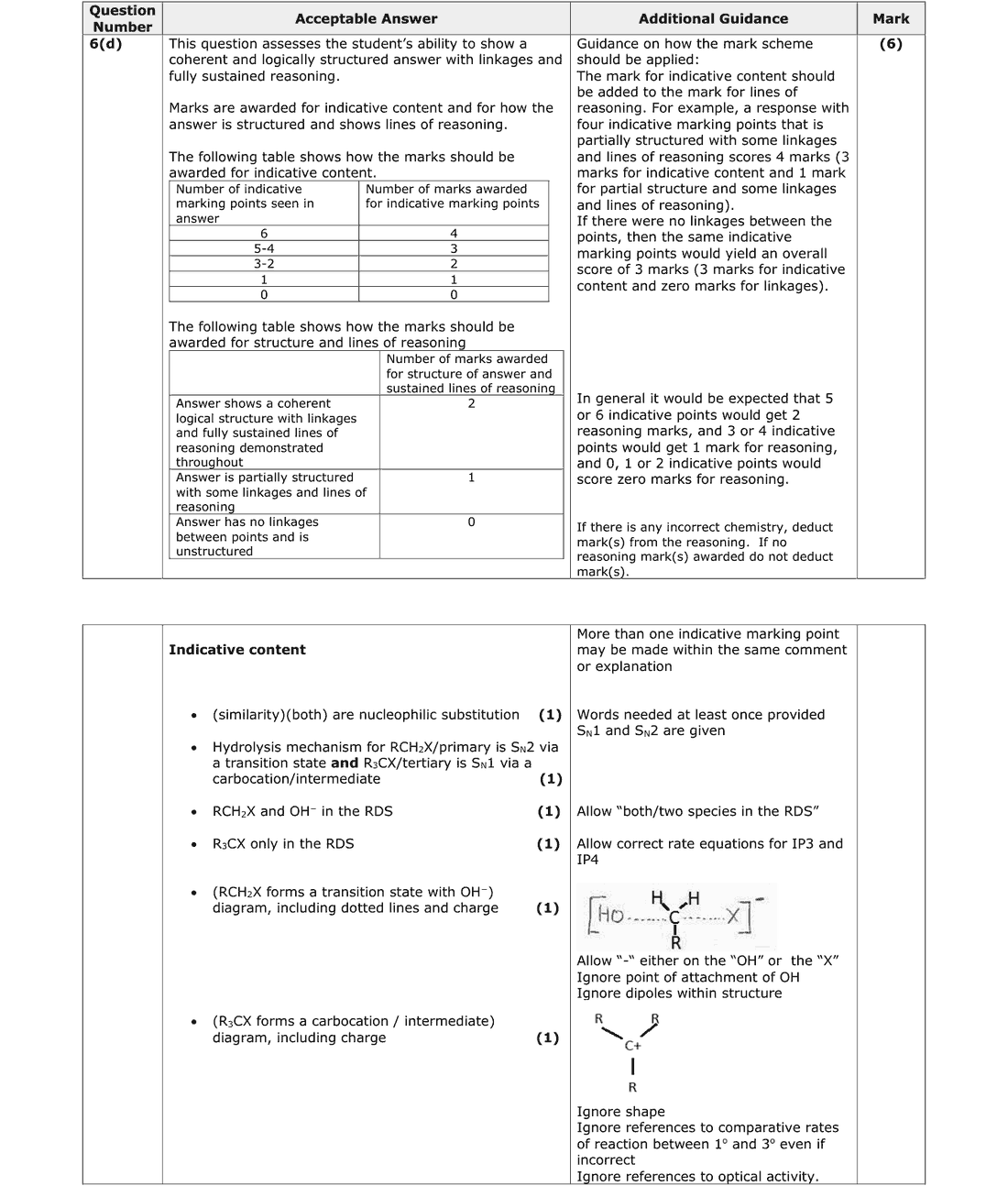
Compare and contrast the mechanism of hydrolysis, using aqueous potassium hydroxide,
of the primary halogenoalkane, RCH2X, with that of the tertiary halogenoalkane, R3CX.
Include diagrams of any intermediate or transition state.
Curly arrows are not required.
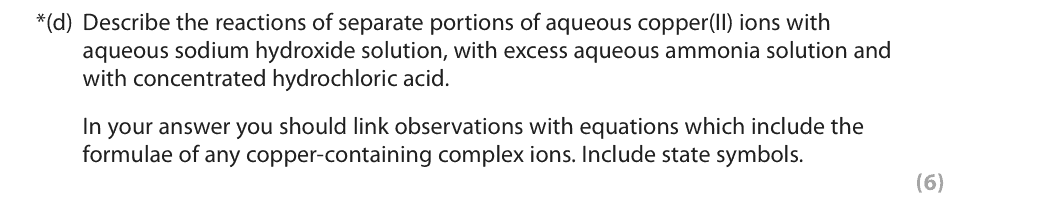
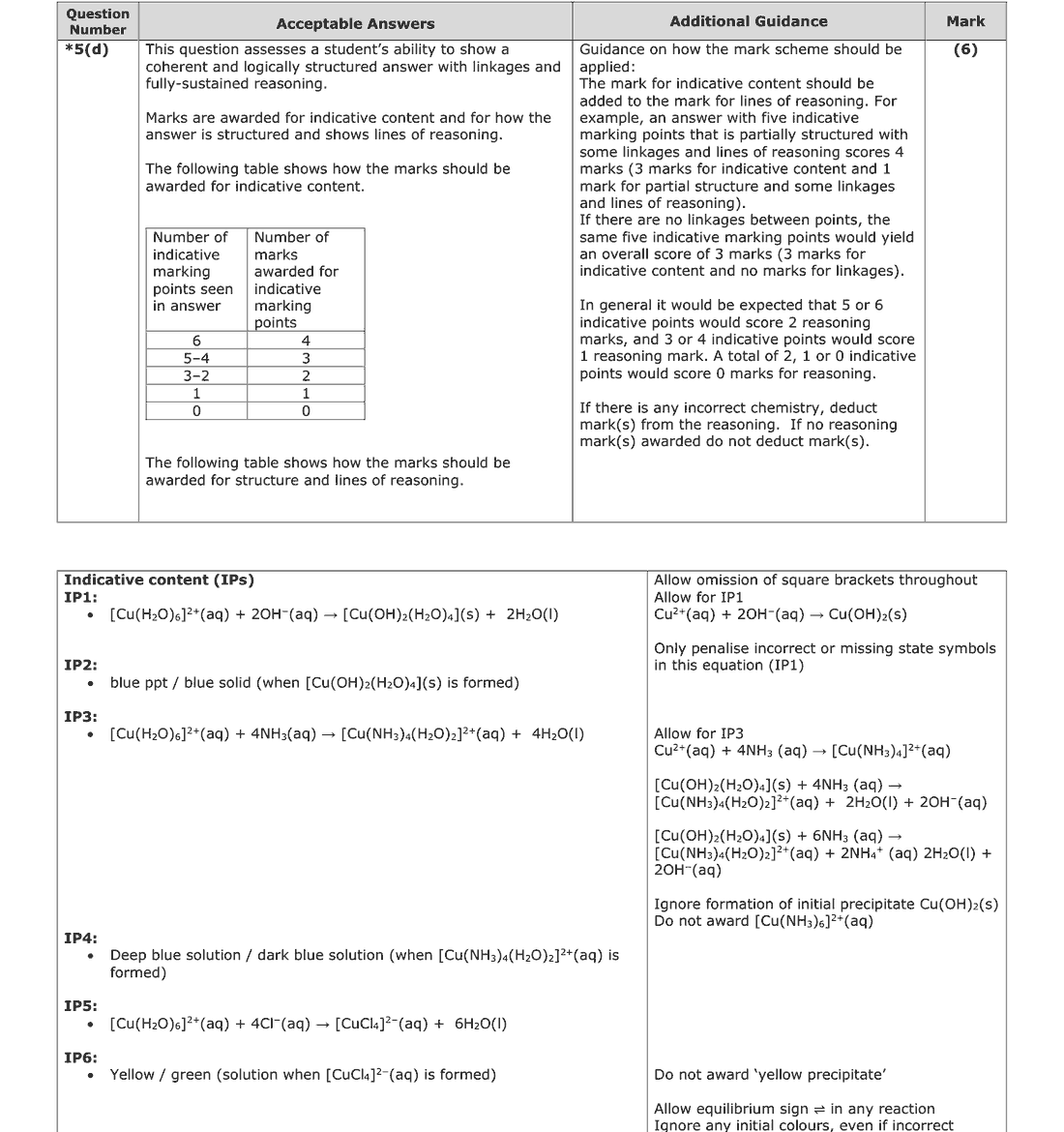
June 2018 · Paper 3 · Q5(d) 6 marks 6-mark extended response transition metals reactions
Earlier part of question 5 that this part usesEarlier part of June 2018 Paper 3 question 5
Describe the reactions of separate portions of aqueous copper(II) ions with
aqueous sodium hydroxide solution, with excess aqueous ammonia solution and
with concentrated hydrochloric acid.
In your answer you should link observations with equations which include the
formulae of any copper-containing complex ions. Include state symbols.
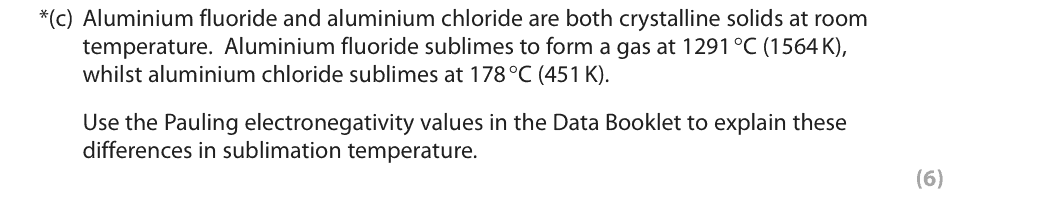
June 2017 · AS Paper 1 · Q6(c) 6 marks 6-mark extended response bondingstructure
Earlier part of question 6 that this part usesEarlier part of June 2017 Paper 1 question 6
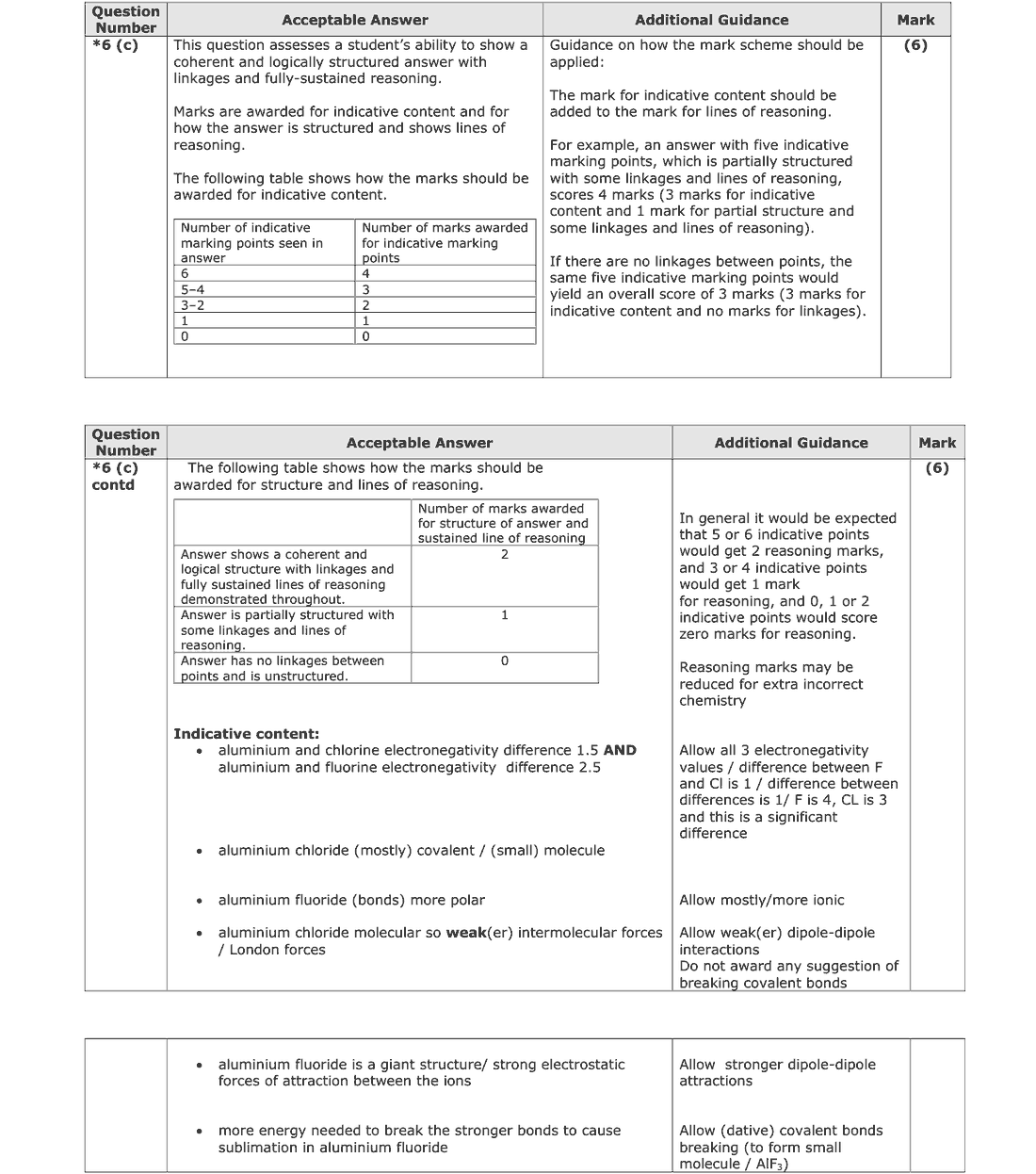
Aluminium fluoride and aluminium chloride are both crystalline solids at room
temperature.  Aluminium fluoride sublimes to form a gas at 1291qC (1564 K),
whilst aluminium chloride sublimes at 178qC (451 K).
Use the Pauling electronegativity values in the Data Booklet to explain these
differences in sublimation temperature.
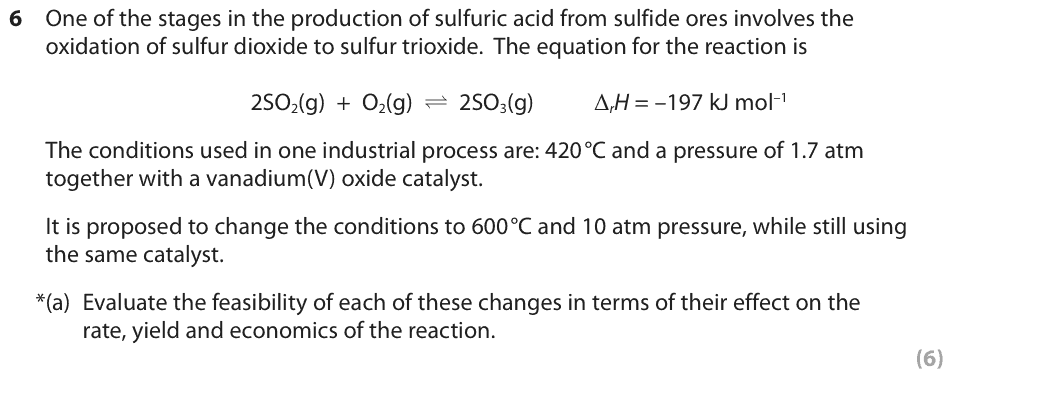
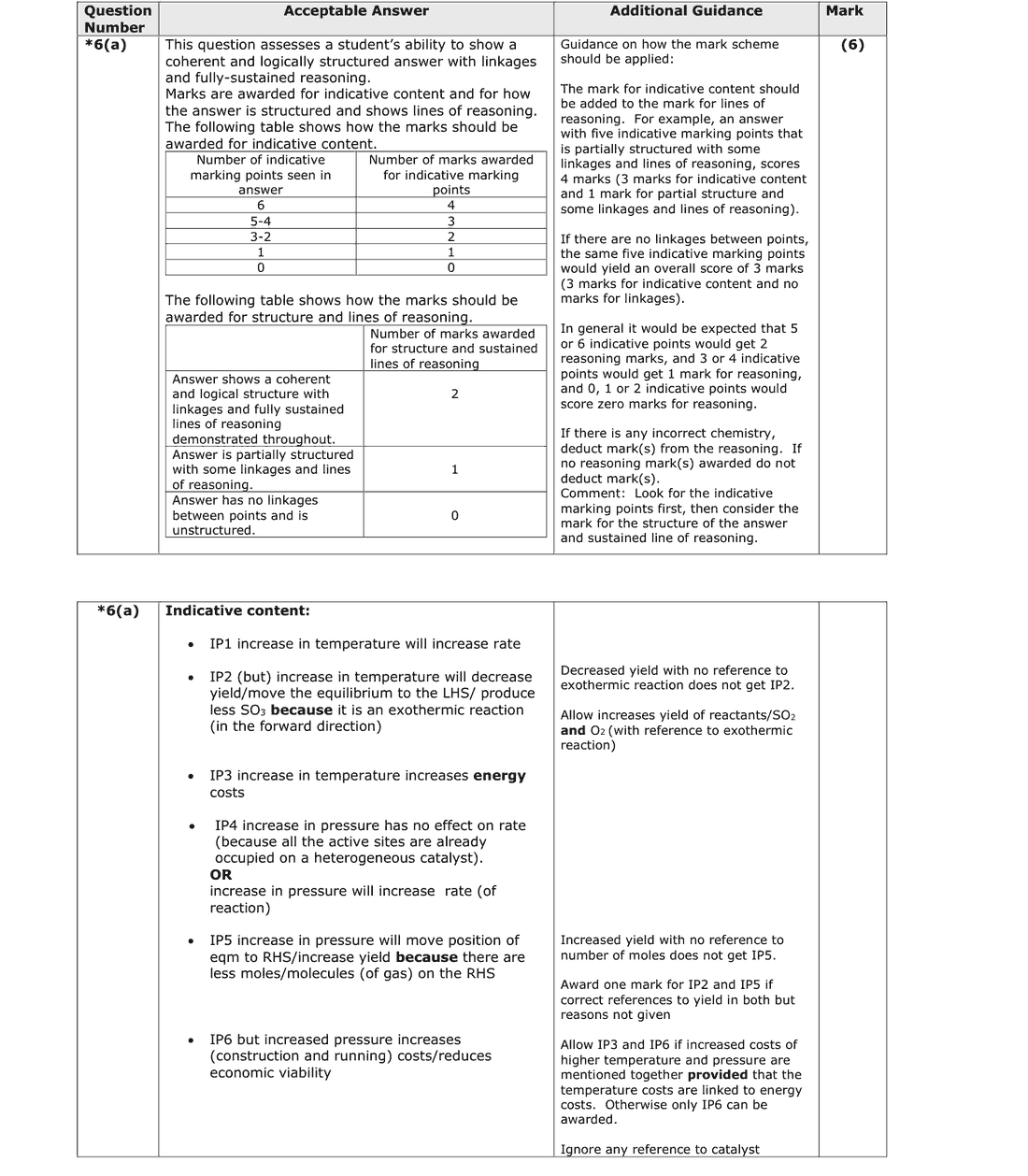
June 2017 · AS Paper 2 · Q6(a) 6 marks 6-mark extended response equilibrium ikinetics i
One of the stages in the production of sulfuric acid from sulfide ores involves the
oxidation of sulfur dioxide to sulfur trioxide.  The equation for the reaction is
2SO2(g)  +  O2(g)  `
_  2SO3(g)     ǻrH = –197 kJ mol–1
The conditions used in one industrial process are: 420°C and a pressure of 1.7 atm
together with a vanadium(V) oxide catalyst.
It is proposed to change the conditions to 600°C and 10 atm pressure, while still using
the same catalyst.
Evaluate the feasibility of each of these changes in terms of their effect on the
rate, yield and economics of the reaction.
June 2017 · Paper 1 · Q7(b) 6 marks 6-mark extended response acid base equilibria
Earlier part of question 7 that this part usesEarlier part of June 2017 Paper 1 question 7
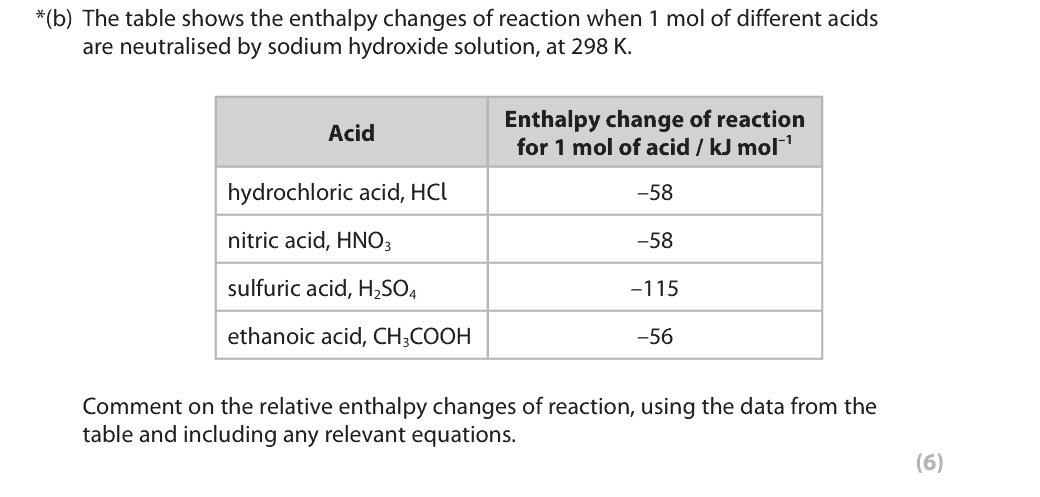
The table shows the enthalpy changes of reaction when 1 mol of different acids
are neutralised by sodium hydroxide solution, at 298 K.
Enthalpy change of reaction
Acid
for 1 mol of acid / kJ mol–1
hydrochloric acid, HCl
–58
nitric acid, HNO3
–58
sulfuric acid, H2SO4
–115
ethanoic acid, CH3COOH
–56
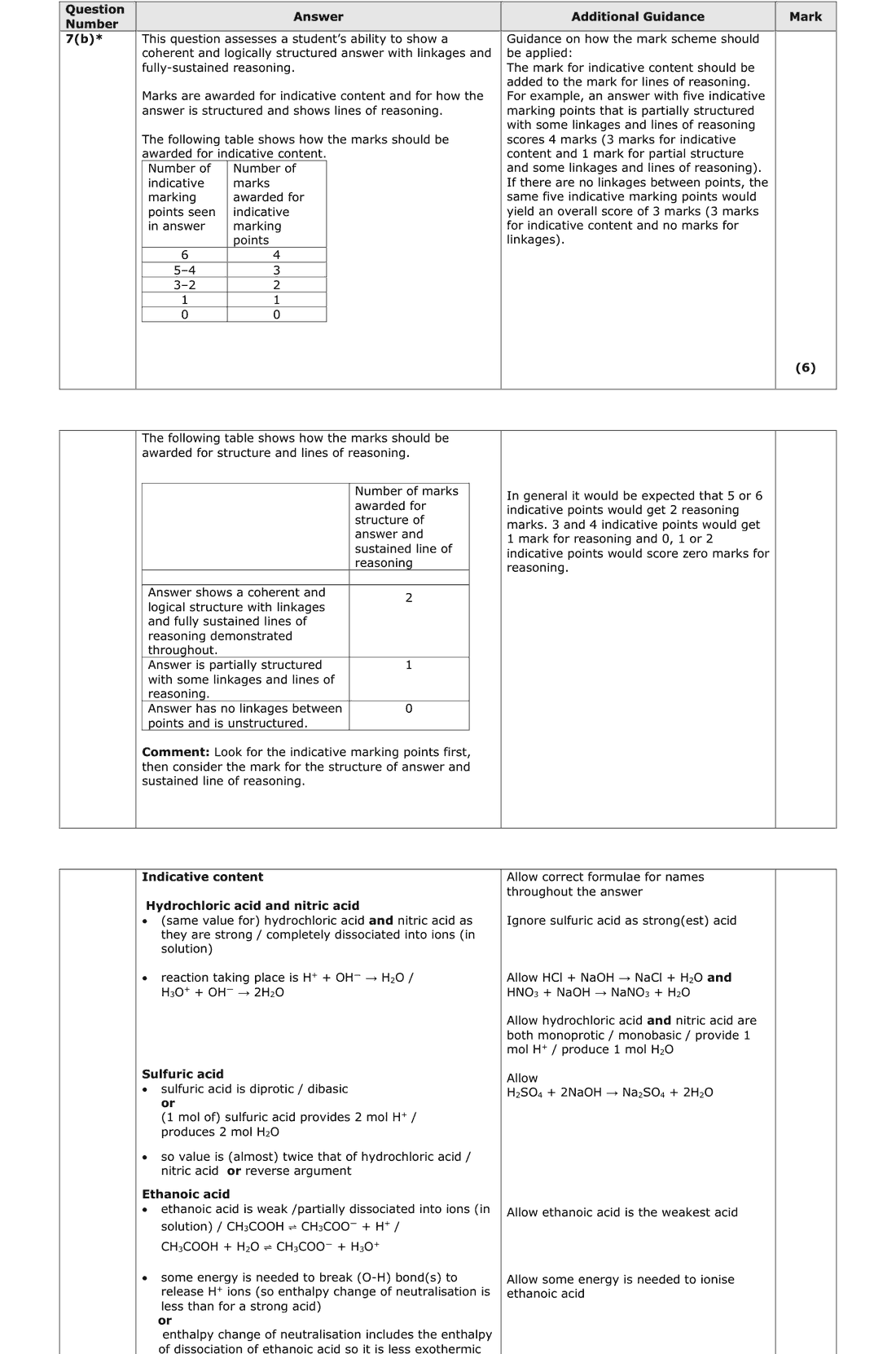
Comment on the relative enthalpy changes of reaction, using the data from the
table and including any relevant equations.
June 2017 · Paper 2 · Q8(b)(iii) 6 marks 6-mark extended response nmr mass spectrometry and chromatography
Earlier parts of question 8 that this part usesEarlier part of June 2017 Paper 2 question 8Earlier part of June 2017 Paper 2 question 8Earlier part of June 2017 Paper 2 question 8
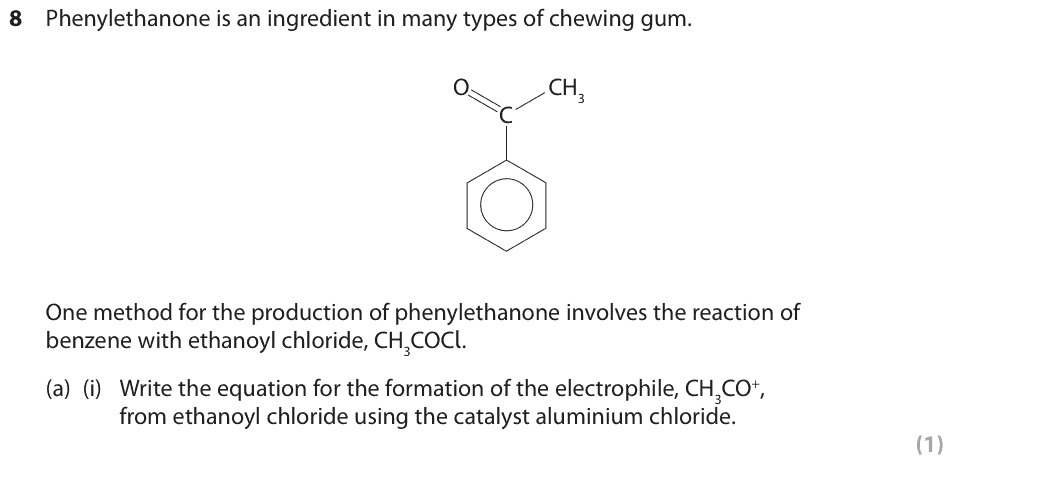
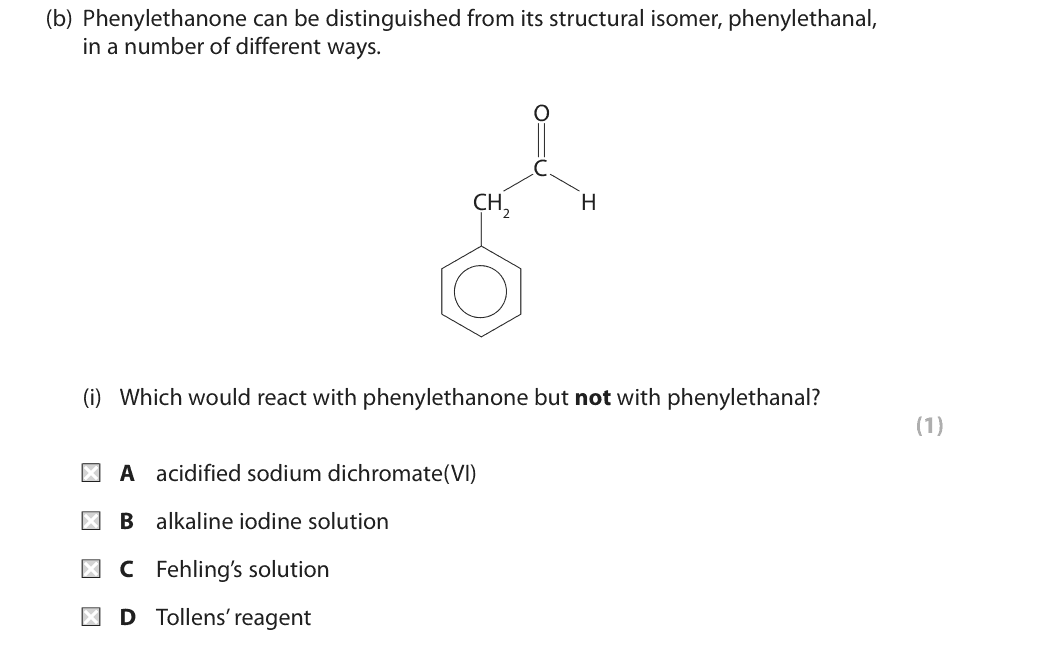
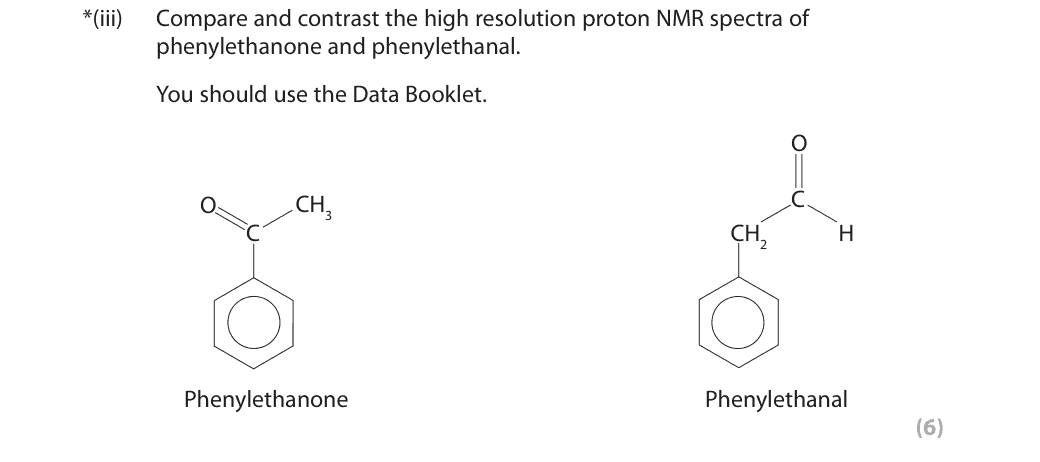
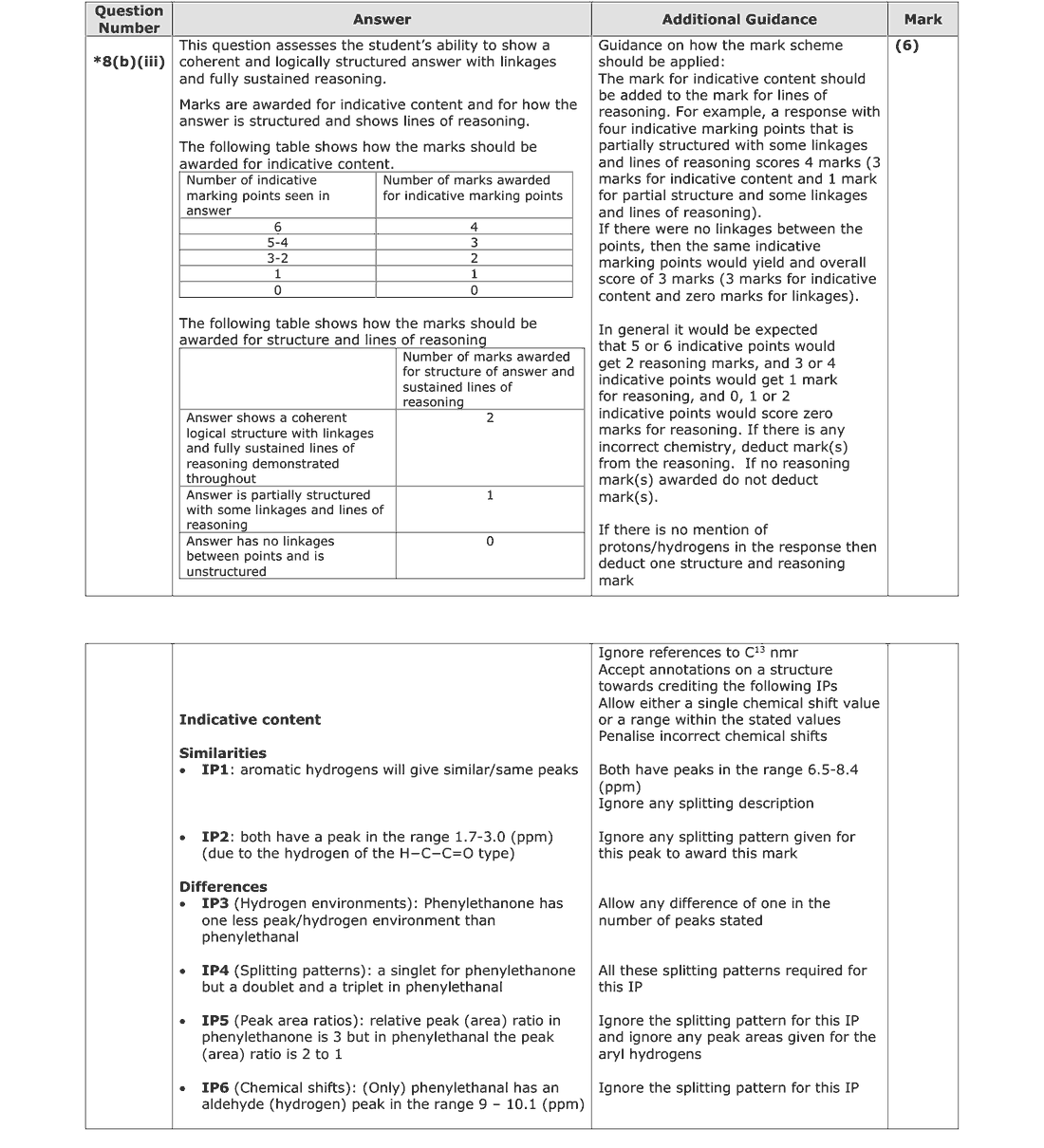
Compare and contrast the high resolution proton NMR spectra of
phenylethanone and phenylethanal.
You should use the Data Booklet.
O
C
O
CH3
C
CH2
H
Phenylethanone
Phenylethanal
June 2017 · Paper 3 · Q7(a) 6 marks 6-mark extended response transition metals principles
This question is about the chemistry of elements in the d-block of the Periodic Table.
Many of the d-block elements are also classified as transition metals.
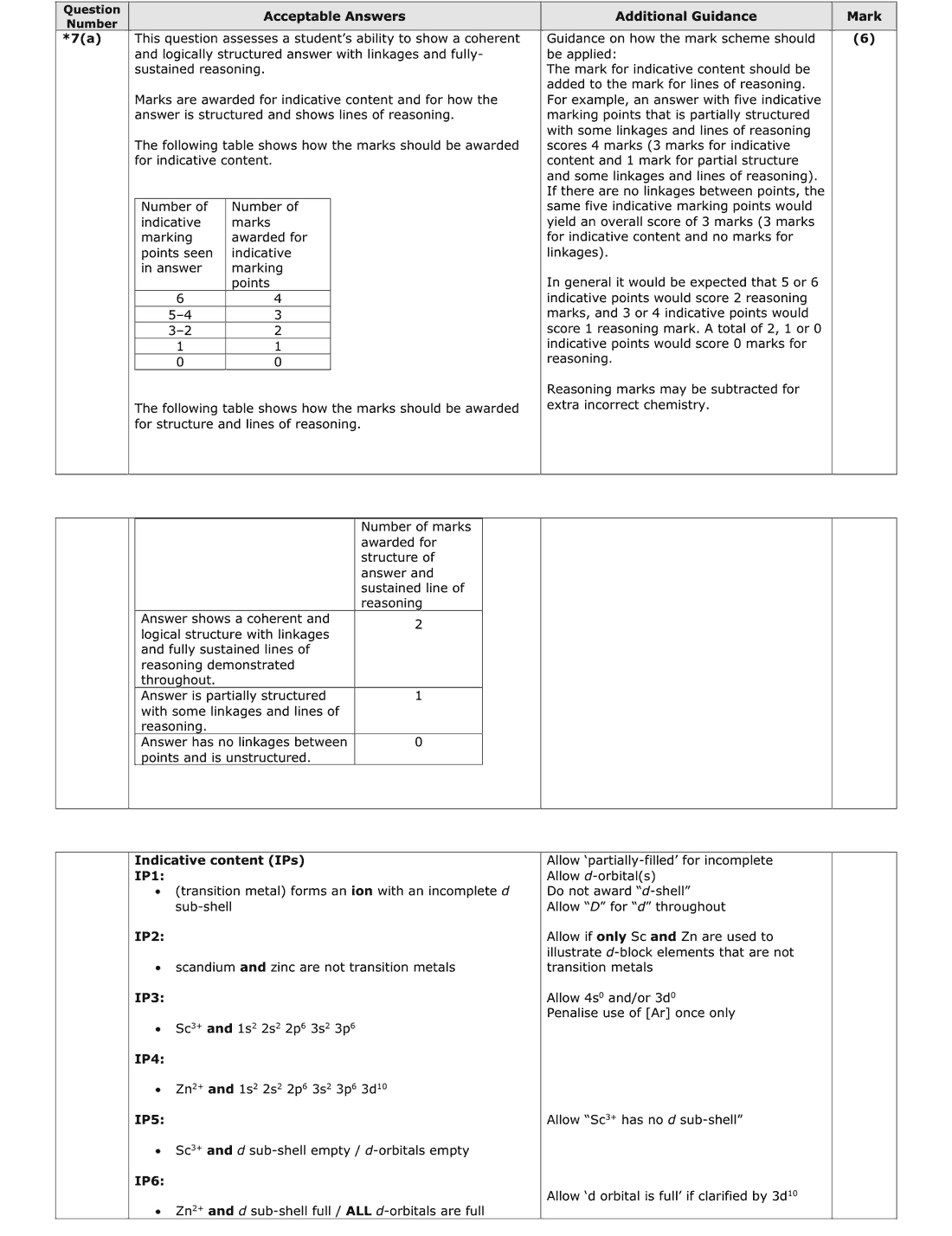
Explain why two of the d-block elements within Period 4 (scandium to zinc) are
not classified as transition metals.
You should include full electronic configurations where relevant.
2−, can oxidise manganese(II) ions, Mn2+.
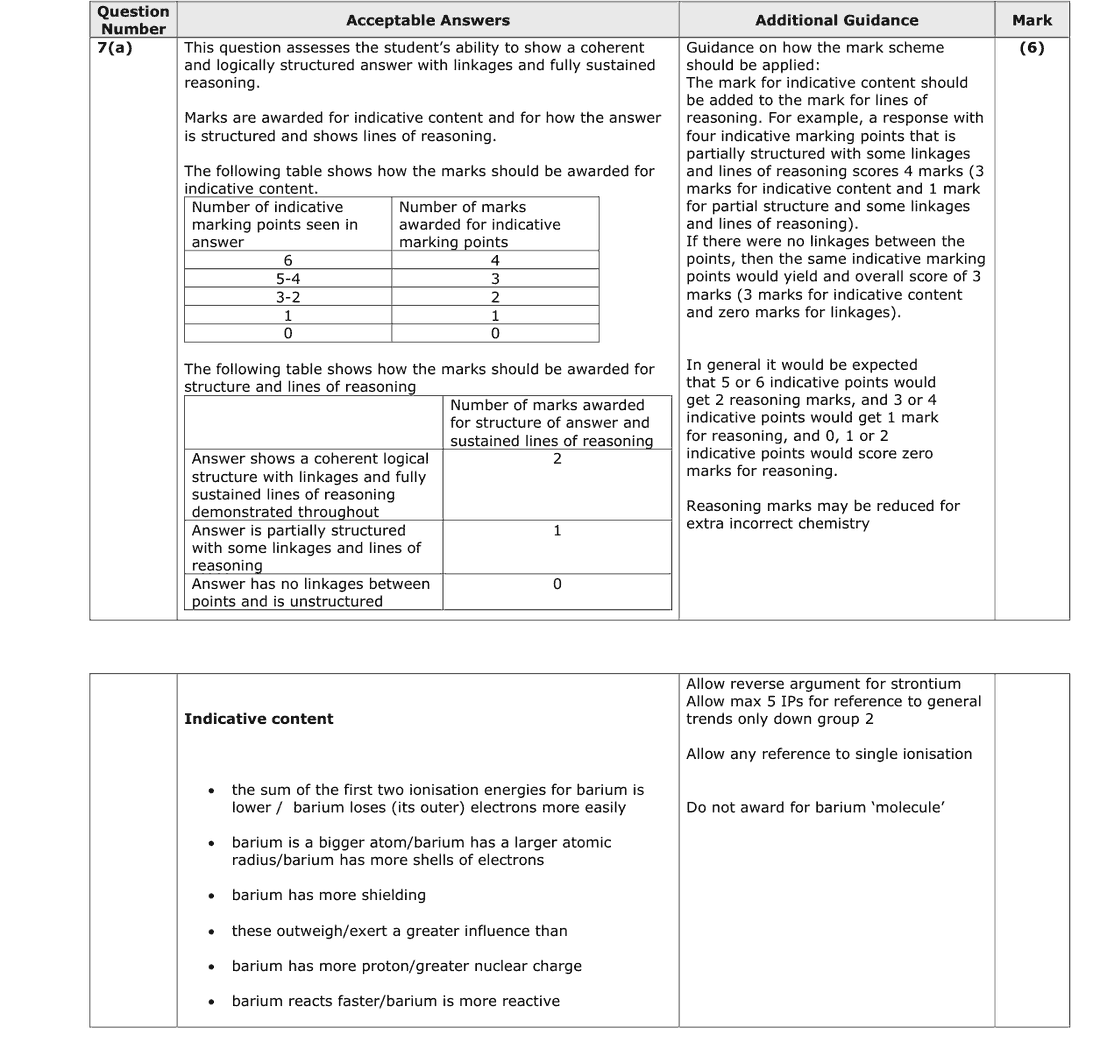
June 2016 · AS Paper 1 · Q7(a) 6 marks 6-mark extended response groups 1 and 2
A student suggested that the difference in the rates of reaction of strontium and
barium with water is due to the difference in the sum of their first and second
ionisation energies.  Discuss this suggestion.
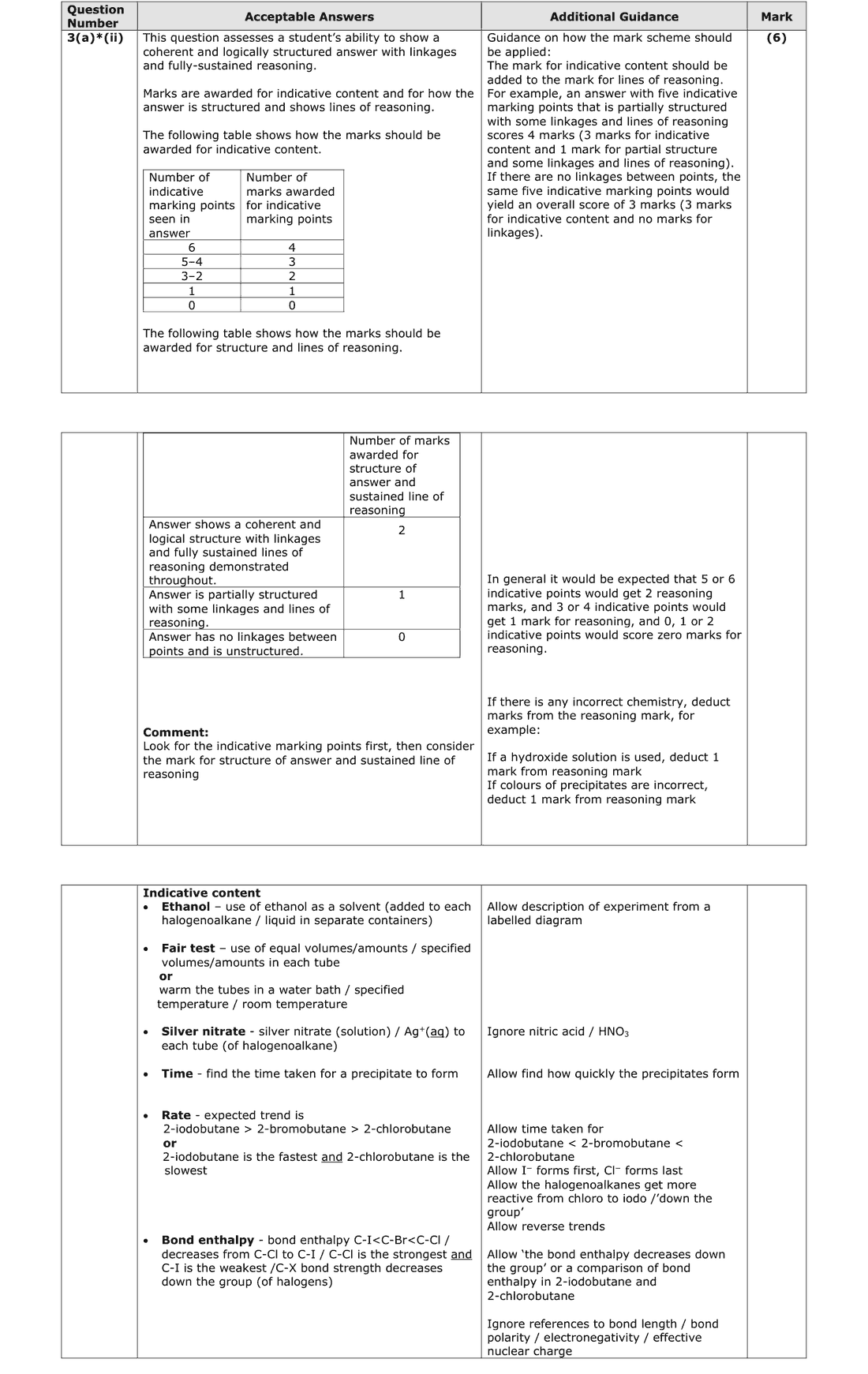
June 2016 · AS Paper 2 · Q3(a)(ii) 6 marks 6-mark extended response halogenoalkanes
Earlier part of question 3 that this part usesEarlier part of June 2016 Paper 2 question 3
Devise an experiment to compare the rates of hydrolysis of 2-chlorobutane,
2-bromobutane and 2-iodobutane.
State the trend in the rates of reaction.  Justify your answer.

Work with an A-level chemistry tutor

Dropping marks on calculations, mechanisms or the core practicals? Book a trial session with an A-level chemistry tutor.

Prefer email? Send an enquiry

If you are under 18, please include a parent's contact details. Enquiries go to enquiries@chemistryaleveltutor.com and are deleted once handled. All tutoring is online.