13.12 understand that, since some endothermic reactions can occur at room temperature, enthalpy changes alone do not control whether reactions occur
13.13 know that entropy is a measure of the disorder of a system and that the natural direction of change is increasing total entropy (positive entropy change)
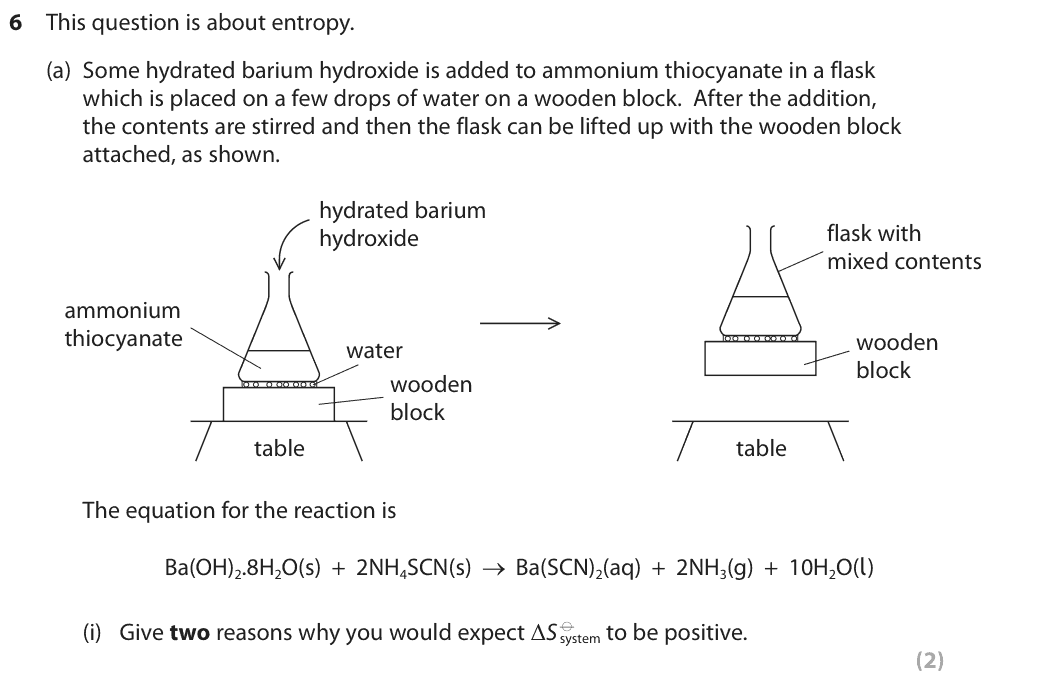
13.14 understand why entropy changes occur during: • i changes of state • ii dissolving of a solid ionic lattice • iii reactions in which there is a change in the number of moles from reactants to products o o o o mixing solid barium hydroxide, Ba(OH)2.8H2O, with solid ammonium [Students should be able to discuss typical reactions in terms of disorder and enthalpy change, including: dissolving ammonium nitrate crystals in water reacting ethanoic acid with ammonium carbonate burning magnesium ribbon in air chloride.]
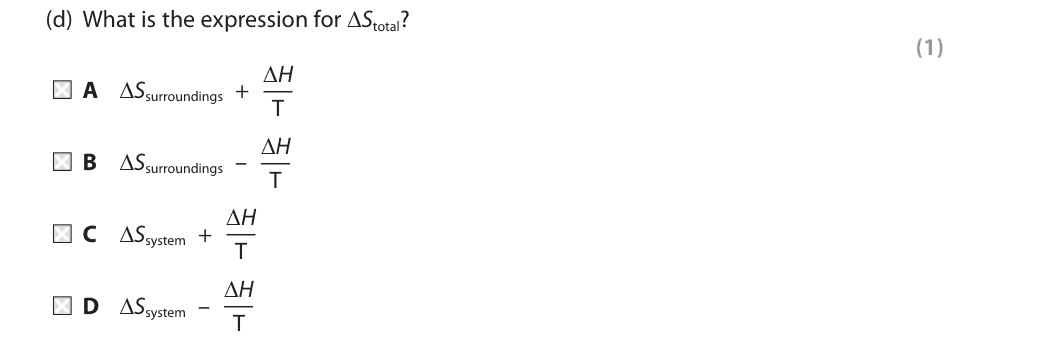
13.15 understand that the total entropy change in any reaction is the entropy change in the system added to the entropy change in the surroundings, shown by the expression: ΔStotal = ΔSsystem + ΔSsurroundings
13.16 be able to calculate the entropy change for the system, ΔSsystem , in a reaction, given the entropies of the reactants and products
13.17 be able to calculate the entropy change in the surroundings, and hence ΔStotal , using the expression: ∆ ∆ = − [H S surroundings T]
13.18 know that the balance between the entropy change and the enthalpy change determines the feasibility of a reaction and is represented by the equation ΔG = ΔH − TΔSsystem
13.19 be able to use the equation ΔG = ΔH − TΔSsystem to: • i predict whether a reaction is feasible • ii determine the temperature at which a reaction is feasible
13.20 be able to use the equation ΔG = −RT ln K to show that reactions which are feasible in terms of ΔG have large values for the equilibrium constant and vice versa
13.21 understand why a reaction for which the ΔG value is negative may not occur in practice
13.22 know that reactions that are thermodynamically feasible may be inhibited by kinetic factors
Six-mark extended response questions on this topic
Tap a question to zoom it. Where a part needs a figure, table or structure from earlier in the question, that part folds out above it; the mark scheme and examiner's comment open underneath. Have Edexcel's Data Booklet beside you; the Periodic Table is on the back page of every paper.
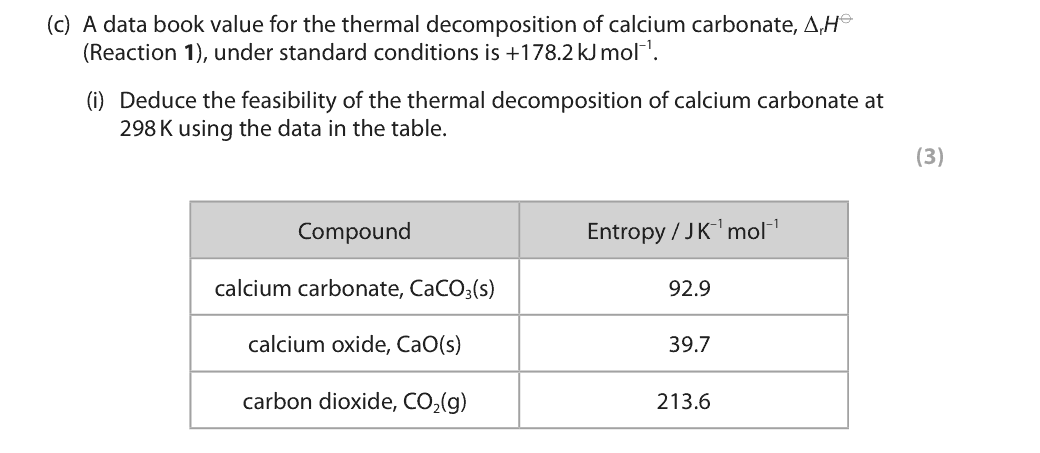
June 2025 · Paper 1 · Q3(c)(i)3 marksCalculation
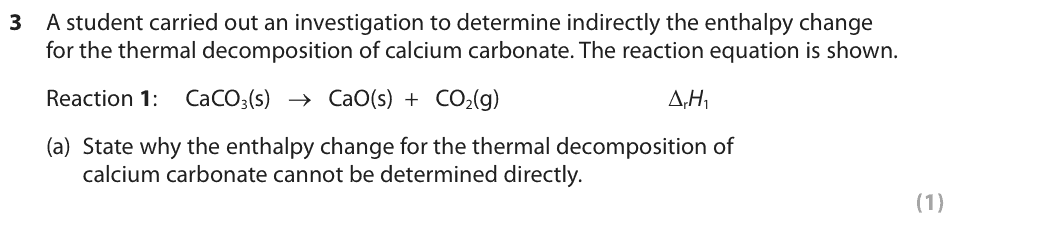
Earlier part of question 3 that this part uses
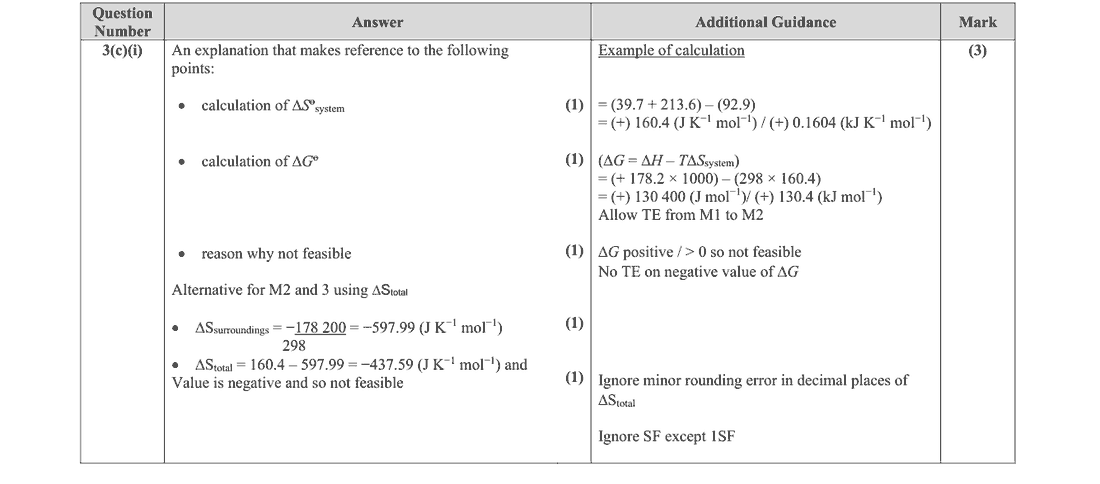
Mark scheme
Examiner's comment
The question required the candidates to calculate the feasibility of the decomposition of calcium carbonate.
This could be done either by calculating Gibbs free energy or by the total entropy change and then commenting on the value as to whether or not it was feasible.
The second part of this question then asked them to use the entropy of the system to calculate the minimum temperature at which this would become feasible, and coverting to oC and giving an answer to 3SF.
Skills: MS0.0 Recognise and make use of appropriate units in calculation; MS2.3 Substitute numerical values into algebraic equations using appropriate units for physical quantities
June 2025 · Paper 1 · Q3(c)(ii)2 marksCalculation
Earlier parts of question 3 that this part uses
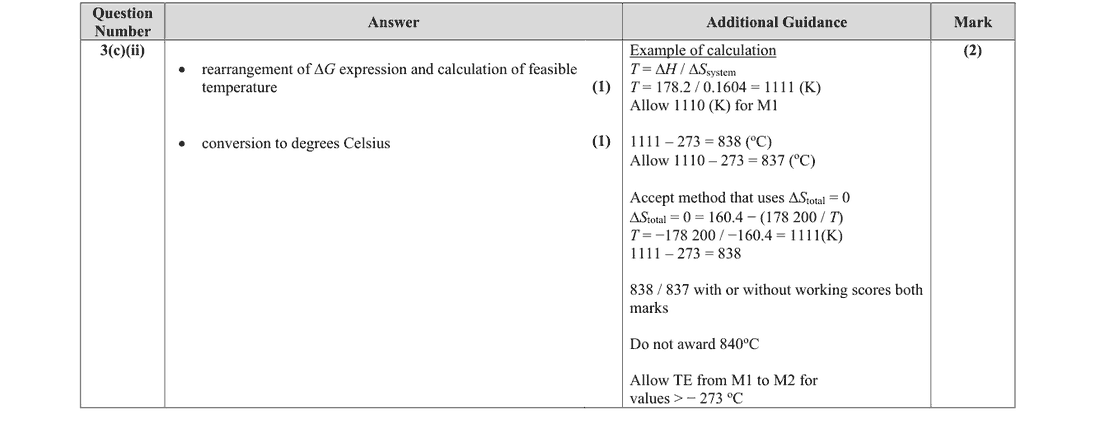
Mark scheme
Examiner's comment
The question required the candidates to calculate the feasibility of the decomposition of calcium carbonate.
This could be done either by calculating Gibbs free energy or by the total entropy change and then commenting on the value as to whether or not it was feasible.
The second part of this question then asked them to use the entropy of the system to calculate the minimum temperature at which this would become feasible, and coverting to oC and giving an answer to 3SF.
Notes from the mark scheme and report
Answer: 838 °C (837 allowed
840 not). T = ΔH ÷ ΔSsystem = 178.2 ÷ 0.1604 = 1111 K
subtract 273. A method setting ΔStotal = 0 is accepted
Skills: MS0.0 Recognise and make use of appropriate units in calculation; MS1.1 Use an appropriate number of significant figures; MS2.2 Change the subject of an equation
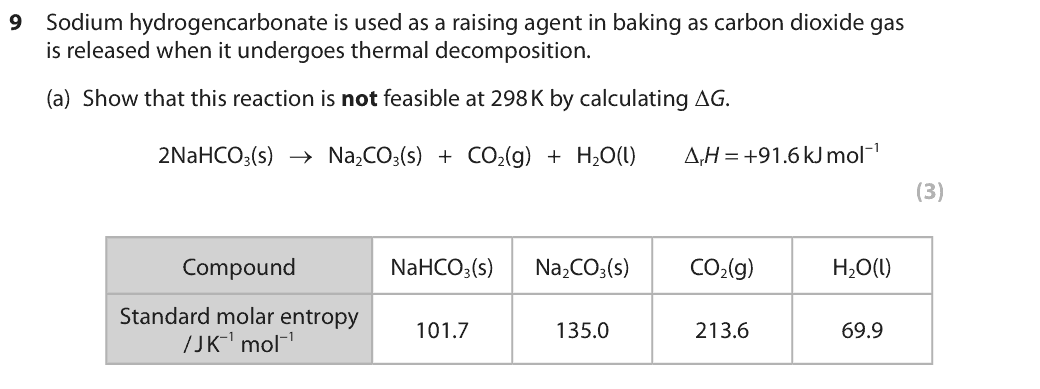
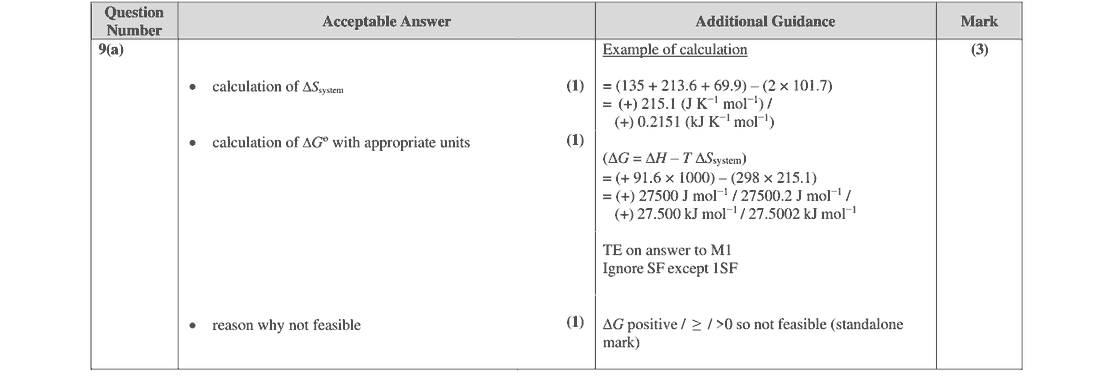
June 2024 · Paper 1 · Q9(a)3 marksCalculation
Mark scheme
Examiner's comment
This question was about entropy and Gibbs free energy and required candidates to determine the minimum required temperature for a chemical reaction from given data.
Part (a)
For the first mark the candidates needed to calculate the entropy change of the system. Many correct answers were seen.
For the second part the candidates needed to calculate the Gibbs free energy and comment on why the reaction was not feasible.
Candidates needed to convert both the entropy and the enthalpy change of the reaction so that both were in J or kJ and then calculate the Gibbs free energy change.
The most frequent mark that was lost was for not giving the correct units for Gibbs free energy that would be consistent with their calculation.
The third mark proved accessible with many correct responses noting that the reaction would not be feasible at 298K as the Gibbs free energy change was positive.
Part (b)
Candidates needed to rearrange the Gibbs free energy equation to calculate a feasible temperature in K.
They then needed to convert this to °C for the final answer.
There was an alternative route to the same answer via a total entropy change of 0. Few candidates opted for this method.
Many fully correct answers were seen, with a few candidates adding 273 instead of subtracting it to convert from K to °C.
ΔG = 91.6 – (298 × 0.2151). Third mark: ΔG is positive so not feasible (stands alone). Common error: mixing J and kJ
Skills: MS0.0 Recognise and make use of appropriate units in calculation; MS2.3 Substitute numerical values into algebraic equations using appropriate units for physical quantities
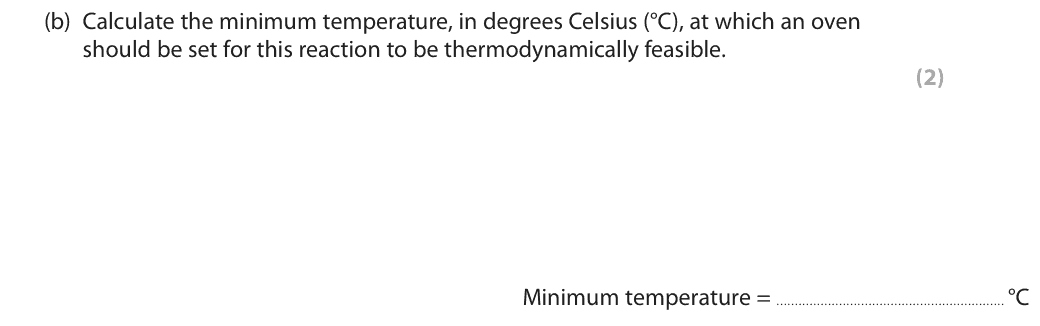
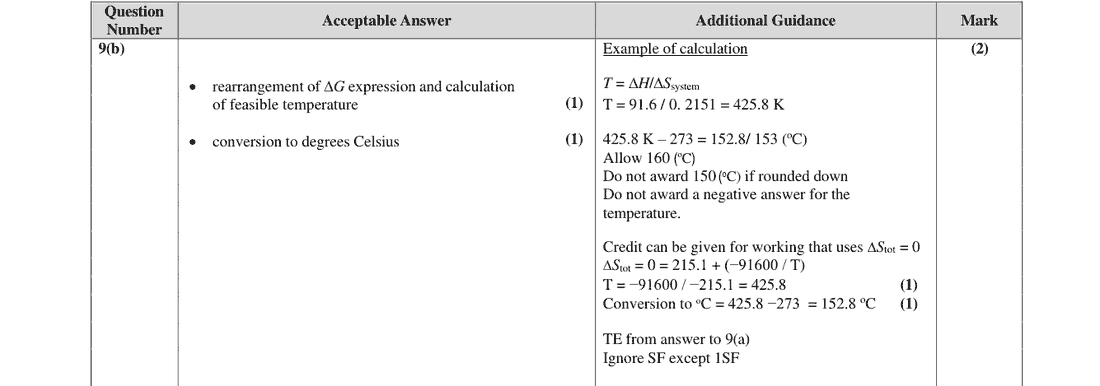
June 2024 · Paper 1 · Q9(b)2 marksCalculation
Earlier part of question 9 that this part uses
Mark scheme
Examiner's comment
This question was about entropy and Gibbs free energy and required candidates to determine the minimum required temperature for a chemical reaction from given data.
Part (a)
For the first mark the candidates needed to calculate the entropy change of the system. Many correct answers were seen.
For the second part the candidates needed to calculate the Gibbs free energy and comment on why the reaction was not feasible.
Candidates needed to convert both the entropy and the enthalpy change of the reaction so that both were in J or kJ and then calculate the Gibbs free energy change.
The most frequent mark that was lost was for not giving the correct units for Gibbs free energy that would be consistent with their calculation.
The third mark proved accessible with many correct responses noting that the reaction would not be feasible at 298K as the Gibbs free energy change was positive.
Part (b)
Candidates needed to rearrange the Gibbs free energy equation to calculate a feasible temperature in K.
They then needed to convert this to °C for the final answer.
There was an alternative route to the same answer via a total entropy change of 0. Few candidates opted for this method.
Many fully correct answers were seen, with a few candidates adding 273 instead of subtracting it to convert from K to °C.
Notes from the mark scheme and report
Answer: 153 °C. T = ΔH / ΔSsystem = 91.6 / 0.2151 = 425.8 K
subtract 273. 160 allowed
150 (rounded down) not allowed. Uses the values from (a)
Skills: MS0.0 Recognise and make use of appropriate units in calculation; MS2.2 Change the subject of an equation
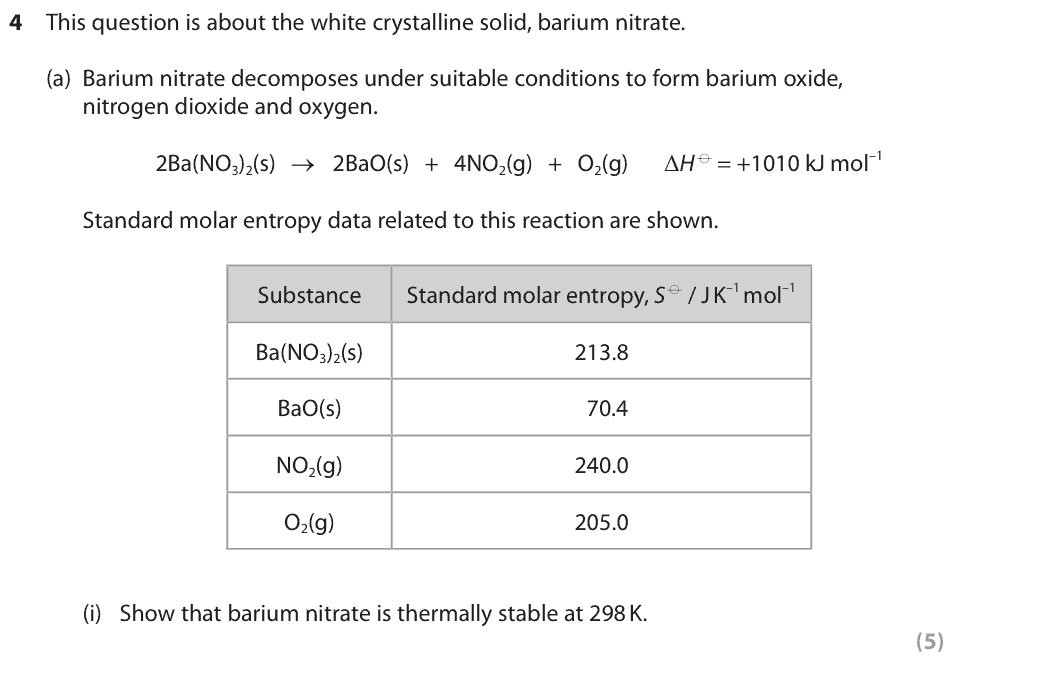
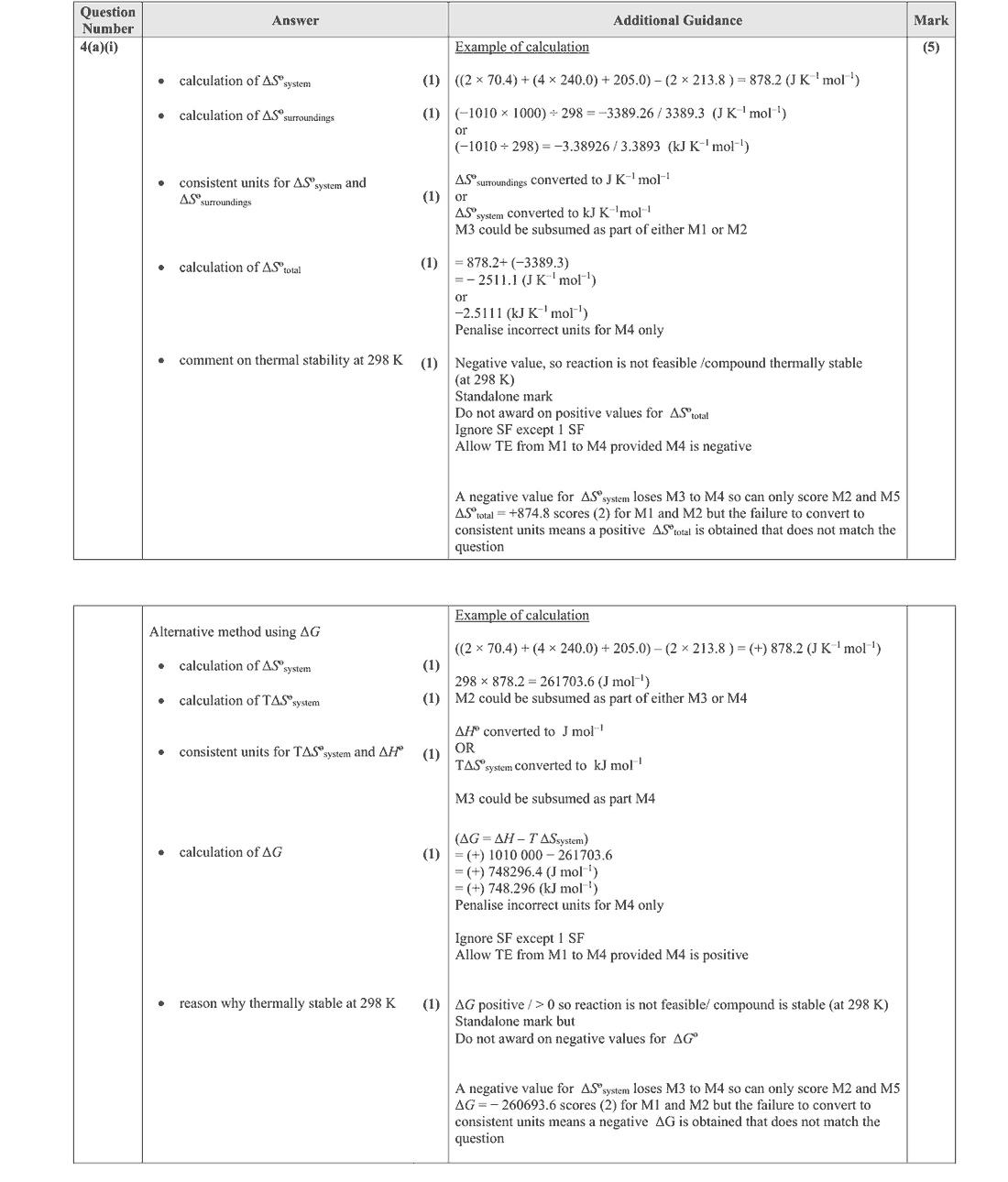
June 2024 · Paper 3 · Q4(a)(i)5 marksCalculation
Mark scheme
Examiner's comment
There were large numbers of correct answers to part (a)(i) either by the total entropy change ‘route’ or the Gibbs Free Energy change ‘route’. Occasionally a mark was lost for giving incorrect units for the final answer, either including Kelvin for the Gibbs Free Energy change value or for omitting such for the total entropy change value. A small minority confused the two methods. There was also a small number of candidates that calculated a negative value for the entropy change of the system and use of this value would result in a final value that suggested the reaction was feasible instead of not so. This should have prompted candidates to revisit their initial calculation to determine their error. Alas this seemed to be rarely the case. The vast majority of candidates found the calculation in part (a)(ii) very accessible but there were a sizeable number who missed the requirement in the question to firstly convert to degrees Celsius and secondly, to give the answer to two or three significant figures. The third mark was dependent on doing both of these two things. Part (b) was another question on a familiar topic for candidates and this was evident in the many excellent answers covering all three necessary points. The marks which were lost tended to be more likely as a result of lack of precision than of understanding. For example, polarising the nitrate ion by the calcium ion means a distortion of the nitrate electron cloud. Use of the specialist term ‘polarising’ covers this. If a candidate chooses to describe this rather than use the specialist term then fine, but all aspects are required. It is not enough to just state that the calcium ion distorts the nitrate ion, there needs to be explicit reference to the electron cloud. Likewise, the effect of this polarisation is the weakening of the bonds within the nitrate. It is not the bond between the calcium ion and the nitrate ion which is weakened and this needed to be made clear. Also it is worth reminding candidates that charge density is not the same as electron density. The balancing of the ionic equation in part (c)(i) was only achieved by the more able candidates. The suggestion to use oxidation numbers in the question was given to aid the candidates but this was not often heeded. Nevertheless, there were a reasonable number of candidates that scored the mark. The simple test for ammonia in part (c)(ii) was well-known with only the occasional reverse colour change to red being stated.
Notes from the mark scheme and report
Answer: ΔStotal = –2511 J K–1 mol–1 (negative), so decomposition is not feasible and barium nitrate is stable at 298 K. ΔSsystem = (2 × 70.4) + (4 × 240.0) + 205.0 – (2 × 213.8) = +878.2 J K–1 mol–1
ΔStotal = 878.2 – 3389.3. Alternative: ΔG = 1010 – (298 × 0.8782) = +748.3 kJ mol–1, positive so not feasible. Wrong units are penalised on the fourth mark only. Common errors: wrong units on the final value (K–1 on ΔG, or missing from ΔStotal)
mixing the two methods
a negative ΔSsystem
Skills: MS0.0 Recognise and make use of appropriate units in calculation; MS2.3 Substitute numerical values into algebraic equations using appropriate units for physical quantities
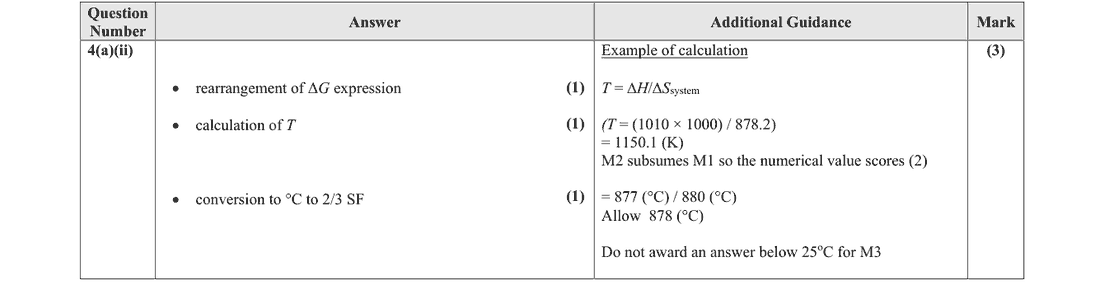
June 2024 · Paper 3 · Q4(a)(ii)3 marksCalculation
Earlier part of question 4 that this part uses
Mark scheme
Examiner's comment
There were large numbers of correct answers to part (a)(i) either by the total entropy change ‘route’ or the Gibbs Free Energy change ‘route’. Occasionally a mark was lost for giving incorrect units for the final answer, either including Kelvin for the Gibbs Free Energy change value or for omitting such for the total entropy change value. A small minority confused the two methods. There was also a small number of candidates that calculated a negative value for the entropy change of the system and use of this value would result in a final value that suggested the reaction was feasible instead of not so. This should have prompted candidates to revisit their initial calculation to determine their error. Alas this seemed to be rarely the case. The vast majority of candidates found the calculation in part (a)(ii) very accessible but there were a sizeable number who missed the requirement in the question to firstly convert to degrees Celsius and secondly, to give the answer to two or three significant figures. The third mark was dependent on doing both of these two things. Part (b) was another question on a familiar topic for candidates and this was evident in the many excellent answers covering all three necessary points. The marks which were lost tended to be more likely as a result of lack of precision than of understanding. For example, polarising the nitrate ion by the calcium ion means a distortion of the nitrate electron cloud. Use of the specialist term ‘polarising’ covers this. If a candidate chooses to describe this rather than use the specialist term then fine, but all aspects are required. It is not enough to just state that the calcium ion distorts the nitrate ion, there needs to be explicit reference to the electron cloud. Likewise, the effect of this polarisation is the weakening of the bonds within the nitrate. It is not the bond between the calcium ion and the nitrate ion which is weakened and this needed to be made clear. Also it is worth reminding candidates that charge density is not the same as electron density. The balancing of the ionic equation in part (c)(i) was only achieved by the more able candidates. The suggestion to use oxidation numbers in the question was given to aid the candidates but this was not often heeded. Nevertheless, there were a reasonable number of candidates that scored the mark. The simple test for ammonia in part (c)(ii) was well-known with only the occasional reverse colour change to red being stated.
Notes from the mark scheme and report
Answer: 877 °C (or 880 °C). T = ΔH ÷ ΔSsystem = 1 010 000 ÷ 878.2 = 1150.1 K
subtract 273. Third mark needs the conversion to °C and 2 or 3 significant figures. The calculation was very accessible, but a sizeable number did not convert to °C or give 2 or 3 significant figures
Skills: MS0.0 Recognise and make use of appropriate units in calculation; MS1.1 Use an appropriate number of significant figures; MS2.2 Change the subject of an equation
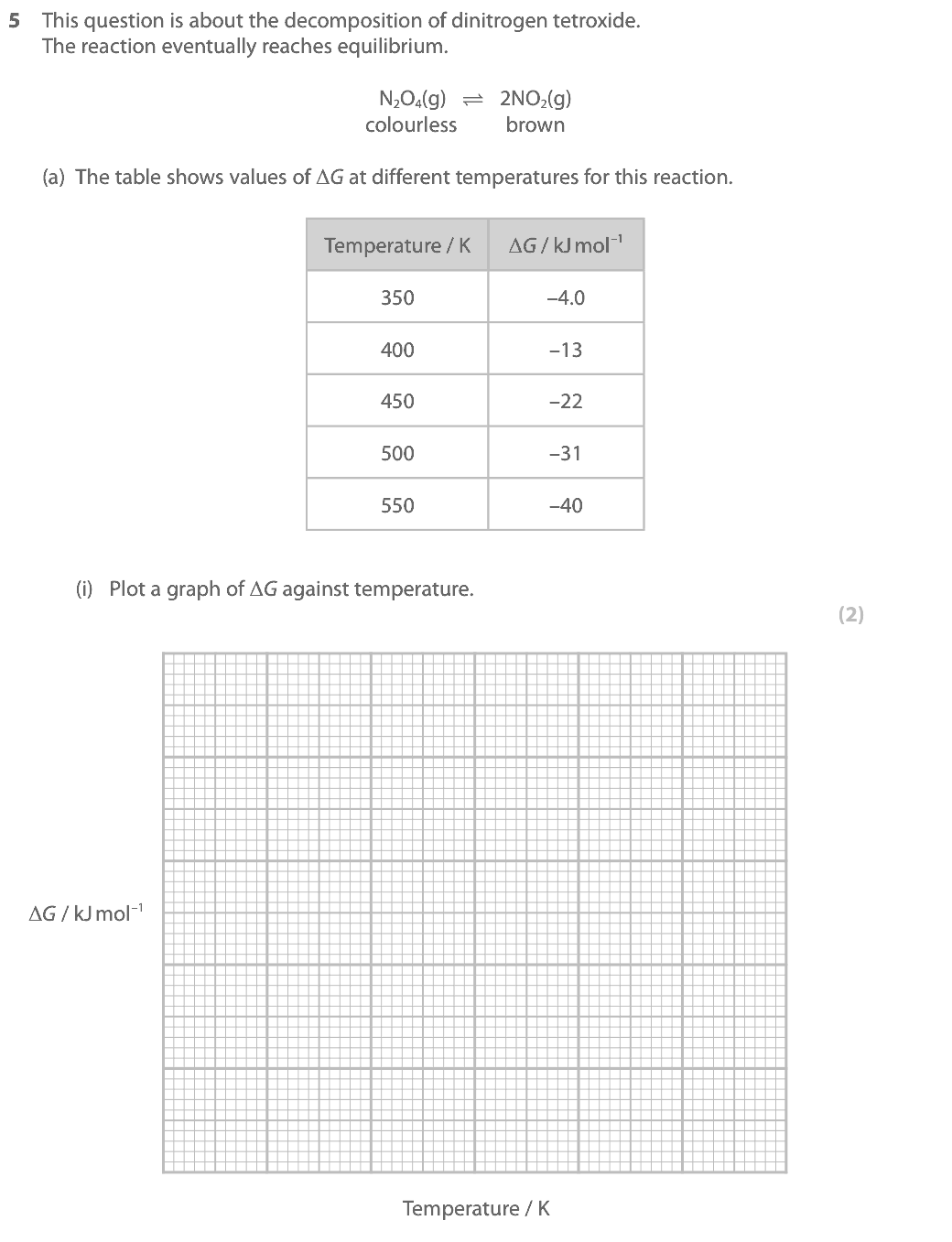
June 2023 · Paper 1 · Q5(a)(i)2 marksDiagram or structure
Mark scheme
Examiner's comment
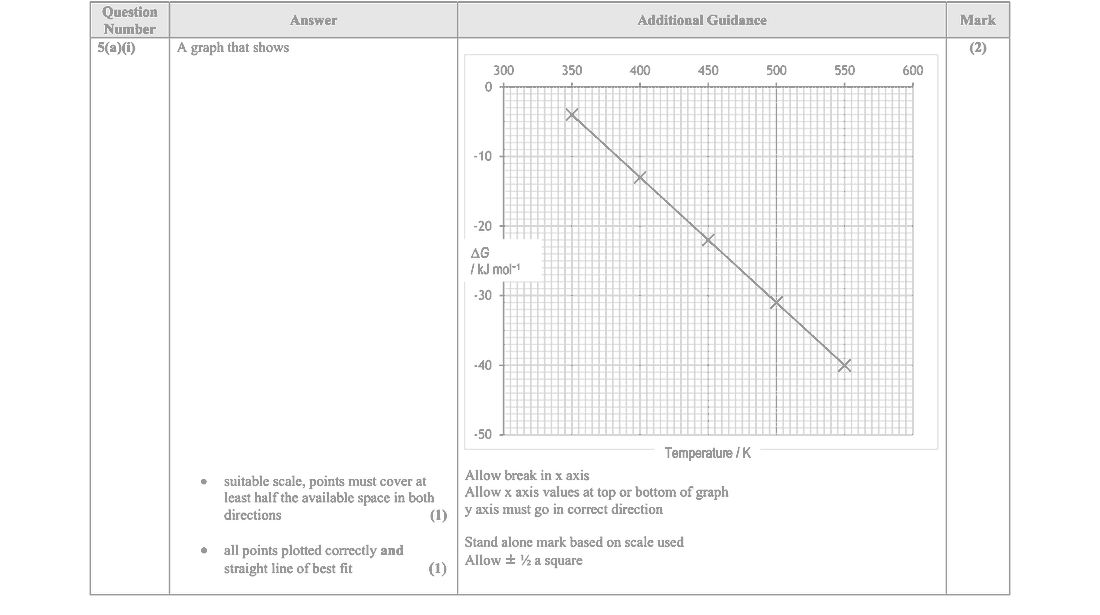
(i) The graph was drawn correctly by the majority of the candidates. The common errors included: numbering the y axis in the wrong direction and not choosing a suitable scale for the x axis so that the plotted points occupied more than half of the graph paper.
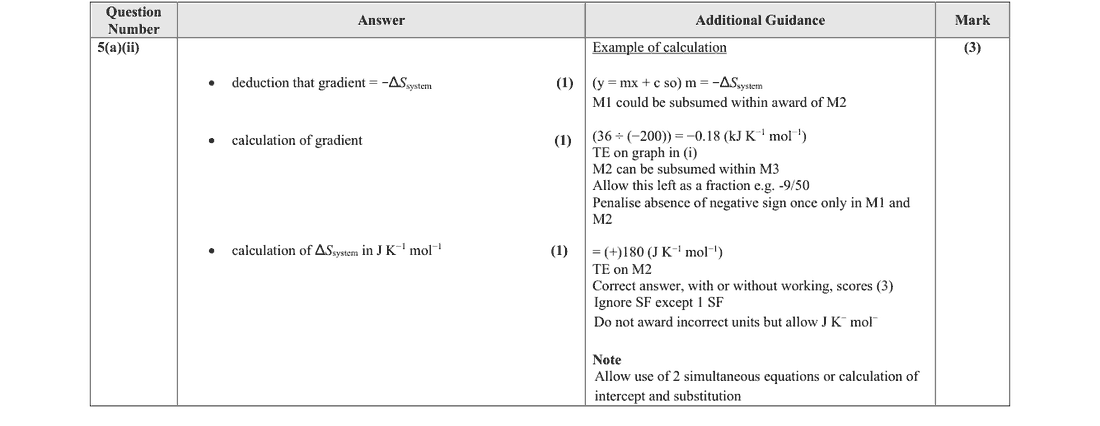
(ii) Candidates who used the equation given to deduce that the gradient of the graph is equal to –ΔSsystem were usually able to compile the calculation and score 3 marks. Many candidates
just tried to rearrange the equation and were unable to eliminate ΔH. A few candidates were successful at using two simultaneous equations but most who tried that method forgot to
convert the units of ΔG into J mol–1.
Notes from the mark scheme and report
M1: a suitable scale, with the points covering at least half the grid in both directions and the ΔG axis running in the correct direction (a break in the temperature axis is allowed). M2: all five points plotted to within half a square and a straight line of best fit. Drawn correctly by the majority
errors were numbering the ΔG axis in the wrong direction and a temperature scale that squeezed the points into less than half the grid
Skills: MS3.2 Plot two variables from experimental or other data
June 2023 · Paper 1 · Q5(a)(ii)3 marksCalculation
Earlier part of question 5 that this part uses
Mark scheme
Examiner's comment
(i) The graph was drawn correctly by the majority of the candidates. The common errors included: numbering the y axis in the wrong direction and not choosing a suitable scale for the x axis so that the plotted points occupied more than half of the graph paper.
(ii) Candidates who used the equation given to deduce that the gradient of the graph is equal to –ΔSsystem were usually able to compile the calculation and score 3 marks. Many candidates
just tried to rearrange the equation and were unable to eliminate ΔH. A few candidates were successful at using two simultaneous equations but most who tried that method forgot to
convert the units of ΔG into J mol–1.
Notes from the mark scheme and report
Answer: (+)180 J K–1 mol–1. Comparing ΔG = –TΔSsystem + ΔH with y = mx + c, gradient = –ΔSsystem
gradient = –36 ÷ 200 = –0.18 kJ K–1 mol–1
ΔSsystem = +0.18 kJ K–1 mol–1 = 180 J K–1 mol–1. Transferred error from the candidate's graph
simultaneous equations or intercept-and-substitute also accepted
a missing negative sign is penalised once
not 1 SF. Those who saw the gradient link usually scored 3
many tried to rearrange and could not eliminate ΔH
with simultaneous equations the kJ to J conversion was often forgotten
Skills: MS0.0 Recognise and make use of appropriate units in calculation; MS3.1 Translate information between graphical, numerical and algebraic forms; MS3.3 Determine the slope and intercept of a linear graph
June 2023 · Paper 1 · Q5(a)(iii)1 markMultiple choice
Earlier parts of question 5 that this part uses
Answer
C
Mark scheme
Notes from the mark scheme and report
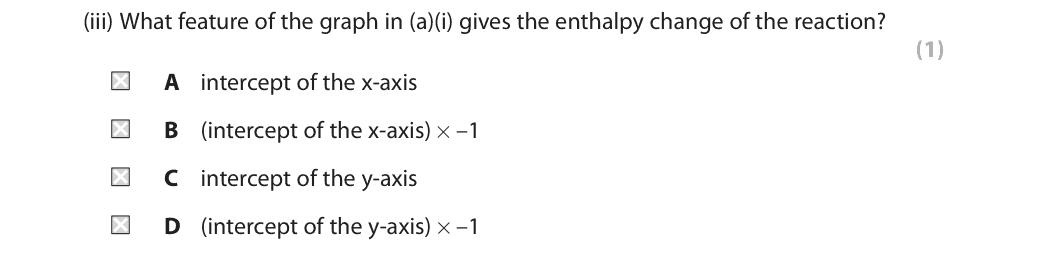
Answer: C (intercept on the y-axis). At T = 0, ΔG = ΔH. D would give –ΔH
A and B would be temperatures
Skills: MS3.3 Determine the slope and intercept of a linear graph
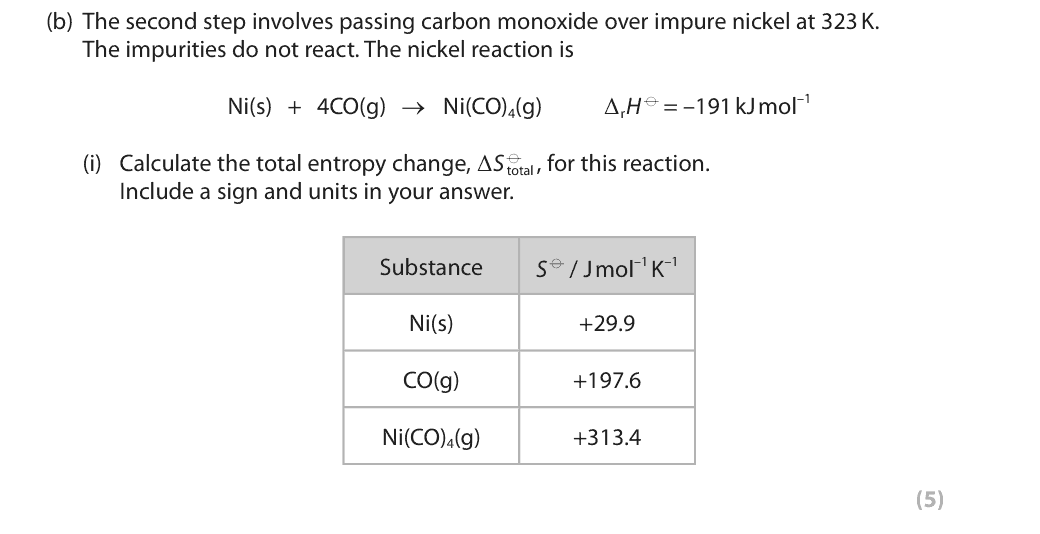
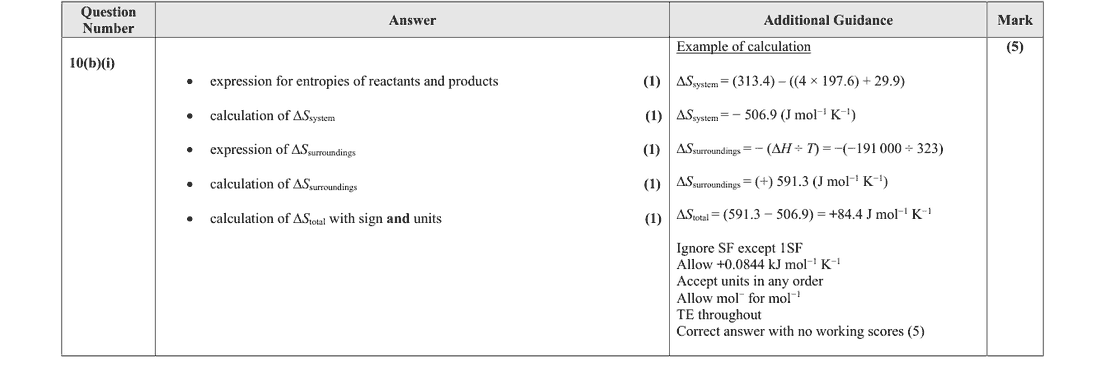
June 2023 · Paper 3 · Q10(b)(i)5 marksCalculation
Earlier part of question 10 that this part uses
Mark scheme
Examiner's comment
Many, many candidates scored full marks on this calculation and were not hampered significantly by a poor layout. These entropy calculations have clearly been well practised by centres and their candidates, and this has paid off.
The frustrating error seen relatively frequently was the omission of the sign and units required in the question.
total = 591.3 – 506.9. Sign and units needed for the last mark, and were the usual thing left off
Skills: MS0.0 Recognise and make use of appropriate units in calculation; MS2.3 Substitute numerical values into algebraic equations using appropriate units for physical quantities
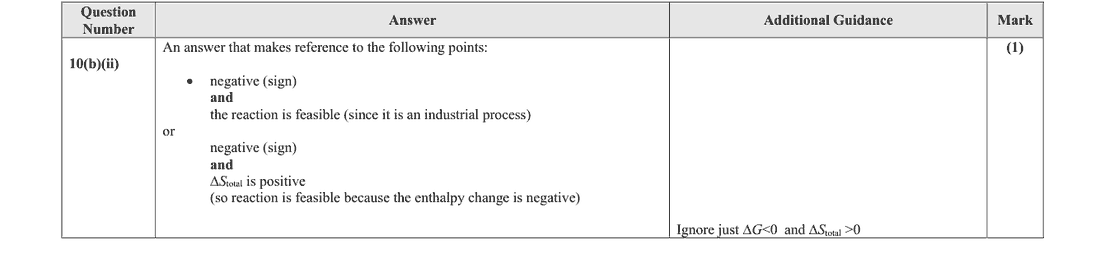
June 2023 · Paper 3 · Q10(b)(ii)1 markShort answer
Earlier parts of question 10 that this part uses
Mark scheme
Examiner's comment
This was one of the easier questions at the end of the paper. It was hoped that candidates would appreciate that the reaction was feasible because it was carried out in industry so the sign for Gibbs Free Energy Change had to be negative. However, this was rarely seen. The majority of candidates reasoned on the fact that the total entropy value was positive and so the reaction must be feasible, but this was fine for the mark. A small number of candidates did try to reason on the magnitude of the TΔS value compared to the enthalpy change, which was acceptable but harder to express correctly.
Notes from the mark scheme and report
Negative, with a reason: the reaction is feasible (it is used industrially), or ΔStotal is positive. Just 'ΔG < 0' with 'ΔStotal > 0' is ignored. Most argued from the positive total entropy change
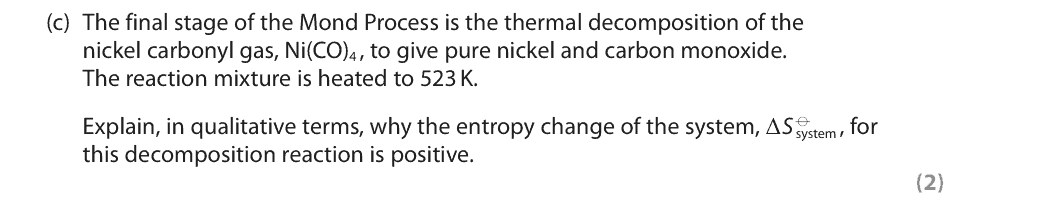
June 2023 · Paper 3 · Q10(c)2 marksExplanationHard
Earlier part of question 10 that this part uses
Mark scheme
Examiner's comment
Centres and their candidates are reminded that the rigor or demand of the paper is designed to increase progressively through the paper. Hence this question, which seems relatively straightforward and similar to previous entropy qualitative questions, has greater demand than might usually be expected. The mark scheme was kept strict and so this was a low- scoring question. It was not sufficient to simply refer to an increase in moles as a reason for the positive entropy change of the system. The crucial point is that there is an increase in the number of gaseous moles. The second mark was only given to the most astute candidates. The formation of a solid in the reaction serves to decrease the entropy of the system but is more than offset by the increase in moles of gas from one to four.
Notes from the mark scheme and report
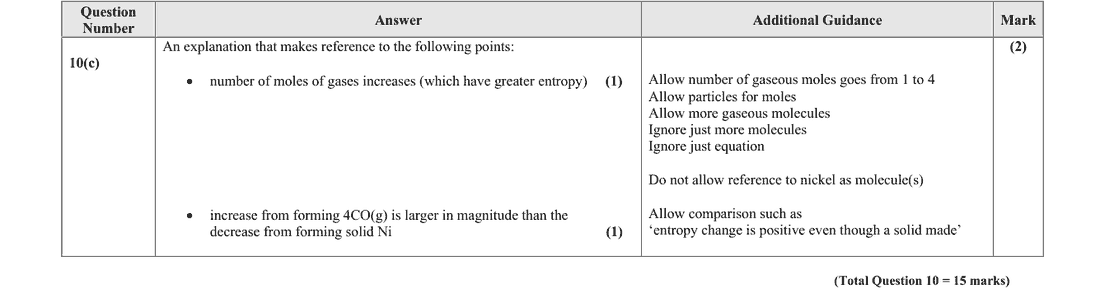
The number of moles of GAS increases, from 1 to 4 (just 'more moles' or 'more molecules' is not enough)
and the entropy increase from forming 4CO(g) outweighs the decrease from forming solid nickel. The second mark went only to the most astute
June 2022 · Paper 3 · Q4(a)(i)5 marksCalculation
Mark scheme
Examiner's comment
There were many excellent answers to the calculation in Q04ai and they were approximately evenly split between those who calculated ΔStotal and those who calculated ΔG. The most
common errors were to forget to change one of the initial values so that they were in
consistent units for the final step in the calculation and to give J K-1 mol-1 as units for ΔG.
In Q04aii, the most common errors were to fail to convert the temperature to oC or to include too many significant figures in the final answer.
Notes from the mark scheme and report
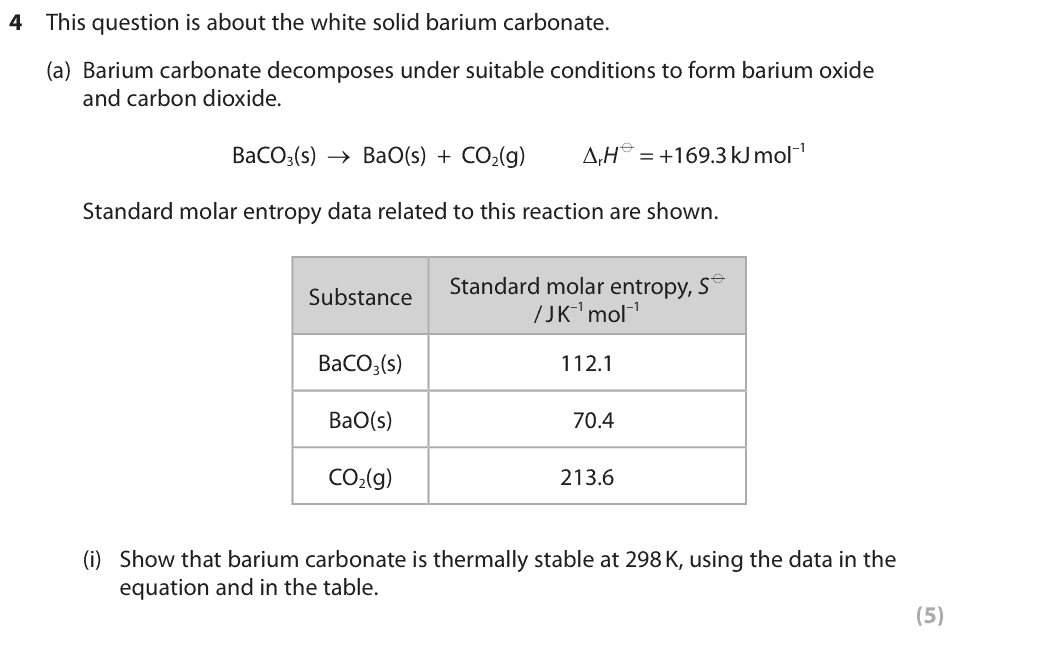
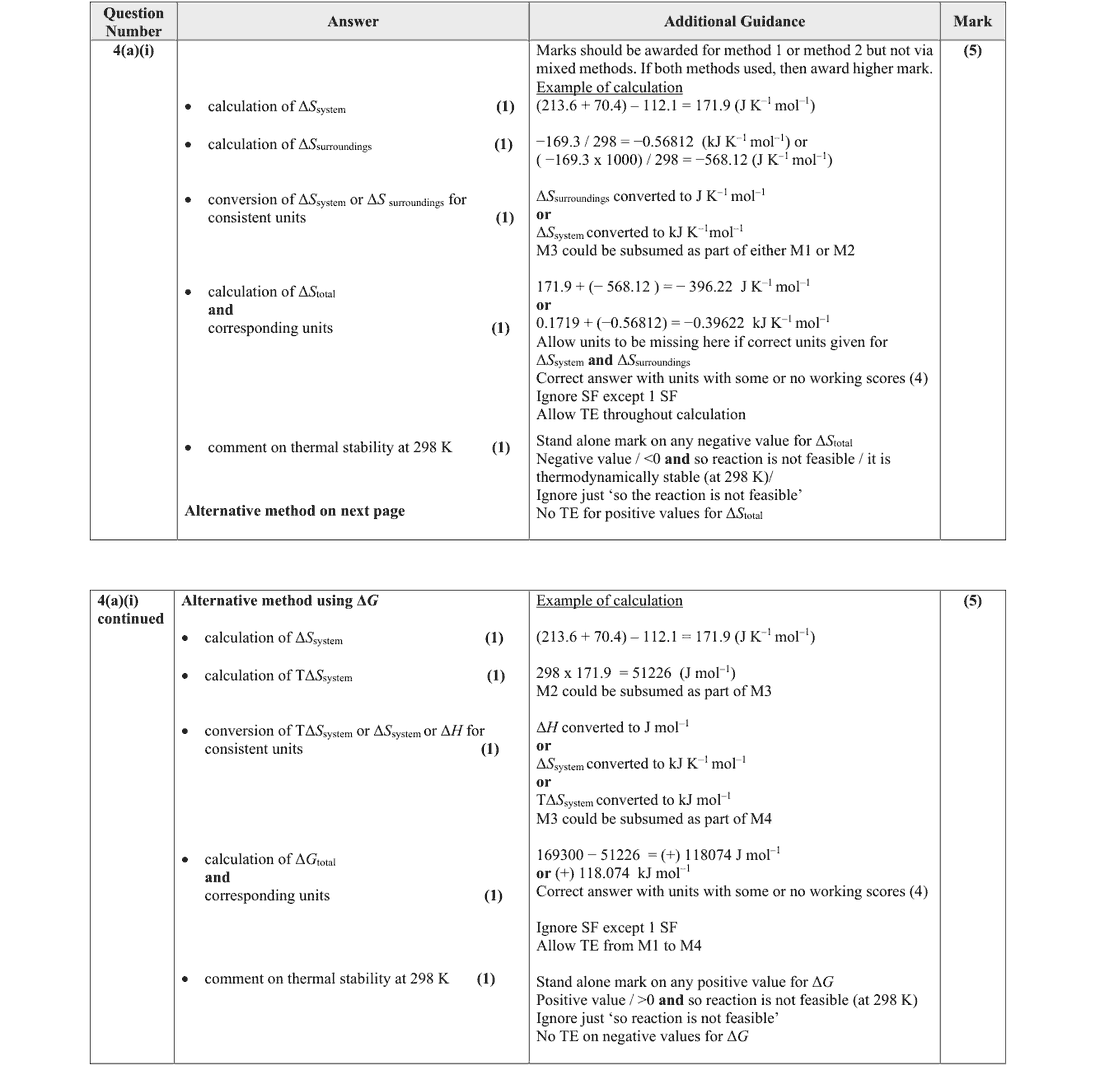
Answer: ΔStotal = –396 J K–1 mol–1 (negative, so decomposition is not feasible and the carbonate is stable at 298 K). ΔSsystem = (213.6 + 70.4) – 112.1 = +171.9 J K–1 mol–1
comment. Alternative: ΔG = 169 300 – (298 × 171.9) = +118 074 J mol–1 (+118 kJ mol–1), positive so not feasible. Methods must not be mixed. Common errors: inconsistent units (kJ with J)
J K–1 mol–1 given as the unit of ΔG
Skills: MS0.0 Recognise and make use of appropriate units in calculation; MS2.3 Substitute numerical values into algebraic equations using appropriate units for physical quantities
June 2022 · Paper 3 · Q4(a)(ii)3 marksCalculation
Earlier part of question 4 that this part uses
Mark scheme
Examiner's comment
There were many excellent answers to the calculation in Q04ai and they were approximately evenly split between those who calculated ΔStotal and those who calculated ΔG. The most
common errors were to forget to change one of the initial values so that they were in
consistent units for the final step in the calculation and to give J K-1 mol-1 as units for ΔG.
In Q04aii, the most common errors were to fail to convert the temperature to oC or to include too many significant figures in the final answer.
Notes from the mark scheme and report
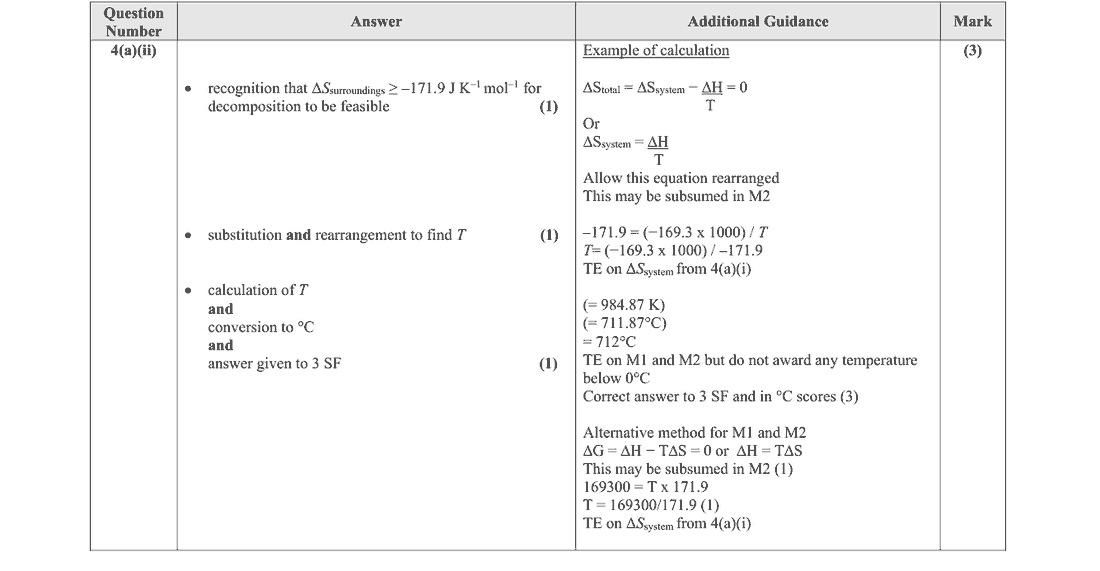
Answer: 712 °C. Feasible when ΔStotal = 0 (or ΔG = 0), so T = ΔH ÷ ΔSsystem = 169 300 ÷ 171.9 = 984.87 K
subtract 273 and give 3 s.f. Error carried forward from ΔSsystem in (a)(i). Common errors: not converting to °C
too many significant figures
Skills: MS1.1 Use an appropriate number of significant figures; MS2.2 Change the subject of an equation
November 2021 · Paper 1 · Q6(a)(i)2 marksShort answer
Mark scheme
Examiner's comment
The reasoning required for the positive entropy change of the system in (a)(i) was that often
sought and candidates who had practice this type of question did well. Occasionally a
candidate would negate their correct comment on the increase in the number of moles of
product by stating incorrect molar ratios such as 11 to 13 instead of 3 to 13. An error like this
resulted in the mark being lost so candidates need to take care if they given molar ratios.
There were many unusual answers given to part (a)(ii). For example, the formation of steam
causing the wooden block to rise was seem more than once, and the cohesive nature of
hydrogen bonding was also given as a reason for the wooden block being attached to the flask.
It may have been that candidates have not seen many demonstrations due to the impact of
COVID but candidates are expected to have some practical awareness. The endothermic
reaction between hydrated barium hydroxide and ammonium thiocyanate is explicitly stated in
the specification at 13B 14iii and so candidates should have realised that heat energy would
have been withdrawn from the surroundings causing the water to freeze.
Notes from the mark scheme and report
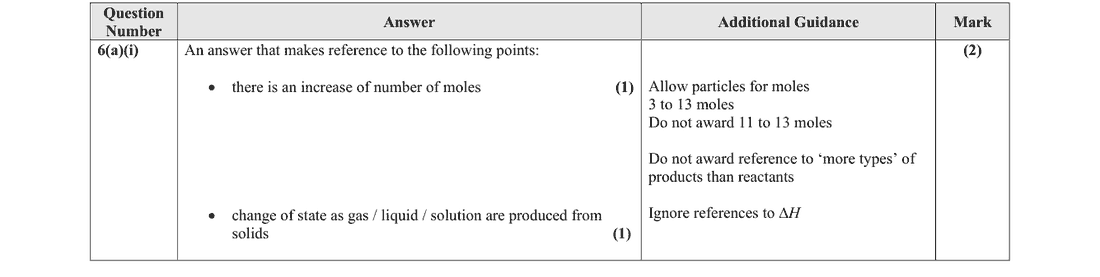
M1: the number of moles (particles) increases, from 3 to 13. M2: there is a change of state: a gas, a liquid and a solution are formed from solids. Not '11 to 13 moles'
not 'more types of product'
ignore ΔH. A correct statement was sometimes negated by a wrong ratio such as 11 to 13
November 2021 · Paper 1 · Q6(a)(ii)2 marksExplanation
Earlier part of question 6 that this part uses
Mark scheme
Examiner's comment
The reasoning required for the positive entropy change of the system in (a)(i) was that often
sought and candidates who had practice this type of question did well. Occasionally a
candidate would negate their correct comment on the increase in the number of moles of
product by stating incorrect molar ratios such as 11 to 13 instead of 3 to 13. An error like this
resulted in the mark being lost so candidates need to take care if they given molar ratios.
There were many unusual answers given to part (a)(ii). For example, the formation of steam
causing the wooden block to rise was seem more than once, and the cohesive nature of
hydrogen bonding was also given as a reason for the wooden block being attached to the flask.
It may have been that candidates have not seen many demonstrations due to the impact of
COVID but candidates are expected to have some practical awareness. The endothermic
reaction between hydrated barium hydroxide and ammonium thiocyanate is explicitly stated in
the specification at 13B 14iii and so candidates should have realised that heat energy would
have been withdrawn from the surroundings causing the water to freeze.
Notes from the mark scheme and report
M1: the reaction is endothermic (it takes in heat from the surroundings). M2: so the water between the flask and the block freezes, sticking the block to the flask. This reaction is named in the specification (13.14 guidance). Unusual wrong answers: steam lifting the block
hydrogen bonding holding the block to the flask
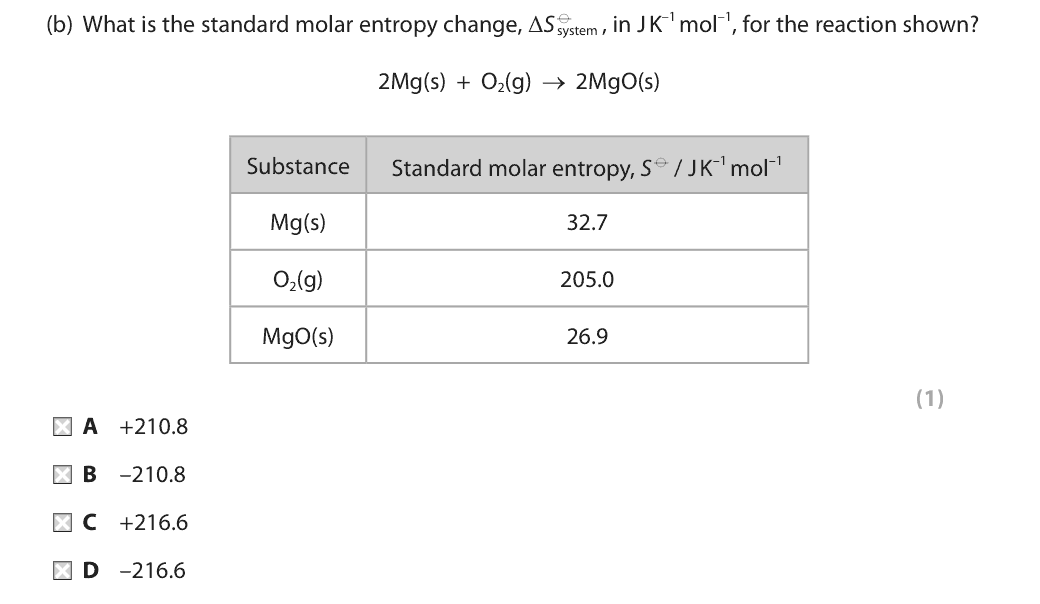
November 2021 · Paper 1 · Q6(b)1 markMultiple choice
Earlier part of question 6 that this part uses
Answer
D
Mark scheme
Examiner's comment
The reasoning required for the positive entropy change of the system in (a)(i) was that often
sought and candidates who had practice this type of question did well. Occasionally a
candidate would negate their correct comment on the increase in the number of moles of
product by stating incorrect molar ratios such as 11 to 13 instead of 3 to 13. An error like this
resulted in the mark being lost so candidates need to take care if they given molar ratios.
There were many unusual answers given to part (a)(ii). For example, the formation of steam
causing the wooden block to rise was seem more than once, and the cohesive nature of
hydrogen bonding was also given as a reason for the wooden block being attached to the flask.
It may have been that candidates have not seen many demonstrations due to the impact of
COVID but candidates are expected to have some practical awareness. The endothermic
reaction between hydrated barium hydroxide and ammonium thiocyanate is explicitly stated in
the specification at 13B 14iii and so candidates should have realised that heat energy would
have been withdrawn from the surroundings causing the water to freeze.
Notes from the mark scheme and report
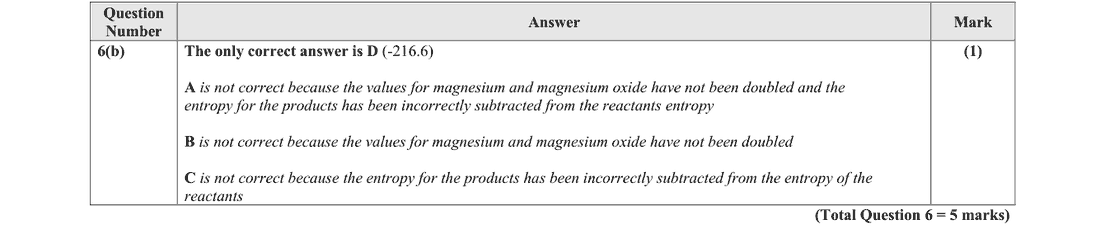
Answer: D (–216.6). (2 × 26.9) – ((2 × 32.7) + 205.0) = 53.8 – 270.4. B does not double the Mg and MgO values
C subtracts products from reactants
A makes both errors
Skills: MS2.3 Substitute numerical values into algebraic equations using appropriate units for physical quantities
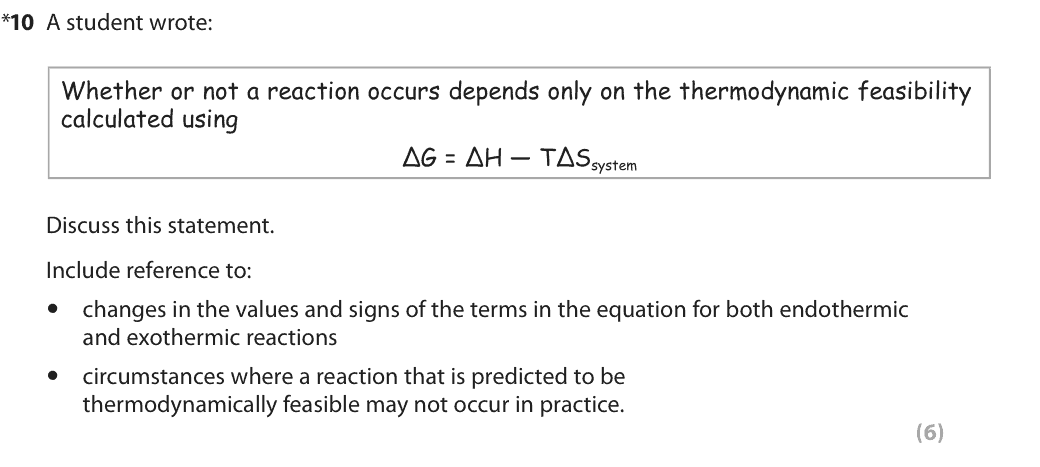
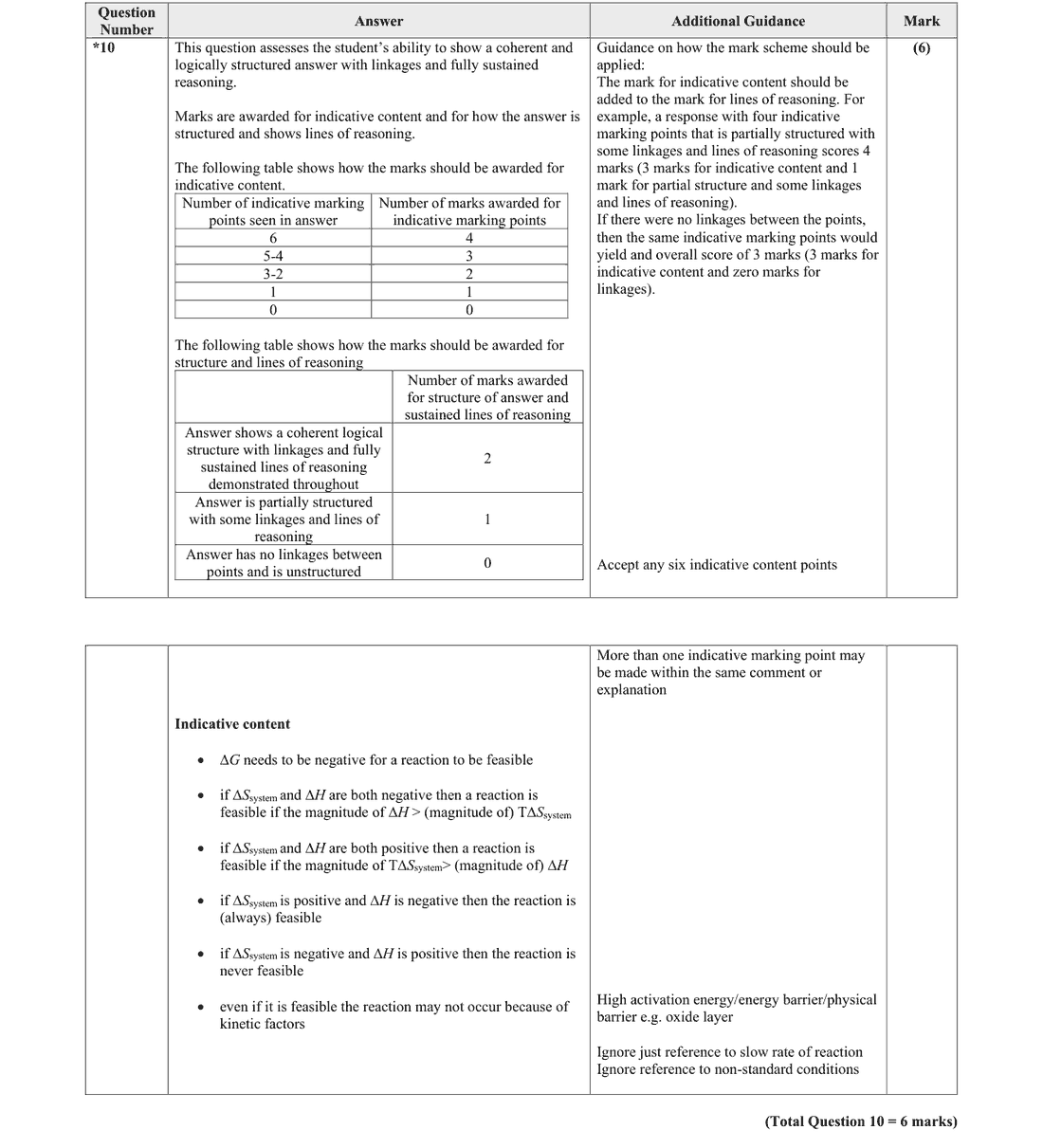
November 2021 · Paper 1 · Q106 marks6-mark extended response
Mark scheme, with the indicative content and the marks for reasoning
Examiner's comment
There were some good answers seen that gave a clear and accurate account of the
thermodynamic feasibility of reactions. However, there were also some answers which were
very poor giving very low scores. Common errors were those who compared the entropy
change of the system to Gibbs Free Energy change instead of the enthalpy change or those
who wrote about exothermic and endothermic reactions stating that their enthalpy change
signs were the determining factor in feasibility.
It was a challenge for students to be clear when referring to the effect of a change in the sign of
the entropy change of the system in the expression T∆Ssystem because the sum has a minus
sign in front of this expression. Hence some candidates made good use of tables in their
answers.
The marks most frequently scored were the reference to the need for Gibbs Free Energy
change to be negative for feasibility and that feasibility was affected by a high activation
energy.
Notes from the mark scheme and report
Six indicative points plus two marks for reasoning. IP1 ΔG must be negative for a reaction to be feasible
IP2 if ΔH and ΔSsystem are both negative, it is feasible only when the magnitude of ΔH is greater than that of TΔSsystem (lower temperatures)
IP3 if both are positive, feasible only when TΔSsystem is greater than ΔH (higher temperatures)
IP4 if ΔSsystem is positive and ΔH negative, always feasible
IP5 if ΔSsystem is negative and ΔH positive, never feasible
IP6 a feasible reaction may still not happen for kinetic reasons: a high activation energy or a physical barrier such as an oxide layer. Just 'slow rate' and non-standard conditions are ignored. The points most often scored were IP1 and the activation energy point. Errors: comparing ΔSsystem with ΔG rather than with ΔH
saying the sign of ΔH alone decides feasibility
muddles over the minus sign in front of TΔSsystem (a table of the four cases helps)
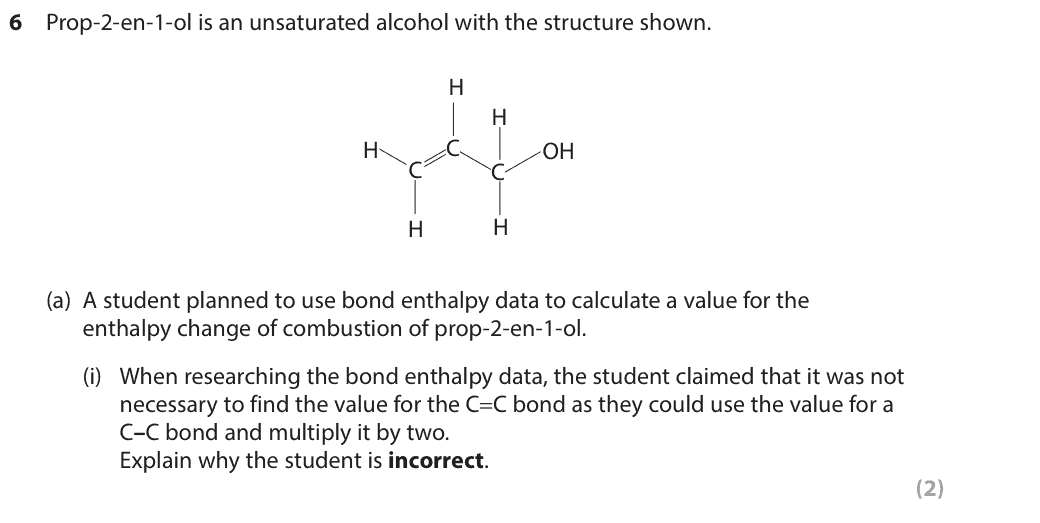
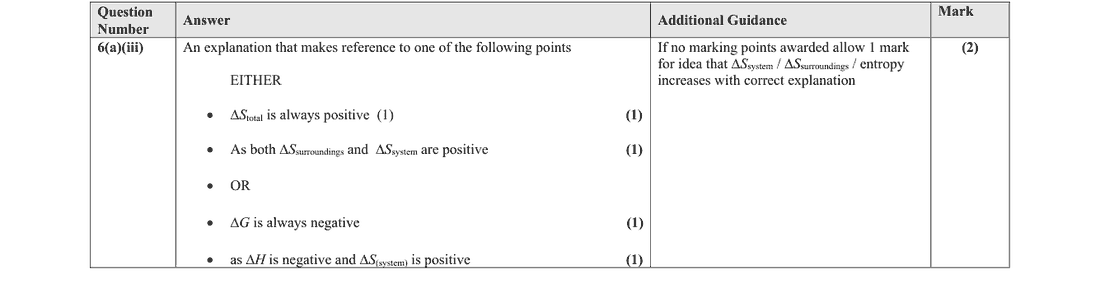
October 2020 · Paper 1 · Q6(a)(iii)2 marksExplanation
Earlier part of question 6 that this part uses
Mark scheme
Examiner's comment
Although many candidates realised that a double bond consists of a pi and sigma bond, far
fewer were able to use this effectively to justify why the student was incorrect in (a)(i), with
most answers simply stating that the double bond was stronger or shorter than the single
bond.
Nearly all candidates knew how to approach the calculation in (ii) and fully correct answers
were seen by a range of candidates. Common errors included omission of the value for
breaking bonds in the oxygen molecules, reversing the values to give an endothermic answer,
and transcription errors with numerical values. Transferred errors meant award of some
credit was possible in most of these cases. In (a)(iii) most answers gave a generic discussion
of entropy, and tended to only score 1 mark for the justification of an entropy increase.
Only a few answers made an effective distinction between ΔStotal, ΔSsystem, and ΔSsurroundings.
Even those who chose to base their answer on ΔG = ΔH - T ΔSsystem, often omitted to mention
ΔSsystem.
The calculation in (b) was often well laid out, with a clear route through the problem shown by
many. A few candidates were inconsistent with units for entropy, and others missed out on
the final mark as they didn’t comment on the feasibility of the reaction in light of their answer.
Some candidates spent time doing additional unrequired work, by also calculating ΔG, but
more problematic was the small number who ignored the instruction to find ΔStotal and tried
to base their response solely on ΔG, often making errors in the process.
Notes from the mark scheme and report
Either: ΔStotal is always positive, because ΔSsurroundings and ΔSsystem are both positive. Or: ΔG is always negative, because ΔH is negative and ΔSsystem is positive. If neither is scored, one mark for an entropy increase with a correct explanation. Most gave a general entropy answer worth 1
few distinguished ΔStotal, ΔSsystem and ΔSsurroundings
October 2020 · Paper 1 · Q6(b)5 marksCalculation
Earlier part of question 6 that this part uses
Mark scheme
Examiner's comment
Although many candidates realised that a double bond consists of a pi and sigma bond, far
fewer were able to use this effectively to justify why the student was incorrect in (a)(i), with
most answers simply stating that the double bond was stronger or shorter than the single
bond.
Nearly all candidates knew how to approach the calculation in (ii) and fully correct answers
were seen by a range of candidates. Common errors included omission of the value for
breaking bonds in the oxygen molecules, reversing the values to give an endothermic answer,
and transcription errors with numerical values. Transferred errors meant award of some
credit was possible in most of these cases. In (a)(iii) most answers gave a generic discussion
of entropy, and tended to only score 1 mark for the justification of an entropy increase.
Only a few answers made an effective distinction between ΔStotal, ΔSsystem, and ΔSsurroundings.
Even those who chose to base their answer on ΔG = ΔH - T ΔSsystem, often omitted to mention
ΔSsystem.
The calculation in (b) was often well laid out, with a clear route through the problem shown by
many. A few candidates were inconsistent with units for entropy, and others missed out on
the final mark as they didn’t comment on the feasibility of the reaction in light of their answer.
Some candidates spent time doing additional unrequired work, by also calculating ΔG, but
more problematic was the small number who ignored the instruction to find ΔStotal and tried
to base their response solely on ΔG, often making errors in the process.
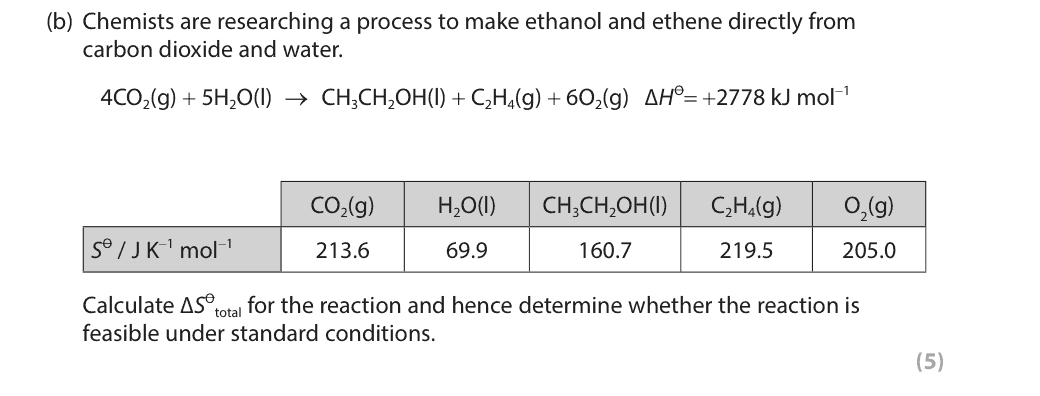
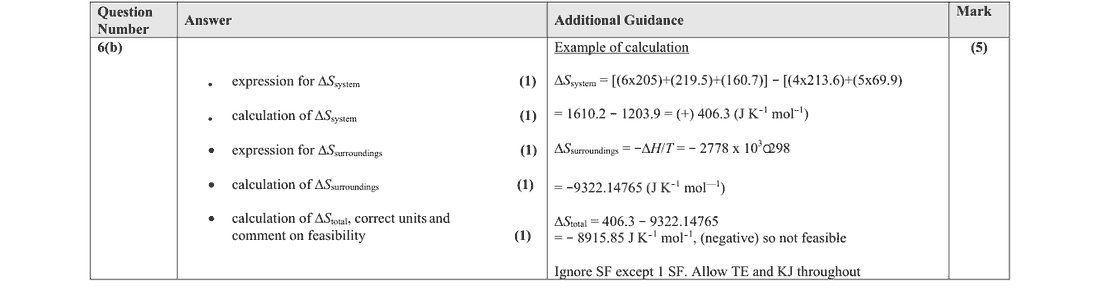
ΔStotal = 406.3 – 9322. Last mark needs the value, units and the comment on feasibility. Common errors: inconsistent entropy units
no comment on feasibility
working from ΔG instead of ΔStotal
Skills: MS0.0 Recognise and make use of appropriate units in calculation; MS2.3 Substitute numerical values into algebraic equations using appropriate units for physical quantities
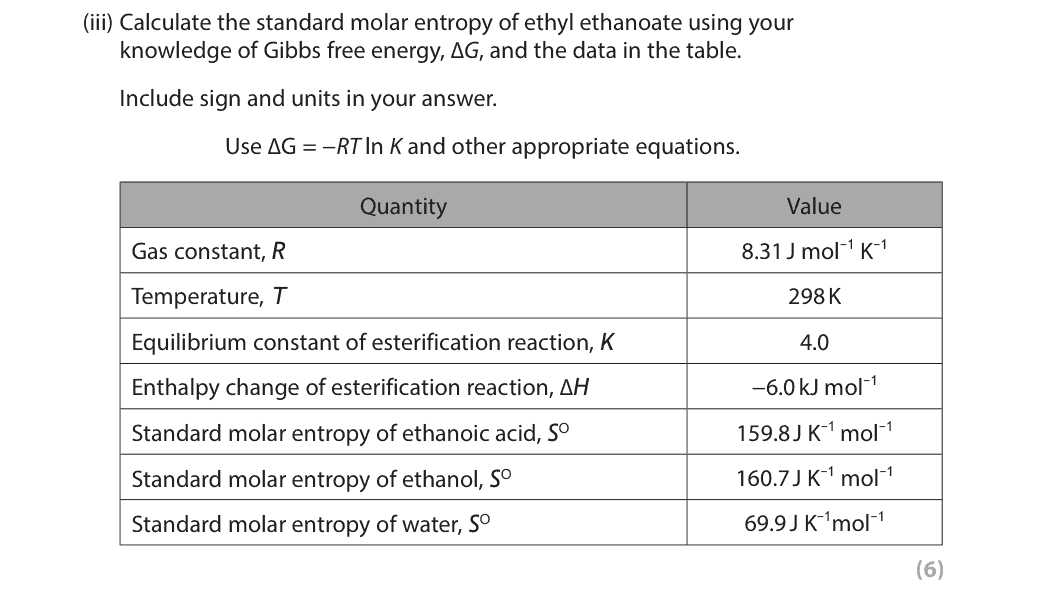
October 2020 · Paper 3 · Q10(a)(iii)6 marksCalculation
Earlier parts of question 10 that this part uses
Mark scheme
Examiner's comment
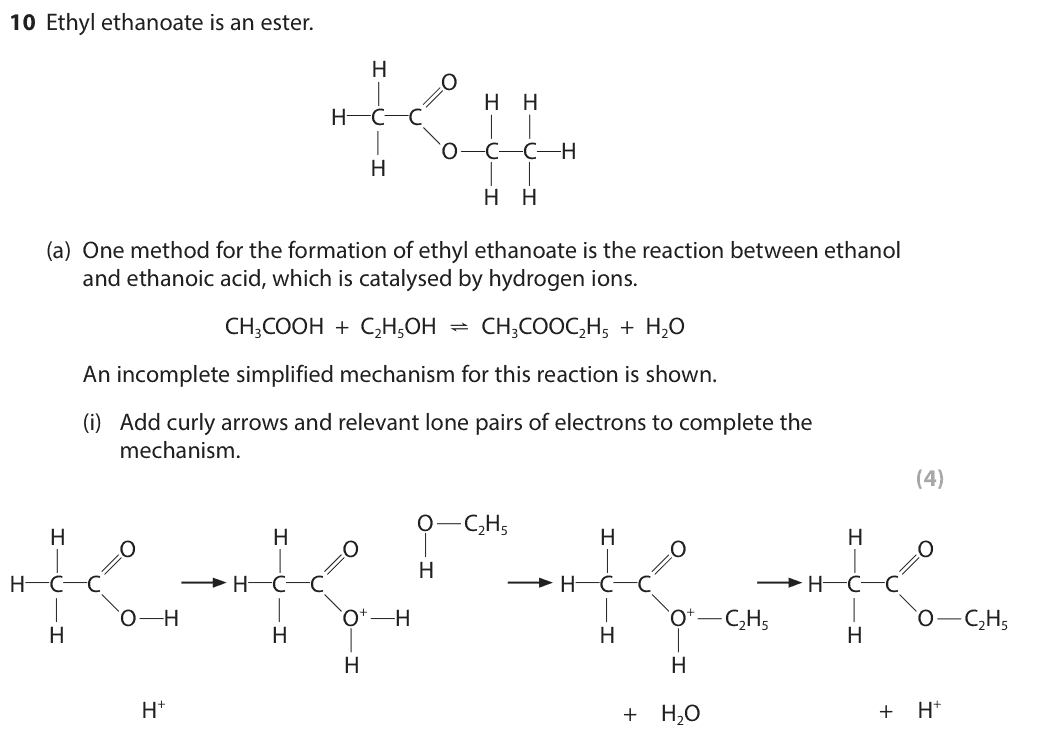
The need to add curly arrows in (a)(i) revealed that many candidates have failed to grasp that
these arrows should start from a lone pair of electrons or a covalent bond and show the
movement of an electron pair. The lack of understanding of this crucial key point was most
clearly seen in the first step where the curly arrow was often drawn originating from the
proton instead of the oxygen lone pair. However this did prove to be a most effective
discriminator and enabled those candidates who really understand this topic to score highly.
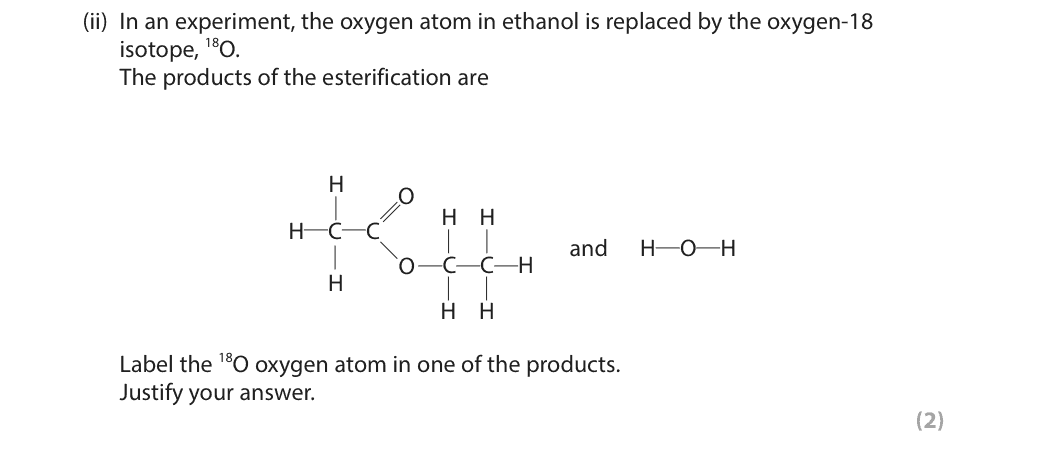
The justification required in (a)(ii) was often very superficial, such as ‘the oxygen comes from
the ethanol’. This was another question aimed at the more able and this category of
candidates were able to either refer to the nucleophilic action of the ethanol oxygen or that
the carbon-oxygen bond in the carboxylic acid was the one broken.
It may be due to the lengthy nature of paper 3 that many candidates did not progress further
in the entropy calculation of part (a)(iii) beyond the M1 mark. The rearrangement of the Gibbs
Free Energy equation proved beyond many and it was disappointing that the instruction to
include sign and units in the final answer was frequently ignored. Nonetheless there were a
significant number of candidates that scored full marks.
The final question (b) required three differences and so it was not sufficient to simply state
that one reaction for example produced hydrogen chloride. It was necessary for the response
to state that the other reaction, namely with ethanoic acid, produced water and so clearly
state the difference. The hardest of the three marks proved to be that an acid catalyst is
required with ethanoic acid with few candidates going on to state that the reaction with
ethanoyl chloride is faster/does not need heating and so does not need a catalyst.
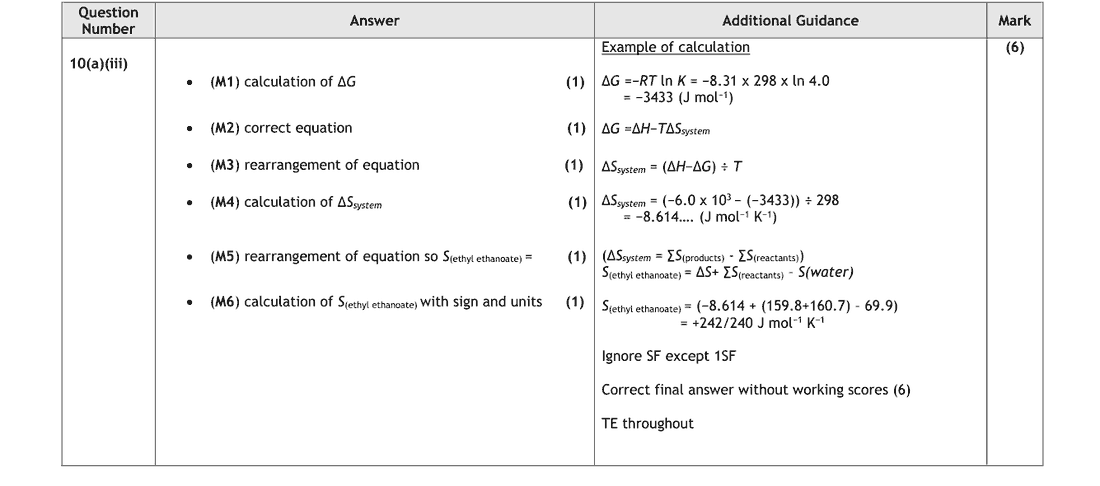
S(ethyl ethanoate) = ΔSsystem + S(reactants) – S(water) = –8.61 + (159.8 + 160.7) – 69.9. Sign and units needed for the last mark
errors carried forward. Many got no further than ΔG
the rearrangement was beyond many
sign and units were often left out
Skills: MS0.4 Use calculators to find and use power, exponential and logarithmic functions; MS2.2 Change the subject of an equation; MS2.3 Substitute numerical values into algebraic equations using appropriate units for physical quantities; MS2.5 Use logarithms in relation to quantities that range over several orders of magnitude
June 2019 · Paper 1 · Q8(b)(i)2 marksCalculation
Earlier part of question 8 that this part uses
Mark scheme
Examiner's comment
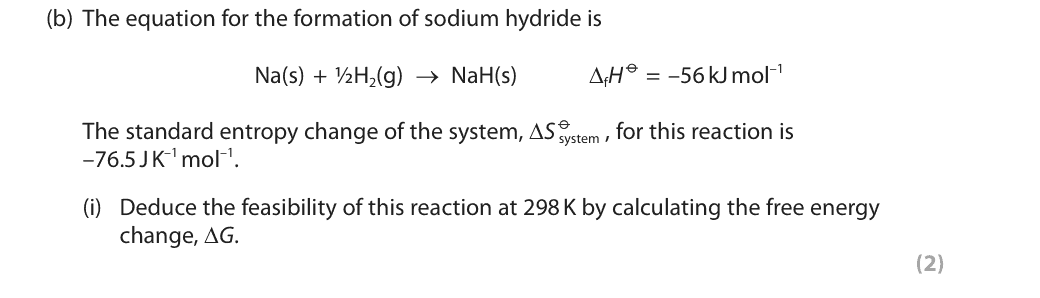
Candidates could calculate the Gibbs Free Energy change in part (i) either by converting both values to Joules or to kilo Joules but it was essential to make one or the other conversion. Some candidates did make this conversion correctly but then gave entropy units instead of enthalpy units which lost them the mark. A reminder to candidates to double-check exactly what value they are calculating. The second mark was awarded for a statement relating to the feasibility of the reaction but there needed to be reference to the reason for this conclusion by stating the sign of the Gibbs Freen Energy change.
Most candidates could successfully calculate the temperature in part (ii) and gave their answers in Kelvin.
Notes from the mark scheme and report
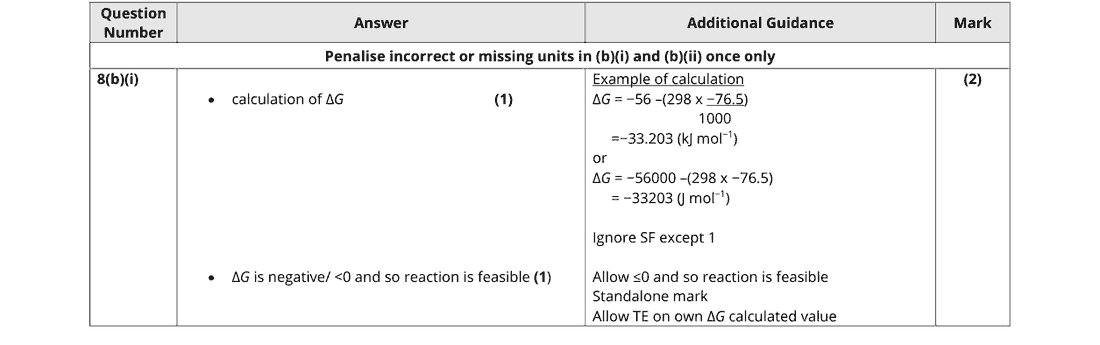
Answer: ΔG = –33.2 kJ mol–1 (–33 203 J mol–1), so the reaction is feasible. ΔG = –56 – (298 × –76.5 ÷ 1000). Second mark (stand alone, on the candidate's own value): ΔG is negative so feasible
the reason must be given. Wrong or missing units penalised once across (b)(i) and (b)(ii). Common errors: J and kJ not made consistent
entropy units given for ΔG
Skills: MS0.0 Recognise and make use of appropriate units in calculation; MS2.3 Substitute numerical values into algebraic equations using appropriate units for physical quantities
June 2019 · Paper 1 · Q8(b)(ii)1 markCalculation
Earlier parts of question 8 that this part uses
Mark scheme
Examiner's comment
Candidates could calculate the Gibbs Free Energy change in part (i) either by converting both values to Joules or to kilo Joules but it was essential to make one or the other conversion. Some candidates did make this conversion correctly but then gave entropy units instead of enthalpy units which lost them the mark. A reminder to candidates to double-check exactly what value they are calculating. The second mark was awarded for a statement relating to the feasibility of the reaction but there needed to be reference to the reason for this conclusion by stating the sign of the Gibbs Freen Energy change.
Most candidates could successfully calculate the temperature in part (ii) and gave their answers in Kelvin.
Notes from the mark scheme and report
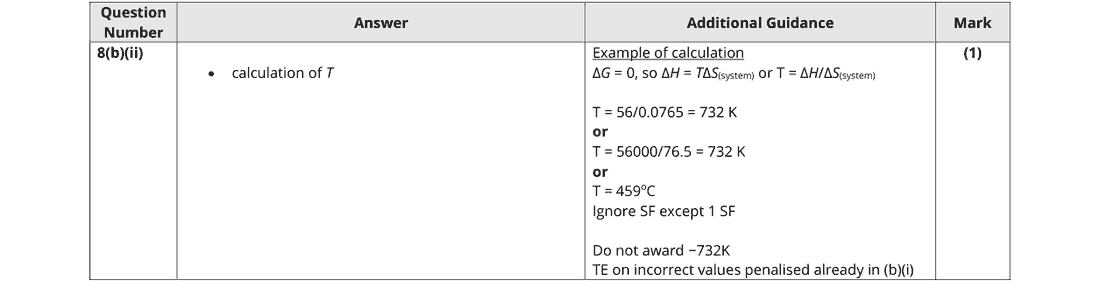
Answer: 732 K (459 °C). ΔG = 0 so T = ΔH / ΔSsystem = 56 000 ÷ 76.5. Not –732 K
not 1 SF. Most calculated this successfully
Skills: MS0.0 Recognise and make use of appropriate units in calculation; MS2.2 Change the subject of an equation
June 2018 · Paper 1 · Q9(a)2 marksShort answer
Mark scheme
Examiner's comment
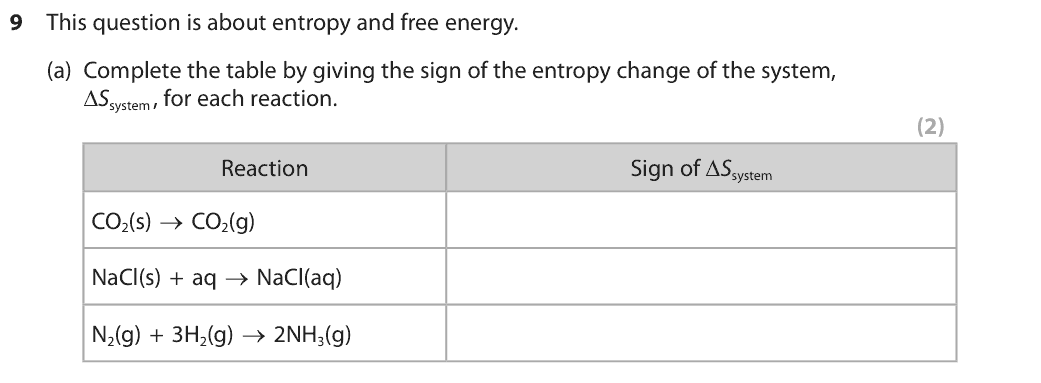
The majority of candidates were familiar with the signs of ΔSsystem and could apply their knowledge to the changes given in the question. A small number of candidates showed all the signs incorrectly so thought, for example, that there is decrease in entropy when solid carbon dioxide changes to a gas.
Notes from the mark scheme and report
Answer: CO2(s) → CO2(g) positive
NaCl(s) + aq → NaCl(aq) positive
N2 + 3H2 → 2NH3 negative. Two marks for all three, one for any two. A few had every sign reversed
June 2018 · Paper 1 · Q9(b)3 marksCalculationEasy
Earlier part of question 9 that this part uses
Mark scheme
Examiner's comment
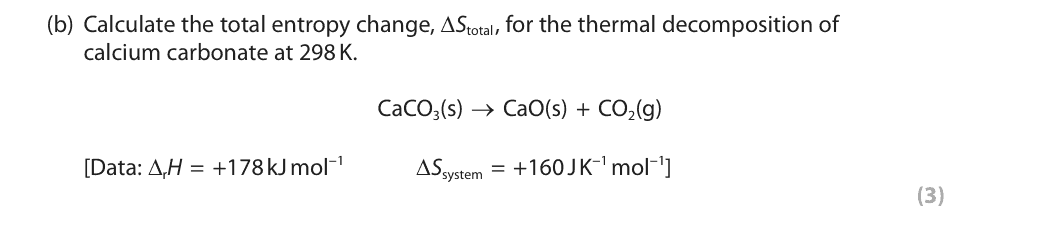
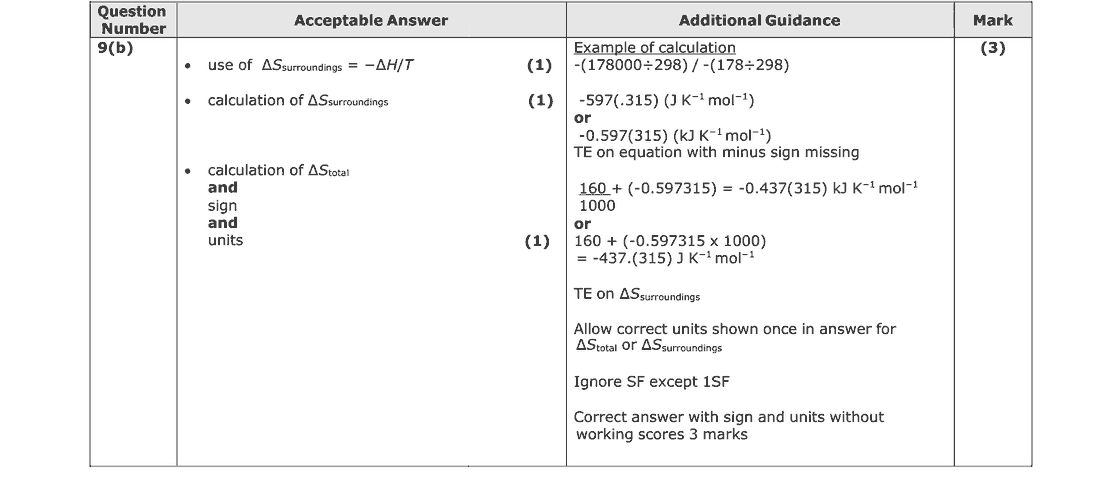
The majority of candidates scored 3 marks for this question. Marks were lost when candidates omitted the minus sign when using -ΔH/T and not converting the value for either ΔSsystem or ΔSsurroundings so that they were in the same unit before adding them together. A few candidates gave incorrect units and lost the last mark.
ΔStotal = 160 + (–597.3). Final mark needs sign and units. Common errors: no minus sign in –ΔH/T
mixing J and kJ
wrong units
Skills: MS0.0 Recognise and make use of appropriate units in calculation; MS2.3 Substitute numerical values into algebraic equations using appropriate units for physical quantities
June 2018 · Paper 1 · Q9(c)(i)2 marksCalculation
Earlier part of question 9 that this part uses
Mark scheme
Examiner's comment
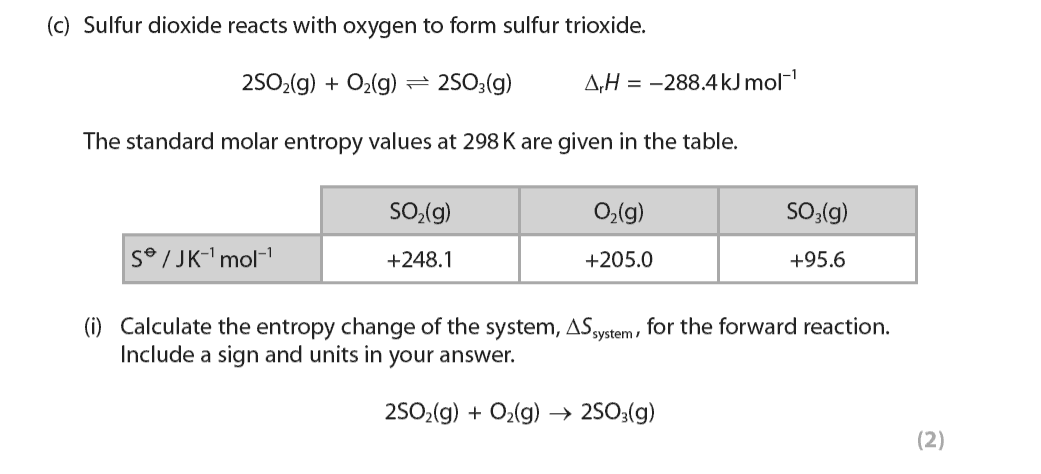
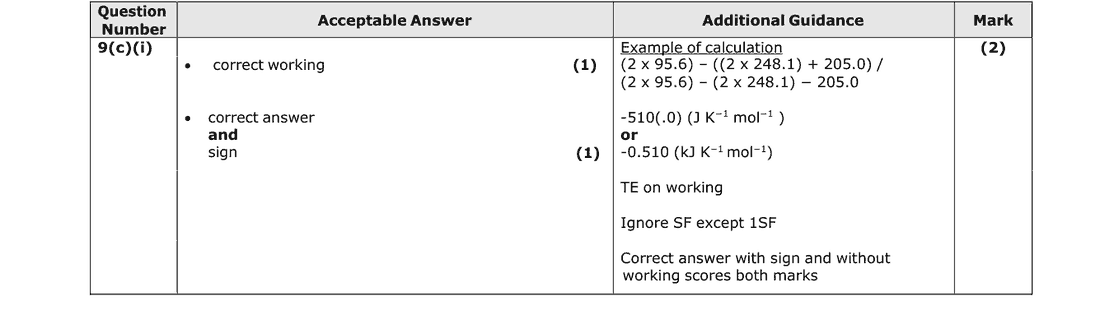
Many candidates scored full marks for the calculation in (c)(i). Common errors included not using the multiples of 2, as shown in the equation for the reaction, and writing the cycle the wrong way around.
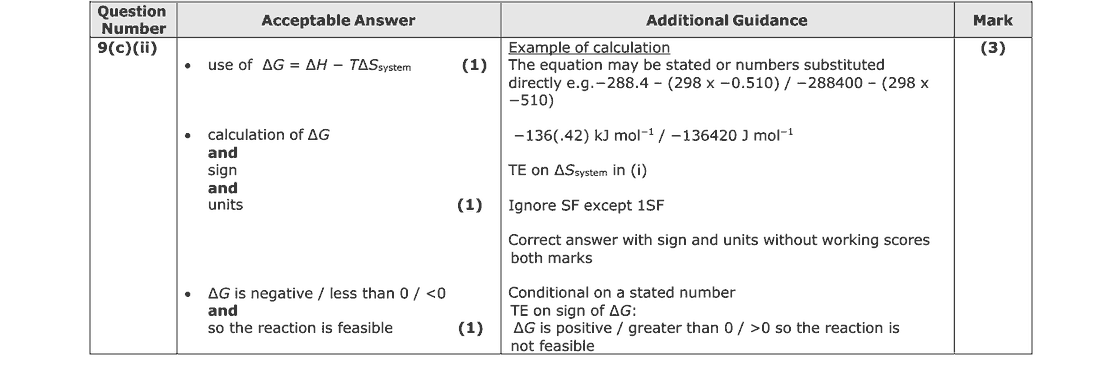
Not as many candidates scored full marks for (c)(ii). Quite a number of candidates did not convert one of the values so they were both in kilojoules or both in joules. Some candidates did not include units for the free energy change and some gave the units of an entropy change, which is incorrect as it includes K-1. A few candidates quoted an incorrect equation. Most candidates could relate the sign of the free energy change to the feasibility of the reaction but some thought that a negative value meant the reaction was not feasible.
Notes from the mark scheme and report
Answer: –510 J K–1 mol–1 (or –0.510 kJ K–1 mol–1). (2 × 95.6) – ((2 × 248.1) + 205.0). Second mark needs the sign. Common errors: not multiplying by 2
reactants minus products
Skills: MS2.3 Substitute numerical values into algebraic equations using appropriate units for physical quantities
June 2018 · Paper 1 · Q9(c)(ii)3 marksCalculation
Earlier parts of question 9 that this part uses
Mark scheme
Examiner's comment
Many candidates scored full marks for the calculation in (c)(i). Common errors included not using the multiples of 2, as shown in the equation for the reaction, and writing the cycle the wrong way around.
Not as many candidates scored full marks for (c)(ii). Quite a number of candidates did not convert one of the values so they were both in kilojoules or both in joules. Some candidates did not include units for the free energy change and some gave the units of an entropy change, which is incorrect as it includes K-1. A few candidates quoted an incorrect equation. Most candidates could relate the sign of the free energy change to the feasibility of the reaction but some thought that a negative value meant the reaction was not feasible.
Notes from the mark scheme and report
Answer: ΔG = –136 kJ mol–1 (–136 420 J mol–1), so the reaction is feasible. ΔG = ΔH – TΔSsystem = –288.4 – (298 × –0.510). Second mark needs sign and units
third mark: ΔG is negative so feasible (follows the sign of the candidate's value). Scored less well than (i): J and kJ mixed
units missing or with K–1
some said a negative ΔG means not feasible
Skills: MS0.0 Recognise and make use of appropriate units in calculation; MS2.3 Substitute numerical values into algebraic equations using appropriate units for physical quantities
June 2018 · Paper 1 · Q9(c)(iii)3 marksCalculation
Earlier parts of question 9 that this part uses
Mark scheme
Examiner's comment
This is the first time that a question involving calculating an equilibrium constant from a free energy change has been set on this specification and many candidates carried it out well, scoring full marks. The common errors included omitting the minus sign from the equation and not converting ΔG into J mol-1. Some candidates did not know the equation so they were unable to score any marks unless they used an equation involving ΔG, K, R and T. Candidates do need to learn all of the equations involving enthalpy, entropy and free energy changes. Some candidates used an incorrect value for R, even though this is given in the Data Booklet.
Notes from the mark scheme and report
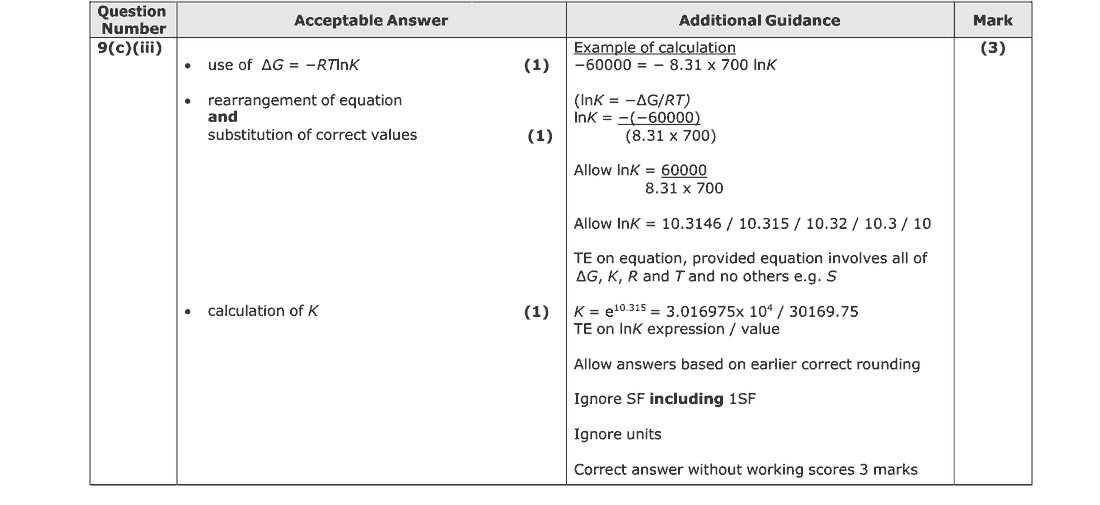
Answer: K = 3.02 × 10^4 (30 170). ΔG = –RT ln K, so ln K = 60 000 ÷ (8.31 × 700) = 10.315
K = e^10.315. R is from the Data Booklet. Units and significant figures ignored. Common errors: leaving out the minus sign
not converting ΔG to J mol–1
not knowing the equation
wrong value of R
Skills: MS0.0 Recognise and make use of appropriate units in calculation; MS0.4 Use calculators to find and use power, exponential and logarithmic functions; MS2.2 Change the subject of an equation; MS2.3 Substitute numerical values into algebraic equations using appropriate units for physical quantities
June 2017 · Paper 1 · Q4(c)(ii)2 marksExplanation
Earlier parts of question 4 that this part uses
Mark scheme
Examiner's comment
This question was answered well by the majority of candidates: they correctly identified the increased number of particles on the right-hand side so there would be an increase in entropy. Some candidates used incorrect terminology and referred to the particles as molecules while others wrote about disorder but did not mention entropy. Just stating that 'entropy is positive' was not sufficient for the second mark.
Notes from the mark scheme and report
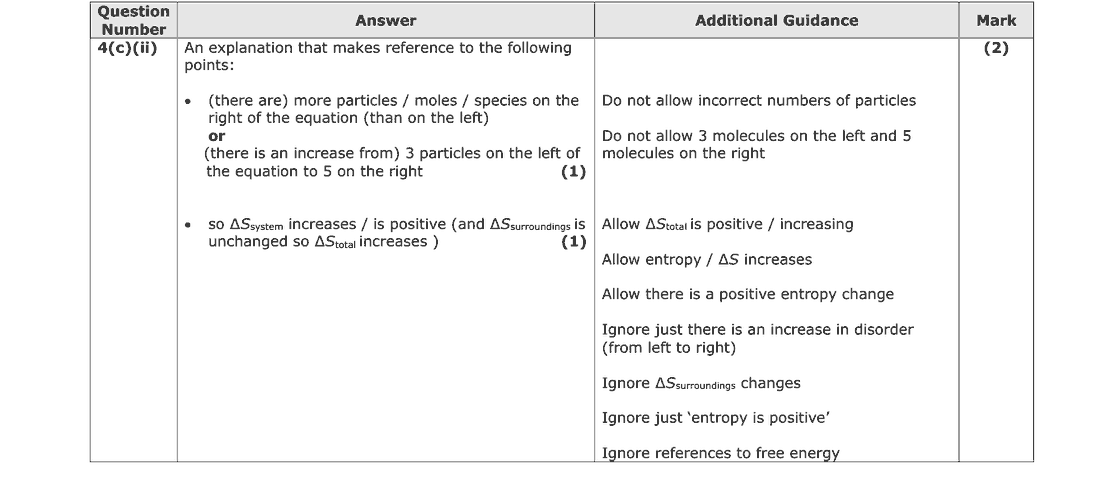
M1: there are more particles / moles on the right (3 on the left, 5 on the right). M2: so ΔSsystem (or ΔStotal) is positive / entropy increases. Not '3 molecules to 5 molecules'
'more disorder' alone or just 'entropy is positive' is not enough. Common errors: calling the particles molecules
describing disorder with no mention of entropy
June 2017 · Paper 1 · Q5(c)1 markMultiple choice
Answer
A
Mark scheme
Notes from the mark scheme and report
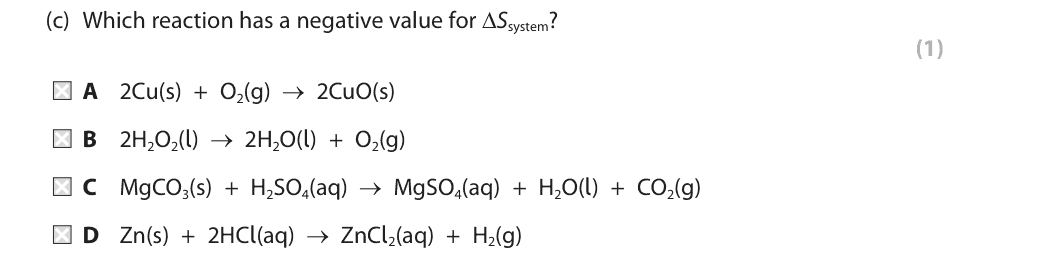
Answer: A. 2Cu(s) + O2(g) → 2CuO(s) uses up a gas and forms only a solid, so the entropy of the system falls. B, C and D all form a gas, so disorder increases
June 2017 · Paper 1 · Q5(d)1 markMultiple choice
Answer
D
Mark scheme
Notes from the mark scheme and report
Answer: D. ΔStotal = ΔSsystem + ΔSsurroundings and ΔSsurroundings = –ΔH/T, so ΔStotal = ΔSsystem – ΔH/T. C has the wrong sign
A and B start from ΔSsurroundings
June 2017 · Paper 1 · Q5(e)3 marksCalculationEasy
Earlier part of question 5 that this part uses
Mark scheme
Examiner's comment
The majority of candidates scored 3 marks for this question. A few candidates did not convert the units of ΔS or ΔH so they were both the same. Some candidates lost a mark as they gave entropy units for ΔG and a few omitted to state why the reaction is not feasible at 298 K. A small number of candidates incorrectly rounded 1078.8 to 1078 K so lost a mark.
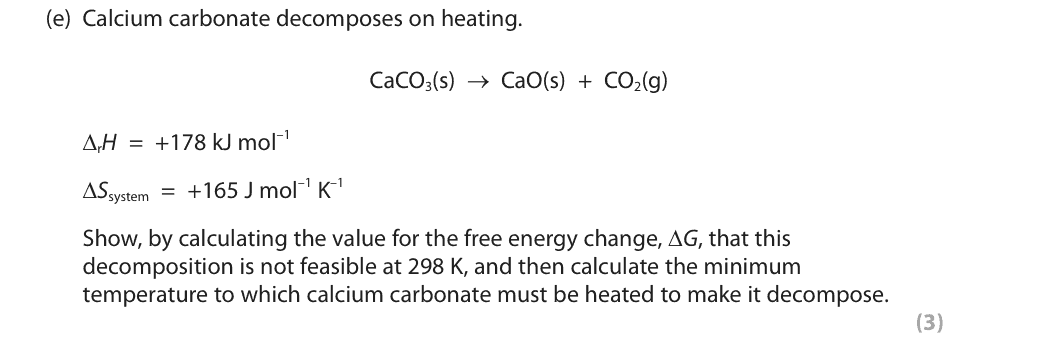
Notes from the mark scheme and report
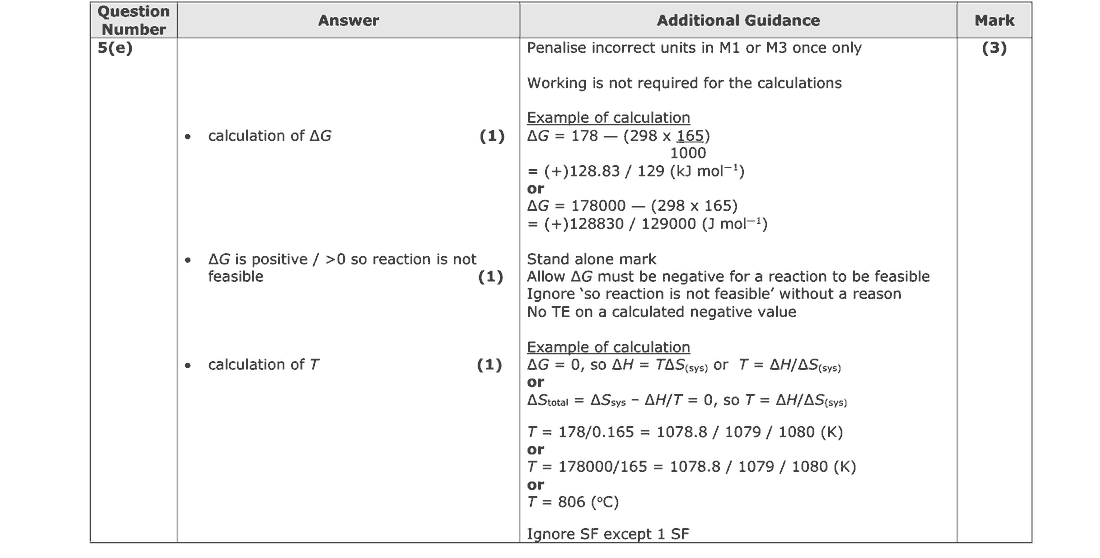
Answer: ΔG = (+)129 kJ mol–1 (128.83), positive so not feasible
T = 1079 K (806 °C). ΔG = 178 – (298 × 165 ÷ 1000)
the 'ΔG is positive so not feasible' mark stands alone but needs the reason
T = ΔH / ΔSsystem = 178 / 0.165 = 1078.8 K (1079 or 1080 allowed, not 1 SF). Wrong units penalised once. Common errors: not converting J to kJ
entropy units given for ΔG
no reason given for not feasible
rounding 1078.8 to 1078
Skills: MS0.0 Recognise and make use of appropriate units in calculation; MS2.2 Change the subject of an equation; MS2.3 Substitute numerical values into algebraic equations using appropriate units for physical quantities
Work with an A-level chemistry tutor
Dropping marks on calculations, mechanisms or the core practicals? Book a trial session with an A-level chemistry tutor.