Notes and key-term cards for this topic are being written by our tutors. The past-paper questions below are ready now.
Specification statements
Show the 8 statements from the specification
4.1 understand reasons for the trend in ionisation energy down Group 2
4.2 understand reasons for the trend in reactivity of the Group 2 elements down the group
4.3 know the reactions of the elements Mg to Ba in Group 2 with oxygen, chlorine and water
4.4 know the reactions of the oxides of Group 2 elements with water and dilute acid, and their hydroxides with dilute acid
4.5 know the trends in solubility of the hydroxides and sulfates of Group 2 elements
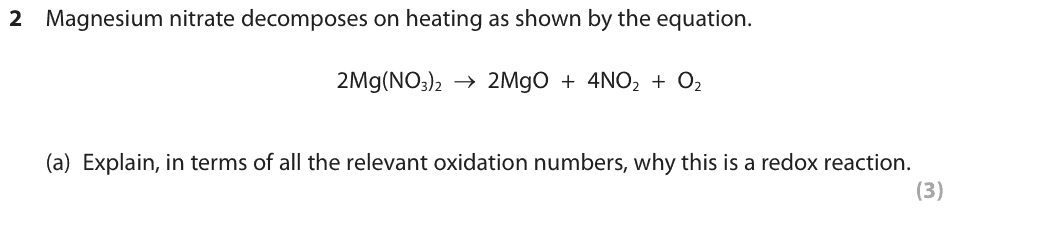
4.6 understand reasons for the trends in thermal stability of the nitrates and the carbonates of the elements in Groups 1 and 2 in terms of the size and charge of the cations involved
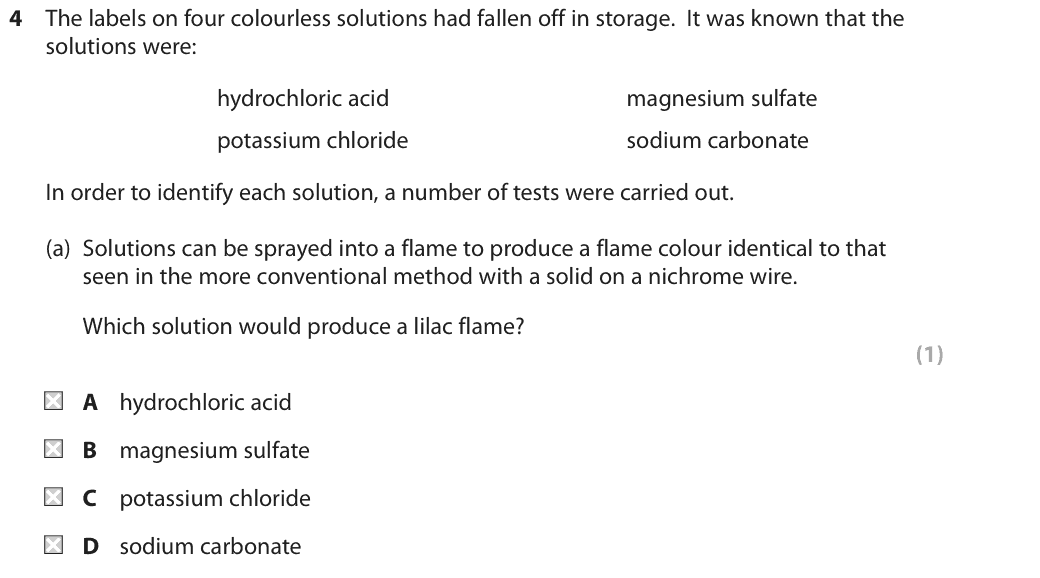
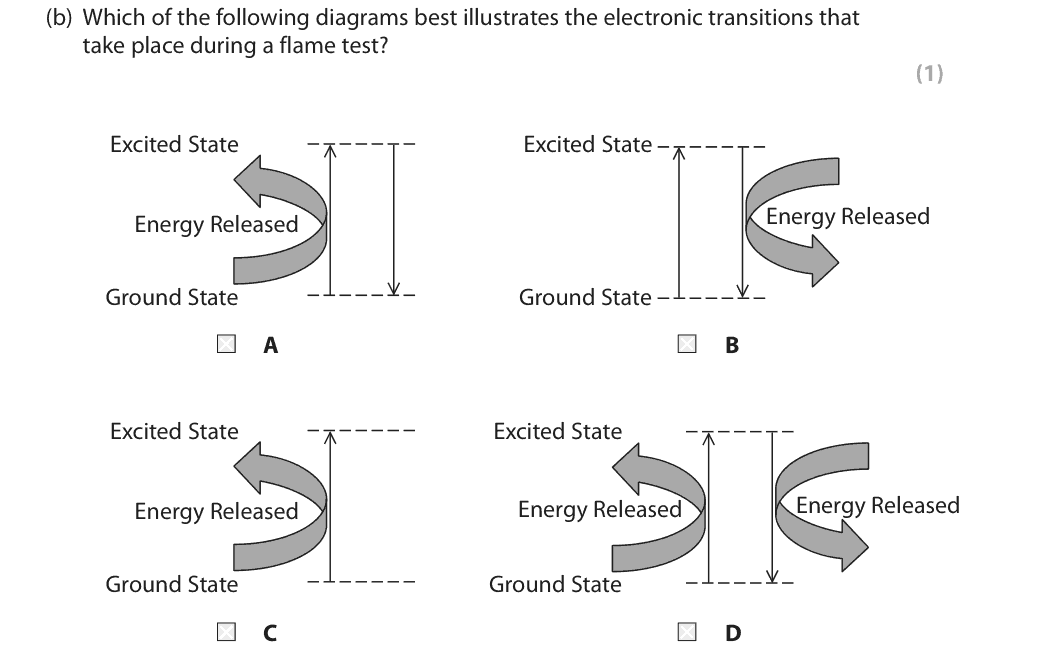
4.7 understand the formation of characteristic flame colours by Group 1 and 2 compounds in terms of electron transitions [Students will be expected to know the flame colours for Groups 1 and 2 compounds.]
4.8 understand experimental procedures to show: • i patterns in thermal decomposition of Group 1 and 2 nitrates and carbonates • ii flame colours in compounds of Group 1 and 2 elements
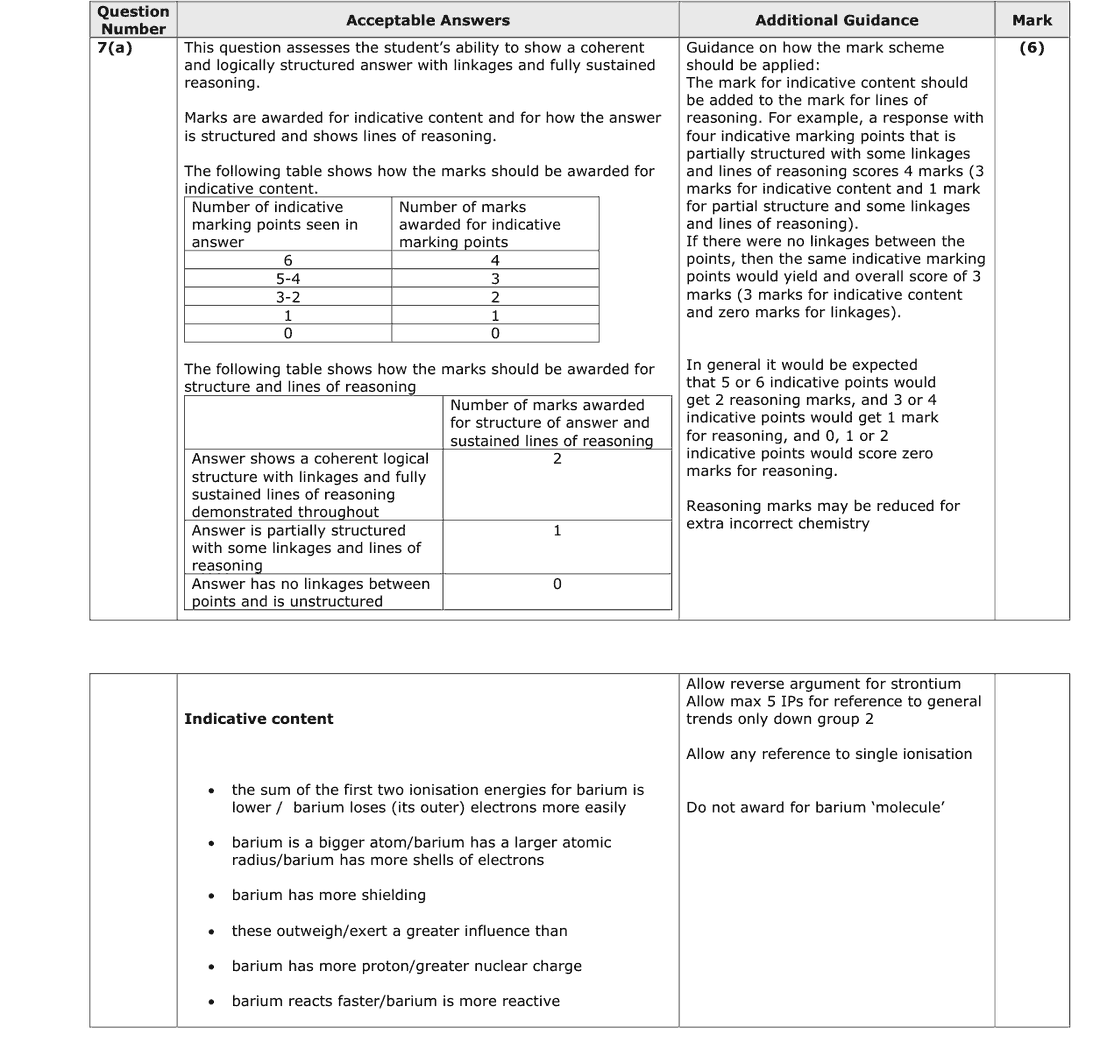
Six-mark extended response questions on this topic
Tap a question to zoom it. Where a part needs a figure, table or structure from earlier in the question, that part folds out above it; the mark scheme and examiner's comment open underneath. Have Edexcel's Data Booklet beside you; the Periodic Table is on the back page of every paper.
June 2025 · Paper 1 · Q3(d)3 marksExplanation
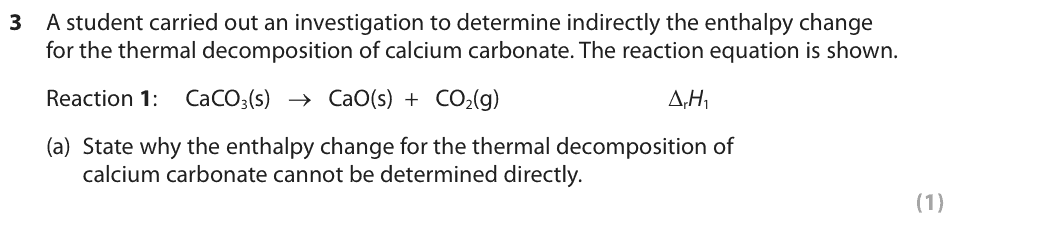
Earlier part of question 3 that this part uses
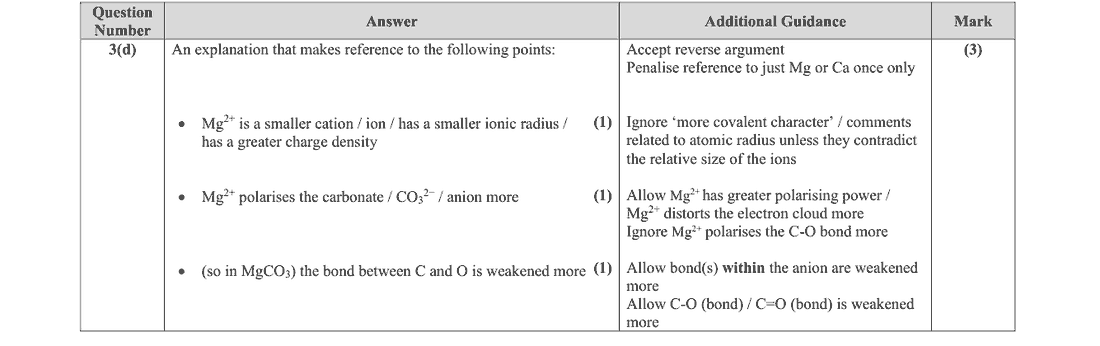
Mark scheme
Examiner's comment
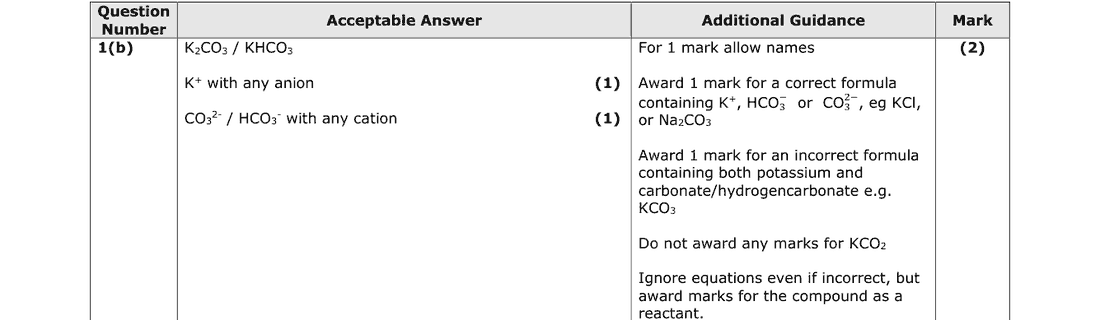
This question was about the comparison in thermal stability of two group 2 carbonates, Magnesium carbonate and Calcium carbonate. Many candidates scored two of the three available marks, many missing out on the first marking point by failing to reference the Magnesium or Calcium ions.
Notes from the mark scheme and report
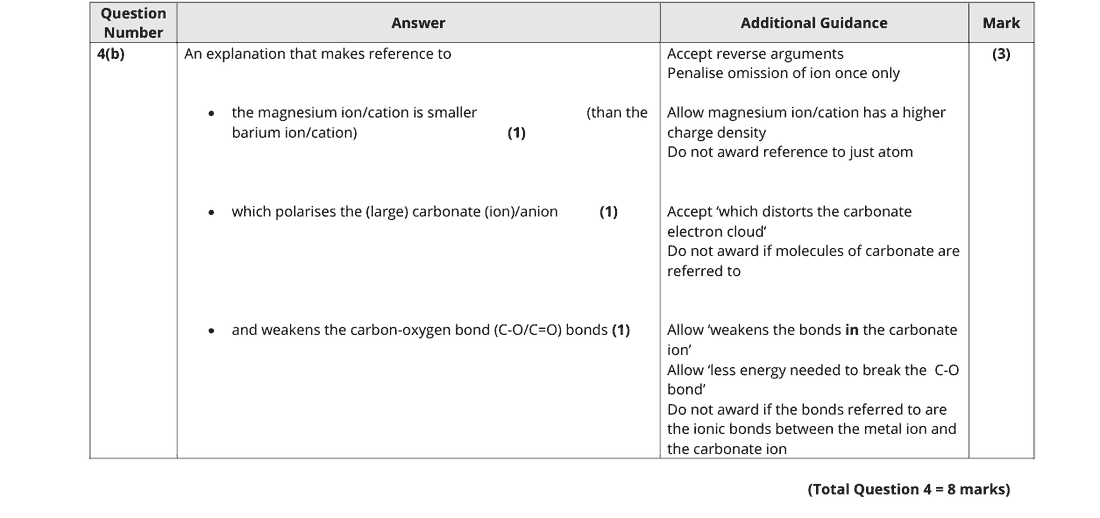
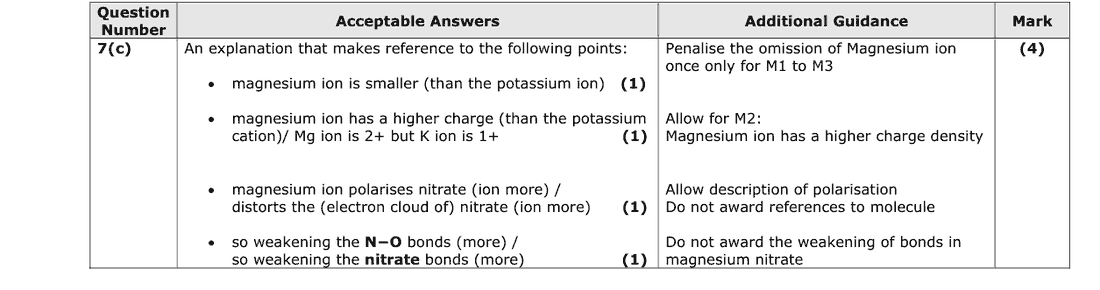
The Mg2+ ion is smaller / has a greater charge density
so it polarises the carbonate ion more (greater polarising power, distorts the electron cloud more)
so the C–O bond in the carbonate ion is weakened more. Writing Mg or Ca instead of the ions is penalised once. Many scored two of the three marks, losing the first by not referring to the ions
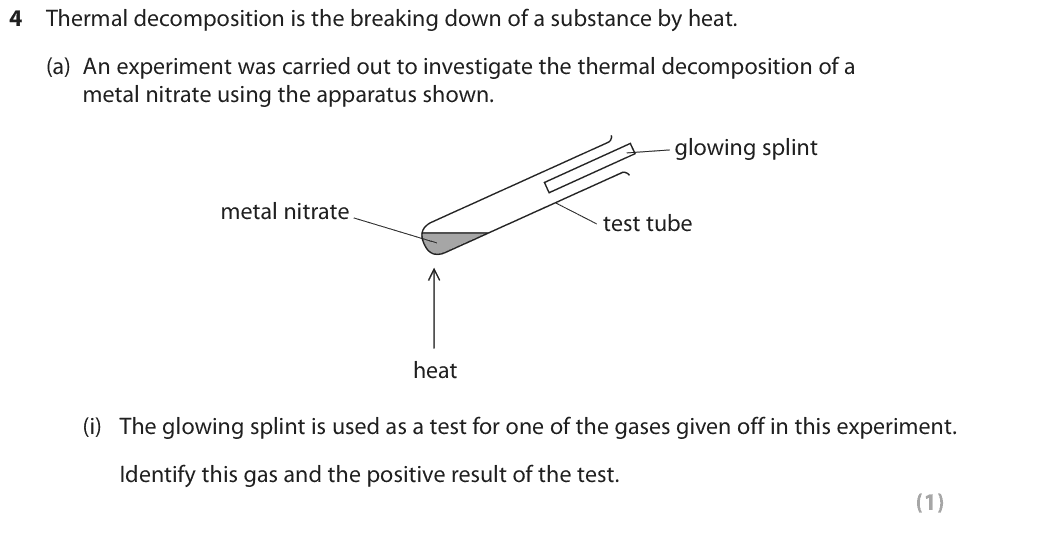
June 2025 · AS Paper 1 · Q4(b)(i)1 markPractical and data analysis
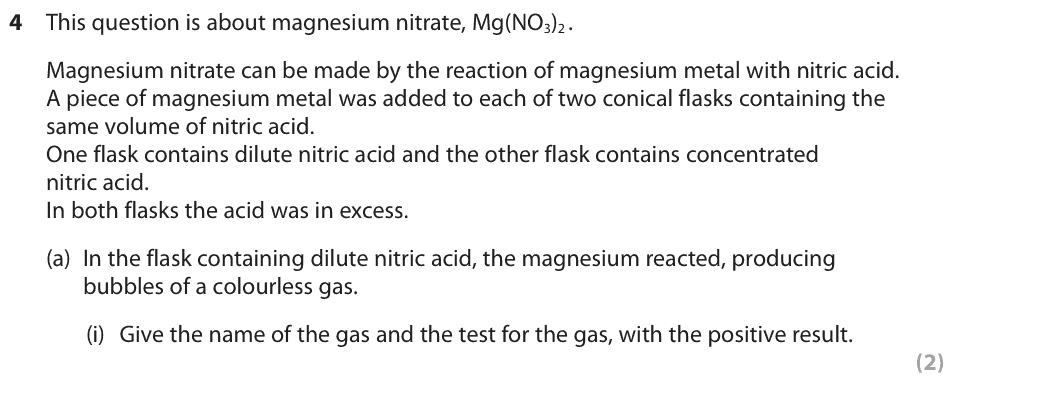
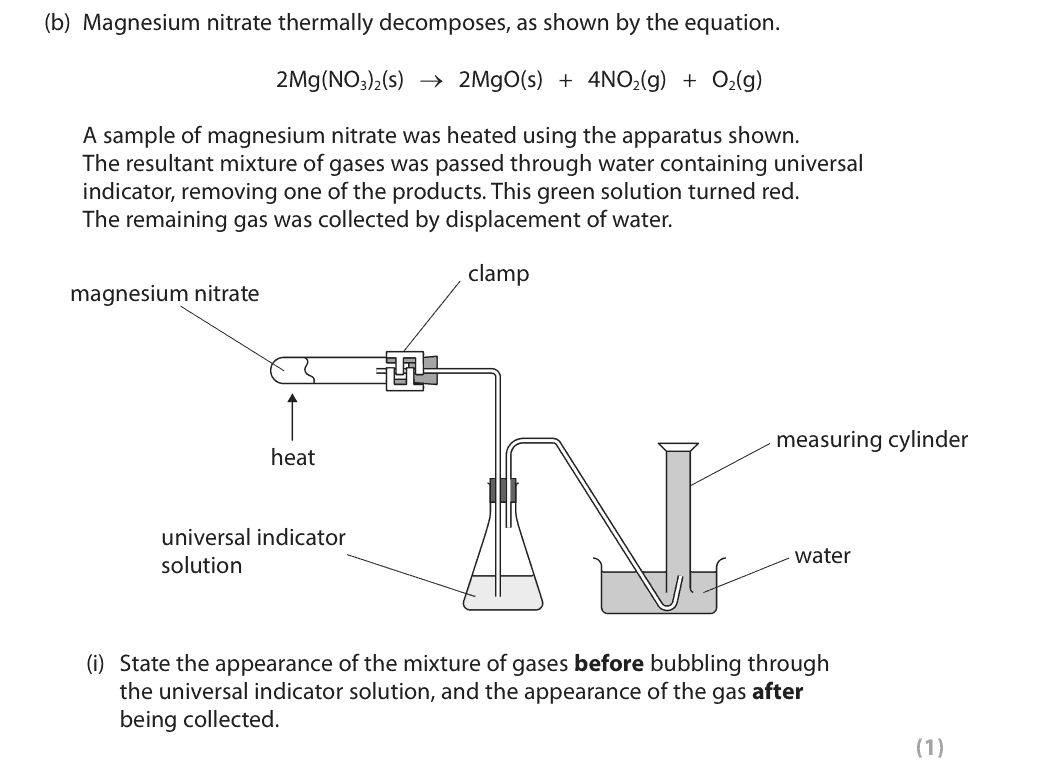
Earlier part of question 4 that this part uses
Mark scheme
Examiner's comment
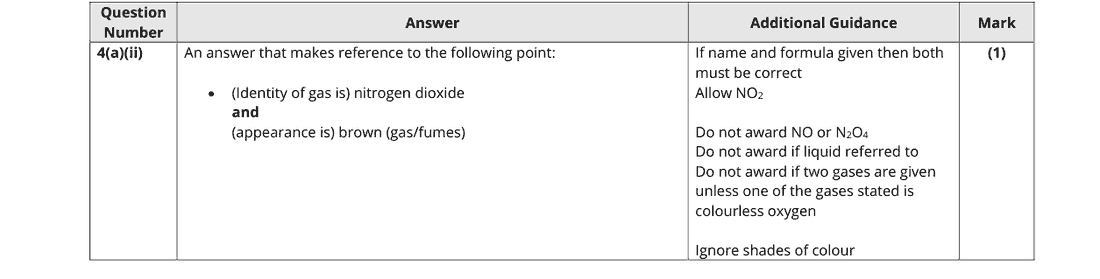
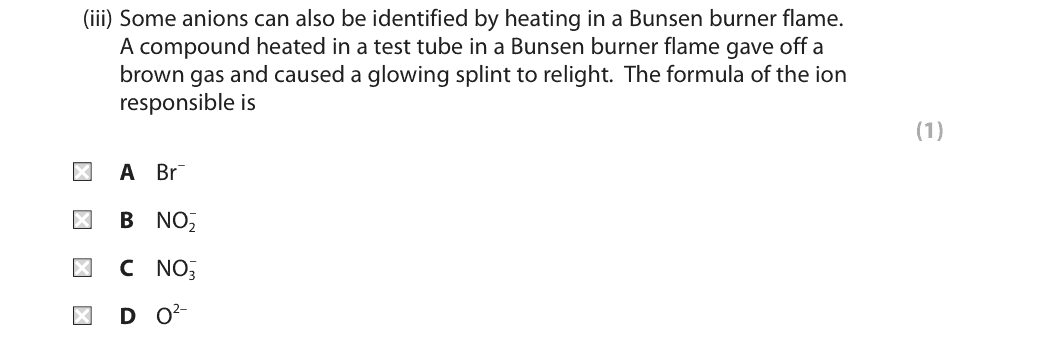
Q4bi required candidates to state the colour change of the gases. This was answered well, however some candidates lost marks for referring to oxygen as clear or white which is incorrect.
Notes from the mark scheme and report
The gas mixture is brown before the universal indicator solution AND the gas collected is colourless (both needed for the one mark). Oxygen described as 'clear' or 'white' was not credited
June 2025 · AS Paper 1 · Q4(b)(ii)2 marksExplanationHard
Earlier parts of question 4 that this part uses
Mark scheme
Examiner's comment
Q4bii required candidates to explain the change in colour of the gases and universal indicator solution. This was not answered well. Most marks were achieved for the colour change of the gas. Lots of candidates stated the indicator changed colour due to an acid but did not state that the nitrogen dioxide is an acidic gas.
Notes from the mark scheme and report
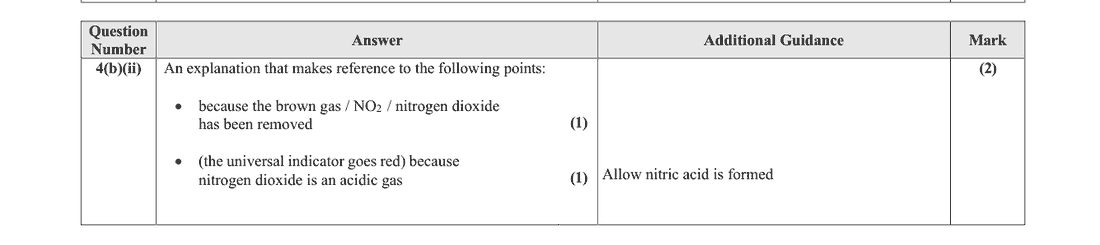
The gas loses its colour because the brown gas, nitrogen dioxide, has been removed (it dissolves)
the universal indicator goes red because nitrogen dioxide is an acidic gas (allow nitric acid is formed). Most marks came from the first point
many said the indicator changed 'because of an acid' without saying that nitrogen dioxide is the acidic gas
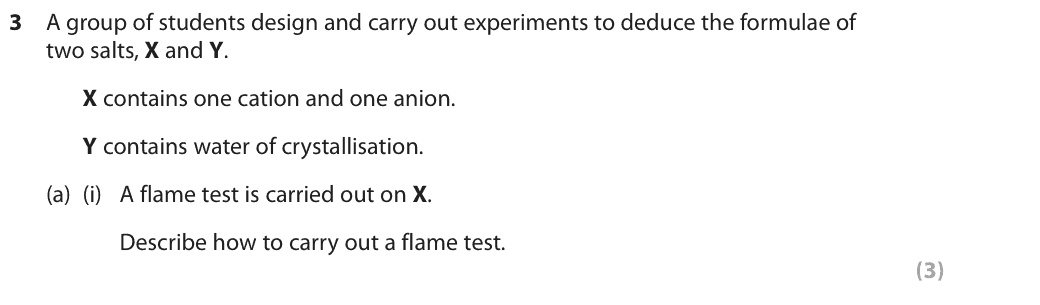
June 2024 · Paper 1 · Q3(a)(i)3 marksPractical and data analysis
Mark scheme
Examiner's comment
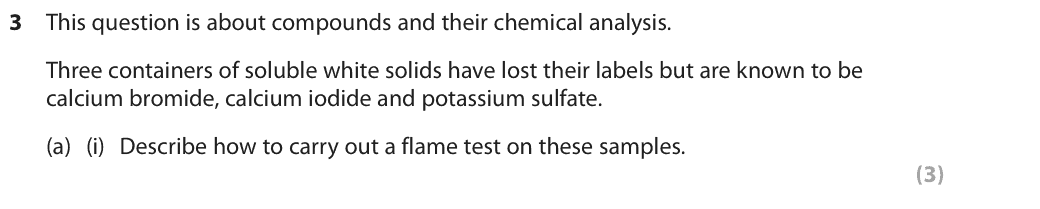
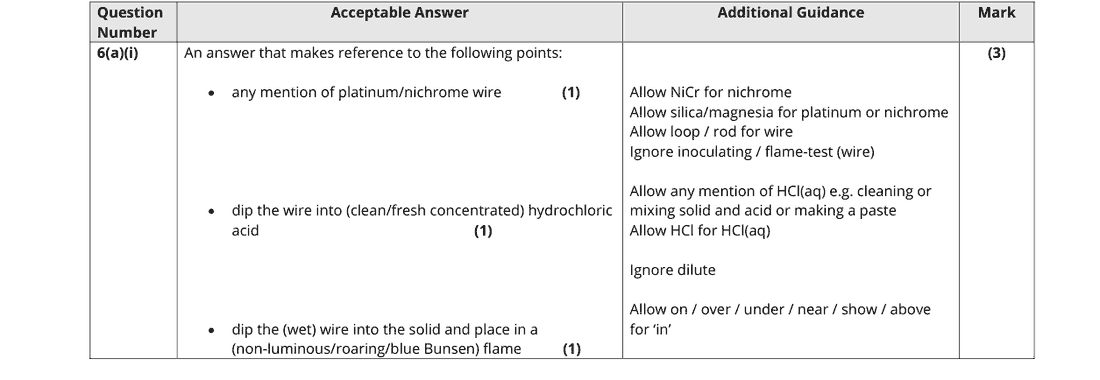
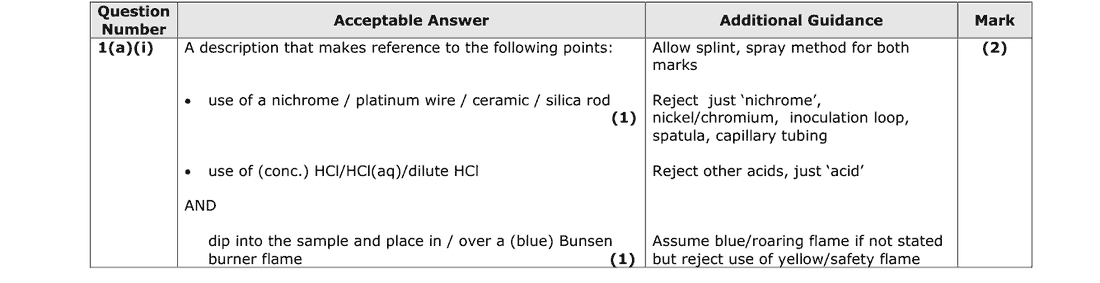
This relatively straightforward question about the method for a flame test yielded many fully correct answers. However a few candidates did not mention the use of HCl, and a few described using a splint instead of a nichrome wire.
Notes from the mark scheme and report
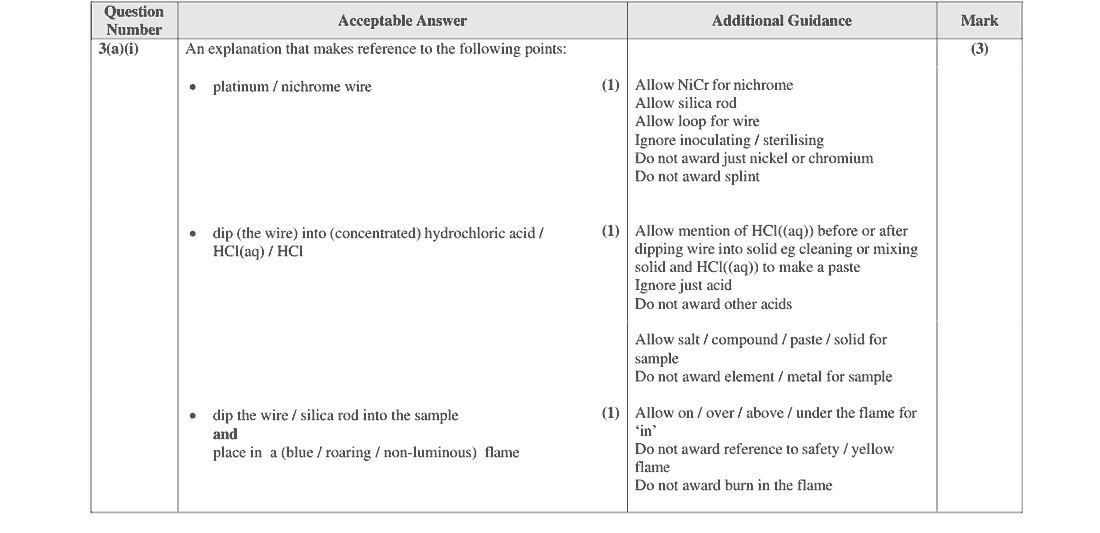
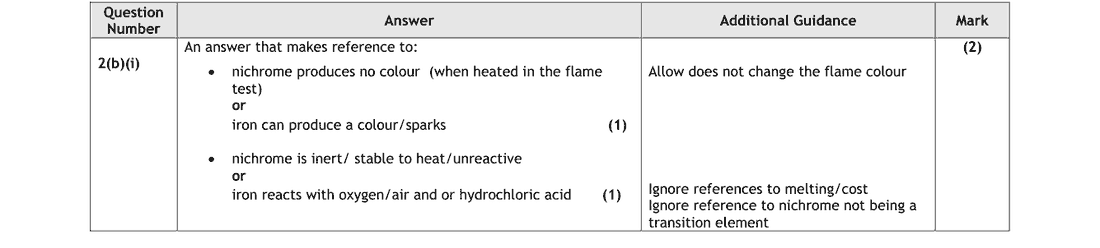
Platinum or nichrome wire (or silica rod)
dip it into (concentrated) hydrochloric acid
then into the sample and hold it in a (blue / roaring / non-luminous) flame. Not a splint
not other acids
not 'burn in the flame'
not a yellow flame. Some left out the HCl or used a splint
Skills: PT4 use laboratory apparatus for a variety of experimental techniques, including: titration, using burette and pipette; distillation and heating under reflux, including setting up glassware using retort stand and clamps; qualitative tests for ions and organic functional groups; filtration, including use of fluted filter paper, or filtration under reduced pressure; PT11 safely and carefully handle solids and liquids, including corrosive, irritant, flammable and toxic substances; CP7 Core practical 7: Analysis of some inorganic and organic unknowns
June 2024 · Paper 1 · Q3(a)(ii)2 marksPractical and data analysis
Earlier part of question 3 that this part uses
Mark scheme
Examiner's comment
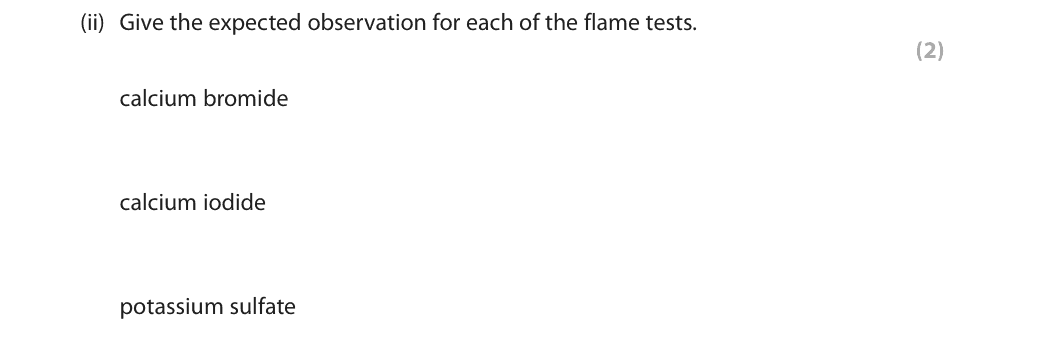
This question assesses candidates' knowledge of the colours of the flame tests. Many fully correct responses were seen. However it was clear that some candidates were not familiar with the colours that would be produced.
Notes from the mark scheme and report
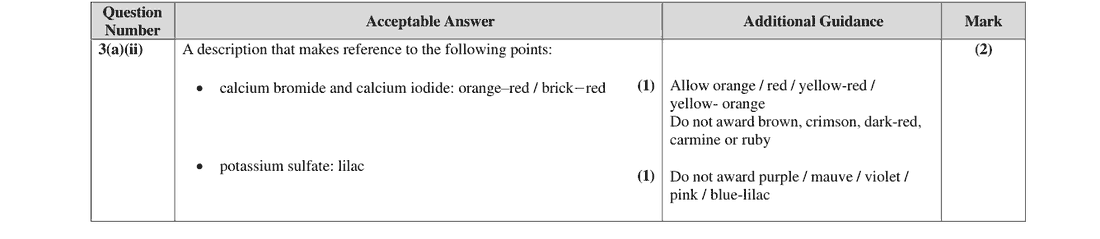
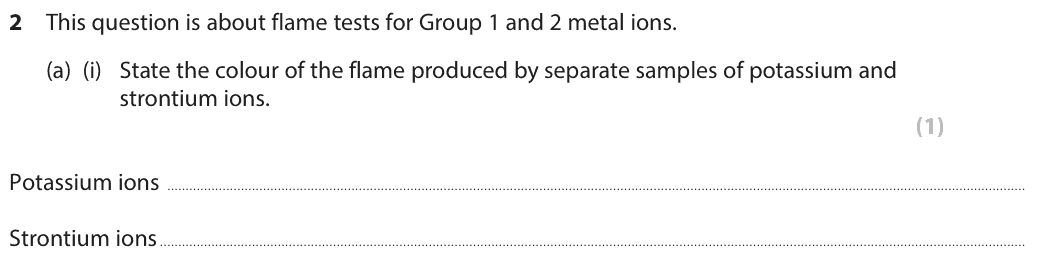
Calcium bromide and calcium iodide: orange-red / brick-red (allow orange, red, yellow-red). Potassium sulfate: lilac (not purple, mauve, violet or pink). Not crimson or dark red for calcium
Skills: CP7 Core practical 7: Analysis of some inorganic and organic unknowns
June 2024 · AS Paper 1 · Q7(b)(i)1 markPractical and data analysisHard
Earlier part of question 7 that this part uses
Mark scheme
Examiner's comment
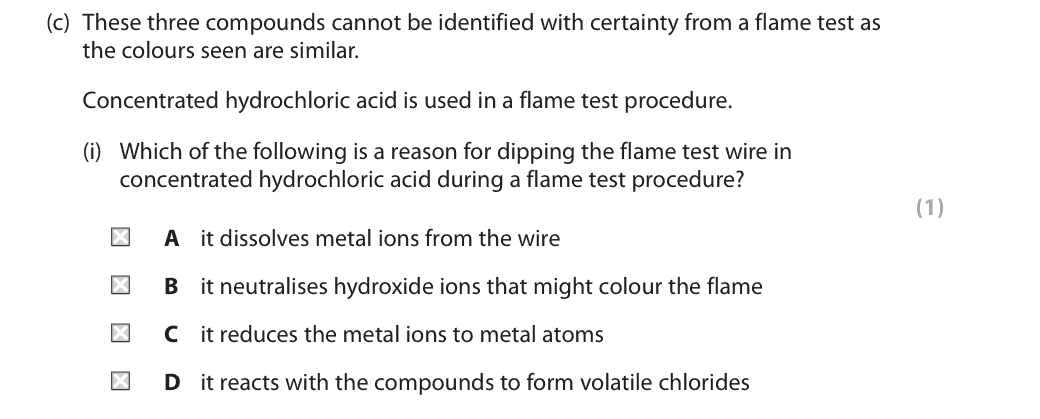
Q7bi) Overall, this question was answered poorly, with less than 20% of candidates answering correctly. Many candidates suggested that the role of the acid was to clean/ sterilise the wire or to help the powder stick to it. Q7bii) Candidates answered this question well, with 90% of candidates answering correctly.
Notes from the mark scheme and report
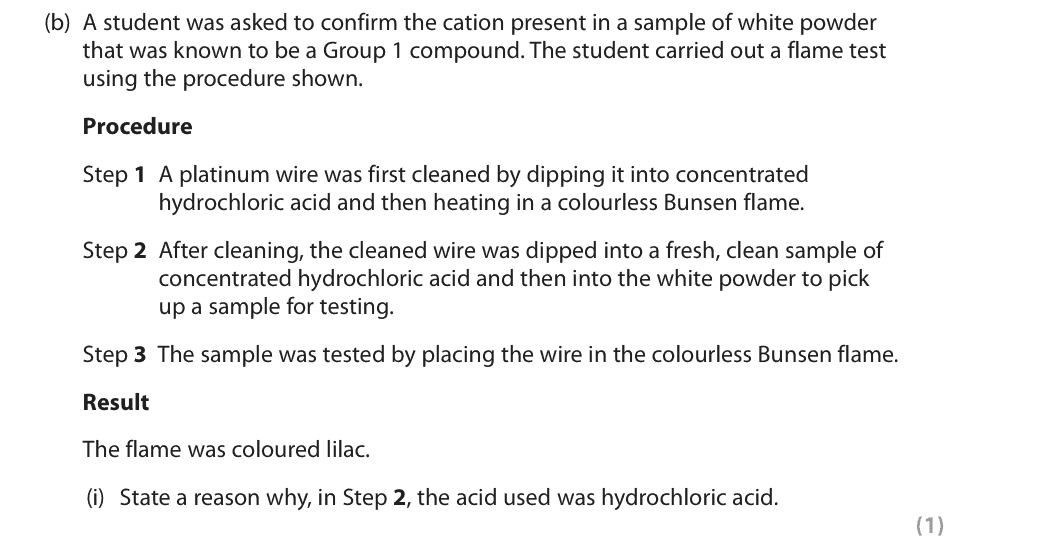
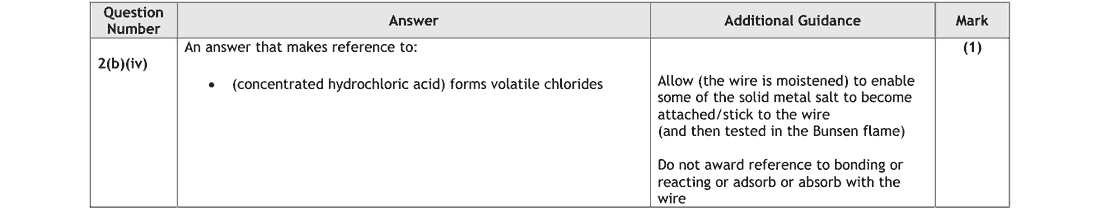
Chlorides are more volatile than other compounds / it forms a volatile metal chloride. Not 'hydrochloric acid is more volatile'. Common wrong answers: to clean or sterilise the wire, or to help the powder stick
Skills: PT4 use laboratory apparatus for a variety of experimental techniques, including: titration, using burette and pipette; distillation and heating under reflux, including setting up glassware using retort stand and clamps; qualitative tests for ions and organic functional groups; filtration, including use of fluted filter paper, or filtration under reduced pressure; CP7 Core practical 7: Analysis of some inorganic and organic unknowns
June 2024 · AS Paper 1 · Q7(b)(ii)1 markPractical and data analysisEasy
Earlier parts of question 7 that this part uses
Mark scheme
Examiner's comment
Q7bi) Overall, this question was answered poorly, with less than 20% of candidates answering correctly. Many candidates suggested that the role of the acid was to clean/ sterilise the wire or to help the powder stick to it. Q7bii) Candidates answered this question well, with 90% of candidates answering correctly.
Notes from the mark scheme and report
Answer: potassium ion, K+. Lilac flame
Skills: CP7 Core practical 7: Analysis of some inorganic and organic unknowns
June 2024 · AS Paper 1 · Q7(c)(i)2 marksDiagram or structureHard
Earlier part of question 7 that this part uses
Mark scheme
Examiner's comment
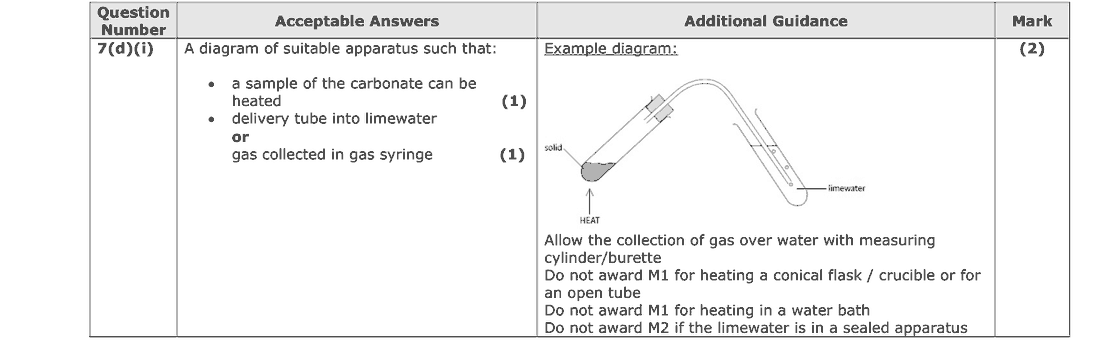
Q7ci) This question was answered poorly. Diagrams were often rushed. The greatest error in M1 was candidates either not heating the carbonate using a Bunsen burner, adding acid to the boiling tube or heating in a conical flask / beaker. The greatest error for M2 was from candidates not drawing a delivery tube clearly where the gas could travel through. Some candidates lost M2 for the delivery tube not being in the limewater or having a bung on the limewater test tube. Q7cii) Similarly to question 7ci, question 7cii was answered poorly. Candidates achieved marks for ‘same distance from heat source’ and ‘same Bunsen burner temperature / setting / heat’. However, many candidates only mentioned ‘same temperature / heat’ and therefore were not able to achieve the mark. Most candidates said ‘same mass of carbonate’ rather than ‘same moles of carbonate’ so did not achieve the mark. Q7ciii) Candidates answered this question relatively well, with most candidates losing the mark for not mentioning time or not mentioning ‘volume’ of carbon dioxide. Q7civ) Again, this question was answered relatively well, with 60% of candidates getting the correct answer.
Notes from the mark scheme and report
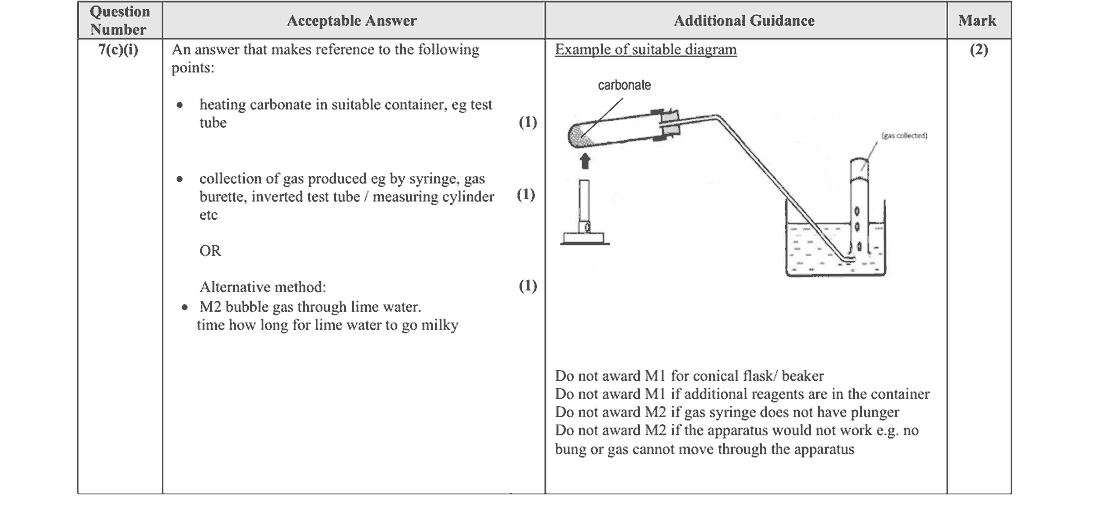
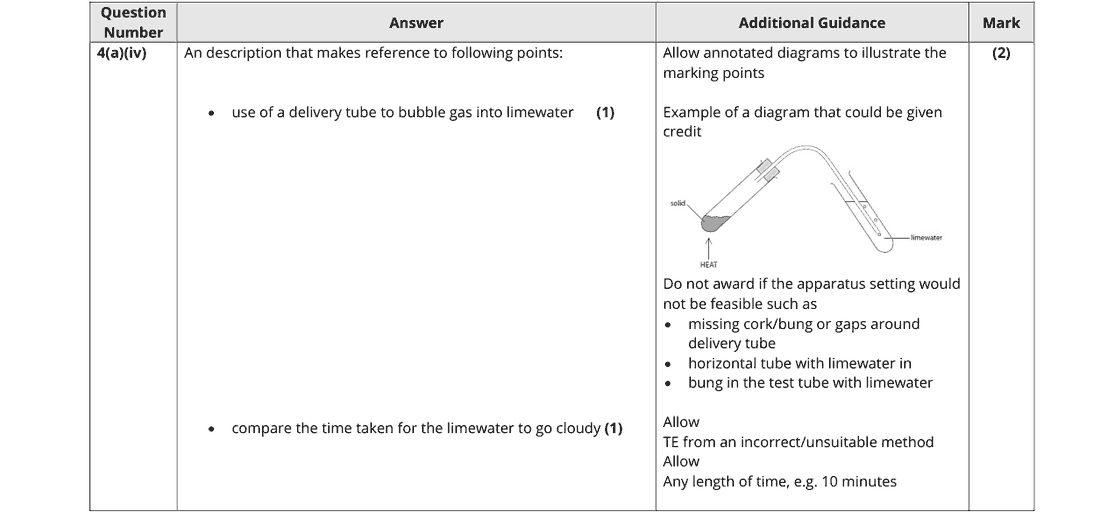
M1: the carbonate heated in a suitable container such as a test tube (not a conical flask or beaker
no other reagents in the tube). M2: the gas collected, e.g. in a syringe (with plunger), gas burette or inverted measuring cylinder over water, or bubbled through limewater and timed until it goes milky
the apparatus must work (bung, clear route for the gas). Common errors: no Bunsen heating
adding acid
delivery tube not clearly drawn or not dipping into the limewater
a bung on the limewater tube
Skills: PT1 use appropriate apparatus to record a range of measurements (to include mass, time, volume of liquids and gases, temperature)
June 2024 · AS Paper 1 · Q7(c)(ii)2 marksPractical and data analysisHard
Earlier parts of question 7 that this part uses
Mark scheme
Examiner's comment
Q7ci) This question was answered poorly. Diagrams were often rushed. The greatest error in M1 was candidates either not heating the carbonate using a Bunsen burner, adding acid to the boiling tube or heating in a conical flask / beaker. The greatest error for M2 was from candidates not drawing a delivery tube clearly where the gas could travel through. Some candidates lost M2 for the delivery tube not being in the limewater or having a bung on the limewater test tube. Q7cii) Similarly to question 7ci, question 7cii was answered poorly. Candidates achieved marks for ‘same distance from heat source’ and ‘same Bunsen burner temperature / setting / heat’. However, many candidates only mentioned ‘same temperature / heat’ and therefore were not able to achieve the mark. Most candidates said ‘same mass of carbonate’ rather than ‘same moles of carbonate’ so did not achieve the mark. Q7ciii) Candidates answered this question relatively well, with most candidates losing the mark for not mentioning time or not mentioning ‘volume’ of carbon dioxide. Q7civ) Again, this question was answered relatively well, with 60% of candidates getting the correct answer.
Notes from the mark scheme and report
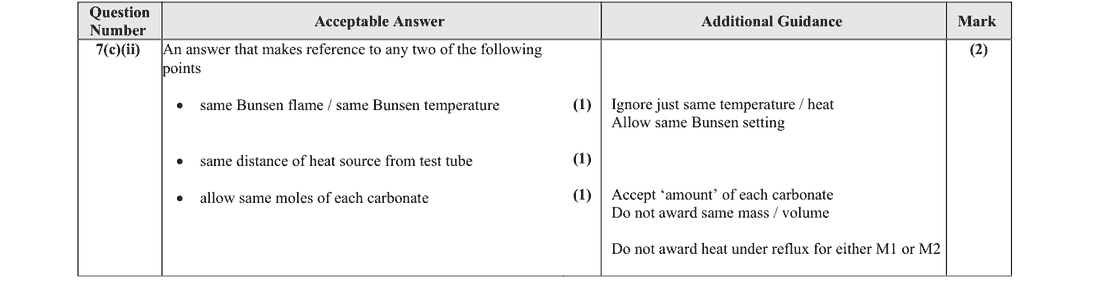
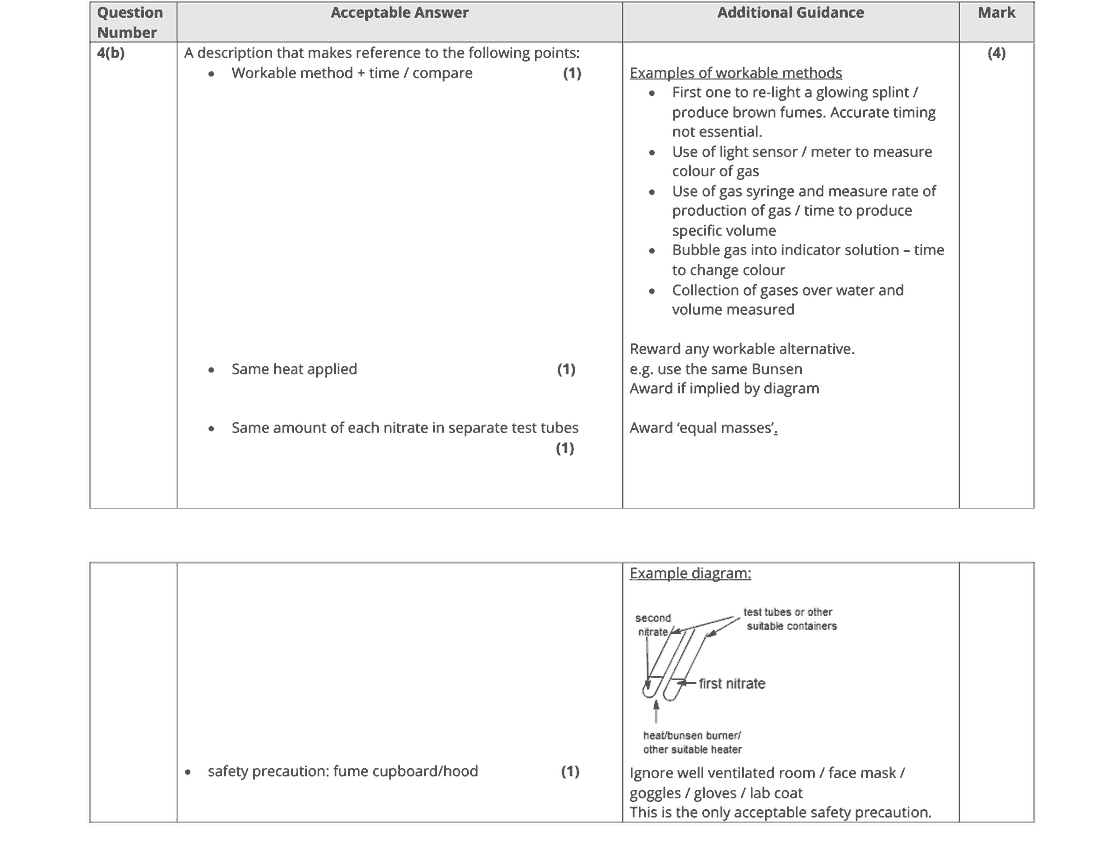
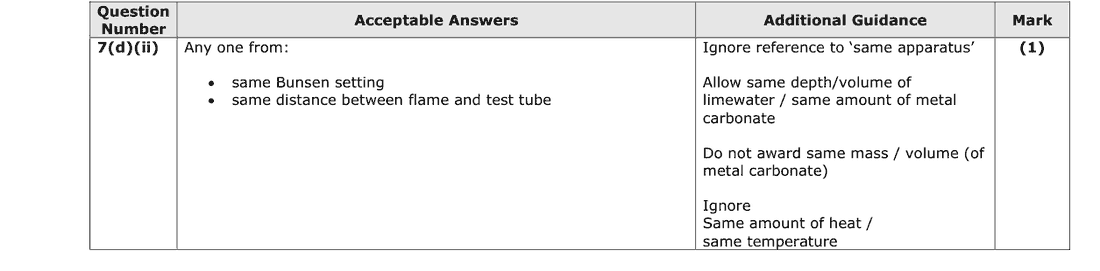
Any two: same Bunsen flame / setting / Bunsen temperature (just 'same temperature / heat' is ignored)
same distance of the heat source from the test tube
same number of moles (allow amount) of each carbonate (not same mass or volume). Most wrote 'same mass' or just 'same temperature' and lost the marks
June 2024 · AS Paper 1 · Q7(c)(iii)1 markPractical and data analysis
Earlier parts of question 7 that this part uses
Mark scheme
Examiner's comment
Q7ci) This question was answered poorly. Diagrams were often rushed. The greatest error in M1 was candidates either not heating the carbonate using a Bunsen burner, adding acid to the boiling tube or heating in a conical flask / beaker. The greatest error for M2 was from candidates not drawing a delivery tube clearly where the gas could travel through. Some candidates lost M2 for the delivery tube not being in the limewater or having a bung on the limewater test tube. Q7cii) Similarly to question 7ci, question 7cii was answered poorly. Candidates achieved marks for ‘same distance from heat source’ and ‘same Bunsen burner temperature / setting / heat’. However, many candidates only mentioned ‘same temperature / heat’ and therefore were not able to achieve the mark. Most candidates said ‘same mass of carbonate’ rather than ‘same moles of carbonate’ so did not achieve the mark. Q7ciii) Candidates answered this question relatively well, with most candidates losing the mark for not mentioning time or not mentioning ‘volume’ of carbon dioxide. Q7civ) Again, this question was answered relatively well, with 60% of candidates getting the correct answer.
Notes from the mark scheme and report
The time taken for the limewater to turn milky, or the time taken to collect a particular volume of gas. Marks were usually lost for leaving out time or the volume of carbon dioxide
June 2024 · AS Paper 1 · Q7(c)(iv)1 markMultiple choice
Earlier parts of question 7 that this part uses
Answer
C
Mark scheme
Examiner's comment
Q7ci) This question was answered poorly. Diagrams were often rushed. The greatest error in M1 was candidates either not heating the carbonate using a Bunsen burner, adding acid to the boiling tube or heating in a conical flask / beaker. The greatest error for M2 was from candidates not drawing a delivery tube clearly where the gas could travel through. Some candidates lost M2 for the delivery tube not being in the limewater or having a bung on the limewater test tube. Q7cii) Similarly to question 7ci, question 7cii was answered poorly. Candidates achieved marks for ‘same distance from heat source’ and ‘same Bunsen burner temperature / setting / heat’. However, many candidates only mentioned ‘same temperature / heat’ and therefore were not able to achieve the mark. Most candidates said ‘same mass of carbonate’ rather than ‘same moles of carbonate’ so did not achieve the mark. Q7ciii) Candidates answered this question relatively well, with most candidates losing the mark for not mentioning time or not mentioning ‘volume’ of carbon dioxide. Q7civ) Again, this question was answered relatively well, with 60% of candidates getting the correct answer.
Notes from the mark scheme and report
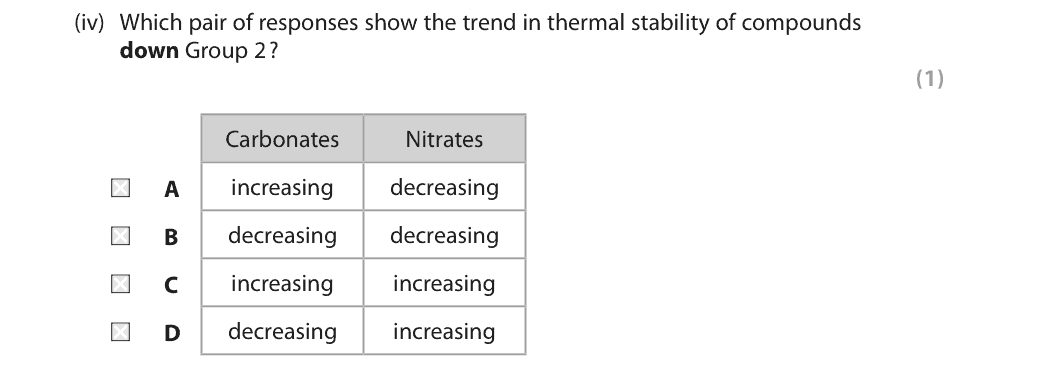
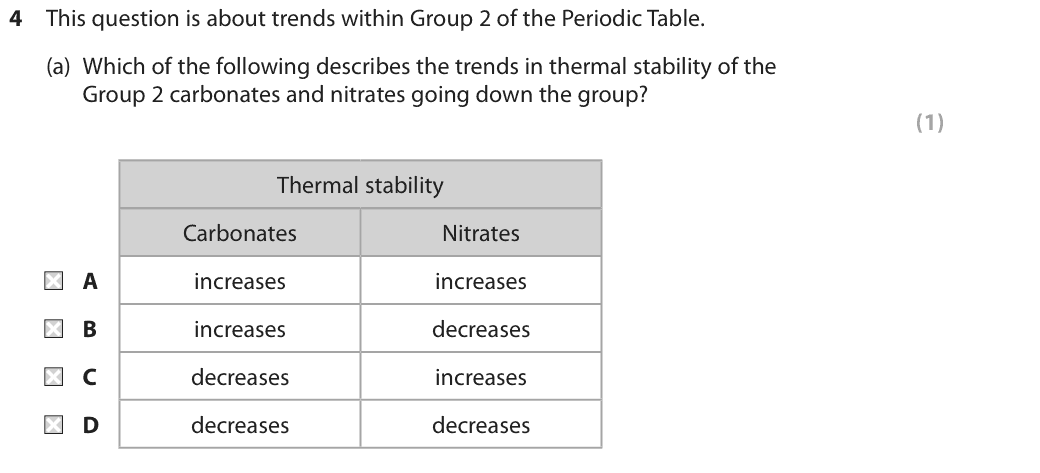
Answer: C. Thermal stability of both carbonates and nitrates increases down Group 2. 60% correct
June 2024 · Paper 3 · Q3(e)(i)2 marksExplanation
Earlier part of question 3 that this part uses
Mark scheme
Examiner's comment
A significant number of candidates got the right idea in part (a) of the small crystals going through the filter paper, while others gave vague comments about the crystals being filtered without stating what this meant. Unfortunately, answers referring to the dissolving of the small crystals were seen regularly. Also a notable number of responses referred to the crystals sticking to the filter paper but this would not lead to a lower mass since the filter paper was wieghed at the end. In part (b) it was rare to see candidates specifically referring to the correct chemicals that could be rinsed and referred just to the solution instead. It was disappointing that so few attempting to explain the consequence if rinsing did not happen. In addition, some referred to the dissolving of “insoluble” impurities showing a fundamental misunderstanding. The calculation in part (c) was competently done by most candidates and all three marks awarded. Candidates are reminded to remain in the answer space for each question. There was a large number of candidates who strayed outside of the designated area and this made it more difficult for examiners to mark. The question of (d)(i) was another were the second mark needed to reason on the consequence of the action from the first mark. Many candidates correctly understood that some of the solution would be lost on the bench and gained M1 but few then reasoned that this would result in fewer moles of M2SO4 and that this would then lead to a higher relative formula mass. A small minority suggested that the glass rod would pick up impurities or such from the bench but then failed to go on and reason the effect of this. Part (d)(ii) illustrates that sometimes an answer for one mark needs more than one facet. In order to gain the mark an answer needed to refer to the action of rinsing, the deionised/distilled water used for the rinsing and that the rinsing would be put back into the beaker. These are all simple parts but essential for the response to score the mark. Not surprisingly these were often not always stated. The origin of a flame colour has been examined many times before and it was evident that most candidates knew the expressions required for part (e)(i). There were only a few occasions when a reference to transmission of light or light being reflected and these were penalised. At times the reference to heat energy being responsible for the excitation of electrons was missing. It was pleasing to see so many correct answers scoring both marks for part (e)(ii) on the advantages and disadvantges of a flame test in identifying metal cations. These were not always clearly identified as such and so examiners had to use their judgement whether the response was ‘for or against’ the use of flame tests. Candidates may not always be so fortunate.
Notes from the mark scheme and report
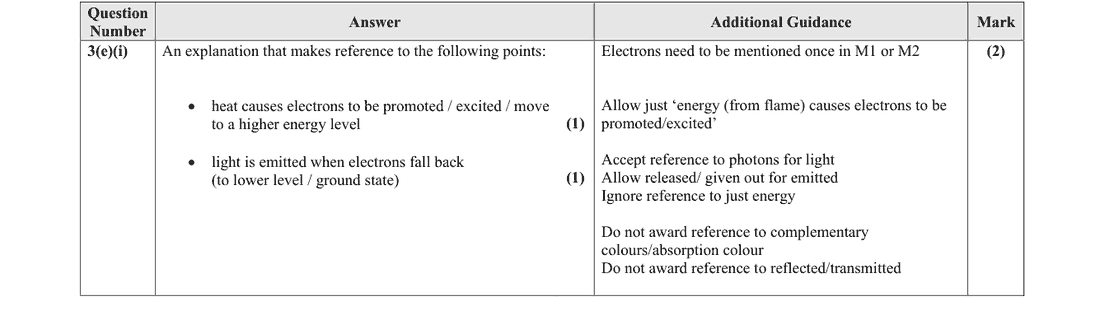
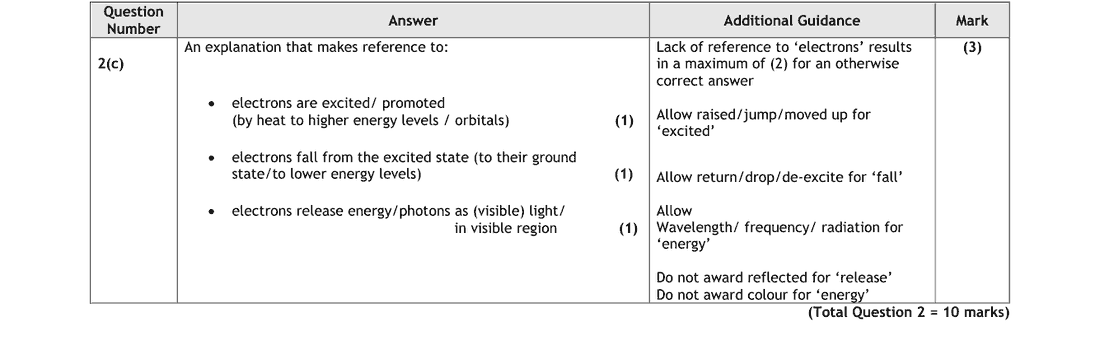
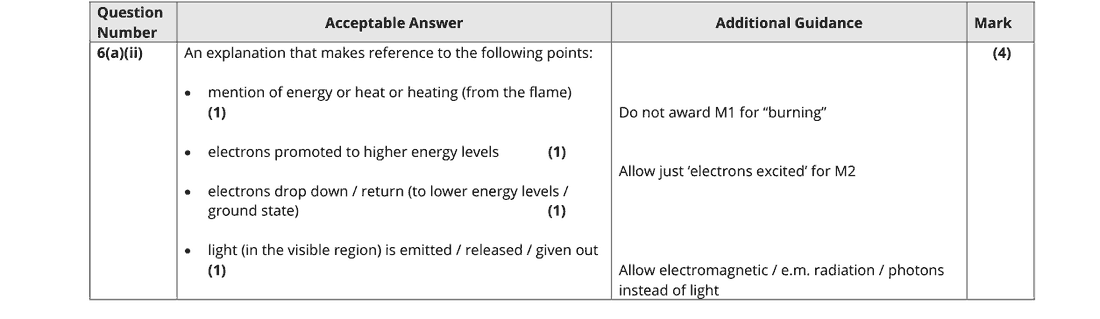
Heat (energy from the flame) promotes electrons to a higher energy level (1)
light is emitted as the electrons fall back to a lower level (1). Electrons must be mentioned once. Not complementary colours or absorption
not reflected or transmitted light. Most knew this
sometimes the heat causing the excitation was left out
June 2024 · Paper 3 · Q3(e)(ii)2 marksPractical and data analysis
Earlier parts of question 3 that this part uses
Mark scheme
Examiner's comment
A significant number of candidates got the right idea in part (a) of the small crystals going through the filter paper, while others gave vague comments about the crystals being filtered without stating what this meant. Unfortunately, answers referring to the dissolving of the small crystals were seen regularly. Also a notable number of responses referred to the crystals sticking to the filter paper but this would not lead to a lower mass since the filter paper was wieghed at the end. In part (b) it was rare to see candidates specifically referring to the correct chemicals that could be rinsed and referred just to the solution instead. It was disappointing that so few attempting to explain the consequence if rinsing did not happen. In addition, some referred to the dissolving of “insoluble” impurities showing a fundamental misunderstanding. The calculation in part (c) was competently done by most candidates and all three marks awarded. Candidates are reminded to remain in the answer space for each question. There was a large number of candidates who strayed outside of the designated area and this made it more difficult for examiners to mark. The question of (d)(i) was another were the second mark needed to reason on the consequence of the action from the first mark. Many candidates correctly understood that some of the solution would be lost on the bench and gained M1 but few then reasoned that this would result in fewer moles of M2SO4 and that this would then lead to a higher relative formula mass. A small minority suggested that the glass rod would pick up impurities or such from the bench but then failed to go on and reason the effect of this. Part (d)(ii) illustrates that sometimes an answer for one mark needs more than one facet. In order to gain the mark an answer needed to refer to the action of rinsing, the deionised/distilled water used for the rinsing and that the rinsing would be put back into the beaker. These are all simple parts but essential for the response to score the mark. Not surprisingly these were often not always stated. The origin of a flame colour has been examined many times before and it was evident that most candidates knew the expressions required for part (e)(i). There were only a few occasions when a reference to transmission of light or light being reflected and these were penalised. At times the reference to heat energy being responsible for the excitation of electrons was missing. It was pleasing to see so many correct answers scoring both marks for part (e)(ii) on the advantages and disadvantges of a flame test in identifying metal cations. These were not always clearly identified as such and so examiners had to use their judgement whether the response was ‘for or against’ the use of flame tests. Candidates may not always be so fortunate.
Notes from the mark scheme and report
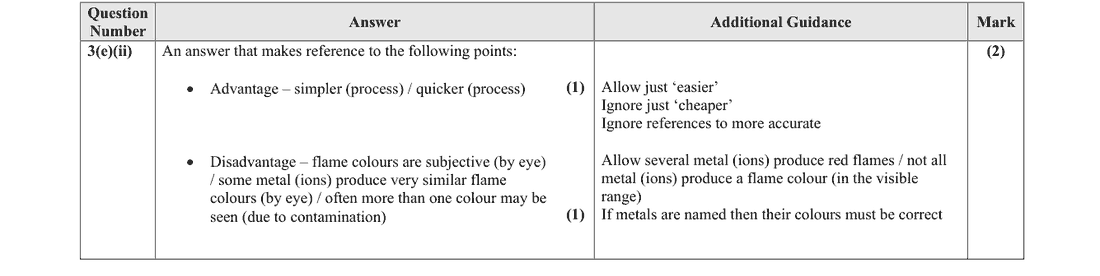
Advantage: simpler / quicker (allow easier
cheaper and more accurate are ignored). Disadvantage: flame colours are judged by eye (subjective)
some metal ions give very similar colours, or no visible colour
contamination can give more than one colour. Any named metals must have the right colours. Many scored both, though it was not always clear which point was the advantage
Skills: PT4 use laboratory apparatus for a variety of experimental techniques, including: titration, using burette and pipette; distillation and heating under reflux, including setting up glassware using retort stand and clamps; qualitative tests for ions and organic functional groups; filtration, including use of fluted filter paper, or filtration under reduced pressure
June 2024 · Paper 3 · Q4(b)3 marksExplanation
Mark scheme
Examiner's comment
There were large numbers of correct answers to part (a)(i) either by the total entropy change ‘route’ or the Gibbs Free Energy change ‘route’. Occasionally a mark was lost for giving incorrect units for the final answer, either including Kelvin for the Gibbs Free Energy change value or for omitting such for the total entropy change value. A small minority confused the two methods. There was also a small number of candidates that calculated a negative value for the entropy change of the system and use of this value would result in a final value that suggested the reaction was feasible instead of not so. This should have prompted candidates to revisit their initial calculation to determine their error. Alas this seemed to be rarely the case. The vast majority of candidates found the calculation in part (a)(ii) very accessible but there were a sizeable number who missed the requirement in the question to firstly convert to degrees Celsius and secondly, to give the answer to two or three significant figures. The third mark was dependent on doing both of these two things. Part (b) was another question on a familiar topic for candidates and this was evident in the many excellent answers covering all three necessary points. The marks which were lost tended to be more likely as a result of lack of precision than of understanding. For example, polarising the nitrate ion by the calcium ion means a distortion of the nitrate electron cloud. Use of the specialist term ‘polarising’ covers this. If a candidate chooses to describe this rather than use the specialist term then fine, but all aspects are required. It is not enough to just state that the calcium ion distorts the nitrate ion, there needs to be explicit reference to the electron cloud. Likewise, the effect of this polarisation is the weakening of the bonds within the nitrate. It is not the bond between the calcium ion and the nitrate ion which is weakened and this needed to be made clear. Also it is worth reminding candidates that charge density is not the same as electron density. The balancing of the ionic equation in part (c)(i) was only achieved by the more able candidates. The suggestion to use oxidation numbers in the question was given to aid the candidates but this was not often heeded. Nevertheless, there were a reasonable number of candidates that scored the mark. The simple test for ammonia in part (c)(ii) was well-known with only the occasional reverse colour change to red being stated.
Notes from the mark scheme and report
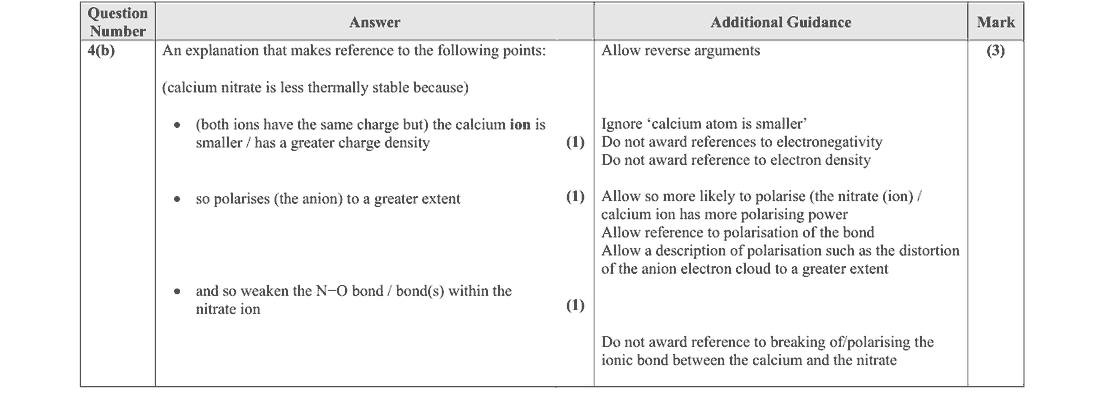
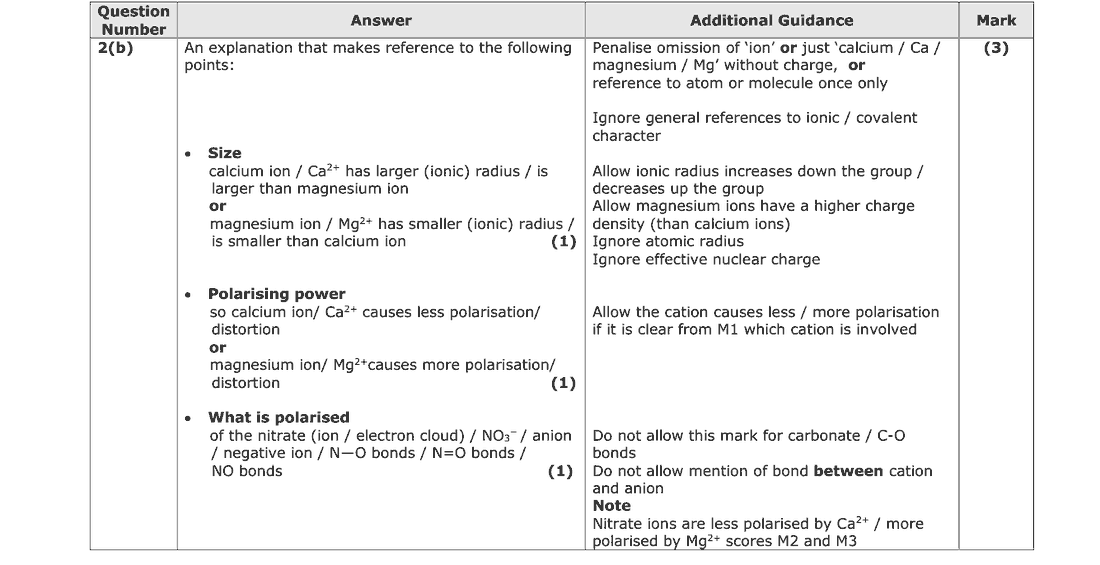
The calcium ion is smaller (same charge), so has a greater charge density (1)
so it polarises the nitrate ion more / distorts its electron cloud more (1)
weakening the N–O bonds within the nitrate ion (1). 'Calcium atom' is ignored
not electronegativity or electron density
not weakening the ionic bond between calcium and nitrate. Many excellent answers
marks were lost through imprecision, e.g. 'distorts the nitrate ion' with no mention of its electron cloud
June 2023 · AS Paper 1 · Q2(b)4 marksPractical and data analysis
Earlier part of question 2 that this part uses
Mark scheme
Examiner's comment
(a)(i) This question proved more challenging than expected. Candidates most often scored the mark by answering that the substance was not a molecule. The idea that giant structures require the use of the relative formula mass was clearly not well understood. Of course, molar mass calculation can be carried out without this knowledge. Common incorrect answers included comments about the mass being relative to 1/12th of the mass of carbon-12, the answer to the next item. (a)(ii) The answer here was better understood. The idea of comparing to the mass of a 1/12th of atom of carbon-12 was quite well known and there were ideas that the mass was a relative mass or a comparison. Some candidates realised that the units would cancel and scored the mark in this way. (a)(iii) The multiple choice questions was mostly answered correctly, with over 85% of candidates scoring this mark.
(a)(iv) Whichever answer was given in (a)(iii) candidates were still able to score by calculating the correct number of moles here. For those who knew the calculation to do, which included most candidates, the only common error was to use only one significant figure, which did not score the mark. (b) Testing for the metal ions using flame test proved to be commonly understood, with most scoring the first mark for the lilac flame of the potassium ion, and many knew that the magnesium ion did not give a flame colour, with candidates often stating that the wavelength associated with the transition was outside of the visible region. Unfortunately, it was common for answers to talk about potassium and magnesium rather than their ions. This was penalised if comments were made about magnesium giving no flame colour. Magnesium metal, of course, burns with a very bright white flame and so the omission of the word ‘ions’ was penalised here. The addition of hydroxide ions proved less well known, though many candidates did recognise the magnesium hydroxide would precipitate. It was quite common for candidates to discuss the lilac flame and the magnesium hydroxide precipitate without mentioning the negative tests, even though that was specifically asked for in the question. Candidates should read the questions with care. (c)(i) Just over half of candidates were able to score this mark. (c)(ii) Ionic equations continue to be something which would benefit from further study. This equation, which is quite commonly asked as it is one of the tests for ions which needs to be known, was not well understood. There were many attempts at full equations. Some candidates did not register that state symbols were required. Although it was possible to score the mark for answers in (c)(i) for options A and B, this was very rarely scored, firstly because these were not often selected, and secondly because the ionic equation was less straightforward, due to the difference in charges on the ions.
Notes from the mark scheme and report
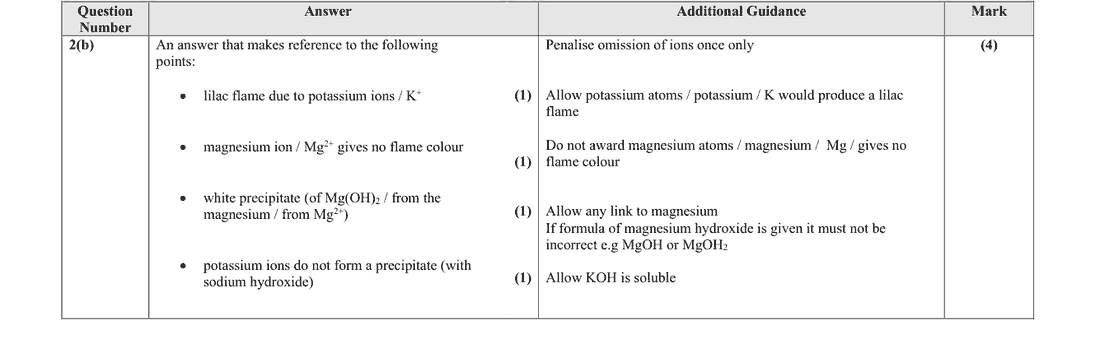
M1 flame test: lilac flame from the potassium ions
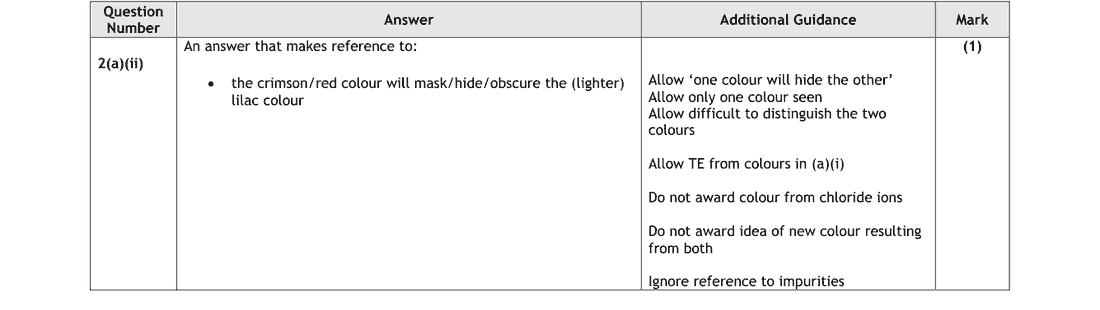
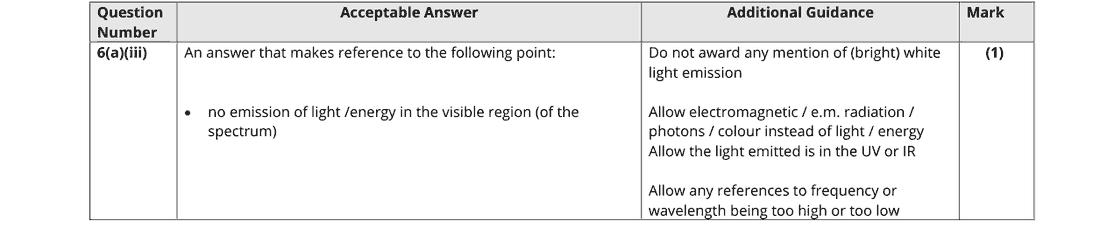
M2 magnesium ions give no flame colour
M3 sodium hydroxide: white precipitate (of Mg(OH)2 / from the magnesium ions
any formula given must be correct)
M4 potassium ions give no precipitate (KOH is soluble). Omitting 'ions' is penalised once, but 'magnesium gives no flame colour' never scores since the metal burns with a bright white flame. Many gave the two positive results and left out the negative ones, although each cation in each test was asked for
Skills: PT4 use laboratory apparatus for a variety of experimental techniques, including: titration, using burette and pipette; distillation and heating under reflux, including setting up glassware using retort stand and clamps; qualitative tests for ions and organic functional groups; filtration, including use of fluted filter paper, or filtration under reduced pressure; CP7 Core practical 7: Analysis of some inorganic and organic unknowns
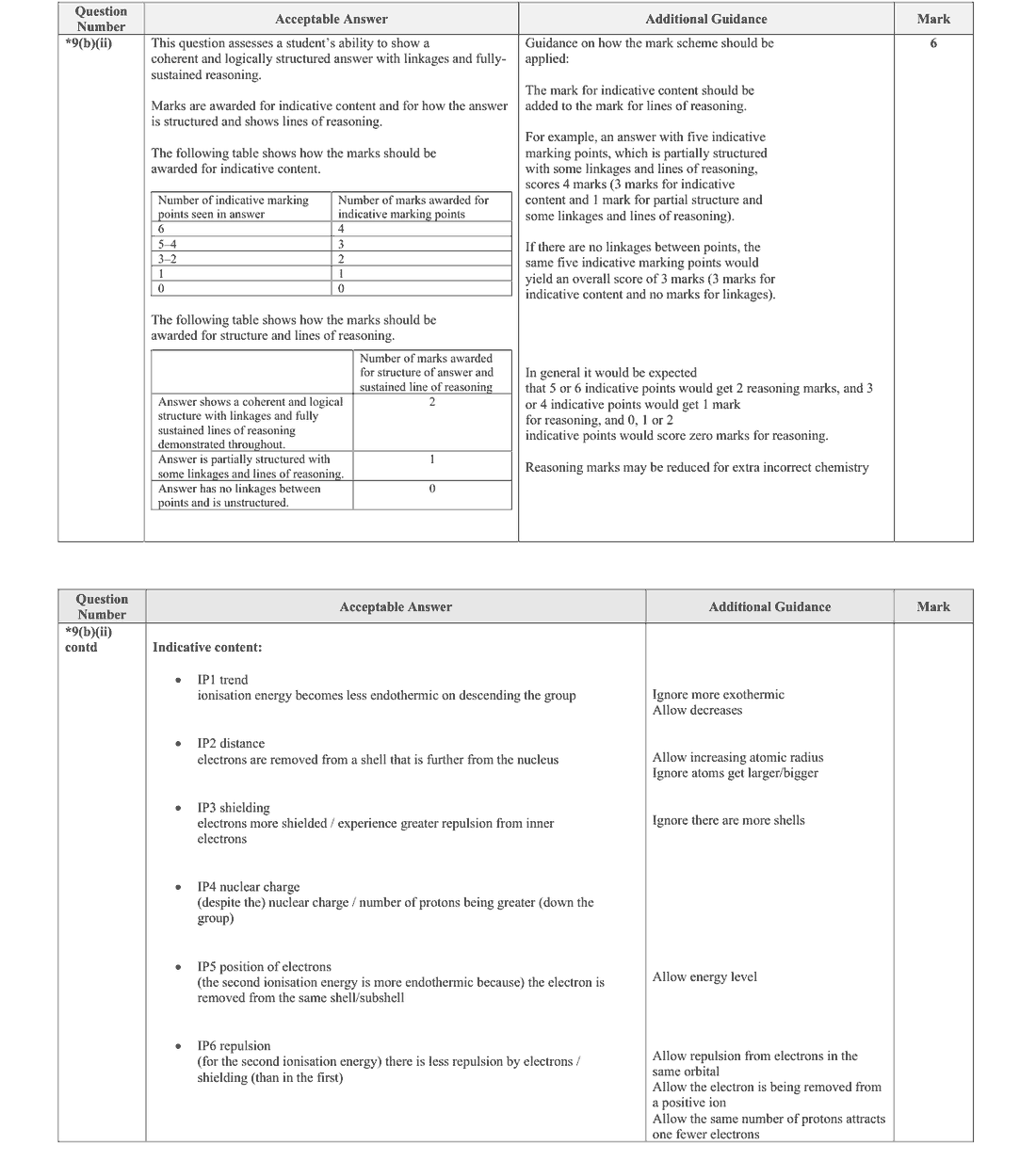
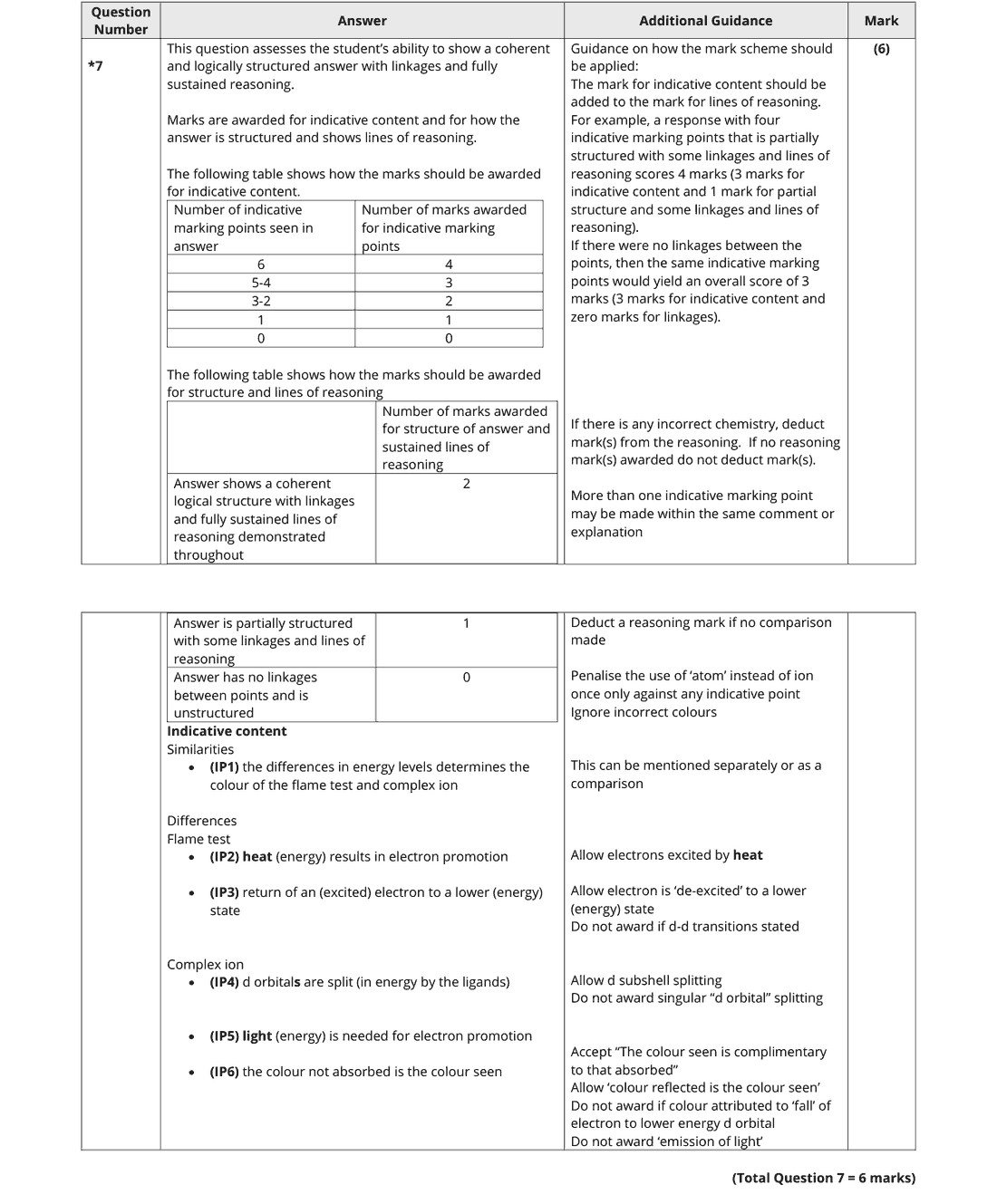
June 2023 · AS Paper 1 · Q9(b)(ii)6 marks6-mark extended response
Earlier part of question 9 that this part uses
Mark scheme, with the indicative content and the marks for reasoning
Examiner's comment
(a) The multiple choice in (a) was scored by 70% of candidates. (b)(i) The equation for the second ionisation energy proved to be well known. Many candidates scored both marks for both styles of equation in the mark scheme. Correct state symbols were allowed for some of the closer efforts which did not score M1, but only those that were quite close to the correct answer.
(b)(ii) This six mark question proved to be very accessible to candidates with very few not achieving at least some credit and high marks scored by many candidates. As is common for questions about ionisation energy descending a group, the idea of comparing the changes which make the value less, increased shielding and distance from the nucleus, with increased nuclear charge due to more protons, proved the least accessible indicative point out of the first four. The second two indicative points, comparing the first and second ionisation energies, were least commonly scored. Perhaps this was due to not reading the question with sufficient care, or becoming wrapped up in explaining the trend in first ionisation energy and then forgetting about this second aspect. Some marks were lost due to lack of clarity or contradictory statements about particular indicative points. (b)(iii) For the final question of the paper, this proved fairly accessible with many candidates scoring at least one mark.
Notes from the mark scheme and report
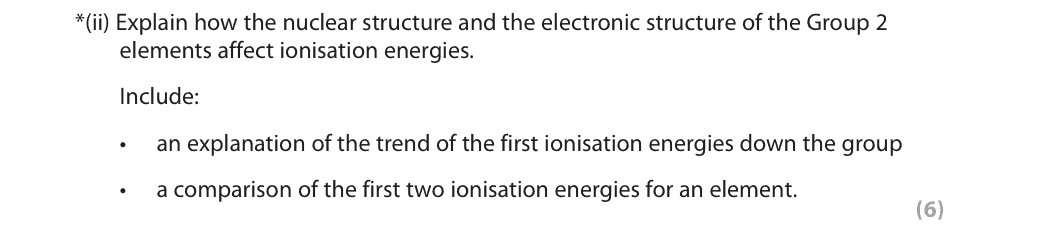
Six indicative points plus two marks for reasoning. IP1 first ionisation energy decreases (becomes less endothermic) down the group
IP2 the electron removed is in a shell further from the nucleus (atomic radius increases)
IP3 it is more shielded / repelled more by inner electrons
IP4 despite the greater nuclear charge (more protons) down the group
IP5 the second ionisation energy is higher although the electron comes from the same shell / subshell
IP6 because there is less electron repulsion / the electron is removed from a positive ion / the same number of protons attracts one fewer electron. 'More shells' alone is ignored for IP3. IP4 was the least often scored of the first four, and IP5 and IP6 were scored least of all, often because the comparison of first and second ionisation energies was forgotten
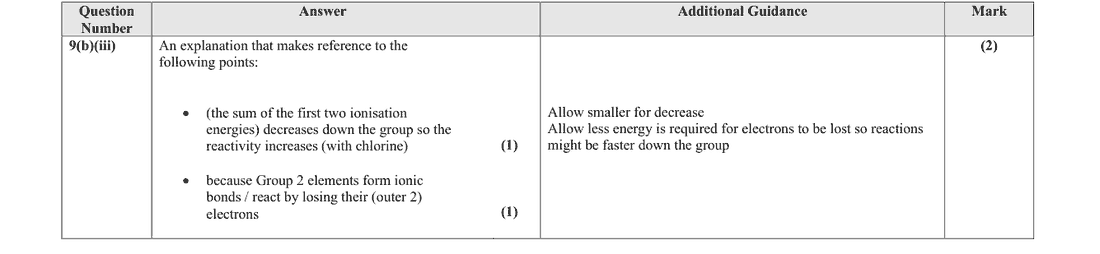
June 2023 · AS Paper 1 · Q9(b)(iii)2 marksExplanation
Earlier part of question 9 that this part uses
Mark scheme
Examiner's comment
(a) The multiple choice in (a) was scored by 70% of candidates. (b)(i) The equation for the second ionisation energy proved to be well known. Many candidates scored both marks for both styles of equation in the mark scheme. Correct state symbols were allowed for some of the closer efforts which did not score M1, but only those that were quite close to the correct answer.
(b)(ii) This six mark question proved to be very accessible to candidates with very few not achieving at least some credit and high marks scored by many candidates. As is common for questions about ionisation energy descending a group, the idea of comparing the changes which make the value less, increased shielding and distance from the nucleus, with increased nuclear charge due to more protons, proved the least accessible indicative point out of the first four. The second two indicative points, comparing the first and second ionisation energies, were least commonly scored. Perhaps this was due to not reading the question with sufficient care, or becoming wrapped up in explaining the trend in first ionisation energy and then forgetting about this second aspect. Some marks were lost due to lack of clarity or contradictory statements about particular indicative points. (b)(iii) For the final question of the paper, this proved fairly accessible with many candidates scoring at least one mark.
Notes from the mark scheme and report
M1 the sum of the first two ionisation energies decreases down the group, so reactivity (with chlorine) increases (allow: less energy is needed to lose the electrons, so reactions may be faster). M2 because Group 2 elements react by losing their two outer electrons / form ionic bonds. Many scored at least one mark
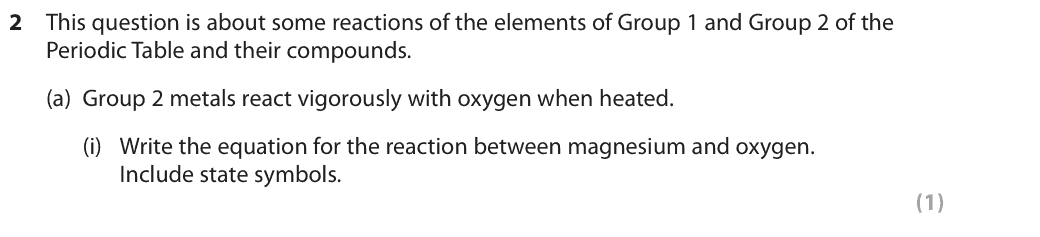
June 2023 · Paper 3 · Q2(a)(i)1 markEquation writing
Mark scheme
Examiner's comment
This straightforward equation with state symbols was correctly given by the majority of candidates. Multiples were acceptable. Most of the errors could have been resolved by checking or by considering what candidates had likely experienced in class.
Notes from the mark scheme and report
2Mg(s) + O2(g) → 2MgO(s). Balancing and state symbols both needed for the one mark
multiples accepted
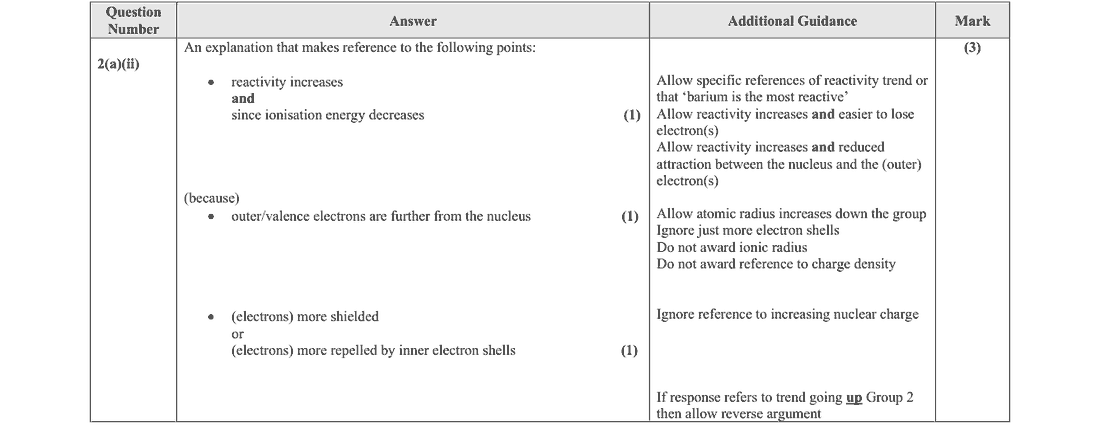
June 2023 · Paper 3 · Q2(a)(ii)3 marksExplanation
Earlier part of question 2 that this part uses
Mark scheme
Examiner's comment
Many excellent responses were seen. This is a topic area which is well-understood by most candidates and generally marks were lost from a lack of accuracy or care in the answer. For example, it is not correct to refer to increasing 'ionic' radius because it is the atoms which are losing electrons. Hence the use of this term resulted in a loss of marking point two.
Notes from the mark scheme and report
Reactivity increases down the group because ionisation energy decreases (or electrons are lost more easily)
the outer electrons are further from the nucleus (atomic radius increases
just 'more shells' is ignored)
and are more shielded / repelled by inner shells. Not ionic radius
not charge density. Marks were lost through inaccuracy, e.g. writing 'ionic' radius
June 2023 · Paper 3 · Q2(b)(i)1 markShort answer
Earlier part of question 2 that this part uses
Mark scheme
Examiner's comment
The majority of candidates knew that the trend down Group 2 sulfates is of decreasing solubility.
Notes from the mark scheme and report
Solubility decreases down the group (e.g. barium sulfate is less soluble than magnesium sulfate)
June 2023 · Paper 3 · Q2(b)(ii)2 marksExplanationHard
Earlier parts of question 2 that this part uses
Mark scheme
Examiner's comment
This was one of the more challenging questions on the paper. It is worth reminding centres and their candidates that the rubric of the paper can provide some guidance. For example, parts (a), (b), (c) and so on are on the same general topic, but do not necessarily follow on. By contrast, sub-parts (i), (ii), (iii) and so on do often follow on from each other. Hence the answer of decreasing solubility in (i) provided some help or direction in answering this part (ii). The decreased solubility of the calcium sulfate formed a solid coating or layer on the metal which served as a physical barrier to further reaction.
Notes from the mark scheme and report
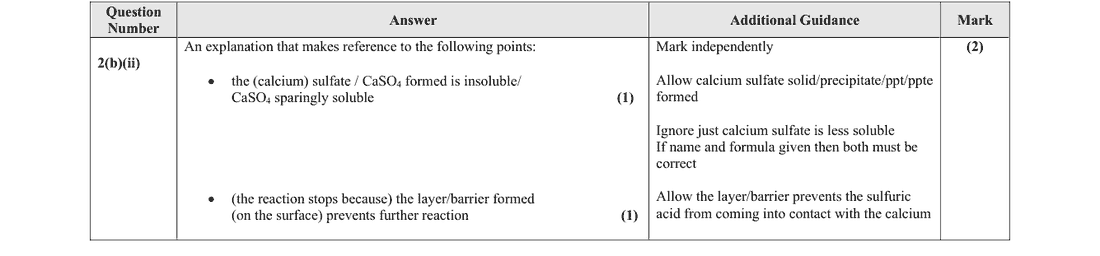
The calcium sulfate formed is insoluble / sparingly soluble (a solid or precipitate forms
just 'less soluble' is ignored)
it forms a layer on the surface of the calcium that stops the acid reaching the metal. Marks independent. Part (i) is the hint
June 2023 · Paper 3 · Q2(c)(i)1 markPractical and data analysis
Earlier part of question 2 that this part uses
Mark scheme
Examiner's comment
Most of the candidates knew the test for oxygen very well. The main issues arose from poor expressions and a minority confusing the test for oxygen with that for hydrogen.
Notes from the mark scheme and report
A glowing splint relights. Not 'relights a lit splint'
not the squeaky pop (hydrogen). Errors were poor wording and confusion with the hydrogen test
Skills: PT4 use laboratory apparatus for a variety of experimental techniques, including: titration, using burette and pipette; distillation and heating under reflux, including setting up glassware using retort stand and clamps; qualitative tests for ions and organic functional groups; filtration, including use of fluted filter paper, or filtration under reduced pressure
June 2023 · Paper 3 · Q2(c)(ii)1 markEquation writing
Earlier parts of question 2 that this part uses
Mark scheme
Examiner's comment
In part (ii), it was disappointing that many candidates did not know the equation for the decomposition of sodium nitrate, but it was perhaps more worrying that in the answers given it was common to see elemental sodium being produced.
The oxidation number changes required in part (ii) were frequently given correctly for the equations written. However, if the equation was incorrect then only one mark for the reference to oxygen being oxidised from – 2 to 0 was awarded. There was one exception, if the equation given was the decomposition equation was that of lithium nitrate which mirrors Group 2 nitrates decomposition.
Notes from the mark scheme and report
NaNO3 → NaNO2 + ½O2 (multiples allowed). Many did not know it
answers producing sodium metal were common
June 2022 · Paper 1 · Q2(a)2 marksPractical and data analysis
Mark scheme
Notes from the mark scheme and report
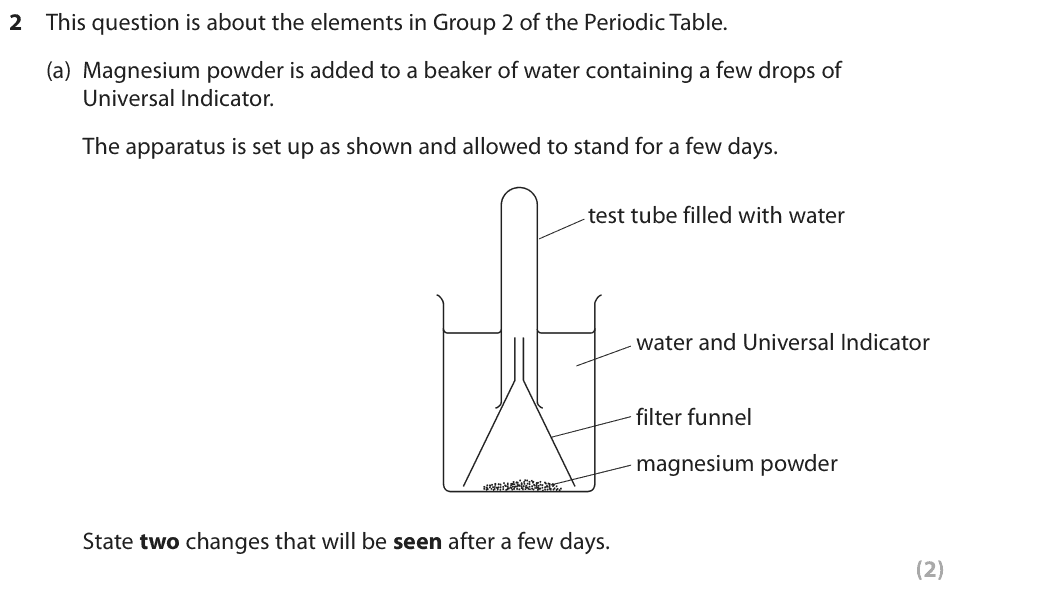
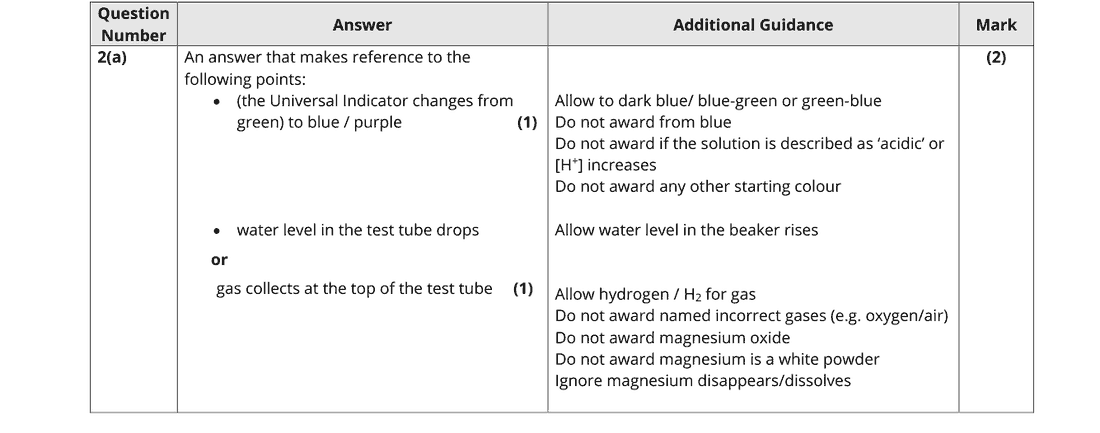
Universal Indicator turns (from green) to blue / purple (1)
the water level in the test tube falls / gas collects at the top of the tube (1). Not if the solution is called acidic
a wrongly named gas (oxygen, air) loses the mark
hydrogen is allowed. 'The solution goes alkaline' is not an observation
June 2022 · Paper 1 · Q2(b)3 marksExplanation
Mark scheme
Examiner's comment
This question required candidates to explain the trend in reactivity of the Group 2 elements with reference to their electronic configurations.
Full explanations included reference to the weaker attraction of the outer electron to the nucleus as the group is descended due to increased distance of the outer electron from the nucleus and the increased shielding from inner electron shells, meaning that less energy is required for the outer electron to be lost.
Common omissions included the shielding effect, reference to the electrons being in the outer shell and not explaining that reactivity is linked to the loss of an electron.
This shows an example of a fully correct answer covering all of the points required for full marks.
Notes from the mark scheme and report
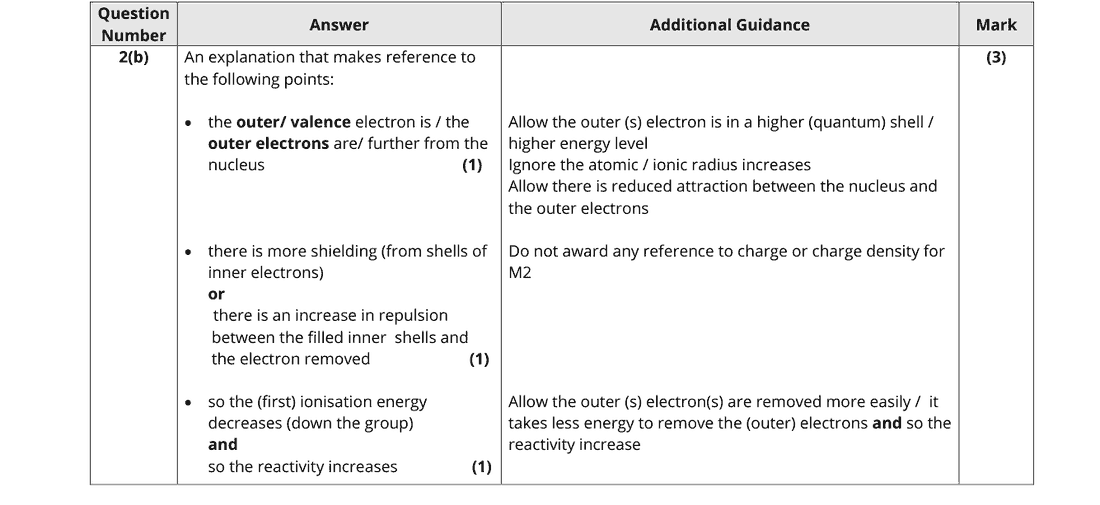
Down the group the outer electrons are further from the nucleus / in a higher shell (1)
there is more shielding from inner shells (1)
so the ionisation energy decreases (the outer electrons are lost more easily) and reactivity increases (1). Just 'atomic radius increases' is ignored
no reference to charge density for the shielding mark. Common omissions: shielding
saying the electrons are in the outer shell
linking reactivity to loss of electrons
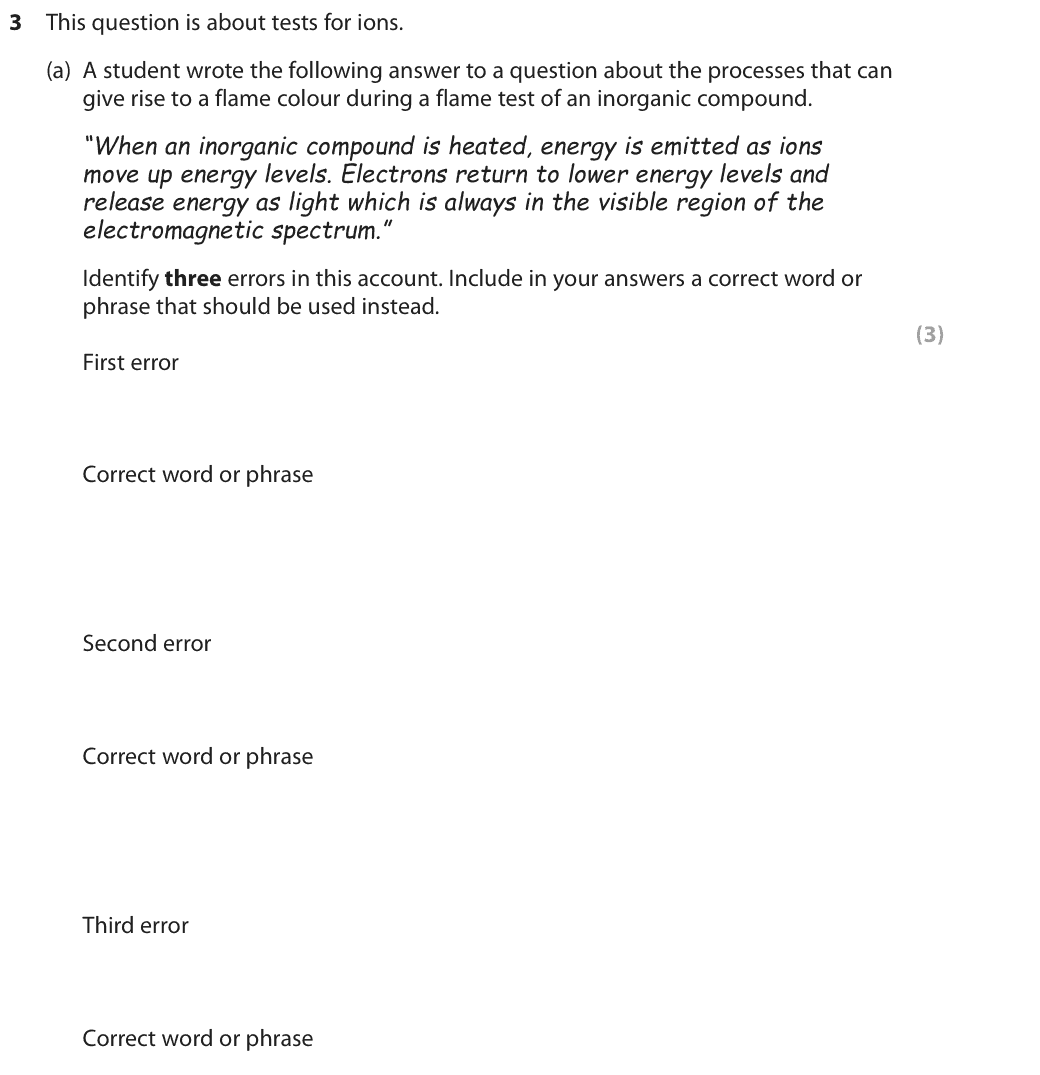
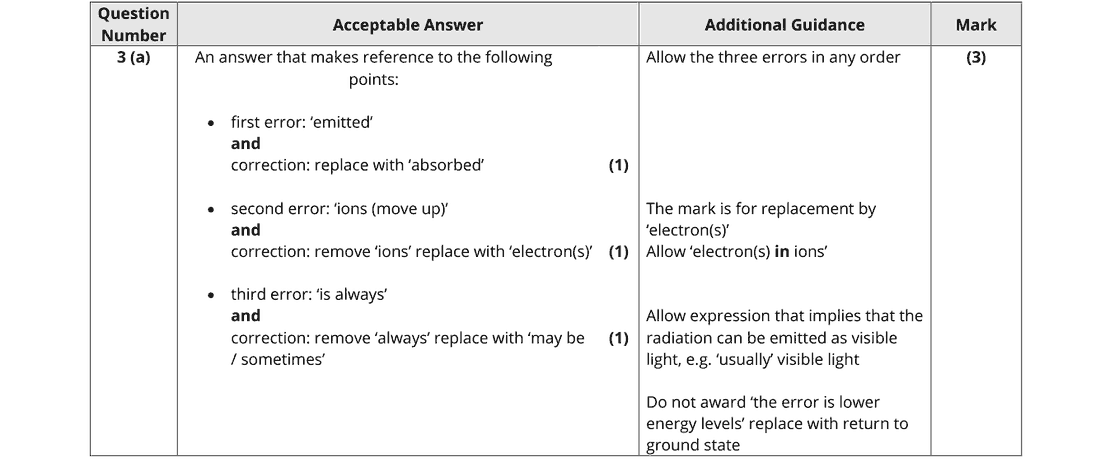
June 2022 · AS Paper 1 · Q3(a)3 marksShort answer
Mark scheme
Examiner's comment
This question required students to identify 3 errors in a written passage about the processes that occur in the production of flame colours. A good selection of correct responses was seen. Throughout the total scripts seen, all three correct responses appeared, although occasionally the response referring to the appearance of radiation in the visible region, was duplicated.
Notes from the mark scheme and report
Three errors with corrections, in any order: 'emitted' should be 'absorbed'
'ions' (move up energy levels) should be 'electrons' (allow 'electrons in ions')
'always' in the visible region should be 'may be / sometimes / usually'. Not credited: saying the error is 'lower energy levels' and replacing it with 'ground state'. Some candidates gave the visible-region point twice
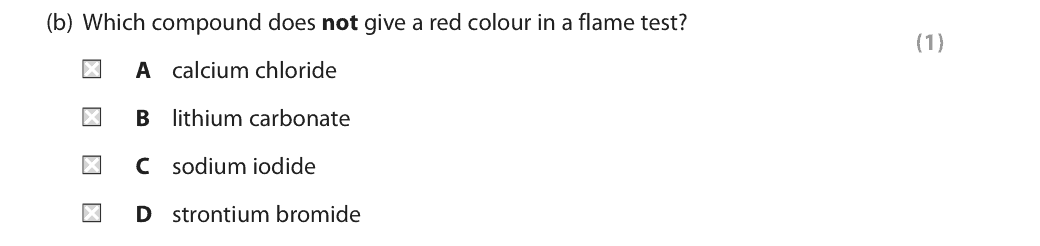
June 2022 · AS Paper 1 · Q3(b)1 markMultiple choice
Answer
C
Mark scheme
Examiner's comment
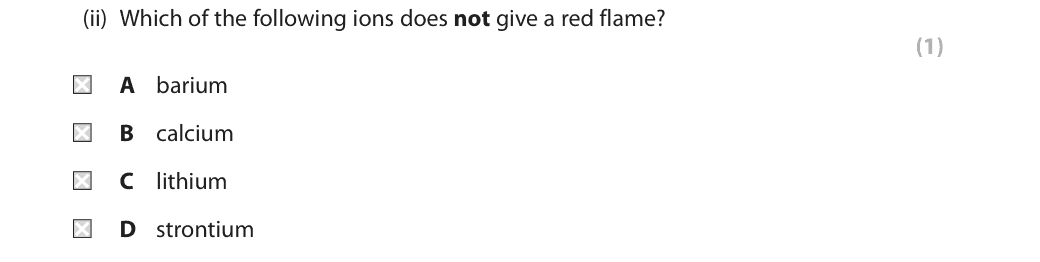
This question required only knowledge of the flame colours of some metals. Nearly all students correctly identified sodium iodide as the only compound of those listed that does not give a red flame test.
Notes from the mark scheme and report
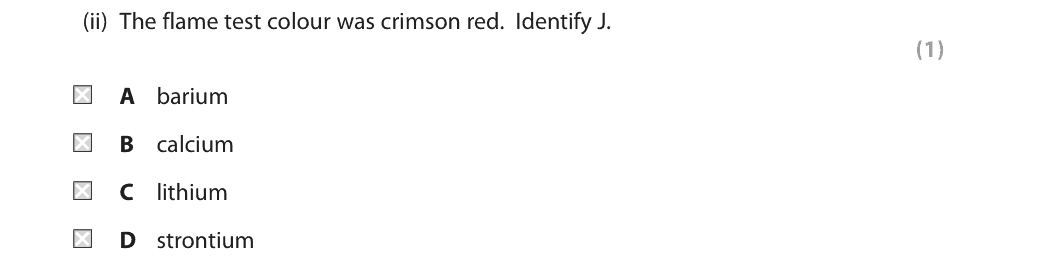
Answer: C. Sodium gives a yellow flame. Calcium is brick red, lithium crimson red and strontium red
Skills: CP7 Core practical 7: Analysis of some inorganic and organic unknowns
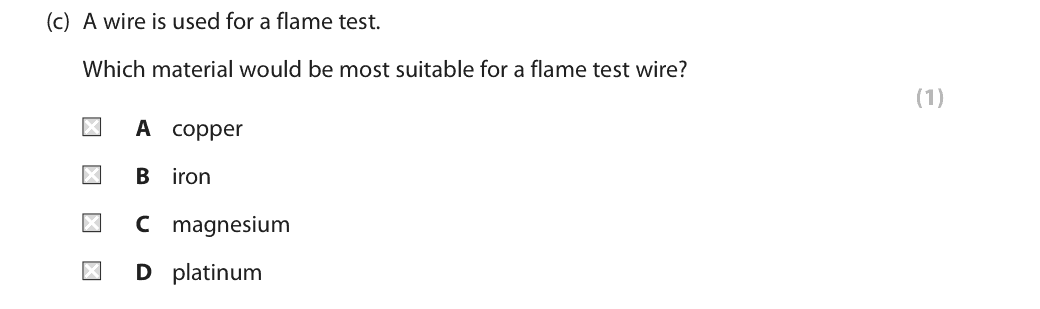
June 2022 · AS Paper 1 · Q3(c)1 markMultiple choice
Answer
D
Mark scheme
Examiner's comment
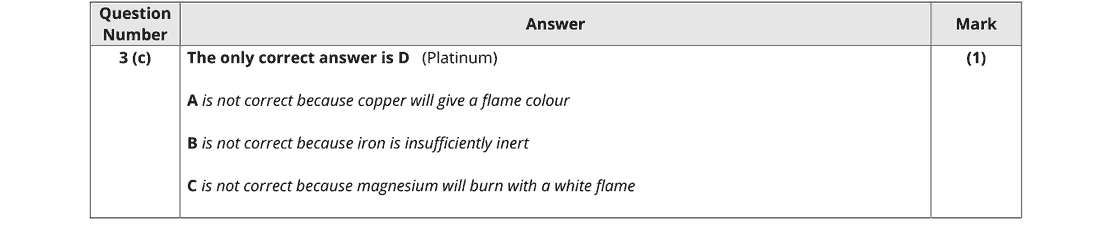
This question required only a knowledge of the suitability of some metals as flame test wires. Nearly all students correctly identified platinum as the correct response, the other metals giving either a flame colour or are themselves too reactive (magnesium). Just a few students thought copper was suitable but this gives a flame colour (blue-green) and would also melt in a hot Bunsen flame.
Notes from the mark scheme and report
Answer: D. Platinum is inert and gives no flame colour of its own. Copper gives a flame colour (blue-green)
iron is not inert enough
magnesium burns with a white flame
Skills: PT4 use laboratory apparatus for a variety of experimental techniques, including: titration, using burette and pipette; distillation and heating under reflux, including setting up glassware using retort stand and clamps; qualitative tests for ions and organic functional groups; filtration, including use of fluted filter paper, or filtration under reduced pressure; CP7 Core practical 7: Analysis of some inorganic and organic unknowns
June 2022 · Paper 1 · Q6(b)2 marksEquation writing
Mark scheme
Examiner's comment
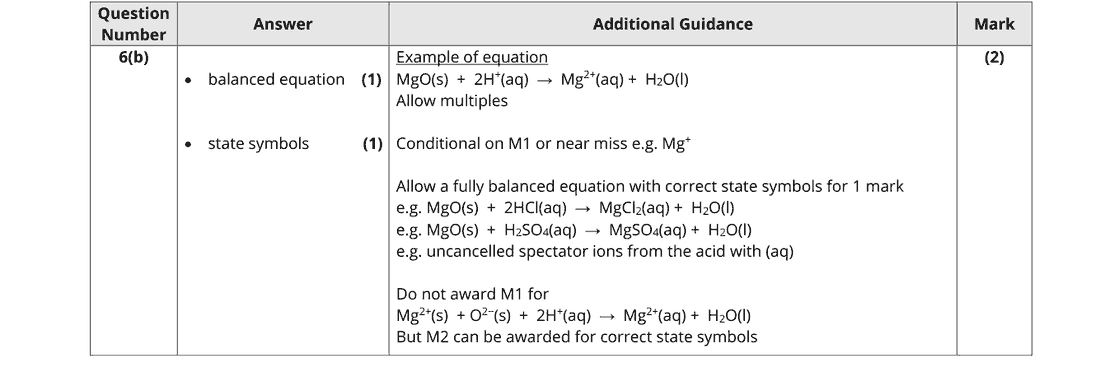
This question required the candidates to write an ionic equation for the reaction between magnesium oxide and an acid. Many candidates worked a balanced symbol equation for this reaction with hydrochloric acid being the most popular example, and then either did not convert this to an ionic question or used the wrong state symbols. It was common to see (aq) as the state symbol for the solid magnesium oxide and/or (aq) for water.
Notes from the mark scheme and report
Answer: MgO(s) + 2H+(aq) → Mg2+(aq) + H2O(l). One mark for the balanced ionic equation, one for state symbols. A full equation (e.g. with 2HCl) with correct state symbols scores 1. Splitting MgO into Mg2+(s) + O2–(s) loses the first mark. Common errors: a full equation left unconverted
(aq) for solid magnesium oxide or for water
June 2022 · AS Paper 1 · Q7(b)1 markMultiple choice
Earlier part of question 7 that this part uses
Answer
B
Mark scheme
Examiner's comment
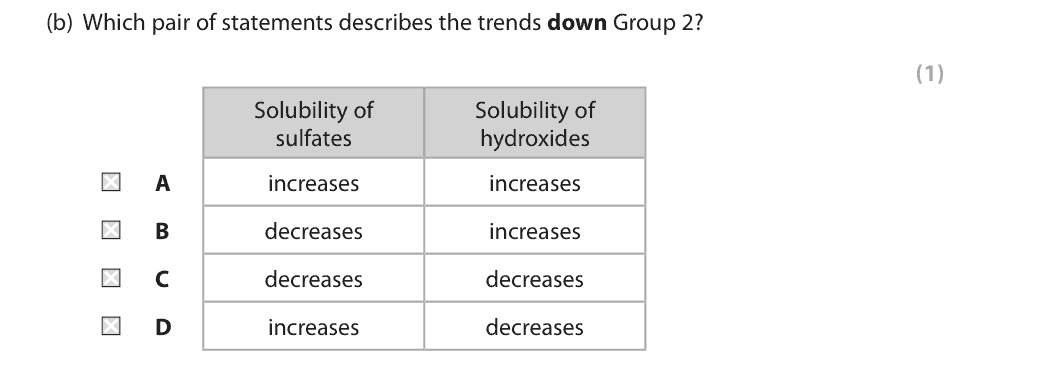
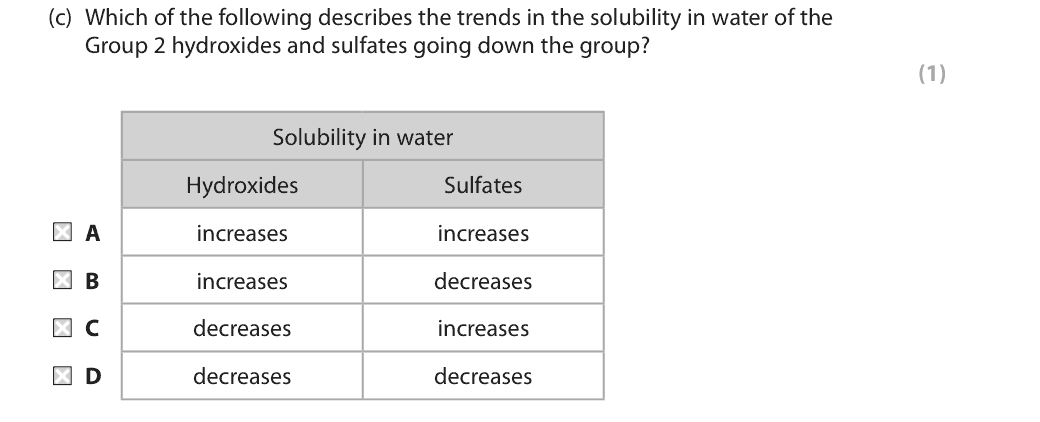
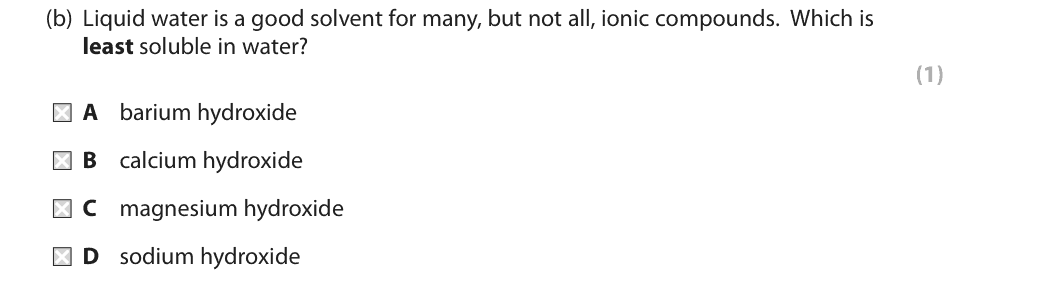
This was a simple recall question concerned with the solubility of hydroxides and sulfates down group 2. Students could get a good indication of these trends by remembering the appearance of lime water (calcium hydroxide) during a test for carbon dioxide, and the test for sulfate using barium chloride (BaSO4 precipitates).
Notes from the mark scheme and report
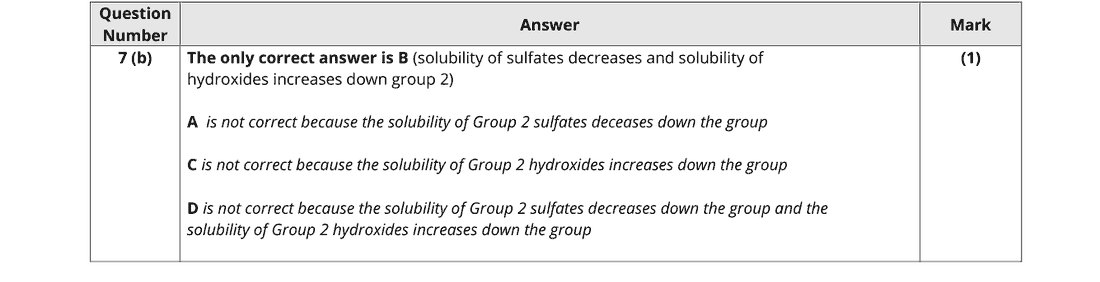
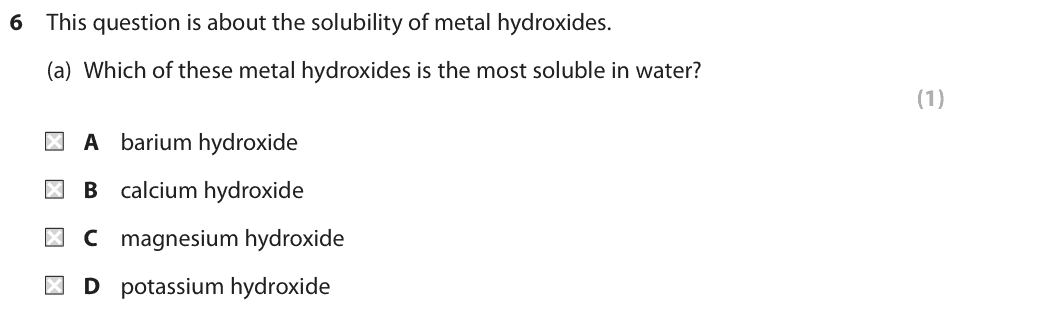
Answer: B. Down Group 2 the sulfates become less soluble and the hydroxides more soluble
June 2022 · AS Paper 1 · Q7(c)(ii)1 markEquation writing
Earlier part of question 7 that this part uses
Mark scheme
Examiner's comment
Students were asked to write an equation for the thermal decomposition of lithium nitrate. This decomposition is similar to the thermal decomposition of Group 2 nitrates (and different to the rest of the Group 1 nitrates). This information is essential to the formula of lithium oxide and hence the rest of the balanced equation. Some students appeared to be uncomfortable with the concept of ½O2 and preferred to double the equation; this was perfectly acceptable. Some attempted to use an incorrect formula for lithium oxide (usually LiO or LiO2). An incorrect initial formula for lithium oxide negated the mark (because the equation could not be balanced correctly). Students should be reminded of the importance of caps for element symbols, e.g., lithium is Li not li.
Notes from the mark scheme and report
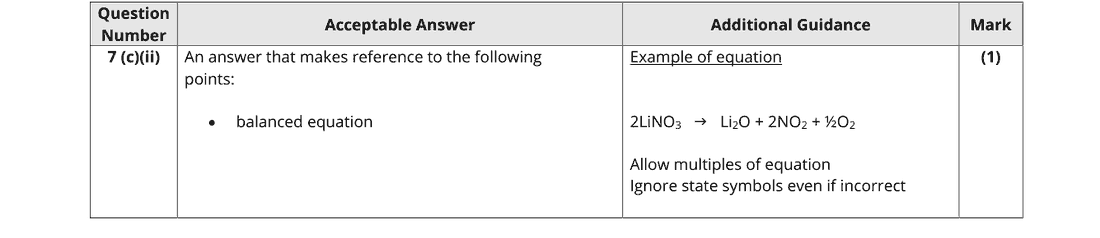
Answer: 2LiNO3 → Li2O + 2NO2 + ½O2 (or 4LiNO3 → 2Li2O + 4NO2 + O2). Lithium nitrate decomposes like a Group 2 nitrate, unlike the other Group 1 nitrates. State symbols ignored. Common errors: LiO or LiO2 for lithium oxide
lower-case symbols such as li
June 2022 · AS Paper 1 · Q7(d)3 marksExplanation
Mark scheme
Examiner's comment
This question proved to be challenging for many students. M1 Many responses claimed that group 2 carbonates have a greater charge than group 1 carbonates, when the response should have referred to the group 1 and 2 ions. Similar considerations were applicable to
descriptions that discussed charge density of the group 1 and group 2 carbonates. M2 although many had realised that the thermal stability had something to do with the charge on the ions (with some erroneously claiming it was the carbonate ion). Relatively few recognised the effect of the cation charge on the polarisation of the bonds in the carbonate ion. References to the distortion of the bonds in the carbonate were also accepted. M3 fewer still commented that the C-O bond in the carbonate would be weakened. Occasionally responders became distracted and instead discussed the trend in thermal stability down the group.
Notes from the mark scheme and report
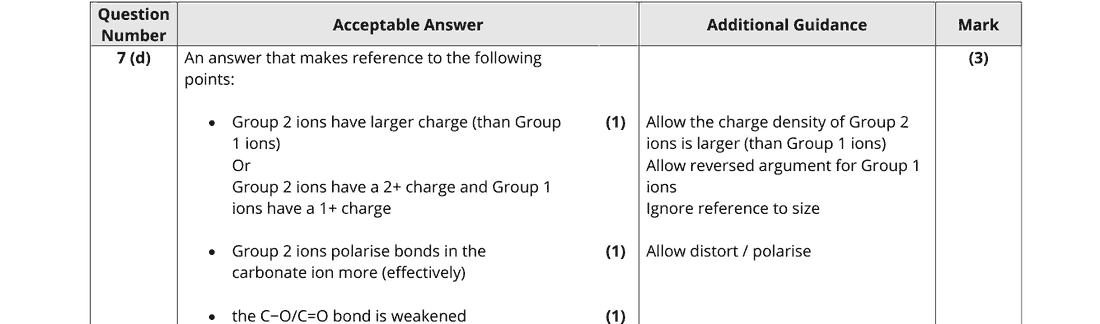
Group 2 ions have a larger charge (2+ against 1+
allow higher charge density
size ignored)
so they polarise / distort the bonds in the carbonate ion more
the C–O (or C=O) bond is weakened. Reverse argument for Group 1 allowed. Common errors: saying the carbonates, not the cations, have the greater charge
few mentioned polarisation and fewer still the weakened C–O bond
some discussed the trend down the group instead
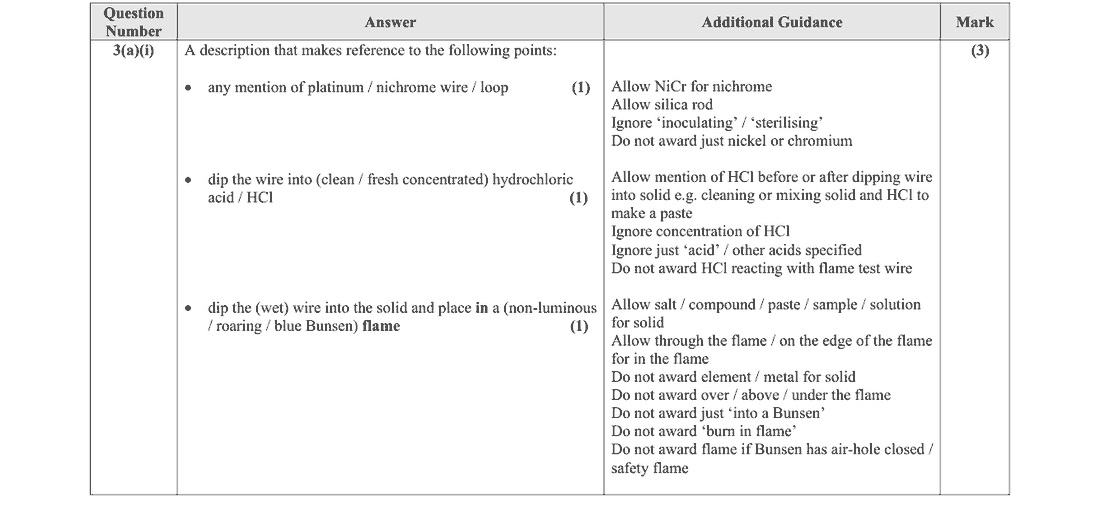
June 2022 · Paper 3 · Q3(a)(i)3 marksPractical and data analysis
Mark scheme
Examiner's comment
The majority of candidates understood the method of carrying out a flame test using a nichrome wire and concentrated hydrochloric acid. However, a significant number of candidates lost the third mark by stating that the wire with the solid sample should be held under, above or near the flame, rather than in the flame. A small number of candidates suggested using the safety flame on the Bunsen. Some candidates demonstrated knowledge beyond the question by describing how the concentrated hydrochloric acid is used to form a volatile chloride.
Notes from the mark scheme and report
Platinum or nichrome wire (silica rod allowed)
dip into (concentrated) hydrochloric acid
dip the wire into the solid and hold it in a (blue / roaring / non-luminous) Bunsen flame. Not just nickel or chromium
not over, above or under the flame
not 'burn in the flame'
not a safety flame. A significant number lost the third mark by holding the sample above or near the flame
Skills: PT4 use laboratory apparatus for a variety of experimental techniques, including: titration, using burette and pipette; distillation and heating under reflux, including setting up glassware using retort stand and clamps; qualitative tests for ions and organic functional groups; filtration, including use of fluted filter paper, or filtration under reduced pressure; CP7 Core practical 7: Analysis of some inorganic and organic unknowns
June 2022 · Paper 3 · Q3(a)(ii)1 markPractical and data analysis
Earlier part of question 3 that this part uses
Mark scheme
Examiner's comment
The majority of candidates were familiar with the results of the tests and could identify the ions present. Some candidates did not read the question so wrote the names of the ions instead of the formulae and some did not include charges on the ions. Some candidates were confused between the sulfate test using barium chloride solution and the chloride test using silver nitrate solution. A small number of candidates were unable to balance the charges on the ions to write the overall formula.
Notes from the mark scheme and report
Answer: Na+. The name alone is ignored
the charge must be correct. Some gave names instead of formulae or left off the charge
Skills: CP7 Core practical 7: Analysis of some inorganic and organic unknowns
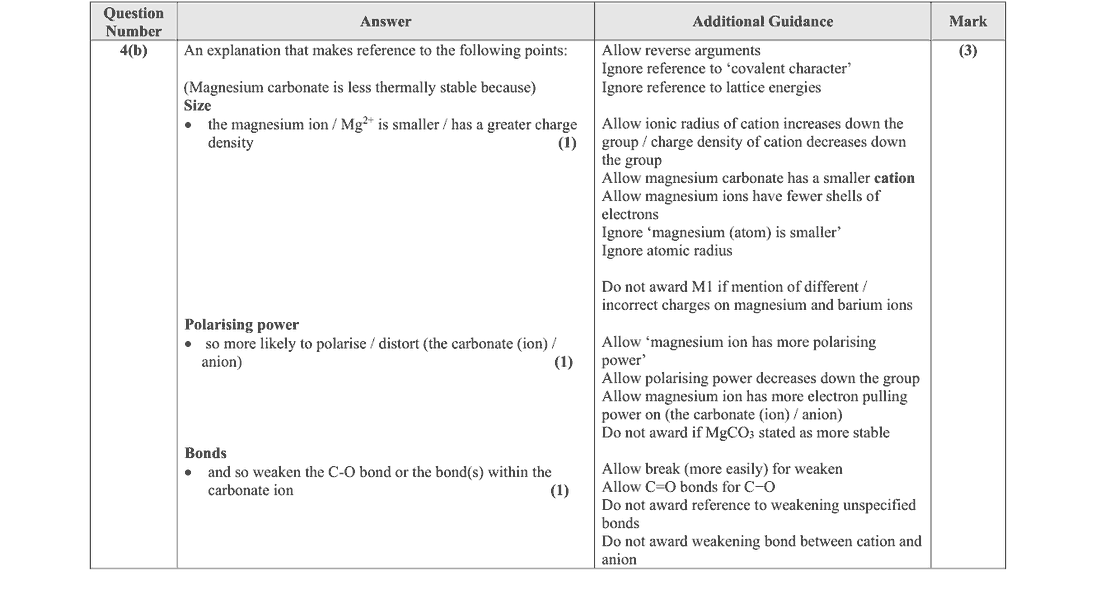
June 2022 · Paper 3 · Q4(b)3 marksExplanation
Mark scheme
Examiner's comment
Many candidates had a clear understanding of why magnesium carbonate is less thermally stable than barium carbonate. Unfortunately many candidates lost marks through the poor use of scientific terminology. For example, candidates referred to magnesium being smaller than barium instead of a magnesium ion having a smaller radius than a barium ion. A significant minority of candidates thought that the ionic bond between the cation and anion was weakened and many just stated that 'bonds are weakened' without specifying which bonds.
Notes from the mark scheme and report
Magnesium carbonate is less thermally stable: the Mg2+ ion is smaller (greater charge density) than Ba2+
so it polarises / distorts the carbonate ion more
which weakens the C–O bonds within the carbonate ion. Not 'the magnesium atom is smaller'
not weakening of unspecified bonds or of the bond between cation and anion. Marks were lost through loose wording: atoms instead of ions, and 'bonds are weakened' without saying which
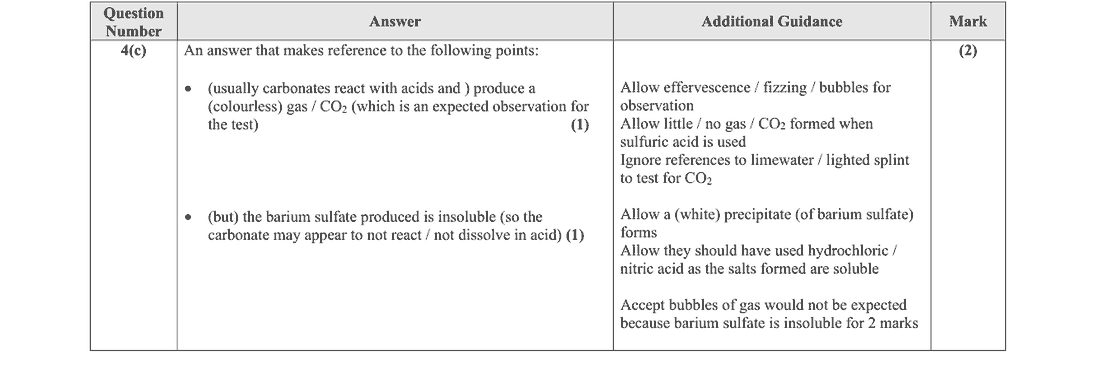
June 2022 · Paper 3 · Q4(c)2 marksPractical and data analysis
Mark scheme
Examiner's comment
Most candidates were unsure about how to answer this question. Many knew that the usual reaction between an acid and a carbonate produces carbon dioxide and some realised that barium sulfate would form as a white precipitate. Few candidates could link those two ideas together to deduce that bubbles of gas would not be expected when sulfuric acid is used due to the insoluble surface layer of barium sulfate formed.
Notes from the mark scheme and report
Carbonates normally give carbon dioxide gas (effervescence) with an acid
but with sulfuric acid insoluble barium sulfate forms (a white precipitate coats the solid), so little or no gas is seen and the test is not valid: hydrochloric or nitric acid should be used. Most knew one of the two ideas but few linked them
Skills: PT4 use laboratory apparatus for a variety of experimental techniques, including: titration, using burette and pipette; distillation and heating under reflux, including setting up glassware using retort stand and clamps; qualitative tests for ions and organic functional groups; filtration, including use of fluted filter paper, or filtration under reduced pressure; CP7 Core practical 7: Analysis of some inorganic and organic unknowns
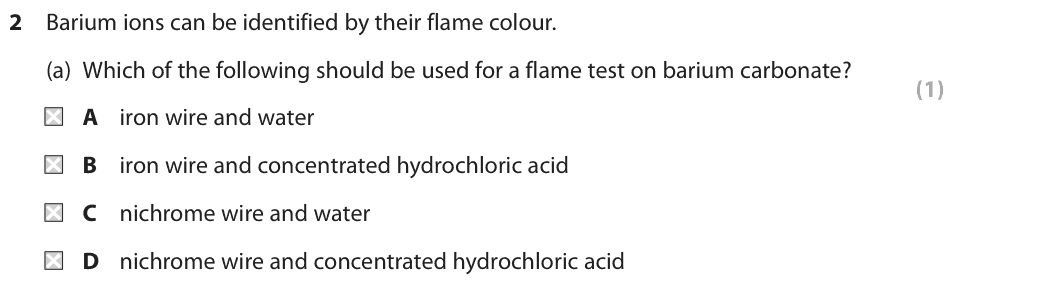
November 2021 · Paper 1 · Q2(a)1 markMultiple choice
Answer
D
Mark scheme
Examiner's comment
The three multiple choice questions on flame tests required some recall of the technique and
colours observed.
Notes from the mark scheme and report
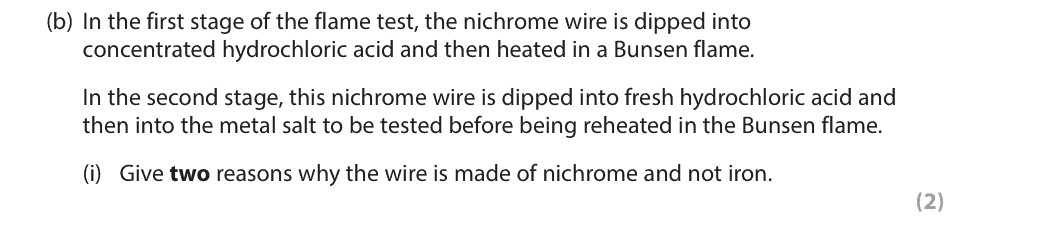
Answer: D. Nichrome wire, cleaned and moistened with concentrated hydrochloric acid. Iron wire is not used (A, B)
water is not used in place of the acid (C)
Skills: PT4 use laboratory apparatus for a variety of experimental techniques, including: titration, using burette and pipette; distillation and heating under reflux, including setting up glassware using retort stand and clamps; qualitative tests for ions and organic functional groups; filtration, including use of fluted filter paper, or filtration under reduced pressure; CP7 Core practical 7: Analysis of some inorganic and organic unknowns
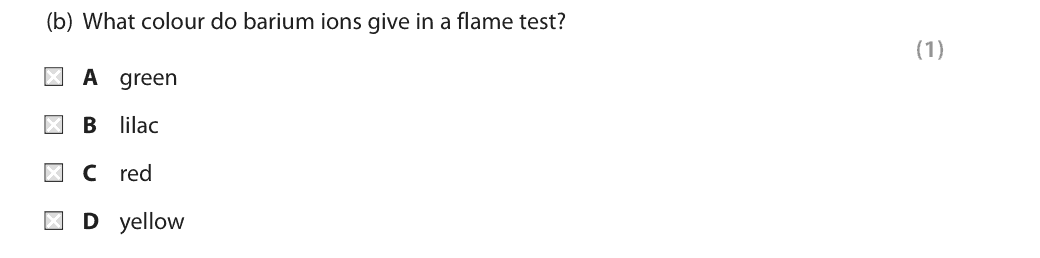
November 2021 · Paper 1 · Q2(b)1 markMultiple choice
Answer
A
Mark scheme
Examiner's comment
The three multiple choice questions on flame tests required some recall of the technique and
colours observed.
Notes from the mark scheme and report
Answer: A (green). Lilac is potassium
red is lithium, calcium or strontium
yellow is sodium
Skills: CP7 Core practical 7: Analysis of some inorganic and organic unknowns
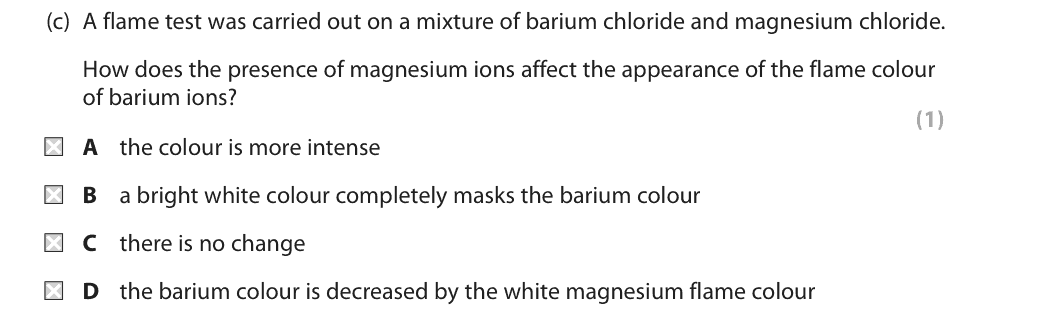
November 2021 · Paper 1 · Q2(c)1 markMultiple choice
Answer
C
Mark scheme
Examiner's comment
The three multiple choice questions on flame tests required some recall of the technique and
colours observed.
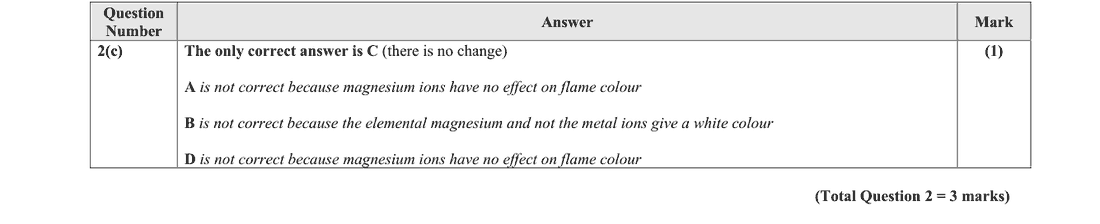
Notes from the mark scheme and report
Answer: C (no change). Magnesium ions give no flame colour
the bright white light comes from burning magnesium metal, not from Mg2+ ions
Skills: CP7 Core practical 7: Analysis of some inorganic and organic unknowns
November 2021 · AS Paper 1 · Q7(c)(i)1 markMultiple choice
Earlier part of question 7 that this part uses
Answer
D
Mark scheme
Examiner's comment
7(a) Candidates were able to recall the definition of an ionic bond and so scored marks here. 7(b) This multiple choice item also scored relatively well. 7(c) These multiple choice questions also proved accessible to many candidates, with the answer to (c)(ii) proving the most straightforward. 7(d) This proved very challenging with few candidates scoring any marks for the idea that solutions containing Group 2 metal ions would give precipitates on addition of, for example, sodium hydroxide or sodium sulfate. The action of heat on a nitrate was understood a little better.
Notes from the mark scheme and report
Answer: D. The acid converts the compounds to volatile chlorides. A is wrong because the acid does not dissolve the metal wire
B because there are no hydroxide ions and they would not colour the flame
C because the acid does not reduce the metal ions
Skills: PT4 use laboratory apparatus for a variety of experimental techniques, including: titration, using burette and pipette; distillation and heating under reflux, including setting up glassware using retort stand and clamps; qualitative tests for ions and organic functional groups; filtration, including use of fluted filter paper, or filtration under reduced pressure; CP7 Core practical 7: Analysis of some inorganic and organic unknowns
November 2021 · AS Paper 1 · Q7(c)(ii)1 markMultiple choice
Earlier parts of question 7 that this part uses
Answer
C
Mark scheme
Examiner's comment
7(a) Candidates were able to recall the definition of an ionic bond and so scored marks here. 7(b) This multiple choice item also scored relatively well. 7(c) These multiple choice questions also proved accessible to many candidates, with the answer to (c)(ii) proving the most straightforward. 7(d) This proved very challenging with few candidates scoring any marks for the idea that solutions containing Group 2 metal ions would give precipitates on addition of, for example, sodium hydroxide or sodium sulfate. The action of heat on a nitrate was understood a little better.
Notes from the mark scheme and report
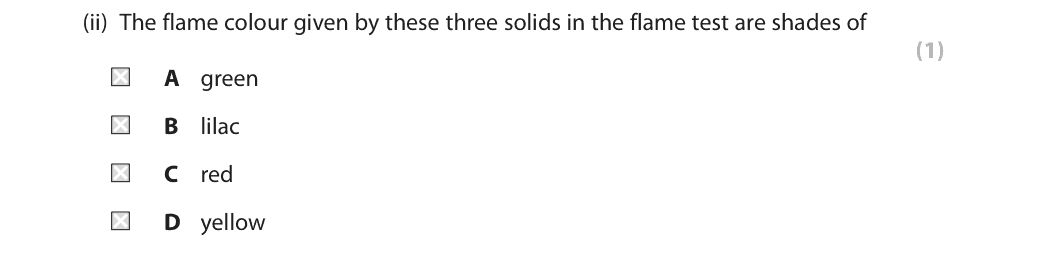
Answer: C (red). Lithium, rubidium and strontium compounds all give shades of red. Green is barium, lilac is potassium, yellow is sodium
Skills: CP7 Core practical 7: Analysis of some inorganic and organic unknowns
November 2021 · AS Paper 1 · Q7(c)(iii)1 markMultiple choice
Earlier parts of question 7 that this part uses
Answer
C
Mark scheme
Examiner's comment
7(a) Candidates were able to recall the definition of an ionic bond and so scored marks here. 7(b) This multiple choice item also scored relatively well. 7(c) These multiple choice questions also proved accessible to many candidates, with the answer to (c)(ii) proving the most straightforward. 7(d) This proved very challenging with few candidates scoring any marks for the idea that solutions containing Group 2 metal ions would give precipitates on addition of, for example, sodium hydroxide or sodium sulfate. The action of heat on a nitrate was understood a little better.
Notes from the mark scheme and report
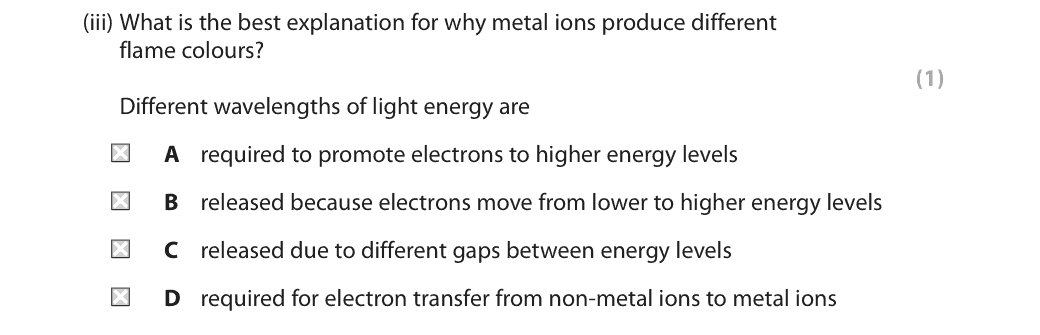
Answer: C. Light is released as electrons fall back, and the gaps between energy levels differ from metal to metal. A is wrong because the promotion uses heat energy
B because promotion does not release light
D because electrons move between energy levels within the metal, not from non-metal ions
November 2021 · AS Paper 1 · Q7(d)6 marks6-mark extended responseHard
Earlier part of question 7 that this part uses
Mark scheme, with the indicative content and the marks for reasoning
Examiner's comment
7(a) Candidates were able to recall the definition of an ionic bond and so scored marks here. 7(b) This multiple choice item also scored relatively well. 7(c) These multiple choice questions also proved accessible to many candidates, with the answer to (c)(ii) proving the most straightforward. 7(d) This proved very challenging with few candidates scoring any marks for the idea that solutions containing Group 2 metal ions would give precipitates on addition of, for example, sodium hydroxide or sodium sulfate. The action of heat on a nitrate was understood a little better.
Notes from the mark scheme and report
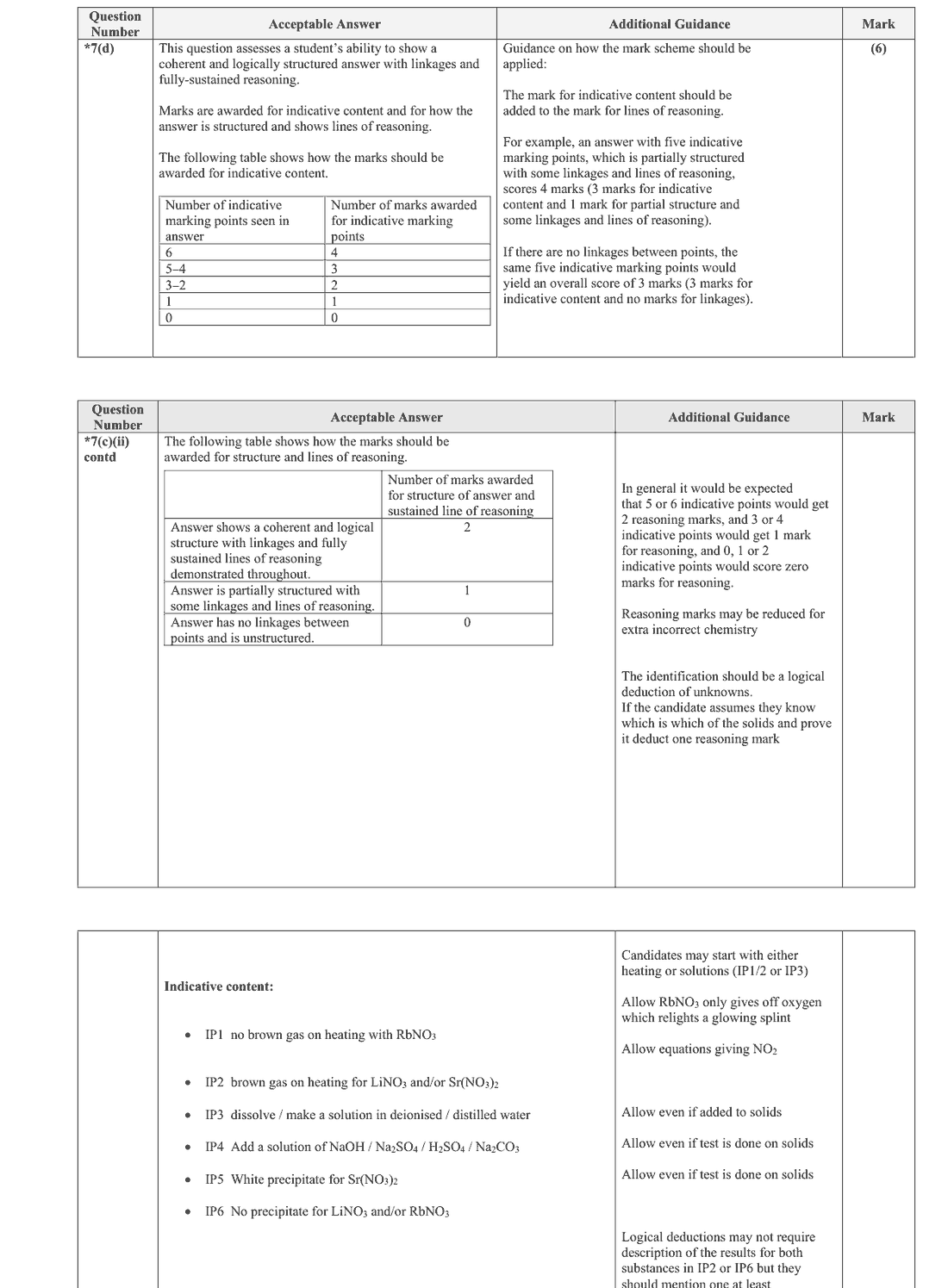
Six indicative points plus two marks for reasoning. IP1 rubidium nitrate gives no brown gas on heating (only oxygen, which relights a glowing splint)
IP2 lithium nitrate and / or strontium nitrate give a brown gas (NO2)
IP3 dissolve the solids in distilled / deionised water
IP4 add a solution of NaOH, Na2SO4, H2SO4 or Na2CO3
IP5 strontium nitrate gives a white precipitate
IP6 lithium nitrate and / or rubidium nitrate give no precipitate. The identification must be a logical deduction of unknowns: one reasoning mark is lost if the candidate assumes which solid is which and then confirms it. Can start with heating or with solutions. Few thought of precipitating the Group 2 ion
the effect of heat on nitrates was understood a little better
Skills: PT4 use laboratory apparatus for a variety of experimental techniques, including: titration, using burette and pipette; distillation and heating under reflux, including setting up glassware using retort stand and clamps; qualitative tests for ions and organic functional groups; filtration, including use of fluted filter paper, or filtration under reduced pressure; CP7 Core practical 7: Analysis of some inorganic and organic unknowns
October 2020 · Paper 1 · Q4(a)1 markMultiple choice
Answer
C
Mark scheme
Examiner's comment
Parts (a) and (b) were accessible to most candidates, but part (c) provided a significant degree
of challenge for all. The best answers took time to structure their response into discrete
sections, in each case considering correctly the types and relative strength of forces present in
the solute and solvent individually and any potential resultant solute-solvent forces.
However, a number of responses didn’t develop much beyond the idea of ‘like dissolves like’
so struggled to access the higher marks. Those who did discuss the forces often made
mistakes. For instance, it was common to see the alkanes described as having London forces
and dipole-dipole attractions and many described potassium bromide as a polar molecule
often frustratingly in the same paragraph as discussing it’s ions. Few candidates releasing that
water molecules would hydrate the ions, with a number explaining its solubility with the claim
the London forces between the ions and water would compensate for the breakdown of the
lattice.
Notes from the mark scheme and report
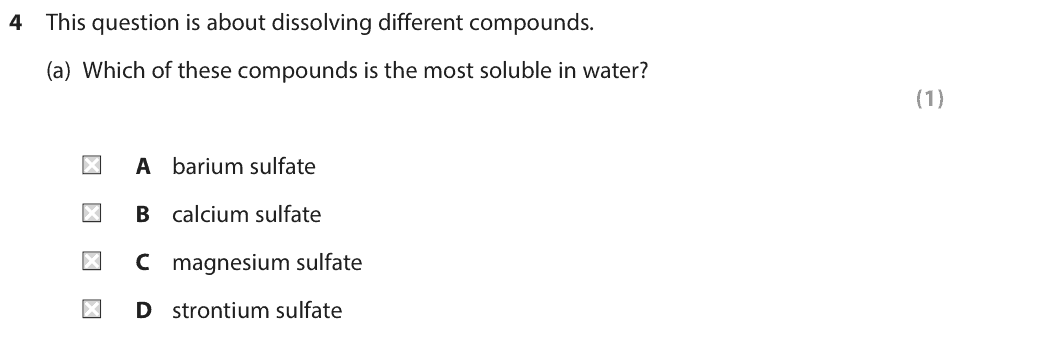
Answer: C. The solubility of the Group 2 sulfates decreases down the group, so magnesium sulfate is the most soluble
October 2020 · Paper 1 · Q5(a)(i)2 marksPractical and data analysis
Mark scheme
Examiner's comment
Nearly all candidates could suggest at least one relevant observation in (a)(i), with brown gas
and white solid probably the most common creditworthy answers. Effervescence alone was
not worth credit in this context and a number described the test for oxygen, which did not
score, as essentially the candidate seemed to be making up their own question.
In (ii) the first two marks linked to ionic size and polarising power were common. Pleasingly
there seemed to be fewer answers referring only to atoms than in previous series. Perhaps as
expected the third mark was discriminating. Of the candidates who discussed the impact of
the polarisation of the anion on bonding, the view persists that it is the impact on the ionic
bond between the ions rather than the covalent bond(s) within the anion that explains the
trend in thermal stability.
In (b)(i) the dot-and-cross diagram was drawn accurately by many, with some candidates
taking great care to show the origin of the electrons. A number of candidates scored only
1 mark as they split the hydroxide ion into separate oxide and hydrogen ions, whilst others
drew a shell of 8 electrons around a central ‘OH’ rather than show the bond pair between
them. Even with a reference to ions in the question, covalent dot-and-cross diagrams were
seen more often than one would like.
The calculation in (ii) allowed many candidates to show a range of elegant solutions, with the
calculation of the relative formula mass of the hydrated salt and subsequent deduction of the
relative mass of water molecules present being the most common route. Even less able
candidates could access marks 1 and 2 , though after then errors started to creep in, most
commonly the calculation of the mass of water, or when working out the relative mass of
anhydrous magnesium nitrate.
Notes from the mark scheme and report
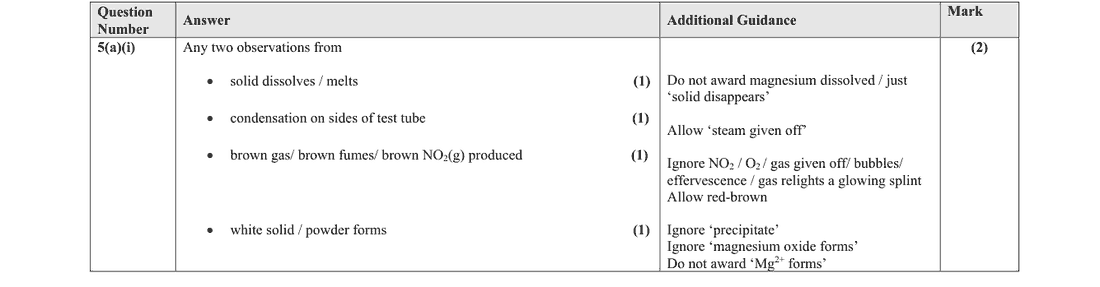
Any two of: the solid dissolves (in its water of crystallisation) / melts
condensation on the sides of the tube (allow steam given off)
brown gas / fumes
white solid / powder forms. Ignored: 'gas given off', bubbles, effervescence, relights a glowing splint, 'magnesium oxide forms'. Brown gas and white solid were the usual answers
effervescence and the test for oxygen did not score
October 2020 · Paper 1 · Q5(a)(ii)3 marksExplanation
Earlier part of question 5 that this part uses
Mark scheme
Examiner's comment
Nearly all candidates could suggest at least one relevant observation in (a)(i), with brown gas
and white solid probably the most common creditworthy answers. Effervescence alone was
not worth credit in this context and a number described the test for oxygen, which did not
score, as essentially the candidate seemed to be making up their own question.
In (ii) the first two marks linked to ionic size and polarising power were common. Pleasingly
there seemed to be fewer answers referring only to atoms than in previous series. Perhaps as
expected the third mark was discriminating. Of the candidates who discussed the impact of
the polarisation of the anion on bonding, the view persists that it is the impact on the ionic
bond between the ions rather than the covalent bond(s) within the anion that explains the
trend in thermal stability.
In (b)(i) the dot-and-cross diagram was drawn accurately by many, with some candidates
taking great care to show the origin of the electrons. A number of candidates scored only
1 mark as they split the hydroxide ion into separate oxide and hydrogen ions, whilst others
drew a shell of 8 electrons around a central ‘OH’ rather than show the bond pair between
them. Even with a reference to ions in the question, covalent dot-and-cross diagrams were
seen more often than one would like.
The calculation in (ii) allowed many candidates to show a range of elegant solutions, with the
calculation of the relative formula mass of the hydrated salt and subsequent deduction of the
relative mass of water molecules present being the most common route. Even less able
candidates could access marks 1 and 2 , though after then errors started to creep in, most
commonly the calculation of the mass of water, or when working out the relative mass of
anhydrous magnesium nitrate.
Notes from the mark scheme and report
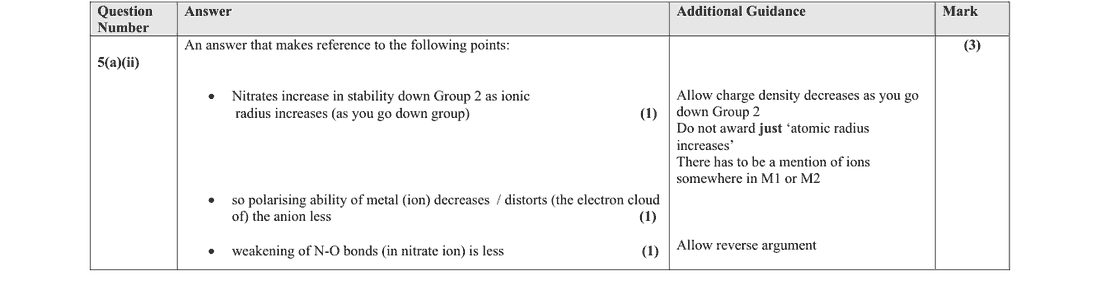
Thermal stability increases down the group as the ionic radius of the cation increases (charge density decreases)
so the polarising ability of the metal ion decreases / it distorts the nitrate ion less
so the N–O bonds in the nitrate ion are weakened less. Ions must be mentioned ('atomic radius' alone is not credited)
reverse argument allowed. The third mark discriminated: many thought the polarisation weakens the ionic bond between the ions, not the covalent bonds inside the anion
October 2020 · AS Paper 1 · Q6(c)(i)3 marksPractical and data analysisEasy
Earlier part of question 6 that this part uses
Mark scheme
Examiner's comment
6a A multiple choice question. This question required students to interpret a given chemical
formula and follow up with a basic calculation. The task was simplified by the provision of the
molar mass of malachite within the question. Most candidates were able to complete this
calculation successfully.
6b This question tested recognition of some of the observable features of a chemical reaction, the
answers being available by application of basic chemical principles. However, many students
seemed to struggle with this practical situation and relatively few fully correct answers were seen.
6ci This question has occurred relatively frequently in past papers, and many of the answers were
clearly well rehearsed. Most students scored very well on this question.
6cii Again, this is a very common question (for the first three marks). It has appeared in most of
the past papers at this level. However, the 4th mark focussed on a slightly different aspect and
many students failed to read the question sufficiently thoroughly to score the 4th mark, which
relates to why different elements produce different coloured flames
6di This was a calculation to find the maximum volume of gas that might be produced by the
thermal decomposition of a fixed mass of malachite. The ideal gas equation was provided, giving a
clue to the expected method of calculation.
Students were generally accurate in giving their answer to an appropriate number of significant
figures. But they were less secure with the units. The ideal gas equation gives an answer in m3 if all
quantities are converted to SI units. If the pressure is left in kPa the answer is in dm3 etc.
Students could be advised to convert to SI units first; this then defines the units of the final answer.
6dii Those who converted their answer to di) into cm3 had already (and perhaps inadvertently)
matched the units for their calculation of uncertainty. Many students knew how to match units,
and did it well.
6diii A variety of different methods can be used for this calculation This illustrates the need for a
logical procedure or a careful explanation of the calculation so that the lines of reasoning are clear.
In such instances marks might be gained for a partially correct answer
Some candidates provided clear calculations that were easy to follow at each stage. In some
instances a few words of explanation were also provided to explain the logic. However, there were
also some less successful answers which were poorly set out, being little more than a scattered
mass of figures.
Notes from the mark scheme and report
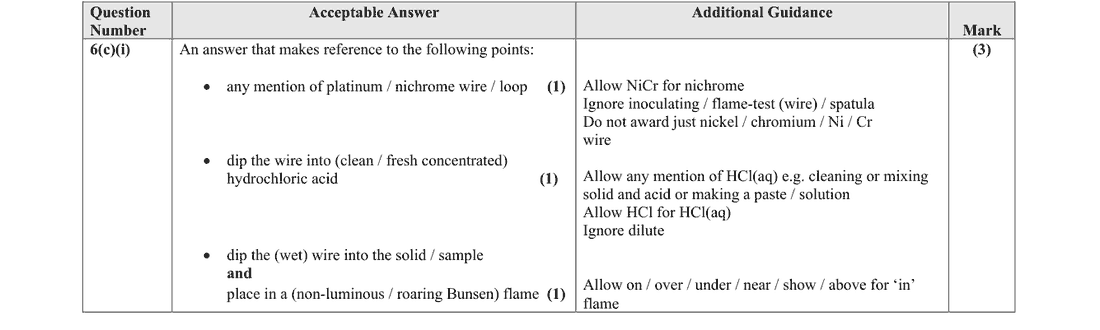
M1 platinum or nichrome wire / loop (not just nickel or chromium
inoculating loop, 'flame-test wire' and spatula ignored)
M2 dip the wire in (concentrated) hydrochloric acid (any mention of HCl(aq), e.g. for cleaning or making a paste, allowed)
M3 dip the wire into the solid AND hold it in a (non-luminous / roaring) Bunsen flame
Skills: PT4 use laboratory apparatus for a variety of experimental techniques, including: titration, using burette and pipette; distillation and heating under reflux, including setting up glassware using retort stand and clamps; qualitative tests for ions and organic functional groups; filtration, including use of fluted filter paper, or filtration under reduced pressure; PT11 safely and carefully handle solids and liquids, including corrosive, irritant, flammable and toxic substances; CP7 Core practical 7: Analysis of some inorganic and organic unknowns
October 2020 · AS Paper 1 · Q6(c)(ii)4 marksExplanation
Earlier parts of question 6 that this part uses
Mark scheme
Examiner's comment
6a A multiple choice question. This question required students to interpret a given chemical
formula and follow up with a basic calculation. The task was simplified by the provision of the
molar mass of malachite within the question. Most candidates were able to complete this
calculation successfully.
6b This question tested recognition of some of the observable features of a chemical reaction, the
answers being available by application of basic chemical principles. However, many students
seemed to struggle with this practical situation and relatively few fully correct answers were seen.
6ci This question has occurred relatively frequently in past papers, and many of the answers were
clearly well rehearsed. Most students scored very well on this question.
6cii Again, this is a very common question (for the first three marks). It has appeared in most of
the past papers at this level. However, the 4th mark focussed on a slightly different aspect and
many students failed to read the question sufficiently thoroughly to score the 4th mark, which
relates to why different elements produce different coloured flames
6di This was a calculation to find the maximum volume of gas that might be produced by the
thermal decomposition of a fixed mass of malachite. The ideal gas equation was provided, giving a
clue to the expected method of calculation.
Students were generally accurate in giving their answer to an appropriate number of significant
figures. But they were less secure with the units. The ideal gas equation gives an answer in m3 if all
quantities are converted to SI units. If the pressure is left in kPa the answer is in dm3 etc.
Students could be advised to convert to SI units first; this then defines the units of the final answer.
6dii Those who converted their answer to di) into cm3 had already (and perhaps inadvertently)
matched the units for their calculation of uncertainty. Many students knew how to match units,
and did it well.
6diii A variety of different methods can be used for this calculation This illustrates the need for a
logical procedure or a careful explanation of the calculation so that the lines of reasoning are clear.
In such instances marks might be gained for a partially correct answer
Some candidates provided clear calculations that were easy to follow at each stage. In some
instances a few words of explanation were also provided to explain the logic. However, there were
also some less successful answers which were poorly set out, being little more than a scattered
mass of figures.
Notes from the mark scheme and report
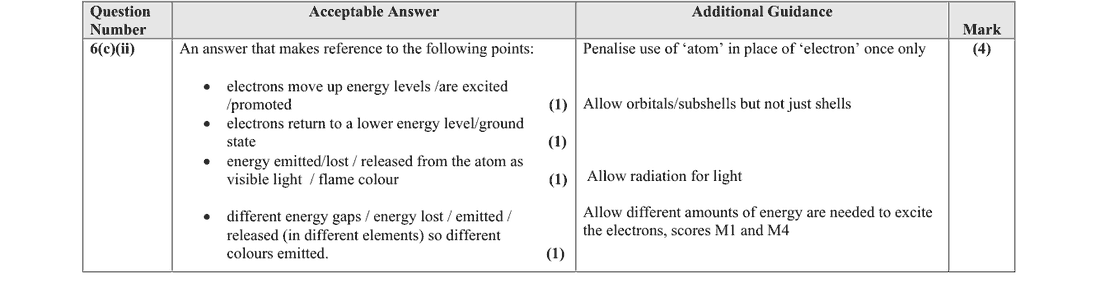
M1 electrons are excited / promoted to higher energy levels (orbitals or subshells allowed, not just 'shells')
M2 the electrons fall back to a lower energy level / the ground state
M3 energy is emitted as visible light
M4 the energy gaps are different in different elements, so light of different colours is emitted. 'Different amounts of energy are needed to excite the electrons' scores M1 and M4. 'Atom' for 'electron' penalised once. Many missed M4 by not reading that the question asks why different elements give different colours
October 2020 · AS Paper 1 · Q8(a)2 marksEquation writingHard
Mark scheme
Examiner's comment
8a This question asked for two equations: for the thermal decomposition of a group 1 nitrate and
for the thermal decomposition of a group 2 nitrate. Disappointingly, very few fully correct answers
were seen for either nitrate. Although CaO was often recognized as a product in the second
equation, the other products were usually incorrect. A correct equation for the thermal
decomposition of sodium nitrate seemed to be particularly challenging.
8b The effect of a cation on the thermal stability of anions has proved to be a challenging question
on previous papers. While there were a few correct comments on the relative polarizing powers of
Na+ and Cs+,, students had difficulty in linking this polarizing power to the distortion of electron
clouds (or bonds) in the nitrate anion. The answers to this question were generally poor, perhaps
indicating that students were fatiguing towards the end of the paper.
8ci This equation was correctly recalled (or deduced) by the majority of students.
8cii Most students recognized the presence of ionic bonding but relatively few seemed aware of
covalent bonding within the carbonate ion.
8ciii Disappointingly few candidates were able to link high decomposition temperatures with the
need to break strong bonds within the carbonate ion. Many attributed the high decomposition
temperature to the presence of ionic bonding, thus neglecting the production of ionic bonds in one
of the products.
Notes from the mark scheme and report
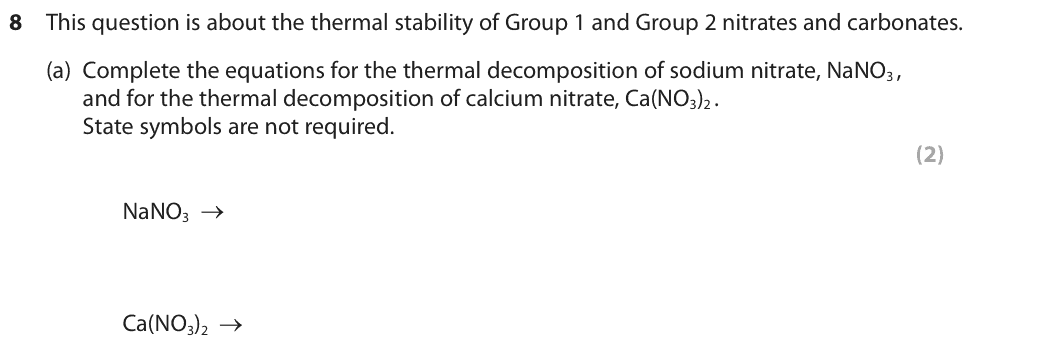
Answer: NaNO3 → NaNO2 + ½O2 and Ca(NO3)2 → CaO + 2NO2 + ½O2. One mark each
multiples allowed
state symbols ignored. CaO was often given but with wrong other products
the sodium nitrate equation was found particularly hard
October 2020 · AS Paper 1 · Q8(b)3 marksExplanationHard
Earlier part of question 8 that this part uses
Mark scheme
Examiner's comment
8a This question asked for two equations: for the thermal decomposition of a group 1 nitrate and
for the thermal decomposition of a group 2 nitrate. Disappointingly, very few fully correct answers
were seen for either nitrate. Although CaO was often recognized as a product in the second
equation, the other products were usually incorrect. A correct equation for the thermal
decomposition of sodium nitrate seemed to be particularly challenging.
8b The effect of a cation on the thermal stability of anions has proved to be a challenging question
on previous papers. While there were a few correct comments on the relative polarizing powers of
Na+ and Cs+,, students had difficulty in linking this polarizing power to the distortion of electron
clouds (or bonds) in the nitrate anion. The answers to this question were generally poor, perhaps
indicating that students were fatiguing towards the end of the paper.
8ci This equation was correctly recalled (or deduced) by the majority of students.
8cii Most students recognized the presence of ionic bonding but relatively few seemed aware of
covalent bonding within the carbonate ion.
8ciii Disappointingly few candidates were able to link high decomposition temperatures with the
need to break strong bonds within the carbonate ion. Many attributed the high decomposition
temperature to the presence of ionic bonding, thus neglecting the production of ionic bonds in one
of the products.
Notes from the mark scheme and report
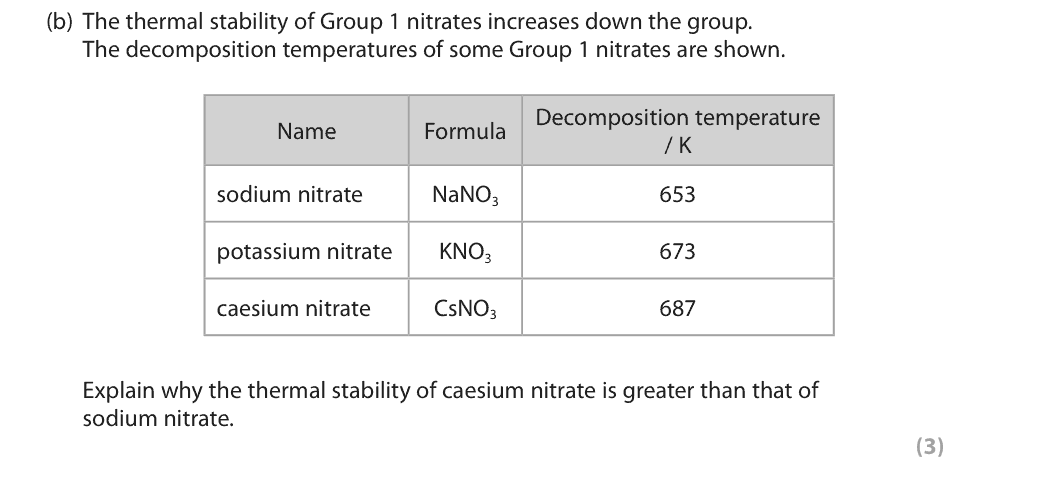
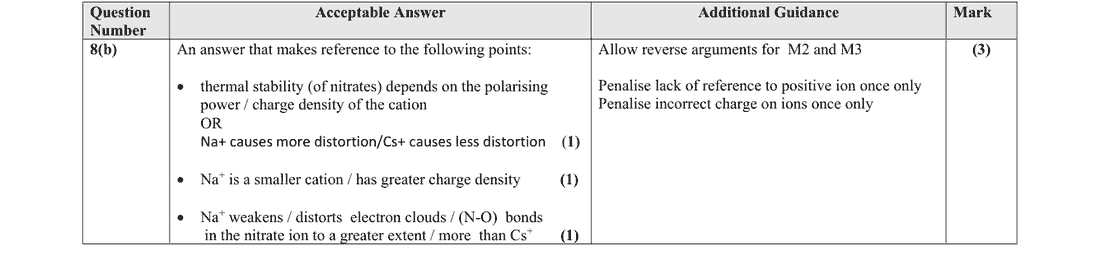
M1 thermal stability depends on the polarising power / charge density of the cation (or Na+ causes more distortion than Cs+)
M2 Na+ is the smaller cation / has the greater charge density
M3 so Na+ distorts the electron cloud (weakens the N–O bonds) of the nitrate ion more than Cs+ does. Reverse arguments allowed. Not referring to the positive ion, or a wrong charge, is penalised once. Few linked polarising power to distortion of the nitrate ion
October 2020 · AS Paper 1 · Q8(c)(i)1 markEquation writing
Earlier part of question 8 that this part uses
Mark scheme
Examiner's comment
8a This question asked for two equations: for the thermal decomposition of a group 1 nitrate and
for the thermal decomposition of a group 2 nitrate. Disappointingly, very few fully correct answers
were seen for either nitrate. Although CaO was often recognized as a product in the second
equation, the other products were usually incorrect. A correct equation for the thermal
decomposition of sodium nitrate seemed to be particularly challenging.
8b The effect of a cation on the thermal stability of anions has proved to be a challenging question
on previous papers. While there were a few correct comments on the relative polarizing powers of
Na+ and Cs+,, students had difficulty in linking this polarizing power to the distortion of electron
clouds (or bonds) in the nitrate anion. The answers to this question were generally poor, perhaps
indicating that students were fatiguing towards the end of the paper.
8ci This equation was correctly recalled (or deduced) by the majority of students.
8cii Most students recognized the presence of ionic bonding but relatively few seemed aware of
covalent bonding within the carbonate ion.
8ciii Disappointingly few candidates were able to link high decomposition temperatures with the
need to break strong bonds within the carbonate ion. Many attributed the high decomposition
temperature to the presence of ionic bonding, thus neglecting the production of ionic bonds in one
of the products.
Notes from the mark scheme and report
Answer: CaCO3(s) → CaO(s) + CO2(g). Formulae and state symbols must all be correct. Correct for the majority
October 2020 · AS Paper 1 · Q8(c)(iii)1 markShort answerHard
Earlier parts of question 8 that this part uses
Mark scheme
Examiner's comment
8a This question asked for two equations: for the thermal decomposition of a group 1 nitrate and
for the thermal decomposition of a group 2 nitrate. Disappointingly, very few fully correct answers
were seen for either nitrate. Although CaO was often recognized as a product in the second
equation, the other products were usually incorrect. A correct equation for the thermal
decomposition of sodium nitrate seemed to be particularly challenging.
8b The effect of a cation on the thermal stability of anions has proved to be a challenging question
on previous papers. While there were a few correct comments on the relative polarizing powers of
Na+ and Cs+,, students had difficulty in linking this polarizing power to the distortion of electron
clouds (or bonds) in the nitrate anion. The answers to this question were generally poor, perhaps
indicating that students were fatiguing towards the end of the paper.
8ci This equation was correctly recalled (or deduced) by the majority of students.
8cii Most students recognized the presence of ionic bonding but relatively few seemed aware of
covalent bonding within the carbonate ion.
8ciii Disappointingly few candidates were able to link high decomposition temperatures with the
need to break strong bonds within the carbonate ion. Many attributed the high decomposition
temperature to the presence of ionic bonding, thus neglecting the production of ionic bonds in one
of the products.
Notes from the mark scheme and report
The (covalent) bonds within the carbonate ion, C–O / C=O, are strong and have to be broken. Strong ionic bonds between Ca2+ and CO3 2– are ignored: that was the common wrong answer, overlooking that the product CaO is ionic too
October 2020 · Paper 3 · Q2(a)(i)1 markPractical and data analysis
Mark scheme
Examiner's comment
The flame colours of the metal ions were generally well-known but there were some incorrect
uses of ‘brick-red’ and ‘green’ for strontium in (a)(i). The concept of the brighter and stronger
red colour of strontium masking the paler lilac colour of potassium in (a)(ii) was only grasped
by the candidates of higher ability. Oftentimes references were made to the colours mixing
and producing a new colour which is not true.
The majority scored one mark for the inertness of the nichrome or the reactivity of the iron
wire. Only the more able candidates understood that the nichrome would not contribute any
colour. A sizeable number of candidates suggested that the iron would have a higher melting
temperature which is incorrect and would seem to counteract the point of the question why
nichrome and not iron is used for the wire.
The questions on the steps and the use of acid in parts (ii) – (iv) enabled most candidates to
gain credit. In (ii) some candidates referred to the wire being ‘sanitised/sterilised/disinfected’
which were ignored rather than penalised in this instance. However, it may be prudent to
highlight that the process has nothing to do with microorganisms. Very few candidates
appreciated in (iv) that the formation of volatile chlorides is the reason why hydrochloric acid
is used. Credit was given however for the fact that the moist salts are then able to attach to
the wire.
Explanation of the electronic transitions in the flame test are very well understood and most
candidates scored full marks.
Notes from the mark scheme and report
Potassium: lilac
strontium: crimson / red (allow scarlet). Both needed for the mark. Not brick red or orange-red. Brick-red and green were the wrong answers seen for strontium
Skills: CP7 Core practical 7: Analysis of some inorganic and organic unknowns
October 2020 · Paper 3 · Q2(a)(ii)1 markPractical and data analysis
Earlier part of question 2 that this part uses
Mark scheme
Examiner's comment
The flame colours of the metal ions were generally well-known but there were some incorrect
uses of ‘brick-red’ and ‘green’ for strontium in (a)(i). The concept of the brighter and stronger
red colour of strontium masking the paler lilac colour of potassium in (a)(ii) was only grasped
by the candidates of higher ability. Oftentimes references were made to the colours mixing
and producing a new colour which is not true.
The majority scored one mark for the inertness of the nichrome or the reactivity of the iron
wire. Only the more able candidates understood that the nichrome would not contribute any
colour. A sizeable number of candidates suggested that the iron would have a higher melting
temperature which is incorrect and would seem to counteract the point of the question why
nichrome and not iron is used for the wire.
The questions on the steps and the use of acid in parts (ii) – (iv) enabled most candidates to
gain credit. In (ii) some candidates referred to the wire being ‘sanitised/sterilised/disinfected’
which were ignored rather than penalised in this instance. However, it may be prudent to
highlight that the process has nothing to do with microorganisms. Very few candidates
appreciated in (iv) that the formation of volatile chlorides is the reason why hydrochloric acid
is used. Credit was given however for the fact that the moist salts are then able to attach to
the wire.
Explanation of the electronic transitions in the flame test are very well understood and most
candidates scored full marks.
Notes from the mark scheme and report
The crimson / red colour masks (hides) the paler lilac colour, so only one colour is seen. Not a colour from the chloride ions
not a new colour made by mixing the two, which was the frequent wrong idea. Only the higher-ability candidates saw the masking
Skills: CP7 Core practical 7: Analysis of some inorganic and organic unknowns
October 2020 · Paper 3 · Q2(b)(i)2 marksPractical and data analysis
Earlier part of question 2 that this part uses
Mark scheme
Examiner's comment
The flame colours of the metal ions were generally well-known but there were some incorrect
uses of ‘brick-red’ and ‘green’ for strontium in (a)(i). The concept of the brighter and stronger
red colour of strontium masking the paler lilac colour of potassium in (a)(ii) was only grasped
by the candidates of higher ability. Oftentimes references were made to the colours mixing
and producing a new colour which is not true.
The majority scored one mark for the inertness of the nichrome or the reactivity of the iron
wire. Only the more able candidates understood that the nichrome would not contribute any
colour. A sizeable number of candidates suggested that the iron would have a higher melting
temperature which is incorrect and would seem to counteract the point of the question why
nichrome and not iron is used for the wire.
The questions on the steps and the use of acid in parts (ii) – (iv) enabled most candidates to
gain credit. In (ii) some candidates referred to the wire being ‘sanitised/sterilised/disinfected’
which were ignored rather than penalised in this instance. However, it may be prudent to
highlight that the process has nothing to do with microorganisms. Very few candidates
appreciated in (iv) that the formation of volatile chlorides is the reason why hydrochloric acid
is used. Credit was given however for the fact that the moist salts are then able to attach to
the wire.
Explanation of the electronic transitions in the flame test are very well understood and most
candidates scored full marks.
Notes from the mark scheme and report
Nichrome gives no colour to the flame (or iron can give a colour / sparks)
nichrome is inert / unreactive / stable to heat (or iron reacts with oxygen or with hydrochloric acid). Melting temperature and cost ignored. Most scored one mark for inertness
only the more able said nichrome adds no colour
a sizeable number wrongly said iron has the higher melting temperature
Skills: PT4 use laboratory apparatus for a variety of experimental techniques, including: titration, using burette and pipette; distillation and heating under reflux, including setting up glassware using retort stand and clamps; qualitative tests for ions and organic functional groups; filtration, including use of fluted filter paper, or filtration under reduced pressure; CP7 Core practical 7: Analysis of some inorganic and organic unknowns
October 2020 · Paper 3 · Q2(b)(ii)1 markPractical and data analysis
Earlier parts of question 2 that this part uses
Mark scheme
Examiner's comment
The flame colours of the metal ions were generally well-known but there were some incorrect
uses of ‘brick-red’ and ‘green’ for strontium in (a)(i). The concept of the brighter and stronger
red colour of strontium masking the paler lilac colour of potassium in (a)(ii) was only grasped
by the candidates of higher ability. Oftentimes references were made to the colours mixing
and producing a new colour which is not true.
The majority scored one mark for the inertness of the nichrome or the reactivity of the iron
wire. Only the more able candidates understood that the nichrome would not contribute any
colour. A sizeable number of candidates suggested that the iron would have a higher melting
temperature which is incorrect and would seem to counteract the point of the question why
nichrome and not iron is used for the wire.
The questions on the steps and the use of acid in parts (ii) – (iv) enabled most candidates to
gain credit. In (ii) some candidates referred to the wire being ‘sanitised/sterilised/disinfected’
which were ignored rather than penalised in this instance. However, it may be prudent to
highlight that the process has nothing to do with microorganisms. Very few candidates
appreciated in (iv) that the formation of volatile chlorides is the reason why hydrochloric acid
is used. Credit was given however for the fact that the moist salts are then able to attach to
the wire.
Explanation of the electronic transitions in the flame test are very well understood and most
candidates scored full marks.
Notes from the mark scheme and report
To remove the residue of any previous sample (to clean the wire). 'Sterilise / sanitise / disinfect' is ignored: the step has nothing to do with microorganisms
Skills: PT4 use laboratory apparatus for a variety of experimental techniques, including: titration, using burette and pipette; distillation and heating under reflux, including setting up glassware using retort stand and clamps; qualitative tests for ions and organic functional groups; filtration, including use of fluted filter paper, or filtration under reduced pressure; CP7 Core practical 7: Analysis of some inorganic and organic unknowns
October 2020 · Paper 3 · Q2(b)(iii)1 markPractical and data analysis
Earlier parts of question 2 that this part uses
Mark scheme
Examiner's comment
The flame colours of the metal ions were generally well-known but there were some incorrect
uses of ‘brick-red’ and ‘green’ for strontium in (a)(i). The concept of the brighter and stronger
red colour of strontium masking the paler lilac colour of potassium in (a)(ii) was only grasped
by the candidates of higher ability. Oftentimes references were made to the colours mixing
and producing a new colour which is not true.
The majority scored one mark for the inertness of the nichrome or the reactivity of the iron
wire. Only the more able candidates understood that the nichrome would not contribute any
colour. A sizeable number of candidates suggested that the iron would have a higher melting
temperature which is incorrect and would seem to counteract the point of the question why
nichrome and not iron is used for the wire.
The questions on the steps and the use of acid in parts (ii) – (iv) enabled most candidates to
gain credit. In (ii) some candidates referred to the wire being ‘sanitised/sterilised/disinfected’
which were ignored rather than penalised in this instance. However, it may be prudent to
highlight that the process has nothing to do with microorganisms. Very few candidates
appreciated in (iv) that the formation of volatile chlorides is the reason why hydrochloric acid
is used. Credit was given however for the fact that the moist salts are then able to attach to
the wire.
Explanation of the electronic transitions in the flame test are very well understood and most
candidates scored full marks.
Notes from the mark scheme and report
The acid can become contaminated with residue from previous tests, which would give incorrect results
Skills: PT4 use laboratory apparatus for a variety of experimental techniques, including: titration, using burette and pipette; distillation and heating under reflux, including setting up glassware using retort stand and clamps; qualitative tests for ions and organic functional groups; filtration, including use of fluted filter paper, or filtration under reduced pressure; CP7 Core practical 7: Analysis of some inorganic and organic unknowns
October 2020 · Paper 3 · Q2(b)(iv)1 markPractical and data analysisHard
Earlier parts of question 2 that this part uses
Mark scheme
Examiner's comment
The flame colours of the metal ions were generally well-known but there were some incorrect
uses of ‘brick-red’ and ‘green’ for strontium in (a)(i). The concept of the brighter and stronger
red colour of strontium masking the paler lilac colour of potassium in (a)(ii) was only grasped
by the candidates of higher ability. Oftentimes references were made to the colours mixing
and producing a new colour which is not true.
The majority scored one mark for the inertness of the nichrome or the reactivity of the iron
wire. Only the more able candidates understood that the nichrome would not contribute any
colour. A sizeable number of candidates suggested that the iron would have a higher melting
temperature which is incorrect and would seem to counteract the point of the question why
nichrome and not iron is used for the wire.
The questions on the steps and the use of acid in parts (ii) – (iv) enabled most candidates to
gain credit. In (ii) some candidates referred to the wire being ‘sanitised/sterilised/disinfected’
which were ignored rather than penalised in this instance. However, it may be prudent to
highlight that the process has nothing to do with microorganisms. Very few candidates
appreciated in (iv) that the formation of volatile chlorides is the reason why hydrochloric acid
is used. Credit was given however for the fact that the moist salts are then able to attach to
the wire.
Explanation of the electronic transitions in the flame test are very well understood and most
candidates scored full marks.
Notes from the mark scheme and report
Concentrated hydrochloric acid forms volatile chlorides. Also allowed: the moistened wire lets some of the solid salt stick to it. Not bonding, reacting, adsorbing or absorbing with the wire
Skills: PT4 use laboratory apparatus for a variety of experimental techniques, including: titration, using burette and pipette; distillation and heating under reflux, including setting up glassware using retort stand and clamps; qualitative tests for ions and organic functional groups; filtration, including use of fluted filter paper, or filtration under reduced pressure; CP7 Core practical 7: Analysis of some inorganic and organic unknowns
October 2020 · Paper 3 · Q2(c)3 marksExplanationEasy
Mark scheme
Examiner's comment
The flame colours of the metal ions were generally well-known but there were some incorrect
uses of ‘brick-red’ and ‘green’ for strontium in (a)(i). The concept of the brighter and stronger
red colour of strontium masking the paler lilac colour of potassium in (a)(ii) was only grasped
by the candidates of higher ability. Oftentimes references were made to the colours mixing
and producing a new colour which is not true.
The majority scored one mark for the inertness of the nichrome or the reactivity of the iron
wire. Only the more able candidates understood that the nichrome would not contribute any
colour. A sizeable number of candidates suggested that the iron would have a higher melting
temperature which is incorrect and would seem to counteract the point of the question why
nichrome and not iron is used for the wire.
The questions on the steps and the use of acid in parts (ii) – (iv) enabled most candidates to
gain credit. In (ii) some candidates referred to the wire being ‘sanitised/sterilised/disinfected’
which were ignored rather than penalised in this instance. However, it may be prudent to
highlight that the process has nothing to do with microorganisms. Very few candidates
appreciated in (iv) that the formation of volatile chlorides is the reason why hydrochloric acid
is used. Credit was given however for the fact that the moist salts are then able to attach to
the wire.
Explanation of the electronic transitions in the flame test are very well understood and most
candidates scored full marks.
Notes from the mark scheme and report
Electrons are excited / promoted to higher energy levels (by the heat)
they fall back to lower energy levels (the ground state)
energy is released as visible light. No mention of electrons limits the answer to 2 marks. Not 'reflected'
'colour' is not accepted for 'energy'
June 2019 · AS Paper 1 · Q4(a)1 markMultiple choice
Answer
A
Mark scheme
Examiner's comment
(a) This was a straightforward recall of thermal stability of Group 2 nitrates and
carbonates. No explanation of the trends within the group was expected.
(b) Some aspects of this question proved more demanding. MP2 and MP3 were rarely
awarded, although many candidates should have been familiar with the requirement
for controlled conditions from their GCSE studies.
MP1 required candidates to provide an outlined method to compare thermal stabilities
of two Group 2 nitrates. For one mark the fine detail was not required, merely the
outline of a procedure that would work.
A surprising number of answers alluded to the thermal stability of carbonates; bubbling
the gas produced through limewater etc. Some even included both nitrate and
carbonate thermal stability in their answers
MP2 related to control of conditions; any suggestion of equal heating scored the mark.
Only a minority of candidates included any form of heating control.
MP3 also related to control of conditions, namely the same quantity of each nitrate
(volume, moles or mass). Very few candidates included this aspect in their procedure.
MP4 had many correct responses, presumably because similar safety precautions have
been required in previous papers at this level.
Notes from the mark scheme and report
Answer: A. Thermal stability of both the carbonates and the nitrates increases down Group 2 (the larger cation polarises the anion less). Recall only
no explanation needed
June 2019 · Paper 1 · Q4(a)(i)1 markPractical and data analysis
Mark scheme
Examiner's comment
Two correct statements were required for one mark in this question because this is a topic which is learnt at GCSE level. Nonetheless a sigificant minority were unable to correctly give both parts, either giving the correct gas or the correct positive result of the test, and this did not score the mark.
Notes from the mark scheme and report
Oxygen (O2, not 'O') and the glowing splint relights (rekindles / reignites): both needed for the one mark. A significant minority gave only one of the two
Skills: PT4 use laboratory apparatus for a variety of experimental techniques, including: titration, using burette and pipette; distillation and heating under reflux, including setting up glassware using retort stand and clamps; qualitative tests for ions and organic functional groups; filtration, including use of fluted filter paper, or filtration under reduced pressure
June 2019 · Paper 1 · Q4(a)(ii)1 markPractical and data analysis
Earlier part of question 4 that this part uses
Mark scheme
Examiner's comment
Another question reflecting the higher demand of A Level as two parts are required for the one mark. Centres would be well-advised to continually remind their candidates that if a name and formula are given then both must be correct. This principle applied throughout this paper and did have an impact on this question with some candidates attempting to give the formula as well as the name of the gas. If the formula was incorrect then this would negate the mark.
Notes from the mark scheme and report
Nitrogen dioxide (NO2 allowed
if name and formula are both given both must be right) and brown gas / fumes: both needed for the one mark. Not NO or N2O4
no mark if a liquid is described, or if two gases are named unless the other is colourless oxygen. A wrong formula alongside the right name lost the mark
June 2019 · Paper 1 · Q4(a)(iii)1 markEquation writingHard
Earlier parts of question 4 that this part uses
Mark scheme
Examiner's comment
Only about a third of all candidates could correctly give a balanced equation for this question. Both this topic area and this skill of balancing equations is worthy of repeated practice.
Notes from the mark scheme and report
Answer: 2NaNO3 → 2NaNO2 + O2. Multiples allowed. Sodium nitrate gives the nitrite and oxygen, not the oxide and nitrogen dioxide
June 2019 · Paper 1 · Q4(a)(iv)2 marksPractical and data analysis
Earlier part of question 4 that this part uses
Mark scheme
Examiner's comment
A large number of candidates approached this question by referring to the collection of gas either with a gas syringe or by water displacement. However, this is not the method that would be used and so lost the first mark but the second mark for how a comparison could be made was possible.
The space provided allowed for candidates to respond with either a diagram or by prose. Many diagrams of the apparatus proposed were not drawn with sufficient care as the following examples illustrate. Centres and candidates would benefit from repeated practice from such activity.
Notes from the mark scheme and report
M1: a delivery tube (through a bung in the heated tube) so the gas bubbles into limewater
an annotated diagram is accepted. M2: compare the time taken for the limewater to go cloudy (allowed on an unsuitable method). No M1 for apparatus that could not work: no bung, gaps round the delivery tube, limewater in a horizontal tube, a bung in the limewater tube. Many described collecting the gas in a syringe or over water, losing M1
diagrams were often carelessly drawn
Skills: PT4 use laboratory apparatus for a variety of experimental techniques, including: titration, using burette and pipette; distillation and heating under reflux, including setting up glassware using retort stand and clamps; qualitative tests for ions and organic functional groups; filtration, including use of fluted filter paper, or filtration under reduced pressure; PT1 use appropriate apparatus to record a range of measurements (to include mass, time, volume of liquids and gases, temperature)
June 2019 · AS Paper 1 · Q4(b)4 marksPractical and data analysis
Mark scheme
Examiner's comment
(a) This was a straightforward recall of thermal stability of Group 2 nitrates and
carbonates. No explanation of the trends within the group was expected.
(b) Some aspects of this question proved more demanding. MP2 and MP3 were rarely
awarded, although many candidates should have been familiar with the requirement
for controlled conditions from their GCSE studies.
MP1 required candidates to provide an outlined method to compare thermal stabilities
of two Group 2 nitrates. For one mark the fine detail was not required, merely the
outline of a procedure that would work.
A surprising number of answers alluded to the thermal stability of carbonates; bubbling
the gas produced through limewater etc. Some even included both nitrate and
carbonate thermal stability in their answers
MP2 related to control of conditions; any suggestion of equal heating scored the mark.
Only a minority of candidates included any form of heating control.
MP3 also related to control of conditions, namely the same quantity of each nitrate
(volume, moles or mass). Very few candidates included this aspect in their procedure.
MP4 had many correct responses, presumably because similar safety precautions have
been required in previous papers at this level.
Notes from the mark scheme and report
A workable method with a comparison or a time (1): for example heat each nitrate and see which is first to relight a glowing splint or give brown fumes, or time a set volume of gas in a syringe, or collect the gas over water
the same heat applied, e.g. the same Bunsen (may be implied by the diagram) (1)
the same amount of each nitrate (equal masses allowed) in separate test tubes (1)
safety: use a fume cupboard, which is the only precaution accepted (1) (well ventilated room, face mask, goggles, gloves ignored). The second and third points were rarely awarded: only a minority controlled the heating and very few used equal quantities. A surprising number described the carbonate experiment with limewater. The safety mark was often gained
Skills: PT11 safely and carefully handle solids and liquids, including corrosive, irritant, flammable and toxic substances
June 2019 · Paper 1 · Q4(b)3 marksExplanation
Mark scheme
Examiner's comment
A sizeable number of candidates gave an excellent answer scoring all three marks which was pleasing and showed that these had learnt and understood this topic area very well. The lack of precision by some candidates such as by referring to the metal rather than the metal cation occasionally resulted in a loss of marks. Another common error was seen in the lack of clarity in the effect of polarisation on the carbonate ion. It was common to see a vague response stating that the carbonate bond was weakened but this could be the ionic bond between the carbonate and the metal cation instead of the bonds within the carbonate ion. Hence this vagueness was not credited.
Notes from the mark scheme and report
M1: the magnesium ion is smaller than the barium ion (higher charge density). M2: so it polarises / distorts the (large) carbonate ion more. M3: which weakens the carbon–oxygen bonds in the carbonate ion. Omitting 'ion' is penalised once
not atoms
not carbonate molecules
not the ionic bond between the metal ion and the carbonate ion. Common errors: 'magnesium' for the magnesium ion
a vague 'the carbonate bond is weakened'
June 2019 · AS Paper 1 · Q4(c)1 markMultiple choice
Answer
B
Mark scheme
Examiner's comment
(a) This was a straightforward recall of thermal stability of Group 2 nitrates and
carbonates. No explanation of the trends within the group was expected.
(b) Some aspects of this question proved more demanding. MP2 and MP3 were rarely
awarded, although many candidates should have been familiar with the requirement
for controlled conditions from their GCSE studies.
MP1 required candidates to provide an outlined method to compare thermal stabilities
of two Group 2 nitrates. For one mark the fine detail was not required, merely the
outline of a procedure that would work.
A surprising number of answers alluded to the thermal stability of carbonates; bubbling
the gas produced through limewater etc. Some even included both nitrate and
carbonate thermal stability in their answers
MP2 related to control of conditions; any suggestion of equal heating scored the mark.
Only a minority of candidates included any form of heating control.
MP3 also related to control of conditions, namely the same quantity of each nitrate
(volume, moles or mass). Very few candidates included this aspect in their procedure.
MP4 had many correct responses, presumably because similar safety precautions have
been required in previous papers at this level.
Notes from the mark scheme and report
Answer: B. Solubility of the hydroxides increases down Group 2 and solubility of the sulfates decreases
June 2019 · AS Paper 1 · Q6(a)(i)3 marksPractical and data analysisEasy
Mark scheme
Examiner's comment
(a)(i) The flame test procedure was well known, and the majority of answers here were
excellent. Most candidates had been prepared well for this question.
(a)(ii) The theory behind flame colours was also familiar to most candidates and nearly
all answers here were also very good indeed.
(a)(iii) The majority of candidates correctly deduced (or knew) the reasons for the
absence of a flame colour for Mg2+. Answers were equally split between radiation in the
UV region and radiation in the IR. As expected, a significant number of candidates
confused the lack of flame colour in Mg2+ with the bright white light produced when Mg
metal burns in air.
(a)(iv) This was also answered well. Encouragingly, many candidates specified that
beryllium also does not give a flame colour.
(b)(i) As expected, a small number of incorrect formulae were seen (usually linked to
Ag2+), together with examples of those candidates who failed to read the question fully
and wrote the name, (instead of the formula).
(b)(ii) A surprising number of candidates thought the correct answer was C, which is
illogical because if a substance is soluble in diluted ammonia, it is also likely to be
soluble in concentrated ammonia.
Notes from the mark scheme and report
Platinum or nichrome wire (allow silica or magnesia rod, loop)
dip it into (concentrated) hydrochloric acid (any mention of HCl(aq), for cleaning or for making a paste
'dilute' ignored)
dip the wire into the solid and hold it in a (non-luminous / roaring / blue) Bunsen flame (allow on, over, near)
Skills: PT4 use laboratory apparatus for a variety of experimental techniques, including: titration, using burette and pipette; distillation and heating under reflux, including setting up glassware using retort stand and clamps; qualitative tests for ions and organic functional groups; filtration, including use of fluted filter paper, or filtration under reduced pressure; PT11 safely and carefully handle solids and liquids, including corrosive, irritant, flammable and toxic substances; CP7 Core practical 7: Analysis of some inorganic and organic unknowns
June 2019 · AS Paper 1 · Q6(a)(ii)4 marksExplanationEasy
Earlier part of question 6 that this part uses
Mark scheme
Examiner's comment
(a)(i) The flame test procedure was well known, and the majority of answers here were
excellent. Most candidates had been prepared well for this question.
(a)(ii) The theory behind flame colours was also familiar to most candidates and nearly
all answers here were also very good indeed.
(a)(iii) The majority of candidates correctly deduced (or knew) the reasons for the
absence of a flame colour for Mg2+. Answers were equally split between radiation in the
UV region and radiation in the IR. As expected, a significant number of candidates
confused the lack of flame colour in Mg2+ with the bright white light produced when Mg
metal burns in air.
(a)(iv) This was also answered well. Encouragingly, many candidates specified that
beryllium also does not give a flame colour.
(b)(i) As expected, a small number of incorrect formulae were seen (usually linked to
Ag2+), together with examples of those candidates who failed to read the question fully
and wrote the name, (instead of the formula).
(b)(ii) A surprising number of candidates thought the correct answer was C, which is
illogical because if a substance is soluble in diluted ammonia, it is also likely to be
soluble in concentrated ammonia.
Notes from the mark scheme and report
Energy / heat from the flame (not 'burning')
electrons are promoted to higher energy levels (allow 'electrons excited')
the electrons drop back to lower energy levels / the ground state
light in the visible region is emitted (allow electromagnetic radiation, photons)
June 2019 · AS Paper 1 · Q6(a)(iii)1 markShort answer
Earlier part of question 6 that this part uses
Mark scheme
Examiner's comment
(a)(i) The flame test procedure was well known, and the majority of answers here were
excellent. Most candidates had been prepared well for this question.
(a)(ii) The theory behind flame colours was also familiar to most candidates and nearly
all answers here were also very good indeed.
(a)(iii) The majority of candidates correctly deduced (or knew) the reasons for the
absence of a flame colour for Mg2+. Answers were equally split between radiation in the
UV region and radiation in the IR. As expected, a significant number of candidates
confused the lack of flame colour in Mg2+ with the bright white light produced when Mg
metal burns in air.
(a)(iv) This was also answered well. Encouragingly, many candidates specified that
beryllium also does not give a flame colour.
(b)(i) As expected, a small number of incorrect formulae were seen (usually linked to
Ag2+), together with examples of those candidates who failed to read the question fully
and wrote the name, (instead of the formula).
(b)(ii) A surprising number of candidates thought the correct answer was C, which is
illogical because if a substance is soluble in diluted ammonia, it is also likely to be
soluble in concentrated ammonia.
Notes from the mark scheme and report
No light / energy is emitted in the visible region of the spectrum
allow that the radiation emitted is in the UV or the IR, or that the frequency or wavelength is too high or too low. Any mention of (bright) white light loses the mark: a significant number confused this with magnesium metal burning in air
June 2019 · AS Paper 1 · Q6(a)(iv)1 markShort answer
Earlier part of question 6 that this part uses
Mark scheme
Examiner's comment
(a)(i) The flame test procedure was well known, and the majority of answers here were
excellent. Most candidates had been prepared well for this question.
(a)(ii) The theory behind flame colours was also familiar to most candidates and nearly
all answers here were also very good indeed.
(a)(iii) The majority of candidates correctly deduced (or knew) the reasons for the
absence of a flame colour for Mg2+. Answers were equally split between radiation in the
UV region and radiation in the IR. As expected, a significant number of candidates
confused the lack of flame colour in Mg2+ with the bright white light produced when Mg
metal burns in air.
(a)(iv) This was also answered well. Encouragingly, many candidates specified that
beryllium also does not give a flame colour.
(b)(i) As expected, a small number of incorrect formulae were seen (usually linked to
Ag2+), together with examples of those candidates who failed to read the question fully
and wrote the name, (instead of the formula).
(b)(ii) A surprising number of candidates thought the correct answer was C, which is
illogical because if a substance is soluble in diluted ammonia, it is also likely to be
soluble in concentrated ammonia.
Notes from the mark scheme and report
Other ions also give no flame colour (allow a named example such as beryllium / Be2+, or other 'elements'). No mark if 'burning' is mentioned. Many correctly named beryllium
June 2019 · Paper 1 · Q76 marks6-mark extended response
Mark scheme, with the indicative content and the marks for reasoning
Examiner's comment
This extended response question produced a wide range of marks and was an excellent discriminator, although only a few candidates scored all six marks. The indicative point most frequently lacking was the reference to the difference in energy levels as being the determining factor in the colour observed for both the flame test and of the complex ion. A clear statement was required for both of these discussions.
Since this question is a 'Compare and contrast' type of question it was important for candidates to make sure that there was at least some reference to a comparison of some description between the origin of the two colours. If this was lacking, then one of the structure and reasoning marks was lost.
There was evidence of some confusion in candidates' minds over the origin of colour. For example, the origin of colour for complex ions was at times erroneously attributed to electrons 'falling back' to the lower d orbital or that the emission of light was responsible for the colour observed. These comments illustrate how some candidates had mixed up the origin of the flame test colour with that of origin of complex ion colour.
Another error which was often seen was that of referring to the split of a singular d orbital rather than the splitting of the d orbital subshell.
Notes from the mark scheme and report
Six indicative points plus two marks for reasoning (a reasoning mark is lost if no comparison is made). Similarity: IP1 in both, the difference between energy levels determines the colour. Flame test: IP2 heat energy promotes an electron
IP3 light is emitted as the excited electron returns to a lower energy level. Complex ion: IP4 the d orbitals are split in energy by the ligands (not 'the d orbital')
IP5 light energy is absorbed to promote an electron
IP6 the colour seen is the light not absorbed (complementary colour). 'Atom' for ion penalised once
no credit for d–d transitions in the flame test, or for emission or electrons falling back in the complex. Only a few scored 6
IP1 was the point most often missing
the two origins of colour were often mixed up
June 2018 · AS Paper 1 · Q4(b)1 markPractical and data analysis
Earlier part of question 4 that this part uses
Mark scheme
Examiner's comment
The expected response here was the magnesium ion, though beryllium ions also give no flame test colour. Where students could make a start on the calculation in part (c) they scored well, with a fairly large proportion using the alternative values offered in brackets. The expected values of 7 (or 6 for the alternative) were commonly seen, although students scored a range of marks, with answers using a variety of methods.
Various methods were possible for the solution of this problem. Three methods were given in the mark scheme, but various combinations and alternatives were also possible.
Notes from the mark scheme and report
Answer: magnesium ion, Mg2+ (beryllium ion, Be2+, also credited). A 2+ cation giving no flame colour. Just the symbol 'Mg' is not credited
Skills: PT4 use laboratory apparatus for a variety of experimental techniques, including: titration, using burette and pipette; distillation and heating under reflux, including setting up glassware using retort stand and clamps; qualitative tests for ions and organic functional groups; filtration, including use of fluted filter paper, or filtration under reduced pressure; CP7 Core practical 7: Analysis of some inorganic and organic unknowns
June 2018 · AS Paper 1 · Q5(c)(i)2 marksExplanation
Earlier parts of question 5 that this part uses
Mark scheme
Examiner's comment
This question was basically in two parts: one to explain the surprising lack of colour in the crystals and the second, the use of the flame test.
Some students attempted to do only one of these two tasks. The expected metal was Nickel, a transition metal, which would be expected to have coloured compounds as this is a property of transition metals. This mark was relatively rarely scored, but the second mark, for using the flame test to identify the cation present, was much more accessible.
Notes from the mark scheme and report
M1: transition metal compounds are coloured / not normally white (the calculation suggested nickel), or white crystals suggest an s-block / Group 2 element (not Group 1). M2: the flame test is to identify the cation / metal ion. Some answered only one of the two parts
M1 was relatively rarely scored and M2 was much more accessible
Skills: CP7 Core practical 7: Analysis of some inorganic and organic unknowns
June 2018 · AS Paper 1 · Q5(c)(ii)1 markMultiple choice
Earlier parts of question 5 that this part uses
Answer
D
Mark scheme
Notes from the mark scheme and report
Answer: D (strontium). Crimson red flame and a Group 2 metal (JCO3, JCl2). Barium is green, calcium is orange-red, and lithium is not in Group 2
Skills: CP7 Core practical 7: Analysis of some inorganic and organic unknowns
June 2018 · Paper 1 · Q6(a)1 markMultiple choice
Answer
D
Mark scheme
Notes from the mark scheme and report
Answer: D. Potassium hydroxide is the most soluble
of the Group 2 hydroxides, barium is the most soluble, then calcium, with magnesium the least
June 2017 · AS Paper 1 · Q1(a)(i)2 marksPractical and data analysis
Mark scheme
Examiner's comment
This proved a good opening question for many candidates, who were able to demonstrate a very good understanding of how to carry out a flame test. Most knew to use hydrochloric acid, either to clear the nichrome wire loop to help the solid stick to the loop or to provide chloride ions for better flame colours. Some continue to use metal wires or innoculation loops or other methods of placing the sample in the flame which are not good enough for marks.
The following response was awarded 1 mark.
Notes from the mark scheme and report
M1 nichrome or platinum wire (or ceramic / silica rod
splint and spray methods allowed). M2 dip in (concentrated or dilute) hydrochloric acid AND dip into the sample and hold in or over a (blue) Bunsen flame. Reject just 'nichrome', nickel / chromium, inoculation loop, spatula
reject other acids or just 'acid'
reject a yellow / safety flame. Some used metal wires, inoculation loops or other unsuitable ways of holding the sample
Skills: PT4 use laboratory apparatus for a variety of experimental techniques, including: titration, using burette and pipette; distillation and heating under reflux, including setting up glassware using retort stand and clamps; qualitative tests for ions and organic functional groups; filtration, including use of fluted filter paper, or filtration under reduced pressure; PT11 safely and carefully handle solids and liquids, including corrosive, irritant, flammable and toxic substances; CP7 Core practical 7: Analysis of some inorganic and organic unknowns
June 2017 · AS Paper 1 · Q1(a)(ii)1 markMultiple choice
Earlier part of question 1 that this part uses
Answer
A
Mark scheme
Notes from the mark scheme and report
Answer: A. Barium gives a (pale) green flame. Calcium is brick red, lithium carmine red and strontium crimson red
June 2017 · AS Paper 1 · Q1(a)(iii)1 markMultiple choice
Earlier part of question 1 that this part uses
Answer
C
Mark scheme
Notes from the mark scheme and report
Answer: C. A nitrate (NO3–) decomposes on heating to give brown nitrogen dioxide and oxygen, which relights a glowing splint. Bromine is brown but bromides do not decompose to give it
NO2– is nitrate(III) and does not give NO2
O2– does not decompose in this way
June 2017 · AS Paper 1 · Q1(b)2 marksShort answer
Earlier part of question 1 that this part uses
Mark scheme
Examiner's comment
Many candidates interpreted their test results and identified the presence of potassium ions and the production of carbon dioxide. Many came up with the answer of K2CO3, whilst a few suggested KHCO3. Incorrect answers included KCO3 which scored one mark and KCO2, which did not. Some wrote equations, but generally could still score the mark if it was clear what they were suggesting the substance was, but all candidates should be encouraged to read the questions very carefully.
Notes from the mark scheme and report
Answer: K2CO3 or KHCO3. One mark for K+ (lilac flame) with any anion
one mark for carbonate or hydrogencarbonate (CO2 turns limewater cloudy) with any cation. Names score 1 only
KCO3 scores 1
KCO2 scores 0. Equations ignored, though the compound shown as a reactant was credited. Common wrong answers: KCO3 and KCO2
Skills: CP7 Core practical 7: Analysis of some inorganic and organic unknowns
June 2017 · AS Paper 1 · Q2(b)1 markMultiple choice
Answer
C
Mark scheme
Notes from the mark scheme and report
Answer: C. Solubility of the Group 2 hydroxides increases down the group, so magnesium hydroxide is the least soluble
barium hydroxide is the most soluble Group 2 hydroxide and Group 1 hydroxides are very soluble
June 2017 · Paper 1 · Q2(b)3 marksExplanation
Earlier part of question 2 that this part uses
Mark scheme
Examiner's comment
There were many excellent answers to this question, showing that the majority of candidates had clear knowledge and understanding of the thermal decomposition of Group 2 nitrates. Common errors included incorrect terminology - referring to calcium atoms instead of ions or calcium nitrate molecules and confusion about which ion does the polarising. Some candidates wrote about the bond between the cation and anion being polarised, which is incorrect; it is the N-O bonds in the nitrate ion that are polarised and weakened. Some candidates stated that calcium has a larger ionic radius but then negated this mark by stating it also has a higher charge density. A small number of candidates confused their answer with ionisation energy as they discussed shielding while others discussed intermolecular forces as they confused ease of thermal decomposition with difference in melting points.
Notes from the mark scheme and report
Size: the Ca2+ ion is larger than the Mg2+ ion (or Mg2+ has the higher charge density)
polarising power: so Ca2+ causes less polarisation / distortion
what is polarised: of the nitrate ion (its electron cloud or N–O bonds). Omission of 'ion' or reference to atoms or molecules is penalised once
not the bond between cation and anion
not carbonate. Common errors: calcium atoms or calcium nitrate molecules
confusion over which ion does the polarising
saying Ca2+ is larger and also has the higher charge density
June 2016 · AS Paper 1 · Q4(a)1 markMultiple choice
Answer
C
Mark scheme
Notes from the mark scheme and report
Answer: C. Potassium compounds give a lilac flame
sodium gives yellow and magnesium gives no colour
Skills: CP7 Core practical 7: Analysis of some inorganic and organic unknowns
June 2016 · AS Paper 1 · Q4(b)1 markMultiple choice
Earlier part of question 4 that this part uses
Answer
B
Mark scheme
Notes from the mark scheme and report
Answer: B. Electrons are promoted from the ground state to the excited state, and energy is released (as visible light) only when they fall back to the ground state. In B the 'Energy Released' arrow is beside the downward transition only
June 2016 · AS Paper 1 · Q7(a)6 marks6-mark extended response
Mark scheme, with the indicative content and the marks for reasoning
Examiner's comment
Total scores of three or four marks were the most common ones awarded, although this question did cater for the whole ability range. This is not surprising since it was the first of the new style of question with indicative points rather than marking points per se and for structure and lines of reasoning marks. However there was some disappointment over the way that many responses were poorly constructed and expressed.
Only the more able candidates commented on the fact that the effect of the increased nuclear charge of barium is negated or outweighed by the increased shielding and distance effects.
A small but significant number of candidates commented in general terms about trends down a group rather than specifically referring to barium and strontium as was requested in the question. This was penalised and candidates should always carefully answer the question given rather than one of their own.
Notes from the mark scheme and report
Indicative points: the sum of the first two ionisation energies is lower for barium / barium loses its outer electrons more easily
barium is a bigger atom / has more shells
barium has more shielding
these outweigh
barium's greater number of protons / nuclear charge
so barium reacts faster / is more reactive. Reverse argument for strontium allowed. Maximum five points if only general trends down Group 2 are given
not barium 'molecule'. Three or four marks were the most common scores. Only the more able said that the larger nuclear charge is outweighed by shielding and distance
some wrote about the group in general instead of strontium and barium
June 2016 · AS Paper 1 · Q7(c)4 marksExplanation
Mark scheme
Examiner's comment
This question also proved very discriminatory with the full range of marks awarded, albeit only a small minority of the most able candidates able to gain the fourth mark. The candidates at the lower boundary tended to score one mark or zero, while those at the 'top end' scored either two or three marks. A common error was the failure to refer to 'ions' by only referring to atomic radii.
Notes from the mark scheme and report
The magnesium ion is smaller than the potassium ion
it has a higher charge (2+ against 1+
allow higher charge density for this point)
so it polarises / distorts the electron cloud of the nitrate ion more
weakening the N–O bonds (the bonds in the nitrate ion) more. Leaving out 'ion' for magnesium is penalised once. Not 'molecule'
not weakening 'the bonds in magnesium nitrate'. Common error: referring to atoms and atomic radii rather than ions
only a small minority gained the fourth mark
June 2016 · AS Paper 1 · Q7(d)(i)2 marksDiagram or structure
Mark scheme
Examiner's comment
The diagrams seen of the experimental apparatus in part (i) certainly left a lot to be desired. They did raise the question whether the candidates had actually done any practice in drawing such apparatus and indeed whether they had done or seen a similar practical. However it is noted that while there is no core practical of this activity, the specification does state that student should understand "experimental procedures to show". The removal of coursework assessment and the emphasis on practical in examinations should encourage centres and their candidates to practice such activities.
An example of the total lack of appreciation of the task required was when a heated crucible was drawn with no attempt, practical or otherwise, at collecting any gas that could be evolved. In addition a number of candidates 'lost track' of where they were in the question or went into 'autopilot' by adding hydrochloric acid to the carbonate rather than heating it.
In part (ii) few correctly referred to the Bunsen setting or distance from the test-tube, with the most common error being the use of the 'same mass' which although would still work to show the difference it does not answer the question of how to ensure a fair test.
The question in part (iii) asked for data that could be used to make a comparison and a number of less able responses simply stated "the time it takes for the carbonate to decompose" which fails to either give a comparison or how the decomposition would be evident.
Notes from the mark scheme and report
A sample of the carbonate that can be heated (a test tube or boiling tube, not a conical flask, crucible, open tube or water bath)
with a delivery tube into limewater, or the gas collected in a gas syringe (allow collection over water in a measuring cylinder or burette). The limewater must not be in a sealed apparatus. Common errors: a heated crucible with no means of detecting the gas
adding hydrochloric acid to the carbonate instead of heating it
June 2016 · AS Paper 1 · Q7(d)(ii)1 markPractical and data analysisHard
Earlier part of question 7 that this part uses
Mark scheme
Examiner's comment
The diagrams seen of the experimental apparatus in part (i) certainly left a lot to be desired. They did raise the question whether the candidates had actually done any practice in drawing such apparatus and indeed whether they had done or seen a similar practical. However it is noted that while there is no core practical of this activity, the specification does state that student should understand "experimental procedures to show". The removal of coursework assessment and the emphasis on practical in examinations should encourage centres and their candidates to practice such activities.
An example of the total lack of appreciation of the task required was when a heated crucible was drawn with no attempt, practical or otherwise, at collecting any gas that could be evolved. In addition a number of candidates 'lost track' of where they were in the question or went into 'autopilot' by adding hydrochloric acid to the carbonate rather than heating it.
In part (ii) few correctly referred to the Bunsen setting or distance from the test-tube, with the most common error being the use of the 'same mass' which although would still work to show the difference it does not answer the question of how to ensure a fair test.
The question in part (iii) asked for data that could be used to make a comparison and a number of less able responses simply stated "the time it takes for the carbonate to decompose" which fails to either give a comparison or how the decomposition would be evident.
Notes from the mark scheme and report
The same Bunsen setting, or the same distance between the flame and the test tube. Allow the same amount (in moles) of carbonate or the same volume / depth of limewater. Not the same mass or volume of carbonate
'same amount of heat', 'same temperature' and 'same apparatus' are ignored. 'Same mass' was the most common wrong answer
June 2016 · AS Paper 1 · Q7(d)(iii)1 markPractical and data analysis
Earlier parts of question 7 that this part uses
Mark scheme
Examiner's comment
The diagrams seen of the experimental apparatus in part (i) certainly left a lot to be desired. They did raise the question whether the candidates had actually done any practice in drawing such apparatus and indeed whether they had done or seen a similar practical. However it is noted that while there is no core practical of this activity, the specification does state that student should understand "experimental procedures to show". The removal of coursework assessment and the emphasis on practical in examinations should encourage centres and their candidates to practice such activities.
An example of the total lack of appreciation of the task required was when a heated crucible was drawn with no attempt, practical or otherwise, at collecting any gas that could be evolved. In addition a number of candidates 'lost track' of where they were in the question or went into 'autopilot' by adding hydrochloric acid to the carbonate rather than heating it.
In part (ii) few correctly referred to the Bunsen setting or distance from the test-tube, with the most common error being the use of the 'same mass' which although would still work to show the difference it does not answer the question of how to ensure a fair test.
The question in part (iii) asked for data that could be used to make a comparison and a number of less able responses simply stated "the time it takes for the carbonate to decompose" which fails to either give a comparison or how the decomposition would be evident.
Notes from the mark scheme and report
Compare the time taken for the limewater to go cloudy, or the time for a given volume of gas to collect in the syringe. Weaker answers gave only 'the time it takes for the carbonate to decompose', with no way of seeing the decomposition and no comparison
Work with an A-level chemistry tutor
Dropping marks on calculations, mechanisms or the core practicals? Book a trial session with an A-level chemistry tutor.