Equation questions

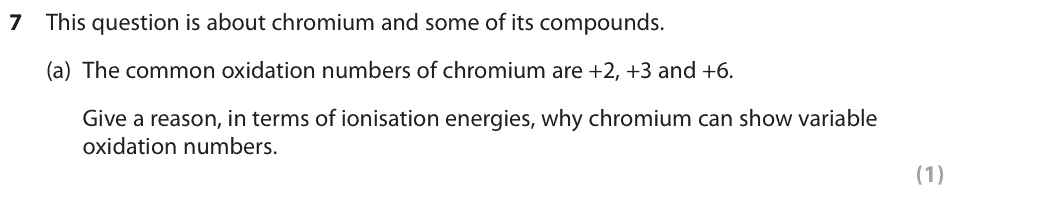
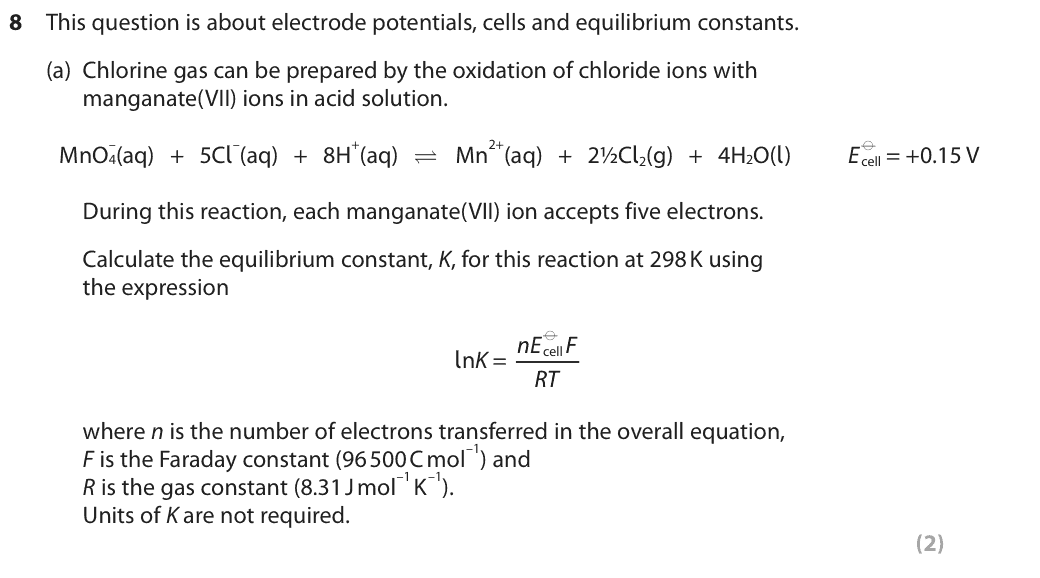
Write, construct or balance an equation: full, ionic and half-equations, with state symbols where the question asks for them. 122 questions.

Other types: Multiple-choice questions · Calculation questions · Mechanism questions · Structure and diagram questions · Explanation questions · Six-mark extended-response questions · Practical questions · Short-answer questions

June 2025 · AS Paper 1 · Q2(b)(i) 1 mark Equation writing formulae equations and amounts of substance
Earlier part of question 2 that this part usesEarlier part of June 2025 Paper 1 question 2
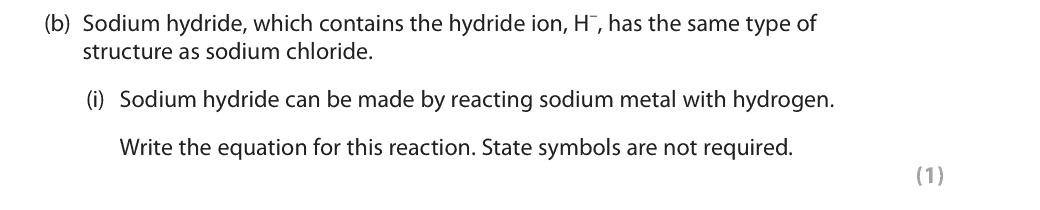
Sodium hydride, which contains the hydride ion, H−, has the same type of
structure as sodium chloride.
Sodium hydride can be made by reacting sodium metal with hydrogen.
Write the equation for this reaction. State symbols are not required.
June 2025 · AS Paper 1 · Q2(b)(ii) 1 mark Equation writing formulae equations and amounts of substance
Earlier parts of question 2 that this part usesEarlier part of June 2025 Paper 1 question 2Earlier part of June 2025 Paper 1 question 2
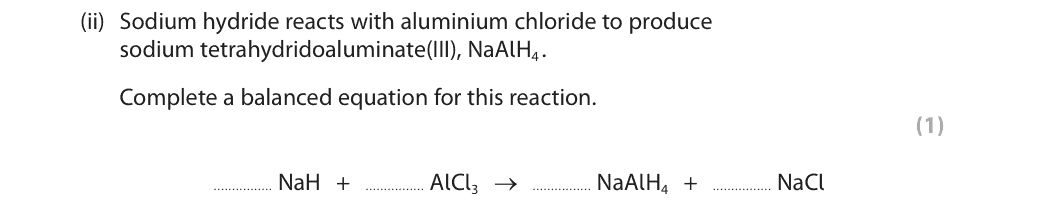
Sodium hydride reacts with aluminium chloride to produce
sodium tetrahydridoaluminate(III), NaAlH4 .
Complete a balanced equation for this reaction.
 NaH   +    AlCl3   →    NaAlH4   +    NaCl
June 2025 · AS Paper 1 · Q4(a)(ii) 2 marks Equation writing formulae equations and amounts of substance
Earlier part of question 4 that this part usesEarlier part of June 2025 Paper 1 question 4
Write an equation for the reaction that occurs with magnesium and
dilute nitric acid.
Include state symbols.
June 2025 · AS Paper 1 · Q4(a)(iii) 1 mark Equation writing Hard formulae equations and amounts of substance
Earlier part of question 4 that this part usesEarlier part of June 2025 Paper 1 question 4
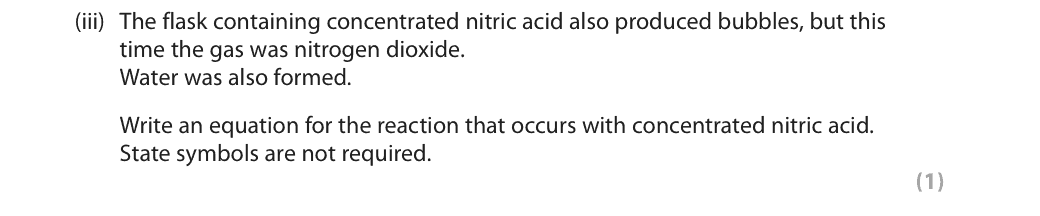
The flask containing concentrated nitric acid also produced bubbles, but this
time the gas was nitrogen dioxide.
Water was also formed.
Write an equation for the reaction that occurs with concentrated nitric acid.
State symbols are not required.
June 2025 · AS Paper 1 · Q6(c) 2 marks Equation writing Hard redox i
Earlier part of question 6 that this part usesEarlier part of June 2025 Paper 1 question 6
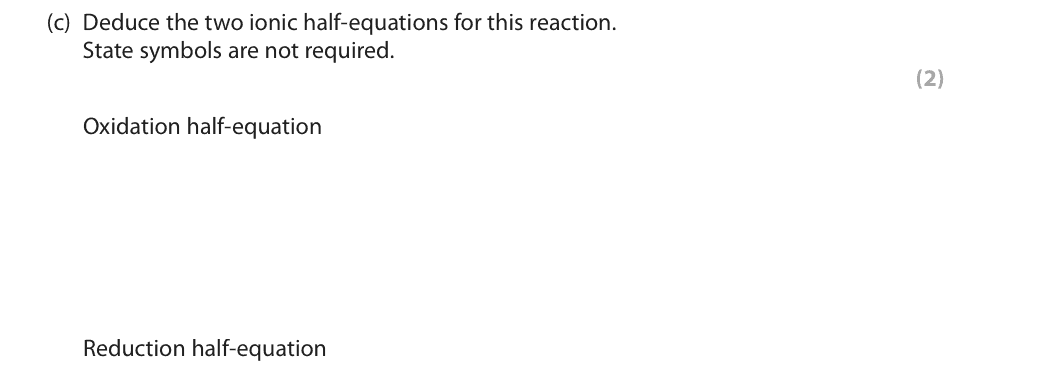
Deduce the two ionic half-equations for this reaction.
State symbols are not required.
Oxidation half-equation
Reduction half-equation
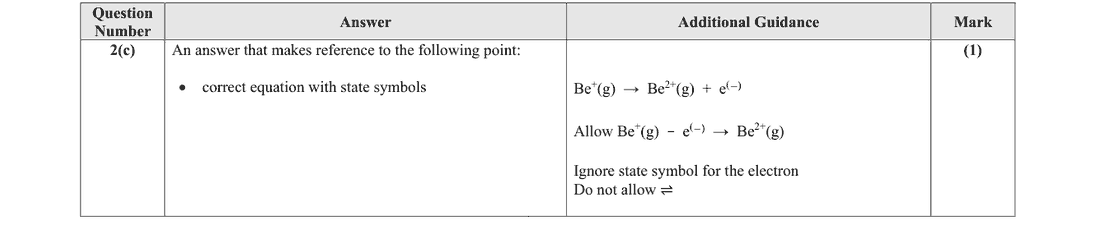
June 2025 · Paper 1 · Q2(c) 1 mark Equation writing atomic structure and the periodic table
Write the equation for the second ionisation energy of beryllium.
Include state symbols.
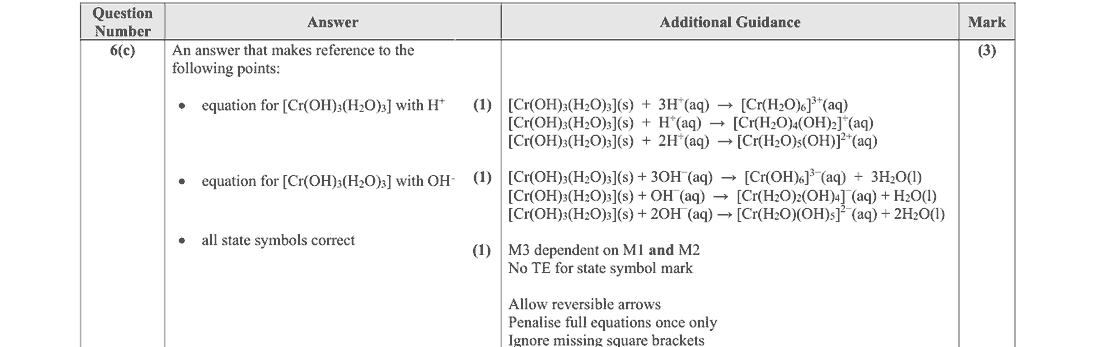
June 2025 · Paper 1 · Q6(c) 3 marks Equation writing transition metals reactions
Write two ionic equations which demonstrate the amphoteric nature of
chromium(III) hydroxide [Cr(OH)3(H2O)3].
Include state symbols.
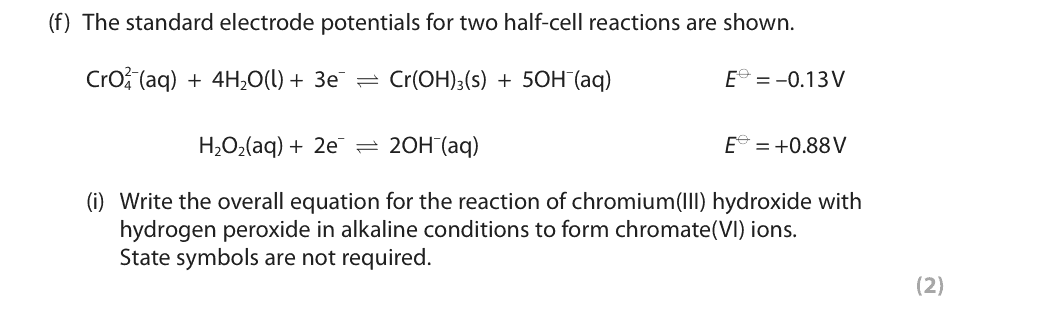
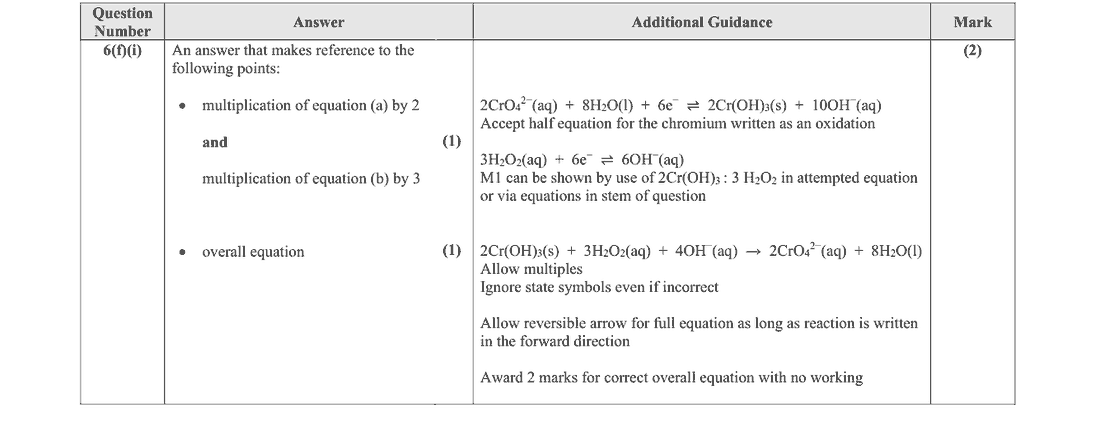
June 2025 · Paper 1 · Q6(f)(i) 2 marks Equation writing transition metals reactionsredox i
Earlier part of question 6 that this part usesEarlier part of June 2025 Paper 1 question 6
The standard electrode potentials for two half‑cell reactions are shown.
CrO4
2–(aq)  +  4H2O(l) +  3e–    Cr(OH)3(s)  +  5OH–(aq)
Ed = –0.13 V
H2O2(aq) +  2e–    2OH–(aq)
Ed = +0.88 V
Write the overall equation for the reaction of chromium(III) hydroxide with
hydrogen peroxide in alkaline conditions to form chromate(VI) ions.
State symbols are not required.
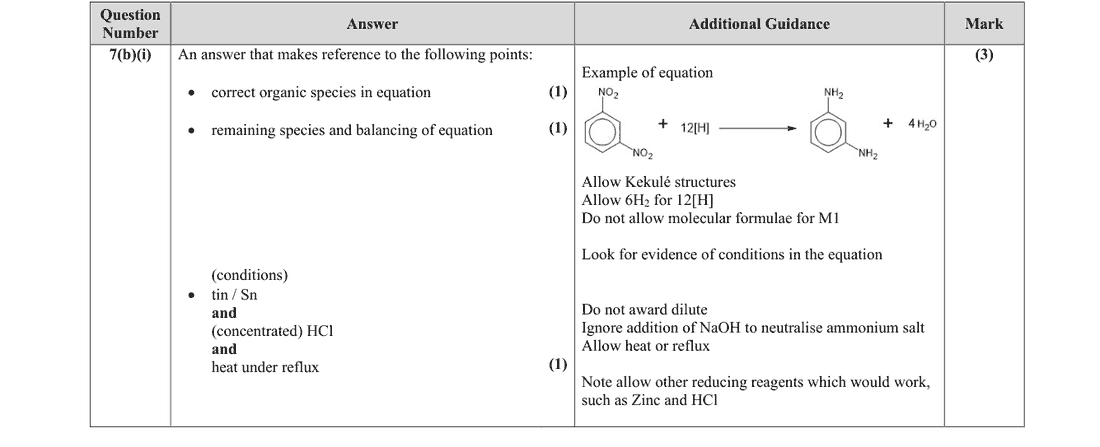
June 2025 · Paper 2 · Q7(b)(i) 3 marks Equation writing Hard amines amides amino acids and proteins
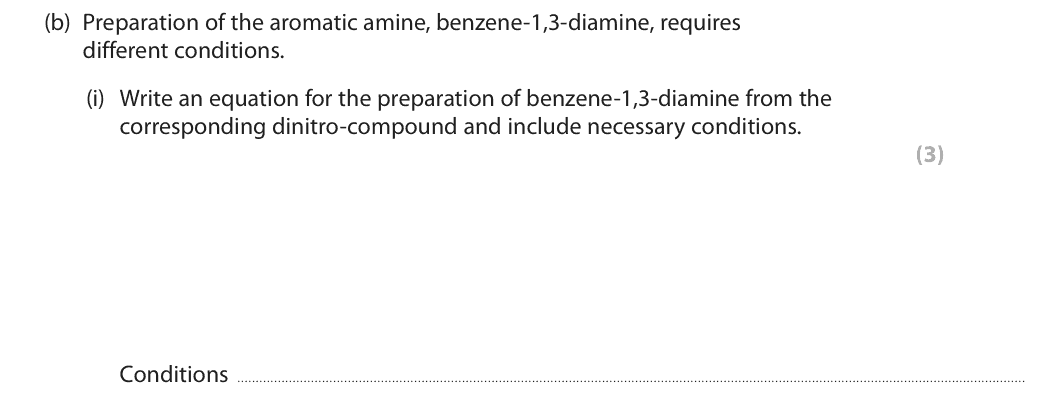
Preparation of the aromatic amine, benzene‑1,3‑diamine, requires
different conditions.
Write an equation for the preparation of benzene‑1,3‑diamine from the
corresponding dinitro‑compound and include necessary conditions.
Conditions
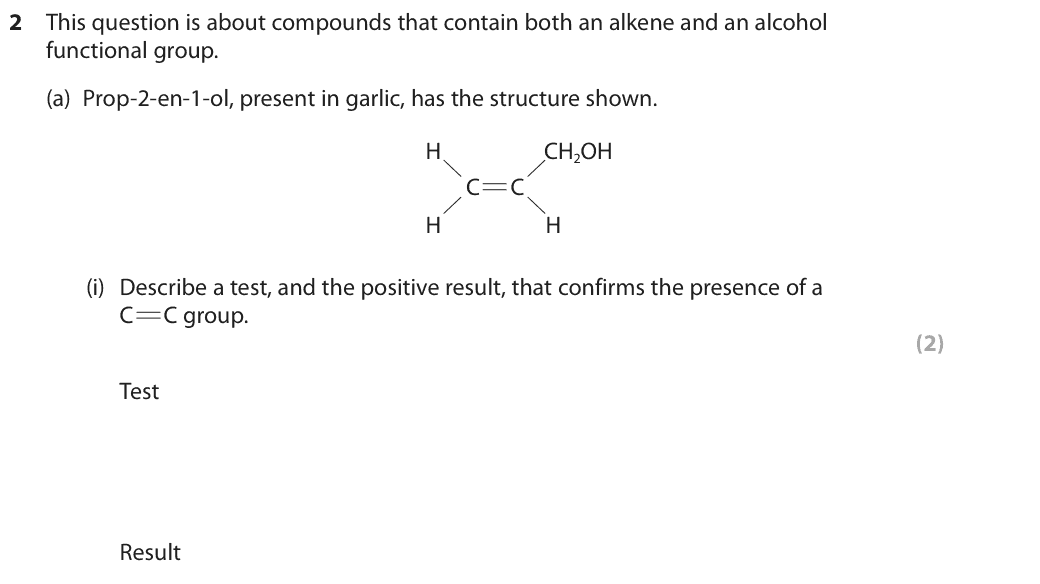
June 2025 · Paper 3 · Q2(b) 2 marks Equation writing alkenes
Earlier part of question 2 that this part usesEarlier part of June 2025 Paper 3 question 2
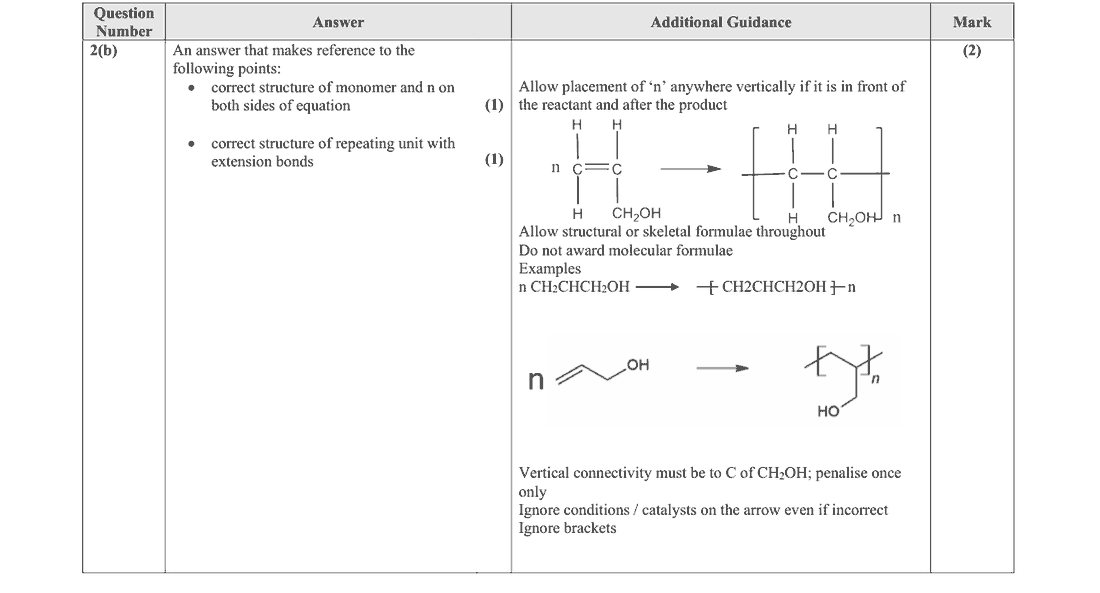
Prop-2-en-1-ol can polymerise to form an addition polymer.
Write a balanced equation for this polymerisation.
June 2024 · AS Paper 1 · Q4(b)(iii) 2 marks Equation writing Hard analysis of inorganic compoundsformulae equations and amounts of substance
Earlier parts of question 4 that this part usesEarlier part of June 2024 Paper 1 question 4Earlier part of June 2024 Paper 1 question 4
Write the ionic equation for the reaction of nitric acid with carbonate ions.
Include state symbols.
June 2024 · AS Paper 1 · Q9(a) 1 mark Equation writing redox i
This question is about some redox reactions.
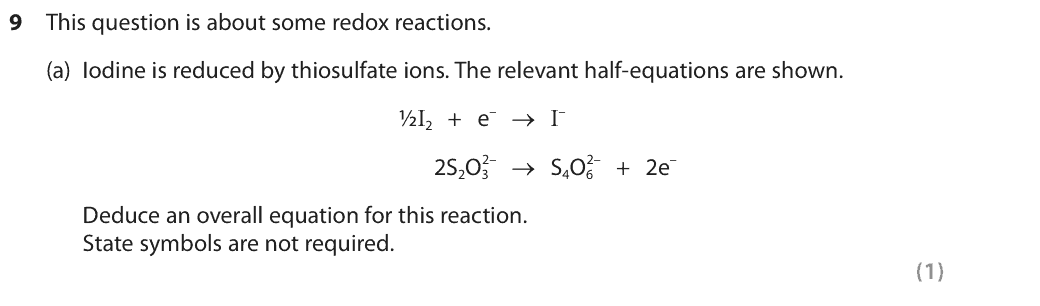
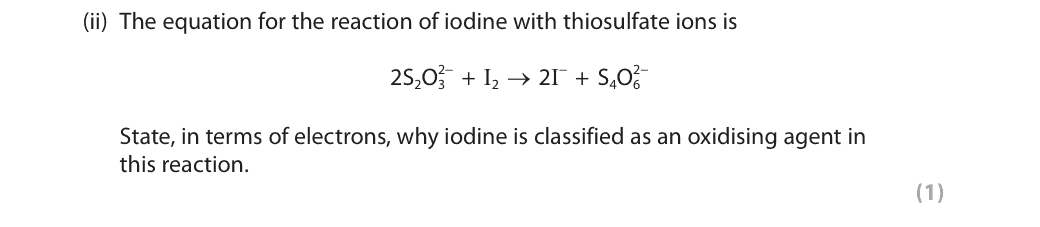
Iodine is reduced by thiosulfate ions. The relevant half‑equations are shown.
½I2   +   e–   →   I–
2S2O3
2–   →   S4O6
2–   +   2e–
Deduce an overall equation for this reaction.
State symbols are not required.
June 2024 · AS Paper 2 · Q8(a)(i) 2 marks Equation writing Hard energetics iformulae equations and amounts of substance
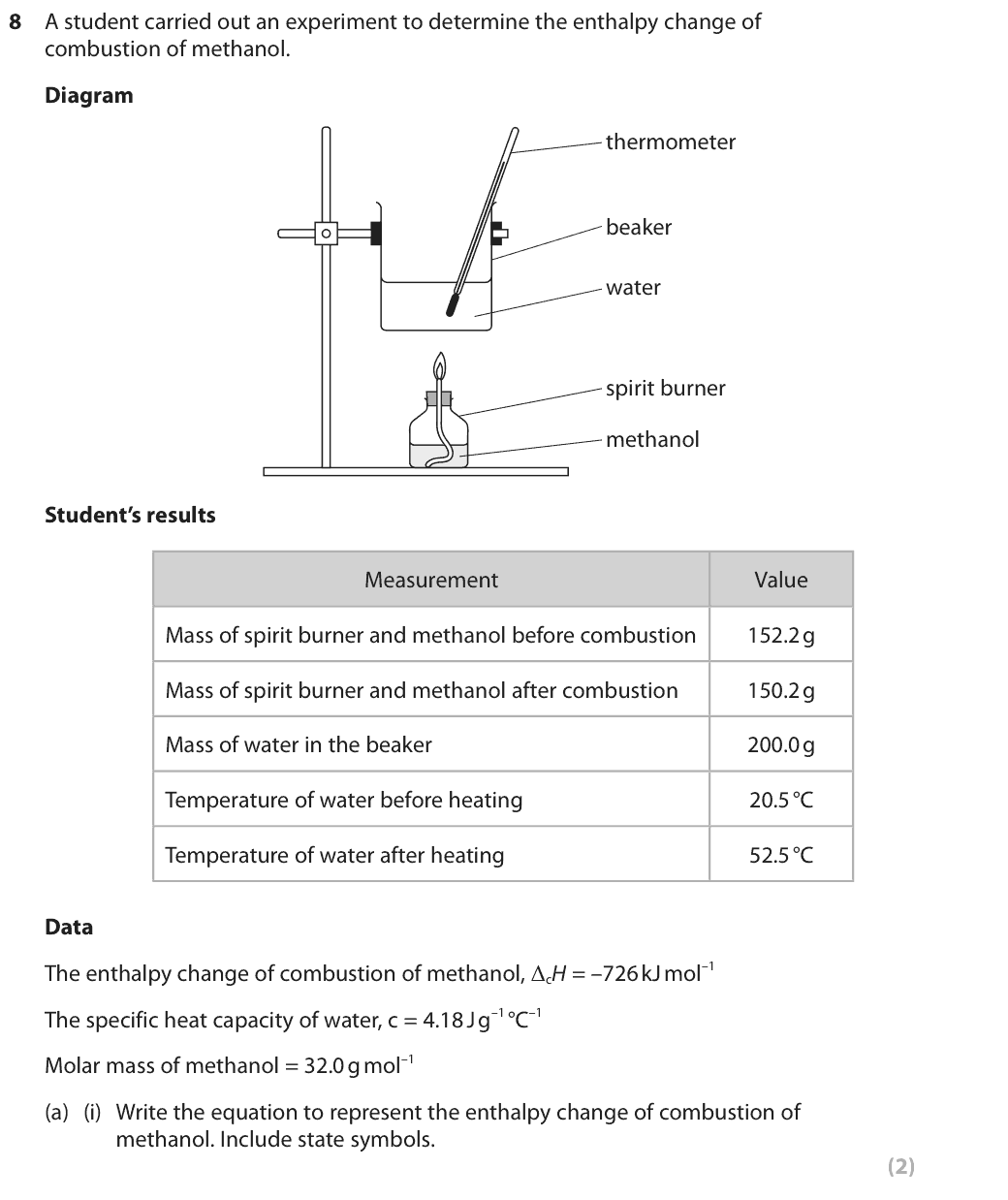
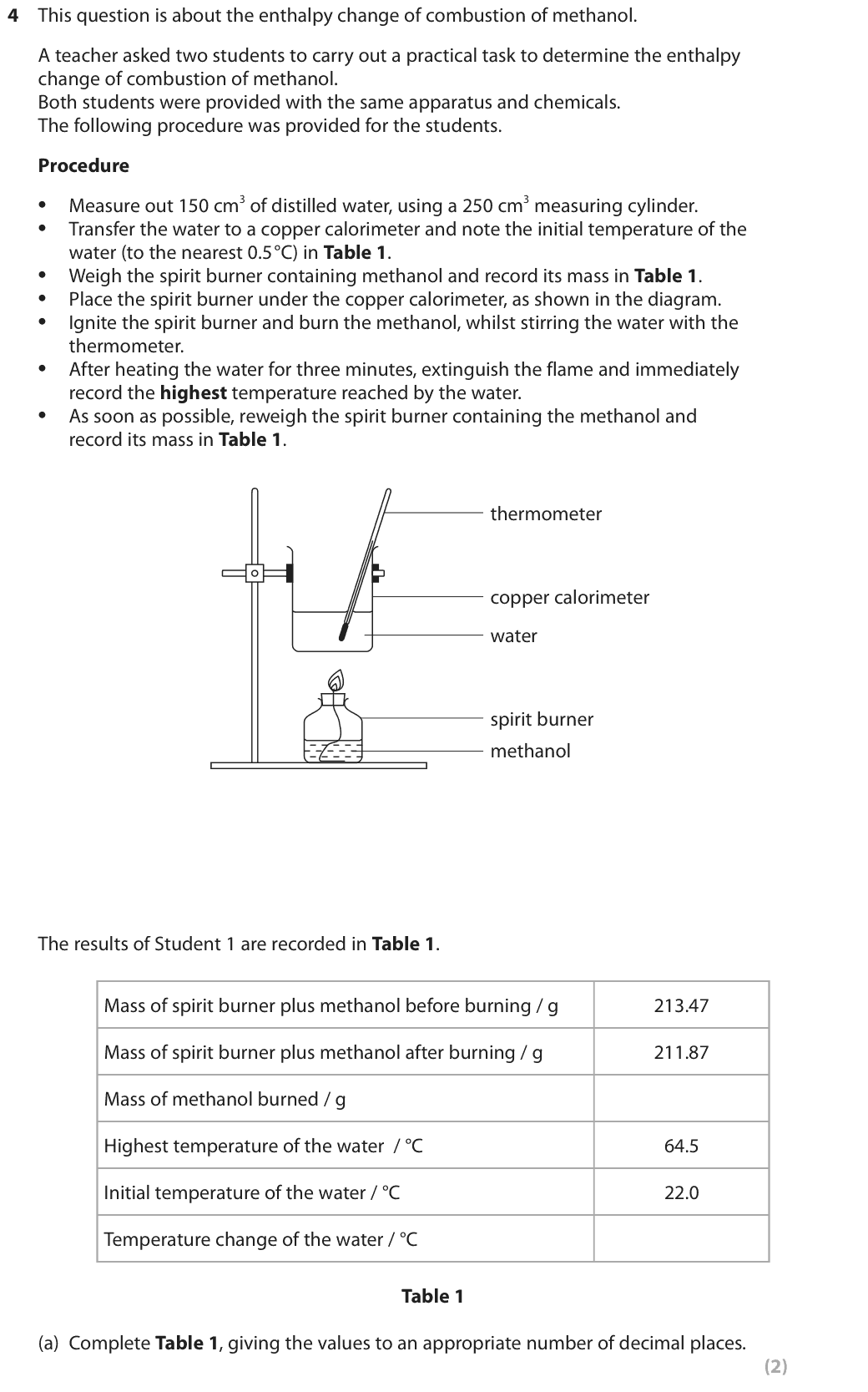
A student carried out an experiment to determine the enthalpy change of
combustion of methanol.
Diagram
thermometer
beaker
water
spirit burner
methanol
Student’s results
Measurement
Value
Mass of spirit burner and methanol before combustion
152.2 g
Mass of spirit burner and methanol after combustion
150.2 g
Mass of water in the beaker
200.0 g
Temperature of water before heating
20.5 °C
Temperature of water after heating
52.5 °C
Data
The enthalpy change of combustion of methanol, ΔcH = –726 kJ mol–1
The specific heat capacity of water, c = 4.18 J g–1 °C–1
Molar mass of methanol = 32.0 g mol–1
Write the equation to represent the enthalpy change of combustion of
methanol. Include state symbols.
June 2024 · Paper 1 · Q5(d) 2 marks Equation writing redox iredox ii
Earlier part of question 5 that this part usesEarlier part of June 2024 Paper 1 question 5
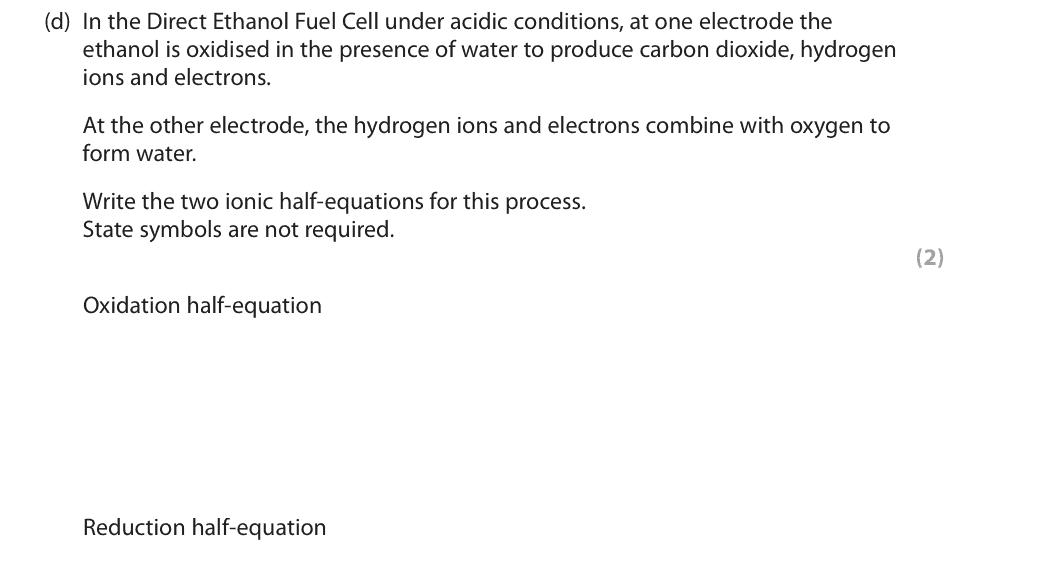
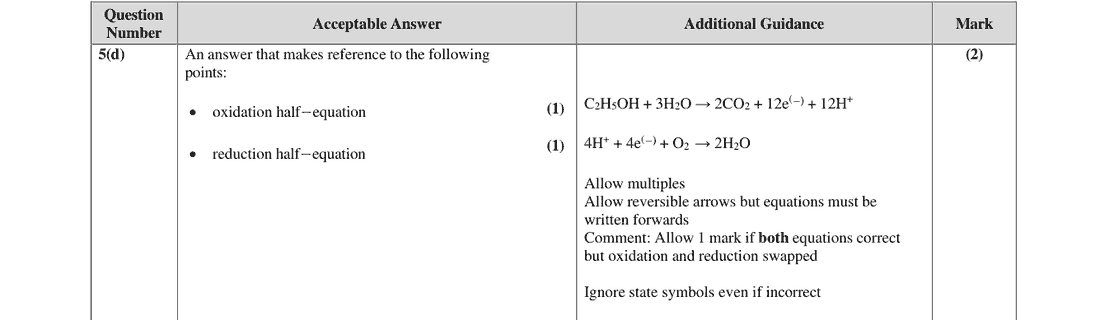
In the Direct Ethanol Fuel Cell under acidic conditions, at one electrode the
ethanol is oxidised in the presence of water to produce carbon dioxide, hydrogen
ions and electrons.
At the other electrode, the hydrogen ions and electrons combine with oxygen to
form water.
Write the two ionic half-equations for this process.
State symbols are not required.
Oxidation half-equation
Reduction half-equation
June 2024 · Paper 1 · Q7(b) 2 marks Equation writing transition metals reactions
Earlier part of question 7 that this part usesEarlier part of June 2024 Paper 1 question 7
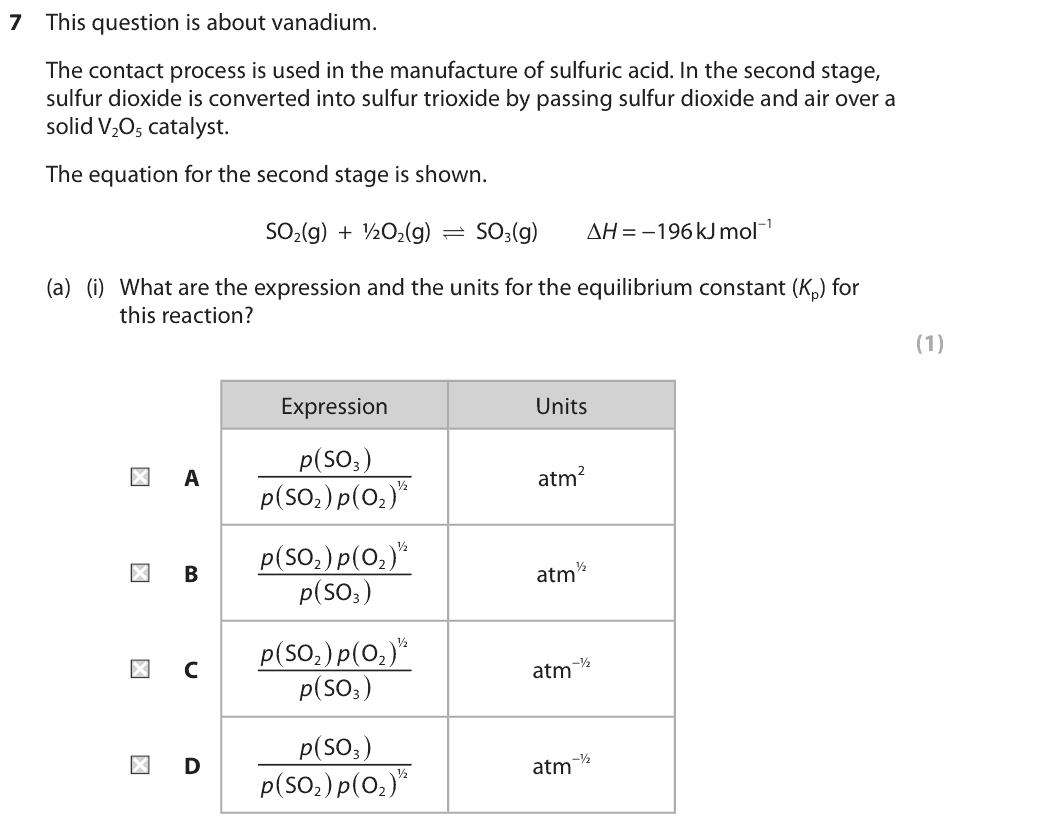
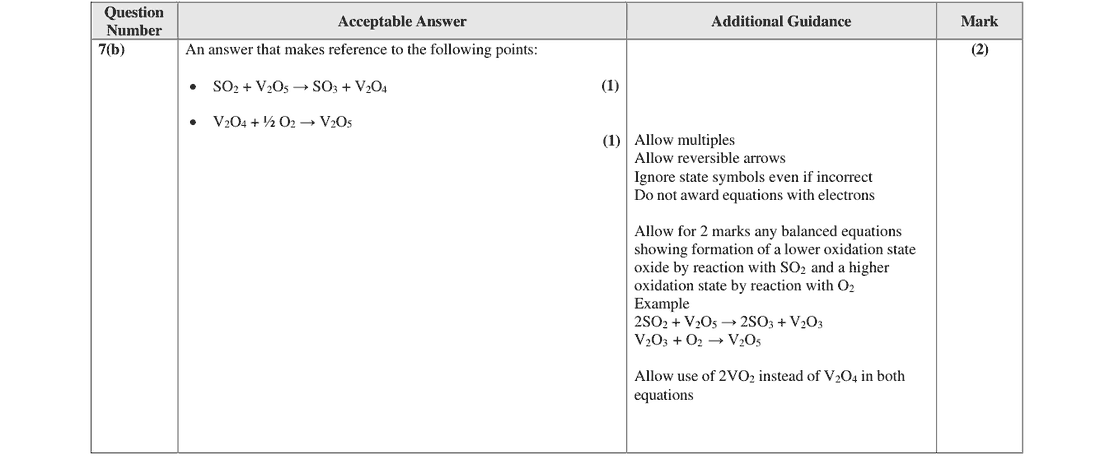
Write two equations that show the conversion of SO2 and O2 into SO3 by using
V2O5 as the catalyst.
State symbols are not required.
June 2024 · Paper 1 · Q10(b)(i) 1 mark Equation writing redox iformulae equations and amounts of substance
Earlier part of question 10 that this part usesEarlier part of June 2024 Paper 1 question 10
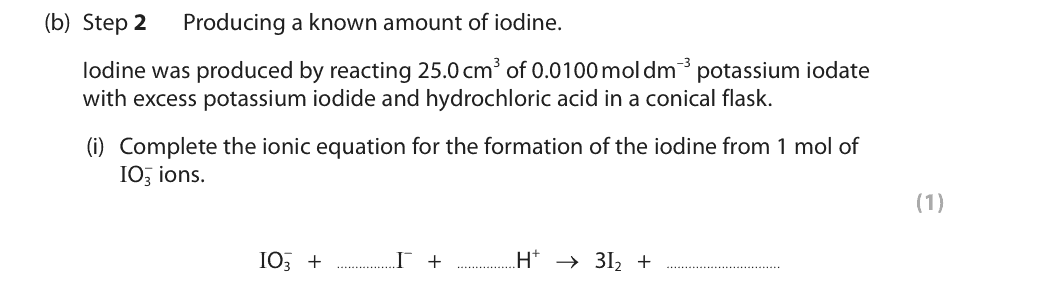
Step 2      Producing a known amount of iodine.
Iodine was produced by reacting 25.0 cm3 of 0.0100 mol dm–3 potassium iodate
with excess potassium iodide and hydrochloric acid in a conical flask.
Complete the ionic equation for the formation of the iodine from 1 mol of
IO3
− ions.
IO3
−   +   I−   +   H+   →   3I2   +
June 2024 · Paper 2 · Q5(c)(ii) 3 marks Equation writing alkanes
Earlier parts of question 5 that this part usesEarlier part of June 2024 Paper 2 question 5Earlier part of June 2024 Paper 2 question 5
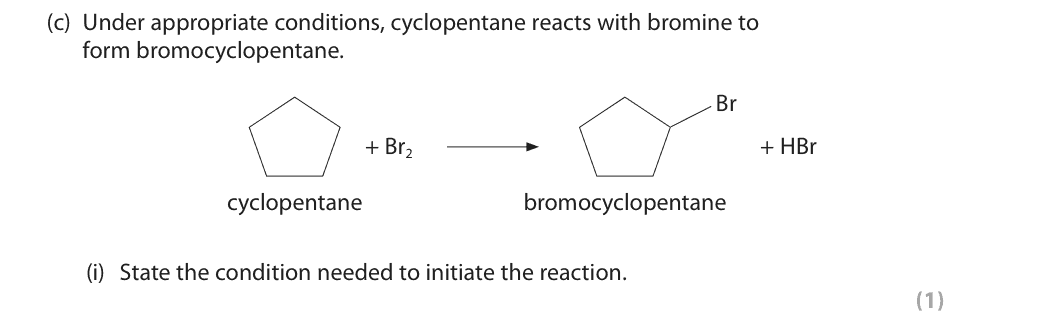
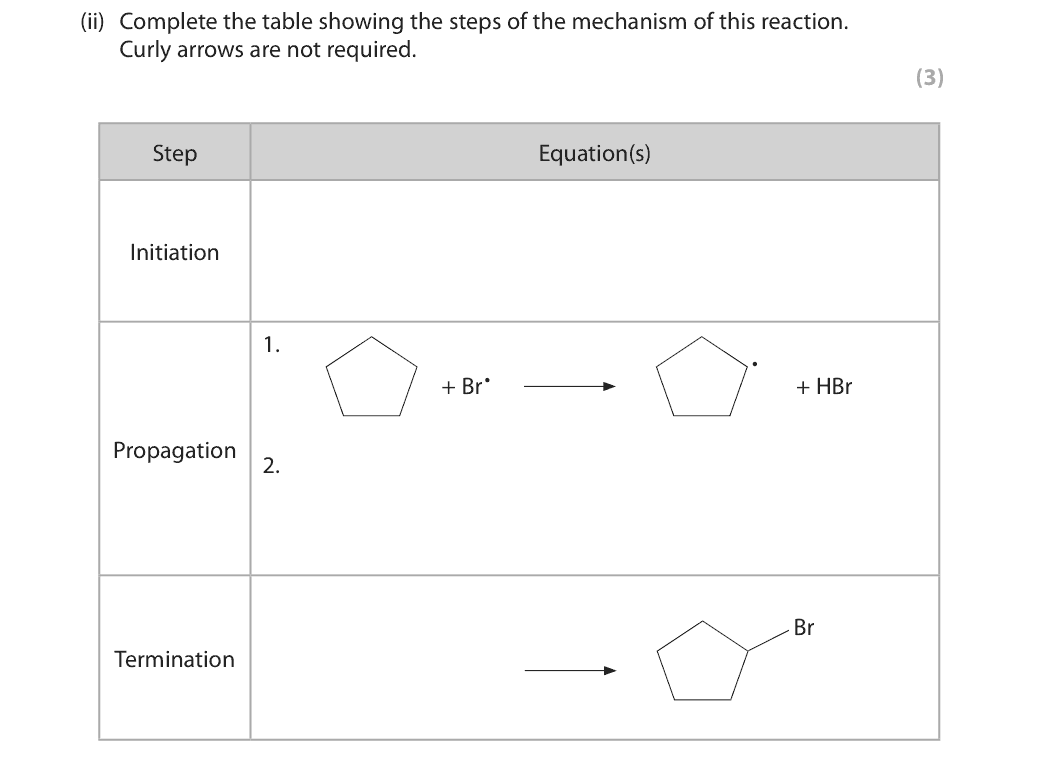
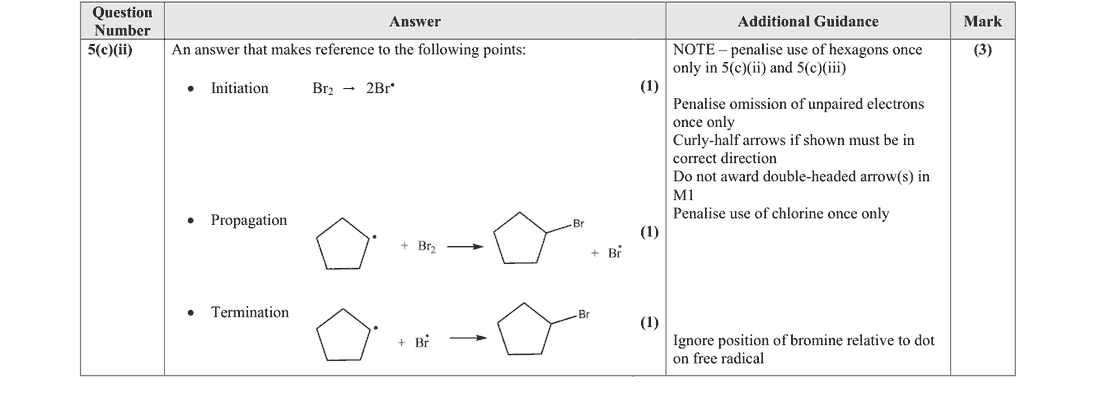
Complete the table showing the steps of the mechanism of this reaction.
Curly arrows are not required.
Step
Equation(s)
Initiation
1.
.
+ Br.
+ HBr
Propagation
2.
Br
Termination
June 2024 · Paper 2 · Q8(d)(i) 1 mark Equation writing formulae equations and amounts of substance
Earlier part of question 8 that this part usesEarlier part of June 2024 Paper 2 question 8
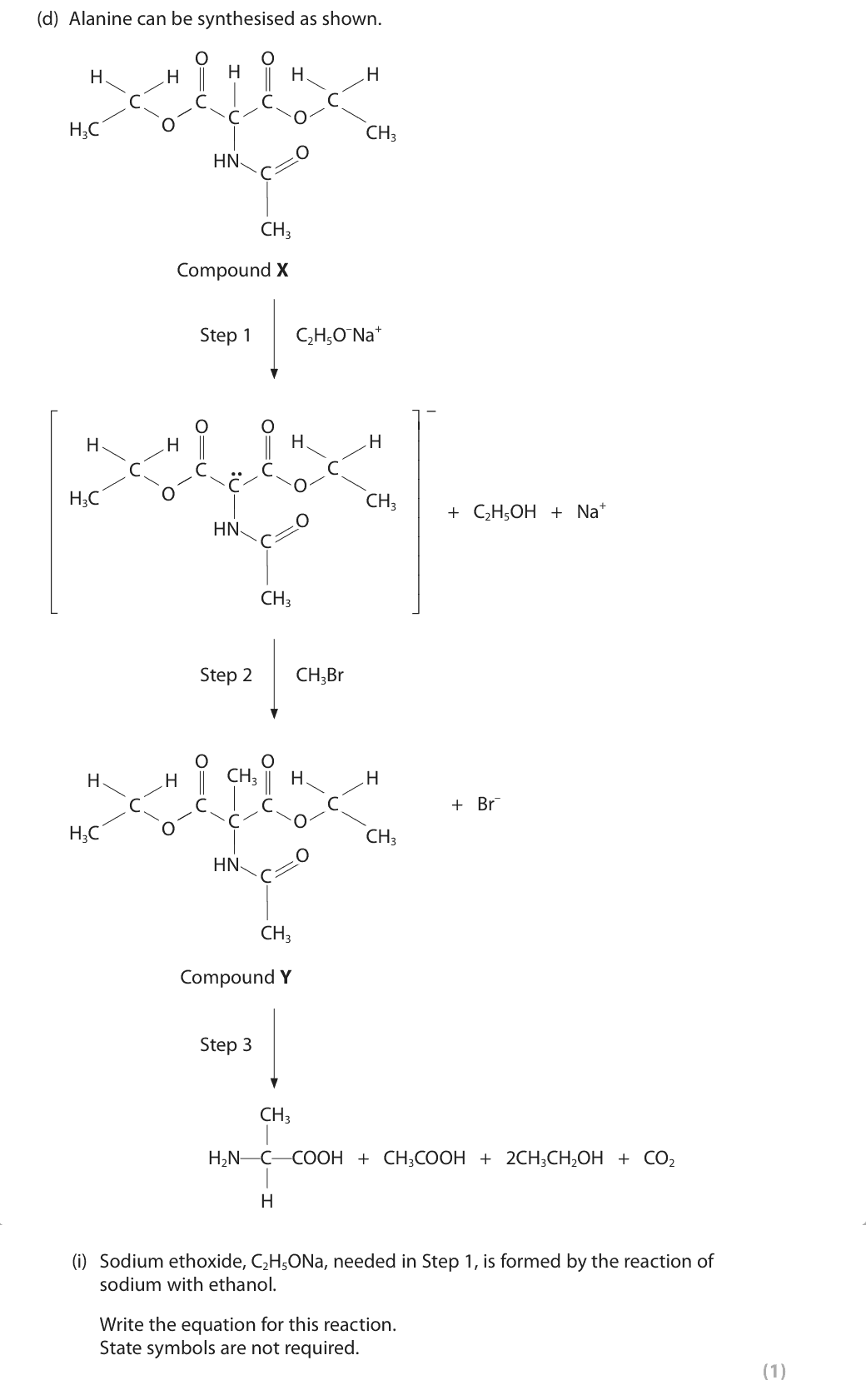
Alanine can be synthesised as shown.
O
O
H
H
H
H
H
C
C
C
C
C
O
O
H3C
CH3
O
HN
C
CH3
Compound X
Step 1
C2H5O–Na+
–
O
O
H
H
H
H
C
C
C
C
C
O
O
H3C
CH3
+   C2H5OH   +   Na+
O
HN
C
CH3
Step 2
CH3Br
O
O
CH3
H
H
H
H
C
C
C
C
+   Br–
C
O
O
H3C
CH3
O
HN
C
CH3
Compound Y
Step 3
CH3
H2N
C
COOH   +   CH3COOH   +   2CH3CH2OH   +   CO2
H
Sodium ethoxide, C2H5ONa, needed in Step 1, is formed by the reaction of
sodium with ethanol.
Write the equation for this reaction.
State symbols are not required.
June 2024 · Paper 3 · Q4(c)(i) 1 mark Equation writing Hard redox i
Earlier part of question 4 that this part usesEarlier part of June 2024 Paper 3 question 4
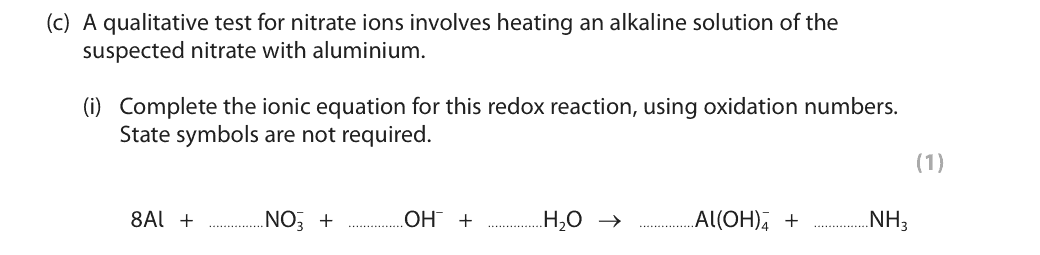
A qualitative test for nitrate ions involves heating an alkaline solution of the
suspected nitrate with aluminium.
Complete the ionic equation for this redox reaction, using oxidation numbers.
State symbols are not required.
–   +   OH–   +   H2O   →   Al(OH)4
–   +   NH3
8Al   +   NO3
June 2023 · AS Paper 1 · Q2(c)(ii) 1 mark Equation writing Hard analysis of inorganic compoundsformulae equations and amounts of substance
Earlier parts of question 2 that this part usesEarlier part of June 2023 Paper 1 question 2Earlier part of June 2023 Paper 1 question 2
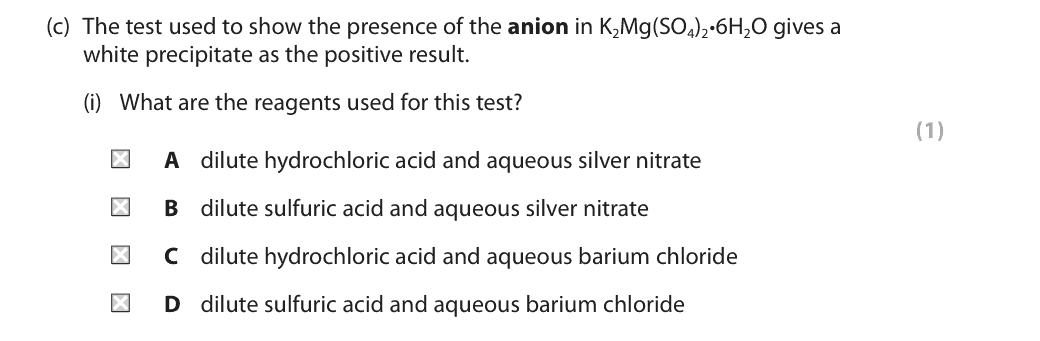
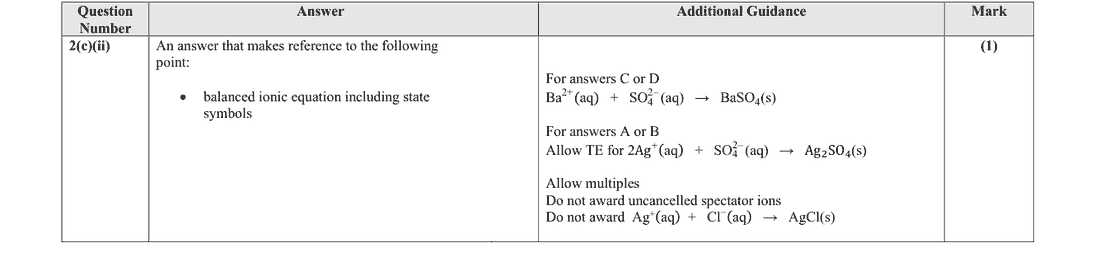
Write an ionic equation, including state symbols, for the formation of the
white precipitate in the test for the anion in the double salt.
June 2023 · AS Paper 1 · Q6(b) 4 marks Equation writing Hard group 7 the halogensredox i
Earlier part of question 6 that this part usesEarlier part of June 2023 Paper 1 question 6
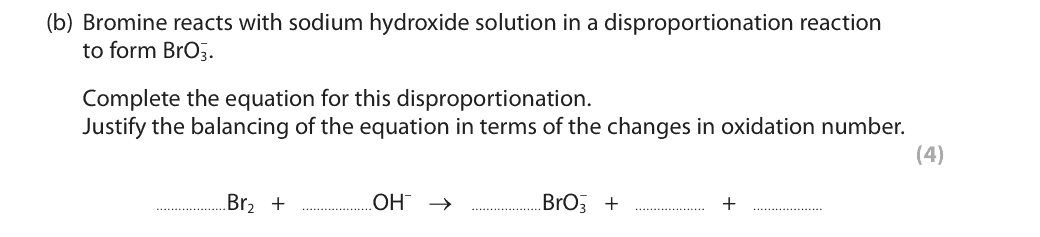
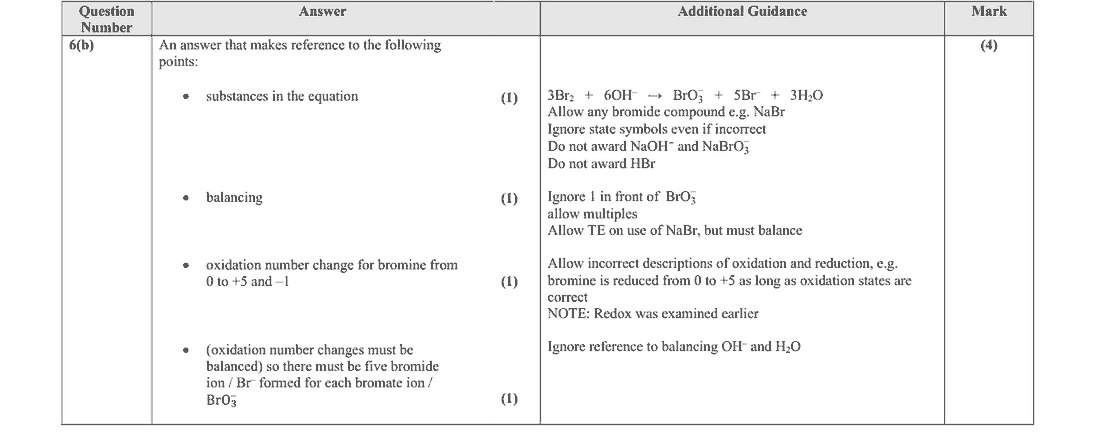
Bromine reacts with sodium hydroxide solution in a disproportionation reaction
–.
to form BrO3
Complete the equation for this disproportionation.
Justify the balancing of the equation in terms of the changes in oxidation number.
Br2   +   OH–   →   BrO3
–   +      +
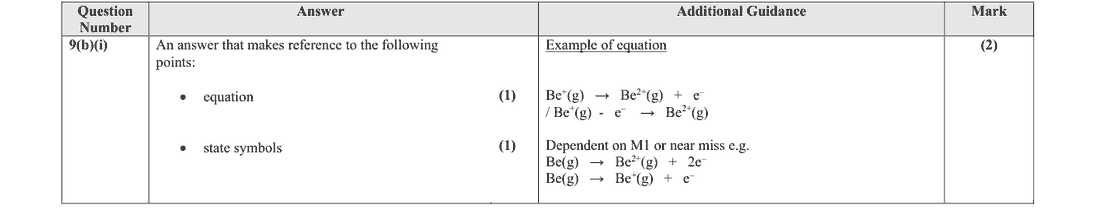
June 2023 · AS Paper 1 · Q9(b)(i) 2 marks Equation writing atomic structure and the periodic table
The second ionisation energy of beryllium is more endothermic than the
first ionisation energy.
Write an equation for the second ionisation of beryllium.
Include state symbols.
June 2023 · AS Paper 2 · Q2(b)(i) 1 mark Equation writing alkanesformulae equations and amounts of substance
Earlier part of question 2 that this part usesEarlier part of June 2023 Paper 2 question 2
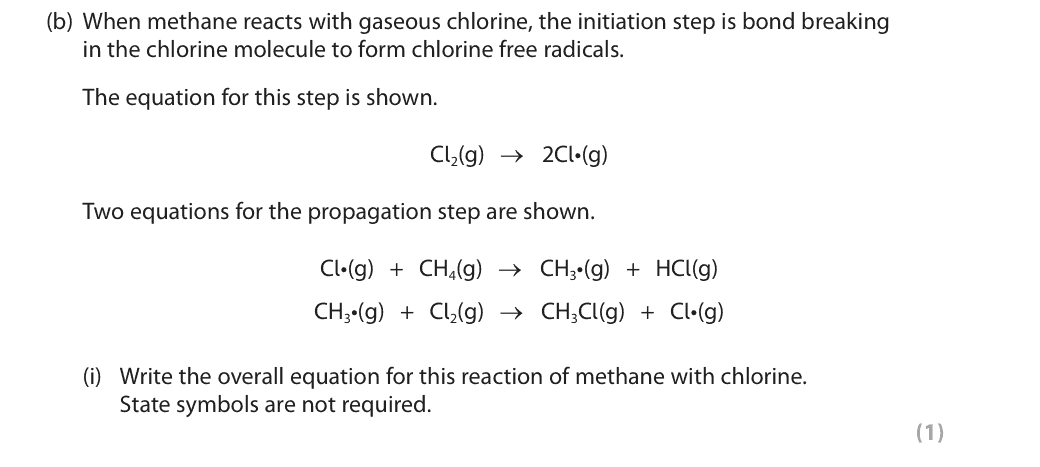
When methane reacts with gaseous chlorine, the initiation step is bond breaking
in the chlorine molecule to form chlorine free radicals.
The equation for this step is shown.
Cl2(g)   →   2Cl•(g)
Two equations for the propagation step are shown.
Cl•(g)   +   CH4(g)   →   CH3•(g)   +   HCl(g)
CH3•(g)   +   Cl2(g)   →   CH3Cl(g)   +   Cl•(g)
Write the overall equation for this reaction of methane with chlorine.
State symbols are not required.
June 2023 · AS Paper 2 · Q2(b)(iii) 1 mark Equation writing alkanes
Earlier parts of question 2 that this part usesEarlier part of June 2023 Paper 2 question 2Earlier part of June 2023 Paper 2 question 2Earlier part of June 2023 Paper 2 question 2
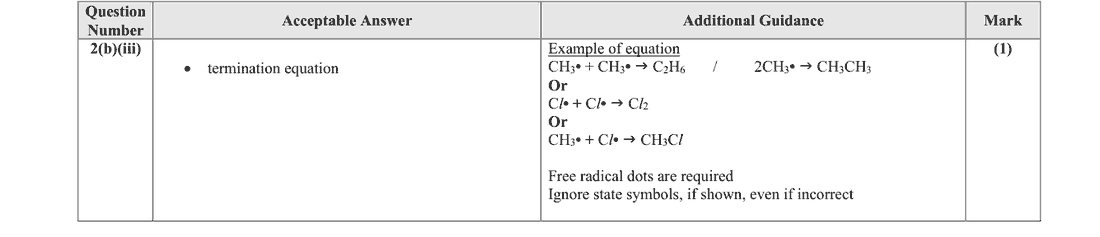
Write an equation for a termination step for this reaction.
State symbols are not required.
June 2023 · Paper 2 · Q2(b) 1 mark Equation writing alcohols
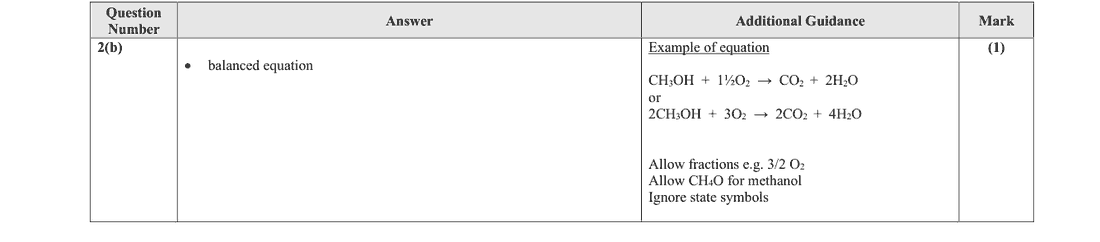
Write the equation for the complete combustion of methanol.
State symbols are not required.
June 2023 · Paper 2 · Q2(e) 1 mark Equation writing redox i
Earlier part of question 2 that this part usesEarlier part of June 2023 Paper 2 question 2
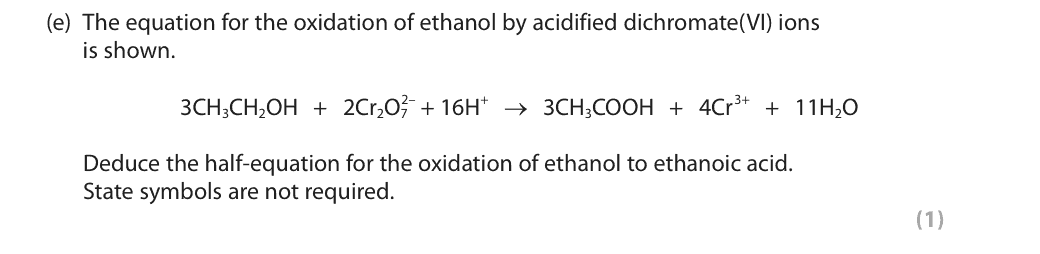
The equation for the oxidation of ethanol by acidified dichromate(VI) ions
is shown.
3CH3CH2OH   +   2Cr2O7
2– + 16H+   →   3CH3COOH   +   4Cr3+   +   11H2O
Deduce the half‑equation for the oxidation of ethanol to ethanoic acid.
State symbols are not required.
June 2023 · Paper 2 · Q6(c)(i) 2 marks Equation writing kinetics ii
Earlier part of question 6 that this part usesEarlier part of June 2023 Paper 2 question 6
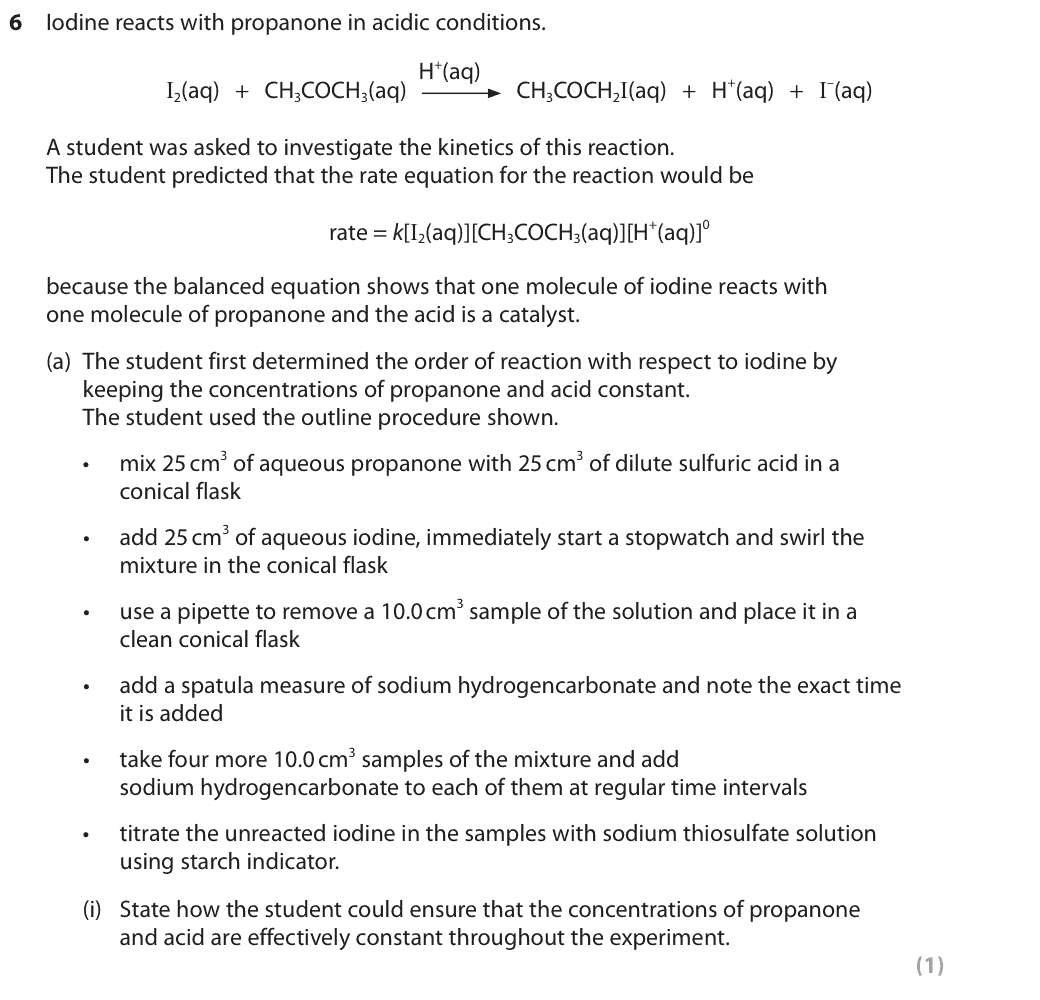
Further experiments showed that the correct overall rate equation is
rate = k[CH3COCH3(aq)][H+(aq)][I2(aq)]0
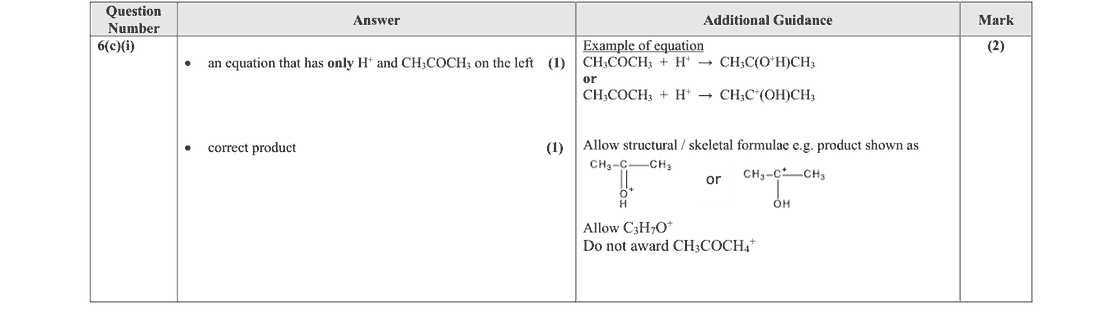
Deduce a possible rate determining step in the mechanism of this reaction.
Curly arrows are not required.
June 2023 · Paper 3 · Q1(a) 1 mark Equation writing alkanesformulae equations and amounts of substance
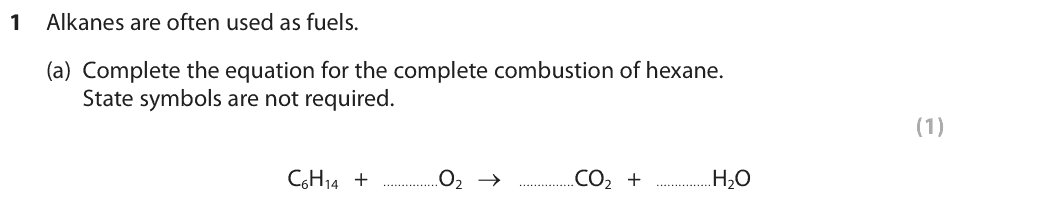
Alkanes are often used as fuels.
Complete the equation for the complete combustion of hexane.
State symbols are not required.
C6H14   +   O2   →   CO2   +   H2O
June 2023 · Paper 3 · Q1(d) 2 marks Equation writing alkanesintroduction to organic chemistry
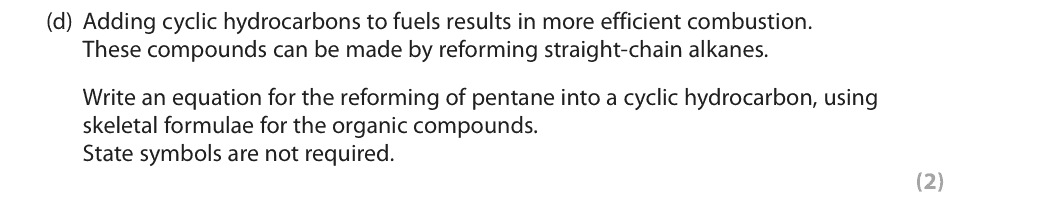
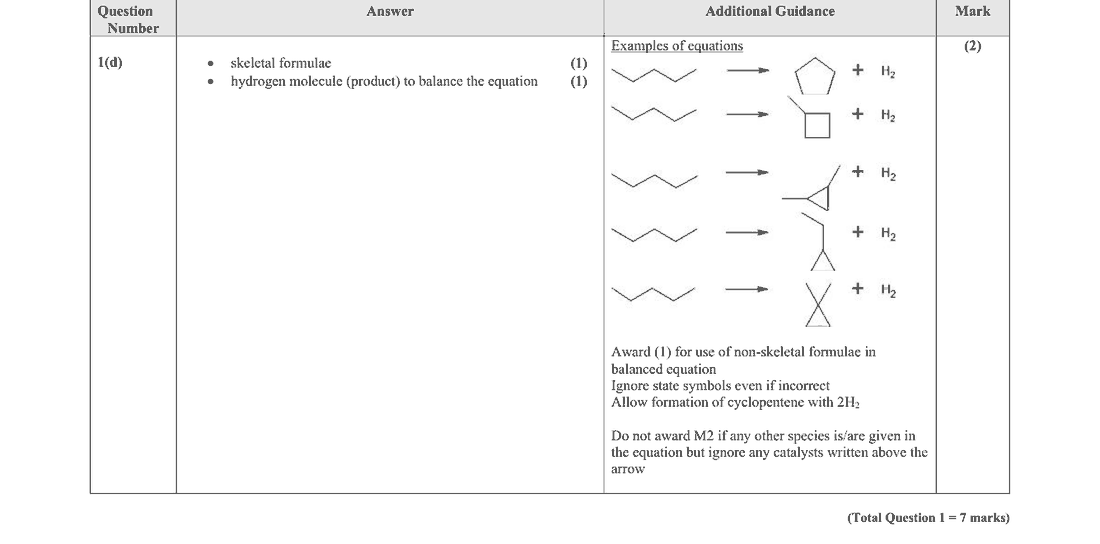
Adding cyclic hydrocarbons to fuels results in more efficient combustion.
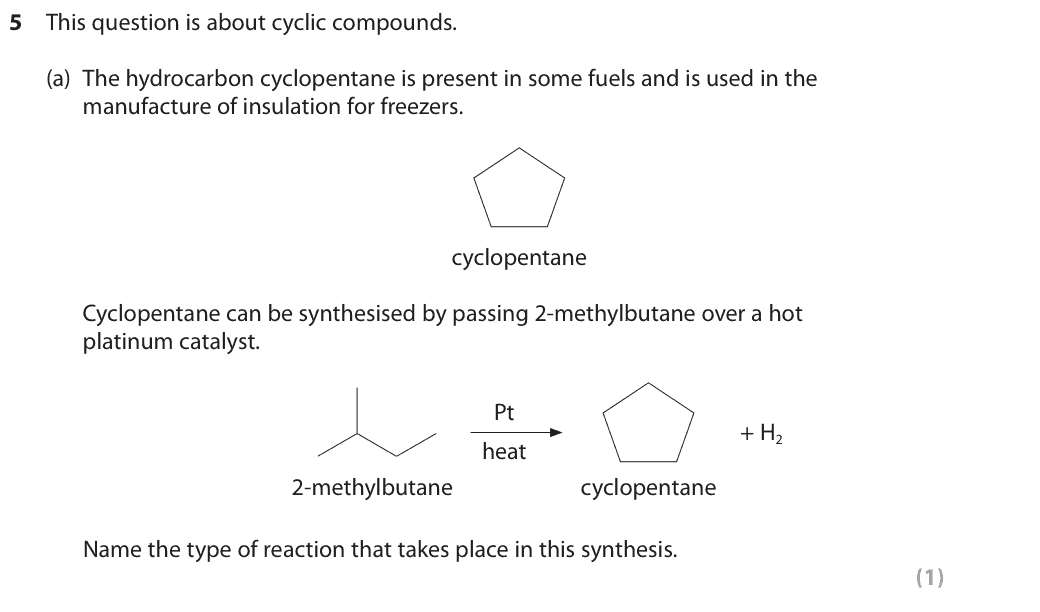
These compounds can be made by reforming straight‑chain alkanes.
Write an equation for the reforming of pentane into a cyclic hydrocarbon, using
skeletal formulae for the organic compounds.
State symbols are not required.
June 2023 · Paper 3 · Q2(a)(i) 1 mark Equation writing groups 1 and 2formulae equations and amounts of substance
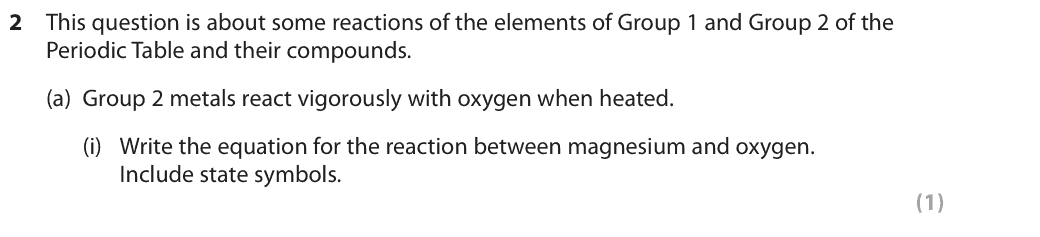
This question is about some reactions of the elements of Group 1 and Group 2 of the
Periodic Table and their compounds.
Group 2 metals react vigorously with oxygen when heated.
Write the equation for the reaction between magnesium and oxygen.
Include state symbols.
June 2023 · Paper 3 · Q2(c)(ii) 1 mark Equation writing groups 1 and 2formulae equations and amounts of substance
Earlier parts of question 2 that this part usesEarlier part of June 2023 Paper 3 question 2Earlier part of June 2023 Paper 3 question 2
Write the equation for this decomposition.
State symbols are not required.
June 2023 · Paper 3 · Q3(a) 1 mark Equation writing alcohols
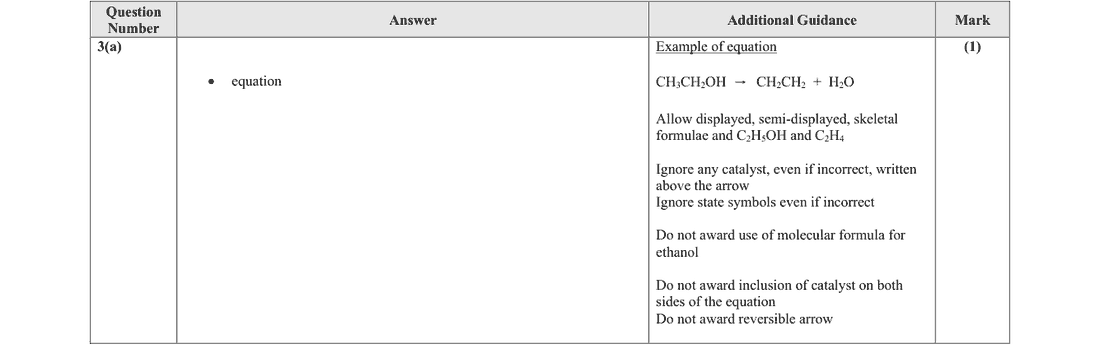
Ethanol can be dehydrated using concentrated phosphoric(V) acid,
concentrated sulfuric acid or aluminium oxide.
Write the equation for the dehydration of ethanol using structural formulae.
State symbols are not required.
June 2023 · Paper 3 · Q5(c) 1 mark Equation writing redox iiredox i
Earlier part of question 5 that this part usesEarlier part of June 2023 Paper 3 question 5
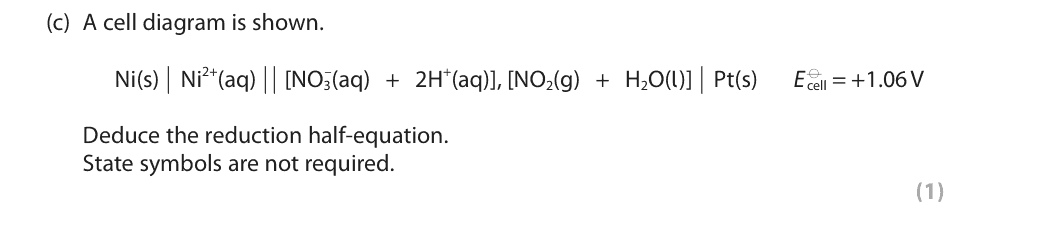
A cell diagram is shown.
Ni(s) ½ Ni2+(aq) ½½ [NO3
–(aq)   +   2H+(aq)], [NO2(g)   +   H2O(l)] ½ Pt(s)       E d
cell = +1.06 V
Deduce the reduction half‑equation.
State symbols are not required.
June 2023 · Paper 3 · Q9(a)(ii) 1 mark Equation writing Hard carboxylic acids
Earlier part of question 9 that this part usesEarlier part of June 2023 Paper 3 question 9
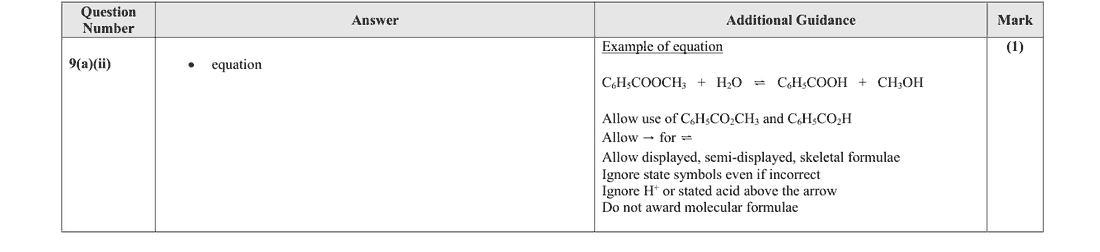
Write an equation, using structural formulae, for the acid hydrolysis of
methyl benzoate.
June 2022 · AS Paper 1 · Q7(c)(ii) 1 mark Equation writing groups 1 and 2
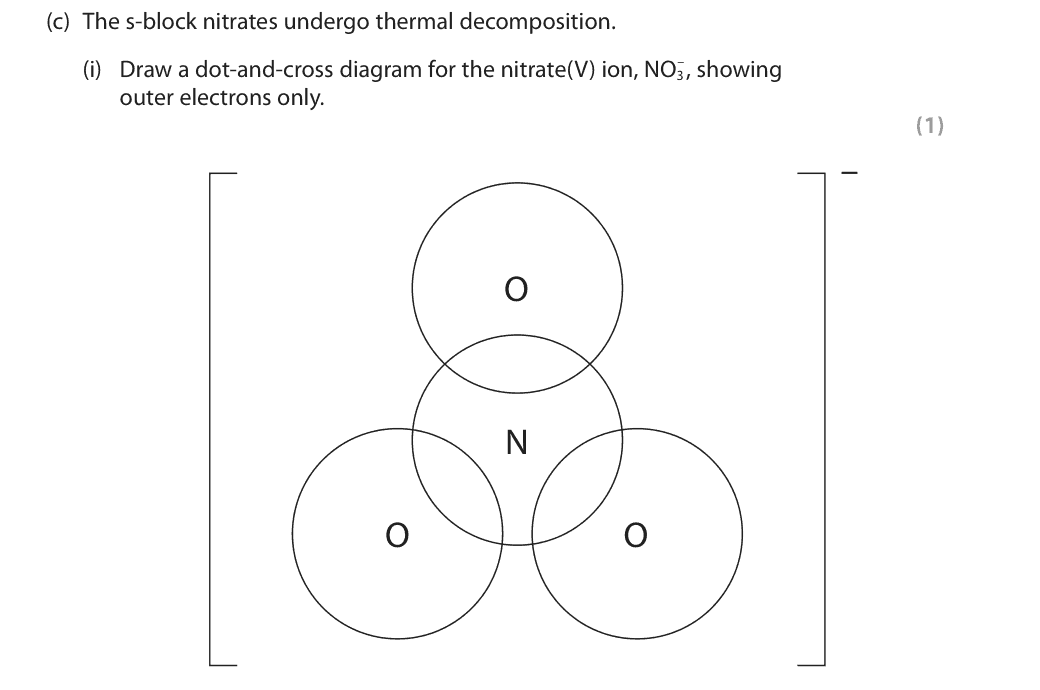
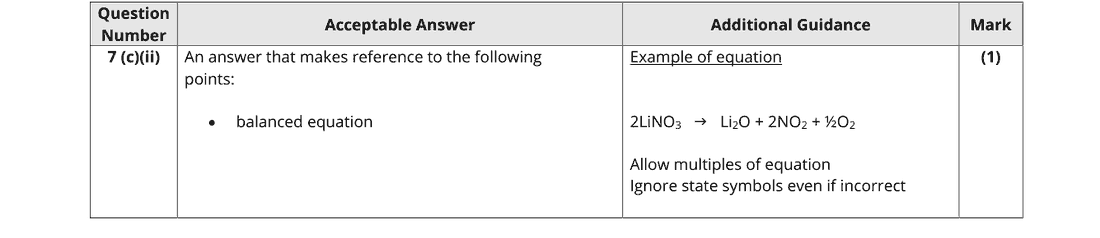
Earlier part of question 7 that this part usesEarlier part of June 2022 Paper 1 question 7
Write an equation for the thermal decomposition of lithium nitrate.
State symbols are not required.
June 2022 · AS Paper 1 · Q8(b)(ii) 2 marks Equation writing group 7 the halogens
Earlier part of question 8 that this part usesEarlier part of June 2022 Paper 1 question 8
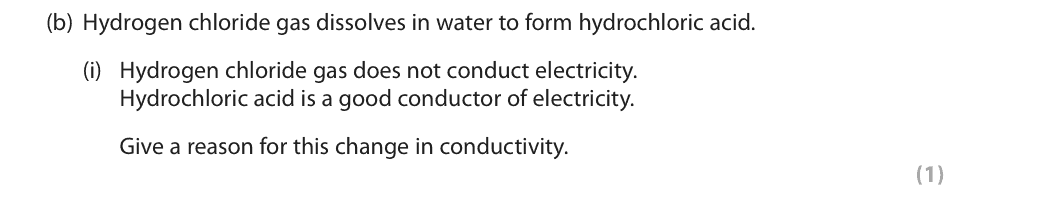
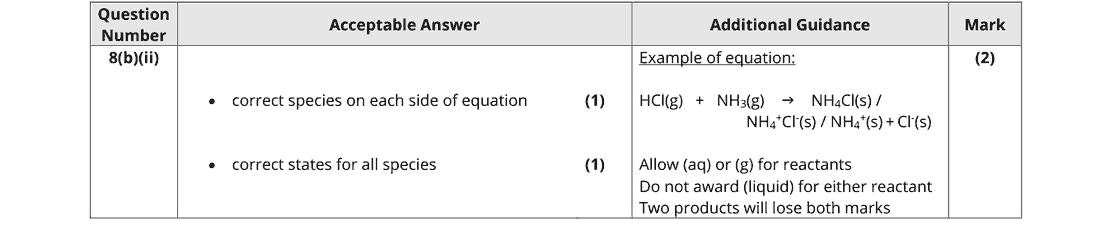
When concentrated hydrochloric acid on a glass rod is held above a
concentrated ammonia solution, a white smoke is observed.
Write an equation, including state symbols, for the reaction that produces the
white smoke.
June 2022 · AS Paper 1 · Q8(c)(i) 1 mark Equation writing redox i
Earlier part of question 8 that this part usesEarlier part of June 2022 Paper 1 question 8
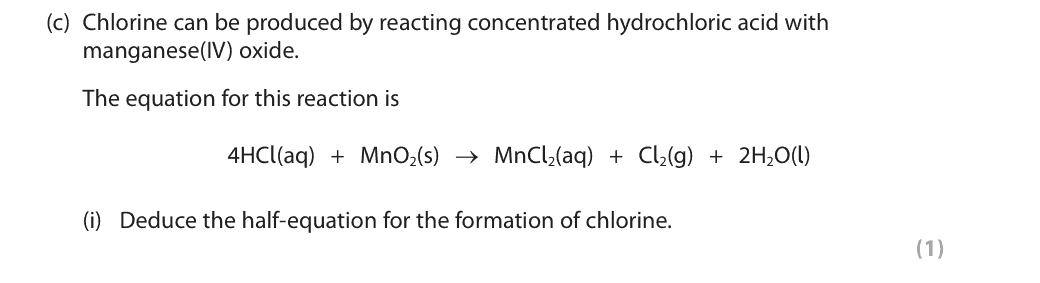
Chlorine can be produced by reacting concentrated hydrochloric acid with
manganese(IV) oxide.
The equation for this reaction is
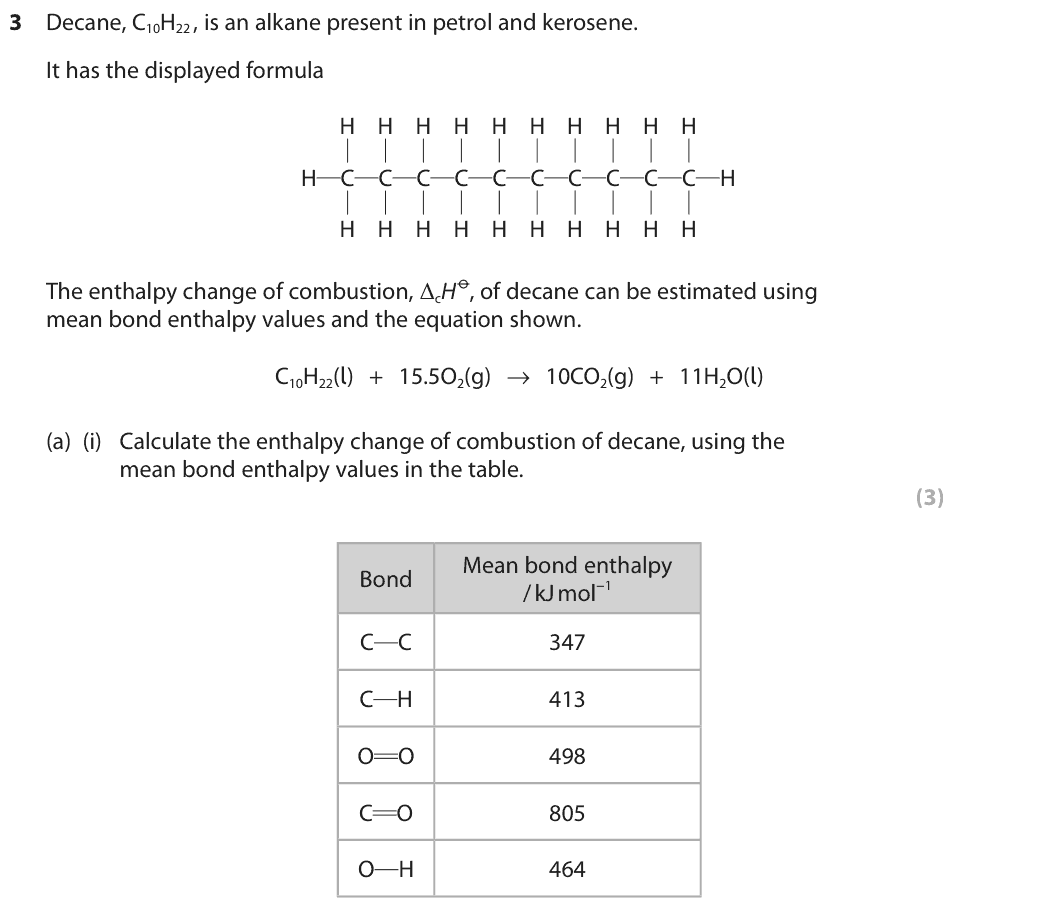
4HCl(aq)   +   MnO2(s)   →   MnCl2(aq)   +   Cl2(g)   +   2H2O(l)
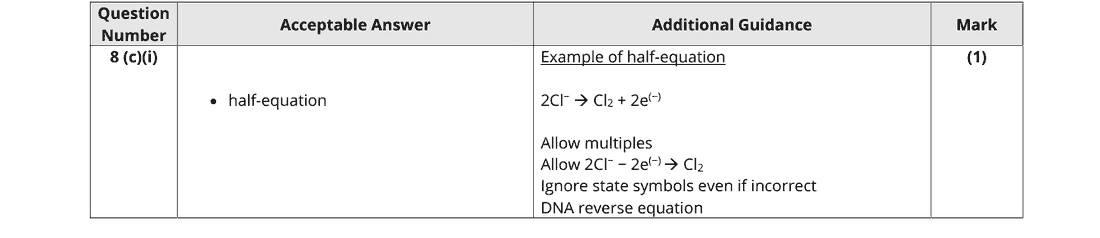
Deduce the half‑equation for the formation of chlorine.
June 2022 · AS Paper 2 · Q3(b)(ii) 2 marks Equation writing formulae equations and amounts of substance
Earlier parts of question 3 that this part usesEarlier part of June 2022 Paper 2 question 3Earlier part of June 2022 Paper 2 question 3
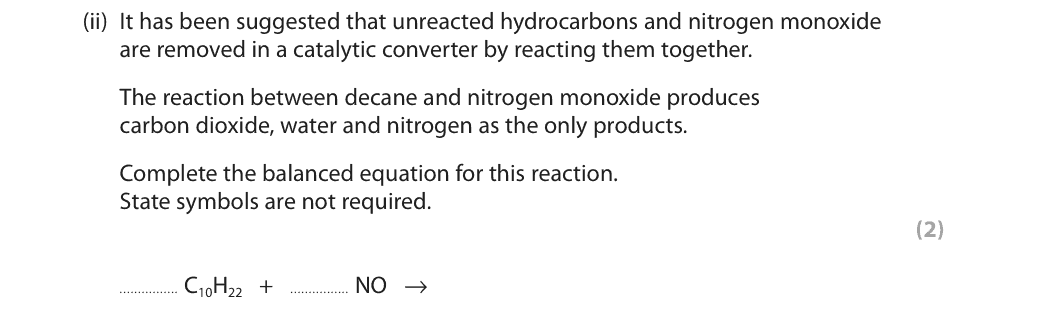
It has been suggested that unreacted hydrocarbons and nitrogen monoxide
are removed in a catalytic converter by reacting them together.
The reaction between decane and nitrogen monoxide produces
carbon dioxide, water and nitrogen as the only products.
Complete the balanced equation for this reaction.
State symbols are not required.
 C10H22   +    NO   →
June 2022 · AS Paper 2 · Q5(b)(iii) 3 marks Equation writing Hard alkanes
Earlier part of question 5 that this part usesEarlier part of June 2022 Paper 2 question 5
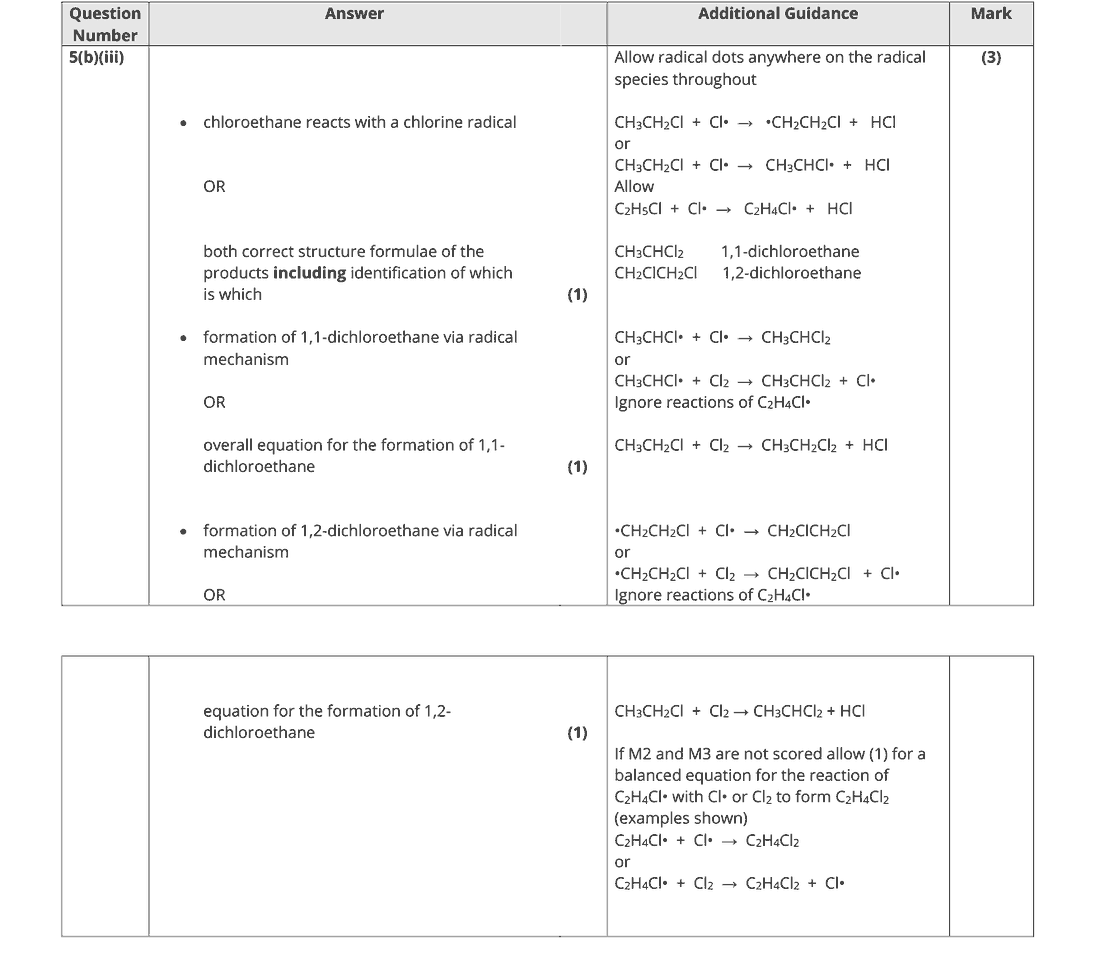
Further reactions of chloroethane result in the formation of small amounts of
the isomers 1,1‑dichloroethane and 1,2‑dichloroethane.
Write equations to show the formation of these products.
Curly arrows are not required.

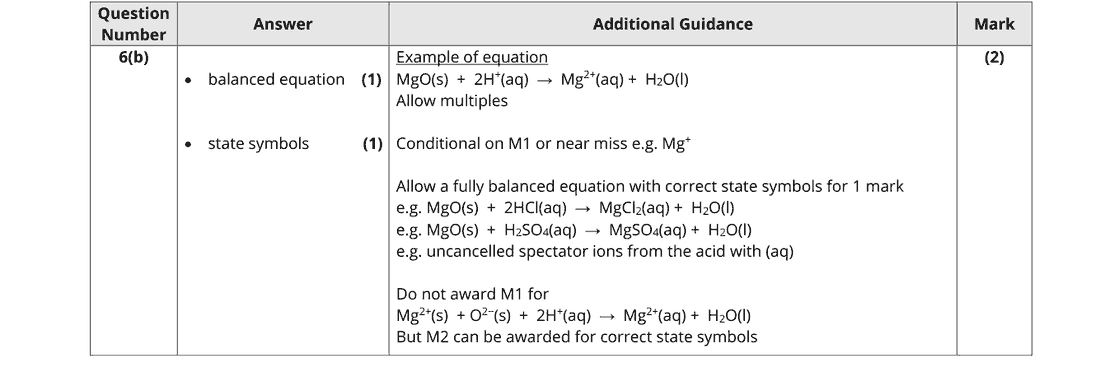
June 2022 · Paper 1 · Q6(b) 2 marks Equation writing formulae equations and amounts of substancegroups 1 and 2
Write the ionic equation for the reaction between magnesium oxide and an acid.
State symbols are required.
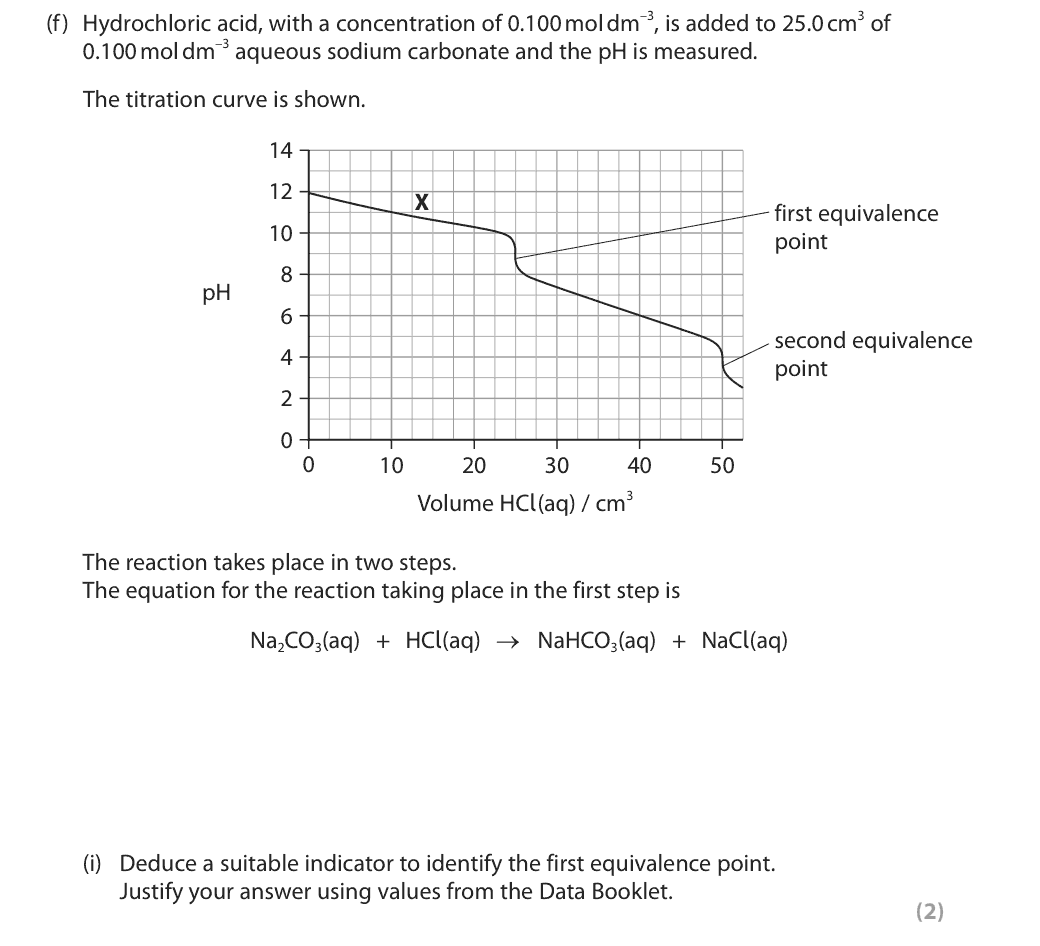
–3, in a solution with a
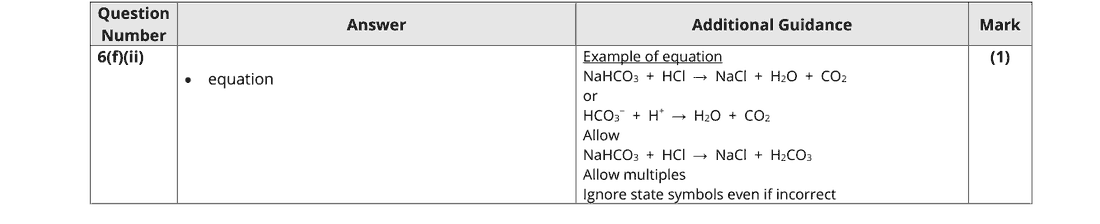
June 2022 · Paper 1 · Q6(f)(ii) 1 mark Equation writing formulae equations and amounts of substance
Earlier parts of question 6 that this part usesEarlier part of June 2022 Paper 1 question 6Earlier part of June 2022 Paper 1 question 6
Write the equation for the reaction taking place at the second
equivalence point.
State symbols are not required.
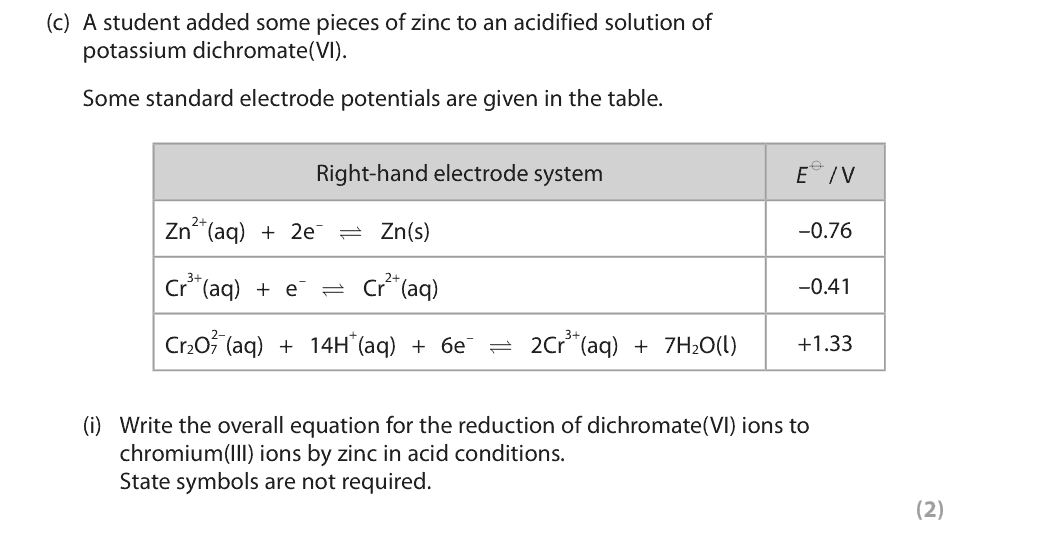
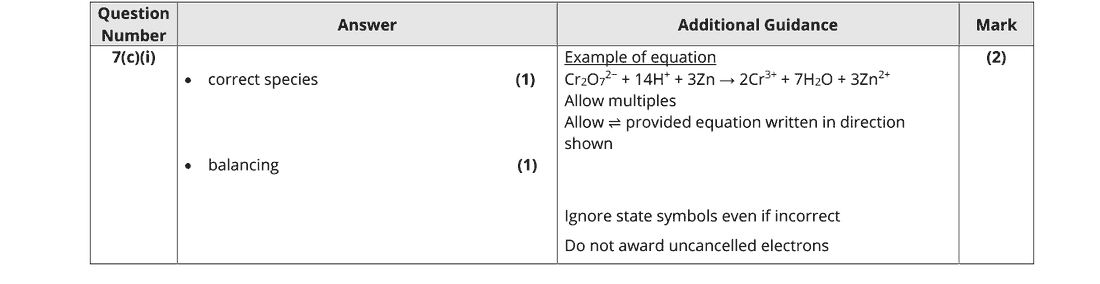
June 2022 · Paper 1 · Q7(c)(i) 2 marks Equation writing transition metals reactionsredox i
Earlier part of question 7 that this part usesEarlier part of June 2022 Paper 1 question 7
A student added some pieces of zinc to an acidified solution of
potassium dichromate(VI).
Some standard electrode potentials are given in the table.
Right‑hand electrode system
E
d / V
2+(aq)   +   2e–      Zn(s)
Zn
–0.76
Cr
3+(aq)   +   e–      Cr
2+(aq)
–0.41
2–(aq)   +   14H
+(aq)   +   6e–      2Cr
3+(aq)   +   7H2O(l)
Cr2O7
+1.33
Write the overall equation for the reduction of dichromate(VI) ions to
chromium(III) ions by zinc in acid conditions.
State symbols are not required.
d
June 2022 · Paper 1 · Q8(c) 3 marks Equation writing redox iiredox i
Earlier part of question 8 that this part usesEarlier part of June 2022 Paper 1 question 8
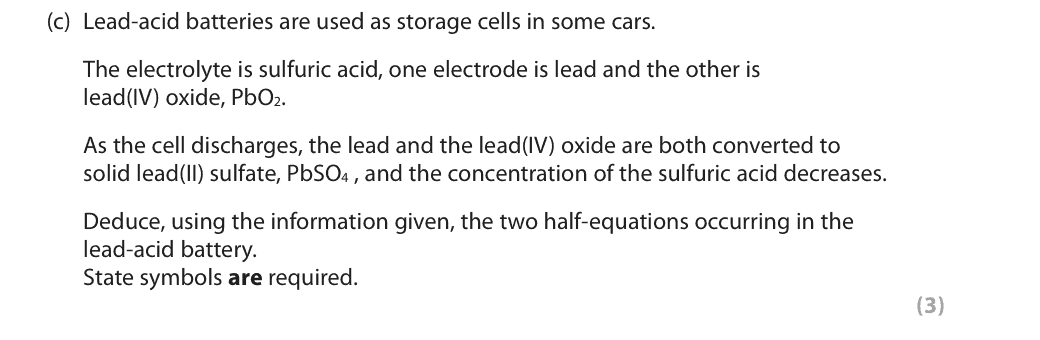
Lead‑acid batteries are used as storage cells in some cars.
The electrolyte is sulfuric acid, one electrode is lead and the other is
lead(IV) oxide, PbO2.
As the cell discharges, the lead and the lead(IV) oxide are both converted to
solid lead(II) sulfate, PbSO4 , and the concentration of the sulfuric acid decreases.
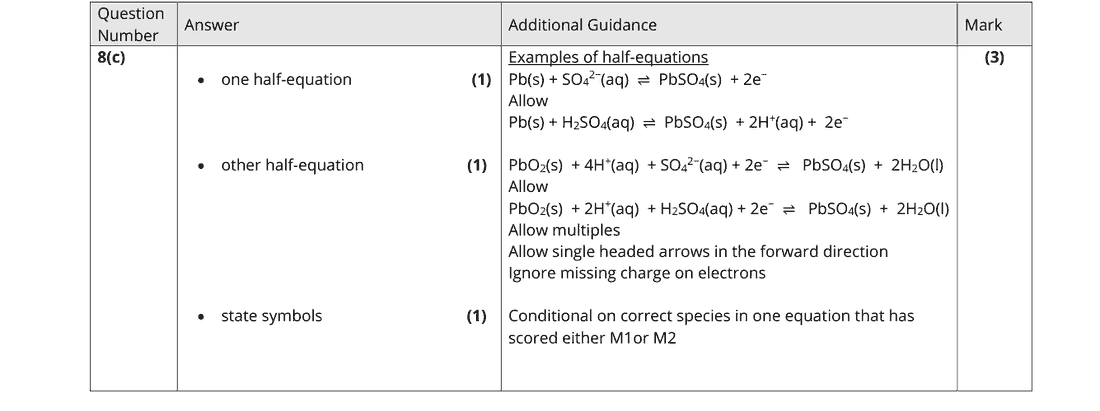
Deduce, using the information given, the two half‑equations occurring in the
lead‑acid battery.
State symbols are required.
June 2022 · Paper 2 · Q6(c)(iii) 1 mark Equation writing redox i
Earlier parts of question 6 that this part usesEarlier part of June 2022 Paper 2 question 6Earlier part of June 2022 Paper 2 question 6
Complete the ionic half‑equation for the oxidation of propan‑1‑ol.
CH3CH2CH2OH   →   CH3CH2CHO   +   H+   +   e–
June 2022 · Paper 2 · Q8(f)(ii) 2 marks Equation writing carboxylic acids
Earlier parts of question 8 that this part usesEarlier part of June 2022 Paper 2 question 8Earlier part of June 2022 Paper 2 question 8
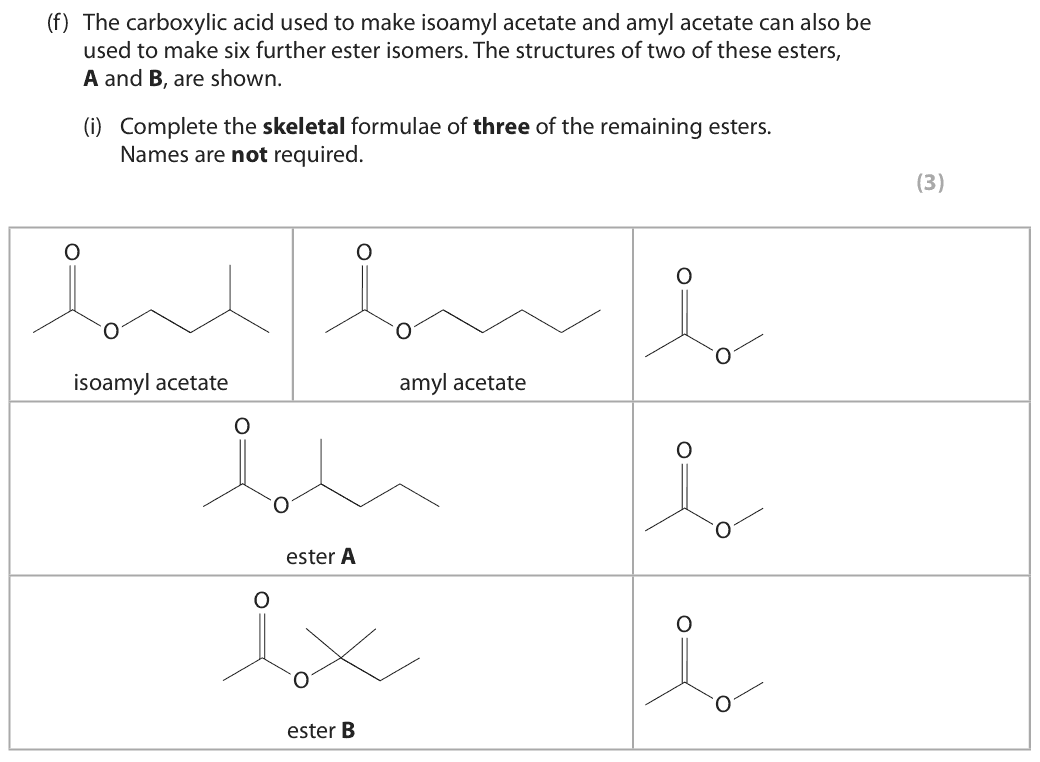
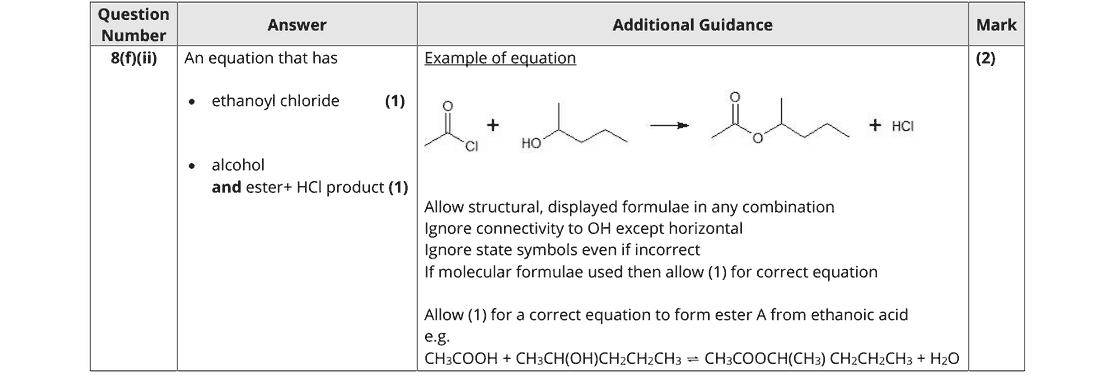
Write an equation to show the formation of ester A from an acyl chloride and
an alcohol.
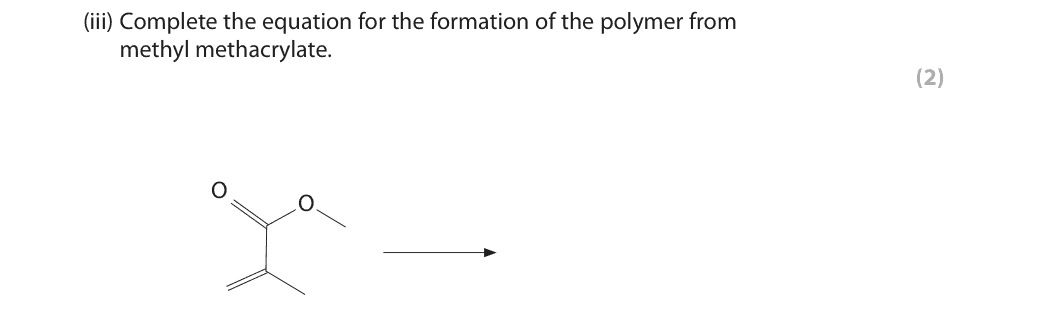
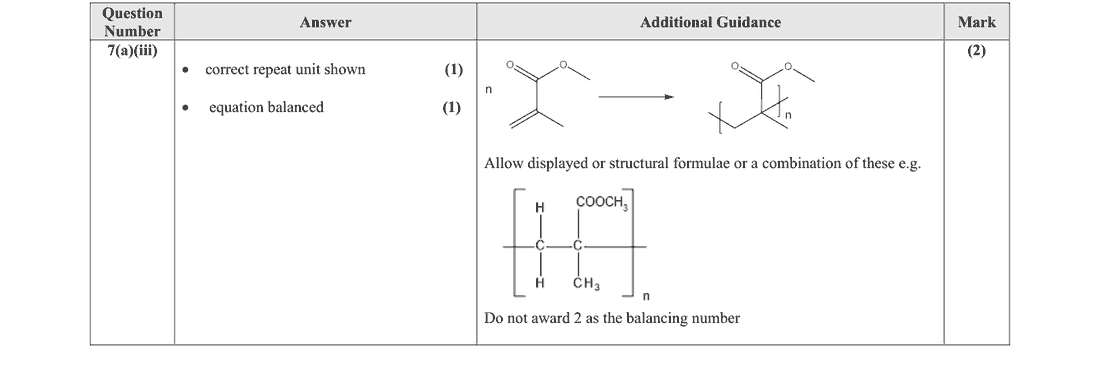
June 2022 · Paper 3 · Q7(a)(iii) 2 marks Equation writing alkenes
Earlier part of question 7 that this part usesEarlier part of June 2022 Paper 3 question 7
Complete the equation for the formation of the polymer from
methyl methacrylate.
O
O
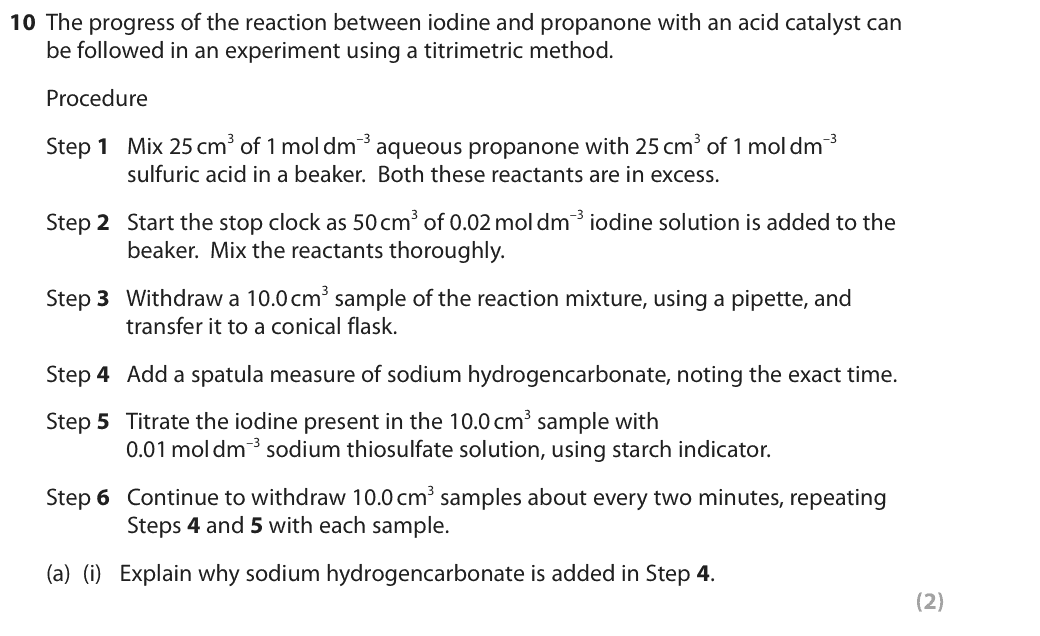
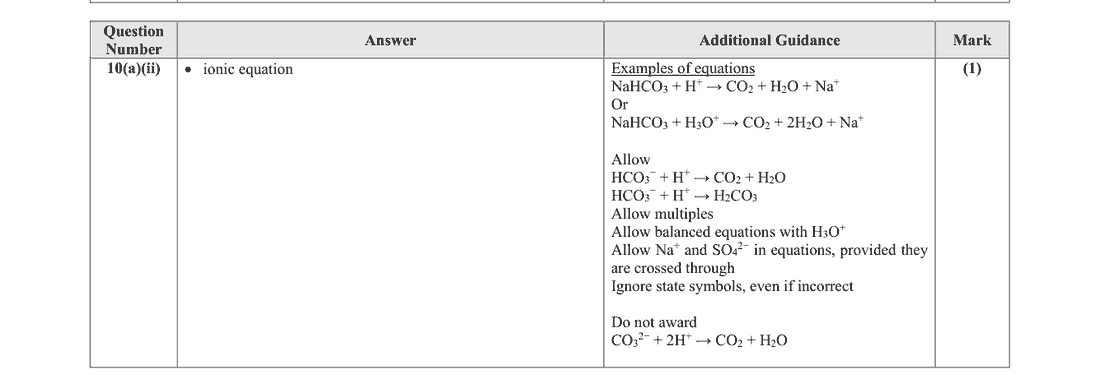
June 2022 · Paper 3 · Q10(a)(ii) 1 mark Equation writing Hard formulae equations and amounts of substanceanalysis of inorganic compounds
Earlier part of question 10 that this part usesEarlier part of June 2022 Paper 3 question 10
Write the ionic equation for the reaction that takes place during Step 4.
State symbols are not required.
November 2021 · AS Paper 1 · Q3(a)(i) 1 mark Equation writing formulae equations and amounts of substance
Ammonia reacts with sodium to form sodium amide, NaNH2 , and hydrogen.
Write the equation for this reaction.
State symbols are not required.
November 2021 · AS Paper 1 · Q6(b)(ii) 2 marks Equation writing group 7 the halogensformulae equations and amounts of substance
Earlier part of question 6 that this part usesEarlier part of November 2021 Paper 1 question 6
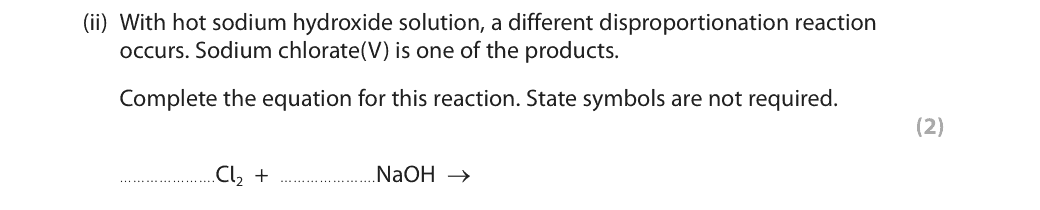
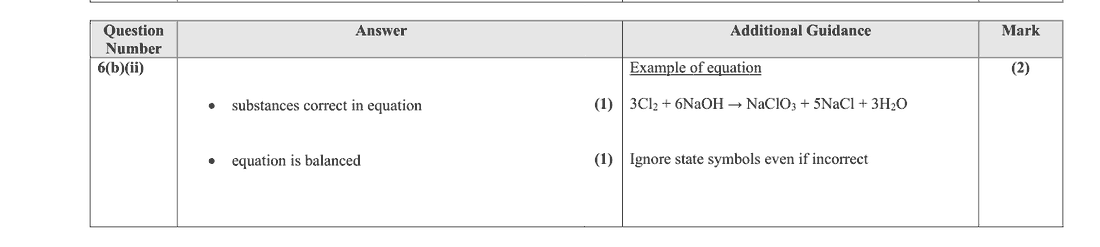
With hot sodium hydroxide solution, a different disproportionation reaction
occurs. Sodium chlorate(V) is one of the products.
Complete the equation for this reaction. State symbols are not required.
………………….Cl2  +  ………………….NaOH  →
November 2021 · AS Paper 2 · Q4(a) 1 mark Equation writing formulae equations and amounts of substance
When solid calcium sulfate dihydrate, CaSO4·2H2O, is heated in a crucible, it forms
solid calcium sulfate hemihydrate, CaSO4·½H2O.
Write an equation, including state symbols, for this reaction.
November 2021 · AS Paper 2 · Q5(a) 2 marks Equation writing alkanesformulae equations and amounts of substance
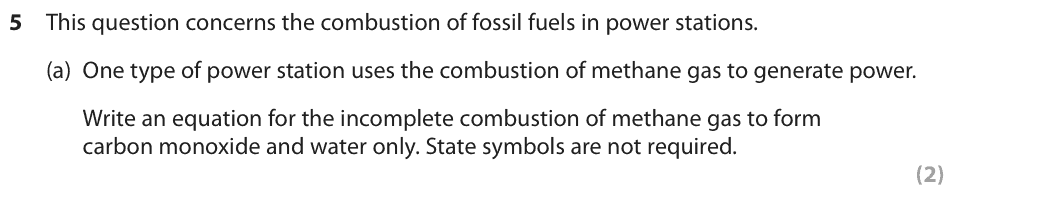
This question concerns the combustion of fossil fuels in power stations.
One type of power station uses the combustion of methane gas to generate power.
Write an equation for the incomplete combustion of methane gas to form
carbon monoxide and water only. State symbols are not required.
November 2021 · Paper 1 · Q4(b) 2 marks Equation writing atomic structure and the periodic table
Earlier part of question 4 that this part usesEarlier part of November 2021 Paper 1 question 4
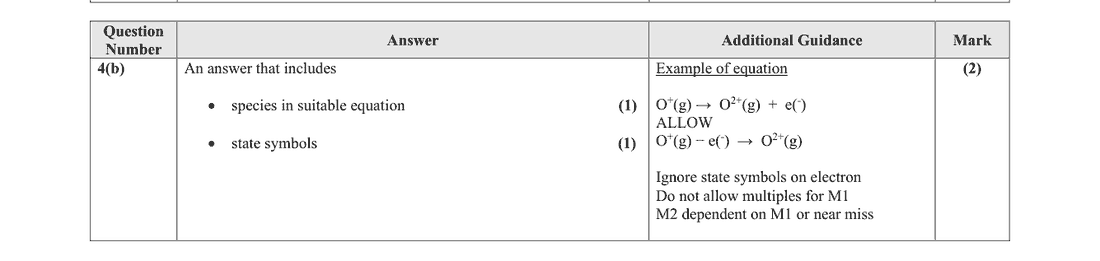
Write an equation for the second ionisation energy of oxygen.
Include state symbols.
November 2021 · Paper 1 · Q5(b)(ii) 1 mark Equation writing Easy group 7 the halogens
Earlier parts of question 5 that this part usesEarlier part of November 2021 Paper 1 question 5Earlier part of November 2021 Paper 1 question 5
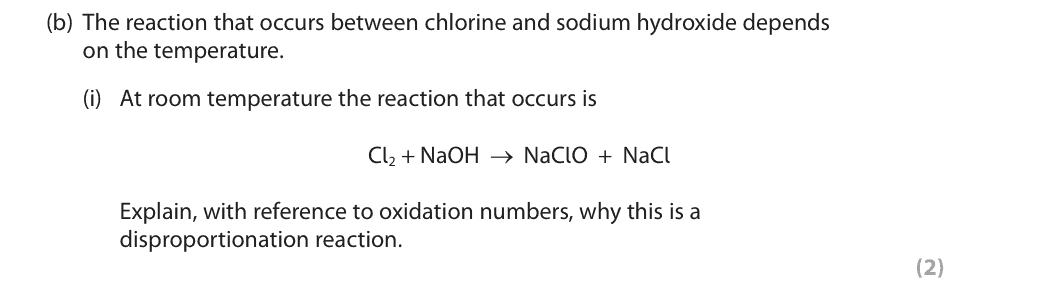
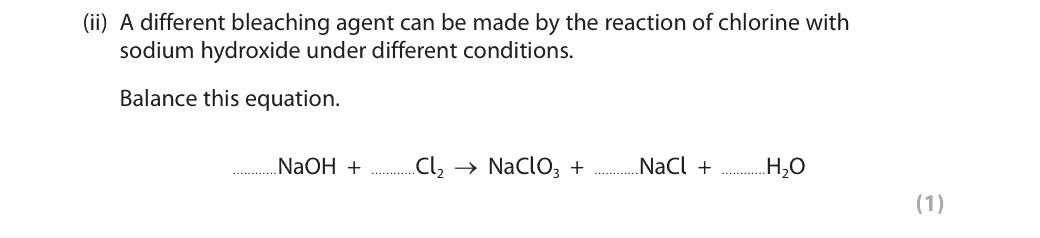
A different bleaching agent can be made by the reaction of chlorine with
sodium hydroxide under different conditions.
Balance this equation.
NaOH  +  Cl2  →  NaClO3  +  NaCl  +  H2O
November 2021 · Paper 1 · Q5(d)(i) 2 marks Equation writing group 7 the halogensformulae equations and amounts of substance
Halide ions can be identified by their reaction with silver nitrate.
Write the ionic equation for the reaction between aqueous solutions of
sodium iodide and silver nitrate.
Include state symbols.
November 2021 · Paper 2 · Q10(a)(i) 1 mark Equation writing amines amides amino acids and proteins
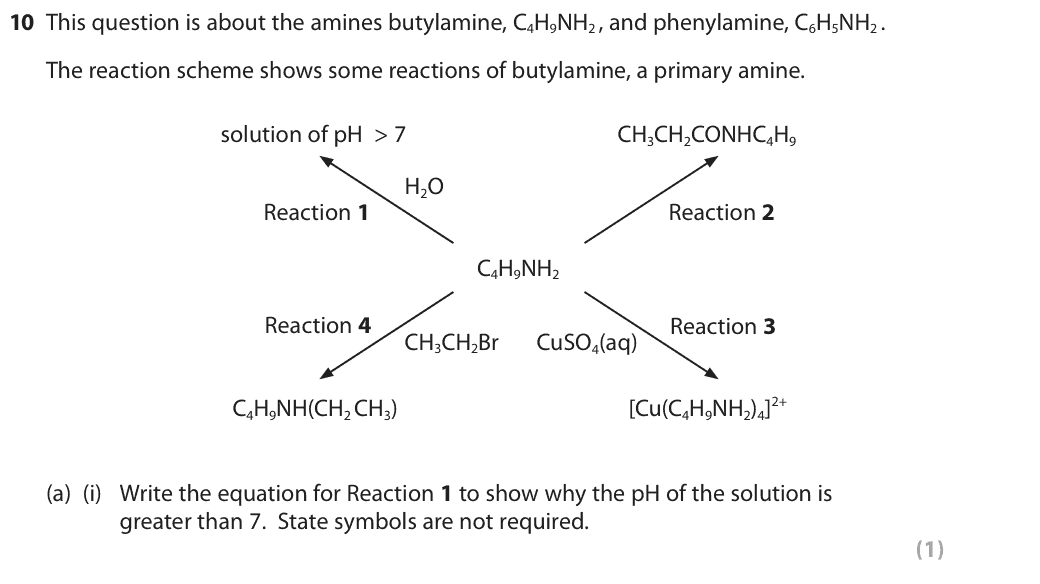
This question is about the amines butylamine, C4H9NH2 , and phenylamine, C6H5NH2 .
The reaction scheme shows some reactions of butylamine, a primary amine.
solution of pH  > 7
CH3CH2CONHC4H9
H2O
Reaction 1
Reaction 2
C4H9NH2
Reaction 4
Reaction 3
CH3CH2Br
CuSO4(aq)
C4H9NH(CH2 CH3)
[Cu(C4H9NH2)4]2+
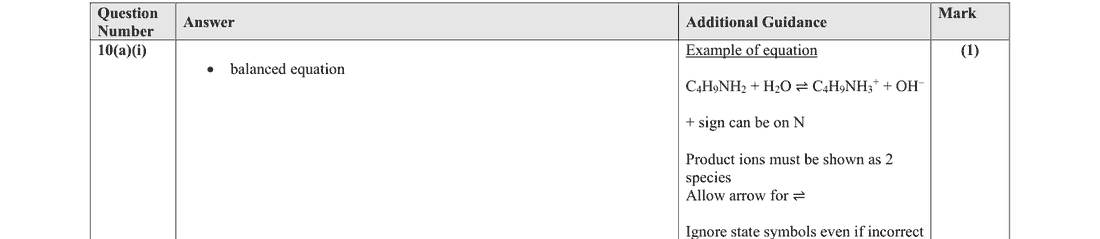
Write the equation for Reaction 1 to show why the pH of the solution is
greater than 7.  State symbols are not required.
November 2021 · Paper 3 · Q1(c) 2 marks Equation writing lattice energy
Write the equation for the first electron affinity of chlorine. Include state symbols.
November 2021 · Paper 3 · Q5(a)(ii) 2 marks Equation writing Hard transition metals reactionsformulae equations and amounts of substance
Earlier part of question 5 that this part usesEarlier part of November 2021 Paper 3 question 5
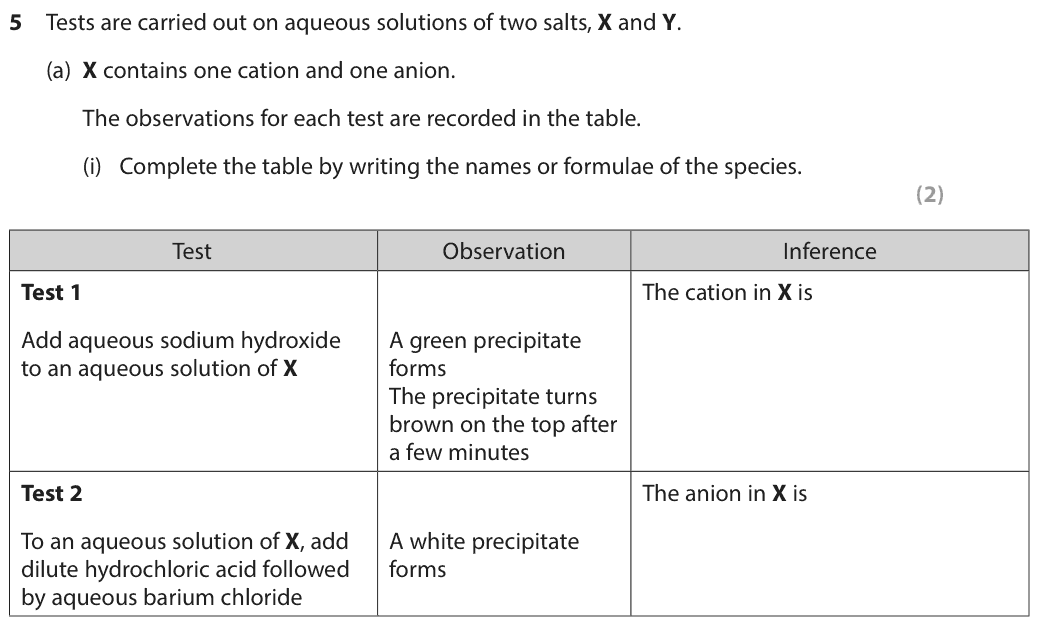
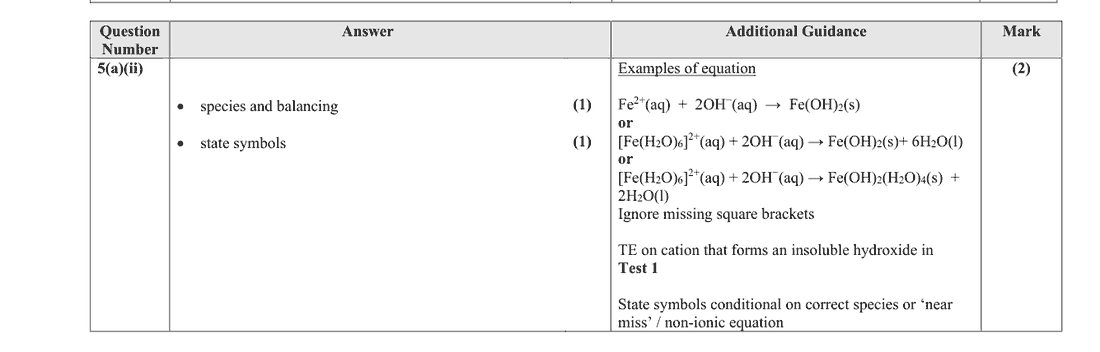
Write the ionic equation for the reaction between the cation in X and aqueous
sodium hydroxide in Test 1. Include state symbols.
October 2020 · AS Paper 1 · Q8(a) 2 marks Equation writing Hard groups 1 and 2formulae equations and amounts of substance
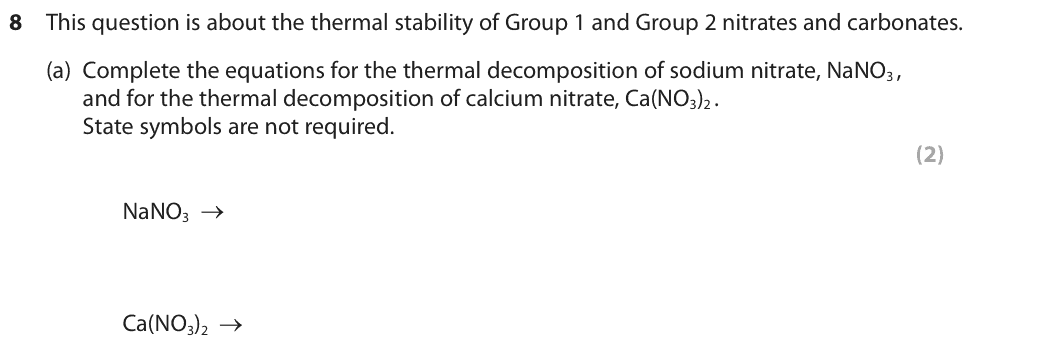
This question is about the thermal stability of Group 1 and Group 2 nitrates and carbonates.
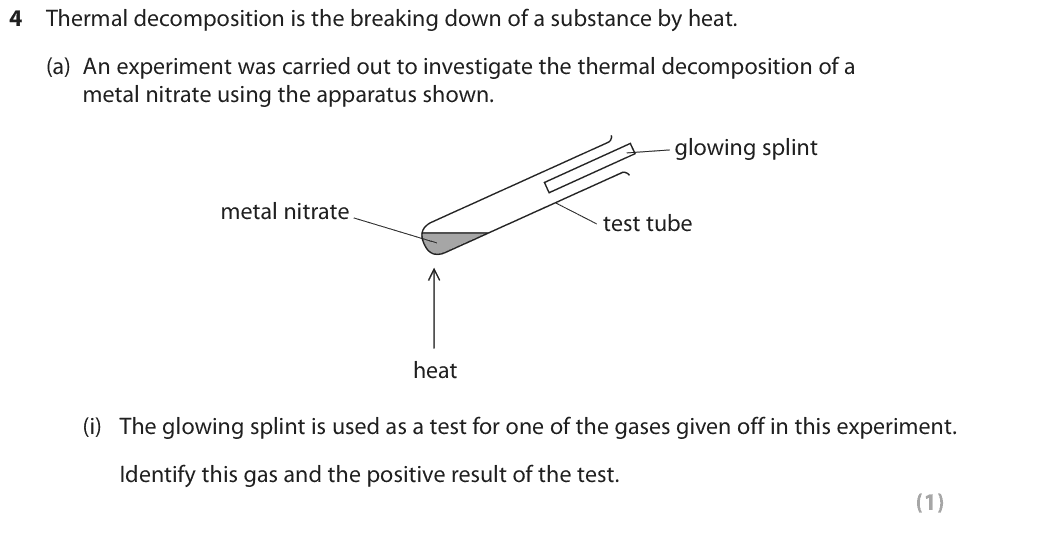
Complete the equations for the thermal decomposition of sodium nitrate, NaNO3 ,
and for the thermal decomposition of calcium nitrate, Ca(NO3)2 .
State symbols are not required.
NaNO3  →
Ca(NO3)2  →
October 2020 · AS Paper 1 · Q8(c)(i) 1 mark Equation writing groups 1 and 2formulae equations and amounts of substance
Earlier part of question 8 that this part usesEarlier part of October 2020 Paper 1 question 8
Calcium carbonate is thermally decomposed during the manufacture of cement.
Write an equation, including state symbols, for the thermal decomposition of
calcium carbonate.
October 2020 · AS Paper 2 · Q1(c)(i) 1 mark Equation writing alkanesformulae equations and amounts of substance
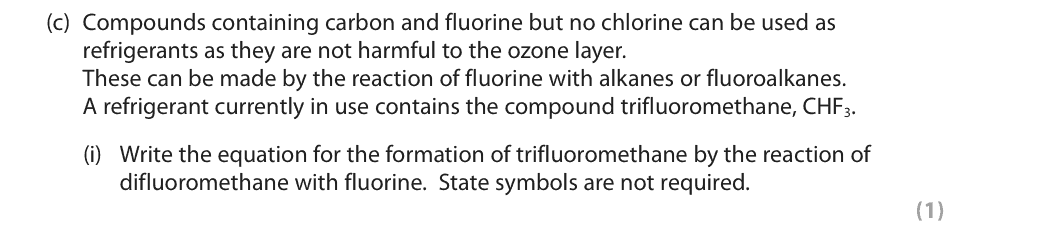
Compounds containing carbon and fluorine but no chlorine can be used as
refrigerants as they are not harmful to the ozone layer.
These can be made by the reaction of fluorine with alkanes or fluoroalkanes.
A refrigerant currently in use contains the compound trifluoromethane, CHF3.
Write the equation for the formation of trifluoromethane by the reaction of
difluoromethane with fluorine.  State symbols are not required.
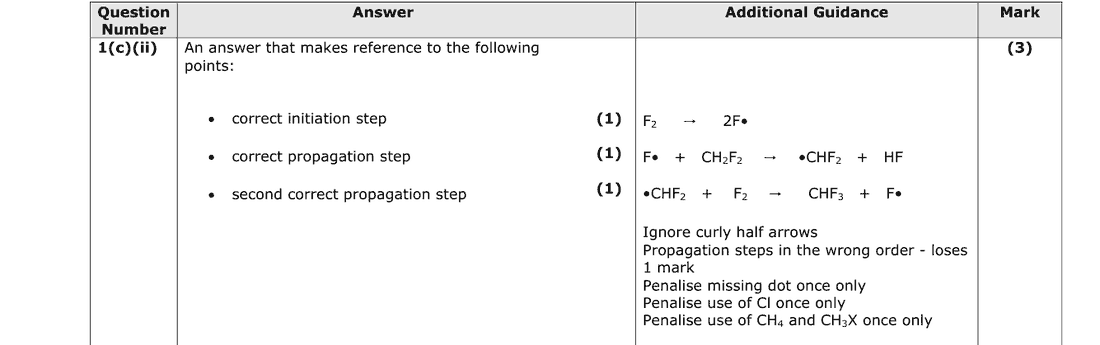
October 2020 · AS Paper 2 · Q1(c)(ii) 3 marks Equation writing alkanes
Earlier part of question 1 that this part usesEarlier part of October 2020 Paper 2 question 1
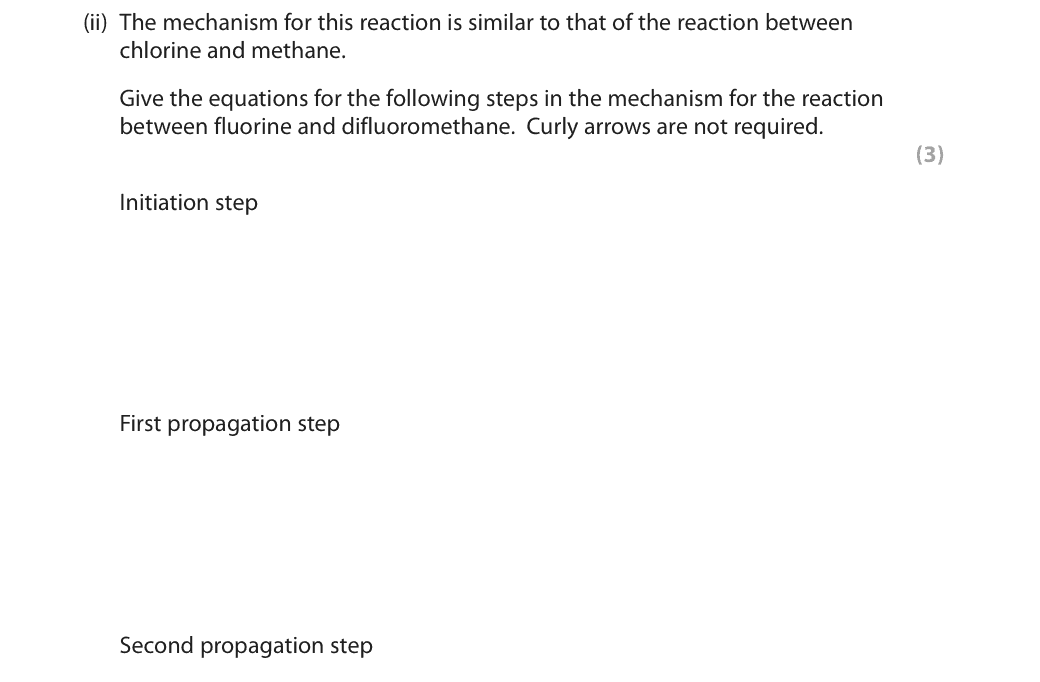
The mechanism for this reaction is similar to that of the reaction between
chlorine and methane.
Give the equations for the following steps in the mechanism for the reaction
between fluorine and difluoromethane.  Curly arrows are not required.
Initiation step
First propagation step
Second propagation step
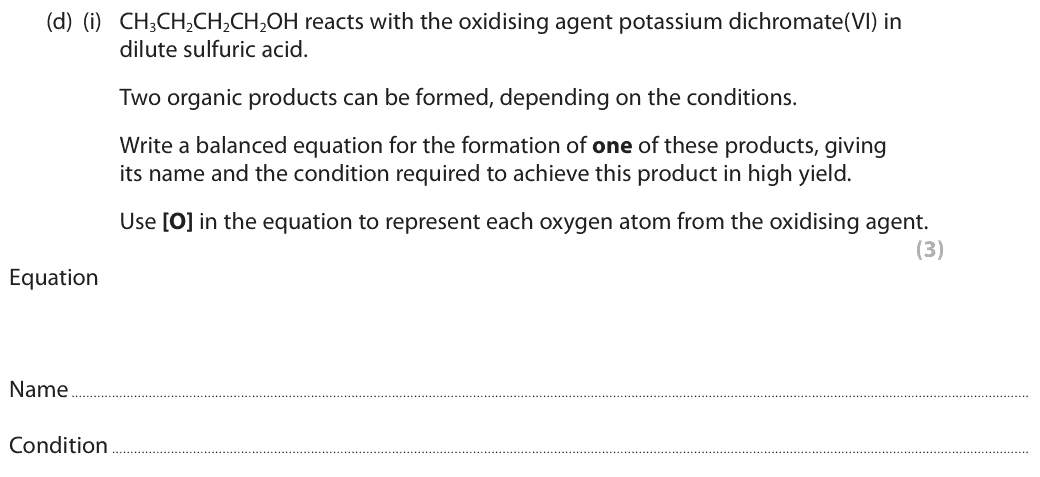
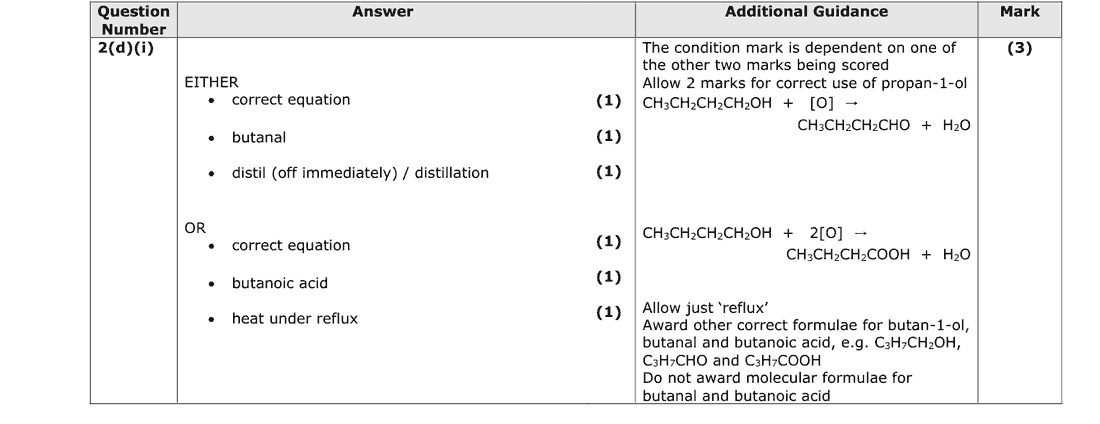
October 2020 · AS Paper 2 · Q2(d)(i) 3 marks Equation writing alcohols
Earlier part of question 2 that this part usesEarlier part of October 2020 Paper 2 question 2
CH3CH2CH2CH2OH reacts with the oxidising agent potassium dichromate(VI) in
dilute sulfuric acid.
Two organic products can be formed, depending on the conditions.
Write a balanced equation for the formation of one of these products, giving
its name and the condition required to achieve this product in high yield.
Use [O] in the equation to represent each oxygen atom from the oxidising agent.
Equation
Name 
Condition .
October 2020 · Paper 3 · Q5(a) 2 marks Equation writing carboxylic acids
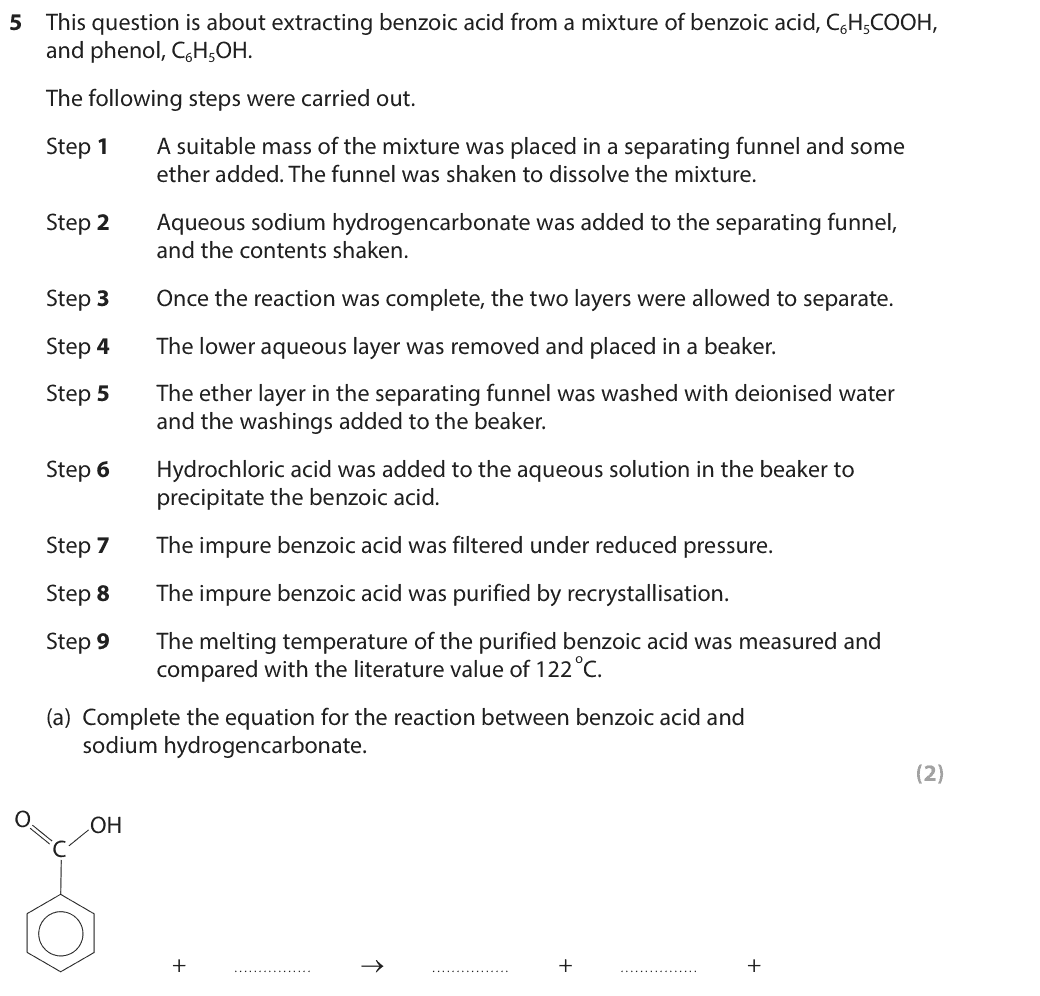
This question is about extracting benzoic acid from a mixture of benzoic acid, C6H5COOH,
and phenol, C6H5OH.
The following steps were carried out.
Step 1
A suitable mass of the mixture was placed in a separating funnel and some
ether added. The funnel was shaken to dissolve the mixture.
Step 2
Aqueous sodium hydrogencarbonate was added to the separating funnel,
and the contents shaken.
Step 3
Once the reaction was complete, the two layers were allowed to separate.
Step 4
The lower aqueous layer was removed and placed in a beaker.
Step 5
The ether layer in the separating funnel was washed with deionised water
and the washings added to the beaker.
Step 6
Hydrochloric acid was added to the aqueous solution in the beaker to
precipitate the benzoic acid.
Step 7
The impure benzoic acid was filtered under reduced pressure.
Step 8
The impure benzoic acid was purified by recrystallisation.
Step 9
The melting temperature of the purified benzoic acid was measured and
oC.
compared with the literature value of 122
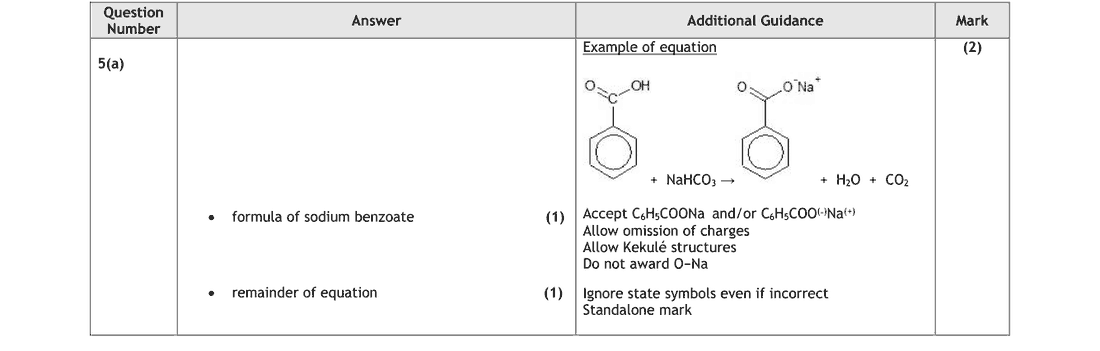
Complete the equation for the reaction between benzoic acid and
sodium hydrogencarbonate.
O
OH
C
+
. . . . . . . . . . . . . . . .    →
. . . . . . . . . . . . . . . .    +
. . . . . . . . . . . . . . . .    +
October 2020 · Paper 3 · Q6(a) 2 marks Equation writing formulae equations and amounts of substanceintroduction to organic chemistry
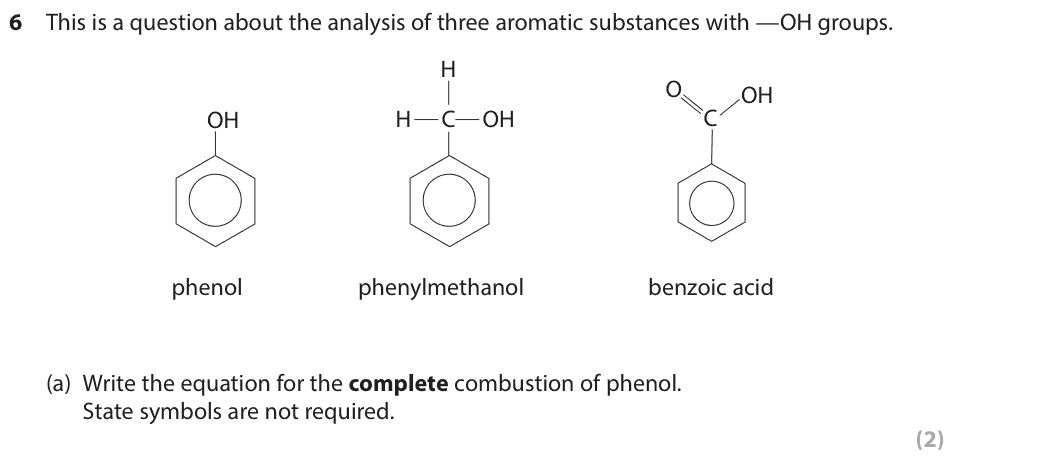
This is a question about the analysis of three aromatic substances with —OH groups.
H
O
OH
OH
H
C
OH
C
phenol
phenylmethanol
benzoic acid
Write the equation for the complete combustion of phenol.
State symbols are not required.
October 2020 · Paper 3 · Q8(b)(i) 2 marks Equation writing transition metals reactionsredox i
Earlier part of question 8 that this part usesEarlier part of October 2020 Paper 3 question 8
The chromium(III) complex, [Cr(OH)6]3−, can be oxidised to
chromate(VI) ions, CrO4
2−, by hydrogen peroxide solution.
Deduce the oxidation half-equation for this reaction, which takes place in
alkaline conditions. State symbols are not required.
October 2020 · Paper 3 · Q8(b)(ii) 1 mark Equation writing transition metals reactions
Earlier part of question 8 that this part usesEarlier part of October 2020 Paper 3 question 8
If the solution of chromate(VI) ions is then acidified, the colour of the solution
changes to orange as dichromate(VI) ions form.
Write the equation for this change. State symbols are not required.
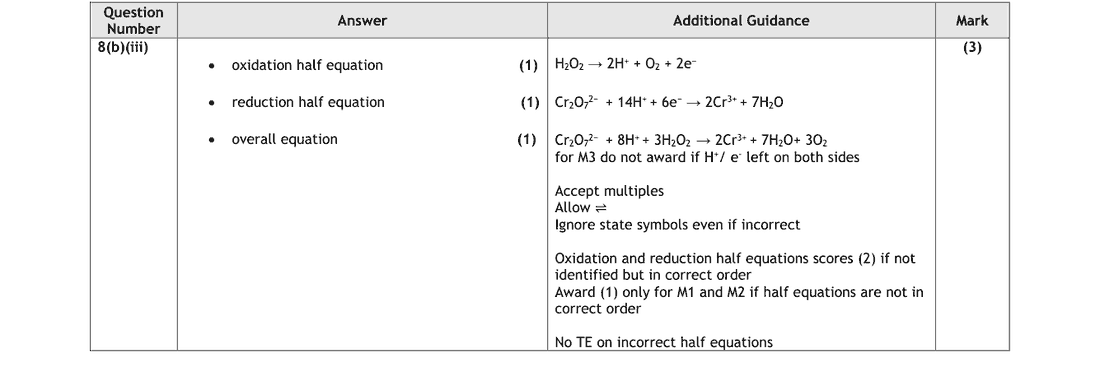
October 2020 · Paper 3 · Q8(b)(iii) 3 marks Equation writing redox iiredox i
Earlier parts of question 8 that this part usesEarlier part of October 2020 Paper 3 question 8Earlier part of October 2020 Paper 3 question 8Earlier part of October 2020 Paper 3 question 8
In acidic conditions, dichromate(VI) ions can also be reduced to chromium(III) ions
using hydrogen peroxide.
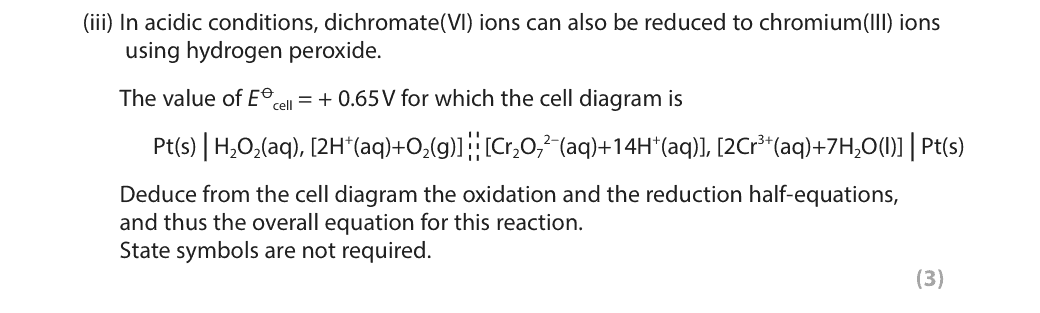
The value of E O
—
cell = + 0.65 V for which the cell diagram is
Pt(s)│H2O2(aq), [2H+(aq)+O2(g)]   [Cr2O7
2−(aq)+14H+(aq)], [2Cr3+(aq)+7H2O(l)]│Pt(s)
Deduce from the cell diagram the oxidation and the reduction half-equations,
and thus the overall equation for this reaction.
State symbols are not required.
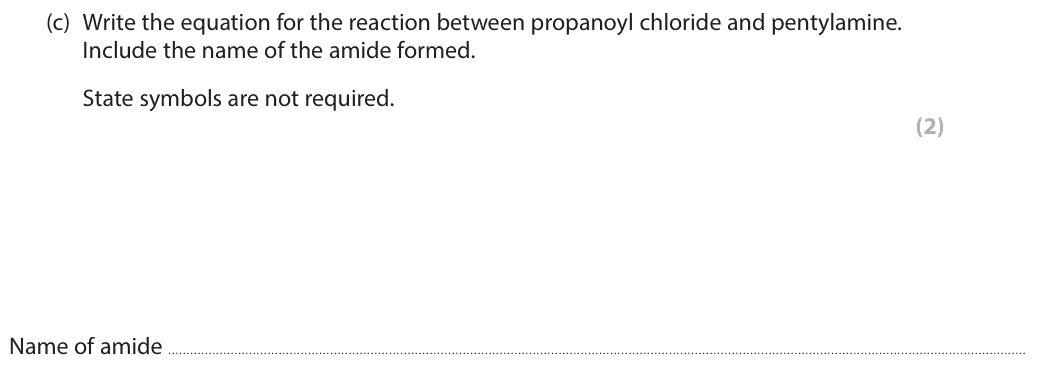
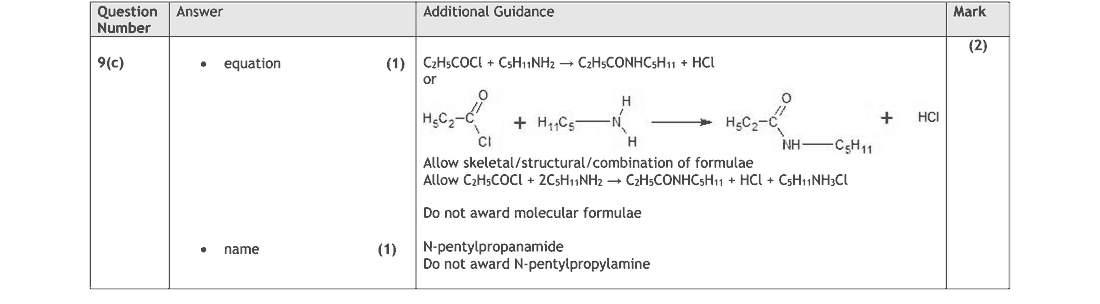
October 2020 · Paper 3 · Q9(c) 2 marks Equation writing carboxylic acidsamines amides amino acids and proteinsintroduction to organic chemistry
Write the equation for the reaction between propanoyl chloride and pentylamine.
Include the name of the amide formed.
State symbols are not required.
Name of amide
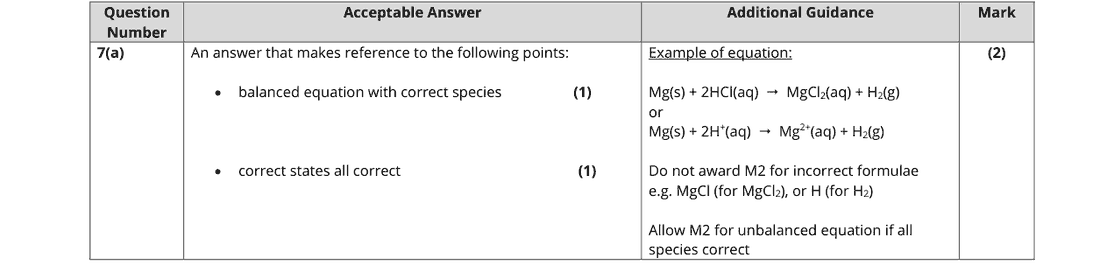
June 2019 · AS Paper 1 · Q7(a) 2 marks Equation writing formulae equations and amounts of substance
This question is about the reaction of magnesium with dilute hydrochloric acid.
Write an equation for the reaction of magnesium with hydrochloric acid.
Include state symbols.
June 2019 · AS Paper 1 · Q9(b)(i) 1 mark Equation writing formulae equations and amounts of substance
Earlier part of question 9 that this part usesEarlier part of June 2019 Paper 1 question 9
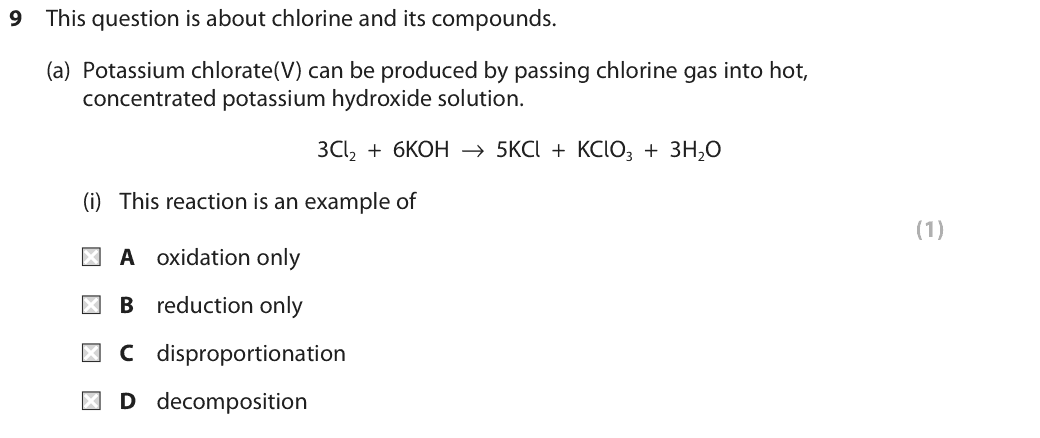
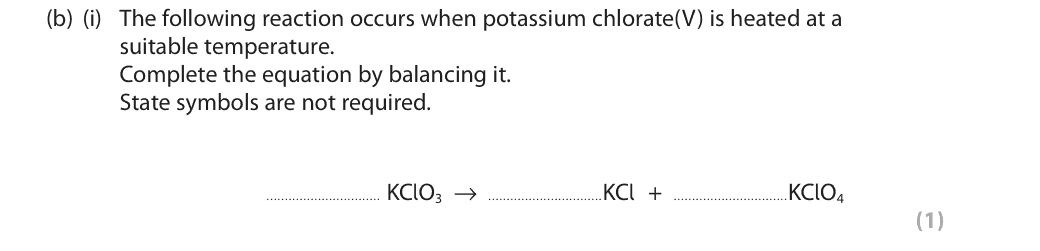
The following reaction occurs when potassium chlorate(V) is heated at a
suitable temperature.
Complete the equation by balancing it.
State symbols are not required.
 KClO3  →  KCl  +  KClO4
June 2019 · AS Paper 2 · Q3(a)(ii) 2 marks Equation writing energetics iformulae equations and amounts of substance
Earlier part of question 3 that this part usesEarlier part of June 2019 Paper 2 question 3
Write the equation, including state symbols, for the reaction that occurs when
the standard enthalpy change of combustion of octane, C8H18(l), is measured.
June 2019 · Paper 1 · Q2(a)(i) 1 mark Equation writing group 7 the halogens
This question is about some redox reactions of chlorine, bromine and iodine.
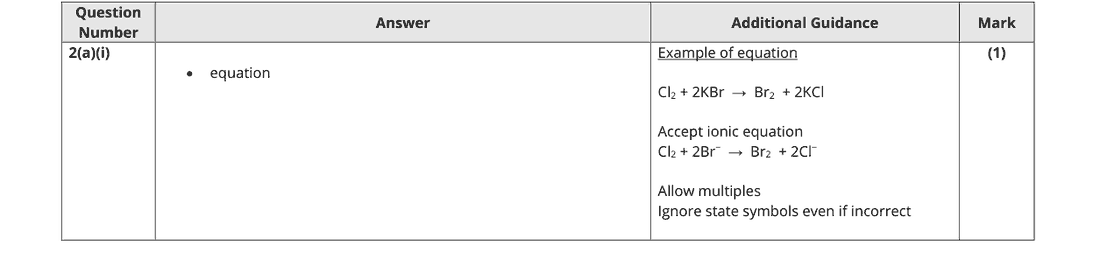
An excess of aqueous potassium bromide was added to chlorine water and the
solution turned orange.
Write an equation for this reaction.  State symbols are not required.
June 2019 · Paper 1 · Q2(b)(i) 1 mark Equation writing group 7 the halogens
Earlier part of question 2 that this part usesEarlier part of June 2019 Paper 1 question 2
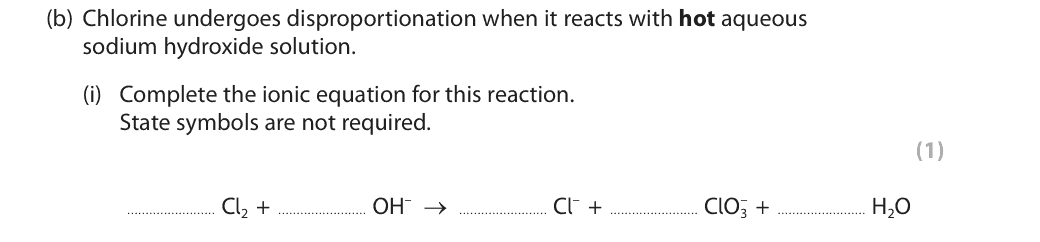
Chlorine undergoes disproportionation when it reacts with hot aqueous
sodium hydroxide solution.
Complete the ionic equation for this reaction.
State symbols are not required.
 Cl2 +  OH– o  Cl– +  ClO3
– +  H2O
June 2019 · Paper 1 · Q4(a)(iii) 1 mark Equation writing Hard groups 1 and 2
Earlier parts of question 4 that this part usesEarlier part of June 2019 Paper 1 question 4Earlier part of June 2019 Paper 1 question 4
Write the equation for the decomposition if the Group 1 compound,
sodium nitrate, was used in this experiment.
State symbols are not required.
June 2019 · Paper 1 · Q5(a)(ii) 3 marks Equation writing Hard transition metals reactions
Earlier part of question 5 that this part usesEarlier part of June 2019 Paper 1 question 5
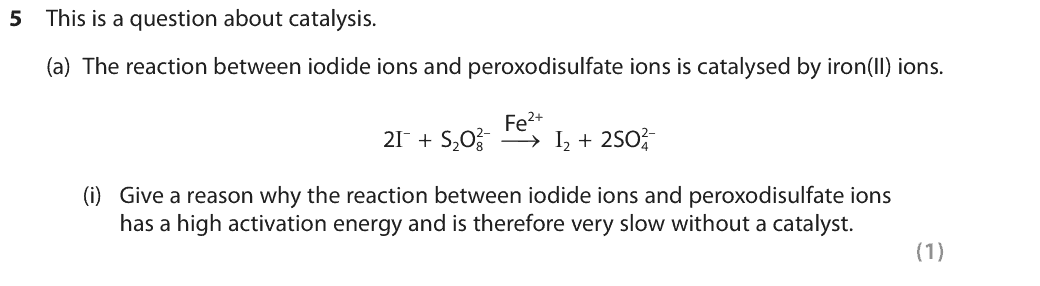
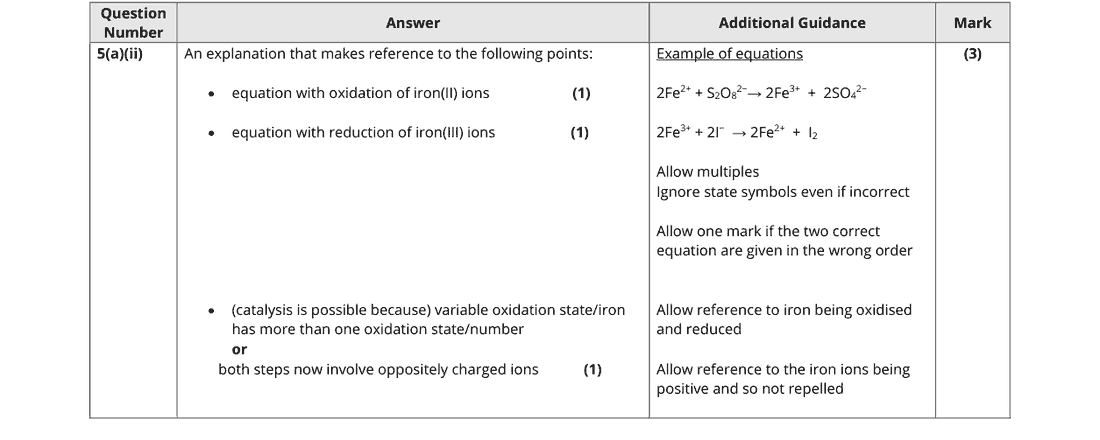
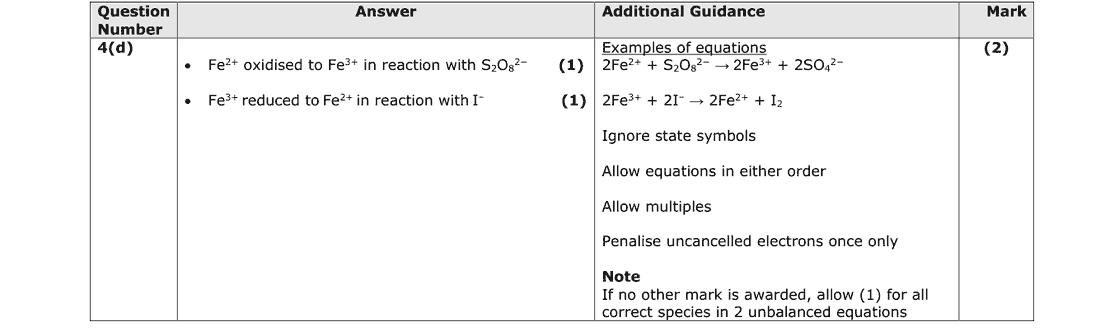
Explain, with the aid of two equations, how the iron(II) ions catalyse this
reaction.  State symbols are not required.
June 2019 · Paper 1 · Q5(b) 2 marks Equation writing Hard transition metals reactionsredox i
Earlier parts of question 5 that this part usesEarlier part of June 2019 Paper 1 question 5Earlier part of June 2019 Paper 1 question 5
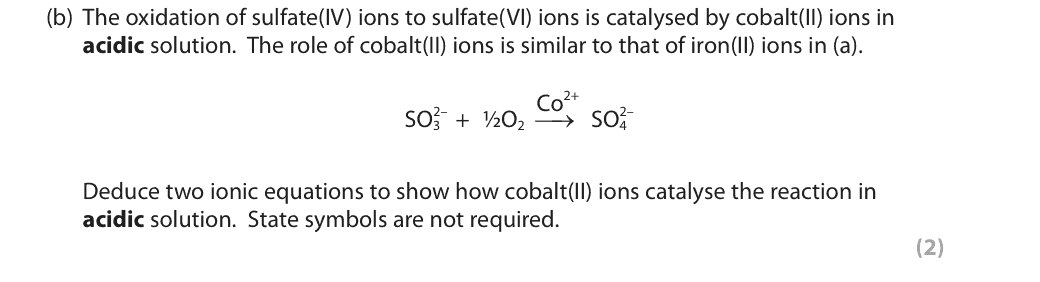
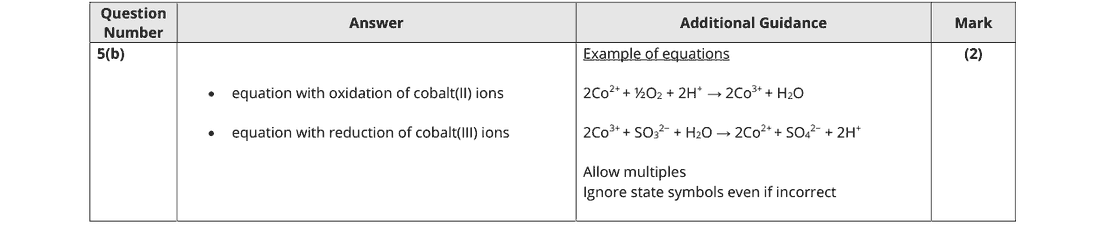
The oxidation of sulfate(IV) ions to sulfate(VI) ions is catalysed by cobalt(II) ions in
acidic solution.  The role of cobalt(II) ions is similar to that of iron(II) ions in (a).
Co2+
2– +  ½O2 o
SO3
SO4
2–
Deduce two ionic equations to show how cobalt(II) ions catalyse the reaction in
acidic solution.  State symbols are not required.
June 2019 · Paper 1 · Q8(c) 1 mark Equation writing Hard redox iiredox i
Earlier part of question 8 that this part usesEarlier part of June 2019 Paper 1 question 8
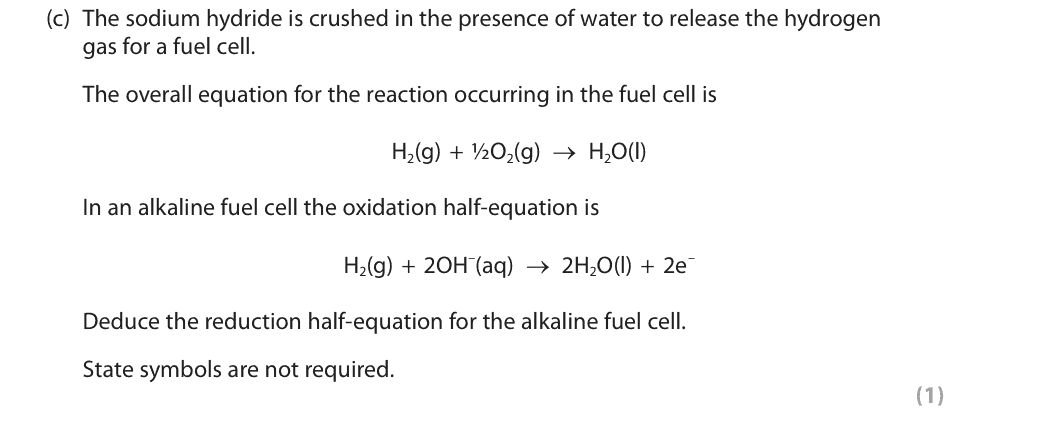
The sodium hydride is crushed in the presence of water to release the hydrogen
gas for a fuel cell.
The overall equation for the reaction occurring in the fuel cell is
H2(g) + ½O2(g) o H2O(l)
In an alkaline fuel cell the oxidation half-equation is
H2(g) + 2OH–(aq) o 2H2O(l) + 2e–
Deduce the reduction half-equation for the alkaline fuel cell.
State symbols are not required.
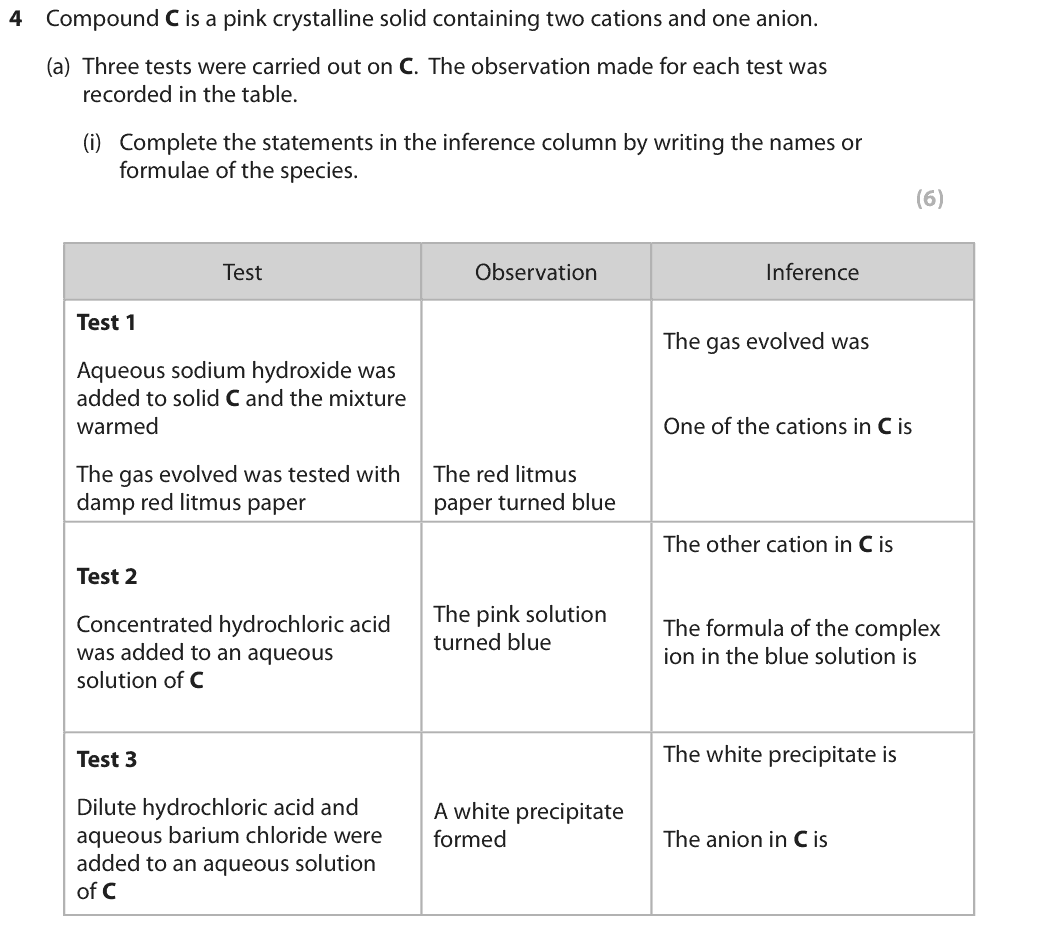
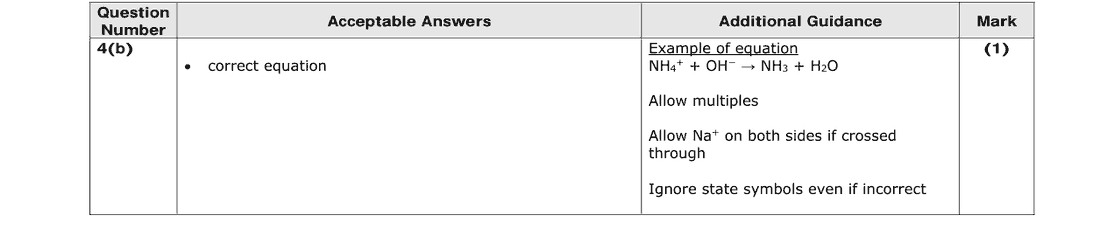
June 2019 · Paper 3 · Q4(b) 1 mark Equation writing Hard analysis of inorganic compoundsformulae equations and amounts of substance
Earlier part of question 4 that this part usesEarlier part of June 2019 Paper 3 question 4
Write the ionic equation for the reaction between the cation in C and
sodium hydroxide producing the gas in Test 1.
State symbols are not required.
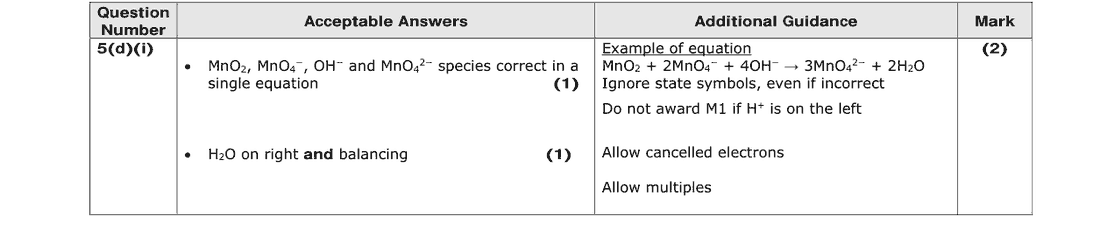
June 2019 · Paper 3 · Q5(d)(i) 2 marks Equation writing Hard redox i
Earlier part of question 5 that this part usesEarlier part of June 2019 Paper 3 question 5
Manganese(IV) oxide, MnO2 , and manganate(VII) ions, MnO4
solution to form manganate(VI) ions, MnO4
2–.
Write the ionic equation for this reaction.
State symbols are not required.
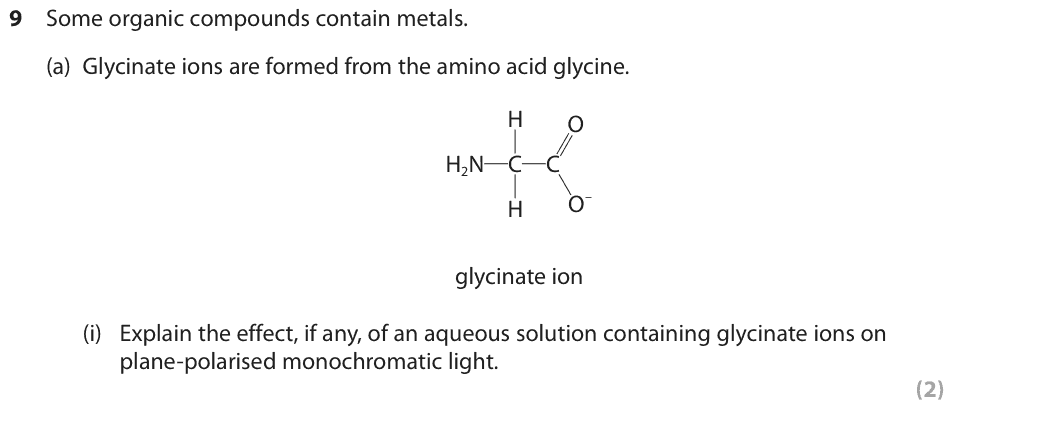
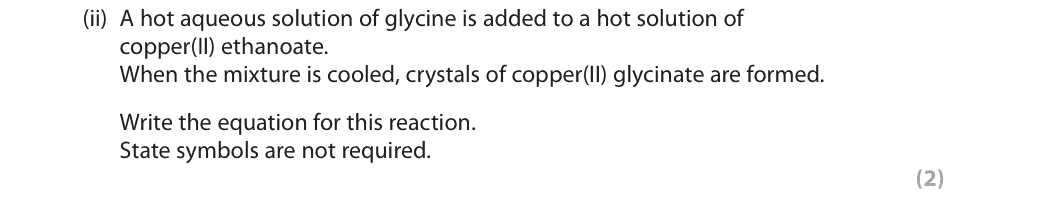
June 2019 · Paper 3 · Q9(a)(ii) 2 marks Equation writing Hard formulae equations and amounts of substancecarboxylic acids
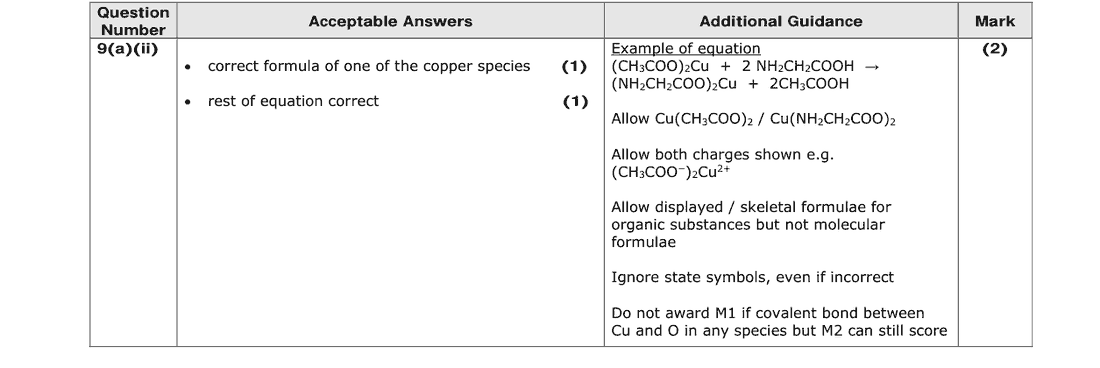
Earlier part of question 9 that this part usesEarlier part of June 2019 Paper 3 question 9
A hot aqueous solution of glycine is added to a hot solution of
copper(II) ethanoate.
When the mixture is cooled, crystals of copper(II) glycinate are formed.
Write the equation for this reaction.
State symbols are not required.
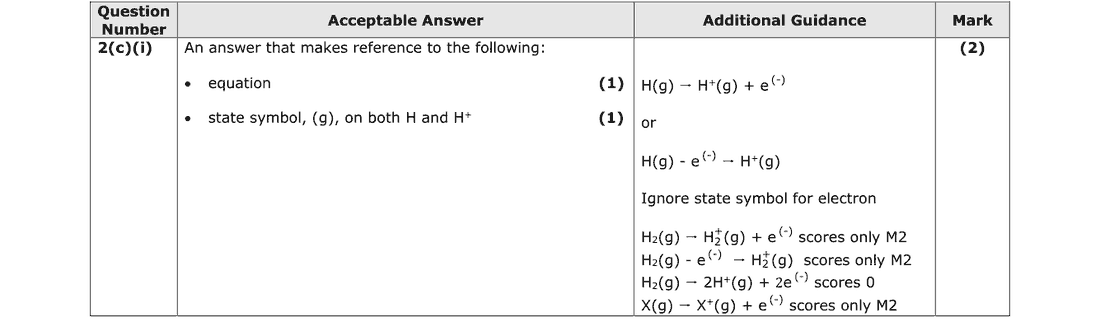
June 2018 · AS Paper 1 · Q2(c)(i) 2 marks Equation writing atomic structure and the periodic table
Write an equation to represent the first ionisation energy of hydrogen.
Include state symbols.
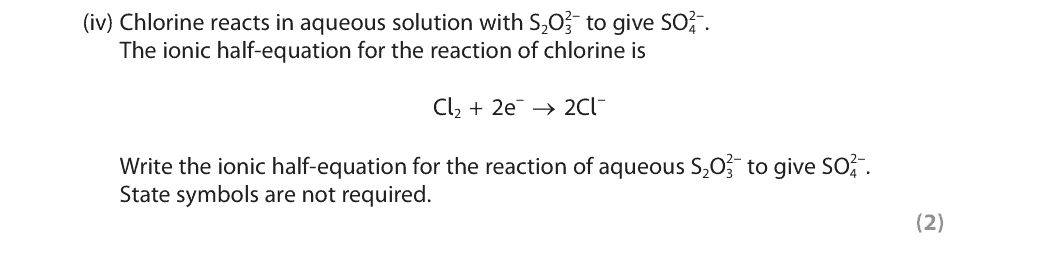
June 2018 · AS Paper 1 · Q6(b)(iv) 2 marks Equation writing redox i
Earlier parts of question 6 that this part usesEarlier part of June 2018 Paper 1 question 6Earlier part of June 2018 Paper 1 question 6
Chlorine reacts in aqueous solution with S2O3
2− to give SO4
2−.
The ionic half-equation for the reaction of chlorine is
Cl2 + 2e− → 2Cl−
Write the ionic half-equation for the reaction of aqueous S2O3
2− to give SO4
2−.
State symbols are not required.
June 2018 · AS Paper 1 · Q6(b)(v) 1 mark Equation writing Hard redox iformulae equations and amounts of substance
Earlier parts of question 6 that this part usesEarlier part of June 2018 Paper 1 question 6Earlier part of June 2018 Paper 1 question 6Earlier part of June 2018 Paper 1 question 6Earlier part of June 2018 Paper 1 question 6Earlier part of June 2018 Paper 1 question 6
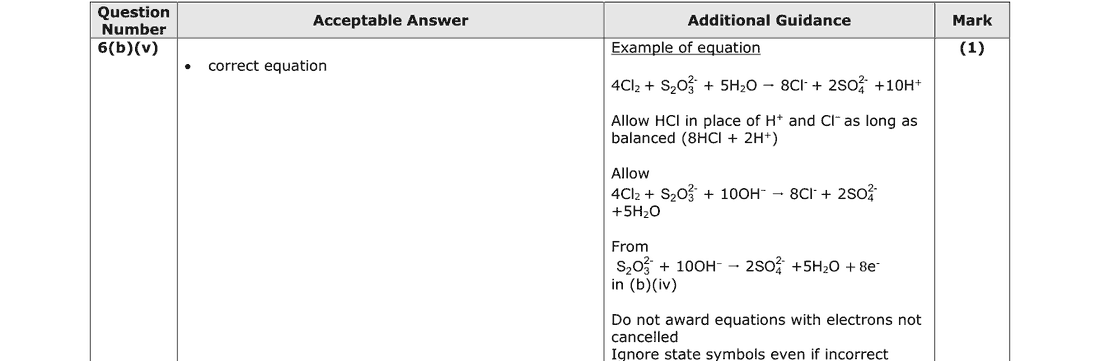
Use your answer to (b)(iv) and the half-equation for chlorine, to write the
overall ionic equation for the reaction between chlorine and thiosulfate ions.
State symbols are not required.
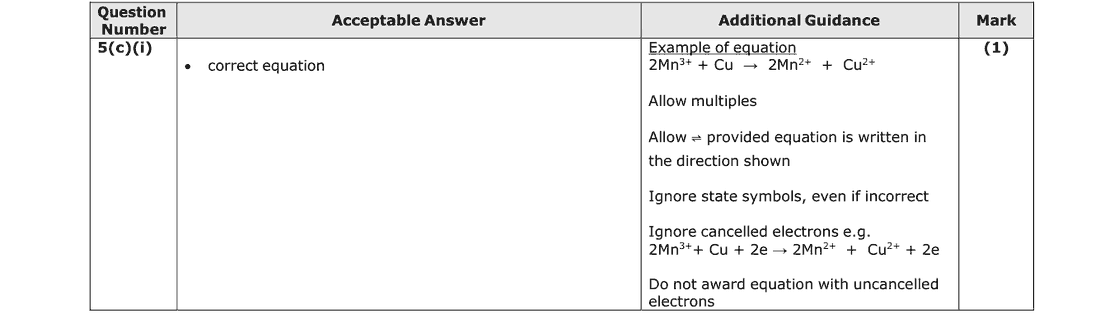
June 2018 · Paper 1 · Q5(c)(i) 1 mark Equation writing redox i
Earlier part of question 5 that this part usesEarlier part of June 2018 Paper 1 question 5
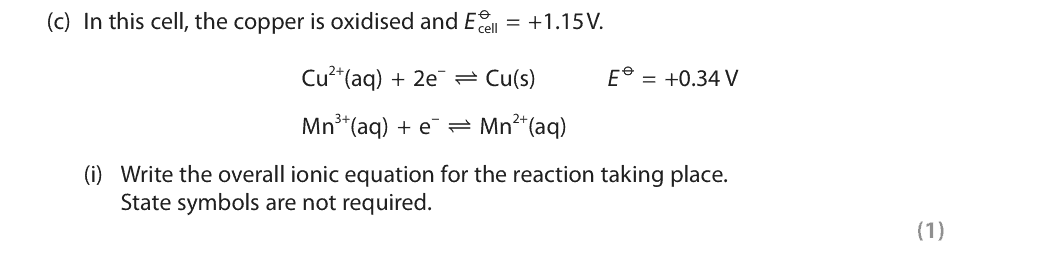
In this cell, the copper is oxidised and E cell = +1.15 V.
Cu2+(aq) + 2e− 
 Cu(s)            E   = +0.34 V
Mn3+(aq) + e− 
 Mn2+(aq)
Write the overall ionic equation for the reaction taking place.
State symbols are not required.
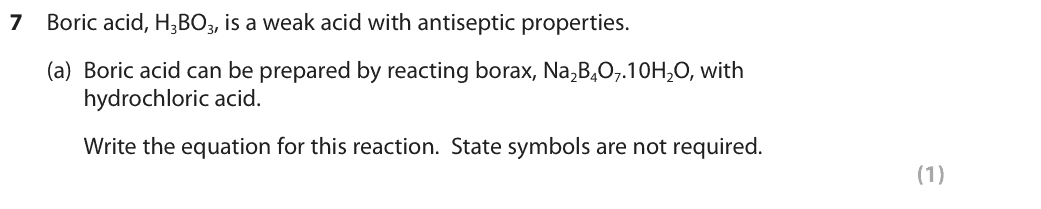
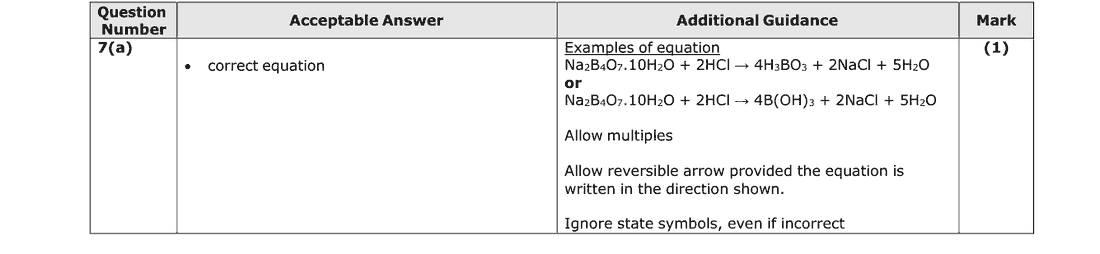
June 2018 · Paper 1 · Q7(a) 1 mark Equation writing formulae equations and amounts of substance
Boric acid, H3BO3, is a weak acid with antiseptic properties.
Boric acid can be prepared by reacting borax, Na2B4O7.10H2O, with
hydrochloric acid.
Write the equation for this reaction.  State symbols are not required.
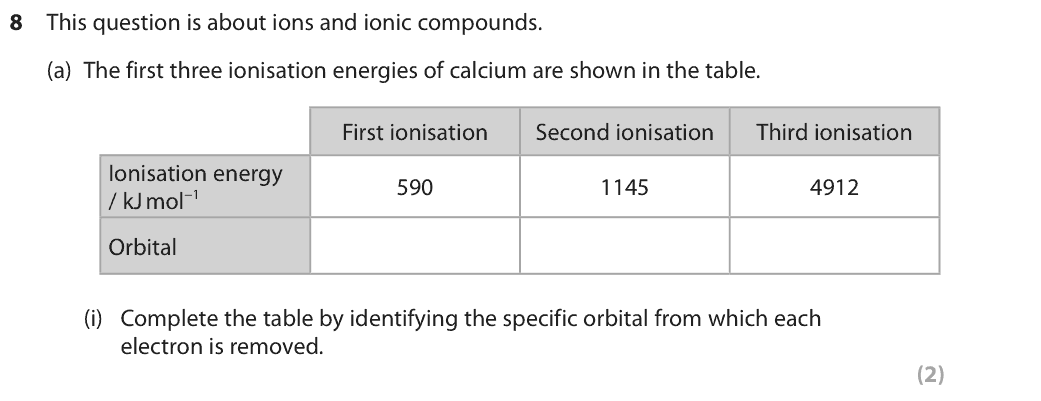
June 2018 · Paper 1 · Q8(a)(ii) 1 mark Equation writing Easy atomic structure and the periodic table
Earlier part of question 8 that this part usesEarlier part of June 2018 Paper 1 question 8
Write the equation for the third ionisation energy of calcium.
Include state symbols.
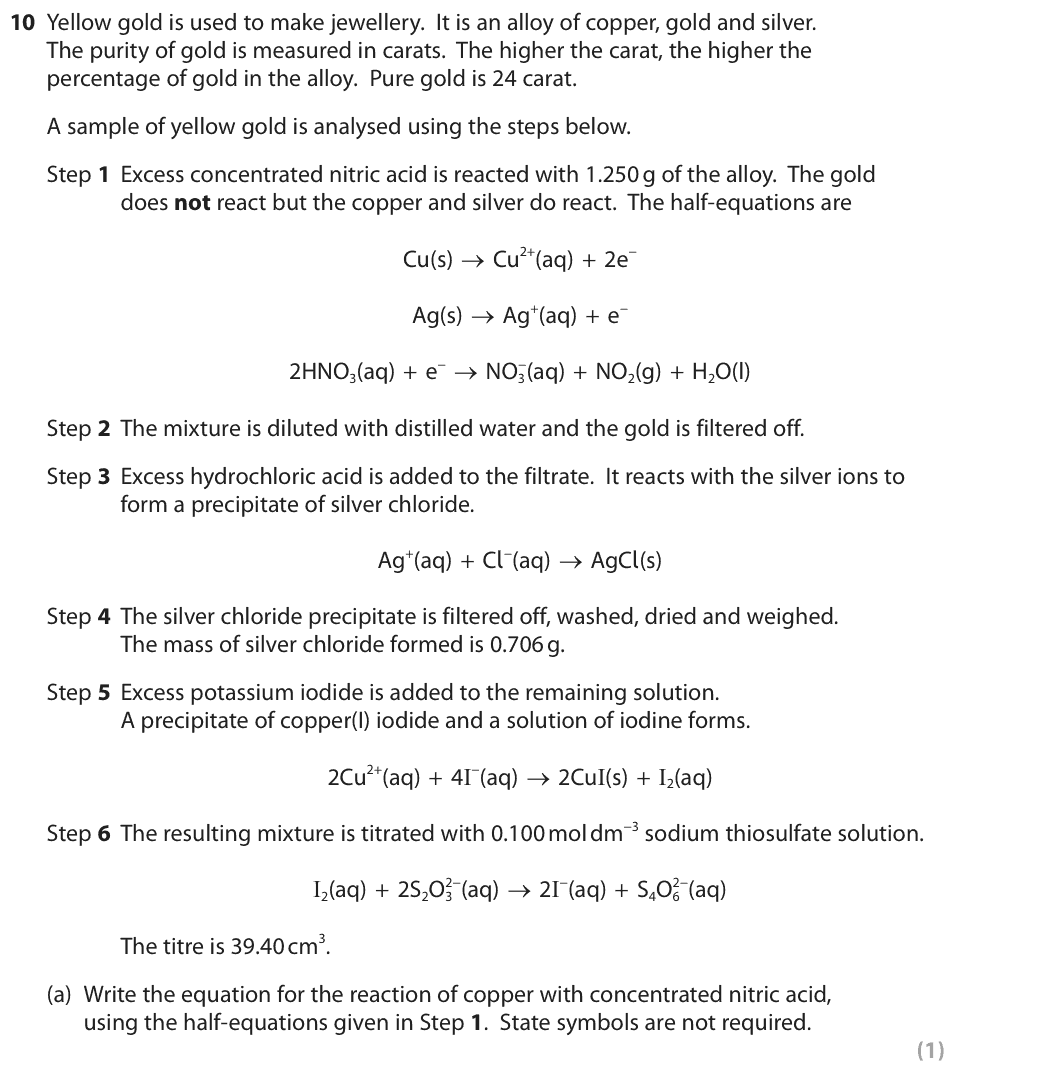
June 2018 · Paper 1 · Q10(a) 1 mark Equation writing redox i
Yellow gold is used to make jewellery.  It is an alloy of copper, gold and silver.
The purity of gold is measured in carats.  The higher the carat, the higher the
percentage of gold in the alloy.  Pure gold is 24 carat.
A sample of yellow gold is analysed using the steps below.
Step 1  Excess concentrated nitric acid is reacted with 1.250 g of the alloy.  The gold
does not react but the copper and silver do react.  The half-equations are
Cu(s) → Cu2+(aq) + 2e−
Ag(s) → Ag+(aq) + e−
2HNO3(aq) + e− → NO3
−(aq) + NO2(g) + H2O(l)
Step 2  The mixture is diluted with distilled water and the gold is filtered off.
Step 3  Excess hydrochloric acid is added to the filtrate.  It reacts with the silver ions to
form a precipitate of silver chloride.
Ag+(aq) + Cl−(aq) → AgCl(s)
Step 4  The silver chloride precipitate is filtered off, washed, dried and weighed.
The mass of silver chloride formed is 0.706 g.
Step 5  Excess potassium iodide is added to the remaining solution.
A precipitate of copper(I) iodide and a solution of iodine forms.
2Cu2+(aq) + 4I−(aq) → 2CuI(s) + I2(aq)
Step 6  The resulting mixture is titrated with 0.100 mol dm−3 sodium thiosulfate solution.
I2(aq) + 2S2O3
2−(aq) → 2I−(aq) + S4O6
2−(aq)
The titre is 39.40 cm3.
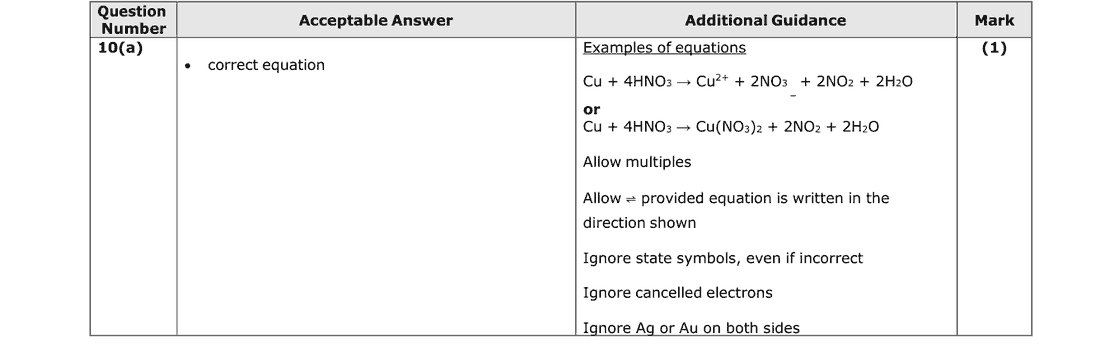
Write the equation for the reaction of copper with concentrated nitric acid,
using the half-equations given in Step 1.  State symbols are not required.
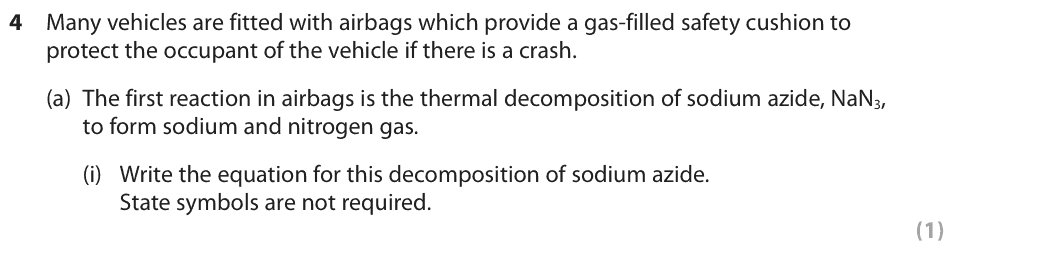
June 2018 · Paper 2 · Q4(a)(i) 1 mark Equation writing Easy formulae equations and amounts of substance
Many vehicles are fitted with airbags which provide a gas-filled safety cushion to
protect the occupant of the vehicle if there is a crash.
The first reaction in airbags is the thermal decomposition of sodium azide, NaN3,
to form sodium and nitrogen gas.
Write the equation for this decomposition of sodium azide.
State symbols are not required.
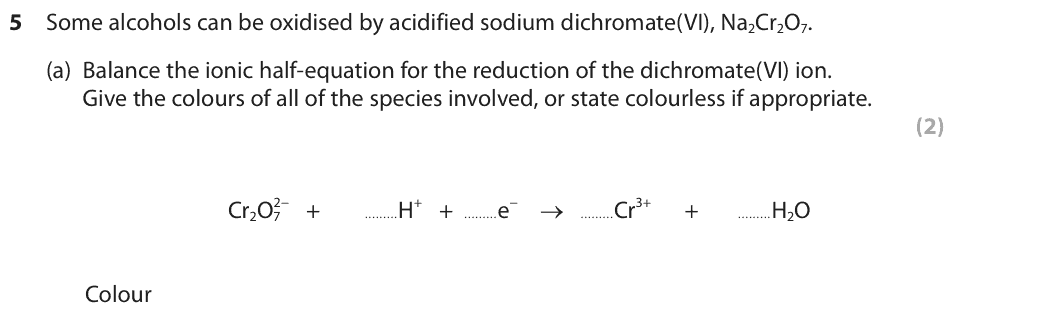
June 2018 · Paper 2 · Q5(a) 2 marks Equation writing redox ialcohols
Some alcohols can be oxidised by acidified sodium dichromate(VI), Na2Cr2O7.
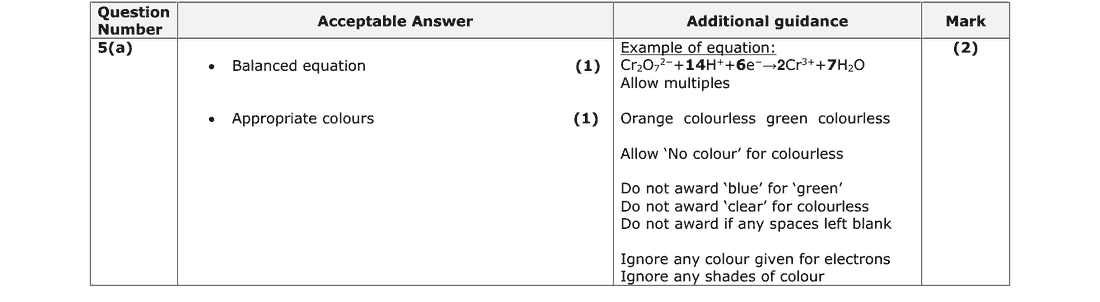
Balance the ionic half-equation for the reduction of the dichromate(VI) ion.
Give the colours of all of the species involved, or state colourless if appropriate.
Cr2O7
2−   +        H+   +  e−    →   Cr3+      +       H2O
Colour
June 2018 · Paper 2 · Q8(a)(i) 2 marks Equation writing arenes benzene
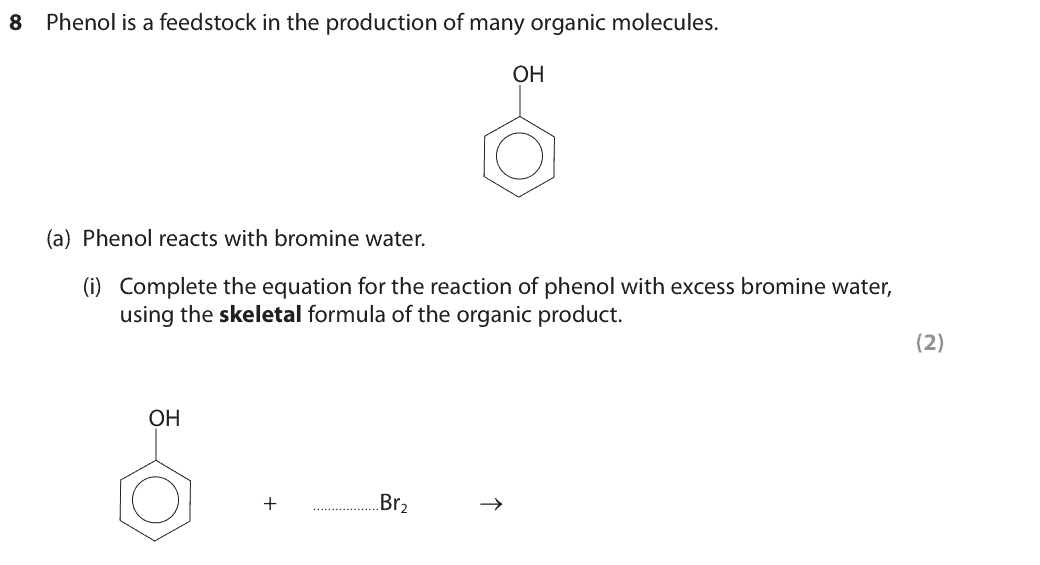
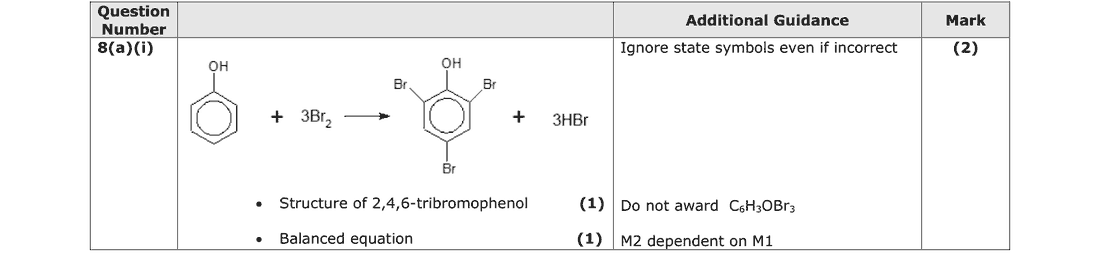
Phenol is a feedstock in the production of many organic molecules.
OH
Phenol reacts with bromine water.
Complete the equation for the reaction of phenol with excess bromine water,
using the skeletal formula of the organic product.
OH
+      Br2            →
June 2018 · Paper 3 · Q3(e)(i) 1 mark Equation writing formulae equations and amounts of substance
Earlier part of question 3 that this part usesEarlier part of June 2018 Paper 3 question 3
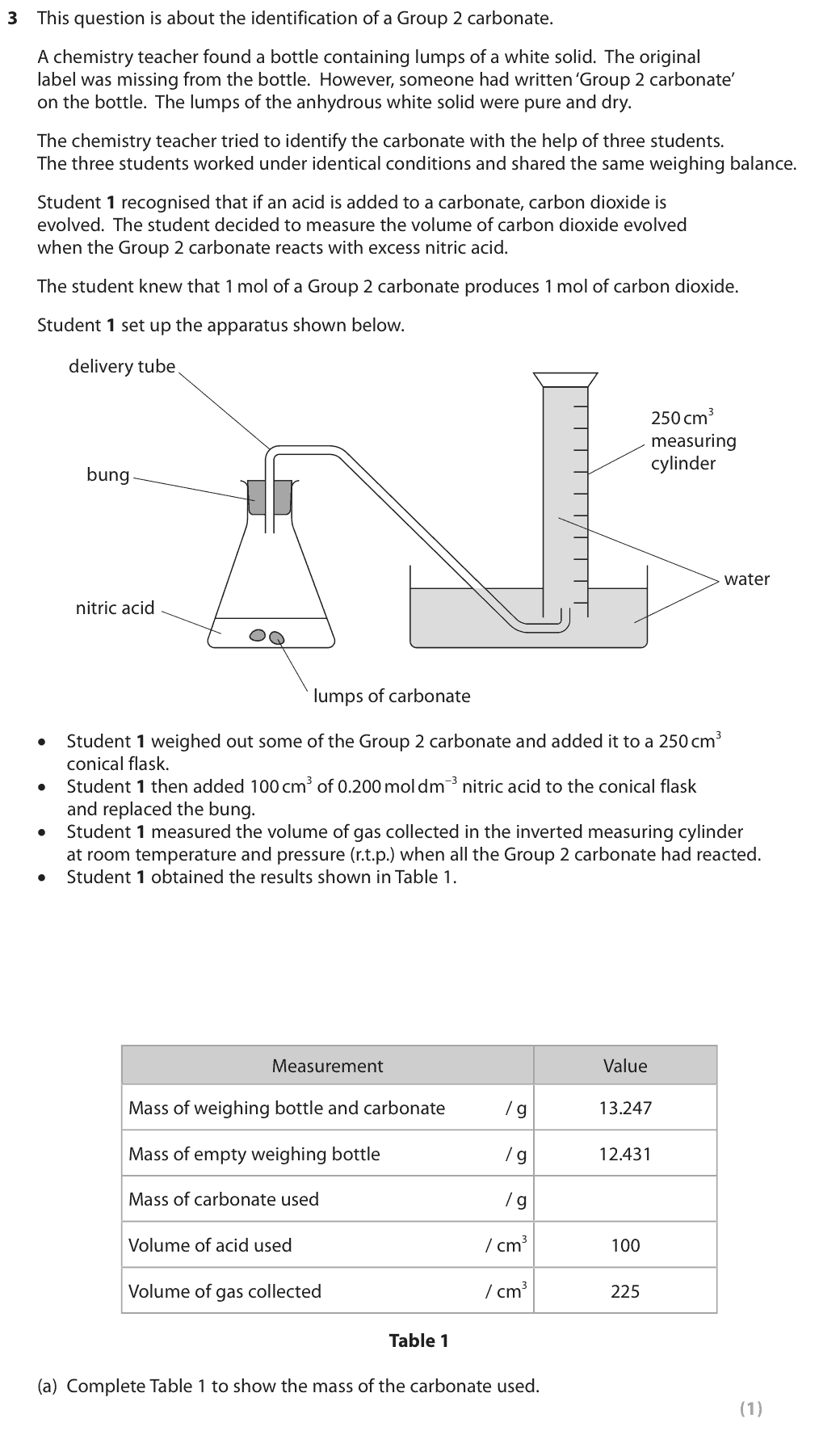
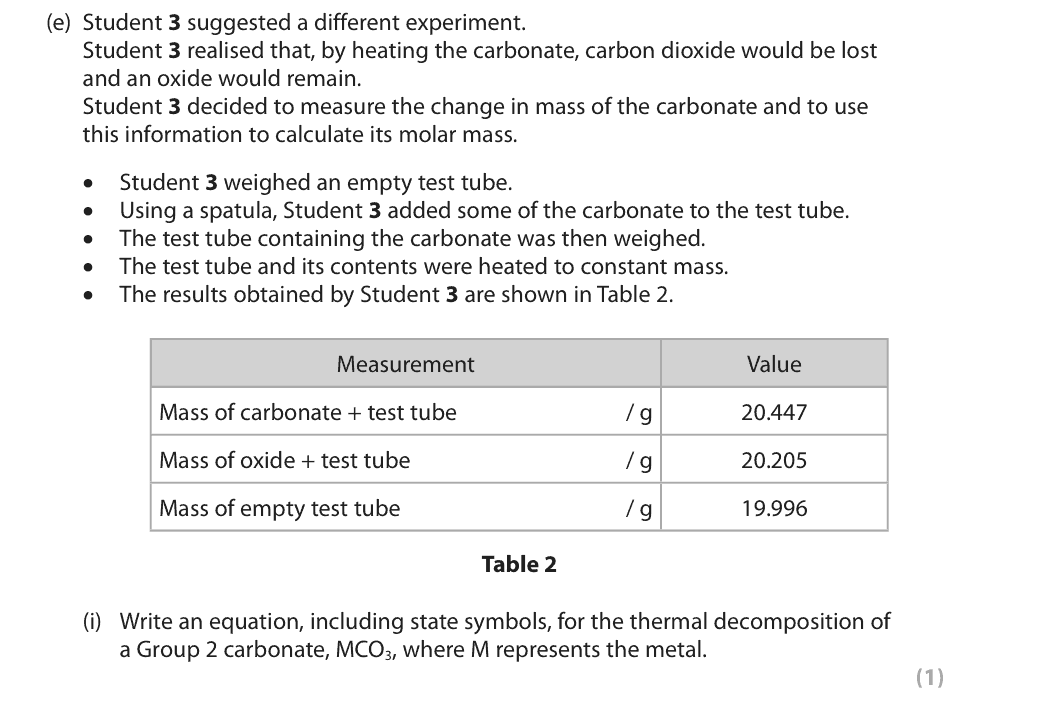
Student 3 suggested a different experiment.
Student 3 realised that, by heating the carbonate, carbon dioxide would be lost
and an oxide would remain.
Student 3 decided to measure the change in mass of the carbonate and to use
this information to calculate its molar mass.
•
Student 3 weighed an empty test tube.
•
Using a spatula, Student 3 added some of the carbonate to the test tube.
•
The test tube containing the carbonate was then weighed.
•
The test tube and its contents were heated to constant mass.
•
The results obtained by Student 3 are shown in Table 2.
Measurement
Value
Mass of carbonate + test tube
/ g
20.447
Mass of oxide + test tube
/ g
20.205
Mass of empty test tube
/ g
19.996
Table 2
Write an equation, including state symbols, for the thermal decomposition of
a Group 2 carbonate, MCO3, where M represents the metal.
June 2018 · Paper 3 · Q6(d)(i) 2 marks Equation writing carboxylic acidsformulae equations and amounts of substance
Earlier part of question 6 that this part usesEarlier part of June 2018 Paper 3 question 6
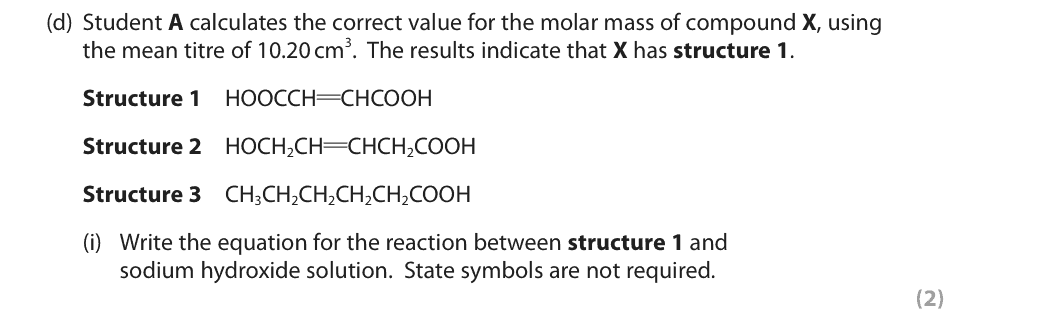
Student A calculates the correct value for the molar mass of compound X, using
the mean titre of 10.20 cm3.  The results indicate that X has structure 1.
Structure 1  HOOCCH
CHCOOH
Structure 2  HOCH2CH
CHCH2COOH
Structure 3  CH3CH2CH2CH2CH2COOH
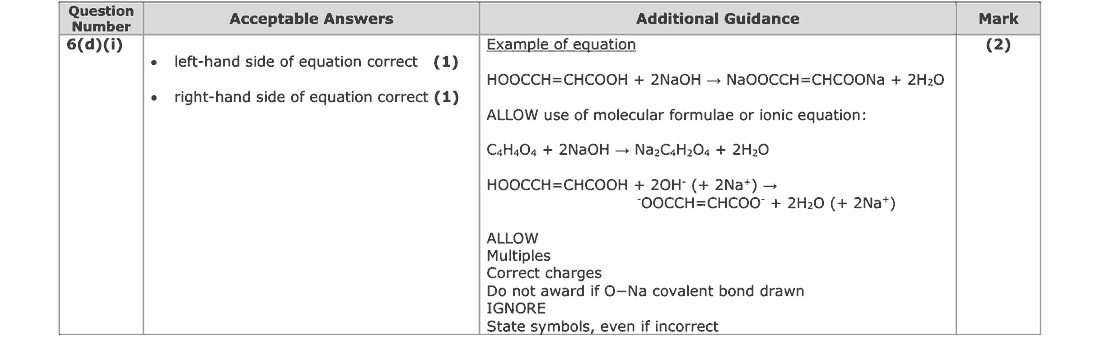
Write the equation for the reaction between structure 1 and
sodium hydroxide solution.  State symbols are not required.
June 2017 · AS Paper 1 · Q4(a)(i) 1 mark Equation writing redox i
This question is about redox chemistry.
Write an ionic half-equation for the reduction of chlorine molecules to
chloride ions.
State symbols are not required.
June 2017 · AS Paper 1 · Q4(a)(ii) 1 mark Equation writing Hard redox igroup 7 the halogens
Earlier part of question 4 that this part usesEarlier part of June 2017 Paper 1 question 4
Write an ionic half-equation for the oxidation of chlorine molecules to
chlorate(I) ions in the presence of cold, aqueous hydroxide ions.
State symbols are not required.
June 2017 · AS Paper 1 · Q4(a)(iii) 1 mark Equation writing redox igroup 7 the halogens
Earlier part of question 4 that this part usesEarlier part of June 2017 Paper 1 question 4
Combine the two equations in (a)(i) and (ii) to give the ionic equation for the
reaction of chlorine molecules with cold, aqueous hydroxide ions.
June 2017 · AS Paper 1 · Q4(c)(i) 1 mark Equation writing Hard group 7 the halogensredox i
Bromine can be extracted from seawater containing bromide ions
using chlorine.
Write the ionic equation for this reaction.  State symbols are not required.
June 2017 · AS Paper 1 · Q6(a)(i) 1 mark Equation writing formulae equations and amounts of substance
Boron and aluminium are in the same group of the Periodic Table.  Both form
compounds with chlorine and with fluorine.
Boron reacts directly with chlorine to produce a covalently bonded compound, BCl3.
Write the equation for this reaction.  State symbols are not required.
June 2017 · AS Paper 1 · Q8(a)(i) 2 marks Equation writing formulae equations and amounts of substance
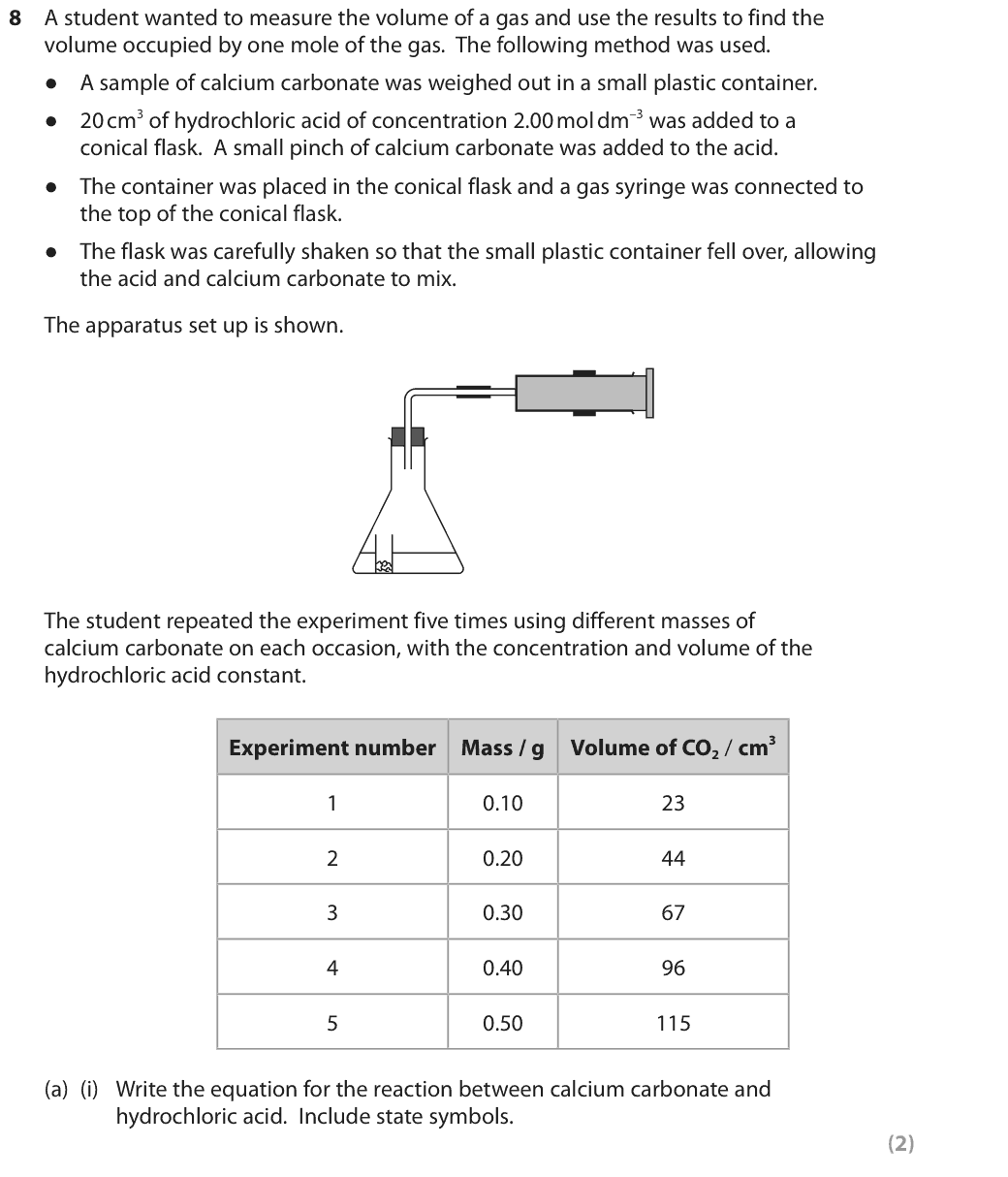
A student wanted to measure the volume of a gas and use the results to find the
volume occupied by one mole of the gas.  The following method was used.
Ɣ A sample of calcium carbonate was weighed out in a small plastic container.
Ɣ 20 cm3 of hydrochloric acid of concentration 2.00 mol dm–3 was added to a
conical flask.  A small pinch of calcium carbonate was added to the acid.
Ɣ The container was placed in the conical flask and a gas syringe was connected to
the top of the conical flask.
Ɣ The flask was carefully shaken so that the small plastic container fell over, allowing
the acid and calcium carbonate to mix.
The apparatus set up is shown.
The student repeated the experiment five times using different masses of
calcium carbonate on each occasion, with the concentration and volume of the
hydrochloric acid constant.
Experiment number
Mass / g
Volume of CO2 / cm3
1
0.10
23
2
0.20
44
3
0.30
67
4
0.40
96
5
0.50
115
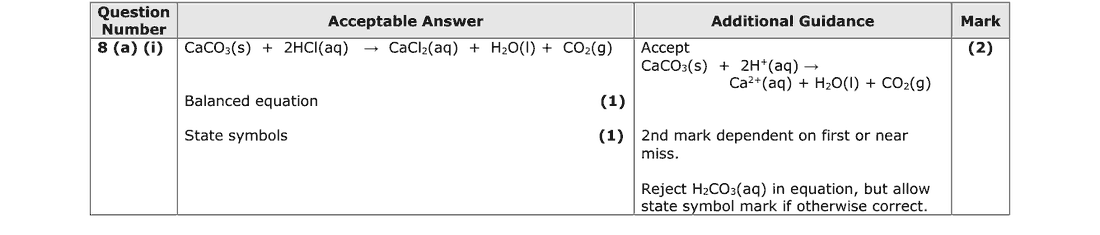
Write the equation for the reaction between calcium carbonate and
hydrochloric acid.  Include state symbols.
June 2017 · AS Paper 2 · Q7(a)(v) 1 mark Equation writing formulae equations and amounts of substance
Earlier part of question 7 that this part usesEarlier part of June 2017 Paper 2 question 7
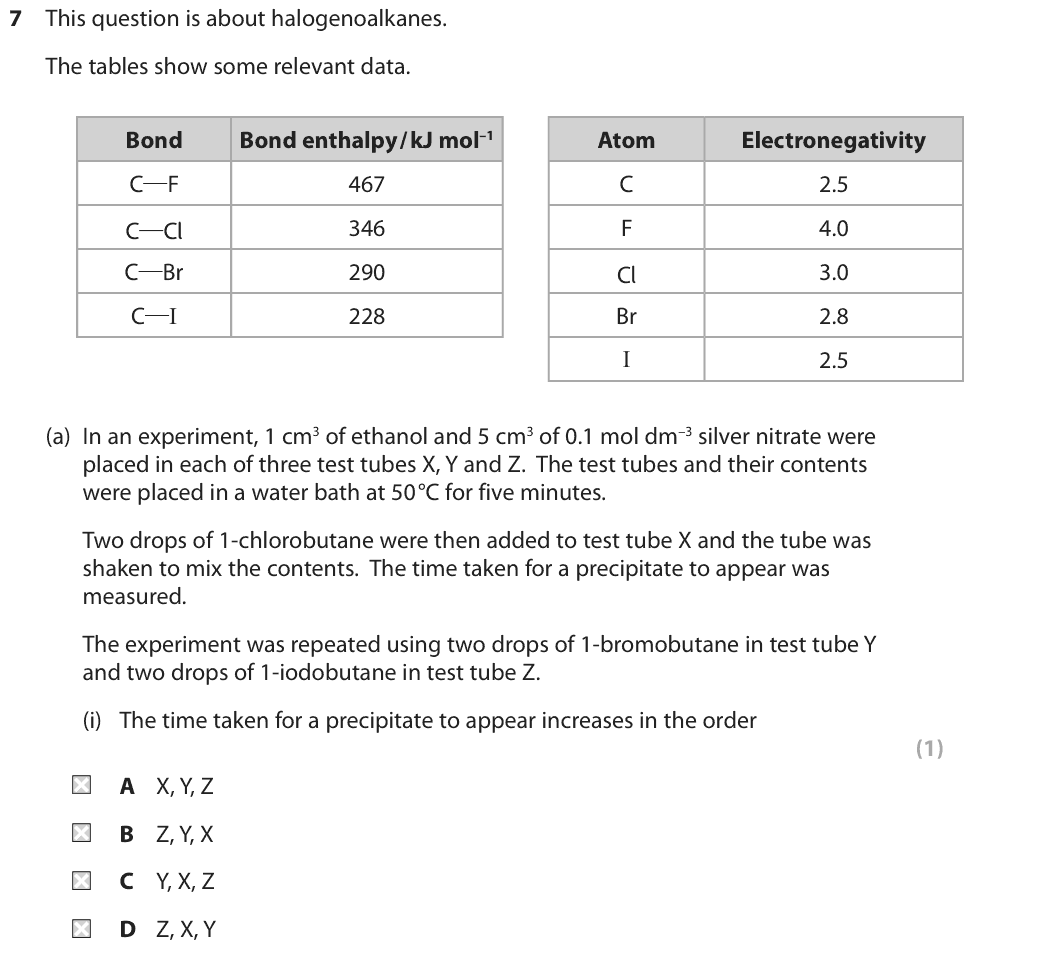
Write the ionic equation, including state symbols, for the reaction involving
the silver nitrate in test tube X.
June 2017 · Paper 1 · Q3(c)(ii) 3 marks Equation writing redox iredox ii
Earlier parts of question 3 that this part usesEarlier part of June 2017 Paper 1 question 3Earlier part of June 2017 Paper 1 question 3
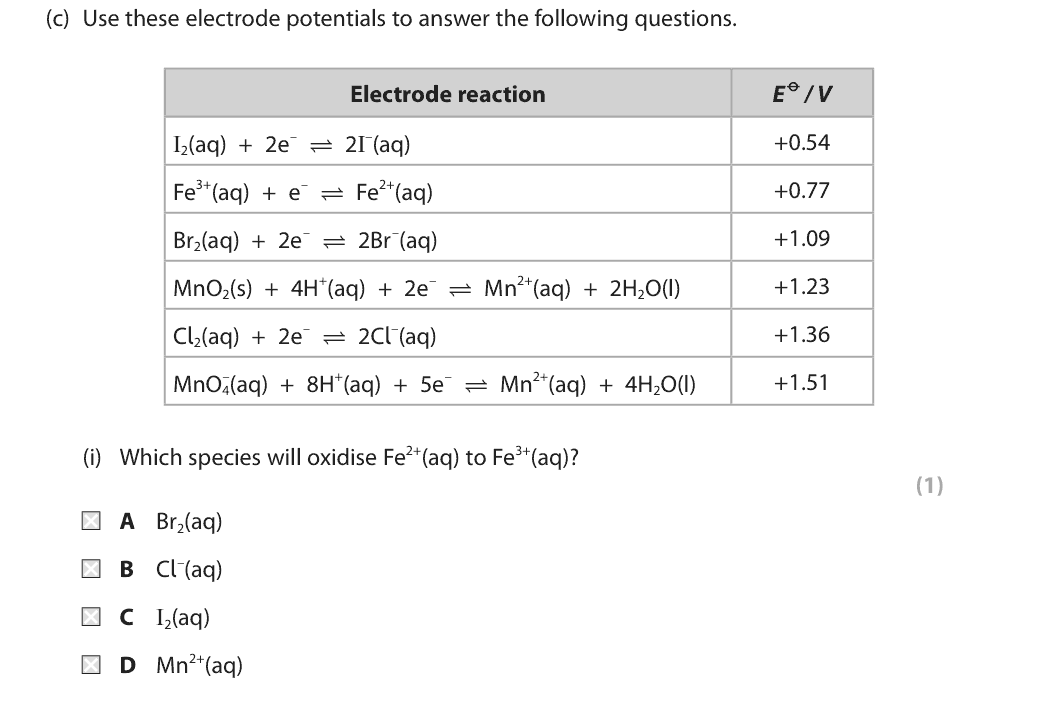
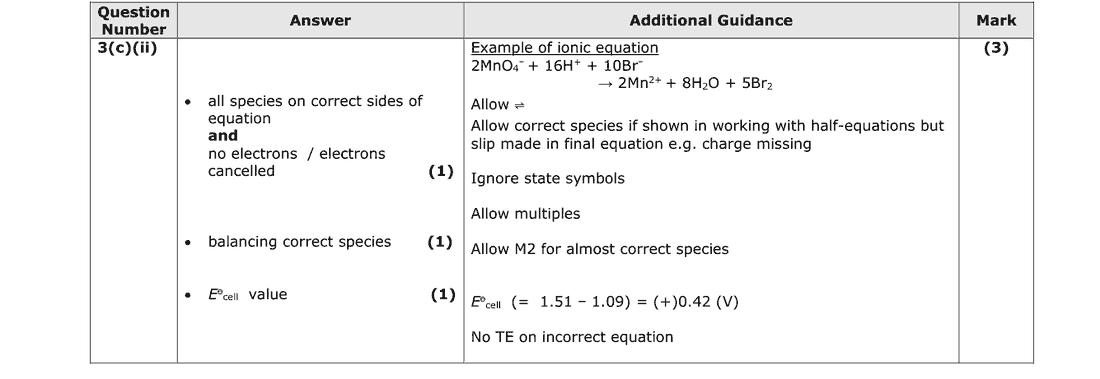
Write the ionic equation and calculate the E cell value for the reaction between
MnO4
– ions and Br – ions in acidic solution.
State symbols are not required.
June 2017 · Paper 1 · Q4(d) 2 marks Equation writing transition metals reactions
Earlier part of question 4 that this part usesEarlier part of June 2017 Paper 1 question 4
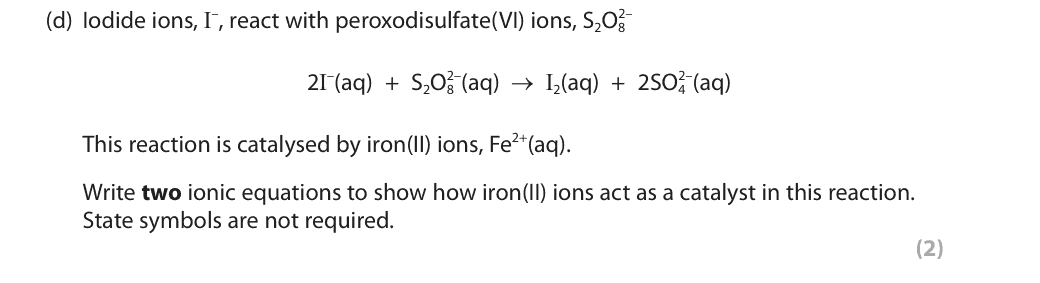
Iodide ions, I–, react with peroxodisulfate(VI) ions, S2O8
2–
2I–(aq) + S2O8
2–(aq) r I2(aq) + 2SO4
2–(aq)
This reaction is catalysed by iron(II) ions, Fe2+(aq).
Write two ionic equations to show how iron(II) ions act as a catalyst in this reaction.
State symbols are not required.
June 2017 · Paper 1 · Q6(c)(ii) 1 mark Equation writing atomic structure and the periodic table
Earlier part of question 6 that this part usesEarlier part of June 2017 Paper 1 question 6
Write the equation, including state symbols, to show the
third ionisation energy of magnesium.
June 2017 · Paper 1 · Q8(d)(ii) 1 mark Equation writing acid base equilibria
Earlier parts of question 8 that this part usesEarlier part of June 2017 Paper 1 question 8Earlier part of June 2017 Paper 1 question 8
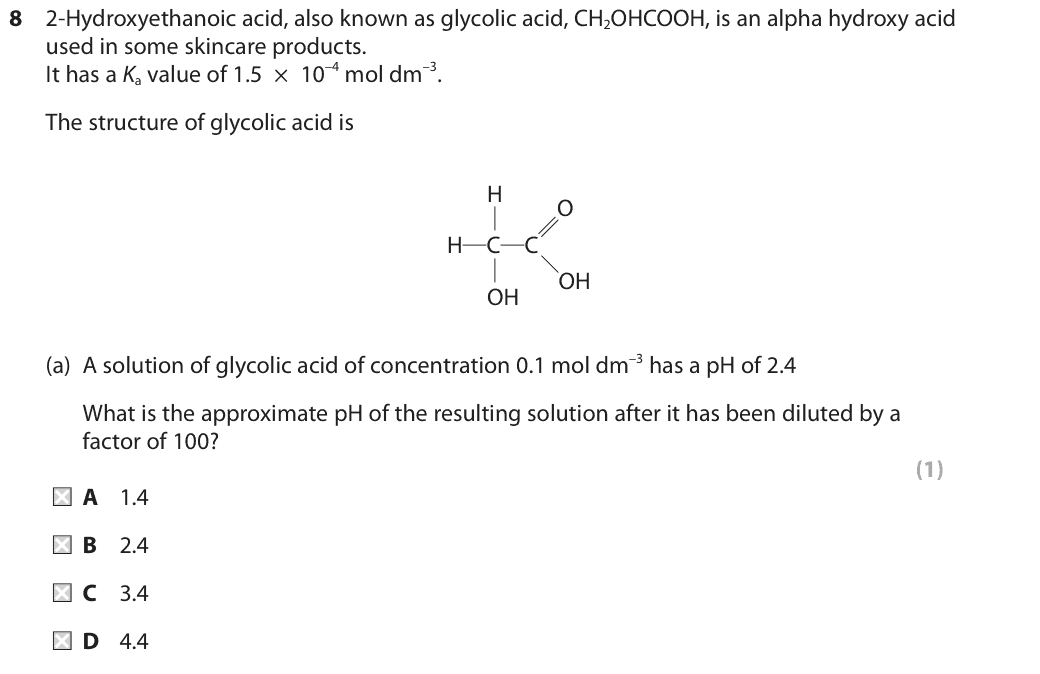
Complete the equation to show the conjugate acid-base pairs that would be
produced when pure samples of glycolic acid and ethanoic acid are mixed.
CH2OHCOOH + CH3COOH r  +
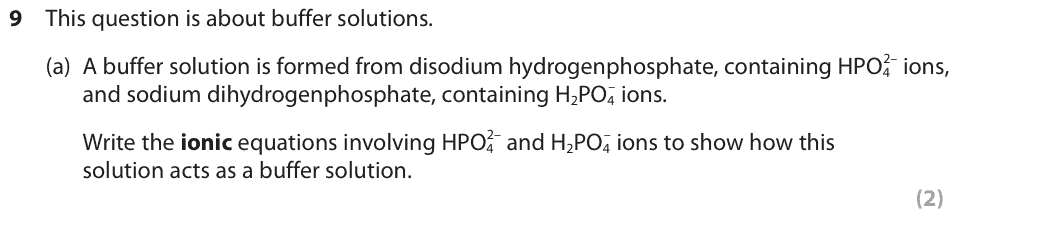
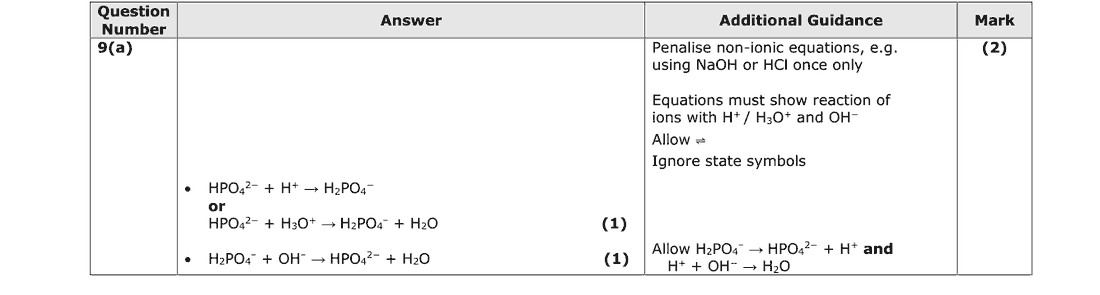
June 2017 · Paper 1 · Q9(a) 2 marks Equation writing acid base equilibria
This question is about buffer solutions.
2– ions,
A buffer solution is formed from disodium hydrogenphosphate, containing HPO4
and sodium dihydrogenphosphate, containing H2PO4
– ions.
Write the ionic equations involving HPO4
2– and H2PO4
– ions to show how this
solution acts as a buffer solution.
June 2017 · Paper 2 · Q1(c)(ii) 1 mark Equation writing Easy alkanes
Earlier part of question 1 that this part usesEarlier part of June 2017 Paper 2 question 1
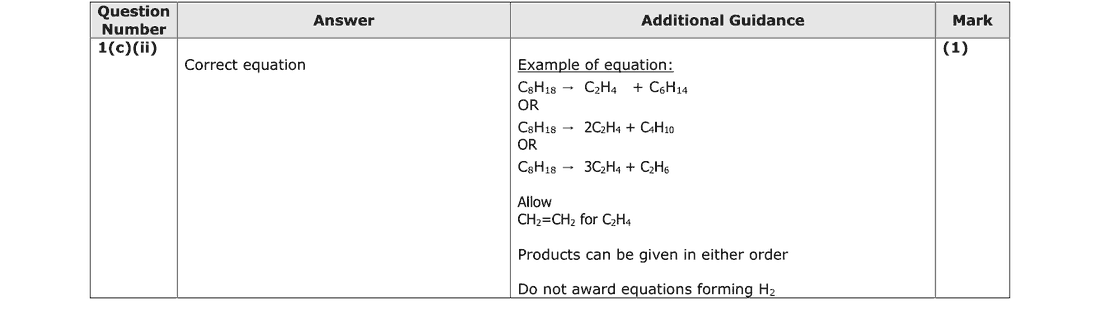
Complete the equation for the cracking of octane to produce ethene and only
one other organic compound.  State symbols are not required.
C8H18    r  +
June 2017 · Paper 2 · Q1(c)(iii) 1 mark Equation writing alkanesintroduction to organic chemistry
Earlier part of question 1 that this part usesEarlier part of June 2017 Paper 2 question 1
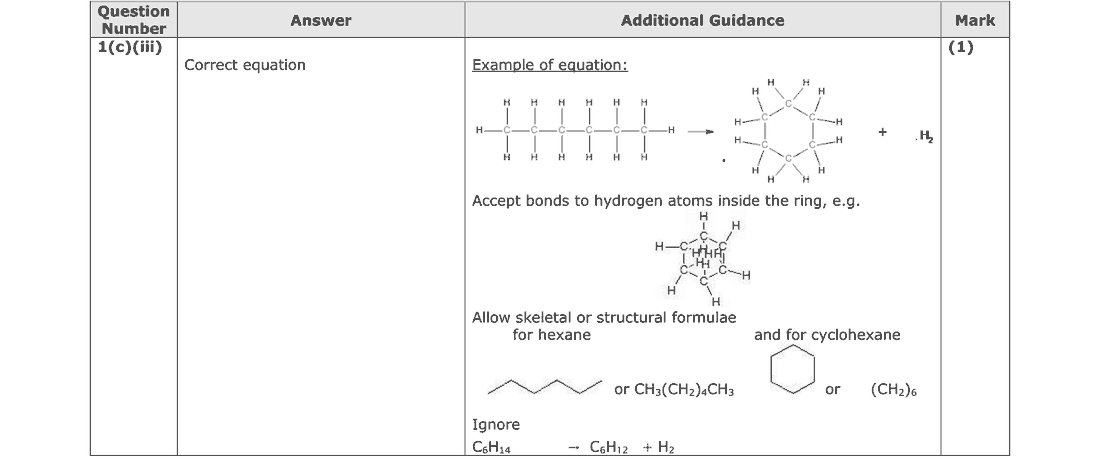
Write the equation for the reforming of hexane into cyclohexane, using
displayed formulae for the organic compounds.  State symbols are not required.
June 2017 · Paper 2 · Q5(a)(i) 1 mark Equation writing alkanes
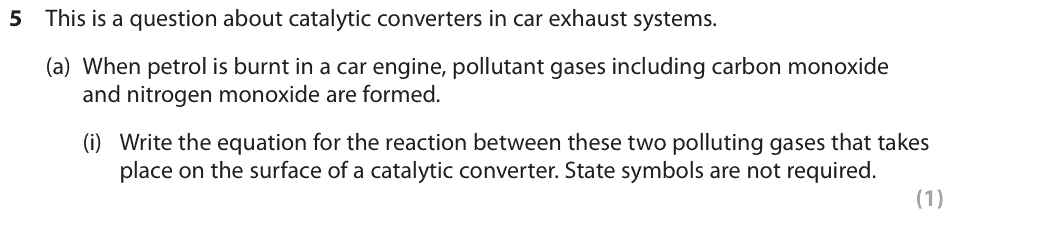
This is a question about catalytic converters in car exhaust systems.
When petrol is burnt in a car engine, pollutant gases including carbon monoxide
and nitrogen monoxide are formed.
Write the equation for the reaction between these two polluting gases that takes
place on the surface of a catalytic converter. State symbols are not required.
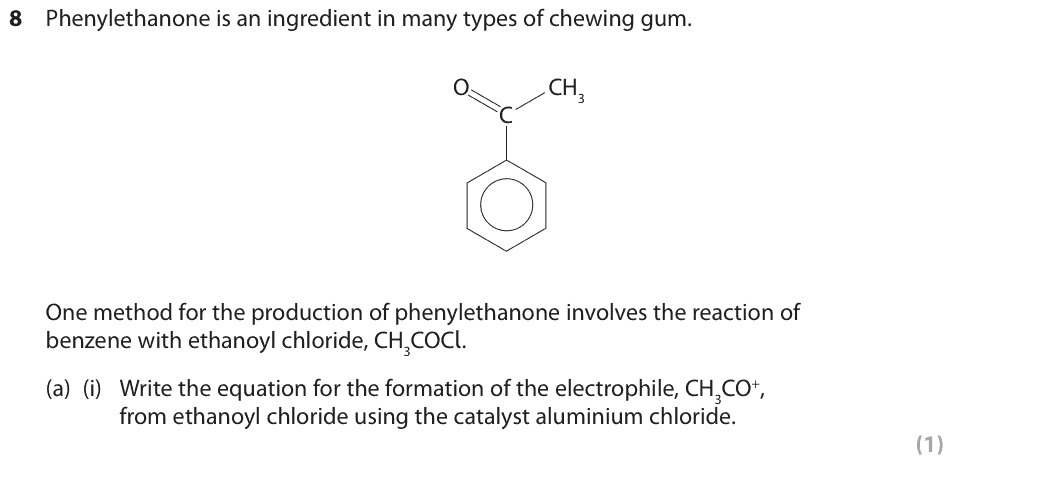
June 2017 · Paper 2 · Q8(a)(i) 1 mark Equation writing Easy arenes benzene
Phenylethanone is an ingredient in many types of chewing gum.
O
CH3
C
One method for the production of phenylethanone involves the reaction of
benzene with ethanoyl chloride, CH3COCl.
Write the equation for the formation of the electrophile, CH3CO+,
from ethanoyl chloride using the catalyst aluminium chloride.
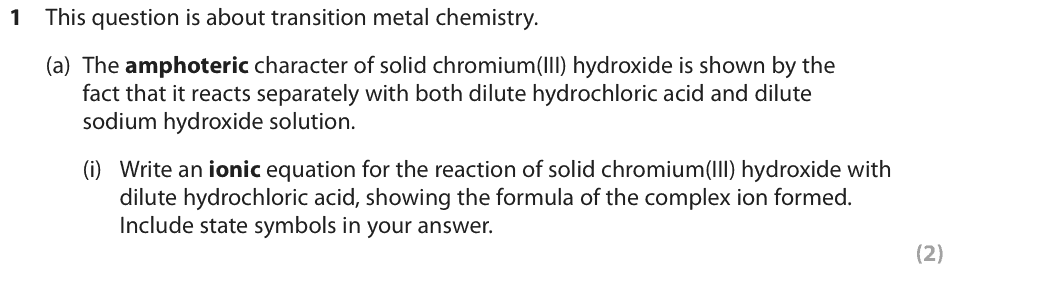
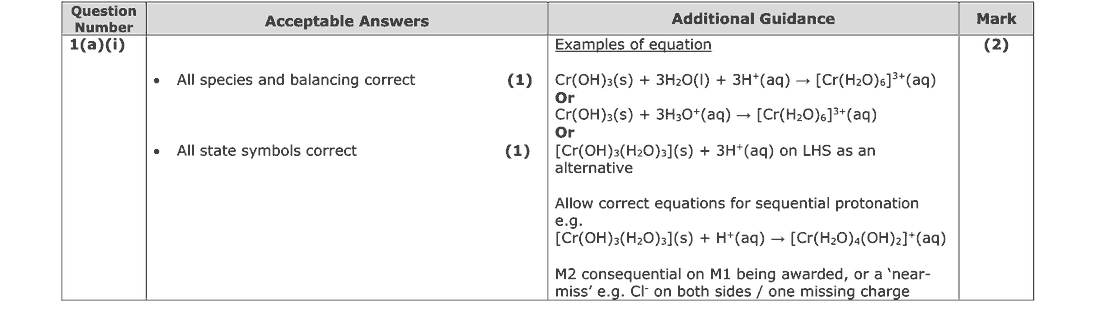
June 2017 · Paper 3 · Q1(a)(i) 2 marks Equation writing transition metals reactions
This question is about transition metal chemistry.
The amphoteric character of solid chromium(III) hydroxide is shown by the
fact that it reacts separately with both dilute hydrochloric acid and dilute
sodium hydroxide solution.
Write an ionic equation for the reaction of solid chromium(III) hydroxide with
dilute hydrochloric acid, showing the formula of the complex ion formed.
Include state symbols in your answer.
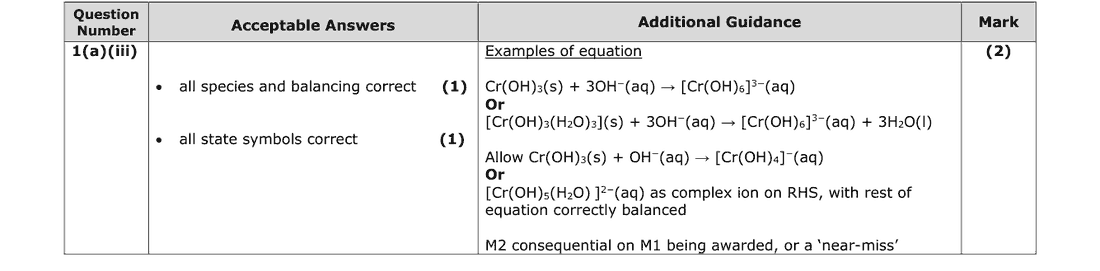
June 2017 · Paper 3 · Q1(a)(iii) 2 marks Equation writing transition metals reactions
Earlier parts of question 1 that this part usesEarlier part of June 2017 Paper 3 question 1Earlier part of June 2017 Paper 3 question 1
Write an ionic equation for the reaction of solid chromium(III) hydroxide with dilute
sodium hydroxide solution, showing the formula of the complex ion formed.
Include state symbols in your answer.
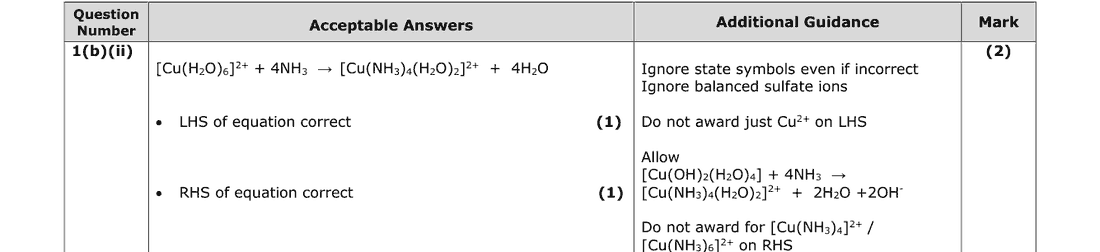
June 2017 · Paper 3 · Q1(b)(ii) 2 marks Equation writing transition metals reactions
Earlier part of question 1 that this part usesEarlier part of June 2017 Paper 3 question 1
The reaction between aqueous copper(II) sulfate and excess aqueous ammonia
is an example of a ligand substitution reaction.
Write an equation for the ligand substitution reaction that occurs, showing
the formulae of the complex ions involved.  State symbols are not required.

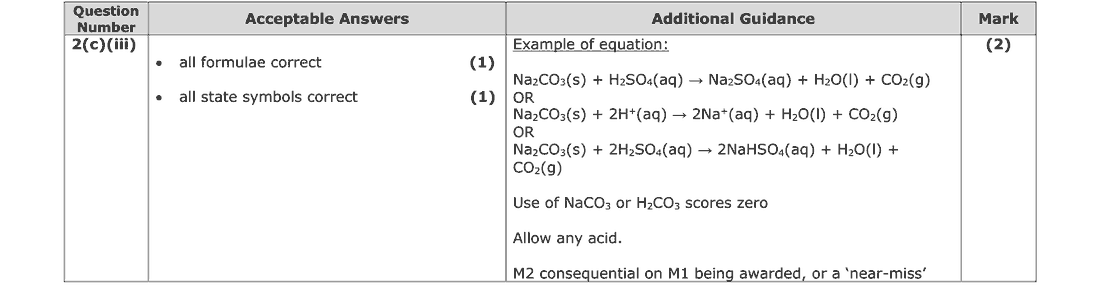
June 2017 · Paper 3 · Q2(c)(iii) 2 marks Equation writing formulae equations and amounts of substanceanalysis of inorganic compounds
Earlier parts of question 2 that this part usesEarlier part of June 2017 Paper 3 question 2Earlier part of June 2017 Paper 3 question 2Earlier part of June 2017 Paper 3 question 2
Solid sodium carbonate is added to the distillate.  The sodium carbonate
disappears and fizzing occurs.
Write an equation, including state symbols, for the reaction that occurs
between sodium carbonate and the compound you have identified in (c)(ii).
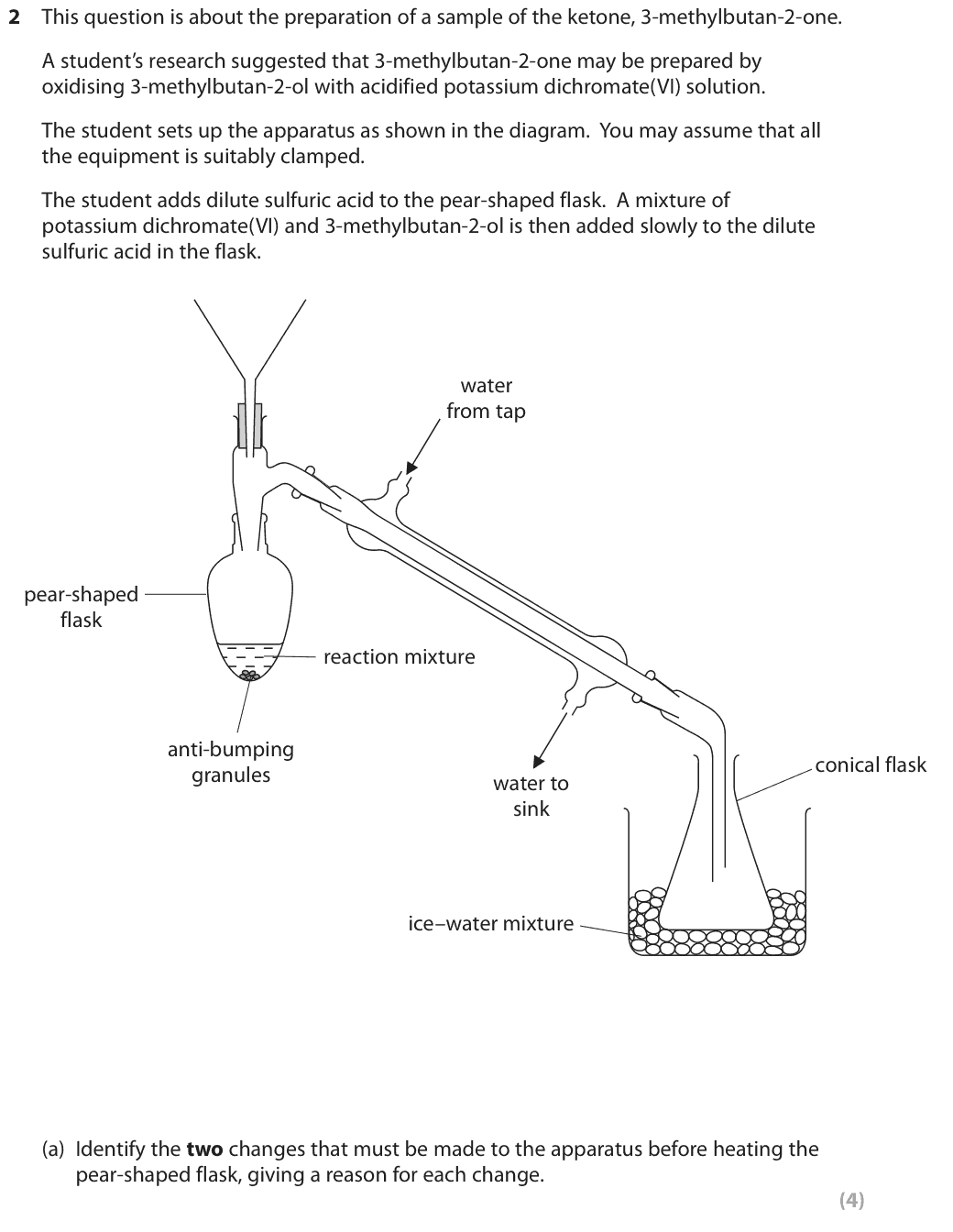
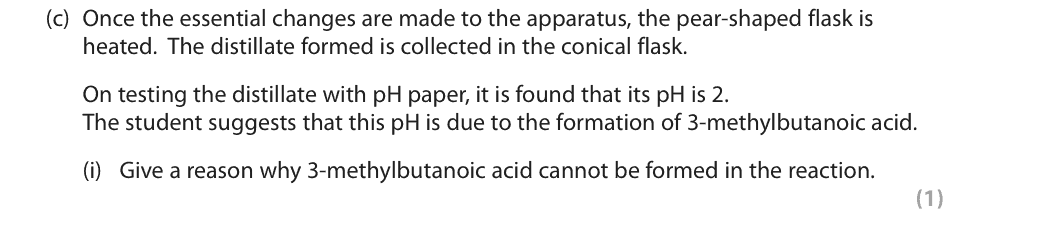
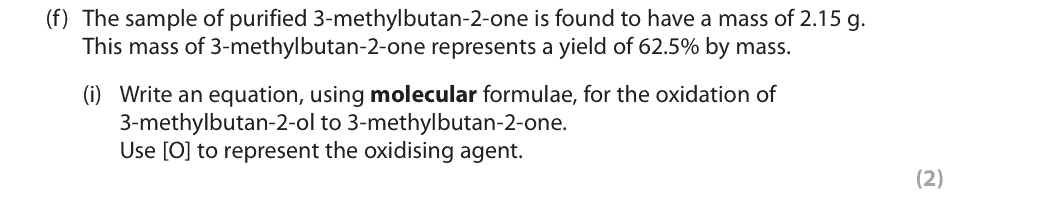
June 2017 · Paper 3 · Q2(f)(i) 2 marks Equation writing alcoholsintroduction to organic chemistry
Earlier part of question 2 that this part usesEarlier part of June 2017 Paper 3 question 2
The sample of purified 3-methylbutan-2-one is found to have a mass of 2.15 g.
This mass of 3-methylbutan-2-one represents a yield of 62.5% by mass.
Write an equation, using molecular formulae, for the oxidation of
3-methylbutan-2-ol to 3-methylbutan-2-one.
Use [O] to represent the oxidising agent.
June 2017 · Paper 3 · Q4(b) 2 marks Equation writing energetics iformulae equations and amounts of substance
Earlier part of question 4 that this part usesEarlier part of June 2017 Paper 3 question 4
Write the equation that represents the reaction that occurs when the standard
enthalpy change of combustion of methanol, CH3OH(l), is measured.  Include
state symbols.
June 2017 · Paper 3 · Q6(d) 2 marks Equation writing redox i
Earlier part of question 6 that this part usesEarlier part of June 2017 Paper 3 question 6
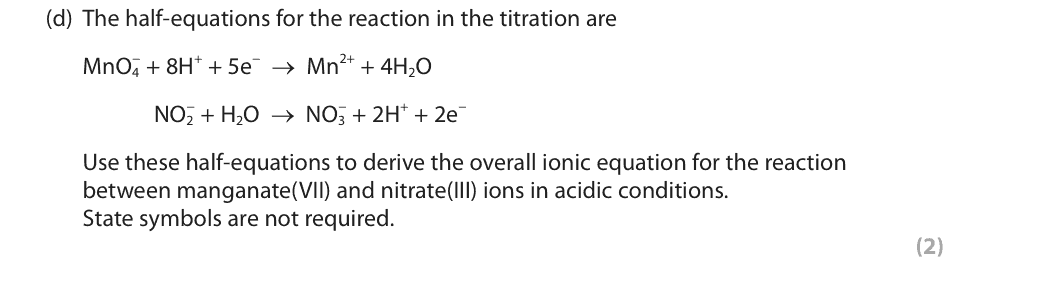
The half-equations for the reaction in the titration are
− + 8H+ + 5e−  o  Mn2+ + 4H2O
MnO4
− + H2O  o  NO3
− + 2H+ + 2e−
NO2
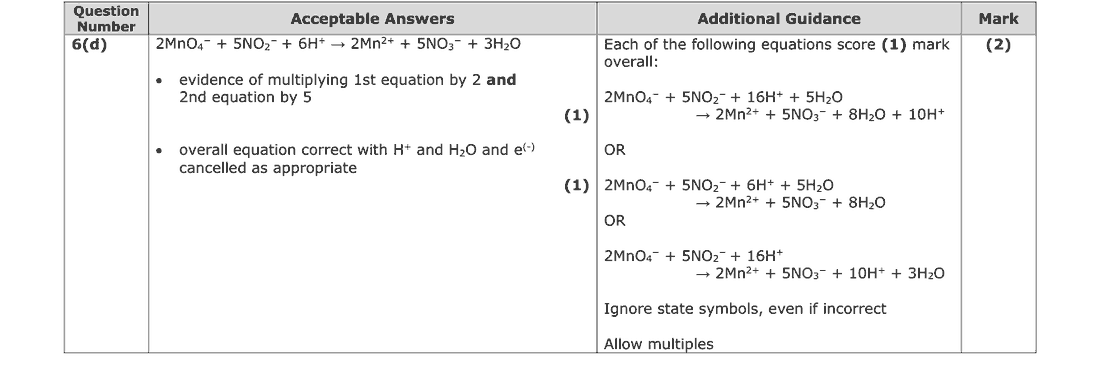
Use these half-equations to derive the overall ionic equation for the reaction
between manganate(VII) and nitrate(III) ions in acidic conditions.
State symbols are not required.
Method 2 – Precipitation
The student used the following procedure.
•
Dissolve a known mass of Mg(NO2)2•xH2O in distilled water.
•
Add an excess of aqueous sodium carbonate solution, Na2CO3(aq), to obtain a
precipitate of magnesium carbonate, MgCO3(s).
Mg2+(aq)  +  CO3
2−(aq)  o  MgCO3(s)
•
Weigh a piece of filter paper.
•
Filter the mixture from the above reaction through the pre-weighed filter paper.
•
Wash the precipitate of MgCO3(s) with distilled water.
•
Dry the filter paper and precipitate in a desiccator.
•
Reweigh the filter paper and the precipitate.
•
Calculate the value of x from the results obtained.
The student found that the value of x calculated using Method 2 was different from
that obtained using Method 1.  This difference occurred despite having used a pure
sample of the hydrated salt and without making any errors in technique during the
experiment.
The student found out from a data book that the compound magnesium carbonate is
very slightly soluble in water.
June 2016 · AS Paper 1 · Q1(b) 2 marks Equation writing group 7 the halogens
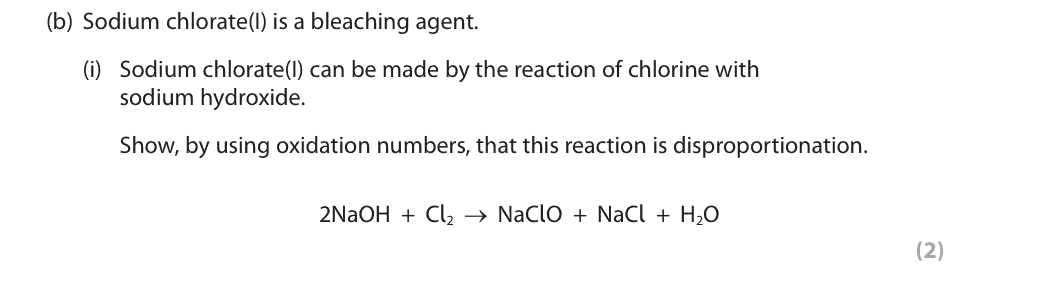
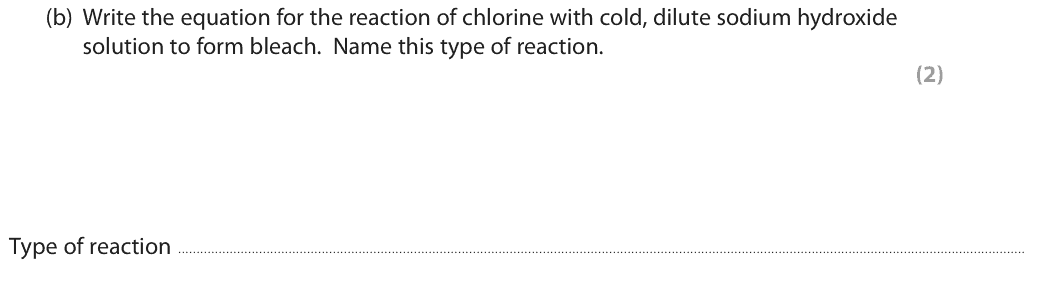
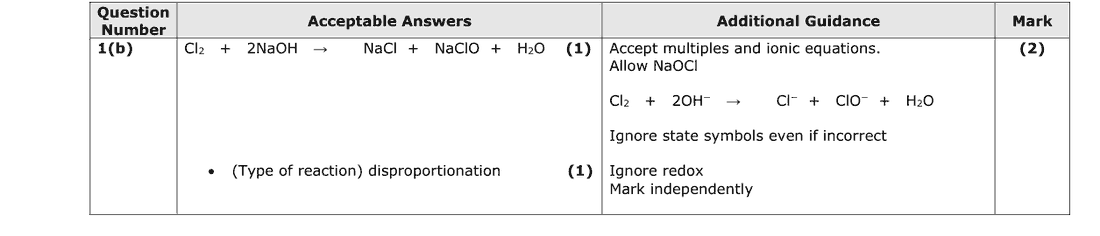
Write the equation for the reaction of chlorine with cold, dilute sodium hydroxide
solution to form bleach.  Name this type of reaction.
Type of reaction
June 2016 · AS Paper 1 · Q4(e) 2 marks Equation writing analysis of inorganic compoundsformulae equations and amounts of substance
Earlier part of question 4 that this part usesEarlier part of June 2016 Paper 1 question 4
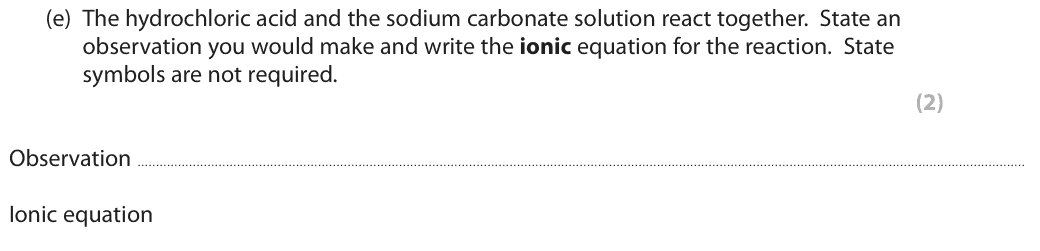
The hydrochloric acid and the sodium carbonate solution react together.  State an
observation you would make and write the ionic equation for the reaction.  State
symbols are not required.
Observation  
Ionic equation
June 2016 · AS Paper 1 · Q8(b)(ii) 1 mark Equation writing formulae equations and amounts of substance
Earlier parts of question 8 that this part usesEarlier part of June 2016 Paper 1 question 8Earlier part of June 2016 Paper 1 question 8
In a dry container, a fluoride of silver reacts with sulfur to produce
disulfur difluoride.  Complete the equation for this reaction.
State symbols are not required.
S8 + AgF2 r S2F2 + AgF
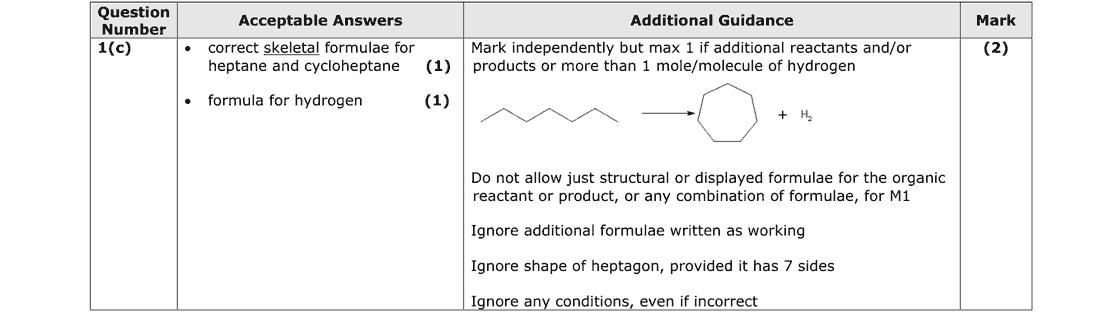
June 2016 · AS Paper 2 · Q1(c) 2 marks Equation writing alkanesintroduction to organic chemistry
Write the equation for reforming heptane into cycloheptane, showing the skeletal
formulae of the organic molecules.
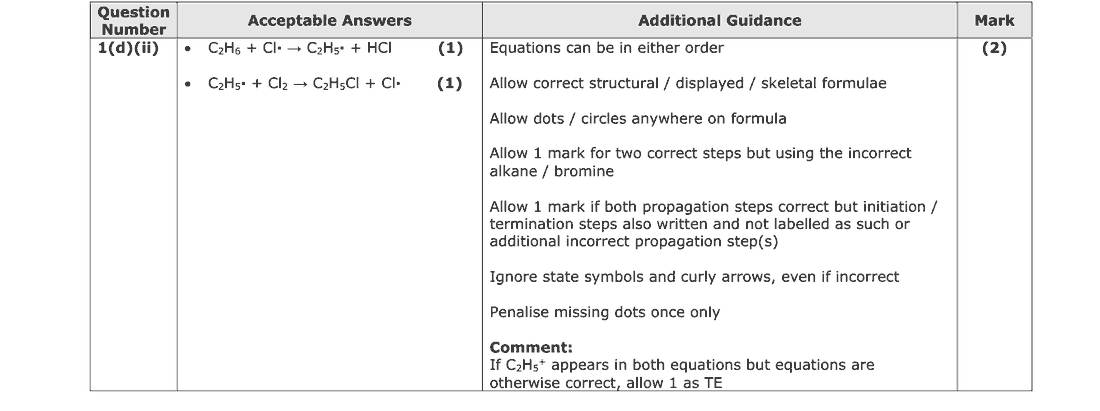
June 2016 · AS Paper 2 · Q1(d)(ii) 2 marks Equation writing alkanes
Earlier part of question 1 that this part usesEarlier part of June 2016 Paper 2 question 1
Write the propagation steps to show the formation of C2H5Cl.
June 2016 · AS Paper 2 · Q3(a)(i) 1 mark Equation writing halogenoalkanesformulae equations and amounts of substance
This question is about halogenoalkanes and kinetics.
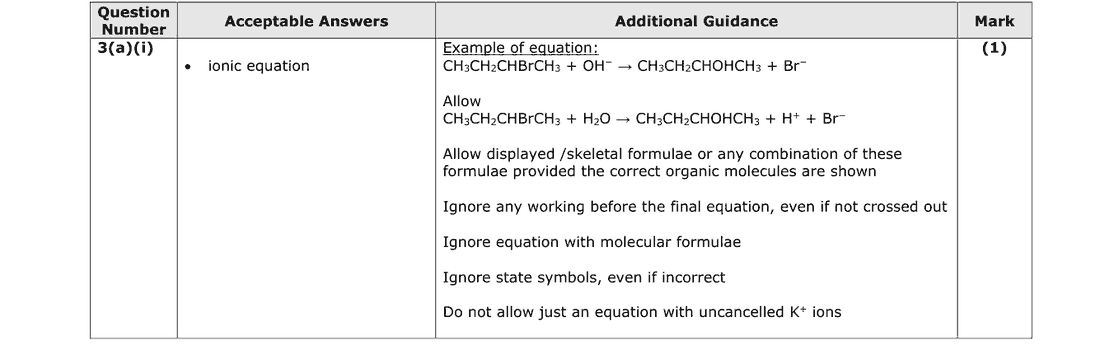
Some halogenoalkanes are hydrolysed by aqueous potassium hydroxide.
Write the ionic equation for the hydrolysis of 2-bromobutane showing the
structural formulae for the organic molecules.
June 2016 · AS Paper 2 · Q4(b) 2 marks Equation writing Hard energetics iformulae equations and amounts of substance
Write the equation to represent the standard enthalpy change of formation of
ethanol.  Include state symbols.

Work with an A-level chemistry tutor

Dropping marks on calculations, mechanisms or the core practicals? Book a trial session with an A-level chemistry tutor.

Prefer email? Send an enquiry

If you are under 18, please include a parent's contact details. Enquiries go to enquiries@chemistryaleveltutor.com and are deleted once handled. All tutoring is online.