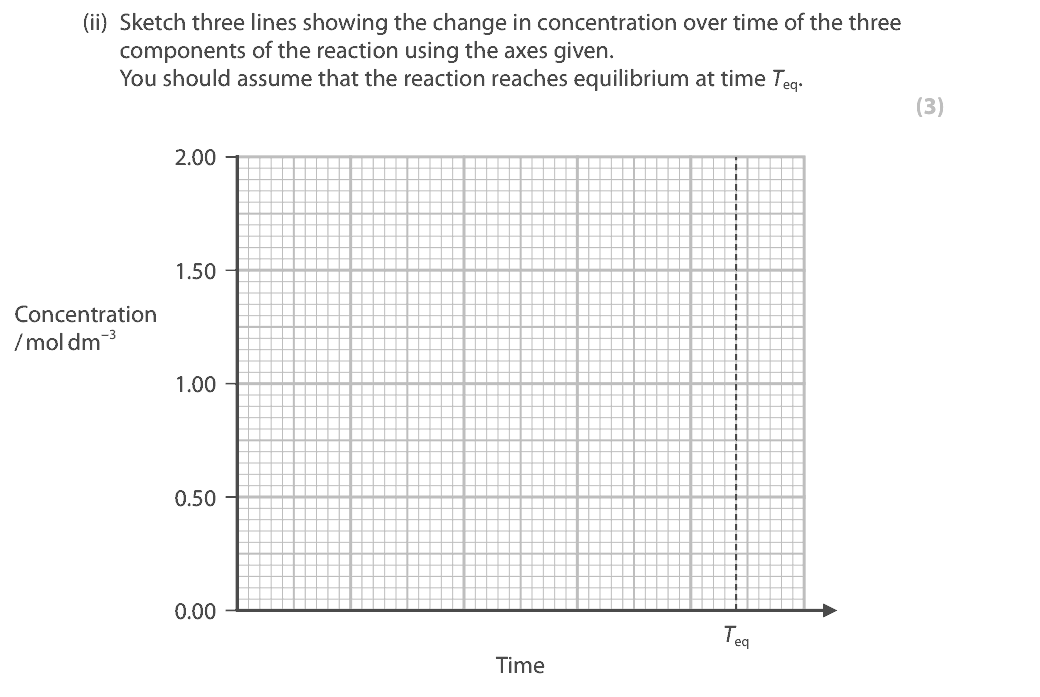
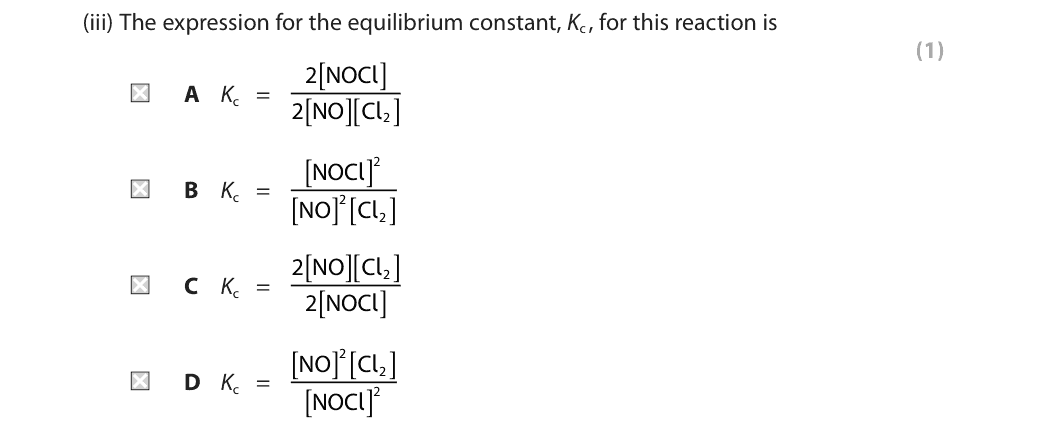
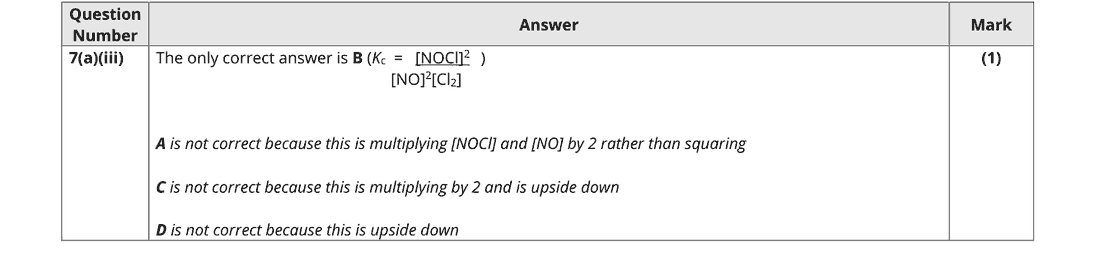
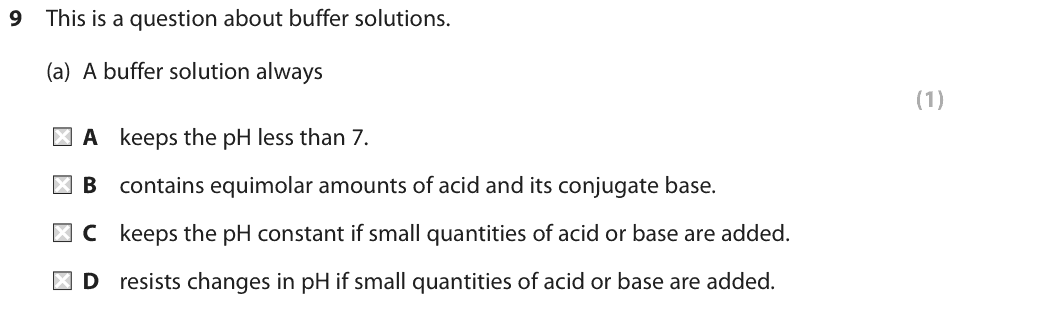
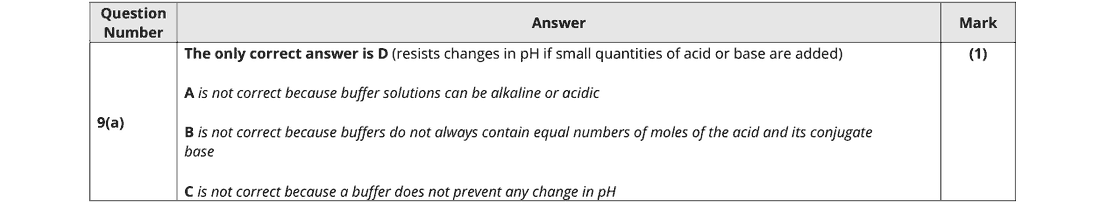
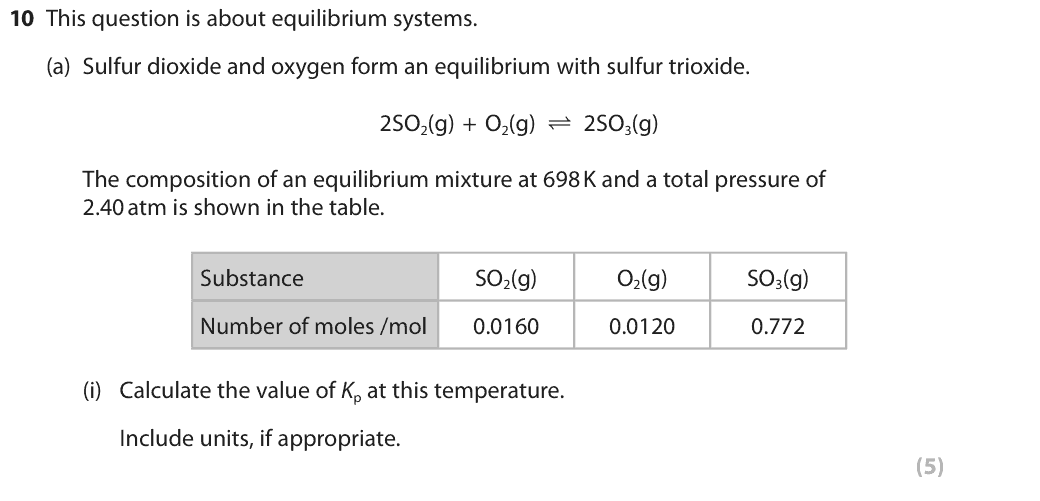
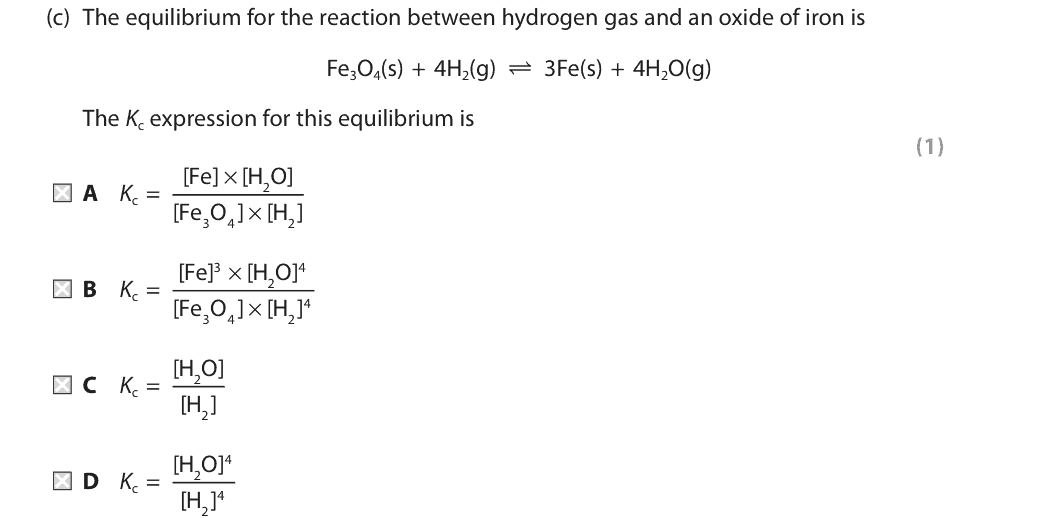
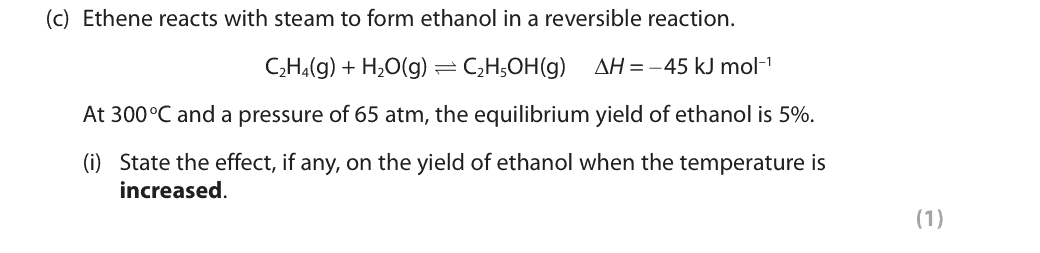
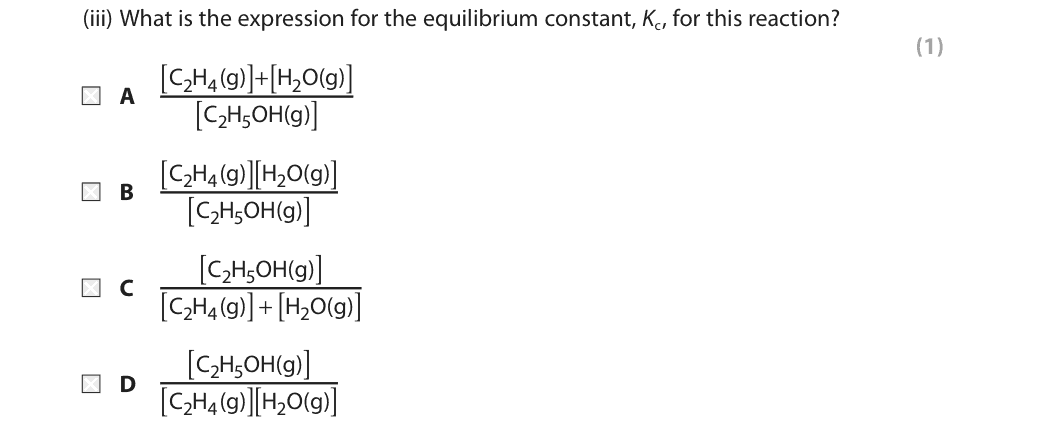
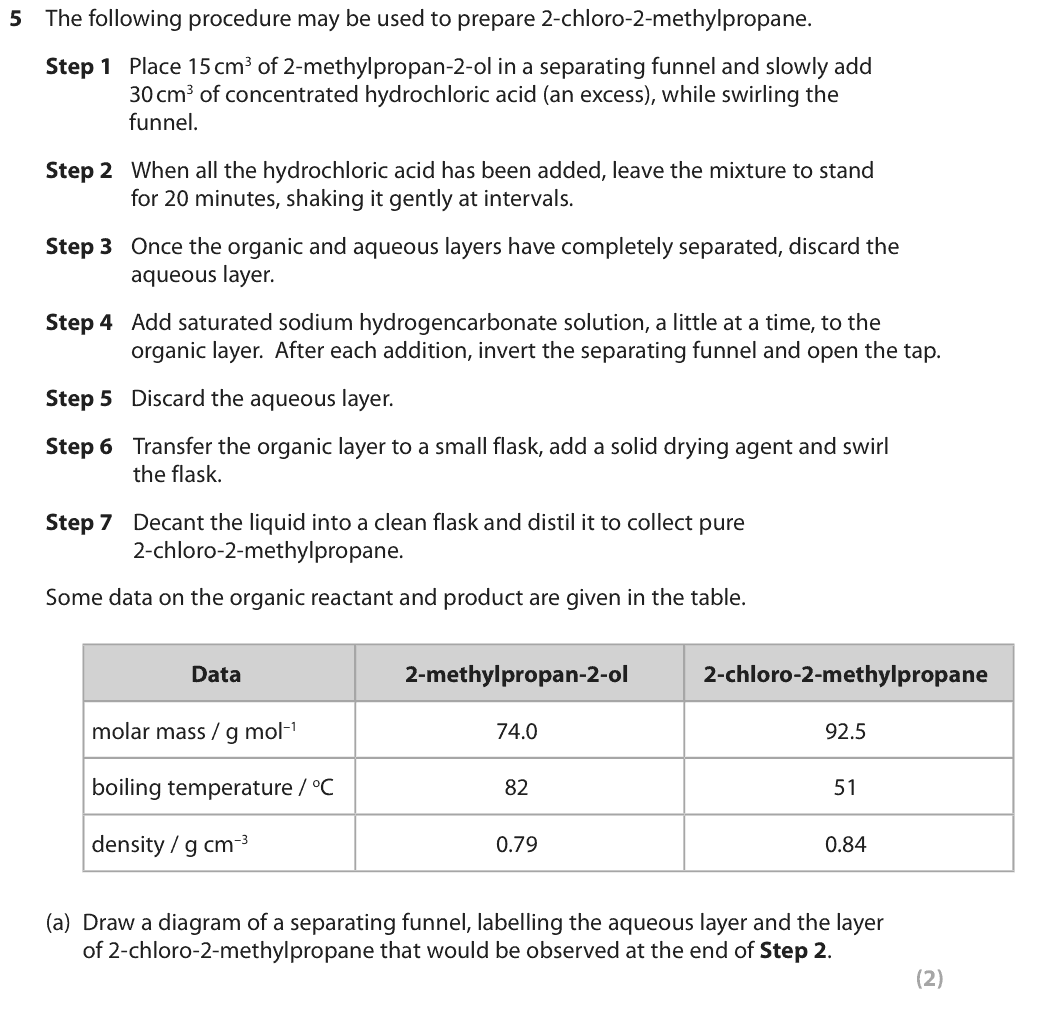
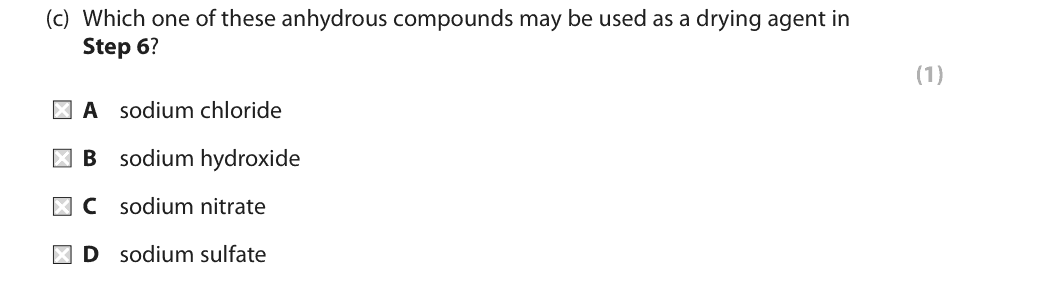
Multiple-choice questions

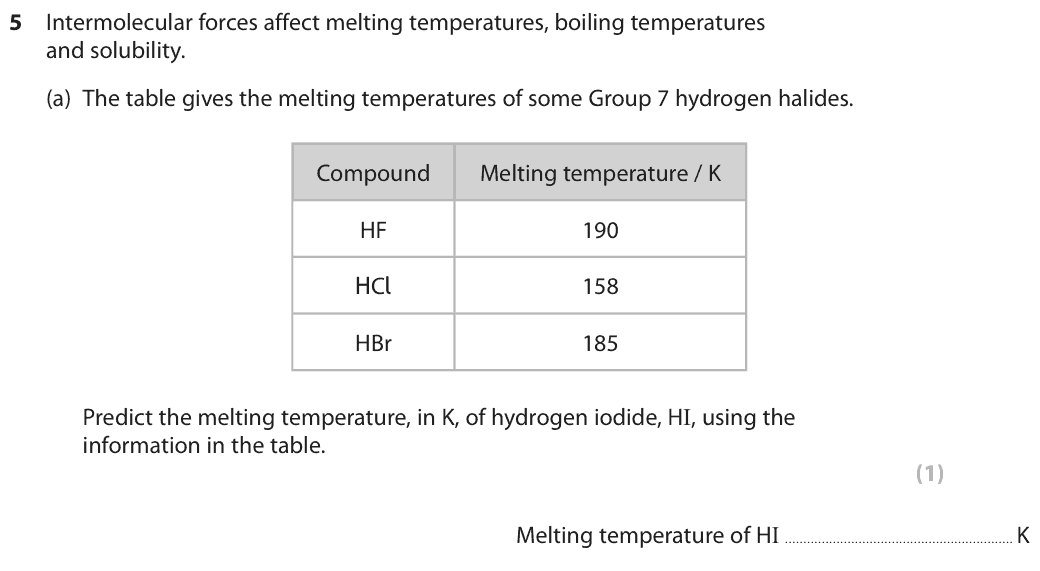
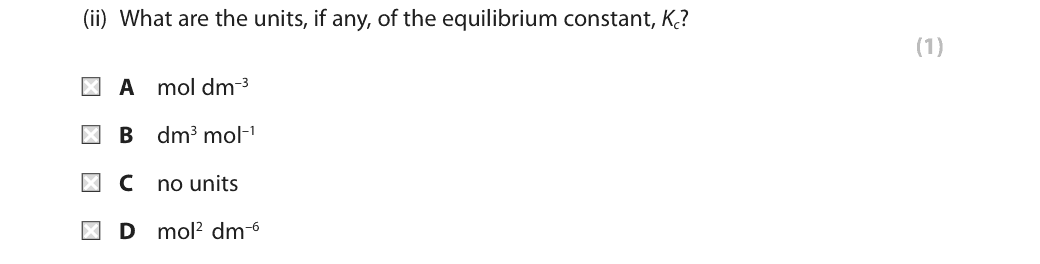
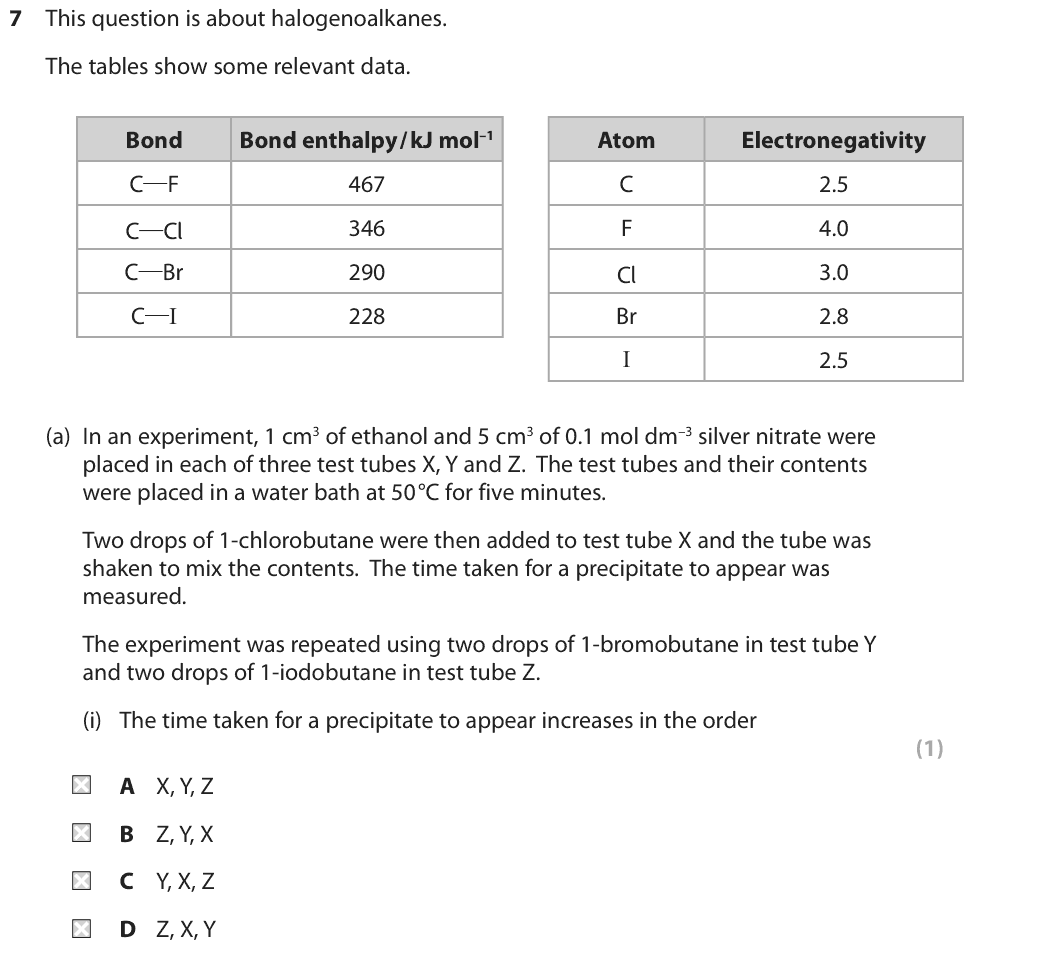
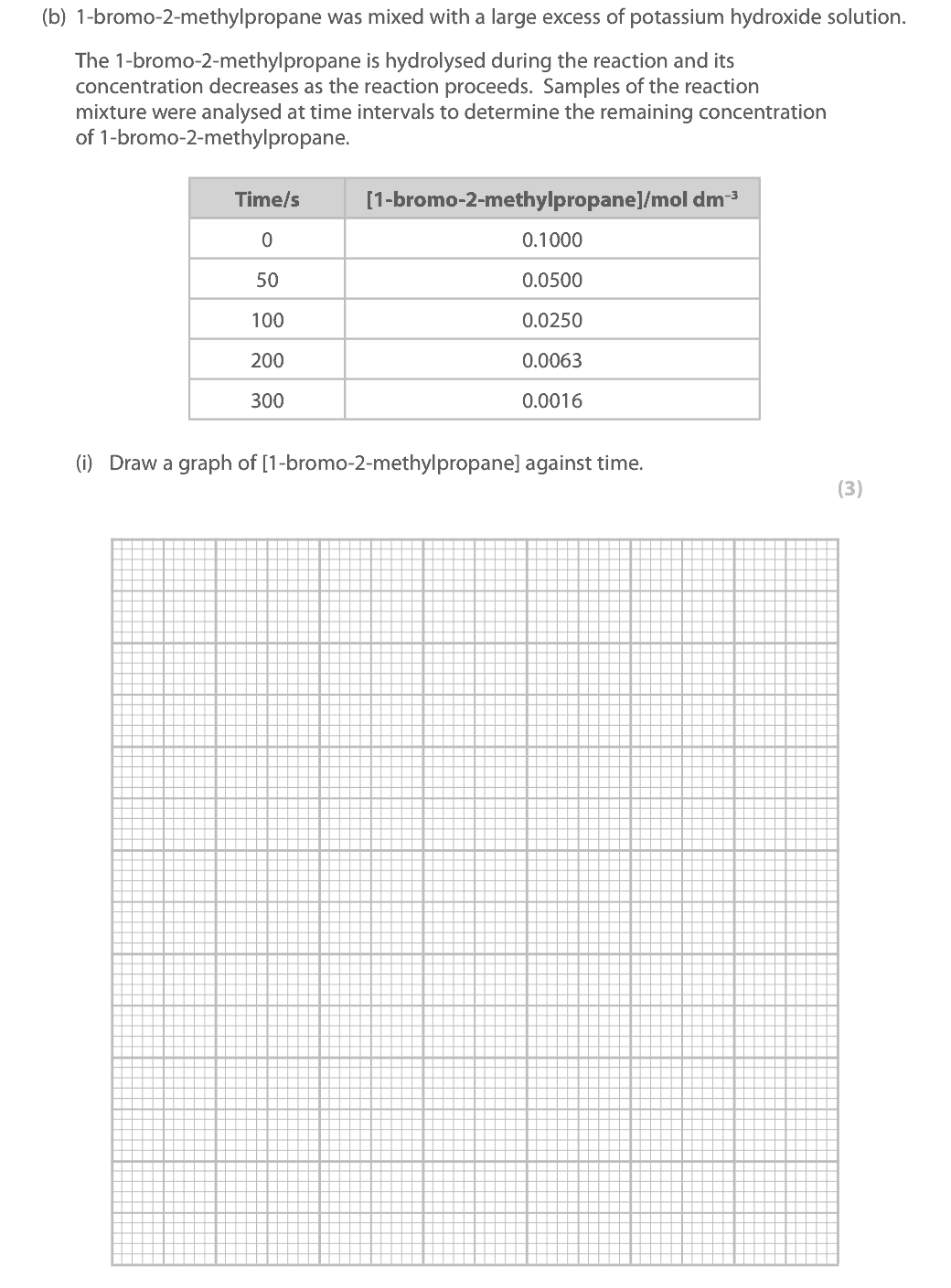
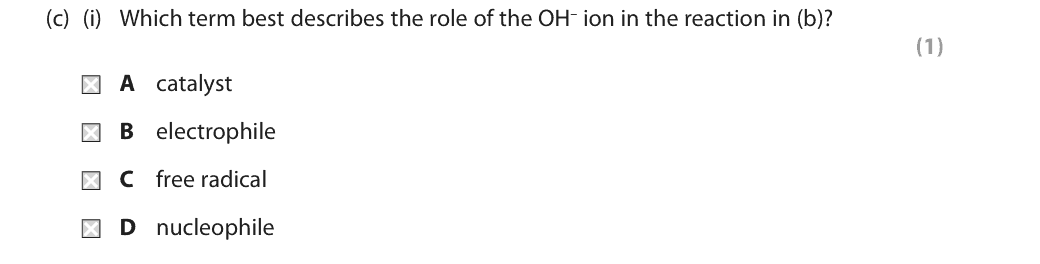
Every multiple-choice part, with the answer behind the button. Edexcel has no separate multiple-choice section: these one-mark parts are spread through the questions of every paper. Allow about a minute and a quarter each. 342 questions.

Other types: Calculation questions · Equation questions · Mechanism questions · Structure and diagram questions · Explanation questions · Six-mark extended-response questions · Practical questions · Short-answer questions

June 2025 · AS Paper 1 · Q1(a) 1 mark Multiple choice bonding
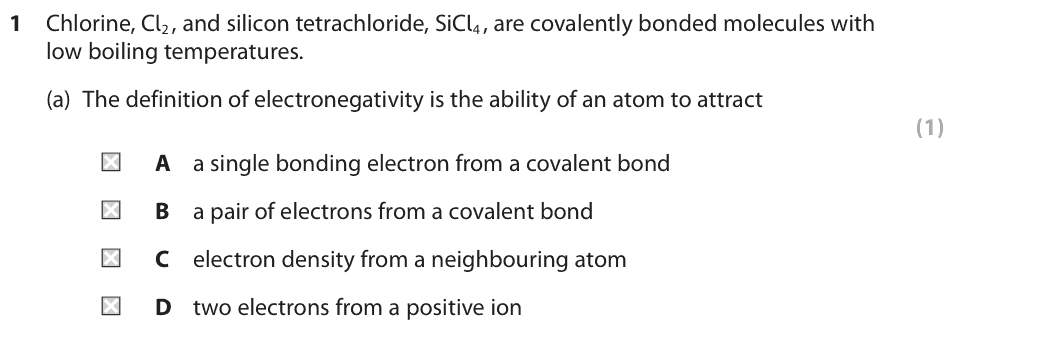
Chlorine, Cl2 , and silicon tetrachloride, SiCl4 , are covalently bonded molecules with
low boiling temperatures.
The definition of electronegativity is the ability of an atom to attract
A  a single bonding electron from a covalent bond
B  a pair of electrons from a covalent bond
C  electron density from a neighbouring atom
D  two electrons from a positive ion
June 2025 · AS Paper 1 · Q2(b)(iv) 1 mark Multiple choice bonding
Earlier parts of question 2 that this part usesEarlier part of June 2025 Paper 1 question 2Earlier part of June 2025 Paper 1 question 2
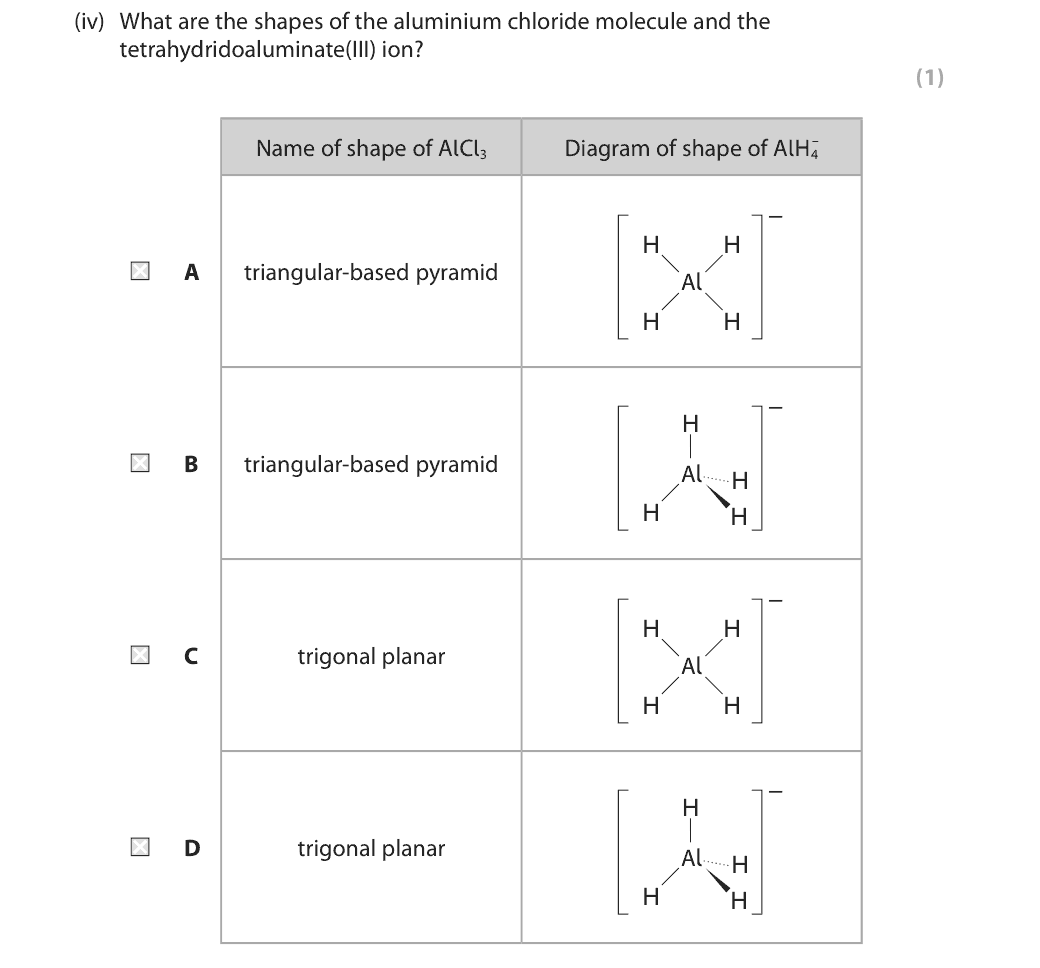
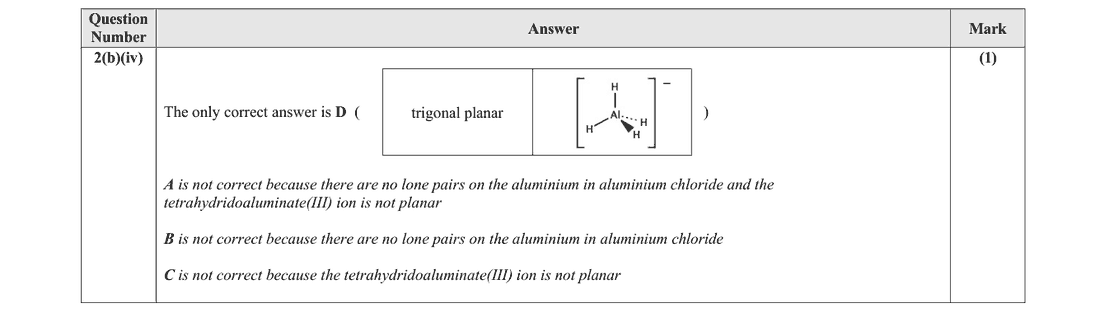
What are the shapes of the aluminium chloride molecule and the
tetrahydridoaluminate(III) ion?
Name of shape of AlCl3
Diagram of shape of AlH 4
–
–
H
H
A
triangular-based pyramid
Al
H
H
–
H
B
triangular-based pyramid
Al
H
H
H
–
H
H
C
trigonal planar
Al
H
H
–
H
D
trigonal planar
Al
H
H
H
June 2025 · AS Paper 1 · Q3(a) 1 mark Multiple choice bonding
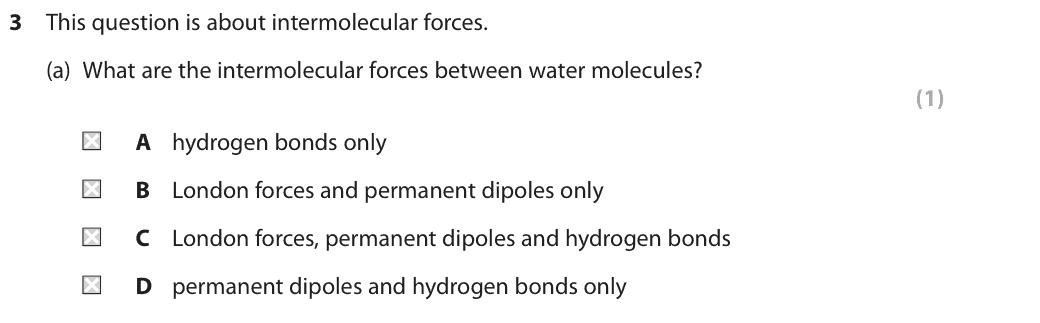
This question is about intermolecular forces.
What are the intermolecular forces between water molecules?
A  hydrogen bonds only
B  London forces and permanent dipoles only
C  London forces, permanent dipoles and hydrogen bonds
D  permanent dipoles and hydrogen bonds only
June 2025 · AS Paper 1 · Q3(b) 1 mark Multiple choice bonding
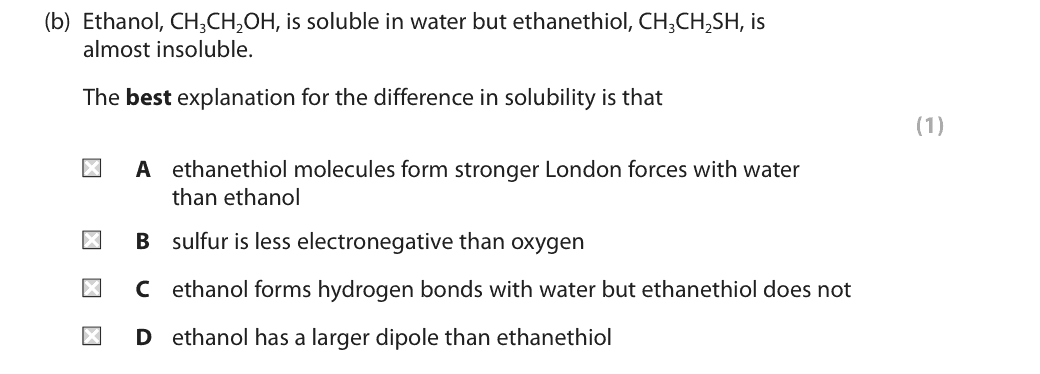
Ethanol, CH3CH2OH, is soluble in water but ethanethiol, CH3CH2SH, is
almost insoluble.
The best explanation for the difference in solubility is that
A  ethanethiol molecules form stronger London forces with water
than ethanol
B  sulfur is less electronegative than oxygen
C  ethanol forms hydrogen bonds with water but ethanethiol does not
D  ethanol has a larger dipole than ethanethiol
June 2025 · AS Paper 1 · Q4(b)(iii) 1 mark Multiple choice formulae equations and amounts of substance
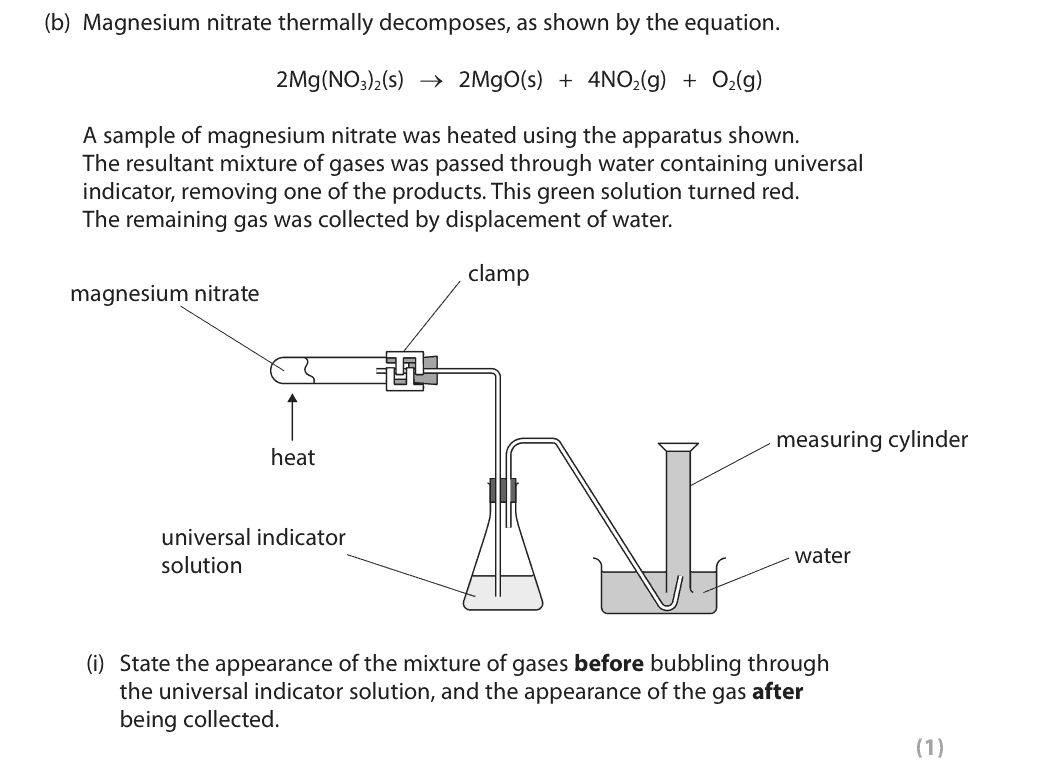
Earlier parts of question 4 that this part usesEarlier part of June 2025 Paper 1 question 4Earlier part of June 2025 Paper 1 question 4
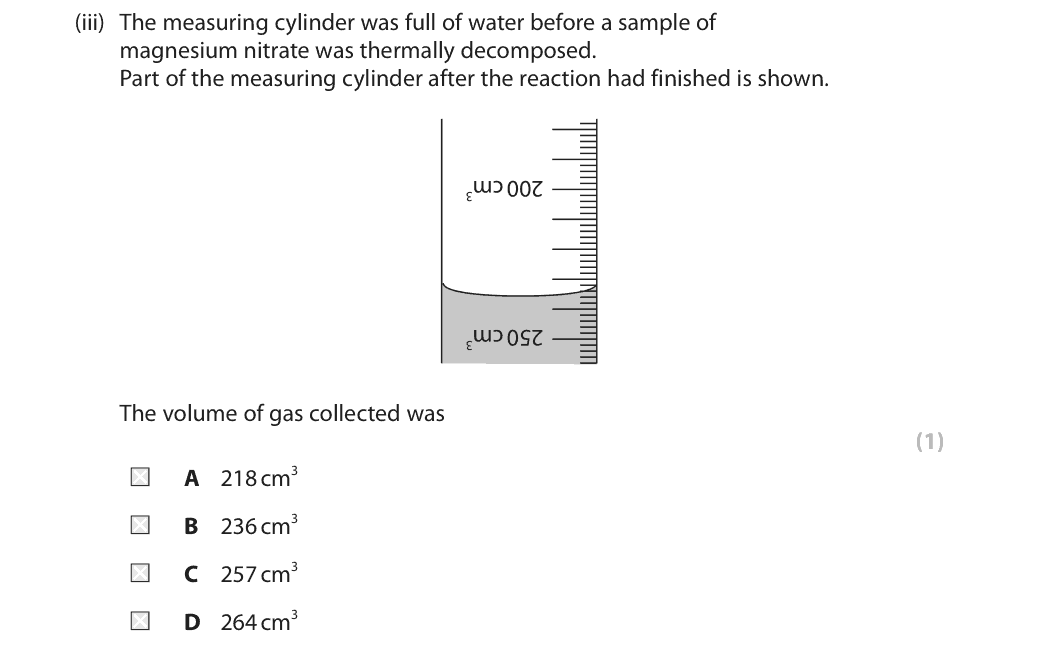
The measuring cylinder was full of water before a sample of
magnesium nitrate was thermally decomposed.
Part of the measuring cylinder after the reaction had finished is shown.
The volume of gas collected was
A  218 cm3
B  236 cm3
C  257 cm3
D  264 cm3
June 2025 · AS Paper 1 · Q6(b) 1 mark Multiple choice redox i
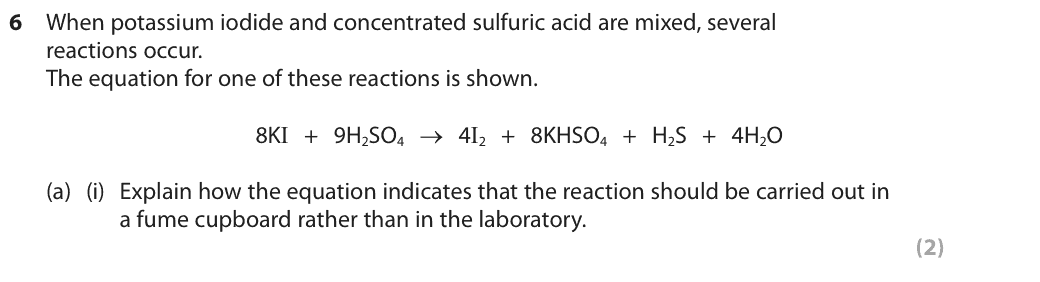
Earlier part of question 6 that this part usesEarlier part of June 2025 Paper 1 question 6
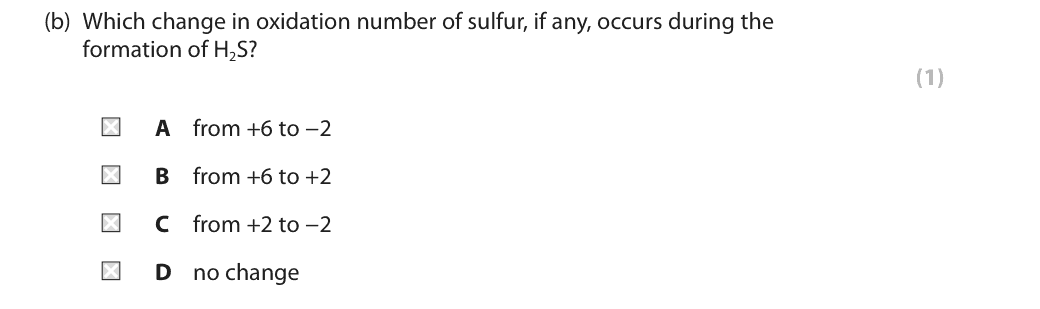
Which change in oxidation number of sulfur, if any, occurs during the
formation of H2S?
A  from +6 to −2
B  from +6 to +2
C  from +2 to −2
D  no change
June 2025 · AS Paper 1 · Q7(b) 1 mark Multiple choice atomic structure and the periodic table
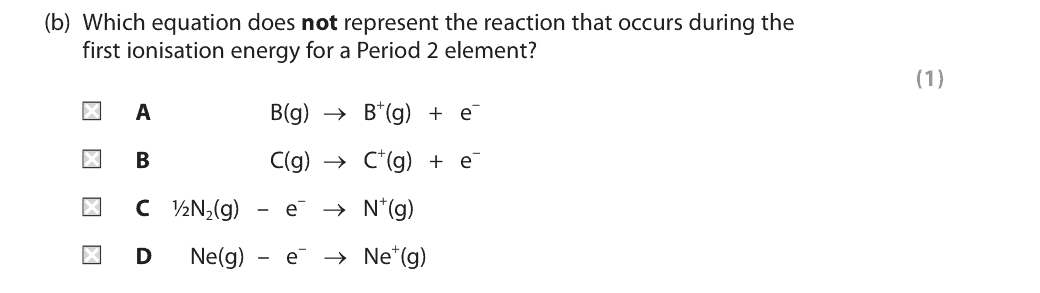
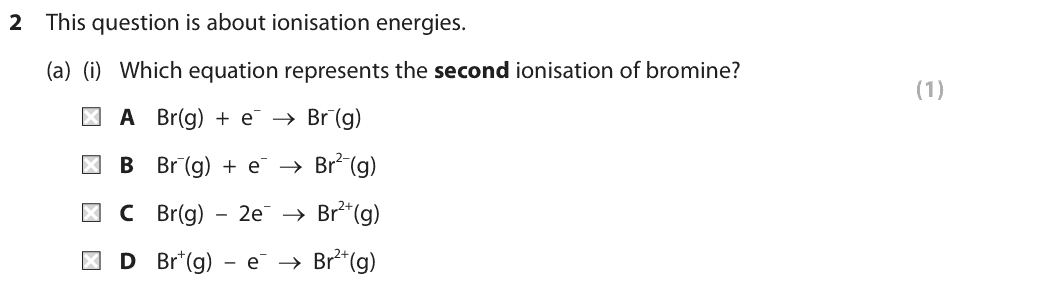
Which equation does not represent the reaction that occurs during the
first ionisation energy for a Period 2 element?
A
B(g)  →   B+(g)   +   e−
B
C(g)  →   C+(g)  +   e−
C  ½N2(g)   –   e−   →   N+(g)
D  . Ne(g)  –   e−   →   Ne+(g)
June 2025 · AS Paper 1 · Q7(c) 1 mark Multiple choice bonding
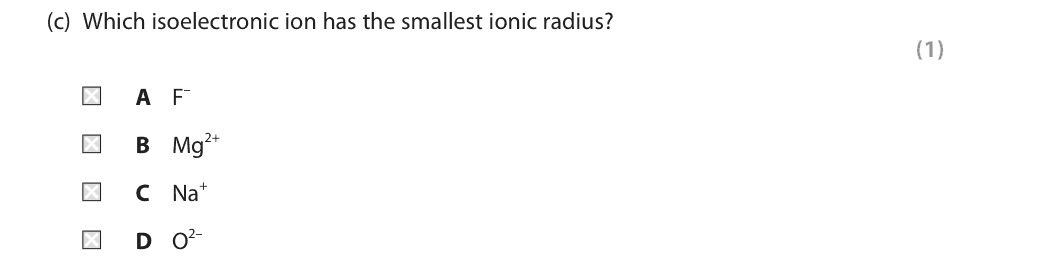
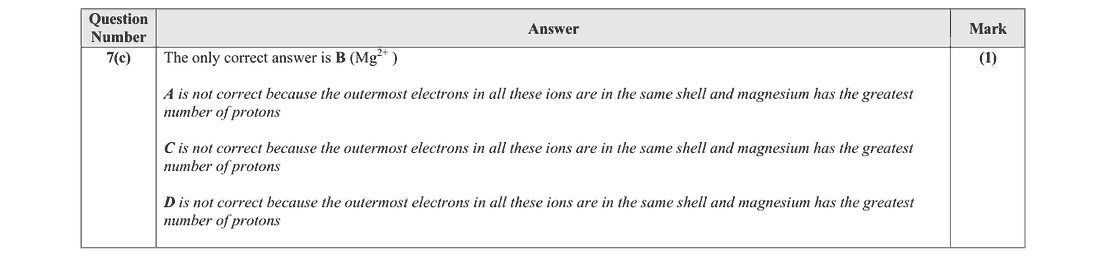
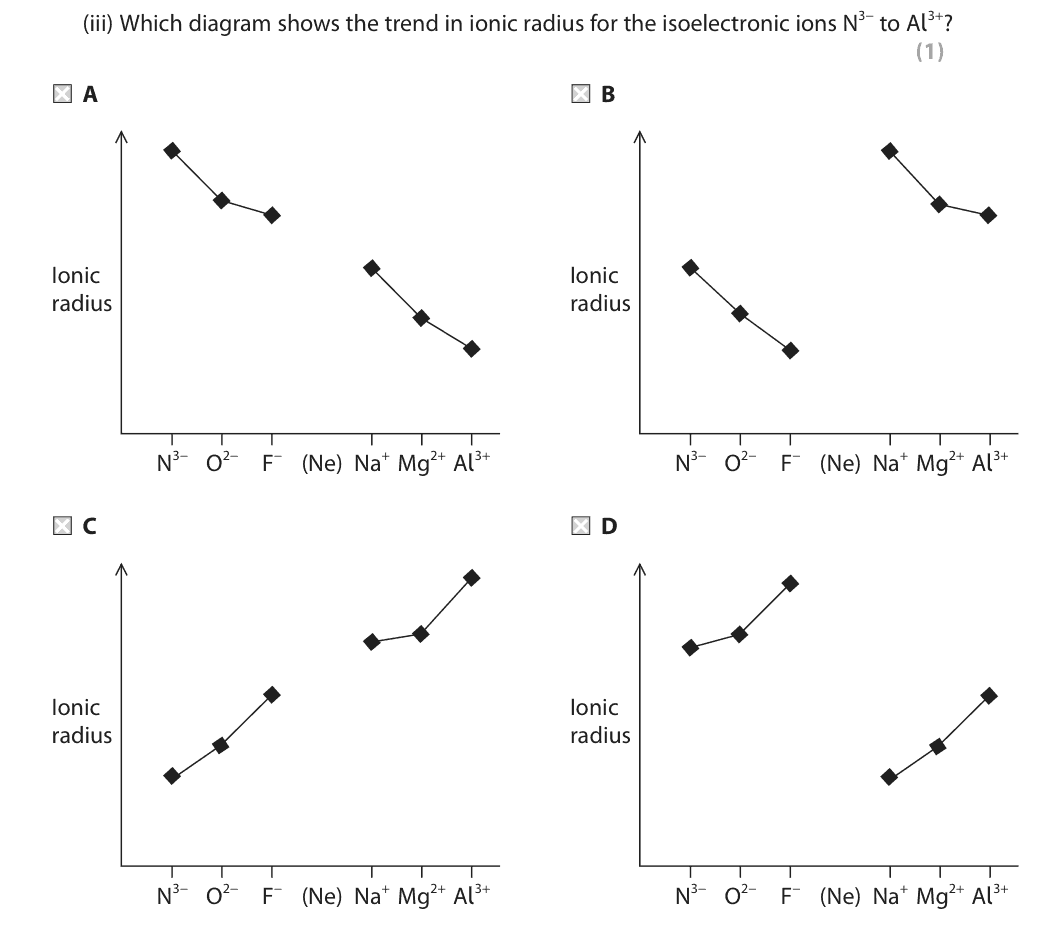
Which isoelectronic ion has the smallest ionic radius?
A  F–
B  Mg2+
C  Na+
D  O2–
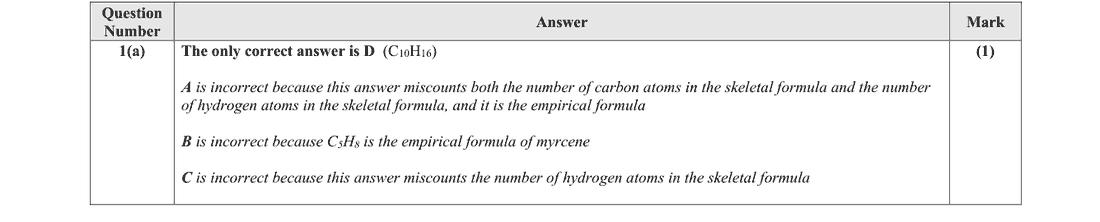
June 2025 · AS Paper 2 · Q1(a) 1 mark Multiple choice introduction to organic chemistry
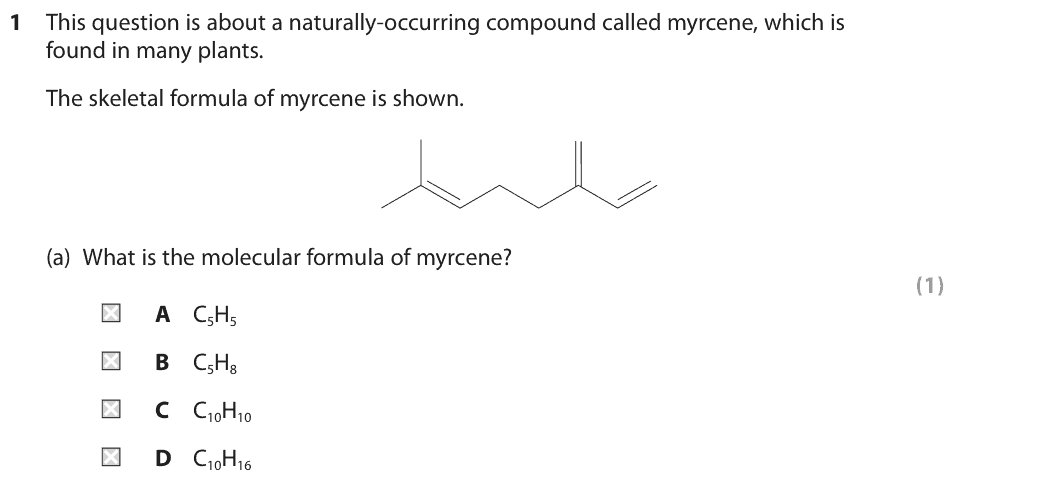
This question is about a naturally‑occurring compound called myrcene, which is
found in many plants.
The skeletal formula of myrcene is shown.
What is the molecular formula of myrcene?
A  C5H5
B  C5H8
C  C10H10
D  C10H16
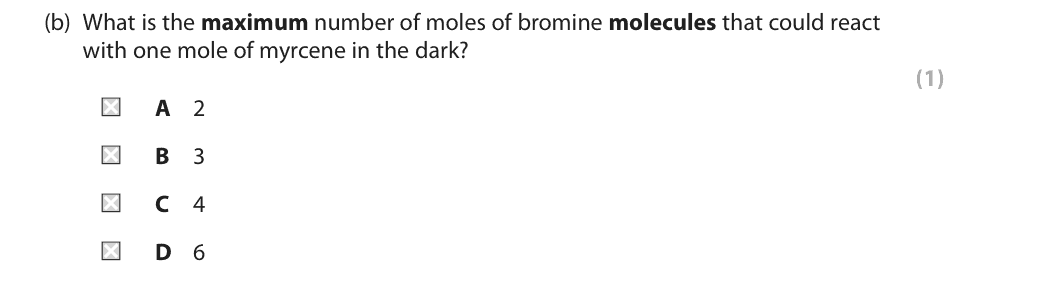
June 2025 · AS Paper 2 · Q1(b) 1 mark Multiple choice alkenes
Earlier part of question 1 that this part usesEarlier part of June 2025 Paper 2 question 1
What is the maximum number of moles of bromine molecules that could react
with one mole of myrcene in the dark?
A  2
B  3
C  4
D  6
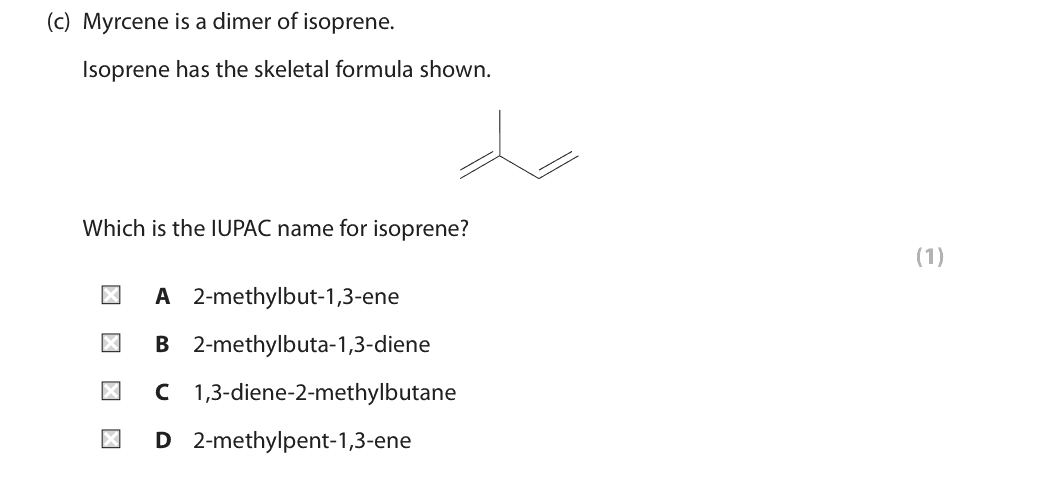
June 2025 · AS Paper 2 · Q1(c) 1 mark Multiple choice introduction to organic chemistry
Earlier part of question 1 that this part usesEarlier part of June 2025 Paper 2 question 1
Myrcene is a dimer of isoprene.
Isoprene has the skeletal formula shown.
Which is the IUPAC name for isoprene?
A  2‑methylbut‑1,3‑ene
B  2‑methylbuta‑1,3‑diene
C  1,3‑diene‑2‑methylbutane
D  2‑methylpent‑1,3‑ene
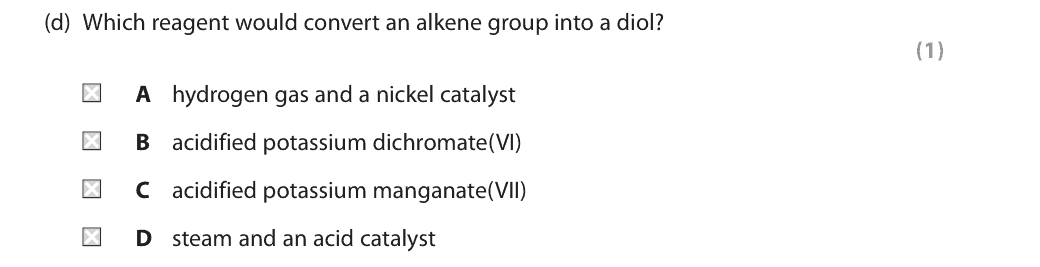
June 2025 · AS Paper 2 · Q1(d) 1 mark Multiple choice alkenes
Earlier part of question 1 that this part usesEarlier part of June 2025 Paper 2 question 1
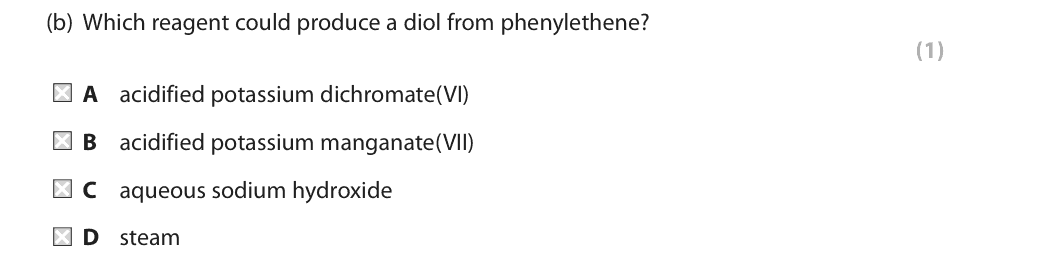
Which reagent would convert an alkene group into a diol?
A  hydrogen gas and a nickel catalyst
B  acidified potassium dichromate(VI)
C  acidified potassium manganate(VII)
D  steam and an acid catalyst
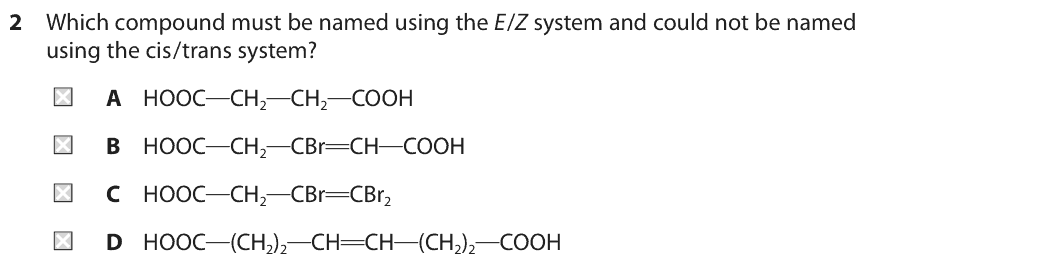
June 2025 · AS Paper 2 · Q2 1 mark Multiple choice introduction to organic chemistry
Which compound must be named using the E/Z system and could not be named
using the cis/trans system?
A  HOOC
CH2
CH2
COOH
B  HOOC
CH2
CBr
CH
COOH
C  HOOC
CH2
CBr
CBr2
D  HOOC
(CH2)2
CH
CH
(CH2)2
COOH
June 2025 · AS Paper 2 · Q6(a) 1 mark Multiple choice alcohols
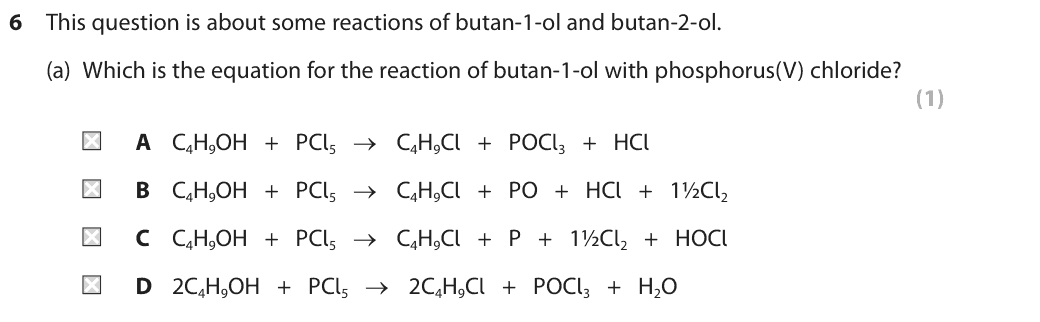
This question is about some reactions of butan‑1‑ol and butan‑2‑ol.
Which is the equation for the reaction of butan‑1‑ol with phosphorus(V) chloride?
A  C4H9OH   +   PCl5   →   C4H9Cl   +   POCl3   +   HCl
B  C4H9OH   +   PCl5   →   C4H9Cl   +   PO   +   HCl   +   1½Cl2
C  C4H9OH   +   PCl5   →   C4H9Cl   +   P   +   1½Cl2   +   HOCl
D  2C4H9OH   +   PCl5   →   2C4H9Cl   +   POCl3   +   H2O
June 2025 · AS Paper 2 · Q8(a)(i) 1 mark Multiple choice equilibrium i
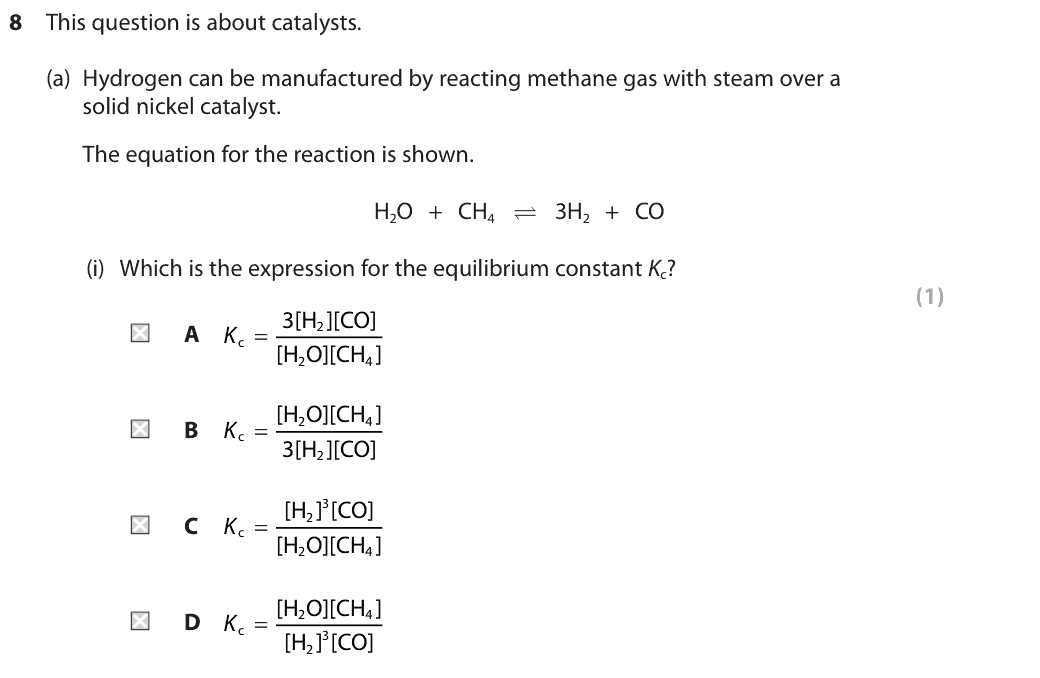
This question is about catalysts.
Hydrogen can be manufactured by reacting methane gas with steam over a
solid nickel catalyst.
The equation for the reaction is shown.
H2O   +   CH4      3H2   +   CO
Which is the expression for the equilibrium constant Kc?
A  Kc = 3[H ][CO]
2
[H O][CH ]
2
4
Kc = [H O][CH ]
B
2
4
3[H ][CO]
2
Kc = [H ] [CO]
3
C
2
[H O][CH ]
2
4
D  Kc = [H O][CH ]
2
4
[H ] [CO]
3
2
June 2025 · AS Paper 2 · Q8(a)(ii) 1 mark Multiple choice kinetics i
Earlier part of question 8 that this part usesEarlier part of June 2025 Paper 2 question 8
The use of an industrial catalyst reduces the time for 1 tonne of product to be
made from 4 hours to 1 hour.
How many more tonnes of product can be produced in an 8-hour period?
A  2
B  4
C  6
D  8
June 2025 · Paper 1 · Q2(d) 1 mark Multiple choice atomic structure and the periodic table
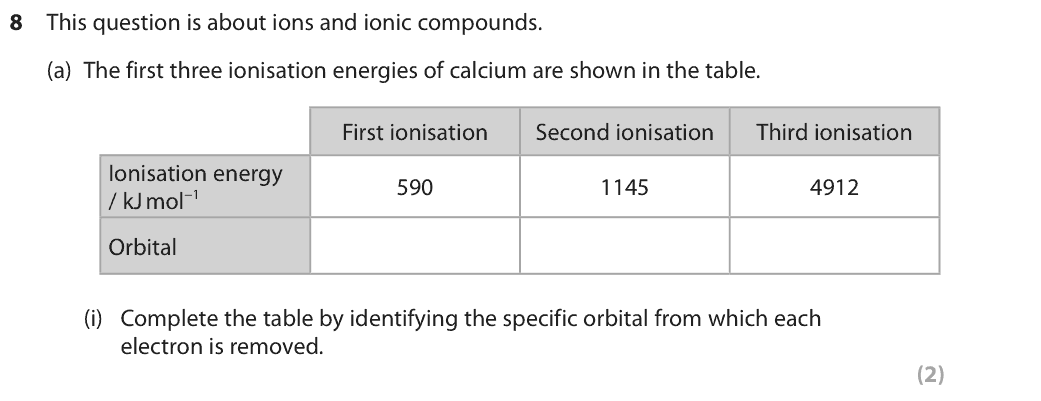
Which orbital is an electron removed from during the second ionisation
of calcium?
A  3s
B  3p
C  4s
D  4p
June 2025 · Paper 1 · Q2(e) 1 mark Multiple choice bonding
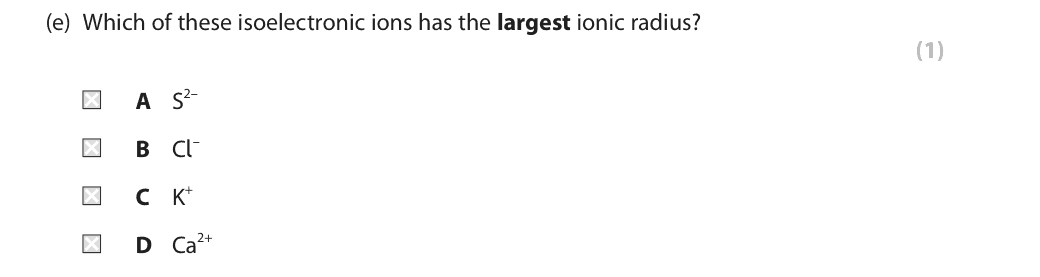
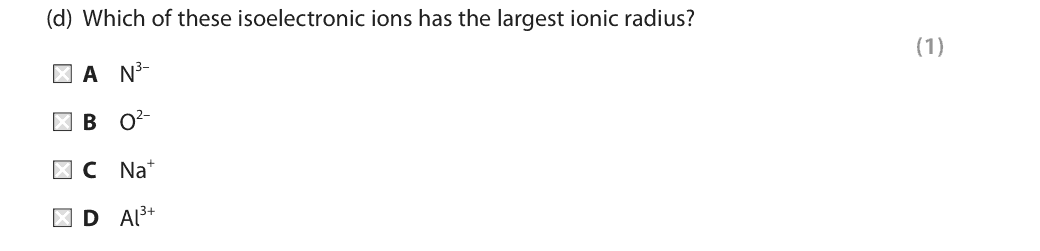
Which of these isoelectronic ions has the largest ionic radius?
A  S2–
B  Cl–
C  K+
D  Ca2+
June 2025 · Paper 1 · Q4(b)(ii) 1 mark Multiple choice equilibrium ii
Earlier parts of question 4 that this part usesEarlier part of June 2025 Paper 1 question 4Earlier part of June 2025 Paper 1 question 4
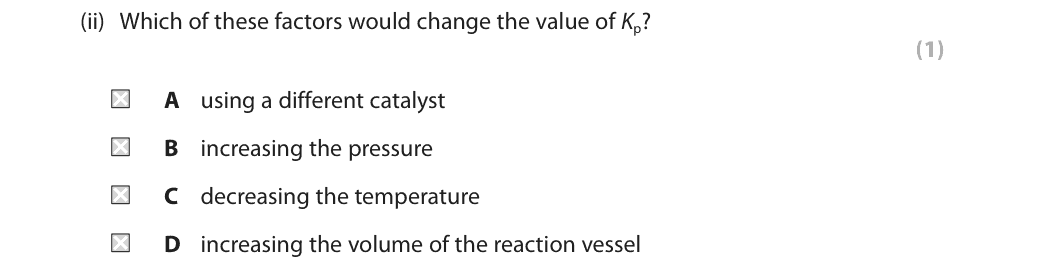
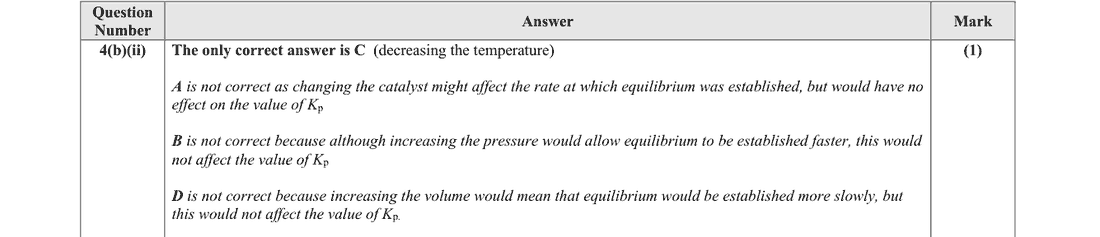
Which of these factors would change the value of Kp?
A  using a different catalyst
B  increasing the pressure
C  decreasing the temperature
D  increasing the volume of the reaction vessel
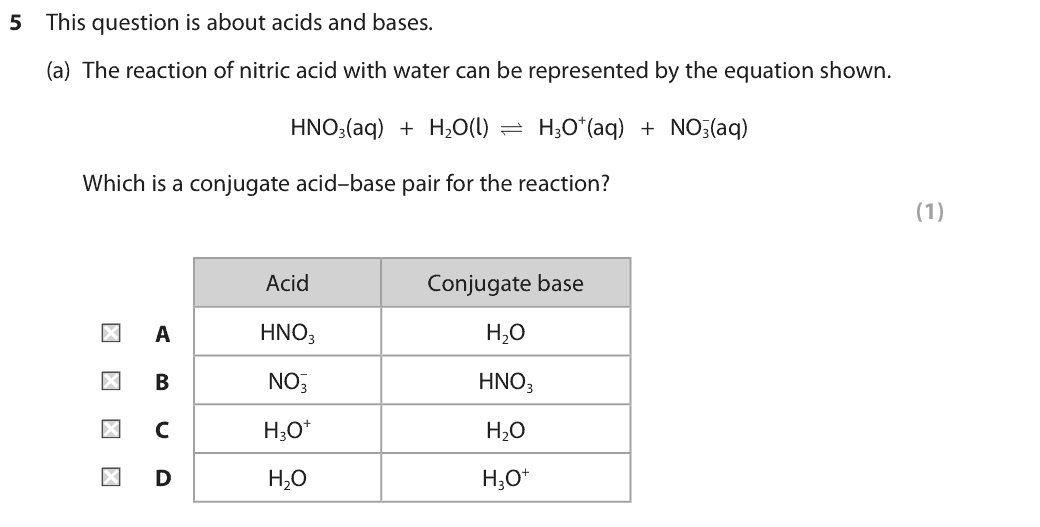
June 2025 · Paper 1 · Q5(a) 1 mark Multiple choice acid base equilibria
This question is about acids and bases.
The reaction of nitric acid with water can be represented by the equation shown.
HNO3(aq)   +   H2O(l)     H3O+(aq)   +   NO3
–(aq)
Which is a conjugate acid–base pair for the reaction?
Acid
Conjugate base
A
HNO3
H2O
B
NO3
–
HNO3
C
H3O+
H2O
D
H2O
H3O+
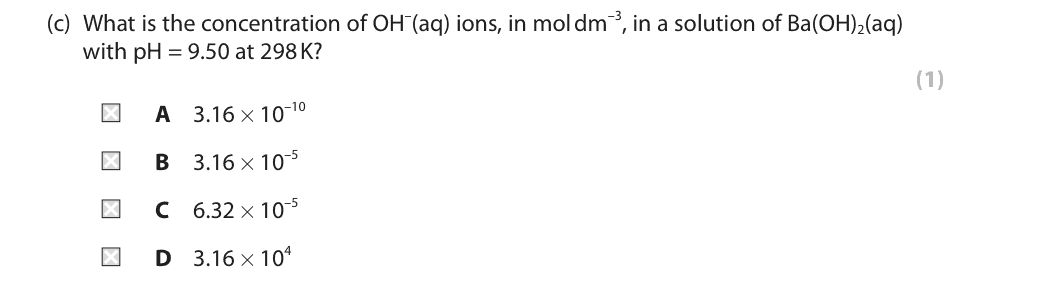
June 2025 · Paper 1 · Q5(c) 1 mark Multiple choice acid base equilibria
What is the concentration of OH–(aq) ions, in mol dm–3, in a solution of Ba(OH)2(aq)
with pH = 9.50 at 298 K?
A  3.16 × 10–10
B  3.16 × 10–5
C  6.32 × 10–5
D  3.16 × 104
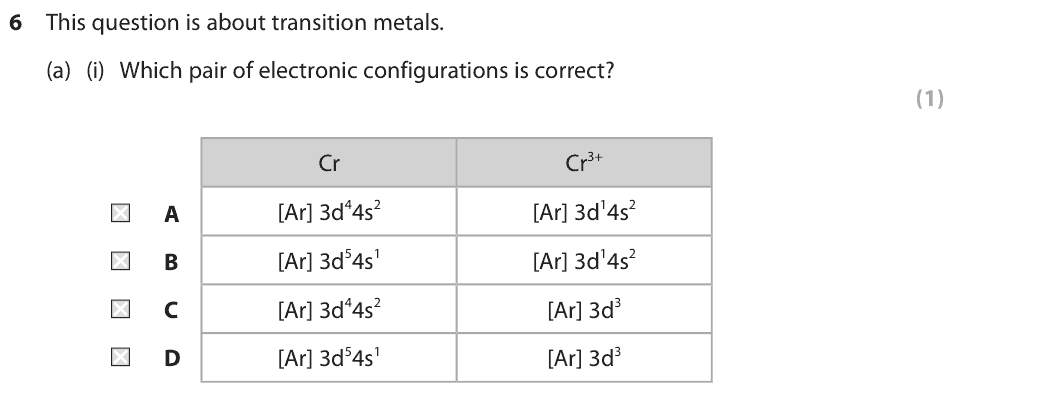
June 2025 · Paper 1 · Q6(a)(i) 1 mark Multiple choice transition metals principles
This question is about transition metals.
Which pair of electronic configurations is correct?
Cr3+
Cr
A
[Ar] 3d44s2
[Ar] 3d14s2
B
[Ar] 3d54s1
[Ar] 3d14s2
C
[Ar] 3d44s2
[Ar] 3d3
D
[Ar] 3d54s1
[Ar] 3d3
June 2025 · Paper 1 · Q6(f)(iii) 1 mark Multiple choice redox ii
Earlier part of question 6 that this part usesEarlier part of June 2025 Paper 1 question 6
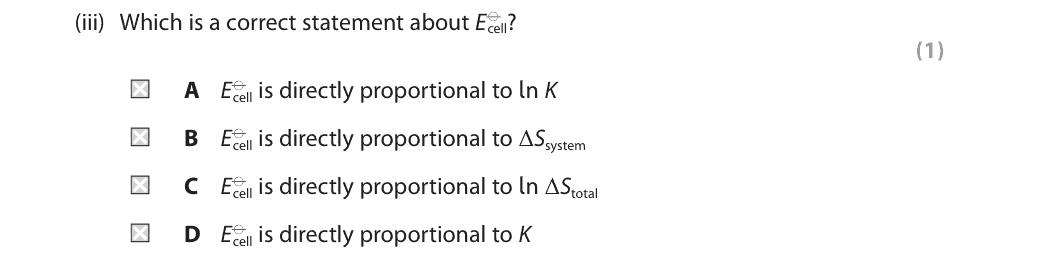
Which is a correct statement about Ed
cell?
A  Ed
cell is directly proportional to ln K
B  Ed
cell is directly proportional to ΔSsystem
C  Ed
cell is directly proportional to ln ΔStotal
D  Ed
cell is directly proportional to K
June 2025 · Paper 1 · Q7(a) 1 mark Multiple choice lattice energy
This question is about lattice energy.
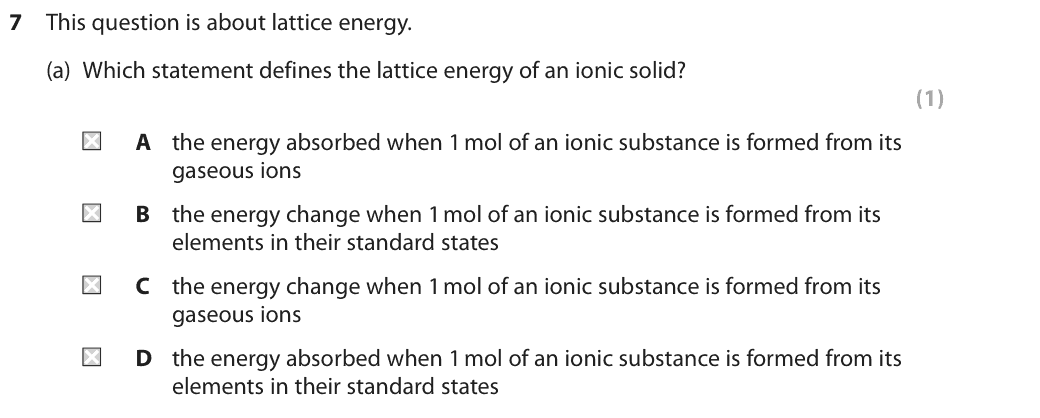
Which statement defines the lattice energy of an ionic solid?
A  the energy absorbed when 1 mol of an ionic substance is formed from its
gaseous ions
B  the energy change when 1 mol of an ionic substance is formed from its
elements in their standard states
C  the energy change when 1 mol of an ionic substance is formed from its
gaseous ions
D  the energy absorbed when 1 mol of an ionic substance is formed from its
elements in their standard states
June 2025 · Paper 1 · Q7(b) 1 mark Multiple choice lattice energy
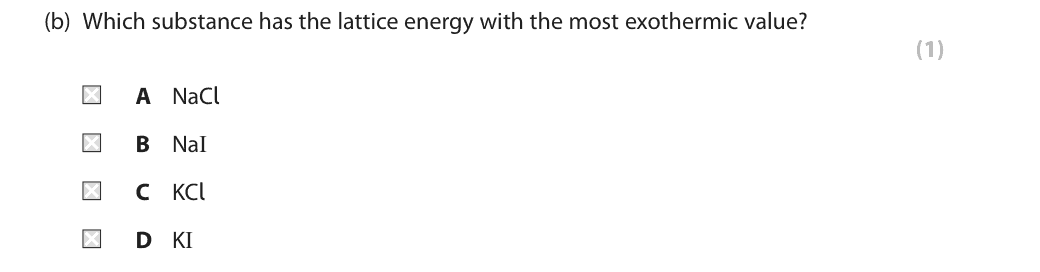
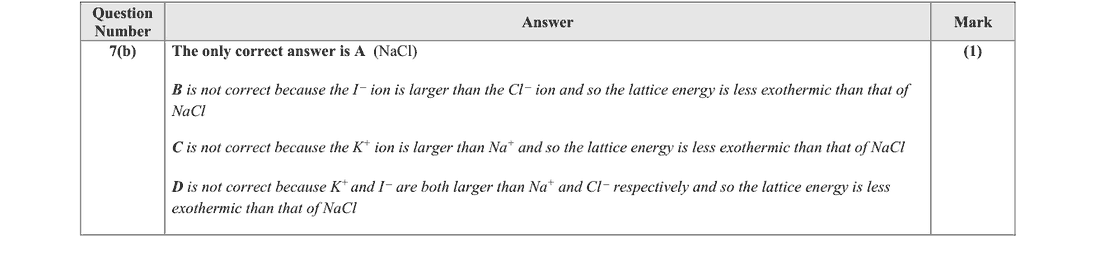
Which substance has the lattice energy with the most exothermic value?
A  NaCl
B  NaI
C  KCl
D  KI
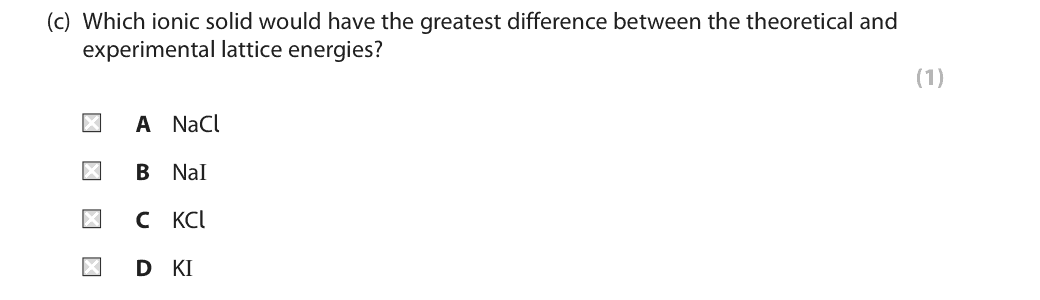
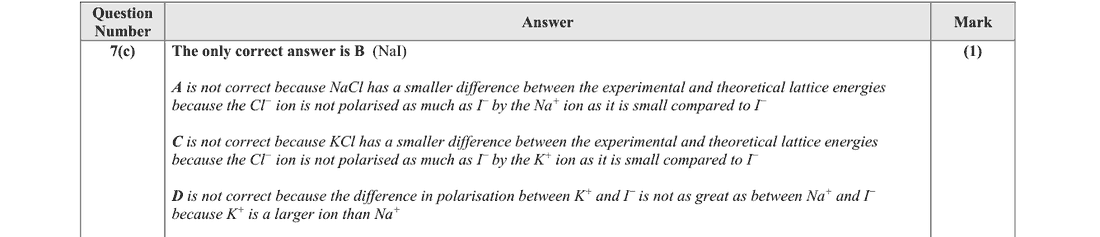
June 2025 · Paper 1 · Q7(c) 1 mark Multiple choice lattice energy
Which ionic solid would have the greatest difference between the theoretical and
experimental lattice energies?
A  NaCl
B  NaI
C  KCl
D  KI
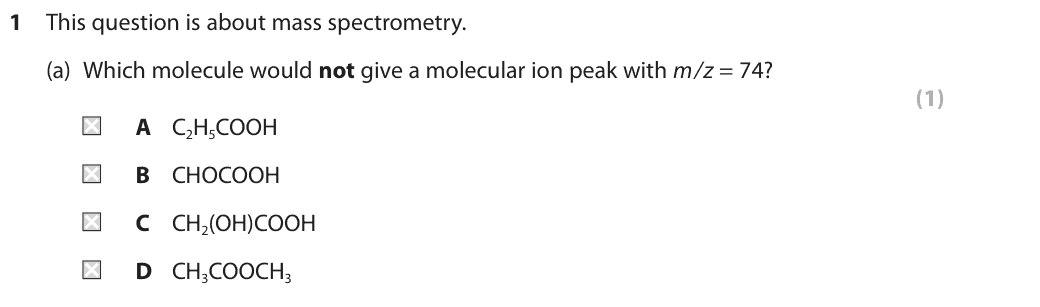
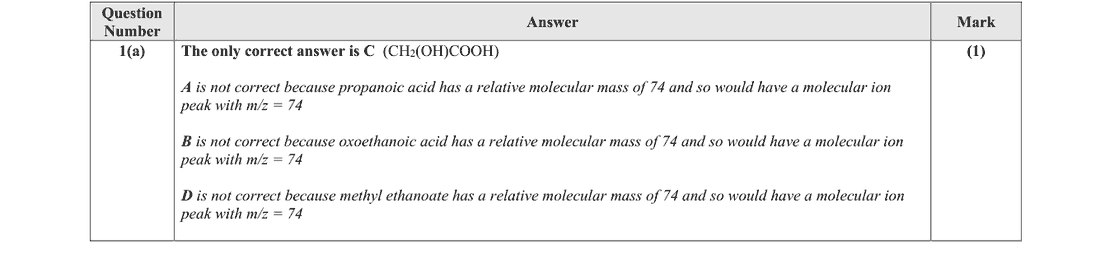
June 2025 · Paper 2 · Q1(a) 1 mark Multiple choice mass spectrometry and infrared spectroscopy
This question is about mass spectrometry.
Which molecule would not give a molecular ion peak with m/z = 74?
A  C2H5COOH
B  CHOCOOH
C  CH2(OH)COOH
D  CH3COOCH3
June 2025 · Paper 2 · Q1(b) 1 mark Multiple choice mass spectrometry and infrared spectroscopy
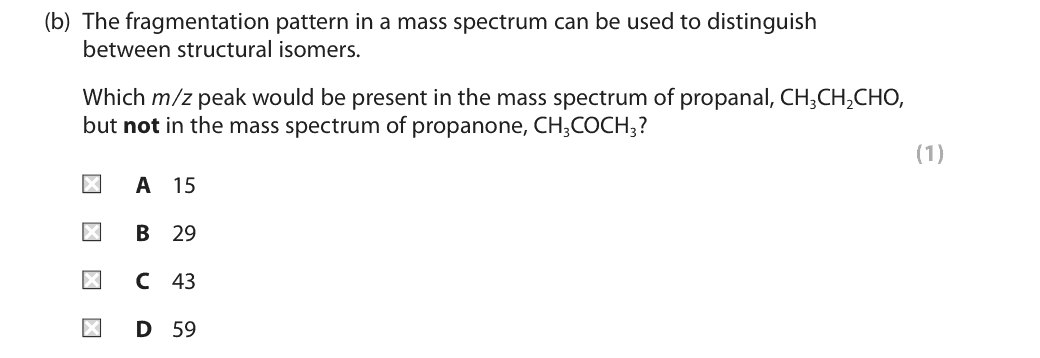
The fragmentation pattern in a mass spectrum can be used to distinguish
between structural isomers.
Which m/z peak would be present in the mass spectrum of propanal, CH3CH2CHO,
but not in the mass spectrum of propanone, CH3COCH3?
A  15
B  29
C  43
D  59
June 2025 · Paper 2 · Q2(a) 1 mark Multiple choice bonding
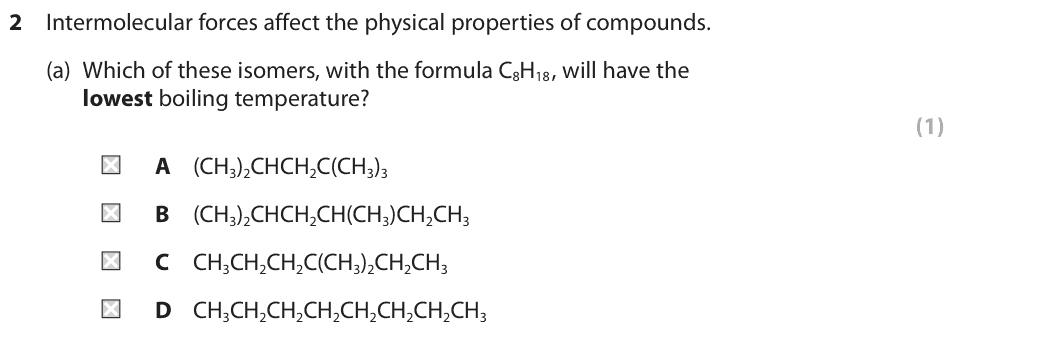
Intermolecular forces affect the physical properties of compounds.
Which of these isomers, with the formula C8H18, will have the
lowest boiling temperature?
A  (CH3)2CHCH2C(CH3)3
B  (CH3)2CHCH2CH(CH3)CH2CH3
C  CH3CH2CH2C(CH3)2CH2CH3
D  CH3CH2CH2CH2CH2CH2CH2CH3
June 2025 · Paper 2 · Q2(c) 1 mark Multiple choice bonding
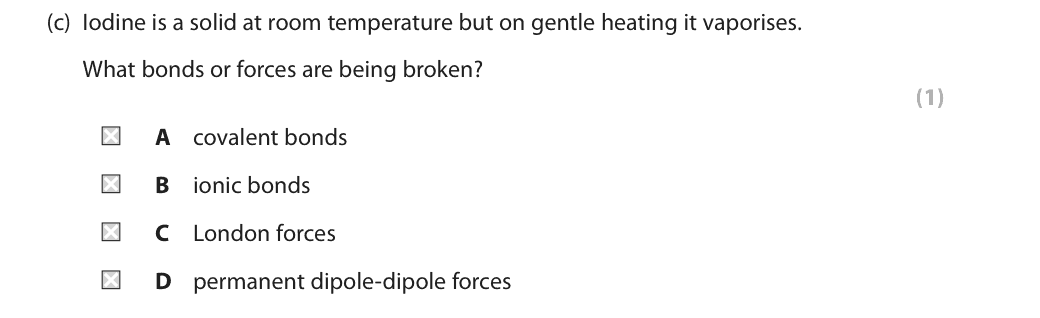
Iodine is a solid at room temperature but on gentle heating it vaporises.
What bonds or forces are being broken?
A  covalent bonds
B  ionic bonds
C  London forces
D  permanent dipole‑dipole forces
June 2025 · Paper 2 · Q3(a) 1 mark Multiple choice formulae equations and amounts of substance
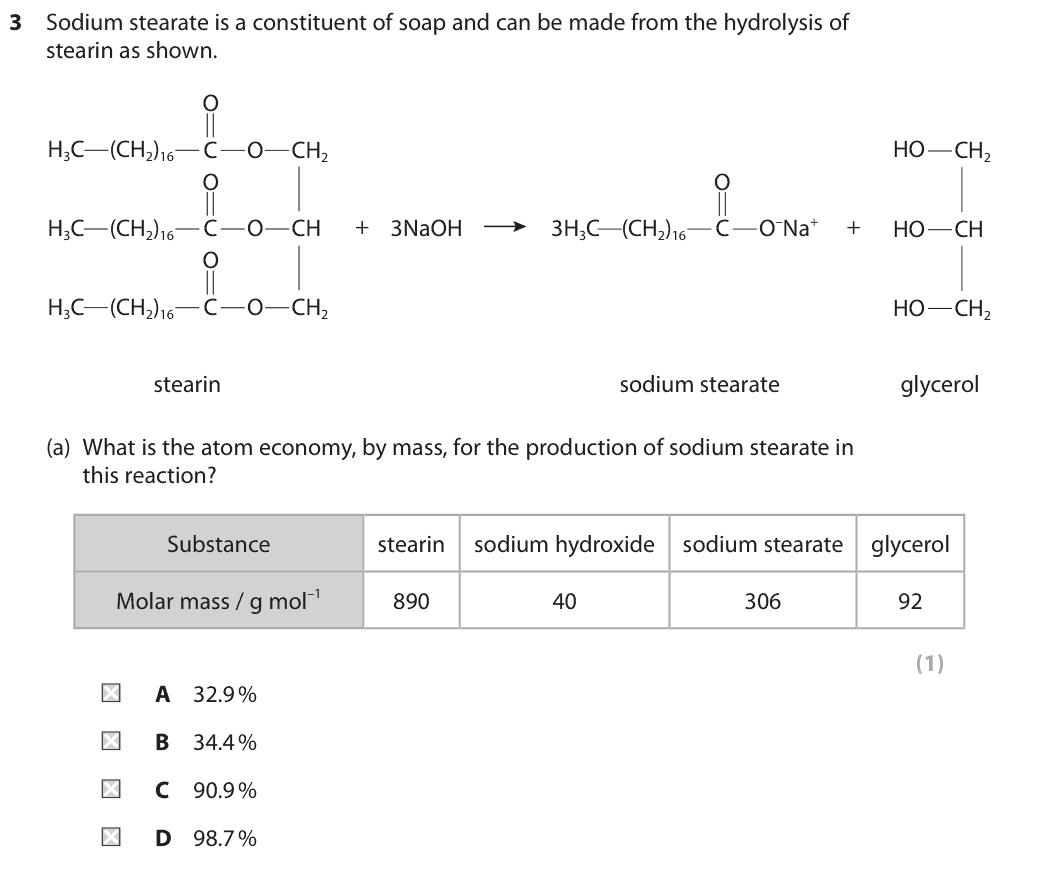
Sodium stearate is a constituent of soap and can be made from the hydrolysis of
stearin as shown.
O
H3C
(CH2)16
C
O
CH2
HO
CH2
O
O
H3C
(CH2)16
C
O
CH
+
3NaOH
3H3C
(CH2)16
C
O–Na+
+
HO
CH
O
(CH2)16
H3C
C
O
CH2
HO
CH2
stearin
sodium stearate
glycerol
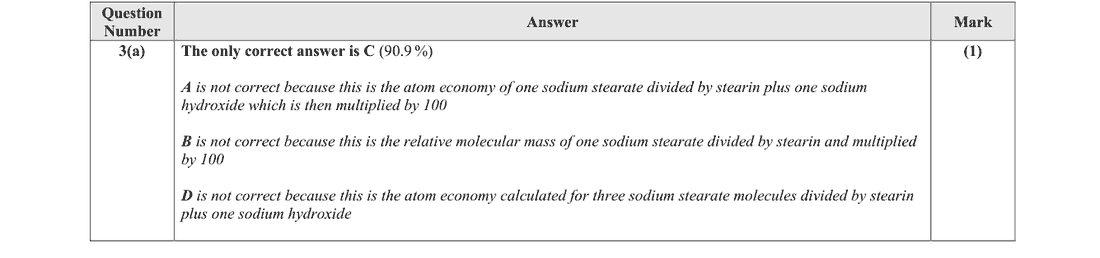
What is the atom economy, by mass, for the production of sodium stearate in
this reaction?
Substance
stearin
sodium hydroxide
sodium stearate
glycerol
Molar mass / g mol–1
890
40
306
92
A  32.9 %
B  34.4 %
C  90.9 %
D  98.7 %
June 2025 · Paper 2 · Q3(b) 1 mark Multiple choice introduction to organic chemistry
Earlier part of question 3 that this part usesEarlier part of June 2025 Paper 2 question 3
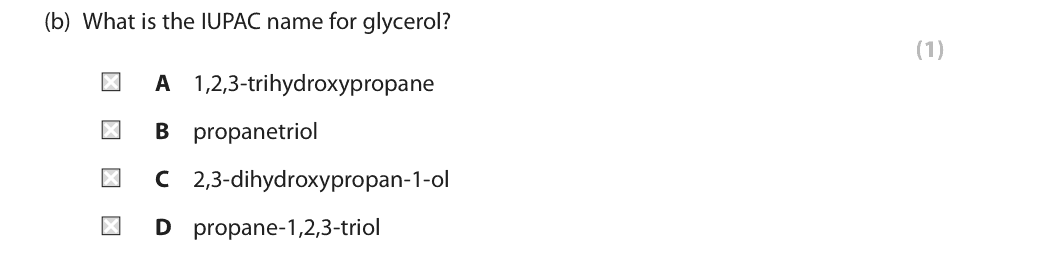
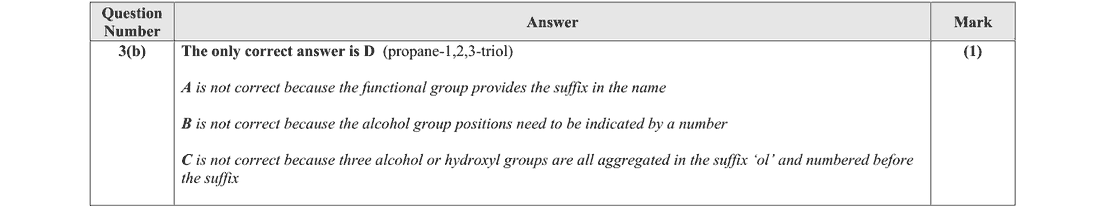
What is the IUPAC name for glycerol?
A  1,2,3‑trihydroxypropane
B  propanetriol
C  2,3‑dihydroxypropan‑1‑ol
D  propane‑1,2,3‑triol
June 2025 · Paper 2 · Q4(c) 1 mark Multiple choice alkenes
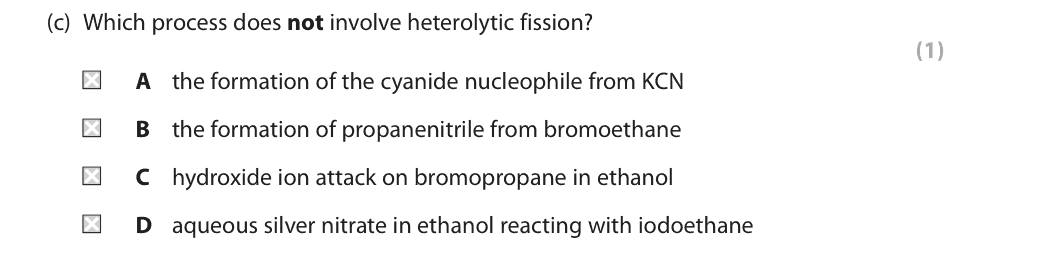
Which process does not involve heterolytic fission?
A  the formation of the cyanide nucleophile from KCN
B  the formation of propanenitrile from bromoethane
C  hydroxide ion attack on bromopropane in ethanol
D  aqueous silver nitrate in ethanol reacting with iodoethane
June 2025 · Paper 2 · Q6(b)(i) 1 mark Multiple choice carbonyl compounds
Earlier part of question 6 that this part usesEarlier part of June 2025 Paper 2 question 6
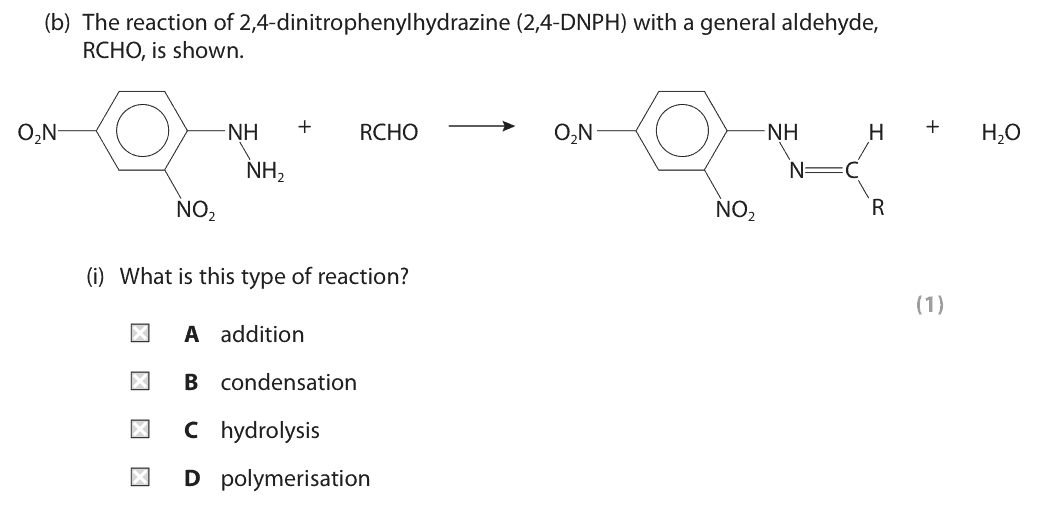
The reaction of 2,4‑dinitrophenylhydrazine (2,4‑DNPH) with a general aldehyde,
RCHO, is shown.
+
+
O2N
NH
RCHO
O2N
NH
H
H2O
NH2
N
C
NO2
NO2
R
What is this type of reaction?
A  addition
B  condensation
C  hydrolysis
D  polymerisation
June 2025 · Paper 2 · Q8(d) 1 mark Multiple choice alkenes
Earlier part of question 8 that this part usesEarlier part of June 2025 Paper 2 question 8
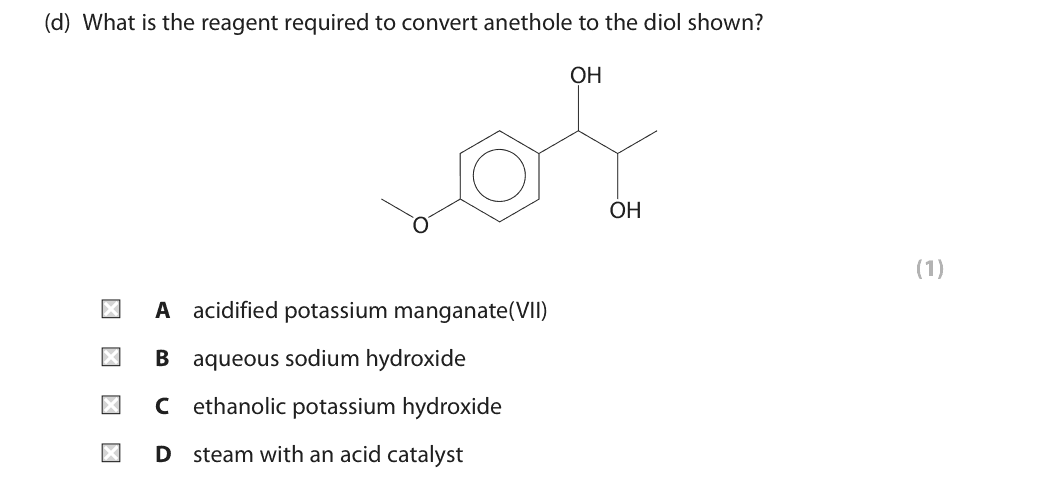
What is the reagent required to convert anethole to the diol shown?
OH
OH
O
A  acidified potassium manganate(VII)
B  aqueous sodium hydroxide
C  ethanolic potassium hydroxide
D  steam with an acid catalyst
June 2025 · Paper 2 · Q8(g) 1 mark Multiple choice nmr mass spectrometry and chromatography
Earlier part of question 8 that this part usesEarlier part of June 2025 Paper 2 question 8
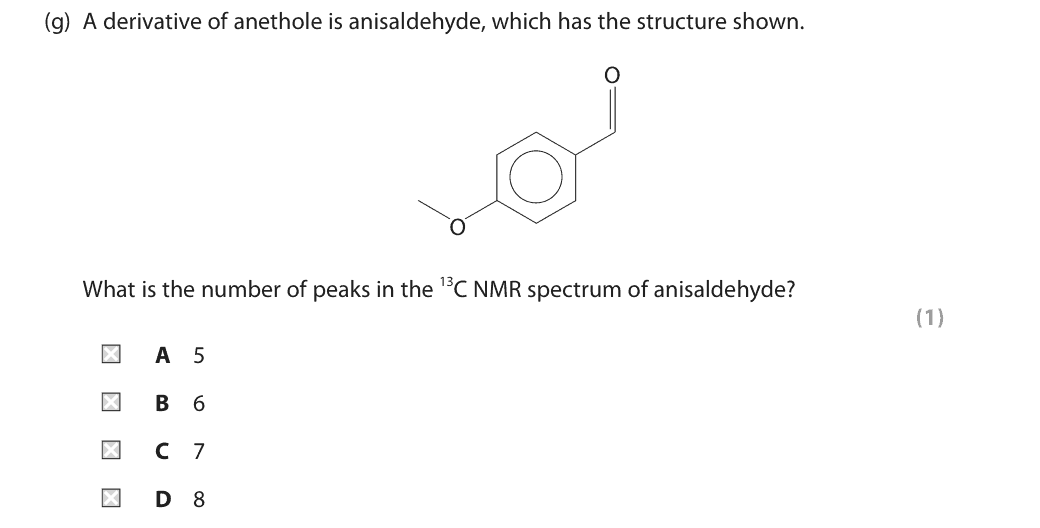
A derivative of anethole is anisaldehyde, which has the structure shown.
O
O
What is the number of peaks in the 13C NMR spectrum of anisaldehyde?
A  5
B  6
C  7
D  8
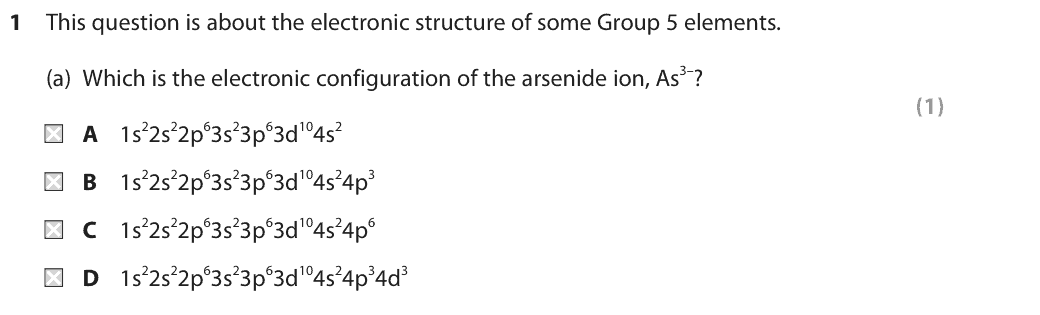
June 2024 · AS Paper 1 · Q1 1 mark Multiple choice atomic structure and the periodic table
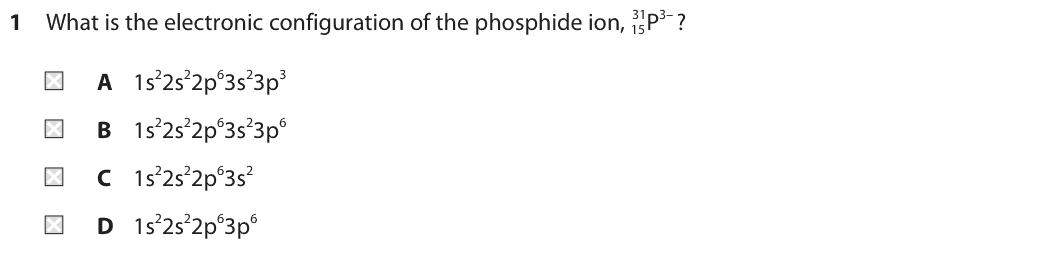
What is the electronic configuration of the phosphide ion, 15
31P3– ?
A  1s22s22p63s23p3
B  1s22s22p63s23p6
C  1s22s22p63s2
D  1s22s22p63p6
June 2024 · AS Paper 1 · Q2 1 mark Multiple choice atomic structure and the periodic table
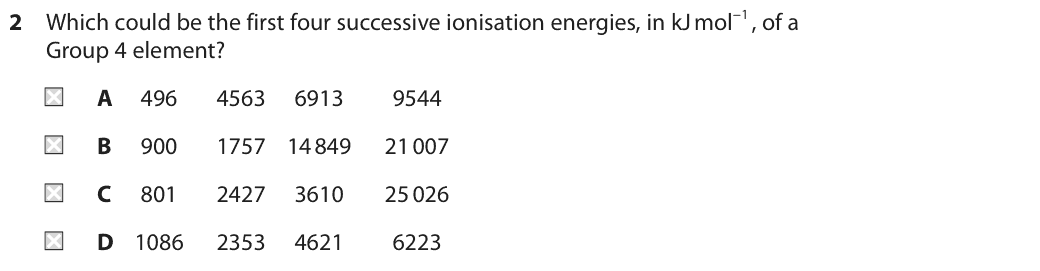
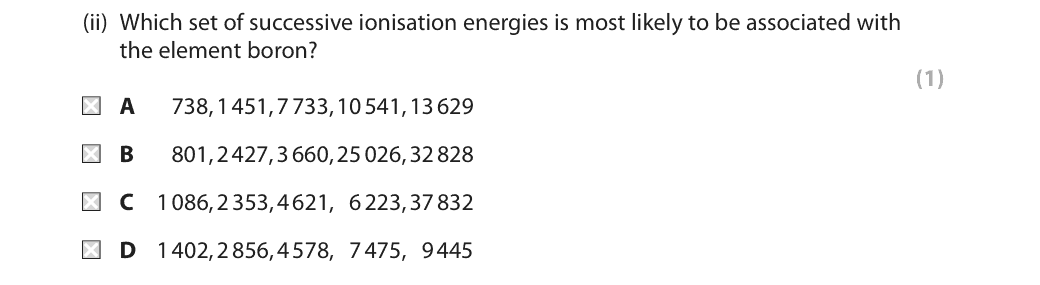
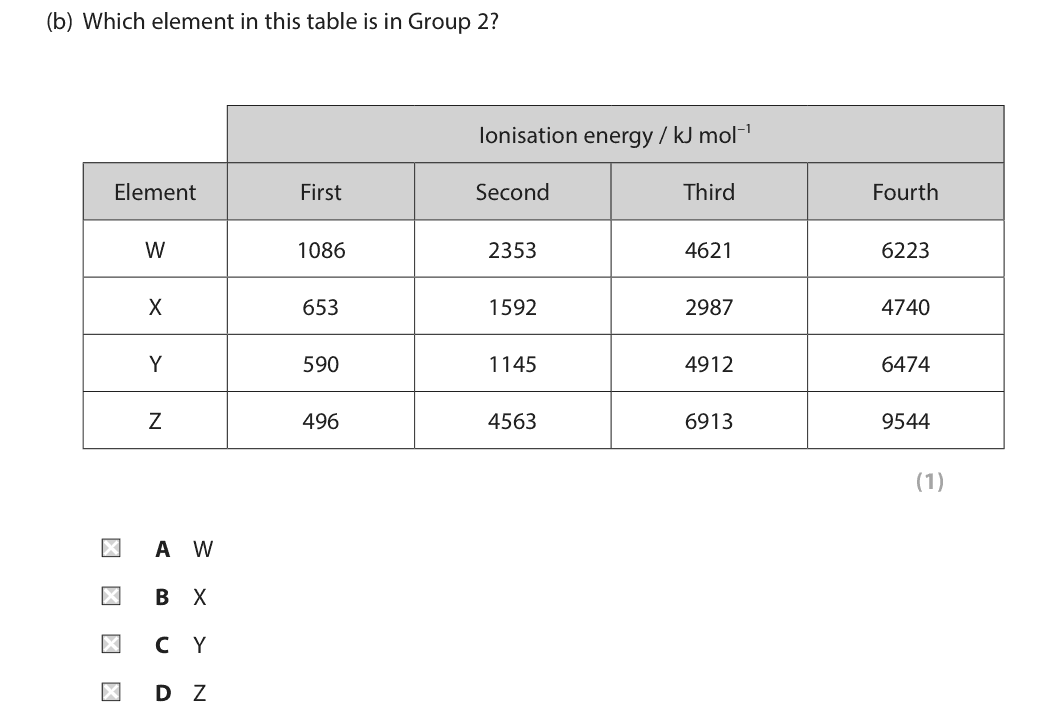
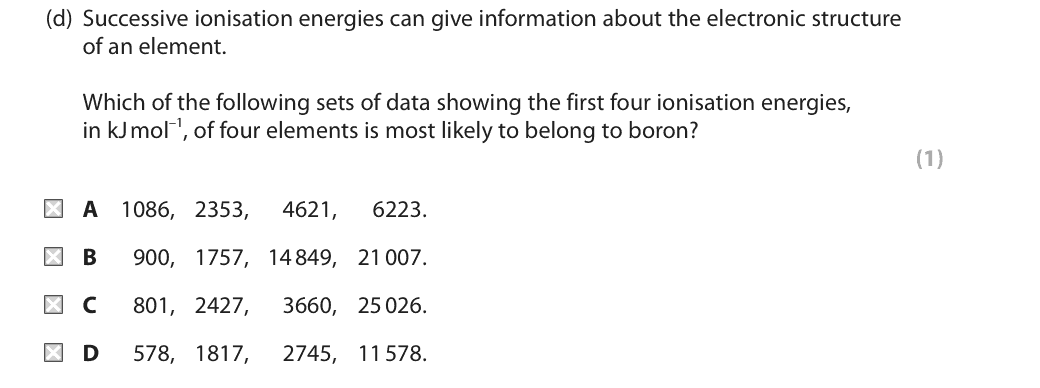
Which could be the first four successive ionisation energies, in kJ mol−1 , of a
Group 4 element?
A
496
4563
6913
9544
B
900
1757  14 849
21 007
C
801
2427
3610
25 026
D  1086
2353
4621
6223
June 2024 · AS Paper 1 · Q3 1 mark Multiple choice atomic structure and the periodic table
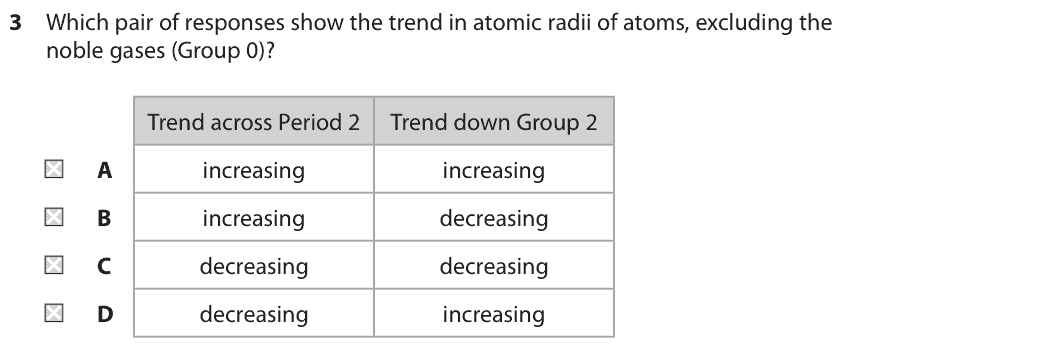
Which pair of responses show the trend in atomic radii of atoms, excluding the
noble gases (Group 0)?
Trend across Period 2
Trend down Group 2
A
increasing
increasing
B
increasing
decreasing
C
decreasing
decreasing
D
decreasing
increasing
June 2024 · AS Paper 1 · Q5(d) 1 mark Multiple choice bonding
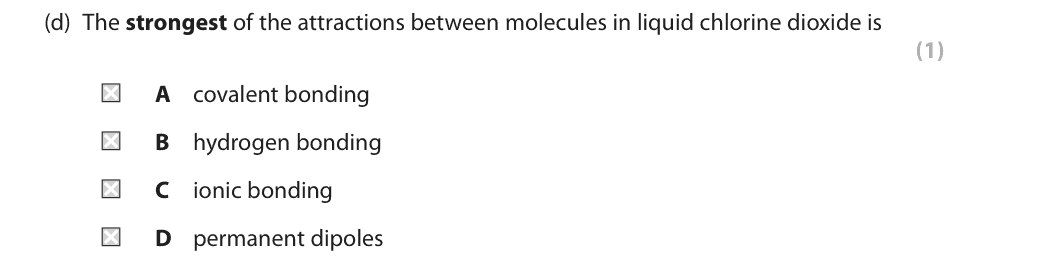
Earlier part of question 5 that this part usesEarlier part of June 2024 Paper 1 question 5
The strongest of the attractions between molecules in liquid chlorine dioxide is
A  covalent bonding
B  hydrogen bonding
C  ionic bonding
D  permanent dipoles
June 2024 · AS Paper 1 · Q5(f) 1 mark Multiple choice redox i
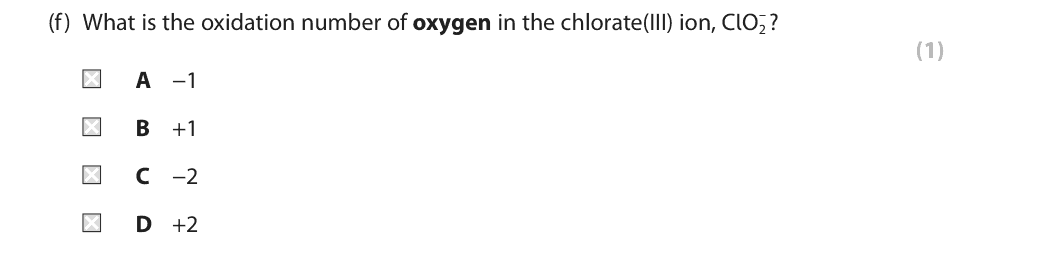
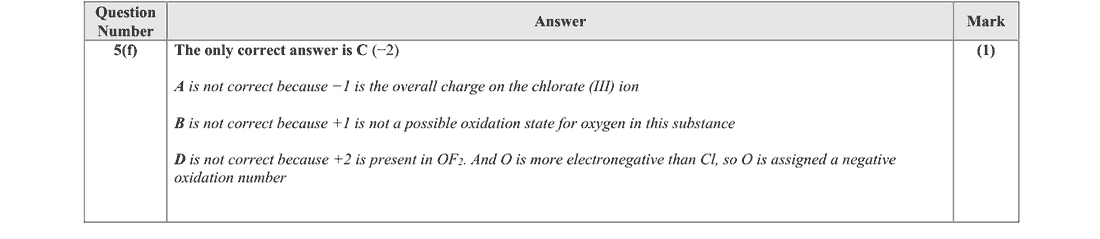
Earlier part of question 5 that this part usesEarlier part of June 2024 Paper 1 question 5
What is the oxidation number of oxygen in the chlorate(III) ion, ClO2
– ?
A  −1
B  +1
C  −2
D  +2
June 2024 · AS Paper 1 · Q6(c) 1 mark Multiple choice atomic structure and the periodic table
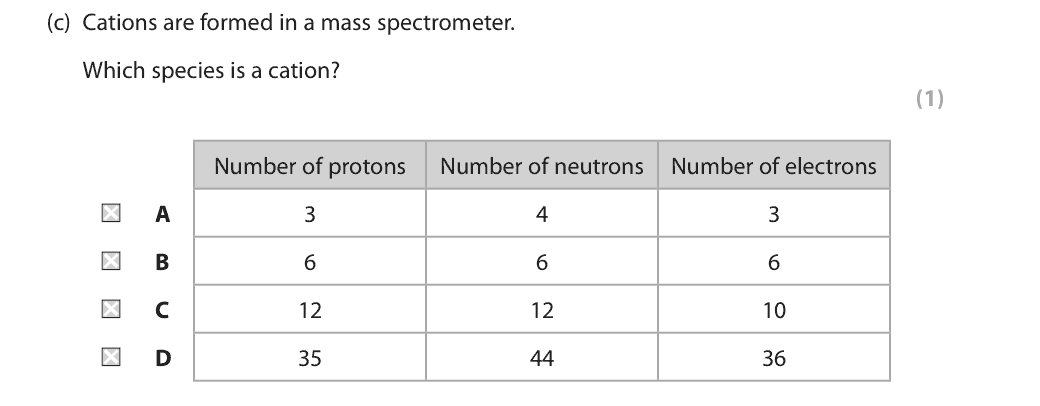
Cations are formed in a mass spectrometer.
Which species is a cation?
Number of protons
Number of neutrons
Number of electrons
A
3
4
3
B
6
6
6
C
12
12
10
D
35
44
36
June 2024 · AS Paper 1 · Q7(c)(iv) 1 mark Multiple choice groups 1 and 2
Earlier parts of question 7 that this part usesEarlier part of June 2024 Paper 1 question 7Earlier part of June 2024 Paper 1 question 7
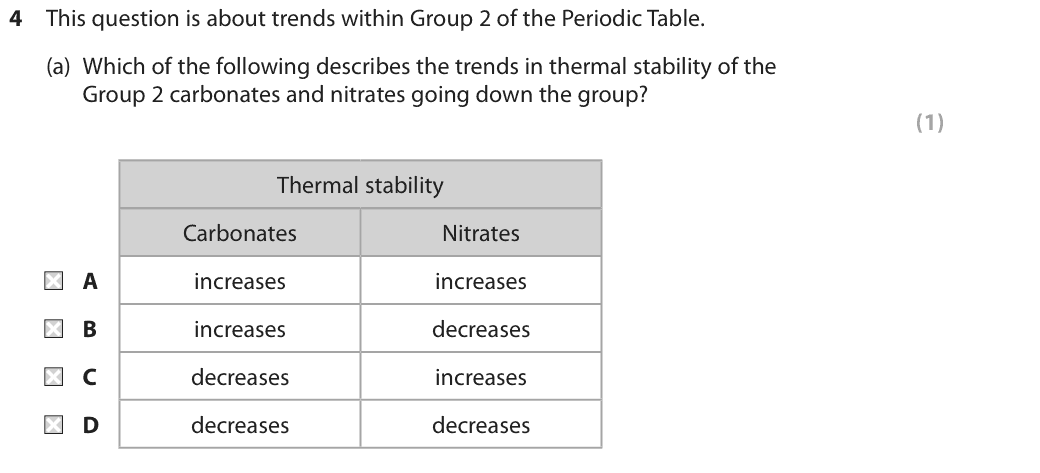
Which pair of responses show the trend in thermal stability of compounds
down Group 2 ?
Carbonates
Nitrates
A
increasing
decreasing
B
decreasing
decreasing
C
increasing
increasing
D
decreasing
increasing
June 2024 · AS Paper 1 · Q9(b)(iii) 1 mark Multiple choice redox i
Earlier parts of question 9 that this part usesEarlier part of June 2024 Paper 1 question 9Earlier part of June 2024 Paper 1 question 9
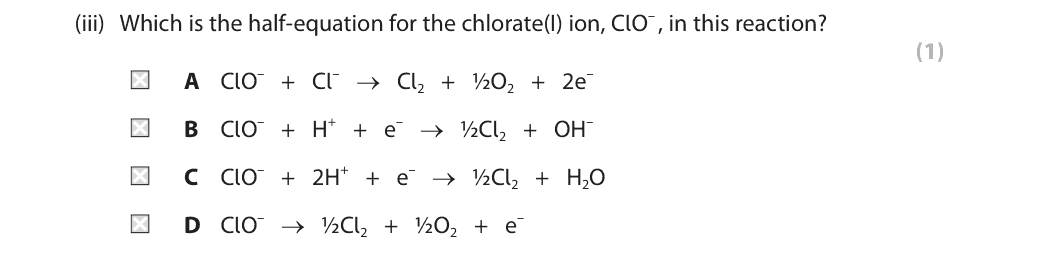
Which is the half‑equation for the chlorate(I) ion, ClO– , in this reaction?
A  ClO–   +   Cl–   →   Cl2   +   ½O2   +   2e–
B  ClO–   +   H+   +   e–   →   ½Cl2   +   OH–
C  ClO–   +   2H+   +   e–   →   ½Cl2   +   H2O
D  ClO–   →   ½Cl2   +   ½O2   +   e–
June 2024 · AS Paper 2 · Q1(a) 1 mark Multiple choice formulae equations and amounts of substance
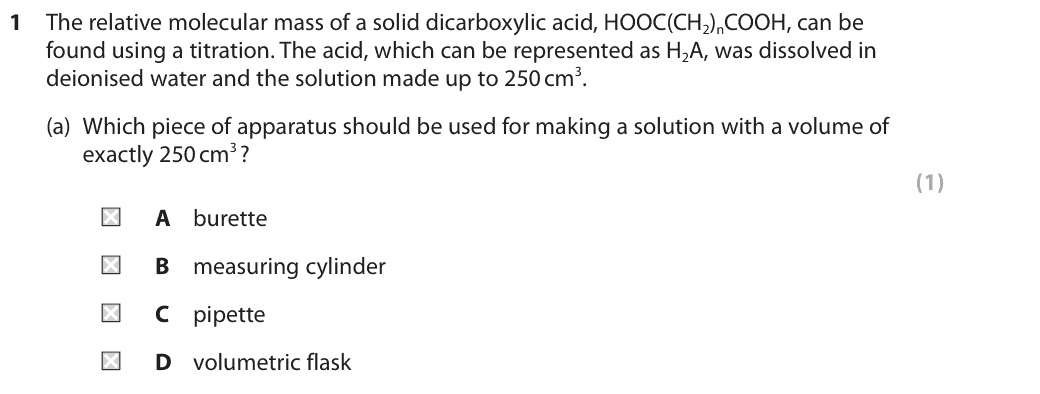
The relative molecular mass of a solid dicarboxylic acid, HOOC(CH2)nCOOH, can be
found using a titration. The acid, which can be represented as H2A, was dissolved in
deionised water and the solution made up to 250 cm3.
Which piece of apparatus should be used for making a solution with a volume of
exactly 250 cm3 ?
A  burette
B  measuring cylinder
C  pipette
D  volumetric flask
June 2024 · AS Paper 2 · Q1(b)(i) 1 mark Multiple choice formulae equations and amounts of substance
Earlier part of question 1 that this part usesEarlier part of June 2024 Paper 2 question 1
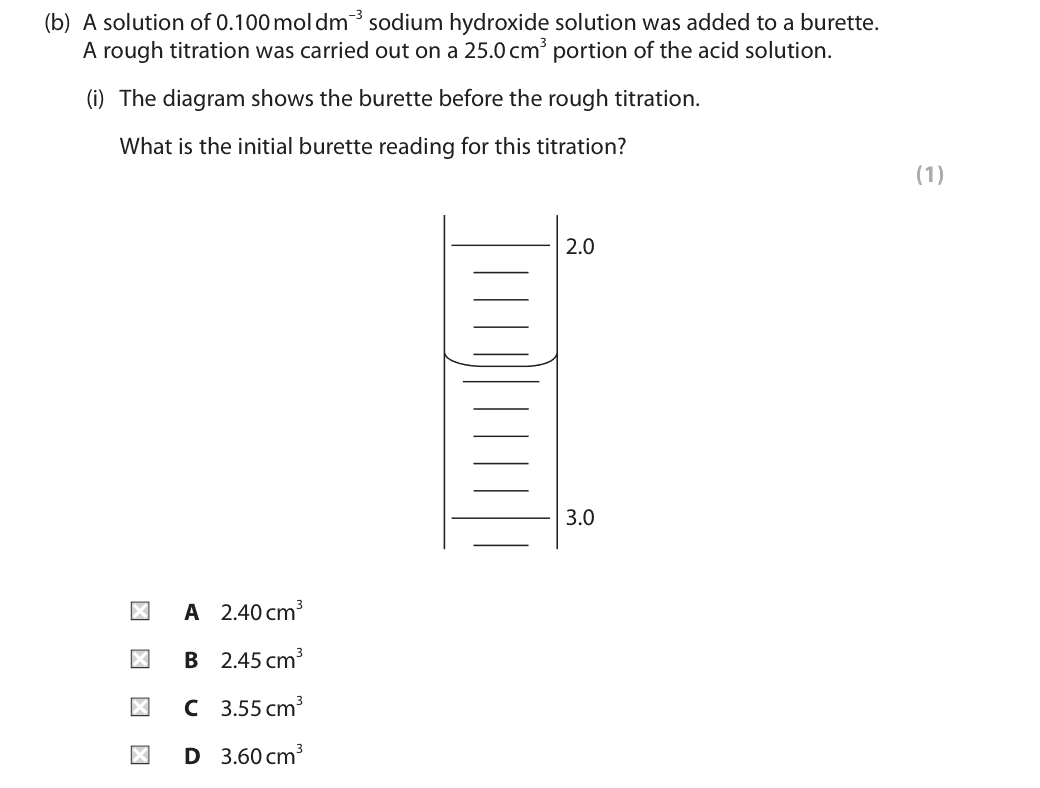
A solution of 0.100 mol dm–3 sodium hydroxide solution was added to a burette.
A rough titration was carried out on a 25.0 cm3 portion of the acid solution.
The diagram shows the burette before the rough titration.
What is the initial burette reading for this titration?
2.0
3.0
A  2.40 cm3
B  2.45 cm3
C  3.55 cm3
D  3.60 cm3
June 2024 · AS Paper 2 · Q2(a)(ii) 1 mark Multiple choice equilibrium i
Earlier part of question 2 that this part usesEarlier part of June 2024 Paper 2 question 2
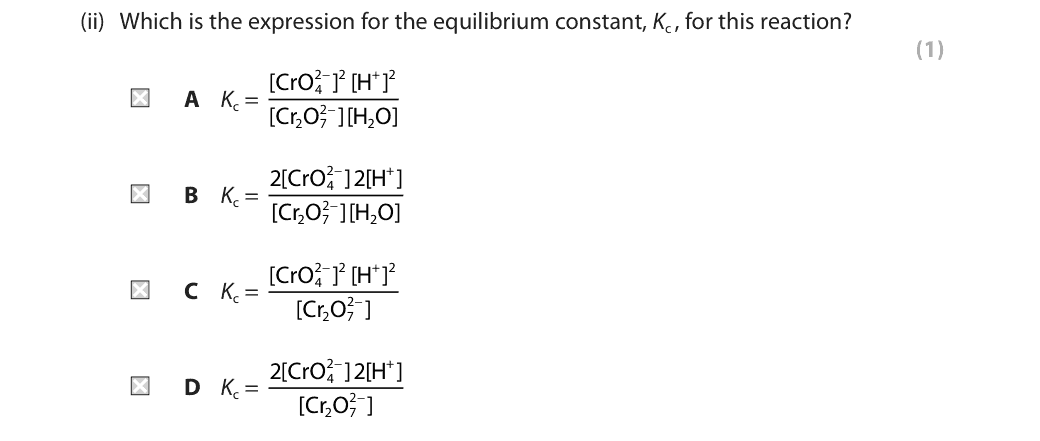
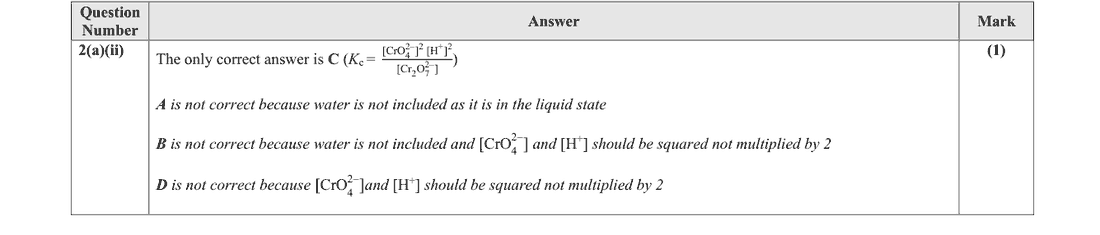
Which is the expression for the equilibrium constant, Kc , for this reaction?
A  Kc = [
CrO
2
−
] [
2
H
+
]
2
4
[
Cr O
2
−
][
H O
]
2
7
2
B  Kc = 2
[
CrO
2
−
] [
2
H
+
]
4
[
Cr O
2
−
][
H O
]
2
7
2
C  Kc = [
CrO
2
−
] [
2
H
+
]
2
4
[
Cr O
2
−
]
2
7
D  Kc = 2
[
CrO
2
−
] [
2
H
+
]
4
[
Cr O
2
−
]
2
7
June 2024 · AS Paper 2 · Q3(b)(i) 1 mark Multiple choice alkenesintroduction to organic chemistry
Earlier part of question 3 that this part usesEarlier part of June 2024 Paper 2 question 3
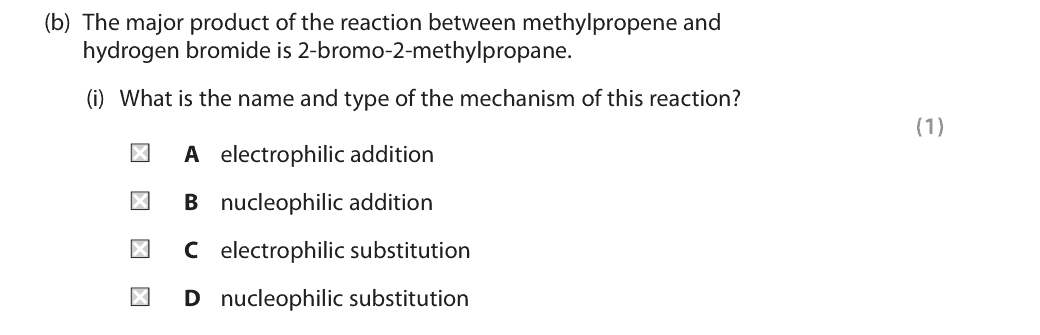
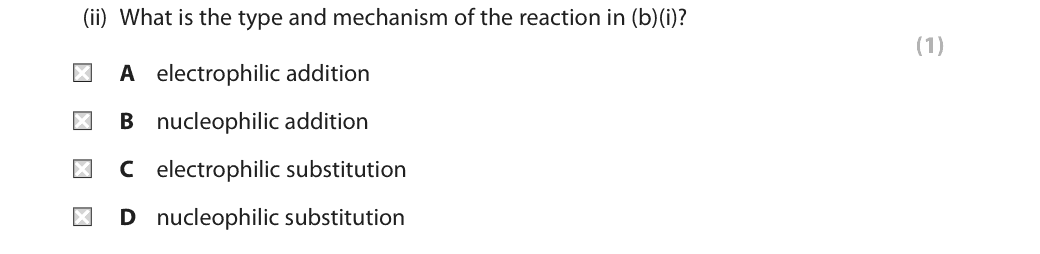
The major product of the reaction between methylpropene and
hydrogen bromide is 2‑bromo‑2‑methylpropane.
What is the name and type of the mechanism of this reaction?
A  electrophilic addition
B  nucleophilic addition
C  electrophilic substitution
D  nucleophilic substitution
June 2024 · AS Paper 2 · Q3(d)(i) 1 mark Multiple choice alkenesalcohols
Earlier part of question 3 that this part usesEarlier part of June 2024 Paper 2 question 3
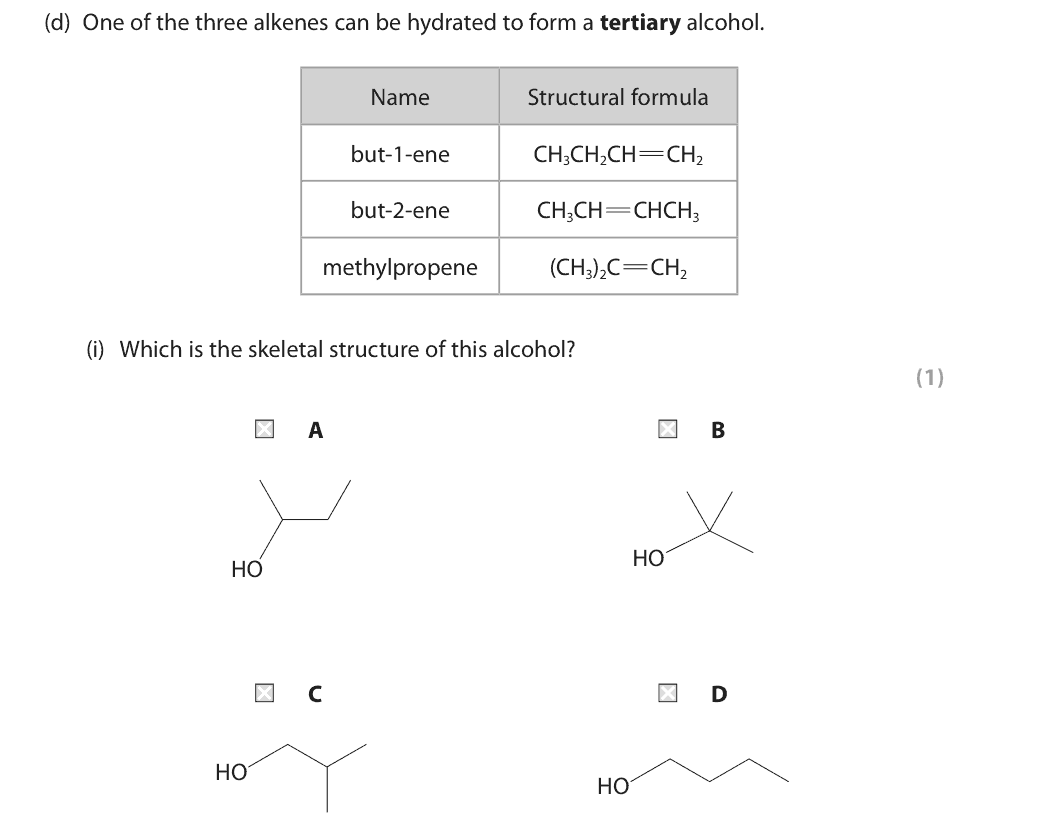
One of the three alkenes can be hydrated to form a tertiary alcohol.
Name
Structural formula
but‑1‑ene
CH3CH2CH
CH2
but‑2‑ene
CH3CH
CHCH3
methylpropene
(CH3)2C
CH2
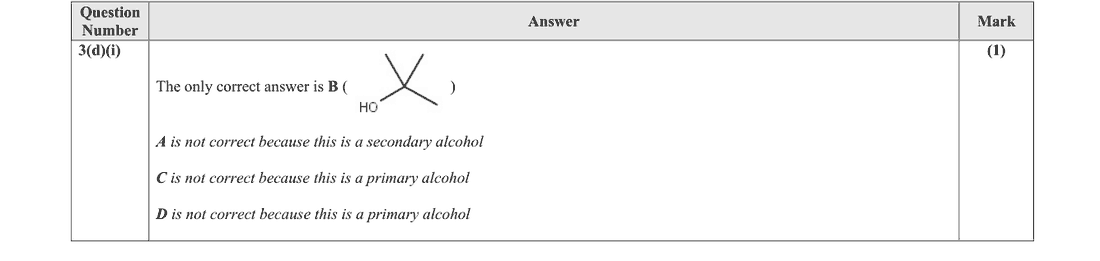
Which is the skeletal structure of this alcohol?
A
B
HO
HO
C
D
HO
HO
June 2024 · AS Paper 2 · Q6(b)(i) 1 mark Multiple choice formulae equations and amounts of substance
Earlier part of question 6 that this part usesEarlier part of June 2024 Paper 2 question 6
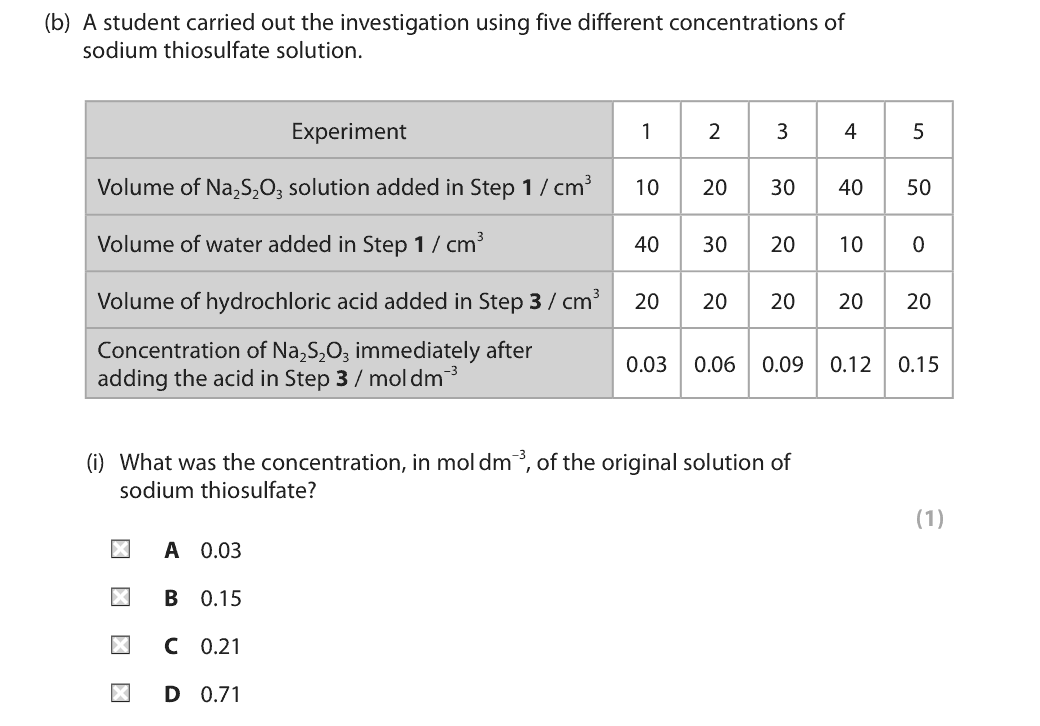
A student carried out the investigation using five different concentrations of
sodium thiosulfate solution.
Experiment
1
2
3
4
5
Volume of Na2S2O3 solution added in Step 1 / cm3
10
20
30
40
50
Volume of water added in Step 1 / cm3
40
30
20
10
0
Volume of hydrochloric acid added in Step 3 / cm3
20
20
20
20
20
Concentration of Na2S2O3 immediately after
0.03
0.06
0.09
0.12
0.15
adding the acid in Step 3 / mol dm–3
What was the concentration, in mol dm–3, of the original solution of
sodium thiosulfate?
A  0.03
B  0.15
C  0.21
D  0.71
June 2024 · AS Paper 2 · Q6(d) 1 mark Multiple choice formulae equations and amounts of substance
Earlier part of question 6 that this part usesEarlier part of June 2024 Paper 2 question 6
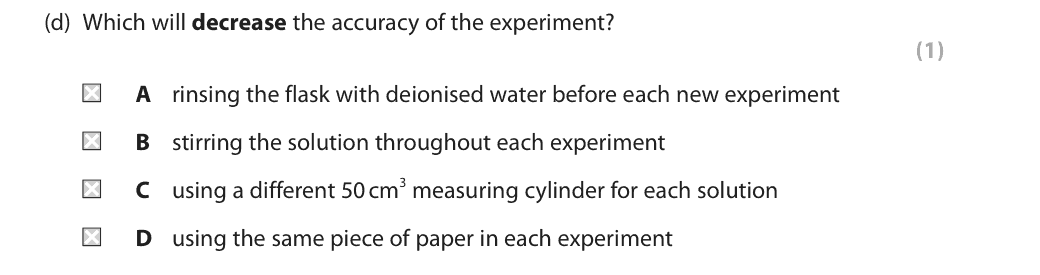
Which will decrease the accuracy of the experiment?
A  rinsing the flask with deionised water before each new experiment
B  stirring the solution throughout each experiment
C  using a different 50 cm3 measuring cylinder for each solution
D  using the same piece of paper in each experiment
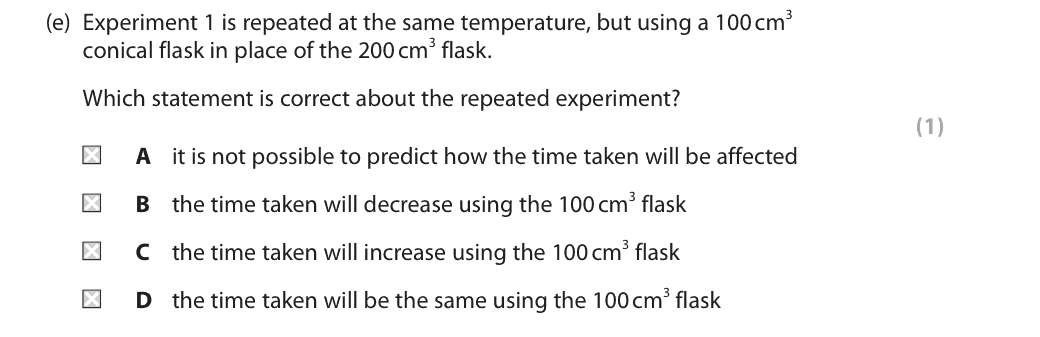
June 2024 · AS Paper 2 · Q6(e) 1 mark Multiple choice kinetics i
Earlier part of question 6 that this part usesEarlier part of June 2024 Paper 2 question 6
Experiment 1 is repeated at the same temperature, but using a 100 cm3
conical flask in place of the 200 cm3 flask.
Which statement is correct about the repeated experiment?
A  it is not possible to predict how the time taken will be affected
B  the time taken will decrease using the 100 cm3 flask
C  the time taken will increase using the 100 cm3 flask
D  the time taken will be the same using the 100 cm3 flask
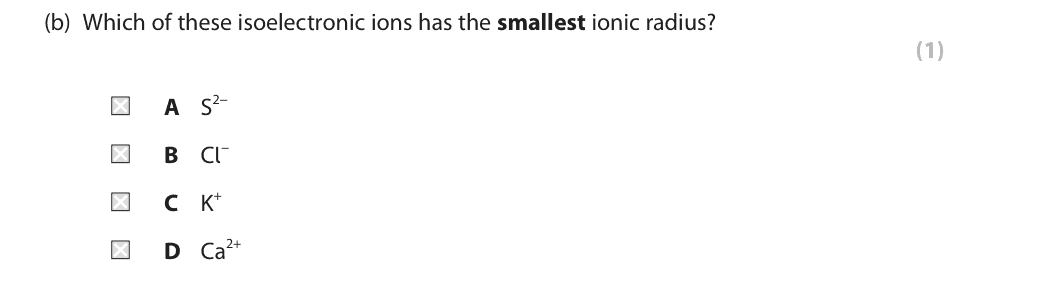
June 2024 · Paper 1 · Q2(b) 1 mark Multiple choice bonding
Which of these isoelectronic ions has the smallest ionic radius?
A  S2−
B  Cl−
C  K+
D  Ca2+
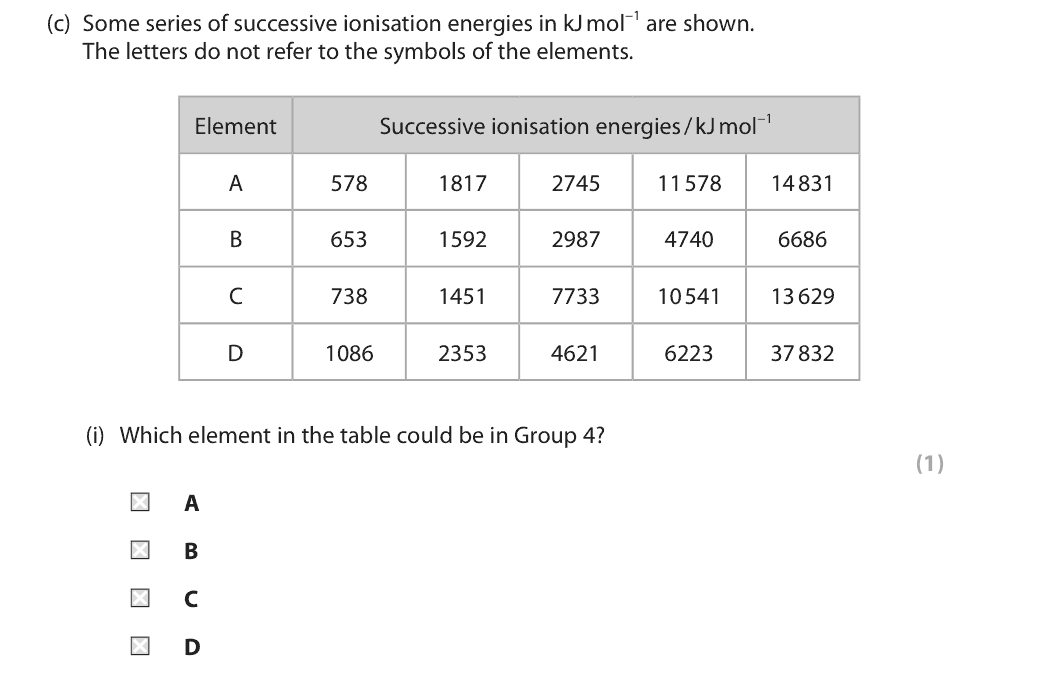
June 2024 · Paper 1 · Q2(c)(i) 1 mark Multiple choice atomic structure and the periodic table
Earlier part of question 2 that this part usesEarlier part of June 2024 Paper 1 question 2
Some series of successive ionisation energies in kJ mol−1 are shown.
The letters do not refer to the symbols of the elements.
Element
Successive ionisation energies / kJ mol−1
A
578
1817
2745
11 578
14 831
B
653
1592
2987
4740
6686
C
738
1451
7733
10 541
13 629
D
1086
2353
4621
6223
37 832
Which element in the table could be in Group 4?
A
B
C
D
June 2024 · Paper 1 · Q2(c)(ii) 1 mark Multiple choice atomic structure and the periodic table
Earlier parts of question 2 that this part usesEarlier part of June 2024 Paper 1 question 2Earlier part of June 2024 Paper 1 question 2
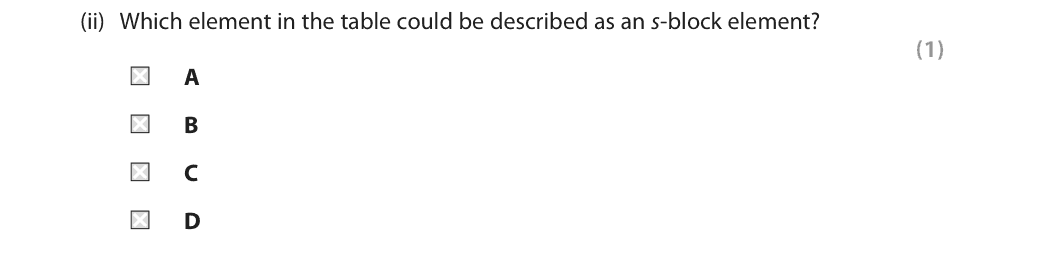
Which element in the table could be described as an s-block element?
A
B
C
D
June 2024 · Paper 1 · Q3(d) 1 mark Multiple choice formulae equations and amounts of substance
Earlier part of question 3 that this part usesEarlier part of June 2024 Paper 1 question 3
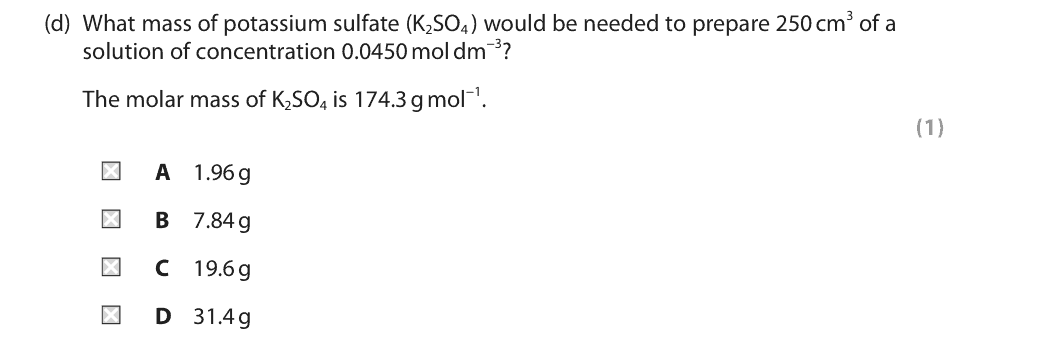
What mass of potassium sulfate (K2SO4 ) would be needed to prepare 250 cm3 of a
solution of concentration 0.0450 mol dm−3?
The molar mass of K2SO4 is 174.3 g mol−1.
A  1.96 g
B  7.84 g
C  19.6 g
D  31.4 g
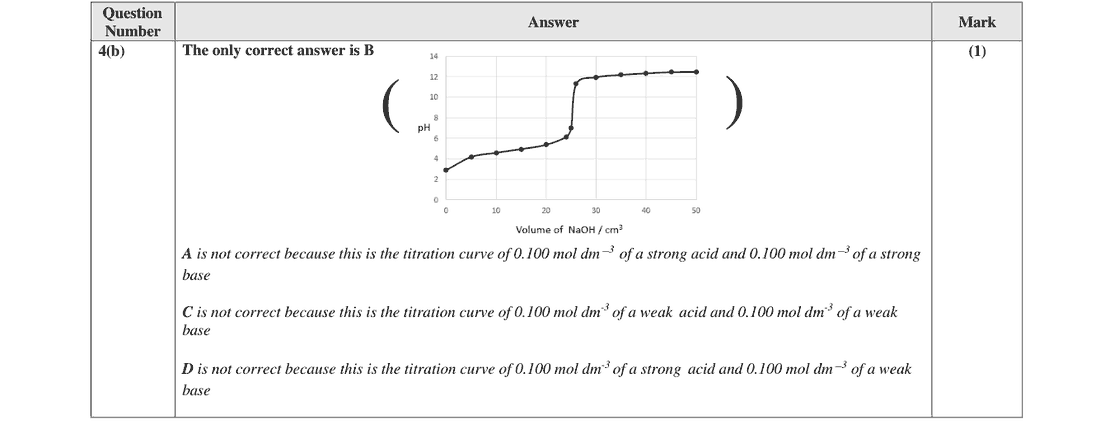
June 2024 · Paper 1 · Q4(b) 1 mark Multiple choice acid base equilibria
Earlier part of question 4 that this part usesEarlier part of June 2024 Paper 1 question 4
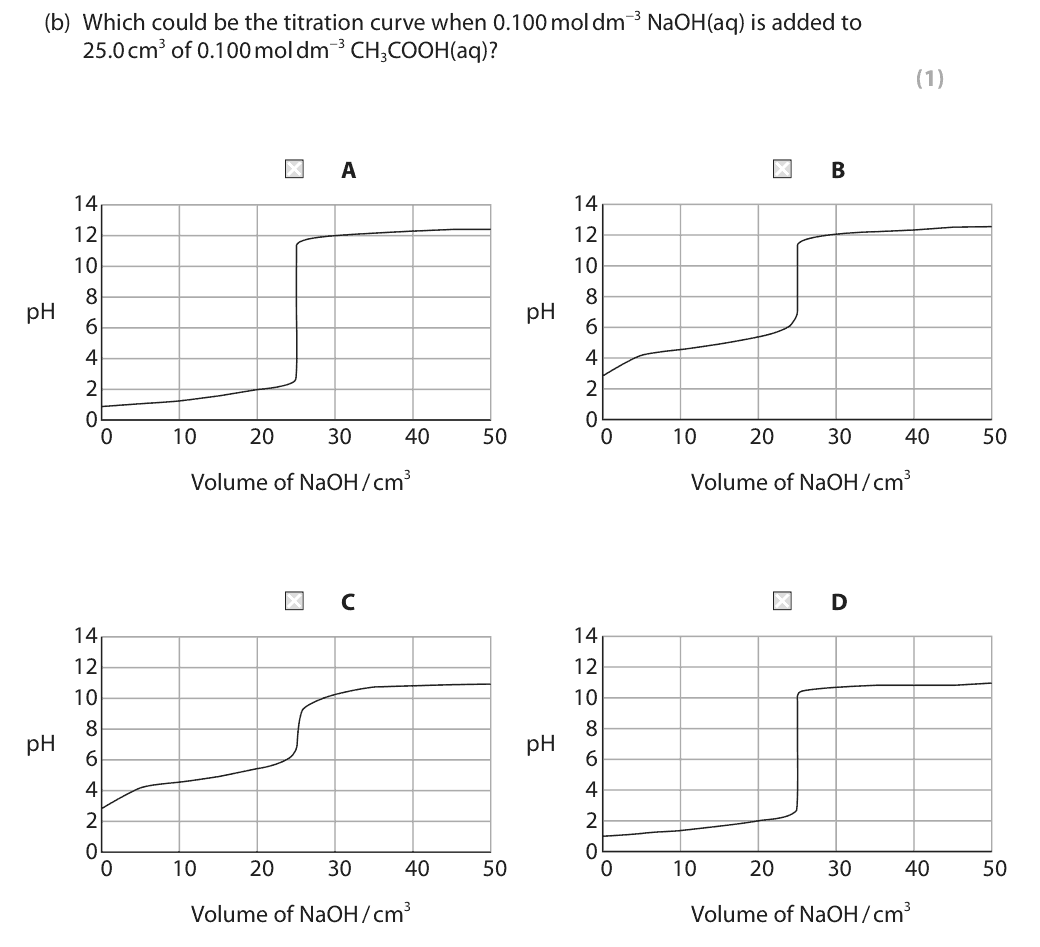
Which could be the titration curve when 0.100 mol dm−3 NaOH(aq) is added to
25.0 cm3 of 0.100 mol dm−3 CH3COOH(aq)?
A
B
14
14
12
12
10
10
8
8
pH
pH
6
6
4
4
2
2
0
0
0
10
20
30
40
50
0
10
20
30
40
50
Volume of NaOH / cm3
C
D
14
14
12
12
10
10
8
8
pH
pH
6
6
4
4
2
2
0
0
0
10
20
30
40
50
0
10
20
30
40
50
Volume of NaOH / cm3
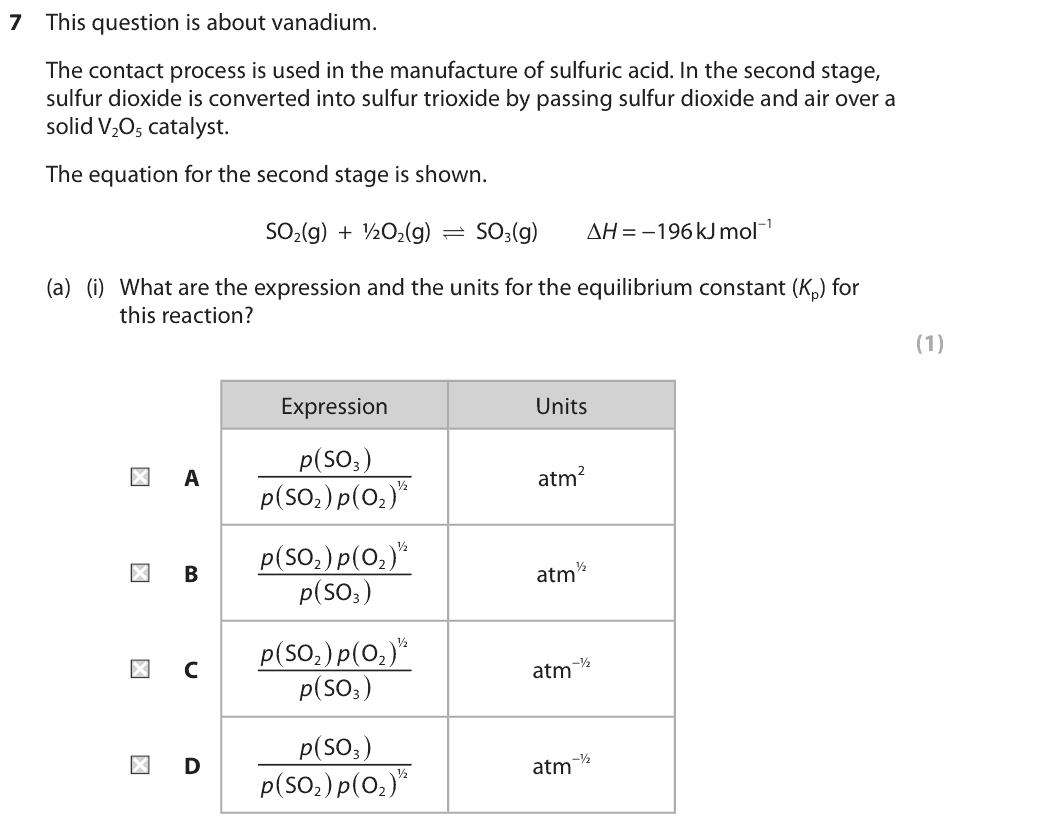
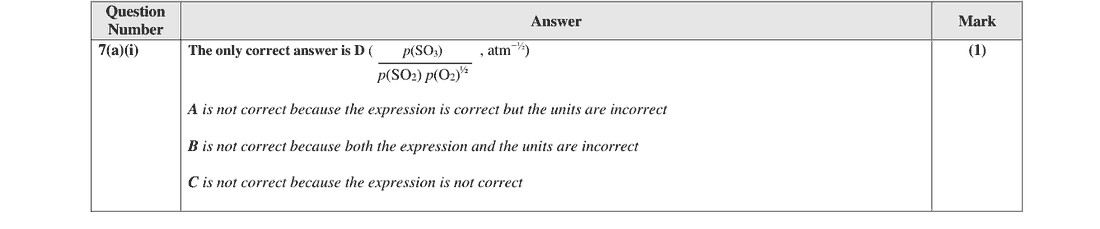
June 2024 · Paper 1 · Q7(a)(i) 1 mark Multiple choice equilibrium ii
This question is about vanadium.
The contact process is used in the manufacture of sulfuric acid. In the second stage,
sulfur dioxide is converted into sulfur trioxide by passing sulfur dioxide and air over a
solid V2O5 catalyst.
The equation for the second stage is shown.
SO2(g)  +  ½O2(g)    SO3(g)        ΔH = −196 kJ mol−1
What are the expression and the units for the equilibrium constant (Kp) for
this reaction?
Expression
Units
.
/
p
SO
3
A
atm2
.
/ .
/
½
p
SO
p
O
2
2
.
/ .
/
½
p
SO
p
O
2
2
B
atm½
.
/
p
SO
3
.
/ .
/
½
p
SO
p
O
2
2
C
atm−½
.
/
p
SO
3
.
/
p
SO
3
D
atm−½
.
/ .
/
½
p
SO
p
O
2
2
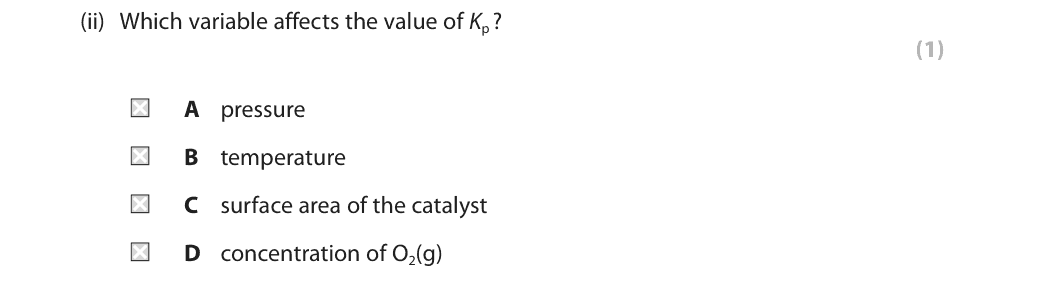
June 2024 · Paper 1 · Q7(a)(ii) 1 mark Multiple choice equilibrium ii
Earlier part of question 7 that this part usesEarlier part of June 2024 Paper 1 question 7
Which variable affects the value of Kp ?
A  pressure
B  temperature
C  surface area of the catalyst
D  concentration of O2(g)
June 2024 · Paper 1 · Q7(c) 1 mark Multiple choice transition metals reactions
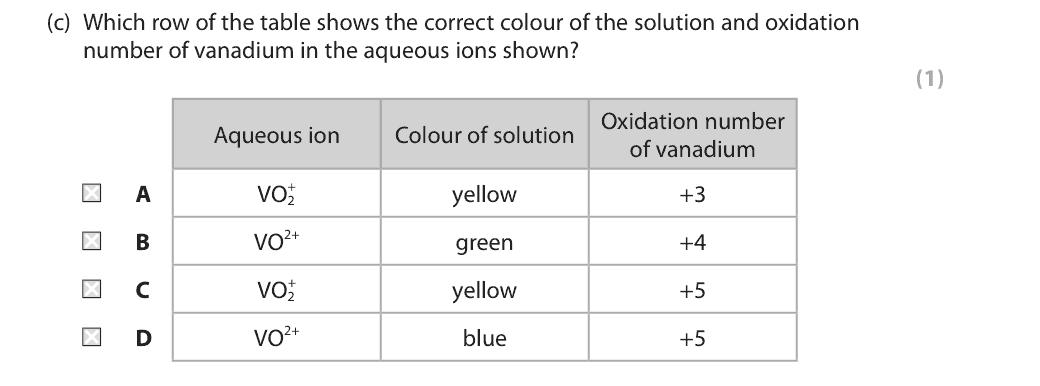
Earlier part of question 7 that this part usesEarlier part of June 2024 Paper 1 question 7
Which row of the table shows the correct colour of the solution and oxidation
number of vanadium in the aqueous ions shown?
Oxidation number
Aqueous ion
Colour of solution
of vanadium
A
VO2
+
yellow
+3
B
VO2+
green
+4
C
VO2
+
yellow
+5
D
VO2+
blue
+5
+ ?
June 2024 · Paper 1 · Q7(d) 1 mark Multiple choice redox ii
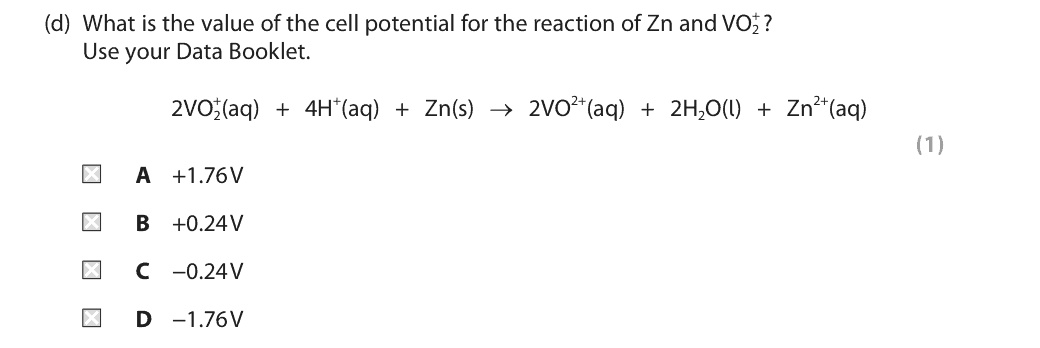
Earlier part of question 7 that this part usesEarlier part of June 2024 Paper 1 question 7
What is the value of the cell potential for the reaction of Zn and VO2
Use your Data Booklet.
2VO2
+(aq)   +   4H+(aq)   +   Zn(s)   →   2VO2+(aq)   +   2H2O(l)   +   Zn2+(aq)
A  +1.76 V
B  +0.24 V
C  −0.24 V
D  −1.76 V
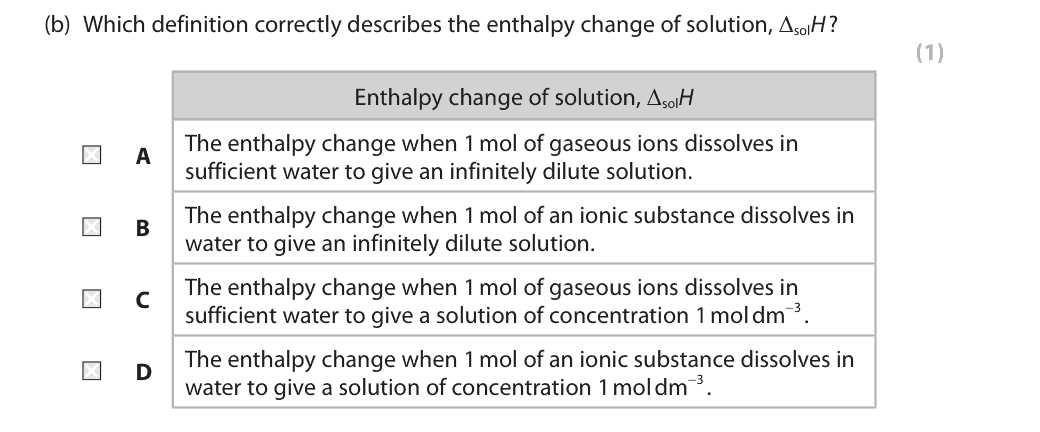
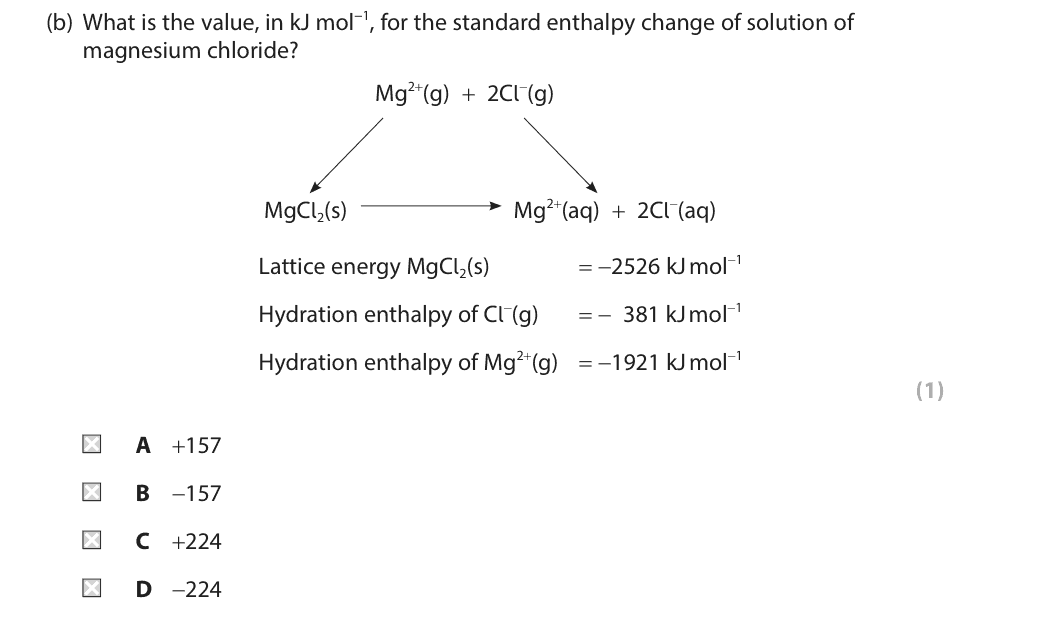
June 2024 · Paper 1 · Q8(b) 1 mark Multiple choice lattice energy
Which definition correctly describes the enthalpy change of solution, ΔsolH ?
Enthalpy change of solution, ΔsolH
The enthalpy change when 1 mol of gaseous ions dissolves in
A
sufficient water to give an infinitely dilute solution.
The enthalpy change when 1 mol of an ionic substance dissolves in
B
water to give an infinitely dilute solution.
The enthalpy change when 1 mol of gaseous ions dissolves in
C
sufficient water to give a solution of concentration 1 mol dm−3 .
The enthalpy change when 1 mol of an ionic substance dissolves in
D
water to give a solution of concentration 1 mol dm−3 .
June 2024 · Paper 2 · Q1(a) 1 mark Multiple choice halogenoalkanes
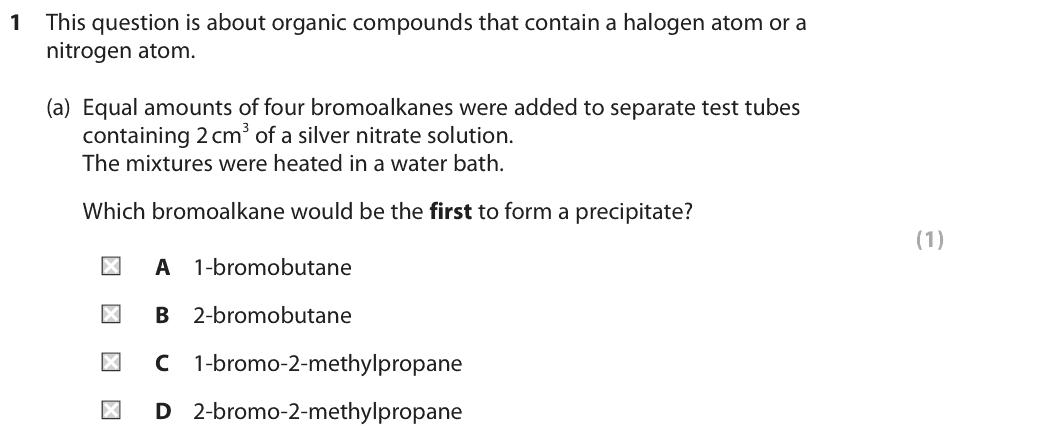
This question is about organic compounds that contain a halogen atom or a
nitrogen atom.
Equal amounts of four bromoalkanes were added to separate test tubes
containing 2 cm3 of a silver nitrate solution.
The mixtures were heated in a water bath.
Which bromoalkane would be the first to form a precipitate?
A  1‑bromobutane
B  2‑bromobutane
C  1‑bromo‑2‑methylpropane
D  2‑bromo‑2‑methylpropane
June 2024 · Paper 2 · Q1(b) 1 mark Multiple choice carboxylic acidsamines amides amino acids and proteins
Earlier part of question 1 that this part usesEarlier part of June 2024 Paper 2 question 1
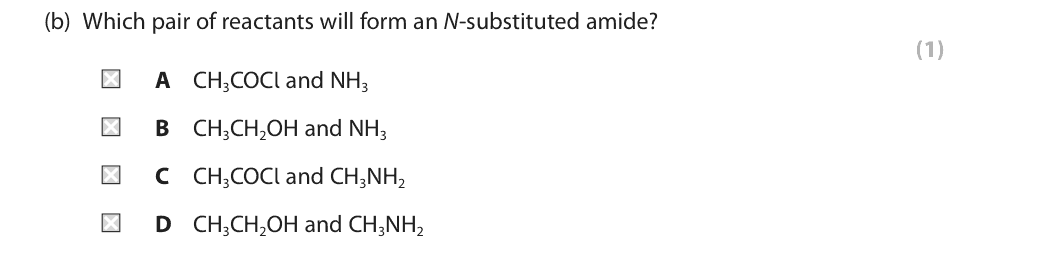
Which pair of reactants will form an N‑substituted amide?
A  CH3COCl and NH3
B  CH3CH2OH and NH3
C  CH3COCl and CH3NH2
D  CH3CH2OH and CH3NH2
June 2024 · Paper 2 · Q1(c)(ii) 1 mark Multiple choice amines amides amino acids and proteinshalogenoalkanes
Earlier parts of question 1 that this part usesEarlier part of June 2024 Paper 2 question 1Earlier part of June 2024 Paper 2 question 1
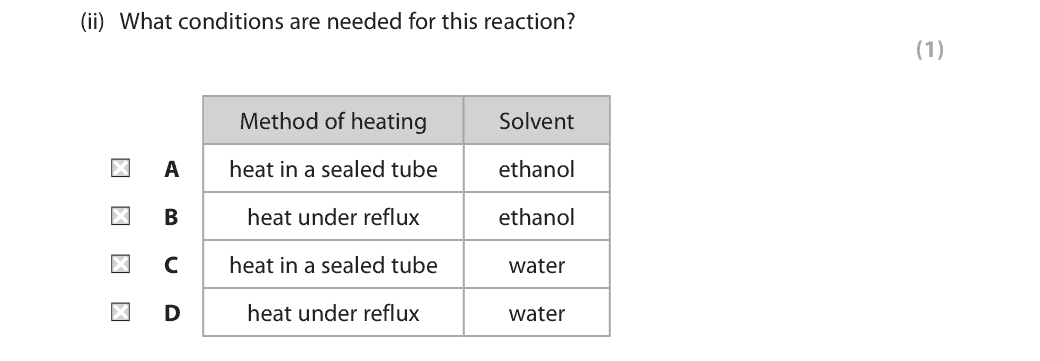
What conditions are needed for this reaction?
Method of heating
Solvent
A
heat in a sealed tube
ethanol
B
heat under reflux
ethanol
C
heat in a sealed tube
water
D
heat under reflux
water
June 2024 · Paper 2 · Q2(a) 1 mark Multiple choice organic synthesis
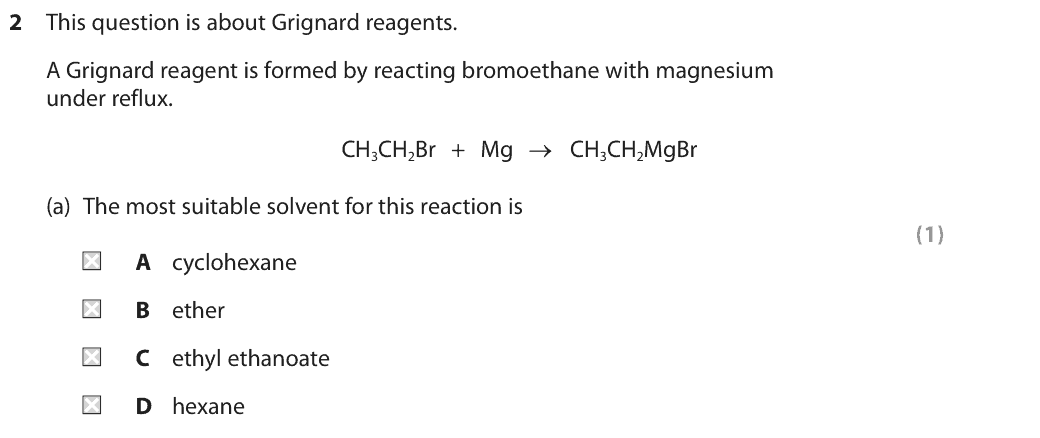
This question is about Grignard reagents.
A Grignard reagent is formed by reacting bromoethane with magnesium
under reflux.
CH3CH2Br   +   Mg   →   CH3CH2MgBr
The most suitable solvent for this reaction is
A  cyclohexane
B  ether
C  ethyl ethanoate
D  hexane
June 2024 · Paper 2 · Q2(c) 1 mark Multiple choice organic synthesis
Earlier part of question 2 that this part usesEarlier part of June 2024 Paper 2 question 2
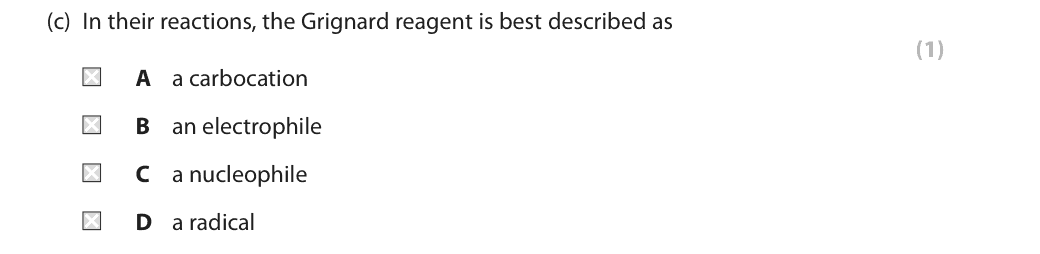
In their reactions, the Grignard reagent is best described as
A  a carbocation
B  an electrophile
C  a nucleophile
D  a radical
June 2024 · Paper 2 · Q2(e) 1 mark Multiple choice organic synthesis
Earlier part of question 2 that this part usesEarlier part of June 2024 Paper 2 question 2
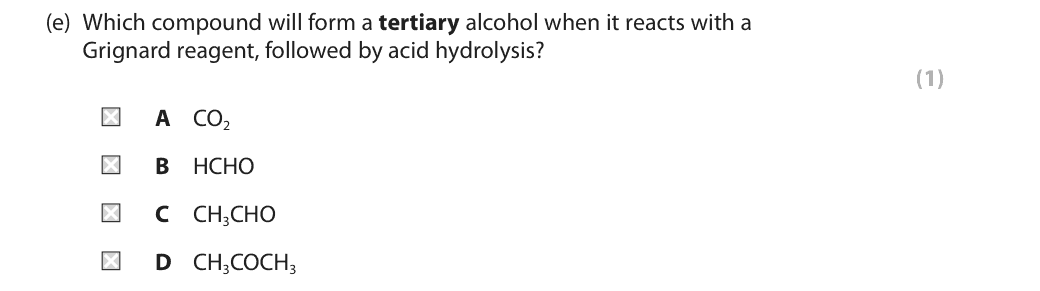
Which compound will form a tertiary alcohol when it reacts with a
Grignard reagent, followed by acid hydrolysis?
A  CO2
B  HCHO
C  CH3CHO
D  CH3COCH3
June 2024 · Paper 2 · Q6(a) 1 mark Multiple choice nmr mass spectrometry and chromatography
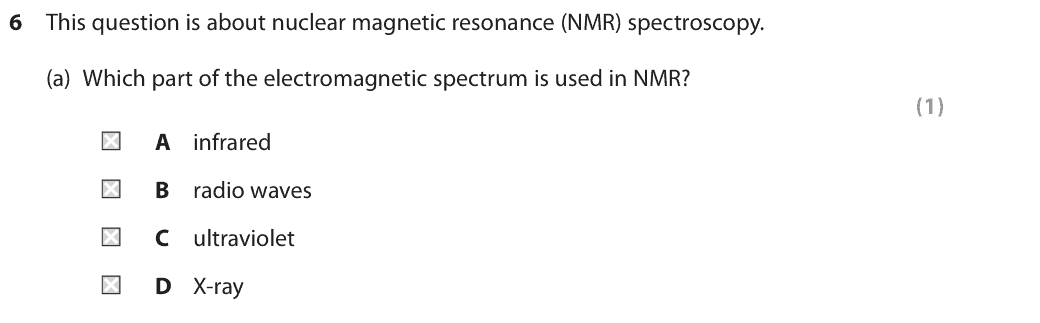
This question is about nuclear magnetic resonance (NMR) spectroscopy.
Which part of the electromagnetic spectrum is used in NMR?
A  infrared
B  radio waves
C  ultraviolet
D  X‑ray
June 2024 · Paper 2 · Q7(a) 1 mark Multiple choice introduction to organic chemistry
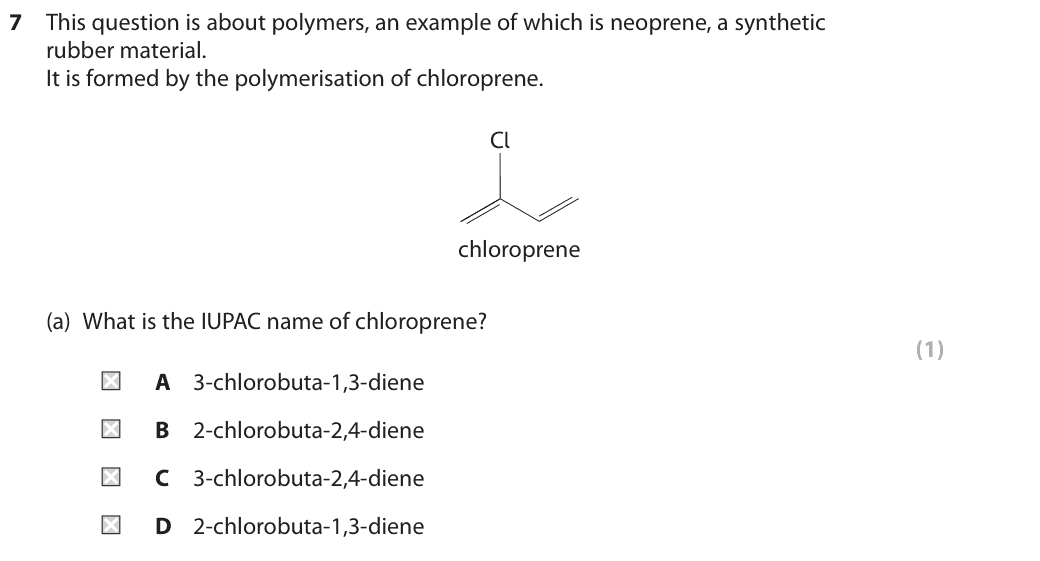
This question is about polymers, an example of which is neoprene, a synthetic
rubber material.
It is formed by the polymerisation of chloroprene.
Cl
chloroprene
What is the IUPAC name of chloroprene?
A  3‑chlorobuta‑1,3‑diene
B  2‑chlorobuta‑2,4‑diene
C  3‑chlorobuta‑2,4‑diene
D  2‑chlorobuta‑1,3‑diene
June 2024 · Paper 2 · Q7(d)(iii) 1 mark Multiple choice carboxylic acids
Earlier parts of question 7 that this part usesEarlier part of June 2024 Paper 2 question 7Earlier part of June 2024 Paper 2 question 7
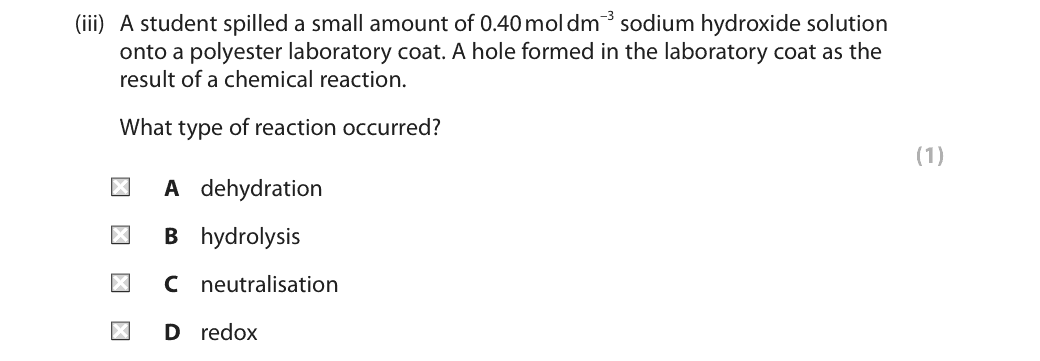
A student spilled a small amount of 0.40 mol dm–3 sodium hydroxide solution
onto a polyester laboratory coat. A hole formed in the laboratory coat as the
result of a chemical reaction.
What type of reaction occurred?
A  dehydration
B  hydrolysis
C  neutralisation
D  redox
June 2024 · Paper 2 · Q8(c) 1 mark Multiple choice amines amides amino acids and proteins
Earlier part of question 8 that this part usesEarlier part of June 2024 Paper 2 question 8
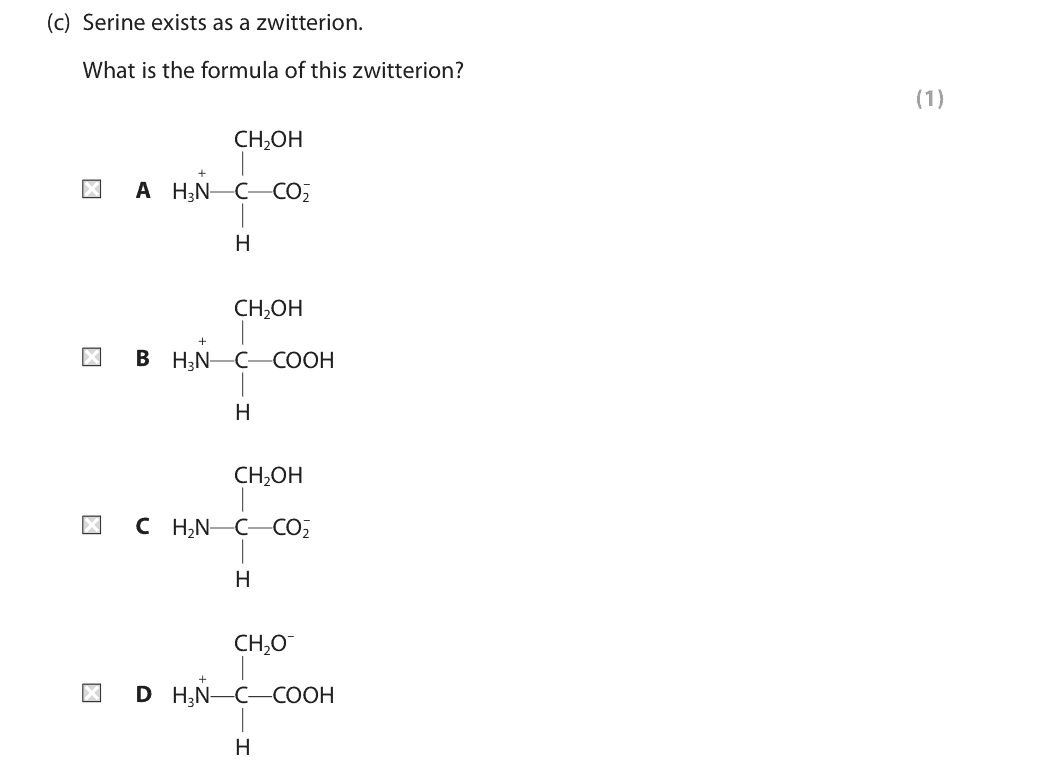
Serine exists as a zwitterion.
What is the formula of this zwitterion?
CH2OH
+
A  H3N
C
CO2
–
H
CH2OH
+
B  H3N
C
COOH
H
CH2OH
C  H2N
C
CO2
–
H
CH2O–
+
D  H3N
C
COOH
H
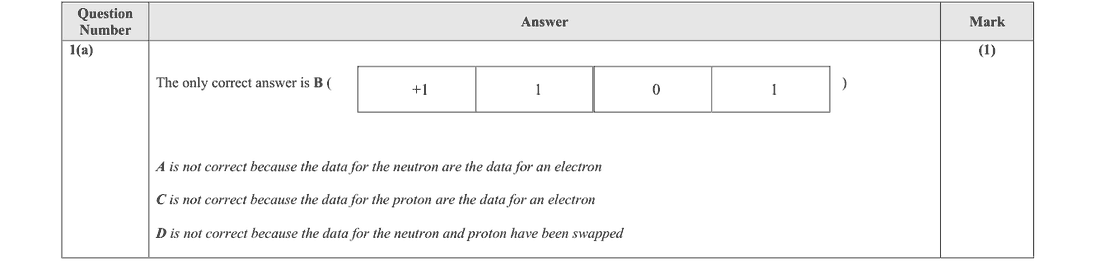
June 2023 · AS Paper 1 · Q1(a) 1 mark Multiple choice atomic structure and the periodic table
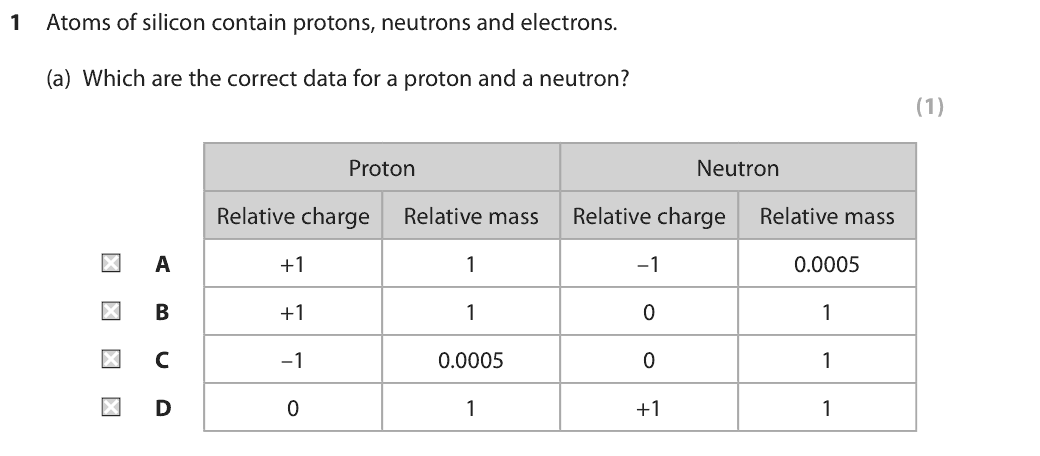
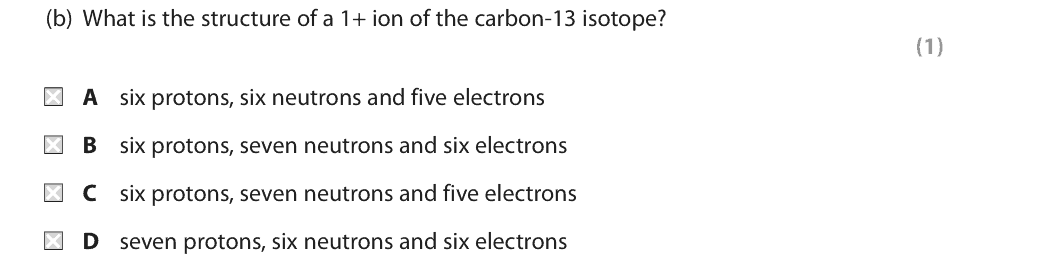
Atoms of silicon contain protons, neutrons and electrons.
Which are the correct data for a proton and a neutron?
Proton
Neutron
Relative charge
Relative mass
Relative charge
Relative mass
A
+1
1
–1
0.0005
B
+1
1
0
1
C
–1
0.0005
0
1
D
0
1
+1
1
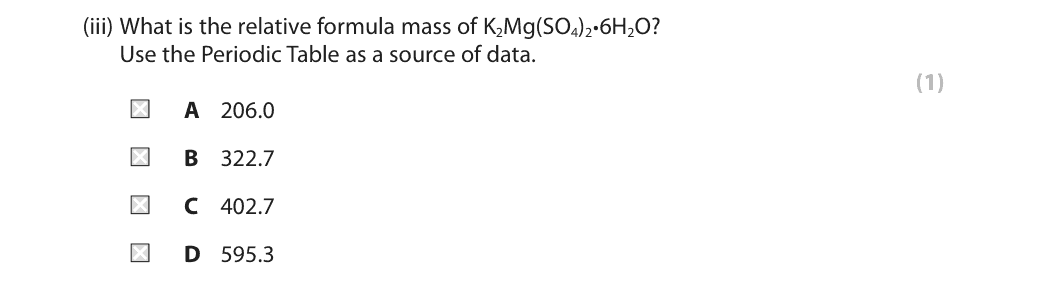
June 2023 · AS Paper 1 · Q2(a)(iii) 1 mark Multiple choice atomic structure and the periodic table
Earlier part of question 2 that this part usesEarlier part of June 2023 Paper 1 question 2
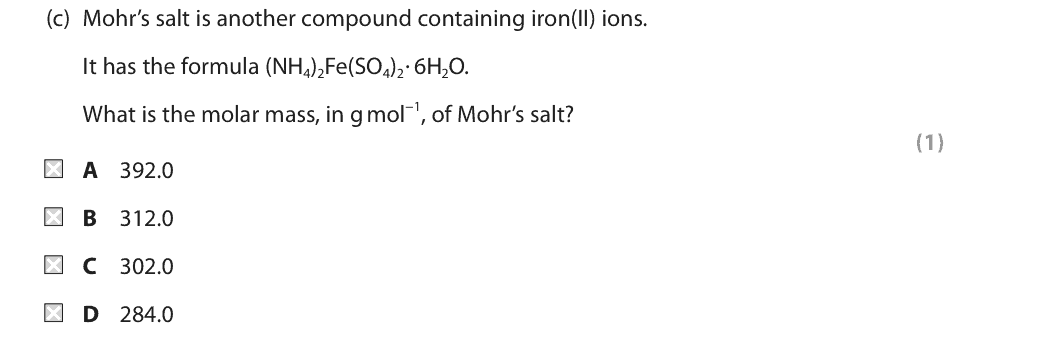
What is the relative formula mass of K2Mg(SO4)2.6H2O?
Use the Periodic Table as a source of data.
A  206.0
B  322.7
C  402.7
D  595.3
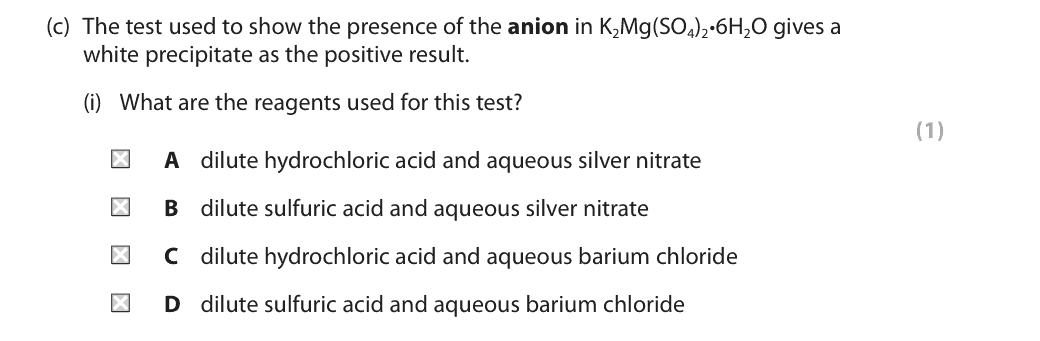
June 2023 · AS Paper 1 · Q2(c)(i) 1 mark Multiple choice analysis of inorganic compounds
Earlier part of question 2 that this part usesEarlier part of June 2023 Paper 1 question 2
The test used to show the presence of the anion in K2Mg(SO4)2.6H2O gives a
white precipitate as the positive result.
What are the reagents used for this test?
A  dilute hydrochloric acid and aqueous silver nitrate
B  dilute sulfuric acid and aqueous silver nitrate
C  dilute hydrochloric acid and aqueous barium chloride
D  dilute sulfuric acid and aqueous barium chloride
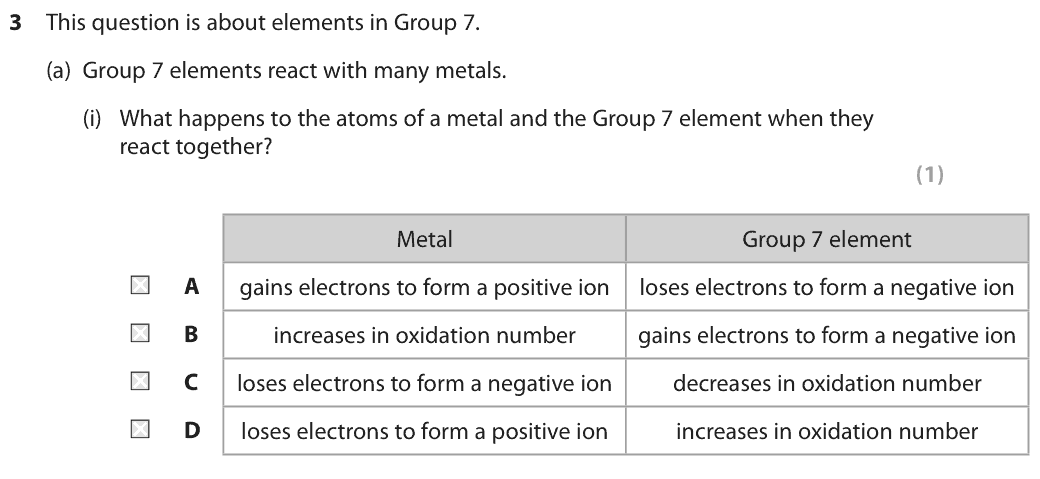
June 2023 · AS Paper 1 · Q3(a)(i) 1 mark Multiple choice redox i
This question is about elements in Group 7.
Group 7 elements react with many metals.
What happens to the atoms of a metal and the Group 7 element when they
react together?
Metal
Group 7 element
A
gains electrons to form a positive ion
loses electrons to form a negative ion
B
increases in oxidation number
gains electrons to form a negative ion
C
loses electrons to form a negative ion
decreases in oxidation number
D
loses electrons to form a positive ion
increases in oxidation number
June 2023 · AS Paper 1 · Q3(a)(ii) 1 mark Multiple choice group 7 the halogensatomic structure and the periodic table
Earlier part of question 3 that this part usesEarlier part of June 2023 Paper 1 question 3
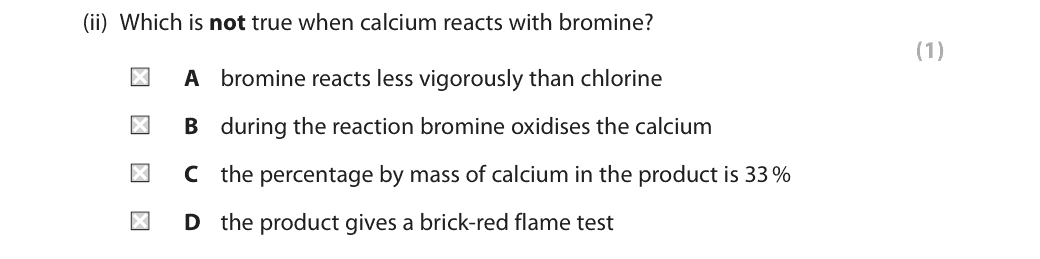
Which is not true when calcium reacts with bromine?
A  bromine reacts less vigorously than chlorine
B  during the reaction bromine oxidises the calcium
C  the percentage by mass of calcium in the product is 33 %
D  the product gives a brick‑red flame test
June 2023 · AS Paper 1 · Q4(c) 1 mark Multiple choice formulae equations and amounts of substance
Earlier part of question 4 that this part usesEarlier part of June 2023 Paper 1 question 4
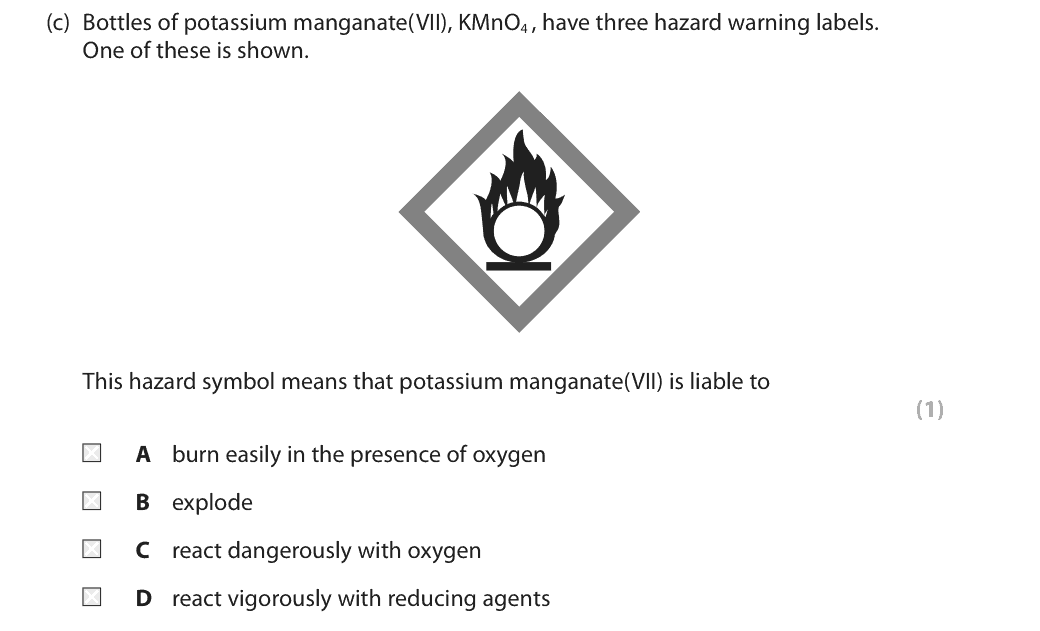
Bottles of potassium manganate(VII), KMnO4 , have three hazard warning labels.
One of these is shown.
This hazard symbol means that potassium manganate(VII) is liable to
A  burn easily in the presence of oxygen
B  explode
C  react dangerously with oxygen
D  react vigorously with reducing agents
June 2023 · AS Paper 1 · Q7(c) 1 mark Multiple choice formulae equations and amounts of substance
Earlier part of question 7 that this part usesEarlier part of June 2023 Paper 1 question 7
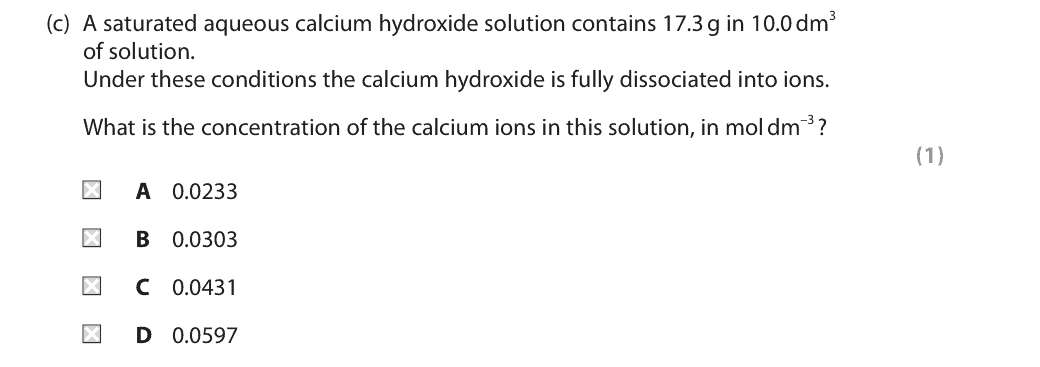
A saturated aqueous calcium hydroxide solution contains 17.3 g in 10.0 dm3
of solution.
Under these conditions the calcium hydroxide is fully dissociated into ions.
What is the concentration of the calcium ions in this solution, in mol dm–3 ?
A  0.0233
B  0.0303
C  0.0431
D  0.0597
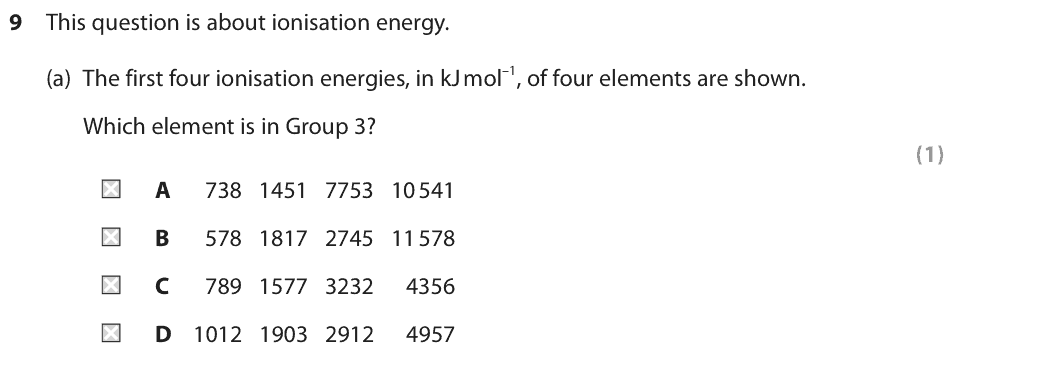
June 2023 · AS Paper 1 · Q9(a) 1 mark Multiple choice atomic structure and the periodic table
This question is about ionisation energy.
The first four ionisation energies, in kJ mol–1, of four elements are shown.
Which element is in Group 3?
A    738   1451   7753   10 541
B    578   1817   2745   11 578
C    789   1577   3232      4356
D  1012   1903   2912      4957
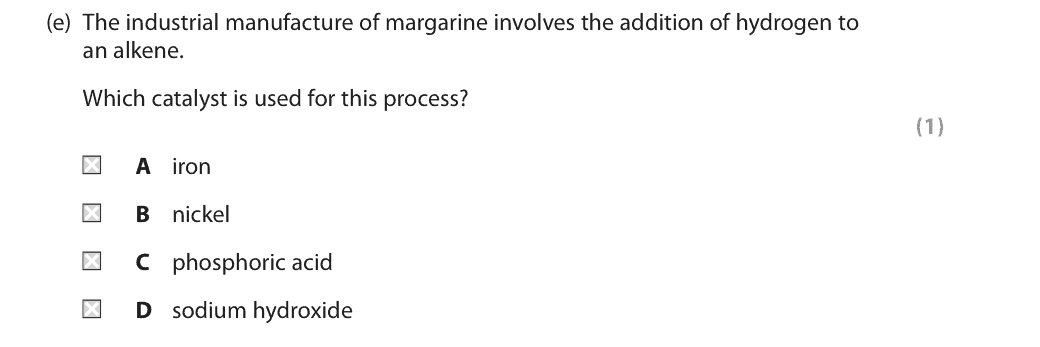
June 2023 · AS Paper 2 · Q3(e) 1 mark Multiple choice alkenes
The industrial manufacture of margarine involves the addition of hydrogen to
an alkene.
Which catalyst is used for this process?
A  iron
B  nickel
C  phosphoric acid
D  sodium hydroxide
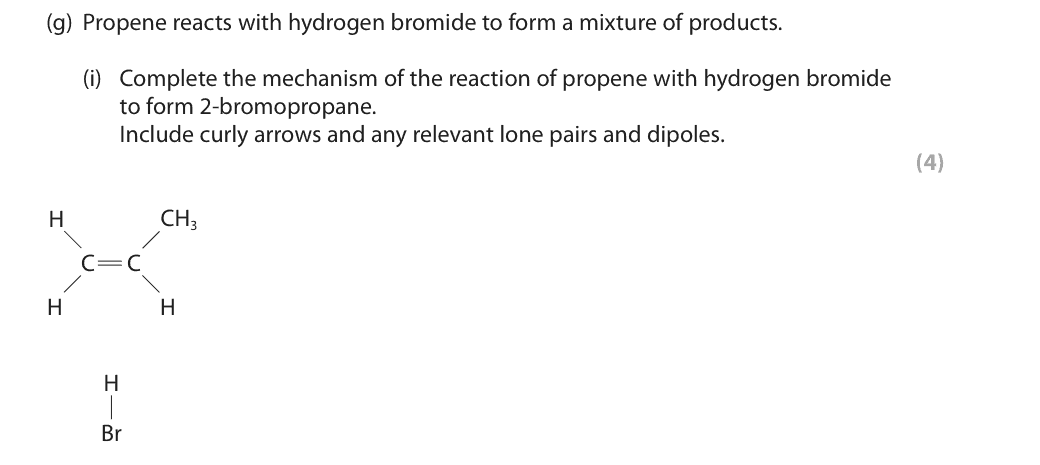
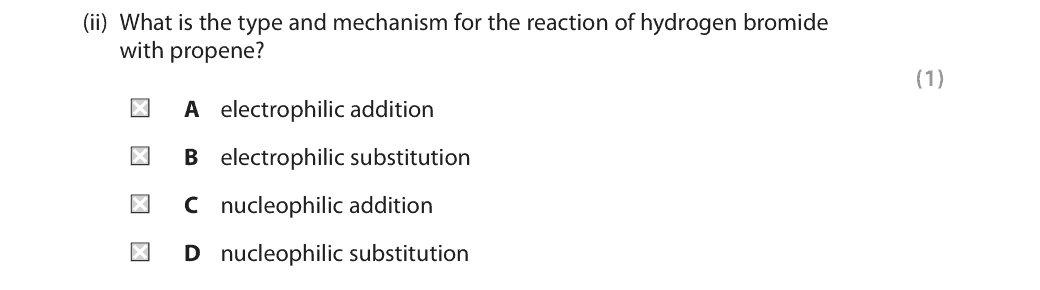
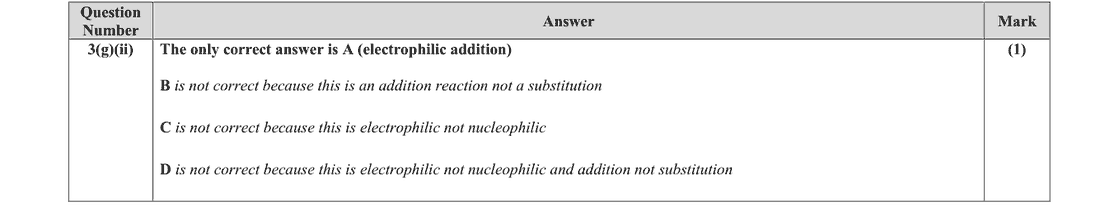
June 2023 · AS Paper 2 · Q3(g)(ii) 1 mark Multiple choice alkenes
Earlier part of question 3 that this part usesEarlier part of June 2023 Paper 2 question 3
What is the type and mechanism for the reaction of hydrogen bromide
with propene?
A  electrophilic addition
B  electrophilic substitution
C  nucleophilic addition
D  nucleophilic substitution
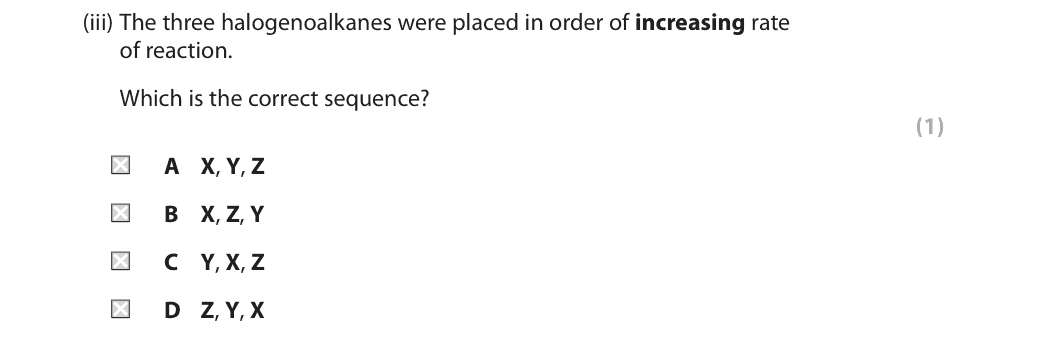
June 2023 · AS Paper 2 · Q4(a)(iii) 1 mark Multiple choice halogenoalkanes
Earlier part of question 4 that this part usesEarlier part of June 2023 Paper 2 question 4
The three halogenoalkanes were placed in order of increasing rate
of reaction.
Which is the correct sequence?
A  X, Y, Z
B  X, Z, Y
C  Y, X, Z
D  Z, Y, X
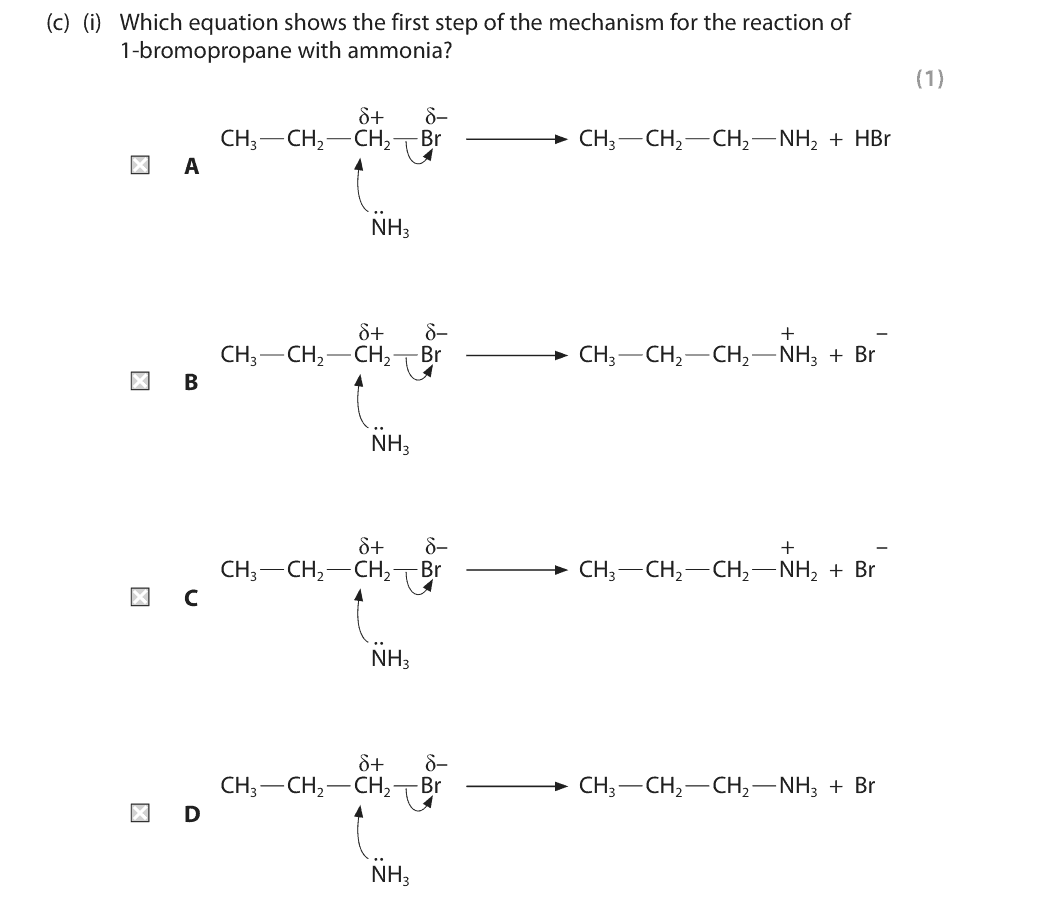
June 2023 · AS Paper 2 · Q4(c)(i) 1 mark Multiple choice halogenoalkanes
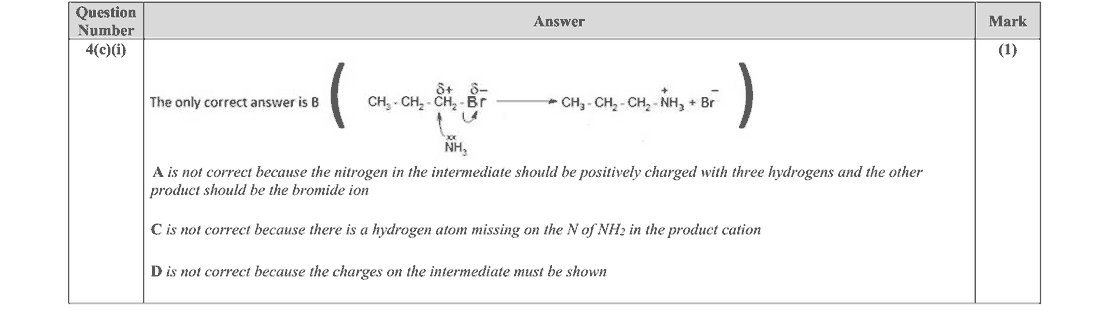
Which equation shows the first step of the mechanism for the reaction of
1‑bromopropane with ammonia?
δ+
δ–
CH3
CH2
CH2
Br
CH3
CH2
CH2
NH2  +  HBr
A
• •NH3
δ+
δ–
+
–
CH3
CH2
CH2
Br
CH3
CH2
CH2
NH3  +  Br
B
• •NH3
δ+
δ–
+
–
CH3
CH2
CH2
Br
CH3
CH2
CH2
NH2  +  Br
C
• •NH3
δ+
δ–
CH3
CH2
CH2
Br
CH3
CH2
CH2
NH3  +  Br
D
• •NH3
June 2023 · AS Paper 2 · Q4(c)(iii) 1 mark Multiple choice mass spectrometry and infrared spectroscopy
Earlier parts of question 4 that this part usesEarlier part of June 2023 Paper 2 question 4Earlier part of June 2023 Paper 2 question 4
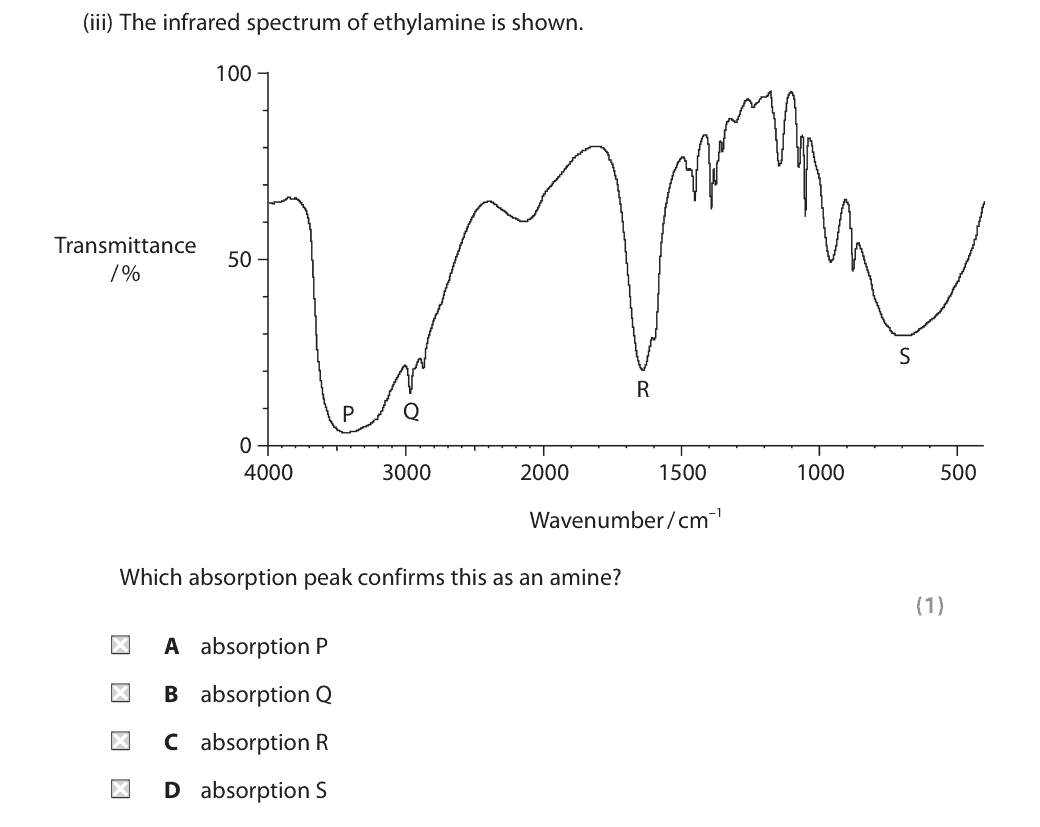
The infrared spectrum of ethylamine is shown.
100
Transmittance
50
/ %
S
R
P
Q
0
4000
3000
2000
1500
1000
500
Wavenumber / cm–1
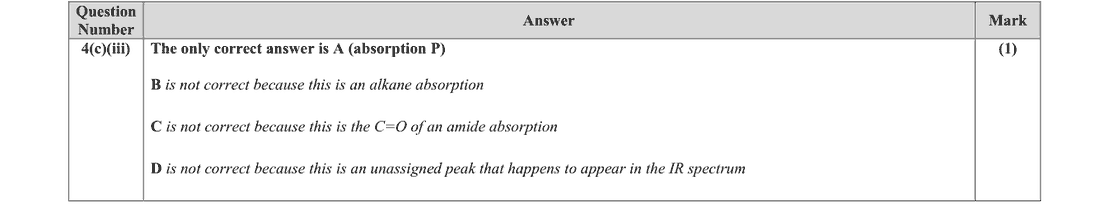
Which absorption peak confirms this as an amine?
A  absorption P
B  absorption Q
C  absorption R
D  absorption S
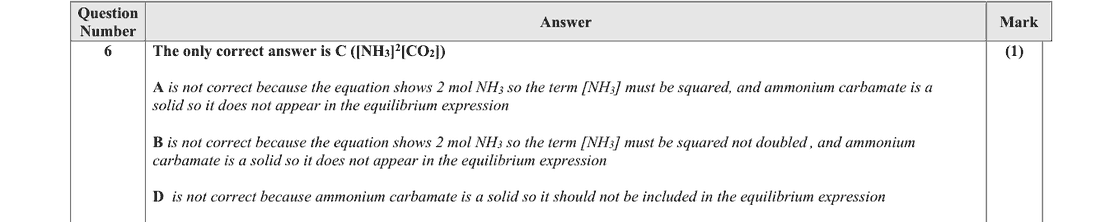
June 2023 · AS Paper 2 · Q6 1 mark Multiple choice equilibrium i
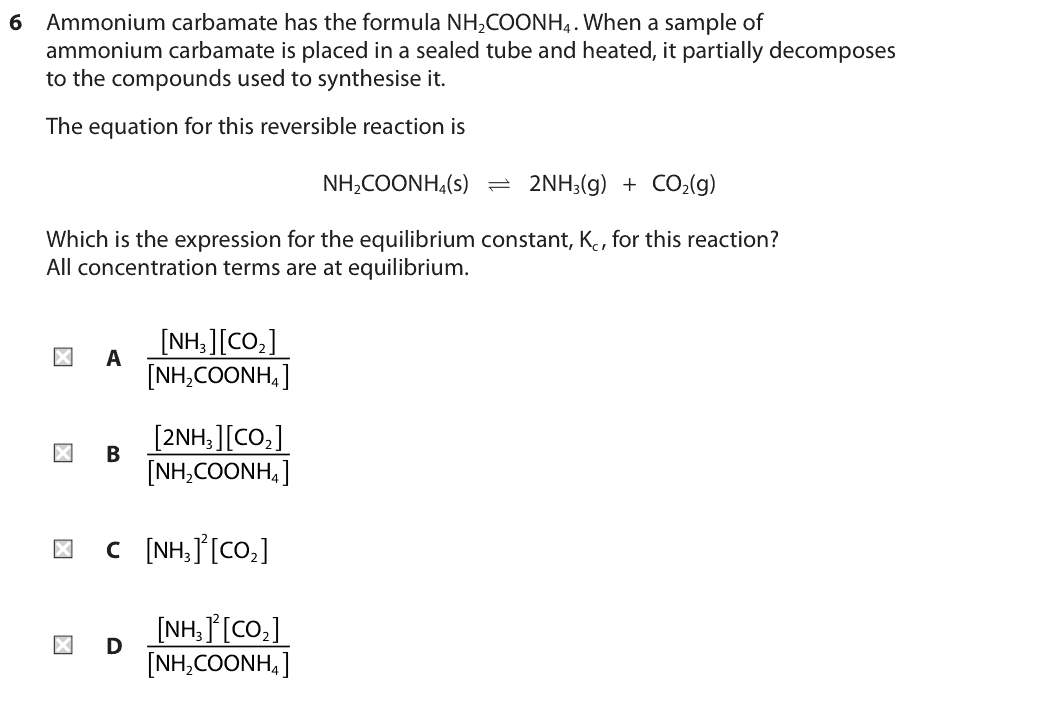
Ammonium carbamate has the formula NH2COONH4 . When a sample of
ammonium carbamate is placed in a sealed tube and heated, it partially decomposes
to the compounds used to synthesise it.
The equation for this reversible reaction is
NH2COONH4(s)      2NH3(g)   +   CO2(g)
Which is the expression for the equilibrium constant, Kc , for this reaction?
All concentration terms are at equilibrium.
Ä
ÇÄ
Ç
NH
CO
3
2
A
Ä
Ç
NH COONH4
2
Ä
ÇÄ
Ç
2NH
CO
3
2
B
Ä
Ç
NH COONH4
2
Ä
Ç Ä
2
Ç
C
NH
CO
3
2
Ä
Ç Ä
2
Ç
NH
CO
3
2
D
Ä
Ç
NH COONH4
2
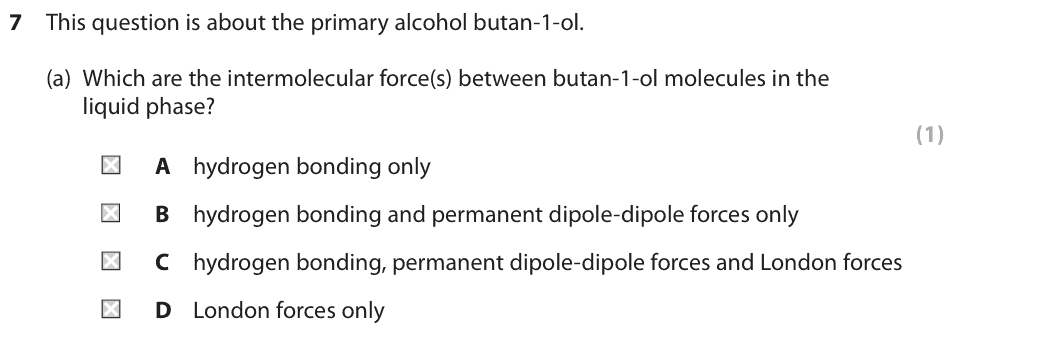
June 2023 · AS Paper 2 · Q7(a) 1 mark Multiple choice bonding
This question is about the primary alcohol butan‑1‑ol.
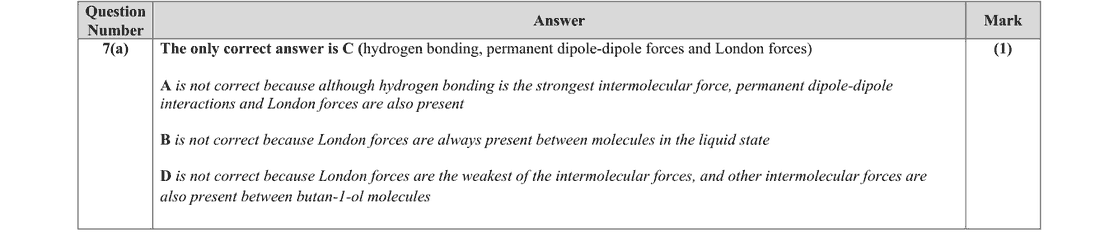
Which are the intermolecular force(s) between butan‑1‑ol molecules in the
liquid phase?
A  hydrogen bonding only
B  hydrogen bonding and permanent dipole‑dipole forces only
C  hydrogen bonding, permanent dipole‑dipole forces and London forces
D  London forces only
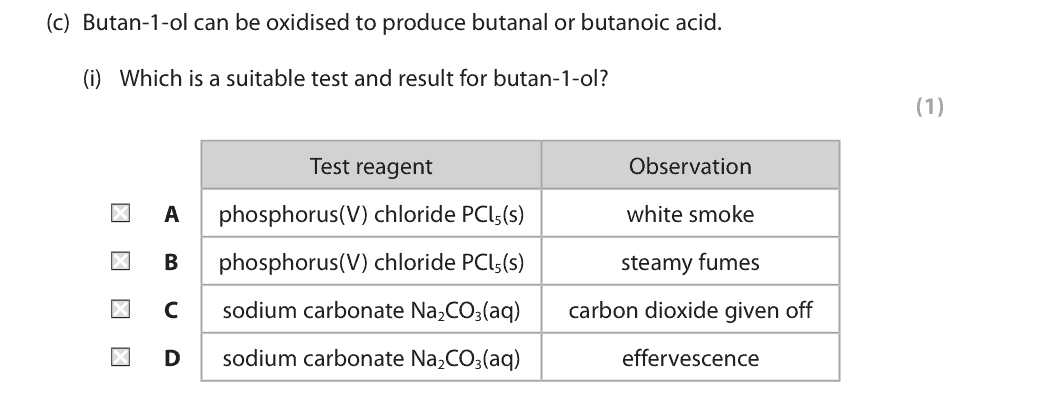
June 2023 · AS Paper 2 · Q7(c)(i) 1 mark Multiple choice alcohols
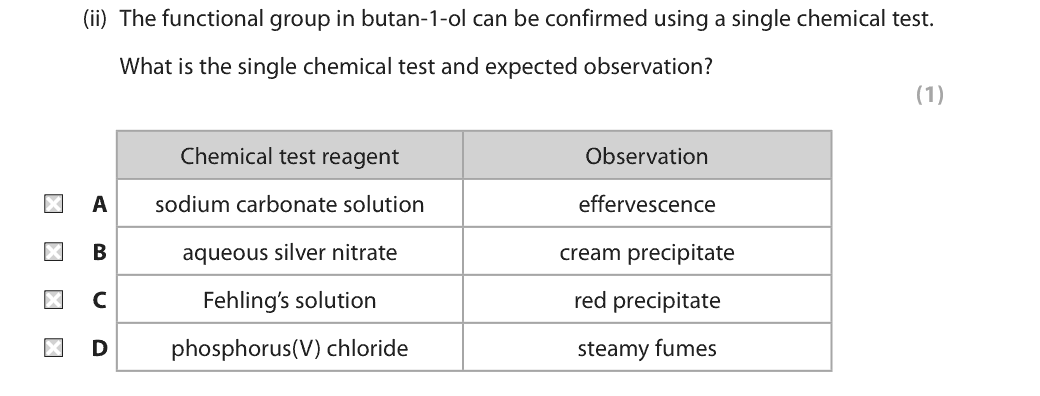
Butan‑1‑ol can be oxidised to produce butanal or butanoic acid.
Which is a suitable test and result for butan‑1‑ol?
Test reagent
Observation
A
phosphorus(V) chloride PCl5(s)
white smoke
B
phosphorus(V) chloride PCl5(s)
steamy fumes
C
sodium carbonate Na2CO3(aq)
carbon dioxide given off
D
sodium carbonate Na2CO3(aq)
effervescence
June 2023 · Paper 1 · Q1(a) 1 mark Multiple choice atomic structure and the periodic table
This question is about d‑block elements.
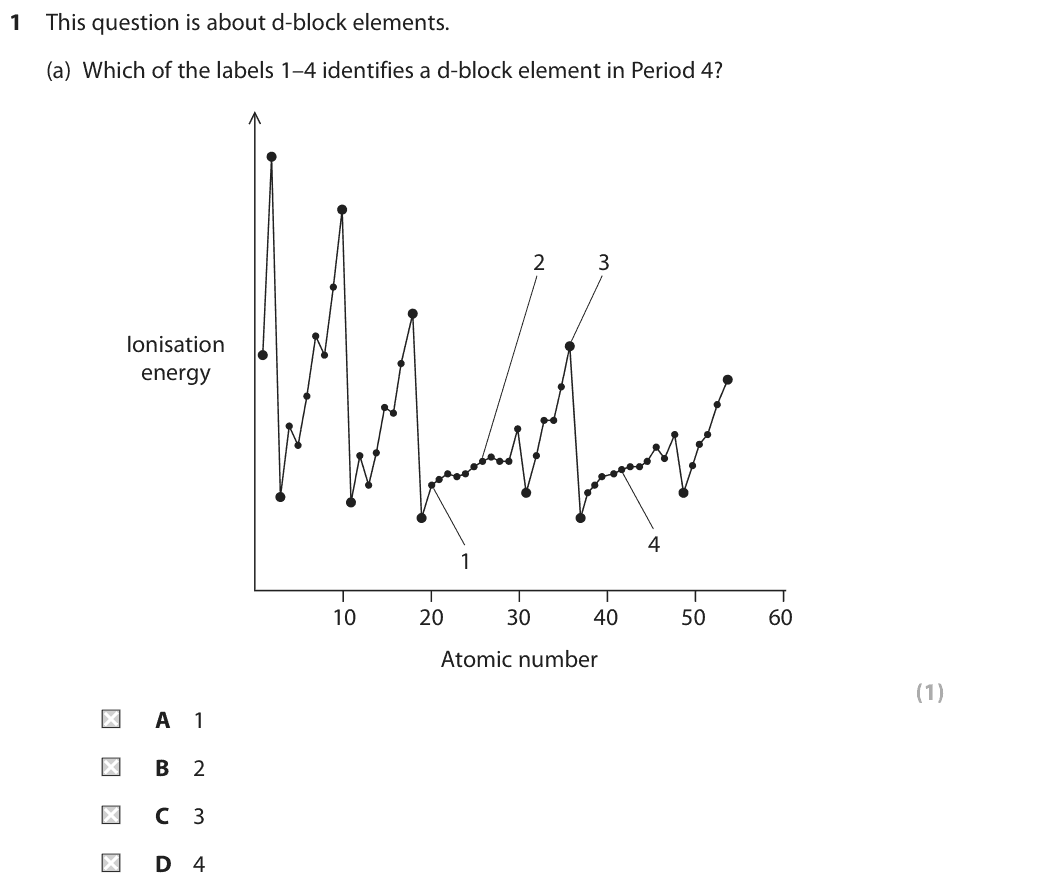
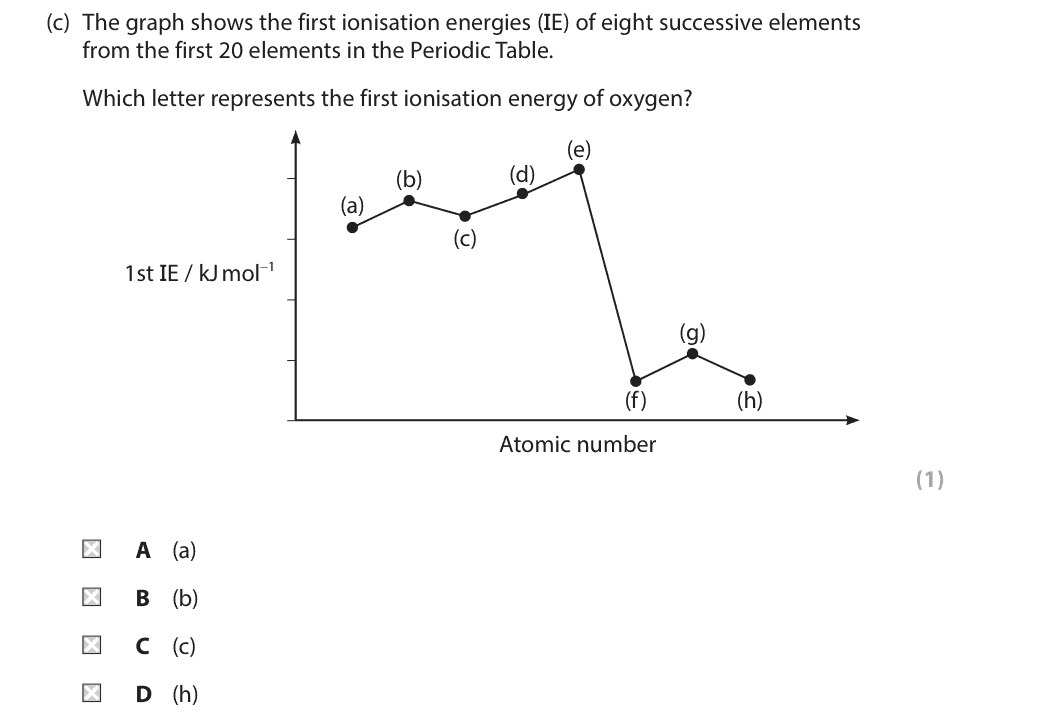
Which of the labels 1–4 identifies a d‑block element in Period 4?
2
3
Ionisation
energy
4
1
10
20
30
40
50
60
Atomic number
A  1
B  2
C  3
D  4
June 2023 · Paper 1 · Q2(c) 1 mark Multiple choice transition metals principles
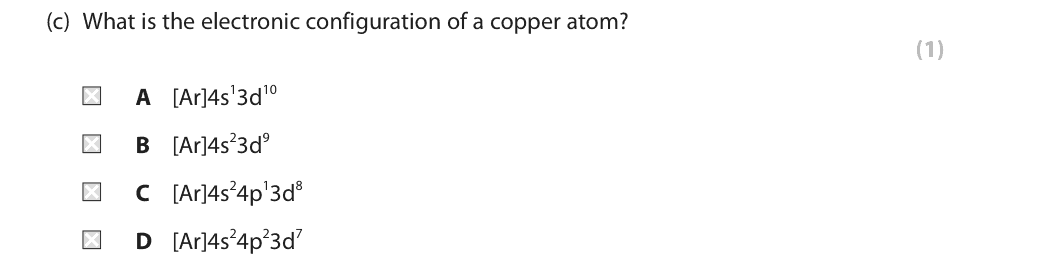
What is the electronic configuration of a copper atom?
A  [Ar]4s13d10
B  [Ar]4s23d9
C  [Ar]4s24p13d8
D  [Ar]4s24p23d7
June 2023 · Paper 1 · Q3(a) 1 mark Multiple choice group 7 the halogens
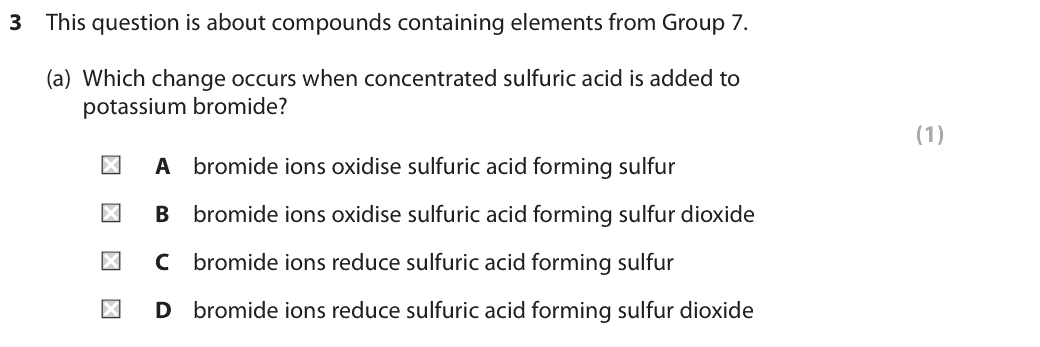
This question is about compounds containing elements from Group 7.
Which change occurs when concentrated sulfuric acid is added to
potassium bromide?
A  bromide ions oxidise sulfuric acid forming sulfur
B  bromide ions oxidise sulfuric acid forming sulfur dioxide
C  bromide ions reduce sulfuric acid forming sulfur
D  bromide ions reduce sulfuric acid forming sulfur dioxide
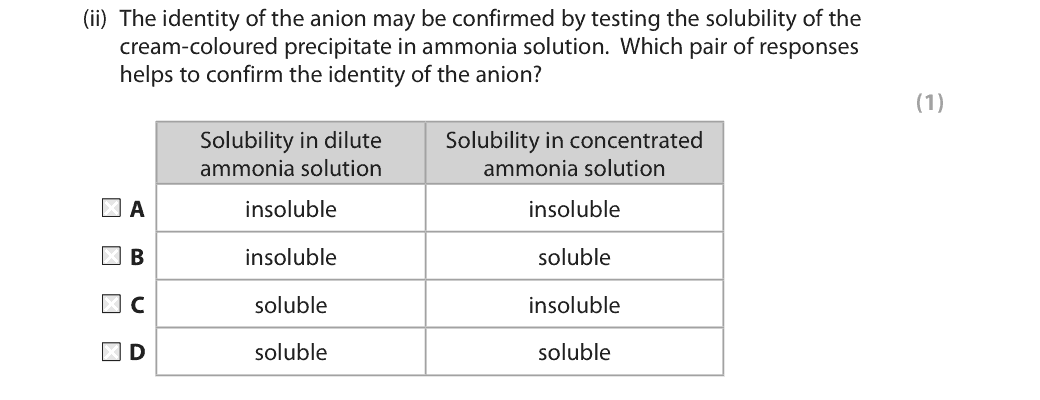
June 2023 · Paper 1 · Q3(b)(i) 1 mark Multiple choice group 7 the halogens
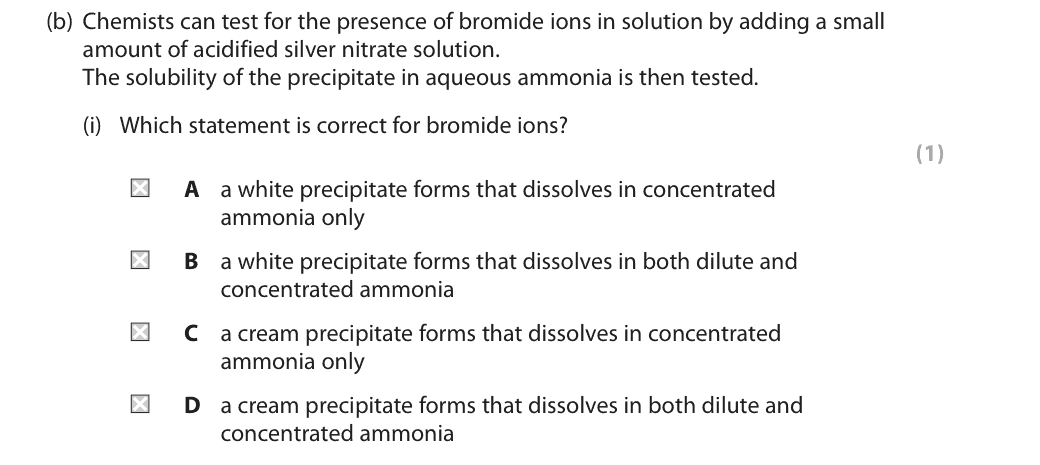
Chemists can test for the presence of bromide ions in solution by adding a small
amount of acidified silver nitrate solution.
The solubility of the precipitate in aqueous ammonia is then tested.
Which statement is correct for bromide ions?
A  a white precipitate forms that dissolves in concentrated
ammonia only
B  a white precipitate forms that dissolves in both dilute and
concentrated ammonia
C  a cream precipitate forms that dissolves in concentrated
ammonia only
D  a cream precipitate forms that dissolves in both dilute and
concentrated ammonia
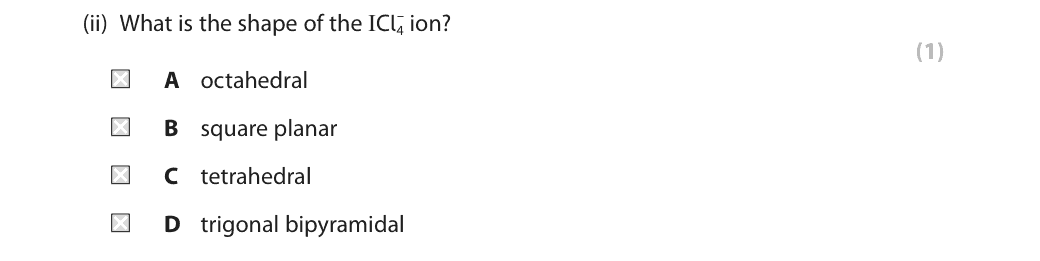
June 2023 · Paper 1 · Q3(c)(ii) 1 mark Multiple choice bonding
Earlier part of question 3 that this part usesEarlier part of June 2023 Paper 1 question 3
What is the shape of the ICl4
– ion?
A  octahedral
B  square planar
C  tetrahedral
D  trigonal bipyramidal
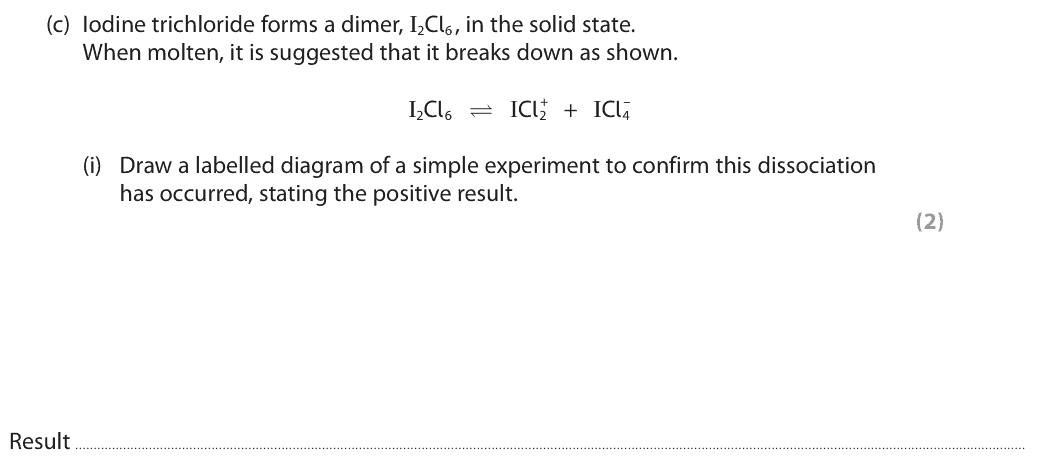
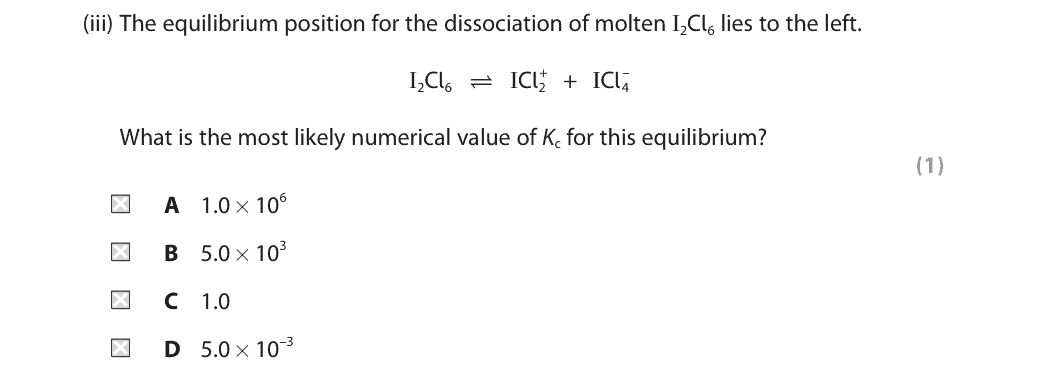
June 2023 · Paper 1 · Q3(c)(iii) 1 mark Multiple choice equilibrium i
Earlier parts of question 3 that this part usesEarlier part of June 2023 Paper 1 question 3Earlier part of June 2023 Paper 1 question 3
The equilibrium position for the dissociation of molten I2Cl6 lies to the left.
I2Cl6      ICl2
+   +   ICl4
–
What is the most likely numerical value of Kc for this equilibrium?
A  1.0 × 106
B  5.0 × 103
C  1.0
D  5.0 × 10–3
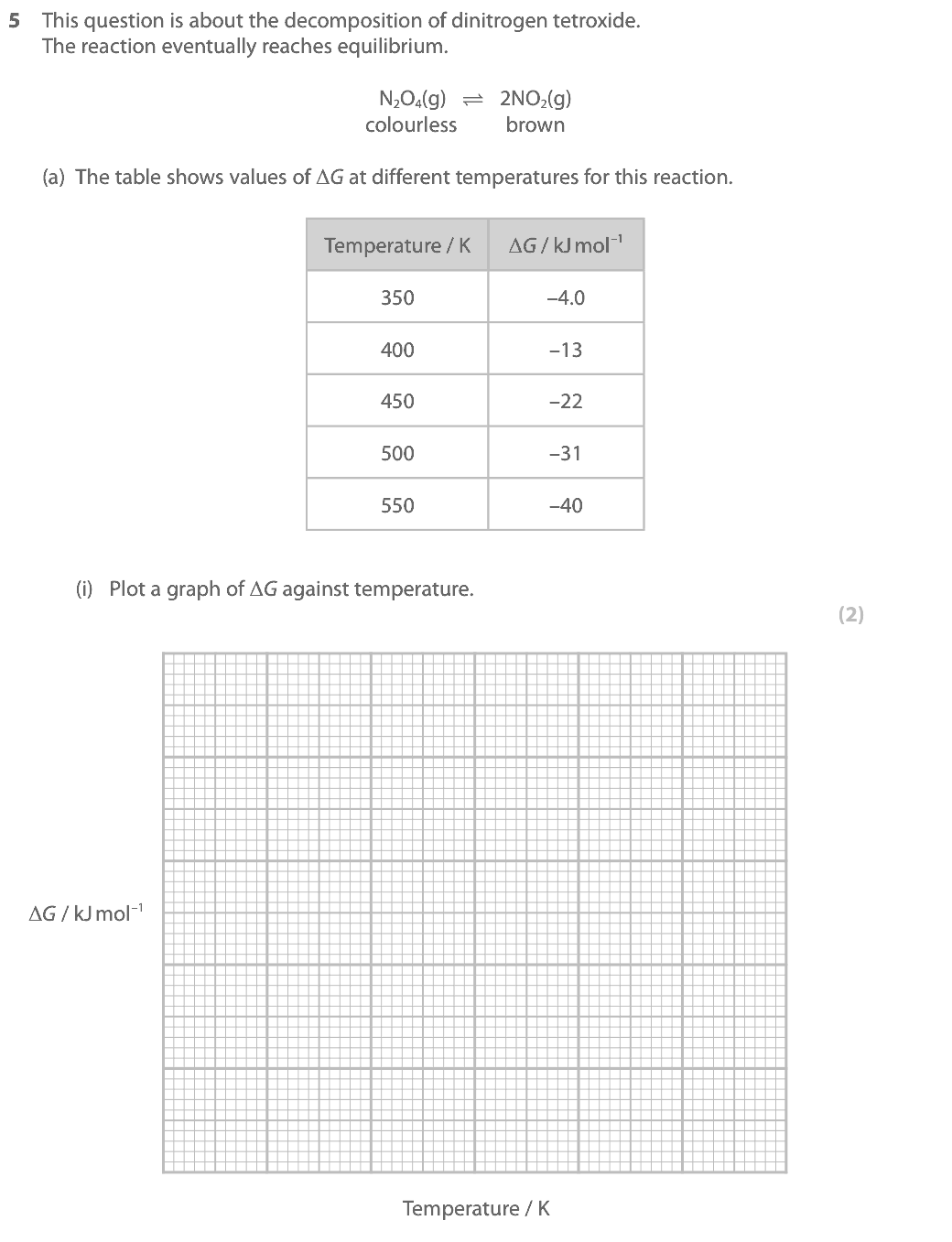
June 2023 · Paper 1 · Q5(a)(iii) 1 mark Multiple choice entropy
Earlier parts of question 5 that this part usesEarlier part of June 2023 Paper 1 question 5Earlier part of June 2023 Paper 1 question 5
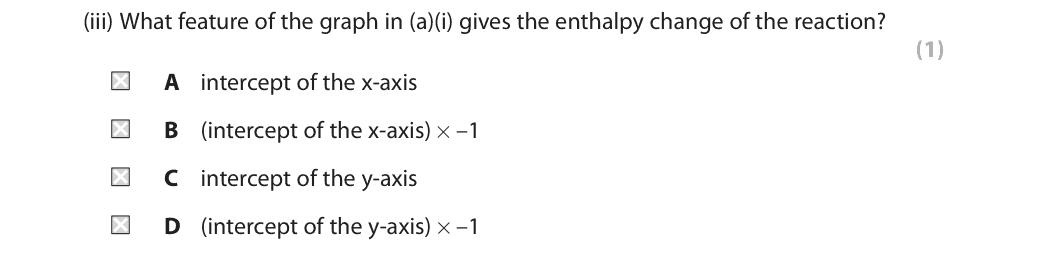
What feature of the graph in (a)(i) gives the enthalpy change of the reaction?
A  intercept of the x‑axis
B  (intercept of the x‑axis) × –1
C  intercept of the y‑axis
D  (intercept of the y‑axis) × –1
June 2023 · Paper 1 · Q5(b) 1 mark Multiple choice equilibrium i
Earlier part of question 5 that this part usesEarlier part of June 2023 Paper 1 question 5
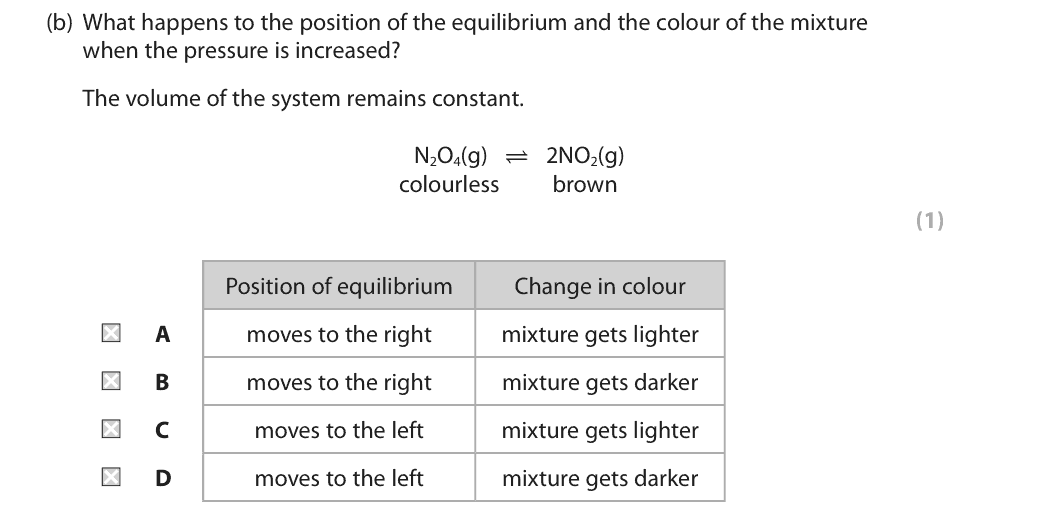
What happens to the position of the equilibrium and the colour of the mixture
when the pressure is increased?
The volume of the system remains constant.
N2O4(g)      2NO2(g)
colourless
brown
Position of equilibrium
Change in colour
A
moves to the right
mixture gets lighter
B
moves to the right
mixture gets darker
C
moves to the left
mixture gets lighter
D
moves to the left
mixture gets darker
June 2023 · Paper 1 · Q6(a) 1 mark Multiple choice acid base equilibria
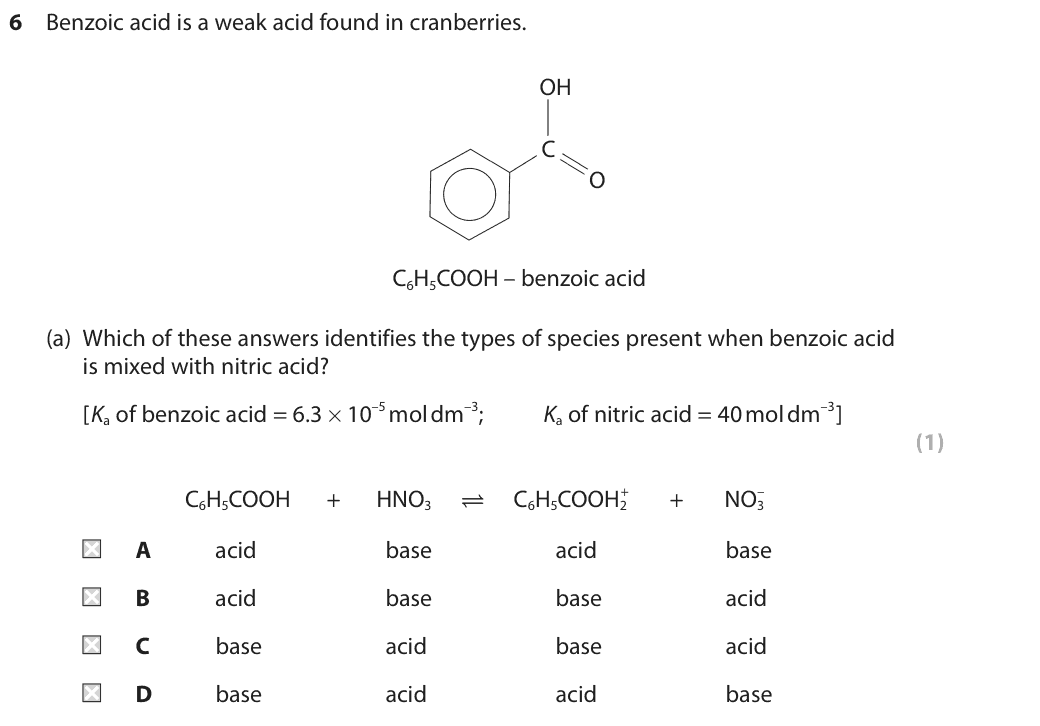
Benzoic acid is a weak acid found in cranberries.
OH
C
O
C6H5COOH – benzoic acid
Which of these answers identifies the types of species present when benzoic acid
is mixed with nitric acid?
[Ka of benzoic acid = 6.3 × 10–5 mol dm–3;          Ka of nitric acid = 40 mol dm–3]
C6H5COOH       +       HNO3          C6H5COOH2
+        +        NO3
–
A
acid
base
acid
base
B
acid
base
base
acid
C
base
acid
base
acid
D
base
acid
acid
base
June 2023 · Paper 1 · Q6(d)(i) 1 mark Multiple choice acid base equilibria
Earlier part of question 6 that this part usesEarlier part of June 2023 Paper 1 question 6
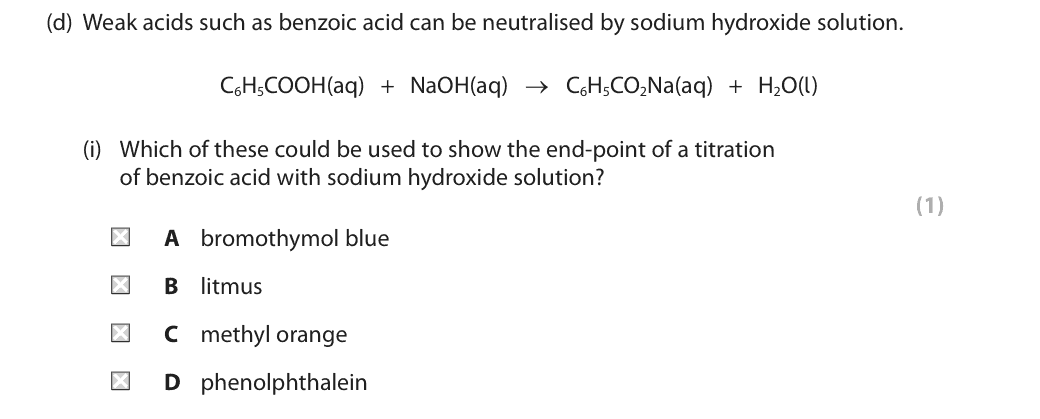
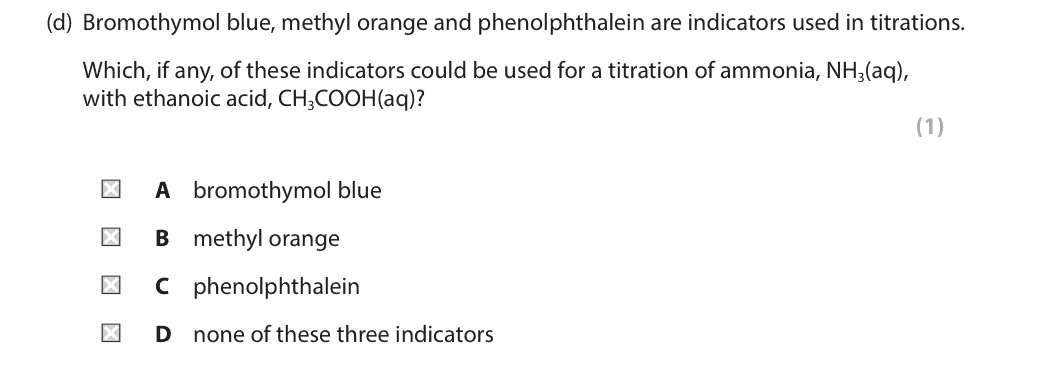
Weak acids such as benzoic acid can be neutralised by sodium hydroxide solution.
C6H5COOH(aq)   +   NaOH(aq)   →   C6H5CO2Na(aq)   +   H2O(l)
Which of these could be used to show the end‑point of a titration
of benzoic acid with sodium hydroxide solution?
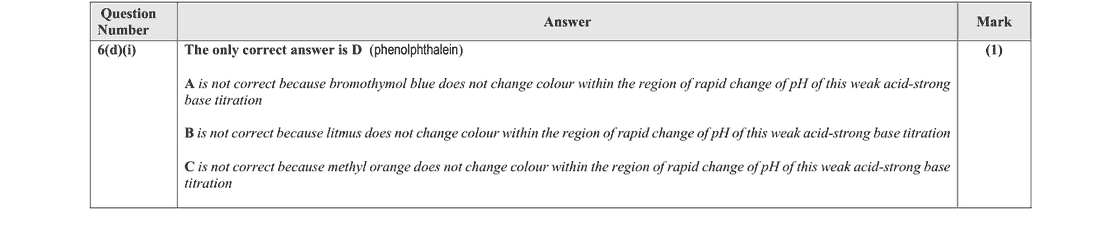
A  bromothymol blue
B  litmus
C  methyl orange
D  phenolphthalein
June 2023 · Paper 2 · Q1(b) 1 mark Multiple choice alkenes
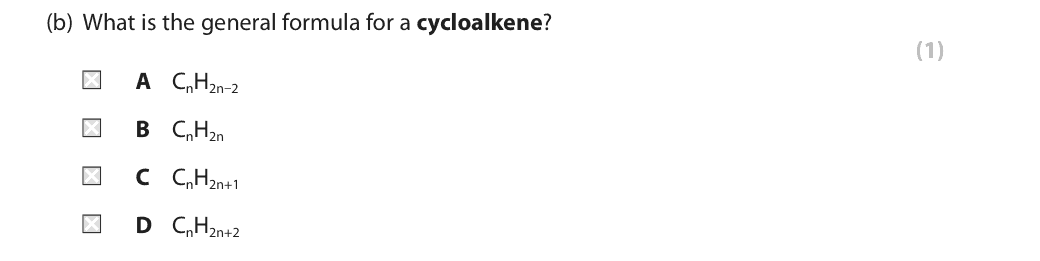
What is the general formula for a cycloalkene?
A  CnH2n–2
B  CnH2n
C  CnH2n+1
D  CnH2n+2
June 2023 · Paper 2 · Q2(a) 1 mark Multiple choice alkanes
This question is about alcohols.
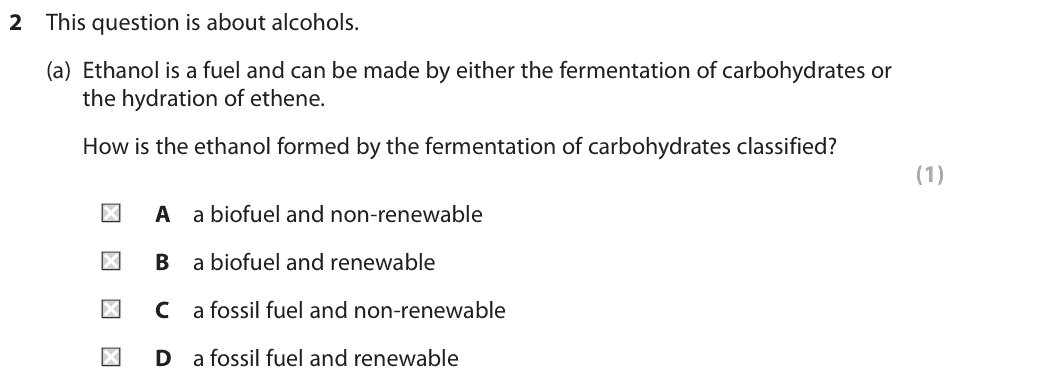
Ethanol is a fuel and can be made by either the fermentation of carbohydrates or
the hydration of ethene.
How is the ethanol formed by the fermentation of carbohydrates classified?
A  a biofuel and non‑renewable
B  a biofuel and renewable
C  a fossil fuel and non‑renewable
D  a fossil fuel and renewable
June 2023 · Paper 2 · Q2(d)(i) 1 mark Multiple choice mass spectrometry and infrared spectroscopy
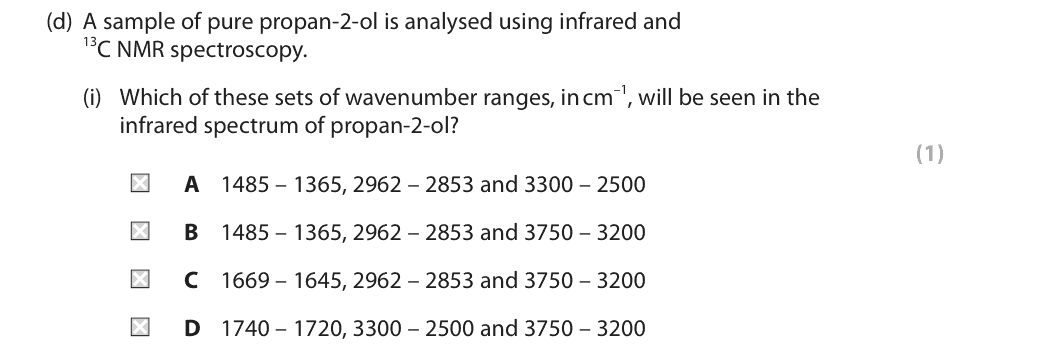
A sample of pure propan‑2‑ol is analysed using infrared and
13C NMR spectroscopy.
Which of these sets of wavenumber ranges, in cm–1, will be seen in the
infrared spectrum of propan‑2‑ol?
A  1485 – 1365, 2962 – 2853 and 3300 – 2500
B  1485 – 1365, 2962 – 2853 and 3750 – 3200
C  1669 – 1645, 2962 – 2853 and 3750 – 3200
D  1740 – 1720, 3300 – 2500 and 3750 – 3200
June 2023 · Paper 2 · Q3(a) 1 mark Multiple choice nmr mass spectrometry and chromatography
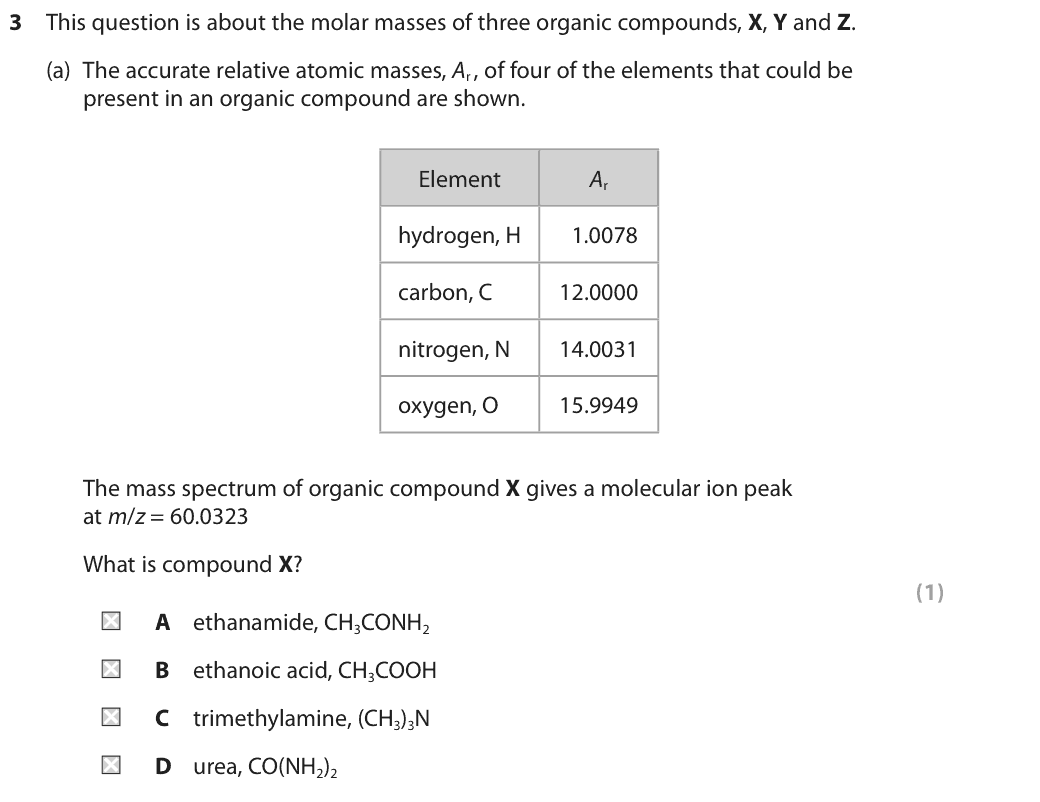
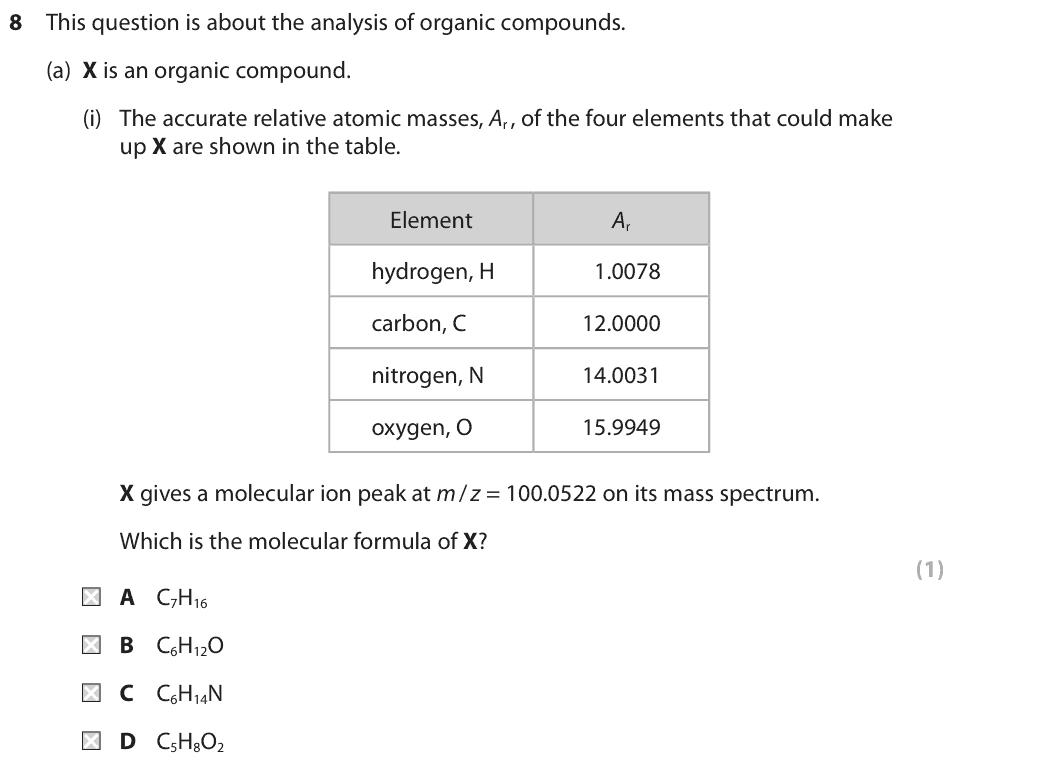
This question is about the molar masses of three organic compounds, X, Y and Z.
The accurate relative atomic masses, Ar , of four of the elements that could be
present in an organic compound are shown.
Element
Ar
hydrogen, H
1.0078
carbon, C
12.0000
nitrogen, N
14.0031
oxygen, O
15.9949
The mass spectrum of organic compound X gives a molecular ion peak
at m/z = 60.0323
What is compound X?
A  ethanamide, CH3CONH2
B  ethanoic acid, CH3COOH
C  trimethylamine, (CH3)3N
D  urea, CO(NH2)2
June 2023 · Paper 2 · Q4(b)(i) 1 mark Multiple choice alkenes
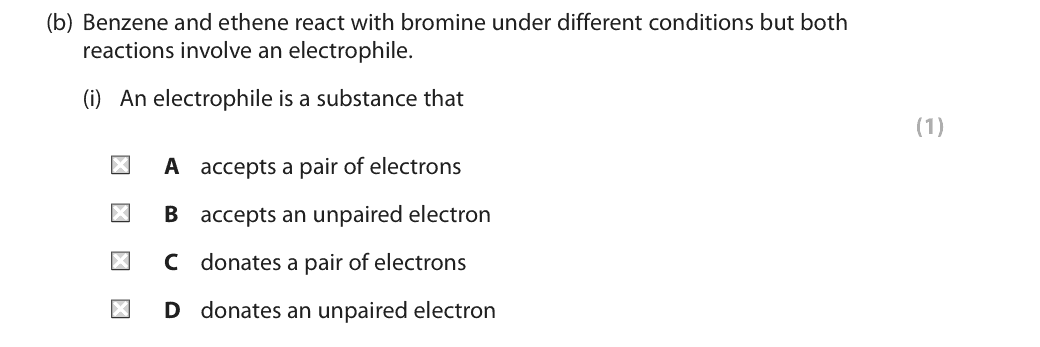
Benzene and ethene react with bromine under different conditions but both
reactions involve an electrophile.
An electrophile is a substance that
A  accepts a pair of electrons
B  accepts an unpaired electron
C  donates a pair of electrons
D  donates an unpaired electron
June 2023 · Paper 2 · Q5(b)(i) 1 mark Multiple choice kinetics ii
Earlier part of question 5 that this part usesEarlier part of June 2023 Paper 2 question 5
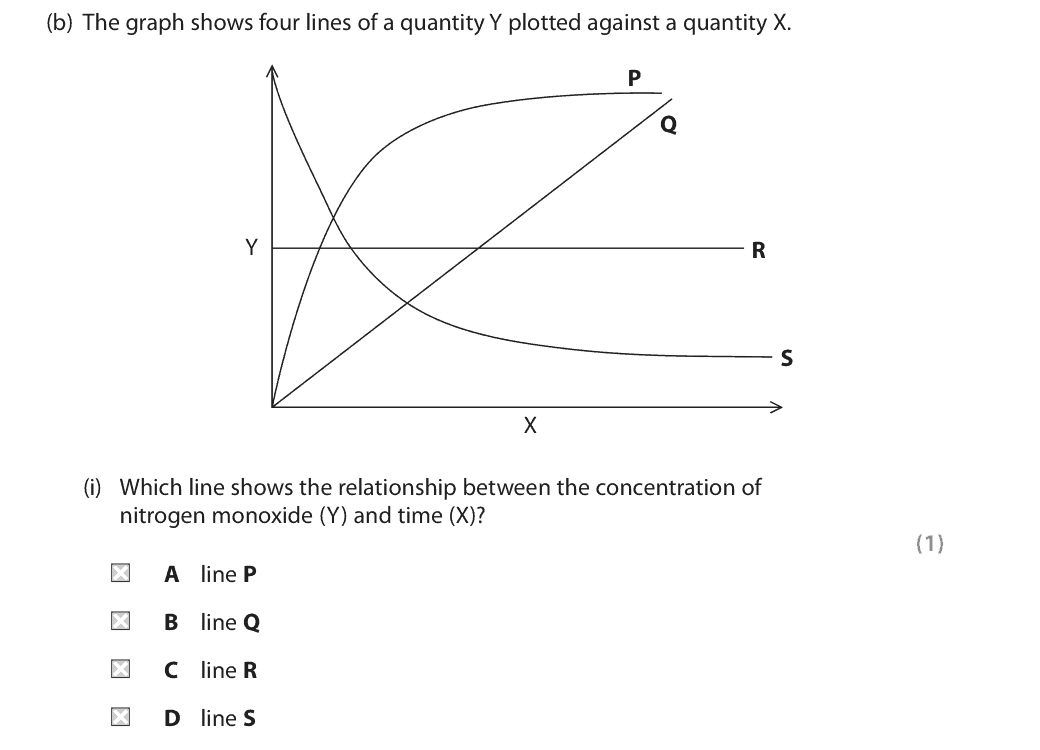
The graph shows four lines of a quantity Y plotted against a quantity X.
P
Q
Y
R
S
X
Which line shows the relationship between the concentration of
nitrogen monoxide (Y) and time (X)?
A  line P
B  line Q
C  line R
D  line S
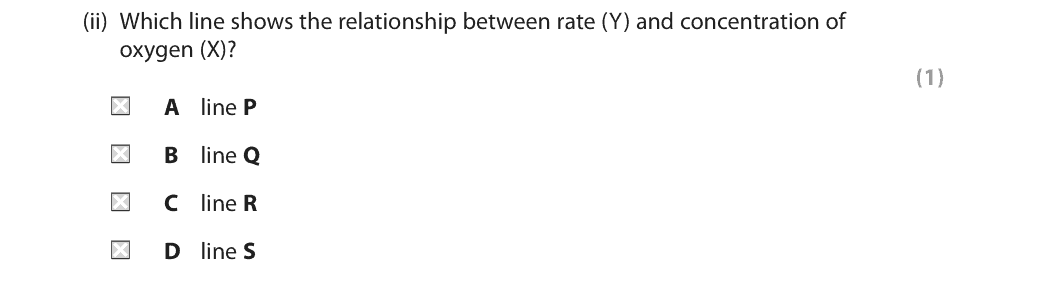
June 2023 · Paper 2 · Q5(b)(ii) 1 mark Multiple choice kinetics ii
Earlier parts of question 5 that this part usesEarlier part of June 2023 Paper 2 question 5Earlier part of June 2023 Paper 2 question 5
Which line shows the relationship between rate (Y) and concentration of
oxygen (X)?
A  line P
B  line Q
C  line R
D  line S
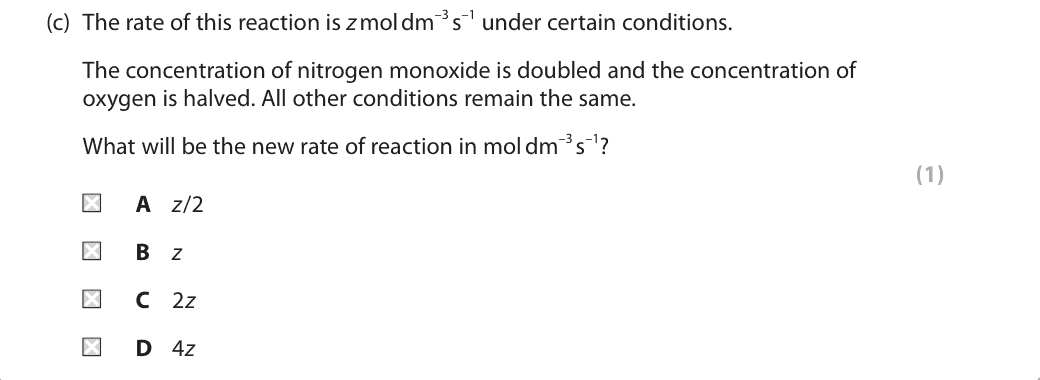
June 2023 · Paper 2 · Q5(c) 1 mark Multiple choice kinetics ii
Earlier part of question 5 that this part usesEarlier part of June 2023 Paper 2 question 5
The rate of this reaction is z mol dm–3 s–1 under certain conditions.
The concentration of nitrogen monoxide is doubled and the concentration of
oxygen is halved. All other conditions remain the same.
What will be the new rate of reaction in mol dm–3 s–1?
A  z/2
B  z
C  2z
D  4z
June 2023 · Paper 2 · Q6(c)(ii) 1 mark Multiple choice kinetics ii
Earlier parts of question 6 that this part usesEarlier part of June 2023 Paper 2 question 6Earlier part of June 2023 Paper 2 question 6
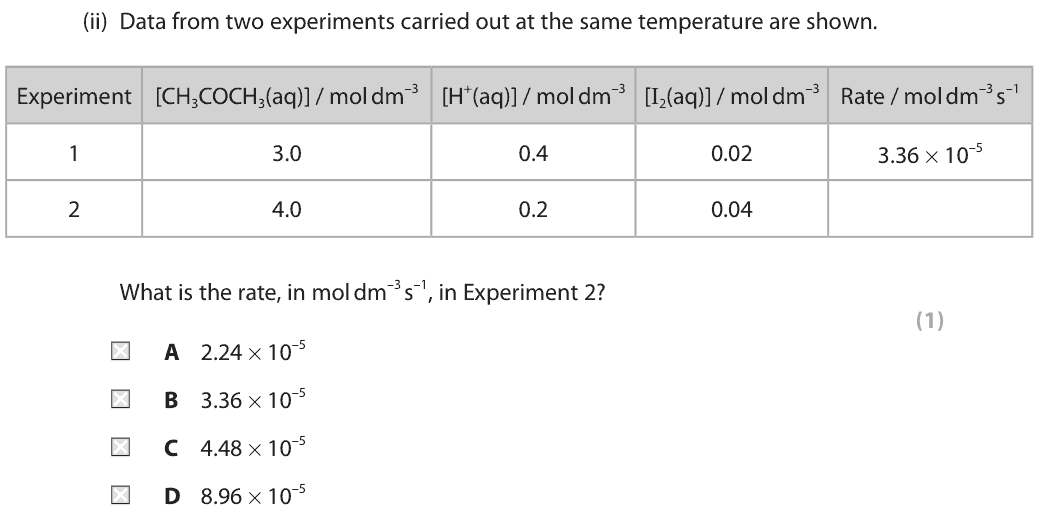
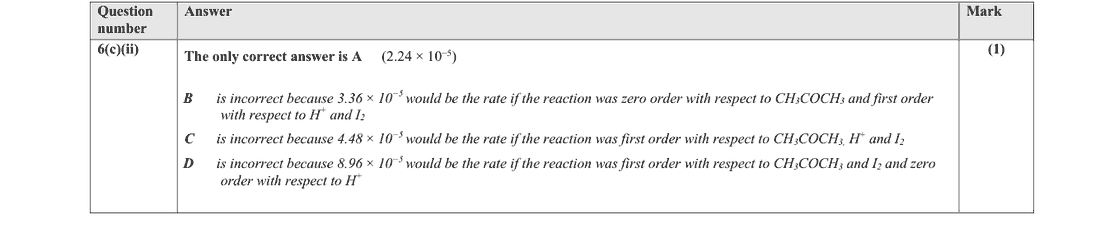
Data from two experiments carried out at the same temperature are shown.
[H+(aq)] / mol dm–3 [I2(aq)] / mol dm–3
Experiment
[CH3COCH3(aq)] / mol dm–3
Rate / mol dm–3 s–1
1
3.0
0.4
0.02
3.36 × 10–5
2
4.0
0.2
0.04
What is the rate, in mol dm–3 s–1, in Experiment 2?
A  2.24 × 10–5
B  3.36 × 10–5
C  4.48 × 10–5
D  8.96 × 10–5
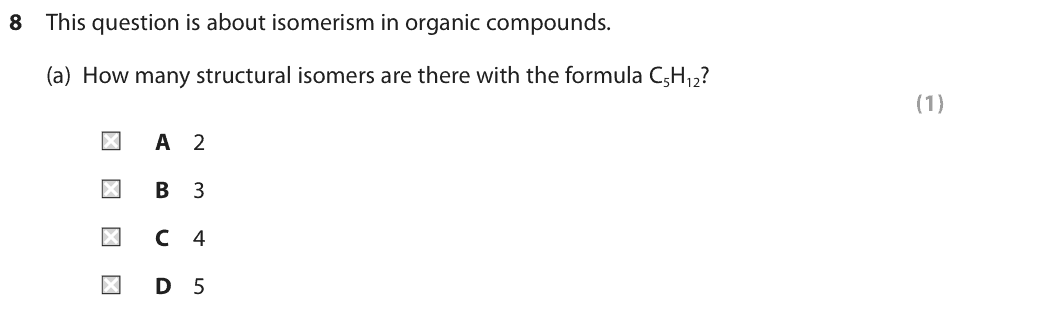
June 2023 · Paper 2 · Q8(a) 1 mark Multiple choice introduction to organic chemistry
This question is about isomerism in organic compounds.
How many structural isomers are there with the formula C5H12?
A  2
B  3
C  4
D  5
June 2022 · AS Paper 1 · Q1 1 mark Multiple choice atomic structure and the periodic table
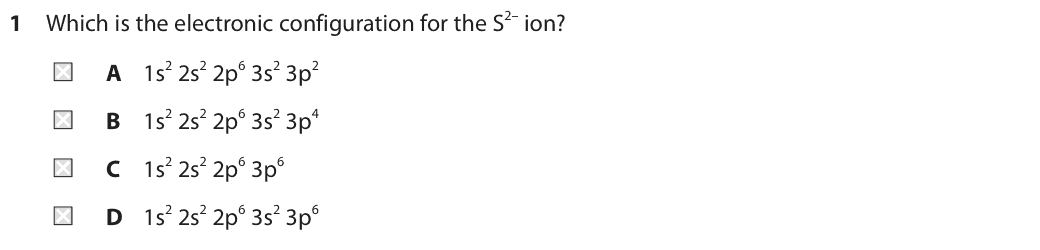
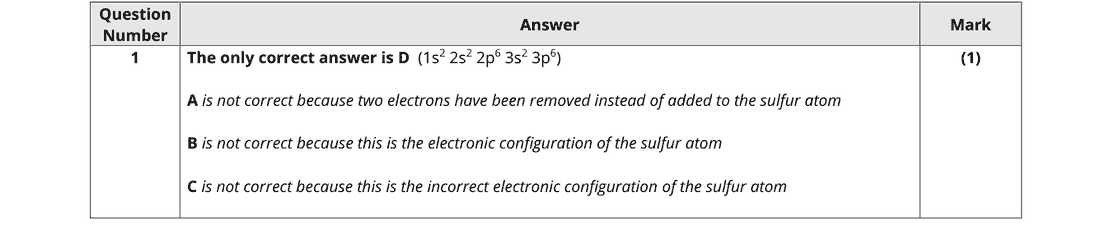
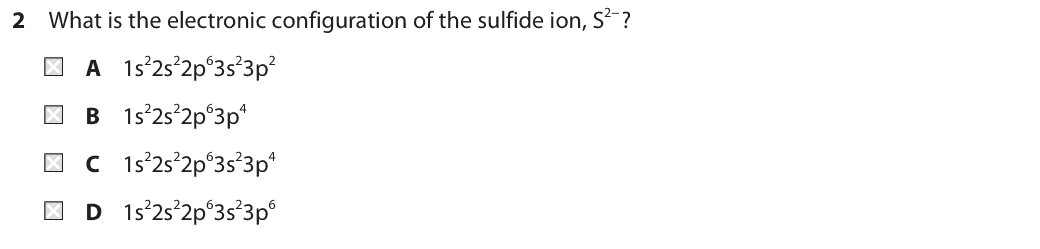
Which is the electronic configuration for the S2– ion?
A  1s2 2s2 2p6 3s2 3p2
B  1s2 2s2 2p6 3s2 3p4
C  1s2 2s2 2p6 3p6
D  1s2 2s2 2p6 3s2 3p6
June 2022 · AS Paper 1 · Q2 1 mark Multiple choice atomic structure and the periodic table
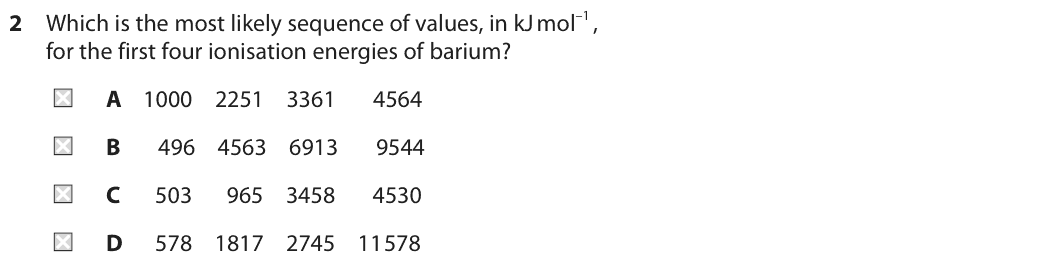
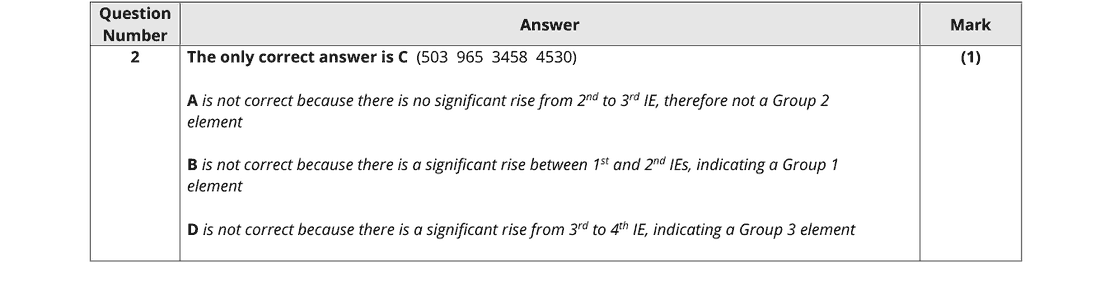
Which is the most likely sequence of values, in kJ mol–1 ,
for the first four ionisation energies of barium?
A  1000    2251    3361       4564
B     496    4563    6913       9544
C    503      965    3458       4530
D    578    1817    2745    11 578
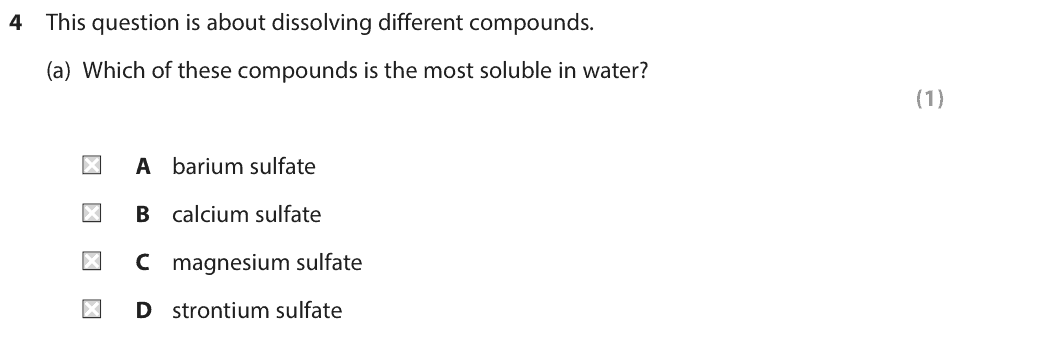
June 2022 · AS Paper 1 · Q3(b) 1 mark Multiple choice groups 1 and 2
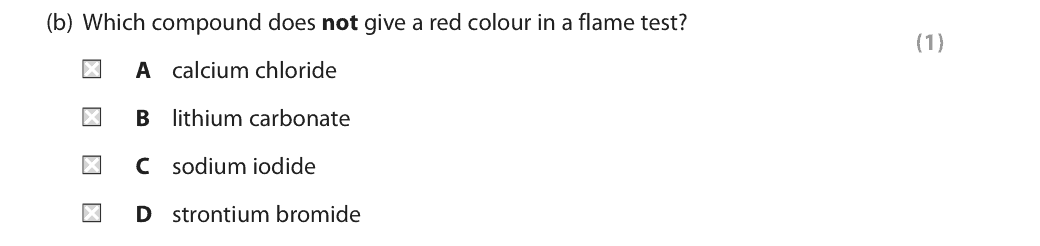
Which compound does not give a red colour in a flame test?
A  calcium chloride
B  lithium carbonate
C  sodium iodide
D  strontium bromide
June 2022 · AS Paper 1 · Q3(c) 1 mark Multiple choice groups 1 and 2
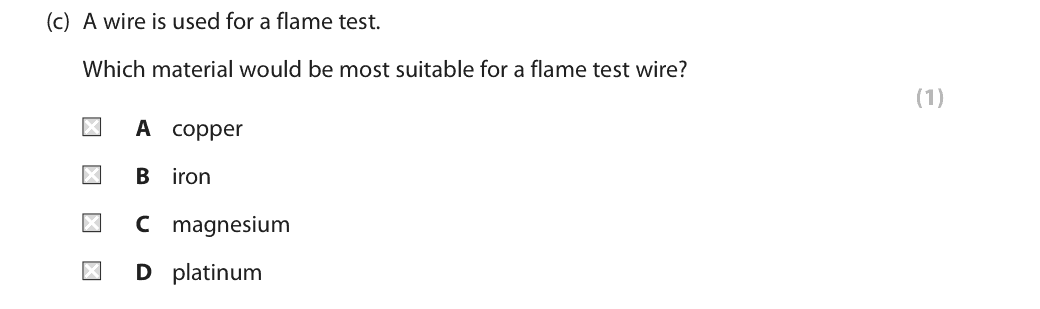
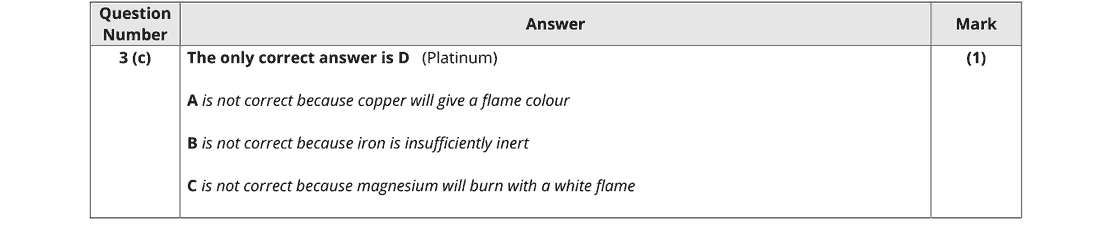
A wire is used for a flame test.
Which material would be most suitable for a flame test wire?
A  copper
B  iron
C  magnesium
D  platinum
June 2022 · AS Paper 1 · Q4(a) 1 mark Multiple choice atomic structure and the periodic table
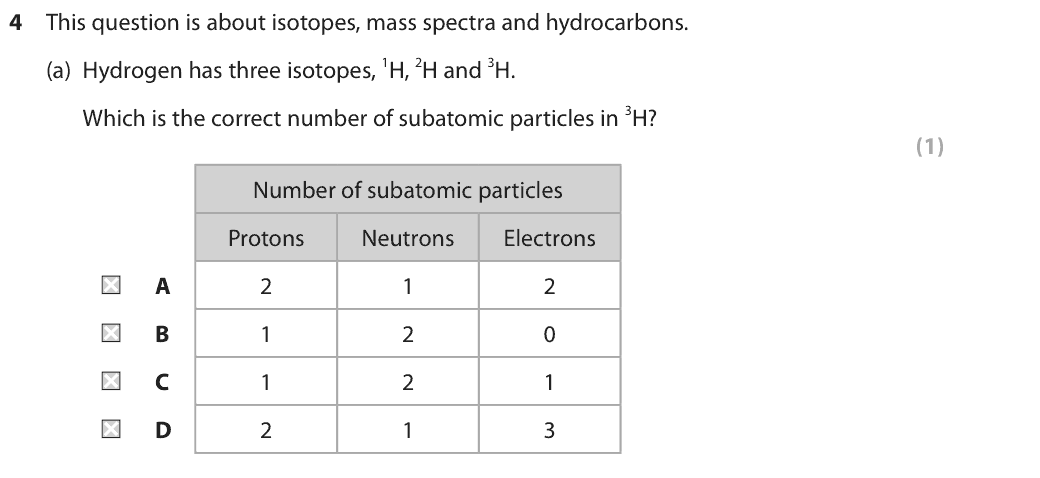
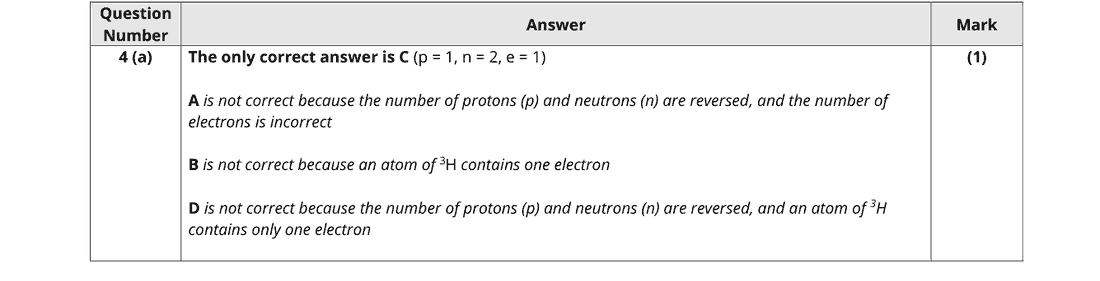
This question is about isotopes, mass spectra and hydrocarbons.
Hydrogen has three isotopes, 1H, 2H and 3H.
Which is the correct number of subatomic particles in 3H?
Number of subatomic particles
Protons
Neutrons
Electrons
A
2
1
2
B
1
2
0
C
1
2
1
D
2
1
3
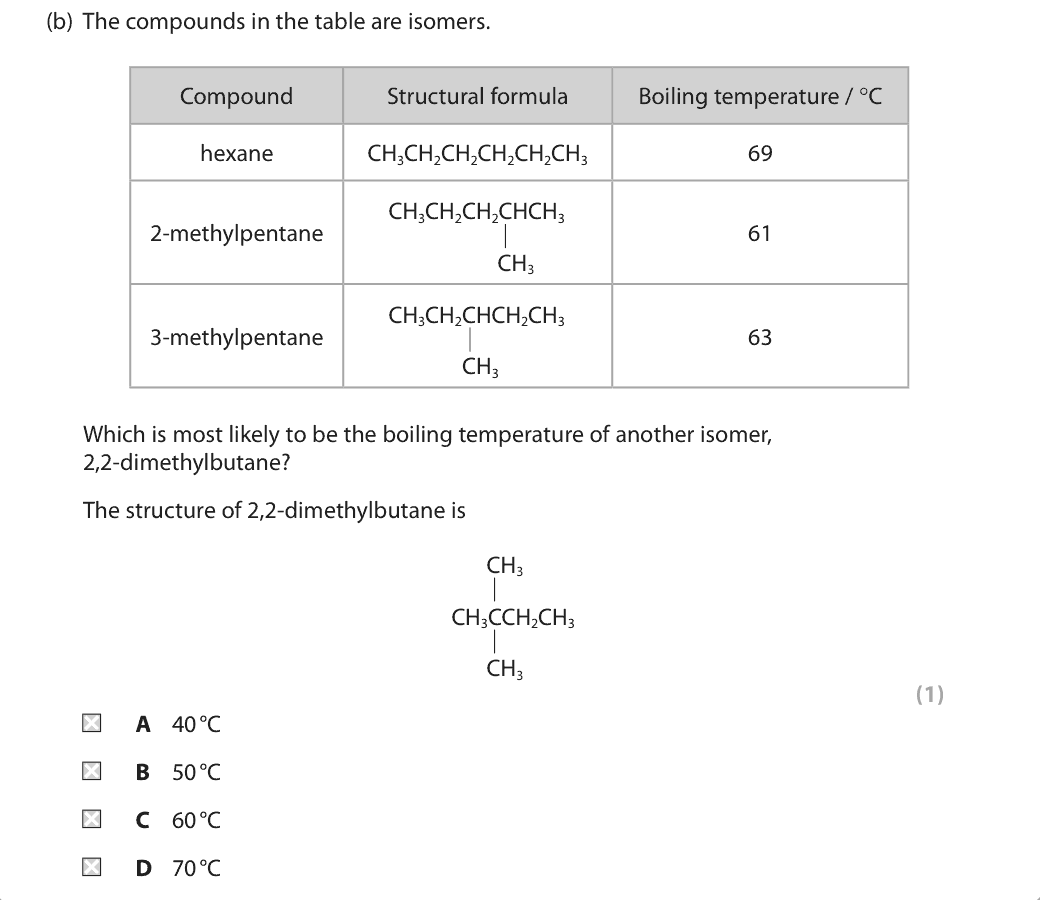
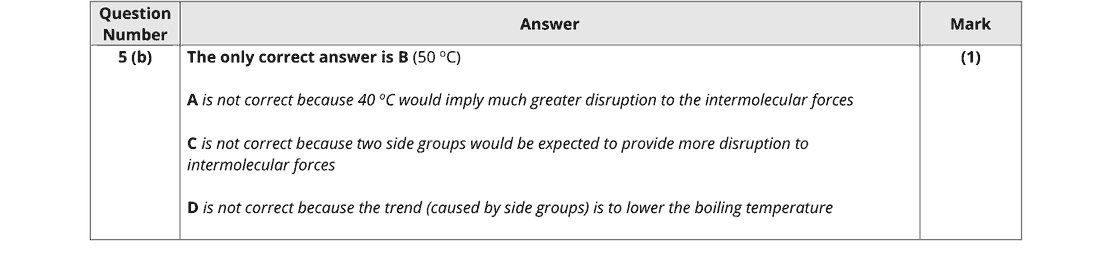
June 2022 · AS Paper 1 · Q5(b) 1 mark Multiple choice bonding
Earlier part of question 5 that this part usesEarlier part of June 2022 Paper 1 question 5
The compounds in the table are isomers.
Compound
Structural formula
Boiling temperature / °C
hexane
CH3CH2CH2CH2CH2CH3
69
CH3CH2CH2CHCH3
2‑methylpentane
61
CH3
CH3CH2CHCH2CH3
3‑methylpentane
63
CH3
Which is most likely to be the boiling temperature of another isomer,
2,2‑dimethylbutane?
The structure of 2,2‑dimethylbutane is
CH3
CH3CCH2CH3
CH3
A  40 °C
B  50 °C
C  60 °C
D  70 °C
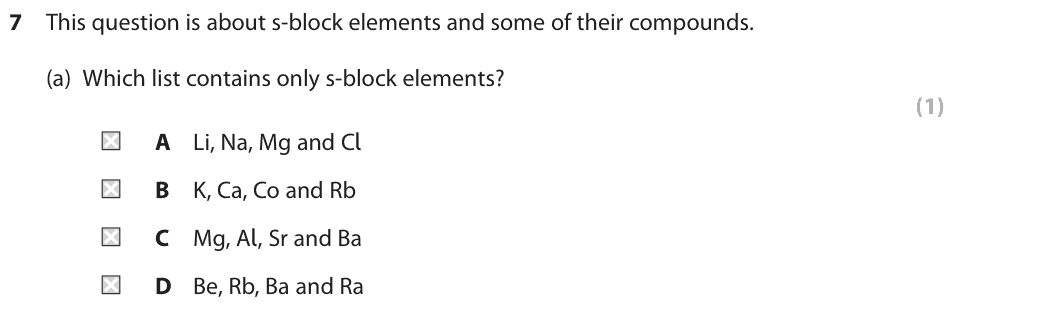
June 2022 · AS Paper 1 · Q7(a) 1 mark Multiple choice atomic structure and the periodic table
This question is about s‑block elements and some of their compounds.
Which list contains only s‑block elements?
A  Li, Na, Mg and Cl
B  K, Ca, Co and Rb
C  Mg, Al, Sr and Ba
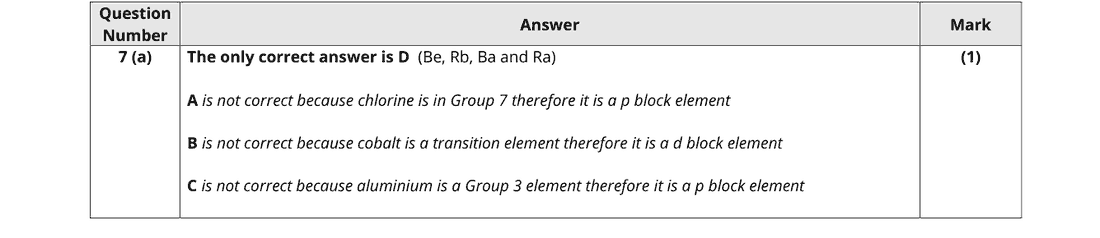
D  Be, Rb, Ba and Ra
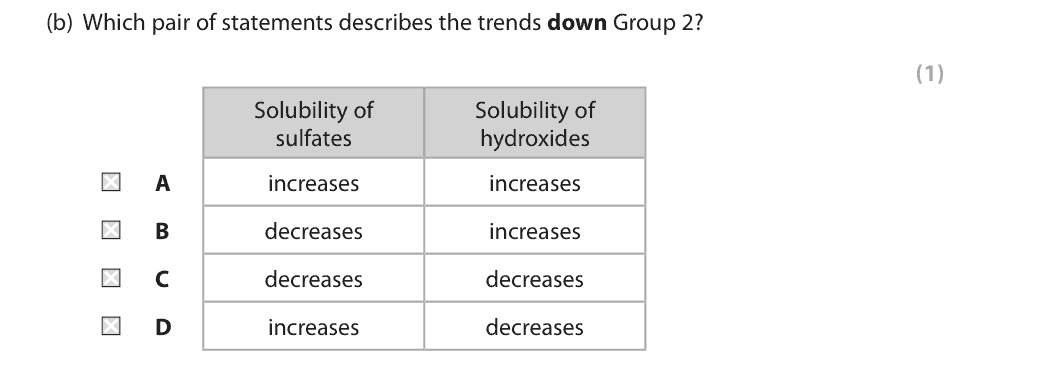
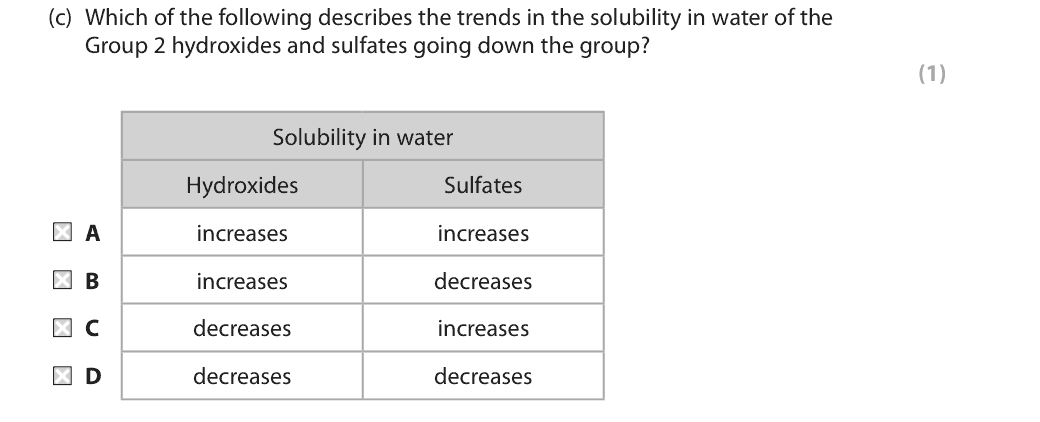
June 2022 · AS Paper 1 · Q7(b) 1 mark Multiple choice groups 1 and 2
Earlier part of question 7 that this part usesEarlier part of June 2022 Paper 1 question 7
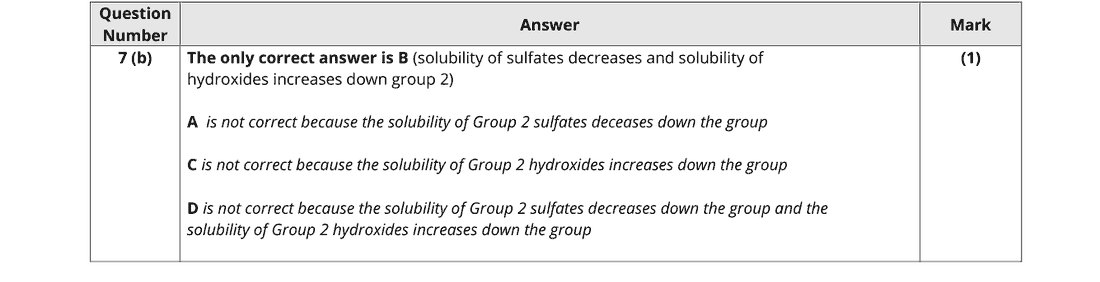
Which pair of statements describes the trends down Group 2?
Solubility of
Solubility of
sulfates
hydroxides
A
increases
increases
B
decreases
increases
C
decreases
decreases
D
increases
decreases
June 2022 · AS Paper 2 · Q1(a)(i) 1 mark Multiple choice kinetics i
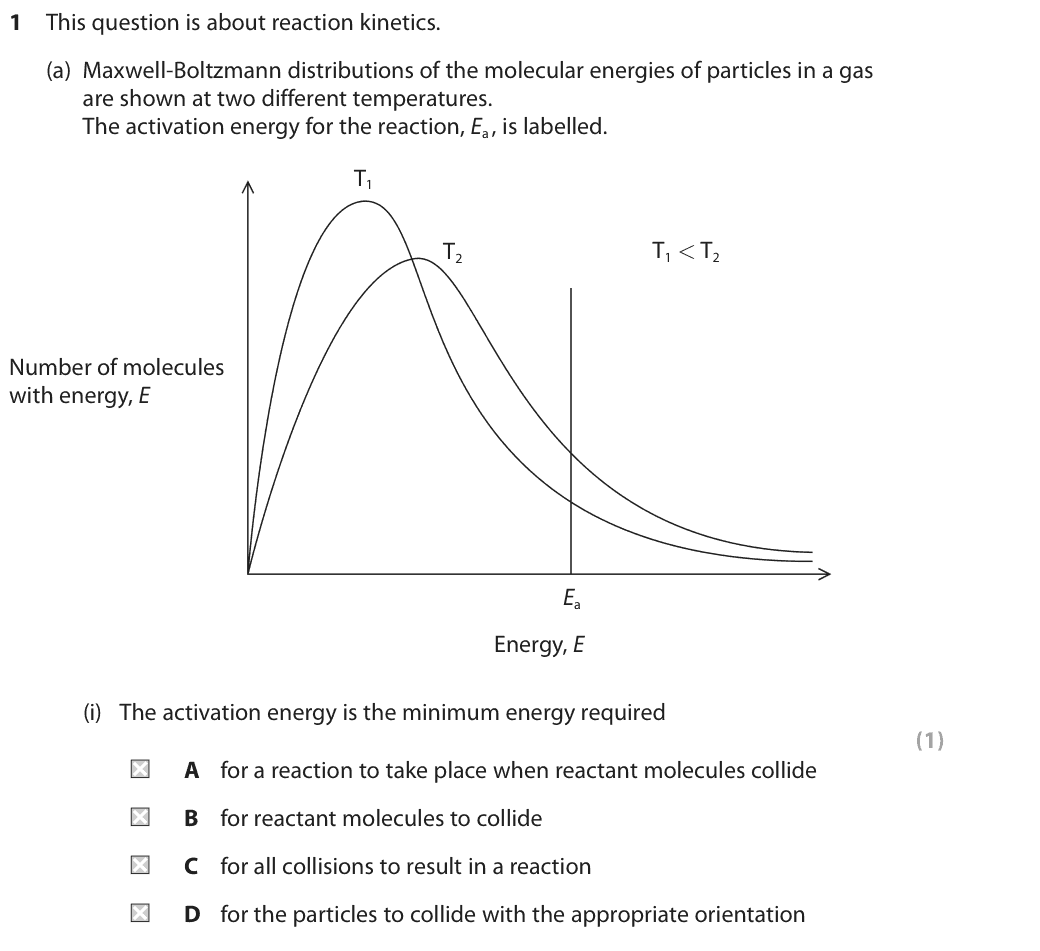
This question is about reaction kinetics.
Maxwell‑Boltzmann distributions of the molecular energies of particles in a gas
are shown at two different temperatures.
The activation energy for the reaction, Ea , is labelled.
T1
T1 < T2
T2
Number of molecules
with energy, E
Ea
Energy, E
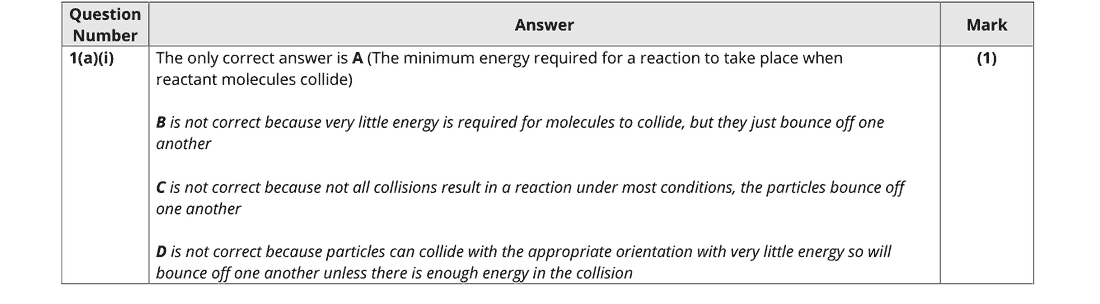
The activation energy is the minimum energy required
A  for a reaction to take place when reactant molecules collide
B  for reactant molecules to collide
C  for all collisions to result in a reaction
D  for the particles to collide with the appropriate orientation
June 2022 · AS Paper 2 · Q1(a)(iii) 1 mark Multiple choice kinetics i
Earlier part of question 1 that this part usesEarlier part of June 2022 Paper 2 question 1
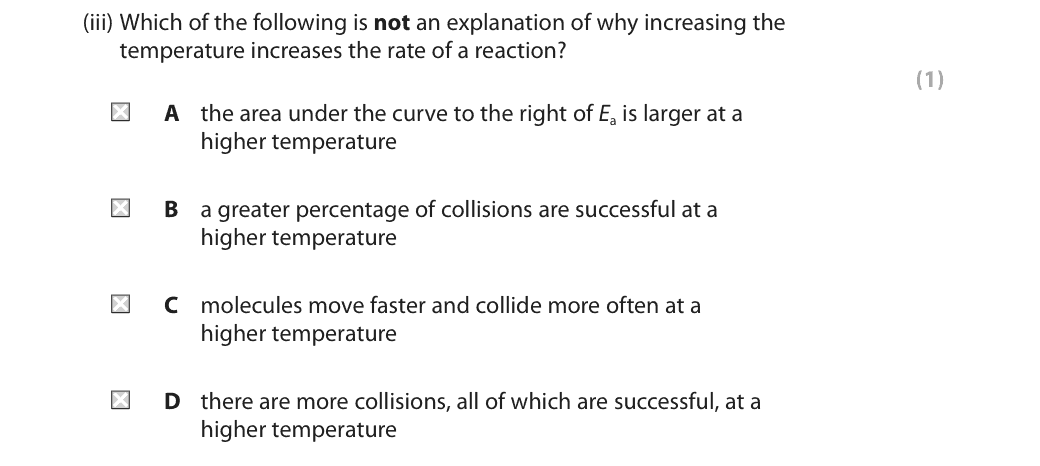
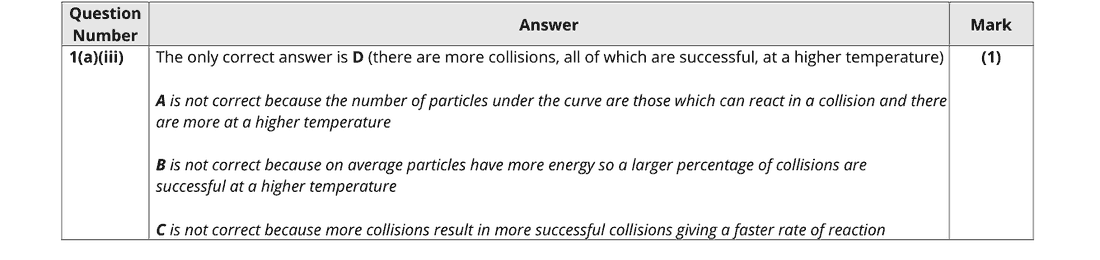
Which of the following is not an explanation of why increasing the
temperature increases the rate of a reaction?
A  the area under the curve to the right of Ea is larger at a
higher temperature
B  a greater percentage of collisions are successful at a
higher temperature
C  molecules move faster and collide more often at a
higher temperature
D  there are more collisions, all of which are successful, at a
higher temperature
June 2022 · AS Paper 2 · Q1(c) 1 mark Multiple choice kinetics i
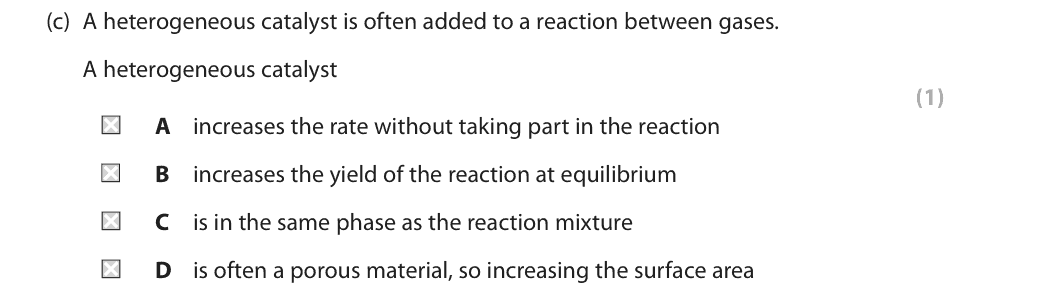
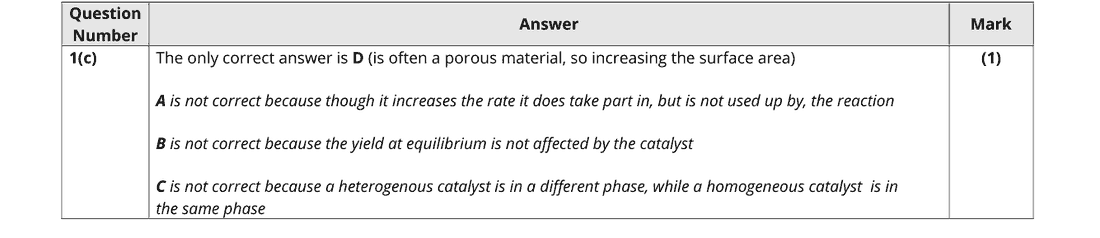
A heterogeneous catalyst is often added to a reaction between gases.
A heterogeneous catalyst
A  increases the rate without taking part in the reaction
B  increases the yield of the reaction at equilibrium
C  is in the same phase as the reaction mixture
D  is often a porous material, so increasing the surface area
June 2022 · AS Paper 2 · Q2(c) 1 mark Multiple choice alkenes
Earlier part of question 2 that this part usesEarlier part of June 2022 Paper 2 question 2
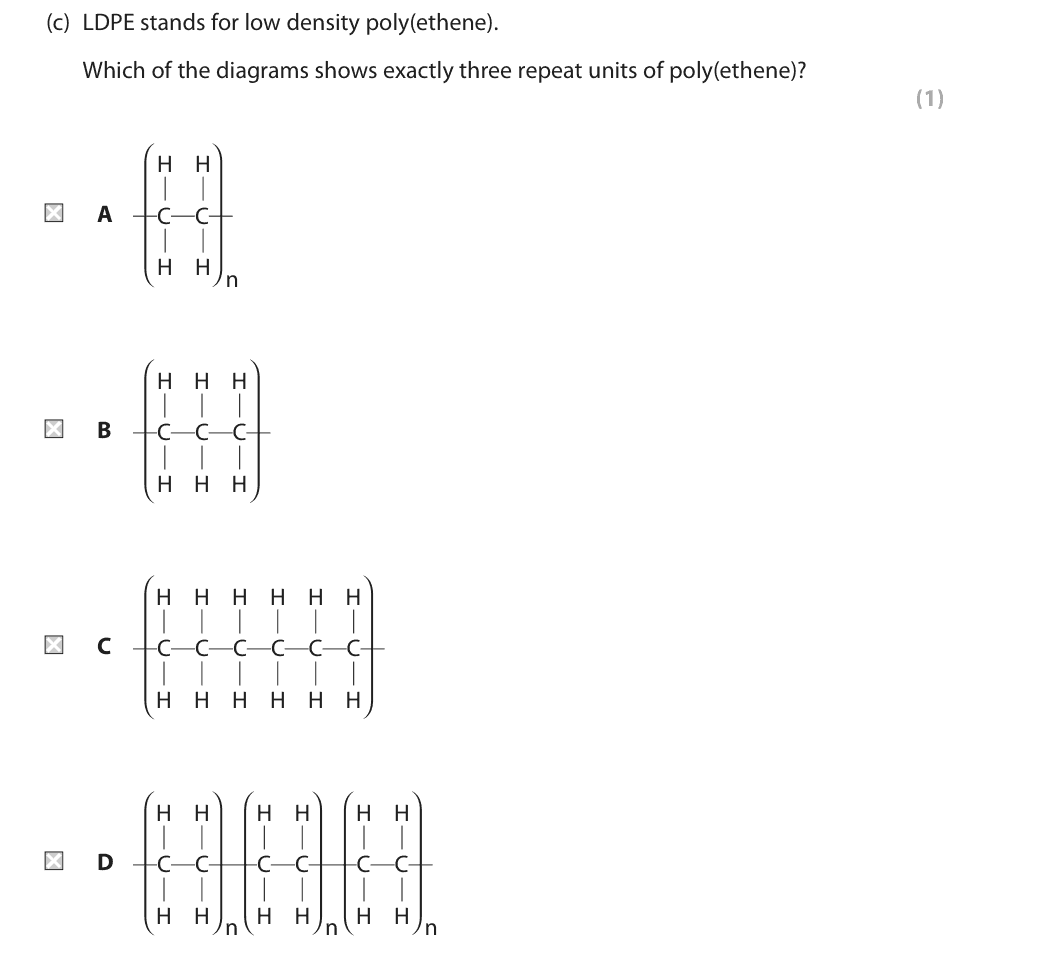
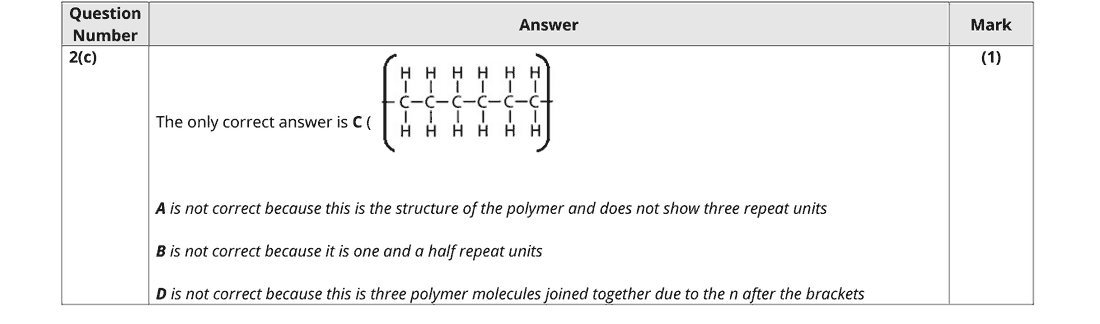
LDPE stands for low density poly(ethene).
Which of the diagrams shows exactly three repeat units of poly(ethene)?
H
H
A
C
C
H
H n
H
H
H
B
C
C
C
H
H
H
H
H
H
H
H
H
C
C
C
C
C
C
C
H
H
H
H
H
H
H
H
H
H
H
H
D
C
C
C
C
C
C
H
H
H
H
H
H
n
n
n
June 2022 · AS Paper 2 · Q3(b)(i) 1 mark Multiple choice alkanes
Earlier part of question 3 that this part usesEarlier part of June 2022 Paper 2 question 3
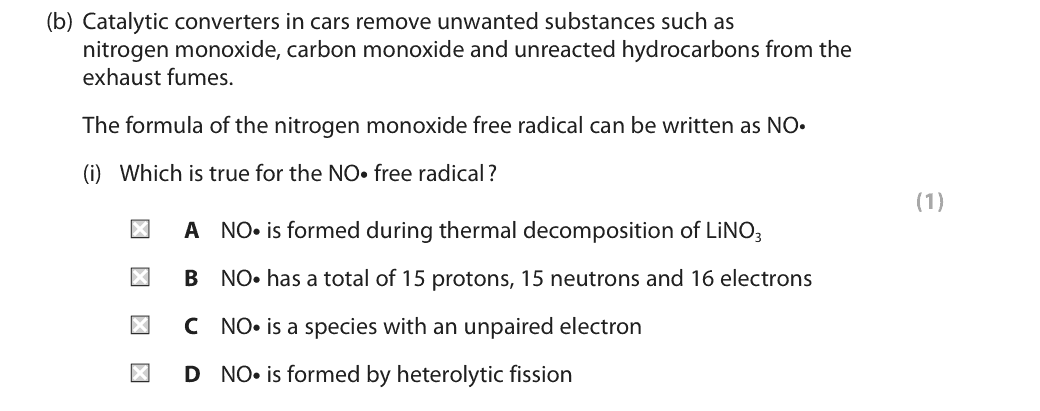
Catalytic converters in cars remove unwanted substances such as
nitrogen monoxide, carbon monoxide and unreacted hydrocarbons from the
exhaust fumes.
The formula of the nitrogen monoxide free radical can be written as NO•
Which is true for the NO• free radical ?
A  NO• is formed during thermal decomposition of LiNO3
B  NO• has a total of 15 protons, 15 neutrons and 16 electrons
C  NO• is a species with an unpaired electron
D  NO• is formed by heterolytic fission
June 2022 · AS Paper 2 · Q4(b)(i) 1 mark Multiple choice energetics i
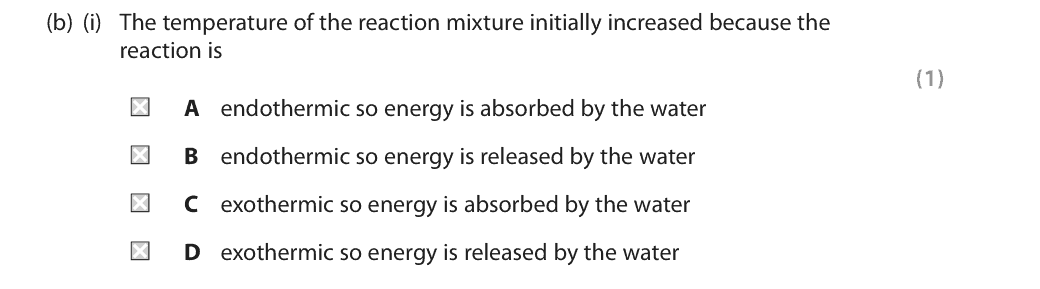
Earlier part of question 4 that this part usesEarlier part of June 2022 Paper 2 question 4
The temperature of the reaction mixture initially increased because the
reaction is
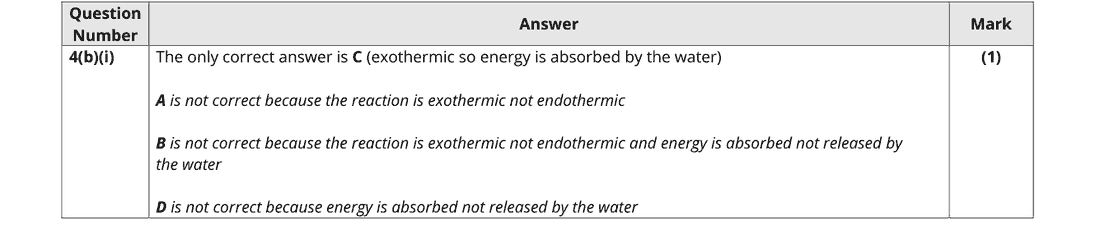
A  endothermic so energy is absorbed by the water
B  endothermic so energy is released by the water
C  exothermic so energy is absorbed by the water
D  exothermic so energy is released by the water
June 2022 · AS Paper 2 · Q5(b)(ii) 1 mark Multiple choice alkanes
Earlier part of question 5 that this part usesEarlier part of June 2022 Paper 2 question 5
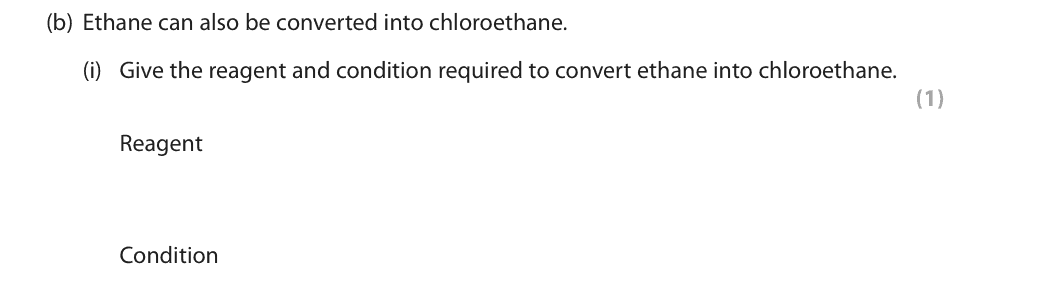
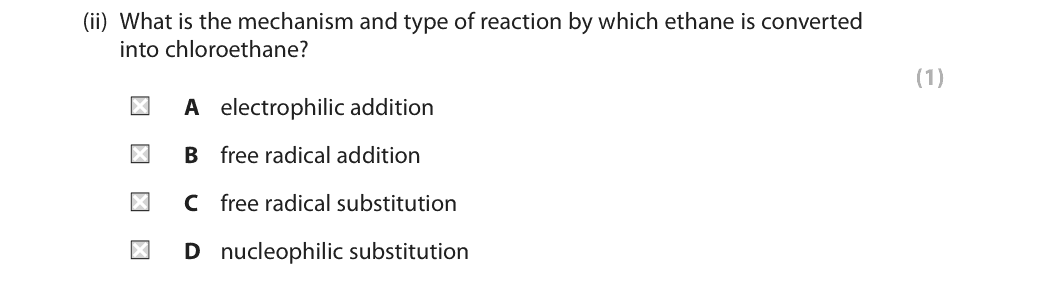
What is the mechanism and type of reaction by which ethane is converted
into chloroethane?
A  electrophilic addition
B  free radical addition
C  free radical substitution
D  nucleophilic substitution
June 2022 · AS Paper 2 · Q7(a)(iii) 1 mark Multiple choice equilibrium i
Earlier parts of question 7 that this part usesEarlier part of June 2022 Paper 2 question 7Earlier part of June 2022 Paper 2 question 7
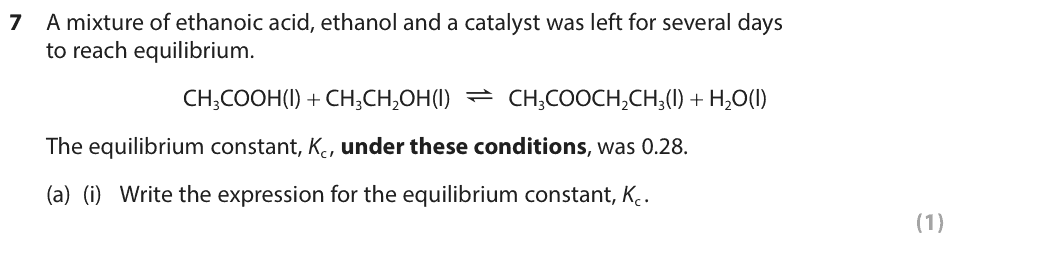
The expression for the equilibrium constant, Kc , for this reaction is
[
]
A  Kc   =   2 NOC
l
[
][
]
2 NO C 2
l
[
]
2
NOC
l
B  Kc   =
[
] [
]
NO
2
C 2
l
[
][
]
C  Kc   =   2
NO C
l
2
[
]
2
NOC
l
[
] [
2
]
D  Kc   =   NO
C
l
2
[
]
NOC
l
2
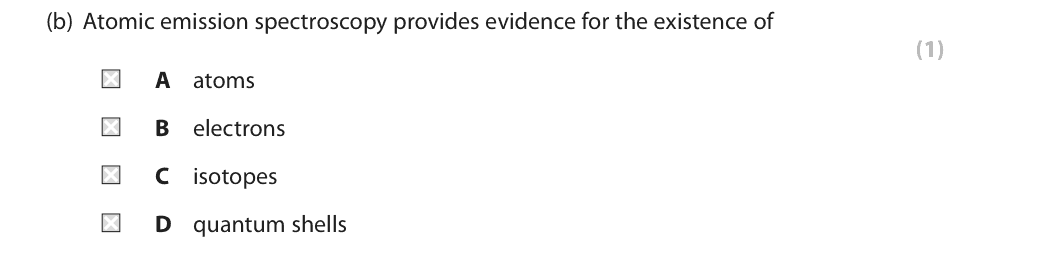
June 2022 · Paper 1 · Q1(b) 1 mark Multiple choice atomic structure and the periodic table
Atomic emission spectroscopy provides evidence for the existence of
A  atoms
B  electrons
C  isotopes
D  quantum shells
June 2022 · Paper 1 · Q3(a) 1 mark Multiple choice group 7 the halogens
This question is about the elements in Group 7 of the Periodic Table and some of
their compounds.
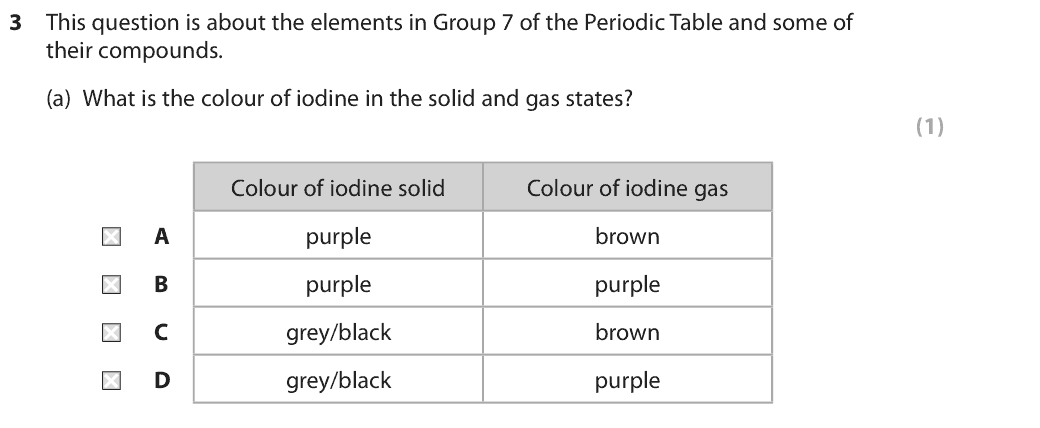
What is the colour of iodine in the solid and gas states?
Colour of iodine solid
Colour of iodine gas
A
purple
brown
B
purple
purple
C
grey/black
brown
D
grey/black
purple
June 2022 · Paper 1 · Q3(b) 1 mark Multiple choice group 7 the halogens
Earlier part of question 3 that this part usesEarlier part of June 2022 Paper 1 question 3
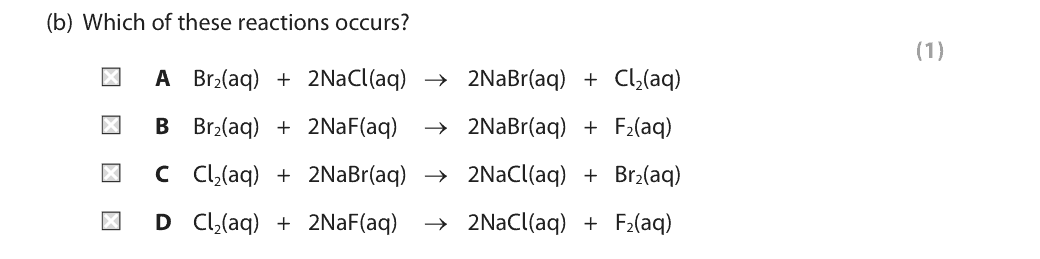
Which of these reactions occurs?
A  Br2(aq)   +   2NaCl(aq)   →   2NaBr(aq)   +   Cl2(aq)
B  Br2(aq)   +   2NaF(aq)    →   2NaBr(aq)   +   F2(aq)
C  Cl2(aq)   +   2NaBr(aq)   →   2NaCl(aq)   +   Br2(aq)
D  Cl2(aq)   +   2NaF(aq)    →   2NaCl(aq)   +   F2(aq)
June 2022 · Paper 1 · Q3(e)(i) 1 mark Multiple choice bonding
Earlier part of question 3 that this part usesEarlier part of June 2022 Paper 1 question 3
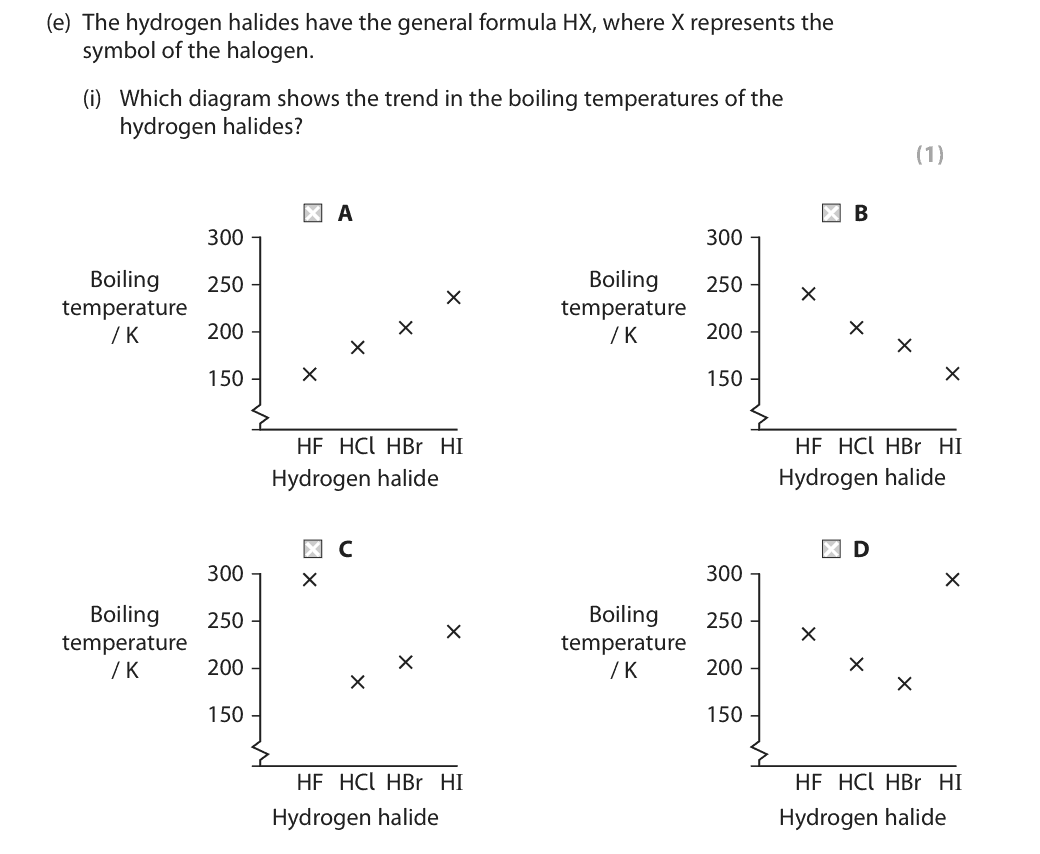
The hydrogen halides have the general formula HX, where X represents the
symbol of the halogen.
Which diagram shows the trend in the boiling temperatures of the
hydrogen halides?
A
B
300
300
Boiling
Boiling
250
250
temperature
temperature
/ K
200
/ K
200
150
150
HF HCl HBr HI
HF HCl HBr HI
Hydrogen halide
Hydrogen halide
C
D
300
300
Boiling
Boiling
250
250
temperature
temperature
/ K
200
/ K
200
150
150
HF HCl HBr HI
HF HCl HBr HI
Hydrogen halide
Hydrogen halide
June 2022 · Paper 1 · Q3(e)(ii) 1 mark Multiple choice group 7 the halogens
Earlier parts of question 3 that this part usesEarlier part of June 2022 Paper 1 question 3Earlier part of June 2022 Paper 1 question 3
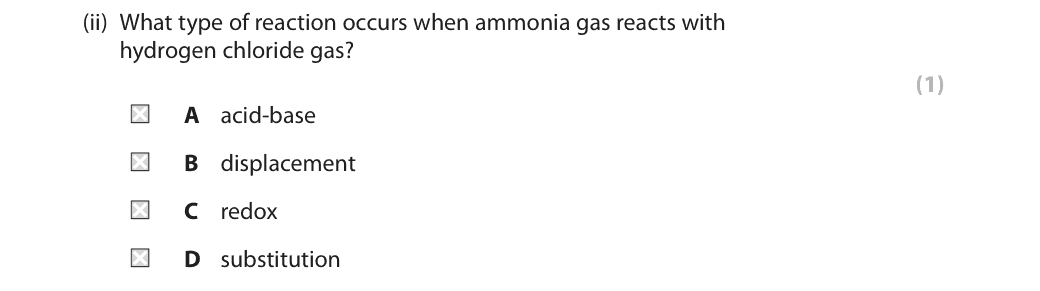
What type of reaction occurs when ammonia gas reacts with
hydrogen chloride gas?
A  acid‑base
B  displacement
C  redox
D  substitution
June 2022 · Paper 1 · Q4(a) 1 mark Multiple choice bonding
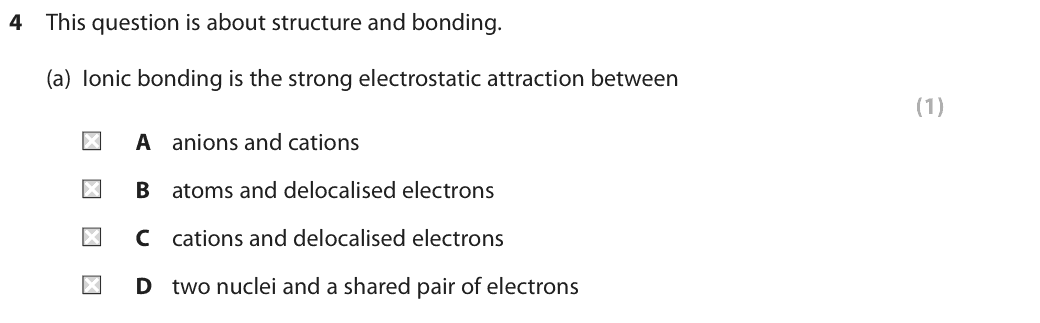
This question is about structure and bonding.
Ionic bonding is the strong electrostatic attraction between
A  anions and cations
B  atoms and delocalised electrons
C  cations and delocalised electrons
D  two nuclei and a shared pair of electrons
June 2022 · Paper 1 · Q4(d)(i) 1 mark Multiple choice structure
Earlier part of question 4 that this part usesEarlier part of June 2022 Paper 1 question 4
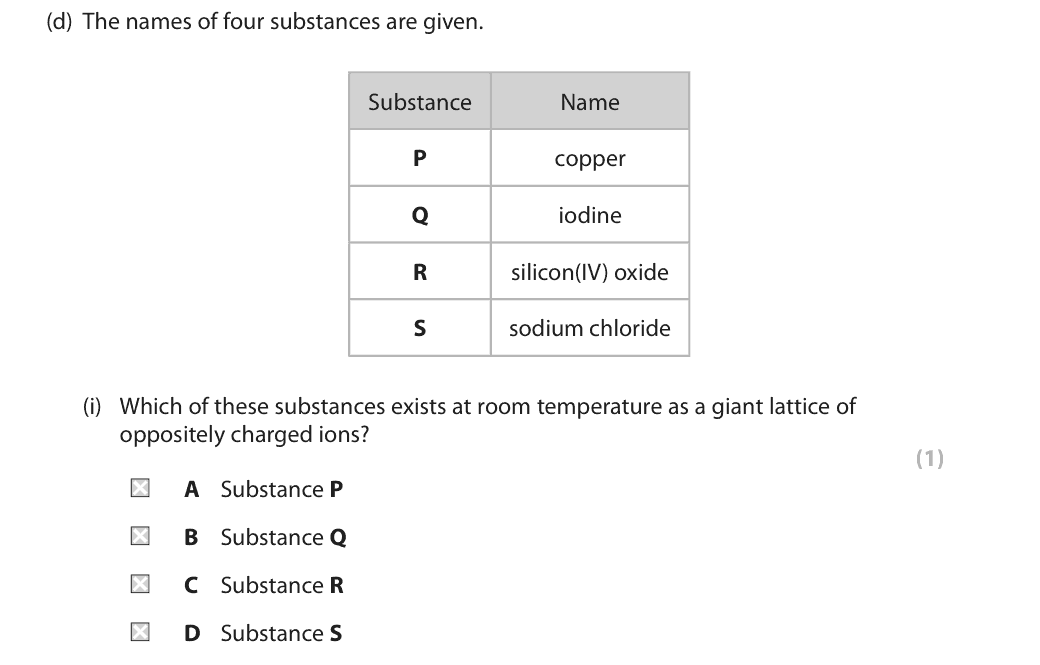
The names of four substances are given.
Substance
Name
P
copper
Q
iodine
R
silicon(IV) oxide
S
sodium chloride
Which of these substances exists at room temperature as a giant lattice of
oppositely charged ions?
A  Substance P
B  Substance Q
C  Substance R
D  Substance S
June 2022 · Paper 1 · Q4(d)(ii) 1 mark Multiple choice structure
Earlier parts of question 4 that this part usesEarlier part of June 2022 Paper 1 question 4Earlier part of June 2022 Paper 1 question 4
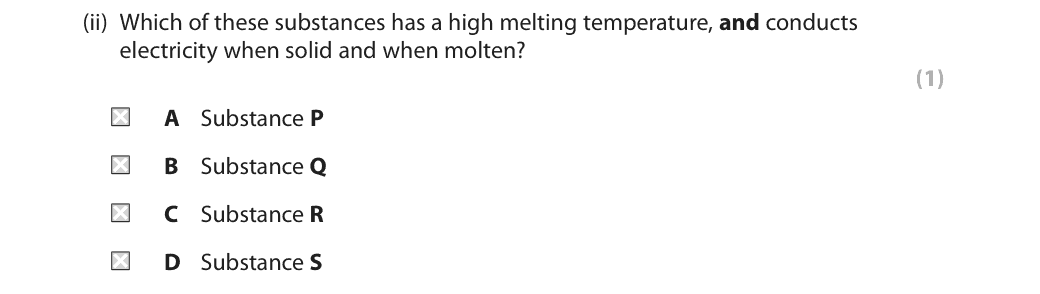
Which of these substances has a high melting temperature, and conducts
electricity when solid and when molten?
A  Substance P
B  Substance Q
C  Substance R
D  Substance S
June 2022 · Paper 1 · Q6(d) 1 mark Multiple choice acid base equilibria
Earlier part of question 6 that this part usesEarlier part of June 2022 Paper 1 question 6
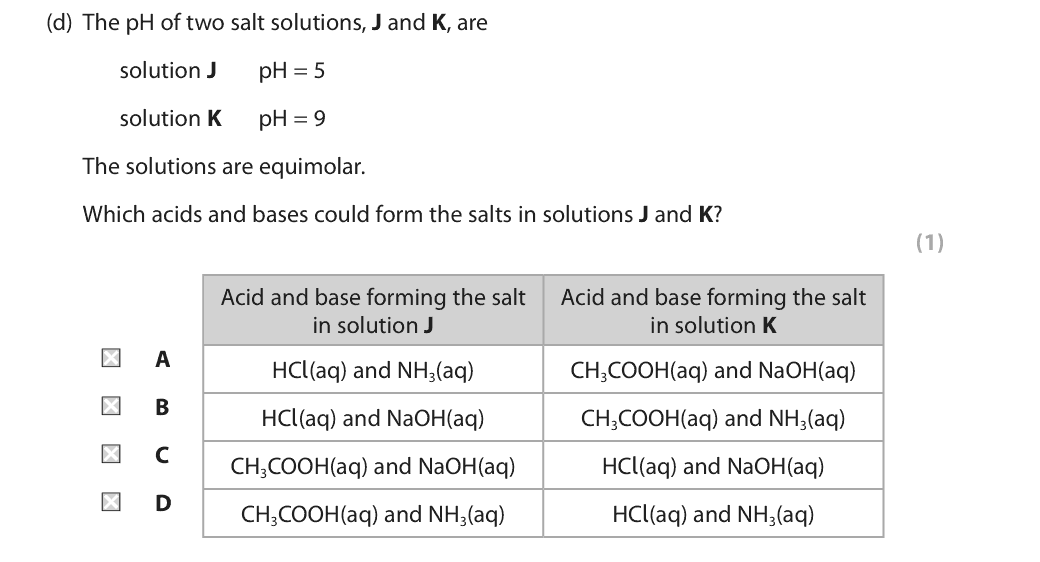
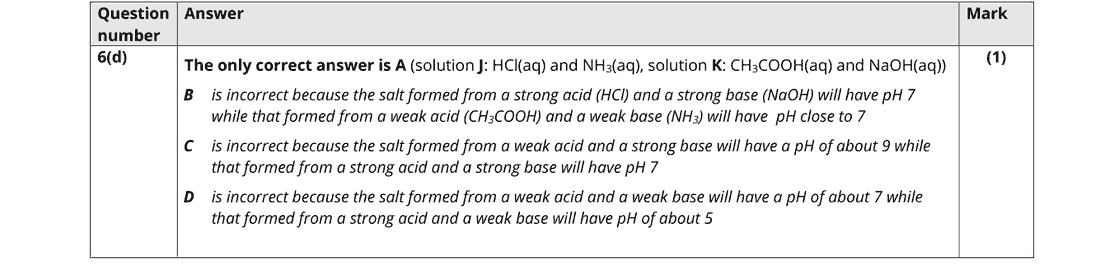
The pH of two salt solutions, J and K, are
solution J
pH = 5
solution K
pH = 9
The solutions are equimolar.
Which acids and bases could form the salts in solutions J and K?
Acid and base forming the salt
in solution J
in solution K
A
HCl(aq) and NH3(aq)
CH3COOH(aq) and NaOH(aq)
B
HCl(aq) and NaOH(aq)
CH3COOH(aq) and NH3(aq)
C
CH3COOH(aq) and NaOH(aq)
HCl(aq) and NaOH(aq)
D
CH3COOH(aq) and NH3(aq)
HCl(aq) and NH3(aq)
June 2022 · Paper 1 · Q8(b) 1 mark Multiple choice redox ii
Earlier part of question 8 that this part usesEarlier part of June 2022 Paper 1 question 8
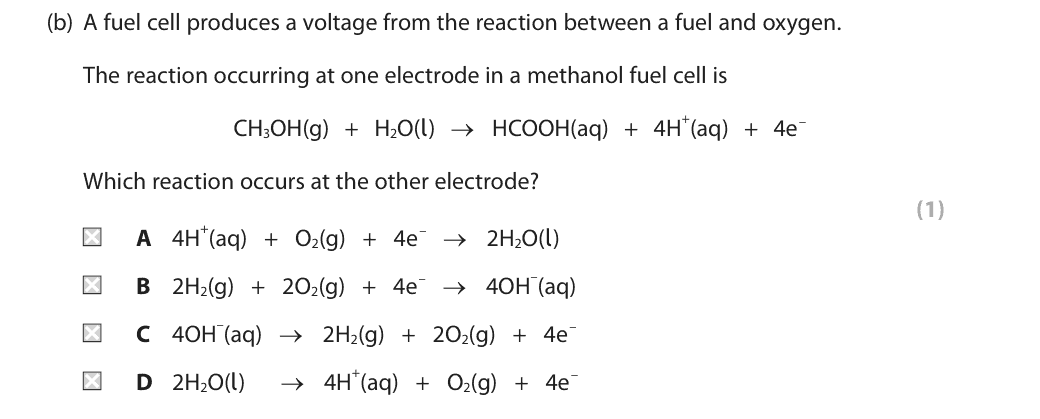
A fuel cell produces a voltage from the reaction between a fuel and oxygen.
The reaction occurring at one electrode in a methanol fuel cell is
+(aq)   +   4e–
CH3OH(g)   +   H2O(l)   →   HCOOH(aq)   +   4H
Which reaction occurs at the other electrode?
+(aq)   +   O2(g)   +   4e–   →   2H2O(l)
A  4H
–(aq)
B  2H2(g)   +   2O2(g)   +   4e–   →   4OH
–(aq)   →   2H2(g)   +   2O2(g)   +   4e–
C  4OH
+(aq)   +   O2(g)   +   4e–
D  2H2O(l)
→   4H
June 2022 · Paper 2 · Q1(a) 1 mark Multiple choice alkenes
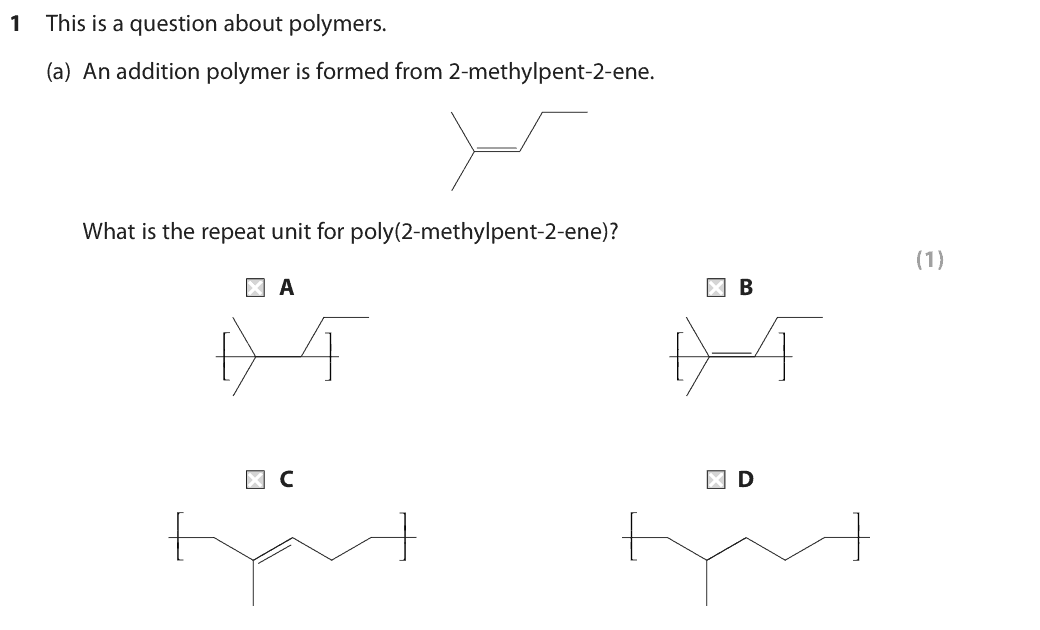
This is a question about polymers.
An addition polymer is formed from 2‑methylpent‑2‑ene.
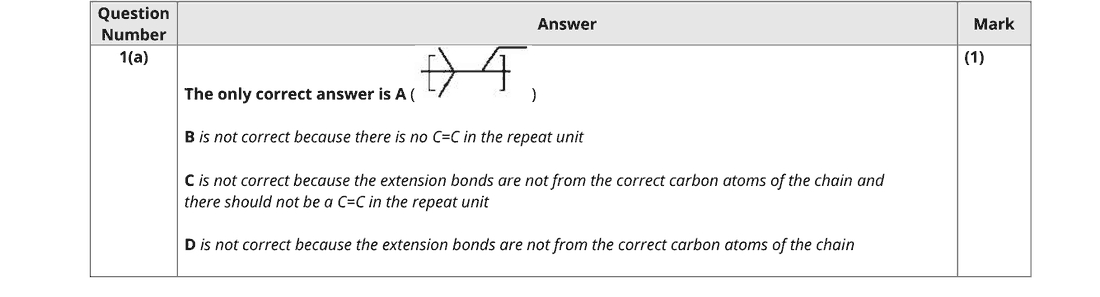
What is the repeat unit for poly(2‑methylpent‑2‑ene)?
A
B




C
D




June 2022 · Paper 2 · Q1(b) 1 mark Multiple choice alkenes
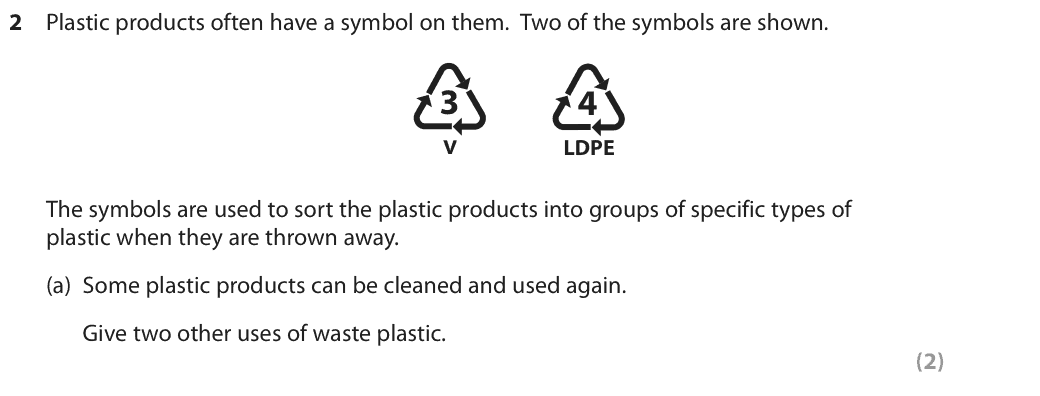
Which is not a use of waste poly(alkenes)?
A  feedstock for cracking
B  generation of biodegradable materials
C  incineration to release energy
D  make new materials by recycling
June 2022 · Paper 2 · Q1(c) 1 mark Multiple choice amines amides amino acids and proteinscarboxylic acids
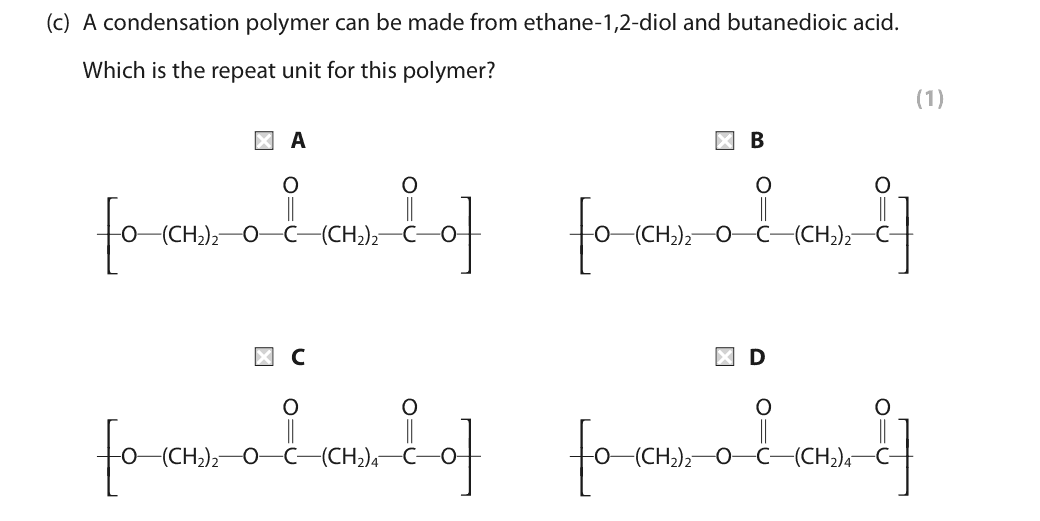
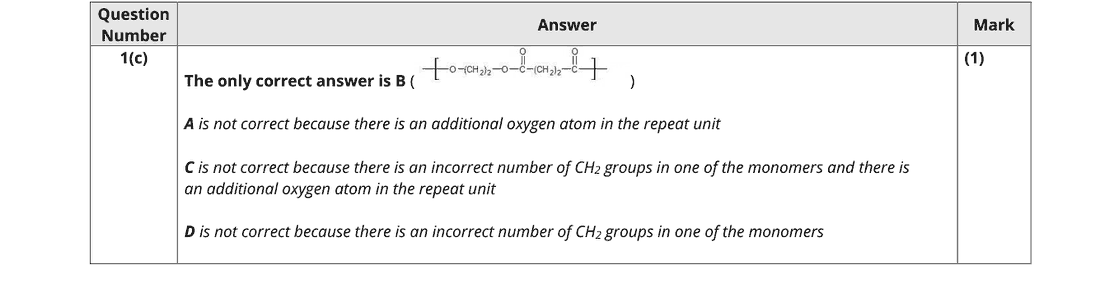
A condensation polymer can be made from ethane‑1,2‑diol and butanedioic acid.
Which is the repeat unit for this polymer?
A
B
O
O
O
O


O
(CH2)2
O
C
(CH2)2
C
O
O
(CH2)2
O
C
(CH2)2
C


C
D
O
O
O
O


O
(CH2)2
O
C
(CH2)4
C
O
O
(CH2)2
O
C
(CH2)4
C


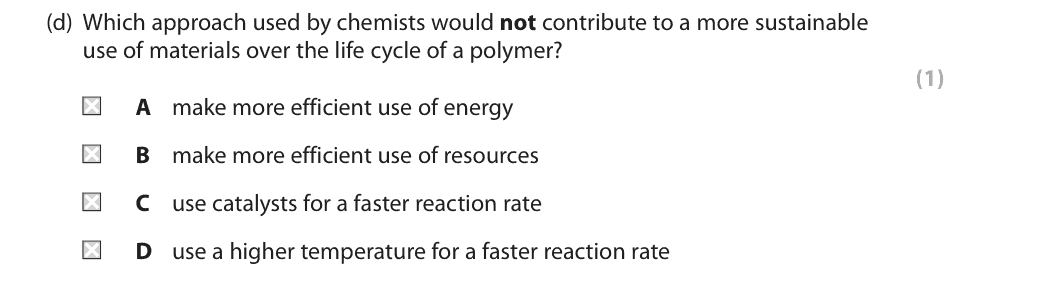
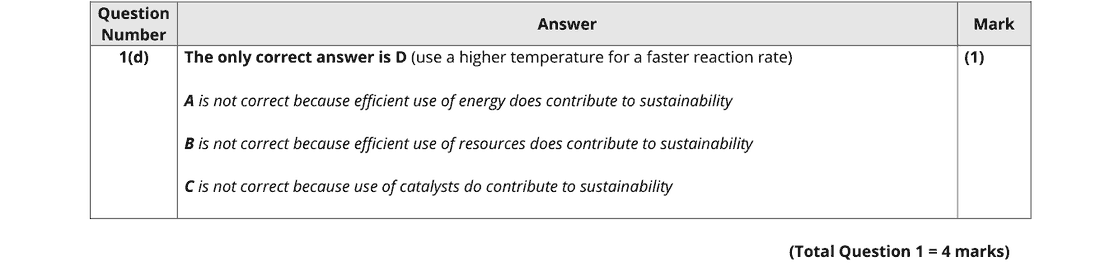
June 2022 · Paper 2 · Q1(d) 1 mark Multiple choice alkenes
Which approach used by chemists would not contribute to a more sustainable
use of materials over the life cycle of a polymer?
A  make more efficient use of energy
B  make more efficient use of resources
C  use catalysts for a faster reaction rate
D  use a higher temperature for a faster reaction rate
June 2022 · Paper 2 · Q2(c) 1 mark Multiple choice alkenes
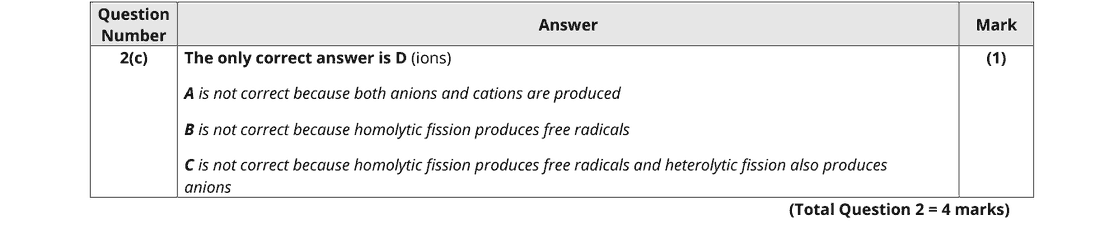
The heterolytic bond fission of a sigma (σ) bond in an alkane would produce
A  only carbocations
B  only free radicals
C  free radicals and ions
D  ions
June 2022 · Paper 2 · Q3(b) 1 mark Multiple choice halogenoalkanes
Earlier part of question 3 that this part usesEarlier part of June 2022 Paper 2 question 3
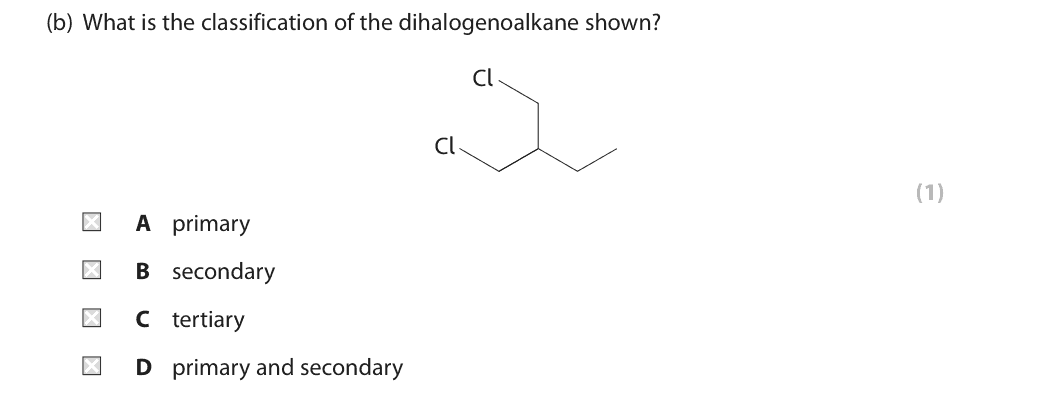
What is the classification of the dihalogenoalkane shown?
Cl
Cl
A  primary
B  secondary
C  tertiary
D  primary and secondary
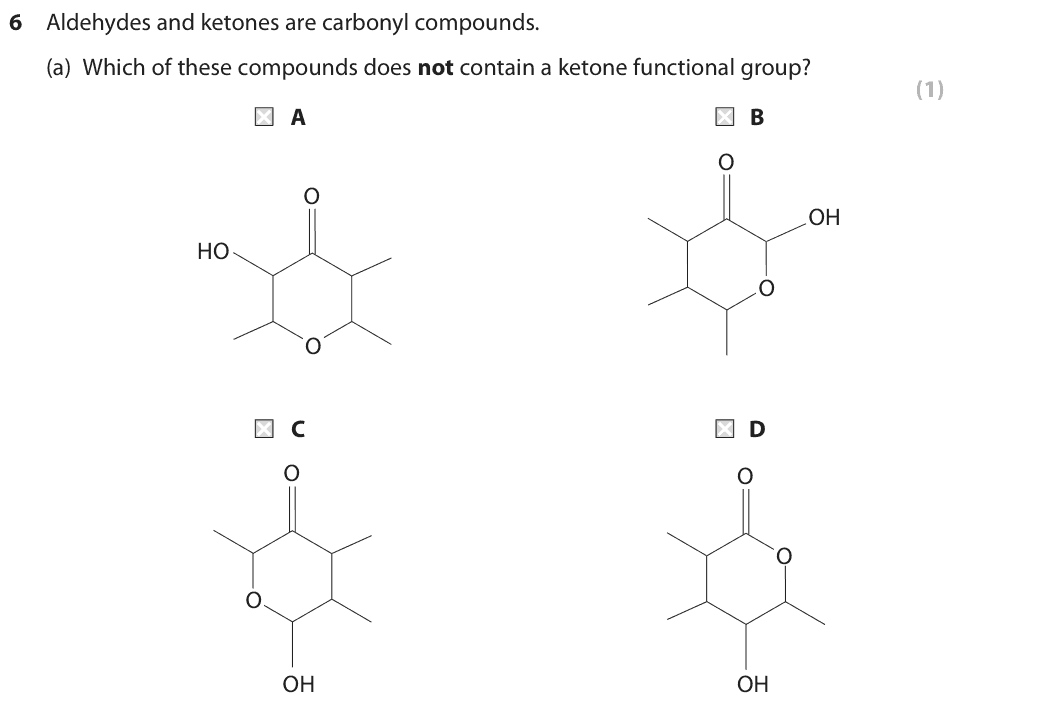
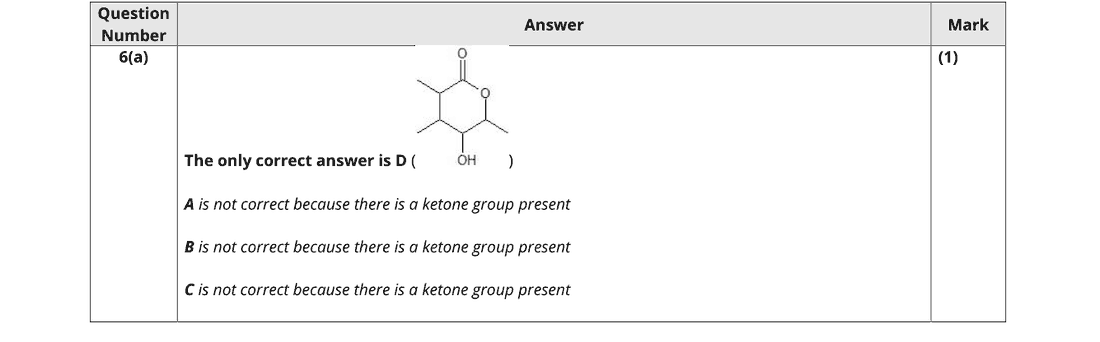
June 2022 · Paper 2 · Q6(a) 1 mark Multiple choice carbonyl compounds
Aldehydes and ketones are carbonyl compounds.
Which of these compounds does not contain a ketone functional group?
A
B
O
O
OH
HO
O
O
C
D
O
O
O
O
OH
OH
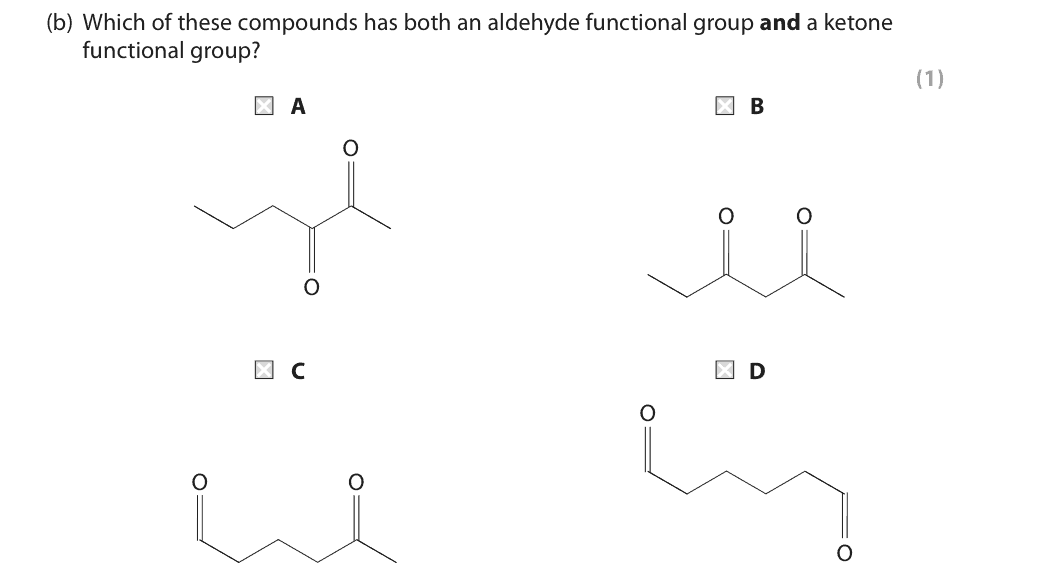
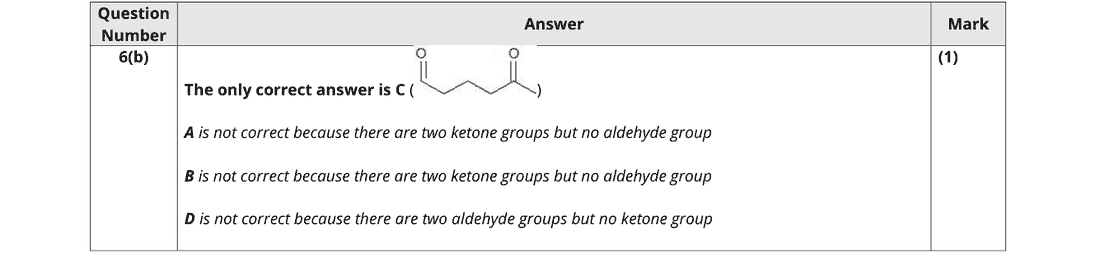
June 2022 · Paper 2 · Q6(b) 1 mark Multiple choice carbonyl compounds
Which of these compounds has both an aldehyde functional group and a ketone
functional group?
A
B
O
O
O
O
C
D
O
O
O
O
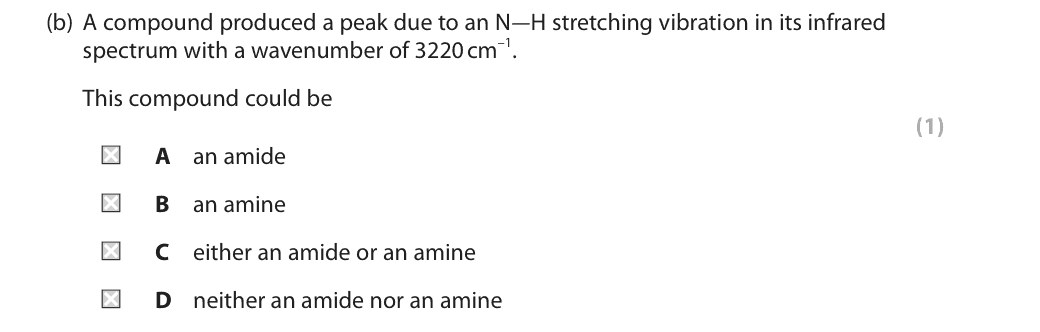
June 2022 · Paper 2 · Q7(b) 1 mark Multiple choice mass spectrometry and infrared spectroscopy
Earlier part of question 7 that this part usesEarlier part of June 2022 Paper 2 question 7
A compound produced a peak due to an N–H stretching vibration in its infrared
spectrum with a wavenumber of 3220 cm–1.
This compound could be
A  an amide
B  an amine
C  either an amide or an amine
D  neither an amide nor an amine
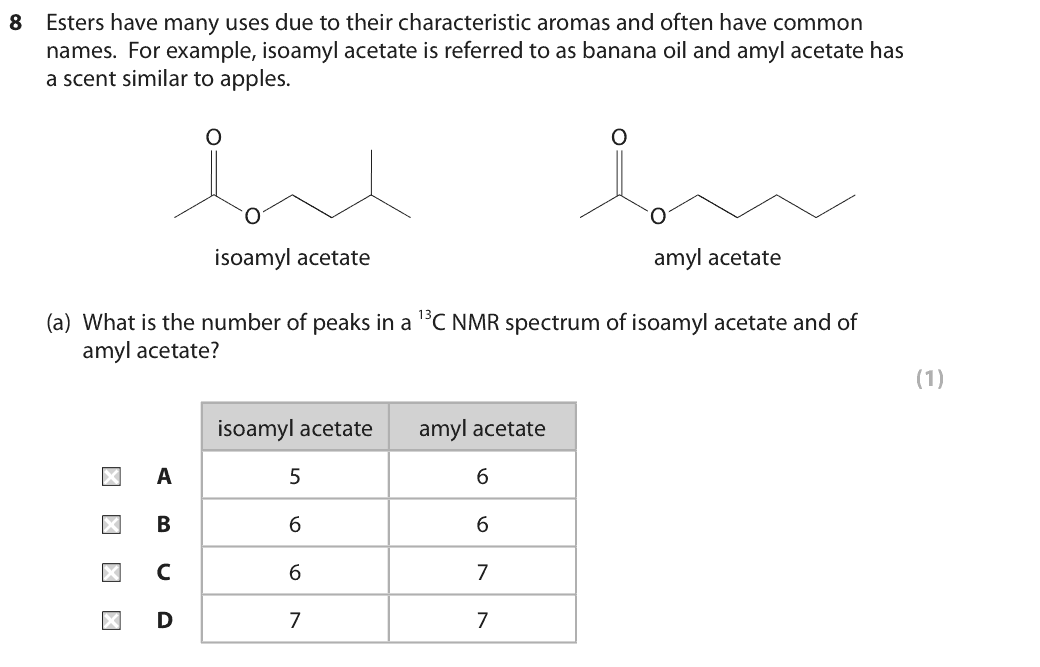
June 2022 · Paper 2 · Q8(a) 1 mark Multiple choice nmr mass spectrometry and chromatography
Esters have many uses due to their characteristic aromas and often have common
names.  For example, isoamyl acetate is referred to as banana oil and amyl acetate has
a scent similar to apples.
O
O
O
O
isoamyl acetate
amyl acetate
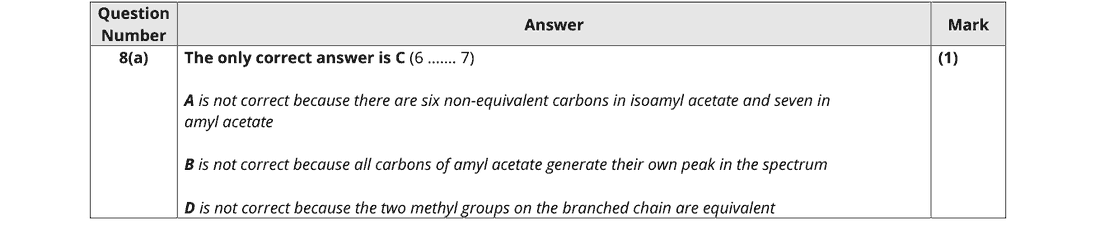
What is the number of peaks in a 13C NMR spectrum of isoamyl acetate and of
amyl acetate?
isoamyl acetate
amyl acetate
A
5
6
B
6
6
C
6
7
D
7
7
November 2021 · AS Paper 1 · Q1(c)(ii) 1 mark Multiple choice atomic structure and the periodic table
Earlier parts of question 1 that this part usesEarlier part of November 2021 Paper 1 question 1Earlier part of November 2021 Paper 1 question 1
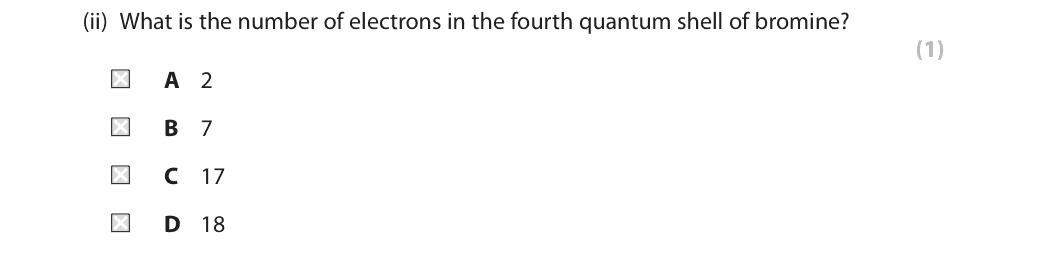
What is the number of electrons in the fourth quantum shell of bromine?
A  2
B  7
C  17
D  18
November 2021 · AS Paper 1 · Q2(b)(i) 1 mark Multiple choice formulae equations and amounts of substance
Earlier part of question 2 that this part usesEarlier part of November 2021 Paper 1 question 2
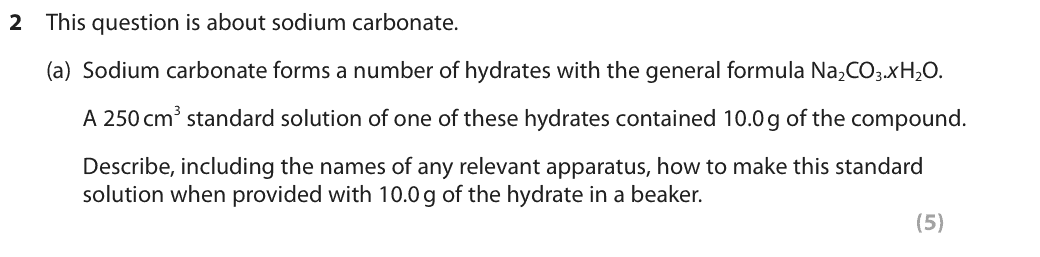
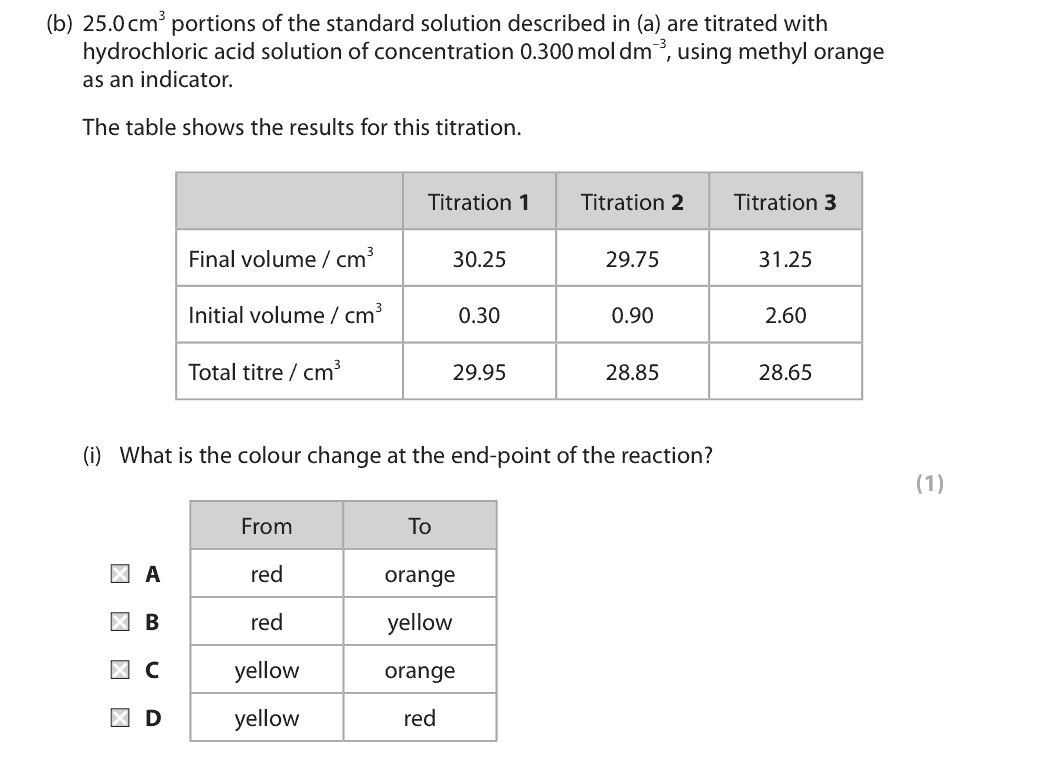
25.0 cm3 portions of the standard solution described in (a) are titrated with
hydrochloric acid solution of concentration 0.300 mol dm–3, using methyl orange
as an indicator.
The table shows the results for this titration.
Titration 1
Titration 2
Titration 3
Final volume / cm3
30.25
29.75
31.25
Initial volume / cm3
0.30
0.90
2.60
Total titre / cm3
29.95
28.85
28.65
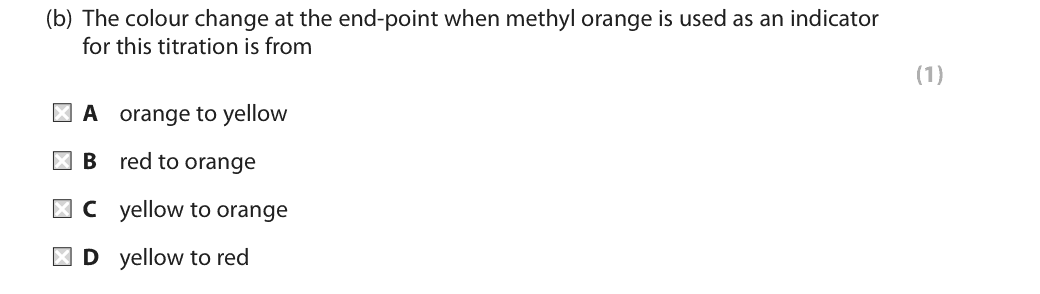
What is the colour change at the end-point of the reaction?
From
To
A
red
orange
B
red
yellow
C
yellow
orange
D
yellow
red
November 2021 · AS Paper 1 · Q3(a)(iii) 1 mark Multiple choice bonding
Earlier part of question 3 that this part usesEarlier part of November 2021 Paper 1 question 3
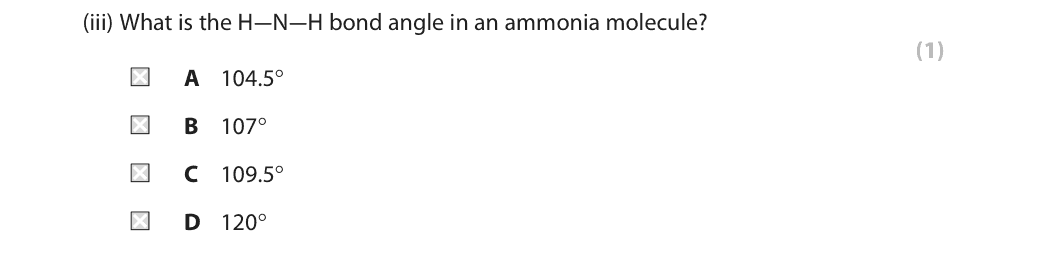
What is the H–N–H bond angle in an ammonia molecule?
A  104.5°
B  107°
C  109.5°
D  120°
November 2021 · AS Paper 1 · Q4(a)(i) 1 mark Multiple choice atomic structure and the periodic table
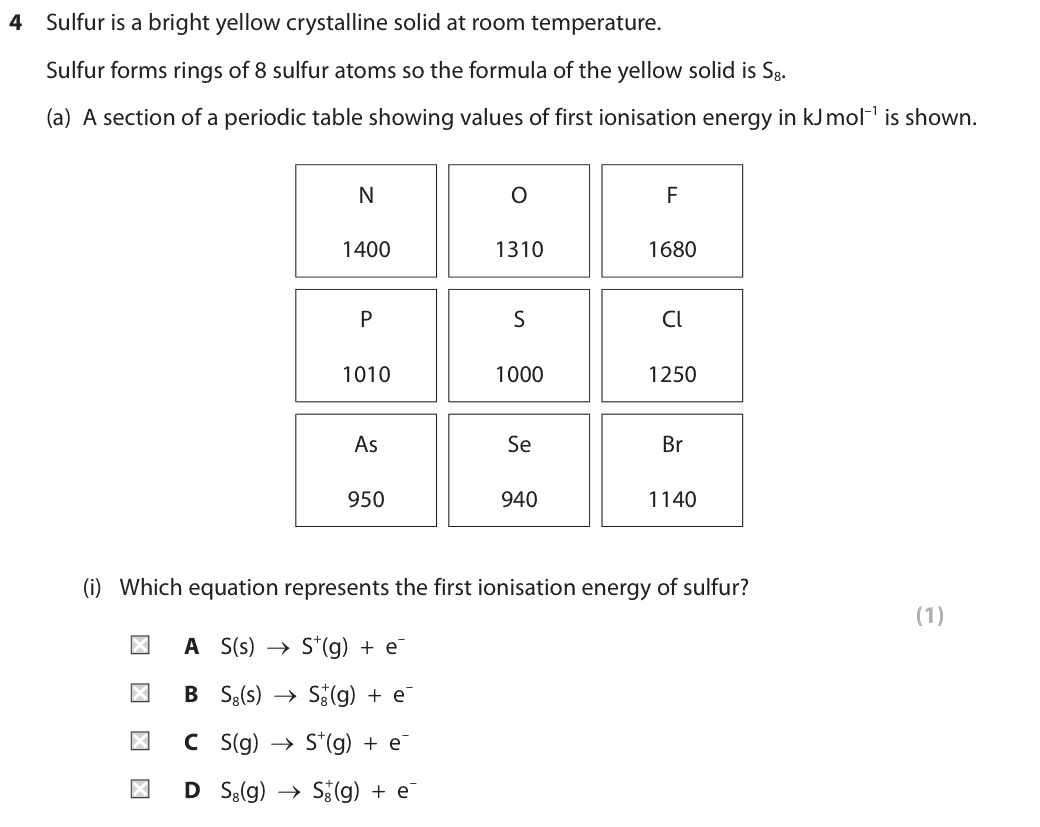
Sulfur is a bright yellow crystalline solid at room temperature.
Sulfur forms rings of 8 sulfur atoms so the formula of the yellow solid is S8.
A section of a periodic table showing values of first ionisation energy in kJ mol–1 is shown.
N
O
F
1400
1310
1680
P
S
Cl
1010
1000
1250
As
Se
Br
950
940
1140
Which equation represents the first ionisation energy of sulfur?
A  S(s)  →  S+(g)  +  e–
B  S8(s)  →  S8
+(g)  +  e–
C  S(g)  →  S+(g)  +  e–
D  S8(g)  →  S8
+(g)  +  e–
November 2021 · AS Paper 1 · Q7(b) 1 mark Multiple choice atomic structure and the periodic table
Earlier part of question 7 that this part usesEarlier part of November 2021 Paper 1 question 7
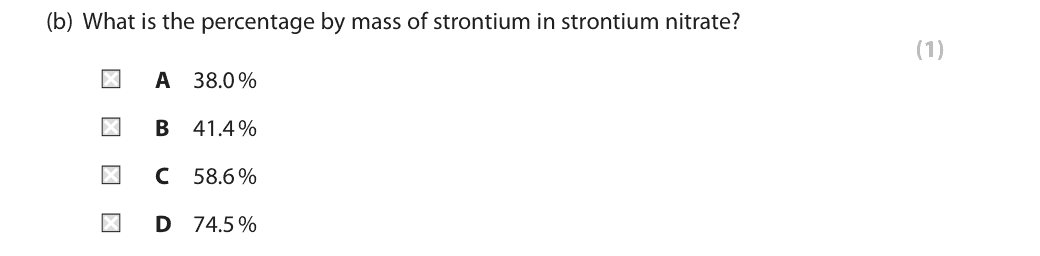
What is the percentage by mass of strontium in strontium nitrate?
A  38.0 %
B  41.4 %
C  58.6 %
D  74.5 %
November 2021 · AS Paper 1 · Q7(c)(i) 1 mark Multiple choice groups 1 and 2
Earlier part of question 7 that this part usesEarlier part of November 2021 Paper 1 question 7
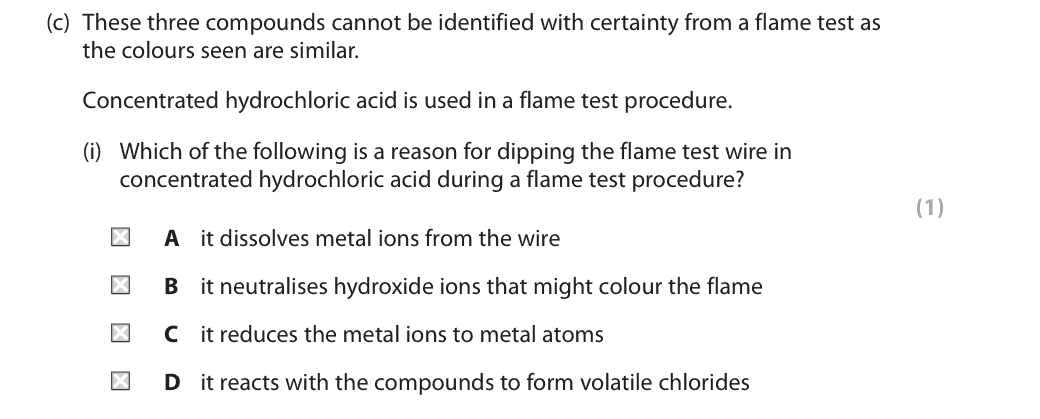
These three compounds cannot be identified with certainty from a flame test as
the colours seen are similar.
Concentrated hydrochloric acid is used in a flame test procedure.
Which of the following is a reason for dipping the flame test wire in
concentrated hydrochloric acid during a flame test procedure?
A  it dissolves metal ions from the wire
B  it neutralises hydroxide ions that might colour the flame
C  it reduces the metal ions to metal atoms
D  it reacts with the compounds to form volatile chlorides
November 2021 · AS Paper 1 · Q7(c)(ii) 1 mark Multiple choice groups 1 and 2
Earlier parts of question 7 that this part usesEarlier part of November 2021 Paper 1 question 7Earlier part of November 2021 Paper 1 question 7
The flame colour given by these three solids in the flame test are shades of
A  green
B  lilac
C  red
D  yellow
November 2021 · AS Paper 1 · Q7(c)(iii) 1 mark Multiple choice groups 1 and 2
Earlier parts of question 7 that this part usesEarlier part of November 2021 Paper 1 question 7Earlier part of November 2021 Paper 1 question 7
What is the best explanation for why metal ions produce different
flame colours?
Different wavelengths of light energy are
A  required to promote electrons to higher energy levels
B  released because electrons move from lower to higher energy levels
C  released due to different gaps between energy levels
D  required for electron transfer from non-metal ions to metal ions
November 2021 · AS Paper 2 · Q1 1 mark Multiple choice introduction to organic chemistry
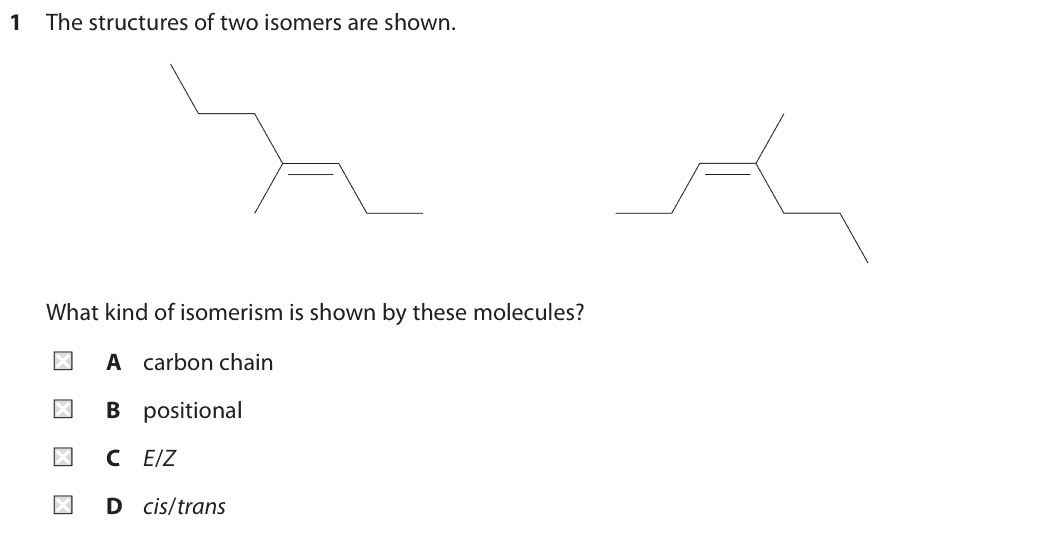
The structures of two isomers are shown.
What kind of isomerism is shown by these molecules?
A  carbon chain
B  positional
C  E/Z
D  cis/trans
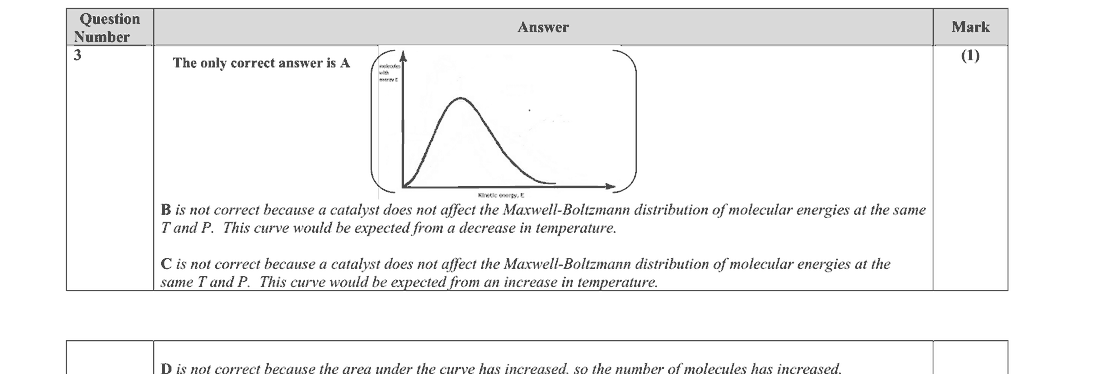
November 2021 · AS Paper 2 · Q3 1 mark Multiple choice kinetics i
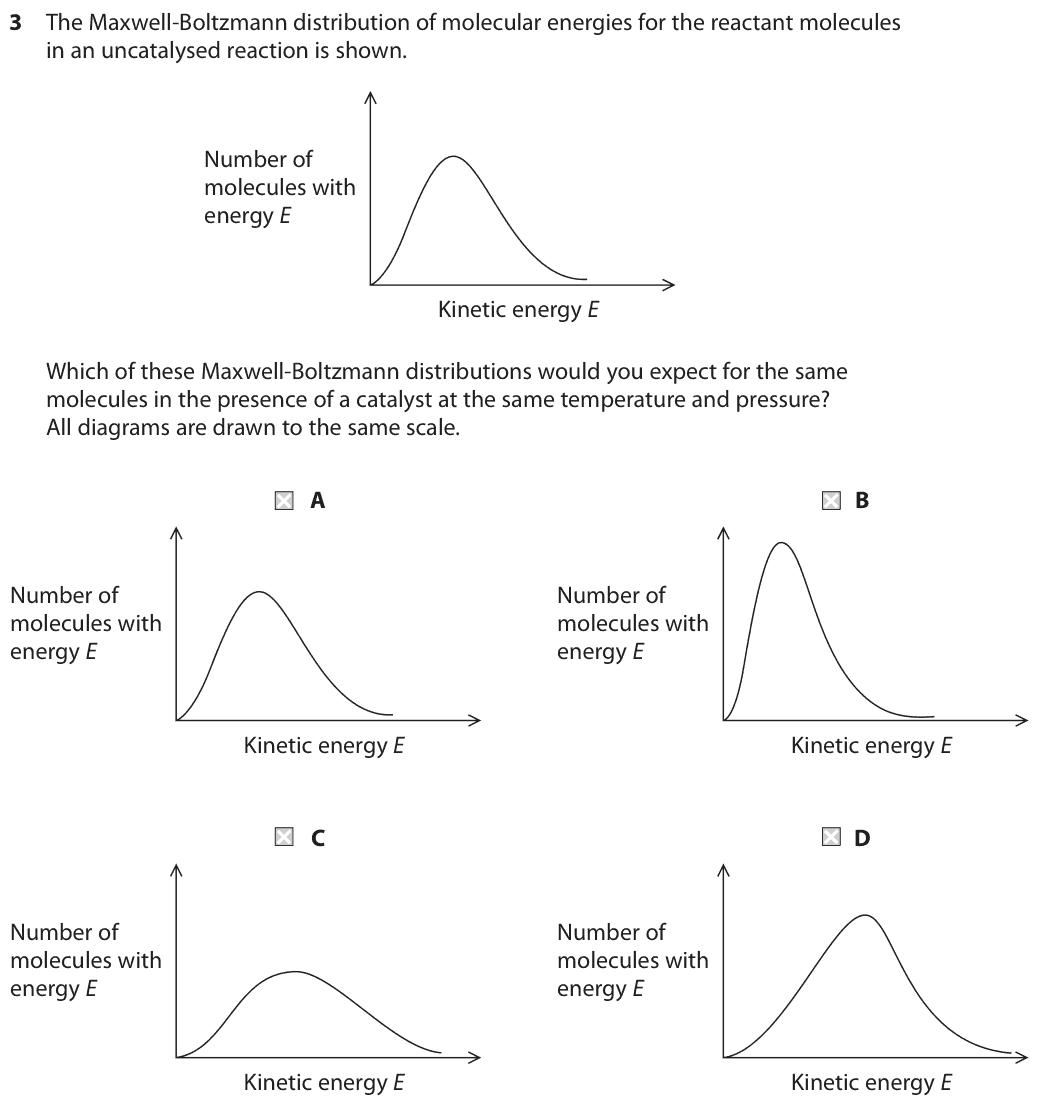
The Maxwell‑Boltzmann distribution of molecular energies for the reactant molecules
in an uncatalysed reaction is shown.
Number of
molecules with
energy E
Kinetic energy E
Which of these Maxwell‑Boltzmann distributions would you expect for the same
molecules in the presence of a catalyst at the same temperature and pressure?
All diagrams are drawn to the same scale.
A
B
Number of
Number of
molecules with
molecules with
energy E
energy E
Kinetic energy E
Kinetic energy E
C
D
Number of
Number of
molecules with
molecules with
energy E
energy E
Kinetic energy E
Kinetic energy E
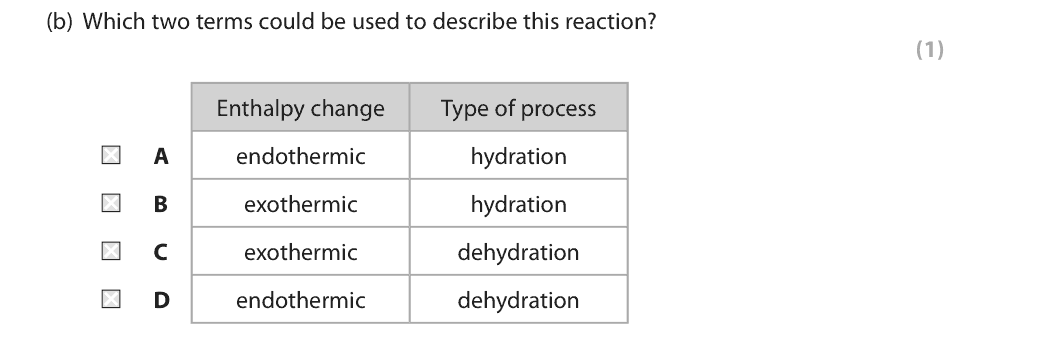
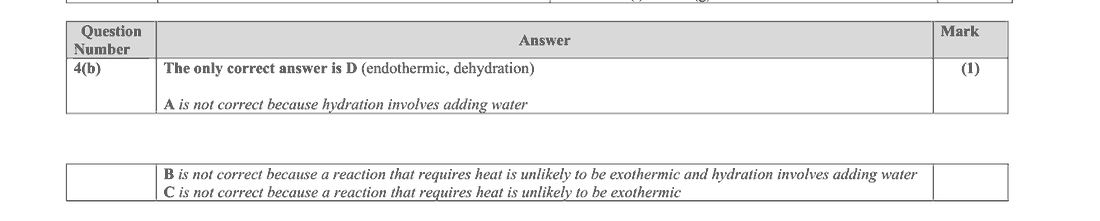
November 2021 · AS Paper 2 · Q4(b) 1 mark Multiple choice energetics i
Earlier part of question 4 that this part usesEarlier part of November 2021 Paper 2 question 4
Which two terms could be used to describe this reaction?
Enthalpy change
Type of process
A
endothermic
hydration
B
exothermic
hydration
C
exothermic
dehydration
D
endothermic
dehydration
November 2021 · AS Paper 2 · Q6(b) 1 mark Multiple choice halogenoalkanesintroduction to organic chemistry
Earlier part of question 6 that this part usesEarlier part of November 2021 Paper 2 question 6
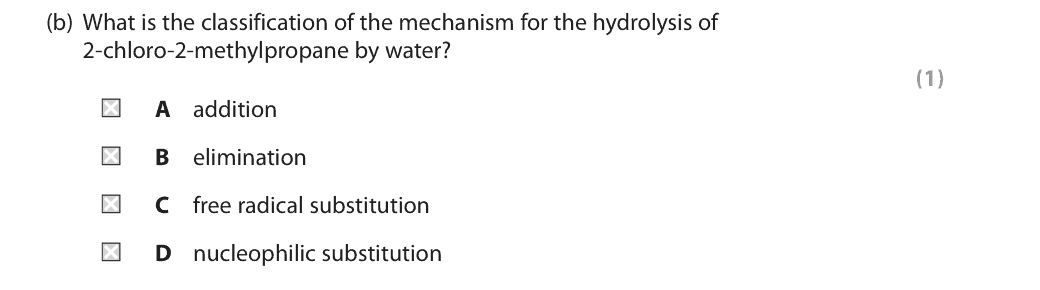
What is the classification of the mechanism for the hydrolysis of
2‑chloro‑2‑methylpropane by water?
A  addition
B  elimination
C  free radical substitution
D  nucleophilic substitution
November 2021 · AS Paper 2 · Q6(c)(ii) 1 mark Multiple choice halogenoalkanes
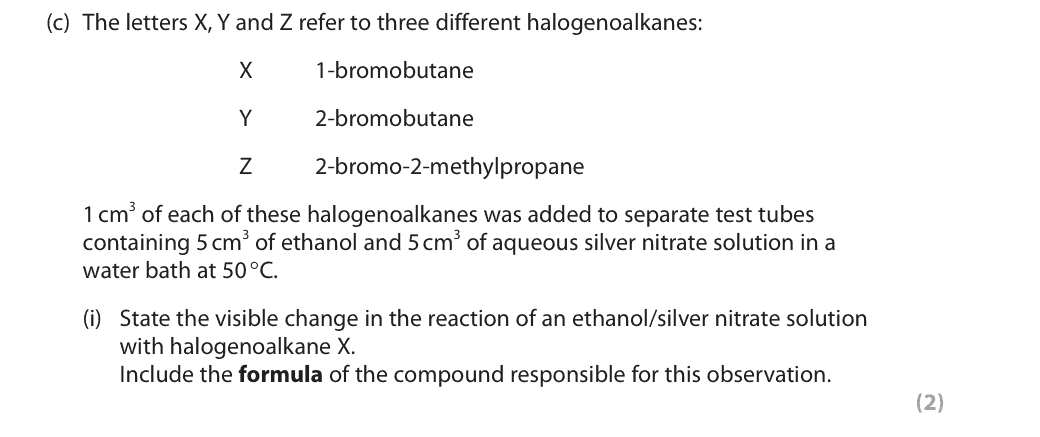
Earlier parts of question 6 that this part usesEarlier part of November 2021 Paper 2 question 6Earlier part of November 2021 Paper 2 question 6
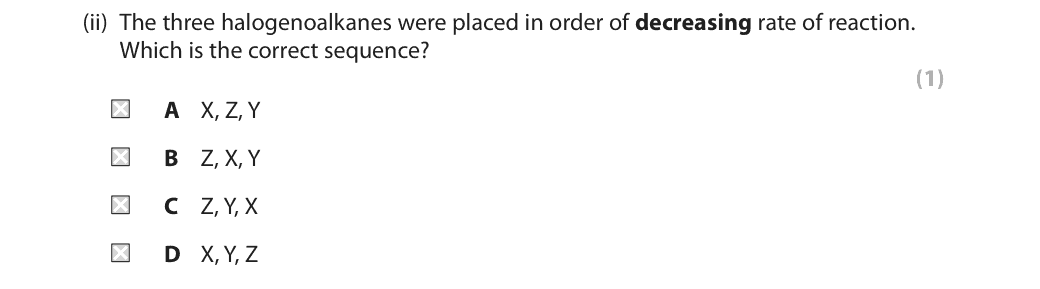
The three halogenoalkanes were placed in order of decreasing rate of reaction.
Which is the correct sequence?
A  X, Z, Y
B  Z, X, Y
C  Z, Y, X
D  X, Y, Z
November 2021 · AS Paper 2 · Q8(c)(i) 1 mark Multiple choice introduction to organic chemistry
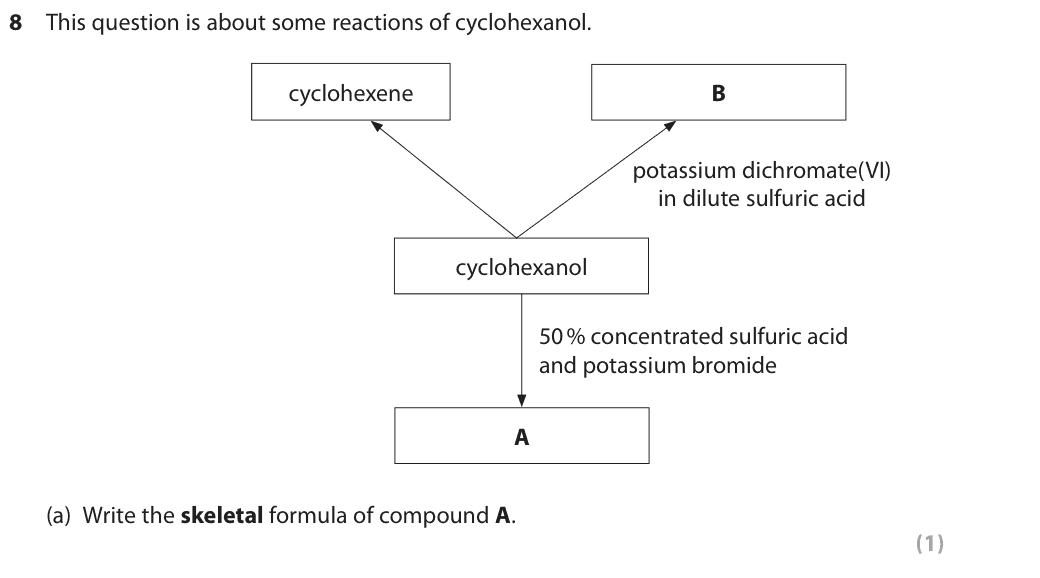
Earlier part of question 8 that this part usesEarlier part of November 2021 Paper 2 question 8
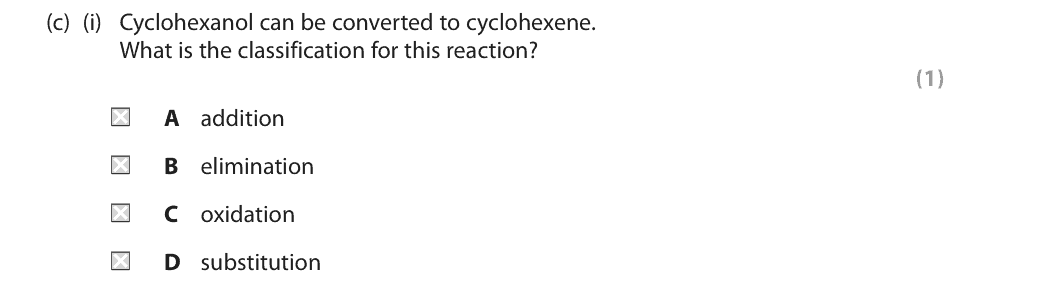
Cyclohexanol can be converted to cyclohexene.
What is the classification for this reaction?
A  addition
B  elimination
C  oxidation
D  substitution
November 2021 · AS Paper 2 · Q9(a)(iii) 1 mark Multiple choice formulae equations and amounts of substance
Earlier part of question 9 that this part usesEarlier part of November 2021 Paper 2 question 9
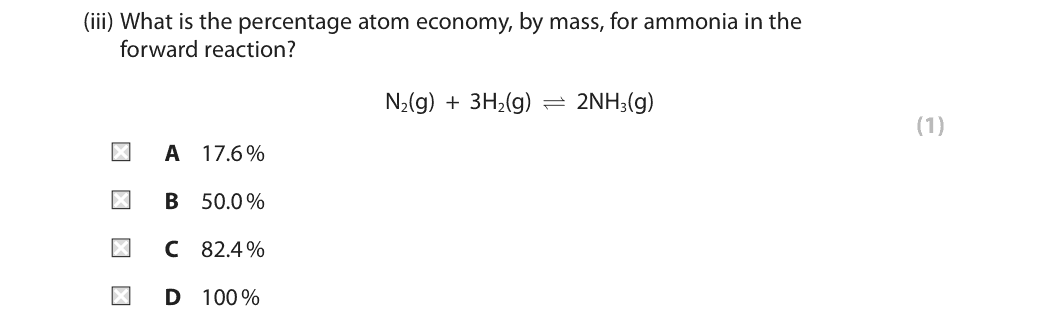
What is the percentage atom economy, by mass, for ammonia in the
forward reaction?
N2(g)  +  3H2(g)    2NH3(g)
A  17.6 %
B  50.0 %
C  82.4 %
D  100 %
November 2021 · AS Paper 2 · Q9(a)(iv) 1 mark Multiple choice equilibrium i
Earlier part of question 9 that this part usesEarlier part of November 2021 Paper 2 question 9
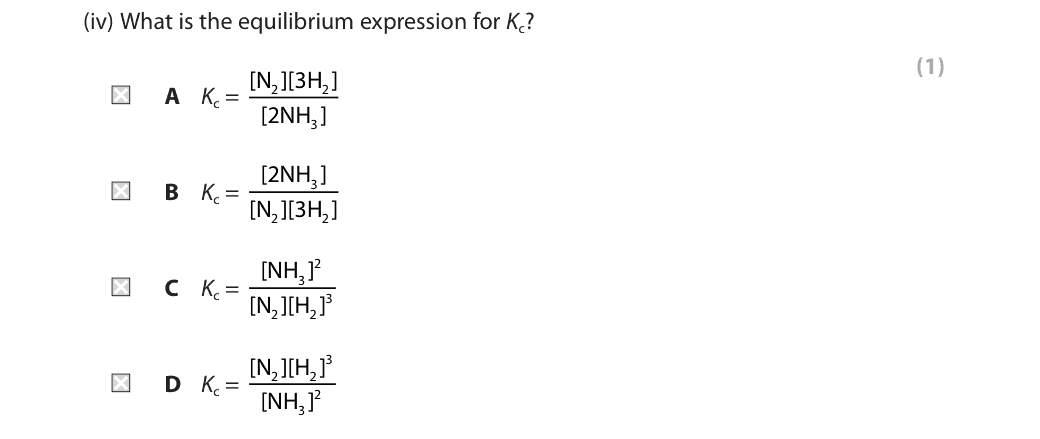
What is the equilibrium expression for Kc?
A  Kc = [N ][3H ]
2
2
[2NH ]
3
B  Kc = [2NH ]
3
[N ][3H ]
2
2
C  Kc = [NH ]
2
3
[N ][H ]
3
2
2
D  Kc = [N ][H ]
3
2
2
[NH ]
2
3
November 2021 · Paper 1 · Q1(a) 1 mark Multiple choice atomic structure and the periodic table
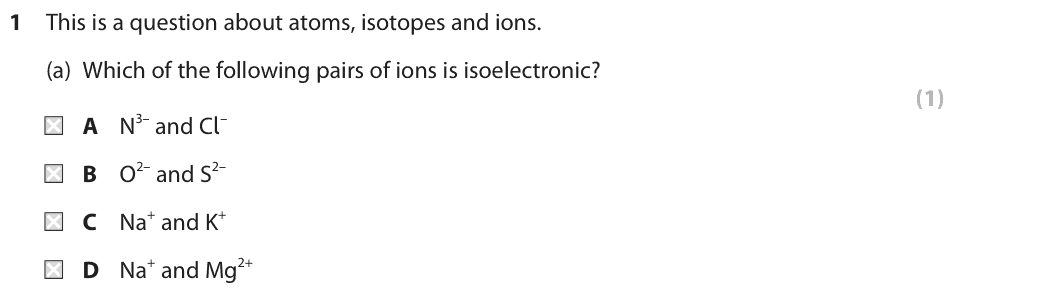
This is a question about atoms, isotopes and ions.
Which of the following pairs of ions is isoelectronic?
A  N3– and Cl–
B  O2– and S2–
C  Na+ and K+
D  Na+ and Mg2+
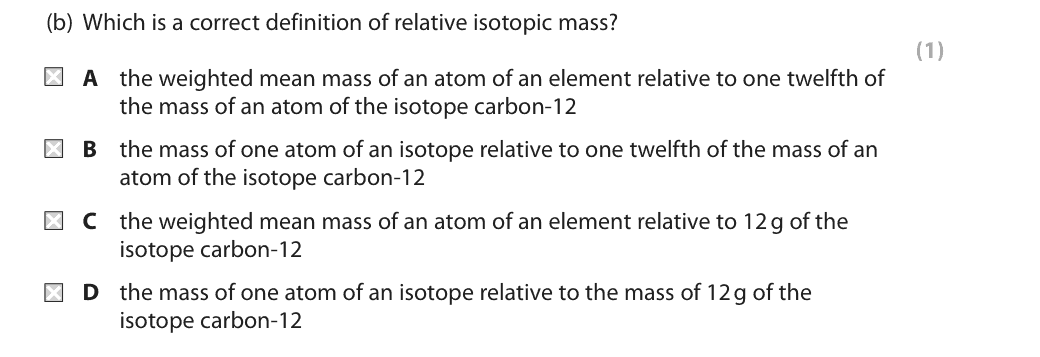
November 2021 · Paper 1 · Q1(b) 1 mark Multiple choice atomic structure and the periodic table
Which is a correct definition of relative isotopic mass?
A  the weighted mean mass of an atom of an element relative to one twelfth of
the mass of an atom of the isotope carbon‑12
B  the mass of one atom of an isotope relative to one twelfth of the mass of an
atom of the isotope carbon‑12
C  the weighted mean mass of an atom of an element relative to 12 g of the
isotope carbon‑12
D  the mass of one atom of an isotope relative to the mass of 12 g of the
isotope carbon‑12
November 2021 · Paper 1 · Q2(a) 1 mark Multiple choice groups 1 and 2
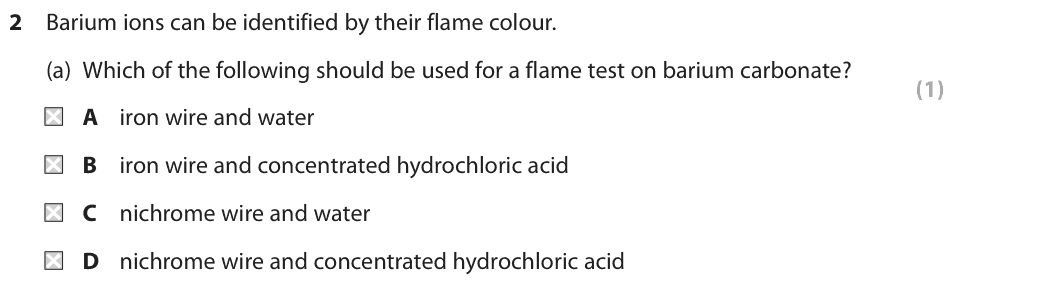
Barium ions can be identified by their flame colour.
Which of the following should be used for a flame test on barium carbonate?
A  iron wire and water
B  iron wire and concentrated hydrochloric acid
C  nichrome wire and water
D  nichrome wire and concentrated hydrochloric acid
November 2021 · Paper 1 · Q2(b) 1 mark Multiple choice groups 1 and 2
What colour do barium ions give in a flame test?
A  green
B  lilac
C  red
D  yellow
November 2021 · Paper 1 · Q2(c) 1 mark Multiple choice groups 1 and 2
A flame test was carried out on a mixture of barium chloride and magnesium chloride.
How does the presence of magnesium ions affect the appearance of the flame colour
of barium ions?
A  the colour is more intense
B  a bright white colour completely masks the barium colour
C  there is no change
D  the barium colour is decreased by the white magnesium flame colour
November 2021 · Paper 1 · Q5(b)(iii) 1 mark Multiple choice group 7 the halogens
Earlier parts of question 5 that this part usesEarlier part of November 2021 Paper 1 question 5Earlier part of November 2021 Paper 1 question 5Earlier part of November 2021 Paper 1 question 5
What conditions are required for the reaction in (b)(ii)?
A  cold and dilute alkali
B  cold and concentrated alkali
C  hot alkali
D  excess chlorine
November 2021 · Paper 1 · Q5(c) 1 mark Multiple choice group 7 the halogens
The halogens can be identified by their colour in an organic solvent such as
hexane or cyclohexane.
Which sequence of colours is correct for chlorine, bromine and iodine dissolved in
an organic solvent?
Chlorine
Bromine
Iodine
A
orange
red‑brown
black
B
pale green
orange
black
C
orange
red‑brown
purple
D
pale green
orange
purple
November 2021 · Paper 1 · Q6(b) 1 mark Multiple choice entropy
Earlier part of question 6 that this part usesEarlier part of November 2021 Paper 1 question 6
What is the standard molar entropy change, ΔS d
system , in J K–1 mol–1, for the reaction shown?
2Mg(s)  +  O2(g)  →  2MgO(s)
Substance
Standard molar entropy, S d / J K–1 mol–1
Mg(s)
32.7
O2(g)
205.0
MgO(s)
26.9
A  +210.8
B  –210.8
C  +216.6
D  –216.6
November 2021 · Paper 1 · Q7(b) 1 mark Multiple choice acid base equilibria
Earlier part of question 7 that this part usesEarlier part of November 2021 Paper 1 question 7
The reaction of ammonia with water can be represented by
NH3  +  H2O    NH4
+  +  OH–
Which is the acid‑conjugate base pair?
Acid
Conjugate base
A
NH3
OH–
B
NH3
NH4
+
C
H2O
OH–
D
H2O
NH4
+
November 2021 · Paper 1 · Q8(b) 1 mark Multiple choice transition metals principles
Earlier part of question 8 that this part usesEarlier part of November 2021 Paper 1 question 8
Which of these complexes is used in the treatment of cancer?
Cl
OH2
Cl
OH2
A
Pt
B
Pt
H2O
Cl
Cl
OH2
Cl
NH3
Cl
OH2
C
Pt
D
Pt
Cl
NH3
H3N
Cl
November 2021 · Paper 2 · Q1 1 mark Multiple choice formulae equations and amounts of substance
What is the total number of ions in 26.4 g of ammonium sulfate, (NH4)2SO4?
[Molar mass of (NH4)2SO4 = 132 g mol−1        Avogadro constant = 6.0 × 1023 mol−1]
A  4.0 × 1022
B  1.2 × 1023
C  2.4 × 1023
D  3.6 × 1023
November 2021 · Paper 2 · Q2 1 mark Multiple choice formulae equations and amounts of substance
The equation for the complete combustion of butane is
2C4H10(g) + 13O2(g) → 8CO2(g) + 10H2O(l)
What is the minimum volume of oxygen, at room temperature and pressure (r.t.p.),
needed for the complete combustion of 0.200 mol of butane?
[Molar volume of a gas at r.t.p. = 24.0 dm3 mol−1]
A  4.8 dm3
B  9.6 dm3
C  31.2 dm3
D  62.4 dm3
November 2021 · Paper 2 · Q3 1 mark Multiple choice introduction to organic chemistry
What is the systematic name for tiglic acid?
O
OH
tiglic acid
A  E-2-methylbut-2-enoic acid
B  Z-2-methylbut-2-enoic acid
C  E-3-methylbut-2-enoic acid
D  Z-3-methylbut-2-enoic acid
November 2021 · Paper 2 · Q4(b) 1 mark Multiple choice alcohols
Which of these compounds would form pent-2-ene only, when reacted with
concentrated phosphoric acid, H3PO4?
A  CH3CH(OH)CH(CH3)2
B  CH2(OH)CH2CH2CH2CH3
C  CH3CH2CH2CH(OH)CH3
D  CH3CH2CH(OH)CH2CH3
November 2021 · Paper 2 · Q5(c)(i) 1 mark Multiple choice alkanes
Earlier part of question 5 that this part usesEarlier part of November 2021 Paper 2 question 5
An alternative to synthetic oil is known as mineral oil and consists solely of
hydrocarbons separated from crude oil.
What is the name of the process used to separate different hydrocarbons from
crude oil?
A  cracking
B  reforming
C  fractional distillation
D  heating under reflux
November 2021 · Paper 2 · Q8(c) 1 mark Multiple choice carboxylic acids
Earlier part of question 8 that this part usesEarlier part of November 2021 Paper 2 question 8
Which of these is used to convert a dicarboxylic acid into a diol?
A  LiAlH4 and ether
B  KMnO4 and H2SO4
C  Sn and HCl
D  Na2Cr2O7 and H2SO4
November 2021 · Paper 2 · Q9(c)(i) 1 mark Multiple choice introduction to organic chemistry
Earlier part of question 9 that this part usesEarlier part of November 2021 Paper 2 question 9
When metabolised in the body, paracetamol forms a toxic compound Z.
This is then removed in the liver by a reaction with the tripeptide glutathione.
OH
O
N
NHCOCH3
O
compound Z
paracetamol
SH
O
O
O
H
N
N
HO
OH
H
O
NH2
glutathione
The conversion of paracetamol to compound Z is
A  addition
B  hydrolysis
C  oxidation
D  reduction
November 2021 · Paper 2 · Q9(c)(iii) 1 mark Multiple choice amines amides amino acids and proteins
Earlier parts of question 9 that this part usesEarlier part of November 2021 Paper 2 question 9Earlier part of November 2021 Paper 2 question 9
Glutathione is formed from glycine and two other amino acids.
Which two amino acids combine with glycine to form glutathione?
O
O
O
NH2
OH
HS
OH
OH
HO
NH2
NH2
O
glycine
cysteine
aspartic acid
O
O
O
S
OH
HO
OH
NH2
NH2
methionine
glutamic acid
A  aspartic acid and cysteine
B  glutamic acid and cysteine
C  glutamic acid and methionine
D  aspartic acid and methionine
November 2021 · Paper 2 · Q10(c) 1 mark Multiple choice amines amides amino acids and proteins
Earlier part of question 10 that this part usesEarlier part of November 2021 Paper 2 question 10
What is seen when excess butylamine is used in Reaction 3?
A  blue solution
B  blue precipitate
C  yellow solution
D  yellow precipitate
November 2021 · Paper 2 · Q10(d)(i) 1 mark Multiple choice amines amides amino acids and proteins
Earlier part of question 10 that this part usesEarlier part of November 2021 Paper 2 question 10
What is the type and mechanism of the reaction in Reaction 4?
A  electrophilic addition
B  electrophilic substitution
C  nucleophilic addition
D   nucleophilic substitution
October 2020 · AS Paper 1 · Q1(a) 1 mark Multiple choice atomic structure and the periodic table
This question is about the electronic structure of some Group 5 elements.
Which is the electronic configuration of the arsenide ion, As3–?
A  1s22s22p63s23p63d104s2
B  1s22s22p63s23p63d104s24p3
C  1s22s22p63s23p63d104s24p6
D  1s22s22p63s23p63d104s24p34d3
October 2020 · AS Paper 1 · Q2(a)(i) 1 mark Multiple choice atomic structure and the periodic table
This question is about ionisation energies.
Which equation represents the second ionisation of bromine?
A  Br(g)  +  e–  →  Br–(g)
B  Br–(g)  +  e–  →  Br2–(g)
C  Br(g)  –  2e–  →  Br2+(g)
D  Br+(g)  –  e–  →  Br2+(g)
October 2020 · AS Paper 1 · Q2(a)(ii) 1 mark Multiple choice atomic structure and the periodic table
Earlier part of question 2 that this part usesEarlier part of October 2020 Paper 1 question 2
Which set of successive ionisation energies is most likely to be associated with
the element boron?
A     738, 1 451, 7 733, 10 541, 13 629
B     801, 2 427, 3 660, 25 026, 32 828
C  1 086, 2 353, 4 621,   6 223, 37 832
D  1 402, 2 856, 4 578,   7 475,   9 445
October 2020 · AS Paper 1 · Q5(a)(i) 1 mark Multiple choice group 7 the halogensredox i
This question is about the reactions of the halogens and halide ions.
When chlorine gas is bubbled through an aqueous solution of
potassium iodide, the reaction involves
A  oxidation only
B  reduction only
C  redox
D  disproportionation
October 2020 · AS Paper 1 · Q5(a)(ii) 1 mark Multiple choice group 7 the halogens
Earlier part of question 5 that this part usesEarlier part of October 2020 Paper 1 question 5
Cyclohexane was added to the resulting solution from (a)(i).  The mixture was
shaken and then allowed to stand for a few minutes.  Two layers were formed.
[Density: aqueous layer solution = 1.10 g cm–3, cyclohexane layer = 0.78 g cm–3]
The colour of the lower layer was
A  pale yellow
B  purple
C  red
D  pale green
October 2020 · AS Paper 1 · Q5(b)(i) 1 mark Multiple choice group 7 the halogens
Concentrated sulfuric acid was added to a small quantity of solid potassium iodide
in a test tube.
In this exothermic reaction, which of the following mixtures of gases would be
produced?
A  hydrogen iodide and sulfur dioxide only
B  hydrogen iodide and hydrogen sulfide only
C  hydrogen iodide, sulfur dioxide and hydrogen sulfide
D  hydrogen iodide, hydrogen sulfide and iodine
October 2020 · AS Paper 1 · Q5(d) 1 mark Multiple choice group 7 the halogens
Earlier part of question 5 that this part usesEarlier part of October 2020 Paper 1 question 5
Fluorine is an element in Group 7.
Group 7 includes the elements chlorine, bromine and iodine.
Some information about the melting and boiling temperatures of Group 7
elements is shown in the table.
Element
Melting temperature / K
Boiling temperature / K
chlorine
172
238
bromine
266
332
iodine
387
457
Which is the expected boiling temperature of fluorine, in kelvin, K?
A  4
B  85
C  575
D  610
October 2020 · AS Paper 1 · Q6(a) 1 mark Multiple choice atomic structure and the periodic table
Malachite is a green mineral with the formula Cu2CO3(OH)2 .  It has a molar mass of 221 g mol–1.
What is the percentage by mass of copper in pure malachite?
A  40.3%
B  51.4%
C  57.5%
D  67.9%
October 2020 · AS Paper 2 · Q2(b)(i) 1 mark Multiple choice introduction to organic chemistry
Earlier part of question 2 that this part usesEarlier part of October 2020 Paper 2 question 2
Some alcohols react with concentrated phosphoric acid to form alkenes.
What is the type of this reaction?
A  addition
B  elimination
C  oxidation
D  substitution
October 2020 · AS Paper 2 · Q2(c) 1 mark Multiple choice halogenoalkanes
Earlier part of question 2 that this part usesEarlier part of October 2020 Paper 2 question 2
2‑methylpropan‑2‑ol may be formed by the reaction between
2‑bromo‑2‑methylpropane and aqueous potassium hydroxide.
What is the role of the hydroxide ions in this reaction?
A  alkali
B  catalyst
C  electrophile
D  nucleophile
October 2020 · AS Paper 2 · Q2(d)(ii) 1 mark Multiple choice alcohols
Earlier parts of question 2 that this part usesEarlier part of October 2020 Paper 2 question 2Earlier part of October 2020 Paper 2 question 2
The colour of the solution at the end of the reaction in (d)(i) will be
A  brown
B  green
C  orange
D  yellow
October 2020 · AS Paper 2 · Q3(a) 1 mark Multiple choice kinetics i
This question is about reaction kinetics.
The best way to describe the activation energy of a reaction is
A  the average energy of the particles when they react
B  the difference in energy between the reactants and the products
C  the minimum energy required to make the particles collide
D  the minimum energy required for a reaction to occur
October 2020 · AS Paper 2 · Q3(b)(i) 1 mark Multiple choice kinetics i
Earlier part of question 3 that this part usesEarlier part of October 2020 Paper 2 question 3
The diagrams show two reaction profiles for the same reversible reaction
involving gaseous reactants.
Shown on each diagram are the reaction profiles for the pathway without a
catalyst and the pathway catalysed by a heterogeneous catalyst.
In which diagram does the arrow represent the activation energy for the
backward reaction when a catalyst is present?
A
B
500
500
400
400
300
300
Enthalpy
Enthalpy
reactants
reactants
/ kJ mol−1
/ kJ mol−1
200
200
products
products
100
100
Reaction pathway
Reaction pathway
C
D
500
500
400
400
300
300
Enthalpy
Enthalpy
reactants
reactants
/ kJ mol−1
/ kJ mol−1
200
200
products
products
100
100
Reaction pathway
Reaction pathway
October 2020 · AS Paper 2 · Q3(b)(ii) 1 mark Multiple choice kinetics i
Earlier parts of question 3 that this part usesEarlier part of October 2020 Paper 2 question 3Earlier part of October 2020 Paper 2 question 3
Estimate, using the diagram, the decrease in the activation energy for the
forward reaction when a catalyst is added.
500
450
400
350
300
reactants
Enthalpy
250
/ kJ mol−1
200
150
100
products
50
Reaction pathway
A  75 kJ mol−1
B  100 kJ mol−1
C  175 kJ mol−1
D  200 kJ mol−1
October 2020 · AS Paper 2 · Q3(d)(i) 1 mark Multiple choice kinetics i
Earlier part of question 3 that this part usesEarlier part of October 2020 Paper 2 question 3
The diagram shows a Maxwell‑Boltzmann distribution of molecular energies for
gaseous molecules.
Ea (catalyst)
Ea
Number of molecules
with a given energy
Y
Z
Energy, E
Which is the area of the graph corresponding to the number of molecules
with sufficient energy to react when a catalyst is present?
A  Y
B  Y − Z
C  Y + Z
D  Z
October 2020 · AS Paper 2 · Q3(d)(ii) 1 mark Multiple choice kinetics i
Earlier parts of question 3 that this part usesEarlier part of October 2020 Paper 2 question 3Earlier part of October 2020 Paper 2 question 3
Which would always result in a decrease in the number of molecules
contained within area Y?
A  decreasing the temperature of the gas
B  increasing the pressure of the gas
C  putting the gas in a smaller container
D  removing a quarter of the catalyst
October 2020 · Paper 1 · Q1(a) 1 mark Multiple choice atomic structure and the periodic table
Which equation shows the third ionisation energy of aluminium?
A  Al(g)  →  Al3+(g) + 3e−
B  Al2+(g)  →  Al3+(g) + e−
C  Al3+(g) + 3e−   →  Al(g)
D  Al3+(g) + e−  →  Al2+(g)
October 2020 · Paper 1 · Q1(b) 1 mark Multiple choice atomic structure and the periodic table
Earlier part of question 1 that this part usesEarlier part of October 2020 Paper 1 question 1
Which element in this table is in Group 2?
Ionisation energy / kJ mol−1
Element
First
Second
Third
Fourth
W
1086
2353
4621
6223
X
653
1592
2987
4740
Y
590
1145
4912
6474
Z
496
4563
6913
9544
A  W
B  X
C  Y
D  Z
October 2020 · Paper 1 · Q1(c) 1 mark Multiple choice atomic structure and the periodic table
Earlier parts of question 1 that this part usesEarlier part of October 2020 Paper 1 question 1Earlier part of October 2020 Paper 1 question 1
The graph shows the first ionisation energies (IE) of eight successive elements
from the first 20 elements in the Periodic Table.
Which letter represents the first ionisation energy of oxygen?
(e)
(d)
(b)
(a)
(c)
1st IE / kJ mol-1
(g)
(f)
(h)
Atomic number
A  (a)
B  (b)
C  (c)
D  (h)
October 2020 · Paper 1 · Q2(a) 1 mark Multiple choice acid base equilibria
This question is about acids and bases.
What is the order of decreasing pH for 0.100 mol dm−3 solutions of these three acids?
A  CH3COOH > CH2ClCOOH > HCl
B  HCl > CH3COOH > CH2ClCOOH
C  CH2ClCOOH > CH3COOH >HCl
D  HCl > CH2ClCOOH > CH3COOH
October 2020 · Paper 1 · Q2(c) 1 mark Multiple choice acid base equilibria
Which of these mixtures would form a buffer solution with a pH below 7?
A  NaOH(aq) and excess HCl(aq)
B  NaOH(aq) and excess CH3COOH(aq)
C  excess NaOH(aq) and HCl(aq)
D  excess NaOH(aq) and CH3COOH(aq)
October 2020 · Paper 1 · Q2(d) 1 mark Multiple choice acid base equilibria
Bromothymol blue, methyl orange and phenolphthalein are indicators used in titrations.
Which, if any, of these indicators could be used for a titration of ammonia, NH3(aq),
with ethanoic acid, CH3COOH(aq)?
A  bromothymol blue
B  methyl orange
C  phenolphthalein
D  none of these three indicators
October 2020 · Paper 1 · Q4(a) 1 mark Multiple choice groups 1 and 2
This question is about dissolving different compounds.
Which of these compounds is the most soluble in water?
A  barium sulfate
B  calcium sulfate
C  magnesium sulfate
D  strontium sulfate
October 2020 · Paper 1 · Q4(b) 1 mark Multiple choice lattice energy
Earlier part of question 4 that this part usesEarlier part of October 2020 Paper 1 question 4
What is the value, in kJ mol−1, for the standard enthalpy change of solution of
magnesium chloride?
Mg2+(g)  +  2Cl−(g)
MgCl2(s)
Mg2+(aq)  +  2Cl−(aq)
Lattice energy MgCl2(s)
= −2526 kJ mol−1
Hydration enthalpy of Cl−(g)
= −  381 kJ mol−1
Hydration enthalpy of Mg2+(g)  = −1921 kJ mol−1
A  +157
B  −157
C  +224
D  −224
October 2020 · Paper 1 · Q7(b)(i) 1 mark Multiple choice bonding
Earlier part of question 7 that this part usesEarlier part of October 2020 Paper 1 question 7
Another ester, methyl methanoate, can be formed by the reaction between
methanol and carbon monoxide in the gaseous phase.
O
H
CO(g)  +  CH3OH(g)
H
xC
O
yC
H  (g)
H
The two O−C−H bond angles, x and y, in the ester are approximately
A  180° and 90°
B  120° and 90°
C  120° and 109.5°
D  109.5° and 109.5°
October 2020 · Paper 1 · Q7(b)(ii) 1 mark Multiple choice equilibrium ii
Earlier parts of question 7 that this part usesEarlier part of October 2020 Paper 1 question 7Earlier part of October 2020 Paper 1 question 7
The reaction often forms an equilibrium mixture.
Which could be the units for the equilibrium constant, Kp?
A  mol dm−3
B  dm3 mol−1
C  atm
D  atm−1
October 2020 · Paper 2 · Q2(a) 1 mark Multiple choice introduction to organic chemistry
This question is about alkenes.
Which of these has the molecular formula C6H10?
A
B
C
D
October 2020 · Paper 2 · Q2(b) 1 mark Multiple choice introduction to organic chemistry
Earlier part of question 2 that this part usesEarlier part of October 2020 Paper 2 question 2
What is the systematic name of this alkene?
CH3
HC
CH3
H2C
C
CH3
A  2-methylpent-1-ene
B  3-methylpent-1-ene
C  2,3-dimethylbut-1-ene
D  2,3-dimethylbut-3-ene
October 2020 · Paper 2 · Q3(a)(ii) 1 mark Multiple choice kinetics ii
Earlier part of question 3 that this part usesEarlier part of October 2020 Paper 2 question 3
What is the overall order of this reaction?
A  3
B  6
C  12
D  cannot tell from this information
October 2020 · Paper 2 · Q4(a)(i) 1 mark Multiple choice carboxylic acids
This question is about the identification of some organic compounds.
The skeletal formulae of four organic compounds are shown.
Compound P
Compound Q
O
O
O
OH
Compound R
Compound S
O
OH
O
Which of these compounds can be hydrolysed to form methanol as one of
the products?
A  Compound P
B  Compound Q
C  Compound R
D  Compound S
October 2020 · Paper 2 · Q4(a)(ii) 1 mark Multiple choice carboxylic acids
Earlier part of question 4 that this part usesEarlier part of October 2020 Paper 2 question 4
Which of these compounds produces carbon dioxide when it reacts with
aqueous sodium hydrogencarbonate?
A  Compound P
B  Compound Q
C  Compound R
D  Compound S
October 2020 · Paper 2 · Q5(a) 1 mark Multiple choice alkanes
This question is about hydrocarbons.
Which of these molecular formulae represents a non-cyclic, saturated hydrocarbon?
A  C6H6
B  C6H10
C  C6H12
D  C6H14
October 2020 · Paper 2 · Q5(b) 1 mark Multiple choice introduction to organic chemistry
How many structural isomers are there with the molecular formula C5H12?
.
A  2
B  3
C  4
D  5
October 2020 · Paper 2 · Q5(c) 1 mark Multiple choice alkenes
Earlier part of question 5 that this part usesEarlier part of October 2020 Paper 2 question 5
How many σ bonds and π bonds are there in one molecule of cyclohexene?
.
σ bonds
π bonds
A
5
2
B
6
1
C
15
2
D
16
1
October 2020 · Paper 2 · Q5(d)(i) 1 mark Multiple choice formulae equations and amounts of substance
Earlier part of question 5 that this part usesEarlier part of October 2020 Paper 2 question 5
When hydrocarbons undergo complete combustion, there is a change in the total
volume of gases.
Ethane burns in excess oxygen.
2C2H6(g)  +  7O2(g)  →  4CO2(g)  +  6H2O(g)
All gas volumes are measured at the same temperature and pressure when
water is a gas.
What is the increase in the total volume when 100 cm3 of ethane is burned in
excess oxygen?
A  50 cm3
B  100 cm3
C  200 cm3
D  500 cm3
October 2020 · Paper 2 · Q8(a)(i) 1 mark Multiple choice nmr mass spectrometry and chromatography
This question is about the analysis of organic compounds.
X is an organic compound.
The accurate relative atomic masses, Ar , of the four elements that could make
up X are shown in the table.
Element
Ar
hydrogen, H
1.0078
carbon, C
12.0000
nitrogen, N
14.0031
oxygen, O
15.9949
X gives a molecular ion peak at m / z = 100.0522 on its mass spectrum.
Which is the molecular formula of X?
A  C7H16
B  C6H12O
C  C6H14N
D  C5H8O2
June 2019 · AS Paper 1 · Q1 1 mark Multiple choice formulae equations and amounts of substance
How many ions are present in 306 g of aluminium oxide, Al2O3 ?
[Avogadro constant = 6.02 q 1023 mol−1   Molar mass of Al2O3 = 102 g mol−1 ]
A 6.02 q 1023
B 1.81 q 1024
C 3.01 q 1024
D 9.03 q 1024
June 2019 · AS Paper 1 · Q2 1 mark Multiple choice atomic structure and the periodic table
What is the electronic configuration of the sulfide ion, S2− ?
A 1s22s22p63s23p2
B 1s22s22p63p4
C 1s22s22p63s23p4
D 1s22s22p63s23p6
June 2019 · AS Paper 1 · Q4(a) 1 mark Multiple choice groups 1 and 2
This question is about trends within Group 2 of the Periodic Table.
Which of the following describes the trends in thermal stability of the
Group 2 carbonates and nitrates going down the group?
Thermal stability
Carbonates
Nitrates
A
increases
increases
B
increases
decreases
C
decreases
increases
D
decreases
decreases
June 2019 · AS Paper 1 · Q4(c) 1 mark Multiple choice groups 1 and 2
Which of the following describes the trends in the solubility in water of the
Group 2 hydroxides and sulfates going down the group?
Solubility in water
Hydroxides
Sulfates
A
increases
increases
B
increases
decreases
C
decreases
increases
D
decreases
decreases
June 2019 · AS Paper 1 · Q5(a) 1 mark Multiple choice atomic structure and the periodic table
This question is about iron(II) salts.
What is the percentage by mass of iron in anhydrous iron(II) sulfate, FeSO4, to
3 significant figures?
A 21.3%
B 35.1%
C 36.7%
D 53.8%
June 2019 · AS Paper 1 · Q5(c) 1 mark Multiple choice atomic structure and the periodic tableformulae equations and amounts of substance
Mohr’s salt is another compound containing iron(II) ions.
It has the formula (NH4)2Fe(SO4)2. 6H2O.
What is the molar mass, in g mol−1, of Mohr’s salt?
A 392.0
B 312.0
C 302.0
D 284.0
June 2019 · AS Paper 1 · Q6(b)(ii) 1 mark Multiple choice group 7 the halogens
Earlier parts of question 6 that this part usesEarlier part of June 2019 Paper 1 question 6Earlier part of June 2019 Paper 1 question 6
The identity of the anion may be confirmed by testing the solubility of the
cream-coloured precipitate in ammonia solution.  Which pair of responses
helps to confirm the identity of the anion?
Solubility in dilute
Solubility in concentrated
ammonia solution
ammonia solution
A
insoluble
insoluble
B
insoluble
soluble
C
soluble
insoluble
D
soluble
soluble
June 2019 · AS Paper 1 · Q9(a)(i) 1 mark Multiple choice redox igroup 7 the halogens
This question is about chlorine and its compounds.
Potassium chlorate(V) can be produced by passing chlorine gas into hot,
concentrated potassium hydroxide solution.
3Cl2  +  6KOH  →  5KCl  +  KClO3  +  3H2O
This reaction is an example of
A oxidation only
B reduction only
C disproportionation
D decomposition
June 2019 · AS Paper 2 · Q1(c) 1 mark Multiple choice alkanes
Earlier part of question 1 that this part usesEarlier part of June 2019 Paper 2 question 1
Which of the following changes to the proportions of organic molecules within a
fraction results from the reforming process?
Proportion of branched chain
Proportion of cyclic
alkanes
hydrocarbons
A
decrease
decrease
B
decrease
increase
C
increase
decrease
D
increase
increase
June 2019 · AS Paper 2 · Q2(b)(ii) 1 mark Multiple choice alkenes
Earlier parts of question 2 that this part usesEarlier part of June 2019 Paper 2 question 2Earlier part of June 2019 Paper 2 question 2
What is the type and mechanism of the reaction in (b)(i)?
A electrophilic addition
B nucleophilic addition
C electrophilic substitution
D nucleophilic substitution
June 2019 · AS Paper 2 · Q2(c)(i) 1 mark Multiple choice halogenoalkanes
1-chloropropane and 2-chloropropane can be converted into compounds
containing the nitrile functional group.
Under appropriate conditions, 1-chloropropane can be converted into
butanenitrile, CH3CH2CH2CN.
Which is the reagent for this conversion?
A ammonia
B nitric acid
C potassium cyanide
D silver nitrate
June 2019 · AS Paper 2 · Q4(b)(i) 1 mark Multiple choice equilibrium i
Earlier part of question 4 that this part usesEarlier part of June 2019 Paper 2 question 4
How does the equilibrium yield of methanol change if the temperature is increased
at constant pressure or the pressure increased at constant temperature?
Equilibrium yield when
temperature is increased
pressure is increased
decrease
decrease
A
decrease
increase
B
increase
decrease
C
Increase
increase
D
June 2019 · AS Paper 2 · Q5(e)(ii) 1 mark Multiple choice alcohols
Earlier parts of question 5 that this part usesEarlier part of June 2019 Paper 2 question 5Earlier part of June 2019 Paper 2 question 5
The functional group in butan-1-ol can be confirmed using a single chemical test.
What is the single chemical test and expected observation?
Chemical test reagent
Observation
A
sodium carbonate solution
effervescence
B
aqueous silver nitrate
cream precipitate
C
Fehling’s solution
red precipitate
D
phosphorus(V) chloride
steamy fumes
June 2019 · AS Paper 2 · Q5(f) 1 mark Multiple choice halogenoalkanesintroduction to organic chemistry
Earlier part of question 5 that this part usesEarlier part of June 2019 Paper 2 question 5
Alkene molecules are formed by elimination from 2-bromobutane.
How many isomeric alkene products will be formed in this reaction?
A 1
B 2
C 3
D 4
June 2019 · AS Paper 2 · Q6(a)(iii) 1 mark Multiple choice formulae equations and amounts of substance
Earlier part of question 6 that this part usesEarlier part of June 2019 Paper 2 question 6
What is the colour change at the end-point?
A from orange to yellow
B from red to orange
C from colourless to pink
D from pink to colourless
June 2019 · AS Paper 2 · Q7(a) 1 mark Multiple choice formulae equations and amounts of substance
This question is about compounds with the molecular formula C4H8O.
What is the percentage by mass of each element in C4H8O?
Percentage carbon
Percentage hydrogen
Percentage oxygen
66.67
11.11
22.22
A
60.00
20.00
20.00
B
41.38
3.45
55.17
C
30.77
61.54
7.69
D
June 2019 · Paper 1 · Q1(a) 1 mark Multiple choice atomic structure and the periodic table
This question is about atoms, molecules and ions.
The numbers of subatomic particles in an 18O atom are
A 8 protons, 10 neutrons and 8 electrons
B 9 protons, 9 neutrons and 9 electrons
C 10 protons, 8 neutrons and 10 electrons
D 18 protons, 18 neutrons and 18 electrons
June 2019 · Paper 1 · Q1(b) 1 mark Multiple choice atomic structure and the periodic table
Earlier part of question 1 that this part usesEarlier part of June 2019 Paper 1 question 1
The mass spectrum of a sample of bromine molecules with approximately equal
proportions of the 79Br and 81Br isotopes is
A
B
Relative
Relative
intensity
intensity
0
0
60
80
100
120
140
160
60
80
100
120
140
160
m / z
m / z
C
D
Relative
Relative
intensity
intensity
0
0
60
80
100
120
140
160
60
80
100
120
140
160
m / z
m / z
June 2019 · Paper 1 · Q1(c) 1 mark Multiple choice atomic structure and the periodic table
The total number of electrons in all the occupied p orbitals in a chloride ion, Cl–, is
A 5
B 6
C 12
D 18
June 2019 · Paper 1 · Q1(d) 1 mark Multiple choice bonding
Which of these isoelectronic ions has the largest ionic radius?
A N3–
B O2–
C Na+
D Al3+
June 2019 · Paper 1 · Q3(a)(i) 1 mark Multiple choice formulae equations and amounts of substance
The standard molar enthalpy change of neutralisation is the enthalpy change when
an acid and an alkali react under standard conditions to form one mole of water.
An experiment was carried out to determine the enthalpy change of
neutralisation for the reaction between propanoic acid and sodium hydroxide.
The equation for this reaction is
CH3CH2COOH(aq) + NaOH(aq) o CH3CH2COO–Na+(aq) + H2O(l)
50.0 cm3 of sodium hydroxide solution, of concentration 1.00 mol dm–3, was placed
in a polystyrene cup.  The initial temperature was measured.
Which piece of equipment has the smallest measurement uncertainty for the
measurement of 50.0 cm3 of sodium hydroxide solution?
Equipment
Measurement uncertainty for each reading
A
burette
±0.05 cm3
B
50 cm3 measuring cylinder
±1 cm3
C
25 cm3 pipette
±0.06 cm3
D
50 cm3 pipette
±0.08 cm3
June 2019 · Paper 1 · Q3(b)(i) 1 mark Multiple choice energetics i
Earlier part of question 3 that this part usesEarlier part of June 2019 Paper 1 question 3
Another experiment was carried out with a solution of ethanoic acid and
sodium hydroxide solution of the same concentration.
Which graph shows the correct way that the maximum temperature rise
should be determined?
A
B
45
45
40
40
35
35
30
30
¨T
¨T
25
25
20
20
15
15
0
0
0
60 120 180 240 300 360 420 480 540 600
0
60 120 180 240 300 360 420 480 540 600
NaOH
NaOH
Time / s
Time / s
added
added
C
D
45
45
40
40
35
35
¨T
30
30
¨T
25
25
20
20
15
15
0
0
0
60 120 180 240 300 360 420 480 540 600
0
60 120 180 240 300 360 420 480 540 600
NaOH
NaOH
Time / s
Time / s
added
added
June 2019 · Paper 1 · Q5(c) 1 mark Multiple choice transition metals reactions
The rate of oxidation of ethanedioate ions by manganate(VII) ions starts slowly
and then rapidly increases.
– + 16H+ + 5C2O4
2– o 2Mn2+ + 8H2O + 10CO2
2MnO4
What is the catalyst in this reaction?
A CO2
B H+
C Mn2+
D MnO4
–
June 2019 · Paper 1 · Q8(d) 1 mark Multiple choice lattice energy
Lattice energies provide an indication of ionic bond strength.
Which are the lattice energies of the hydrides NaH, KH and MgH2?
Lattice energy / kJ mol–1
Sodium hydride, NaH
Potassium hydride, KH Magnesium hydride, MgH2
A
–804
–711
–1018
B
–804
–711
–2718
C
–804
–911
–1018
D
–804
–911
–2718
June 2019 · Paper 1 · Q9(a) 1 mark Multiple choice acid base equilibria
This is a question about buffer solutions.
A buffer solution always
A keeps the pH less than 7.
B contains equimolar amounts of acid and its conjugate base.
C keeps the pH constant if small quantities of acid or base are added.

D resists changes in pH if small quantities of acid or base are added.
June 2019 · Paper 1 · Q10(c) 1 mark Multiple choice equilibrium i
Earlier part of question 10 that this part usesEarlier part of June 2019 Paper 1 question 10
The equilibrium for the reaction between hydrogen gas and an oxide of iron is
Fe3O4(s) + 4H2(g) _
` 3Fe(s) + 4H2O(g)
The Kc expression for this equilibrium is
A Kc = [
Fe
]
×
[
H O
]
2
[
Fe O
]
×
[
H
]
3
4
2
B Kc = [
Fe
]
3
×
[
H O
]
4
2
[
Fe O
]
×
[
H
]
4
3
4
2
C Kc = [
H O
]
2
[
H
]
2
D Kc = [
H O
]
4
2
[
H
]
4
2
June 2019 · Paper 2 · Q1(a)(i) 1 mark Multiple choice alcohols
This question is about some reactions of alcohols.

Which alcohol cannot be oxidised by acidified potassium dichromate(VI)?
L] A hexan-2-ol
L] B= 2-methylpentan-2-ol
L] C€_ hexan-3-ol
L] D 2-methylpentan-3-ol
June 2019 · Paper 2 · Q1(a)(ii) 1 mark Multiple choice carbonyl compounds
Earlier part of question 1 that this part usesEarlier part of June 2019 Paper 2 question 1
Which alcohol reacts with iodine in the presence of alkali to form a yellow solid?
[] A_hexan-2-ol
[] B= 2-methylpentan-2-ol
[] C_ hexan-3-ol
[] D 2-methylpentan-3-ol
June 2019 · Paper 2 · Q1(b) 1 mark Multiple choice alcohols
Which reagent is used with iodine to prepare iodoalkanes from alcohols?
[1 A’ red phosphorus
L] B_~ concentrated phosphoric acid
[1] Cs sulfur
L] D concentrated sulfuric acid
June 2019 · Paper 2 · Q2(a) 1 mark Multiple choice introduction to organic chemistry
This question is about alkanes and their reactions.
What is the IUPAC name for this alkane?
25
[] A 4-ethyloctane
[] B_ 5-ethyloctane
[1 C 3-propylheptane
[1 D 5-propylheptane
June 2019 · Paper 2 · Q2(b) 1 mark Multiple choice alkanes
What is the name of the process that could be used to produce propane, C3H,,
from decane, C,H?
[1 A. substitution
1 Bs reforming
[1 C_ fractional distillation
[1] D cracking
June 2019 · Paper 2 · Q2(c)(i) 1 mark Multiple choice alkanes
A student researched the reaction of propane with bromine and found that the
reaction could be used to make 1-bromopropane.
C3H3(g) + Br2(l) > C3H,Br(l) + HBr(g)
The first step of the reaction involves
L] A_heterolytic bond fission to form free radicals
[] B_heterolytic bond fission to form ions
L] ©€ homolytic bond fission to form free radicals
L] D homolytic bond fission to form ions
June 2019 · Paper 2 · Q2(c)(iii) 1 mark Multiple choice alkanes
Earlier parts of question 2 that this part usesEarlier part of June 2019 Paper 2 question 2Earlier part of June 2019 Paper 2 question 2
A source from the internet gave the percentage yield for this reaction as 31.0%.
The best explanation for the low percentage yield of 1-bromopropane in this
reaction is
L] A_ bromine is very unreactive
[] B_ agaseous reactant always gives a low yield
L] C_ the reaction is very slow
L] D the reaction produces a mixture of organic products
June 2019 · Paper 2 · Q3(c) 1 mark Multiple choice alcohols
Which of these compounds produces hydrogen chloride when it reacts with PCl,?
LJ] A propanal
L] B_ propan-1-ol
[1 C_ propanone
LJ] D_ propyl propanoate
June 2019 · Paper 2 · Q4(c)(ii) 1 mark Multiple choice chirality
Earlier parts of question 4 that this part usesEarlier part of June 2019 Paper 2 question 4Earlier part of June 2019 Paper 2 question 4
Deduce the number of optical isomers of the addition product that can exist.
[1 A 2
OB 3
oe4
Opes
June 2019 · Paper 2 · Q4(c)(iii) 1 mark Multiple choice chirality
Earlier parts of question 4 that this part usesEarlier part of June 2019 Paper 2 question 4Earlier part of June 2019 Paper 2 question 4
When plane-polarised light is passed through an optical isomer, the plane of
polarisation is
L] A diffracted
1] B reflected
[1 C refracted
[1 D rotated
June 2019 · Paper 2 · Q8(a)(i) 1 mark Multiple choice amines amides amino acids and proteinshalogenoalkanes
Gentian violet is a purple crystalline solid used as an antifungal treatment.
It can be synthesised from dimethylphenylamine, CsHsN(CHs),.
The dimethylphenylamine used in the synthesis can be made by the stepwise
reaction of phenylamine with chloromethane.
Step 1 2C,H;NH, + CH;Cl CsH;NH(CH3) + CsH;NH3Cl
Step 2 2C,H;NH(CH;) + CH3Cl - CsH;N(CH3). + CsH;NH3(CH3)Cl”
The reaction mechanism for Step 1 between phenylamine and chloromethane is
the same as that in the reaction between ammonia and chloromethane.
What is the reaction type and mechanism in Step 1?
1 A. electrophilic addition
LJ B~ electrophilic substitution
[1 € nucleophilic addition
L] D_ nucleophilic substitution
June 2018 · AS Paper 1 · Q1(c) 1 mark Multiple choice bonding
The dot-and-cross diagram of BF3 is
F
F
B
F
What is the bond angle in BF3?
A  90°
B  107°
C  109.5°
D  120°
June 2018 · AS Paper 1 · Q3(a) 1 mark Multiple choice formulae equations and amounts of substance
The reaction of sulfuric acid with potassium hydroxide is a neutralisation.
The equation for this reaction is
H2SO4(aq) + 2KOH(aq) → K2SO4(aq) + 2H2O(l)
A titration was carried out using the following method.
1.  Potassium hydroxide solution of unknown concentration was placed in a burette
and the initial reading was recorded.
2.  25.0 cm3 of sulfuric acid solution, concentration 0.0800 mol dm−3, was transferred
to a conical flask.
3.  Three drops of phenolphthalein indicator were added to the sulfuric acid.
4.  Potassium hydroxide was added from the burette until the solution just changed
colour and then the burette reading was recorded.
5.  Repeat titrations were carried out until concordant titres were obtained.
Select the most appropriate piece of apparatus to measure the 25.0 cm3 of
sulfuric acid.
A  burette
B  measuring cylinder
C  pipette
D  volumetric flask
June 2018 · AS Paper 1 · Q3(b) 1 mark Multiple choice formulae equations and amounts of substance
Earlier part of question 3 that this part usesEarlier part of June 2018 Paper 1 question 3
What is the colour of the solution when neutralisation has just occurred?
A  colourless
B  orange
C  pale pink
D  red
June 2018 · AS Paper 1 · Q3(c)(ii) 1 mark Multiple choice formulae equations and amounts of substance
Earlier parts of question 3 that this part usesEarlier part of June 2018 Paper 1 question 3Earlier part of June 2018 Paper 1 question 3
The best value for the mean titre of this reaction is
A  27.00 cm3
B  27.15 cm3
C  27.25 cm3
D  27.30 cm3
June 2018 · AS Paper 1 · Q4(a)(iii) 1 mark Multiple choice bonding
Earlier part of question 4 that this part usesEarlier part of June 2018 Paper 1 question 4
What is the charge on the cation?
A  +1
B  −1
C  +2
D  −2
June 2018 · AS Paper 1 · Q5(c)(ii) 1 mark Multiple choice groups 1 and 2
Earlier parts of question 5 that this part usesEarlier part of June 2018 Paper 1 question 5Earlier part of June 2018 Paper 1 question 5
The flame test colour was crimson red.  Identify J.
A  barium
B  calcium
C  lithium
D  strontium
June 2018 · AS Paper 1 · Q8(a)(i) 1 mark Multiple choice formulae equations and amounts of substance
This question is about ionic bonding.
The elements sodium and fluorine react together to form an ionic compound.
Select the correct equation for this reaction.
A  Na(s) + F(g) → NaF(s)
B  2Na(s) + F2(g) → 2NaF(s)
C  Na(s) + F2(g) → NaF2(s)
D  2Na(s) + F(g) → Na2F(s)
June 2018 · AS Paper 1 · Q8(a)(iii) 1 mark Multiple choice bonding
Earlier part of question 8 that this part usesEarlier part of June 2018 Paper 1 question 8
Which diagram shows the trend in ionic radius for the isoelectronic ions N3− to Al3+?
A
B
Ionic
Ionic
radius
radius
F−(Ne) Na+ Mg2+ Al3+
N3−O2−
N3−O2−
C
D
Ionic
Ionic
radius
radius
F−(Ne) Na+ Mg2+ Al3+
N3−O2−
N3−O2−
June 2018 · AS Paper 2 · Q1 1 mark Multiple choice halogenoalkanes
Which of the following does not act as a nucleophile?
A  HBr
B  H2O
C  NH3
D  CN−
June 2018 · AS Paper 2 · Q3(d) 1 mark Multiple choice kinetics i
Earlier part of question 3 that this part usesEarlier part of June 2018 Paper 2 question 3
The diagram shows a Maxwell-Boltzmann distribution of particle energies,
including the activation energy, Ea , for a reaction.
Number of
particles with
Ea
energy, E
Energy, E
An increase in temperature will
A  increase the area under the curve.
B  move the peak of the curve to the right.
C  raise the height of the peak.
D  move the position of the activation energy, Ea , to the left.
June 2018 · AS Paper 2 · Q4(b) 1 mark Multiple choice halogenoalkanes
Earlier part of question 4 that this part usesEarlier part of June 2018 Paper 2 question 4
The bromoalkanes, X, Y and Z, were each added to a mixture of aqueous silver nitrate
and ethanol at 50 °C.  The rate of hydrolysis was compared by measuring the time
for a precipitate to appear.
CH3 Br
X        CH3
CH
CH
CH3
CH3
Y        CH3
CH
CH2
CH2
Br
Br
Z        CH3
CH2
C
CH3
CH3
The relative rates of hydrolysis are in the order (fastest first)
A  X, Y, Z
B  Z, X, Y
C  Z, Y, X
D  X, Z, Y
June 2018 · AS Paper 2 · Q5(a)(i) 1 mark Multiple choice alkenesintroduction to organic chemistry
This question concerns alkenes and some halogen compounds.
The alkene, propene, reacts with hydrogen chloride.
This reaction is best described as
A  electrophilic substitution
B  electrophilic addition
C  nucleophilic substitution
D  nucleophilic addition
June 2018 · AS Paper 2 · Q5(a)(ii) 1 mark Multiple choice introduction to organic chemistry
Earlier part of question 5 that this part usesEarlier part of June 2018 Paper 2 question 5
The reaction of propene with hydrogen chloride can produce two isomeric products:
CH3
CH2
CH2
Cl
Cl
CH3
CH
CH3
1-chloropropane
2-chloropropane
1-chloropropane and 2-chloropropane are
A  cis-trans isomers
B  E/Z isomers
C  structural isomers
D  stereoisomers
June 2018 · AS Paper 2 · Q5(c)(ii) 1 mark Multiple choice alcohols
Earlier parts of question 5 that this part usesEarlier part of June 2018 Paper 2 question 5Earlier part of June 2018 Paper 2 question 5
In stage 2, the product from the first reaction is converted to chloroethene:
CH2Cl
CH2Cl → CH2
CHCl + HCl                ΔH = +71 kJ mol−1
Both products are required for use in other processes.
Which method would be most suitable for the separation of these two products?
A  fractional distillation
B  solvent extraction using a separating funnel
C  heating under reflux
D  bubble through dilute alkali
June 2018 · AS Paper 2 · Q6(a)(ii) 1 mark Multiple choice introduction to organic chemistry
Earlier part of question 6 that this part usesEarlier part of June 2018 Paper 2 question 6
This reaction is best described as
A  hydrolysis
B  oxidation
C  reduction
D  substitution
June 2018 · AS Paper 2 · Q7(b)(ii) 1 mark Multiple choice formulae equations and amounts of substance
Earlier parts of question 7 that this part usesEarlier part of June 2018 Paper 2 question 7Earlier part of June 2018 Paper 2 question 7
Which of the following changes would halve the percentage uncertainty in
the volume of liquid measured by the burette?
A  halve the acid concentration and halve the acid volume
B  double the acid concentration and leave the acid volume unchanged
C  double the acid concentration and halve the acid volume
D  halve the acid concentration and leave the acid volume unchanged
June 2018 · AS Paper 2 · Q8(d) 1 mark Multiple choice alcohols
Which observation would be expected when 2-methylpropan-2-ol is heated with
potassium dichromate(VI) and dilute sulfuric acid?
A  orange to green
B  green to orange
C  purple to colourless
D  no change
June 2018 · Paper 1 · Q4(a) 1 mark Multiple choice transition metals principles
This question is about transition metals.
Which of these ions has the electronic configuration [Ar]3d5?
A  Cr3+
B  Fe2+
C  Mn2+
D  Mn3+
June 2018 · Paper 1 · Q4(b) 1 mark Multiple choice redox i
In which of these complex ions does the transition metal have the
oxidation number +3?
A  [Ag(CN)2]−
B  [CuCl4]2−
C  [Fe(CN)6]3−
D  [Ni(EDTA)]2−
June 2018 · Paper 1 · Q4(c) 1 mark Multiple choice transition metals principles
Which type or types of bonding exist within the complex ion [Cr(H2O)6]3+?
A  dative covalent only
B  dative covalent and covalent only
C  dative covalent and ionic only
D  dative covalent, covalent and ionic
June 2018 · Paper 1 · Q4(d) 1 mark Multiple choice transition metals principles
Which best explains why [Cu(NH3)2]+ ions are colourless?
A  all complex ions having a metal ion with a +1 charge are colourless
B  no electronic transitions can take place between d-orbitals
C  the d-orbitals cannot split in energy
D  there are no electrons in the d-subshell
June 2018 · Paper 1 · Q6(a) 1 mark Multiple choice groups 1 and 2
This question is about the solubility of metal hydroxides.
Which of these metal hydroxides is the most soluble in water?
A  barium hydroxide
B  calcium hydroxide
C  magnesium hydroxide
D  potassium hydroxide
June 2018 · Paper 1 · Q6(b)(iv) 1 mark Multiple choice equilibrium i
Earlier parts of question 6 that this part usesEarlier part of June 2018 Paper 1 question 6Earlier part of June 2018 Paper 1 question 6
Which graph shows the change in the concentration of the Mg2+(aq) ions when some
solid magnesium hydroxide is shaken with water and left to reach equilibrium?
[Mg2+(aq)]
[Mg2+(aq)]
A
B
/mol dm−3
/mol dm−3
Time
Time
[Mg2+(aq)]
[Mg2+(aq)]
C
D
/mol dm−3
/mol dm−3
Time
Time
June 2018 · Paper 1 · Q7(b)(ii) 1 mark Multiple choice bonding
Earlier parts of question 7 that this part usesEarlier part of June 2018 Paper 1 question 7Earlier part of June 2018 Paper 1 question 7
What are the O
B
O and B
O
H bond angles in a molecule of boric acid?
O
B
O bond angle
B
O
H bond angle
A
109.5°
104.5°
B
109.5°
180°
C
120°
104.5°
D
120°
180°
June 2018 · Paper 1 · Q7(c) 1 mark Multiple choice bonding
Earlier part of question 7 that this part usesEarlier part of June 2018 Paper 1 question 7
Boric acid is a solid with melting temperature 171 °C.
What are the strongest interactions between the molecules in solid boric acid?
A  covalent bonds
B  hydrogen bonds
C  ionic bonds
D  London forces
June 2018 · Paper 1 · Q7(e) 1 mark Multiple choice acid base equilibria
Boric acid can undergo further dissociation.
Which is the conjugate acid of the HBO3
2− ion?
A  BO3
3−
B  H2BO3
−
C  H3BO3
D  H3O+
June 2018 · Paper 1 · Q8(b) 1 mark Multiple choice lattice energy
Earlier part of question 8 that this part usesEarlier part of June 2018 Paper 1 question 8
The diagram, which is not drawn to scale, shows the Born-Haber cycle for
lithium fluoride.  The energy changes are given in kJ mol−1.
Li+(g) + F(g) + e−
+79
Y
Li+(g) + ½F2(g) + e−
+520
Li+(g) + F−(g)
Li(g) + ½F2(g)
+159
Li(s) + ½F2(g)
−1031
−616
LiF(s)
What is the value for Y, in kJ mol−1?
A  −273
B  −343
C  −432
D  −889
June 2018 · Paper 2 · Q1(a) 1 mark Multiple choice introduction to organic chemistry
This question is about alkanes.
The reaction of ethane and chlorine in UV radiation produces chloroethane.
C2H6  +  Cl2  →  C2H5Cl  +  HCl
This reaction is classified as
A  addition
B  elimination
C  initiation
D  substitution
June 2018 · Paper 2 · Q1(b) 1 mark Multiple choice alkanes
The black smoke produced from the incomplete combustion of alkane fuels is
A  carbon particulates
B  oxides of nitrogen
C  oxides of sulfur
D  unburnt hydrocarbons
June 2018 · Paper 2 · Q1(c) 1 mark Multiple choice alkanes
Earlier part of question 1 that this part usesEarlier part of June 2018 Paper 2 question 1
A reaction of hexane is shown below.
+      H2
This is best described as
A  elimination
B  hydrogenation
C  isomerisation
D  reforming
June 2018 · Paper 2 · Q1(d) 1 mark Multiple choice introduction to organic chemistry
Earlier part of question 1 that this part usesEarlier part of June 2018 Paper 2 question 1
The skeletal formula of decalin is
The molecular formula of decalin is
A  C10H22
B  C10H20
C  C10H18
D  C10H16
June 2018 · Paper 2 · Q2(a) 1 mark Multiple choice kinetics i
This question is about how catalysts work.
Gaseous reactants attach to the catalytic surface by the process of
A  absorption
B  activation
C  adsorption
D  desorption
June 2018 · Paper 2 · Q3(a)(iv) 1 mark Multiple choice amines amides amino acids and proteins
Earlier part of question 3 that this part usesEarlier part of June 2018 Paper 2 question 3
In chromatography, a ‘locating’ reagent is often used when the components in
a mixture are colourless.
Which reagent is used to locate the amino acid spots?
A  iodine
B  methyl orange
C  ninhydrin
D  phenolphthalein
June 2018 · Paper 2 · Q4(d) 1 mark Multiple choice kinetics i
Earlier part of question 4 that this part usesEarlier part of June 2018 Paper 2 question 4
The Maxwell-Boltzmann distribution diagram shows the molecular energies for
the gaseous system immediately after the airbag has been deployed.

Number of molecules
with a given energy, E
Energy, E
What is the change in shape of the curve when the airbag cools?
A  the peak would shift to the left and be higher
B  the peak would shift to the left and be lower
C  the peak would shift to the right and be higher
D  the peak would shift to the right and be lower
June 2018 · Paper 2 · Q5(c) 1 mark Multiple choice alcoholsintroduction to organic chemistry
Earlier part of question 5 that this part usesEarlier part of June 2018 Paper 2 question 5
The carboxylic acid shown can be produced by oxidation of an alcohol under reflux.
OH
O
Which alcohol would be oxidised under reflux to produce this carboxylic acid?
A  1,1-dimethylethanol
B  2-methylpropan-1-ol
C  2-methylbutan-1-ol
D  propan-2-ol
June 2018 · Paper 2 · Q7(b) 1 mark Multiple choice alkenes
Earlier part of question 7 that this part usesEarlier part of June 2018 Paper 2 question 7
Which reagent could produce a diol from phenylethene?
A  acidified potassium dichromate(VI)
B  acidified potassium manganate(VII)
C  aqueous sodium hydroxide
D  steam
June 2018 · Paper 2 · Q8(b)(ii) 1 mark Multiple choice formulae equations and amounts of substance
Earlier parts of question 8 that this part usesEarlier part of June 2018 Paper 2 question 8Earlier part of June 2018 Paper 2 question 8
What is the mass, in grams, of 4-nitrophenol produced from 0.94 g of phenol if
the yield of this isomer is 15%?
A  0.14
B  0.21
C  0.68
D  1.39
June 2017 · AS Paper 1 · Q1(a)(ii) 1 mark Multiple choice groups 1 and 2
Earlier part of question 1 that this part usesEarlier part of June 2017 Paper 1 question 1
Which of the following ions does not give a red flame?
A barium
B calcium
C lithium
D strontium
June 2017 · AS Paper 1 · Q1(a)(iii) 1 mark Multiple choice groups 1 and 2
Earlier part of question 1 that this part usesEarlier part of June 2017 Paper 1 question 1
Some anions can also be identified by heating in a Bunsen burner flame.
A compound heated in a test tube in a Bunsen burner flame gave off a
brown gas and caused a glowing splint to relight.  The formula of the ion
responsible is
A Br–
B NO2
–
C NO3
–
D O2–
June 2017 · AS Paper 1 · Q2(a)(i) 1 mark Multiple choice bonding
This question is about water.
Water is a polar covalent molecule.  The strongest intermolecular forces between
water molecules are hydrogen bonds.
The O–H bond in water is polar because, when compared with the
hydrogen atom, the oxygen atom has
A a higher mass number
B a larger atomic radius
C greater electronegativity
D more electrons
June 2017 · AS Paper 1 · Q2(b) 1 mark Multiple choice groups 1 and 2
Liquid water is a good solvent for many, but not all, ionic compounds.  Which is
least soluble in water?
A barium hydroxide
B calcium hydroxide
C magnesium hydroxide
D sodium hydroxide
June 2017 · AS Paper 1 · Q3(d) 1 mark Multiple choice atomic structure and the periodic table
Earlier part of question 3 that this part usesEarlier part of June 2017 Paper 1 question 3
Successive ionisation energies can give information about the electronic structure
of an element.
Which of the following sets of data showing the first four ionisation energies,
in kJ mol–1, of four elements is most likely to belong to boron?
A 1086, 2353,
4621,
6223.
B
900, 1757, 14 849, 21 007.
C
801, 2427,
3660, 25 026.
D
578, 1817,
2745, 11 578.
June 2017 · AS Paper 1 · Q5(a)(ii) 1 mark Multiple choice bonding
Earlier part of question 5 that this part usesEarlier part of June 2017 Paper 1 question 5
The bonding in magnesium results from
A strong electrostatic attractions between oppositely charged ions
B strong electrostatic attractions between the nuclei of magnesium atoms
and a shared pair of electrons
C strong electrostatic attractions between positively charged ions and a sea
of delocalised electrons
D weak dispersion forces between magnesium atoms
June 2017 · AS Paper 1 · Q5(c) 1 mark Multiple choice atomic structure and the periodic table
What are the numbers of protons, neutrons and electrons in an atom of
magnesium which has a mass number of 25?
A 12 protons, 13 neutrons and 12 electrons
B 12 protons, 25 neutrons and 12 electrons
C 13 protons, 12 neutrons and 13 electrons
D 25 protons, 13 neutrons and 12 electrons.
June 2017 · AS Paper 1 · Q7(b) 1 mark Multiple choice formulae equations and amounts of substance
Earlier part of question 7 that this part usesEarlier part of June 2017 Paper 1 question 7
The colour change at the end-point when methyl orange is used as an indicator
for this titration is from
A orange to yellow
B red to orange
C yellow to orange
D yellow to red
June 2017 · AS Paper 2 · Q1 1 mark Multiple choice bonding
Which compound does not have hydrogen bonding between its molecules?
Name of compound
Formula of compound
A
fluoromethane
CH3F
B
hydrogen fluoride
HF
C
hydrogen peroxide
H2O2
D
methanol
CH3OH
June 2017 · AS Paper 2 · Q2 1 mark Multiple choice bonding
Which molecule has a linear shape?
A H2S
B SO2
C CO2
D CH2
CH2
June 2017 · AS Paper 2 · Q6(c)(ii) 1 mark Multiple choice equilibrium i
Earlier parts of question 6 that this part usesEarlier part of June 2017 Paper 2 question 6Earlier part of June 2017 Paper 2 question 6
What are the units, if any, of the equilibrium constant, Kc?
A
mol dm–3
B
dm3 mol–1
C
no units
D
mol2  dm–6
June 2017 · AS Paper 2 · Q7(a)(i) 1 mark Multiple choice halogenoalkanes
This question is about halogenoalkanes.
The tables show some relevant data.
Bond
Bond enthalpy/kJ mol–1
Atom
Electronegativity
C
F
467
C
2.5
Cl
C
346
F
4.0
C
Br
290
Cl
3.0
C
I
228
Br
2.8
I
2.5
In an experiment, 1 cm3 of ethanol and 5 cm3 of 0.1 mol dm–3 silver nitrate were
placed in each of three test tubes X, Y and Z.  The test tubes and their contents
were placed in a water bath at 50°C for five minutes.
Two drops of 1-chlorobutane were then added to test tube X and the tube was
shaken to mix the contents.  The time taken for a precipitate to appear was
measured.
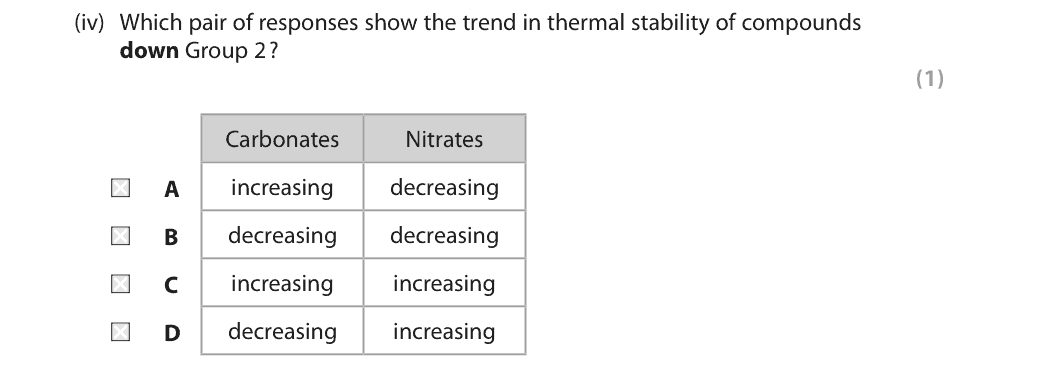
The experiment was repeated using two drops of 1-bromobutane in test tube Y
and two drops of 1-iodobutane in test tube Z.

The time taken for a precipitate to appear increases in the order
   A X, Y, Z
   B Z, Y, X
   C Y, X, Z
   D Z, X, Y
June 2017 · AS Paper 2 · Q7(c)(i) 1 mark Multiple choice halogenoalkanes
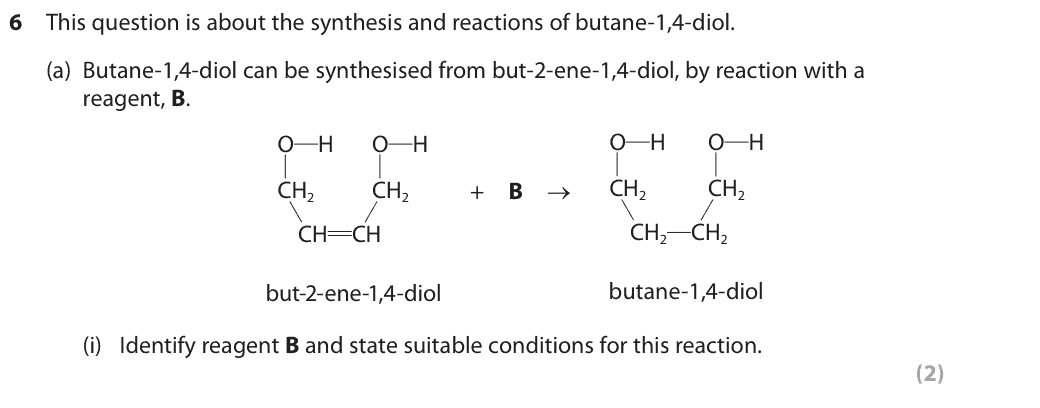
Earlier parts of question 7 that this part usesEarlier part of June 2017 Paper 2 question 7Earlier part of June 2017 Paper 2 question 7Earlier part of June 2017 Paper 2 question 7
Which term best describes the role of the OH– ion in the reaction in (b)?
A catalyst
B electrophile
C free radical
D nucleophile
June 2017 · AS Paper 2 · Q7(c)(iii) 1 mark Multiple choice introduction to organic chemistry
Earlier parts of question 7 that this part usesEarlier part of June 2017 Paper 2 question 7Earlier part of June 2017 Paper 2 question 7Earlier part of June 2017 Paper 2 question 7Earlier part of June 2017 Paper 2 question 7
The hydrolysis reaction described in part (b) may also be classified as
A addition
   B elimination
   C redox
   D substitution
June 2017 · AS Paper 2 · Q8(b)(i) 1 mark Multiple choice alcohols
Propane-1,3-diol can be oxidised to propanedioic acid in the same way as other
primary alcohols.
Suitable reagents and conditions are
Reagents
Conditions
A
sodium dichromate(VI) + sulfuric acid
heating under reflux
B
sodium dichromate(VI) + hydrochloric acid
heating under reflux
C
potassium dichromate(VI) + sulfuric acid
room temperature
D
potassium dichromate(VI) + hydrochloric acid
room temperature
June 2017 · AS Paper 2 · Q8(b)(ii) 1 mark Multiple choice alcohols
Earlier part of question 8 that this part usesEarlier part of June 2017 Paper 2 question 8
The colour change in this reaction is
A green to orange
   B orange to green
   C orange to colourless
   D colourless to orange
June 2017 · Paper 1 · Q1(a) 1 mark Multiple choice atomic structure and the periodic table
A phosphorus atom has mass number 31.
How many of each sub-atomic particle are present in the phosphide ion, P3–?
Number of protons
Number of neutrons
Number of electrons
A
15
16
12
B
15
16
18
C
16
15
12
D
16
15
18
June 2017 · Paper 1 · Q1(b)(ii) 1 mark Multiple choice bonding
Earlier part of question 1 that this part usesEarlier part of June 2017 Paper 1 question 1
Which describes the polarity of the P—Cl bond and the polarity of the
phosphorus(III) chloride molecule?
Polarity of P—Cl bond
Polarity of molecule
A
non-polar
non-polar
B
non-polar
polar
C
polar
non-polar
D
polar
polar
June 2017 · Paper 1 · Q3(c)(i) 1 mark Multiple choice redox ii
Earlier part of question 3 that this part usesEarlier part of June 2017 Paper 1 question 3
Use these electrode potentials to answer the following questions.
Electrode reaction
E  / V
I2(aq) + 2e– U 2I–(aq)
+0.54
Fe3+(aq) + e– U Fe2+(aq)
+0.77
Br2(aq) + 2e– U 2Br –(aq)
+1.09
MnO2(s) + 4H+(aq) + 2e– U Mn2+(aq) + 2H2O(l)
+1.23
Cl2(aq) + 2e– U 2Cl–(aq)
+1.36
–(aq) + 8H+(aq) + 5e– U Mn2+(aq) + 4H2O(l)
+1.51
MnO4
Which species will oxidise Fe2+(aq) to Fe3+(aq)?
A Br2(aq)
B Cl–(aq)
C I2(aq)
D Mn2+(aq)
June 2017 · Paper 1 · Q4(a) 1 mark Multiple choice transition metals principles
Iron and zinc are in the d-block of the Periodic Table.
Which of these is the electronic configuration of an iron(II) ion, Fe2+?
3d
4s
np
np
np
A [Ar]
np
n
n
n
n
B [Ar]
np
np
np
C [Ar]
n
n
n
n
np
D [Ar]
June 2017 · Paper 1 · Q5(a) 1 mark Multiple choice energetics i
This question is about enthalpy changes and entropy changes.
Which is the equation for the standard enthalpy change of formation, ¨f H ,
of aluminium oxide?
A 4Al(s) + 3 O2(g)  r 2Al2O3(s)
B 4Al(s) + 6 O(g)   r 2Al2O3(s)
C 2Al(s) + 1½ O2(g) r Al2O3(s)
D 2Al(s) + 3 O(g)   r Al2O3(s)
June 2017 · Paper 1 · Q5(c) 1 mark Multiple choice entropy
Which reaction has a negative value for ¨Ssystem?
A 2Cu(s) + O2(g) r 2CuO(s)
B 2H2O2(l) r 2H2O(l) + O2(g)
C MgCO3(s) + H2SO4(aq) r MgSO4(aq) + H2O(l) + CO2(g)
D Zn(s) + 2HCl(aq) r ZnCl2(aq) + H2(g)
June 2017 · Paper 1 · Q5(d) 1 mark Multiple choice entropy
What is the expression for ¨Stotal?
A ¨Ssurroundings + ¨H–
T
B ¨Ssurroundings – ¨H–
T
C ¨Ssystem + ¨H–
T
D ¨Ssystem – ¨H–
T
June 2017 · Paper 1 · Q8(a) 1 mark Multiple choice acid base equilibria
2-Hydroxyethanoic acid, also known as glycolic acid, CH2OHCOOH, is an alpha hydroxy acid
used in some skincare products.
It has a Ka value of 1.5 × 10⁻⁴ mol dm–3.
The structure of glycolic acid is
H
O
H
C
C
OH
OH
A solution of glycolic acid of concentration 0.1 mol dm–3 has a pH of 2.4
What is the approximate pH of the resulting solution after it has been diluted by a
factor of 100?
A 1.4
B 2.4
C 3.4
D 4.4
June 2017 · Paper 1 · Q8(c)(ii) 1 mark Multiple choice formulae equations and amounts of substance
Earlier parts of question 8 that this part usesEarlier part of June 2017 Paper 1 question 8Earlier part of June 2017 Paper 1 question 8
What is the concentration of this glycolic acid in mol dm–3?
A 0.080
B 0.100
C 0.125
D 0.250
June 2017 · Paper 1 · Q8(c)(iii) 1 mark Multiple choice acid base equilibria
Earlier parts of question 8 that this part usesEarlier part of June 2017 Paper 1 question 8Earlier part of June 2017 Paper 1 question 8
The pH of the solution containing just sodium glycolate and water is
A  2.8
B  6.0
C  8.3
D 11.0
June 2017 · Paper 2 · Q1(a) 1 mark Multiple choice alkanes
This is a question about alkanes.
What is the reaction mechanism when ethane and chlorine react in UV light?
A electrophilic addition
B electrophilic substitution
C free radical addition
D free radical substitution
June 2017 · Paper 2 · Q1(b) 1 mark Multiple choice introduction to organic chemistry
Earlier part of question 1 that this part usesEarlier part of June 2017 Paper 2 question 1
What is the name of this alkane?
A 2-ethyl-3-propylpentane
B 4-ethyl-3-methylheptane
C 3-methyl-4-propylhexane
D 4-methyl-3-propylhexane
June 2017 · Paper 2 · Q2(a) 1 mark Multiple choice structure
Diamond, graphene and graphite are different forms of carbon.
The structural feature that graphene and graphite have in common is that the
carbon atoms are arranged in
A layers with each atom bonded to four others
B hexagonal and pentagonal rings within a layer
C hexagonal rings within a layer
D a three-dimensional structure
June 2017 · Paper 2 · Q2(b) 1 mark Multiple choice structure
The bond angles within a layer of graphene and a layer of graphite are
A 90° and 109.5°
B all 109.5°
C 109.5° and 120°
D all 120°
June 2017 · Paper 2 · Q2(c) 1 mark Multiple choice structure
One way in which diamond differs from graphene and graphite is that only diamond has
A a high melting temperature
B a precise molecular formula
C poor electrical conductivity
D a giant structure
June 2017 · Paper 2 · Q5(b) 1 mark Multiple choice kinetics i
Earlier part of question 5 that this part usesEarlier part of June 2017 Paper 2 question 5
Which area in the Maxwell-Boltzmann distribution diagram represents the
increase in the number of particles with sufficient energy to react in the presence
of a catalyst?
Ea (catalyst)
Ea
Number of
particles (with a
given kinetic energy)
A
B
Energy, E
A area A
B area B
C area A − area B
D area A + area B
June 2017 · Paper 2 · Q5(c) 1 mark Multiple choice formulae equations and amounts of substance
In the UK, the exhaust emissions of a petrol-fuelled vehicle must be less than
1.00 g of carbon monoxide per kilometre.
What is the maximum number of carbon monoxide molecules that can be
emitted per kilometre for a vehicle to meet this regulation?
A 1.37 × 10²²
B 2.15 × 10²²
C 6.02 × 10²³
D 1.69 × 1025
June 2017 · Paper 2 · Q7(b) 1 mark Multiple choice nmr mass spectrometry and chromatography
Earlier part of question 7 that this part usesEarlier part of June 2017 Paper 2 question 7
What is the number of peaks in a C-13 NMR spectrum of Antifebrin?
A 5
B 6
C 7
D 8
June 2017 · Paper 2 · Q8(b)(i) 1 mark Multiple choice carbonyl compounds
Earlier part of question 8 that this part usesEarlier part of June 2017 Paper 2 question 8
Phenylethanone can be distinguished from its structural isomer, phenylethanal,
in a number of different ways.
O
C
CH2
H
Which would react with phenylethanone but not with phenylethanal?
A acidified sodium dichromate(VI)
B alkaline iodine solution
C Fehling’s solution
D Tollens’ reagent
June 2017 · Paper 2 · Q9(c)(i) 1 mark Multiple choice kinetics ii
Earlier part of question 9 that this part usesEarlier part of June 2017 Paper 2 question 9
The kinetics of the ‘bromine clock’ were investigated and the rate equation was
found to be
Rate = k[BrO3
−][Br −][H+]2
What is the overall reaction order?
A First
B Second
C Third
D Fourth
June 2016 · AS Paper 1 · Q1(c) 1 mark Multiple choice group 7 the halogens
Hydrogen bromide gas reacts with ammonia gas
HBr + NH3 r NH4Br
What would be observed during this reaction?
A bubbles
B decolorisation
C steamy fumes
D white smoke
June 2016 · AS Paper 1 · Q1(e) 1 mark Multiple choice formulae equations and amounts of substance
What is the number of ions in 9.53 g of magnesium chloride, MgCl2?
[Avogadro constant = 6.02 × 10²³ mol–1]
A 6.02 × 10²²
B 1.20 × 10²³
C 1.81 × 10²³
D 6.02 × 10²³
June 2016 · AS Paper 1 · Q2(b) 1 mark Multiple choice atomic structure and the periodic table
Earlier part of question 2 that this part usesEarlier part of June 2016 Paper 1 question 2
What is the structure of a 1+ ion of the carbon-13 isotope?
A six protons, six neutrons and five electrons
B six protons, seven neutrons and six electrons
C six protons, seven neutrons and five electrons
D seven protons, six neutrons and six electrons
June 2016 · AS Paper 1 · Q4(a) 1 mark Multiple choice groups 1 and 2
The labels on four colourless solutions had fallen off in storage.  It was known that the
solutions were:
hydrochloric acid
magnesium sulfate
potassium chloride
sodium carbonate
In order to identify each solution, a number of tests were carried out.
Solutions can be sprayed into a flame to produce a flame colour identical to that
seen in the more conventional method with a solid on a nichrome wire.
Which solution would produce a lilac flame?
A hydrochloric acid
B magnesium sulfate
C potassium chloride
D sodium carbonate
June 2016 · AS Paper 1 · Q4(b) 1 mark Multiple choice groups 1 and 2
Earlier part of question 4 that this part usesEarlier part of June 2016 Paper 1 question 4
Which of the following diagrams best illustrates the electronic transitions that
take place during a flame test?
Excited State
Excited State
Energy Released
Energy Released
Ground State
Ground State
A
B
Excited State
Excited State
Energy Released
Energy Released
Energy Released
Ground State
Ground State
C
D
June 2016 · AS Paper 1 · Q4(c) 1 mark Multiple choice analysis of inorganic compounds
Earlier part of question 4 that this part usesEarlier part of June 2016 Paper 1 question 4
Which solution produces a white precipitate with acidified barium chloride solution?
A hydrochloric acid
B magnesium sulfate
C potassium chloride
D sodium carbonate
June 2016 · AS Paper 1 · Q7(b) 1 mark Multiple choice atomic structure and the periodic table
Which is the equation for the third ionisation energy of barium?
A Ba(s)
r  Ba3+(g) + 3e–
B Ba2+(s)  r  Ba3+(g) + e–
C Ba2+(g)  r  Ba3+(g) + e–
D Ba3+(g)  r  Ba4+(g) + e–
June 2016 · AS Paper 1 · Q8(a) 1 mark Multiple choice structure
The properties of elements and their compounds are determined by their structure
and bonding.
Magnesium oxide has a very high melting temperature.
Which of the following is the best description of its structure and bonding?
A giant ionic
B giant metallic
C giant covalent
D simple covalent
June 2016 · AS Paper 2 · Q1(a) 1 mark Multiple choice introduction to organic chemistry
Alkanes are a homologous series of hydrocarbons.
What is the name of this compound?
A 1,1,2-trimethylpentane
B 2,3-dimethylhexane
C 4,5-dimethylhexane
D 4,5,5-trimethylpentane
June 2016 · AS Paper 2 · Q1(b) 1 mark Multiple choice introduction to organic chemistry
The number of structural isomers with the molecular formula C5H12 is
A 3
B 4
C 5
D 6
June 2016 · AS Paper 2 · Q1(d)(i) 1 mark Multiple choice alkanes
Earlier part of question 1 that this part usesEarlier part of June 2016 Paper 2 question 1
Ethane reacts with chlorine in the presence of ultraviolet light to form a mixture
of products.
In the initiation step, chlorine molecules are converted into radicals.
Cl2  o  2Cl∙
Identify the type of bond broken and the type of bond fission occurring in this
step.
Bond broken
Bond fission
ʌ
heterolytic
A
ı
heterolytic
B
ʌ
homolytic
C
ı
homolytic
D
June 2016 · AS Paper 2 · Q2(a) 1 mark Multiple choice introduction to organic chemistry
Compounds with a carbon−carbon double bond are unsaturated.
What is the name of the compound shown?
H
CH3
C
C
Cl
Br
A cis-2-bromo-1-chloroprop-1-ene
B E-2-bromo-1-chloroprop-1-ene
C trans-2-bromo-1-chloroprop-1-ene
D Z-2-bromo-1-chloroprop-1-ene
June 2016 · AS Paper 2 · Q2(b)(i) 1 mark Multiple choice alkenes
Ethene reacts with bromine in the dark.
What is the classification of the mechanism for the reaction between ethene
and bromine?
A electrophilic addition
B electrophilic substitution
C nucleophilic addition
D nucleophilic substitution
June 2016 · AS Paper 2 · Q2(b)(ii) 1 mark Multiple choice alkenes
Earlier parts of question 2 that this part usesEarlier part of June 2016 Paper 2 question 2Earlier part of June 2016 Paper 2 question 2
Which of the following shows the formation of the intermediate in the
mechanism for the reaction between ethene and bromine?
A
H
H
H
H
C
C
H
C
C–
+ Br –
H
H
Br
H
Br
Br
B
H
H
H
H
C
C
H
C
C–
+ Br –
H
H
Br
H
Br
Br
C
H
H
H
H
C
C
+ Br –
H
C
C+
H
H
Br
H
Br
Br
D
H
H
H
H
C
C
H
C
C+
+ Br –
H
H
Br
H
Br
Br
June 2016 · AS Paper 2 · Q2(c)(iii) 1 mark Multiple choice equilibrium i
Earlier parts of question 2 that this part usesEarlier part of June 2016 Paper 2 question 2Earlier part of June 2016 Paper 2 question 2Earlier part of June 2016 Paper 2 question 2
What is the expression for the equilibrium constant, Kc, for this reaction?
[
] [
]
C H (g) + H O(g)
2 4
2
A
[
]
C H OH(g)
2 5
[
][
]
C H (g) H O(g)
2 4
2
B
[
]
C H OH(g)
2 5
[
]
C H OH(g)
2
5
C
[
] + [
]
C H (g)
H O(g)
2
4
2
[
]
C H OH(g)
2
5
D
[
][
]
C H (g) H O(g)
2
4
2
June 2016 · AS Paper 2 · Q5(c) 1 mark Multiple choice alcohols
Earlier part of question 5 that this part usesEarlier part of June 2016 Paper 2 question 5
Which one of these anhydrous compounds may be used as a drying agent in
Step 6?
A sodium chloride
B sodium hydroxide
C sodium nitrate
D sodium sulfate

Work with an A-level chemistry tutor

Dropping marks on calculations, mechanisms or the core practicals? Book a trial session with an A-level chemistry tutor.

Prefer email? Send an enquiry

If you are under 18, please include a parent's contact details. Enquiries go to enquiries@chemistryaleveltutor.com and are deleted once handled. All tutoring is online.