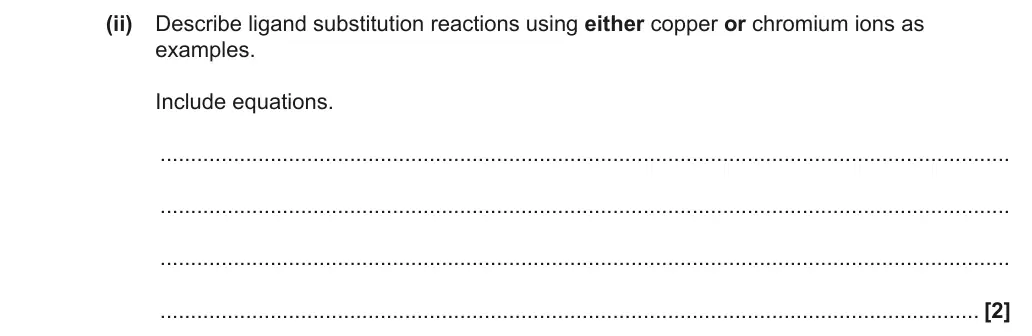
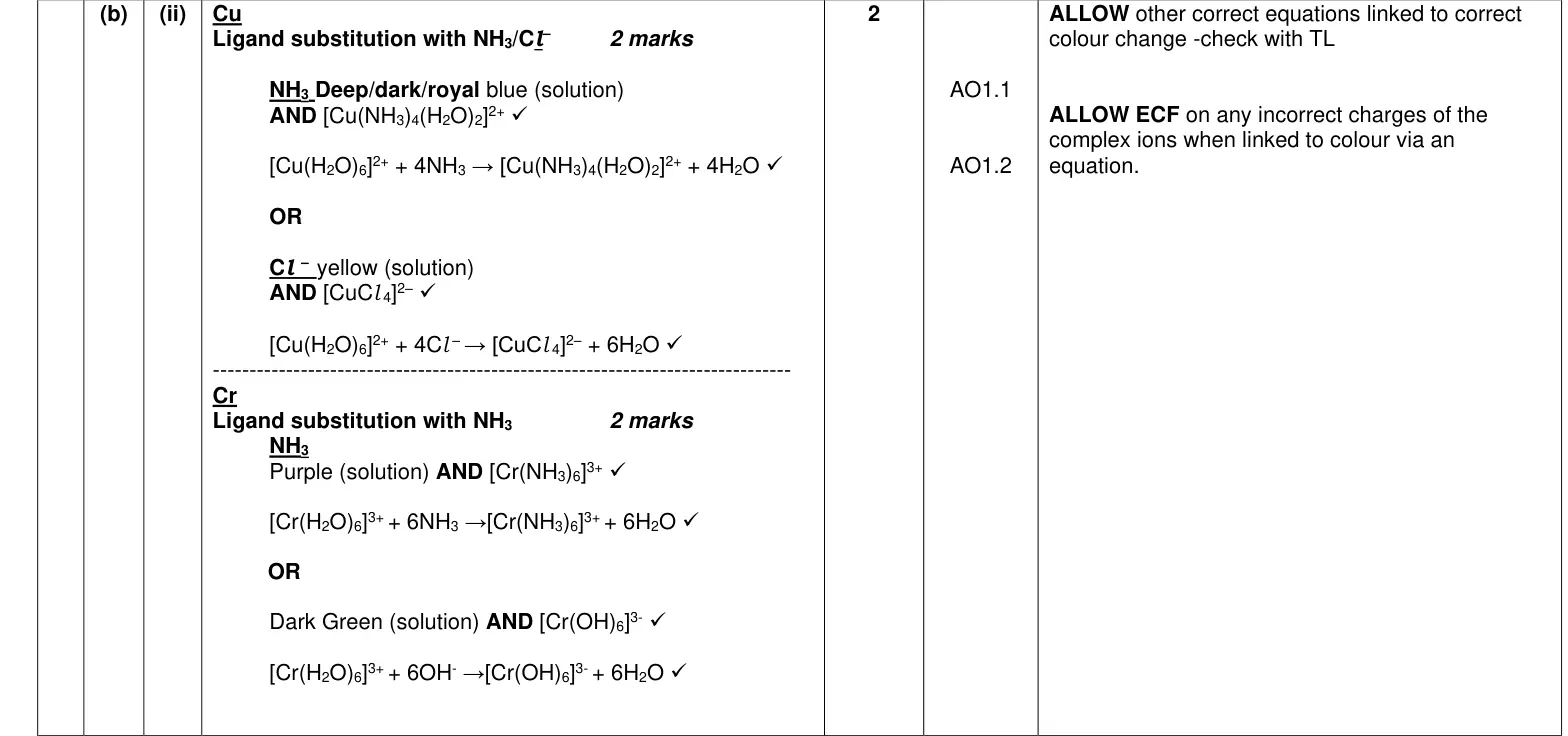
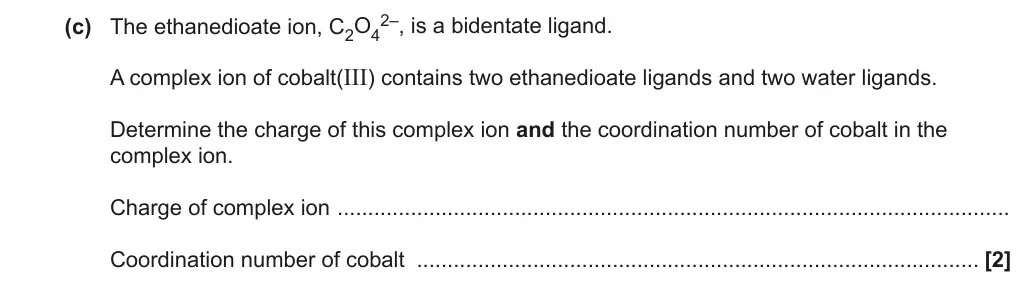
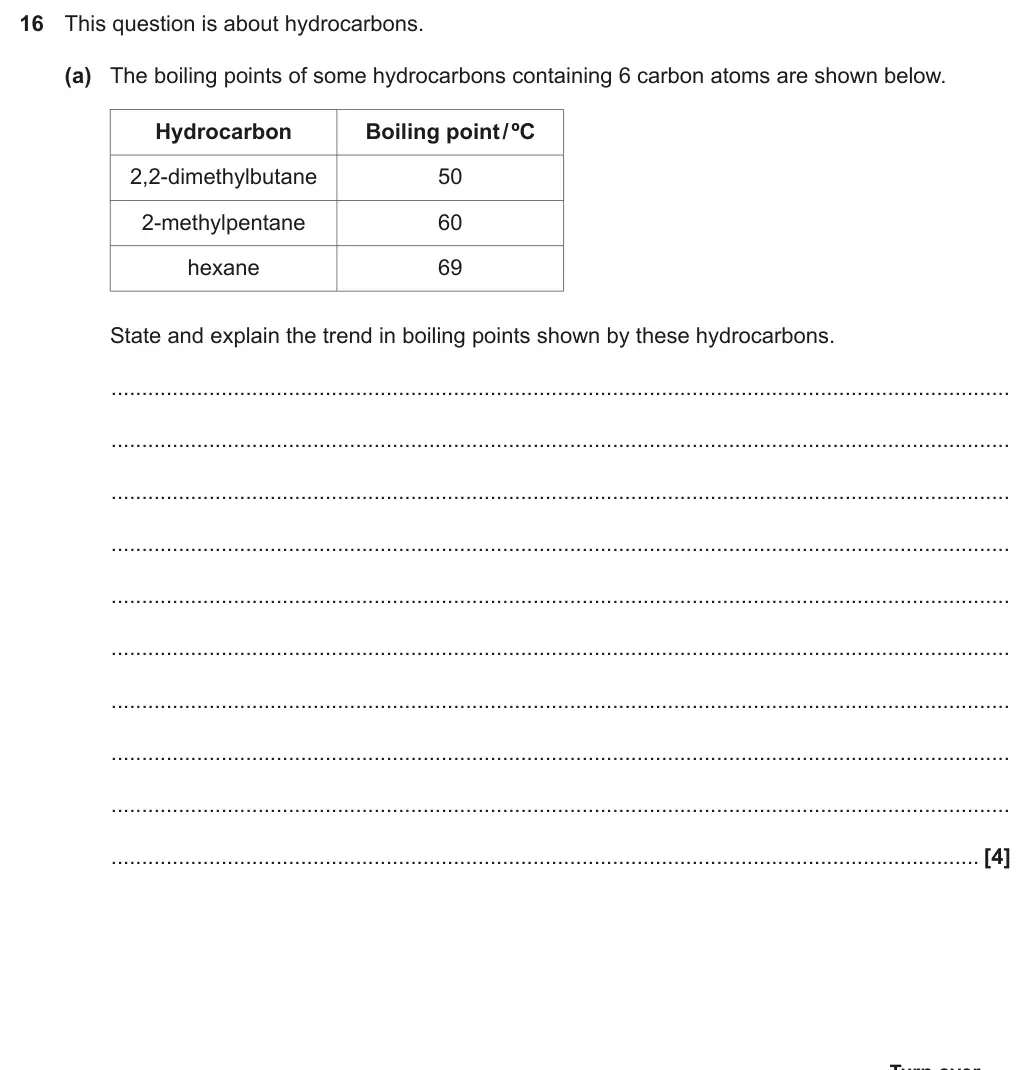
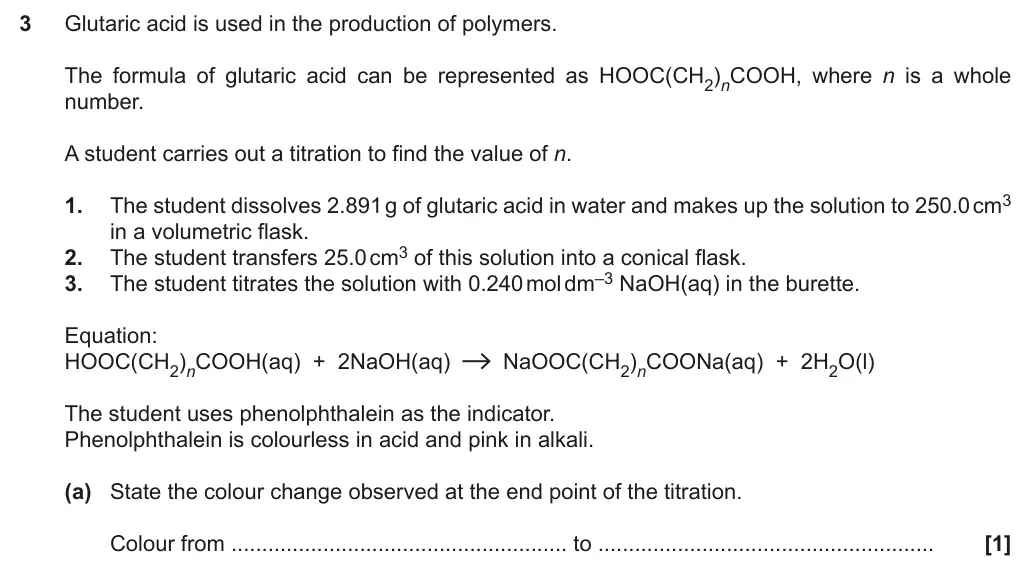
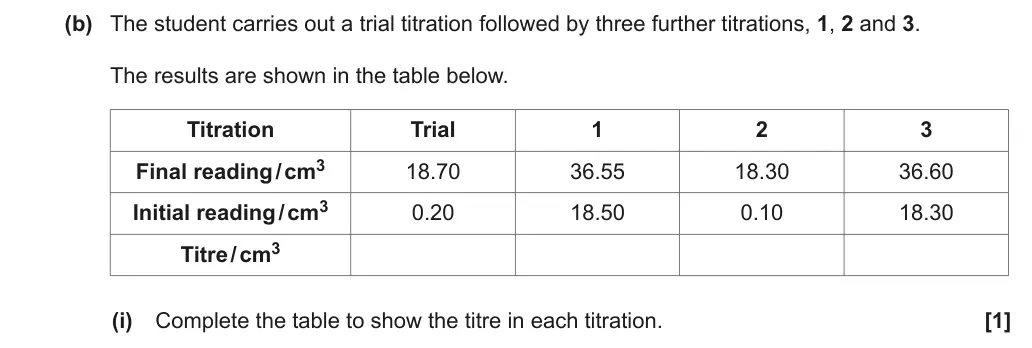
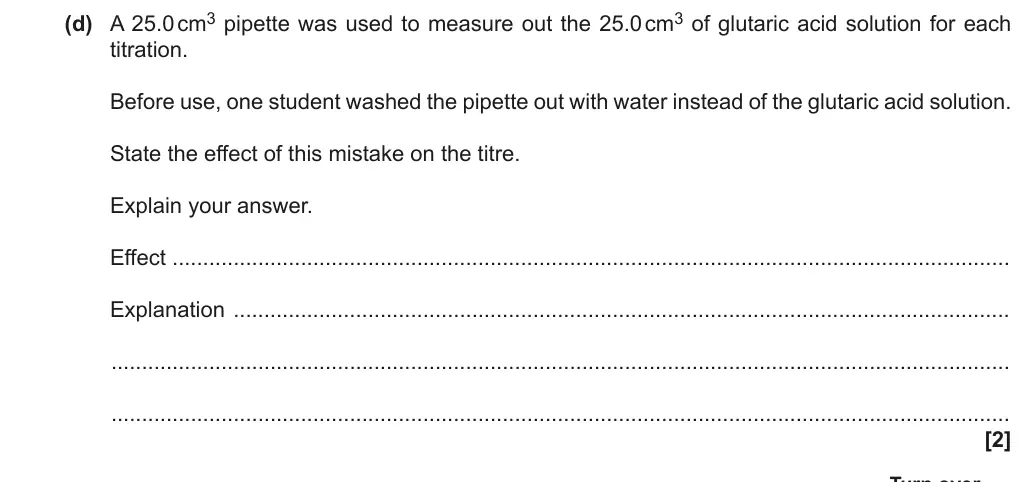
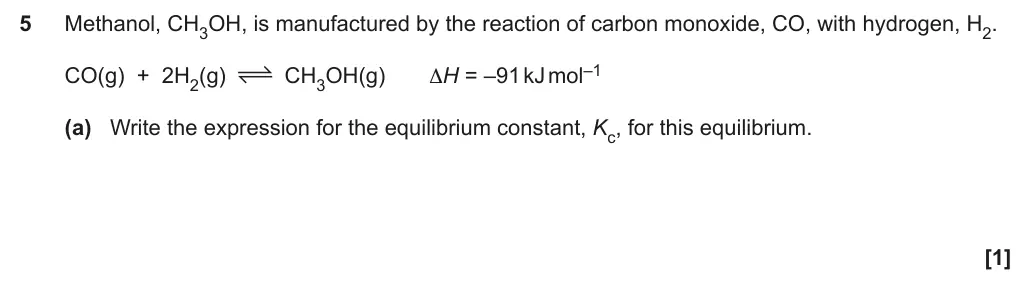
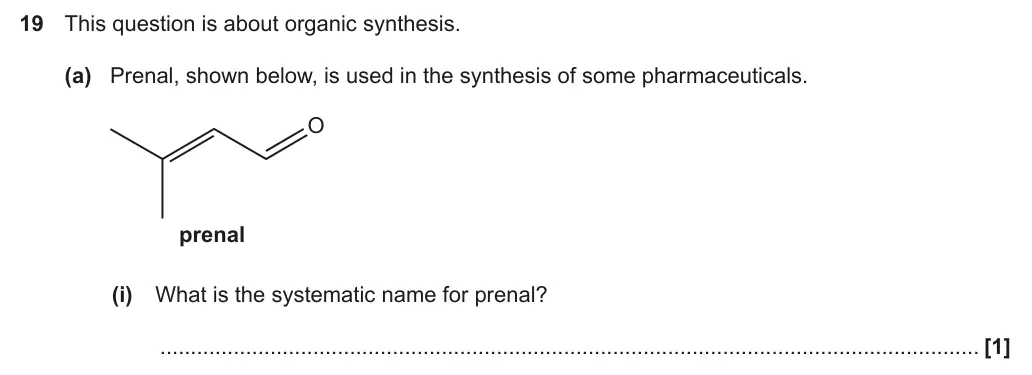
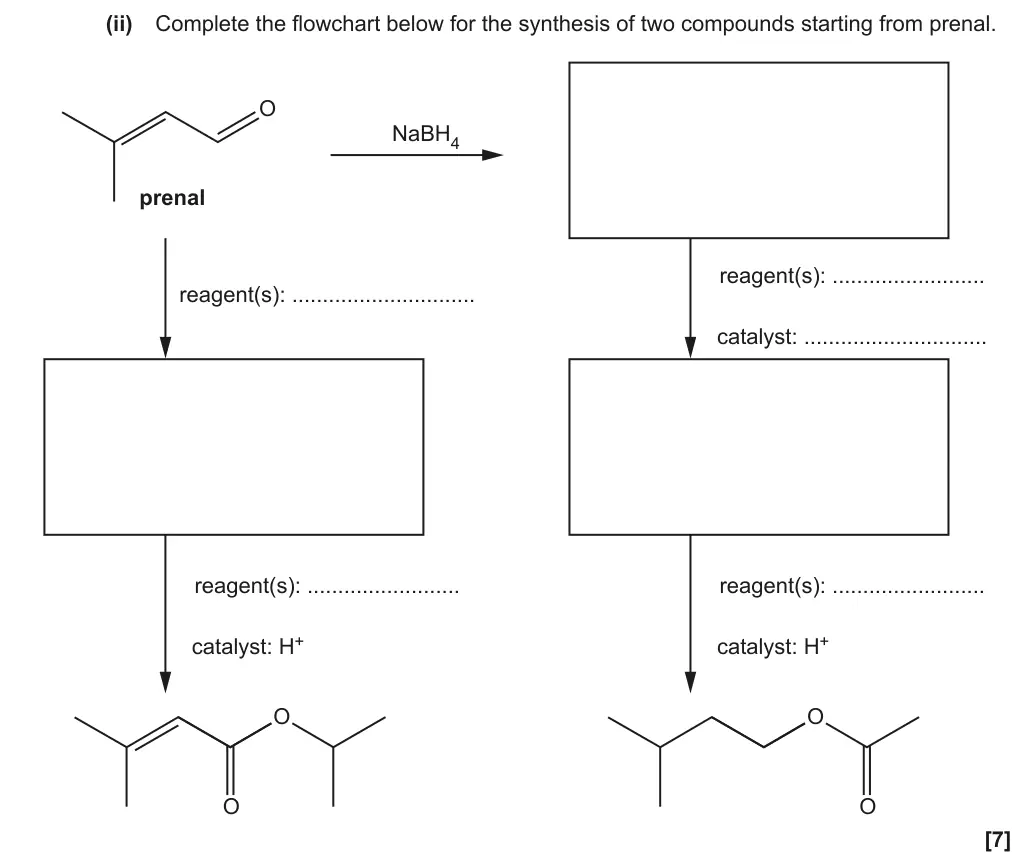
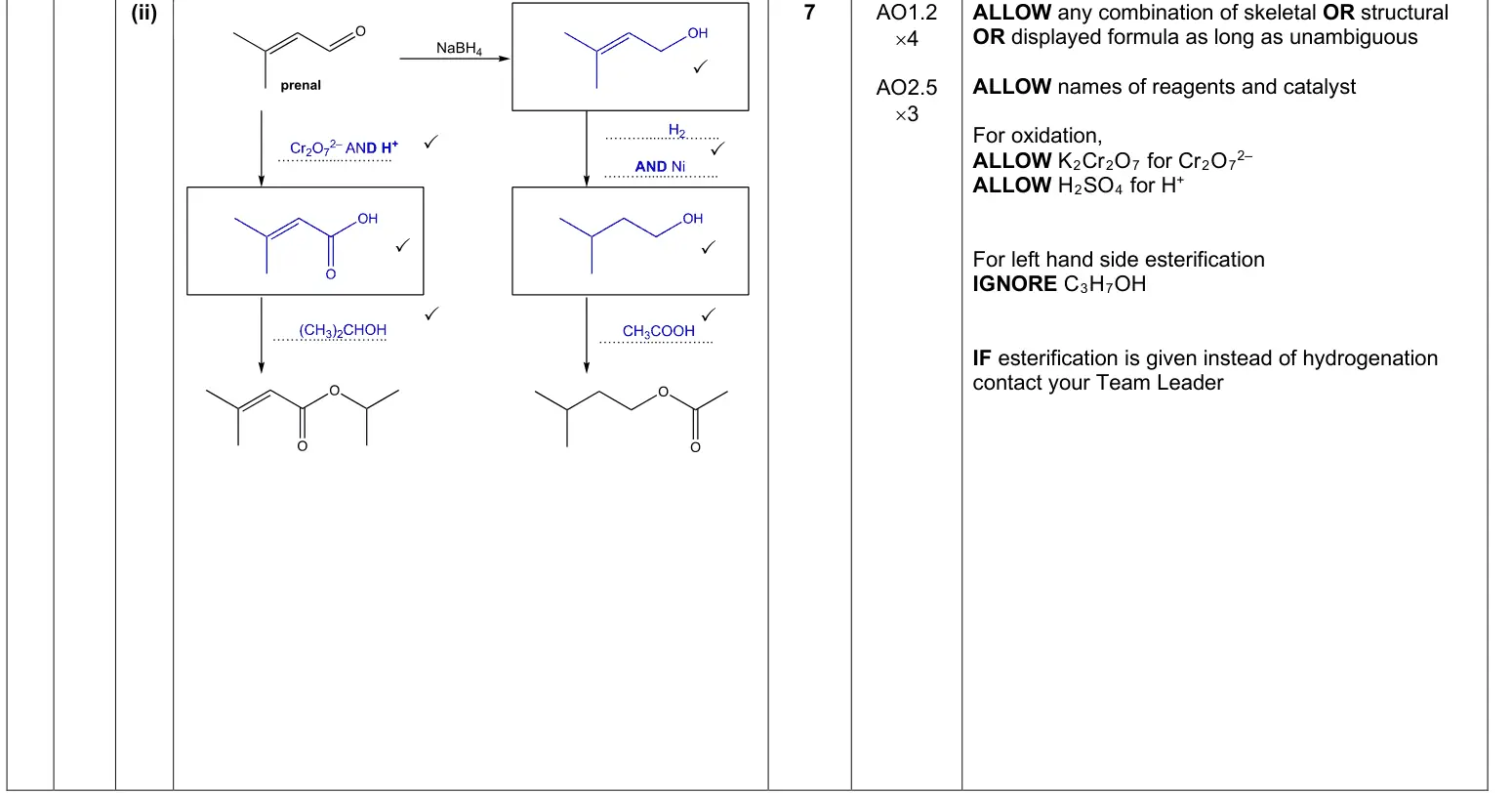
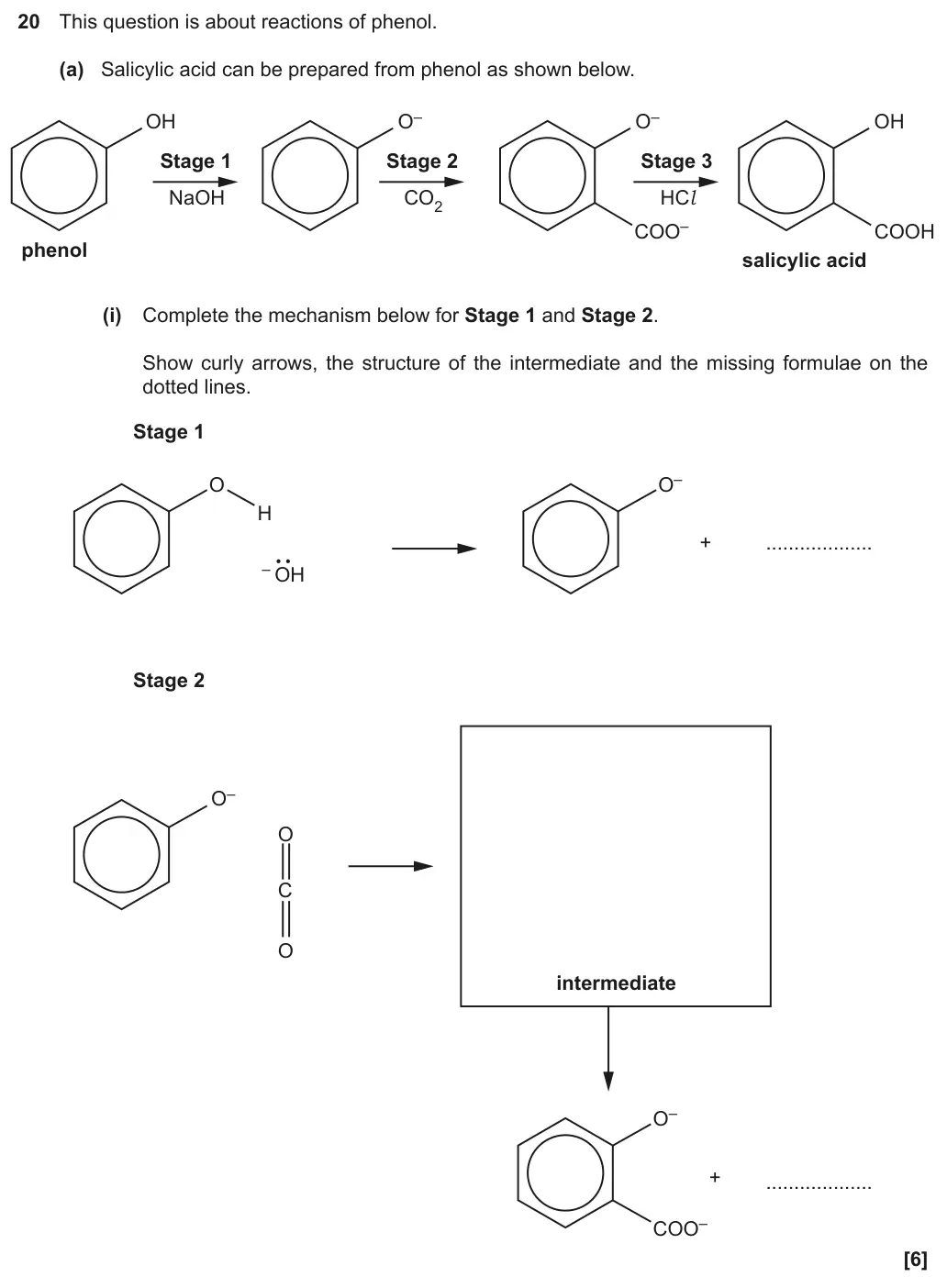
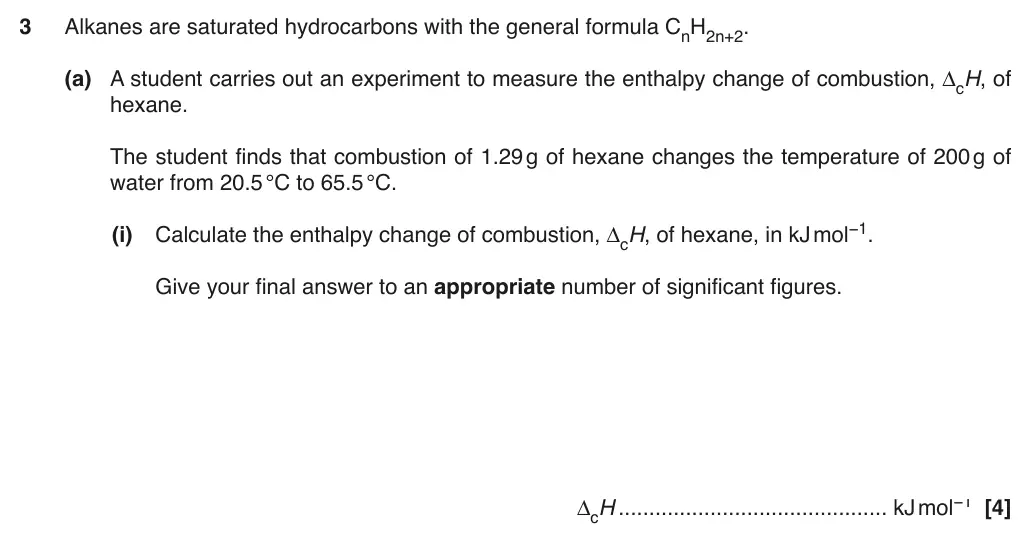
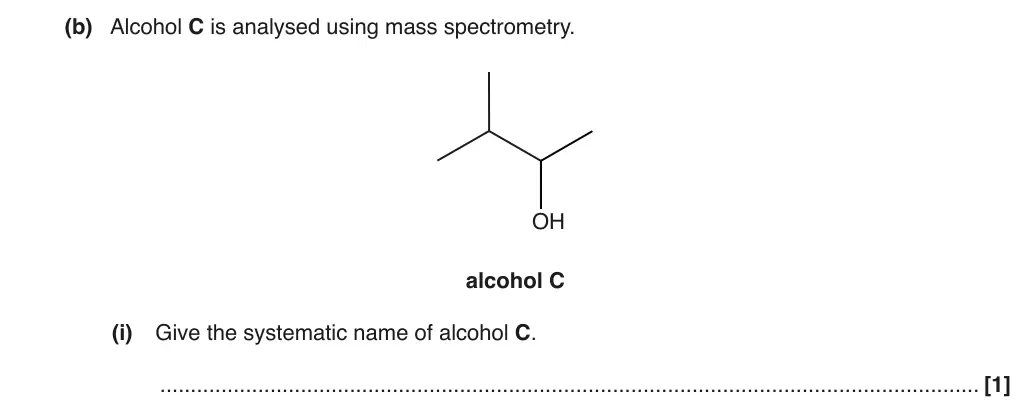
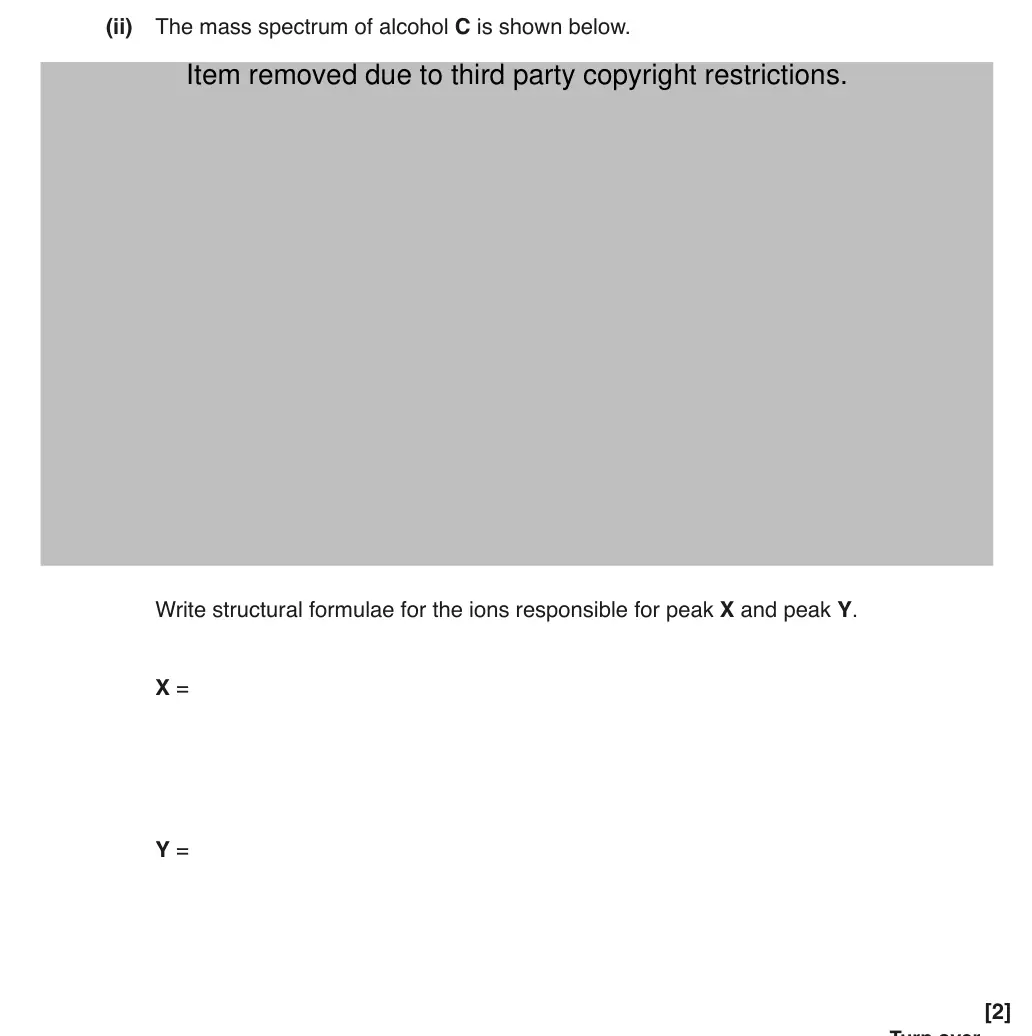
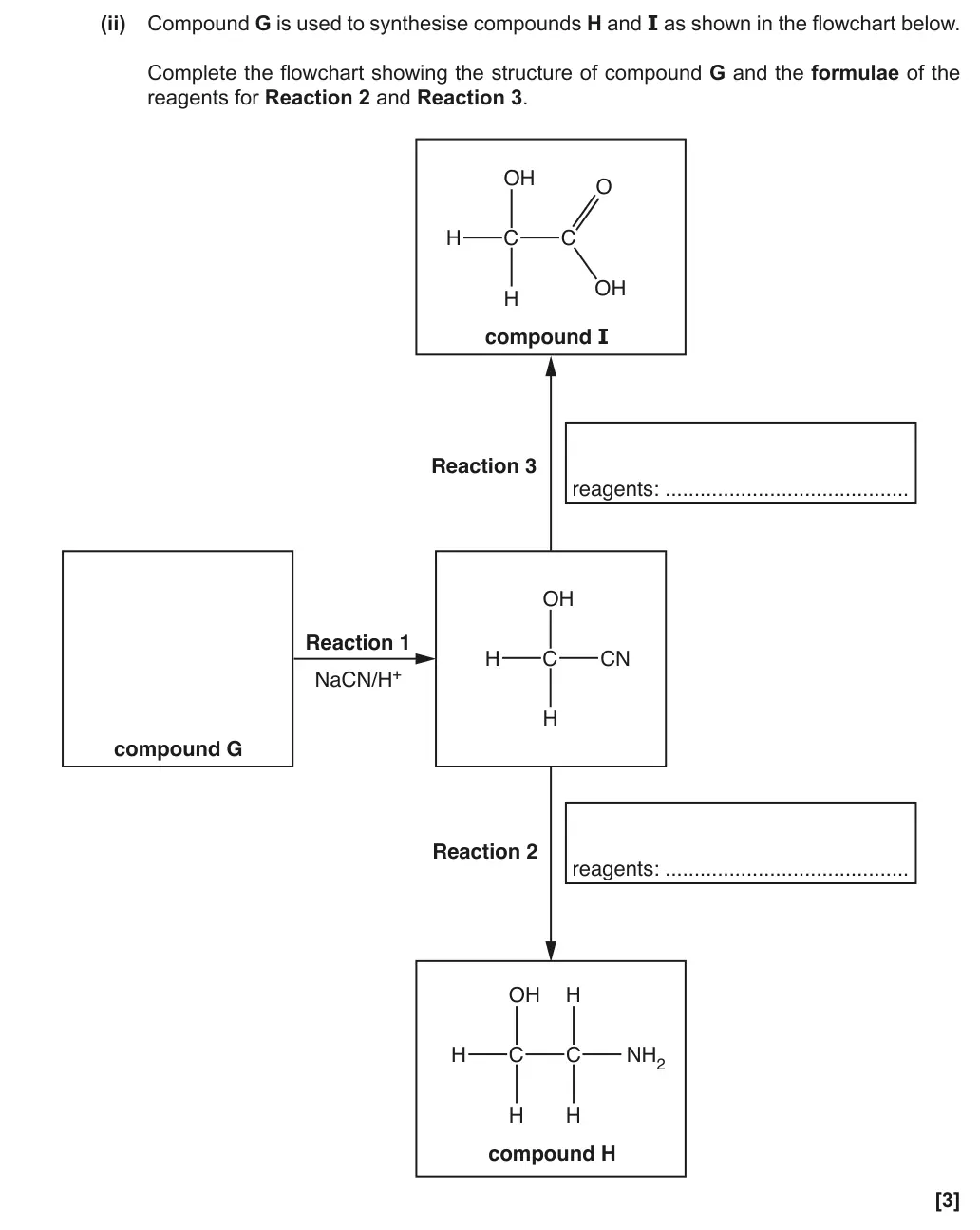
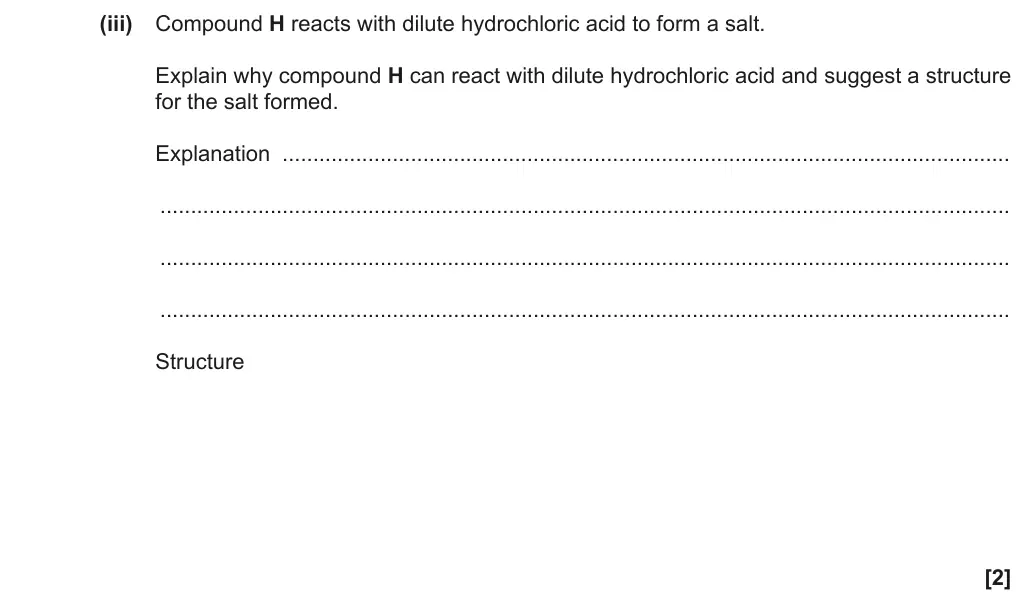
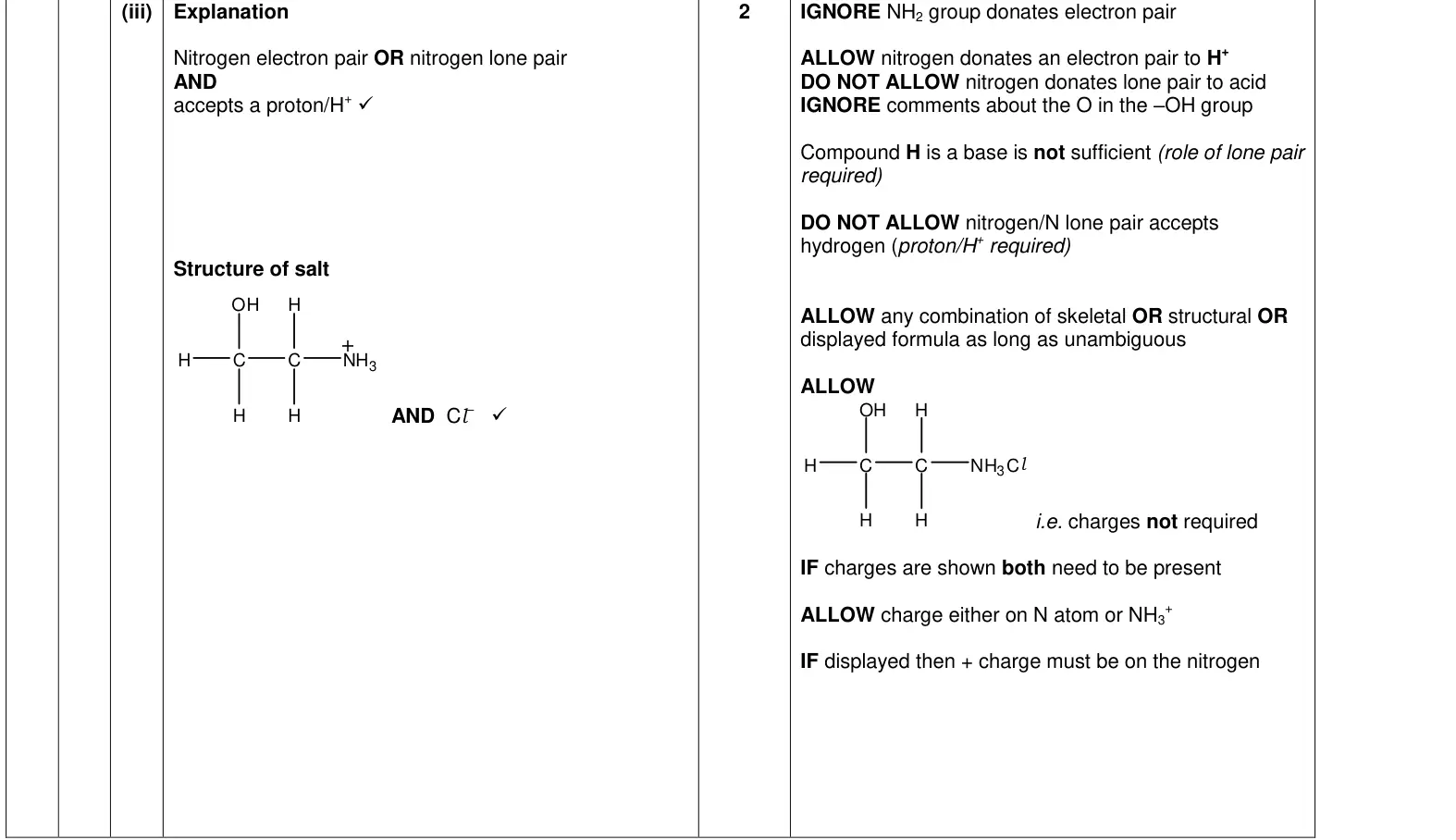
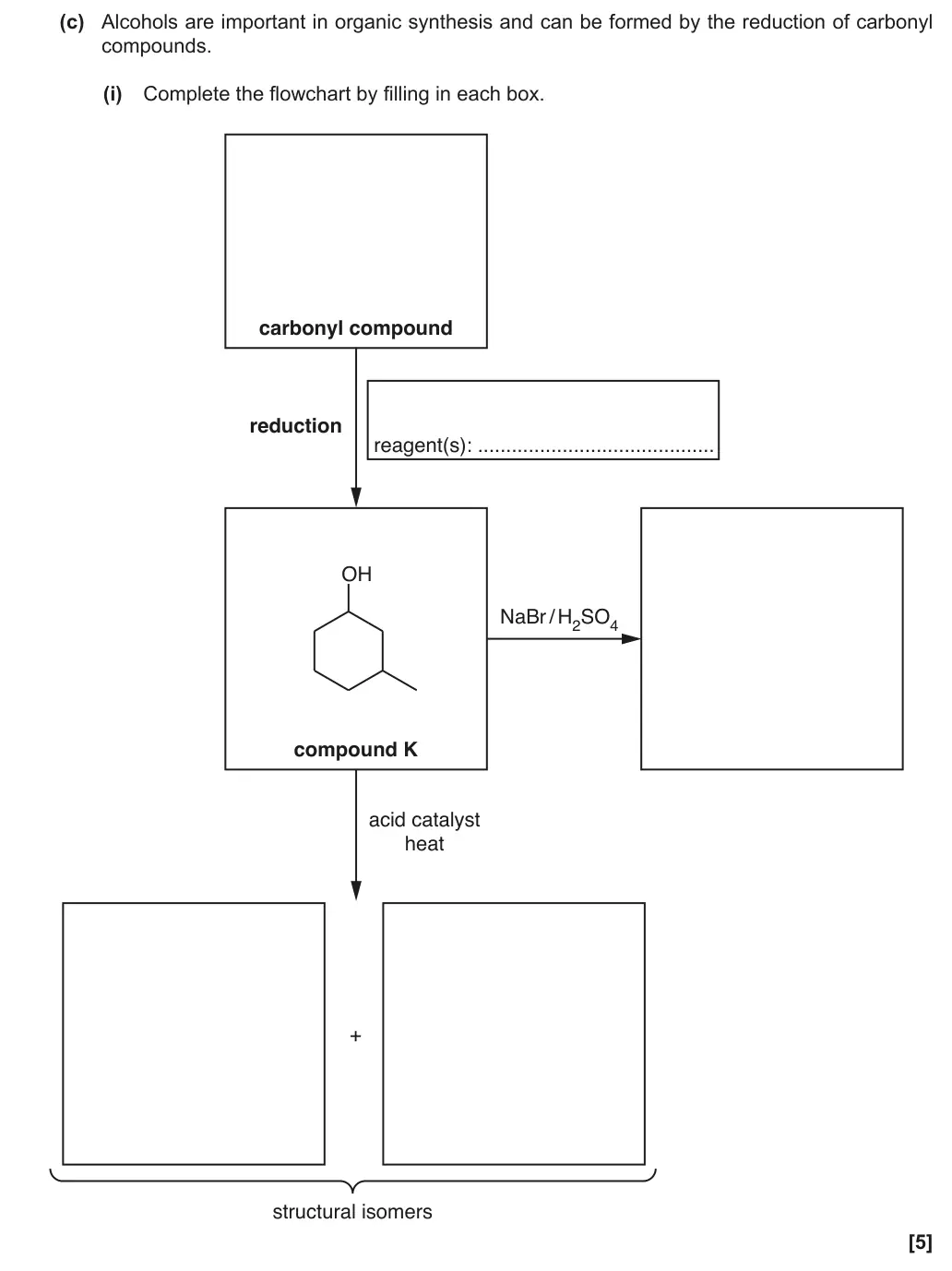
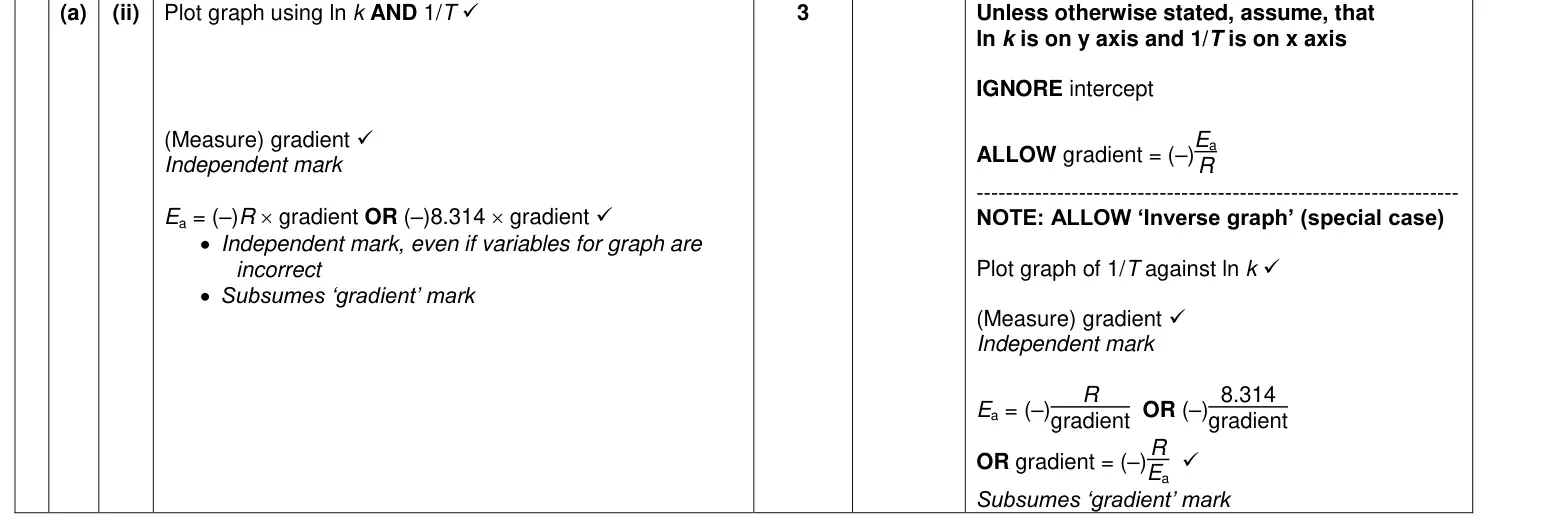
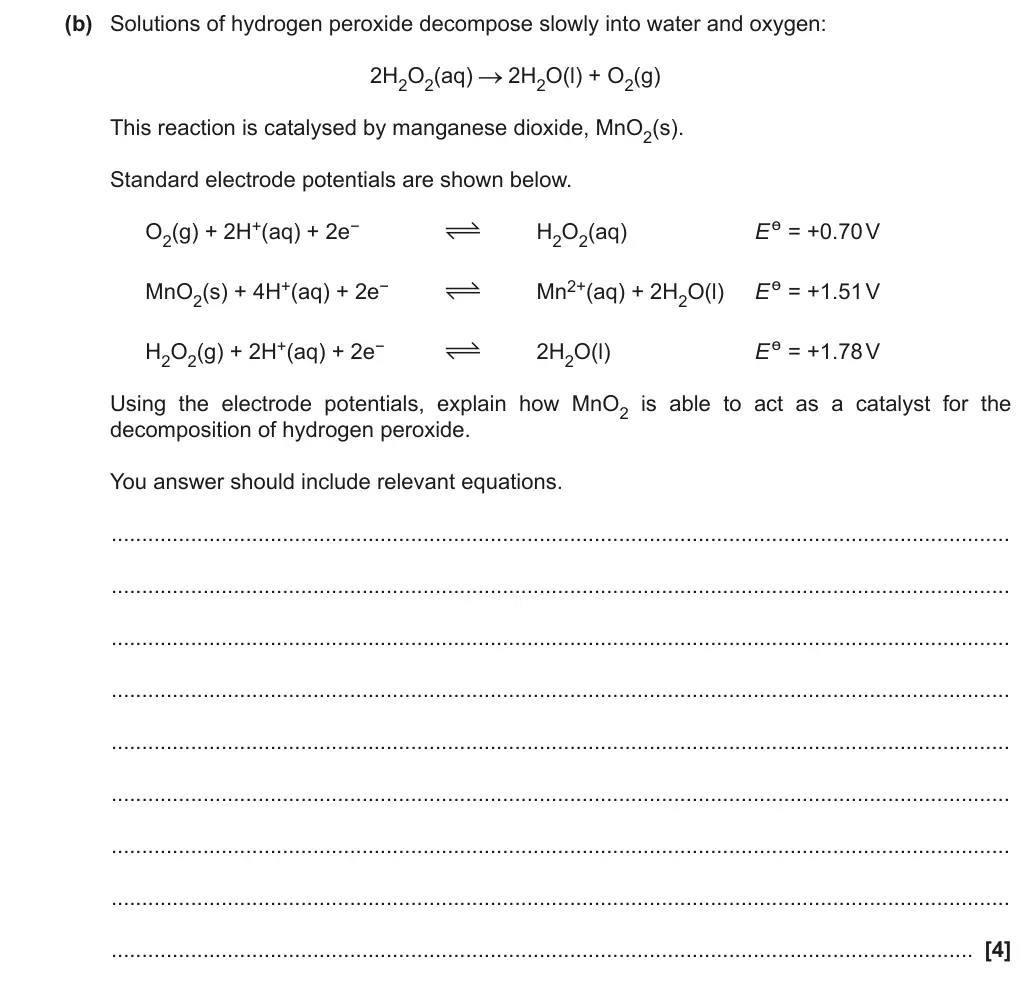
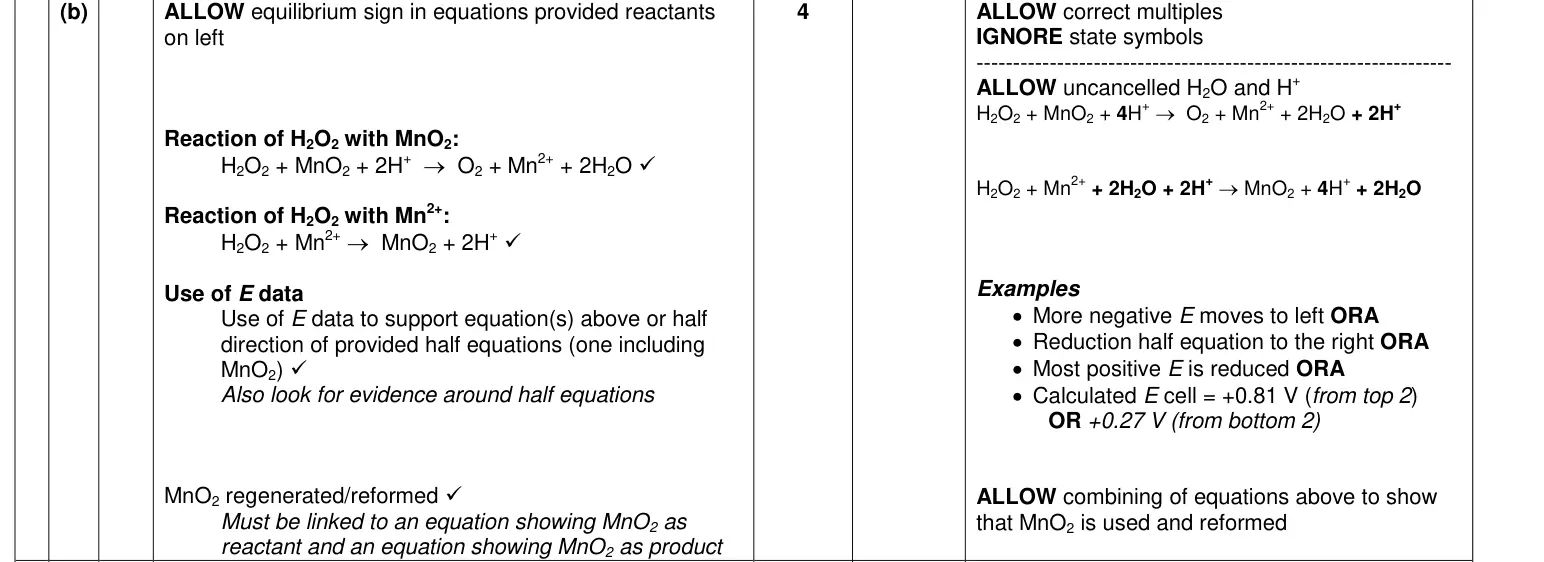
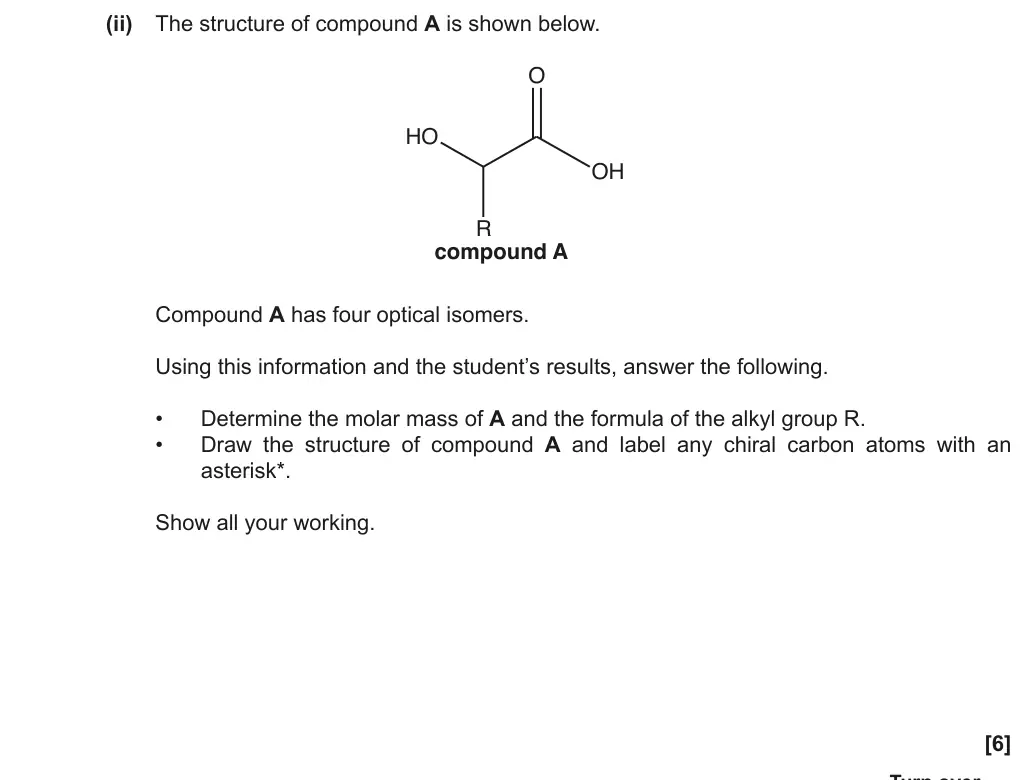
Short-answer questions

The state, explain and suggest questions that make up most of every paper. 541 questions.

Other types: Multiple-choice questions · Calculation questions · Equation questions · Mechanism questions · Structure and isomer questions · Six-mark level of response questions · Practical questions · Graph and data questions

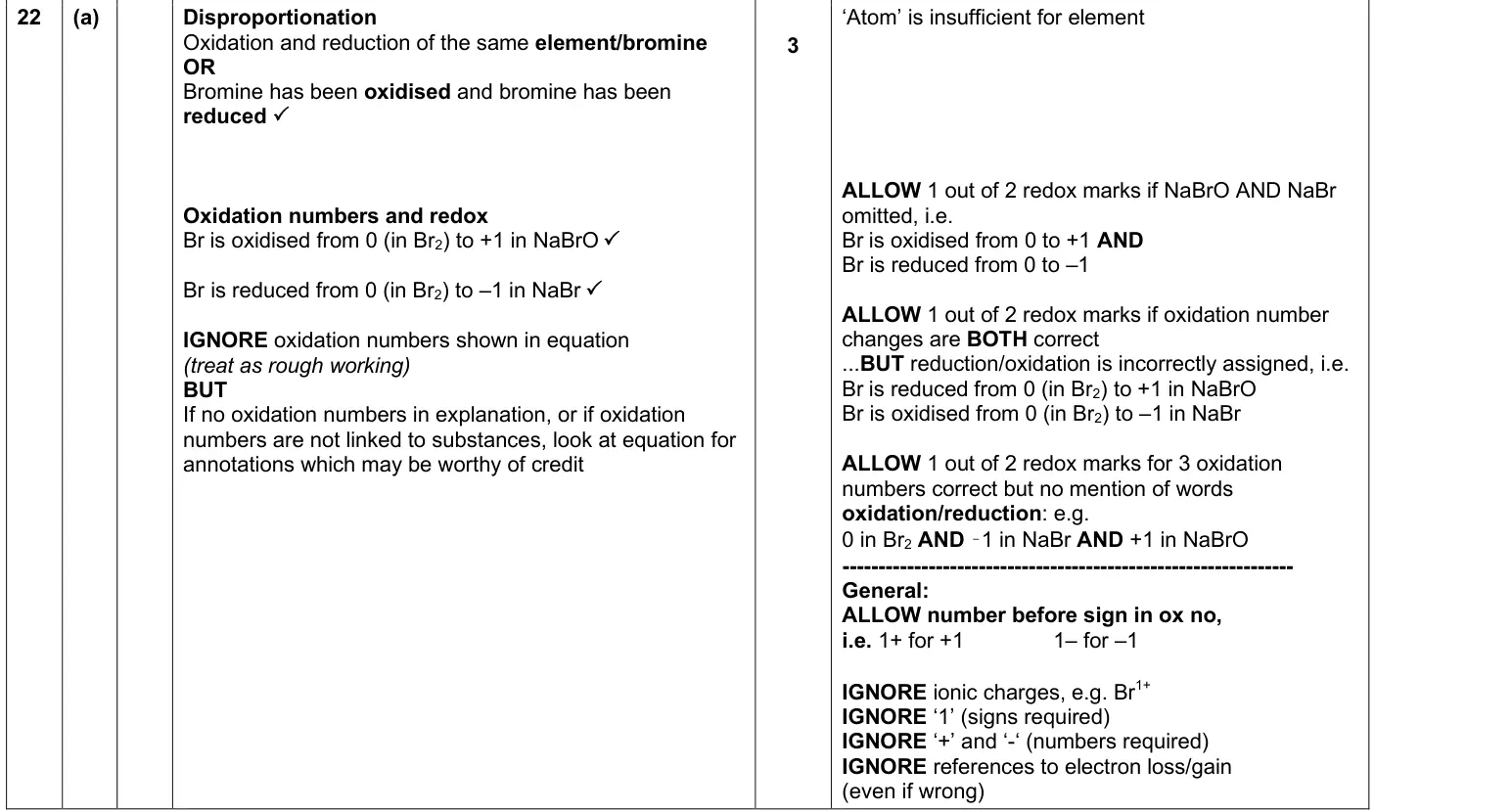
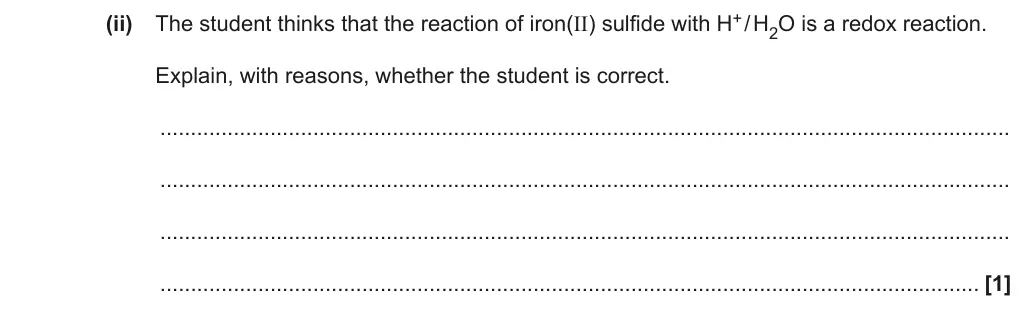
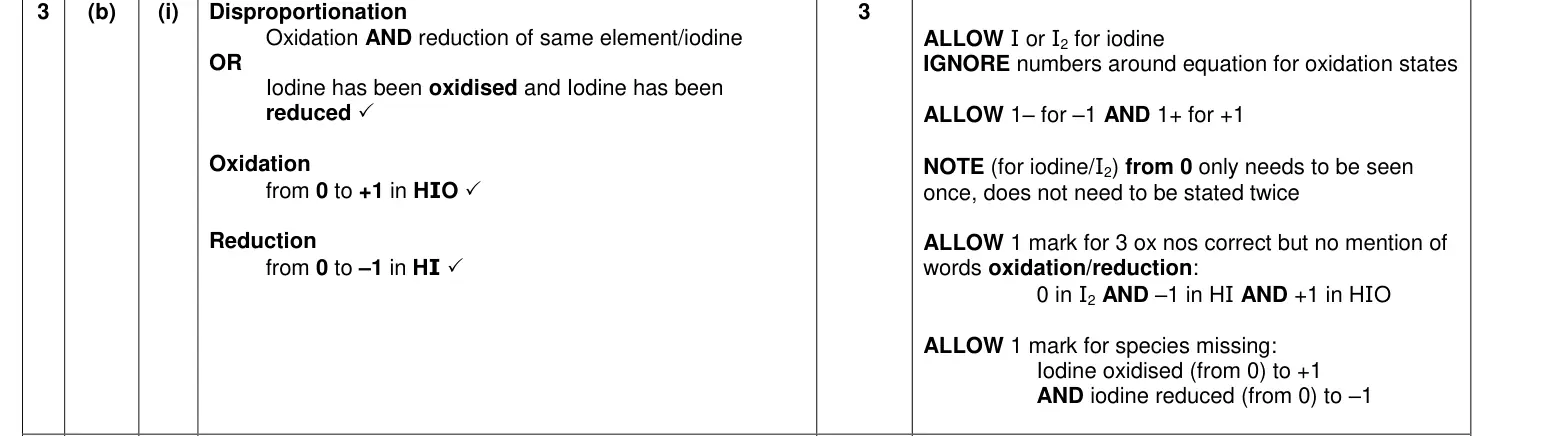
June 2025 · AS Paper 1 · Q22(a) 3 marks Short answer Medium halogensredox
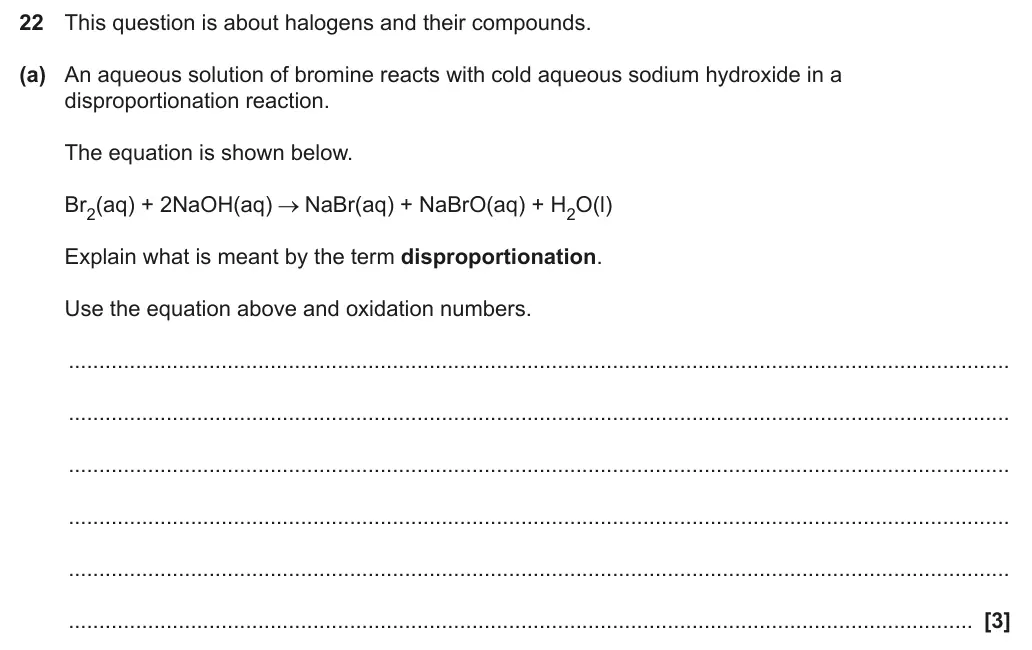
22  This question is about halogens and their compounds.
(a) An aqueous solution of bromine reacts with cold aqueous sodium hydroxide in a
disproportionation reaction.
The equation is shown below.
Br2(aq) + 2NaOH(aq) NaBr(aq) + NaBrO(aq) + H2O(l)
Explain what is meant by the term disproportionation.
Use the equation above and oxidation numbers.
..........................................................................................................................................................
..........................................................................................................................................................
..........................................................................................................................................................
..........................................................................................................................................................
..........................................................................................................................................................
.................................................................................................................................................... [3]
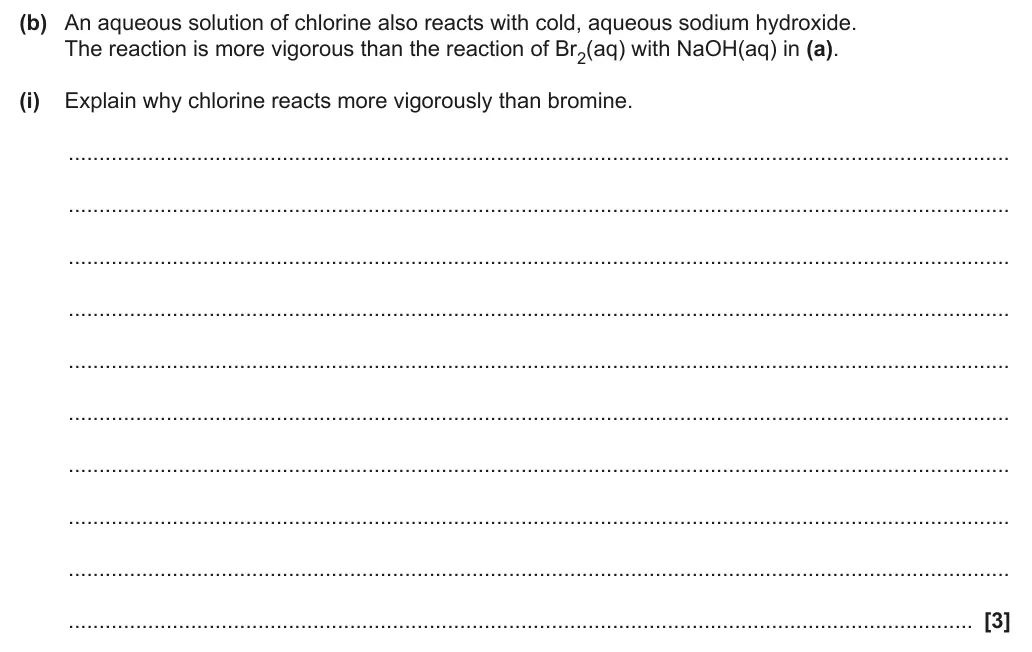
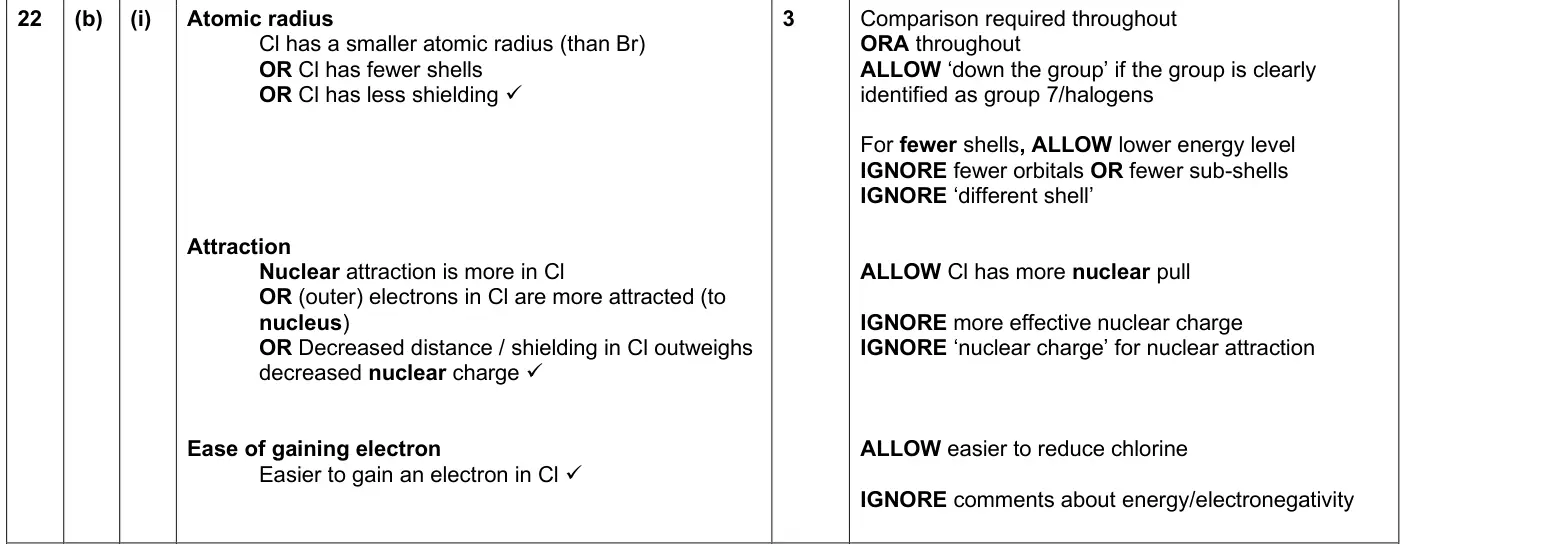
June 2025 · AS Paper 1 · Q22(b)(i) 3 marks Short answer Medium halogens
Earlier part of question 22 that this part usesEarlier part of June 2025 Paper 1 question 22
(b) An aqueous solution of chlorine also reacts with cold, aqueous sodium hydroxide.
The reaction is more vigorous than the reaction of Br2(aq) with NaOH(aq) in (a).
(i) Explain why chlorine reacts more vigorously than bromine.
..........................................................................................................................................................
..........................................................................................................................................................
..........................................................................................................................................................
..........................................................................................................................................................
..........................................................................................................................................................
..........................................................................................................................................................
..........................................................................................................................................................
..........................................................................................................................................................
..........................................................................................................................................................
.................................................................................................................................................... [3]
June 2025 · AS Paper 1 · Q22(b)(ii) 1 mark Short answer Medium halogens
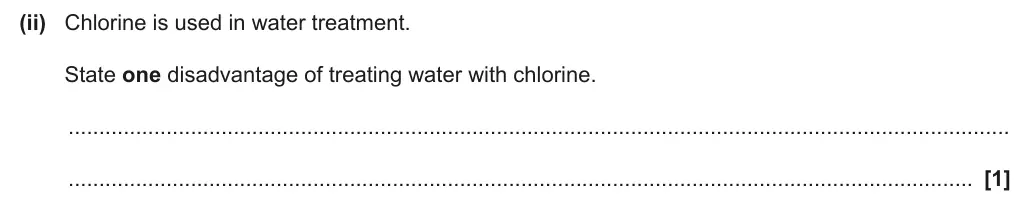
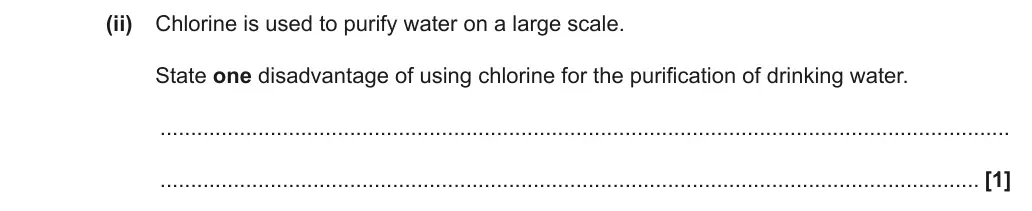
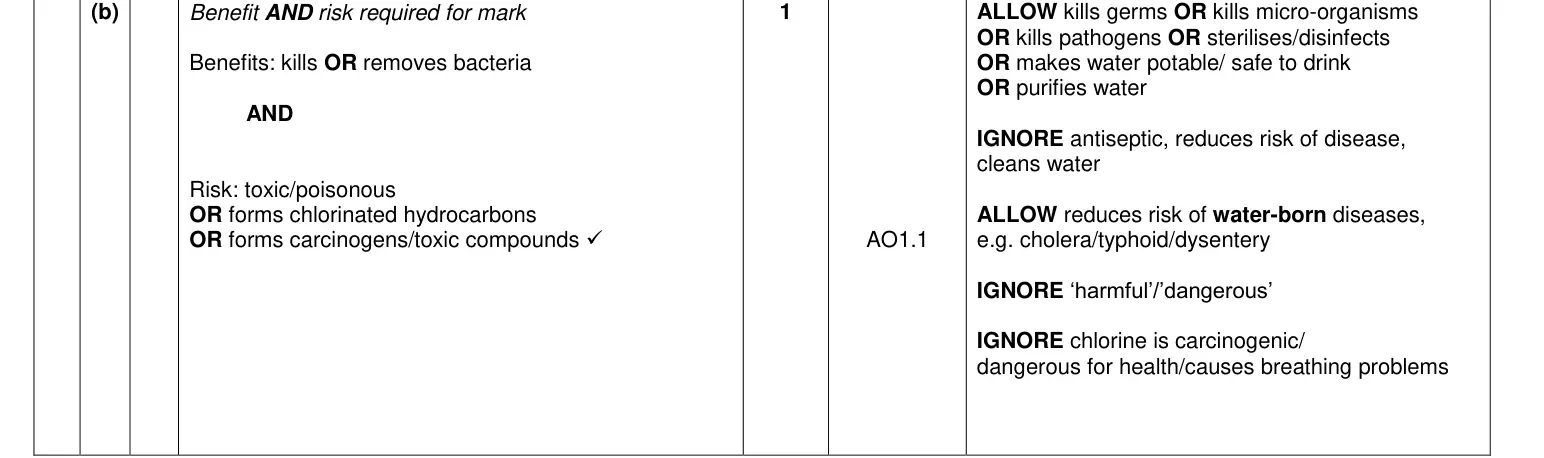
(ii) Chlorine is used in water treatment.
State one disadvantage of treating water with chlorine.
..........................................................................................................................................................
.................................................................................................................................................... [1]
June 2025 · AS Paper 1 · Q22(c) 4 marks Short answer Hard halogensqualitative analysis
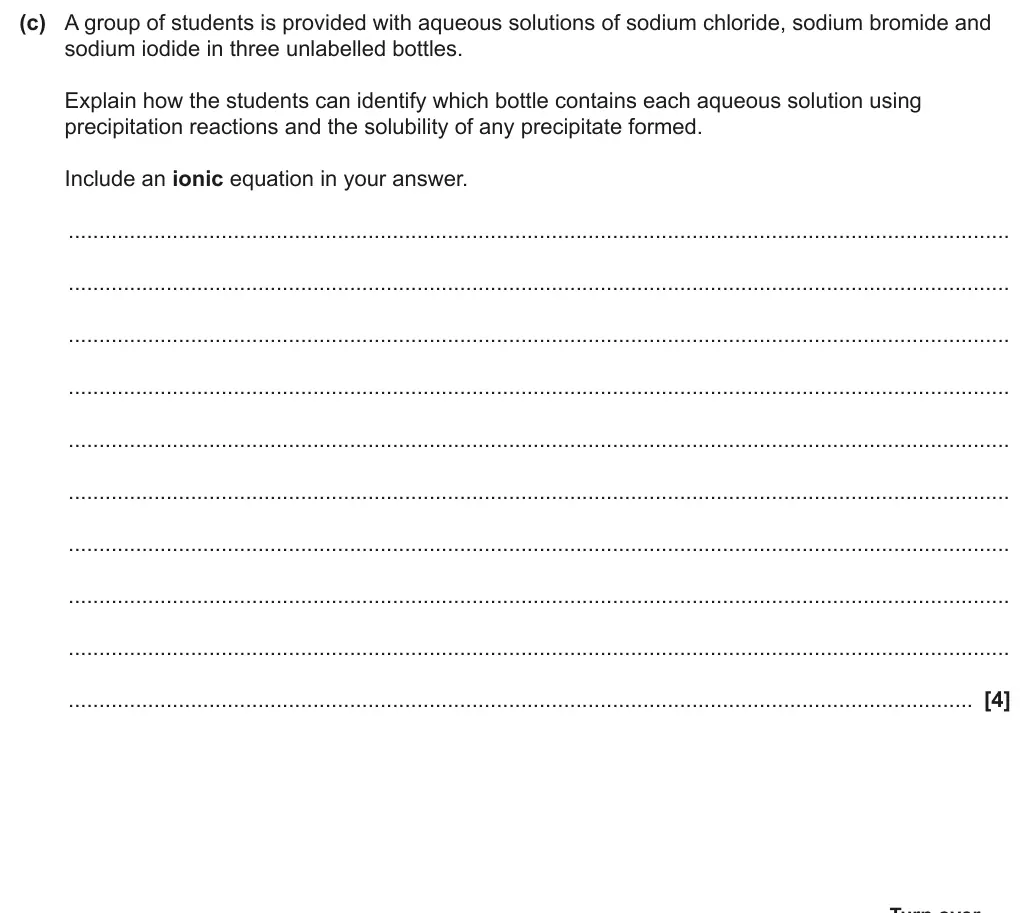
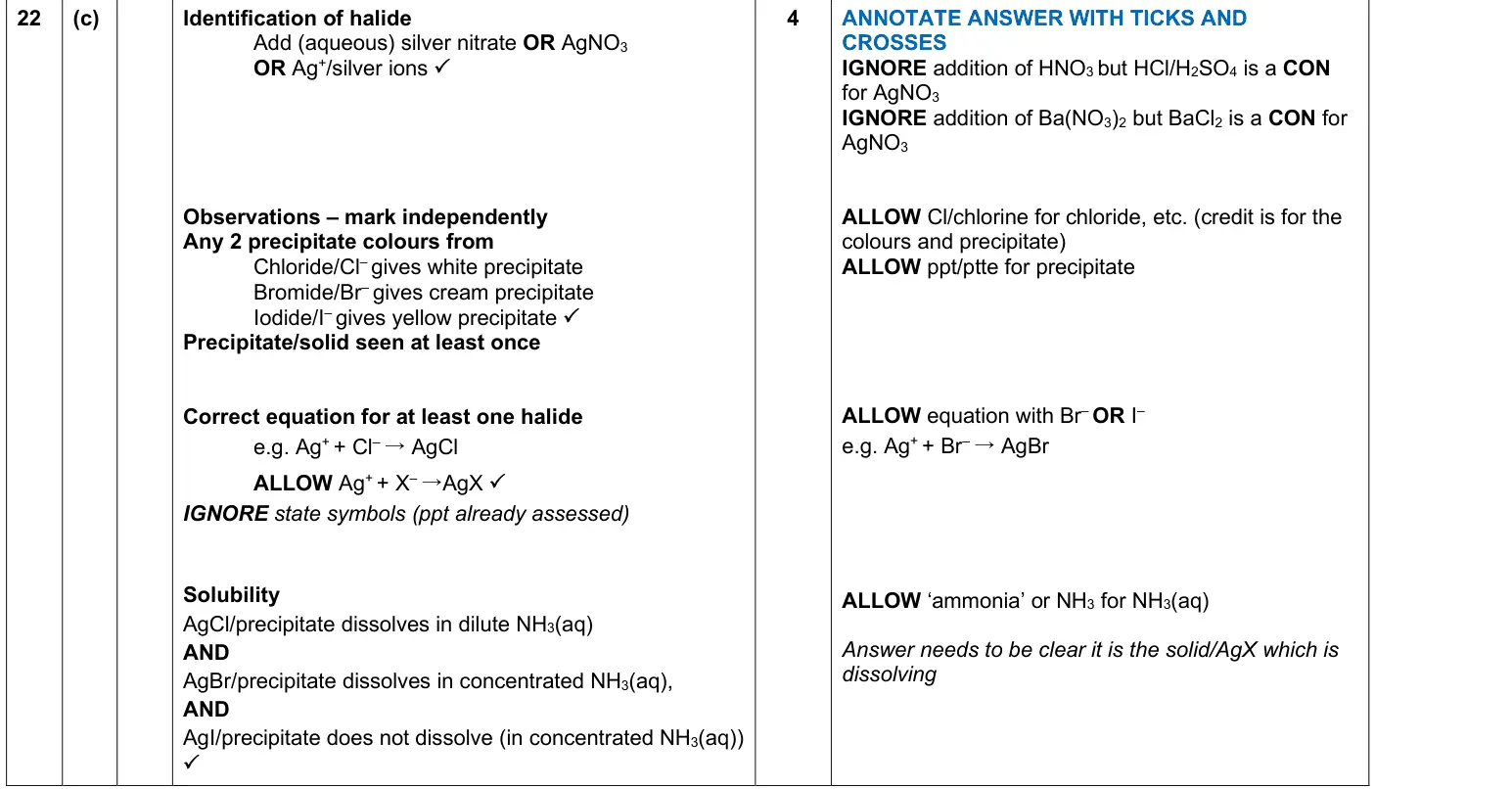
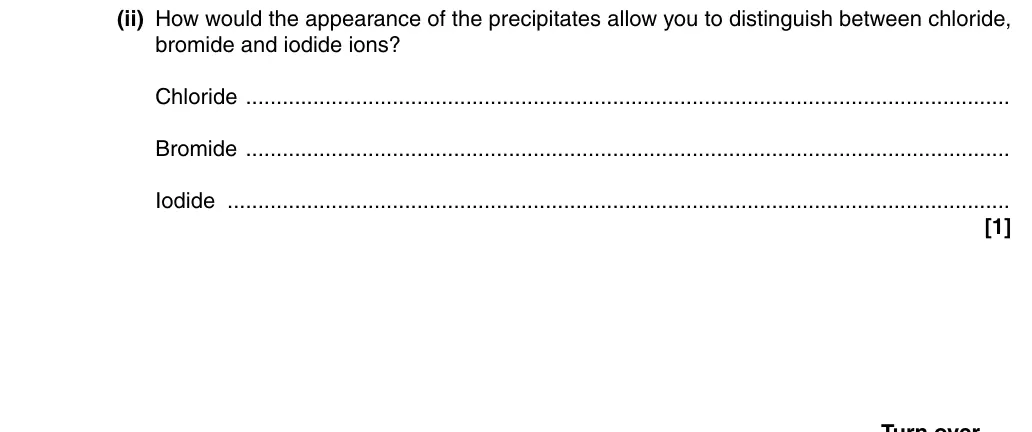
(c) A group of students is provided with aqueous solutions of sodium chloride, sodium bromide and
sodium iodide in three unlabelled bottles.
Explain how the students can identify which bottle contains each aqueous solution using
precipitation reactions and the solubility of any precipitate formed.
Include an ionic equation in your answer.
..........................................................................................................................................................
..........................................................................................................................................................
..........................................................................................................................................................
..........................................................................................................................................................
..........................................................................................................................................................
..........................................................................................................................................................
..........................................................................................................................................................
..........................................................................................................................................................
..........................................................................................................................................................
.................................................................................................................................................... [4]
June 2025 · AS Paper 1 · Q23(a) 2 marks Short answer Medium chemical equilibrium
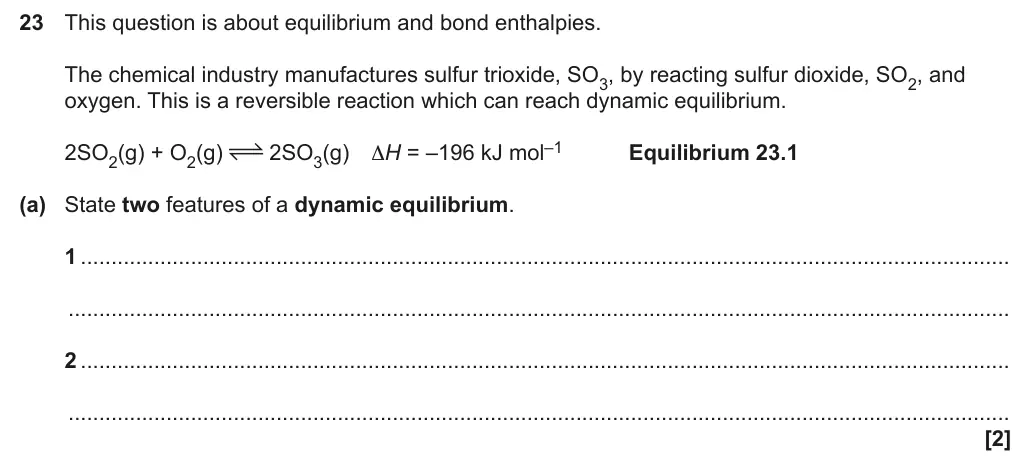
23 This question is about equilibrium and bond enthalpies.
The chemical industry manufactures sulfur trioxide, SO3, by reacting sulfur dioxide, SO2, and
oxygen. This is a reversible reaction which can reach dynamic equilibrium.
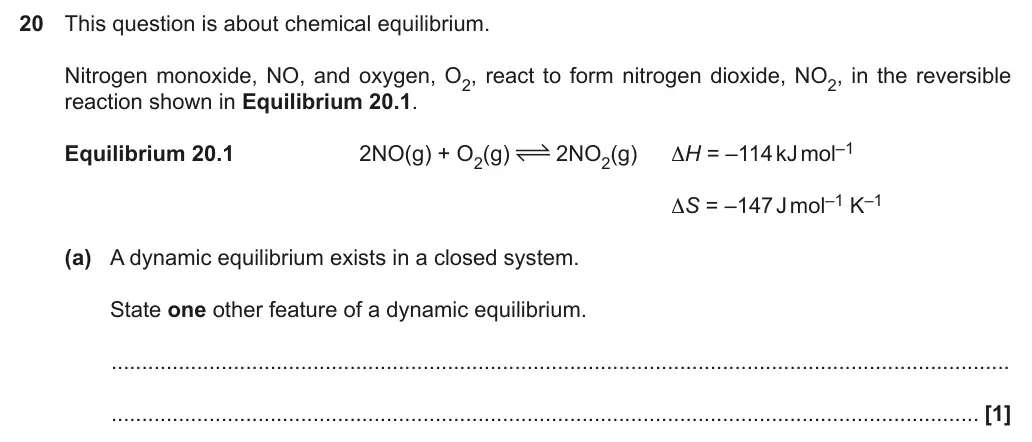
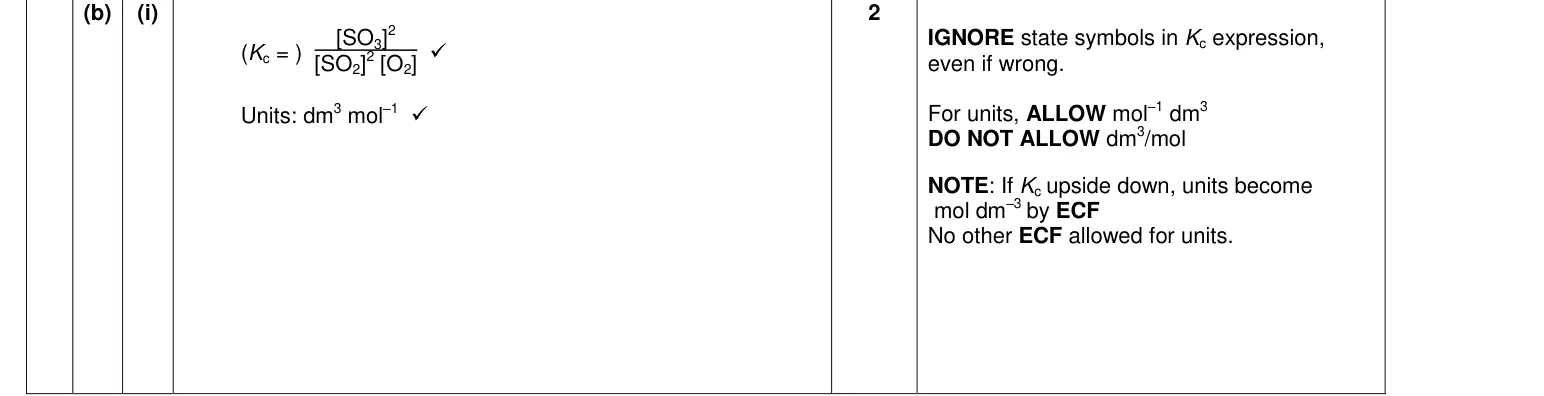
2SO2(g) + O2(g) 2SO3(g)  ΔH = –196 kJ mol–1   Equilibrium 23.1
(a) State two features of a dynamic equilibrium.
1 ........................................................................................................................................................
..........................................................................................................................................................
2 ........................................................................................................................................................
..........................................................................................................................................................
[2]
June 2025 · AS Paper 1 · Q24(a)(ii) 1 mark Short answer Hard alkenes
Earlier part of question 24 that this part usesEarlier part of June 2025 Paper 1 question 24
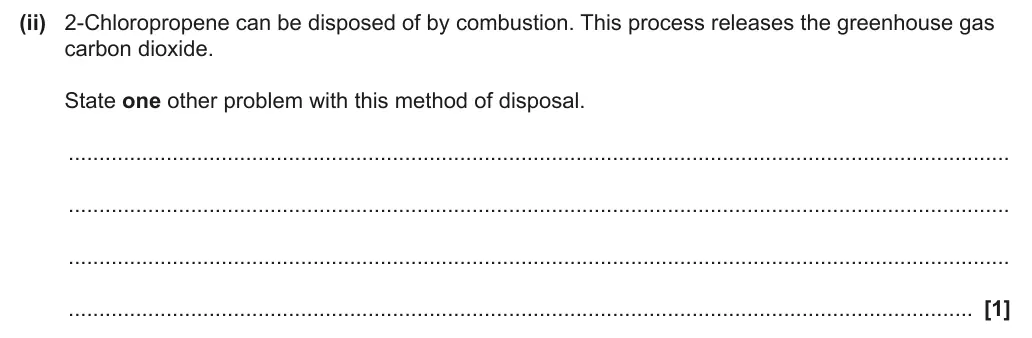
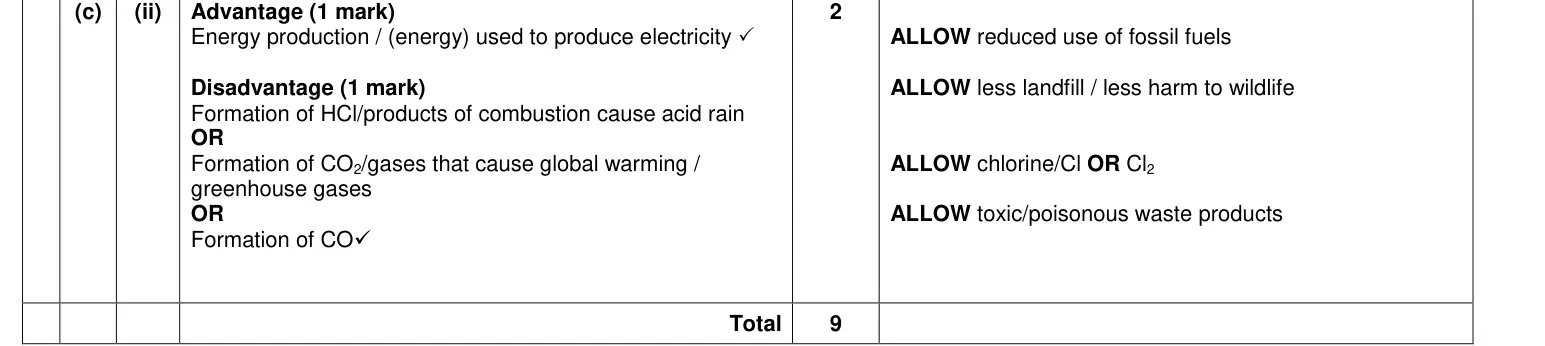
(ii) 2-Chloropropene can be disposed of by combustion. This process releases the greenhouse gas
carbon dioxide.
State one other problem with this method of disposal.
..........................................................................................................................................................
..........................................................................................................................................................
..........................................................................................................................................................
.................................................................................................................................................... [1]
June 2025 · AS Paper 1 · Q24(c)(ii) 1 mark Short answer Medium alkenes
Earlier part of question 24 that this part usesEarlier part of June 2025 Paper 1 question 24
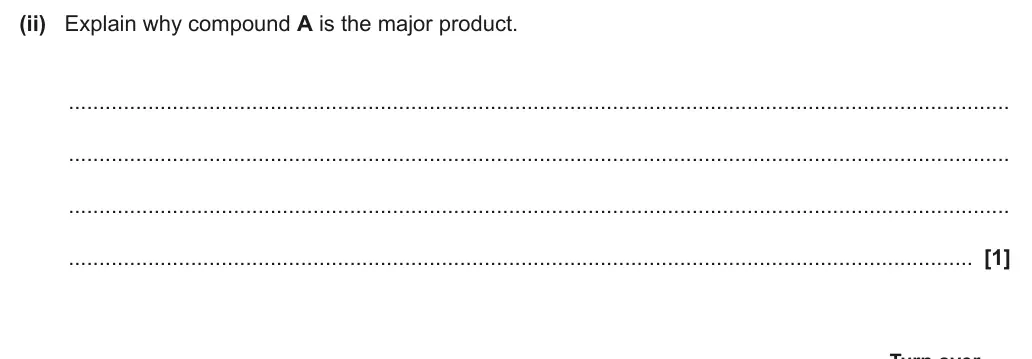
(ii) Explain why compound A is the major product.
..........................................................................................................................................................
..........................................................................................................................................................
..........................................................................................................................................................
.................................................................................................................................................... [1]
June 2025 · AS Paper 2 · Q1(a) 1 mark Short answer Medium acids and titrations
1 A student is investigating the enthalpy change of neutralisation for a strong acid and a strong
alkali.
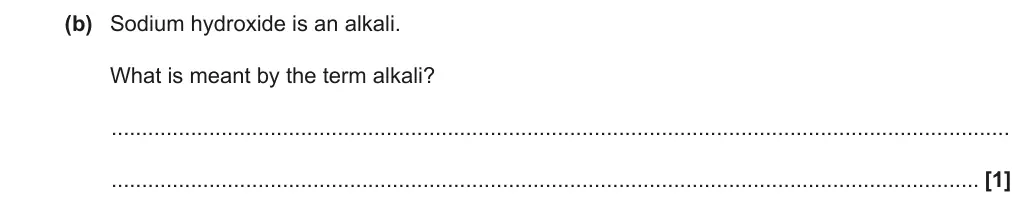
(a) Explain what is meant by an alkali.
..........................................................................................................................................................
..................................................................................................................................................... [1]
June 2025 · AS Paper 2 · Q1(c)(ii) 2 marks Short answer Hard enthalpy changes
Earlier part of question 1 that this part usesEarlier part of June 2025 Paper 2 question 1
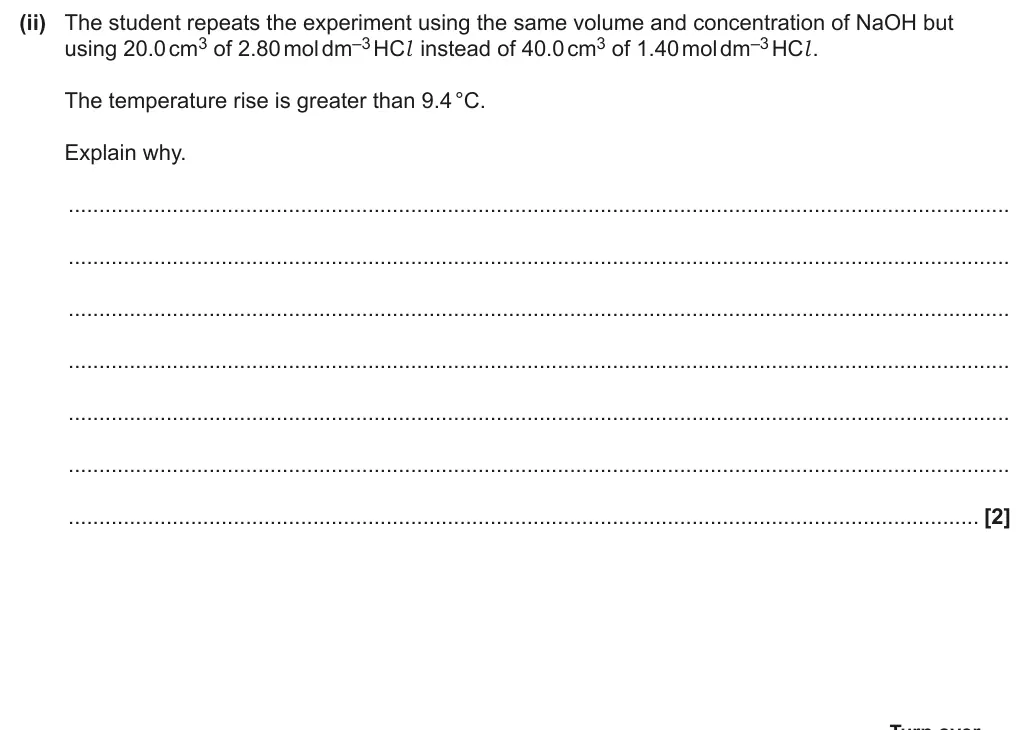
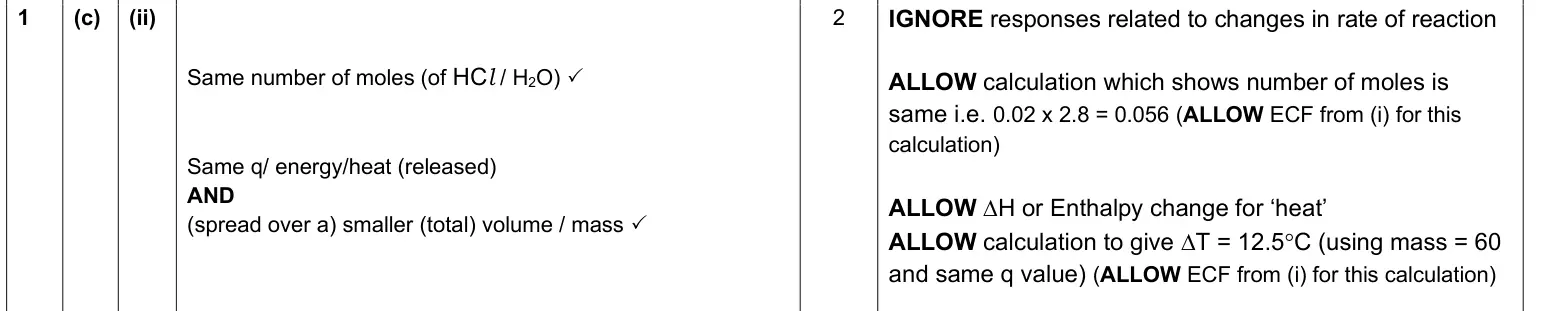
(ii) The student repeats the experiment using the same volume and concentration of NaOH but
using 20.0 cm3 of 2.80 mol dm–3 HCl  instead of 40.0 cm3 of 1.40 mol dm–3 HCl .
The temperature rise is greater than 9.4 °C.
Explain why.
..........................................................................................................................................................
..........................................................................................................................................................
..........................................................................................................................................................
..........................................................................................................................................................
..........................................................................................................................................................
..........................................................................................................................................................
..................................................................................................................................................... [2]
June 2025 · AS Paper 2 · Q2(b)(ii) 2 marks Short answer Hard practical skillsamount of substance
Earlier part of question 2 that this part usesEarlier part of June 2025 Paper 2 question 2
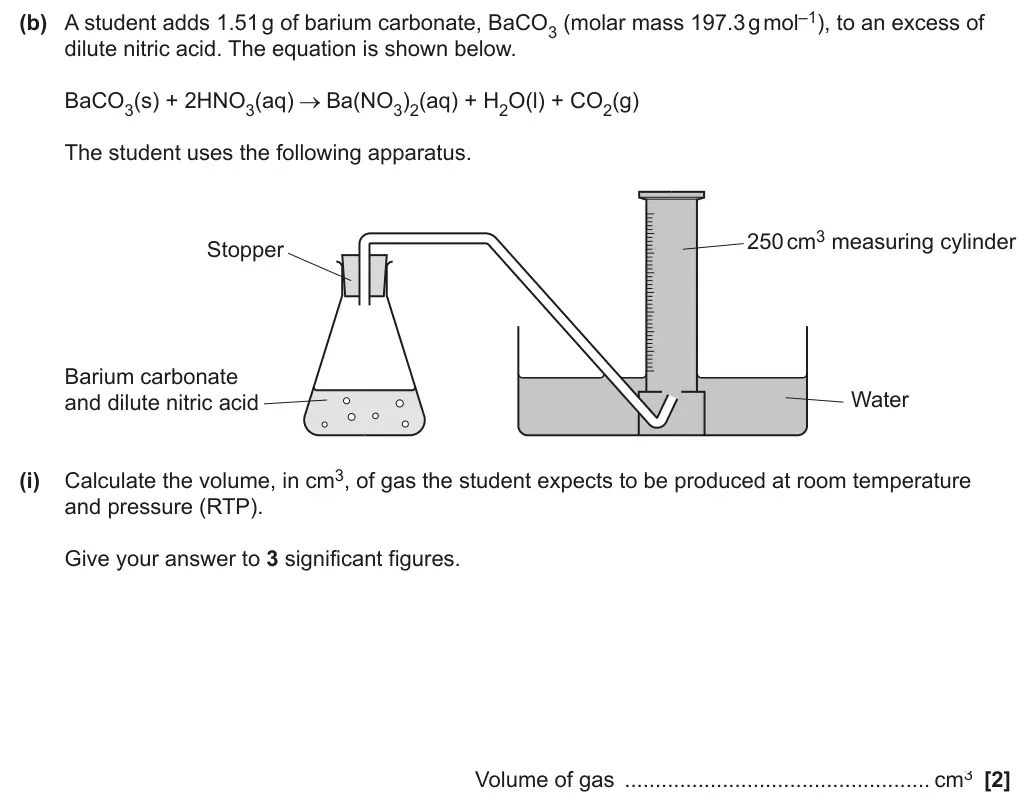
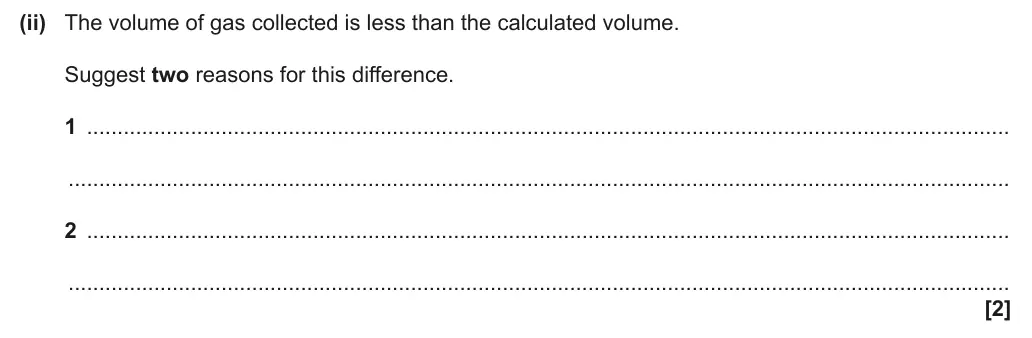
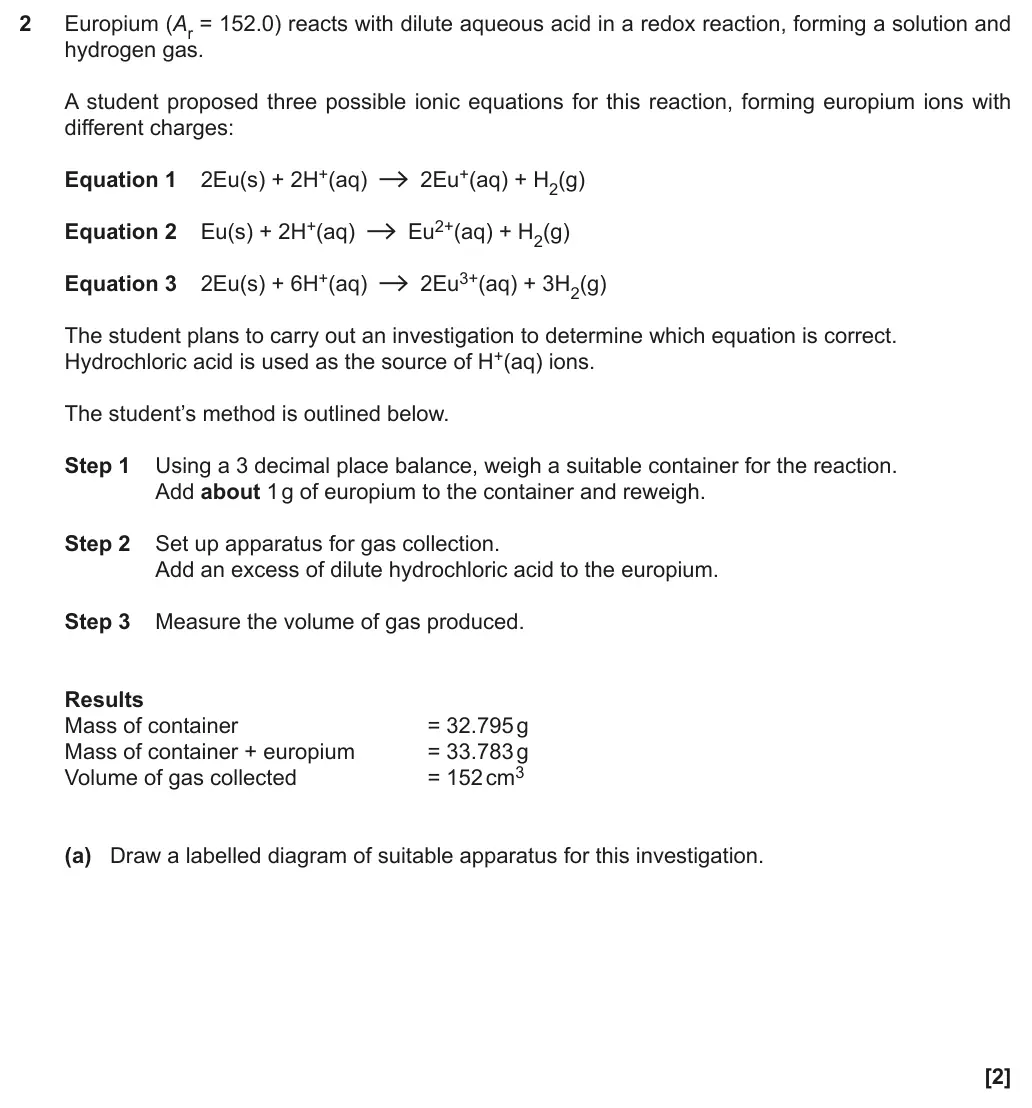
(ii) The volume of gas collected is less than the calculated volume.
Suggest two reasons for this difference.
1  .......................................................................................................................................................
..........................................................................................................................................................
2  .......................................................................................................................................................
..........................................................................................................................................................
[2]
June 2025 · AS Paper 2 · Q2(b)(iii) 1 mark Short answer Medium practical skillsamount of substance
Earlier parts of question 2 that this part usesEarlier part of June 2025 Paper 2 question 2Earlier part of June 2025 Paper 2 question 2
(iii) Suggest one way in which the student could modify the apparatus to produce a volume closer to
the calculated volume.
..........................................................................................................................................................
..................................................................................................................................................... [1]
June 2025 · AS Paper 2 · Q3(b) 2 marks Short answer Medium acids and titrationspractical skills
Earlier part of question 3 that this part usesEarlier part of June 2025 Paper 2 question 3
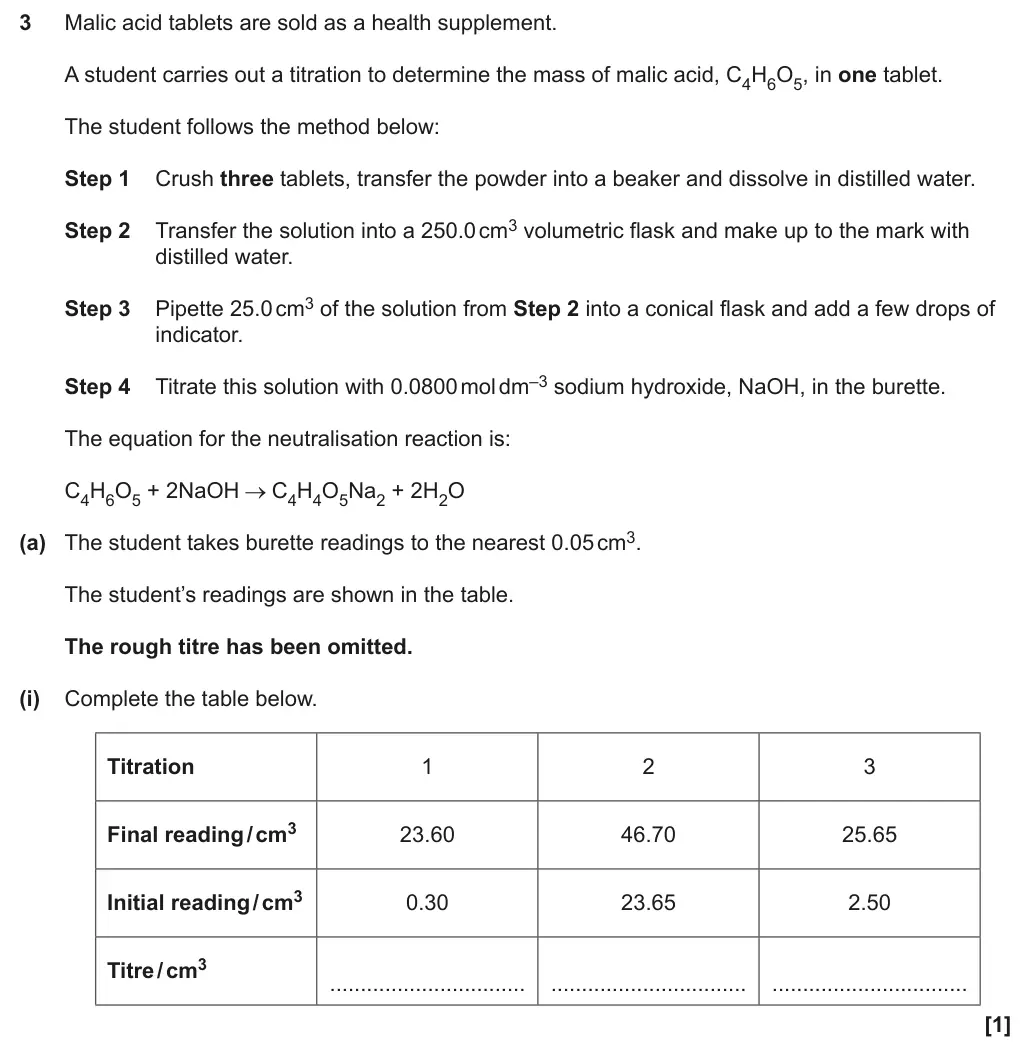
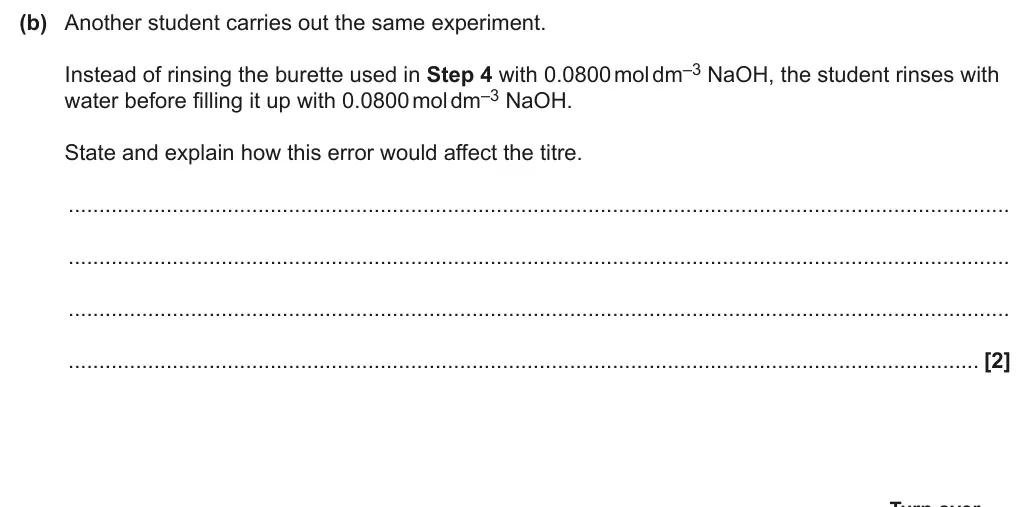
(b) Another student carries out the same experiment.
Instead of rinsing the burette used in Step 4 with 0.0800 mol dm–3 NaOH, the student rinses with
water before filling it up with 0.0800 mol dm–3 NaOH.
State and explain how this error would affect the titre.
..........................................................................................................................................................
..........................................................................................................................................................
..........................................................................................................................................................
..................................................................................................................................................... [2]
June 2025 · AS Paper 2 · Q4(d)(ii) 1 mark Short answer Hard organic basics
Earlier part of question 4 that this part usesEarlier part of June 2025 Paper 2 question 4
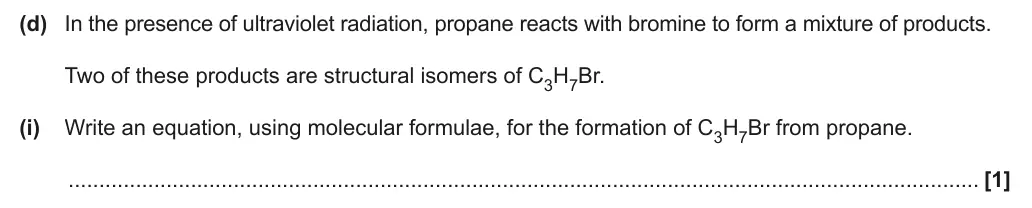
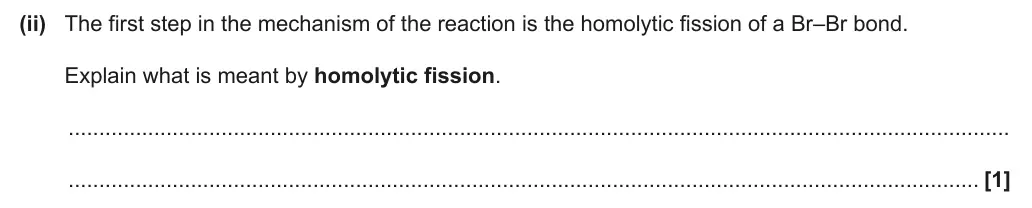
(ii) The first step in the mechanism of the reaction is the homolytic fission of a Br–Br bond.
Explain what is meant by homolytic fission.
..........................................................................................................................................................
..................................................................................................................................................... [1]
June 2025 · AS Paper 2 · Q4(d)(iv) 1 mark Short answer Medium alkanes
Earlier part of question 4 that this part usesEarlier part of June 2025 Paper 2 question 4
(iv) Explain why two structural isomers of C3H7Br are formed.
..........................................................................................................................................................
..........................................................................................................................................................
..................................................................................................................................................... [1]
June 2025 · AS Paper 2 · Q5(a)(ii) 2 marks Short answer Hard bonding and structurealkanes
Earlier part of question 5 that this part usesEarlier part of June 2025 Paper 2 question 5
(ii) Name the shape of the chloromethane molecule and predict the value of the H–C–Cl bond angle.
Name of shape ..................................................................................................................................
Bond angle ........................................................................................................................................
[2]
June 2025 · AS Paper 2 · Q5(b) 3 marks Short answer Hard alkenesbonding and structure
Earlier parts of question 5 that this part usesEarlier part of June 2025 Paper 2 question 5Earlier part of June 2025 Paper 2 question 5
(b) Chloroethene, H2C=CHCl , is a covalent molecule with a double bond.
The bond angles in H2C=CHCl are different from those in CH3Cl .
Predict the H–C–Cl bond angle in H2C=CHCl and explain why it is different from the H–C–Cl
bond angle in CH3Cl .
Bond angle  .......................................................................................................................................
Explanation  ......................................................................................................................................
..........................................................................................................................................................
..........................................................................................................................................................
..........................................................................................................................................................
..........................................................................................................................................................
[3]
June 2025 · AS Paper 2 · Q5(d)(ii) 1 mark Short answer Easy haloalkanes
Earlier part of question 5 that this part usesEarlier part of June 2025 Paper 2 question 5
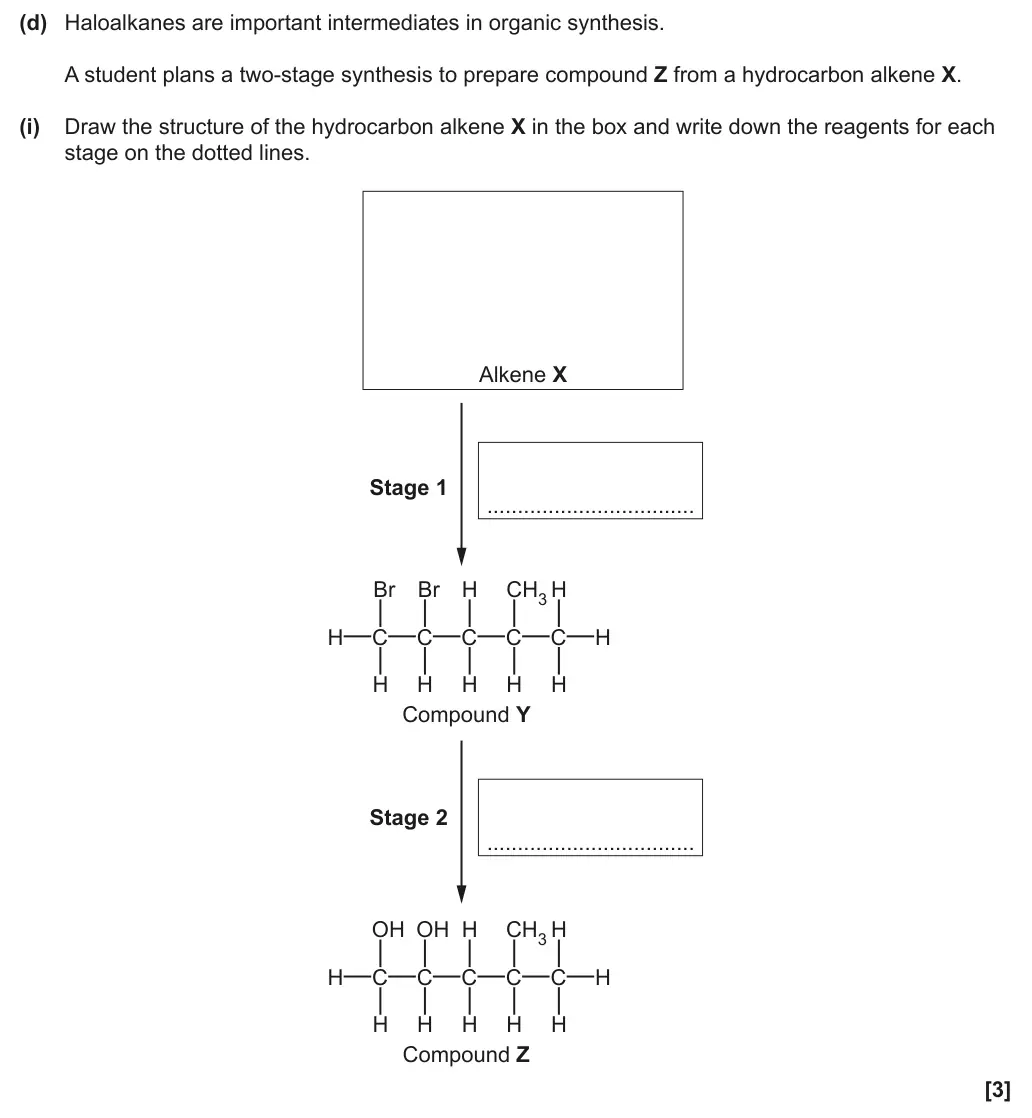
(ii) State the name of the mechanism of the reaction in Stage 2.
..................................................................................................................................................... [1]
June 2025 · AS Paper 2 · Q6(a)(ii) 1 mark Short answer Hard infrared and mass spectrometry
Earlier part of question 6 that this part usesEarlier part of June 2025 Paper 2 question 6
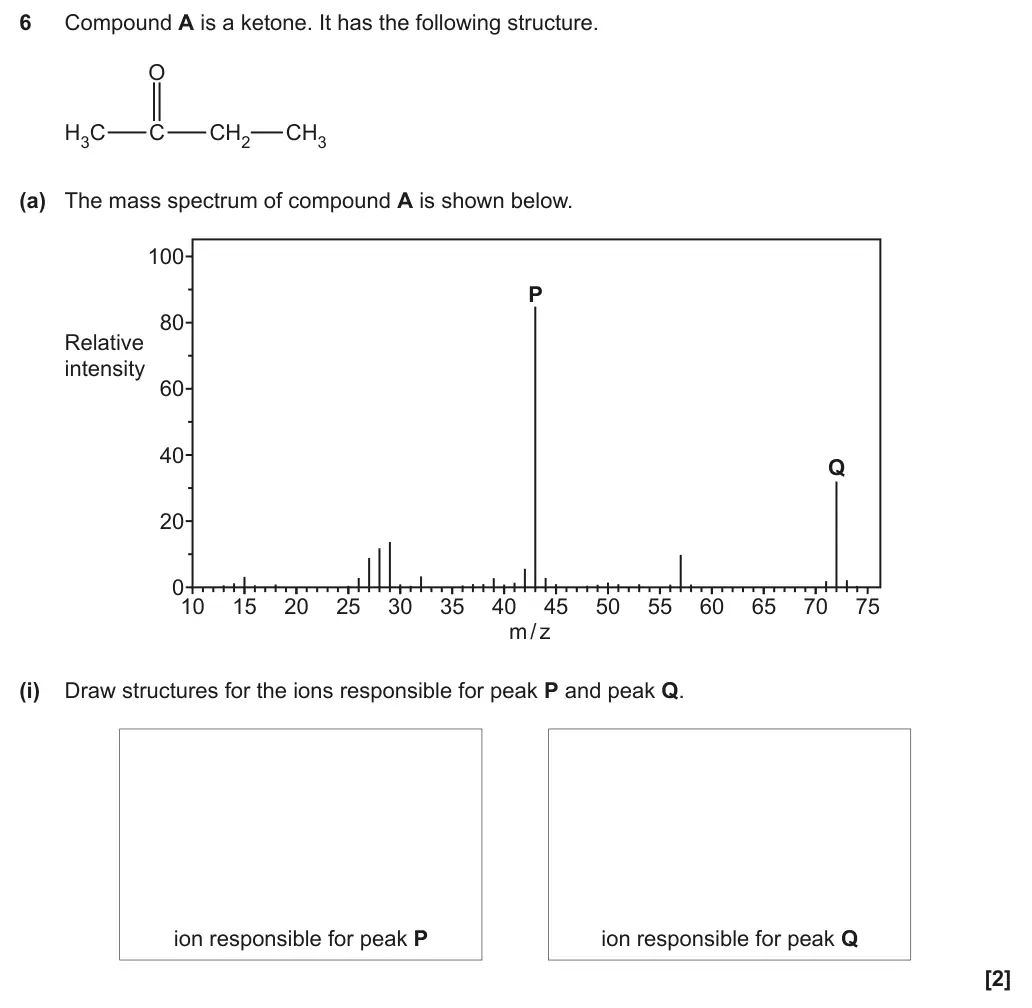
(ii) Explain why there is a small peak at m / z = 73
..........................................................................................................................................................
..................................................................................................................................................... [1]
June 2025 · AS Paper 2 · Q6(b)(i) 1 mark Short answer Medium infrared and mass spectrometry
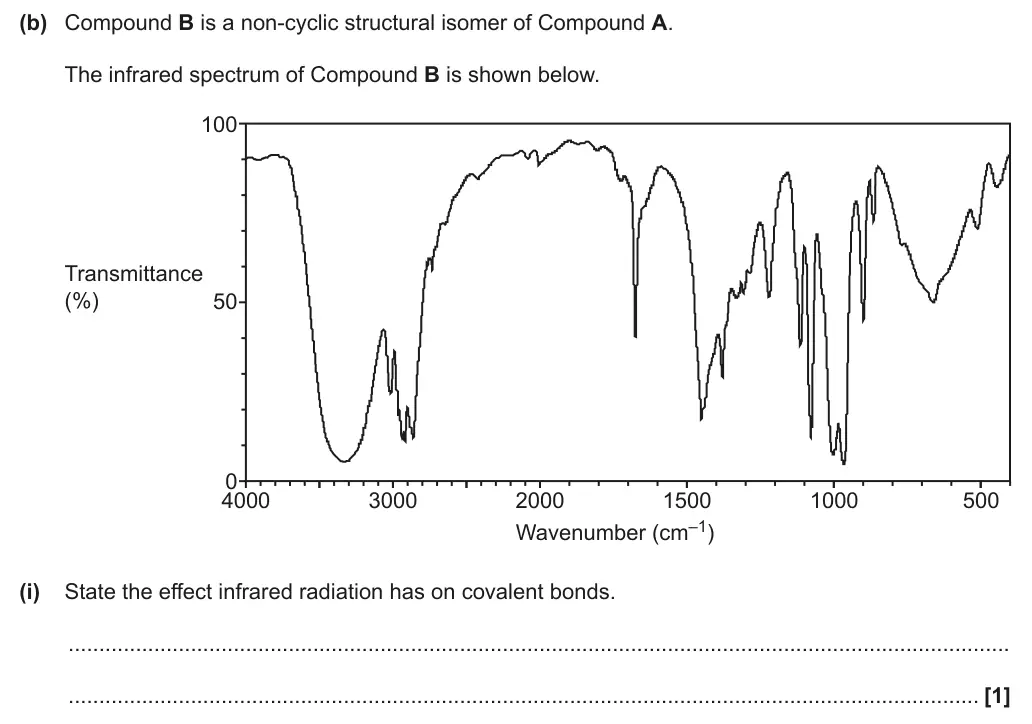
(b) Compound B is a non-cyclic structural isomer of Compound A.
The infrared spectrum of Compound B is shown below.
100
Transmittance
(%) 50
0
4000 3000 2000 1500 1000 500
Wavenumber (cm–1)
(i) State the effect infrared radiation has on covalent bonds.
..........................................................................................................................................................
..................................................................................................................................................... [1]
June 2025 · AS Paper 2 · Q6(b)(ii) 2 marks Short answer Medium infrared and mass spectrometryorganic synthesis as
Earlier parts of question 6 that this part usesEarlier part of June 2025 Paper 2 question 6Earlier part of June 2025 Paper 2 question 6
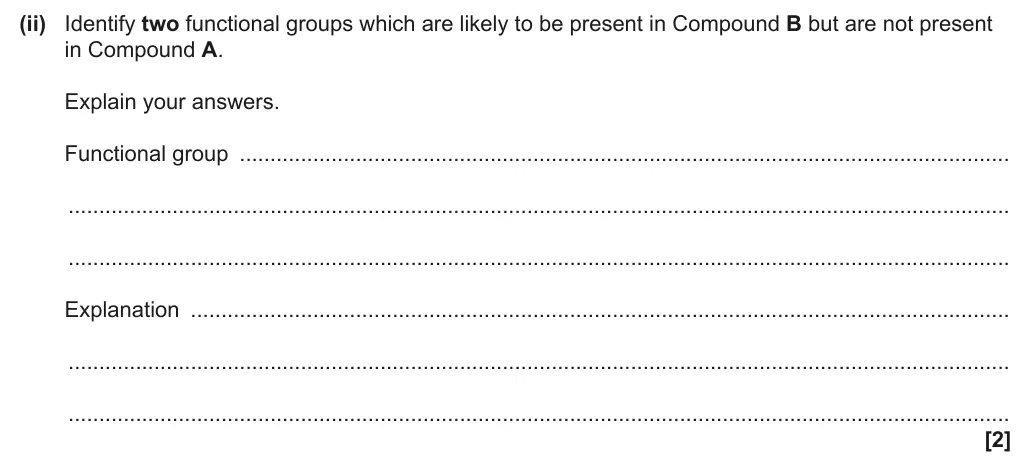
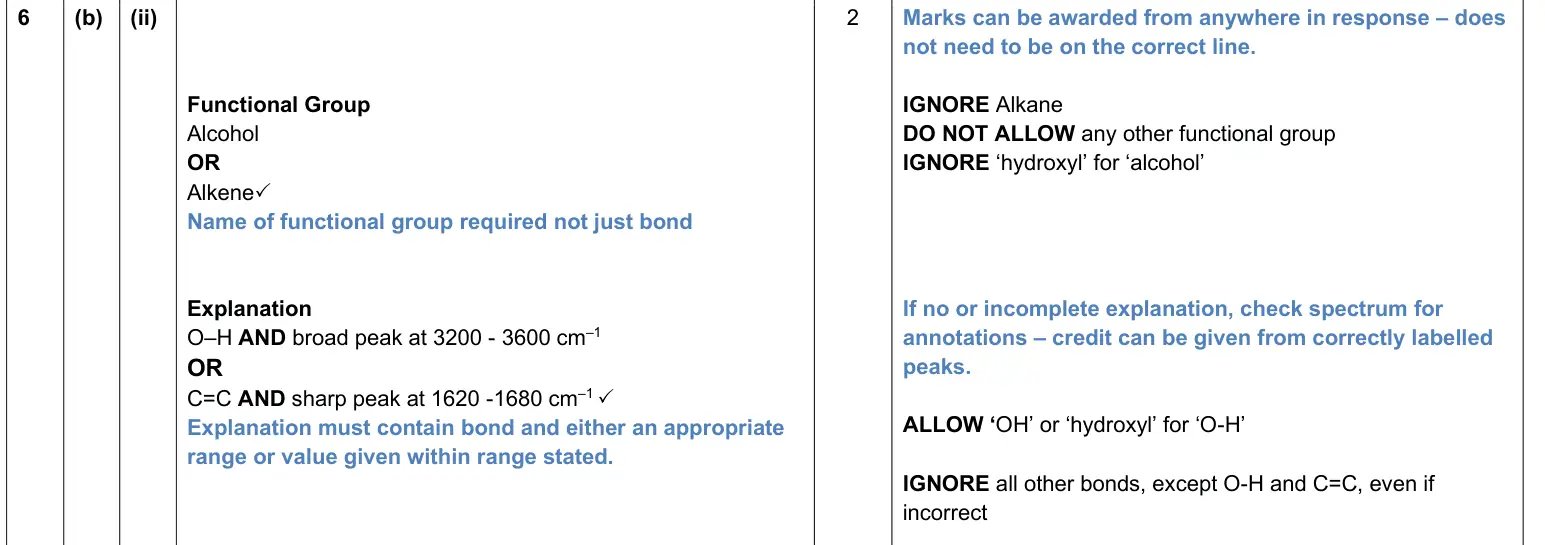
(ii) Identify two functional groups which are likely to be present in Compound B but are not present
in Compound A.
Explain your answers.
Functional group  ..............................................................................................................................
..........................................................................................................................................................
..........................................................................................................................................................
Explanation  ......................................................................................................................................
..........................................................................................................................................................
..........................................................................................................................................................
[2]
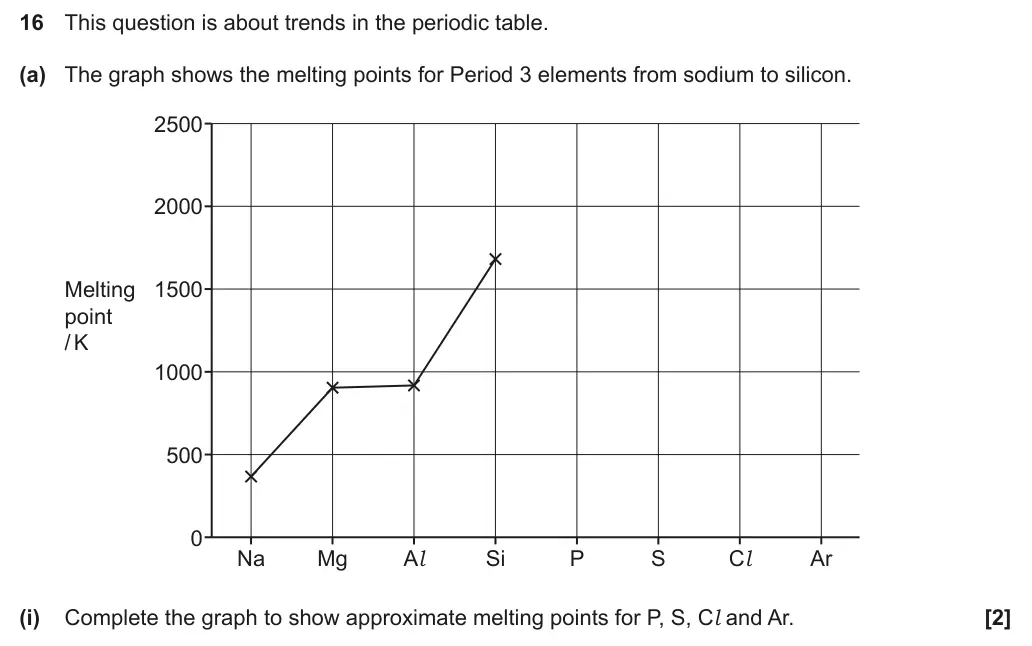
June 2025 · Paper 1 · Q16(a)(ii) 3 marks Short answer Hard periodicity
Earlier part of question 16 that this part usesEarlier part of June 2025 Paper 1 question 16
(ii) Explain why silicon has a higher melting point than aluminium.
Use ideas about structure and bonding in your answer.
..........................................................................................................................................................
..........................................................................................................................................................
..........................................................................................................................................................
..........................................................................................................................................................
..................................................................................................................................................... [3]
June 2025 · Paper 1 · Q16(b)(ii) 2 marks Short answer Easy periodicity
Earlier part of question 16 that this part usesEarlier part of June 2025 Paper 1 question 16
(ii) The table shows that there is a general increase in first ionisation energies across Period 3, but
that this trend is not followed by phosphorus to sulfur.
Explain why the first ionisation energy of sulfur is lower than the first ionisation energy of
phosphorus.
..........................................................................................................................................................
..........................................................................................................................................................
..........................................................................................................................................................
..........................................................................................................................................................
..................................................................................................................................................... [2]
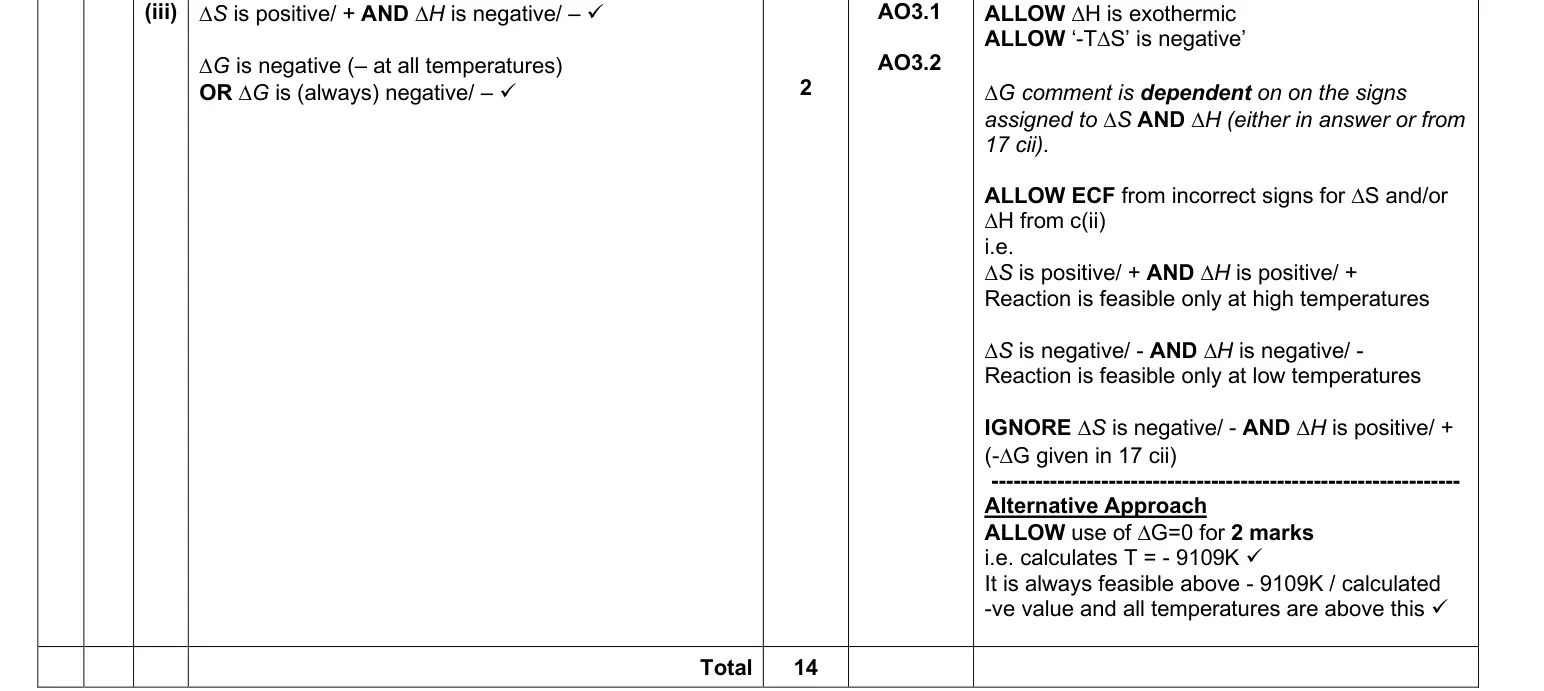
June 2025 · Paper 1 · Q17(a)(i) 1 mark Short answer Easy enthalpy changes
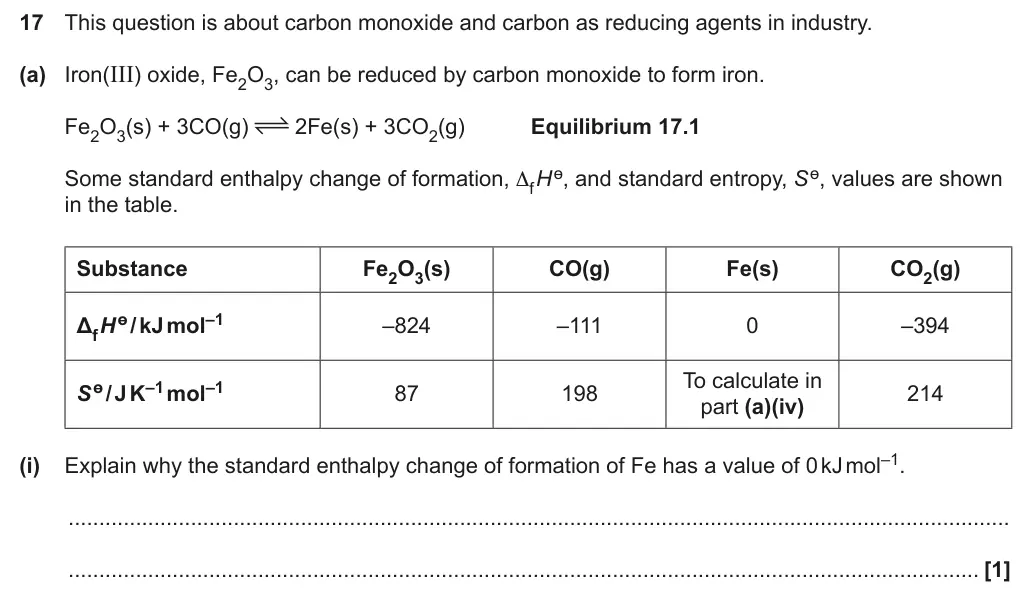
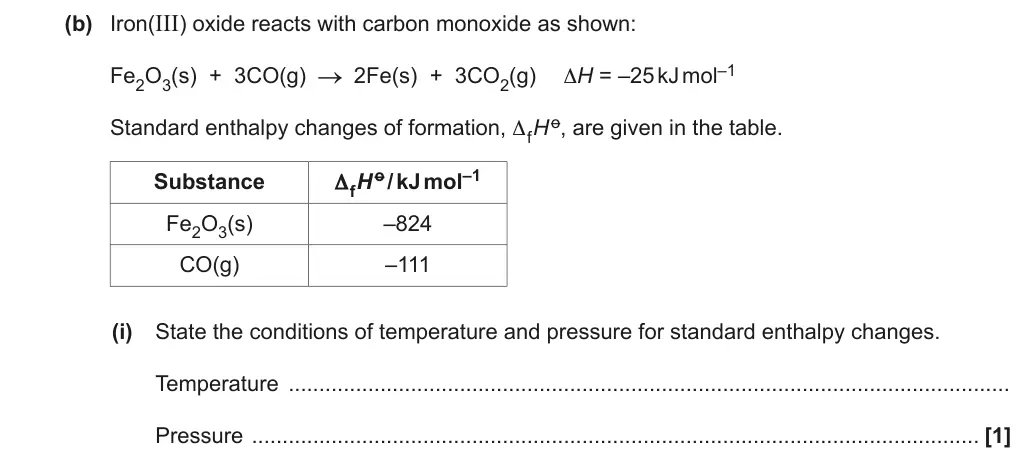
17 This question is about carbon monoxide and carbon as reducing agents in industry.
(a) Iron(III) oxide, Fe2O3, can be reduced by carbon monoxide to form iron.
Fe2O3(s) + 3CO(g) 2Fe(s) + 3CO2(g)   Equilibrium 17.1
Some standard enthalpy change of formation, ΔfH ɵ, and standard entropy, S ɵ, values are shown
in the table.
Substance Fe2O3(s) CO(g) Fe(s) CO2(g)
Δf Hɵ / kJ mol–1 –824 –111 0 –394
To calculate in
Sɵ / J K–1 mol–1 87 198 214
part (a)(iv)
(i) Explain why the standard enthalpy change of formation of Fe has a value of 0 kJ mol–1.
..........................................................................................................................................................
..................................................................................................................................................... [1]
June 2025 · Paper 1 · Q17(a)(iii) 2 marks Short answer Hard entropy and free energy
Earlier part of question 17 that this part usesEarlier part of June 2025 Paper 1 question 17
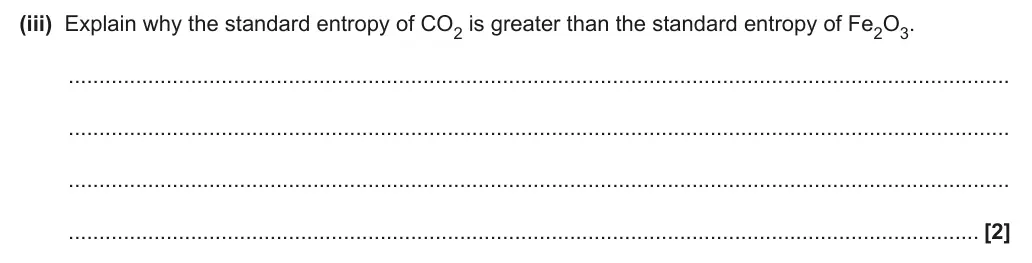
(iii) Explain why the standard entropy of CO2 is greater than the standard entropy of Fe2O3.
..........................................................................................................................................................
..........................................................................................................................................................
..........................................................................................................................................................
..................................................................................................................................................... [2]
June 2025 · Paper 1 · Q17(c)(i) 1 mark Short answer Easy equilibrium constants
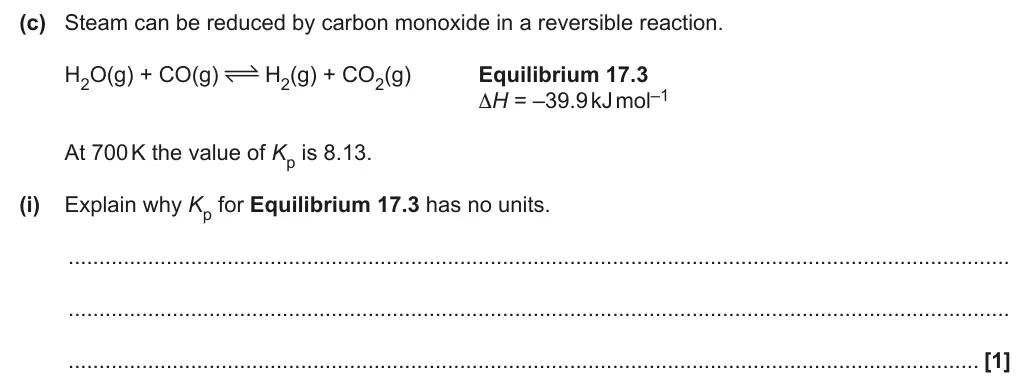
(c) Steam can be reduced by carbon monoxide in a reversible reaction.
H2O(g) + CO(g) H2(g) + CO2(g) Equilibrium 17.3
ΔH = –39.9 kJ mol–1
At 700 K the value of Kp is 8.13.
(i) Explain why Kp for Equilibrium 17.3 has no units.
..........................................................................................................................................................
..........................................................................................................................................................
..................................................................................................................................................... [1]
June 2025 · Paper 1 · Q17(c)(iii) 2 marks Short answer Medium equilibrium constants
Earlier part of question 17 that this part usesEarlier part of June 2025 Paper 1 question 17
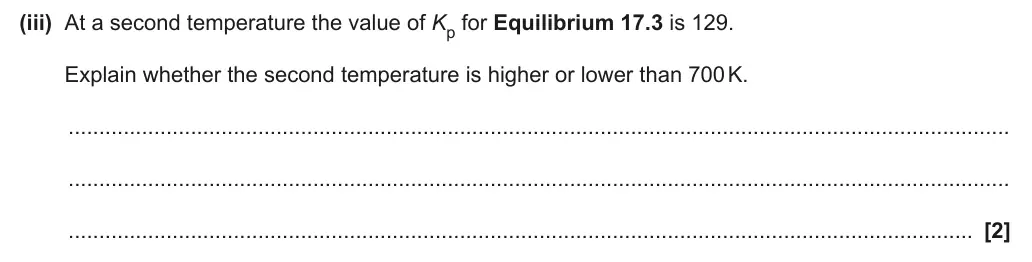
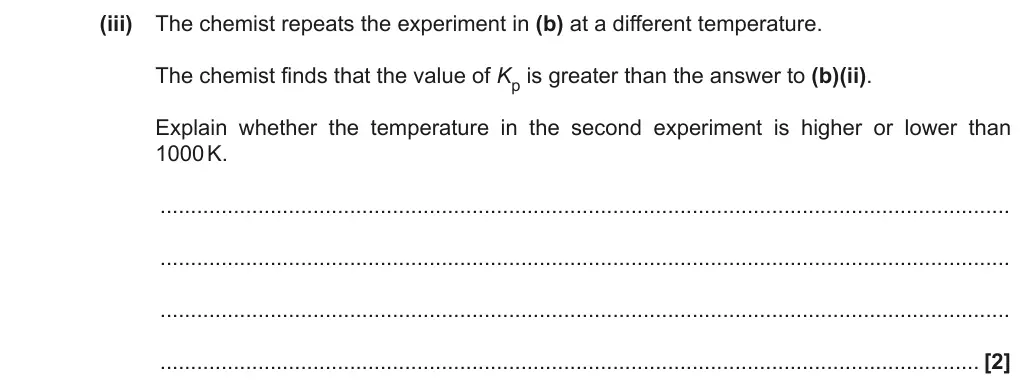
(iii) At a second temperature the value of Kp for Equilibrium 17.3 is 129.
Explain whether the second temperature is higher or lower than 700 K.
..........................................................................................................................................................
..........................................................................................................................................................
.................................................................................................................................................... [2]
June 2025 · Paper 1 · Q18(a)(i) 1 mark Short answer Medium reaction rates
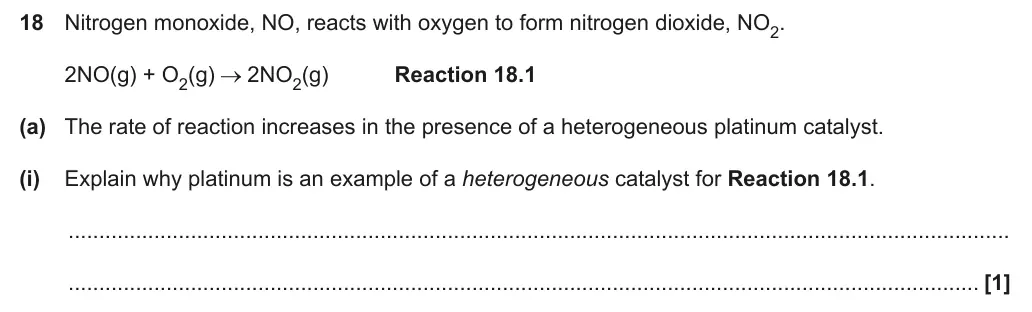
18 Nitrogen monoxide, NO, reacts with oxygen to form nitrogen dioxide, NO2.
2NO(g) + O2(g) 2NO2(g)   Reaction 18.1
(a) The rate of reaction increases in the presence of a heterogeneous platinum catalyst.
(i) Explain why platinum is an example of a heterogeneous catalyst for Reaction 18.1.
..........................................................................................................................................................
..................................................................................................................................................... [1]
June 2025 · Paper 1 · Q18(a)(ii) 2 marks Short answer Hard reaction rates
Earlier part of question 18 that this part usesEarlier part of June 2025 Paper 1 question 18
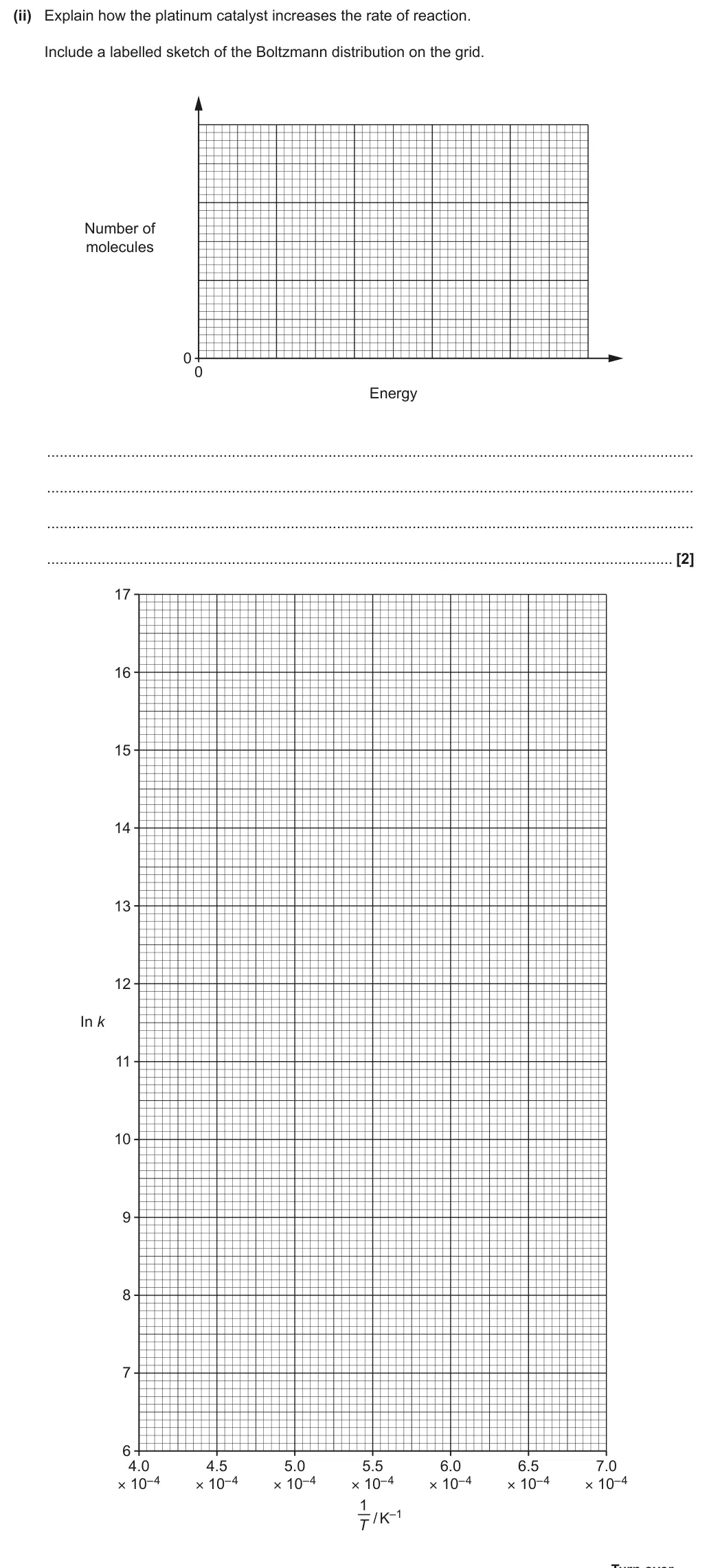
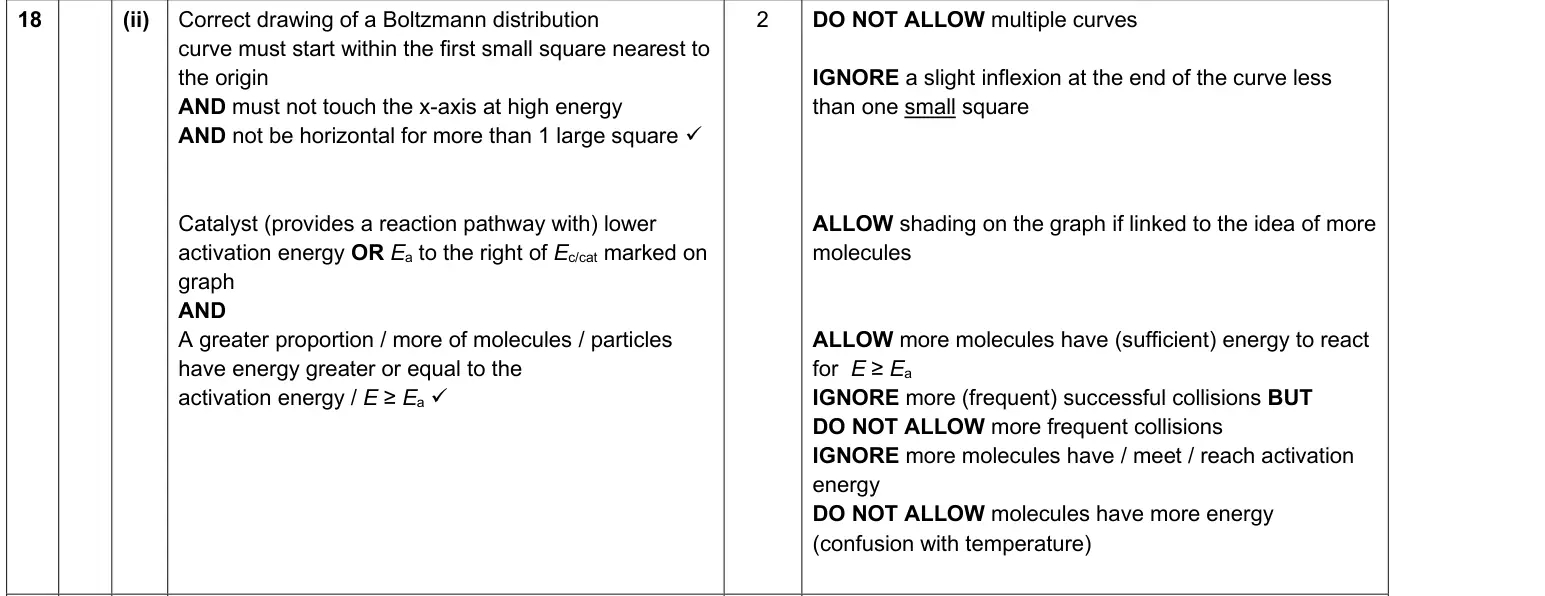
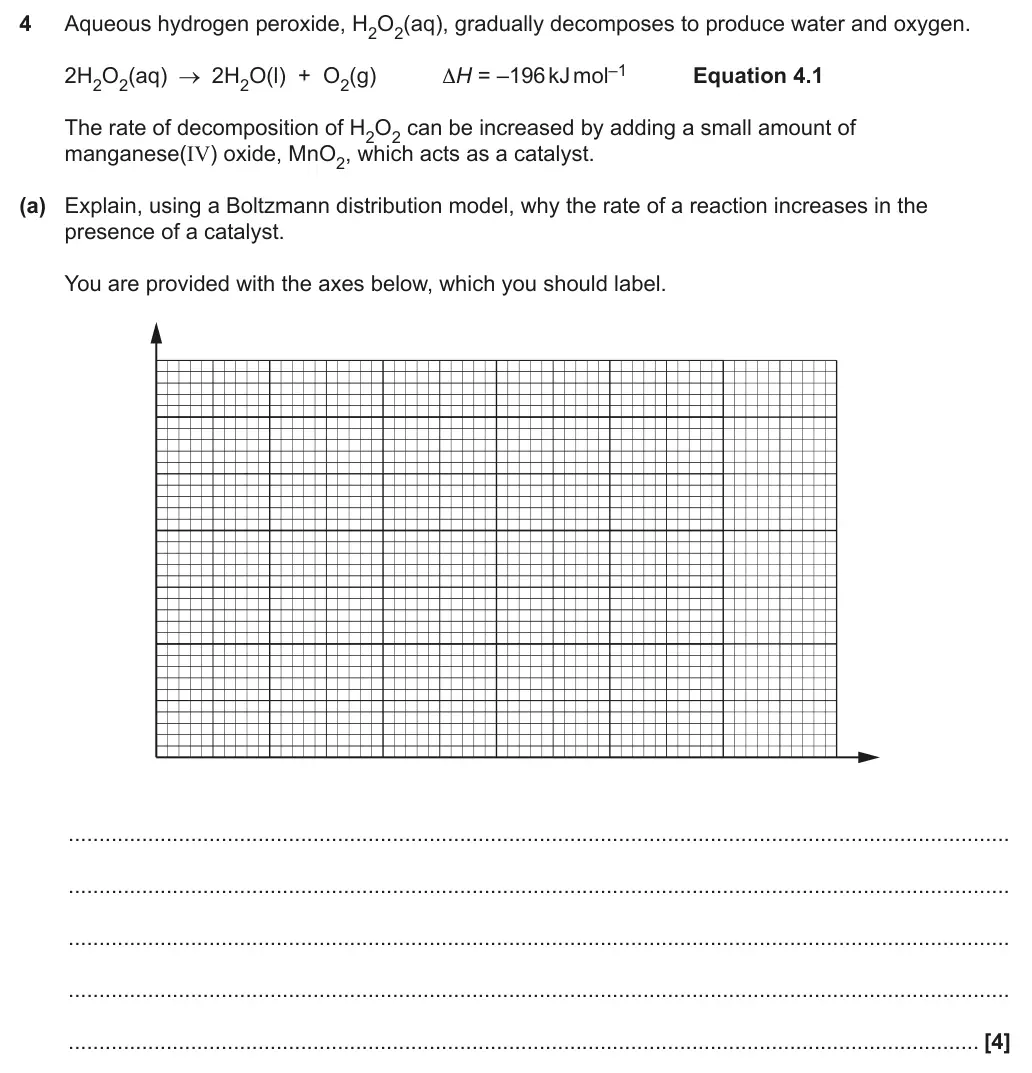
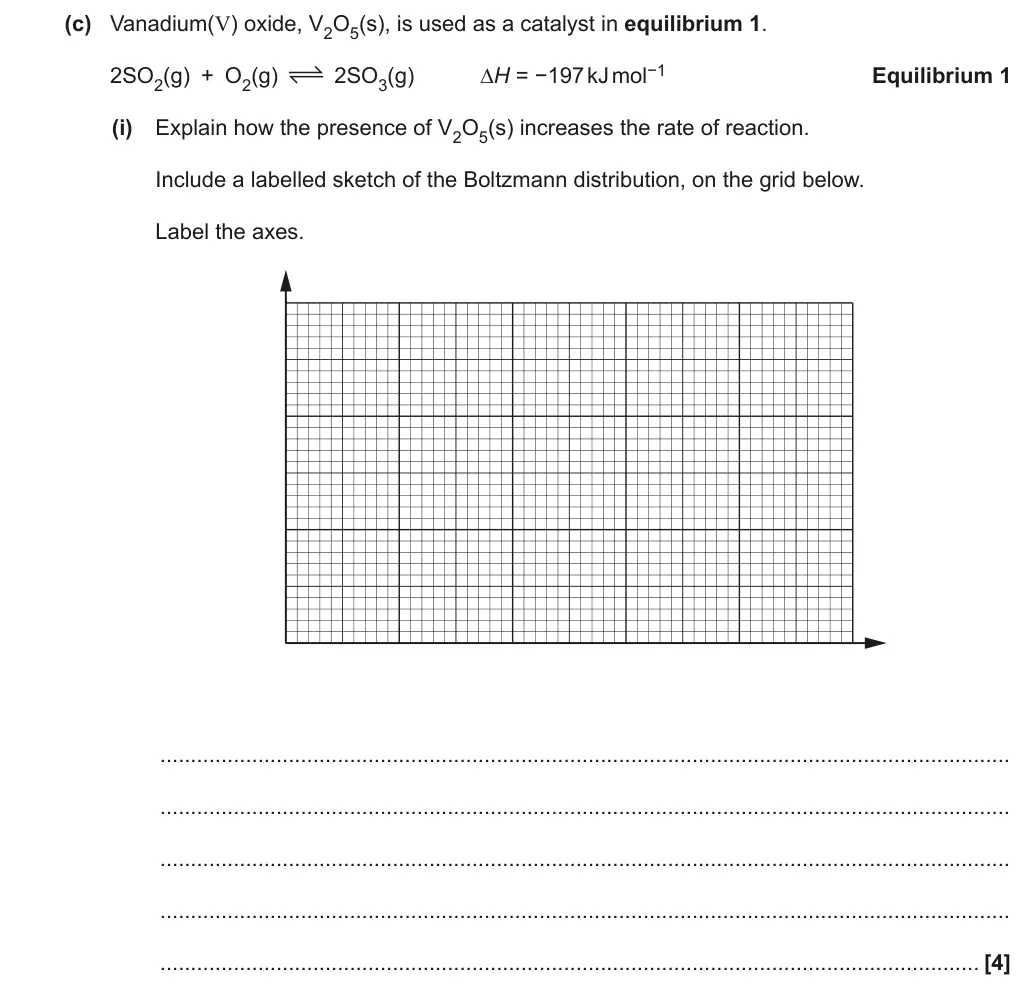
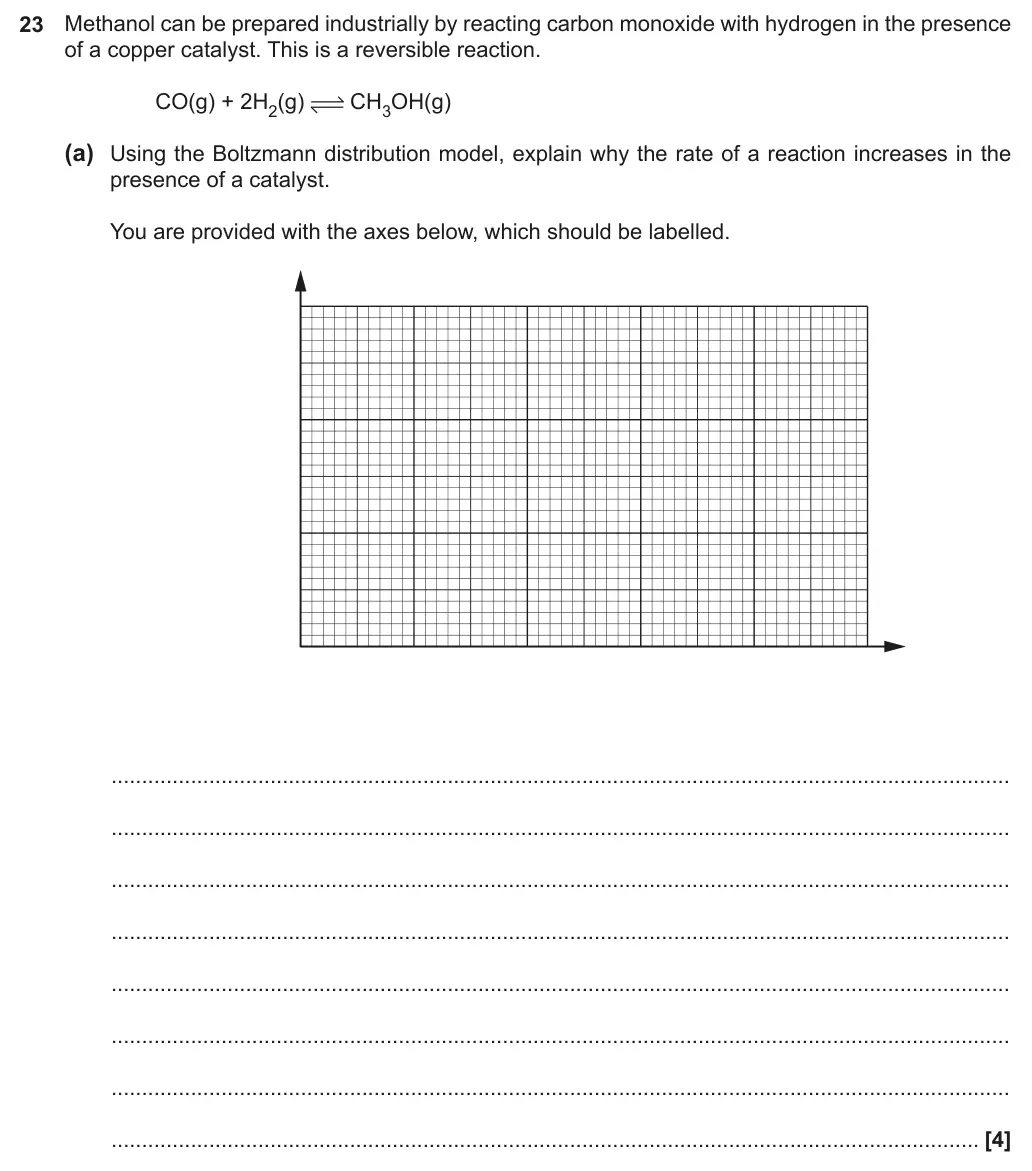
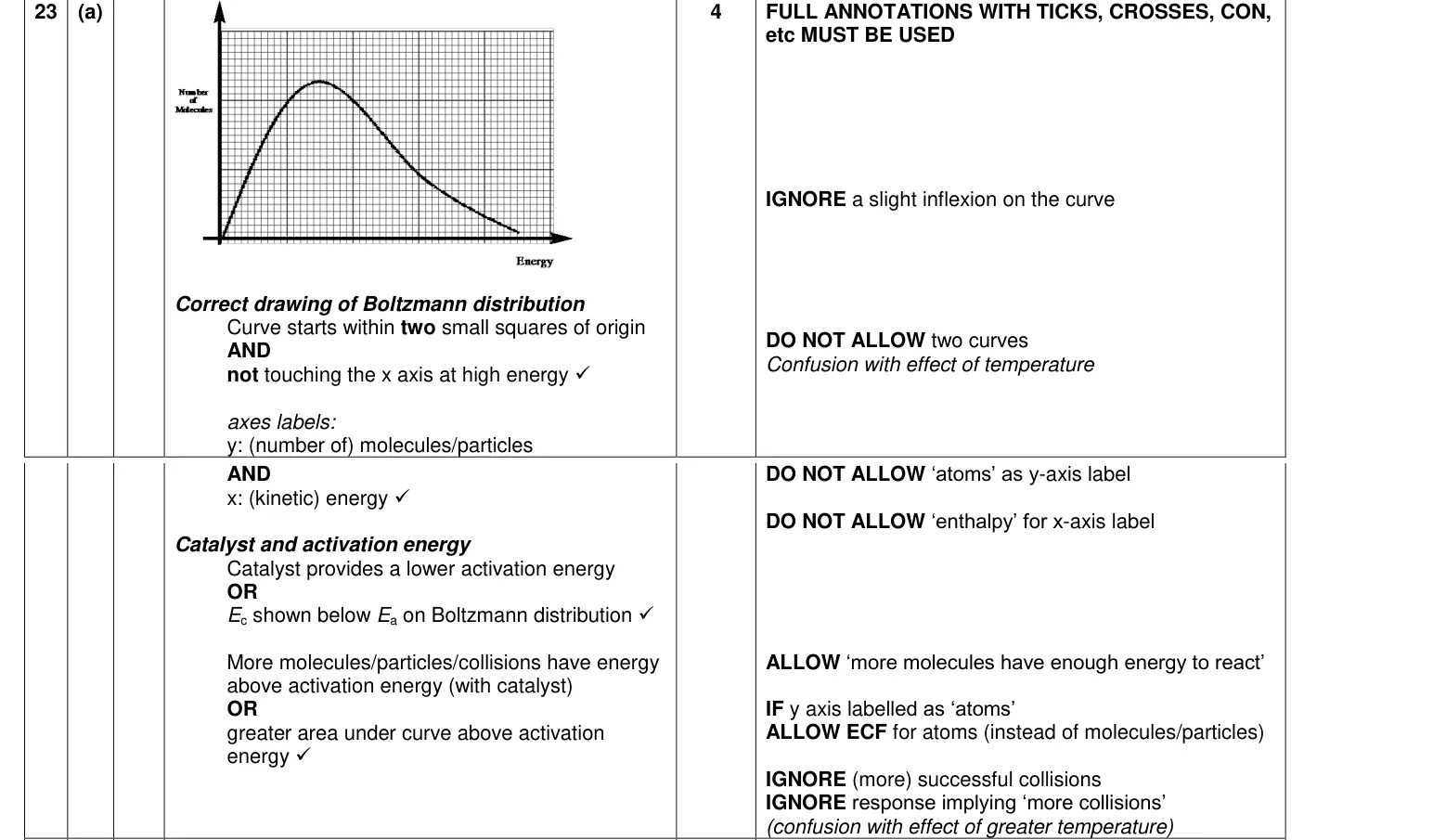
(ii) Explain how the platinum catalyst increases the rate of reaction.
Include a labelled sketch of the Boltzmann distribution on the grid.
Number of
molecules
0
0
Energy
..........................................................................................................................................................
..........................................................................................................................................................
..........................................................................................................................................................
..................................................................................................................................................... [2]
June 2025 · Paper 1 · Q18(a)(iii) 1 mark Short answer Medium reaction rates
Earlier part of question 18 that this part usesEarlier part of June 2025 Paper 1 question 18
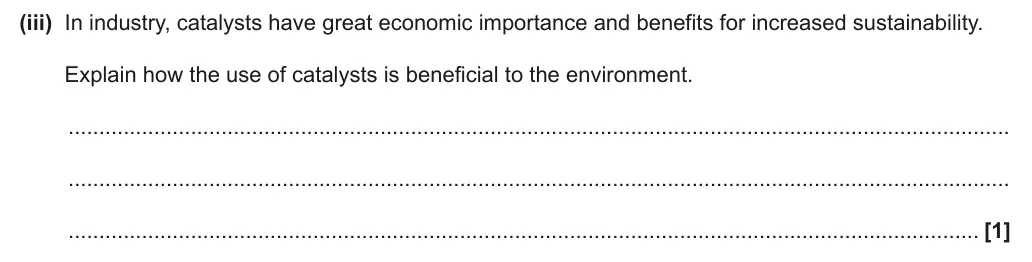
(iii) In industry, catalysts have great economic importance and benefits for increased sustainability.
Explain how the use of catalysts is beneficial to the environment.
..........................................................................................................................................................
..........................................................................................................................................................
..................................................................................................................................................... [1]
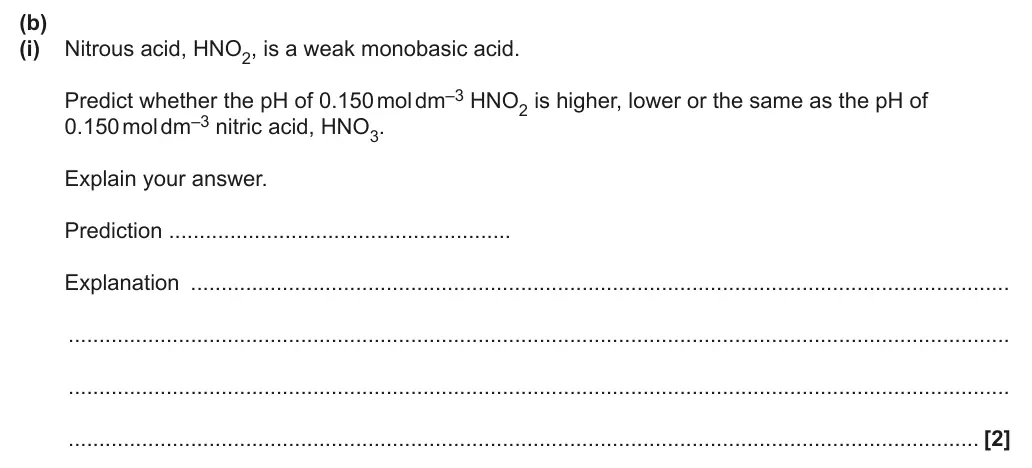
June 2025 · Paper 1 · Q19(b)(i) 2 marks Short answer Hard acids bases and buffersacids and titrations
Earlier part of question 19 that this part usesEarlier part of June 2025 Paper 1 question 19
(b)
(i) Nitrous acid, HNO2, is a weak monobasic acid.
Predict whether the pH of 0.150 mol dm–3 HNO2 is higher, lower or the same as the pH of
0.150 mol dm–3 nitric acid, HNO3.
Explain your answer.
Prediction ........................................................
Explanation  ......................................................................................................................................
..........................................................................................................................................................
..........................................................................................................................................................
..................................................................................................................................................... [2]
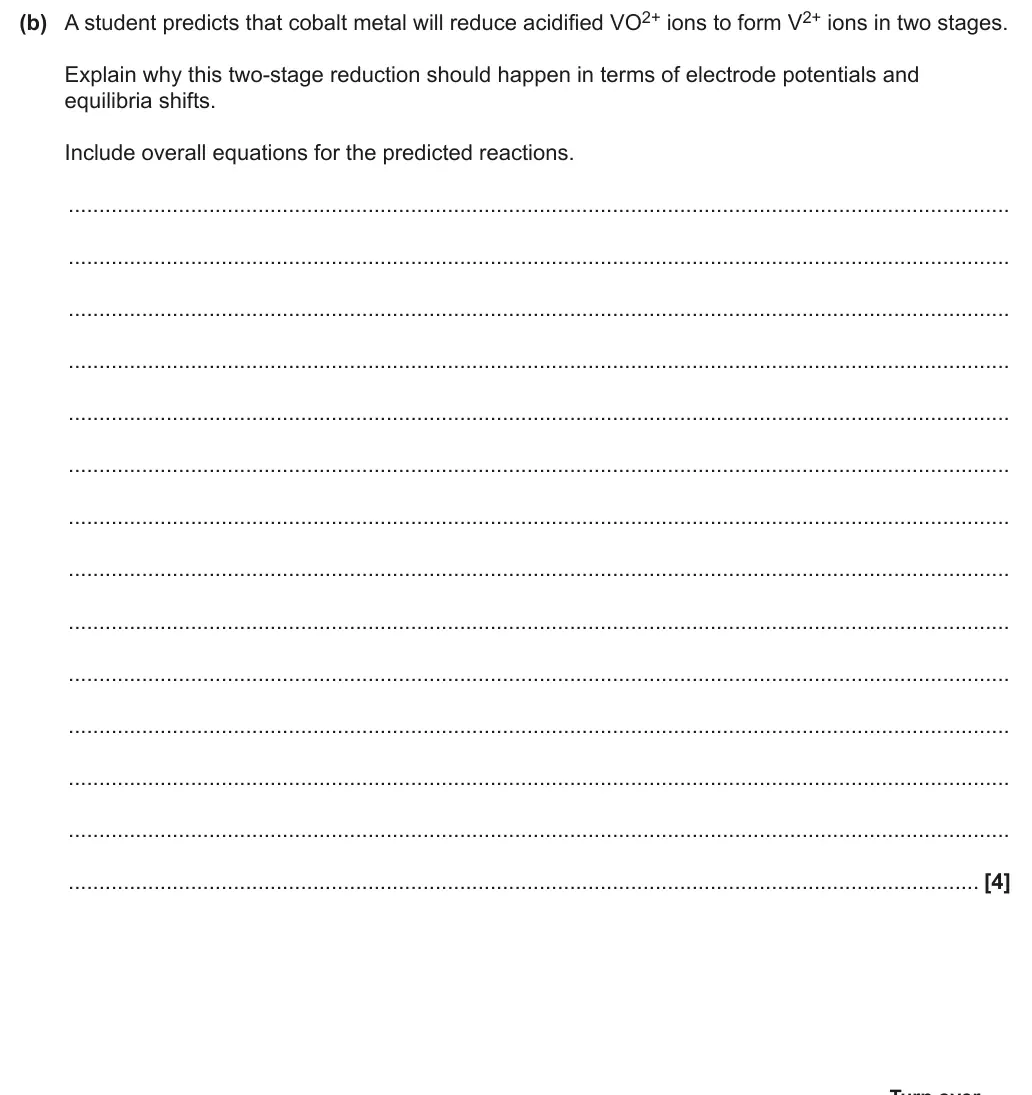
June 2025 · Paper 1 · Q20(b) 4 marks Short answer Medium redox and electrode potentials
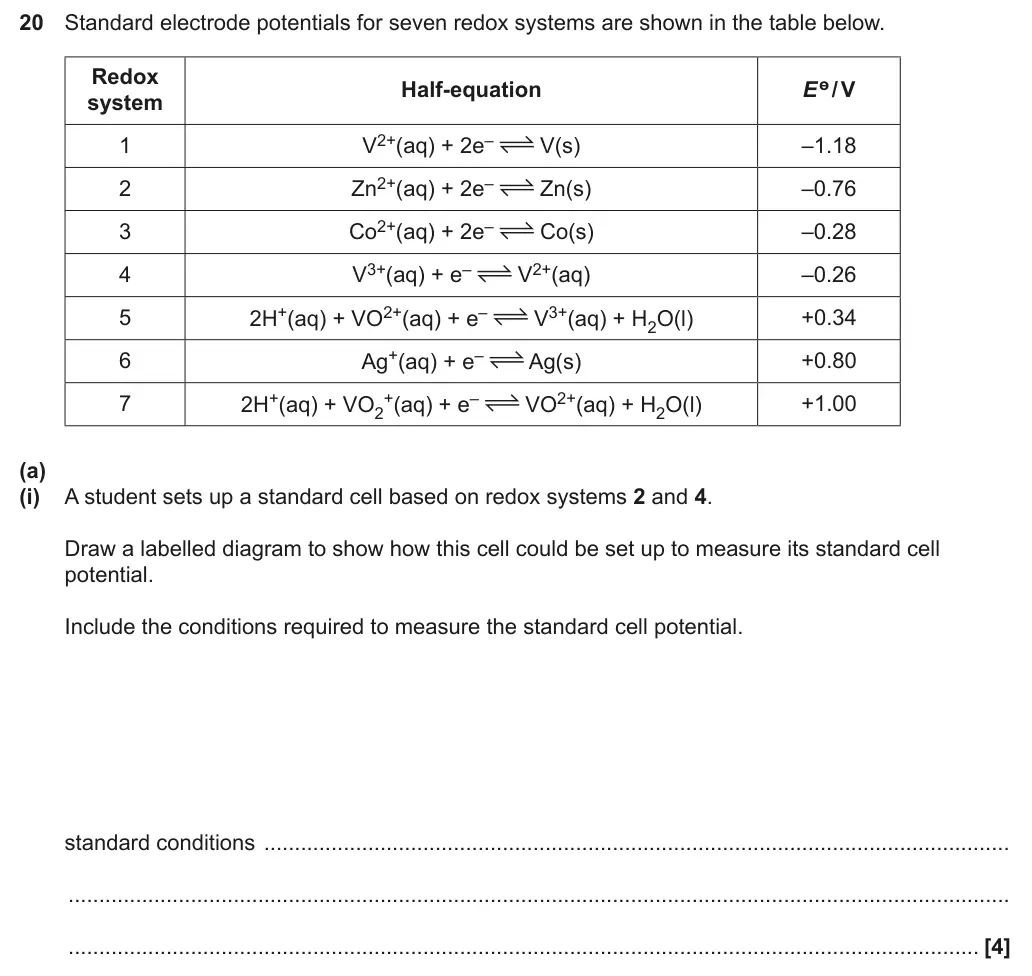
Earlier part of question 20 that this part usesEarlier part of June 2025 Paper 1 question 20
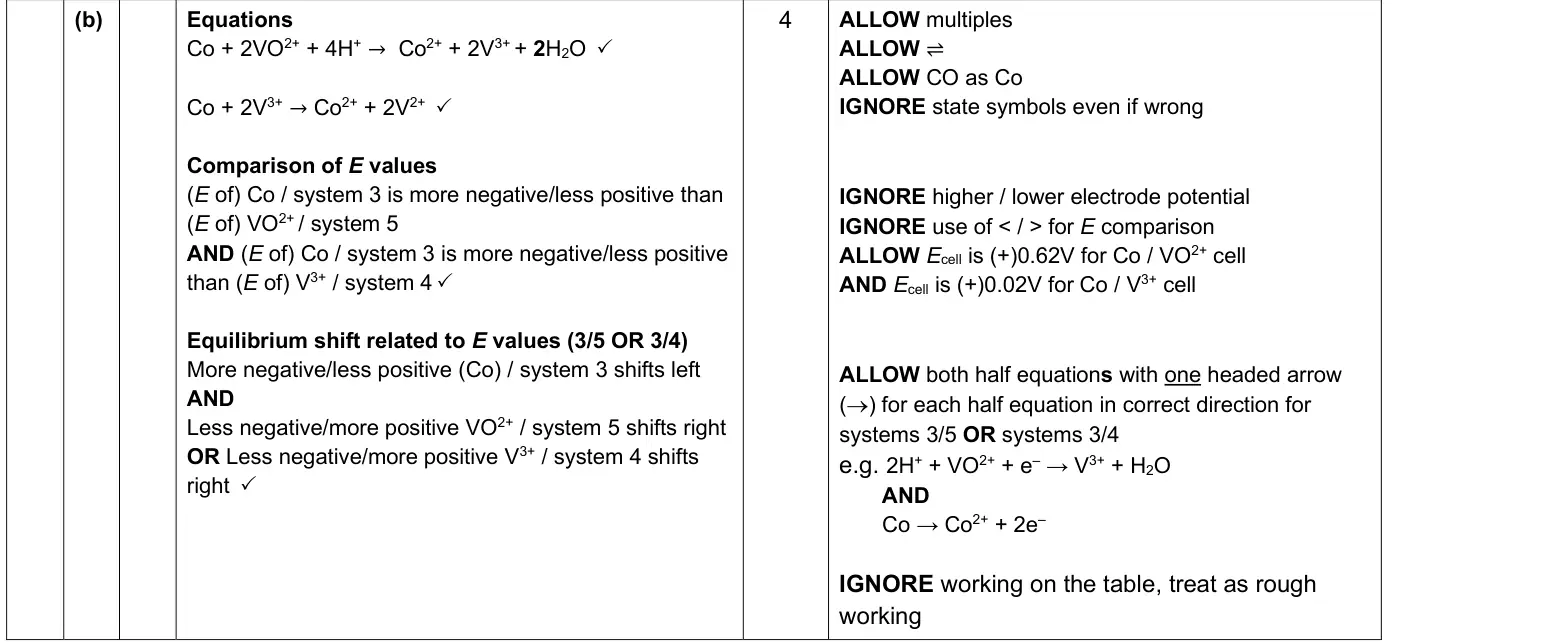
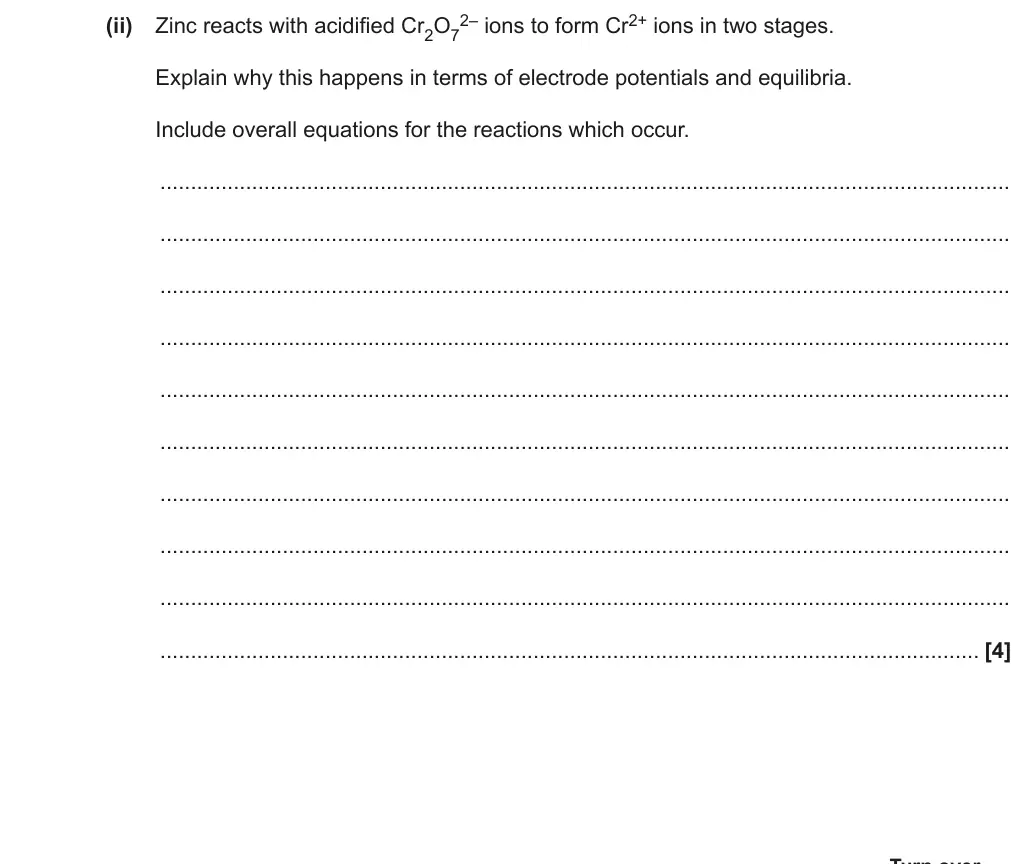
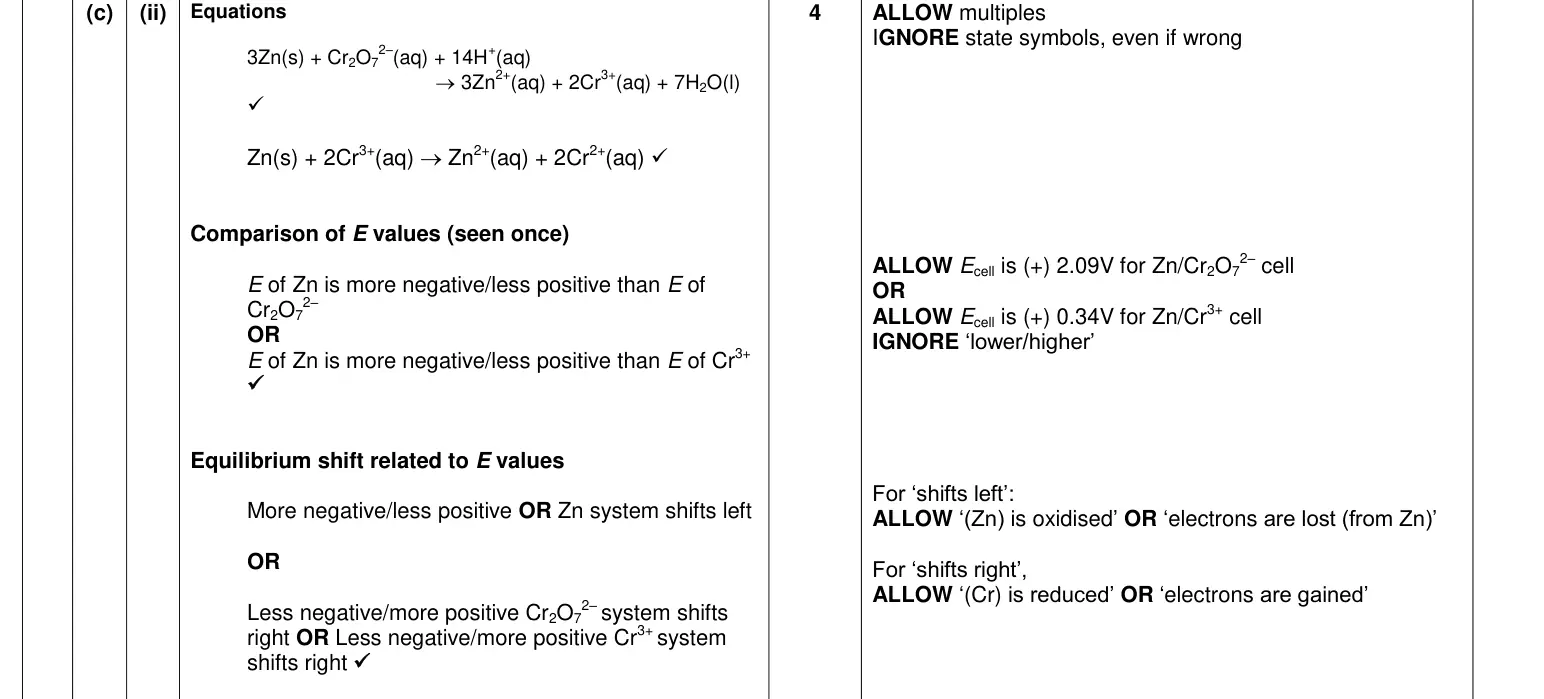
(b)  A student predicts that cobalt metal will reduce acidified VO2+ ions to form V2+ ions in two stages.
Explain why this two-stage reduction should happen in terms of electrode potentials and
equilibria shifts.
Include overall equations for the predicted reactions.
..........................................................................................................................................................
..........................................................................................................................................................
..........................................................................................................................................................
..........................................................................................................................................................
..........................................................................................................................................................
..........................................................................................................................................................
..........................................................................................................................................................
..........................................................................................................................................................
..........................................................................................................................................................
..........................................................................................................................................................
..........................................................................................................................................................
..........................................................................................................................................................
..........................................................................................................................................................
..................................................................................................................................................... [4]
June 2025 · Paper 1 · Q21(a)(i) 2 marks Short answer Medium transition elements
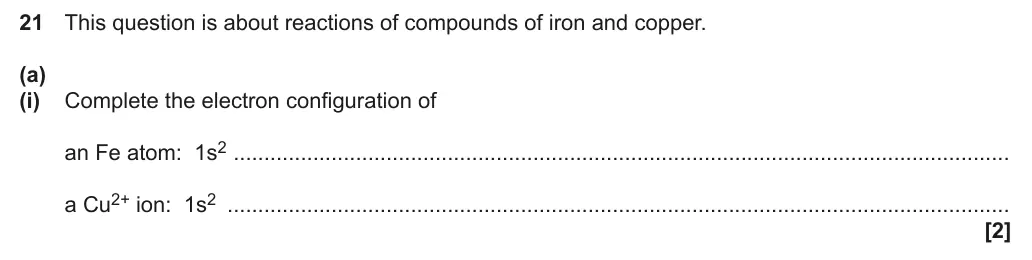
21 This question is about reactions of compounds of iron and copper.
(a)
(i) Complete the electron configuration of
an Fe atom:  1s2 ...............................................................................................................................
a Cu2+ ion:  1s2 ................................................................................................................................
[2]
June 2025 · Paper 1 · Q21(a)(ii) 2 marks Short answer Medium transition elementsqualitative analysis
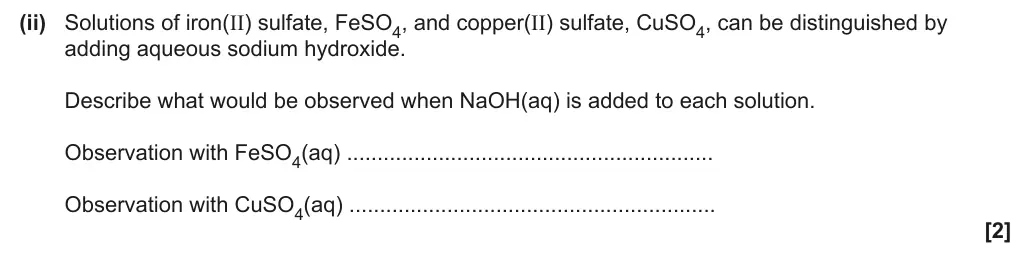
(ii) Solutions of iron(II) sulfate, FeSO4, and copper(II) sulfate, CuSO4, can be distinguished by
adding aqueous sodium hydroxide.
Describe what would be observed when NaOH(aq) is added to each solution.
Observation with FeSO4(aq) ............................................................
Observation with CuSO4(aq) ............................................................
[2]
June 2025 · Paper 1 · Q21(b)(i) 1 mark Short answer Hard transition elements
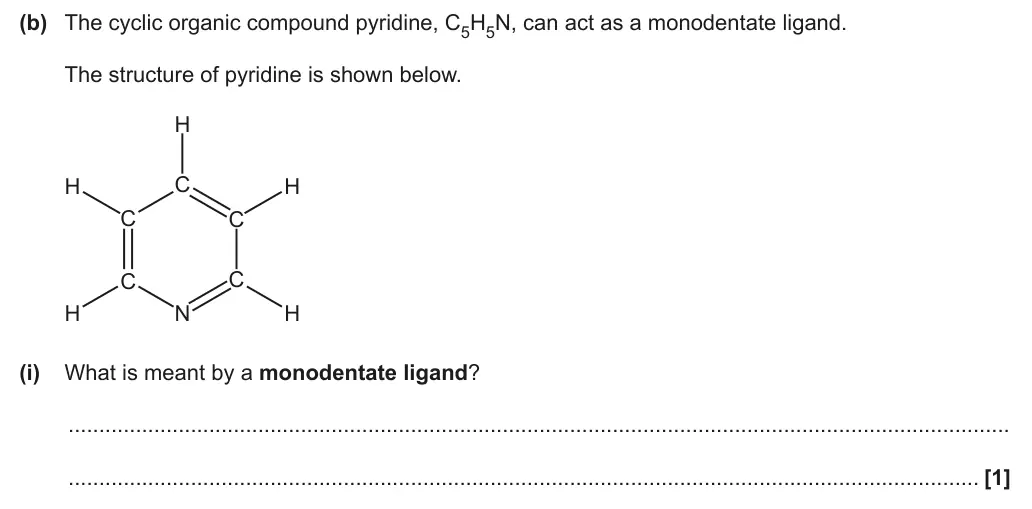
(b)  The cyclic organic compound pyridine, C5H5N, can act as a monodentate ligand.
The structure of pyridine is shown below.
H
H C H
C C
C C
H N H
(i) What is meant by a monodentate ligand?
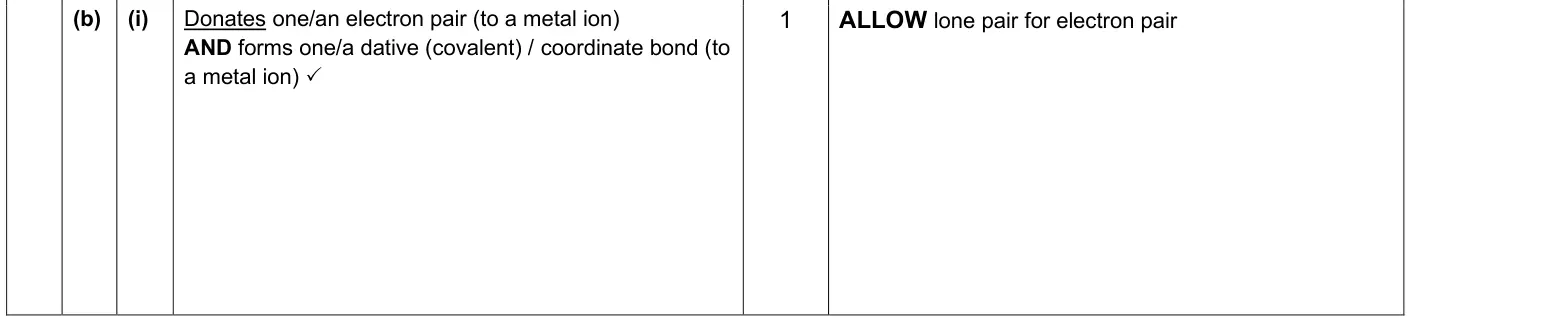
..........................................................................................................................................................
..................................................................................................................................................... [1]
June 2025 · Paper 1 · Q21(d)(ii) 1 mark Short answer Hard transition elementsredox and electrode potentials
Earlier part of question 21 that this part usesEarlier part of June 2025 Paper 1 question 21
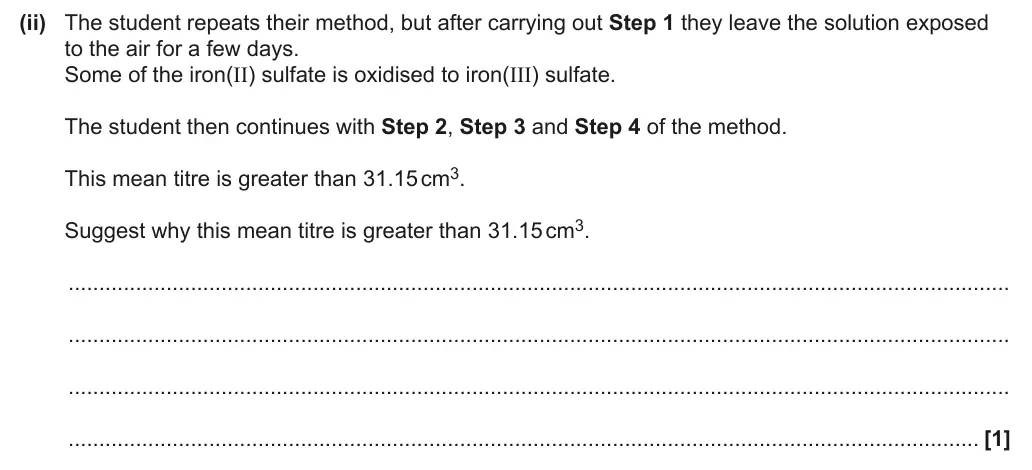
(ii) The student repeats their method, but after carrying out Step 1 they leave the solution exposed
to the air for a few days.
Some of the iron(II) sulfate is oxidised to iron(III) sulfate.
The student then continues with Step 2, Step 3 and Step 4 of the method.
This mean titre is greater than 31.15 cm3.
Suggest why this mean titre is greater than 31.15 cm3.
..........................................................................................................................................................
..........................................................................................................................................................
..........................................................................................................................................................
..................................................................................................................................................... [1]
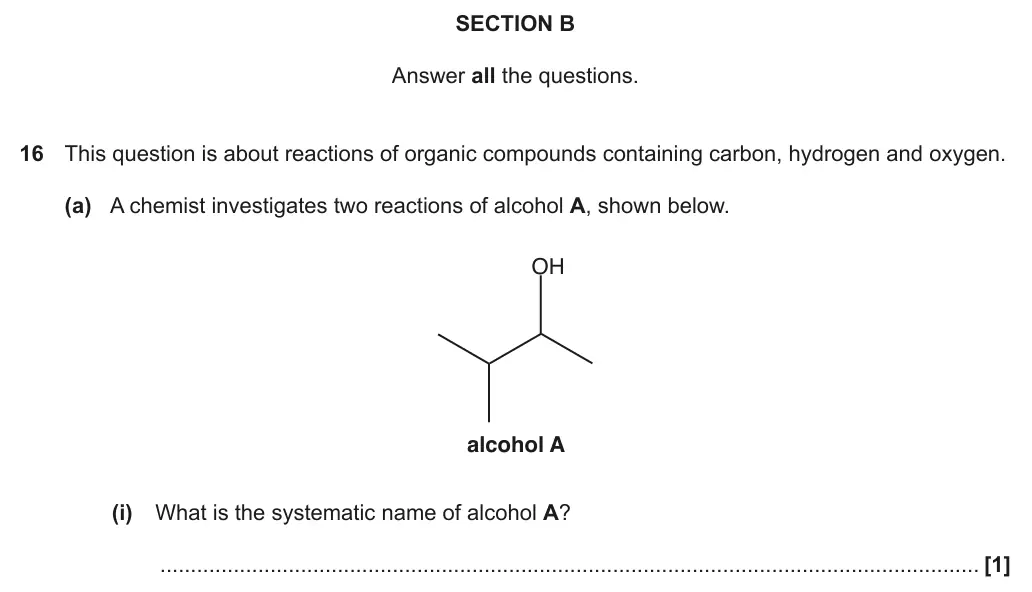
June 2025 · Paper 2 · Q16(a) 1 mark Short answer Easy organic basics
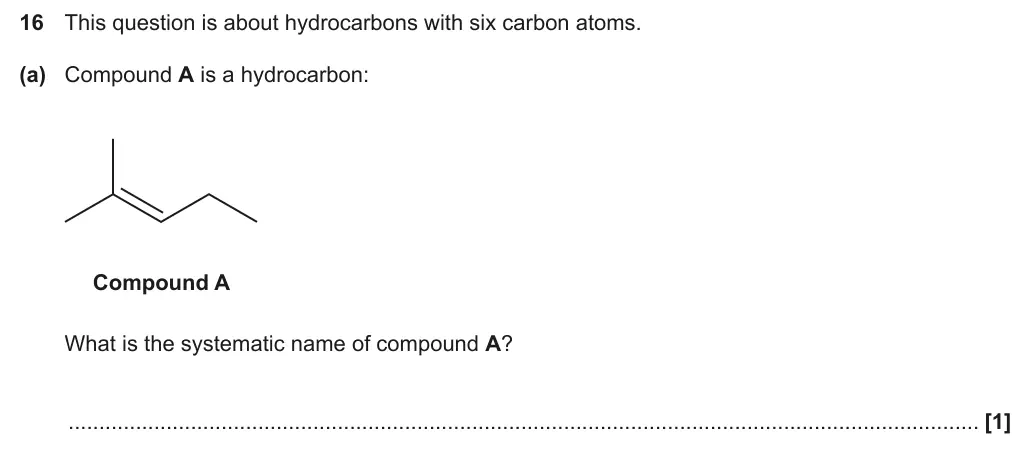
16 This question is about hydrocarbons with six carbon atoms.
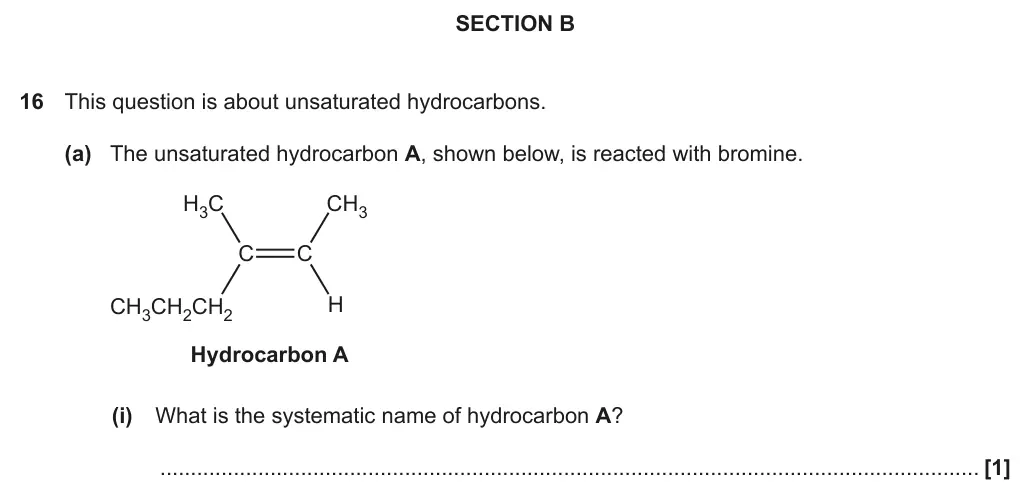
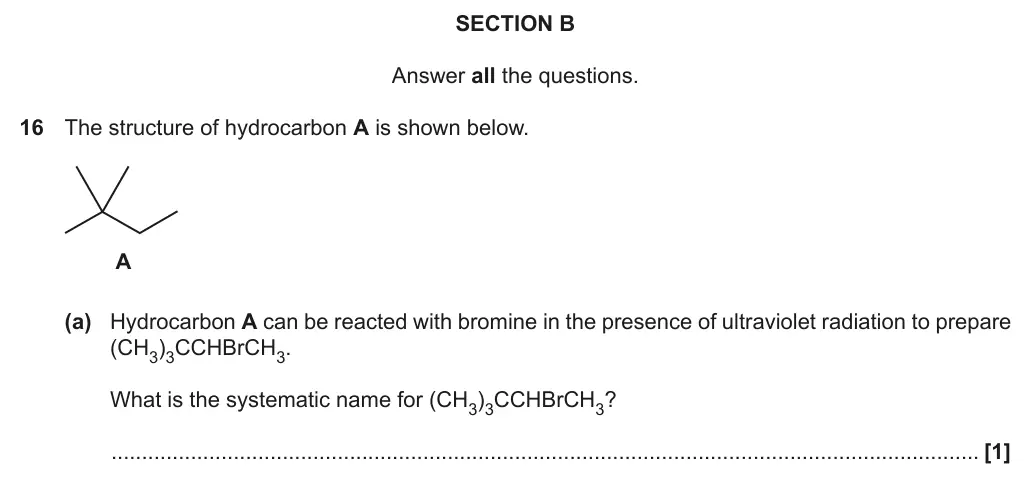
(a) Compound A is a hydrocarbon:
Compound A
What is the systematic name of compound A?
..................................................................................................................................................... [1]
June 2025 · Paper 2 · Q16(c)(ii) 2 marks Short answer Hard alkenes
Earlier part of question 16 that this part usesEarlier part of June 2025 Paper 2 question 16
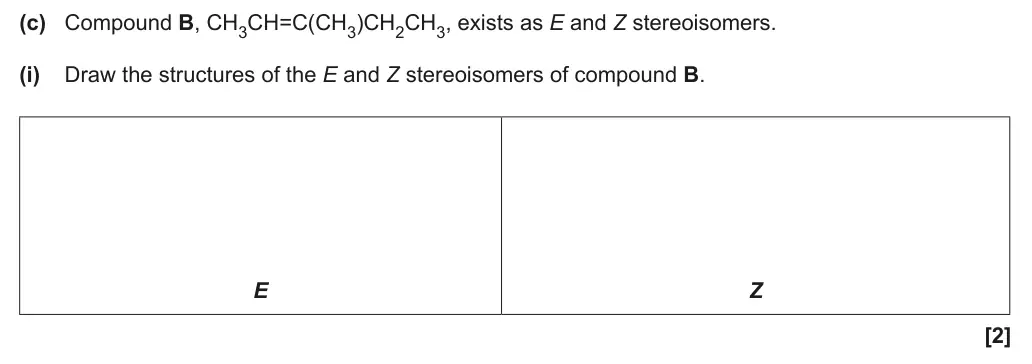
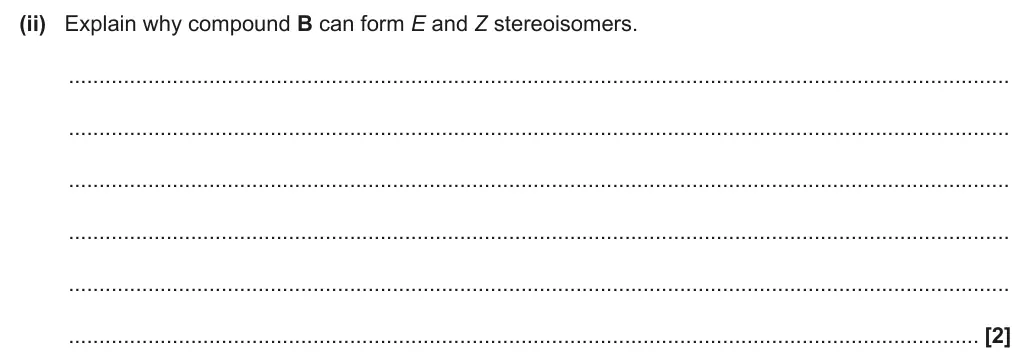
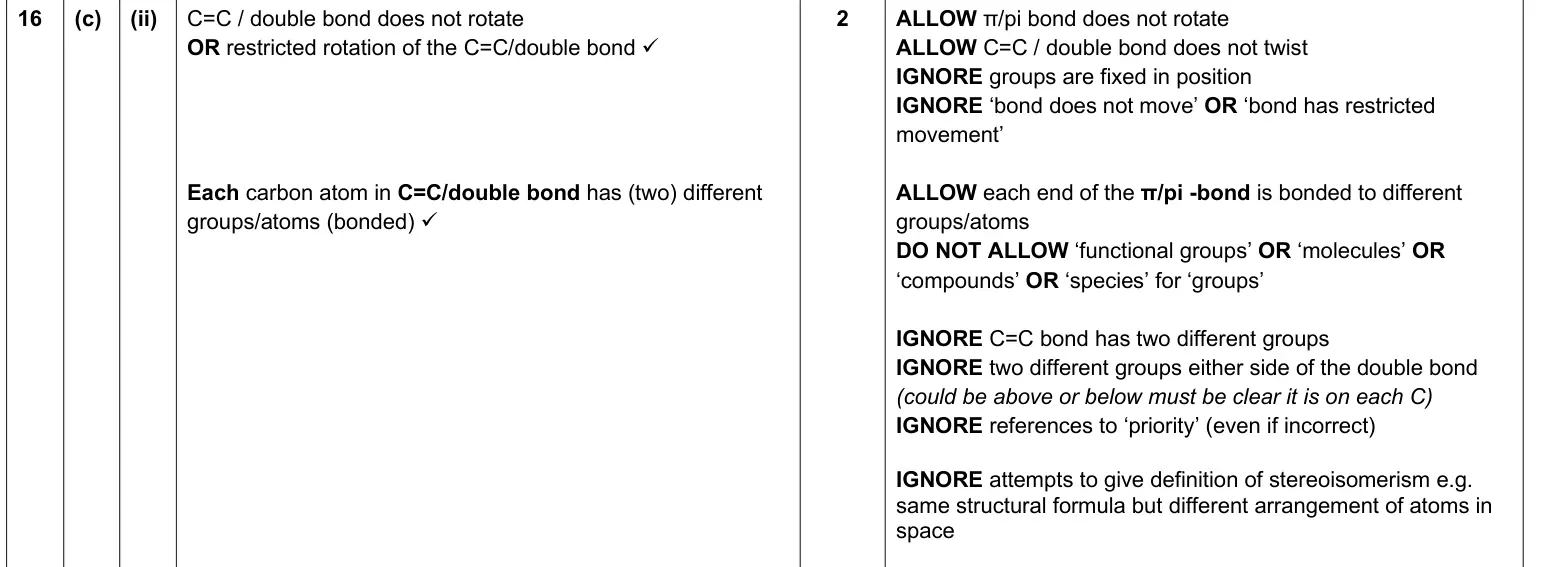
(ii) Explain why compound B can form E and Z stereoisomers.
..........................................................................................................................................................
..........................................................................................................................................................
..........................................................................................................................................................
..........................................................................................................................................................
..........................................................................................................................................................
..................................................................................................................................................... [2]
June 2025 · Paper 2 · Q18(b)(i) 1 mark Short answer Hard alkenes
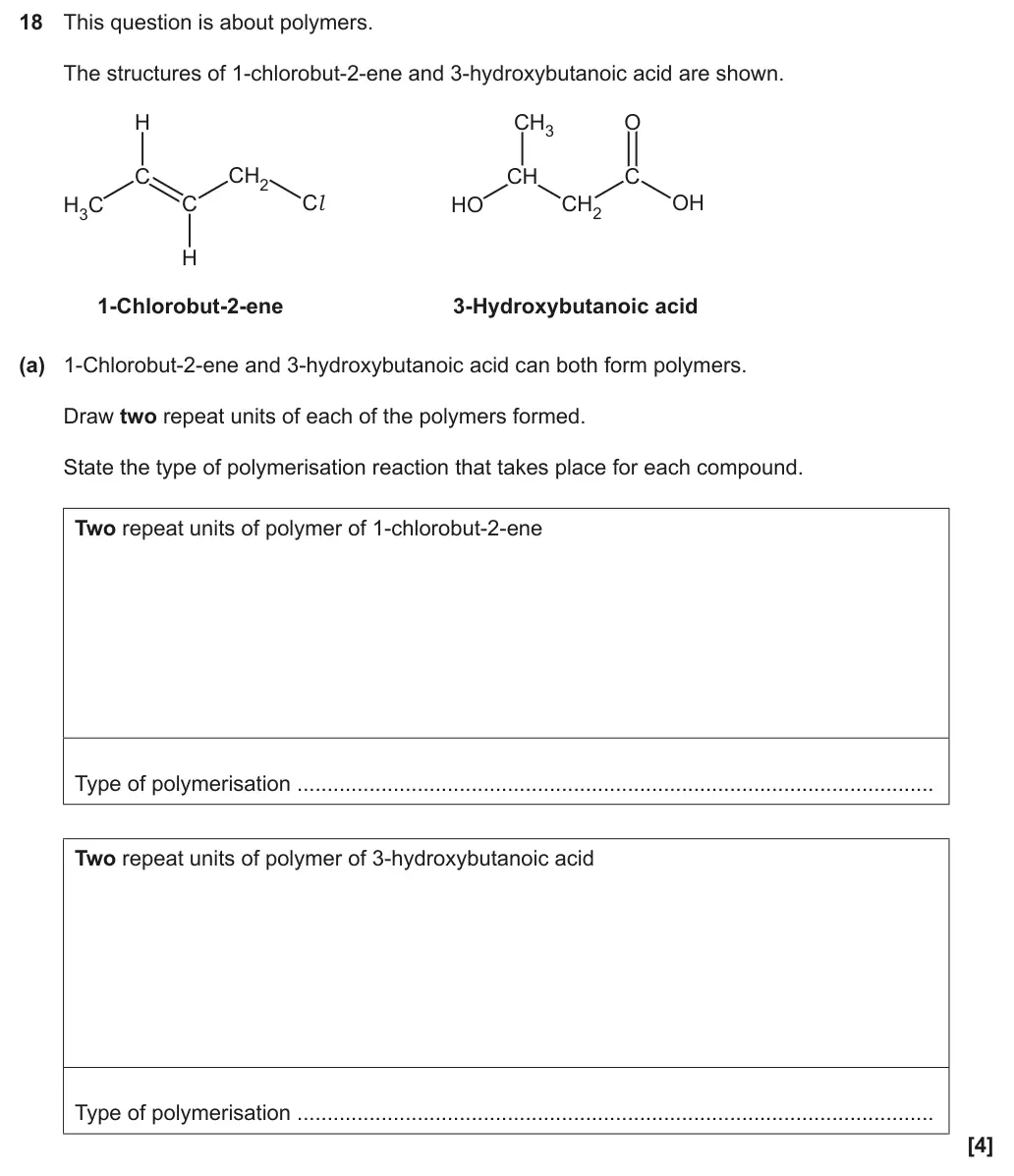
Earlier part of question 18 that this part usesEarlier part of June 2025 Paper 2 question 18
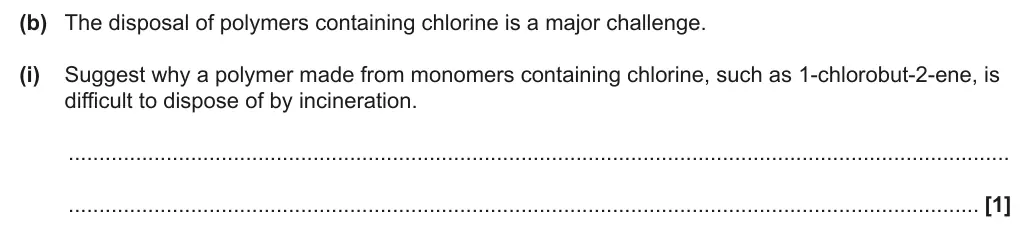
(b) The disposal of polymers containing chlorine is a major challenge.
(i) Suggest why a polymer made from monomers containing chlorine, such as 1-chlorobut-2-ene, is
difficult to dispose of by incineration.
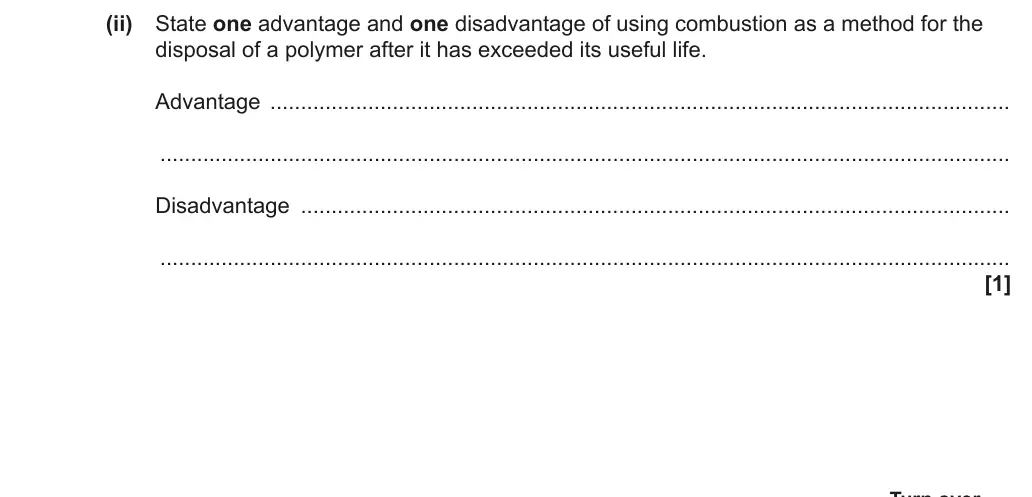
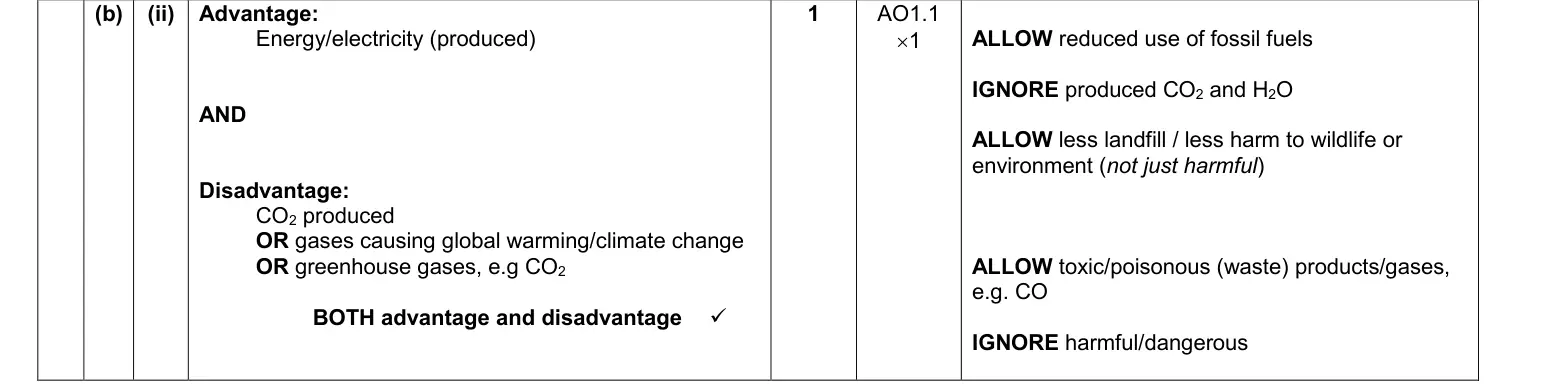
..........................................................................................................................................................
..................................................................................................................................................... [1]
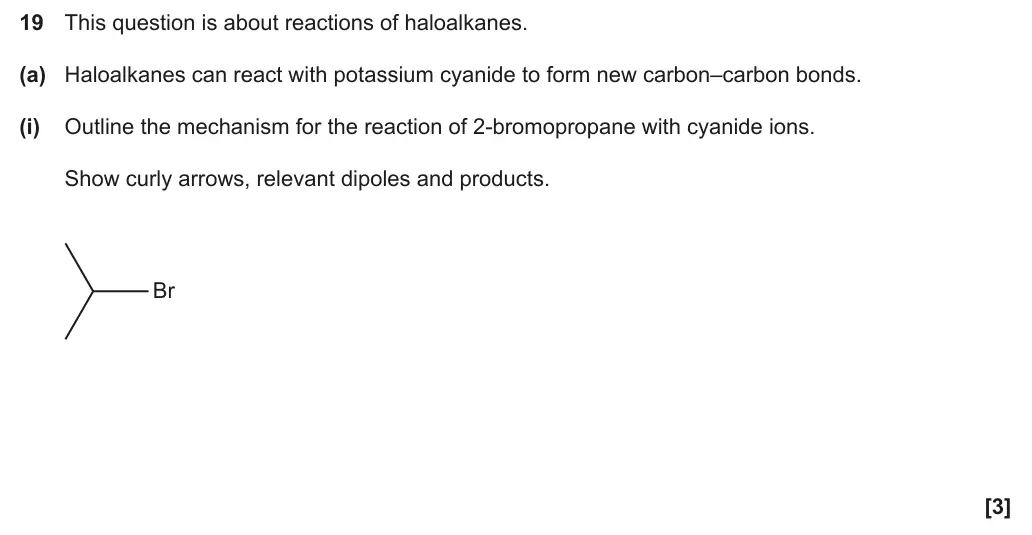
June 2025 · Paper 2 · Q19(a)(ii) 1 mark Short answer Medium carbon carbon bond formationhaloalkanes
Earlier part of question 19 that this part usesEarlier part of June 2025 Paper 2 question 19
(ii) Name this type of mechanism.
..................................................................................................................................................... [1]
June 2025 · Paper 2 · Q19(b)(i) 1 mark Short answer Easy alcohols
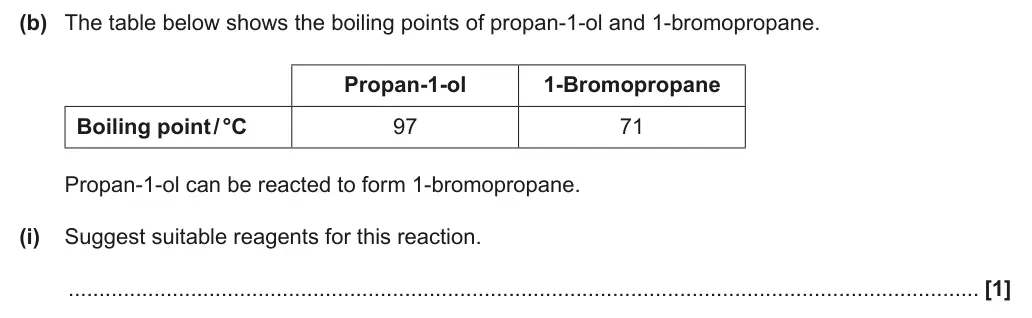
(b) The table below shows the boiling points of propan-1-ol and 1-bromopropane.
Propan-1-ol 1-Bromopropane
Boiling point / °C 97 71
Propan-1-ol can be reacted to form 1-bromopropane.
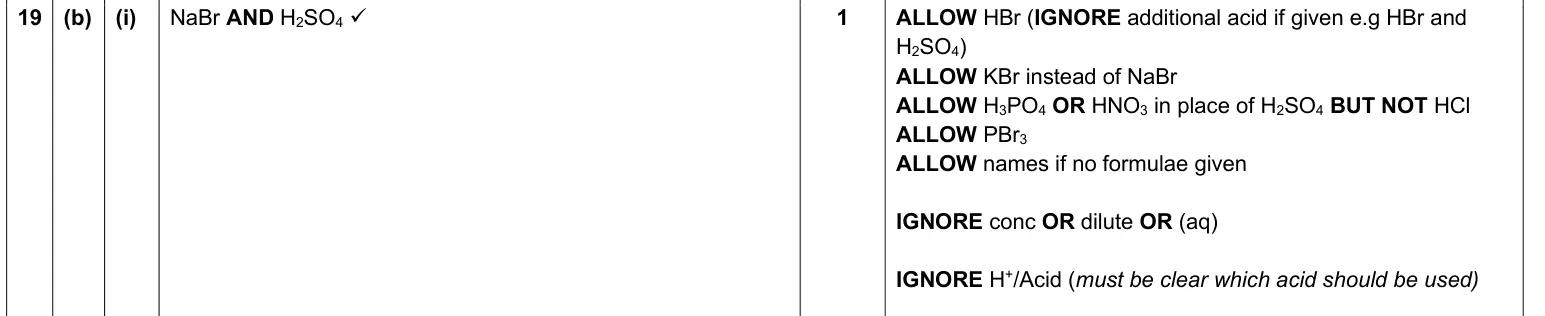
(i) Suggest suitable reagents for this reaction.
..................................................................................................................................................... [1]
June 2025 · Paper 2 · Q19(b)(ii) 4 marks Short answer Medium organic synthesis aspractical skillspractical techniques
Earlier part of question 19 that this part usesEarlier part of June 2025 Paper 2 question 19
(ii) The reaction to form 1-bromopropane from propan-1-ol is carried out in a flask.
After the reaction, the flask contains a mixture of an organic layer (density = 1.35 g cm–3) and
an aqueous layer (1.04 g cm–3).
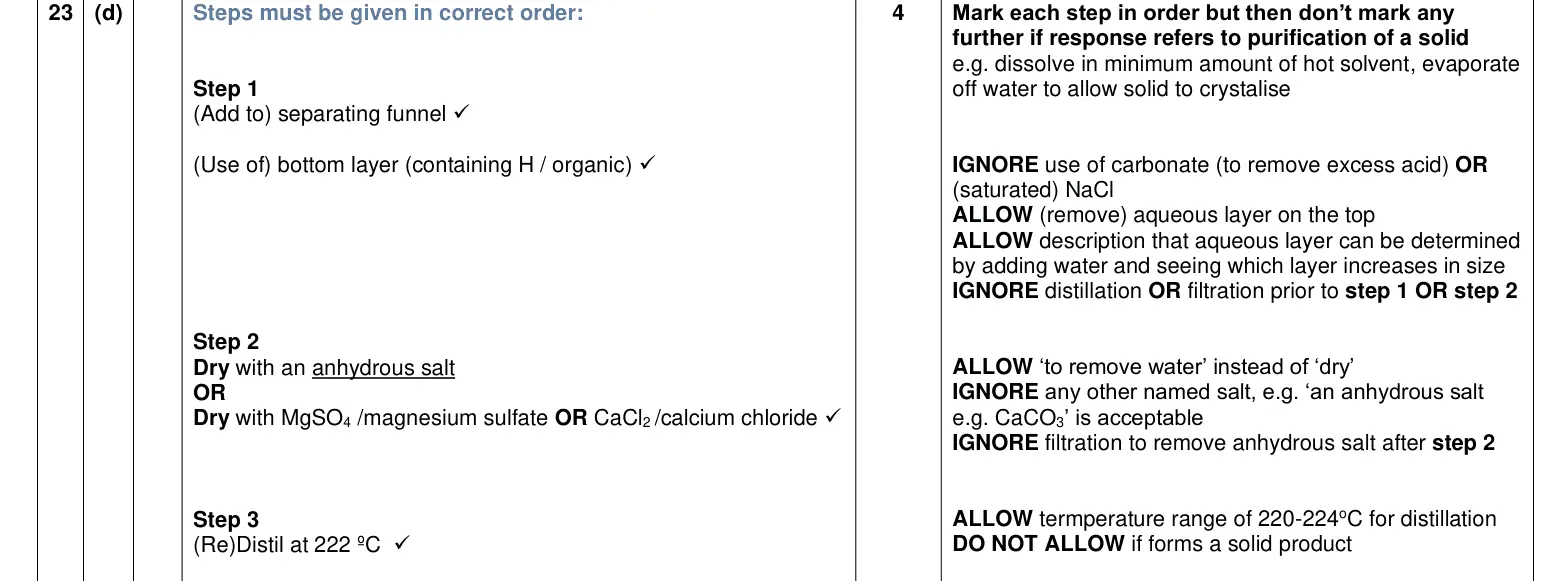
Describe how to obtain pure 1-bromopropane from the mixture.
..........................................................................................................................................................
..........................................................................................................................................................
..........................................................................................................................................................
..........................................................................................................................................................
..........................................................................................................................................................
..........................................................................................................................................................
..........................................................................................................................................................
..................................................................................................................................................... [4]
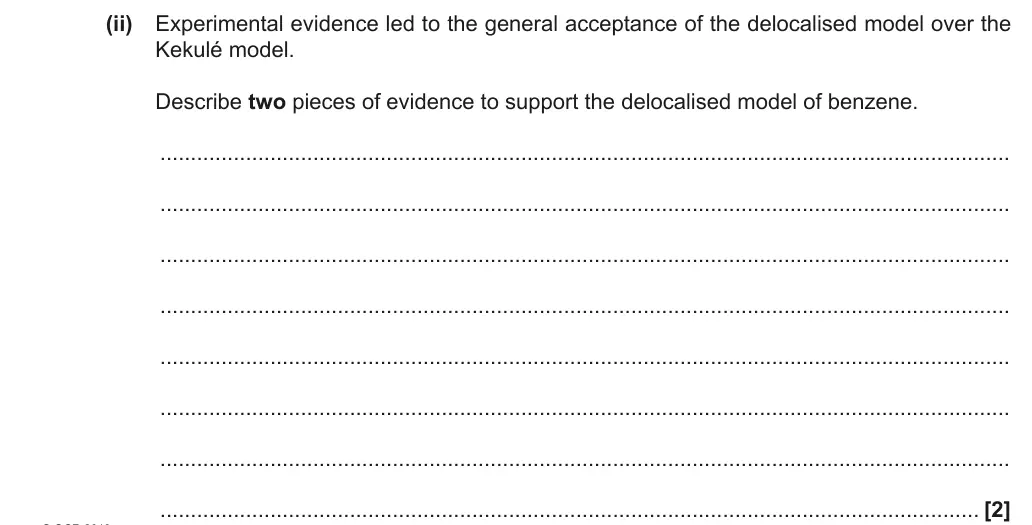
June 2025 · Paper 2 · Q20(a) 2 marks Short answer Medium aromatic compounds
20 This question is about aromatic compounds.
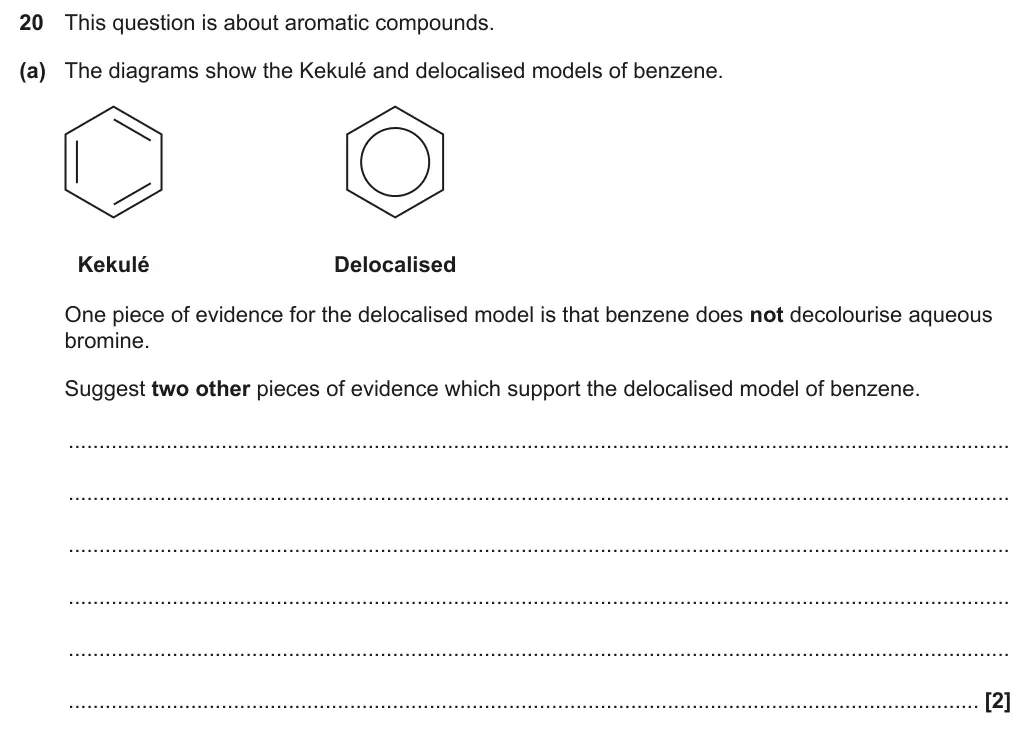
(a) The diagrams show the Kekulé and delocalised models of benzene.
Kekulé Delocalised
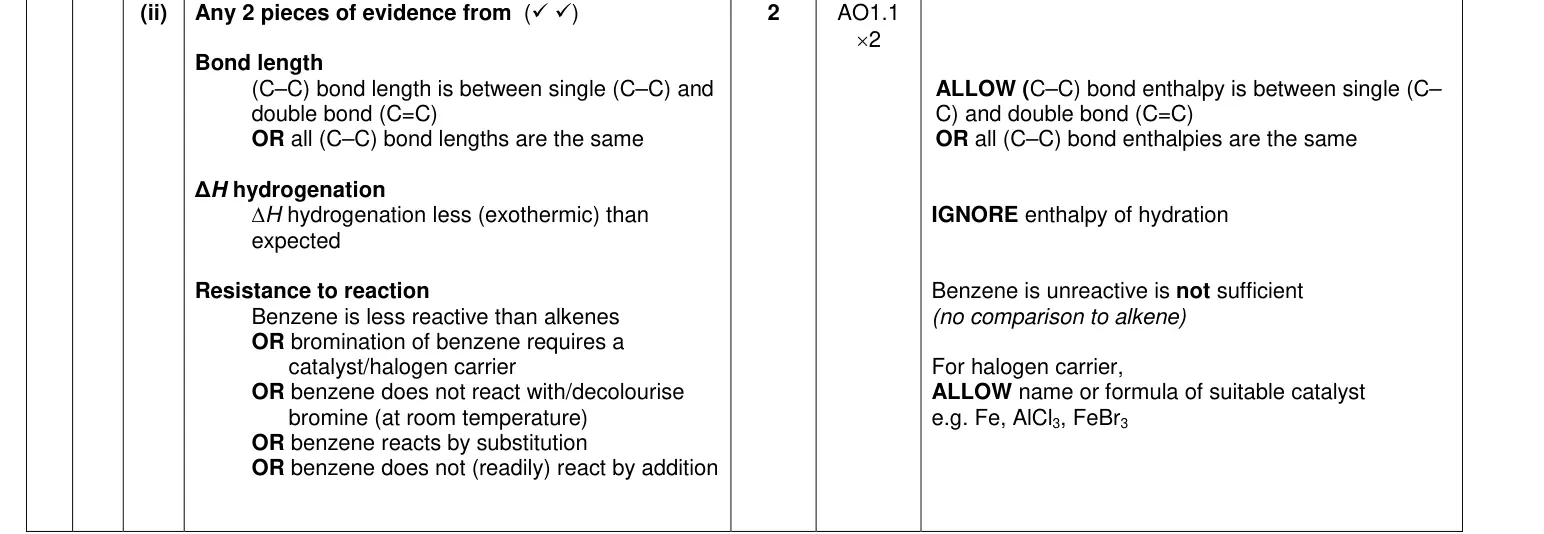
One piece of evidence for the delocalised model is that benzene does not decolourise aqueous
bromine.
Suggest two other pieces of evidence which support the delocalised model of benzene.
..........................................................................................................................................................
..........................................................................................................................................................
..........................................................................................................................................................
..........................................................................................................................................................
..........................................................................................................................................................
..................................................................................................................................................... [2]
June 2025 · Paper 2 · Q20(c)(i) 1 mark Short answer Medium aromatic compoundscarbon carbon bond formation
(c) Compound G is an organic compound used in the production of pesticides.
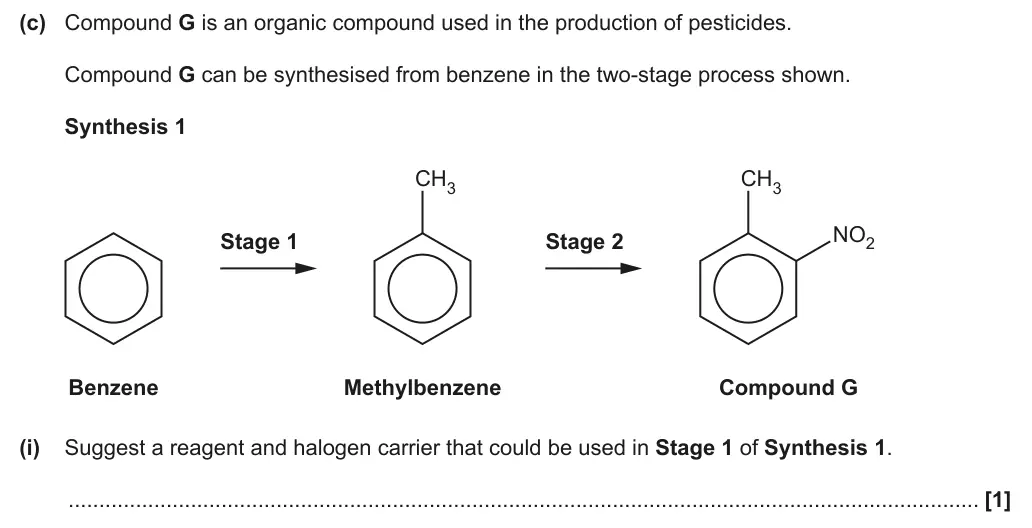
Compound G can be synthesised from benzene in the two-stage process shown.
Synthesis 1
CH3 CH3
NO2
Stage 1 Stage 2
Benzene Methylbenzene Compound G
(i) Suggest a reagent and halogen carrier that could be used in Stage 1 of Synthesis 1.
..................................................................................................................................................... [1]
June 2025 · Paper 2 · Q21(a) 1 mark Short answer Medium organic basics
21 This question is about carbonyl compounds.
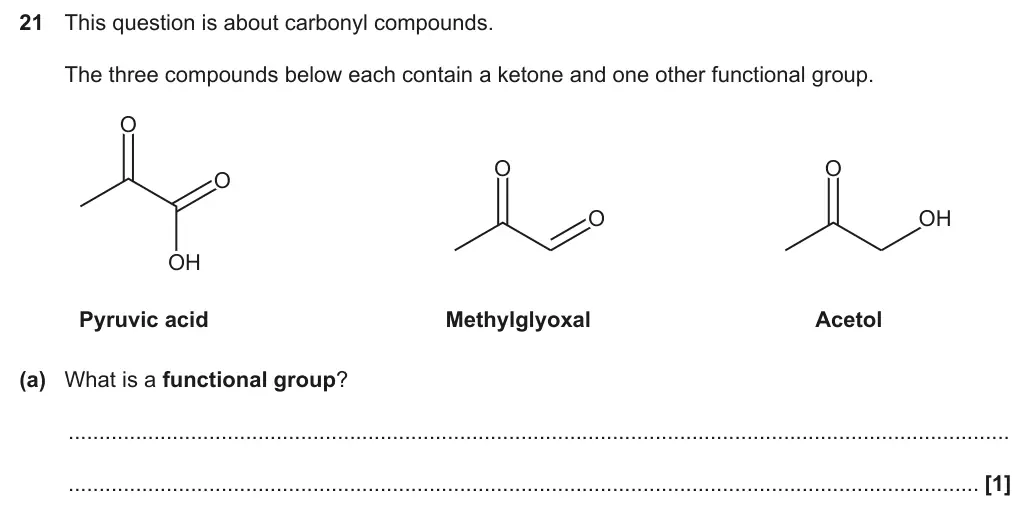
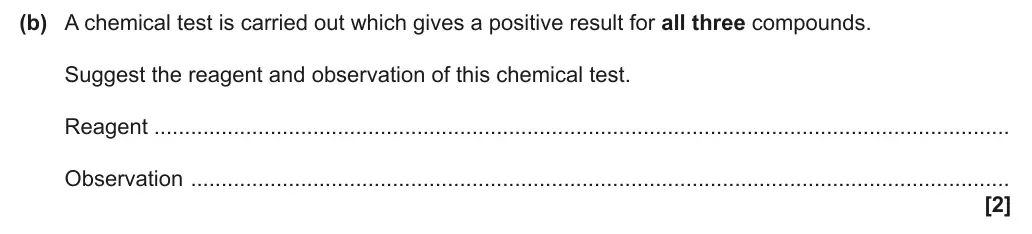
The three compounds below each contain a ketone and one other functional group.
O
O O
O
O OH
OH
Pyruvic acid Methylglyoxal Acetol
(a) What is a functional group?
..........................................................................................................................................................
..................................................................................................................................................... [1]
June 2025 · Paper 2 · Q21(b) 2 marks Short answer Easy carbonyl compoundschromatography and functional group tests
Earlier part of question 21 that this part usesEarlier part of June 2025 Paper 2 question 21
(b) A chemical test is carried out which gives a positive result for all three compounds.
Suggest the reagent and observation of this chemical test.
Reagent ............................................................................................................................................
Observation  ......................................................................................................................................
[2]
June 2025 · Paper 2 · Q21(e) 7 marks Short answer Hard carboxylic acids and esterscarbonyl compounds
Earlier part of question 21 that this part usesEarlier part of June 2025 Paper 2 question 21
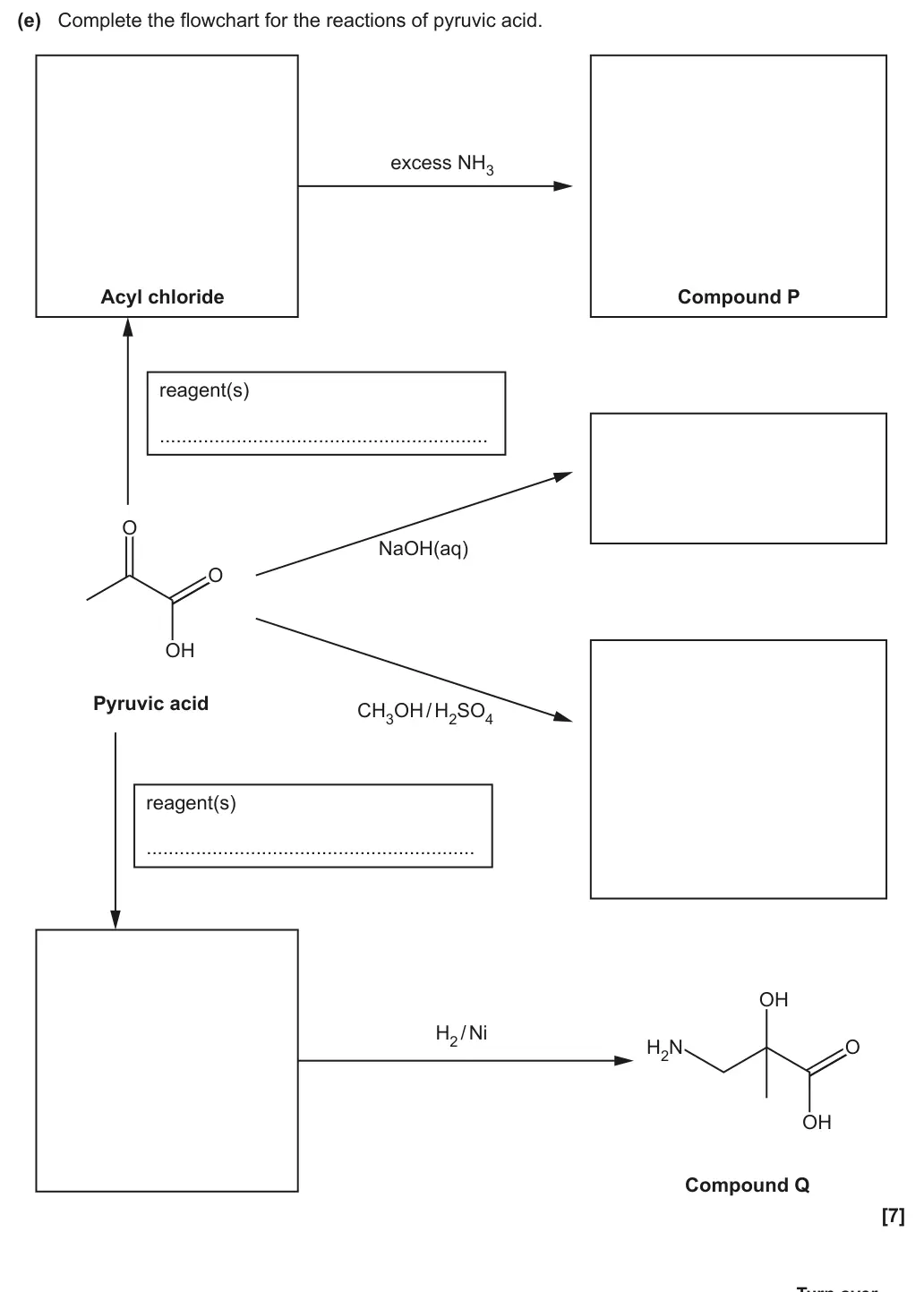
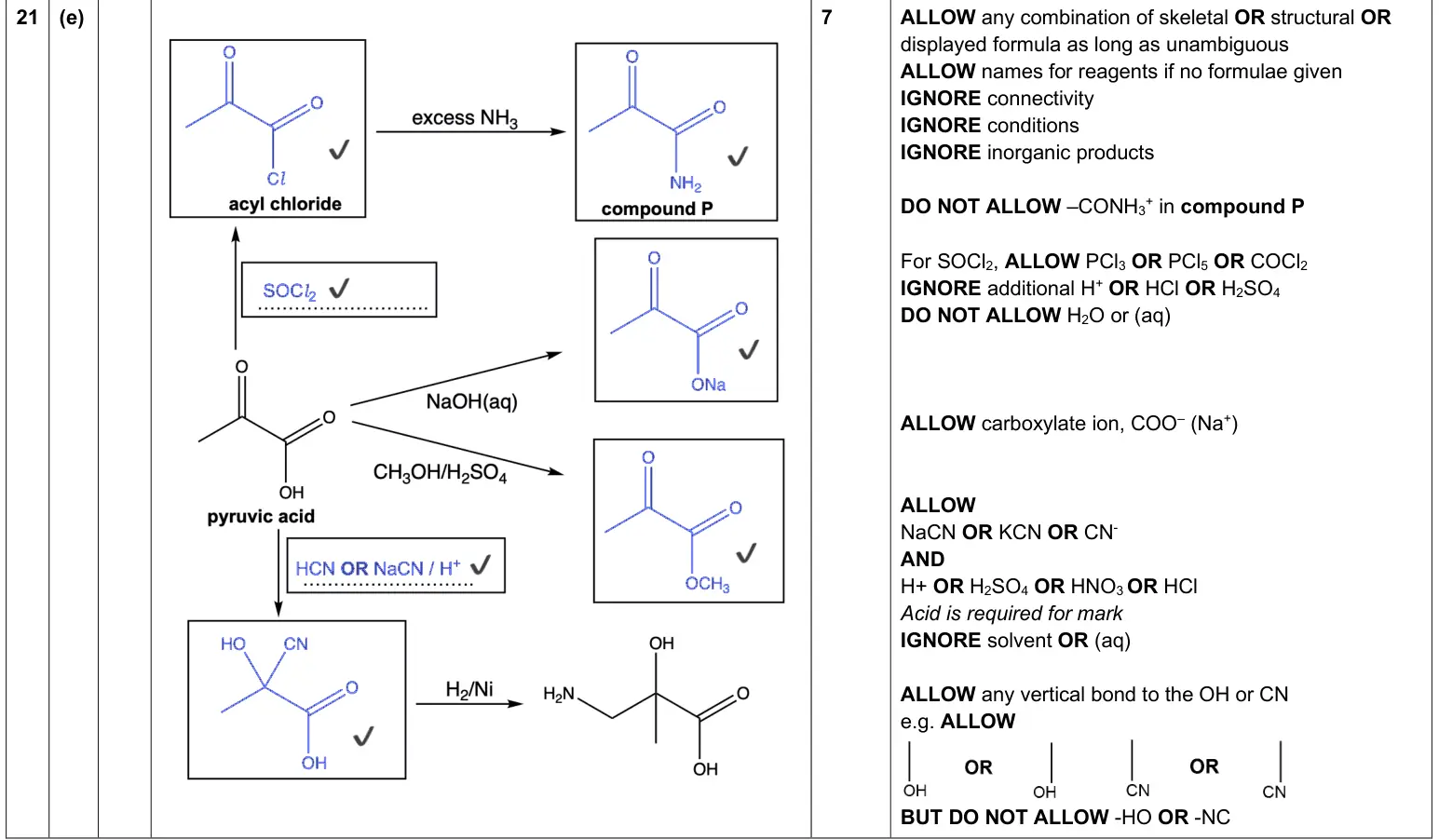
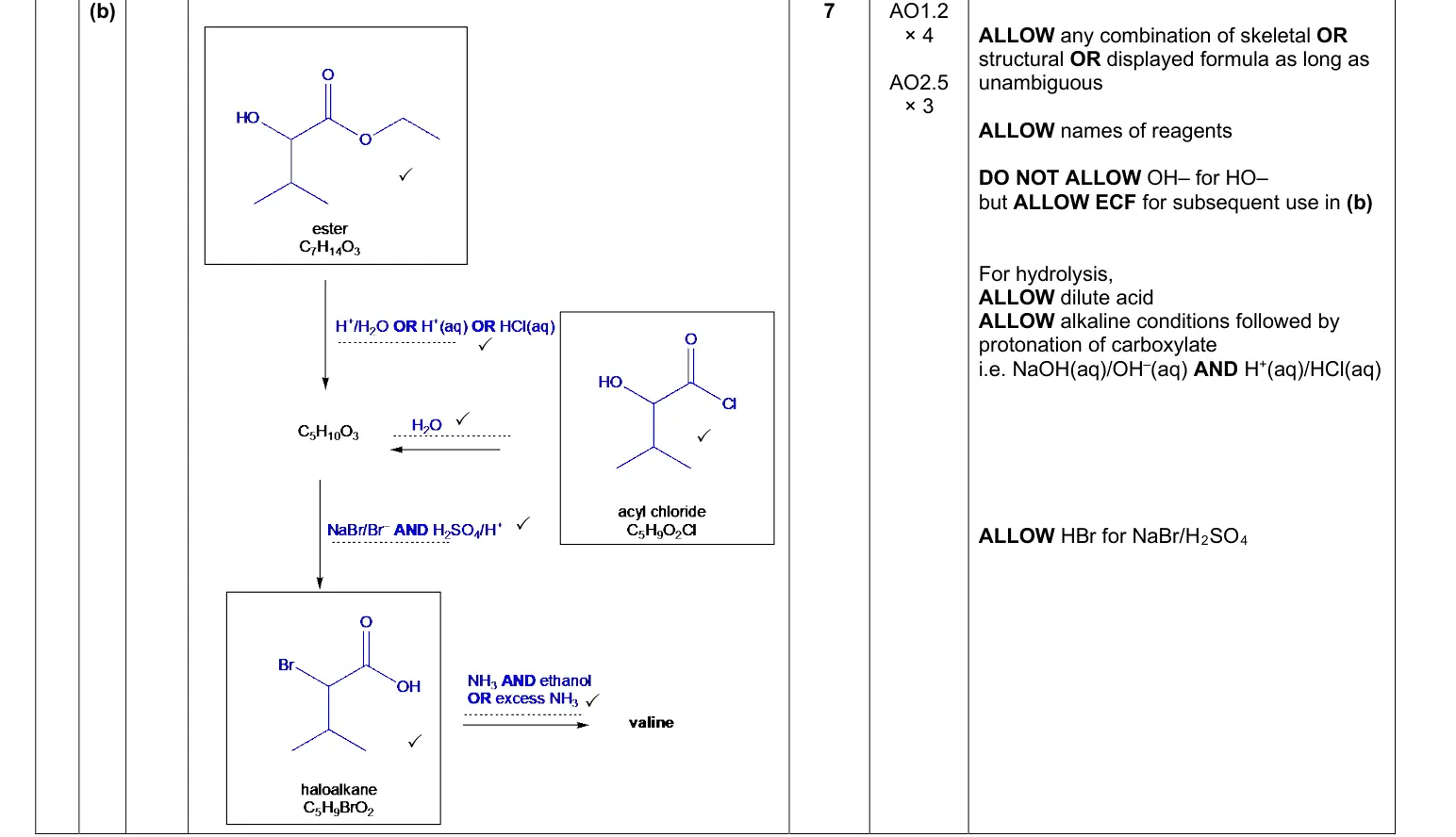
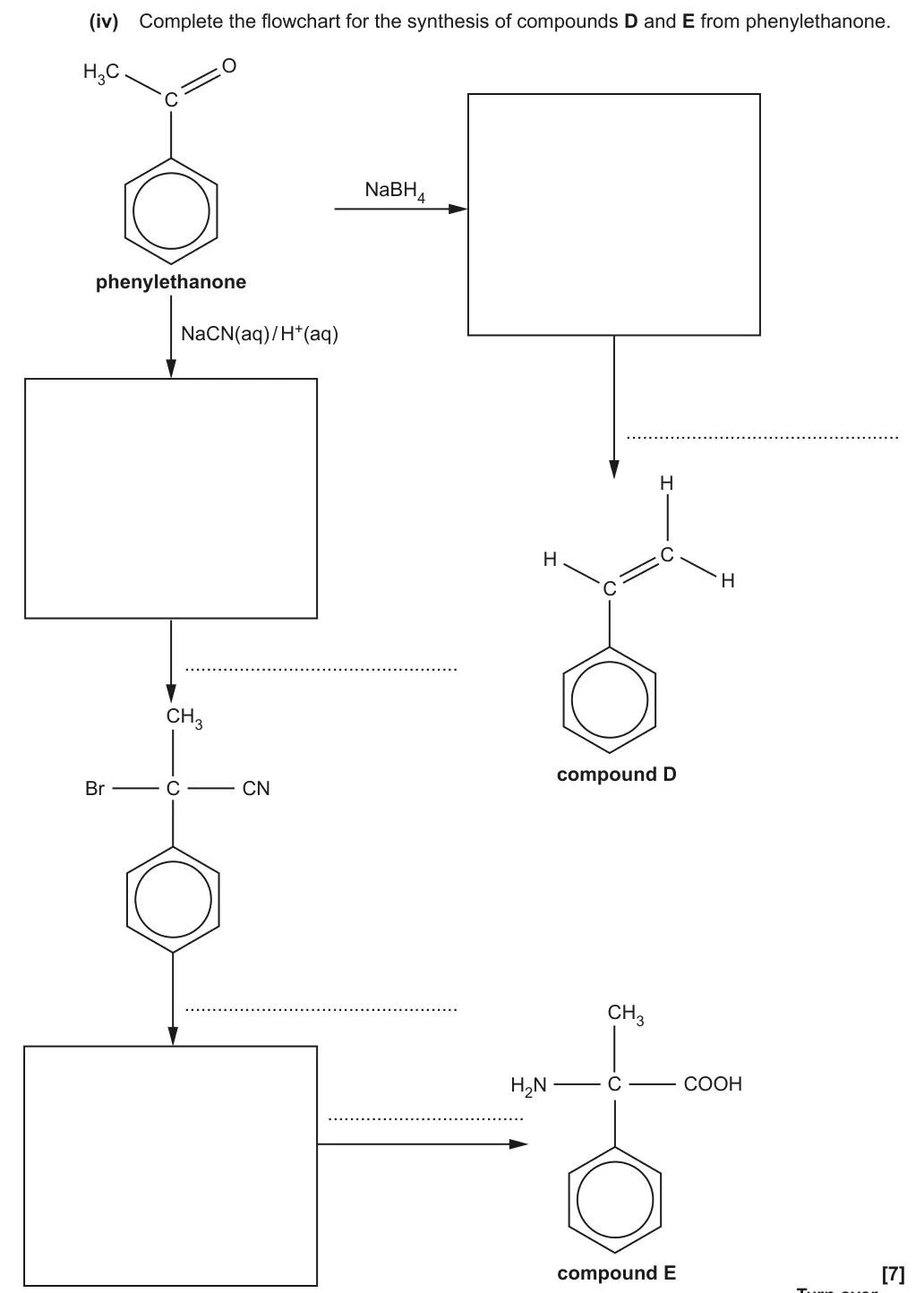
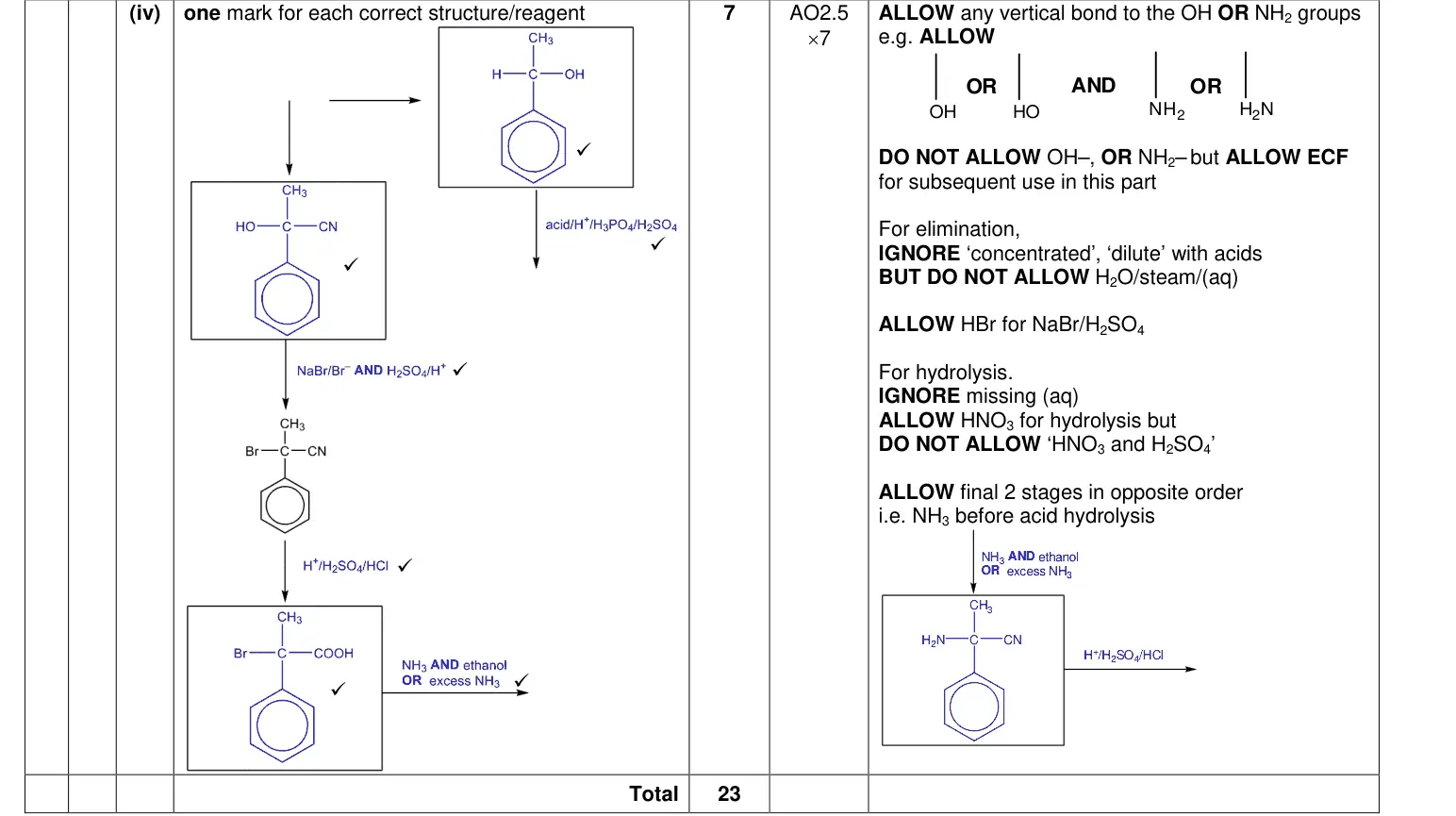
(e) Complete the flowchart for the reactions of pyruvic acid.
excess NH3
Acyl chloride Compound P
reagent(s)
............................................................
O
NaOH(aq)
O
OH
Pyruvic acid
CH3OH / H2SO4
reagent(s)
............................................................
OH
H2 / Ni
H2N O
OH
Compound Q
[7]
June 2025 · Paper 2 · Q22(a)(i) 1 mark Short answer Medium chromatography and functional group tests
22 This question is about organic acids.
α-Amino acids have the general formula RCH(NH2)COOH.
(a) Compound S is made of two α-amino acids bonded together.
Compound S is hydrolysed into its component α-amino acids.
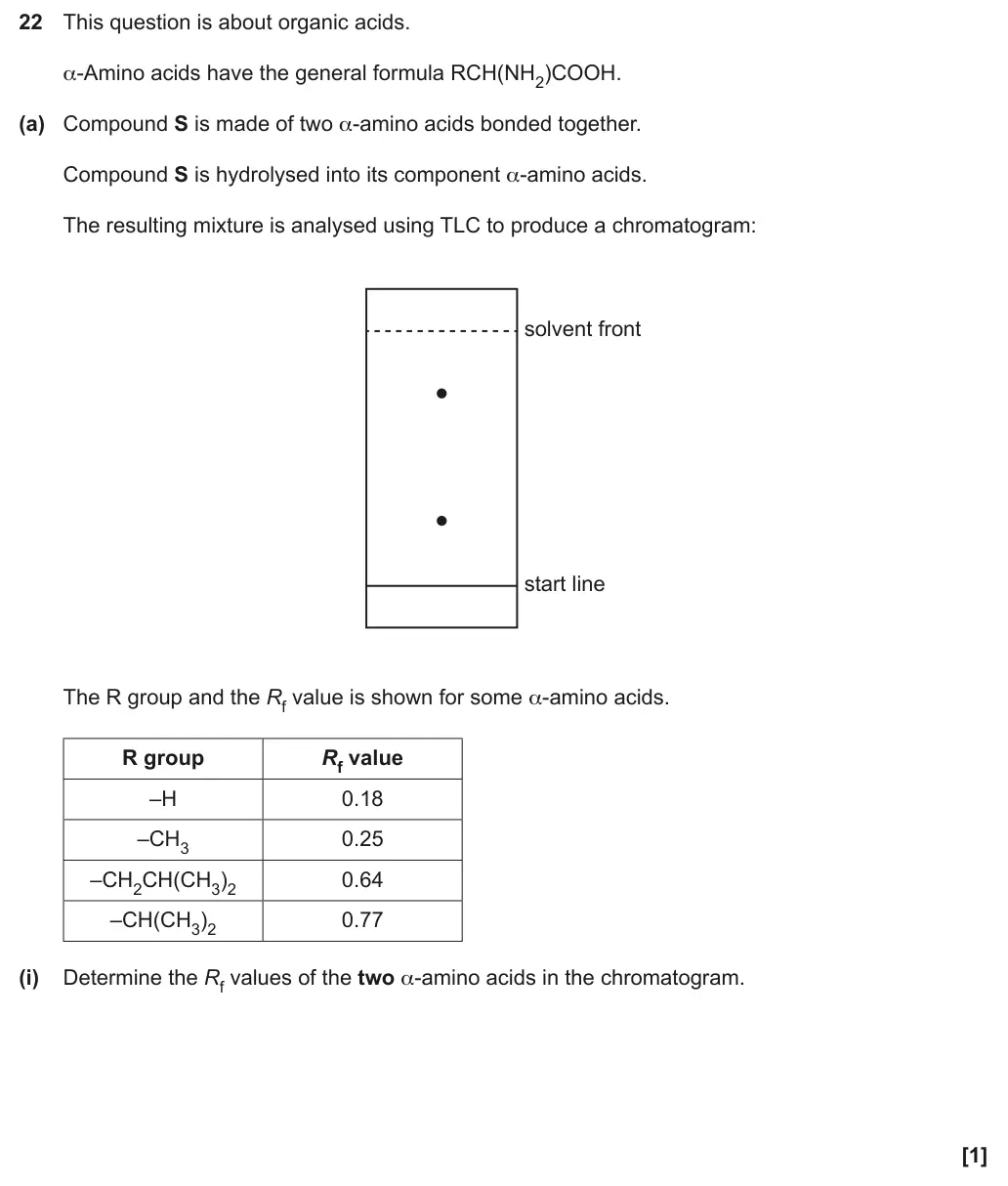
The resulting mixture is analysed using TLC to produce a chromatogram:
solvent front
start line
The R group and the Rf value is shown for some α-amino acids.
R group Rf value
–H 0.18
–CH3 0.25
–CH2CH(CH3)2 0.64
–CH(CH3)2 0.77
(i) Determine the Rf values of the two α-amino acids in the chromatogram.
[1]
June 2025 · Paper 2 · Q22(b)(ii) 1 mark Short answer Hard organic synthesisamino acids amides and chirality
Earlier part of question 22 that this part usesEarlier part of June 2025 Paper 2 question 22
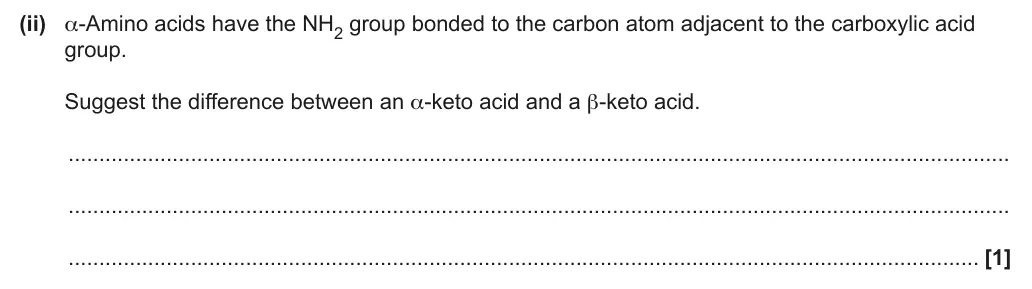
(ii) α-Amino acids have the NH2 group bonded to the carbon atom adjacent to the carboxylic acid
group.
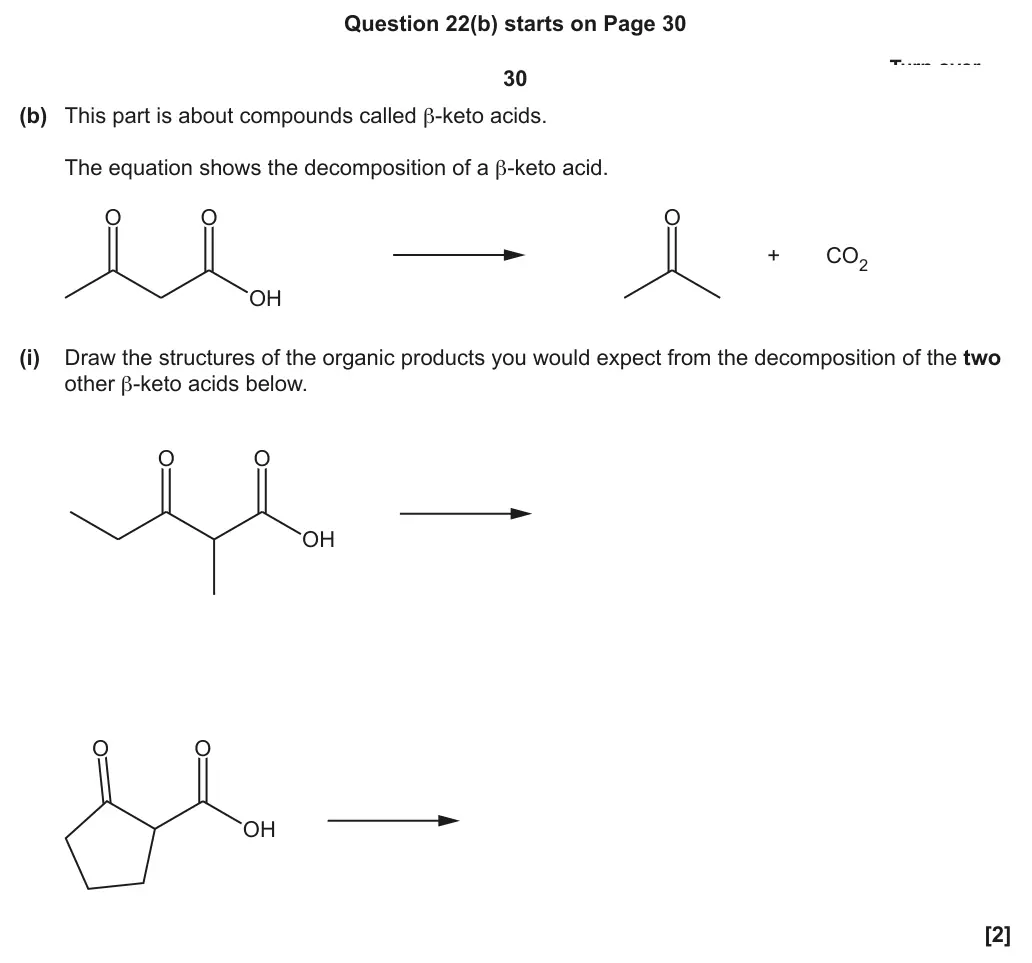
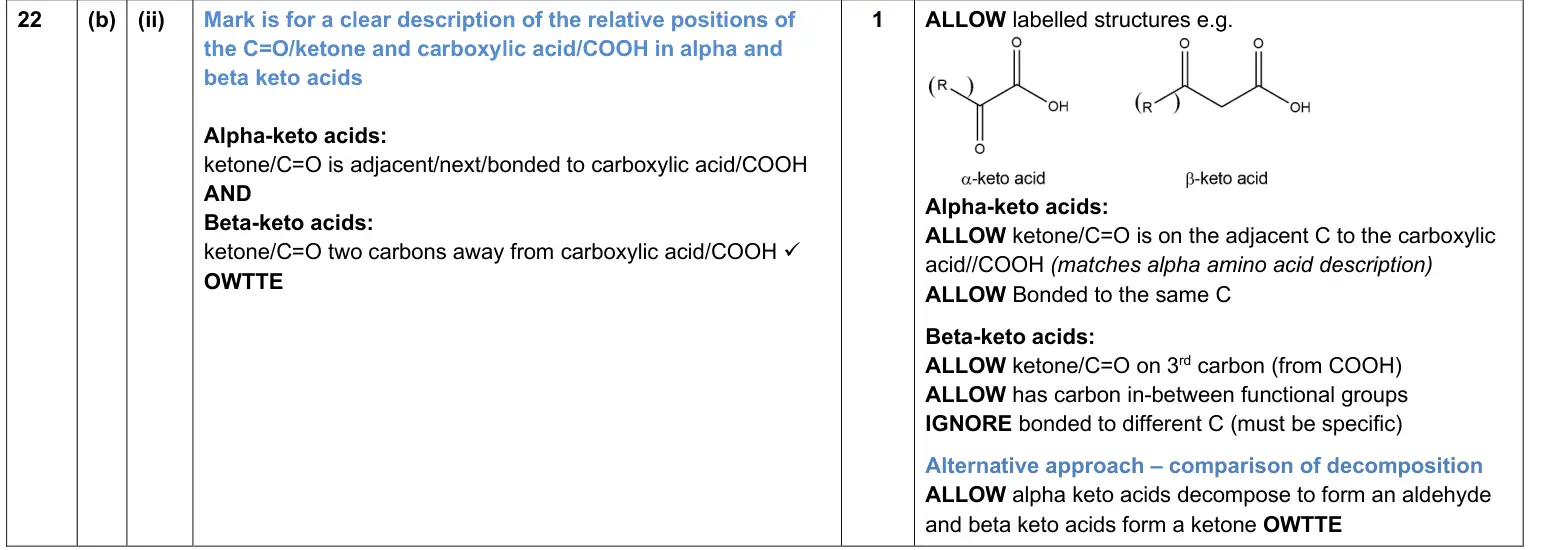
Suggest the difference between an α-keto acid and a β-keto acid.
..........................................................................................................................................................
..........................................................................................................................................................
..................................................................................................................................................... [1]
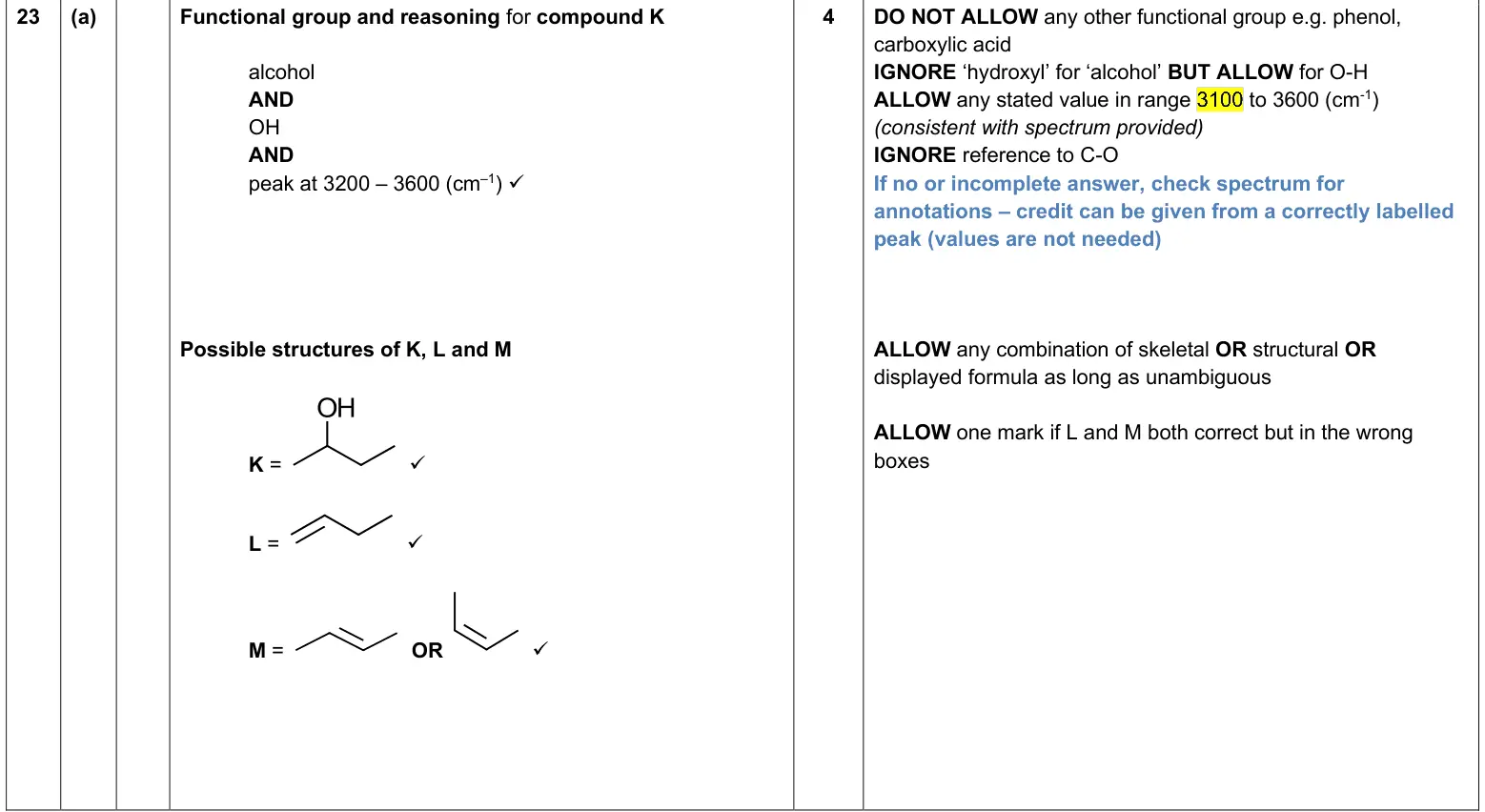
June 2025 · Paper 2 · Q23(a) 4 marks Short answer Hard infrared and mass spectrometryorganic basicsalcoholsnmr spectroscopy
23 This question is about spectral analysis.
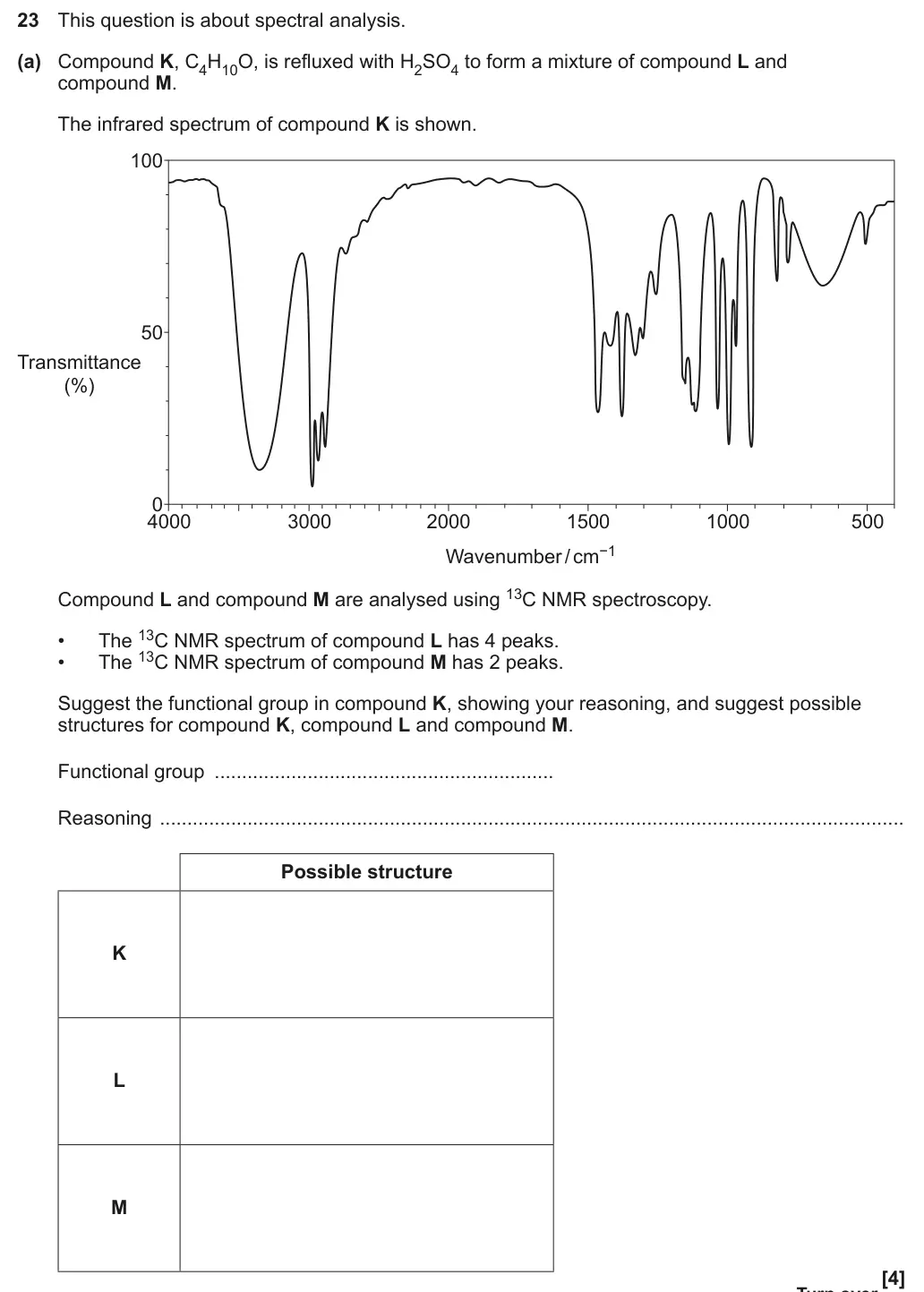
(a) Compound K, C4H10O, is refluxed with H2SO4 to form a mixture of compound L and
compound M.
The infrared spectrum of compound K is shown.
100
50
Transmittance
(%)
0
4000 3000 2000 1500 1000 500
Wavenumber / cm−1
Compound L and compound M are analysed using 13C NMR spectroscopy.
• The 13C NMR spectrum of compound L has 4 peaks.
• The 13C NMR spectrum of compound M has 2 peaks.
Suggest the functional group in compound K, showing your reasoning, and suggest possible
structures for compound K, compound L and compound M.
Functional group  ..............................................................
Reasoning  ........................................................................................................................................
Possible structure
K
L
M
[4]
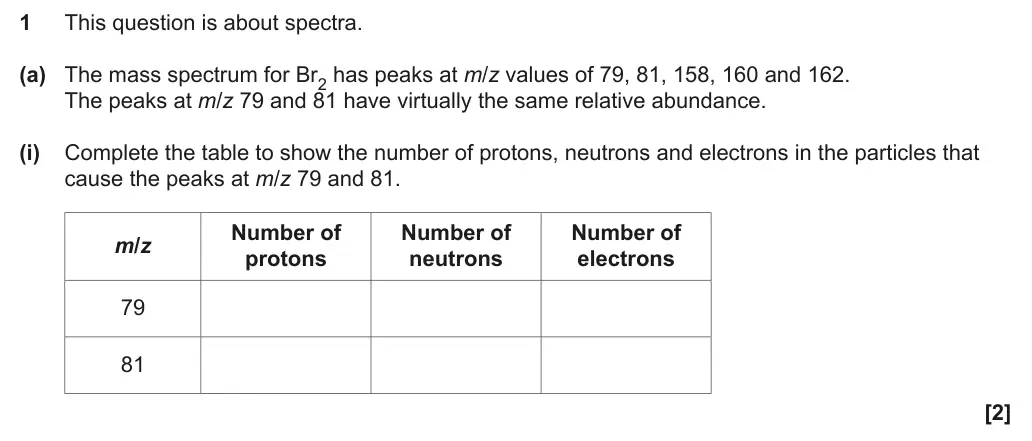
June 2025 · Paper 3 · Q1(a)(ii) 3 marks Short answer Hard atomic structure and isotopes
Earlier part of question 1 that this part usesEarlier part of June 2025 Paper 3 question 1
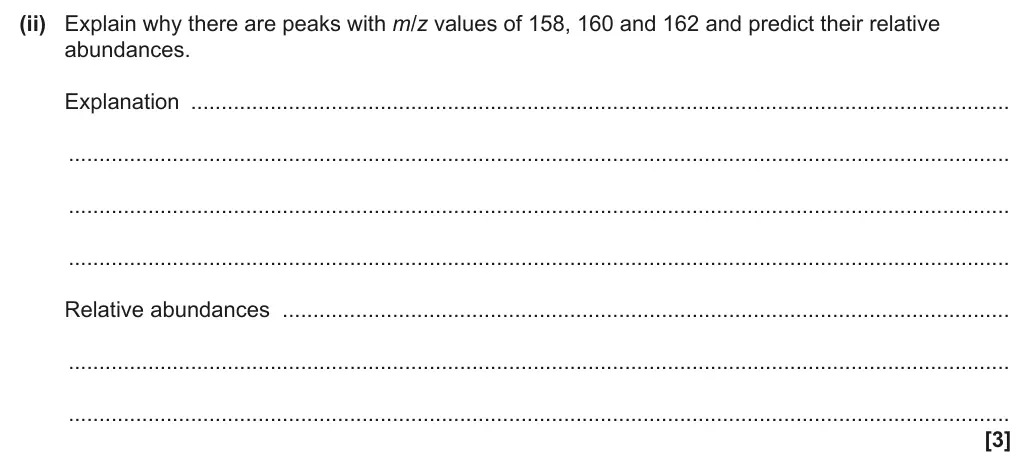
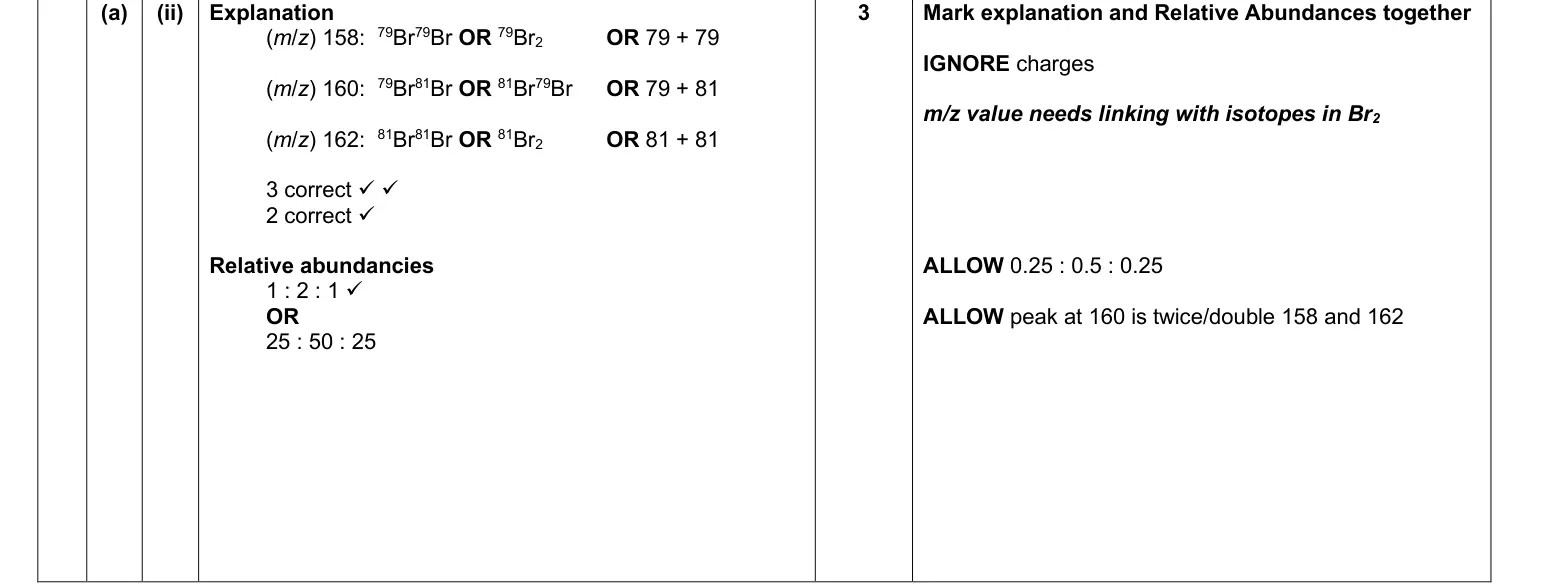
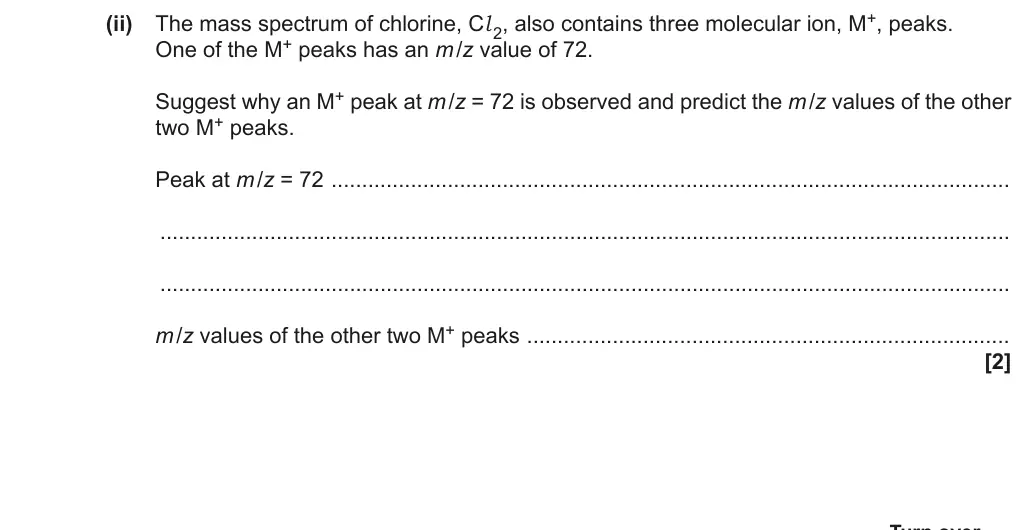
(ii) Explain why there are peaks with m/z values of 158, 160 and 162 and predict their relative
abundances.
Explanation  ......................................................................................................................................
..........................................................................................................................................................
..........................................................................................................................................................
..........................................................................................................................................................
Relative abundances  .......................................................................................................................
..........................................................................................................................................................
..........................................................................................................................................................
[3]
June 2025 · Paper 3 · Q1(b) 3 marks Short answer Medium nmr spectroscopy
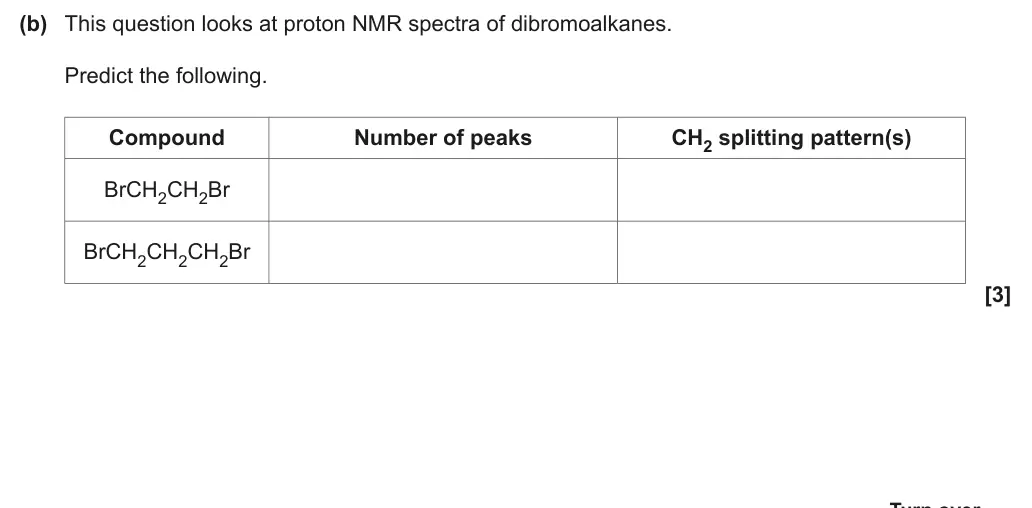
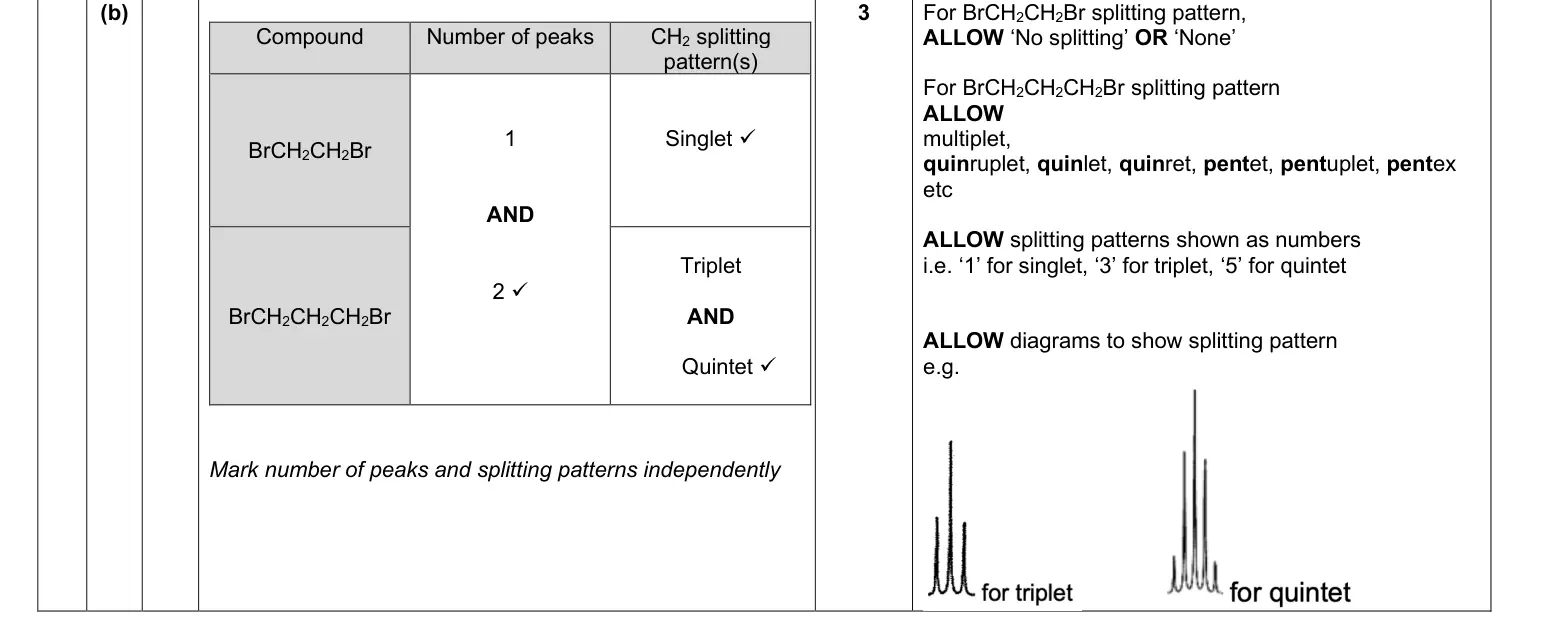
(b) This question looks at proton NMR spectra of dibromoalkanes.
Predict the following.
Compound Number of peaks CH2 splitting pattern(s)
BrCH2CH2Br
BrCH2CH2CH2Br
[3]
June 2025 · Paper 3 · Q2(b)(i) 1 mark Short answer Easy aromatic compoundschromatography and functional group tests
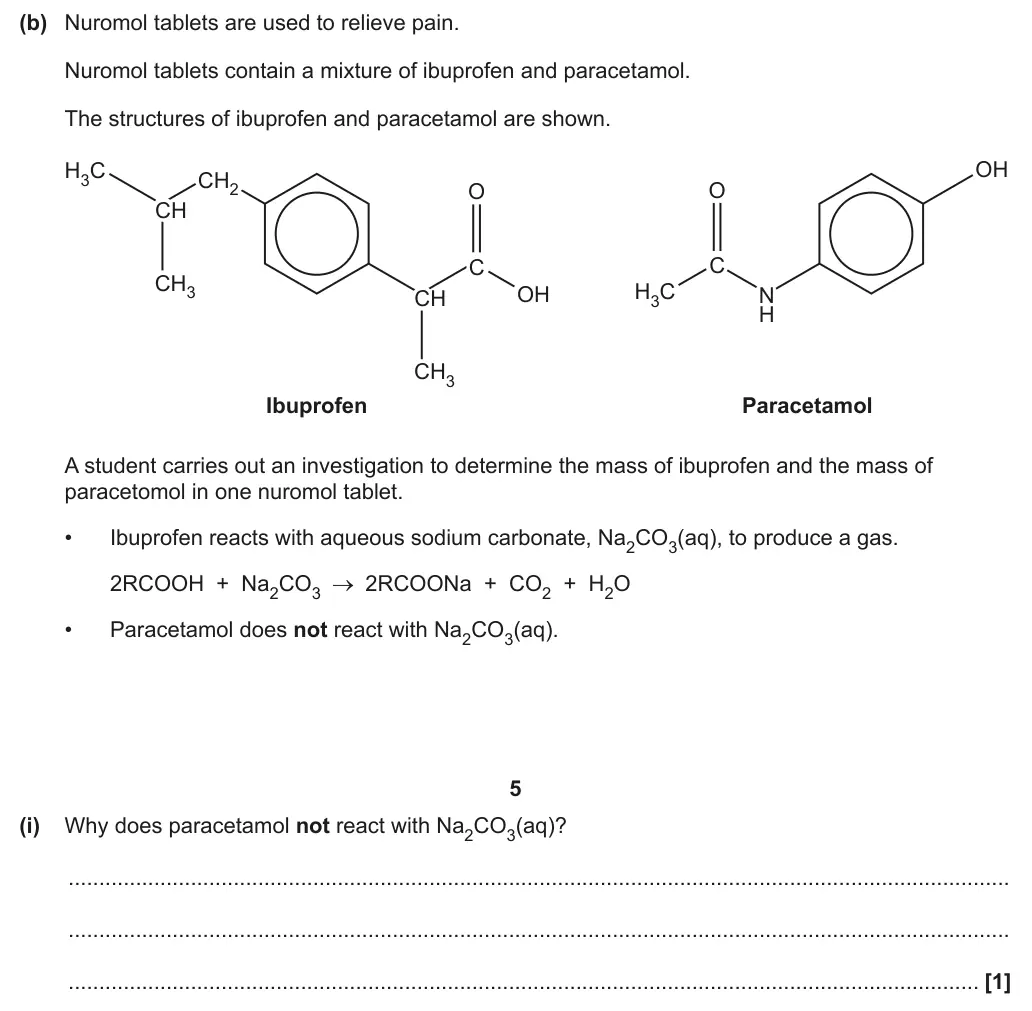
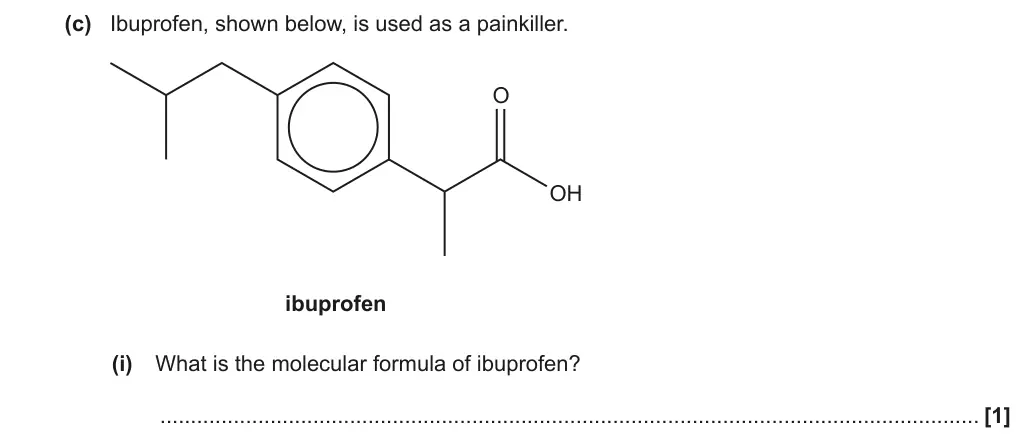
(b) Nuromol tablets are used to relieve pain.
Nuromol tablets contain a mixture of ibuprofen and paracetamol.
The structures of ibuprofen and paracetamol are shown.
H3C OH
CH2
O O
CH
C C
CH3
OH H3C N
CH
H
CH3
Ibuprofen Paracetamol
A student carries out an investigation to determine the mass of ibuprofen and the mass of
paracetomol in one nuromol tablet.
• Ibuprofen reacts with aqueous sodium carbonate, Na2CO3(aq), to produce a gas.
2RCOOH  +  Na2CO3 2RCOONa  +  CO2  +  H2O
• Paracetamol does not react with Na2CO3(aq).
(i) Why does paracetamol not react with Na2CO3(aq)?
..........................................................................................................................................................
..........................................................................................................................................................
..................................................................................................................................................... [1]
June 2025 · Paper 3 · Q4(a)(i) 1 mark Short answer Medium redox
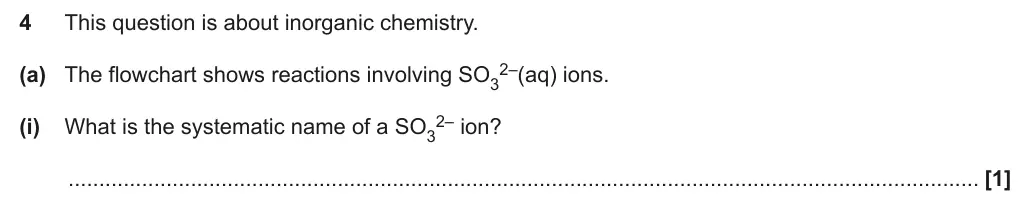
4 This question is about inorganic chemistry.
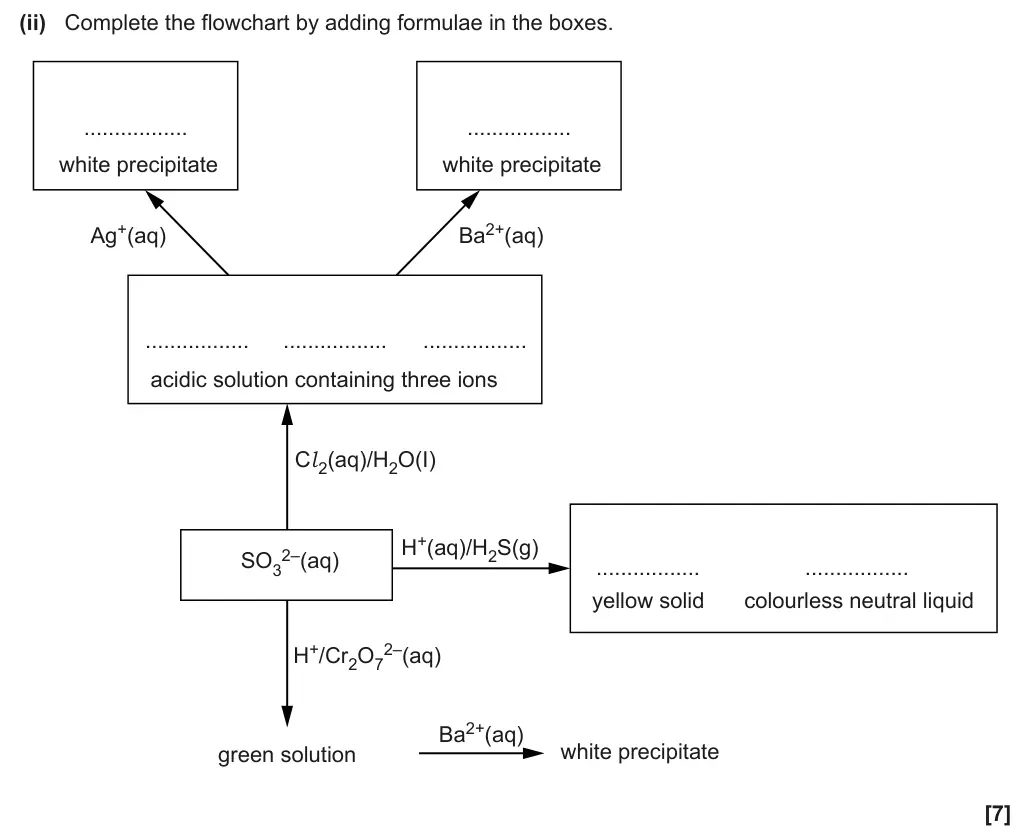
(a) The flowchart shows reactions involving SO3 2–(aq) ions.
(i) What is the systematic name of a SO3 2– ion?
..................................................................................................................................................... [1]
June 2025 · Paper 3 · Q4(a)(ii) 7 marks Short answer Hard redox and electrode potentialsredoxhalogensqualitative analysis
Earlier part of question 4 that this part usesEarlier part of June 2025 Paper 3 question 4
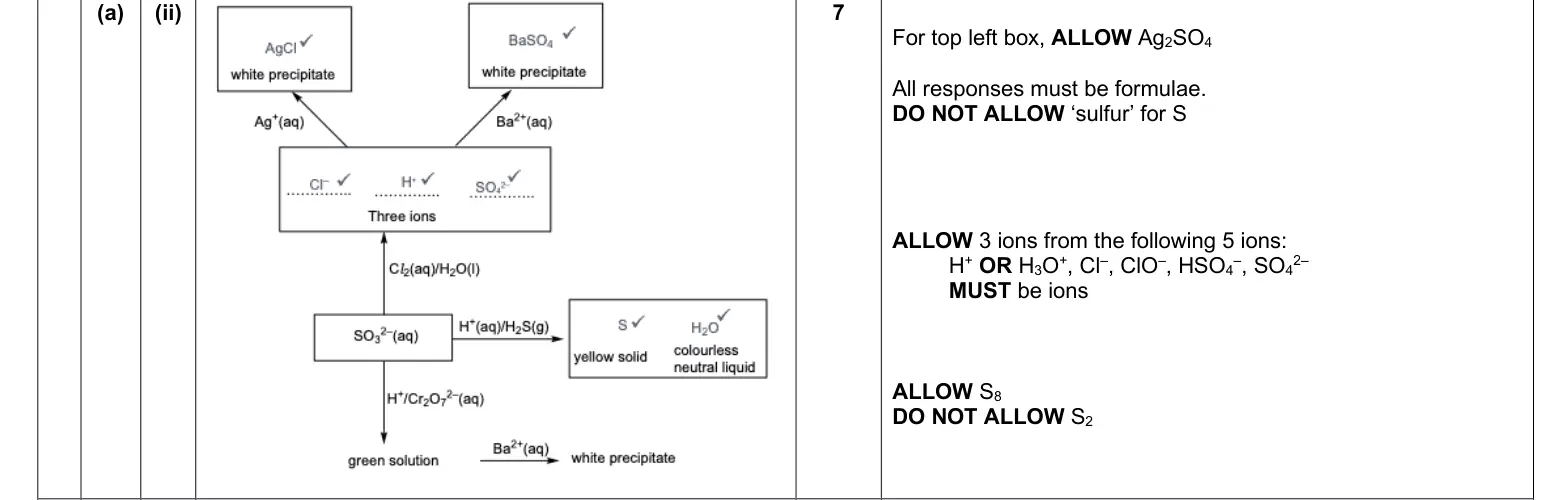
(ii) Complete the flowchart by adding formulae in the boxes.
................. .................
white precipitate white precipitate
Ag+(aq) Ba2+(aq)
................. ................. .................
acidic solution containing three ions
Cl 2(aq)/H2O(I)
H+(aq)/H2S(g)
SO3 2–(aq)
................. .................
yellow solid colourless neutral liquid
H+/Cr2O7 2–(aq)
Ba2+(aq)
green solution white precipitate
[7]
June 2025 · Paper 3 · Q4(b)(i) 1 mark Short answer Medium amount of substance
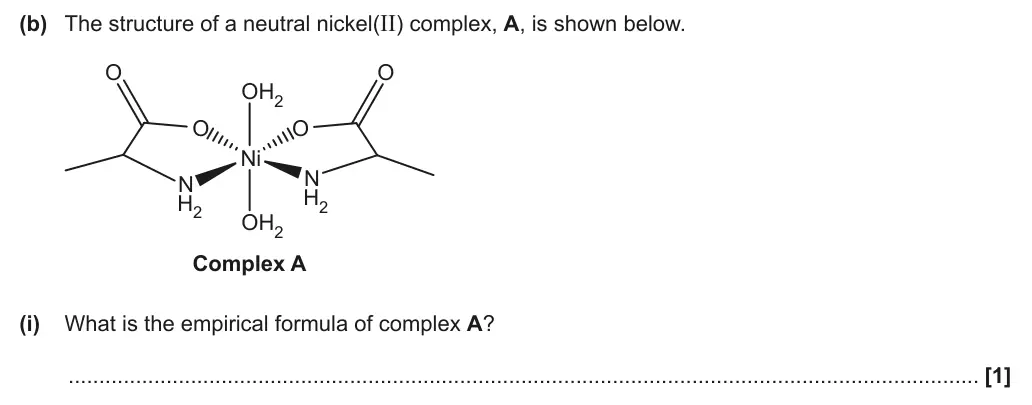
(b) The structure of a neutral nickel(II) complex, A, is shown below.
O O
OH2
O O
Ni
N N
H2 H2
OH2
Complex A
(i) What is the empirical formula of complex A?
..................................................................................................................................................... [1]
June 2025 · Paper 3 · Q5(a)(i) 1 mark Short answer Medium organic basicsaromatic compounds
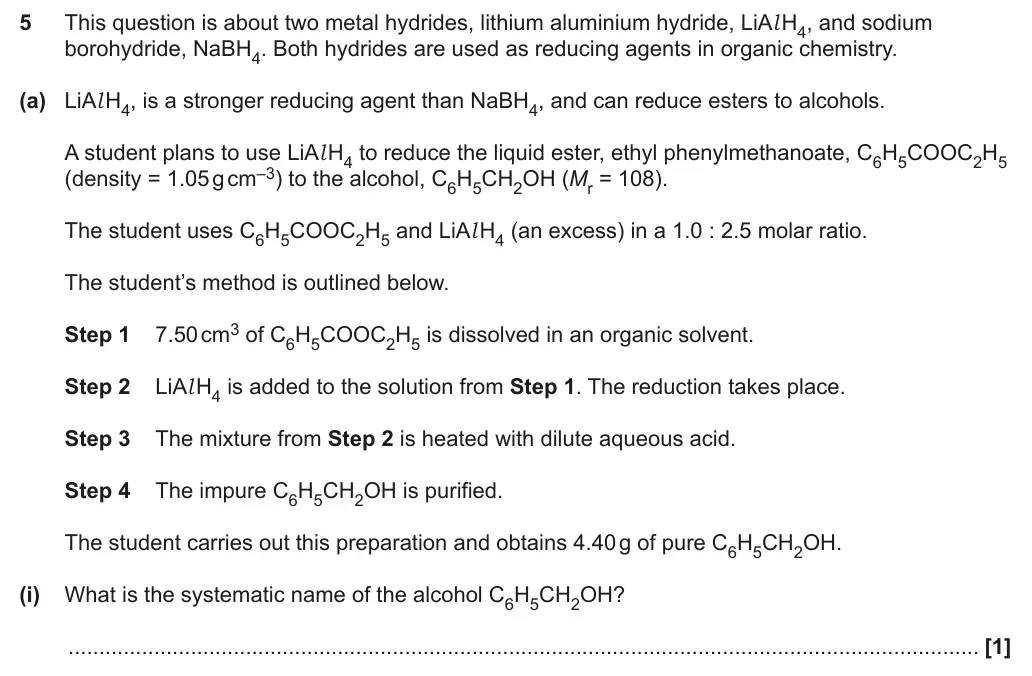
5 This question is about two metal hydrides, lithium aluminium hydride, LiAl H4, and sodium
borohydride, NaBH4. Both hydrides are used as reducing agents in organic chemistry.
(a) LiAl H4, is a stronger reducing agent than NaBH4, and can reduce esters to alcohols.
A student plans to use LiAl H4 to reduce the liquid ester, ethyl phenylmethanoate, C6H5COOC2H5
(density = 1.05 g cm–3) to the alcohol, C6H5CH2OH (Mr = 108).
The student uses C6H5COOC2H5 and LiAl H4 (an excess) in a 1.0 : 2.5 molar ratio.
The student’s method is outlined below.
Step 1 7.50 cm3 of C6H5COOC2H5 is dissolved in an organic solvent.
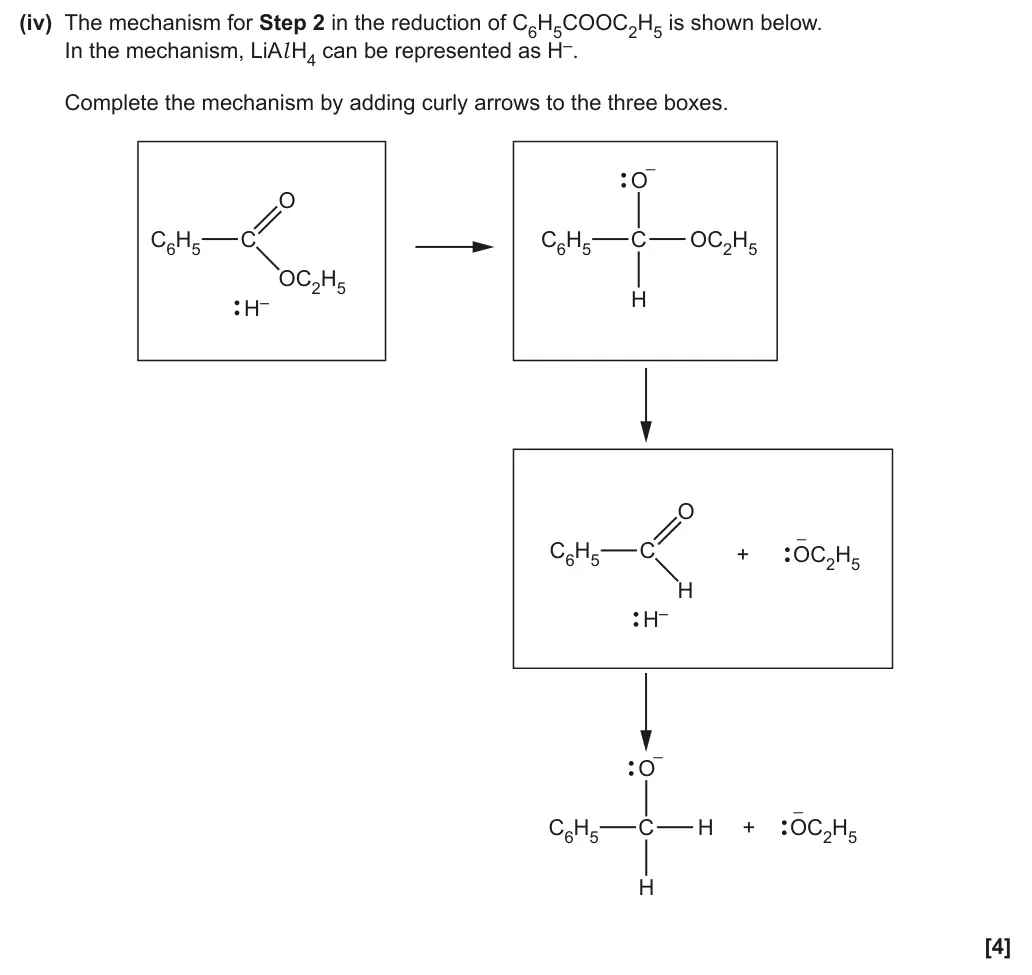
Step 2 LiAl H4 is added to the solution from Step 1. The reduction takes place.
Step 3 The mixture from Step 2 is heated with dilute aqueous acid.
Step 4 The impure C6H5CH2OH is purified.
The student carries out this preparation and obtains 4.40 g of pure C6H5CH2OH.
(i) What is the systematic name of the alcohol C6H5CH2OH?
..................................................................................................................................................... [1]
June 2025 · Paper 3 · Q5(a)(iii) 1 mark Short answer Easy haloalkanes
Earlier part of question 5 that this part usesEarlier part of June 2025 Paper 3 question 5
(iii) In the preparation, LiAl H4 behaves as a nucleophile.
What is meant by the term nucleophile?
..........................................................................................................................................................
..................................................................................................................................................... [1]
June 2025 · Paper 3 · Q5(a)(v) 1 mark Short answer Hard carbonyl compoundsacids bases and buffers
Earlier parts of question 5 that this part usesEarlier part of June 2025 Paper 3 question 5Earlier part of June 2025 Paper 3 question 5
(v) Suggest why the student heated the mixture from Step 2 with dilute aqueous acid in Step 3.
..........................................................................................................................................................
..........................................................................................................................................................
..................................................................................................................................................... [1]
June 2024 · AS Paper 1 · Q21(b)(i) 1 mark Short answer Medium redox
(b) Iron can be extracted from iron ores containing the oxide Fe2O3.
(i) What is the systematic name for Fe2O3?
..................................................................................................................................................... [1]
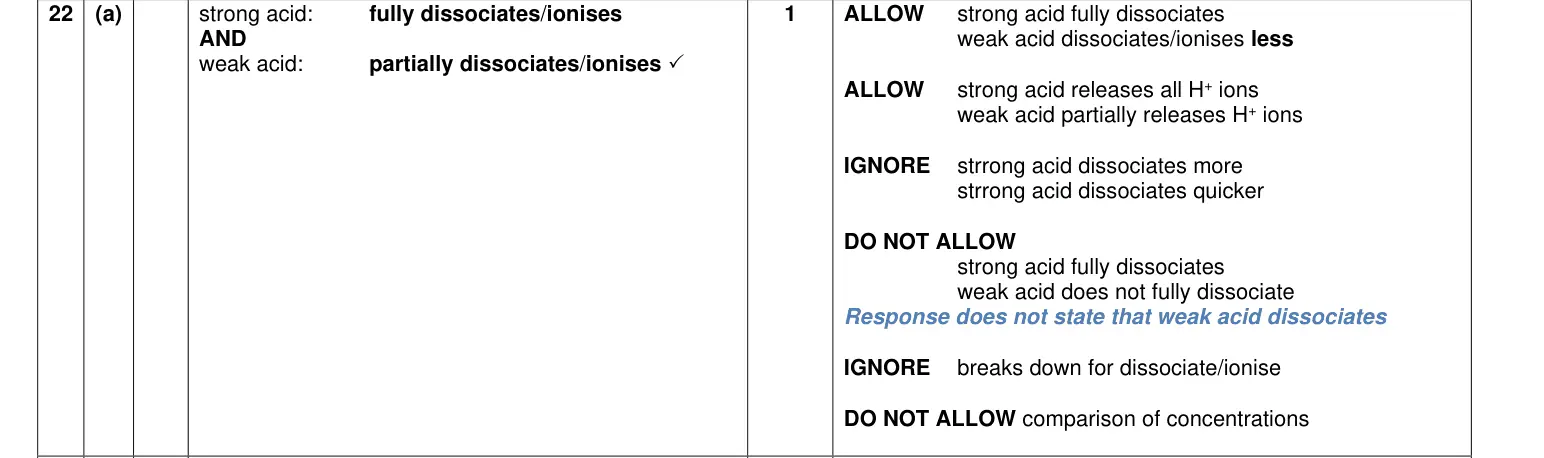
June 2024 · AS Paper 1 · Q22(a) 1 mark Short answer Medium acids and titrations
22 This question is about the reactions of acids.
(a) What is the difference between a strong acid and a weak acid?
..........................................................................................................................................................
..................................................................................................................................................... [1]
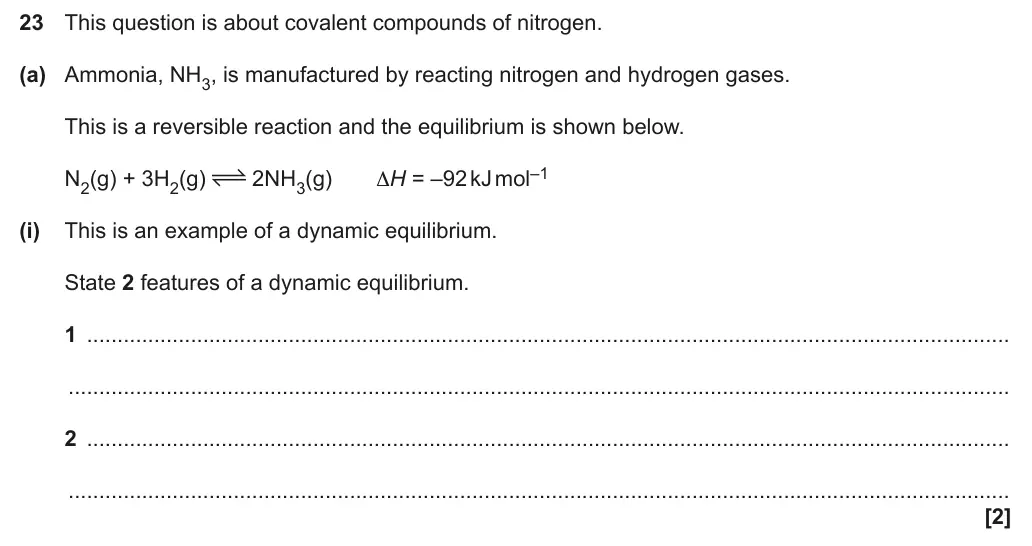
June 2024 · AS Paper 1 · Q23(a)(i) 2 marks Short answer Medium chemical equilibrium
23 This question is about covalent compounds of nitrogen.
(a) Ammonia, NH3, is manufactured by reacting nitrogen and hydrogen gases.
This is a reversible reaction and the equilibrium is shown below.
N2(g) + 3H2(g) 2NH3(g)  ΔH = –92 kJ mol–1
(i) This is an example of a dynamic equilibrium.
State 2 features of a dynamic equilibrium.
1  .......................................................................................................................................................
..........................................................................................................................................................
2  .......................................................................................................................................................
..........................................................................................................................................................
[2]
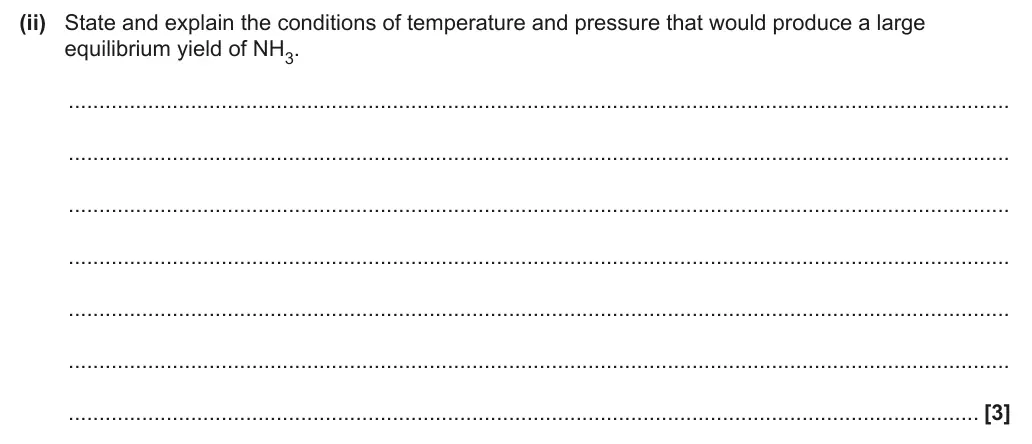
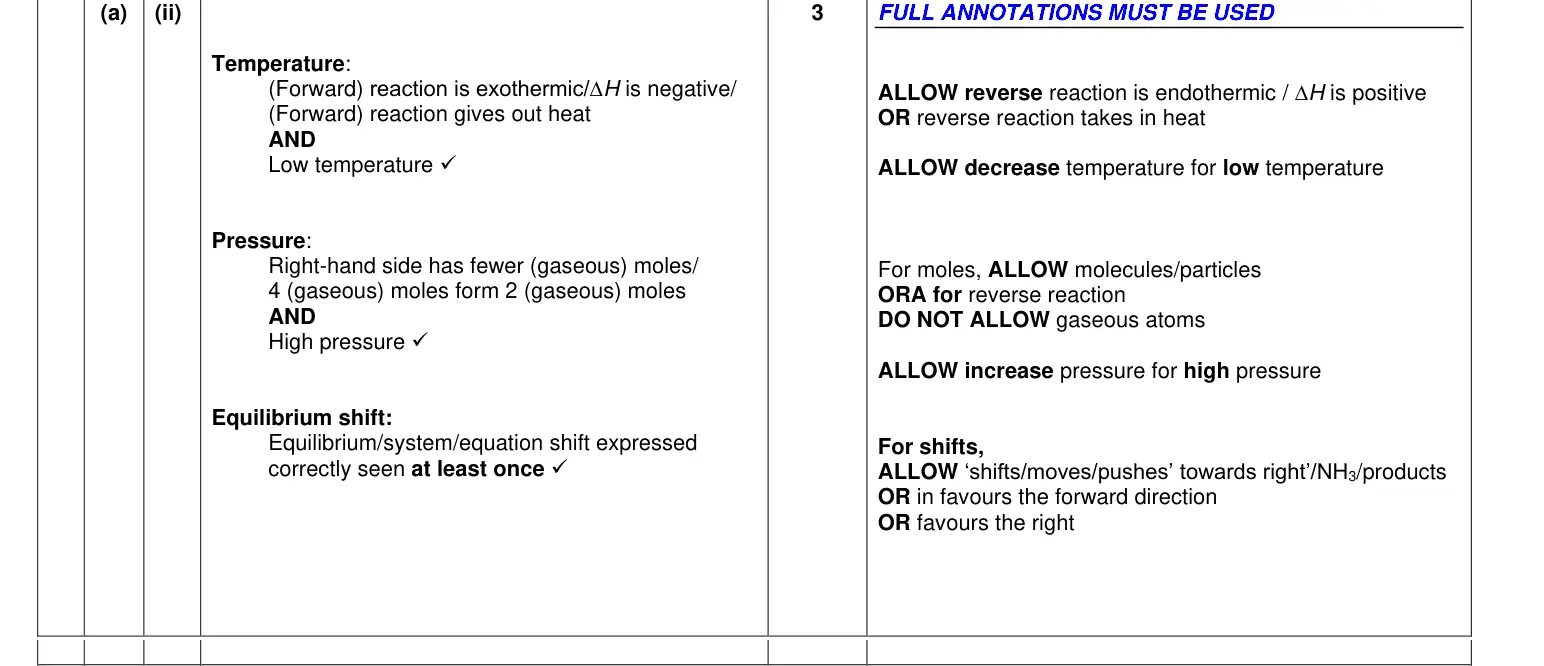
June 2024 · AS Paper 1 · Q23(a)(ii) 3 marks Short answer Medium chemical equilibrium
Earlier part of question 23 that this part usesEarlier part of June 2024 Paper 1 question 23
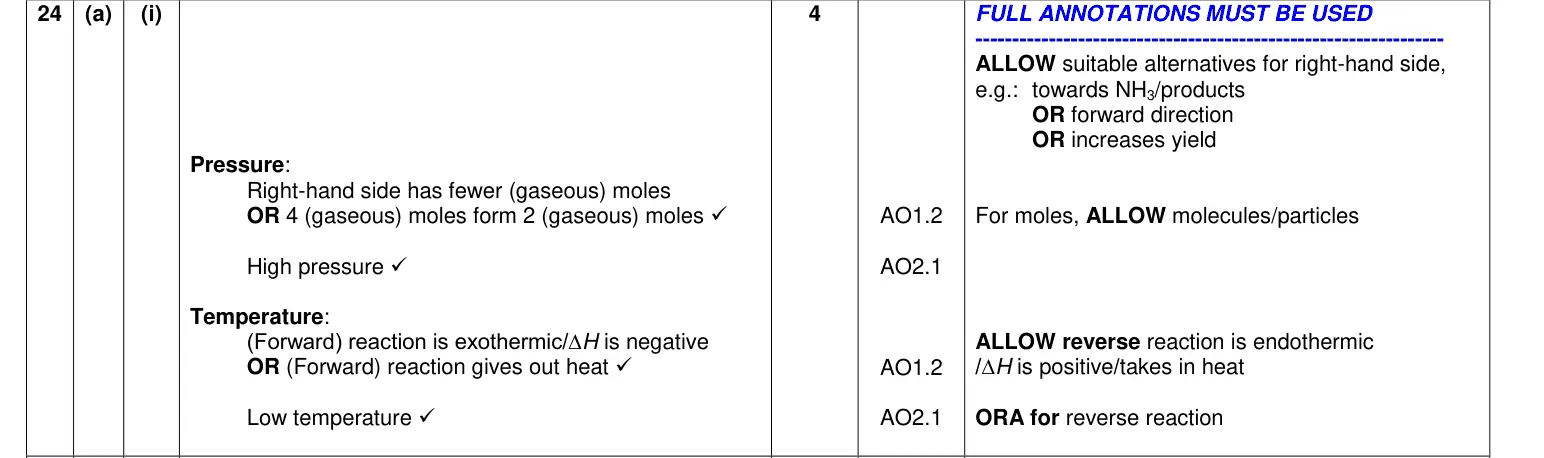
(ii) State and explain the conditions of temperature and pressure that would produce a large
equilibrium yield of NH3.
..........................................................................................................................................................
..........................................................................................................................................................
..........................................................................................................................................................
..........................................................................................................................................................
..........................................................................................................................................................
..........................................................................................................................................................
..................................................................................................................................................... [3]
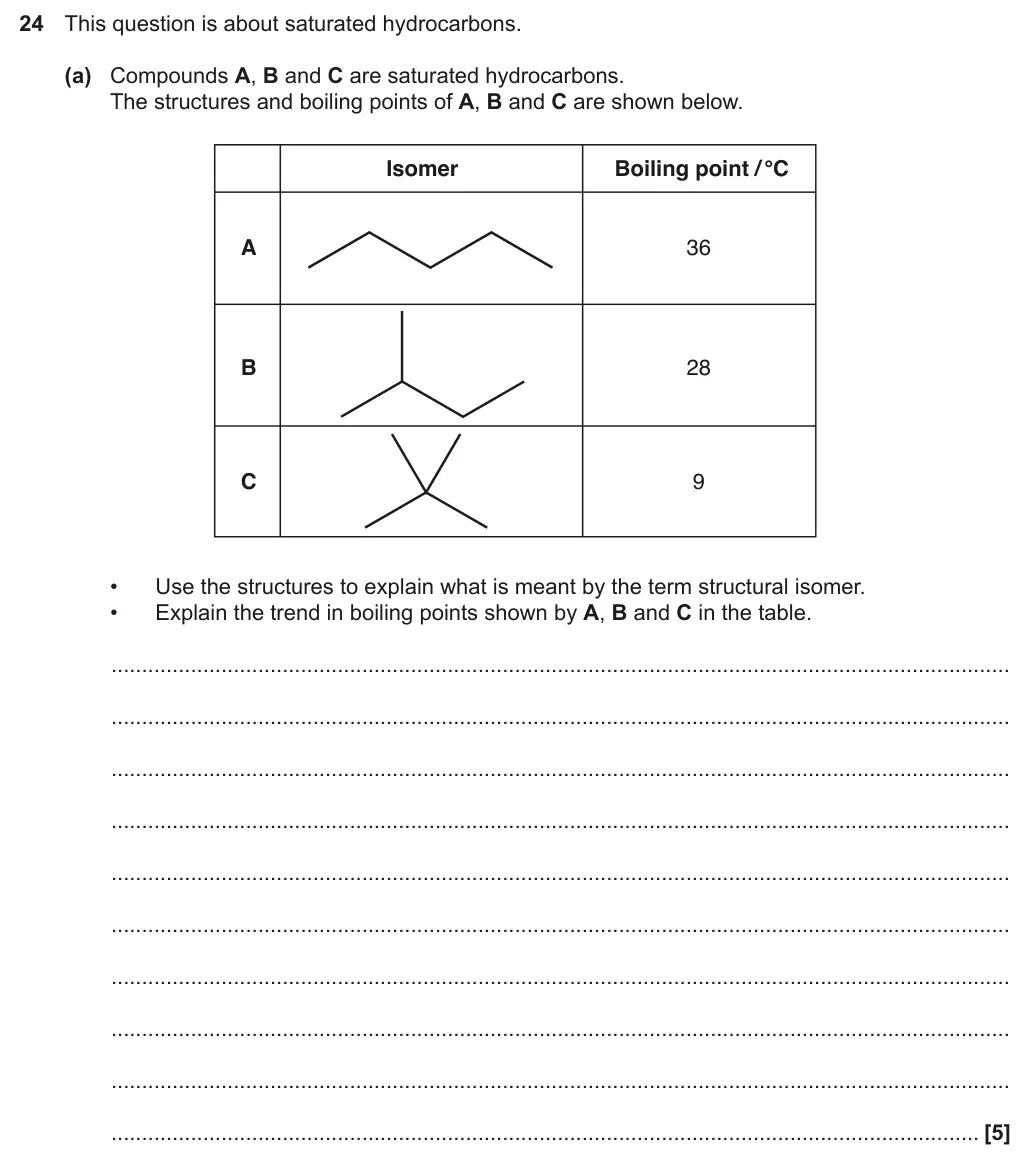
June 2024 · AS Paper 1 · Q24(a) 4 marks Short answer Hard alkanes
24 This question is about hydrocarbons.
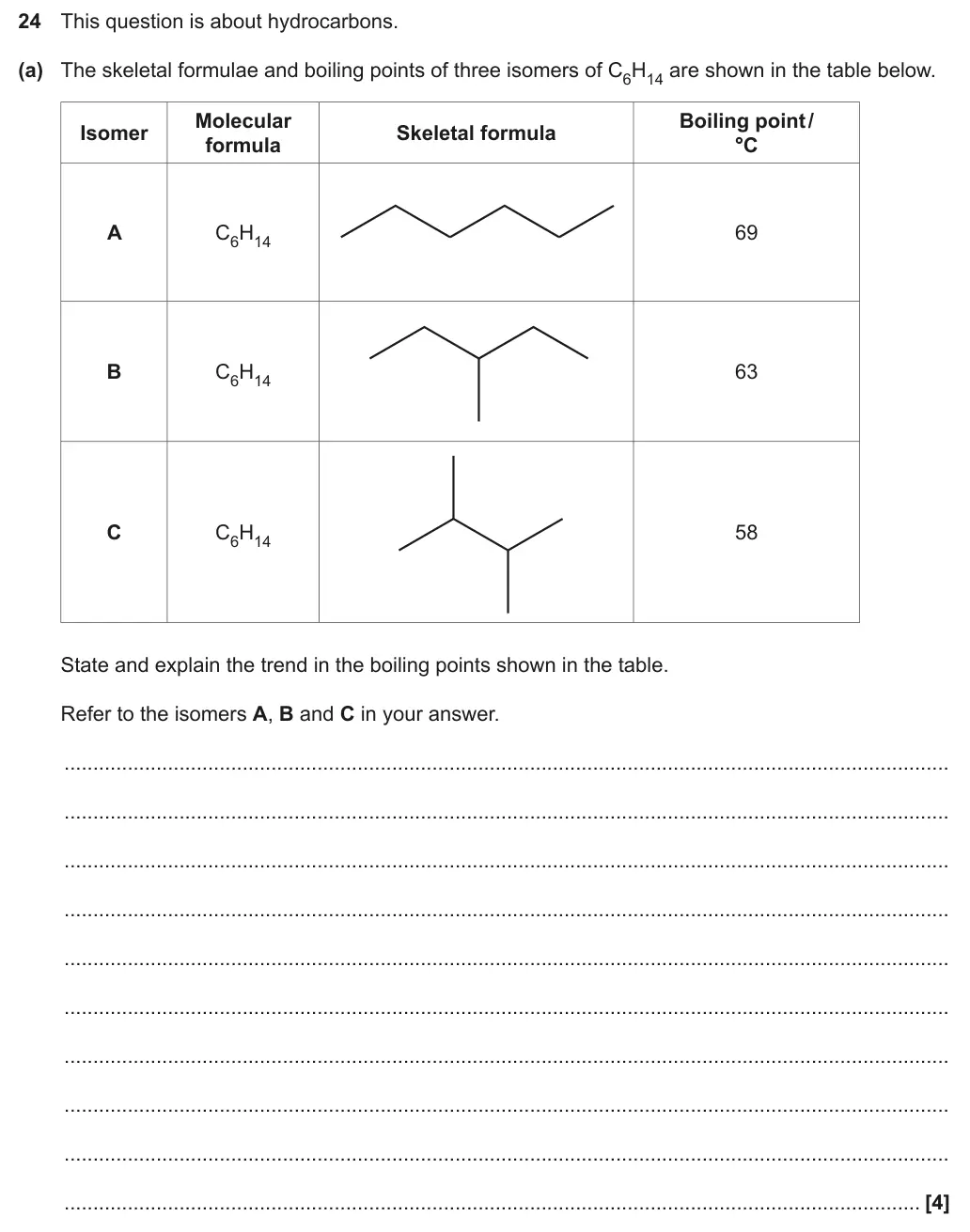
(a) The skeletal formulae and boiling points of three isomers of C6H14 are shown in the table below.
Molecular Boiling point /
Isomer Skeletal formula
formula °C
A C6H14 69
B C6H14 63
C C6H14 58
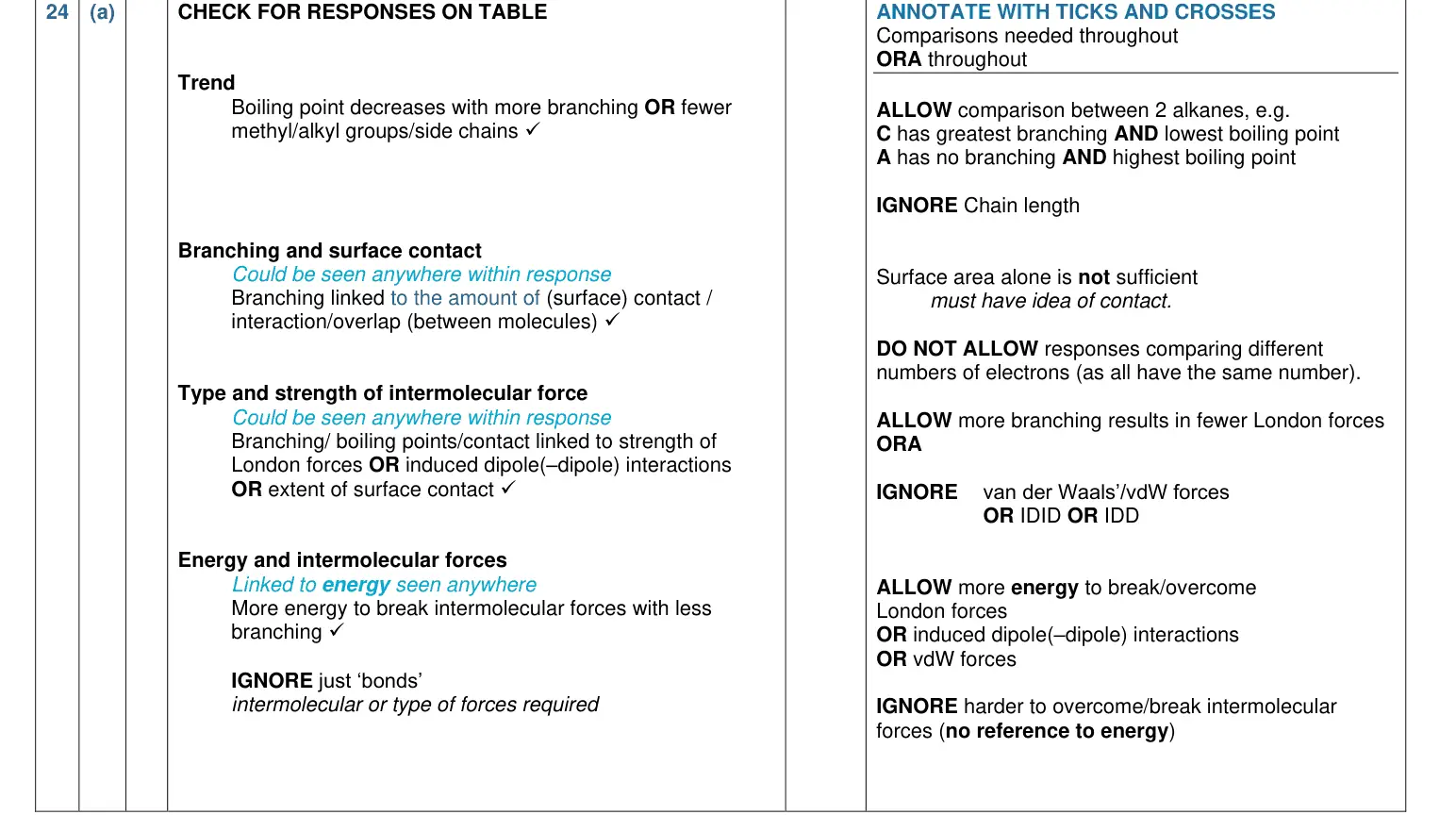
State and explain the trend in the boiling points shown in the table.
Refer to the isomers A, B and C in your answer.
..........................................................................................................................................................
..........................................................................................................................................................
..........................................................................................................................................................
..........................................................................................................................................................
..........................................................................................................................................................
..........................................................................................................................................................
..........................................................................................................................................................
..........................................................................................................................................................
..........................................................................................................................................................
..................................................................................................................................................... [4]
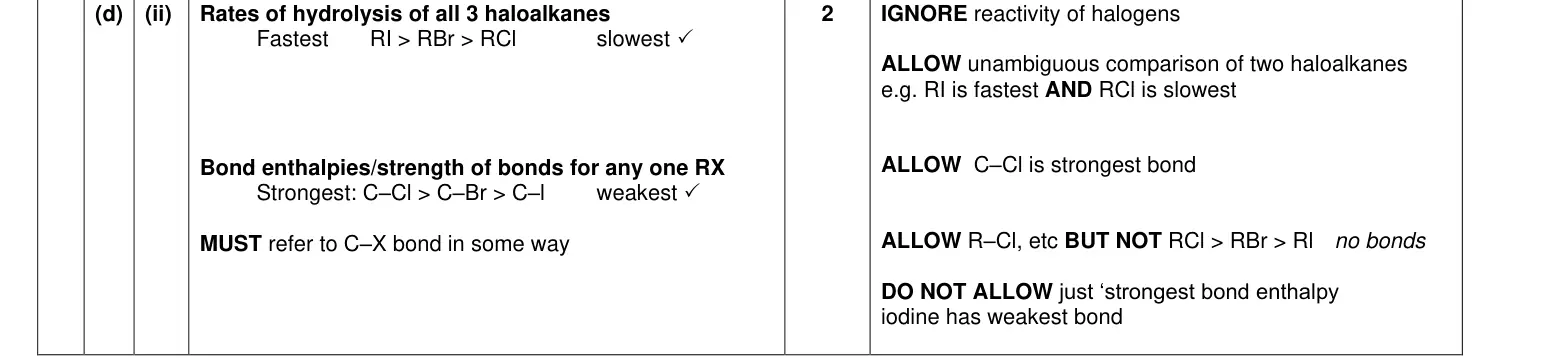
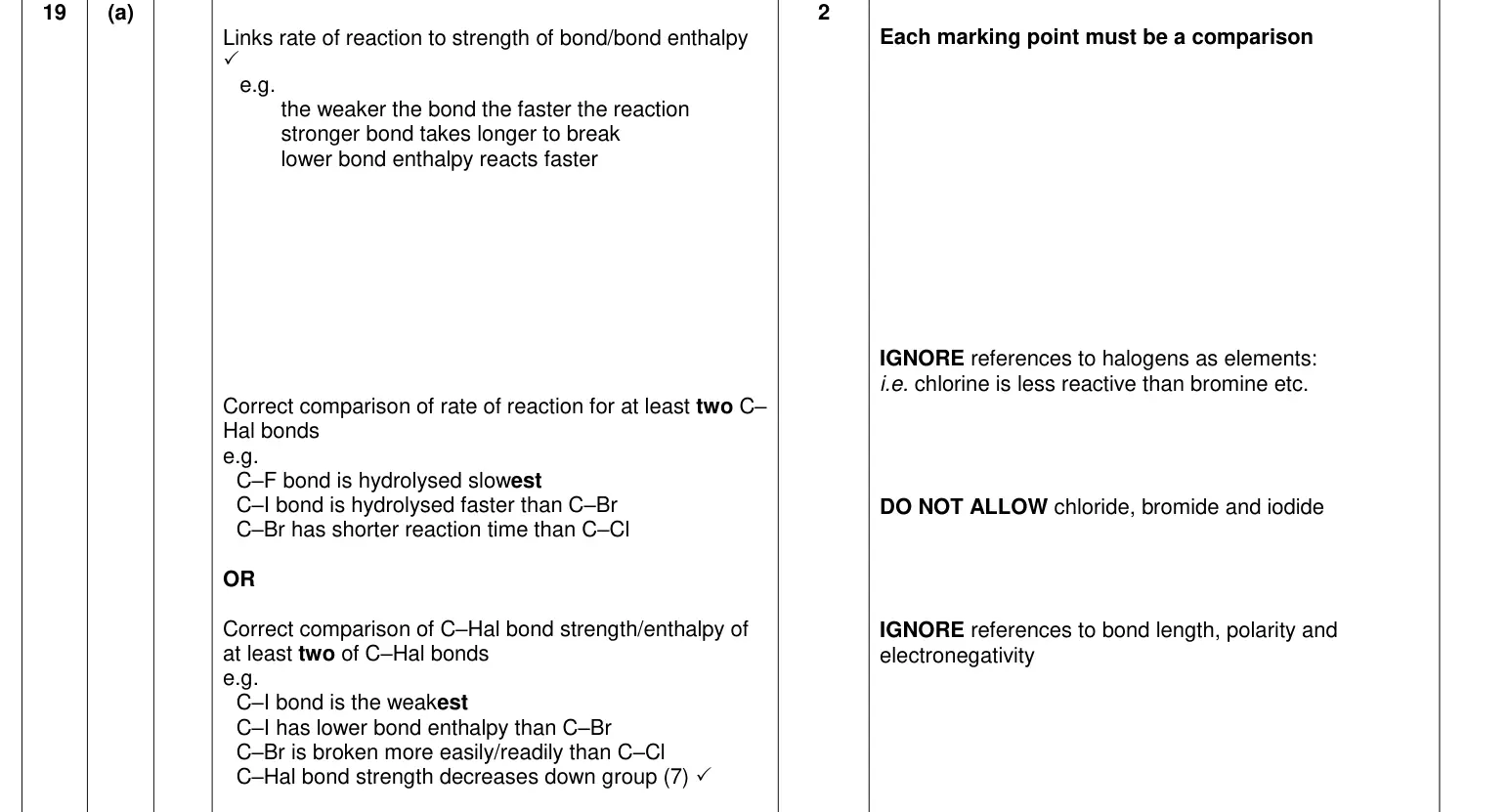
June 2024 · AS Paper 1 · Q25(d)(ii) 2 marks Short answer Hard haloalkanes
Earlier part of question 25 that this part usesEarlier part of June 2024 Paper 1 question 25
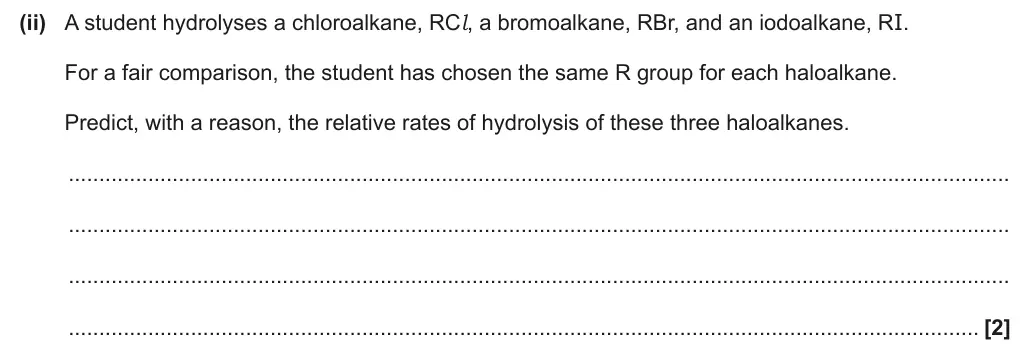
(ii) A student hydrolyses a chloroalkane, RCl, a bromoalkane, RBr, and an iodoalkane, RI.
For a fair comparison, the student has chosen the same R group for each haloalkane.
Predict, with a reason, the relative rates of hydrolysis of these three haloalkanes.
..........................................................................................................................................................
..........................................................................................................................................................
..........................................................................................................................................................
..................................................................................................................................................... [2]
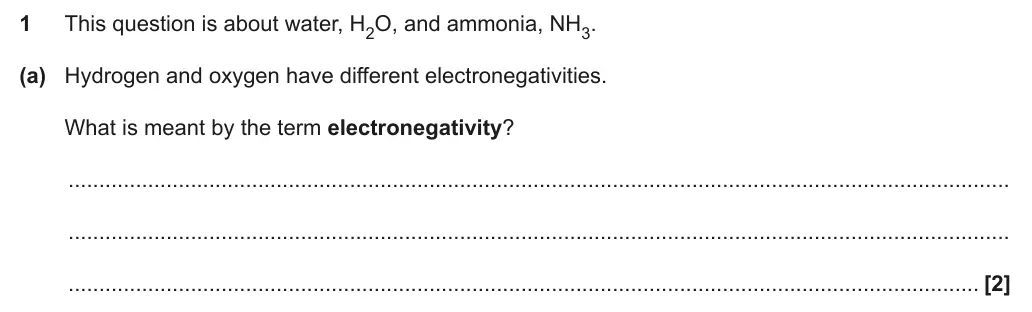
June 2024 · AS Paper 2 · Q1(a) 2 marks Short answer Hard bonding and structure
1 This question is about water, H2O, and ammonia, NH3.
(a) Hydrogen and oxygen have different electronegativities.
What is meant by the term electronegativity?
..........................................................................................................................................................
..........................................................................................................................................................
..................................................................................................................................................... [2]
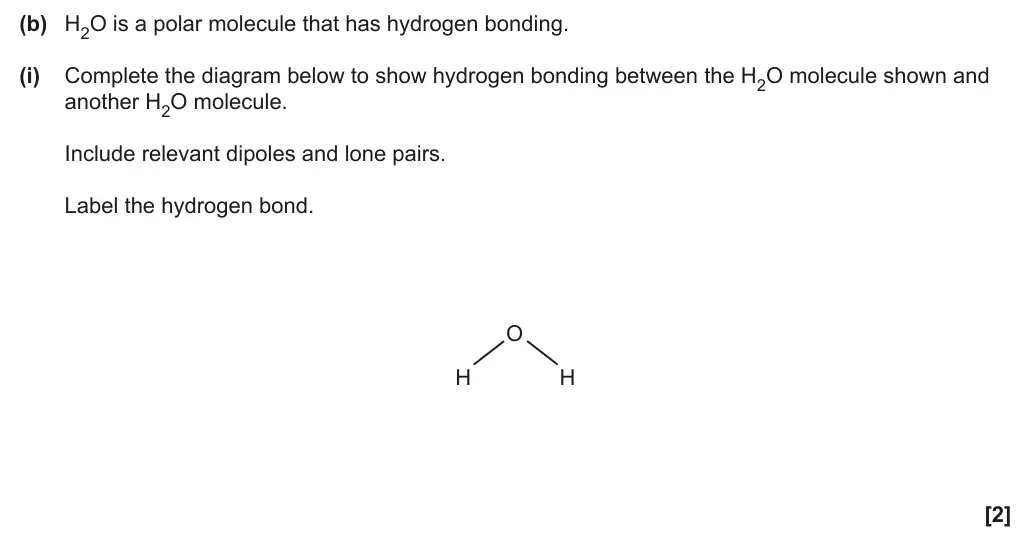
June 2024 · AS Paper 2 · Q1(b)(ii) 1 mark Short answer Medium bonding and structure
Earlier part of question 1 that this part usesEarlier part of June 2024 Paper 2 question 1
(ii) Explain why molecules of H2O are polar.
..........................................................................................................................................................
..........................................................................................................................................................
..................................................................................................................................................... [1]
June 2024 · AS Paper 2 · Q1(b)(iii) 1 mark Short answer Hard bonding and structure
Earlier part of question 1 that this part usesEarlier part of June 2024 Paper 2 question 1
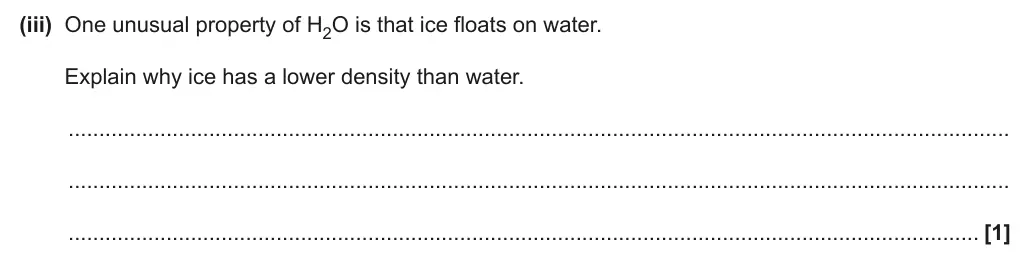
(iii) One unusual property of H2O is that ice floats on water.
Explain why ice has a lower density than water.
..........................................................................................................................................................
..........................................................................................................................................................
..................................................................................................................................................... [1]
June 2024 · AS Paper 2 · Q1(c)(i) 2 marks Short answer Hard bonding and structure
Earlier part of question 1 that this part usesEarlier part of June 2024 Paper 2 question 1
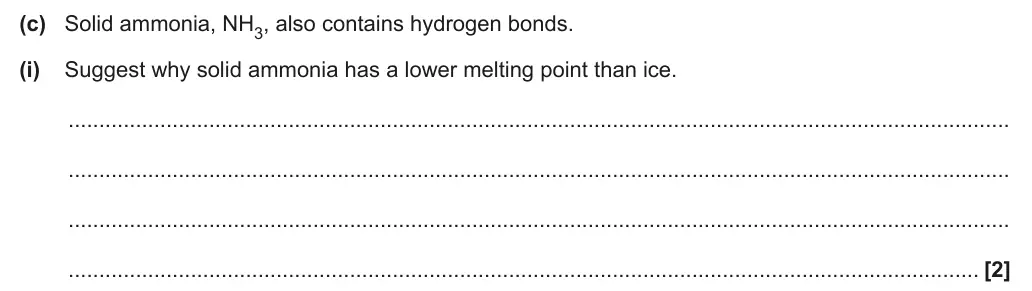
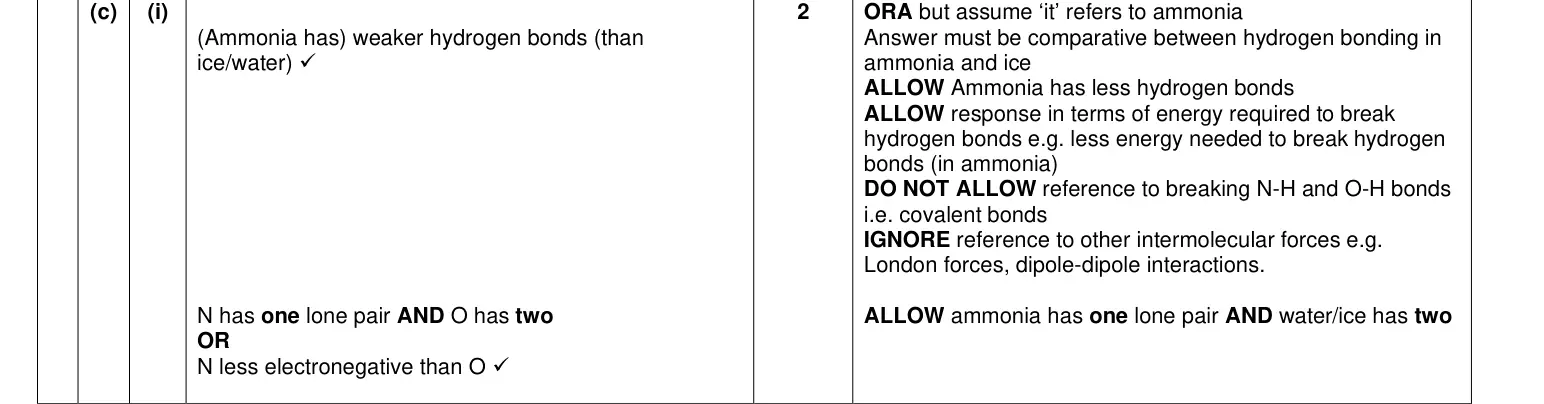
(c) Solid ammonia, NH3, also contains hydrogen bonds.
(i) Suggest why solid ammonia has a lower melting point than ice.
..........................................................................................................................................................
..........................................................................................................................................................
..........................................................................................................................................................
..................................................................................................................................................... [2]
June 2024 · AS Paper 2 · Q1(c)(iii) 2 marks Short answer Medium qualitative analysis
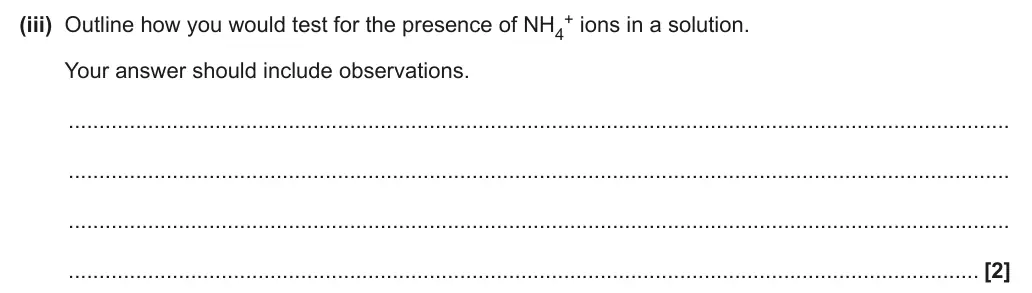
(iii) Outline how you would test for the presence of NH4 + ions in a solution.
Your answer should include observations.
..........................................................................................................................................................
..........................................................................................................................................................
..........................................................................................................................................................
..................................................................................................................................................... [2]
June 2024 · AS Paper 2 · Q2(a)(iii) 2 marks Short answer Easy group 2halogens
Earlier part of question 2 that this part usesEarlier part of June 2024 Paper 2 question 2
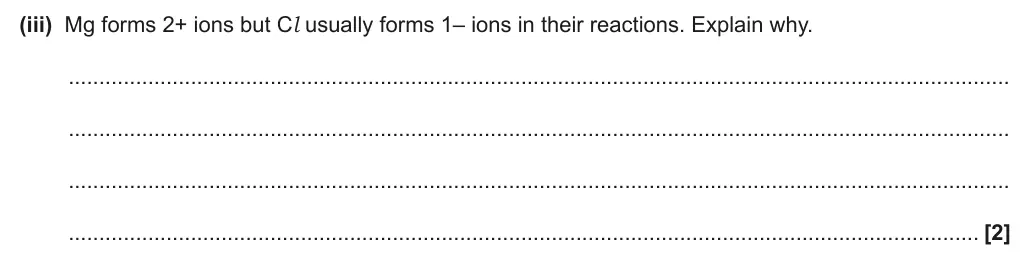
(iii) Mg forms 2+ ions but Cl usually forms 1– ions in their reactions. Explain why.
..........................................................................................................................................................
..........................................................................................................................................................
..........................................................................................................................................................
..................................................................................................................................................... [2]
June 2024 · AS Paper 2 · Q2(b)(i) 2 marks Short answer Medium redox
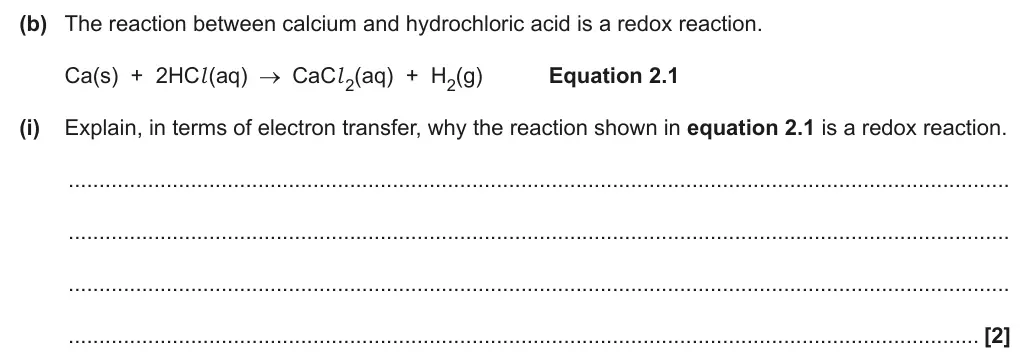
(b) The reaction between calcium and hydrochloric acid is a redox reaction.
Ca(s)  +  2HCl (aq) CaCl 2(aq)  +  H2(g)   Equation 2.1
(i) Explain, in terms of electron transfer, why the reaction shown in equation 2.1 is a redox reaction.
..........................................................................................................................................................
..........................................................................................................................................................
..........................................................................................................................................................
..................................................................................................................................................... [2]
June 2024 · AS Paper 2 · Q2(b)(ii) 3 marks Short answer Medium amount of substancegroup 2
Earlier part of question 2 that this part usesEarlier part of June 2024 Paper 2 question 2
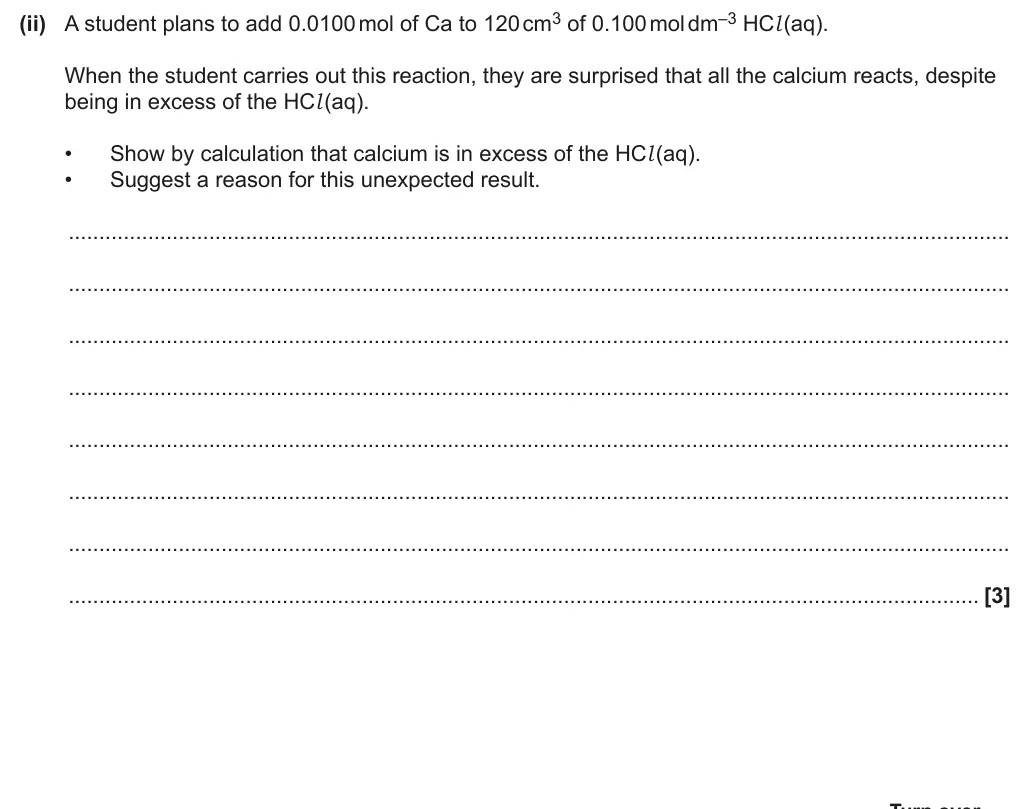
(ii) A student plans to add 0.0100 mol of Ca to 120 cm3 of 0.100 mol dm–3 HCl (aq).
When the student carries out this reaction, they are surprised that all the calcium reacts, despite
being in excess of the HCl (aq).
• Show by calculation that calcium is in excess of the HCl (aq).
• Suggest a reason for this unexpected result.
..........................................................................................................................................................
..........................................................................................................................................................
..........................................................................................................................................................
..........................................................................................................................................................
..........................................................................................................................................................
..........................................................................................................................................................
..........................................................................................................................................................
..................................................................................................................................................... [3]
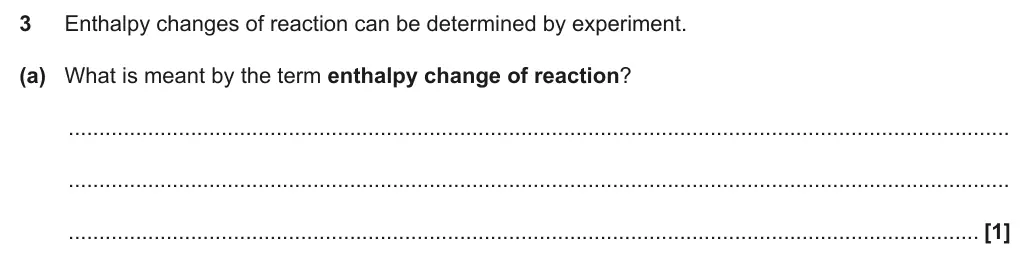
June 2024 · AS Paper 2 · Q3(a) 1 mark Short answer Hard enthalpy changes
3 Enthalpy changes of reaction can be determined by experiment.
(a) What is meant by the term enthalpy change of reaction?
..........................................................................................................................................................
..........................................................................................................................................................
..................................................................................................................................................... [1]
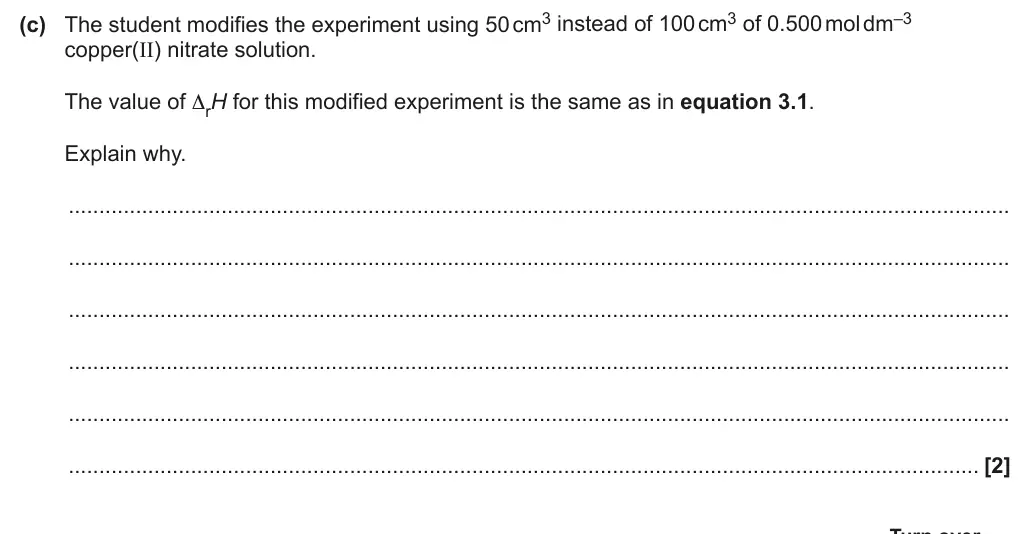
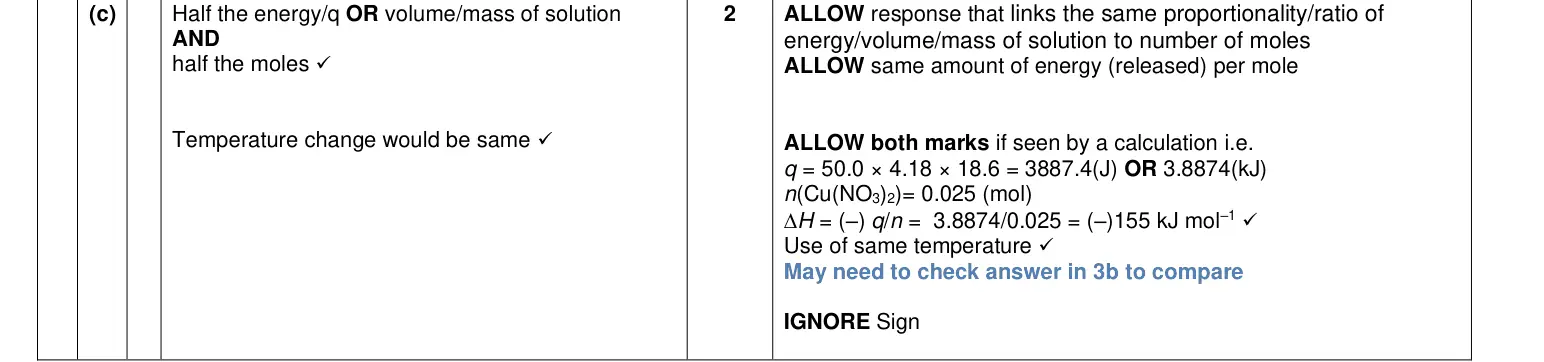
June 2024 · AS Paper 2 · Q3(c) 2 marks Short answer Medium enthalpy changes
Earlier part of question 3 that this part usesEarlier part of June 2024 Paper 2 question 3
(c) The student modifies the experiment using 50 cm3 instead of 100 cm3 of 0.500 mol dm–3
copper(II) nitrate solution.
The value of ΔrH for this modified experiment is the same as in equation 3.1.
Explain why.
..........................................................................................................................................................
..........................................................................................................................................................
..........................................................................................................................................................
..........................................................................................................................................................
..........................................................................................................................................................
..................................................................................................................................................... [2]
June 2024 · AS Paper 2 · Q4(c) 2 marks Short answer Medium practical skills
Earlier part of question 4 that this part usesEarlier part of June 2024 Paper 2 question 4
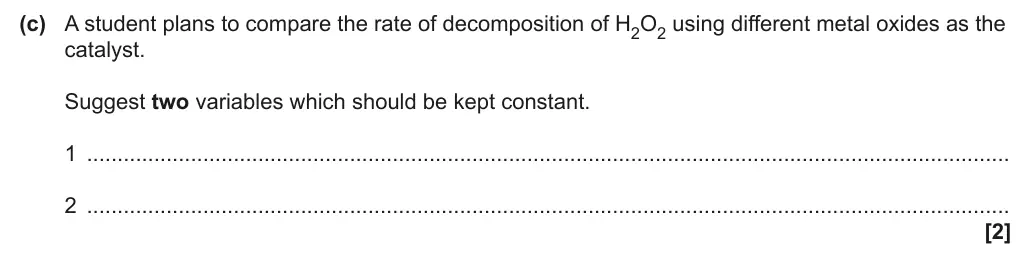
(c) A student plans to compare the rate of decomposition of H2O2 using different metal oxides as the
catalyst.
Suggest two variables which should be kept constant.
1  .......................................................................................................................................................
2  .......................................................................................................................................................
[2]
June 2024 · AS Paper 2 · Q5(b)(ii) 2 marks Short answer Medium alkenes
Earlier part of question 5 that this part usesEarlier part of June 2024 Paper 2 question 5
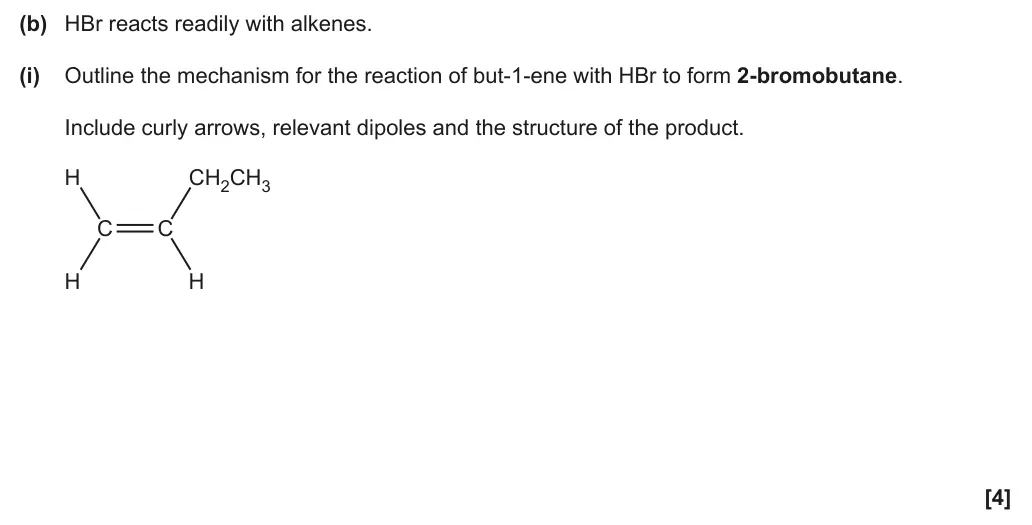
(ii) During this reaction, a small amount of 1-bromobutane is also produced.
Explain why 2-bromobutane is the major product.
..........................................................................................................................................................
..........................................................................................................................................................
..........................................................................................................................................................
..................................................................................................................................................... [2]
June 2024 · Paper 1 · Q16(a)(ii) 1 mark Short answer Medium entropy and free energy
Earlier part of question 16 that this part usesEarlier part of June 2024 Paper 1 question 16
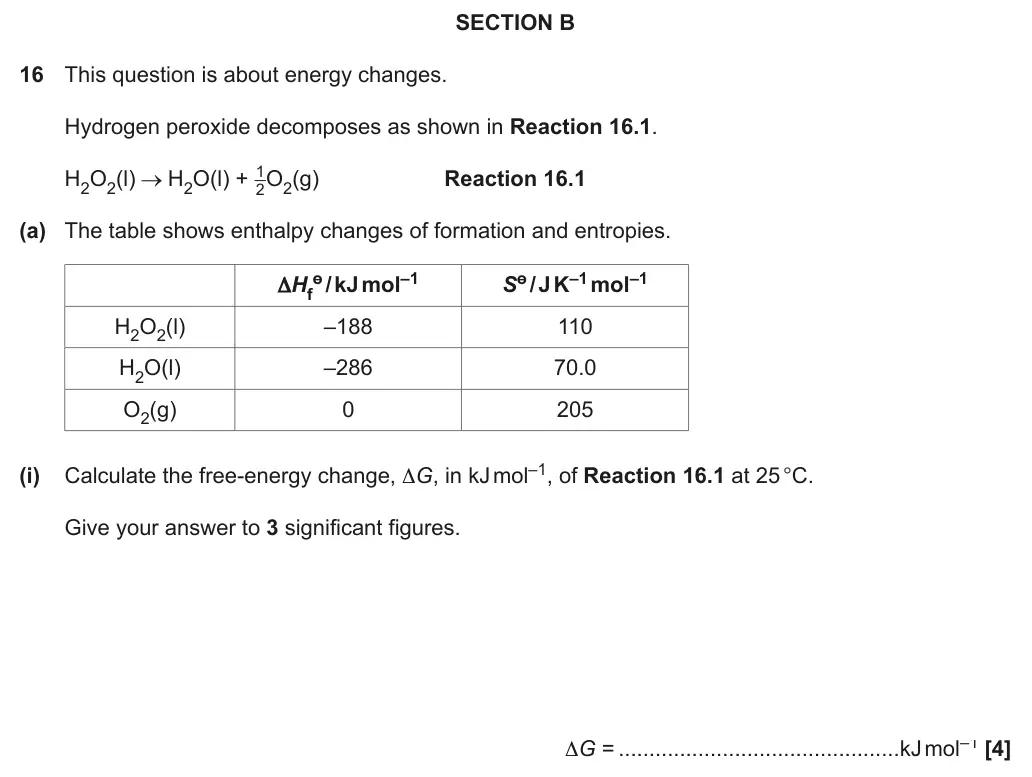
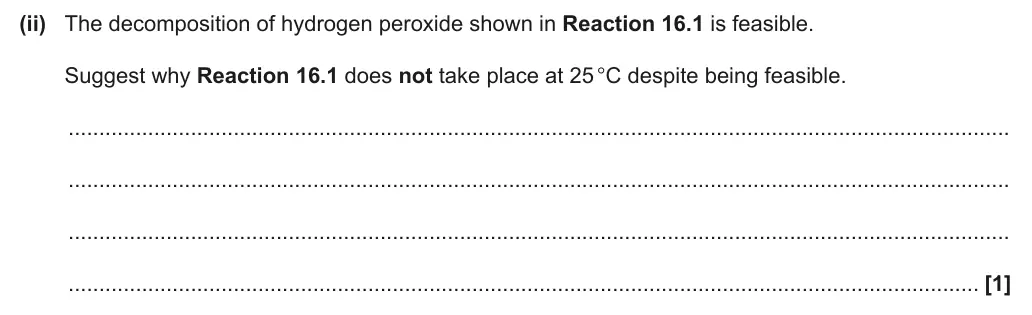
(ii) The decomposition of hydrogen peroxide shown in Reaction 16.1 is feasible.
Suggest why Reaction 16.1 does not take place at 25 °C despite being feasible.
..........................................................................................................................................................
..........................................................................................................................................................
..........................................................................................................................................................
..................................................................................................................................................... [1]
June 2024 · Paper 1 · Q16(b)(ii) 1 mark Short answer Medium reaction rates
(ii) Explain why MnO2 is described as a heterogeneous catalyst for this reaction.
..........................................................................................................................................................
..................................................................................................................................................... [1]
June 2024 · Paper 1 · Q16(b)(iii) 1 mark Short answer Hard redoxtransition elements
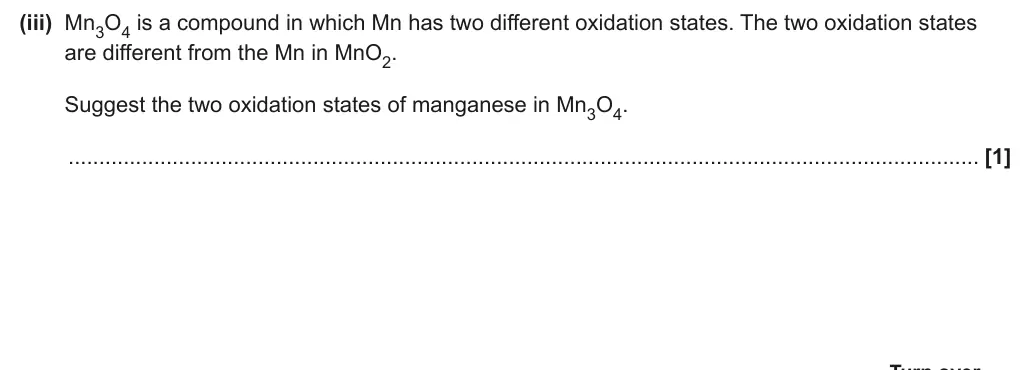
(iii) Mn3O4 is a compound in which Mn has two different oxidation states. The two oxidation states
are different from the Mn in MnO2.
Suggest the two oxidation states of manganese in Mn3O4.
..................................................................................................................................................... [1]
June 2024 · Paper 1 · Q16(c)(i) 2 marks Short answer Medium lattice enthalpy
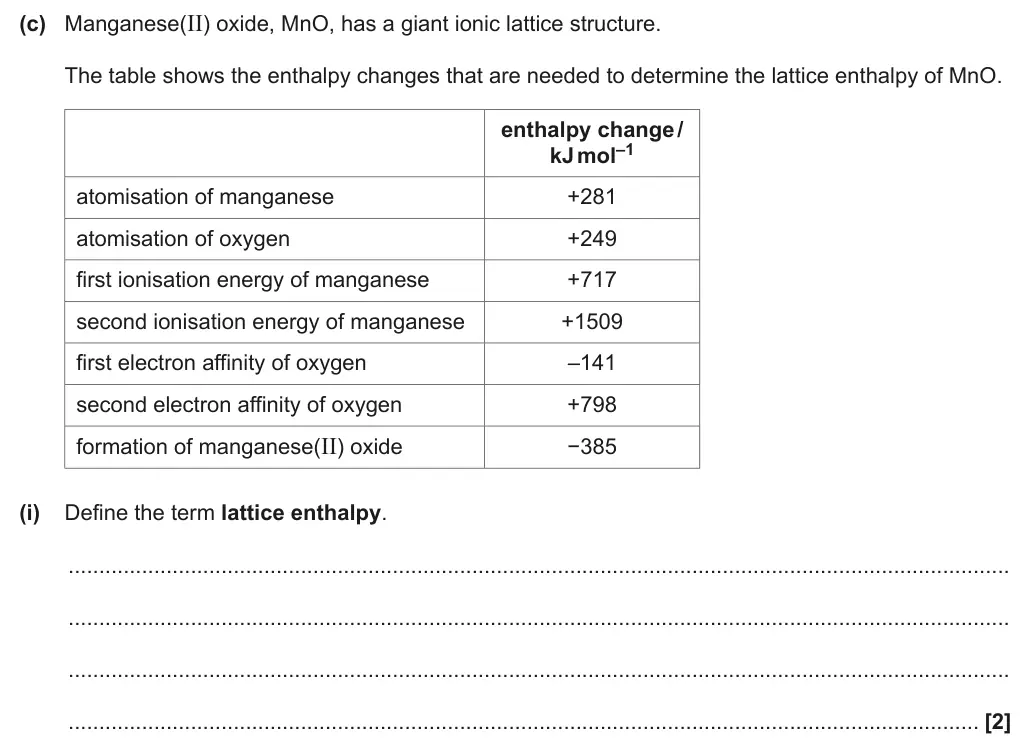
(c) Manganese(II) oxide, MnO, has a giant ionic lattice structure.
The table shows the enthalpy changes that are needed to determine the lattice enthalpy of MnO.
enthalpy change /
kJ mol–1
atomisation of manganese +281
atomisation of oxygen +249
first ionisation energy of manganese +717
second ionisation energy of manganese +1509
first electron affinity of oxygen –141
second electron affinity of oxygen +798
formation of manganese(II) oxide −385
(i) Define the term lattice enthalpy.
..........................................................................................................................................................
..........................................................................................................................................................
..........................................................................................................................................................
..................................................................................................................................................... [2]
June 2024 · Paper 1 · Q17(a) 1 mark Short answer Hard reaction rates
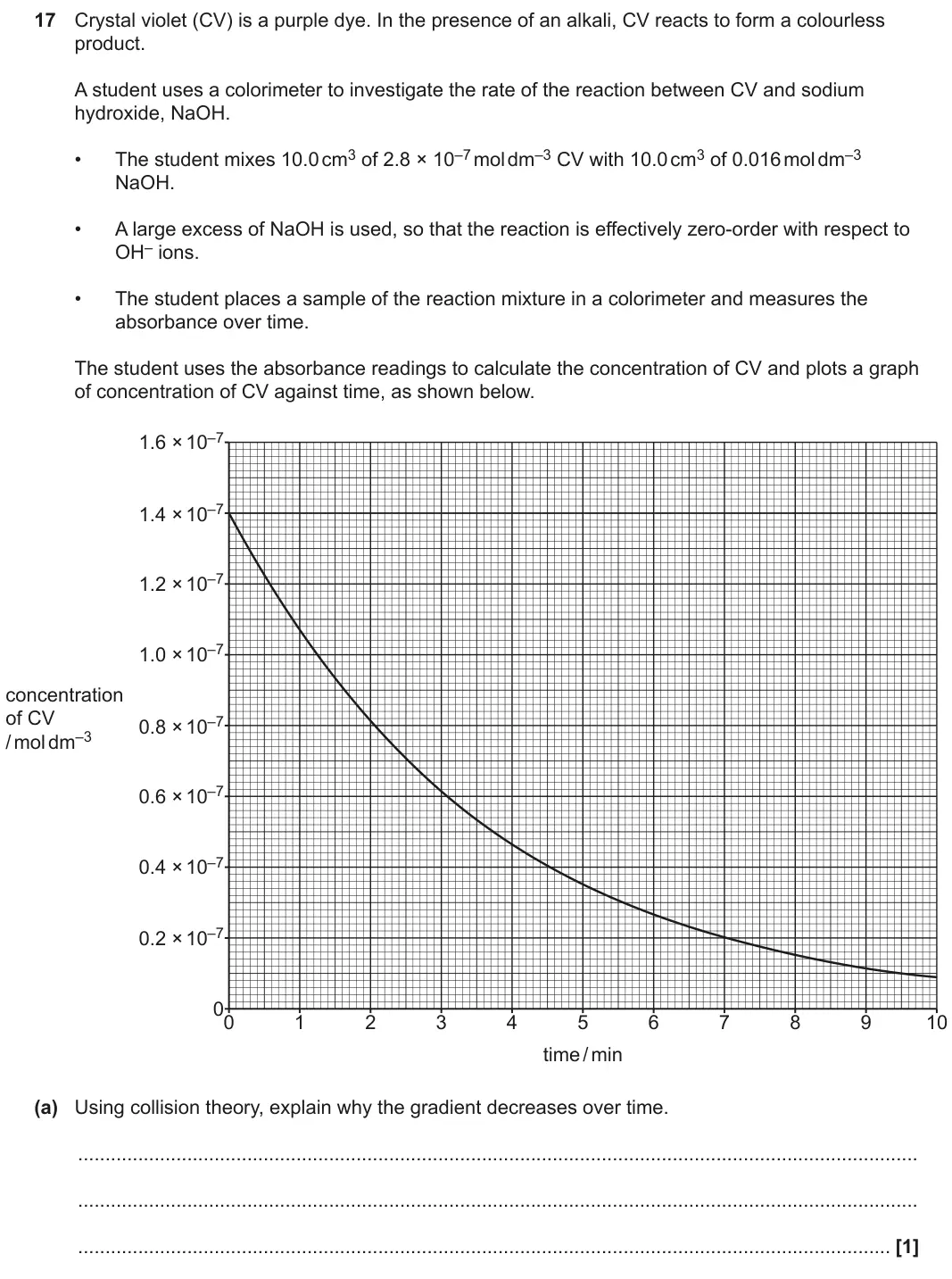
17 Crystal violet (CV) is a purple dye. In the presence of an alkali, CV reacts to form a colourless
product.
A student uses a colorimeter to investigate the rate of the reaction between CV and sodium
hydroxide, NaOH.
• The student mixes 10.0 cm3 of 2.8 × 10⁻⁷ mol dm–3 CV with 10.0 cm3 of 0.016 mol dm–3
NaOH.
• A large excess of NaOH is used, so that the reaction is effectively zero-order with respect to
OH– ions.
• The student places a sample of the reaction mixture in a colorimeter and measures the
absorbance over time.
The student uses the absorbance readings to calculate the concentration of CV and plots a graph
of concentration of CV against time, as shown below.
1.6 × 10⁻⁷
1.4 × 10⁻⁷
1.2 × 10⁻⁷
1.0 × 10⁻⁷
concentration
of CV
0.8 × 10⁻⁷
/ mol dm–3
0.6 × 10⁻⁷
0.4 × 10⁻⁷
0.2 × 10⁻⁷
0
0 1 2 3 4 5 6 7 8 9 10
time / min
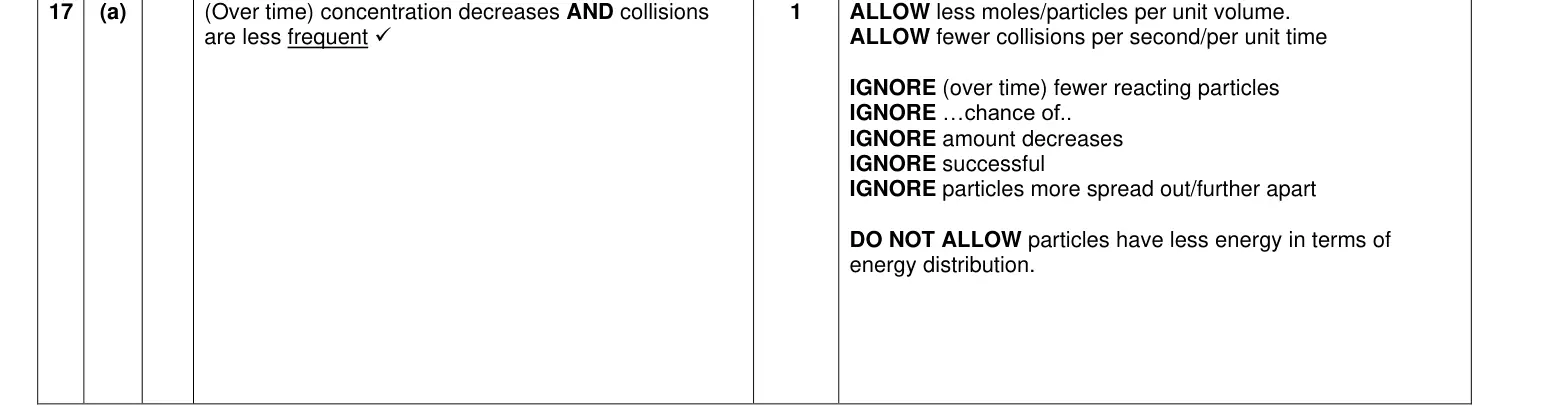
(a) Using collision theory, explain why the gradient decreases over time.
..........................................................................................................................................................
..........................................................................................................................................................
..................................................................................................................................................... [1]
June 2024 · Paper 1 · Q18(a)(ii) 2 marks Short answer Hard equilibrium constants
Earlier part of question 18 that this part usesEarlier part of June 2024 Paper 1 question 18
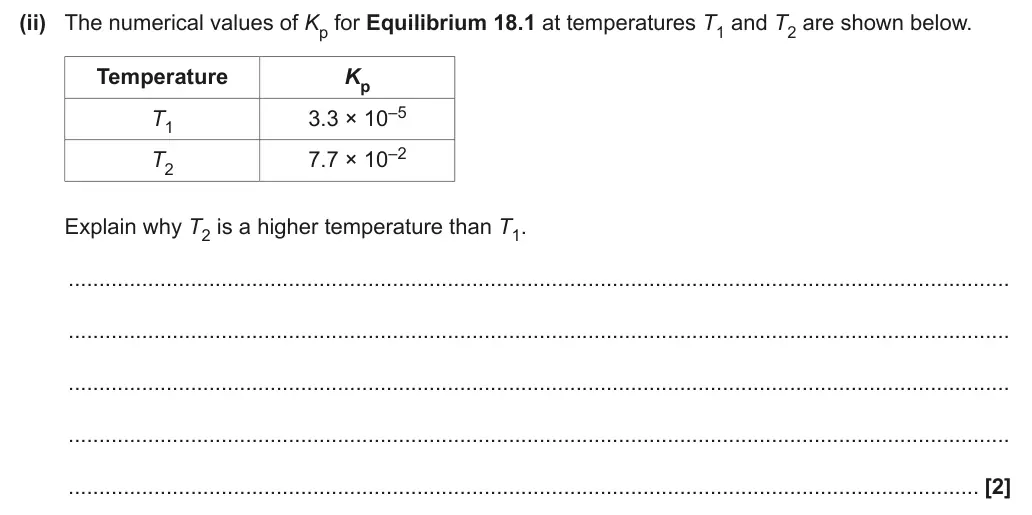
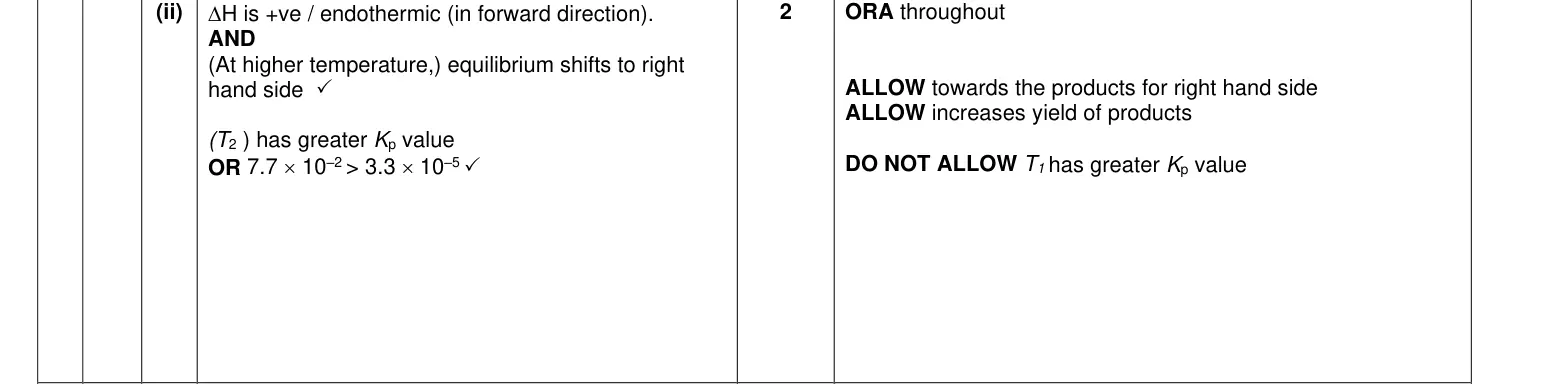
(ii) The numerical values of Kp for Equilibrium 18.1 at temperatures T1 and T2 are shown below.
Temperature Kp
T1 3.3 × 10⁻⁵
T2 7.7 × 10⁻²
Explain why T2 is a higher temperature than T1.
..........................................................................................................................................................
..........................................................................................................................................................
..........................................................................................................................................................
..........................................................................................................................................................
..................................................................................................................................................... [2]
June 2024 · Paper 1 · Q18(a)(iii) 2 marks Short answer Hard equilibrium constants
Earlier part of question 18 that this part usesEarlier part of June 2024 Paper 1 question 18
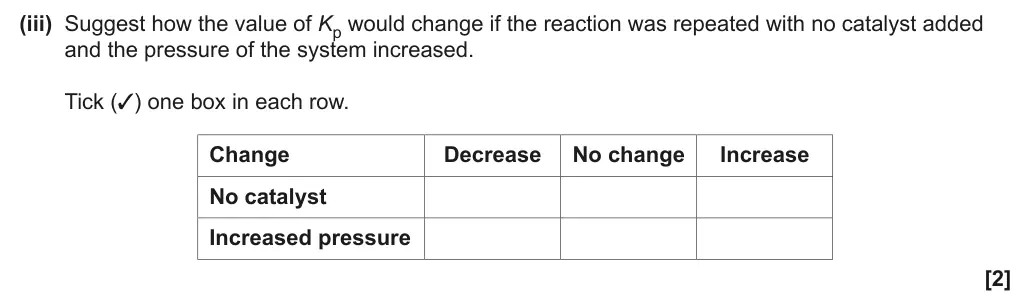
(iii) Suggest how the value of Kp would change if the reaction was repeated with no catalyst added
and the pressure of the system increased.
Tick (✓) one box in each row.
Change Decrease No change Increase
No catalyst
Increased pressure
[2]
June 2024 · Paper 1 · Q18(b)(i) 1 mark Short answer Hard bonding and structure
(b) SO2 and SO3 both have molecules with sulfur in the centre and bond angles of approximately
120°.
(i) Explain why the bond angles in SO3 are 120°.
..........................................................................................................................................................
..................................................................................................................................................... [1]
June 2024 · Paper 1 · Q18(b)(ii) 2 marks Short answer Hard bonding and structure
(ii) Explain why both SO2 and SO3 have polar bonds, but only SO2 has polar molecules.
..........................................................................................................................................................
..........................................................................................................................................................
..........................................................................................................................................................
..........................................................................................................................................................
..................................................................................................................................................... [2]
June 2024 · Paper 1 · Q19(a)(i) 1 mark Short answer Easy acids bases and buffers
19 This question is about acids and bases.
(a) Chloroethanoic acid, Cl CH2COOH, is a weak monobasic acid.
(i) Write the expression for the acid dissociation constant, Ka, of Cl CH2COOH.
[1]
June 2024 · Paper 1 · Q19(a)(ii) 1 mark Short answer Easy acids bases and buffers
Earlier part of question 19 that this part usesEarlier part of June 2024 Paper 1 question 19
(ii) The expression for the acid dissociation constant, Ka, of Cl CH2COOH can be simplified to:
[H+]2
Ka = [Cl CH2COOH]    Expression 19.1
State one approximation that allows the expression from (a)(i) to be simplified to Expression
19.1.
..........................................................................................................................................................
..................................................................................................................................................... [1]
June 2024 · Paper 1 · Q19(b)(ii) 1 mark Short answer Easy acids bases and buffers
Earlier part of question 19 that this part usesEarlier part of June 2024 Paper 1 question 19
(ii) The end point of the titration can also be found by observing the colour change of an indicator.
The pH ranges of some indicators are shown in the table.
Indicator pH range
Malachite green 0.2 – 1.8
Bromophenol blue 2.8 – 4.6
Phenol red 6.8 – 8.4
Phenolphthalein 8.2 – 10.0
Identify the indicator in the table that would be suitable to observe the end point of the titration
between CH3COOH and Ba(OH)2.
..................................................................................................................................................... [1]
June 2024 · Paper 1 · Q20(a)(i) 1 mark Short answer Medium halogens
20 This question is about elements in the periodic table.
(a) Chlorine has many uses.
(i) Chlorine is used to treat water in large-scale water treatment plants.
Suggest why chlorine is added to water in large-scale water treatment plants.
..........................................................................................................................................................
..................................................................................................................................................... [1]
June 2024 · Paper 1 · Q20(b) 2 marks Short answer Hard rate equations
(b) Fluorine, F2, reacts with nitrogen dioxide, NO2, to form nitryl fluoride, NO2F, as shown in
Reaction 20.1 below.
F2 + 2NO2 2NO2F    Reaction 20.1
The mechanism for this reaction involves two steps. Step 1 is the ‘slow’ step and Step 2 is the
‘fast’ step.
The equation for Step 2 is shown below:
F + NO2 NO2F
Suggest the equation for Step 1 and the rate equation for Reaction 20.1.
Equation for Step 1:  .........................................................................................................................
Rate equation for Reaction 20.1:  ....................................................................................................
[2]
June 2024 · Paper 1 · Q21(d)(ii) 3 marks Short answer Medium redox and electrode potentials
Earlier part of question 21 that this part usesEarlier part of June 2024 Paper 1 question 21
(ii) Hydrogen-oxygen fuel cells can operate in acidic or in alkaline conditions.
Show that for acidic and alkaline hydrogen–oxygen fuel cells, the standard cell potentials, and
the overall cell equations, are the same.
Acidic ................................................................................................................................................
..........................................................................................................................................................
..........................................................................................................................................................
..........................................................................................................................................................
Alkaline..............................................................................................................................................
..........................................................................................................................................................
..........................................................................................................................................................
..........................................................................................................................................................
[3]
June 2024 · Paper 1 · Q22(b)(i) 3 marks Short answer Easy transition elements
(b) The flowchart shows some reactions of cobalt(II) chloride, CoCl 2.
dissolve in water Pale pink solution containing a
CoCl2 (s)
six-coordinate complex ion A
aqueous NaOH concentrated HCl
Blue solution containing a
Blue-green solid B
four-coordinate complex ion C
In A, B and C, cobalt has an oxidation number of +2.
(i) Suggest the formulae of A, B and C.
Complex ion A: ......................................................................
Solid B: ......................................................................
Complex ion C: ......................................................................
[3]
June 2024 · Paper 1 · Q22(b)(ii) 2 marks Short answer Hard transition elementsatomic structure and isotopes
(ii) Cobalt (III) forms an octahedral complex ion D, which contains both ammonia and chloride
ligands.
Complex ion D has a molar mass of 197.9 g mol–1.
Determine the formula and charge of complex ion D.
..........................................................................................................................................................
..................................................................................................................................................... [2]
June 2024 · Paper 2 · Q16(b) 1 mark Short answer Easy organic basics
Earlier part of question 16 that this part usesEarlier part of June 2024 Paper 2 question 16
(b) Which hydrocarbons are alicyclic?
..................................................................................................................................................... [1]
June 2024 · Paper 2 · Q16(c) 1 mark Short answer Hard organic basics
Earlier part of question 16 that this part usesEarlier part of June 2024 Paper 2 question 16
(c) Which hydrocarbons have the general formula CnH2n?
..................................................................................................................................................... [1]
June 2024 · Paper 2 · Q16(d) 1 mark Short answer Hard aromatic compounds
Earlier part of question 16 that this part usesEarlier part of June 2024 Paper 2 question 16
(d) What is the systematic name of hydrocarbon C?
..................................................................................................................................................... [1]
June 2024 · Paper 2 · Q16(e) 2 marks Short answer Hard alkenes
Earlier part of question 16 that this part usesEarlier part of June 2024 Paper 2 question 16
(e) Explain why hydrocarbon D is a Z-stereoisomer.
..........................................................................................................................................................
..........................................................................................................................................................
..........................................................................................................................................................
..................................................................................................................................................... [2]
June 2024 · Paper 2 · Q17(a) 2 marks Short answer Medium alcohols
17 This question is about reactions of alcohols.
There are 4 structural isomers of C4H10O that are alcohols:
CH3CH2CH2CH2OH
CH3CH2CHOHCH3
(CH3)2CHCH2OH
(CH3)3COH
Alcohols take part in many different types of reaction, including
• elimination
• oxidation
• substitution
• esterification.
For each type of reaction, choose appropriate reagent(s) and/or catalyst, and show the organic
product formed.
(a) Elimination reaction of CH3CH2CH2CH2OH
Reagent(s) and/or catalyst
..........................................................................................................................................................
..........................................................................................................................................................
organic product
[2]
June 2024 · Paper 2 · Q17(b) 2 marks Short answer Medium alcohols
Earlier part of question 17 that this part usesEarlier part of June 2024 Paper 2 question 17
(b) Oxidation reaction of CH3CH2CHOHCH3
Reagent(s) and/or catalyst
..........................................................................................................................................................
..........................................................................................................................................................
organic product
[2]
June 2024 · Paper 2 · Q17(c) 2 marks Short answer Hard alcohols
Earlier part of question 17 that this part usesEarlier part of June 2024 Paper 2 question 17
(c) Substitution reaction of (CH3)2CHCH2OH
Reagent(s) and/or catalyst
..........................................................................................................................................................
..........................................................................................................................................................
organic product
[2]
June 2024 · Paper 2 · Q17(d) 2 marks Short answer Hard carboxylic acids and esters
Earlier part of question 17 that this part usesEarlier part of June 2024 Paper 2 question 17
(d) Esterification reaction of (CH3)3COH
Reagent(s) and/or catalyst
..........................................................................................................................................................
..........................................................................................................................................................
organic product
[2]
June 2024 · Paper 2 · Q18(a)(ii) 2 marks Short answer Easy alkanes
Earlier part of question 18 that this part usesEarlier part of June 2024 Paper 2 question 18
(ii) Describe two limitations of the synthesis of 2-bromo-2-methylpropane from an alkane and
bromine.
1  .......................................................................................................................................................
..........................................................................................................................................................
..........................................................................................................................................................
2  .......................................................................................................................................................
..........................................................................................................................................................
..........................................................................................................................................................
[2]
June 2024 · Paper 2 · Q18(b) 9 marks Short answer Medium amineshaloalkanescarbon carbon bond formation
(b) Complete the flowchart by filling in each box.
amine
reagent(s)
.............................................
reagent(s)
H
.............................................
H3C C Br
H
bromoethane alcohol
reagent(s)
..........................................................
H
H3C C C N
H
nitrile
reagent(s) reagent(s)
.......................................................... .............................................
carboxylic acid amine
[9]
June 2024 · Paper 2 · Q20(b)(i) 1 mark Short answer Hard organic basics
(b) Ester F has the structure shown below.
O
O
Ester F
(i) What is the systematic name for this ester?
..................................................................................................................................................... [1]
June 2024 · Paper 2 · Q21(a)(i) 1 mark Short answer Easy alkenes
21 This question is about aromatic compounds.
(a) Ethylbenzene, C6H5CH2CH3, can be prepared by reacting benzene with chloroethane,
CH3CH2Cl , in the presence of Al Cl 3. The Al Cl 3 acts as a halogen carrier.
CH2CH3
Ethylbenzene
In the mechanism, chloroethane reacts with the halogen carrier to form a carbocation, which acts
as the electrophile.
(i) What is meant by the term electrophile?
..........................................................................................................................................................
..................................................................................................................................................... [1]
June 2024 · Paper 2 · Q21(b)(iii) 3 marks Short answer Medium aromatic compounds
Earlier part of question 21 that this part usesEarlier part of June 2024 Paper 2 question 21
(iii) Explain why chlorine reacts much more readily with C6H5NH2 than with benzene.
..........................................................................................................................................................
..........................................................................................................................................................
..........................................................................................................................................................
..........................................................................................................................................................
..........................................................................................................................................................
..........................................................................................................................................................
..........................................................................................................................................................
..........................................................................................................................................................
..........................................................................................................................................................
..................................................................................................................................................... [3]
June 2024 · Paper 2 · Q23(a) 1 mark Short answer Hard organic synthesispractical techniques
23  Oil of wintergreen is a liquid used in medicine to relieve muscle pain.
Compound H is a component in oil of wintergreen and can be synthesised from compound G, as
shown below. The boiling point and density of compound H are stated.
O O
OH O
OH OH
Compound G Compound H
boiling point = 222 °C
density = 1.174 g cm−3
A student prepares a sample of compound H by the method below.
Step 1   Reflux 8.97 g of compound G for 30 minutes with an excess of methanol in the
presence of a small amount of sulfuric acid as a catalyst.
Step 2   Add an excess of aqueous sodium carbonate, Na2CO3(aq).
Two layers are obtained.
Step 3  Purify the impure compound H that forms from the resulting mixture.
The student follows this method and obtains 5.32 g of pure compound H.
(a) Why does the student use reflux in Step 1?
..........................................................................................................................................................
..................................................................................................................................................... [1]
June 2024 · Paper 2 · Q23(b)(ii) 1 mark Short answer Medium aromatic compoundspractical skillscarboxylic acids and esters
Earlier parts of question 23 that this part usesEarlier part of June 2024 Paper 2 question 23Earlier part of June 2024 Paper 2 question 23
(ii) Another student suggests that adding aqueous sodium hydroxide would be more effective in
removing the sulfuric acid catalyst than Na2CO3(aq).
Comment on whether the student’s suggestion is an improvement for the preparation of
compound H.
..........................................................................................................................................................
..........................................................................................................................................................
..................................................................................................................................................... [1]
June 2024 · Paper 2 · Q23(d) 4 marks Short answer Hard organic synthesis aspractical techniques
Earlier part of question 23 that this part usesEarlier part of June 2024 Paper 2 question 23
(d) Describe how to purify the impure compound H from the two layers in Step 2.
..........................................................................................................................................................
..........................................................................................................................................................
..........................................................................................................................................................
..........................................................................................................................................................
..........................................................................................................................................................
..........................................................................................................................................................
..........................................................................................................................................................
..........................................................................................................................................................
..................................................................................................................................................... [4]
June 2024 · Paper 3 · Q2(a)(i) 1 mark Short answer Medium enthalpy changes
2 This question is about different areas of chemistry.
(a) Hydrogen gas is manufactured by the chemical industry from the reversible reaction of methane
and steam, shown below.
CH4(g) + H2O(g) 3H2(g) + CO(g)    ΔH = +195 kJ mol–1
Average bond enthalpies are shown in the table.
Bond H–H O–H C≡O
Average bond enthalpy
+436 +464 +1077
/ kJ mol–1
(i) Why do all average bond enthalpies have a positive value?
..........................................................................................................................................................
..................................................................................................................................................... [1]
June 2024 · Paper 3 · Q2(c)(i) 1 mark Short answer Easy organic basicsamount of substance
(c) Compound B, shown below, is an antiviral medicine.
HO OH
O
O
N O
HO
N N O
H
compound B
(i) What is the molecular formula of compound B?
..................................................................................................................................................... [1]
June 2024 · Paper 3 · Q2(c)(ii) 1 mark Short answer Easy amino acids amides and chirality
Earlier part of question 2 that this part usesEarlier part of June 2024 Paper 3 question 2
(ii) How many chiral carbon atoms are there in one molecule of compound B?
..................................................................................................................................................... [1]
June 2024 · Paper 3 · Q3(a)(i) 2 marks Short answer Medium transition elements
3 This question is about compounds and ions of iron(II) and iron(III) that contain ethanedioate ions,
C2O4 2–.
(a) The C2O4 2– ion, shown below, is an example of a bidentate ligand.
O O
C C
–O O–
(i) Explain what is meant by the term bidentate ligand.
..........................................................................................................................................................
..........................................................................................................................................................
..........................................................................................................................................................
..................................................................................................................................................... [2]
June 2024 · Paper 3 · Q4(a)(i) 2 marks Short answer Medium acids bases and buffers
4 This question is about the chemistry of compounds containing phosphorus.
(a) Phosphorus forms several acids including H3PO4 and H3PO3.
H3PO4 is a tribasic acid. The equilibria for the dissociations are shown below.
1 H3PO4 H+ + H2PO4 –
2 H2PO4 – H+ + HPO4 2–
3 HPO4 2– H+ + PO4 3–
(i) During the equilibria, H2PO4 – behaves both as an acid and as a base.
Explain this statement, using the equilibria 1, 2 and 3, as required.
..........................................................................................................................................................
..........................................................................................................................................................
..........................................................................................................................................................
..................................................................................................................................................... [2]
June 2024 · Paper 3 · Q4(a)(iii) 1 mark Short answer Medium redox
Earlier part of question 4 that this part usesEarlier part of June 2024 Paper 3 question 4
(iii) The systematic name of H3PO4 is phosphoric(V) acid.
What is the systematic name of H3PO3?
..................................................................................................................................................... [1]
June 2024 · Paper 3 · Q4(c)(iii) 1 mark Short answer Medium aromatic compounds
Earlier part of question 4 that this part usesEarlier part of June 2024 Paper 3 question 4
(iii) Suggest one example of evidence that could show that P3N3Cl 6 has a Kekulé structure rather
than a delocalised structure.
..........................................................................................................................................................
..........................................................................................................................................................
..................................................................................................................................................... [1]
June 2024 · Paper 3 · Q4(c)(iv) 2 marks Short answer Hard aromatic compoundsbonding and structure
Earlier part of question 4 that this part usesEarlier part of June 2024 Paper 3 question 4
(iv) In a molecule of P3N3Cl 6 all the N and Cl atoms are bonded to P atoms.
Suggest a possible structure for a molecule of P3N3Cl 6.
[2]
June 2024 · Paper 3 · Q5(a)(iii) 3 marks Short answer Easy haloalkaneschromatography and functional group tests
Earlier part of question 5 that this part usesEarlier part of June 2024 Paper 3 question 5
(iii) A student investigates the alkaline hydrolysis of 1-chloropropane using the same method as for
1-bromopropane.
Predict, with reasons, how the appearance of the reaction mixture in the chromatogram produced
after 20 minutes would be different when 1-chloropropane is used instead of 1-bromopropane.
Suggest why propan-1-ol is run alongside the reaction mixture.
..........................................................................................................................................................
..........................................................................................................................................................
..........................................................................................................................................................
..........................................................................................................................................................
..........................................................................................................................................................
..........................................................................................................................................................
..........................................................................................................................................................
..........................................................................................................................................................
..................................................................................................................................................... [3]
June 2023 · AS Paper 1 · Q21(a)(i) 1 mark AO1 Short answer Easy bonding and structure
SECTION B
21 This question is about NF3 and BF3 molecules.
(a) NF3 and BF3 contain covalent bonds.
(i) What is meant by a covalent bond?
...................................................................................................................................... [1]
June 2023 · AS Paper 1 · Q21(b)(i) 2 marks AO1 Short answer Medium bonding and structure
Earlier part of question 21 that this part usesEarlier part of June 2023 Paper 1 question 21
(b) Molecules of NF3 and BF3 have different shapes and bond angles.
(i) Predict the different shapes of, and bond angles in, NF3 and BF3 molecules.
Bond angle Name of shape
NF3
BF3
[2]
June 2023 · AS Paper 1 · Q21(b)(ii) 2 marks AO1 Short answer Medium bonding and structure
Earlier part of question 21 that this part usesEarlier part of June 2023 Paper 1 question 21
(ii) Explain why NF3 and BF3 molecules have different shapes and bond angles.
...........................................................................................................................................
...........................................................................................................................................
...........................................................................................................................................
...........................................................................................................................................
...........................................................................................................................................
...........................................................................................................................................
...................................................................................................................................... [2]
June 2023 · AS Paper 1 · Q22(a) 1 mark AO1 Short answer Medium acids and titrations
22 This question is about reactions involving acids.
(a) Hydrochloric acid and nitric acid are classified as strong acids.
What is meant by a strong acid?
...................................................................................................................................................
.............................................................................................................................................. [1]
June 2023 · AS Paper 1 · Q22(b)(ii) 2 marks AO2 Short answer Medium acids and titrationsformulae and equations
Earlier part of question 22 that this part usesEarlier part of June 2023 Paper 1 question 22
(ii) The reaction of ammonium carbonate with dilute nitric acid.
...................................................................................................................................... [2]
June 2023 · AS Paper 1 · Q22(c)(i) 1 mark AO1 Short answer Medium practical techniquesacids and titrations
(c) A student carries out an investigation to identify an unknown Group 1 metal M.
• The student reacts 2.62 g of the Group 1 metal, M, with water.
A solution of the alkali, MOH(aq), is formed.
• The student makes this solution of MOH(aq) up to 250.0 cm3 with water.
• The student pipettes 25.0 cm3 of this MOH(aq) solution into a conical flask.
• The student titrates this 25.0 cm3 volume of MOH(aq) with 0.165 mol dm–3 H2SO4(aq).
The equation is shown below.
2MOH(aq)  +  H2SO4(aq) M2SO4(aq)  +  2H2O(l)
(i) Name the type of flask that the student should use to make up the 250.0 cm3 solution of
MOH(aq).
...................................... flask [1]
June 2023 · AS Paper 1 · Q23(b)(i) 1 mark AO1 Short answer Medium enthalpy changes
(b) Iron(III) oxide reacts with carbon monoxide as shown:
Fe2O3(s)  +  3CO(g) 2Fe(s)  +  3CO2(g) ΔH = –25 kJ mol–1
Standard enthalpy changes of formation, Δ f H o, are given in the table.
Substance Δ f H o / kJ mol–1
Fe2O3(s) –824
CO(g) –111
(i) State the conditions of temperature and pressure for standard enthalpy changes.
Temperature  ......................................................................................................................
Pressure  ....................................................................................................................... [1]
June 2023 · AS Paper 1 · Q24(a) 1 mark AO1 Short answer Medium chemical equilibrium
24 The reaction between sulfur dioxide, SO2(g) and oxygen, O2(g), to form sulfur trioxide, SO3(g), is
a key step in the industrial manufacture of sulfuric acid.
This is a reversible reaction, shown in Equilibrium 24.1:
2SO2(g)  +  O2(g) 2SO3(g) ΔH = –197 kJ mol–1 Equilibrium 24.1
(a) Why is Equilibrium 24.1 a homogeneous equilibrium?
...................................................................................................................................................
.............................................................................................................................................. [1]
June 2023 · AS Paper 1 · Q24(c)(ii) 1 mark AO3 Short answer Hard chemical equilibrium
Earlier part of question 24 that this part usesEarlier part of June 2023 Paper 1 question 24
(ii) In the industrial production of SO3, an excess of O2(g) is used rather than a 2:1
proportion of SO2(g) to O2(g) which would match the stochiometry in Equilibrium 24.1.
Suggest, in terms of equilibrium, why an excess of O2(g) is used industrially.
...........................................................................................................................................
...........................................................................................................................................
...................................................................................................................................... [1]
June 2023 · AS Paper 1 · Q25(a) 2 marks AO1 Short answer Hard alkanesbonding and structure
25 This question is about hydrocarbons.
(a) The boiling points of 2 hydrocarbons are shown below.
Hydrocarbon Boiling point / °C
butane 0
pentane 36
Explain the difference in the boiling points of butane and pentane.
...................................................................................................................................................
...................................................................................................................................................
...................................................................................................................................................
...................................................................................................................................................
.............................................................................................................................................. [2]
June 2023 · AS Paper 1 · Q26 5 marks Short answer Hard alcoholsorganic basics
26 This question is about the oxidation of two alcohols that are structural isomers of C3H8O.
Compare the oxidation of these two structural isomers using different reaction conditions.
For each reaction include:
• the reaction conditions
• the functional group of any organic product
• a balanced equation.
In your equations, use [O] to represent the oxidising agent and show any organic compounds as
structures.
..........................................................................................................................................................
..........................................................................................................................................................
..........................................................................................................................................................
..........................................................................................................................................................
..........................................................................................................................................................
..........................................................................................................................................................
..........................................................................................................................................................
..........................................................................................................................................................
..........................................................................................................................................................
..........................................................................................................................................................
..........................................................................................................................................................
..........................................................................................................................................................
..........................................................................................................................................................
..........................................................................................................................................................
..................................................................................................................................................... [5]
June 2023 · AS Paper 2 · Q1(a)(ii) 1 mark AO1 Short answer Medium electron structure
(ii) Complete the electron configuration of a titanium atom.
1s2  ................................................................................................................................ [1]
June 2023 · AS Paper 2 · Q1(b)(i) 1 mark AO2 Short answer Hard redox
(b) An ore of titanium contains impure TiO2.
Titanium is manufactured from TiO2 in a two-stage process.
Stage 1 TiO2  +  2C  +  2Cl 2 TiCl4  +  2CO Reaction 1.1
Stage 2 TiCl4  +  4Na Ti  +  4NaCl Reaction 1.2
(i) The common name for TiO2 is titanium dioxide.
What is the systematic name of TiO2?
...................................................................................................................................... [1]
June 2023 · AS Paper 2 · Q1(b)(iii) 2 marks AO3 Short answer Medium bonding and structurepractical skills
Earlier part of question 1 that this part usesEarlier part of June 2023 Paper 2 question 1
(iii) Reaction 1.2 produces a mixture of titanium and sodium chloride.
Suggest how titanium could be separated from this mixture at room temperature.
Explain your answer.
...........................................................................................................................................
...........................................................................................................................................
...........................................................................................................................................
...................................................................................................................................... [2]
June 2023 · AS Paper 2 · Q2(a)(ii) 1 mark AO1 Short answer Medium group 2
Earlier part of question 2 that this part usesEarlier part of June 2023 Paper 2 question 2
(ii) Suggest one difference that the student would observe in the reaction of barium with
water compared to the reaction of calcium with water.
...........................................................................................................................................
...................................................................................................................................... [1]
June 2023 · AS Paper 2 · Q2(b)(iii) 2 marks AO3 Short answer Medium halogenspractical skills
Earlier parts of question 2 that this part usesEarlier part of June 2023 Paper 2 question 2Earlier part of June 2023 Paper 2 question 2
(iii) The student changes the method in 2(b).
In step 2, the student adds an excess of silver nitrate solution, AgNO3(aq), instead of
Na2SO4(aq).
Explain whether this change would allow the student to determine the percentage by
mass of NaCl (s) in the mixture.
...........................................................................................................................................
...........................................................................................................................................
...........................................................................................................................................
...........................................................................................................................................
...................................................................................................................................... [2]
June 2023 · AS Paper 2 · Q2(c)(ii) 4 marks AO1, 2, 3 Short answer Medium bonding and structureperiodicity
Earlier part of question 2 that this part usesEarlier part of June 2023 Paper 2 question 2
(ii) Explain the following:
• MgS has a higher melting point than PCl 3.
• Al has a greater electrical conductivity than Si.
Melting points .....................................................................................................................
...........................................................................................................................................
...........................................................................................................................................
...........................................................................................................................................
Conductivities .....................................................................................................................
...........................................................................................................................................
...........................................................................................................................................
...........................................................................................................................................
[4]
June 2023 · AS Paper 2 · Q3(d)(ii) 1 mark AO2 Short answer Medium haloalkanes
Earlier parts of question 3 that this part usesEarlier part of June 2023 Paper 2 question 3Earlier part of June 2023 Paper 2 question 3
(ii) Predict which precipitate would form first and explain the difference in the rates of
hydrolysis of 2-bromopropane and 2-iodopropane.
...........................................................................................................................................
...........................................................................................................................................
...........................................................................................................................................
...................................................................................................................................... [1]
June 2023 · AS Paper 2 · Q4(a) 2 marks AO1 Short answer Medium enthalpy changes
4 This question is about the enthalpy change of combustion of alcohols.
(a) Explain the term enthalpy change of combustion.
...................................................................................................................................................
...................................................................................................................................................
...................................................................................................................................................
.............................................................................................................................................. [2]
June 2023 · AS Paper 2 · Q4(c)(ii) 2 marks AO3 Short answer Hard enthalpy changes
Earlier part of question 4 that this part usesEarlier part of June 2023 Paper 2 question 4
(ii) Methoxymethane, CH3OCH3, is an isomer of ethanol.
On combustion, methoxymethane, in the gaseous state, produces carbon dioxide and
steam.
H H
H C O C H(g)  + 3 O=O(g) 2 O= C=O(g) + 3 H O H(g)
H H
ΔcH for methoxymethane is more negative than ΔcH for ethanol.
Explain why the ΔcH values are different, in terms of the bonds broken and the bonds
formed.
...........................................................................................................................................
...........................................................................................................................................
...........................................................................................................................................
...........................................................................................................................................
...................................................................................................................................... [2]
June 2023 · AS Paper 2 · Q5(a)(i) 1 mark AO2 Short answer Medium organic basics
5 This question is about alkenes.
(a) A mixture of alkenes is produced when water is eliminated from alcohol A.
OH
Alcohol A
(i) What is the systematic name of alcohol A?
...................................................................................................................................... [1]
June 2023 · AS Paper 2 · Q5(b)(ii) 2 marks AO1 Short answer Hard alkenes
Earlier part of question 5 that this part usesEarlier part of June 2023 Paper 2 question 5
(ii) Outline two ways that waste hydrocarbon polymers can be processed usefully, rather
than being disposed of in landfill sites.
1  ........................................................................................................................................
...........................................................................................................................................
...........................................................................................................................................
2  ........................................................................................................................................
...........................................................................................................................................
...........................................................................................................................................
[2]
June 2023 · Paper 1 · Q16(b) 4 marks AO1 Short answer Easy periodicitygroup 2
(b) The first and second ionisation energies of magnesium, Mg, and strontium, Sr, in Group 2
are given in the table below.
First ionisation energy Second ionisation energy
Element
/ kJ mol–1 / kJ mol–1
Mg +738 +1451
Sr +550 +1064
• Explain why the first ionisation energy of Mg is greater than the first
ionisation energy of Sr.
• Explain why the second ionisation energy of Sr is greater than the first
ionisation energy of Sr.
...................................................................................................................................................
...................................................................................................................................................
...................................................................................................................................................
...................................................................................................................................................
...................................................................................................................................................
...................................................................................................................................................
...................................................................................................................................................
...................................................................................................................................................
...................................................................................................................................................
.............................................................................................................................................. [4]
June 2023 · Paper 1 · Q18(c)(i) 1 mark AO2 Short answer Medium entropy and free energy
(c) Ethene can be produced from ethanol, as shown in Reaction 2 below.
C2H5OH(g) C2H4(g) + H2O(g)            Reaction 2
(i) Predict the sign of the entropy change, ∆S, for Reaction 2.
Explain your reasoning.
...........................................................................................................................................
...........................................................................................................................................
...................................................................................................................................... [1]
June 2023 · Paper 1 · Q19(a)(ii) 3 marks AO2, 3 Short answer Easy chemical equilibriumequilibrium constants
Earlier part of question 19 that this part usesEarlier part of June 2023 Paper 1 question 19
(ii) The sealed flask in (a)(i) is then heated to a higher temperature at an increased
pressure. The system is allowed to reach equilibrium again.
Explain why it is difficult to predict how these changes in reaction conditions affect the
amount of N2O4(g) formed at equilibrium.
...........................................................................................................................................
...........................................................................................................................................
...........................................................................................................................................
...........................................................................................................................................
...........................................................................................................................................
...........................................................................................................................................
...................................................................................................................................... [3]
June 2023 · Paper 1 · Q20(c)(ii) 2 marks AO3 Short answer Hard amount of substance
Earlier part of question 20 that this part usesEarlier part of June 2023 Paper 1 question 20
(ii) The student then reacts 1.00 g of calcium carbonate, CaCO3, with an excess of dilute
nitric acid, HNO3.
Explain why the student’s two reactions produce different volumes of gas.
...........................................................................................................................................
...........................................................................................................................................
...........................................................................................................................................
...........................................................................................................................................
...................................................................................................................................... [2]
June 2023 · Paper 1 · Q20(d)(ii) 3 marks AO1, 3 Short answer Hard acids and titrationsreaction ratesacids bases and buffers
Earlier part of question 20 that this part usesEarlier part of June 2023 Paper 1 question 20
(ii) Explain why these two reactions of magnesium produce the same volume of gas but at
different rates.
...........................................................................................................................................
...........................................................................................................................................
...........................................................................................................................................
...........................................................................................................................................
...................................................................................................................................... [3]
June 2023 · Paper 1 · Q20(e)(i) 1 mark AO1 Short answer Hard acids bases and buffers
(e) Butanoic acid, CH3CH2CH2COOH, is a weak monobasic acid.
(i) Explain what is meant by the term monobasic acid.
...........................................................................................................................................
...................................................................................................................................... [1]
June 2023 · Paper 1 · Q20(f) 1 mark AO3 Short answer Hard acids bases and buffers
(f) A buffer solution has a pH of 4.50.
When a small volume of water is added to this buffer solution, the pH does not change.
Explain why the pH does not change.
...................................................................................................................................................
...................................................................................................................................................
.............................................................................................................................................. [1]
June 2023 · Paper 1 · Q21(a)(i) 1 mark AO1 Short answer Hard redox and electrode potentials
21 Some grass fertilisers contain compounds of iron.
During heavy rain, a fertiliser is washed into a nearby river causing the water to be polluted with a
mixture of iron(II) and iron(III) ions.
(a) A student determines the concentration of iron(II) ions in a sample of river water by titration
with potassium manganate(VII).
25.0 cm3 portions of river water are acidified with dilute sulfuric acid. Each portion is titrated
with 0.00250 mol dm–3 potassium manganate(VII) until a colour change is seen.
MnO4 –(aq) + 8H+(aq) + 5Fe2+(aq) Mn2+(aq) + 4H2O(l) + 5Fe3+(aq)
(i) State the colour change seen at the end point of the titration.
from .......................................... to .......................................... [1]
June 2023 · Paper 1 · Q22(b)(i) 2 marks AO1 Short answer Easy transition elements
(b) (i) Describe precipitation reactions using either copper or chromium ions as examples.
Include equations.
...........................................................................................................................................
...........................................................................................................................................
...........................................................................................................................................
...................................................................................................................................... [2]
June 2023 · Paper 1 · Q22(b)(ii) 2 marks AO1 Short answer Medium transition elements
Earlier part of question 22 that this part usesEarlier part of June 2023 Paper 1 question 22
(ii) Describe ligand substitution reactions using either copper or chromium ions as
examples.
Include equations.
...........................................................................................................................................
...........................................................................................................................................
...........................................................................................................................................
...................................................................................................................................... [2]
June 2023 · Paper 1 · Q22(c) 2 marks AO1 Short answer Hard transition elements
(c) The ethanedioate ion, C2O4 2–, is a bidentate ligand.
A complex ion of cobalt(III) contains two ethanedioate ligands and two water ligands.
Determine the charge of this complex ion and the coordination number of cobalt in the
complex ion.
Charge of complex ion  ..............................................................................................................
Coordination number of cobalt  ............................................................................................ [2]
June 2023 · Paper 2 · Q16(a) 4 marks AO1 Short answer Hard alkanesbonding and structure
16 This question is about hydrocarbons.
(a) The boiling points of some hydrocarbons containing 6 carbon atoms are shown below.
Hydrocarbon Boiling point / ºC
2,2-dimethylbutane 50
2-methylpentane 60
hexane 69
State and explain the trend in boiling points shown by these hydrocarbons.
...................................................................................................................................................
...................................................................................................................................................
...................................................................................................................................................
...................................................................................................................................................
...................................................................................................................................................
...................................................................................................................................................
...................................................................................................................................................
...................................................................................................................................................
...................................................................................................................................................
.............................................................................................................................................. [4]
June 2023 · Paper 2 · Q17(c)(ii) 1 mark AO1 Short answer Medium alcohols
Earlier part of question 17 that this part usesEarlier part of June 2023 Paper 2 question 17
(ii) A student converts compound D into a diiodoalkane.
Suggest suitable reagents for this reaction.
...................................................................................................................................... [1]
June 2023 · Paper 2 · Q18(c) 3 marks AO3 Short answer Medium organic synthesis
Earlier part of question 18 that this part usesEarlier part of June 2023 Paper 2 question 18
(c) Describe how to purify the impure crystals in Step 3.
...................................................................................................................................................
...................................................................................................................................................
...................................................................................................................................................
...................................................................................................................................................
...................................................................................................................................................
.............................................................................................................................................. [3]
June 2023 · Paper 2 · Q20(a) 4 marks AO2 Short answer Medium aromatic compoundscarboxylic acids and esters
20 This question is about aromatic compounds containing the –COOH and –OH functional groups.
(a) Salicylic acid, shown below, is used in the manufacture of some important medicines.
COOH
OH
Salicylic acid
Complete the flowchart for reactions of salicylic acid, by adding the organic products in each
box.
Br2 Na2CO3(aq)
COOH
OH
propanoic anhydride
(CH3CH2CO)2O
+
[4]
June 2023 · Paper 2 · Q21(a) 1 mark AO1 Short answer Medium amino acids amides and chirality
21 This question is about α-amino acids.
(a) The general formula of an α-amino acid is RCH(NH2)COOH.
Most α-amino acids show optical isomerism.
Explain the term optical isomerism.
...................................................................................................................................................
...................................................................................................................................................
...................................................................................................................................................
.............................................................................................................................................. [1]
June 2023 · Paper 2 · Q21(b)(i) 1 mark AO1 Short answer Hard organic basics
Earlier part of question 21 that this part usesEarlier part of June 2023 Paper 2 question 21
(b) The α-amino acid valine has the R group of –CH(CH3)2.
(i) What is the systematic name of valine?
...................................................................................................................................... [1]
June 2023 · Paper 2 · Q21(c)(i) 1 mark AO2 Short answer Hard amino acids amides and chirality
Earlier part of question 21 that this part usesEarlier part of June 2023 Paper 2 question 21
(c) Three α-amino acids can react together to form compound E, shown below.
OH
OH
C
H2C O
H
H2C N CH
CH C NH
C O C NH2
HO O O CH
CH
HO CH3
Compound E
(i) How many optical isomers are possible for compound E?
...................................................................................................................................... [1]
June 2023 · Paper 2 · Q22(a)(ii) 1 mark AO1 Short answer Easy carbonyl compounds
Earlier part of question 22 that this part usesEarlier part of June 2023 Paper 2 question 22
(ii) Name this type of mechanism.
...................................................................................................................................... [1]
June 2023 · Paper 2 · Q22(b) 9 marks AO1, 2 Short answer Medium organic synthesisalkenescarbonyl compoundscarboxylic acids and esters
Earlier part of question 22 that this part usesEarlier part of June 2023 Paper 2 question 22
(b) Complete the flowchart by filling in each box.
reagent(s)
...................................
catalyst
unsaturated alcohol ................................... diol (major product)
reagent(s)
...................................
H H
reagent(s)
C C
...................................
H C O
H
acrolein carboxylic acid
reagent(s)
...................................
polymer (2 repeat units) acyl chloride
[9]
June 2023 · Paper 3 · Q1(a) 1 mark AO1 Short answer Medium bonding and structure
1 This question is about the first 36 elements in the periodic table:
H He
Li Be B C N O F Ne
Na Mg Al Si P S Cl Ar
K Ca Sc Ti V Cr Mn Fe Co Ni Cu Zn Ga Ge As Se Br Kr
From these 36 elements only, write the symbol for the element(s) that fit each description.
(a) The three elements that, when in a molecule, can form hydrogen bonds with other suitable
molecules.
........................................................... [1]
June 2023 · Paper 3 · Q1(b) 1 mark AO2 Short answer Medium periodicity
Earlier part of question 1 that this part usesEarlier part of June 2023 Paper 3 question 1
(b) The element in Period 2 with the successive ionisation energies shown below.
Ionisation number 1st 2nd 3rd 4th 5th 6th 7th 8th
Ionisation energy
1000 2251 3361 4564 7012 8496 27 107 31 671
/ kJ mol–1
................... [1]
June 2023 · Paper 3 · Q1(c) 1 mark AO1 Short answer Medium bonding and structureperiodicity
Earlier part of question 1 that this part usesEarlier part of June 2023 Paper 3 question 1
(c) An element that is a solid at RTP with a simple molecular lattice structure.
................... [1]
June 2023 · Paper 3 · Q1(d) 2 marks AO1 Short answer Medium transition elementselectron structure
Earlier part of question 1 that this part usesEarlier part of June 2023 Paper 3 question 1
(d) The two elements with atoms containing five unpaired electrons.
....................................... [2]
June 2023 · Paper 3 · Q1(e) 1 mark AO1 Short answer Easy periodicity
Earlier part of question 1 that this part usesEarlier part of June 2023 Paper 3 question 1
(e) The element in Period 3 that exists in the solid state as a network of atoms bonded by strong
covalent bonds.
................... [1]
June 2023 · Paper 3 · Q1(f) 1 mark AO2 Short answer Medium bonding and structure
Earlier part of question 1 that this part usesEarlier part of June 2023 Paper 3 question 1
(f) The p-block element in Period 3 that forms a compound with fluorine with octahedral
molecules.
................... [1]
June 2023 · Paper 3 · Q1(g) 1 mark AO1 Short answer Medium halogens
Earlier part of question 1 that this part usesEarlier part of June 2023 Paper 3 question 1
(g) The element that forms 1– ions most readily.
................... [1]
June 2023 · Paper 3 · Q1(h) 1 mark AO2 Short answer Hard amount of substance
Earlier part of question 1 that this part usesEarlier part of June 2023 Paper 3 question 1
(h) The element with an average atomic mass of 1.244 × 10⁻²² g.
................... [1]
June 2023 · Paper 3 · Q2(a)(i) 1 mark AO1 Short answer Hard redox
2 These questions are from different areas of chemistry.
(a) This question is about two salts of rubidium (atomic number 37): RbCl O3 and RbCl O4.
(i) The oxidation number of chlorine is different in the two rubidium salts, RbCl O3 and
RbCl O4.
What is the name of RbCl O4?
...................................................................................................................................... [1]
June 2023 · Paper 3 · Q4(a) 1 mark AO3 Short answer Hard transition elementsformulae and equations
4 Tutton’s salts are ‘double salts’ with the formula X2Y(ZO4)2 • 6H2O.
A Tutton’s salt contains two cations: X+ and Y2+.
• X+ can be an ion of the Group 1 elements K, Rb, Cs or Fr, or an ammonium ion.
• Y2+ can be a 2+ ion of magnesium or an ion of most of the transition elements in Period 4.
• Z can be S or Cr.
(NH4)2Cu(SO4)2 • 6H2O is an example of a Tutton’s salt.
(a) Predict the formula of a Tutton’s salt containing different ions from (NH4)2Cu(SO4)2 • 6H2O.
.............................................................................................................................................. [1]
June 2023 · Paper 3 · Q4(b)(ii) 1 mark AO3 Short answer Medium amount of substancepractical skills
Earlier parts of question 4 that this part usesEarlier part of June 2023 Paper 3 question 4Earlier part of June 2023 Paper 3 question 4
(ii) In Step 3, why does the student allow the solvent to evaporate and not boil off all the
solvent in Step 2?
...........................................................................................................................................
...........................................................................................................................................
...................................................................................................................................... [1]
June 2023 · Paper 3 · Q4(c)(i) 1 mark AO2 Short answer Hard transition elementsatomic structure and isotopes
Earlier part of question 4 that this part usesEarlier part of June 2023 Paper 3 question 4
(c) The student dissolves their Tutton’s salt in water. A pale blue solution forms.
The student carries out two tests on this aqueous solution.
(i) The student adds an excess of aqueous ammonia to their aqueous solution of Tutton’s
salt. A deep blue solution forms.
The complex ion responsible for the deep blue solution has a molar mass of
167.5 g mol–1.
Suggest the formula of this complex ion.
...................................................................................................................................... [1]
June 2023 · Paper 3 · Q4(c)(ii) 3 marks AO2 Short answer Medium transition elementsqualitative analysis
Earlier part of question 4 that this part usesEarlier part of June 2023 Paper 3 question 4
(ii) The student adds NaOH(aq) to the aqueous solution of Tutton’s salt and warms the
mixture.
A precipitate and a gas are formed.
Write the formulae of the precipitate and gas and suggest a test that could confirm the
identity of the gas.
Formula of precipitate  .......................................................................................................
Formula of gas  ..................................................................................................................
Test to confirm the identity of the gas  ................................................................................
...........................................................................................................................................
...................................................................................................................................... [3]
June 2023 · Paper 3 · Q4(c)(iii) 2 marks AO2 Short answer Medium qualitative analysis
Earlier part of question 4 that this part usesEarlier part of June 2023 Paper 3 question 4
(iii) How could the student carry out a test-tube test to confirm the anion in the Tutton’s salt?
...........................................................................................................................................
...........................................................................................................................................
...........................................................................................................................................
...................................................................................................................................... [2]
June 2023 · Paper 3 · Q6(a) 4 marks AO1, 2 Short answer Hard bonding and structure
6 This question is about nitric acid, hydrochloric acid and sulfuric acid.
(a) Nitric acid has 2 single covalent bonds, 1 double covalent bond and 1 dative covalent bond
as shown below.
H O
N O
O
Nitric acid
Predict the H–O–N and O–N–O bond angles in nitric acid.
Explain your reasoning.
...................................................................................................................................................
...................................................................................................................................................
...................................................................................................................................................
...................................................................................................................................................
...................................................................................................................................................
.............................................................................................................................................. [4]
June 2022 · AS Paper 1 · Q21(a)(i) 1 mark AO1 Short answer Hard organic basics
SECTION B
Answer all the questions.
21 The alkene, (CH3)3CCH=CH2, is used to make some perfumes.
(a) (i) What is the systematic name for (CH3)3CCH=CH2?
...................................................................................................................................... [1]
June 2022 · AS Paper 1 · Q21(b)(ii) 1 mark AO1 Short answer Medium alkenes
(ii) State one advantage and one disadvantage of using combustion as a method for the
disposal of a polymer after it has exceeded its useful life.
Advantage  .........................................................................................................................
...........................................................................................................................................
Disadvantage  ....................................................................................................................
...........................................................................................................................................
[1]
June 2022 · AS Paper 1 · Q22(c) 3 marks AO1, 2 Short answer Hard amount of substance
(c) Substance A is a hydrated salt with the following percentage composition by mass:
Zn, 21.99%; H, 4.04%; N, 9.41%; O, 64.56%.
• Determine the empirical formula of A.
• Write the formula of A showing the water of crystallisation.
empirical formula:  ...............................................................
formula showing water of crystallisation:  ...............................................................
[3]
June 2022 · AS Paper 1 · Q23(a)(i) 1 mark AO1 Short answer Medium bonding and structure
23 This question is about different types of bonding.
(a) Ionic compounds have ionic bonding and exist in a giant ionic lattice structure.
(i) What is meant by ionic bonding?
...........................................................................................................................................
...........................................................................................................................................
...................................................................................................................................... [1]
June 2022 · AS Paper 1 · Q23(c) 4 marks AO1 Short answer Medium periodicity
(c) Describe the structure and bonding and electrical conductivity of calcium in the solid state.
You may wish to include a labelled diagram in your answer.
...................................................................................................................................................
...................................................................................................................................................
...................................................................................................................................................
...................................................................................................................................................
...................................................................................................................................................
...................................................................................................................................................
...................................................................................................................................................
.............................................................................................................................................. [4]
June 2022 · AS Paper 1 · Q24(a)(i) 1 mark AO1 Short answer Medium halogens
24 This question is about halogens and practical tests.
(a) Chlorine gas reacts with dilute sodium hydroxide, NaOH(aq).
This is a disproportionation reaction. One of the products has the formula NaCl O.
(i) What is meant by the term disproportionation?
...........................................................................................................................................
...................................................................................................................................... [1]
June 2022 · AS Paper 2 · Q1(a)(i) 1 mark AO1 Short answer Easy acids and titrations
1 Lime is a citrus fruit containing citric acid, C6H8O7.
(a) Citric acid is a weak organic acid.
(i) What is meant by an acid?
...................................................................................................................................... [1]
June 2022 · AS Paper 2 · Q1(a)(ii) 1 mark AO1 Short answer Medium acids and titrations
Earlier part of question 1 that this part usesEarlier part of June 2022 Paper 2 question 1
(ii) What is meant by an acid that is weak?
...........................................................................................................................................
...................................................................................................................................... [1]
June 2022 · AS Paper 2 · Q1(c) 2 marks AO3 Short answer Hard practical skillsamount of substanceacids and titrations
Earlier part of question 1 that this part usesEarlier part of June 2022 Paper 2 question 1
(c) The student’s teacher thinks that there is an unnecessary safety risk in using a sodium
hydroxide concentration of 0.800 mol dm–3 for the titration.
Suggest how the student could modify the method using a sodium hydroxide concentration
of 0.200 mol dm–3 instead of 0.800 mol dm–3.
The student should aim to have the same titre as in the original method.
Justify your answer.
...................................................................................................................................................
...................................................................................................................................................
...................................................................................................................................................
.............................................................................................................................................. [2]
June 2022 · AS Paper 2 · Q2(a)(ii) 2 marks AO2 Short answer Medium redox
Earlier part of question 2 that this part usesEarlier part of June 2022 Paper 2 question 2
(ii) Using oxidation numbers, explain why the reaction of strontium with water is a redox
reaction.
...........................................................................................................................................
...........................................................................................................................................
...........................................................................................................................................
...................................................................................................................................... [2]
June 2022 · AS Paper 2 · Q2(a)(iii) 3 marks AO1 Short answer Easy group 2periodicity
Earlier part of question 2 that this part usesEarlier part of June 2022 Paper 2 question 2
(iii) Explain why calcium reacts more slowly with water than strontium does.
...........................................................................................................................................
...........................................................................................................................................
...........................................................................................................................................
...........................................................................................................................................
...................................................................................................................................... [3]
June 2022 · AS Paper 2 · Q2(b)(ii) 2 marks AO3 Short answer Easy qualitative analysisformulae and equations
Earlier part of question 2 that this part usesEarlier part of June 2022 Paper 2 question 2
(ii) A student adds a few drops of dilute sulfuric acid to the colourless solution.
Describe what the student would observe, and give the formula of the barium
compound produced.
Observation  .......................................................................................................................
Formula of barium compound  ...........................................................................................
[2]
June 2022 · AS Paper 2 · Q3(b)(i) 2 marks AO2 Short answer Hard reaction rates
(b) The student investigates the reaction between zinc and dilute sulfuric acid.
Zn(s) + H2SO4(aq) ZnSO4(aq) + H2(g) ΔH = –140 kJ mol–1
Copper(II) sulfate is a catalyst for this reaction.
• The student adds a piece of zinc to each of two test tubes.
• The student adds a few drops of aqueous copper(II) sulfate to one of the test tubes,
forming a pale blue solution.
• The student adds an excess of dilute sulfuric acid to each test tube.
(i) Describe two differences the student would observe between the test tubes.
1  ........................................................................................................................................
...........................................................................................................................................
2  ........................................................................................................................................
...........................................................................................................................................
[2]
June 2022 · AS Paper 2 · Q3(b)(ii) 3 marks AO1, 2 Short answer Medium enthalpy changesreaction rates
Earlier part of question 3 that this part usesEarlier part of June 2022 Paper 2 question 3
(ii) Using the axes below, sketch an enthalpy profile diagram for the reaction with and
without the catalyst.
On your diagram, include the following labels:
• ΔH, the enthalpy change
• Ea, the activation energy without a catalyst
• Ec, the activation energy with a catalyst.
Enthalpy
Zn(s) + H2SO4(aq)
Progress of reaction
[3]
June 2022 · AS Paper 2 · Q4(c) 4 marks AO1, 2 Short answer Hard bonding and structure
(c) CO2 and H2O molecules have different shapes.
State the bond angles in CO2 and H2O molecules and explain, in terms of electron pair
repulsion, why the bond angles are different.
...................................................................................................................................................
...................................................................................................................................................
...................................................................................................................................................
...................................................................................................................................................
...................................................................................................................................................
...................................................................................................................................................
.............................................................................................................................................. [4]
June 2022 · AS Paper 2 · Q5(a)(i) 1 mark AO1 Short answer Medium alkanes
5 2-Bromobutane, CH3CH2CHBrCH3, can be prepared by three different methods.
The relative molecular mass, Mr, of 2-bromobutane is 136.9.
(a) 2-Bromobutane can be prepared by reacting butane with bromine (Reaction 5.1).
CH3CH2CH2CH3 + Br2 CH3CH2CHBrCH3 + HBr   Reaction 5.1
The reaction is initiated by the formation of bromine radicals from bromine.
(i) State the conditions for the formation of bromine radicals from bromine.
...................................................................................................................................... [1]
June 2022 · AS Paper 2 · Q5(a)(iii) 2 marks AO3 Short answer Hard alkanes
Earlier part of question 5 that this part usesEarlier part of June 2022 Paper 2 question 5
(iii) The yield of CH3CH2CHBrCH3 is only 30%.
Suggest two reasons why the yield of CH3CH2CHBrCH3 is so low.
1  ........................................................................................................................................
...........................................................................................................................................
2  ........................................................................................................................................
...........................................................................................................................................
[2]
June 2022 · AS Paper 2 · Q5(c)(ii) 3 marks AO3 Short answer Medium organic synthesis aspractical techniques
Earlier part of question 5 that this part usesEarlier part of June 2022 Paper 2 question 5
(ii) The student mixes butan-2-ol, sodium bromide and sulfuric acid in a pear-shaped flask,
and refluxes the mixture.
After 1 hour, the mixture in the flask has separated into two layers: an aqueous layer
and an organic layer.
Describe the procedures the student would need to carry out to obtain a pure, dry
sample of 2-bromobutane from this mixture.
...........................................................................................................................................
...........................................................................................................................................
...........................................................................................................................................
...........................................................................................................................................
...........................................................................................................................................
...................................................................................................................................... [3]
June 2022 · Paper 1 · Q16(b) 2 marks AO3 Short answer Medium rate equations
(b) Carbon monoxide also reacts with nitrogen dioxide as shown in Reaction 16.2.
CO(g)  +  NO2(g) NO(g)  +  CO2(g)   Reaction 16.2
The rate equation for Reaction 16.2 is shown below:
rate = k [NO2(g)]2
Suggest a possible two-step mechanism for Reaction 16.2.
The first step is much slower than the second step.
step 1  .......................................................................................................................................
step 2  .......................................................................................................................................
[2]
June 2022 · Paper 1 · Q17(a)(ii) 1 mark AO3 Short answer Hard enthalpy changespractical skills
Earlier part of question 17 that this part usesEarlier part of June 2022 Paper 1 question 17
(ii) The student wants to repeat the experiment, but there is not enough AgNO3(aq) left to
use another 100.0 cm3 portion.
The student decides to modify the method by adding an excess of magnesium to
50.0 cm3 of 0.400 mol dm–3 AgNO3(aq).
Predict, with reasons, how this modification would affect the maximum temperature
reached. Assume that there are no heat losses.
...........................................................................................................................................
...........................................................................................................................................
...........................................................................................................................................
...................................................................................................................................... [1]
June 2022 · Paper 1 · Q17(b)(i) 1 mark AO1 Short answer Medium enthalpy changes
(b) Nitric acid is manufactured from ammonia in a multi-stage process.
The equation for the first stage in this process is shown in Reaction 17.1.
4NH3(g)  +  5O2(g) 4NO(g)  +  6H2O(l)   ∆H ө = –1172 kJ mol–1  Reaction 17.1
Some standard enthalpy changes of formation are shown in the table.
Compound ∆f H ө / kJ mol–1
NH3(g) –46
H2O(l) –286
(i) Explain the term enthalpy change of formation.
...........................................................................................................................................
...........................................................................................................................................
...................................................................................................................................... [1]
June 2022 · Paper 1 · Q17(c)(i) 1 mark AO1 Short answer Medium entropy and free energy
(c) Carbon disulfide, CS2, reacts with dinitrogen oxide, N2O, as shown in Reaction 17.2.
4CS2(l)  +  8N2O(g) S8(s)  +  4CO2(g)  +  8N2(g)    Reaction 17.2
Standard entropies, S ө, are shown in the table.
Substance CS2(l) N2O(g) S8(s) CO2(g) N2(g)
S ө/ J K–1 mol–1 151 220 256 214 192
(i) Explain the term entropy.
...........................................................................................................................................
...........................................................................................................................................
...................................................................................................................................... [1]
June 2022 · Paper 1 · Q17(c)(iii) 2 marks AO3 Short answer Medium entropy and free energy
Earlier parts of question 17 that this part usesEarlier part of June 2022 Paper 1 question 17Earlier part of June 2022 Paper 1 question 17
(iii) A student concludes that Reaction 17.2 is feasible at all temperatures.
Explain whether the student is correct or not.
...........................................................................................................................................
...........................................................................................................................................
...........................................................................................................................................
...................................................................................................................................... [2]
June 2022 · Paper 1 · Q18(c) 4 marks AO1 Short answer Easy periodicity
Earlier part of question 18 that this part usesEarlier part of June 2022 Paper 1 question 18
(c) Explain why the first ionisation energies of He and Be are both higher than the first ionisation
energy of Li.
Explanation for He:  ...................................................................................................................
...................................................................................................................................................
...................................................................................................................................................
...................................................................................................................................................
Explanation for Be:  ...................................................................................................................
...................................................................................................................................................
...................................................................................................................................................
...................................................................................................................................................
[4]
June 2022 · Paper 1 · Q18(d) 2 marks AO1 Short answer Hard periodicity
Earlier part of question 18 that this part usesEarlier part of June 2022 Paper 1 question 18
(d) Explain why the first ionisation energy of Be is higher than the first ionisation energy of B.
...................................................................................................................................................
...................................................................................................................................................
...................................................................................................................................................
.............................................................................................................................................. [2]
June 2022 · Paper 1 · Q19(b)(i) 1 mark AO1 Short answer Hard acids bases and buffers
(b) Glycolic acid, HOCH2COOH, (pKa = 3.83) is a weak monobasic acid used in some skincare
products.
A buffer solution is prepared by adding 60.0 cm3 of 0.750 mol dm–3 glycolic acid to 40.0 cm3
of 0.625 mol dm–3 potassium hydroxide, KOH.
(i) Explain why a buffer solution is formed.
...........................................................................................................................................
...........................................................................................................................................
...................................................................................................................................... [1]
June 2022 · Paper 1 · Q19(b)(iii) 2 marks AO1 Short answer Medium acids bases and buffers
Earlier part of question 19 that this part usesEarlier part of June 2022 Paper 1 question 19
(iii) A small amount of aqueous ammonia, NH3(aq), is added to the buffer solution.
Explain, in terms of equilibrium, how the buffer solution would respond to the added
NH3(aq).
...........................................................................................................................................
...........................................................................................................................................
...........................................................................................................................................
...........................................................................................................................................
...................................................................................................................................... [2]
June 2022 · Paper 1 · Q20(b)(i) 1 mark AO1 Short answer Medium equilibrium constants
(b) In industry, hydrogen is also used to reduce the iron oxide Fe3O4 as shown in
Equilibrium 20.2.
The reaction is carried out at 500 °C.
Fe3O4(s)  +  4H2(g) 3Fe(s)  +  4H2O(g)    Equilibrium 20.2
(i) When the temperature is decreased, the value of Kp decreases.
Determine whether the forward reaction is exothermic or endothermic.
Explain your answer.
...........................................................................................................................................
...........................................................................................................................................
...........................................................................................................................................
...................................................................................................................................... [1]
June 2022 · Paper 1 · Q20(b)(ii) 1 mark AO3 Short answer Medium equilibrium constantschemical equilibrium
Earlier part of question 20 that this part usesEarlier part of June 2022 Paper 1 question 20
(ii) Two students are discussing the effect of pressure on the equilibrium position of
Equilibrium 20.2.
Student 1 says:
“There are more moles of products than reactants, so increasing the pressure will shift
the equilibrium to the left hand side.”
Student 2 disagrees.
Determine which student is correct. Justify your answer.
...........................................................................................................................................
...........................................................................................................................................
...........................................................................................................................................
...................................................................................................................................... [1]
June 2022 · Paper 1 · Q21(a)(i) 1 mark AO2 Short answer Medium group 2
21 This question is about the reactions of Group 2 metals and their compounds.
(a) A student adds magnesium to dilute hydrochloric acid in one test tube.
The student adds calcium to dilute hydrochloric acid in a second test tube.
A redox reaction takes place in each test tube.
(i) Suggest two observations from the student’s experiment that would show that calcium
is more reactive than magnesium.
1  ........................................................................................................................................
...........................................................................................................................................
2  ........................................................................................................................................
...................................................................................................................................... [1]
June 2022 · Paper 1 · Q22(a)(i) 1 mark AO1 Short answer Medium transition elements
22 This question is about reactions of transition metal compounds.
(a) Ethane-1,2-diamine, H2NCH2CH2NH2, is a bidentate ligand.
The structure of ethane-1,2-diamine is shown below.
H2N NH2
(i) Explain why ethane-1,2-diamine can act as a bidentate ligand.
...........................................................................................................................................
...........................................................................................................................................
...................................................................................................................................... [1]
June 2022 · Paper 2 · Q16(a)(i) 1 mark AO1 Short answer Medium organic basics
SECTION B
16 This question is about unsaturated hydrocarbons.
(a) The unsaturated hydrocarbon A, shown below, is reacted with bromine.
H3C CH3
C C
CH3CH2CH2 H
Hydrocarbon A
(i) What is the systematic name of hydrocarbon A?
...................................................................................................................................... [1]
June 2022 · Paper 2 · Q16(b)(i) 1 mark AO1 Short answer Medium organic basics
(b) Compounds B and C are branched hydrocarbons that are structural isomers of C6H12.
Compounds B and C both have stereoisomers.
• Compound B has cis and trans isomers but does not have optical isomers.
• Compound C has optical isomers but does not have cis and trans isomers.
(i) What is meant by the term structural isomers?
...........................................................................................................................................
...........................................................................................................................................
...................................................................................................................................... [1]
June 2022 · Paper 2 · Q16(b)(ii) 1 mark AO1 Short answer Medium alkenes
Earlier part of question 16 that this part usesEarlier part of June 2022 Paper 2 question 16
(ii) What is meant by the term stereoisomers?
...........................................................................................................................................
...........................................................................................................................................
...................................................................................................................................... [1]
June 2022 · Paper 2 · Q18(a)(i) 3 marks AO1 Short answer Medium carbonyl compoundschromatography and functional group tests
18 This question is about carbonyl compounds.
(a) (i) Describe a chemical test to confirm the presence of a carbonyl group.
How could the product of this test be used to identify the carbonyl compound?
Your answer should not include spectroscopy.
...........................................................................................................................................
...........................................................................................................................................
...........................................................................................................................................
...........................................................................................................................................
...................................................................................................................................... [3]
June 2022 · Paper 2 · Q18(a)(ii) 1 mark AO1 Short answer Easy carbonyl compoundschromatography and functional group tests
Earlier part of question 18 that this part usesEarlier part of June 2022 Paper 2 question 18
(ii) Describe a chemical test that would identify whether a carbonyl compound is an
aldehyde.
Your answer should include the reagent and observations.
...........................................................................................................................................
...........................................................................................................................................
...................................................................................................................................... [1]
June 2022 · Paper 2 · Q20(a)(i) 1 mark AO1 Short answer Hard chromatography and functional group testsaromatic compounds
20 This question is about the chemistry of aromatic compounds.
(a) Compounds J, K and L, shown below, are structural isomers.
CH3
CH2CH2OH OH H3C OH
CH3 CH3
Compound J Compound K Compound L
(i) What chemical test(s) could be used to confirm the presence of the phenol group in
compounds K and L?
...........................................................................................................................................
...........................................................................................................................................
...................................................................................................................................... [1]
June 2022 · Paper 2 · Q20(a)(ii) 3 marks AO3 Short answer Hard nmr spectroscopy
Earlier part of question 20 that this part usesEarlier part of June 2022 Paper 2 question 20
(ii) A student thought that 13C NMR spectroscopy could be used to distinguish between
compounds J, K and L.
Explain, with reasoning, whether the student is correct.
...........................................................................................................................................
...........................................................................................................................................
...........................................................................................................................................
...........................................................................................................................................
...........................................................................................................................................
...........................................................................................................................................
...........................................................................................................................................
...........................................................................................................................................
...........................................................................................................................................
...................................................................................................................................... [3]
June 2022 · Paper 2 · Q20(b) 3 marks AO1 Short answer Medium aromatic compounds
Earlier part of question 20 that this part usesEarlier part of June 2022 Paper 2 question 20
(b) Compounds K and L react with chlorine much more readily than compound J.
Explain why.
...................................................................................................................................................
...................................................................................................................................................
...................................................................................................................................................
...................................................................................................................................................
...................................................................................................................................................
.............................................................................................................................................. [3]
June 2022 · Paper 2 · Q20(d)(i) 2 marks AO1 Short answer Medium aromatic compoundsamines
Earlier part of question 20 that this part usesEarlier part of June 2022 Paper 2 question 20
(d) A two-stage synthesis of an amine from compound J is shown below.
(i) Add the reagents for each stage of this synthesis.
CH2CH2OH
Compound J
............................
............................
CH2CH2OH CH2CH2OH
Reduction
............................
NO2 NH2
[2]
June 2022 · Paper 2 · Q20(e) 4 marks AO2, 3 Short answer Hard alcoholsalkenesorganic synthesis
(e) 1-phenylethanol is a naturally occurring compound found in many vegetables and flowers.
1-phenylethanol can be synthesised from 2-phenylethanol in two stages.
H H OH H
Stage 1 Stage 2
C C OH Intermediate C C H
H H H H
2-phenylethanol 1-phenylethanol
Suggest reagents, conditions and equations for each stage in the synthesis.
Show structures for organic compounds.
Stage 1
reagents and conditions  ...........................................................................................................
equation:
Stage 2
reagents and conditions  ...........................................................................................................
equation:
[4]
June 2022 · Paper 2 · Q20(f) 2 marks AO3 Short answer Medium carboxylic acids and estersformulae and equations
(f) Acid anhydrides react in a similar way to acyl chlorides with phenols.
Benzoic anhydride is the acid anhydride of benzoic acid, C6H5COOH.
Benzoic anhydride reacts with butan-2-ol to form an ester.
Suggest an equation for this reaction. Show structures for organic compounds. Use C6H5 for
any phenyl groups.
[2]
June 2022 · Paper 3 · Q1(a)(i) 2 marks AO1 Short answer Hard bonding and structure
1 These questions are from different areas of chemistry.
(a) Ammonia, NH3, and ammonium nitrate, NH4NO3, are compounds of nitrogen.
(i) The boiling point of NH3 is –33 °C.
The boiling point of NH4NO3 is 210 °C.
Explain why there is a large difference in boiling points.
...........................................................................................................................................
...........................................................................................................................................
...........................................................................................................................................
...........................................................................................................................................
...........................................................................................................................................
...........................................................................................................................................
...................................................................................................................................... [2]
June 2022 · Paper 3 · Q1(a)(ii) 1 mark AO1 Short answer Hard redox
Earlier part of question 1 that this part usesEarlier part of June 2022 Paper 3 question 1
(ii) Two students discuss the oxidation numbers in ammonium nitrate, NH4NO3.
One student claims that the two nitrogen atoms have the same oxidation number. The
other student disagrees and claims that the nitrogen atoms have different oxidation
numbers.
Explain with reasons which student is correct.
...........................................................................................................................................
...........................................................................................................................................
...........................................................................................................................................
...................................................................................................................................... [1]
June 2022 · Paper 3 · Q1(c)(ii) 2 marks AO3 Short answer Medium nmr spectroscopy
Earlier part of question 1 that this part usesEarlier part of June 2022 Paper 3 question 1
(ii) The table shows the chemical shifts for the peaks in the proton NMR spectrum at
proton environments 2 and 3.
Proton environment 2 3
Chemical shift, δ 2.5 ppm 3.6 ppm
Suggest why the peaks for proton environments 2 and 3 have the chemical shifts which
are shown in the table.
...........................................................................................................................................
...........................................................................................................................................
...........................................................................................................................................
...........................................................................................................................................
...................................................................................................................................... [2]
June 2022 · Paper 3 · Q4(a) 4 marks AO1, 2 Short answer Medium reaction rateschemical equilibriumrate equations
4 Two students plan to investigate Equilibrium 4.1, shown below.
CoCl 4 2−(aq) + 6H2O(l) [Co(H2O)6]2+(aq) + 4Cl −(aq)     Equilibrium 4.1
blue            pink
(a) The students are supplied with the equilibrium mixture in Equilibrium 4.1 at room
temperature.
• One student heats 20 cm3 of the mixture to 50 °C.
• The other student heats 20 cm3 of the mixture to 90 °C.
The students use colorimetry to observe how the colour of the equilibrium mixture changes
over time.
• The colorimeter is set up so that the greater the absorbance, the greater the
concentration of [Co(H2O)6]2+.
• The initial absorbance is set to zero.
• The absorbance is recorded every 30 seconds.
The students plot the graph below from the results of the experiment.

50 °C
90 °C
Absorbance
0,0 Time / s
Use the graph and relevant chemical theory to answer the following. Include all reasoning:
• Explain the different initial rates at 50 °C and 90 °C.
• Predict the sign of ∆H for the forward reaction in Equilibrium 4.1.
...................................................................................................................................................
...................................................................................................................................................
...................................................................................................................................................
...................................................................................................................................................
...................................................................................................................................................
...................................................................................................................................................
.............................................................................................................................................. [4]
June 2022 · Paper 3 · Q4(b)(i) 1 mark AO3 Short answer Easy halogens
Earlier part of question 4 that this part usesEarlier part of June 2022 Paper 3 question 4
(b) The students investigate how addition of aqueous silver nitrate, AgNO3(aq), affects the
equilibrium position in Equilibrium 4.1.
The graph shows the changes in the equilibrium concentrations of CoCl 4 2–, Cl – and
[Co(H2O)6]2+ after addition of the AgNO3(aq).
The AgNO3(aq) is added at time = t1.
CoCl4 2–
Cl –
Concentration
[Co(H2O)6]2+
0
t1 Time
(i) Explain why the Cl – concentration drops sharply at time = t1.
...........................................................................................................................................
...........................................................................................................................................
...................................................................................................................................... [1]
June 2022 · Paper 3 · Q4(b)(ii) 3 marks AO3 Short answer Medium chemical equilibriumequilibrium constants
Earlier parts of question 4 that this part usesEarlier part of June 2022 Paper 3 question 4Earlier part of June 2022 Paper 3 question 4
(ii) Explain the changes in concentration of CoCl 4 2–, Cl – and [Co(H2O)6]2+ after time = t1.
Refer to Equilibrium 4.1 in your answer.
...........................................................................................................................................
...........................................................................................................................................
...........................................................................................................................................
...........................................................................................................................................
...................................................................................................................................... [3]
June 2022 · Paper 3 · Q6(b)(i) 1 mark AO2 Short answer Medium alcoholsbonding and structure
Earlier part of question 6 that this part usesEarlier part of June 2022 Paper 3 question 6
(b) Vitamin C is extremely soluble in water. This means that vitamin C is removed rapidly from
the body. ‘Vitamin C ester’ is available in tablet form as a less soluble source of vitamin C
which stays in the body for longer.
(i) Suggest why vitamin C is extremely soluble in water.
...........................................................................................................................................
...........................................................................................................................................
...................................................................................................................................... [1]
November 2021 · AS Paper 1 · Q22(b) 4 marks AO1, 2 Short answer chemical equilibrium
Earlier part of question 22 that this part usesEarlier part of November 2021 Paper 1 question 22
(b) Explain how le Chatelier’s principle can be used to predict the conditions of pressure and
temperature for a maximum equilibrium yield of hydrogen in Equilibrium 22.1.
...................................................................................................................................................
...................................................................................................................................................
...................................................................................................................................................
...................................................................................................................................................
...................................................................................................................................................
...................................................................................................................................................
...................................................................................................................................................
...................................................................................................................................................
.............................................................................................................................................. [4]
November 2021 · AS Paper 1 · Q23(a) 1 mark AO1 Short answer halogens
23 This question is about halogens.
(a) Chlorine is used to kill bacteria in drinking water.
State one risk in using chlorine in drinking water.
...................................................................................................................................................
.............................................................................................................................................. [1]
November 2021 · AS Paper 1 · Q24(b)(i) 1 mark AO1 Short answer organic basics
Earlier part of question 24 that this part usesEarlier part of November 2021 Paper 1 question 24
(b) When reacting methylpropene with HBr, a small amount of compound B also forms.
Compound B is a structural isomer of compound A.
(i) Explain the term structural isomer.
...........................................................................................................................................
...........................................................................................................................................
...................................................................................................................................... [1]
November 2021 · AS Paper 1 · Q24(b)(ii) 1 mark AO2 Short answer alkenesorganic basics
Earlier parts of question 24 that this part usesEarlier part of November 2021 Paper 1 question 24Earlier part of November 2021 Paper 1 question 24
(ii) Show the structure for compound B.
[1]
November 2021 · AS Paper 1 · Q25(a)(ii) 1 mark AO3 Short answer practical skillsamount of substance
Earlier part of question 25 that this part usesEarlier part of November 2021 Paper 1 question 25
(ii) The student was unsure that all of the scandium had reacted.
Suggest one modification that the student could make to their method to be confident
that all the scandium had reacted. Explain your reasoning.
...........................................................................................................................................
...........................................................................................................................................
...................................................................................................................................... [1]
November 2021 · AS Paper 2 · Q1(a)(i) 1 mark AO1 Short answer bonding and structure
1 This question is about compounds of sulfur.
(a) Potassium sulfide, K2S, shows ionic bonding.
(i) Explain what is meant by ionic bonding.
...........................................................................................................................................
...................................................................................................................................... [1]
November 2021 · AS Paper 2 · Q1(d)(i) 2 marks AO1 Short answer bonding and structure
(d) Sulfur hexafluoride, SF6, is used in medical ultrasound imaging because SF6 is unreactive.
(i) State the shape of, and F—S—F bond angle in, an SF6 molecule.
Shape  .................................................................................
Bond angle  .........................................................................
[2]
November 2021 · AS Paper 2 · Q1(d)(ii) 1 mark AO2 Short answer bonding and structure
Earlier part of question 1 that this part usesEarlier part of November 2021 Paper 2 question 1
(ii) Suggest why SF6 is unreactive.
...........................................................................................................................................
...................................................................................................................................... [1]
November 2021 · AS Paper 2 · Q2(a) 1 mark AO1 Short answer organic basics
2 Alkane A, shown below, reacts with bromine in a radical substitution reaction.
CH3
H3C C H
CH3
Alkane A
(a)  What is meant by a radical?
.............................................................................................................................................. [1]
November 2021 · AS Paper 2 · Q2(b) 1 mark AO1 Short answer organic basics
Earlier part of question 2 that this part usesEarlier part of November 2021 Paper 2 question 2
(b) Name the type of bond breaking that occurs in a radical substitution reaction.
.............................................................................................................................................. [1]
November 2021 · AS Paper 2 · Q3(a) 1 mark AO2 Short answer acids and titrationspractical techniques
3 Glutaric acid is used in the production of polymers.
The formula of glutaric acid can be represented as HOOC(CH2)nCOOH, where n is a whole
number.
A student carries out a titration to find the value of n.
1. The student dissolves 2.891 g of glutaric acid in water and makes up the solution to 250.0 cm3
in a volumetric flask.
2. The student transfers 25.0 cm3 of this solution into a conical flask.
3. The student titrates the solution with 0.240 mol dm–3 NaOH(aq) in the burette.
Equation:
HOOC(CH2)nCOOH(aq)  +  2NaOH(aq) NaOOC(CH2)nCOONa(aq)  +  2H2O(l)
The student uses phenolphthalein as the indicator.
Phenolphthalein is colourless in acid and pink in alkali.
(a) State the colour change observed at the end point of the titration.
Colour from ....................................................... to ....................................................... [1]
November 2021 · AS Paper 2 · Q3(b)(ii) 1 mark AO2 Short answer acids and titrations
Earlier part of question 3 that this part usesEarlier part of November 2021 Paper 2 question 3
(ii) Why does the student carry out a trial titration?
...........................................................................................................................................
...................................................................................................................................... [1]
November 2021 · AS Paper 2 · Q3(d) 2 marks AO3 Short answer acids and titrationspractical skills
Earlier part of question 3 that this part usesEarlier part of November 2021 Paper 2 question 3
(d) A 25.0 cm3 pipette was used to measure out the 25.0 cm3 of glutaric acid solution for each
titration.
Before use, one student washed the pipette out with water instead of the glutaric acid solution.
State the effect of this mistake on the titre.
Explain your answer.
Effect  .........................................................................................................................................
Explanation  ...............................................................................................................................
...................................................................................................................................................
...................................................................................................................................................
[2]
November 2021 · AS Paper 2 · Q5(a) 1 mark AO1 Short answer chemical equilibrium
5 Methanol, CH3OH, is manufactured by the reaction of carbon monoxide, CO, with hydrogen, H2.
CO(g)  +  2H2(g) CH3OH(g)  ∆H = –91 kJ mol–1
(a) Write the expression for the equilibrium constant, Kc, for this equilibrium.
[1]
November 2021 · AS Paper 2 · Q5(b)(ii) 1 mark AO1 Short answer chemical equilibrium
Earlier parts of question 5 that this part usesEarlier part of November 2021 Paper 2 question 5Earlier part of November 2021 Paper 2 question 5
(ii) What does the numerical value of Kc tell you about the position of equilibrium?
...........................................................................................................................................
...................................................................................................................................... [1]
November 2021 · AS Paper 2 · Q5(c) 2 marks AO3 Short answer reaction rates
(c) The industrial manufacture of methanol has used a copper-based catalyst.
Chemists have recently developed a new method for making methanol that uses a nickel-
gallium catalyst. This allows methanol to be produced at a lower temperature than the old
method.
Suggest two reasons why using a lower temperature is beneficial to the environment.
1  ................................................................................................................................................
...................................................................................................................................................
2  ................................................................................................................................................
...................................................................................................................................................
[2]
November 2021 · AS Paper 2 · Q5(d)(i) 1 mark AO1 Short answer periodicity
(d) Nickel and gallium are in period 4 of the periodic table.
(i) Which block in the periodic table does nickel belong to?
...................................................................................................................................... [1]
November 2021 · AS Paper 2 · Q5(d)(ii) 1 mark AO1 Short answer electron structure
(ii) Complete the electron configuration of gallium.
1s2  ................................................................................................................................ [1]
November 2021 · AS Paper 2 · Q6(b) 2 marks AO3 Short answer reaction ratespractical skills
Earlier part of question 6 that this part usesEarlier part of November 2021 Paper 2 question 6
(b) A second student suggests that the experiment could be improved by measuring the loss in
mass in the conical flask over time.
The student places a conical flask containing 100 cm3 of water on a 2 decimal place balance,
and then adds 0.26 g of strontium.
The mass is recorded every 10 seconds.
Suggest one advantage and one disadvantage of using this method compared to the gas
collection method.
Advantage:  ...............................................................................................................................
...................................................................................................................................................
Disadvantage:  ...........................................................................................................................
.............................................................................................................................................. [2]
November 2021 · AS Paper 2 · Q6(c)(iii) 4 marks AO1 Short answer group 2
Earlier part of question 6 that this part usesEarlier part of November 2021 Paper 2 question 6
(iii) Describe and explain the difference in reactivity of barium and strontium with water.
...........................................................................................................................................
...........................................................................................................................................
...........................................................................................................................................
...........................................................................................................................................
...........................................................................................................................................
...................................................................................................................................... [4]
November 2021 · AS Paper 2 · Q7(c)(i) 1 mark AO1 Short answer organic basicsalcohols
Earlier part of question 7 that this part usesEarlier part of November 2021 Paper 2 question 7
(c) Compounds A and B are structural isomers of (CH3)3COH.
(i) Compound A is a secondary alcohol.
What is the systematic name of compound A?
...................................................................................................................................... [1]
November 2021 · Paper 1 · Q16(a) 3 marks Short answer periodicity
SECTION B
Answer all the questions.
16 This question is about magnesium and magnesium halides.
(a) Magnesium has metallic bonding and is a good conductor of electricity.
Describe, with the aid of a labelled diagram, the metallic bonding in magnesium and explain
why magnesium conducts electricity.
Include the correct charges on the particles in your diagram.
...................................................................................................................................................
...................................................................................................................................................
.............................................................................................................................................. [3]
November 2021 · Paper 1 · Q16(b)(ii) 1 mark AO1 Short answer periodicity
Earlier part of question 16 that this part usesEarlier part of November 2021 Paper 1 question 16
(ii) Explain how the successive ionisation energies provide evidence that magnesium is in
Group 2 of the periodic table.
...........................................................................................................................................
...........................................................................................................................................
...........................................................................................................................................
...................................................................................................................................... [1]
November 2021 · Paper 1 · Q16(c)(i) 1 mark AO1 Short answer lattice enthalpy
(c) The enthalpy change of solution for magnesium fluoride, MgF2, can be determined indirectly
using an energy cycle based on the enthalpy changes below.
Enthalpy change Energy / kJ mol–1
Lattice enthalpy of magnesium fluoride –2926
Hydration of magnesium ions –1920
Hydration of fluoride ions –506
(i) Explain what is meant by enthalpy change of solution.
...........................................................................................................................................
...........................................................................................................................................
...................................................................................................................................... [1]
November 2021 · Paper 1 · Q16(c)(ii) 2 marks AO2 Short answer lattice enthalpy
Earlier part of question 16 that this part usesEarlier part of November 2021 Paper 1 question 16
(ii) On the dotted lines, add the species present, including state symbols.
Mg2+(g) + 2F–(g)
....................................................
MgF2(s)
....................................................
[2]
November 2021 · Paper 1 · Q16(c)(iv) 4 marks AO1, 3 Short answer Medium lattice enthalpy
Earlier part of question 16 that this part usesEarlier part of November 2021 Paper 1 question 16
(iv) The enthalpy changes of solution of the magnesium halides show a trend from MgF2 to
MgI2.
Explain why it is difficult to predict whether the enthalpy change of solution becomes
more exothermic or less exothermic down the group from MgF2 to MgI2.
...........................................................................................................................................
...........................................................................................................................................
...........................................................................................................................................
...........................................................................................................................................
...........................................................................................................................................
...........................................................................................................................................
...........................................................................................................................................
...................................................................................................................................... [4]
November 2021 · Paper 1 · Q17(a) 4 marks AO1 Short answer Medium transition elementsperiodicity
17 This question is about d-block elements.
(a) Most d-block elements are also classified as transition elements.
Explain why scandium and zinc are classified as d-block elements but are not also transition
elements.
Your explanations should include full electron configurations.
...................................................................................................................................................
...................................................................................................................................................
...................................................................................................................................................
...................................................................................................................................................
...................................................................................................................................................
...................................................................................................................................................
...................................................................................................................................................
...................................................................................................................................................
...................................................................................................................................................
.............................................................................................................................................. [4]
November 2021 · Paper 1 · Q17(b)(i) 1 mark AO1 Short answer transition elements
(b) Compound A is a hydrated chromium(III) salt with a molar mass of 608.3 g mol–1 and the
following percentage composition by mass:
Cr, 17.10%; H, 3.94%; O, 63.13%; S, 15.83%.
A student dissolves compound A in water.
The resulting solution contains the complex ion [Cr(H2O)6]3+.
The student mixes this solution with aqueous sodium ethanedioate, Na2C2O4.
A ligand substitution reaction takes place forming a solution containing three stereoisomers of
a complex ion B of chromium(III).
Complex ion B is six-coordinate and contains two ethanedioate ligands and two water ligands.
The ethanedioate ion is the bidentate ligand shown below.
O O
–O O–
Ethanedioate ligand
(i) What is meant by a bidentate ligand?
...........................................................................................................................................
...........................................................................................................................................
...................................................................................................................................... [1]
November 2021 · Paper 1 · Q18(c) 1 mark AO1 Short answer redox and electrode potentials
Earlier part of question 18 that this part usesEarlier part of November 2021 Paper 1 question 18
(c) Suggest a suitable indicator for this titration and state the colour change at the end point in
Step 4.
Indicator:  ...................................................................................................................................
Colour from ................................................ to  ..................................................................... [1]
November 2021 · Paper 1 · Q18(e)(i) 1 mark AO3 Short answer practical skills
Earlier part of question 18 that this part usesEarlier part of November 2021 Paper 1 question 18
(e) Explain whether the calculated percentage by mass of copper would be higher, lower or the
same if the following changes were made to the method.
(i) The potassium iodide was not in excess, in Step 3.
...........................................................................................................................................
...................................................................................................................................... [1]
November 2021 · Paper 1 · Q18(e)(ii) 1 mark AO3 Short answer practical skills
Earlier part of question 18 that this part usesEarlier part of November 2021 Paper 1 question 18
(ii) The burette readings were read from the top of the meniscus, in Step 4.
...........................................................................................................................................
...................................................................................................................................... [1]
November 2021 · Paper 1 · Q18(f) 2 marks AO3 Short answer practical skillsacids and titrations
Earlier part of question 18 that this part usesEarlier part of November 2021 Paper 1 question 18
(f) The student then modifies the method in order to obtain a more accurate value for the
percentage by mass of copper in the ore. The student decides to use 25.00 g of the copper
ore in Step 1.
What further modifications should the student make to produce a more accurate value for the
percentage by mass of copper in the ore?
...................................................................................................................................................
...................................................................................................................................................
...................................................................................................................................................
...................................................................................................................................................
.............................................................................................................................................. [2]
November 2021 · Paper 1 · Q19(b)(i) 2 marks AO2 Short answer redoxhalogens
Earlier part of question 19 that this part usesEarlier part of November 2021 Paper 1 question 19
(b) In acid conditions, MnO4 2–(aq) disproportionates to form MnO2(s) and MnO4 –(aq).
(i) Explain, in terms of oxidation numbers, why disproportionation has taken place.
...........................................................................................................................................
...........................................................................................................................................
...........................................................................................................................................
...................................................................................................................................... [2]
November 2021 · Paper 1 · Q19(c)(iii) 1 mark AO1 Short answer redox and electrode potentials
(iii) State one important feature of a fuel cell that is different from a conventional storage
cell.
...........................................................................................................................................
...................................................................................................................................... [1]
November 2021 · Paper 1 · Q20(a) 1 mark AO1 Short answer chemical equilibrium
20 This question is about chemical equilibrium.
Nitrogen monoxide, NO, and oxygen, O2, react to form nitrogen dioxide, NO2, in the reversible
reaction shown in Equilibrium 20.1.
Equilibrium 20.1 2NO(g) + O2(g) 2NO2(g) ΔH = –114 kJ mol–1
ΔS = –147 J mol–1 K–1
(a) A dynamic equilibrium exists in a closed system.
State one other feature of a dynamic equilibrium.
...................................................................................................................................................
.............................................................................................................................................. [1]
November 2021 · Paper 1 · Q20(b)(i) 2 marks AO2 Short answer entropy and free energy
Earlier part of question 20 that this part usesEarlier part of November 2021 Paper 1 question 20
(b) (i) Show that the formation of NO2 in Equilibrium 20.1 is feasible at 25 °C.
[2]
November 2021 · Paper 1 · Q21(a)(i) 2 marks AO3 Short answer Medium rate equations
21 This question is about how the rate of reaction is affected by changes in conditions.
A student carries out two investigations using the reaction between aqueous thiosulfate ions,
S2O3 2–(aq), and aqueous hydrogen ions, H+(aq).
Reaction 21.1 S2O3 2–(aq) + 2H+(aq) → S(s) + SO2(g) + H2O(l)
(a) In Investigation 1, the student determines how the rate of Reaction 21.1 is affected by
changes in concentration.
The results are shown in the table.
Experiment [S2O3 2–(aq)] [H+(aq)] initial rate
/ mol dm–3 / mol dm–3 / mol dm–3 s–1
1 0.16 1.00 0.0120
2 0.08 1.00 0.0060
3 0.02 0.50 0.0015
From the results, the student concludes that the rate equation is
rate = k [S2O3 2–(aq)]
(i) Explain how the student’s results support this rate equation.
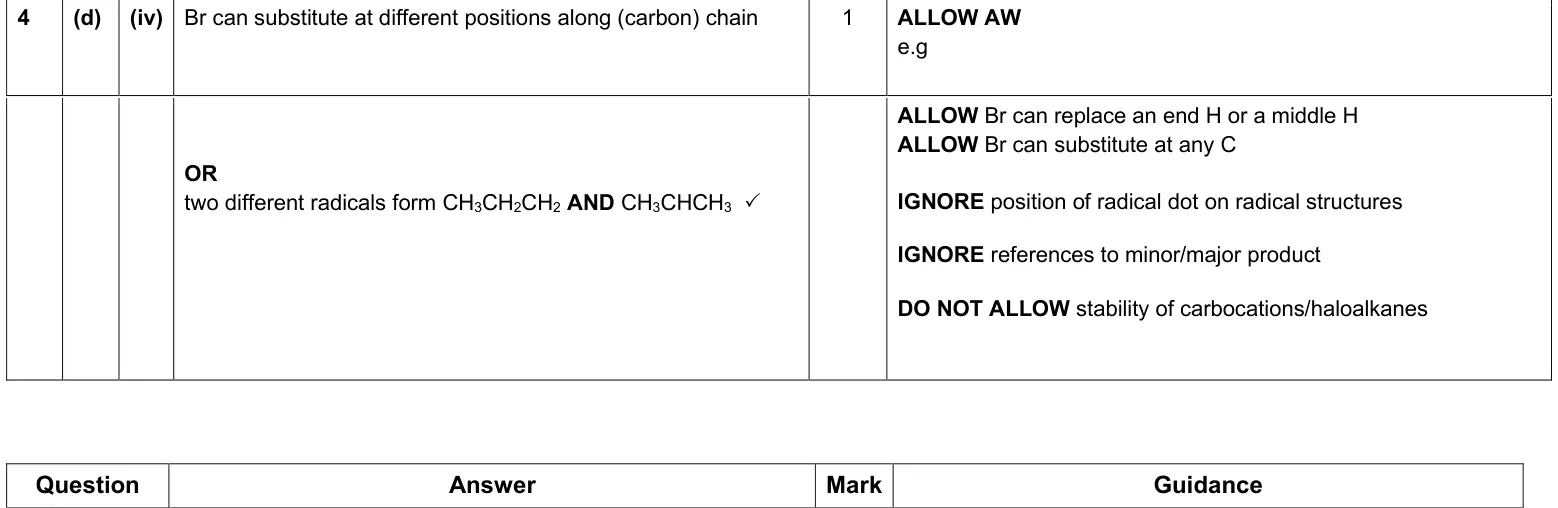
...........................................................................................................................................
...........................................................................................................................................
...........................................................................................................................................
...........................................................................................................................................
...........................................................................................................................................
...........................................................................................................................................
...................................................................................................................................... [2]
November 2021 · Paper 1 · Q21(a)(ii) 2 marks AO3 Short answer rate equations
Earlier part of question 21 that this part usesEarlier part of November 2021 Paper 1 question 21
(ii) Predict a possible two-step mechanism for Reaction 21.1.
The first step is the rate-determining step.
Step 1  ...............................................................................................................................
Step 2  .......................................................................................................................... [2]
November 2021 · Paper 1 · Q21(b)(ii) 1 mark AO3 Short answer rate equations
Earlier part of question 21 that this part usesEarlier part of November 2021 Paper 1 question 21
(ii) From the graph the student estimates the value of ln A as –2.00.
(A is the pre-exponential factor.)
Explain what mistake the student has made.
...........................................................................................................................................
...........................................................................................................................................
...................................................................................................................................... [1]
November 2021 · Paper 1 · Q22(b)(i) 2 marks AO2 Short answer amount of substance
(b) Sulfuric acid reacts with sodium hydroxide as shown in Equation 22.1.
Equation 22.1    H2SO4(aq) + 2NaOH(aq) → Na2SO4(aq) + 2H2O(l) ΔH1
This is a neutralisation reaction.
A student carries out an experiment to determine the enthalpy change ΔH1 and uses this
value to deduce the enthalpy change of neutralisation, ΔneutH .
The student measures out two solutions:
• 25.0 cm3 of 1.60 mol dm–3 H2SO4(aq)
• 55.0 cm3 of 1.50 mol dm–3 NaOH(aq) (an excess).
The temperature of each solution is the same.
The student mixes the two solutions. The temperature increases by 13.0 °C.
(i) Show that NaOH is in excess.
[2]
November 2021 · Paper 1 · Q22(b)(iii) 2 marks AO3 Short answer enthalpy changes
Earlier parts of question 22 that this part usesEarlier part of November 2021 Paper 1 question 22Earlier part of November 2021 Paper 1 question 22
(iii) The student repeats the experiment using 50.0 cm3 of 1.60 mol dm–3 H2SO4 and
110.0 cm3 of 1.50 mol dm–3 NaOH.
Predict the increase in temperature.
Explain your reasoning.
...........................................................................................................................................
...........................................................................................................................................
...........................................................................................................................................
...........................................................................................................................................
...................................................................................................................................... [2]
November 2021 · Paper 2 · Q16(a)(i) 2 marks AO1 Short answer Hard alkenesalkanes
SECTION B
Answer all the questions.
16 But-1-ene, H2C=CHCH2CH3, and buta-1,3-diene, H2C=CH–CH=CH2, are unsaturated compounds
used to make many organic products.
(a) But-1-ene and buta-1,3-diene have σ-bonds and π-bonds.
(i) Explain what is meant by the terms σ-bond and π-bond.
σ-bond:  ..............................................................................................................................
...........................................................................................................................................
π-bond:  ..............................................................................................................................
...........................................................................................................................................
[2]
November 2021 · Paper 2 · Q16(a)(ii) 2 marks AO1 Short answer alkenesalkanes
Earlier part of question 16 that this part usesEarlier part of November 2021 Paper 2 question 16
(ii) How many σ- and π-bonds are in one molecule of buta-1,3-diene?
σ-bonds: .................................................. π-bonds: .................................................. [2]
November 2021 · Paper 2 · Q16(b)(ii) 2 marks AO1 Short answer alkenes
Earlier part of question 16 that this part usesEarlier part of November 2021 Paper 2 question 16
(ii) Explain why one organic product is formed in a much greater quantity than the other
organic product.
...........................................................................................................................................
...........................................................................................................................................
...........................................................................................................................................
...................................................................................................................................... [2]
November 2021 · Paper 2 · Q16(b)(iii) 1 mark AO1 Short answer alkenesorganic basics
Earlier part of question 16 that this part usesEarlier part of November 2021 Paper 2 question 16
(iii) Buta-1,3-diene is reacted with an excess of hydrogen bromide, forming a mixture of
saturated organic products.
How many saturated organic products could be present in this mixture?
...................................................................................................................................... [1]
November 2021 · Paper 2 · Q16(c)(i) 1 mark AO1 Short answer alkenes
(c) A student thought that buta-1,3-diene can show stereoisomerism.
The student drew out skeletal formulae for the stereoisomers of buta-1,3-diene:
(i) Explain the term stereoisomerism.
...........................................................................................................................................
...........................................................................................................................................
...................................................................................................................................... [1]
November 2021 · Paper 2 · Q16(c)(ii) 1 mark AO3 Short answer alkenes
Earlier part of question 16 that this part usesEarlier part of November 2021 Paper 2 question 16
(ii) Explain, with a reason, whether the student is correct or incorrect.
...........................................................................................................................................
...........................................................................................................................................
...........................................................................................................................................
...................................................................................................................................... [1]
November 2021 · Paper 2 · Q17(a) 3 marks AO1, 2 Short answer haloalkanes
17 This question is about haloalkanes and polymers.
(a) Freon-13, is a CFC with the molecular formula CCl F3.
In the upper atmosphere, the presence of Freon-13 can lead to ozone depletion.
Explain, with the aid of equations, how Freon-13 can lead to this ozone depletion.
Use ‘dots’ (•) to show the position of unpaired electrons.
...................................................................................................................................................
...................................................................................................................................................
...................................................................................................................................................
.............................................................................................................................................. [3]
November 2021 · Paper 2 · Q17(b)(ii) 2 marks AO2 Short answer bonding and structure
Earlier part of question 17 that this part usesEarlier part of November 2021 Paper 2 question 17
(ii) The boiling point of the lubricating oil can be increased by increasing the number of
repeat units.
Explain this statement.
...........................................................................................................................................
...........................................................................................................................................
...........................................................................................................................................
...................................................................................................................................... [2]
November 2021 · Paper 2 · Q18(a)(iii) 1 mark AO2 Short answer amino acids amides and chirality
Earlier part of question 18 that this part usesEarlier part of November 2021 Paper 2 question 18
(iii) How many optical isomers does threonine have?
...................................................................................................................................... [1]
November 2021 · Paper 2 · Q18(b) 7 marks AO1, 2 Short answer organic synthesisalcoholscarboxylic acids and estersamines
Earlier part of question 18 that this part usesEarlier part of November 2021 Paper 2 question 18
(b) Complete the flowchart for two synthetic routes to the amino acid valine.
ester
C7H14O3
..................................................
O
HO
OH
..................................
C5H10O3
acyl chloride
C5H9O2Cl
..................................................
O
H2N
OH
...........................................
valine
haloalkane
C5H11NO2
C5H9BrO2
[7]
November 2021 · Paper 2 · Q18(c)(i) 1 mark AO2 Short answer amount of substanceorganic basics
(c) Ibuprofen, shown below, is used as a painkiller.
O
OH
ibuprofen
(i) What is the molecular formula of ibuprofen?
...................................................................................................................................... [1]
November 2021 · Paper 2 · Q18(d)(ii) 1 mark AO3 Short answer bonding and structure
Earlier part of question 18 that this part usesEarlier part of November 2021 Paper 2 question 18
(ii) Suggest why tablets based on a salt of ibuprofen should act faster in the body than
ibuprofen.
...........................................................................................................................................
...........................................................................................................................................
...................................................................................................................................... [1]
November 2021 · Paper 2 · Q19(a)(i) 1 mark AO1 Short answer organic basics
19 This question is about organic synthesis.
(a) Prenal, shown below, is used in the synthesis of some pharmaceuticals.
O
prenal
(i) What is the systematic name for prenal?
...................................................................................................................................... [1]
November 2021 · Paper 2 · Q19(a)(ii) 7 marks AO1, 2 Short answer organic synthesisalkenescarbonyl compoundscarboxylic acids and esters
Earlier part of question 19 that this part usesEarlier part of November 2021 Paper 2 question 19
(ii) Complete the flowchart below for the synthesis of two compounds starting from prenal.
O
NaBH4
prenal
reagent(s): .........................
reagent(s): ..............................
catalyst: ..............................
reagent(s): ......................... reagent(s): .........................
catalyst: H+ catalyst: H+
O O
O O
[7]
November 2021 · Paper 2 · Q20(a)(ii) 2 marks AO2 Short answer aromatic compoundsalkenes
Earlier part of question 20 that this part usesEarlier part of November 2021 Paper 2 question 20
(ii) What are the roles of –OH and CO2 in the mechanism?
–OH  ...................................................................................................................................
CO2  ...................................................................................................................................
[2]
November 2021 · Paper 2 · Q20(b)(i) 3 marks AO3 Short answer organic synthesis
(b) A student reacts phenol with nitric acid and sulfuric acid at 100 °C to form impure crystals of
an organic compound, C. The student purifies the crystals by recrystallisation.
(i) Describe how the student could recrystallise the impure crystals to obtain a pure sample
of C.
...........................................................................................................................................
...........................................................................................................................................
...........................................................................................................................................
...........................................................................................................................................
...................................................................................................................................... [3]
November 2021 · Paper 3 · Q1(c) 3 marks AO1, 2 Short answer Medium bonding and structure
(c) The electronegativities of H, C, N and F, and the boiling points of methane, ammonia and
hydrogen fluoride are shown below.
Electronegativity H: 2.1 C: 2.5 N: 3.0 F: 4.0
Compound CH4 NH3 HF
Boiling point / ºC –161.5 –33.3 19.5
Explain the difference in the boiling points of CH4, NH3 and HF.
...................................................................................................................................................
...................................................................................................................................................
...................................................................................................................................................
...................................................................................................................................................
...................................................................................................................................................
...................................................................................................................................................
...................................................................................................................................................
...................................................................................................................................................
.............................................................................................................................................. [3]
November 2021 · Paper 3 · Q2(c) 2 marks AO3 Short answer Hard practical skills
Earlier parts of question 2 that this part usesEarlier part of November 2021 Paper 3 question 2Earlier part of November 2021 Paper 3 question 2
(c) The student repeats the experiment but adds concentrated hydrochloric acid instead of dilute
hydrochloric acid. The apparatus gets hot during the reaction.
Predict how the hot apparatus would change the student’s results and the conclusion in (b).
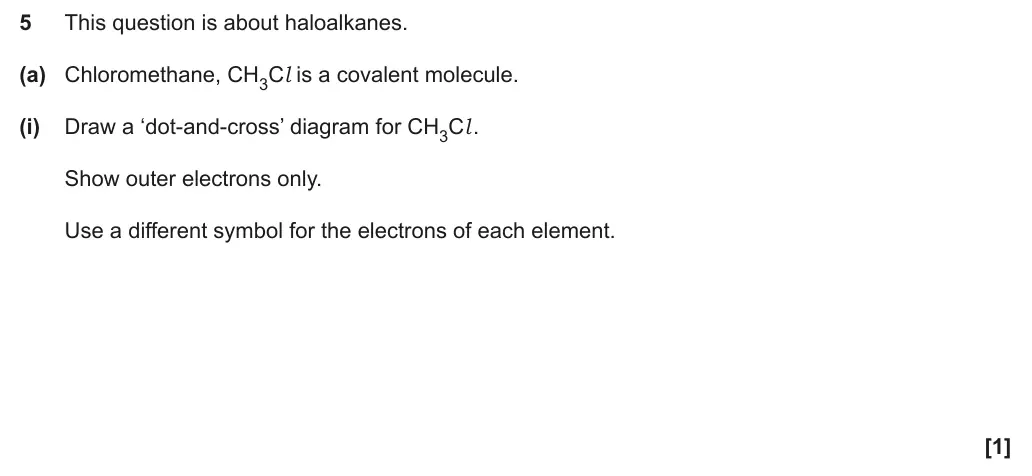
Explain your answer.
...................................................................................................................................................
...................................................................................................................................................
...................................................................................................................................................
.............................................................................................................................................. [2]
November 2021 · Paper 3 · Q2(d) 2 marks AO3 Short answer Hard practical skillsamount of substance
Earlier part of question 2 that this part usesEarlier part of November 2021 Paper 3 question 2
(d) The student modifies their method as outlined below:
• 1.52 g (0.01 mol) of europium is reacted with an excess of dilute hydrochloric acid.
• An excess of aqueous sodium hydroxide is added to the reaction mixture.
• A precipitate forms which is collected, dried and weighed.
Explain how the mass of precipitate formed would allow the student to conclude which of
Equation 1 or 2 or 3 is correct.
...................................................................................................................................................
...................................................................................................................................................
...................................................................................................................................................
...................................................................................................................................................
.............................................................................................................................................. [2]
November 2021 · Paper 3 · Q4(a) 1 mark AO3 Short answer Medium rate equations
4 Pent-1-ene and iodine react as shown in the equation below.
CH3CH2CH2CH=CH2 + I2 CH3CH2CH2CHICH2I
A student investigates the rate of this reaction by monitoring the concentration of iodine over time.
The initial concentrations are shown in the table.
Concentration / mol dm–3
I2 0.0200
CH3CH2CH2CH=CH2 2.0000
In this investigation, the order with respect to pent-1-ene can be assumed to be zero.
The student plots the graph below from the experimental results.
0.0200
0.0150
[I2] 0.0100
/ mol dm–3
0.0050
0.0000
0 1000 2000 3000 4000 5000 6000 7000 8000
time / s
(a) Why can the order with respect to pent-1-ene be assumed to be zero in this investigation?
...................................................................................................................................................
...................................................................................................................................................
.............................................................................................................................................. [1]
November 2021 · Paper 3 · Q4(c)(ii) 2 marks AO3 Short answer Medium rate equationspractical skills
Earlier part of question 4 that this part usesEarlier part of November 2021 Paper 3 question 4
(ii) Suggest how the investigation could be modified to show that the reaction is first order
with respect to pent-1-ene.
...........................................................................................................................................
...........................................................................................................................................
...........................................................................................................................................
...................................................................................................................................... [2]
November 2020 · AS Paper 1 · Q21(b) 2 marks AO1 Short answer Medium atomic structure and isotopes
(b) Most elements contain atoms of different isotopes.
State any differences and similarities between the atomic structures of isotopes of the same
element.
Differences  ................................................................................................................................
...................................................................................................................................................
Similarities  ................................................................................................................................
...................................................................................................................................................
[2]
November 2020 · AS Paper 1 · Q21(c)(ii) 2 marks AO3 Short answer Medium atomic structure and isotopes
Earlier part of question 21 that this part usesEarlier part of November 2020 Paper 1 question 21
(ii) The mass spectrum of chlorine, Cl 2, also contains three molecular ion, M+, peaks.
One of the M+ peaks has an m /z value of 72.
Suggest why an M+ peak at m /z = 72 is observed and predict the m /z values of the other
two M+ peaks.
Peak at m /z = 72  ...............................................................................................................
...........................................................................................................................................
...........................................................................................................................................
m /z values of the other two M+ peaks  ...............................................................................
[2]
November 2020 · AS Paper 1 · Q22(a)(i) 1 mark AO1 Short answer Medium electron structure
22 This question is about compounds of bromine.
(a) Bromine reacts with phosphorus, P4, to form phosphorus tribromide, PBr3.
(i) Complete the electron configuration of a bromine atom.
1s2  ................................................................................................................................ [1]
November 2020 · AS Paper 1 · Q22(b) 2 marks AO1 Short answer Medium bonding and structure
(b) A compound of bromine is a solid at room temperature. The electrical conductivity of the
compound at different physical states is shown in the table.
Physical state Electrical conductivity
solid poor
liquid good
Name the type of lattice in the compound at room temperature and explain the different
electrical conductivities.
Name of lattice  ..........................................................................................................................
Explanation for different conductivities  .....................................................................................
...................................................................................................................................................
...................................................................................................................................................
...................................................................................................................................................
[2]
November 2020 · AS Paper 1 · Q23(b)(i) 1 mark AO2 Short answer Hard acids and titrations
(b) A student carries out a titration to determine the concentration of an aqueous solution of
Ba(OH)2.
The student adds 25.0 cm3 of the Ba(OH)2(aq) solution to a conical flask.
The student titrates this solution by adding 0.160 mol dm−3 HNO3(aq) from the burette.
The equation is shown below.
Ba(OH)2(aq) + 2HNO3(aq) → Ba(NO3)2(aq) + 2H2O(l )
The student repeats the titration until concordant titres are obtained.
The mean titre of 0.160 mol dm−3 HNO3(aq) is 26.75 cm3.
(i) What is meant by concordant titres?
...........................................................................................................................................
...................................................................................................................................... [1]
November 2020 · AS Paper 1 · Q23(c) 4 marks AO2, 3 Short answer Hard group 2practical skillsformulae and equations
(c) A student plans to prepare a solution of Ba(OH)2 from barium by two different reaction routes.
Outline 2 reaction routes for preparing a solution of Ba(OH)2 from barium in the laboratory.
Include relevant equations.
...................................................................................................................................................
...................................................................................................................................................
...................................................................................................................................................
...................................................................................................................................................
...................................................................................................................................................
...................................................................................................................................................
.............................................................................................................................................. [4]
November 2020 · AS Paper 1 · Q25(c)(i) 2 marks AO1 Short answer Medium organic basics
(c) The ‘alkynes’ is a homologous series of hydrocarbons.
The table shows three alkynes.
Alkyne Structural formula Molecular formula
ethyne HC≡CH C2H2
propyne CH3C≡CH C3H4
but-1-yne CH3CH2C≡CH C4H6
(i) Explain what is meant by the term: homologous series.
...........................................................................................................................................
...........................................................................................................................................
...................................................................................................................................... [2]
November 2020 · AS Paper 1 · Q25(c)(ii) 1 mark AO3 Short answer Medium organic basics
Earlier part of question 25 that this part usesEarlier part of November 2020 Paper 1 question 25
(ii) Suggest the general formula of the alkynes.
...................................................................................................................................... [1]
November 2020 · AS Paper 2 · Q1(a) 1 mark AO2 Short answer Medium redox
1 This question is about nickel and its compounds.
(a) Nickel reacts with dilute hydrochloric acid in a redox reaction.
Ni(s) + 2HCl (aq) NiCl 2(aq) + H2(g)
Explain, in terms of the number of electrons transferred, whether nickel is oxidised or reduced.
...................................................................................................................................................
...................................................................................................................................................
.............................................................................................................................................. [1]
November 2020 · AS Paper 2 · Q1(b)(iii) 2 marks AO3 Short answer Medium amount of substance
Earlier parts of question 1 that this part usesEarlier part of November 2020 Paper 2 question 1Earlier part of November 2020 Paper 2 question 1Earlier part of November 2020 Paper 2 question 1
(iii) The student repeats the experiment with 0.192 g of magnesium instead of nickel, using
the same volume of 0.150 mol dm–3 HCl (aq) as in (b)(i).
State and explain whether the volume of H2(g) produced would be greater than, smaller
than, or the same as, the value you have calculated in (b)(ii).
...........................................................................................................................................
...........................................................................................................................................
...........................................................................................................................................
...................................................................................................................................... [2]
November 2020 · AS Paper 2 · Q2(a) 2 marks AO1 Short answer Medium enthalpy changes
2 Enthalpy changes of combustion can be determined directly by experiment.
(a) Explain the term enthalpy change of combustion, ΔcH.
...................................................................................................................................................
...................................................................................................................................................
...................................................................................................................................................
.............................................................................................................................................. [2]
November 2020 · AS Paper 2 · Q2(c)(i) 2 marks AO2 Short answer Medium practical skills
Earlier part of question 2 that this part usesEarlier part of November 2020 Paper 2 question 2
(c) The student finds that their experimental value for ΔcH is less exothermic than the value in a
data book.
The student evaluates the experimental results.
(i) The uncertainty in each thermometer reading is ±0.5 °C and the uncertainty in the
measured volume of water is ±2 cm3.
Determine whether the temperature change or the measured volume of water has the
greater percentage uncertainty.
[2]
November 2020 · AS Paper 2 · Q2(c)(ii) 2 marks AO3 Short answer Medium practical skillsenthalpy changes
Earlier part of question 2 that this part usesEarlier part of November 2020 Paper 2 question 2
(ii) Suggest two reasons, apart from measurement uncertainties, why the experimental
value for ΔcH is less exothermic than the data book value.
Reason 1 ............................................................................................................................
...........................................................................................................................................
Reason 2 ............................................................................................................................
...........................................................................................................................................
[2]
November 2020 · AS Paper 2 · Q2(c)(iii) 2 marks AO3 Short answer Medium practical skills
Earlier parts of question 2 that this part usesEarlier part of November 2020 Paper 2 question 2Earlier part of November 2020 Paper 2 question 2
(iii) In the experiment the water in the beaker was heated for 5 minutes. The student thought
that the experiment could be improved by heating the water for 10 minutes.
Explain whether the accuracy in the student’s calculated value for ΔcH may or may not
be improved by heating for longer.
...........................................................................................................................................
...........................................................................................................................................
...........................................................................................................................................
...........................................................................................................................................
...................................................................................................................................... [2]
November 2020 · AS Paper 2 · Q3(b)(ii) 3 marks AO1, 2 Short answer Medium group 2periodicity
Earlier part of question 3 that this part usesEarlier part of November 2020 Paper 2 question 3
(ii) The reaction of barium with bromine is more vigorous than the reaction of calcium with
bromine.
Explain why.
...........................................................................................................................................
...........................................................................................................................................
...........................................................................................................................................
...........................................................................................................................................
...........................................................................................................................................
...................................................................................................................................... [3]
November 2020 · AS Paper 2 · Q3(c)(ii) 3 marks AO1, 2 Short answer Medium bonding and structure
Earlier part of question 3 that this part usesEarlier part of November 2020 Paper 2 question 3
(ii)  The boiling points of H2O and H2Se are shown below.
Compound Boiling point / °C
H2O 100
H2Se –41
Explain why H2O has a higher boiling point than H2Se.
...........................................................................................................................................
...........................................................................................................................................
...........................................................................................................................................
...........................................................................................................................................
...................................................................................................................................... [3]
November 2020 · AS Paper 2 · Q4(a) 3 marks AO1, 2 Short answer Medium bonding and structure
4 Nitrosyl chloride, NOCl , is used in the industrial manufacture of nylon.
(a) The ‘dot-and-cross’ diagram for nitrosyl chloride is shown below.
N
O Cl
Predict the O=N–Cl  bond angle and explain why NOCl  has this bond angle.
Bond angle ................................................................................................................................
Explanation ................................................................................................................................
...................................................................................................................................................
...................................................................................................................................................
...................................................................................................................................................
.............................................................................................................................................. [3]
November 2020 · AS Paper 2 · Q4(b)(i) 1 mark AO1 Short answer Medium chemical equilibrium
(b) Nitrosyl chloride, NOCl , dissociates into nitrogen monoxide and chlorine as in the equilibrium
below.
2NOCl (g) 2NO(g) + Cl 2(g) ΔH = +77.0 kJ mol–1
Nitrosyl chloride is added to a container, which is then sealed.
The container is heated to 400 °C, and equilibrium is allowed to be reached.
(i) Write the expression for the equilibrium constant, Kc, for this equilibrium.
[1]
November 2020 · AS Paper 2 · Q4(b)(ii) 1 mark AO3 Short answer Medium amount of substance
Earlier part of question 4 that this part usesEarlier part of November 2020 Paper 2 question 4
(ii) In the equilibrium mixture at 400 °C, the equilibrium concentration of Cl 2(g) is found to be
0.17 mol dm−3.
The student calculates that the equilibrium concentration of NO(g) is 0.34 mol dm−3.
Explain how the student obtained this value for [NO(g)].
...........................................................................................................................................
...........................................................................................................................................
...................................................................................................................................... [1]
November 2020 · AS Paper 2 · Q4(b)(iv) 2 marks AO2 Short answer Medium chemical equilibrium
Earlier part of question 4 that this part usesEarlier part of November 2020 Paper 2 question 4
(iv) The temperature of the equilibrium mixture is increased above 400 °C while keeping the
pressure constant.
State and explain the effect on the equilibrium concentration of nitrogen monoxide,
NO(g), with these new conditions.
...........................................................................................................................................
...........................................................................................................................................
...........................................................................................................................................
...................................................................................................................................... [2]
November 2020 · AS Paper 2 · Q5(a) 2 marks AO1, 2 Short answer Medium alcohols
5 This question is about the alcohols A–F shown below.
OH
OH OH
A B C
OH
OH
OH
D E F
(a) Which of the alcohols A–F are secondary alcohols?
.............................................................................................................................................. [2]
November 2020 · AS Paper 2 · Q5(c) 1 mark AO1 Short answer Medium organic basics
Earlier part of question 5 that this part usesEarlier part of November 2020 Paper 2 question 5
(c) What is the systematic name of alcohol B?
.............................................................................................................................................. [1]
November 2020 · AS Paper 2 · Q5(d)(iii) 1 mark AO1 Short answer Medium haloalkanes
Earlier parts of question 5 that this part usesEarlier part of November 2020 Paper 2 question 5Earlier part of November 2020 Paper 2 question 5
(iii) Name this type of mechanism.
...................................................................................................................................... [1]
November 2020 · AS Paper 2 · Q5(e) 2 marks AO2, 3 Short answer Medium haloalkanes
Earlier part of question 5 that this part usesEarlier part of November 2020 Paper 2 question 5
(e) The student decides to prepare alcohol A using the same method as in (d) but using the
chloroalkane (CH3)2CHCH2CH2Cl  instead of the bromoalkane, (CH3)2CHCH2CH2Br.
State and explain how the rates of hydrolysis of the chloroalkane and the bromoalkane would
differ.
...................................................................................................................................................
...................................................................................................................................................
...................................................................................................................................................
...................................................................................................................................................
.............................................................................................................................................. [2]
November 2020 · Paper 1 · Q16(a) 1 mark AO1 Short answer atomic structure and isotopes
SECTION B
Answer all the questions.
16 This question is about magnesium, bromine and magnesium bromide.
(a) Relative atomic mass is defined as ‘the weighted mean mass compared with 1/12th mass of
carbon-12’.
Explain what is meant by the term weighted mean mass.
...................................................................................................................................................
...................................................................................................................................................
...................................................................................................................................................
.............................................................................................................................................. [1]
November 2020 · Paper 1 · Q17(a) 3 marks AO1 Short answer chemical equilibrium
17 Methanol, CH3OH, can be made industrially by the reaction of carbon monoxide with hydrogen, as
shown in equilibrium 1.
CO(g)  +  2H2(g) CH3OH(g)   ∆H = −91 kJ mol−1 Equilibrium 1
(a) Predict the conditions of pressure and temperature that would give the maximum equilibrium
yield of CH3OH in equilibrium 1.
Explain your answer.
...................................................................................................................................................
...................................................................................................................................................
...................................................................................................................................................
...................................................................................................................................................
.............................................................................................................................................. [3]
November 2020 · Paper 1 · Q17(b) 2 marks AO1 Short answer reaction rates
Earlier part of question 17 that this part usesEarlier part of November 2020 Paper 1 question 17
(b) A catalyst is used in the production of methanol in equilibrium 1.
State two ways that the use of catalysts helps chemical companies to make their processes
more sustainable and less harmful to the environment.
1  ................................................................................................................................................
...................................................................................................................................................
2  ................................................................................................................................................
...................................................................................................................................................
[2]
November 2020 · Paper 1 · Q19(b) 4 marks AO3 Short answer Medium redox and electrode potentials
Earlier part of question 19 that this part usesEarlier part of November 2020 Paper 1 question 19
(b) A student warms a mixture of methanal, HCHO, and acidified potassium manganate(VII).
The student observes gas bubbles.
Explain this observation in terms of electrode potentials and equilibria.
Include overall equations in your answer.
...................................................................................................................................................
...................................................................................................................................................
...................................................................................................................................................
...................................................................................................................................................
...................................................................................................................................................
...................................................................................................................................................
...................................................................................................................................................
...................................................................................................................................................
...................................................................................................................................................
...................................................................................................................................................
.............................................................................................................................................. [4]
November 2020 · Paper 1 · Q20(a)(i) 1 mark AO3 Short answer Medium rate equationspractical skills
20 A student investigates the reaction between ethanoic acid, CH3COOH(l) and methanol, CH3OH(l),
in the presence of an acid catalyst. The equation is shown below.
CH3COOH(l)  +  CH3OH(l) CH3COOCH3(l)  +  H2O(l)
(a) The student carries out an experiment to determine the order of reaction with respect to
CH3COOH.
The student uses a large excess of CH3OH. The temperature is kept constant throughout the
experiment.
The student takes a sample from the mixture every 20 minutes, and then determines the
concentration of the ethanoic acid in each sample.
From the experimental results, the student plots the graph below.
5.0
[CH3COOH] /10–3 mol dm–3 4.0
3.0
2.0
1.0
0 20 40 60 80 100 120 140 160 180
time / min
(i) Explain why the student uses a large excess of methanol in this experiment.
...........................................................................................................................................
...................................................................................................................................... [1]
November 2020 · Paper 1 · Q21(b) 1 mark AO1 Short answer halogens
(b) Chlorine is used in water treatment.
State one benefit and one risk of using chlorine in water treatment.
Benefit  ......................................................................................................................................
...................................................................................................................................................
Risk  ...........................................................................................................................................
...................................................................................................................................................
[1]
November 2020 · Paper 1 · Q22(b)(ii) 1 mark AO2 Short answer redox
Earlier part of question 22 that this part usesEarlier part of November 2020 Paper 1 question 22
(ii) Determine the oxidation number of nickel in compound J.
oxidation number:  ......................................................... [1]
November 2020 · Paper 2 · Q16(a) 1 mark AO1 Short answer Medium organic basics
SECTION B
Answer all the questions.
16 The structure of hydrocarbon A is shown below.
A
(a) Hydrocarbon A can be reacted with bromine in the presence of ultraviolet radiation to prepare
(CH3)3CCHBrCH3.
What is the systematic name for (CH3)3CCHBrCH3?
.............................................................................................................................................. [1]
November 2020 · Paper 2 · Q16(b)(i) 1 mark AO1 Short answer alkenesamino acids amides and chirality
Earlier part of question 16 that this part usesEarlier part of November 2020 Paper 2 question 16
(b) (CH3)3CCHBrCH3has stereoisomers.
(i) Explain the term stereoisomers and name this type of stereoisomerism.
Explanation:  ......................................................................................................................
...........................................................................................................................................
...........................................................................................................................................
Type of stereoisomerism:  ............................................................................................. [1]
November 2020 · Paper 2 · Q16(d) 2 marks AO1 Short answer alkanes
(d) State two limitations of using radical substitution in organic synthesis.
1  ................................................................................................................................................
...................................................................................................................................................
2  ................................................................................................................................................
...................................................................................................................................................
[2]
November 2020 · Paper 2 · Q17(a)(ii) 3 marks AO1 Short answer Medium aromatic compounds
Earlier part of question 17 that this part usesEarlier part of November 2020 Paper 2 question 17
(ii) Explain the relative resistance to chlorination of compound C compared with compound B.
...........................................................................................................................................
...........................................................................................................................................
...........................................................................................................................................
...........................................................................................................................................
...........................................................................................................................................
...........................................................................................................................................
...........................................................................................................................................
...................................................................................................................................... [3]
November 2020 · Paper 2 · Q17(b) 3 marks AO2 Short answer formulae and equations
Earlier part of question 17 that this part usesEarlier part of November 2020 Paper 2 question 17
(b) Compound C can be prepared by ‘trimerisation’ of propanone using concentrated sulfuric
acid as a catalyst.
Suggest an equation for this reaction, using molecular formulae.
.............................................................................................................................................. [3]
November 2020 · Paper 2 · Q17(c)(i) 2 marks AO3 Short answer nmr spectroscopy
Earlier part of question 17 that this part usesEarlier part of November 2020 Paper 2 question 17
(c) An organic chemist is investigating compound D for possible use as a medicine.
The chemist proposes a synthesis of compound D from compound C.
O
HN
compound C compound D
(i) Predict the number of peaks in the 13C NMR spectra of compounds C and D.
Compound C Compound D
Number of peaks
....................... .......................
[2]
November 2020 · Paper 2 · Q18(a)(ii) 2 marks AO2 Short answer Medium carboxylic acids and estersbonding and structure
Earlier part of question 18 that this part usesEarlier part of November 2020 Paper 2 question 18
(ii) HOOC(CH2)2COOH is soluble in water.
Explain, using a labelled diagram, why HOOC(CH2)2COOH is soluble in water.
[2]
November 2020 · Paper 2 · Q18(b)(ii) 1 mark AO3 Short answer condensation polymersalkenes
Earlier part of question 18 that this part usesEarlier part of November 2020 Paper 2 question 18
(ii) Governments are encouraging the development of biodegradable polymers to reduce
dependency on persistent plastic waste derived from fossil fuels.
Polymer E is a biodegradable polymer.
Suggest why polymer E is able to biodegrade.
...........................................................................................................................................
...................................................................................................................................... [1]
November 2020 · Paper 2 · Q19(a)(i) 2 marks AO1 Short answer organic basics
19 The carbonyl compounds, F and G, shown below, contribute to the flavour of coffee.
O
CH3 H
CH C
H3C C O
H2
F G
(a) Compound F is a member of a homologous series.
(i) Explain the term homologous series.
...........................................................................................................................................
...........................................................................................................................................
...........................................................................................................................................
...................................................................................................................................... [2]
November 2020 · Paper 2 · Q19(a)(ii) 1 mark AO2 Short answer organic basics
Earlier part of question 19 that this part usesEarlier part of November 2020 Paper 2 question 19
(ii) Predict the molecular formula for the member of this homologous series containing
24 carbon atoms.
...................................................................................................................................... [1]
November 2020 · Paper 2 · Q19(b) 4 marks AO2, 3 Short answer Hard carbonyl compoundschromatography and functional group tests
Earlier part of question 19 that this part usesEarlier part of November 2020 Paper 2 question 19
(b) Describe suitable chemical tests, with observations, that would confirm the presence of the
functional groups in F and G.
...................................................................................................................................................
...................................................................................................................................................
...................................................................................................................................................
...................................................................................................................................................
...................................................................................................................................................
...................................................................................................................................................
...................................................................................................................................................
...................................................................................................................................................
...................................................................................................................................................
.............................................................................................................................................. [4]
November 2020 · Paper 2 · Q19(c)(ii) 2 marks AO1 Short answer Medium organic basics
Earlier part of question 19 that this part usesEarlier part of November 2020 Paper 2 question 19
(ii) Explain why the mechanism in (c)(i) involves heterolytic fission.
...........................................................................................................................................
...........................................................................................................................................
...........................................................................................................................................
...................................................................................................................................... [2]
November 2020 · Paper 2 · Q20(b) 2 marks AO3 Short answer infrared and mass spectrometry
Earlier part of question 20 that this part usesEarlier part of November 2020 Paper 2 question 20
(b) The organic layer in the distillate was analysed by IR spectroscopy.
The IR spectrum is shown below.
100
Transmittance (%) 50
0
4000 3000 2000 1500 1000 500
Wavenumber / cm–1
Explain how the IR spectrum of the organic layer suggests that cyclopentene has been
formed and that the reaction is incomplete.
...................................................................................................................................................
...................................................................................................................................................
...................................................................................................................................................
...................................................................................................................................................
.............................................................................................................................................. [2]
November 2020 · Paper 2 · Q21(b)(i) 3 marks AO1 Short answer organic synthesisamino acids amides and chirality
(b) Aspartame, shown below, is an artificial sweetener commonly used as a sugar substitute.
O NH2 O
H
N
O OH
O
aspartame
(i) Aspartame contains several functional groups.
Apart from the benzene ring, name the functional groups in aspartame.
...........................................................................................................................................
...........................................................................................................................................
...........................................................................................................................................
...................................................................................................................................... [3]
November 2020 · Paper 2 · Q22(a) 2 marks AO1 Short answer Medium nmr spectroscopy
22 An organic compound I is analysed, using a combination of techniques. The analytical data is
shown below.
Elemental analysis by mass
C, 56.69%; H, 7.09%; N, 11.02%; O, 25.20%
Mass spectrum
Molecular ion peak at m / z = 127.0
IR spectrum
© SDBS, National Institute of Advanced Industrial Science and Technology.
Proton NMR spectrum
3 3
2
1
5 4 3 2 1 0
Chemical shift, d / ppm
(a) Explain the use of two deuterated compounds in NMR spectroscopy.
...................................................................................................................................................
...................................................................................................................................................
...................................................................................................................................................
.............................................................................................................................................. [2]
November 2020 · Paper 3 · Q1(b)(i) 4 marks AO1, 2 Short answer Hard bonding and structurealkanes
(b) This part is about amines.
(i) The table shows the structures and boiling points of three amines, which are structural
isomers of C3H9N.
Amine CH3CH2CH2NH2 (CH3)2CHNH2 (CH3)3N
Skeletal formula NH2
N
NH2
Boiling point / °C 48–49 °C 33–34 °C 3–4 °C
Explain the difference in the boiling points of the three amines.
...........................................................................................................................................
...........................................................................................................................................
...........................................................................................................................................
...........................................................................................................................................
...........................................................................................................................................
...........................................................................................................................................
...........................................................................................................................................
...........................................................................................................................................
...........................................................................................................................................
...........................................................................................................................................
...........................................................................................................................................
...................................................................................................................................... [4]
November 2020 · Paper 3 · Q3(a)(ii) 1 mark AO1 Short answer Hard enthalpy changespractical skills
Earlier part of question 3 that this part usesEarlier part of November 2020 Paper 3 question 3
(ii) The student finds that the experimental enthalpy change ∆cH (C3H8) is much less
exothermic than the accurate standard enthalpy change ∆cH (C3H8) in databases.
One reason could be that the student’s experiment had not been carried out under
standard conditions.
Suggest two other reasons for this difference in enthalpy change.
1  ........................................................................................................................................
...........................................................................................................................................
2  ........................................................................................................................................
...........................................................................................................................................
[1]
November 2020 · Paper 3 · Q4(a)(ii) 2 marks AO3 Short answer Medium redoxpractical techniques
Earlier part of question 4 that this part usesEarlier part of November 2020 Paper 3 question 4
(ii) In Stage 1, suggest two observations that would confirm that all of metal M has reacted.
1  ........................................................................................................................................
...........................................................................................................................................
2  ........................................................................................................................................
...........................................................................................................................................
[2]
November 2020 · Paper 3 · Q4(c)(i) 1 mark AO3 Short answer Medium practical skillsamount of substance
Earlier part of question 4 that this part usesEarlier part of November 2020 Paper 3 question 4
(c) After analysing the results, the student was told that their molar mass of X2CO3 was incorrect.
The student evaluated the experiment for possible reasons for the incorrect result.
(i) The student wondered whether the reaction was complete when the mass was recorded
after 5 minutes (Step 3).
How could the student modify the experimental procedure to be confident that the
reaction was complete?
...........................................................................................................................................
...........................................................................................................................................
...................................................................................................................................... [1]
November 2020 · Paper 3 · Q4(c)(ii) 2 marks AO3 Short answer Medium practical skillsamount of substance
Earlier parts of question 4 that this part usesEarlier part of November 2020 Paper 3 question 4Earlier part of November 2020 Paper 3 question 4
(ii) The student finds out that carbon dioxide is slightly soluble in water.
State and explain how the solubility of CO2 would affect the calculated molar mass of
X2CO3.
...........................................................................................................................................
...........................................................................................................................................
...........................................................................................................................................
...................................................................................................................................... [2]
November 2020 · Paper 3 · Q5(b) 1 mark AO2 Short answer Medium equilibrium constantschemical equilibrium
Earlier part of question 5 that this part usesEarlier part of November 2020 Paper 3 question 5
(b) State and explain how increasing the temperature affects the position of this equilibrium and
whether the forward reaction is exothermic or endothermic.
...................................................................................................................................................
...................................................................................................................................................
.............................................................................................................................................. [1]
November 2020 · Paper 3 · Q5(d) 2 marks AO3 Short answer Medium practical skills
Earlier parts of question 5 that this part usesEarlier part of November 2020 Paper 3 question 5Earlier part of November 2020 Paper 3 question 5
(d) Explain how ∆S could be calculated from a graph of ln Kp against 1
T .
...................................................................................................................................................
...................................................................................................................................................
.............................................................................................................................................. [2]
June 2019 · AS Paper 1 · Q21(a) 1 mark AO1 Short answer Medium atomic structure and isotopes
SECTION B
Answer all the questions.
21 This question is about atomic structure and the compounds of calcium, nitrogen and oxygen.
(a) Most elements contain different isotopes.
State two differences between isotopes of the same element.
...................................................................................................................................................
...................................................................................................................................................
.............................................................................................................................................. [1]
June 2019 · AS Paper 1 · Q21(d)(i) 2 marks AO1, 2 Short answer Hard bonding and structureformulae and equations
(d) Calcium reacts with nitrogen to form calcium nitride, Ca3N2, which is an ionic compound.
(i) Construct a ‘dot-and-cross’ diagram for Ca3N2.
Show outer electrons only and the charges on each ion.
[2]
June 2019 · AS Paper 1 · Q22(c) 2 marks AO3 Short answer Medium practical skills
Earlier part of question 22 that this part usesEarlier part of June 2019 Paper 1 question 22
(c) In the titrations, the student measured volumes with a pipette and a burette.
• The pipette had an uncertainty of ± 0.04 cm3 in the volume measured.
• The burette had an uncertainty of ± 0.05 cm3 in the volume measured.
Determine whether the volume measured by the pipette or the volume measured by the
burette has the greater percentage uncertainty.
[2]
June 2019 · AS Paper 1 · Q23(a) 3 marks AO1 Short answer Hard halogensbonding and structure
23 This question is about halogens and halides.
(a) The boiling points of the halogens are shown in the table.
Boiling point
Halogen
/ K
fluorine 85
chlorine 239
bromine 332
iodine 457
astatine 503
Explain the trend in boiling points of the halogens.
...................................................................................................................................................
...................................................................................................................................................
...................................................................................................................................................
...................................................................................................................................................
...................................................................................................................................................
...................................................................................................................................................
...................................................................................................................................................
...................................................................................................................................................
...................................................................................................................................................
.............................................................................................................................................. [3]
June 2019 · AS Paper 1 · Q24(a)(i) 4 marks AO1, 2 Short answer Easy chemical equilibrium
24 This question is about ammonia, NH3.
(a) In industry, ammonia is made from nitrogen and hydrogen. This is a reversible reaction, as
shown in equilibrium 24.1 below.
N2(g) + 3H2(g) 2NH3(g)    ∆H = −92 kJ mol−1    Equilibrium 24.1
(i) Explain how le Chatelier’s principle can be used to predict the conditions of temperature
and pressure for a maximum equilibrium yield of ammonia.
...........................................................................................................................................
...........................................................................................................................................
...........................................................................................................................................
...........................................................................................................................................
...........................................................................................................................................
...........................................................................................................................................
...........................................................................................................................................
...........................................................................................................................................
...................................................................................................................................... [4]
June 2019 · AS Paper 1 · Q24(b)(i) 1 mark AO1 Short answer Medium enthalpy changes
(b) Ammonia is used to make nitric acid. The first stage of the reaction is shown below.
4NH3(g) + 5O2(g) → 4NO(g) + 6H2O(g)    ∆H = −908 kJ mol−1
Standard enthalpy changes of formation, ∆fH o, are given in the table.
Substance ∆fH o / kJ mol−1
NH3(g) −46
O2(g) 0
H2O(g) −242
(i) State the conditions of temperature and pressure used for standard enthalpy
measurements.
Temperature  ......................................................................................................................
Pressure  ............................................................................................................................
[1]
June 2019 · AS Paper 1 · Q25(a)(ii) 1 mark AO1 Short answer Hard organic basics
Earlier part of question 25 that this part usesEarlier part of June 2019 Paper 1 question 25
(ii) Write the systematic name for alcohol C.
...................................................................................................................................... [1]
June 2019 · AS Paper 2 · Q1(a)(i) 2 marks AO1 Short answer Medium atomic structure and isotopes
1 This question is about the properties and reactions of the Group 2 element strontium.
(a) The relative atomic mass of strontium can be determined using a mass spectrometer.
(i) Explain what is meant by the term relative atomic mass of an element.
...........................................................................................................................................
...........................................................................................................................................
...........................................................................................................................................
...................................................................................................................................... [2]
June 2019 · AS Paper 2 · Q1(c)(ii) 2 marks AO2 Short answer Easy group 2
Earlier part of question 1 that this part usesEarlier part of June 2019 Paper 2 question 1
(ii) Describe two observations which would be different if the student had used calcium in
place of strontium.
1  ........................................................................................................................................
...........................................................................................................................................
2  ........................................................................................................................................
...........................................................................................................................................
[2]
June 2019 · AS Paper 2 · Q1(d)(ii) 1 mark AO3 Short answer Medium amount of substancepractical skills
Earlier part of question 1 that this part usesEarlier part of June 2019 Paper 2 question 1
(ii) Suggest why the student takes four readings of the mass of the crucible and residue.
...........................................................................................................................................
...................................................................................................................................... [1]
June 2019 · AS Paper 2 · Q1(d)(iii) 2 marks AO3 Short answer Medium practical skills
Earlier part of question 1 that this part usesEarlier part of June 2019 Paper 2 question 1
(iii) Suggest two modifications to the method that would reduce the percentage uncertainty
in the mass of the residue.
1  ........................................................................................................................................
...........................................................................................................................................
2  ........................................................................................................................................
...........................................................................................................................................
[2]
June 2019 · AS Paper 2 · Q2(c) 2 marks AO2 Short answer Medium redox
(c) Magnesium nitrate decomposes when heated, as shown in the equation.
2Mg(NO3)2(s) 2MgO(s) + 4NO2(g) + O2(g)
Using oxidation numbers, show which element has been oxidised and which has been
reduced when magnesium nitrate decomposes.
State the changes in oxidation numbers, including all signs.
Element oxidised ......................................................
Oxidation number change: from ............. to .............
Element reduced ......................................................
Oxidation number change: from ............. to .............
[2]
June 2019 · AS Paper 2 · Q3(a)(ii) 1 mark AO3 Short answer Medium haloalkanes
Earlier part of question 3 that this part usesEarlier part of June 2019 Paper 2 question 3
(ii) 1-Iodopentane can also be hydrolysed by water using aqueous silver nitrate, with ethanol
as the solvent.
A student uses this method to compare the rates of hydrolysis of 1-iodopentane and
1-bromopentane.
What measurement and observation would allow the student to compare the rates of
hydrolysis?
...........................................................................................................................................
...................................................................................................................................... [1]
June 2019 · AS Paper 2 · Q3(a)(iii) 2 marks AO3 Short answer Medium haloalkanes
Earlier parts of question 3 that this part usesEarlier part of June 2019 Paper 2 question 3Earlier part of June 2019 Paper 2 question 3
(iii) 1-Iodopentane was found to react faster than 1-bromopentane.
Explain why.
...........................................................................................................................................
...........................................................................................................................................
...................................................................................................................................... [2]
June 2019 · AS Paper 2 · Q3(b)(i) 1 mark AO1 Short answer Easy infrared and mass spectrometry
(b) The mass spectrum of 1-iodopentane is shown below.
100
Z
80
relative 60 Y
intensity
40
20
X
0
20 40 60 80 100 120 140 160 180 200
m/z
(i) What information is given by the peak labelled X (m/z = 198)?
...................................................................................................................................... [1]
June 2019 · AS Paper 2 · Q3(b)(ii) 2 marks AO3 Short answer Medium infrared and mass spectrometry
Earlier part of question 3 that this part usesEarlier part of June 2019 Paper 2 question 3
(ii) Write the structural formulae of the ions responsible for the peaks labelled Y and Z.
Y (m/z = 71)  .......................................................................................................................
Z (m/z = 43)  .................................................................................................................. [2]
June 2019 · AS Paper 2 · Q3(c)(ii) 2 marks AO3 Short answer Hard infrared and mass spectrometry
Earlier parts of question 3 that this part usesEarlier part of June 2019 Paper 2 question 3Earlier part of June 2019 Paper 2 question 3Earlier part of June 2019 Paper 2 question 3
(ii) Suggest one similarity and one difference between the mass spectra of 1-iodopentane
and 2-iodo-2-methylbutane.
Similarity  ............................................................................................................................
...........................................................................................................................................
Difference  ..........................................................................................................................
...................................................................................................................................... [2]
June 2019 · AS Paper 2 · Q4(d) 2 marks AO1 Short answer Medium reaction rates
Earlier part of question 4 that this part usesEarlier part of June 2019 Paper 2 question 4
(d) The graph shows that rate of reaction decreases over time.
Explain why, in terms of collision theory.
...................................................................................................................................................
...................................................................................................................................................
...................................................................................................................................................
...................................................................................................................................................
.............................................................................................................................................. [2]
June 2019 · AS Paper 2 · Q4(e)(i) 2 marks AO1 Short answer Easy reaction rates
Earlier part of question 4 that this part usesEarlier part of June 2019 Paper 2 question 4
(e) (i) The rate of the reaction between zinc and hydrochloric acid can be increased using a
solution of copper(II) sulfate as a catalyst.
Explain how a catalyst increases the rate of reaction.
...........................................................................................................................................
...........................................................................................................................................
...........................................................................................................................................
...........................................................................................................................................
...................................................................................................................................... [2]
June 2019 · AS Paper 2 · Q4(e)(ii) 1 mark AO2 Short answer Hard reaction rates
Earlier part of question 4 that this part usesEarlier part of June 2019 Paper 2 question 4
(ii) Why is it difficult to classify the solution of copper(II) sulfate as a homogeneous or
heterogeneous catalyst in this reaction?
...........................................................................................................................................
...........................................................................................................................................
...................................................................................................................................... [1]
June 2019 · AS Paper 2 · Q5(a)(ii) 1 mark AO1 Short answer Easy alkenes
Earlier part of question 5 that this part usesEarlier part of June 2019 Paper 2 question 5
(ii) State the catalyst needed in reaction 1.
...................................................................................................................................... [1]
June 2019 · AS Paper 2 · Q5(a)(iii) 1 mark AO1 Short answer Medium alkenes
Earlier part of question 5 that this part usesEarlier part of June 2019 Paper 2 question 5
(iii) What would you observe in reaction 3?
...........................................................................................................................................
...................................................................................................................................... [1]
June 2019 · AS Paper 2 · Q5(b)(ii) 2 marks AO3 Short answer Hard alcoholsorganic basics
Earlier part of question 5 that this part usesEarlier part of June 2019 Paper 2 question 5
(ii) Another student suggested that hex-1-ene could be prepared from hexan-2-ol by the
same method.
Would you expect the percentage yield of hex-1-ene to be greater than, less than or
about the same as when using hexan-1-ol?
Explain your answer.
...........................................................................................................................................
...........................................................................................................................................
...........................................................................................................................................
...................................................................................................................................... [2]
June 2019 · AS Paper 2 · Q5(c)(ii) 2 marks AO1 Short answer Medium alkenes
Earlier part of question 5 that this part usesEarlier part of June 2019 Paper 2 question 5
(ii) Waste poly(hex-1-ene) can be disposed of usefully by recycling.
State two other methods of disposing of polymers that can be beneficial to the
environment.
1  ........................................................................................................................................
...........................................................................................................................................
2  ........................................................................................................................................
...........................................................................................................................................
[2]
June 2019 · Paper 1 · Q16(a) 1 mark AO1 Short answer Hard periodicity
SECTION B
Answer all the questions.
16 Sir Humphry Davy discovered several elements including sodium, potassium, magnesium, calcium
and strontium.
(a) Explain which block in the Periodic Table sodium and magnesium belong to.
...................................................................................................................................................
.............................................................................................................................................. [1]
June 2019 · Paper 1 · Q16(c)(ii) 1 mark AO1 Short answer Easy group 2
Earlier part of question 16 that this part usesEarlier part of June 2019 Paper 1 question 16
(ii) Suggest the approximate pH of the two solutions formed in the test tubes.
pH with calcium oxide  .......................................................................................................
pH with strontium oxide ......................................................................................................
[1]
June 2019 · Paper 1 · Q16(e)(i) 2 marks AO1 Short answer Medium periodicity
Earlier part of question 16 that this part usesEarlier part of June 2019 Paper 1 question 16
(e) A similar Born–Haber cycle to potassium oxide in (d) can be constructed for sodium oxide.
(i) The first ionisation energy of sodium is more endothermic than that of potassium.
Explain why.
...........................................................................................................................................
...........................................................................................................................................
...........................................................................................................................................
...........................................................................................................................................
...................................................................................................................................... [2]
June 2019 · Paper 1 · Q16(e)(ii) 2 marks AO1 Short answer Medium lattice enthalpy
Earlier part of question 16 that this part usesEarlier part of June 2019 Paper 1 question 16
(ii) The lattice enthalpy of sodium oxide is more exothermic than that of potassium oxide.
Explain why.
...........................................................................................................................................
...........................................................................................................................................
...........................................................................................................................................
...........................................................................................................................................
...................................................................................................................................... [2]
June 2019 · Paper 1 · Q17(b) 3 marks AO1, 2 Short answer Medium transition elements
(b) Red blood cells contain haemoglobin.
Explain using ligand substitutions:
• how haemoglobin transports oxygen around the body
• why carbon monoxide is toxic.
...................................................................................................................................................
...................................................................................................................................................
...................................................................................................................................................
...................................................................................................................................................
...................................................................................................................................................
...................................................................................................................................................
.............................................................................................................................................. [3]
June 2019 · Paper 1 · Q18(a)(i) 1 mark AO1 Short answer Medium transition elements
18 This question is about reactions of ions and compounds of transition elements.
(a) A student carries out two experiments on a solution containing [Cr(H2O)6]3+(aq).
Experiment 1
The student adds an excess of aqueous ammonia to a solution containing [Cr(H2O)6]3+(aq)
until a purple solution is formed.
Experiment 2
The student carries out the following reaction sequence.
Step 1 NaOH(aq) is added slowly to a solution containing [Cr(H2O)6]3+(aq) in a boiling
tube.
A grey–green precipitate forms.
Step 2 An excess of NaOH(aq) is added to the boiling tube.
The precipitate dissolves and a green solution forms containing a 6 coordinate
complex ion.
Step 3 H2O2 is added to the mixture and the boiling tube is heated.
A yellow solution forms.
Step 4 The solution in the boiling tube is acidified.
The solution now contains Cr2O7 2−(aq).
(i) What is the formula of the complex ion in the purple solution that forms in Experiment 1?
...................................................................................................................................... [1]
June 2019 · Paper 1 · Q18(a)(ii) 1 mark AO2 Short answer Medium transition elementsformulae and equations
Earlier part of question 18 that this part usesEarlier part of June 2019 Paper 1 question 18
(ii) Suggest an equation for the reaction in Experiment 2, Step 1.
Include state symbols.
...................................................................................................................................... [1]
June 2019 · Paper 1 · Q18(a)(iv) 1 mark AO3 Short answer Hard transition elements
Earlier part of question 18 that this part usesEarlier part of June 2019 Paper 1 question 18
(iv) What is the formula of the ion that causes the yellow colour in Experiment 2, Step 3?
...................................................................................................................................... [1]
June 2019 · Paper 1 · Q18(a)(v) 1 mark AO1 Short answer Medium transition elements
Earlier part of question 18 that this part usesEarlier part of June 2019 Paper 1 question 18
(v) State the colour of the solution that forms in Experiment 2, Step 4.
...................................................................................................................................... [1]
June 2019 · Paper 1 · Q18(c)(i) 1 mark AO3 Short answer Hard practical skills
(c) Iron(II) gluconate, C12H22FeO14, is the active ingredient in some brands of iron supplements.
A student carries out an experiment to determine the mass of iron(II) gluconate in one tablet
of an iron supplement, using the method below.
Stage 1 The student crushes two tablets and dissolves the powdered tablets in dilute
sulfuric acid.
Stage 2 The student makes up the solution from Stage 1 to 250.0 cm3 in a volumetric flask.
Stage 3 The student then titrates 25.0 cm3 portions of the solution obtained in Stage 2 with
0.00200 mol dm−3 potassium manganate(VII).
The student obtains a mean titre of 13.50 cm3.
In this titration, 1 mol of manganate(VII) ions reacts with 5 mol of iron(II) ions.
(i) Explain why the student used 0.00200 mol dm−3 potassium manganate(VII) solution
for this titration, rather than the more usual concentration of 0.0200 mol dm−3 used in
manganate(VII) titrations.
...........................................................................................................................................
...................................................................................................................................... [1]
June 2019 · Paper 1 · Q19(a)(i) 1 mark AO1 Short answer Medium enthalpy changes
19 Sulfuric acid is an important chemical used to make detergents, fertilisers and dyes. It is
manufactured in a multi-step process.
(a) In the first step of the manufacture of sulfuric acid, sulfur dioxide, SO2, can be made from the
combustion of hydrogen sulfide, H2S, shown in Reaction 1.
2H2S(g)  +  3O2(g) 2SO2(g) + 2H2O(l)      ∆rH = –1125 kJ mol−1 Reaction 1
(i) Explain why the enthalpy change for Reaction 1 has a negative value.
Use ideas about enthalpy changes associated with bond breaking and bond making.
...........................................................................................................................................
...........................................................................................................................................
...................................................................................................................................... [1]
June 2019 · Paper 1 · Q19(b)(iii) 2 marks AO3 Short answer Easy equilibrium constants
Earlier parts of question 19 that this part usesEarlier part of June 2019 Paper 1 question 19Earlier part of June 2019 Paper 1 question 19
(iii) The chemist repeats the experiment in (b) at a different temperature.
The chemist finds that the value of Kp is greater than the answer to (b)(ii).
Explain whether the temperature in the second experiment is higher or lower than
1000 K.
...........................................................................................................................................
...........................................................................................................................................
...........................................................................................................................................
...................................................................................................................................... [2]
June 2019 · Paper 1 · Q19(b)(iv) 1 mark AO3 Short answer Medium chemical equilibriumequilibrium constants
Earlier part of question 19 that this part usesEarlier part of June 2019 Paper 1 question 19
(iv) Explain the significance of the expression: Kp & 1.
...........................................................................................................................................
...................................................................................................................................... [1]
June 2019 · Paper 1 · Q19(c)(ii) 1 mark AO1 Short answer Medium reaction rates
Earlier part of question 19 that this part usesEarlier part of June 2019 Paper 1 question 19
(ii) Explain whether vanadium(V) oxide is acting as a homogeneous or heterogeneous
catalyst.
...........................................................................................................................................
...................................................................................................................................... [1]
June 2019 · Paper 1 · Q20(b)(i) 1 mark AO2 Short answer Hard acids and titrationsamount of substance
Earlier part of question 20 that this part usesEarlier part of June 2019 Paper 1 question 20
(b) A student adds a total of 45.0 cm3 of 0.100 mol dm−3 NaOH(aq) to 25.0 cm3 of 0.0800 mol dm−3
C2H5COOH(aq) and monitors the pH throughout.
(i) Show by calculation that 20.0 cm3 of NaOH(aq) is required to reach the end point.
[1]
June 2019 · Paper 1 · Q20(b)(iii) 3 marks AO2 Short answer Hard acids bases and buffers
Earlier parts of question 20 that this part usesEarlier part of June 2019 Paper 1 question 20Earlier part of June 2019 Paper 1 question 20
(iii) On the axes below, sketch a pH curve for the pH changes during the addition of 45.0 cm3
of 0.100 mol dm−3 NaOH(aq) to 25.0 cm3 of 0.0800 mol dm−3 C2H5COOH(aq).
14
pH 7
0
0 10 20 30 40 50
volume NaOH(aq) added / cm3
[3]
June 2019 · Paper 1 · Q20(c) 1 mark AO3 Short answer Hard acids bases and buffers
Earlier part of question 20 that this part usesEarlier part of June 2019 Paper 1 question 20
(c) The student calculates the pH of 0.0800 mol dm−3 HIO3(aq). The student assumes that the
equilibrium concentration of HIO3(aq) is the same as the initial concentration of HIO3(aq).
The student measures the pH, and finds that the measured pH value is different from the
calculated pH value.
Explain why the measured pH is different from the calculated pH.
...................................................................................................................................................
...................................................................................................................................................
...................................................................................................................................................
.............................................................................................................................................. [1]
June 2019 · Paper 2 · Q16(a)(ii) 2 marks AO1 Short answer Medium alkenes
Earlier part of question 16 that this part usesEarlier part of June 2019 Paper 2 question 16
(ii) Explain why one of the organic products forms in a much greater quantity than the other
organic product.
...........................................................................................................................................
...........................................................................................................................................
...........................................................................................................................................
...................................................................................................................................... [2]
June 2019 · Paper 2 · Q16(b)(i) 2 marks AO1 Short answer Easy carbonyl compoundschromatography and functional group tests
(b) Geraniol and citronellal, shown below, are isomers present in ‘citronella oil’, used as an insect
repellent.
OH
O
Geraniol Citronellal
• Geraniol and citronellal are structural isomers of each other.
• They also show stereoisomerism.
(i) Describe how the observations from a chemical test would distinguish between geraniol
and citronellal.
...........................................................................................................................................
...........................................................................................................................................
...........................................................................................................................................
...................................................................................................................................... [2]
June 2019 · Paper 2 · Q16(b)(ii) 1 mark AO1 Short answer Medium amount of substanceorganic basics
Earlier part of question 16 that this part usesEarlier part of June 2019 Paper 2 question 16
(ii) What is the molecular formula of geraniol?
...................................................................................................................................... [1]
June 2019 · Paper 2 · Q16(b)(iii) 1 mark AO1 Short answer Medium organic basics
Earlier parts of question 16 that this part usesEarlier part of June 2019 Paper 2 question 16Earlier part of June 2019 Paper 2 question 16
(iii) Explain why geraniol and citronellal are structural isomers of each other.
...........................................................................................................................................
...........................................................................................................................................
...................................................................................................................................... [1]
June 2019 · Paper 2 · Q16(b)(iv) 1 mark AO1 Short answer Easy alkenes
Earlier part of question 16 that this part usesEarlier part of June 2019 Paper 2 question 16
(iv) Explain the term stereoisomerism.
...........................................................................................................................................
...........................................................................................................................................
...................................................................................................................................... [1]
June 2019 · Paper 2 · Q18(a)(i) 1 mark AO1 Short answer Hard organic basics
18 This question is about esters.
(a) The structure of ester A is shown below.
O
Br O
Ester A
(i) What is the systematic name of ester A?
...................................................................................................................................... [1]
June 2019 · Paper 2 · Q18(a)(iii) 1 mark AO1 Short answer Hard carboxylic acids and esters
Earlier parts of question 18 that this part usesEarlier part of June 2019 Paper 2 question 18Earlier part of June 2019 Paper 2 question 18
(iii) Name the type of reactions of ester A shown in (ii).
...................................................................................................................................... [1]
June 2019 · Paper 2 · Q18(e)(ii) 2 marks AO2 Short answer Easy infrared and mass spectrometry
Earlier part of question 18 that this part usesEarlier part of June 2019 Paper 2 question 18
(ii) The mass spectrum of ester C is shown below.
100
Y
80
60
Relative
intensity
40
Z
20
0
10 20 30 40 50 60 70 80 90 100
m / z
Suggest possible structures for the species responsible for peaks Y and Z in the mass
spectrum.
Y Z
[2]
June 2019 · Paper 2 · Q19(a)(i) 3 marks AO1 Short answer Hard aromatic compounds
19 This question is about benzene.
(a) Over time, the Kekulé and delocalised models have been used to describe the bonding and
structure of a benzene molecule.
(i) Describe, in terms of orbital overlap, the similarities and differences between the bonding
in the Kekulé model and the delocalised model of benzene.
...........................................................................................................................................
...........................................................................................................................................
...........................................................................................................................................
...........................................................................................................................................
...........................................................................................................................................
...........................................................................................................................................
...........................................................................................................................................
...........................................................................................................................................
...........................................................................................................................................
...........................................................................................................................................
...................................................................................................................................... [3]
June 2019 · Paper 2 · Q19(a)(ii) 2 marks AO1 Short answer Medium aromatic compounds
Earlier part of question 19 that this part usesEarlier part of June 2019 Paper 2 question 19
(ii) Experimental evidence led to the general acceptance of the delocalised model over the
Kekulé model.
Describe two pieces of evidence to support the delocalised model of benzene.
...........................................................................................................................................
...........................................................................................................................................
...........................................................................................................................................
...........................................................................................................................................
...........................................................................................................................................
...........................................................................................................................................
...........................................................................................................................................
...................................................................................................................................... [2]
June 2019 · Paper 2 · Q19(b)(ii) 1 mark AO1 Short answer Hard condensation polymers
Earlier part of question 19 that this part usesEarlier part of June 2019 Paper 2 question 19
(ii) State the type of polymer formed from compounds D and E.
From compound D  ............................................................................................................
From compound E  .............................................................................................................
[1]
June 2019 · Paper 2 · Q19(b)(iv) 7 marks AO2 Short answer Hard organic synthesisalcoholscarbonyl compoundsaminescarbon carbon bond formation
Earlier parts of question 19 that this part usesEarlier part of June 2019 Paper 2 question 19Earlier part of June 2019 Paper 2 question 19
(iv) Complete the flowchart for the synthesis of compounds D and E from phenylethanone.
H3C O
C
NaBH4
phenylethanone
NaCN(aq) / H+(aq)
..................................................
H
H C
H
C
..................................................
CH3
compound D
Br C CN
..................................................
CH3
H2N C COOH
....................................
compound E [7]
June 2019 · Paper 2 · Q20(a)(i) 1 mark AO1 Short answer Easy organic basics
20 This question is about reaction mechanisms.
(a) Chemists use curly arrows in reaction mechanisms.
(i) What does a curly arrow show in a reaction mechanism?
...........................................................................................................................................
...................................................................................................................................... [1]
June 2019 · Paper 2 · Q20(b)(ii) 1 mark AO1 Short answer Medium haloalkanes
Earlier part of question 20 that this part usesEarlier part of June 2019 Paper 2 question 20
(ii) What is the role of OH− in this mechanism?
...................................................................................................................................... [1]
June 2019 · Paper 3 · Q1(a) 2 marks AO1 Short answer Easy bonding and structure
1 These short questions are from different areas of chemistry.
(a) Explain why a CF4 molecule has polar bonds but does not have an overall dipole.
...................................................................................................................................................
...................................................................................................................................................
.............................................................................................................................................. [2]
June 2019 · Paper 3 · Q1(b) 1 mark AO1 Short answer Medium atomic structure and isotopes
(b) Explain why a small proportion of molecules in water have a relative molecular mass of 20.
...................................................................................................................................................
...................................................................................................................................................
.............................................................................................................................................. [1]
June 2019 · Paper 3 · Q2(b) 1 mark AO2 Short answer Hard carboxylic acids and estersacids bases and buffers
Earlier part of question 2 that this part usesEarlier part of June 2019 Paper 3 question 2
(b) In Step 2, explain why the mixture must be acidified so that crystals of benzoic acid appear.
...................................................................................................................................................
...................................................................................................................................................
...................................................................................................................................................
.............................................................................................................................................. [1]
June 2019 · Paper 3 · Q2(e) 2 marks AO3 Short answer Medium organic synthesispractical techniques
Earlier part of question 2 that this part usesEarlier part of June 2019 Paper 3 question 2
(e) In Step 3, describe how the student can recrystallise the impure crystals to obtain pure
benzoic acid.
...................................................................................................................................................
...................................................................................................................................................
...................................................................................................................................................
...................................................................................................................................................
...................................................................................................................................................
...................................................................................................................................................
...................................................................................................................................................
.............................................................................................................................................. [2]
June 2019 · Paper 3 · Q3(a)(ii) 1 mark AO3 Short answer Medium practical techniques
Earlier part of question 3 that this part usesEarlier part of June 2019 Paper 3 question 3
(ii) The student uses safety glasses and a lab coat.
State, with a reason, one other important safety precaution the student should take when
carrying out this experiment.
...........................................................................................................................................
...........................................................................................................................................
...................................................................................................................................... [1]
June 2019 · Paper 3 · Q3(a)(iii) 2 marks AO3 Short answer Medium practical skills
Earlier part of question 3 that this part usesEarlier part of June 2019 Paper 3 question 3
(iii) The student was not sure that all the oxygen had been removed from the lead oxide.
Suggest two modifications that the student could make to their method to be confident
that all the oxygen had been removed. Explain your reasoning.
1  ........................................................................................................................................
...........................................................................................................................................
2  ........................................................................................................................................
...........................................................................................................................................
[2]
June 2019 · Paper 3 · Q3(b) 4 marks AO1, 2 Short answer Hard periodicitybonding and structure
(b) SiO2 and CO2 are oxides of other Group 14 (Group 4) elements.
Solid SiO2 melts at 2156 °C. Solid CO2 melts at −56 °C.
Suggest the type of lattice structure in solid SiO2 and in solid CO2 and explain the difference
in melting points in terms of the types of force within each lattice structure.
Structure in SiO2(s)  ...................................................................................................................
Structure in CO2(s)  ...................................................................................................................
Explanation  ...............................................................................................................................
...................................................................................................................................................
...................................................................................................................................................
.............................................................................................................................................. [4]
June 2019 · Paper 3 · Q4(a)(i) 1 mark AO1 Short answer Easy aromatic compounds
4 Dettol® is a disinfectant containing the antiseptic chloroxylenol, shown below.
OH
H3C CH3
Cl
chloroxylenol
(a) Chloroxylenol is a weak Brønsted–Lowry acid.
(i) What is the systematic name of chloroxylenol?
...................................................................................................................................... [1]
June 2019 · Paper 3 · Q4(a)(ii) 1 mark AO2 Short answer Medium nmr spectroscopy
Earlier part of question 4 that this part usesEarlier part of June 2019 Paper 3 question 4
(ii) Predict the number of peaks in a 13C NMR spectrum of chloroxylenol.
...................................................................................................................................... [1]
June 2019 · Paper 3 · Q4(a)(iii) 2 marks AO1, 2 Short answer Hard aromatic compoundschromatography and functional group tests
Earlier part of question 4 that this part usesEarlier part of June 2019 Paper 3 question 4
(iii) Name the functional group responsible for the acidity of chloroxylenol and describe a
simple test which would confirm the presence of this group.
Functional group ................................................................................................................
Test  ....................................................................................................................................
...........................................................................................................................................
...................................................................................................................................... [2]
June 2019 · Paper 3 · Q4(b)(ii) 4 marks AO1, 2 Short answer Hard alkenes
Earlier part of question 4 that this part usesEarlier part of June 2019 Paper 3 question 4
(ii) α-Terpineol meets the requirements for E / Z isomerism.
However, only one E / Z isomer of α-terpineol exists.
Explain
• why α-terpineol meets the requirements for E / Z isomerism
• whether α-terpineol is an E- or Z- isomer
• why only one E / Z isomer of α-terpineol exists.
...........................................................................................................................................
...........................................................................................................................................
...........................................................................................................................................
...........................................................................................................................................
...........................................................................................................................................
...........................................................................................................................................
...........................................................................................................................................
...........................................................................................................................................
...................................................................................................................................... [4]
June 2019 · Paper 3 · Q5(c)(i) 1 mark AO1 Short answer Medium bonding and structure
(c) Sodium thiosulfate contains the thiosulfate ion, S2O3 2−.
The displayed formula of S2O3 2− can be shown as below.
O
–O S S–
O
thiosulfate ion
(i) Predict the O–S–S bond angle and name of the shape of the thiosulfate ion.
Bond angle  ........................................................................................................................
Name of shape  ..................................................................................................................
[1]
June 2019 · Paper 3 · Q6(a)(i) 2 marks AO3 Short answer Medium transition elementsatomic structure and isotopes
6 This question is about reactions of iron compounds.
(a) A student carries out the reactions in the flowchart, starting with iron(II) sulfide.
H+ / H2O
iron(II) sulfide [Fe(H2O)6]2+(aq) + H2S (g)
pale green
solution
Cl 2(g) AgNO3(aq) H+(aq)/MnO4 −(aq)
orange-brown
colourless solution
solution
containing Mn2+ ions
black precipitate B +
NaOH(aq) with a molar mass yellow solid
of 247.9 g mol–1
orange-brown
precipitate A
(i) In the boxes, write the formulae of A and B. [2]
June 2019 · Paper 3 · Q6(a)(ii) 1 mark AO3 Short answer Medium redox
Earlier part of question 6 that this part usesEarlier part of June 2019 Paper 3 question 6
(ii) The student thinks that the reaction of iron(II) sulfide with H+ / H2O is a redox reaction.
Explain, with reasons, whether the student is correct.
...........................................................................................................................................
...........................................................................................................................................
...........................................................................................................................................
...................................................................................................................................... [1]
June 2018 · AS Paper 1 · Q21(b)(ii) 3 marks Short answer Hard bonding and structure
Earlier part of question 21 that this part usesEarlier part of June 2018 Paper 1 question 21
(ii) Name the shape of a phosgene molecule and explain why it has this shape.
Name of shape  ..................................................................................................................
Explanation  .......................................................................................................................
...........................................................................................................................................
...........................................................................................................................................
...................................................................................................................................... [3]
June 2018 · AS Paper 1 · Q21(c) 1 mark Short answer Medium periodicity
(c) Why are silicon, carbon, oxygen and chlorine all classified as p-block elements?
...................................................................................................................................................
.............................................................................................................................................. [1]
June 2018 · AS Paper 1 · Q22(a)(i) 1 mark Short answer Medium redox
22 This question is about compounds of magnesium and phosphorus.
(a) A student plans to prepare magnesium phosphate using the redox reaction of magnesium
with phosphoric acid, H3PO4.
3Mg(s) + 2H3PO4(aq) → Mg3(PO4)2(s) + 3H2(g)
(i) In terms of the number of electrons transferred, explain whether magnesium is being
oxidised or reduced.
...........................................................................................................................................
...................................................................................................................................... [1]
June 2018 · AS Paper 1 · Q22(a)(iii) 2 marks Short answer Hard practical techniquespractical skills
Earlier part of question 22 that this part usesEarlier part of June 2018 Paper 1 question 22
(iii) How could the student obtain a sample of magnesium phosphate after reacting
magnesium with phosphoric acid?
...........................................................................................................................................
...........................................................................................................................................
...........................................................................................................................................
...................................................................................................................................... [2]
June 2018 · AS Paper 1 · Q24(b)(i) 1 mark Short answer Medium alkanes
Earlier part of question 24 that this part usesEarlier part of June 2018 Paper 1 question 24
(b) Compounds A, B and C all react with chlorine in the presence of ultraviolet radiation to form
organic compounds with the formula C5H11Cl.
(i) Name the mechanism for this reaction.
...................................................................................................................................... [1]
June 2018 · AS Paper 1 · Q25(a)(ii) 1 mark Short answer organic basics
Earlier part of question 25 that this part usesEarlier part of June 2018 Paper 1 question 25
(ii) What is the systematic name of alcohol E?
...................................................................................................................................... [1]
June 2018 · AS Paper 2 · Q1(a) 1 mark Short answer Medium acids and titrations
1 A student carries out a titration to determine the molar mass and structure of a weak acid A.
The student follows the method below.
• Dissolve a weighed mass of A in 100 cm3 of distilled water and make the solution up to
250 cm3 in a beaker.
• Add the solution of A to a burette.
• Titrate the solution of A with a standard solution of sodium hydroxide, NaOH.
(a) What is meant by the term standard solution?
...................................................................................................................................................
.............................................................................................................................................. [1]
June 2018 · AS Paper 2 · Q1(b) 1 mark Short answer Medium acids and titrations
Earlier part of question 1 that this part usesEarlier part of June 2018 Paper 2 question 1
(b) Sodium hydroxide is an alkali.
What is meant by the term alkali?
...................................................................................................................................................
.............................................................................................................................................. [1]
June 2018 · AS Paper 2 · Q1(c)(iii) 1 mark Short answer Medium practical techniquesacids and titrations
Earlier part of question 1 that this part usesEarlier part of June 2018 Paper 2 question 1
(iii) The student realised that the solution of A had not been prepared correctly.
How should the student have made up the solution?
...........................................................................................................................................
...........................................................................................................................................
...................................................................................................................................... [1]
June 2018 · AS Paper 2 · Q3(a)(ii) 3 marks Short answer Easy halogens
Earlier part of question 3 that this part usesEarlier part of June 2018 Paper 2 question 3
(ii) Explain why iodine is less reactive than bromine.
...........................................................................................................................................
...........................................................................................................................................
...........................................................................................................................................
...........................................................................................................................................
...........................................................................................................................................
...........................................................................................................................................
...................................................................................................................................... [3]
June 2018 · AS Paper 2 · Q3(b)(i) 3 marks Short answer Medium halogensredox
(b) Iodine can be used for the small-scale purification of drinking water.
(i) Iodine reacts with water as shown below.
I2 + H2O HI + HIO
Using oxidation numbers, explain why this reaction is a disproportionation.
...........................................................................................................................................
...........................................................................................................................................
...........................................................................................................................................
...........................................................................................................................................
...................................................................................................................................... [3]
June 2018 · AS Paper 2 · Q3(b)(ii) 1 mark Short answer Medium halogens
Earlier part of question 3 that this part usesEarlier part of June 2018 Paper 2 question 3
(ii) Chlorine is used to purify water on a large scale.
State one disadvantage of using chlorine for the purification of drinking water.
...........................................................................................................................................
...................................................................................................................................... [1]
June 2018 · AS Paper 2 · Q3(d)(ii) 1 mark Short answer Medium enthalpy changesbonding and structurehalogens
Earlier part of question 3 that this part usesEarlier part of June 2018 Paper 2 question 3
(ii) Suggest whether the enthalpy change of vaporisation of bromine is exothermic or
endothermic.
Explain your answer.
...........................................................................................................................................
...........................................................................................................................................
...................................................................................................................................... [1]
June 2018 · AS Paper 2 · Q4(b) 1 mark Short answer Easy chemical equilibrium
Earlier part of question 4 that this part usesEarlier part of June 2018 Paper 2 question 4
(b) Write an expression for the equilibrium constant, Kc, in equilibrium 4.1.
[1]
June 2018 · AS Paper 2 · Q6(a) 1 mark Short answer Medium alkenes
6 Two reactions of compound C are shown in the flowchart below.
H Cl
C C
H Cl
Compound C
Reaction 1 Reaction 2
H Cl H Cl
H C C OH H C C Cl
H Cl Br Br
Compound D
(a) State the reagents and conditions for reaction 1.
...................................................................................................................................................
.............................................................................................................................................. [1]
June 2018 · AS Paper 2 · Q6(b)(i) 1 mark Short answer Easy organic basics
Earlier part of question 6 that this part usesEarlier part of June 2018 Paper 2 question 6
(b) In reaction 2, compound C reacts with bromine to form compound D.
(i) Give the systematic name of compound D.
...................................................................................................................................... [1]
June 2018 · AS Paper 2 · Q6(c)(ii) 2 marks Short answer Easy alkenes
Earlier parts of question 6 that this part usesEarlier part of June 2018 Paper 2 question 6Earlier part of June 2018 Paper 2 question 6
(ii) State one advantage and one disadvantage of using combustion as a method for the
disposal of waste polymer E.
Advantage  .........................................................................................................................
...........................................................................................................................................
Disadvantage  ....................................................................................................................
...................................................................................................................................... [2]
June 2018 · Paper 1 · Q16(a)(iv) 2 marks Short answer Medium lattice enthalpy
Earlier part of question 16 that this part usesEarlier part of June 2018 Paper 1 question 16
(iv) Predict how the enthalpy changes of hydration of F– and Cl – would differ.
Explain your answer.
...........................................................................................................................................
...........................................................................................................................................
...........................................................................................................................................
...................................................................................................................................... [2]
June 2018 · Paper 1 · Q16(b)(i) 2 marks Short answer Medium enthalpy changes
(b) Fluorine reacts with steam as shown in the equation below.
2F2(g) + 2H2O(g) O2(g) + 4HF(g)       ∆H = −598 kJ mol–1
Average bond enthalpies are shown in the table.
Bond Average bond enthalpy / kJ mol–1
O–H +464
O=O +498
H–F +568
(i) Explain what is meant by the term average bond enthalpy.
...........................................................................................................................................
...........................................................................................................................................
...........................................................................................................................................
...................................................................................................................................... [2]
June 2018 · Paper 1 · Q18(c)(i) 1 mark Short answer Medium equilibrium constants
Earlier part of question 18 that this part usesEarlier part of June 2018 Paper 1 question 18
(c) The values of Kp for equilibrium 18.1 at 298 K and 1000 K are shown below.
2NO(g) + O2(g) 2NO2(g) Equilibrium 18.1
Temperature / K Kp / atm–1
298 Kp = 2.19 × 10¹²
1000 Kp = 2.03 × 10⁻¹
(i) Predict, with a reason, whether the forward reaction is exothermic or endothermic.
...........................................................................................................................................
...................................................................................................................................... [1]
June 2018 · Paper 1 · Q18(c)(ii) 3 marks Short answer Hard equilibrium constants
Earlier parts of question 18 that this part usesEarlier part of June 2018 Paper 1 question 18Earlier part of June 2018 Paper 1 question 18
(ii) The chemist increases the pressure of the equilibrium mixture at the same temperature.
State, and explain in terms of Kp, how you would expect the equilibrium position to
change.
...........................................................................................................................................
...........................................................................................................................................
...........................................................................................................................................
...........................................................................................................................................
...........................................................................................................................................
...........................................................................................................................................
...................................................................................................................................... [3]
June 2018 · Paper 1 · Q19(a)(i) 1 mark Short answer Medium acids bases and buffers
19 This question is about acids and bases found in the home.
(a) Ethanoic acid, CH3COOH, is the acid present in vinegar.
A student carries out an experiment to determine the pKa value of CH3COOH.
• The concentration of CH3COOH in the vinegar is 0.870 mol dm–3.
• The pH of the vinegar is 2.41.
(i) Write the expression for the acid dissociation constant, Ka, of CH3COOH.
[1]
June 2018 · Paper 1 · Q20(a) 3 marks Short answer Medium halogensbonding and structure
20 This question is about the halogen group of elements and some of their compounds.
(a) The halogens show trends in their properties down the group.
The boiling points of three halogens are shown below.
Halogen Boiling point / °C
Chlorine –35
Bromine 59
Iodine 184
Explain why the halogens show this trend in boiling points.
...................................................................................................................................................
...................................................................................................................................................
...................................................................................................................................................
...................................................................................................................................................
...................................................................................................................................................
.............................................................................................................................................. [3]
June 2018 · Paper 1 · Q20(d)(iii) 2 marks Short answer Medium redox and electrode potentials
Earlier part of question 20 that this part usesEarlier part of June 2018 Paper 1 question 20
(iii) Describe and explain how the student should determine the end point of this titration
accurately.
...........................................................................................................................................
...........................................................................................................................................
...................................................................................................................................... [2]
June 2018 · Paper 1 · Q21(c)(ii) 4 marks Short answer Easy redox and electrode potentialstransition elements
Earlier part of question 21 that this part usesEarlier part of June 2018 Paper 1 question 21
(ii) Zinc reacts with acidified Cr2O7 2– ions to form Cr2+ ions in two stages.
Explain why this happens in terms of electrode potentials and equilibria.
Include overall equations for the reactions which occur.
...........................................................................................................................................
...........................................................................................................................................
...........................................................................................................................................
...........................................................................................................................................
...........................................................................................................................................
...........................................................................................................................................
...........................................................................................................................................
...........................................................................................................................................
...........................................................................................................................................
...................................................................................................................................... [4]
June 2018 · Paper 2 · Q16(a)(i) 1 mark Short answer Medium organic basics
SECTION B
Answer all the questions.
16 This question is about reactions of organic compounds containing carbon, hydrogen and oxygen.
(a) A chemist investigates two reactions of alcohol A, shown below.
OH
alcohol A
(i) What is the systematic name of alcohol A?
...................................................................................................................................... [1]
June 2018 · Paper 2 · Q16(a)(ii) 1 mark Short answer Easy organic basics
Earlier part of question 16 that this part usesEarlier part of June 2018 Paper 2 question 16
(ii) What is the structural formula of alcohol A?
...................................................................................................................................... [1]
June 2018 · Paper 2 · Q18(a)(i) 3 marks Short answer Medium nmr spectroscopy
18 This question is about aromatic compounds.
(a) Phenol undergoes nitration more readily than benzene.
(i) A student carries out the nitration of phenol with dilute nitric acid to produce 2-nitrophenol
and 4-nitrophenol.
A small amount of 3-nitrophenol is also produced.
OH
OH OH
NO2
NO2
NO2
2-nitrophenol 3-nitrophenol 4-nitrophenol
The student thought that 13C NMR spectroscopy could be used to distinguish between
these three nitrophenols.
Explain whether the student is correct.
...........................................................................................................................................
...........................................................................................................................................
...........................................................................................................................................
...........................................................................................................................................
...........................................................................................................................................
...........................................................................................................................................
...........................................................................................................................................
...........................................................................................................................................
...........................................................................................................................................
...................................................................................................................................... [3]
June 2018 · Paper 2 · Q18(a)(ii) 3 marks Short answer Medium aromatic compounds
Earlier part of question 18 that this part usesEarlier part of June 2018 Paper 2 question 18
(ii) Explain why phenol is nitrated more readily than benzene.
...........................................................................................................................................
...........................................................................................................................................
...........................................................................................................................................
...........................................................................................................................................
...........................................................................................................................................
...........................................................................................................................................
...........................................................................................................................................
...........................................................................................................................................
...................................................................................................................................... [3]
June 2018 · Paper 2 · Q19(a) 2 marks Short answer Medium haloalkanes
19 This question is about the hydrolysis of haloalkanes.
(a) The rate of hydrolysis of a haloalkane depends on the halogen present.
State and explain how the halogen in the haloalkane affects the rate of hydrolysis.
...................................................................................................................................................
...................................................................................................................................................
...................................................................................................................................................
...................................................................................................................................................
.............................................................................................................................................. [2]
June 2018 · Paper 2 · Q20(a) 2 marks Short answer Medium alkenes
20 Cinnamaldehyde and methylcinnamaldehyde are naturally occurring organic compounds.
CHO CHO
cinnamaldehyde methylcinnamaldehyde
(a) Methylcinnamaldehyde is an E stereoisomer.
Explain this statement in terms of the Cahn-Ingold-Prelog (CIP) rules.
...................................................................................................................................................
...................................................................................................................................................
...................................................................................................................................................
...................................................................................................................................................
.............................................................................................................................................. [2]
June 2018 · Paper 2 · Q20(b)(i) 1 mark Short answer Easy chromatography and functional group testsalkenes
Earlier part of question 20 that this part usesEarlier part of June 2018 Paper 2 question 20
(b) A student plans to carry out some chemical tests on both cinnamaldehyde and
methylcinnamaldehyde.
CHO CHO
cinnamaldehyde methylcinnamaldehyde
(i) Suggest a suitable chemical test to confirm that both compounds contain an unsaturated
carbon chain.
Your answer should include the reagent and observations.
...........................................................................................................................................
...................................................................................................................................... [1]
June 2018 · Paper 2 · Q20(b)(ii) 1 mark Short answer Easy carbonyl compoundschromatography and functional group tests
Earlier part of question 20 that this part usesEarlier part of June 2018 Paper 2 question 20
(ii) Describe a chemical test to confirm that both compounds contain an aldehyde functional
group.
Your answer should include the reagent and observations.
...........................................................................................................................................
...................................................................................................................................... [1]
June 2018 · Paper 2 · Q20(b)(iii) 3 marks Short answer Medium carbonyl compoundschromatography and functional group tests
Earlier part of question 20 that this part usesEarlier part of June 2018 Paper 2 question 20
(iii) Describe a chemical test to confirm that cinnamaldehyde and methylcinnamaldehyde
contain a carbonyl group.
How could the products of this test be used to distinguish between the two compounds?
Your answer should not include spectroscopy.
...........................................................................................................................................
...........................................................................................................................................
...........................................................................................................................................
...........................................................................................................................................
...........................................................................................................................................
...........................................................................................................................................
...................................................................................................................................... [3]
June 2018 · Paper 3 · Q1(a)(i) 1 mark Short answer Easy electron structure
1 This question refers to the elements in the first three periods (H Ar) of the Periodic Table.
(a) Select an element from the first three periods that fits each of the following descriptions.
(i) The element that forms a 1– ion with the same electron configuration as helium.
.............................. [1]
June 2018 · Paper 3 · Q1(a)(ii) 1 mark Short answer Medium periodicity
Earlier part of question 1 that this part usesEarlier part of June 2018 Paper 3 question 1
(ii) The element with the highest first ionisation energy.
.............................. [1]
June 2018 · Paper 3 · Q1(a)(iii) 1 mark Short answer Medium periodicity
Earlier part of question 1 that this part usesEarlier part of June 2018 Paper 3 question 1
(iii) The element in Period 3 which has the successive ionisation energies shown below.
Ionisation number 1st 2nd 3rd 4th
Ionisation energy/kJ mol–1 738 1451 7733 10541
.............................. [1]
June 2018 · Paper 3 · Q1(a)(iv) 1 mark Short answer Medium bonding and structure
Earlier part of question 1 that this part usesEarlier part of June 2018 Paper 3 question 1
(iv) The element which forms a compound with fluorine that has octahedral molecules.
.............................. [1]
June 2018 · Paper 3 · Q1(a)(v) 1 mark Short answer Medium halogens
Earlier part of question 1 that this part usesEarlier part of June 2018 Paper 3 question 1
(v) An element which reacts with water to form an acidic solution.
.............................. [1]
June 2018 · Paper 3 · Q1(a)(vi) 1 mark Short answer Easy atomic structure and isotopes
Earlier part of question 1 that this part usesEarlier part of June 2018 Paper 3 question 1
(vi) The element X, which forms a compound with hydrogen, XH3, with a molar mass of
34.0 g mol–1.
.............................. [1]
June 2018 · Paper 3 · Q1(a)(vii) 1 mark Short answer Easy redox
Earlier part of question 1 that this part usesEarlier part of June 2018 Paper 3 question 1
(vii) An element which forms a compound with hydrogen in which the element has an
oxidation number of –4.
.............................. [1]
June 2018 · Paper 3 · Q1(a)(viii) 1 mark Short answer Medium amount of substance
Earlier part of question 1 that this part usesEarlier part of June 2018 Paper 3 question 1
(viii) The element which has a density of 1.33 × 10⁻³ g cm–3 at room temperature and pressure.
.............................. [1]
June 2018 · Paper 3 · Q2(c)(ii) 2 marks Short answer Easy chemical equilibrium
Earlier part of question 2 that this part usesEarlier part of June 2018 Paper 3 question 2
(ii) Explain the observations and predict whether the formation of the blue colour is
exothermic or endothermic.
...........................................................................................................................................
...........................................................................................................................................
...........................................................................................................................................
...........................................................................................................................................
...................................................................................................................................... [2]
June 2018 · Paper 3 · Q3(b)(i) 1 mark Short answer Medium redox and electrode potentials
(b) Ethanedioic acid, (COOH)2, is present in rhubarb leaves.
A student carries out a redox titration using aqueous cerium(IV) sulfate, Ce(SO4)2(aq), to
determine the percentage, by mass, of ethanedioic acid in rhubarb leaves.
In the titration, Ce4+(aq) ions oxidise ethanedioic acid in hot acid conditions:
2Ce4+(aq) + (COOH)2(aq) → 2Ce3+(aq) + 2CO2(g) + 2H+(aq)
Ce4+(aq) ions have a yellow colour. Ce3+(aq) ions are colourless.
The student weighs 82.68 g of rhubarb leaves and extracts ethanedioic acid from the leaves.
The ethanedioic acid is added to dilute sulfuric acid to form a colourless solution which is
made up to 250.0 cm3 with distilled water.
The student heats 25.00 cm3 of this solution to 70 °C and titrates this volume with
0.0500 mol dm–3 Ce(SO4)2 from the burette.
The student repeats the titration to obtain concordant (consistent) titres.
Titration results

The trial titre has been omitted.
1 2 3
Final reading/cm3 24.30 47.80 23.65
Initial reading/cm3 1.05 24.30 0.50
(i) This titration is self-indicating and the student does not need to add an indicator.
What colour change would the student observe at the end point?
Colour change from ................................................ to ................................................ [1]
June 2018 · Paper 3 · Q4(a)(i) 1 mark Short answer Easy redox
4 This question is about two compounds used in medicine.
(a) Cis-platin, PtCl2(NH3)2, is a complex of platinum which is used in cancer treatment.
(i) What is the oxidation number of platinum in cis-platin?
............................ [1]
June 2018 · Paper 3 · Q4(b)(i) 2 marks Short answer Hard organic synthesisamino acids amides and chirality
(b) Paracetamol is a solid organic compound used in tablets as a painkiller.
H
HO N
C CH3
paracetamol
O
(i) Name the functional groups present in paracetamol.
......................................................................
...................................................................... [2]
June 2018 · Paper 3 · Q5(b)(i) 1 mark Short answer Hard equilibrium constants
(b) Succinic acid is esterified by ethanol, C2H5OH, in the presence of an acid catalyst to form an
equilibrium mixture.
The equilibrium constant, Kc, for this equilibrium can be calculated using the amounts, in
moles, of the components in the equilibrium mixture, using expression 5.1.
n( (CH2COOC2H5)2 ) × n( H2O )2
Kc = n( (CH2COOH)2 ) × n( C2H5OH )2 Expression 5.1
A student carries out an experiment to determine the value of Kc for this equilibrium.
• The student mixes together 0.0500 mol of succinic acid and 0.150 mol of ethanol,
with a small amount of an acid catalyst.
• The mixture is allowed to reach equilibrium.
• The student determines that 0.0200 mol of succinic acid are present in the
equilibrium mixture.
(i) Which technique could be used to determine the equilibrium amount of succinic acid?
...................................................................................................................................... [1]
June 2018 · Paper 3 · Q5(b)(iv) 1 mark Short answer Medium equilibrium constants
Earlier part of question 5 that this part usesEarlier part of June 2018 Paper 3 question 5
(iv) Kc is the equilibrium constant in terms of equilibrium concentrations.
Why can expression 5.1 be used to calculate Kc for this equilibrium?
...........................................................................................................................................
...................................................................................................................................... [1]
June 2018 · Paper 3 · Q6(a)(i) 1 mark Short answer Medium organic basics
6 This question is about organic reactions.
(a) Compound A is formed when ethanal is mixed with OH–(aq) ions, which act as a catalyst.
The balanced equation is shown in reaction 6.1 below.
H O H O H OH H O
H C C + H C C H C C C C Reaction 6.1
H H H H H H H H
Compound A
(i) Give the systematic name for compound A.
...................................................................................................................................... [1]
June 2018 · Paper 3 · Q6(a)(ii) 1 mark Short answer Easy carbonyl compoundscarbon carbon bond formation
Earlier part of question 6 that this part usesEarlier part of June 2018 Paper 3 question 6
(ii) What type of reaction has taken place?
...................................................................................................................................... [1]
June 2017 · AS Paper 1 · Q21(a)(i) 3 marks Short answer alkenes
SECTION B
Answer all the questions.
21 This question is about 2-chloropropene, C3H5Cl.
(a) Three reactions of 2-chloropropene are shown in the flowchart below.
(i) Complete the flowchart to show the organic products formed in the reactions.
Cl Cl H
Br2 H2 / Ni
C C
H3C H
2-chloropropene
steam
major product
[3]
June 2017 · AS Paper 1 · Q21(a)(ii) 1 mark Short answer alkenes
Earlier part of question 21 that this part usesEarlier part of June 2017 Paper 1 question 21
(ii) The reaction of 2-chloropropene with steam requires a catalyst.
State a suitable catalyst for this reaction.
...................................................................................................................................... [1]
June 2017 · AS Paper 1 · Q21(b)(ii) 1 mark Short answer alkenes
Earlier part of question 21 that this part usesEarlier part of June 2017 Paper 1 question 21
(ii) After their useful life, waste polymers can be disposed of by combustion.
State one particular problem with disposal of poly(2-chloropropene) by combustion.
...........................................................................................................................................
...................................................................................................................................... [1]
June 2017 · AS Paper 1 · Q22(c)(iv) 2 marks Short answer periodicityelectron structure
Earlier part of question 22 that this part usesEarlier part of June 2017 Paper 1 question 22
(iv) Explain why the general increase in first ionisation energies across Period 3 is not
followed for Mg (Z = 12) to Al (Z = 13).
...........................................................................................................................................
...........................................................................................................................................
...........................................................................................................................................
...........................................................................................................................................
...........................................................................................................................................
...................................................................................................................................... [2]
June 2017 · AS Paper 1 · Q23(a) 4 marks Short answer reaction rates
23 Methanol can be prepared industrially by reacting carbon monoxide with hydrogen in the presence
of a copper catalyst. This is a reversible reaction.
CO(g) + 2H2(g) CH3OH(g)
(a) Using the Boltzmann distribution model, explain why the rate of a reaction increases in the
presence of a catalyst.
You are provided with the axes below, which should be labelled.
...................................................................................................................................................
...................................................................................................................................................
...................................................................................................................................................
...................................................................................................................................................
...................................................................................................................................................
...................................................................................................................................................
...................................................................................................................................................
.............................................................................................................................................. [4]
June 2017 · AS Paper 1 · Q23(b) 2 marks Short answer reaction rates
(b) The reaction for the production of methanol in the presence of the copper catalyst is carried
out at 200–300 °C.
Explain why use of the catalyst reduces energy demand and benefits the environment.
...................................................................................................................................................
...................................................................................................................................................
...................................................................................................................................................
...................................................................................................................................................
.............................................................................................................................................. [2]
June 2017 · AS Paper 1 · Q24(a) 1 mark Short answer acids and titrations
24 Ethanoic acid, CH3COOH, is the main dissolved acid in vinegar.
(a) Ethanoic acid is a weak acid.
What is meant by acid and weak acid?
...................................................................................................................................................
...................................................................................................................................................
.............................................................................................................................................. [1]
June 2017 · AS Paper 1 · Q24(c)(ii) 2 marks Short answer practical skills
Earlier part of question 24 that this part usesEarlier part of June 2017 Paper 1 question 24
(ii) Suggest one assumption that the student has made that might mean that their calculated
concentration of ethanoic acid in the vinegar is invalid.
Predict, with a reason, how the experimental result would differ from the actual
concentration of CH3COOH if the assumption were not correct.
...........................................................................................................................................
...........................................................................................................................................
...........................................................................................................................................
...................................................................................................................................... [2]
June 2017 · AS Paper 1 · Q25(a)(i) 1 mark Short answer enthalpy changes
25 This question is about alkenes.
(a) The combustion of ethene is shown in equation 25.1 below.
C2H4(g) + 3O2(g) → 2CO2(g) + 2H2O(g) ΔH = –1318 kJ mol–1   equation 25.1
(i) Explain, in terms of bond breaking and bond forming, why a reaction can be exothermic.
...........................................................................................................................................
...........................................................................................................................................
...........................................................................................................................................
...................................................................................................................................... [1]
June 2017 · AS Paper 2 · Q1(a)(i) 1 mark Short answer bonding and structure
1 Barium combines with oxygen, chlorine and nitrogen to form ionic compounds.
(a) Barium oxide, BaO, has a giant ionic lattice structure.
(i) State what is meant by the term ionic bond.
...........................................................................................................................................
...................................................................................................................................... [1]
June 2017 · AS Paper 2 · Q1(b)(i) 2 marks Short answer bonding and structure
(b) Barium chloride, BaCl2, is soluble in water.
(i) Compare the electrical conductivities of solid and aqueous barium chloride.
Explain your answer in terms of the particles involved.
...........................................................................................................................................
...........................................................................................................................................
...........................................................................................................................................
...........................................................................................................................................
...................................................................................................................................... [2]
June 2017 · AS Paper 2 · Q1(b)(ii) 2 marks Short answer qualitative analysis
Earlier part of question 1 that this part usesEarlier part of June 2017 Paper 2 question 1
(ii) Describe the use of aqueous barium chloride in qualitative analysis.
...........................................................................................................................................
...........................................................................................................................................
...........................................................................................................................................
...................................................................................................................................... [2]
June 2017 · AS Paper 2 · Q1(c)(i) 1 mark Short answer electron structure
(c) Barium nitride is formed when barium is heated with nitrogen.
(i) Complete the electron configuration of a nitride ion.
1s2 ................................................................................................................................. [1]
June 2017 · AS Paper 2 · Q3(a)(ii) 2 marks Short answer practical skillsenthalpy changes
Earlier part of question 3 that this part usesEarlier part of June 2017 Paper 2 question 3
(ii) The calculated value of ∆cH for hexane from this experiment is different from the data
book value.
Suggest two reasons for this difference.
1  ........................................................................................................................................
...........................................................................................................................................
2  ........................................................................................................................................
...........................................................................................................................................
[2]
June 2017 · AS Paper 2 · Q4(b)(i) 1 mark Short answer organic basics
(b) Alcohol C is analysed using mass spectrometry.
OH
alcohol C
(i) Give the systematic name of alcohol C.
...................................................................................................................................... [1]
June 2017 · AS Paper 2 · Q4(b)(ii) 2 marks Short answer infrared and mass spectrometry
Earlier part of question 4 that this part usesEarlier part of June 2017 Paper 2 question 4
(ii) The mass spectrum of alcohol C is shown below.
Item removed due to third party copyright restrictions.
Write structural formulae for the ions responsible for peak X and peak Y.
X =
Y =
[2]
June 2017 · AS Paper 2 · Q5(a) 1 mark Short answer organic basics
5 Propanoic acid, CH3CH2COOH, is a member of the homologous series of carboxylic acids.
(a) Suggest the general formula for a carboxylic acid.
.............................................................................................................................................. [1]
June 2017 · AS Paper 2 · Q5(b)(i) 2 marks Short answer alkanesbonding and structure
(b) The displayed formula for propanoic acid is shown below.
H H
O
H C C C
O H
H H
(i) State the shape and bond angle around a carbon atom in the alkyl group of propanoic
acid. Explain the shape.
Shape  ................................................................................................................................
Bond angle  ........................................................................................................................
Explanation  .......................................................................................................................
...........................................................................................................................................
...........................................................................................................................................
...................................................................................................................................... [2]
June 2017 · AS Paper 2 · Q5(b)(ii) 1 mark Short answer bonding and structure
Earlier part of question 5 that this part usesEarlier part of June 2017 Paper 2 question 5
(ii) Suggest a value for the C–O–H bond angle in propanoic acid.
...................................................................................................................................... [1]
June 2017 · AS Paper 2 · Q5(d)(i) 1 mark Short answer alkanes
(d) 2-Chloropropanoic acid, CH3CHClCOOH, can be made by reacting propanoic acid with
chlorine in a radical substitution reaction.
(i) State the conditions for the reaction.
...................................................................................................................................... [1]
June 2017 · AS Paper 2 · Q5(d)(iii) 1 mark Short answer organic basics
Earlier part of question 5 that this part usesEarlier part of June 2017 Paper 2 question 5
(iii) The first step in the reaction mechanism involves homolytic fission of a chlorine molecule
to form two chlorine radicals.
Why is this step an example of homolytic fission?
...........................................................................................................................................
...........................................................................................................................................
...................................................................................................................................... [1]
June 2017 · Paper 1 · Q16(b) 2 marks Short answer bonding and structure
(b) Nitrogen forms NH4 + and NH2 – ions.
Predict the name of the shape of, and H–N–H bond angle in, NH4 + and NH2 –.
Ion Name of shape H–N–H bond angle
NH4 +
....................................................................... .......................................................................
NH2 –
....................................................................... .......................................................................
[2]
June 2017 · Paper 1 · Q16(c)(i) 2 marks Short answer bonding and structure
(c) Nitrogen, phosphorus and arsenic are in Group 15 (5) of the periodic table.
The boiling points of their hydrides are shown below.
Element Hydride Boiling point / °C
N NH3 –33
P PH3 –88
As AsH3 –55
(i) Explain why the boiling point of PH3 is lower than the boiling point of NH3.
...........................................................................................................................................
...........................................................................................................................................
...........................................................................................................................................
...........................................................................................................................................
...........................................................................................................................................
...........................................................................................................................................
...................................................................................................................................... [2]
June 2017 · Paper 1 · Q16(c)(ii) 2 marks Short answer bonding and structure
Earlier part of question 16 that this part usesEarlier part of June 2017 Paper 1 question 16
(ii) Explain why the boiling point of PH3 is lower than the boiling point of AsH3.
...........................................................................................................................................
...........................................................................................................................................
...........................................................................................................................................
...........................................................................................................................................
...........................................................................................................................................
...........................................................................................................................................
...................................................................................................................................... [2]
June 2017 · Paper 1 · Q17(b) 3 marks Short answer group 2periodicity
(b) The reactivity of the Group 2 elements Mg–Ba increases down the group.
Explain why.
...................................................................................................................................................
...................................................................................................................................................
...................................................................................................................................................
...................................................................................................................................................
...................................................................................................................................................
...................................................................................................................................................
...................................................................................................................................................
.............................................................................................................................................. [3]
June 2017 · Paper 1 · Q17(c)(ii) 1 mark Short answer redox
Earlier part of question 17 that this part usesEarlier part of June 2017 Paper 1 question 17
(ii) What is the systematic name for KCl O4?
...................................................................................................................................... [1]
June 2017 · Paper 1 · Q18(b)(i) 1 mark Short answer equilibrium constants
(b) Iron can be extracted from its ore Fe3O4 using carbon.
Several equilibria are involved including equilibrium 18.1, shown below.
equilibrium 18.1 Fe3O4(s) + 4C(s) 3Fe(s) + 4CO(g) ∆H = +676.4 kJ mol–1
∆S = +703.1 J K–1 mol–1
(i) Why is equilibrium 18.1 a heterogeneous equilibrium?
...........................................................................................................................................
...................................................................................................................................... [1]
June 2017 · Paper 1 · Q18(b)(ii) 1 mark Short answer equilibrium constants
Earlier part of question 18 that this part usesEarlier part of June 2017 Paper 1 question 18
(ii) Write the expression for Kp for equilibrium 18.1.
[1]
June 2017 · Paper 1 · Q19(a) 3 marks Short answer amount of substancepractical skillspractical techniques
19 Aqueous solutions of hydrogen peroxide, H2O2(aq), decompose as in the equation below.
2H2O2(aq) 2H2O(l) + O2(g)
A student investigates the decomposition of H2O2(aq) by measuring the volume of oxygen gas
produced over time. All gas volumes are measured at room temperature and pressure.
The student uses 25.0 cm3 of 2.30 mol dm–3 H2O2.
From the results, the student determines the concentration of H2O2(aq) at each time. The student
then plots a concentration–time graph.
2.5
2.0
1.5
[H2O2(aq)]
/ mol dm–3
1.0
0.5
0.0
0 500 1000 1500 2000 2500 3000
time / s
(a) Determine the total volume of oxygen, measured at room temperature and pressure, that the
student should be prepared to collect in this investigation.
Suggest apparatus that would allow this gas volume to be collected, indicating clearly the
scale of working.
...................................................................................................................................................
...................................................................................................................................................
...................................................................................................................................................
...................................................................................................................................................
...................................................................................................................................................
.............................................................................................................................................. [3]
June 2017 · Paper 1 · Q19(b) 1 mark Short answer reaction ratesrate equations
Earlier part of question 19 that this part usesEarlier part of June 2017 Paper 1 question 19
(b) Suggest a different experimental method that would allow the rate of this reaction to be
followed over time.
...................................................................................................................................................
.............................................................................................................................................. [1]
June 2017 · Paper 1 · Q20(a) 4 marks Short answer chemical equilibrium
20 This question is about equilibrium reactions.
(a) Hydrogen gas is manufactured by the chemical industry using the reaction of methane and
steam. This is a reversible reaction, shown in equilibrium 20.1 below.
equilibrium 20.1   CH4(g) + H2O(g) 3H2(g) + CO(g)    ∆H = +210 kJ mol–1
Explain, in terms of le Chatelier’s principle, the conditions of pressure and temperature
for a maximum yield of hydrogen from equilibrium 20.1, and explain why the operational
conditions used by the chemical industry may be different.
...................................................................................................................................................
...................................................................................................................................................
...................................................................................................................................................
...................................................................................................................................................
...................................................................................................................................................
...................................................................................................................................................
...................................................................................................................................................
...................................................................................................................................................
.............................................................................................................................................. [4]
June 2017 · Paper 1 · Q20(b)(i) 2 marks Short answer equilibrium constantschemical equilibrium
(b) A chemist investigates the equilibrium reaction between sulfur dioxide, oxygen, and sulfur
trioxide, shown below.
2SO2(g) + O2(g) 2SO3(g)
• The chemist mixes together SO2 and O2 with a catalyst.
• The chemist compresses the gas mixture to a volume of 400 cm3.
• The mixture is heated to a constant temperature and is allowed to reach equilibrium
without changing the total gas volume.
The equilibrium mixture contains 0.0540 mol SO2 and 0.0270 mol O2.
At the temperature used, the numerical value for Kc is 3.045 × 10⁴ dm3 mol–1.
(i) Write the expression for Kc and the units of Kc for this equilibrium.
[2]
June 2017 · Paper 1 · Q21(c)(i) 5 marks Short answer acids bases and buffersamount of substance
(c) The student plans to prepare a buffer solution that has a pH of 4.50. The buffer solution will
contain ethanoic acid, CH3COOH, and sodium ethanoate, CH3COONa.
The student plans to add 9.08 g CH3COONa to 250 cm3 of 0.800 mol dm–3 CH3COOH. The
student assumes that the volume of the solution does not change.
(i) Show by calculation whether, or not, the student’s experimental method would produce
the required pH.
Show all your working.
[5]
June 2017 · Paper 1 · Q21(c)(ii) 2 marks Short answer acids bases and buffers
Earlier part of question 21 that this part usesEarlier part of June 2017 Paper 1 question 21
(ii) When the student prepares the buffer solution, the volume of solution increases slightly.
Suggest whether the pH of the buffer solution would be the same, greater than, or less
than your calculated value in (c)(i).
Explain your reasoning.
...........................................................................................................................................
...........................................................................................................................................
...........................................................................................................................................
...................................................................................................................................... [2]
June 2017 · Paper 1 · Q23(a)(i) 5 marks Short answer transition elements
23 This question is about reactions of ions and compounds of transition elements.
(a) The flowchart shows reactions of the complex ion [Cu(H2O)6]2+.
(i) In the boxes, write down the formulae of the species responsible for the observations.
........................................
yellow solution
Reaction 1 HCl(aq)
[Cu(H2O)6]2+ NH3(aq)
pale blue solution ........................................
pale blue precipitate
Reaction 2 KI(aq) NH3(aq)
excess
+
................................ ................................
........................................
white solid brown solution
deep blue solution
[5]
June 2017 · Paper 1 · Q23(a)(ii) 2 marks Short answer transition elements
Earlier part of question 23 that this part usesEarlier part of June 2017 Paper 1 question 23
(ii) Name the type of reaction for Reaction 1 and Reaction 2.
Reaction 1  ........................................................................................................................
Reaction 2  ........................................................................................................................
[2]
June 2017 · Paper 2 · Q16(b)(i) 1 mark Short answer organic basics
(b) Compound C, CH3CH2CH=CHCH2CH2OH, exists as cis and trans stereoisomers.
(i) Name compound C.
..................................................................................................................................... [1]
June 2017 · Paper 2 · Q16(b)(ii) 1 mark Short answer alkenes
Earlier part of question 16 that this part usesEarlier part of June 2017 Paper 2 question 16
(ii) Define the term stereoisomers.
...........................................................................................................................................
...........................................................................................................................................
...........................................................................................................................................
..................................................................................................................................... [1]
June 2017 · Paper 2 · Q16(d)(i) 1 mark Short answer alkenes
(d) Compound D, shown below, reacts with hydrogen bromide by electrophilic addition. A mixture
of two organic compounds, E and F, is formed.
CH3 CH2CH3
HBr
C C Mixture of organic compounds E and F
CH3 H
compound D
(i) Suggest how an HBr molecule can act as an electrophile.
...........................................................................................................................................
...........................................................................................................................................
..................................................................................................................................... [1]
June 2017 · Paper 2 · Q16(d)(iv) 1 mark Short answer alkenes
Earlier parts of question 16 that this part usesEarlier part of June 2017 Paper 2 question 16Earlier part of June 2017 Paper 2 question 16
(iv) Which of E or F is the major organic product?
Explain your answer.
Major organic product  .......................................................................................................
Explanation  .......................................................................................................................
...........................................................................................................................................
...........................................................................................................................................
..................................................................................................................................... [1]
June 2017 · Paper 2 · Q17(b)(ii) 3 marks Short answer aromatic compounds
Earlier part of question 17 that this part usesEarlier part of June 2017 Paper 2 question 17
(ii) Apply your knowledge of the bonding in arenes to explain the trend in part (b)(i).
...........................................................................................................................................
...........................................................................................................................................
...........................................................................................................................................
...........................................................................................................................................
...........................................................................................................................................
...........................................................................................................................................
..................................................................................................................................... [3]
June 2017 · Paper 2 · Q18(a)(iii) 2 marks Short answer amines
Earlier part of question 18 that this part usesEarlier part of June 2017 Paper 2 question 18
(iii) Compound H reacts with dilute hydrochloric acid to form a salt.
Explain why compound H can react with dilute hydrochloric acid and suggest a structure
for the salt formed.
Explanation  .......................................................................................................................
...........................................................................................................................................
...........................................................................................................................................
...........................................................................................................................................
Structure
[2]
June 2017 · Paper 2 · Q19(c)(i) 5 marks Short answer carbonyl compoundsorganic basicsalcoholsorganic synthesis
(c) Alcohols are important in organic synthesis and can be formed by the reduction of carbonyl
compounds.
(i) Complete the flowchart by filling in each box.
carbonyl compound
reduction
reagent(s): ..........................................
OH
NaBr / H2SO4
compound K
acid catalyst
heat
+
structural isomers
[5]
June 2017 · Paper 2 · Q19(c)(ii) 1 mark Short answer organic basics
Earlier part of question 19 that this part usesEarlier part of June 2017 Paper 2 question 19
(ii) What is the name of compound K?
..................................................................................................................................... [1]
June 2017 · Paper 2 · Q20(b) 3 marks Short answer chromatography and functional group tests
Earlier part of question 20 that this part usesEarlier part of June 2017 Paper 2 question 20
(b) Qualitative tests are carried out on the aromatic compound. The results are shown below.

Test Acidity Na2CO3(aq) 2,4-DNP Tollens’ reagent
No observable No observable
Observation pH = 5 Orange precipitate
change change
Determine the functional groups in the compound. Explain your reasoning.
Functional groups  .....................................................................................................................
Explanation  ...............................................................................................................................
...................................................................................................................................................
...................................................................................................................................................
............................................................................................................................................. [3]
June 2017 · Paper 3 · Q1(a) 3 marks Short answer bonding and structure
1 Within the permafrost in Arctic regions of the Earth, large amounts of methane are trapped within
ice as ‘methane hydrate’, CH4•xH2O. Methane makes up about 13.4% of the mass of ‘methane
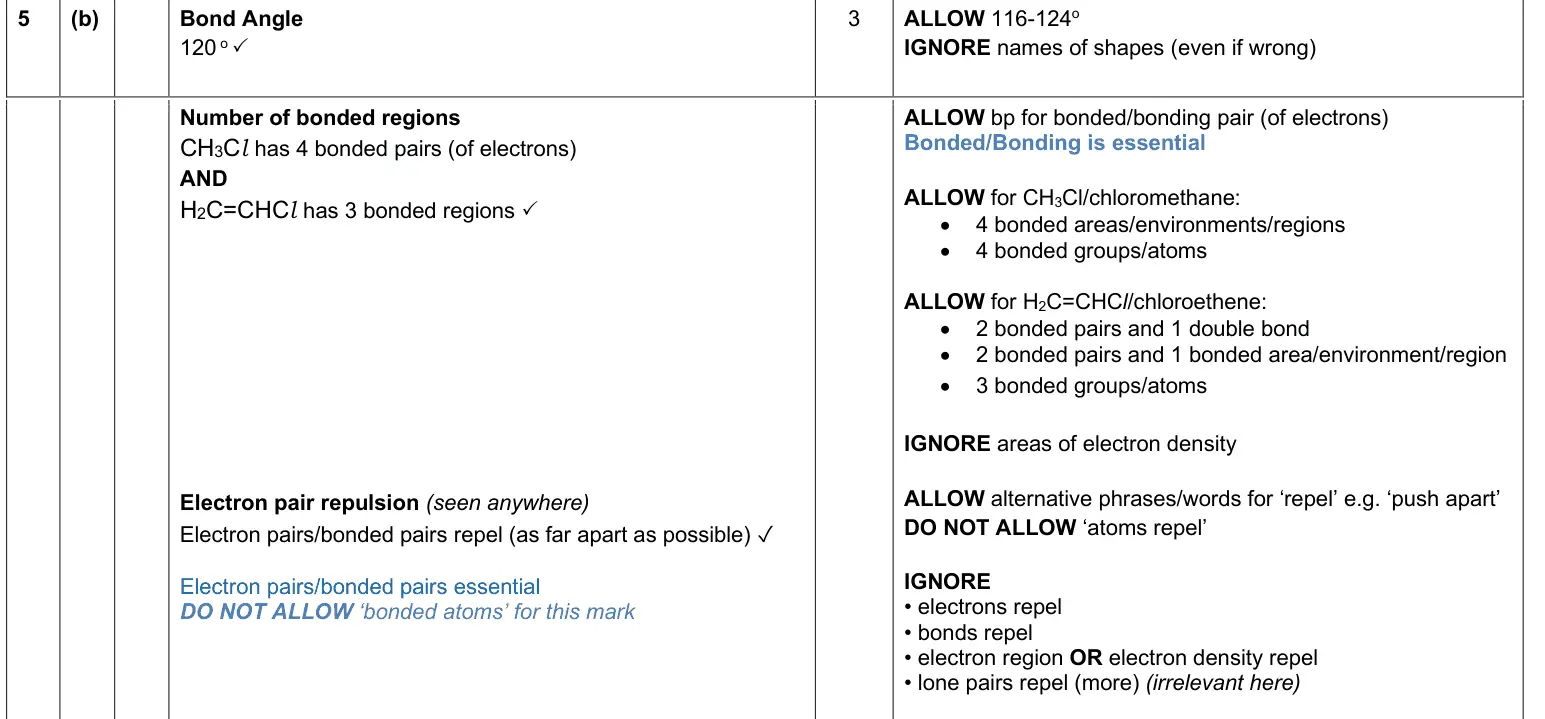
hydrate’.
Scientists are concerned that global warming will melt the permafrost, releasing large quantities of
methane into the atmosphere.
(a) The H–O–H bond angle in ice is about 109° but about 105° in gaseous H2O.
Explain why there is this difference.
...................................................................................................................................................
...................................................................................................................................................
...................................................................................................................................................
...................................................................................................................................................
...................................................................................................................................................
............................................................................................................................................. [3]
June 2017 · Paper 3 · Q1(b) 1 mark Short answer infrared and mass spectrometry
(b) Why are scientists concerned about the release of methane into the atmosphere?
...................................................................................................................................................
...................................................................................................................................................
............................................................................................................................................. [1]
June 2017 · Paper 3 · Q1(e) 1 mark Short answer alkanes
(e) Suggest why some industries are interested in the presence of ‘methane hydrate’ in regions
of the Earth.
...................................................................................................................................................
...................................................................................................................................................
............................................................................................................................................. [1]
June 2017 · Paper 3 · Q2(b) 2 marks Short answer practical skills
Earlier part of question 2 that this part usesEarlier part of June 2017 Paper 3 question 2
(b) The uncertainty in each temperature reading is ±0.1 °C.
The uncertainty in each mass reading is ±0.005 g.
Determine whether the mass of Na2O or the temperature change has the greater percentage
uncertainty.
Show all your working.
...................................................................................................................................................
...................................................................................................................................................
...................................................................................................................................................
...................................................................................................................................................
............................................................................................................................................. [2]
June 2017 · Paper 3 · Q2(c) 2 marks Short answer practical skills
Earlier parts of question 2 that this part usesEarlier part of June 2017 Paper 3 question 2Earlier part of June 2017 Paper 3 question 2
(c) Suggest a modification to this experiment, using the same apparatus, which would reduce
the percentage errors in the measurements.
Explain your reasoning.
...................................................................................................................................................
...................................................................................................................................................
...................................................................................................................................................
............................................................................................................................................. [2]
June 2017 · Paper 3 · Q2(d)(i) 1 mark Short answer redox
(d) Sodium oxide, Na2O, can be prepared by the redox reaction of NaNO2 and sodium metal.
Nitrogen gas is also formed.
(i) What is the systematic name for NaNO2?
..................................................................................................................................... [1]
June 2017 · Paper 3 · Q2(d)(ii) 2 marks Short answer redox
Earlier part of question 2 that this part usesEarlier part of June 2017 Paper 3 question 2
(ii) Using oxidation numbers, with signs, show the element that is oxidised and the element
that is reduced in this reaction.
Element oxidised ..............................
Oxidation number change  from ........... to ...........
Element reduced ..............................
Oxidation number change  from ........... to ...........
[2]
June 2017 · Paper 3 · Q3(a)(ii) 3 marks Short answer rate equations
Earlier part of question 3 that this part usesEarlier part of June 2017 Paper 3 question 3
(ii) The rate constant, k, for this reaction is determined at different temperatures, T.
Explain how the student could determine the activation energy, Ea, for the reaction
graphically using values of k and T.
...........................................................................................................................................
...........................................................................................................................................
...........................................................................................................................................
...........................................................................................................................................
...........................................................................................................................................
..................................................................................................................................... [3]
June 2017 · Paper 3 · Q3(b) 4 marks Short answer redox and electrode potentialstransition elements
(b) Solutions of hydrogen peroxide decompose slowly into water and oxygen:
2H2O2(aq) 2H2O(l) + O2(g)
This reaction is catalysed by manganese dioxide, MnO2(s).
Standard electrode potentials are shown below.
O2(g) + 2H+(aq) + 2e− H2O2(aq) Eo = +0.70 V
MnO2(s) + 4H+(aq) + 2e− Mn2+(aq) + 2H2O(l) Eo = +1.51 V
H2O2(g) + 2H+(aq) + 2e− 2H2O(l) Eo = +1.78 V
Using the electrode potentials, explain how MnO2 is able to act as a catalyst for the
decomposition of hydrogen peroxide.
You answer should include relevant equations.
...................................................................................................................................................
...................................................................................................................................................
...................................................................................................................................................
...................................................................................................................................................
...................................................................................................................................................
...................................................................................................................................................
...................................................................................................................................................
...................................................................................................................................................
............................................................................................................................................. [4]
June 2017 · Paper 3 · Q4(b)(ii) 3 marks Short answer carboxylic acids and estersorganic synthesis
Earlier part of question 4 that this part usesEarlier part of June 2017 Paper 3 question 4
(ii) Compound A is heated with a few drops of concentrated sulfuric acid as a catalyst.
A cyclic ‘dimer’ of compound A forms.
Equation
Type of reaction  ........................................................................................................... [3]
June 2017 · Paper 3 · Q5(a)(i) 1 mark Short answer acids bases and buffers
5 This question is about organic molecules that have a strong smell.
(a) Thiols are foul-smelling, organic sulfur compounds with the functional group –SH.
Butane-1-thiol, shown below, contributes to the strong smell of skunks.
SH
butane-1-thiol
(i) Thiols are weak acids.
Write the expression for the acid dissociation constant, Ka, for butane-1-thiol.
[1]
June 2016 · AS Paper 1 · Q21(a) 2 marks AO1 Short answer atomic structure and isotopes
12
SECTION B
Answer all the questions.
21 A twenty pence coin contains copper and nickel.
(a) Copper and nickel each exist as a mixture of isotopes.
State the similarities and differences between the atomic structure of isotopes of the same
element.
Similarities  ................................................................................................................................
...................................................................................................................................................
Differences  ................................................................................................................................
...................................................................................................................................................
[2]
June 2016 · AS Paper 1 · Q22(b)(ii) 1 mark AO3 Short answer practical skills
Earlier part of question 22 that this part usesEarlier part of June 2016 Paper 1 question 22
(ii) Suggest one modification that the student could make to their method to reduce the
percentage error in the mass of water removed.
...........................................................................................................................................
...........................................................................................................................................
...................................................................................................................................... [1]
June 2016 · AS Paper 1 · Q22(b)(iii) 1 mark AO3 Short answer amount of substancepractical skills
Earlier part of question 22 that this part usesEarlier part of June 2016 Paper 1 question 22
(iii) The student is not sure that all the water of crystallisation has been removed.
How could the student modify the experiment to be confident that all the water of
crystallisation has been removed?
...........................................................................................................................................
...........................................................................................................................................
...................................................................................................................................... [1]
June 2016 · AS Paper 1 · Q22(d) 2 marks AO1 Short answer redox
(d) Salts can also be prepared in redox reactions of metals with acids.
A student prepares a solution of aluminium sulfate by reacting aluminium with dilute sulfuric
acid.
2Al(s) + 3H2SO4(aq) → Al2(SO4)3(aq) + 3H2(g)
Using oxidation numbers, show which element has been oxidised and which has been
reduced in this reaction. State the changes in oxidation numbers, including all signs.
element oxidised .....................................................................
oxidation number change: from ................ to  .........................
element reduced  ....................................................................
oxidation number change: from ................ to ..........................
[2]
June 2016 · AS Paper 1 · Q23(a)(i) 1 mark AO1 Short answer electron structure
17
23 This question is about properties of the halogens and halide ions.
(a) Bromine can be extracted by bubbling chlorine gas through concentrated solutions containing
bromide ions.
(i) Write the electron configuration of a bromide ion, in terms of sub-shells.
...................................................................................................................................... [1]
June 2016 · AS Paper 1 · Q23(b) 1 mark AO1 Short answer halogens
(b) Chlorine is used in water treatment.
State one benefit and one risk of chlorine in water treatment.
Benefit .......................................................................................................................................
...................................................................................................................................................
Risk  ...........................................................................................................................................
.............................................................................................................................................. [1]
June 2016 · AS Paper 1 · Q23(c)(i) 1 mark AO1 Short answer halogens
(c) Precipitation reactions can be used to distinguish between halide ions.
(i) State the reagent needed for these precipitation reactions.
...................................................................................................................................... [1]
June 2016 · AS Paper 1 · Q23(c)(ii) 1 mark AO1 Short answer halogensqualitative analysis
Earlier part of question 23 that this part usesEarlier part of June 2016 Paper 1 question 23
(ii) How would the appearance of the precipitates allow you to distinguish between chloride,
bromide and iodide ions?
Chloride  .............................................................................................................................
Bromide  .............................................................................................................................
Iodide  ................................................................................................................................
[1]
June 2016 · AS Paper 1 · Q26(a)(i) 1 mark AO1 Short answer organic basics
22
26 Compound B, shown below, can be used to synthesise organic compounds with different functional
groups.
H CH3
C C
H CH3
Compound B
(a) (i) Compound B is a member of a homologous series.
Name the homologous series and state its general formula.
Homologous series  ...........................................................................................................
General formula  ............................................................................................................ [1]
June 2016 · AS Paper 1 · Q26(a)(ii) 1 mark AO1 Short answer alkenes
Earlier part of question 26 that this part usesEarlier part of June 2016 Paper 1 question 26
(ii) What reagents and conditions are needed to convert compound B into a saturated
hydrocarbon?
...................................................................................................................................... [1]
June 2016 · AS Paper 1 · Q26(c)(i) 1 mark AO1 Short answer amount of substance
23
(c) The structure of compound F is shown below.
H CH3
HO C C OH
H CH3
Compound F
(i) What is the empirical formula of compound F?
...................................................................................................................................... [1]
June 2016 · AS Paper 2 · Q1(a)(i) 1 mark AO1 Short answer electron structure
1 Group 2 elements are metals that react with oxygen and water.
(a) Magnesium is oxidised when it burns in oxygen to form an ionic compound.
(i) Write the electron configuration, in terms of sub-shells, of a magnesium atom.
...................................................................................................................................... [1]
June 2016 · AS Paper 2 · Q1(a)(ii) 1 mark AO1 Short answer redoxgroup 2
Earlier part of question 1 that this part usesEarlier part of June 2016 Paper 2 question 1
(ii) Explain what happens when magnesium is oxidised in terms of electron transfer.
...........................................................................................................................................
...................................................................................................................................... [1]
June 2016 · AS Paper 2 · Q1(b)(ii) 3 marks AO1 Short answer periodicity
Earlier part of question 1 that this part usesEarlier part of June 2016 Paper 2 question 1
(ii) Explain why the first ionisation energy of strontium is less than the first ionisation energy
of calcium.
...........................................................................................................................................
...........................................................................................................................................
...........................................................................................................................................
...........................................................................................................................................
...................................................................................................................................... [3]
June 2016 · AS Paper 2 · Q1(d) 1 mark AO3 Short answer amount of substance
Earlier part of question 1 that this part usesEarlier part of June 2016 Paper 2 question 1
(d) The student plans to repeat the experiment using the same mass of a Group 2 metal from
further down the group.
Predict whether the volume of hydrogen produced would be greater than, less than or the
same as the volume in the first experiment.
Explain your answer.
...................................................................................................................................................
...................................................................................................................................................
.............................................................................................................................................. [1]
June 2016 · AS Paper 2 · Q2(a) 3 marks AO1, 2 Short answer bonding and structureperiodicity
4
2 The graph shows the melting points of the elements in Period 3 of the periodic table.
1800
Si
1600
1400
1200
melting point 1000
Mg
/ K Al
800
600
S
400 Na
P
Cl
200
Ar
0
10 11 12 13 14 15 16 17 18 19
atomic number
(a) Phosphorus and chlorine have simple molecular structures.
More information about phosphorus and chlorine is given in the table below.
Molecular
Element
formula
phosphorus P4
chlorine Cl2
Explain the differences in the melting points of phosphorus and chlorine.
...................................................................................................................................................
...................................................................................................................................................
...................................................................................................................................................
...................................................................................................................................................
...................................................................................................................................................
...................................................................................................................................................
.............................................................................................................................................. [3]
June 2016 · AS Paper 2 · Q2(b) 4 marks AO1 Short answer periodicity
Earlier part of question 2 that this part usesEarlier part of June 2016 Paper 2 question 2
5
(b) Magnesium and silicon have different types of giant structures.
Describe the bonding in magnesium and in silicon.
Include the names of the particles and describe the forces between the particles in the
structures.
...................................................................................................................................................
...................................................................................................................................................
...................................................................................................................................................
...................................................................................................................................................
...................................................................................................................................................
...................................................................................................................................................
...................................................................................................................................................
...................................................................................................................................................
.............................................................................................................................................. [4]
June 2016 · AS Paper 2 · Q3(a)(i) 1 mark Short answer alkenesalkanes
6
3 Compound A is an alkene.
H3C CH3
C C
H CH3
compound A
(a) The C=C bond in a molecule of compound A has restricted rotation because it comprises a
σ bond and a π bond.
(i) Describe one difference between the σ bond and the π bond.
...........................................................................................................................................
...........................................................................................................................................
...........................................................................................................................................
...................................................................................................................................... [1]
June 2016 · AS Paper 2 · Q3(a)(ii) 1 mark Short answer alkenes
Earlier part of question 3 that this part usesEarlier part of June 2016 Paper 2 question 3
(ii) Explain why compound A does not have E/Z isomers.
...........................................................................................................................................
...........................................................................................................................................
...................................................................................................................................... [1]
June 2016 · AS Paper 2 · Q3(b) 2 marks Short answer alcohols
Earlier part of question 3 that this part usesEarlier part of June 2016 Paper 2 question 3
7
(b) Compound A can be made from alcohol B by heating with an acid catalyst.
Suggest two possible structures for alcohol B.
[2]
June 2016 · AS Paper 2 · Q4(a)(i) 1 mark AO2 Short answer enthalpy changes
10
4 Nitrogen forms several different oxides.
N2O is a useful anaesthetic and NO has been linked to the depletion of ozone in the stratosphere.
(a) The standard enthalpy changes of formation of N2O and NO are given in the table.
Compound ΔfH ɵ / kJ mol–1
N2O (g) + 82.0
NO (g) + 90.2
(i) Explain, in terms of bond breaking and bond making, why the enthalpy change of
formation of NO is endothermic.
...........................................................................................................................................
...........................................................................................................................................
...................................................................................................................................... [1]
June 2016 · AS Paper 2 · Q5(a)(i) 1 mark AO3 Short answer acids and titrationsreaction rates
12
5 A student investigates the reaction between strontium carbonate and dilute nitric acid.
SrCO3 + 2HNO3 Sr(NO3)2 + CO2 + H2O
The rate of reaction is determined from the loss in mass over a period of time.
(a) (i) Explain why there is a loss in mass during the reaction.
...........................................................................................................................................
...................................................................................................................................... [1]
June 2016 · AS Paper 2 · Q5(b)(i) 2 marks AO2 Short answer reaction rates
Earlier part of question 5 that this part usesEarlier part of June 2016 Paper 2 question 5
(b) The student plots a graph of total mass (reagents + container) against time.
96.40
96.30
96.20
mass / g
96.10
96.00
95.90
0 50 100 150 200 250 300 350 400
time / s
13
(i) Describe and explain the change in the rate of the reaction during the first 200 seconds
of the experiment.
...........................................................................................................................................
...........................................................................................................................................
...................................................................................................................................... [2]
June 2016 · AS Paper 2 · Q5(c) 3 marks AO3 Short answer reaction ratespractical skillspractical techniques
Earlier parts of question 5 that this part usesEarlier part of June 2016 Paper 2 question 5Earlier part of June 2016 Paper 2 question 5
(c) Outline a method that could be used to obtain the results that are plotted on the graph.

Your answer should include the apparatus required and the procedure for the experiment.
...................................................................................................................................................
...................................................................................................................................................
...................................................................................................................................................
...................................................................................................................................................
...................................................................................................................................................
.............................................................................................................................................. [3]
June 2016 · AS Paper 2 · Q6(a) 1 mark AO1 Short answer alcohols
14
6 This question is about the properties and reactions of butan-2-ol.
H H H H
H C C C C H
H OH H H
Some properties of butan-2-ol are listed in the table.
Melting point –115 °C
Boiling point 99.5 °C
(a) Why is butan-2-ol classified as a secondary alcohol?
...................................................................................................................................................
.............................................................................................................................................. [1]
June 2016 · AS Paper 2 · Q6(b) 4 marks AO1, 2 Short answer bonding and structure
Earlier part of question 6 that this part usesEarlier part of June 2016 Paper 2 question 6
(b) The shape around the oxygen atom in butan-2-ol is non-linear.
Predict the C–O–H bond angle and explain this shape.
bond angle ......................................................
explanation  ...............................................................................................................................
...................................................................................................................................................
...................................................................................................................................................
...................................................................................................................................................
.............................................................................................................................................. [4]
June 2016 · AS Paper 2 · Q6(c)(ii) 2 marks AO3 Short answer organic synthesis aspractical skillspractical techniques
Earlier parts of question 6 that this part usesEarlier part of June 2016 Paper 2 question 6Earlier part of June 2016 Paper 2 question 6
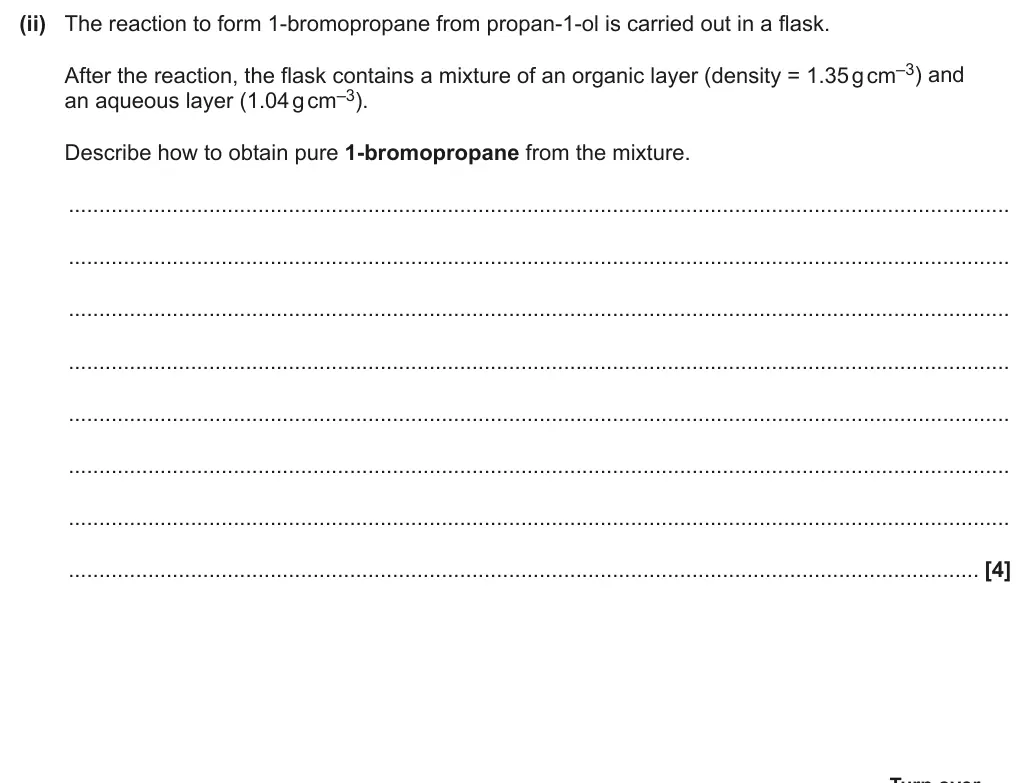
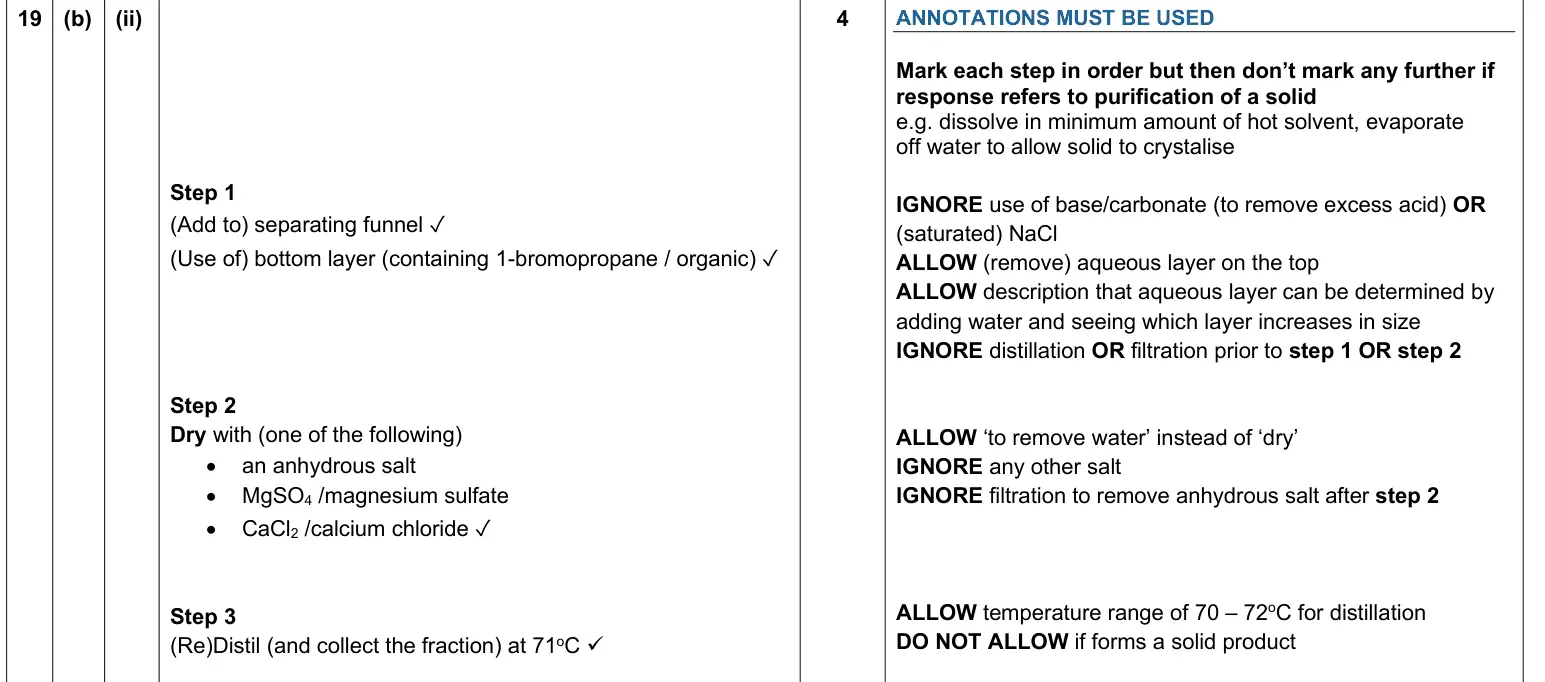
15
(ii) A student plans to carry out this oxidation using the apparatus shown in the diagram.
Give one reason why the apparatus is not suitable and describe a more suitable way of
carrying out this oxidation.
...........................................................................................................................................
...........................................................................................................................................
...................................................................................................................................... [2]

Work with an OCR chemistry tutor

Dropping marks on calculations, mechanisms or the six-markers? Book a trial session with a specialist OCR chemistry tutor.

Prefer email? Send an enquiry

If you are under 18, please include a parent's contact details. Enquiries go to enquiries@chemistryaleveltutor.com and are deleted once handled. All tutoring is online.