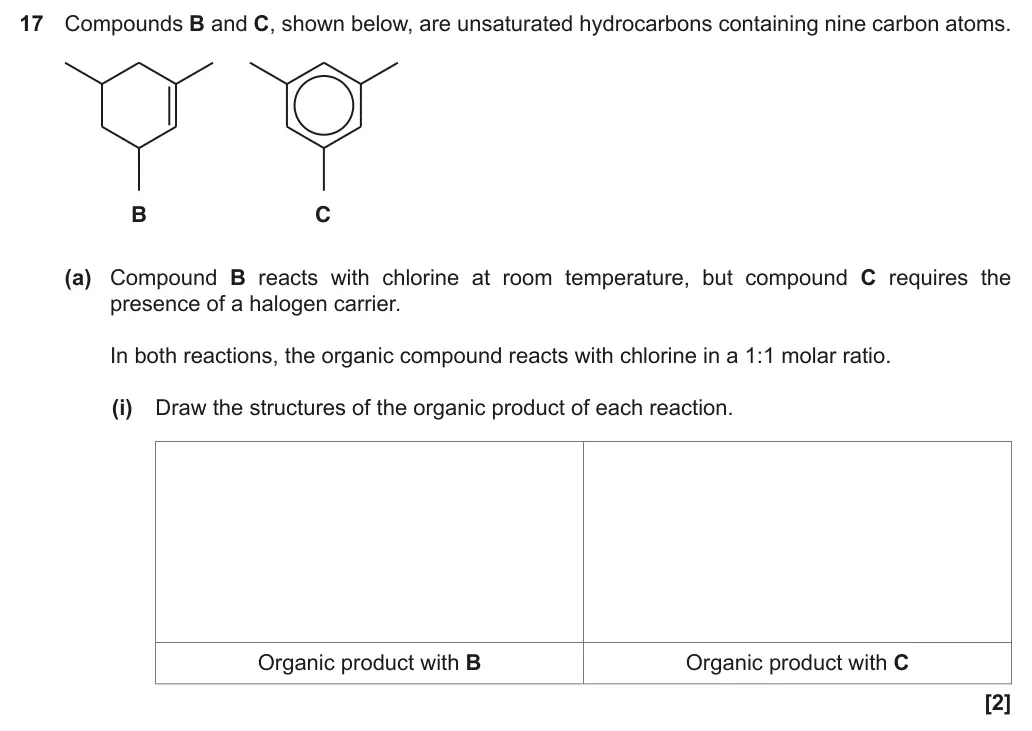
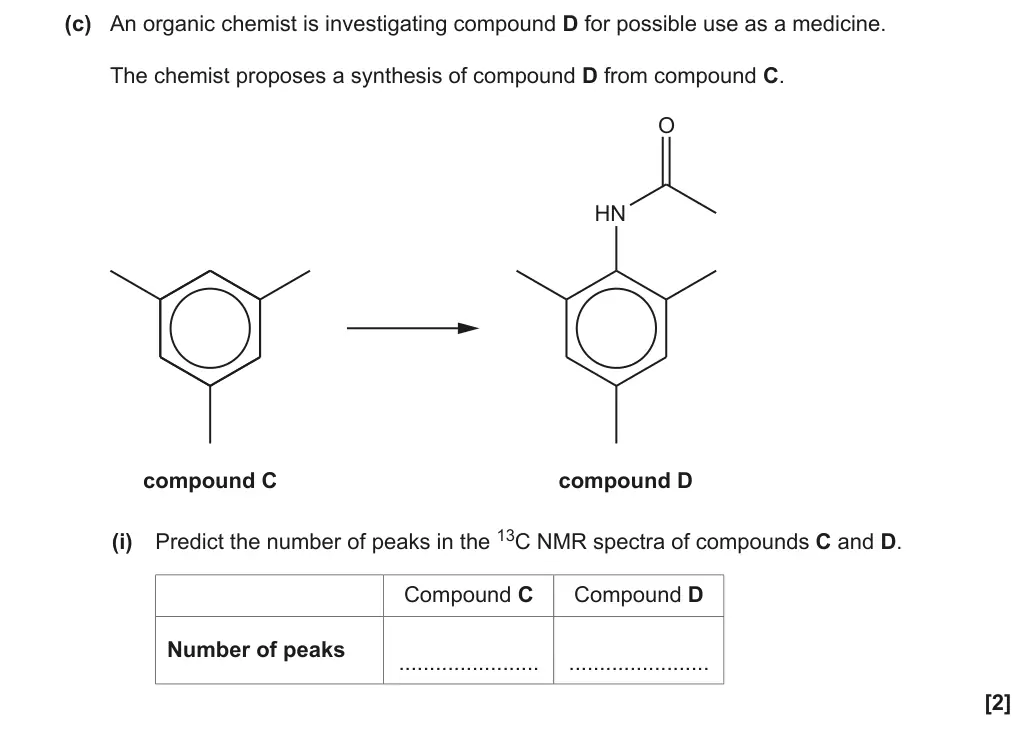
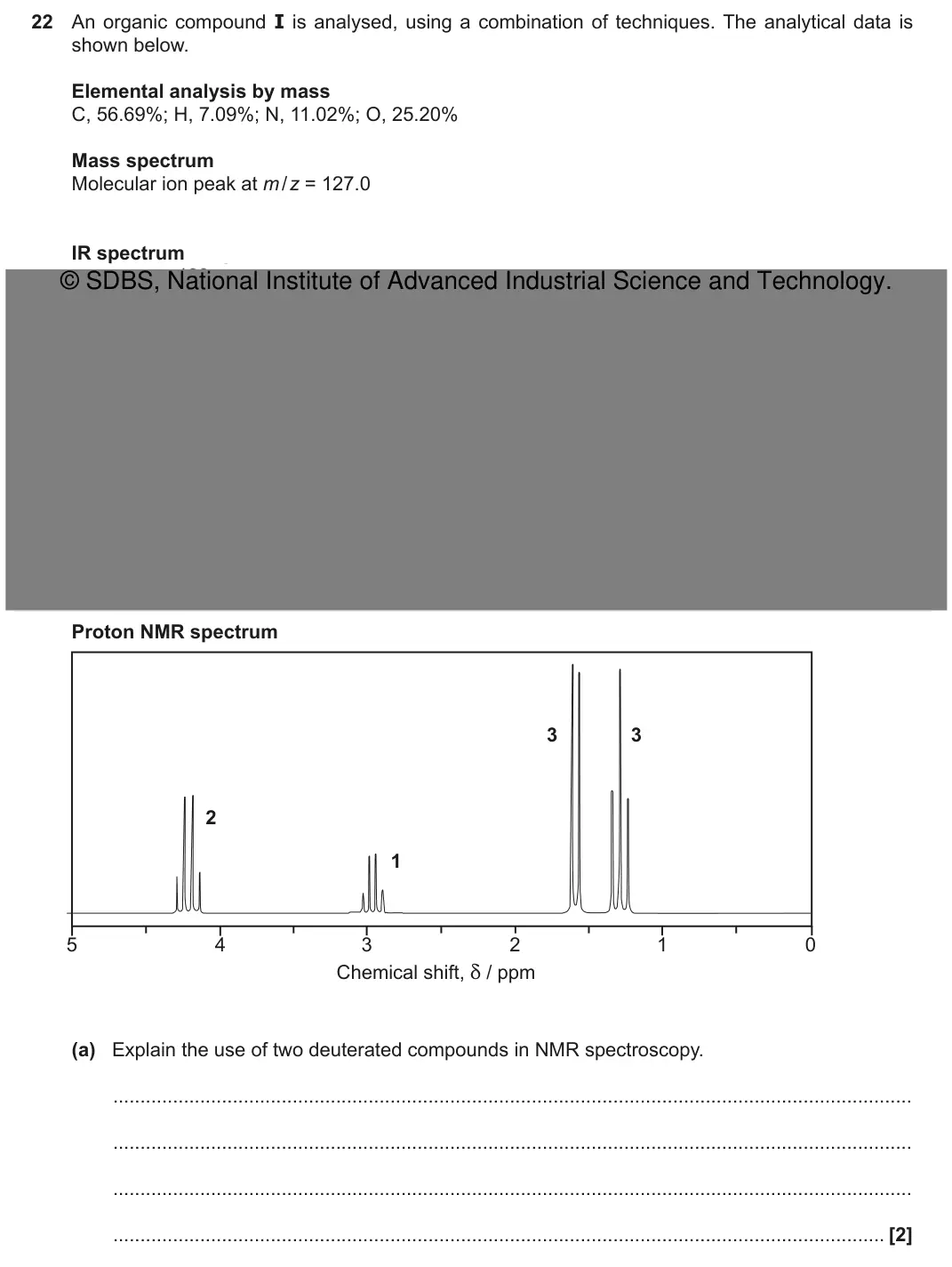
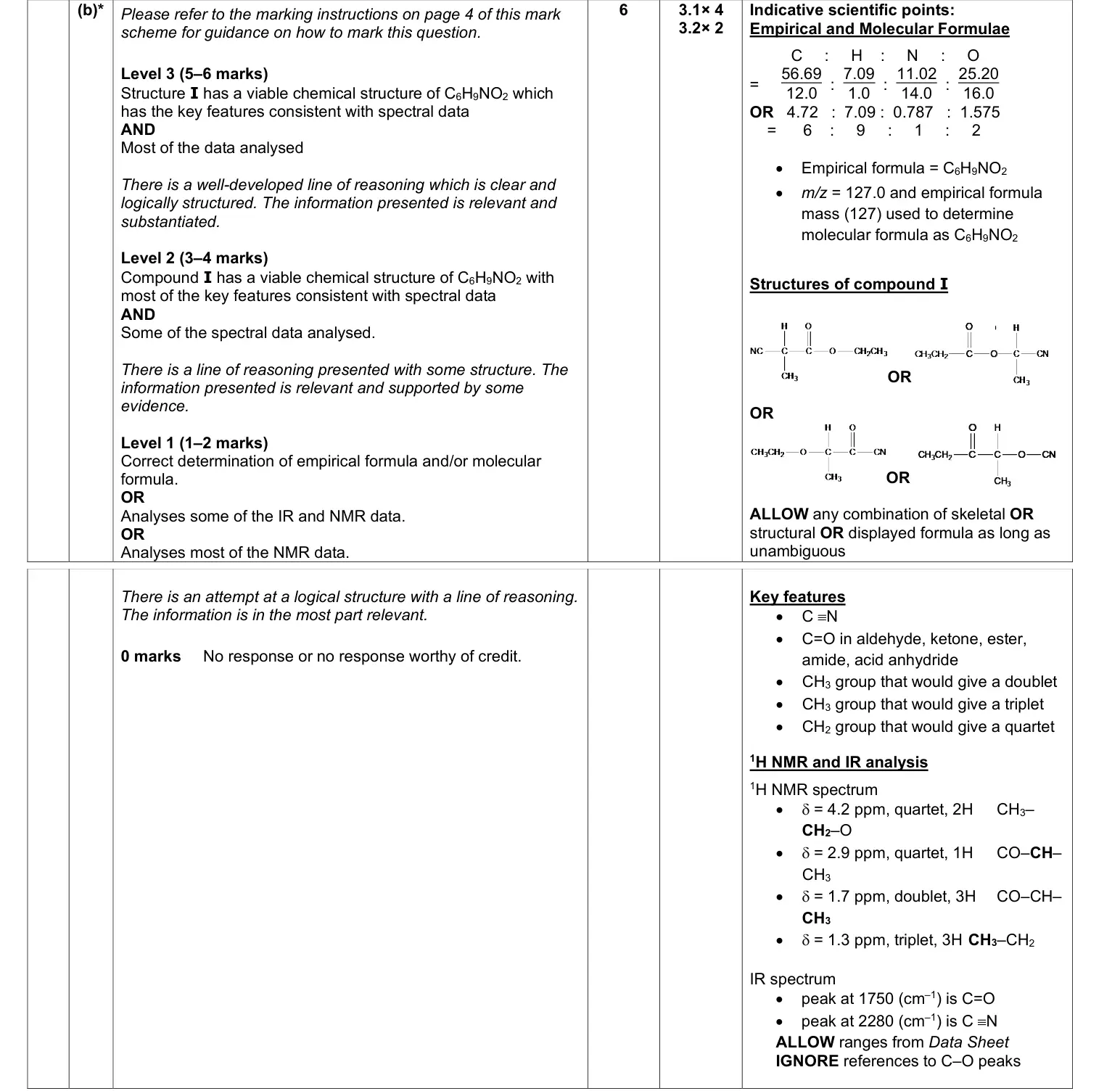
Tap a question to zoom it. Where a part needs a table, graph or structure from an earlier part, that part folds out above it; the mark scheme and examiner's comment open underneath. Have the OCR Data Sheet beside you.
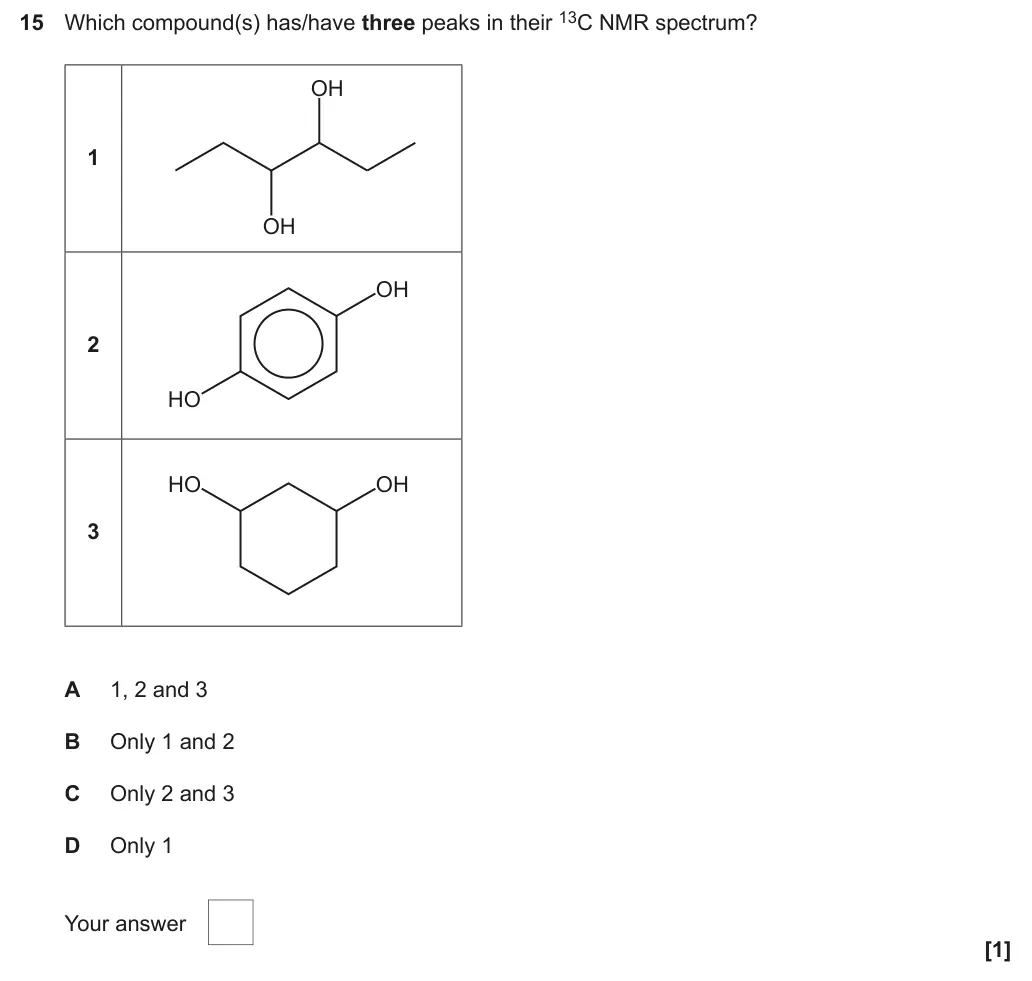
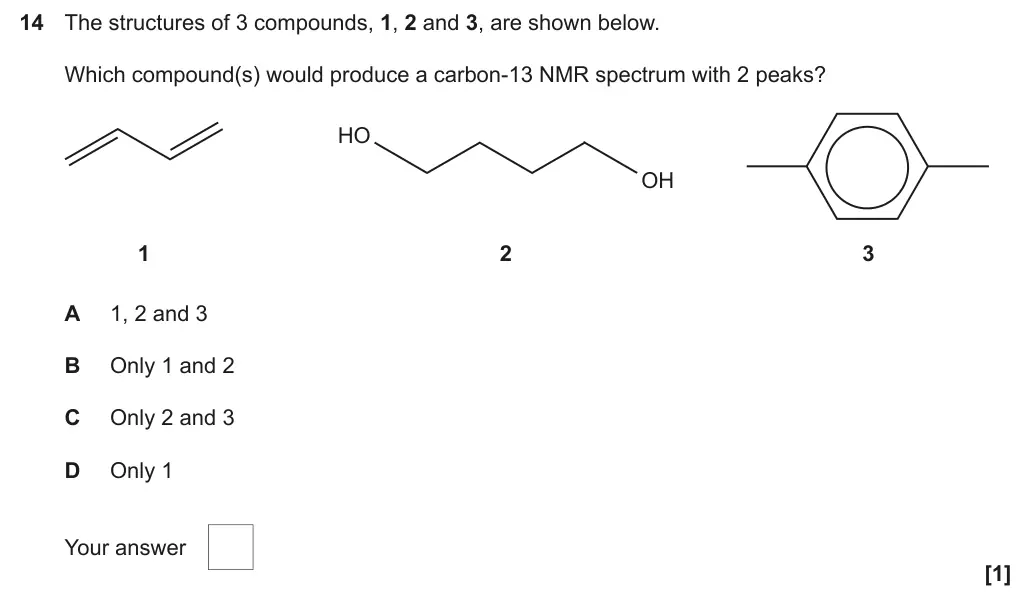
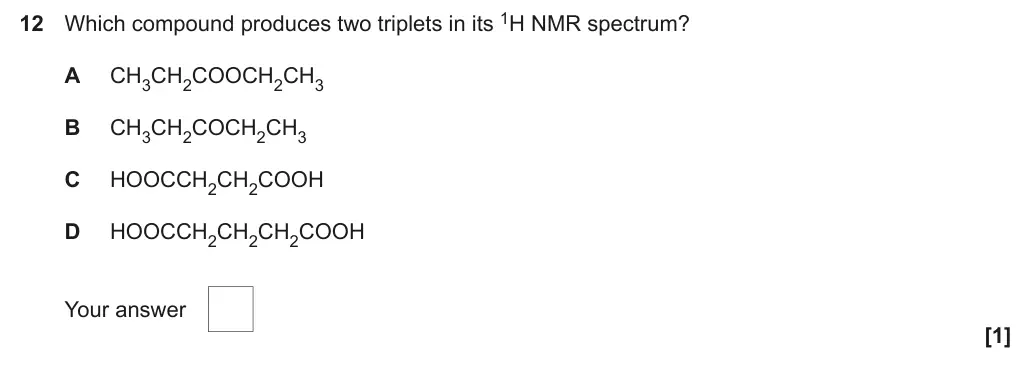
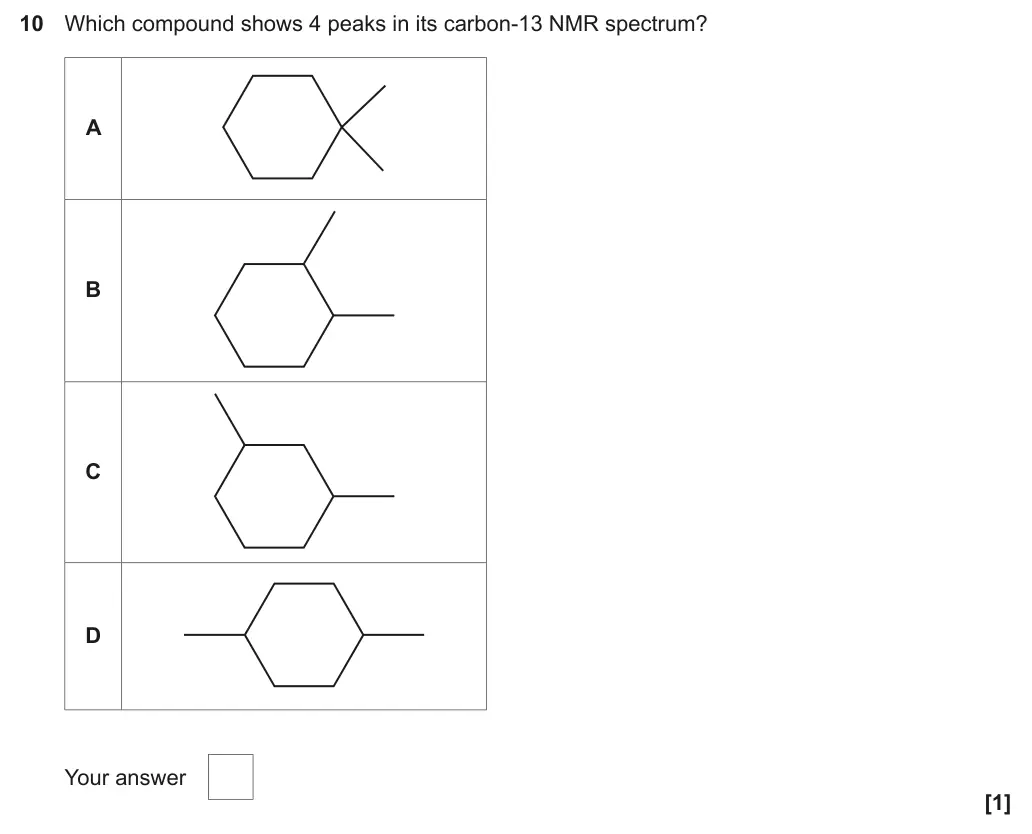
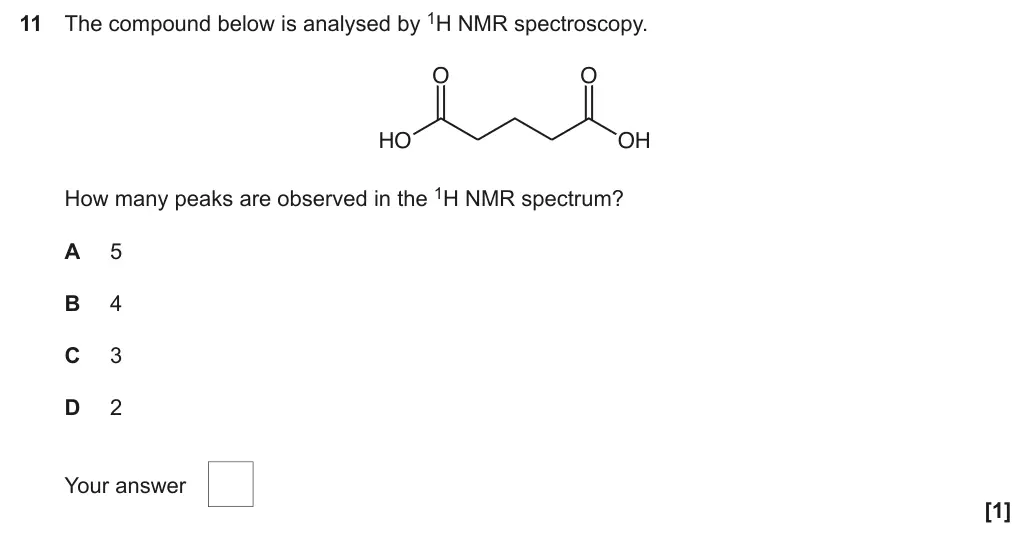
June 2025 · Paper 2 · Q151 markMultiple choiceMedium
Answer
D
Mark scheme
Examiner's comment
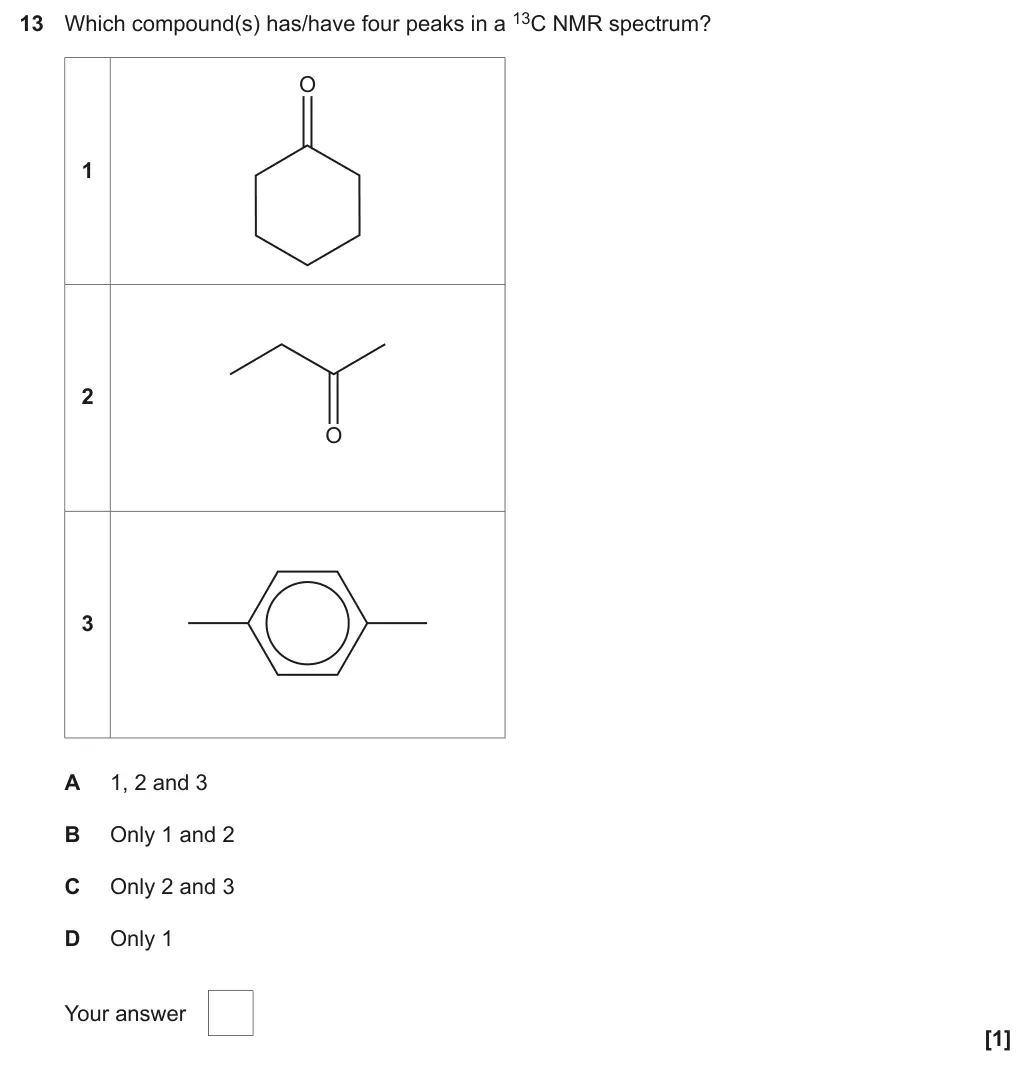
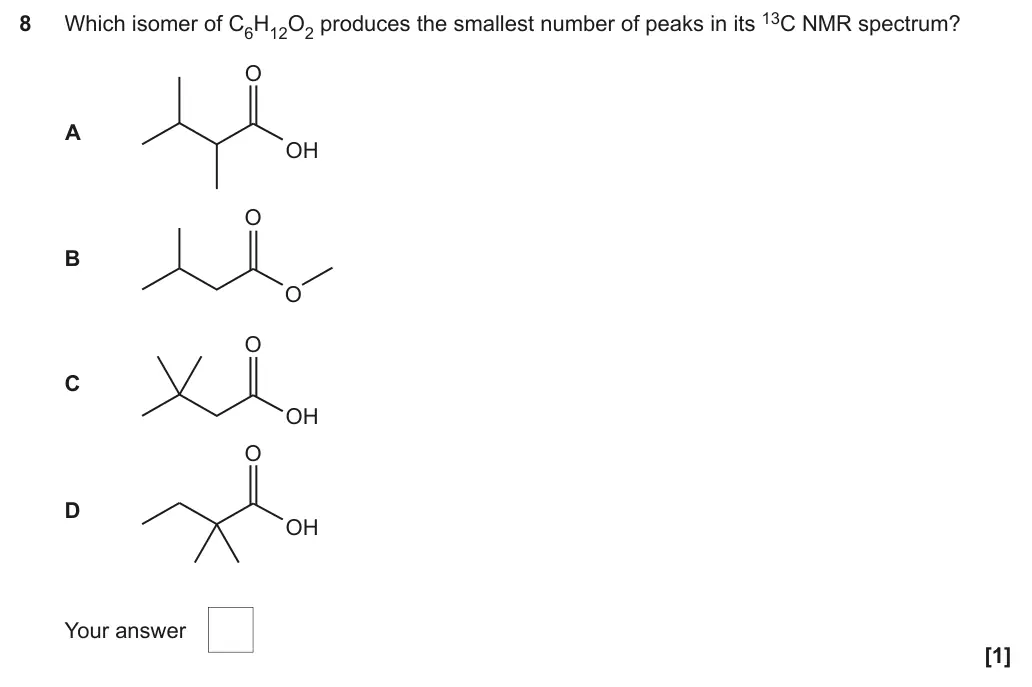
Just over half of candidates gave the correct answer, D. The most common incorrect response was B as many didn’t see the line of symmetry so counted each side of the benzene as different (as was evident from candidate annotations). Section B overview Section B includes a mixture of short answer and extended response questions, including two questions marked using a level of response mark scheme (Question 17 and 23 (b)). This section of the paper is worth 85 marks.
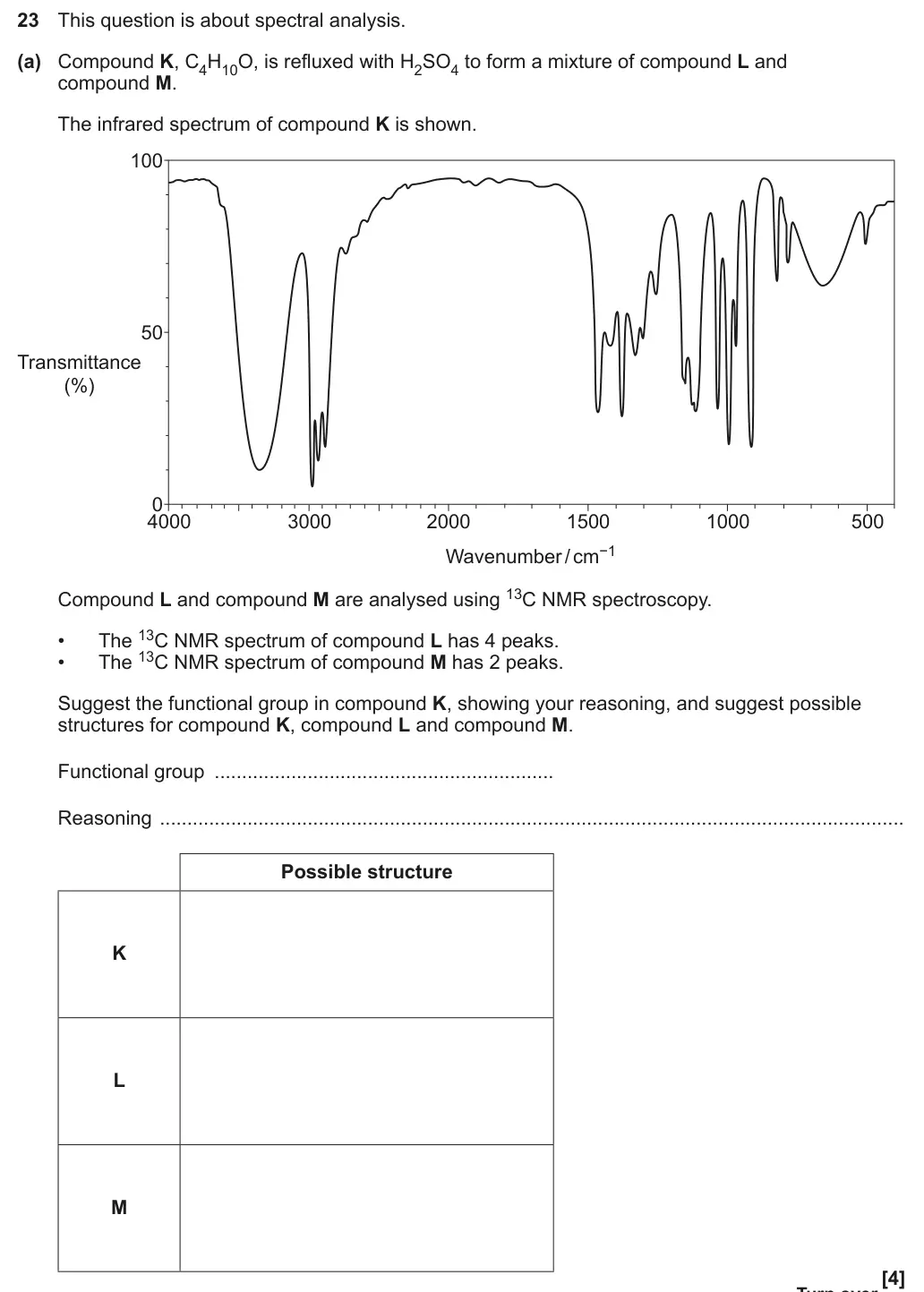
June 2025 · Paper 2 · Q23(a)4 marksShort answerHard
Mark scheme
Examiner's comment
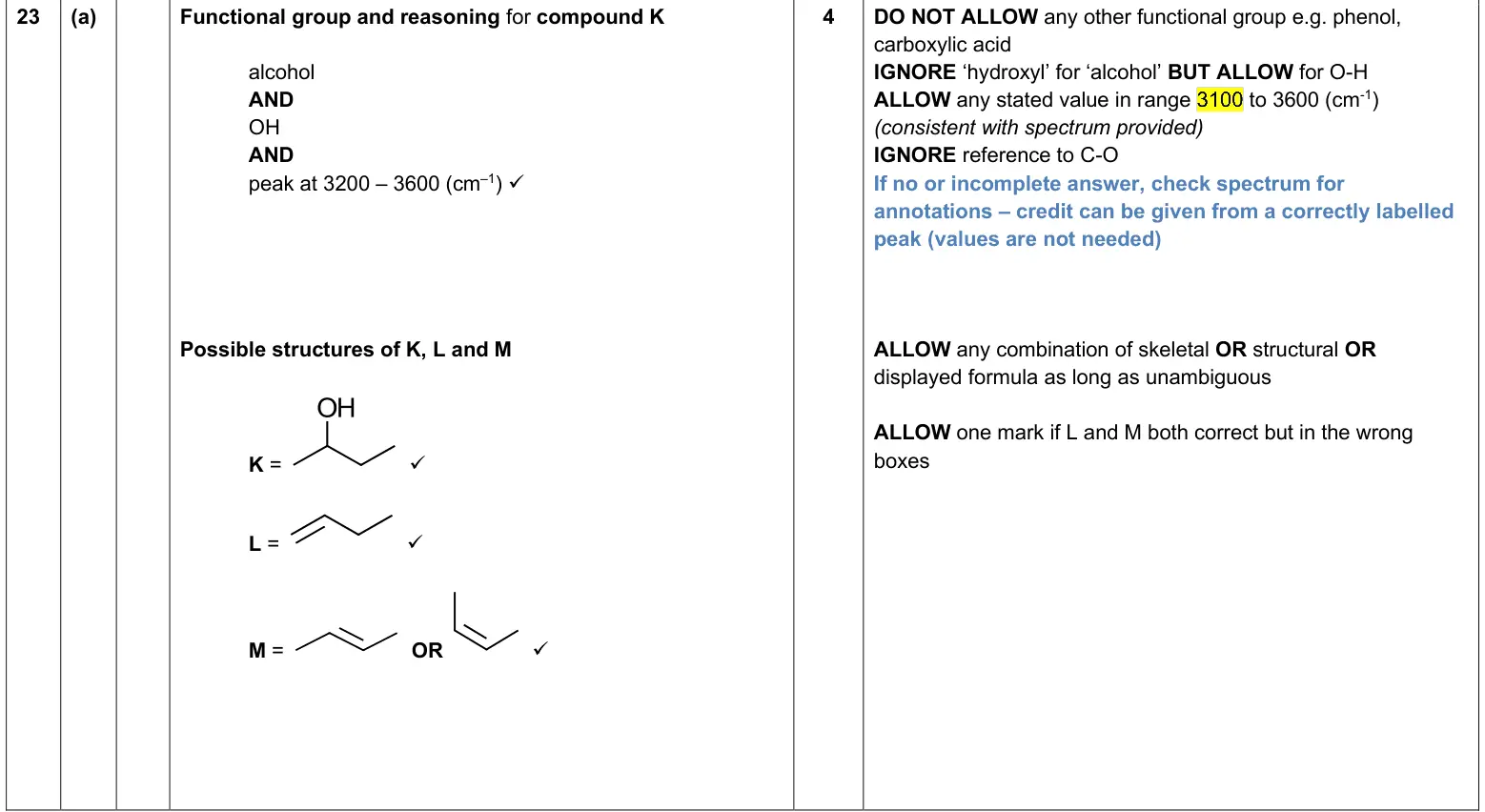
Very few candidates scored all 4 marks. The mark for identifying the alcohol functional group due to the presence of O-H bond in IR between 3200-3600 cm-1 was often lost for missing information. O-H or OH or hydroxy alone was not accepted as OH groups can be found within other functional groups i.e. phenol and carboxylic acid. Equally, it was important to identify the correct bond from the IR spectrum; in this case, O-H gives the most definitive answer. Other bonds are present, e.g. C-H and C-O but do not tell us that it is an alcohol. A few misinterpreted the ‘reasoning’ question stem and said alcohols would have the correct general formula to fit C4H10O or that alcohols could be dehydrated to make different alkenes, which is correct, but confirmation needed to come from the IR provided in the question. Many candidates gave a primary alcohol, butan-1-ol, as K. It appears many candidates focused on the fact that K was refluxed with H2SO4 and assumed this was oxidation, despite there being no K2Cr2O7, giving L and M as aldehydes, ketones or carboxylic acids. Some just gave alcohols with different structural formula for the alcohol for L and M, attempting to use the 13C NMR data. A significant proportion of candidates did not gain any marks on this question.
Notes from the mark scheme and report
alcohol AND O–H AND peak at 3200–3600 cm–1 (DO NOT ALLOW phenol/carboxylic acid
IGNORE C–O)
K = butan-2-ol, L = but-1-ene, M = but-2-ene (E or Z)
1 mark if L and M correct but in wrong boxes
Skills: M3.1 Translate information between graphical, numerical and algebraic forms
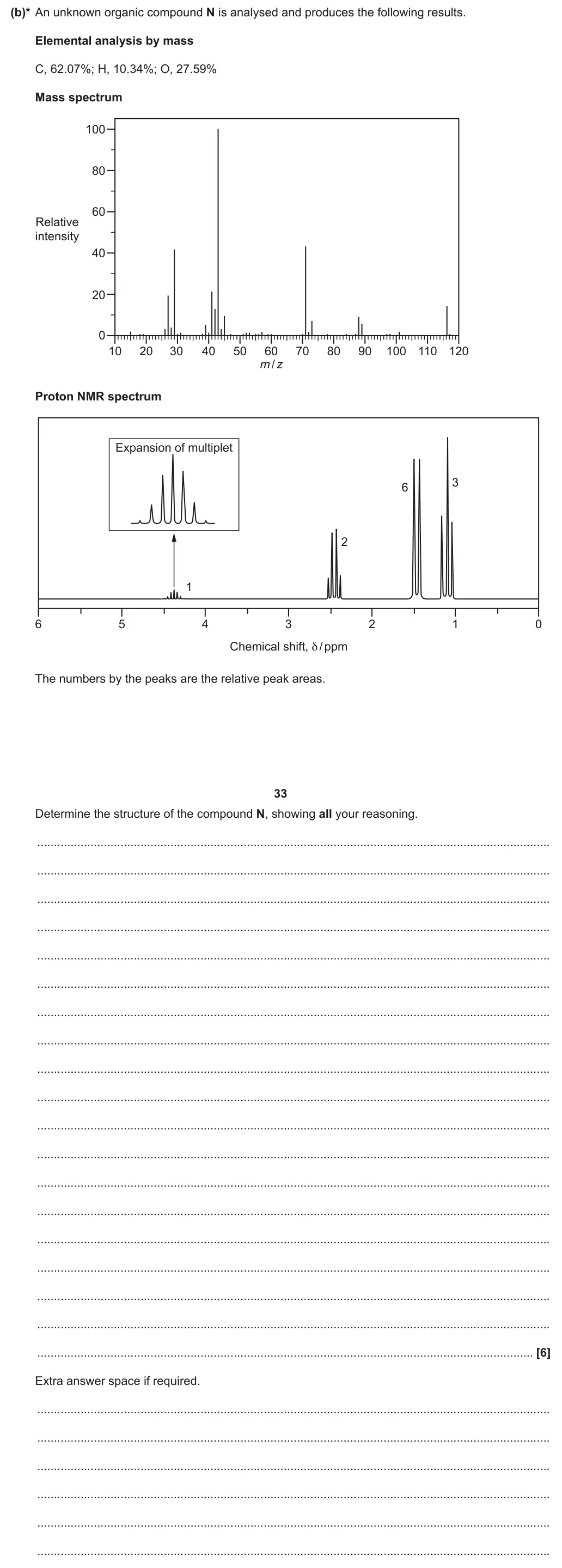
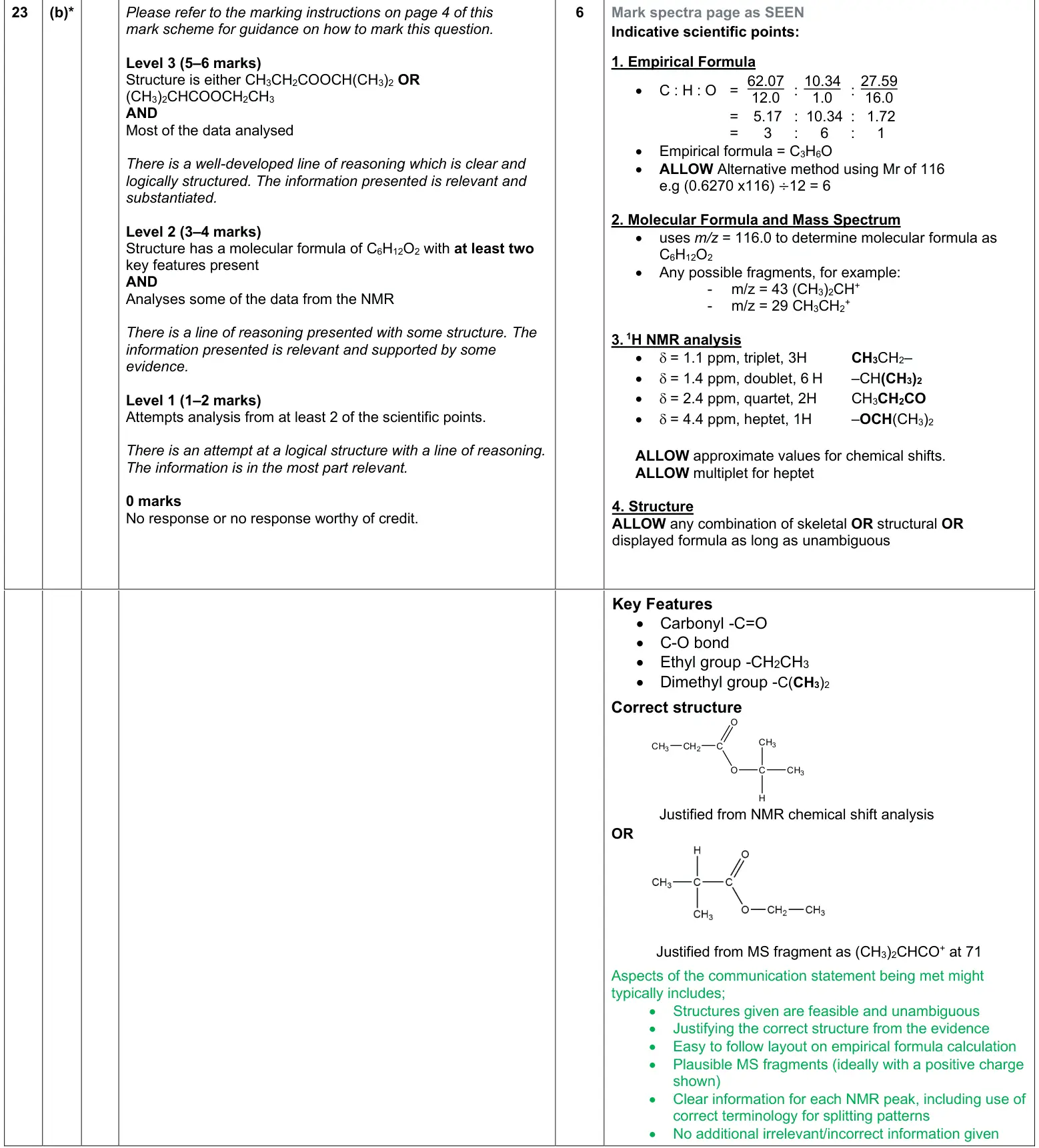
June 2025 · Paper 2 · Q23(b)6 marks6-mark level of responseMedium
Mark scheme, with the levels and indicative points
Examiner's comment
Most candidates achieved Level 3 and were able to gain 5 or 6 marks. The communication mark was given when a clear justification was given for either ester from their NMR data or from the mass spectrum fragment ions. The highest attaining candidates were able to organise their interpretation of the NMR data clearly in a table, showing how they used the information on chemical shift, integration and splitting to produce a fragment and finally linking these together to give a correct structure. However, for some candidates, while information was correctly determined, this was not then used to give a final structure. Some candidates analysed the fragment peaks from the mass spec. The best solutions linked the structure with peaks in the mass spectrum, e.g. CH3CH2+ peak at m/z 29 and C3H7+ peak at m/z 43, even though these fragments were often missing a charge when referred to. Some candidates only achieved Level 2 as although their structures had the correct molecular formula they contained -OH (suggesting N was a hydroxyl ketone or carboxylic acid) rather than H-C-O (found in esters) by misinterpreting the peak at 4.4 ppm as an O-H peak. Candidates should be reminded that the H bonded to an O will not couple with neighbouring Hs and can be present anywhere in the spectrum. This is usually highlighted by running the spectrum in D2O, removing this peak. Some candidates correctly identified parts of the molecule from their analysis of the NMR data but then gave a molecule which didn’t fit this, e.g. identified the (CH3)2CH fragment but then did not show it in the final structure or included a -COOH despite there being no peak at 10-12 ppm. Some, despite understanding that the peak at 2.4 ppm was next to -C=O and showed quartet splitting so had 3 neighbouring H, would assign it as a carbonyl group with the methyl group on one side and a CH2 on the other side. Lower attaining candidates struggled to interpret the NMR data, especially the presence of 6 equivalent Hs – many translated this as being a straight chain rather than 2 x CH3 groups. It is also important that candidates make use of the chemical shift information on the data sheet to give a chemical environment and try to use that to piece together their structure. Almost all candidates attempted to calculate the empirical formula and determine the molecular formula of the unknown compound, N, and therefore secured Level 1. However, many of these candidates gave structures which were not consistent with the molecular formula. This limited them to achieving Level 1, 2 marks only. Also, those without a final structure could only score a maximum of 2 marks. This response achieved Level 2 and 4 marks. The final structure is a hydroxy ketone, not one of the correct esters, but does have the correct molecular formula and C=O as well as an ethyl group. The candidate has analysed some of the NMR data. The communication mark has been given as the analysis shown in their response is easy to follow with clear information given for each NMR peak.
CH3CH2COOCH(CH3)2 (or (CH3)2CHCOOCH2CH3 justified from m/z 71)
Skills: M0.2 Use ratios, fractions and percentages; M3.1 Translate information between graphical, numerical and algebraic forms
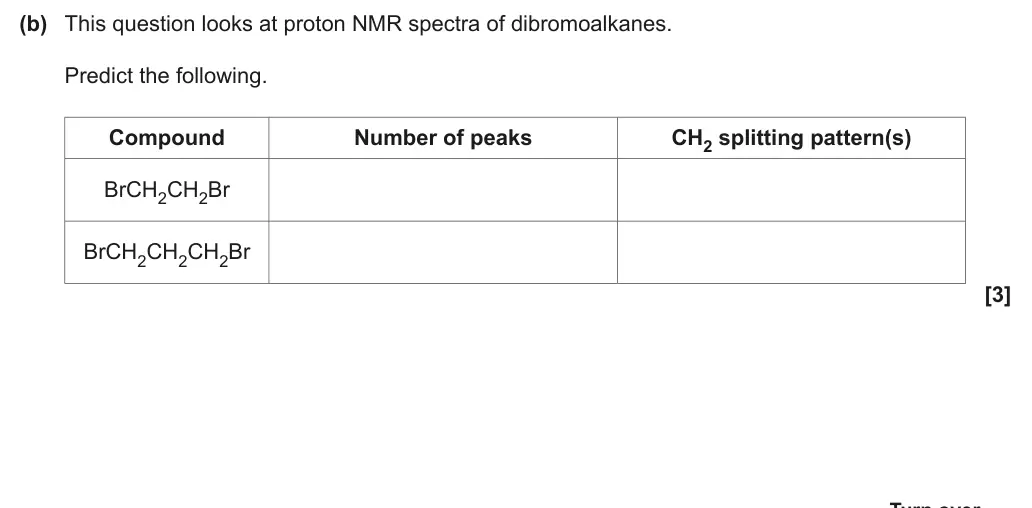
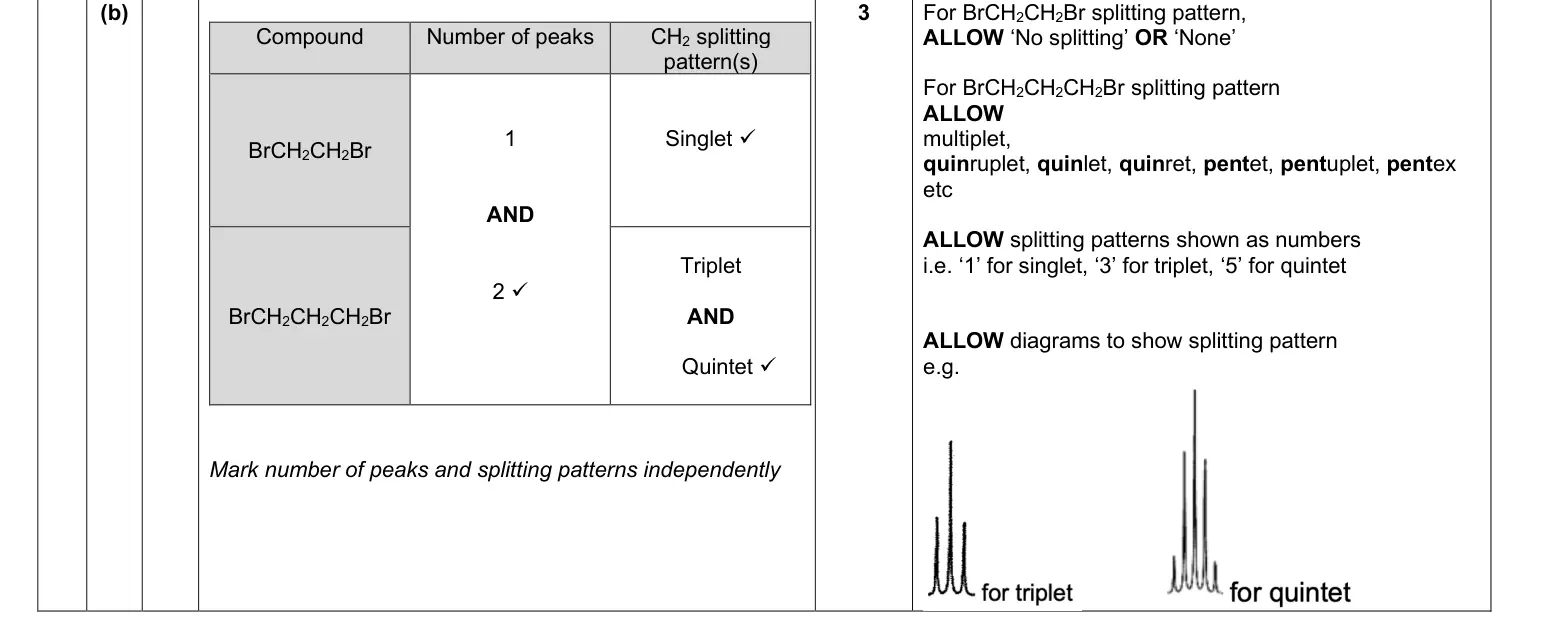
June 2025 · Paper 3 · Q1(b)3 marksShort answerMedium
Mark scheme
Examiner's comment
Most candidates identified the number of peaks, for which one mark was available. The splitting patterns gave a variety of answers, with the triplet and pentet splitting from BrCH2CH2CH2Br proving to be the easier response. Most candidates predicted that BrCH2CH2Br would produce a triplet, rather than a singlet. This part of the question assessed whether candidates could identify protons with the same environment, and that they do not split one another.
Notes from the mark scheme and report
BrCH2CH2Br: 1 peak AND singlet (equivalent protons do not split)
BrCH2CH2CH2Br: 2 peaks
triplet AND quintet
Many candidates do not consider chemical environments when predicting splitting patterns.
Protons with the same environment do not split one another.
June 2024 · Paper 2 · Q141 markMultiple choiceHard
Answer
B
Mark scheme
Examiner's comment
Around two-thirds picked the correct answer B, identifying Structures 1 and 2 as having 2 carbon environments. Most students labelled the carbon environments on the structures to help them. Candidates sometimes struggled to recognise the two different carbon environments within the benzene ring, in Structure 3, as well as the CH3 group.
Notes from the mark scheme and report
compound 3 has 3 carbon environments
Skills: M4.3 Understand the symmetry of 2-D and 3-D shapes
June 2024 · Paper 2 · Q246 marks6-mark level of responseHard
Mark scheme, with the levels and indicative points
Examiner's comment
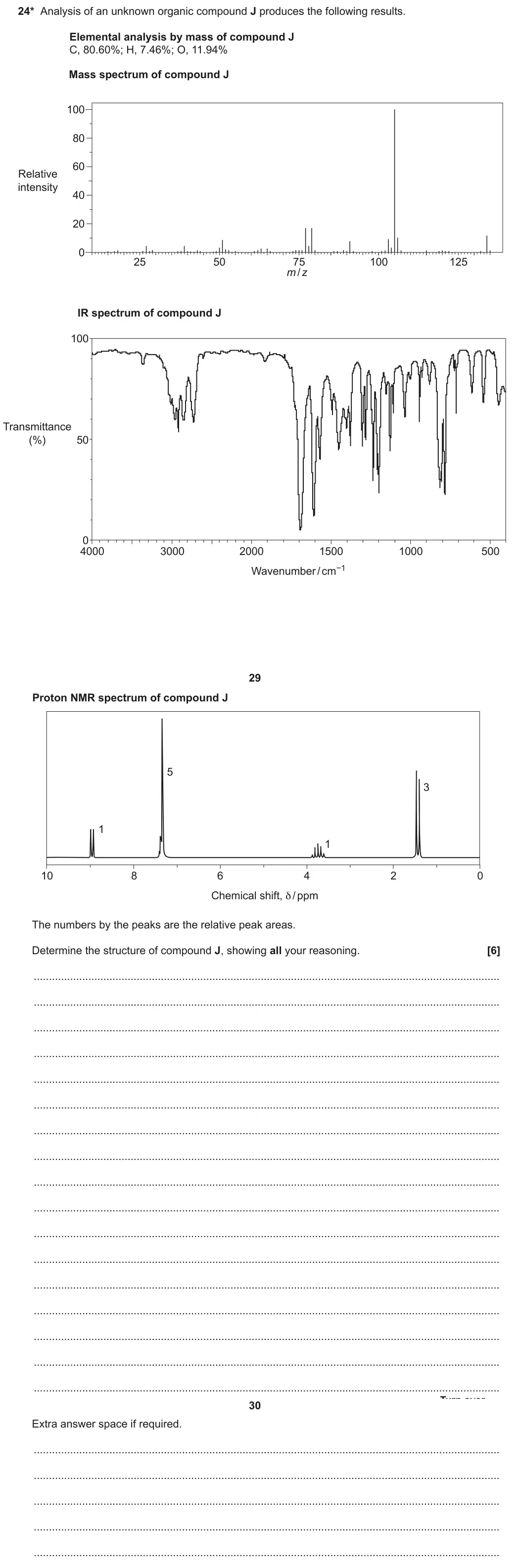
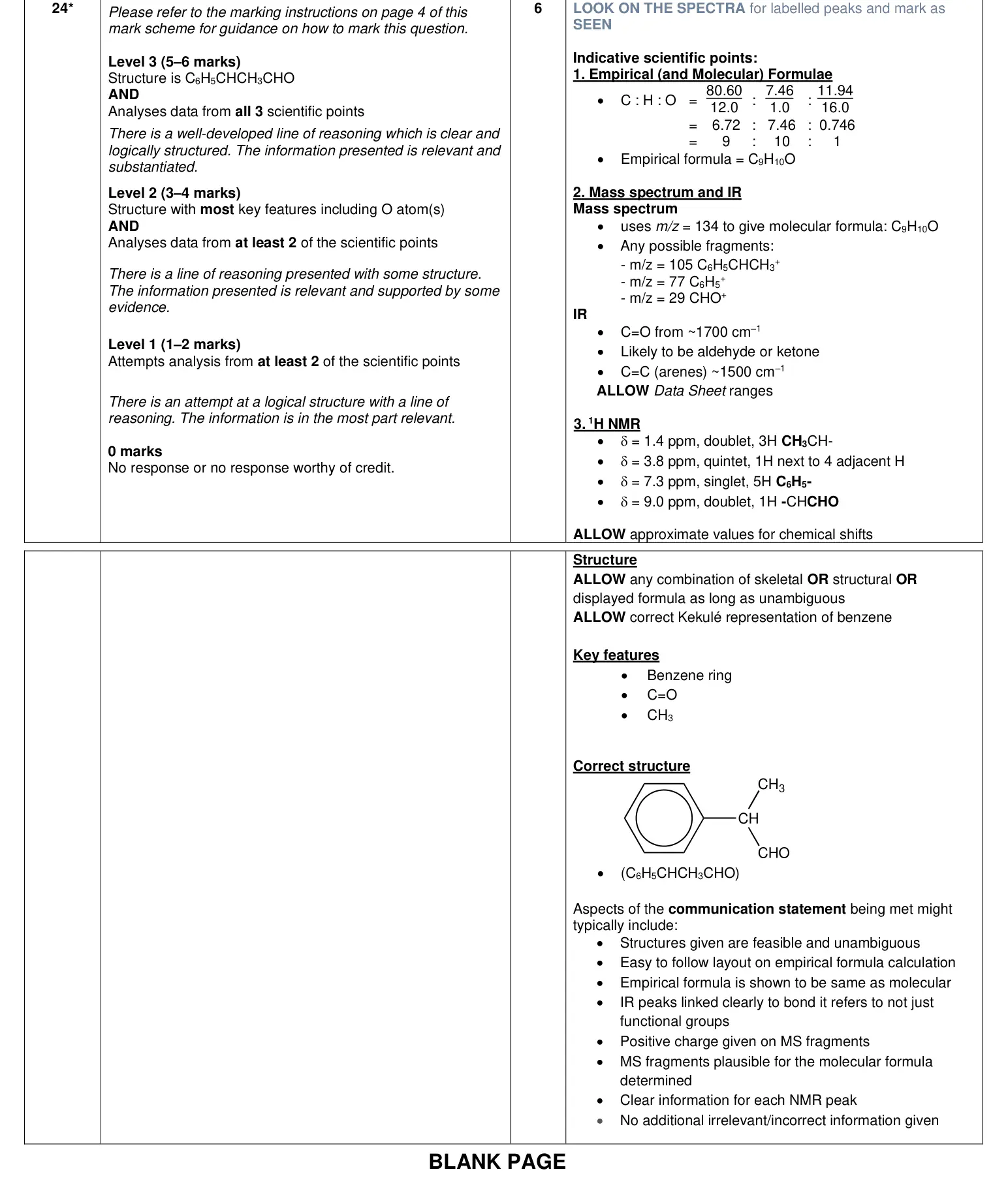
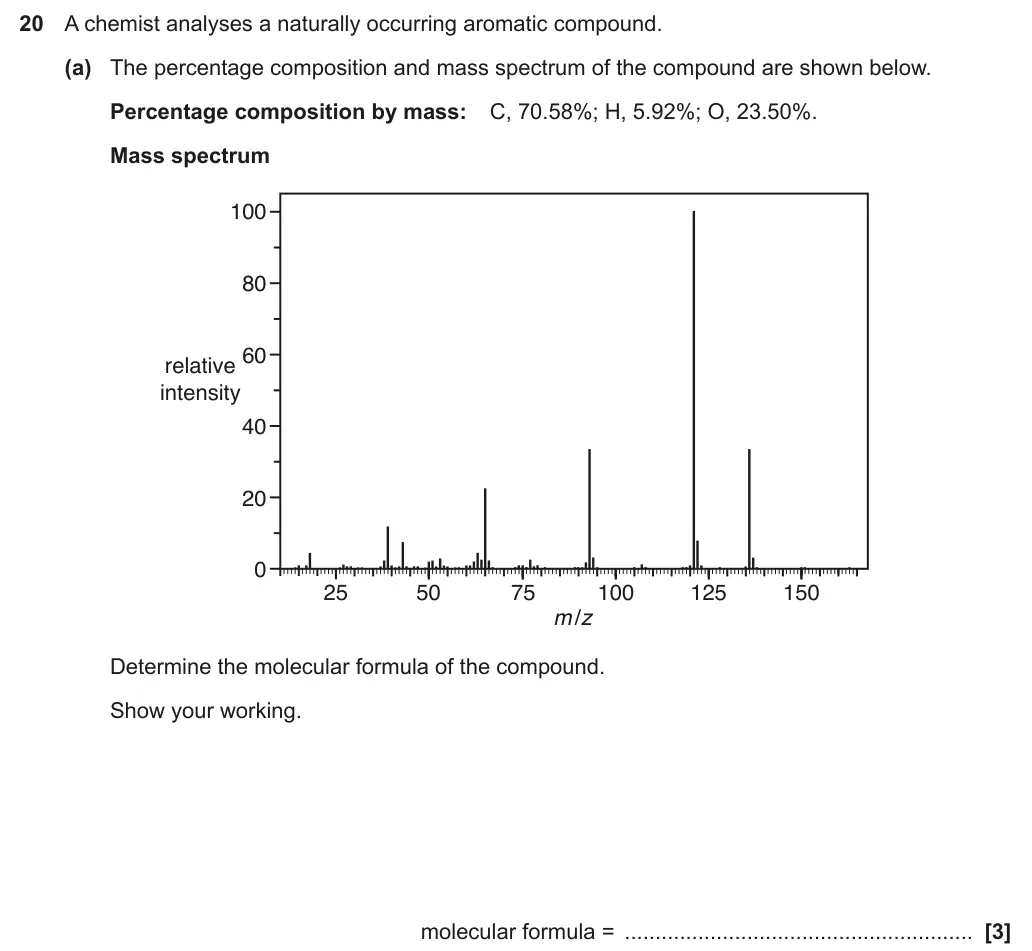
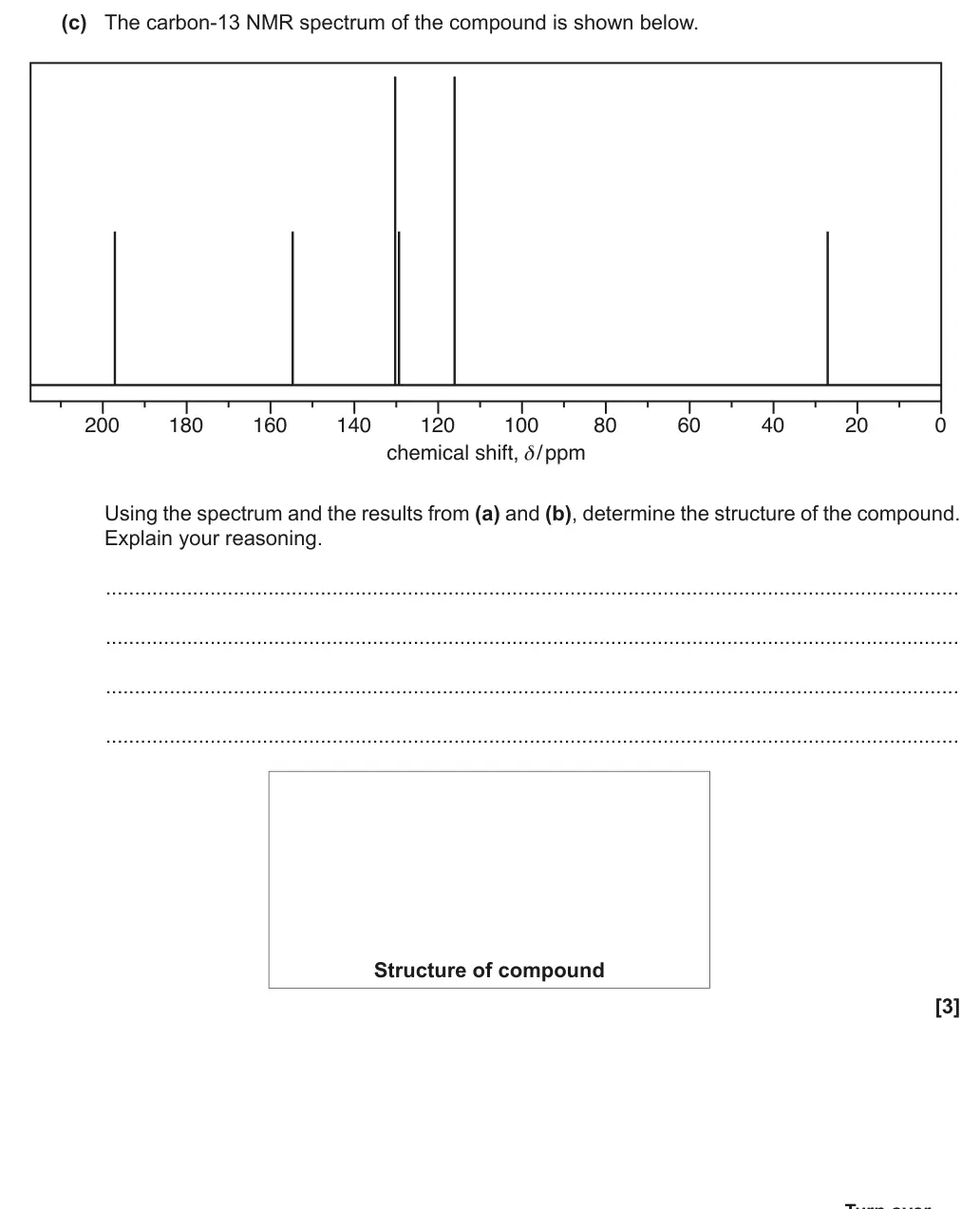
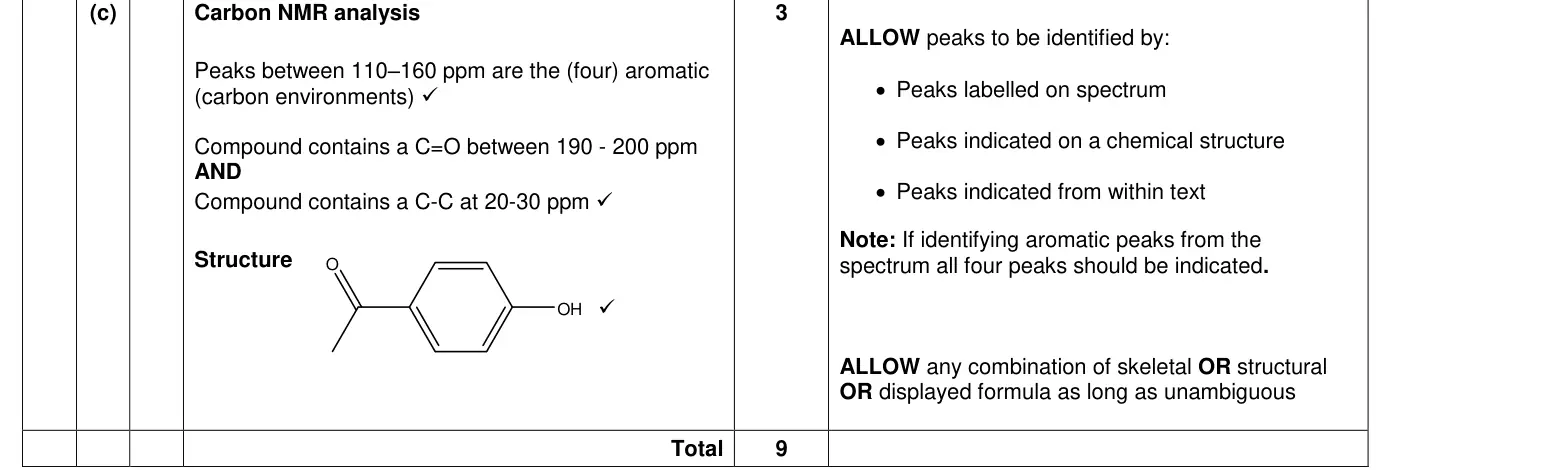
This question was well-attempted by most candidates, with the majority of candidates gaining full marks or gaining 4 marks for a top Level 2 response. Many candidates showed excellent recall of how to determine the correct empirical formula from the percentage composition data. Most then went on to use the m/z peak on the mass spectrum to confirm that the Mr was 134, and therefore the molecular formula was identical to the empirical formula. A few also made use of the mass spectrum to identify possible fragment ions including a correct positive charge. Most candidates used the IR spectrum to identify a C=O bond and many also mentioned the absence of O-H or spotted C=C for arenes. Lower attaining candidates sometimes incorrectly mentioned the presence of a carboxylic acid O-H despite the molecular formula only having 1 oxygen atom. Many candidates annotated the NMR spectrum and/or presented their analysis clearly in a table format and were able to identify aldehyde and arene hydrogen environments. The best candidates had fragments built up alongside their NMR analysis clearly building them using chemical shift, integration ratios and splitting patterns. Those that struggled to interpret the splitting patterns correctly suggested incorrect structures but often with correct features so were still able to score Level 2, 4 marks. Some initially identified the multiplet peak at 3.8ppm as being HC-O environment but many realised this did not fit the IR data. However, some changed other evidence to fit this, e.g. the peak at 9.0 ppm being an O-H rather than CHO and the IR having C=C only without C=O as well. A large proportion of candidates were able to correctly determine the structure of compound J, recognising that the peak at 3.8 ppm was shifted up-field as adjacent to both the benzene ring and the aldehyde group. The data sheet refers to this: ‘CH bonded to ‘shifting groups’ on either side, e.g. O– CH2–C=O, may be shifted more than indicated above’. Several candidates who did not get the correct structure gave structures which were chemically unfeasible, e.g. with pentavalent carbons. Many candidates had several structures as part of working but did not always ensure their final structure was clearly highlighted. A very small number of candidates received no credit for this question, as the majority were able to show analysis of 2 aspects, e.g. the calculation of empirical formula and labelling of IR or NMR spectra. There is clear and detailed analysis throughout this response to determine the correct final structure for J. The empirical formula calculation shows how the empirical formula was determined. On the mass spectrum the annotation links to the Mr of 134 and at the end of the response they have identified the fragment responsible for the parent ion. The C=O IR peak is labelled and described in the response. The NMR analysis is clear, with each peak being numbered and linked to a table which shows how the candidate has identified the hydrogens responsible for each peak as well as linking to neighbouring hydrogens from splitting patterns. The final compound is labelled as such to distinguish it clearly from other structures given, which were part of their problem solving to find a structure that fits all of the analysis they had completed.
Notes from the mark scheme and report
empirical = molecular formula C9H10O (M+ at m/z 134)
Skills: M0.2 Use ratios, fractions and percentages; M3.1 Translate information between graphical, numerical and algebraic forms
June 2023 · Paper 2 · Q11 markAO1Multiple choiceMedium
Answer
C
Mark scheme
Examiner's comment
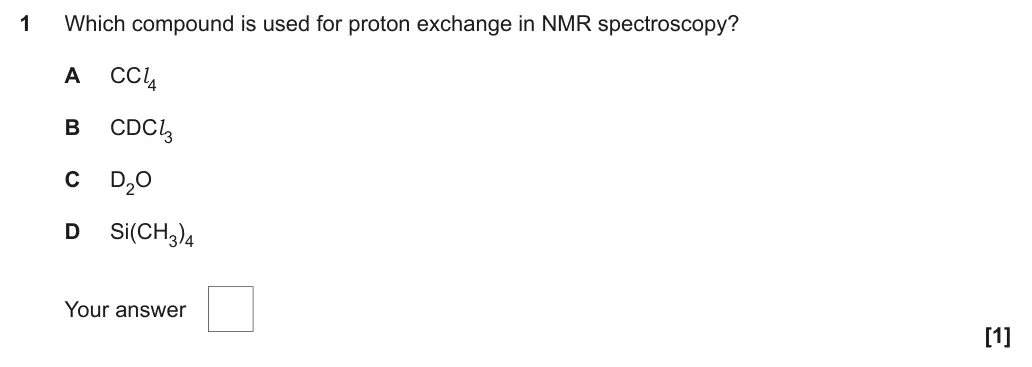
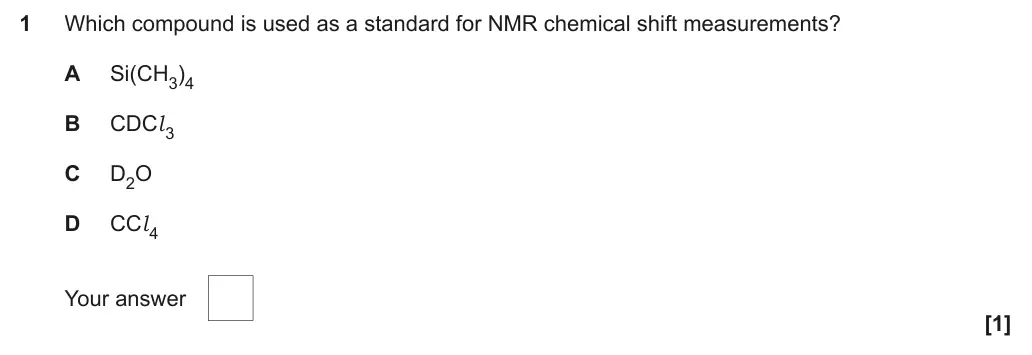
Many candidates were not able to identify the compound used for proton exchange, D2O (C) and instead selected either CDCl3 (B), a common NMR solvent, or TMS (D), an NMR standard. Potentially candidates may be familiar with shaking with D2O to remove -OH and -NH protons but may not realise this is known as ‘proton exchange’.
June 2023 · Paper 2 · Q91 markAO2Multiple choiceHard
Answer
C
Mark scheme
Examiner's comment
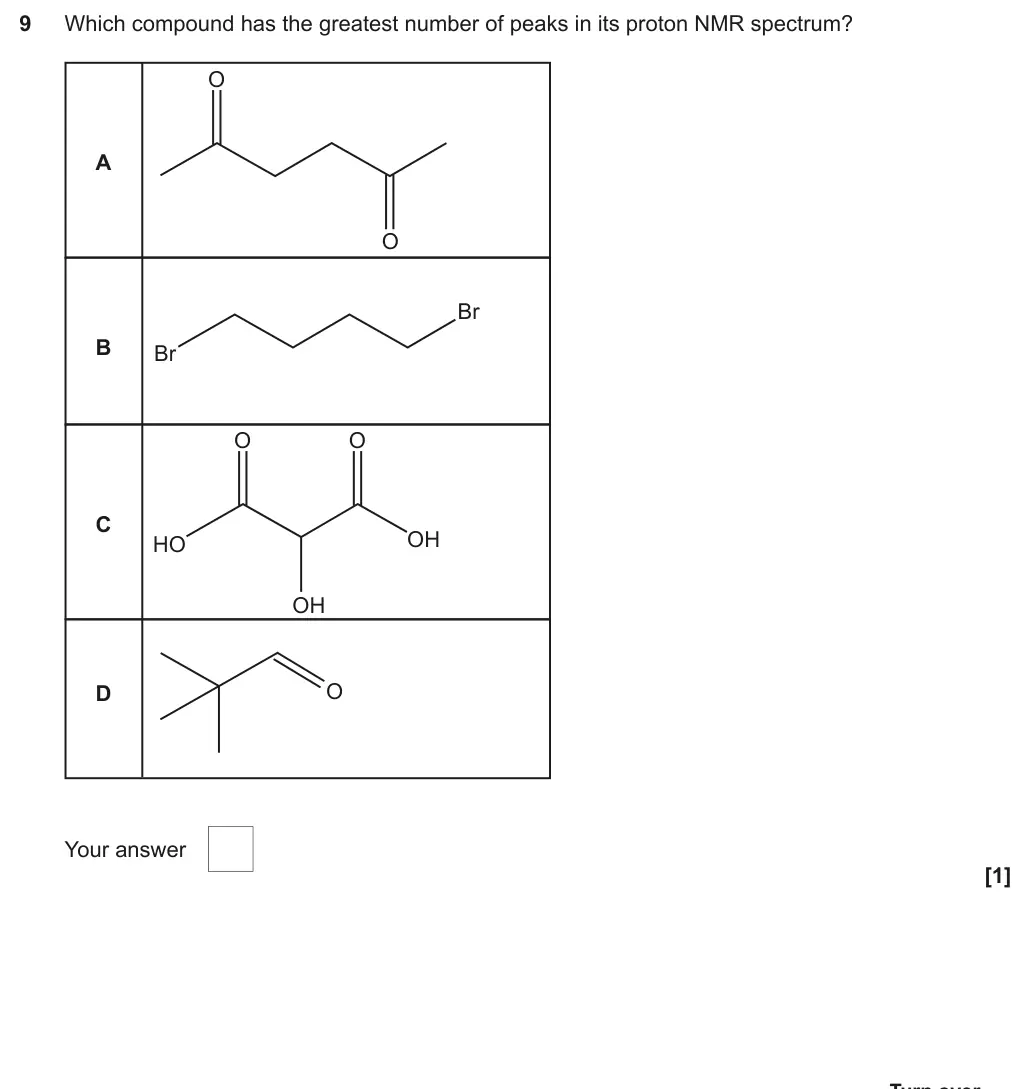
Many candidates wrote the number of proton environments next to each structure, circling or marking protons, but some struggled to spot equivalent environments in the skeletal structures. A and D were common incorrect responses. The correct answer also included -OH protons which candidates did not always include in their count.
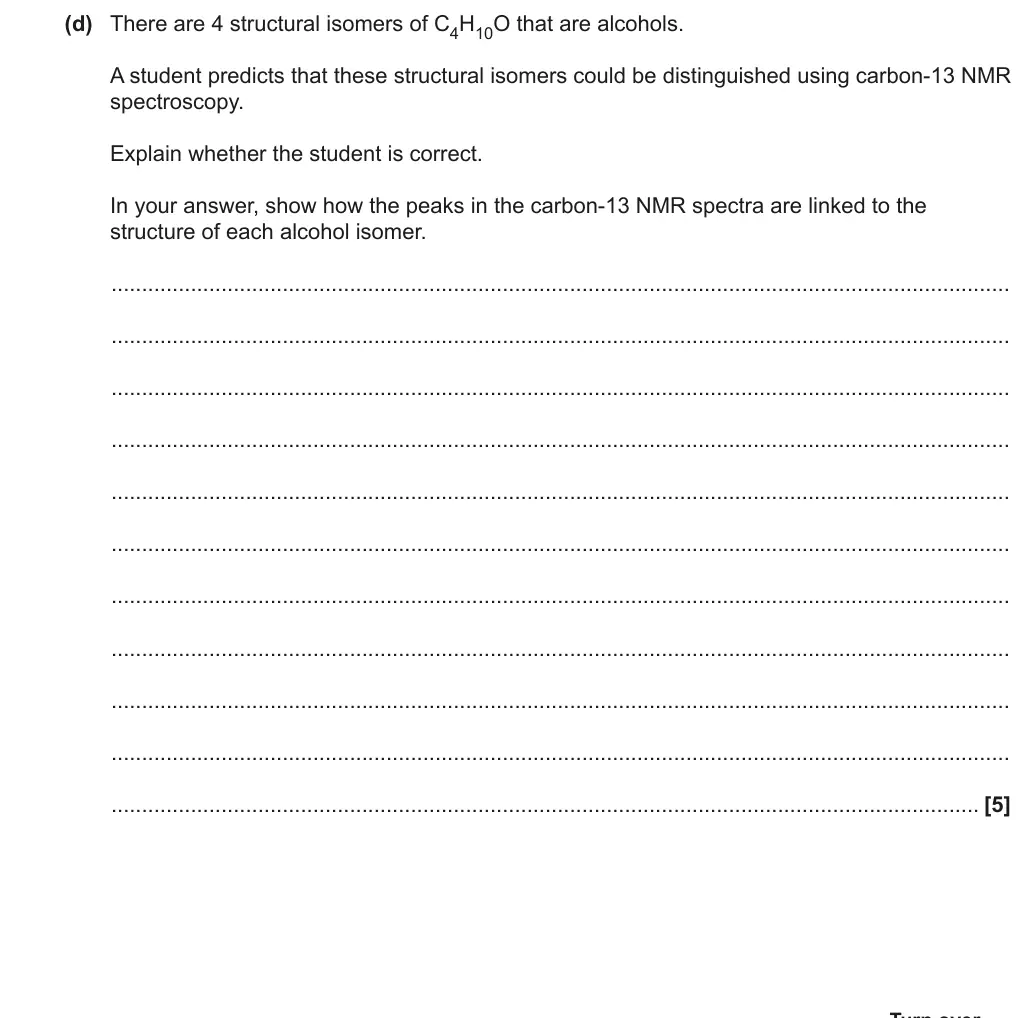
June 2023 · Paper 2 · Q17(d)5 marksAO2, 3Extended responseHard
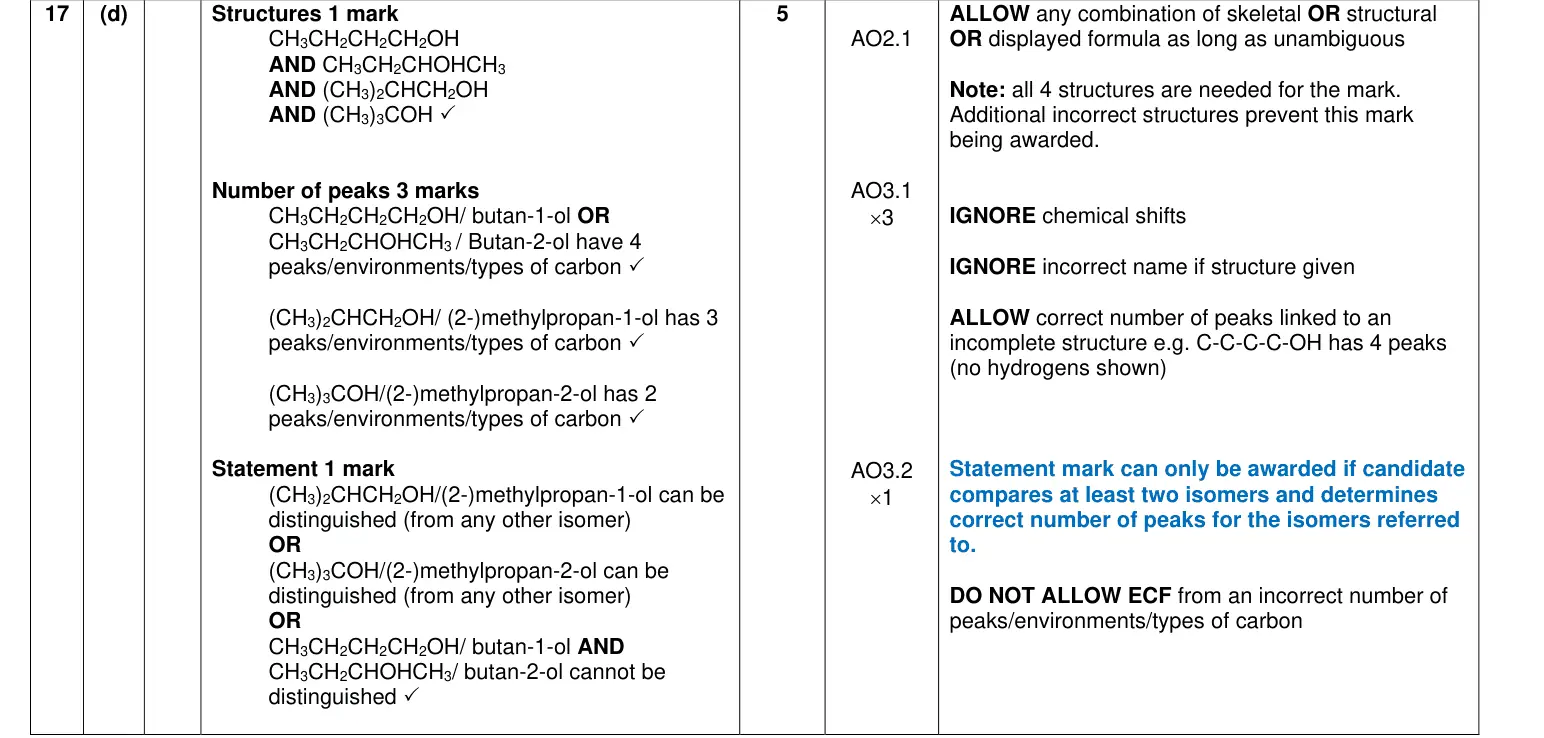
Mark scheme
Examiner's comment
This question discriminated well with a variety of responses seen. The lower scoring candidates gave vague answers suggesting they did not fully grasp what the question was asking. They often filled the lines with generic responses in terms of what C NMR can do, e.g. chemical shift data/shows positions of Cs relative to OH group or number of peaks gives number of environment but made no reference to the isomers mentioned in the question. For some there was obvious confusion with proton NMR due to discussion of splitting patterns or relative peak areas/heights. Lots struggled to find all four isomers, often repeating one they already had, but drawing them with a different layout, or by giving cyclic structures. Some struggled to count the correct number of peaks for each. It was common to see false equivalency between CH2 groups, e.g. butan-2-ol with three peaks. Many struggled to give a concluding statement, often focusing more on slight differences in chemical shift due to proximity to OH group. The highest scoring responses were well structured and started by identifying the four isomers. After stating the number of carbon environments for each isomer these responses often concluded with a statement detailing whether the isomers could be distinguished. This candidate has clearly drawn out all four isomer structures and next to each has identified the number of carbon environments. They have then made a concluding statement using this information. This response scored all 5 marks.
Notes from the mark scheme and report
all four structures needed (extra incorrect structures lose the mark)
butan-1-ol and butan-2-ol both 4 peaks, 2-methylpropan-1-ol 3, 2-methylpropan-2-ol 2, so not all distinguishable
IGNORE chemical shifts
no ECF from incorrect number of peaks
Candidates often struggle with drawing out the different structural isomers. As a starter activity or plenary give candidates a molecular formula and challenge them to draw out all the different possible isomers. Using molymod can help candidates realise equivalent molecules.
As candidates become more confident encourage them to draw structures using skeletal formula and to give the systematic names.
Skills: M4.3 Understand the symmetry of 2-D and 3-D shapes
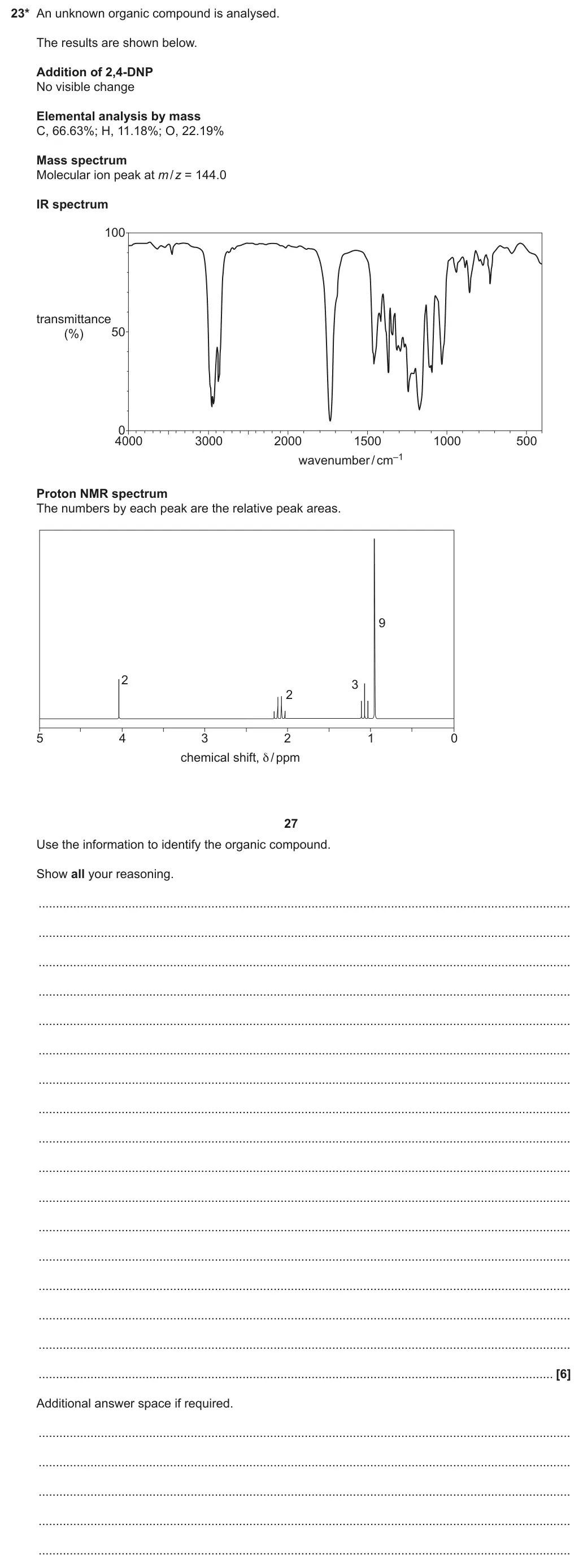
June 2023 · Paper 2 · Q236 marksAO1, 36-mark level of responseEasy
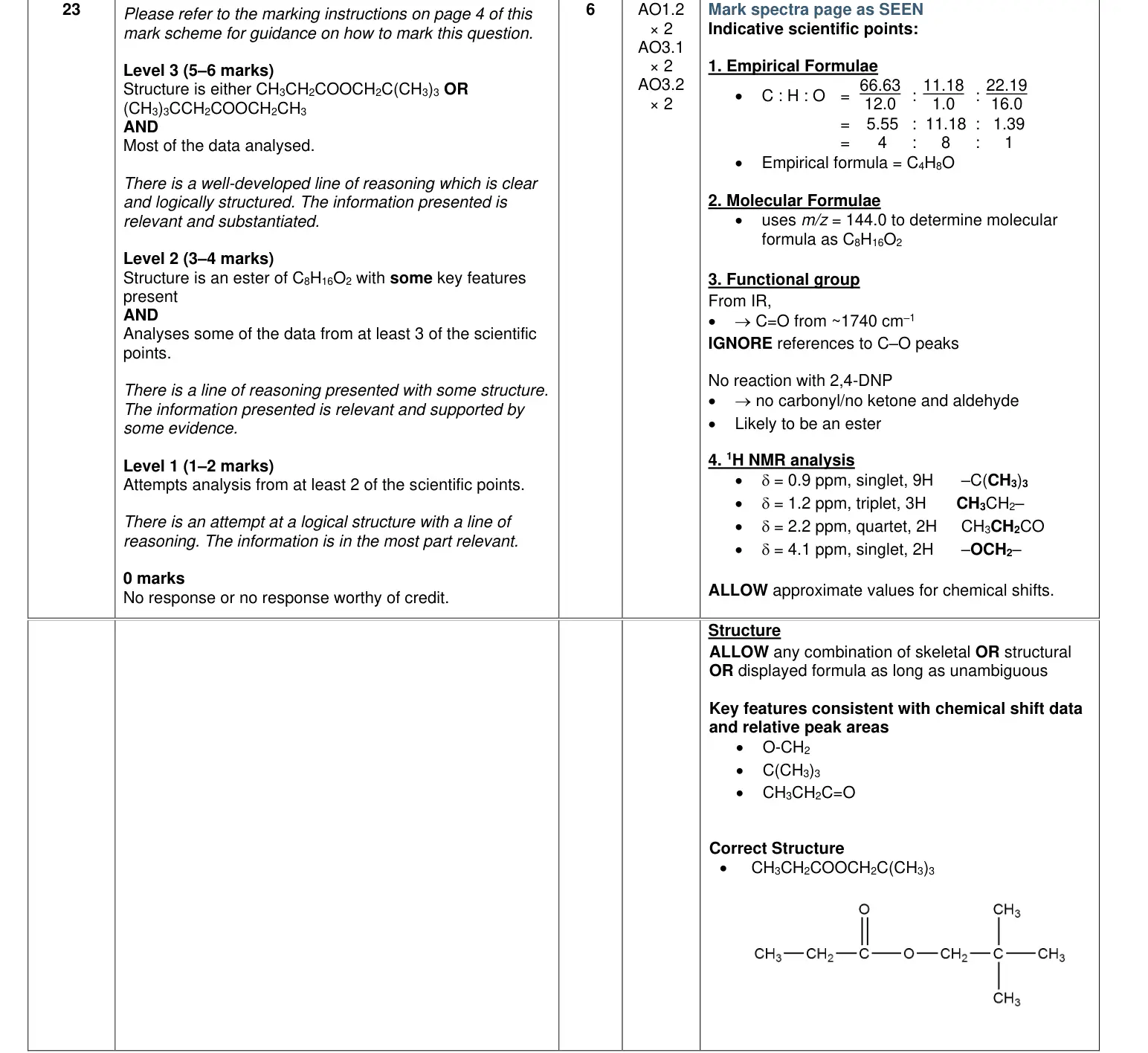
Mark scheme, with the levels and indicative points
Examiner's comment
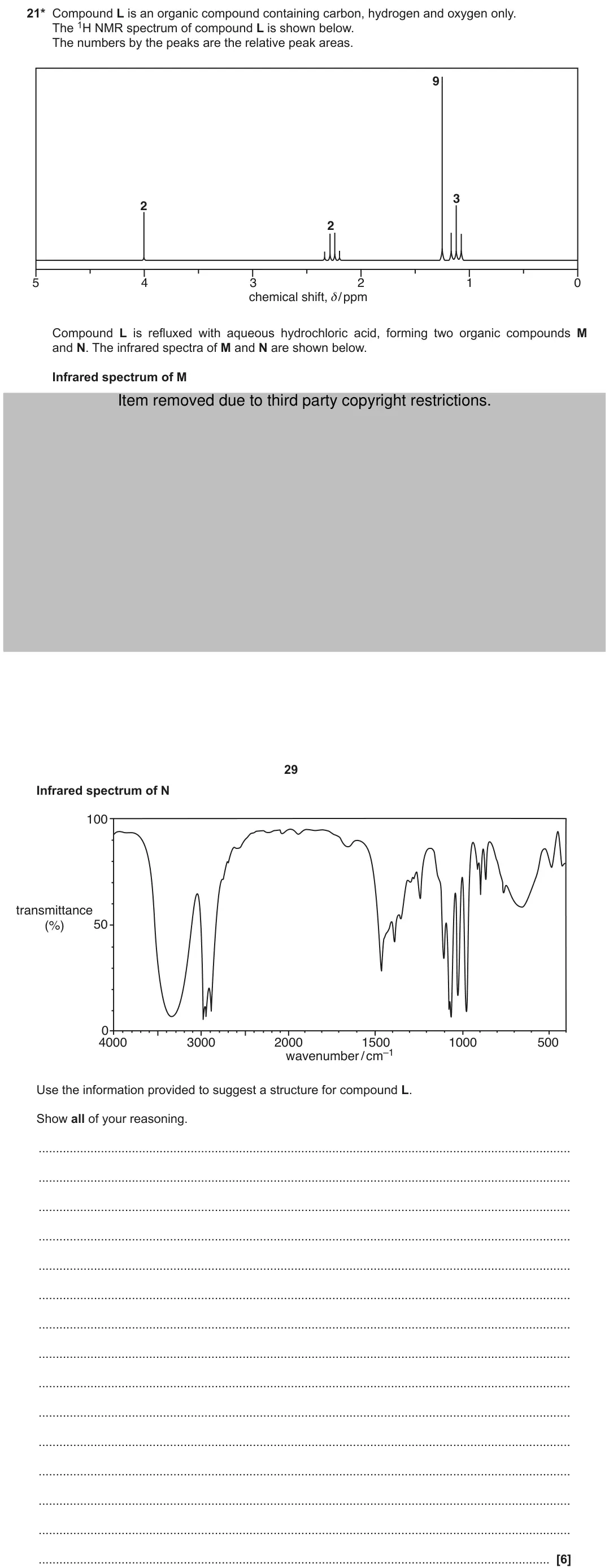
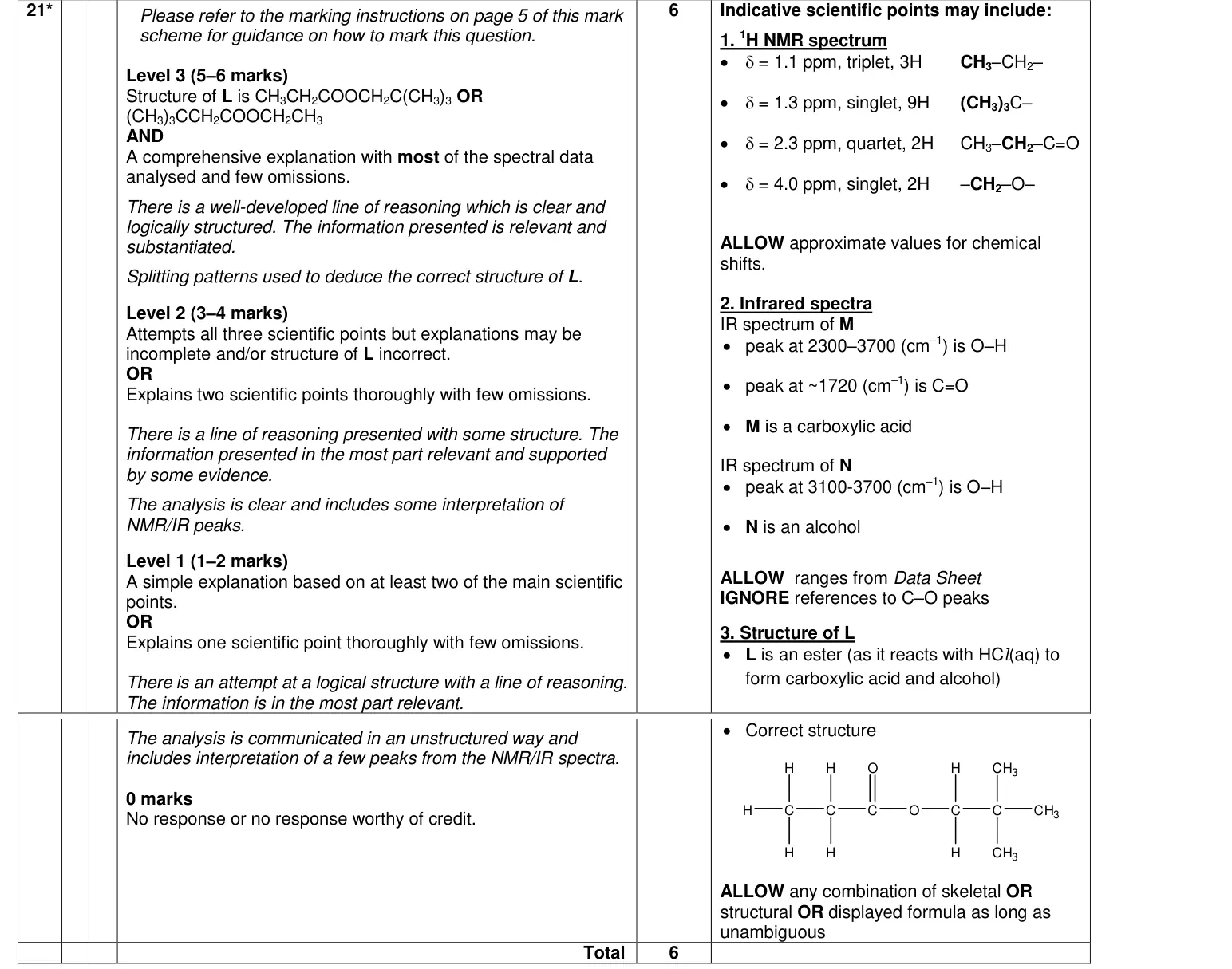
Most candidates were able to deduce the empirical and/or molecular formula of the organic compound. Analysis of the IR spectrum was also well attempted, but some candidates assumed the unknown was a carboxylic acid, attributing the sharp peak just below 3000 cm–1 to an OH group. Others misidentified the C=O peak as a C=C group suggesting alkene or arene structure. They were often led to this conclusion as they believed no precipitate with 2,4-DNP suggested no C=O rather than no aldehyde or ketone. Good analysis of the NMR data was crucial for deducing the correct ester. Some candidates opted to annotate the proton NMR spectrum, some produced tables and others gave written details for each peak. It was vital that they were able to interpret all information for each peak i.e. number of proton environments, the type of environment from chemical shift, the number of protons in each environment from relative peak areas and use of splitting patterns to find information about adjacent protons. Many tried to make the data fit their proposed structure rather than the other way round. Some suggested structures that were only partially consistent with the data such as CH3CH2CH2COOC(CH3)3 and were awarded Level 2. Others did not take full note of all the information provided, for example omitting the 2,4-DNP observations, giving the ketone (CH3)3COCH2COCH2CH3 or not checking it matched the molecular formula CH3CH2COOC(CH3)3 so only achieved Level 1. Candidates need to be encouraged to draw a structure as without they can only achieve a maximum of 2 marks despite some excellent analysis of the data. Conversely, it is not sufficient to just give a structure, candidates must give analysis of the data provided. This is a good Level 3 6 mark response. As well as this clearly laid out analysis they also had details written on the question, e.g. no aldehyde or ketone due to no reaction with 2,4-DNP. This response has been selected due to the detailed analysis of NMR data that has been summarised in a table.
Notes from the mark scheme and report
C4H8O then C8H16O2 from m/z 144
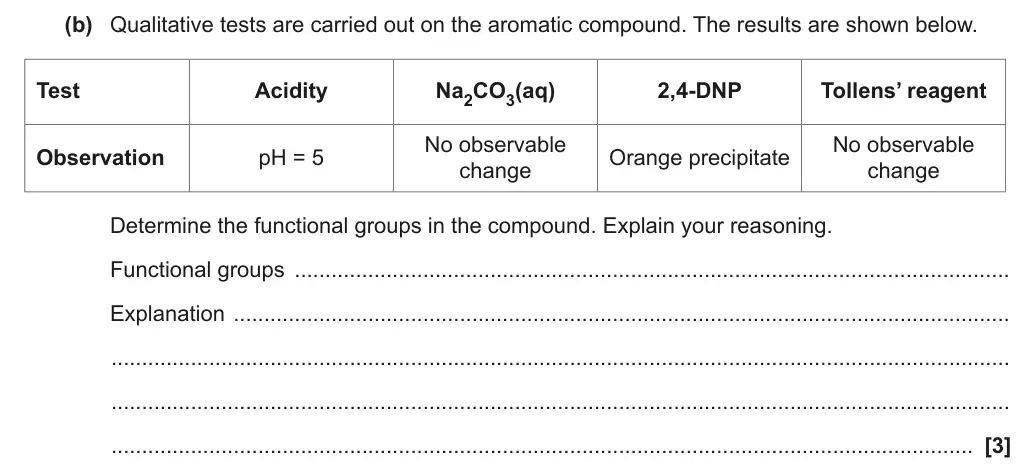
IR C=O about 1740 but no reaction with 2,4-DNP so not aldehyde/ketone: ester
singlet 9H C(CH3)3, triplet 3H + quartet 2H CH3CH2CO, singlet 2H OCH2 at 4.1
CH3CH2COOCH2C(CH3)3
IGNORE C–O peaks
Skills: M0.2 Use ratios, fractions and percentages; M3.1 Translate information between graphical, numerical and algebraic forms; PAG7 Qualitative analysis of organic functional groups
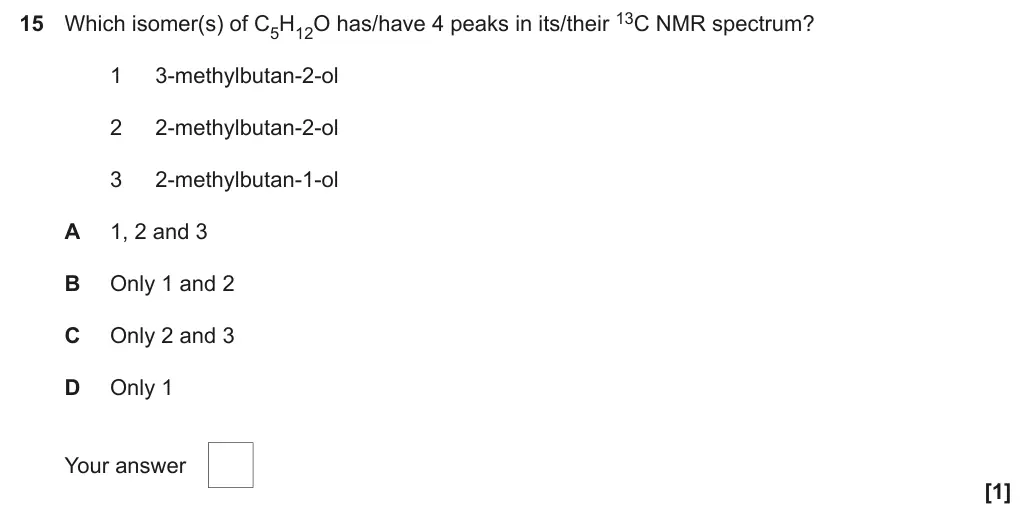
June 2022 · Paper 2 · Q121 markAO2Multiple choiceHard
Answer
A
Mark scheme
Examiner's comment
This question proved challenging. Candidates who drew out the different compounds were able to identify A as the correct response.
June 2022 · Paper 2 · Q151 markAO2Multiple choiceHard
Answer
B
Mark scheme
Examiner's comment
Candidates found this question difficult. Those who drew out the different compounds were able to identify B as the correct response. Section B overview Section B includes a mixture of short answer and extended response questions, including two questions marked using a level of response mark scheme (19e and 21). This section of the paper is worth 85 marks.
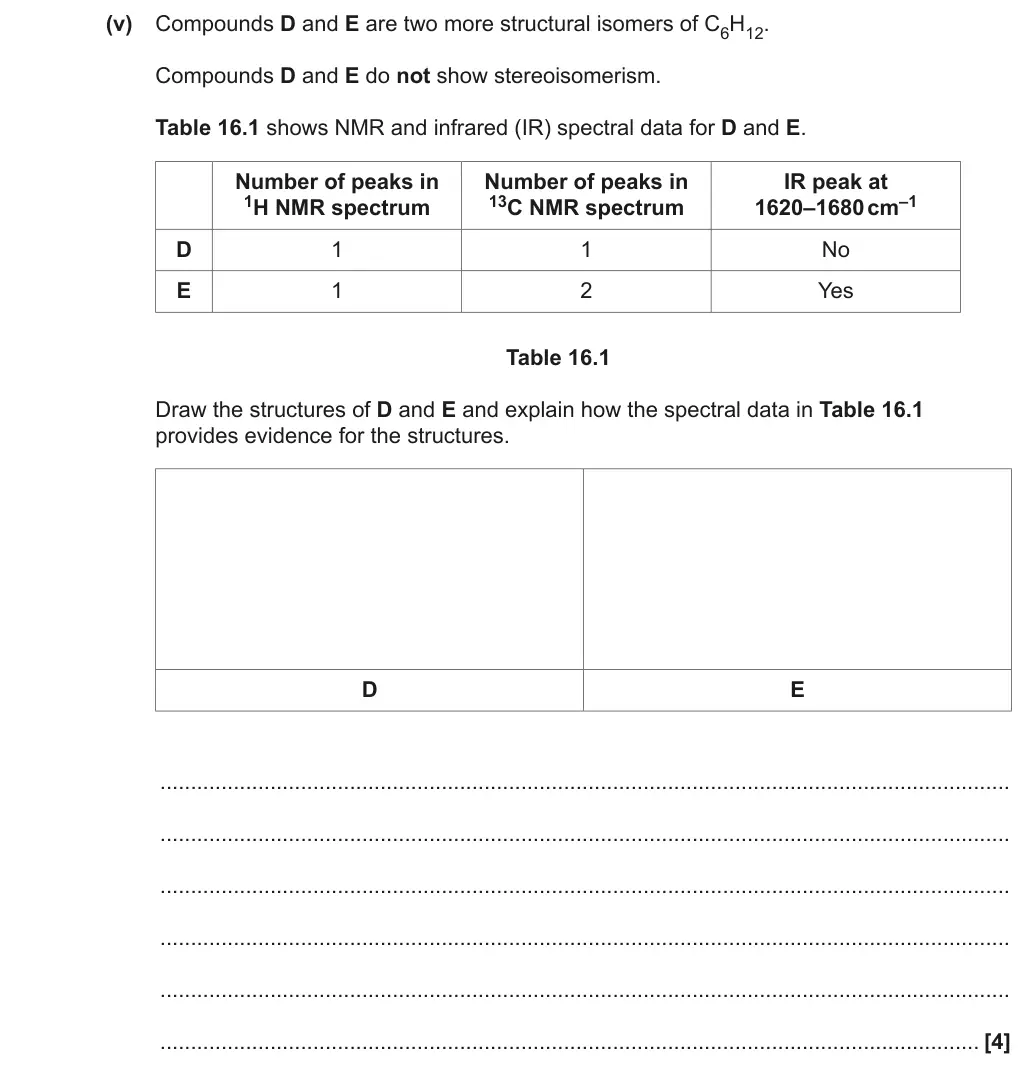
June 2022 · Paper 2 · Q16(b)(v)4 marksAO2Structure / isomerEasy
Earlier part of question 16 that this part uses
Mark scheme
Examiner's comment
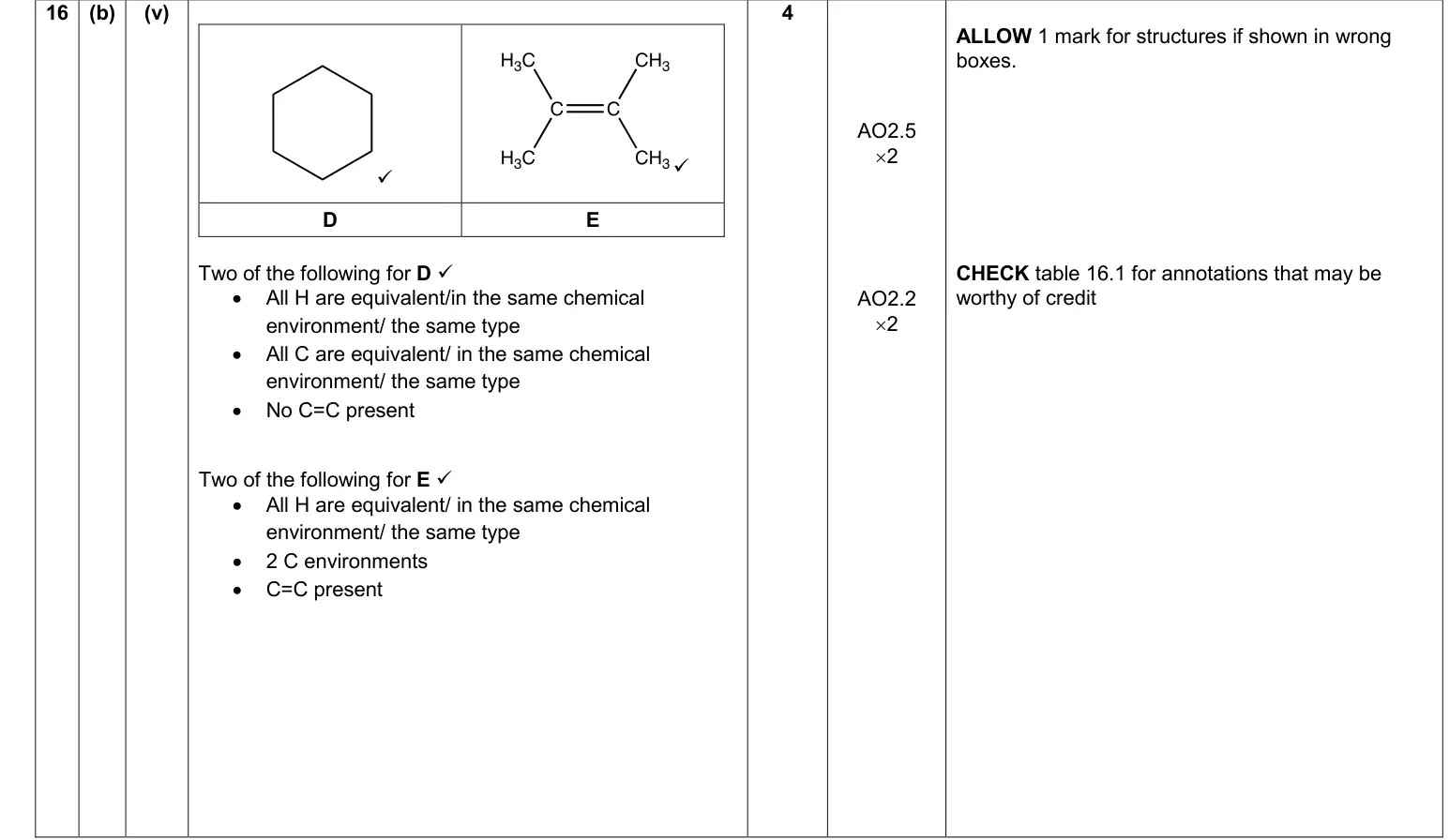
Most candidates were able to correctly draw the structure of D and E. Many candidates did not explain their answers in terms of the number of different hydrogen and carbon environments or the presence/ absence of a carbon-carbon double bond.
Notes from the mark scheme and report
D is cyclohexane (all H and all C equivalent, no C=C)
E is 2,3-dimethylbut-2-ene (all H equivalent, 2 C environments, C=C present)
1 mark for structures if in the wrong boxes
Skills: M4.3 Understand the symmetry of 2-D and 3-D shapes
June 2022 · Paper 2 · Q18(c)4 marksAO3Data interpretationHard
Mark scheme
Examiner's comment
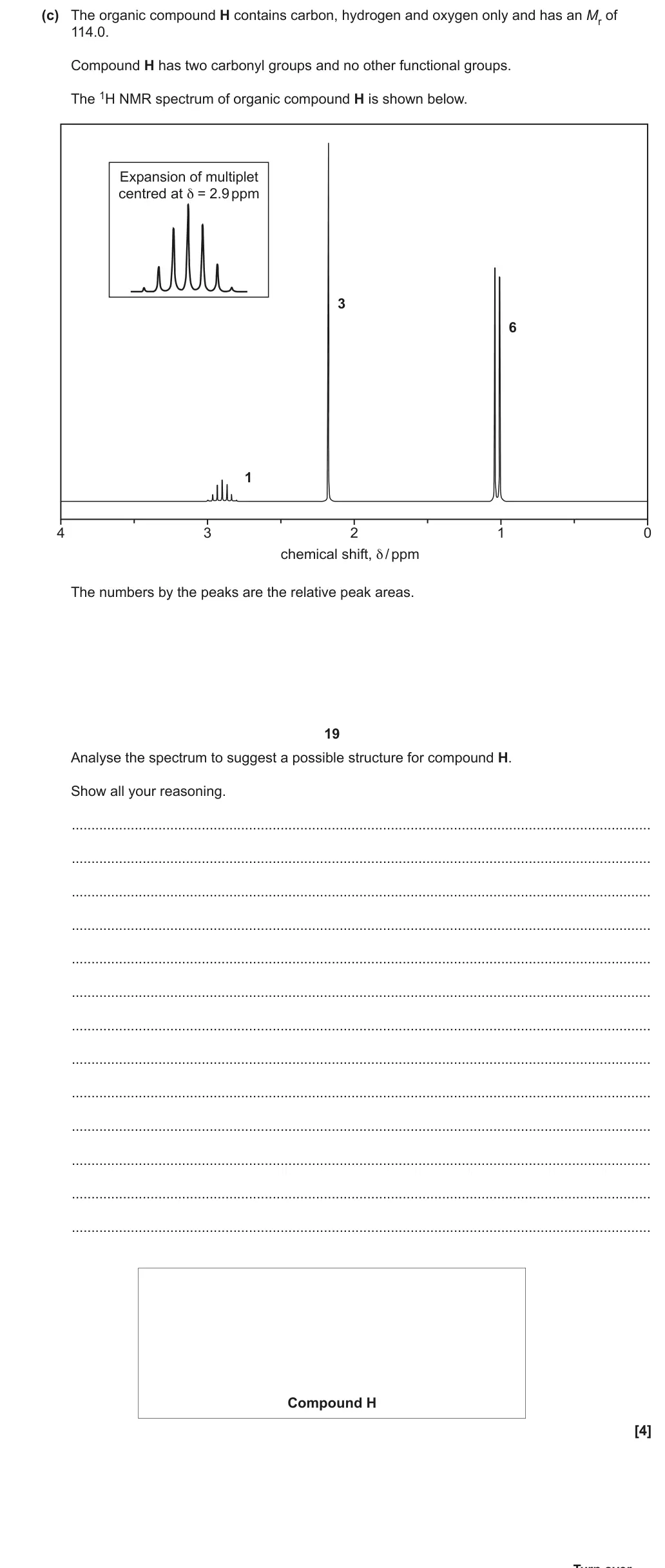
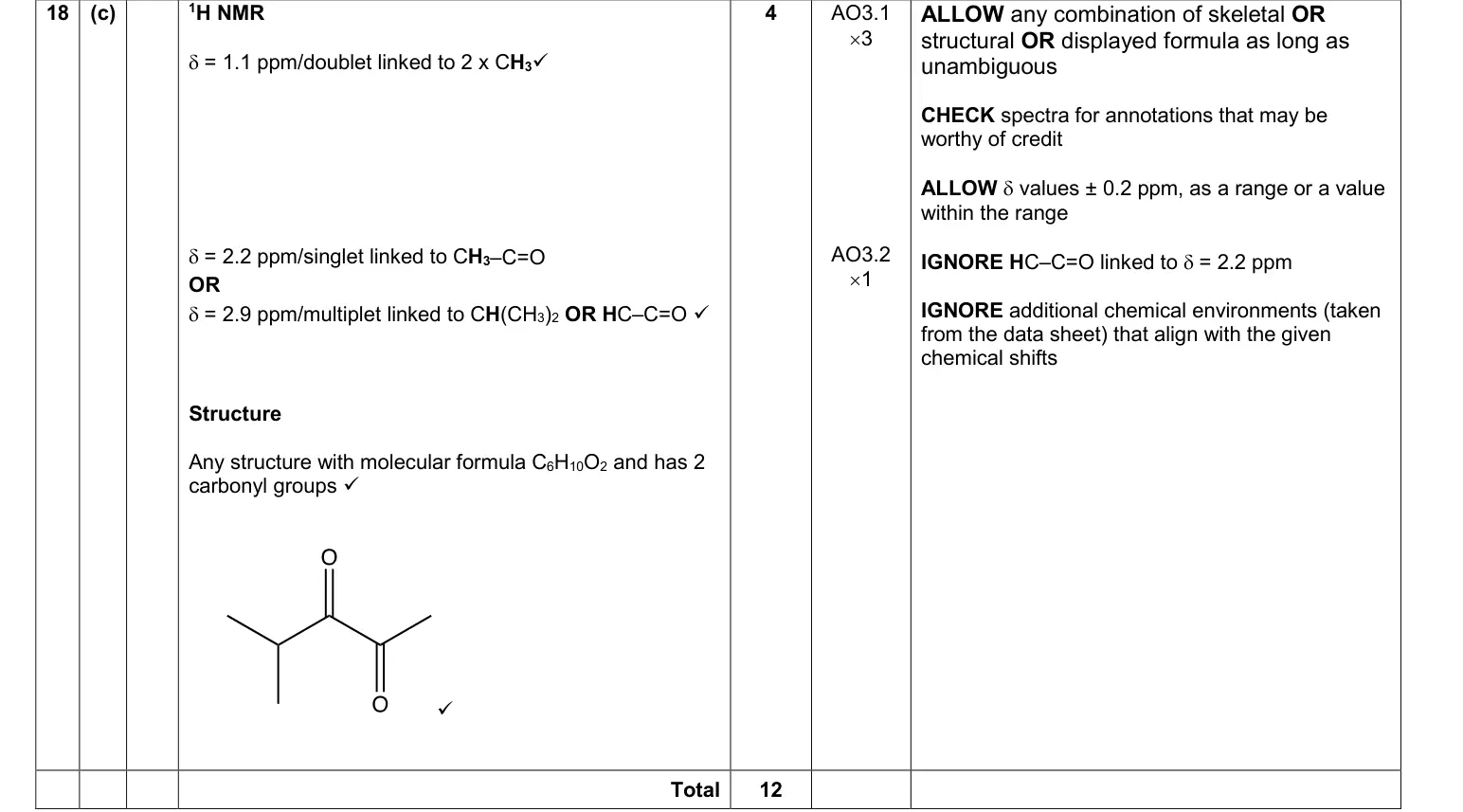
This question proved difficult and although most candidates score some marks, only the very best responses secured all 4 marks. Candidates often did not link the doublet to two CH3 groups and many only scored 1 mark for their suggested structure as the carbonyl groups were not side by side within the molecule.
Notes from the mark scheme and report
doublet at 1.1 (6H) = 2 × CH3
singlet at 2.2 (3H) = CH3–C=O
multiplet at 2.9 (1H) = CH(CH3)2 next to C=O
structure must be C6H10O2 with two carbonyl groups
ALLOW δ ± 0.2 ppm
Skills: M3.1 Translate information between graphical, numerical and algebraic forms
June 2022 · Paper 2 · Q20(a)(ii)3 marksAO3Short answerHard
Earlier part of question 20 that this part uses
Mark scheme
Examiner's comment
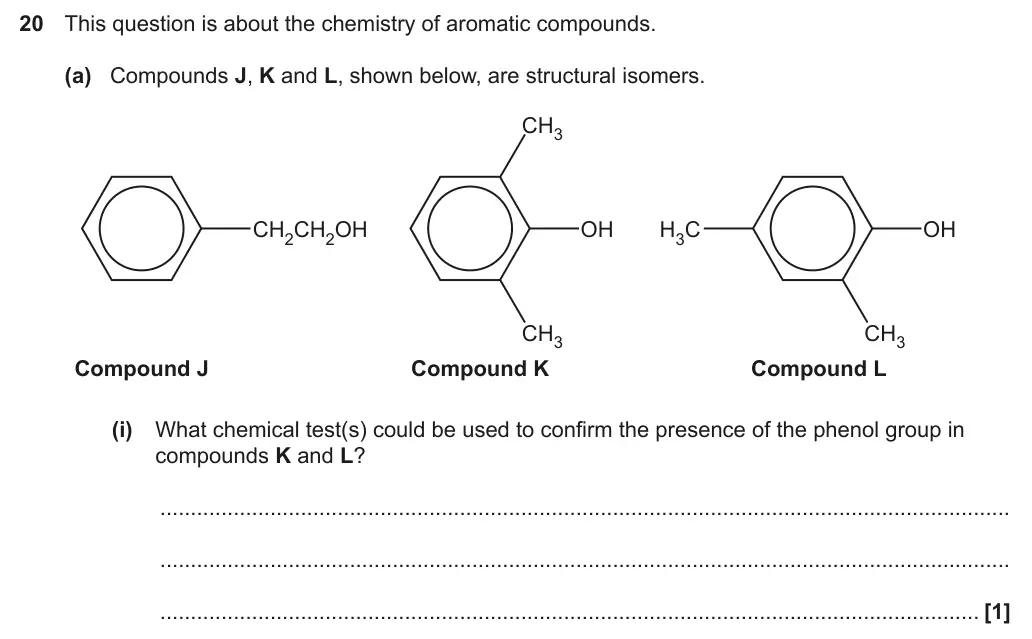
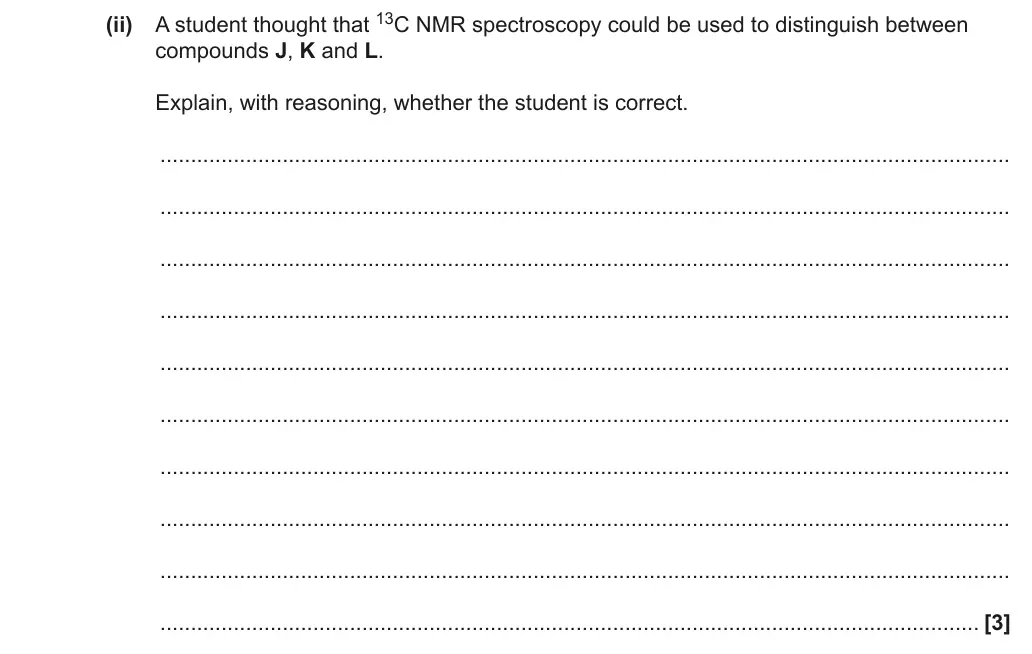
This question proved challenging to candidates with few scoring all 3 marks. Where no marks were given, this was frequently because candidates did not state the number of carbon environments in compounds J, K and L. Candidates who were given 1 or two marks frequently stated the incorrect number of peaks that would be observed.
Notes from the mark scheme and report
J has 6 peaks, K has 5 peaks, L has 8 peaks
IGNORE chemical shifts
Skills: M4.3 Understand the symmetry of 2-D and 3-D shapes
June 2022 · Paper 3 · Q1(c)(i)2 marksAO1Complete table/diagramHard
Mark scheme
Examiner's comment
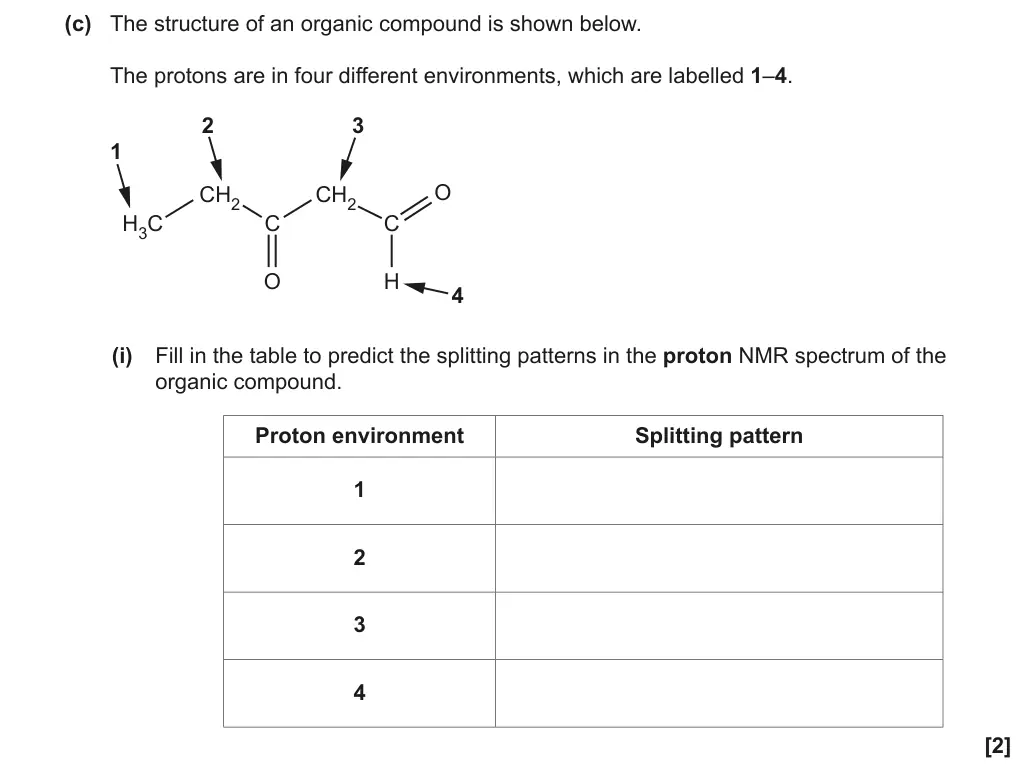
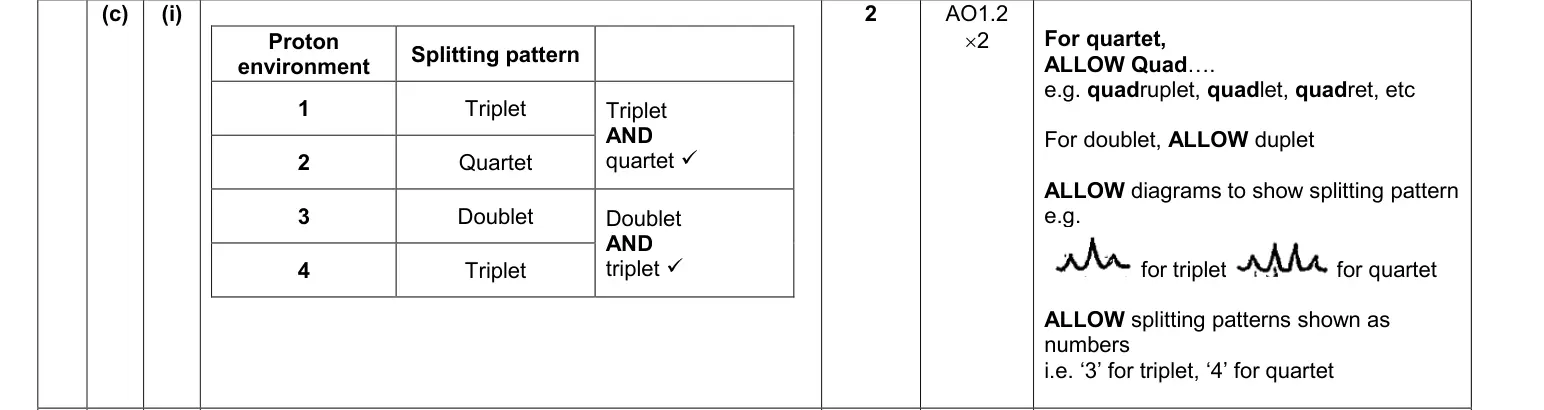
This question tested candidates’ ability to predict splitting patterns of an organic compound in a proton NMR spectrum. The 2 marks were given for the interacting protons in environments 1 and 2, and in environments 3 and 4. Most candidates predicted the correct triplet/quartet splitting pattern for the common CH3CH2 group. The splitting pattern for the less common CH2CHO was more difficult with many predicting at least one singlet. As with Question 1 (b) (ii), the second mark proved to be a very good discriminator.
Notes from the mark scheme and report
1 triplet, 2 quartet, 3 doublet, 4 triplet
marked in pairs (1 and 2
3 and 4)
ALLOW numbers 3 for triplet etc
June 2022 · Paper 3 · Q1(c)(ii)2 marksAO3Short answerMedium
Earlier part of question 1 that this part uses
Mark scheme
Examiner's comment
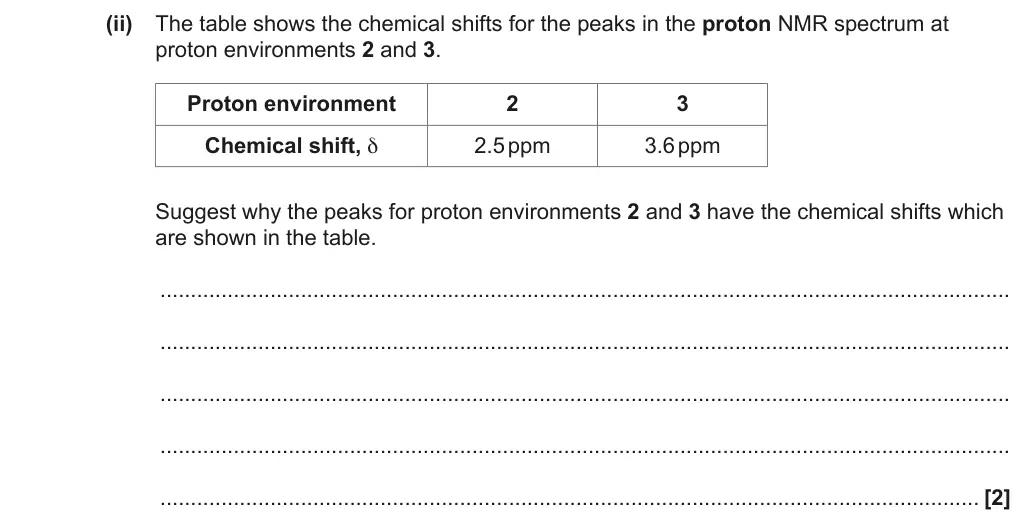
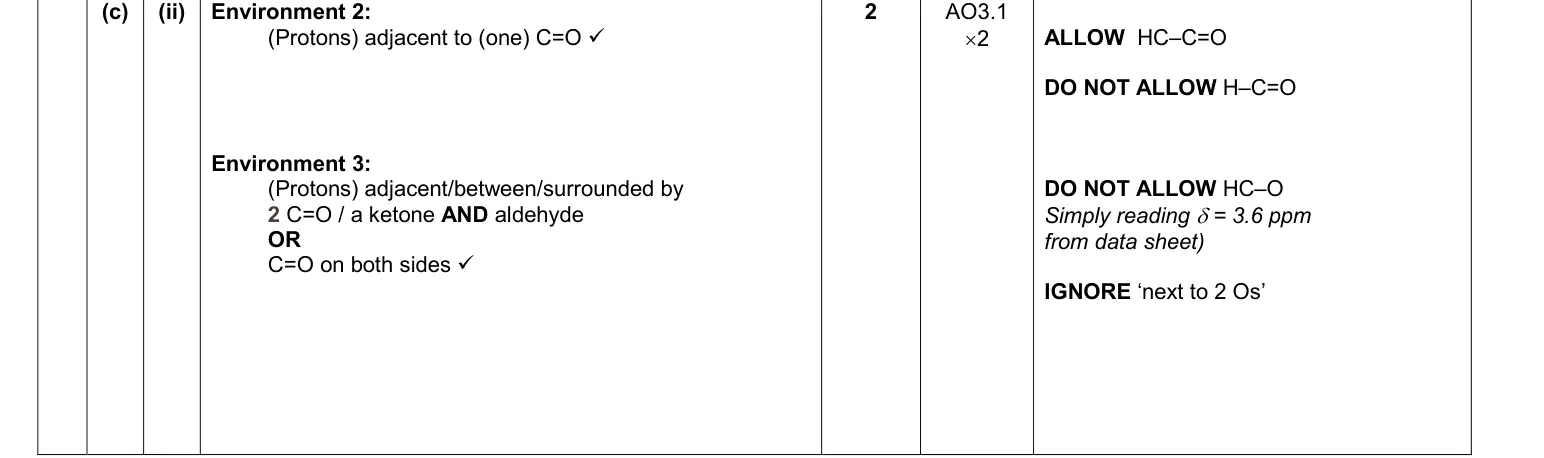
This novel question required candidates to apply their knowledge and understanding of proton NMR spectroscopy to explain different chemical shifts. Most candidates used the Data Sheet in their answers, and most were then able to relate the chemical shift at 𝛿 = 2.5 ppm to an adjacent C=O group. Fewer candidates were then able to interpret the unexpected chemical shift at 𝛿 = 3.6 ppm to the presence of two adjacent C=O groups. Less successful responses often resorted to the Data Sheet a second time, suggesting the presence of an adjacent HC–O group, despite none being present in the structure. It was encouraging to see how many candidates were able to explain the two chemical shifts correctly, suggesting that most candidates are comfortable with this concept.
Notes from the mark scheme and report
environment 2 adjacent to one C=O (HC–C=O)
environment 3 between two C=O
DO NOT ALLOW H–C=O or HC–O (simply read from data sheet)
IGNORE 'next to 2 Os'
Skills: M3.1 Translate information between graphical, numerical and algebraic forms
November 2021 · Paper 2 · Q131 markMultiple choice
Answer
B
Mark scheme
November 2021 · Paper 2 · Q20(b)(ii)6 marksAO1, 3Structure / isomer
Earlier part of question 20 that this part uses
Mark scheme
Notes from the mark scheme and report
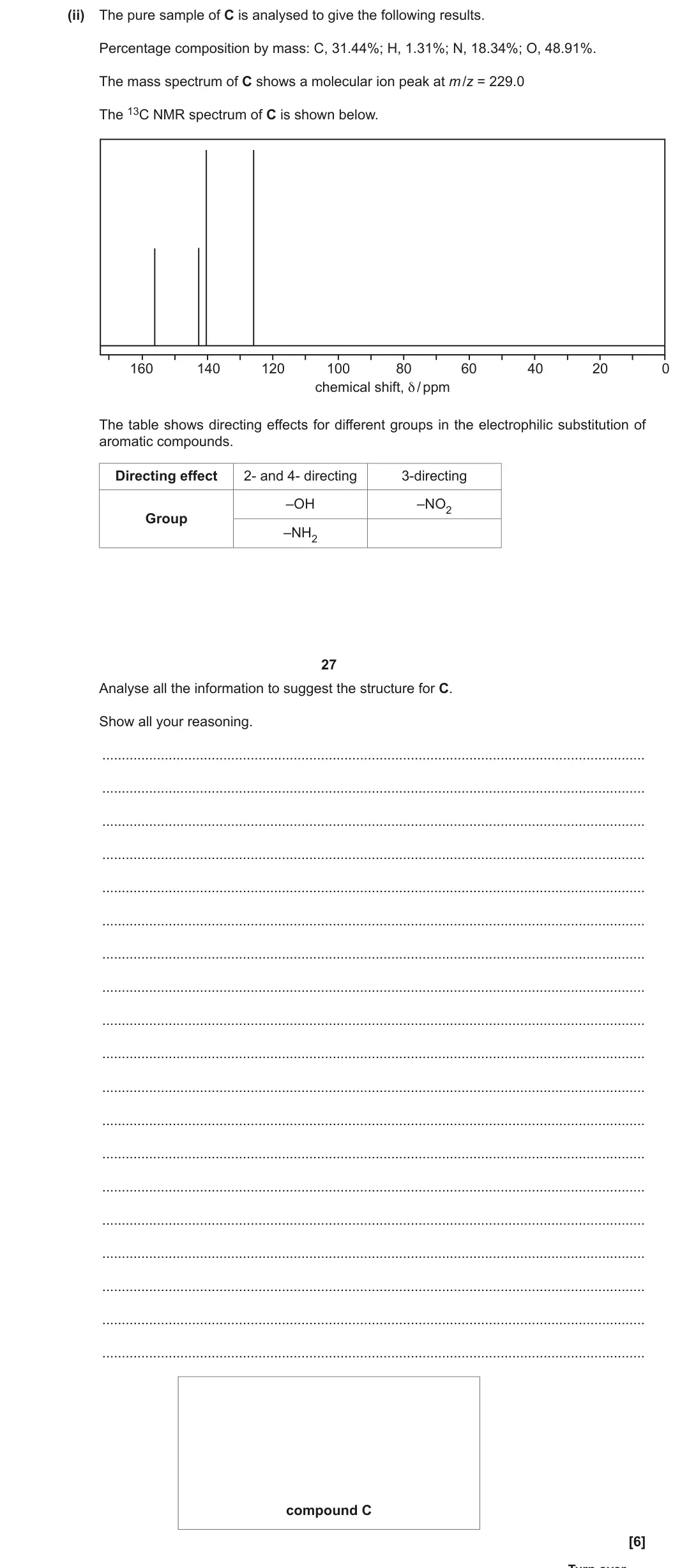
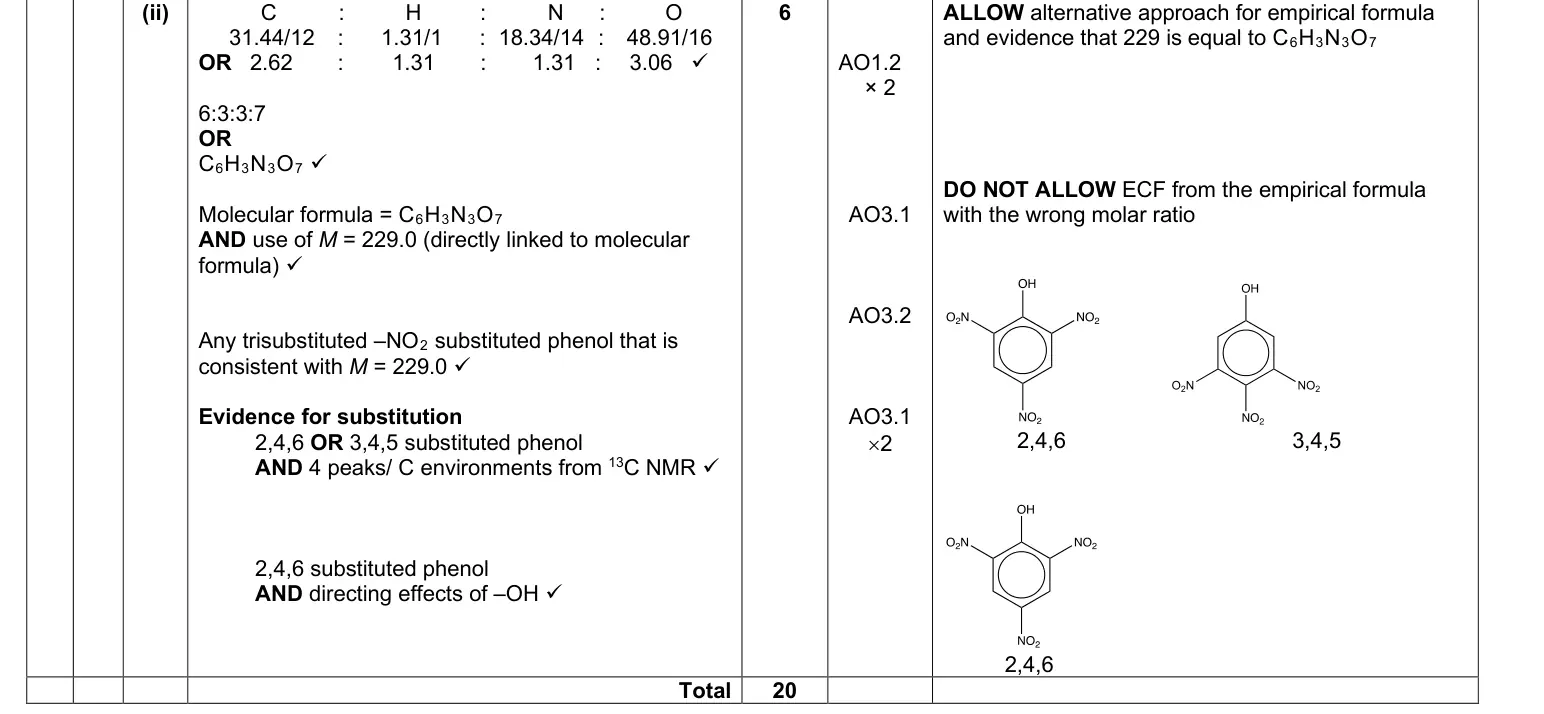
2.62 : 1.31 : 1.31 : 3.06 gives C6H3N3O7, linked to M = 229.0
trinitrophenol
4 peaks = 4 carbon environments fits 2,4,6 or 3,4,5
–OH 2,4-directing so 2,4,6-trinitrophenol
no ECF from wrong molar ratio
Skills: M0.2 Use ratios, fractions and percentages; M3.1 Translate information between graphical, numerical and algebraic forms
November 2021 · Paper 2 · Q216 marksAO36-mark level of response
Mark scheme, with the levels and indicative points
Notes from the mark scheme and report
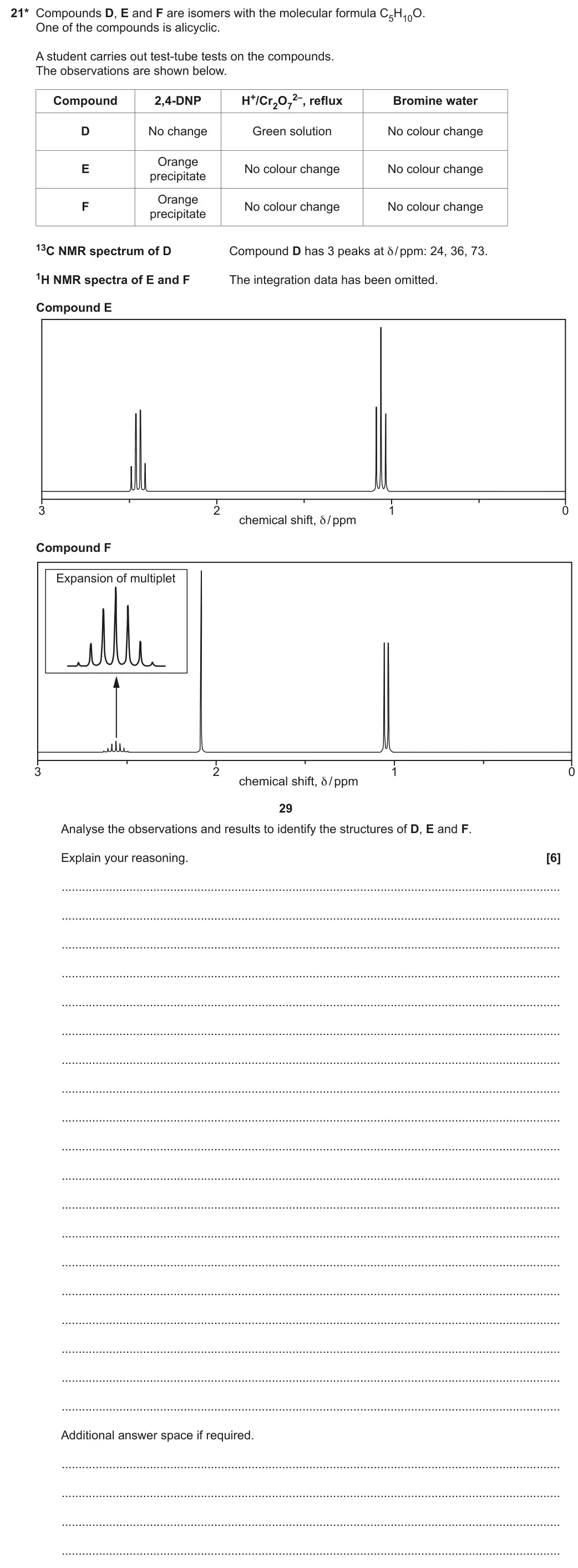
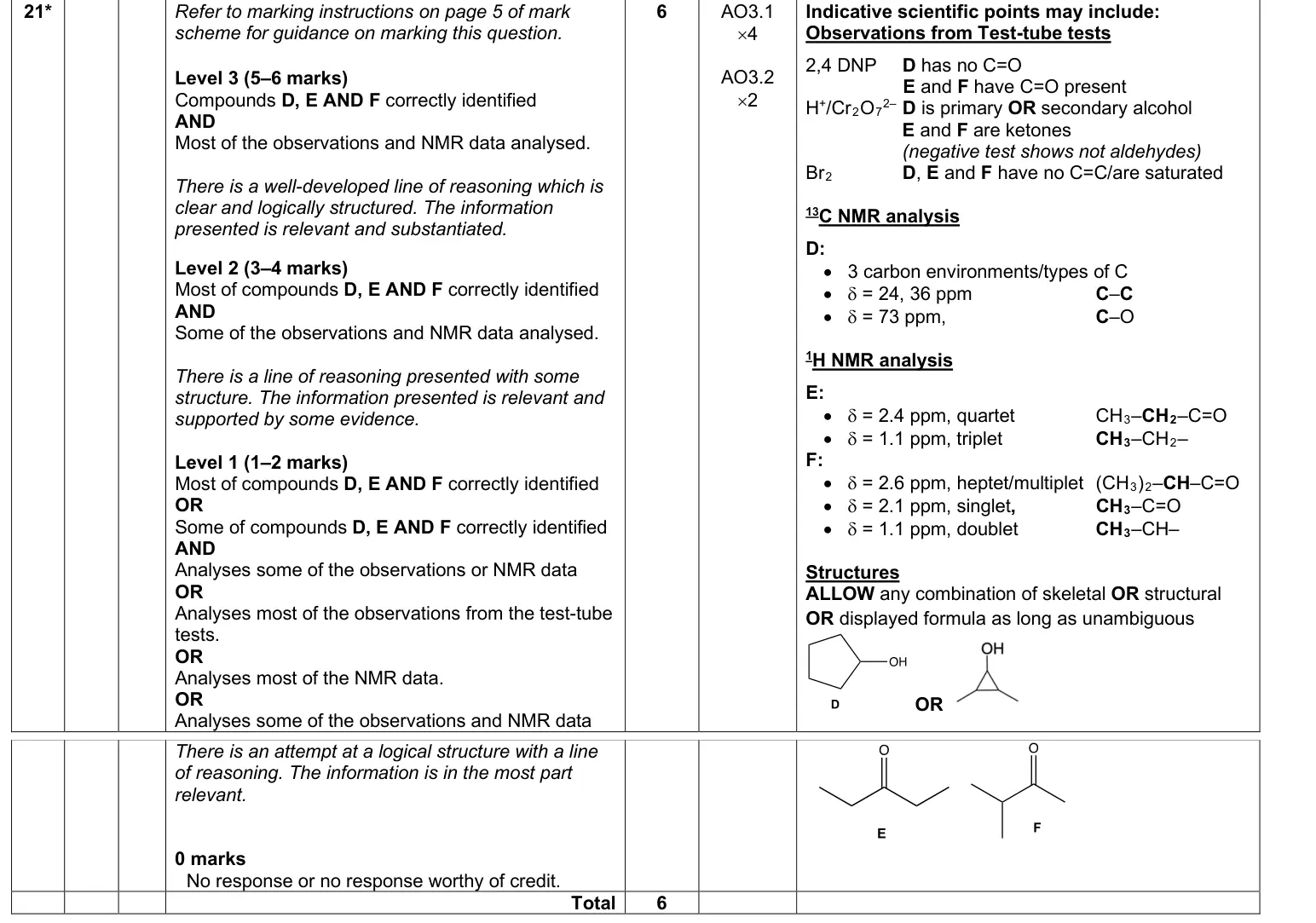
D no C=O, oxidised so primary/secondary alcohol, saturated, 3 carbon environments with C–O at 73 (alicyclic alcohol)
E and F ketones (not oxidised so not aldehydes)
E quartet 2.4 + triplet 1.1 (CH3CH2CO)
F heptet 2.6, singlet 2.1 (CH3CO), doublet 1.1
Skills: M3.1 Translate information between graphical, numerical and algebraic forms; PAG7 Qualitative analysis of organic functional groups
November 2020 · Paper 2 · Q81 markAO2Multiple choice
Answer
C
Mark scheme
November 2020 · Paper 2 · Q17(c)(i)2 marksAO3Short answer
Earlier part of question 17 that this part uses
Mark scheme
Notes from the mark scheme and report
C has 3 peaks
D has 8 peaks
Skills: M4.3 Understand the symmetry of 2-D and 3-D shapes
November 2020 · Paper 2 · Q22(a)2 marksAO1Short answerMedium
Mark scheme
Examiner's comment
Misconception Question 22(a) The use of deuterated compounds in NMR analysis was often explained the use in terms of lack of spin but did not give examples (e.g.
Notes from the mark scheme and report
example AND use needed for each mark: CDCl3 as solvent
D2O to identify OH or NH protons
1 mark for D2O as a solvent
November 2020 · Paper 2 · Q22(b)6 marksAO36-mark level of responseMedium
Earlier part of question 22 that this part uses
Mark scheme, with the levels and indicative points
Examiner's comment
Question 22(b) Candidates achieving Level 2 had most of the key features, e.g.
Notes from the mark scheme and report
C6H9NO2 from composition and m/z 127
IR: C=O at 1750 and C≡N at 2280 cm–1
NMR: quartet 2H at 4.2 (CH3CH2O), quartet 1H at 2.9, doublet 3H at 1.7, triplet 3H at 1.3
Skills: M0.2 Use ratios, fractions and percentages; M3.1 Translate information between graphical, numerical and algebraic forms
November 2020 · Paper 3 · Q1(b)(ii)6 marksAO2, 3Structure / isomerHard
Mark scheme
Examiner's comment
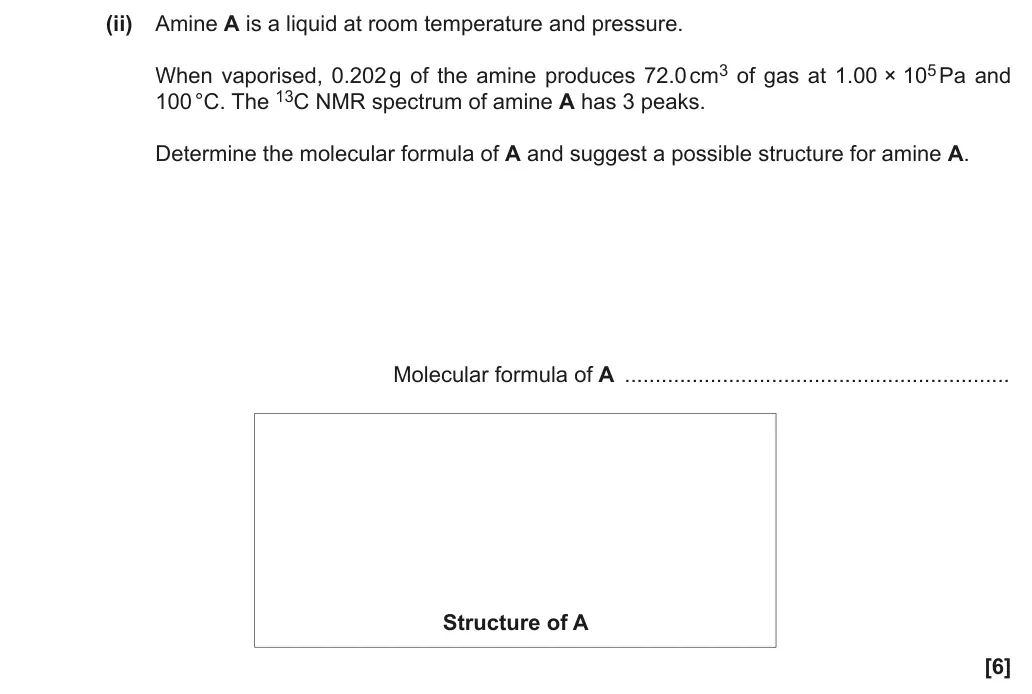
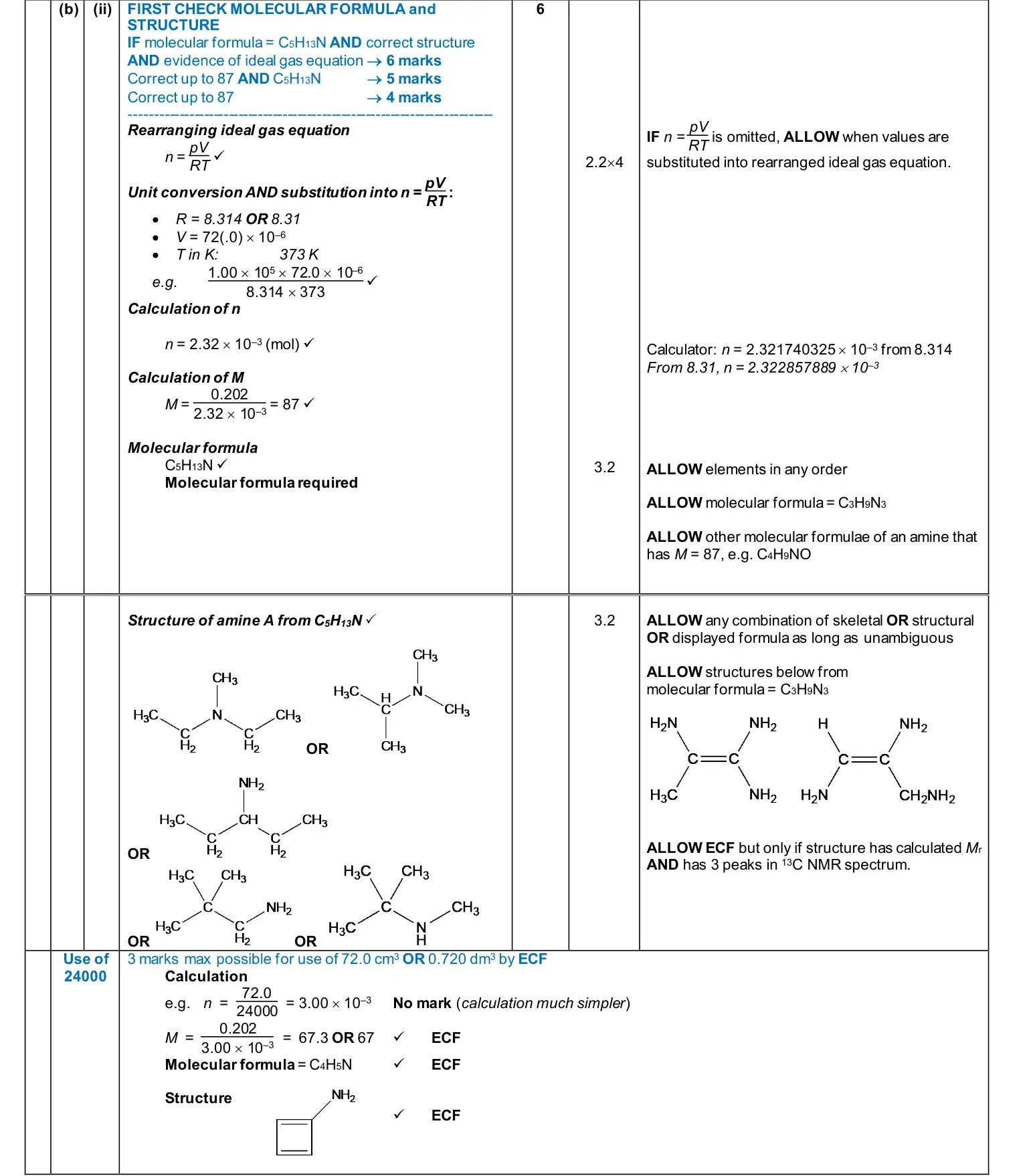
1a(i) Most candidates labelled some of the apparatus correctly and identified the reflux technique. A significant number showed water flowing in the wrong direction and ‘distillation’ was given as the name of the technique. The ‘condenser’ was sometimes labelled incorrectly, e.g. ‘condensation tube, ‘distillation tube’ and ‘water jacket’. Only just over half the candidates were given both marks. 1a(ii) Many diagrams were incomplete and it was comparatively rare for both of the two available marks to be given. Important labels were often missing. Some candidates drew diagrams of other techniques, such as distillation. Many responses were not credited with marks and this question was often omitted. Candidates need practice in recognising practical techniques and in drawing acceptable diagrams. 1b(i) Candidates were expected to explain the different boiling points of three amines. Most candidates linked increased branching with less surface contact between molecules, leading to weaker induced dipole interactions (London forces). Fewer candidates linked the decreasing boiling points to less energy being required to break the intermolecular bonds. The highest performing candidates recognised the large difference between the boiling points of the primary and tertiary amines. They then identified the cause: primary amines form hydrogen bonds but tertiary amines do not. This question was answered reasonably well with fewer candidates than in the past describing relative strengths of covalent bonds, a common misconception. 1(b)(ii) Most candidates rearranged the ideal gas equation correctly to make n the subject. They then substituted correct values for p, V, R and T into the equation, with correct unit conversions. Most candidates then calculated n correctly as 2.32 × 10⁻³ and combined this value with the mass of 0.202 g to derive the molecular formula as 87. Lower-attaining candidates often made an error in their conversion of cm3 into m3, by multiplying by 10–3 rather than 10–6. This error resulted in a value of n as 2.32 and the unrealistic molecular mass of 8.7 × 10⁻³, from which a molecular formula is impossible. Candidates in this position are advised to check back at the unit conversions in the working. Very few candidates did not convert 100ºC into 373 K. Candidates with the correct molecular formula of 87 usually suggested C5H13N as the molecular formula. A significant number quoted C5H11NH2. This response was not credited as it is not a ‘molecular’ formula. There are several possible structures of C5H13N with three 13C NMR peaks and any were credited. Error carried forward was applied from a different molecular mass for both the molecular formula and a structure. This emphasises the importance of working within calculation; credit will always be given for a correct method. Instead of using the ideal gas equation, some candidates used the molar gas constant at room temperature and pressure, 24.0 dm3, which gives a molecular mass of 67. This simplified approach could only gain the final 2 marks for this question: a molecular formula (with an error carried forward value of 67, e.g. C4H5N) and a structure of an amine with this molecular formula and 3 peaks in the 13C NMR spectrum. 1(c) Candidates were supplied with information about an unfamiliar reaction of an amino acid and asked to predict a possible equation. Many candidates suggested H2O as one product, being the difference in the formula of the amino acid and the C3H3NO cyclic organic product. Any cyclic structure of C3H3NO that met the bonding rules for C, H, N and O was credited. Examples included a 4-membered ring lactam and substituted cyclopropenes. A significant number of candidates showed an equation for the reaction of two molecules of the amino acid to form 2 H2O and a cyclic dipeptide. Although chemically feasible, the dipeptide could not be credited because the molecular formula was C3H3NO in the question. This error could have been avoided if the information in the question had been used.
Notes from the mark scheme and report
n = pV/RT with V = 72.0 × 10^-6 m3 and T = 373 K gives M = 87 so C5H13N
structure must have 3 carbon environments
use of 24 000 (not RTP) limits to 3 marks by ECF (M = 67.3, C4H5N)
Skills: M0.0 Recognise and make use of appropriate units in calculations; M2.2 Change the subject of an equation; M2.3 Substitute numerical values into algebraic equations using appropriate units for physical quantities; M3.1 Translate information between graphical, numerical and algebraic forms
June 2019 · Paper 2 · Q101 markAO2Multiple choiceEasy
Answer
B
Mark scheme
Examiner's comment
Most candidates correctly selected B as the compound that would show four peaks in the 13C NMR spectrum. Many candidates annotated the structures, indicating the different carbon environments with a circle. This proved a good strategy. Common incorrect responses included C and D which were seen in roughly equal proportions.
June 2019 · Paper 2 · Q121 markAO2Multiple choiceMedium
Answer
C
Mark scheme
Examiner's comment
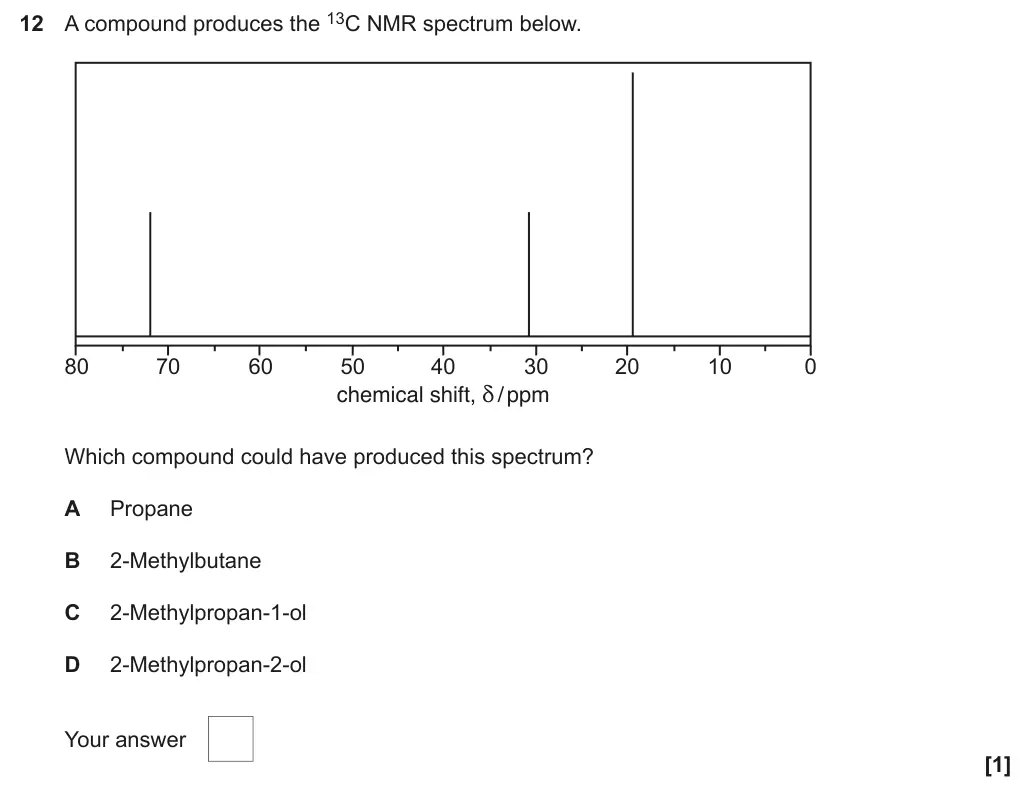
Many candidates identified that 2-methylpropan-1-ol (C) produced the 13C NMR spectrum show. The majority of successful responses included diagrams showing the structures of the compounds to choose from. The most frequently seen incorrect response was D.
June 2019 · Paper 2 · Q18(b)4 marksAO3Complete table/diagramEasy
Earlier part of question 18 that this part uses
Mark scheme
Examiner's comment
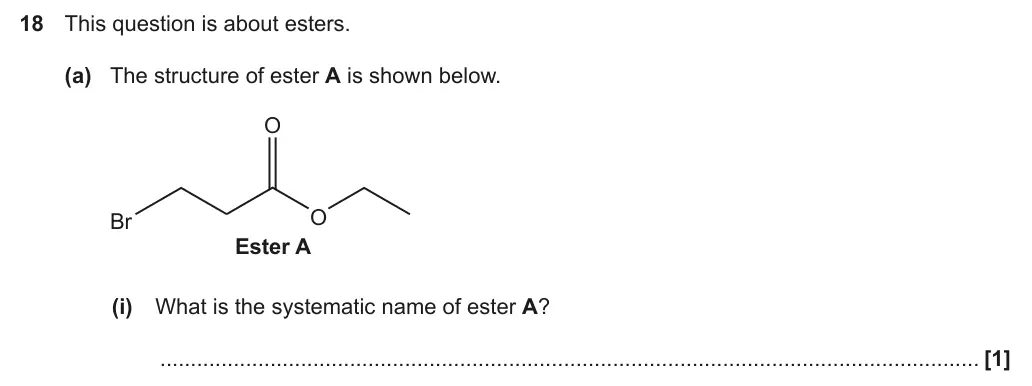
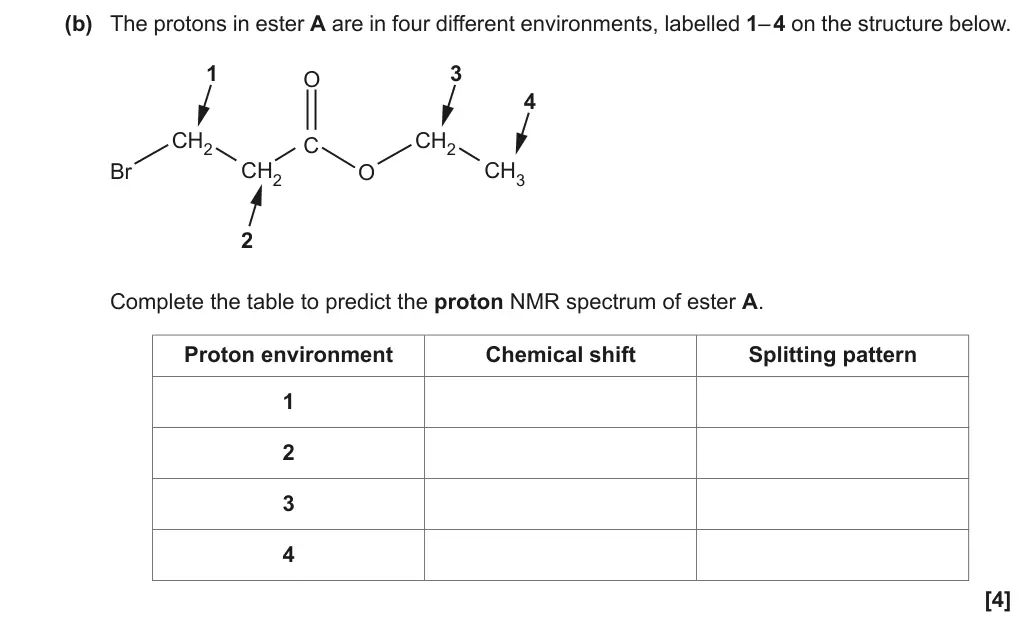
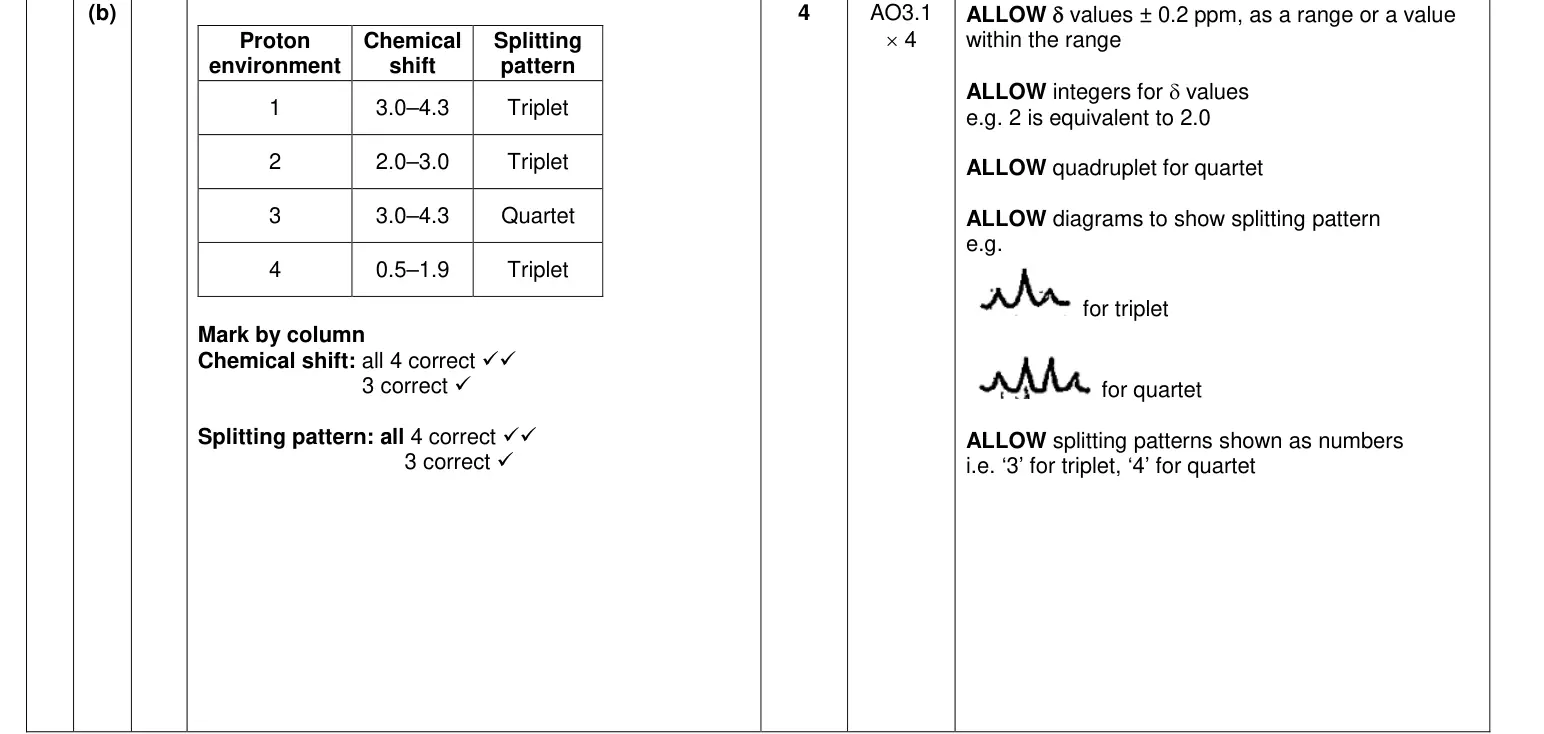
This question was answered well and most candidates scored full marks. A common error was the chemical shift of environment 2, which was sometimes shown as 9.0-10.0. Some candidates gave incorrect splitting patterns for environment 2, stating it would give a singlet, rather than a triplet. This is presumably the result of focusing on the carbon atom to the right of the environment with no H atoms. Candidates should be reminded to consider adjacent carbon atoms on both sides of a particular environment, rather the just looking in one direction.
Notes from the mark scheme and report
marked by column: shifts 3.0–4.3, 2.0–3.0, 3.0–4.3, 0.5–1.9 (±0.2)
splitting triplet, triplet, quartet, triplet
all 4 correct for 2 marks, 3 correct for 1
Skills: M3.1 Translate information between graphical, numerical and algebraic forms
June 2019 · Paper 2 · Q18(c)1 markAO3Structure / isomerMedium
Earlier part of question 18 that this part uses
Mark scheme
Examiner's comment
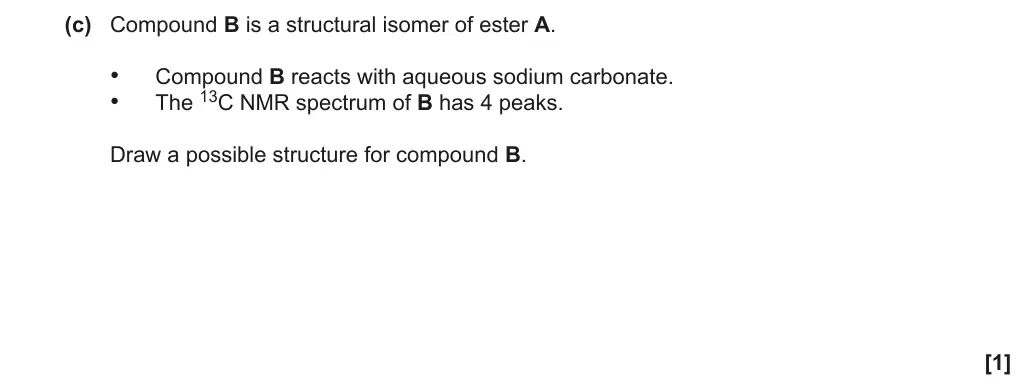
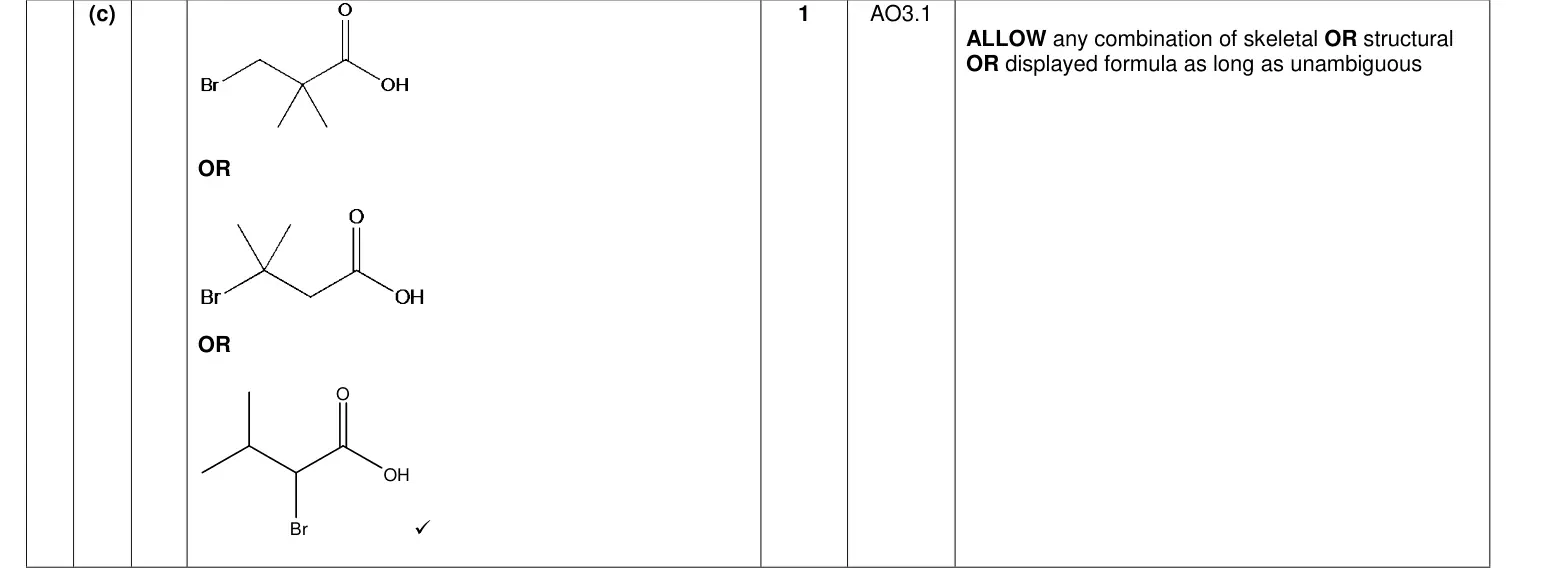
This question required candidates to use both pieces of information to deduce that B was a carboxylic acid with two equivalent carbon atoms. Many candidates were able to suggest a suitable structure. However some candidates did not use all the information and it was common to see responses that showed an ester or a straight chain carboxylic acid.
Notes from the mark scheme and report
bromo-substituted C5 carboxylic acid with 4 carbon environments
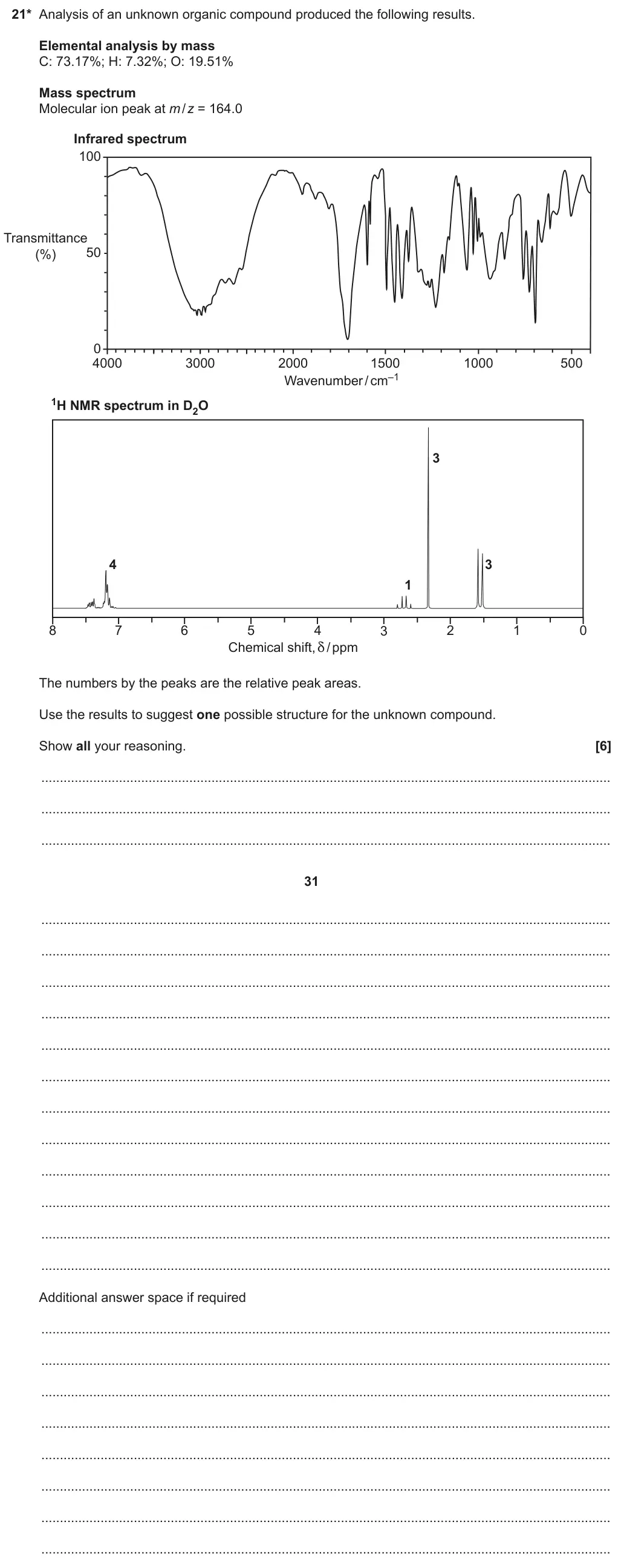
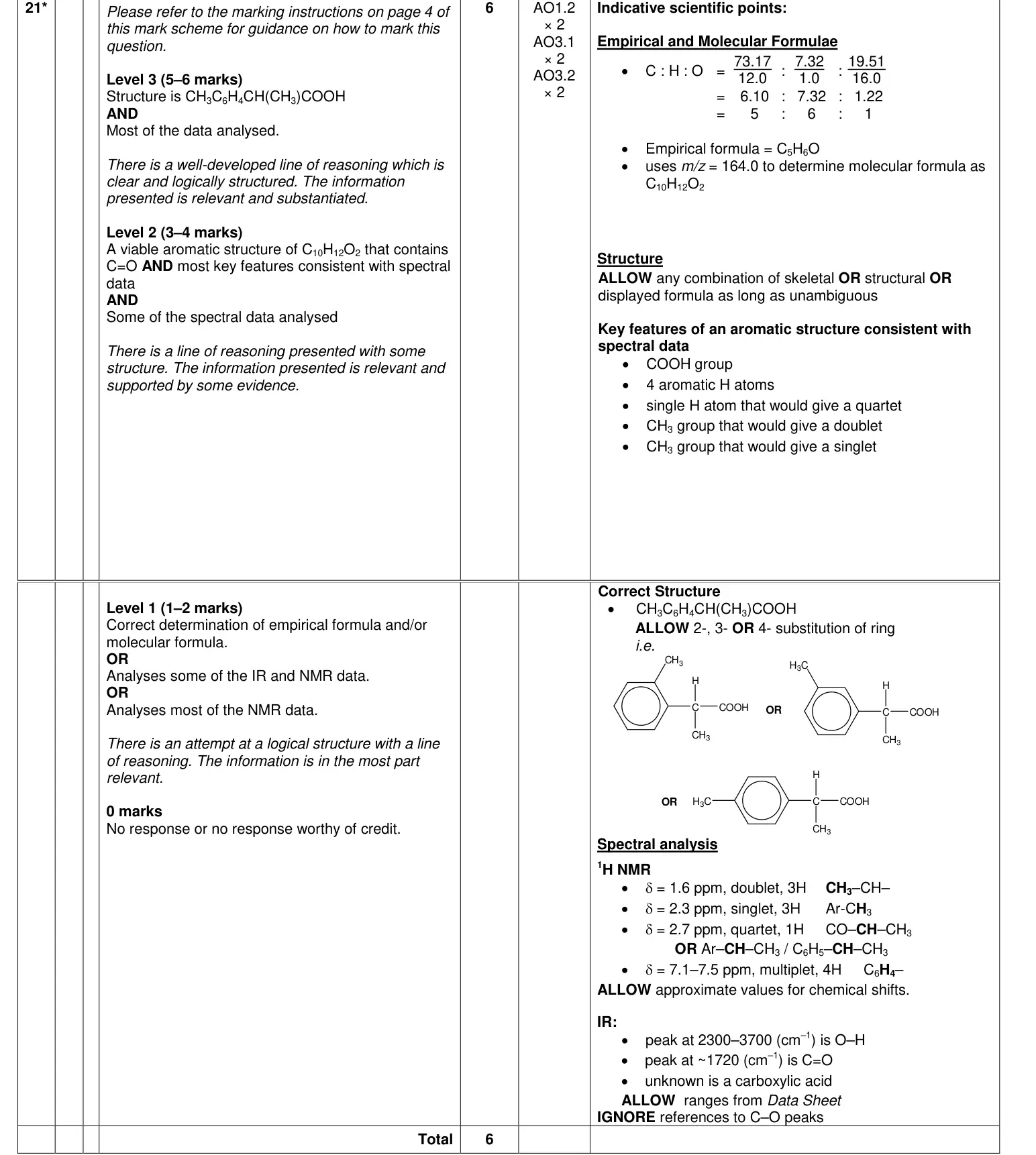
June 2019 · Paper 2 · Q216 marks6-mark level of responseMedium
Mark scheme, with the levels and indicative points
Examiner's comment
Candidates are confident in tackling questions requiring spectral analysis. Most candidates were able to determine the empirical and molecular formula of the unknown compound and analyse the IR and NMR data. A number of excellent responses were seen which included interpretation of the peak splitting in the NMR spectrum. However, many candidates were unable to suggest a structure that matched their spectral analysis. The majority of structures seen were aromatic but not all contained the carboxylic acid group. Some candidates focused on the NMR data and suggested a structure that was consistent with some of these peaks and included a two substituents of the ring or a degree of chain branching. Lower ability responses often showed a simpler structure of a monosubstituted ring with a straight chain. Stronger responses were able to use all the data to suggest a correct structure as demonstrated in significant proportion of responses were given six marks. This candidate starts their analysis by determining the empirical and molecular formula of the unknown compound. Next the IR and NMR data is analysed in a clear, logical fashion. Although not shown in this report, the candidate had annotated the spectra, a good strategy. At the end of the response the candidate has determined a possible structure. Notice how the candidate has crossed out the first attempt at a structure. This is much better than rubbing out a pencil diagram and re-drawing over the space as this often leads to unclear images that are difficult for examiners to read. This candidate received full marks in this question.
Skills: M0.2 Use ratios, fractions and percentages; M3.1 Translate information between graphical, numerical and algebraic forms
June 2019 · Paper 3 · Q4(a)(ii)1 markAO2Short answerMedium
Earlier part of question 4 that this part uses
Mark scheme
Examiner's comment
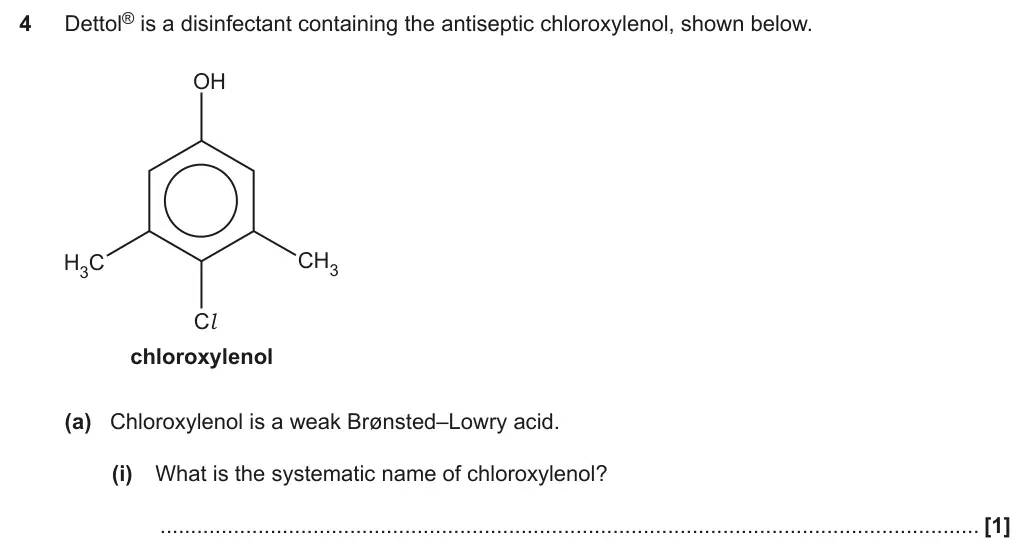
Most candidates predicted that there would be 5 peaks in the 13C NMR spectrum. The common incorrect responses were 3 or 4 peaks, presumably from omitting the C–OH or C–Cl carbon atoms.
Notes from the mark scheme and report
5 peaks
Skills: M4.3 Understand the symmetry of 2-D and 3-D shapes
June 2018 · Paper 2 · Q11 markMultiple choiceHard
Answer
A
Mark scheme
Examiner's comment
Candidates found this question more challenging than anticipated. While many correctly chose A, a significant proportion of candidates selected C.
June 2018 · Paper 2 · Q61 markMultiple choiceMedium
Answer
B
Mark scheme
Examiner's comment
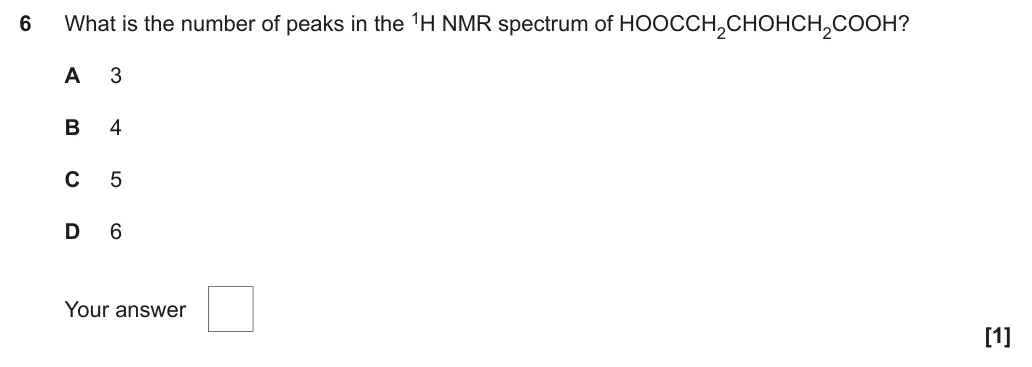
Many candidates correctly identified that the 1H NMR spectrum would contain 4 peaks and selected B. In most cases candidates arrived at this answer by drawing out the structure and labelling the environments. A common distractor was A (3 peaks) which presumably arose from candidates assuming that the C–H and O–H protons in the centre of the structure were equivalent.
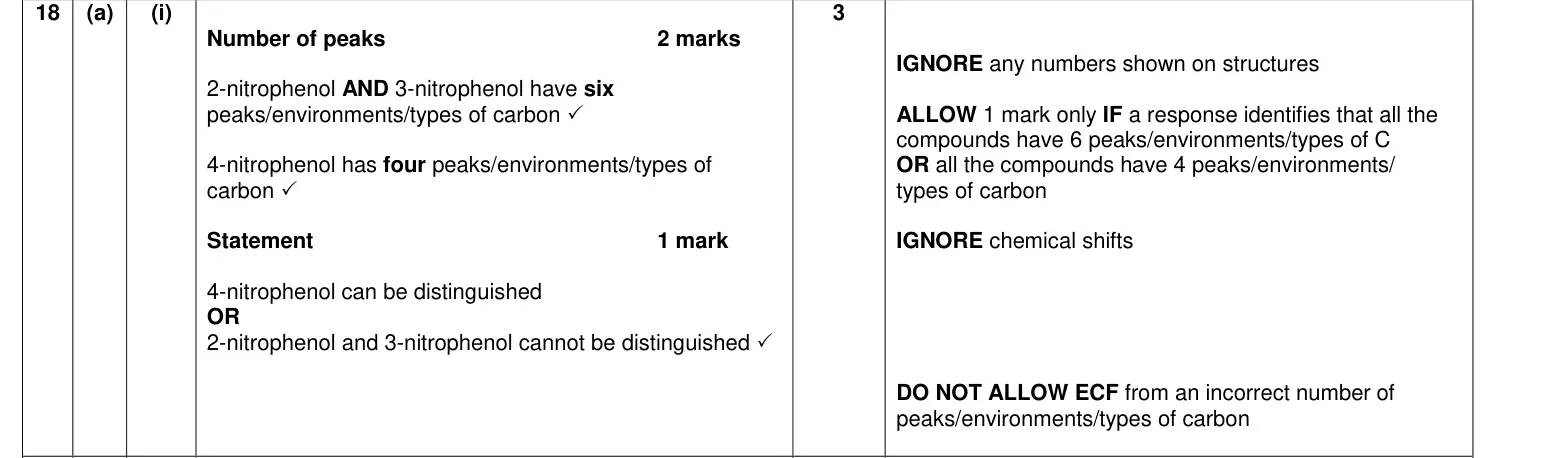
June 2018 · Paper 2 · Q18(a)(i)3 marksShort answerMedium
Mark scheme
Examiner's comment
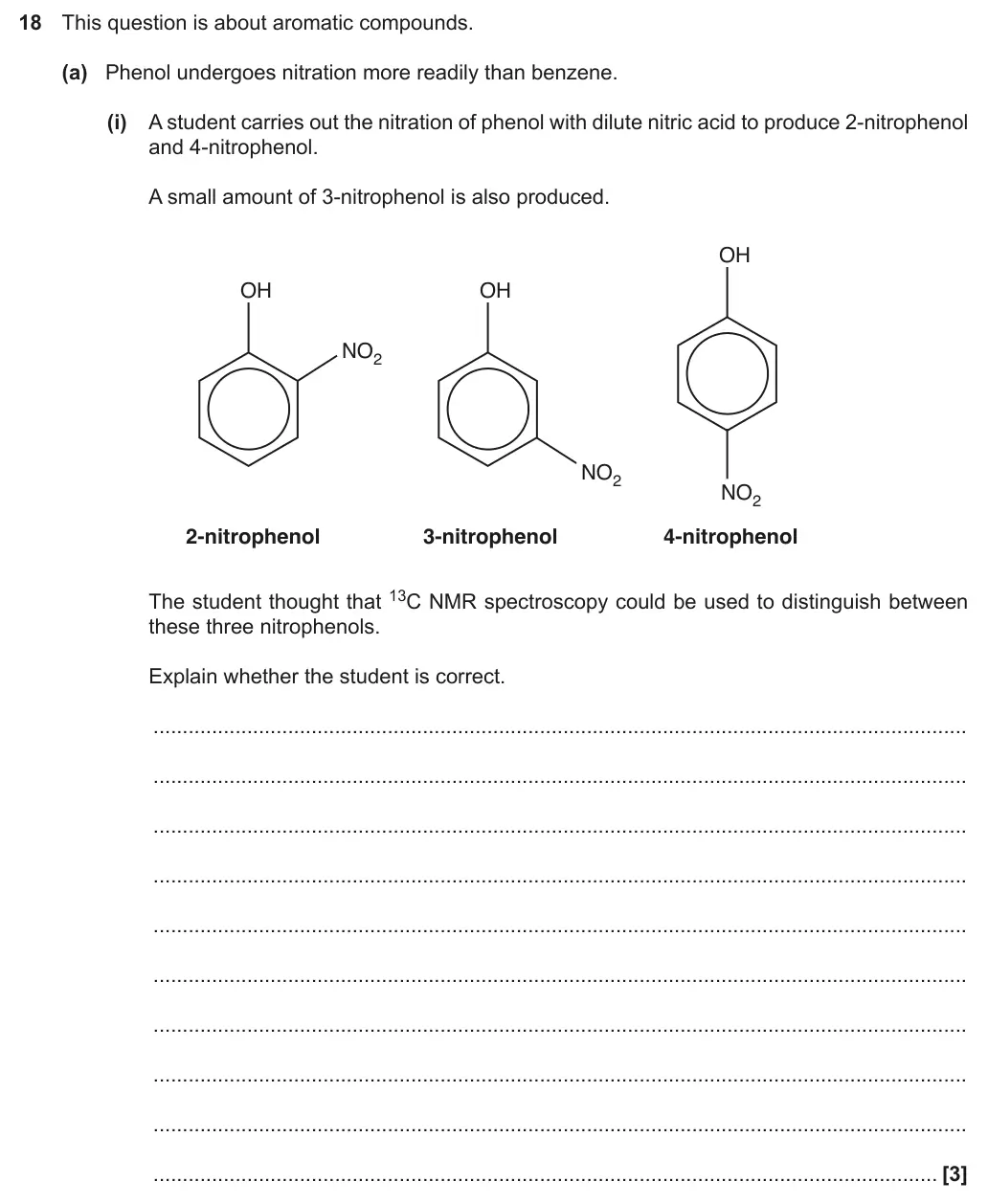
This question required candidates to apply their knowledge of 13C NMR spectroscopy to deduce the number of different carbon environments in each of the nitrophenols shown. The best responses were succinct, stating that it is possible to distinguish 4-ntirophenol from the other two after deducing the correct number of carbon environments for each compound. Lower ability candidates’ responses did not identify the symmetry in 4-nitrophenol and suggested all three compounds would produce six peaks, therefore making it impossible to distinguish between them.
Notes from the mark scheme and report
2- and 3-nitrophenol both have six peaks, 4-nitrophenol has four
so only 4-nitrophenol can be distinguished
1 mark only if all said to have 6 (or 4) peaks
IGNORE chemical shifts
no ECF from incorrect number of peaks
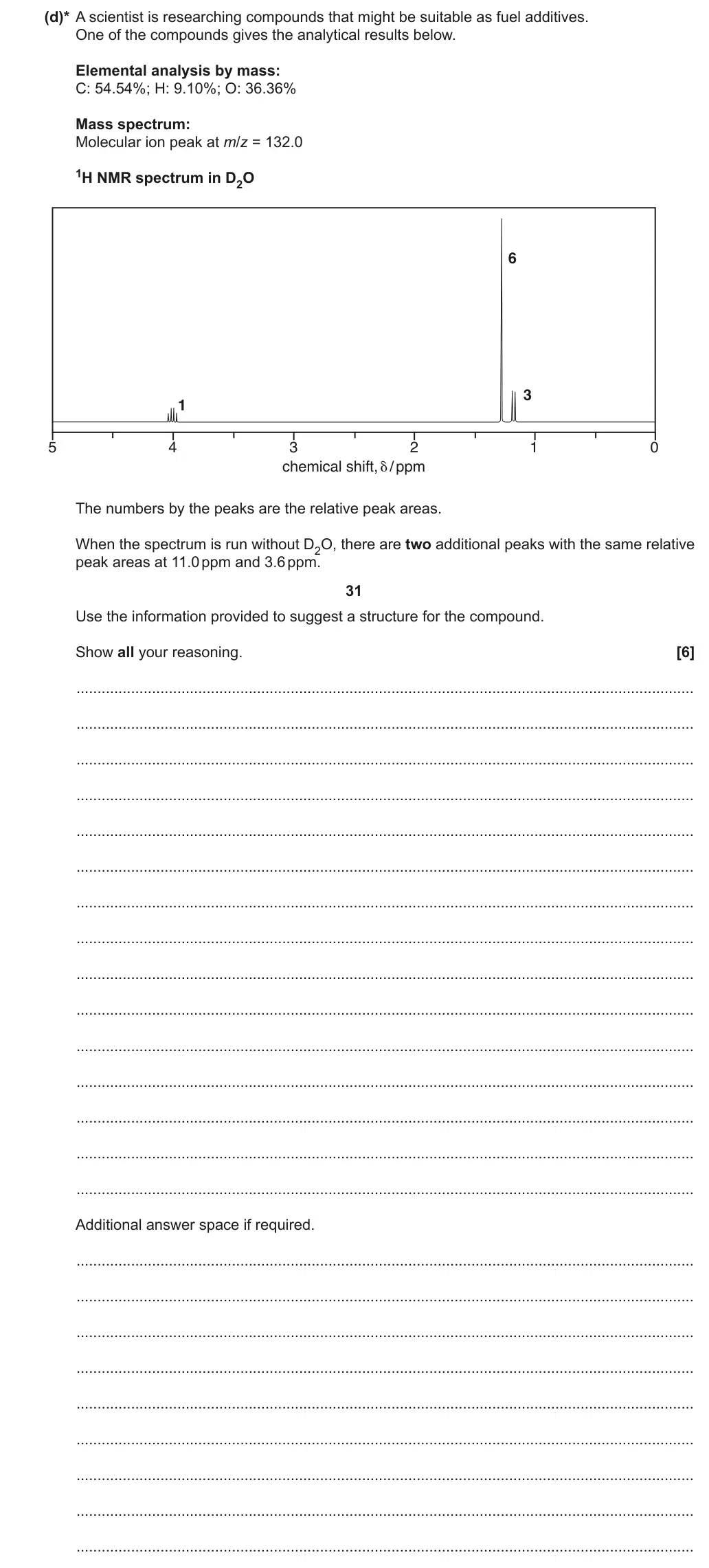
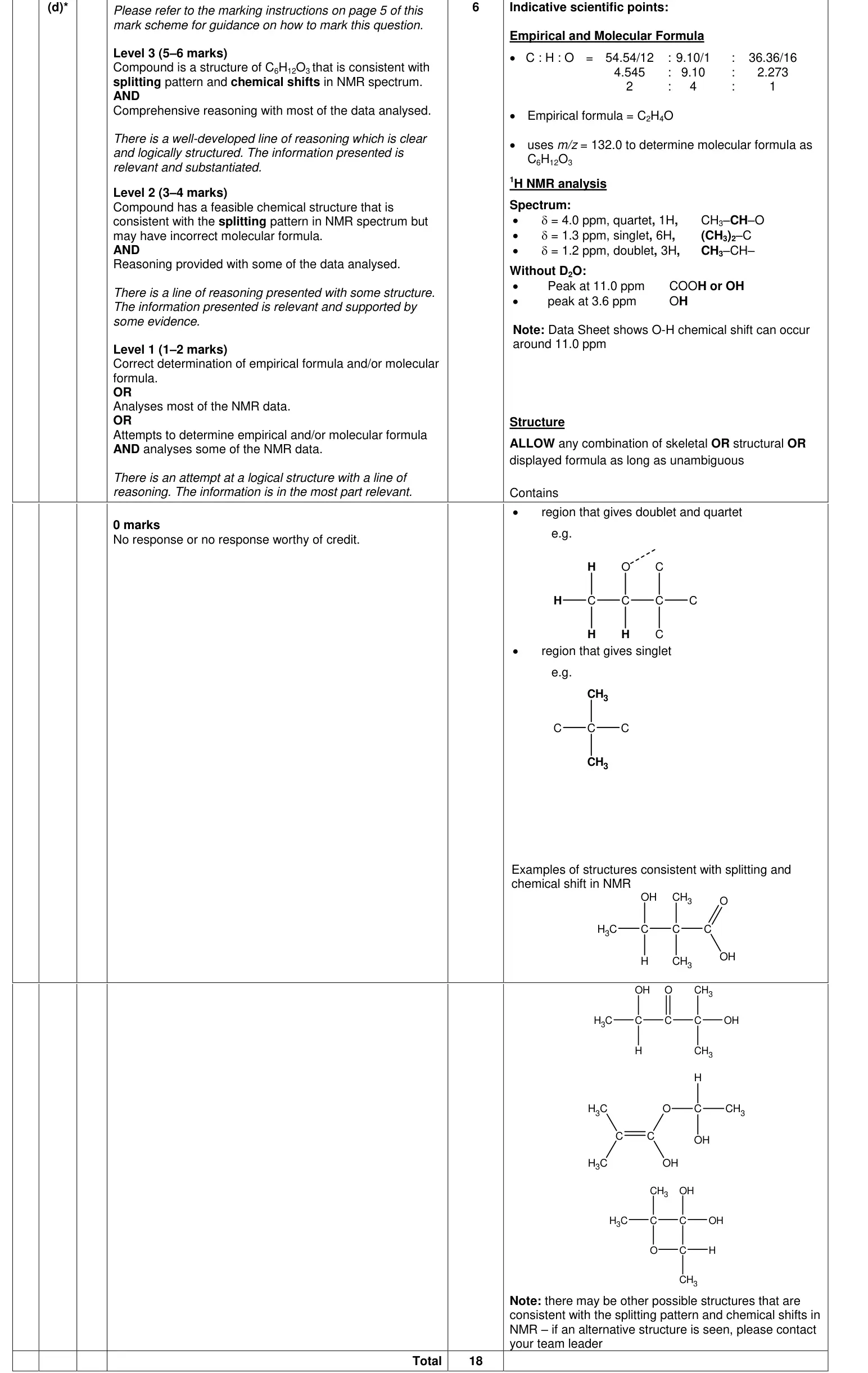
June 2018 · Paper 2 · Q22(d)6 marks6-mark level of responseEasy
Mark scheme, with the levels and indicative points