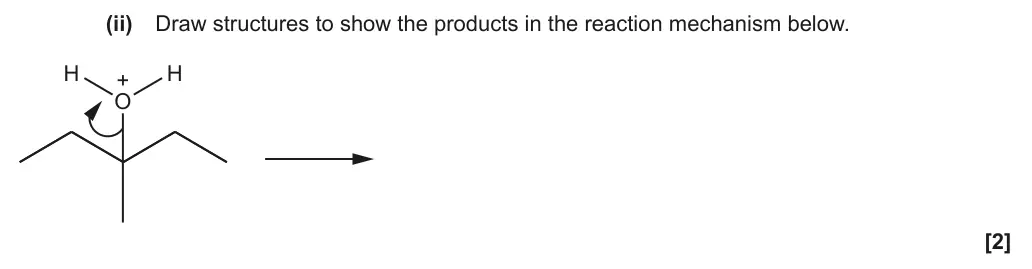
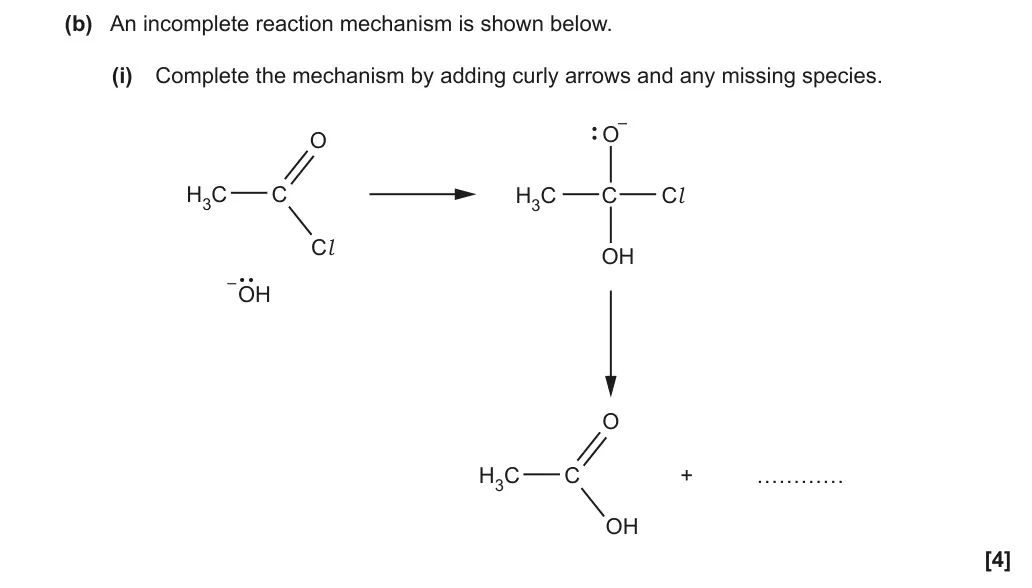
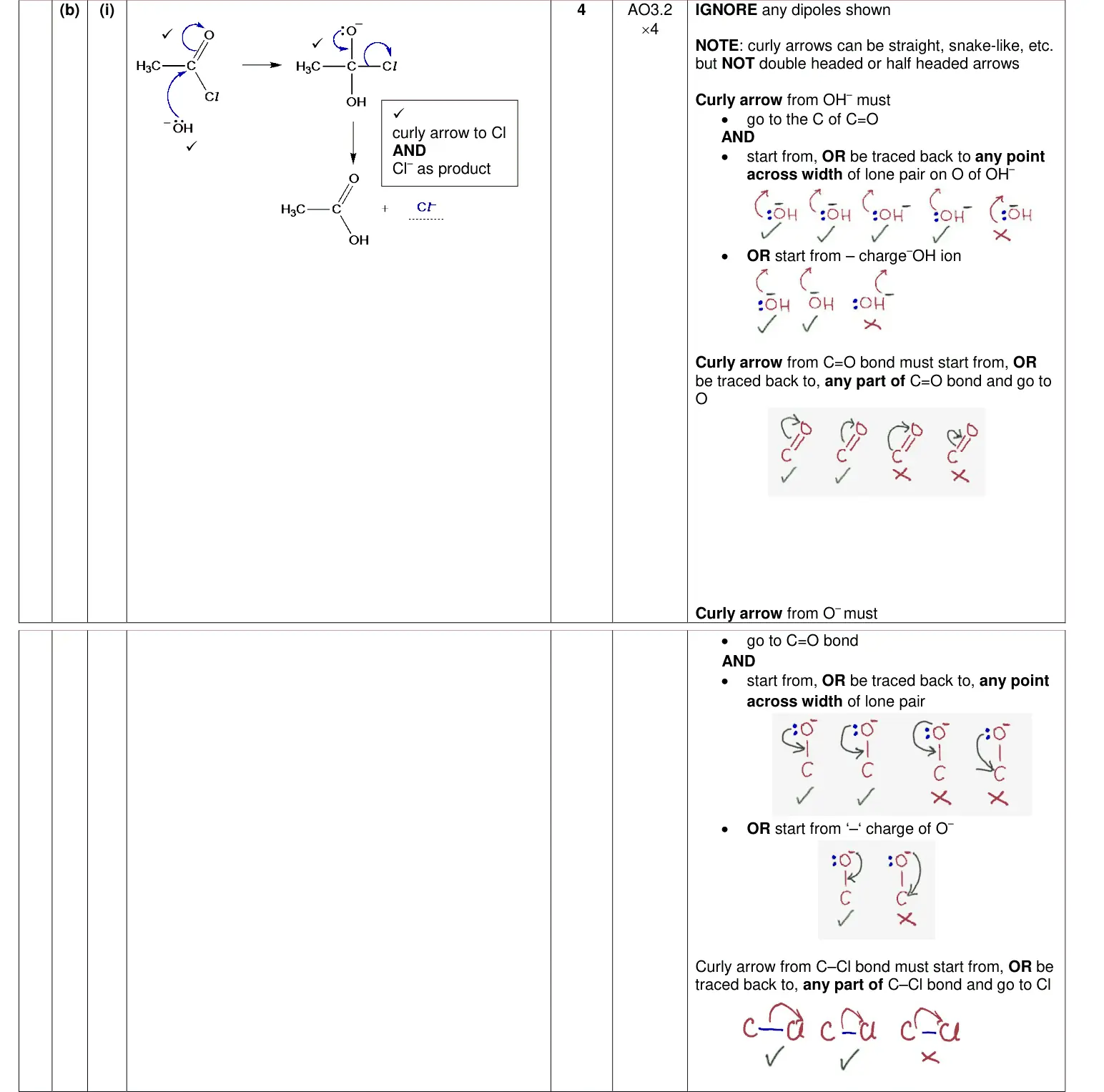
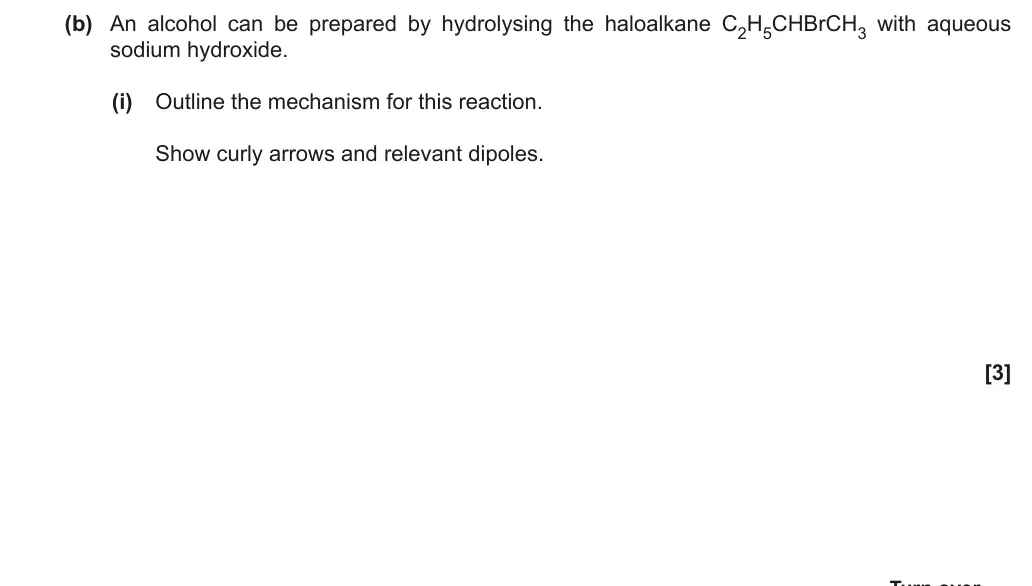
47 past-paper questions that ask you to draw, complete or outline a mechanism, by topic, each with the mark scheme's own mechanism behind the button. A curly arrow shows the movement of a pair of electrons: it must start at a bond or a lone pair and finish at the atom or bond where the electrons go. Most of the marks lost here are for arrows that start or end in the wrong place, and for missing dipoles, lone pairs and charges.
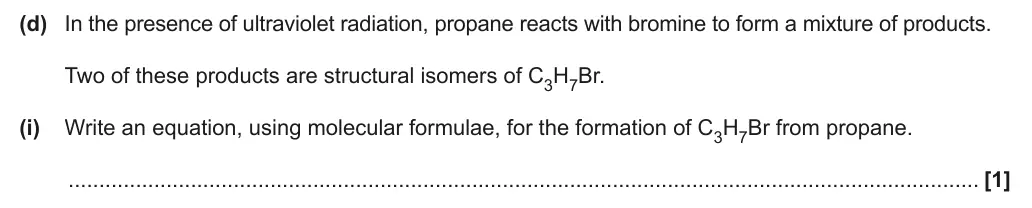
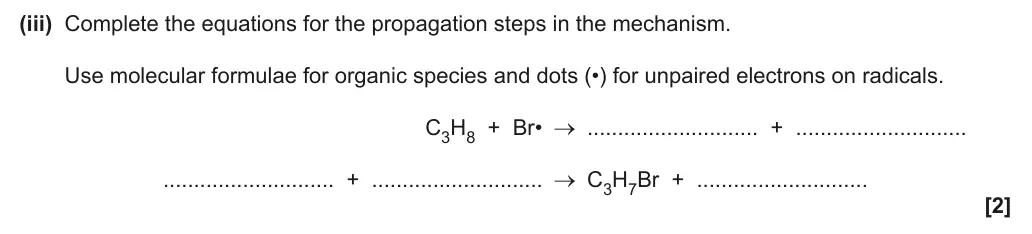
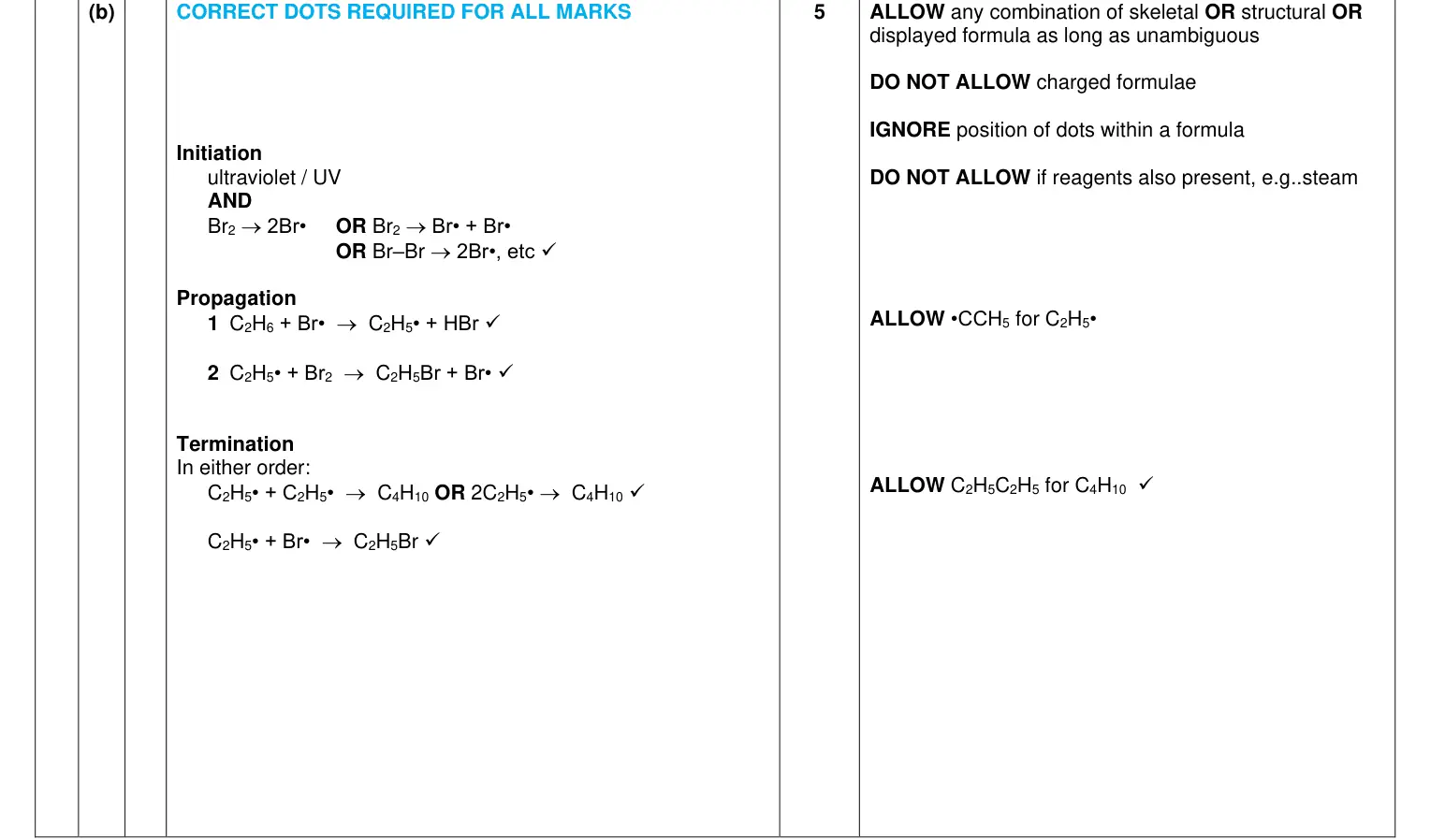
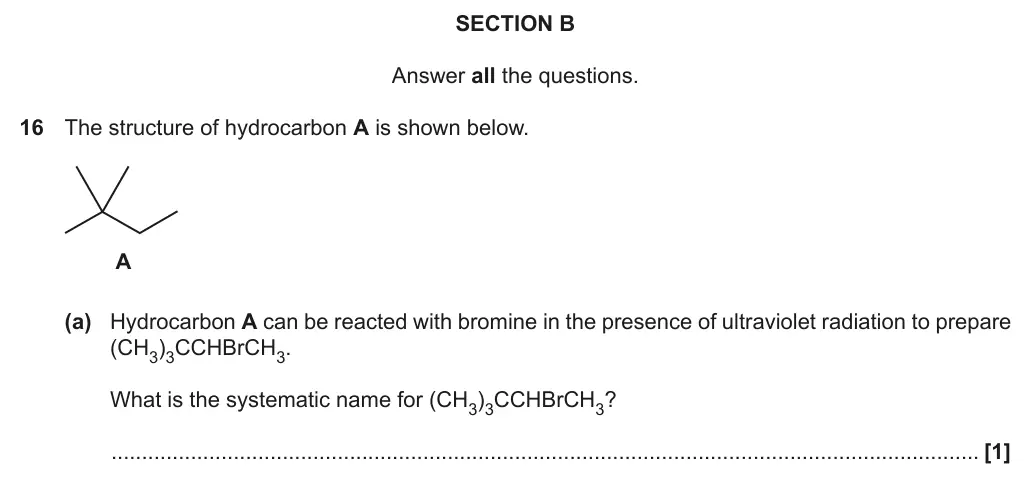
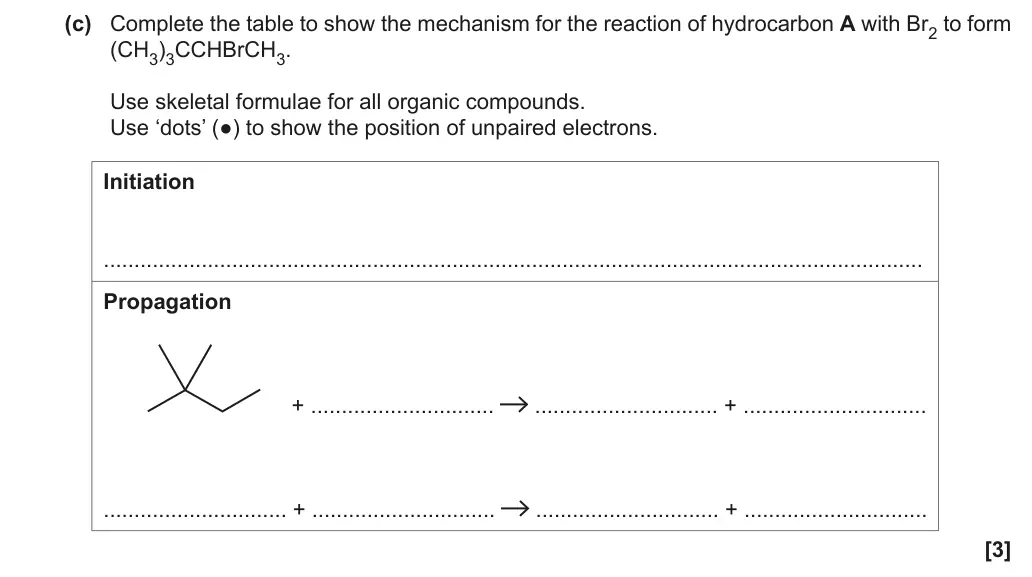
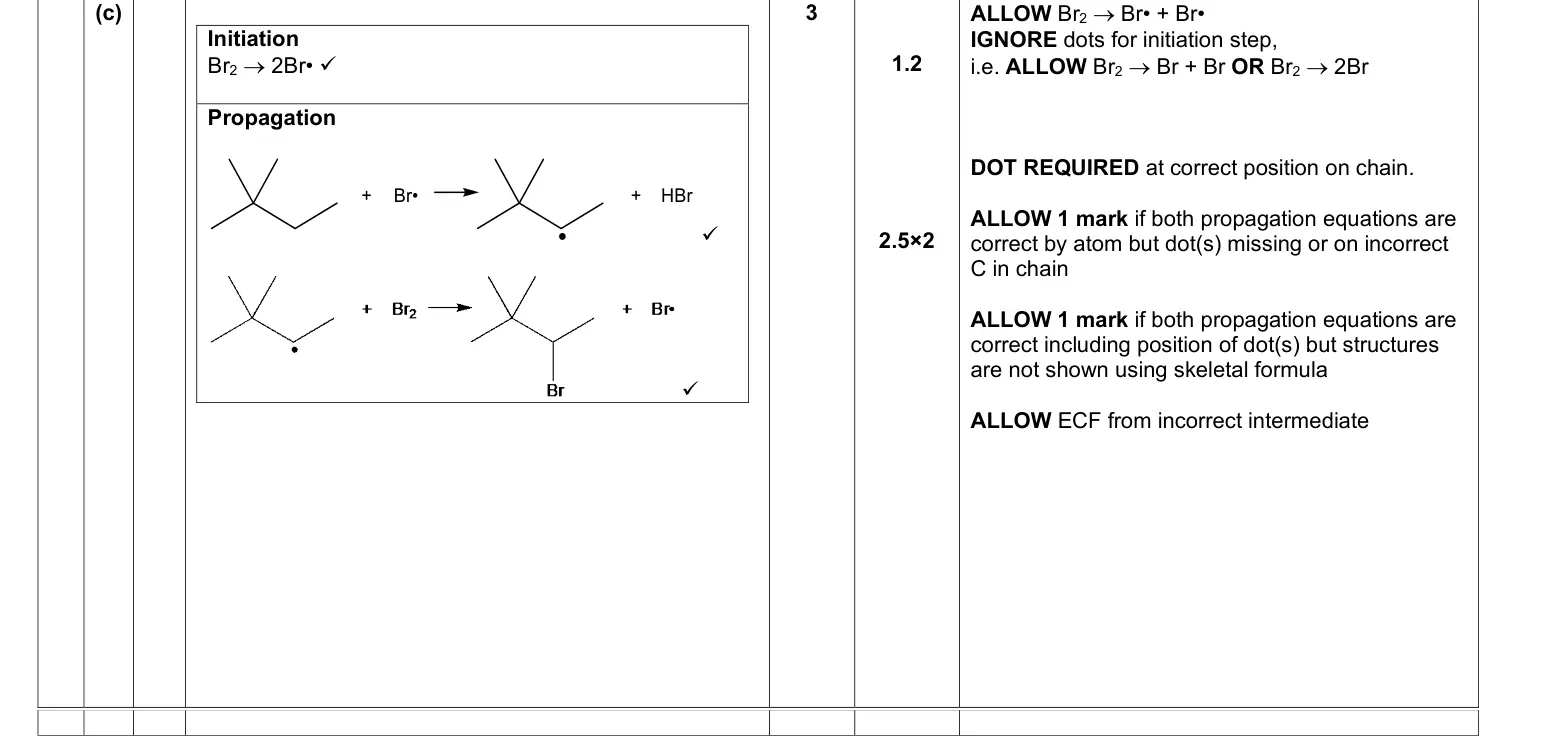
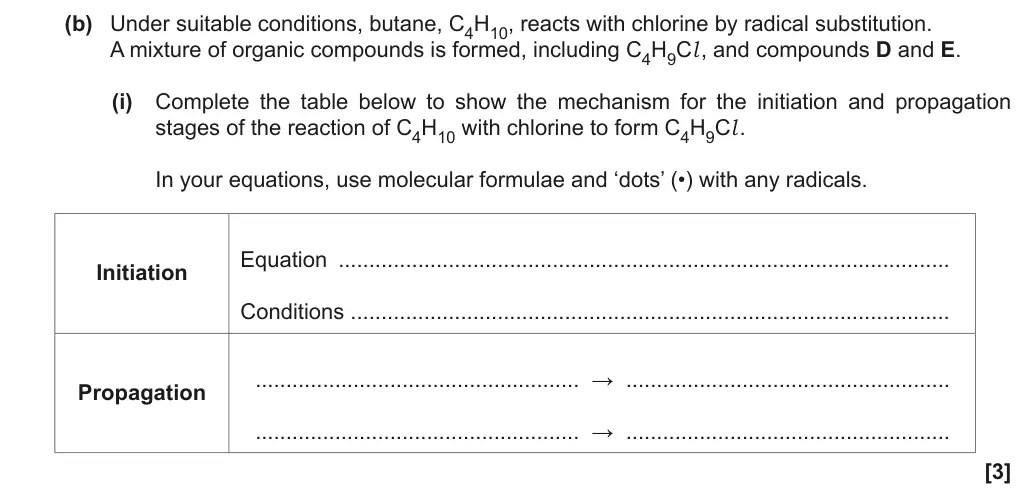
Alkane with chlorine or bromine in UV light. Initiation (homolytic fission of the halogen), two propagation steps, termination. Radicals shown with a dot; no curly arrows needed. Further substitution gives a mixture of products.
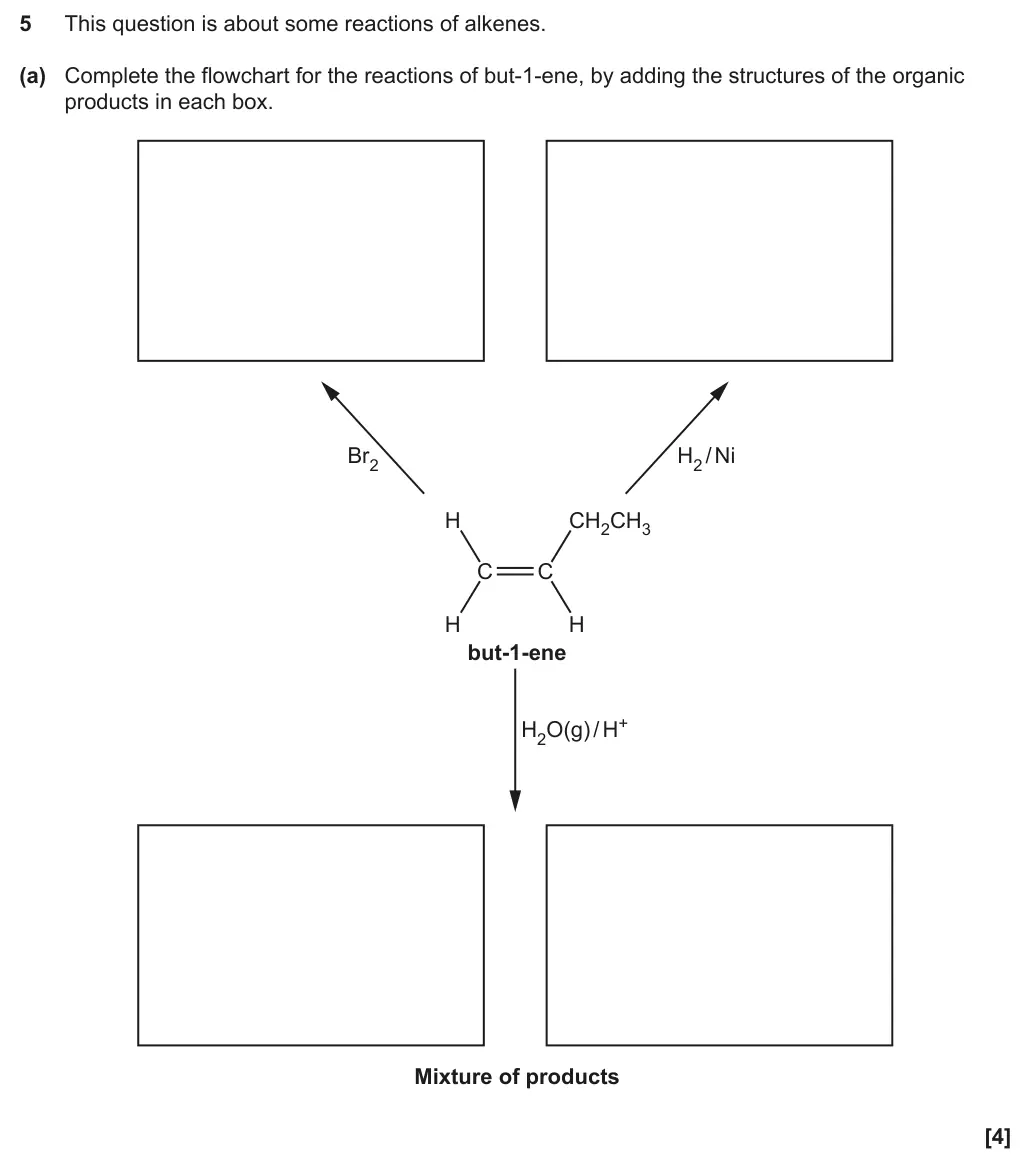
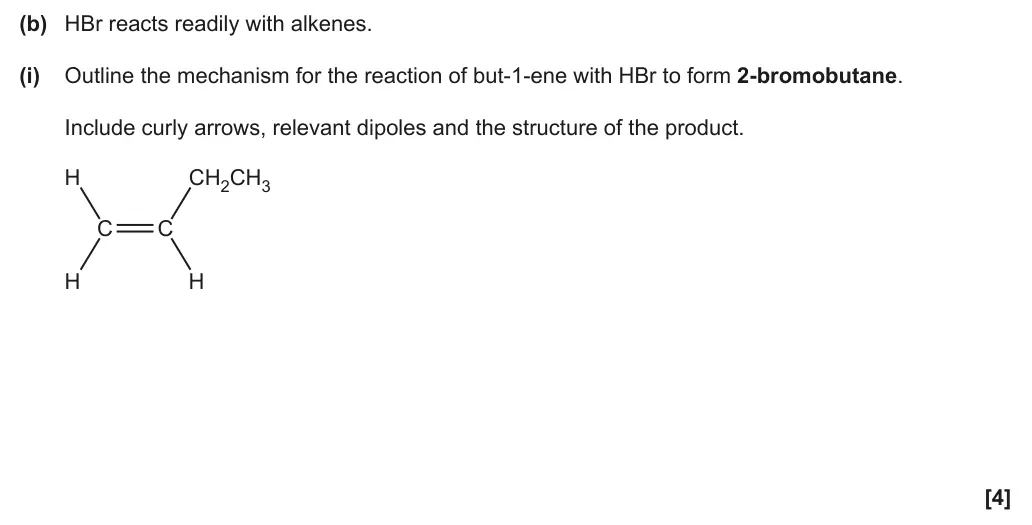
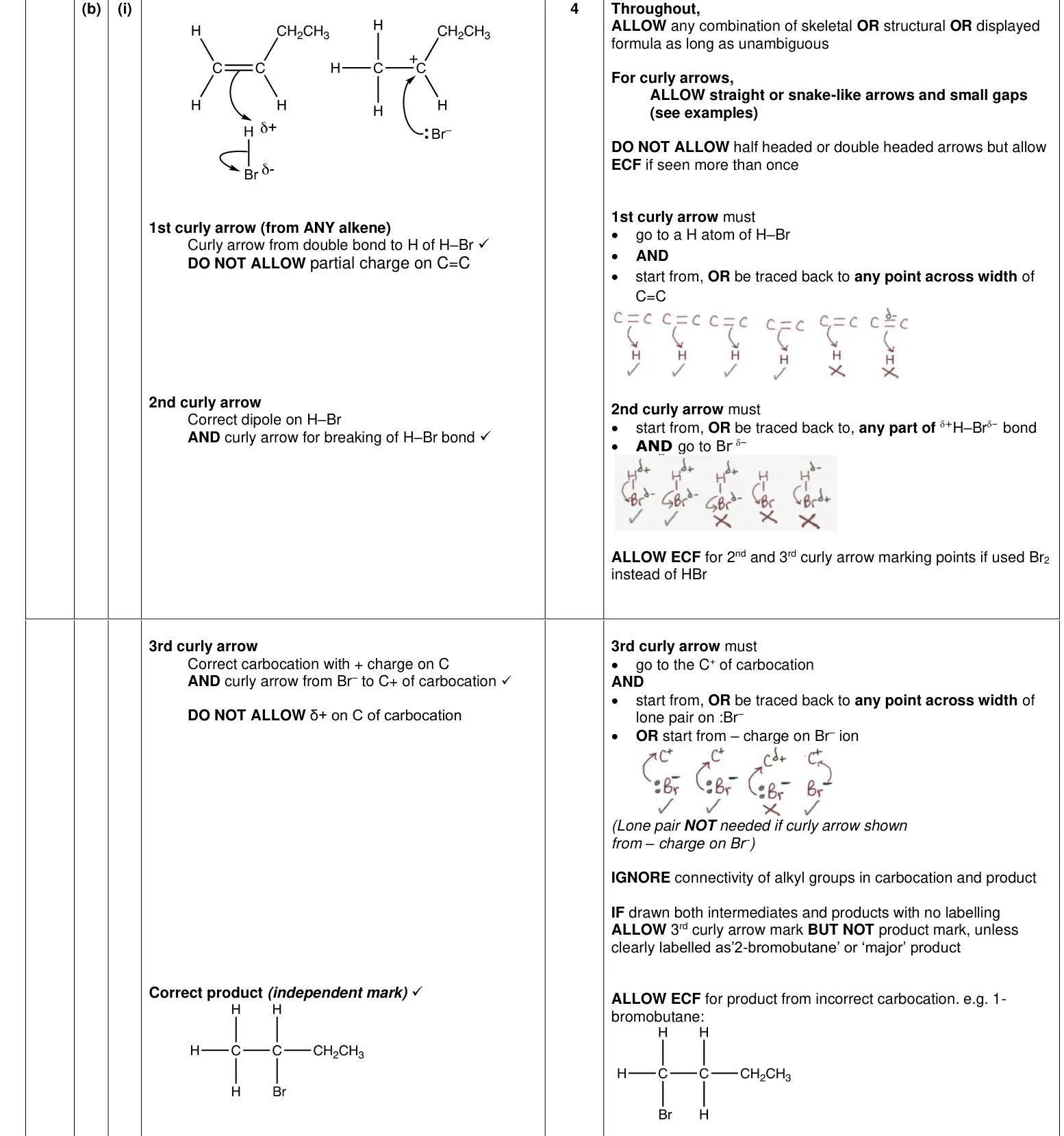
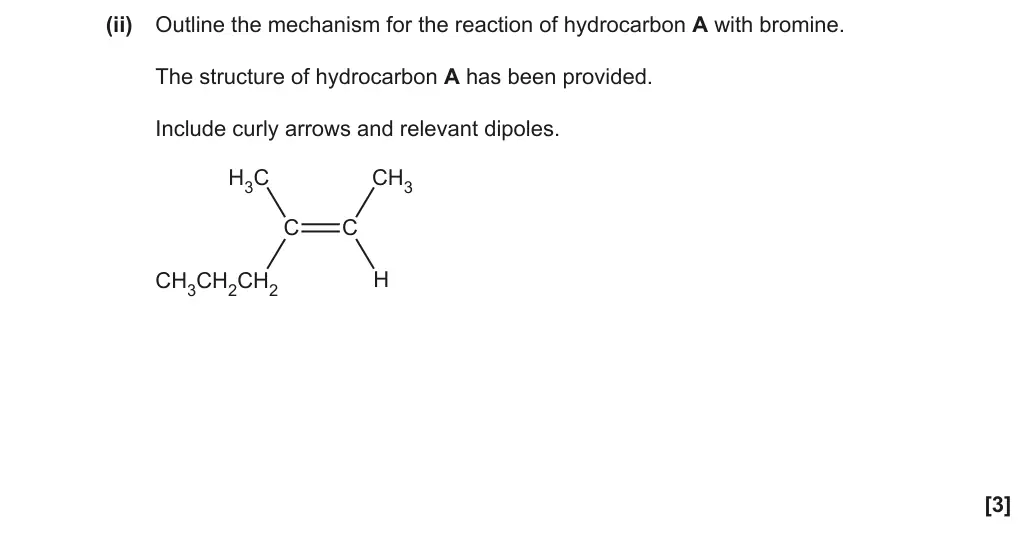
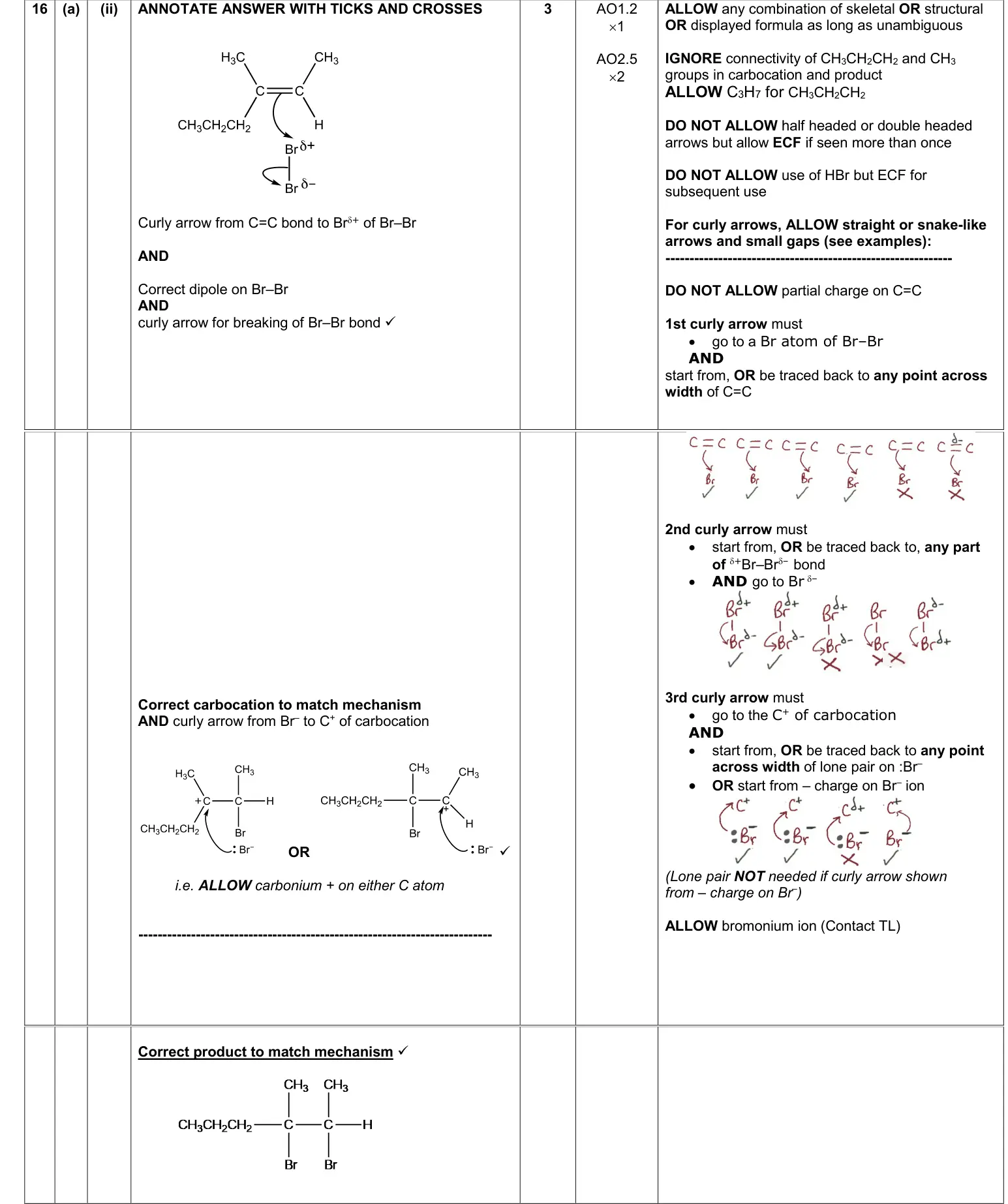
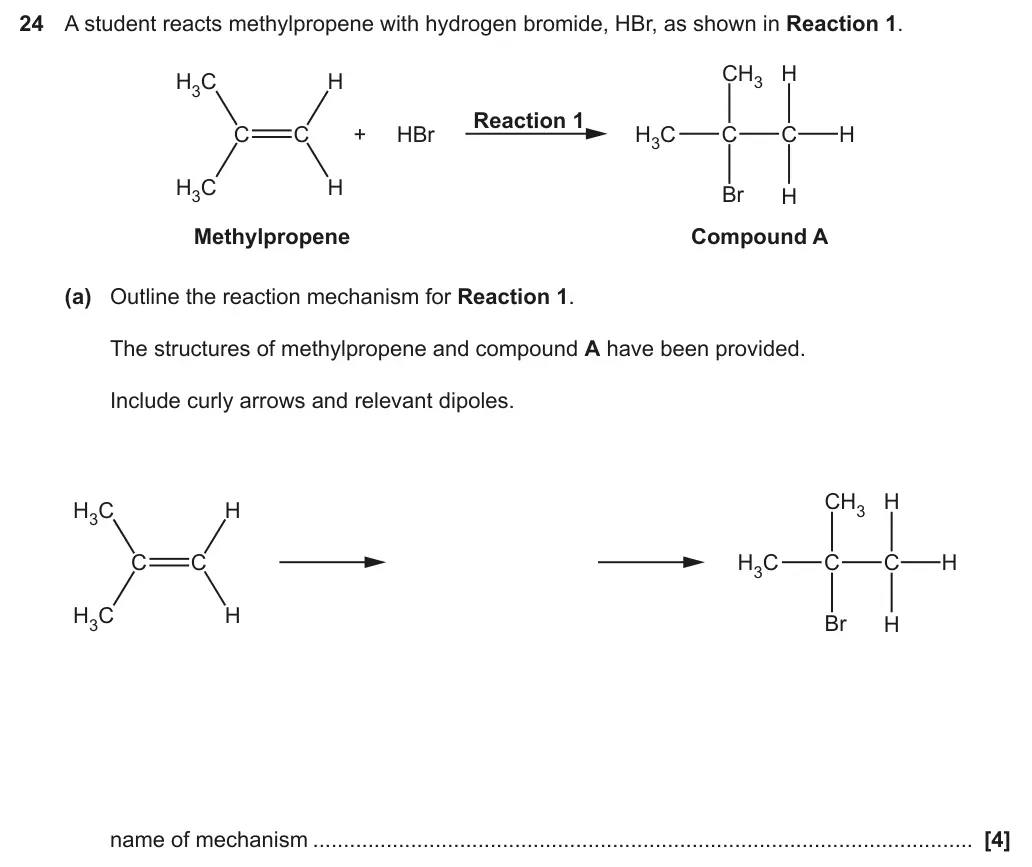
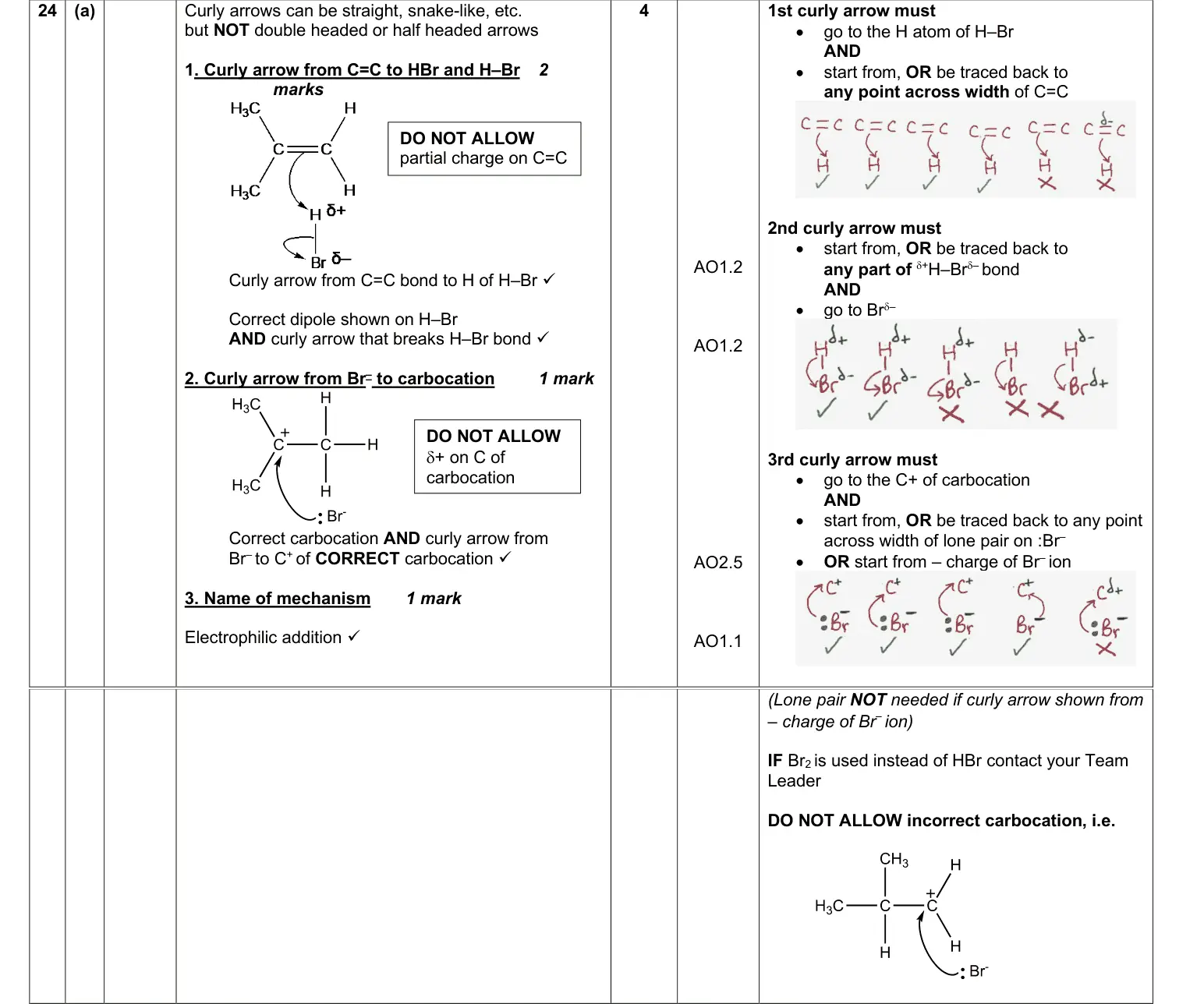
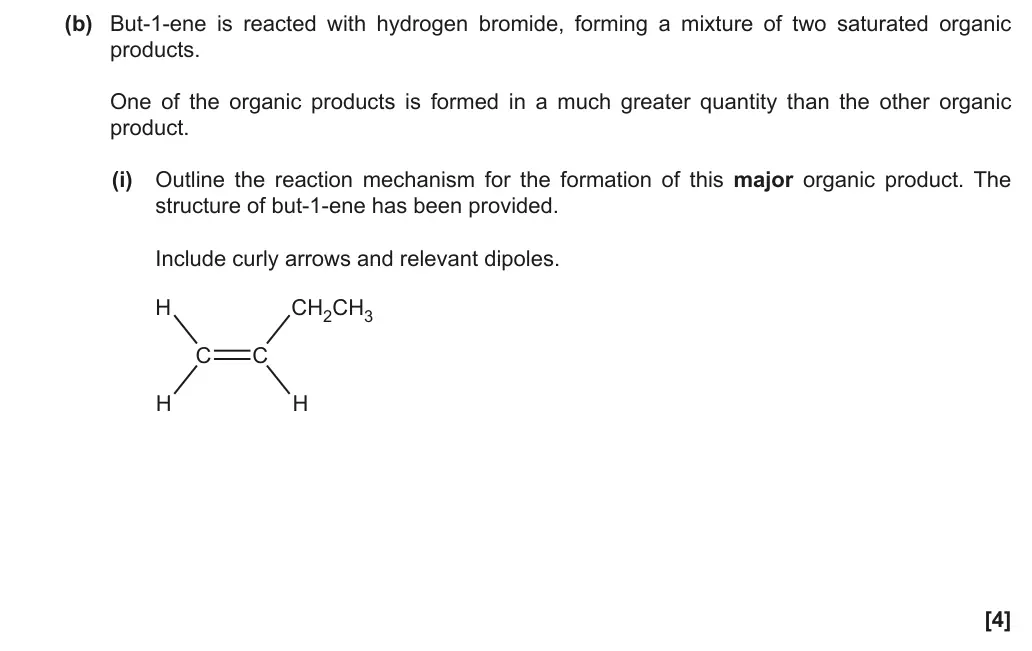
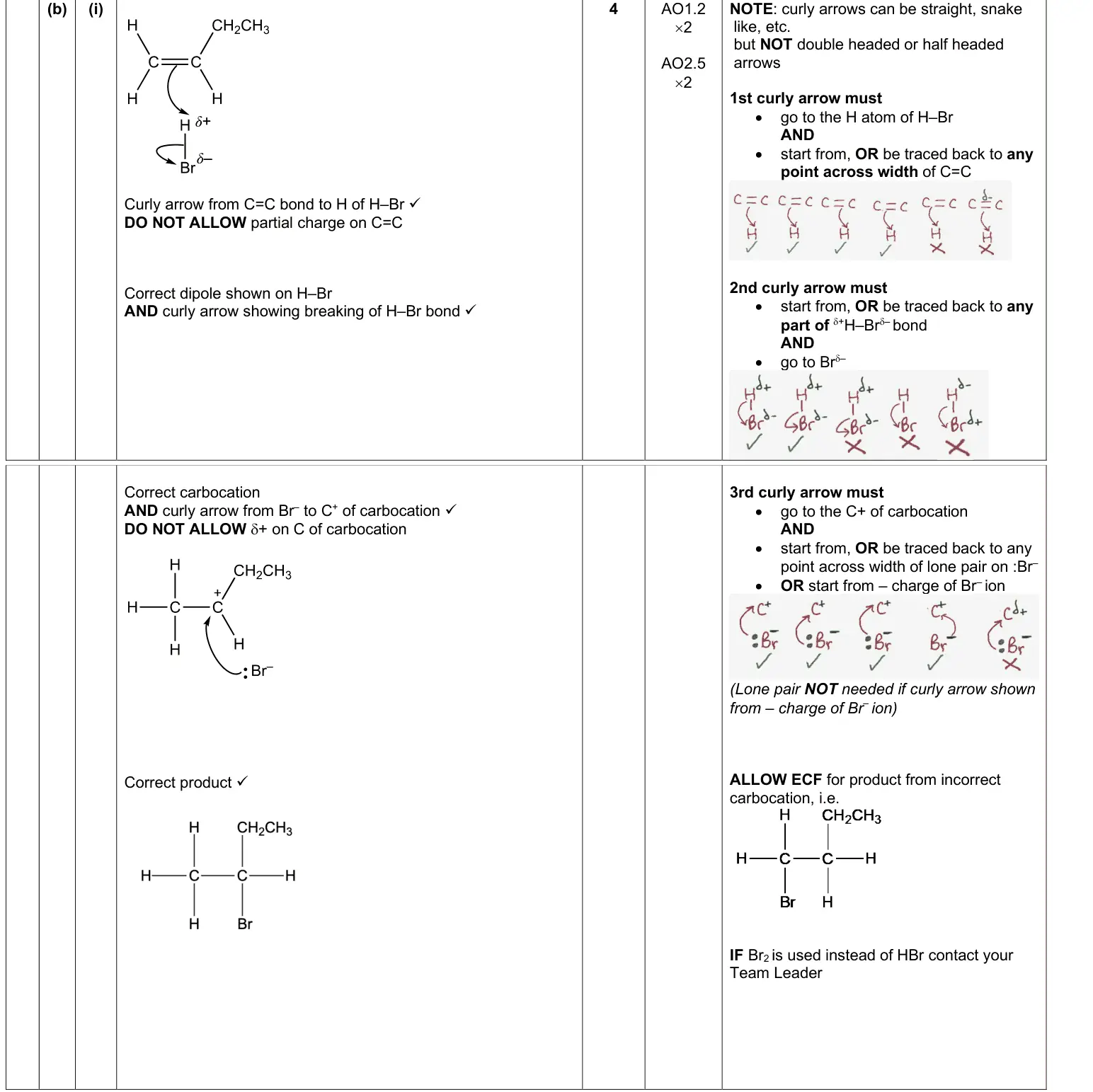
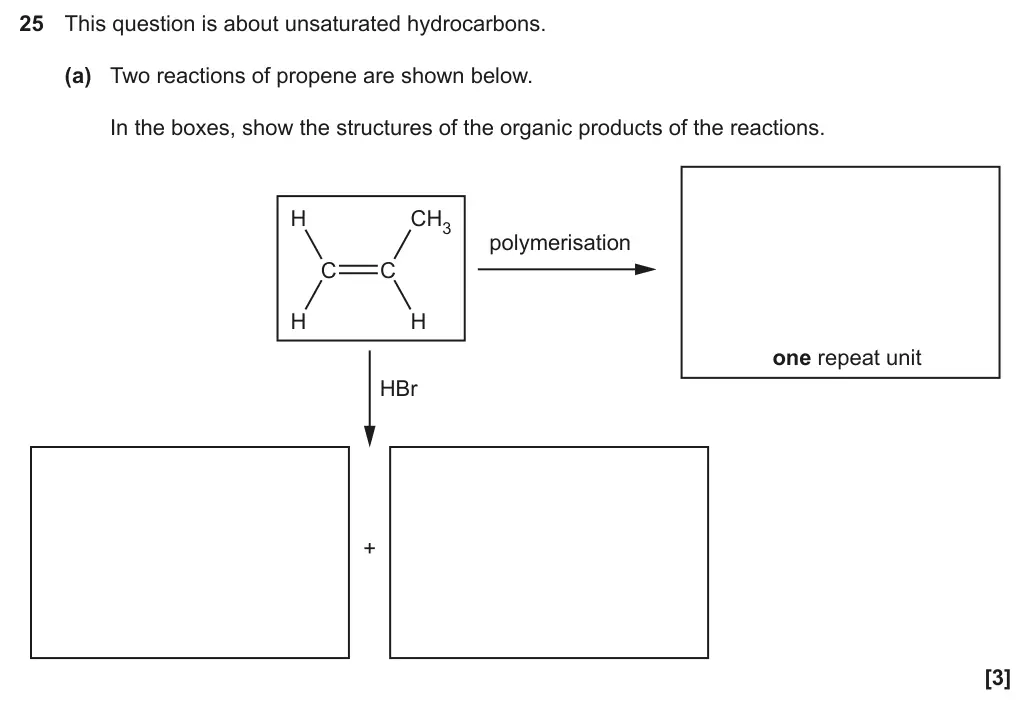
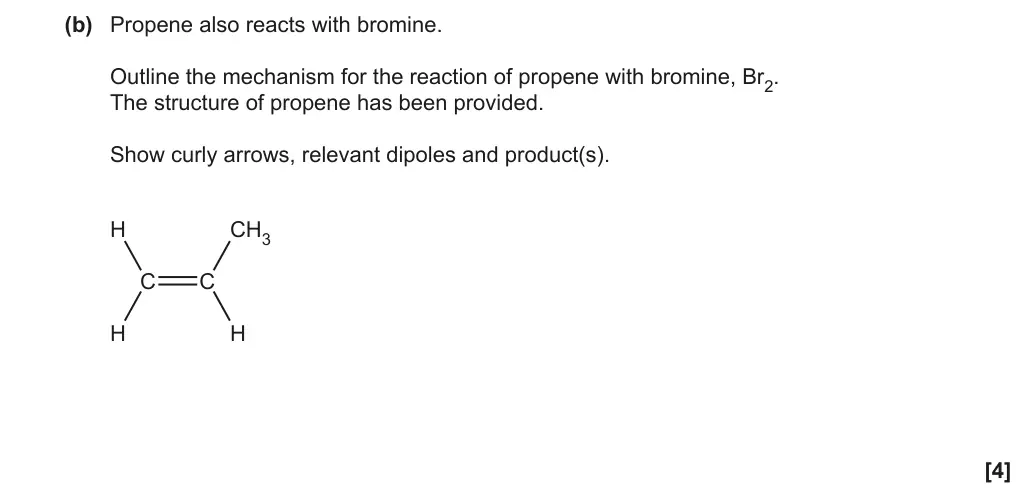
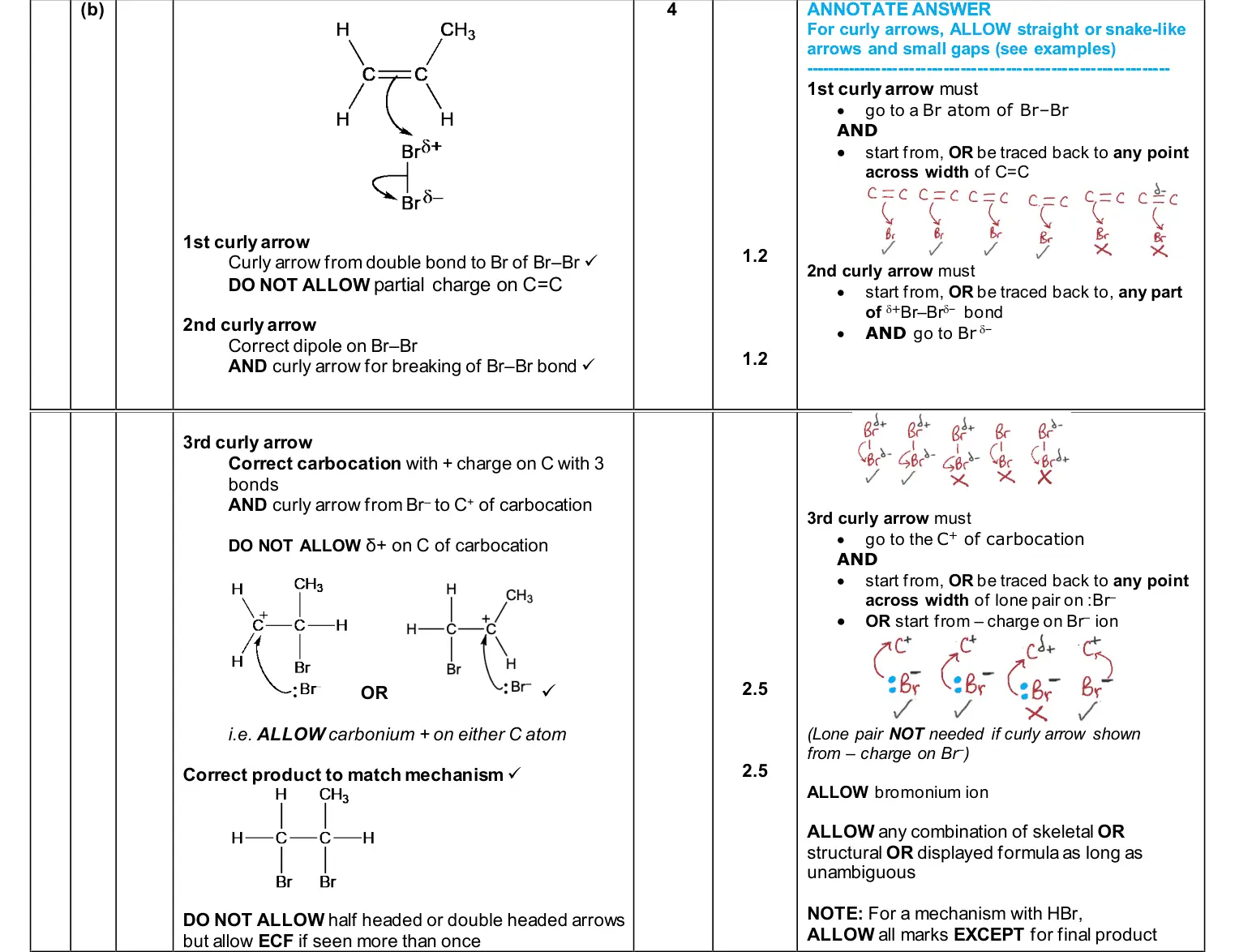
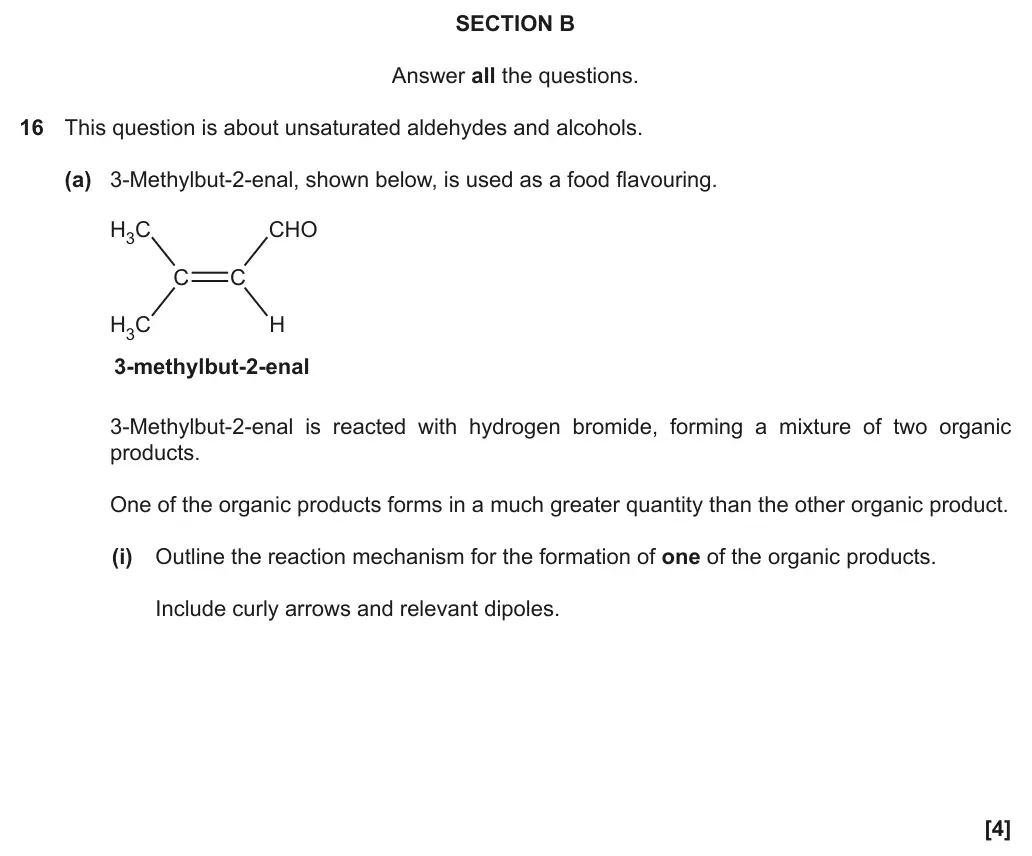
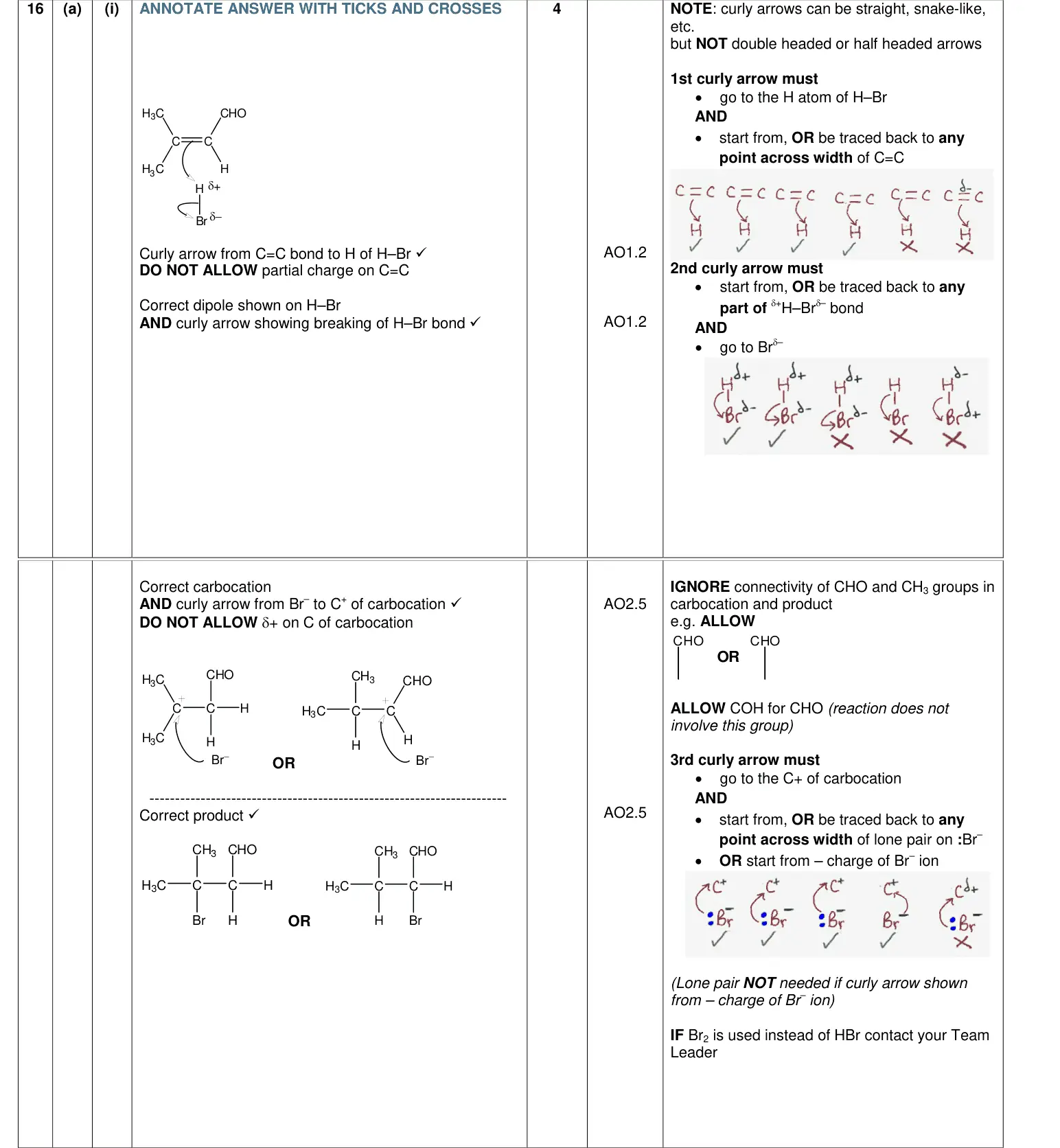
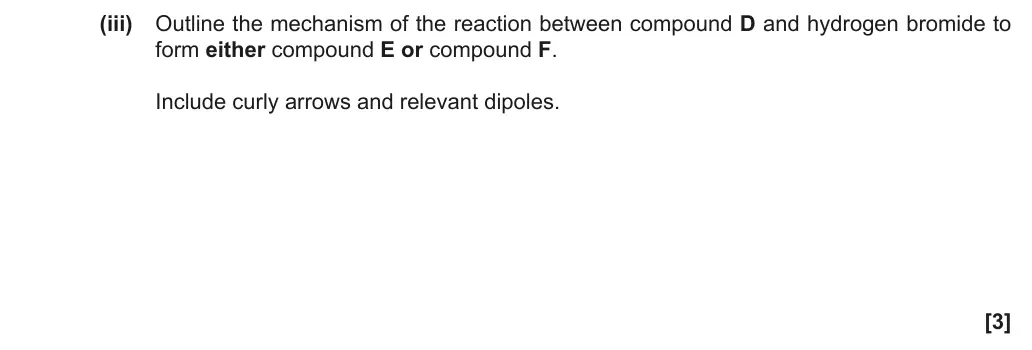
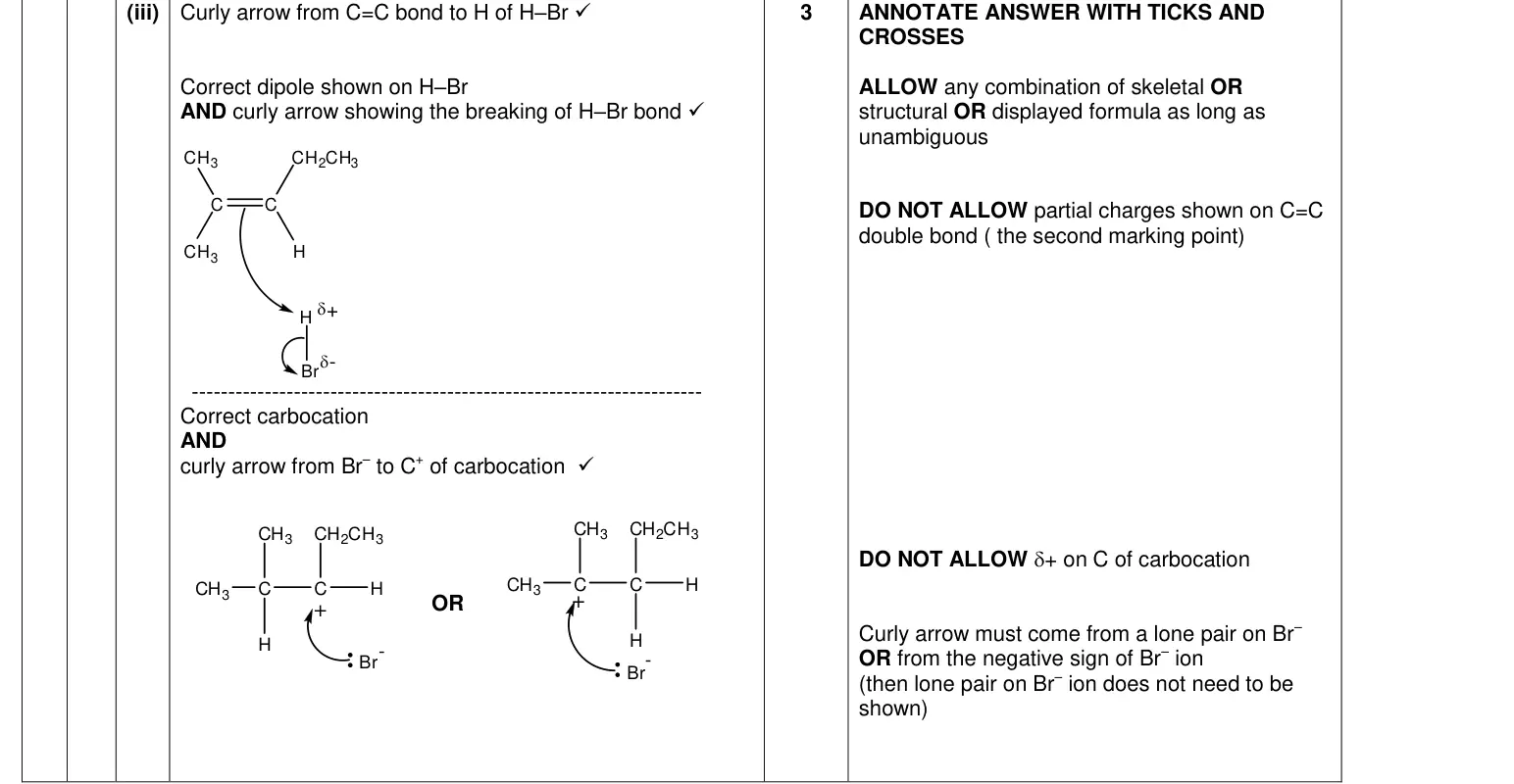
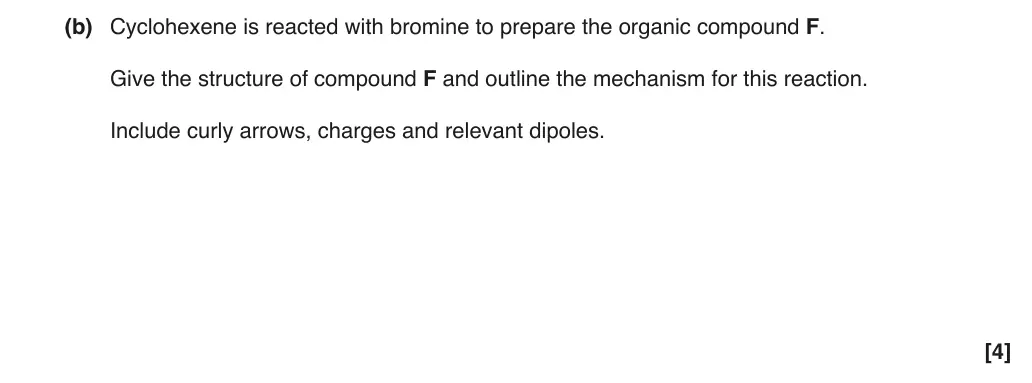
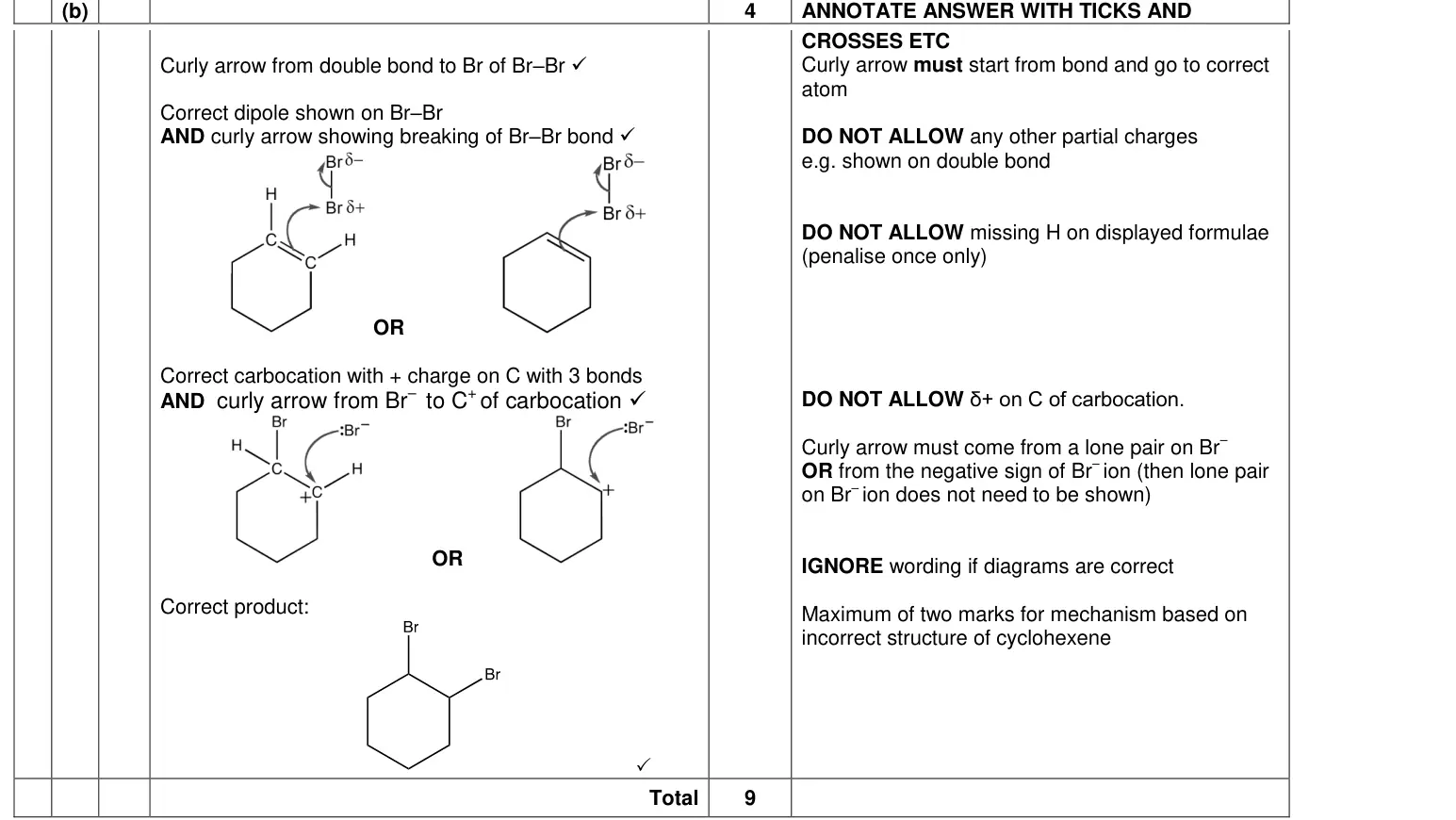
Alkene with HBr, Br₂ or H₂O/H⁺. Curly arrow from the C=C bond to the electrophile, dipole on H–Br, arrow from the H–Br bond to Br, the carbocation, then an arrow from the lone pair on Br⁻ to C⁺. The major product comes from the more stable carbocation.
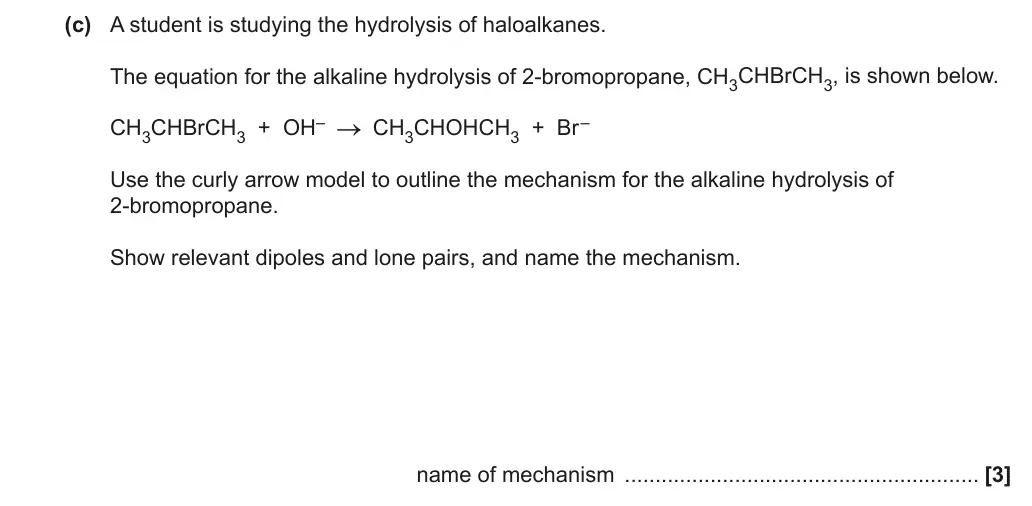
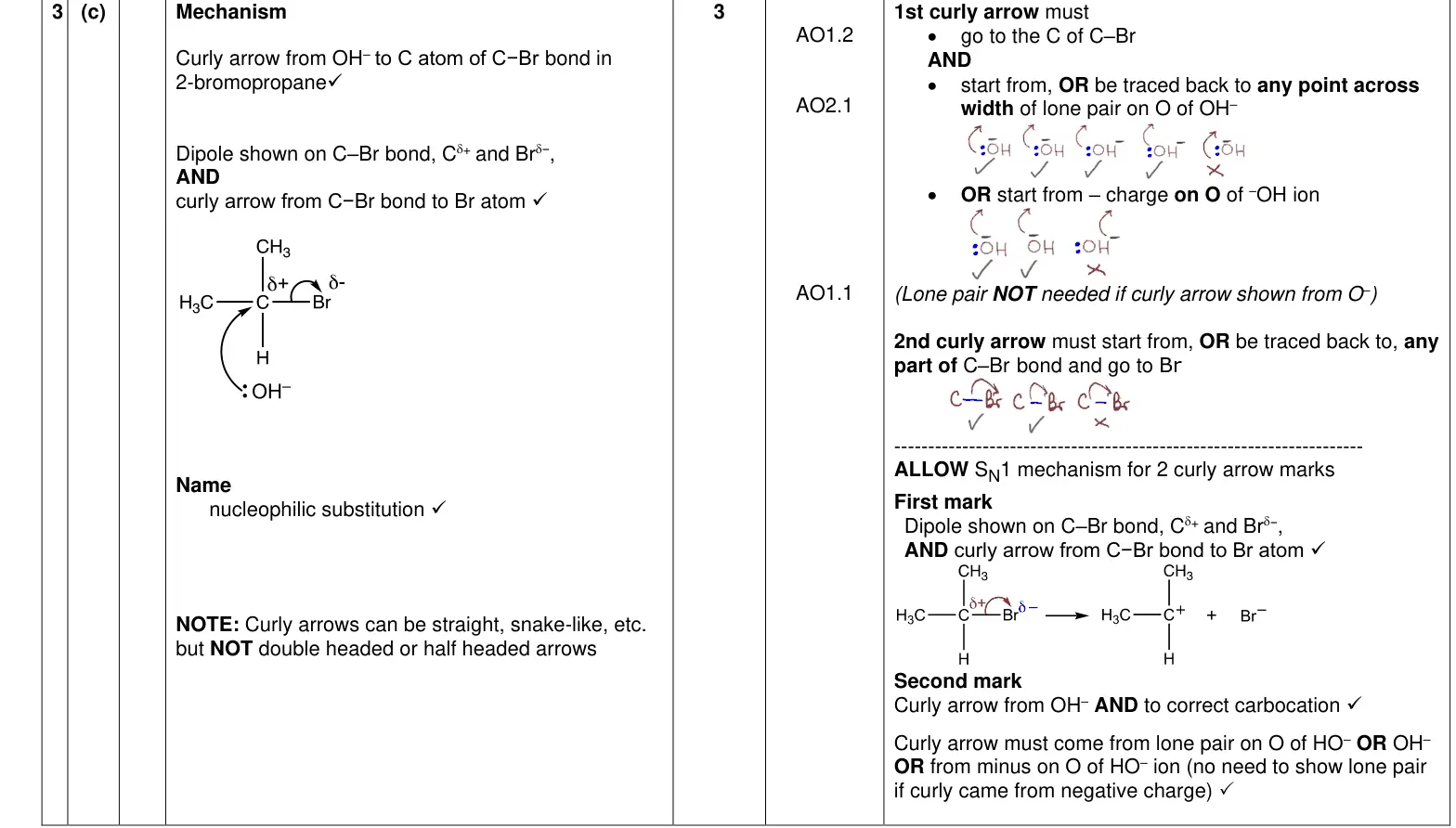
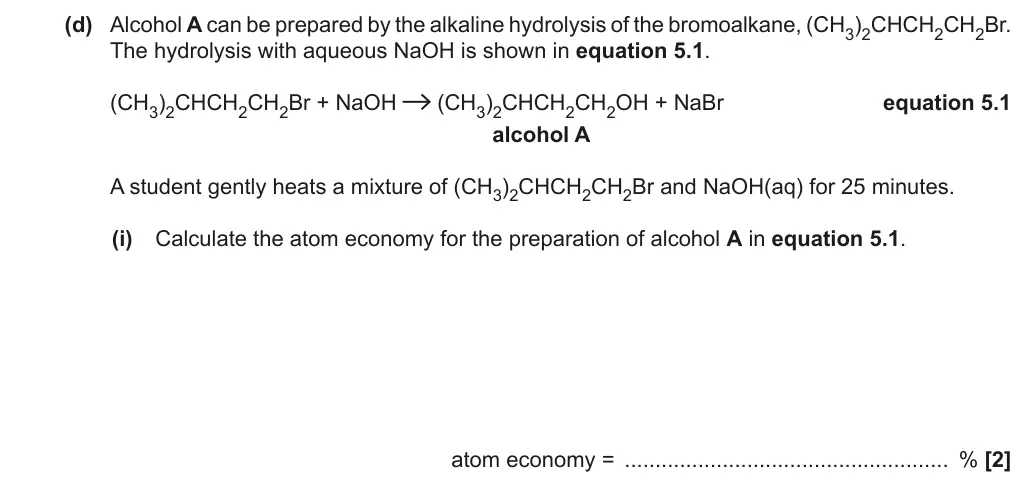
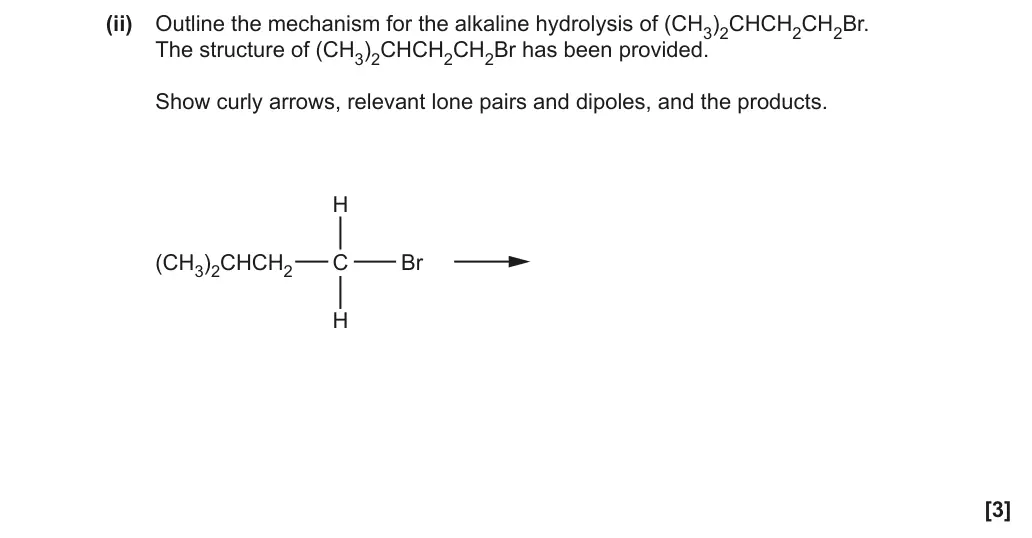
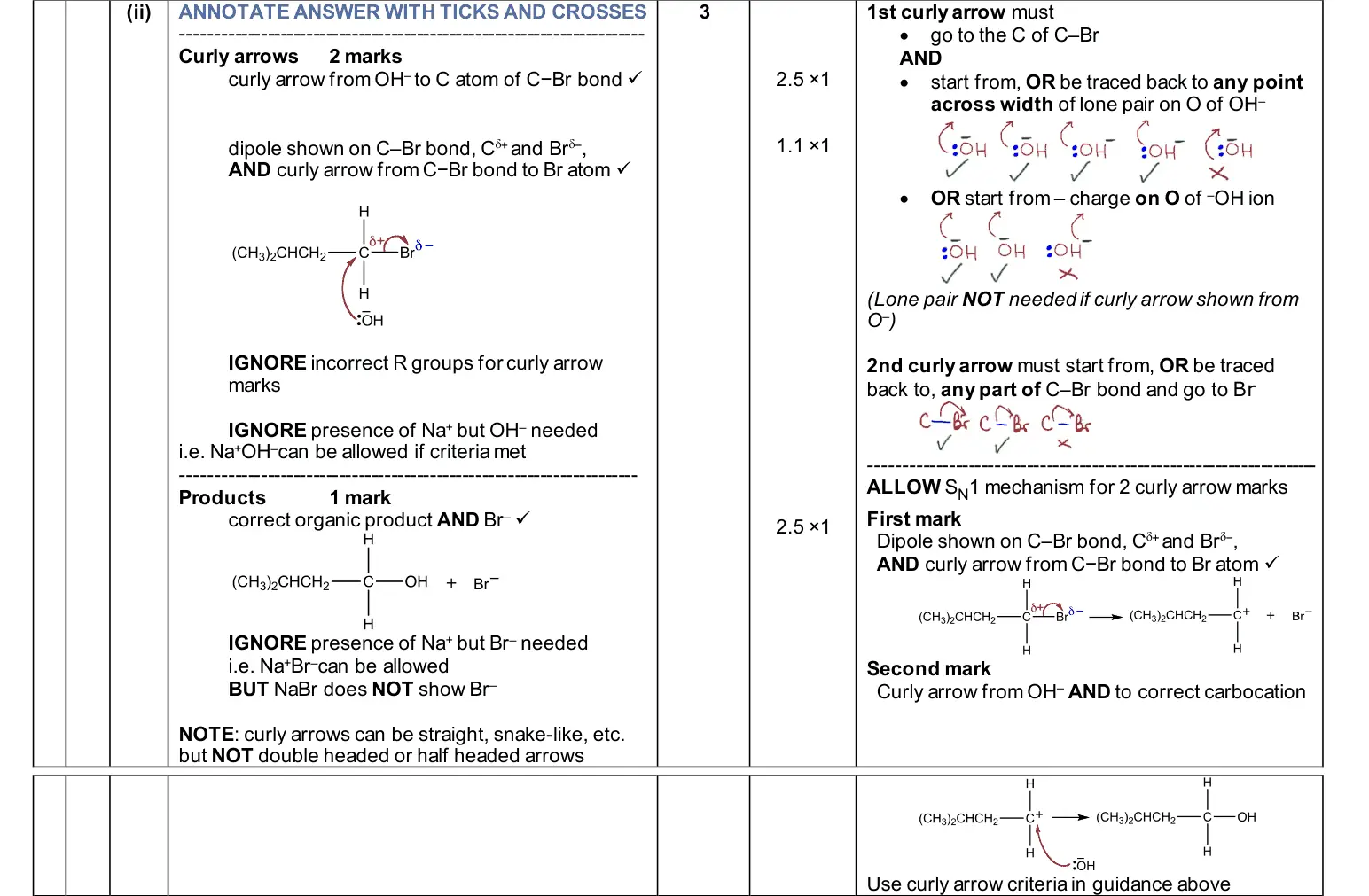
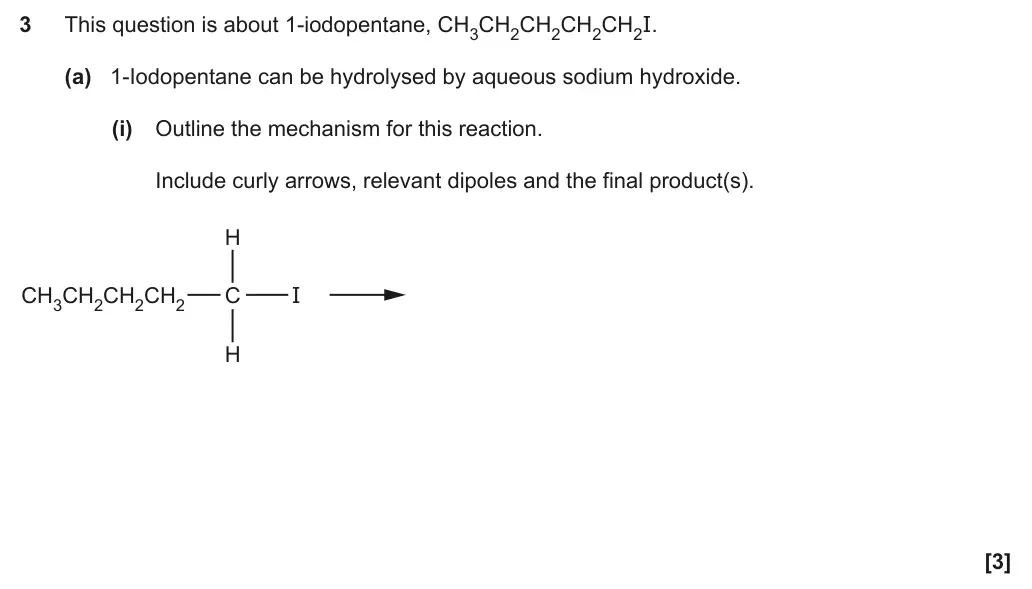
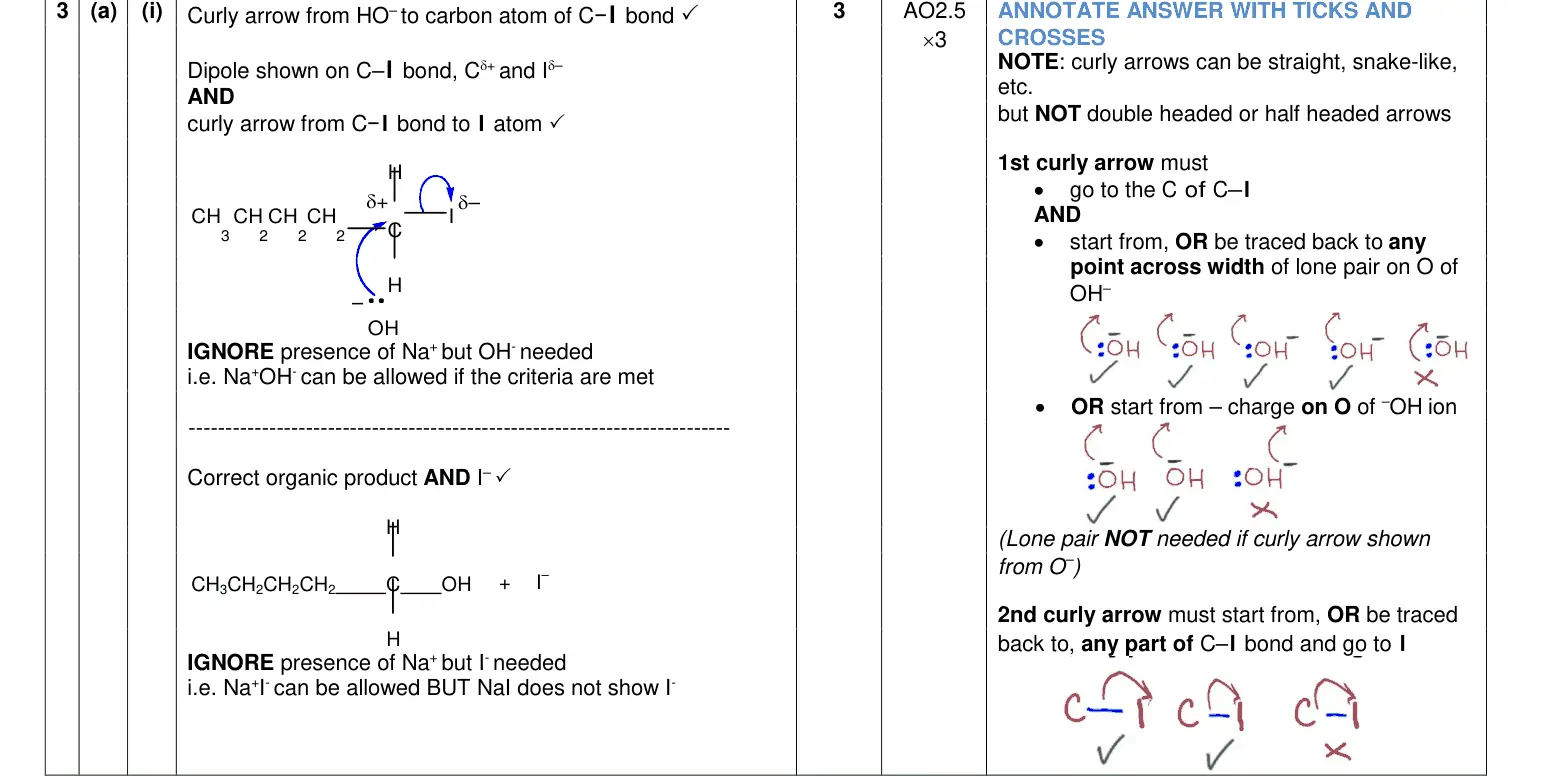
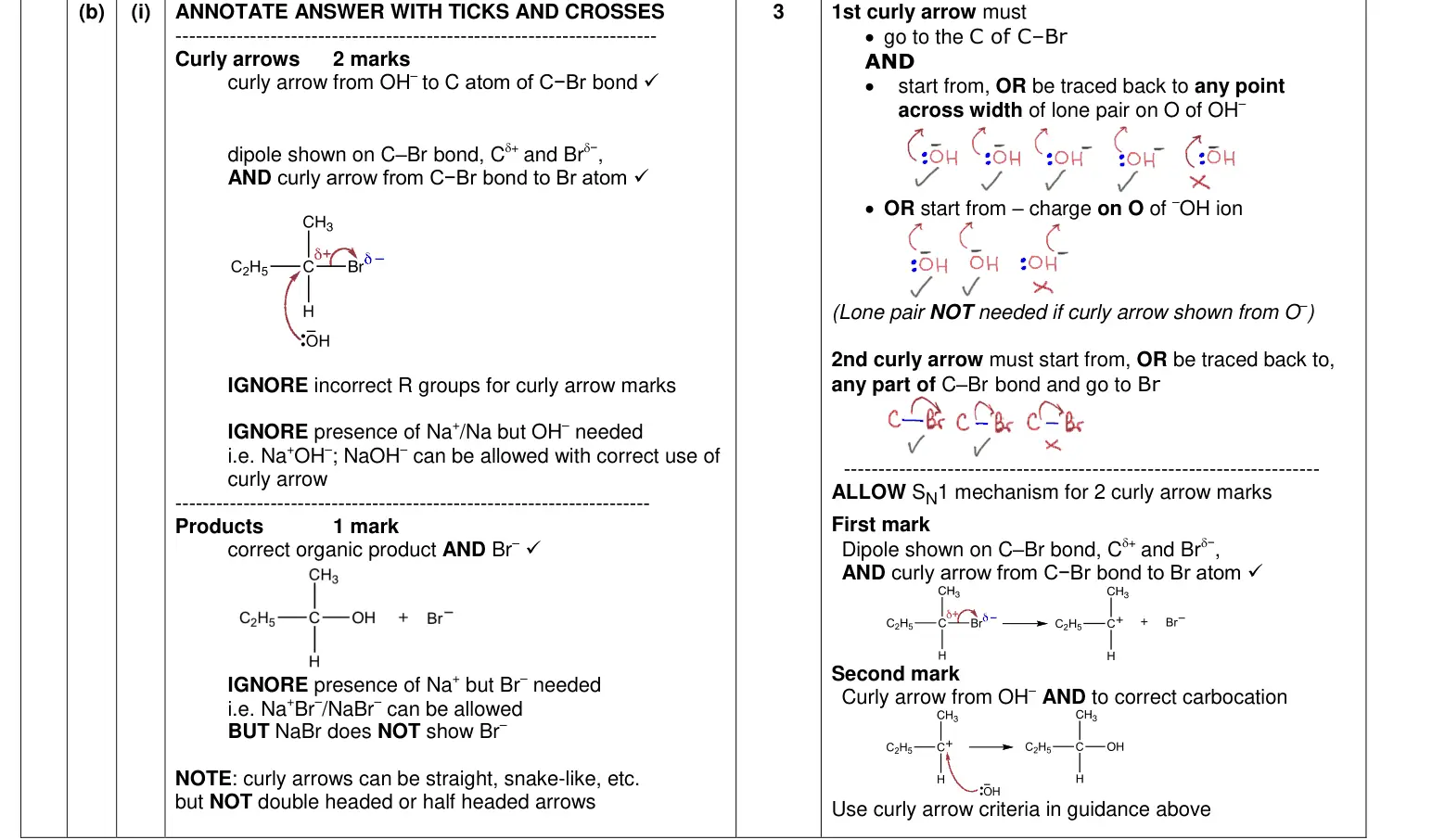
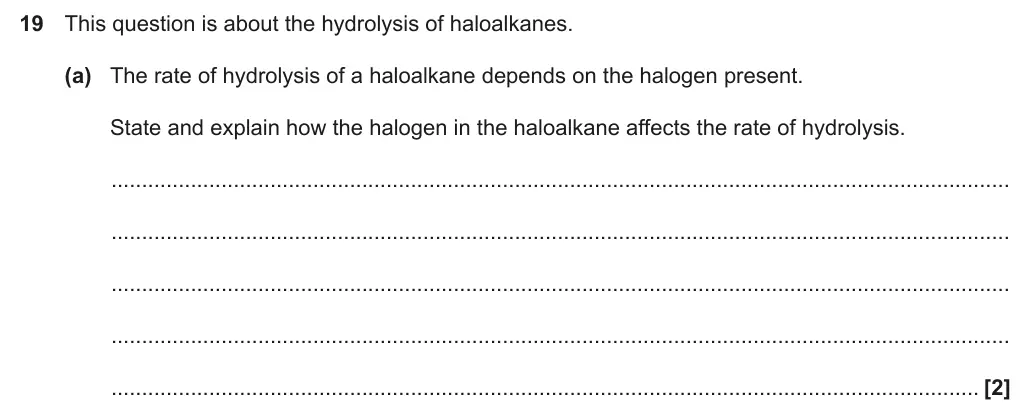
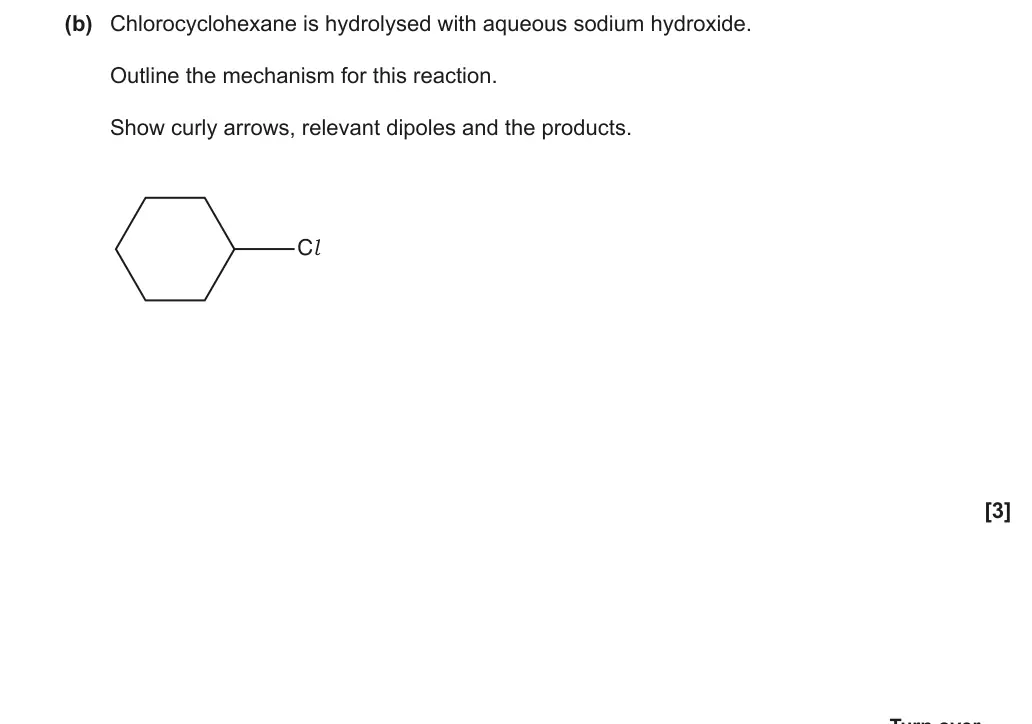
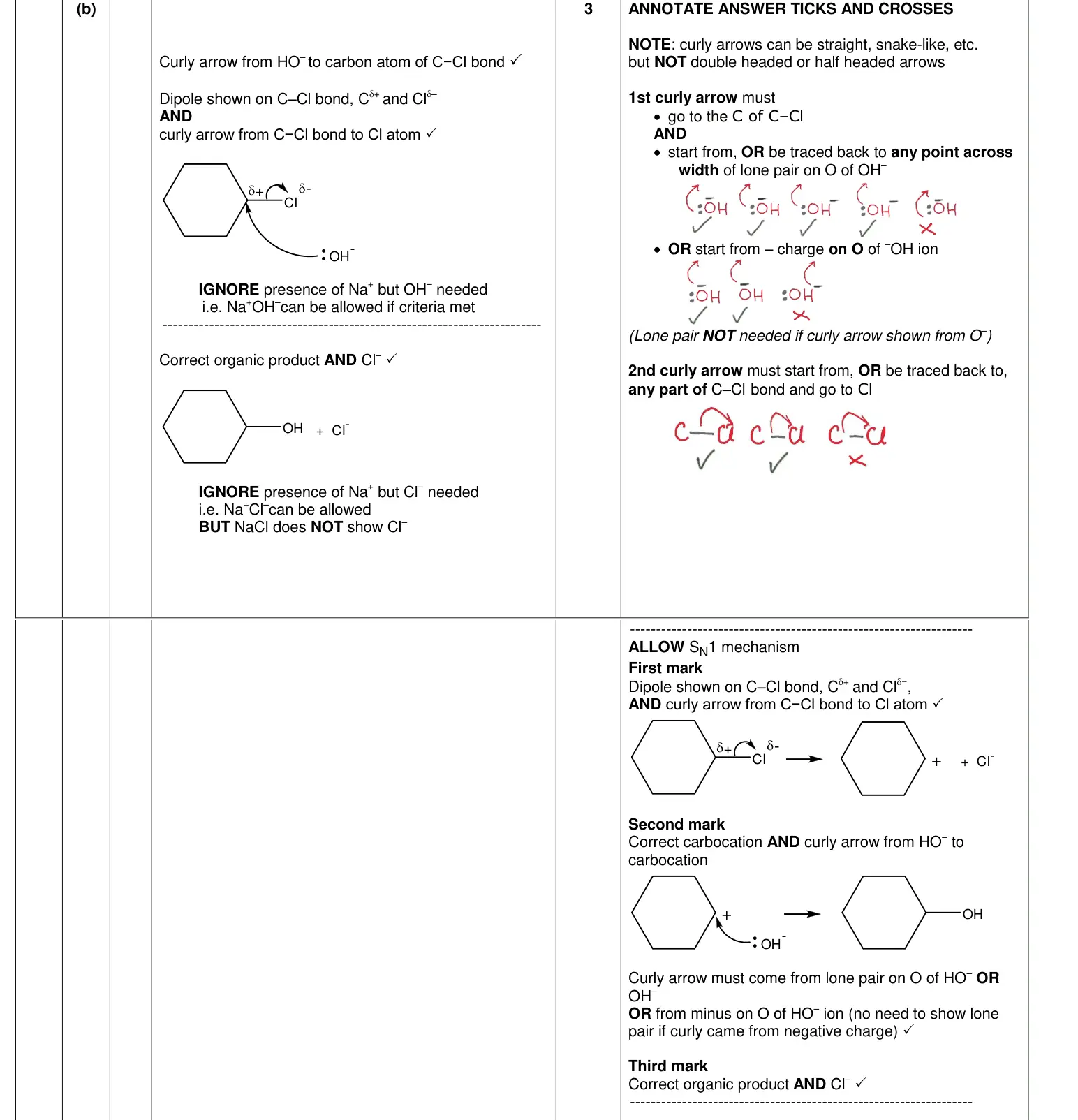
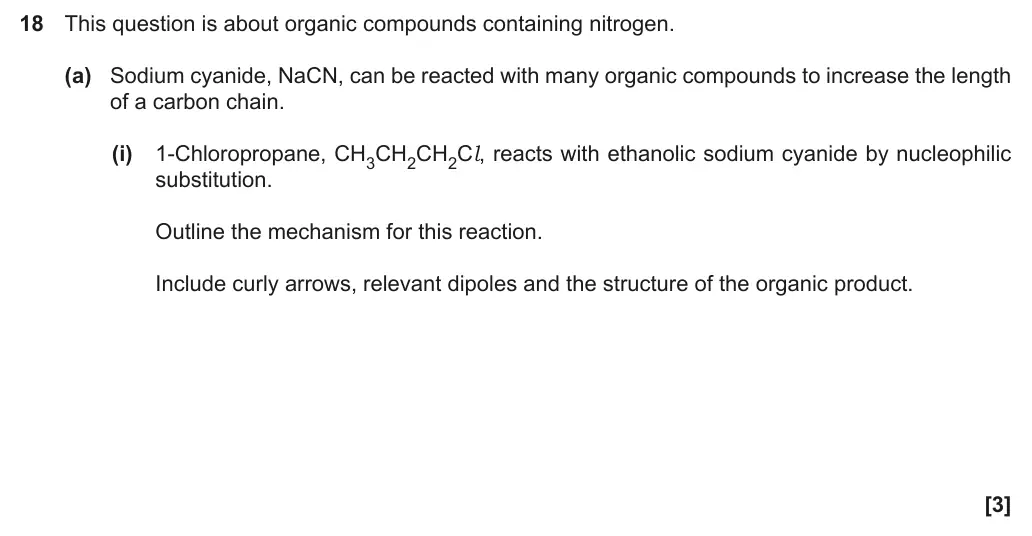
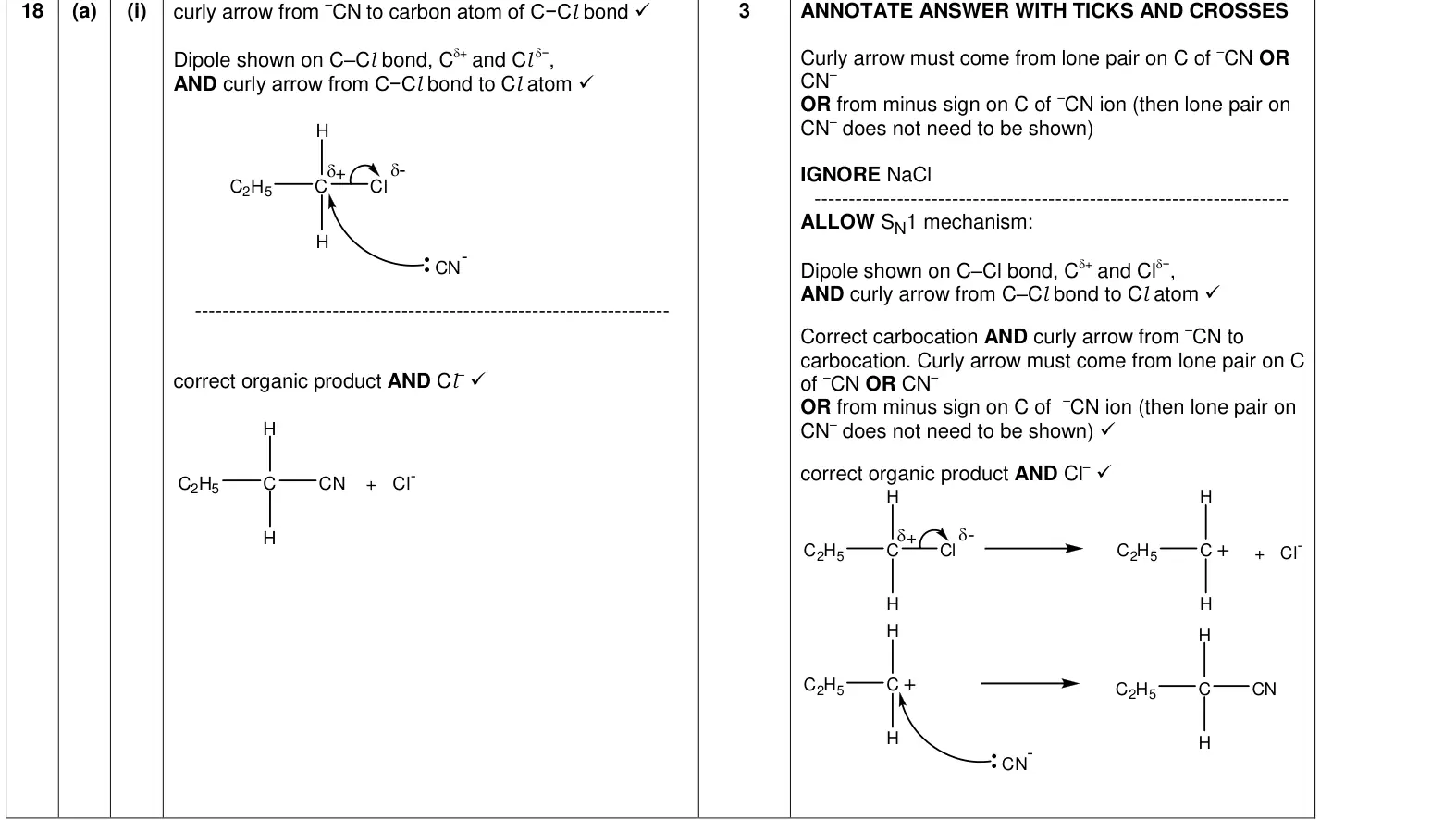
Primary haloalkane with OH⁻ (hydrolysis). Arrow from the lone pair on the nucleophile to the δ+ carbon, dipole on C–X, arrow from the C–X bond to the halogen. Rate depends on carbon–halogen bond enthalpy: C–I fastest.
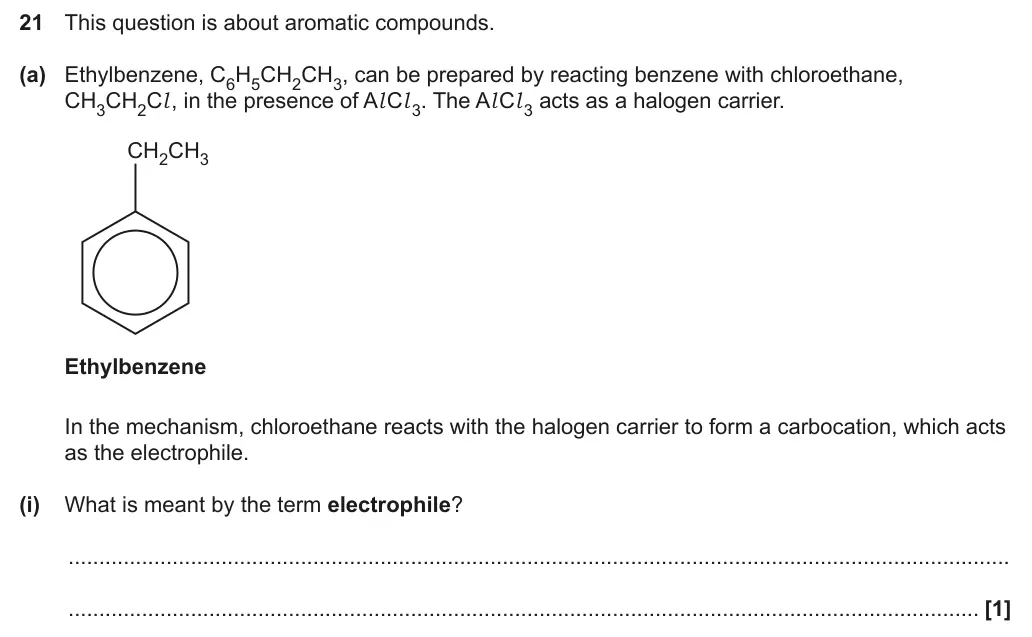
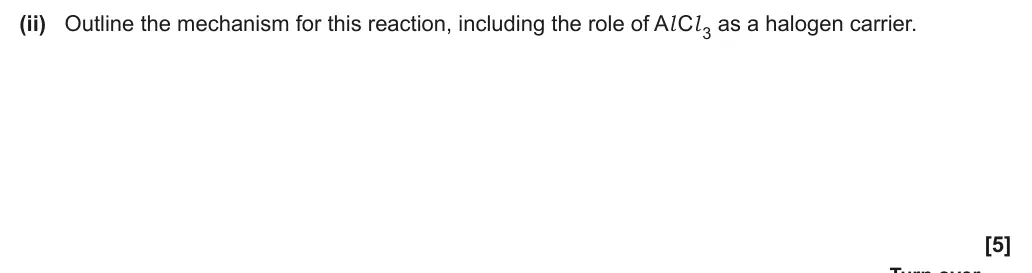
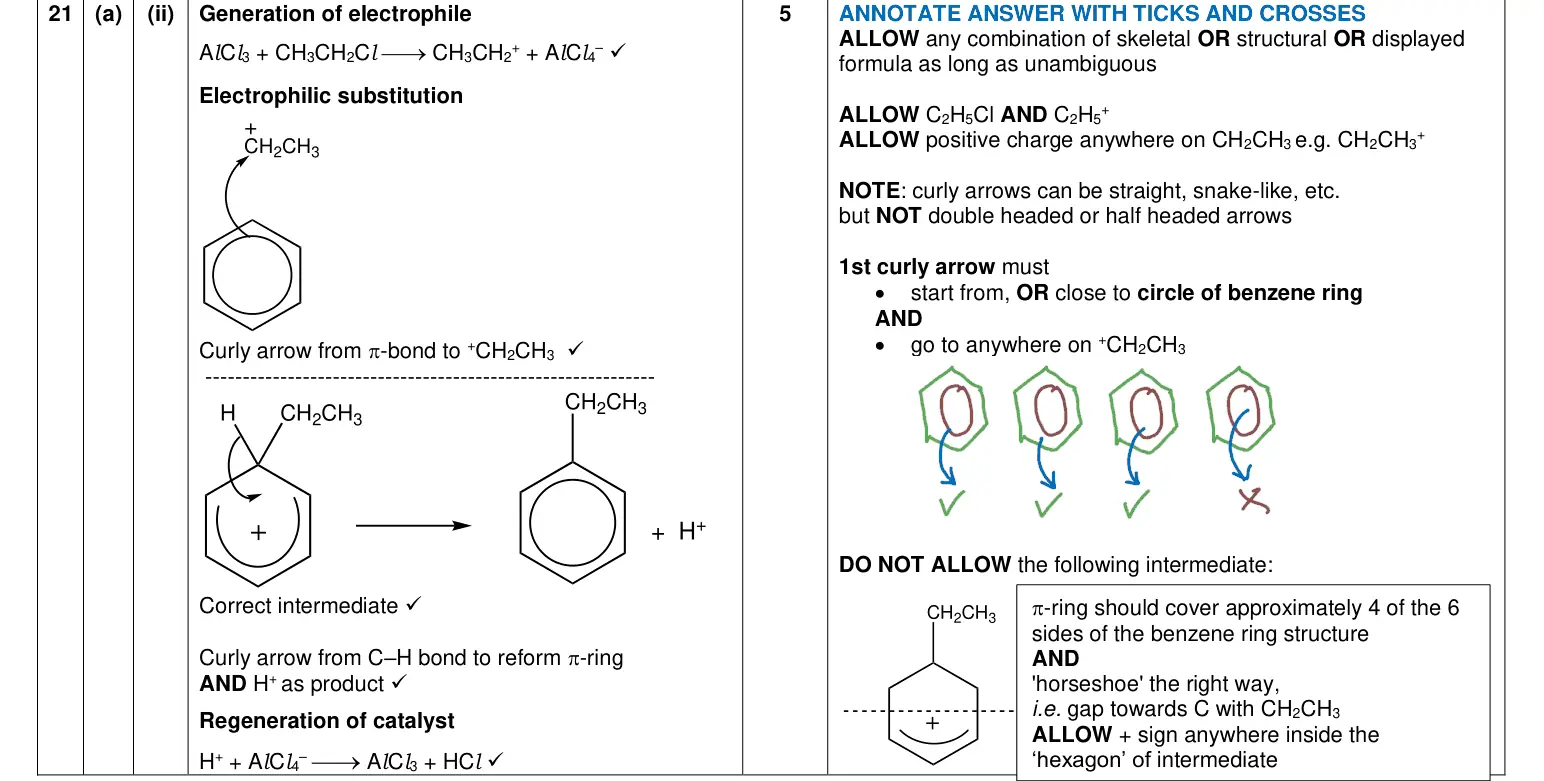
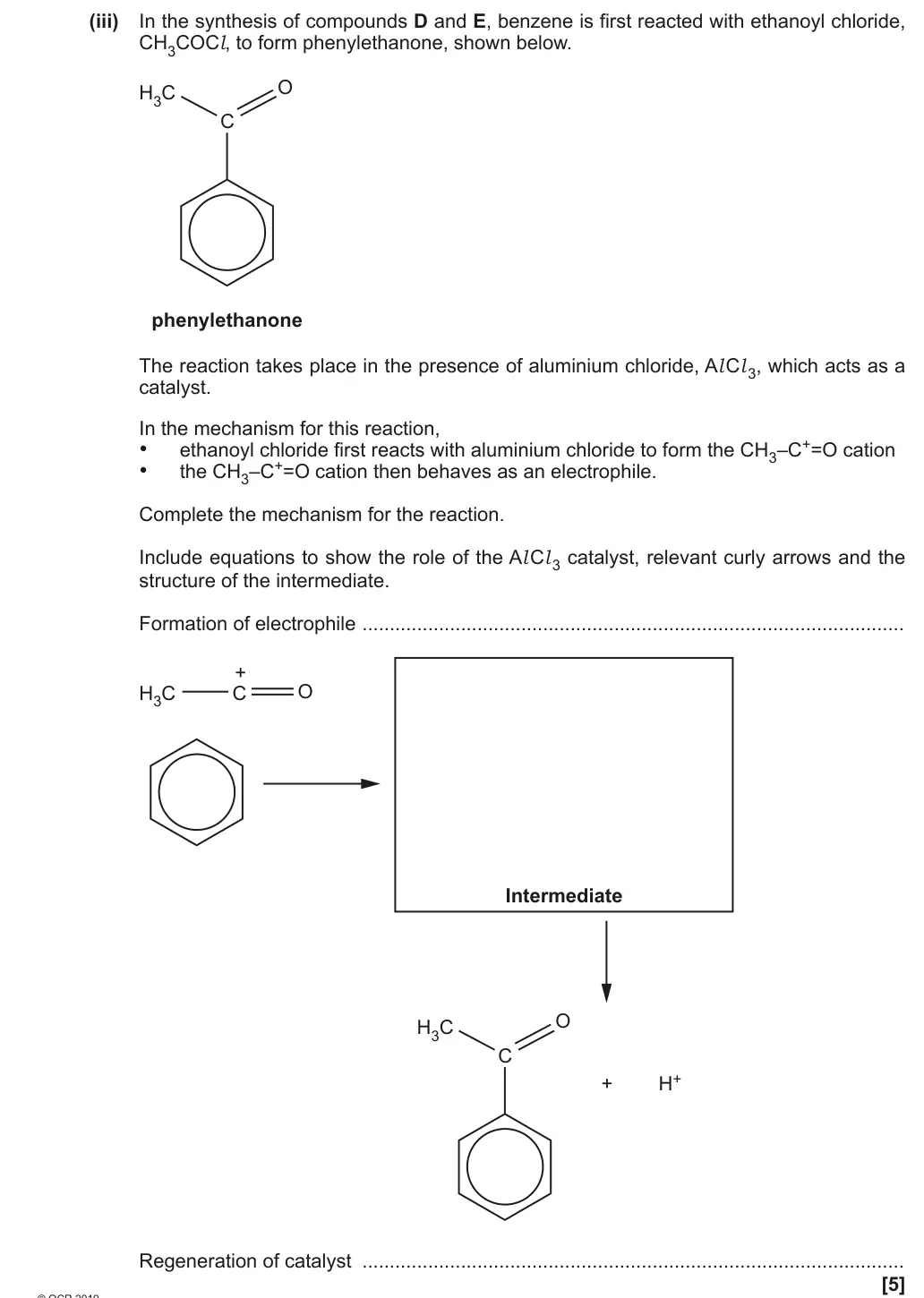
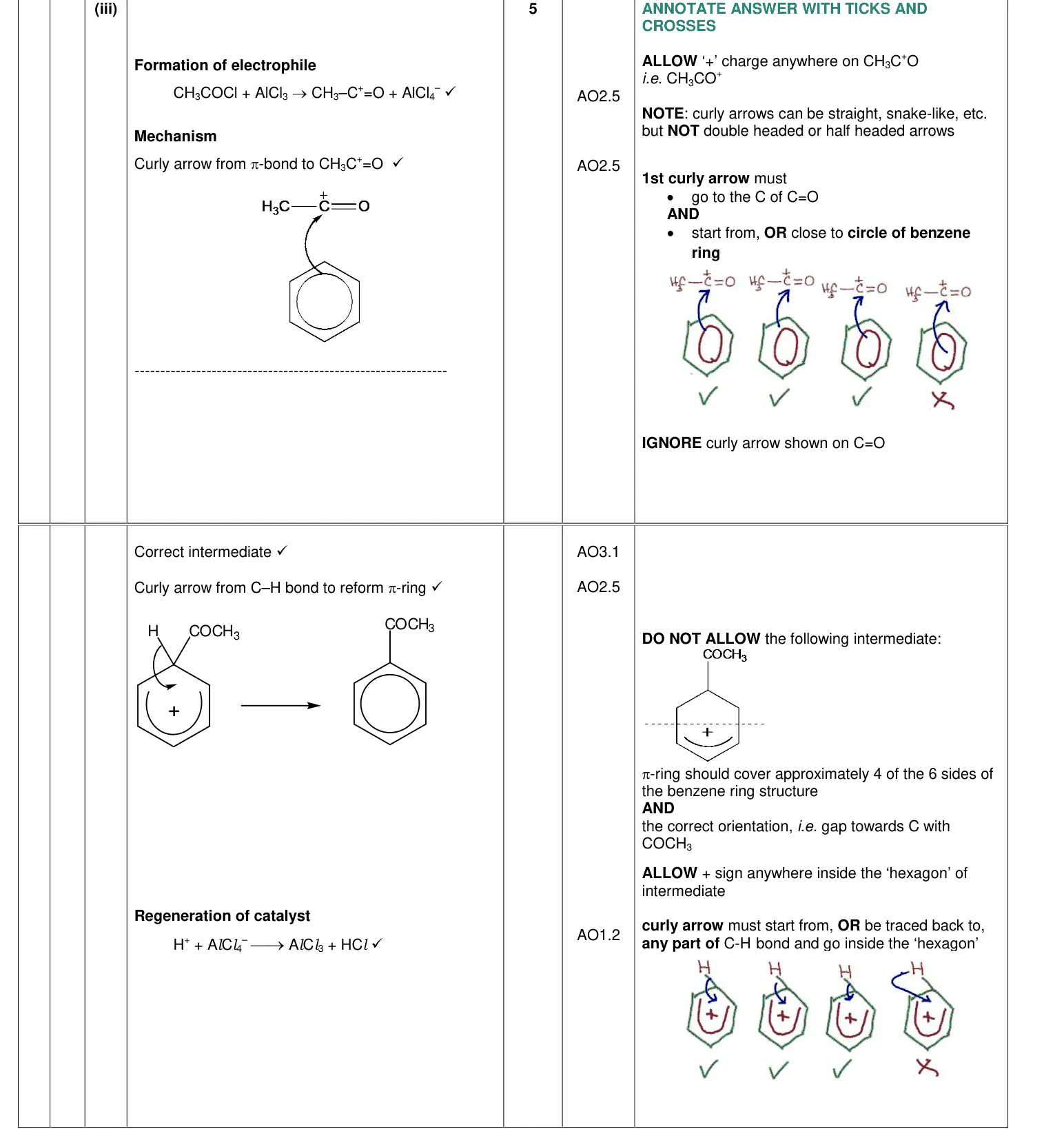
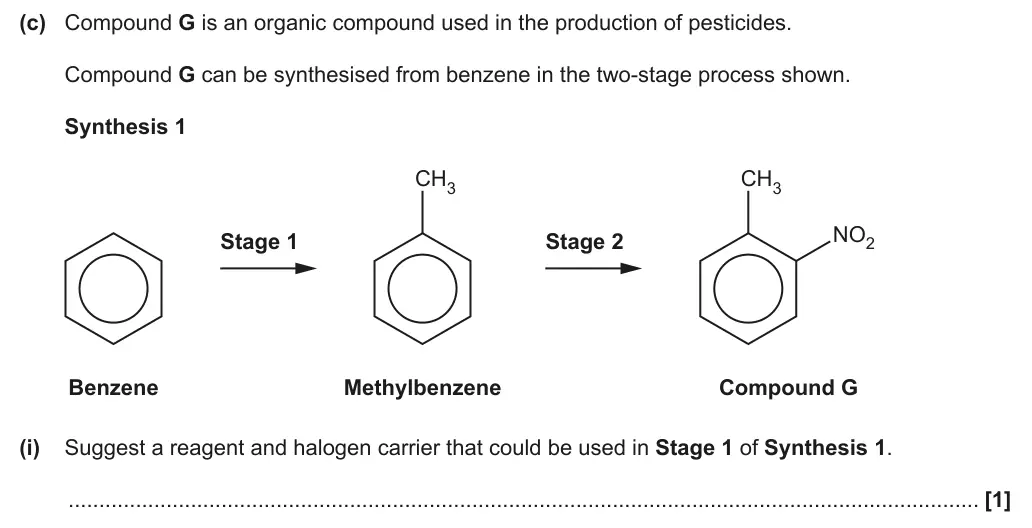
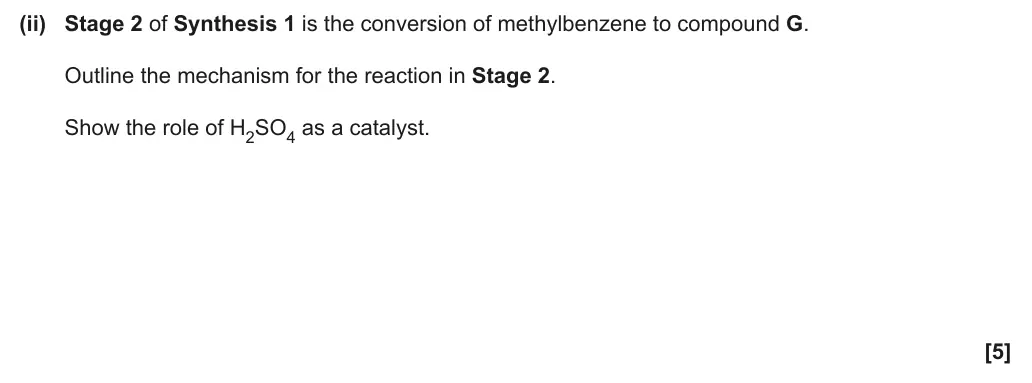
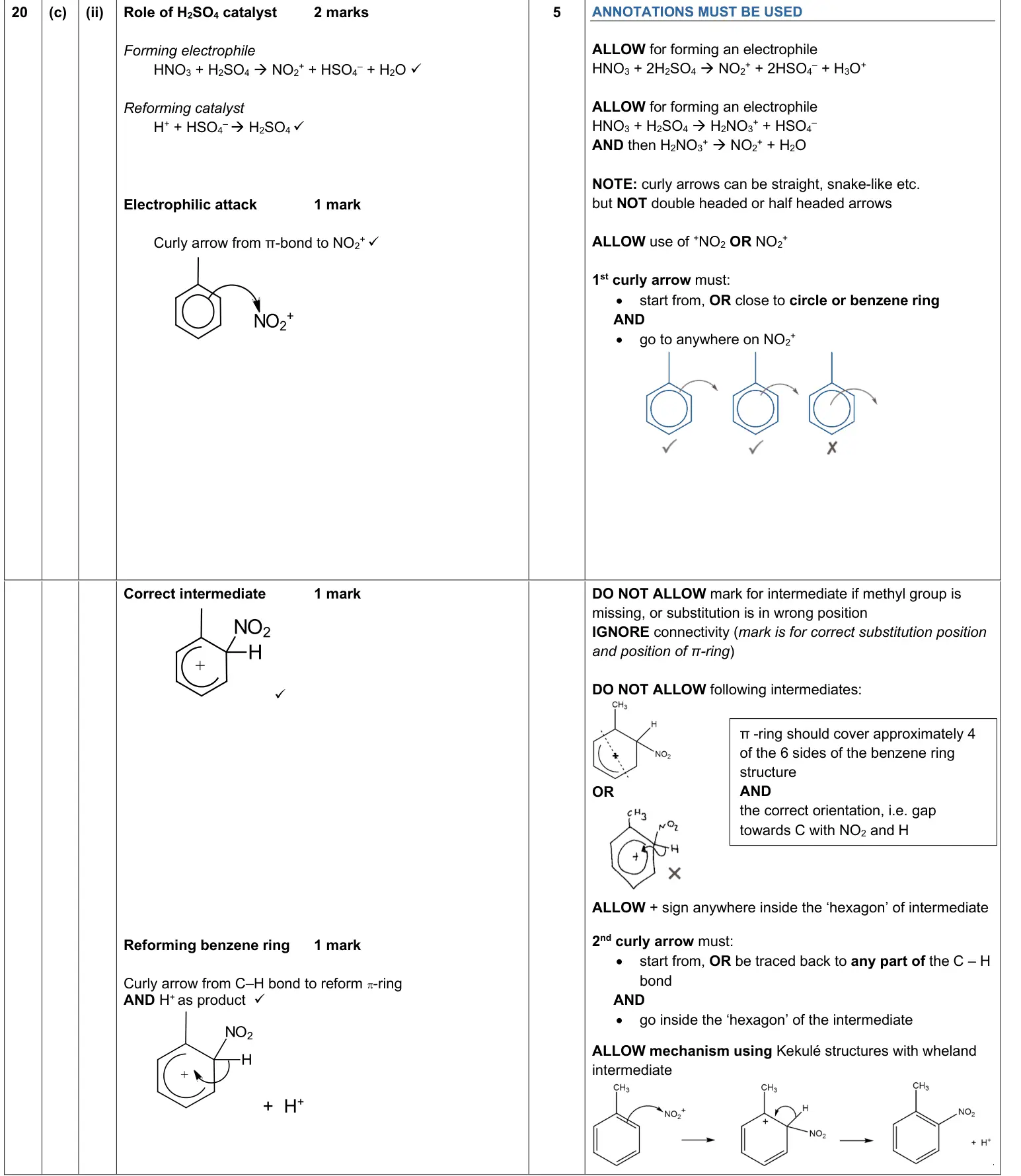
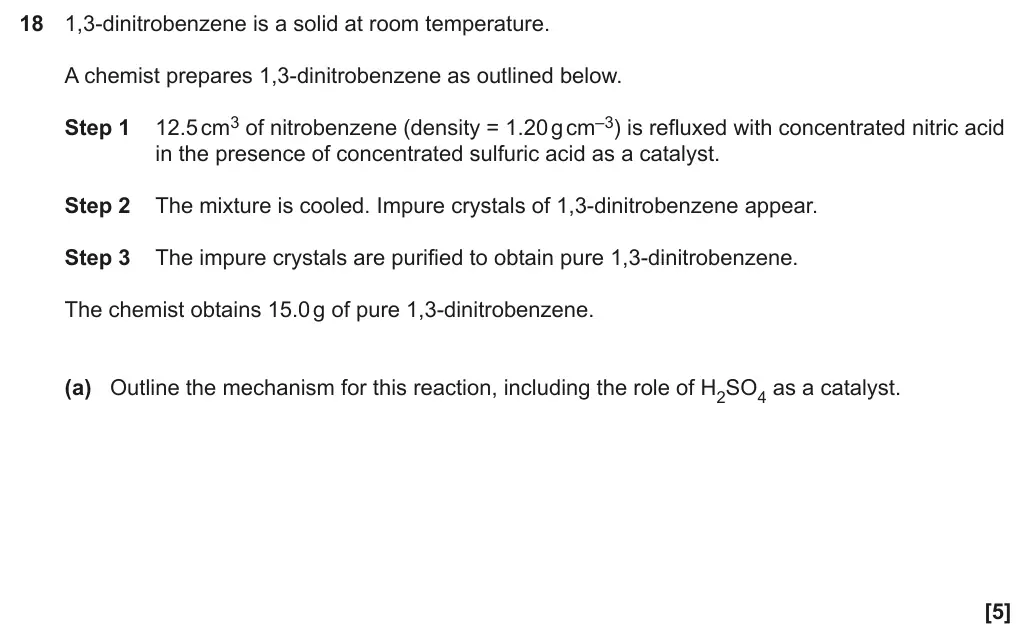
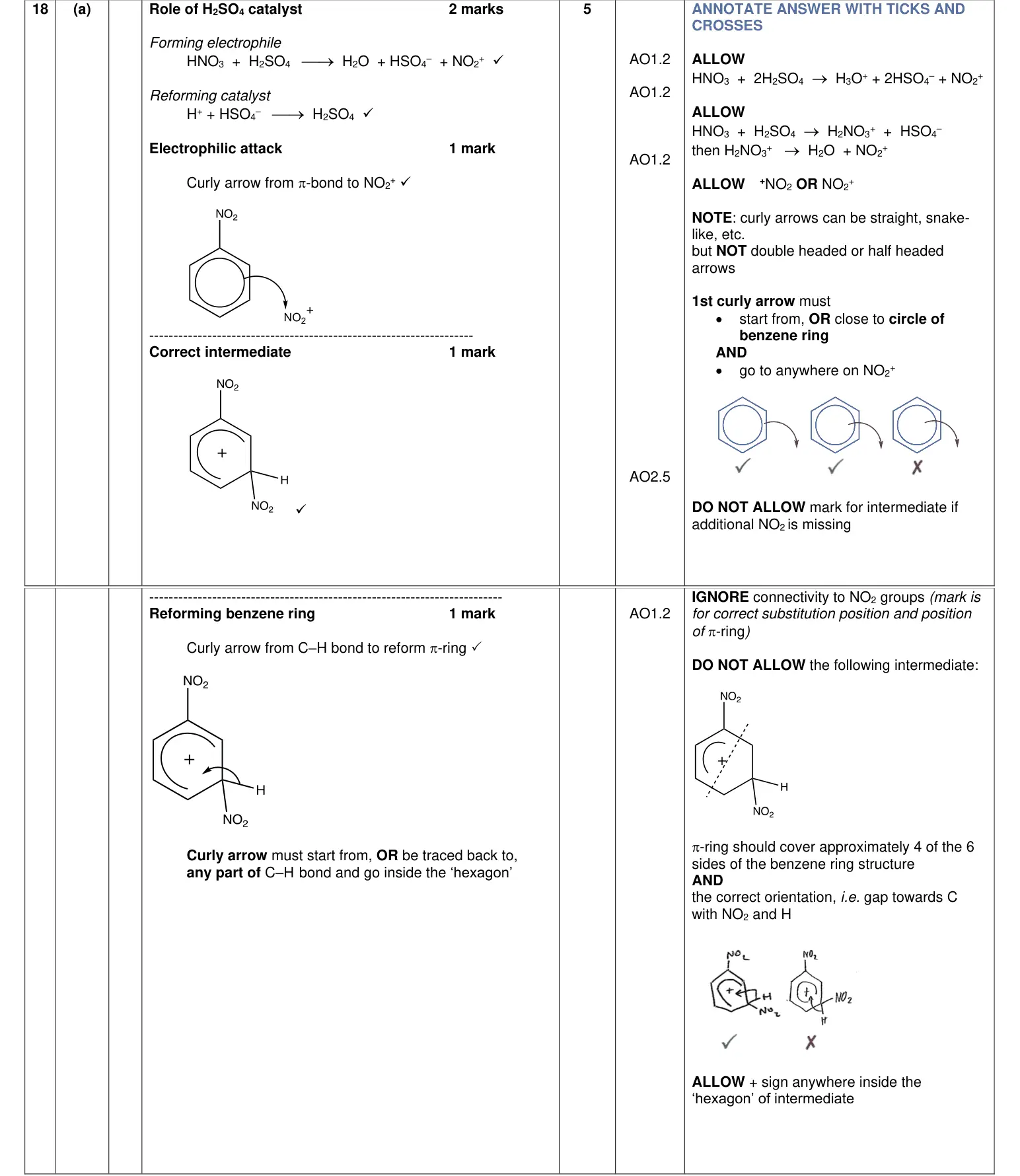
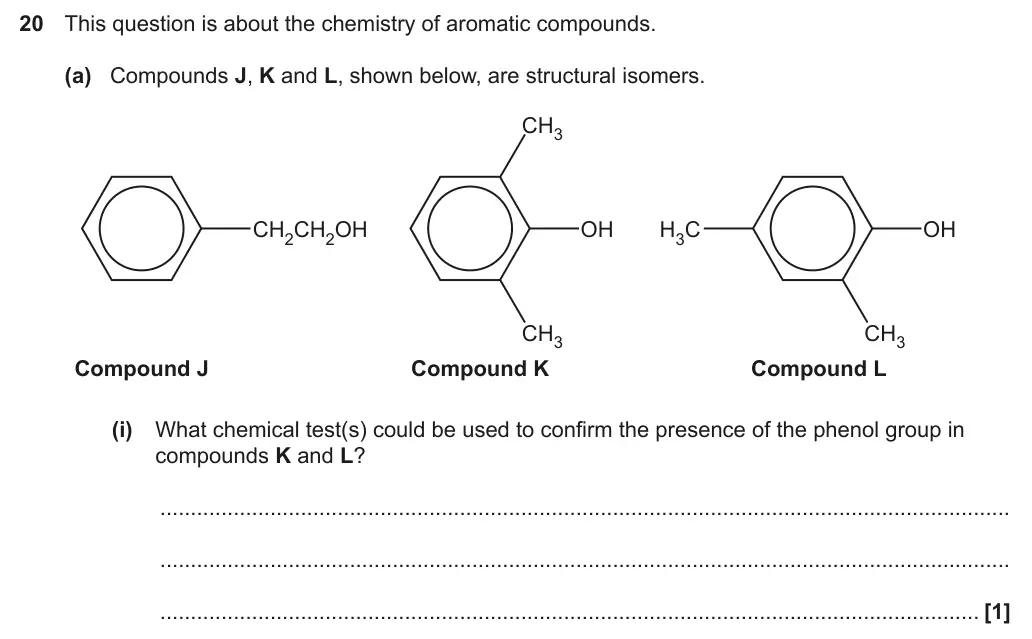
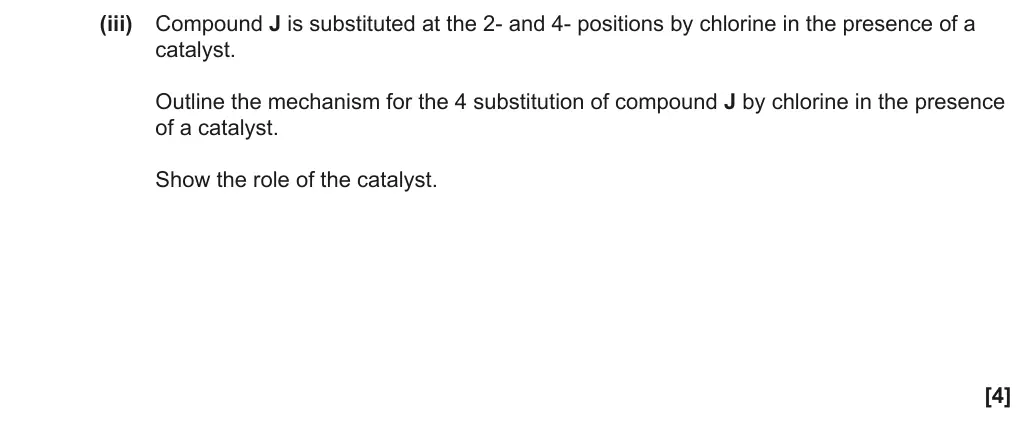
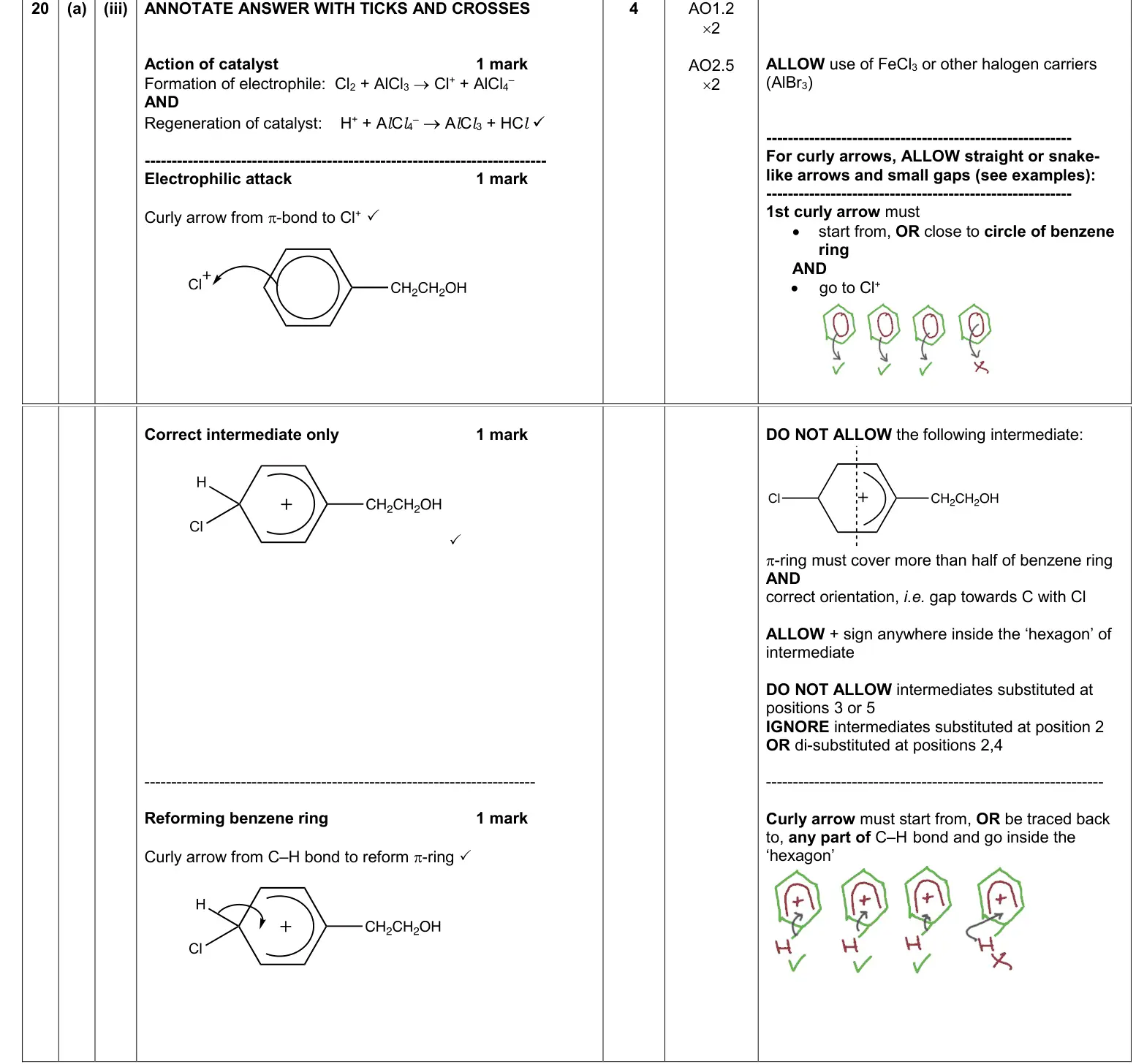
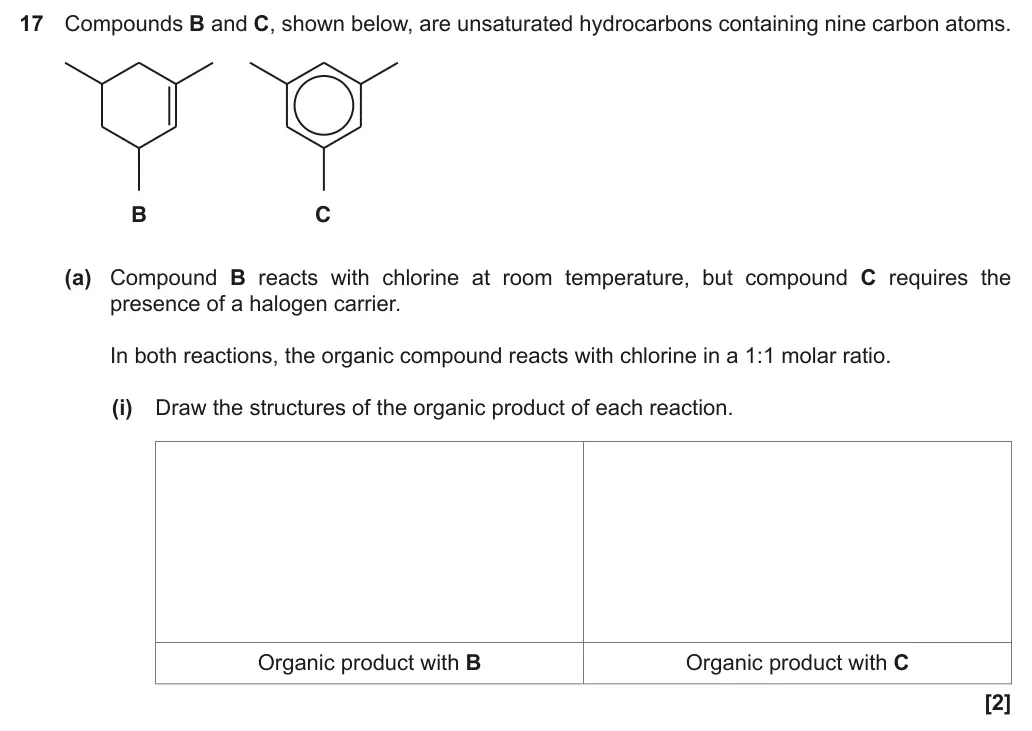
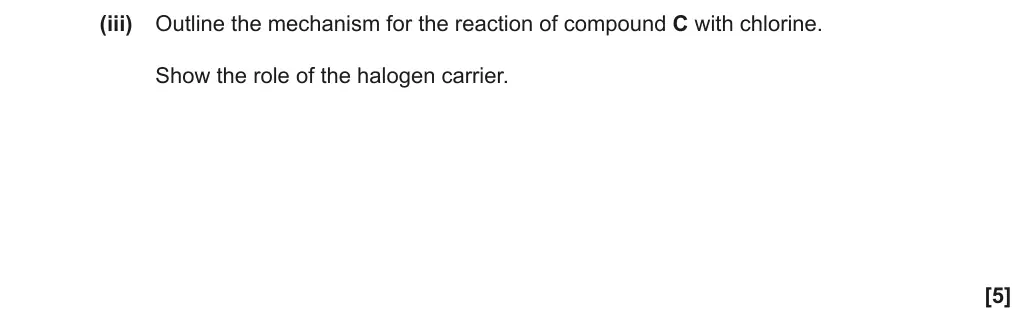
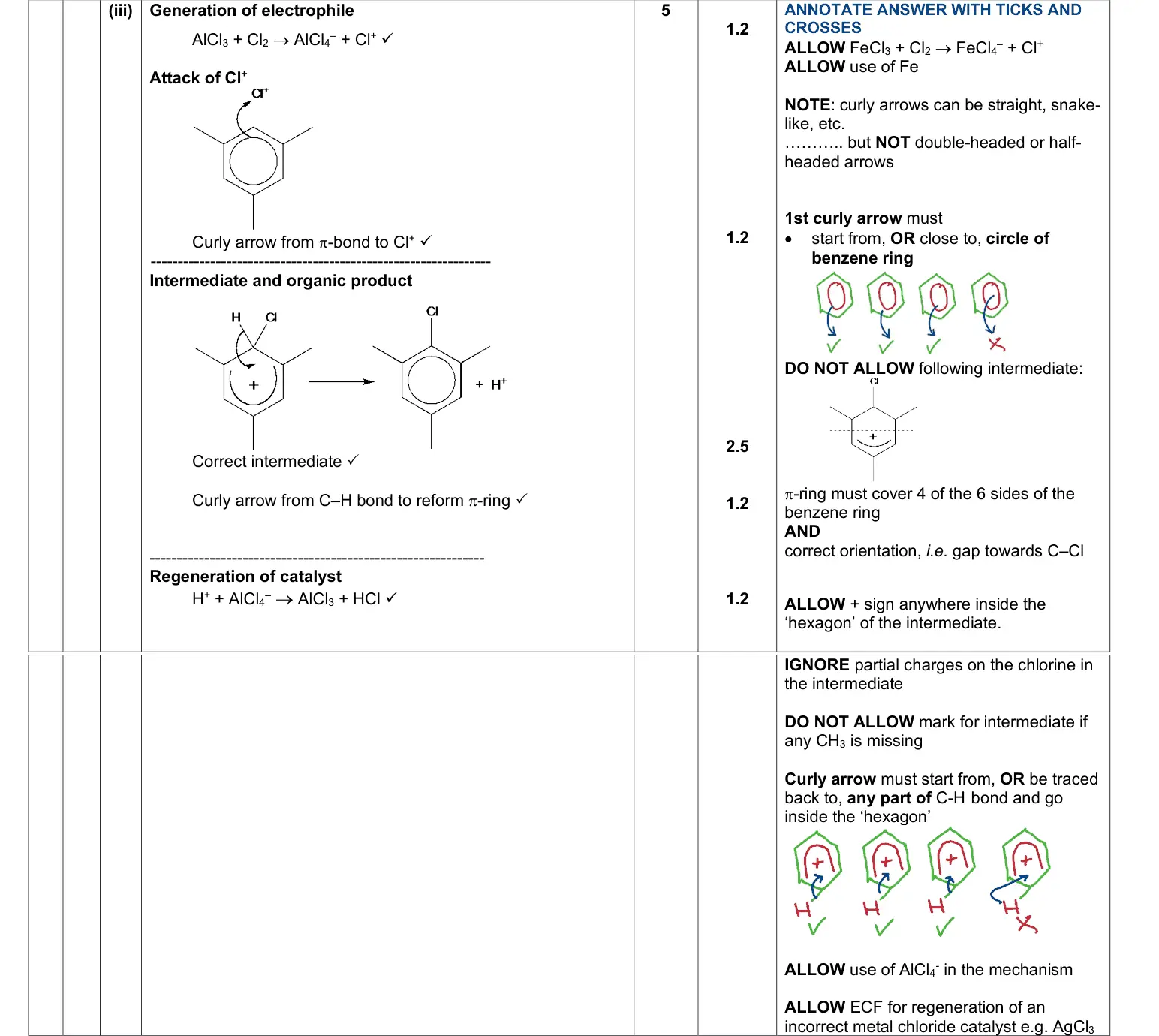
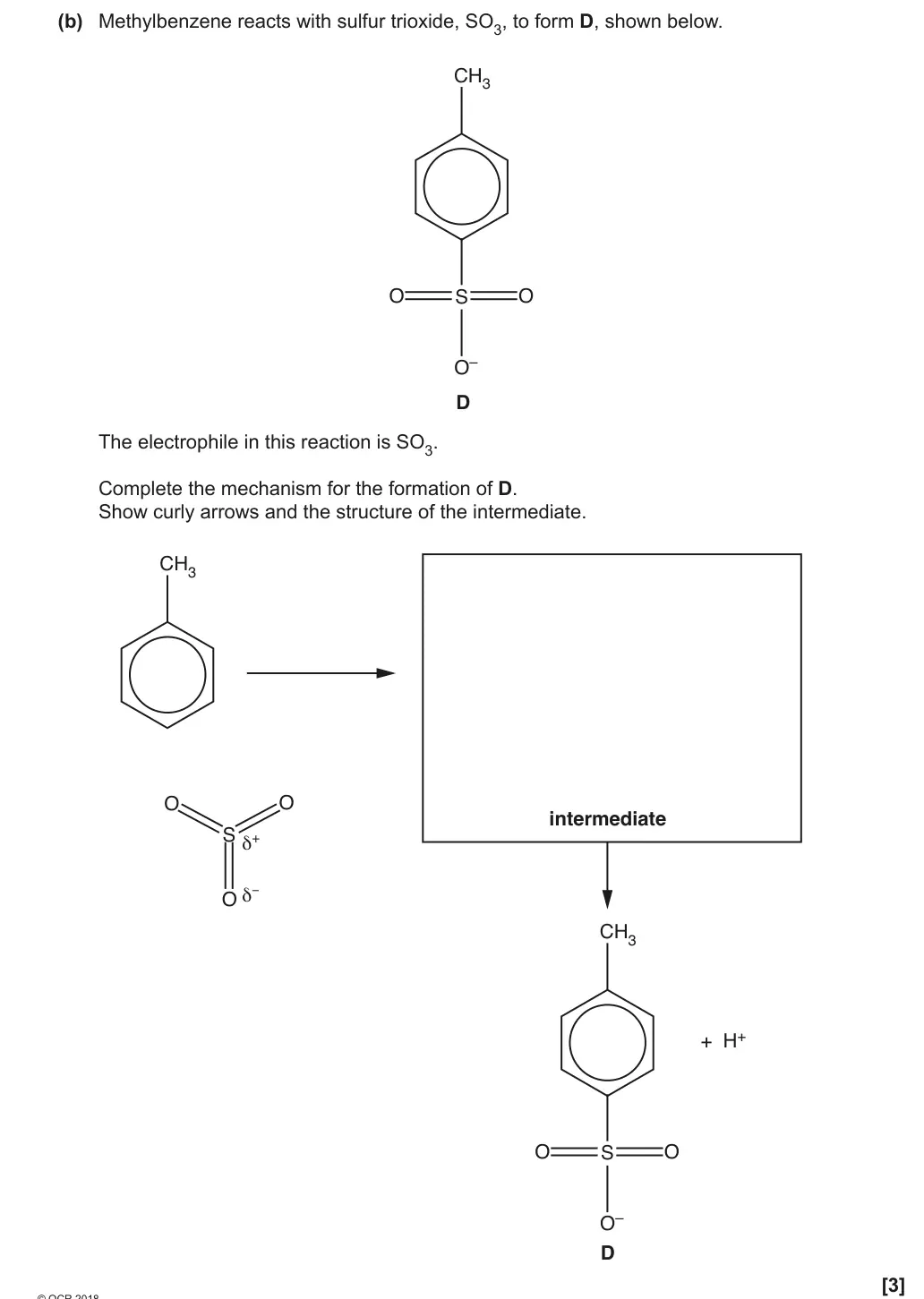
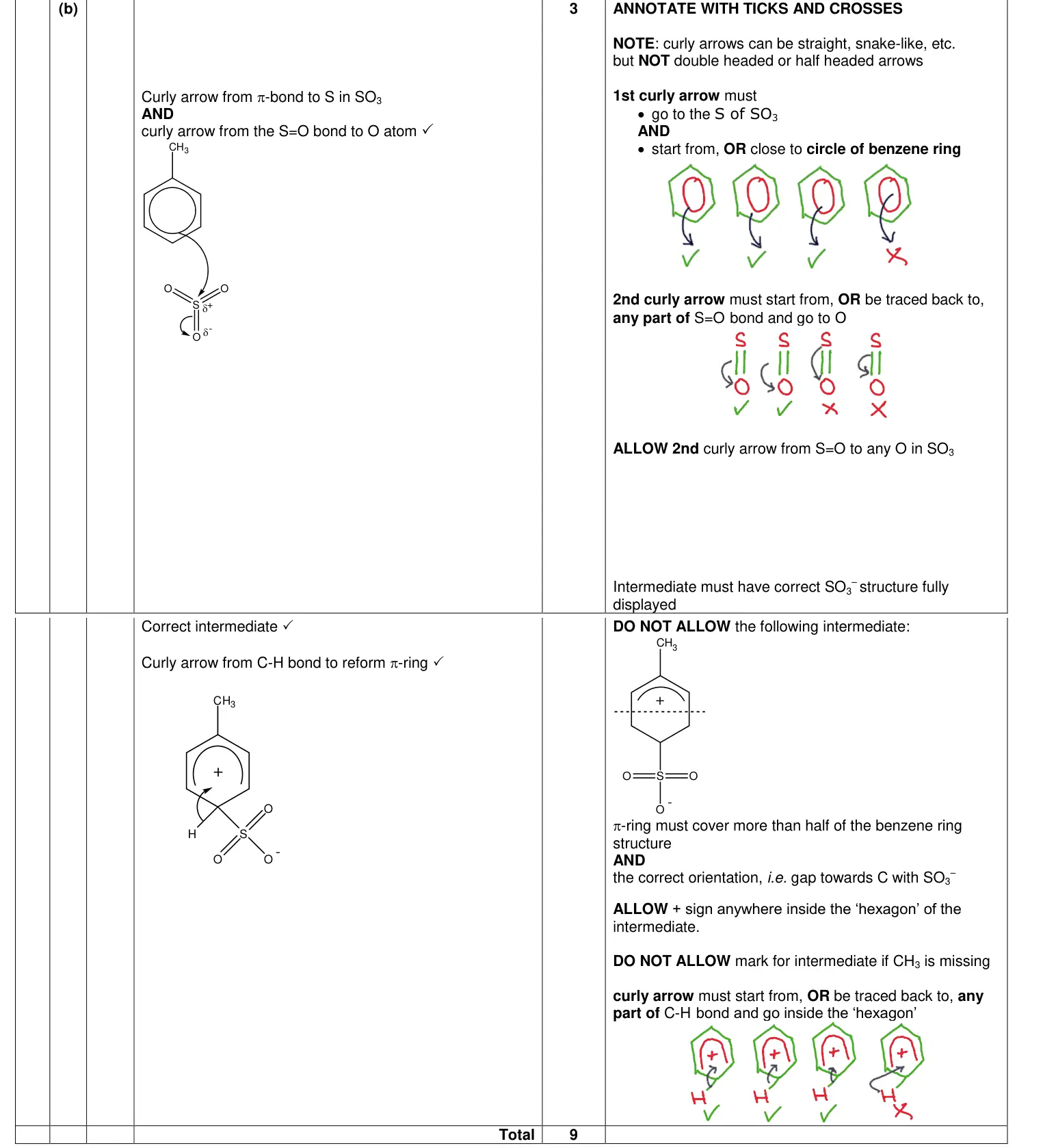
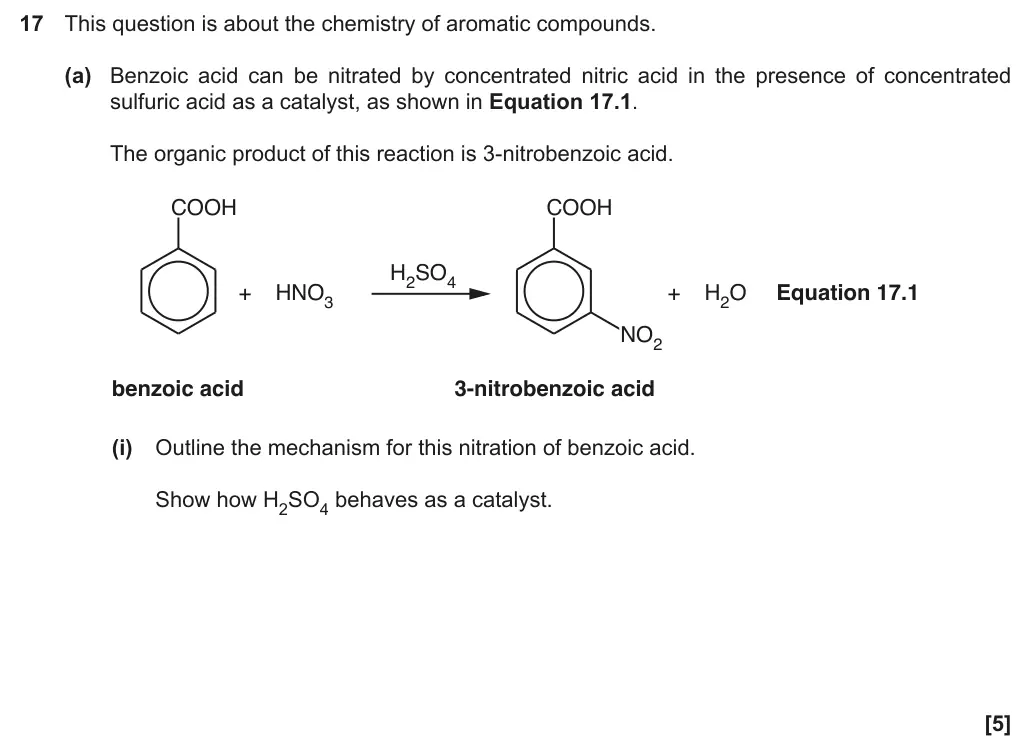
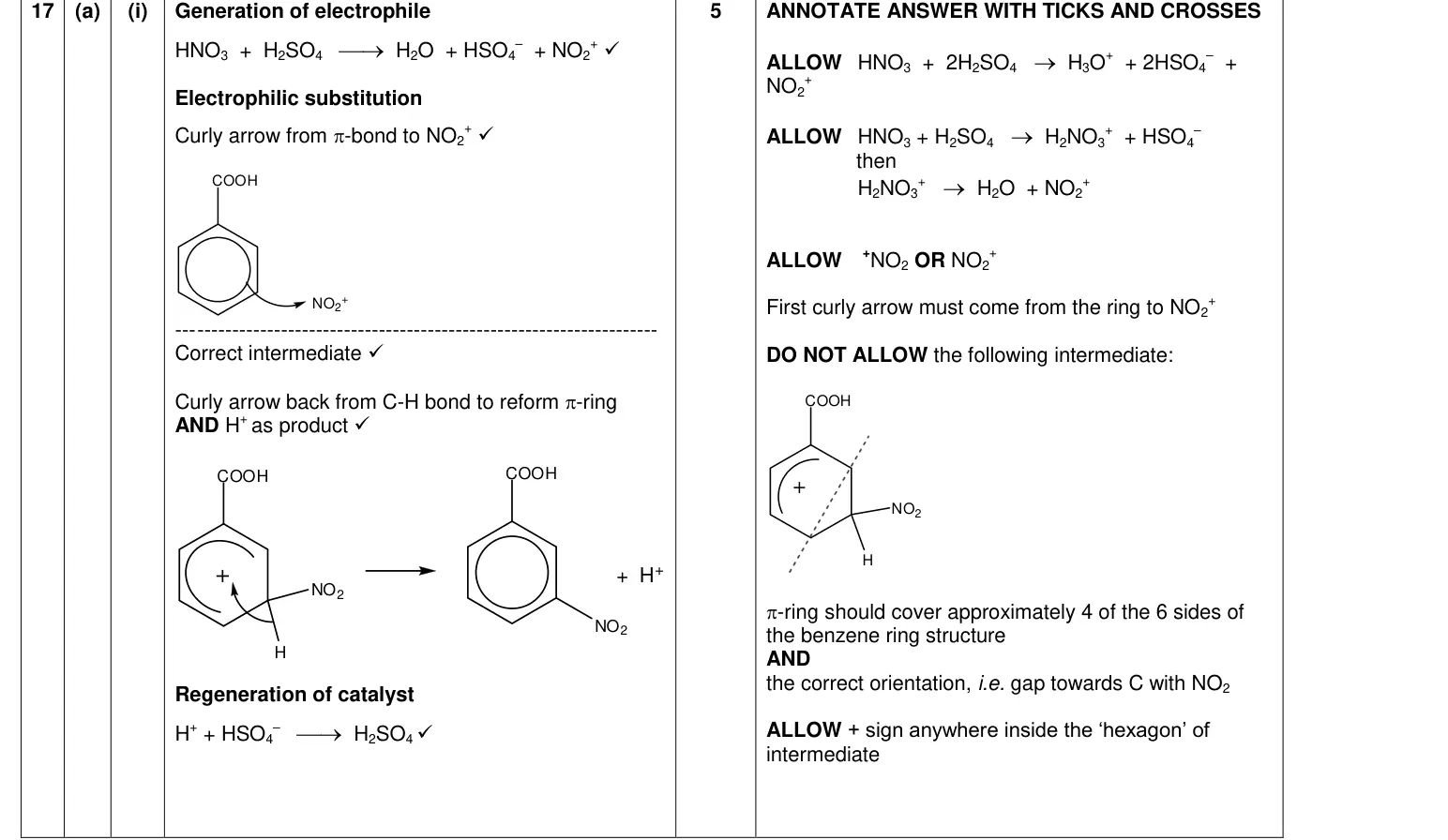
Benzene: nitration (NO₂⁺ from concentrated HNO₃ and H₂SO₄), halogenation with a halogen carrier, and Friedel–Crafts alkylation and acylation. Arrow from the ring to the electrophile, the intermediate with the broken ring (horseshoe over the right carbons, + charge), then loss of H⁺. Include the equations that make the electrophile and regenerate the catalyst.
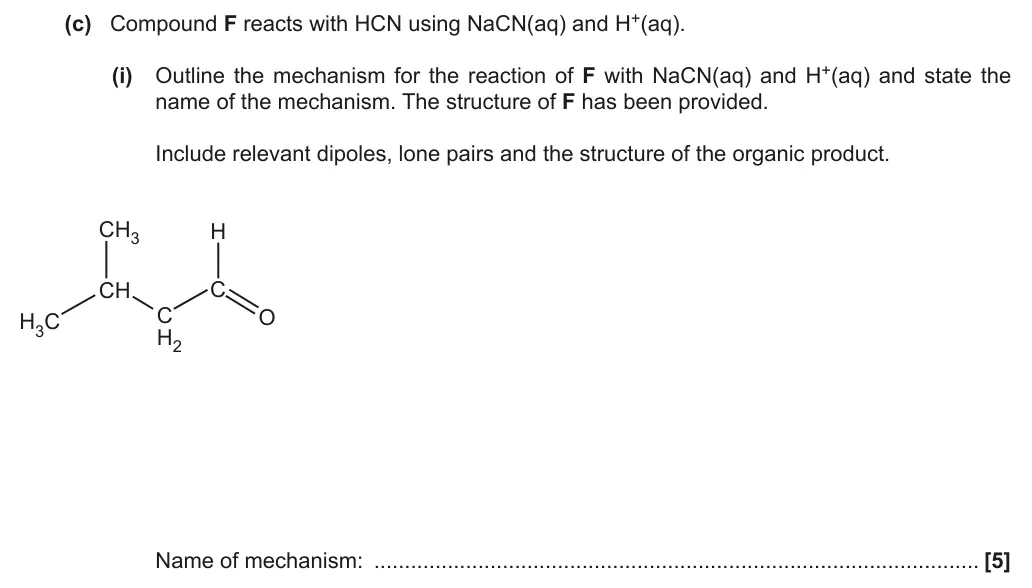
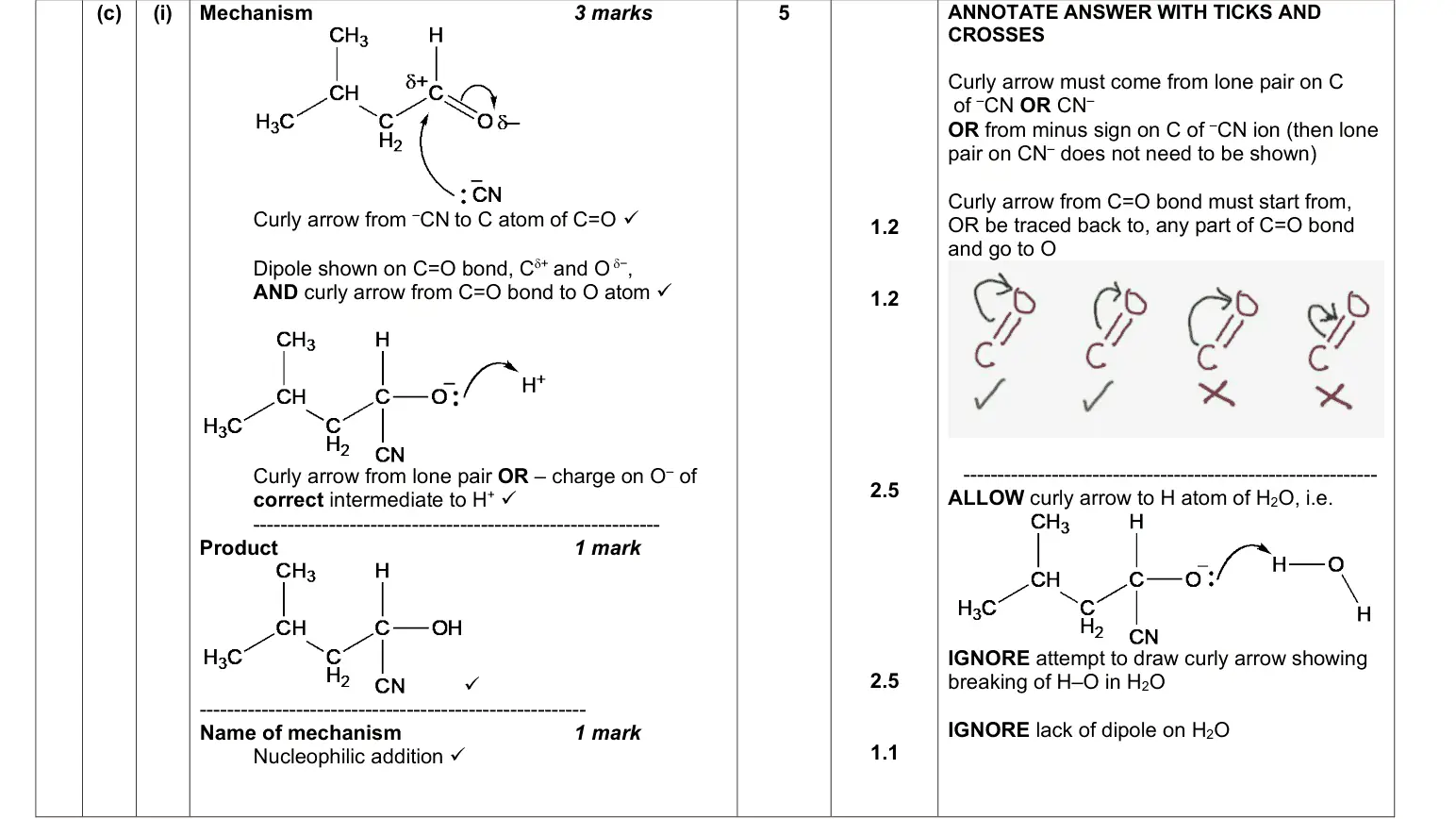
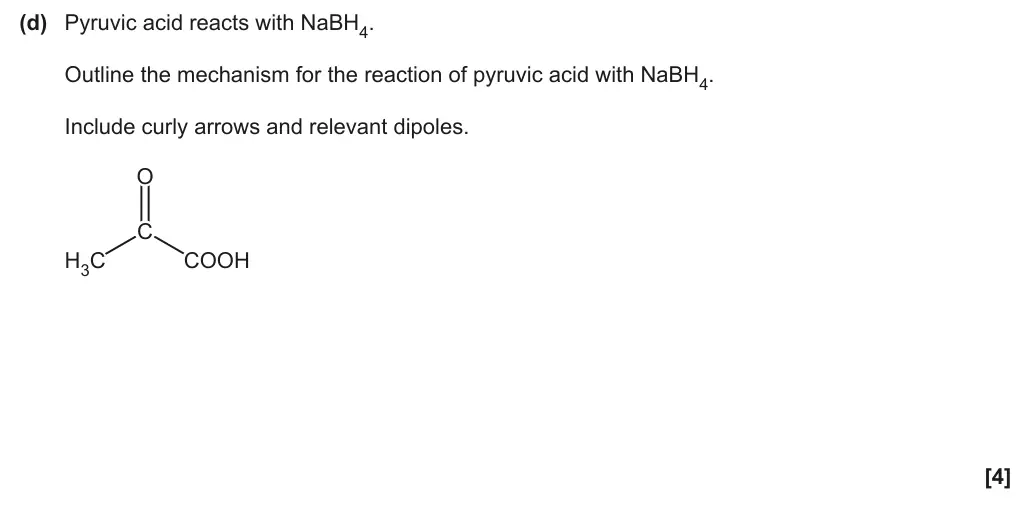
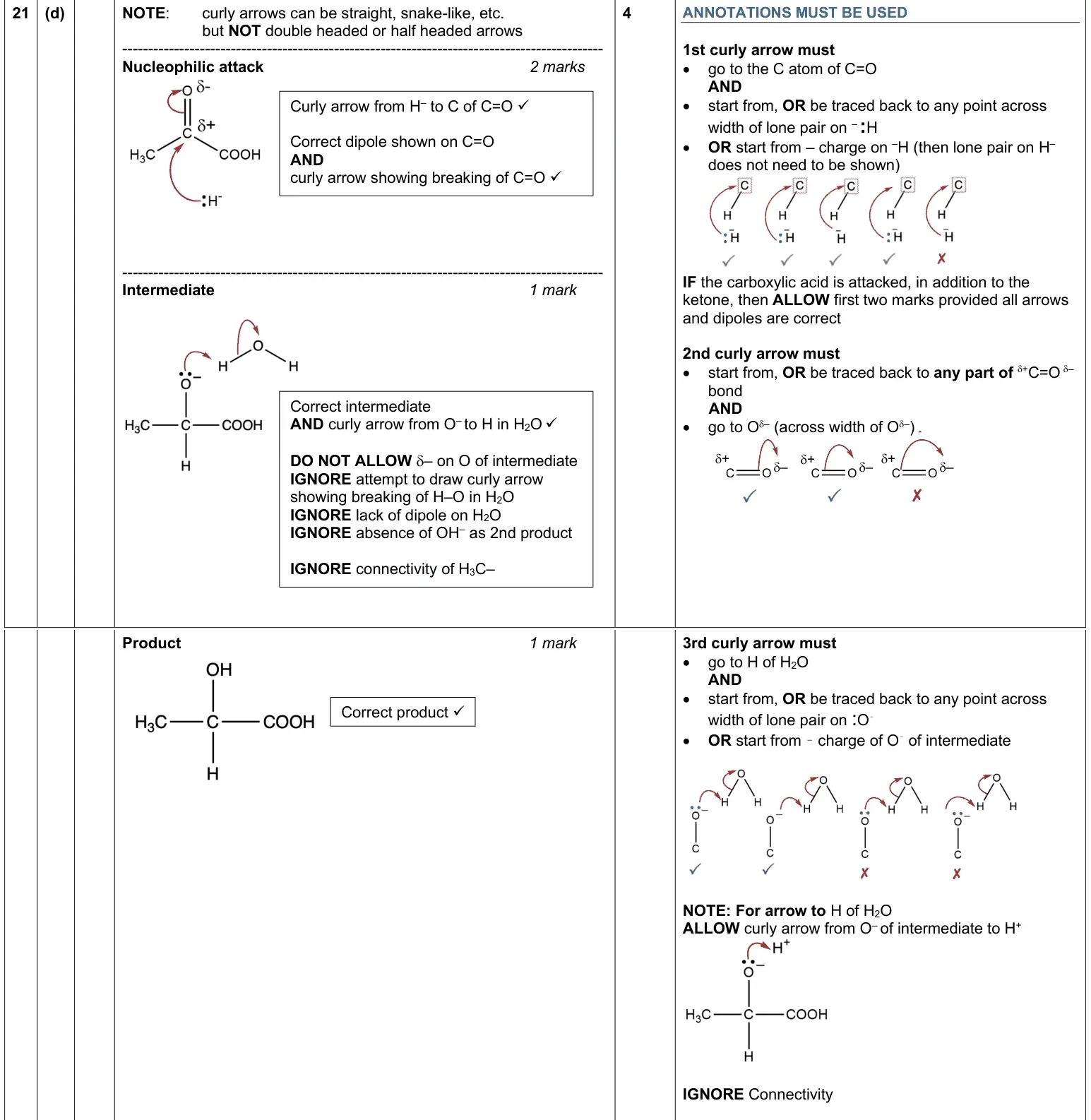
Aldehyde or ketone with NaBH₄ (H⁻ as the nucleophile) or with HCN (CN⁻ from NaCN/H⁺). Arrow from the lone pair on the nucleophile to the δ+ carbon, dipole on C=O, arrow from the C=O bond to O, then the O⁻ intermediate is protonated by water or H⁺.
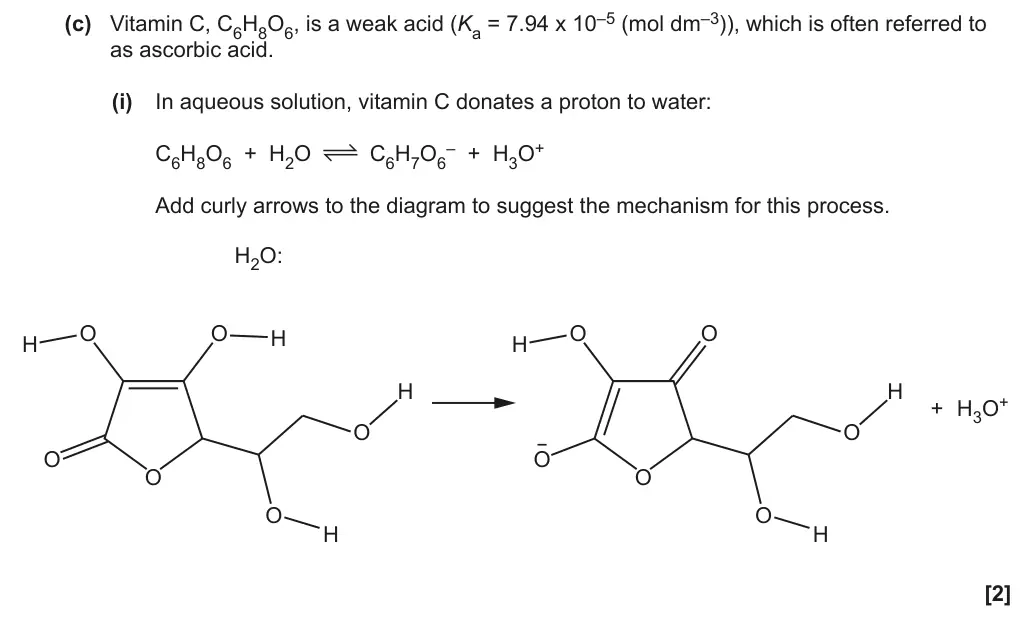
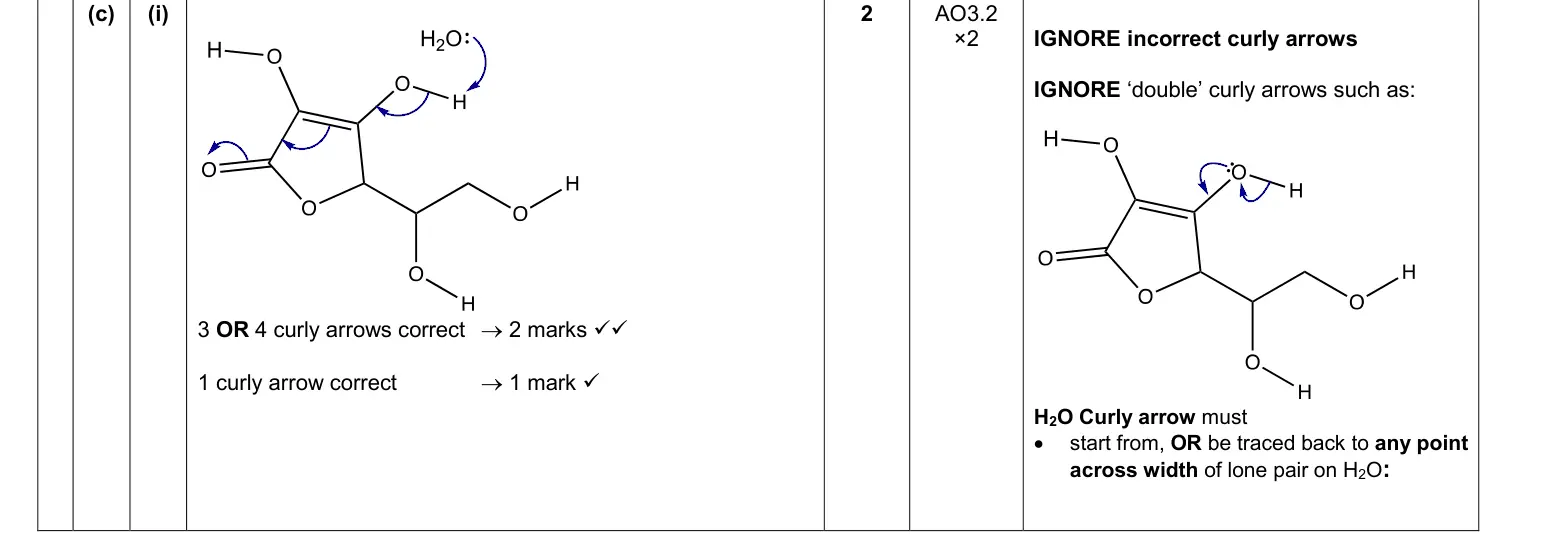
Mechanisms are not required for elimination of water from alcohols, substitution of alcohols with halide ions, or the reactions of acyl chlorides, but the papers do ask you to complete or deduce unfamiliar mechanisms by analogy: the same rules for arrows, dipoles and lone pairs apply. Written by the site from the specification and the mark schemes; being checked by our tutor.
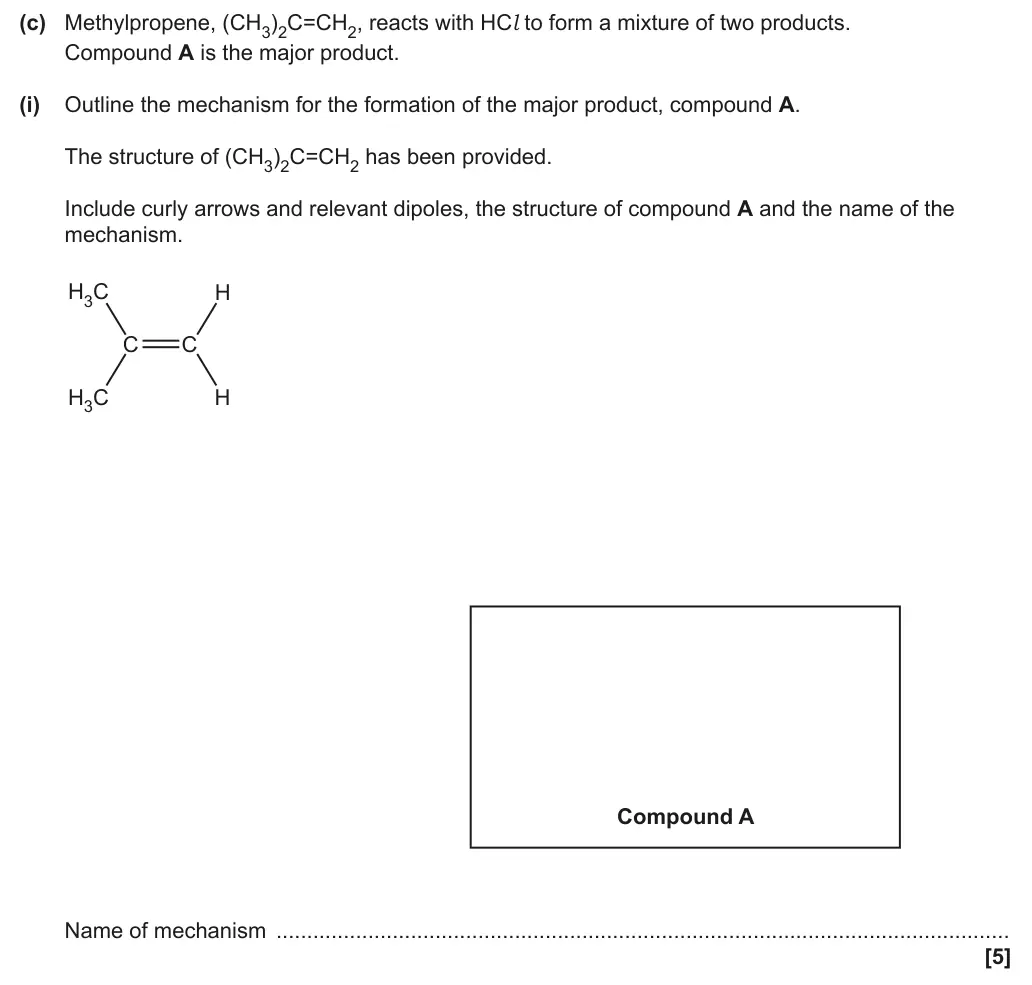
June 2025 · AS Paper 1 · Q24(c)(i)5 marksMechanismHard
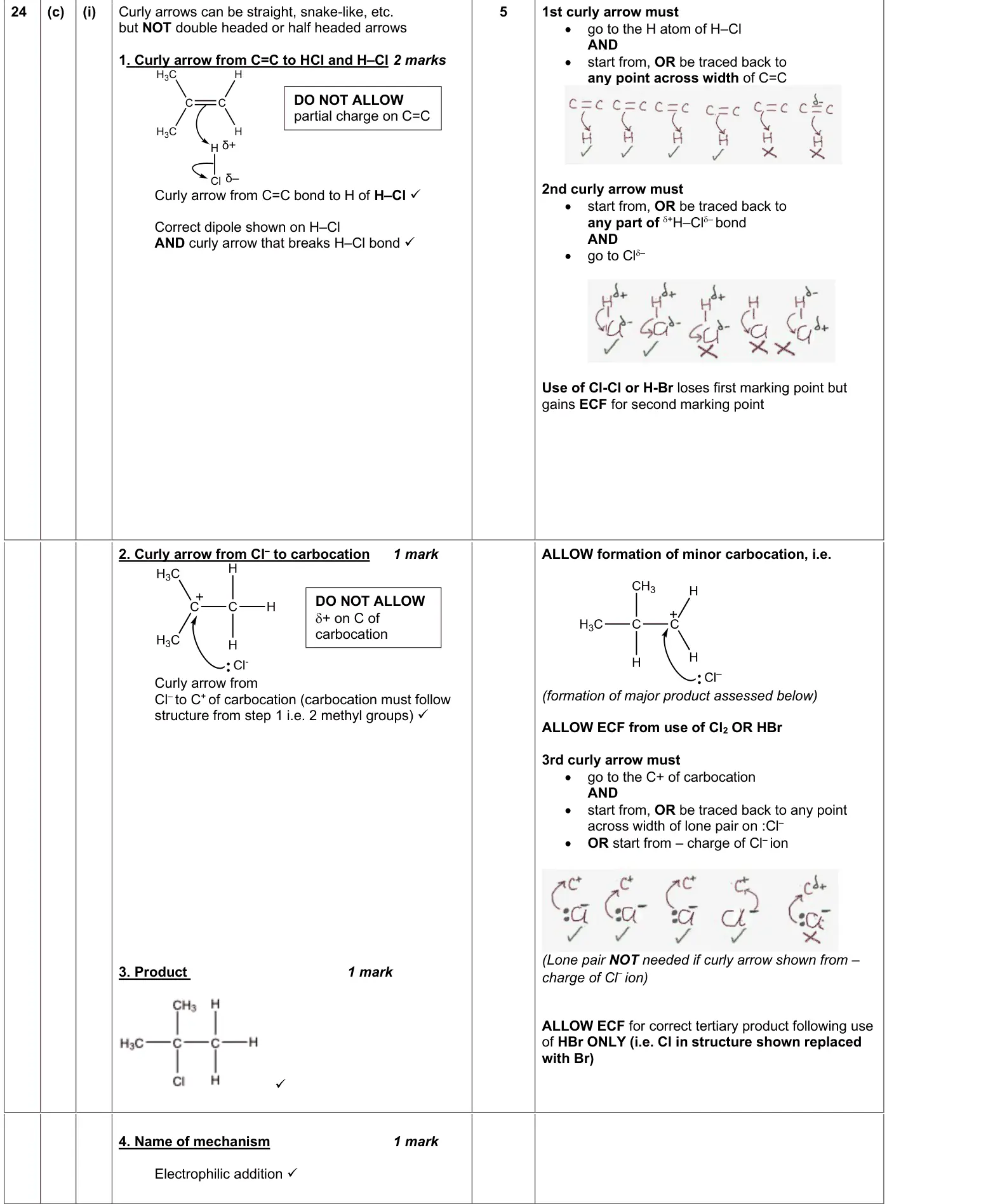
Mark scheme
Examiner's comment
Many candidates scored well on this question, drawing a clear mechanism and correctly giving the major product. However, mistakes were often seen with the direction of arrows and a minority of students gave the minor product for Compound A and/or named the mechanism incorrectly. Partial charges on the carbons of the double bond and lack of charge on the chloride ion were also common errors. This question proved to be an excellent discriminator.
Notes from the mark scheme and report
curly arrow from C=C to H of H–Cl
dipole on H–Cl AND arrow breaking H–Cl
carbocation with full + (tertiary for major product) and arrow from lone pair/– charge of Cl–
DO NOT ALLOW partial charge on C=C
DO NOT ALLOW half-headed arrows
name electrophilic addition
June 2025 · AS Paper 2 · Q4(d)(iii)2 marksMechanismHard
Earlier part of question 4 that this part uses
Mark scheme
Examiner's comment
Most scored both marks here. The most common error involved substituting the Br in the first step – this lost both marks. Very few candidates scored 1 mark; this was usually for a correct first step but then re- acting the C3H7 radical with either 2 Br or HBr in second step. Candidates must check that equations balance in terms of atoms. Candidates should also understand that hydrogen radicals are highly reactive and are therefore unlikely to exist under standard conditions.
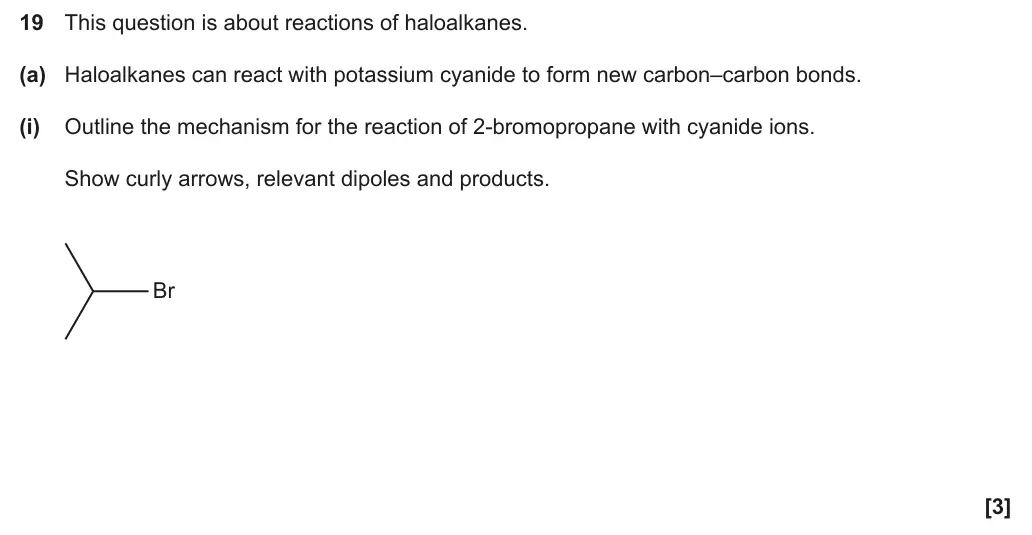
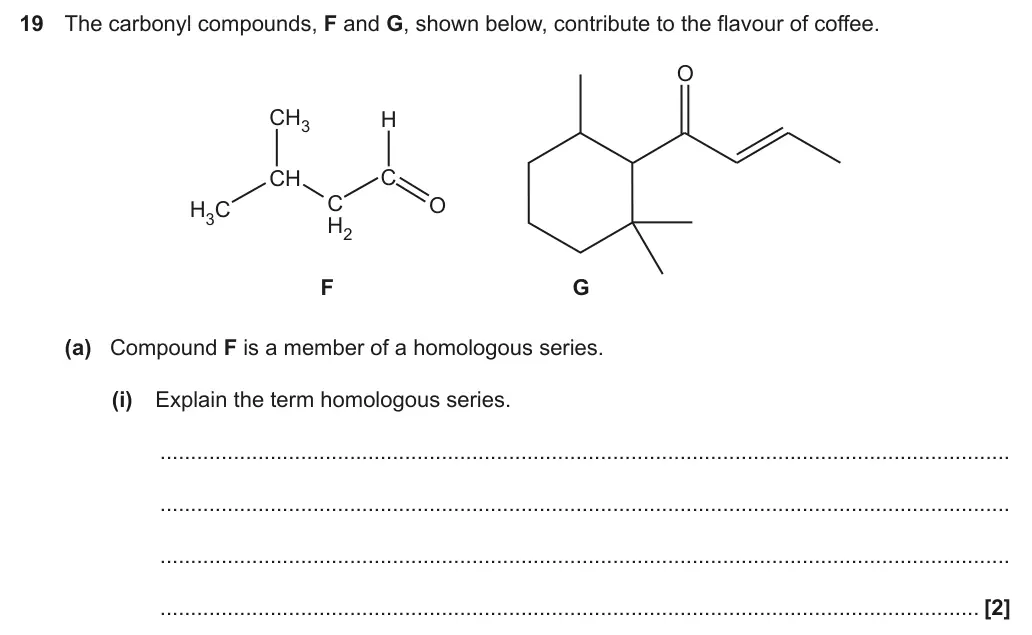
June 2025 · Paper 2 · Q19(a)(i)3 marksMechanismHard
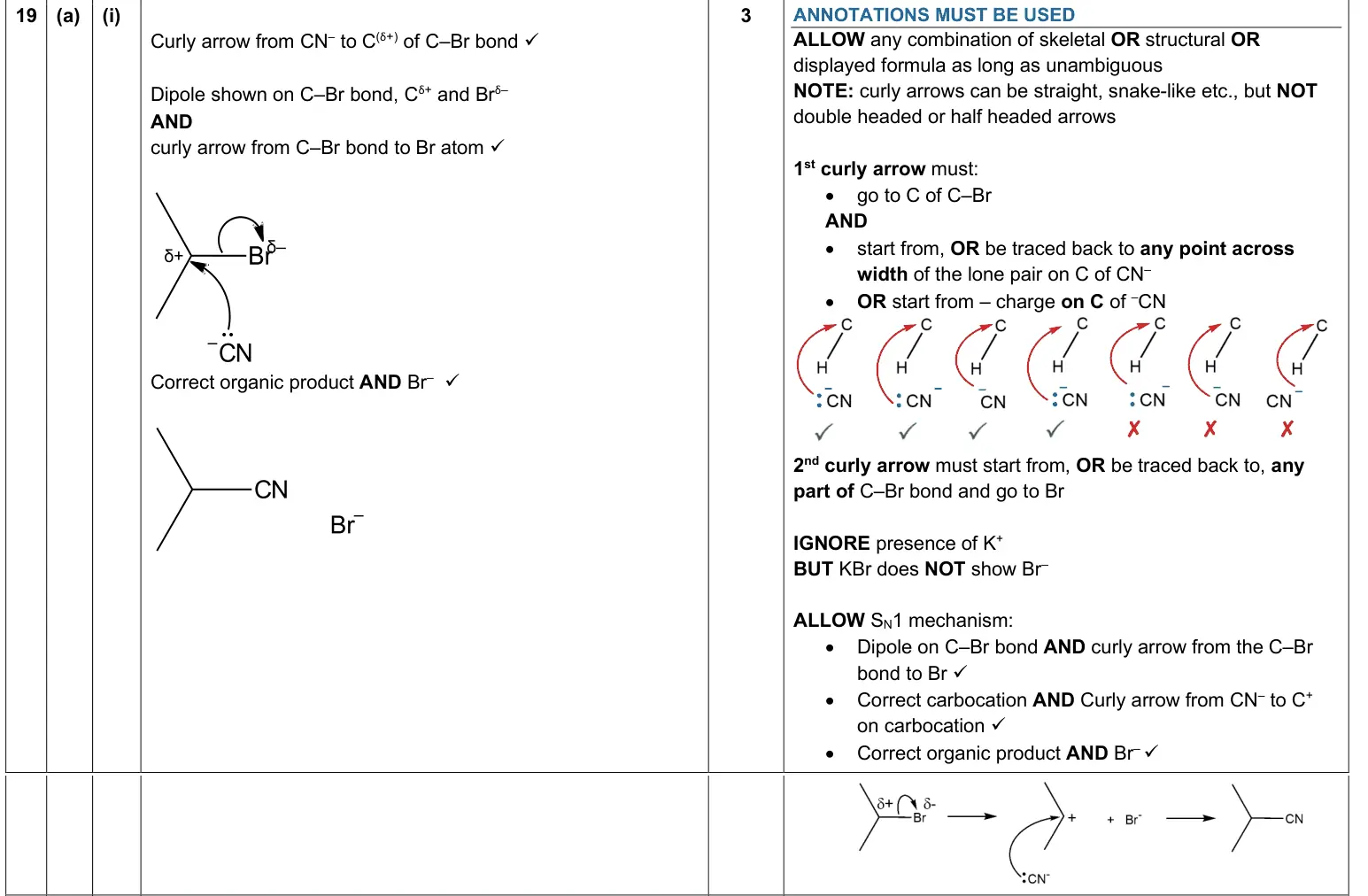
Mark scheme
Examiner's comment
Many candidates scored all 3 marks here showing that the mechanism is well known. Some struggled with the skeletal formula given but were given credit for drawing out structural or displayed formula, provided that the central C showed correct number of bonds. Most common reasons for losing marks: • KCN and KBr shown in the mechanism rather than ions • arrow from lone pair or negative charge on N of CN • dipole on C-Br the wrong way round • missing the negative charge on CN- • curly arrows shown in the wrong direction Remind candidates that curly arrows should only be used to show the movement of a pair of electrons and not the formation/breaking of an ionic bond. A significant number of candidates chose to write more than one version of the mechanism without crossing out the one they did not wish to be marked. This led to marks being lost through contradictions. Teachers should remind candidates of the importance of submitting only one response to each question.
Notes from the mark scheme and report
arrow from lone pair or – charge on C of CN– to C of C–Br
dipole AND arrow from C–Br bond to Br
product AND Br– (KBr does NOT show Br–)
no double- or half-headed arrows
ALLOW SN1
June 2025 · Paper 3 · Q5(a)(iv)4 marksMechanismMedium
Earlier parts of question 5 that this part uses
Mark scheme
Examiner's comment
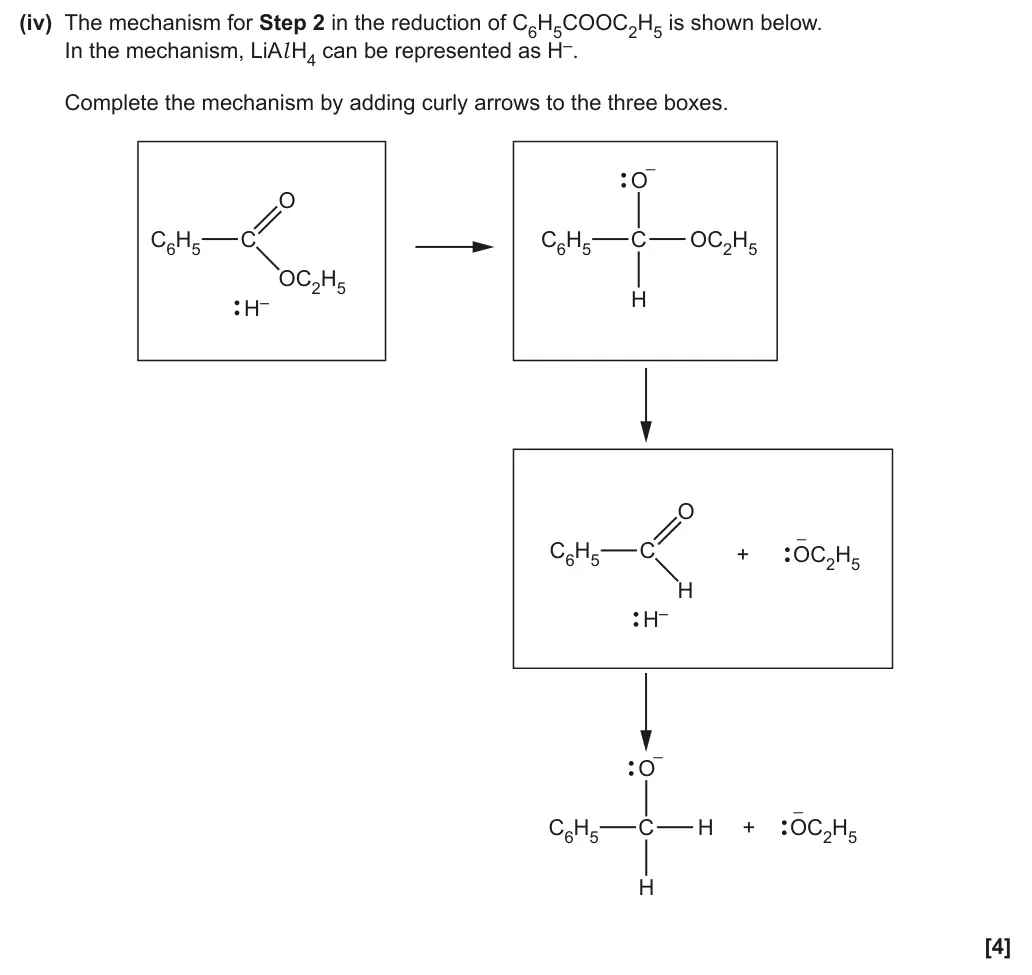
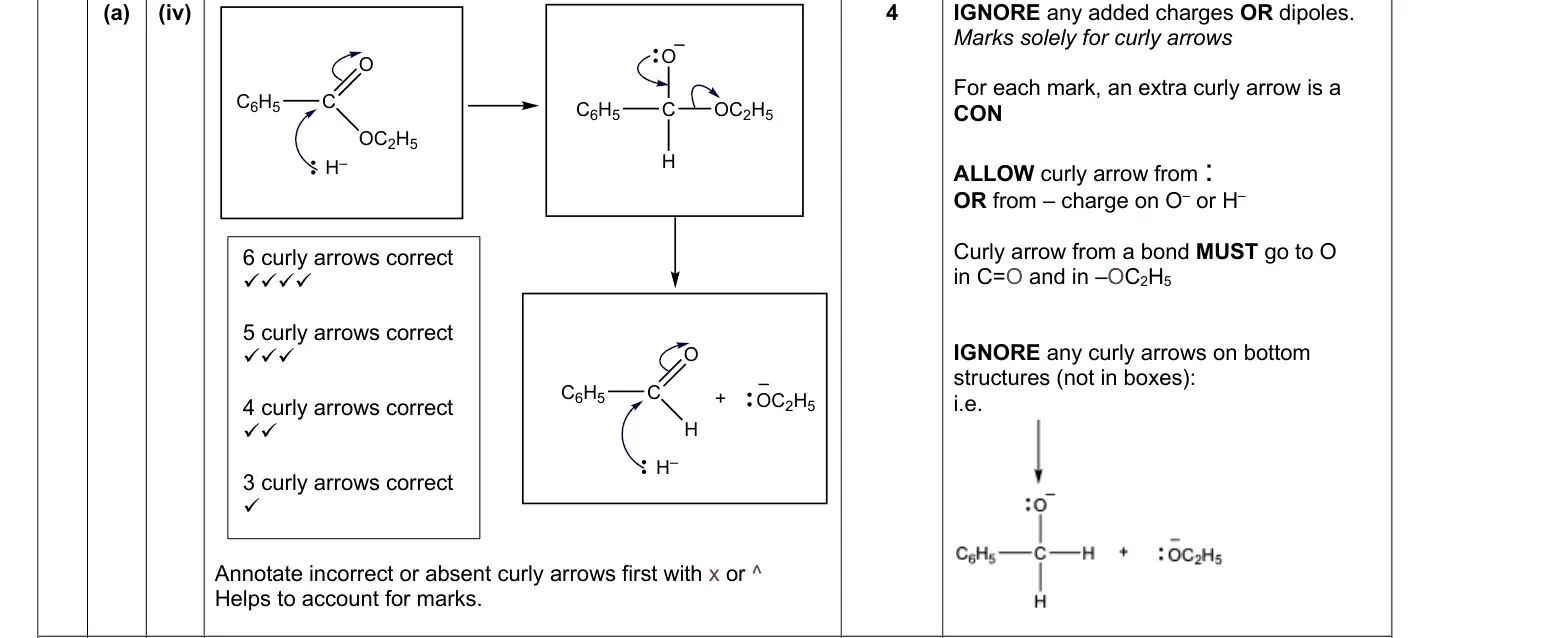
Candidates showed a good understanding of how to position curly arrows within an unknown mechanism. Incorrect responses were mainly in the second box. Some arrows were shown from O– to C atom instead of to the bond. It was rare for additional arrows to be added. From the responses, there was clear evidence that most candidates are becoming more confident in the accurate use of curly arrows in a mechanism and the role of lone pairs. The positioning of both ends of a curly arrow were often accurate.
Notes from the mark scheme and report
marks solely for six curly arrows (6 = 4 marks, 5 = 3, 4 = 2, 3 = 1)
arrow from lone pair or charge of H– / O–
arrow from a bond must go to O in C=O and in –OC2H5
an extra arrow is a CON
IGNORE charges and dipoles
June 2024 · AS Paper 1 · Q24(b)5 marksMechanismMedium
Mark scheme
Examiner's comment
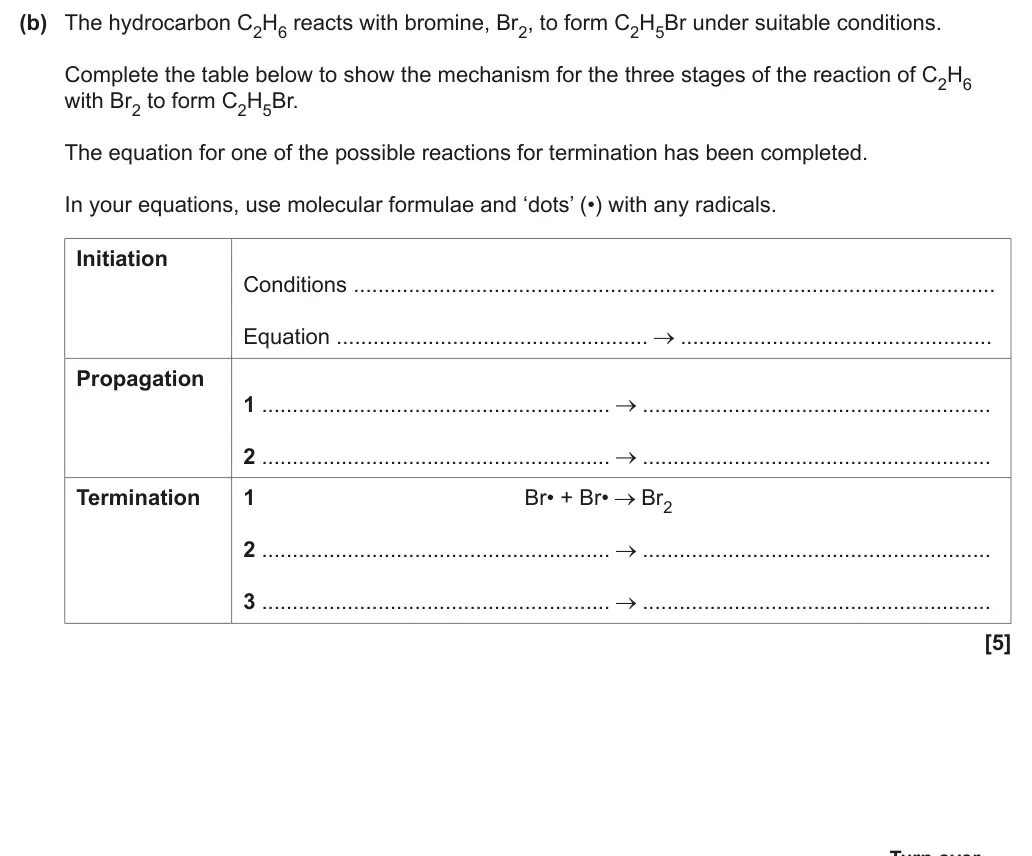
This question was answered extremely well with most candidates obtaining the full 5 marks. It was encouraging to see the widespread correct use of dots to indicate radicals, with relatively few omissions. Of the three steps, initiation and termination were answered better than the equations for propagation.
June 2024 · AS Paper 2 · Q5(b)(i)4 marksMechanismHard
Earlier part of question 5 that this part uses
Mark scheme
Examiner's comment
Approximately half of candidates scored all 4 marks. Very few scored no marks as they were able to give the correct structure of the named product (2-bromobutane). The most common reasons for losing marks included: • Adding dipoles to C=C • Missing dipoles on H-Br or reversed dipole on H-Br (i.e. + Br) • Missing charge on bromide ion or adding - • Arrows the wrong way round or not coming from a bond or lone pair (or negative charge for bromide ion) Some attempted a radical mechanism.
Notes from the mark scheme and report
arrow from C=C to H of H–Br
dipole on H–Br and arrow from bond to Br
arrow from Br– (lone pair or charge) to C+ of secondary carbocation
DO NOT ALLOW δ+ on carbocation or partial charge on C=C
product mark independent
ALLOW ECF for product from incorrect carbocation
For ideas on teaching this topic please look at our Topic Exploration Pack: Electrophilic Addition and Markownikoff’s rule: https://teachcambridge.org/item/b4220e86-bc04-492c-b354-8103687ce594
June 2024 · Paper 2 · Q21(a)(ii)5 marksMechanismMedium
Earlier part of question 21 that this part uses
Mark scheme
Examiner's comment
Most candidates were well prepared for this question, with over half of candidates gaining all 5 marks. A significant number of candidates showed halogenation, generating Cl+ as an electrophile, instead of alkylation. Others attempted to substitute the ethylbenzene ring rather than benzene. Further common errors included incorrect connectivity in the ethyl group on the intermediate, curly arrows coming from hydrogen atoms rather than C–H bond to reform the -ring and omission of an H+ ion at the end of mechanism.
Notes from the mark scheme and report
AlCl3 + CH3CH2Cl → CH3CH2+ + AlCl4–
arrow from π-ring to the carbocation
intermediate with horseshoe covering about 4 sides and gap towards the substituted C
arrow from C–H bond back to ring with H+ lost
H+ + AlCl4– → AlCl3 + HCl
no half-headed arrows
June 2023 · AS Paper 2 · Q3(c)3 marksAO1, 2MechanismMedium
Mark scheme
Examiner's comment
Just under half the candidates gained all 3 marks for this mechanism. Marks were often lost for incorrect positioning or a missing arrow for the breaking of the C-Br bond. Dipoles were often added to the hydroxide ions. Some also showed the lone pair for OH- going to the C-Br bond and not to the C+. A range of spellings of nucleophilic were seen, including: nucleophilic, nucleophilic, nucleophilic, and nucleophilic. It is important to promote good literacy in science, including meanings and spellings of technical language.
Notes from the mark scheme and report
arrow from lone pair or negative charge on O of OH– to C of C–Br
dipole on C–Br AND arrow from bond to Br
no double-headed or half arrows
ALLOW SN1
name nucleophilic substitution
June 2023 · Paper 2 · Q16(b)(i)6 marksAO1, 2, 3MechanismMedium
Mark scheme
Examiner's comment
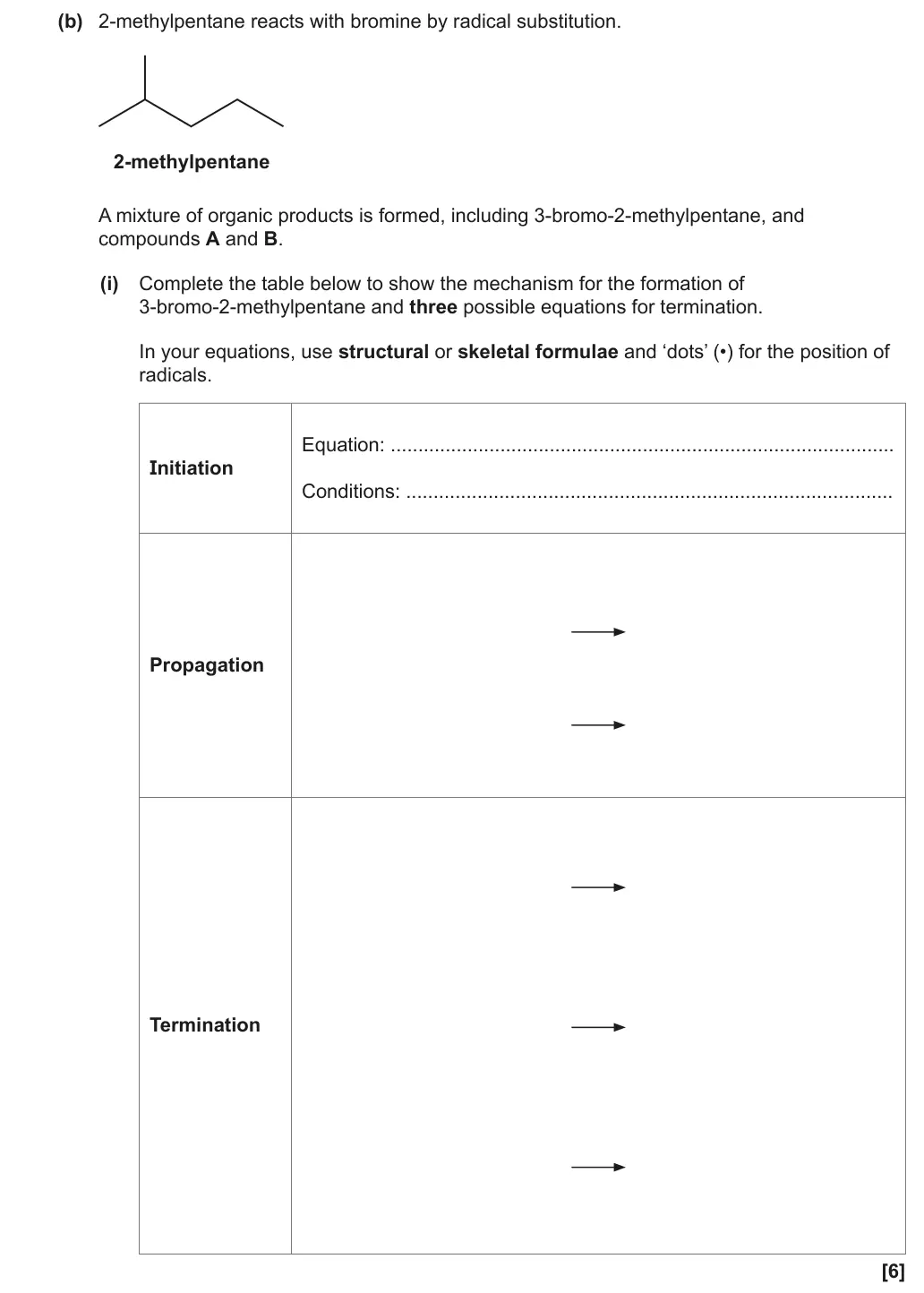
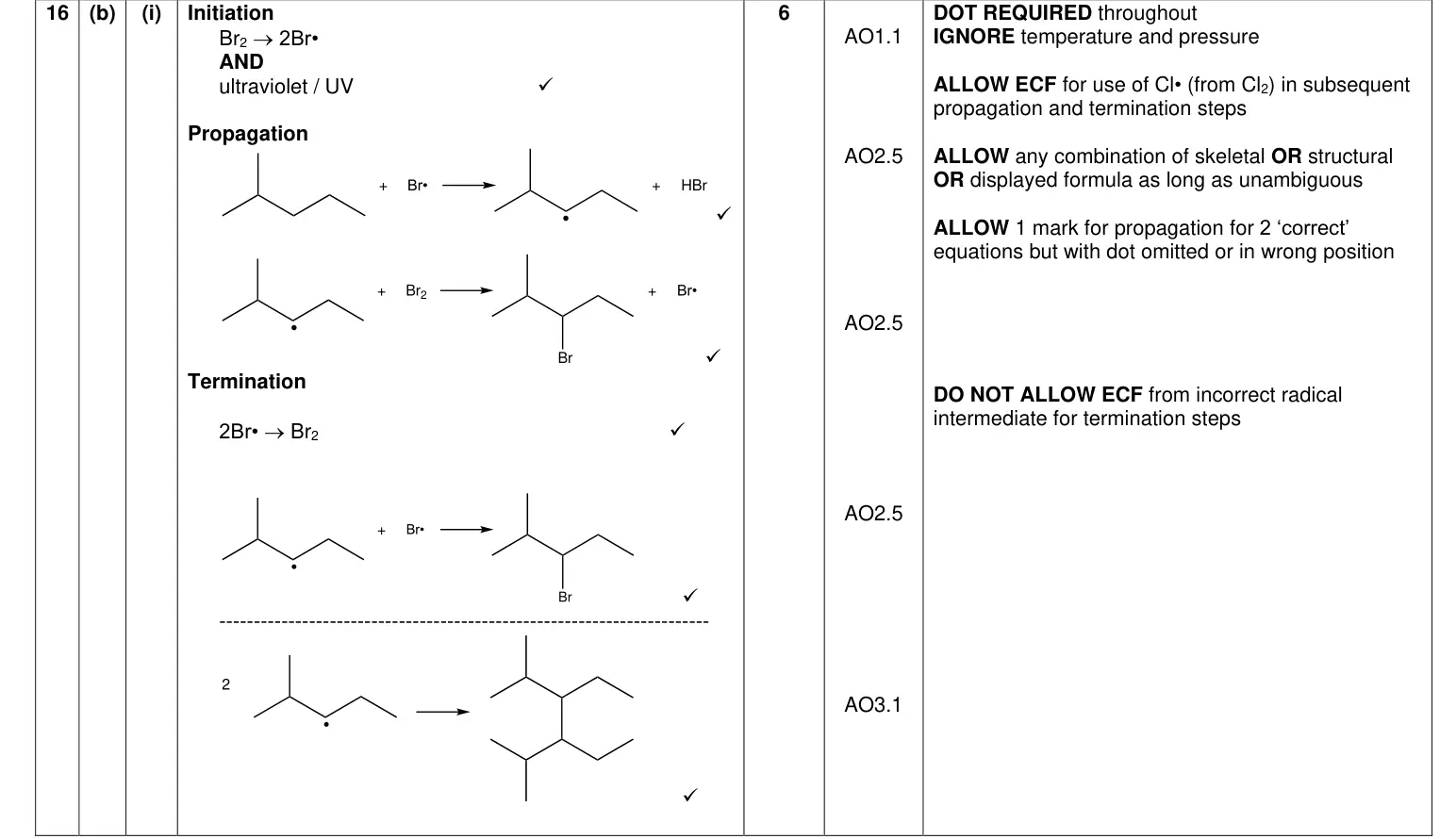
Many candidates tackled this question confidently, especially when using skeletal formula following the format of the structure given in the question. Over half the candidates scored 5 or 6 marks. Only the highest attaining candidates were able to provide all three correct termination steps. Many lost a mark for the combination of the two alkyl radicals, typically either by simply joining the ends of the chains or by missing the connecting C-C bond. Those that attempted to use structural formula often lost marks due to missing Hs. Other common errors included the incorrect positioning of the radical dot, most typically on the terminal carbon, addition of Br in the first propagation step or use of molecular formula. Lower attaining candidates were often able to score a mark for the initiation step and the termination step involving two Br radicals. However, for some this was not a well-known mechanism, with attempts to break up the chain or form hydrogen radicals or charged species. Errors were also seen with correct balancing of equations such as truncated C chains or extra Br atoms added.
Notes from the mark scheme and report
Br2 → 2Br• AND UV
dot required throughout and on C-3 of the radical
1 mark for propagation if both correct but dot omitted or misplaced
three terminations incl. two alkyl radicals
no ECF from incorrect radical in termination
June 2023 · Paper 2 · Q22(a)(i)4 marksAO1, 2MechanismEasy
Mark scheme
Examiner's comment
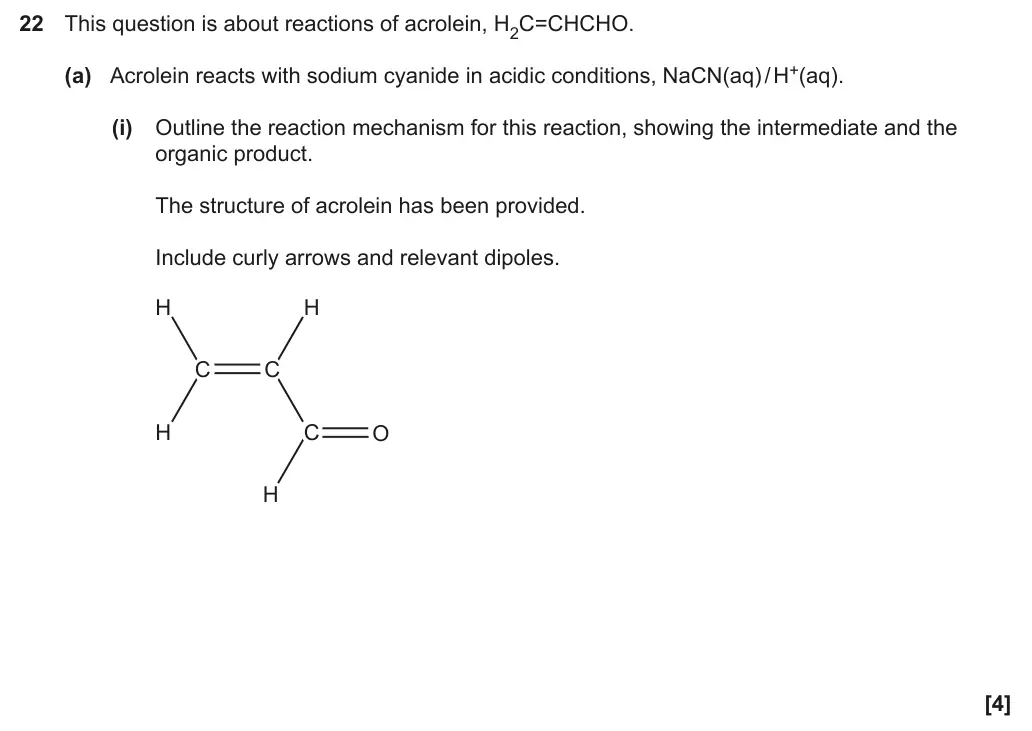
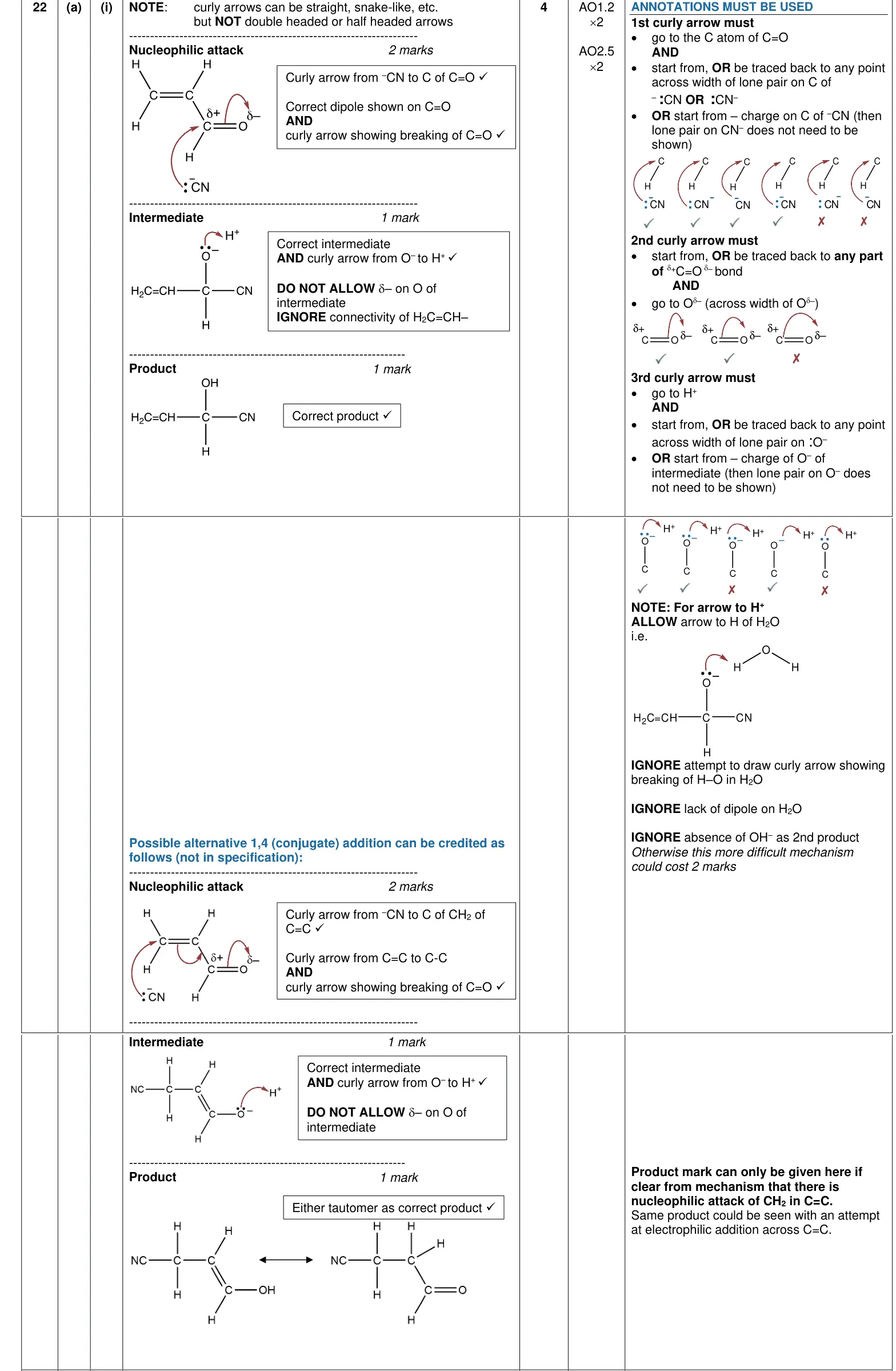
There were many excellent examples of precisely drawn mechanisms for the reaction of acrolein with sodium cyanide in acidic conditions and so most candidates gained at least 3 marks. The importance of accuracy when drawing curly arrows needs to be emphasised when teaching mechanisms - arrows must start at lone pairs or negative charges or come from bonds. Many candidates lost marks due to incorrect arrows. Common errors included the use of NaCN or HCN rather than the cyanide ion, the first curly arrow coming from the N of CN-, omission of partial charge across the C=O double bond and addition of partially charges to hydrogen or oxygen. Lower scoring responses often included an intermediate and/or product containing sodium. Some attempted electrophilic addition using HCN across the double bond. A few gained some credit for the mechanism for a competing reaction with nucleophilic addition on CH2 of C=C. This is not covered in the A Level specification and no candidates scored full marks for this alternative.
Notes from the mark scheme and report
arrow from lone pair/charge on C of CN– to C of C=O
dipole on C=O AND arrow from C=O bond to O
intermediate with O– (DO NOT ALLOW δ– on O) and arrow to H+ (ALLOW H of H2O)
product hydroxynitrile
1,4-conjugate addition credited as alternative
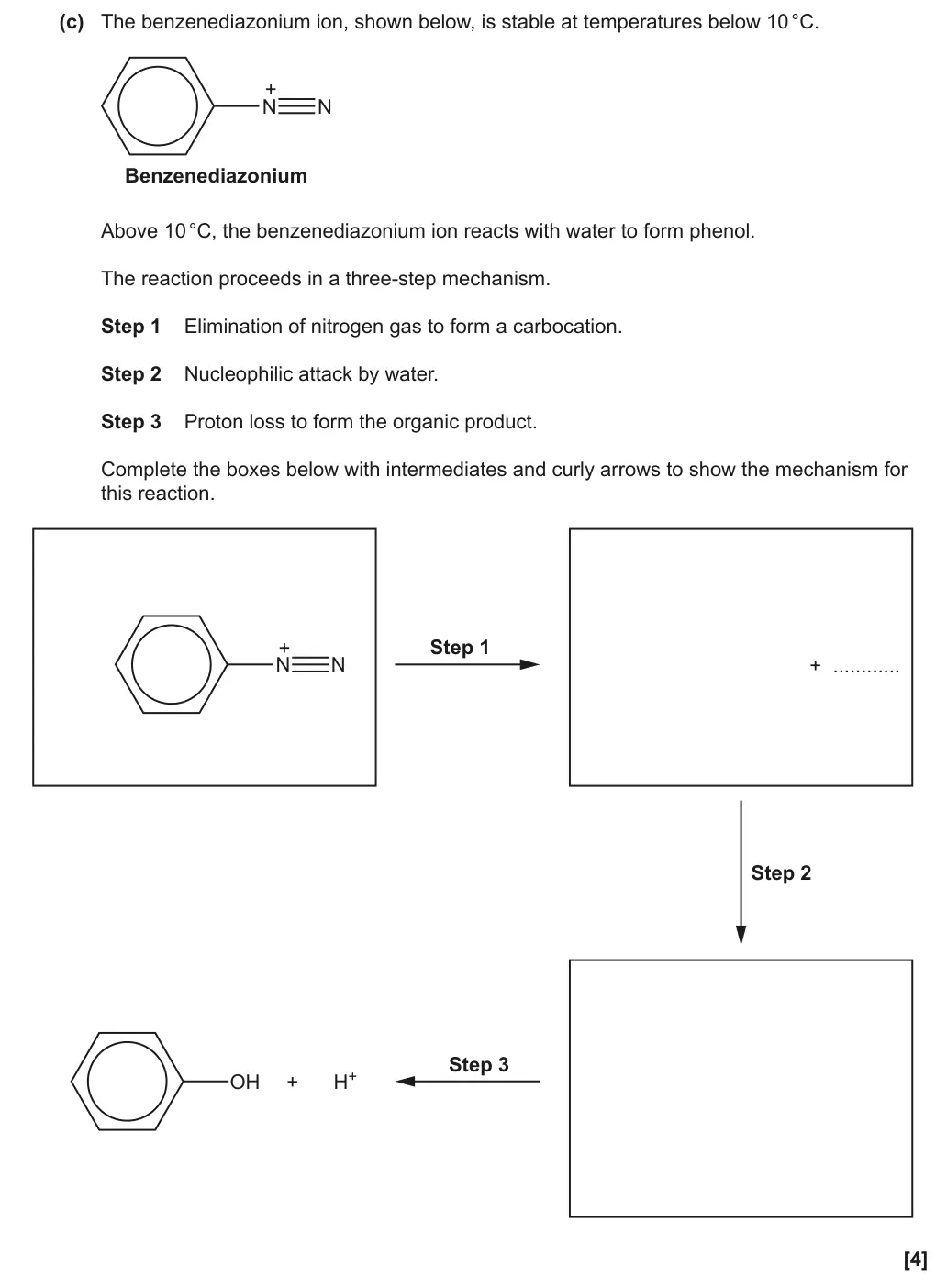
June 2023 · Paper 3 · Q2(c)4 marksAO3MechanismMedium
Mark scheme
Examiner's comment
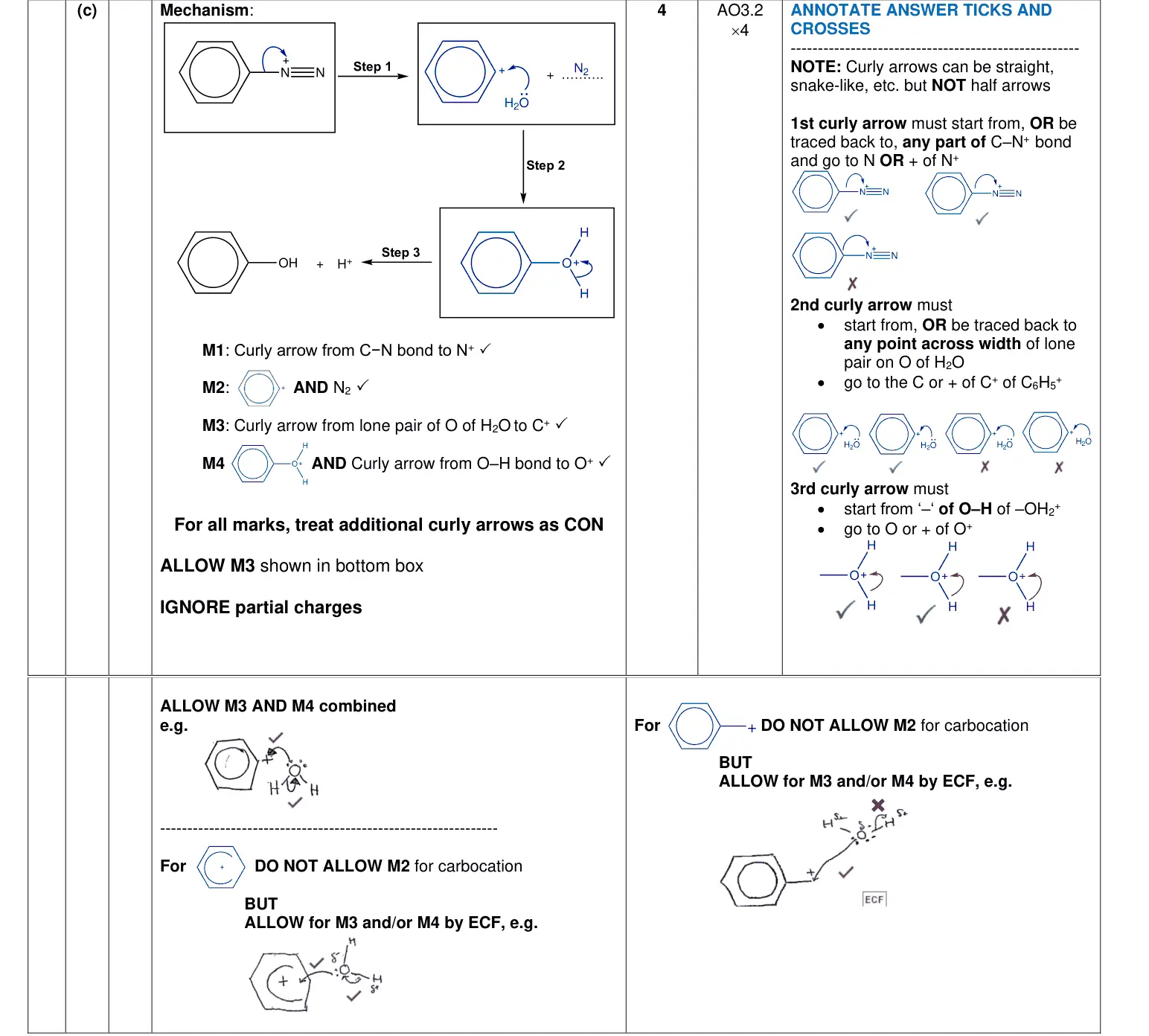
This question required candidates to apply their understanding of organic mechanisms to an unfamiliar reaction. The stem to the question includes important information and clues that should have guided candidates towards this unfamiliar mechanism, with the prompts for the three steps being critical. Many responses fell back to the familiar mechanism for electrophilic substitution, an approach that could not be credited. This question discriminated very well but many candidates scored few marks. This response has been included to show a candidate with an excellent understanding of the meaning of curly arrows and the importance of charges and dipoles. The prompts in the question are followed and the candidate has been given all four marks. Notice how the curly arrows start either from a bond or from a lone pair. The candidate has also realised that the addition of H2O produces a positively charged oxonium ion. Many candidates omitted the ‘+’ charge or showed the curly arrow for loss of a proton going to a H atom rather than the O atom of water.
Notes from the mark scheme and report
curly arrow from C–N bond to N+
phenyl carbocation AND N2
curly arrow from lone pair on O of H2O to C+
curly arrow from O–H bond to O+
additional curly arrows CON
NOT half arrows
DO NOT ALLOW delocalised ring-charge carbocation for M2
In organic chemistry mechanisms, a curly arrow shows the movement of an electron pair and demonstrates the direction of electron flow in organic reactions.
A curly arrow must start from: • A lone pair or negative charge and go to an atom to show where a bond forms • A bond to show where a bond breaks.
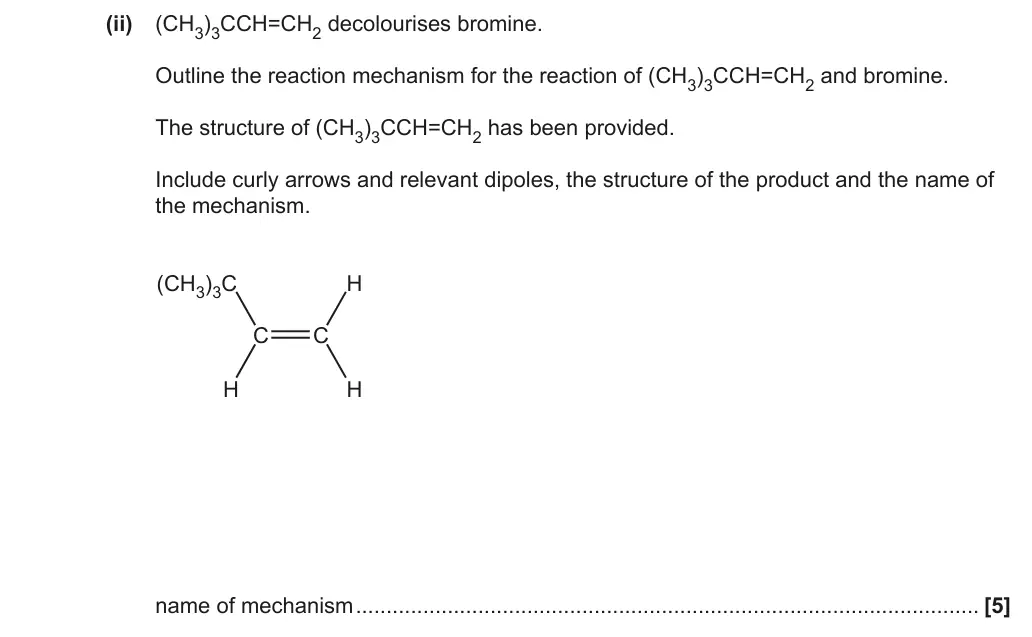
June 2022 · AS Paper 1 · Q21(a)(ii)5 marksAO1, 2MechanismMedium
Earlier part of question 21 that this part uses
Mark scheme
Examiner's comment
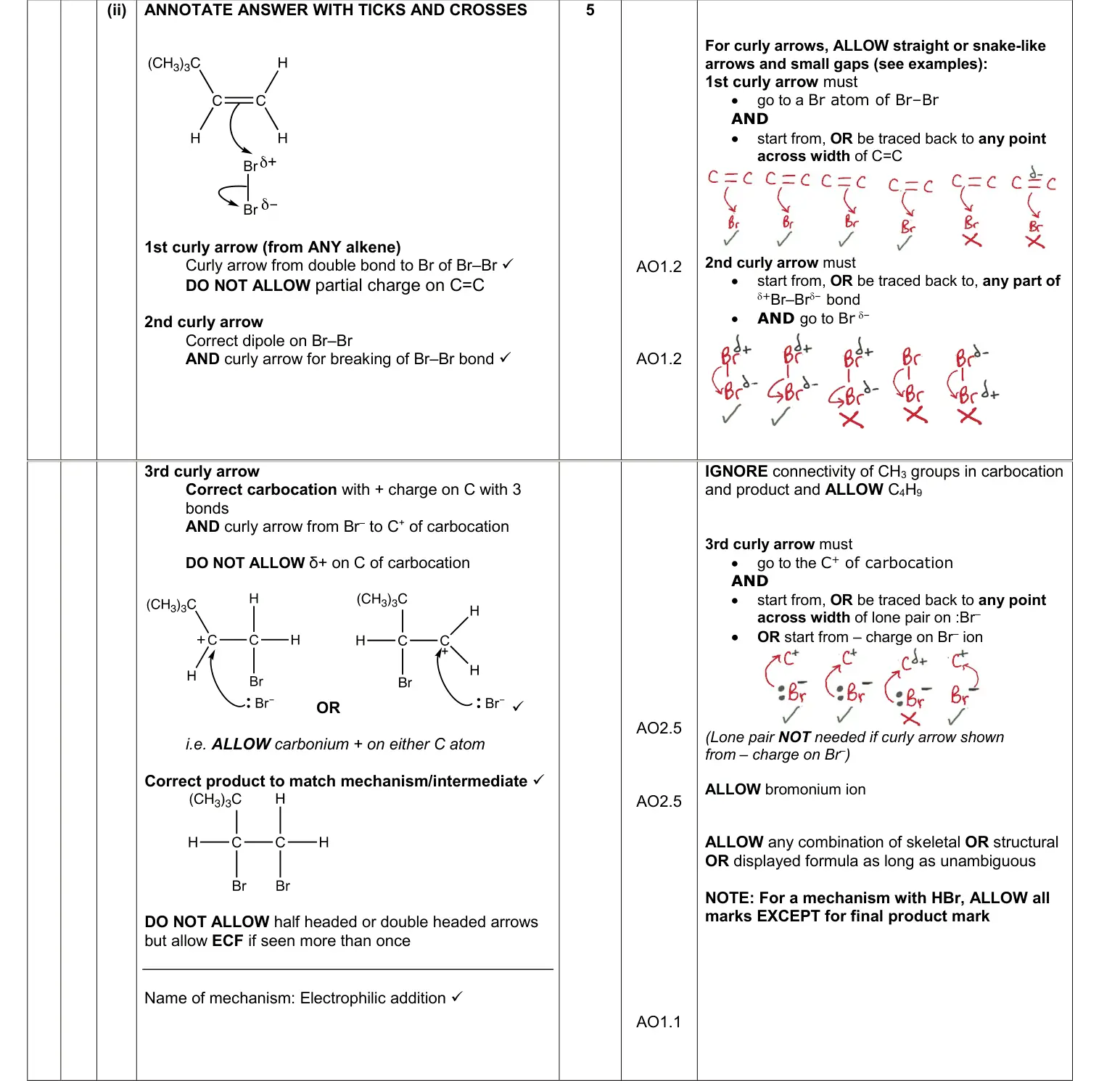
Many candidates answered the mechanism proficiently. However, many mistakes were seen with the direction of arrows, and confusing 𝛿+/ 𝛿– and +/– charges. In the intermediate carbocation, the C=C was often left intact and 𝛿– used on the bromide ion attacking the intermediate. Some less successful responses did not position curly arrows accurately. One common error was showing one or more C atoms missing from the (CH3)C groups. Candidates should take great care when drawing organic structures to make sure that all groups have been drawn accurately. This exemplar has been included to emphasise the importance of accurately placed curly arrows and use of charges. It was only possible to award this response 1 out of 5 marks. With a few improvements, this response could easily have been 5/5. The start of the first curly arrow has been placed accurately starting from the C=C double bond but the arrow should have finished at the Br𝛿+: 0 marks The Br–Br dipole is correct but there is no curly arrow showing it breaking: 0 marks The intermediate carbocation is correct but the curly arrow should have been shown from a lone pair on the Br– ion to the + charge of the carbocation: 0 marks The product is correct: 1 mark The reaction type is addition but the name of the mechanism is electrophilic addition: 0 marks nucleophilic substitution and radical substitution. This paper includes two of these in Questions 21 (a) (i) and 26 (a). It is essential that candidates learn these three mechanism types.
Notes from the mark scheme and report
first curly arrow from the C=C bond to Br
dipole on Br–Br AND arrow for breaking Br–Br
carbocation needs full + (DO NOT ALLOW δ+)
arrow from lone pair or – charge of Br–
DO NOT ALLOW half-headed or double-headed arrows
mechanism with HBr loses final product mark
Reactions mechanisms are the organic chemist’s way of communicating electron transfers in organic chemistry. Candidates must use curly arrows, dipoles and charges appropriately and accurately. AS Chemistry includes three important reaction mechanisms: electrophilic addition,
June 2022 · AS Paper 1 · Q26(a)3 marksAO1, 2MechanismMedium
Mark scheme
Examiner's comment
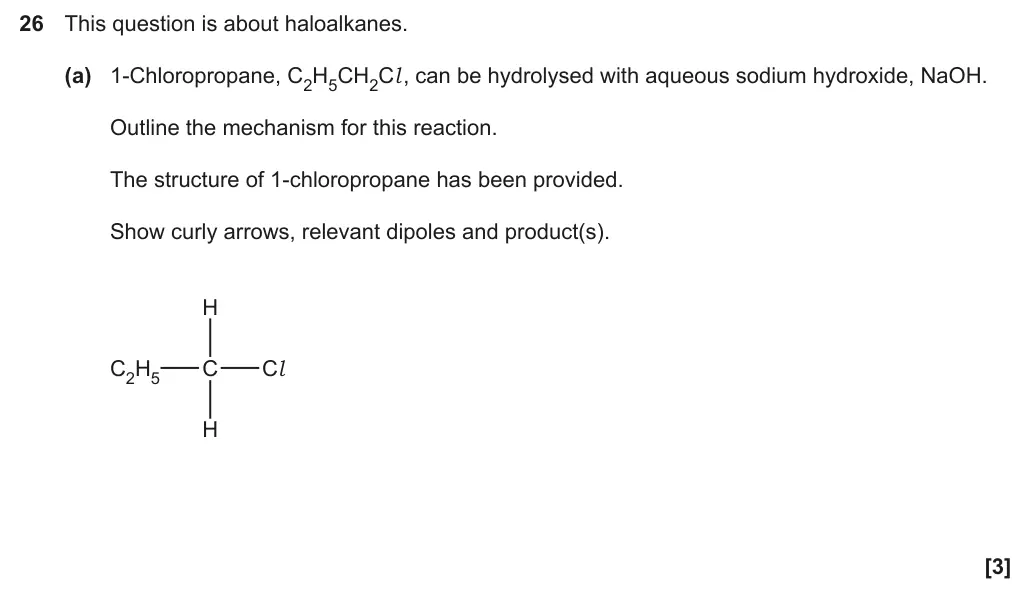
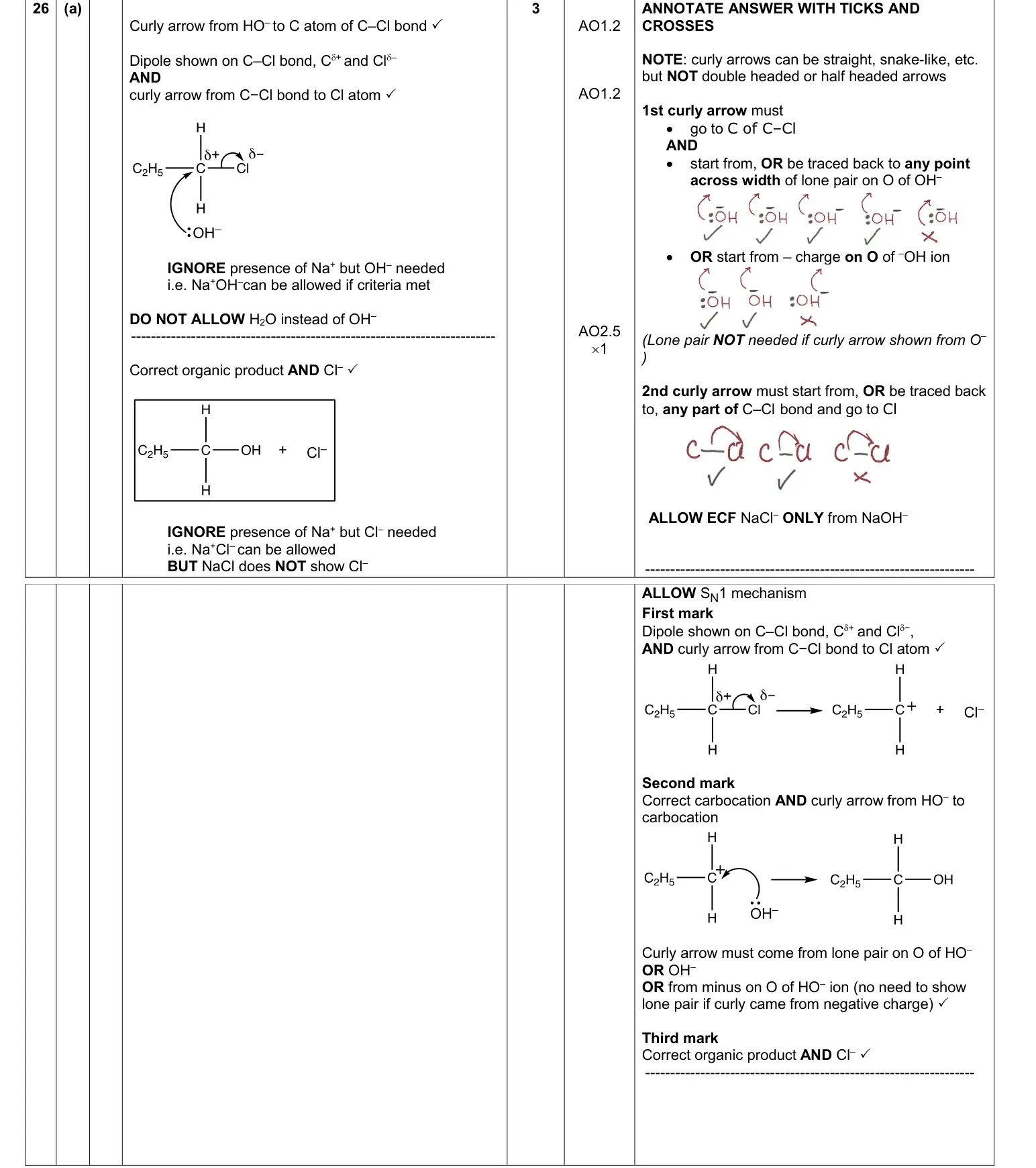
Although a simpler mechanism than electrophilic addition in Question 21 (a) (ii), candidate responses here were less successful. Many candidates weren’t able to identify the OH– ion attacking the carbon atom and the curly arrow often did not originate from an O lone pair or the negative charge. Candidates often omitted the dipole on the C–Cl bond or did not include a curly arrow. Candidates were expected to show both the resulting alcohol and Cl– as products. Many tried to incorporate Na into their organic structure. Organic mechanisms are a key concept in organic chemistry and it is essential for candidates to learn all the mechanisms in preparation for examinations. addition, nucleophilic substitution and radical substitution. This paper includes two of these in Questions 21 (a) (i) and 26 (a). It is essential that candidates learn these three mechanism types.
Notes from the mark scheme and report
curly arrow from lone pair or – charge on O of OH– to C
dipole on C–Cl AND arrow from C–Cl bond to Cl
DO NOT ALLOW H2O instead of OH–
Cl– needed as product (NaCl does not show Cl–)
ALLOW SN1 route
Reactions mechanisms are the organic chemist’s way of communicating electron transfers in organic chemistry. It is essential that curly arrows, dipoles and charges are used appropriately and accurately. AS Chemistry includes three important reaction mechanisms: electrophilic
June 2022 · Paper 2 · Q16(a)(ii)3 marksAO1, 2MechanismEasy
Earlier part of question 16 that this part uses
Mark scheme
Examiner's comment
Candidates are familiar with the mechanism for the bromination of hydrocarbons. So, the majority of candidates scored 3 marks. Common errors included the use of HBr rather than Br2 or putting a dipole on the carbon-carbon double bond.
Notes from the mark scheme and report
curly arrow from C=C to Br AND dipole on Br–Br AND arrow breaking Br–Br
carbocation with full + AND arrow from lone pair/– charge of Br–
DO NOT ALLOW partial charge on C=C
DO NOT ALLOW half-headed arrows
DO NOT ALLOW use of HBr
ALLOW bromonium ion
June 2022 · Paper 2 · Q16(c)(ii)1 markAO3MechanismHard
Earlier part of question 16 that this part uses
Mark scheme
Examiner's comment
Few candidates were given this mark. A common error was to produce multiple products (rather than a ring structure) or to put positive/negative charges on the oxygen atoms within the ring structure.
Notes from the mark scheme and report
product must follow the curly arrows given (five-membered ring intermediate)
June 2022 · Paper 3 · Q3(b)4 marksAO3MechanismMedium
Earlier part of question 3 that this part uses
Mark scheme
Examiner's comment
This question is one of two on this paper assessing understanding of unfamiliar organic reaction mechanisms. The stem to the question includes important information and clues that should have then guided candidates towards this unfamiliar mechanism (which is related to the familiar nucleophilic substitution of haloalkanes). The two prompts for Step 1 and Step 2 are critical but many candidates did not use these, instead inventing their own mechanisms. However, there were many successful responses seen that gained the full 4 marks. and dipoles. Step 1 is an attempt to show the alcohol OH group accepting a proton, but a curly arrow shows the movement of an electron pair. It cannot travel from a + charge to a lone pair. The intermediate shown does contain the correct atoms but the + charge has been omitted from the O atom. Marks were given for the curly arrow from the Br– lone pair and from the C–O bond. However, the candidate has drawn the bonds with very short lines making it all too easy for a curly arrow to be shown imprecisely. This response was given 2/4 marks.
Notes from the mark scheme and report
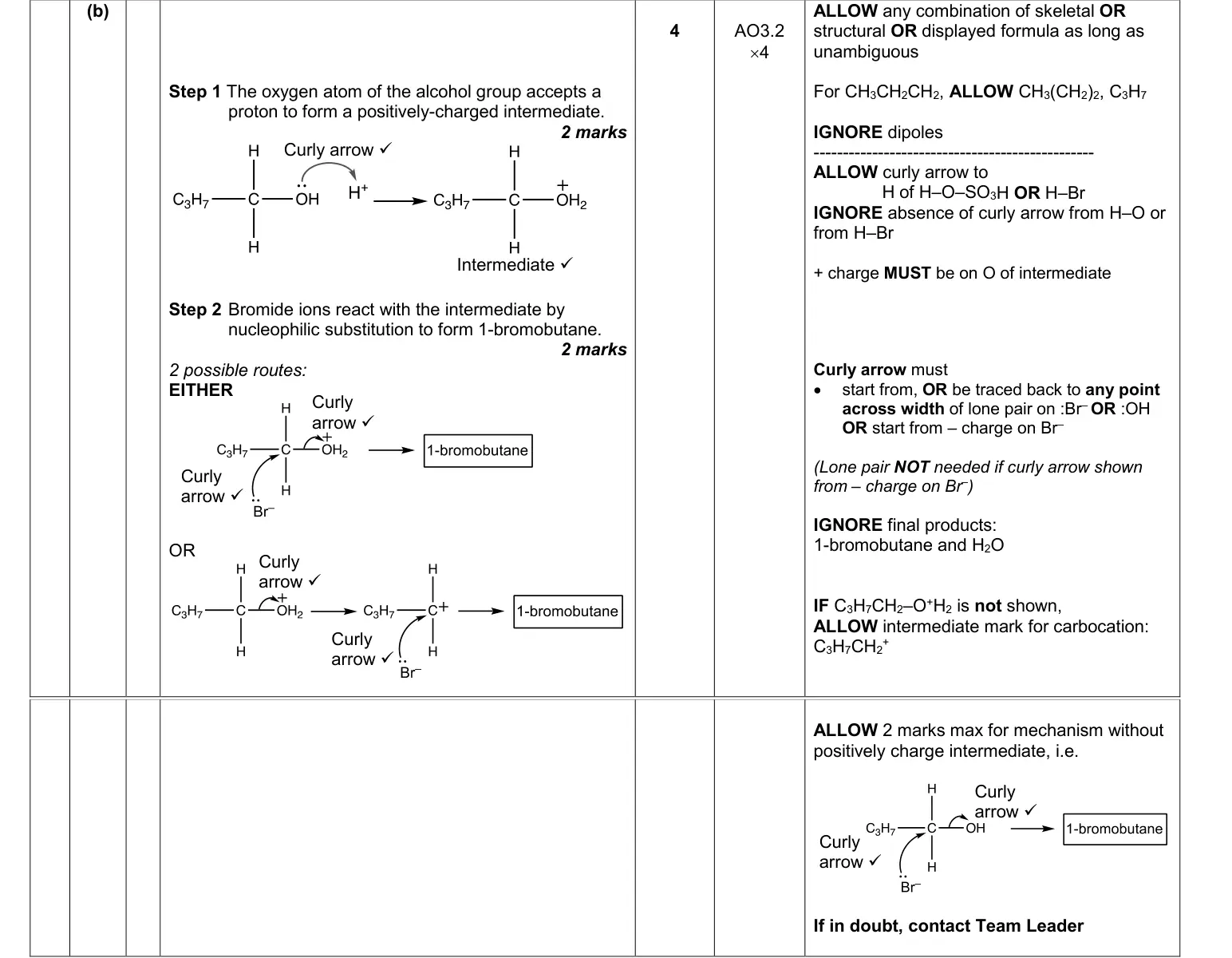
step 1 curly arrow from lone pair on O to H+ giving intermediate with + charge on O (–OH2+)
step 2 curly arrow from Br– lone pair/charge to C and from C–O bond to O (or via carbocation)
max 2 for mechanism without positively charged intermediate
IGNORE dipoles
In organic chemistry mechanisms, a curly arrow shows the movement of an electron pair and demonstrates the direction of electron flow in organic reactions.
A curly arrow must start from: • A lone pair or negative charge and go to an atom to show where a bond forms • A bond to show where a bond breaks.
June 2022 · Paper 3 · Q6(c)(i)2 marksAO3MechanismHard
Earlier part of question 6 that this part uses
Mark scheme
Examiner's comment
This novel mechanism assessed a candidate’s understanding of curly arrows, and four curly arrows were needed. One mark was available for one correct curly arrow, usually from the H2O: or from the C=O. 2 marks were given for three or four correct curly arrows. The two curly arrows within the ring structure proved to be the most difficult. The question discriminated extremely well: many candidates were able to secure one mark with the most able being given both marks. A candidate showing all four curly arrows correctly demonstrated an excellent understanding of curly arrows.
Notes from the mark scheme and report
arrow from lone pair on H2O to H of enol O–H, O–H bond pair to form C=O, C=C pair moving along, ring C=O pair to O giving O–
3 or 4 correct arrows = 2 marks, 1 correct = 1 mark
IGNORE incorrect/'double' curly arrows
November 2021 · AS Paper 1 · Q24(a)4 marksAO1, 2Mechanism
Mark scheme
Notes from the mark scheme and report
curly arrow from C=C to H of H–Br
dipole on H–Br and arrow breaking H–Br
arrow from Br– lone pair/charge to C+ of the correct (tertiary) carbocation
DO NOT ALLOW partial charge on C=C or δ+ on carbocation
DO NOT ALLOW incorrect carbocation
November 2021 · Paper 2 · Q16(b)(i)4 marksAO1, 2MechanismEasy
Mark scheme
Examiner's comment
Question 16(b)(i): This was answered well by students.
Notes from the mark scheme and report
curly arrow from C=C to H of H–Br
dipole on H–Br AND arrow breaking H–Br
secondary carbocation (DO NOT ALLOW δ+ on C) with arrow from lone pair/charge of Br–
DO NOT ALLOW partial charge on C=C
ALLOW ECF product from incorrect carbocation
November 2021 · Paper 2 · Q16(d)(i)2 marksAO2MechanismMedium
Mark scheme
Examiner's comment
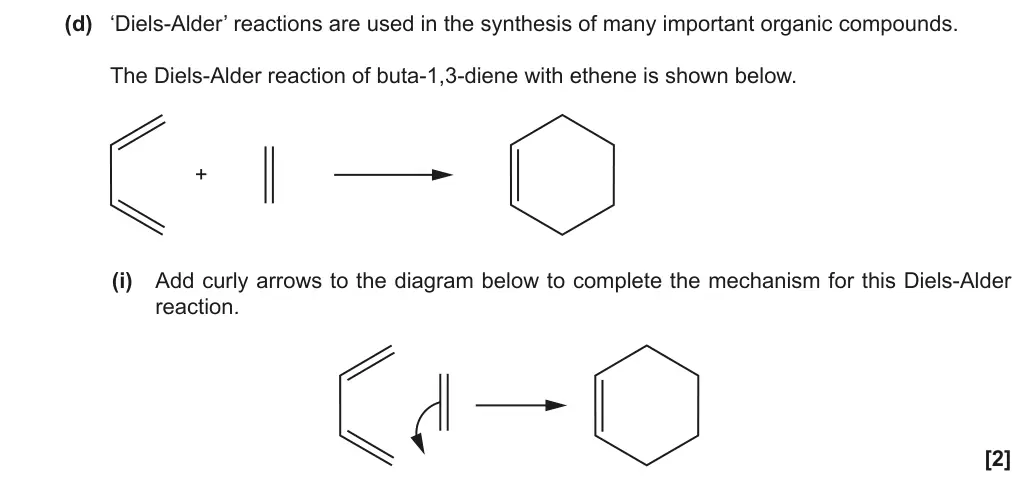
Question 16(d)(i): Many candidates did not apply their knowledge of curly arrows to this unfamiliar context.
Notes from the mark scheme and report
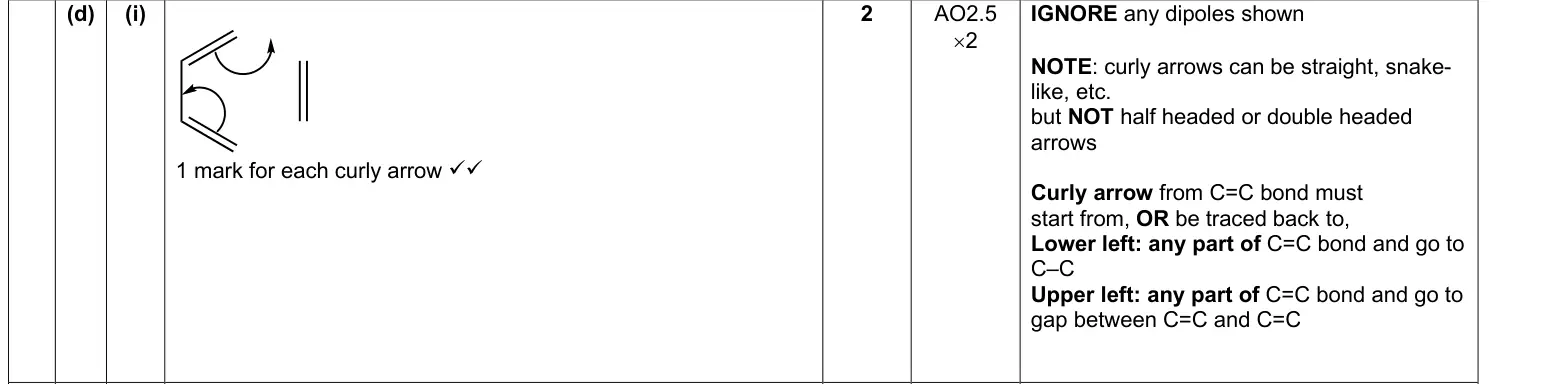
one mark per curly arrow, each starting from a C=C bond and going to where the new bond forms
IGNORE dipoles
no half-headed or double-headed arrows
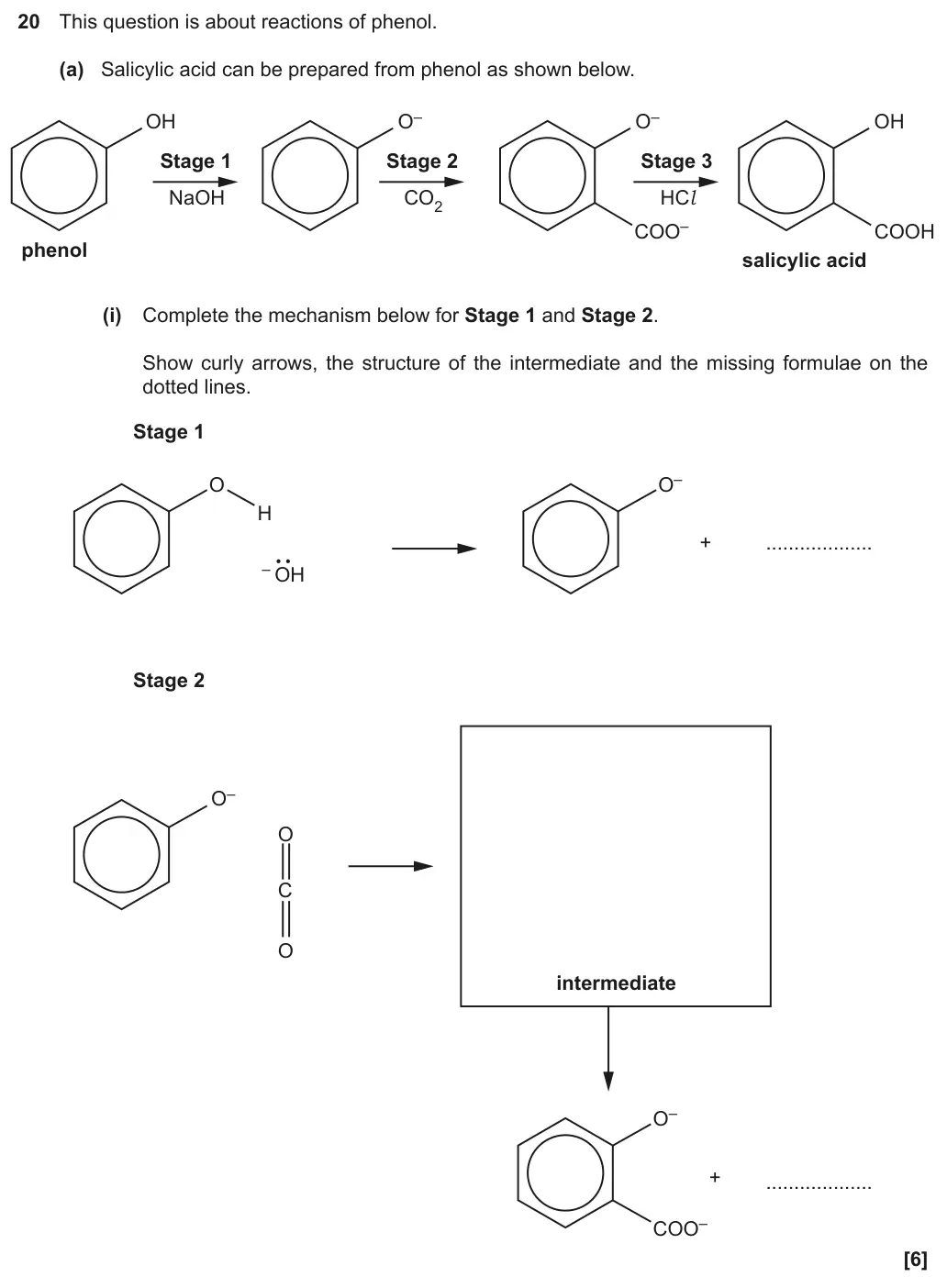
November 2021 · Paper 2 · Q20(a)(i)6 marksAO1, 2MechanismMedium
Mark scheme
Examiner's comment
Question 20(a)(i): Candidates who answered this question well had clear mechanisms.
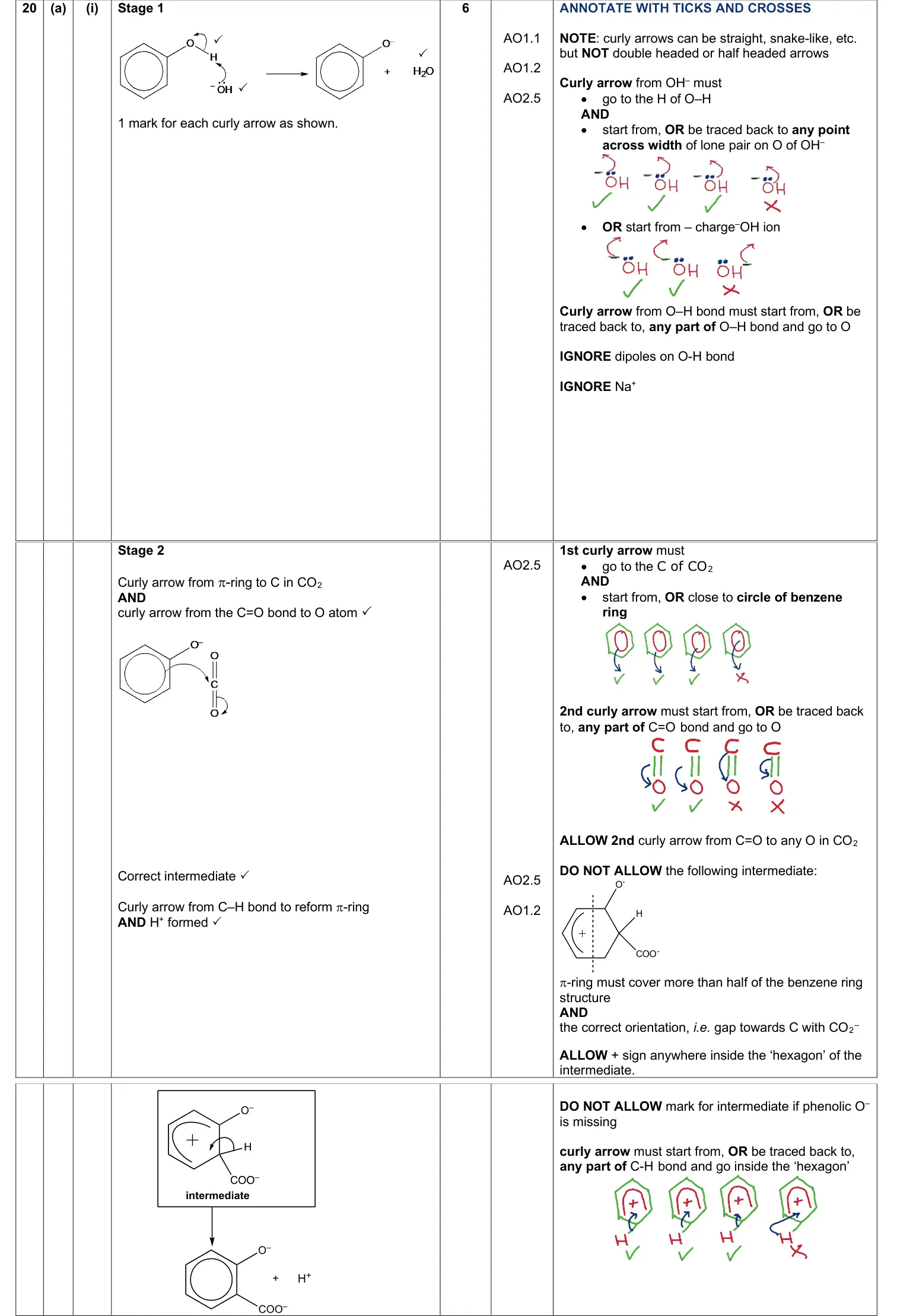
Notes from the mark scheme and report
stage 1: arrow from lone pair/charge of OH– to H of O–H and arrow from O–H bond to O, H2O formed
stage 2: arrow from ring to C of CO2 AND arrow from C=O to O
intermediate horseshoe with gap at C bearing CO2– and phenolic O– present
arrow from C–H bond into ring AND H+
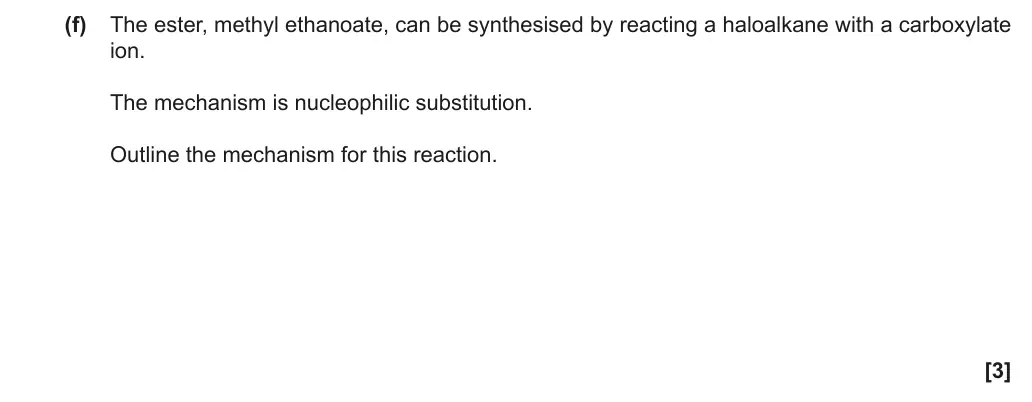
November 2021 · Paper 3 · Q1(f)3 marksAO1, 2MechanismMedium
Mark scheme
Examiner's comment
Q1(f) Outlining a mechanism for an unfamiliar reaction Q5(b)(iii) Predicting the equation for an unfamiliar organic reaction • Did not consider what a question is asking or read the information, e.g. Q1(f): Candidates were required to apply their knowledge of nucleophilic substitution of haloalkanes to outline a similar mechanism for an unfamiliar nucleophile.
Notes from the mark scheme and report
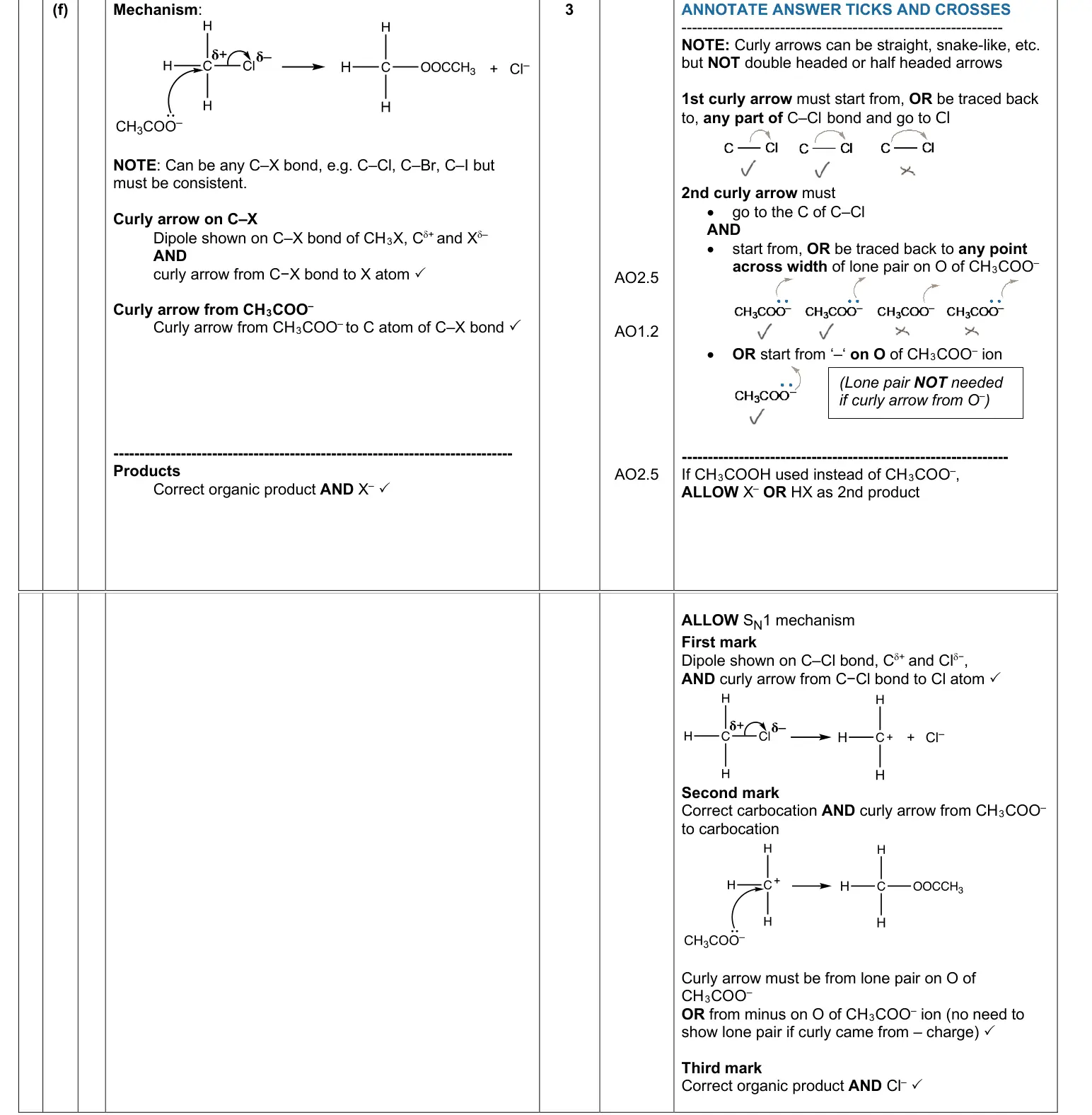
dipole on C–X and curly arrow from C–X bond to X
curly arrow from lone pair or – charge on O of CH3COO– to C
products methyl ethanoate AND X–
halogen must be consistent
ALLOW SN1 mechanism
November 2020 · AS Paper 1 · Q25(b)4 marksAO1, 2MechanismMedium
Earlier part of question 25 that this part uses
Mark scheme
Examiner's comment
25(a) This part was generally well-answered with well-prepared candidates scoring all three marks. The most common errors resulted from the products of reaction with HBr. The same structure was often drawn, reversed in one of the boxes. Candidates should take care to check that the atoms in a structure have the correct number of bonds. Some candidates added HBr across the C=C double bond but left the C=C bond intact in their final structures, showing carbon atoms with 5 bonds instead of 4. 25(b) As with 25(a), this question rewarded the well-prepared candidate and discriminated well. Conversely, many mechanisms showed little resemblance to the accepted mechanism for electrophilic addition. Mechanisms were often seen showing curly arrows going in the wrong direction and between the wrong bonds and atoms, with incorrect charges and dipoles, and partial charges used where full charges were required. Many candidates were aware that members of a homologous series have the same functional group and react in similar ways. A second mark was available for stating that the formula of successive members increases by CH2. It is important to stress ‘successive’ in communicating this information. 25(c)(ii) This part required candidates to apply their understanding of a ‘general formula’ in a novel context. Many candidates analysed the provided formulae for the alkynes homologous series to derive the correct general formula of CnH2n–2. There was no real pattern in the incorrect responses which usually contained a mixture of numbers for the H atom, e.g. CnH2n, CnHn+1. 25(c)(iii) Although attempted by most candidates, comparatively few responses could be credited. The key to success was again to use the information provided: the formation of a saturated compound. The commonest response seen showed addition of 1 Br2 molecule to form the unsaturated CH3CBr=CHBr instead of the saturated CH3CBr2–CBr2 by addition of 2 Br2. This question was one of the most difficult on the exam paper. 25(c)(iv) Most candidates achieved 1 of the available 2 marks for drawing the structure of but-2-yne, CH3C≡CCH3. The structure of but-1-yne was then usually drawn in the other box despite it being provided already in the table at the start of part (c). A variety of creditworthy structures were seen, including H2C=CH– CH=CH2, cyclobutene and isomers of methylcyclopropane. 25(c)(v) It was encouraging to see the many correct structures drawn from the unfamiliar 2,5-dimethylhept-3-yne. Most candidates positioned the C≡C group and the two substituted CH3 groups correctly. The commonest error was showing a main stem with 6, rather than 7 C atoms. If any of your students’ results are not as expected, you may wish to consider one of our review of results services. For full information about the options available visit the OCR website. If university places are at stake you may wish to consider priority service 2 reviews of marking which have an earlier deadline to ensure your reviews are processed in time for university applications. Our priority is supporting you and your students this autumn and to support you as you prepare for summer 2021 exams. We’ll update our website information regularly with resources, guidance and key information. • Teachers • Students • Exams officers • Assessment specialists We are sending a weekly roundup to tell you about important updates. You can also sign up for your subject specific updates. If you haven’t already, sign up here. Attend one of our popular CPD courses to hear directly from a senior assessor or drop in to a Q&A session. All our courses for the academic year 2020-2021 are being delivered live via an online platform, so you can attend from any location. Please find details for all our courses on the relevant subject page on our website or visit OCR professional development. ExamBuilder is the question builder platform for a range of our GCSE, A Level, Cambridge Nationals, Cambridge Technicals and Functional Skills qualifications. See the full list of available qualifications in the sign up form. ExamBuilder is free for all OCR centres with an Interchange account and gives you unlimited users per centre. We need an Interchange username to validate the identity of your centre's first user account for ExamBuilder. If you do not have an Interchange account please contact your centre administrator (usually the Exams Officer) to request a username, or nominate an existing Interchange user in your department. Review of results
Notes from the mark scheme and report
first arrow from C=C to Br
dipole on Br–Br and arrow for Br–Br fission
DO NOT ALLOW δ+ on C of carbocation
DO NOT ALLOW half-headed arrows
ALLOW bromonium ion
mechanism with HBr loses final product mark only
November 2020 · AS Paper 2 · Q5(d)(ii)3 marksAO1, 2MechanismMedium
Earlier part of question 5 that this part uses
Mark scheme
Examiner's comment
5(a) Generally this was well answered. However, some candidates only gave two responses where three were required, presumably because it was worth two marks. 5(b) A significant number of candidates did not gain the mark here as they incorrectly balanced the number of oxygens, forgetting that the alcohol contains an O atom i.e. 6.5 O2 given rather than 6. 5(c) Nomenclature in organic chemistry takes lots of practice. Approximately half of the candidates did not score this mark. It was more challenging as they needed to work with skeletal structures but evidence of drawing out displayed formula was often seen. 5(d)(i) Most candidates were able to recall the formula to calculate atom economy, however a number made errors in working out Mr values. However, some left this blank or just gave an answer without any working. 5(d)(ii) Mechanisms were often seen showing curly arrows going in the wrong direction and between the wrong bonds and atoms, charges and dipoles were often incorrect, and partial changes used where full charges were required. Writing mechanisms is an important skill in organic chemistry so it is vital that time is spent practising writing them out and fully understanding the significance of the curly arrow. 5(d)(iii) Many candidates gave the correct mechanism here, with common incorrect responses being other types of mechanism, substitution only, or isomerism. 5(e) Very few candidates gained both marks here. It was not enough here to just state faster/slower without specifying which haloalkane they were referring to. It was also important to specify the C-X bond not just vague reference to the chlorine or bromine bond. Many described the difference in bond polarity so had the wrong order. Some were more general and discussed the reactivity of bromine and chlorine themselves. 5(f)* This was a challenging problem-solving question, relying on candidates to make use of all of the information provided to determine the structure. Very few candidates made no attempt at all at this question. The most common error was incorrectly identifying the peak at 3000 cm-1 as O-H from a carboxylic acid, despite it being indicated on the data sheet that this would be a broad peak. It suggested that candidates were not familiar with looking at spectra and understanding what data it gave. Candidates should also be reminded when answering these types of question that they should give the structures, not just molecular formulae, where possible. If any of your students’ results are not as expected, you may wish to consider one of our review of results services. For full information about the options available visit the OCR website. If university places are at stake you may wish to consider priority service 2 reviews of marking which have an earlier deadline to ensure your reviews are processed in time for university applications. Our priority is supporting you and your students this autumn and to support you as you prepare for summer 2021 exams. We’ll update our website information regularly with resources, guidance and key information. • Teachers • Students • Exams officers • Assessment specialists We are sending a weekly roundup to tell you about important updates. You can also sign up for your subject specific updates. If you haven’t already, sign up here. Attend one of our popular CPD courses to hear directly from a senior assessor or drop in to a Q&A session. All our courses for the academic year 2020-2021 are being delivered live via an online platform, so you can attend from any location. Please find details for all our courses on the relevant subject page on our website or visit OCR professional development. ExamBuilder is the question builder platform for a range of our GCSE, A Level, Cambridge Nationals, Cambridge Technicals and Functional Skills qualifications. See the full list of available qualifications in the sign up form. ExamBuilder is free for all OCR centres with an Interchange account and gives you unlimited users per centre. We need an Interchange username to validate the identity of your centre's first user account for ExamBuilder. If you do not have an Interchange account please contact your centre administrator (usually the Exams Officer) to request a username, or nominate an existing Interchange user in your department. Review of results
Notes from the mark scheme and report
arrow from lone pair or negative charge on O of OH– to C of C–Br
dipole on C–Br AND arrow from the bond to Br
products must show Br– (NaBr does not show Br–)
no double-headed or half arrows
ALLOW SN1
November 2020 · Paper 2 · Q16(c)3 marksAO1, 2MechanismMedium
Earlier part of question 16 that this part uses
Mark scheme
Examiner's comment
Other questions Question 16(c) Often candidates did not use skeletal formula, as required by the question, and did not place the radical dot in the correct position.
Notes from the mark scheme and report
dot REQUIRED at the correct position on the chain
1 mark if both propagation steps correct but dot missing/on wrong C or not skeletal
IGNORE dots in initiation
November 2020 · Paper 2 · Q19(c)(i)5 marksAO1, 2Mechanism
Earlier part of question 19 that this part uses
Mark scheme
Notes from the mark scheme and report
curly arrow from lone pair on C (or – charge) of –CN to C of C=O
dipole on C=O AND arrow from bond to O
arrow from O– of intermediate to H+ (ALLOW to H of H2O)
nucleophilic addition
November 2020 · Paper 3 · Q6(c)4 marksAO3MechanismHard
Earlier part of question 6 that this part uses
Mark scheme
Examiner's comment
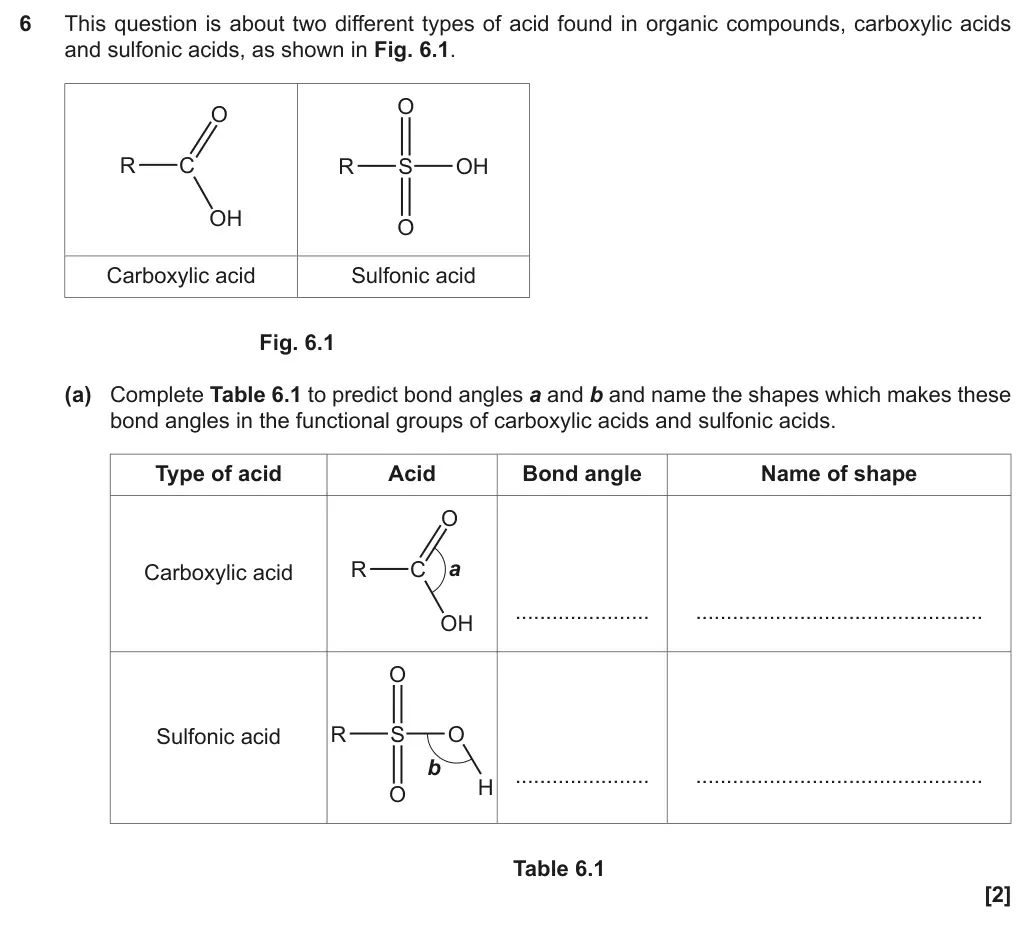
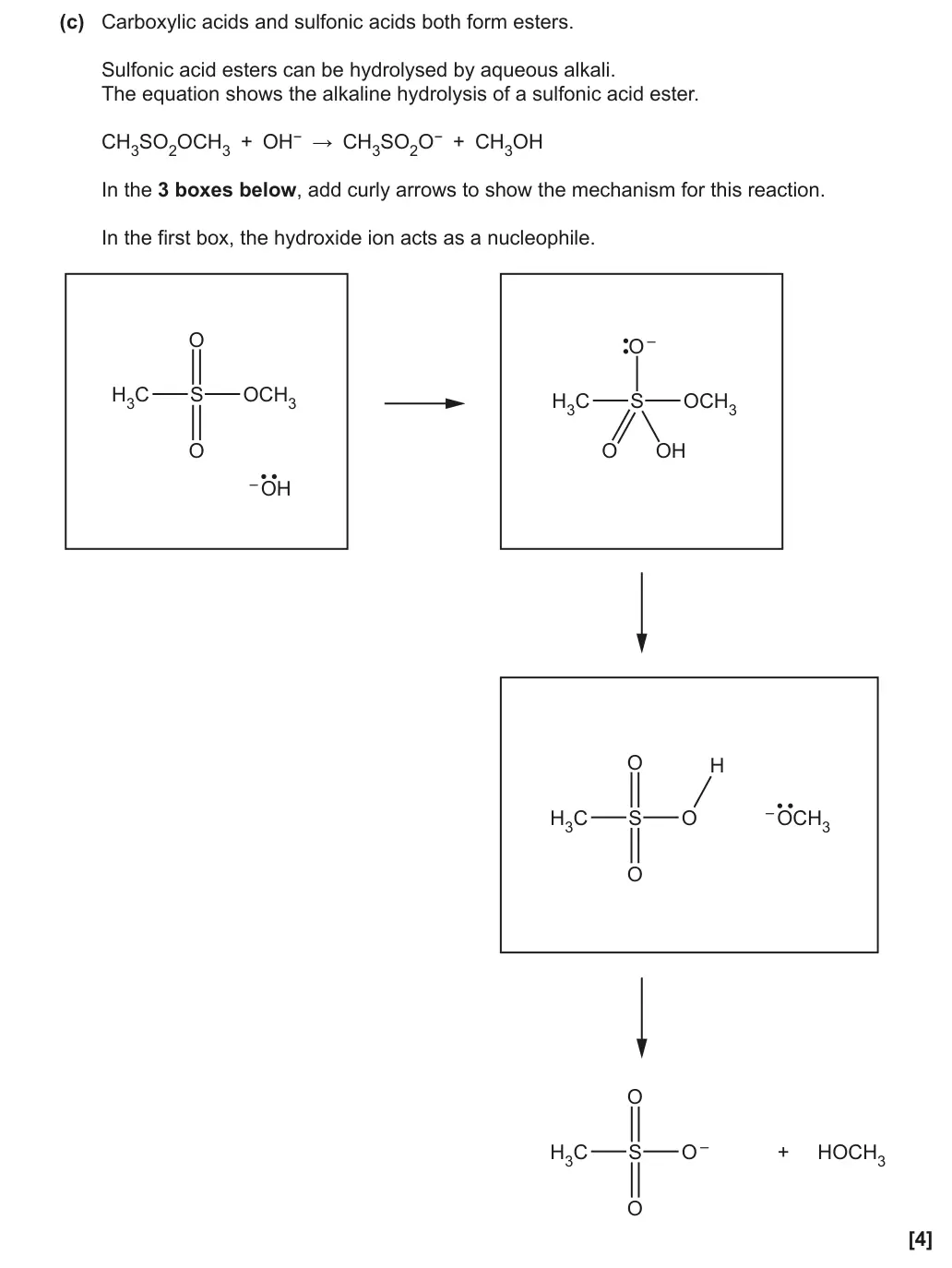
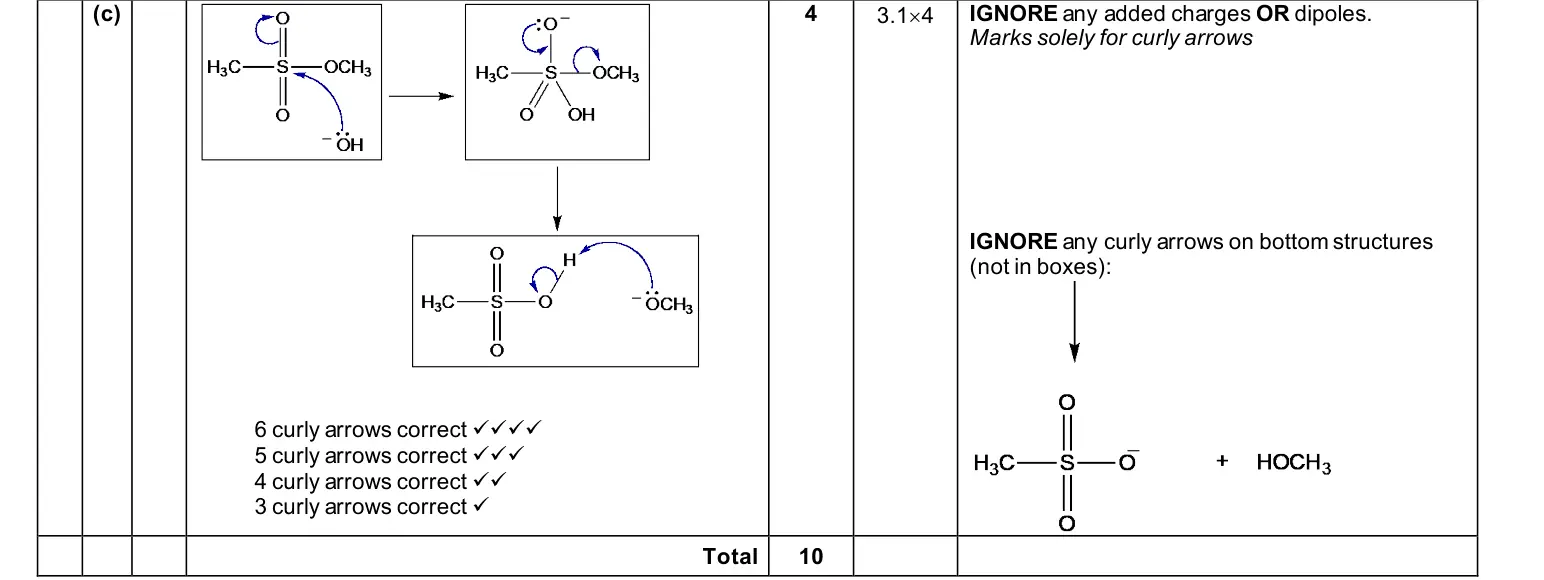
6(a) Candidates were expected to use their knowledge and understanding of bond angles and shapes. Most candidates were given both available marks. A significant number responded with incorrect names of shapes, or chose the wrong shape, such as pyramidal for the O–C–O bond angle in the carboxylic acid. Candidates are recommended to learn this basic area of chemistry. 6(b) Most candidates completed a correct equilibrium equation and assigned the correct acid-base pairs. A significant number of candidates used ethanoic acid instead of water in the equation. The examiners allowed error carried forward in this case for the acid-base pairs. Candidates found it much more difficult to explain whether the sulfonic acid had a lower pH value. The higher-attaining candidates answered concisely. They usually identifying that the sulfonic acid would have a lower pH as the pKa value was lower (or the Ka value greater), leading to more dissociation than ethanoic acid. Lower-attaining candidates often produced unfocussed and lengthy responses, sometimes relating increased dissociation in an acid to a higher, rather than a lower, pH. Some candidates approached their explanation mathematically, calculating pH values for ethanoic acid and sulfonic acid from their concentrations and pKa values. If correct, this approach was fully credited. 6(c) Most candidates showed a good understanding and appreciation of drawing curly arrows. It must be stressed that curly arrows that do not start from a lone pair, negative charge or a bond cannot be credited. Lower-attaining candidates often drew imprecisely positioned curly arrows, curly arrows in the wrong direction or to the wrong atoms. For their response to be credited with marks, candidates should position curly arrows to ensure credit when outlining reaction mechanisms. If any of your students’ results are not as expected, you may wish to consider one of our review of results services. For full information about the options available visit the OCR website. If university places are at stake you may wish to consider priority service 2 reviews of marking which have an earlier deadline to ensure your reviews are processed in time for university applications. Our priority is supporting you and your students this autumn and to support you as you prepare for summer 2021 exams. We’ll update our website information regularly with resources, guidance and key information. • Teachers • Students • Exams officers • Assessment specialists We are sending a weekly roundup to tell you about important updates. You can also sign up for your subject specific updates. If you haven’t already, sign up here. Attend one of our popular CPD courses to hear directly from a senior assessor or drop in to a Q&A session. All our courses for the academic year 2020-2021 are being delivered live via an online platform, so you can attend from any location. Please find details for all our courses on the relevant subject page on our website or visit OCR professional development. ExamBuilder is the question builder platform for a range of our GCSE, A Level, Cambridge Nationals, Cambridge Technicals and Functional Skills qualifications. See the full list of available qualifications in the sign up form. ExamBuilder is free for all OCR centres with an Interchange account and gives you unlimited users per centre. We need an Interchange username to validate the identity of your centre's first user account for ExamBuilder. If you do not have an Interchange account please contact your centre administrator (usually the Exams Officer) to request a username, or nominate an existing Interchange user in your department. Review of results
Notes from the mark scheme and report
marks solely for curly arrows (6 correct = 4 marks, 3 correct = 1 mark)
arrows from lone pair on –OH to S and S=O bond to O, O– lone pair reforming S=O and S–OCH3 bond to O, then –OCH3 lone pair to H and O–H bond to O
IGNORE added charges/dipoles
June 2019 · AS Paper 1 · Q25(b)(i)3 marksAO1, 2MechanismMedium
Mark scheme
Examiner's comment
Many candidates scored all 3 marks for this part, showing that most had thoroughly learnt the mechanism for radical substitution. The equation and conditions for the initiation step were well-known but the equations for the propagation steps often included errors. It was common for dots to be omitted for some radicals and C4H9Cl•, rather than C4H9•, was often shown for one of the products in the first propagation stage. H• was then shown as the other product.
Notes from the mark scheme and report
UV needed with initiation
dots required in each propagation equation (1 mark for both propagation equations with dots missing/extra)
DO NOT ALLOW charges
June 2019 · AS Paper 2 · Q3(a)(i)3 marksAO2MechanismMedium
Mark scheme
Examiner's comment
Those that had learnt this important mechanism scored all 3 marks with very precisely drawn arrows and partial charges. Although many candidates wrote out the correct organic product, many wrote NaI instead of I- which lost them the final mark. This candidate scored all 3 marks. The lone pair of electrons on the oxygen and partial charges on the C-I bond are clearly marked on the diagram and the arrows are precisely drawn. Connectivity is good on the organic product and I- identified as the additional product.
Notes from the mark scheme and report
curly arrow from lone pair or – charge on O of OH– to C of C–I
dipole Cδ+–Iδ– AND arrow from C–I bond to I
product AND I– (NaI does not show I–)
no double-headed or half arrows
June 2019 · Paper 2 · Q16(a)(i)4 marksAO1, 2MechanismEasy
Mark scheme
Examiner's comment
Candidates were very familiar with this electrophilic addition mechanism, so the majority of candidates scored three or four marks. Common errors included inaccurate curly arrows from either the carbon- carbon double bond or the bromide ion or the omission of key detail such as the partial charges on HBr or the charge on the bromide ion.
Notes from the mark scheme and report
curly arrow from C=C to H of H–Br
dipole on H–Br AND arrow breaking H–Br
DO NOT ALLOW partial charge on C=C or δ+ on carbocation C
arrow from lone pair or negative charge of Br–
no double-headed or half arrows
IGNORE connectivity of CHO
June 2019 · Paper 2 · Q19(b)(iii)5 marksAO1, 2, 3MechanismMedium
Earlier part of question 19 that this part uses
Mark scheme
Examiner's comment
This question required candidates to apply their knowledge of the mechanism of electrophilic substitution to the formation of phenylethanone from benzene. Examiners were encouraged by the number of excellent responses to this question, with the majority of candidates securing four out of five marks. Common errors included accuracy of curly arrows (Exemplar 7 below) and omission of HCl as product from the regeneration of the catalyst. The responses of lower ability candidates also contained errors in the equation for the formation of the electrophile. Such responses used chlorine rather than ethanoyl chloride. This response demonstrates a near perfect attempt at this question. The equations for the formation of the electrophile and regeneration of the catalyst are correct. The first curly arrow is drawn accurately from the circle of the benzene ring to the correct carbon atom of the electrophile. The intermediate is correct, with the π ring over the five carbon atoms and in the correct orientation. Unfortunately the curly arrow drawn to reform the π bond starts at the H atom rather than from the bond. This small error has prevented this candidate from being given full marks.
Notes from the mark scheme and report
CH3COCl + AlCl3 → CH3C+=O + AlCl4–
arrow from ring to C of C=O
intermediate horseshoe over about 4 of 6 sides, gap towards C with COCH3
arrow from C–H bond back into ring
H+ + AlCl4– → AlCl3 + HCl
June 2019 · Paper 2 · Q20(a)(ii)2 marksAO3MechanismMedium
Earlier part of question 20 that this part uses
Mark scheme
Examiner's comment
This demanding question required candidates to apply their knowledge of curly arrows to an unfamiliar intermediate. Examiners were impressed by the number of good responses and many candidates were able to draw an organic product with the correct carbon skeleton. The best responses demonstrated candidates’ flair for the subject and these recognised that a carbocation would be formed rather than an alkane.
Notes from the mark scheme and report
correct carbon skeleton
+ charge on the correct carbon (tertiary carbocation) with H2O
IGNORE other products
June 2019 · Paper 2 · Q20(b)(i)4 marksAO3MechanismMedium
Earlier part of question 20 that this part uses
Mark scheme
Examiner's comment
Examiners were encouraged by the number of excellent responses to this question. Candidates were able to confidently apply their knowledge of mechanisms to this unfamiliar example and the majority of the cohort scored at least two marks. In the first step candidates used their understanding of nucleophilic addition to show a correct curly arrow from the hydroxide ion to the C of the C=O bond as well as an arrow from this bond to the O. Many candidates were able to show the breaking of the C–Cl bond and the formation of a chloride ion, drawing on their experience of the reactions of haloalkanes. Some candidates recognised the need to include an arrow to reform the carbon-oxygen double bond, with the best responses showing this accurately. A common error was to draw the bond from the lone pair on O to the C atom, rather than the bond.
Notes from the mark scheme and report
arrow from lone pair or charge of OH– to C of C=O
arrow from C=O bond to O
arrow from lone pair/charge on O– to re-form C=O
arrow from C–Cl bond to Cl AND Cl– as product
IGNORE dipoles
no double-headed or half arrows
June 2018 · AS Paper 1 · Q25(b)(i)3 marksMechanismMedium
Mark scheme
Examiner's comment
As with 25(a)(i), this question rewarded the well-prepared candidate. The large number of proposed mechanisms showed little resemblance to the accepted mechanism for nucleophilic substitution. Mechanisms were often seen showing curly arrows going in the wrong direction and between the wrong bonds and atoms, charges and dipoles were often incorrect, and partial changes used where full charges were required. Two exemplars are shown. The first exemplar shows clear curly arrows, the role of the lone pair and all charges correct. The second exemplar shows a typical muddled response. Although the curly arrow from the hydroxide ion has been accurately drawn, the hydroxide ion has a partial charge rather than a – charge. There is also no curly arrow showing breaking of the C–Br bond. The only mark available is for the correct organic product and a Br– ion. Some mechanisms were so poor that it was impossible to credit many candidates with any marks. Writing mechanisms is an important skill in organic chemistry and it is recommended that candidates learn and practice their writing.
Notes from the mark scheme and report
curly arrow from lone pair or – charge on O of OH– to C of C–Br
dipole on C–Br and arrow from bond to Br
Br– needed as product (NaBr does not show Br–)
ALLOW SN1 mechanism
June 2018 · AS Paper 2 · Q6(b)(ii)3 marksMechanismMedium
Earlier part of question 6 that this part uses
Mark scheme
Examiner's comment
Many candidates gained all three marks on this question and the diagrams were clear and easy to read. Lower ability candidates had incorrect dipoles or curly arrows that could not be traced back to the correct origin. Candidates should be encouraged to consider what the arrows mean rather than memorising mechanisms with no understanding.
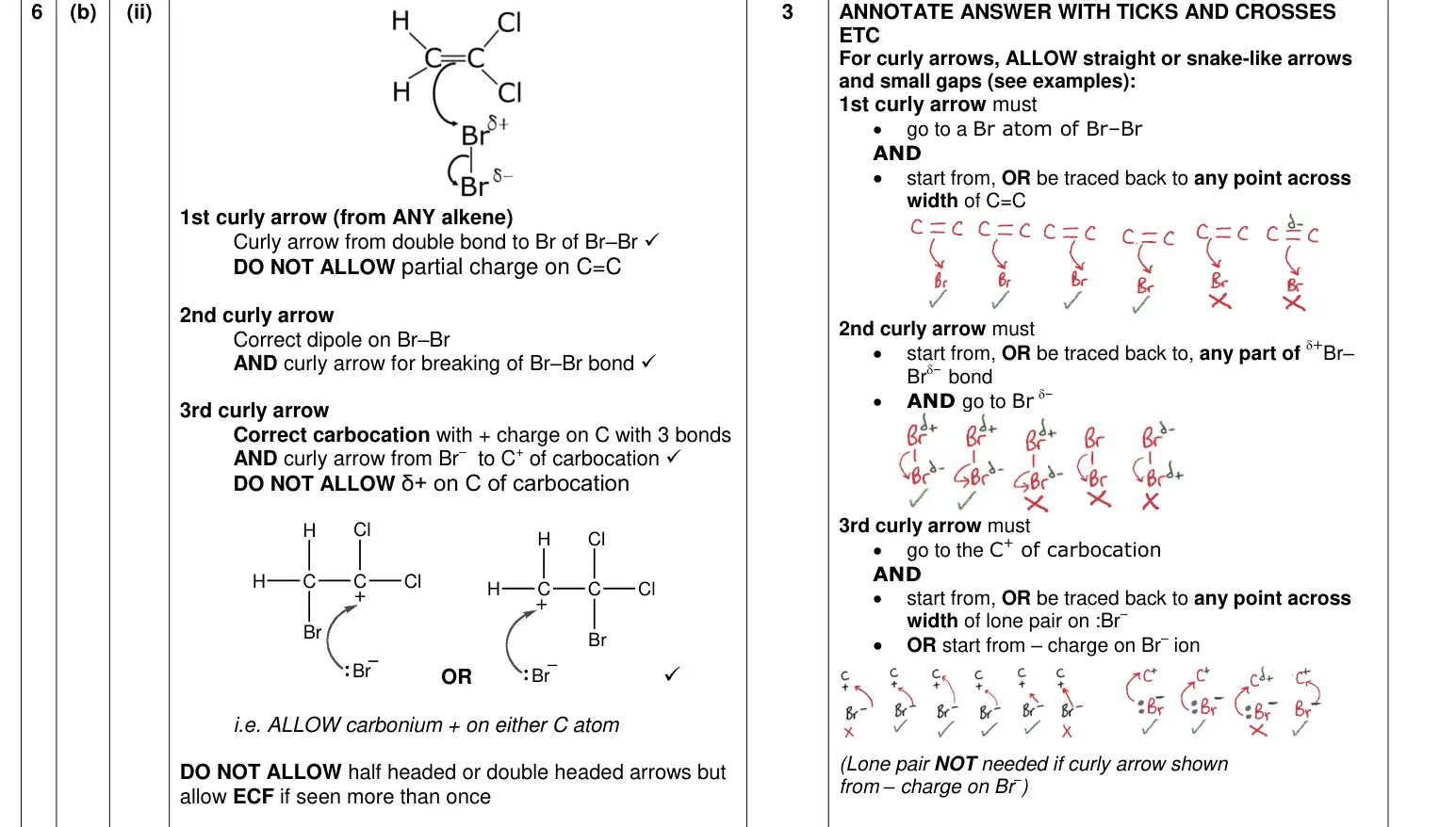
Notes from the mark scheme and report
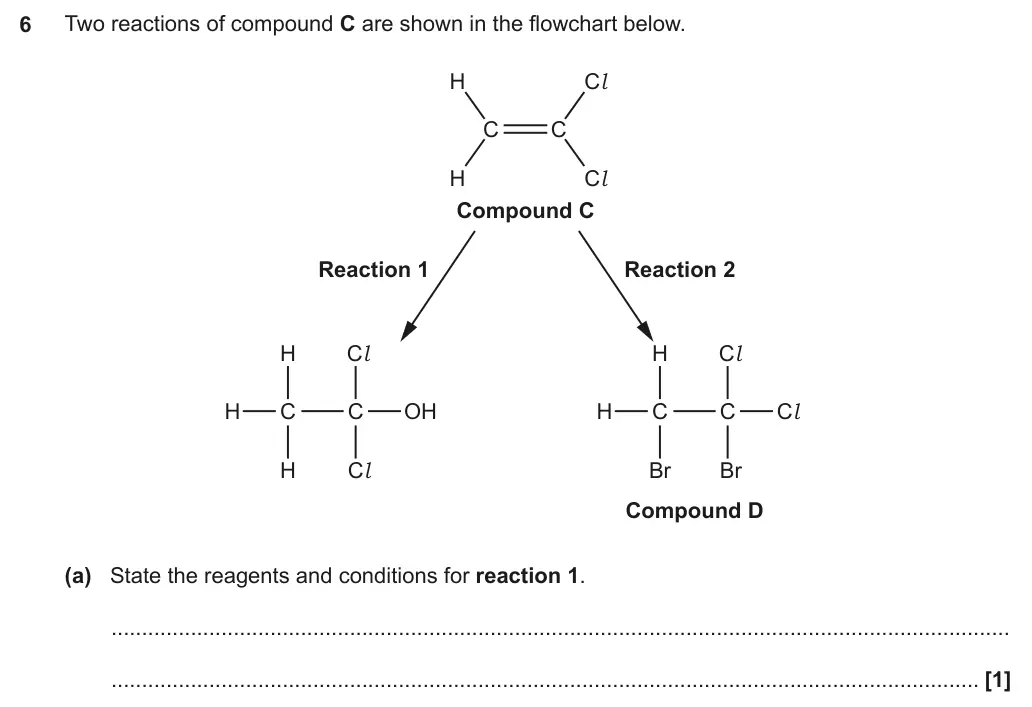
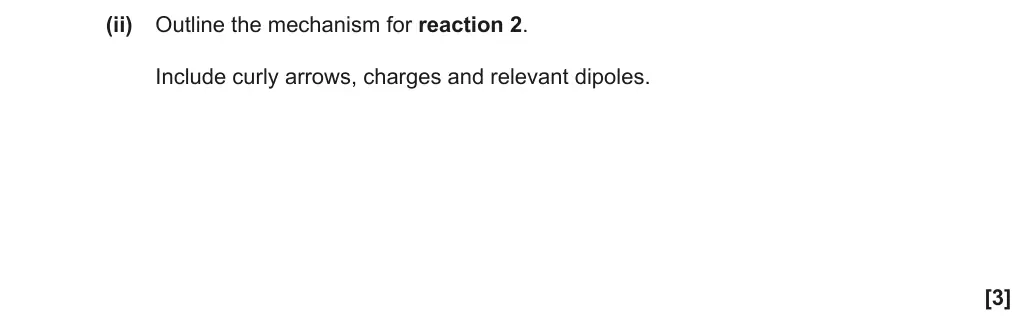
arrow from C=C to Br
dipole on Br–Br and arrow from bond to Brδ–
arrow from Br– lone pair/charge to C+
DO NOT ALLOW partial charge on C=C or δ+ on carbocation
DO NOT ALLOW half-headed arrows
June 2018 · Paper 2 · Q19(b)3 marksMechanismEasy
Earlier part of question 19 that this part uses
Mark scheme
Examiner's comment
Candidates were very familiar with this nucleophilic substitution mechanism. Consequently the majority of candidates scored two or three marks. Common errors included inaccurate curly arrows from the hydroxide ion and failure to show the chloride ion as a product. Exemplar 6 highlights both of these. This response demonstrates the two most common errors seen in this part. The first marking point cannot be credited as the curly arrow from the hydroxide ion does not involve either the lone pair or minus sign on the O atom. The organic product is correct but the chloride ion produced by the heterolytic fission of the C-Cl bond is not shown so marking point three cannot be credited. This response only scores one mark for the correct partial charges and curly arrow on the C-Cl bond. Candidates are encouraged to practice drawing mechanisms so as to avoid costly errors during examinations.
Notes from the mark scheme and report
curly arrow from lone pair or – charge on O of OH– to C
dipole on C–Cl AND arrow from bond to Cl
Cl– needed as product (NaCl does not show Cl–)
no double-headed/half-headed arrows
ALLOW SN1
June 2018 · Paper 3 · Q4(a)(ii)2 marksMechanismHard
Earlier part of question 4 that this part uses
Mark scheme
Examiner's comment
This part required candidates to apply their knowledge and understanding of the nucleophilic substitution mechanism in a novel context. This part discriminated extremely well with able candidates drawing the correct initial complex and showing precisely positioned curly arrows, dipoles and the role of the NH3 lone pair, as shown in Lower ability candidates often showed imprecise curly arrows or placed a negative charge on NH3, as shown in Exemplar 8.
Notes from the mark scheme and report
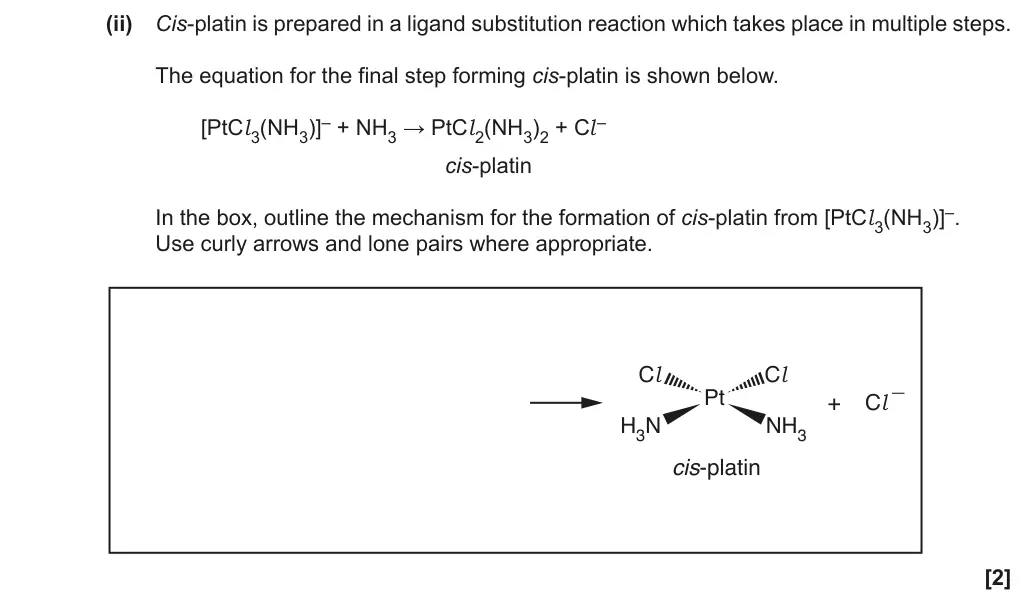
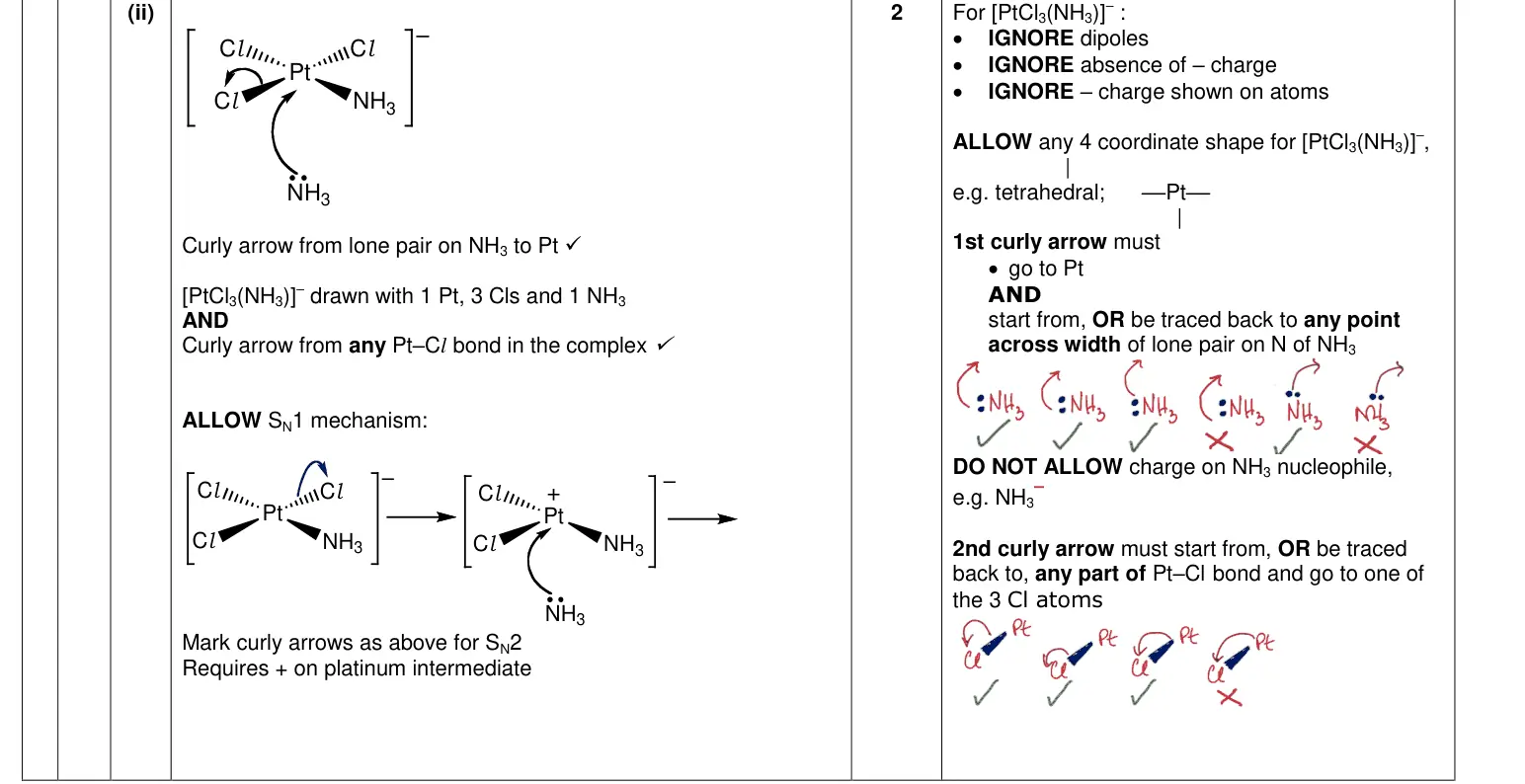
curly arrow from lone pair on N of NH3 to Pt
DO NOT ALLOW charge on NH3
ALLOW SN1-type route with + on Pt intermediate
IGNORE dipoles
June 2017 · Paper 2 · Q16(d)(iii)3 marksMechanism
Earlier parts of question 16 that this part uses
Mark scheme
Notes from the mark scheme and report
curly arrow from C=C to H of H–Br
dipole on H–Br AND arrow breaking H–Br
DO NOT ALLOW partial charges on C=C or δ+ on carbocation C
arrow from lone pair or negative charge of Br–
June 2017 · Paper 2 · Q18(a)(i)3 marksMechanism
Mark scheme
Notes from the mark scheme and report
curly arrow from lone pair or negative charge on C of CN– to C of C–Cl
June 2025 · AS Paper 1 · Q24(c)(i)5 marksMechanismHard
Mark scheme
Examiner's comment
Many candidates scored well on this question, drawing a clear mechanism and correctly giving the major product. However, mistakes were often seen with the direction of arrows and a minority of students gave the minor product for Compound A and/or named the mechanism incorrectly. Partial charges on the carbons of the double bond and lack of charge on the chloride ion were also common errors. This question proved to be an excellent discriminator.
Notes from the mark scheme and report
curly arrow from C=C to H of H–Cl
dipole on H–Cl AND arrow breaking H–Cl
carbocation with full + (tertiary for major product) and arrow from lone pair/– charge of Cl–
DO NOT ALLOW partial charge on C=C
DO NOT ALLOW half-headed arrows
name electrophilic addition
June 2024 · AS Paper 2 · Q5(b)(i)4 marksMechanismHard
Earlier part of question 5 that this part uses
Mark scheme
Examiner's comment
Approximately half of candidates scored all 4 marks. Very few scored no marks as they were able to give the correct structure of the named product (2-bromobutane). The most common reasons for losing marks included: • Adding dipoles to C=C • Missing dipoles on H-Br or reversed dipole on H-Br (i.e. + Br) • Missing charge on bromide ion or adding - • Arrows the wrong way round or not coming from a bond or lone pair (or negative charge for bromide ion) Some attempted a radical mechanism.
Notes from the mark scheme and report
arrow from C=C to H of H–Br
dipole on H–Br and arrow from bond to Br
arrow from Br– (lone pair or charge) to C+ of secondary carbocation
DO NOT ALLOW δ+ on carbocation or partial charge on C=C
product mark independent
ALLOW ECF for product from incorrect carbocation
For ideas on teaching this topic please look at our Topic Exploration Pack: Electrophilic Addition and Markownikoff’s rule: https://teachcambridge.org/item/b4220e86-bc04-492c-b354-8103687ce594
June 2022 · AS Paper 1 · Q21(a)(ii)5 marksAO1, 2MechanismMedium
Earlier part of question 21 that this part uses
Mark scheme
Examiner's comment
Many candidates answered the mechanism proficiently. However, many mistakes were seen with the direction of arrows, and confusing 𝛿+/ 𝛿– and +/– charges. In the intermediate carbocation, the C=C was often left intact and 𝛿– used on the bromide ion attacking the intermediate. Some less successful responses did not position curly arrows accurately. One common error was showing one or more C atoms missing from the (CH3)C groups. Candidates should take great care when drawing organic structures to make sure that all groups have been drawn accurately. This exemplar has been included to emphasise the importance of accurately placed curly arrows and use of charges. It was only possible to award this response 1 out of 5 marks. With a few improvements, this response could easily have been 5/5. The start of the first curly arrow has been placed accurately starting from the C=C double bond but the arrow should have finished at the Br𝛿+: 0 marks The Br–Br dipole is correct but there is no curly arrow showing it breaking: 0 marks The intermediate carbocation is correct but the curly arrow should have been shown from a lone pair on the Br– ion to the + charge of the carbocation: 0 marks The product is correct: 1 mark The reaction type is addition but the name of the mechanism is electrophilic addition: 0 marks nucleophilic substitution and radical substitution. This paper includes two of these in Questions 21 (a) (i) and 26 (a). It is essential that candidates learn these three mechanism types.
Notes from the mark scheme and report
first curly arrow from the C=C bond to Br
dipole on Br–Br AND arrow for breaking Br–Br
carbocation needs full + (DO NOT ALLOW δ+)
arrow from lone pair or – charge of Br–
DO NOT ALLOW half-headed or double-headed arrows
mechanism with HBr loses final product mark
Reactions mechanisms are the organic chemist’s way of communicating electron transfers in organic chemistry. Candidates must use curly arrows, dipoles and charges appropriately and accurately. AS Chemistry includes three important reaction mechanisms: electrophilic addition,
June 2022 · Paper 2 · Q16(a)(ii)3 marksAO1, 2MechanismEasy
Earlier part of question 16 that this part uses
Mark scheme
Examiner's comment
Candidates are familiar with the mechanism for the bromination of hydrocarbons. So, the majority of candidates scored 3 marks. Common errors included the use of HBr rather than Br2 or putting a dipole on the carbon-carbon double bond.
Notes from the mark scheme and report
curly arrow from C=C to Br AND dipole on Br–Br AND arrow breaking Br–Br
carbocation with full + AND arrow from lone pair/– charge of Br–
DO NOT ALLOW partial charge on C=C
DO NOT ALLOW half-headed arrows
DO NOT ALLOW use of HBr
ALLOW bromonium ion
November 2021 · AS Paper 1 · Q24(a)4 marksAO1, 2Mechanism
Mark scheme
Notes from the mark scheme and report
curly arrow from C=C to H of H–Br
dipole on H–Br and arrow breaking H–Br
arrow from Br– lone pair/charge to C+ of the correct (tertiary) carbocation
DO NOT ALLOW partial charge on C=C or δ+ on carbocation
DO NOT ALLOW incorrect carbocation
November 2021 · Paper 2 · Q16(b)(i)4 marksAO1, 2MechanismEasy
Mark scheme
Examiner's comment
Question 16(b)(i): This was answered well by students.
Notes from the mark scheme and report
curly arrow from C=C to H of H–Br
dipole on H–Br AND arrow breaking H–Br
secondary carbocation (DO NOT ALLOW δ+ on C) with arrow from lone pair/charge of Br–
DO NOT ALLOW partial charge on C=C
ALLOW ECF product from incorrect carbocation
November 2020 · AS Paper 1 · Q25(b)4 marksAO1, 2MechanismMedium
Earlier part of question 25 that this part uses
Mark scheme
Examiner's comment
25(a) This part was generally well-answered with well-prepared candidates scoring all three marks. The most common errors resulted from the products of reaction with HBr. The same structure was often drawn, reversed in one of the boxes. Candidates should take care to check that the atoms in a structure have the correct number of bonds. Some candidates added HBr across the C=C double bond but left the C=C bond intact in their final structures, showing carbon atoms with 5 bonds instead of 4. 25(b) As with 25(a), this question rewarded the well-prepared candidate and discriminated well. Conversely, many mechanisms showed little resemblance to the accepted mechanism for electrophilic addition. Mechanisms were often seen showing curly arrows going in the wrong direction and between the wrong bonds and atoms, with incorrect charges and dipoles, and partial charges used where full charges were required. Many candidates were aware that members of a homologous series have the same functional group and react in similar ways. A second mark was available for stating that the formula of successive members increases by CH2. It is important to stress ‘successive’ in communicating this information. 25(c)(ii) This part required candidates to apply their understanding of a ‘general formula’ in a novel context. Many candidates analysed the provided formulae for the alkynes homologous series to derive the correct general formula of CnH2n–2. There was no real pattern in the incorrect responses which usually contained a mixture of numbers for the H atom, e.g. CnH2n, CnHn+1. 25(c)(iii) Although attempted by most candidates, comparatively few responses could be credited. The key to success was again to use the information provided: the formation of a saturated compound. The commonest response seen showed addition of 1 Br2 molecule to form the unsaturated CH3CBr=CHBr instead of the saturated CH3CBr2–CBr2 by addition of 2 Br2. This question was one of the most difficult on the exam paper. 25(c)(iv) Most candidates achieved 1 of the available 2 marks for drawing the structure of but-2-yne, CH3C≡CCH3. The structure of but-1-yne was then usually drawn in the other box despite it being provided already in the table at the start of part (c). A variety of creditworthy structures were seen, including H2C=CH– CH=CH2, cyclobutene and isomers of methylcyclopropane. 25(c)(v) It was encouraging to see the many correct structures drawn from the unfamiliar 2,5-dimethylhept-3-yne. Most candidates positioned the C≡C group and the two substituted CH3 groups correctly. The commonest error was showing a main stem with 6, rather than 7 C atoms. If any of your students’ results are not as expected, you may wish to consider one of our review of results services. For full information about the options available visit the OCR website. If university places are at stake you may wish to consider priority service 2 reviews of marking which have an earlier deadline to ensure your reviews are processed in time for university applications. Our priority is supporting you and your students this autumn and to support you as you prepare for summer 2021 exams. We’ll update our website information regularly with resources, guidance and key information. • Teachers • Students • Exams officers • Assessment specialists We are sending a weekly roundup to tell you about important updates. You can also sign up for your subject specific updates. If you haven’t already, sign up here. Attend one of our popular CPD courses to hear directly from a senior assessor or drop in to a Q&A session. All our courses for the academic year 2020-2021 are being delivered live via an online platform, so you can attend from any location. Please find details for all our courses on the relevant subject page on our website or visit OCR professional development. ExamBuilder is the question builder platform for a range of our GCSE, A Level, Cambridge Nationals, Cambridge Technicals and Functional Skills qualifications. See the full list of available qualifications in the sign up form. ExamBuilder is free for all OCR centres with an Interchange account and gives you unlimited users per centre. We need an Interchange username to validate the identity of your centre's first user account for ExamBuilder. If you do not have an Interchange account please contact your centre administrator (usually the Exams Officer) to request a username, or nominate an existing Interchange user in your department. Review of results
Notes from the mark scheme and report
first arrow from C=C to Br
dipole on Br–Br and arrow for Br–Br fission
DO NOT ALLOW δ+ on C of carbocation
DO NOT ALLOW half-headed arrows
ALLOW bromonium ion
mechanism with HBr loses final product mark only
June 2019 · Paper 2 · Q16(a)(i)4 marksAO1, 2MechanismEasy
Mark scheme
Examiner's comment
Candidates were very familiar with this electrophilic addition mechanism, so the majority of candidates scored three or four marks. Common errors included inaccurate curly arrows from either the carbon- carbon double bond or the bromide ion or the omission of key detail such as the partial charges on HBr or the charge on the bromide ion.
Notes from the mark scheme and report
curly arrow from C=C to H of H–Br
dipole on H–Br AND arrow breaking H–Br
DO NOT ALLOW partial charge on C=C or δ+ on carbocation C
arrow from lone pair or negative charge of Br–
no double-headed or half arrows
IGNORE connectivity of CHO
June 2018 · AS Paper 2 · Q6(b)(ii)3 marksMechanismMedium
Earlier part of question 6 that this part uses
Mark scheme
Examiner's comment
Many candidates gained all three marks on this question and the diagrams were clear and easy to read. Lower ability candidates had incorrect dipoles or curly arrows that could not be traced back to the correct origin. Candidates should be encouraged to consider what the arrows mean rather than memorising mechanisms with no understanding.
Notes from the mark scheme and report
arrow from C=C to Br
dipole on Br–Br and arrow from bond to Brδ–
arrow from Br– lone pair/charge to C+
DO NOT ALLOW partial charge on C=C or δ+ on carbocation
DO NOT ALLOW half-headed arrows
June 2017 · AS Paper 2 · Q6(b)4 marksMechanism
Earlier part of question 6 that this part uses
Mark scheme
Notes from the mark scheme and report
curly arrow must start from the double bond and go to Br
dipole on Br–Br
DO NOT ALLOW δ+ on C of carbocation
arrow from lone pair or negative charge of Br–
max 2 if wrong cyclohexene structure
June 2017 · Paper 2 · Q16(d)(iii)3 marksMechanism
Earlier parts of question 16 that this part uses
Mark scheme
Notes from the mark scheme and report
curly arrow from C=C to H of H–Br
dipole on H–Br AND arrow breaking H–Br
DO NOT ALLOW partial charges on C=C or δ+ on carbocation C
June 2025 · Paper 2 · Q19(a)(i)3 marksMechanismHard
Mark scheme
Examiner's comment
Many candidates scored all 3 marks here showing that the mechanism is well known. Some struggled with the skeletal formula given but were given credit for drawing out structural or displayed formula, provided that the central C showed correct number of bonds. Most common reasons for losing marks: • KCN and KBr shown in the mechanism rather than ions • arrow from lone pair or negative charge on N of CN • dipole on C-Br the wrong way round • missing the negative charge on CN- • curly arrows shown in the wrong direction Remind candidates that curly arrows should only be used to show the movement of a pair of electrons and not the formation/breaking of an ionic bond. A significant number of candidates chose to write more than one version of the mechanism without crossing out the one they did not wish to be marked. This led to marks being lost through contradictions. Teachers should remind candidates of the importance of submitting only one response to each question.
Notes from the mark scheme and report
arrow from lone pair or – charge on C of CN– to C of C–Br
dipole AND arrow from C–Br bond to Br
product AND Br– (KBr does NOT show Br–)
no double- or half-headed arrows
ALLOW SN1
June 2023 · AS Paper 2 · Q3(c)3 marksAO1, 2MechanismMedium
Mark scheme
Examiner's comment
Just under half the candidates gained all 3 marks for this mechanism. Marks were often lost for incorrect positioning or a missing arrow for the breaking of the C-Br bond. Dipoles were often added to the hydroxide ions. Some also showed the lone pair for OH- going to the C-Br bond and not to the C+. A range of spellings of nucleophilic were seen, including: nucleophilic, nucleophilic, nucleophilic, and nucleophilic. It is important to promote good literacy in science, including meanings and spellings of technical language.
Notes from the mark scheme and report
arrow from lone pair or negative charge on O of OH– to C of C–Br
dipole on C–Br AND arrow from bond to Br
no double-headed or half arrows
ALLOW SN1
name nucleophilic substitution
June 2023 · Paper 3 · Q2(c)4 marksAO3MechanismMedium
Mark scheme
Examiner's comment
This question required candidates to apply their understanding of organic mechanisms to an unfamiliar reaction. The stem to the question includes important information and clues that should have guided candidates towards this unfamiliar mechanism, with the prompts for the three steps being critical. Many responses fell back to the familiar mechanism for electrophilic substitution, an approach that could not be credited. This question discriminated very well but many candidates scored few marks. This response has been included to show a candidate with an excellent understanding of the meaning of curly arrows and the importance of charges and dipoles. The prompts in the question are followed and the candidate has been given all four marks. Notice how the curly arrows start either from a bond or from a lone pair. The candidate has also realised that the addition of H2O produces a positively charged oxonium ion. Many candidates omitted the ‘+’ charge or showed the curly arrow for loss of a proton going to a H atom rather than the O atom of water.
Notes from the mark scheme and report
curly arrow from C–N bond to N+
phenyl carbocation AND N2
curly arrow from lone pair on O of H2O to C+
curly arrow from O–H bond to O+
additional curly arrows CON
NOT half arrows
DO NOT ALLOW delocalised ring-charge carbocation for M2
In organic chemistry mechanisms, a curly arrow shows the movement of an electron pair and demonstrates the direction of electron flow in organic reactions.
A curly arrow must start from: • A lone pair or negative charge and go to an atom to show where a bond forms • A bond to show where a bond breaks.
June 2022 · AS Paper 1 · Q26(a)3 marksAO1, 2MechanismMedium
Mark scheme
Examiner's comment
Although a simpler mechanism than electrophilic addition in Question 21 (a) (ii), candidate responses here were less successful. Many candidates weren’t able to identify the OH– ion attacking the carbon atom and the curly arrow often did not originate from an O lone pair or the negative charge. Candidates often omitted the dipole on the C–Cl bond or did not include a curly arrow. Candidates were expected to show both the resulting alcohol and Cl– as products. Many tried to incorporate Na into their organic structure. Organic mechanisms are a key concept in organic chemistry and it is essential for candidates to learn all the mechanisms in preparation for examinations. addition, nucleophilic substitution and radical substitution. This paper includes two of these in Questions 21 (a) (i) and 26 (a). It is essential that candidates learn these three mechanism types.
Notes from the mark scheme and report
curly arrow from lone pair or – charge on O of OH– to C
dipole on C–Cl AND arrow from C–Cl bond to Cl
DO NOT ALLOW H2O instead of OH–
Cl– needed as product (NaCl does not show Cl–)
ALLOW SN1 route
Reactions mechanisms are the organic chemist’s way of communicating electron transfers in organic chemistry. It is essential that curly arrows, dipoles and charges are used appropriately and accurately. AS Chemistry includes three important reaction mechanisms: electrophilic
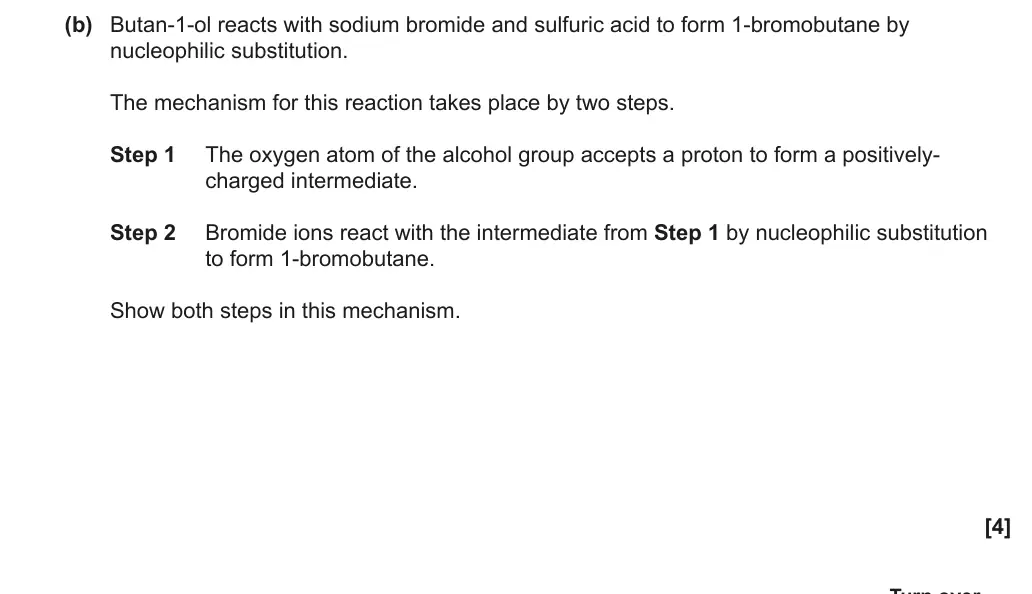
June 2022 · Paper 3 · Q3(b)4 marksAO3MechanismMedium
Earlier part of question 3 that this part uses
Mark scheme
Examiner's comment
This question is one of two on this paper assessing understanding of unfamiliar organic reaction mechanisms. The stem to the question includes important information and clues that should have then guided candidates towards this unfamiliar mechanism (which is related to the familiar nucleophilic substitution of haloalkanes). The two prompts for Step 1 and Step 2 are critical but many candidates did not use these, instead inventing their own mechanisms. However, there were many successful responses seen that gained the full 4 marks. and dipoles. Step 1 is an attempt to show the alcohol OH group accepting a proton, but a curly arrow shows the movement of an electron pair. It cannot travel from a + charge to a lone pair. The intermediate shown does contain the correct atoms but the + charge has been omitted from the O atom. Marks were given for the curly arrow from the Br– lone pair and from the C–O bond. However, the candidate has drawn the bonds with very short lines making it all too easy for a curly arrow to be shown imprecisely. This response was given 2/4 marks.
Notes from the mark scheme and report
step 1 curly arrow from lone pair on O to H+ giving intermediate with + charge on O (–OH2+)
step 2 curly arrow from Br– lone pair/charge to C and from C–O bond to O (or via carbocation)
max 2 for mechanism without positively charged intermediate
IGNORE dipoles
In organic chemistry mechanisms, a curly arrow shows the movement of an electron pair and demonstrates the direction of electron flow in organic reactions.
A curly arrow must start from: • A lone pair or negative charge and go to an atom to show where a bond forms • A bond to show where a bond breaks.
November 2021 · Paper 3 · Q1(f)3 marksAO1, 2MechanismMedium
Mark scheme
Examiner's comment
Q1(f) Outlining a mechanism for an unfamiliar reaction Q5(b)(iii) Predicting the equation for an unfamiliar organic reaction • Did not consider what a question is asking or read the information, e.g. Q1(f): Candidates were required to apply their knowledge of nucleophilic substitution of haloalkanes to outline a similar mechanism for an unfamiliar nucleophile.
Notes from the mark scheme and report
dipole on C–X and curly arrow from C–X bond to X
curly arrow from lone pair or – charge on O of CH3COO– to C
products methyl ethanoate AND X–
halogen must be consistent
ALLOW SN1 mechanism
November 2020 · AS Paper 2 · Q5(d)(ii)3 marksAO1, 2MechanismMedium
Earlier part of question 5 that this part uses
Mark scheme
Examiner's comment
5(a) Generally this was well answered. However, some candidates only gave two responses where three were required, presumably because it was worth two marks. 5(b) A significant number of candidates did not gain the mark here as they incorrectly balanced the number of oxygens, forgetting that the alcohol contains an O atom i.e. 6.5 O2 given rather than 6. 5(c) Nomenclature in organic chemistry takes lots of practice. Approximately half of the candidates did not score this mark. It was more challenging as they needed to work with skeletal structures but evidence of drawing out displayed formula was often seen. 5(d)(i) Most candidates were able to recall the formula to calculate atom economy, however a number made errors in working out Mr values. However, some left this blank or just gave an answer without any working. 5(d)(ii) Mechanisms were often seen showing curly arrows going in the wrong direction and between the wrong bonds and atoms, charges and dipoles were often incorrect, and partial changes used where full charges were required. Writing mechanisms is an important skill in organic chemistry so it is vital that time is spent practising writing them out and fully understanding the significance of the curly arrow. 5(d)(iii) Many candidates gave the correct mechanism here, with common incorrect responses being other types of mechanism, substitution only, or isomerism. 5(e) Very few candidates gained both marks here. It was not enough here to just state faster/slower without specifying which haloalkane they were referring to. It was also important to specify the C-X bond not just vague reference to the chlorine or bromine bond. Many described the difference in bond polarity so had the wrong order. Some were more general and discussed the reactivity of bromine and chlorine themselves. 5(f)* This was a challenging problem-solving question, relying on candidates to make use of all of the information provided to determine the structure. Very few candidates made no attempt at all at this question. The most common error was incorrectly identifying the peak at 3000 cm-1 as O-H from a carboxylic acid, despite it being indicated on the data sheet that this would be a broad peak. It suggested that candidates were not familiar with looking at spectra and understanding what data it gave. Candidates should also be reminded when answering these types of question that they should give the structures, not just molecular formulae, where possible. If any of your students’ results are not as expected, you may wish to consider one of our review of results services. For full information about the options available visit the OCR website. If university places are at stake you may wish to consider priority service 2 reviews of marking which have an earlier deadline to ensure your reviews are processed in time for university applications. Our priority is supporting you and your students this autumn and to support you as you prepare for summer 2021 exams. We’ll update our website information regularly with resources, guidance and key information. • Teachers • Students • Exams officers • Assessment specialists We are sending a weekly roundup to tell you about important updates. You can also sign up for your subject specific updates. If you haven’t already, sign up here. Attend one of our popular CPD courses to hear directly from a senior assessor or drop in to a Q&A session. All our courses for the academic year 2020-2021 are being delivered live via an online platform, so you can attend from any location. Please find details for all our courses on the relevant subject page on our website or visit OCR professional development. ExamBuilder is the question builder platform for a range of our GCSE, A Level, Cambridge Nationals, Cambridge Technicals and Functional Skills qualifications. See the full list of available qualifications in the sign up form. ExamBuilder is free for all OCR centres with an Interchange account and gives you unlimited users per centre. We need an Interchange username to validate the identity of your centre's first user account for ExamBuilder. If you do not have an Interchange account please contact your centre administrator (usually the Exams Officer) to request a username, or nominate an existing Interchange user in your department. Review of results
Notes from the mark scheme and report
arrow from lone pair or negative charge on O of OH– to C of C–Br
dipole on C–Br AND arrow from the bond to Br
products must show Br– (NaBr does not show Br–)
no double-headed or half arrows
ALLOW SN1
June 2019 · AS Paper 2 · Q3(a)(i)3 marksAO2MechanismMedium
Mark scheme
Examiner's comment
Those that had learnt this important mechanism scored all 3 marks with very precisely drawn arrows and partial charges. Although many candidates wrote out the correct organic product, many wrote NaI instead of I- which lost them the final mark. This candidate scored all 3 marks. The lone pair of electrons on the oxygen and partial charges on the C-I bond are clearly marked on the diagram and the arrows are precisely drawn. Connectivity is good on the organic product and I- identified as the additional product.
Notes from the mark scheme and report
curly arrow from lone pair or – charge on O of OH– to C of C–I
dipole Cδ+–Iδ– AND arrow from C–I bond to I
product AND I– (NaI does not show I–)
no double-headed or half arrows
June 2018 · AS Paper 1 · Q25(b)(i)3 marksMechanismMedium
Mark scheme
Examiner's comment
As with 25(a)(i), this question rewarded the well-prepared candidate. The large number of proposed mechanisms showed little resemblance to the accepted mechanism for nucleophilic substitution. Mechanisms were often seen showing curly arrows going in the wrong direction and between the wrong bonds and atoms, charges and dipoles were often incorrect, and partial changes used where full charges were required. Two exemplars are shown. The first exemplar shows clear curly arrows, the role of the lone pair and all charges correct. The second exemplar shows a typical muddled response. Although the curly arrow from the hydroxide ion has been accurately drawn, the hydroxide ion has a partial charge rather than a – charge. There is also no curly arrow showing breaking of the C–Br bond. The only mark available is for the correct organic product and a Br– ion. Some mechanisms were so poor that it was impossible to credit many candidates with any marks. Writing mechanisms is an important skill in organic chemistry and it is recommended that candidates learn and practice their writing.
Notes from the mark scheme and report
curly arrow from lone pair or – charge on O of OH– to C of C–Br
dipole on C–Br and arrow from bond to Br
Br– needed as product (NaBr does not show Br–)
ALLOW SN1 mechanism
June 2018 · Paper 2 · Q19(b)3 marksMechanismEasy
Earlier part of question 19 that this part uses
Mark scheme
Examiner's comment
Candidates were very familiar with this nucleophilic substitution mechanism. Consequently the majority of candidates scored two or three marks. Common errors included inaccurate curly arrows from the hydroxide ion and failure to show the chloride ion as a product. Exemplar 6 highlights both of these. This response demonstrates the two most common errors seen in this part. The first marking point cannot be credited as the curly arrow from the hydroxide ion does not involve either the lone pair or minus sign on the O atom. The organic product is correct but the chloride ion produced by the heterolytic fission of the C-Cl bond is not shown so marking point three cannot be credited. This response only scores one mark for the correct partial charges and curly arrow on the C-Cl bond. Candidates are encouraged to practice drawing mechanisms so as to avoid costly errors during examinations.
Notes from the mark scheme and report
curly arrow from lone pair or – charge on O of OH– to C
June 2025 · Paper 2 · Q20(c)(ii)5 marksMechanismHard
Earlier part of question 20 that this part uses
Mark scheme
Examiner's comment
Many were confident with this mechanism with approximately half of all candidates achieving all 5 marks. Some lost a mark due to the addition of a lone pair of electrons to the NO2+ and showing the curly arrow moving towards the NO2. A missing or incorrect charge on NO2+ cost 2 marks both for the equation for the formation and for the arrow from the benzene ring to the electrophile. Some also had missing or incorrect charges on HSO4- which lost both equation marks. Some formed H3SO4 (with or without charges) which was then used to form H2 as well as H2SO4 when regenerating the catalyst. Marks were often lost for the intermediate – it was essential that the ring covered 4 out of the 6 sides with the opening orientated towards the -NO2 group. This was sometimes hard to judge if the ring was very small or the hexagon of benzene was uneven. Very few lost a mark for the omission of the methyl group on the intermediate. Some lost a mark for missing H+ with their final product. Lower attaining candidates often omitted the equations to form NO2+ and/or reform H2SO4. Some attempted to show a reaction with H2SO4 despite being given the formula of G in the question.
Notes from the mark scheme and report
HNO3 + H2SO4 → NO2+ + HSO4– + H2O
H+ + HSO4– → H2SO4
arrow from ring to NO2+
intermediate must keep methyl group with correct position and π-ring covering about 4 sides with gap towards the substituted C
arrow from C–H bond into ring AND H+
June 2024 · Paper 2 · Q21(a)(ii)5 marksMechanismMedium
Earlier part of question 21 that this part uses
Mark scheme
Examiner's comment
Most candidates were well prepared for this question, with over half of candidates gaining all 5 marks. A significant number of candidates showed halogenation, generating Cl+ as an electrophile, instead of alkylation. Others attempted to substitute the ethylbenzene ring rather than benzene. Further common errors included incorrect connectivity in the ethyl group on the intermediate, curly arrows coming from hydrogen atoms rather than C–H bond to reform the -ring and omission of an H+ ion at the end of mechanism.
Notes from the mark scheme and report
AlCl3 + CH3CH2Cl → CH3CH2+ + AlCl4–
arrow from π-ring to the carbocation
intermediate with horseshoe covering about 4 sides and gap towards the substituted C
arrow from C–H bond back to ring with H+ lost
H+ + AlCl4– → AlCl3 + HCl
no half-headed arrows
June 2023 · Paper 2 · Q18(a)5 marksAO1, 2MechanismMedium
Mark scheme
Examiner's comment
Many candidates knew this mechanism well with the majority gaining 4 or 5 marks here. The mark most frequently lost was for the incorrect drawing of the intermediate. Many candidates did not appreciate that two electrons are removed from the ring in the first stage of the mechanism resulting in the partial delocalisation of electron density across four sides of the benzene ring in the intermediate. In addition, it must have the correct orientation with the opening at the three position where the nitro group is added. Some candidates nitrated the 2 or 4 position instead. Some also showed nitration of benzene then the second nitration. Other common errors included missing or extra charges, missing NO2 group on intermediate, use of NO3+ or other incorrect electrophiles. Lower scoring responses were characterised by unclear diagrams and inaccurate use of curly arrows. Many were often able to score 1 mark for showing C-H bond on benzene ring breaking and electrons going back into the ring. Such responses often included errors in the equations showing the role of the sulfuric acid catalyst, e.g. formation of H3SO4-, or omitted these steps entirely. Others evidently didn’t know what a nitro group was with -NO3 giving just -N and even -NH3 instead.
Notes from the mark scheme and report
HNO3 + H2SO4 → NO2+ + HSO4– + H2O
H+ + HSO4– → H2SO4
arrow from ring to NO2+
intermediate must keep the original NO2 at the 3-position with horseshoe over about 4 sides, gap towards C with NO2 and H
arrow from C–H bond into ring
Encourage candidates to look at more recent mark schemes to check for tips on how to correctly draw out mechanisms. An easy tip for ensuring the correct intermediate for electrophilic substitution is to place a dot inside the ring for each C without the new substituent attached and then connect the dots. Only four out of the six sides should be covered by the broken delocalised ring (as two electrons have formed the new bond).
Alternatively, some find it easier to redraw, so horseshoe ring opens upwards (like a smiley face), rather than at an angle.
June 2022 · Paper 2 · Q20(a)(iii)4 marksAO1, 2MechanismMedium
Earlier part of question 20 that this part uses
Mark scheme
Examiner's comment
This question required candidates to apply their knowledge of the mechanism of electrophilic substitution. Examiners were encouraged by the number of excellent responses to this question, with the majority of candidates securing 3 out of 4 marks. Common errors included the omission of HCl as product from the regeneration of the catalyst or candidates attempting to substitute at the 2 position.
Notes from the mark scheme and report
Cl2 + AlCl3 → Cl+ + AlCl4– AND H+ + AlCl4– → AlCl3 + HCl (both for 1 mark)
arrow from ring to Cl+
horseshoe over more than half the ring with gap towards C–Cl
DO NOT ALLOW intermediates substituted at positions 3 or 5
arrow from C–H bond into ring
November 2021 · Paper 2 · Q20(a)(i)6 marksAO1, 2MechanismMedium
Mark scheme
Examiner's comment
Question 20(a)(i): Candidates who answered this question well had clear mechanisms.
Notes from the mark scheme and report
stage 1: arrow from lone pair/charge of OH– to H of O–H and arrow from O–H bond to O, H2O formed
stage 2: arrow from ring to C of CO2 AND arrow from C=O to O
intermediate horseshoe with gap at C bearing CO2– and phenolic O– present
arrow from C–H bond into ring AND H+
November 2020 · Paper 2 · Q17(a)(iii)5 marksAO1, 2Mechanism
horseshoe covers 4 of 6 sides with gap towards C–Cl
arrow from C–H bond back into ring
DO NOT ALLOW intermediate with a CH3 missing
June 2019 · Paper 2 · Q19(b)(iii)5 marksAO1, 2, 3MechanismMedium
Earlier part of question 19 that this part uses
Mark scheme
Examiner's comment
This question required candidates to apply their knowledge of the mechanism of electrophilic substitution to the formation of phenylethanone from benzene. Examiners were encouraged by the number of excellent responses to this question, with the majority of candidates securing four out of five marks. Common errors included accuracy of curly arrows (Exemplar 7 below) and omission of HCl as product from the regeneration of the catalyst. The responses of lower ability candidates also contained errors in the equation for the formation of the electrophile. Such responses used chlorine rather than ethanoyl chloride. This response demonstrates a near perfect attempt at this question. The equations for the formation of the electrophile and regeneration of the catalyst are correct. The first curly arrow is drawn accurately from the circle of the benzene ring to the correct carbon atom of the electrophile. The intermediate is correct, with the π ring over the five carbon atoms and in the correct orientation. Unfortunately the curly arrow drawn to reform the π bond starts at the H atom rather than from the bond. This small error has prevented this candidate from being given full marks.
Notes from the mark scheme and report
CH3COCl + AlCl3 → CH3C+=O + AlCl4–
arrow from ring to C of C=O
intermediate horseshoe over about 4 of 6 sides, gap towards C with COCH3
arrow from C–H bond back into ring
H+ + AlCl4– → AlCl3 + HCl
June 2018 · Paper 2 · Q18(b)3 marksMechanismMedium
Mark scheme
Examiner's comment
This question required candidates to apply their understanding of electrophilic substitution to the reaction of methylbenzene with sulfur trioxide. Examiners were encouraged by the quality of responses to this question. Most candidates secured full marks in this part. Some candidates did not show the curly arrow for the breaking of the S=O bond, while others omitted the methyl group from the intermediate. Exemplar 4 shows an excellent response. This response demonstrates an excellent example for candidates to follow. Curly arrows are drawn accurately, with each arrow touching the bond it starts from. The intermediate has been drawn clearly, using all the space provided. The ‘horseshoe’ has been drawn accurately over five of the carbon atoms with the positive charge shown neatly in the centre.
Notes from the mark scheme and report
curly arrow from π-ring to S AND from S=O bond to O
intermediate horseshoe must cover more than half the ring with gap towards C bearing SO3–
SO3– fully displayed
curly arrow from C–H bond back into ring
DO NOT ALLOW intermediate with CH3 missing
June 2017 · Paper 2 · Q17(a)(i)5 marksMechanism
Mark scheme
Notes from the mark scheme and report
HNO3 + H2SO4 → NO2+ + HSO4– + H2O
first arrow from the ring to NO2+
intermediate horseshoe covering about 4 of 6 sides with gap towards C bearing NO2
June 2025 · AS Paper 2 · Q4(d)(iii)2 marksMechanismHard
Earlier part of question 4 that this part uses
Mark scheme
Examiner's comment
Most scored both marks here. The most common error involved substituting the Br in the first step – this lost both marks. Very few candidates scored 1 mark; this was usually for a correct first step but then re- acting the C3H7 radical with either 2 Br or HBr in second step. Candidates must check that equations balance in terms of atoms. Candidates should also understand that hydrogen radicals are highly reactive and are therefore unlikely to exist under standard conditions.
June 2024 · AS Paper 1 · Q24(b)5 marksMechanismMedium
Mark scheme
Examiner's comment
This question was answered extremely well with most candidates obtaining the full 5 marks. It was encouraging to see the widespread correct use of dots to indicate radicals, with relatively few omissions. Of the three steps, initiation and termination were answered better than the equations for propagation.
June 2023 · Paper 2 · Q16(b)(i)6 marksAO1, 2, 3MechanismMedium
Mark scheme
Examiner's comment
Many candidates tackled this question confidently, especially when using skeletal formula following the format of the structure given in the question. Over half the candidates scored 5 or 6 marks. Only the highest attaining candidates were able to provide all three correct termination steps. Many lost a mark for the combination of the two alkyl radicals, typically either by simply joining the ends of the chains or by missing the connecting C-C bond. Those that attempted to use structural formula often lost marks due to missing Hs. Other common errors included the incorrect positioning of the radical dot, most typically on the terminal carbon, addition of Br in the first propagation step or use of molecular formula. Lower attaining candidates were often able to score a mark for the initiation step and the termination step involving two Br radicals. However, for some this was not a well-known mechanism, with attempts to break up the chain or form hydrogen radicals or charged species. Errors were also seen with correct balancing of equations such as truncated C chains or extra Br atoms added.
Notes from the mark scheme and report
Br2 → 2Br• AND UV
dot required throughout and on C-3 of the radical
1 mark for propagation if both correct but dot omitted or misplaced
three terminations incl. two alkyl radicals
no ECF from incorrect radical in termination
November 2020 · Paper 2 · Q16(c)3 marksAO1, 2MechanismMedium
Earlier part of question 16 that this part uses
Mark scheme
Examiner's comment
Other questions Question 16(c) Often candidates did not use skeletal formula, as required by the question, and did not place the radical dot in the correct position.
Notes from the mark scheme and report
dot REQUIRED at the correct position on the chain
1 mark if both propagation steps correct but dot missing/on wrong C or not skeletal
IGNORE dots in initiation
June 2019 · AS Paper 1 · Q25(b)(i)3 marksAO1, 2MechanismMedium
Mark scheme
Examiner's comment
Many candidates scored all 3 marks for this part, showing that most had thoroughly learnt the mechanism for radical substitution. The equation and conditions for the initiation step were well-known but the equations for the propagation steps often included errors. It was common for dots to be omitted for some radicals and C4H9Cl•, rather than C4H9•, was often shown for one of the products in the first propagation stage. H• was then shown as the other product.
Notes from the mark scheme and report
UV needed with initiation
dots required in each propagation equation (1 mark for both propagation equations with dots missing/extra)
June 2025 · Paper 2 · Q19(a)(i)3 marksMechanismHard
Mark scheme
Examiner's comment
Many candidates scored all 3 marks here showing that the mechanism is well known. Some struggled with the skeletal formula given but were given credit for drawing out structural or displayed formula, provided that the central C showed correct number of bonds. Most common reasons for losing marks: • KCN and KBr shown in the mechanism rather than ions • arrow from lone pair or negative charge on N of CN • dipole on C-Br the wrong way round • missing the negative charge on CN- • curly arrows shown in the wrong direction Remind candidates that curly arrows should only be used to show the movement of a pair of electrons and not the formation/breaking of an ionic bond. A significant number of candidates chose to write more than one version of the mechanism without crossing out the one they did not wish to be marked. This led to marks being lost through contradictions. Teachers should remind candidates of the importance of submitting only one response to each question.
Notes from the mark scheme and report
arrow from lone pair or – charge on C of CN– to C of C–Br
dipole AND arrow from C–Br bond to Br
product AND Br– (KBr does NOT show Br–)
no double- or half-headed arrows
ALLOW SN1
June 2024 · Paper 2 · Q21(a)(ii)5 marksMechanismMedium
Earlier part of question 21 that this part uses
Mark scheme
Examiner's comment
Most candidates were well prepared for this question, with over half of candidates gaining all 5 marks. A significant number of candidates showed halogenation, generating Cl+ as an electrophile, instead of alkylation. Others attempted to substitute the ethylbenzene ring rather than benzene. Further common errors included incorrect connectivity in the ethyl group on the intermediate, curly arrows coming from hydrogen atoms rather than C–H bond to reform the -ring and omission of an H+ ion at the end of mechanism.
Notes from the mark scheme and report
AlCl3 + CH3CH2Cl → CH3CH2+ + AlCl4–
arrow from π-ring to the carbocation
intermediate with horseshoe covering about 4 sides and gap towards the substituted C
arrow from C–H bond back to ring with H+ lost
H+ + AlCl4– → AlCl3 + HCl
no half-headed arrows
June 2023 · Paper 2 · Q22(a)(i)4 marksAO1, 2MechanismEasy
Mark scheme
Examiner's comment
There were many excellent examples of precisely drawn mechanisms for the reaction of acrolein with sodium cyanide in acidic conditions and so most candidates gained at least 3 marks. The importance of accuracy when drawing curly arrows needs to be emphasised when teaching mechanisms - arrows must start at lone pairs or negative charges or come from bonds. Many candidates lost marks due to incorrect arrows. Common errors included the use of NaCN or HCN rather than the cyanide ion, the first curly arrow coming from the N of CN-, omission of partial charge across the C=O double bond and addition of partially charges to hydrogen or oxygen. Lower scoring responses often included an intermediate and/or product containing sodium. Some attempted electrophilic addition using HCN across the double bond. A few gained some credit for the mechanism for a competing reaction with nucleophilic addition on CH2 of C=C. This is not covered in the A Level specification and no candidates scored full marks for this alternative.
Notes from the mark scheme and report
arrow from lone pair/charge on C of CN– to C of C=O
dipole on C=O AND arrow from C=O bond to O
intermediate with O– (DO NOT ALLOW δ– on O) and arrow to H+ (ALLOW H of H2O)
product hydroxynitrile
1,4-conjugate addition credited as alternative
June 2019 · Paper 2 · Q19(b)(iii)5 marksAO1, 2, 3MechanismMedium
Earlier part of question 19 that this part uses
Mark scheme
Examiner's comment
This question required candidates to apply their knowledge of the mechanism of electrophilic substitution to the formation of phenylethanone from benzene. Examiners were encouraged by the number of excellent responses to this question, with the majority of candidates securing four out of five marks. Common errors included accuracy of curly arrows (Exemplar 7 below) and omission of HCl as product from the regeneration of the catalyst. The responses of lower ability candidates also contained errors in the equation for the formation of the electrophile. Such responses used chlorine rather than ethanoyl chloride. This response demonstrates a near perfect attempt at this question. The equations for the formation of the electrophile and regeneration of the catalyst are correct. The first curly arrow is drawn accurately from the circle of the benzene ring to the correct carbon atom of the electrophile. The intermediate is correct, with the π ring over the five carbon atoms and in the correct orientation. Unfortunately the curly arrow drawn to reform the π bond starts at the H atom rather than from the bond. This small error has prevented this candidate from being given full marks.
Notes from the mark scheme and report
CH3COCl + AlCl3 → CH3C+=O + AlCl4–
arrow from ring to C of C=O
intermediate horseshoe over about 4 of 6 sides, gap towards C with COCH3
arrow from C–H bond back into ring
H+ + AlCl4– → AlCl3 + HCl
June 2017 · Paper 2 · Q18(a)(i)3 marksMechanism
Mark scheme
Notes from the mark scheme and report
curly arrow from lone pair or negative charge on C of CN– to C of C–Cl
This was the most challenging of the mechanisms as it was less familiar to candidates and has not been tested in any previous exam series for this specification. Most were able to score a mark for showing the correct dipole on C=O and a curly arrow to break the bond. Some did not gain marks for their dipole being the wrong way round or adding dipoles on to the intermediate. Some did not gain marks for arrows which didn’t come from either a lone pair, negative charge or a bond – correct placement of curly arrows is vital. Some didn’t attack the C of C=O with H- before opening the bond, which led to an incorrect intermediate with a + charge on C and – charge on O. Some had the C of C=O being attacked by H+. A few candidates used CN- or OH- as the nucleophile. Some attempted to directly react the NaBH4 or BH4- directly rather than using H-. This often resulted in BH4 being part of the intermediate and final product. Many were able to give the correct product, although some had the H missing from the central C. Some omitted to show the attack of H- at all, which meant the loss of 3 marks if the C-H bond was not shown on the intermediate and the product as well. Some redrew the structure, which had been given deliberately with the COOH not displayed and attempted to reduce both the ketone and carboxylic acid functional groups. NaBH4 is not a strong enough reducing agent to react with a carboxylic acid and the reduction of COOH is not covered in our specification.
Notes from the mark scheme and report
arrow from H– (lone pair or – charge) to C of C=O
dipole AND arrow breaking C=O
intermediate with O– and arrow from O– to H of H2O (or H+)
DO NOT ALLOW δ– on O of intermediate
product CH3CH(OH)COOH
June 2023 · Paper 2 · Q22(a)(i)4 marksAO1, 2MechanismEasy
Mark scheme
Examiner's comment
There were many excellent examples of precisely drawn mechanisms for the reaction of acrolein with sodium cyanide in acidic conditions and so most candidates gained at least 3 marks. The importance of accuracy when drawing curly arrows needs to be emphasised when teaching mechanisms - arrows must start at lone pairs or negative charges or come from bonds. Many candidates lost marks due to incorrect arrows. Common errors included the use of NaCN or HCN rather than the cyanide ion, the first curly arrow coming from the N of CN-, omission of partial charge across the C=O double bond and addition of partially charges to hydrogen or oxygen. Lower scoring responses often included an intermediate and/or product containing sodium. Some attempted electrophilic addition using HCN across the double bond. A few gained some credit for the mechanism for a competing reaction with nucleophilic addition on CH2 of C=C. This is not covered in the A Level specification and no candidates scored full marks for this alternative.
Notes from the mark scheme and report
arrow from lone pair/charge on C of CN– to C of C=O
dipole on C=O AND arrow from C=O bond to O
intermediate with O– (DO NOT ALLOW δ– on O) and arrow to H+ (ALLOW H of H2O)
product hydroxynitrile
1,4-conjugate addition credited as alternative
November 2020 · Paper 2 · Q19(c)(i)5 marksAO1, 2Mechanism
Earlier part of question 19 that this part uses
Mark scheme
Notes from the mark scheme and report
curly arrow from lone pair on C (or – charge) of –CN to C of C=O
dipole on C=O AND arrow from bond to O
arrow from O– of intermediate to H+ (ALLOW to H of H2O)
November 2020 · Paper 3 · Q6(c)4 marksAO3MechanismHard
Earlier part of question 6 that this part uses
Mark scheme
Examiner's comment
6(a) Candidates were expected to use their knowledge and understanding of bond angles and shapes. Most candidates were given both available marks. A significant number responded with incorrect names of shapes, or chose the wrong shape, such as pyramidal for the O–C–O bond angle in the carboxylic acid. Candidates are recommended to learn this basic area of chemistry. 6(b) Most candidates completed a correct equilibrium equation and assigned the correct acid-base pairs. A significant number of candidates used ethanoic acid instead of water in the equation. The examiners allowed error carried forward in this case for the acid-base pairs. Candidates found it much more difficult to explain whether the sulfonic acid had a lower pH value. The higher-attaining candidates answered concisely. They usually identifying that the sulfonic acid would have a lower pH as the pKa value was lower (or the Ka value greater), leading to more dissociation than ethanoic acid. Lower-attaining candidates often produced unfocussed and lengthy responses, sometimes relating increased dissociation in an acid to a higher, rather than a lower, pH. Some candidates approached their explanation mathematically, calculating pH values for ethanoic acid and sulfonic acid from their concentrations and pKa values. If correct, this approach was fully credited. 6(c) Most candidates showed a good understanding and appreciation of drawing curly arrows. It must be stressed that curly arrows that do not start from a lone pair, negative charge or a bond cannot be credited. Lower-attaining candidates often drew imprecisely positioned curly arrows, curly arrows in the wrong direction or to the wrong atoms. For their response to be credited with marks, candidates should position curly arrows to ensure credit when outlining reaction mechanisms. If any of your students’ results are not as expected, you may wish to consider one of our review of results services. For full information about the options available visit the OCR website. If university places are at stake you may wish to consider priority service 2 reviews of marking which have an earlier deadline to ensure your reviews are processed in time for university applications. Our priority is supporting you and your students this autumn and to support you as you prepare for summer 2021 exams. We’ll update our website information regularly with resources, guidance and key information. • Teachers • Students • Exams officers • Assessment specialists We are sending a weekly roundup to tell you about important updates. You can also sign up for your subject specific updates. If you haven’t already, sign up here. Attend one of our popular CPD courses to hear directly from a senior assessor or drop in to a Q&A session. All our courses for the academic year 2020-2021 are being delivered live via an online platform, so you can attend from any location. Please find details for all our courses on the relevant subject page on our website or visit OCR professional development. ExamBuilder is the question builder platform for a range of our GCSE, A Level, Cambridge Nationals, Cambridge Technicals and Functional Skills qualifications. See the full list of available qualifications in the sign up form. ExamBuilder is free for all OCR centres with an Interchange account and gives you unlimited users per centre. We need an Interchange username to validate the identity of your centre's first user account for ExamBuilder. If you do not have an Interchange account please contact your centre administrator (usually the Exams Officer) to request a username, or nominate an existing Interchange user in your department. Review of results
Notes from the mark scheme and report
marks solely for curly arrows (6 correct = 4 marks, 3 correct = 1 mark)
arrows from lone pair on –OH to S and S=O bond to O, O– lone pair reforming S=O and S–OCH3 bond to O, then –OCH3 lone pair to H and O–H bond to O
IGNORE added charges/dipoles
June 2019 · Paper 2 · Q20(b)(i)4 marksAO3MechanismMedium
Earlier part of question 20 that this part uses
Mark scheme
Examiner's comment
Examiners were encouraged by the number of excellent responses to this question. Candidates were able to confidently apply their knowledge of mechanisms to this unfamiliar example and the majority of the cohort scored at least two marks. In the first step candidates used their understanding of nucleophilic addition to show a correct curly arrow from the hydroxide ion to the C of the C=O bond as well as an arrow from this bond to the O. Many candidates were able to show the breaking of the C–Cl bond and the formation of a chloride ion, drawing on their experience of the reactions of haloalkanes. Some candidates recognised the need to include an arrow to reform the carbon-oxygen double bond, with the best responses showing this accurately. A common error was to draw the bond from the lone pair on O to the C atom, rather than the bond.
June 2022 · Paper 3 · Q3(b)4 marksAO3MechanismMedium
Earlier part of question 3 that this part uses
Mark scheme
Examiner's comment
This question is one of two on this paper assessing understanding of unfamiliar organic reaction mechanisms. The stem to the question includes important information and clues that should have then guided candidates towards this unfamiliar mechanism (which is related to the familiar nucleophilic substitution of haloalkanes). The two prompts for Step 1 and Step 2 are critical but many candidates did not use these, instead inventing their own mechanisms. However, there were many successful responses seen that gained the full 4 marks. and dipoles. Step 1 is an attempt to show the alcohol OH group accepting a proton, but a curly arrow shows the movement of an electron pair. It cannot travel from a + charge to a lone pair. The intermediate shown does contain the correct atoms but the + charge has been omitted from the O atom. Marks were given for the curly arrow from the Br– lone pair and from the C–O bond. However, the candidate has drawn the bonds with very short lines making it all too easy for a curly arrow to be shown imprecisely. This response was given 2/4 marks.
Notes from the mark scheme and report
step 1 curly arrow from lone pair on O to H+ giving intermediate with + charge on O (–OH2+)
step 2 curly arrow from Br– lone pair/charge to C and from C–O bond to O (or via carbocation)
max 2 for mechanism without positively charged intermediate
IGNORE dipoles
In organic chemistry mechanisms, a curly arrow shows the movement of an electron pair and demonstrates the direction of electron flow in organic reactions.
A curly arrow must start from: • A lone pair or negative charge and go to an atom to show where a bond forms • A bond to show where a bond breaks.
June 2022 · Paper 3 · Q6(c)(i)2 marksAO3MechanismHard
Earlier part of question 6 that this part uses
Mark scheme
Examiner's comment
This novel mechanism assessed a candidate’s understanding of curly arrows, and four curly arrows were needed. One mark was available for one correct curly arrow, usually from the H2O: or from the C=O. 2 marks were given for three or four correct curly arrows. The two curly arrows within the ring structure proved to be the most difficult. The question discriminated extremely well: many candidates were able to secure one mark with the most able being given both marks. A candidate showing all four curly arrows correctly demonstrated an excellent understanding of curly arrows.
Notes from the mark scheme and report
arrow from lone pair on H2O to H of enol O–H, O–H bond pair to form C=O, C=C pair moving along, ring C=O pair to O giving O–
3 or 4 correct arrows = 2 marks, 1 correct = 1 mark
June 2018 · Paper 3 · Q4(a)(ii)2 marksMechanismHard
Earlier part of question 4 that this part uses
Mark scheme
Examiner's comment
This part required candidates to apply their knowledge and understanding of the nucleophilic substitution mechanism in a novel context. This part discriminated extremely well with able candidates drawing the correct initial complex and showing precisely positioned curly arrows, dipoles and the role of the NH3 lone pair, as shown in Lower ability candidates often showed imprecise curly arrows or placed a negative charge on NH3, as shown in Exemplar 8.
June 2025 · Paper 3 · Q5(a)(iv)4 marksMechanismMedium
Earlier parts of question 5 that this part uses
Mark scheme
Examiner's comment
Candidates showed a good understanding of how to position curly arrows within an unknown mechanism. Incorrect responses were mainly in the second box. Some arrows were shown from O– to C atom instead of to the bond. It was rare for additional arrows to be added. From the responses, there was clear evidence that most candidates are becoming more confident in the accurate use of curly arrows in a mechanism and the role of lone pairs. The positioning of both ends of a curly arrow were often accurate.
Notes from the mark scheme and report
marks solely for six curly arrows (6 = 4 marks, 5 = 3, 4 = 2, 3 = 1)
arrow from lone pair or charge of H– / O–
arrow from a bond must go to O in C=O and in –OC2H5
an extra arrow is a CON
IGNORE charges and dipoles
Work with an OCR chemistry tutor
Curly arrows starting in the wrong place? It is one of the quickest things a tutor can put right.