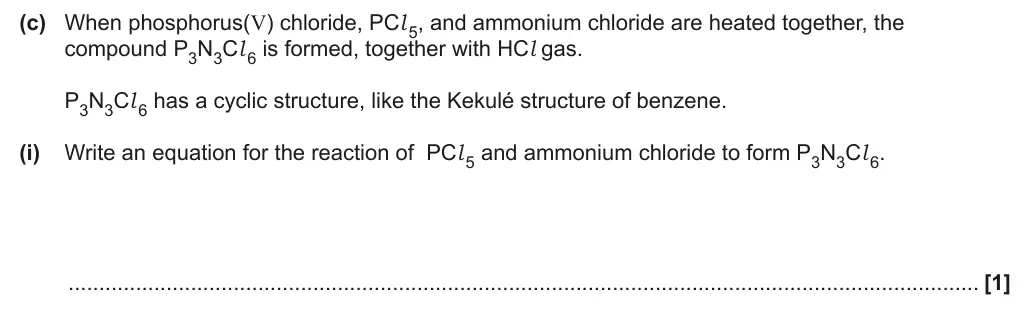
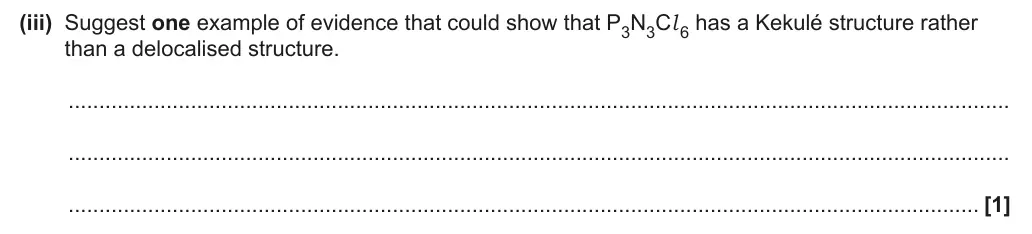
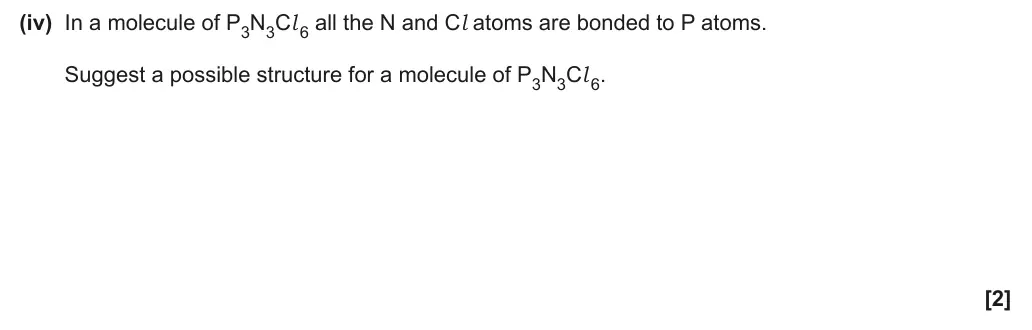
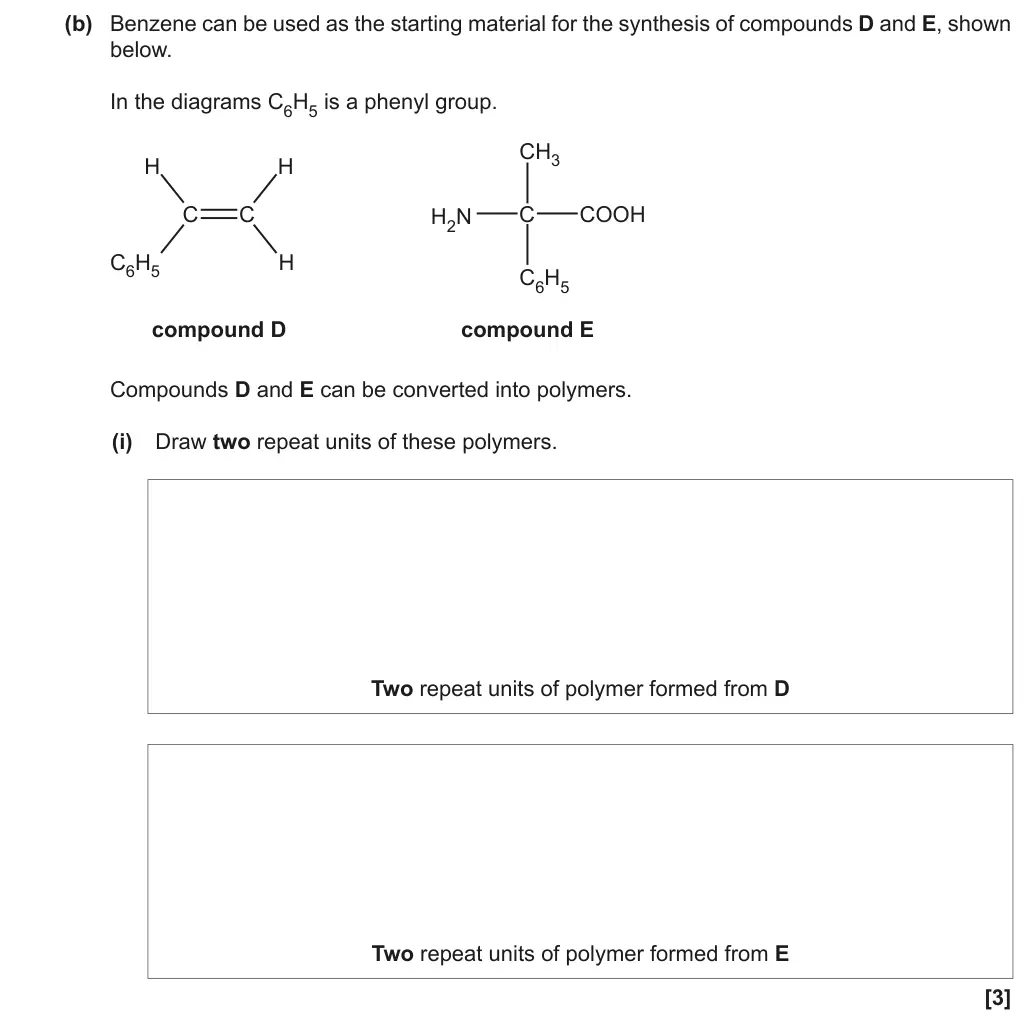
Notes and key-term cards for this topic are being written by our tutors. The past-paper questions below are ready now.
Learning outcomes
Show the 17 learning outcomes from the specification
6.1.1(a) the comparison of the Kekulé model of benzene with the subsequent delocalised models for benzene in terms of p-orbital overlap forming a delocalised π-system
6.1.1(b) the experimental evidence for a delocalised, rather than Kekulé, model for benzene in terms of bond lengths, enthalpy change of hydrogenation and resistance to reaction (see also 6.1.1 f)
6.1.1(c) use of IUPAC rules of nomenclature for systematically naming substituted aromatic compounds
6.1.1(d) the electrophilic substitution of aromatic compounds with:
6.1.1(d)(i) concentrated nitric acid in the presence of concentrated sulfuric acid
6.1.1(d)(ii) a halogen in the presence of a halogen carrier
6.1.1(d)(iii) a haloalkane or acyl chloride in the presence of a halogen carrier (Friedel–Crafts reaction) and its importance to synthesis by formation of a C–C bond to an aromatic ring (see also 6.2.4 d)
6.1.1(e) the mechanism of electrophilic substitution in arenes for nitration and halogenation (see also 4.1.1 h– i)
6.1.1(f) the explanation of the relative resistance to bromination of benzene, compared with alkenes, in terms of the delocalised electron density of the π-system in benzene compared with the localised electron density of the π-bond in alkenes (see also 4.1.3 a, 6.1.1 a)
6.1.1(g) the interpretation of unfamiliar electrophilic substitution reactions of aromatic compounds, including prediction of mechanisms
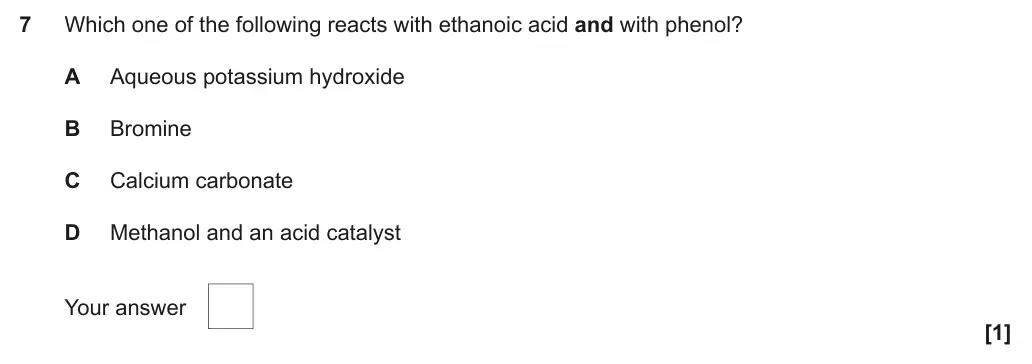
6.1.1(h) the weak acidity of phenols shown by the neutralisation reaction with NaOH but absence of reaction with carbonates (see also 5.1.3 b)
6.1.1(i) the electrophilic substitution reactions of phenol:
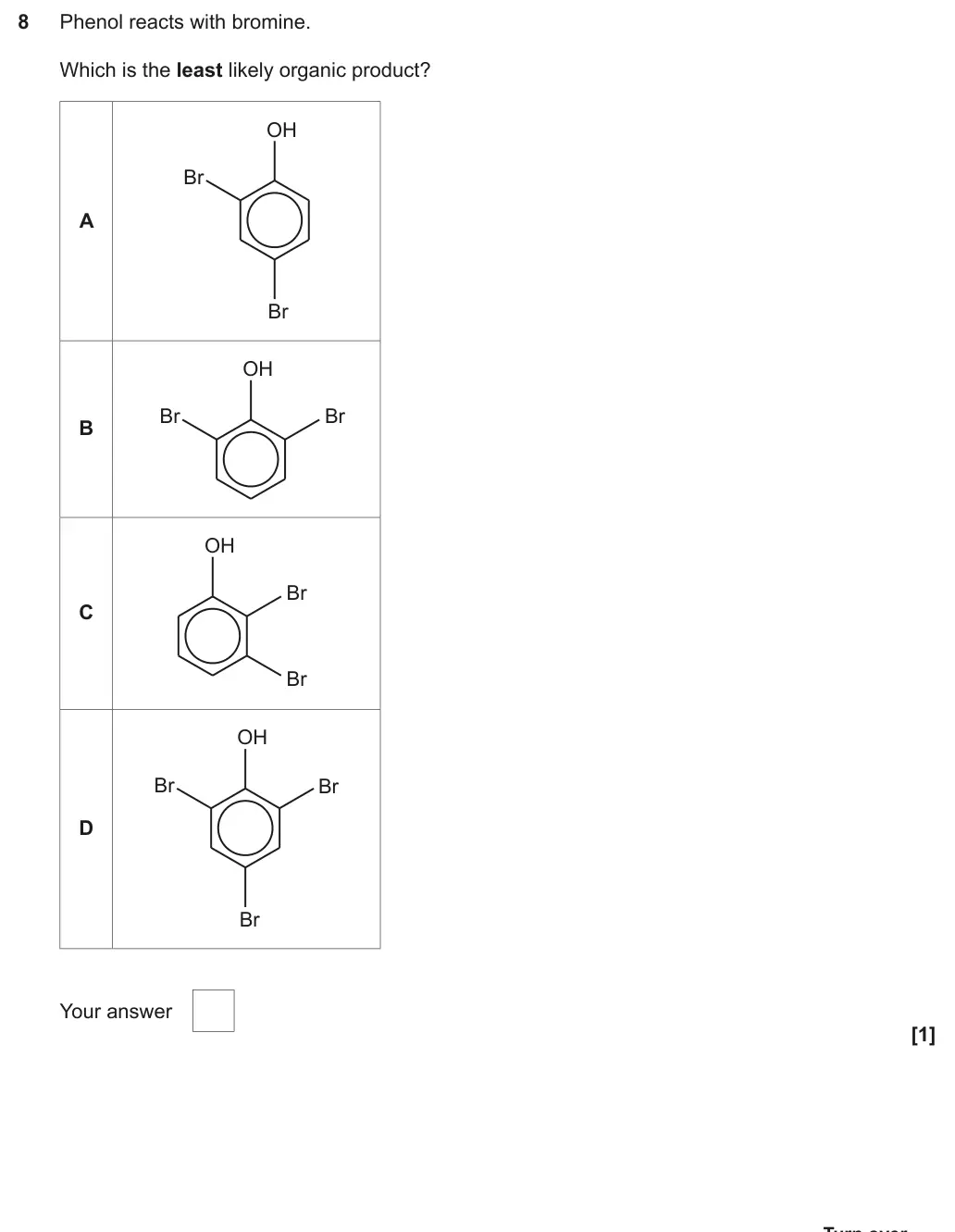
6.1.1(i)(i) with bromine to form 2,4,6-tribromophenol
6.1.1(i)(ii) with dilute nitric acid to form a mixture of 2-nitrophenol and 4-nitrophenol
6.1.1(j) the relative ease of electrophilic substitution of phenol compared with benzene, in terms of electron pair donation to the π-system from an oxygen p-orbital in phenol (see also 4.1.3 a)
6.1.1(k) the 2- and 4-directing effect of electron- donating groups (OH, NH2) and the 3-directing effect of electron-withdrawing groups (NO2) in electrophilic substitution of aromatic compounds
6.1.1(l) the prediction of substitution products of aromatic compounds by directing effects and the importance to organic synthesis (see also 6.2.5 Organic Synthesis).
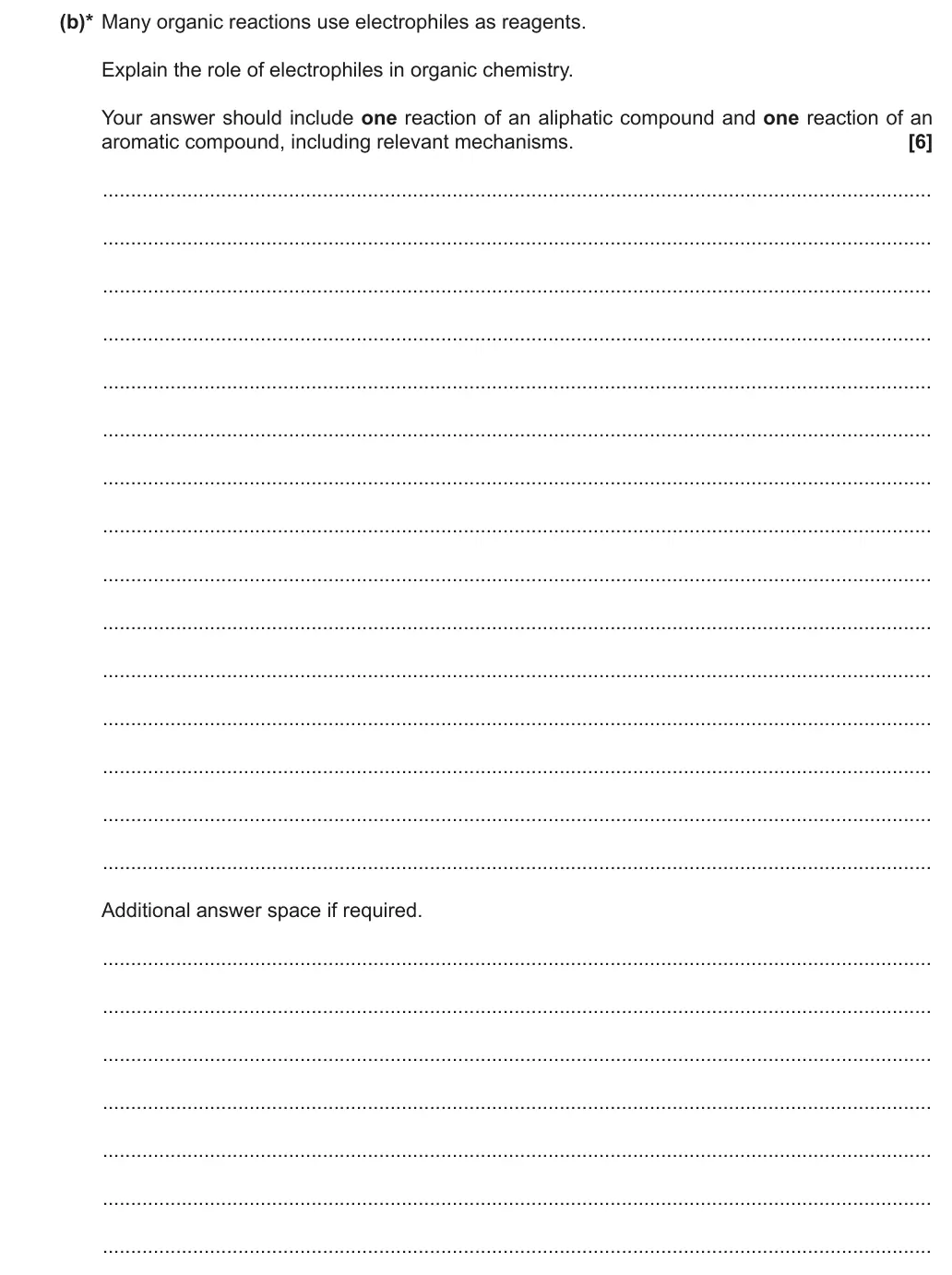
Six-mark level of response questions on this topic
Tap a question to zoom it. Where a part needs a table, graph or structure from an earlier part, that part folds out above it; the mark scheme and examiner's comment open underneath. Have the OCR Data Sheet beside you.
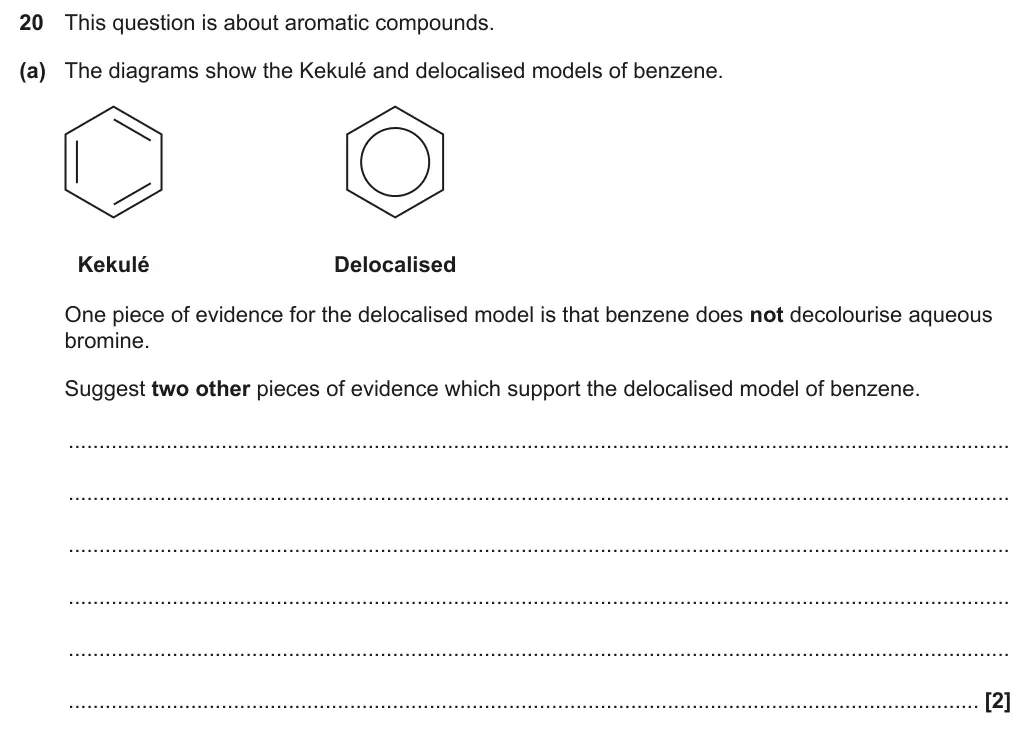
June 2025 · Paper 2 · Q20(a)2 marksShort answerMedium
Mark scheme
Examiner's comment
Most candidates scored at least one mark for recognising that the C-C bond lengths in the delocalised model of benzene are the all the same. Many found it difficult to articulate what they meant, e.g. ‘all the C-C and C=C bond lengths are the same’. Candidates were given the mark for stating that there were ‘equal bond lengths’. Although this is technically not true, as the C-H bonds are not the same length as the C-C bonds, we gave the mark as only skeletal structures are shown here without C-H bonds. Many also scored the second mark but slips were often made by reference to ‘hydration’ or ‘bond’ enthalpy. Some just said ‘enthalpy will be less exothermic’. Some described the hydrogenation value as being lower or higher as we are considering negative values it is much clearer to do this in terms of ‘less exothermic’ or ‘less negative’. A few described the enthalpy of hydrogenation as being ‘more exothermic than expected’. Many candidates were able to quote the actual figures in their response, and while it is not necessary for candidates to learn the values, their effort is commendable. A small number of candidates discussed the lack of reactivity in terms of electrophilic addition – not realising this had already been given in the question in terms of reaction with bromine. STEM Contributors We have produced a STEM Contributors spreadsheet linked to the H432 specification. This includes the work by Kathleen Lonsdale and Linus Pauling on our understanding of the structure of benzene. This is a great resource for broadening understanding of the contribution made by individuals to the topics being taught in the specification.
Notes from the mark scheme and report
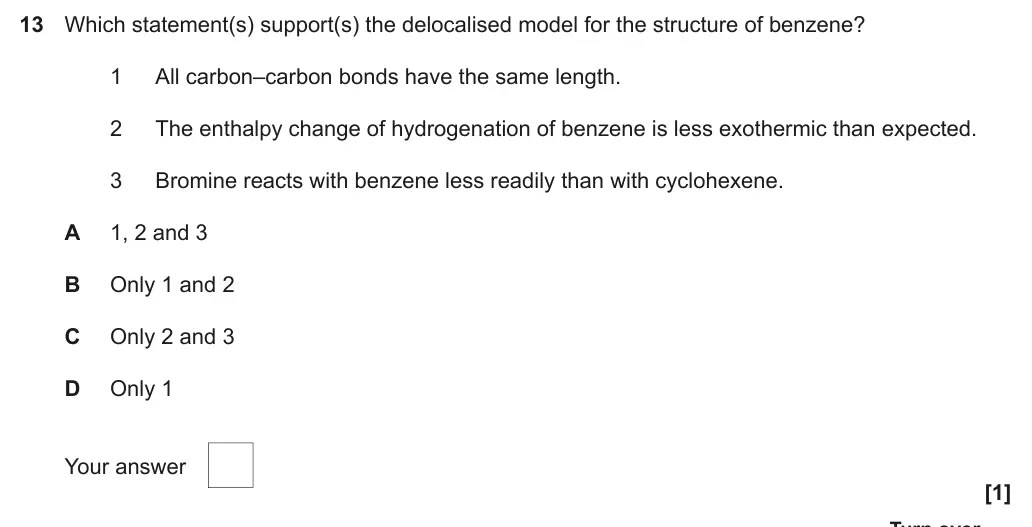
all C–C bond lengths the same/between single and double
enthalpy of hydrogenation less exothermic than expected
DO NOT ALLOW enthalpy of hydration
IGNORE resistance to reaction (given)
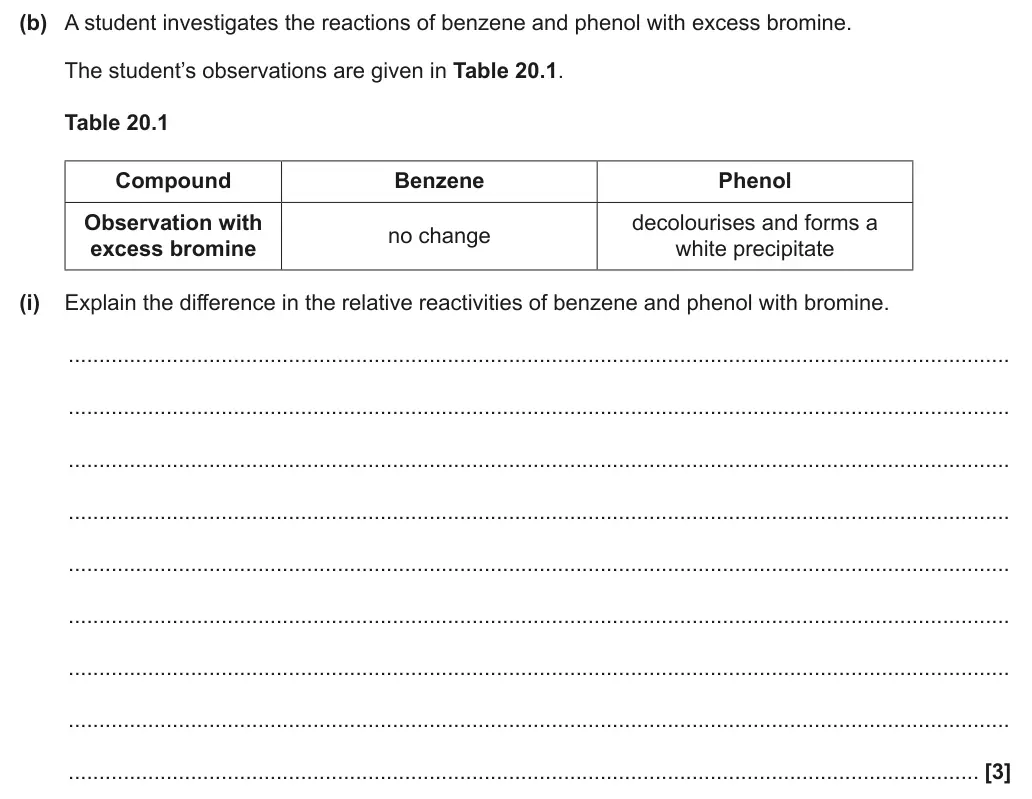
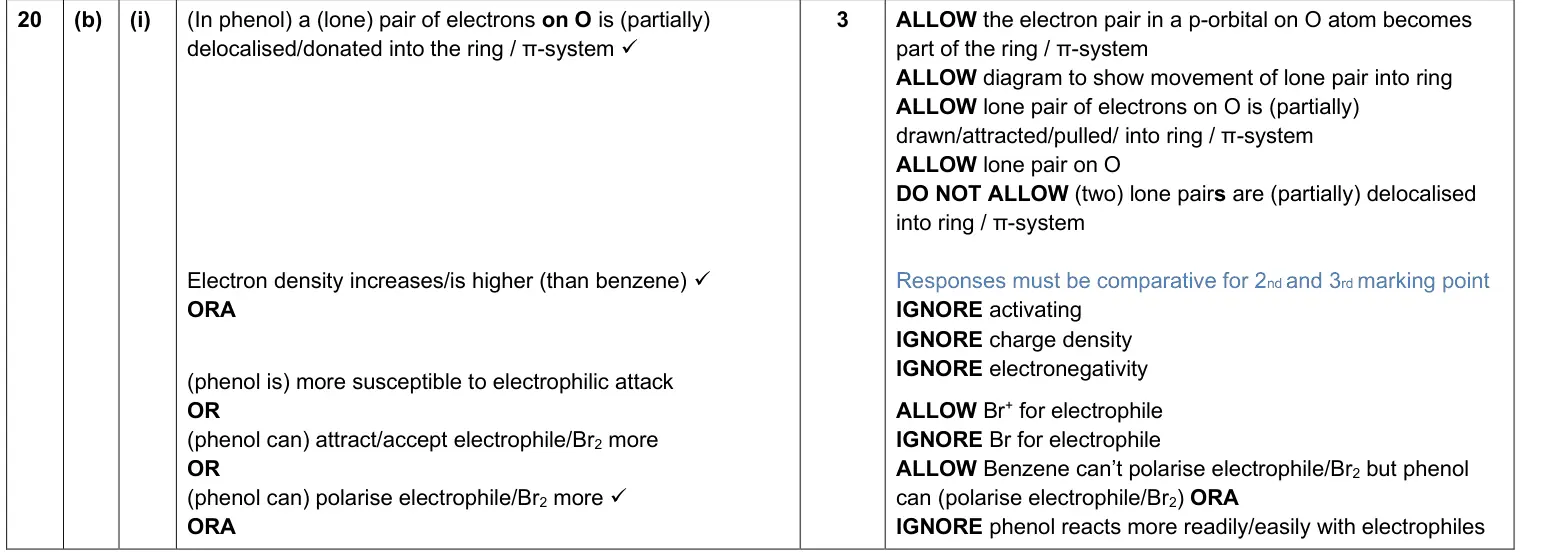
June 2025 · Paper 2 · Q20(b)(i)3 marksData interpretationEasy
Mark scheme
Examiner's comment
Most candidates found this familiar question relatively straightforward, achieving all 3 marks. Some did not gain marks as the electron pair came from -OH rather than from the O or it was suggested that multiple lone pairs on the O were donated to the ring. Some suggested that the presence of the -OH group on the benzene ring disrupted the delocalised electron ring thereby making it less stable and so more reactive. Some also attributed the reactivity solely to the -OH group, suggesting that bromine would react to replace the OH. Some did not gain marks for not giving comparative answers. It was necessary to compare the reactivity of both benzene and phenol here. Some lost the mark for ‘increasing electron density’ as they referred to charge density or electronegativity instead. Lower attaining candidates often just stated that ‘phenol is more reactive than benzene’ without considering why this is the case. However, it was clear that many candidates had practised this type of question and knew what to include.
Notes from the mark scheme and report
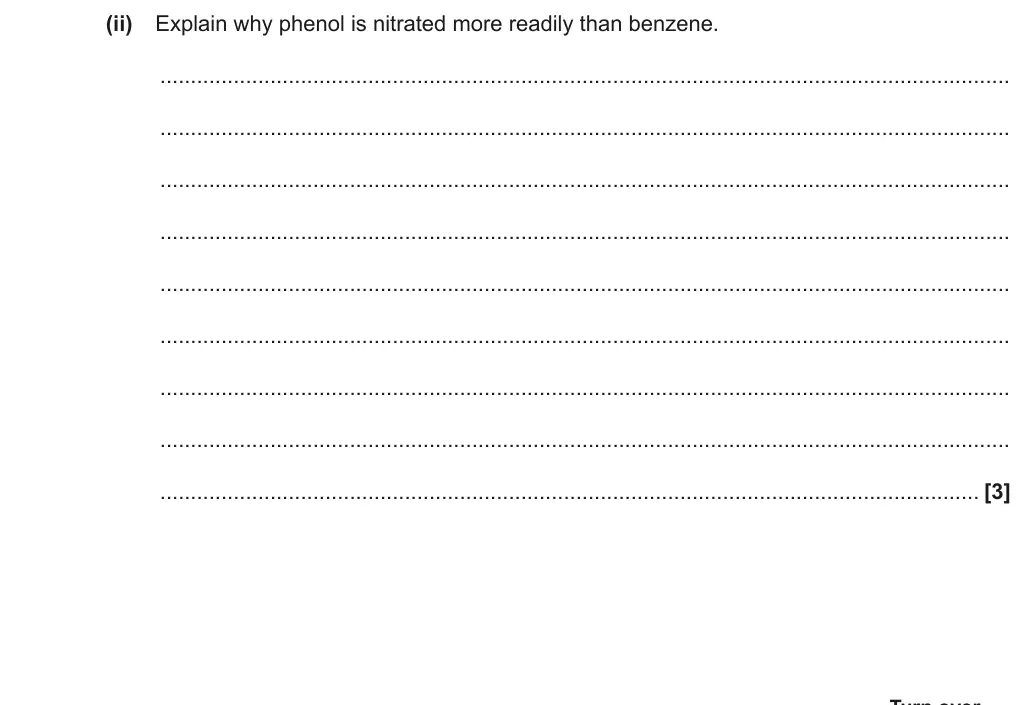
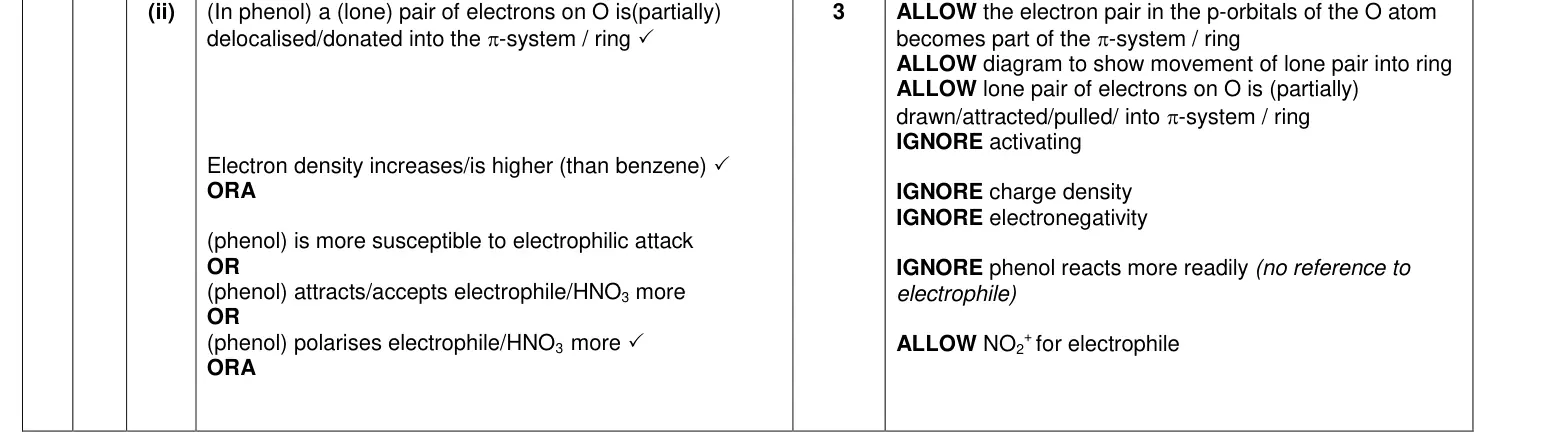
lone pair on O (one pair only) delocalised into ring
electron density higher than in benzene
ring more susceptible to electrophilic attack/polarises Br2
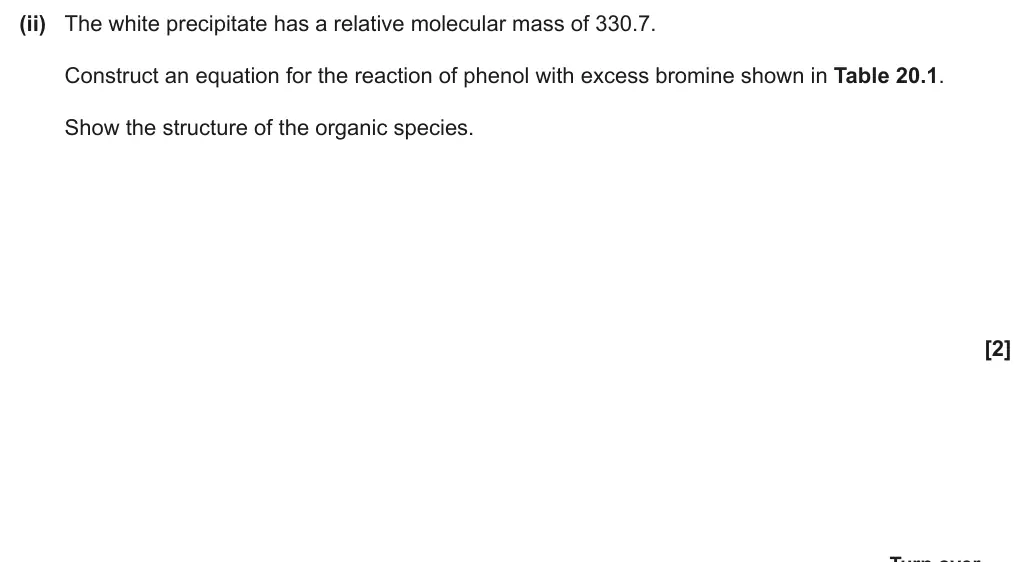
June 2025 · Paper 2 · Q20(b)(ii)2 marksEquation writingHard
Earlier part of question 20 that this part uses
Mark scheme
Examiner's comment
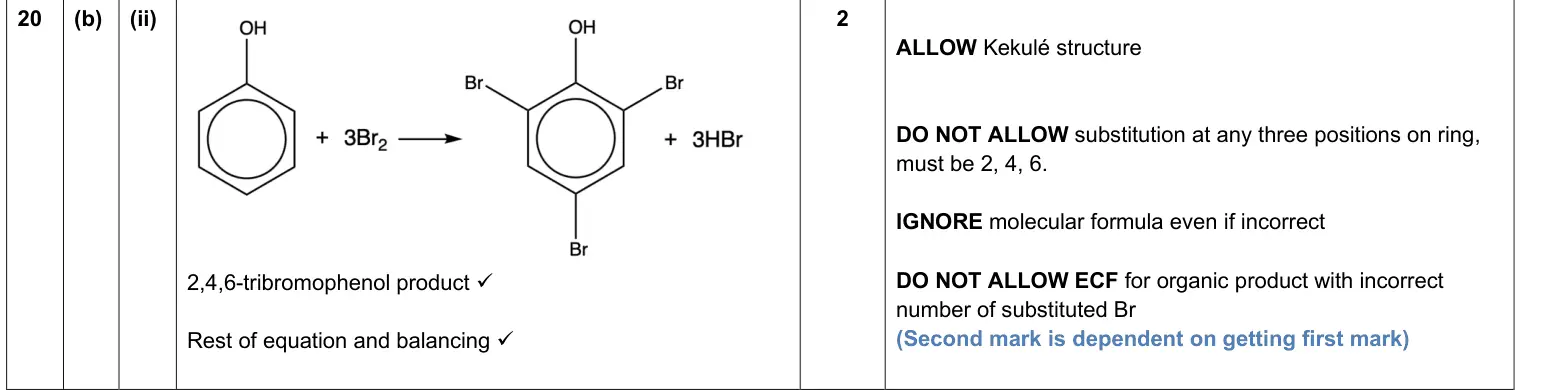
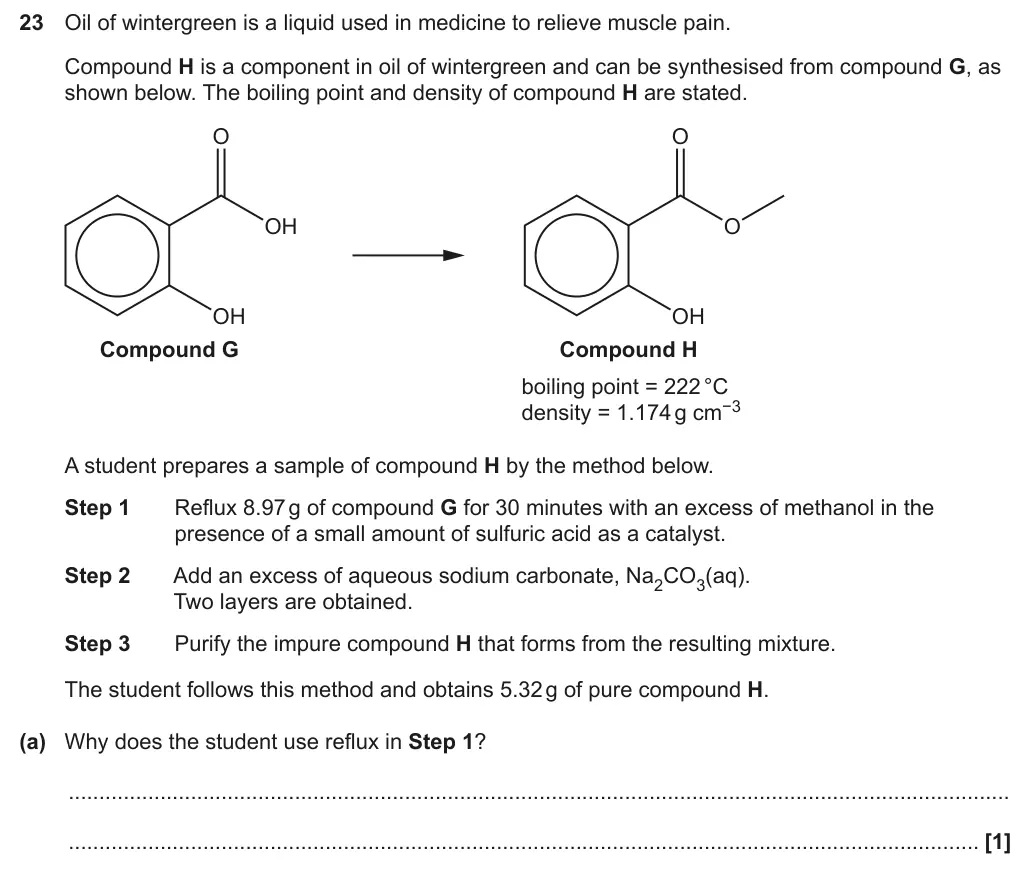
The majority were able to get the mark for the 2,4,6-tribromophenol structure, with some candidates using the relative molecular mass given to confirm their answer. Many were also able to obtain the mark for the balanced equation. Common errors seen in balancing included omitting HBr as a product or only having 1.5 Br2. Some gave H2 as a product. Lower attaining candidates struggled, often replacing the -OH with a -Br group but not accounting for the molar mass.
Notes from the mark scheme and report
2,4,6-tribromophenol only (DO NOT ALLOW other positions)
3Br2 and 3HBr
second mark dependent on first
Skills: M0.2 Use ratios, fractions and percentages
June 2025 · Paper 2 · Q20(c)(i)1 markShort answerMedium
Mark scheme
Examiner's comment
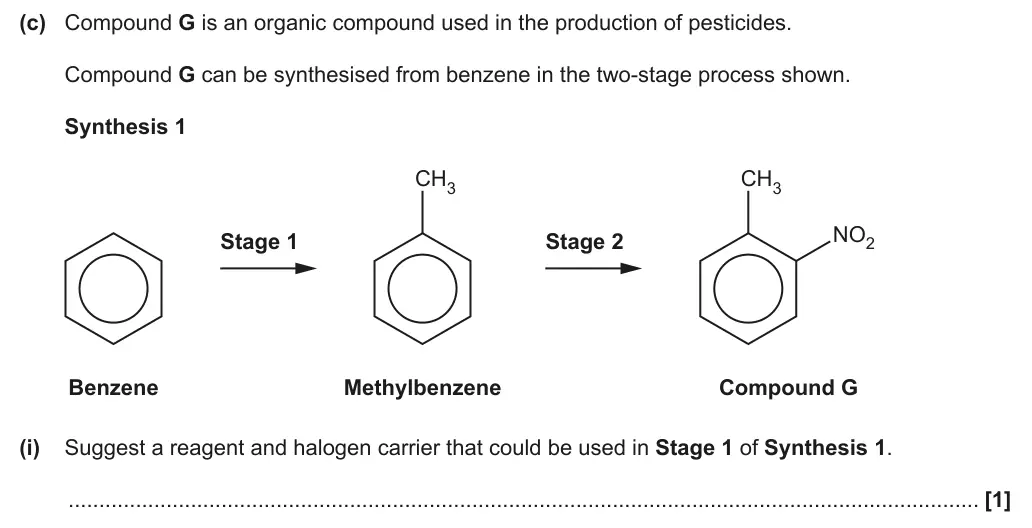
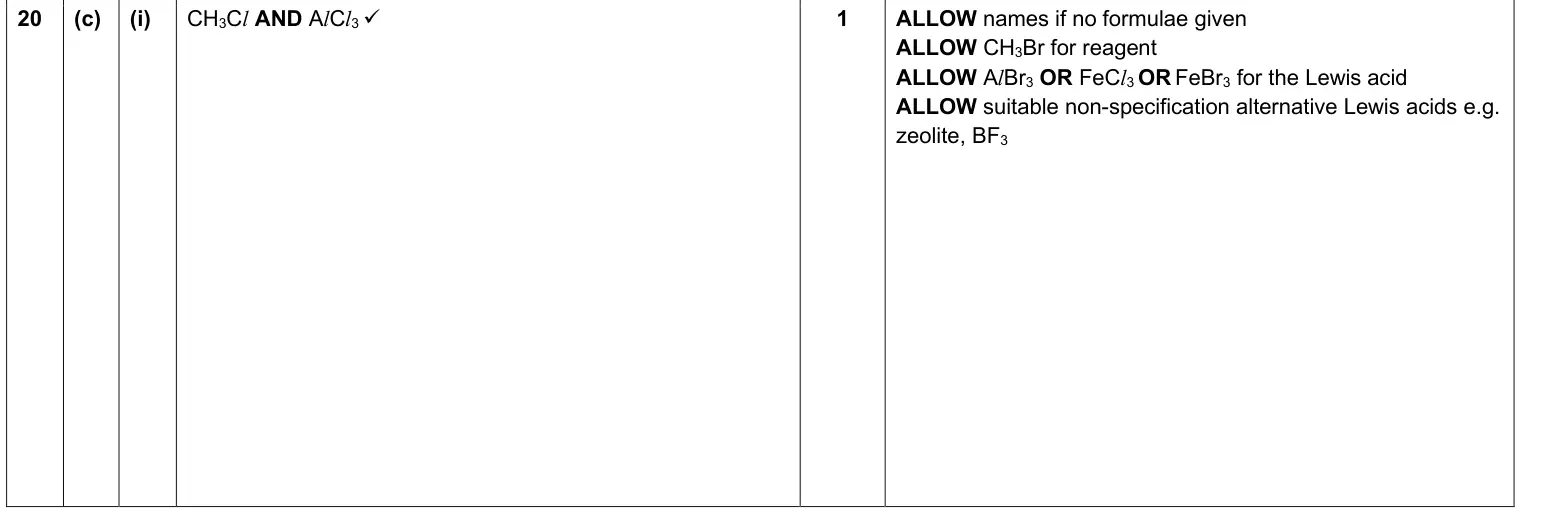
This mark was achieved by most candidates. Common errors included: • CH3 or CH4 as reagent • Missing the reagent and only giving the halogen carrier • CH3COCl as halogen carrier or reactant • AgCl3 as halogen carrier
Notes from the mark scheme and report
CH3Cl AND AlCl3 (ALLOW CH3Br, FeCl3, FeBr3, AlBr3)
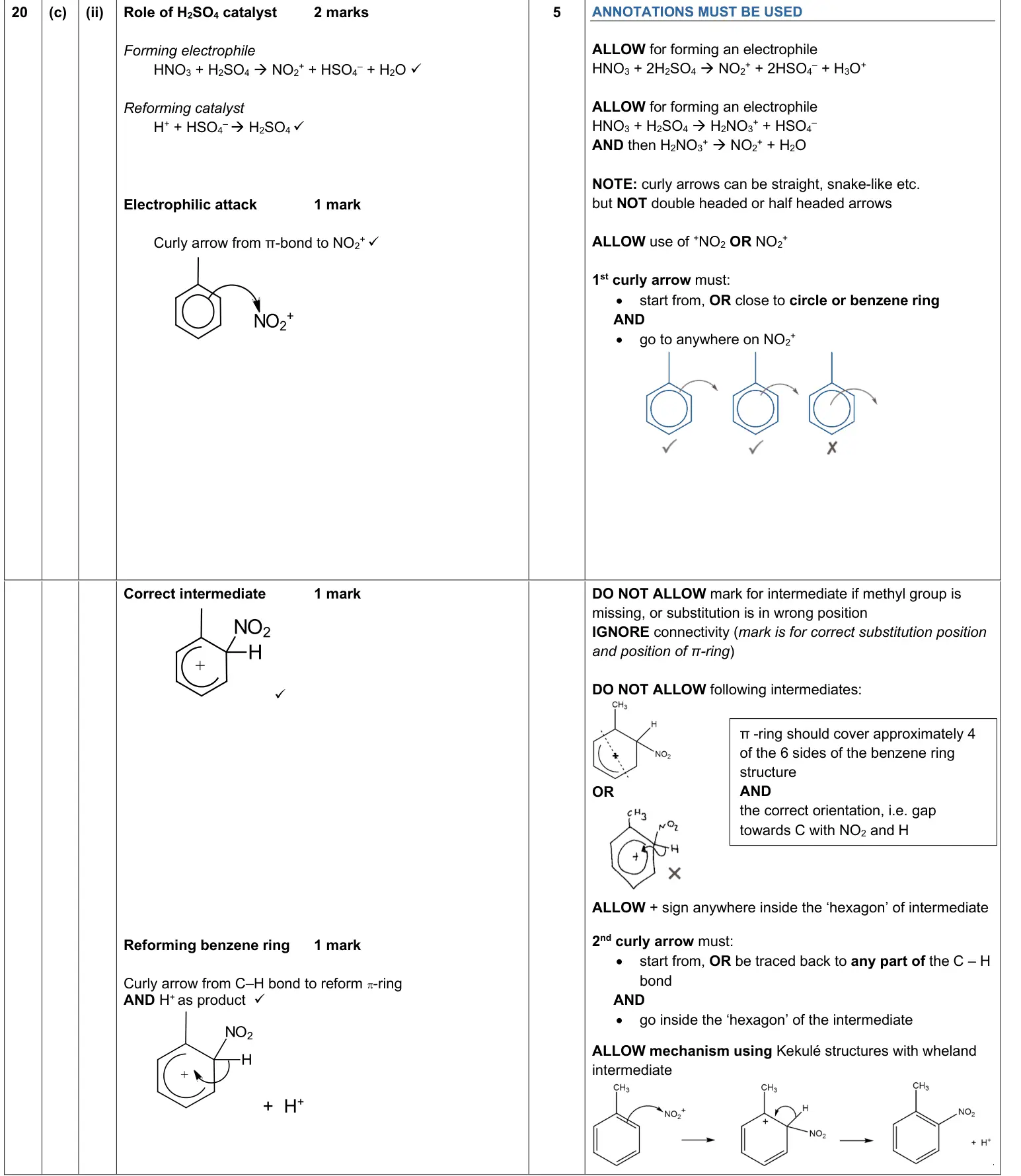
June 2025 · Paper 2 · Q20(c)(ii)5 marksMechanismHard
Earlier part of question 20 that this part uses
Mark scheme
Examiner's comment
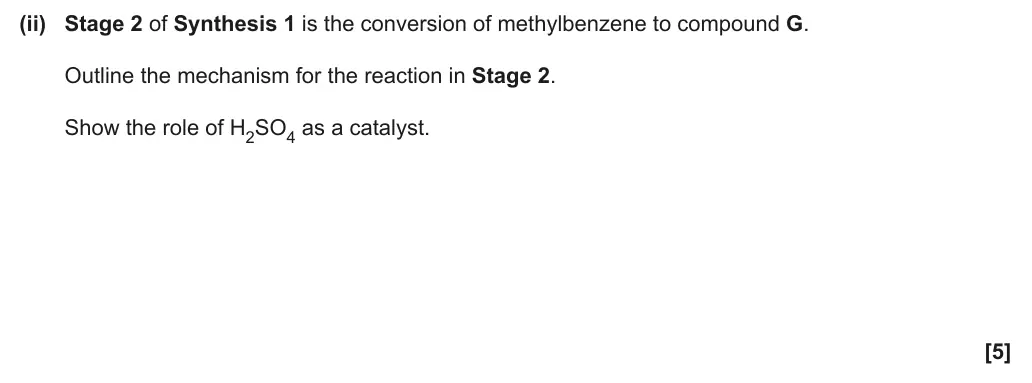
Many were confident with this mechanism with approximately half of all candidates achieving all 5 marks. Some lost a mark due to the addition of a lone pair of electrons to the NO2+ and showing the curly arrow moving towards the NO2. A missing or incorrect charge on NO2+ cost 2 marks both for the equation for the formation and for the arrow from the benzene ring to the electrophile. Some also had missing or incorrect charges on HSO4- which lost both equation marks. Some formed H3SO4 (with or without charges) which was then used to form H2 as well as H2SO4 when regenerating the catalyst. Marks were often lost for the intermediate – it was essential that the ring covered 4 out of the 6 sides with the opening orientated towards the -NO2 group. This was sometimes hard to judge if the ring was very small or the hexagon of benzene was uneven. Very few lost a mark for the omission of the methyl group on the intermediate. Some lost a mark for missing H+ with their final product. Lower attaining candidates often omitted the equations to form NO2+ and/or reform H2SO4. Some attempted to show a reaction with H2SO4 despite being given the formula of G in the question.
Notes from the mark scheme and report
HNO3 + H2SO4 → NO2+ + HSO4– + H2O
H+ + HSO4– → H2SO4
arrow from ring to NO2+
intermediate must keep methyl group with correct position and π-ring covering about 4 sides with gap towards the substituted C
arrow from C–H bond into ring AND H+
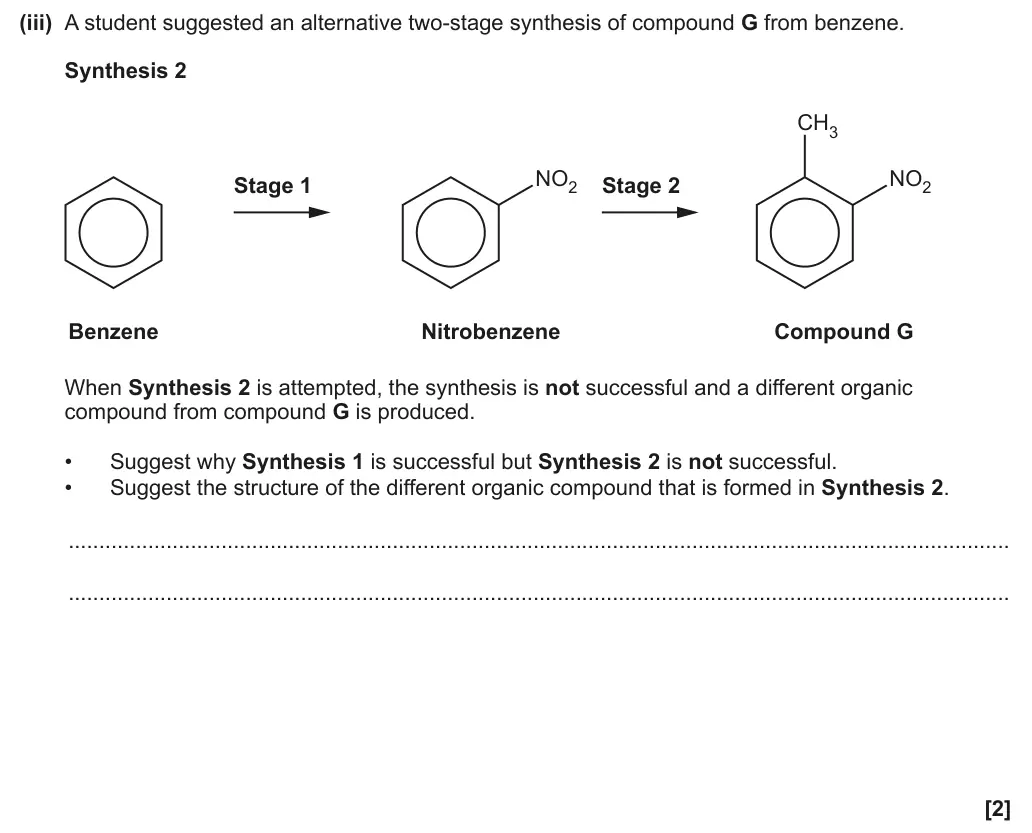
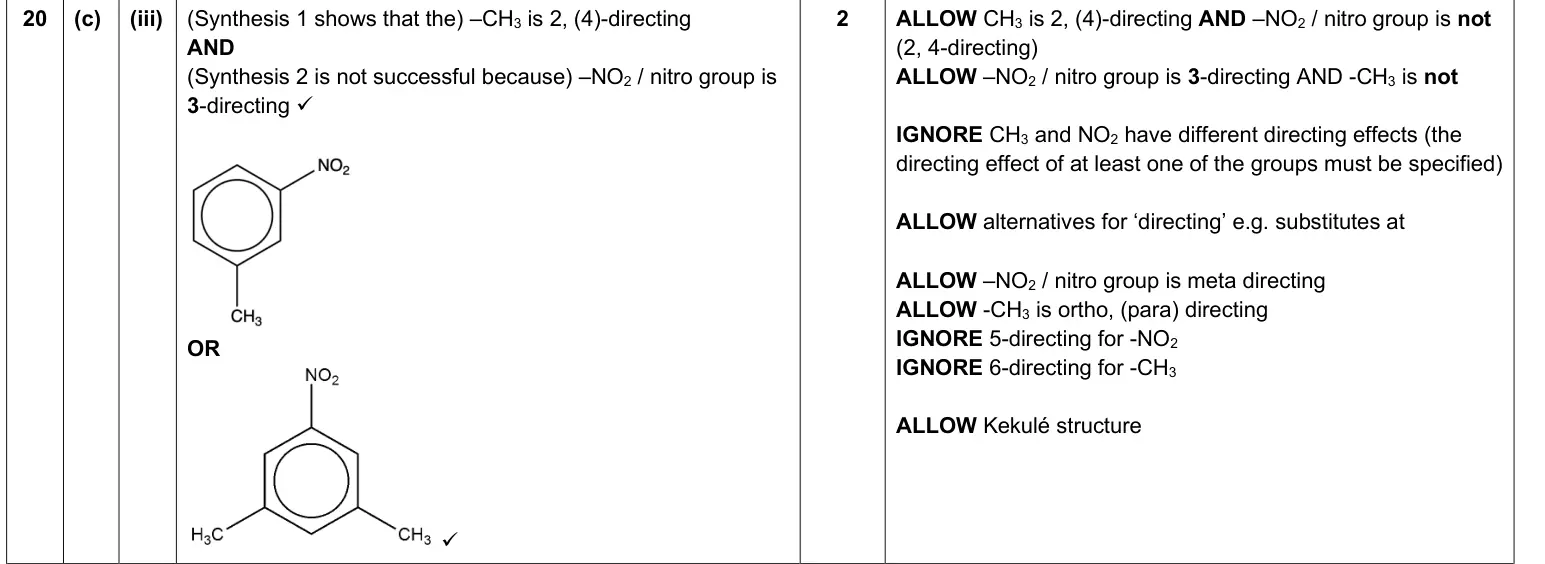
June 2025 · Paper 2 · Q20(c)(iii)2 marksStructure / isomerHard
Earlier part of question 20 that this part uses
Mark scheme
Examiner's comment
Many were able to identify that the -NO2 group is 3,5-directing as shown in both their explanations and the structure given. Only the highest attaining scored the mark for the explanation as it was necessary to suggest why synthesis 1 was successful as well as why synthesis 2 wasn’t. To do this, candidates had to deduce from synthesis 1 that -CH3 is 2,4-directing. Some suggested -NO2 or -CH3 was 1-directing. This, alongside structures showing the group next to the -NO2 group, suggests some confusion with how counting is achieved around the ring. It was also evident that some, although suggesting the -NO2 group is 3,5-directing, then drew a structure with the -CH3 in position 4. A few candidates suggested that CH3 ‘does not have a directing effect’ or ‘can direct anywhere on the ring’, presumably because it is not on the list of groups they need to know. Some candidates gave explanations based on reactivity, e.g. ‘the -NO2 group is electron withdrawing so makes the ring less reactive’, or that the -NO2 group itself would react with reagents used to add the methyl group, e.g. adding Cl to the ring instead.
Notes from the mark scheme and report
CH3 is 2,(4)-directing AND NO2 is 3-directing
IGNORE 'different directing effects' unless one is specified
product is 3-nitromethylbenzene (mark scheme also shows a 3,5-disubstituted alternative)
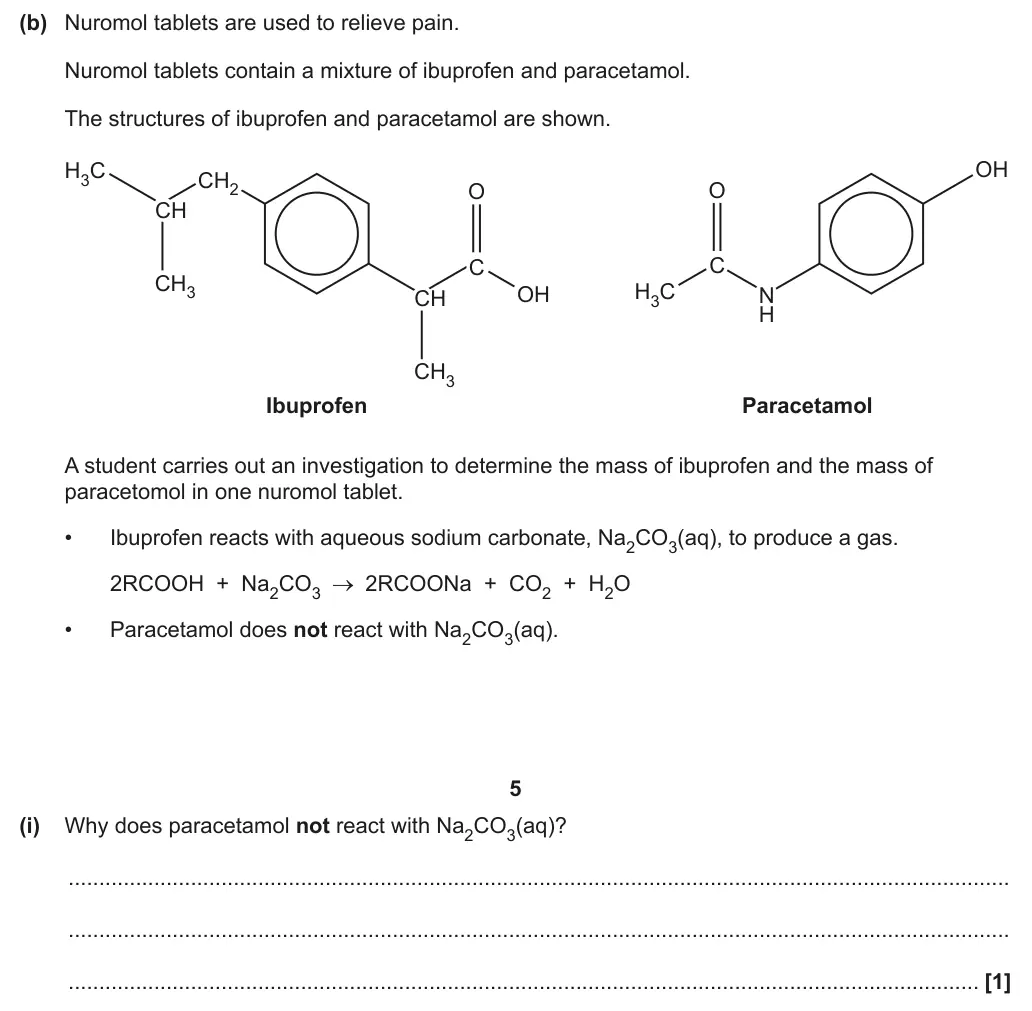
June 2025 · Paper 3 · Q2(b)(i)1 markShort answerEasy
Mark scheme
Examiner's comment
This question was answered well, with most candidates identifying that ibuprofen contains a phenol group or that it does not contain a carboxylic acid. A named functional group was required in the answer. Some described phenol incorrectly as not being an acid and this was not credited. It was rare for incorrect functional groups to be seen in candidate responses.
Notes from the mark scheme and report
it is a phenol / has no COOH: a correct functional group must be named
IGNORE 'too weak an acid'
DO NOT ALLOW 'not acidic', ketone or amine
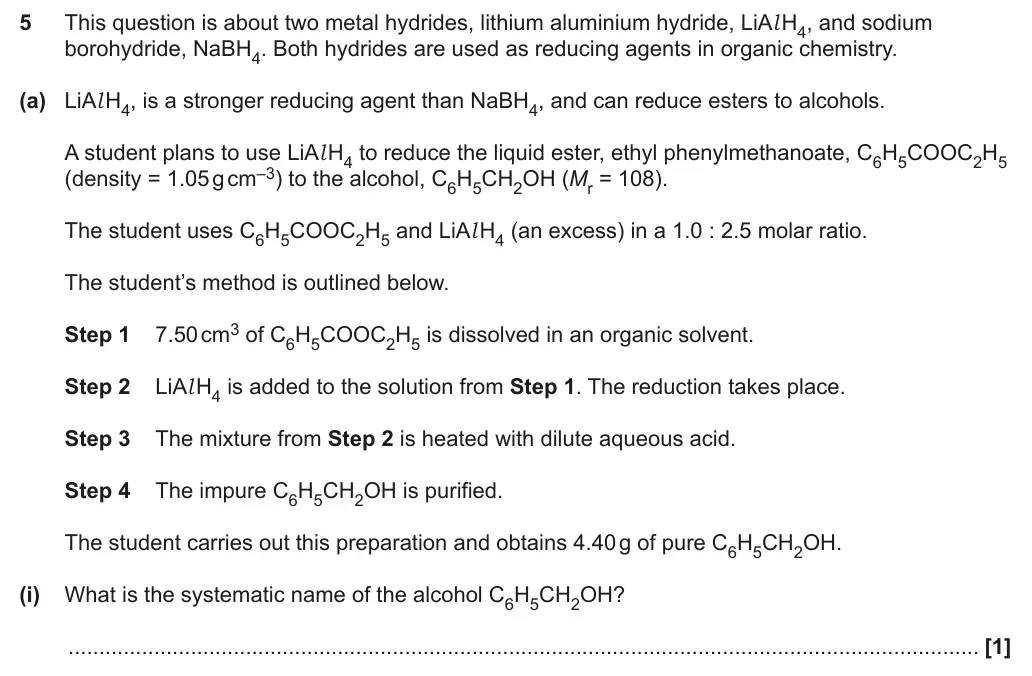
June 2025 · Paper 3 · Q5(a)(i)1 markShort answerMedium
Mark scheme
Examiner's comment
This name caused problems for most candidates. Phenyl methanol was expected, and unambiguous representations were allowed including 1- phenylmethanol, phenylmethan-1-ol and 1-phenylmethan-1-ol Many candidates incorrectly based the name on methylphenol or hydroxymethylbenzene.
Notes from the mark scheme and report
phenylmethanol
DO NOT ALLOW hydroxymethylbenzene or methylphenol
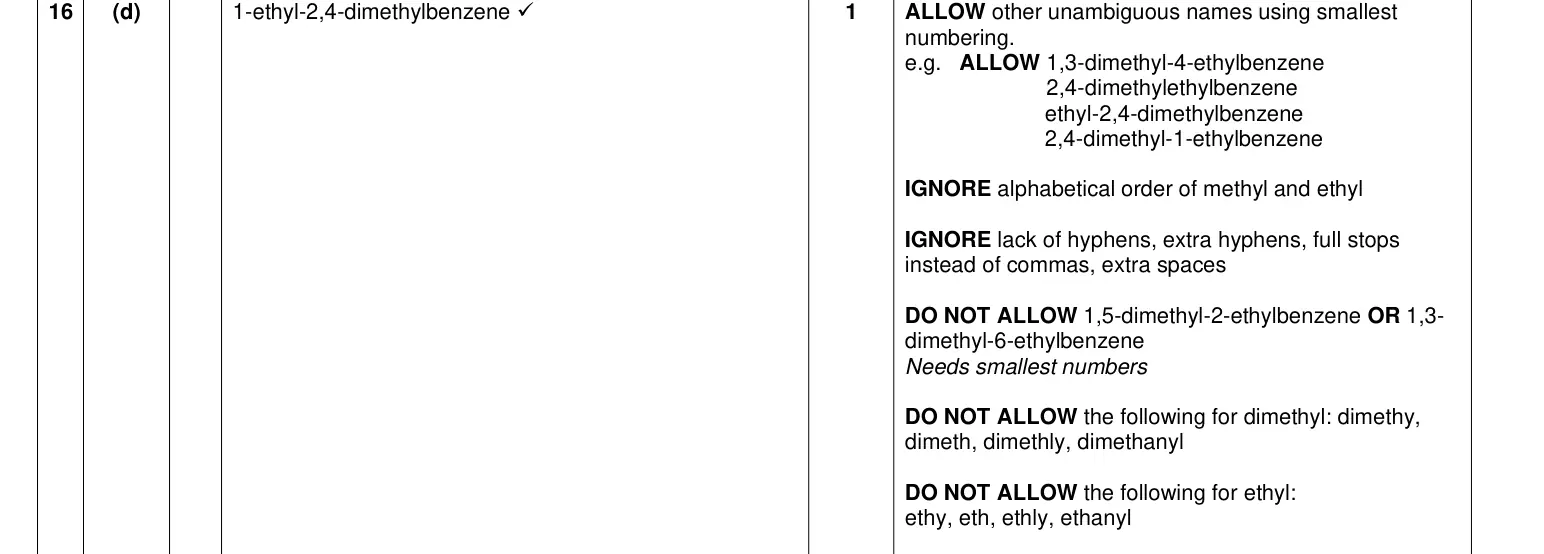
June 2024 · Paper 2 · Q16(d)1 markShort answerHard
Earlier part of question 16 that this part uses
Mark scheme
Examiner's comment
This question appeared to be equally challenging for candidates. Common errors included names without the lowest possible numbering. The methyl group was given on the top which could have influenced candidates to start counting from there – more practice is needed to help with naming simple aromatics. Other common errors included:1-ethyl-2,4-methylbenzene (missing di-) and 1-ethyl-2,3- dimethylbenzene (miss counting groups).
Notes from the mark scheme and report
1-ethyl-2,4-dimethylbenzene
smallest numbering needed – DO NOT ALLOW 1,5-dimethyl-2-ethylbenzene
DO NOT ALLOW misspellings such as dimethy, ethly
IGNORE alphabetical order
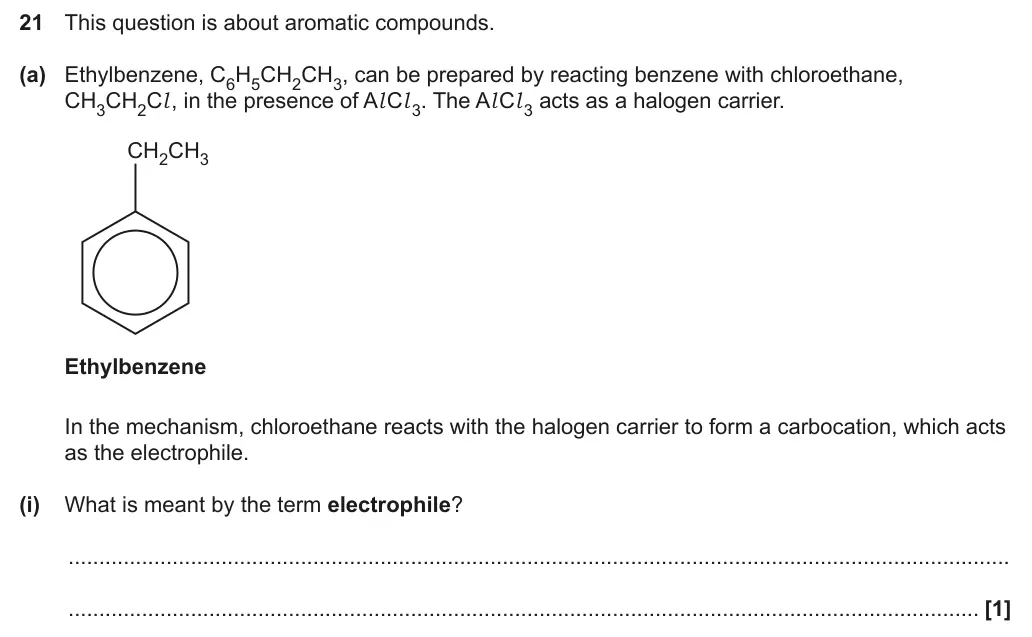
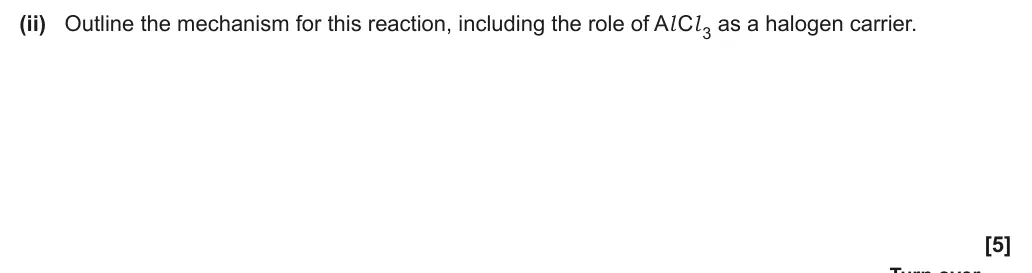
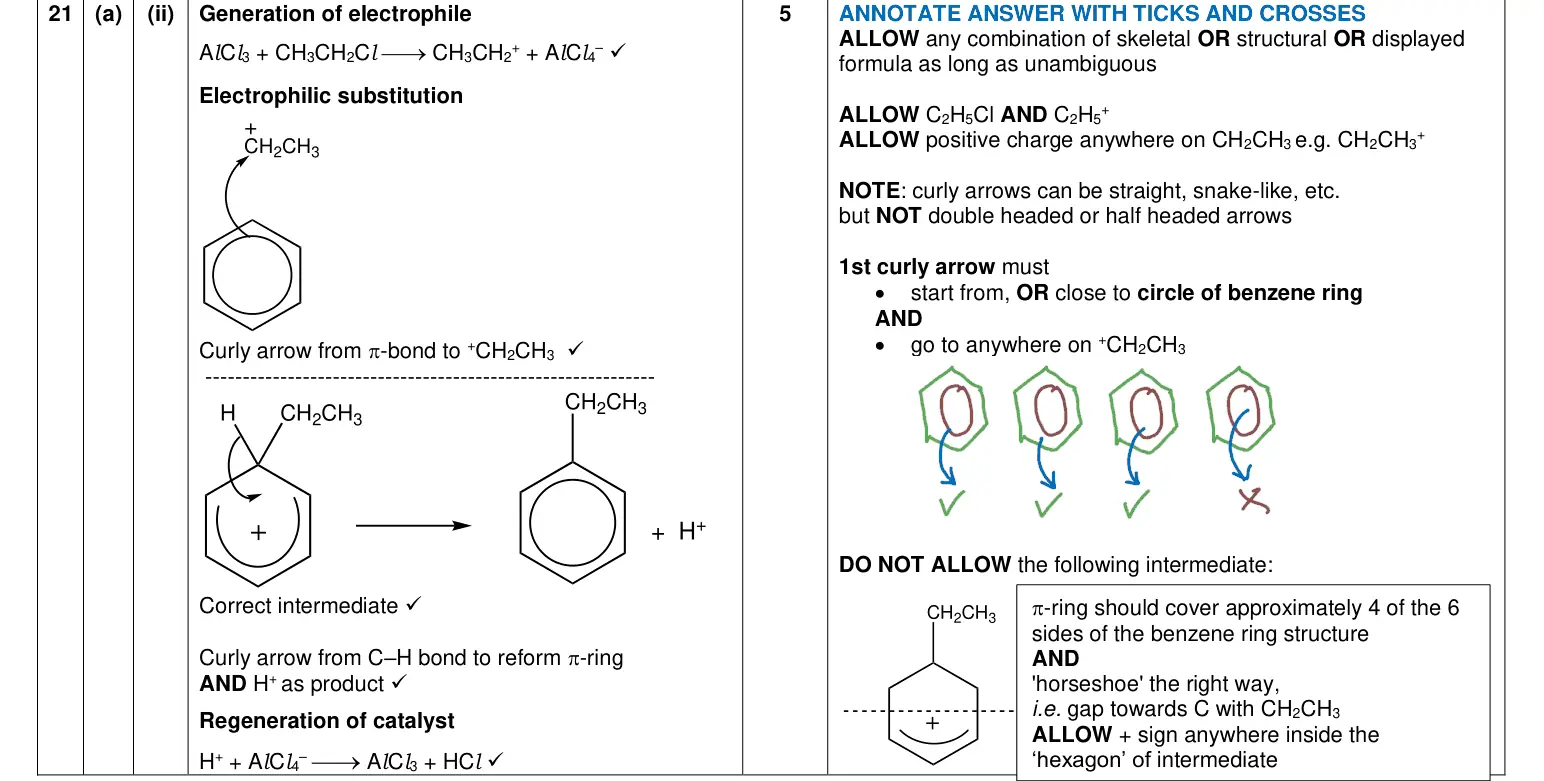
June 2024 · Paper 2 · Q21(a)(ii)5 marksMechanismMedium
Earlier part of question 21 that this part uses
Mark scheme
Examiner's comment
Most candidates were well prepared for this question, with over half of candidates gaining all 5 marks. A significant number of candidates showed halogenation, generating Cl+ as an electrophile, instead of alkylation. Others attempted to substitute the ethylbenzene ring rather than benzene. Further common errors included incorrect connectivity in the ethyl group on the intermediate, curly arrows coming from hydrogen atoms rather than C–H bond to reform the -ring and omission of an H+ ion at the end of mechanism.
Notes from the mark scheme and report
AlCl3 + CH3CH2Cl → CH3CH2+ + AlCl4–
arrow from π-ring to the carbocation
intermediate with horseshoe covering about 4 sides and gap towards the substituted C
arrow from C–H bond back to ring with H+ lost
H+ + AlCl4– → AlCl3 + HCl
no half-headed arrows
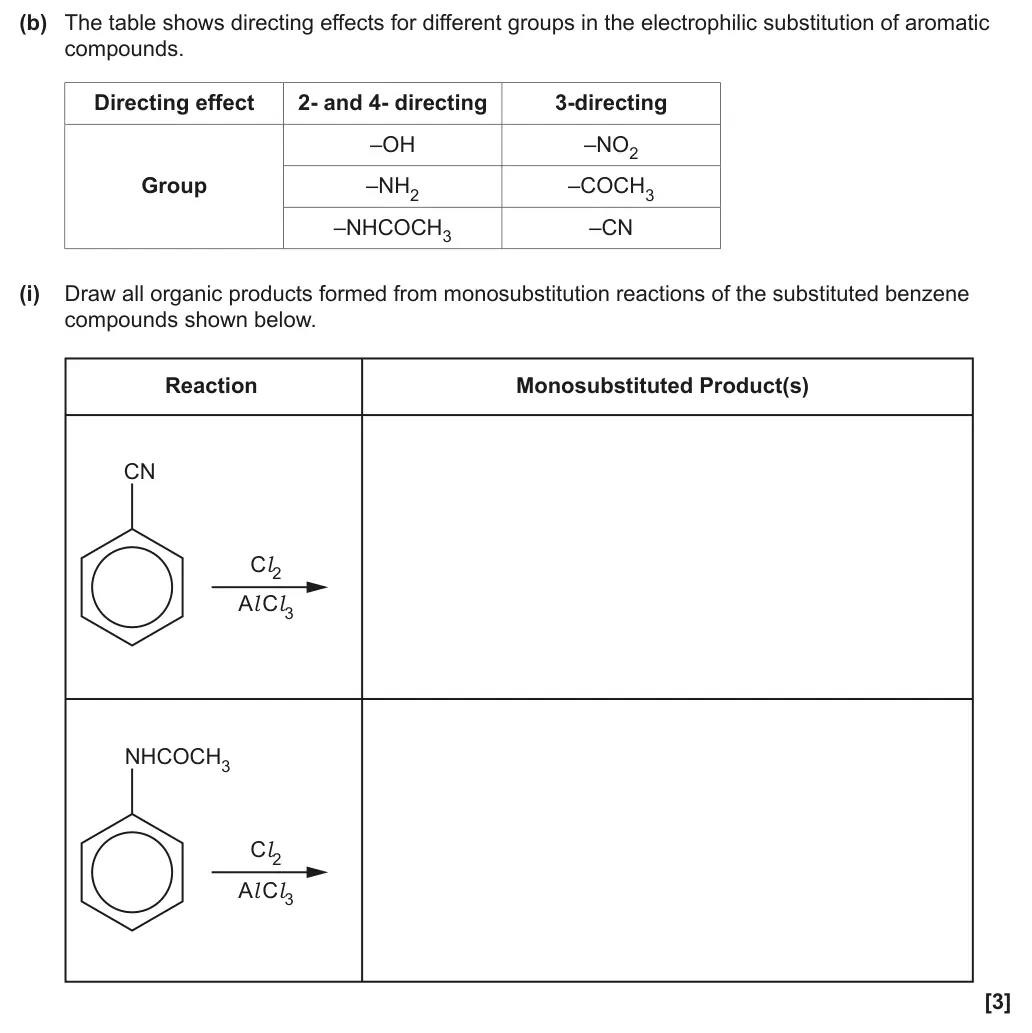
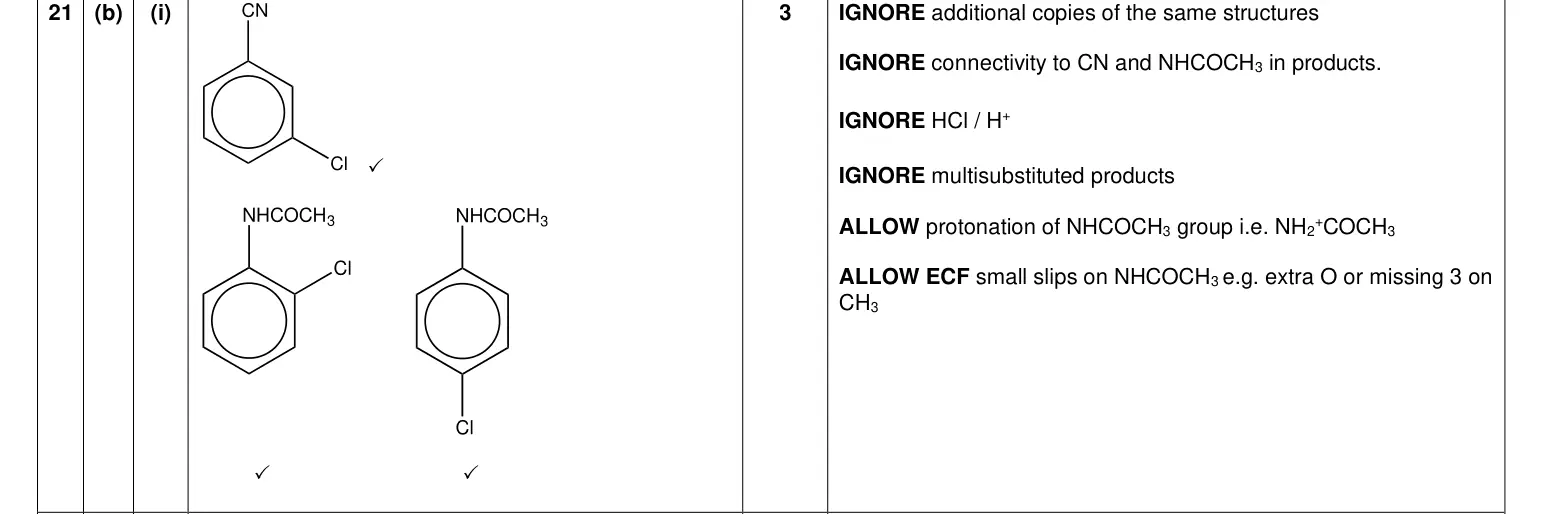
June 2024 · Paper 2 · Q21(b)(i)3 marksStructure / isomerEasy
Mark scheme
Examiner's comment
Most candidates were able to correctly recognise the correct direction for substitution, with over half gaining all 3 marks. Marks were most often lost for giving multiple substitution products despite being asked for the monosubstituted products. Many unnecessarily drew the same structures but with different orientations i.e. substituting on carbon-3 of a ring is the same as substituting on carbon-5.
Notes from the mark scheme and report
CN is 3-directing: 3-chlorobenzonitrile only
NHCOCH3 is 2- and 4-directing: two products
IGNORE multisubstituted products and HCl
Ensure students understand the term ‘monosubstituted’ and practise naming compounds to give the lowest possible numbering. This will also help them to recognise the equivalent structures.
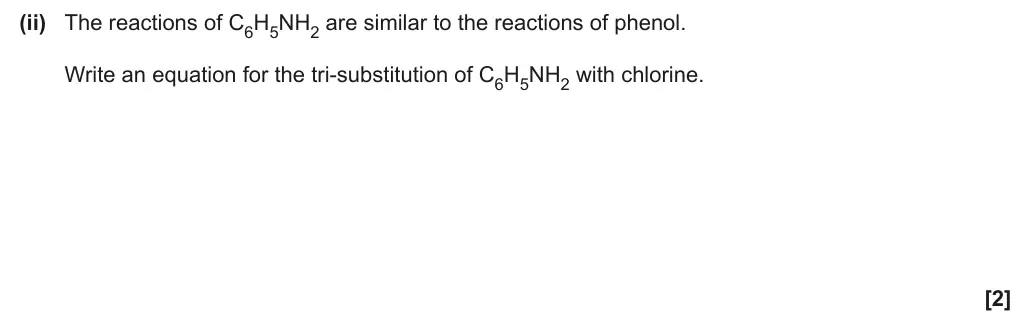
June 2024 · Paper 2 · Q21(b)(ii)2 marksEquation writingMedium
Earlier part of question 21 that this part uses
Mark scheme
Examiner's comment
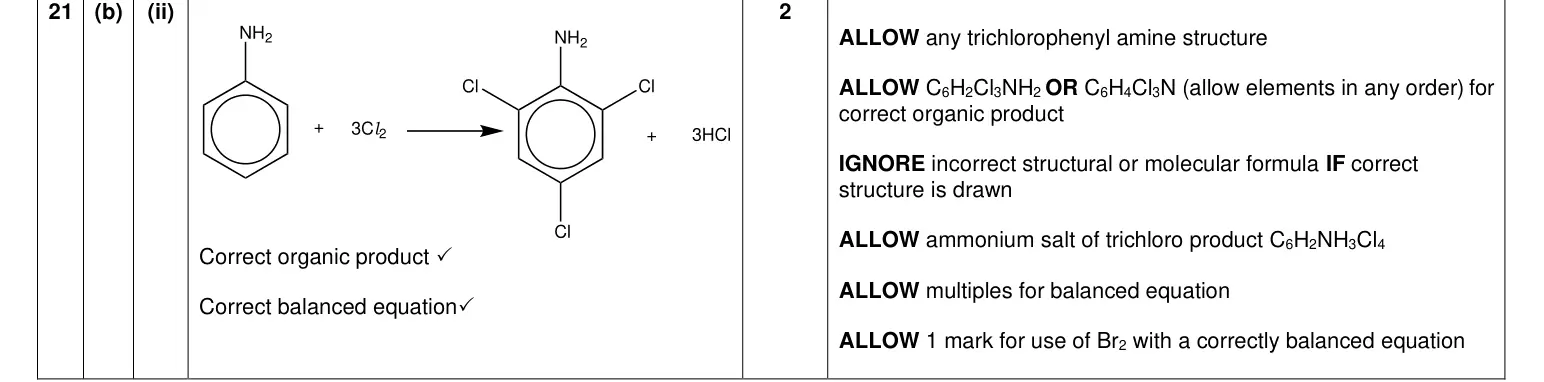
The majority of candidates were able to give a suitable tri-substituted product, with many showing the structure although not asked for in the question. Many were also able to give a correct balanced equation too. Some were unsure how phenylamine would react showing the reaction with the amine group or only giving a monosubstituted product. Some didn’t form HCl as another product, reacting phenyl amine with 1.5 Cl2 instead. Others gave hydrogen as the product.
Notes from the mark scheme and report
2,4,6-trichlorophenylamine (ALLOW any trichloro structure) + 3HCl with 3Cl2
1 mark for a balanced equation using Br2
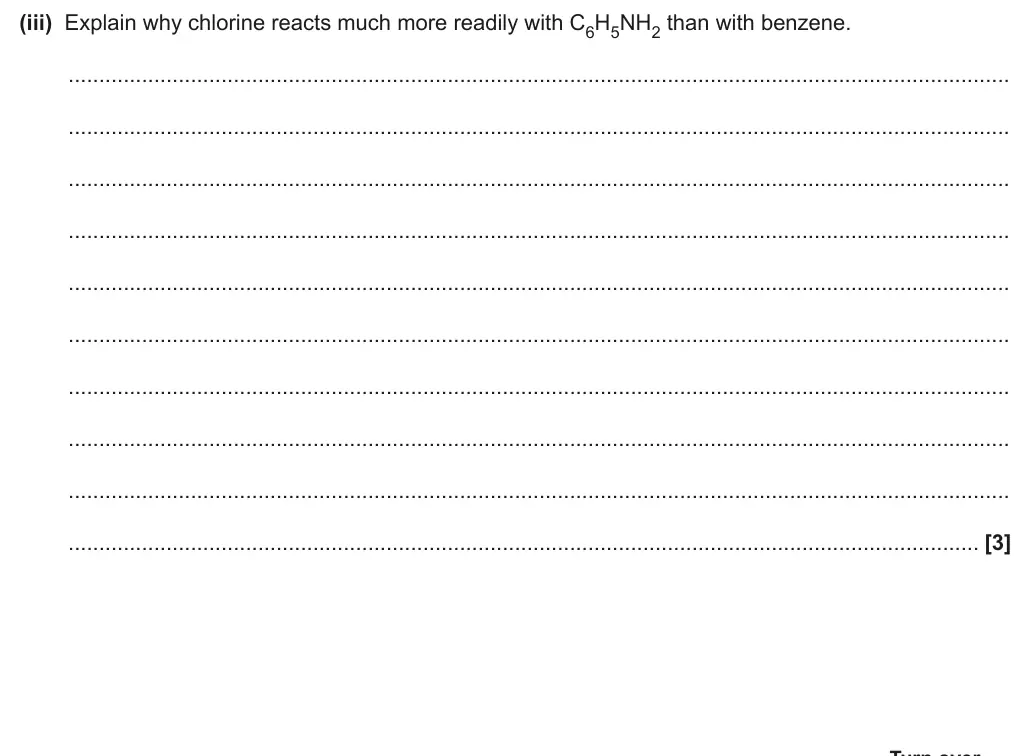
June 2024 · Paper 2 · Q21(b)(iii)3 marksShort answerMedium
Earlier part of question 21 that this part uses
Mark scheme
Examiner's comment
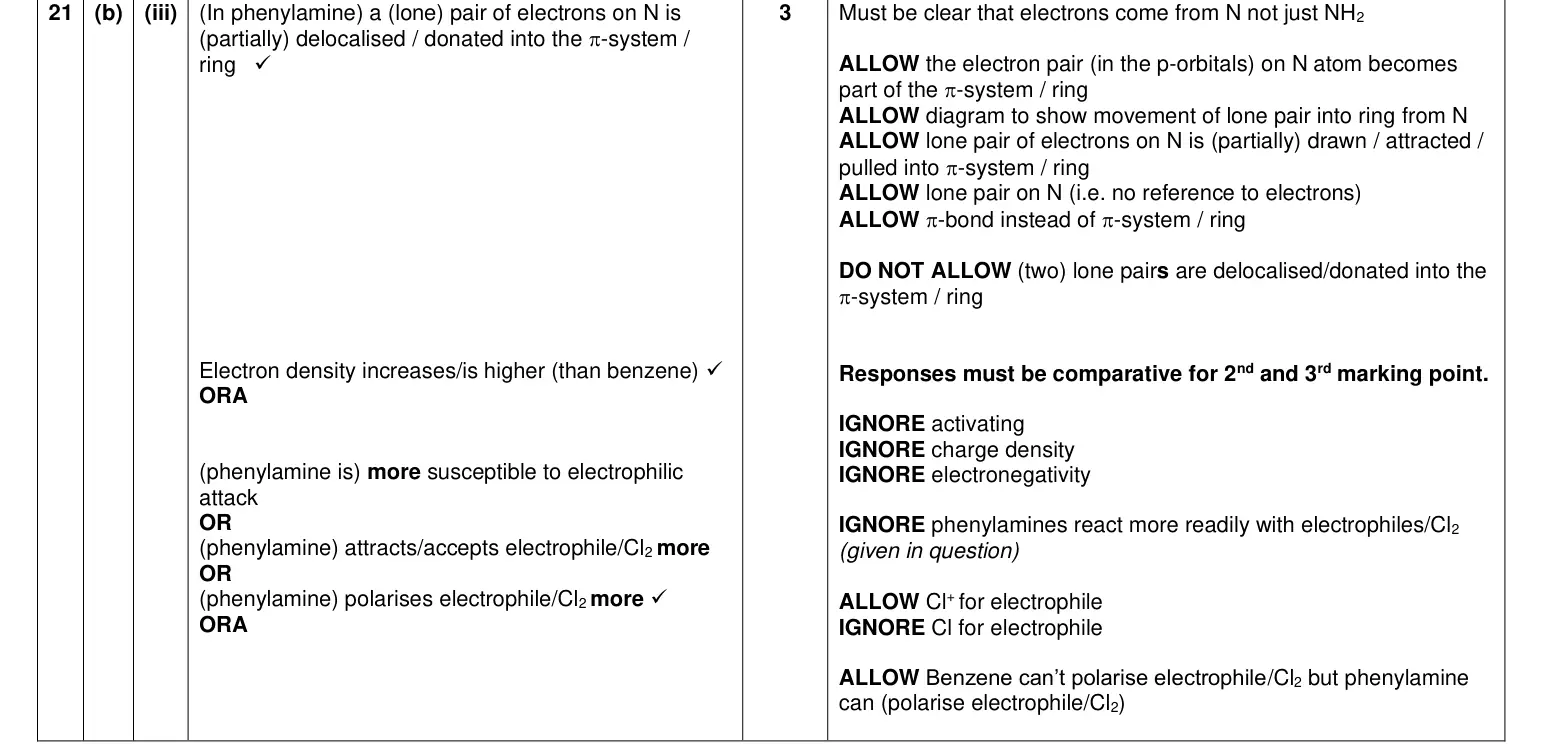
Similar questions have been seen previously and many candidates were able to give clear and concise responses. The first marking point was the most frequently lost as although many described -NH2 as electron donating, they were not able to fully explain its role. Some understood that a lone pair was donated into the -ring but did not specify that the lone pair was on the nitrogen. Other marks were lost by not making comparison to benzene, e.g. high electron density, polarises Cl2. Some repeated the information from the question regarding phenylamine being more reactive with electrophiles but not explaining why. Lower attaining candidates often described the structure of the benzene ring or referred to phenylamine being more electronegative.
Notes from the mark scheme and report
lone pair on N (not just NH2) partially delocalised into the π-system
electron density of ring higher than benzene
more susceptible to electrophilic attack/polarises Cl2 more – comparisons required
June 2024 · Paper 2 · Q23(b)(i)3 marksEquation writingHard
Earlier part of question 23 that this part uses
Mark scheme
Examiner's comment
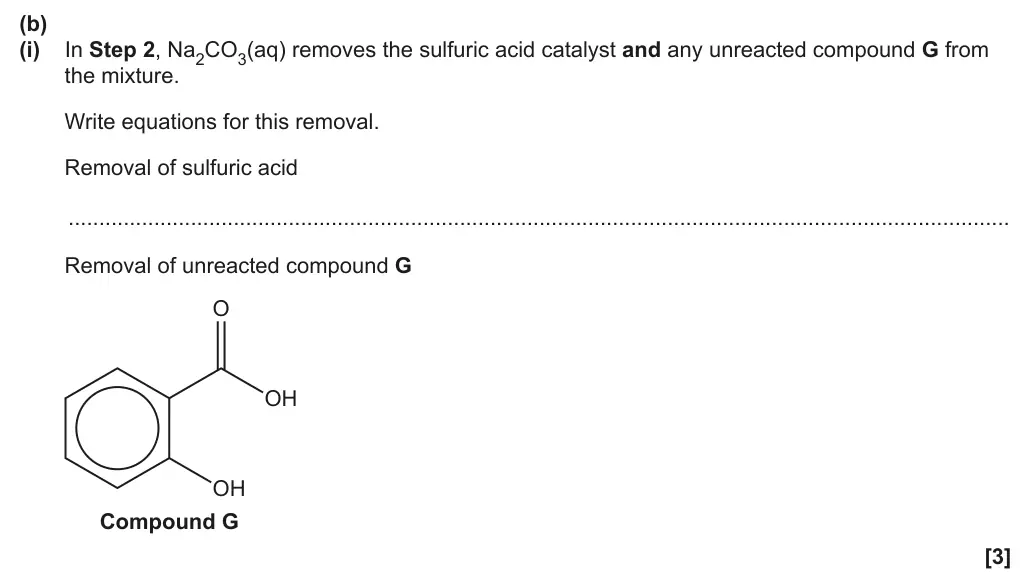
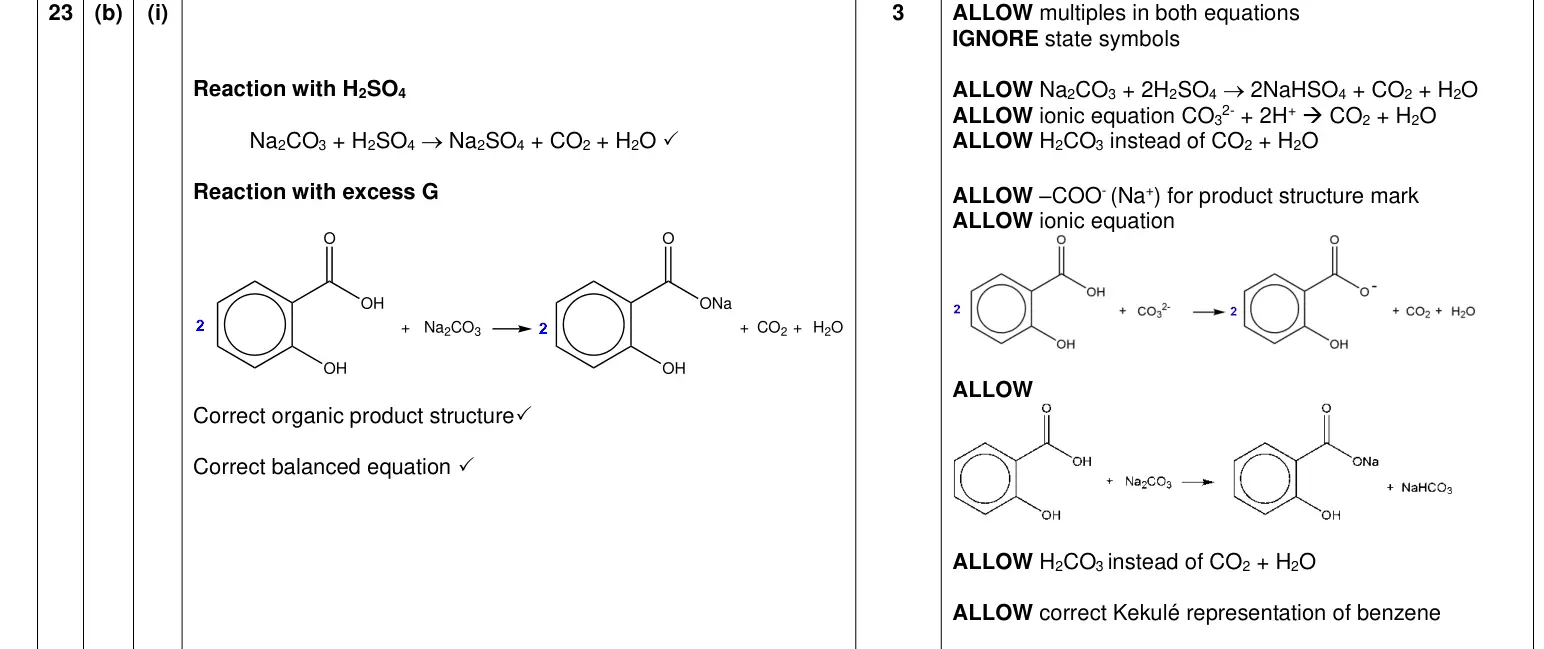
Another fairly challenging question, however most secured at least one mark for giving an equation for the reaction of sulfuric acid with sodium carbonate. Less confident candidates struggled to gain any marks as they were unable to give correct formula for sodium sulfate, giving NaSO4 for example. Although many attempted the equation showing the reaction of compound G with sodium carbonate, only some correctly identified that only the carboxyl group would react, not the phenol. A small minority of students were able to balance the second equation gaining all 3 marks.
Notes from the mark scheme and report
Na2CO3 + H2SO4 → Na2SO4 + CO2 + H2O
only the COOH of G reacts (phenol OH unchanged) giving –COONa
2 G per Na2CO3 (ALLOW 1:1 forming NaHCO3)
ALLOW ionic equations
June 2024 · Paper 2 · Q23(b)(ii)1 markShort answerMedium
Earlier parts of question 23 that this part uses
Mark scheme
Examiner's comment
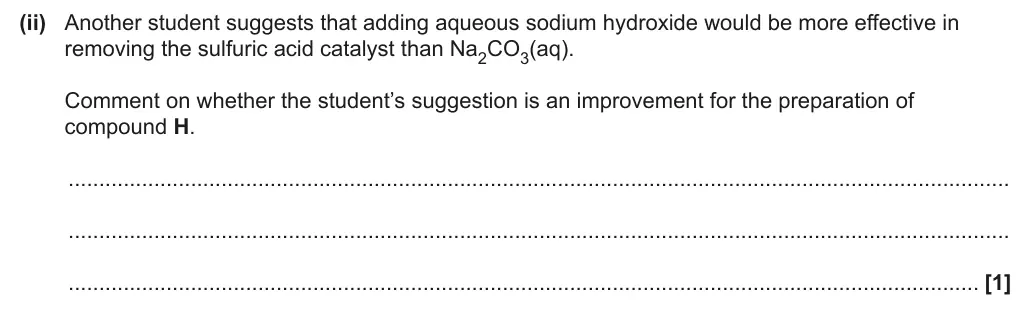
The best responses correctly identified that using sodium hydroxide was not an improvement and explained this either by stating that it would react with the phenol group or hydrolyse the ester group in compound H. However, most candidates appeared not to consider a reaction with H in their answer. Many focused on the neutralisation of sulfuric acid in a similar way to sodium carbonate and gave responses such as: • stronger base • no effervescence so harder to see when completely reacted • no CO2 produced so easier/safer/higher atom economy/less waste • requires double the moles compared to Na2SO4 to react
Notes from the mark scheme and report
NaOH would react with the phenol –OH OR hydrolyse the ester (compound H)
DO NOT ALLOW 'reacts with alcohol'
June 2024 · Paper 3 · Q4(c)(iii)1 markShort answerMedium
Earlier part of question 4 that this part uses
Mark scheme
Examiner's comment
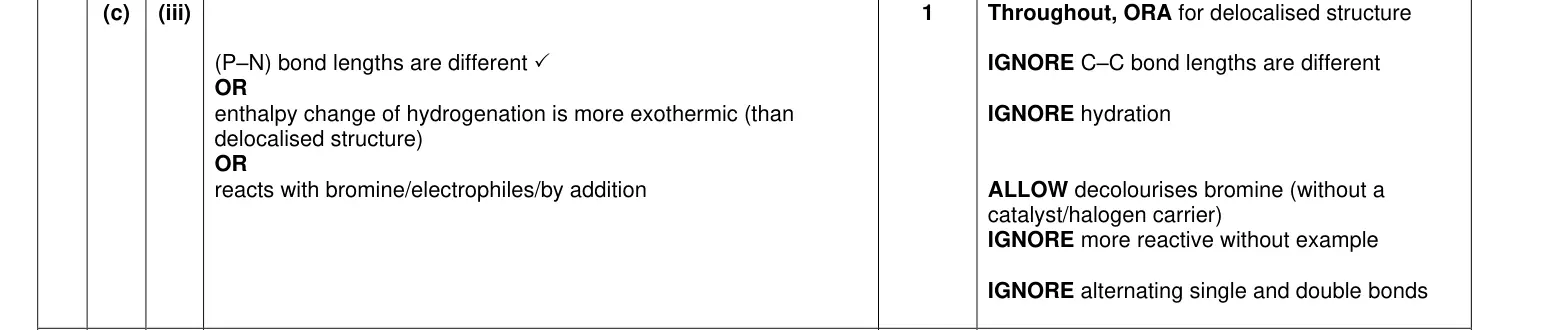
About half the candidates suggested a range of creditworthy responses with ‘different bond lengths’ and ‘decolorises bromine’ being the most common.
Notes from the mark scheme and report
(P–N) bond lengths different, or more exothermic hydrogenation, or reacts with bromine by addition
IGNORE C–C bond lengths
IGNORE 'alternating single and double bonds'
IGNORE 'more reactive' without example
June 2024 · Paper 3 · Q4(c)(iv)2 marksShort answerHard
Earlier part of question 4 that this part uses
Mark scheme
Examiner's comment
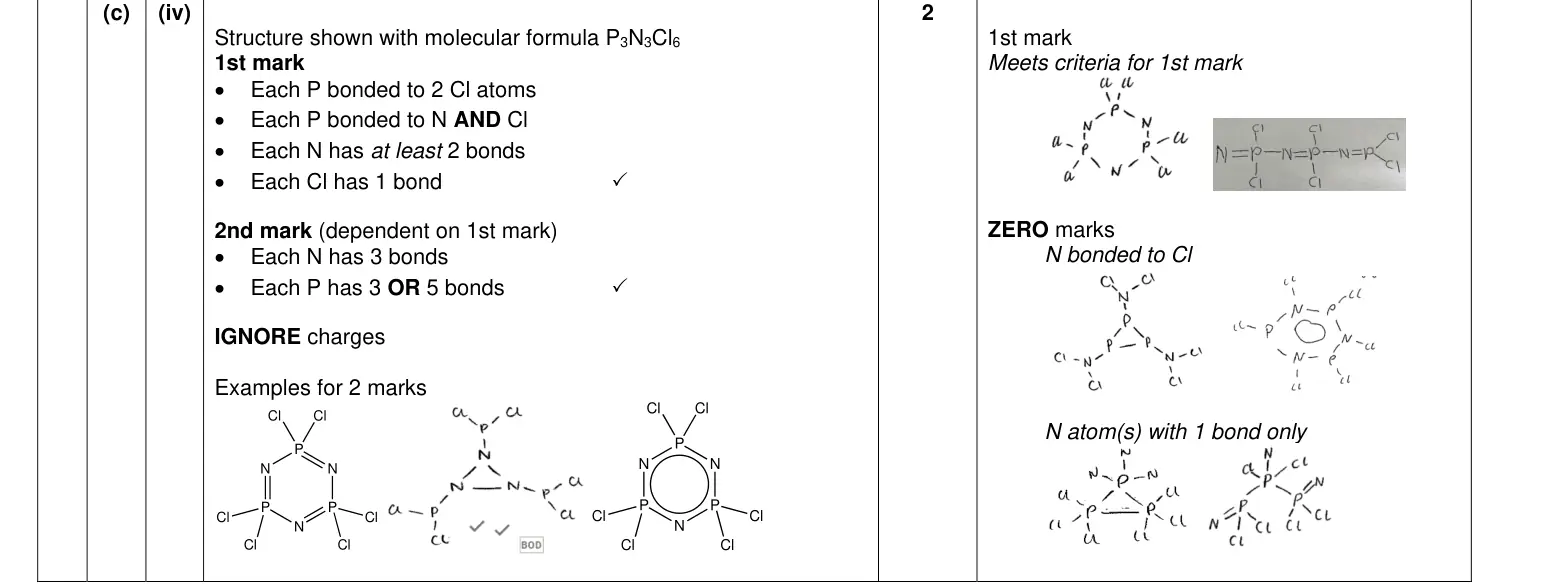
This was another question where valuable information: ’all N and Cl atoms are bonded to P atoms’ had been provided. Many of the structures seen ignored this information with chlorine often been shown bonded to a nitrogen atom. Nitrogen atoms were often shown with 1 bond only and chlorine atoms in the ring structure with 2 or more bonds. Most structures contained 6 or 3-membered rings. This was a difficult question, requiring candidates to use the supplied information to come up with realistic structures that met chemical bonding rules. Only about a quarter of candidates could be given any mark. The Kekulé theme in Questions 4 (c) (i) - (iv) should have prompted candidates that a Kekulé structure was likely here. Several other structures were allowed providing that they met normal chemistry bonding rules.
Notes from the mark scheme and report
six-membered alternating P–N ring
each P bonded to 2 Cl
each N with 3 bonds and each P with 5 (or 3) bonds for second mark
zero marks if N bonded to Cl or N with only 1 bond
Skills: M4.2 Visualise and represent 2-D and 3-D forms including 2-D representations of 3-D objects
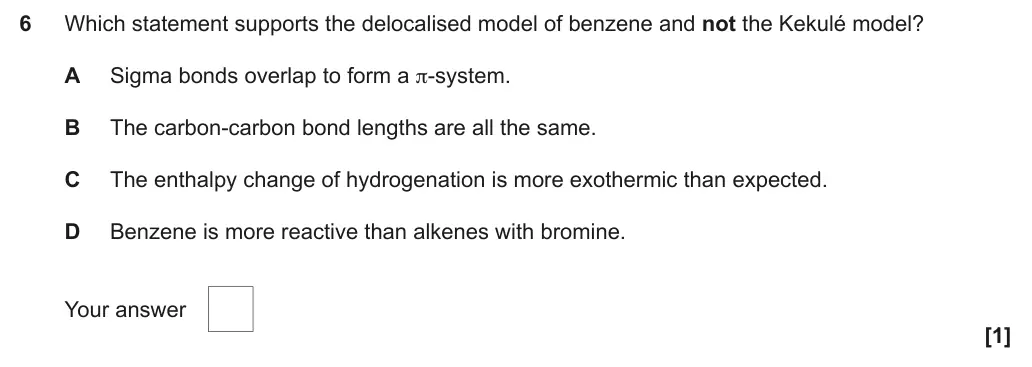
June 2023 · Paper 2 · Q61 markAO1Multiple choiceMedium
Answer
B
Mark scheme
Examiner's comment
The answer to this question was generally well known. The most common incorrect response was A.
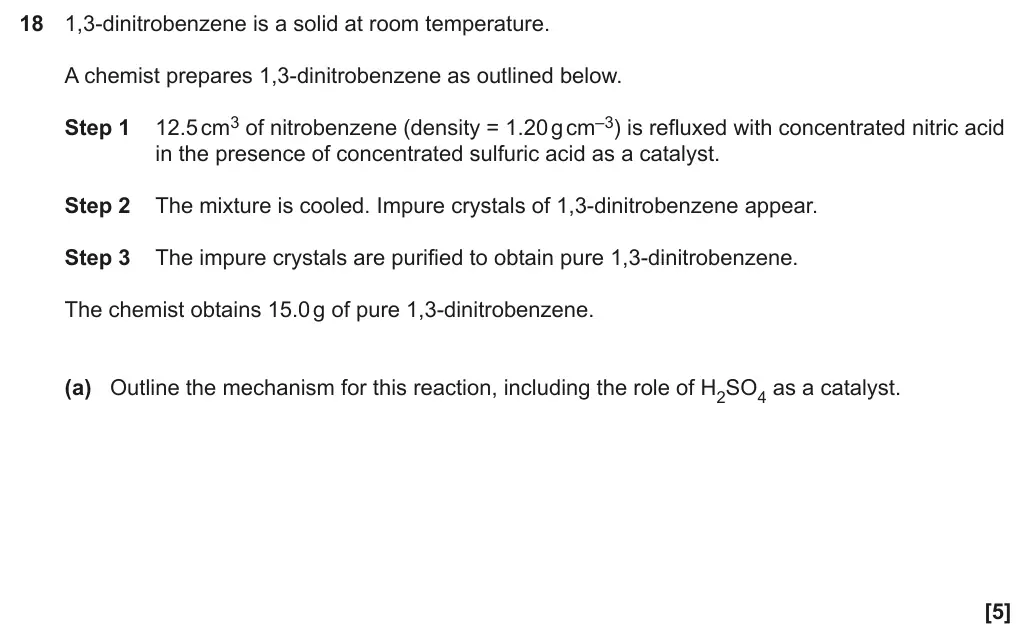
June 2023 · Paper 2 · Q18(a)5 marksAO1, 2MechanismMedium
Mark scheme
Examiner's comment
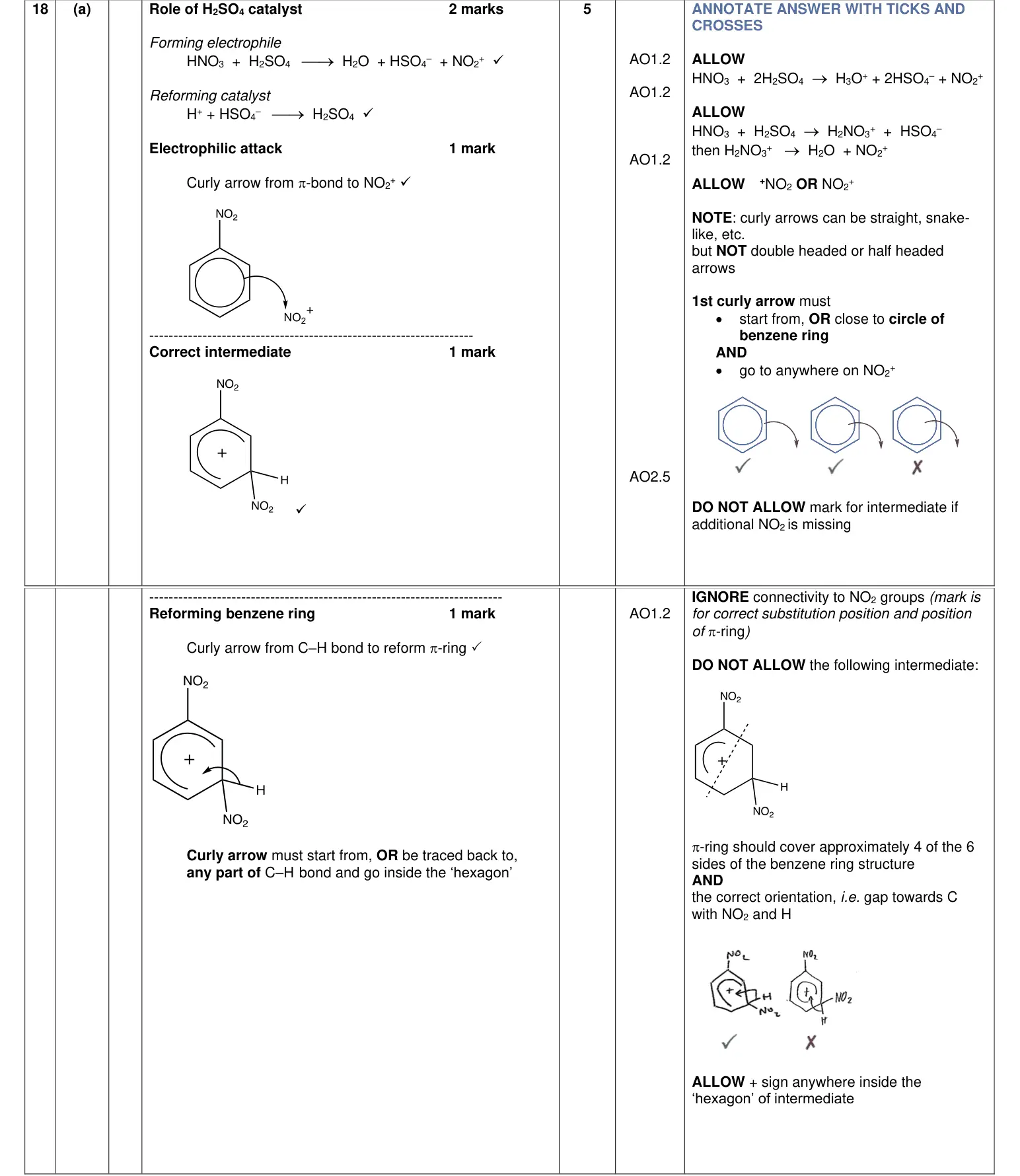
Many candidates knew this mechanism well with the majority gaining 4 or 5 marks here. The mark most frequently lost was for the incorrect drawing of the intermediate. Many candidates did not appreciate that two electrons are removed from the ring in the first stage of the mechanism resulting in the partial delocalisation of electron density across four sides of the benzene ring in the intermediate. In addition, it must have the correct orientation with the opening at the three position where the nitro group is added. Some candidates nitrated the 2 or 4 position instead. Some also showed nitration of benzene then the second nitration. Other common errors included missing or extra charges, missing NO2 group on intermediate, use of NO3+ or other incorrect electrophiles. Lower scoring responses were characterised by unclear diagrams and inaccurate use of curly arrows. Many were often able to score 1 mark for showing C-H bond on benzene ring breaking and electrons going back into the ring. Such responses often included errors in the equations showing the role of the sulfuric acid catalyst, e.g. formation of H3SO4-, or omitted these steps entirely. Others evidently didn’t know what a nitro group was with -NO3 giving just -N and even -NH3 instead.
Notes from the mark scheme and report
HNO3 + H2SO4 → NO2+ + HSO4– + H2O
H+ + HSO4– → H2SO4
arrow from ring to NO2+
intermediate must keep the original NO2 at the 3-position with horseshoe over about 4 sides, gap towards C with NO2 and H
arrow from C–H bond into ring
Encourage candidates to look at more recent mark schemes to check for tips on how to correctly draw out mechanisms. An easy tip for ensuring the correct intermediate for electrophilic substitution is to place a dot inside the ring for each C without the new substituent attached and then connect the dots. Only four out of the six sides should be covered by the broken delocalised ring (as two electrons have formed the new bond).
Alternatively, some find it easier to redraw, so horseshoe ring opens upwards (like a smiley face), rather than at an angle.
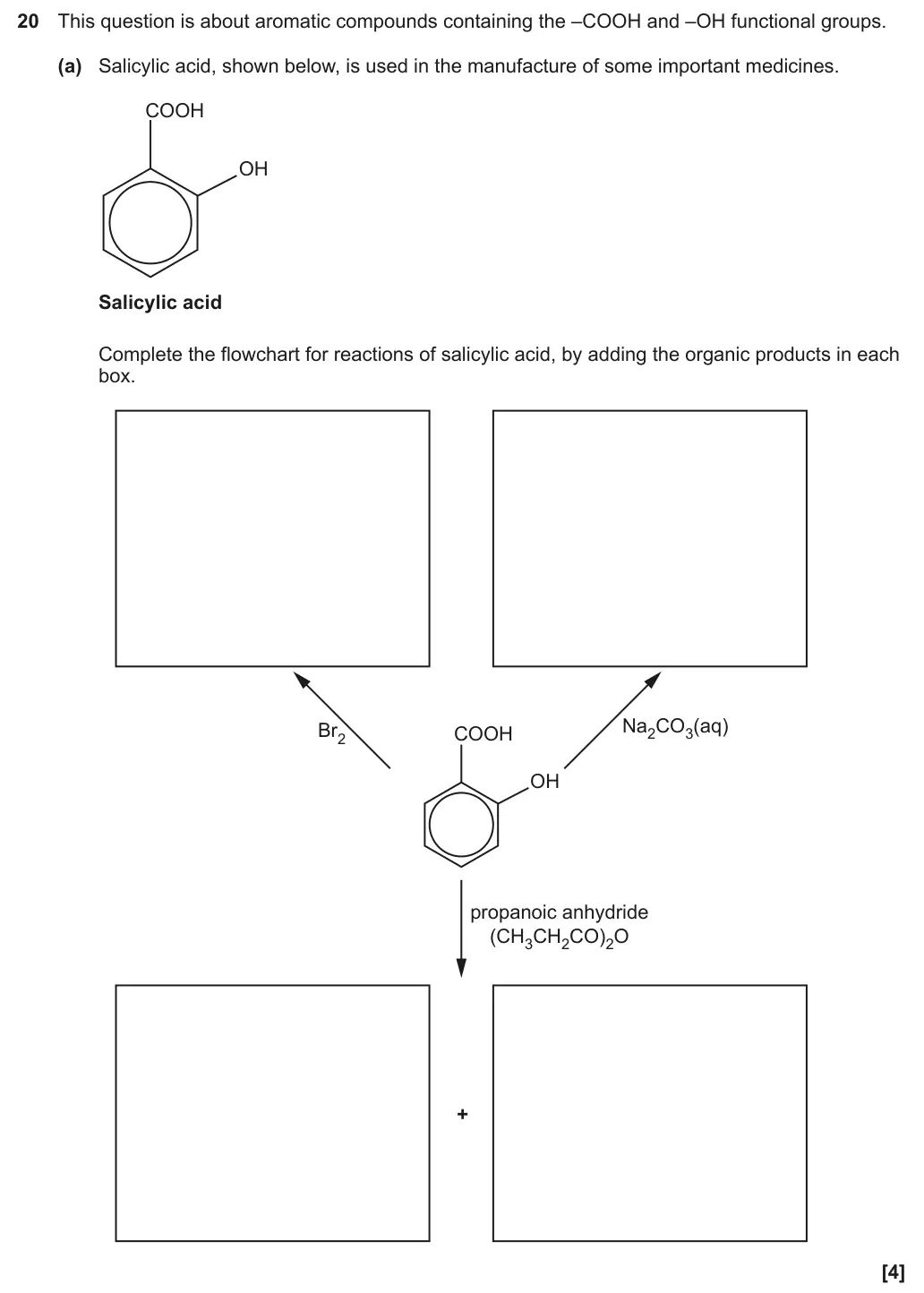
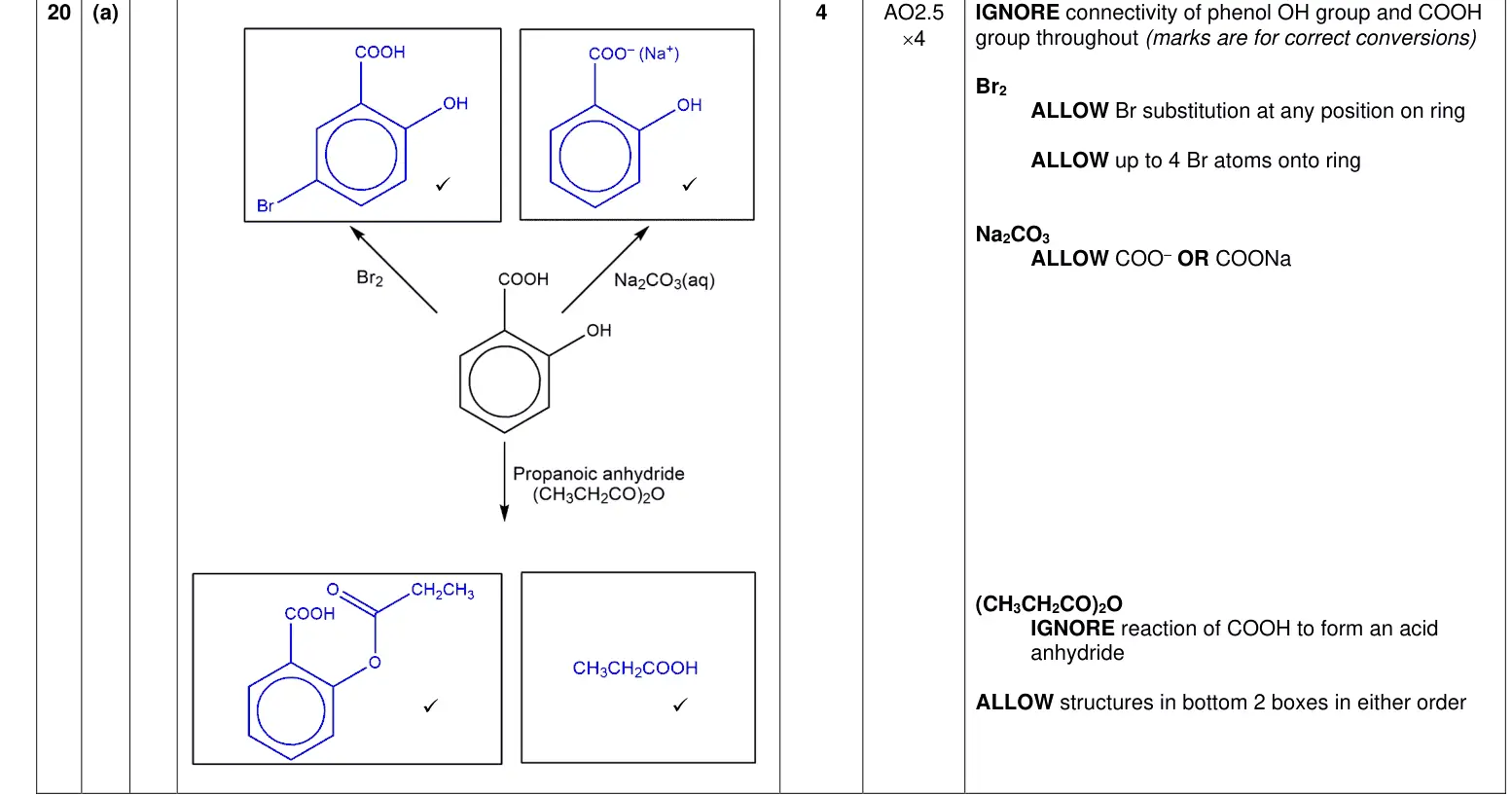
June 2023 · Paper 2 · Q20(a)4 marksAO2Short answerMedium
Mark scheme
Examiner's comment
Overall, this question discriminated well with most candidates gaining some credit. Most candidates were able to suggest a correct product for the reaction of salicylic acid with bromine, with just a few candidates replacing the OH group with a Br atom. Most candidates recognised that the carboxylate salt would be produced from the reaction with Na2CO3 but not all were able to recall that the phenolic OH group is too weak acid to react. Some missed an O on carboxylate i.e. -CO-Na+. Some added Na or CO3 directly to the ring. The reaction with the anhydride proved much more challenging. All sorts of weird and wonderful structures of the main ‘ester’ product were given including joining the CH3 group of propanoic anhydride to the O of the phenol group. Some used the bottom two boxes to form esters with the COOH and OH groups in turn. Many did not identify propanoic acid as a by-product even if they had correctly identified the ester product. Water was a common incorrect product. Marks were also occasionally lost for missing the benzene ring on structures or missing the -OH or - COOH groups that were left unreacted.
Notes from the mark scheme and report
Br2 substitutes the ring (ALLOW any position, up to 4 Br)
Na2CO3 reacts with COOH only (COO– or COONa), phenol OH unchanged
anhydride esterifies the phenol OH giving ester + CH3CH2COOH
IGNORE COOH forming an anhydride
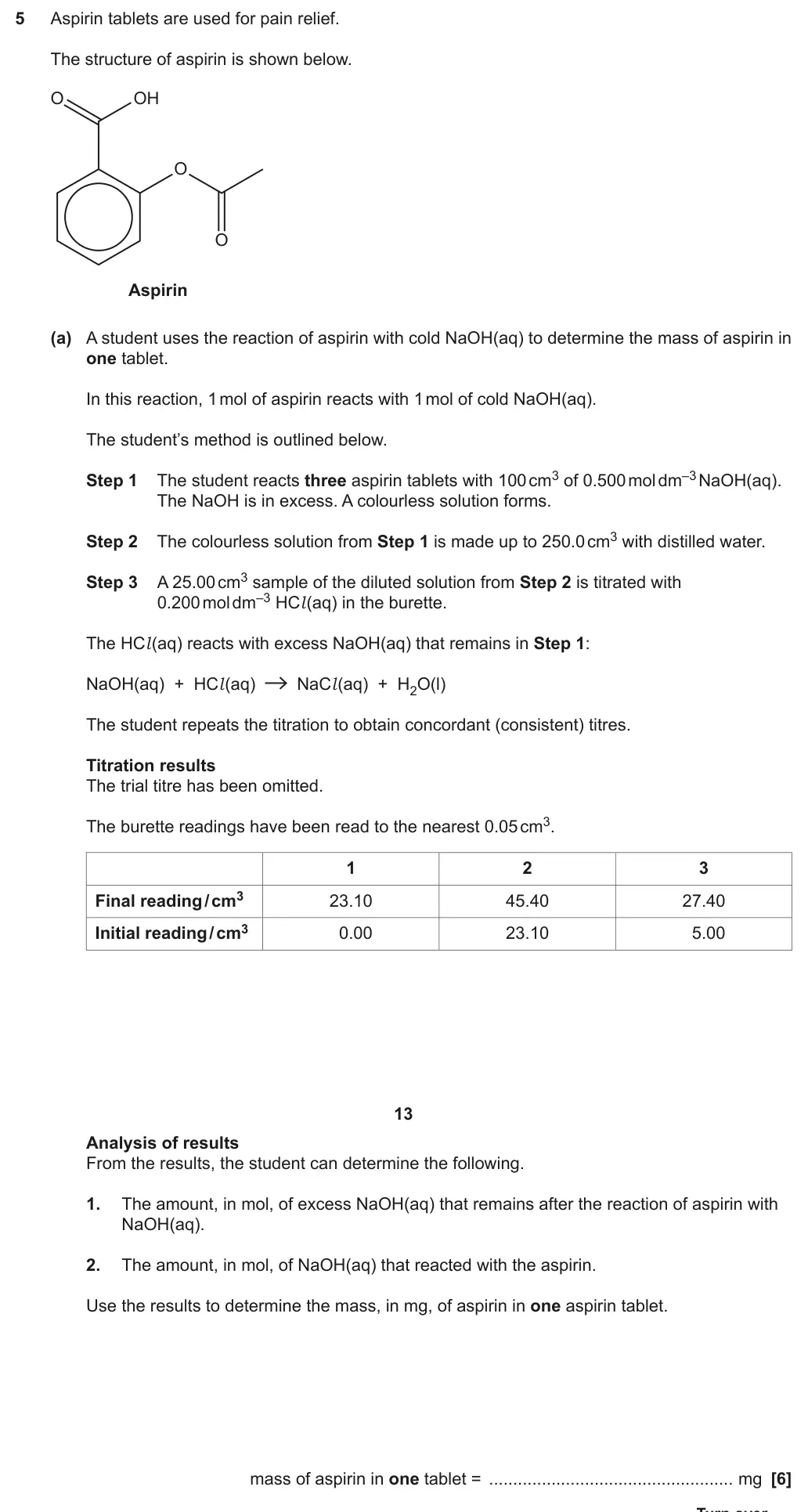
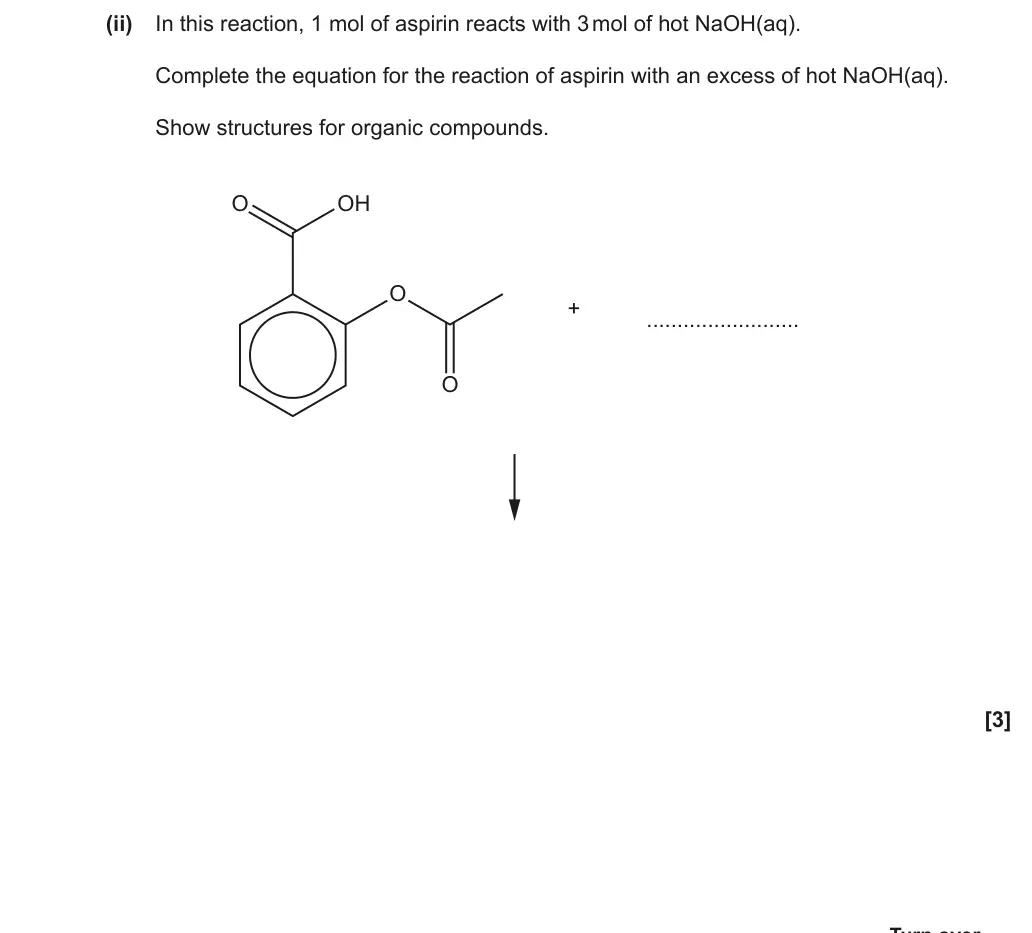
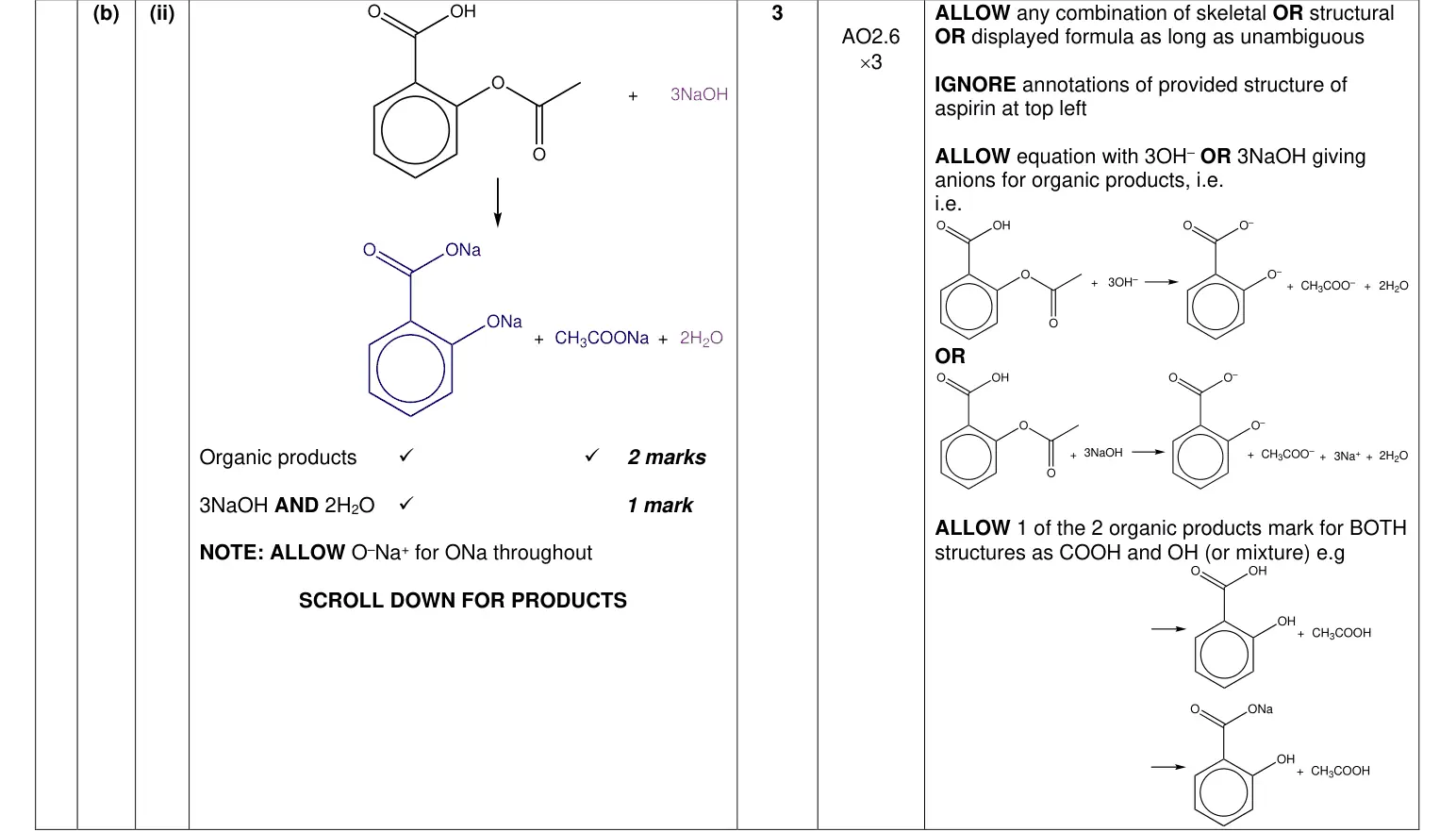
June 2023 · Paper 3 · Q5(b)(ii)3 marksAO2Complete table/diagramMedium
Earlier part of question 5 that this part uses
Mark scheme
Examiner's comment
This question was the hardest part of Question 5 and about half the candidates were not given any marks. Some drew the sodium carboxylate salt of aspirin structure, leaving the ester link intact. A large number of candidates realised that the ester would be hydrolysed. Sometimes the sodium salts were often not shown and, even they were shown, the phenol group was often shown intact. The hardest mark was the formation of 2H2O and a large number of candidates showed the more intuitive but incorrect ‘3H2O’ instead.
Notes from the mark scheme and report
3NaOH AND 2H2O
products sodium salt of phenoxide-carboxylate (ONa and COONa) and CH3COONa
ALLOW ionic forms
1 of the 2 product marks if both shown as COOH and OH
Skills: M0.2 Use ratios, fractions and percentages
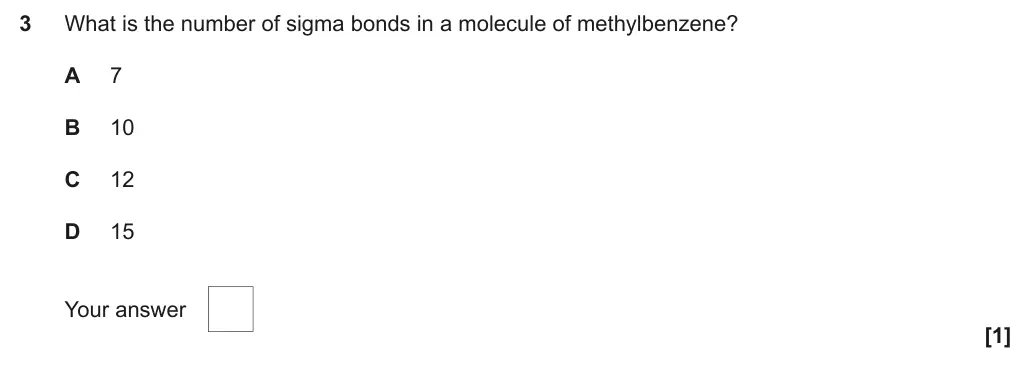
June 2022 · Paper 2 · Q31 markAO1Multiple choiceHard
Answer
D
Mark scheme
Examiner's comment
This question discriminated well, with higher ability candidates correctly identifying D. Often students overlooked the sigma bonds in the aromatic ring and selected B.
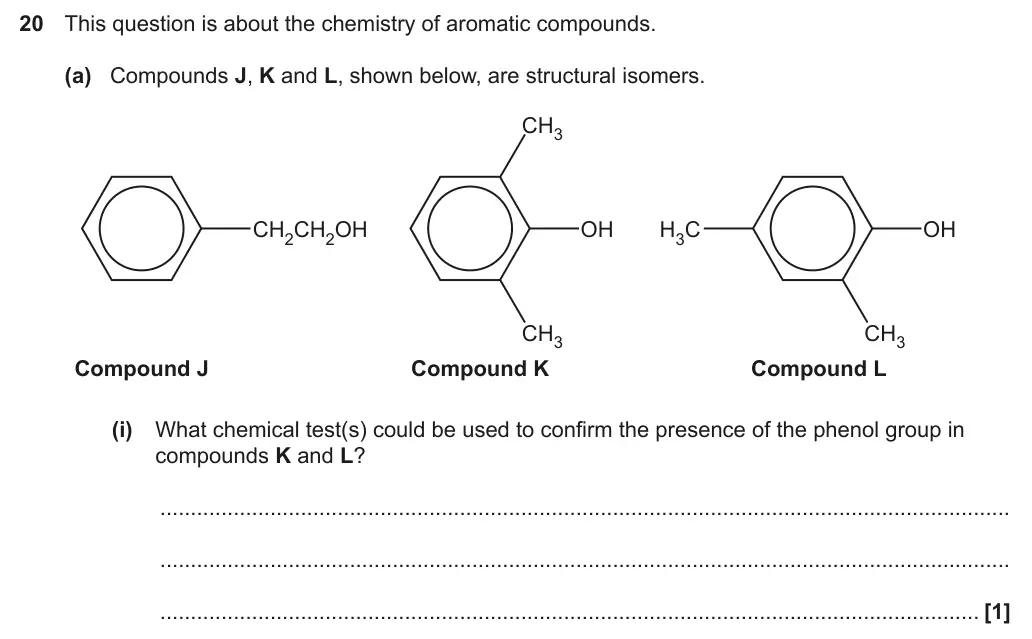
June 2022 · Paper 2 · Q20(a)(i)1 markAO1Short answerHard
Mark scheme
Examiner's comment
Few candidates knew the test for a phenol group. Frequent incorrect responses involved the production of a gas with a carbonate or stating that bromine water is decolourised but failing to state that a white precipitate is also formed. A significant number of candidates also stated that the reaction with sodium hydroxide confirms the presence of the phenol group.
Notes from the mark scheme and report
indicator shows acidity AND no reaction with carbonate
ALLOW bromine giving white precipitate
ALLOW FeCl3 giving violet/purple colour
Skills: PAG7 Qualitative analysis of organic functional groups
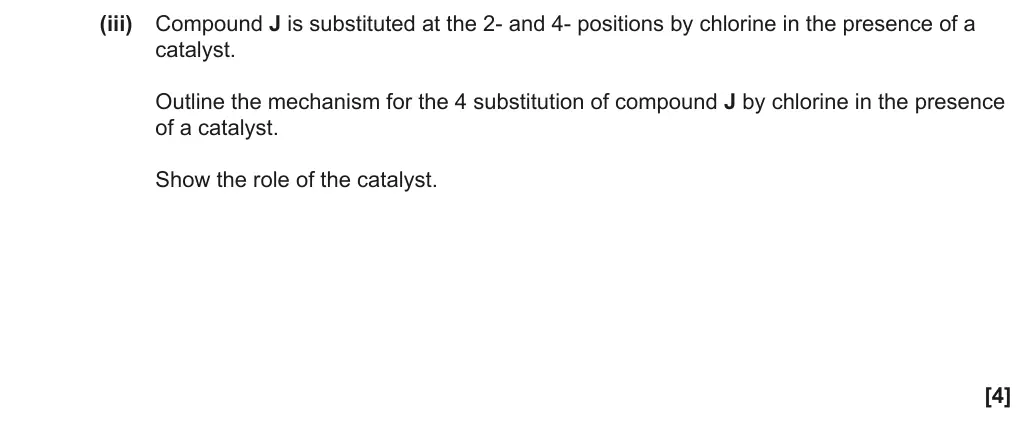
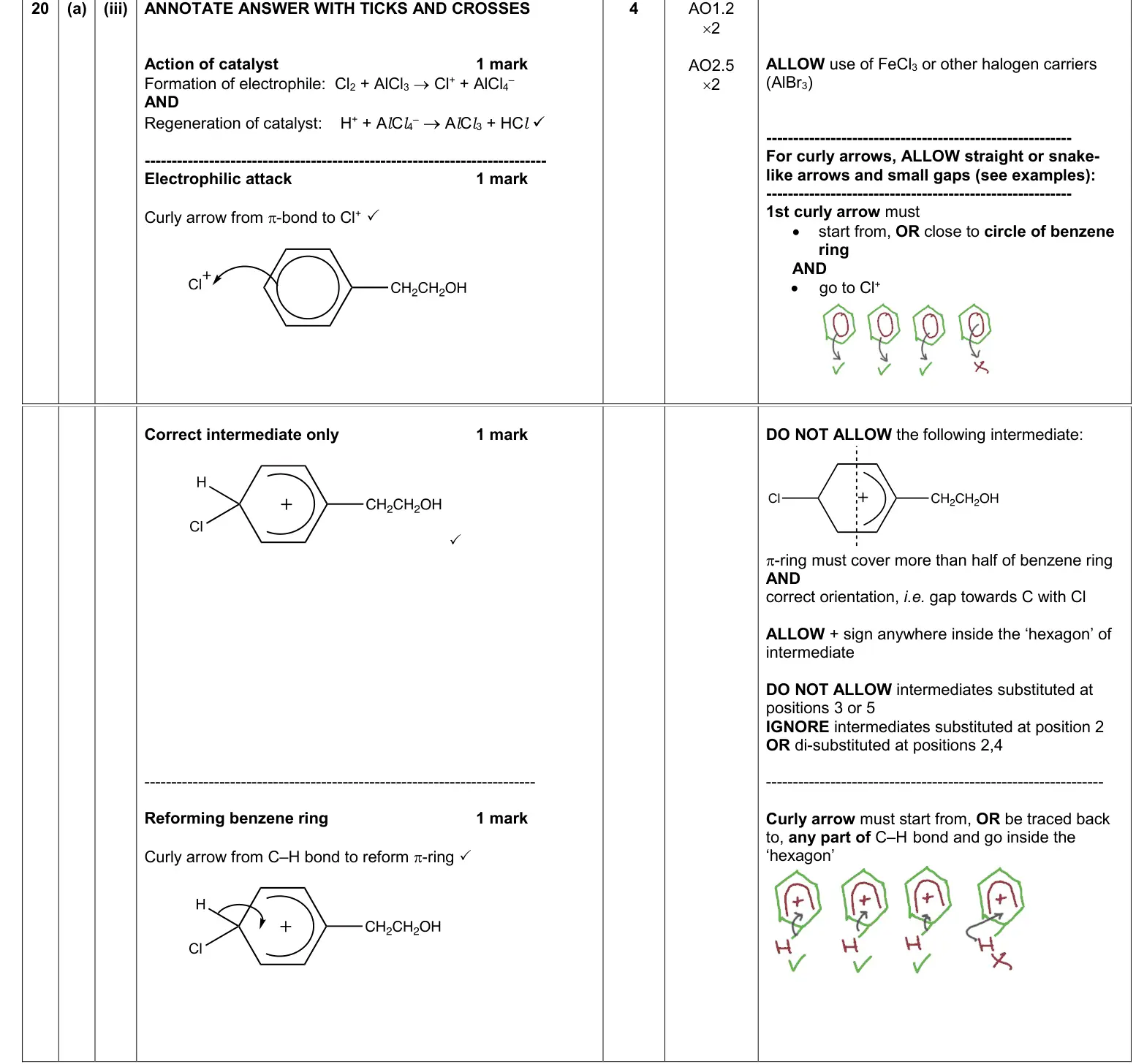
June 2022 · Paper 2 · Q20(a)(iii)4 marksAO1, 2MechanismMedium
Earlier part of question 20 that this part uses
Mark scheme
Examiner's comment
This question required candidates to apply their knowledge of the mechanism of electrophilic substitution. Examiners were encouraged by the number of excellent responses to this question, with the majority of candidates securing 3 out of 4 marks. Common errors included the omission of HCl as product from the regeneration of the catalyst or candidates attempting to substitute at the 2 position.
Notes from the mark scheme and report
Cl2 + AlCl3 → Cl+ + AlCl4– AND H+ + AlCl4– → AlCl3 + HCl (both for 1 mark)
arrow from ring to Cl+
horseshoe over more than half the ring with gap towards C–Cl
DO NOT ALLOW intermediates substituted at positions 3 or 5
arrow from C–H bond into ring
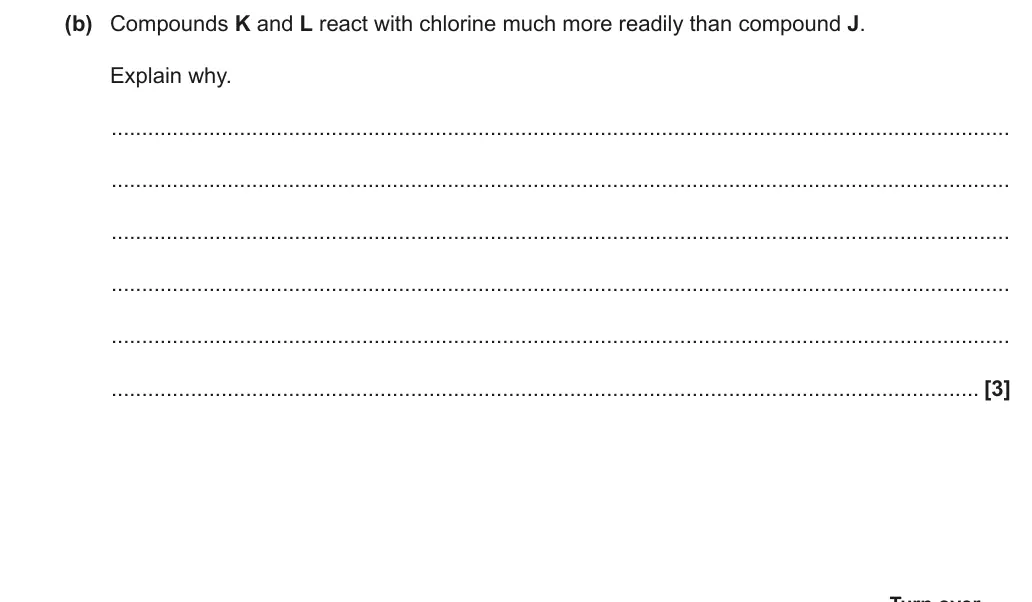
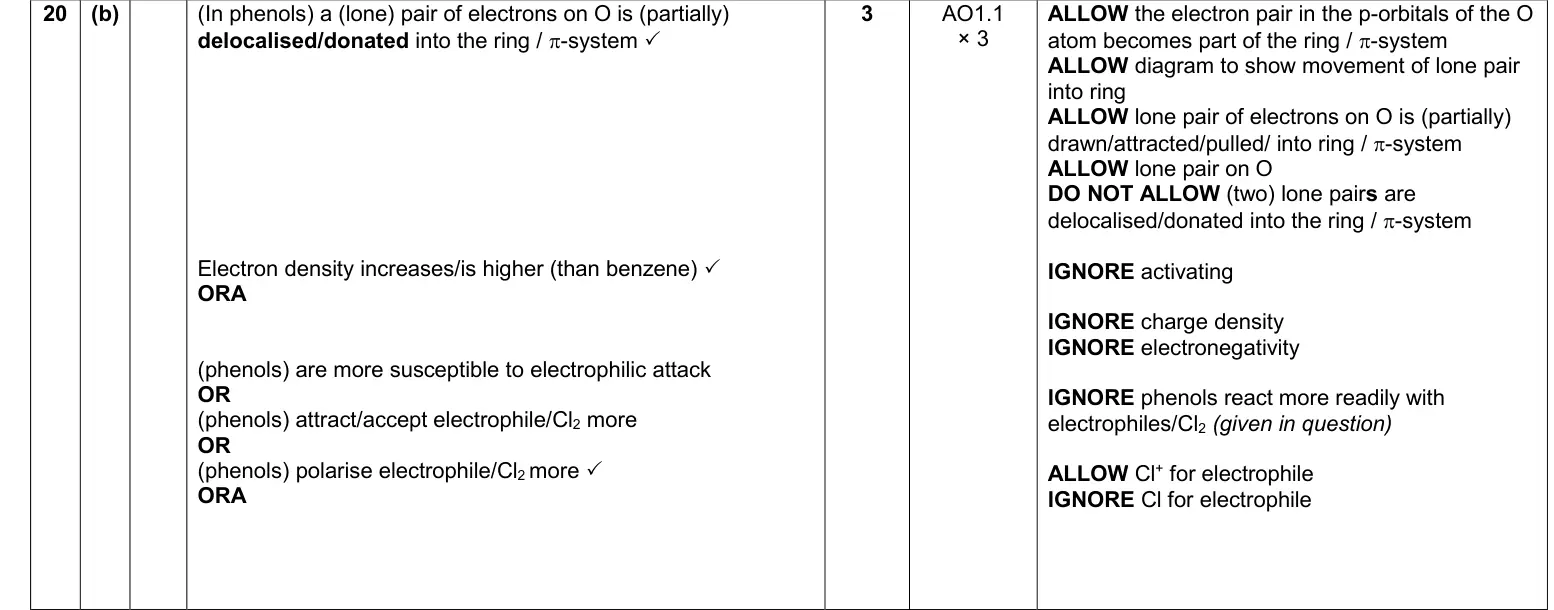
June 2022 · Paper 2 · Q20(b)3 marksAO1Short answerMedium
Earlier part of question 20 that this part uses
Mark scheme
Examiner's comment
The most able candidates scored well on what proved a difficult question for many. Although the vast majority of candidates knew about the reasons behind compounds K and L’s increased reactivity many were unable to express themselves clearly to gain credit. Often answers lacked the specific detail about the lone pair on the oxygen atom in the –OH group being delocalised into the ring. Less successful answers discussed electrons being supplied to the ring, the -OH group providing the electrons to the ring or just that –OH is an activator. More successful answers expressed the increase in electron density and the subsequent increase in compound K and L’s susceptibility to electrophilic attack. This response correctly states that the electron density is higher which result in K and L being more susceptible to electrophilic attack and receives 2 marks. To score the third mark, the candidate needed to identify that that the lone pair is on the oxygen of the OH group.
Notes from the mark scheme and report
a lone pair on O delocalised into the ring (DO NOT ALLOW two lone pairs)
electron density higher
ring more susceptible to electrophilic attack/polarises Cl2 more
IGNORE activating, charge density
IGNORE 'react more readily' (given in question)
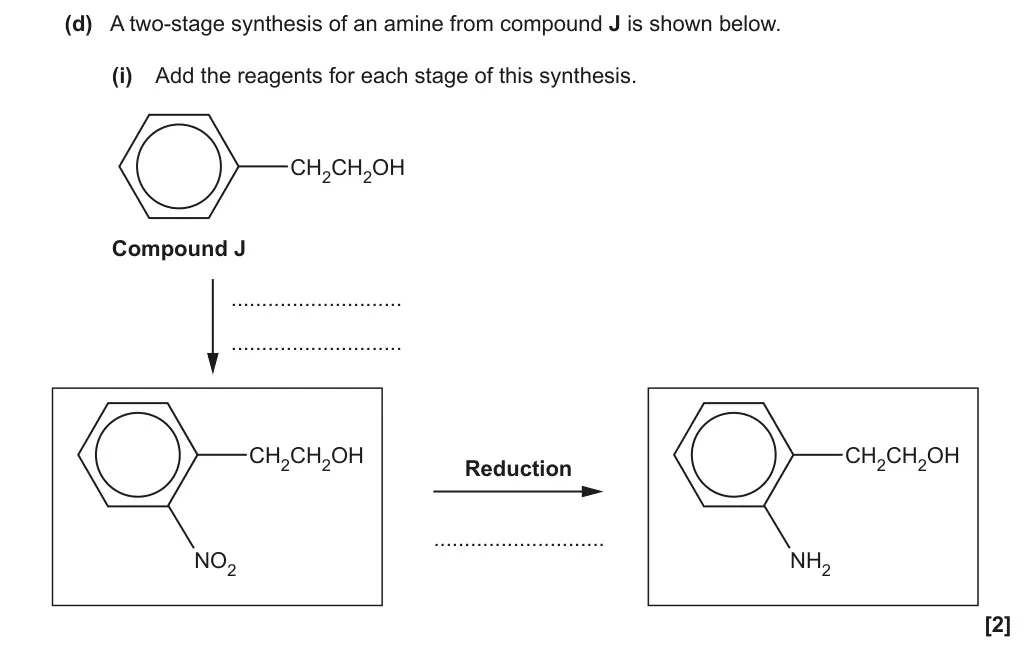
June 2022 · Paper 2 · Q20(d)(i)2 marksAO1Short answerMedium
Earlier part of question 20 that this part uses
Mark scheme
Examiner's comment
Candidates were familiar with the reagents required in these two reactions.
Notes from the mark scheme and report
HNO3 with H2SO4 for nitration
Sn and HCl for reduction
IGNORE concentrations
IGNORE NaOH after Sn/HCl
IGNORE H2
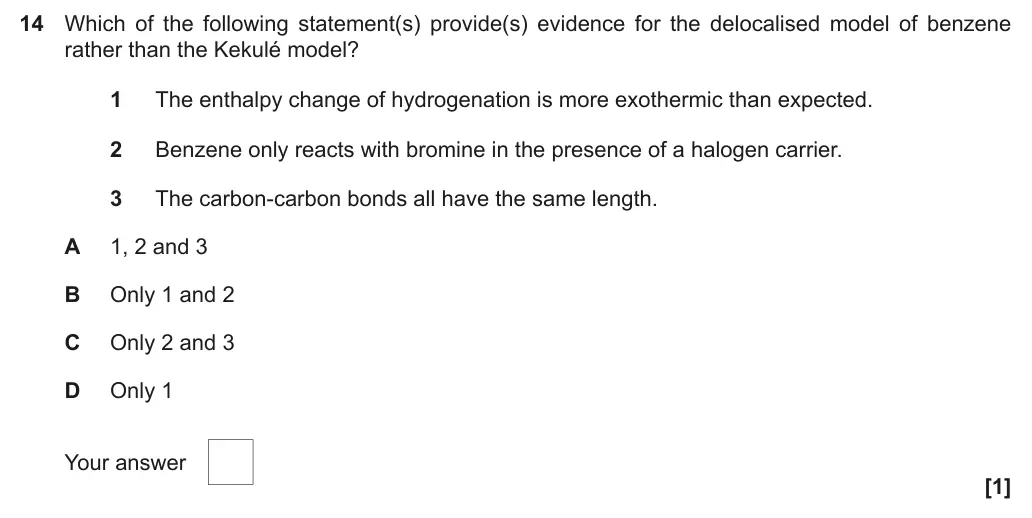
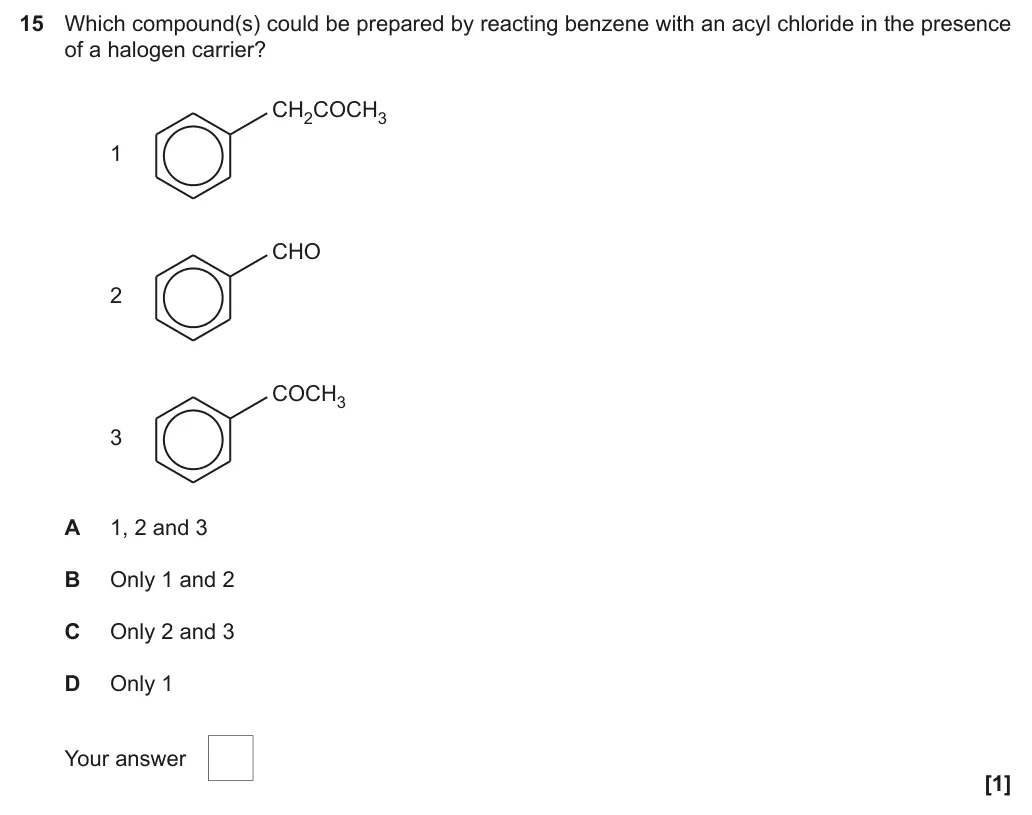
November 2021 · Paper 2 · Q141 markMultiple choice
Answer
C
Mark scheme
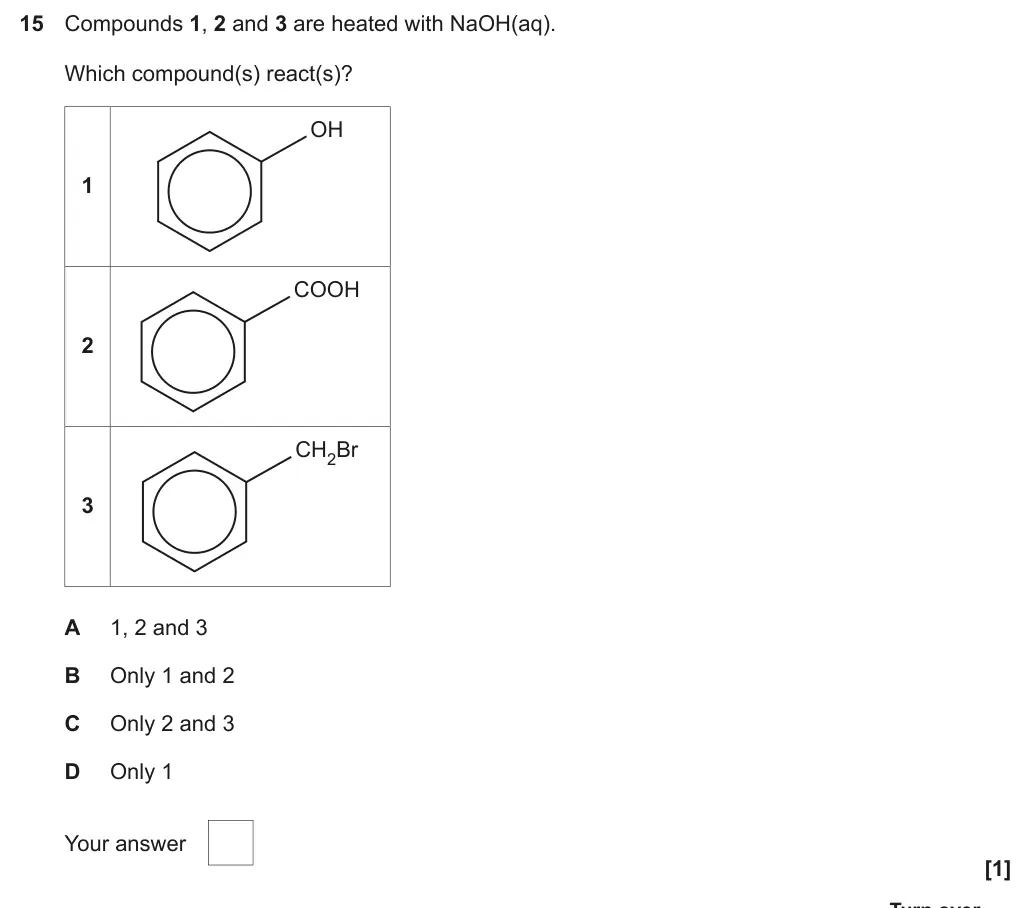
November 2021 · Paper 2 · Q151 markMultiple choice
Answer
A
Mark scheme
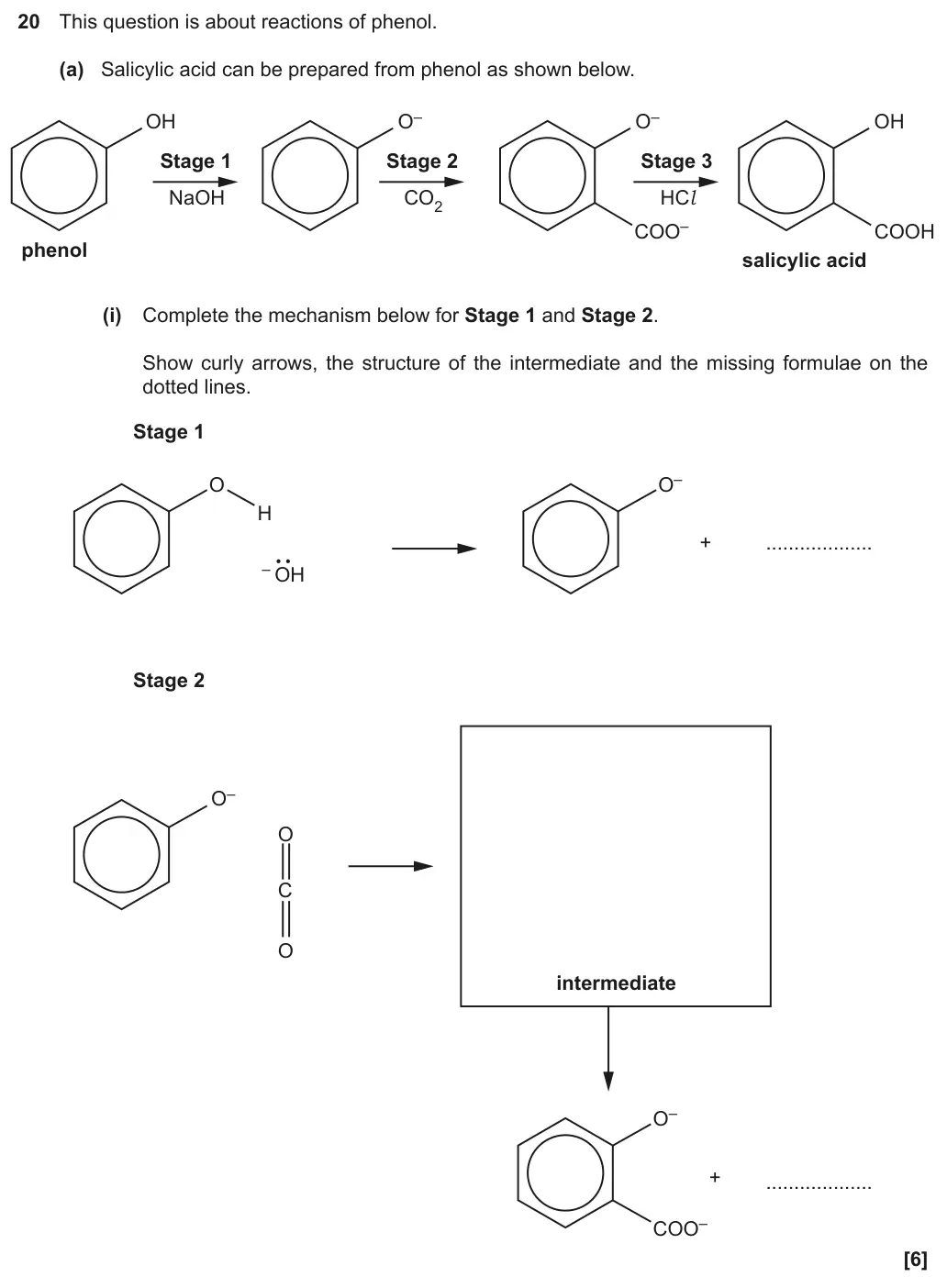
November 2021 · Paper 2 · Q20(a)(i)6 marksAO1, 2MechanismMedium
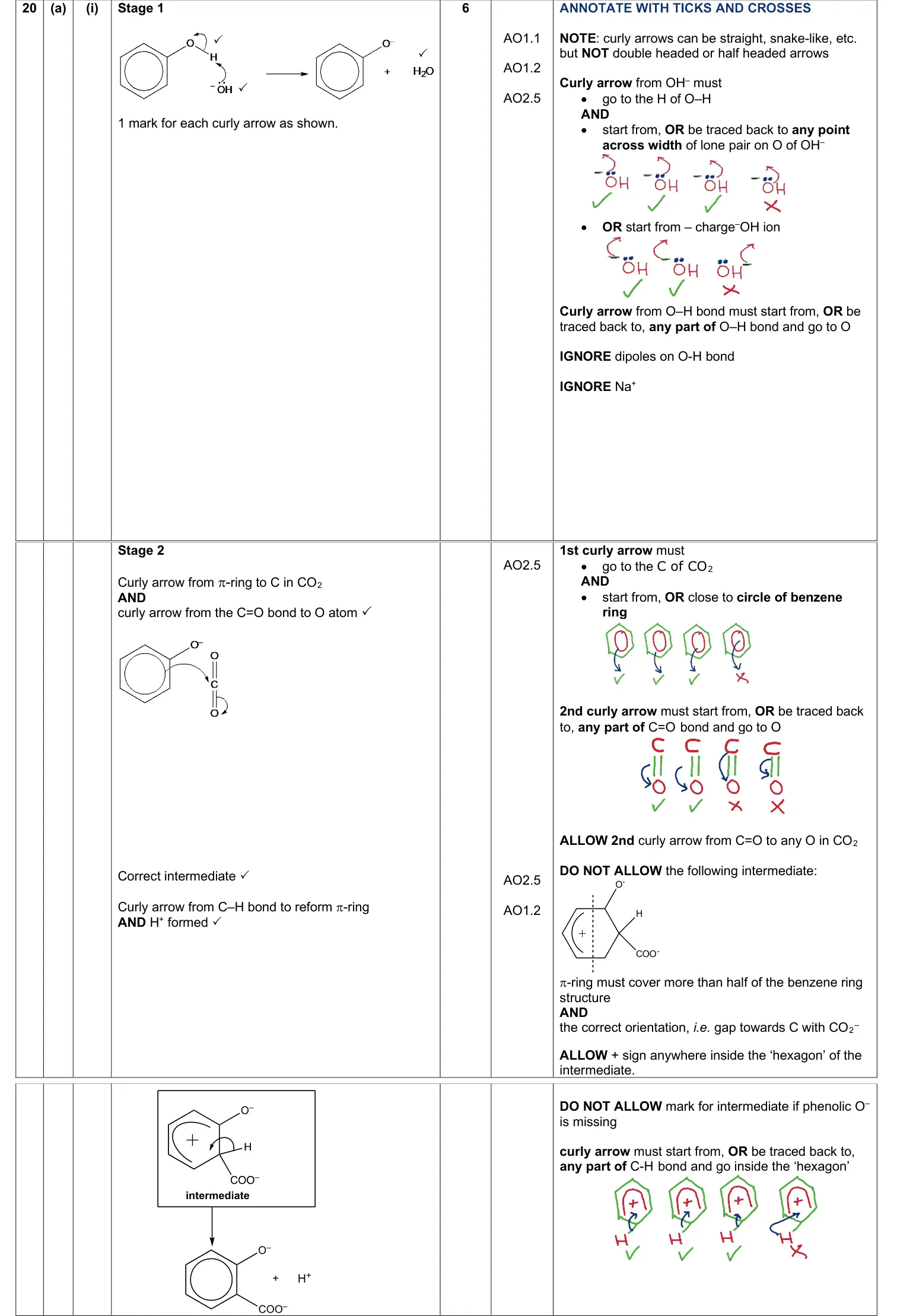
Mark scheme
Examiner's comment
Question 20(a)(i): Candidates who answered this question well had clear mechanisms.
Notes from the mark scheme and report
stage 1: arrow from lone pair/charge of OH– to H of O–H and arrow from O–H bond to O, H2O formed
stage 2: arrow from ring to C of CO2 AND arrow from C=O to O
intermediate horseshoe with gap at C bearing CO2– and phenolic O– present
arrow from C–H bond into ring AND H+
November 2021 · Paper 2 · Q20(a)(ii)2 marksAO2Short answer
Earlier part of question 20 that this part uses
Mark scheme
Notes from the mark scheme and report
OH–: base (IGNORE nucleophile / donates electron pair)
CO2: electrophile / electron pair acceptor (IGNORE lone pair acceptor)
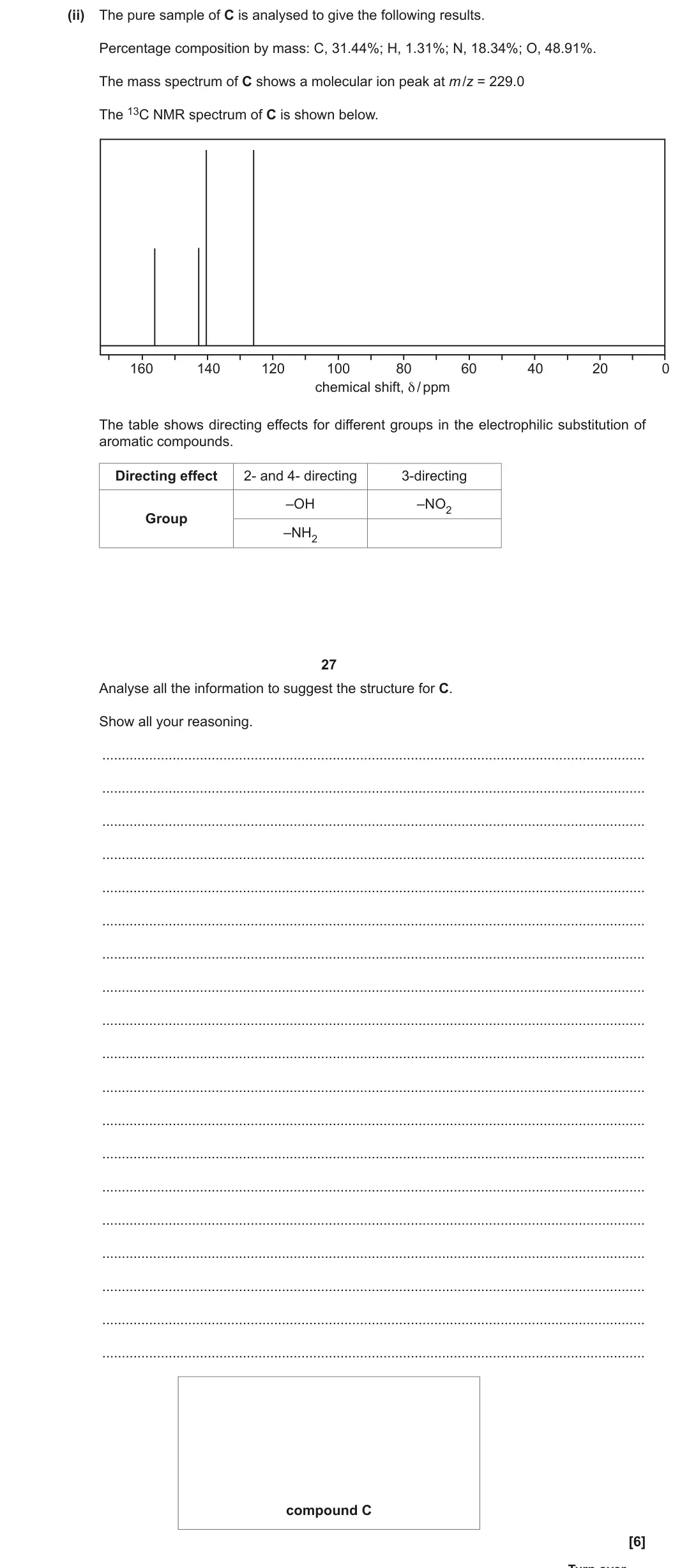
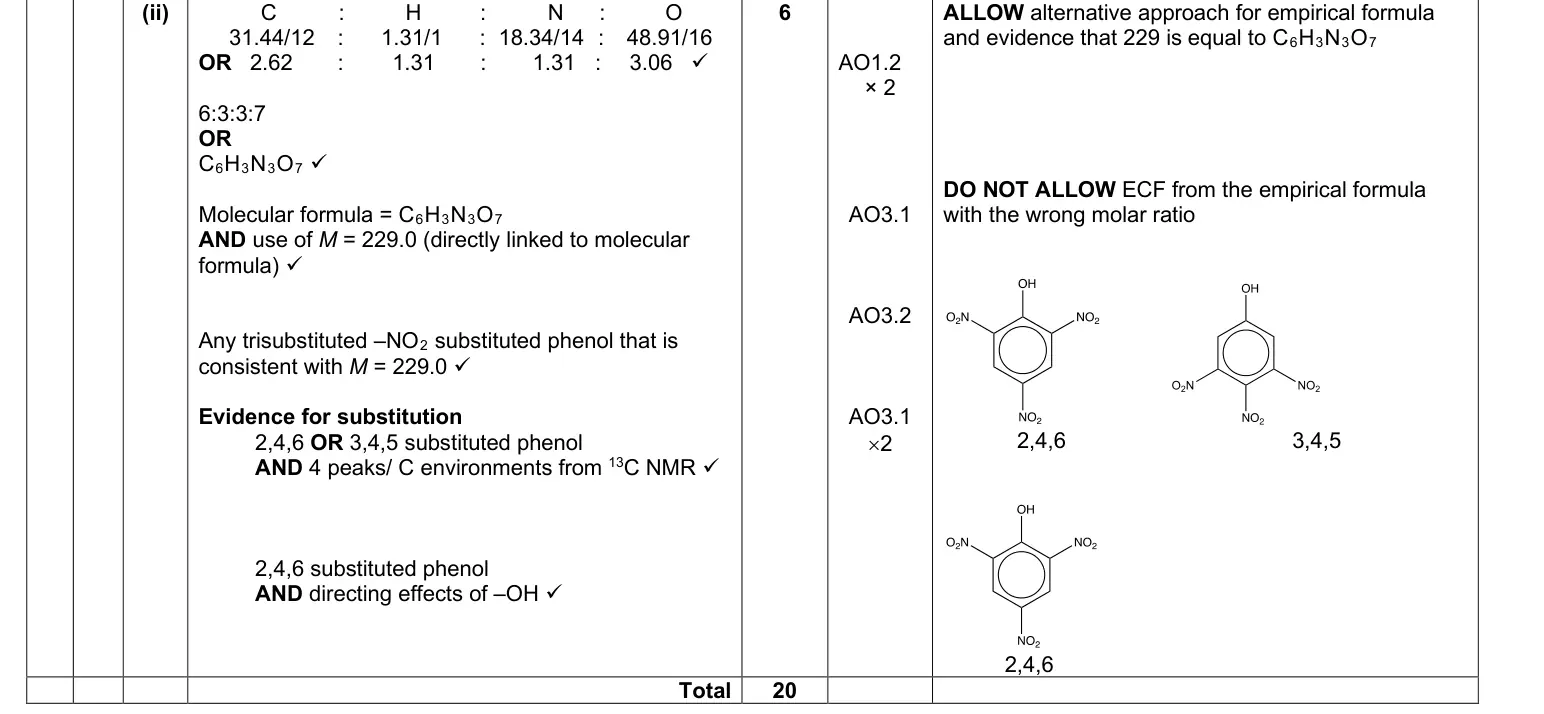
November 2021 · Paper 2 · Q20(b)(ii)6 marksAO1, 3Structure / isomer
Earlier part of question 20 that this part uses
Mark scheme
Notes from the mark scheme and report
2.62 : 1.31 : 1.31 : 3.06 gives C6H3N3O7, linked to M = 229.0
trinitrophenol
4 peaks = 4 carbon environments fits 2,4,6 or 3,4,5
–OH 2,4-directing so 2,4,6-trinitrophenol
no ECF from wrong molar ratio
Skills: M0.2 Use ratios, fractions and percentages; M3.1 Translate information between graphical, numerical and algebraic forms
November 2020 · Paper 2 · Q71 markAO1Multiple choice
Answer
A
Mark scheme
November 2020 · Paper 2 · Q151 markAO1Multiple choice
Answer
C
Mark scheme
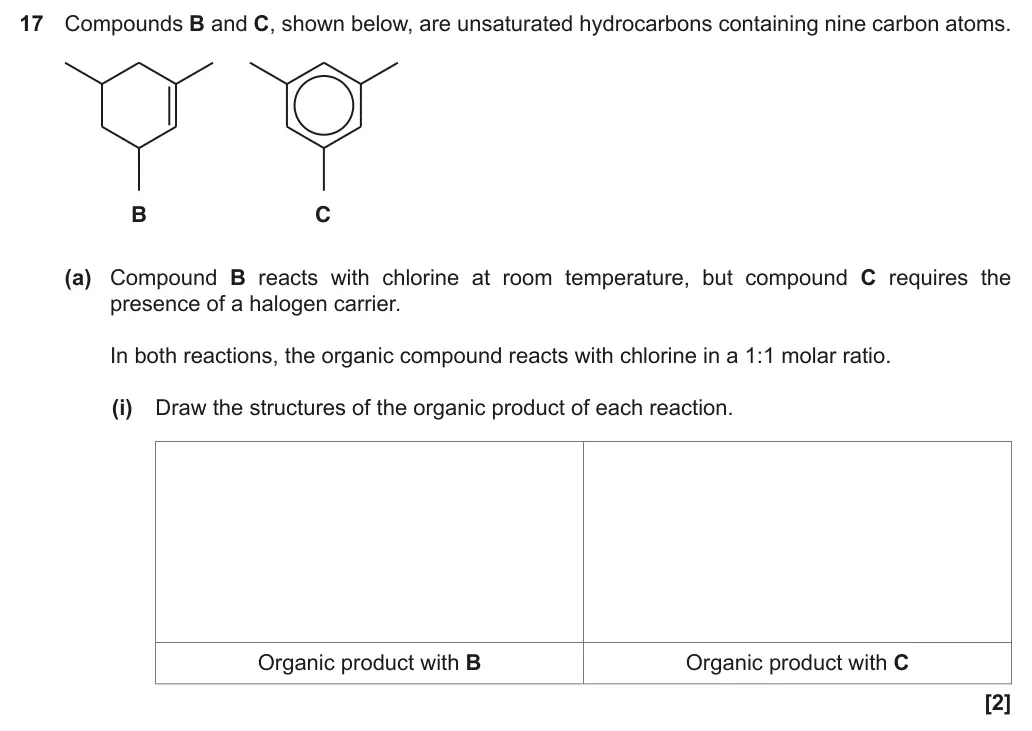
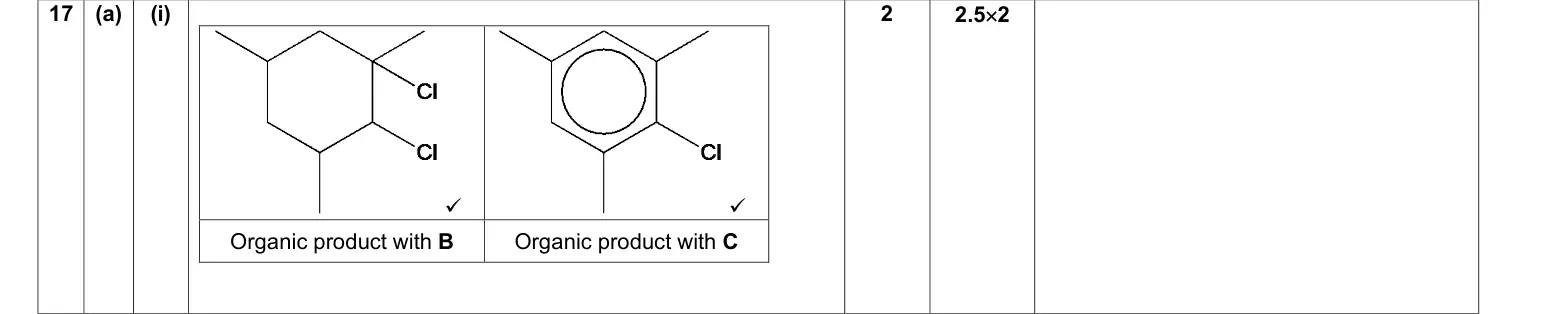
November 2020 · Paper 2 · Q17(a)(i)2 marksAO2Structure / isomer
Mark scheme
Notes from the mark scheme and report
B undergoes addition (dichloro product), C undergoes substitution on the ring
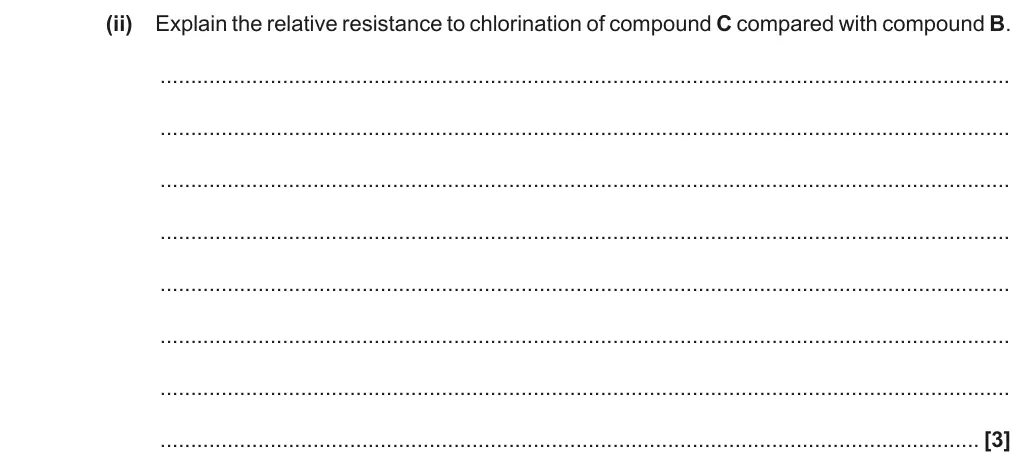
November 2020 · Paper 2 · Q17(a)(ii)3 marksAO1Short answerMedium
Earlier part of question 17 that this part uses
Mark scheme
Examiner's comment
Question 17(a)(ii) Candidates answered this question well.
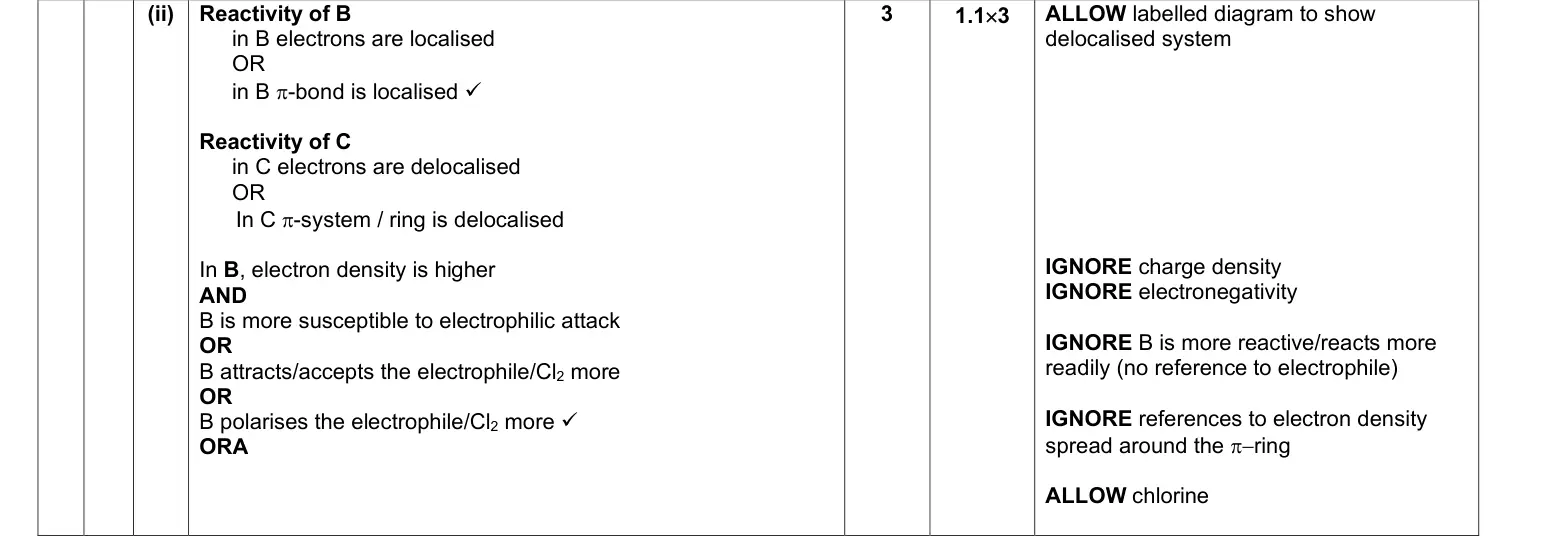
Notes from the mark scheme and report
B: π-electrons localised
C: delocalised π-system
B has higher electron density so polarises/attracts the electrophile more
IGNORE charge density
IGNORE 'B is more reactive' with no reference to electrophile
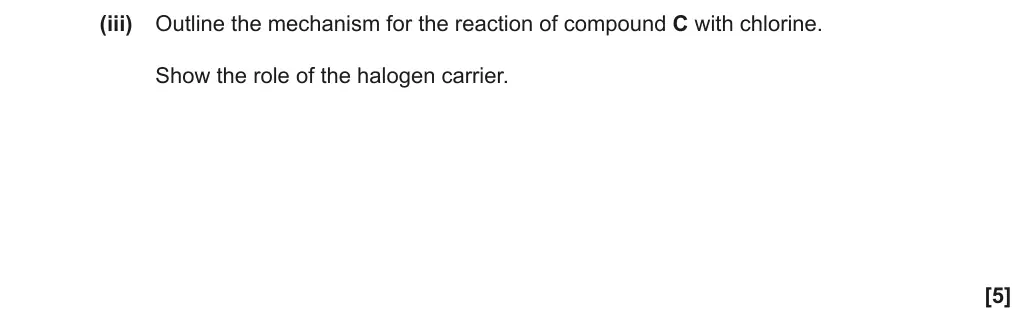
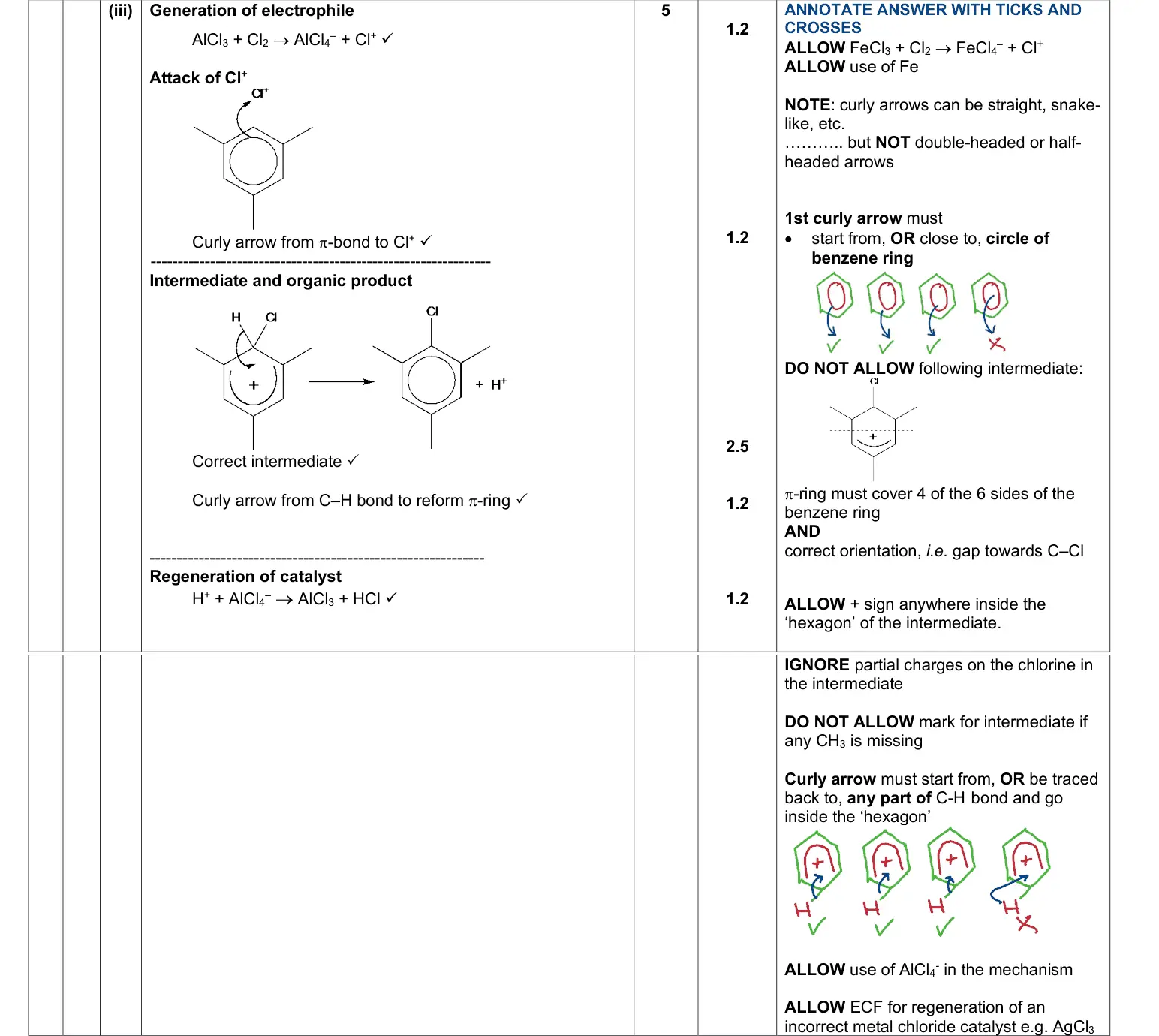
November 2020 · Paper 2 · Q17(a)(iii)5 marksAO1, 2Mechanism
horseshoe covers 4 of 6 sides with gap towards C–Cl
arrow from C–H bond back into ring
DO NOT ALLOW intermediate with a CH3 missing
November 2020 · Paper 2 · Q17(c)(ii)5 marksAO3Complete table/diagram
Earlier part of question 17 that this part uses
Mark scheme
Notes from the mark scheme and report
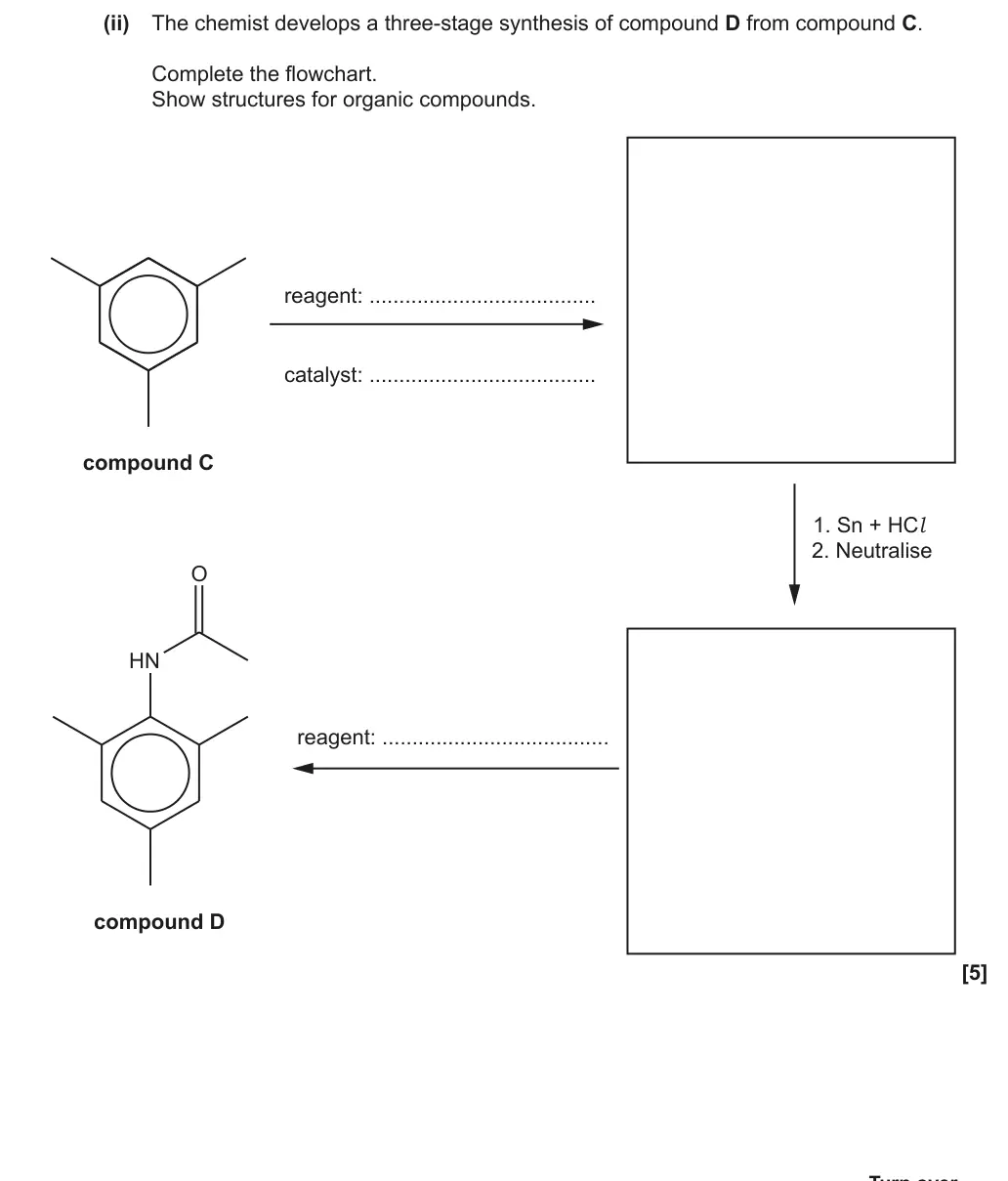
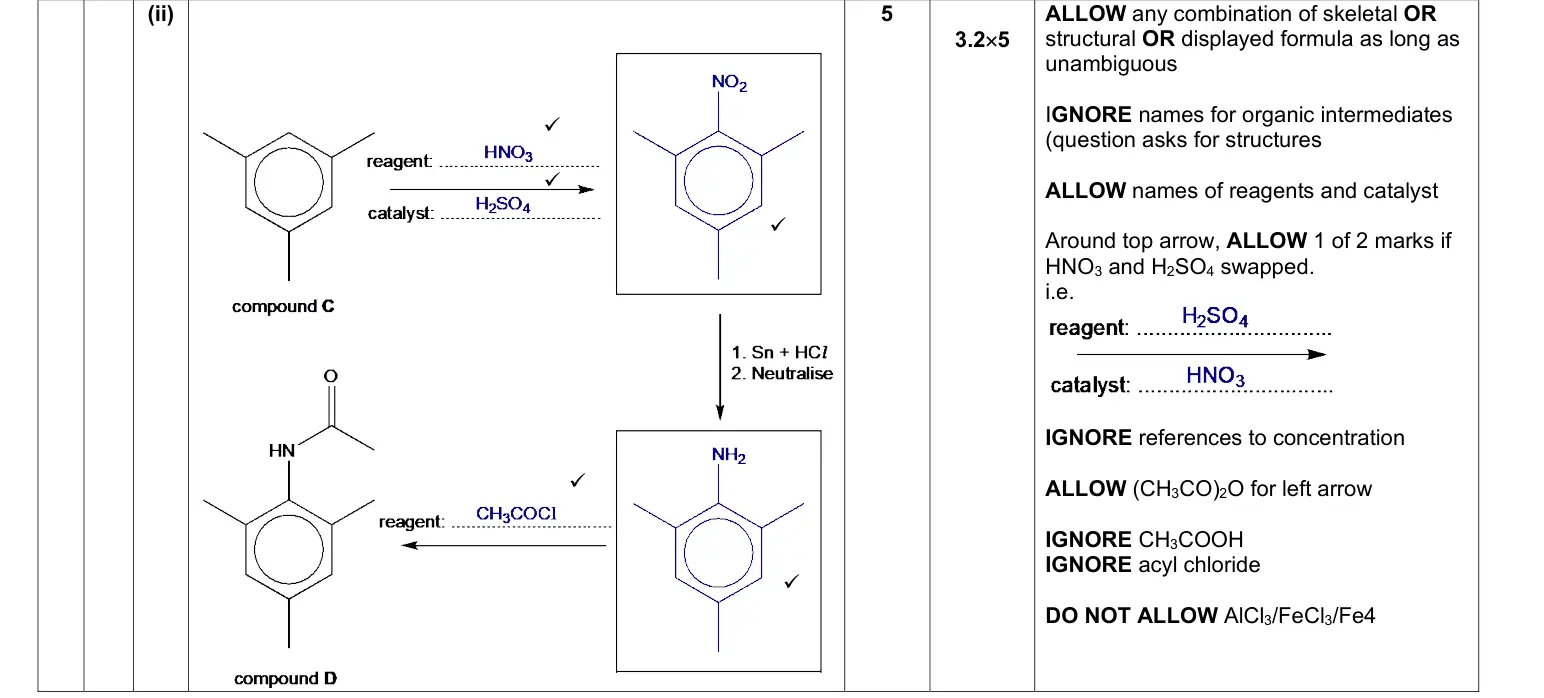
HNO3 with H2SO4 catalyst (1 of 2 if swapped)
nitro compound then amine
CH3COCl or (CH3CO)2O for final stage (IGNORE CH3COOH)
DO NOT ALLOW AlCl3/FeCl3
June 2019 · Paper 2 · Q81 markAO1Multiple choice
Answer
C
Mark scheme
June 2019 · Paper 2 · Q141 markAO1Multiple choiceHard
Answer
A
Mark scheme
Examiner's comment
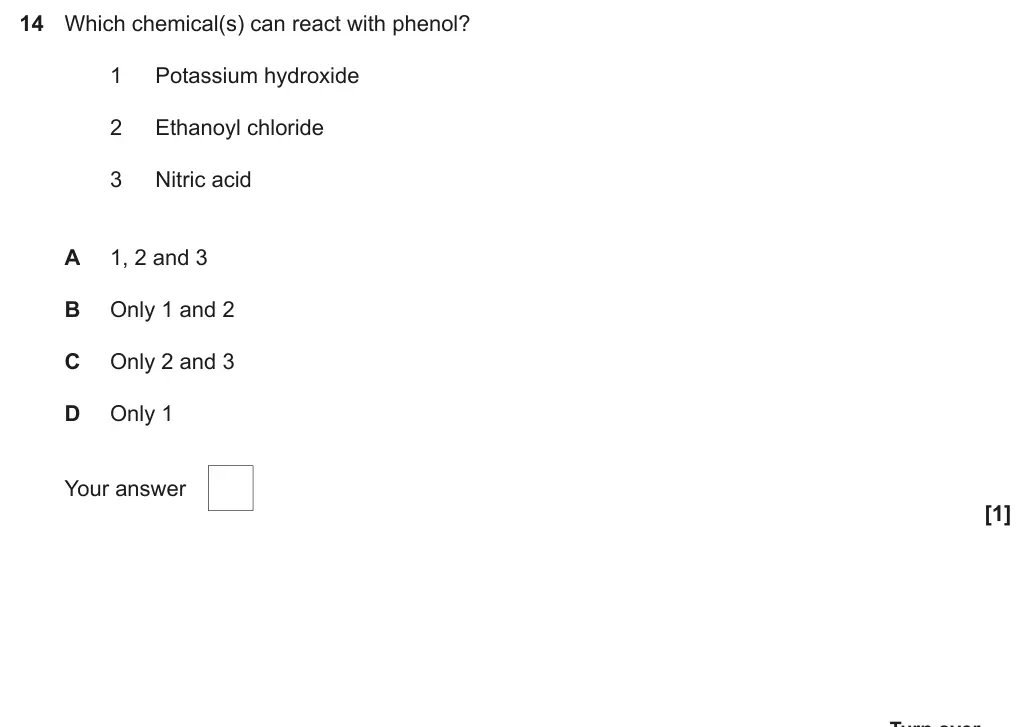
This question proved difficult. Many candidates correctly deduced that all three chemicals would react with phenol and selected A. Some candidates did not recognise that phenol would react with HNO3 without the need for a catalyst and selected B. Other candidates did not consider the weak acidity of phenol and selected C.
June 2019 · Paper 2 · Q19(a)(i)3 marksAO1Short answerHard
Mark scheme
Examiner's comment
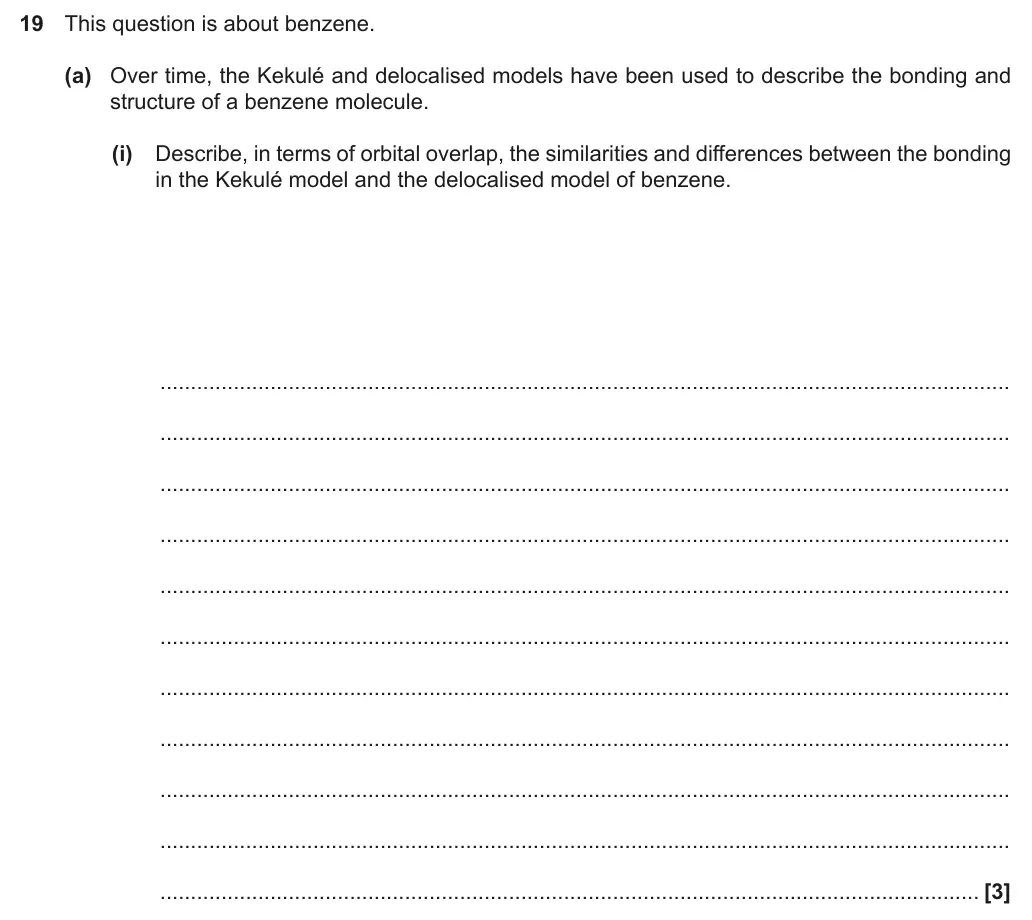
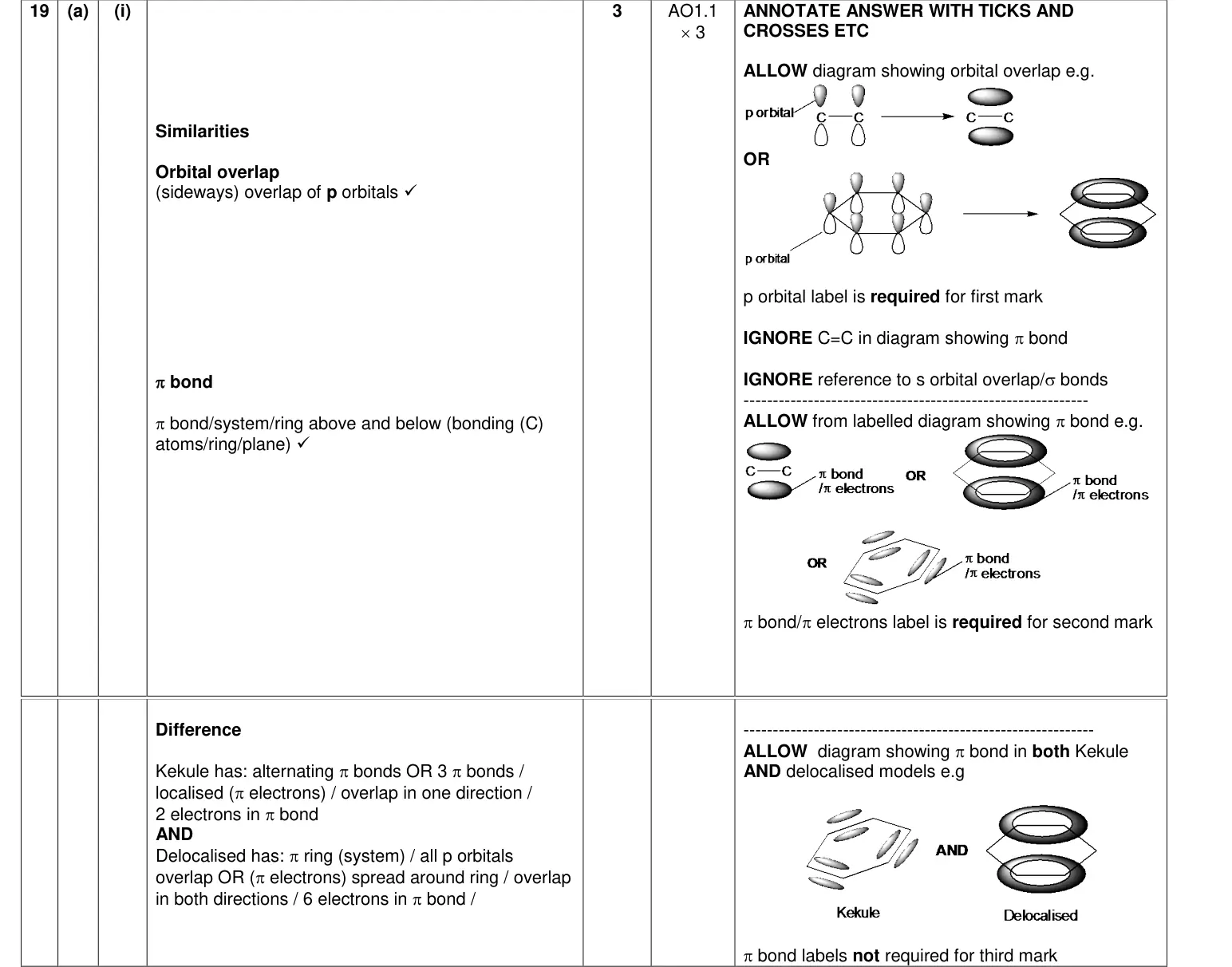
Candidates found this question difficult. The majority of the cohort referred to the overlap of p orbitals in either the Kekulé or delocalised model. The best responses developed this idea further and made reference to π bonds above and below the bonding carbon atoms. Although some candidates were able describe the difference between the two models, the responses of others lacked detail. Describing conceptual ideas, such as orbital overlap and π bonds, is understandably tricky. Candidates are advised to draw diagrams. These serve as a good basis from which to construct a written response. Exemplar 5 shows how effective the use of diagrams can be. This response starts with a diagram for both the Kekulé and delocalised models of benzene. Each diagram is clear and shows the p orbitals and π bonds separately. This is an excellent response for future candidates to follow. The candidate’s written response is effectively a description of the diagrams they have drawn and describes the similarities and differences between these two models clearly. This response scored full marks and demonstrates the best style of response seen in this part.
Notes from the mark scheme and report
sideways overlap of p-orbitals (p-orbital label required)
π bond above and below the plane
Kekulé alternating/localised π bonds vs delocalised π ring over all six carbons
IGNORE σ bonds
June 2019 · Paper 2 · Q19(a)(ii)2 marksAO1Short answerMedium
Earlier part of question 19 that this part uses
Mark scheme
Examiner's comment
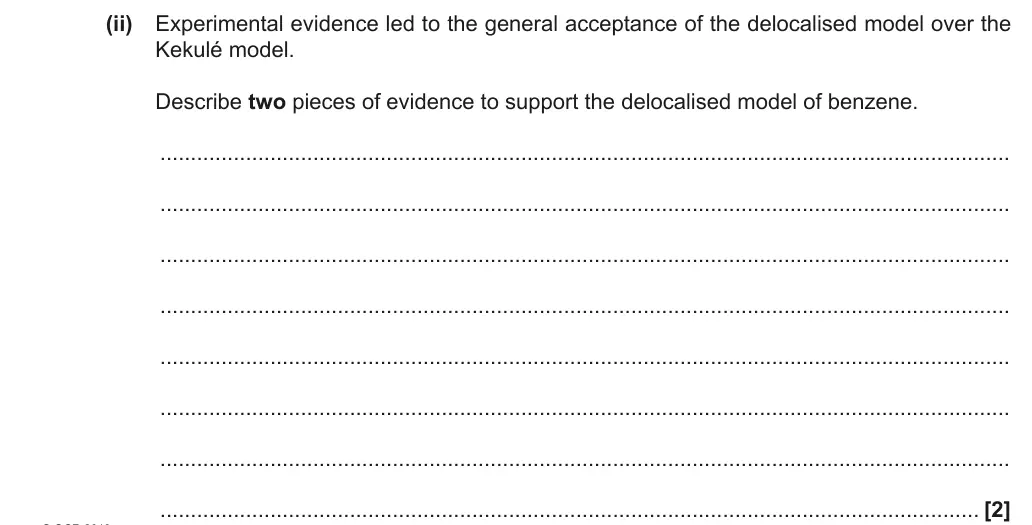
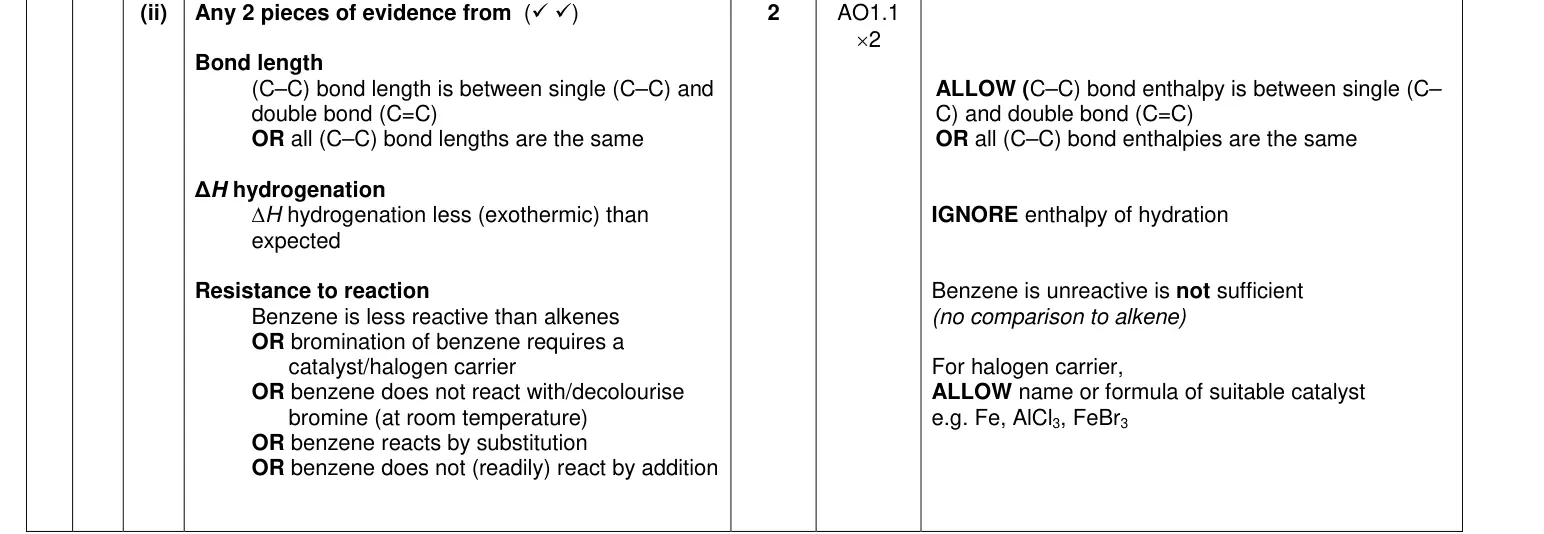
Candidates were well prepared for this question and the majority of the cohort scored two marks. The most common piece of evidence given was the lack of reactivity of benzene with bromine, with candidates citing the need for a catalyst for the reaction to occur. Responses also included reference to carbon-carbon bond lengths as well as the enthalpy of hydrogenation. A small but significant proportion of the cohort referred to hydration rather than hydrogenation.
Notes from the mark scheme and report
all C–C bond lengths equal/between single and double
∆H hydrogenation less exothermic than expected (IGNORE hydration)
resistance to reaction needs comparison with alkenes ('benzene is unreactive' not sufficient)
June 2019 · Paper 2 · Q19(b)(iii)5 marksAO1, 2, 3MechanismMedium
Earlier part of question 19 that this part uses
Mark scheme
Examiner's comment
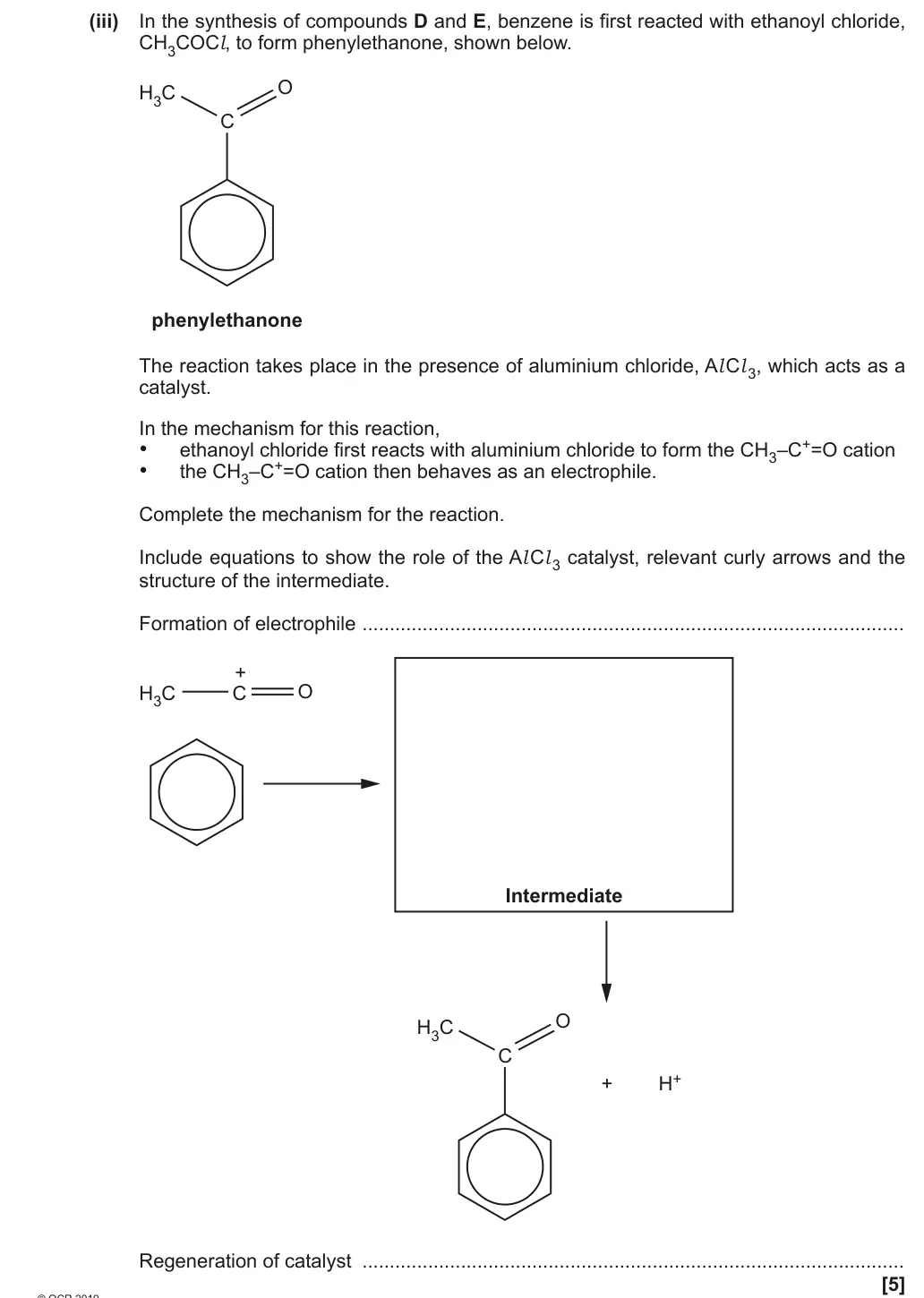
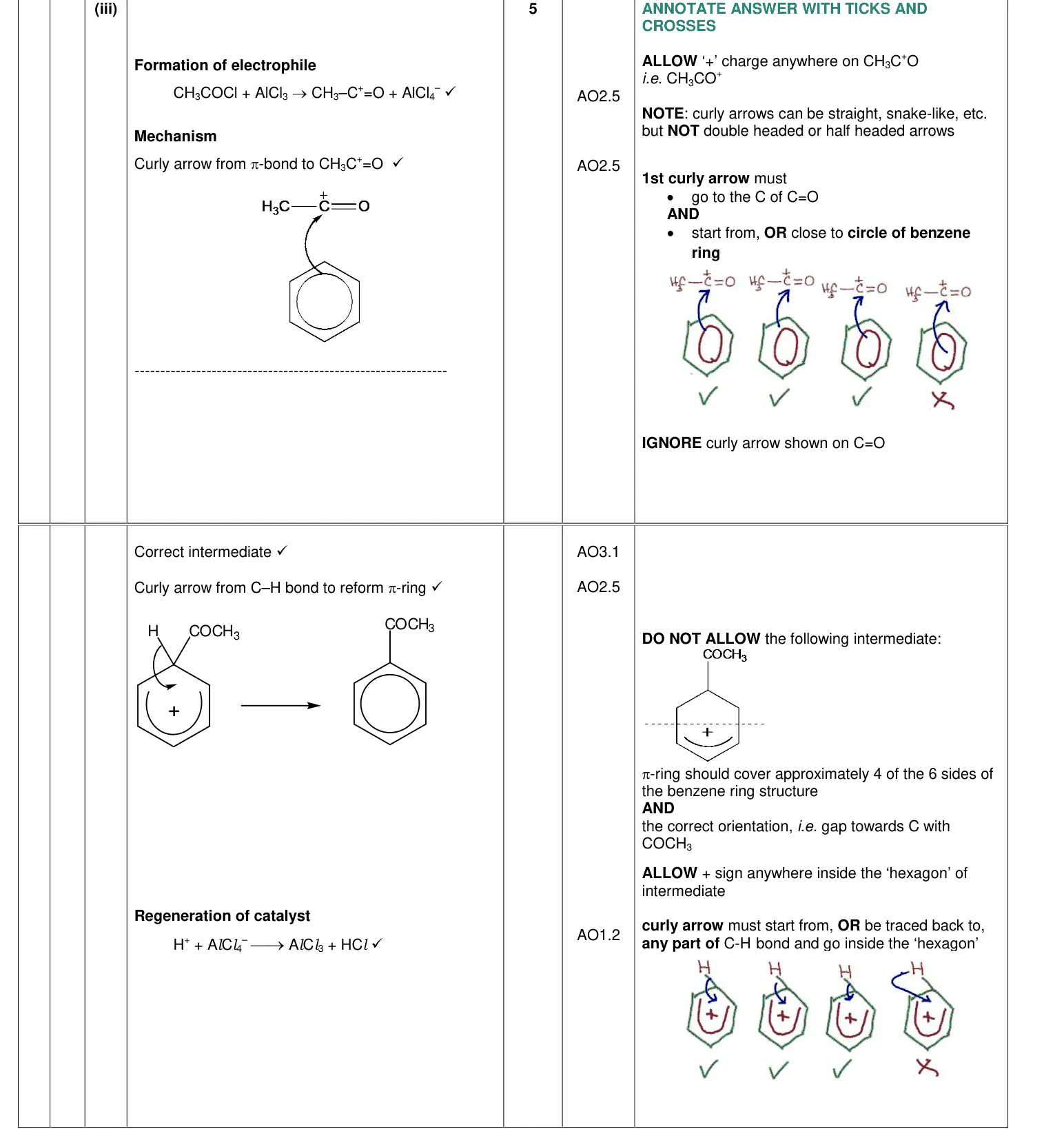
This question required candidates to apply their knowledge of the mechanism of electrophilic substitution to the formation of phenylethanone from benzene. Examiners were encouraged by the number of excellent responses to this question, with the majority of candidates securing four out of five marks. Common errors included accuracy of curly arrows (Exemplar 7 below) and omission of HCl as product from the regeneration of the catalyst. The responses of lower ability candidates also contained errors in the equation for the formation of the electrophile. Such responses used chlorine rather than ethanoyl chloride. This response demonstrates a near perfect attempt at this question. The equations for the formation of the electrophile and regeneration of the catalyst are correct. The first curly arrow is drawn accurately from the circle of the benzene ring to the correct carbon atom of the electrophile. The intermediate is correct, with the π ring over the five carbon atoms and in the correct orientation. Unfortunately the curly arrow drawn to reform the π bond starts at the H atom rather than from the bond. This small error has prevented this candidate from being given full marks.
Notes from the mark scheme and report
CH3COCl + AlCl3 → CH3C+=O + AlCl4–
arrow from ring to C of C=O
intermediate horseshoe over about 4 of 6 sides, gap towards C with COCH3
arrow from C–H bond back into ring
H+ + AlCl4– → AlCl3 + HCl
June 2019 · Paper 3 · Q4(a)(i)1 markAO1Short answerEasy
Mark scheme
Examiner's comment
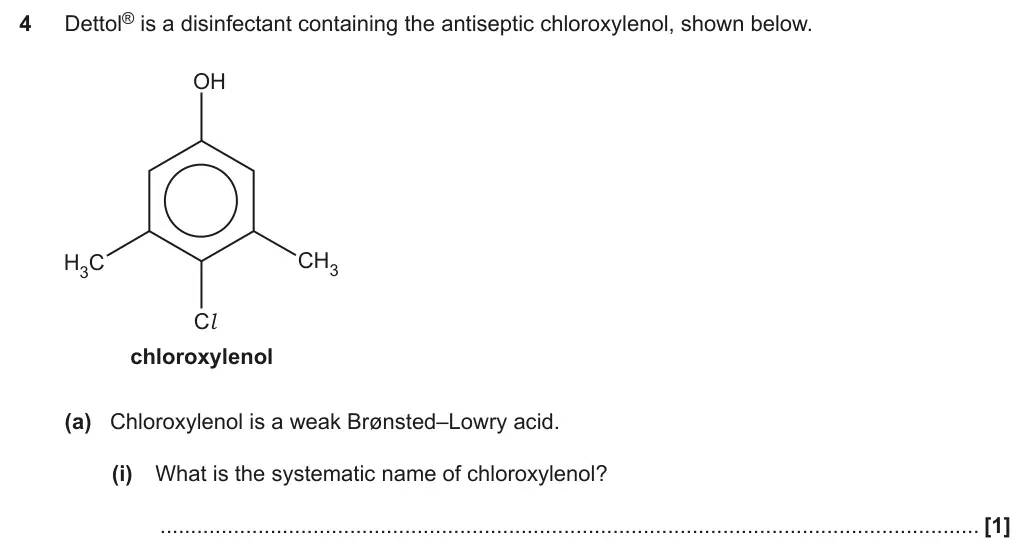
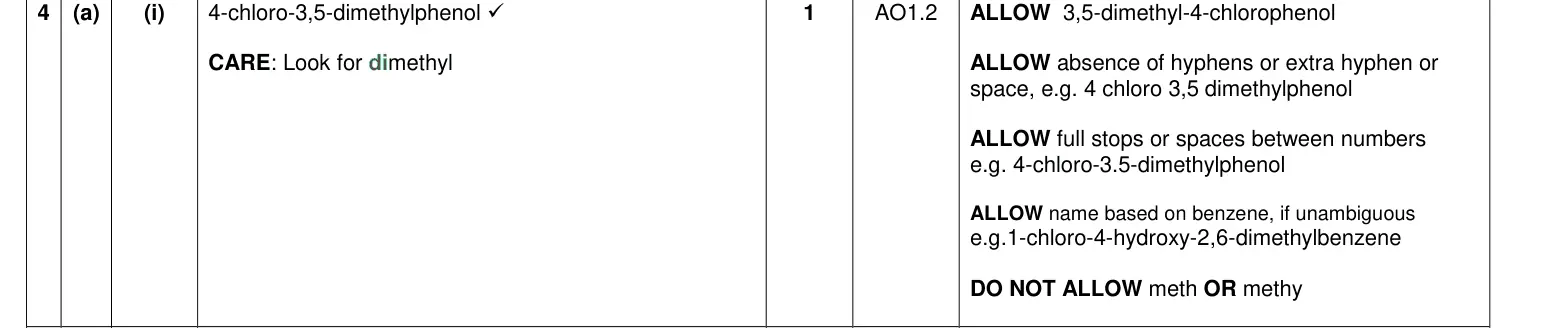
Most candidates correctly named the organic compound as 4-chloro-3,5-dimethylphenol. The numbers caused candidates less issues than the need for the ‘di’ prefix to signify two methyl groups in the name.
Notes from the mark scheme and report
4-chloro-3,5-dimethylphenol
look for dimethyl
DO NOT ALLOW meth or methy
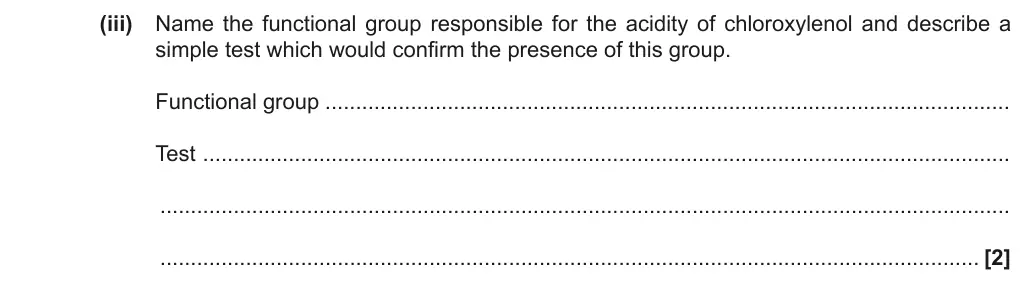
June 2019 · Paper 3 · Q4(a)(iii)2 marksAO1, 2Short answerHard
Earlier part of question 4 that this part uses
Mark scheme
Examiner's comment
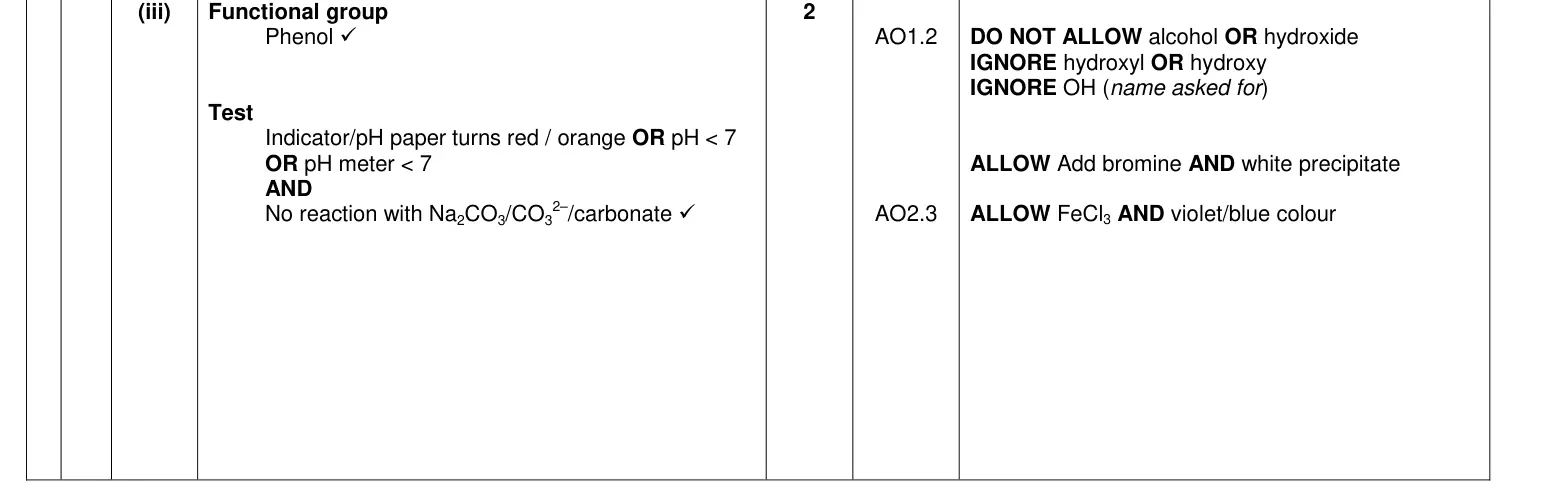
Most candidates identified the phenol functional group but a satisfactory test proved to be far more difficult. Many candidates identified that there would be no effervescence with sodium carbonate but it was common that the pH being less than 7 was often not seen. Neutralisation with sodium hydroxide was often seen but with no observation. Although not in the specification, the reaction with bromine to produce a white precipitate was often seen as an acceptable alternative test for the phenol group.
Notes from the mark scheme and report
phenol (DO NOT ALLOW alcohol or hydroxide
IGNORE hydroxyl/OH)
acidic to indicator/pH < 7 AND no reaction with carbonate
ALLOW bromine giving white precipitate
Skills: PAG7 Qualitative analysis of organic functional groups
June 2018 · Paper 2 · Q101 markMultiple choiceEasy
Answer
C
Mark scheme
Examiner's comment
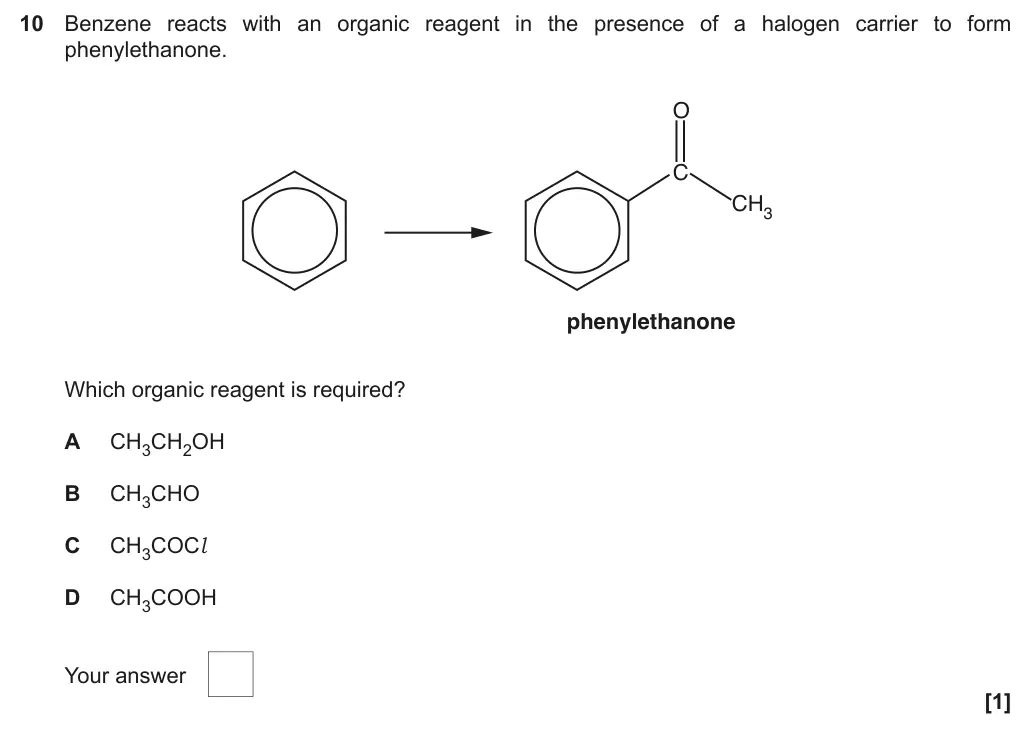
Almost all candidates identified C (CH3COCl) as the reagent required for this reaction.
June 2018 · Paper 2 · Q131 markMultiple choiceMedium
Answer
A
Mark scheme
Examiner's comment
The bonding in benzene is well known by candidates at this level and most correctly selected A as their response.
June 2018 · Paper 2 · Q18(a)(ii)3 marksShort answerMedium
Earlier part of question 18 that this part uses
Mark scheme
Examiner's comment
The relative reactivity of phenol is well known by candidates at this level and the majority scored two or three marks. Candidates who did not score full marks gave imprecise or vague explanations. This included reference to ‘higher charge density’ or ‘higher electronegativity’ of the phenol ring, rather than ‘higher electron density’.
Notes from the mark scheme and report
lone pair on O (p-orbital) delocalised into the ring/π-system
IGNORE 'reacts more readily' with no reference to electrophile
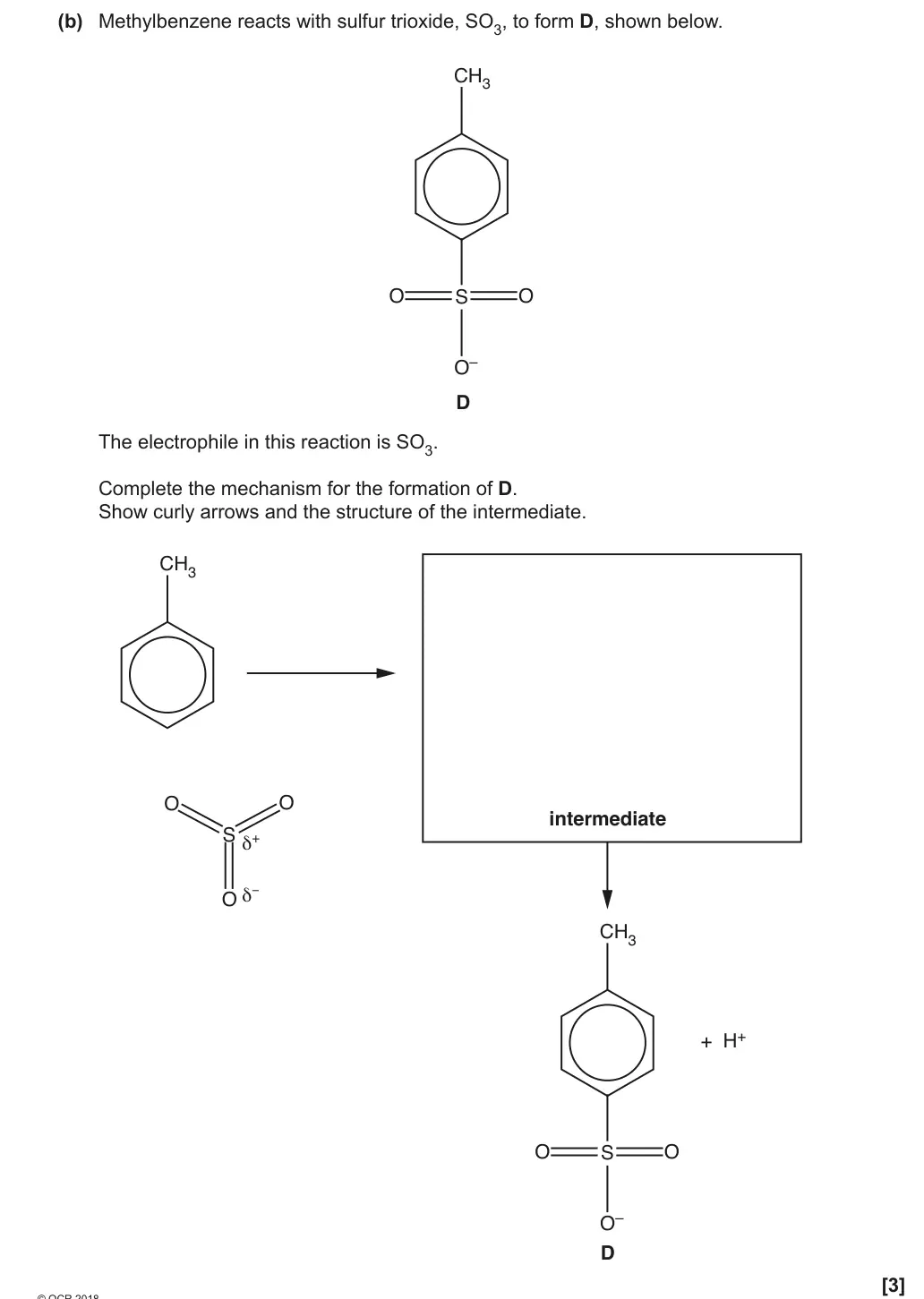
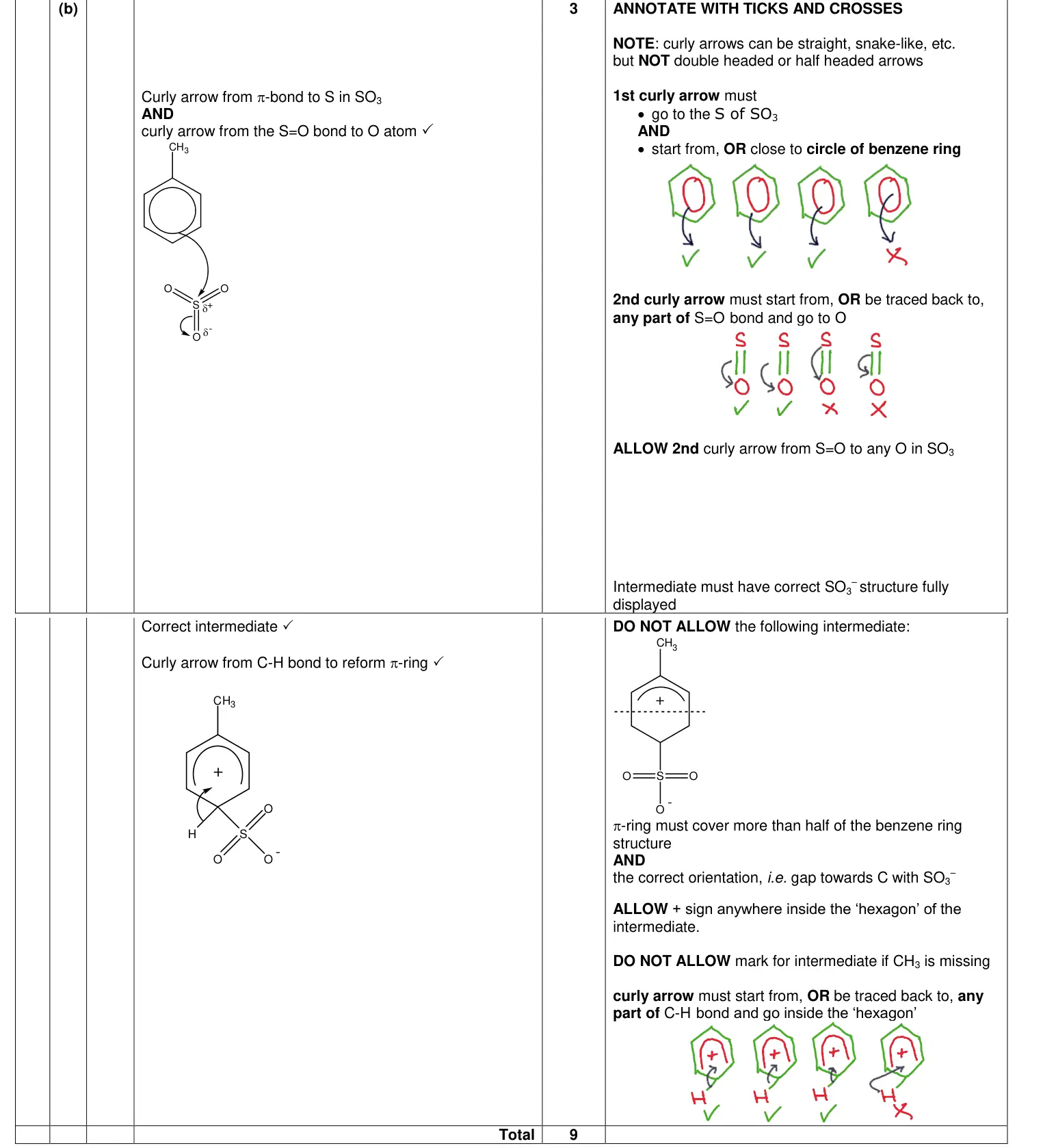
June 2018 · Paper 2 · Q18(b)3 marksMechanismMedium
Mark scheme
Examiner's comment
This question required candidates to apply their understanding of electrophilic substitution to the reaction of methylbenzene with sulfur trioxide. Examiners were encouraged by the quality of responses to this question. Most candidates secured full marks in this part. Some candidates did not show the curly arrow for the breaking of the S=O bond, while others omitted the methyl group from the intermediate. Exemplar 4 shows an excellent response. This response demonstrates an excellent example for candidates to follow. Curly arrows are drawn accurately, with each arrow touching the bond it starts from. The intermediate has been drawn clearly, using all the space provided. The ‘horseshoe’ has been drawn accurately over five of the carbon atoms with the positive charge shown neatly in the centre.
Notes from the mark scheme and report
curly arrow from π-ring to S AND from S=O bond to O
intermediate horseshoe must cover more than half the ring with gap towards C bearing SO3–
SO3– fully displayed
curly arrow from C–H bond back into ring
DO NOT ALLOW intermediate with CH3 missing
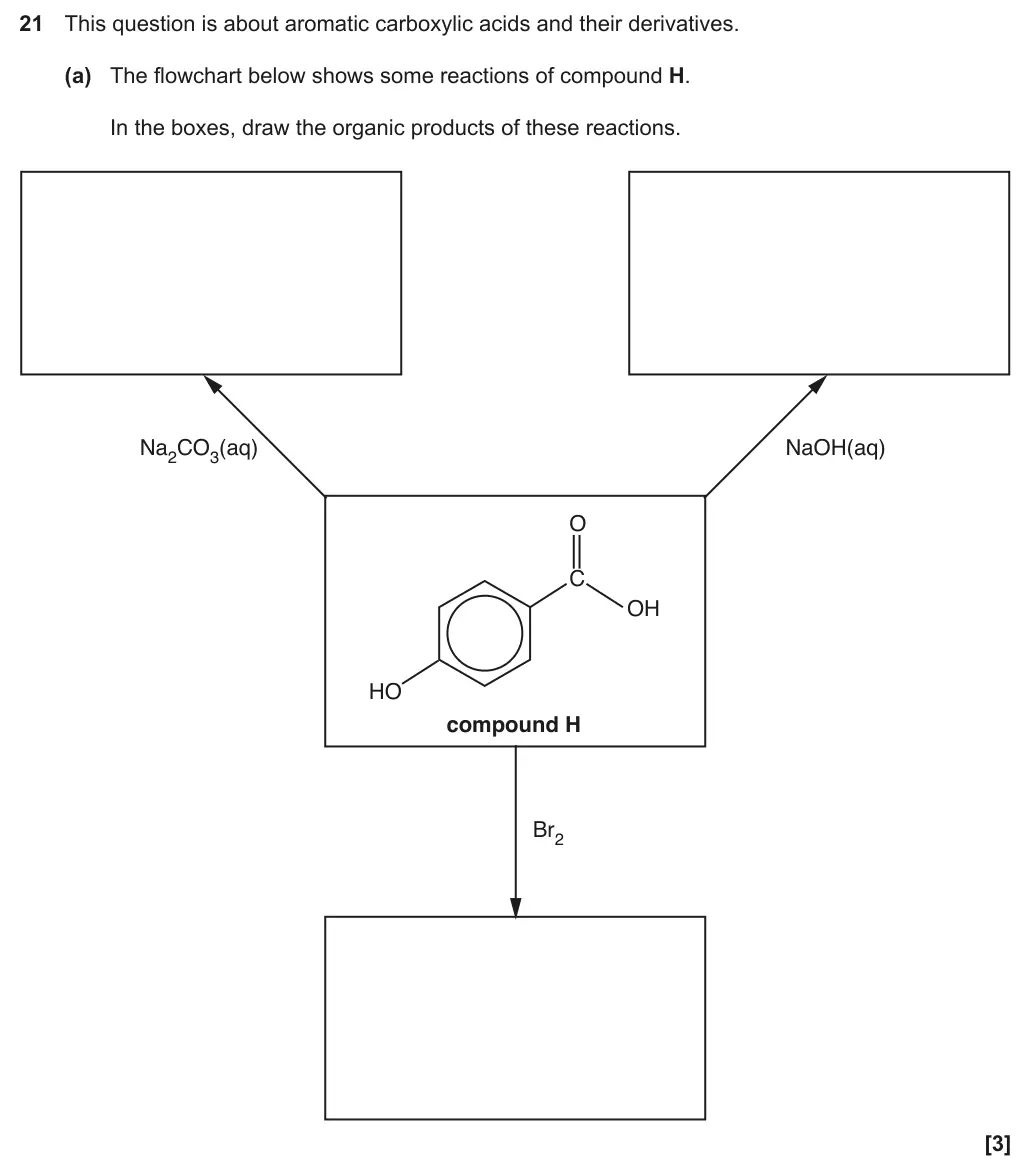
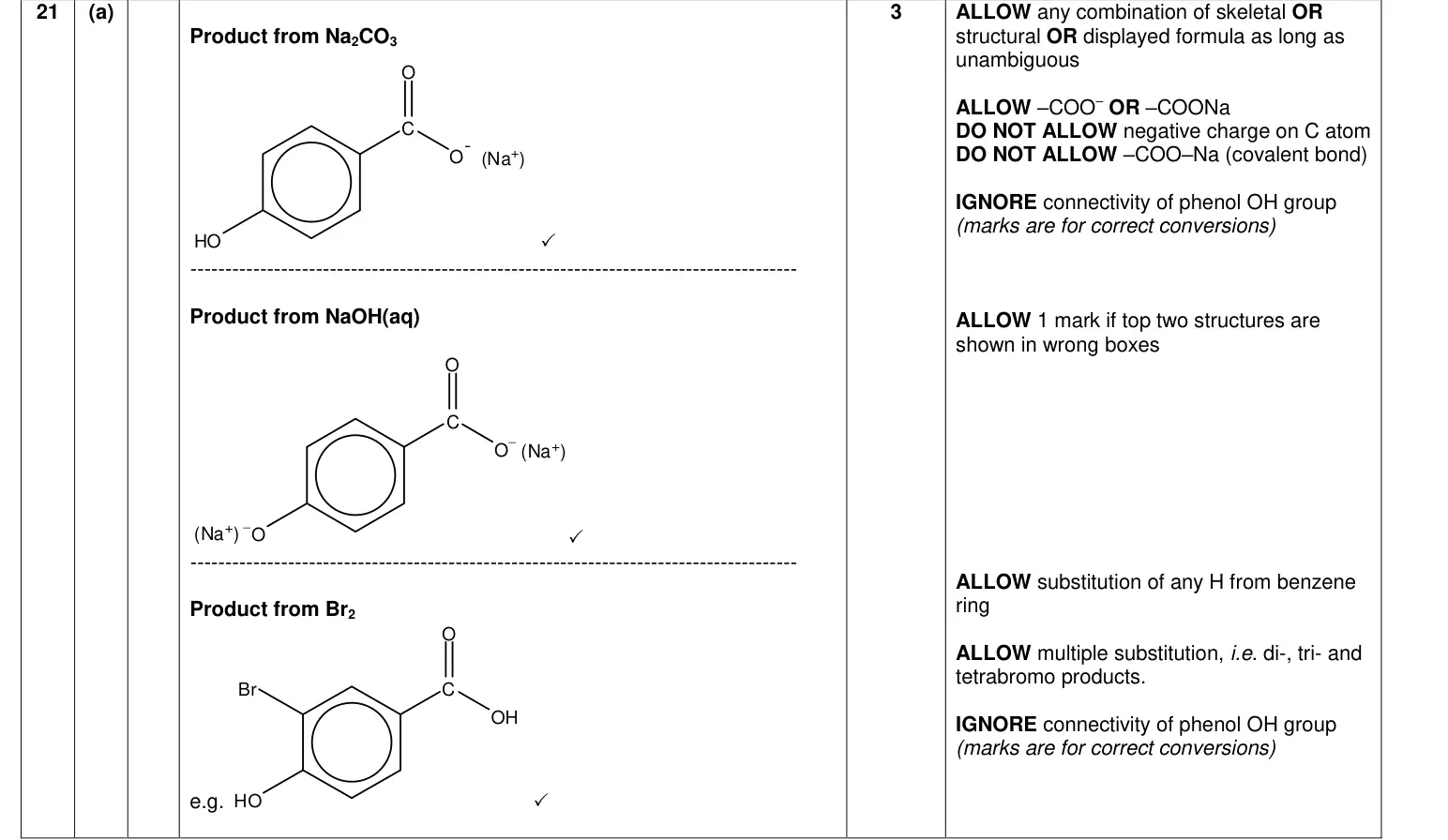
June 2018 · Paper 2 · Q21(a)3 marksDrawing / labellingHard
Mark scheme
Examiner's comment
This question assessed different reactions of compound H, 4-hydroxybenzoic acid, and discriminated well. Two of the reactions focused on acid-base chemistry, using the reagents Na2CO3 and NaOH. Many candidates recognised that the carboxylic acid group would react in both cases but only some managed to identify when the phenol group was involved correctly. A number of responses suggested that a phenoxide ion was formed with sodium carbonate but not with sodium hydroxide. The third reaction was substitution with bromine. This reaction appeared more familiar to all candidates with the majority scoring this mark. A small proportion of candidates substituted the phenol OH group or carboxylic acid group.
Notes from the mark scheme and report
Na2CO3 reacts with COOH only
NaOH reacts with both COOH and phenol OH
Br2 substitutes on the ring (ALLOW any ring H, multiple substitution)
DO NOT ALLOW –COO–Na covalent bond
1 mark if top two structures in the wrong boxes
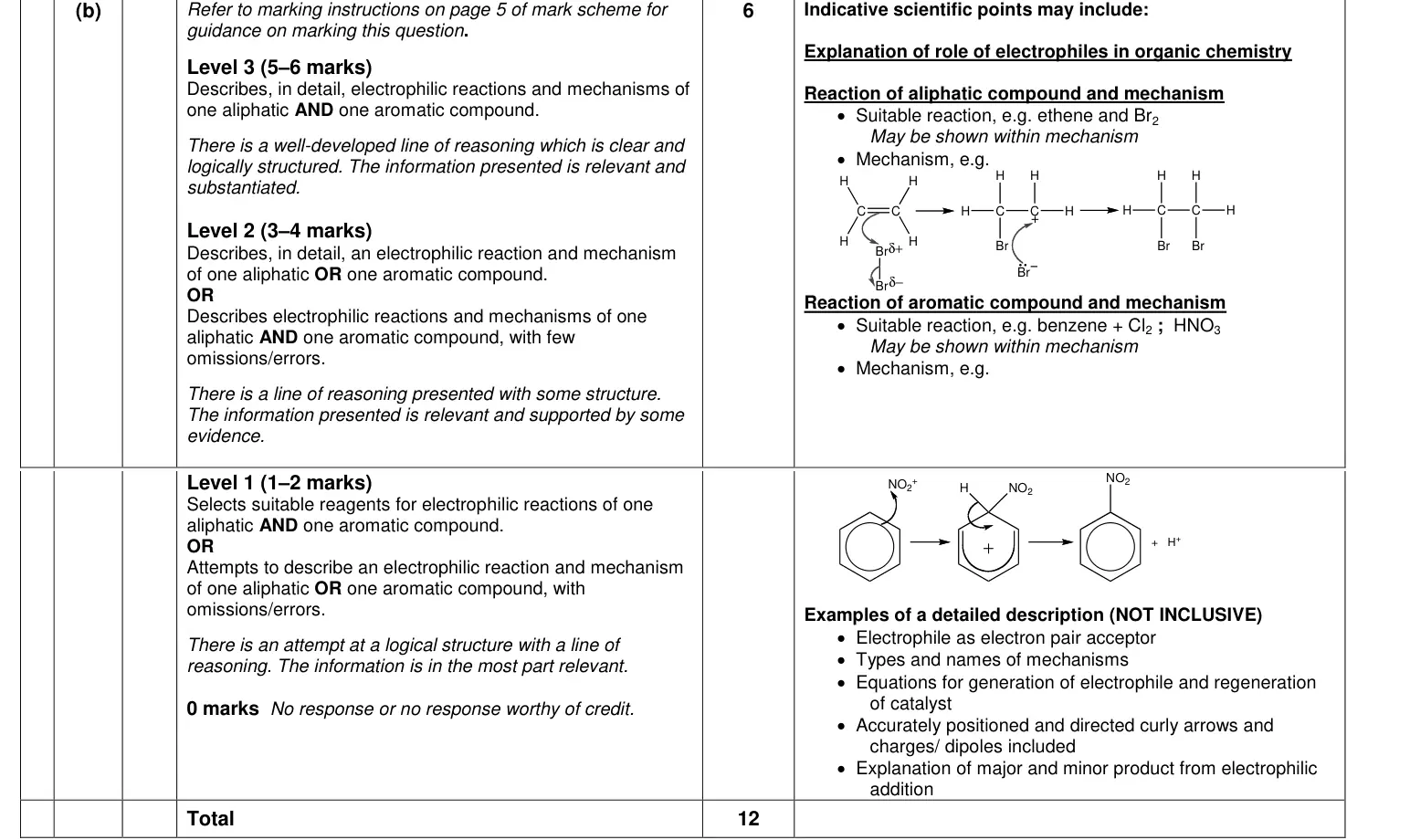
June 2018 · Paper 3 · Q6(b)6 marks6-mark level of responseMedium
Mark scheme, with the levels and indicative points
Examiner's comment
Overall, this part was answered well. Good answers were well organised, showing clear mechanisms with precisely positioned curly arrows. Most candidates included a clear definition of an electrophile and were able to select appropriate reactions. Most candidates were familiar with the mechanisms for electrophilic addition and electrophilic substitution. Mechanisms of an alkene with HBr or Br2 and benzene with NO2 + or Br+ were the most commonly seen. Most candidates showed the role of a catalyst in electrophilic substitution. Common errors/omissions were the direction of the curly arrow from the aromatic ring to the electrophile, the position of the curly arrow when H+ is lost from an aromatic intermediate, and not showing the lone pair when Br- attacks a carbocation. Some answers lacked detail and gave only two mechanisms with minimal supporting words. Lower ability candidates described nucleophilic addition or substitution as one of their mechanisms or had curly arrows going in the wrong direction. A few candidates answered in prose without including equations or diagrams. Candidates are advised that mechanisms must always be communicated in the usual diagrammatic way. and electrophilic substitution, including the role of the FeCl3 catalyst. Curly arrows are precisely positioned, with correct use of lone pairs and charges. The candidate has demonstrated excellent knowledge and understanding. The response in Exemplar 17 is clearly at a different level. The candidate has chosen an alkane rather than an alkene and has used curly arrows and charges incorrectly. This candidate appears to have been poorly prepared.
Notes from the mark scheme and report
electrophile as electron pair acceptor
aliphatic e.g. ethene + Br2 electrophilic addition with dipole, curly arrows and carbocation
aromatic e.g. nitration/halogenation of benzene electrophilic substitution with generation of electrophile and regeneration of catalyst
accurately positioned curly arrows and charges
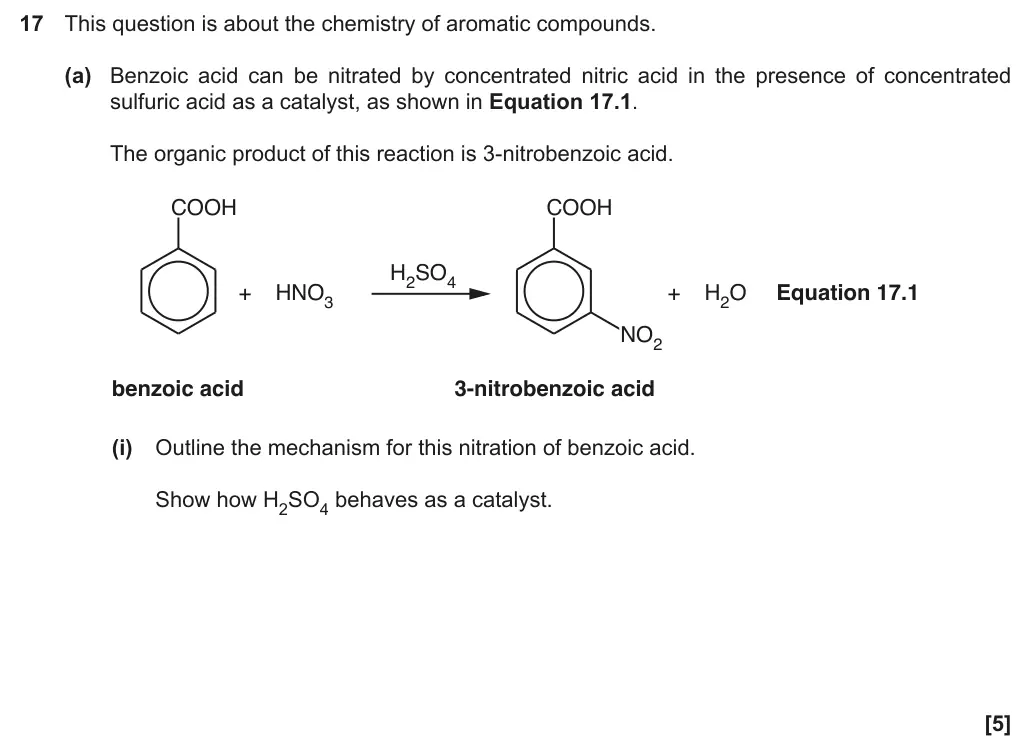
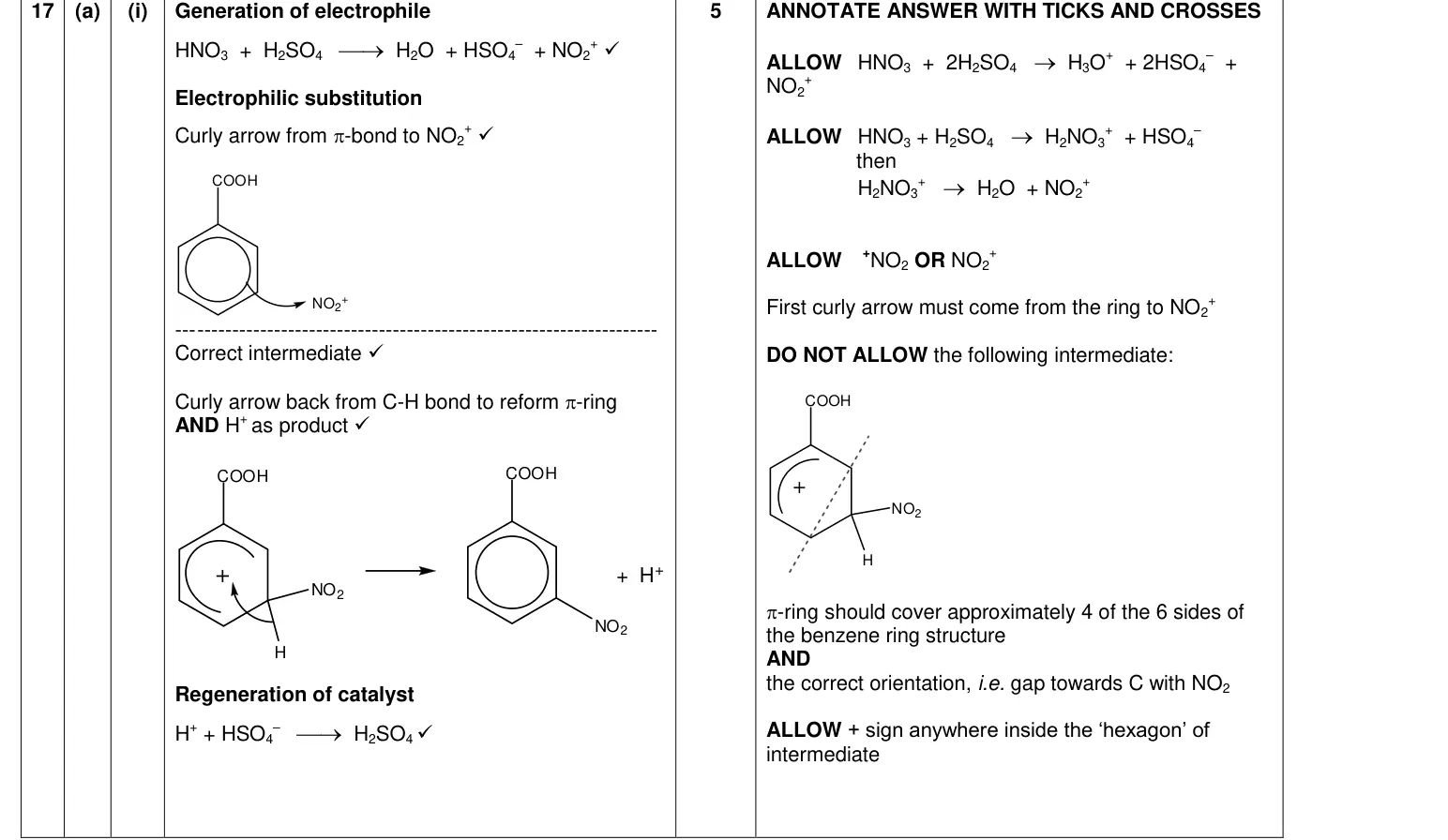
June 2017 · Paper 2 · Q17(a)(i)5 marksMechanism
Mark scheme
Notes from the mark scheme and report
HNO3 + H2SO4 → NO2+ + HSO4– + H2O
first arrow from the ring to NO2+
intermediate horseshoe covering about 4 of 6 sides with gap towards C bearing NO2
H+ + HSO4– → H2SO4 regenerates catalyst
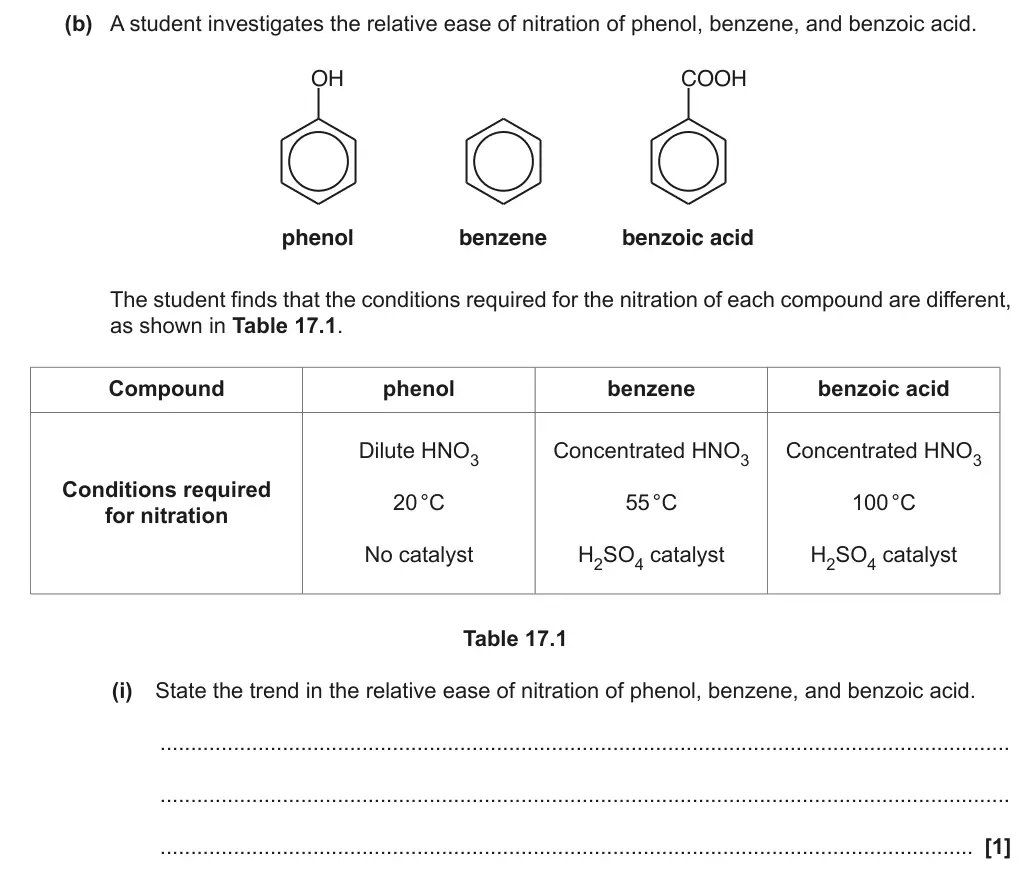
June 2017 · Paper 2 · Q17(b)(i)1 markData interpretation
Mark scheme
Notes from the mark scheme and report
must give rank order: phenol most easily nitrated AND benzoic acid least
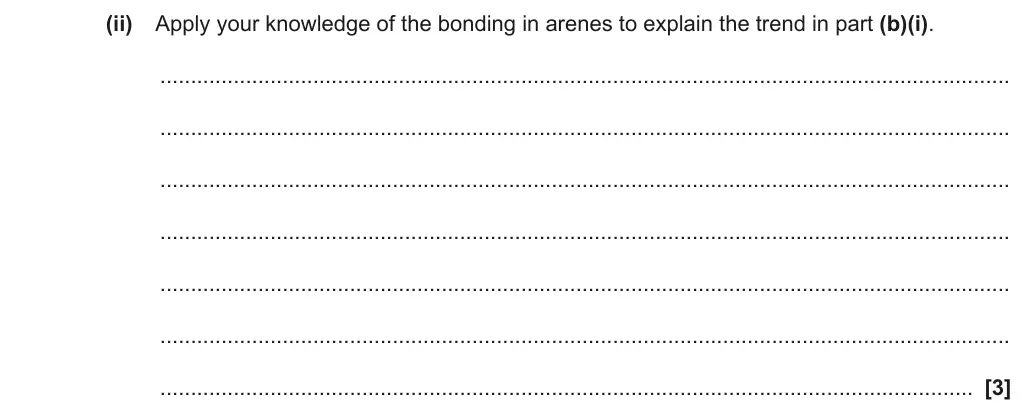
June 2017 · Paper 2 · Q17(b)(ii)3 marksShort answer
Earlier part of question 17 that this part uses
Mark scheme
Notes from the mark scheme and report
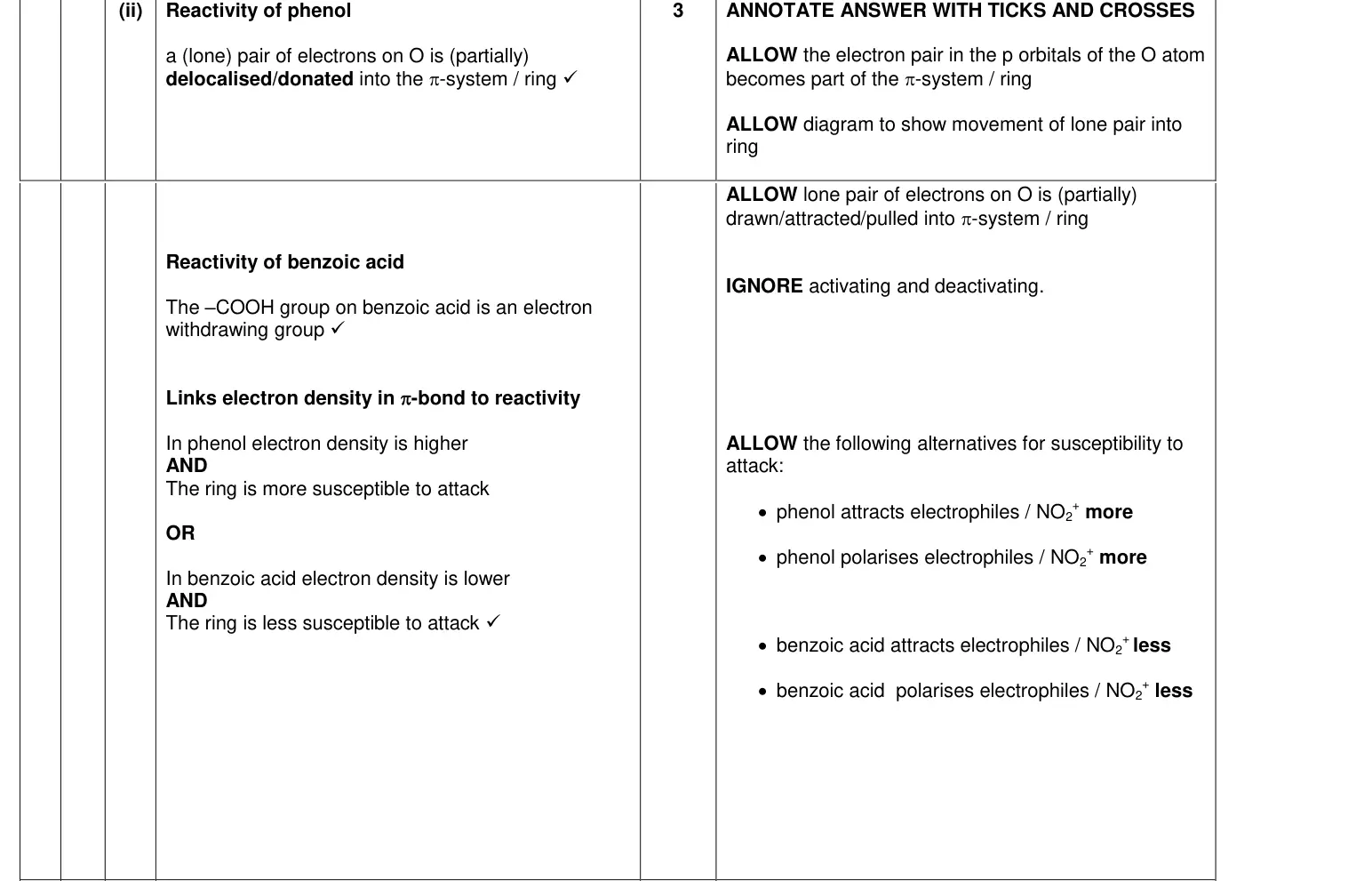
lone pair on O (partially) delocalised into the π-system
–COOH is electron withdrawing
link electron density of ring to susceptibility to attack by electrophiles
IGNORE activating/deactivating
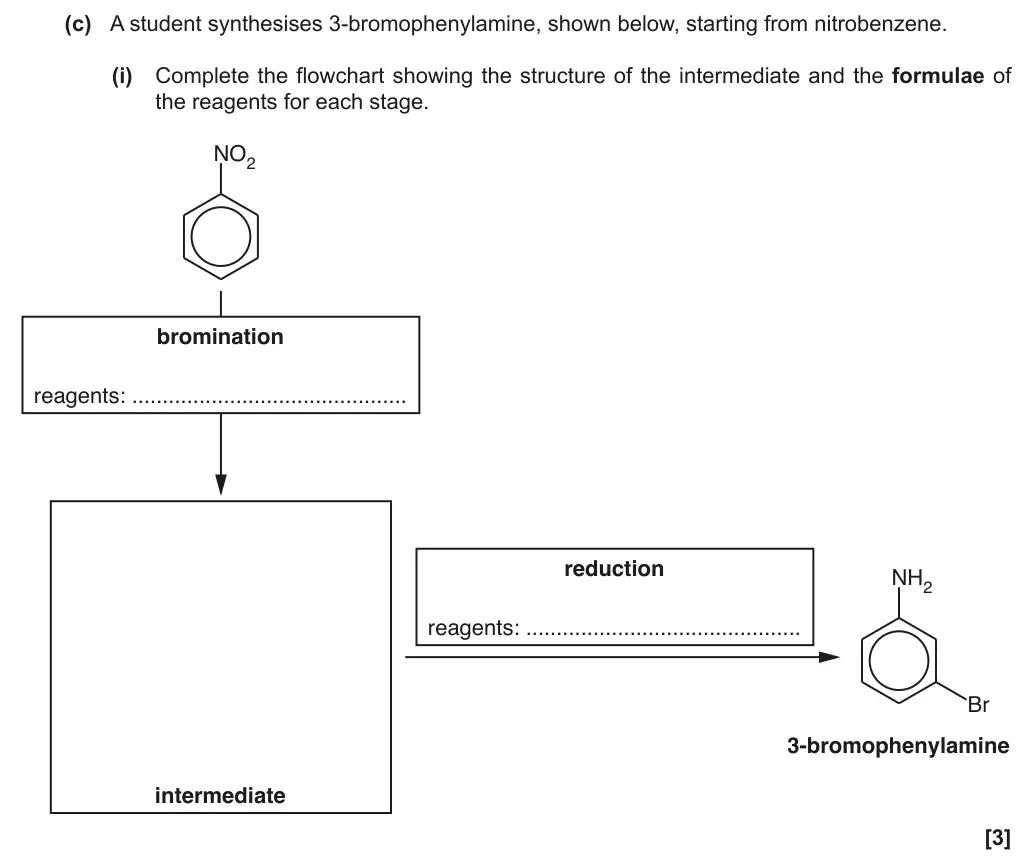
June 2017 · Paper 2 · Q17(c)(i)3 marksComplete table/diagram
Mark scheme
Notes from the mark scheme and report
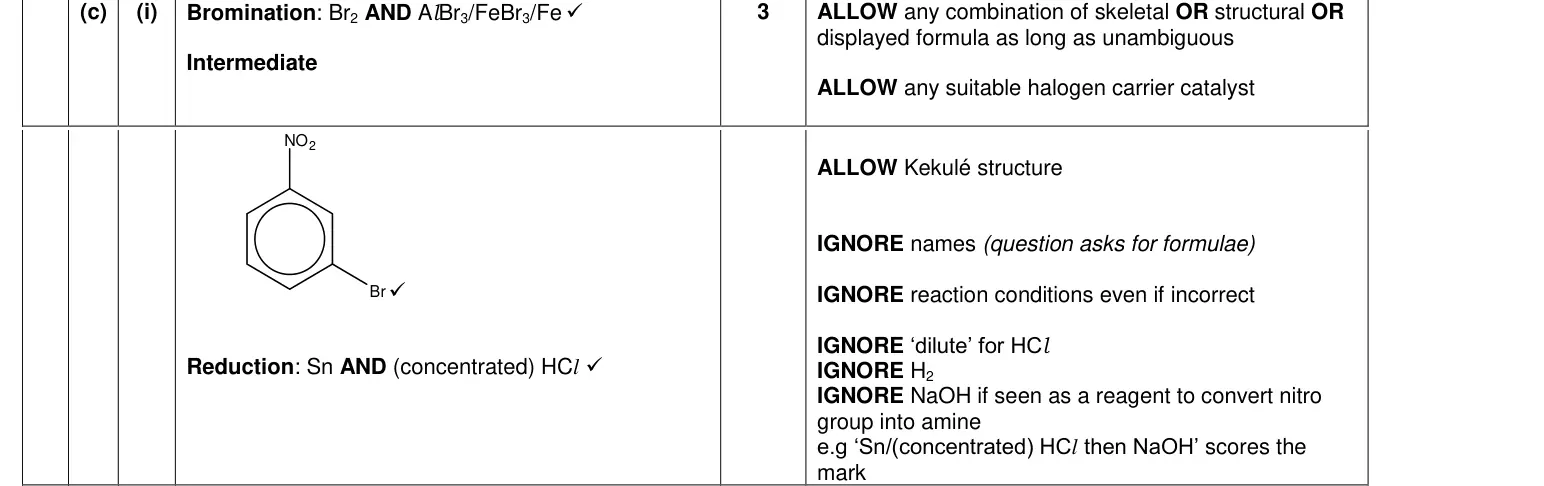
Br2 AND AlBr3/FeBr3/Fe
intermediate 3-bromonitrobenzene
Sn AND (conc) HCl
IGNORE names (formulae asked for), conditions and H2
June 2017 · Paper 2 · Q17(c)(ii)3 marksStructure / isomer
Earlier part of question 17 that this part uses
Mark scheme
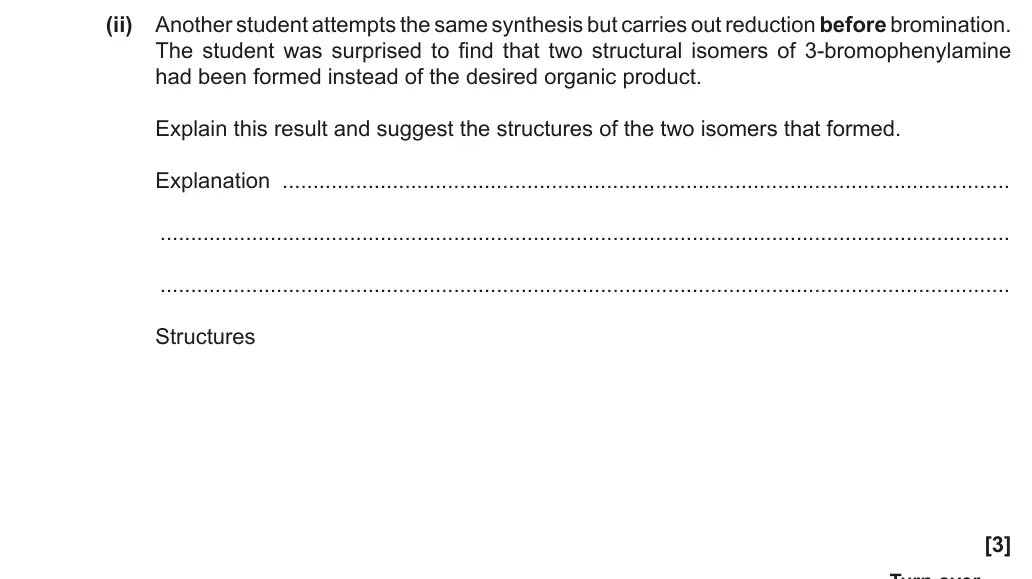
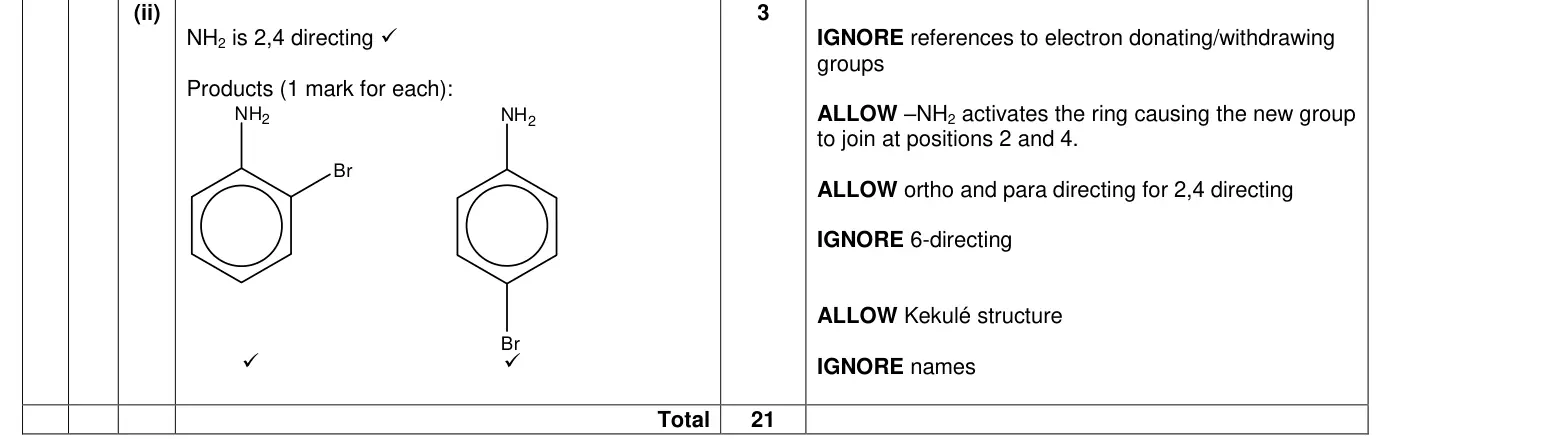
Notes from the mark scheme and report
NH2 is 2,4-directing (ALLOW ortho/para)
2-bromo- and 4-bromophenylamine
IGNORE electron donating/withdrawing
Work with an OCR chemistry tutor
Dropping marks on calculations, mechanisms or the six-markers? Book a trial session with a specialist OCR chemistry tutor.