Notes and key-term cards for this topic are being written by our tutors. The past-paper questions below are ready now.
Learning outcomes
Show the 9 learning outcomes from the specification
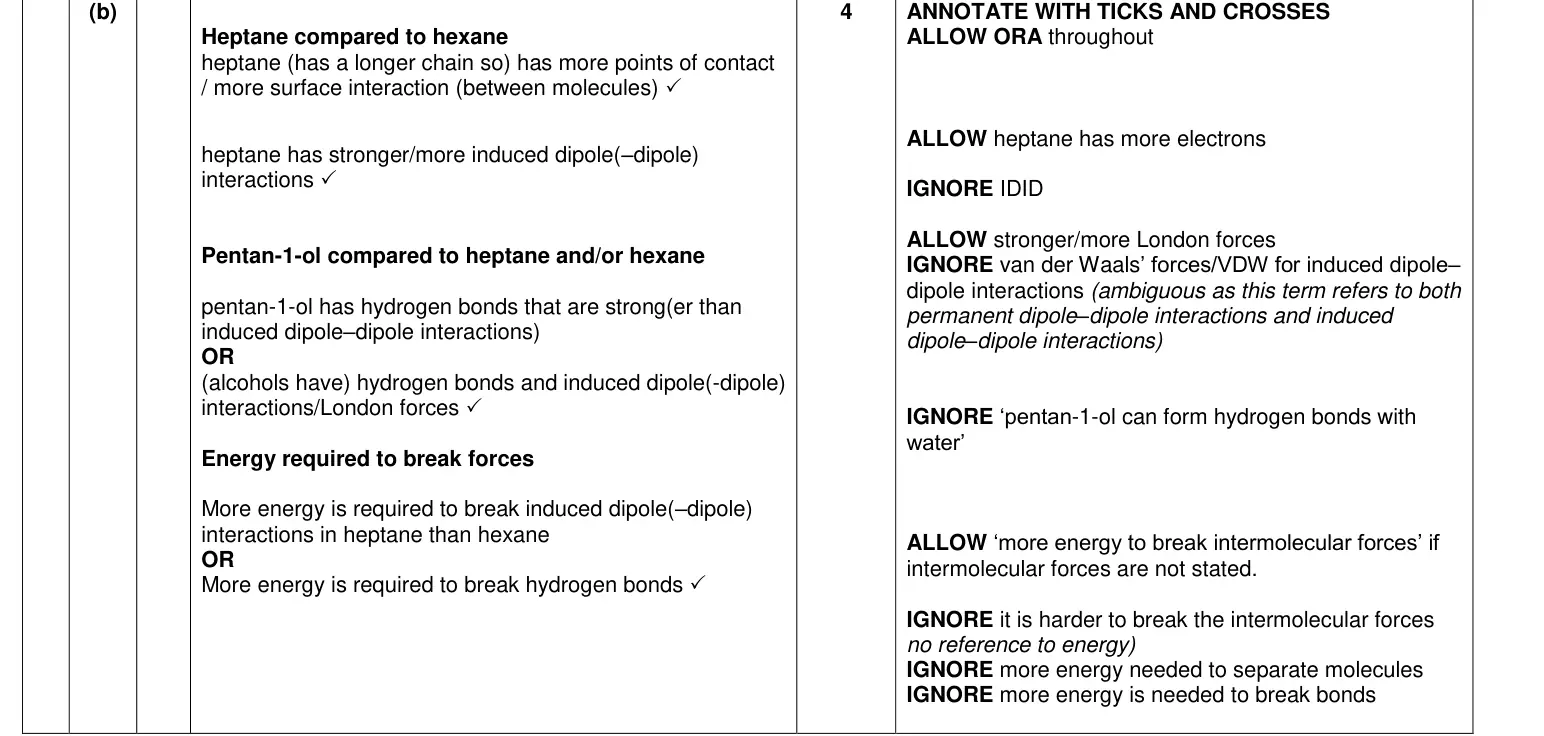
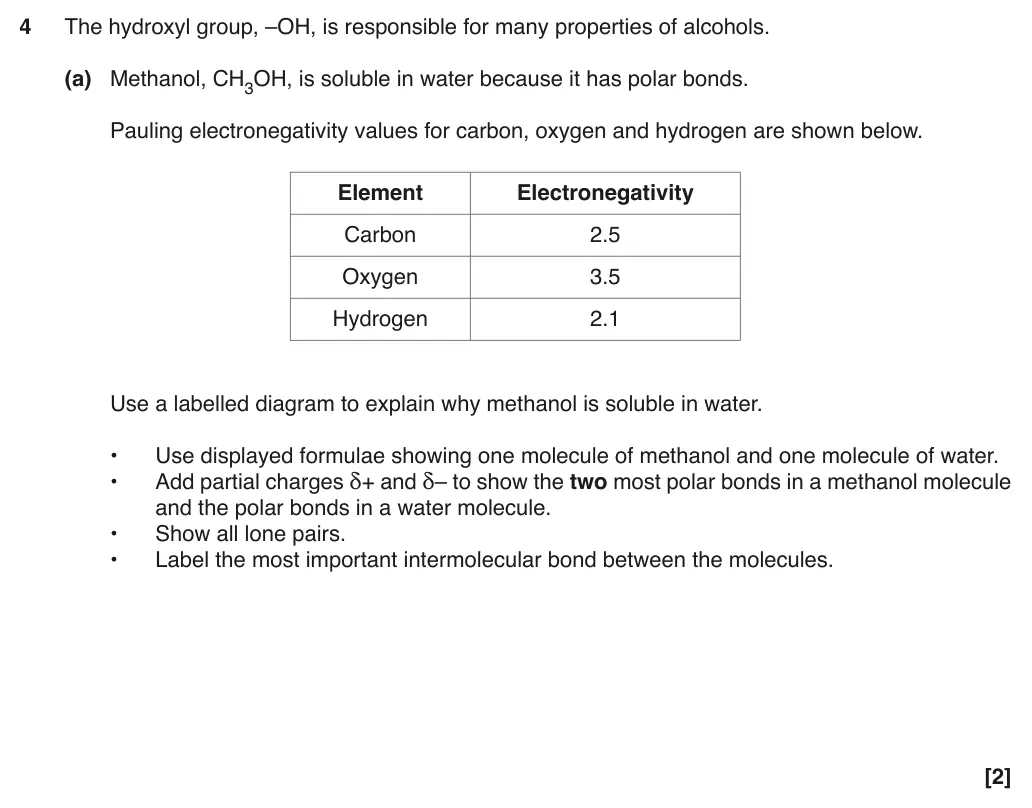
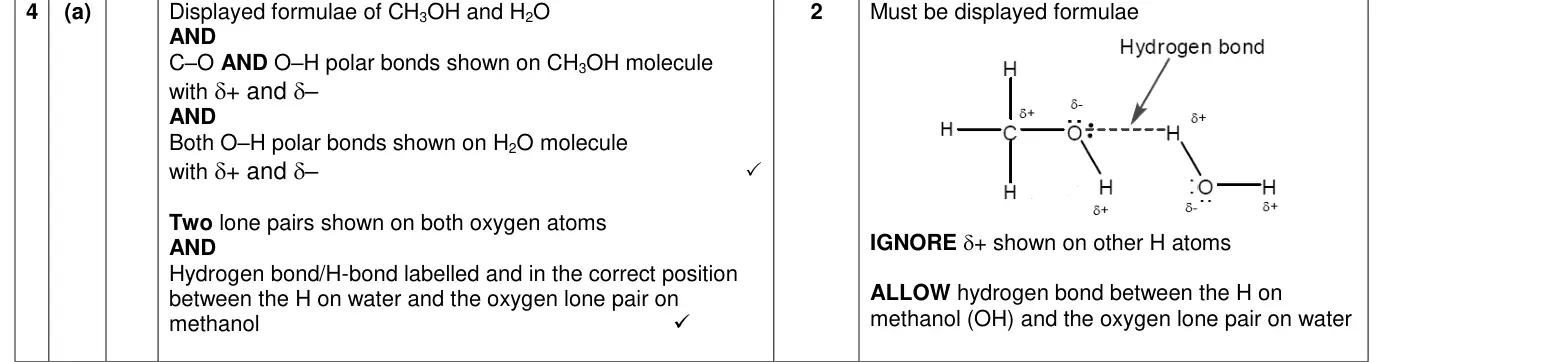
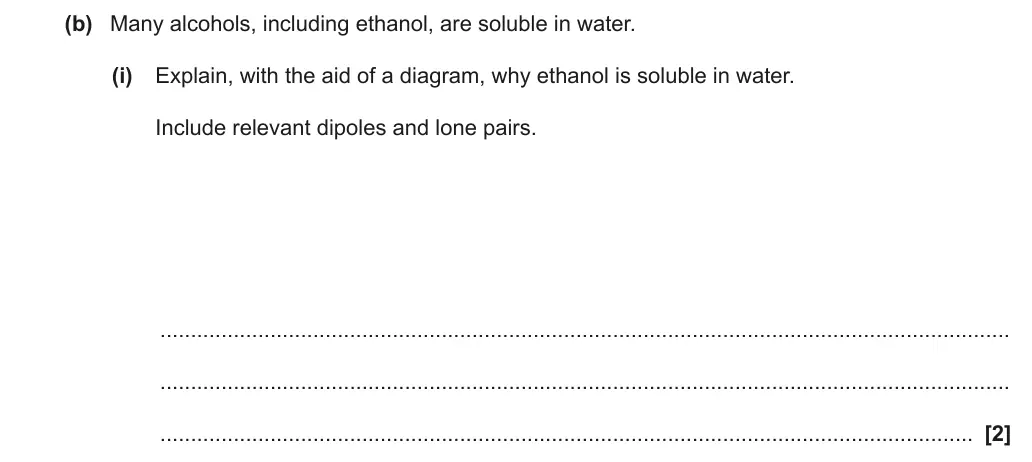
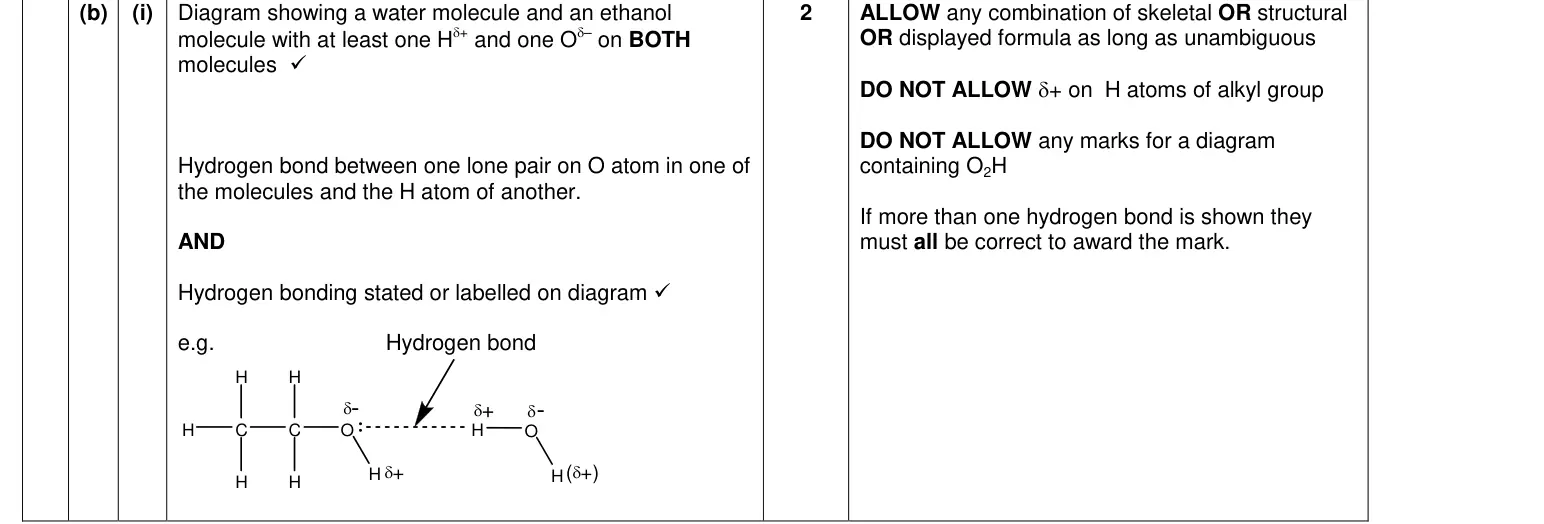
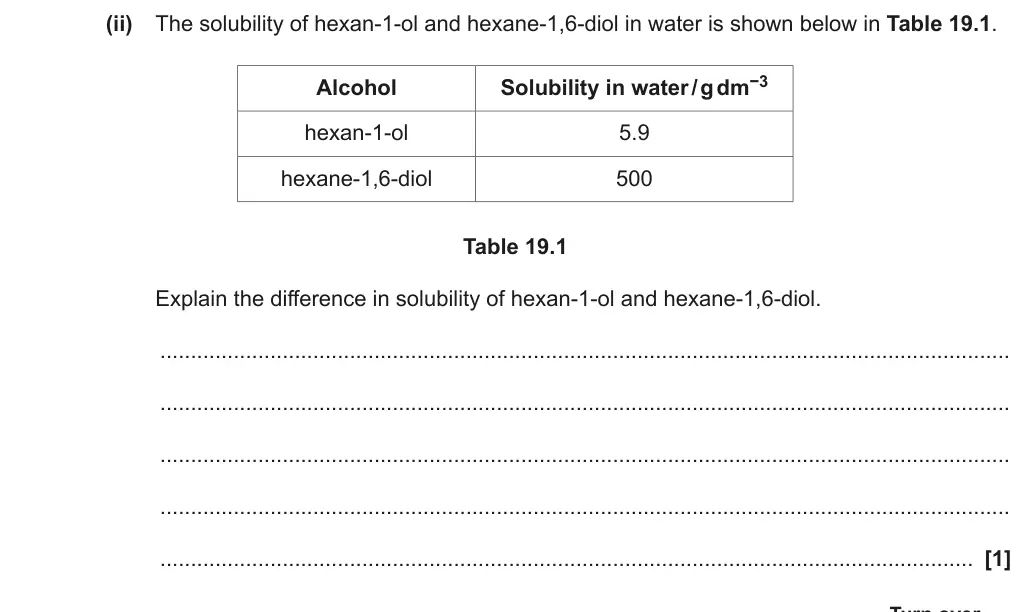
4.2.1(a)(i) the polarity of alcohols and an explanation, in terms of hydrogen bonding, of the water solubility and the relatively low volatility of alcohols compared with alkanes (see also 2.2.2 l and 4.1.2 c)
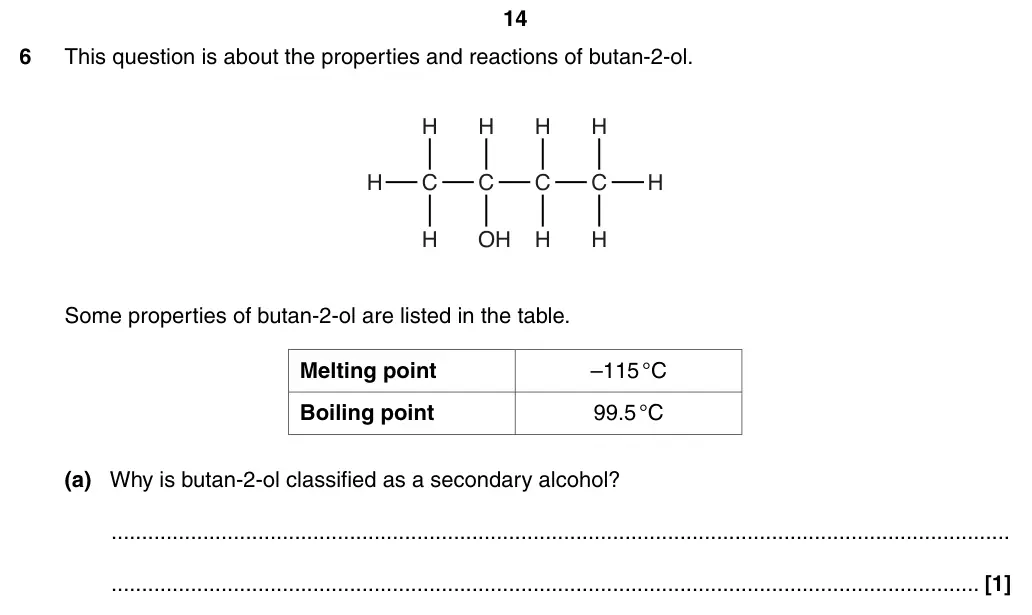
4.2.1(a)(ii) classification of alcohols into primary, secondary and tertiary alcohols
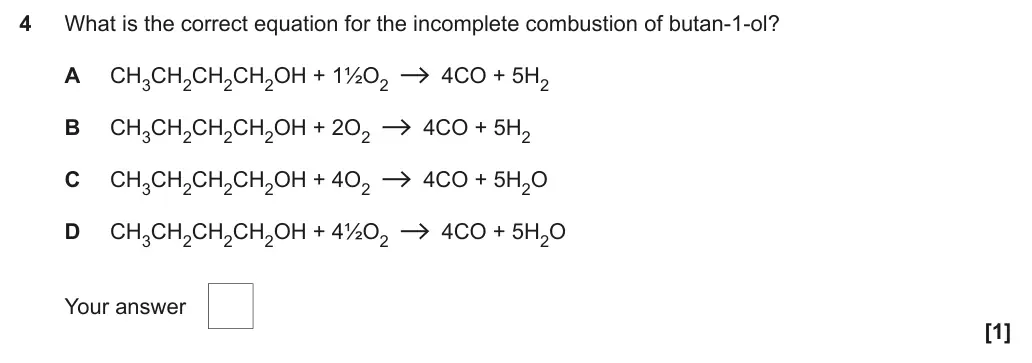
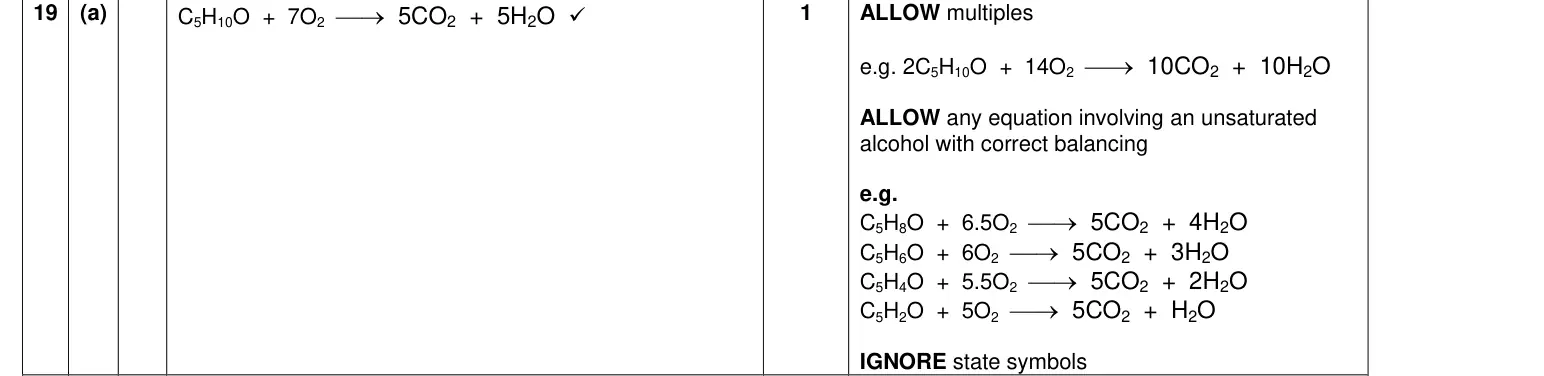
4.2.1(b) combustion of alcohols
4.2.1(c) oxidation of alcohols by an oxidising agent, e.g. Cr2O72–/H+(i.e. K2Cr2O7/H2SO4), including:
4.2.1(c)(i) the oxidation of primary alcohols to form aldehydes and carboxylic acids; the control of the oxidation product using different reaction conditions
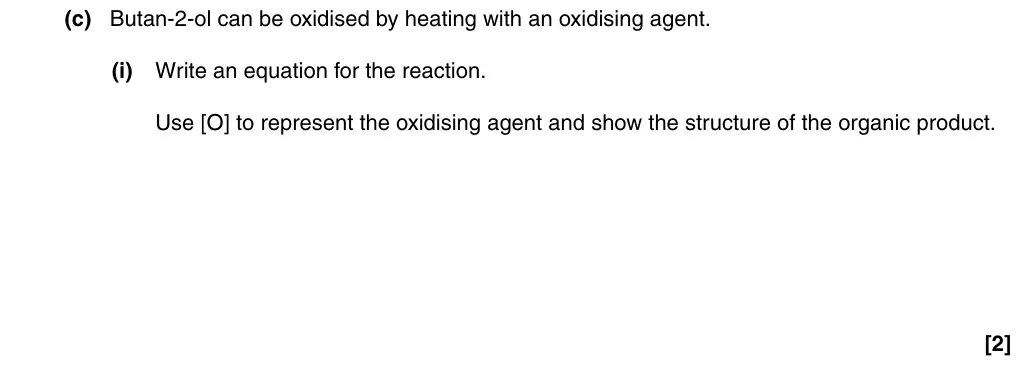
4.2.1(c)(ii) the oxidation of secondary alcohols to form ketones
4.2.1(c)(iii) the resistance to oxidation of tertiary alcohols
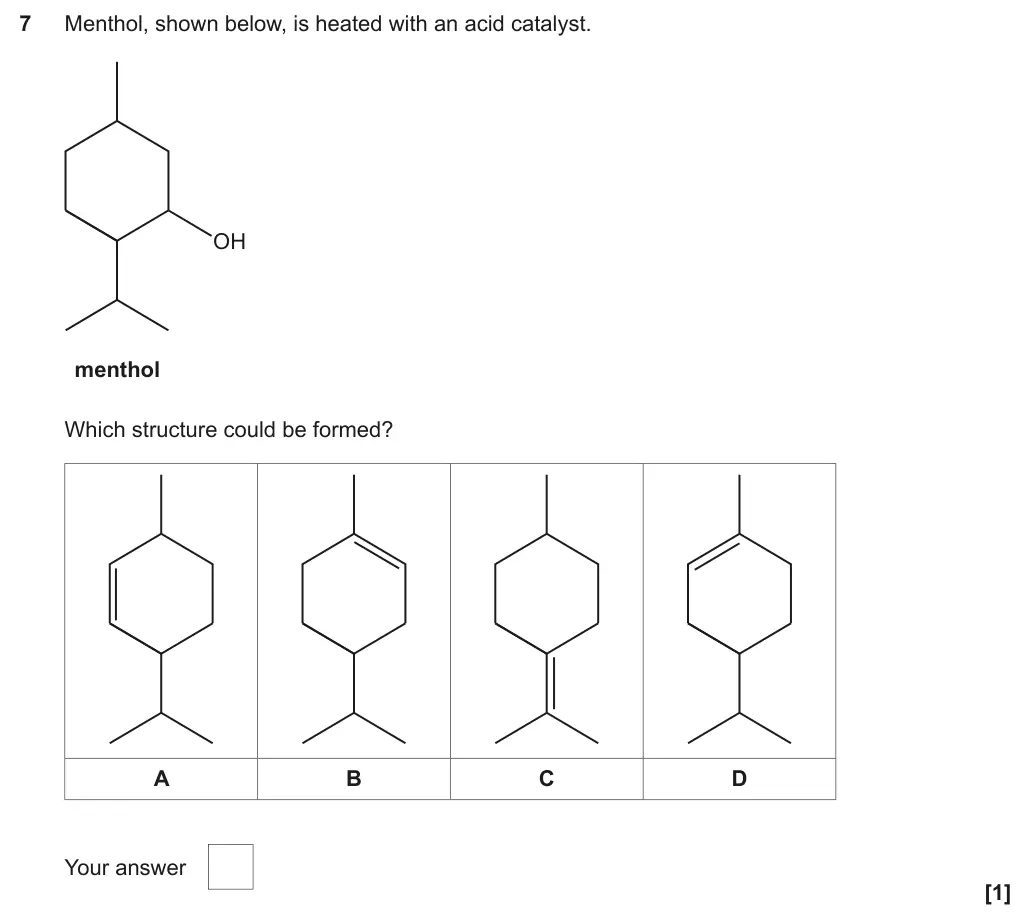
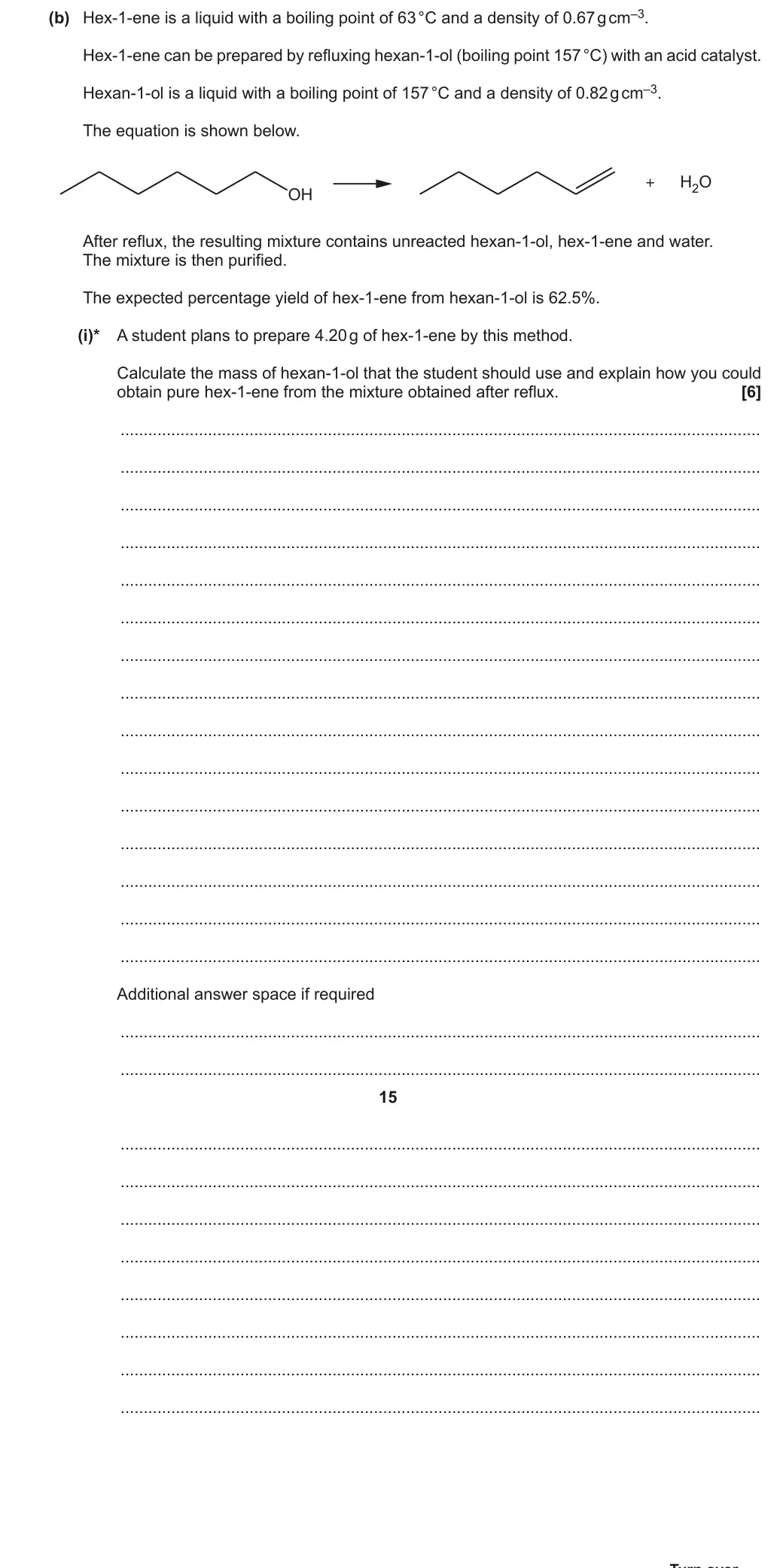
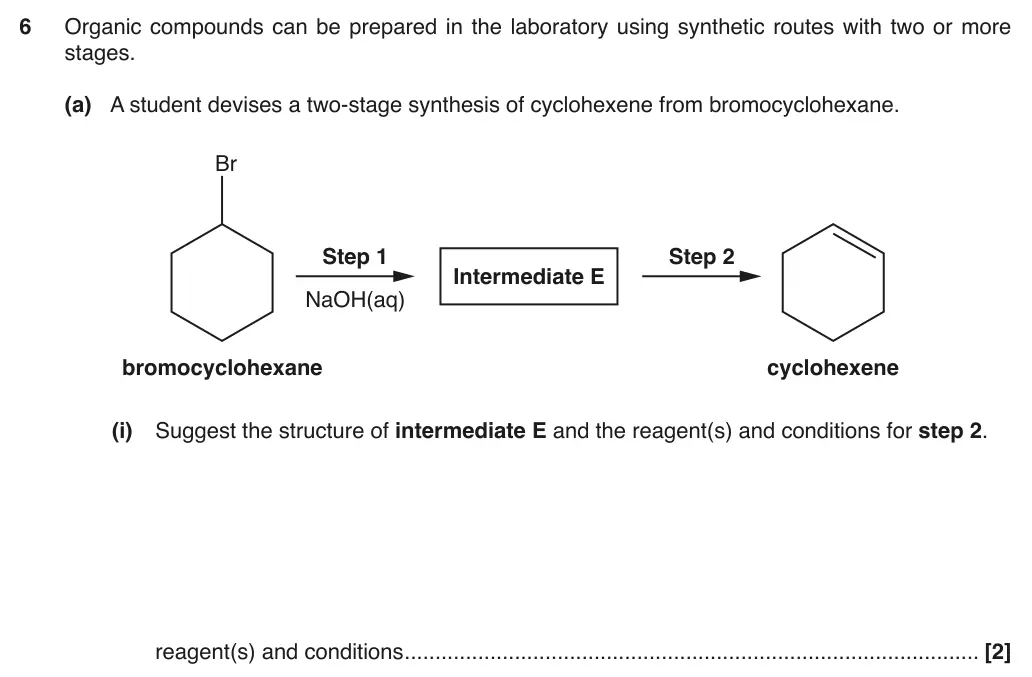
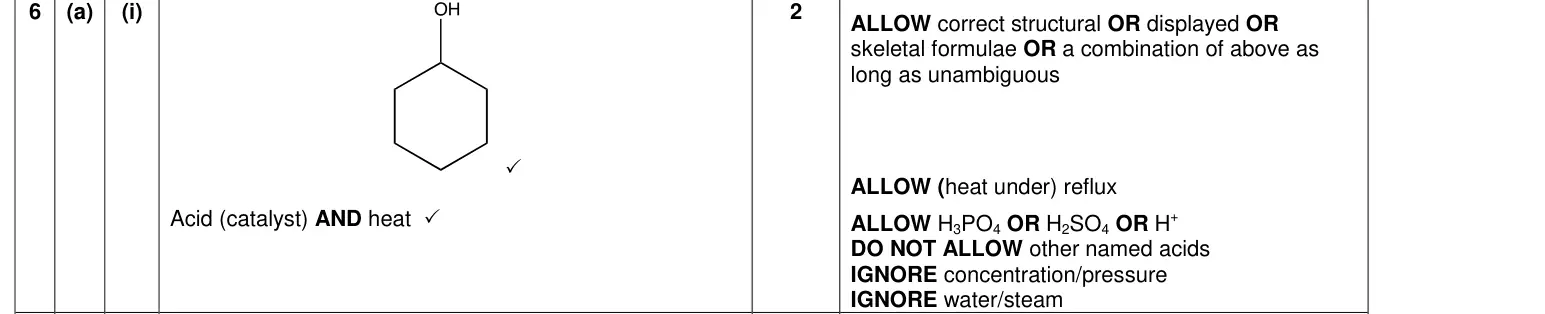
4.2.1(d) elimination of H2O from alcohols in the presence of an acid catalyst (e.g. H3PO4or H2SO4) and heat to form alkenes
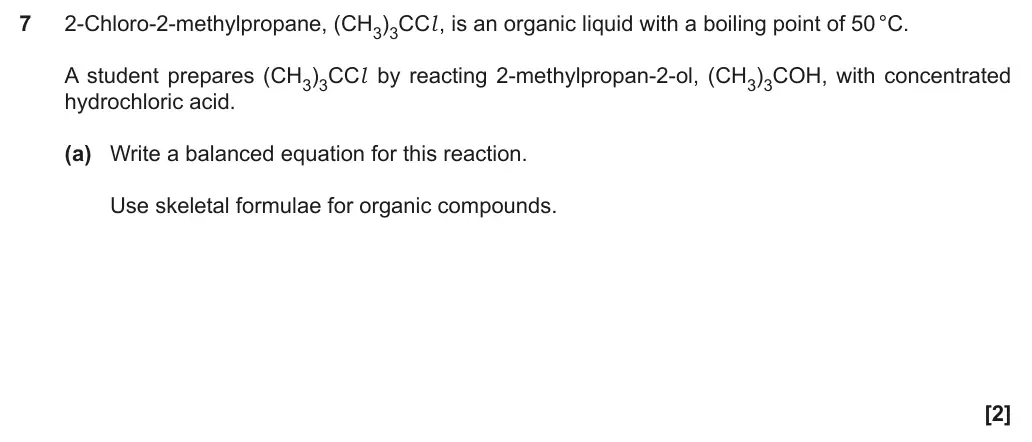
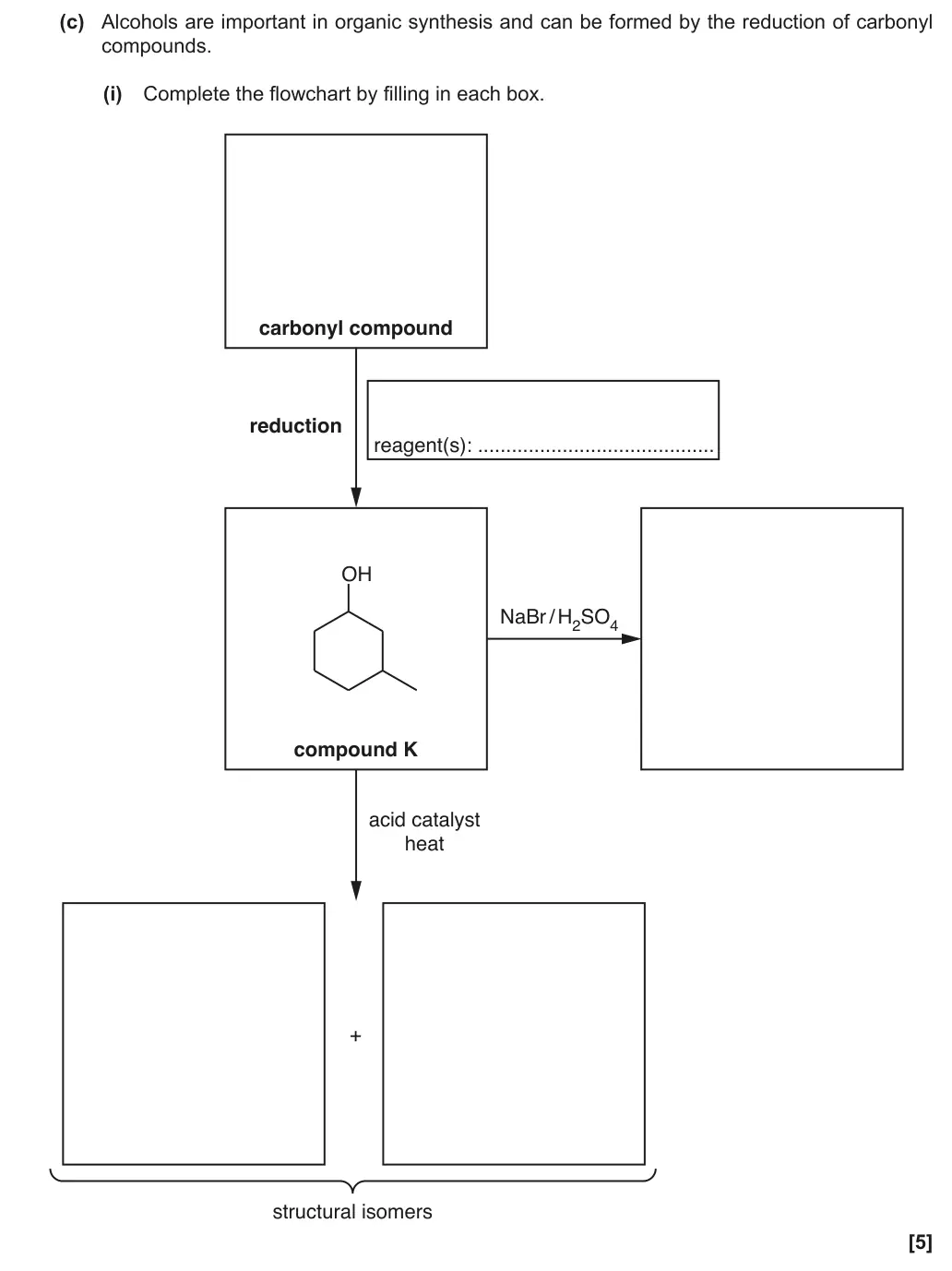
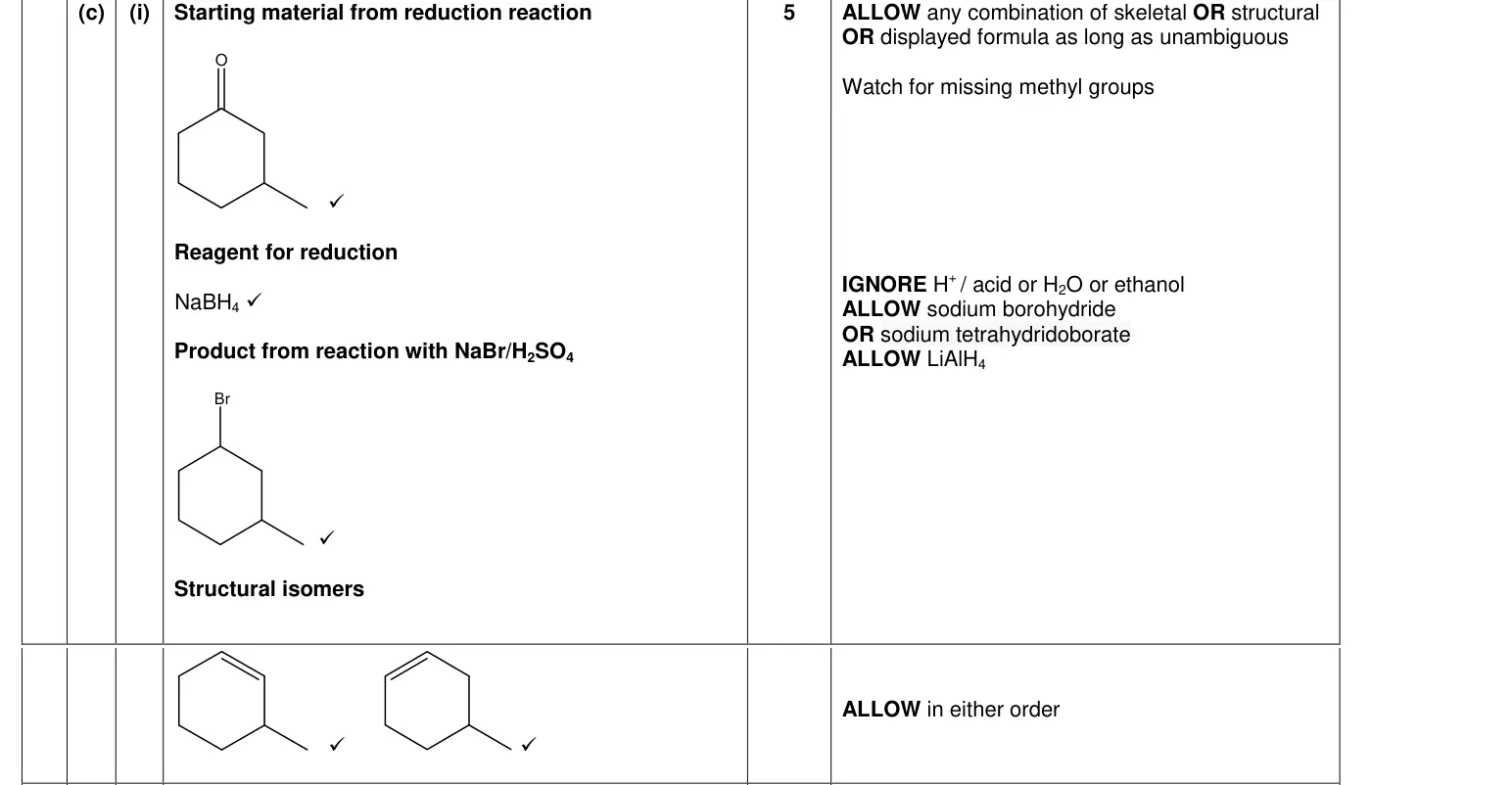
4.2.1(e) substitution with halide ions in the presence of acid (e.g. NaBr/H2SO4) to form haloalkanes.
Six-mark level of response questions on this topic
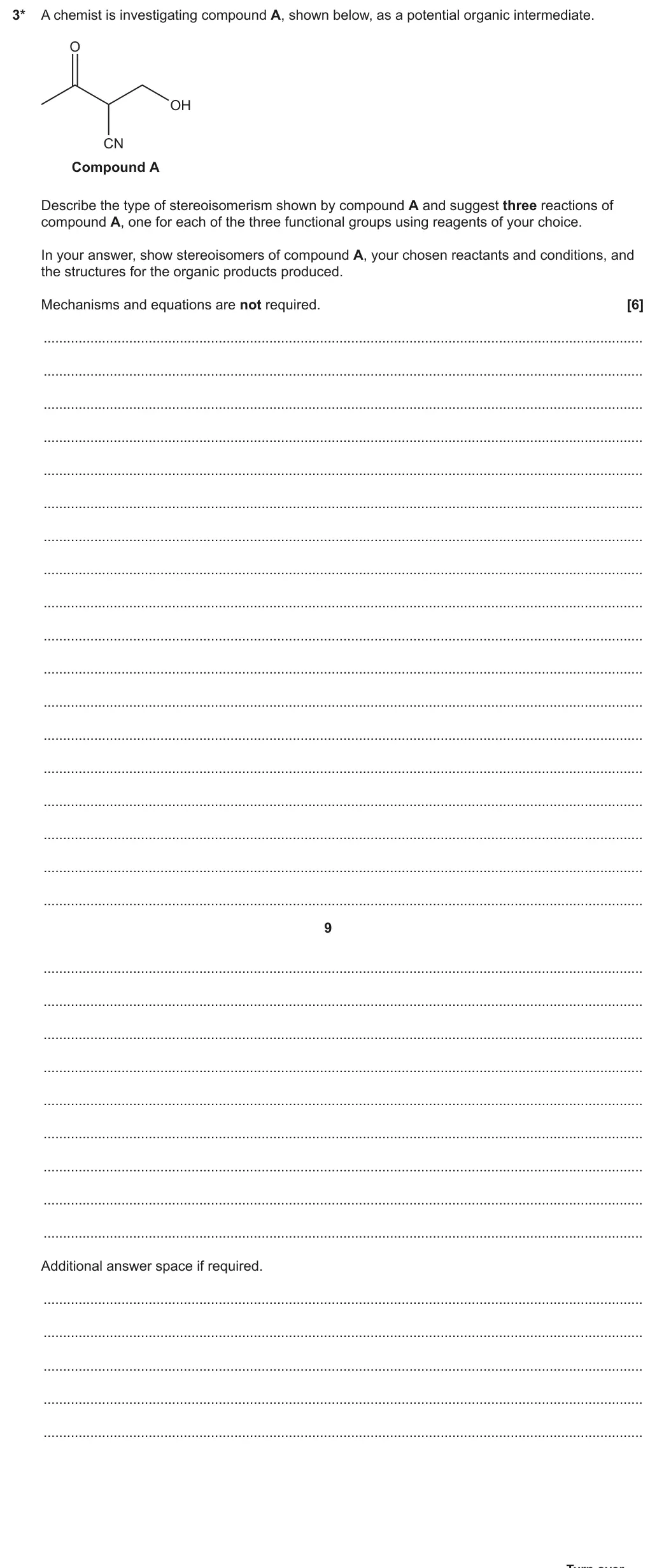
A chemist is investigating compound A, shown below, as a potential organic intermediate. Describe the type of stereoisomerism shown by compound A and suggest three reactions of
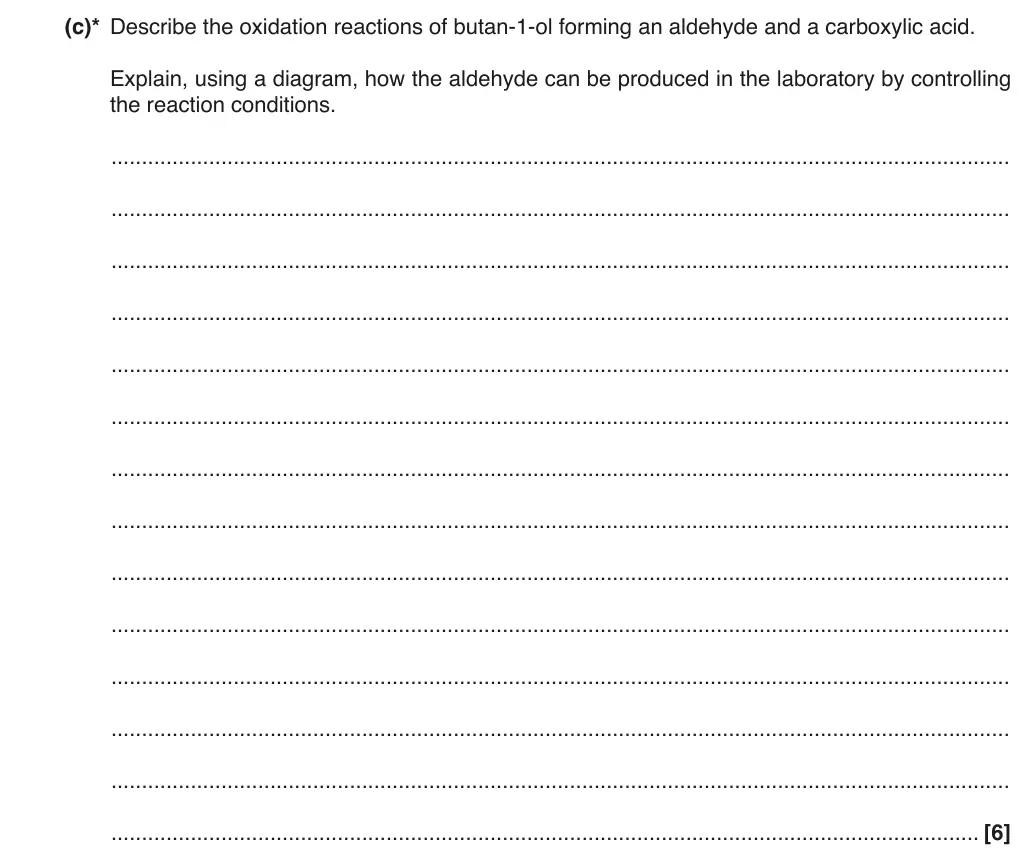
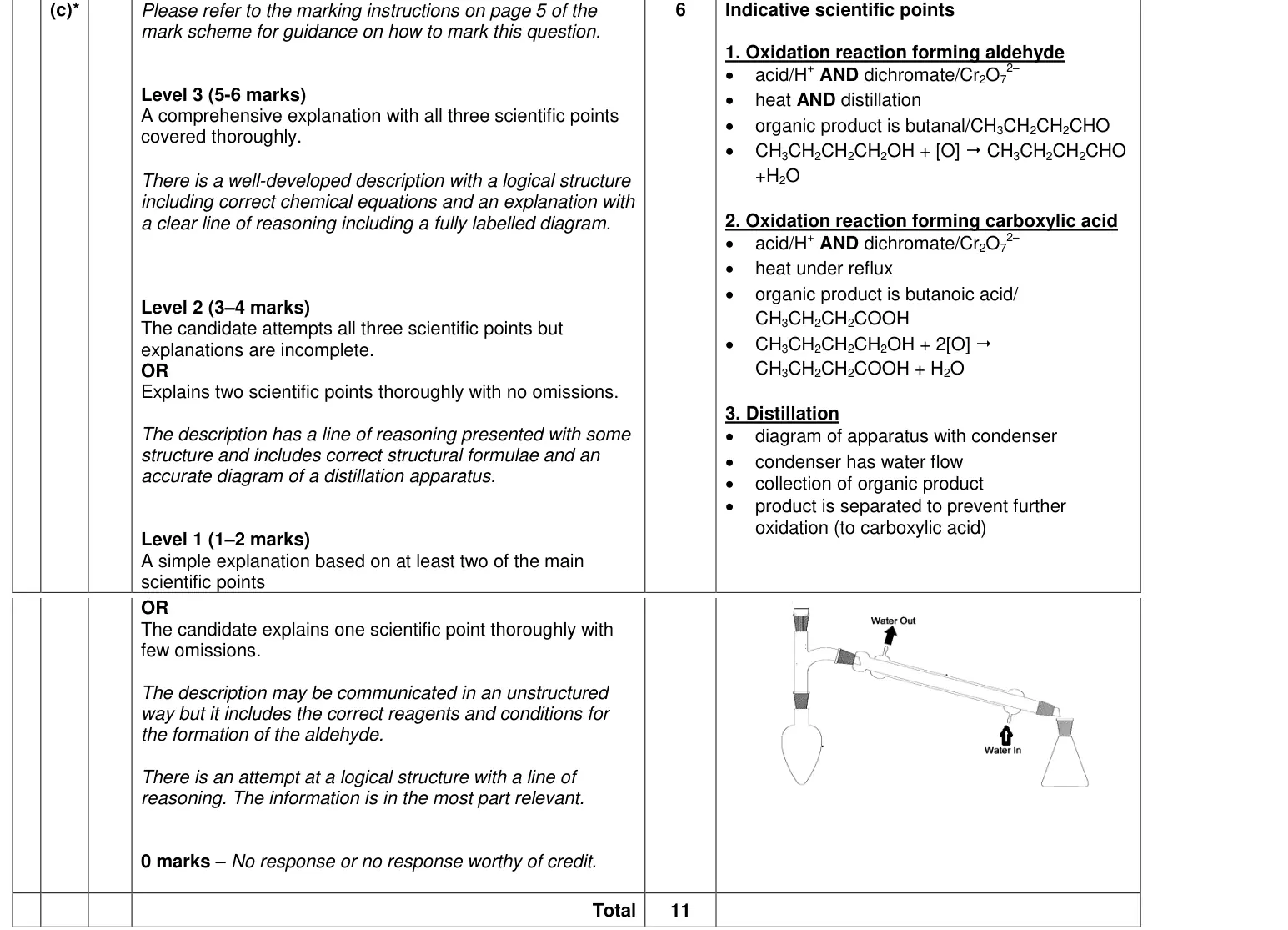
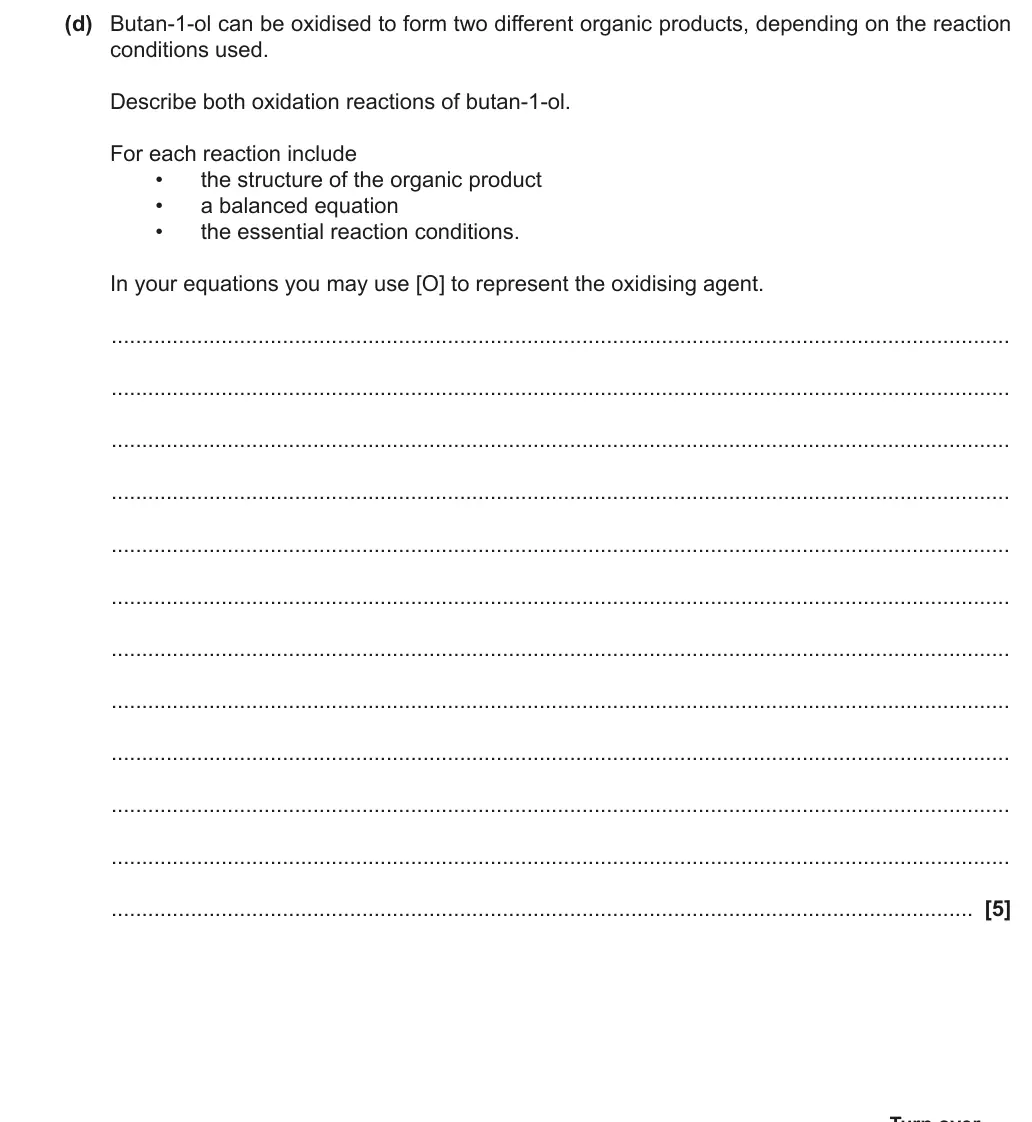
Describe the oxidation reactions of butan-1-ol forming an aldehyde and a carboxylic acid. Explain, using a diagram, how the aldehyde can be produced in the laboratory by controlling
Tap a question to zoom it. Where a part needs a table, graph or structure from an earlier part, that part folds out above it; the mark scheme and examiner's comment open underneath. Have the OCR Data Sheet beside you.
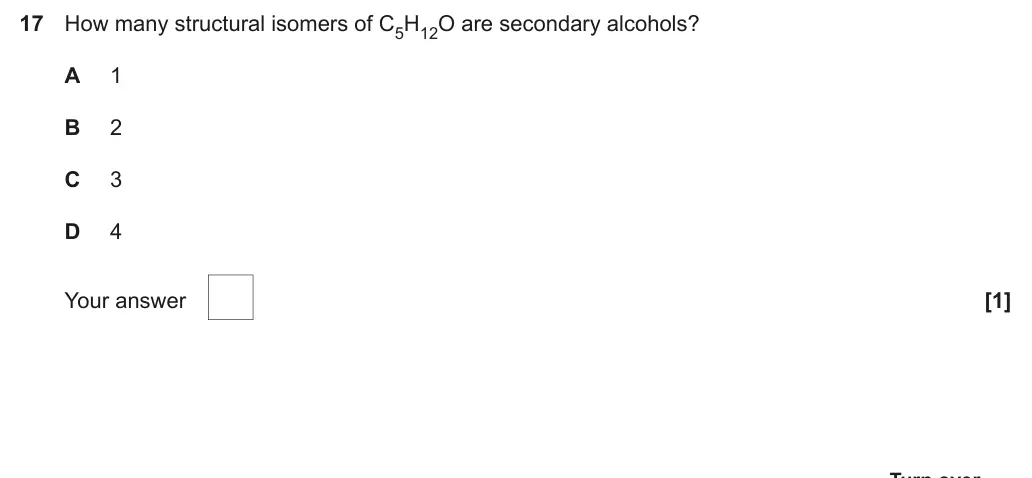
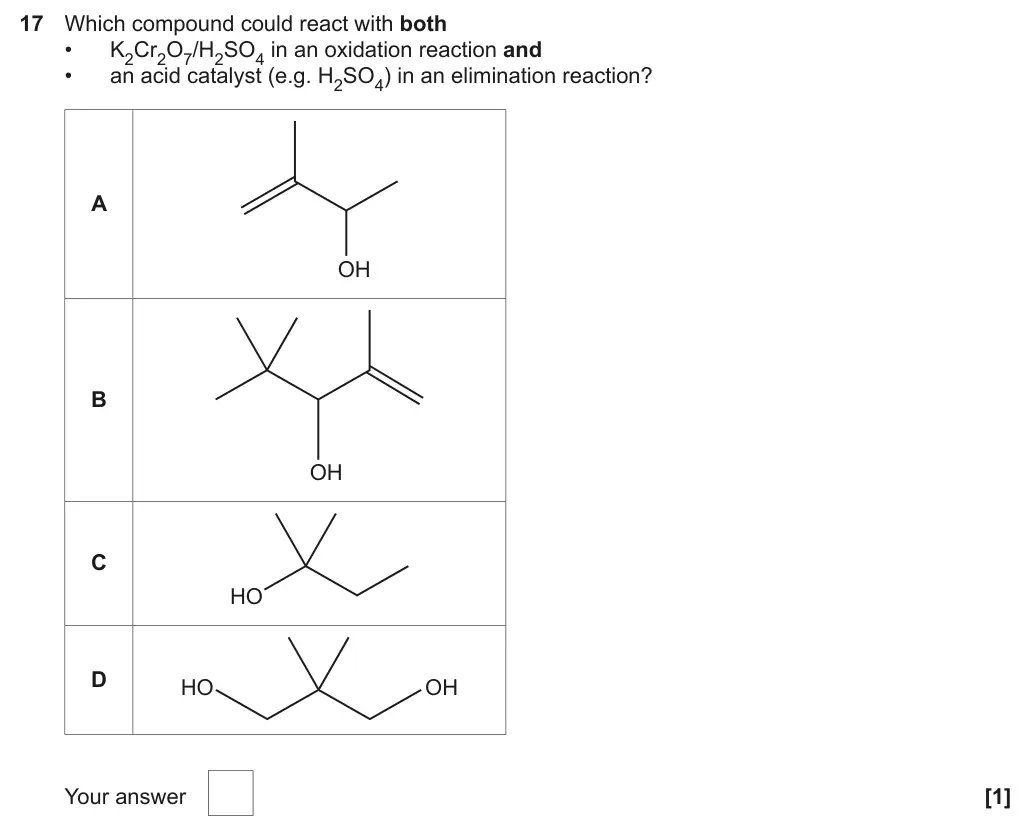
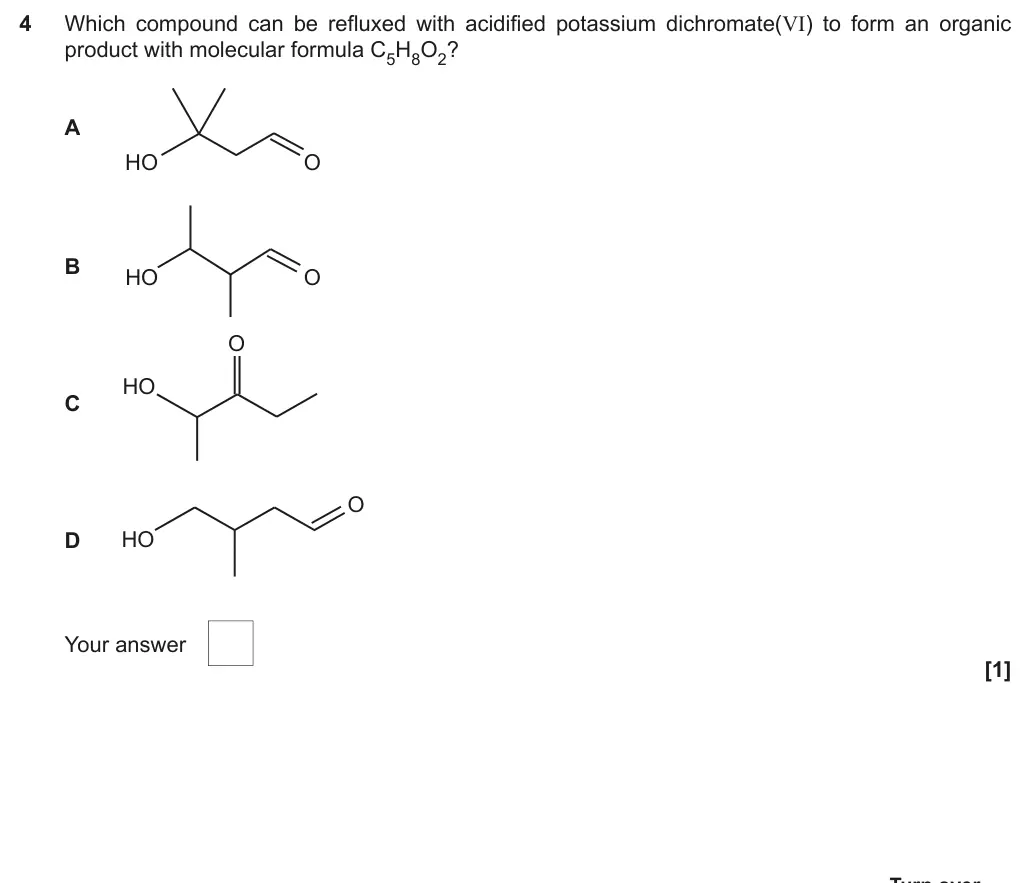
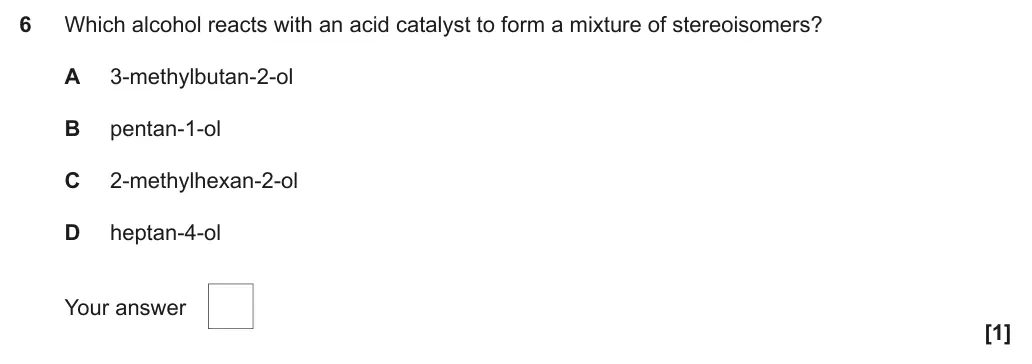
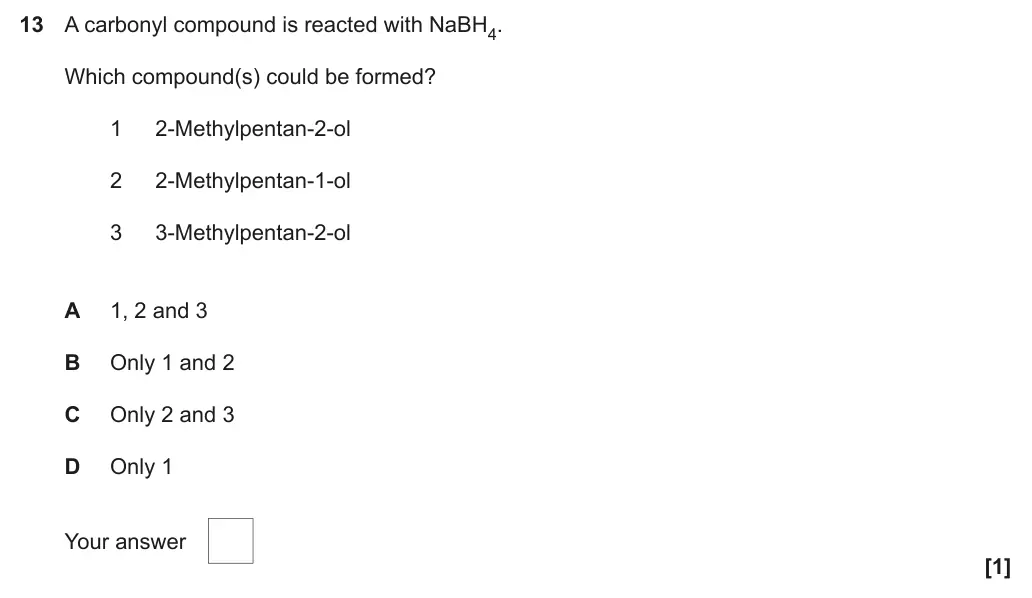
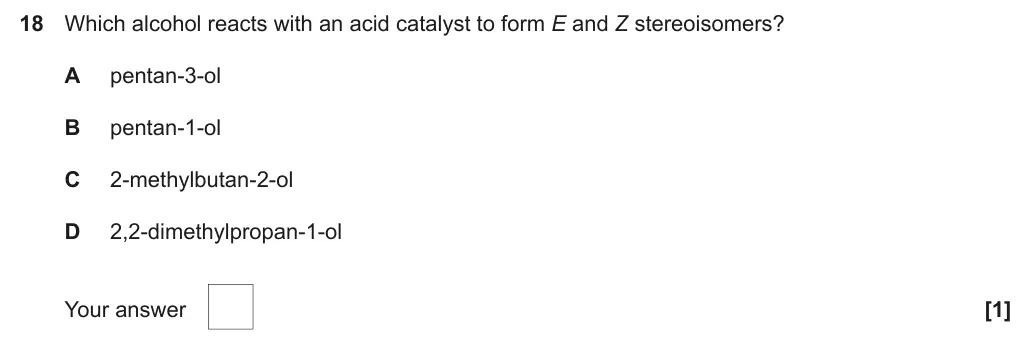
June 2025 · AS Paper 1 · Q171 markMultiple choiceMedium
Answer
C
Mark scheme
Examiner's comment
More than half of candidates gained this mark. However, the question did not discriminate very well, suggesting that some candidates may have guessed. Students should be encouraged to draw structures out as working – those who did often gave the correct response.
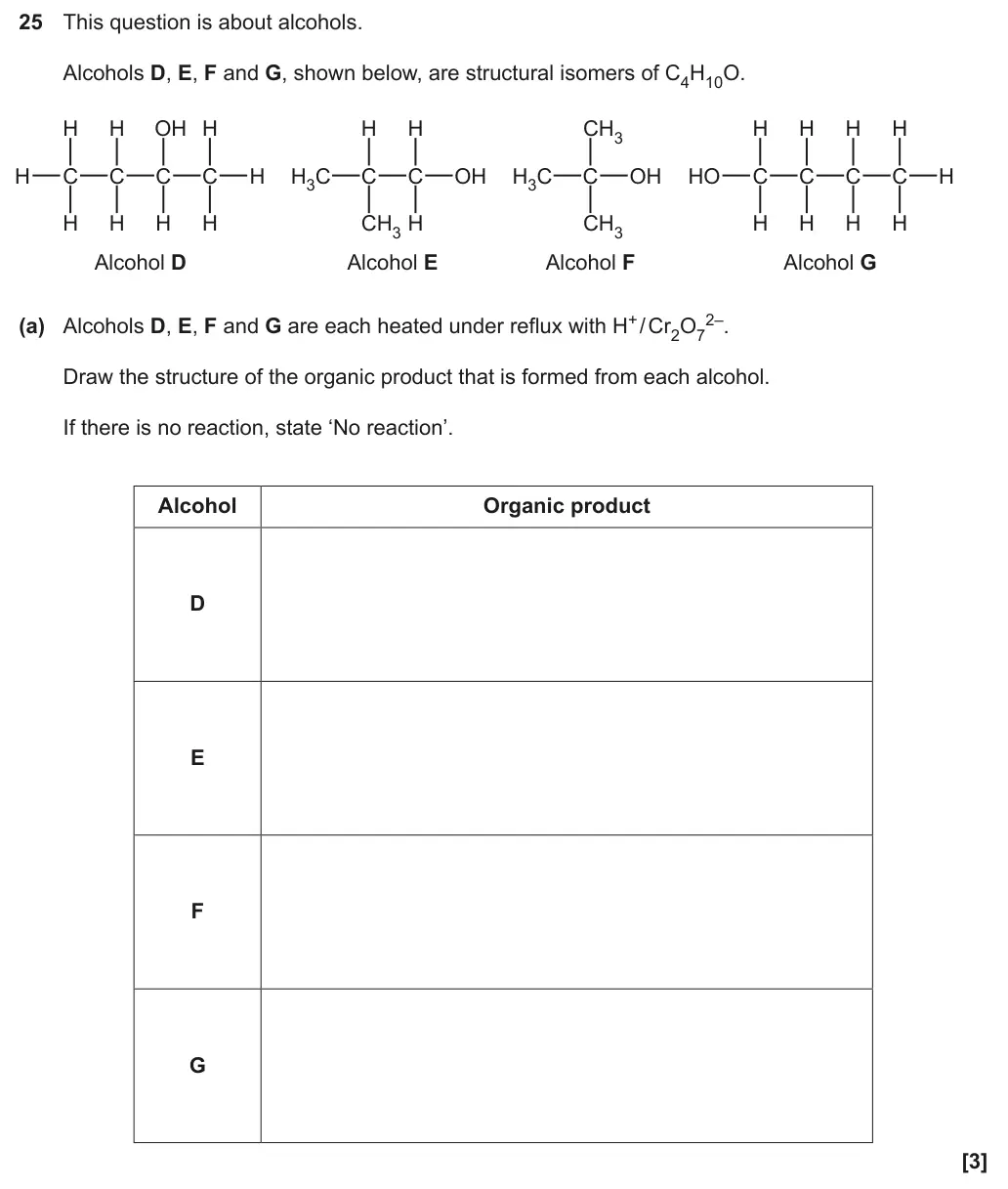
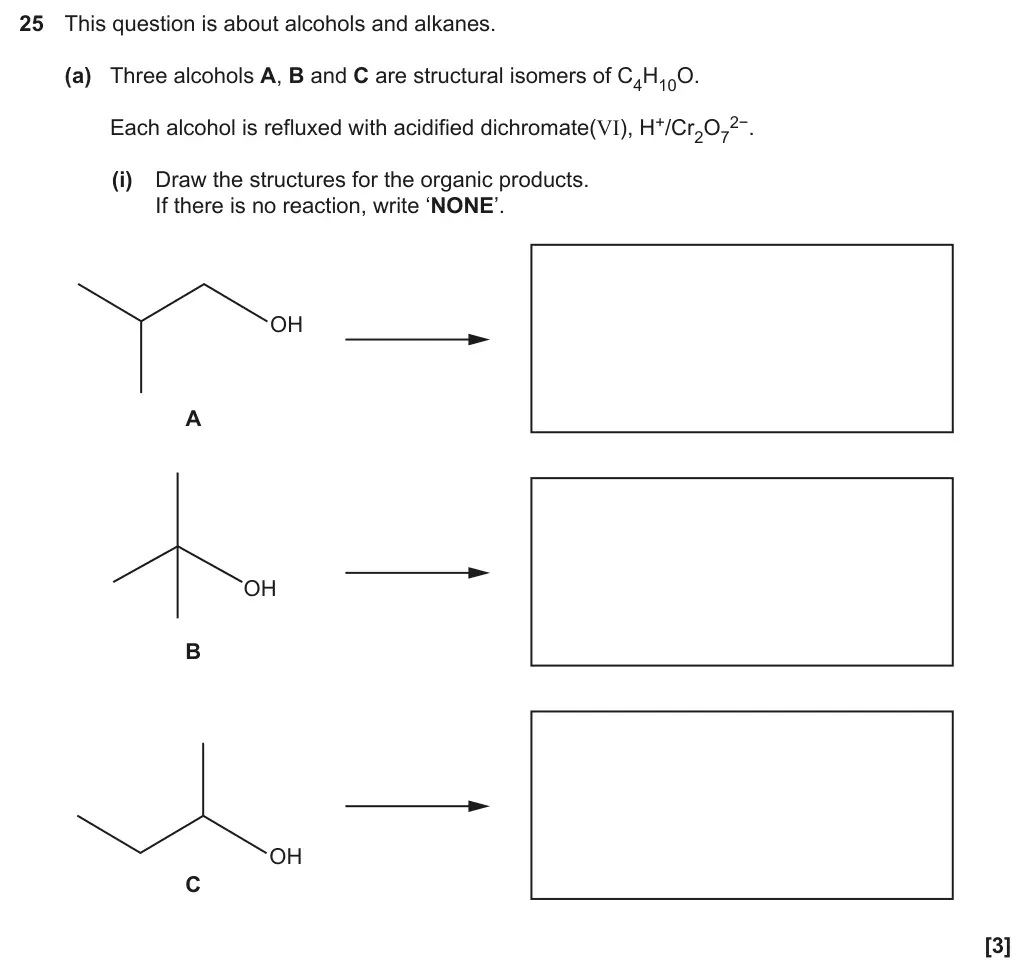
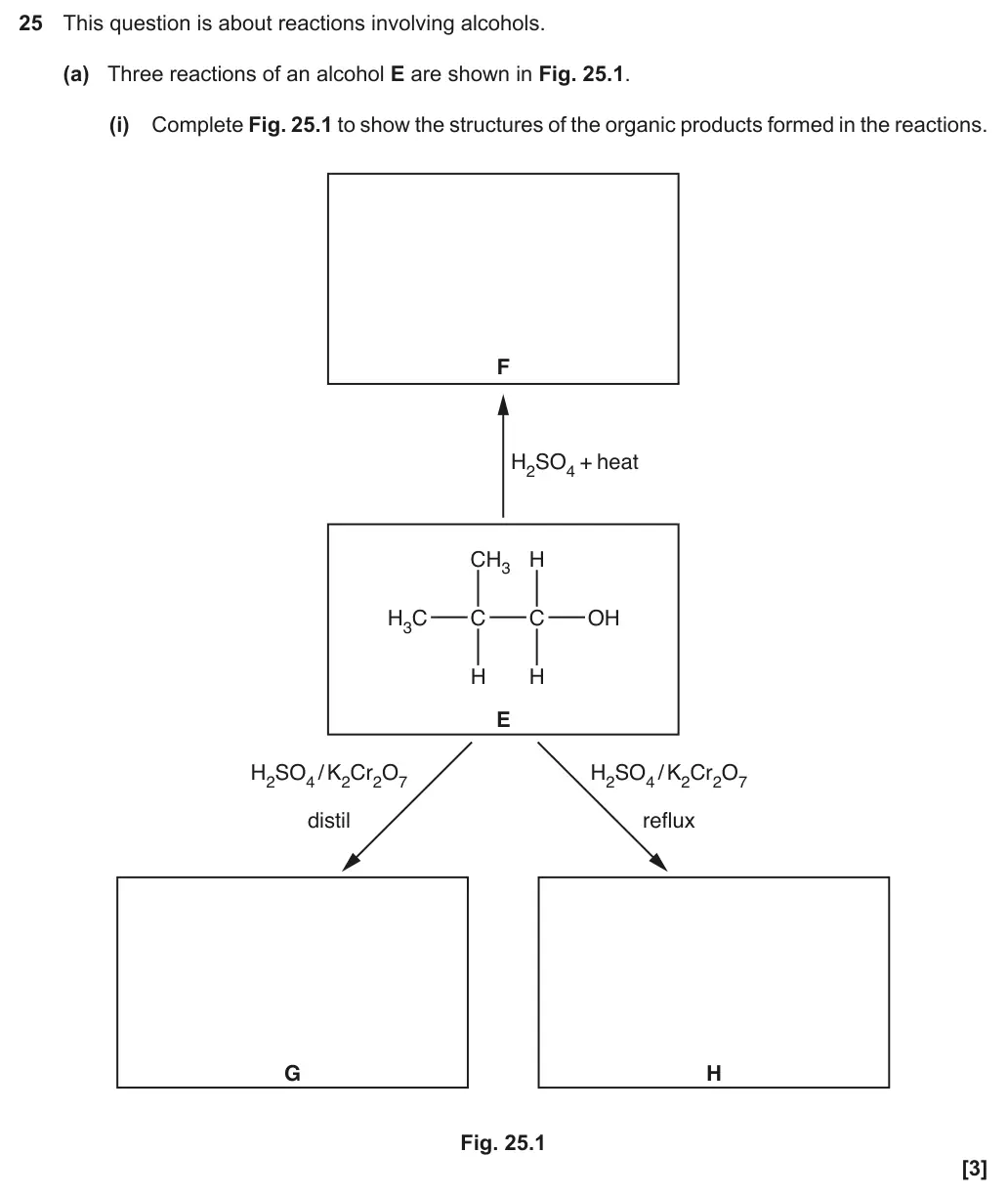
June 2025 · AS Paper 1 · Q25(a)3 marksStructure / isomerMedium
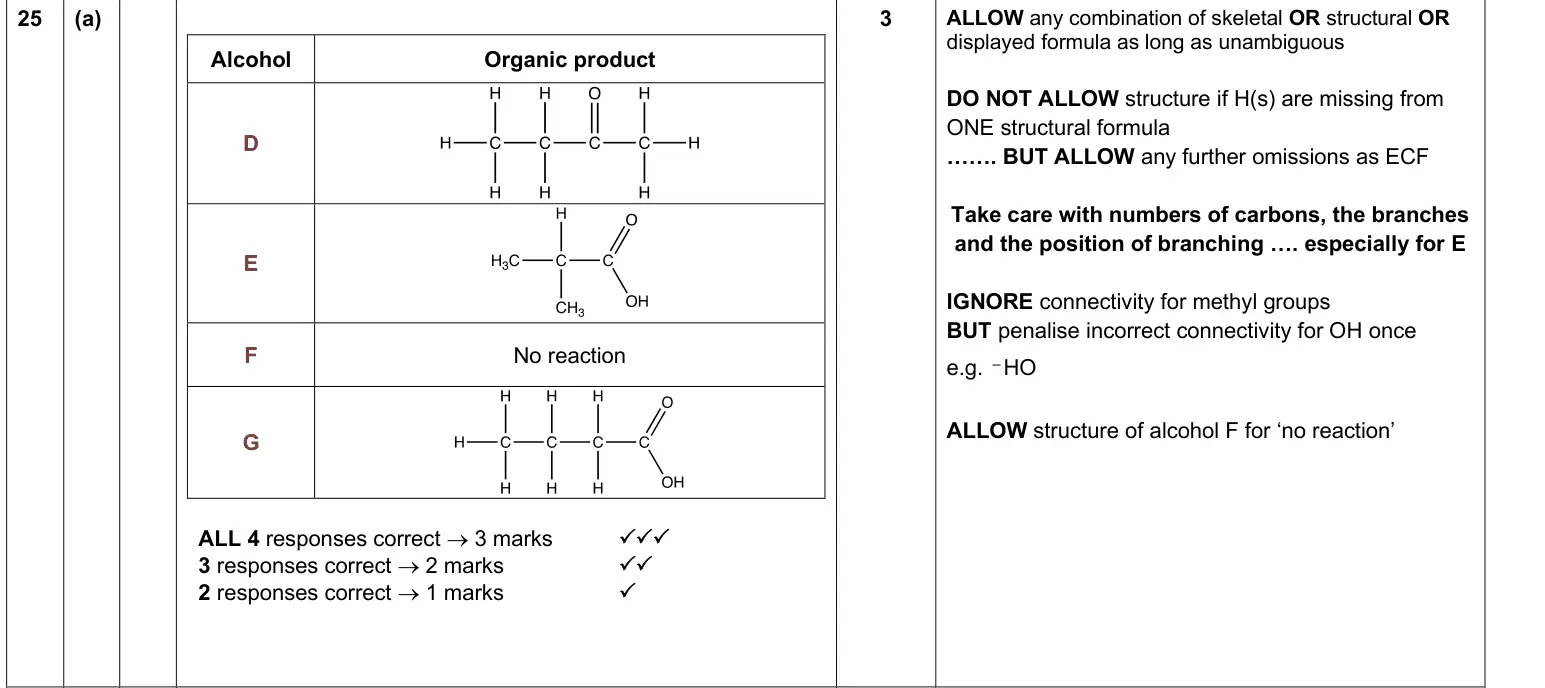
Mark scheme
Examiner's comment
The majority of candidates scored 2 or 3 marks on this question. Occasionally some gave carbonyl structures for E and G failing to recognise that full oxidation would take place. Other errors were additional H atoms (especially on the carbonyl carbon for D) or too many carbon atoms for E. A more common error was incorrect connectivity for the OH group especially in the carboxylic acid from alcohol G. This question was a good discriminator. Question 25 (b Just under half of candidates scored this with a wide range of incorrect responses. Most candidates did not appreciate that in order to form two isomeric alkenes a secondary alcohol was necessary, so that water could be eliminated from either side of the OH group.
Notes from the mark scheme and report
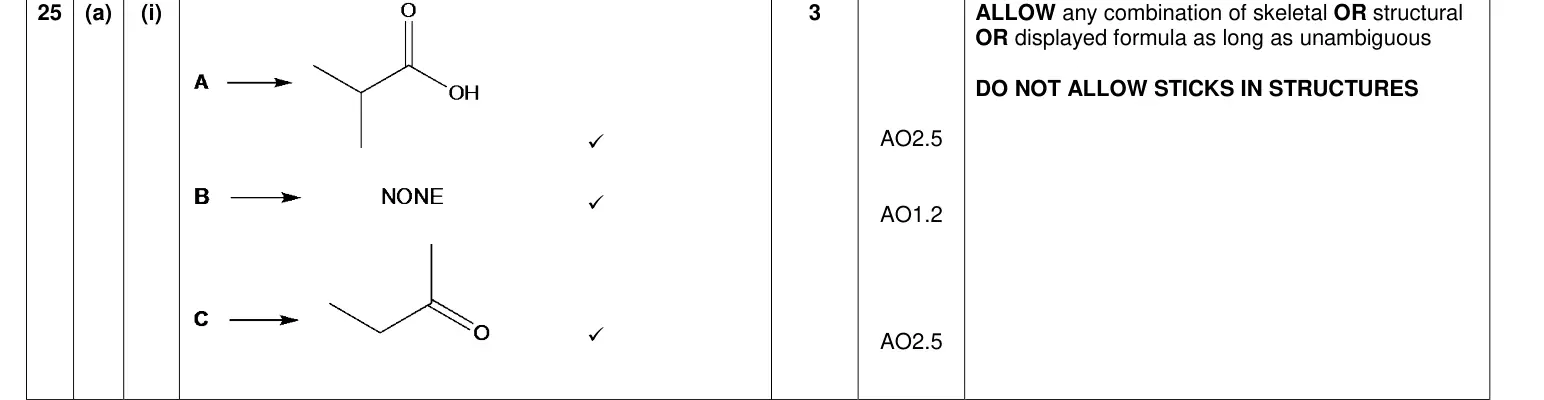
reflux so primary alcohols E and G give carboxylic acids
D gives the ketone
F (tertiary) no reaction
take care with branching for E
penalise –HO connectivity once
June 2025 · AS Paper 1 · Q25(b)1 markStructure / isomerMedium
Earlier part of question 25 that this part uses
Mark scheme
Examiner's comment
ocr.org.uk/science Oxford Cambridge and RSA CHEMISTRY A OCR Level 3 Advanced Subsidiary GCE in Chemistry A H032 For first teaching in 2015 Examiners’ report Version 1 H032/01 Summer 2025 series AS LEVEL Contents Contents ................................................................................................................................................... 2 Introduction .............................................................................................................................................. 4 Paper 1 series overview ........................................................................................................................... 5 Section A overview ................................................................................................................................... 6 Question 1 ............................................................................................................................................ 6 Question 2 ............................................................................................................................................ 7 Question 3 ............................................................................................................................................ 7 Question 4 ............................................................................................................................................ 8 Question 5 ............................................................................................................................................ 8 Question 6 ............................................................................................................................................ 9 Question 7 ............................................................................................................................................ 9 Question 8 .......................................................................................................................................... 10 Question 9 .......................................................................................................................................... 10 Question 10 ........................................................................................................................................ 11 Question 11 ........................................................................................................................................ 11 Question 12 ........................................................................................................................................ 12 Question 13 ........................................................................................................................................ 12 Question 14 ........................................................................................................................................ 13 Question 15 ........................................................................................................................................ 14 Question 16 ........................................................................................................................................ 15 Question 17 ........................................................................................................................................ 15 Question 18 ........................................................................................................................................ 16 Question 19 ........................................................................................................................................ 16 Question 20 ........................................................................................................................................ 17 Section B overview ................................................................................................................................. 18 Question 21 (a) ................................................................................................................................... 18 Question 21 (b) ................................................................................................................................... 19 Question 21 (c) ................................................................................................................................... 20 Question 21 (d) (i) ............................................................................................................................... 21 Question 21 (d) (ii) .............................................................................................................................. 23 Question 22 (a) .................................................................................................................................. 24 Question 22 (b) (i) .............................................................................................................................. 25 Question 22 (b) (ii) ............................................................................................................................. 25 Question 22 (c) ................................................................................................................................... 26 Question 23 (a) .................................................................................................................................. 27 Question 23 (b) ................................................................................................................................... 28 Question 23 (c) .................................................................................................................................. 29 Question 24 (a) (i) ............................................................................................................................... 30 Question 24 (a) (ii) .............................................................................................................................. 30 Question 24 (b) .................................................................................................................................. 31 Question 24 (c) (i) ............................................................................................................................... 32 Question 24 (c) (ii) .............................................................................................................................. 33 Question 25 (a) .................................................................................................................................. 34 Question 25 (b .................................................................................................................................... 35 Question 25 (c) ................................................................................................................................... 36 Introduction Our examiners’ reports are produced to offer constructive feedback on candidates’ performance in the examinations. Question 25 (b Just under half of candidates scored this with a wide range of incorrect responses.
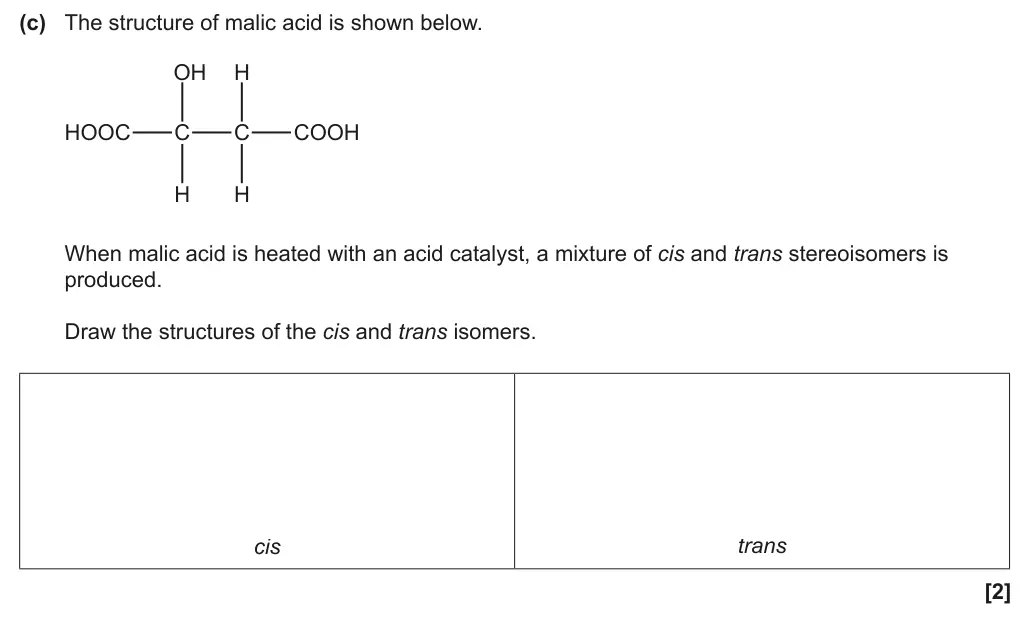
June 2025 · AS Paper 2 · Q3(c)2 marksStructure / isomerMedium
Earlier part of question 3 that this part uses
Mark scheme
Examiner's comment
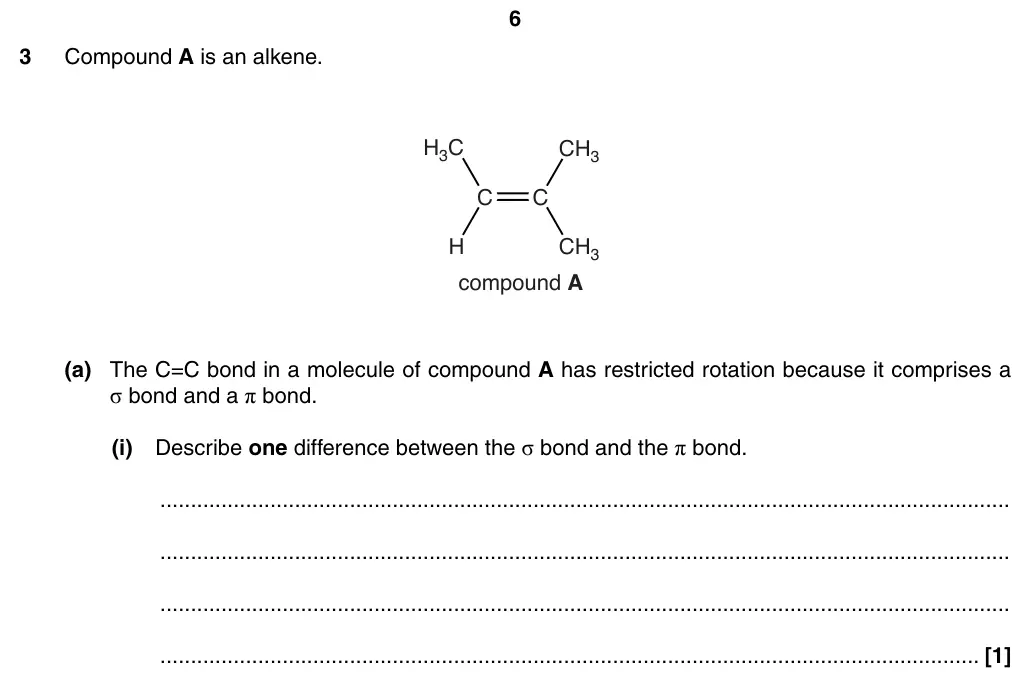
Approximately half of the candidates did not score any marks for this question. Many left the OH group on the alkenes formed i.e. removed H2 rather than H2O. Some attempted to draw cis/trans isomers with structures with no C=C in them. Some drew any alkene, e.g. but-2-ene, to show cis/trans, but this was not given here. Common reasons for scoring 1 mark included the isomers being the wrong way round or poor connectivity to -COOH groups.
Notes from the mark scheme and report
dehydration gives HOOCCH=CHCOOH
one mark if both stereoisomers shown in wrong columns
DO NOT ALLOW incorrect connectivity to COOH (first occasion only)
Skills: M4.2 Visualise and represent 2-D and 3-D forms including 2-D representations of 3-D objects
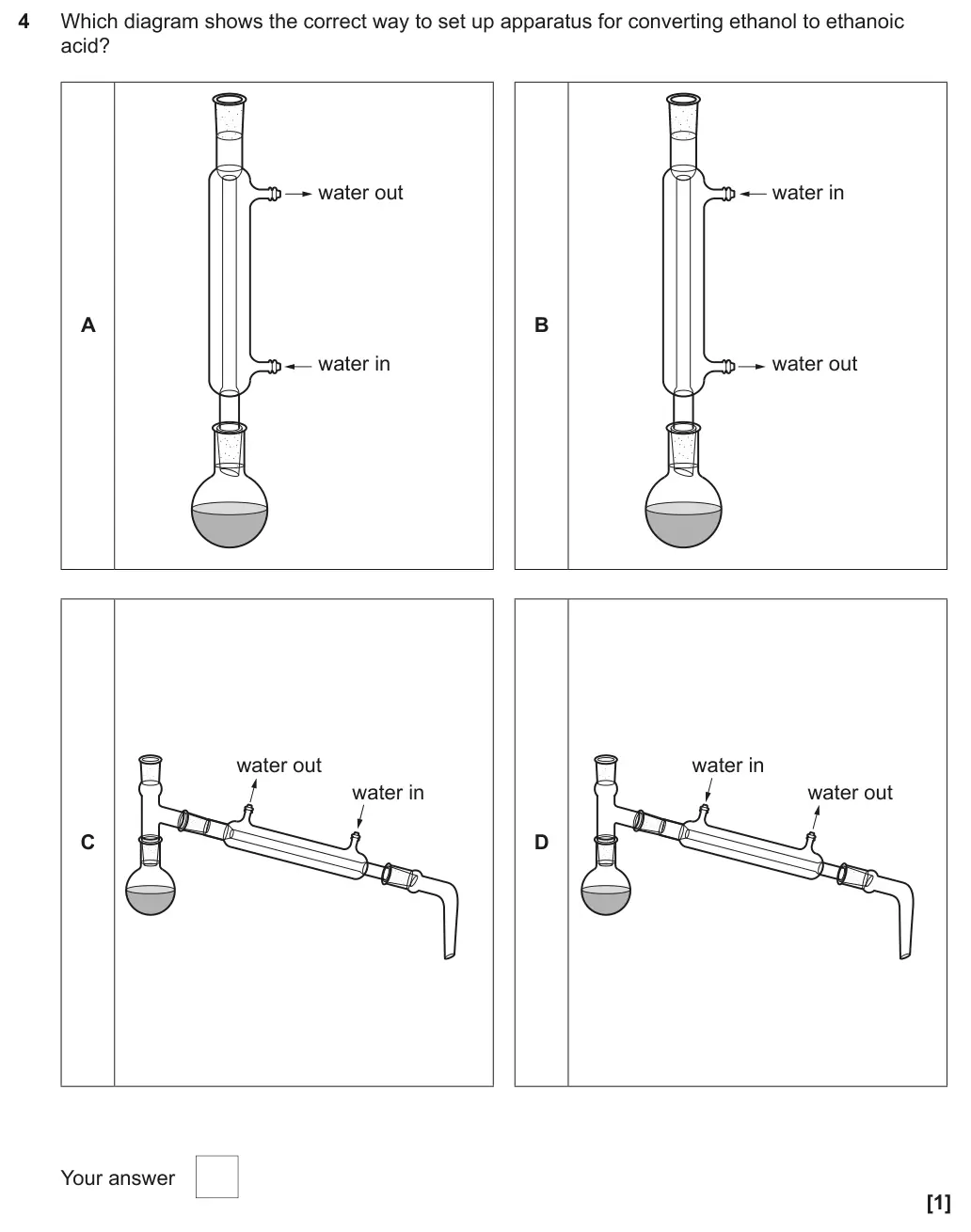
June 2025 · Paper 2 · Q41 markMultiple choiceMedium
Answer
A
Mark scheme
Examiner's comment
The majority of candidates were able to recognise that reflux should be used for this reaction and selected A with the correct water flow through the condenser. The most common incorrect response was C using distillation but a few selected B or D with the incorrect water flow.
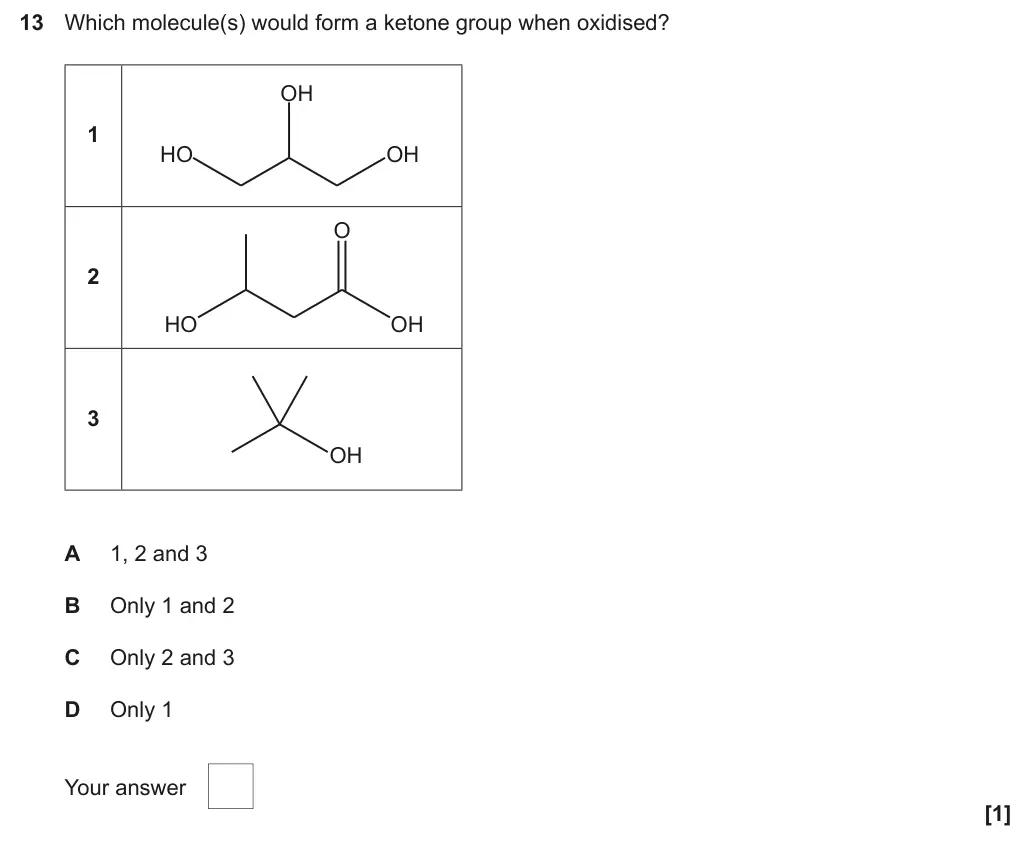
June 2025 · Paper 2 · Q131 markMultiple choiceMedium
Answer
B
Mark scheme
Examiner's comment
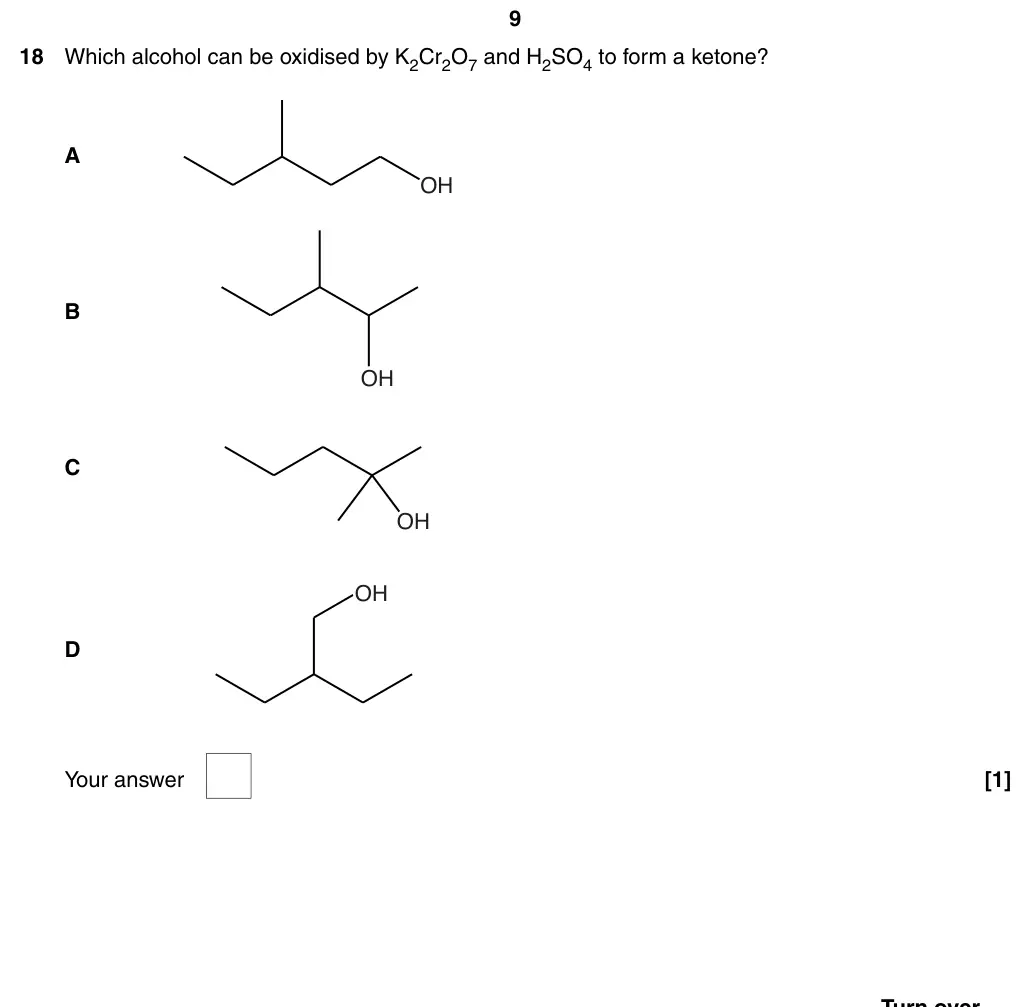
Most gave the correct response, B. The most common incorrect answer was D, where candidates recognised that structure 1 would form a ketone group, but not 2, as they had not spotted the secondary alcohol.
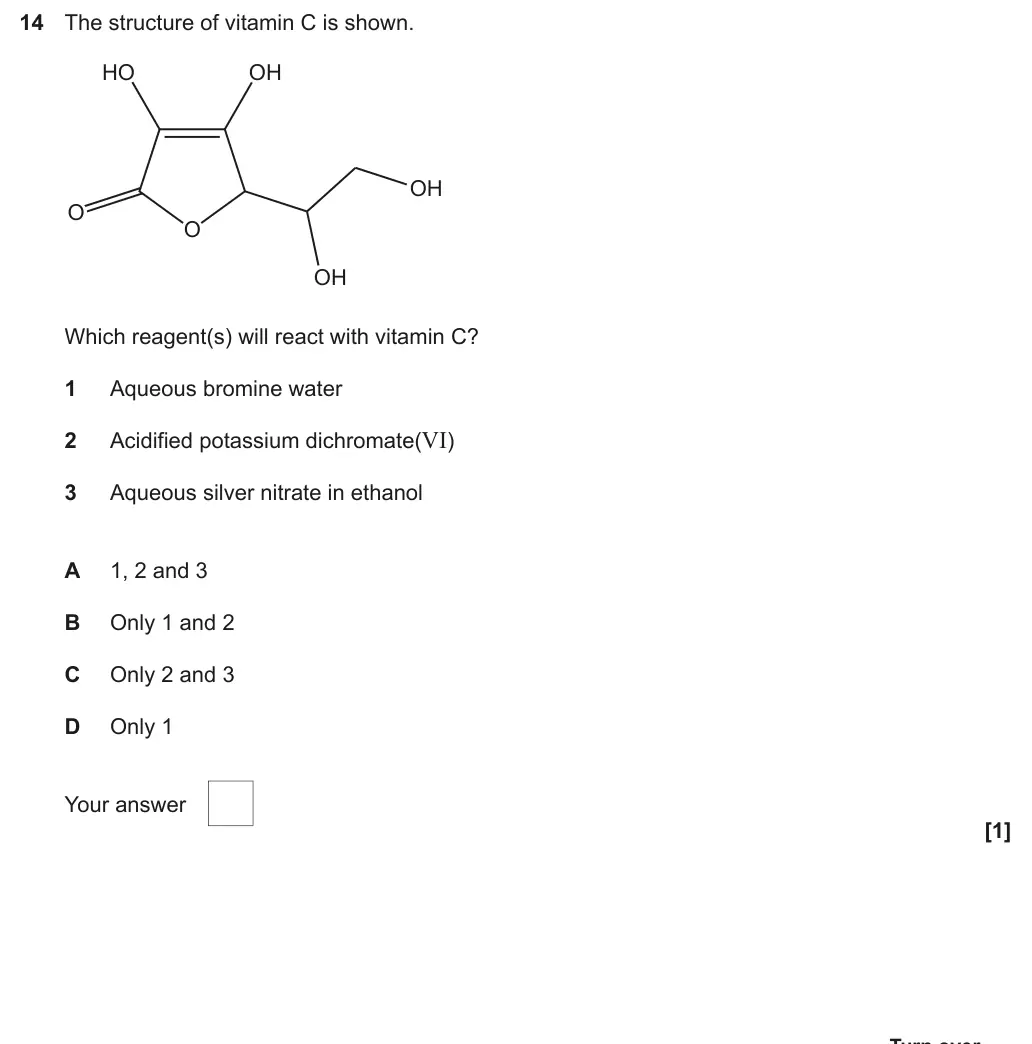
June 2025 · Paper 2 · Q141 markMultiple choiceMedium
Answer
B
Mark scheme
Examiner's comment
The majority of candidates gave the correct response, B. The most common incorrect answer was A, indicating that silver nitrate would also react with this molecule.
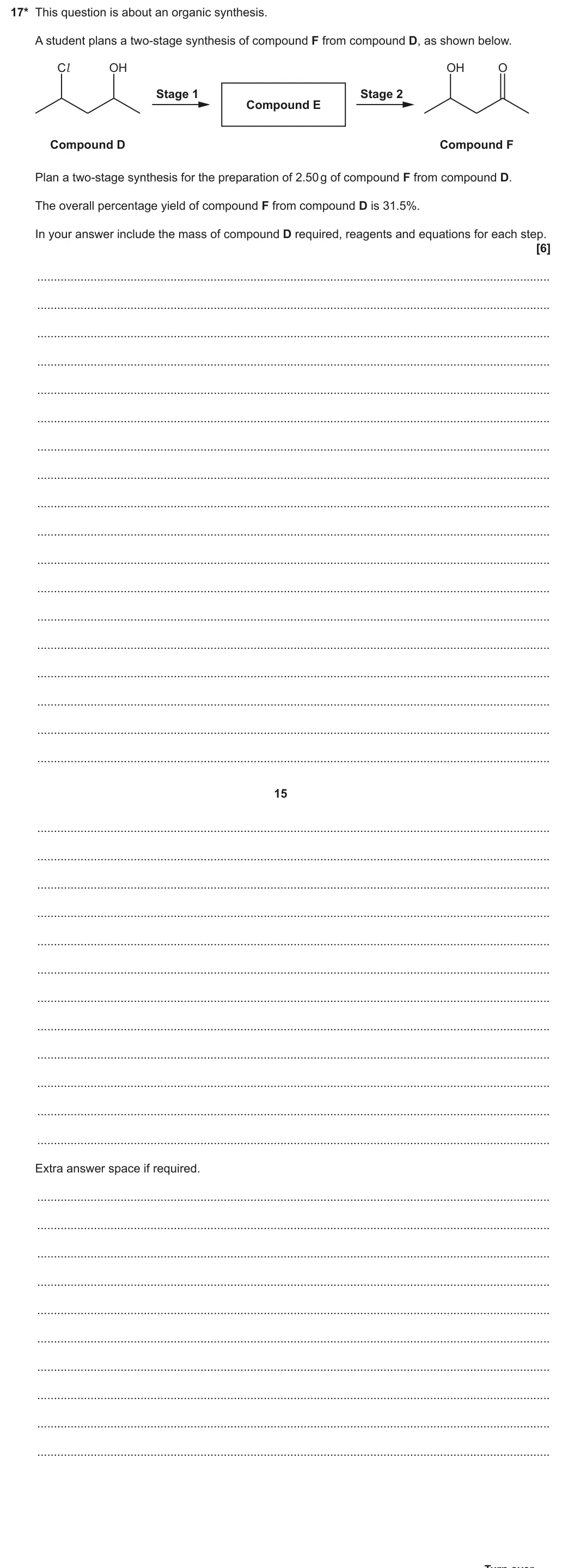
June 2025 · Paper 2 · Q176 marks6-mark level of responseMedium
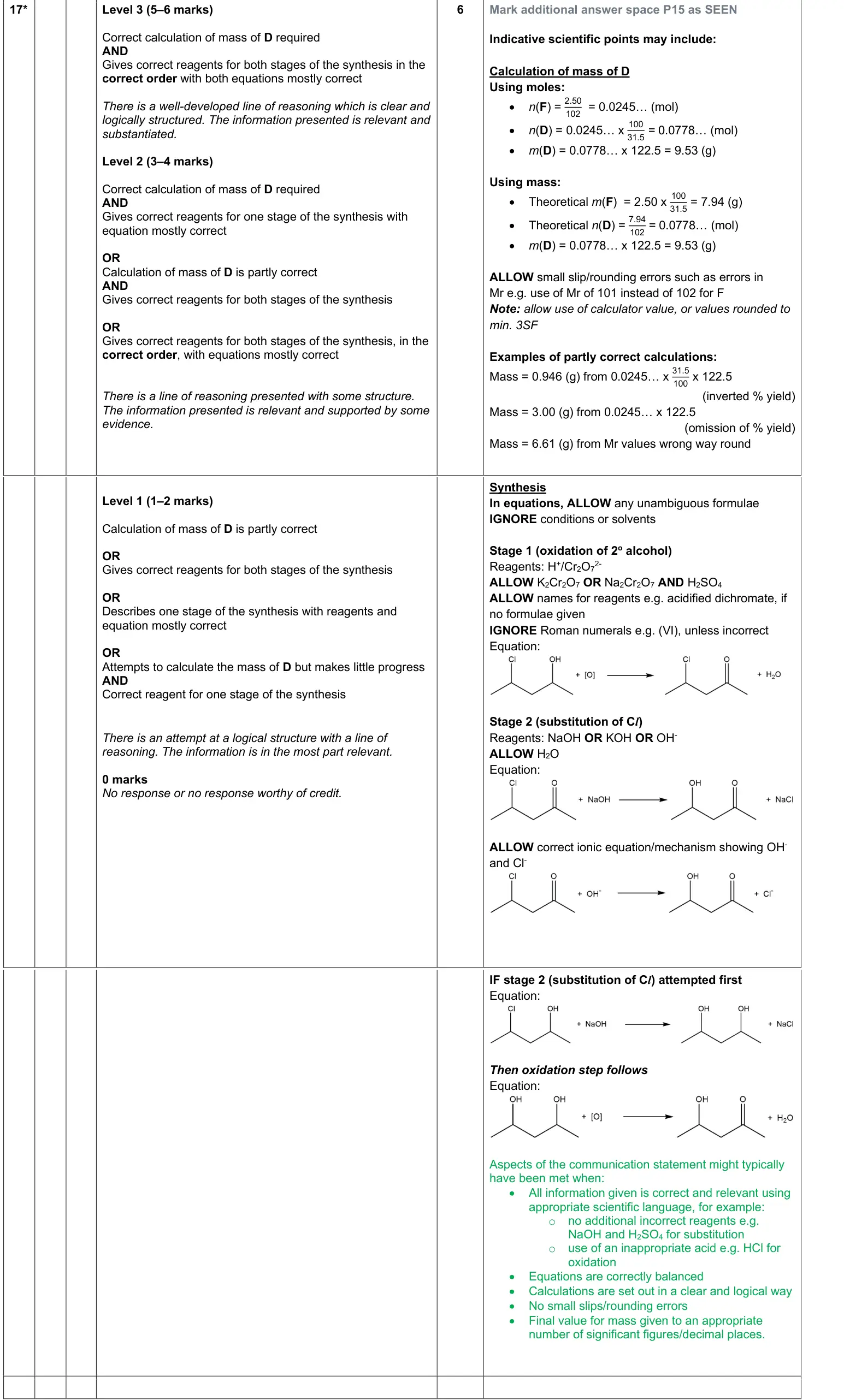
Mark scheme, with the levels and indicative points
Examiner's comment
Generally, this question was well answered with most candidates achieving Level 3. Many candidates knew the correct reagents to use to carry out the two-stage synthesis. Some missed out on Level 3 as they had the steps in the wrong order. It was essential to carry out the oxidation prior to substitution otherwise both -OH groups would be oxidised. A significant number struggled with the calculation of the mass of compound D required. Many gave the answer as 7.94g so had only considered the yield, not the difference in molar mass of F compared to D. Other common errors seen in the calculation included errors in Mr values, missing or inverted percentage yield, as well as intermediate rounding of values to two significant figures. Level 2 could still be achieved without the calculation if they had the correct reagents in the correct order with equations mostly correct. To be mostly correct we required them to have at least one of the inorganic reactants or products given. Communication marks were lost if there were errors in reactants or products as well as balancing of equations. Students using skeletal structures generally made fewer mistakes with the balanced equation than those using structural formulae, where additional Hs were inserted alongside the ketone group i.e. CH3CHClCH2CHOCH3. Lower attaining students attempted to write the H+/K2Cr2O7 in the balanced equation and didn’t know to represent this with [O]. Other common errors in balancing the oxidation equation included missing H₂O or using 2[O]. A common error was to see H2SO4 as a ‘catalyst’ added with NaOH in the substitution reaction – this additional and unnecessary reagent lost candidates the communication mark. This response achieved Level 3 and all 6 marks. The calculation is laid out clearly showing both Mr values used in the calculation. Showing the values used in each step makes it much easier to spot where any errors may have been made if the correct value is not obtained. The reagents for each stage are given and the reactions are carried out in the correct order. The equations are given and are correctly balanced. This was an excellent response.
Notes from the mark scheme and report
m(D) = 9.53 g (0.946 g inverted yield, 3.00 g yield omitted are partly correct)
oxidation with H+/Cr2O7 2– using [O] then substitution of Cl with NaOH(aq)
IGNORE conditions
inappropriate acid (HCl) or extra reagents limit communication
Skills: M0.2 Use ratios, fractions and percentages; M1.1 Use an appropriate number of significant figures; M2.2 Change the subject of an equation; M2.3 Substitute numerical values into algebraic equations using appropriate units for physical quantities
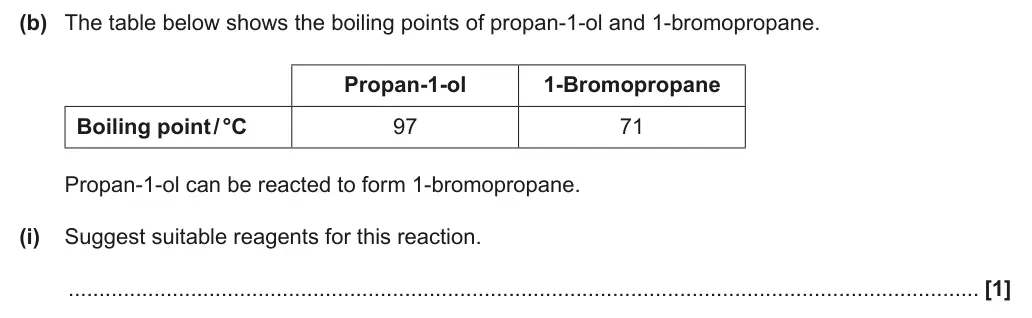
June 2025 · Paper 2 · Q19(b)(i)1 markShort answerEasy
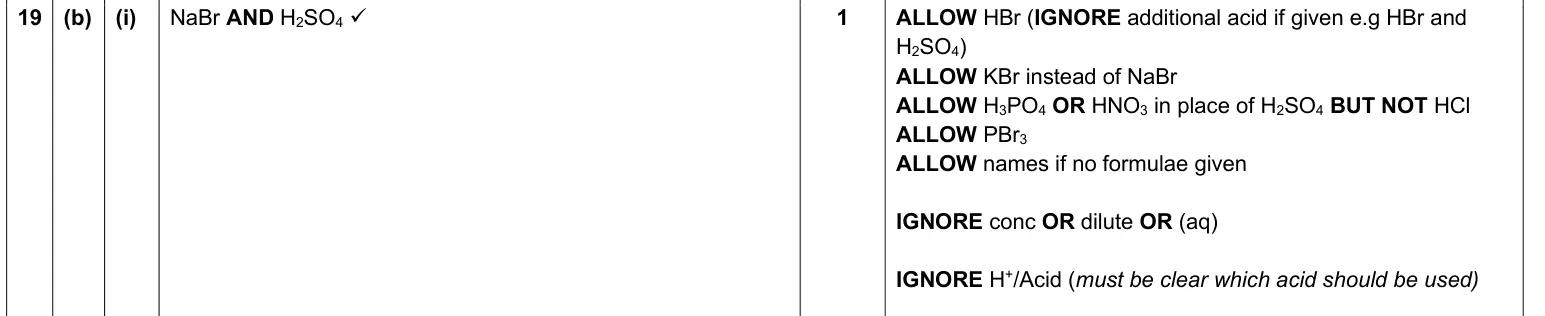
Mark scheme
Examiner's comment
This question was well answered by most candidates. Incorrect responses often gave just the salt, NaBr, without the acid. Most common errors seen: • KBr or NaBr without acid • NaX or sodium halide without specifying that it is bromide needed here • Br2 • Using H+ without specifying which acid to use (need to be specific as HCl would be inappropriate).
Notes from the mark scheme and report
NaBr AND H2SO4 (ALLOW HBr, KBr, H3PO4, PBr3)
NOT HCl
IGNORE H+/acid (must specify the acid)
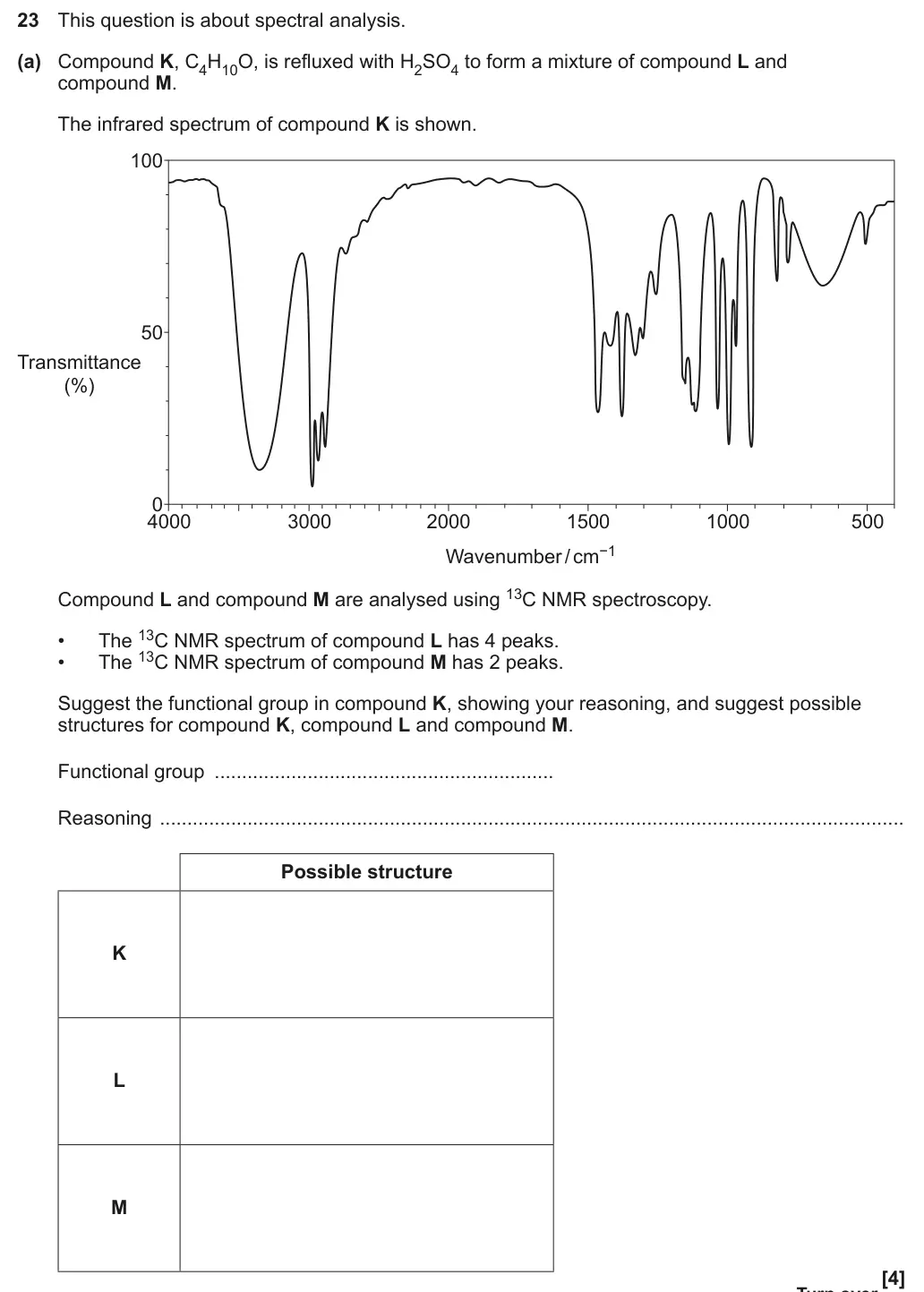
June 2025 · Paper 2 · Q23(a)4 marksShort answerHard
Mark scheme
Examiner's comment
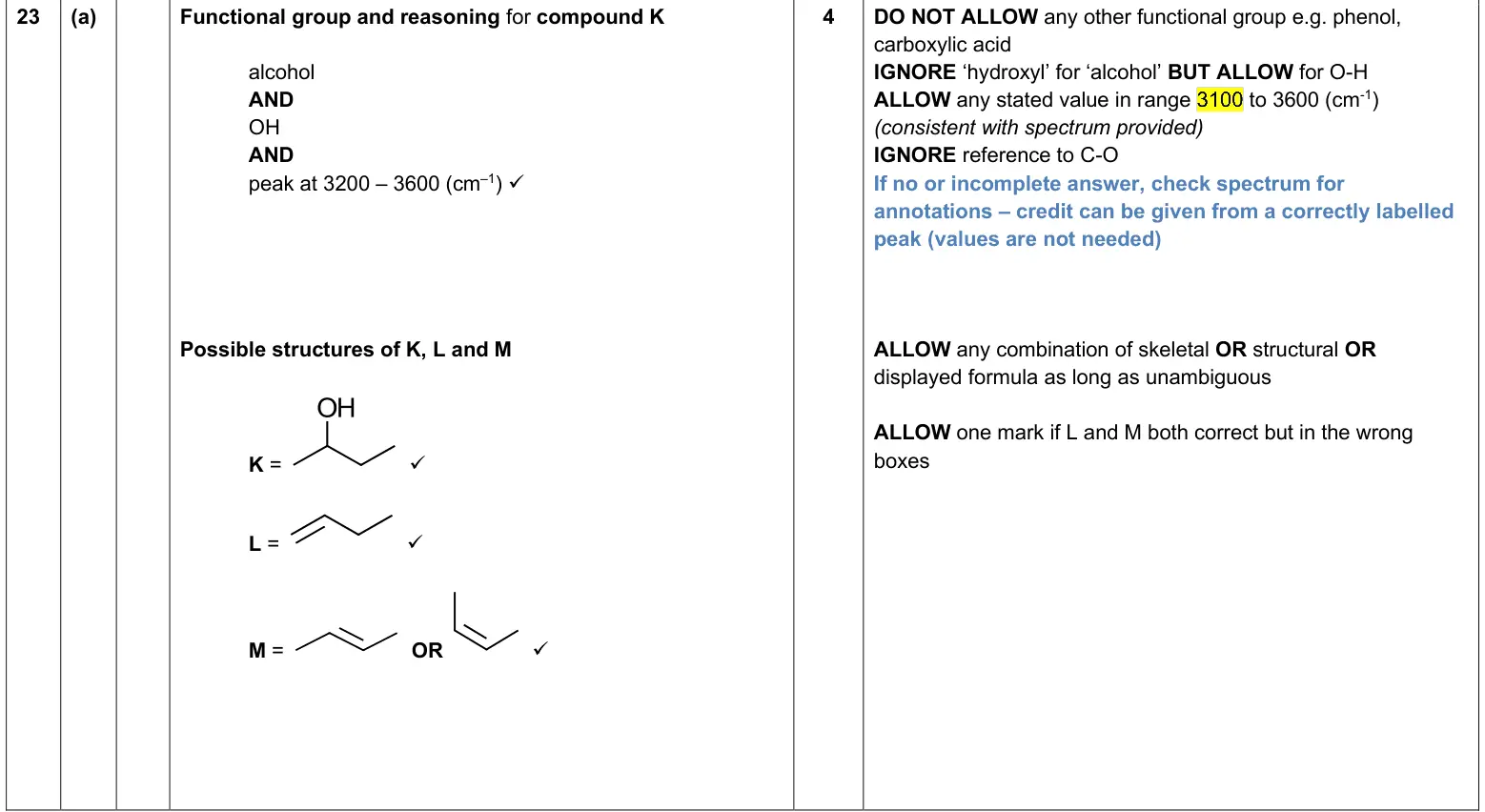
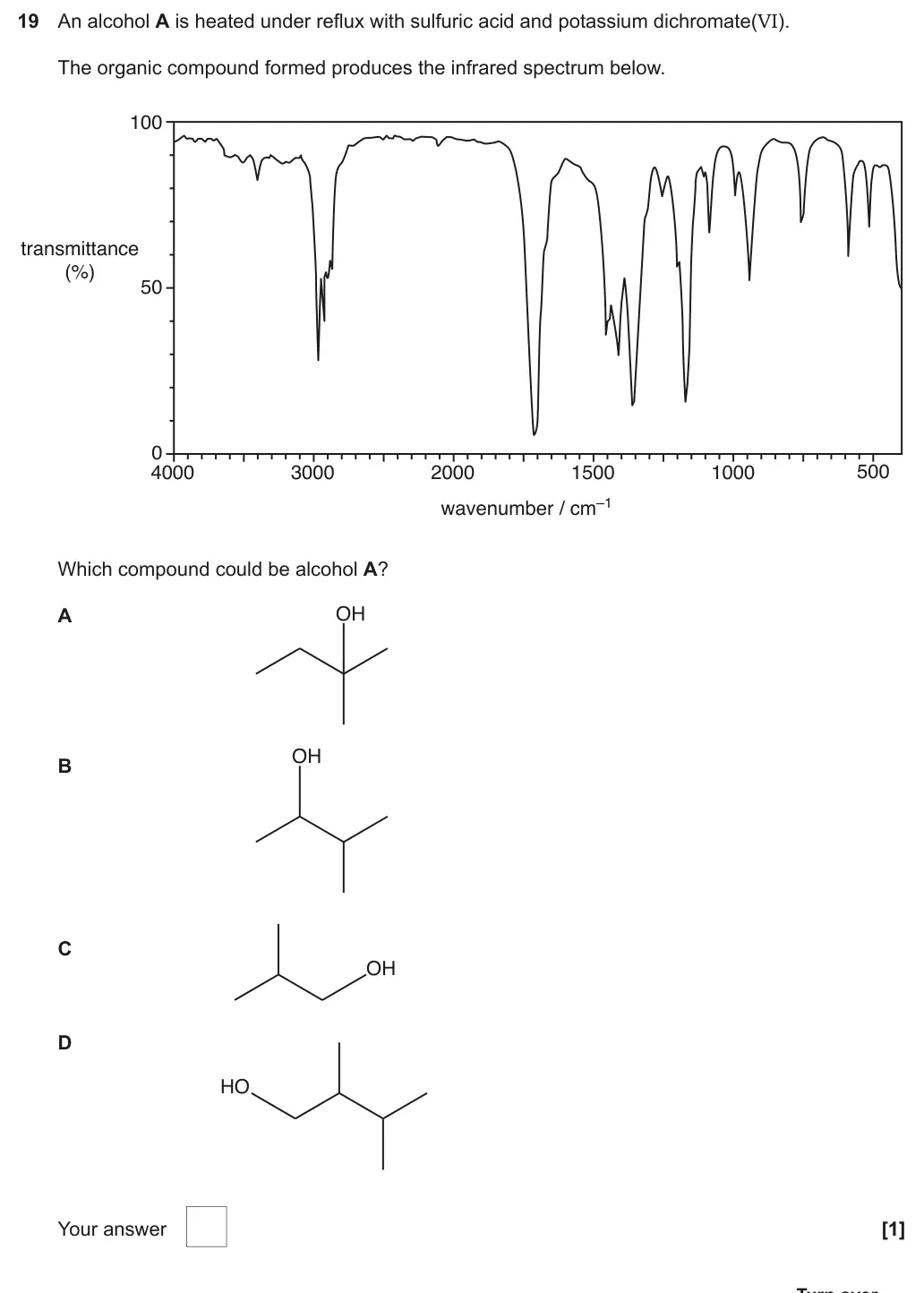
Very few candidates scored all 4 marks. The mark for identifying the alcohol functional group due to the presence of O-H bond in IR between 3200-3600 cm-1 was often lost for missing information. O-H or OH or hydroxy alone was not accepted as OH groups can be found within other functional groups i.e. phenol and carboxylic acid. Equally, it was important to identify the correct bond from the IR spectrum; in this case, O-H gives the most definitive answer. Other bonds are present, e.g. C-H and C-O but do not tell us that it is an alcohol. A few misinterpreted the ‘reasoning’ question stem and said alcohols would have the correct general formula to fit C4H10O or that alcohols could be dehydrated to make different alkenes, which is correct, but confirmation needed to come from the IR provided in the question. Many candidates gave a primary alcohol, butan-1-ol, as K. It appears many candidates focused on the fact that K was refluxed with H2SO4 and assumed this was oxidation, despite there being no K2Cr2O7, giving L and M as aldehydes, ketones or carboxylic acids. Some just gave alcohols with different structural formula for the alcohol for L and M, attempting to use the 13C NMR data. A significant proportion of candidates did not gain any marks on this question.
Notes from the mark scheme and report
alcohol AND O–H AND peak at 3200–3600 cm–1 (DO NOT ALLOW phenol/carboxylic acid
IGNORE C–O)
K = butan-2-ol, L = but-1-ene, M = but-2-ene (E or Z)
1 mark if L and M correct but in wrong boxes
Skills: M3.1 Translate information between graphical, numerical and algebraic forms
June 2024 · AS Paper 1 · Q25(a)2 marksComplete table/diagramMedium
Mark scheme
Examiner's comment
Most candidates identified the correct products of this combustion as CO2 and H2O. The second mark was available for a balanced equation but many balanced O2 with an 8 rather than with 7½. Candidates need to be very careful when writing equations for the combustion of alcohols as it is easy to miss the O atom within the alcohol formula.
Notes from the mark scheme and report
C5H12O + 7½O2 → 5CO2 + 6H2O
ALLOW multiples
Skills: M0.2 Use ratios, fractions and percentages
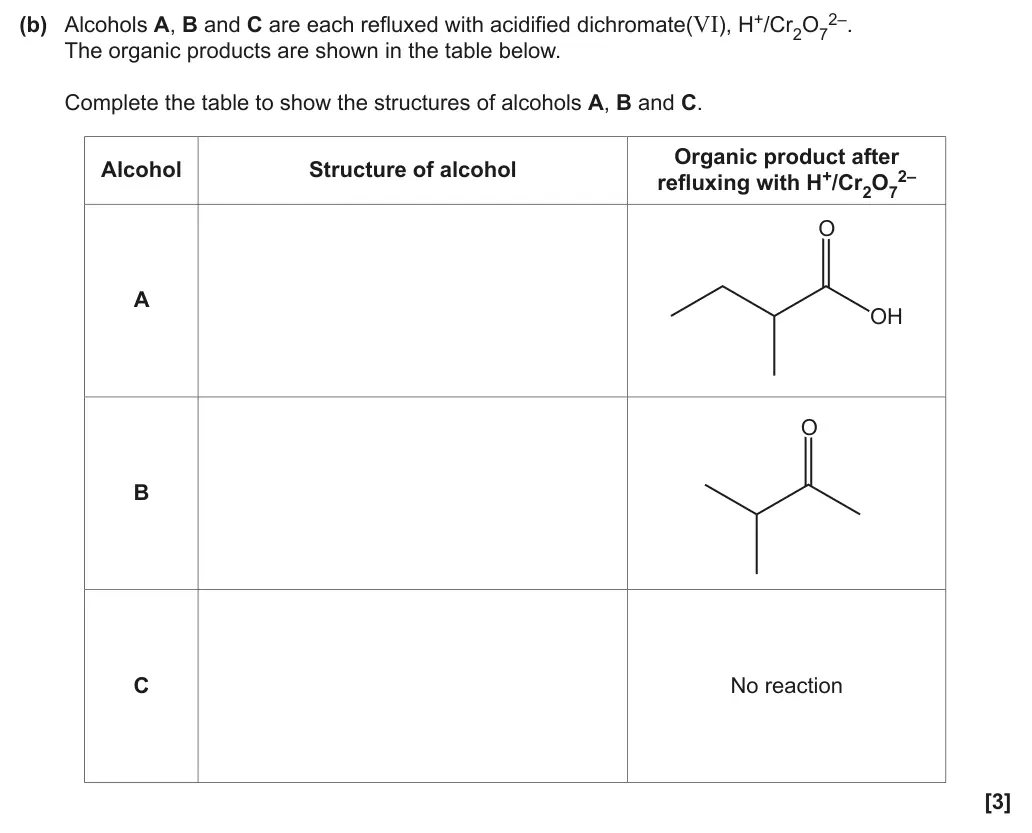
June 2024 · AS Paper 1 · Q25(b)3 marksComplete table/diagramEasy
Mark scheme
Examiner's comment
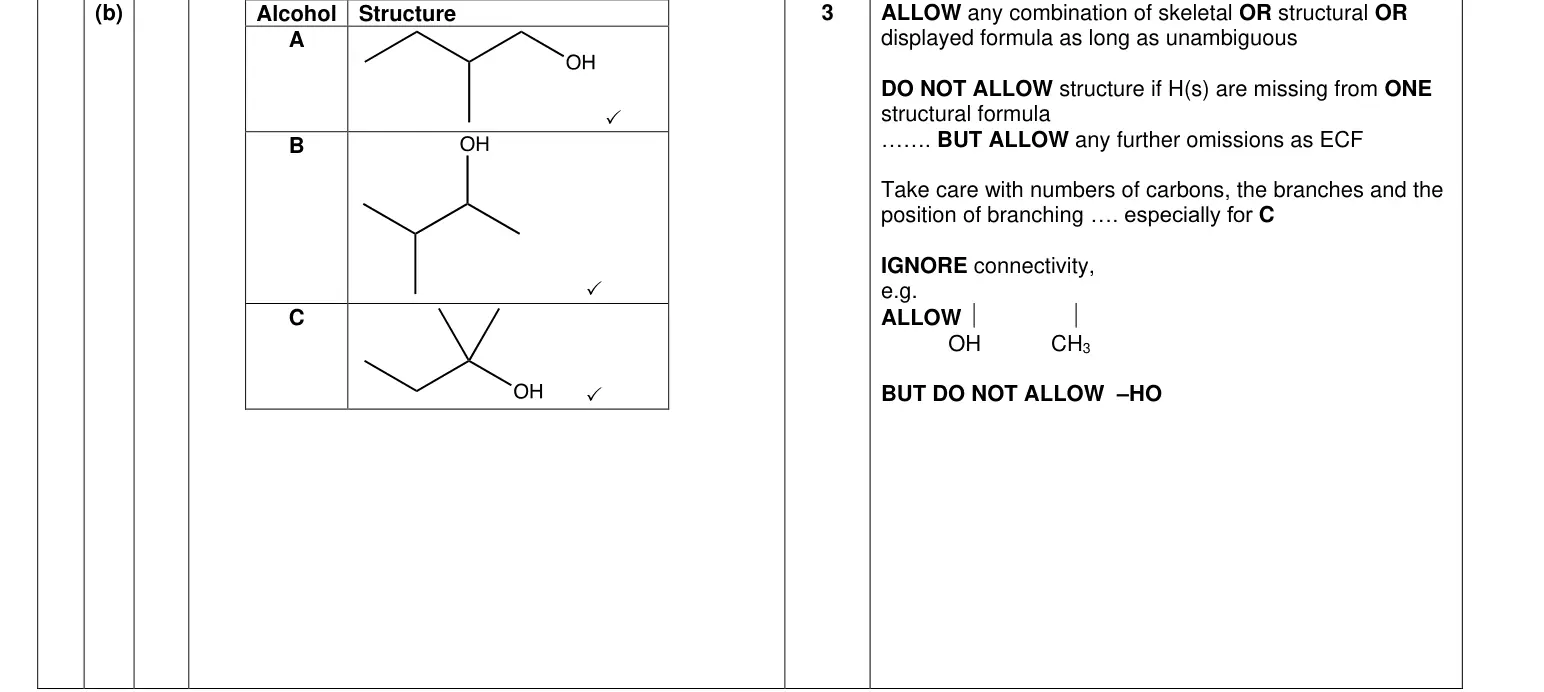
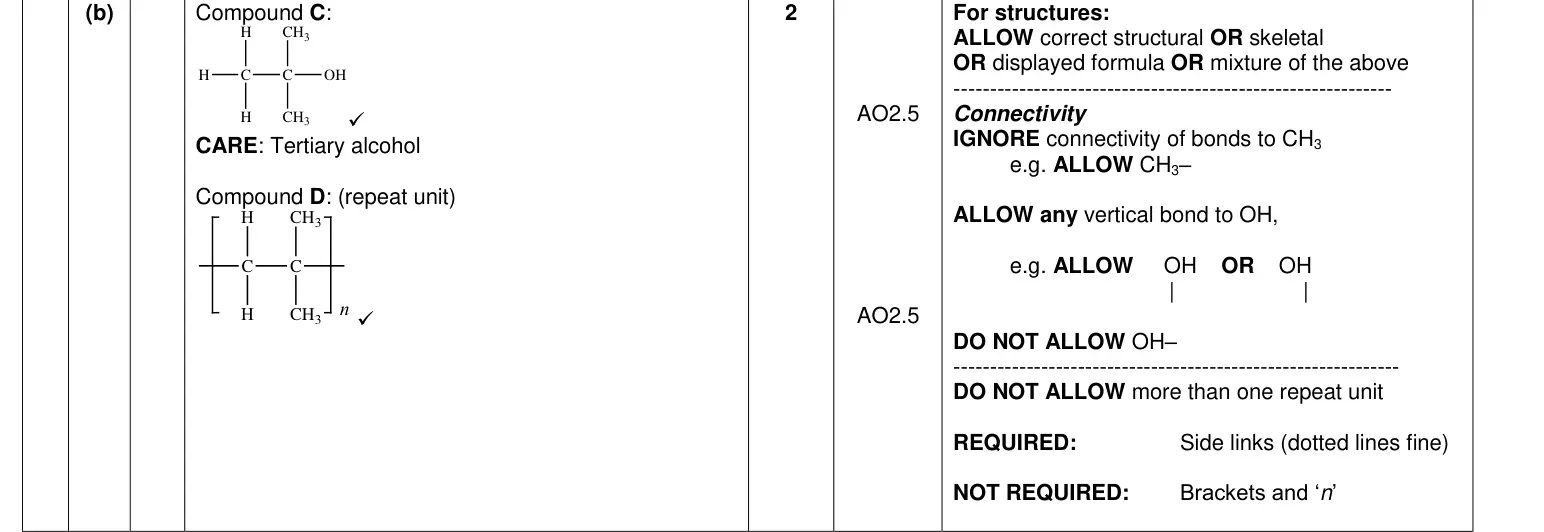
This question appeared to be straightforward, but many candidates got into a muddle when drawing the alcohol structures. The best tactic is to copy the carbon skeletal and to then add the functional group. Many candidates drew displayed formulae and these often contained too many carbon atoms or missing H atoms. Great care is needed in drawing organic structures. Structure C must be a tertiary alcohol, but the candidate has drawn the structure of a secondary alcohol. It should be noted that, even with a correct carbon skeleton, structure A would be rejected. Incorrect connectivity of the OH group is always penalised.
Notes from the mark scheme and report
A = 2-methylbutan-1-ol, B = 3-methylbutan-2-ol, C = 2-methylbutan-2-ol
DO NOT ALLOW structure with missing H(s)
DO NOT ALLOW –HO connectivity
Skills: M4.2 Visualise and represent 2-D and 3-D forms including 2-D representations of 3-D objects
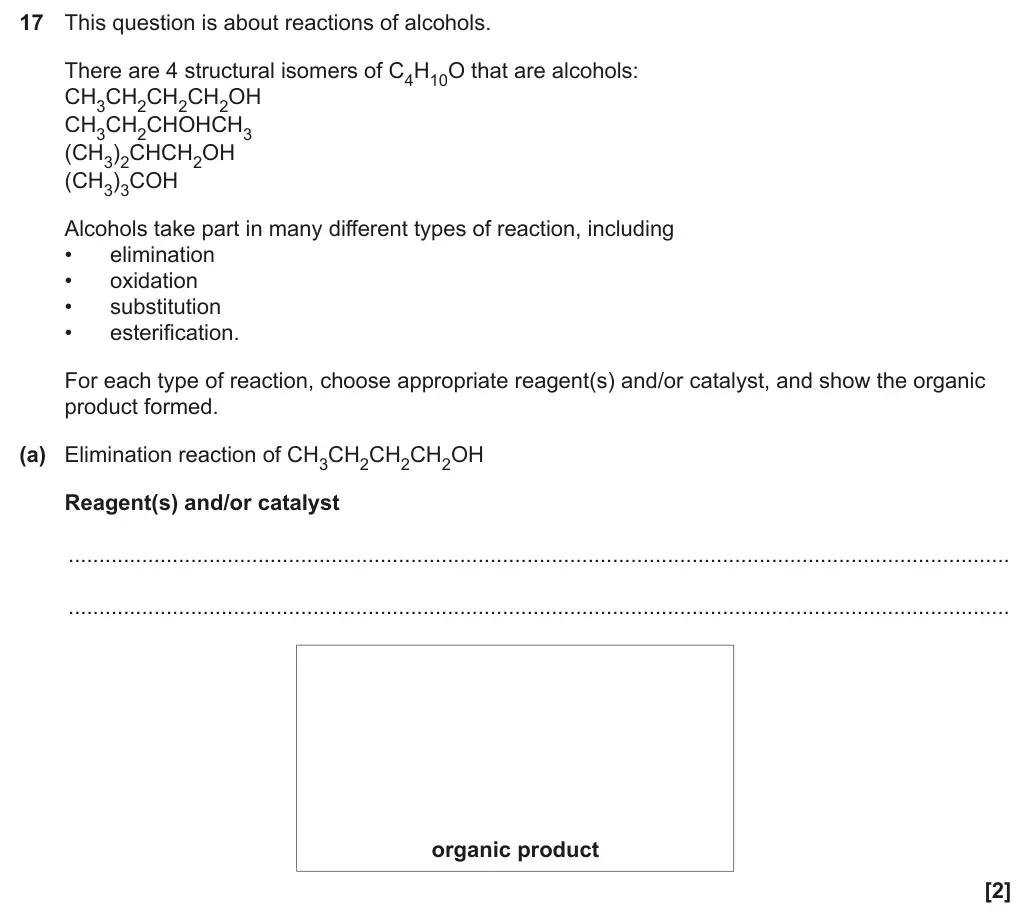
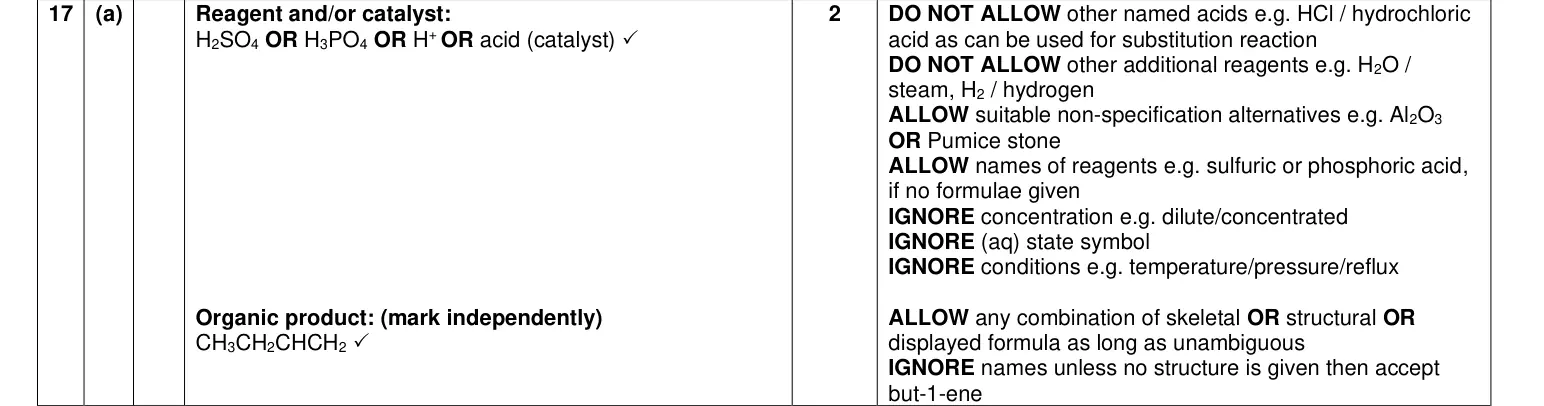
June 2024 · Paper 2 · Q17(a)2 marksShort answerMedium
Mark scheme
Examiner's comment
More than half scored both marks here. Common reasons for losing marks included adding water or steam as a reagent, using an incorrect chain length (5 carbons not 4 carbons), missing or adding hydrogens on the structure, e.g. CH3CH2CH2=CH2 or giving butane as the product.
Notes from the mark scheme and report
acid catalyst H2SO4/H3PO4
DO NOT ALLOW HCl (substitution) or additional reagents such as steam
but-1-ene
marks independent
Useful synthetic route maps for the whole specification, both with and without reagents, can be found on Teach Cambridge.
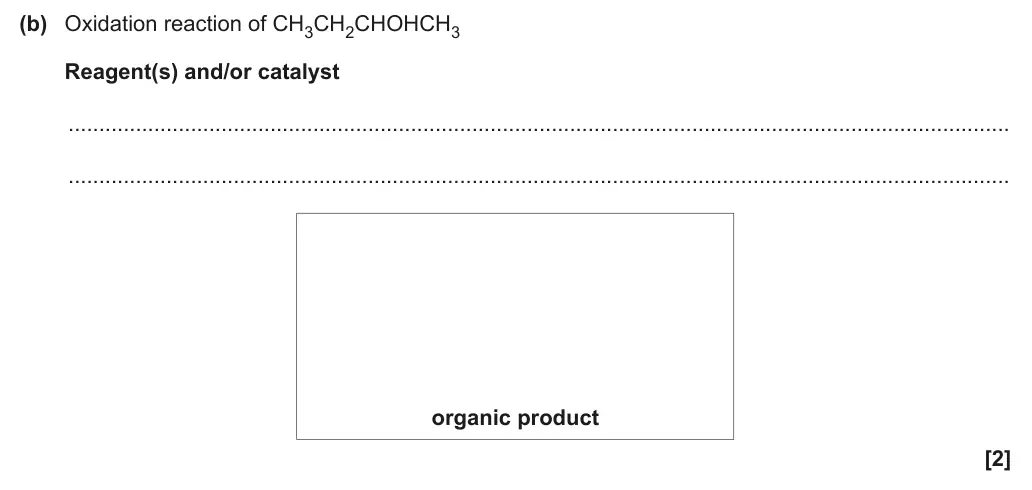
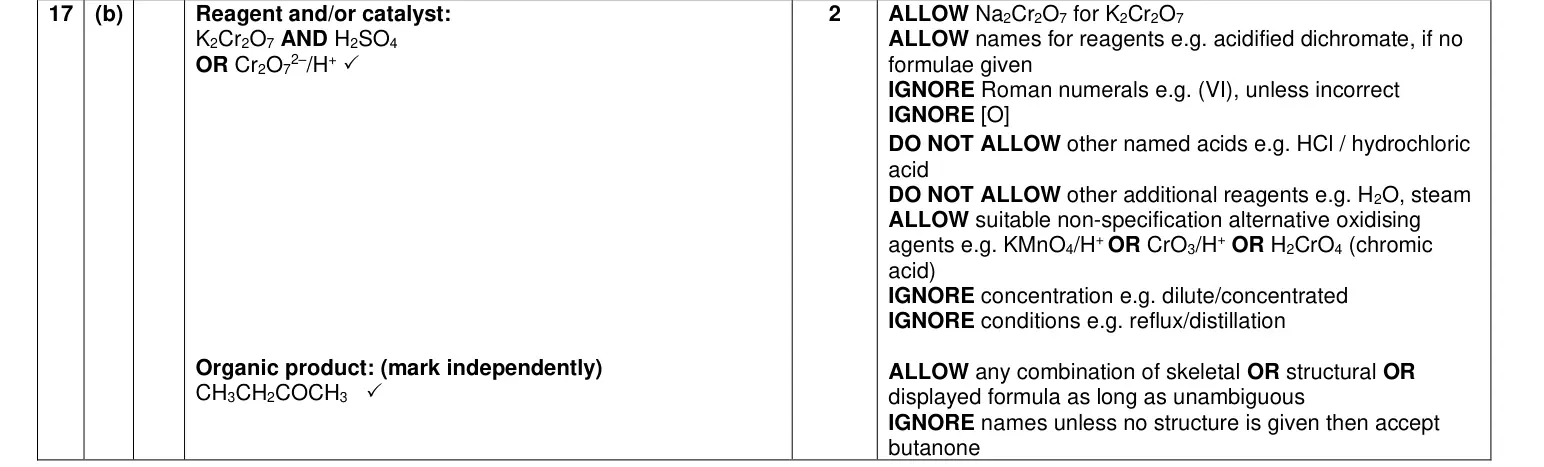
June 2024 · Paper 2 · Q17(b)2 marksShort answerMedium
Earlier part of question 17 that this part uses
Mark scheme
Examiner's comment
This was the most well-known out of the four reactions with more than three quarters of candidates getting both marks. The most common errors included omission of acid catalyst or adding an extra hydrogen on the carbonyl carbon of C=O. Candidates should be reminded to count the number of bonds around each carbon before moving on. A few attempted to oxidise this secondary alcohol to form a carboxylic acid.
Notes from the mark scheme and report
K2Cr2O7 AND H2SO4 (Cr2O7 2–/H+)
butanone
IGNORE [O]
DO NOT ALLOW HCl as the acid
June 2024 · Paper 2 · Q17(c)2 marksShort answerHard
Earlier part of question 17 that this part uses
Mark scheme
Examiner's comment
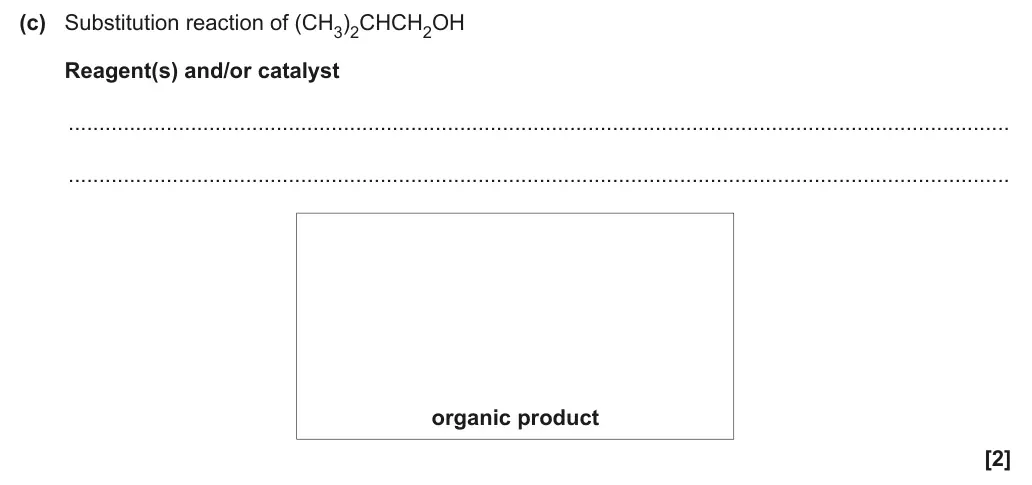
Generally well-answered with very few gaining no marks. Some lost marks for correctly giving sodium halide but forgetting the acid. Some gave the halogen rather than the halide. A few added an additional CH2 to structure. Some attempted to substitute directly with cyanide to give a nitrile product, e.g. (CH3)2CHCH2CN.
Notes from the mark scheme and report
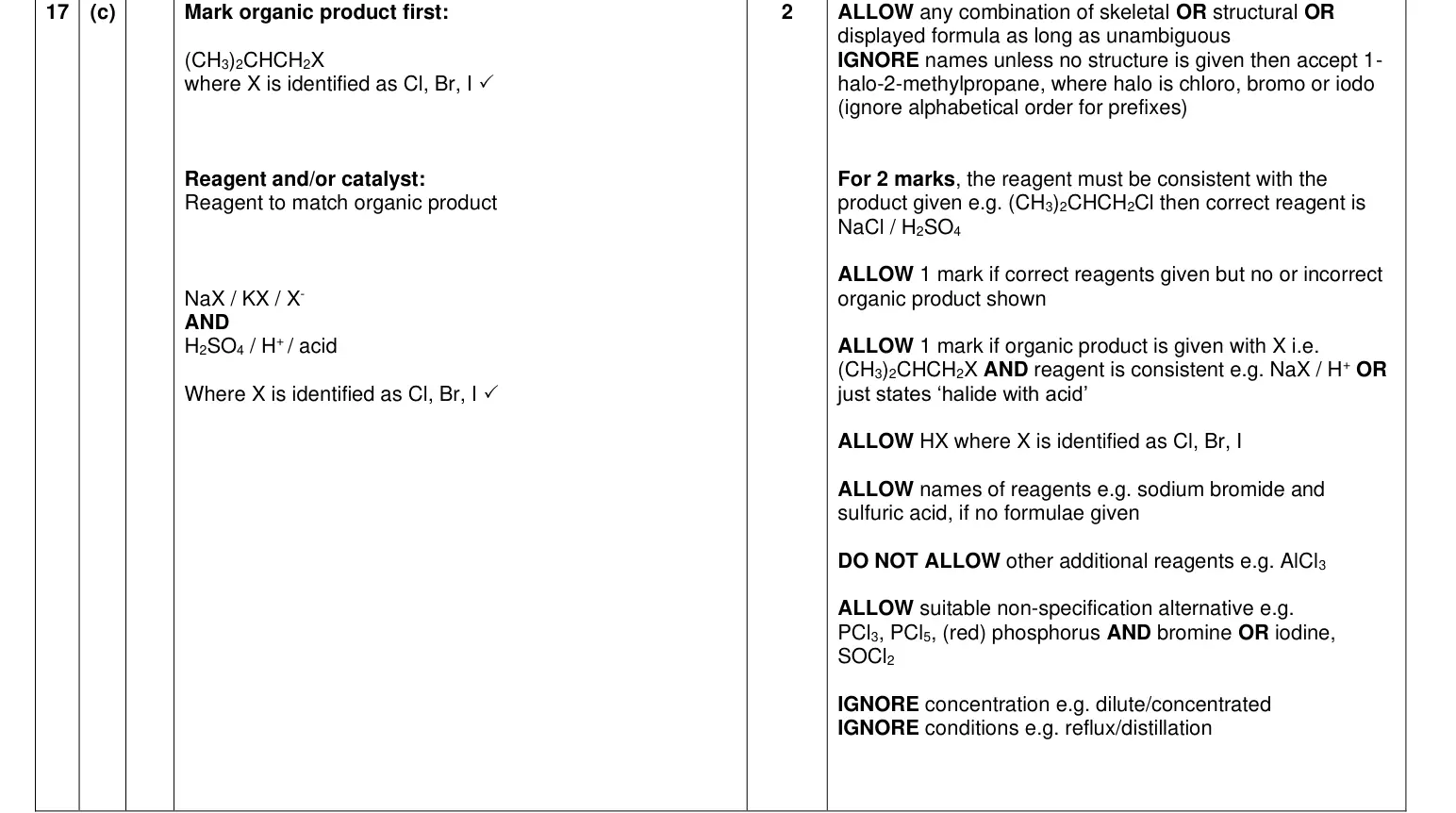
mark product first: (CH3)2CHCH2X
reagent NaX AND H2SO4 consistent with product
1 mark for correct reagents with wrong/no product
DO NOT ALLOW additional reagents e.g. AlCl3
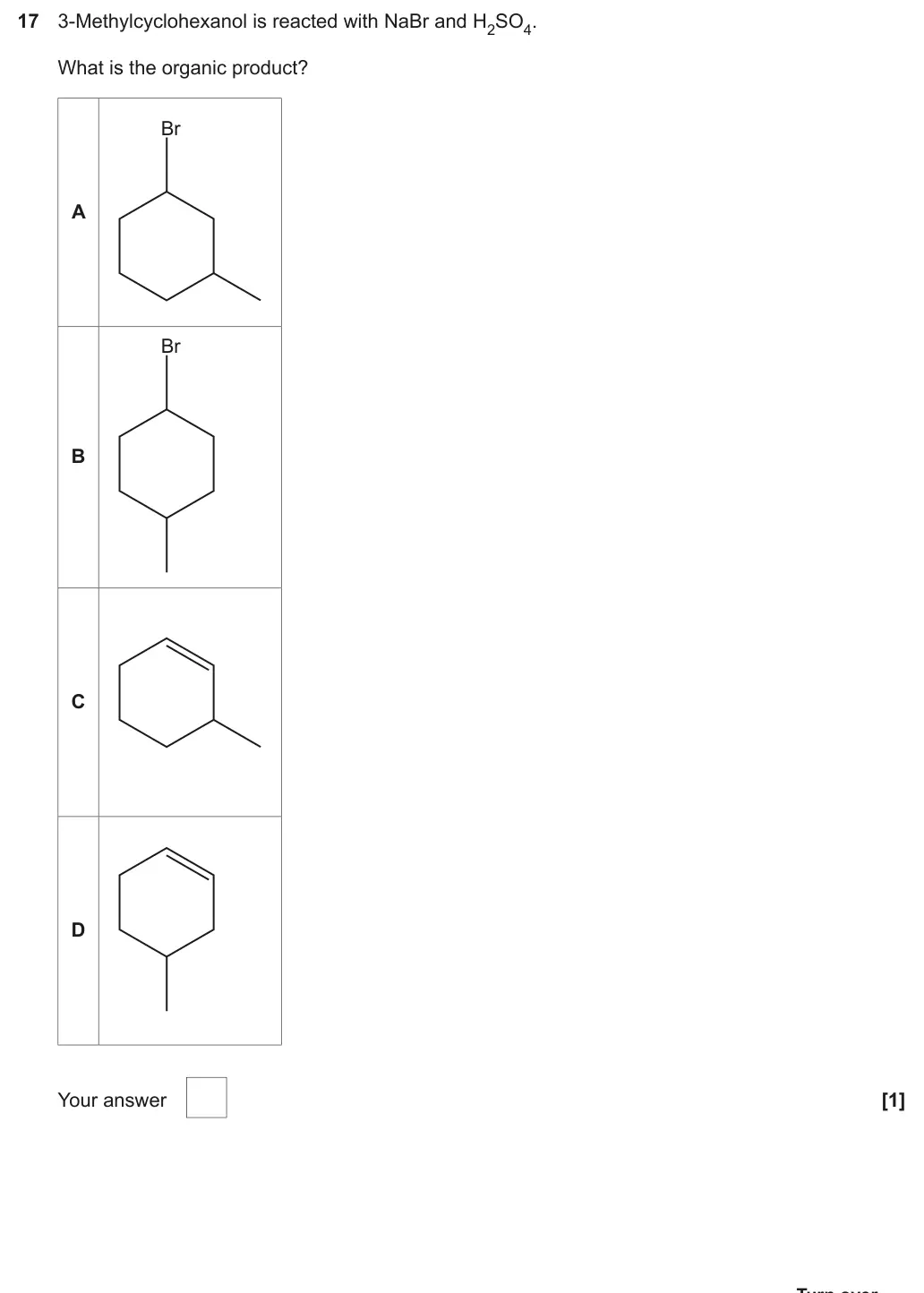
June 2023 · AS Paper 1 · Q171 markAO2Multiple choiceMedium
Answer
A
Mark scheme
Examiner's comment
Candidates had more success with this question with most obtaining the correct option, A.
June 2023 · AS Paper 1 · Q265 marksShort answerHard
Mark scheme
Examiner's comment
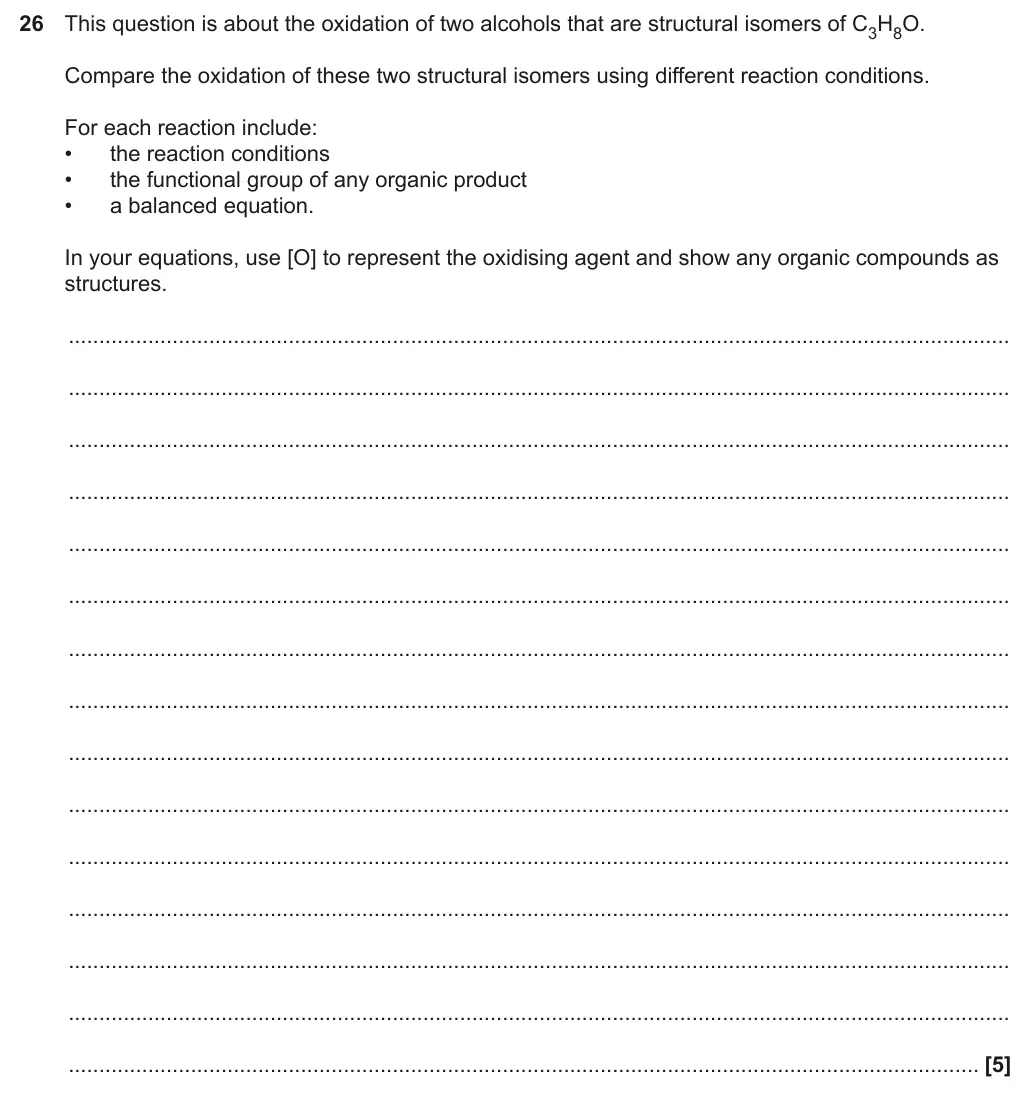
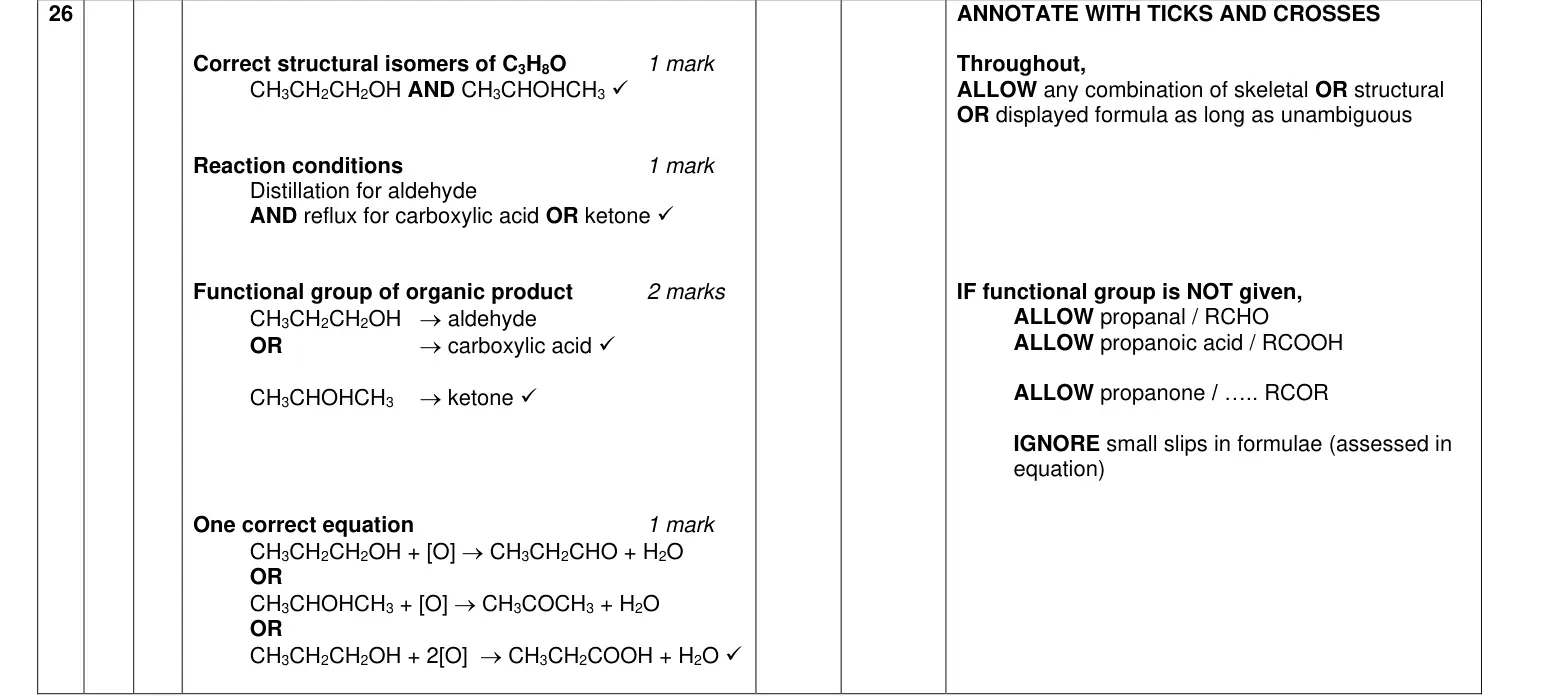
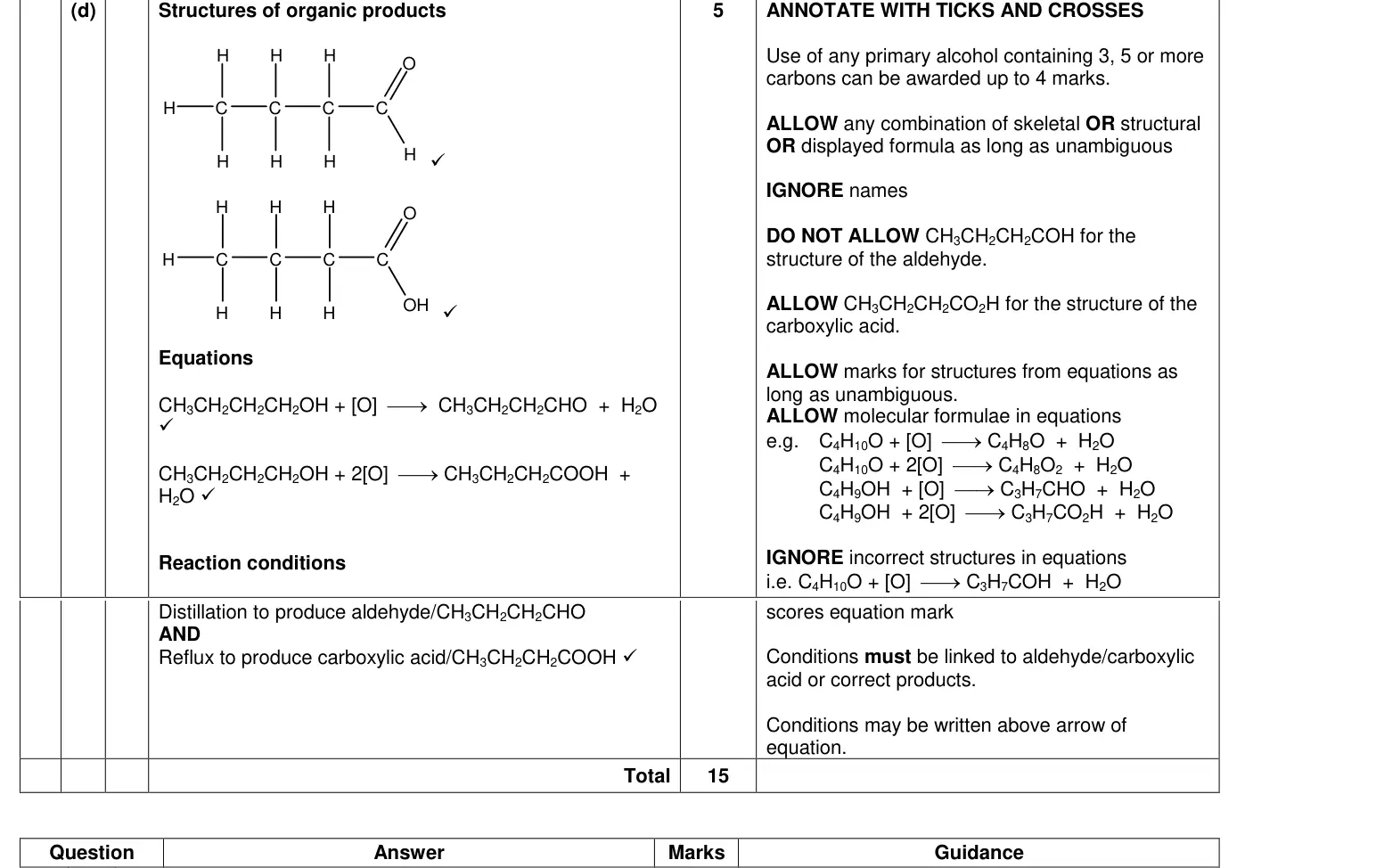
There were some excellent responses to this question which discriminated extremely well. Unfortunately, there were a significant number of incorrect responses and some less successful candidates had clearly struggled to recall and apply this important material. The identification of the isomers was usually correct, as was the identification of the oxidation products from the primary and secondary alcohols, and the conditions required to produce the organic products. The equation proved to be the hardest requirement with the H2O by-product often being omitted or H2 shown instead. A general point applies to organic structures. Some candidates did not show the structures of the isomers and attempted this question using the molecular formula of C3H8O supplied in the question for both alcohol isomers and no structural formulae. It was then impossible to know which isomer was being reacted and this could cost the candidate a significant number of marks. It is essential in organic chemistry to use unambiguous formulae which can be any combination of skeletal, structural or displayed. Unless a question specifies that a molecular formula is required, candidates should assume that an unambiguous formula is required.
Notes from the mark scheme and report
propan-1-ol AND propan-2-ol
distillation for aldehyde AND reflux for carboxylic acid or ketone
one correct [O] equation (2[O] for the acid)
ALLOW named products if functional group not given
Skills: PAG5 Synthesis of an organic liquid; PAG7 Qualitative analysis of organic functional groups
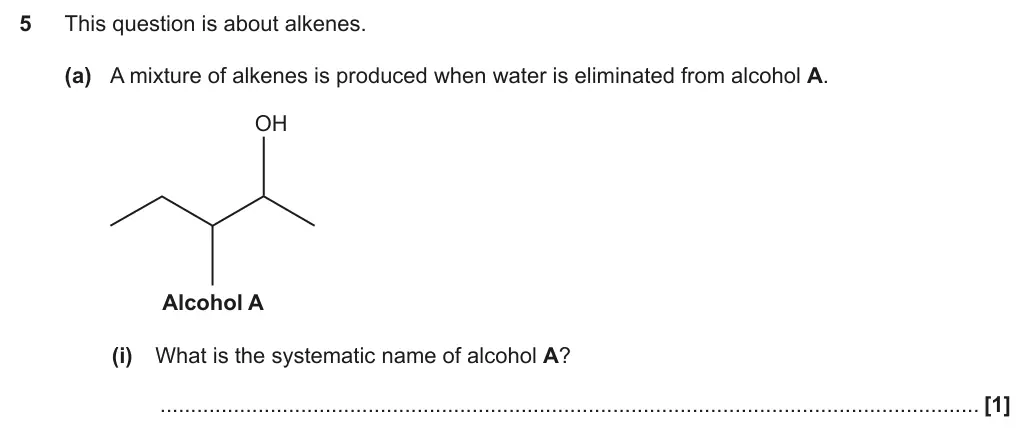
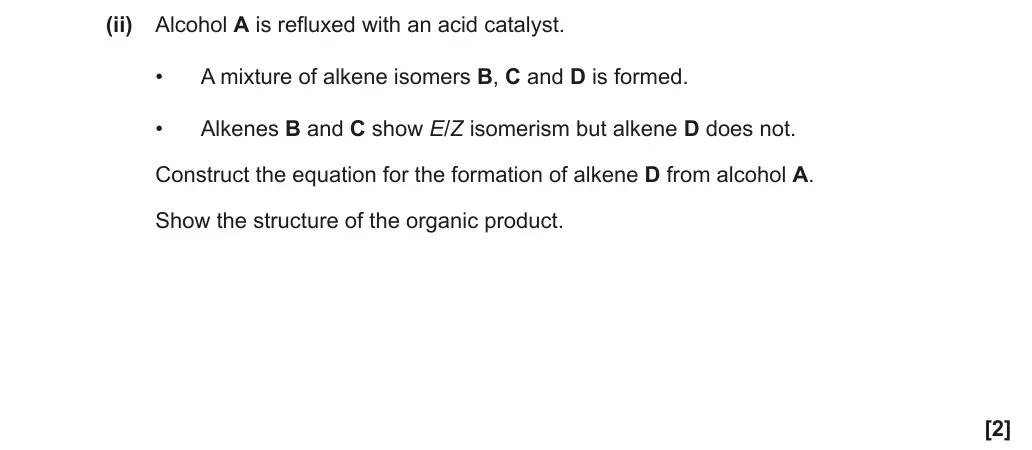
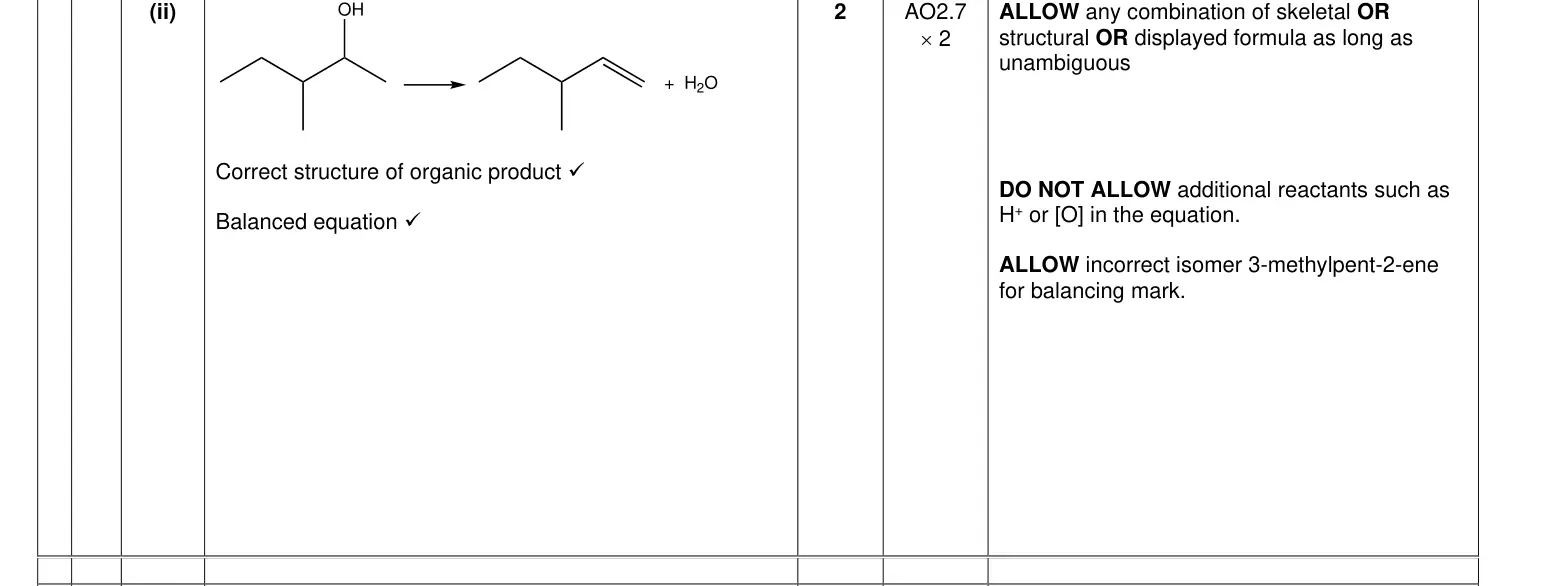
June 2023 · AS Paper 2 · Q5(a)(ii)2 marksAO2Equation writingMedium
Earlier part of question 5 that this part uses
Mark scheme
Examiner's comment
Most candidates did not score either mark here, despite the structures for B and C being given in the table below for (iii). Many thought this was oxidation, showing [O] in equations and giving a carbonyl product. Many had alkenes but still with the -OH present. Some attempted to use structural or displayed formulae but errors were made in giving the correct number of H atoms. For those that did have the correct structure, they often did not give an equation, added the acid as a reactant, or missed off the water as a product.
Notes from the mark scheme and report
D = 3-methylpent-1-ene (no E/Z) + H2O
DO NOT ALLOW H+ or [O] as reactants
ALLOW 3-methylpent-2-ene for the balancing mark only
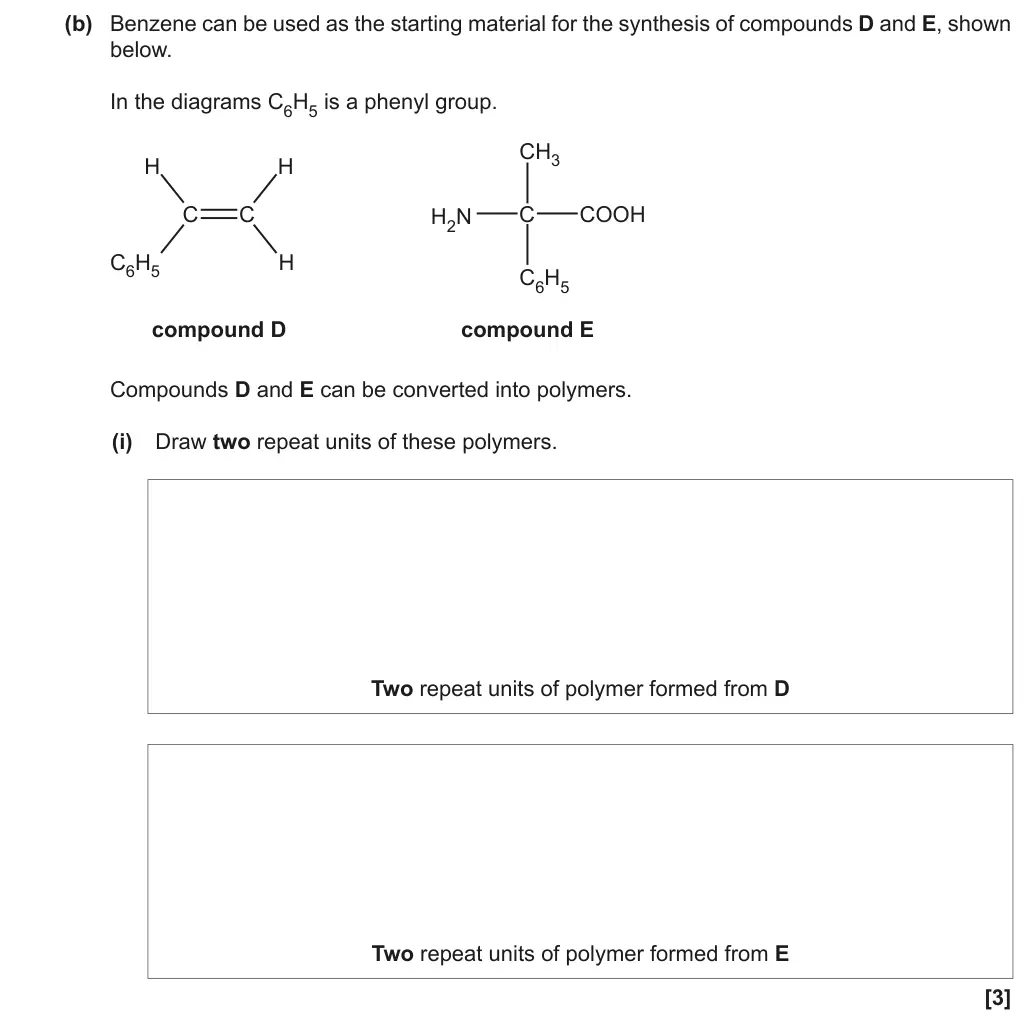
June 2023 · AS Paper 2 · Q5(b)(i)2 marksAO2, 3Drawing / labellingMedium
Mark scheme
Examiner's comment
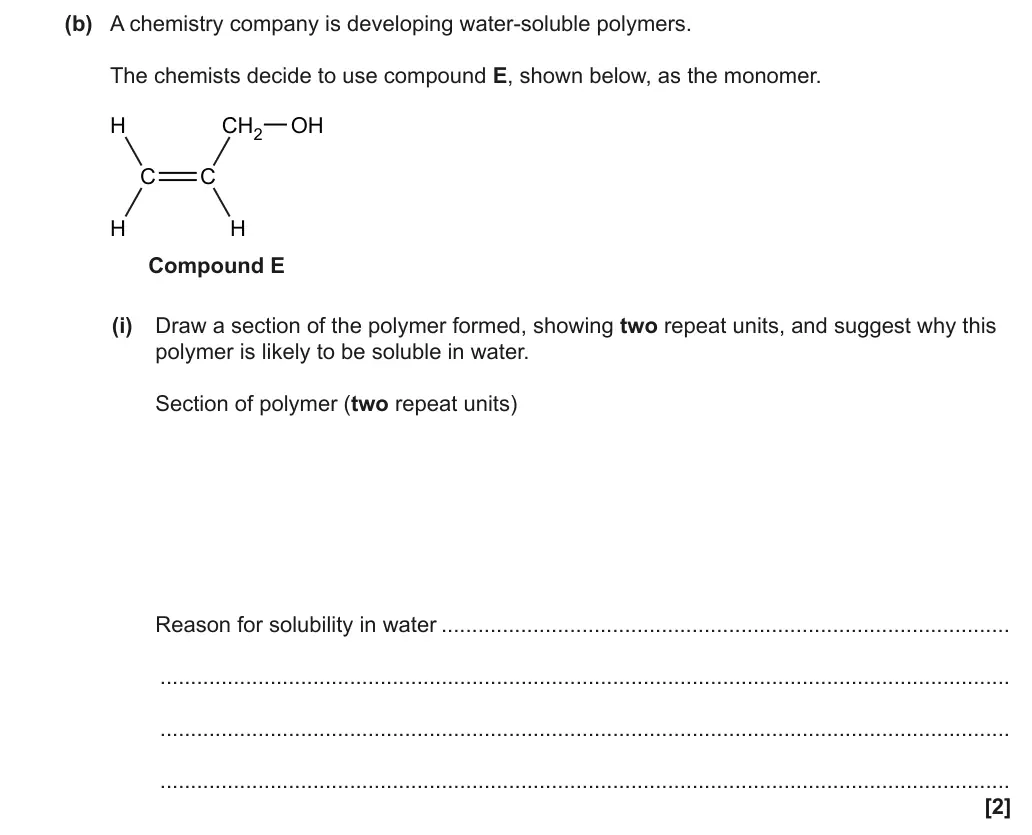
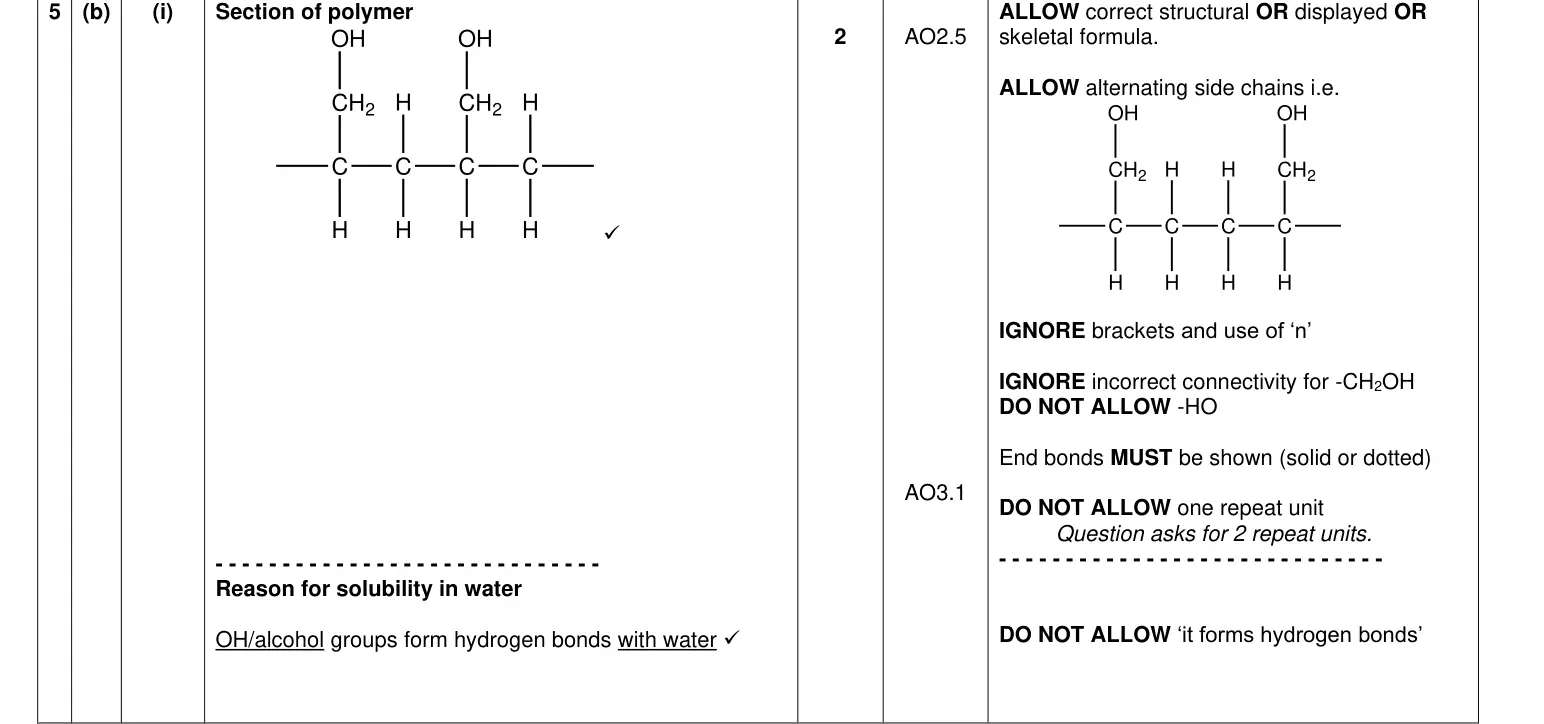
Most candidates were able to gain credit for their structure, with only a few missing out by only drawing one repeat unit, keeping the C=C, having no end bonds or missing/extra Hs. Lots struggled to gain the second mark for the reason for solubility in water as they didn't refer to H-bonding. There were quite a few misconceptions highlighted in the responses to this question. These included the misunderstanding that a H-bond is an an intermolecular force between -OH on alcohol and water, rather than the covalent bond in the molecule. Some thought the -OH would behave as an alkali, even referring to ions, so would ‘fully dissociate’. Some described a reaction with water and breaking apart, perhaps confusing with condensation polymers which can be hydrolysed.
Notes from the mark scheme and report
two repeat units with end bonds shown (DO NOT ALLOW one repeat unit)
OH groups form hydrogen bonds with water (DO NOT ALLOW 'it forms hydrogen bonds')
DO NOT ALLOW –HO connectivity
June 2023 · Paper 2 · Q17(a)2 marksAO2Equation writingHard
Mark scheme
Examiner's comment
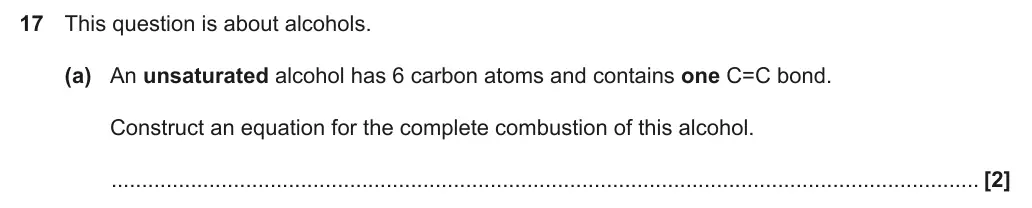
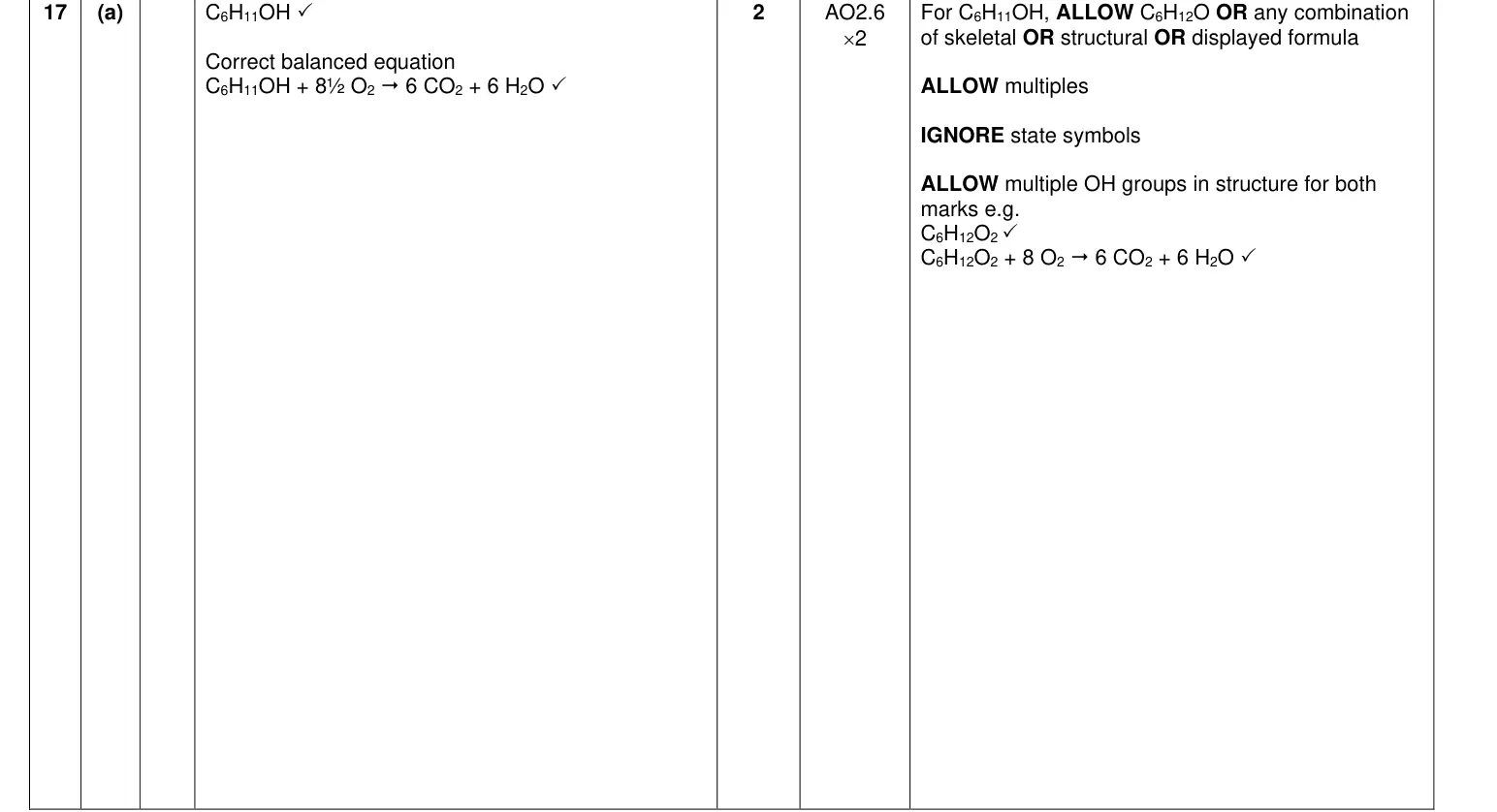
Approximately half the candidates gained both marks here but just over a third gained no credit. A very common error was C6H12 + 9O2 → 6CO2 + 6H2O missing the need for an alcohol group. Another common error was balancing with 9O2 i.e. not deducting O from alcohol from their count of O atoms. Some struggled to determine the correct number of Hs when a single C=C bond is introduced so gave C6H12OH or C6H13OH instead. Lower attaining candidates did not understand what happens during complete combustion. For example, they used [O] instead of molecular oxygen or didn’t have CO2 and water as the products. Some used structural formula which made it easier to get the correct formula of the reactant but often made it trickier to balance the equation.
Notes from the mark scheme and report
C6H11OH (C6H12O) + 8½O2 → 6CO2 + 6H2O
ALLOW multiples
IGNORE state symbols
Skills: M0.2 Use ratios, fractions and percentages
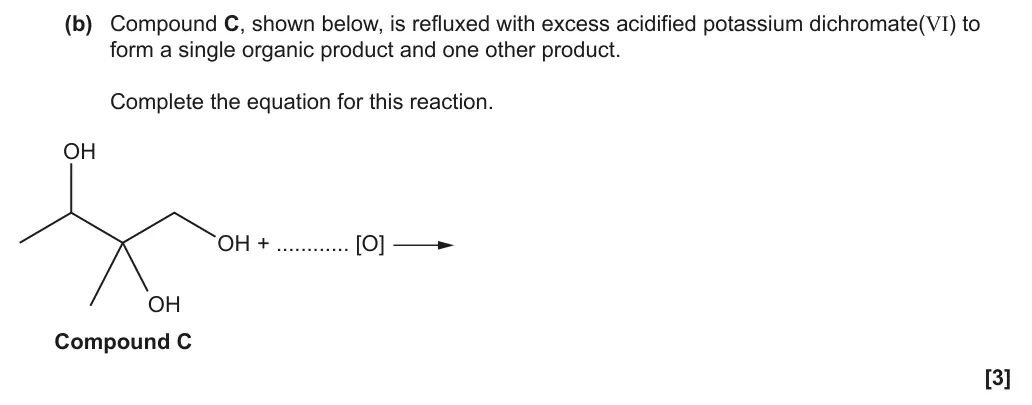
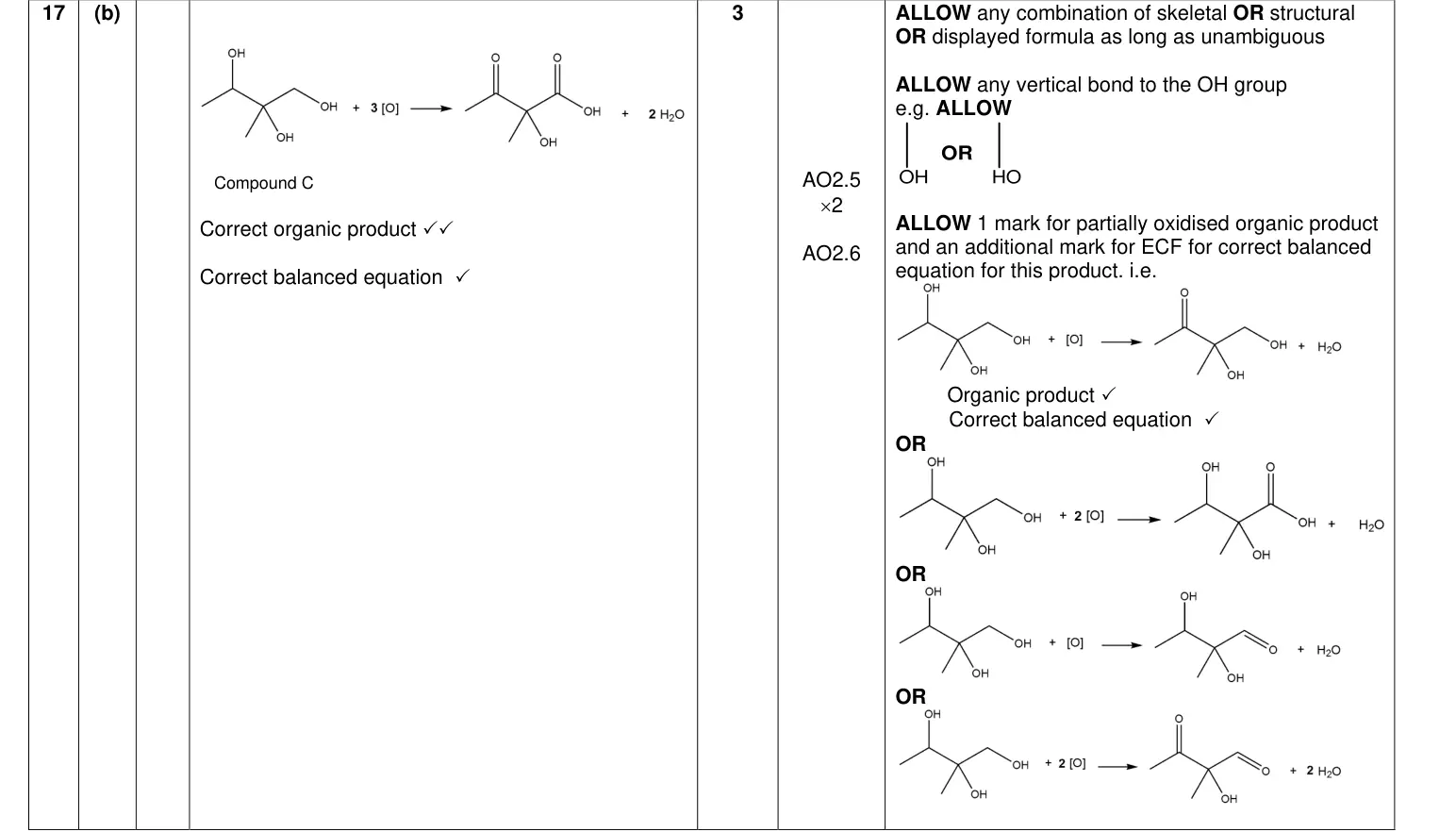
June 2023 · Paper 2 · Q17(b)3 marksAO2Complete table/diagramMedium
Mark scheme
Examiner's comment
The higher attaining candidates scored well here, with many being able to identify both the primary alcohol being oxidised to the carboxylic acid and the secondary alcohol being oxidised to the ketone and obtaining correct balancing. A good strategy adopted by some candidates was labelling the three alcohol groups with their classification, i.e. primary, secondary, and tertiary. Some missed the water by-product or gave H2 instead. Some gained credit for partial oxidation products as shown in the guidance on the mark scheme. However, more than a third gained no credit here with many attempting to oxidise the tertiary alcohol or removing it entirely. Some made a mistake by adding an extra CH2 on to the product before COOH group - again demonstrating the importance of counting atoms when balancing equations. Oxidation of alcohols is typically taught in the first year with very simple examples, but candidates need to practise more complex examples. Candidates need to be reminded that every oxidation step requires an [O] and every OH group oxidised produces a water molecule.
Notes from the mark scheme and report
secondary OH to ketone, primary OH to COOH (reflux, excess), tertiary OH unchanged
3[O] and 2H2O
1 mark for partially oxidised product plus ECF mark for its balanced equation
Skills: M0.2 Use ratios, fractions and percentages
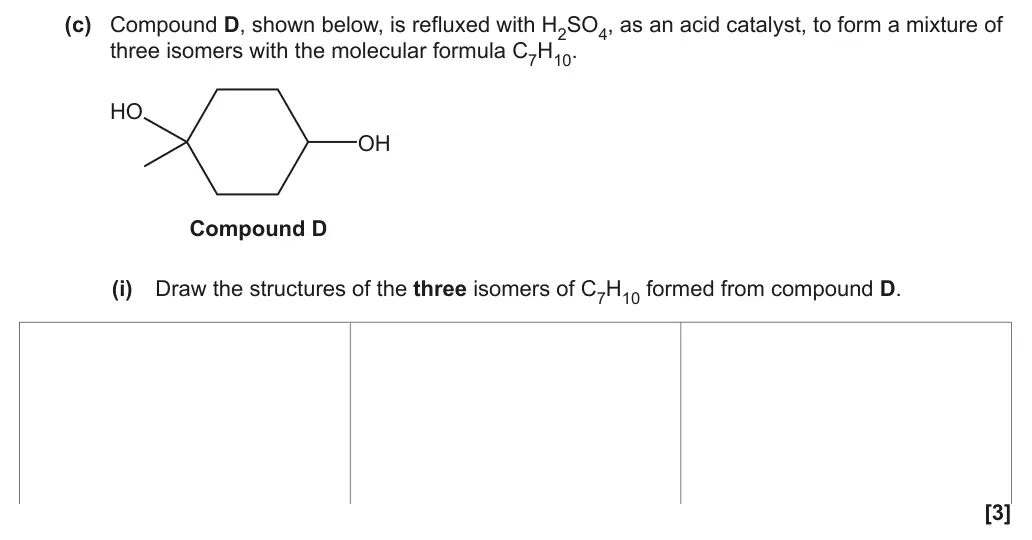
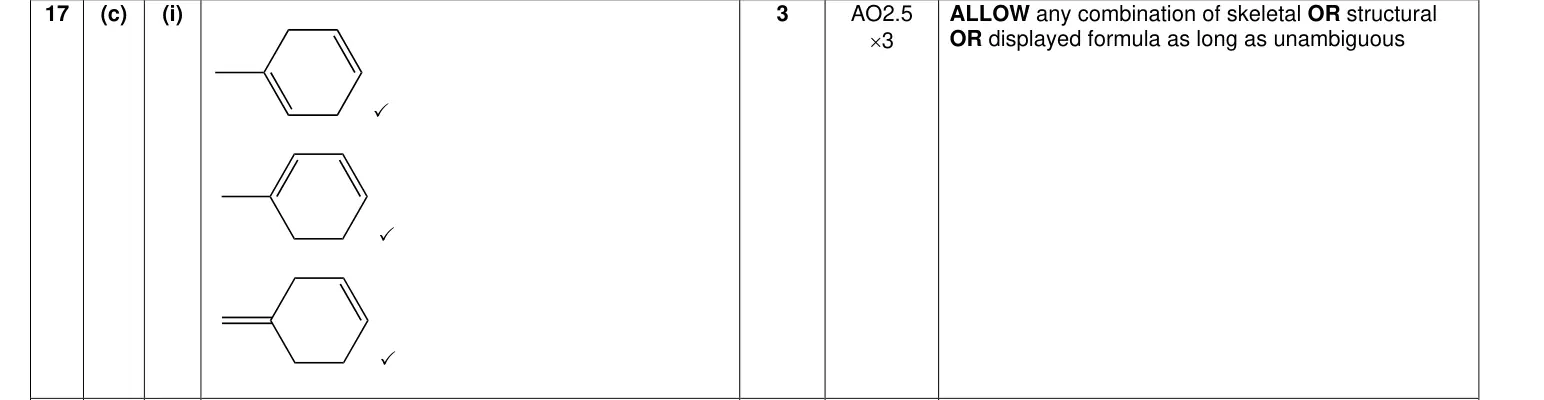
June 2023 · Paper 2 · Q17(c)(i)3 marksAO2Structure / isomerHard
Mark scheme
Examiner's comment
Lots struggled here with just under half of candidates gaining no credit. Only the strongest responses recognised that a carbon-carbon double bond could be formed external to the ring from the methyl branch. A common error was repeating one of the first two isomers as a mirror or rotated image and so lost a mark - candidates need to be able to recognise same structures (especially using skeletal formula) Lower scoring candidates didn’t recognise this reaction would result in the elimination of water. So, it was common to see responses with three structures still containing the OH group or ketones (possible oxidation products), despite the molecular formula C7H10 being provided twice in the question. Some candidates attempted to give structural isomers of C7H10 that would not form from this reaction (see below) including those with smaller rings and even unsaturated straight chain compounds. Some even gave benzene structures. This question was particularly problematic to mark if previous structures drawn were then rubbed out. Drawing structures in exams Please remind candidates to draw structures clearly in black ink. If incorrect cross them out and redraw them. Drawing in pencil then rubbing out often leads to extra lines showing when exam papers are scanned making it appear that structures are incorrect.
Notes from the mark scheme and report
both OH groups eliminated: two ring dienes and one with exocyclic C=CH2
June 2023 · Paper 2 · Q17(c)(ii)1 markAO1Short answerMedium
Earlier part of question 17 that this part uses
Mark scheme
Examiner's comment
Many candidates were unable to provide reagents and conditions for this reaction. Iodo- seemed unfamiliar to some with responses including NaBr or HBr suggesting substitutions with Br are more familiar. The most common errors were to use iodide with no acid or to use iodine, sometimes in conjunction with other reagents such as AlI3 or FeI3.
Notes from the mark scheme and report
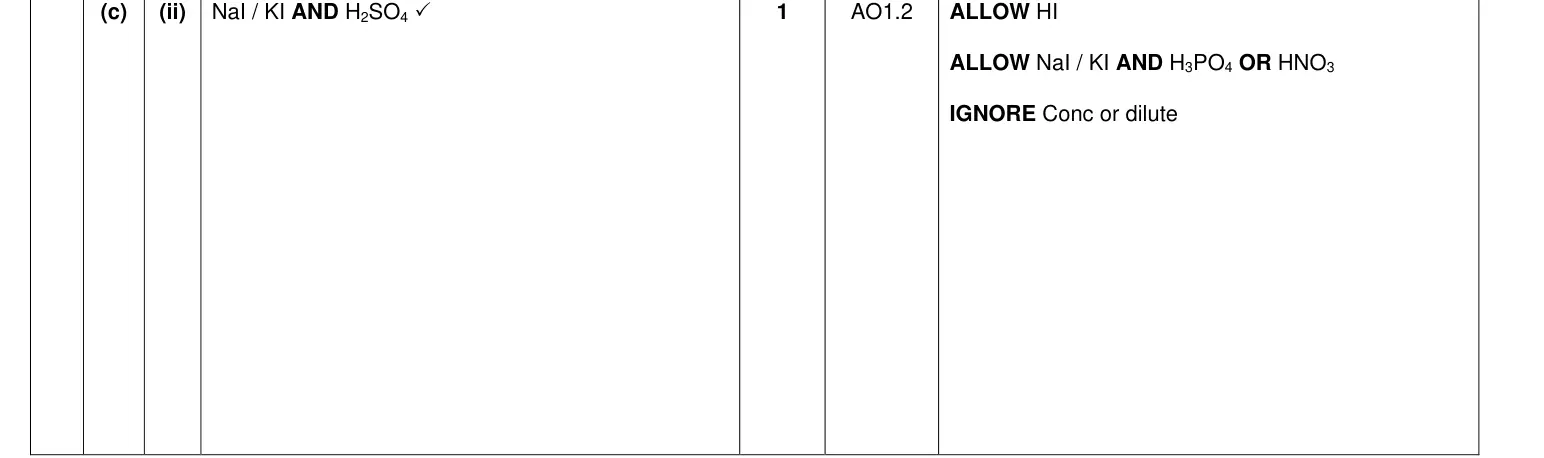
NaI/KI AND H2SO4 (ALLOW HI or H3PO4)
IGNORE conc/dilute
June 2023 · Paper 3 · Q36 marksAO36-mark level of responseMedium
Mark scheme, with the levels and indicative points
Examiner's comment
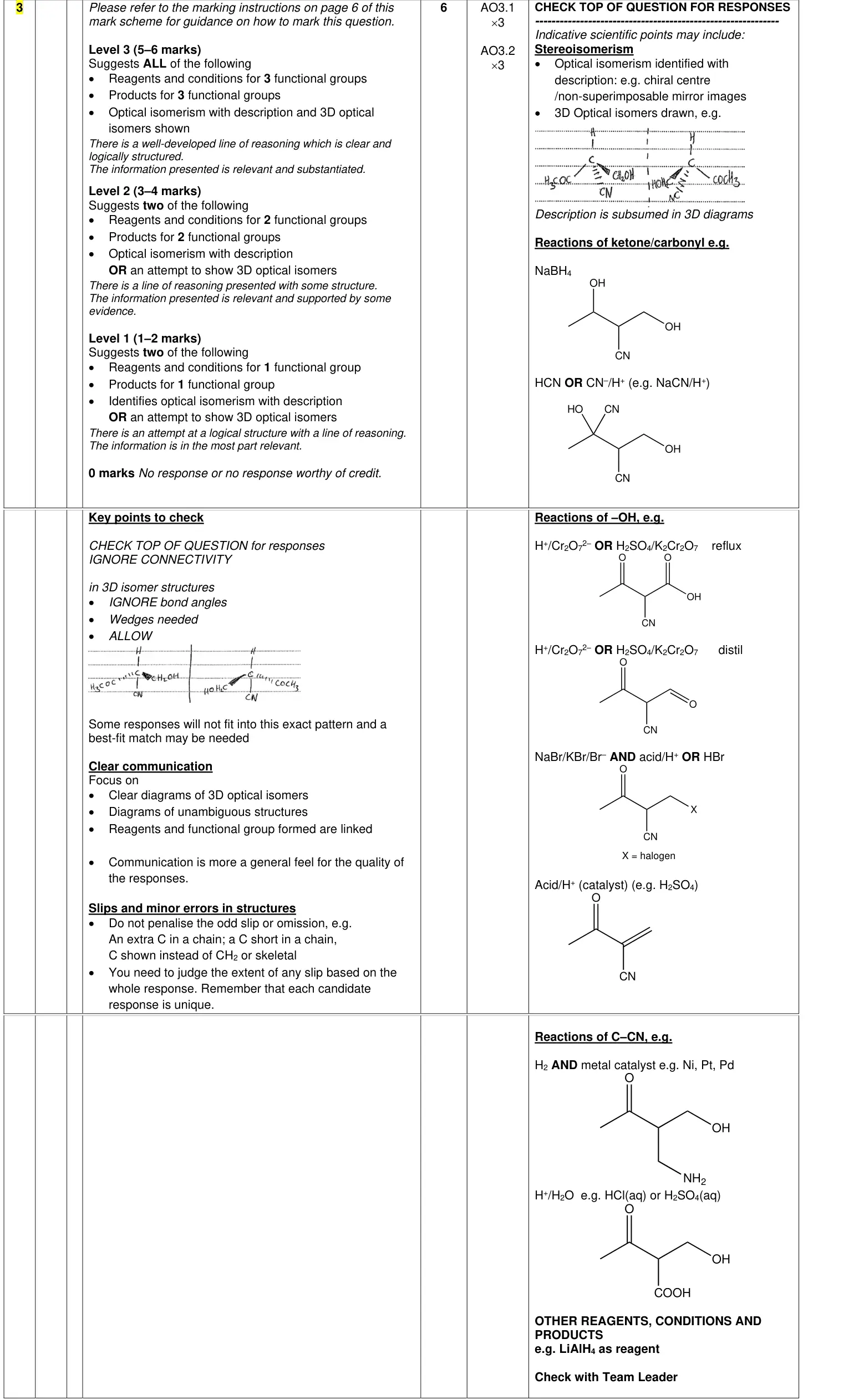
Overall, candidates performed well when answering this question. They were required to identify that compound A shows optical isomerism and to choose a reaction for each of the three functional groups. Candidates were also expected to use structures for the organic products. To achieve the highest level of response, a description of optical isomerism should be accompanied by 3D diagrams of the optical isomers. Optical isomerism was usually identified, with associated diagrams with almost all candidates identifying the chiral centre. Most attempted 3D diagrams but candidates do need to take care that the groups attached to the chiral C atom are those in compound A and that no parts of chains are omitted. Optical isomers do also require use bold and dashed wedges to be used. Most candidates showed good knowledge and understanding of reactions for the three functional groups. • For the primary alcohol, most chose H+/Cr2O72–, with distil (→ aldehyde) or reflux (→ carboxylic acid); a significant number chose a concentrated acid (→ alkene) or Br–-/H+ (→ haloalkane) • For the ketone, most chose NaBH4 (→ secondary alcohol) • For the nitrile, most chose either H2/Ni (→ amine) or H+(aq) (→ carboxylic acid). Clear diagrams of the products were usually seen although many omitted a CH2 from the amine branch for hydrolysis of the nitrile or an extra CH2 in the aldehyde or carboxylic acid branch from oxidation of the primary alcohol. Some candidates chose 2,4-DNP for a reaction of the ketone and treated the question as one requiring tests, and then proving that the compound was a ketone from no reaction with Tollens’ reagent. The question asked for the organic product and the 2,4- DNP product is beyond the demands of this specification (although this was seen very rarely). Candidates adopting this reaction were limiting the extent of their response and candidate should have considered this requirement before selecting 2.4- DNP. This exemplar shows a good response that lacks 3D diagrams for the optical isomers. The candidate has clearly given reagents and conditions and has shown the organic products. In the response, you can see that the candidate initially showed an extra CH2 in the –COOH branch, and a mistake in the amine branch. The absence of 3D structures limits the response to Level 2 and 4 marks have been awarded for choosing correct and relevant reagents and conditions, and for the clear communication of the structures.
Notes from the mark scheme and report
optical isomerism with chiral centre/non-superimposable mirror images and 3D diagrams with wedges
Skills: M4.2 Visualise and represent 2-D and 3-D forms including 2-D representations of 3-D objects
June 2022 · AS Paper 2 · Q1(d)2 marksAO2Equation writingMedium
Mark scheme
Examiner's comment
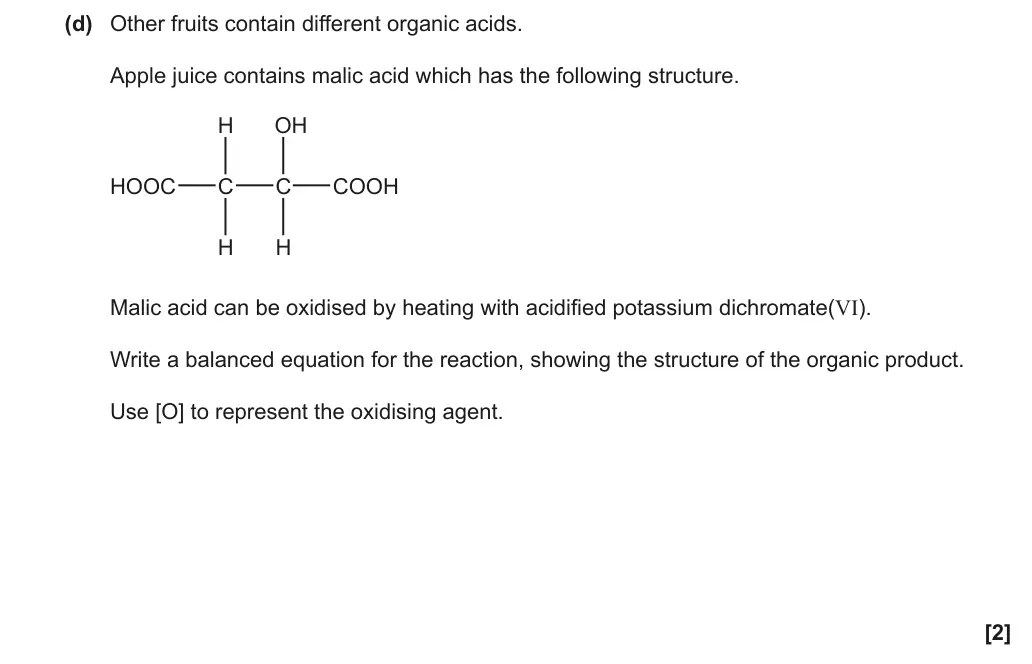
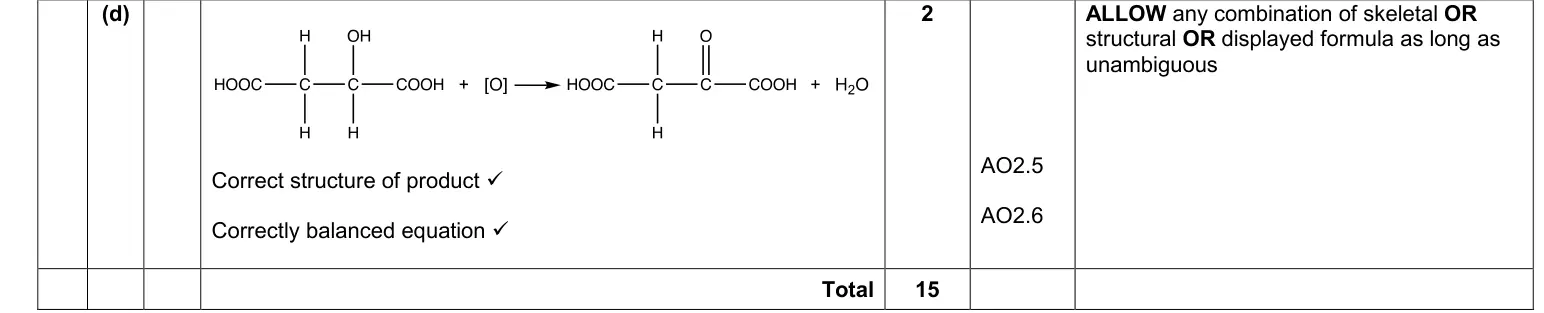
Despite oxidation of alcohols being a topic that has been assessed many times, candidates found this question very tricky with a majority failing to score any marks. Candidates needed to correctly identify this as a secondary alcohol which, when oxidised, will become a ketone. A wide range of errors were seen, including the following: Other errors included forming C=C or removing COOH. Approximately half of those that got the correct structure were also able to balance the equation gaining both marks. Some forgot that another product was formed or gave H2 instead. Candidates were given the structure and told to use [O] to represent the oxidising agent. However, some attempted to use structural or molecular formula and/or adding in dichromate to their answers.
Notes from the mark scheme and report
secondary alcohol group oxidised to ketone HOOCCH2COCOOH
COOH groups unchanged
June 2022 · Paper 2 · Q20(c)2 marksAO2Equation writingEasy
Earlier part of question 20 that this part uses
Mark scheme
Examiner's comment
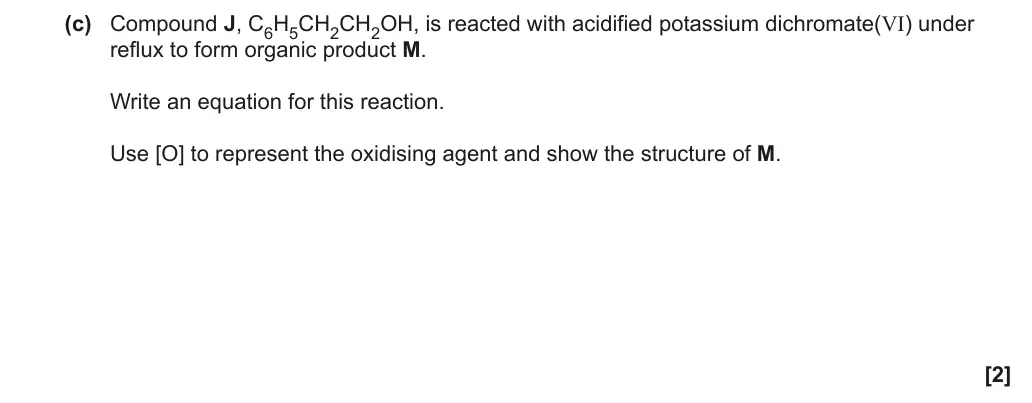
Most candidates were able to score at least 1 mark for this question. Common errors included candidates producing two water molecules or failing to balance [O]. A significant proportion of candidates did not score any marks, frequently due to the organic product having too many carbon atoms in it.
Notes from the mark scheme and report
product C6H5CH2COOH (reflux)
2[O] and H2O
Skills: M0.2 Use ratios, fractions and percentages
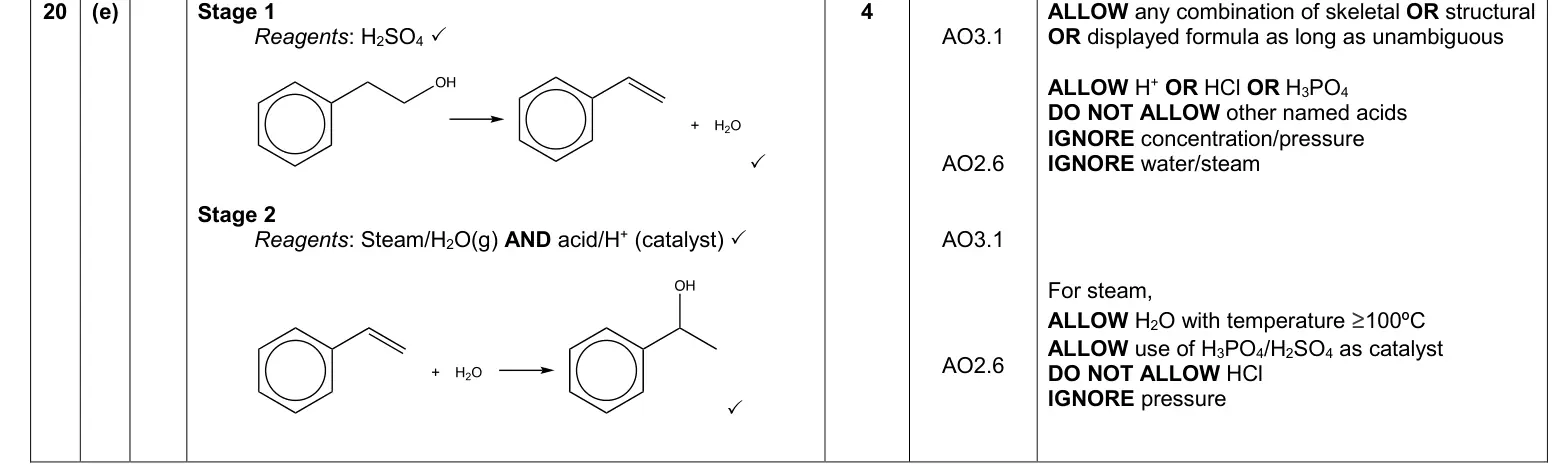
June 2022 · Paper 2 · Q20(e)4 marksAO2, 3Short answerHard
Mark scheme
Examiner's comment
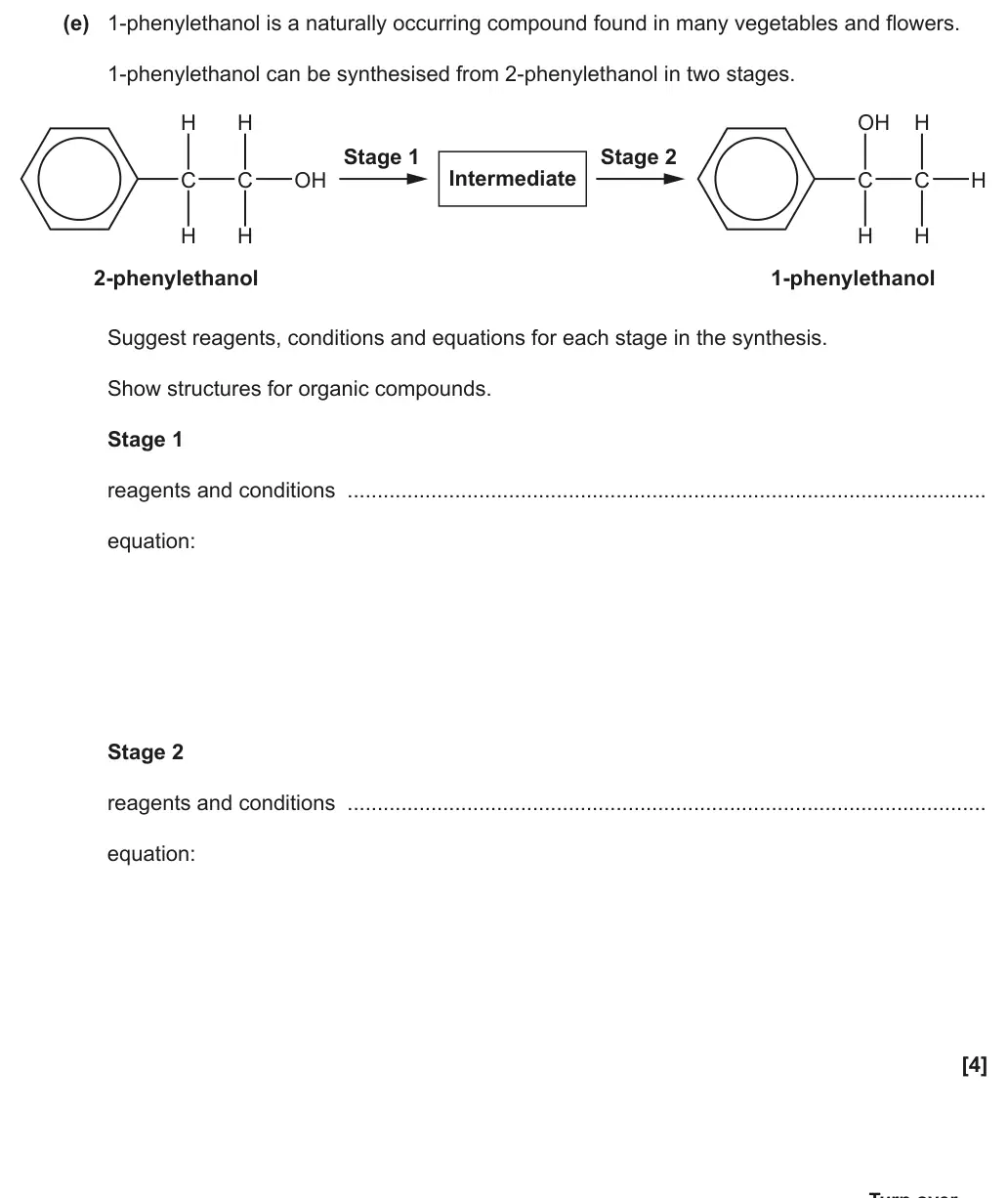
This question proved challenging with only the most able being given full marks. The reagents and conditions were not well known and candidates did not include water in their equations to make sure they were balanced.
Notes from the mark scheme and report
stage 1: acid catalyst H2SO4/H3PO4 (heat) eliminates H2O to give phenylethene (DO NOT ALLOW HCl)
stage 2: steam with acid catalyst gives 1-phenylethanol (Markownikoff)
equations with structures needed
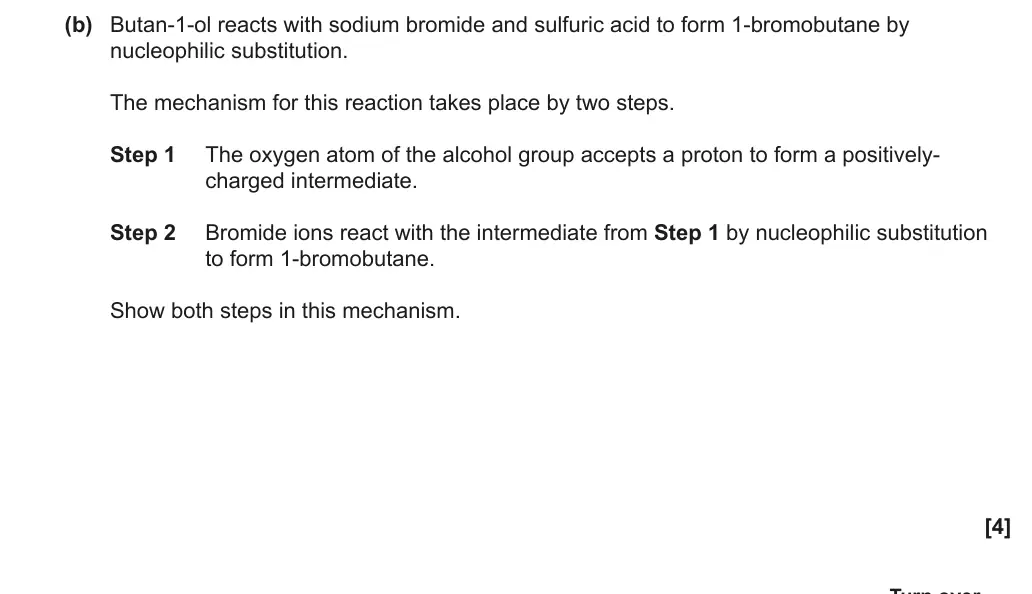
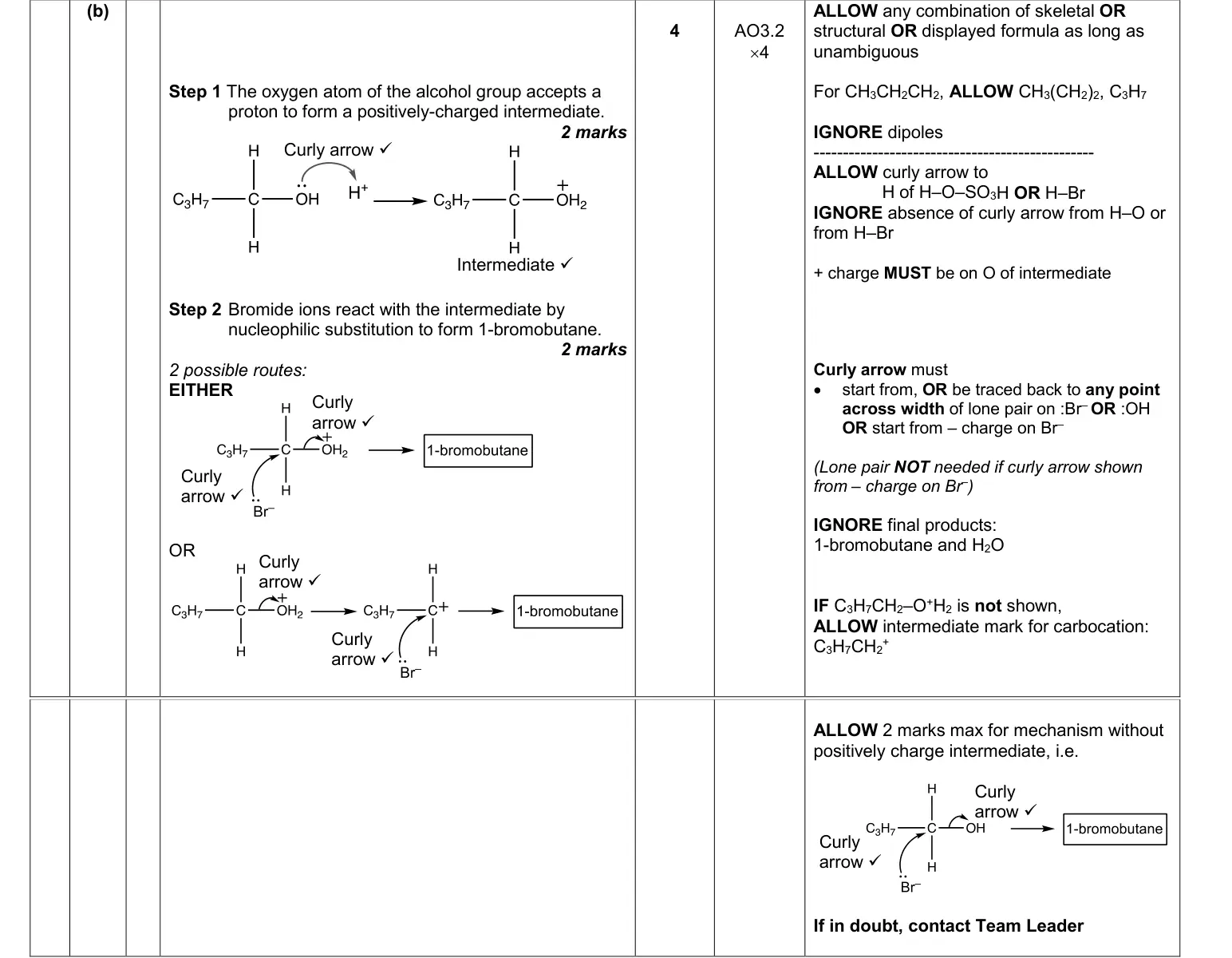
June 2022 · Paper 3 · Q3(b)4 marksAO3MechanismMedium
Earlier part of question 3 that this part uses
Mark scheme
Examiner's comment
This question is one of two on this paper assessing understanding of unfamiliar organic reaction mechanisms. The stem to the question includes important information and clues that should have then guided candidates towards this unfamiliar mechanism (which is related to the familiar nucleophilic substitution of haloalkanes). The two prompts for Step 1 and Step 2 are critical but many candidates did not use these, instead inventing their own mechanisms. However, there were many successful responses seen that gained the full 4 marks. and dipoles. Step 1 is an attempt to show the alcohol OH group accepting a proton, but a curly arrow shows the movement of an electron pair. It cannot travel from a + charge to a lone pair. The intermediate shown does contain the correct atoms but the + charge has been omitted from the O atom. Marks were given for the curly arrow from the Br– lone pair and from the C–O bond. However, the candidate has drawn the bonds with very short lines making it all too easy for a curly arrow to be shown imprecisely. This response was given 2/4 marks.
Notes from the mark scheme and report
step 1 curly arrow from lone pair on O to H+ giving intermediate with + charge on O (–OH2+)
step 2 curly arrow from Br– lone pair/charge to C and from C–O bond to O (or via carbocation)
max 2 for mechanism without positively charged intermediate
IGNORE dipoles
In organic chemistry mechanisms, a curly arrow shows the movement of an electron pair and demonstrates the direction of electron flow in organic reactions.
A curly arrow must start from: • A lone pair or negative charge and go to an atom to show where a bond forms • A bond to show where a bond breaks.
June 2022 · Paper 3 · Q5(b)(i)1 markAO2Equation writingEasy
Mark scheme
Examiner's comment
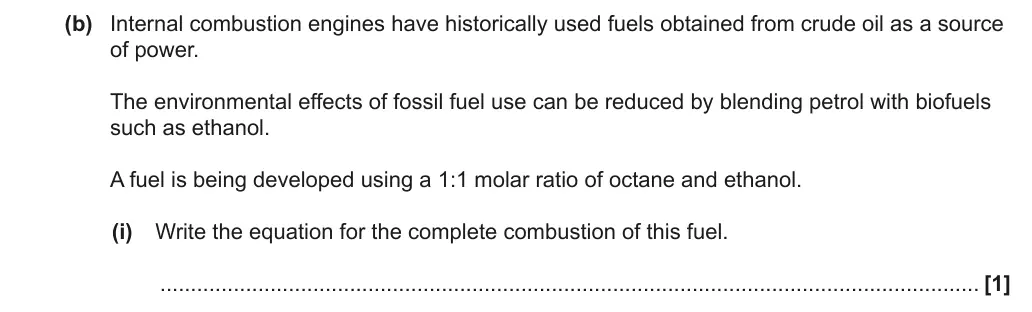
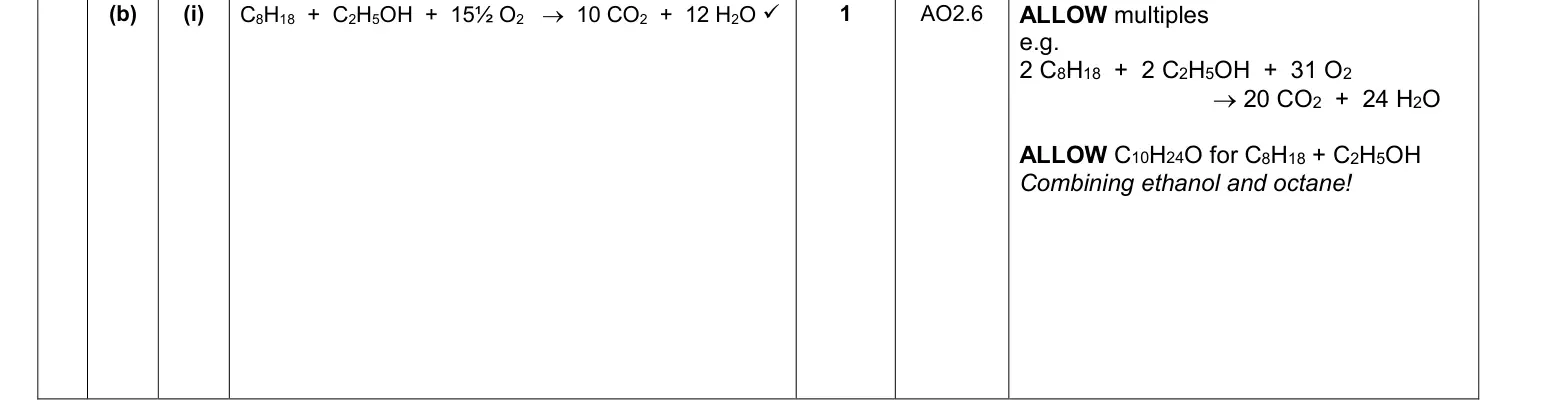
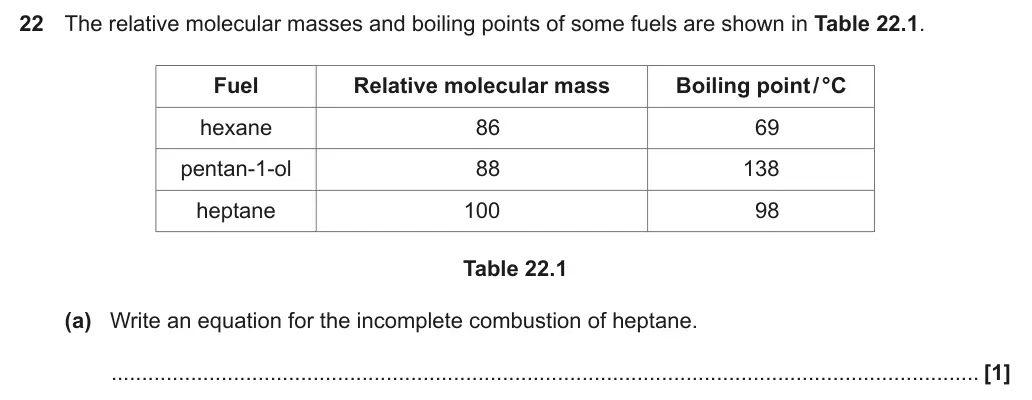
Most candidates attempted to write an equation for the combustion of the 1:1 molar mixture of octane and ethanol. The formulae of C8H18 and C2H5OH were usually seen although some candidates combined these as a ‘mixture formula’ of C10H24O (which was accepted). The balancing of the equation using 15½O2 was the hardest part of the equation and many different balancing numbers for O2 were seen (10CO2 and 12H2O where usually correct). Less successful responses often attempted a combustion equation using octane OR ethanol, but not both. This is not an easy equation to construct, and the context was novel. Overall candidates made a good attempt at this question.
Notes from the mark scheme and report
C8H18 + C2H5OH + 15½O2 → 10CO2 + 12H2O
ALLOW multiples
Skills: M0.2 Use ratios, fractions and percentages
June 2022 · Paper 3 · Q6(b)(i)1 markAO2Short answerMedium
Earlier part of question 6 that this part uses
Mark scheme
Examiner's comment
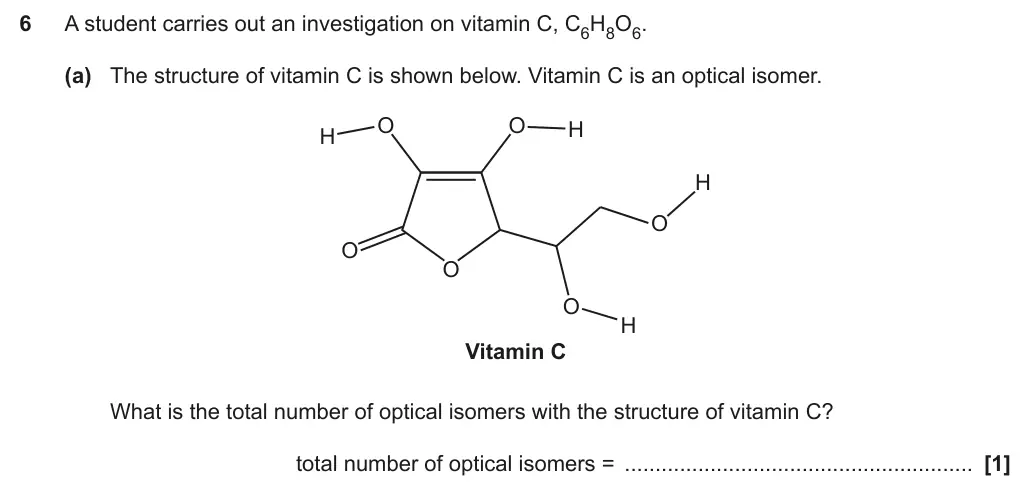
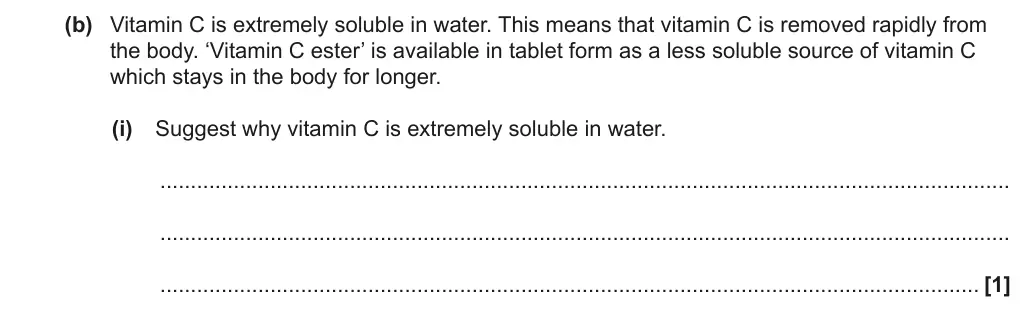
Most candidates realise that hydrogen bonds would be formed from the OH groups in vitamin C to water. Candidates are advised to read the question carefully as the word ‘extremely’ was a hint that ‘many’ OH groups would be needed in the explanation. The most successful responses quoted that hydrogen bonds would form between the 4 OH groups in vitamin C and water. Some candidates stated that O atoms in vitamin C would be involved. This was not given marks as not all O atoms in vitamin C are a part of OH groups and capable of hydrogen bonding.
Notes from the mark scheme and report
hydrogen bonding (with water) AND many/four OH groups
DO NOT ALLOW OH–
November 2021 · Paper 2 · Q41 markMultiple choice
Answer
C
Mark scheme
November 2021 · Paper 2 · Q71 markMultiple choice
Answer
A
Mark scheme
November 2021 · AS Paper 2 · Q7(a)2 marksAO2Equation writing
Mark scheme
Notes from the mark scheme and report
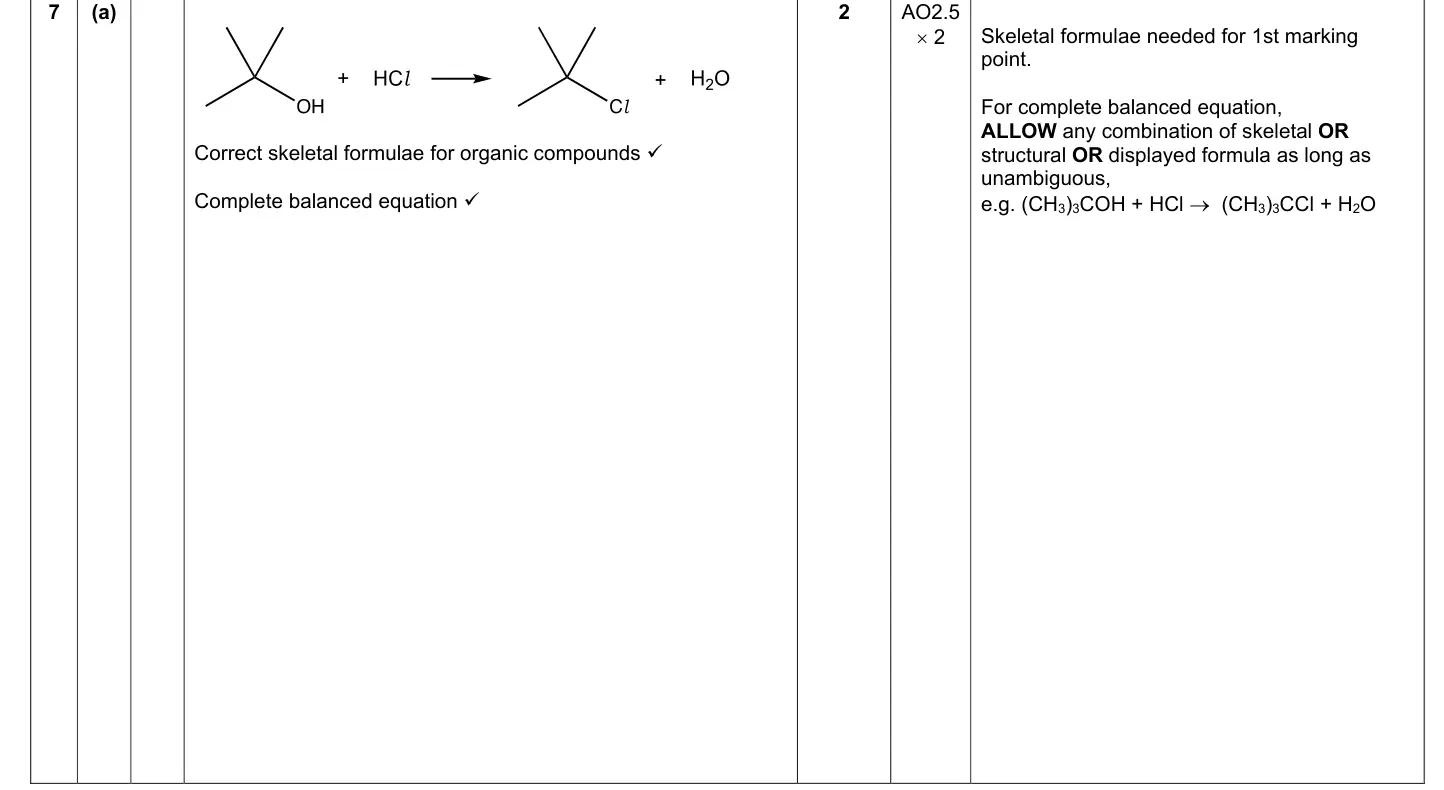
skeletal formulae required for the first mark
(CH3)3COH + HCl → (CH3)3CCl + H2O
November 2021 · AS Paper 2 · Q7(c)(i)1 markAO1Short answer
Earlier part of question 7 that this part uses
Mark scheme
Notes from the mark scheme and report
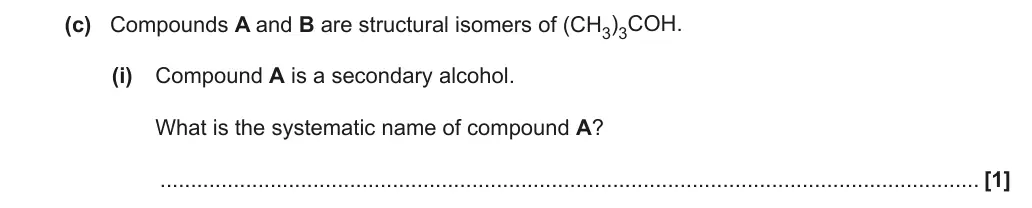
butan-2-ol
November 2021 · AS Paper 2 · Q7(c)(ii)3 marksAO2Equation writing
Earlier part of question 7 that this part uses
Mark scheme
Notes from the mark scheme and report
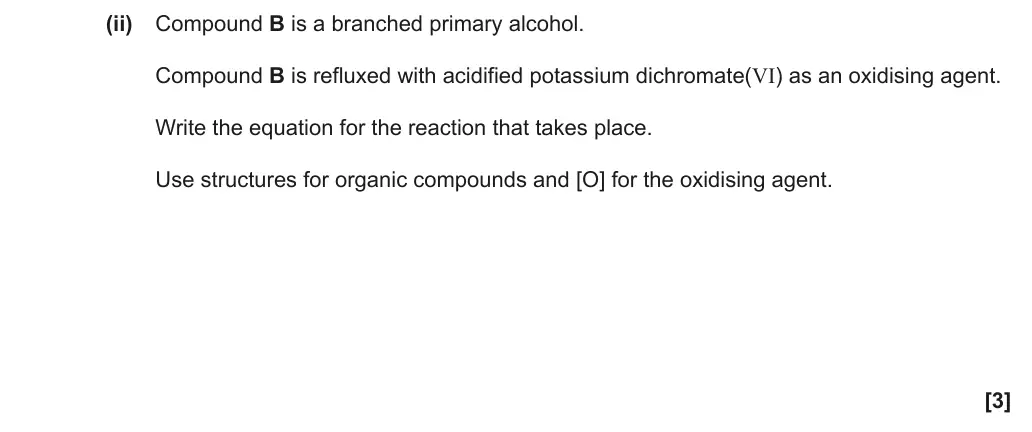
B = (CH3)2CHCH2OH
reflux gives carboxylic acid so 2[O] and H2O
ALLOW ECF for product and equation if B is a different primary or secondary alcohol
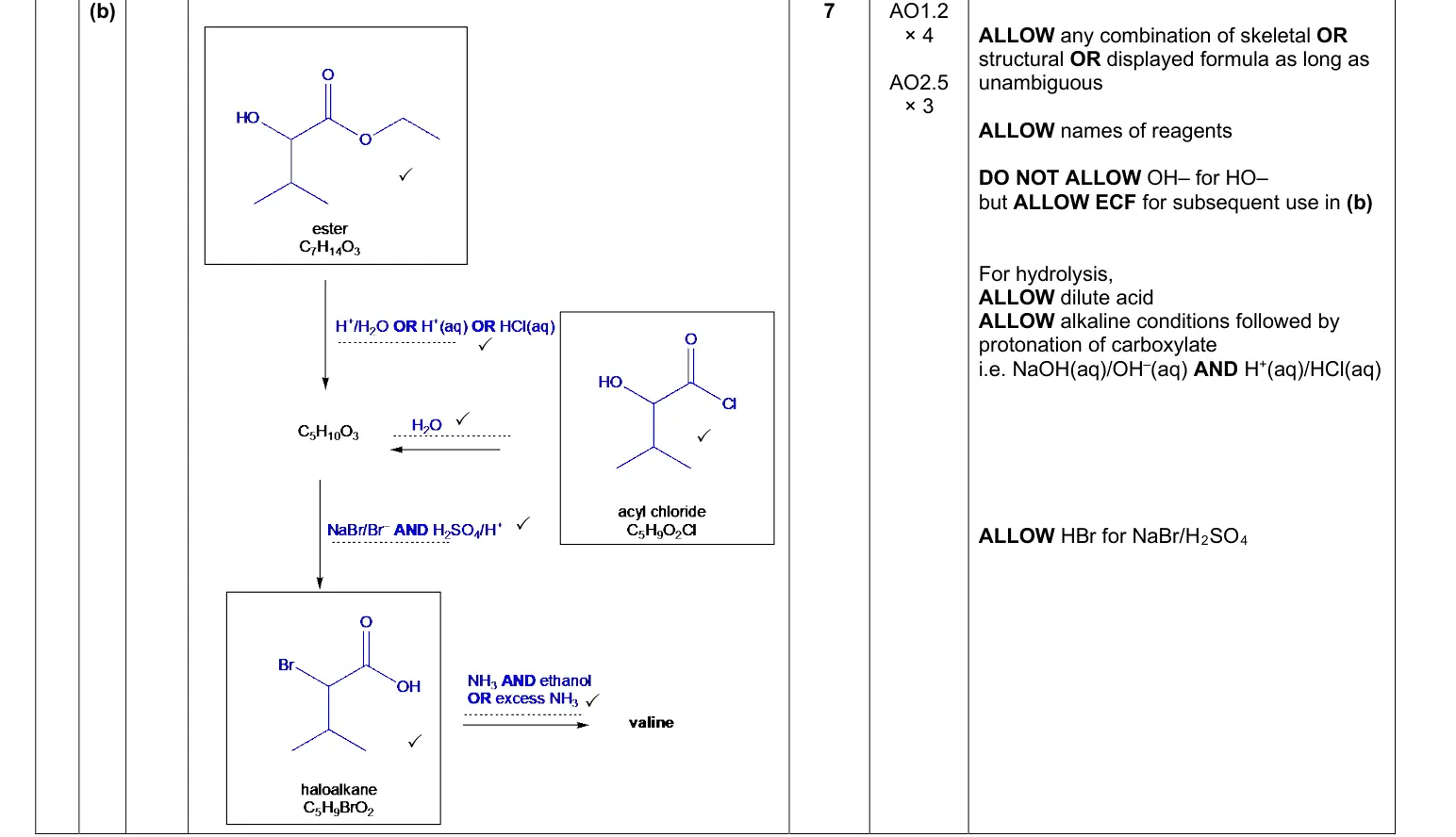
November 2021 · Paper 2 · Q18(b)7 marksAO1, 2Short answer
Earlier part of question 18 that this part uses
Mark scheme
Notes from the mark scheme and report
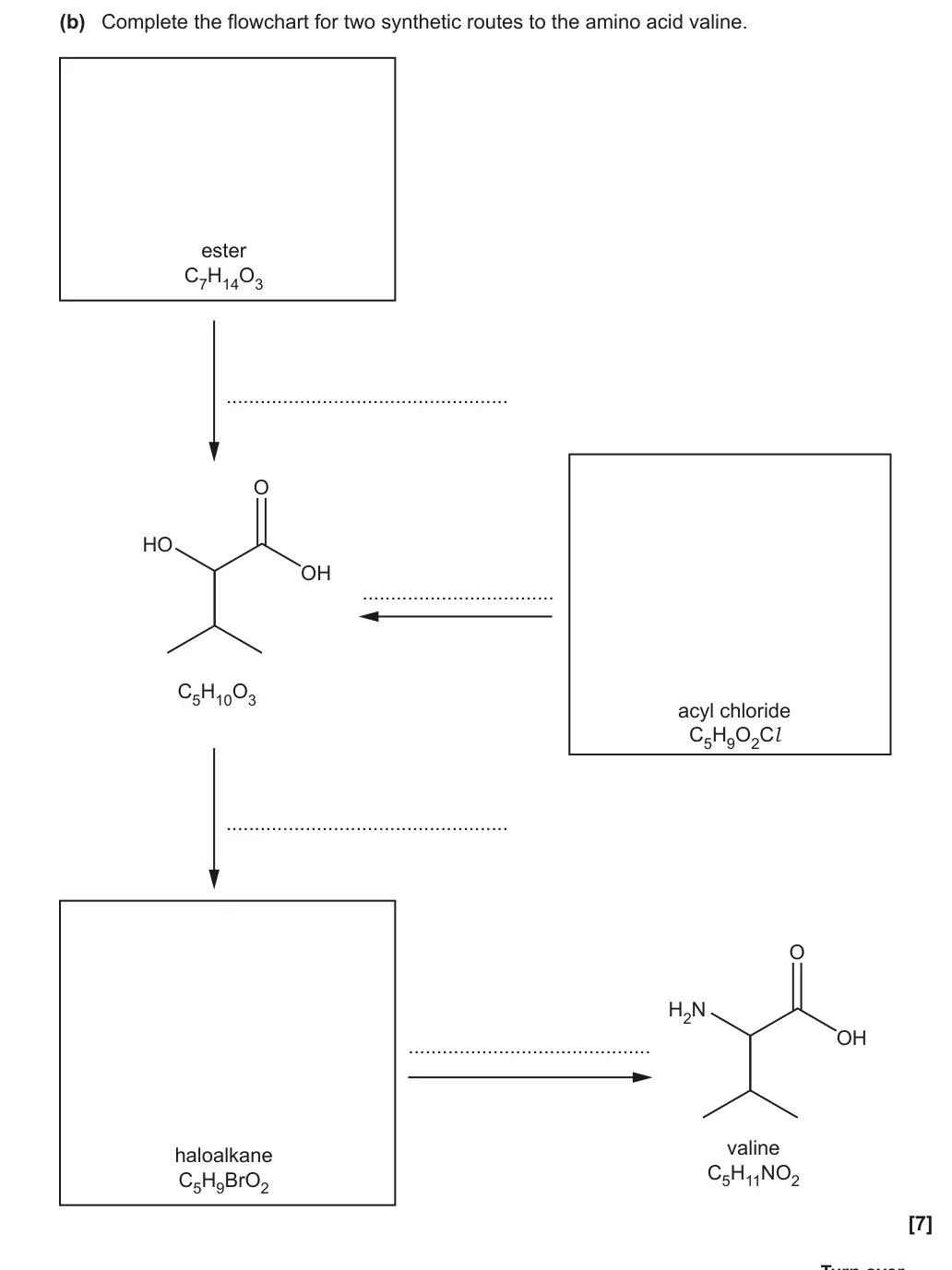
ethyl ester hydrolysed with H+(aq) (ALLOW alkali then acid)
acyl chloride + H2O
NaBr/H2SO4 (ALLOW HBr) to bromo acid
excess NH3/ethanol
DO NOT ALLOW OH– for HO–
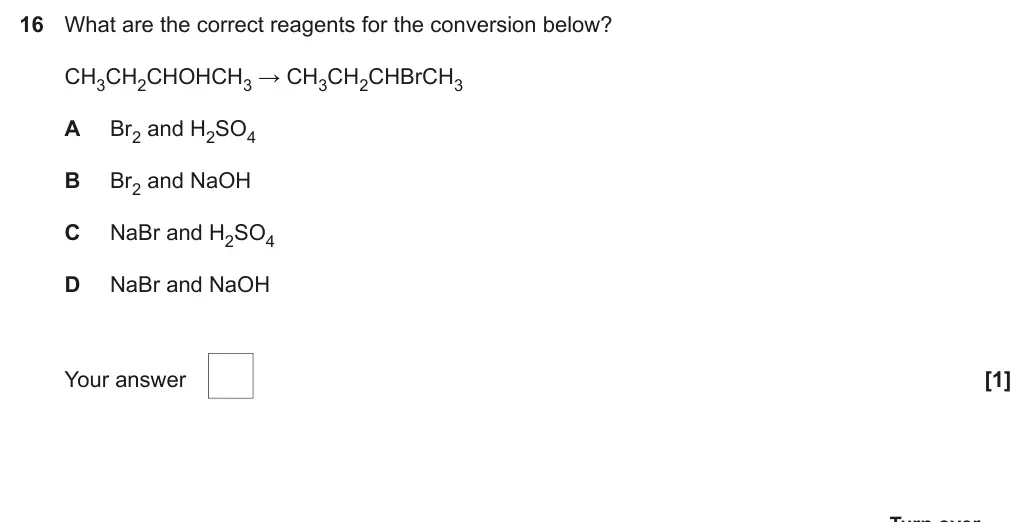
November 2020 · AS Paper 1 · Q161 markAO1Multiple choice
Answer
C
Mark scheme
November 2020 · AS Paper 1 · Q171 markAO1Multiple choiceMedium
Answer
A
Mark scheme
Examiner's comment
Success with this question was dependent on knowledge of key reactions and their reagents. B and C proved to be the main distractors from A.
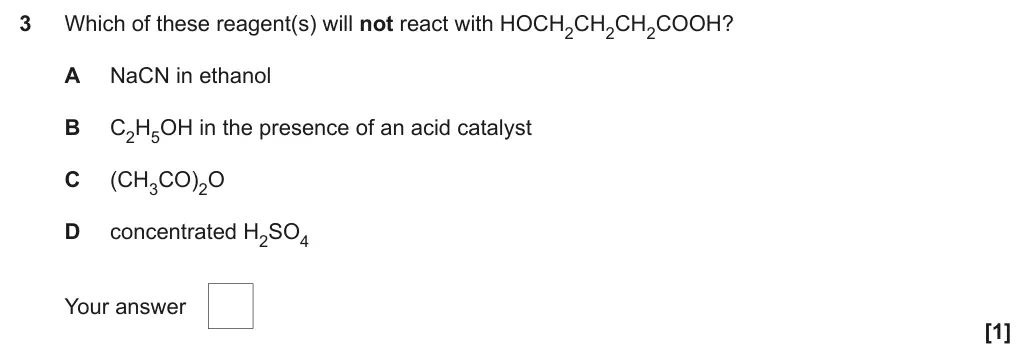
November 2020 · Paper 2 · Q31 markAO1Multiple choice
Answer
A
Mark scheme
November 2020 · Paper 2 · Q41 markAO2Multiple choice
Answer
C
Mark scheme
November 2020 · AS Paper 2 · Q5(a)2 marksAO1, 2Short answerMedium
Mark scheme
Examiner's comment
5(a) Generally this was well answered. However, some candidates only gave two responses where three were required, presumably because it was worth two marks. 5(b) A significant number of candidates did not gain the mark here as they incorrectly balanced the number of oxygens, forgetting that the alcohol contains an O atom i.e. 6.5 O2 given rather than 6. 5(c) Nomenclature in organic chemistry takes lots of practice. Approximately half of the candidates did not score this mark. It was more challenging as they needed to work with skeletal structures but evidence of drawing out displayed formula was often seen. 5(d)(i) Most candidates were able to recall the formula to calculate atom economy, however a number made errors in working out Mr values. However, some left this blank or just gave an answer without any working. 5(d)(ii) Mechanisms were often seen showing curly arrows going in the wrong direction and between the wrong bonds and atoms, charges and dipoles were often incorrect, and partial changes used where full charges were required. Writing mechanisms is an important skill in organic chemistry so it is vital that time is spent practising writing them out and fully understanding the significance of the curly arrow. 5(d)(iii) Many candidates gave the correct mechanism here, with common incorrect responses being other types of mechanism, substitution only, or isomerism. 5(e) Very few candidates gained both marks here. It was not enough here to just state faster/slower without specifying which haloalkane they were referring to. It was also important to specify the C-X bond not just vague reference to the chlorine or bromine bond. Many described the difference in bond polarity so had the wrong order. Some were more general and discussed the reactivity of bromine and chlorine themselves. 5(f)* This was a challenging problem-solving question, relying on candidates to make use of all of the information provided to determine the structure. Very few candidates made no attempt at all at this question. The most common error was incorrectly identifying the peak at 3000 cm-1 as O-H from a carboxylic acid, despite it being indicated on the data sheet that this would be a broad peak. It suggested that candidates were not familiar with looking at spectra and understanding what data it gave. Candidates should also be reminded when answering these types of question that they should give the structures, not just molecular formulae, where possible. If any of your students’ results are not as expected, you may wish to consider one of our review of results services. For full information about the options available visit the OCR website. If university places are at stake you may wish to consider priority service 2 reviews of marking which have an earlier deadline to ensure your reviews are processed in time for university applications. Our priority is supporting you and your students this autumn and to support you as you prepare for summer 2021 exams. We’ll update our website information regularly with resources, guidance and key information. • Teachers • Students • Exams officers • Assessment specialists We are sending a weekly roundup to tell you about important updates. You can also sign up for your subject specific updates. If you haven’t already, sign up here. Attend one of our popular CPD courses to hear directly from a senior assessor or drop in to a Q&A session. All our courses for the academic year 2020-2021 are being delivered live via an online platform, so you can attend from any location. Please find details for all our courses on the relevant subject page on our website or visit OCR professional development. ExamBuilder is the question builder platform for a range of our GCSE, A Level, Cambridge Nationals, Cambridge Technicals and Functional Skills qualifications. See the full list of available qualifications in the sign up form. ExamBuilder is free for all OCR centres with an Interchange account and gives you unlimited users per centre. We need an Interchange username to validate the identity of your centre's first user account for ExamBuilder. If you do not have an Interchange account please contact your centre administrator (usually the Exams Officer) to request a username, or nominate an existing Interchange user in your department. Review of results
Notes from the mark scheme and report
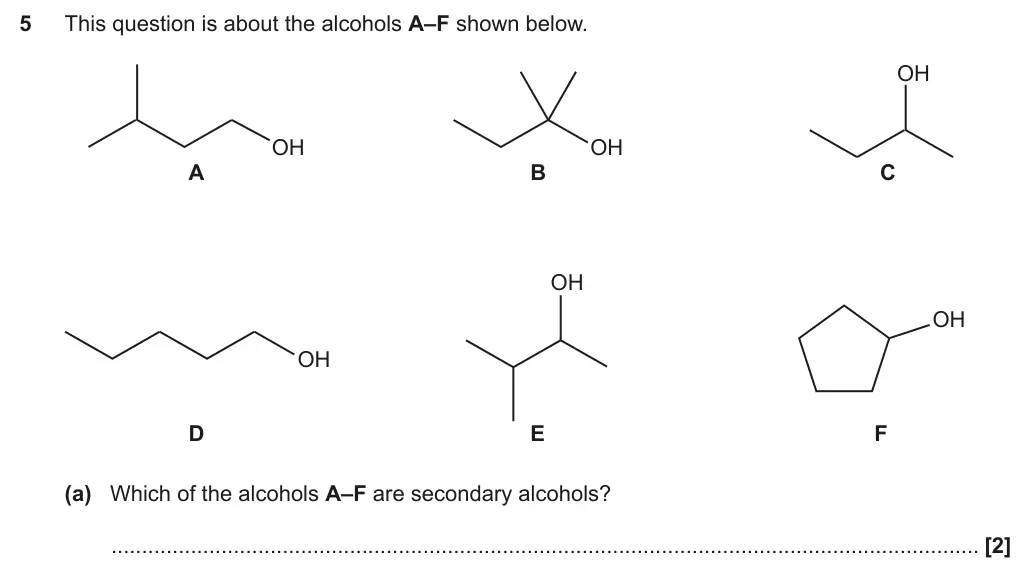
C, E and F
lose 1 mark for each incorrect response
November 2020 · AS Paper 2 · Q5(b)1 markAO2Equation writingMedium
Earlier part of question 5 that this part uses
Mark scheme
Examiner's comment
5(a) Generally this was well answered. However, some candidates only gave two responses where three were required, presumably because it was worth two marks. 5(b) A significant number of candidates did not gain the mark here as they incorrectly balanced the number of oxygens, forgetting that the alcohol contains an O atom i.e. 6.5 O2 given rather than 6. 5(c) Nomenclature in organic chemistry takes lots of practice. Approximately half of the candidates did not score this mark. It was more challenging as they needed to work with skeletal structures but evidence of drawing out displayed formula was often seen. 5(d)(i) Most candidates were able to recall the formula to calculate atom economy, however a number made errors in working out Mr values. However, some left this blank or just gave an answer without any working. 5(d)(ii) Mechanisms were often seen showing curly arrows going in the wrong direction and between the wrong bonds and atoms, charges and dipoles were often incorrect, and partial changes used where full charges were required. Writing mechanisms is an important skill in organic chemistry so it is vital that time is spent practising writing them out and fully understanding the significance of the curly arrow. 5(d)(iii) Many candidates gave the correct mechanism here, with common incorrect responses being other types of mechanism, substitution only, or isomerism. 5(e) Very few candidates gained both marks here. It was not enough here to just state faster/slower without specifying which haloalkane they were referring to. It was also important to specify the C-X bond not just vague reference to the chlorine or bromine bond. Many described the difference in bond polarity so had the wrong order. Some were more general and discussed the reactivity of bromine and chlorine themselves. 5(f)* This was a challenging problem-solving question, relying on candidates to make use of all of the information provided to determine the structure. Very few candidates made no attempt at all at this question. The most common error was incorrectly identifying the peak at 3000 cm-1 as O-H from a carboxylic acid, despite it being indicated on the data sheet that this would be a broad peak. It suggested that candidates were not familiar with looking at spectra and understanding what data it gave. Candidates should also be reminded when answering these types of question that they should give the structures, not just molecular formulae, where possible. If any of your students’ results are not as expected, you may wish to consider one of our review of results services. For full information about the options available visit the OCR website. If university places are at stake you may wish to consider priority service 2 reviews of marking which have an earlier deadline to ensure your reviews are processed in time for university applications. Our priority is supporting you and your students this autumn and to support you as you prepare for summer 2021 exams. We’ll update our website information regularly with resources, guidance and key information. • Teachers • Students • Exams officers • Assessment specialists We are sending a weekly roundup to tell you about important updates. You can also sign up for your subject specific updates. If you haven’t already, sign up here. Attend one of our popular CPD courses to hear directly from a senior assessor or drop in to a Q&A session. All our courses for the academic year 2020-2021 are being delivered live via an online platform, so you can attend from any location. Please find details for all our courses on the relevant subject page on our website or visit OCR professional development. ExamBuilder is the question builder platform for a range of our GCSE, A Level, Cambridge Nationals, Cambridge Technicals and Functional Skills qualifications. See the full list of available qualifications in the sign up form. ExamBuilder is free for all OCR centres with an Interchange account and gives you unlimited users per centre. We need an Interchange username to validate the identity of your centre's first user account for ExamBuilder. If you do not have an Interchange account please contact your centre administrator (usually the Exams Officer) to request a username, or nominate an existing Interchange user in your department. Review of results
Notes from the mark scheme and report
6O2 → 4CO2 + 5H2O
DO NOT ALLOW [O]
Skills: M0.2 Use ratios, fractions and percentages
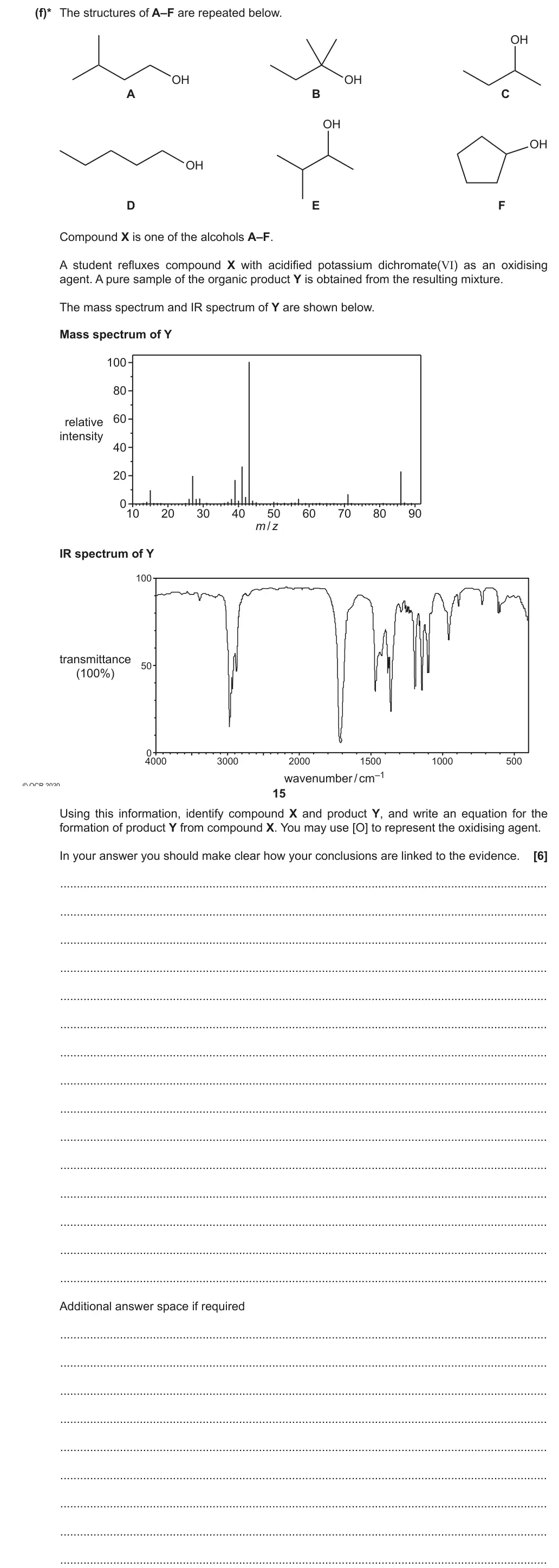
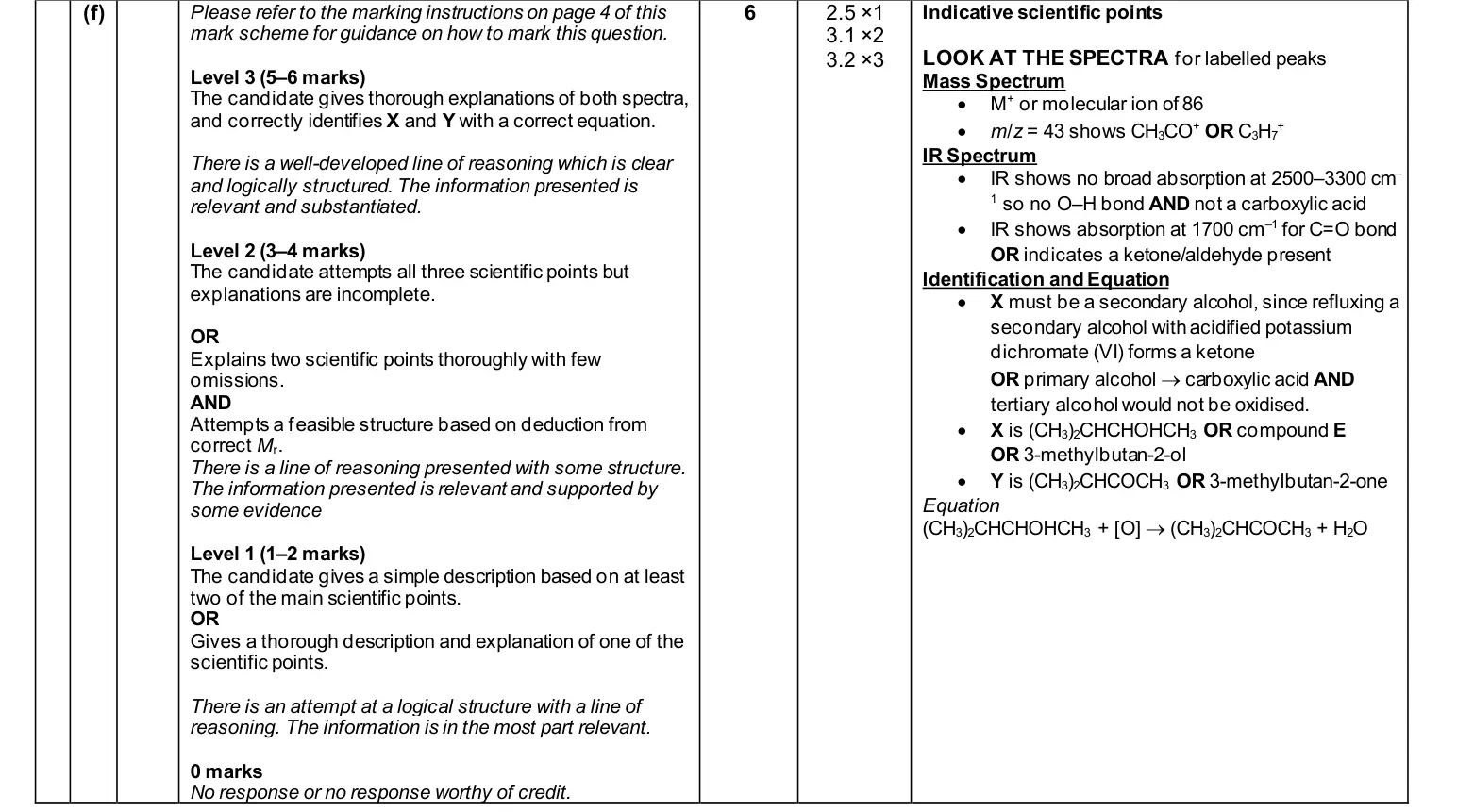
November 2020 · AS Paper 2 · Q5(f)6 marksAO2, 36-mark level of responseMedium
Earlier part of question 5 that this part uses
Mark scheme, with the levels and indicative points
Examiner's comment
5(a) Generally this was well answered. However, some candidates only gave two responses where three were required, presumably because it was worth two marks. 5(b) A significant number of candidates did not gain the mark here as they incorrectly balanced the number of oxygens, forgetting that the alcohol contains an O atom i.e. 6.5 O2 given rather than 6. 5(c) Nomenclature in organic chemistry takes lots of practice. Approximately half of the candidates did not score this mark. It was more challenging as they needed to work with skeletal structures but evidence of drawing out displayed formula was often seen. 5(d)(i) Most candidates were able to recall the formula to calculate atom economy, however a number made errors in working out Mr values. However, some left this blank or just gave an answer without any working. 5(d)(ii) Mechanisms were often seen showing curly arrows going in the wrong direction and between the wrong bonds and atoms, charges and dipoles were often incorrect, and partial changes used where full charges were required. Writing mechanisms is an important skill in organic chemistry so it is vital that time is spent practising writing them out and fully understanding the significance of the curly arrow. 5(d)(iii) Many candidates gave the correct mechanism here, with common incorrect responses being other types of mechanism, substitution only, or isomerism. 5(e) Very few candidates gained both marks here. It was not enough here to just state faster/slower without specifying which haloalkane they were referring to. It was also important to specify the C-X bond not just vague reference to the chlorine or bromine bond. Many described the difference in bond polarity so had the wrong order. Some were more general and discussed the reactivity of bromine and chlorine themselves. 5(f)* This was a challenging problem-solving question, relying on candidates to make use of all of the information provided to determine the structure. Very few candidates made no attempt at all at this question. The most common error was incorrectly identifying the peak at 3000 cm-1 as O-H from a carboxylic acid, despite it being indicated on the data sheet that this would be a broad peak. It suggested that candidates were not familiar with looking at spectra and understanding what data it gave. Candidates should also be reminded when answering these types of question that they should give the structures, not just molecular formulae, where possible. If any of your students’ results are not as expected, you may wish to consider one of our review of results services. For full information about the options available visit the OCR website. If university places are at stake you may wish to consider priority service 2 reviews of marking which have an earlier deadline to ensure your reviews are processed in time for university applications. Our priority is supporting you and your students this autumn and to support you as you prepare for summer 2021 exams. We’ll update our website information regularly with resources, guidance and key information. • Teachers • Students • Exams officers • Assessment specialists We are sending a weekly roundup to tell you about important updates. You can also sign up for your subject specific updates. If you haven’t already, sign up here. Attend one of our popular CPD courses to hear directly from a senior assessor or drop in to a Q&A session. All our courses for the academic year 2020-2021 are being delivered live via an online platform, so you can attend from any location. Please find details for all our courses on the relevant subject page on our website or visit OCR professional development. ExamBuilder is the question builder platform for a range of our GCSE, A Level, Cambridge Nationals, Cambridge Technicals and Functional Skills qualifications. See the full list of available qualifications in the sign up form. ExamBuilder is free for all OCR centres with an Interchange account and gives you unlimited users per centre. We need an Interchange username to validate the identity of your centre's first user account for ExamBuilder. If you do not have an Interchange account please contact your centre administrator (usually the Exams Officer) to request a username, or nominate an existing Interchange user in your department. Review of results
Notes from the mark scheme and report
M+ = 86, m/z 43 = CH3CO+ or C3H7+
C=O at about 1700 and no broad O–H so ketone not carboxylic acid
X is secondary alcohol E (3-methylbutan-2-ol), Y 3-methylbutan-2-one
equation with [O] forming H2O
Skills: M3.1 Translate information between graphical, numerical and algebraic forms
November 2020 · Paper 2 · Q61 markAO2Multiple choice
Answer
D
Mark scheme
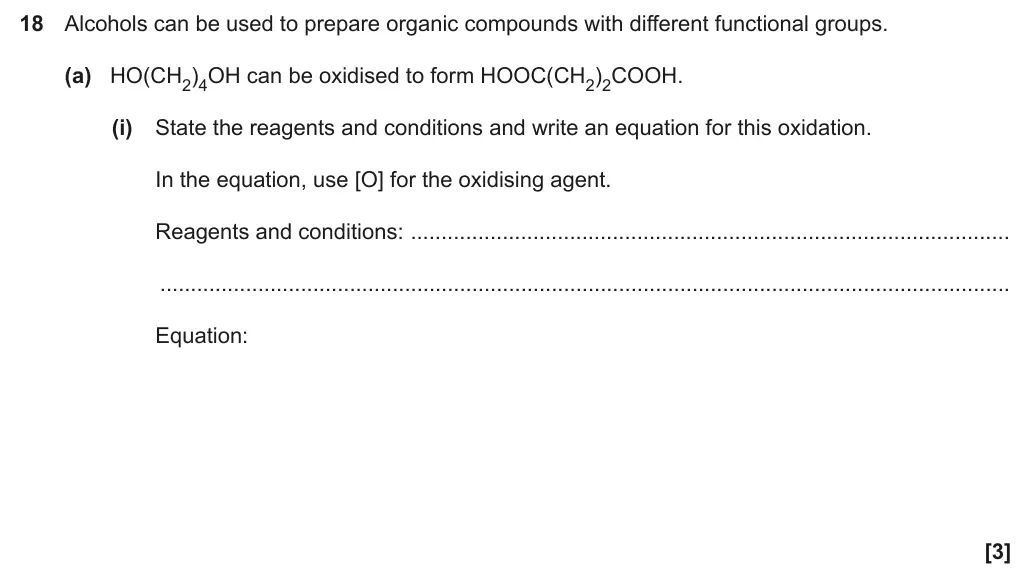
November 2020 · Paper 2 · Q18(a)(i)3 marksAO1, 2Equation writingMedium
Mark scheme
Examiner's comment
Question 18(a)(i) Many candidates did not correctly balance this equation or missed water as a product entirely.
Notes from the mark scheme and report
K2Cr2O7 AND acid AND reflux
4[O] and 2H2O
Skills: M0.2 Use ratios, fractions and percentages
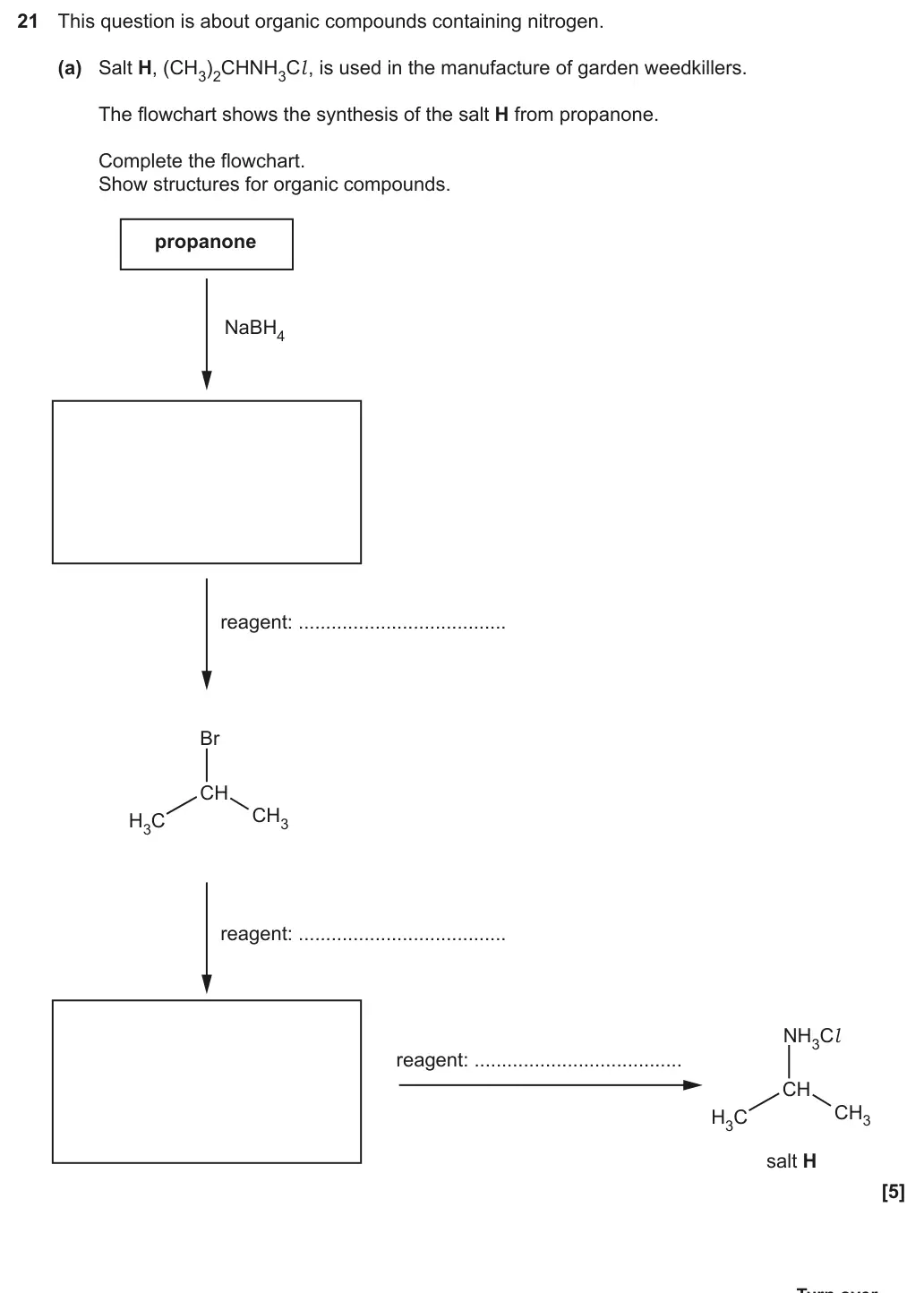
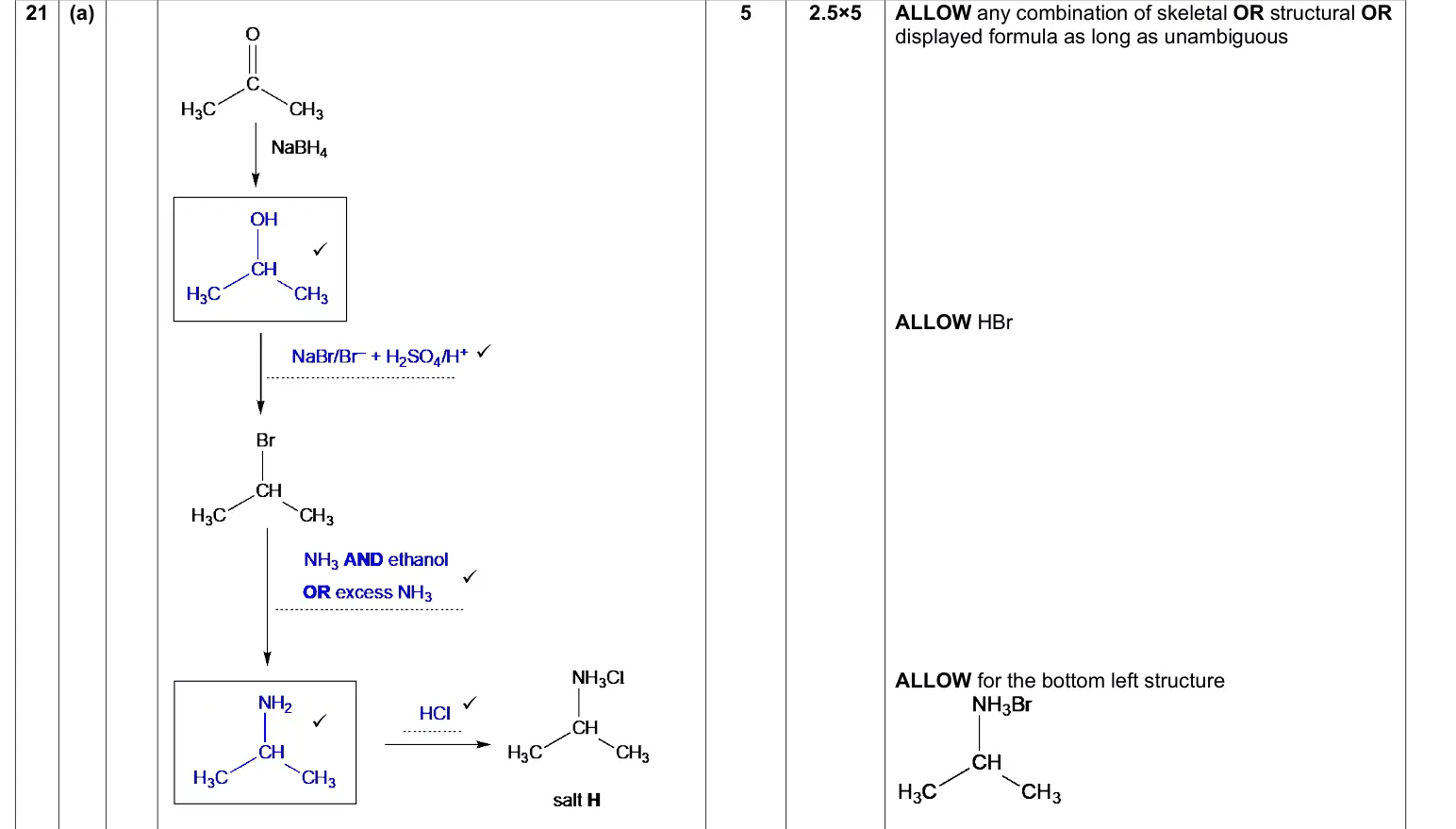
November 2020 · Paper 2 · Q21(a)5 marksAO2Complete table/diagram
Mark scheme
Notes from the mark scheme and report
propan-2-ol
NaBr/H2SO4 (ALLOW HBr)
excess NH3 in ethanol gives (CH3)2CHNH2
HCl for the salt
June 2019 · AS Paper 1 · Q25(a)(i)3 marksAO1, 2Structure / isomerHard
Mark scheme
Examiner's comment
AS LEVEL CHEMISTRY A Examiners’ report H032/01 Summer 2019 series Version 1 H032 For first teaching in 2015 www.ocr.org.uk/science Contents Introduction .............................................................................................................................................. 4 Paper 1 series overview ........................................................................................................................... 5 Section A overview ................................................................................................................................... 6 Question 2 ............................................................................................................................................ 6 Question 4 ............................................................................................................................................ 6 Question 5 ............................................................................................................................................ 7 Question 6 ............................................................................................................................................ 7 Question 9 ............................................................................................................................................ 8 Question 10 .......................................................................................................................................... 9 Question 11 ........................................................................................................................................ 10 Question 12 ........................................................................................................................................ 10 Question 14 ........................................................................................................................................ 11 Question 15 ........................................................................................................................................ 11 Question 17 ........................................................................................................................................ 12 Question 18 ........................................................................................................................................ 13 Question 19 ........................................................................................................................................ 13 Question 20 ........................................................................................................................................ 14 Section B overview ................................................................................................................................. 15 Question 21 (a) ................................................................................................................................... 15 Question 21 (b) .................................................................................................................................. 15 Question 21 (c) ................................................................................................................................... 16 Question 21 (d) (i) ............................................................................................................................... 16 Question 21 (d) (ii) .............................................................................................................................. 17 Question 21 (d) (iii) ............................................................................................................................. 18 Question 21 (d) (iv) ............................................................................................................................. 19 Question 22 (a) (i) ............................................................................................................................... 20 Question 22 (a) (ii) .............................................................................................................................. 20 Question 22 (b) ................................................................................................................................... 21 Question 22 (c) ................................................................................................................................... 22 Question 23 (a) ................................................................................................................................... 23 Question 23 (b) ................................................................................................................................... 24 Question 24 (a) (i) ............................................................................................................................... 25 Question 24 (a) (ii) .............................................................................................................................. 25 Question 24 (b) (i) ............................................................................................................................... 26 Question 24 (b) (ii) .............................................................................................................................. 27 Question 25 (a) (i), (ii) and (iii) ............................................................................................................ 28 Question 25 (b) (i) ............................................................................................................................... 29 Question 25 (b) (ii) .............................................................................................................................. 29 Question 25 (b) (iii) ............................................................................................................................. 30 Introduction Our examiners’ reports are produced to offer constructive feedback on candidates’ performance in the examinations. Question 25 (a) (i), (ii) and (iii) Part 25(a)(i) discriminated extremely well and rewarded well-prepared candidates.
Notes from the mark scheme and report
reflux so primary alcohol A gives the carboxylic acid
tertiary alcohol B gives NONE
DO NOT ALLOW 'sticks' in structures
June 2019 · AS Paper 1 · Q25(a)(iii)1 markAO2Complete table/diagramHard
Earlier part of question 25 that this part uses
Mark scheme
Examiner's comment
AS LEVEL CHEMISTRY A Examiners’ report H032/01 Summer 2019 series Version 1 H032 For first teaching in 2015 www.ocr.org.uk/science Contents Introduction .............................................................................................................................................. 4 Paper 1 series overview ........................................................................................................................... 5 Section A overview ................................................................................................................................... 6 Question 2 ............................................................................................................................................ 6 Question 4 ............................................................................................................................................ 6 Question 5 ............................................................................................................................................ 7 Question 6 ............................................................................................................................................ 7 Question 9 ............................................................................................................................................ 8 Question 10 .......................................................................................................................................... 9 Question 11 ........................................................................................................................................ 10 Question 12 ........................................................................................................................................ 10 Question 14 ........................................................................................................................................ 11 Question 15 ........................................................................................................................................ 11 Question 17 ........................................................................................................................................ 12 Question 18 ........................................................................................................................................ 13 Question 19 ........................................................................................................................................ 13 Question 20 ........................................................................................................................................ 14 Section B overview ................................................................................................................................. 15 Question 21 (a) ................................................................................................................................... 15 Question 21 (b) .................................................................................................................................. 15 Question 21 (c) ................................................................................................................................... 16 Question 21 (d) (i) ............................................................................................................................... 16 Question 21 (d) (ii) .............................................................................................................................. 17 Question 21 (d) (iii) ............................................................................................................................. 18 Question 21 (d) (iv) ............................................................................................................................. 19 Question 22 (a) (i) ............................................................................................................................... 20 Question 22 (a) (ii) .............................................................................................................................. 20 Question 22 (b) ................................................................................................................................... 21 Question 22 (c) ................................................................................................................................... 22 Question 23 (a) ................................................................................................................................... 23 Question 23 (b) ................................................................................................................................... 24 Question 24 (a) (i) ............................................................................................................................... 25 Question 24 (a) (ii) .............................................................................................................................. 25 Question 24 (b) (i) ............................................................................................................................... 26 Question 24 (b) (ii) .............................................................................................................................. 27 Question 25 (a) (i), (ii) and (iii) ............................................................................................................ 28 Question 25 (b) (i) ............................................................................................................................... 29 Question 25 (b) (ii) .............................................................................................................................. 29 Question 25 (b) (iii) ............................................................................................................................. 30 Introduction Our examiners’ reports are produced to offer constructive feedback on candidates’ performance in the examinations. Question 25 (a) (i), (ii) and (iii) Part 25(a)(i) discriminated extremely well and rewarded well-prepared candidates.
Notes from the mark scheme and report
6 O2 (the O atom in the alcohol must be counted)
Skills: M0.2 Use ratios, fractions and percentages
June 2019 · AS Paper 2 · Q5(b)(ii)2 marksAO3Short answerHard
Earlier part of question 5 that this part uses
Mark scheme
Examiner's comment
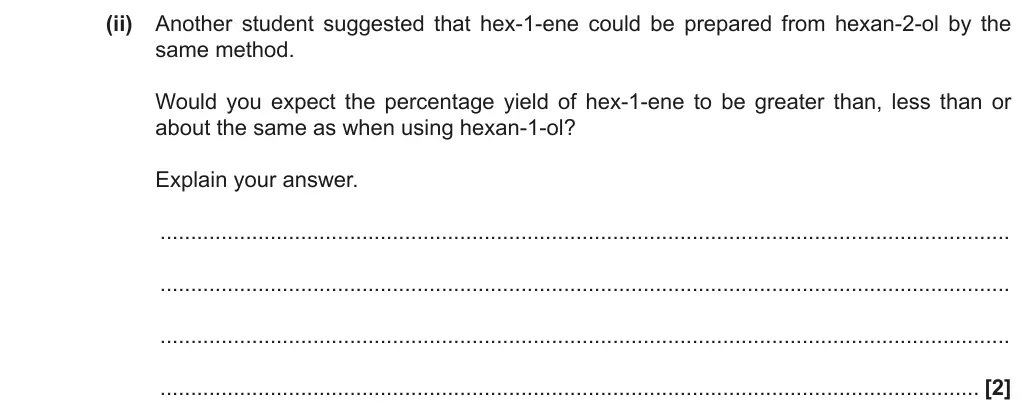
Most candidates obtained the first mark, but very few stated that hex-2-ene forms which is why the yield is less. Many candidates stated this was due to secondary alcohols being more stable than primary ones and a significant number thought the yield would be the same as they had the same Mr.
Notes from the mark scheme and report
yield of hex-1-ene is less because a mixture with hex-2-ene forms
June 2019 · Paper 2 · Q131 markAO1Multiple choiceHard
Answer
C
Mark scheme
Examiner's comment
This question discriminated well, with the higher ability candidates correctly selecting C. The most common incorrect response was A.
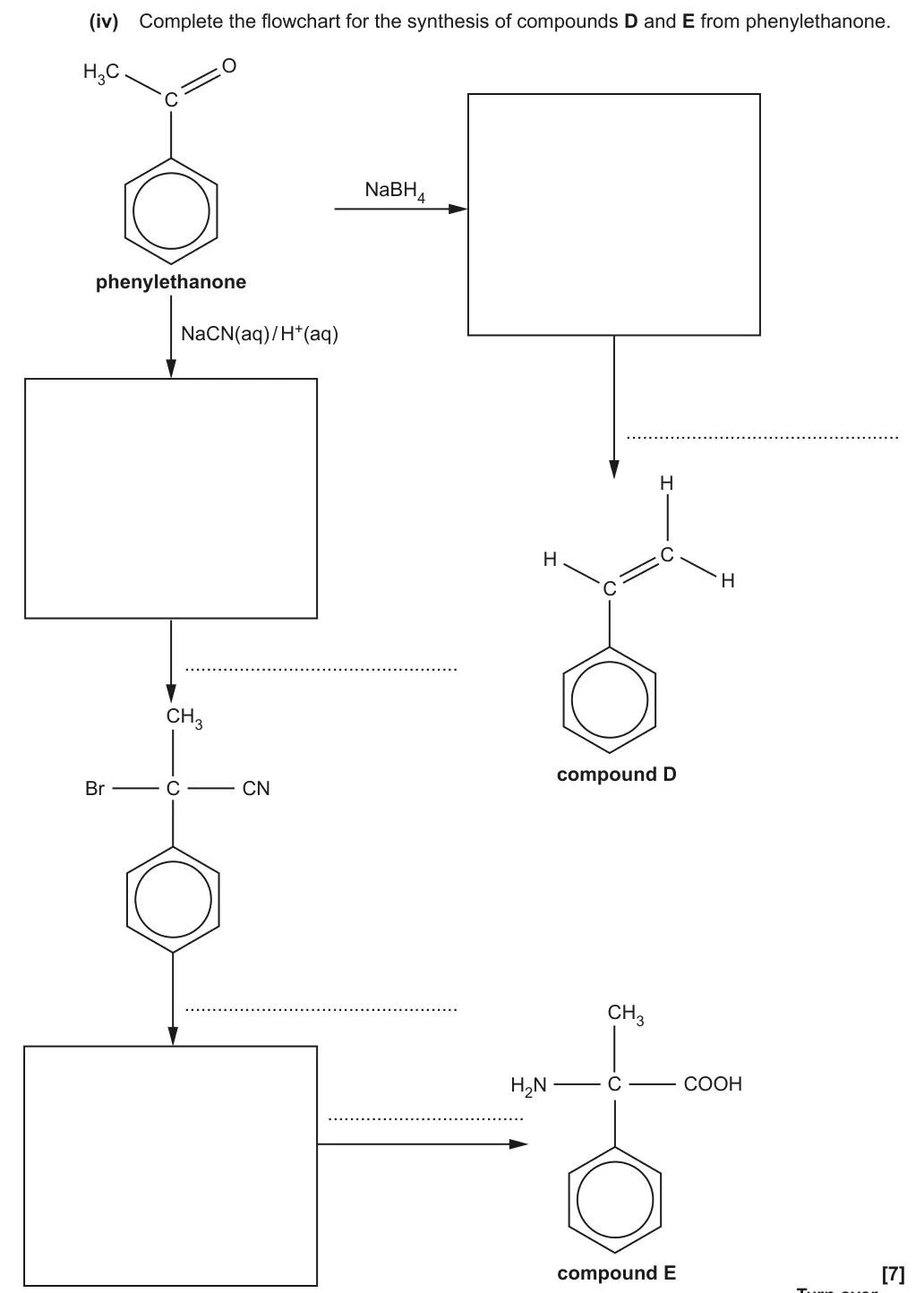
June 2019 · Paper 2 · Q19(b)(iv)7 marksAO2Short answerHard
Earlier parts of question 19 that this part uses
Mark scheme
Examiner's comment
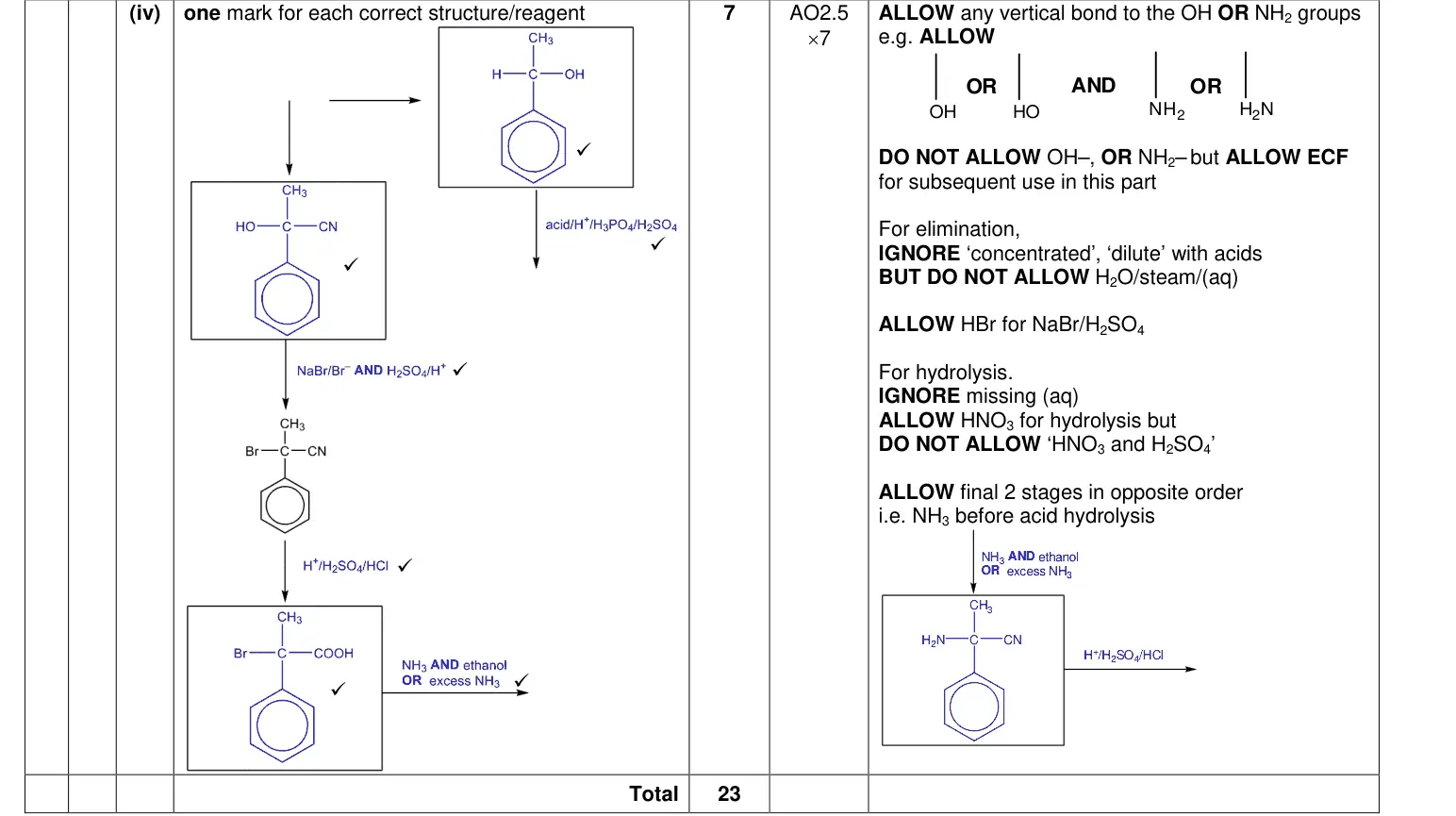
This question required candidates to apply knowledge of organic reactions from across the specification and discriminated well. Candidates with a good knowledge of reagents and conditions frequently scored over five marks. More detailed feedback is discussed with Exemplar 7, below. Phenylethanone is the starting point of this flowchart which shows the synthesis of compounds D and E. Synthesis of D The first step in the synthesis of D is the reduction of the ketone group. This response demonstrates a common error seen by examiners. The candidate has correctly deduced that than alcohol is formed but has omitted a hydrogen atom. Candidates are advised to take care when drawing structures. If a carbon atom is displayed it should be shown to be making four bonds. The final step of the synthesis is the dehydration of the alcohol with an acid. This candidate has used H3PO4. H2SO4 was also frequently seen. Lower ability responses included reference to water or steam and this was not credited. Synthesis of E The first step of the synthesis of E from phenylethanone is the reaction with NaCN(aq)/H+(aq). This candidate identifies that the product of the reaction is a hydroxynitrile but unfortunately this cannot be credited due to the incorrect linking of the OH group via the H atom. Candidates should be aware that, when drawing structures, groups must be bonded via the correct atoms. The next step of the synthesis is the substitution of the OH group. The candidate correctly recognises that NaBr is a suitable reagent but omits an acid, e.g. H2SO4, which is also required for this reaction. This error was seen frequently by examiners. The final two steps involve the substitution of the Br atom and acid hydrolysis of the nitrile group. In this case the candidate chooses the reaction with excess NH3. The structure of the correct product of this reaction is shown and the synthesis is completed by identifying a suitable reagent for the final step. Other candidates opted to perform these steps in the reverse order and the mark scheme allowed full credit for either approach. Common errors in the final steps were omissions. Some candidates simply stated NH3 without mentioning ethanol. Others identified water as important for the hydrolysis but did not include reference to an acid.
Notes from the mark scheme and report
1-phenylethanol then acid catalyst (DO NOT ALLOW H2O/steam/(aq)) for D
hydroxynitrile, NaBr/H2SO4 (ALLOW HBr), acid hydrolysis of CN, excess NH3/ethanol (last two stages in either order)
DO NOT ALLOW OH– or NH2– for the groups
June 2019 · Paper 3 · Q2(c)1 markAO2Equation writingHard
Earlier part of question 2 that this part uses
Mark scheme
Examiner's comment
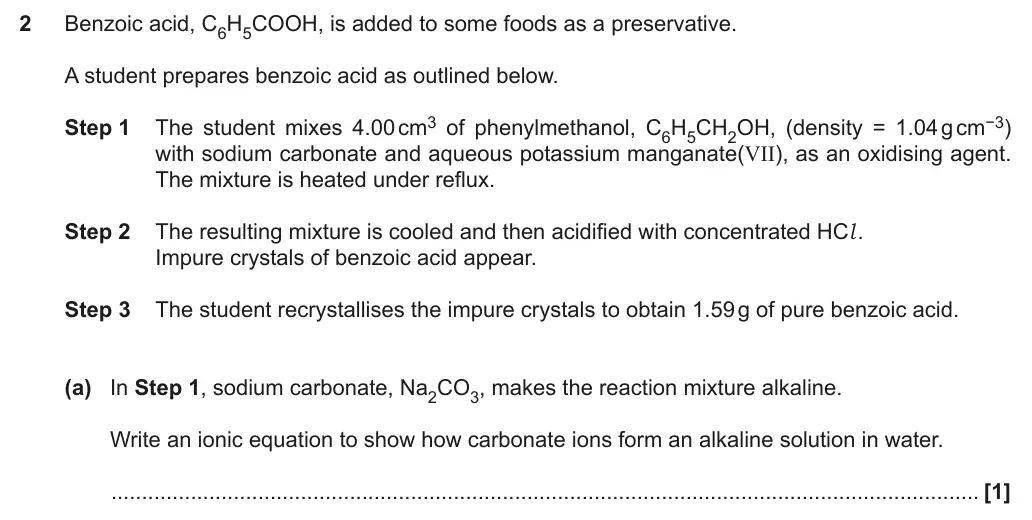
This part discriminated well with many candidates being able to write a correct equation using their knowledge of the oxidation of alcohols. Mistakes usually resulted in the balancing with either [O] instead of 2[O] or 2H2O instead of H2O. Written equations always need to be checked for the atoms balancing.
Notes from the mark scheme and report
C6H5CH2OH + 2[O] → C6H5COOH + H2O
ALLOW molecular formulae
June 2019 · Paper 3 · Q4(b)(iii)4 marksAO3Structure / isomerMedium
Earlier part of question 4 that this part uses
Mark scheme
Examiner's comment
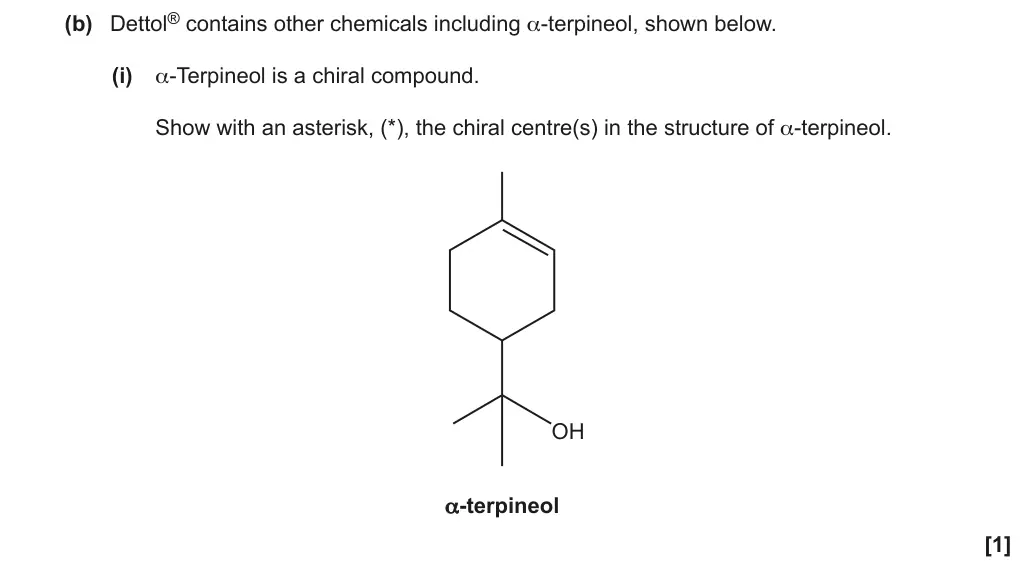
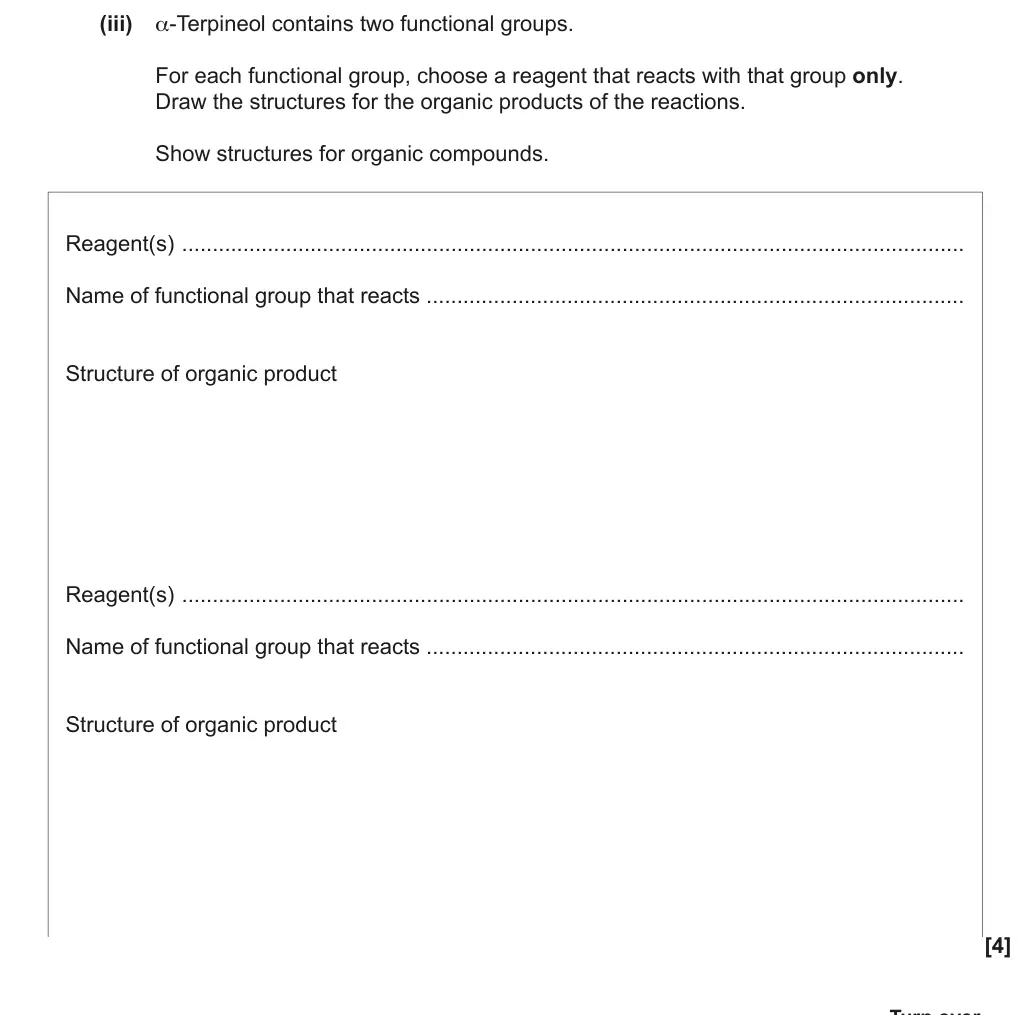
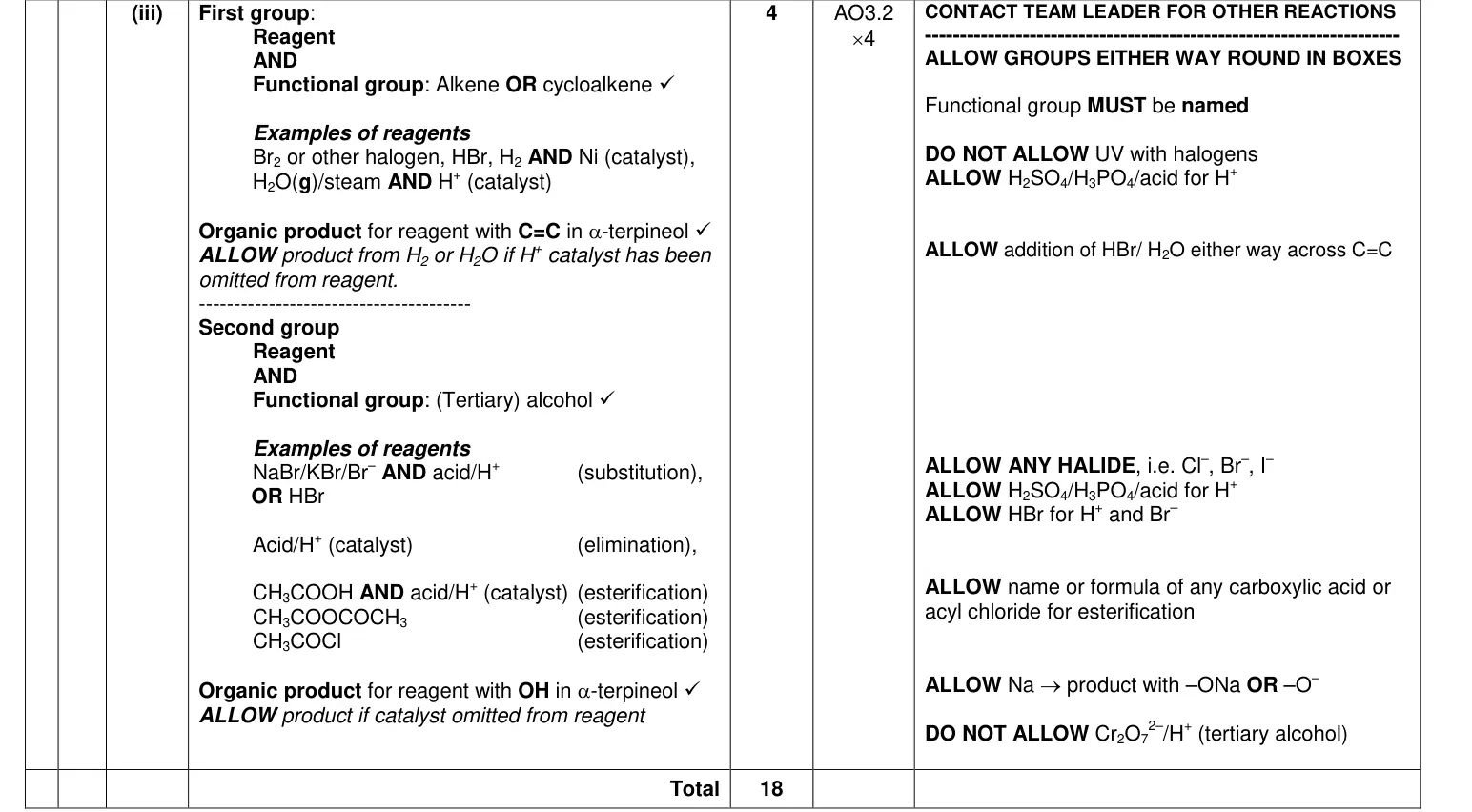
In this question, candidates were given the opportunity to demonstrate some knowledge of organic reaction in a new context. The choice of reaction was up to the candidate. Most candidates were able to identify the alkene group in terpineol and to suggest a reagent that would react with this functional group. A correct structure for the organic product then usually followed. Although most candidates identified the alcohol group, many struggled with a reagent and resulting product. Although the alcohol –OH group has many reactions, (e.g. elimination, substitution, esterification) many candidates were fixated on oxidation with acidified dichromate despite a tertiary alcohol not being capable of oxidation with this reagent. Some candidates quoted acidified dichromate but then copied the structure of terpineol, stating that there was no reaction, despite the question directing them to select a reagent that would react with their chosen group.
Notes from the mark scheme and report
functional group MUST be named (alkene
tertiary alcohol)
DO NOT ALLOW UV with halogens
DO NOT ALLOW Cr2O72–/H+ (tertiary alcohol)
ALLOW addition of HBr/H2O either way across C=C
reagent must react with that group only
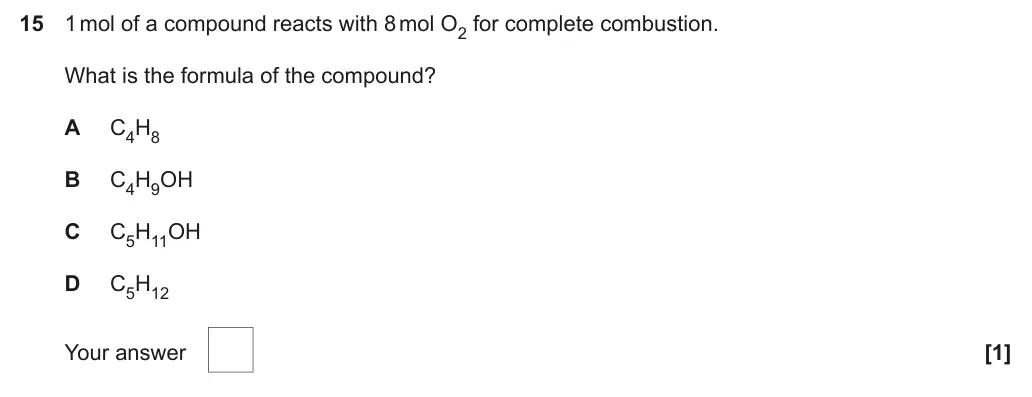
June 2018 · AS Paper 1 · Q151 markMultiple choiceMedium
Answer
D
Mark scheme
Examiner's comment
Most candidates selected A or D, with D being the correct option. Presumably, A was chosen by halving the ‘8’ in C4H8 without considering that each H2O molecule contains two H atoms. The successful answer of D usually resulted from the candidate constructing equations.
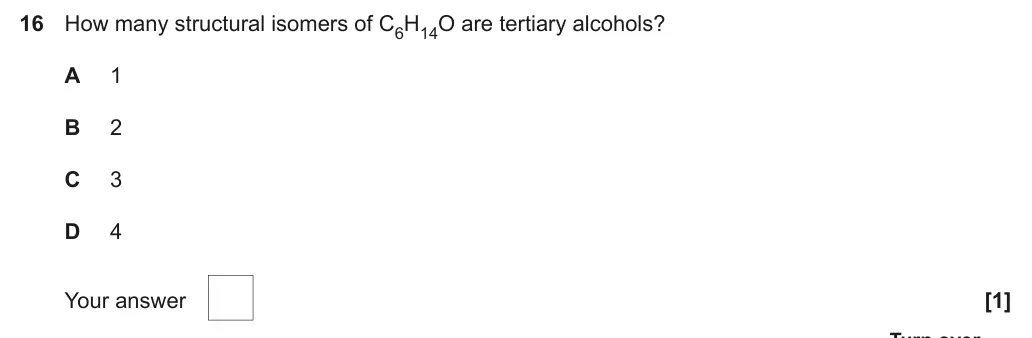
June 2018 · AS Paper 1 · Q161 markMultiple choiceMedium
Answer
C
Mark scheme
Examiner's comment
The responses showed a reasonably even split across all options with relatively few correct responses of C. A good route to success here is to draw out the possibilities.
Notes from the mark scheme and report
ALLOW 3
Skills: M4.2 Visualise and represent 2-D and 3-D forms including 2-D representations of 3-D objects
June 2018 · AS Paper 1 · Q25(a)(i)3 marksComplete table/diagramHard
Mark scheme
Examiner's comment
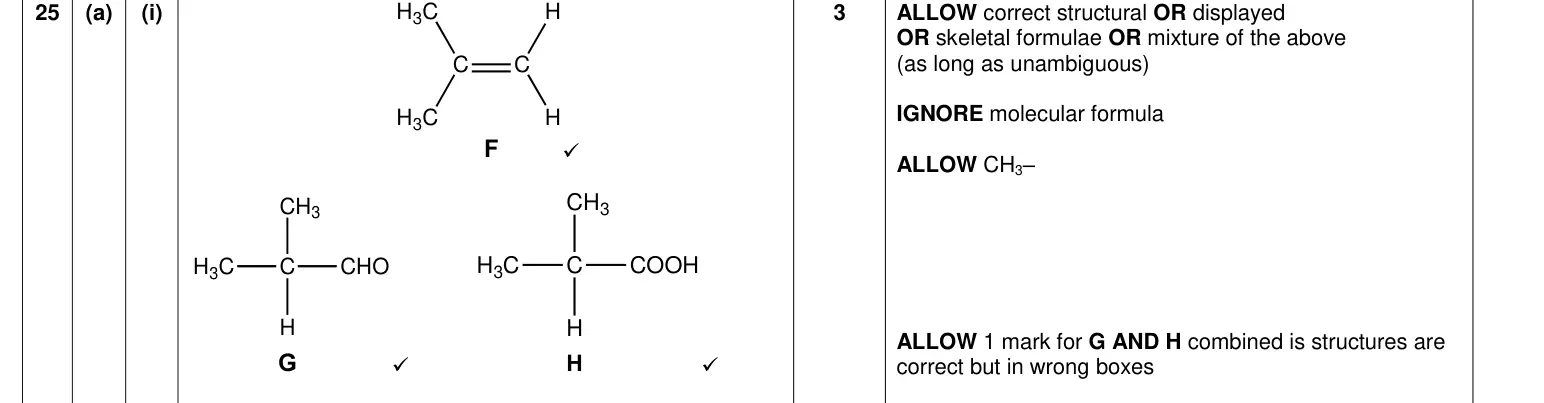
Part (i) discriminated extremely well and rewarded the well-prepared candidate. Compound F proved to be the most difficult option, with a large variety of responses, many appearing to be guesses. Candidates were much more successful with compounds G and H, although these were sometimes shown in reverse order. A significant number of candidates drew structures containing C=C or C=O bonds in which the carbon atom had five bonds. Candidates should check drawing of organic structures carefully to ensure that all carbon atoms have four bonds. There were some good responses for part (ii), with many clearly shown and correct systematic names.
Notes from the mark scheme and report
F = alkene, G = aldehyde (distil), H = carboxylic acid (reflux)
1 mark if G and H correct but in wrong boxes
June 2018 · Paper 2 · Q16(a)(iii)2 marksStructure / isomerMedium
Earlier part of question 16 that this part uses
Mark scheme
Examiner's comment
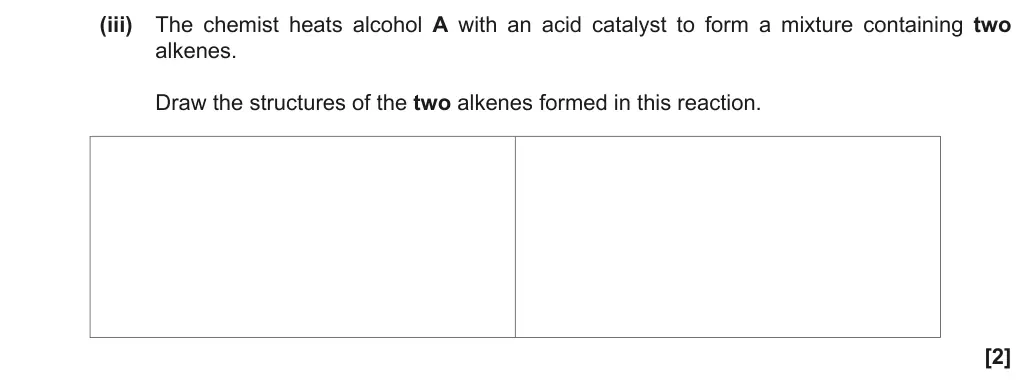
Many candidates correctly identified the two alkenes formed as 2-methylbut-2-ene and 3-methybut-1- ene. Stronger responses used skeletal formula to show the structures clearly. Some candidates preferred to use chemical symbols to represent the atoms present and although this approach is valid, lower ability responses did not show sufficient detail as demonstrated in Exemplar 1. In this response the alkene 2-methylbut-2-ene has been correctly identified and one mark credited. However, the attempt to show 3-methylbut-1-ene does not score. This is because C3H7 has been used instead of CH(CH3)2. Candidates should be encouraged to show every carbon atom when drawing a structure as the use of ambiguous formulae is not sufficient to gain credit.
Notes from the mark scheme and report
one mark per alkene: 2-methylbut-2-ene and 3-methylbut-1-ene
either order
June 2018 · Paper 2 · Q16(a)(iv)2 marksEquation writingHard
Earlier part of question 16 that this part uses
Mark scheme
Examiner's comment
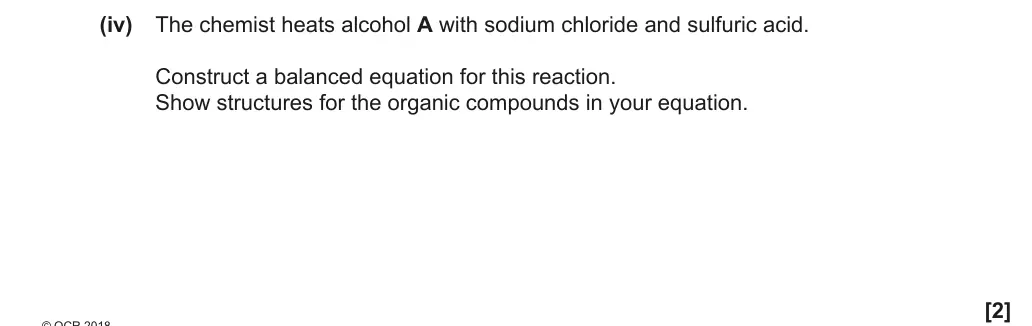
This question proved difficult for candidates. Although many candidates were able to identify the correct organic product, only the higher ability candidates were able to construct an appropriate balanced equation. A common error was to omit the role of the acid; this is shown in Exemplar 2 below. Lower ability candidates appeared not to recognise this reaction and suggested an alkoxide salt, rather than a haloalkane as the organic product. This type of response was seen frequently by examiners. The candidate has drawn the correct structure of the haloalkane formed and scores the first mark. However, the response fails to recognise that the reaction occurs under acidic conditions and omits the sulfuric acid from the equation.
Notes from the mark scheme and report
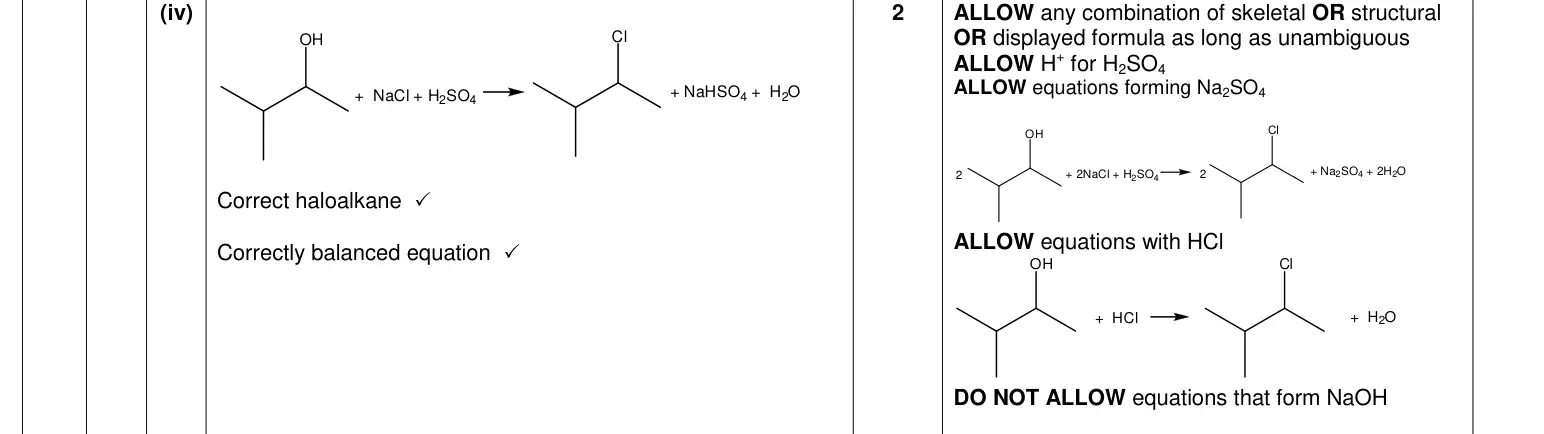
DO NOT ALLOW equations that form NaOH
ALLOW Na2SO4 version, H+ for H2SO4, or equation with HCl
June 2018 · Paper 2 · Q16(b)2 marksComplete table/diagramHard
Mark scheme
Examiner's comment
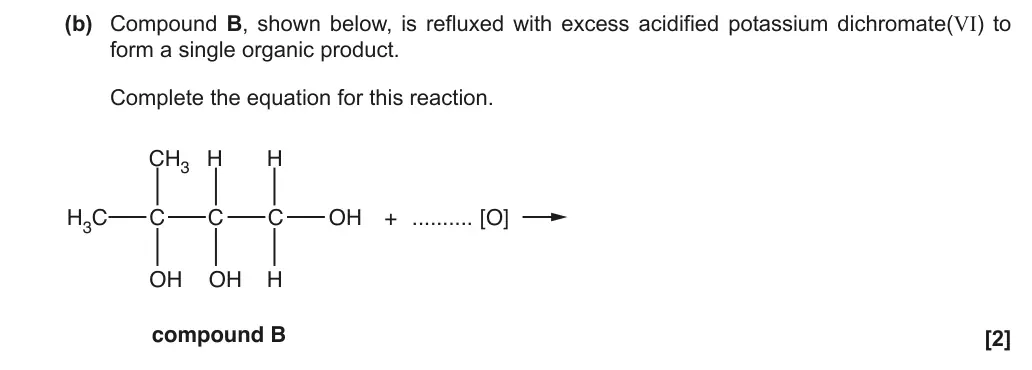
This question required candidates to apply their knowledge of the oxidation of alcohols to complete the equation for the complete oxidation of compound B. This question discriminated well. Many candidates correctly identified the organic product but only the higher ability candidates could complete the equation. A common error was to omit water as a product of the reaction.
Notes from the mark scheme and report
reflux with excess: primary OH to COOH, secondary OH to C=O, tertiary OH unchanged
3[O] and 2H2O
Skills: M0.2 Use ratios, fractions and percentages
June 2018 · Paper 2 · Q22(b)4 marksData interpretationEasy
Earlier part of question 22 that this part uses
Mark scheme
Examiner's comment
This question was answered well with most candidates scoring three or four marks. Examiners were impressed by the number of responses that accurately referred to induced dipole-dipole interactions or London forces rather than van der Waals’ forces, which is ambiguous. Some responses lacked detail, as demonstrated in Exemplar 10. This response attributes the higher boiling point of pentan-1-ol to the amount energy required to break hydrogen bonds. However, it does not refer the relative strength of this type of interaction. Consequently, the first paragraph only scores marking point four and not marking point three. The higher boiling point of heptane compared to hexane is explained by a correct comparison of the induced dipole-dipole interactions present in these compounds, so marking point two was achieved. However, the justification for the difference in intermolecular forces lacks precision. Candidates should be encouraged to focus on surface contact or surface interaction between molecules rather than referring to surface area alone.
Notes from the mark scheme and report
heptane: more surface contact/more electrons so stronger London forces
pentan-1-ol: hydrogen bonds
more energy to break the forces
IGNORE van der Waals/VDW/IDID
IGNORE 'harder to break' without energy
IGNORE 'more energy to break bonds'
June 2017 · AS Paper 1 · Q181 markMultiple choice
Answer
A
Mark scheme
June 2017 · AS Paper 1 · Q191 markMultiple choice
Answer
B
Mark scheme
June 2017 · AS Paper 2 · Q4(a)2 marksDrawing / labelling
Mark scheme
Notes from the mark scheme and report
must be displayed formulae
two lone pairs on both O atoms
H-bond labelled between H(δ+) and an O lone pair
IGNORE δ+ shown on other H atoms
June 2017 · AS Paper 2 · Q4(c)6 marks6-mark level of response
Mark scheme, with the levels and indicative points
Notes from the mark scheme and report
acidified dichromate
distil for butanal (removed to prevent further oxidation), reflux for butanoic acid
equations with [O] (2[O] for the acid)
distillation diagram with condenser and water flow
Skills: PAG5 Synthesis of an organic liquid
June 2017 · AS Paper 2 · Q6(a)(i)2 marksStructure / isomer
Mark scheme
Notes from the mark scheme and report
E = cyclohexanol
acid catalyst (H3PO4/H2SO4/H+) AND heat
DO NOT ALLOW other named acids
IGNORE water/steam
June 2017 · Paper 2 · Q19(a)1 markEquation writing
Mark scheme
Notes from the mark scheme and report
C5H10O + 7O2 → 5CO2 + 5H2O
ALLOW any correctly balanced unsaturated C5 alcohol
IGNORE state symbols
Skills: M0.2 Use ratios, fractions and percentages
June 2017 · Paper 2 · Q19(b)(i)2 marksDrawing / labelling
Mark scheme
Notes from the mark scheme and report
δ+ on H and δ– on O on BOTH molecules
H-bond from a lone pair on O to H, labelled
DO NOT ALLOW δ+ on alkyl H atoms
no marks for a diagram containing O2H
June 2017 · Paper 2 · Q19(b)(ii)1 markData interpretation
Earlier part of question 19 that this part uses
Mark scheme
Notes from the mark scheme and report
comparative: diol has more OH groups AND forms more hydrogen bonds with water
DO NOT ALLOW hydroxide/OH–
June 2017 · Paper 2 · Q19(c)(i)5 marksShort answer
Mark scheme
Notes from the mark scheme and report
3-methylcyclohexanone
NaBH4 (ALLOW LiAlH4)
1-bromo-3-methylcyclohexane
3-methylcyclohexene and 4-methylcyclohexene in either order
watch for missing methyl groups
June 2017 · Paper 2 · Q19(d)5 marksEquation writing
Mark scheme
Notes from the mark scheme and report
DO NOT ALLOW CH3CH2CH2COH for the aldehyde
distil for aldehyde AND reflux for carboxylic acid, conditions linked to product
wrong primary alcohol max 4
Skills: PAG5 Synthesis of an organic liquid
June 2016 · AS Paper 1 · Q181 markMultiple choice
Answer
B
Mark scheme
June 2016 · AS Paper 1 · Q26(b)2 marksAO2Structure / isomer
Earlier part of question 26 that this part uses
Mark scheme
Notes from the mark scheme and report
C is the tertiary alcohol
DO NOT ALLOW more than one repeat unit
side links required
DO NOT ALLOW OH– connectivity
June 2016 · AS Paper 2 · Q3(b)2 marksShort answer
Earlier part of question 3 that this part uses
Mark scheme
Notes from the mark scheme and report
2-methylbutan-2-ol and 3-methylbutan-2-ol
ALLOW any vertical bond to OH
DO NOT ALLOW OH–
June 2016 · AS Paper 2 · Q6(a)1 markAO1Short answer
Mark scheme
Notes from the mark scheme and report
C bearing –OH is attached to two C atoms/alkyl groups (or one H)
June 2016 · AS Paper 2 · Q6(c)(i)2 marksAO2Equation writing
Earlier part of question 6 that this part uses
Mark scheme
Notes from the mark scheme and report
butanone structure
ALLOW molecular formulae in equation
Work with an OCR chemistry tutor
Dropping marks on calculations, mechanisms or the six-markers? Book a trial session with a specialist OCR chemistry tutor.