Notes and key-term cards for this topic are being written by our tutors. The past-paper questions below are ready now.
Learning outcomes
Show the 26 learning outcomes from the specification
5.3.1(a) the electron configuration of atoms and ions of the d-block elements of Period 4 (Sc–Zn), given the atomic number and charge (see also 2.2.1 d)
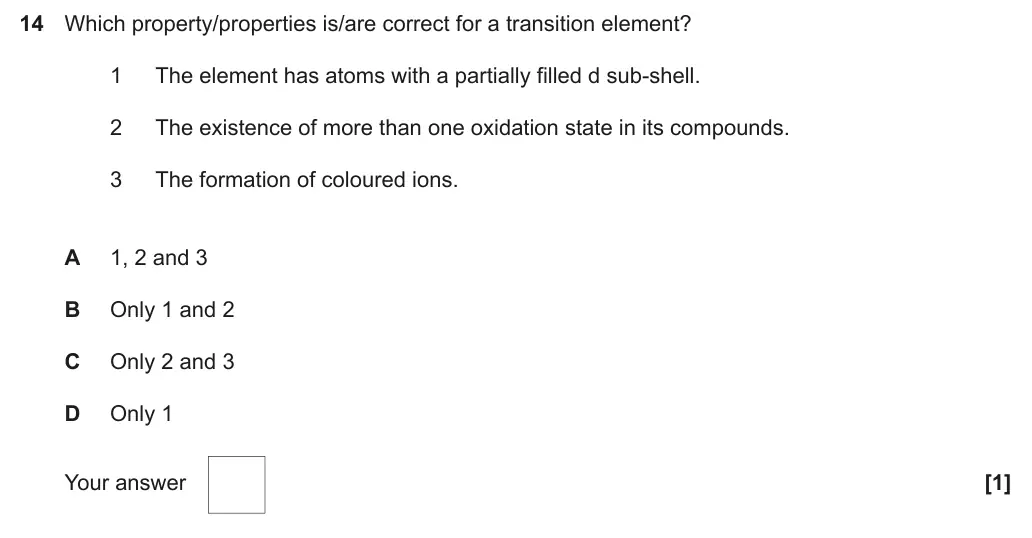
5.3.1(b) the elements Ti–Cu as transition elements i.e. d-block elements that have an ion with an incomplete d-sub-shell
5.3.1(c) illustration, using at least two transition elements, of:
5.3.1(c)(i) the existence of more than one oxidation state for each element in its compounds (see also 5.3.1 k)
5.3.1(c)(ii) the formation of coloured ions (see also 5.3.1 h, j– k)
5.3.1(c)(iii) the catalytic behaviour of the elements and their compounds and their importance in the manufacture of chemicals by industry (see 3.2.2 d)
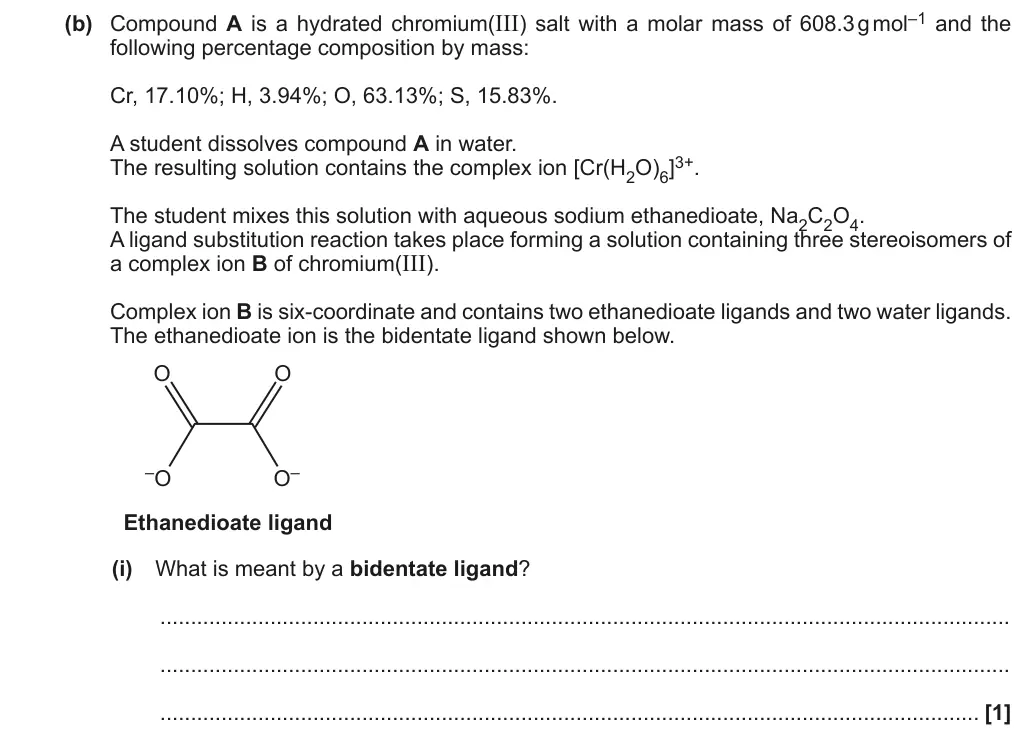
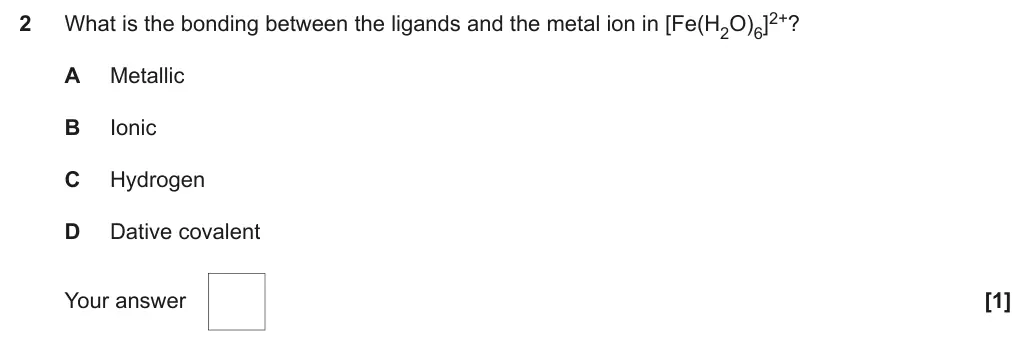
5.3.1(d) explanation and use of the term ligand in terms of coordinate (dative covalent) bonding to a metal ion or metal, including bidentate ligands
5.3.1(e) use of the terms complex ion and coordination number and examples of complexes with:
5.3.1(e)(i) six-fold coordination with an octahedral shape
5.3.1(e)(ii) four-fold coordination with either a planar or tetrahedral shape (see also 2.2.2 g– h)
5.3.1(f) types of stereoisomerism shown by complexes, including those associated with bidentate and multidentate ligands:
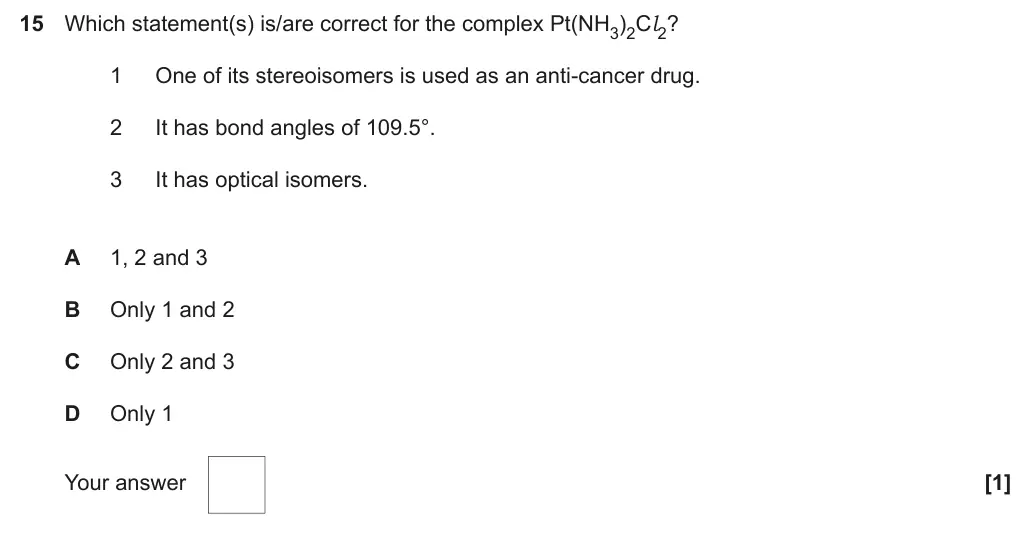
5.3.1(f)(i) cis– trans isomerism e.g. Pt(NH3)2Cl2 (see also 4.1.3 c– d)
5.3.1(f)(ii) optical isomerism e.g. [Ni(NH2CH2CH2NH2)3]2+(see also 6.2.2 c)
5.3.1(g) use of cis -platin as an anti-cancer drug and its action by binding to DNA preventing cell division
5.3.1(h) ligand substitution reactions and the accompanying colour changes in the formation of:
5.3.1(h)(i) [Cu(NH3)4(H2O)2]2+ and [CuC l4]2– from [Cu(H2O)6]2+
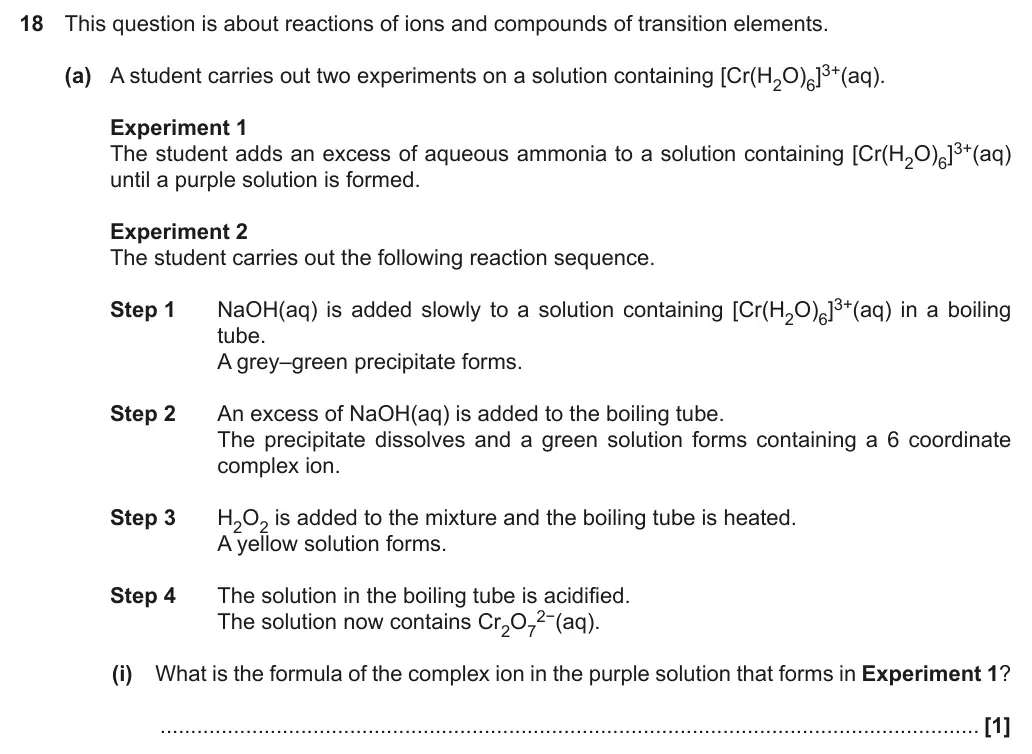
5.3.1(h)(ii) [Cr(NH3)6]3+ from [Cr(H2O)6]3+ (see also 5.3.1 j)
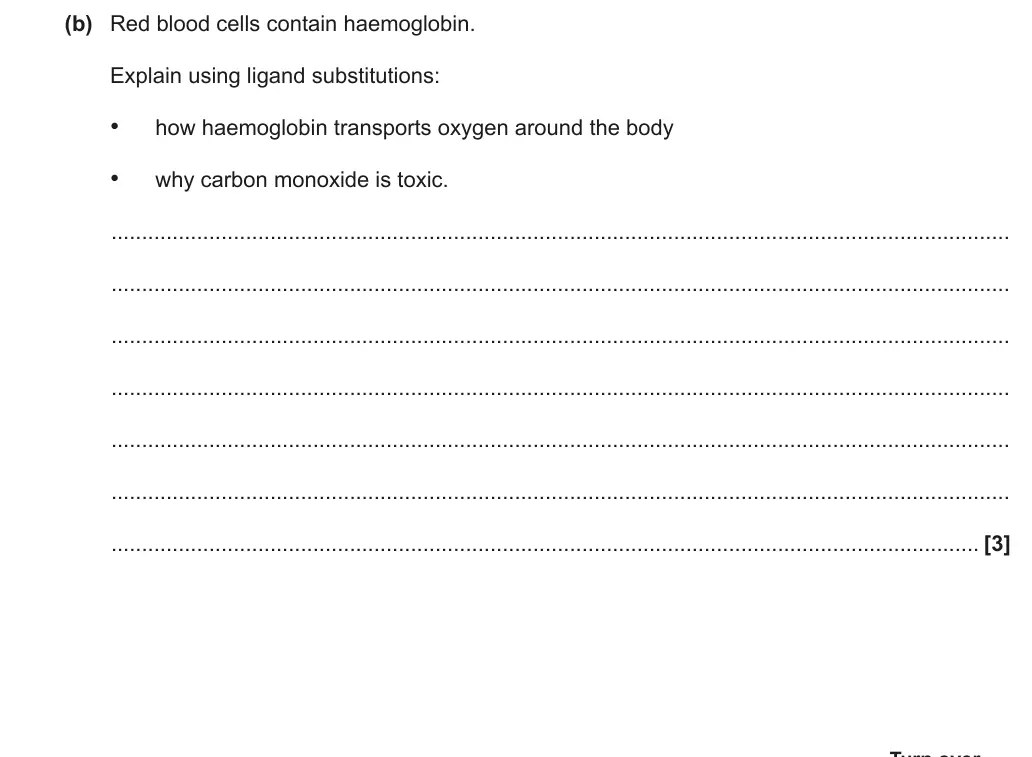
5.3.1(i) explanation of the biochemical importance of iron in haemoglobin, including ligand substitution involving O2and CO
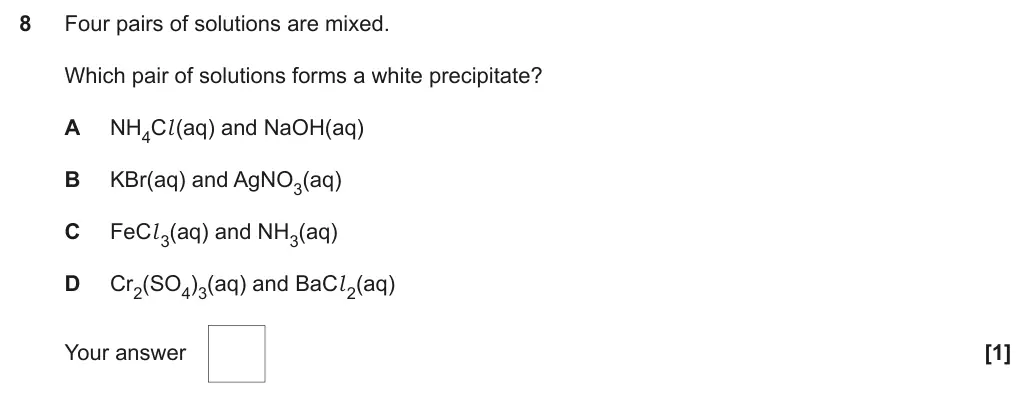
5.3.1(j) reactions, including ionic equations, and the accompanying colour changes of aqueous Cu2+, Fe2+, Fe3+, Mn2+ and Cr3+ with aqueous sodium hydroxide and aqueous ammonia, including:
5.3.1(j)(i) precipitation reactions
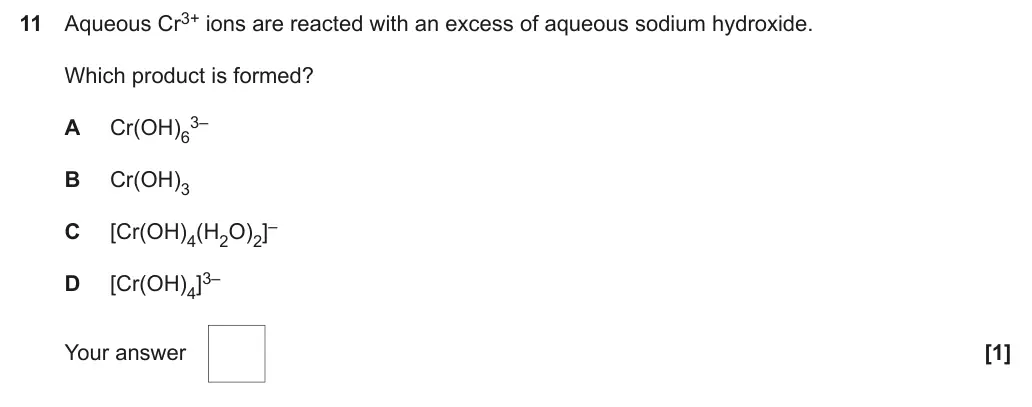
5.3.1(j)(ii) complex formation with excess aqueous sodium hydroxide and aqueous ammonia
5.3.1(k) redox reactions and accompanying colour changes for:
5.3.1(k)(i) interconversions between Fe2+ and Fe3+
5.3.1(k)(ii) interconversions between Cr3+ and Cr2O72–
5.3.1(k)(iii) reduction of Cu2+ to Cu+ and disproportionation of Cu+ to Cu2+ and Cu
5.3.1(l) interpretation and prediction of unfamiliar reactions including ligand substitution, precipitation, redox.
Six-mark level of response questions on this topic
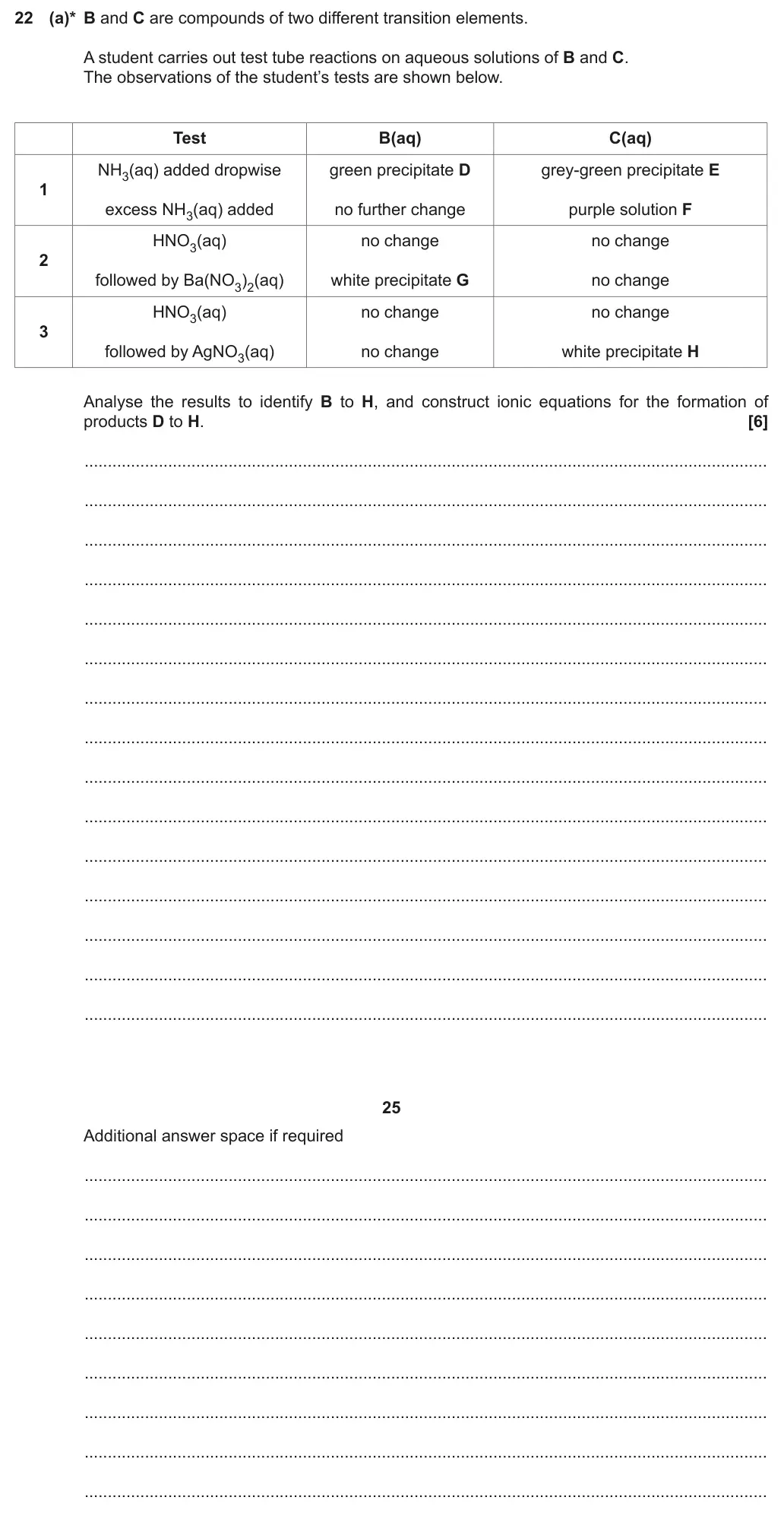
(a)* B and C are compounds of two different transition elements. Analyse the results to identify B to H, and construct ionic equations for the formation of
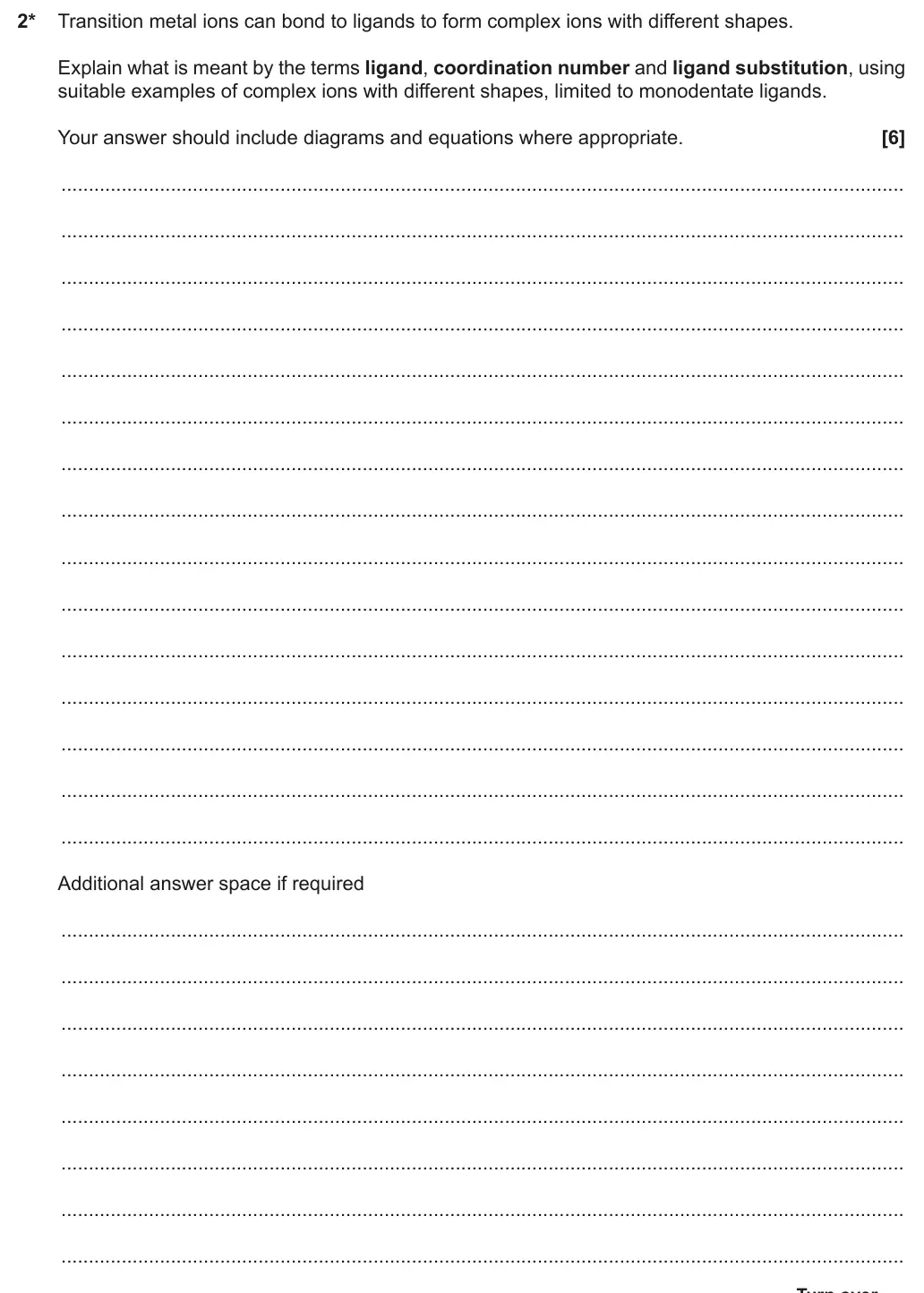
Transition metal ions can bond to ligands to form complex ions with different shapes. Explain what is meant by the terms ligand, coordination number and ligand substitution, using
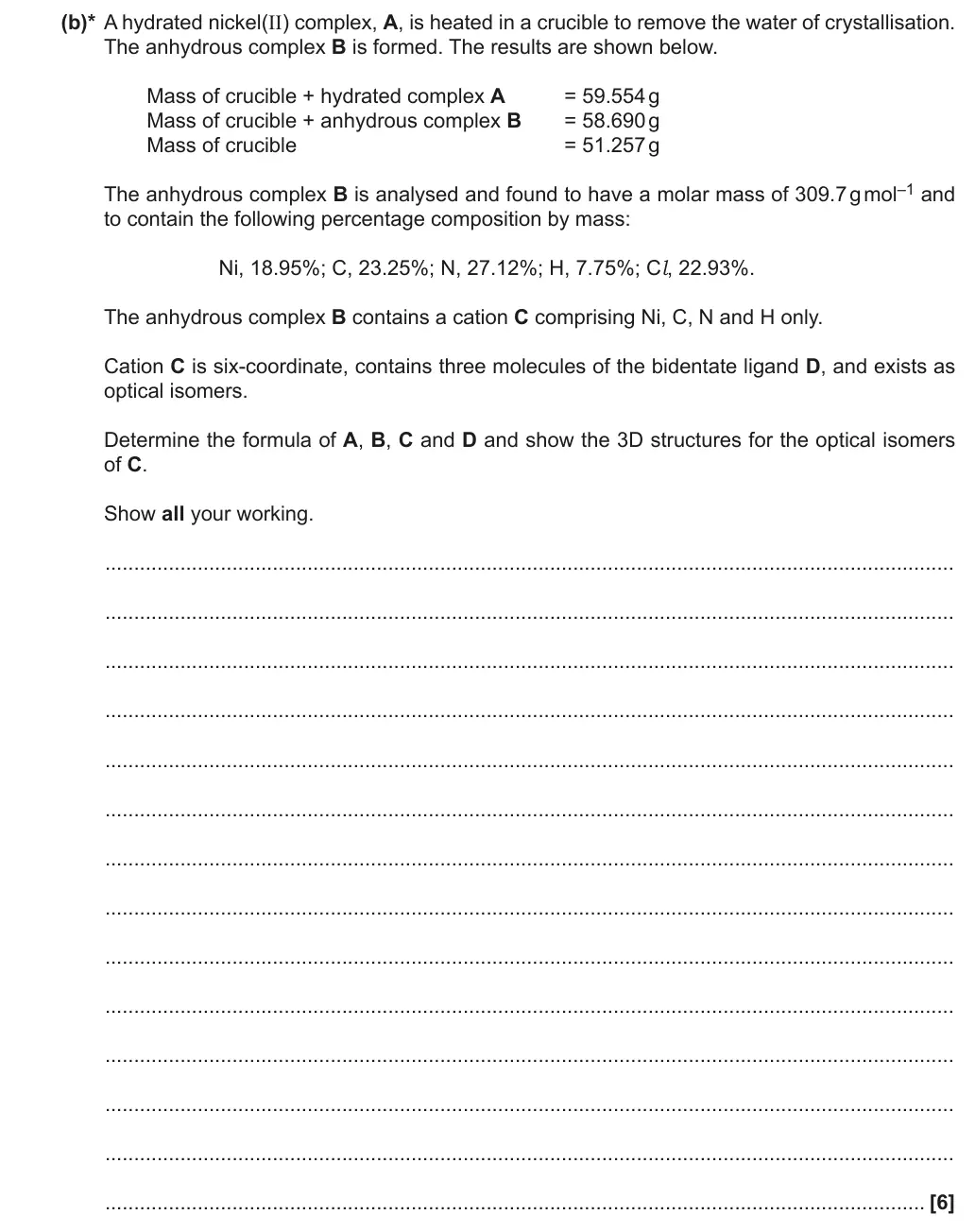
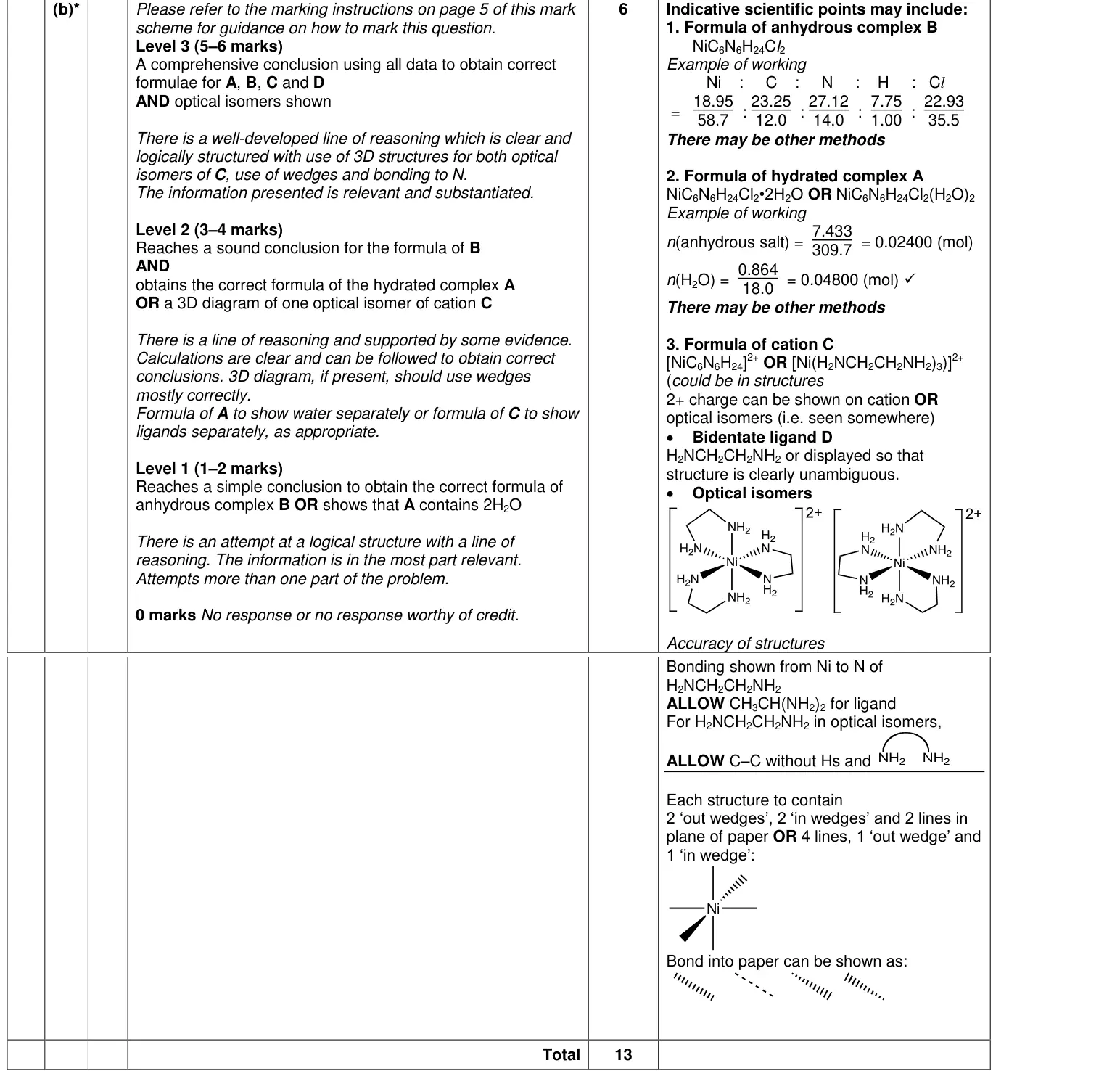
A hydrated nickel(II) complex, A, is heated in a crucible to remove the water of crystallisation. Determine the formula of A, B, C and D and show the 3D structures for the optical isomers
Tap a question to zoom it. Where a part needs a table, graph or structure from an earlier part, that part folds out above it; the mark scheme and examiner's comment open underneath. Have the OCR Data Sheet beside you.
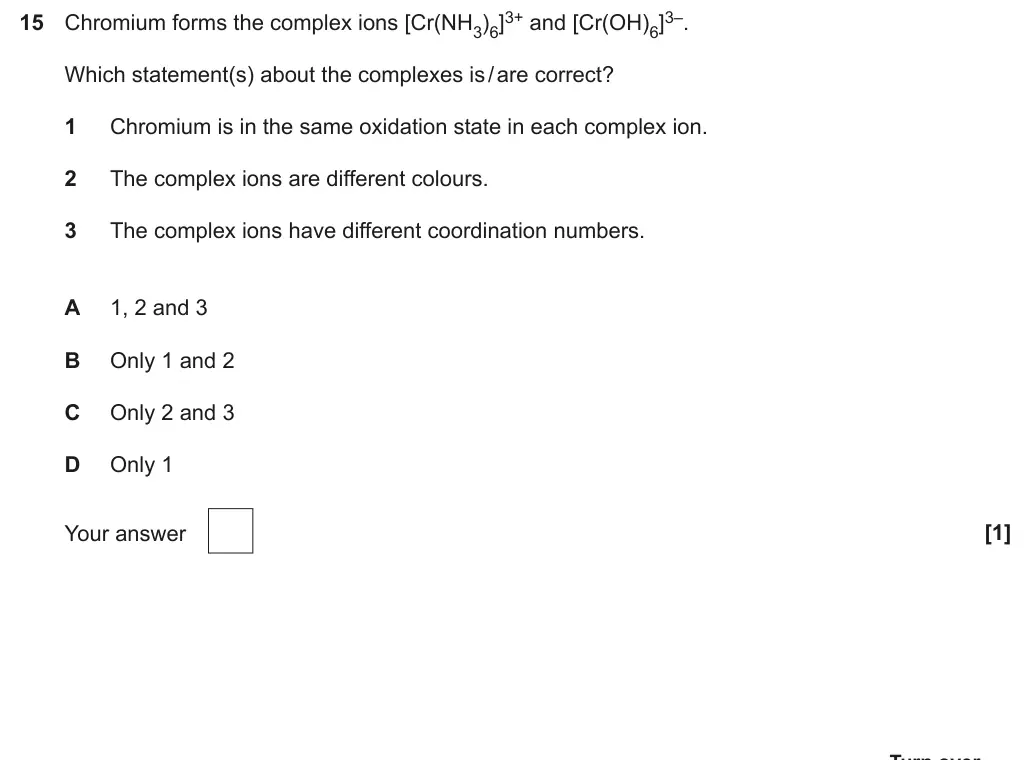
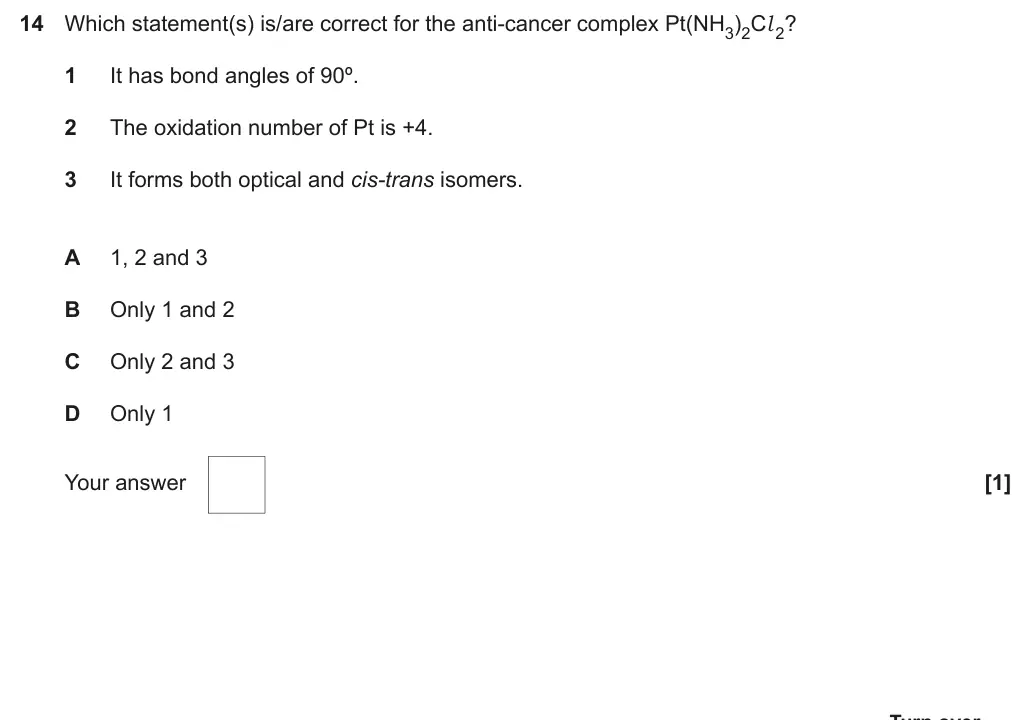
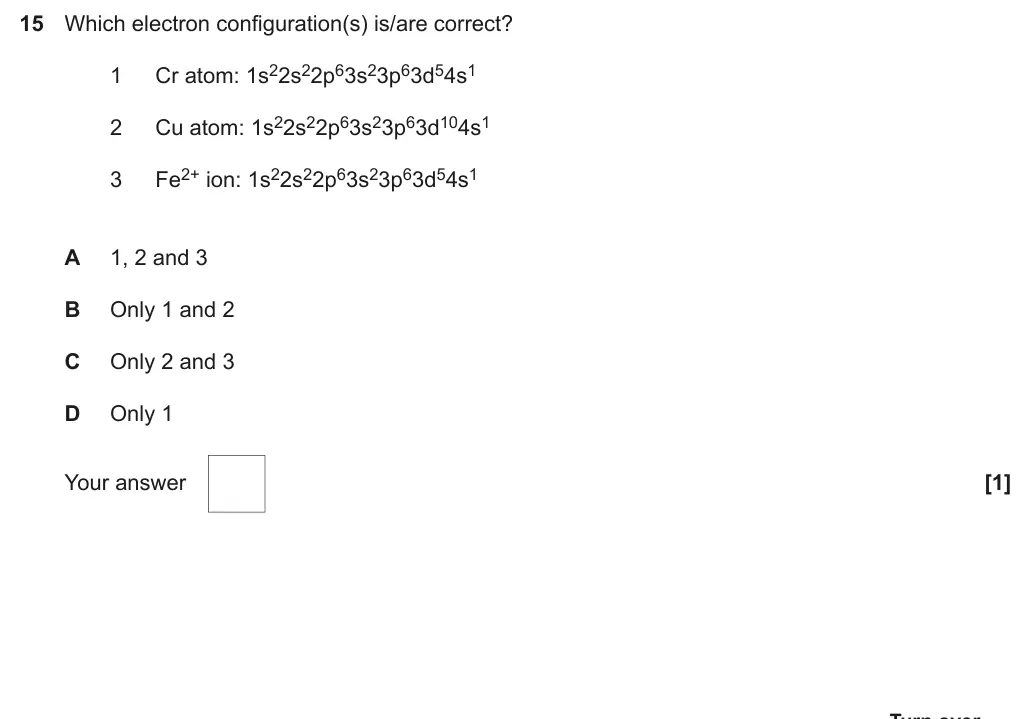
June 2025 · Paper 1 · Q151 markMultiple choiceMedium
Answer
B
Mark scheme
Examiner's comment
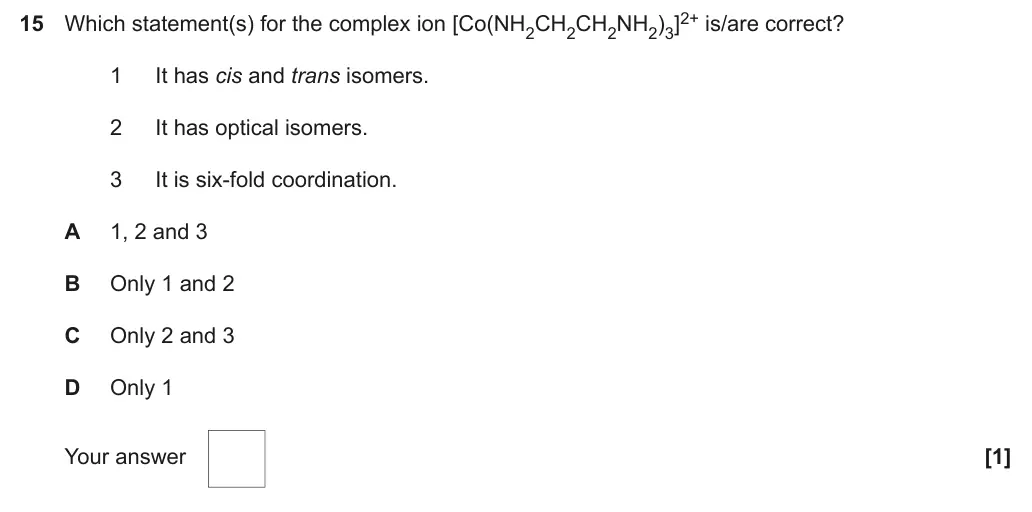
The correct answer was B. Most candidates chose the correct answer but a few selected C or D as they were unsuccessful in assigning oxidation numbers or coordination numbers to the given complex ion. Section B overview The section contained questions from all aspects of modules 1, 2, 3 and 5 of the specification. Candidates found many of the questions, including those with an extended response nature, relatively straightforward and the majority managed to cope with the mathematical content. As a rule, candidates should aim to use unrounded calculator values in their intermediate calculations to avoid rounding errors in their final answer. Candidates should be reminded to present their numerical working clearly. They should also be advised to avoid leaving two different solution approaches without crossing one of them out. If they need to restart an answer, they would be well advised to make use of additional space as necessary rather than trying to write their answers in the margins with the order of steps difficult to follow. In more complicated calculations, where multiple different chemical species and quantities are involved, using appropriate symbols and subscripts/descriptors in brackets, as well as units, helps appropriately identify numbers provided as amounts in moles/concentrations/masses. Some candidates were less confident and knowledgeable of content shared with the AS specification and traditionally taught earlier on in the course. These were specifically: structure and bonding, reaction rates and redox reactions of the halogens. Candidates wrote far more than was necessary in some responses. Candidates should avoid repeating sentences which often introduce contradictions at the end of the response when expanding on written answers. Where candidates make use of additional space, it would be worth reminding them to write down the full question part: in many cases where questions had a number, part and subpart, the part or subpart was missing (or incorrect).
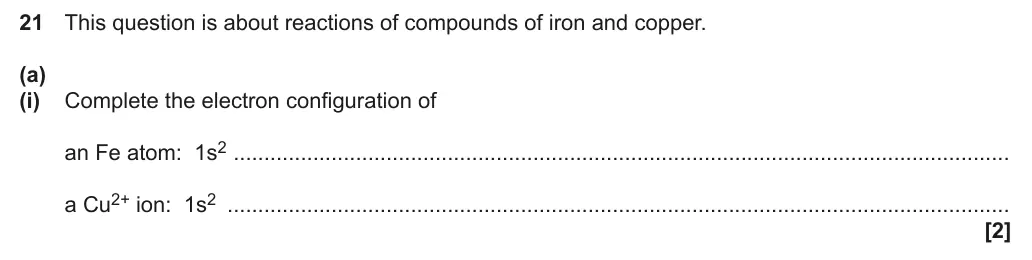
June 2025 · Paper 1 · Q21(a)(i)2 marksShort answerMedium
Mark scheme
Examiner's comment
Most candidates were successful in writing the electron configuration for Fe. Many candidates did not realise that when transition metal ions are formed, the first electrons removed from atoms are the 4s electrons and so wrote 2s2 2p6 3s2 3p6 3d7 4s2. Others, incorrectly suggested, 4s1 or 4d7.
Notes from the mark scheme and report
Fe …3d6 4s2
Cu2+ …3d9 (4s electrons lost first)
DO NOT ALLOW [Ar] shorthand
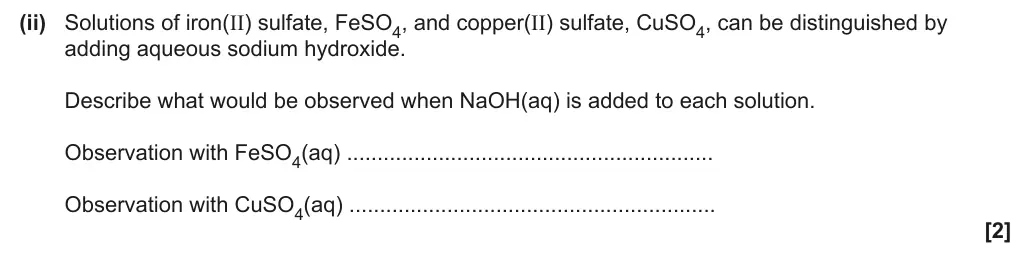
June 2025 · Paper 1 · Q21(a)(ii)2 marksShort answerMedium
Mark scheme
Examiner's comment
Most candidates were able to identity the correct colour and followed this by describing a precipitate or solid. A few candidates missed the observation of the precipitate. Incorrect colours suggested were yellow, cream and brown. The latter was perhaps as a confusion with the Fe3+ ion.
Notes from the mark scheme and report
green precipitate (Fe2+)
(pale) blue precipitate (Cu2+)
1 mark for both colours without 'precipitate'
DO NOT ALLOW dark blue
Skills: PAG4 Qualitative analysis of ions
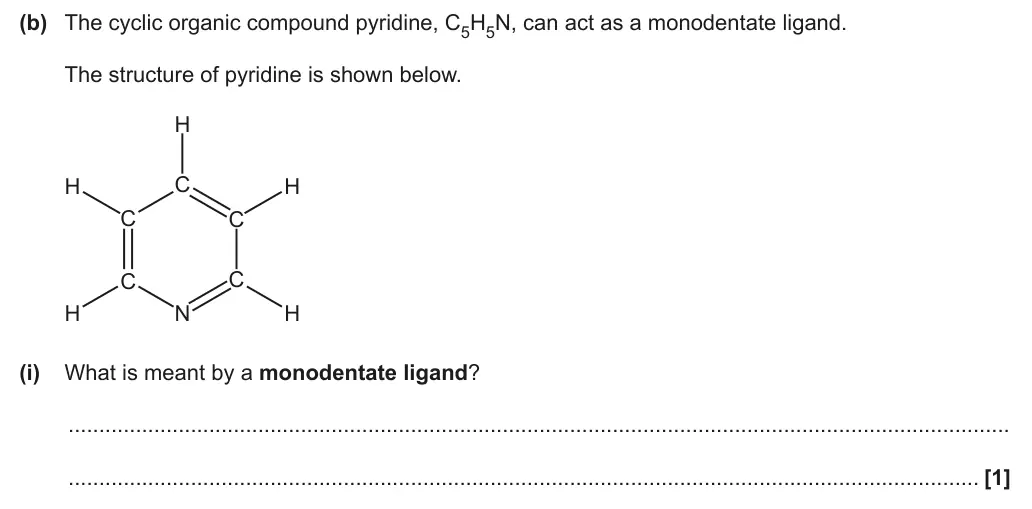
June 2025 · Paper 1 · Q21(b)(i)1 markShort answerHard
Mark scheme
Examiner's comment
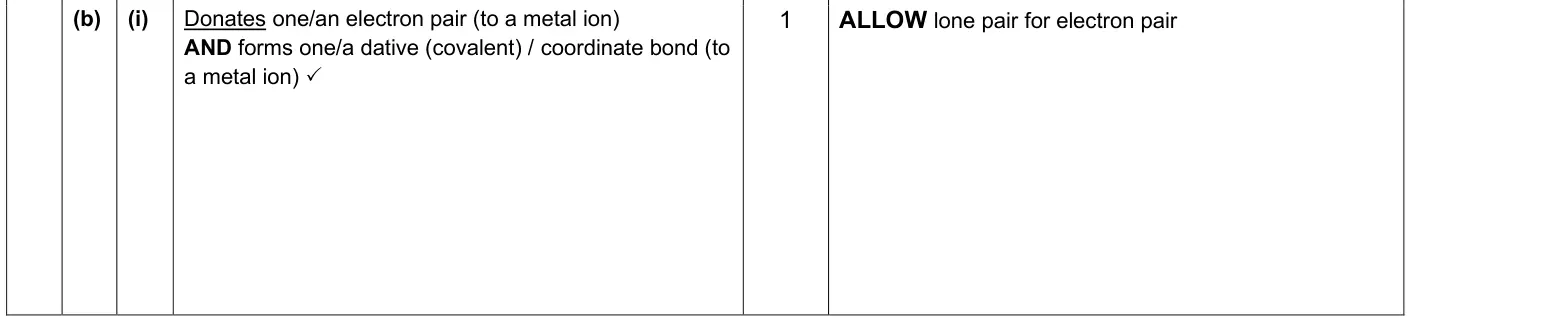
The term ‘monodentate ligand’ was well-known by most candidates. A few candidates didn’t describe the electron pair being donated or forming a coordinate bond. Both these parts were required to be given the mark.
Notes from the mark scheme and report
donates ONE electron pair AND forms ONE coordinate (dative covalent) bond to a metal ion
June 2025 · Paper 1 · Q21(b)(ii)4 marksData interpretationMedium
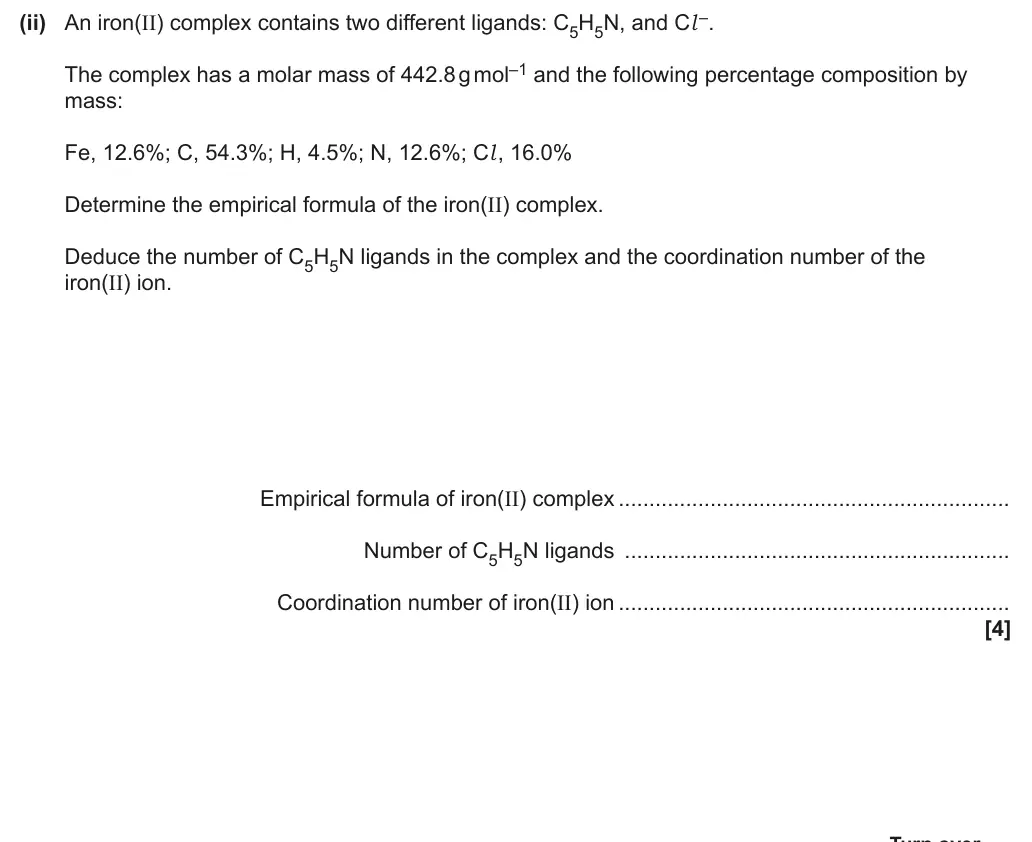
Earlier part of question 21 that this part uses
Mark scheme
Examiner's comment
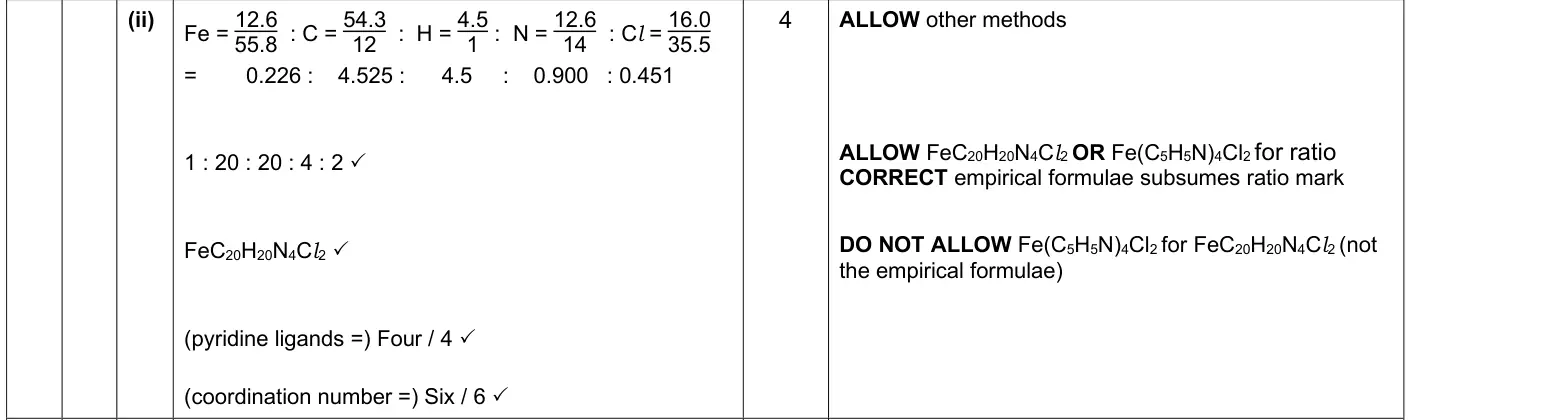
Most candidates were given full marks. They successfully calculated the empirical formula but a few then grouped the ligands together giving a molecular formula, e.g. Fe(C5H5N4)Cl2. Most candidates then continued and found the number of ligands and coordination number. Occasionally coordination number was mixed up with the charge on the ion.
Notes from the mark scheme and report
ratio 1 : 20 : 20 : 4 : 2 gives FeC20H20N4Cl2 (DO NOT ALLOW Fe(C5H5N)4Cl2 as the empirical formula)
four pyridine ligands
coordination number 6
Skills: M0.2 Use ratios, fractions and percentages; M2.3 Substitute numerical values into algebraic equations using appropriate units for physical quantities
June 2025 · Paper 1 · Q21(c)2 marksStructure / isomerHard
Mark scheme
Examiner's comment
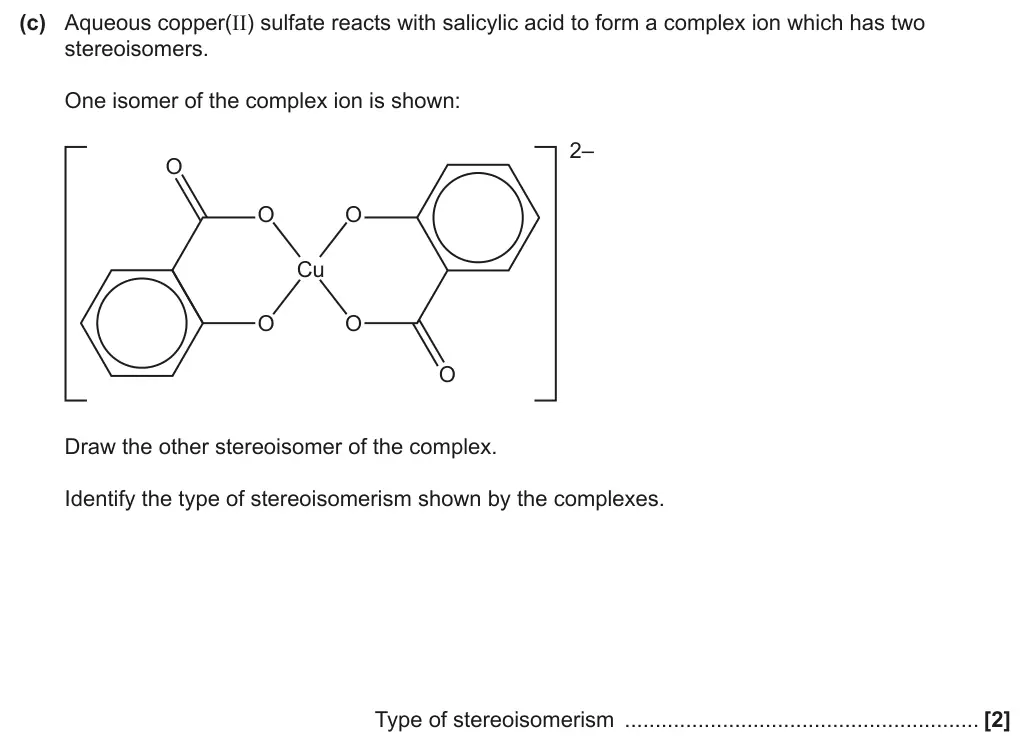
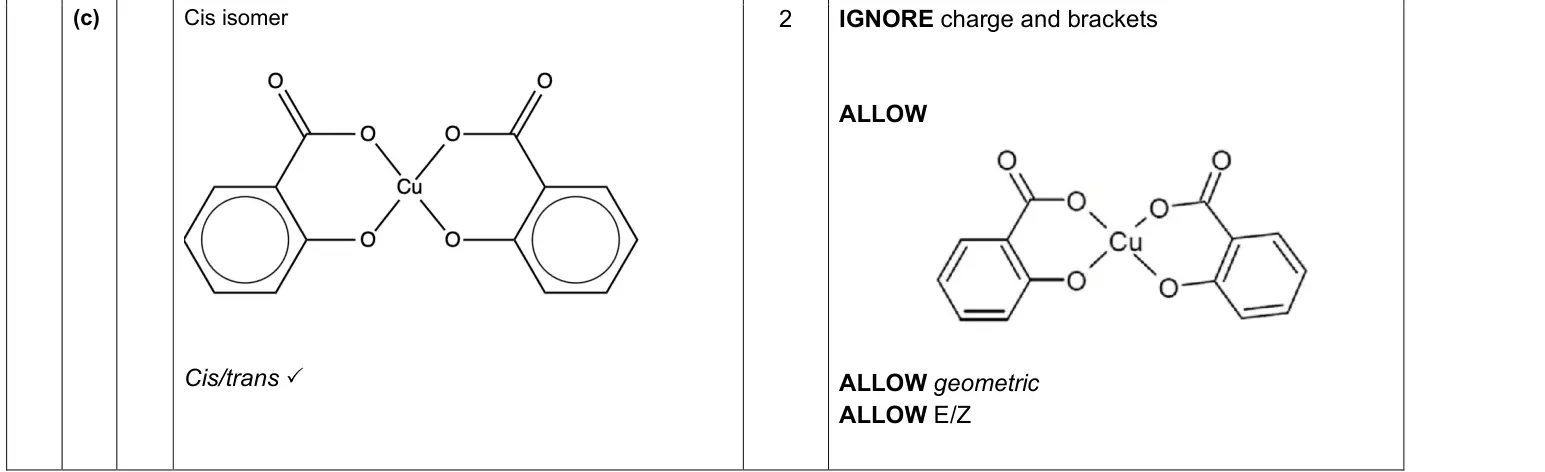
This question required the candidates to identify the isomerism in an unfamiliar complex. This question was one of the more demanding ideas on the paper. A few candidates successfully drew the cis isomer and identified the type as cis/trans isomerism. Many candidates suggested, incorrectly, that the isomerisation was optical. A few did draw the cis complex ion but then identified the isomerism as optical.
Notes from the mark scheme and report
draw the cis isomer (like groups on the same side of Cu)
cis–trans (ALLOW geometric or E/Z)
IGNORE charge and brackets
Skills: M4.2 Visualise and represent 2-D and 3-D forms including 2-D representations of 3-D objects; M4.3 Understand the symmetry of 2-D and 3-D shapes
June 2025 · Paper 1 · Q21(d)(ii)1 markShort answerHard
Earlier part of question 21 that this part uses
Mark scheme
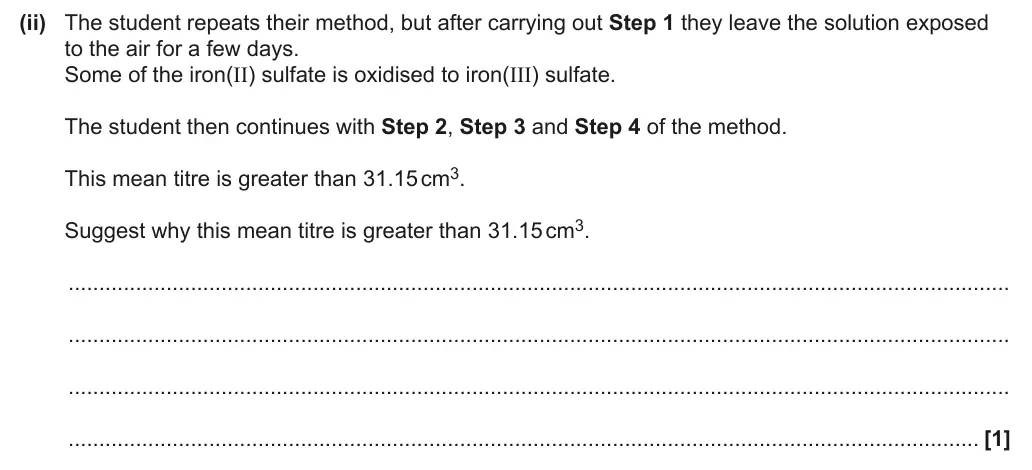
Examiner's comment
Candidates found this question quite challenging, with only a few giving a correct explanation. A common incorrect theme among less successful candidates was to consider that since it was a titration, then it must be a neutralisation reaction. Common errors involved the suggesting that evaporation of the water concentrating the copper solution, a bigger RFM, and confusion between SO42– and S2O32–. A fair number of candidates did not attempt this question.
Notes from the mark scheme and report
Fe3+ oxidises I– to form (extra) iodine
ALLOW Fe3+ is reduced by/reacts with thiosulfate
June 2025 · Paper 3 · Q4(a)(iii)2 marksEquation writingHard
Earlier parts of question 4 that this part uses
Mark scheme
Examiner's comment
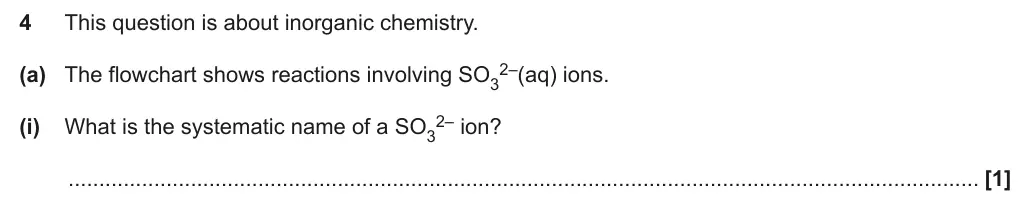
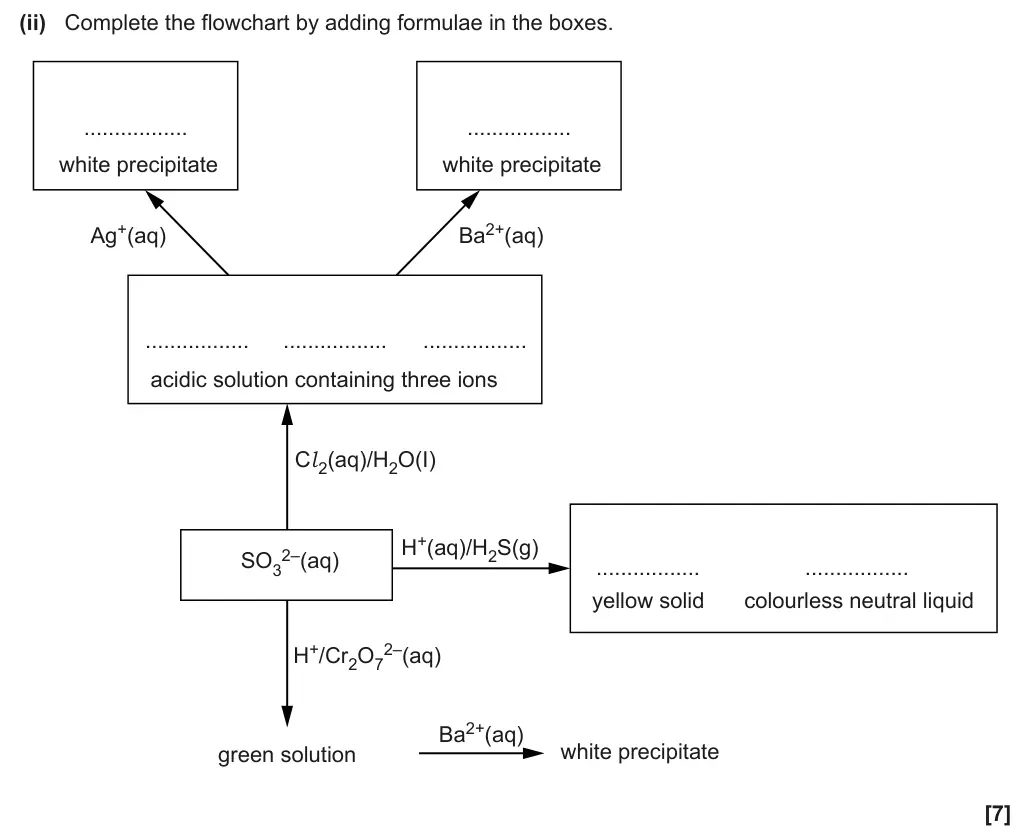
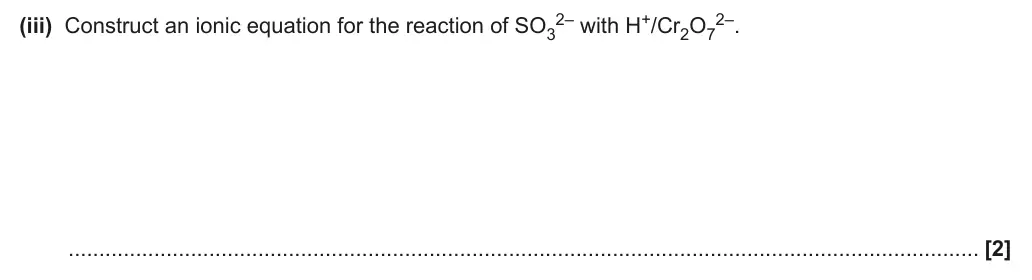
Candidates found all aspects of this question extremely difficult, one of the most testing’s on this examination paper. There was important information in the flowchart to aid candidates: the ‘green solution’ indicated that Cr3+ was one of the products, and the formation of a white precipitate with Ba2+(aq) confirmed the presence of SO42–(aq). The reacting ions were provided in the flowchart. Together this information provided a framework for the equation: SO32–(aq) + Cr2O72– → Cr3+ + SO42–(aq). The equation then needed to be balanced, ideally using oxidation numbers, H2O added as a product, and finally balancing. Similar problems would be an ideal way of preparing candidates for writing equations for redox reactions.
Notes from the mark scheme and report
3SO32– + Cr2O72– + 8H+ → 2Cr3+ + 3SO42– + 4H2O
DO NOT ALLOW other Cr or S species (Cr2+, Cr(OH)3, [Cr(OH)6]3–)
IGNORE state symbols
Skills: M0.2 Use ratios, fractions and percentages
June 2025 · Paper 3 · Q4(b)(ii)3 marksStructure / isomerMedium
Earlier part of question 4 that this part uses
Mark scheme
Examiner's comment
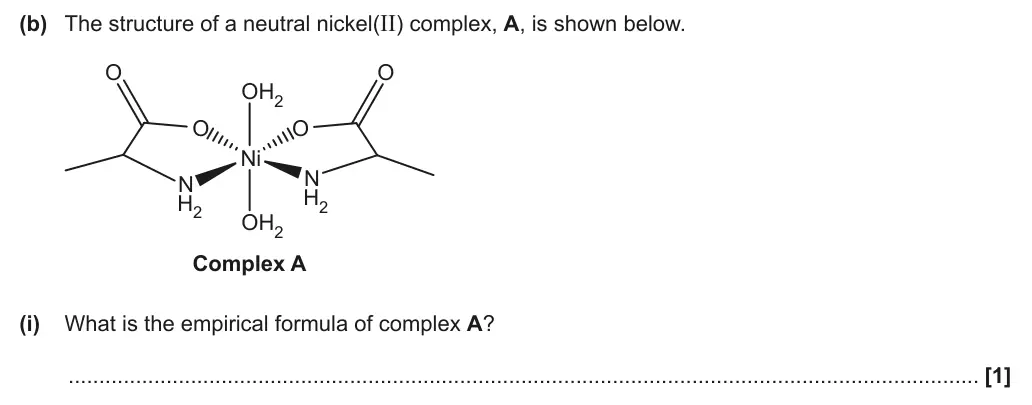
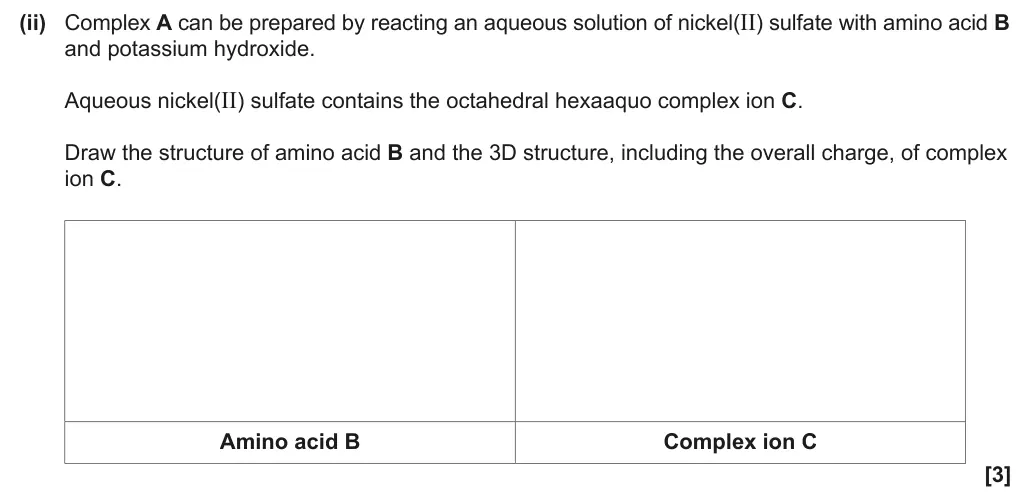
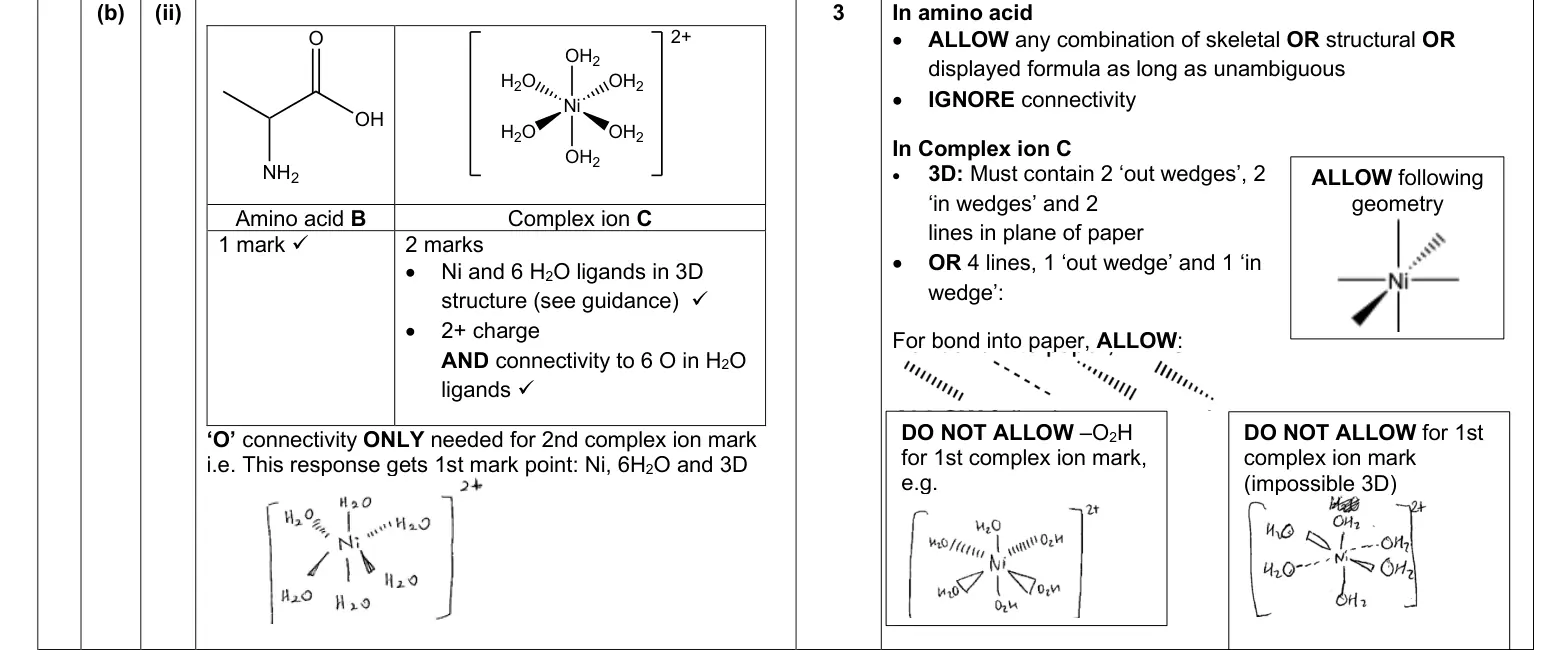
The structure of the amino acid was usually drawn correctly. The nickel complex ion provided problems with H2O connectivity and superfluous use of SO4. It was expected that bonds from Ni would be shown to the O atom, and that H2O was shown correctly in all orientations. So –H2O and –O2H were not allowed. Most candidates understood the importance of showing 3D bonds as wedges and the templates on the page will have helped in this respect. However, some candidates drew impossible 3D structures with bold wedges and dashed wedges shown opposite one another. Despite the overall charge being asked for in the question, a significant number of candidates omitted the charge.
Notes from the mark scheme and report
B = CH3CH(NH2)COOH
2+ charge AND bonds to O of H2O
DO NOT ALLOW –O2H
Skills: M4.2 Visualise and represent 2-D and 3-D forms including 2-D representations of 3-D objects
June 2025 · Paper 3 · Q4(b)(iii)1 markComplete table/diagramMedium
Earlier part of question 4 that this part uses
Mark scheme
Examiner's comment
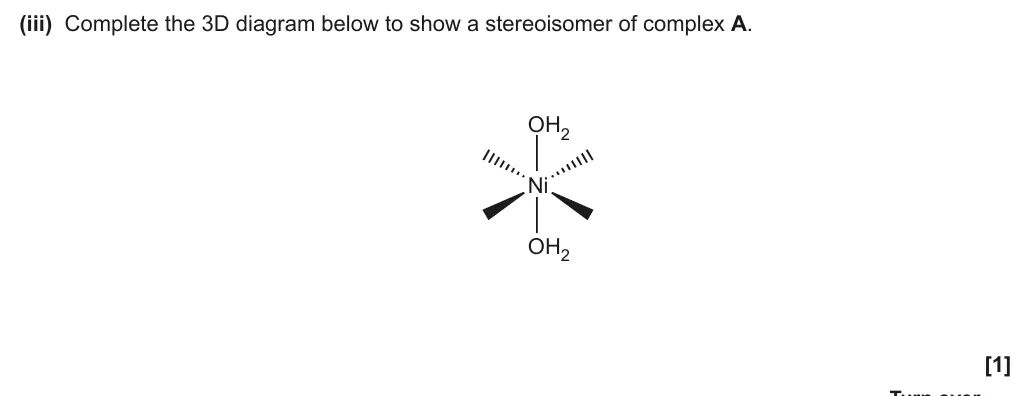
Most candidates drew the correct trans isomer. The common incorrect response was to show the cis isomer rotated through 180º. As connectivity had been assessed already in 4(b)(ii) for the nickel complex ion, it was not penalised for NH2 here or there would have been far more candidates who would not have been given this mark.
Notes from the mark scheme and report
cis–trans type isomer with the bidentate ligands arranged the other way round (watch for adjacent Os)
IGNORE connectivity to NH2 and optical isomerism within the amino acid
Skills: M4.2 Visualise and represent 2-D and 3-D forms including 2-D representations of 3-D objects; M4.3 Understand the symmetry of 2-D and 3-D shapes
June 2024 · Paper 1 · Q131 markMultiple choiceHard
Answer
D
Mark scheme
Examiner's comment
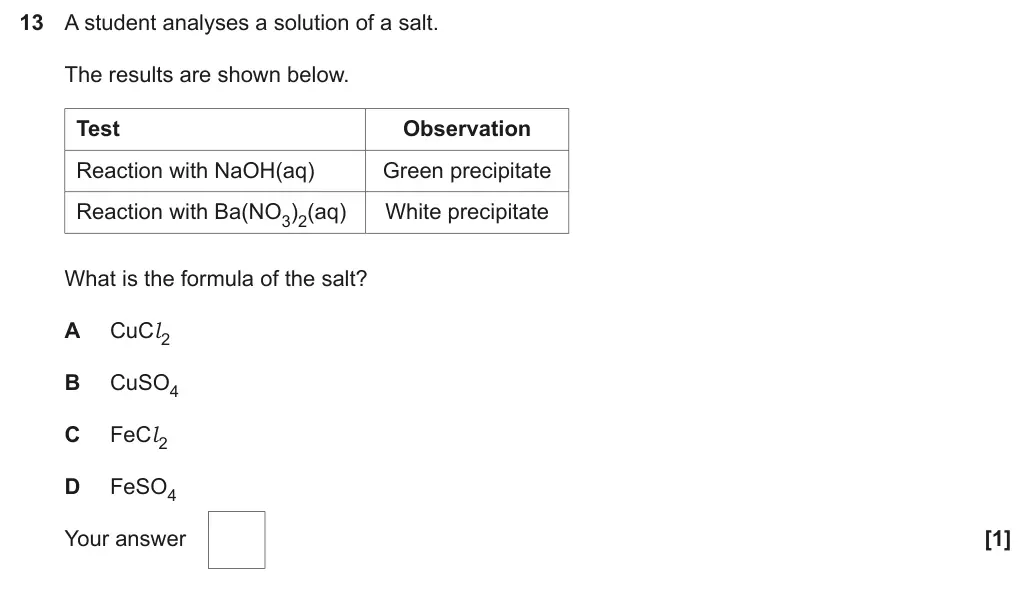
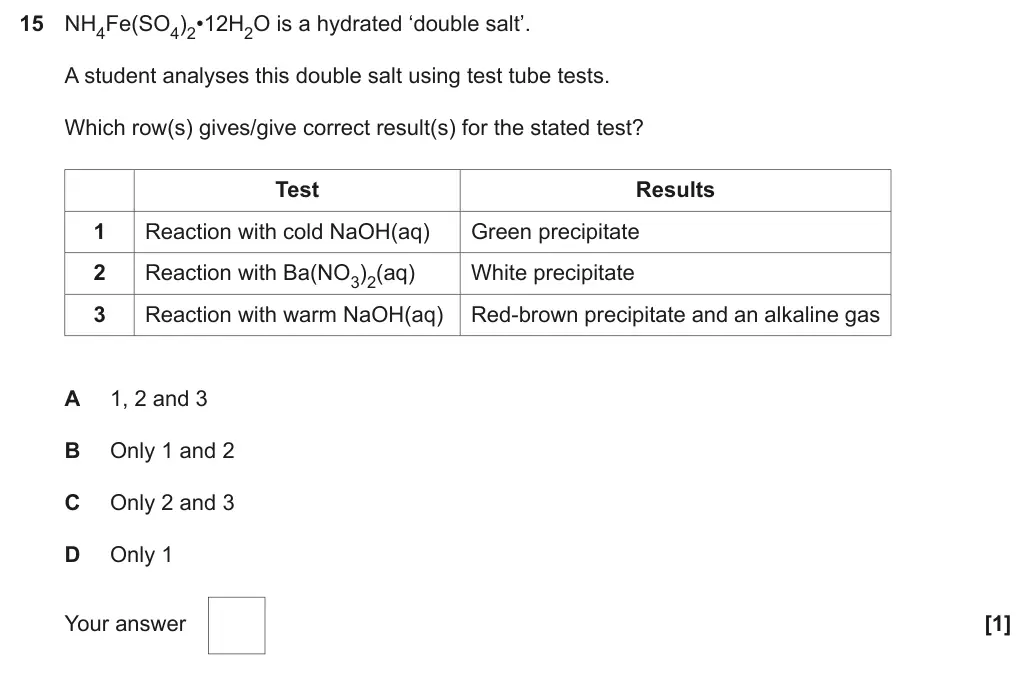
The correct answer was D. Many candidates were able to identify the green precipitate as Fe(OH)2 and the white precipitate as BaSO4. A few candidates suggested C, identifying BaCl2 as the white precipitate, or B, identifying Cu(OH)2 as the green precipitate.
June 2024 · Paper 1 · Q151 markMultiple choiceEasy
Answer
C
Mark scheme
Examiner's comment
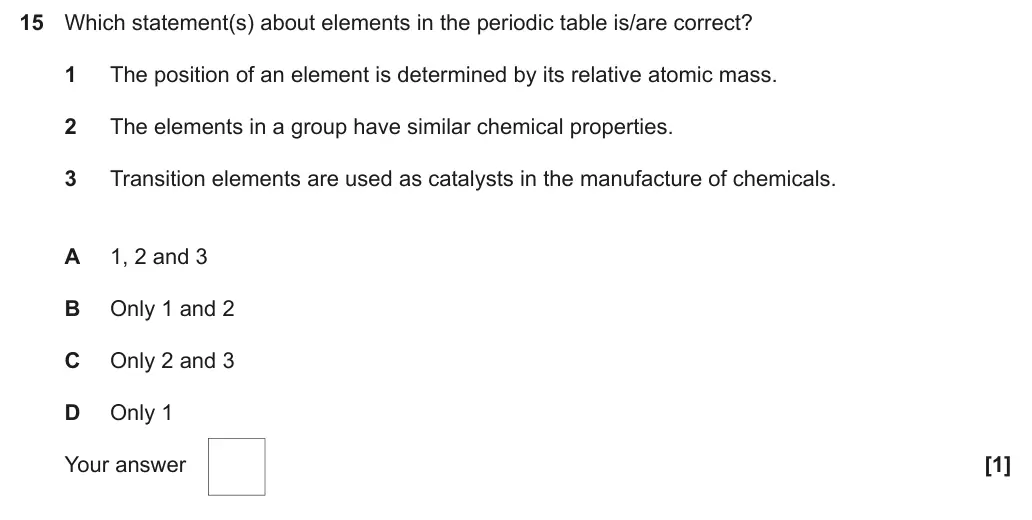
The correct answer was C. Most candidates chose the correct answer but a few selected A. The position of the element is based on its atomic number. Section B overview The section contained questions from all aspects of the specification. Candidates found many of the questions, including those with an extended response nature, relatively straightforward and the majority managed to cope with the mathematical content. As a rule, candidates should aim to use at least three significant figures, unless directed otherwise, in their intermediate calculations to avoid rounding errors in their final answer. Candidates should be advised that well set out calculations, which clearly indicate what each numerical value represents, allows effective error carried forward to be given in the event of an incorrect answer. It is also important that candidates avoid offering several solutions and clearly indicate which one has been used to derive the final answer. Some candidates were less confident and knowledgeable of questions which covered content traditionally taught earlier on in the A Level course. These were specifically: equations involving group 2 metals and their compounds; group 7; enthalpy profiles; and structure and bonding. There was evidence that candidates wrote far more than was necessary in some responses. Candidates should avoid repeating sentences which often introduce contradictions when expanding on written answers.
June 2024 · Paper 1 · Q16(b)(iii)1 markShort answerHard
Mark scheme
Examiner's comment
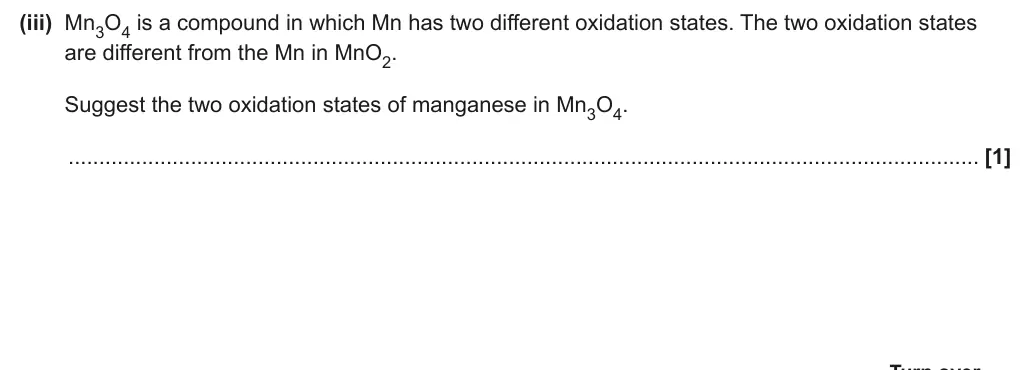
This question proved more challenging for candidates. Candidates stating +4 was the most common error; this is the oxidation state in MnO2. Some candidates stated fractions, negative values and gave the state symbol instead i.e. solid and liquid.
Notes from the mark scheme and report
+ sign required
DO NOT ALLOW Mn2+/Mn3+ (ions, not oxidation states)
DO NOT ALLOW +4
June 2024 · Paper 1 · Q22(a)2 marksComplete table/diagramMedium
Mark scheme
Examiner's comment
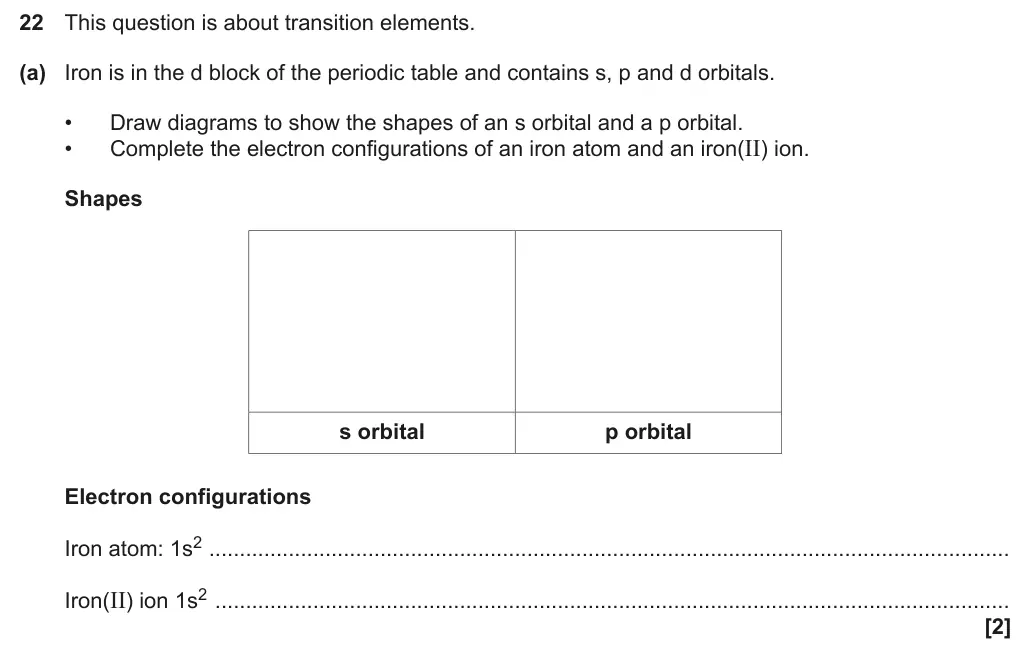
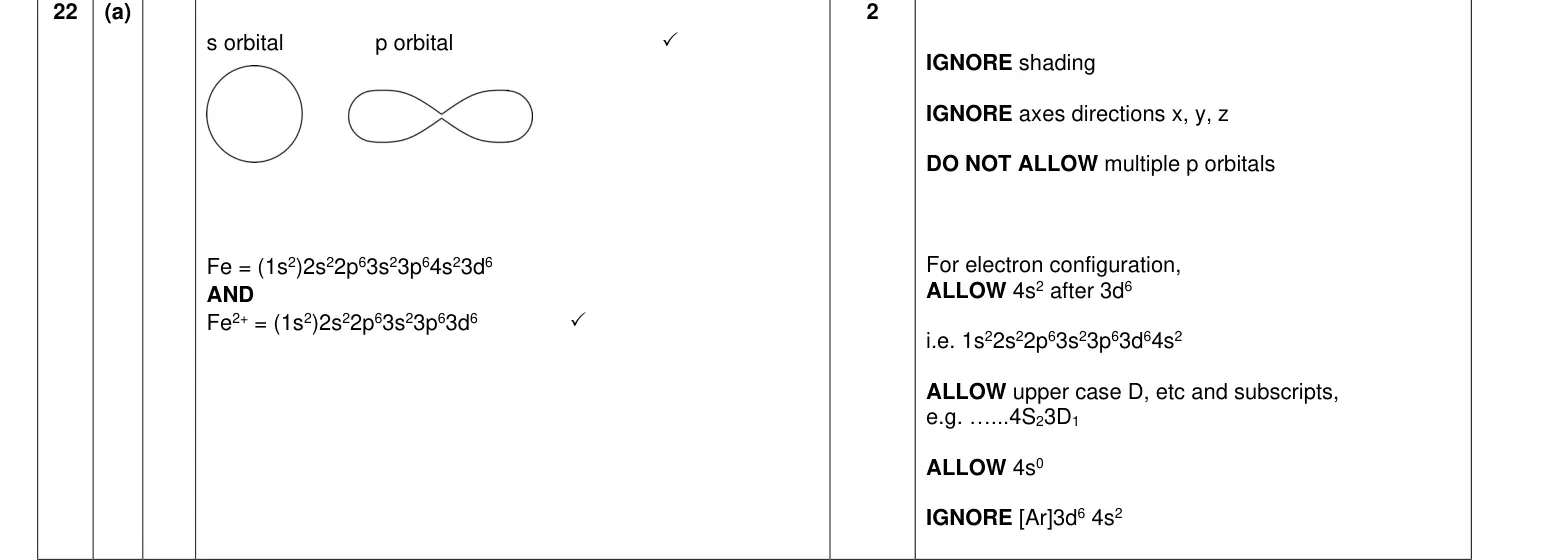
Many candidates were successful in drawing the orbital shapes. Occasionally candidates linked the question to the formation of a π bond or drew two arrows in a box to represent the electrons. Many candidates did not realise that when transition metal ions are formed, the first electrons removed from atoms are the 4s electrons and so wrote 2s2 2p6 3s2 3p6 3d4 4s2.
Notes from the mark scheme and report
one p orbital only (DO NOT ALLOW several lobes)
Fe2+ loses 4s electrons first
June 2024 · Paper 1 · Q22(b)(i)3 marksShort answerEasy
Mark scheme
Examiner's comment
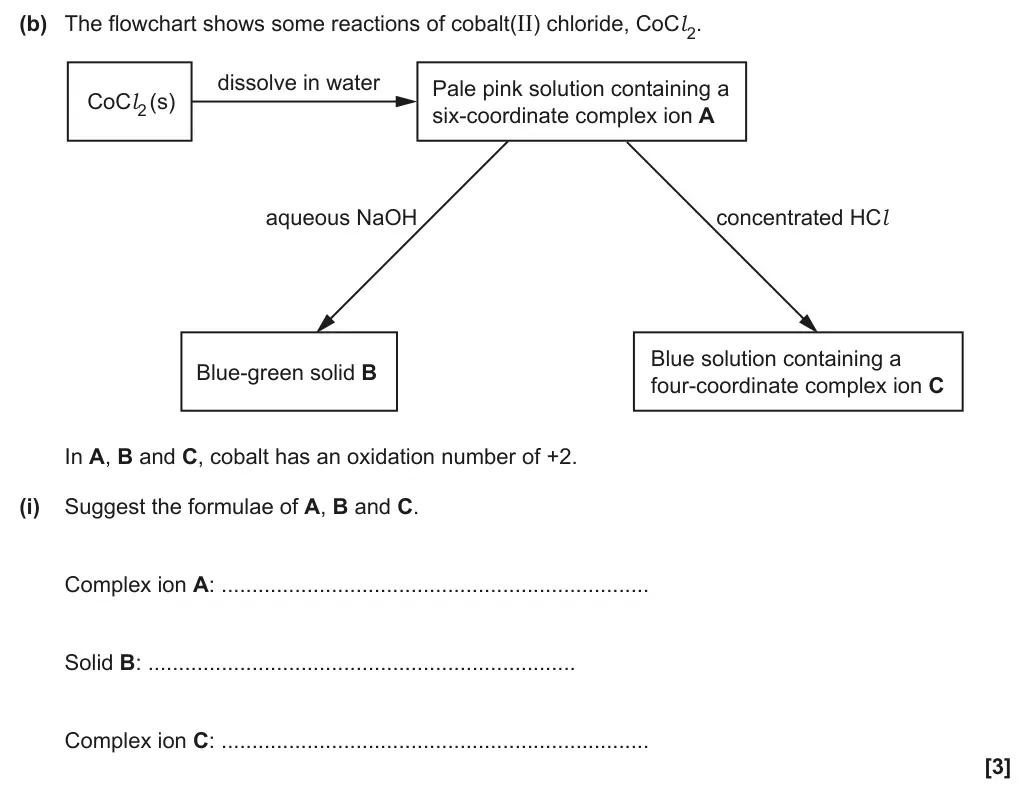
Most candidates scored three marks. Some used other transition metal ions such as Cu2+ or Mn2+ and candidates should be mindful of the information given in the question. Charges were sometimes incorrect, and some responses lacked the square brackets to show the complex.
Notes from the mark scheme and report
square brackets essential for complex ions
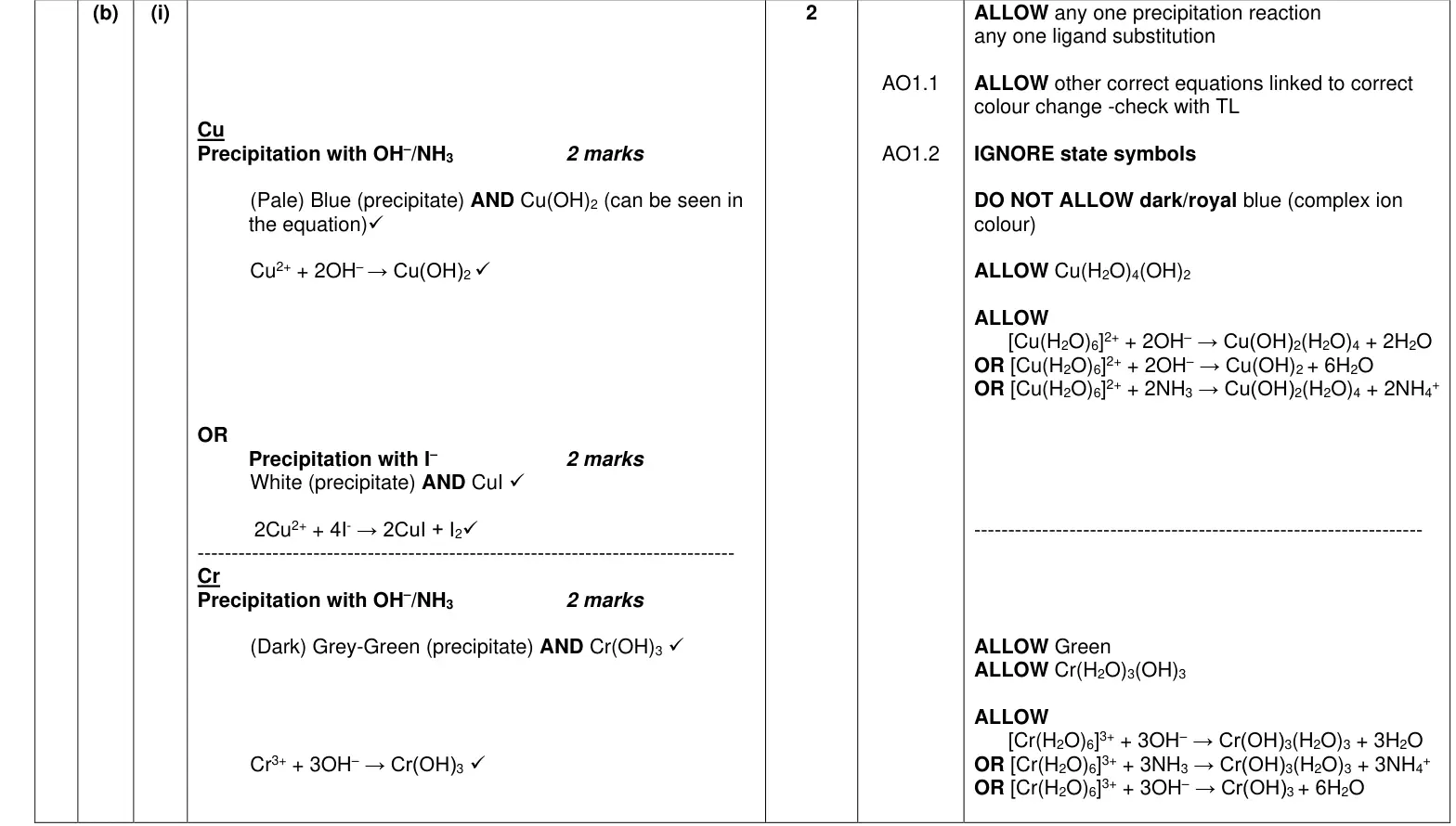
Co(OH)2 precipitate
June 2024 · Paper 1 · Q22(b)(ii)2 marksShort answerHard
Mark scheme
Examiner's comment
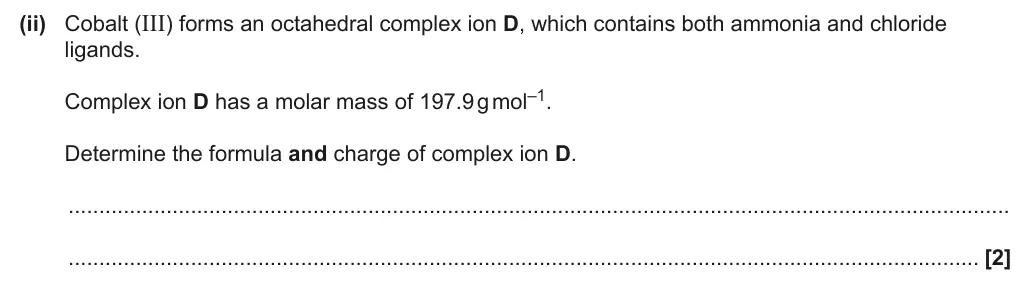
Most candidates identified the formula and the charge as 1+. A few candidates stated no charge or 3+. Candidates should consider the use of brackets in the formula, e.g. square brackets to show the complex and curly brackets to show the number of ligands attached. A few candidates used NH4 rather than NH3 for the ammonia ligand.
Notes from the mark scheme and report
molar mass 197.9 fits [Co(NH3)4Cl2]
overall charge +1
Skills: M0.2 Use ratios, fractions and percentages; M2.4 Solve algebraic equations
June 2024 · Paper 1 · Q22(c)5 marksExtended responseHard
Mark scheme
Examiner's comment
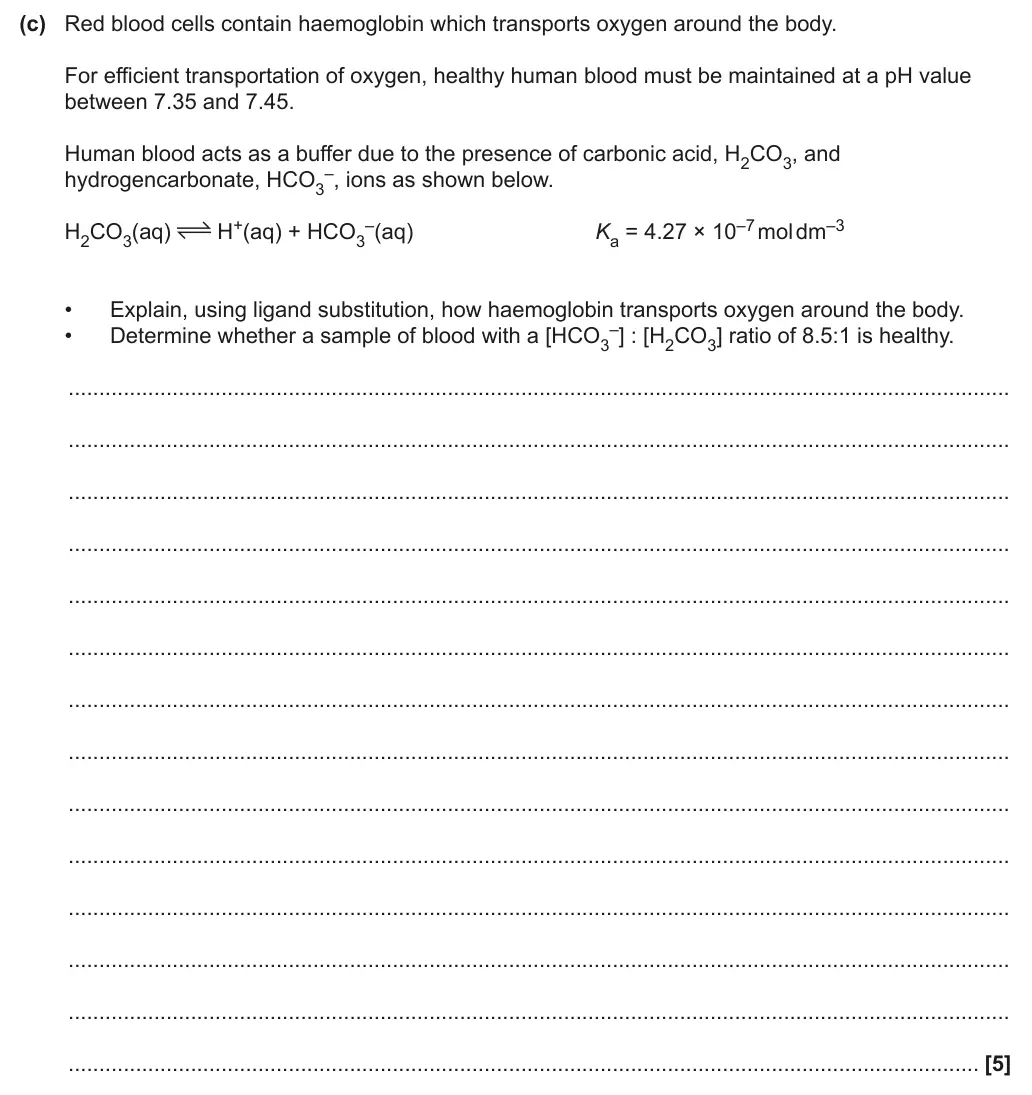
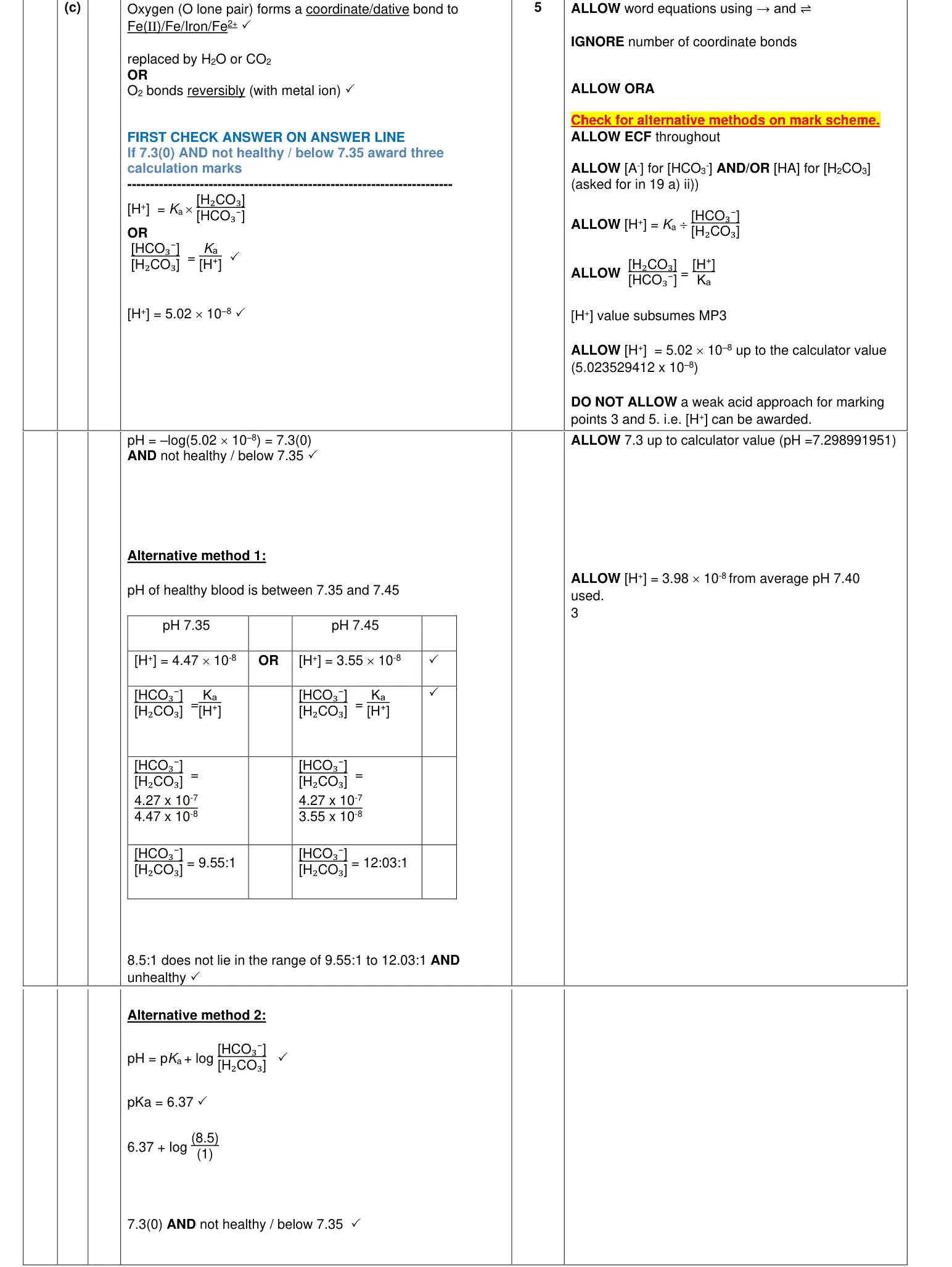
The key chemistry that candidates needed to discuss in their response was as follows: • O2 molecules forming coordinate bonds with and Fe2+ ions in haemoglobin. Often candidates omitted the Fe2+ and just stated it was to haemoglobin • O2 molecules being replaced by another ligand (e.g. H2O or CO2) The calculation using the [HCO3–] : [H2CO3] ratio of 8.5 : 1 was well described, although sometimes the final expression of the ratio left ambiguity as it was hard to tell whether the ratio given referred to the [HCO3–] : [H2CO3] ratio or the [H2CO3] : [HCO3–] ratio. ECF was given for the [H+] and then the pH linked to whether the blood was healthy. A smaller number of candidates approached the question by calculating the ratio of [HCO3–] : [H2CO3] for both pH 7.35 and pH 7.45 and then compared both ratios to the ratio of 8.5 : 1 for healthy blood. A few candidates attempted the calculation by the weak acid approach using [H+]2. In this case only the [H+] was given.
Notes from the mark scheme and report
O2 forms dative bond to Fe(II) reversibly, replaced by H2O/CO2
pH = pKa + log(8.5) = 7.30, below 7.35 so not healthy
Skills: M0.4 Use calculators to find and use power, exponential and logarithmic functions; M2.3 Substitute numerical values into algebraic equations using appropriate units for physical quantities; M2.5 Use logarithms in relation to quantities that range over several orders of magnitude
June 2024 · Paper 3 · Q3(a)(i)2 marksShort answerMedium
Mark scheme
Examiner's comment
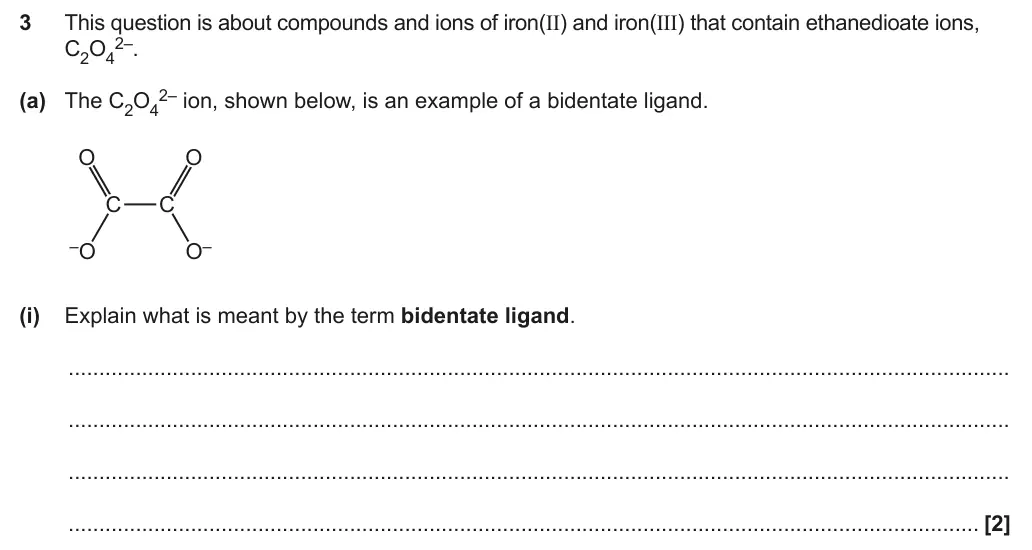
The term ‘bidentate ligand’ was well-known with most candidates gaining some credit. A mark was sometimes not given if ‘lone pairs’ had been omitted. A significant number of candidates just wrote ‘a pair of electrons’, which could have been a bonded pair.
Notes from the mark scheme and report
two lone pairs AND forms dative/coordinate bonds to a metal ion
IGNORE 'donates two pairs of electrons' alone
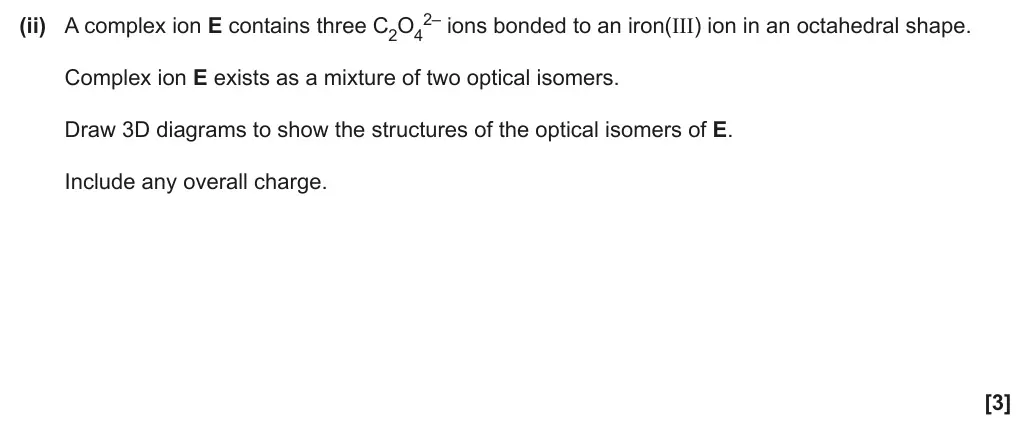
June 2024 · Paper 3 · Q3(a)(ii)3 marksStructure / isomerMedium
Earlier part of question 3 that this part uses
Mark scheme
Examiner's comment
The diagrams and 3– charge were usually correct. The standard of 3D diagrams has improved over the years with most candidates using the wedges requirements outlined in the mark scheme. Some candidates often did not use wedges and their diagrams were not given marks. It should be noted that ‘impossible’ 3D diagrams showing wedges in unrealistic positions were also not given marks. Examples are shown in the published mark scheme.
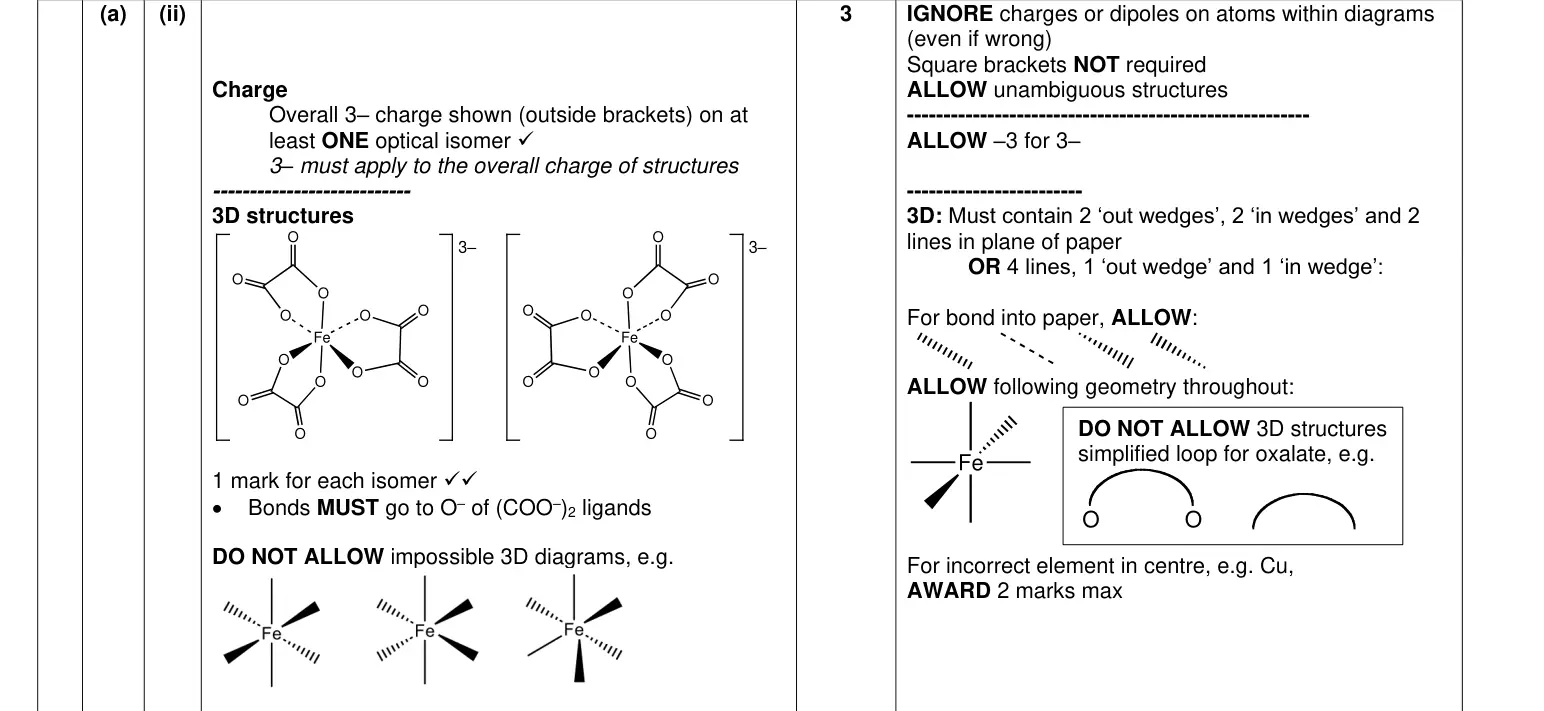
Notes from the mark scheme and report
overall 3– charge shown on at least one isomer
bonds MUST go to the O– atoms of the ligands
3D wedges required
DO NOT ALLOW simplified loop for ethanedioate
MAX 2 for incorrect central element
Skills: M4.1 Use angles and shapes in regular 2-D and 3-D structures; M4.2 Visualise and represent 2-D and 3-D forms including 2-D representations of 3-D objects; M4.3 Understand the symmetry of 2-D and 3-D shapes
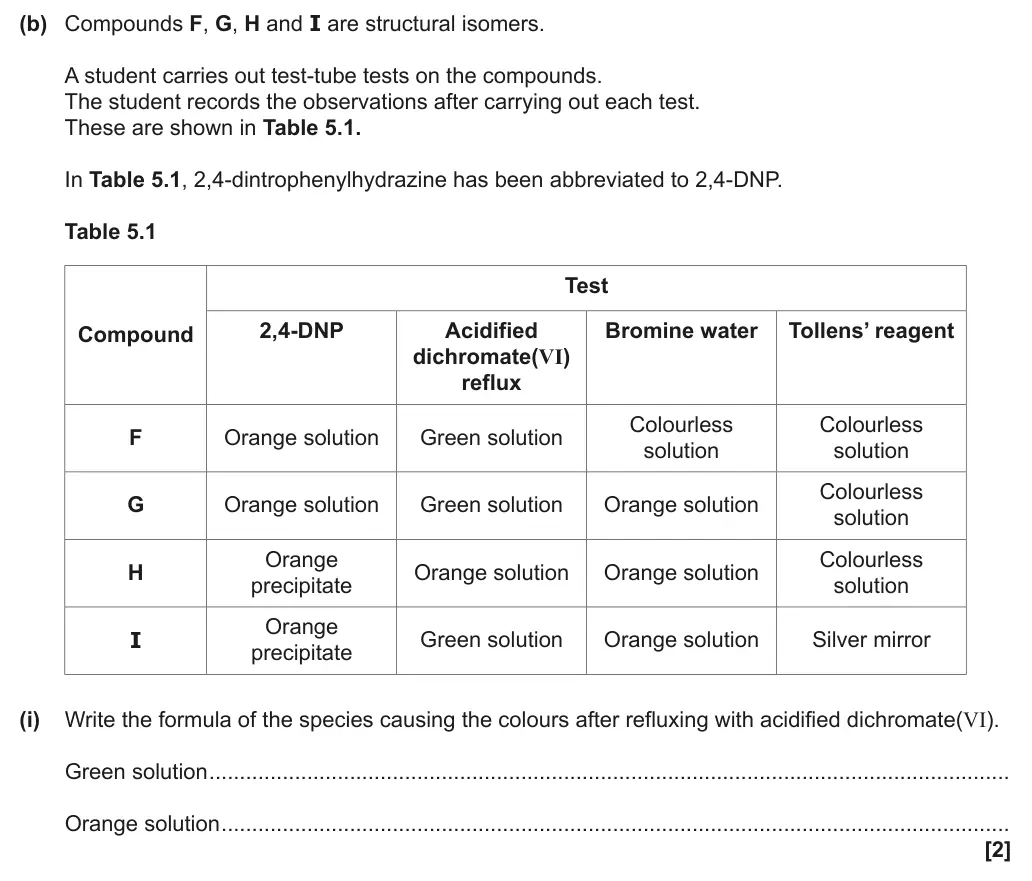
June 2024 · Paper 3 · Q5(b)(i)2 marksData interpretationMedium
Mark scheme
Examiner's comment
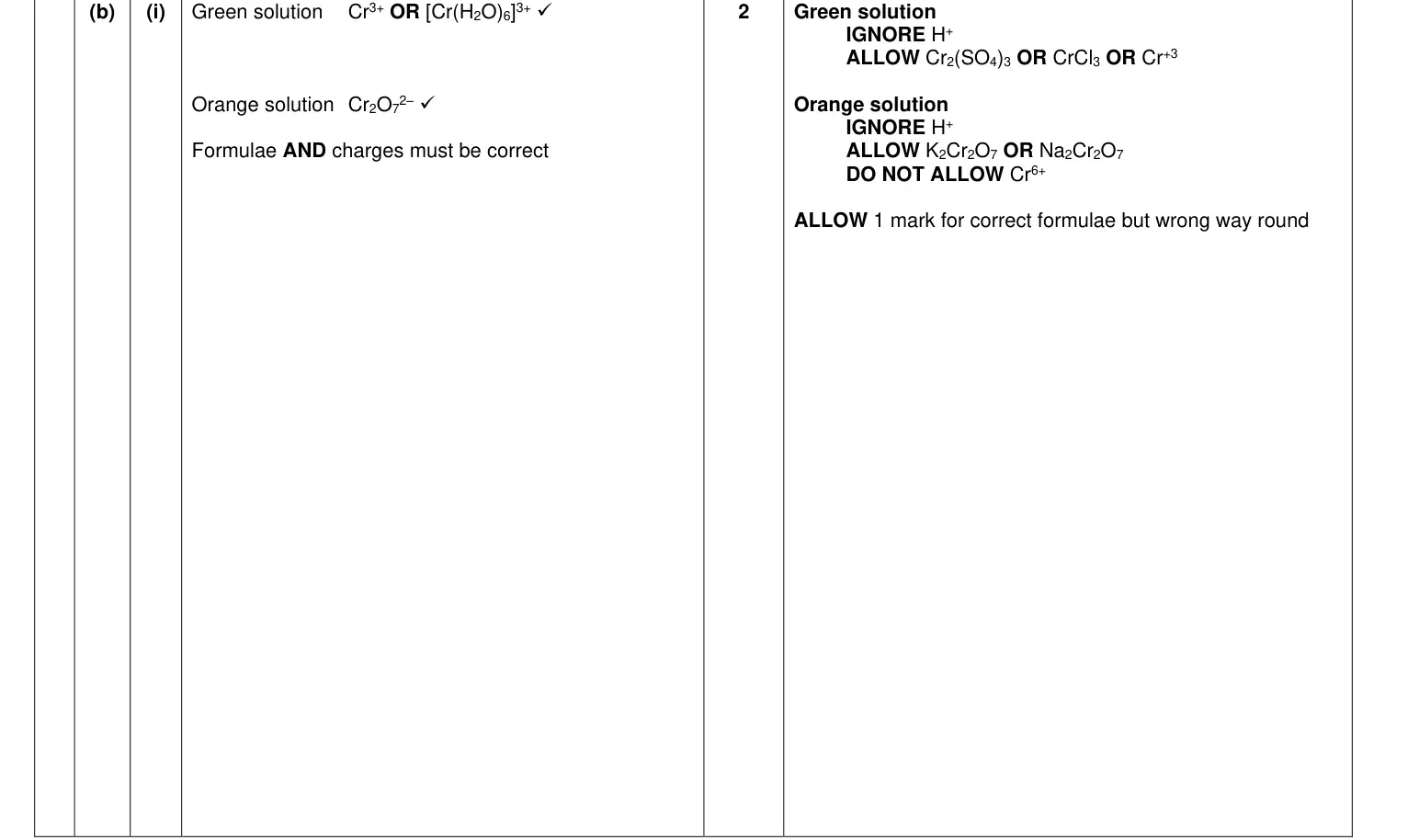
Although high attaining candidates responded with the formulae of chromium-containing species, it was common to see organic compounds being suggested. Consequently, a large proportion of candidates did not score either of the 2 marks. Many candidates seem to expect to only give organic species in their responses on this paper and would benefit from understanding that inorganic species may also need to be provided.
Notes from the mark scheme and report
green Cr3+ (or [Cr(H2O)6]3+)
orange Cr2O7 2–
formulae AND charges must be correct
DO NOT ALLOW Cr6+
1 mark if the wrong way round
Skills: PAG7 Qualitative analysis of organic functional groups
June 2023 · Paper 1 · Q141 markAO1Multiple choiceMedium
Answer
D
Mark scheme
Examiner's comment
The correct answer was D. Most candidates recognised that the complex represented cisplatin. Cisplatin has a bond angle of 90 degrees due to being square planar and shows cis/trans isomerism, but some candidates thought it showed optical isomerism too. Most could tell the oxidation number of platinum is not +4.
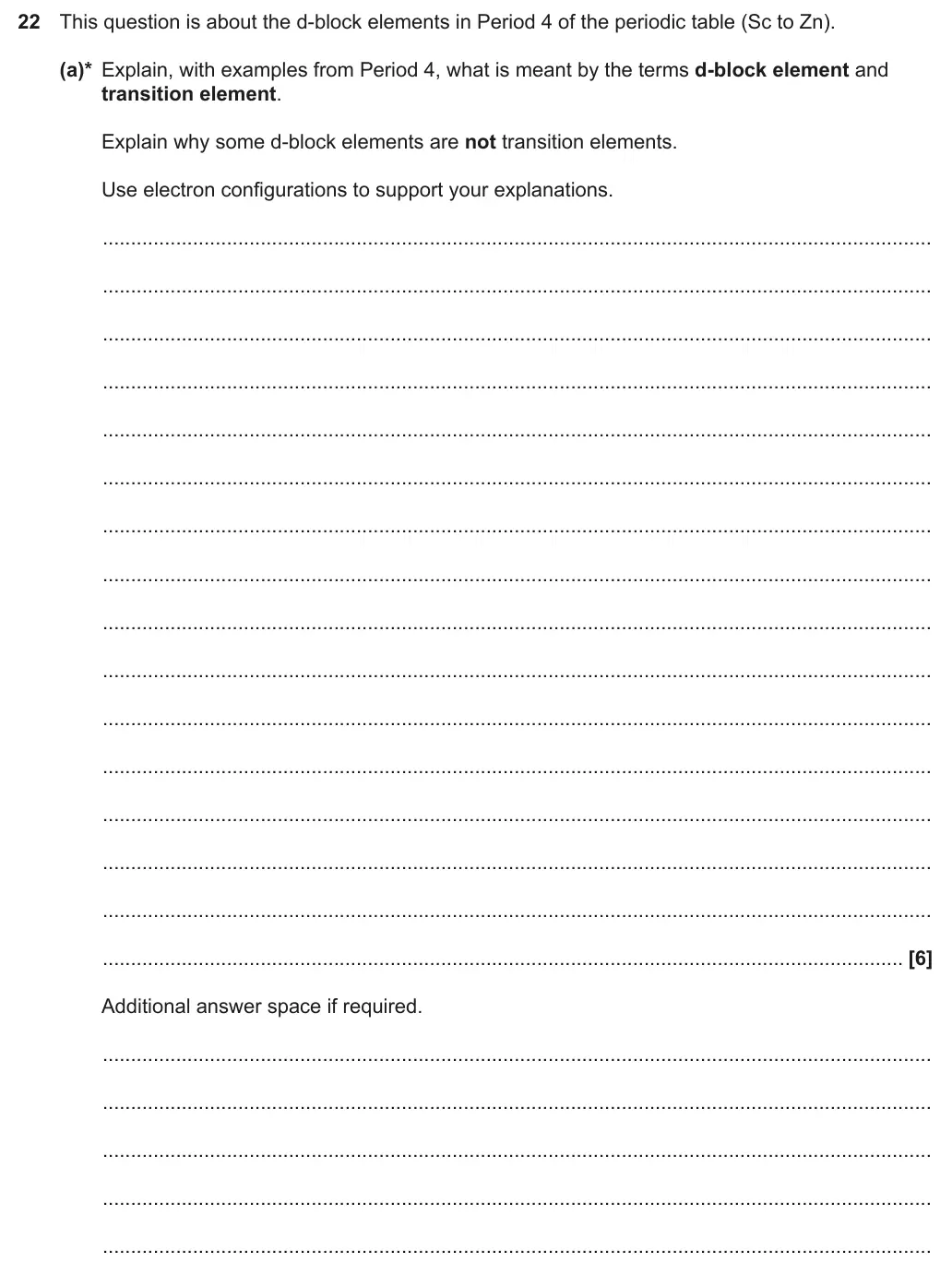
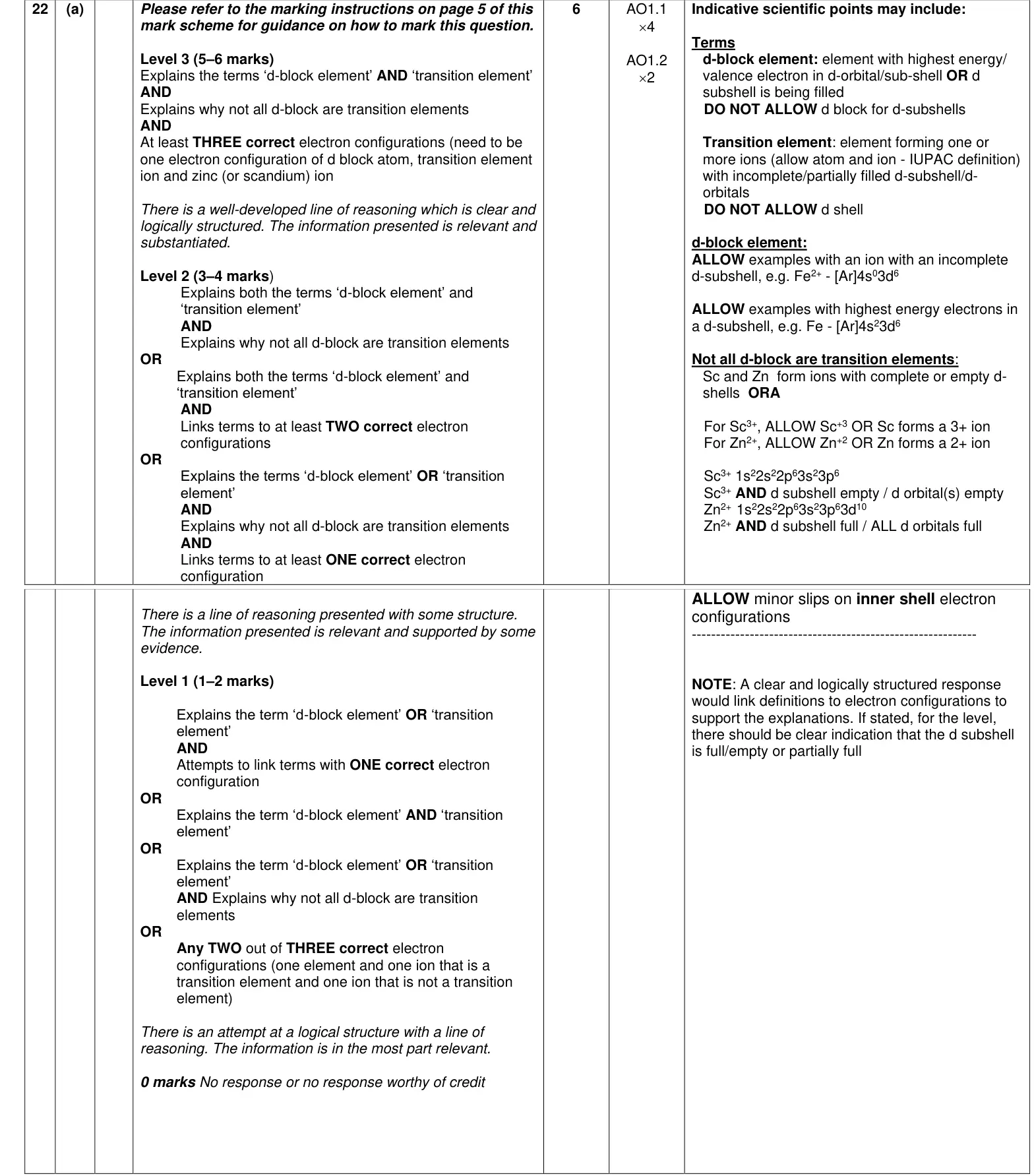
June 2023 · Paper 1 · Q22(a)6 marksAO16-mark level of responseHard
Mark scheme, with the levels and indicative points
Examiner's comment
Only the higher-attaining candidates scored full marks. Very few candidates were able to define d-block element correctly without the minor slip of saying outermost electron instead of highest energy or valence electron. Many candidates often did not mention ions for the transition metal definition. Many did not include any of the electron arrangements for d-block elements and transition elements. The majority of candidates who were able to recognise zinc and scandium as d-block elements, but not transition elements, gave their electronic configurations correctly. Common errors included the presence of the 4s electrons in the electron configurations of the ions and incorrect electron configurations of copper and chromium atoms. A few candidates thought chromium and copper were not transition elements due to the 4s1 electron configuration. This candidate has mentioned outer electrons rather than highest energy but was this is a minor slip and they were still given a Level 3 response as everything else is correct. A holistic approach for LoRs is used and not a point-based marking system.
Notes from the mark scheme and report
d-block: highest energy electron in d sub-shell (DO NOT ALLOW d shell/d block)
transition element forms an ion with incomplete d sub-shell
Sc3+ (empty 3d) and Zn2+ (full 3d10) with configurations
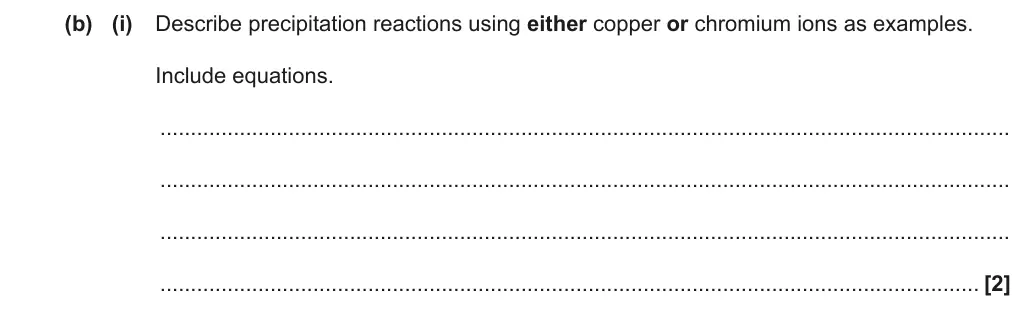
June 2023 · Paper 1 · Q22(b)(i)2 marksAO1Short answerEasy
Mark scheme
Examiner's comment
Most candidates scored 1 mark. Most used Cu2+ as their example and recognised Cu(OH)2 forms a blue precipitate. Some candidates either did not give the colour of the precipitate or were unable to write a balanced equation. Some candidates defined rather than described precipitation.
Notes from the mark scheme and report
colour of precipitate AND formula plus equation, e.g. pale blue Cu(OH)2 or grey-green Cr(OH)3
DO NOT ALLOW dark/royal blue for the precipitate
IGNORE state symbols
June 2023 · Paper 1 · Q22(b)(ii)2 marksAO1Short answerMedium
Earlier part of question 22 that this part uses
Mark scheme
Examiner's comment
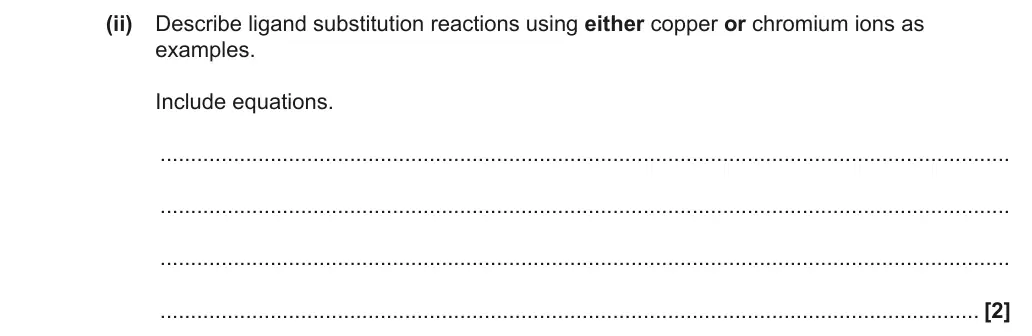
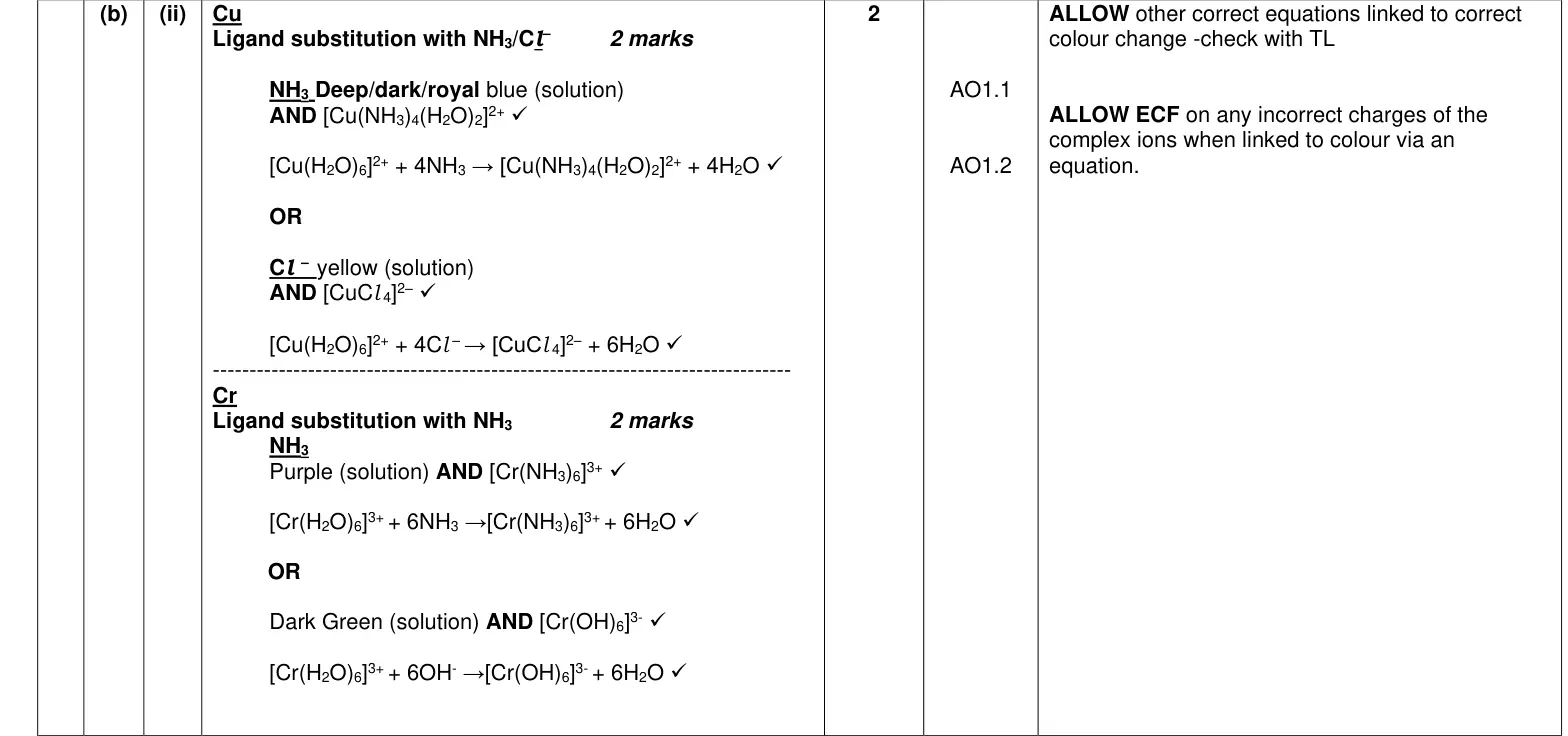
Only the highest-attaining candidates on the paper were able to give an example of a ligand substitution reaction with the colour of the new complex ion. Some candidates confused a precipitation reaction for a ligand substitution and some candidates were perhaps a little ambitious in giving ‘unusual’ complex ions for which they did not know the colour. Cu was often chosen over Cr, usually the formation of [CuCl4]2-, but [Cu(NH3)4(H2O)2]2+ was also chosen. With both, there were issues with charges of the complex, and with the latter some were confused with how many NH3 were coordinated. Some candidates defined rather than described ligand substitution.
Notes from the mark scheme and report
colour AND complex formula plus equation, e.g. deep blue [Cu(NH3)4(H2O)2]2+, yellow [CuCl4]2–, purple [Cr(NH3)6]3+
ECF on incorrect charges when linked to colour via an equation
June 2023 · Paper 1 · Q22(c)2 marksAO1Short answerHard
Mark scheme
Examiner's comment
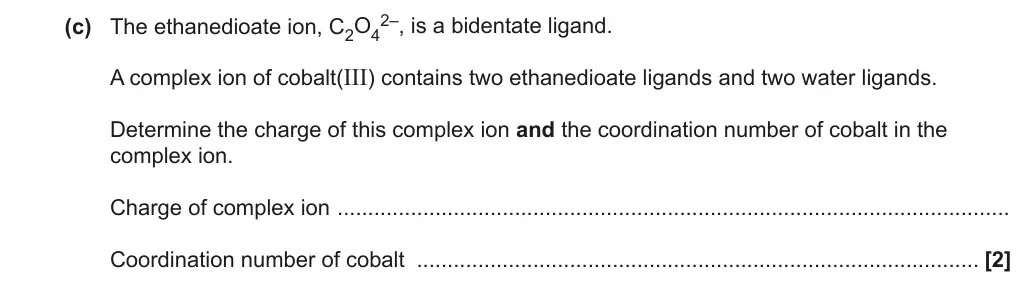
Most candidates identified the charge as -1 and a coordination number of 6. A few candidates identified the coordination number as 4 as they did not spot that ethanedioate is bidentate and charge of +3 stated.
Notes from the mark scheme and report
charge 1–
coordination number 6 (bidentate ligands count twice)
DO NOT ALLOW Co–
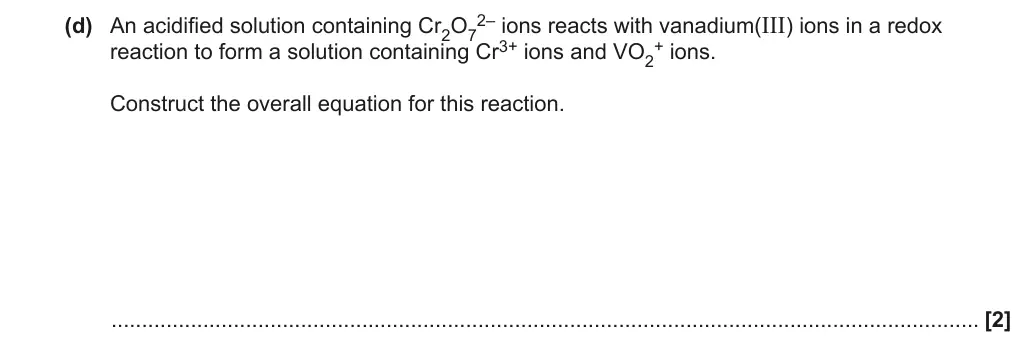
June 2023 · Paper 1 · Q22(d)2 marksAO2Equation writingHard
Mark scheme
Examiner's comment
Very few candidates were able to produce the balanced overall equation; a few had the correct reactants and products but not balanced. Candidates are advised to look for the information contained within the question. The formulas were given, and it was stated that the solution was acidified, leaving only water to be identified. Some candidates approached this through two half equations whereas others used oxidation numbers to balance their equations.
Notes from the mark scheme and report
3V3+ + Cr2O7 2– + 2H+ → 3VO2+ + 2Cr3+ + H2O
first mark for all species
DO NOT ALLOW electrons in final answer
Skills: M0.2 Use ratios, fractions and percentages
June 2023 · Paper 3 · Q1(d)2 marksAO1Short answerMedium
Earlier part of question 1 that this part uses
Mark scheme
Examiner's comment
Most candidates chose at least one of the two elements Cr and Mn, with Mn being the most common. Incorrect elements were usually other d block elements. Erratum
Notes from the mark scheme and report
Cr (3d5 4s1) and Mn (3d5 4s2)
IGNORE ions
June 2023 · Paper 3 · Q4(a)1 markAO3Short answerHard
Mark scheme
Examiner's comment
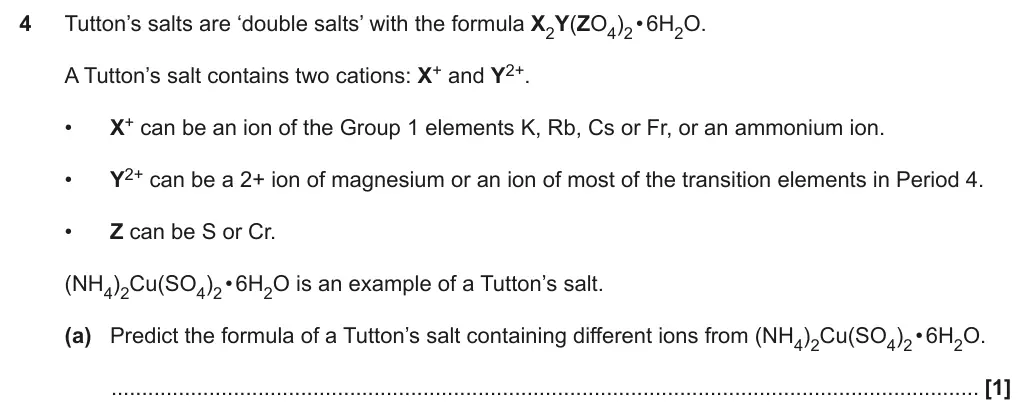
Question 4 assesses candidates’ ability to apply their chemical knowledge and understanding from different parts of the specification in a novel context. Information is supplied throughout the question, and clues are sometimes presented to candidates. In part (a), candidates are introduced to Tutton’s salts and are given an example of a Tutton’s salt that forms the context of the whole question. A candidate needs to apply the information in the bullet points to predict the formula of a different Tutton’s salt. This question discriminated extremely well across different abilities and highlighted that some candidates struggled to use supplied information. This was repeated in other parts of Question 4. Just over half the candidates gave a correct formula from the information. Some candidates did not choose one of the acceptable ions shown in the first and second bullet points, and many chose S rather than Cr, despite S being in the supplied Tutton’s salt; a significant number omitted the •6H2O.
Notes from the mark scheme and report
X from K, Rb, Cs, Fr only
Y = Mg or Ti to Ni (not Cu, Sc or Zn)
Z must be Cr
e.g. K2Mg(CrO4)2•6H2O
June 2023 · Paper 3 · Q4(c)(i)1 markAO2Short answerHard
Earlier part of question 4 that this part uses
Mark scheme
Examiner's comment
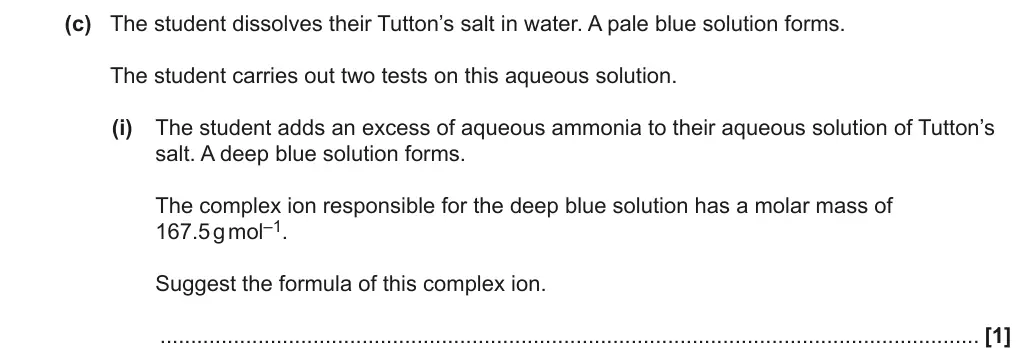
This reaction of copper(II) ions with aqueous ammonia and the formula of the complex ion formed are part of the specification. Within this novel context, the molar mass had been provided as a clue. Less than half the candidates correctly gave the correct formula and it was noticeable how well this part discriminated across abilities. This was another example of many candidates being unable to apply their knowledge and understanding to a novel context.
Notes from the mark scheme and report
IGNORE [Cu(NH3)4]2+
June 2023 · Paper 3 · Q4(c)(ii)3 marksAO2Short answerMedium
Earlier part of question 4 that this part uses
Mark scheme
Examiner's comment
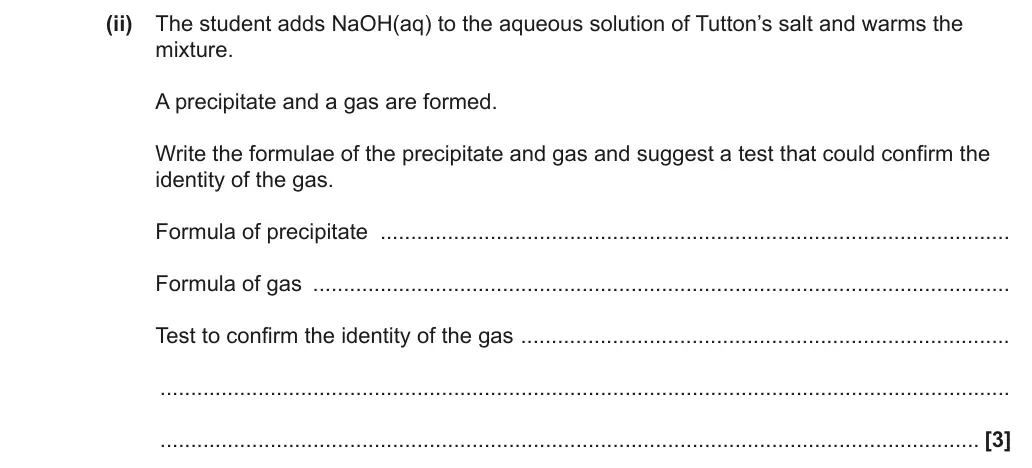
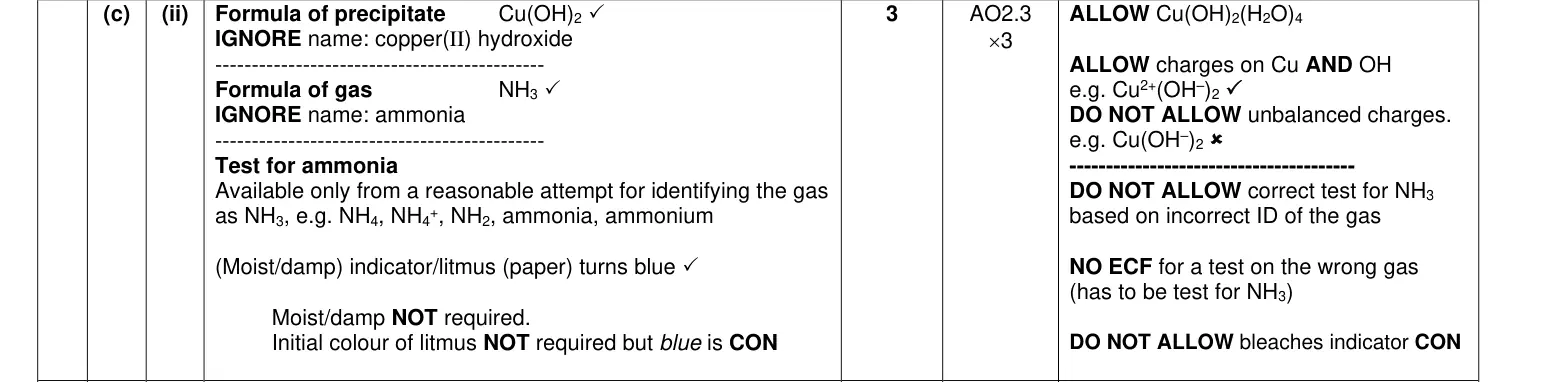
Addition of NaOH(aq) to the Tutton’s salt results in two reactions: precipitation of copper(II) hydroxide and a reaction of an ammonium ion, used to show its presence as a qualitative test. As with Question 4 (c) (i), this part discriminated very well with many candidates able to be rewarded with some of the marks. The formula of copper(II) hydroxide, as Cu(OH)2 or Cu(OH)2(H2O)2 were both acceptable. This was correct more often than the responses related to the ammonium ion. The formula of the gas formed in the reaction of NaOH(aq) with the ammonium ion caused problems, with NH3 and its subsequent test with moist indicator turning blue seen much less than the reaction of Cu2+(aq) ions. Hydrogen (the ‘squeaky pop test) and oxygen (relighting a glowing split) were common incorrect responses. This was another question in which referring back to the formula of the Tutton’s salt would have revealed important clues.
Notes from the mark scheme and report
Cu(OH)2 and NH3 (formulae required
IGNORE names)
moist indicator/litmus turns blue
no ECF for a test on the wrong gas
DO NOT ALLOW unbalanced charges or 'bleaches indicator'
Skills: PAG4 Qualitative analysis of ions
June 2022 · Paper 1 · Q151 markAO1Multiple choiceHard
Answer
B
Mark scheme
Examiner's comment
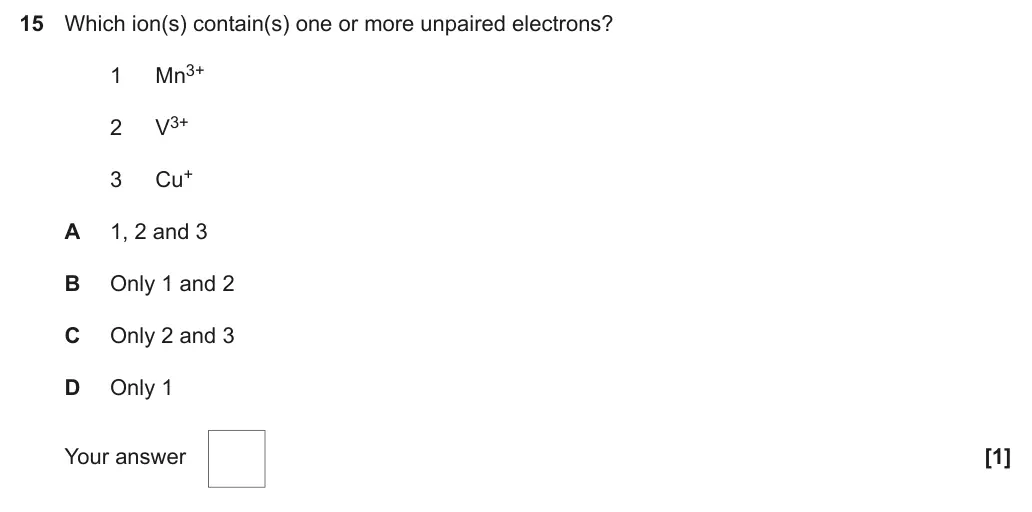
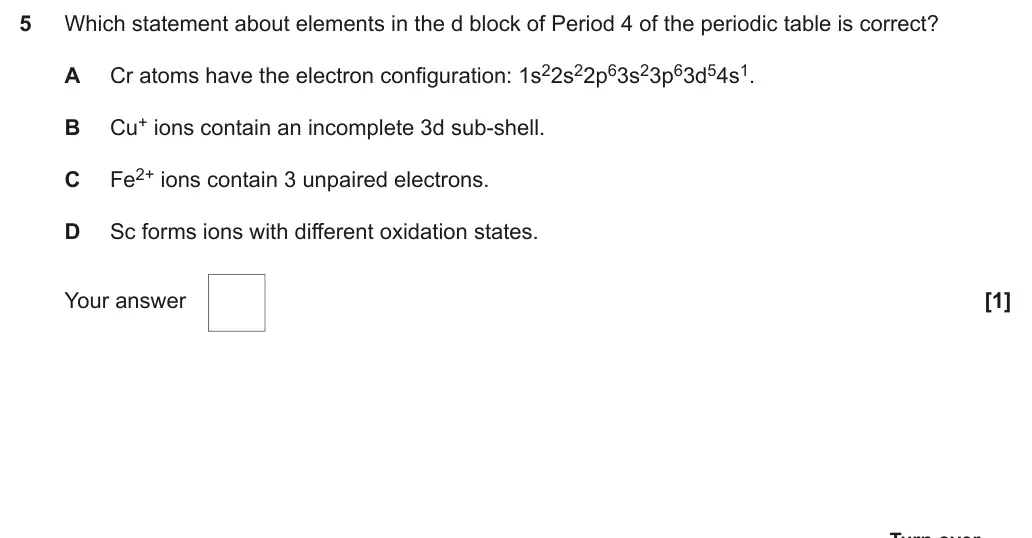
This was another challenging question, with fewer candidates choosing the correct answer of B. Successful candidates often had the electronic configuration written down and focused on the higher energy electrons as to whether they were paired or not. Missing the 4s1 in Cu was the main omission to identify the correct answer. Section B overview
Notes from the mark scheme and report
Cu+ is 3d10
June 2022 · Paper 1 · Q22(a)(i)1 markAO1Short answerMedium
Mark scheme
Examiner's comment
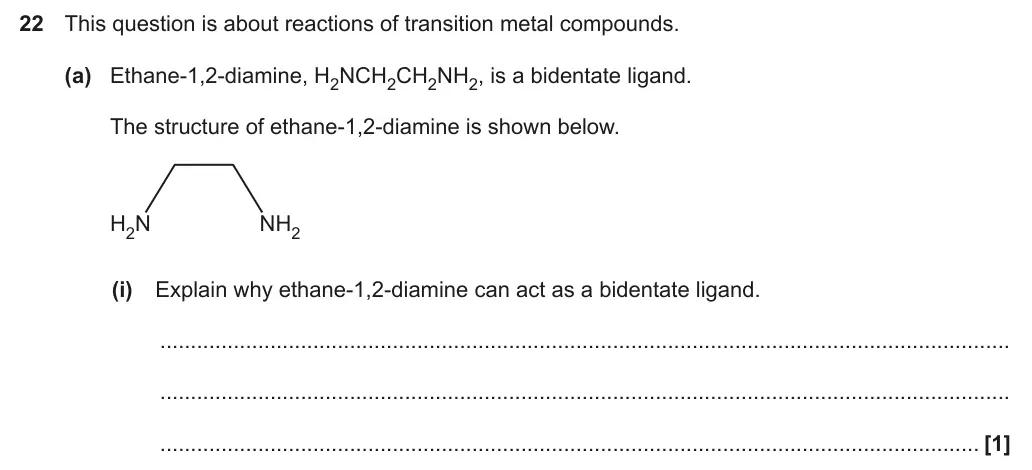
There were some good answers to this standard question, but candidates did not gain the mark due to missing one of the three key ideas of “donation, electron pairs and forming two coordinate bonds”.
Notes from the mark scheme and report
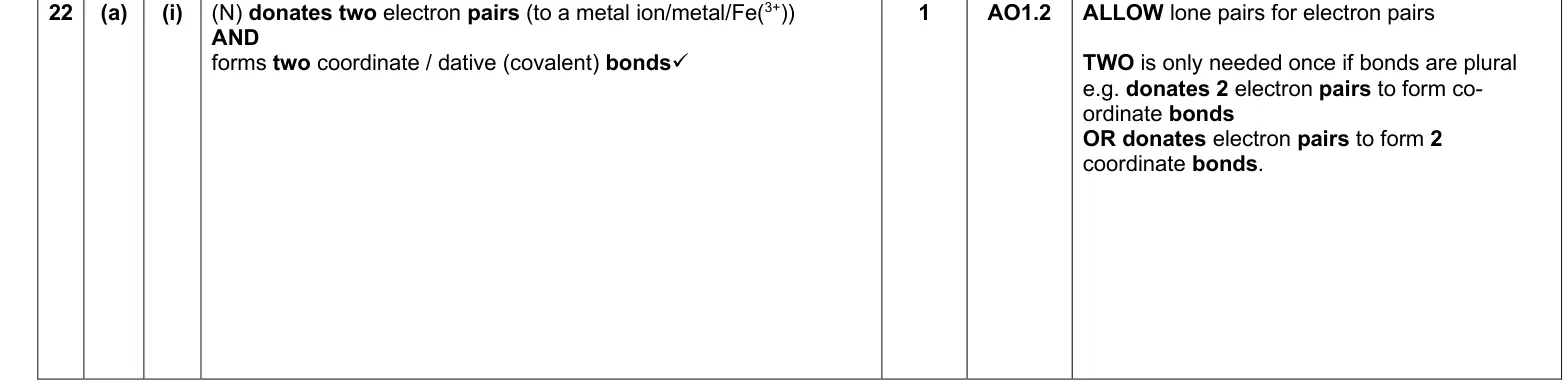
donates two electron/lone pairs AND forms two coordinate bonds (to the metal ion)
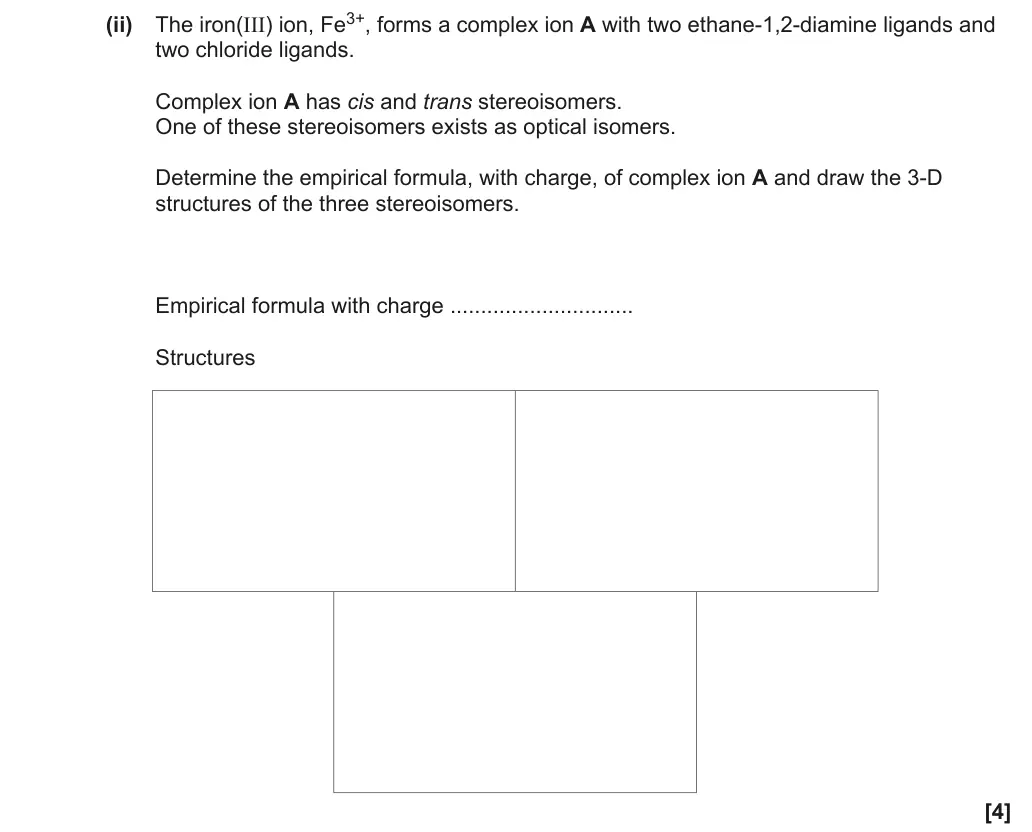
June 2022 · Paper 1 · Q22(a)(ii)4 marksAO1, 3Structure / isomerEasy
Earlier part of question 22 that this part uses
Mark scheme
Examiner's comment
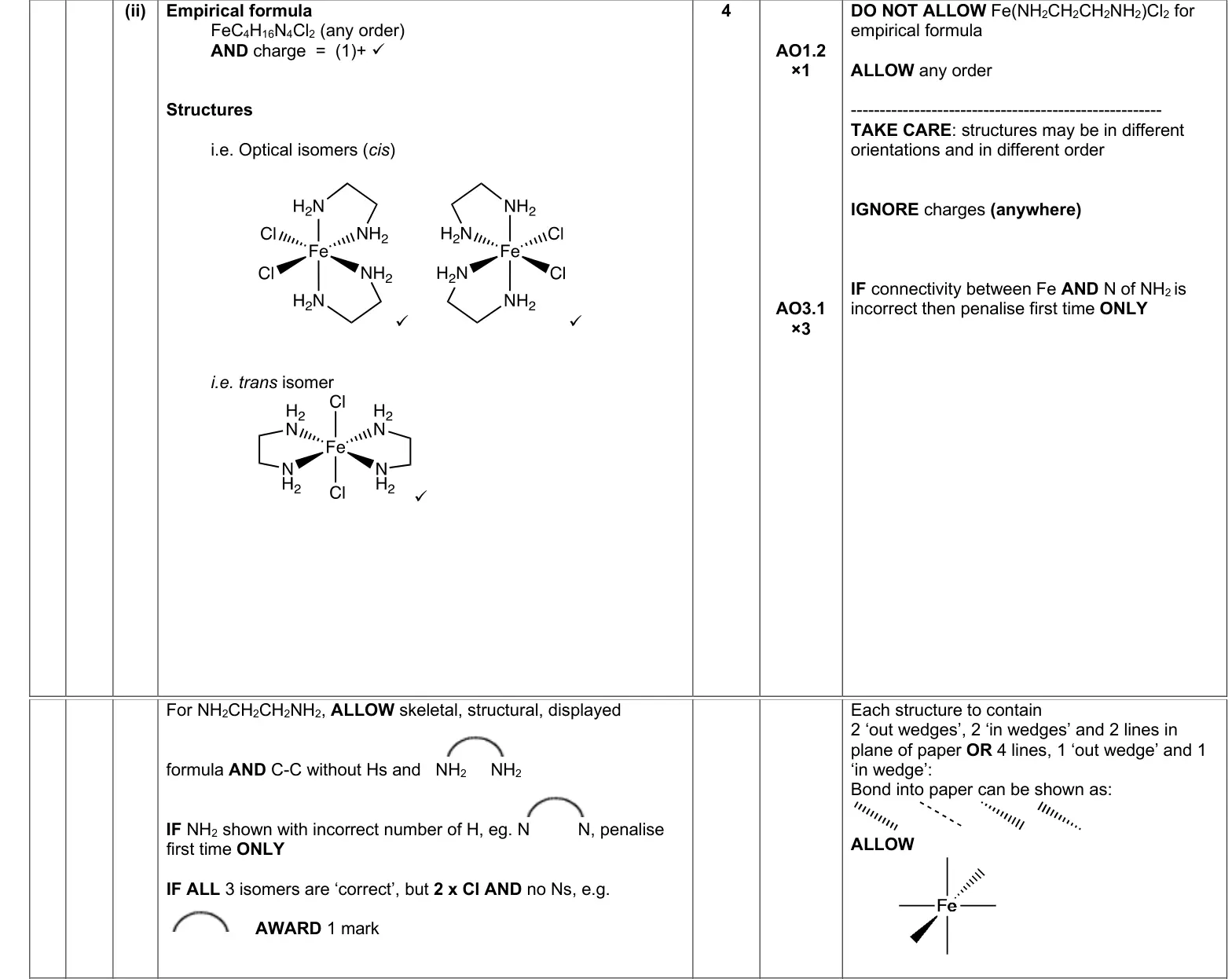
Most candidates did not seem to understand how to apply their knowledge of what an empirical formula should look like to this situation. Many giving the formula of the complex ion instead. Those candidates who were successful often had the incorrect overall charge on the ion with 3+ as the common error, not considering the 2 Cl- ligands. Conversely, most candidates did very well at representing the isomers of the complex. Most were able to use the wedge and broken line notation to suggest the geometry of what they were drawing. Although a small number drew the trans isomer in three different orientations, most correctly drew the trans and cis forms and managed to show the optical isomers – even when they did not make use of the top pair of answer boxes to assist them with their mirror images. Candidates are advised to focus on the mirror image and avoid subsequent rotations and inversions of the molecule. This can often lead to two of the same isomers being drawn. Candidates showed a good accuracy with their connectivity of the N atom.
Notes from the mark scheme and report
empirical formula FeC4H16N4Cl2 with 1+ charge (DO NOT ALLOW Fe(NH2CH2CH2NH2)2Cl2)
two cis mirror images and one trans
correct wedges (2 out, 2 in, 2 in plane)
Fe–N connectivity errors penalised once
1 mark if all three shown with Cl but no N
Skills: M4.2 Visualise and represent 2-D and 3-D forms including 2-D representations of 3-D objects; M4.3 Understand the symmetry of 2-D and 3-D shapes
June 2022 · Paper 1 · Q22(b)(i)1 markAO2Equation writingMedium
Mark scheme
Examiner's comment
Most students scored this mark, although several gave no response.
Notes from the mark scheme and report
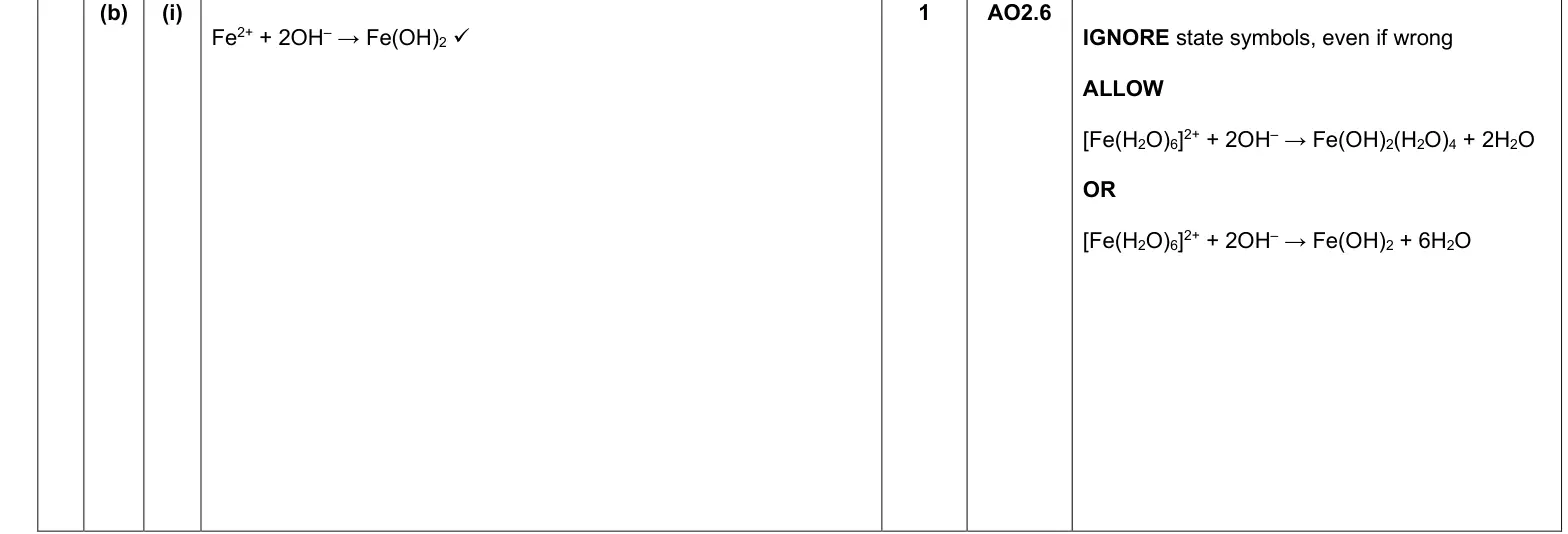
Fe2+ + 2OH– → Fe(OH)2
ALLOW complexed formulae
IGNORE state symbols
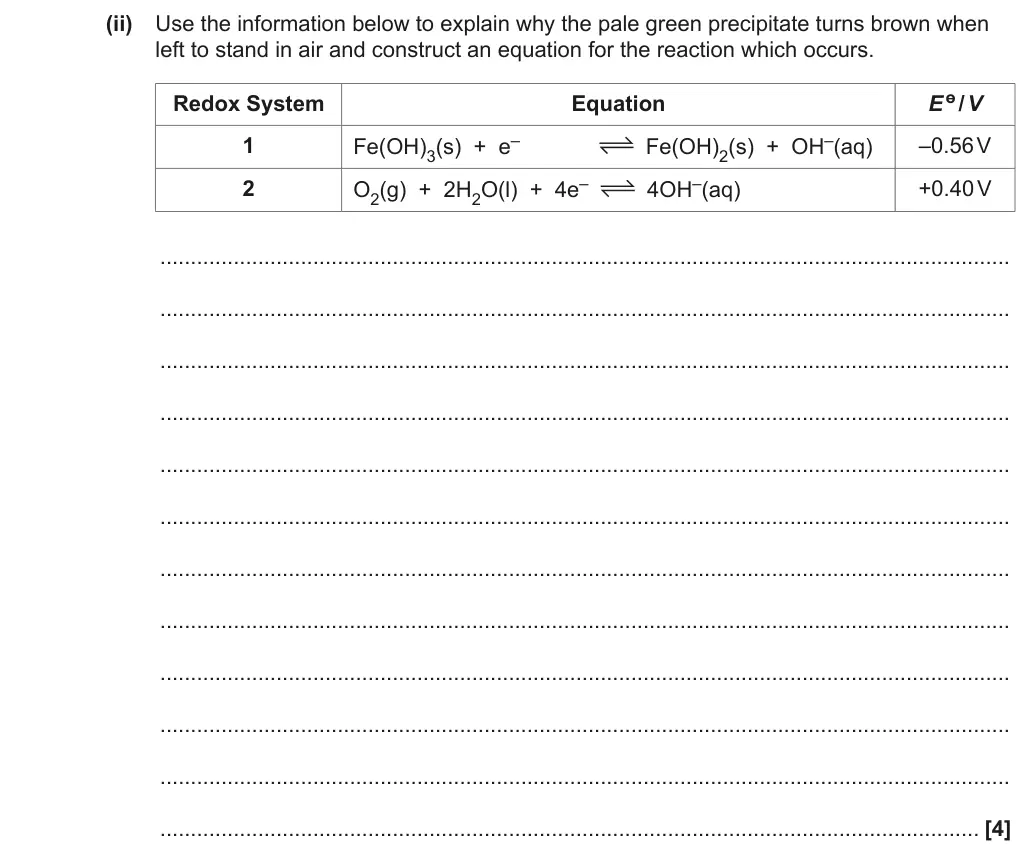
June 2022 · Paper 1 · Q22(b)(ii)4 marksAO3Equation writingEasy
Earlier part of question 22 that this part uses
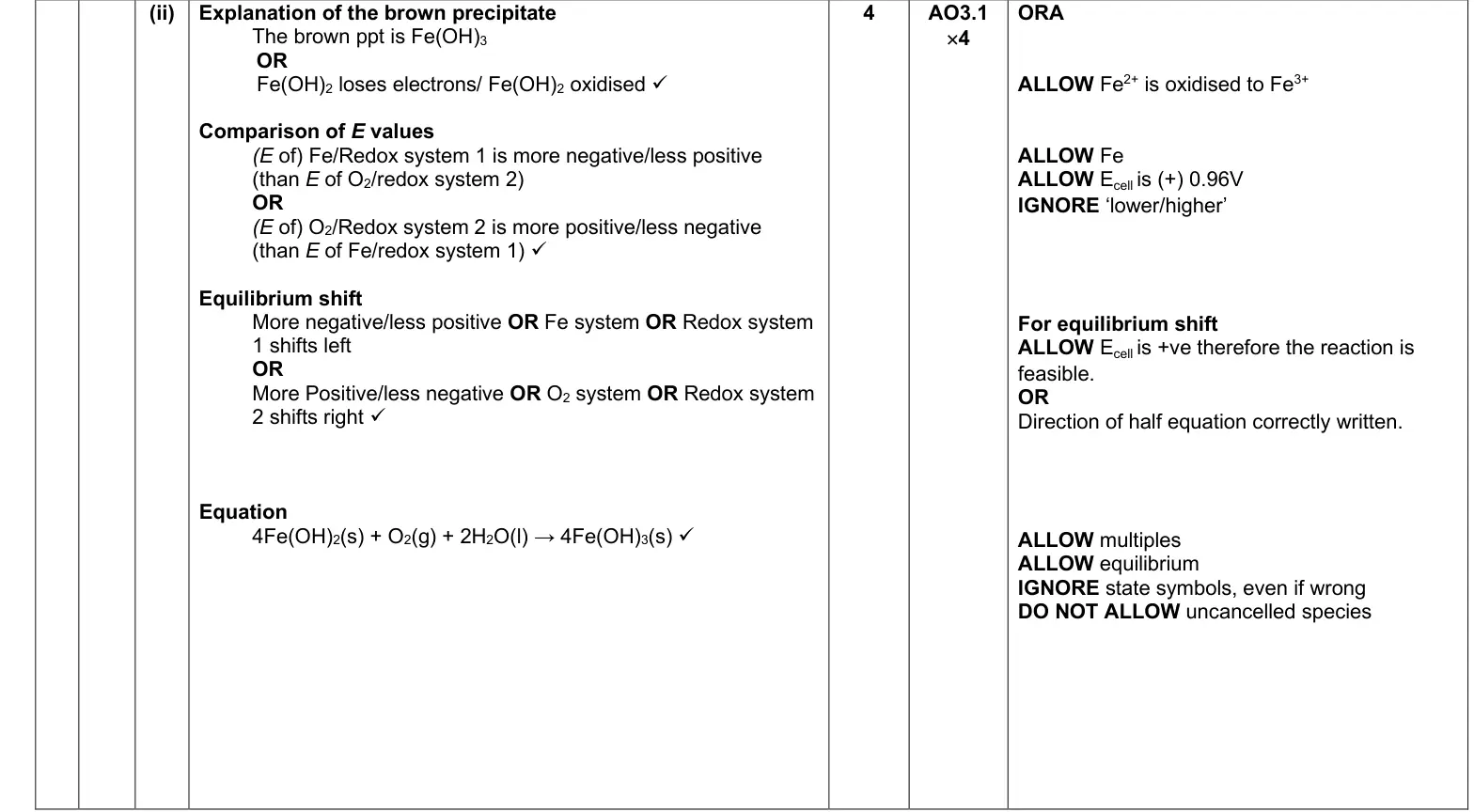
Mark scheme
Examiner's comment
Although a spread of marks across the full available range was seen, a good proportion of candidates gained 3 or 4 marks. Most candidates were able to produce a balanced equation, but candidates should take care cancelling out any species present on both side of the equation, e.g. the hydroxide ions. A common error within the formula of iron (III) hydroxide was to place the number of hydroxide ions within the brackets, e.g. Fe(OH3). Candidates are advised to read the instructions contained within the equation and to use or comment on all the data presented. When commenting on electrode potentials, candidates should avoid the use of higher/lower as these phrases are meaningless due to the negative signs involved.
Notes from the mark scheme and report
brown ppt is Fe(OH)3/Fe(OH)2 oxidised
E of system 1 more negative than system 2
system 1 shifts left (or system 2 right)
4Fe(OH)2 + O2 + 2H2O → 4Fe(OH)3
IGNORE lower/higher
DO NOT ALLOW uncancelled species
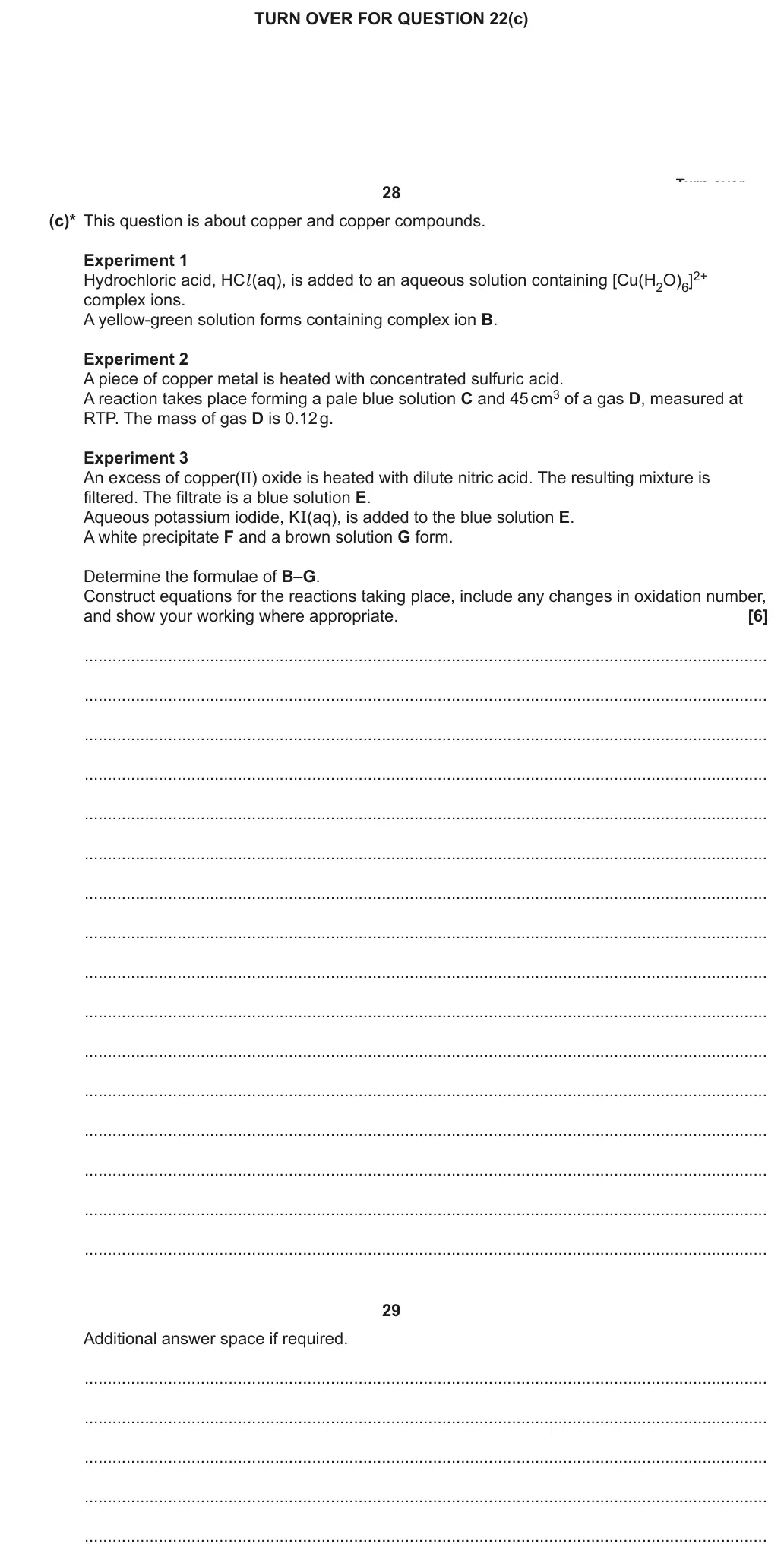
June 2022 · Paper 1 · Q22(c)6 marksAO36-mark level of responseHard
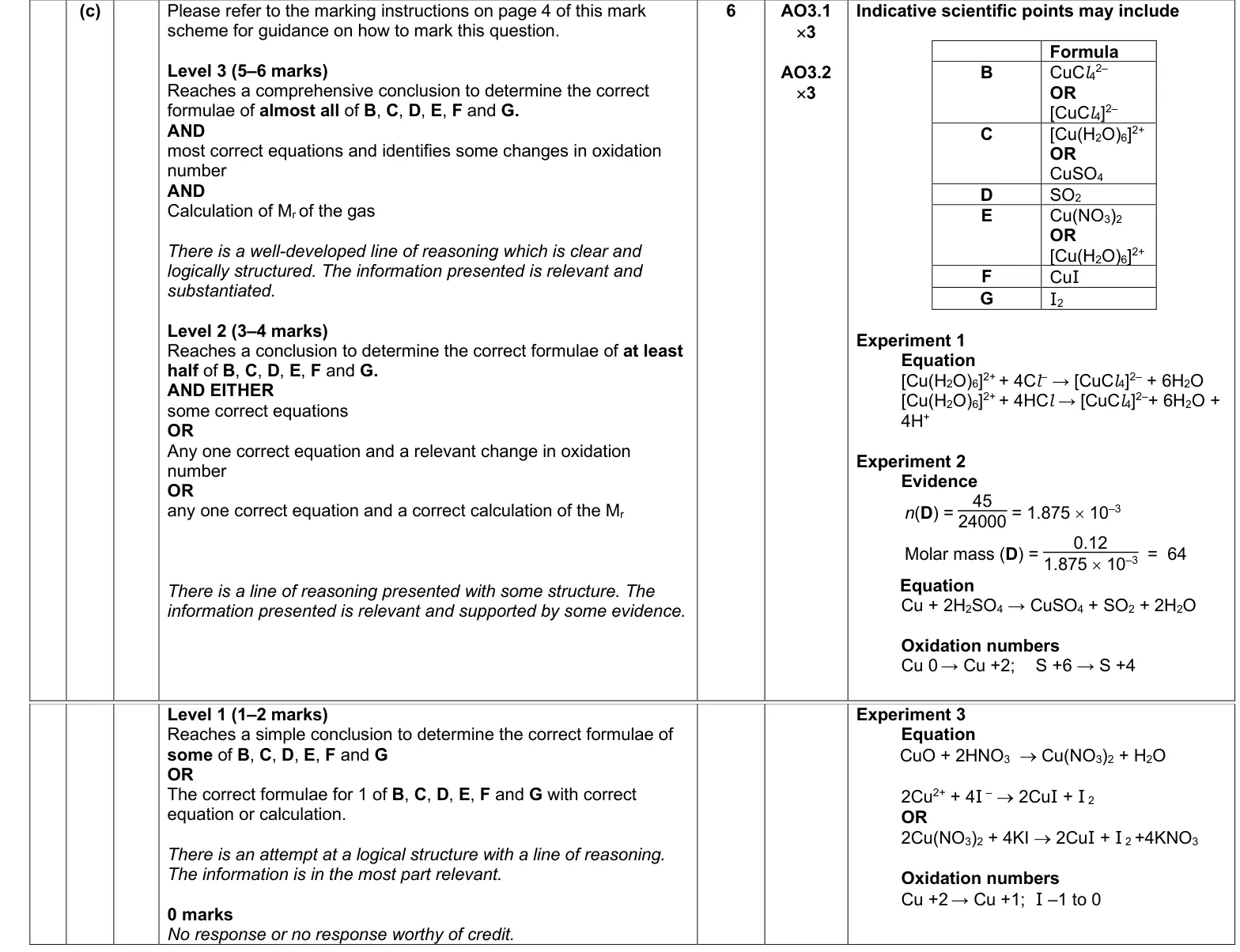
Mark scheme, with the levels and indicative points
Examiner's comment
Answers were distributed across all 3 levels of achievement. Most of the candidates managed to identify at least some of the substances. Of the equations, the reaction of copper (II) oxide with nitric acid was most regularly seen correct, although many students could also represent the ligand replacement in Experiment 1. Many candidates were able to calculate Mr for gas D but some of those suggesting SO2 as a possible formula preferred to have an equation in experiment 2 producing hydrogen. A few candidates used the Mr to suggest that the gas was 2O2 and as such candidates found the equation between copper and sulphuric acid challenging. A good number of candidates identified F and G, recognising what they had learned from their work on redox titrations, and some were able to reproduce the equation. Incorrect formula of copper (I) iodide (CuI2) was a common error. Many candidates made no attempt at identifying changes in oxidation states. Candidates are advised to address all parts of the question in order to access the higher levels and to allow sufficient time to attempt the LoR questions. The candidate has clearly set out the three experiments, written the equation and followed with a clear identification of each of the formulae B-G. The calculation is well laid out and the response clearly indicates how the final value has been calculated. Oxidation numbers have then been commented on where appropriate. The colours of the transition metal ions and complexes can be reviewed at: A Level Chemistry A - Colours of inorganic ions and complexes (ocr.org.uk) If any of your students’ results are not as expected, you may wish to consider one of our post-results services. For full information about the options available visit the OCR website. We send a weekly roundup to tell you about important updates. You can also sign up for your subject specific updates. If you haven’t already, sign up here. Attend one of our popular CPD courses to hear directly from a senior assessor or drop in to a Q&A session. Most of our courses are delivered live via an online platform, so you can attend from any location. Please find details for all our courses on the relevant subject page on our website or visit OCR professional development. ExamBuilder is the question builder platform for a range of our GCSE, A Level, Cambridge Nationals and Cambridge Technicals qualifications. Find out more. ExamBuilder is free for all OCR centres with an Interchange account and gives you unlimited users per centre. We need an Interchange username to validate the identity of your centre's first user account for ExamBuilder. If you do not have an Interchange account please contact your centre administrator (usually the Exams Officer) to request a username, or nominate an existing Interchange user in your department. Review students' exam performance with our free online results analysis tool. It is available for all GCSEs, AS and A Levels and Cambridge Nationals. It allows you to: • review and run analysis reports on exam performance • analyse results at question and/or topic level • compare your centre with OCR national averages • identify trends across the centre • facilitate effective planning and delivery of courses • identify areas of the curriculum where students excel or struggle • help pinpoint strengths and weaknesses of students and teaching departments. Find out more. Post-results services Keep up-to-date OCR Professional Development Signed up for ExamBuilder?
Notes from the mark scheme and report
B = [CuCl4]2–
D: n = 45/24000, M = 64 so SO2, C = CuSO4 with Cu 0 to +2 and S +6 to +4
E = Cu(NO3)2
F = CuI (white) and G = I2 with Cu +2 to +1 and I –1 to 0
Level 3 needs Mr calculation, most equations and some oxidation number changes
The AS delivery guide ‘Theme: Identifying Unknowns’ https://www.ocr.org.uk/Images/208563-identifying-unknowns.pdf ‘Transition elements’: Delivery Guide for OCR AS/A Level Chemistry A
Skills: M0.2 Use ratios, fractions and percentages; M2.3 Substitute numerical values into algebraic equations using appropriate units for physical quantities
June 2022 · Paper 3 · Q1(d)(ii)3 marksAO2Equation writingHard
Earlier part of question 1 that this part uses
Mark scheme
Examiner's comment
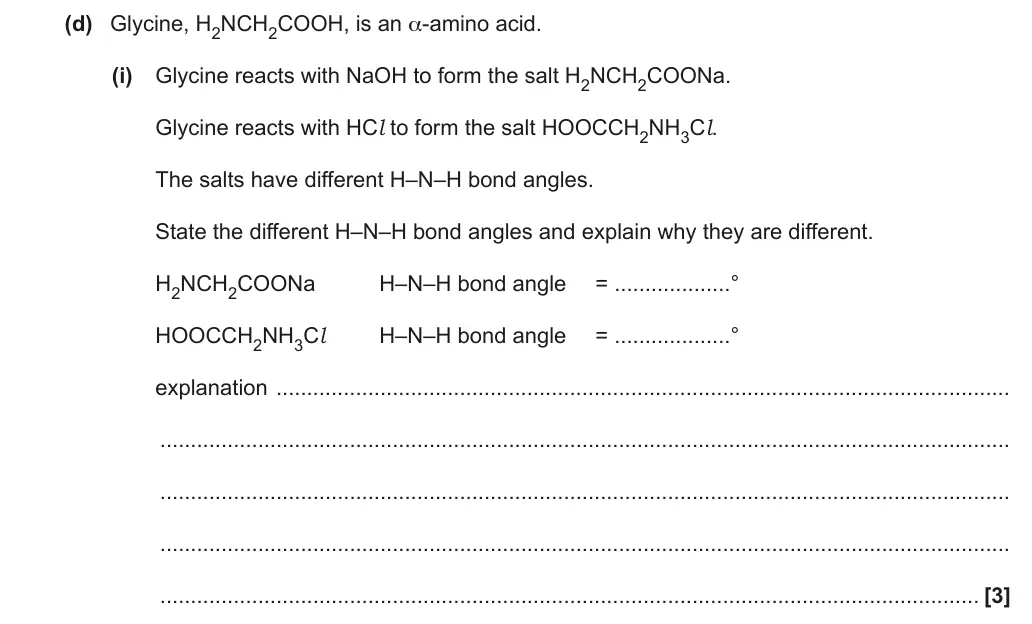
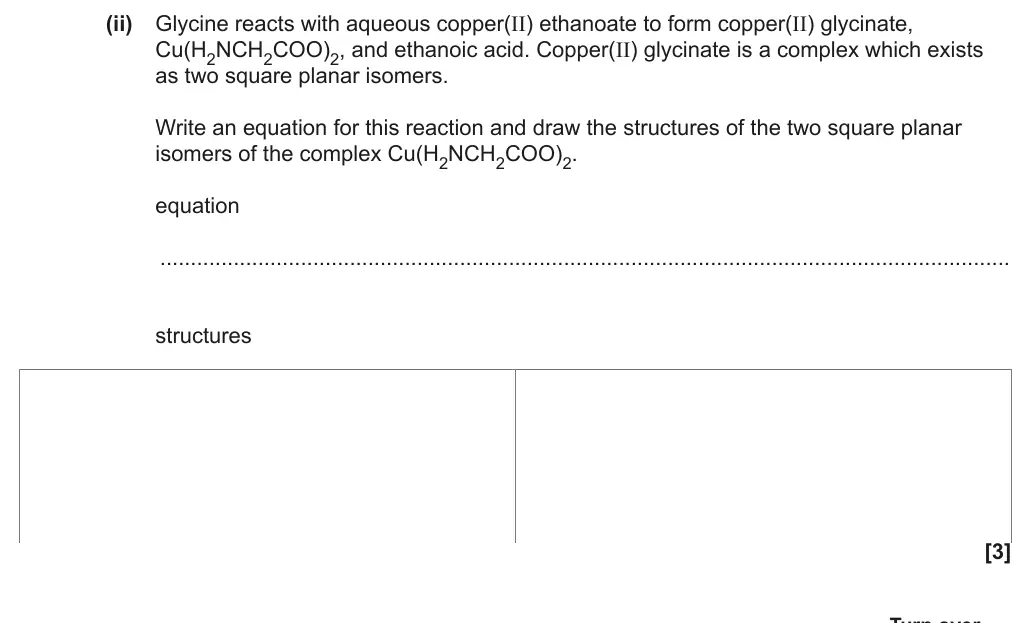
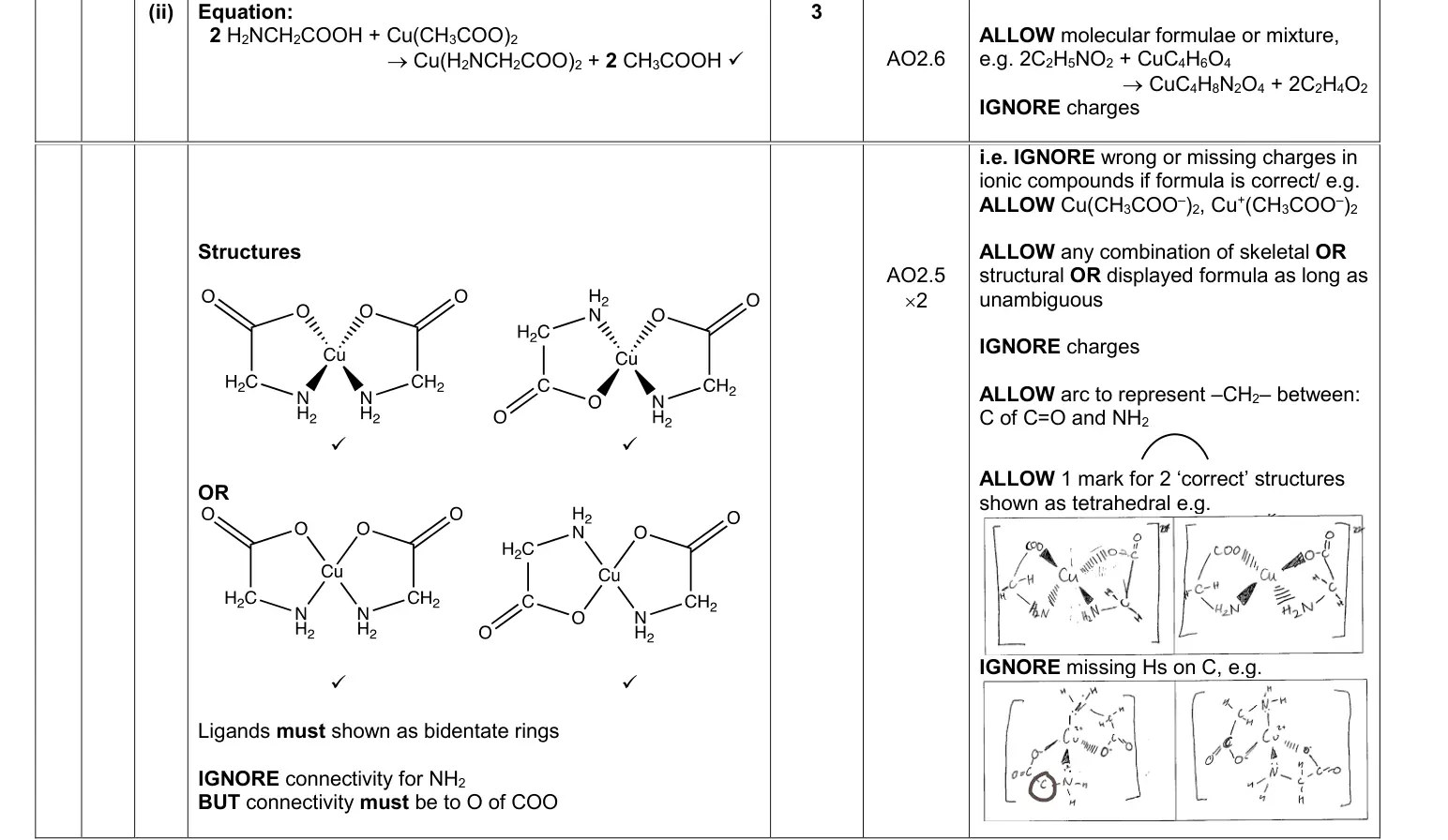
Candidates were asked to predict an unfamiliar equation from provided information and to draw structures of square planar complexes containing an amino acid. Candidates found the structures easier than the equation, with many drawing 3D structures with 2 out-wedges and 2 in-wedges and attaching the NH2 and COO groups correctly. It was also common to see a ‘criss-cross’ orientation, looking down on the complex, which is easier to draw. Many candidates connected the NH2 and COO groups next to, and across from, each another in the isomers. A common error was for candidates to rotate their first structure, to produce a second drawing of the first structure. Less successful responses often tried to attach NH2 and COO groups but with no CH2 between the groups to produce a cyclic attachment. A minority of candidates ignored ‘square planar’ and drew tetrahedral structures instead. The equation proved to be very difficult, the commonest error being omission of the ‘2’ balancing numbers for H2NCH2COOH and CH3COOH. The formulae for ethanol or propanoic acid were also often seen for ethanoic acid. Candidates are advised to check all formulae and then to check balancing, the golden rules for successfully constructing all equations.
cis and trans square planar isomers with ligands shown as bidentate rings bonded through N and O of COO
1 mark if both drawn as tetrahedral
IGNORE charges
Skills: M4.2 Visualise and represent 2-D and 3-D forms including 2-D representations of 3-D objects
June 2022 · Paper 3 · Q2(b)5 marksAO2Extended responseEasy
Mark scheme
Examiner's comment
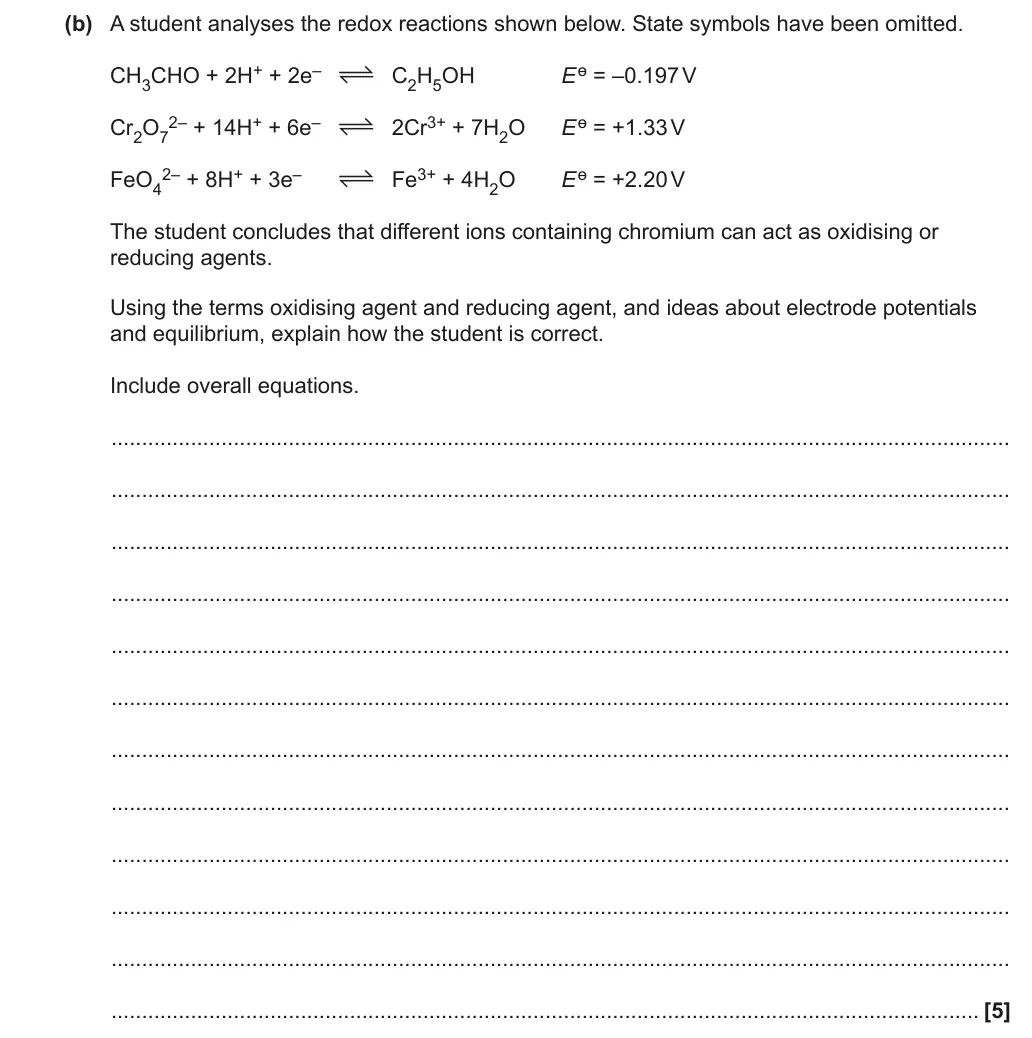
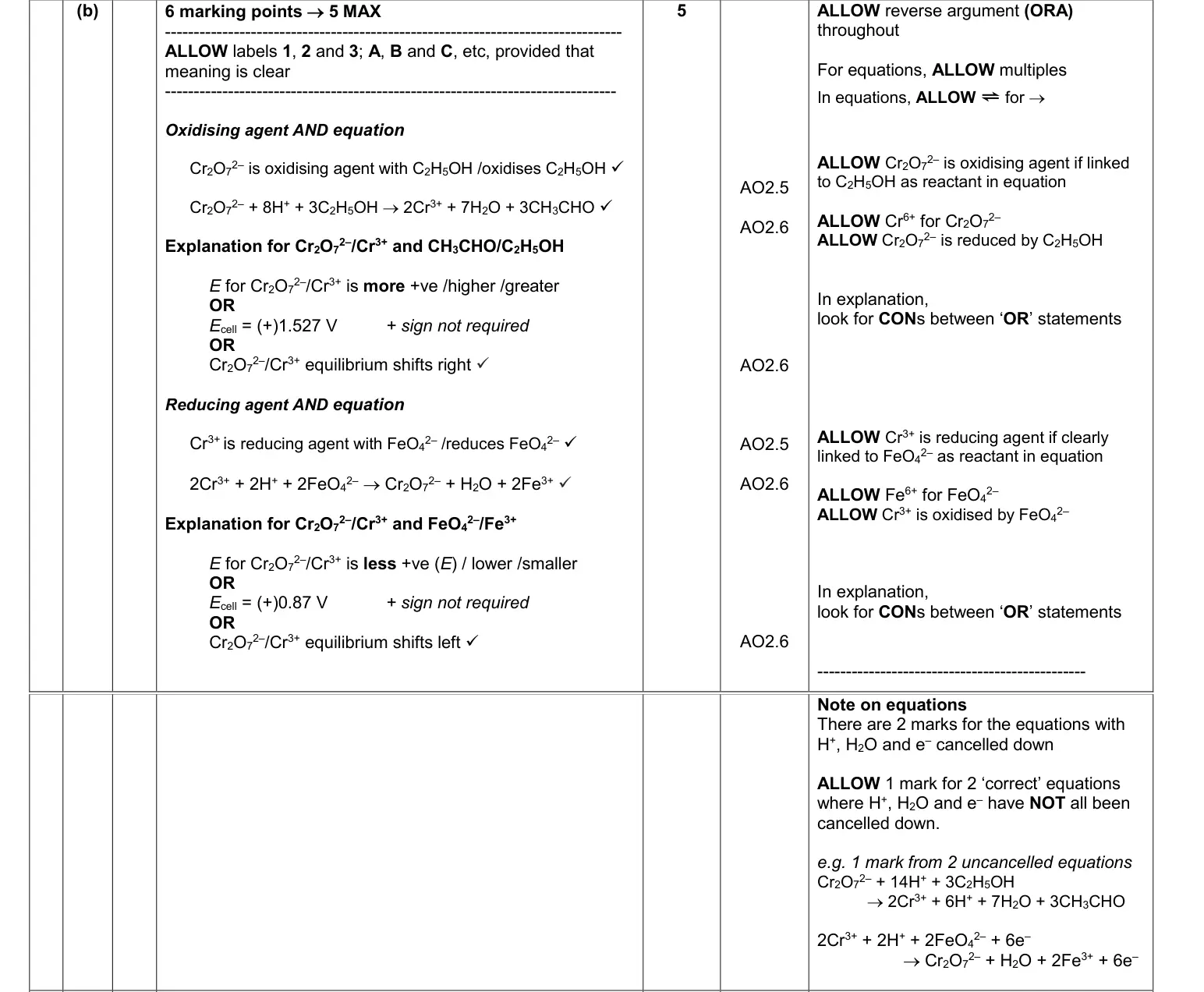
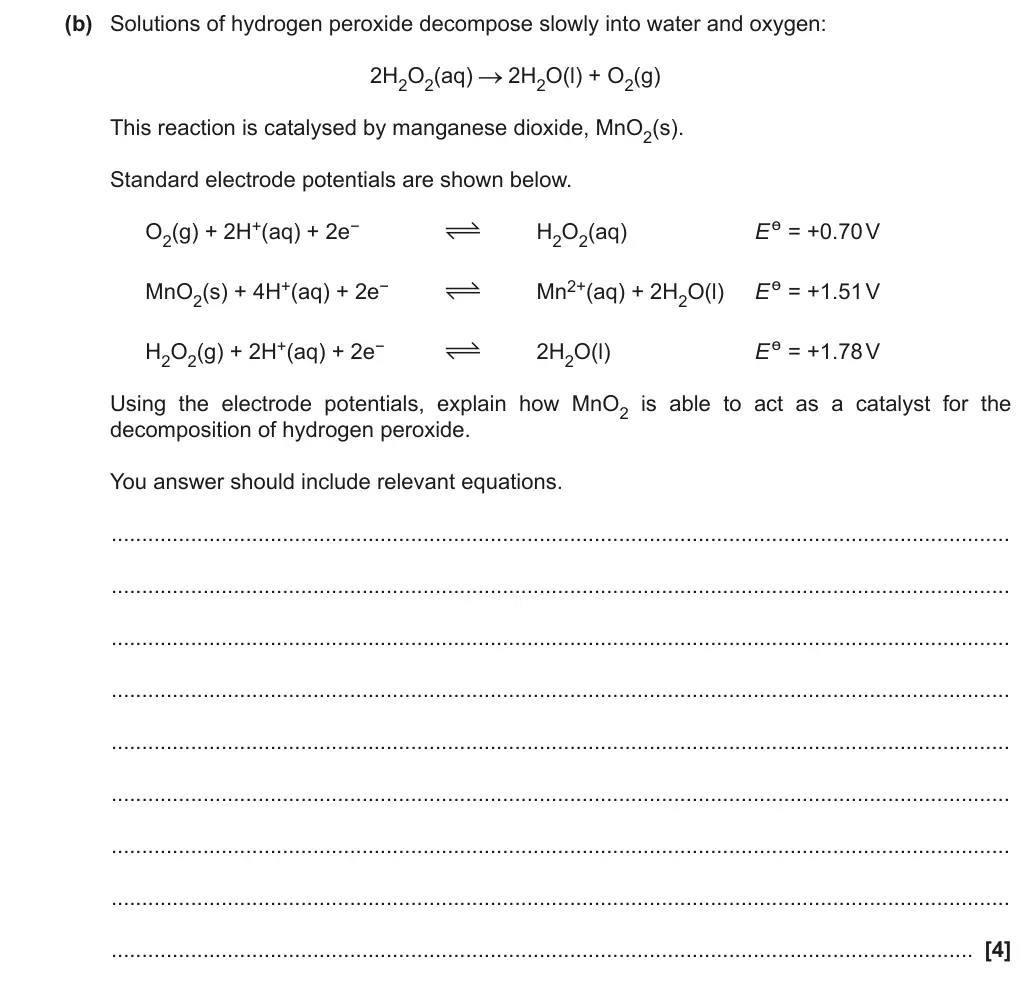
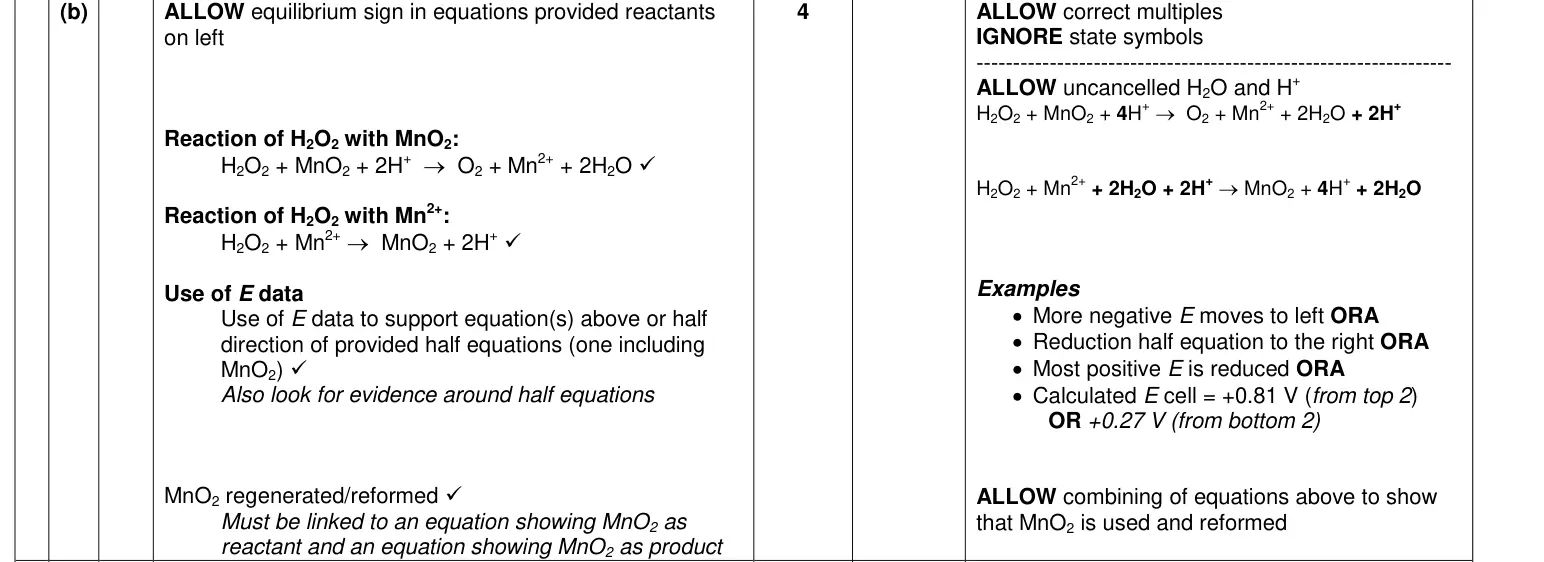
Most candidates were able to obtain some credit for this problem. The equations proved to be among the easier marks, and it was encouraging to see how many candidates were able to use the E data to help them combine the half equations correctly. Most then cancelled down the common species present on both sides of the equation: H+, H2O and e–. Explanations were generally sound, either by comparing the E values, stating the direction of equilibrium shift, or by using cell potentials. The hardest marks proved to be the identification of the chromium ions that were the oxidising and reduction agents. Many candidates just referred to ‘chromium’ despite the chromium half equation containing two chromium ions, Cr2O72– and Cr3+. Candidates who had written correct equations sometimes assigned the wrong chromium ion as the oxidising or reducing agent. Mores successful responses constructed correct equations and stated that Cr2O72– was the oxidising agent as it oxidised C2H5OH and that Cr3+ was the reducing agent as it reduced FeO42–.
Notes from the mark scheme and report
Cr2O7 2– is oxidising agent with C2H5OH (its E more positive, equilibrium shifts right)
Cr3+ is reducing agent with FeO4 2– (E less positive, shifts left)
two overall equations with H+, H2O and e– cancelled (1 mark only if uncancelled)
6 marking points max 5
Skills: M0.2 Use ratios, fractions and percentages
November 2021 · Paper 1 · Q151 markMultiple choice
Answer
C
Mark scheme
November 2021 · Paper 1 · Q17(a)4 marksAO1Short answerMedium
Mark scheme
Examiner's comment
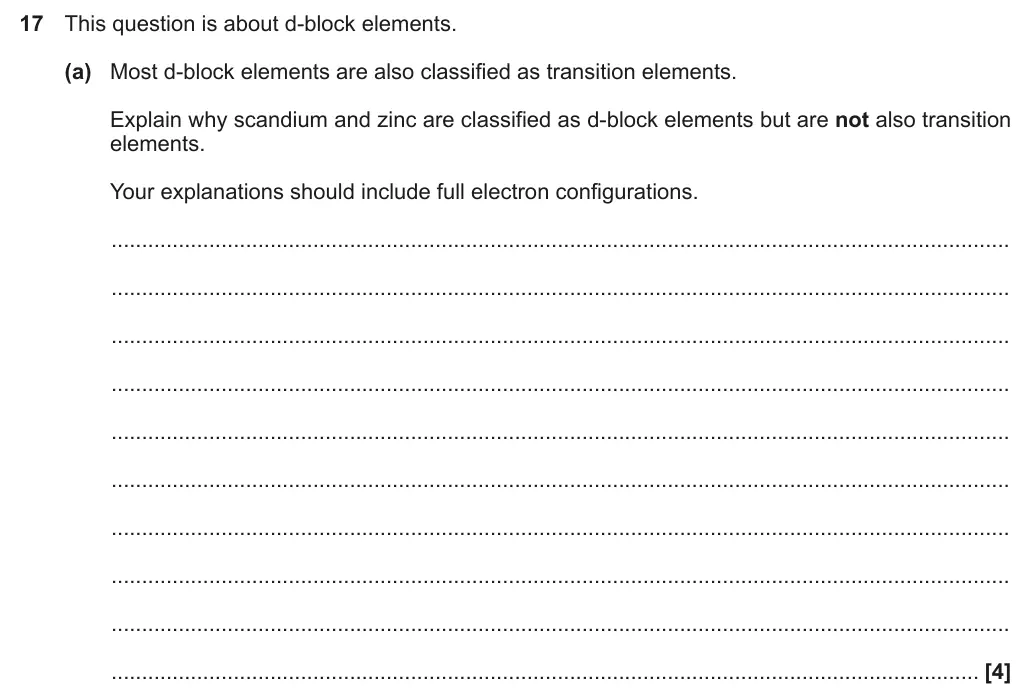
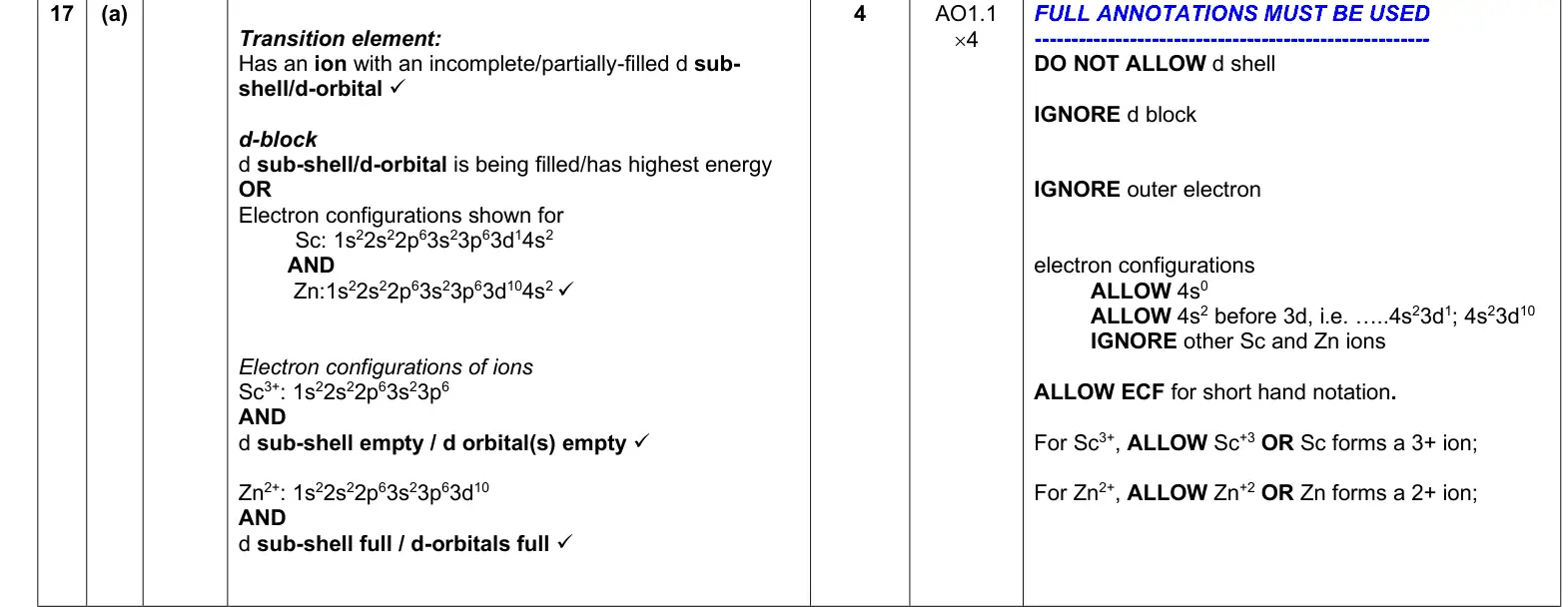
Question 17(a): Only the higher-attaining candidates scored full marks.
Notes from the mark scheme and report
transition element has an ion with incomplete d sub-shell (DO NOT ALLOW d shell)
full configurations of Sc and Zn
Sc3+ has empty d sub-shell
Zn2+ has full 3d10
November 2021 · Paper 1 · Q17(b)(i)1 markAO1Short answer
Mark scheme
Notes from the mark scheme and report
donates two electron pairs AND forms two coordinate bonds to the metal ion
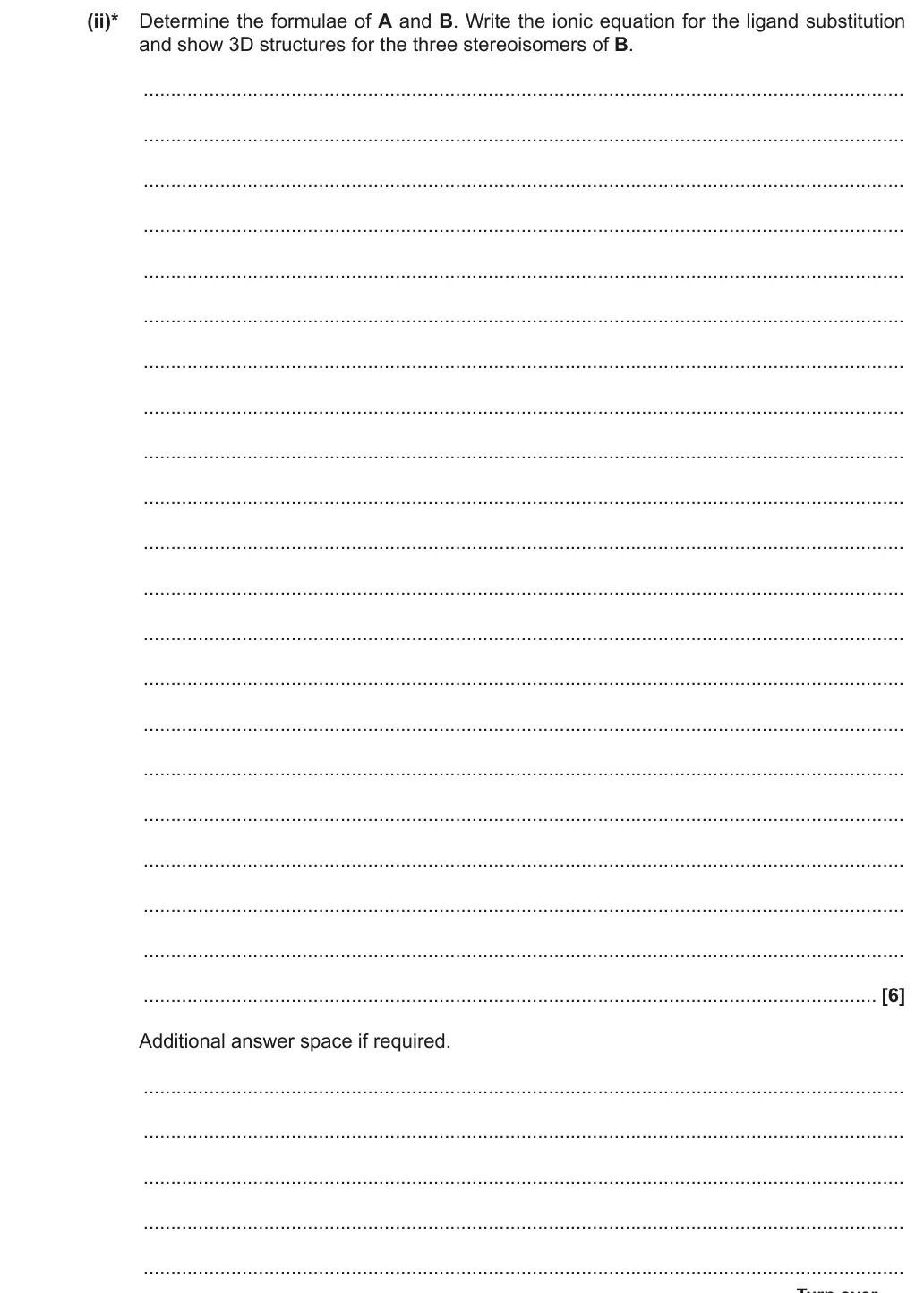
November 2021 · Paper 1 · Q17(b)(ii)6 marksAO2, 36-mark level of response
Earlier part of question 17 that this part uses
Mark scheme, with the levels and indicative points
Notes from the mark scheme and report
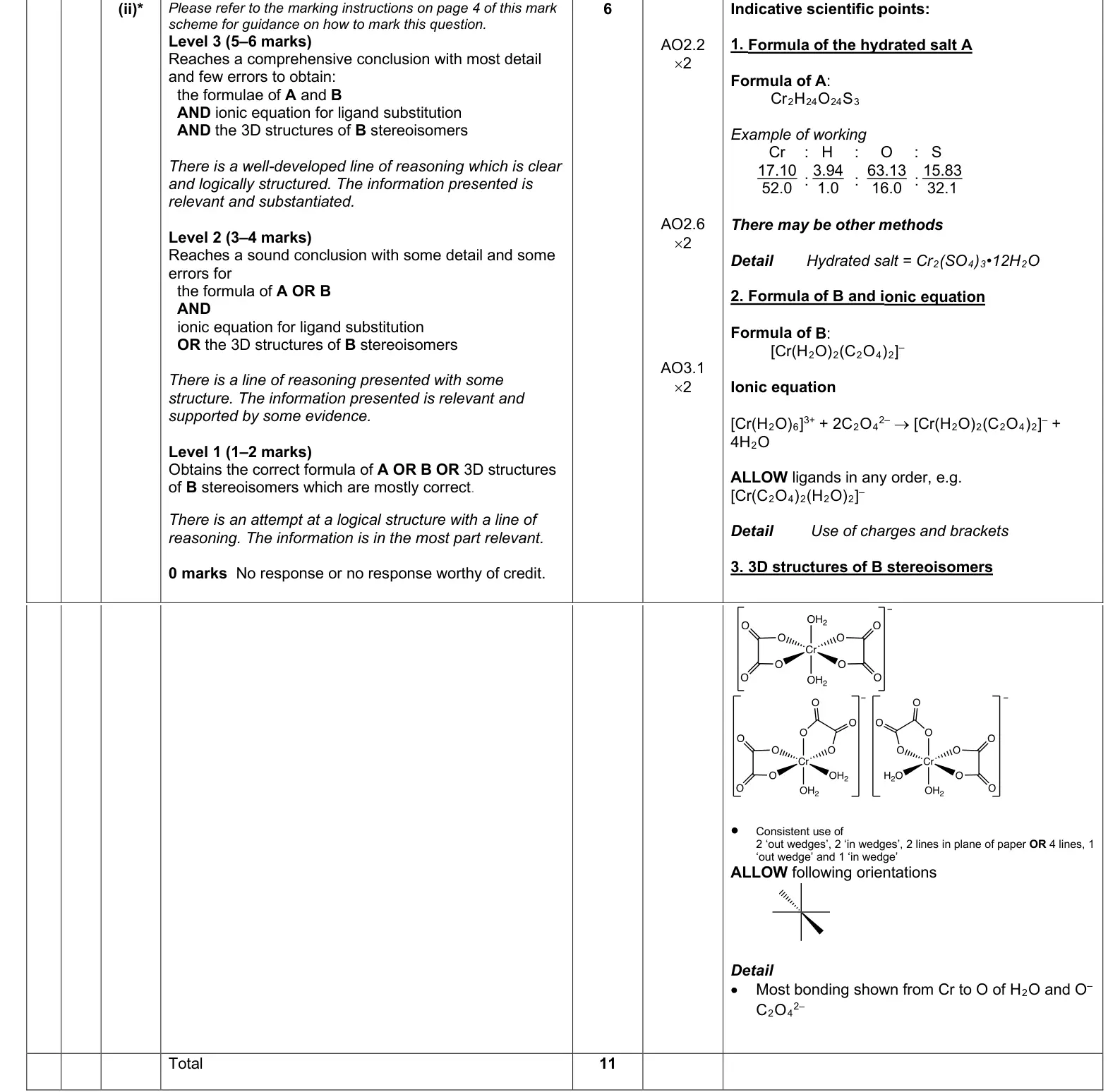
A = Cr2(SO4)3•12H2O
B = [Cr(H2O)2(C2O4)2]–
trans isomer plus two cis optical isomers drawn in 3D with wedges
charges and brackets
Skills: M0.2 Use ratios, fractions and percentages; M4.2 Visualise and represent 2-D and 3-D forms including 2-D representations of 3-D objects; M4.3 Understand the symmetry of 2-D and 3-D shapes
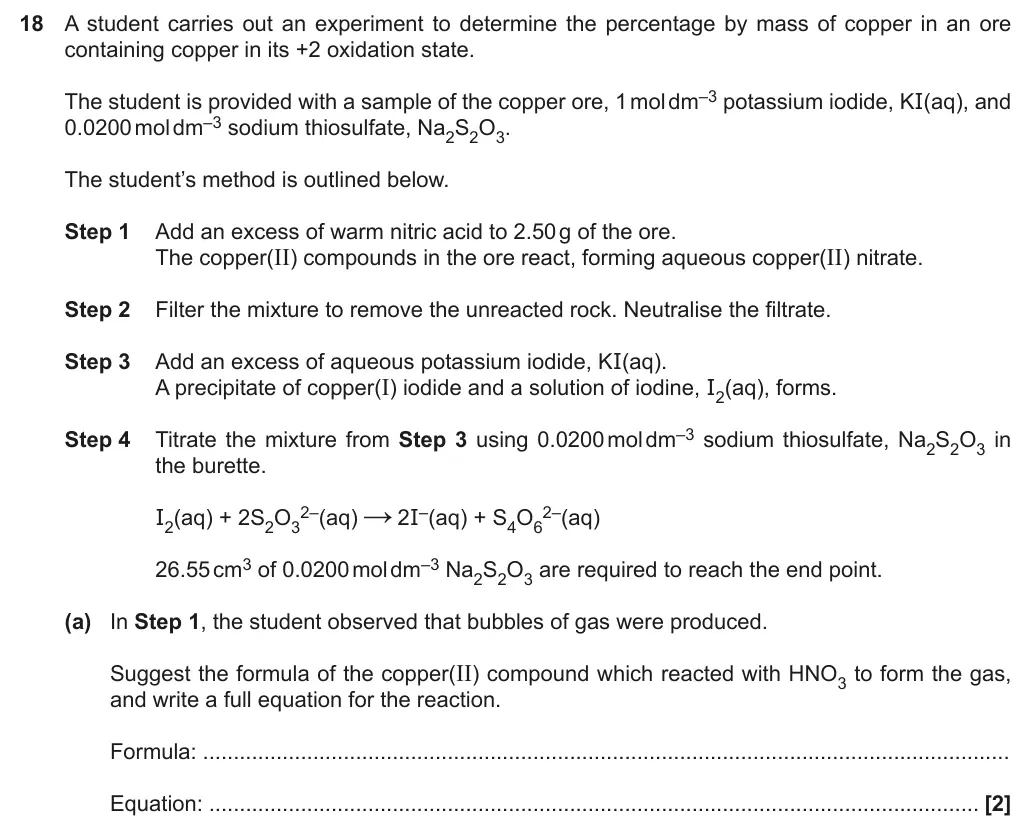
November 2021 · Paper 1 · Q18(b)1 markAO2Equation writing
Earlier part of question 18 that this part uses
Mark scheme
Notes from the mark scheme and report
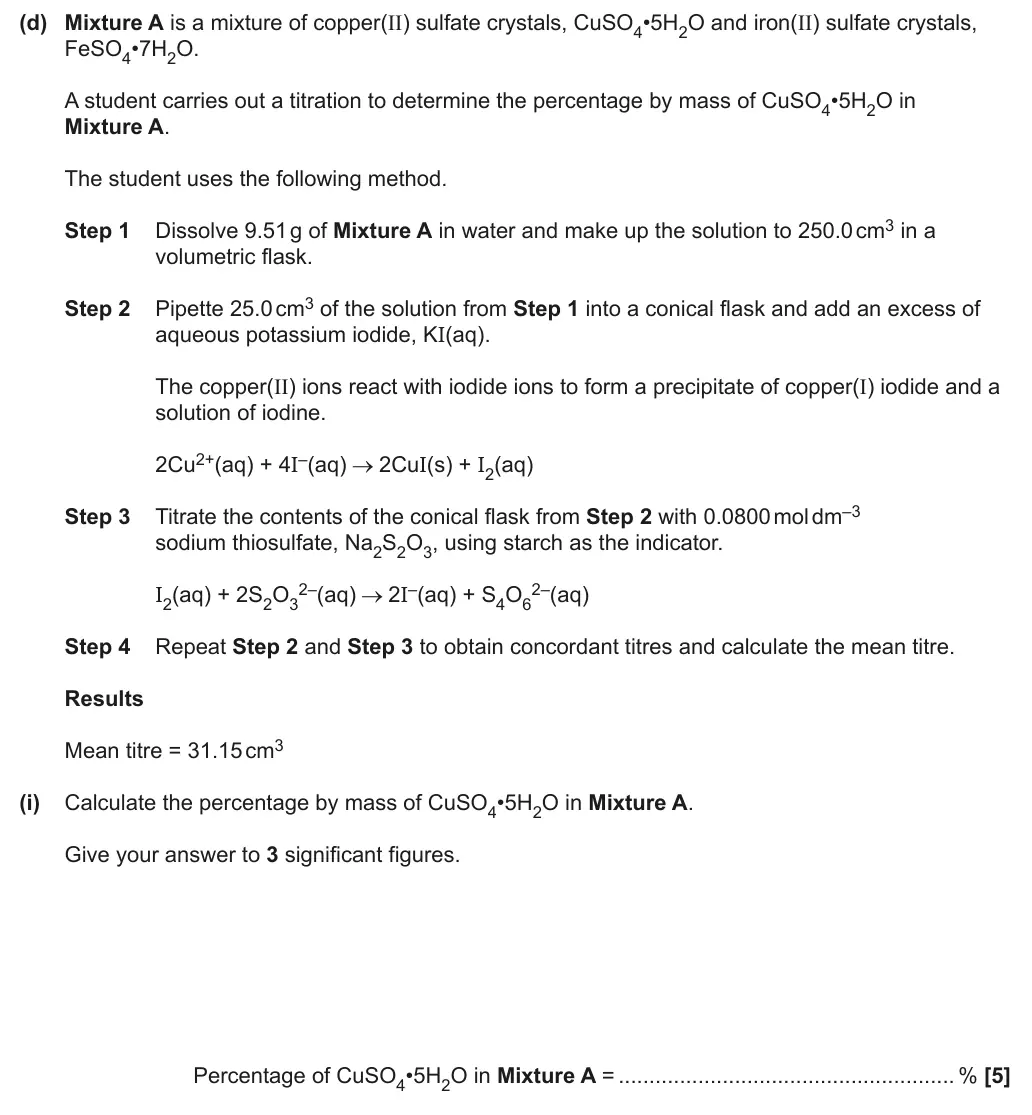
2Cu2+(aq) + 4I–(aq) → 2CuI(s) + I2(aq)
state symbols required
Skills: M0.2 Use ratios, fractions and percentages
November 2020 · Paper 1 · Q51 markAO1Multiple choice
Answer
A
Mark scheme
November 2020 · Paper 1 · Q151 markAO1Multiple choice
Answer
C
Mark scheme
November 2020 · Paper 1 · Q22(a)6 marksAO36-mark level of response
Mark scheme, with the levels and indicative points
Notes from the mark scheme and report
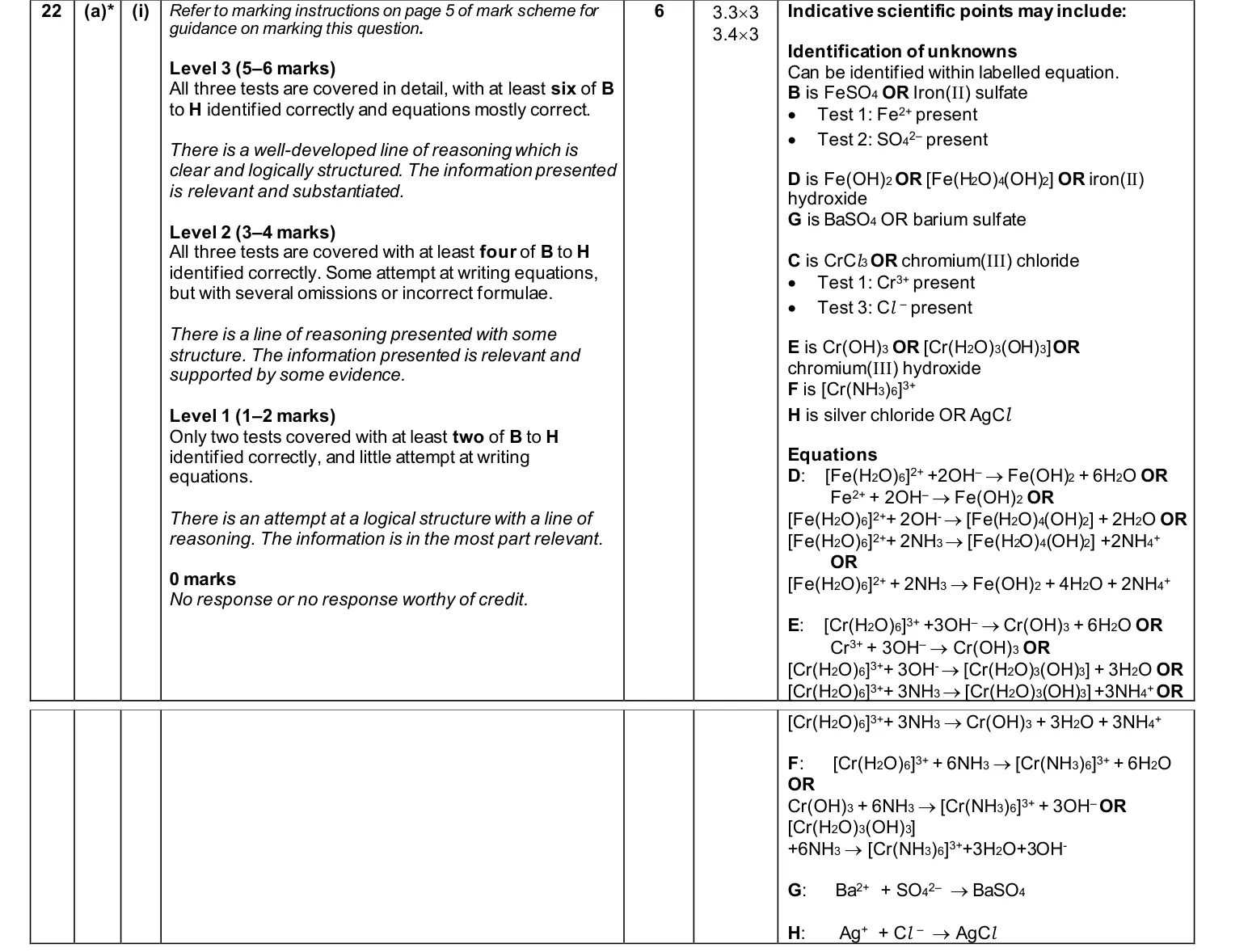
B = FeSO4, D = Fe(OH)2, G = BaSO4
C = CrCl3, E = Cr(OH)3, F = [Cr(NH3)6]3+, H = AgCl
ionic equations for D–H
Level 3 needs at least six identified and equations mostly correct
Skills: PAG4 Qualitative analysis of ions
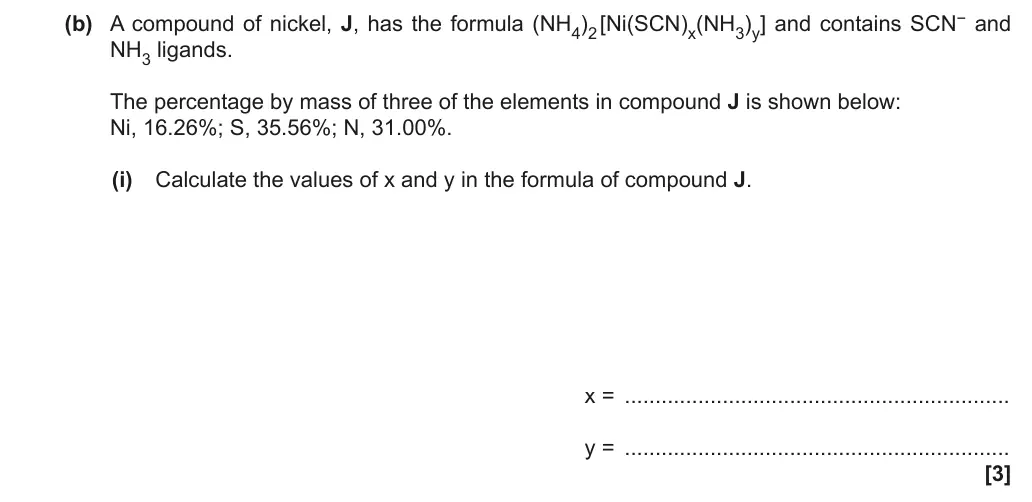
November 2020 · Paper 1 · Q22(b)(i)3 marksAO3Calculation
Mark scheme
Notes from the mark scheme and report
Ni : S : N = 1 : 4 : 8 so x = 4
N count 2 + x + y = 8 so y = 2
ALLOW ECF for y from incorrect x
Skills: M0.2 Use ratios, fractions and percentages; M2.4 Solve algebraic equations
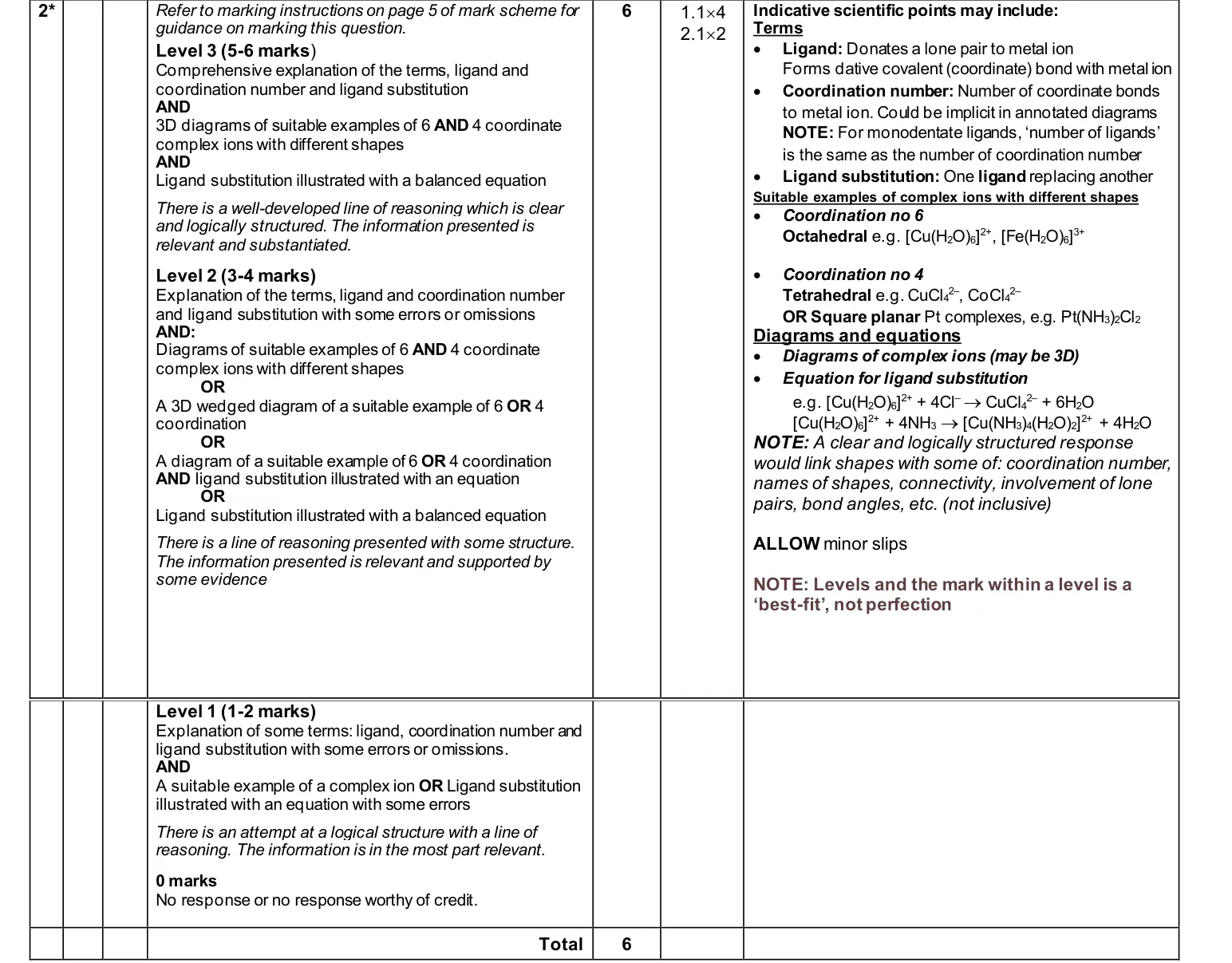
November 2020 · Paper 3 · Q26 marksAO1, 26-mark level of responseHard
Mark scheme, with the levels and indicative points
Examiner's comment
This question was assessed by level of response (LoR). The question required candidates to demonstrate their knowledge and understand of some important terms used in transition metal chemistry. Level 3 candidates showed complete definitions of ligand, coordination number and ligand substitution, supported by suitable equations with clear diagrams of complex ions. The responses were concise with 3D diagrams of 6- and 4-coordinate complex ions displayed with wedges, correct connectivity to ligand atoms and showing the role of lone pairs in the formation of the coordinate bonds. 4-coordination was shown as either or both of tetrahedral (usually CuCl42–) or square planar (e.g. platin). Ligand substitution was accompanied by a correct balanced equation, most commonly between [Cu(H2O6]2+ and NH3. Level 2 candidates usually gave definitions of ligand, coordination number and ligand substitution. There was usually a balanced equation for ligand substitution and one correct 3D diagram. A second diagram often had an unsuitable shape for the complex ion chosen (often CuCl42– shown as square planar). Level 1 candidates did produce definitions, but these were often incomplete. There was usually an attempt to show a 3D diagram or equation, but these often contained unsuitable examples. This question rewarded the candidates who had learnt their chemistry and the levels enabled the amount of knowledge and understanding to be assessed. The question discriminated well.
Notes from the mark scheme and report
ligand donates a lone pair forming a coordinate bond to the metal ion
coordination number = number of coordinate bonds
octahedral e.g. [Cu(H2O)6]2+, tetrahedral e.g. CuCl4 2– or square planar Pt(NH3)2Cl2 with 3D diagrams
balanced ligand substitution equation
Skills: M4.2 Visualise and represent 2-D and 3-D forms including 2-D representations of 3-D objects
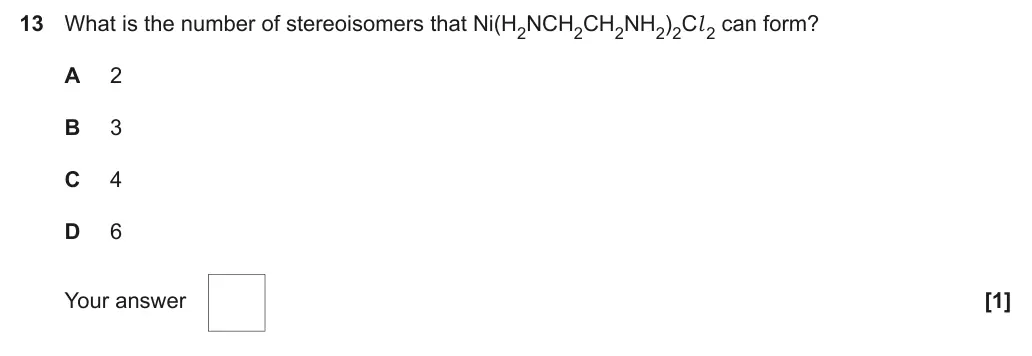
June 2019 · Paper 1 · Q131 markAO2Multiple choiceHard
Answer
B
Mark scheme
Examiner's comment
This was a challenging question, with only the most able candidates giving the correct response of B (one trans isomer and two optical cis isomers). Many candidates drew out the shapes of the isomers but some missed the two optical cis isomers (giving option A) while others thought there were two cis and two trans optical isomers, giving option C.
June 2019 · Paper 1 · Q141 markAO1Multiple choiceMedium
Answer
C
Mark scheme
Examiner's comment
Only the highest attaining candidates chose the correct answer of C. Many candidates thought all 3 statements were correct (giving option A as their answer), not realising that statement 1 referred to atoms not ions
June 2019 · Paper 1 · Q17(b)3 marksAO1, 2Short answerMedium
Mark scheme
Examiner's comment
The key chemistry that candidates needed to discuss in their response was as follows: • O2 molecules forming coordinate bonds with and Fe2+ ions in haemoglobin. • O2 molecules being replaced by another ligand (e.g. H2O or CO) • CO ligands forming very strong coordinate bonds The mark scheme allowed ‘oxygen binding’ but candidates did need to specify what the oxygen was binding to. Loose terminology, such as CO having a ‘greater affinity’ should be avoided.
Notes from the mark scheme and report
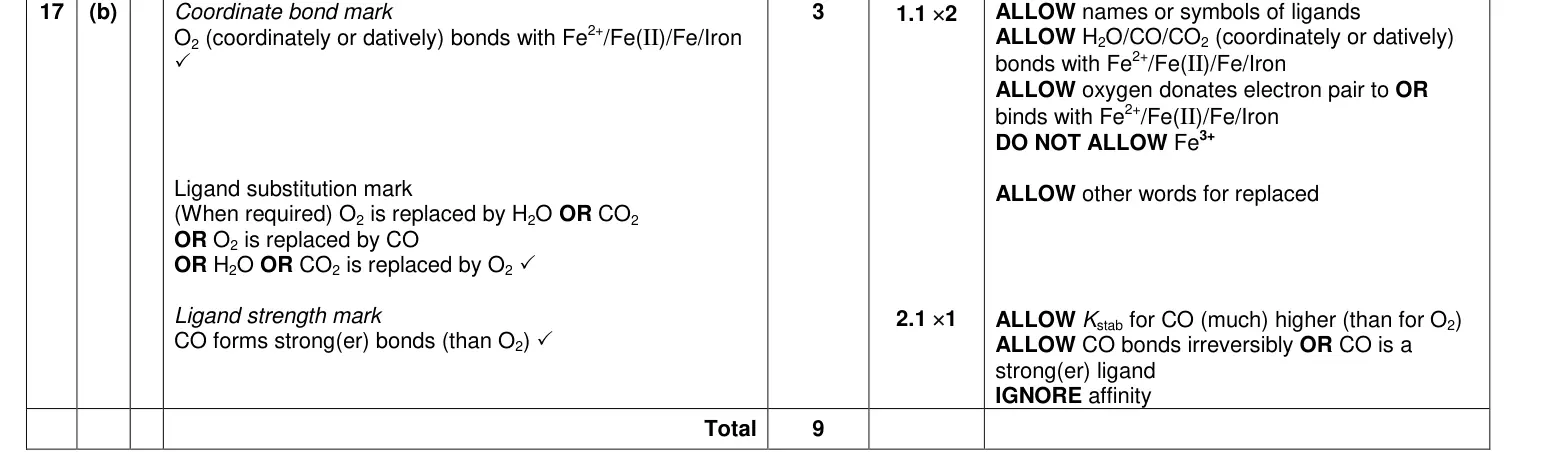
O2 forms coordinate bond to Fe2+ (DO NOT ALLOW Fe3+)
O2 replaced by H2O/CO2 or CO
CO bonds more strongly/irreversibly
IGNORE affinity
June 2019 · Paper 1 · Q18(a)(i)1 markAO1Short answerMedium
Mark scheme
Examiner's comment
Most candidates knew the correct formula. There was some confusion with ammoniacal copper ions and [Cr(NH3)4(H2O)2]2+ was a frequently seen incorrect answer.
Notes from the mark scheme and report
IGNORE state symbols
June 2019 · Paper 1 · Q18(a)(ii)1 markAO2Short answerMedium
Earlier part of question 18 that this part uses
Mark scheme
Examiner's comment
The most common error for this question was to omit the state symbols, sometimes on only one species. Both a correct equation and the correct state symbols were required for the mark.
Notes from the mark scheme and report
state symbols required with Cr(OH)3(s)
ALLOW complexed or hybrid equations
June 2019 · Paper 1 · Q18(a)(iii)2 marksAO1, 2Structure / isomerMedium
Earlier part of question 18 that this part uses
Mark scheme
Examiner's comment
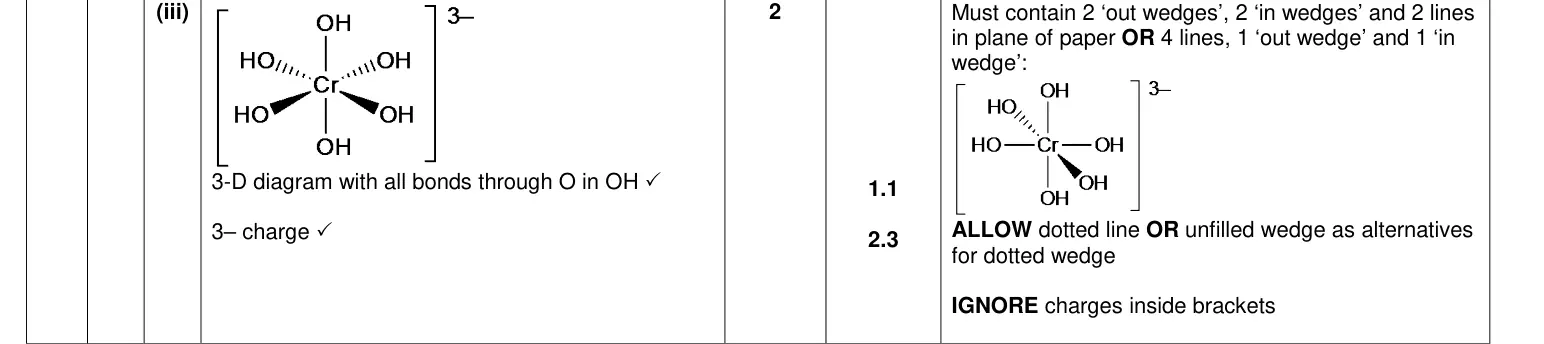
The drawing of simple 3-D diagrams of relevant shapes is a skill that is assessed in A Level chemistry. Common errors are listed in the exemplars. Some candidates drew in pencil then over-wrote in ink. Candidates need to remember that the scanned image does not differentiate between pencil and ink, so it is not necessary for them to do this. Candidates should avoid incorrect connectivity between the ligand and the central metal ion. Candidates should be taught which atom within the ligand supplies the lone pair to form the coordinate bond. In this case oxygen has lone pairs, not hydrogen as suggested by the candidate in the bonding involving the bottom left hand ligand.
Notes from the mark scheme and report
3– charge
must show 2 out wedges, 2 in wedges and 2 in plane (or 4 lines + 1 out + 1 in)
Skills: M4.1 Use angles and shapes in regular 2-D and 3-D structures; M4.2 Visualise and represent 2-D and 3-D forms including 2-D representations of 3-D objects
June 2019 · Paper 1 · Q18(a)(iv)1 markAO3Short answerHard
Earlier part of question 18 that this part uses
Mark scheme
Examiner's comment
Very few candidates correctly identified the CrO4 2– ion here. Candidates should be aware that oxidation of Cr(OH)3 produces CrO4 2– (which can then be acidified to produce Cr2O7 2-).
Notes from the mark scheme and report
CrO4 2–
IGNORE compounds e.g. Na2CrO4
June 2019 · Paper 1 · Q18(a)(v)1 markAO1Short answerMedium
Earlier part of question 18 that this part uses
Mark scheme
Examiner's comment
Invariably, the answer given by candidates here was either orange or green, indicating some knowledge of the colours of chromium ions. Those who stated orange received credit
Notes from the mark scheme and report
orange
June 2019 · Paper 1 · Q18(b)(i)1 markAO1Complete table/diagramMedium
Mark scheme
Examiner's comment
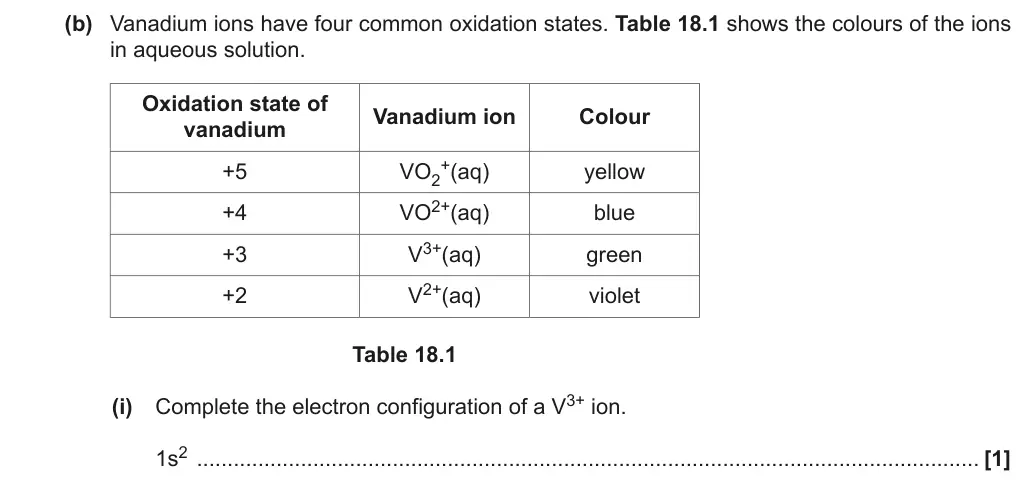
Many candidates did not realise that when transition metal ions are formed, the first electrons removed from atoms are the 4s electrons and so wrote 2s2 2p6 3s2 3p6 3d1 4s2.
Notes from the mark scheme and report
3d2 with no 4s electrons (ALLOW 4s0)
June 2019 · Paper 1 · Q18(b)(ii)3 marksAO3Data interpretationMedium
Earlier part of question 18 that this part uses
Mark scheme
Examiner's comment
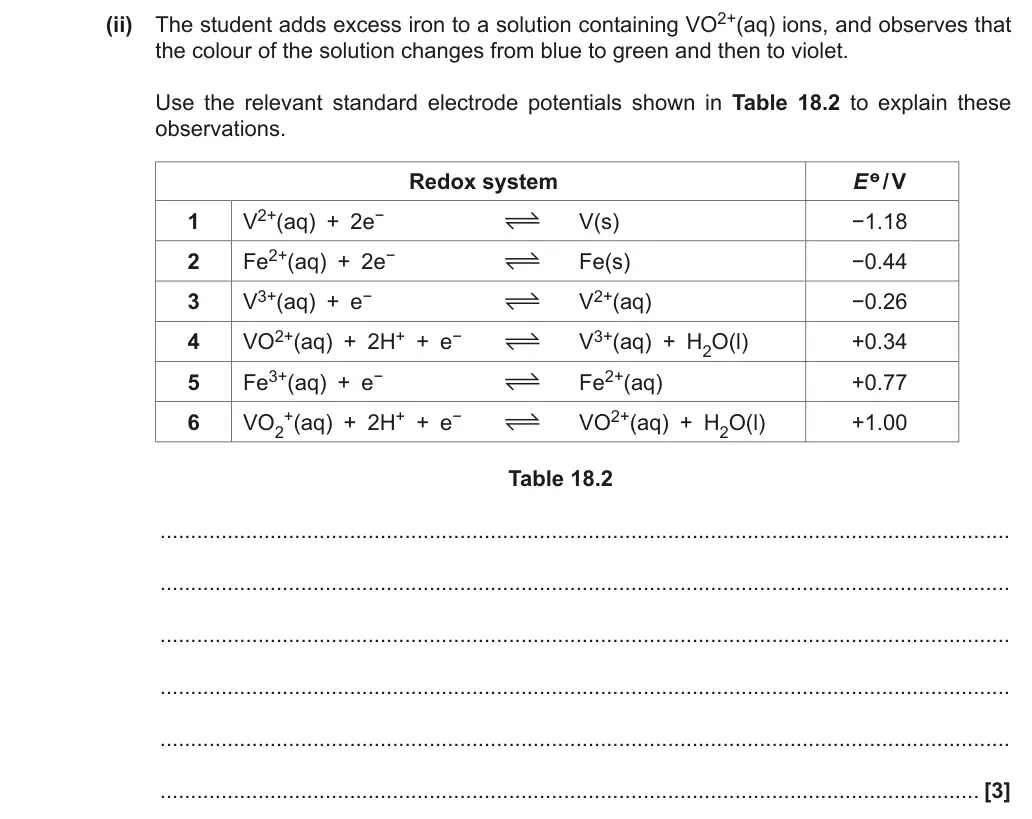
Most candidates did not state that the direction of reaction of redox equilibria is dependent on the relative negativity/positivity of the standard electrode potentials. Higher ability candidates described two reductions of the relevant vanadium ions to end up with V2+ ions.
Notes from the mark scheme and report
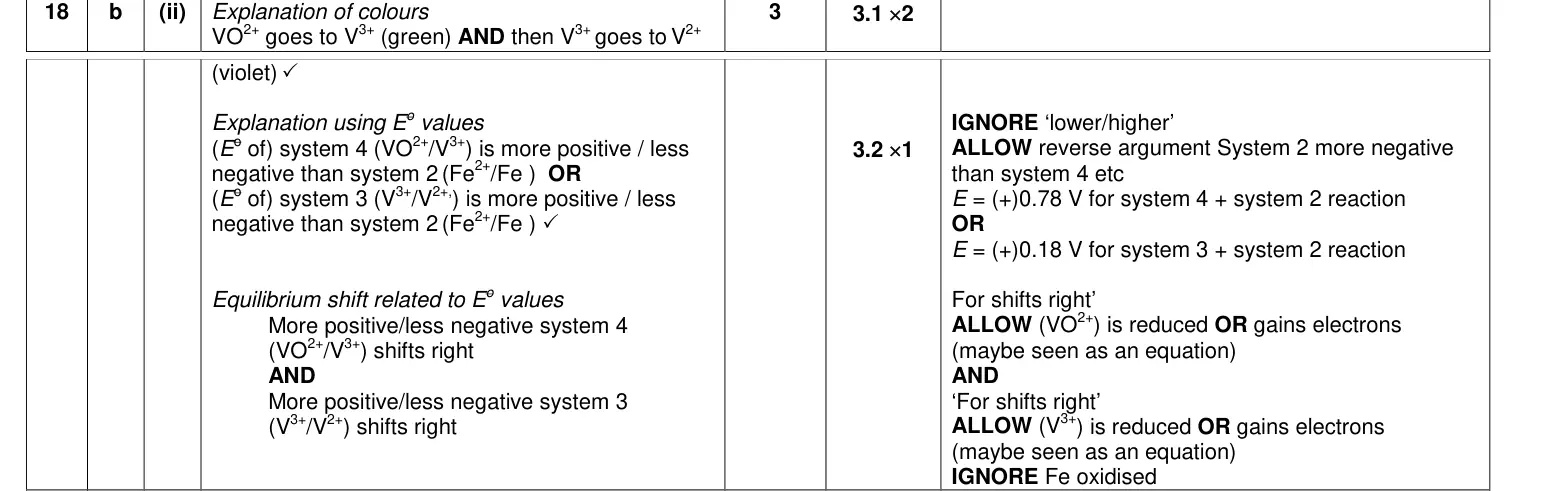
VO2+ → V3+ (green) then V3+ → V2+ (violet)
E of systems 4 and 3 more positive than system 2 (Fe2+/Fe) so they shift right/are reduced
IGNORE 'lower/higher'
IGNORE Fe oxidised
June 2019 · Paper 3 · Q6(a)(i)2 marksAO3Short answerMedium
Mark scheme
Examiner's comment
Most candidates were given 1 or 2 marks for this part. The black precipitate B (Ag2S) was identified correctly more often the orange precipitate A, which was often shown as Fe(OH)2 instead of Fe(OH)3 or Fe(OH)3(H2O)3. Significantly, identification of B required interpretation of new information whereas A required knowledge of transition element chemistry.
Notes from the mark scheme and report
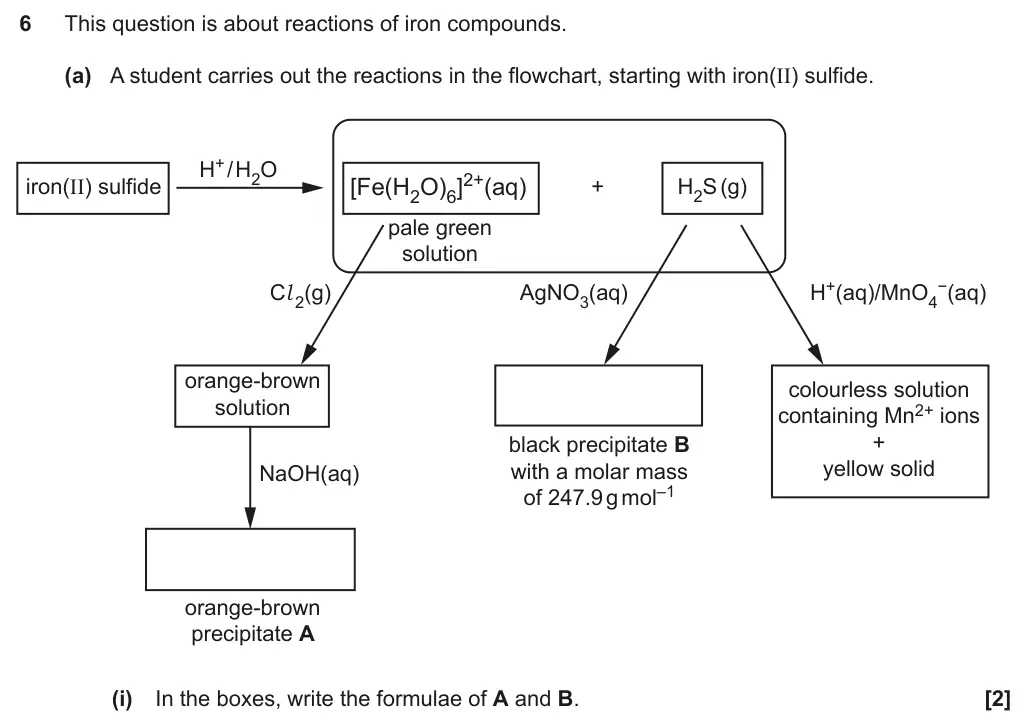
A = Fe(OH)3 (ALLOW Fe(OH)3(H2O)3)
B = Ag2S from molar mass 247.9
IGNORE state symbols
June 2019 · Paper 3 · Q6(a)(iii)1 markAO3Equation writingHard
Earlier part of question 6 that this part uses
Mark scheme
Examiner's comment
Candidates found this equation extremely difficult with only a small number of candidates writing a correct equation. The problem lies with balancing the oxidation numbers and charges. Many wrote an equation with a 1:1 ratio or 1:2 ratio for [Fe(H2O)6]2+ : Cl2. An equation balanced in oxidation number and charge required a 2:1 ratio. When writing equations for redox reactions, candidates are recommended to check that oxidation changes and charges are balanced as well as atoms.
Notes from the mark scheme and report
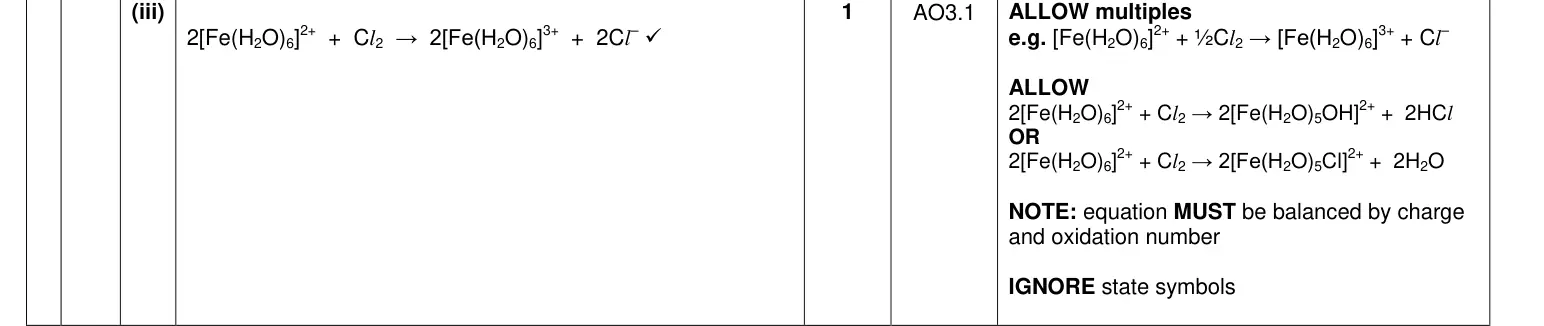
2[Fe(H2O)6]2+ + Cl2 → 2[Fe(H2O)6]3+ + 2Cl–
must be balanced by charge and oxidation number
ALLOW multiples
June 2019 · Paper 3 · Q6(a)(iv)2 marksAO3Equation writingHard
Earlier part of question 6 that this part uses
Mark scheme
Examiner's comment
Candidates needed to interpret the information in the flowchart and to use this as the basis for their redox equation. The clue that a yellow solid is a product proved to be very difficult to interpret as being sulfur. The equation then required H2O to be added as the other product. Candidates found this equation difficult and relatively few correct equations were seen. As with 6a(iii), many equations were not balanced by oxidation number or charge. Some candidates omitted this part entirely.
Notes from the mark scheme and report
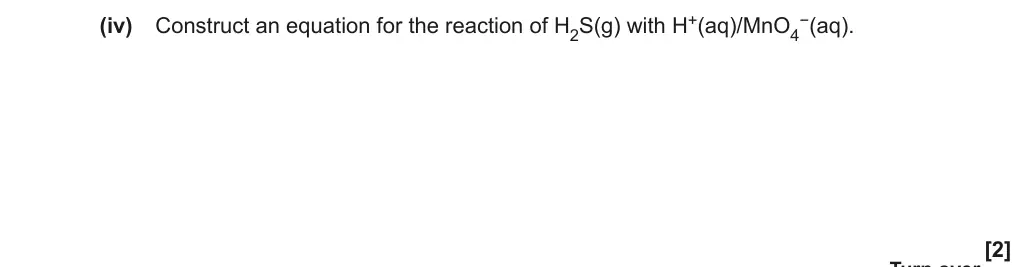
5H2S + 2MnO4– + 6H+ → 2Mn2+ + 5S + 8H2O
1 mark for all six correct species or Mn and S species balanced 5:2
IGNORE extra electrons for 1st mark
Skills: M0.2 Use ratios, fractions and percentages
June 2018 · Paper 1 · Q151 markAO1Multiple choiceMedium
Answer
D
Mark scheme
Examiner's comment
The drawing of many (incorrect) shapes based upon a tetrahedral arrangement around the central Pt ion suggested many were unaware of the square planar shape of the complex. Section B overview
June 2018 · Paper 1 · Q21(a)2 marksComplete table/diagramMedium
Mark scheme
Examiner's comment
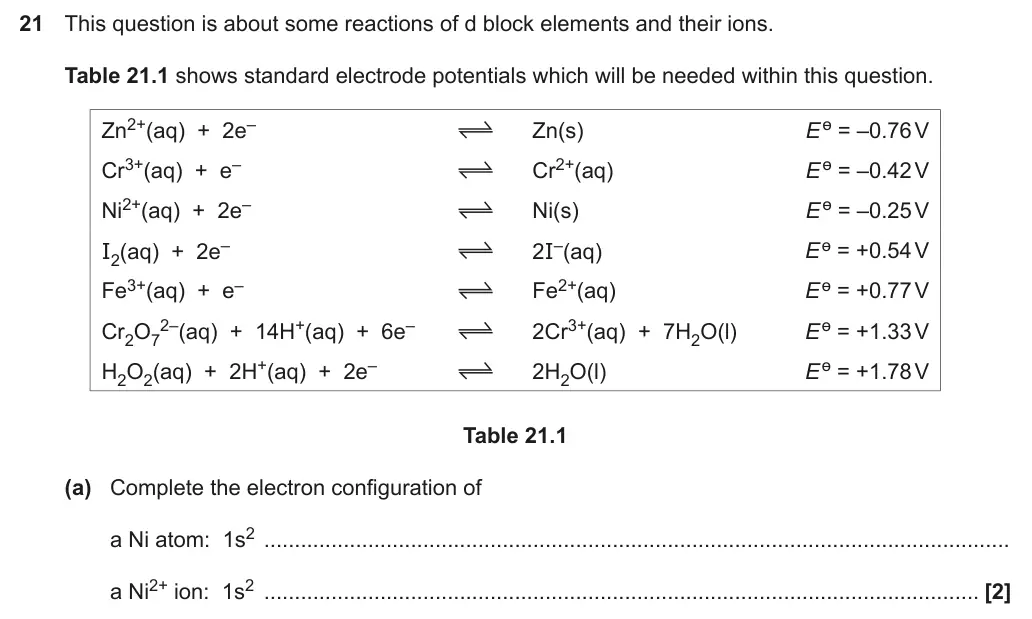
Most candidates knew the electron configuration of an Ni atom but the number knowing the electron configuration of the Ni2+ ion was considerably fewer. The common error was the failure to remove the two 4s electrons.
Notes from the mark scheme and report
Ni ...3d8 4s2
Ni2+ ...3d8 (4s electrons lost first)
DO NOT ALLOW [Ar] shorthand
June 2018 · Paper 1 · Q21(c)(i)1 markEquation writingMedium
Earlier part of question 21 that this part uses
Mark scheme
Examiner's comment
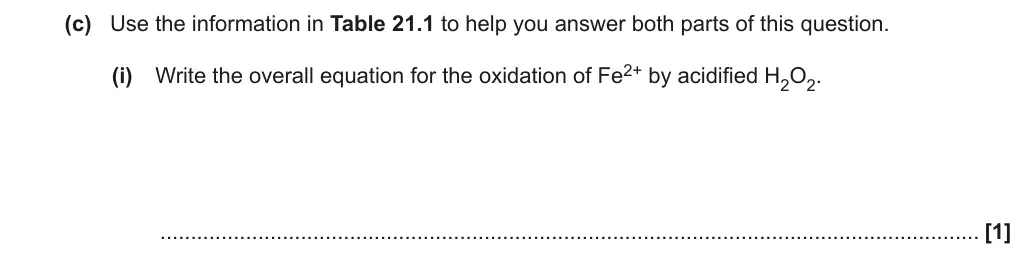
Most candidates got the equation correct. Occasionally a number was omitted causing incorrect stoichiometry and occasionally the equation was reversed.
Notes from the mark scheme and report
H2O2 + 2H+ + 2Fe2+ → 2Fe3+ + 2H2O
ALLOW multiples
IGNORE state symbols
June 2018 · Paper 1 · Q21(c)(ii)4 marksShort answerEasy
Earlier part of question 21 that this part uses
Mark scheme
Examiner's comment
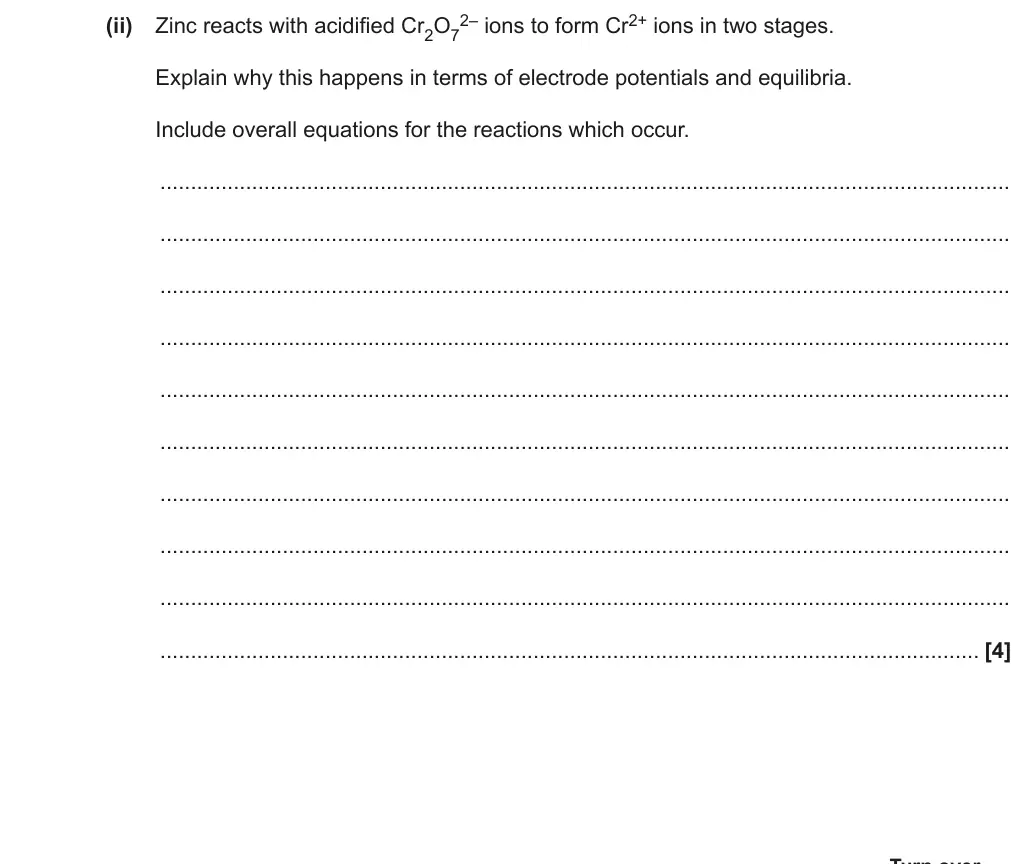
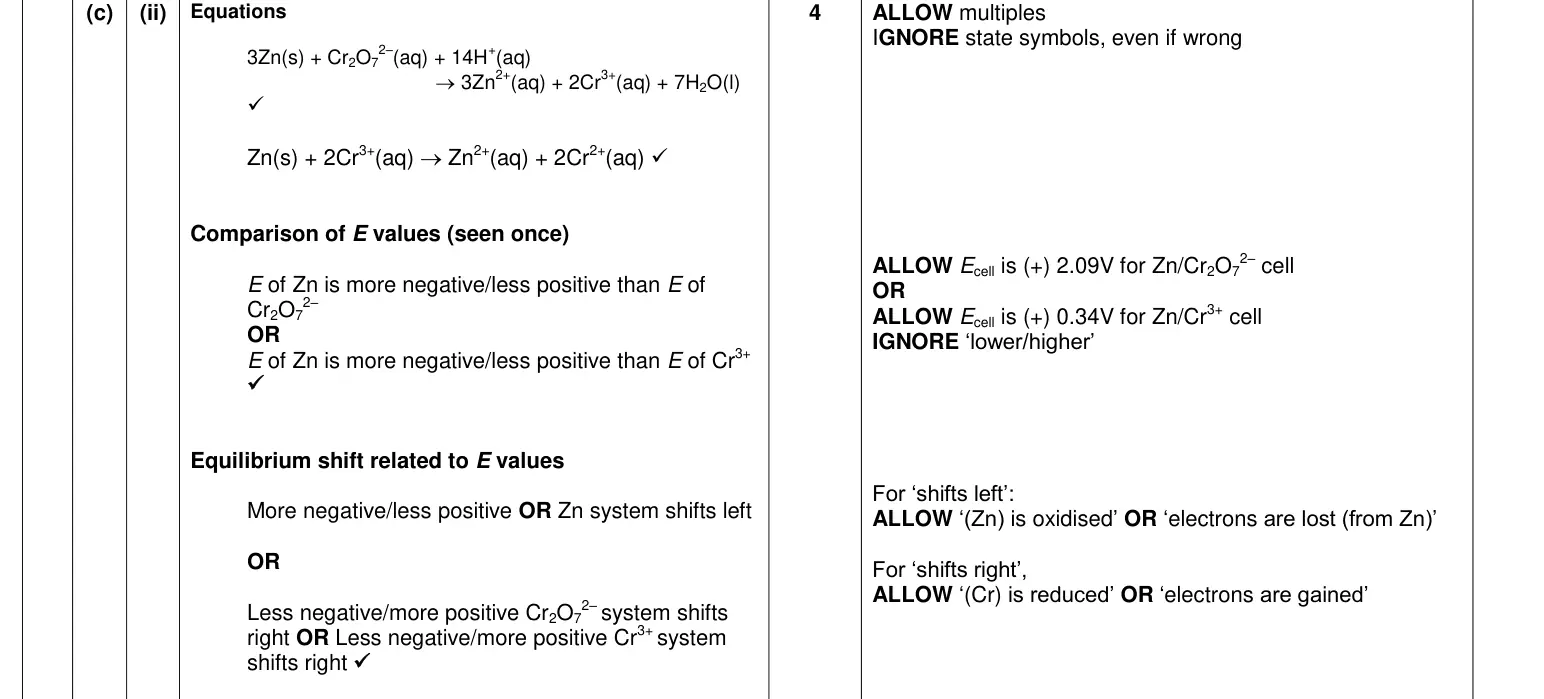
Only the higher ability candidates achieved full marks. Most candidates were able to come up with both redox equations and some could state that zinc was oxidised or chromium was reduced as a result of zinc having a more negative electrode potential than either chromium species. Common errors were: stating that zinc had a lower (not more negative) electrode potential; stating that zinc was an oxidising agent (as well as being oxidised); confusing the direction of change of equilibria shown; and not balancing the overall redox equations.
Notes from the mark scheme and report
two overall equations (Cr2O7 2– to Cr3+, then Cr3+ to Cr2+)
E of Zn system more negative than both Cr systems
Zn equilibrium shifts left (oxidised) / Cr systems shift right
IGNORE 'lower/higher' for E values
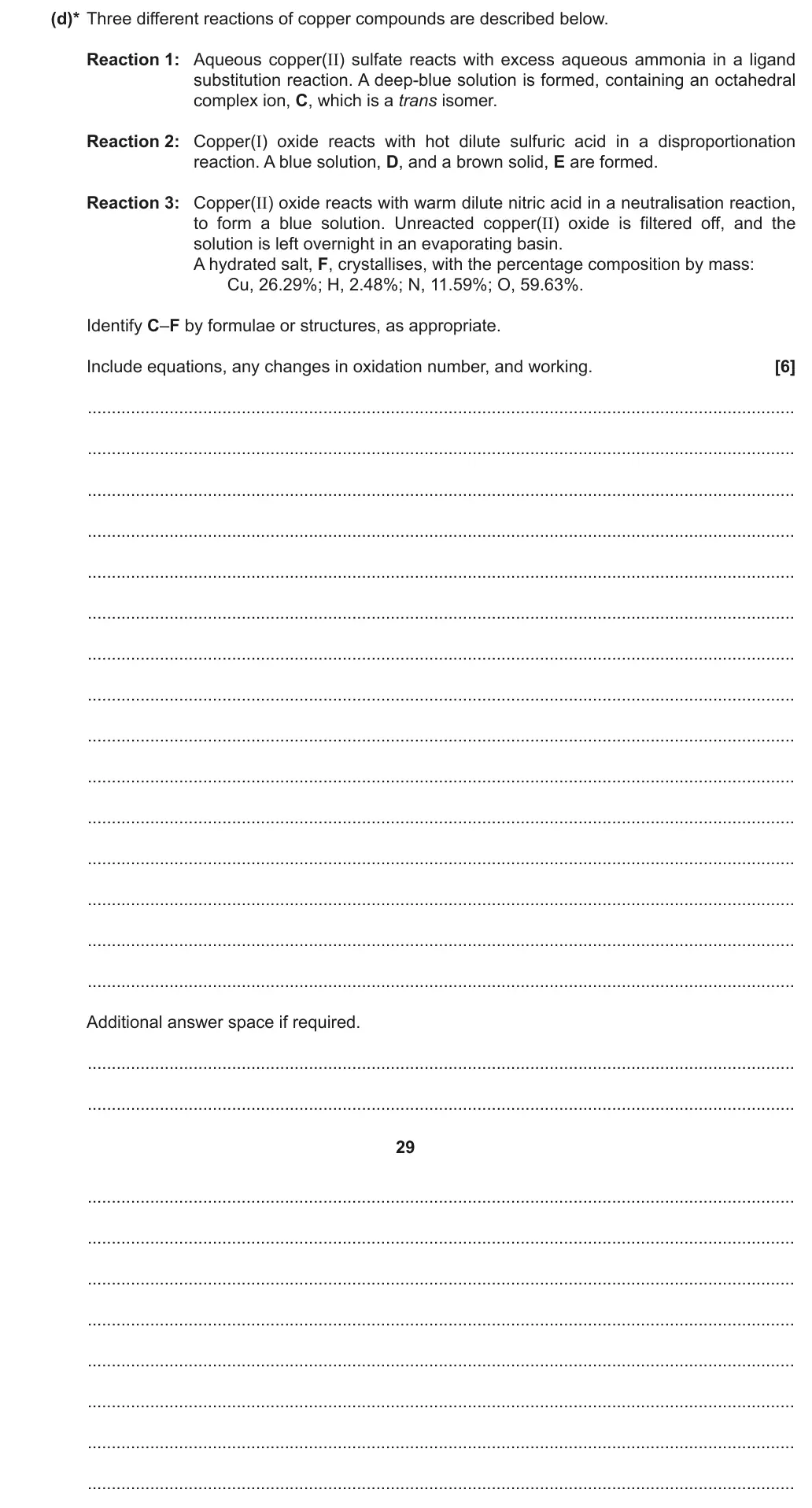
June 2018 · Paper 1 · Q21(d)6 marks6-mark level of responseHard
Mark scheme, with the levels and indicative points
Examiner's comment
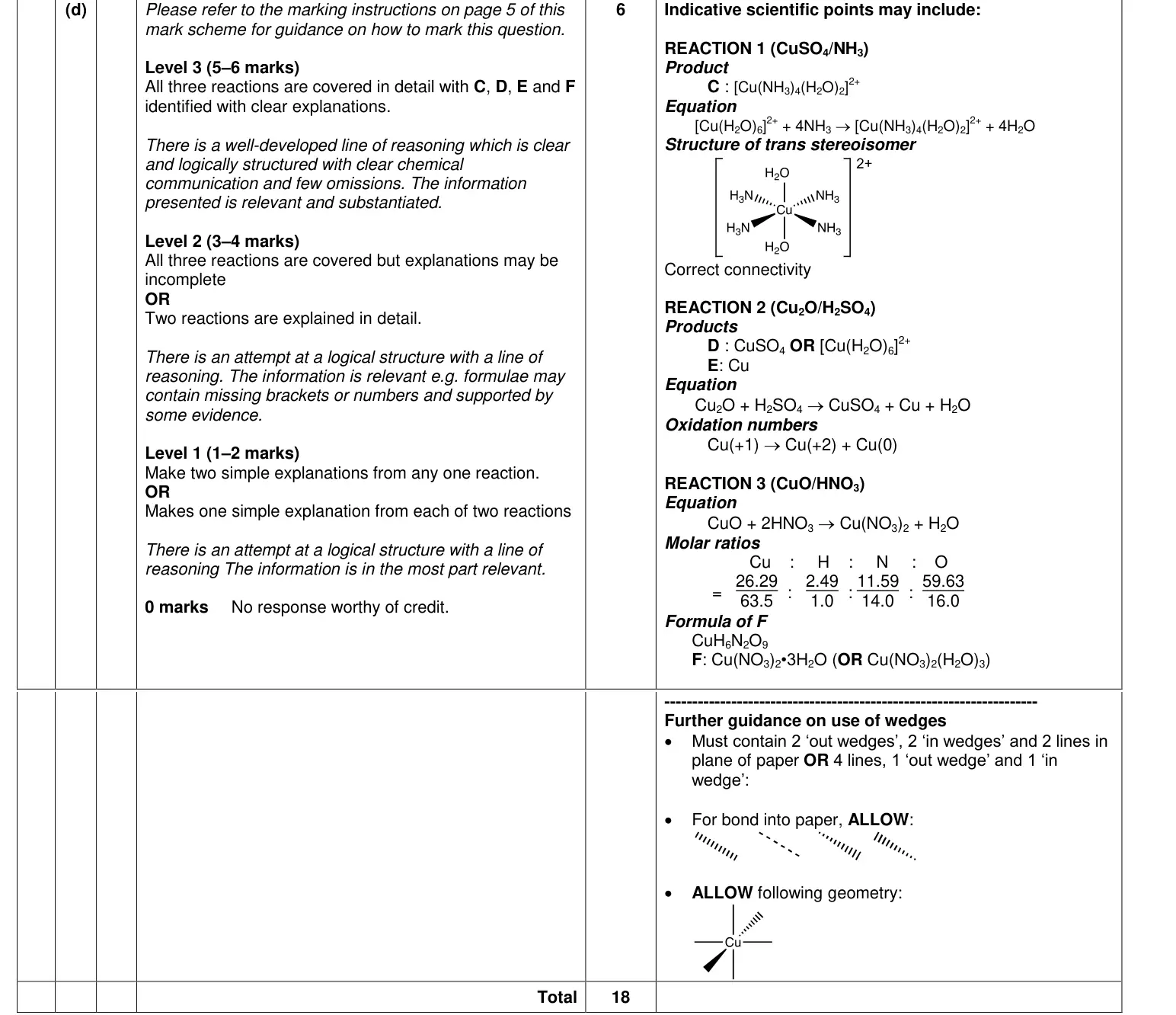
Many candidates had a stab at identifying C–F but neglected to include equations for the three reactions described or to show relevant working. Most candidates recognised C as the ammoniacal copper(II) ion but the formula was frequently incorrect and correct attempts at a ligand substitution equation from [Cu(H2O)6]2+ was rarely seen. Diagrams showing the trans isomer were attempted but often of poor quality due to incorrect linking. Candidates recognised D as being CuSO4 but often did not identify E as Cu due to a lack of familiarity with this common disproportionation reaction. Cu(OH)2(s) was a common incorrect identification of E. Only the best responses described the oxidation number changes which made this a disproportionation reaction. F was identified by a percentage by mass calculation to determine an empirical formula and then by deduction to produce Cu(NO3)2.3H2O. Having done this, many candidates did not give the relatively simple equation for reaction 3 between copper(II) oxide and dilute nitric acid. This exemplifies how considered structuring of candidate responses can enhance their clarity. The clear labelling of C-F in the response, along with numbering which corresponds to the reactions in the question stem, make the candidate’s line of reasoning easy to follow. The underlining and annotations in the question stem show good practice in picking out and interpreting key information.
Notes from the mark scheme and report
C = [Cu(NH3)4(H2O)2]2+ drawn as trans isomer with correct wedges and connectivity
D = CuSO4, E = Cu with Cu(+1) → Cu(+2) + Cu(0)
F = Cu(NO3)2•3H2O from mole ratio CuH6N2O9
formulae with missing brackets or numbers limit the level
Skills: M0.2 Use ratios, fractions and percentages; M4.2 Visualise and represent 2-D and 3-D forms including 2-D representations of 3-D objects
June 2018 · Paper 3 · Q2(c)(i)1 markEquation writingMedium
Mark scheme
Examiner's comment
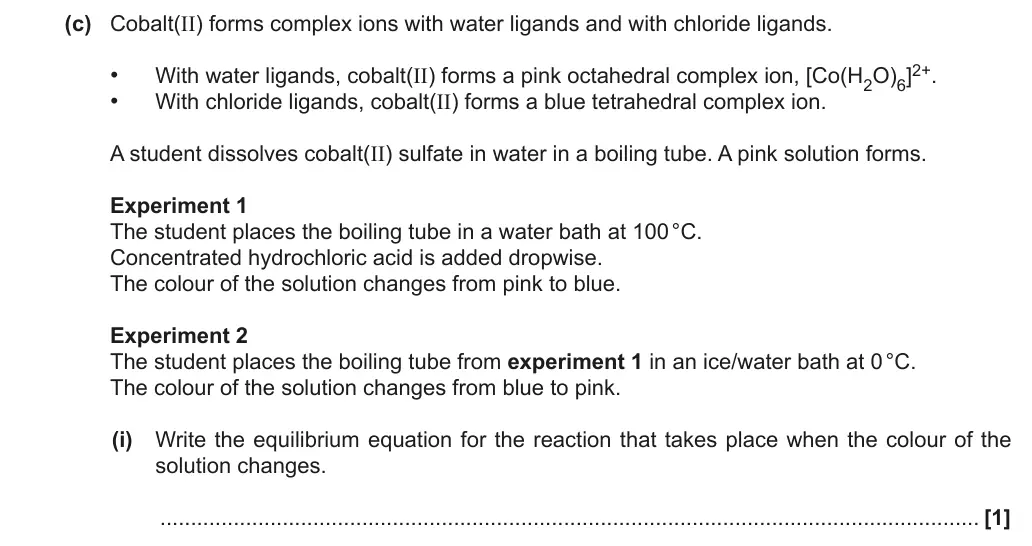
In this part, candidates needed to apply their knowledge and understanding of ligand substitution and equilibrium to a novel situation. The best equations used Cl– ions to form CoCl4 2–. Some candidates used HCl instead and then H+ was often omitted in the equation. As with 2b, candidates are recommended to check that their completed equations are balanced.
Notes from the mark scheme and report
ALLOW reverse equation
IGNORE state symbols
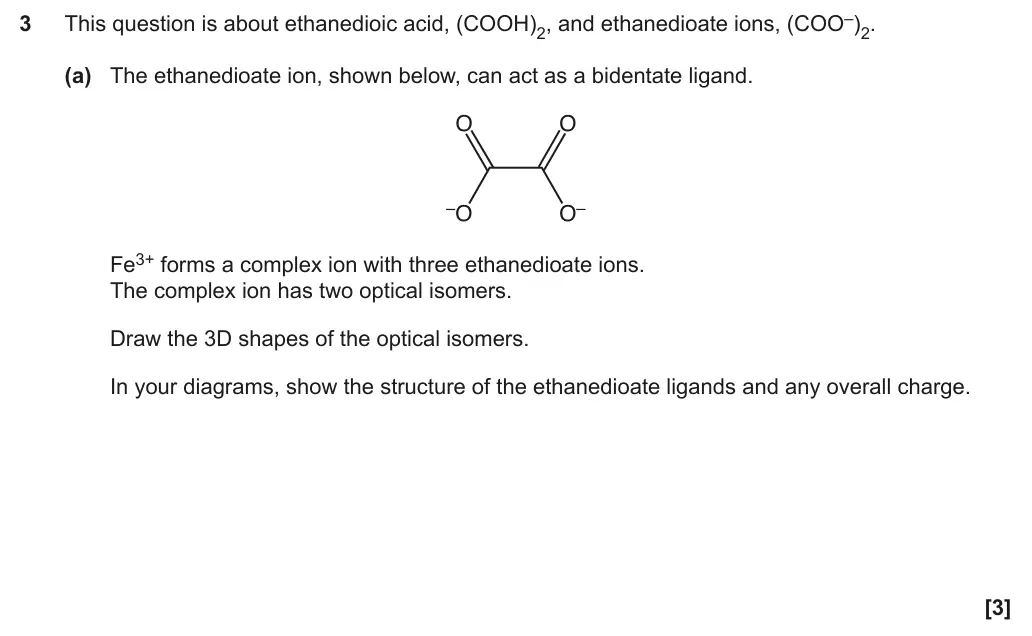
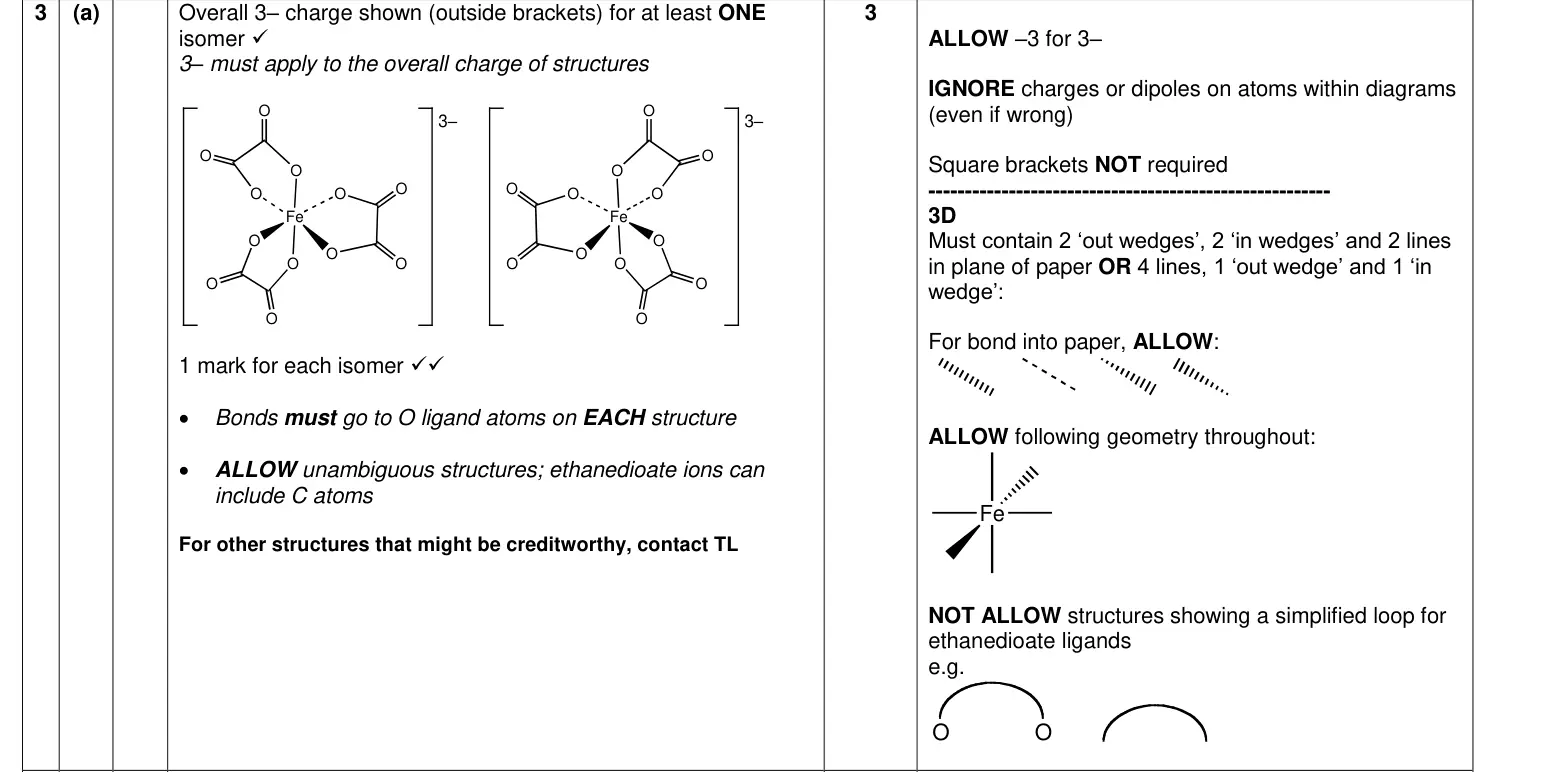
June 2018 · Paper 3 · Q3(a)3 marksStructure / isomerEasy
Mark scheme
Examiner's comment
Most candidates were able to draw clear octahedral 3D shapes of the optical isomers, with good use made of wedges. The best candidates showed an overall 3– charge on each isomer but lower ability candidates did not always cancel down the charges in the Fe3+ and (COO–)2 ions, showing a 3+ charge instead of the overall charge of 3–. (See Exemplar 5)
Notes from the mark scheme and report
overall 3– charge shown outside brackets
one mark per isomer
bonds must go to O atoms of each ligand
3D wedges required
simplified loops for ligands NOT allowed
Skills: M4.2 Visualise and represent 2-D and 3-D forms including 2-D representations of 3-D objects; M4.3 Understand the symmetry of 2-D and 3-D shapes
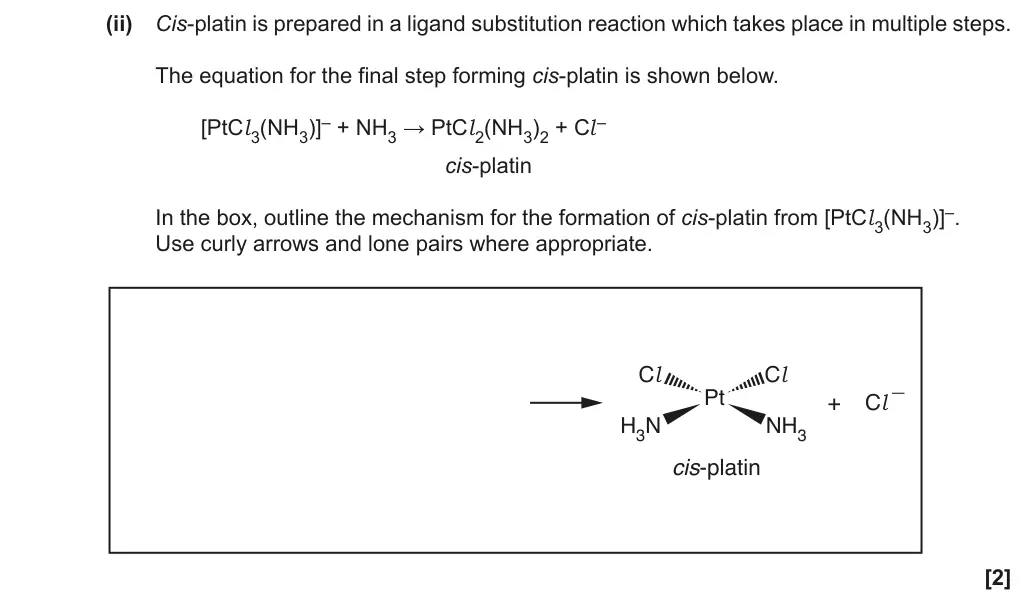
June 2018 · Paper 3 · Q4(a)(ii)2 marksMechanismHard
Earlier part of question 4 that this part uses
Mark scheme
Examiner's comment
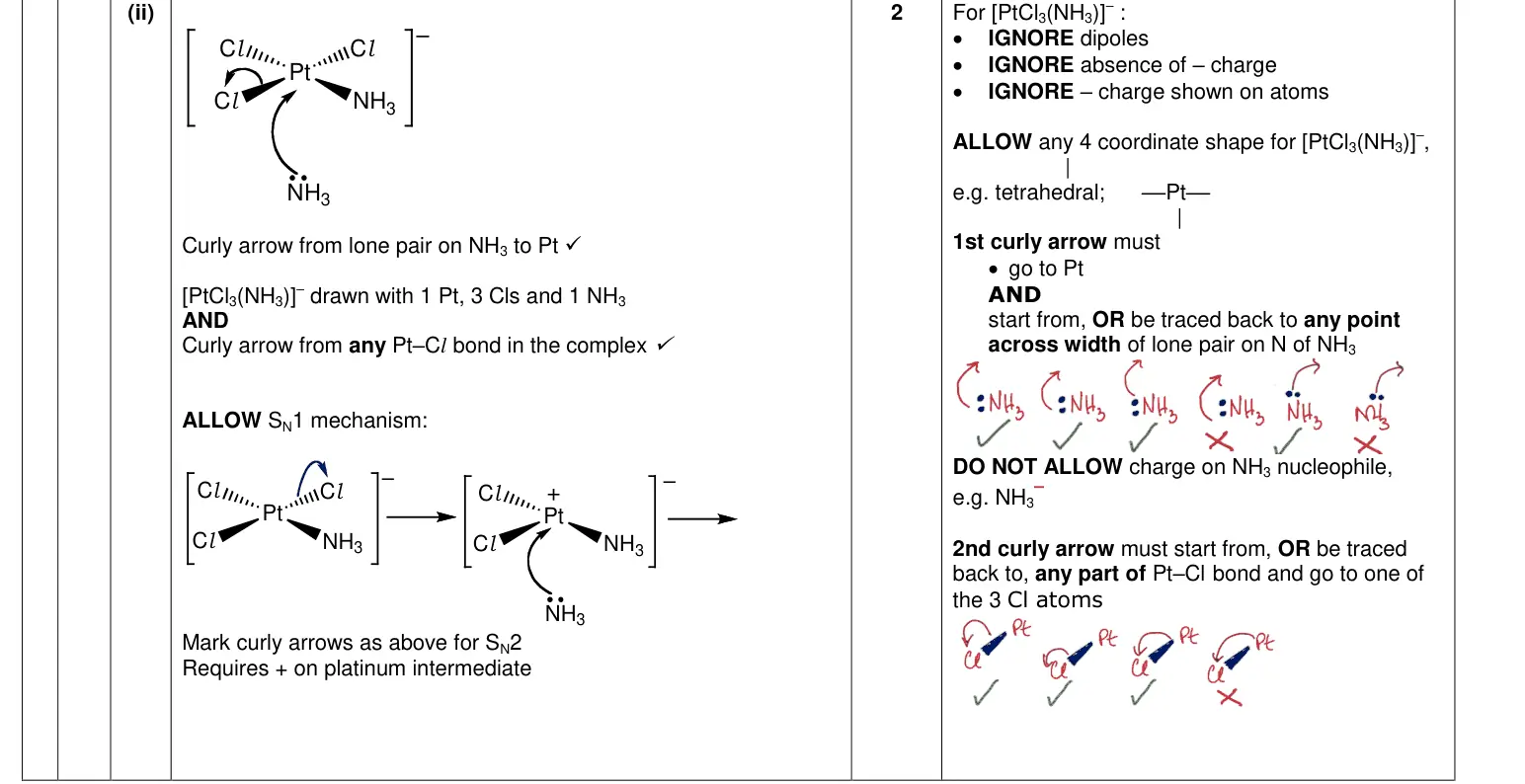
This part required candidates to apply their knowledge and understanding of the nucleophilic substitution mechanism in a novel context. This part discriminated extremely well with able candidates drawing the correct initial complex and showing precisely positioned curly arrows, dipoles and the role of the NH3 lone pair, as shown in Lower ability candidates often showed imprecise curly arrows or placed a negative charge on NH3, as shown in Exemplar 8.
Notes from the mark scheme and report
curly arrow from lone pair on N of NH3 to Pt
DO NOT ALLOW charge on NH3
ALLOW SN1-type route with + on Pt intermediate
IGNORE dipoles
June 2017 · Paper 1 · Q21 markMultiple choice
Answer
D
Mark scheme
June 2017 · Paper 1 · Q81 markMultiple choice
Answer
D
Mark scheme
June 2017 · Paper 1 · Q111 markMultiple choice
Answer
A
Mark scheme
June 2017 · Paper 1 · Q151 markMultiple choice
Answer
B
Mark scheme
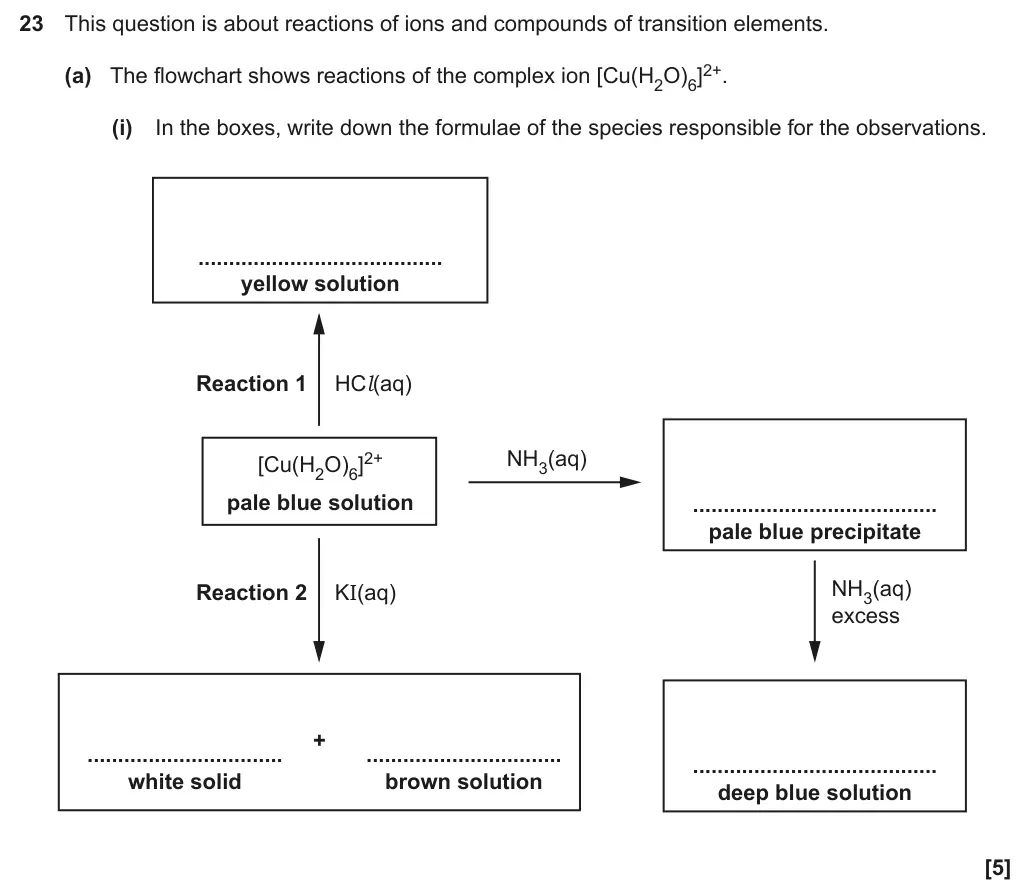
June 2017 · Paper 1 · Q23(a)(i)5 marksShort answer
Mark scheme
Notes from the mark scheme and report
brackets required for [Cu(NH3)4(H2O)2]2+
check subscripts and charges
CuI white solid and I2 brown solution
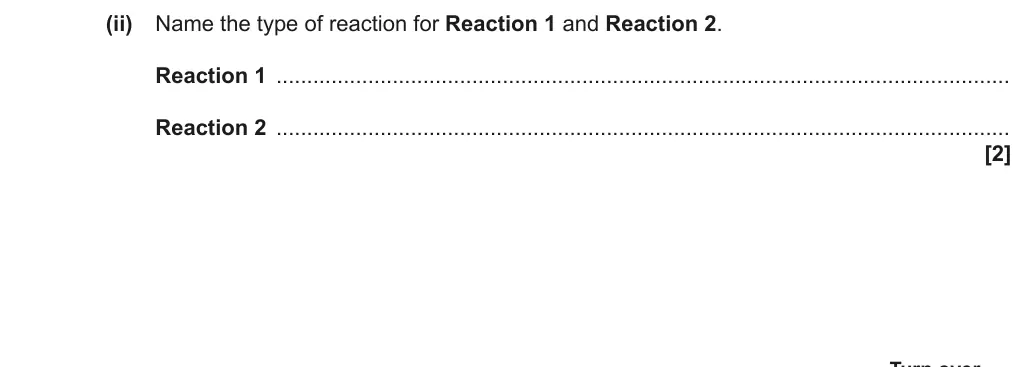
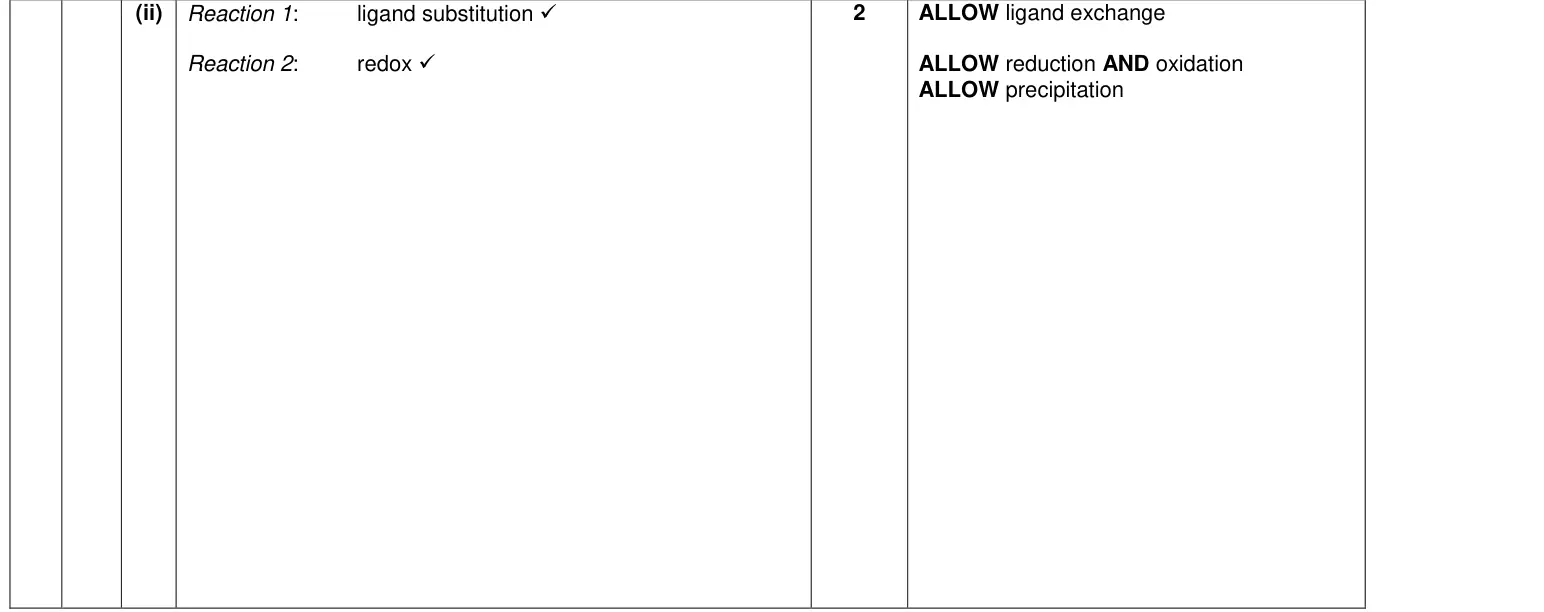
June 2017 · Paper 1 · Q23(a)(ii)2 marksShort answer
Earlier part of question 23 that this part uses
Mark scheme
Notes from the mark scheme and report
Reaction 1 ligand substitution
Reaction 2 redox (ALLOW precipitation)
June 2017 · Paper 1 · Q23(b)6 marks6-mark level of response
Mark scheme, with the levels and indicative points
Notes from the mark scheme and report
B = NiC6N6H24Cl2
A = B•2H2O from mass loss
C = [Ni(H2NCH2CH2NH2)3]2+
D = H2NCH2CH2NH2
both optical isomers in 3D with wedges and bonding from N
Skills: M0.2 Use ratios, fractions and percentages; M4.2 Visualise and represent 2-D and 3-D forms including 2-D representations of 3-D objects; M4.3 Understand the symmetry of 2-D and 3-D shapes; PAG1 Moles determination