Notes and key-term cards for this topic are being written by our tutors. The past-paper questions below are ready now.
Learning outcomes
Show the 11 learning outcomes from the specification
6.1.2(a) oxidation of aldehydes using Cr2O72–/H+ (i.e. K2Cr2O7/H2SO4) to form carboxylic acids
6.1.2(b) nucleophilic addition reactions of carbonyl compounds with:
6.1.2(b)(i) NaBH4to form alcohols
6.1.2(b)(ii) HCN [i.e. NaCN(aq)/H+(aq)], to form hydroxynitriles (see also 6.2.4 b)
6.1.2(c) the mechanism for nucleophilic addition reactions of aldehydes and ketones with NaBH4 and HCN
6.1.2(d) use of 2,4-dinitrophenylhydrazine to:
6.1.2(d)(i) detect the presence of a carbonyl group in an organic compound
6.1.2(d)(ii) identify a carbonyl compound from the melting point of the derivative
6.1.2(e) use of Tollens’ reagent (ammoniacal silver nitrate) to:
6.1.2(e)(i) detect the presence of an aldehyde group
6.1.2(e)(ii) distinguish between aldehydes and ketones, explained in terms of the oxidation of aldehydes to carboxylic acids with reduction of silver ions to silver.
Six-mark level of response questions on this topic
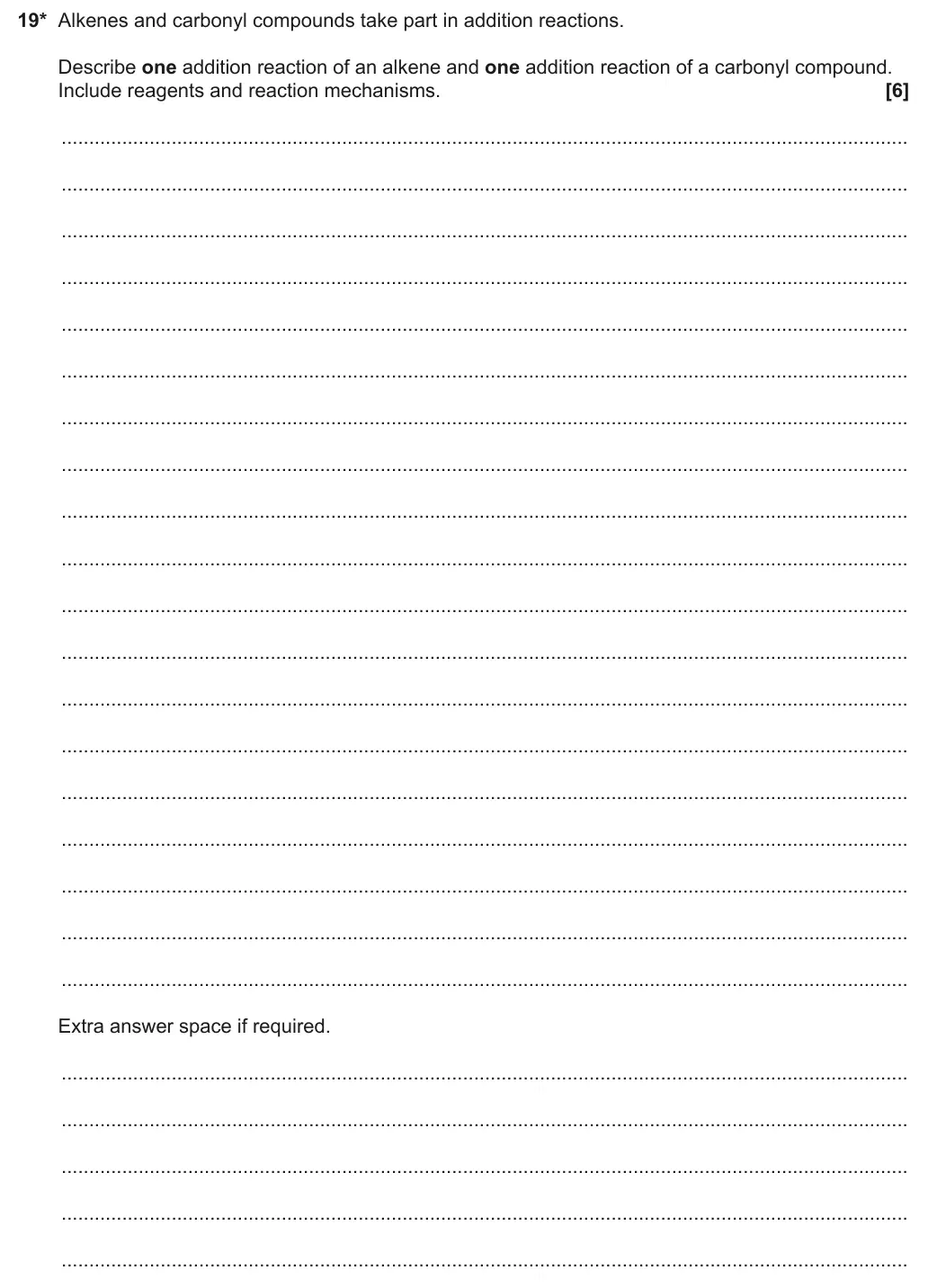
Alkenes and carbonyl compounds take part in addition reactions. Describe one addition reaction of an alkene and one addition reaction of a carbonyl compound.
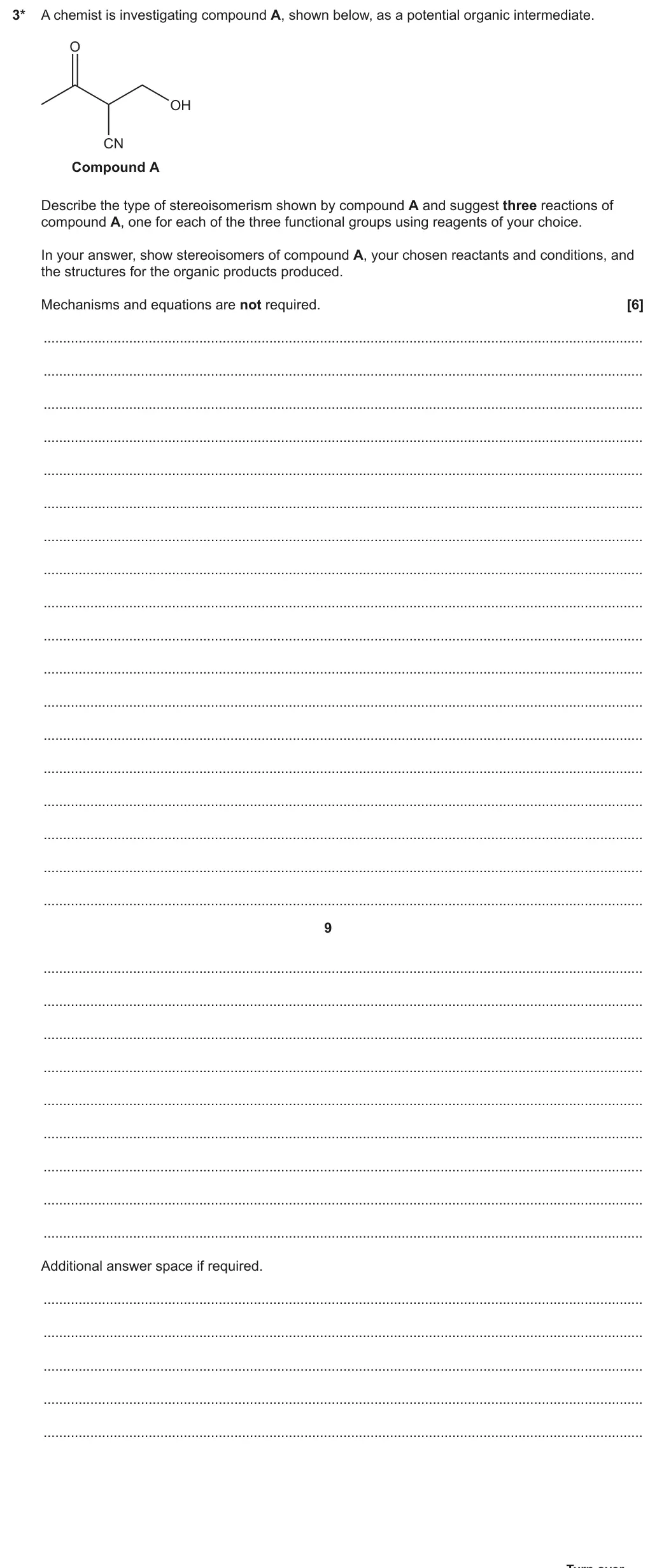
A chemist is investigating compound A, shown below, as a potential organic intermediate. Describe the type of stereoisomerism shown by compound A and suggest three reactions of
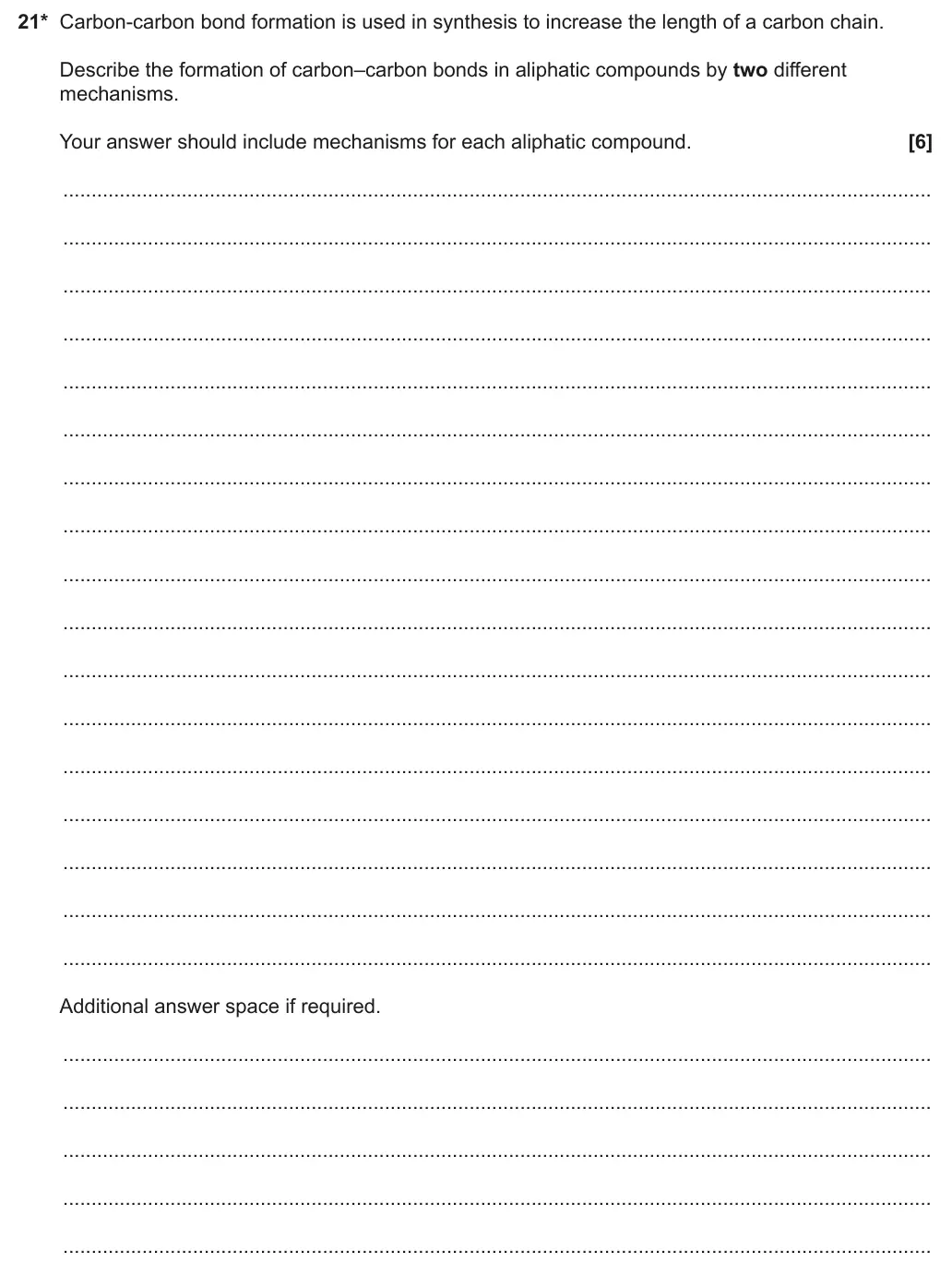
Carbon-carbon bond formation is used in synthesis to increase the length of a carbon chain. Describe the formation of carbon–carbon bonds in aliphatic compounds by two different
Tap a question to zoom it. Where a part needs a table, graph or structure from an earlier part, that part folds out above it; the mark scheme and examiner's comment open underneath. Have the OCR Data Sheet beside you.
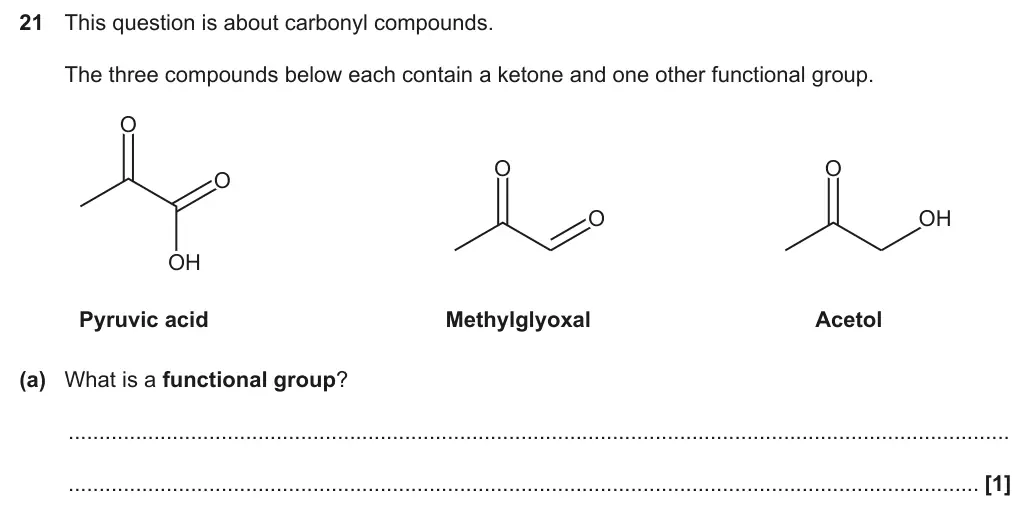
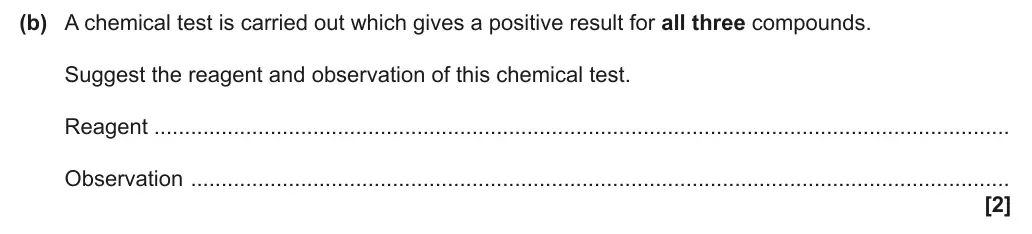
June 2025 · Paper 2 · Q21(b)2 marksShort answerEasy
Earlier part of question 21 that this part uses
Mark scheme
Examiner's comment
The majority of candidates scored both marks here. A few lost the second mark for just saying ‘turned orange’ without ppt. Some gave tests in (c) here as well but were usually consistent showing all three reacting in the table.
Skills: PAG7 Qualitative analysis of organic functional groups
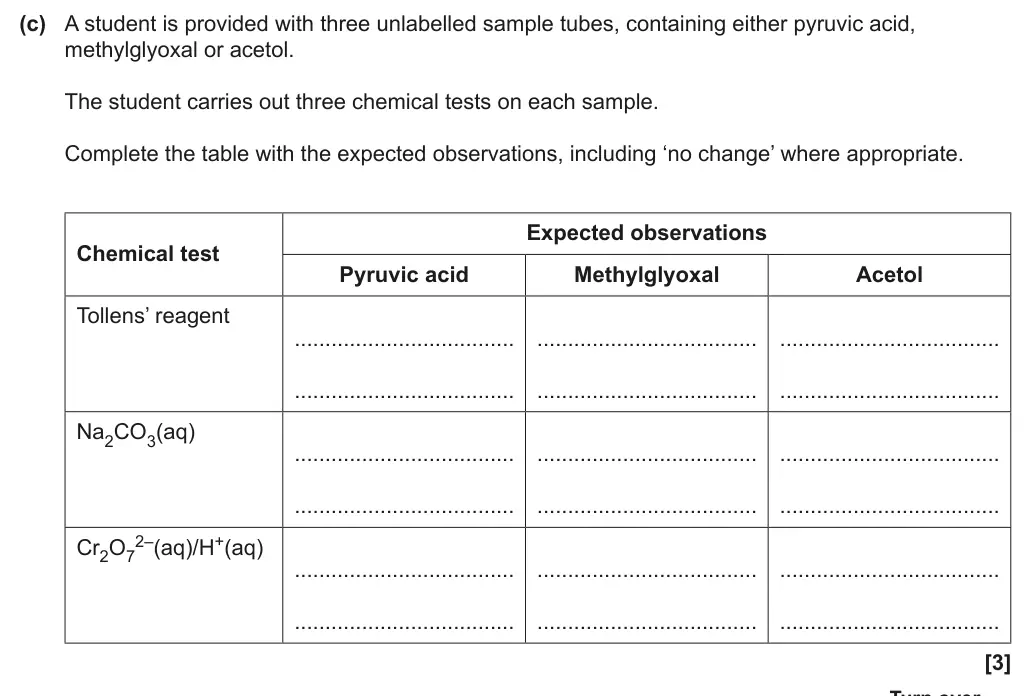
June 2025 · Paper 2 · Q21(c)3 marksComplete table/diagramHard
Earlier part of question 21 that this part uses
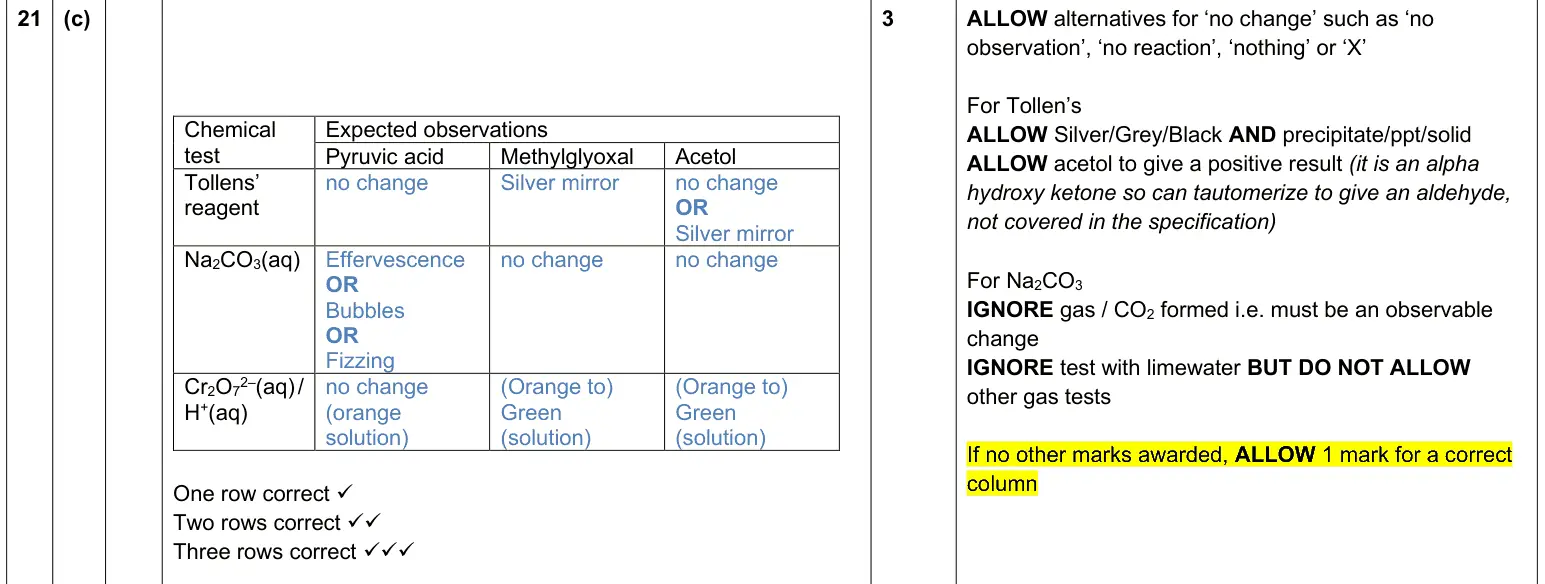
Mark scheme
Examiner's comment
Very few candidates did not score any marks for this observation question. Common errors included: • gas/CO2 formed for the reaction with carbonate. The observation was needed • no reaction for methylglyoxal with dichromate, as they had not realised aldehydes will react as well as primary and secondary alcohols • positive test for all three with dichromate − often linked with incorrect answer in Question 9 • white precipitate with the reaction with carbonate • bubbles with acetol with carbonate (presence of C=O and O-H leading to possible confusion with an acid?). Candidates gave a range of responses for the reactions with no change, e.g. ‘no silver mirror formed’, ‘stays orange or ‘nothing’, these were still accepted but for clarity candidates should respond as the question asks.
Notes from the mark scheme and report
one mark per row
Tollens': silver mirror only for methylglyoxal (ALLOW acetol positive)
Na2CO3: effervescence only for pyruvic acid (IGNORE 'gas/CO2 formed', must be an observation)
dichromate: orange to green for methylglyoxal and acetol
Skills: PAG7 Qualitative analysis of organic functional groups
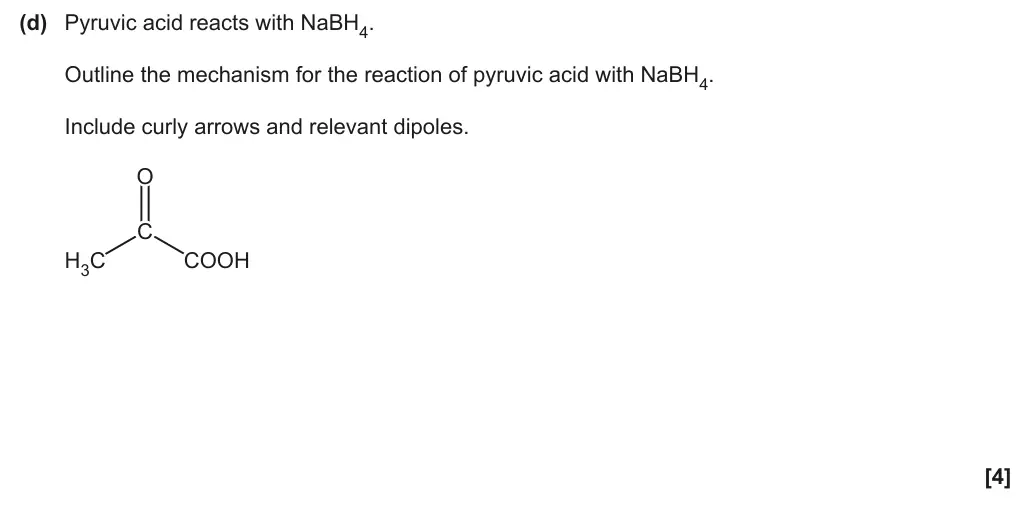
June 2025 · Paper 2 · Q21(d)4 marksMechanismHard
Earlier part of question 21 that this part uses
Mark scheme
Examiner's comment
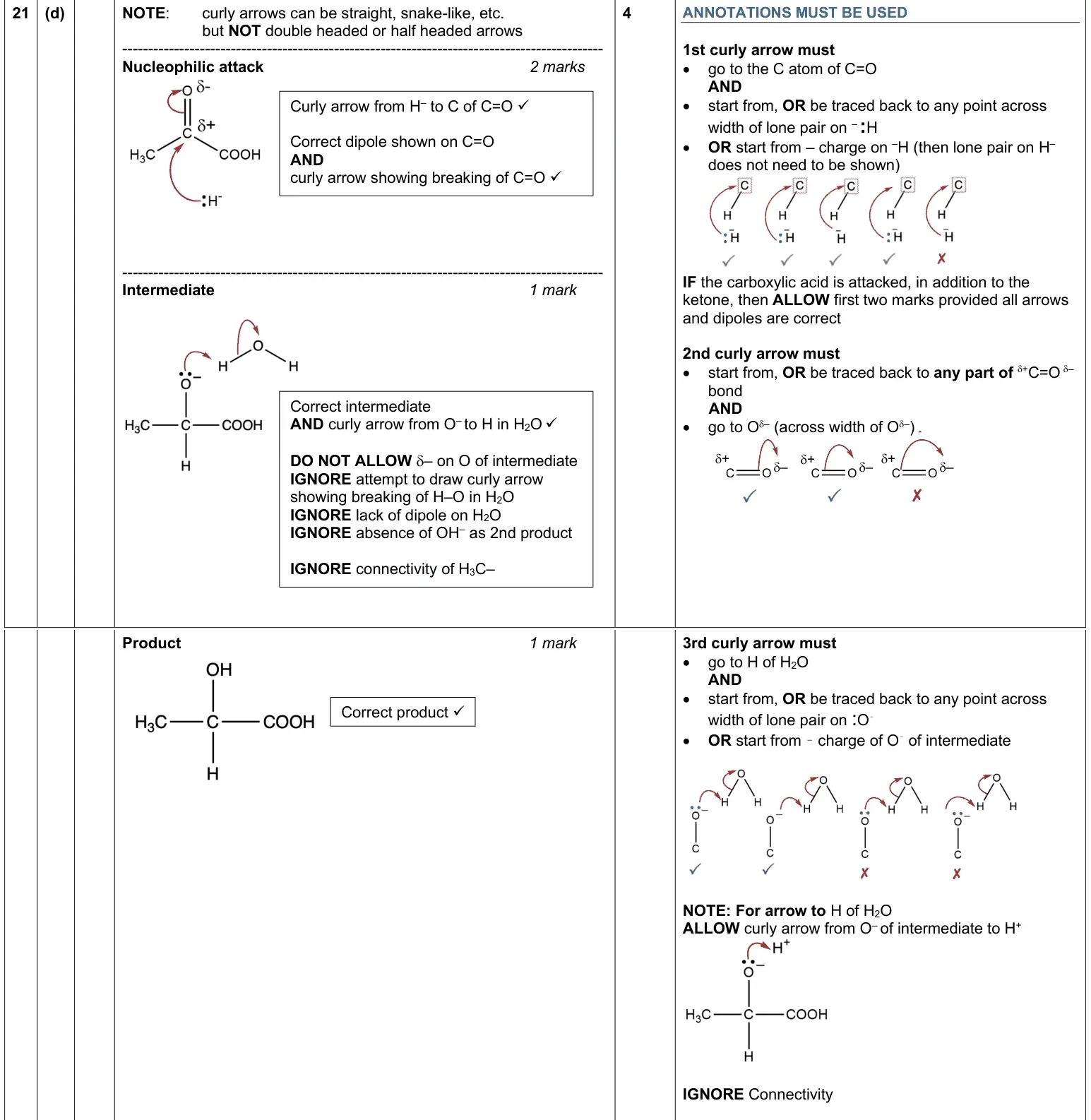
This was the most challenging of the mechanisms as it was less familiar to candidates and has not been tested in any previous exam series for this specification. Most were able to score a mark for showing the correct dipole on C=O and a curly arrow to break the bond. Some did not gain marks for their dipole being the wrong way round or adding dipoles on to the intermediate. Some did not gain marks for arrows which didn’t come from either a lone pair, negative charge or a bond – correct placement of curly arrows is vital. Some didn’t attack the C of C=O with H- before opening the bond, which led to an incorrect intermediate with a + charge on C and – charge on O. Some had the C of C=O being attacked by H+. A few candidates used CN- or OH- as the nucleophile. Some attempted to directly react the NaBH4 or BH4- directly rather than using H-. This often resulted in BH4 being part of the intermediate and final product. Many were able to give the correct product, although some had the H missing from the central C. Some omitted to show the attack of H- at all, which meant the loss of 3 marks if the C-H bond was not shown on the intermediate and the product as well. Some redrew the structure, which had been given deliberately with the COOH not displayed and attempted to reduce both the ketone and carboxylic acid functional groups. NaBH4 is not a strong enough reducing agent to react with a carboxylic acid and the reduction of COOH is not covered in our specification.
Notes from the mark scheme and report
arrow from H– (lone pair or – charge) to C of C=O
dipole AND arrow breaking C=O
intermediate with O– and arrow from O– to H of H2O (or H+)
DO NOT ALLOW δ– on O of intermediate
product CH3CH(OH)COOH
June 2025 · Paper 2 · Q21(e)7 marksShort answerHard
Earlier part of question 21 that this part uses
Mark scheme
Examiner's comment
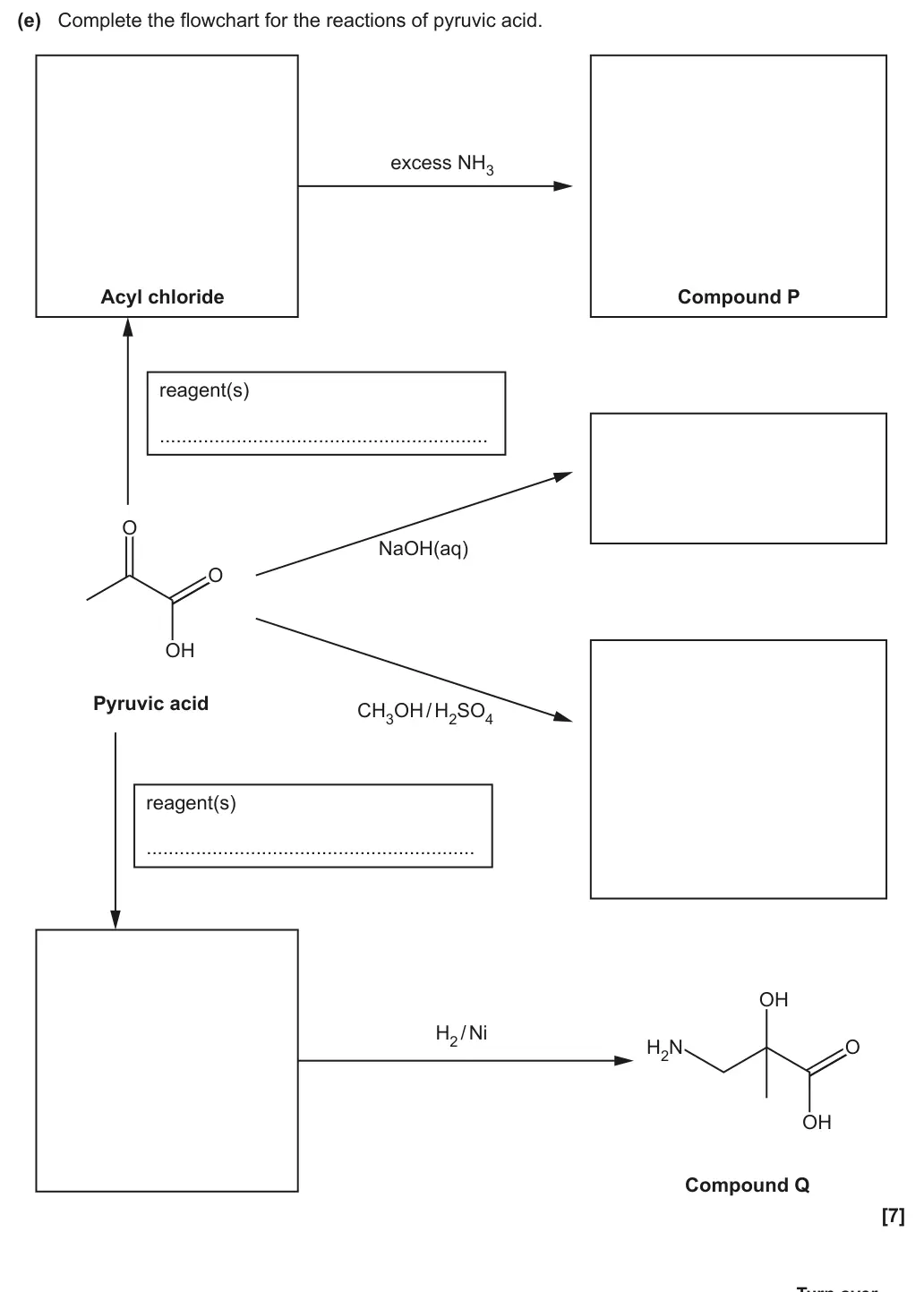
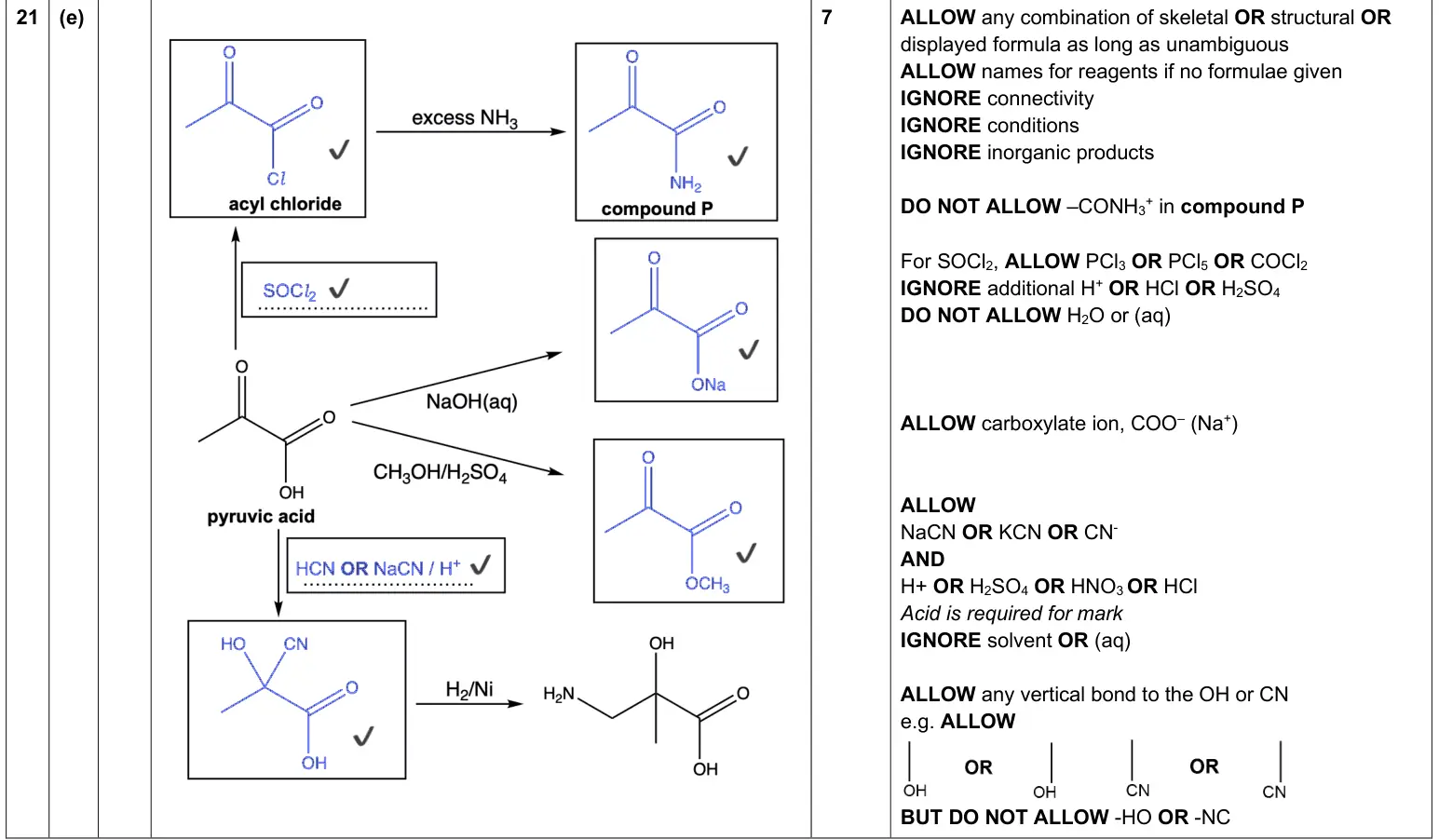
A wide range of marks were given for this question depending on candidates’ knowledge of different reactions. It was fairly common to see candidates drawing out synthetic route pathways on the additional blank pages to help them identify different reactions. This question was a good differentiator – those candidates with a wider knowledge of organic reactions were able to recall reagents and work out the structures of products, often gaining all 7 marks. Most candidates knew that SOCl2 is needed to form an acyl chloride with many giving the correct acyl chloride structure. Some attempted to use Cl2 or HCl instead of SOCl2. Some added Cl to the other end of the molecule leaving the -COOH group intact. Some had added a Cl on the structure removing only H on the -COOH group i.e. Many found it trickier to form compound P. Compound P often had -NH3 rather than -NH2. Some candidates reacted NH3 with various positions on the molecule. Many were able to react pyruvic acid with NaOH to form a salt as well as reaction with methanol in acid to for an ester. Care needed to be taken to keep the ketone group in the molecule and not attempt to react this as well. The trickiest step was the last one, which required a C-C bond forming reaction to extend the chain. Many knew that cyanide could be reacted here. Common incorrect reagents were KCN or NaCN with no H+, ammonia or NaBH4. The structure proved challenging for most candidates. Connectivity was sometimes an issue with the product formed with -NC or the omission of the triple bond between C and N if shown fully i.e. shown as C-N only. Some candidates left the C=O in place or missed out the methyl group or added an extra C before attaching the -CN i.e. Lower attaining candidates often attempted to just add NH3 or CH3NH2 here.
Notes from the mark scheme and report
SOCl2 (ALLOW PCl5/PCl3
DO NOT ALLOW (aq))
acyl chloride then primary amide (DO NOT ALLOW –CONH3+)
sodium carboxylate
methyl ester
NaCN/KCN AND acid (acid required) giving hydroxynitrile
DO NOT ALLOW –HO or –NC connectivity
Useful synthetic route maps for the whole specification, both with and without reagents, can be found on Teach Cambridge.
June 2025 · Paper 3 · Q5(a)(v)1 markShort answerHard
Earlier parts of question 5 that this part uses
Mark scheme
Examiner's comment
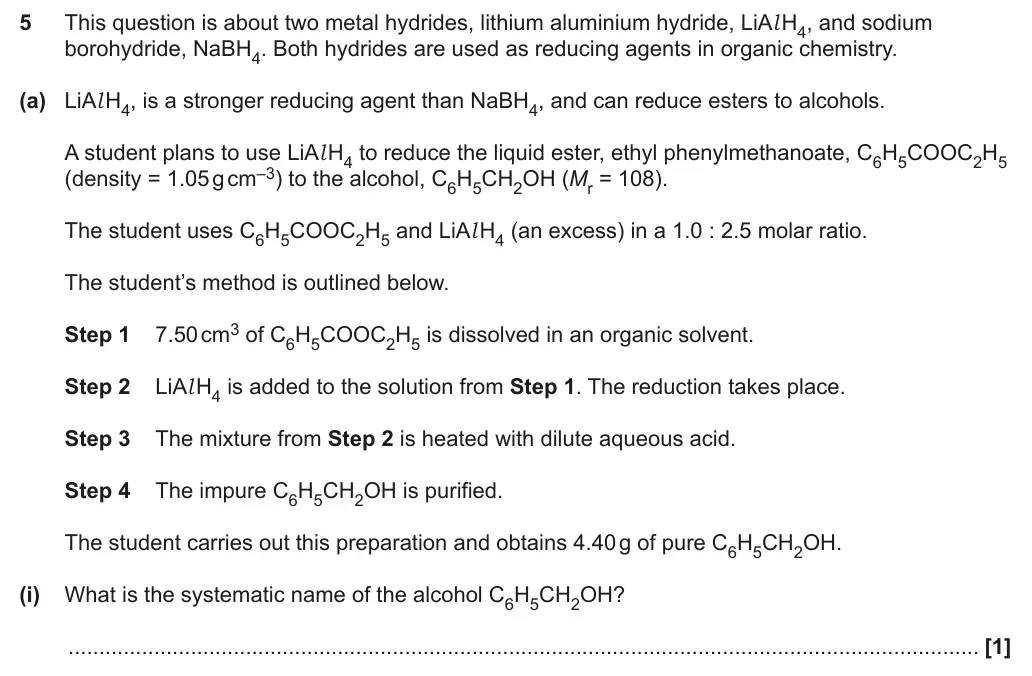
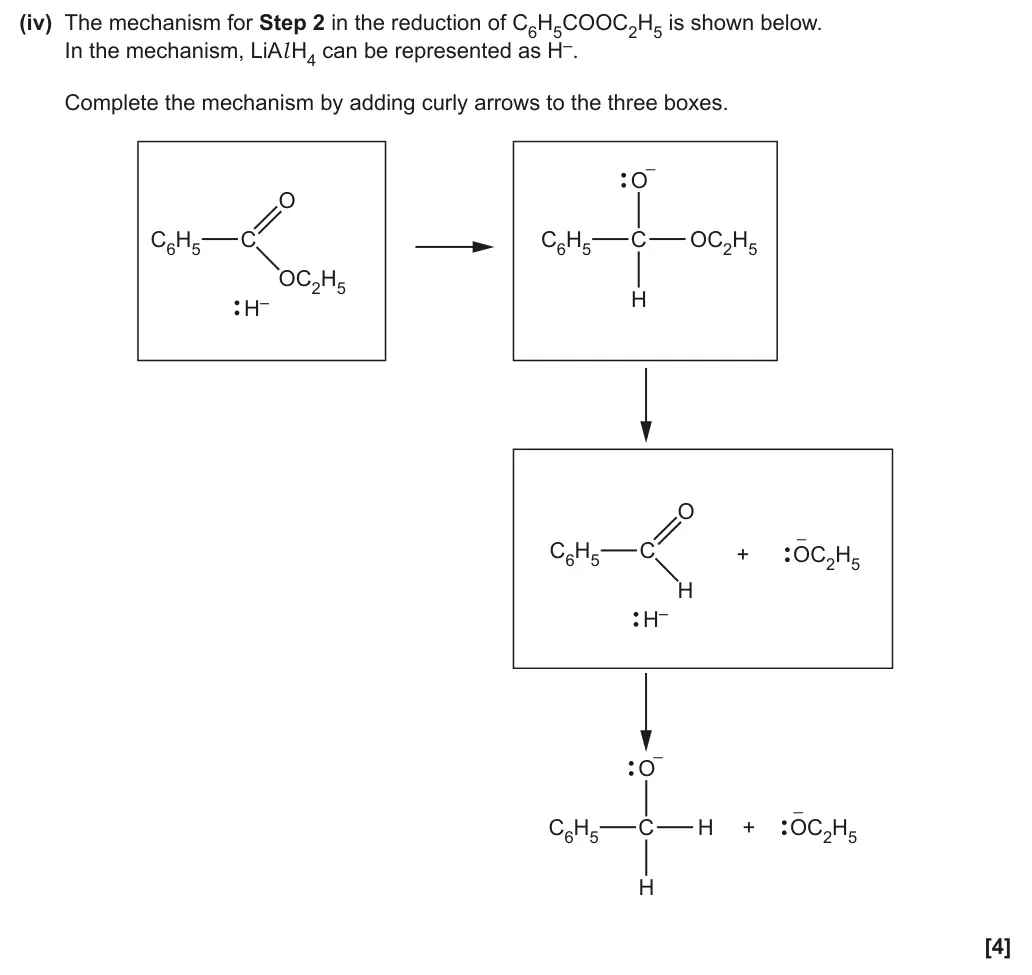
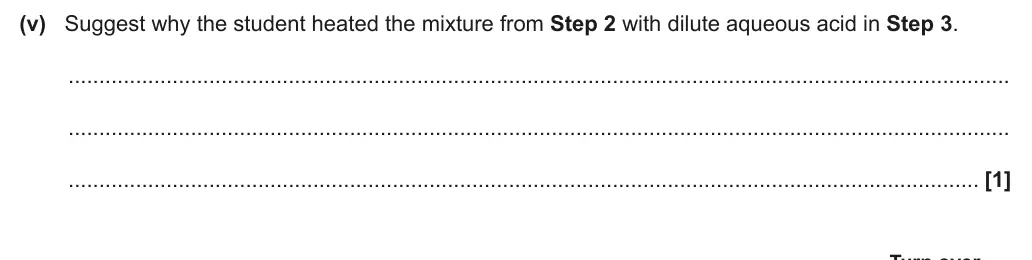
Most candidates found this question difficult with only higher attaining candidates being able to synthesise the information provided in the method and the mechanism. In 5(a)(iv), the last step in the mechanism for Step 2 gave a clue with the two products shown with a negative charge on both O atoms. The mark scheme required an understanding that an H+ ion was involved in Step 3. With the preparation involving H– ions, responses referring to a ‘hydrogen ion’ were ambiguous and imprecise. A common incorrect response referred to hydrolysis of the ester.
Notes from the mark scheme and report
H+ protonates the O– / negative ion to form the alcohol: must include idea of H+ being gained
IGNORE 'to form an OH group/alcohol' alone
June 2024 · Paper 2 · Q196 marks6-mark level of responseHard
Mark scheme, with the levels and indicative points
Examiner's comment
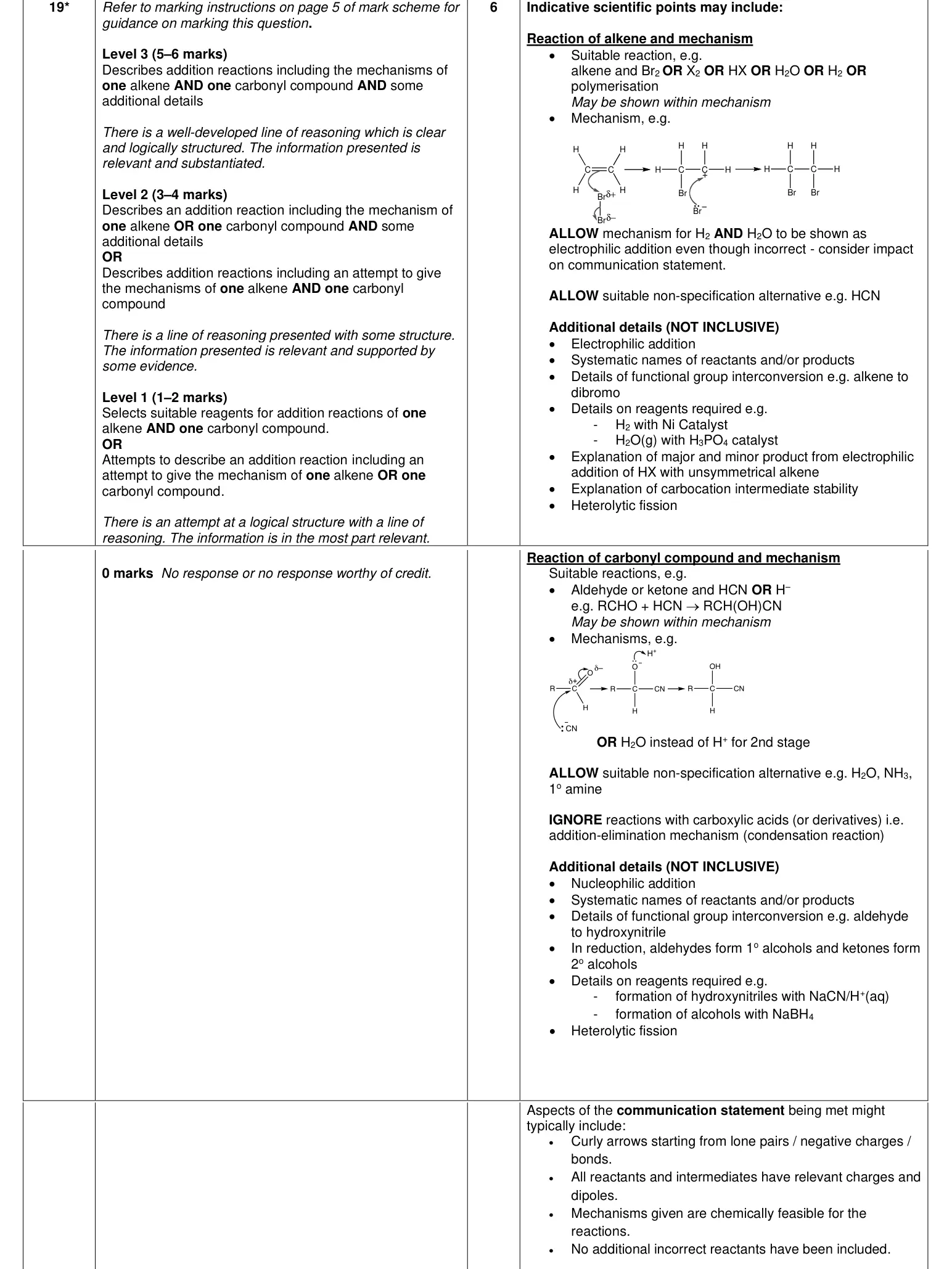
A very good proportion of candidates scored all 6 marks, giving well-drawn mechanisms with some additional details such as mechanism names, functional group interconversions or other additional reaction information. Some attempted to ‘describe’ the mechanism using only words rather than drawing it out with a conventional curly arrow mechanism. Candidates may need more clarity on what ‘describe’ means in an organic chemistry context. Equally, a few gave just the mechanisms with no additional details, limiting themselves to Level 2. Candidates were usually more confident with the addition to alkenes using an electrophilic addition mechanism. Some gave additional details about major and minor products, although not always relevant as for a symmetrical alkene. Some represented the addition of hydrogen or water to alkenes via an electrophilic addition mechanism. While not correct it showed an understanding of mechanisms and a correct addition reaction for alkenes, so credit was given. Some candidates included incorrect reagents for reactions, such as acid catalysts with addition of a hydrogen halide, or incorrect conditions, such as the requirement for ultraviolet light on addition of a halogen. The addition to carbonyl compounds was not always as well-described. Some candidates struggled to identify carbonyl compounds, selecting carboxylic acids or their derivatives, with attempts at addition- elimination mechanism i.e. condensation reactions. Some gave incorrect reagents for carbonyls, including H2 and HBr. However, some used off-specification reactions such as the addition of H2O to form a geminal diol which was given but as the mechanism differs from the nucleophilic addition mechanism taught in this specification, full credit was rarely achieved. Some also considered oxidation of aldehyde or ketone to be an addition reaction. Most who presented a correct mechanism for addition to a carbonyl used the reaction with cyanide rather than reduction with NaBH4. Common errors included arrows coming from the N of CN–, a lack of putting dipoles on carbonyl bonds, missing charges on O in intermediates or showing the wrong direction of arrows. Two correct addition mechanisms have been shown, one for an alkene and one for a carbonyl compound. Additional details include the names of the mechanisms, names of the functional groups in the products, and the fact that a C-C bond is formed in the second mechanism. All curly arrows, charges and dipoles are correctly positioned so this response was also given the communication mark.
Notes from the mark scheme and report
alkene with Br2/HX by electrophilic addition and carbonyl with HCN (NaCN/H+) or NaBH4 by nucleophilic addition
curly arrows from bonds/lone pairs/negative charges, dipoles and charges on intermediates
IGNORE addition–elimination reactions of carboxylic acid derivatives
The OCR Guide to Level of Response questions can be found on Teach Cambridge and can be used to help your students better understand this type of question.
June 2023 · Paper 2 · Q21 markAO1Multiple choiceMedium
Answer
A
Mark scheme
Examiner's comment
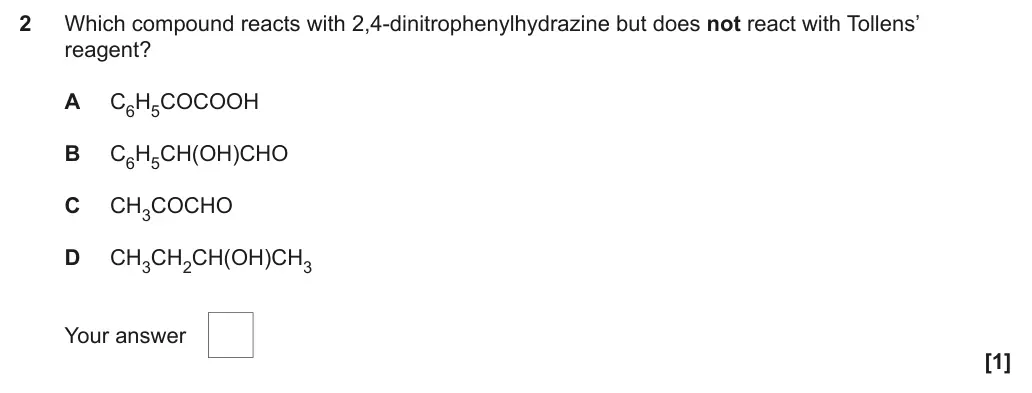
Drawing out the structures often helped candidates to identify each functional group and therefore spot the ketone which is key to correctly answering this question.
June 2023 · Paper 2 · Q22(a)(i)4 marksAO1, 2MechanismEasy
Mark scheme
Examiner's comment
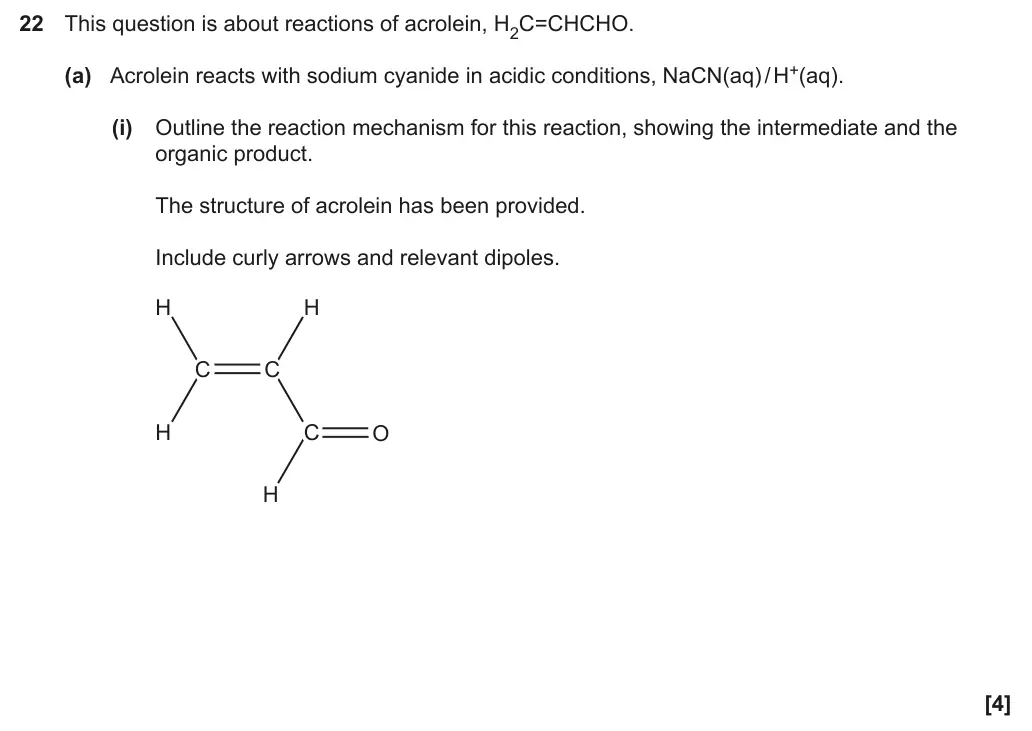
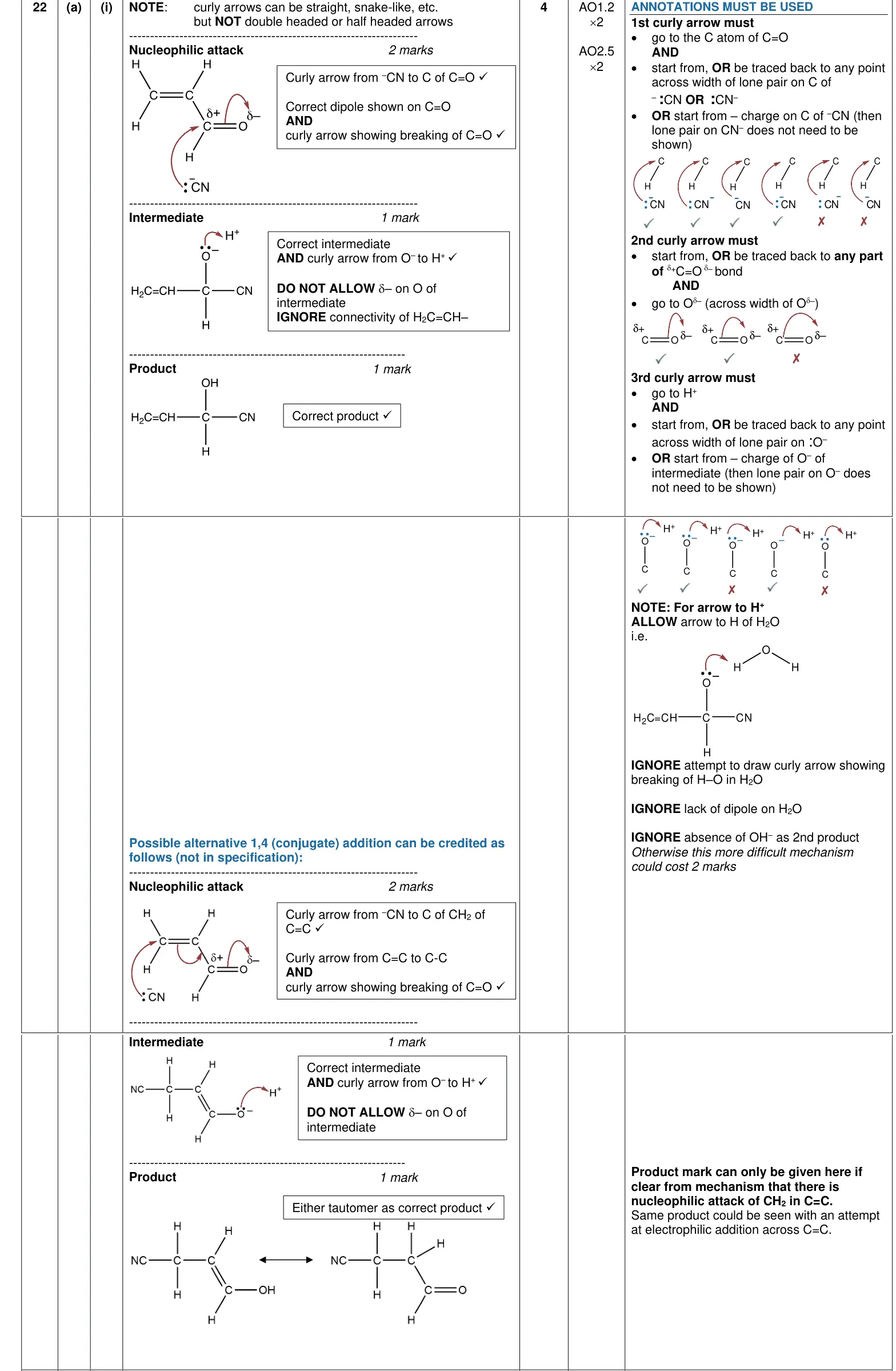
There were many excellent examples of precisely drawn mechanisms for the reaction of acrolein with sodium cyanide in acidic conditions and so most candidates gained at least 3 marks. The importance of accuracy when drawing curly arrows needs to be emphasised when teaching mechanisms - arrows must start at lone pairs or negative charges or come from bonds. Many candidates lost marks due to incorrect arrows. Common errors included the use of NaCN or HCN rather than the cyanide ion, the first curly arrow coming from the N of CN-, omission of partial charge across the C=O double bond and addition of partially charges to hydrogen or oxygen. Lower scoring responses often included an intermediate and/or product containing sodium. Some attempted electrophilic addition using HCN across the double bond. A few gained some credit for the mechanism for a competing reaction with nucleophilic addition on CH2 of C=C. This is not covered in the A Level specification and no candidates scored full marks for this alternative.
Notes from the mark scheme and report
arrow from lone pair/charge on C of CN– to C of C=O
dipole on C=O AND arrow from C=O bond to O
intermediate with O– (DO NOT ALLOW δ– on O) and arrow to H+ (ALLOW H of H2O)
product hydroxynitrile
1,4-conjugate addition credited as alternative
June 2023 · Paper 2 · Q22(a)(ii)1 markAO1Short answerEasy
Earlier part of question 22 that this part uses
Mark scheme
Examiner's comment
Most candidates were able to recall the correct response here, especially for those more confident with drawing out the mechanism. The most common incorrect response was nucleophilic substitution. Some suggested reduction or nucleophilic addition elimination. Misspellings of ‘nucleophilic’ were often seen.
Notes from the mark scheme and report
nucleophilic addition
IGNORE just 'addition'
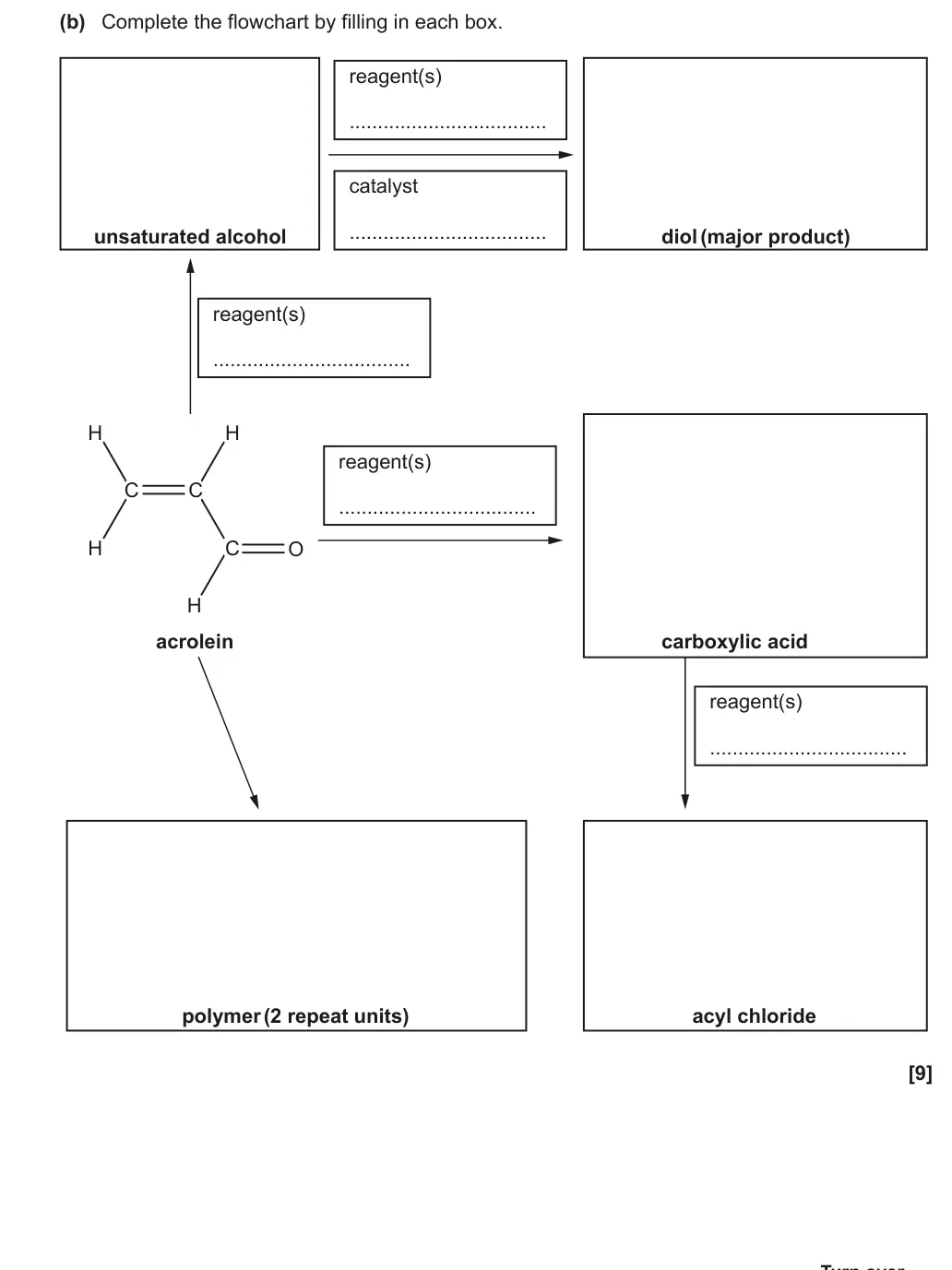
June 2023 · Paper 2 · Q22(b)9 marksAO1, 2Short answerMedium
Earlier part of question 22 that this part uses
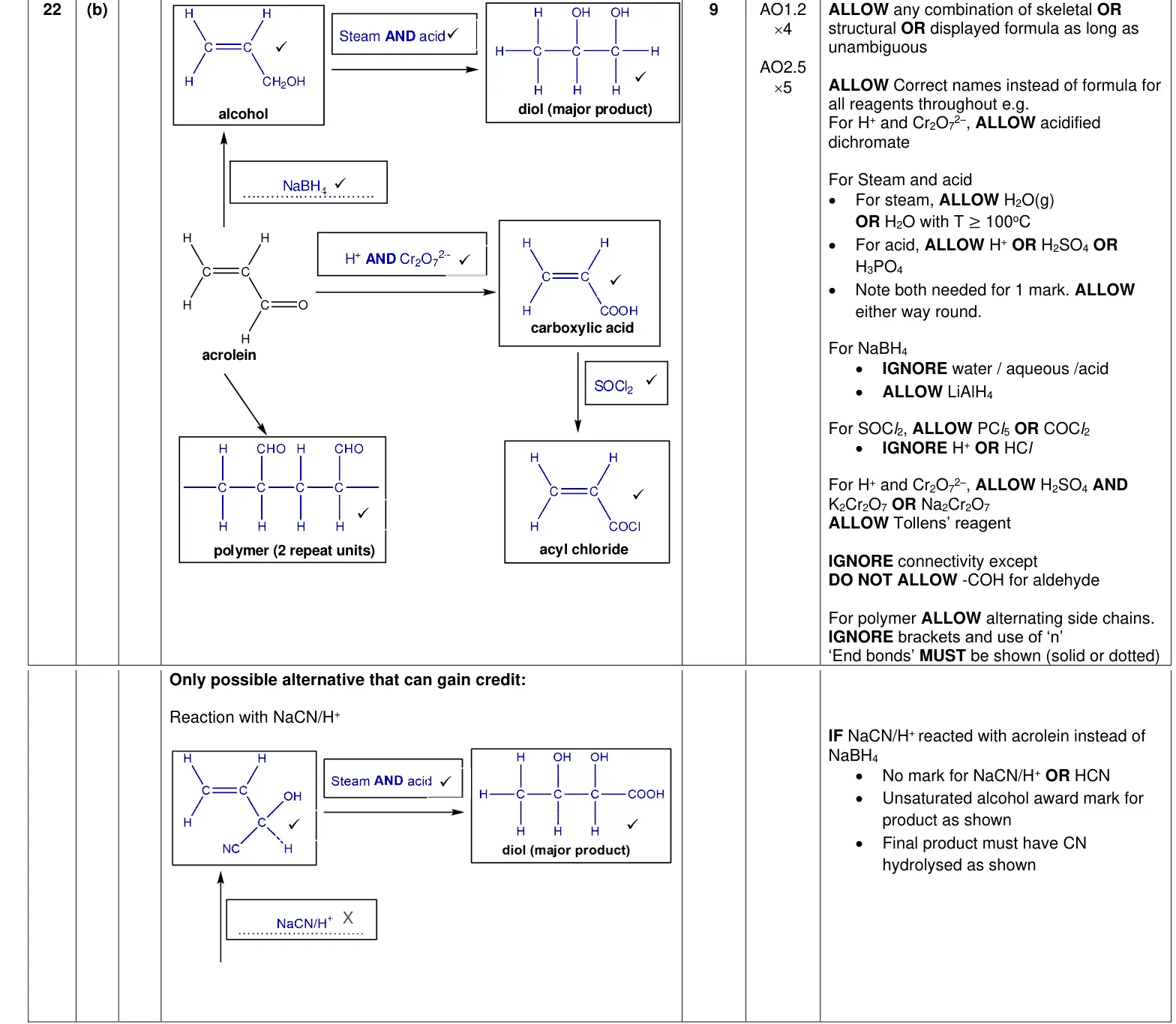
Mark scheme
Examiner's comment
This question discriminated well. Many candidates were able to demonstrate an excellent knowledge of organic reactions and it was not uncommon to see scores of at least 7 marks. This question identified which candidates had learned their synthetic routes including necessary reagents and conditions. Marks were often lost for small details such as missing Hs (check all Cs have four bonds) or not specifying that steam is required for hydration of alkenes or missing the acid needed for oxidation. Many suggested the use of NaOH or just a mixture of acids to product the diol. The minor 1,3-diol or 1,1-diol product was often seen. The sequence leading to an acyl chloride from acrolein was usually the most well answered. However, quite a few tried to use HCl to make the acyl chloride. Many lost marks for the polymer for incorrect connectivity on the aldehyde, e.g. -COH or attempting to make a polymer via connection of the aldehyde group.
Notes from the mark scheme and report
NaBH4 gives H2C=CHCH2OH (C=C not reduced)
steam AND acid catalyst (both needed) gives propane-1,2-diol as major product
H+/Cr2O72– to H2C=CHCOOH
SOCl2 to acyl chloride
polymer with CHO side chains and end bonds
DO NOT ALLOW –COH for aldehyde
This topic guide provides a summary of synthetic routes. Copies of the summary posters without the conditions can be found on Teach Cambridge. This should be used in conjunction with the organic synthesis topic exploration pack.
June 2023 · Paper 3 · Q36 marksAO36-mark level of responseMedium
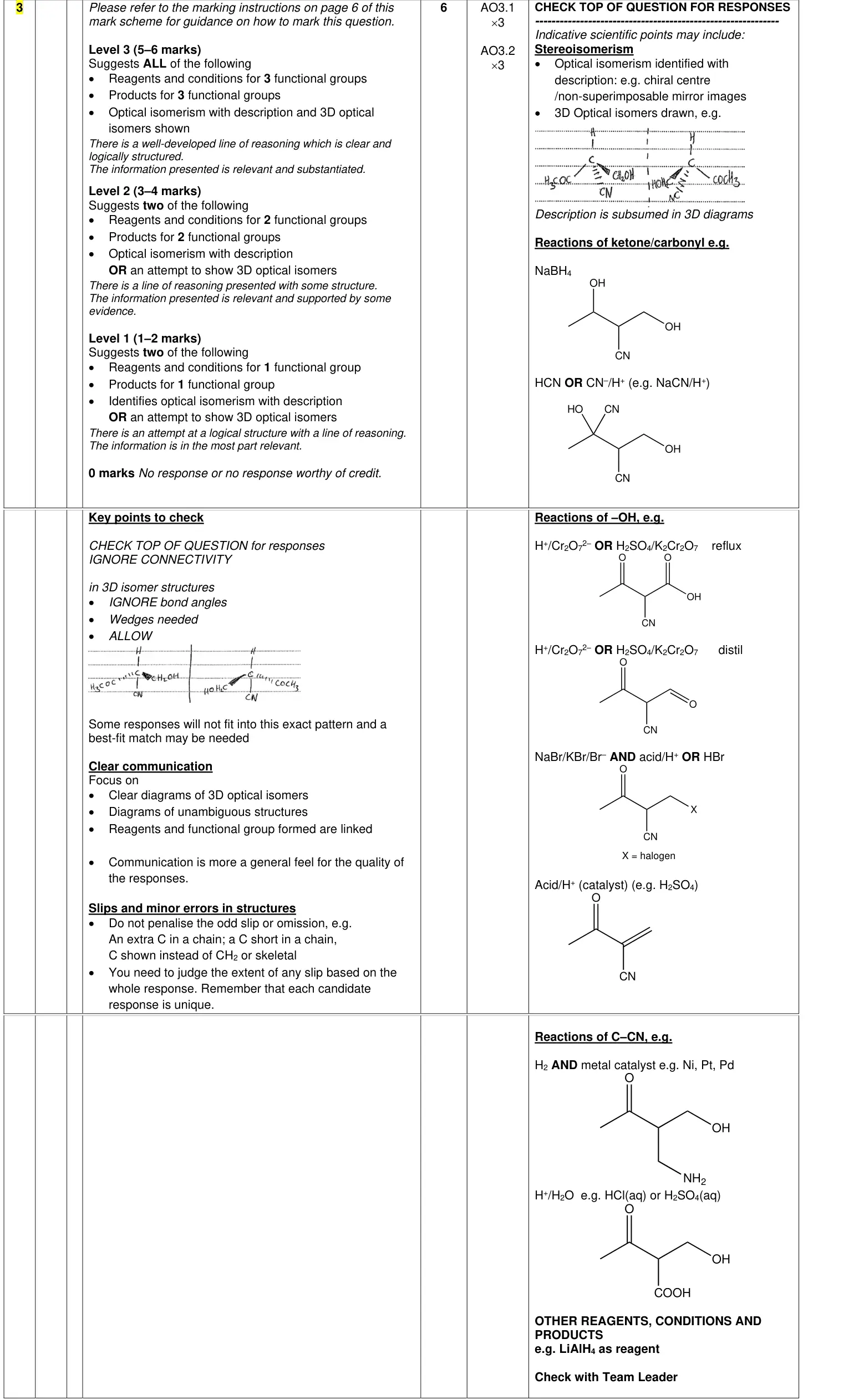
Mark scheme, with the levels and indicative points
Examiner's comment
Overall, candidates performed well when answering this question. They were required to identify that compound A shows optical isomerism and to choose a reaction for each of the three functional groups. Candidates were also expected to use structures for the organic products. To achieve the highest level of response, a description of optical isomerism should be accompanied by 3D diagrams of the optical isomers. Optical isomerism was usually identified, with associated diagrams with almost all candidates identifying the chiral centre. Most attempted 3D diagrams but candidates do need to take care that the groups attached to the chiral C atom are those in compound A and that no parts of chains are omitted. Optical isomers do also require use bold and dashed wedges to be used. Most candidates showed good knowledge and understanding of reactions for the three functional groups. • For the primary alcohol, most chose H+/Cr2O72–, with distil (→ aldehyde) or reflux (→ carboxylic acid); a significant number chose a concentrated acid (→ alkene) or Br–-/H+ (→ haloalkane) • For the ketone, most chose NaBH4 (→ secondary alcohol) • For the nitrile, most chose either H2/Ni (→ amine) or H+(aq) (→ carboxylic acid). Clear diagrams of the products were usually seen although many omitted a CH2 from the amine branch for hydrolysis of the nitrile or an extra CH2 in the aldehyde or carboxylic acid branch from oxidation of the primary alcohol. Some candidates chose 2,4-DNP for a reaction of the ketone and treated the question as one requiring tests, and then proving that the compound was a ketone from no reaction with Tollens’ reagent. The question asked for the organic product and the 2,4- DNP product is beyond the demands of this specification (although this was seen very rarely). Candidates adopting this reaction were limiting the extent of their response and candidate should have considered this requirement before selecting 2.4- DNP. This exemplar shows a good response that lacks 3D diagrams for the optical isomers. The candidate has clearly given reagents and conditions and has shown the organic products. In the response, you can see that the candidate initially showed an extra CH2 in the –COOH branch, and a mistake in the amine branch. The absence of 3D structures limits the response to Level 2 and 4 marks have been awarded for choosing correct and relevant reagents and conditions, and for the clear communication of the structures.
Notes from the mark scheme and report
optical isomerism with chiral centre/non-superimposable mirror images and 3D diagrams with wedges
Skills: M4.2 Visualise and represent 2-D and 3-D forms including 2-D representations of 3-D objects
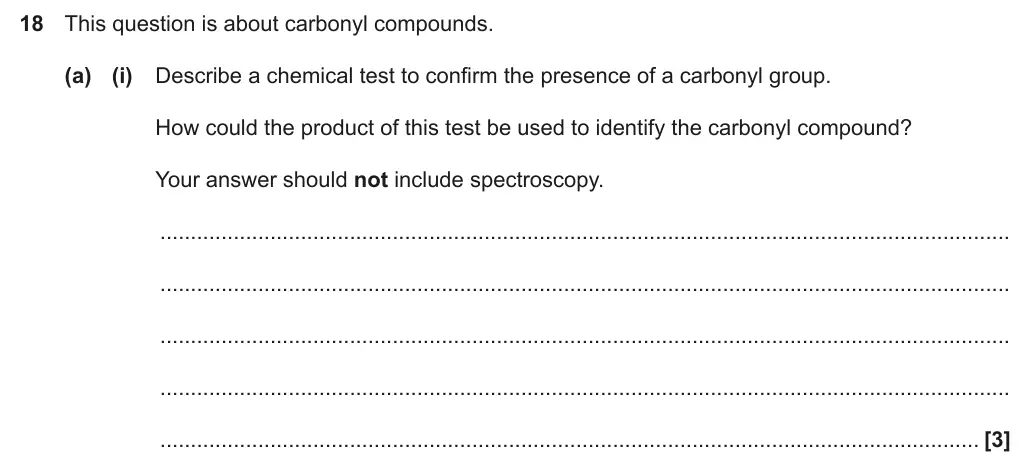
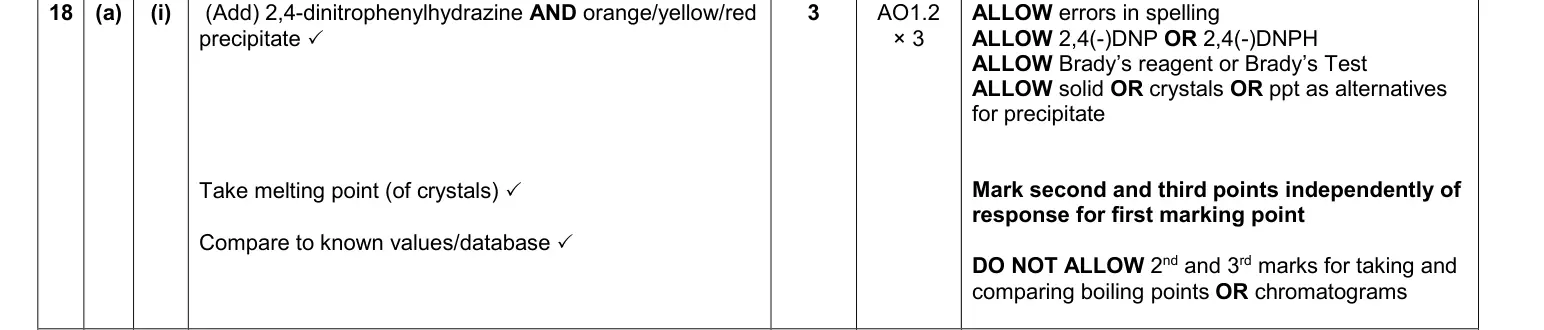
June 2022 · Paper 2 · Q18(a)(i)3 marksAO1Short answerMedium
Mark scheme
Examiner's comment
The use of 2,4-dinitrophenylhydrazine as a test for the carbonyl group is well known by candidates at this level. The majority of the cohort correctly identified this test and the subsequent analysis of the melting point of the products as a method of identifying each compound. Lower ability candidate responses made reference to analysis of the boiling points or omitted the reference to analysis of the melting points.
Notes from the mark scheme and report
2,4-DNP(H) AND orange/yellow/red precipitate
take melting point of the derivative
compare with known values
DO NOT ALLOW boiling points or chromatograms
Skills: PAG6 Synthesis of an organic solid; PAG7 Qualitative analysis of organic functional groups
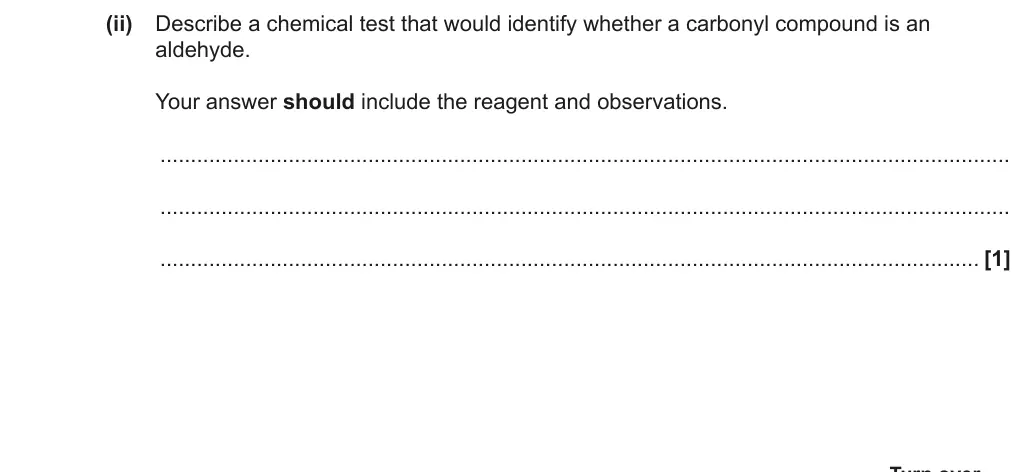
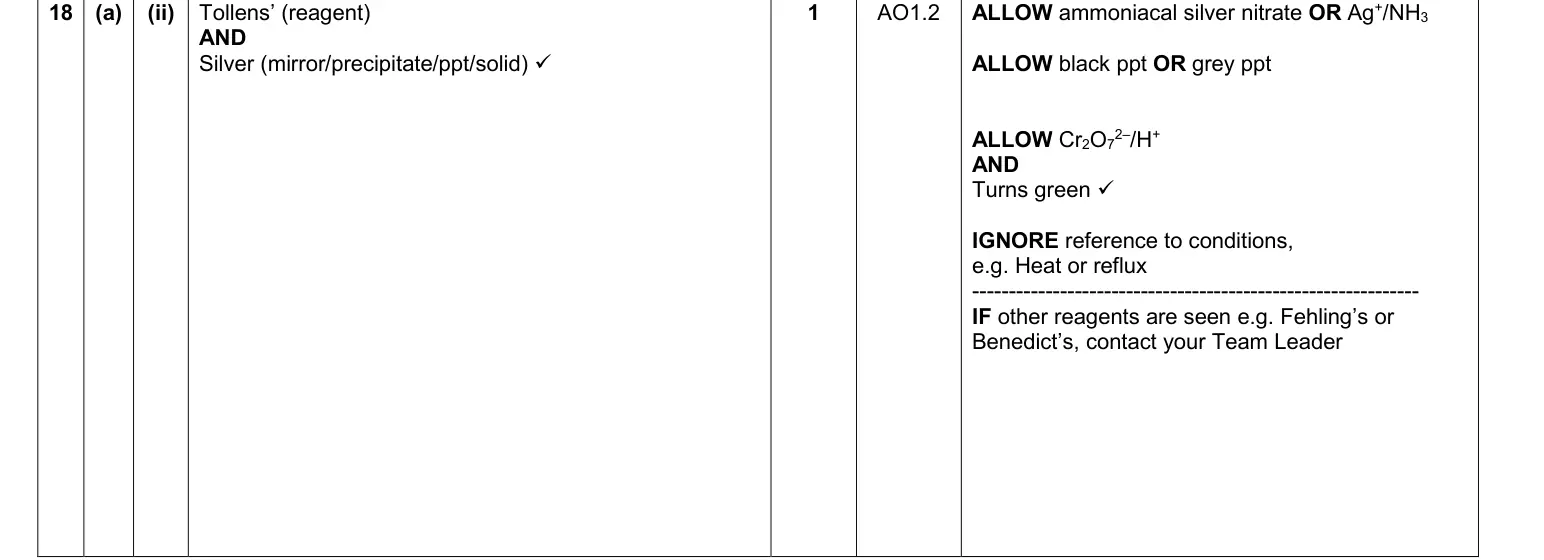
June 2022 · Paper 2 · Q18(a)(ii)1 markAO1Short answerEasy
Earlier part of question 18 that this part uses
Mark scheme
Examiner's comment
Almost all candidates were able to correctly describe the use of Tollens’ reagent as a test for an aldehyde fictional group
Notes from the mark scheme and report
Tollens' reagent AND silver mirror
ALLOW acidified dichromate turning green
Skills: PAG7 Qualitative analysis of organic functional groups
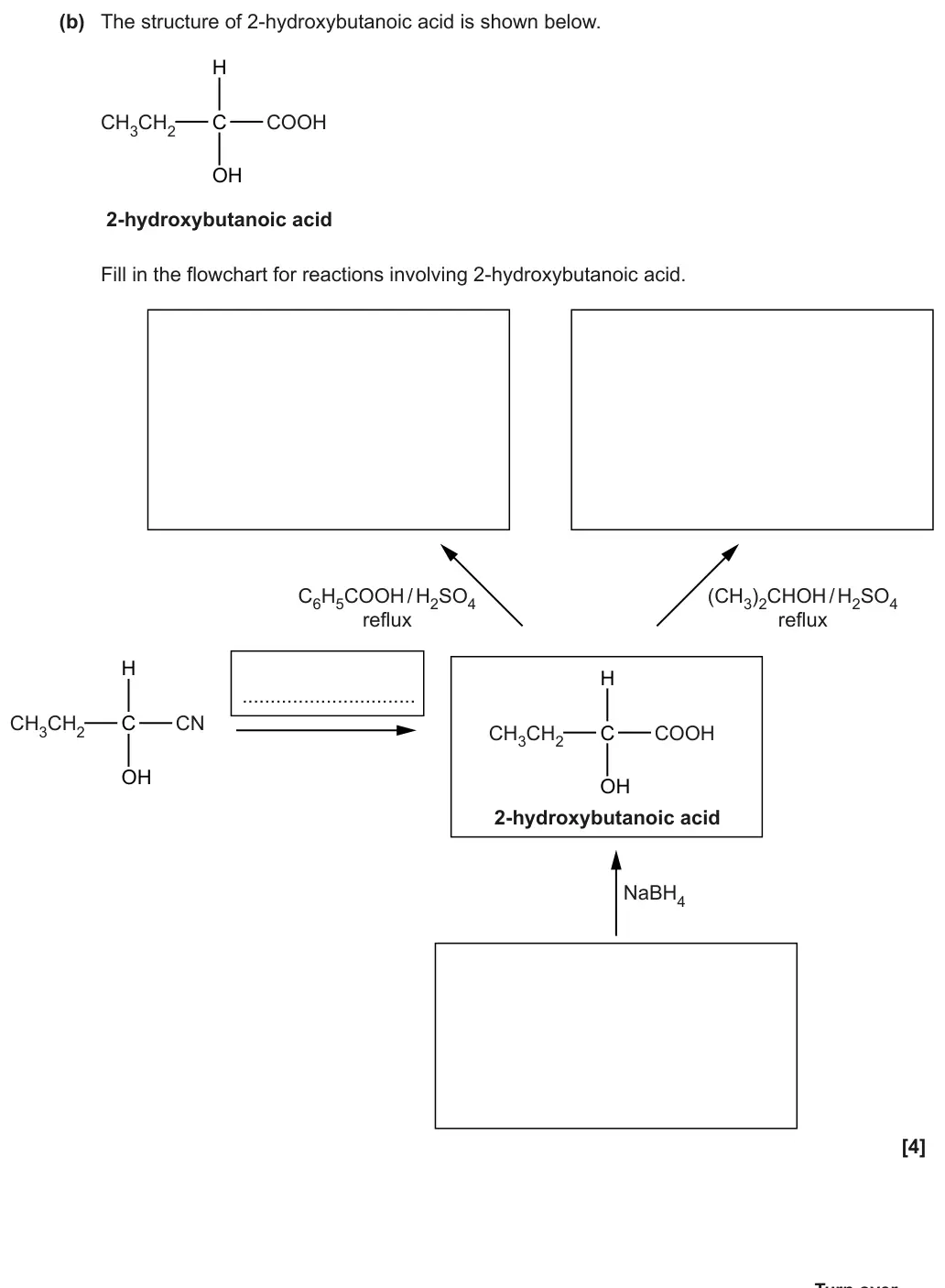
June 2022 · Paper 2 · Q19(b)4 marksAO2Complete table/diagramMedium
Mark scheme
Examiner's comment
The majority of candidates were able to identify at least one of the structures. A significant number of candidates did not check the number of bonds of each atom in their structures and frequently had too many or too few hydrogen atoms attached. Most candidates identified that acidic conditions were required but some missed the aqueous condition that was also required for the mark.
Notes from the mark scheme and report
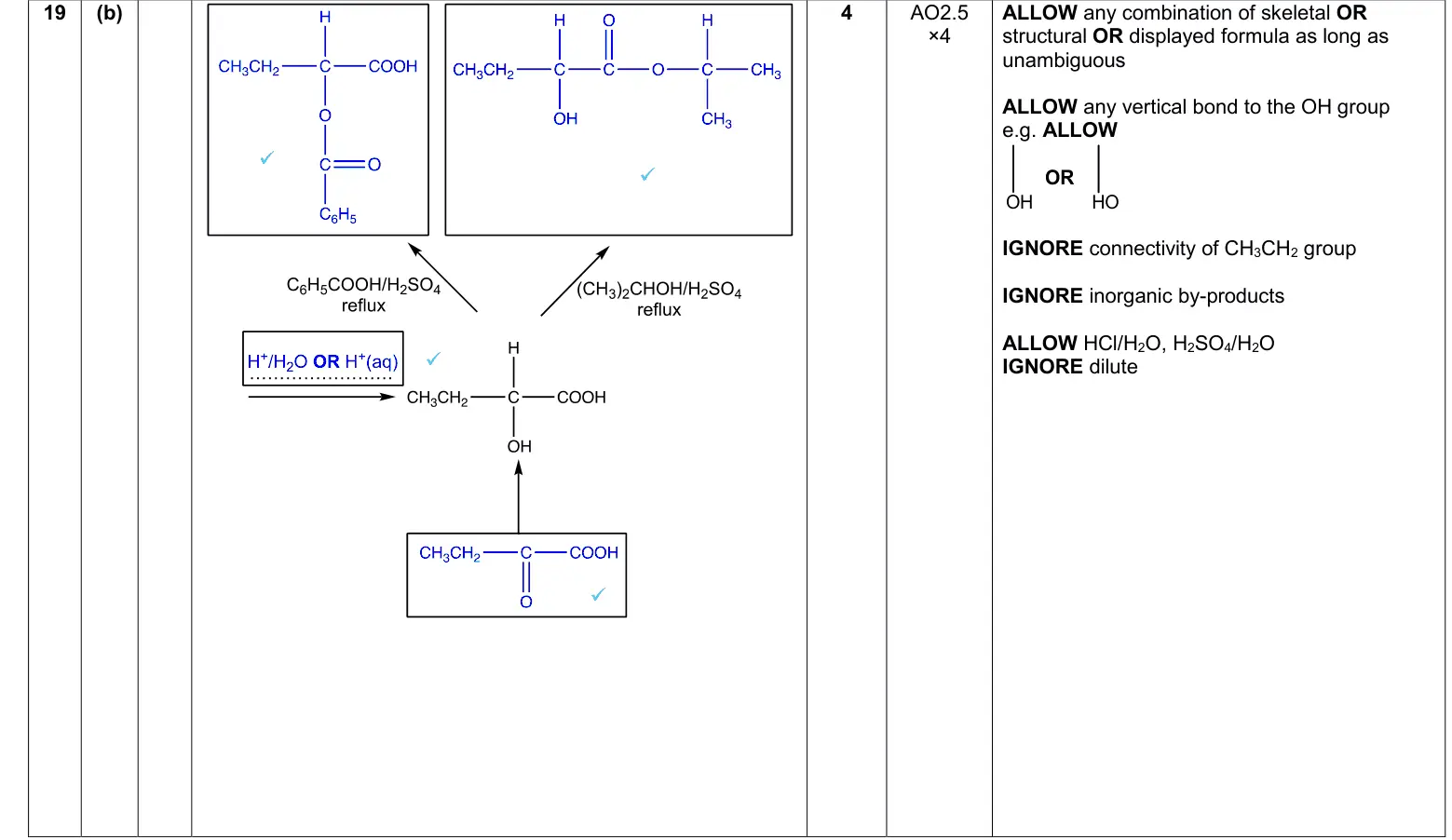
with C6H5COOH the OH group is esterified
with (CH3)2CHOH the COOH group is esterified
nitrile to acid needs H+/H2O (ALLOW HCl/H2O, H2SO4/H2O)
NaBH4 box is the ketone CH3CH2COCOOH
June 2022 · Paper 2 · Q216 marksAO1, 26-mark level of responseMedium
Mark scheme, with the levels and indicative points
Examiner's comment
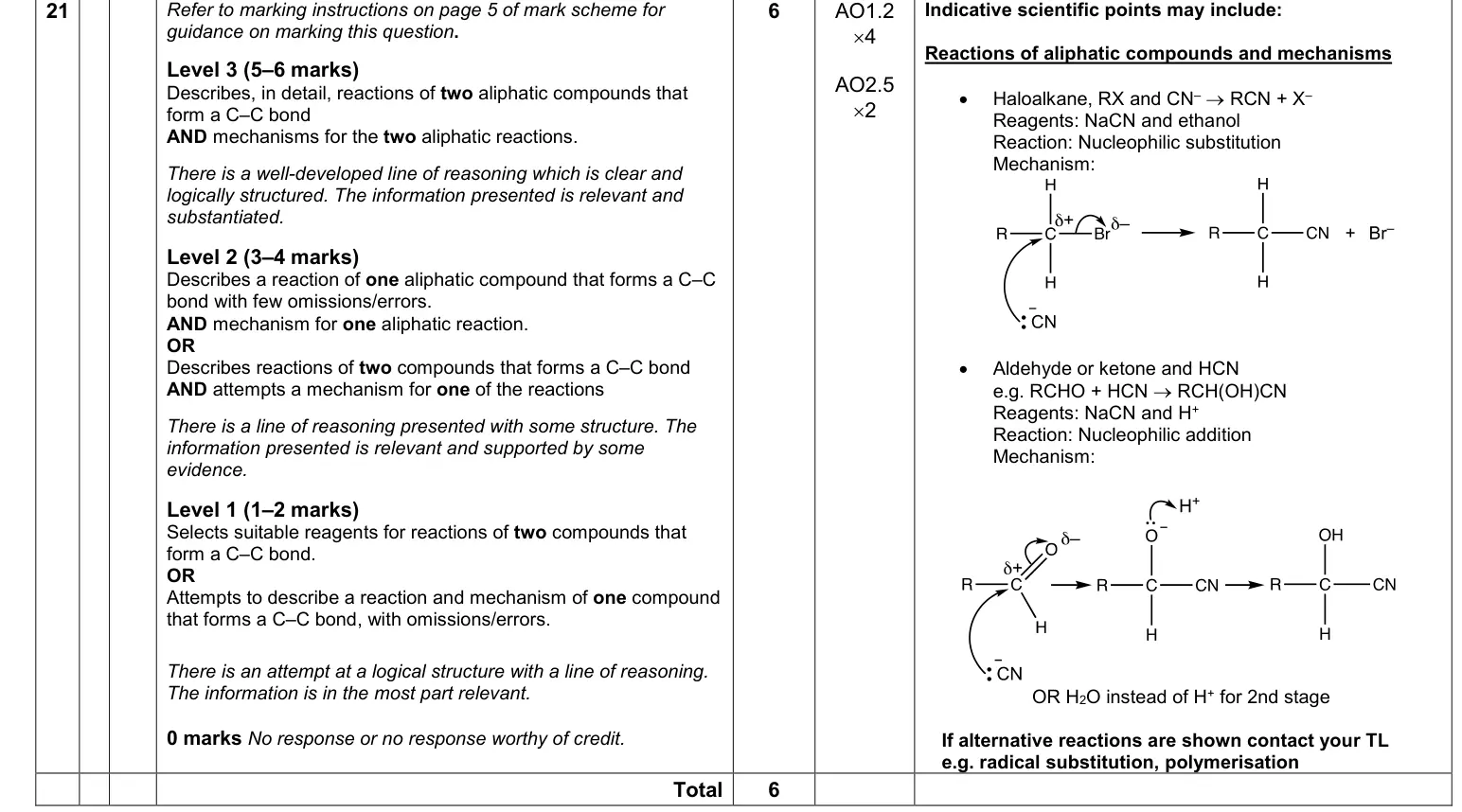
This question differentiated well. Candidates who were given Level 3 (5-6 marks) understood the term aliphatic and were able to provide two different mechanisms that produced a C-C bond. The most common responses seen involved the nucleophilic substitution of a halogenoalkane and a cyanide ion and the nucleophilic addition of a carbonyl with a cyanide ion. Some candidates offered radical substitution mechanisms, detailing initiation, propagation and termination steps, with the termination step producing a C-C bond. Candidates who scored Level 2 (3-4 marks) frequently detailed a reaction involving aromatic compounds or polymerisation of alkenes for which they were unable to give a mechanism. If any of your students’ results are not as expected, you may wish to consider one of our post-results services. For full information about the options available visit the OCR website. We send a weekly roundup to tell you about important updates. You can also sign up for your subject specific updates. If you haven’t already, sign up here. Attend one of our popular CPD courses to hear directly from a senior assessor or drop in to a Q&A session. Most of our courses are delivered live via an online platform, so you can attend from any location. Please find details for all our courses on the relevant subject page on our website or visit OCR professional development. ExamBuilder is the question builder platform for a range of our GCSE, A Level, Cambridge Nationals and Cambridge Technicals qualifications. Find out more. ExamBuilder is free for all OCR centres with an Interchange account and gives you unlimited users per centre. We need an Interchange username to validate the identity of your centre's first user account for ExamBuilder. If you do not have an Interchange account please contact your centre administrator (usually the Exams Officer) to request a username, or nominate an existing Interchange user in your department. Review students' exam performance with our free online results analysis tool. It is available for all GCSEs, AS and A Levels and Cambridge Nationals. It allows you to: • review and run analysis reports on exam performance • analyse results at question and/or topic level • compare your centre with OCR national averages • identify trends across the centre • facilitate effective planning and delivery of courses • identify areas of the curriculum where students excel or struggle • help pinpoint strengths and weaknesses of students and teaching departments. Find out more. Post-results services Keep up-to-date OCR Professional Development Signed up for ExamBuilder?
Notes from the mark scheme and report
haloalkane with NaCN in ethanol by nucleophilic substitution
aldehyde/ketone with NaCN/H+ (HCN) by nucleophilic addition
curly arrows from lone pair/– charge on C of CN–, dipoles, intermediate with O– then protonation
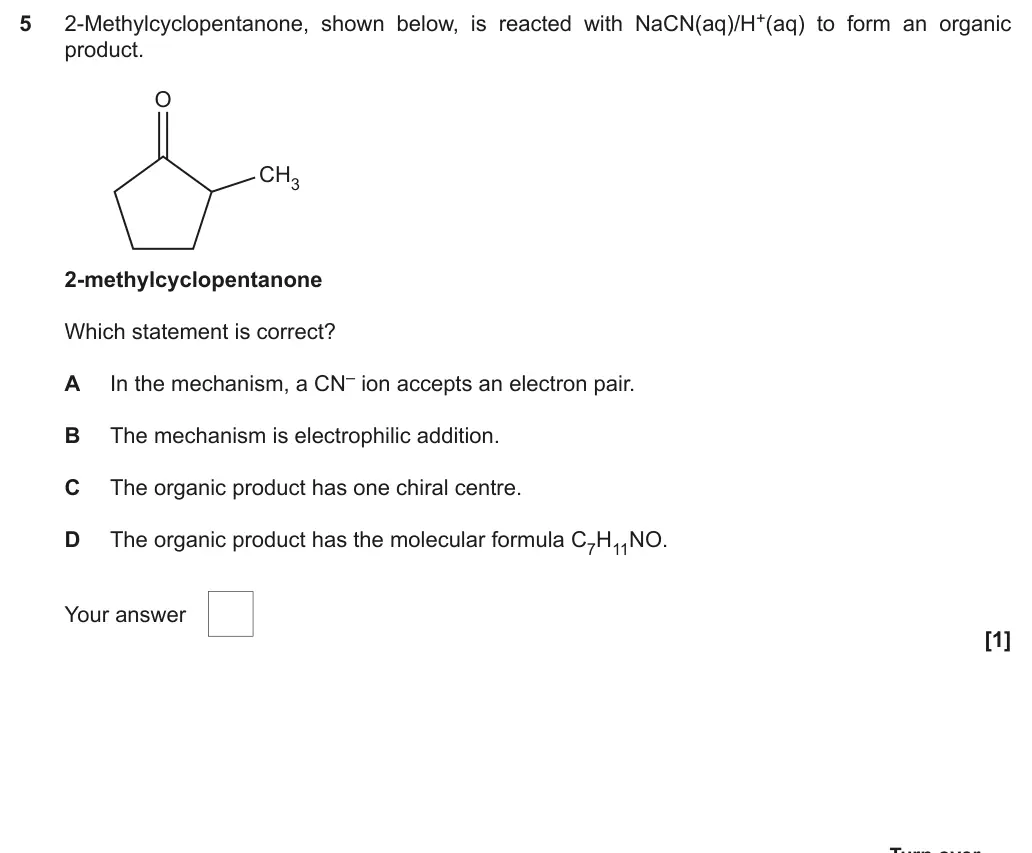
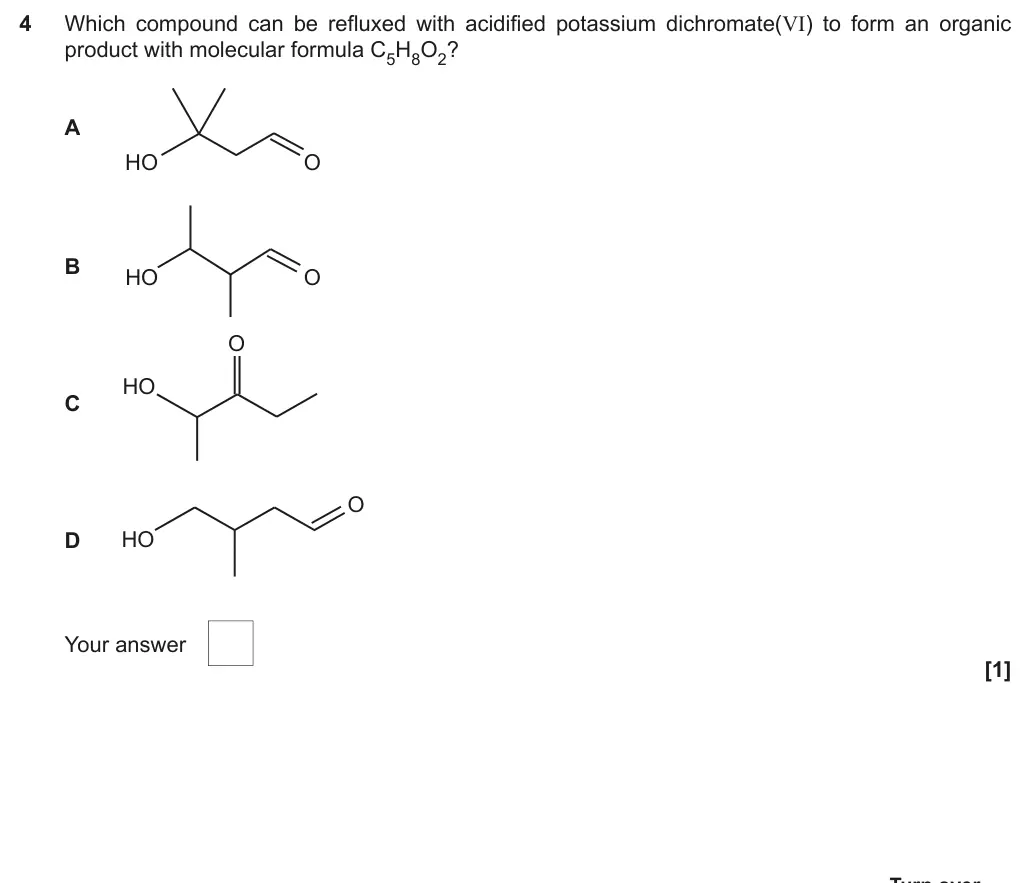
November 2021 · Paper 2 · Q51 markMultiple choice
Answer
D
Mark scheme
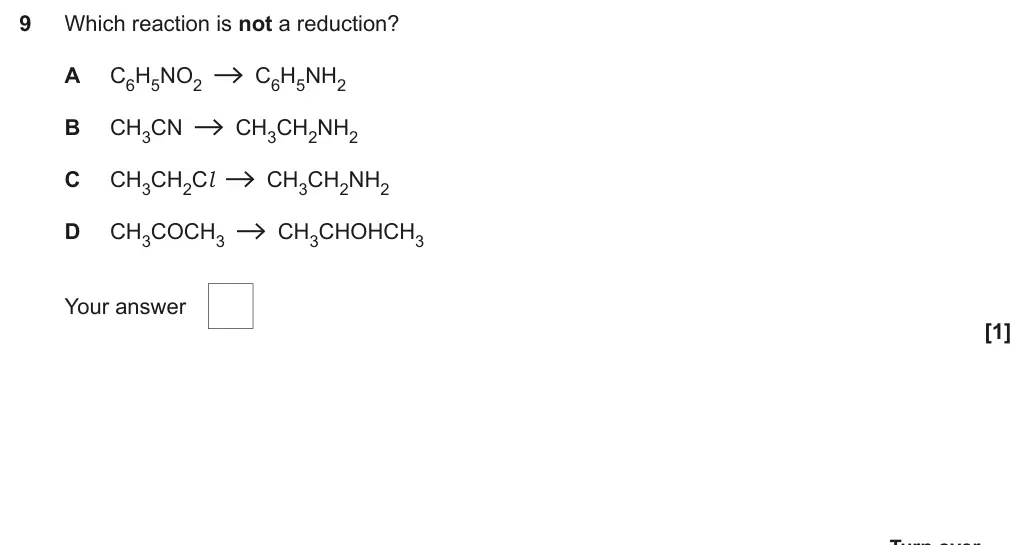
November 2021 · Paper 2 · Q91 markMultiple choice
Answer
C
Mark scheme
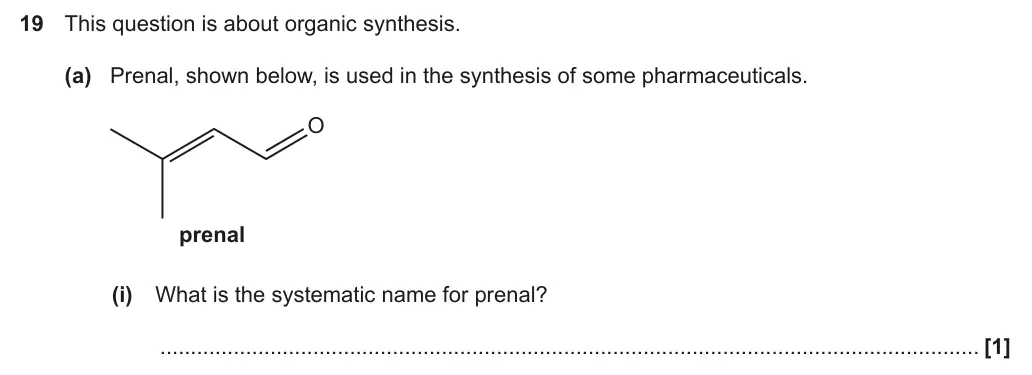
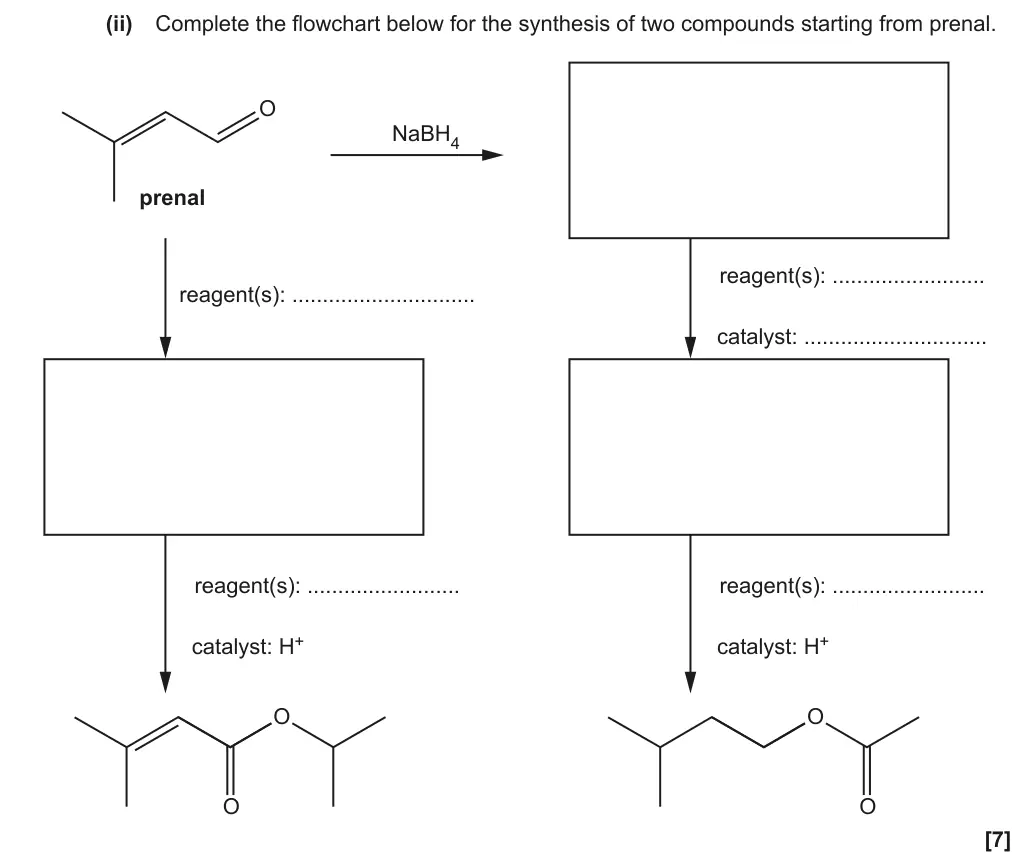
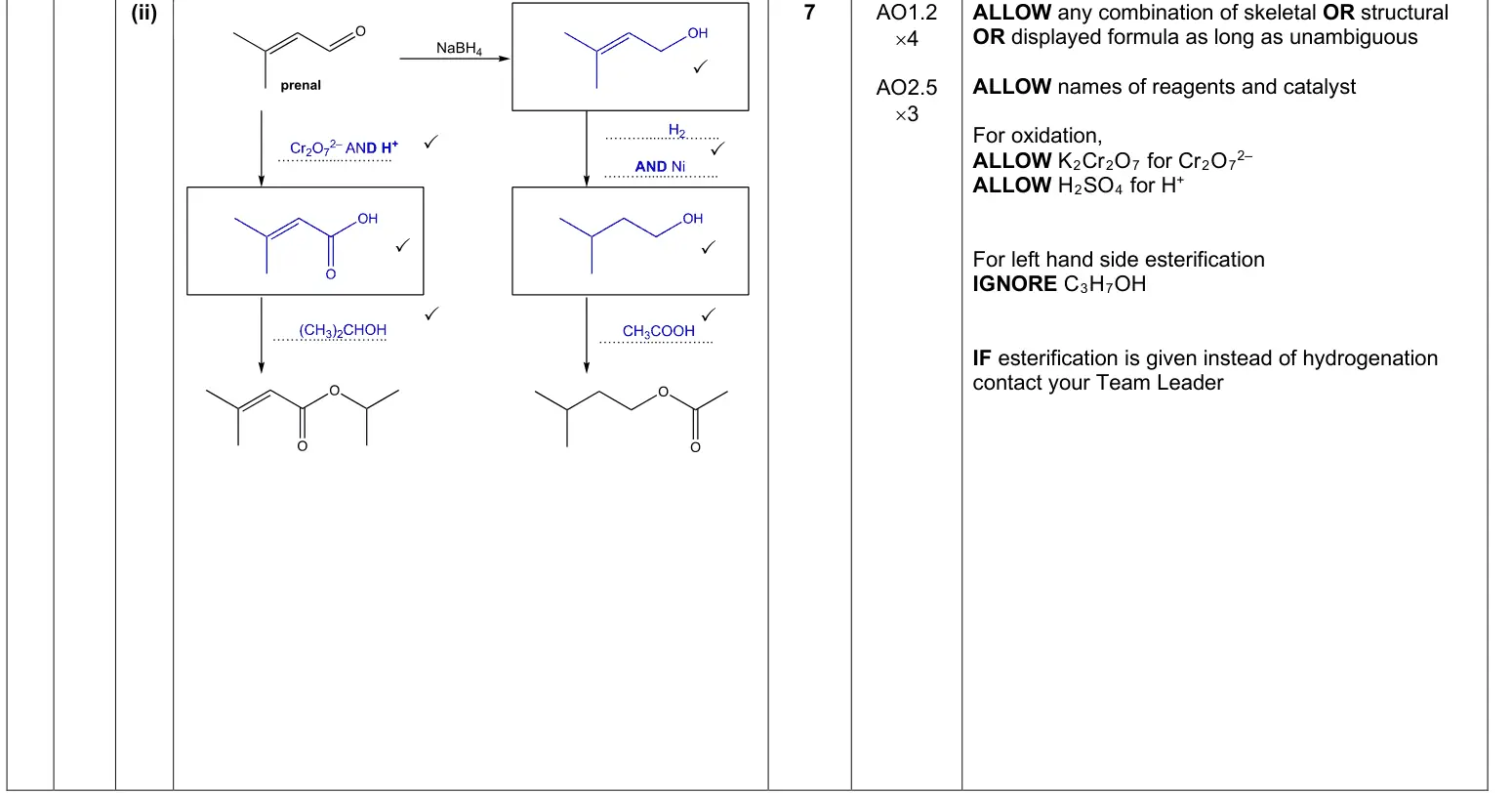
November 2021 · Paper 2 · Q19(a)(ii)7 marksAO1, 2Short answer
Earlier part of question 19 that this part uses
Mark scheme
Notes from the mark scheme and report
NaBH4 reduces C=O only (unsaturated alcohol)
then H2 AND Ni
then CH3COOH/H+
left route Cr2O72– AND H+ to unsaturated acid then (CH3)2CHOH/H+
ALLOW names of reagents
November 2020 · Paper 2 · Q41 markAO2Multiple choice
Answer
C
Mark scheme
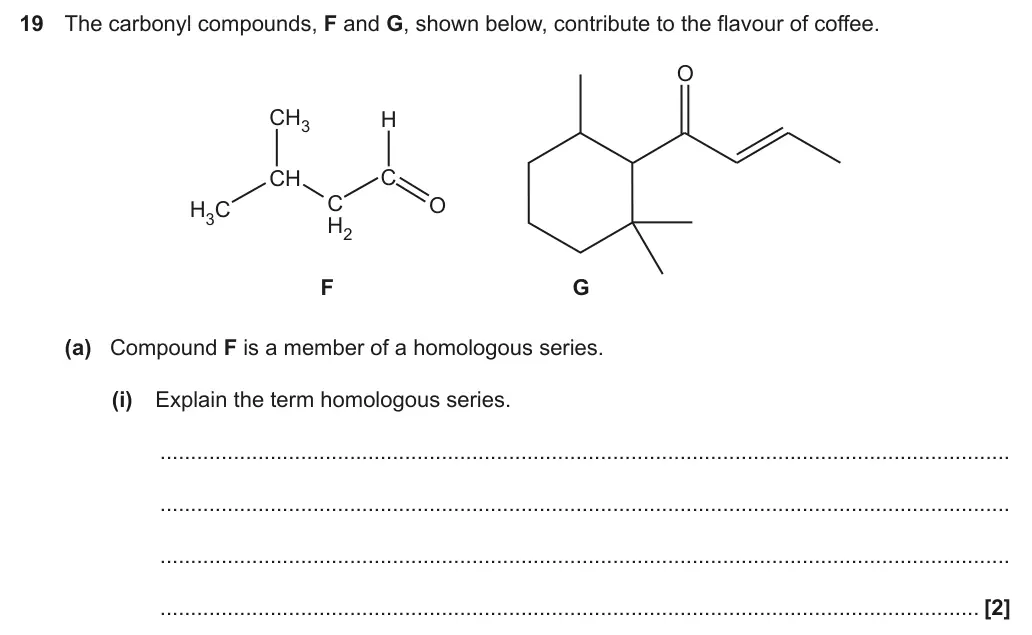
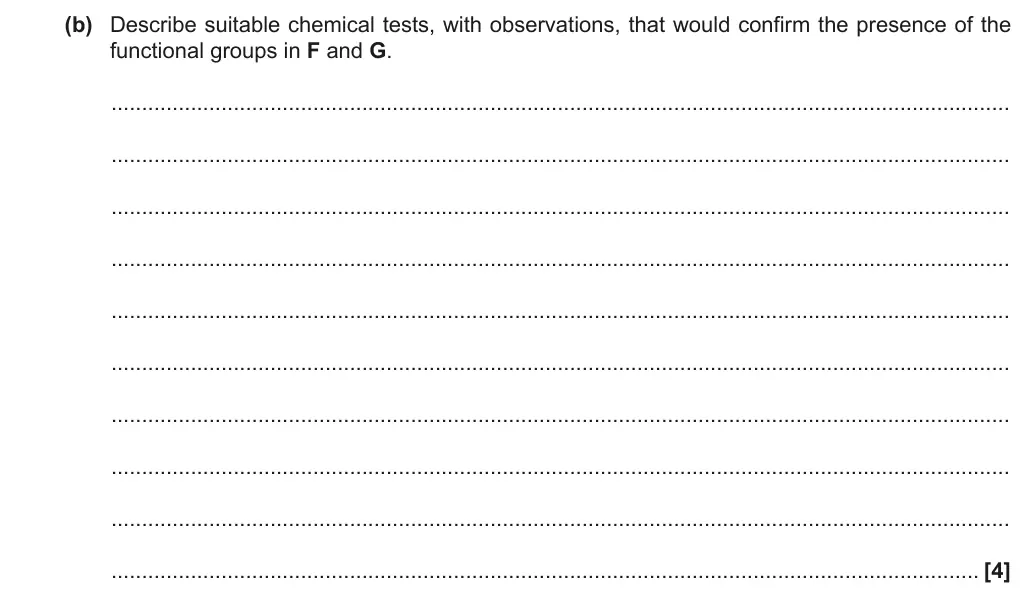
November 2020 · Paper 2 · Q19(b)4 marksAO2, 3Short answerHard
Earlier part of question 19 that this part uses
Mark scheme
Examiner's comment
Question 19(b) Candidates who found this question difficult often did not give a response that would identify all three of the functional groups (aldehyde, ketone and alkene).
Notes from the mark scheme and report
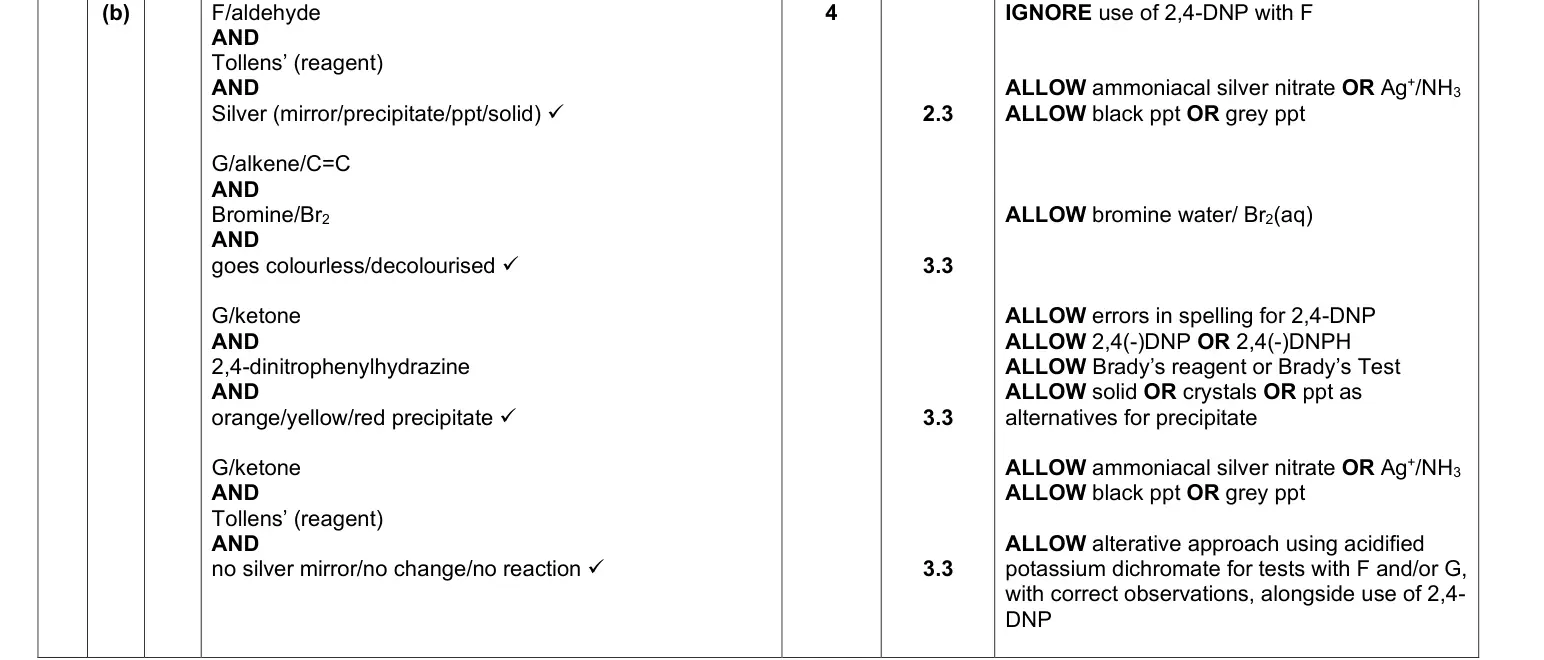
each mark needs compound/group, reagent AND observation
F: Tollens' gives silver mirror
G: bromine decolourised, 2,4-DNP gives orange precipitate, no change with Tollens'
IGNORE 2,4-DNP with F
Skills: PAG7 Qualitative analysis of organic functional groups
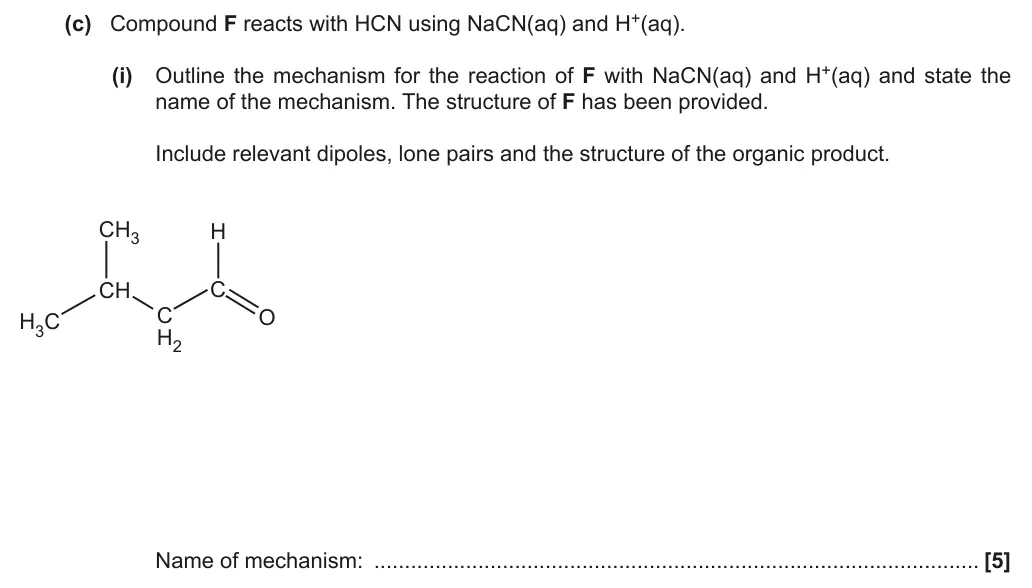
November 2020 · Paper 2 · Q19(c)(i)5 marksAO1, 2Mechanism
Earlier part of question 19 that this part uses
Mark scheme
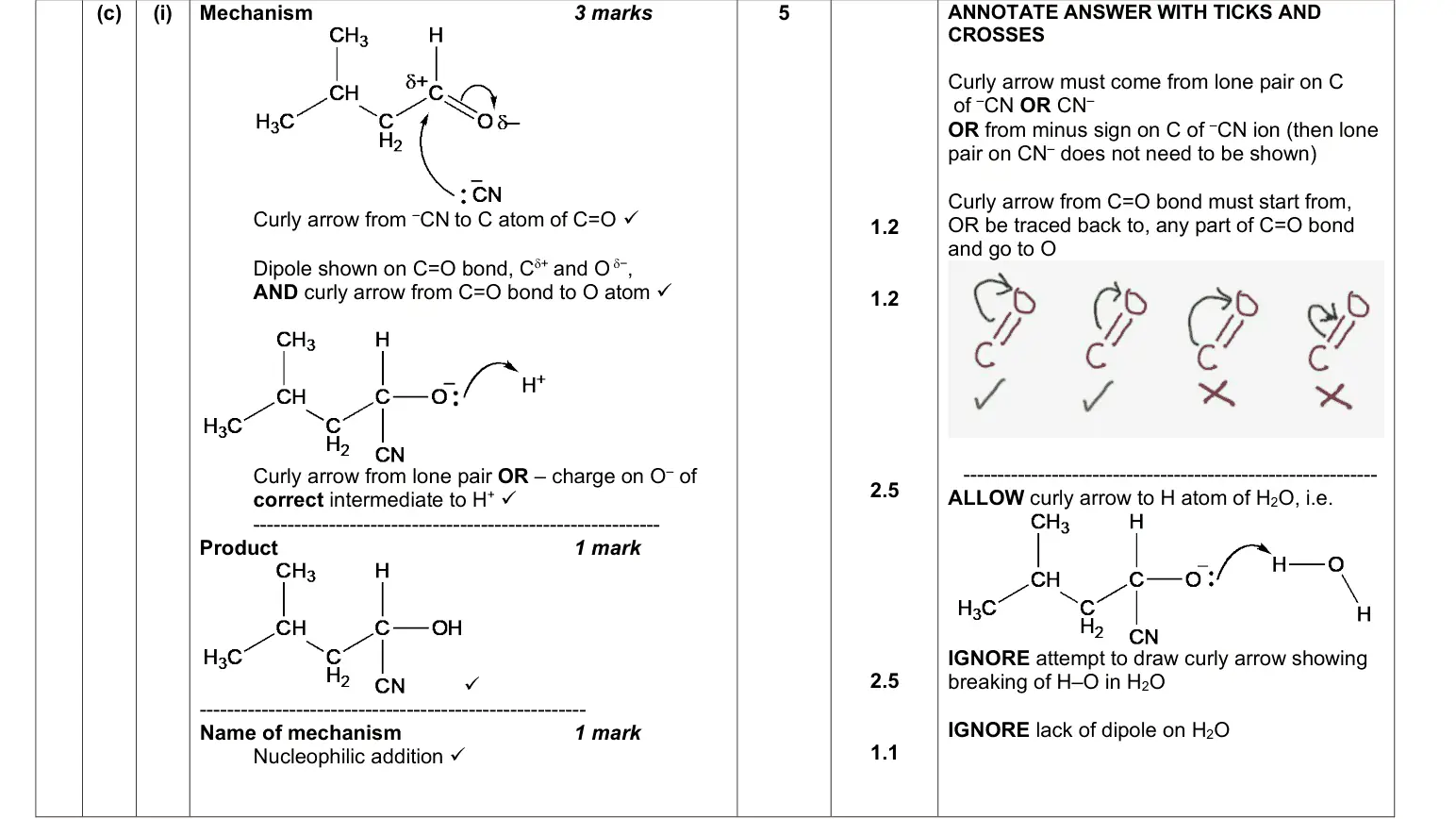
Notes from the mark scheme and report
curly arrow from lone pair on C (or – charge) of –CN to C of C=O
dipole on C=O AND arrow from bond to O
arrow from O– of intermediate to H+ (ALLOW to H of H2O)
nucleophilic addition
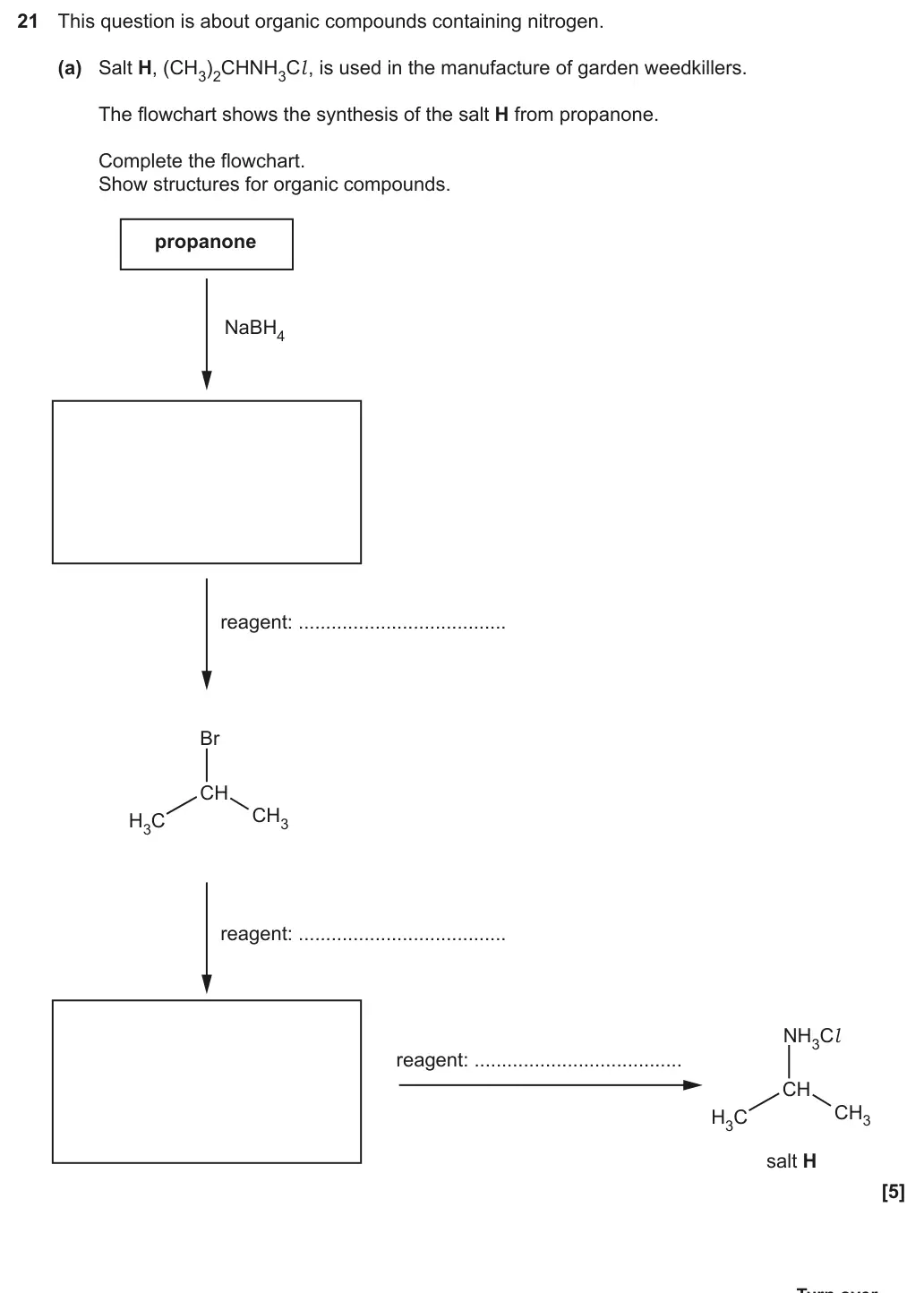
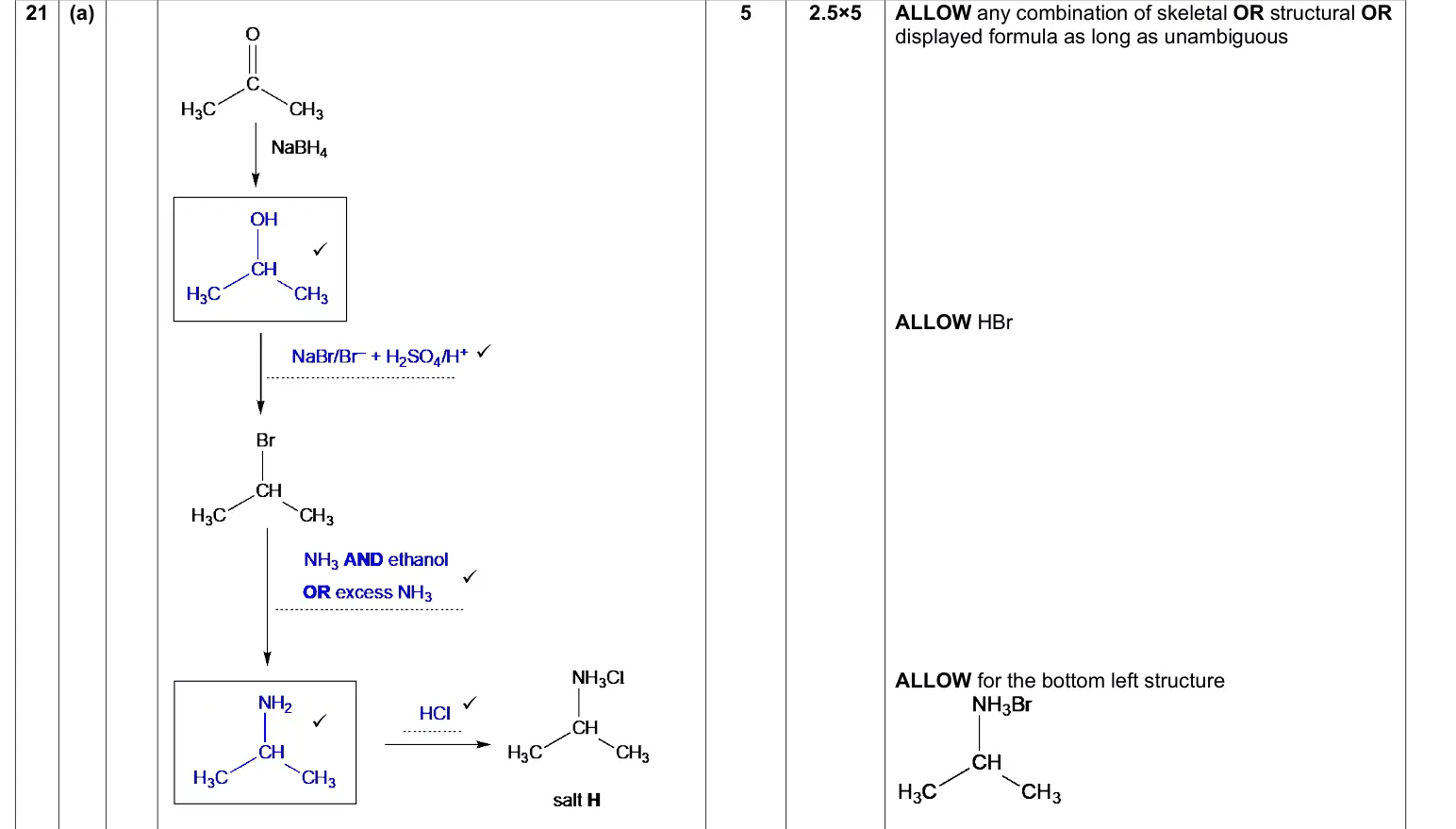
November 2020 · Paper 2 · Q21(a)5 marksAO2Complete table/diagram
Mark scheme
Notes from the mark scheme and report
propan-2-ol
NaBr/H2SO4 (ALLOW HBr)
excess NH3 in ethanol gives (CH3)2CHNH2
HCl for the salt
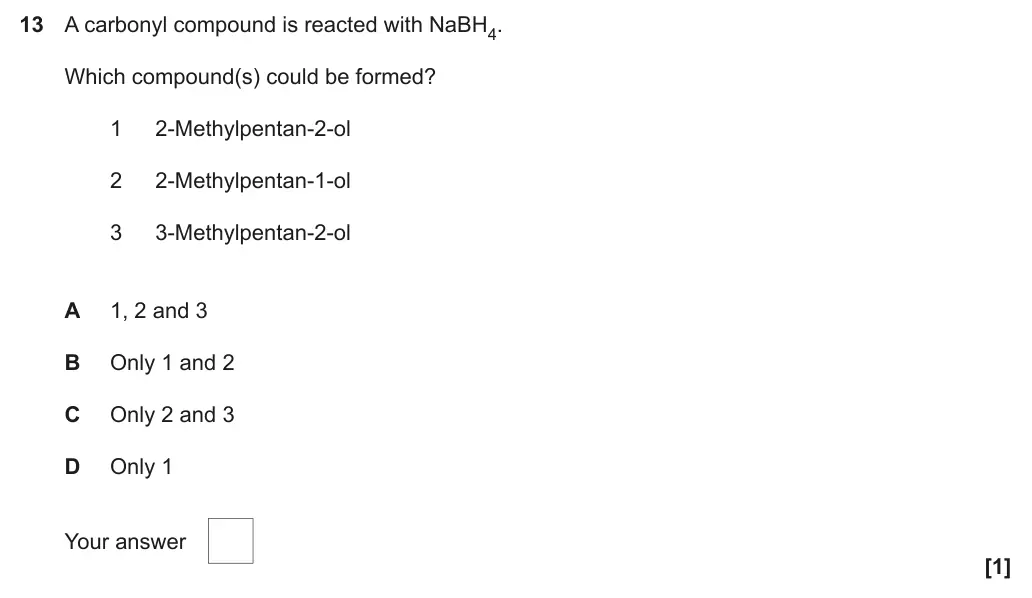
June 2019 · Paper 2 · Q131 markAO1Multiple choiceHard
Answer
C
Mark scheme
Examiner's comment
This question discriminated well, with the higher ability candidates correctly selecting C. The most common incorrect response was A.
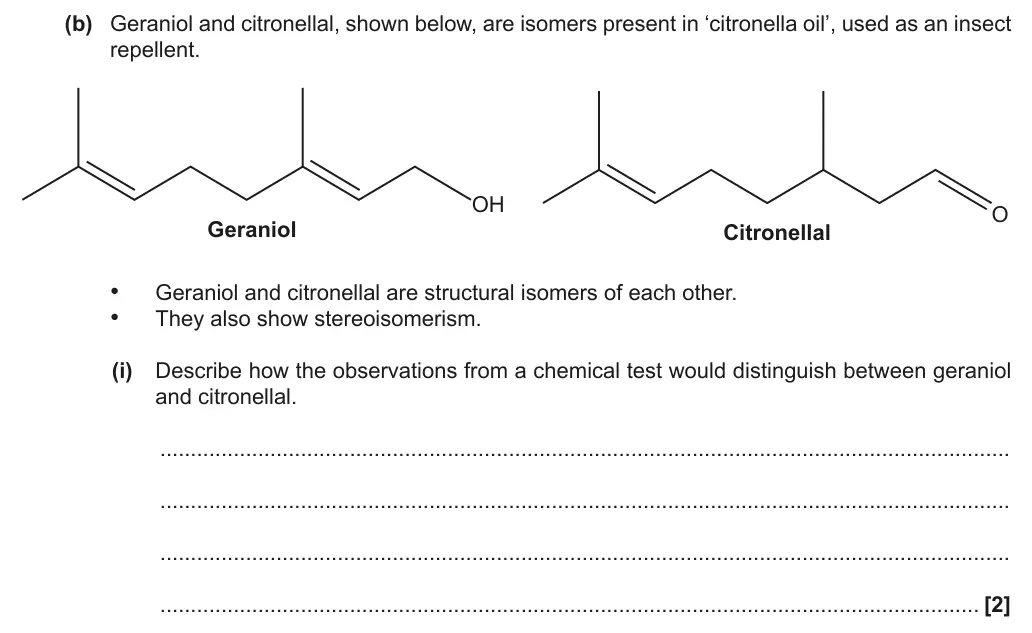
June 2019 · Paper 2 · Q16(b)(i)2 marksAO1Short answerEasy
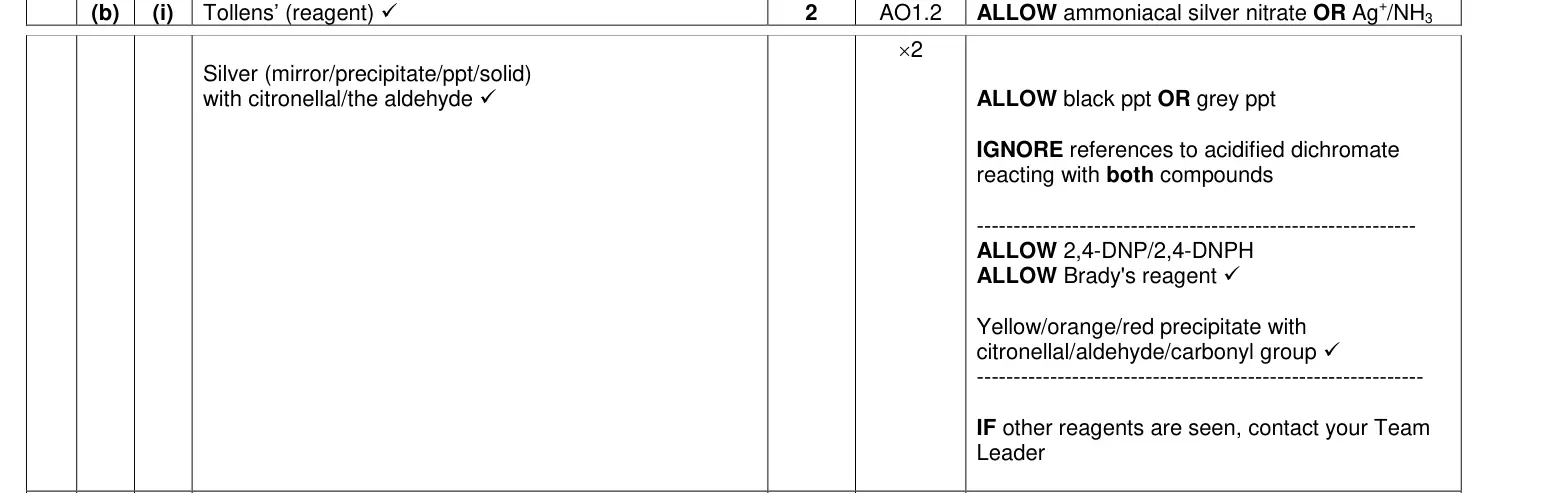
Mark scheme
Examiner's comment
Almost all candidates were able to describe a suitable test to distinguish between geraniol and citronellal and most scored both marks. The most common choice was to use Tollens’ reagent to identify the aldehyde group in citronellal by the formation of a silver mirror. Other candidates opted for 2,4- dinitrophenylhdrazine to differentiate the carbonyl compound from the alcohol.
Notes from the mark scheme and report
Tollens' reagent: silver mirror with citronellal
ALLOW 2,4-DNP orange precipitate with citronellal
IGNORE acidified dichromate (reacts with both)
Skills: PAG7 Qualitative analysis of organic functional groups
June 2019 · Paper 2 · Q18(e)(i)6 marksAO36-mark level of responseMedium
Mark scheme, with the levels and indicative points
Examiner's comment
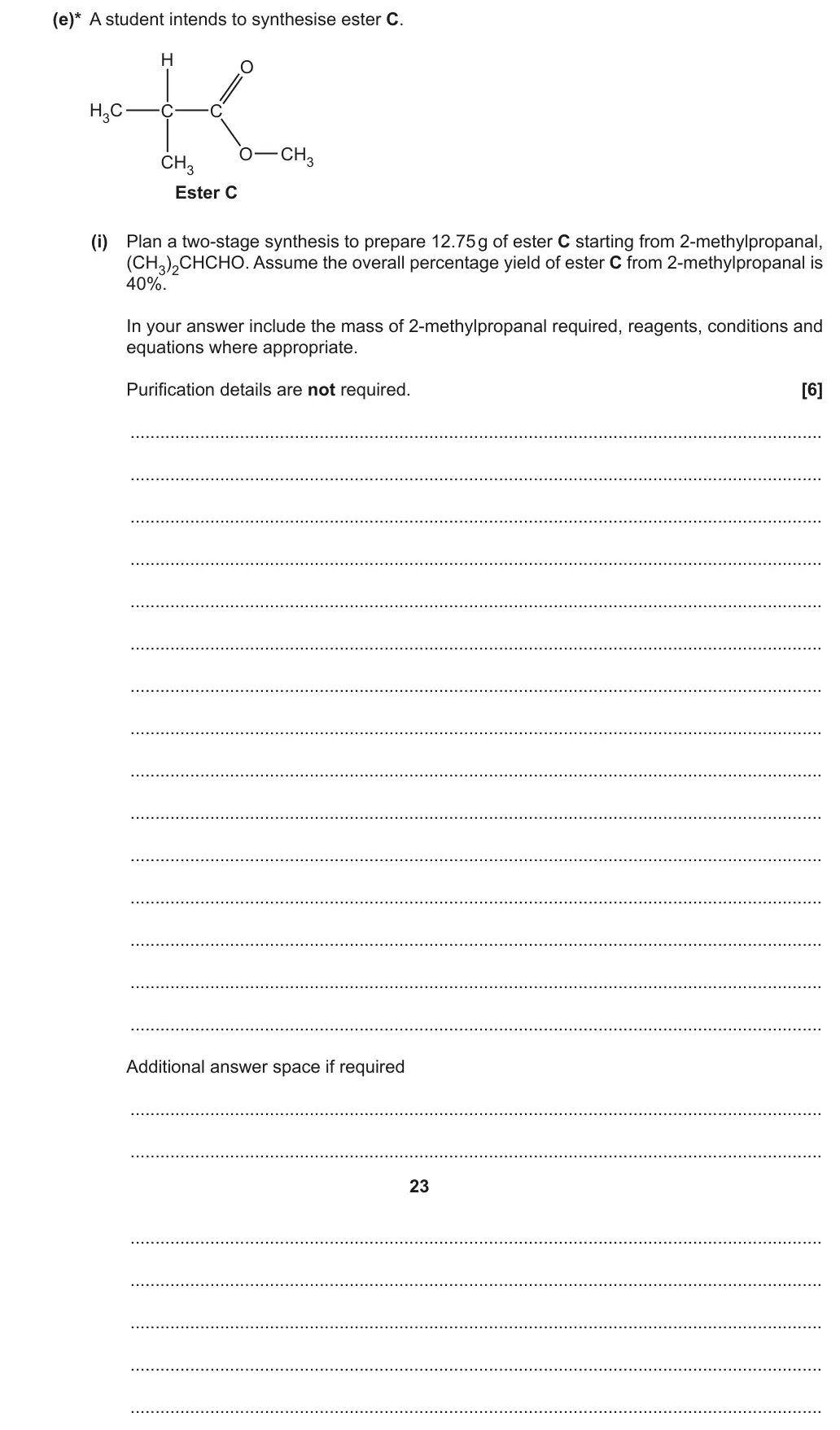
This question was marked using a level of response mark scheme. Most candidates gave a response worthy of at least Level 2 (3-4 marks) by either providing the synthetic steps with reagents and/or equations for the synthesis of ester C as well as calculating the mass of 2-methylpropanal required. determined the mass correctly and showed the synthesis efficiently, using equations to communicate the preparation of ester C and received Level 3 (5-6 marks). Some responses focused solely on the 2- methylpropanal and suggested it would be both oxidised and reduced with each of the products being used to form an ester. Others omitted the mass calculation or gave only a partial synthesis. Such responses received Level 1 (1-2 marks). A variety of responses was seen in this demanding question. In general candidates adopted one of two approaches. The most common was to multiply the Mr of 2-hydroxybenzoic acid by 200 and then subtract the mass of the 199 water molecules removed during polymerisation. The other approach used the Mr of the repeat unit. This was multiplied by 200 and the mass of H and OH at each end of the polymer was added to give the final answer. Many candidates were successful with the first step of their approach, but the best responses included the second step taking into account the Mr of water. A significant number of candidates used an incorrect value for the Mr in their first step. Candidates are advised to draw out the structure of a compound before determining the Mr. This is particularly important when only a name is given in the question. This response includes an excellent description of the synthesis of ester C. Each step is labelled clearly with the most of the reagents and conditions stated and correct equations. The candidate makes little progress with the calculation of the mass of 2-methylpropanal required, completing only the first step. This response satisfies the Level 2 criteria. The information is provided is relevant and presented with a clear logical structure and was therefore given the upper mark within the level and achieved four marks. The presentation of the synthesis by equations rather than words is an excellent strategy. Candidates are advised to adopt such an approach in questions like this as it allows them develop and clear line of reasoning without the need to write lots of unnecessary text.
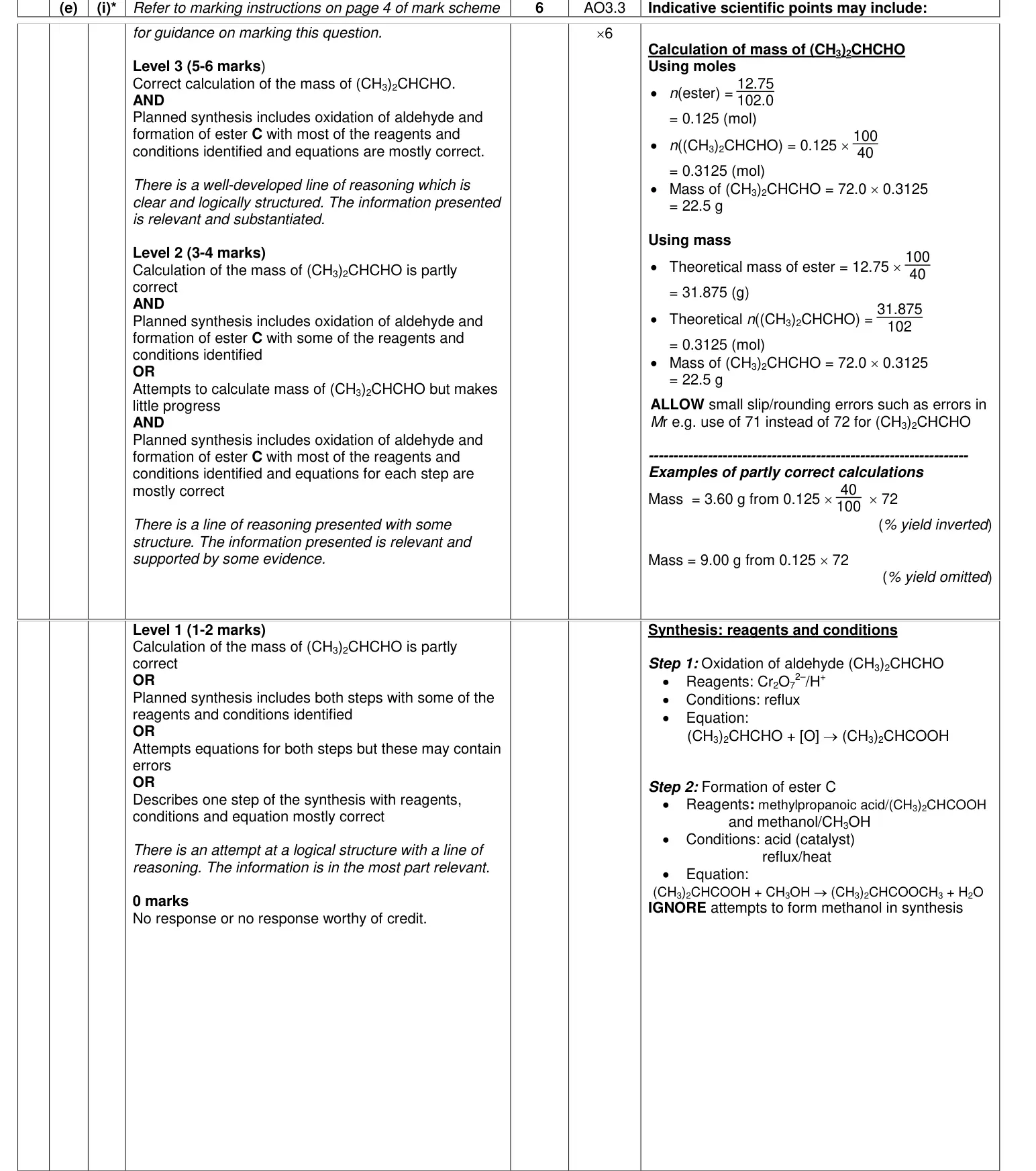
Notes from the mark scheme and report
22.5 g (n = 0.125 × 100/40)
partly correct: 3.60 g (yield inverted), 9.00 g (yield omitted)
step 1 Cr2O72–/H+ reflux with [O] equation
step 2 methanol with acid catalyst, heat/reflux
IGNORE attempts to make methanol
Skills: M0.2 Use ratios, fractions and percentages; M2.3 Substitute numerical values into algebraic equations using appropriate units for physical quantities
June 2019 · Paper 2 · Q19(b)(iv)7 marksAO2Short answerHard
Earlier parts of question 19 that this part uses
Mark scheme
Examiner's comment
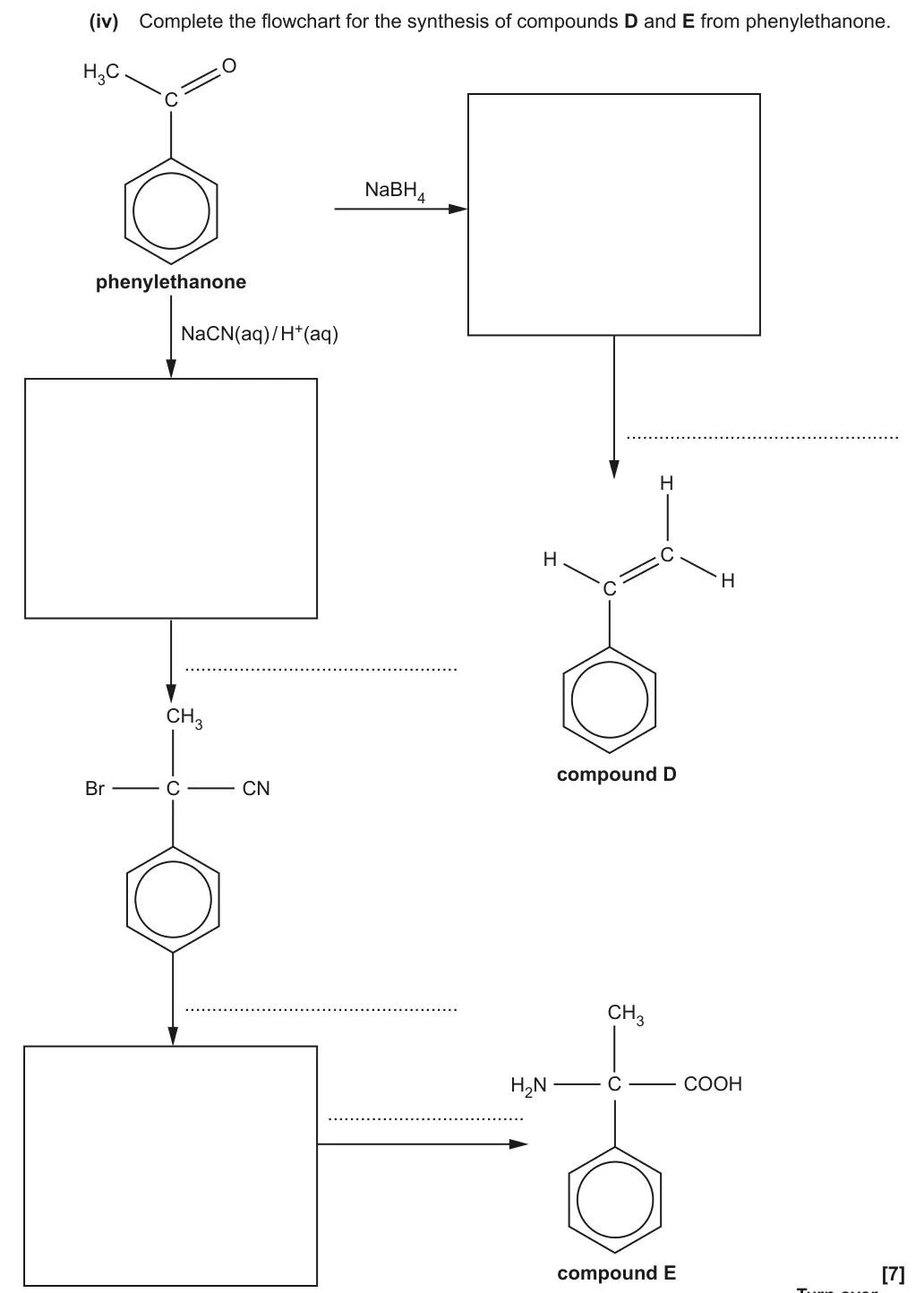
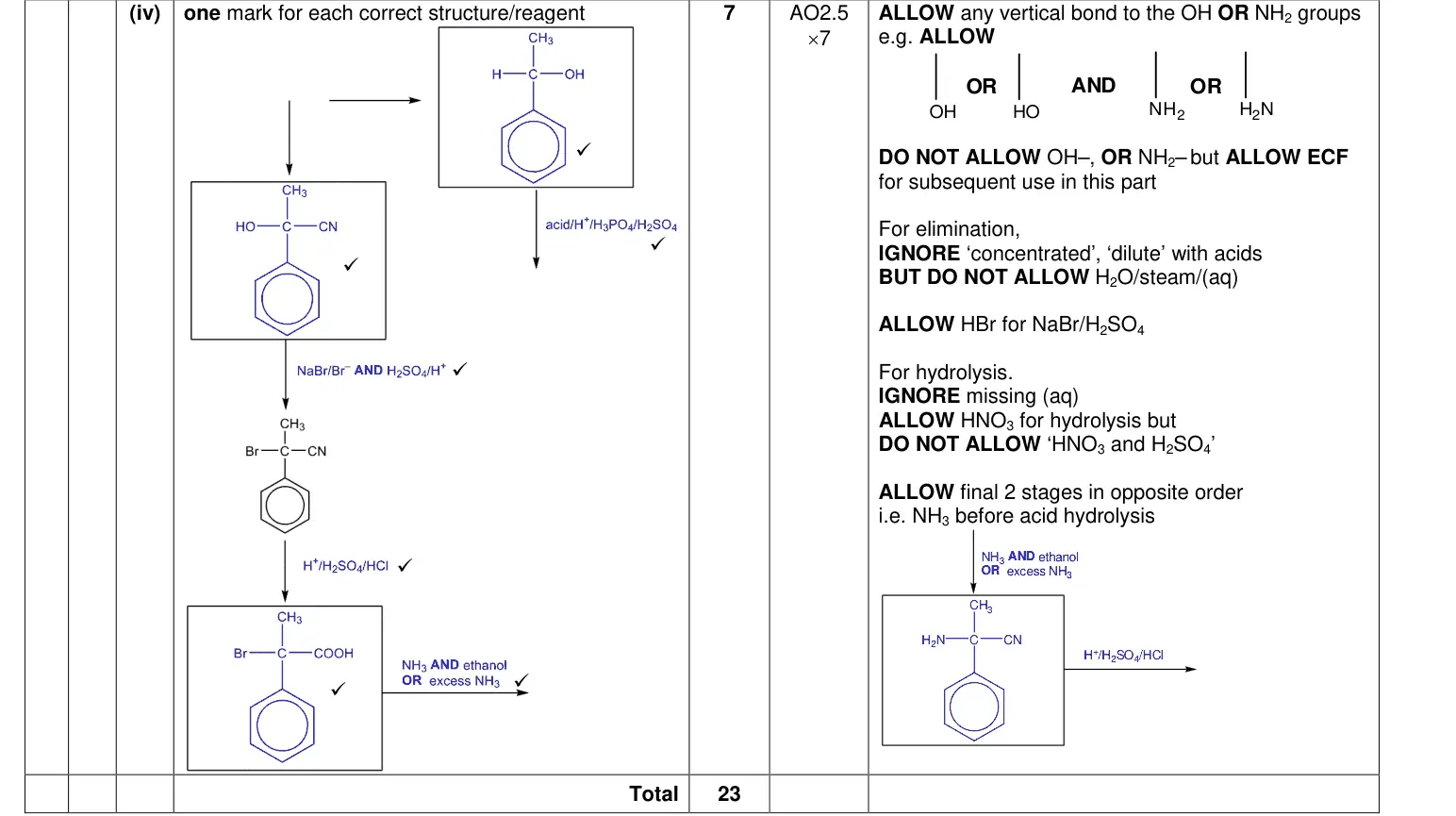
This question required candidates to apply knowledge of organic reactions from across the specification and discriminated well. Candidates with a good knowledge of reagents and conditions frequently scored over five marks. More detailed feedback is discussed with Exemplar 7, below. Phenylethanone is the starting point of this flowchart which shows the synthesis of compounds D and E. Synthesis of D The first step in the synthesis of D is the reduction of the ketone group. This response demonstrates a common error seen by examiners. The candidate has correctly deduced that than alcohol is formed but has omitted a hydrogen atom. Candidates are advised to take care when drawing structures. If a carbon atom is displayed it should be shown to be making four bonds. The final step of the synthesis is the dehydration of the alcohol with an acid. This candidate has used H3PO4. H2SO4 was also frequently seen. Lower ability responses included reference to water or steam and this was not credited. Synthesis of E The first step of the synthesis of E from phenylethanone is the reaction with NaCN(aq)/H+(aq). This candidate identifies that the product of the reaction is a hydroxynitrile but unfortunately this cannot be credited due to the incorrect linking of the OH group via the H atom. Candidates should be aware that, when drawing structures, groups must be bonded via the correct atoms. The next step of the synthesis is the substitution of the OH group. The candidate correctly recognises that NaBr is a suitable reagent but omits an acid, e.g. H2SO4, which is also required for this reaction. This error was seen frequently by examiners. The final two steps involve the substitution of the Br atom and acid hydrolysis of the nitrile group. In this case the candidate chooses the reaction with excess NH3. The structure of the correct product of this reaction is shown and the synthesis is completed by identifying a suitable reagent for the final step. Other candidates opted to perform these steps in the reverse order and the mark scheme allowed full credit for either approach. Common errors in the final steps were omissions. Some candidates simply stated NH3 without mentioning ethanol. Others identified water as important for the hydrolysis but did not include reference to an acid.
Notes from the mark scheme and report
1-phenylethanol then acid catalyst (DO NOT ALLOW H2O/steam/(aq)) for D
hydroxynitrile, NaBr/H2SO4 (ALLOW HBr), acid hydrolysis of CN, excess NH3/ethanol (last two stages in either order)
DO NOT ALLOW OH– or NH2– for the groups
June 2018 · Paper 2 · Q31 markMultiple choiceMedium
Answer
B
Mark scheme
Examiner's comment
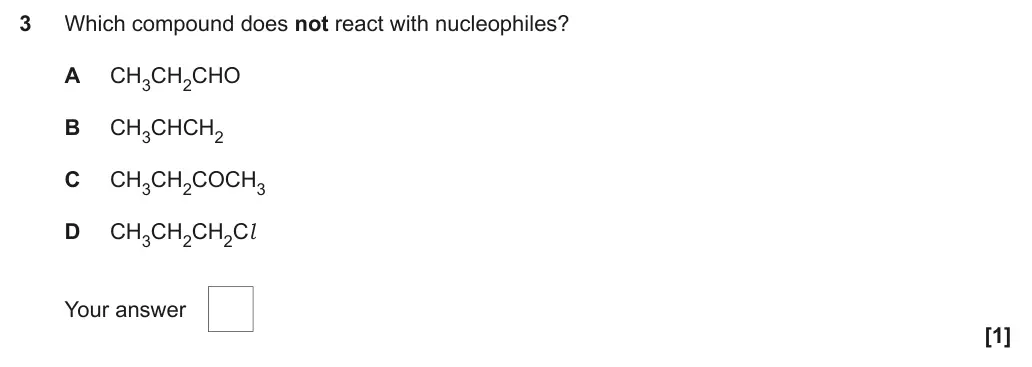
The majority of candidates identified B (an alkene) as the compound that does not react with nucleophiles.
June 2018 · Paper 2 · Q20(b)(ii)1 markShort answerEasy
Earlier part of question 20 that this part uses
Mark scheme
Examiner's comment
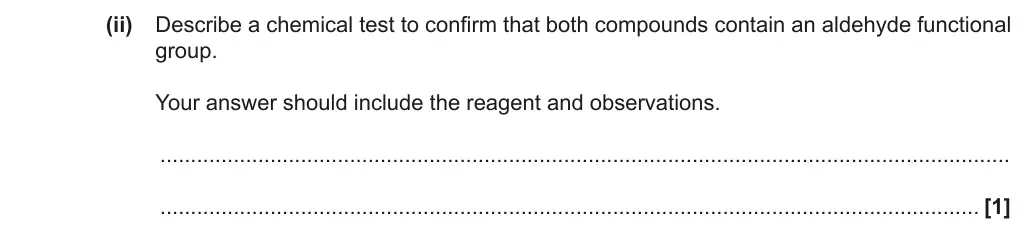
Almost all candidates were able to correctly describe the use of Tollens’ reagent as a test for an aldehyde functional group.
Notes from the mark scheme and report
both reagent and observation required: Tollens' reagent and silver mirror (ALLOW black/grey ppt)
Skills: PAG7 Qualitative analysis of organic functional groups
June 2018 · Paper 2 · Q20(b)(iii)3 marksShort answerMedium
Earlier part of question 20 that this part uses
Mark scheme
Examiner's comment
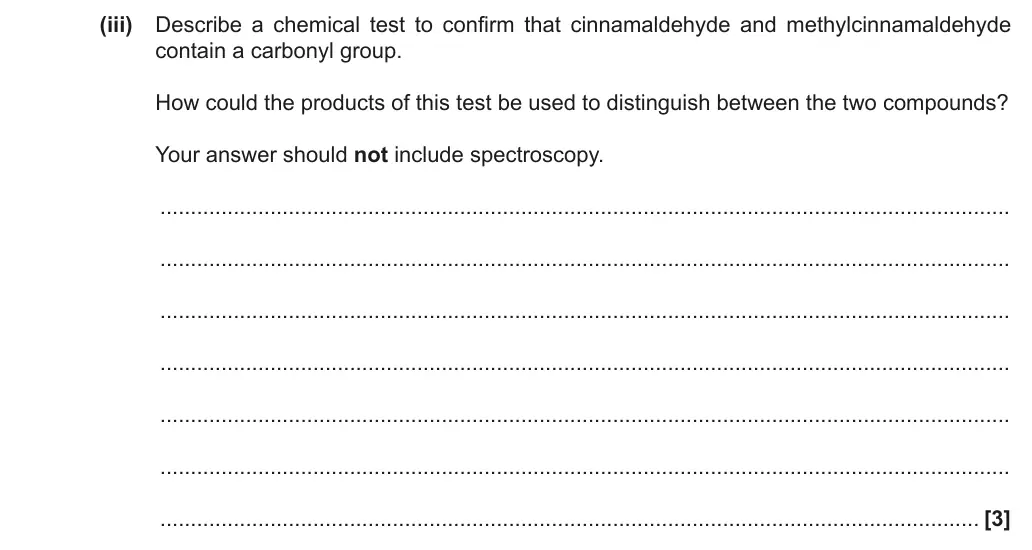
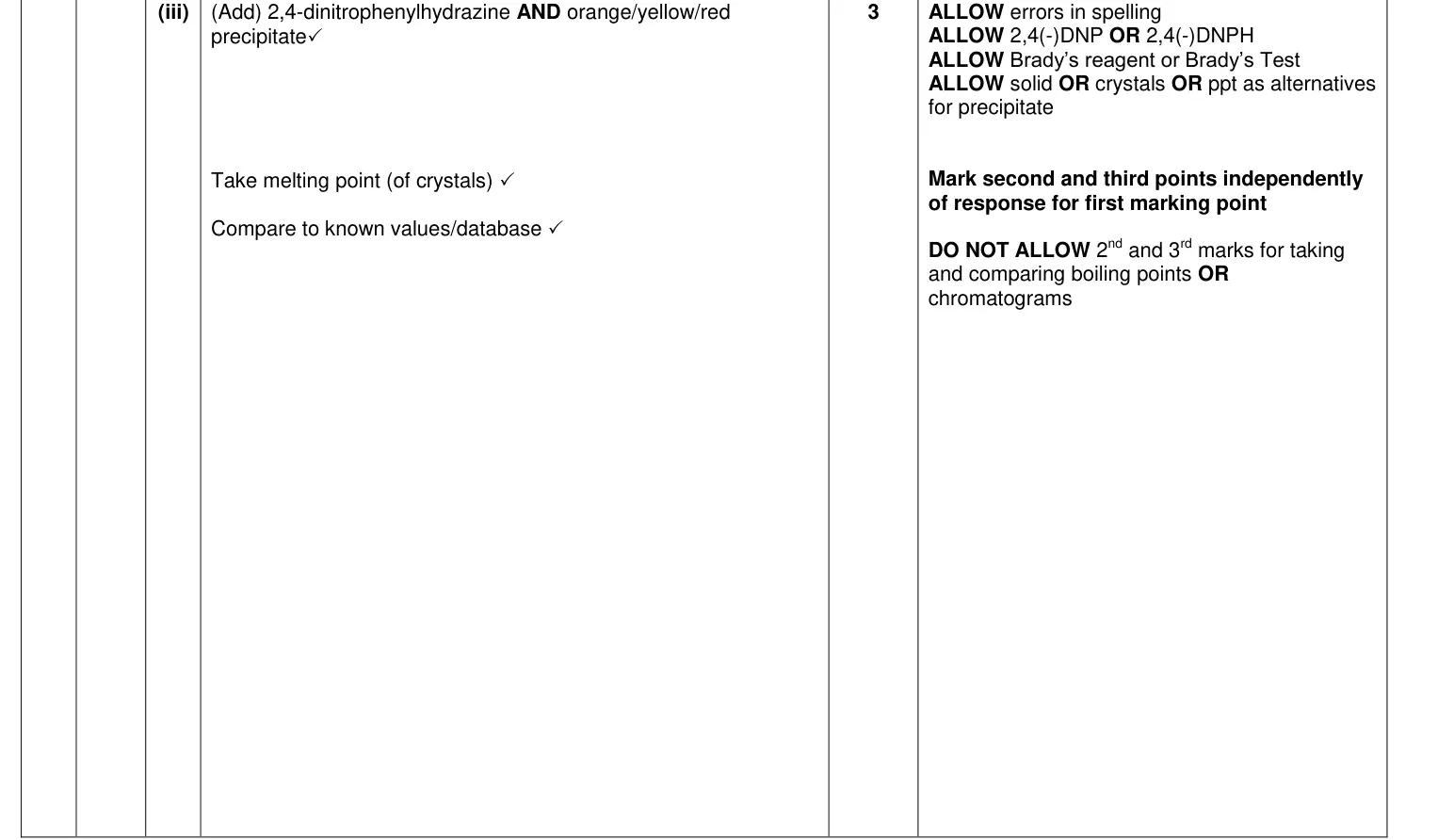
The use of 2,4-dinitrophenylhydrazine as a test for the carbonyl group is well known by candidates at this level. The majority of the cohort correctly identified this test and the subsequent analysis of the melting point of the products as a method of identifying each compound. Lower ability candidate responses made reference to analysis of the boiling points of the cinnamaldehyde and methylcinnamaldehyde as a means of identification.
Notes from the mark scheme and report
2,4-DNP(H) gives orange/yellow/red precipitate
take melting point of the derivative
compare with known values
DO NOT ALLOW boiling points or chromatograms
Skills: PAG6 Synthesis of an organic solid; PAG7 Qualitative analysis of organic functional groups
June 2018 · Paper 2 · Q20(c)5 marksStructure / isomerMedium
Earlier part of question 20 that this part uses
Mark scheme
Examiner's comment
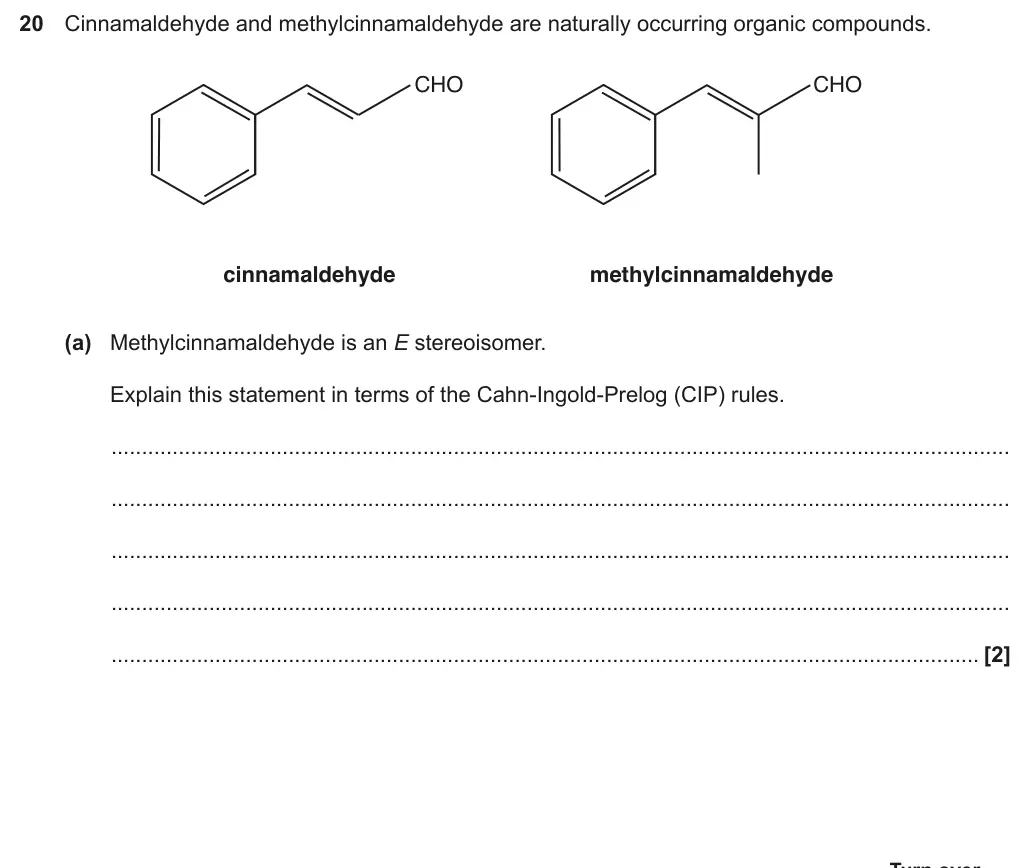
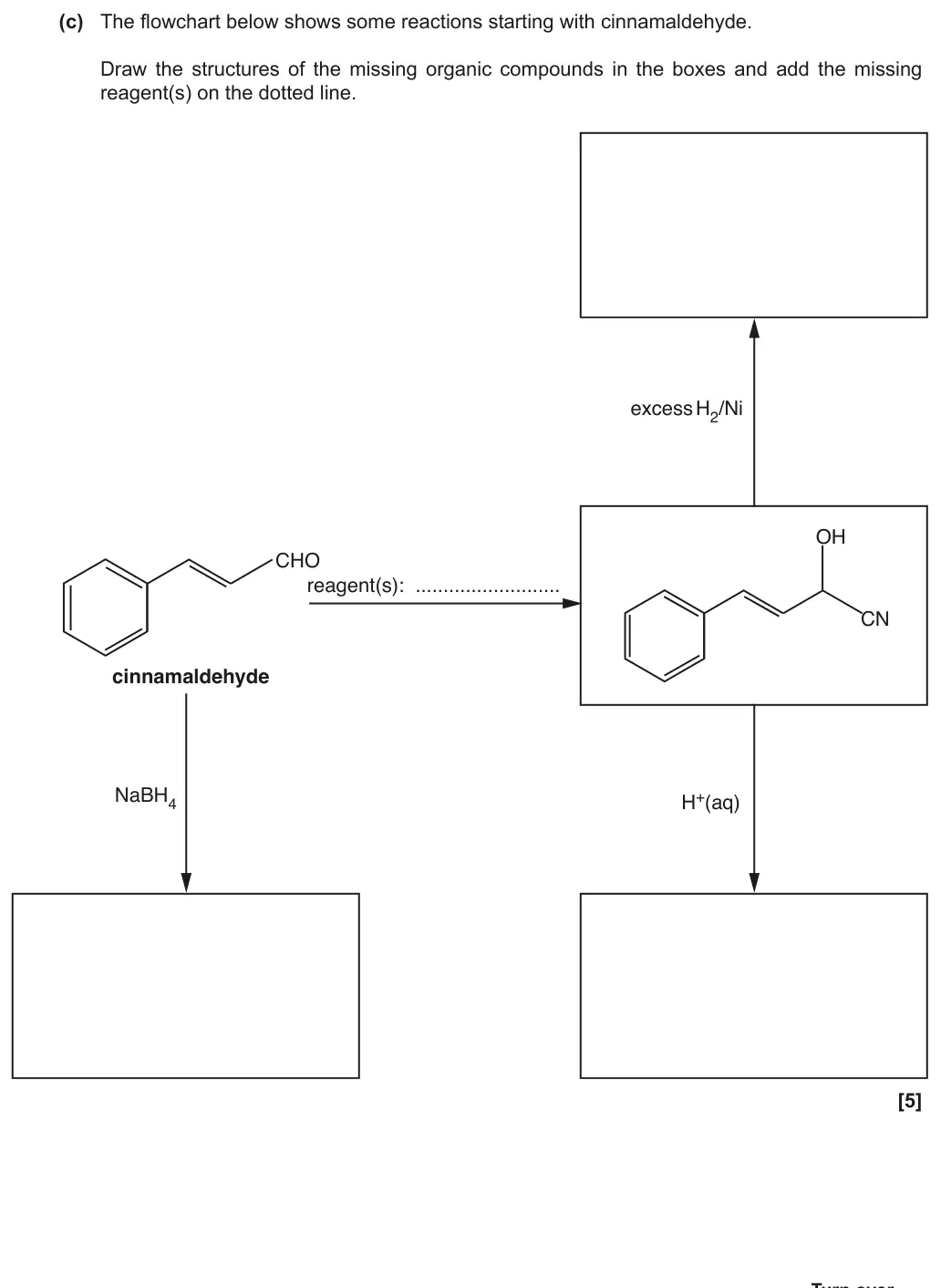
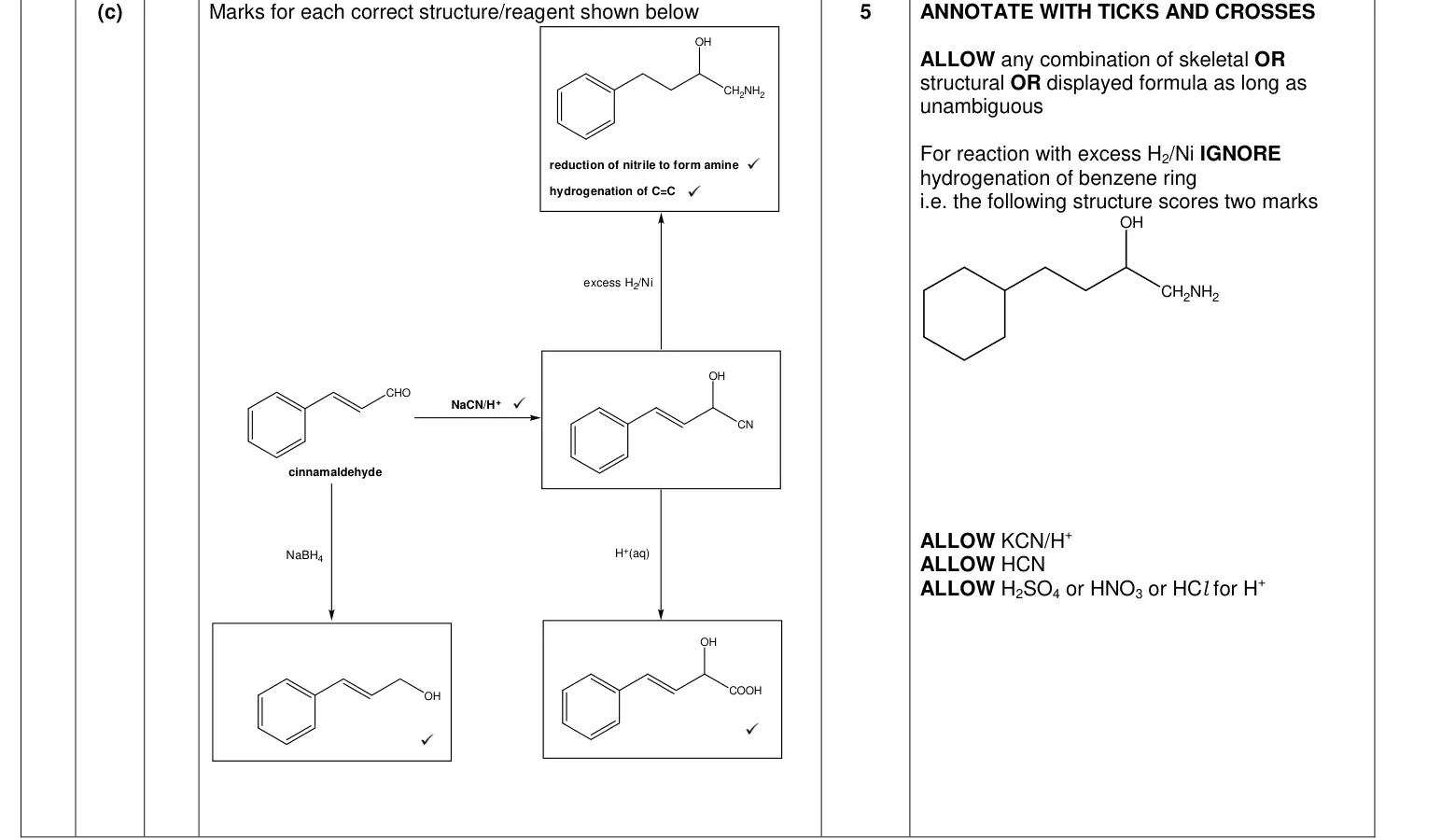
This question proved difficult and although the majority of candidates scored in some parts, only the very best responses secured all five marks. More detailed feedback is discussed with Exemplar 8. Cinnamaldehyde was the starting point for this flowchart of reactions. The most frequently scored mark was correct identification of the reagents required for the formation of the hydroxynitrile. This response uses NaCN/H+. Other candidates used HCN which was also acceptable. The flowchart shows two different reactions of this hydroxynitrile. The first is the reaction with excess hydrogen in the presence of Ni. Most candidates scored one mark for their product. As in this exemplar, the double bond was often reacted to form a saturated chain. Some candidates identified that the CN group would also react but instead of writing CH2NH2 they replaced the CN group with just NH2, effectivity removing a carbon atom from the chain. The second reaction of the hydroxynitrile is acid hydrolysis of the CN group. This response identifies the correct carboxylic acid. However, this reaction seemed unfamiliar to many candidates and a range of incorrect responses were frequently seen. The final reaction is the reduction of cinnamaldehyde with NaBH4. Many candidates recognised this reaction, but as can be seen in this response the alcohol group is shown on the incorrect carbon atom. This was a common error. Candidates are advised to number carbon atoms present if provided with a complex structure, such as cinnamaldehyde. Numbering will ensure that each carbon is considered when drawing reaction products and would minimise errors, such as those demonstrated in the reduction product.
Notes from the mark scheme and report
NaCN/H+ or HCN for reagent
NaBH4 reduces CHO only (C=C unchanged)
excess H2/Ni reduces both C=C and C≡N (1 mark each
IGNORE hydrogenation of benzene ring)
H+(aq) hydrolyses nitrile to COOH
June 2018 · Paper 3 · Q6(a)(ii)1 markShort answerEasy
Earlier part of question 6 that this part uses
Mark scheme
Examiner's comment
This part was answered well with most choosing nucleophilic addition. Credit was given just for ‘addition’.
Notes from the mark scheme and report
addition
IGNORE nucleophilic/electrophilic
DO NOT ALLOW addition–elimination, condensation or polymerisation
June 2018 · Paper 3 · Q6(a)(iv)1 markStructure / isomerHard
Earlier parts of question 6 that this part uses
Mark scheme
Examiner's comment
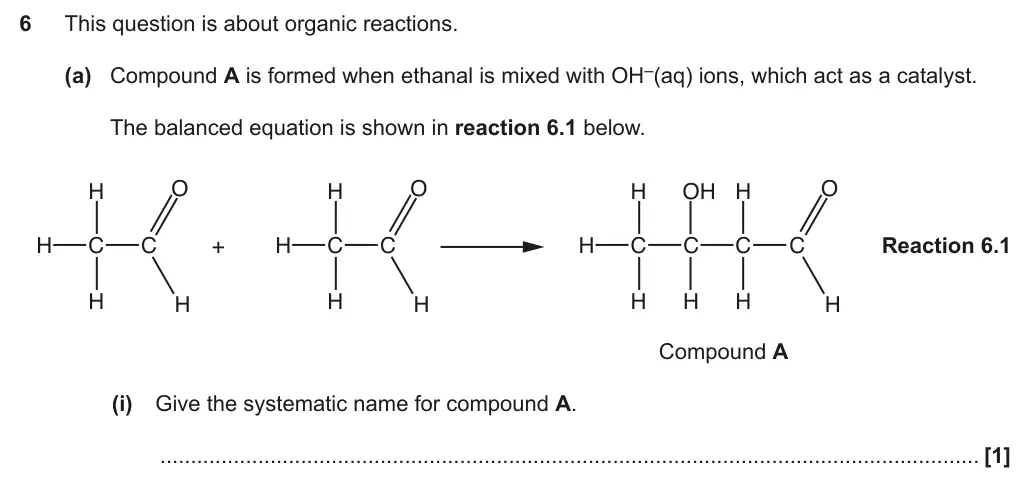
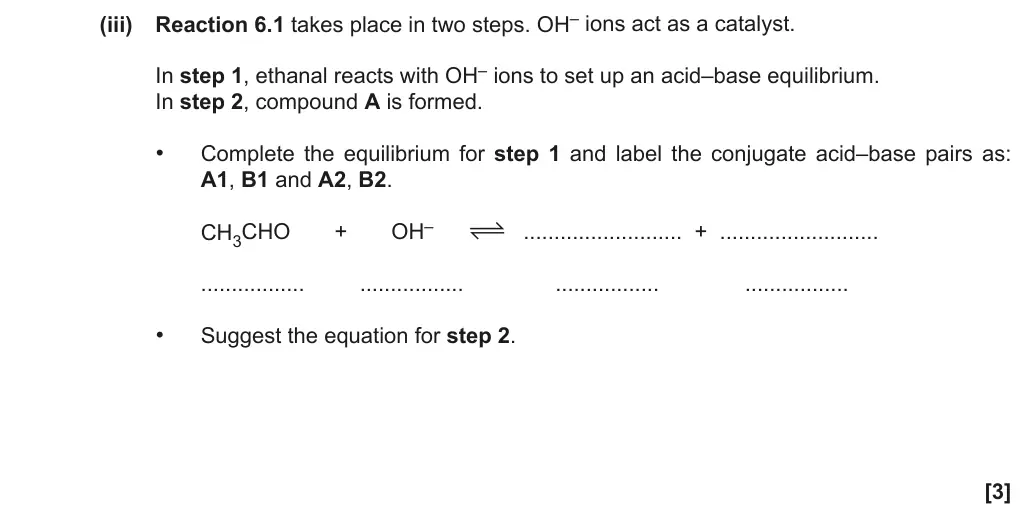
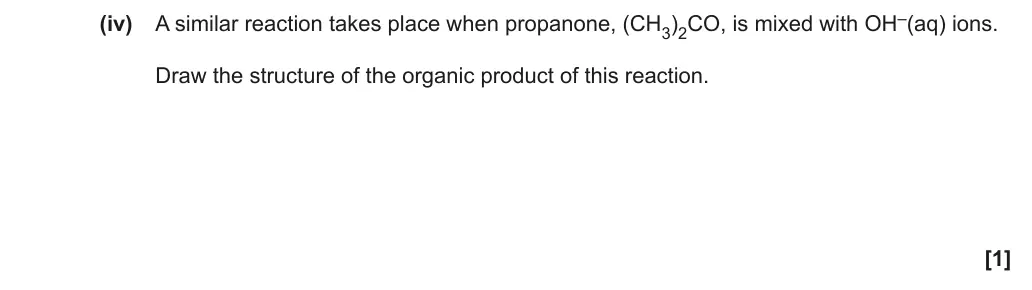
This part was one of the most challenging on the paper. Candidates needed to link the earlier information for combining two ethanal molecules to derive the product for combining two propanone molecules. Despite the challenge, the highest ability candidates were able to come up with the correct structure.
Notes from the mark scheme and report
(CH3)2C(OH)CH2COCH3
connectivity not assessed
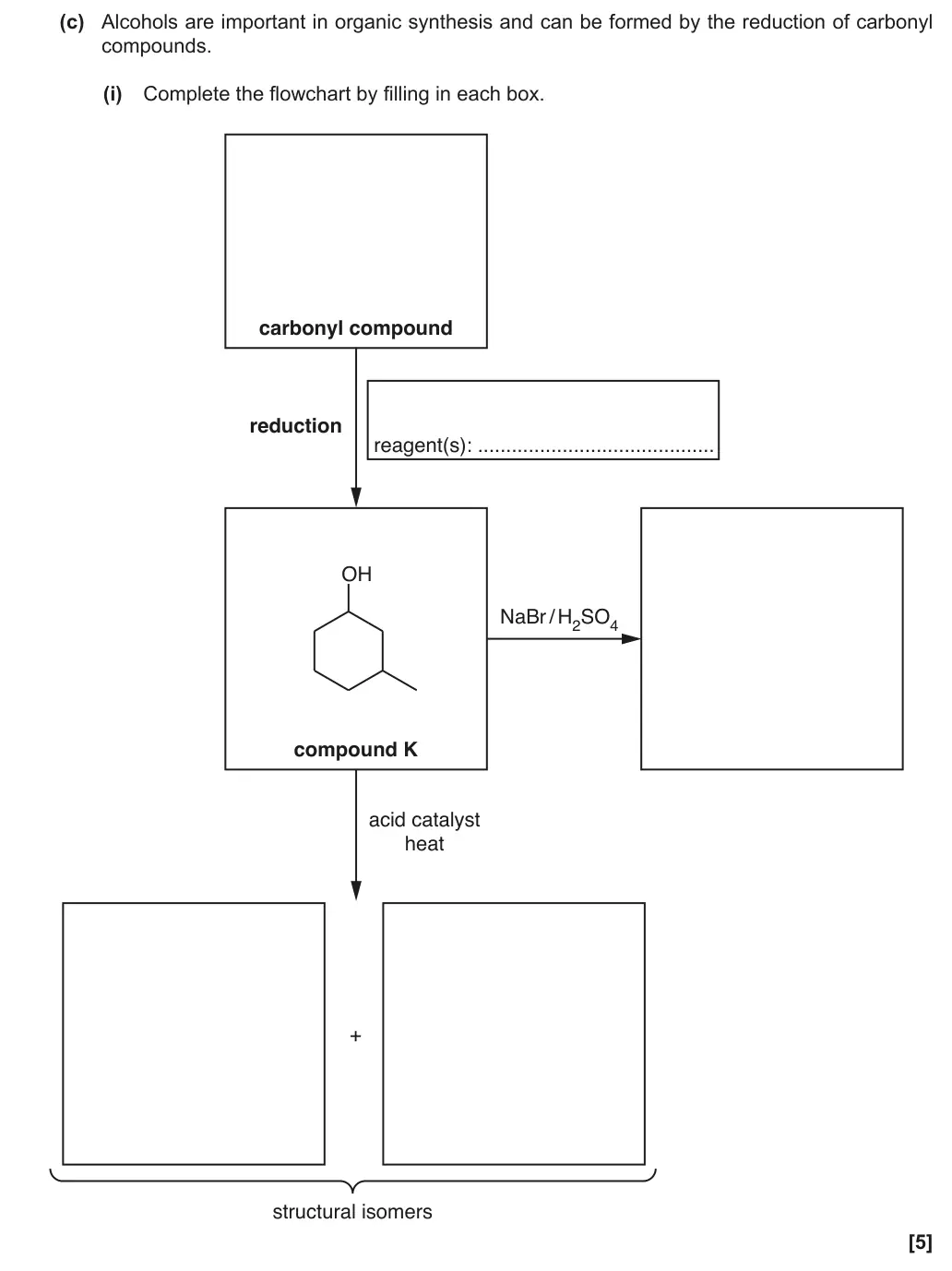
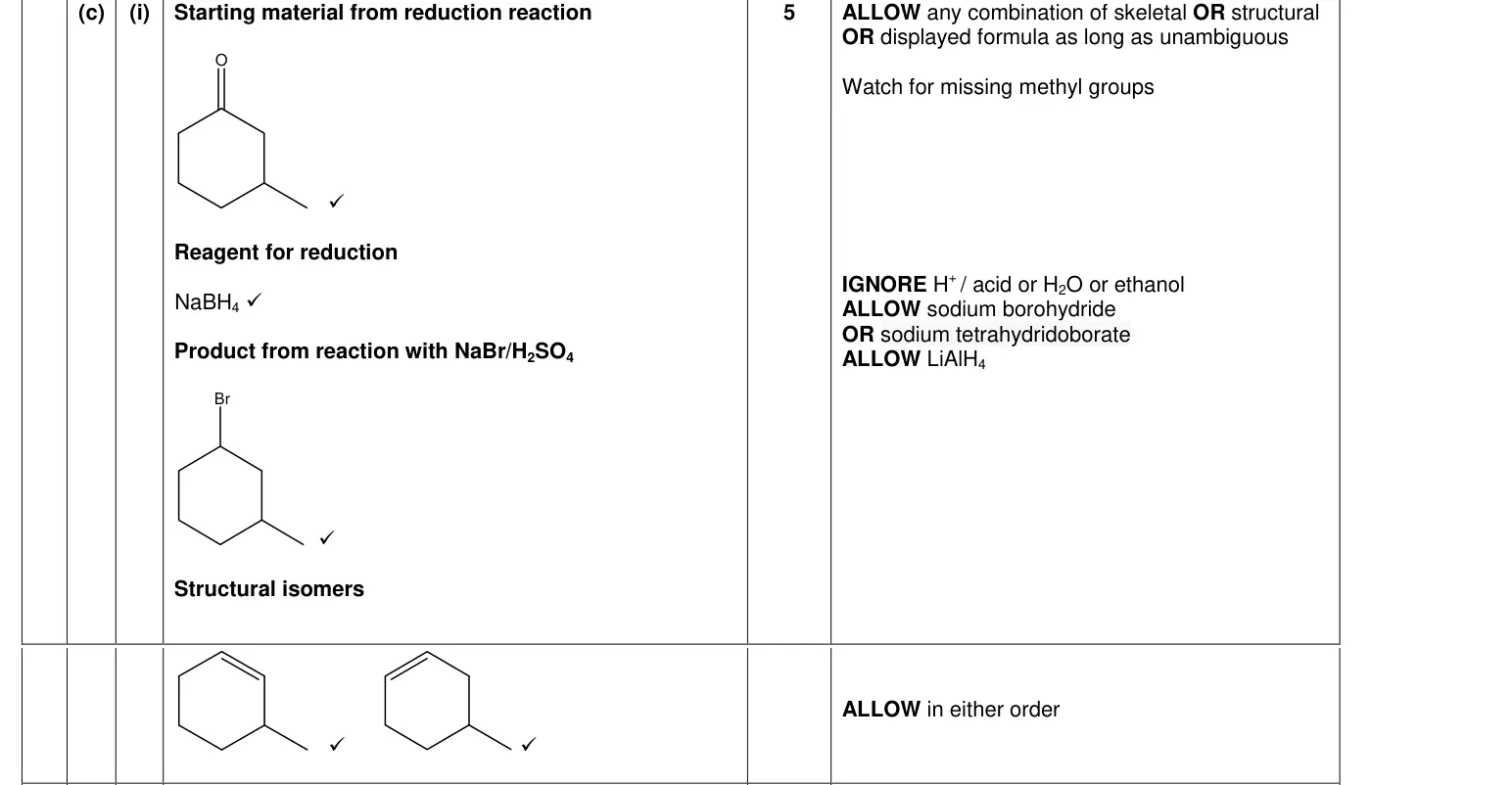
June 2017 · Paper 2 · Q19(c)(i)5 marksShort answer
Mark scheme
Notes from the mark scheme and report
3-methylcyclohexanone
NaBH4 (ALLOW LiAlH4)
1-bromo-3-methylcyclohexane
3-methylcyclohexene and 4-methylcyclohexene in either order
watch for missing methyl groups
Work with an OCR chemistry tutor
Dropping marks on calculations, mechanisms or the six-markers? Book a trial session with a specialist OCR chemistry tutor.