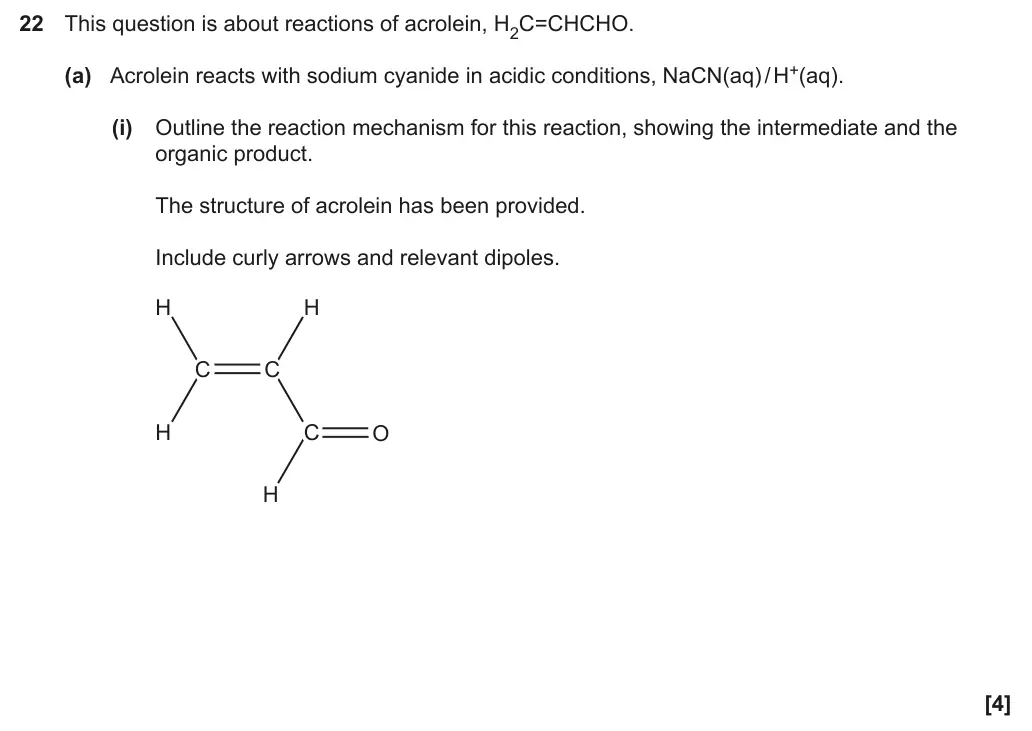
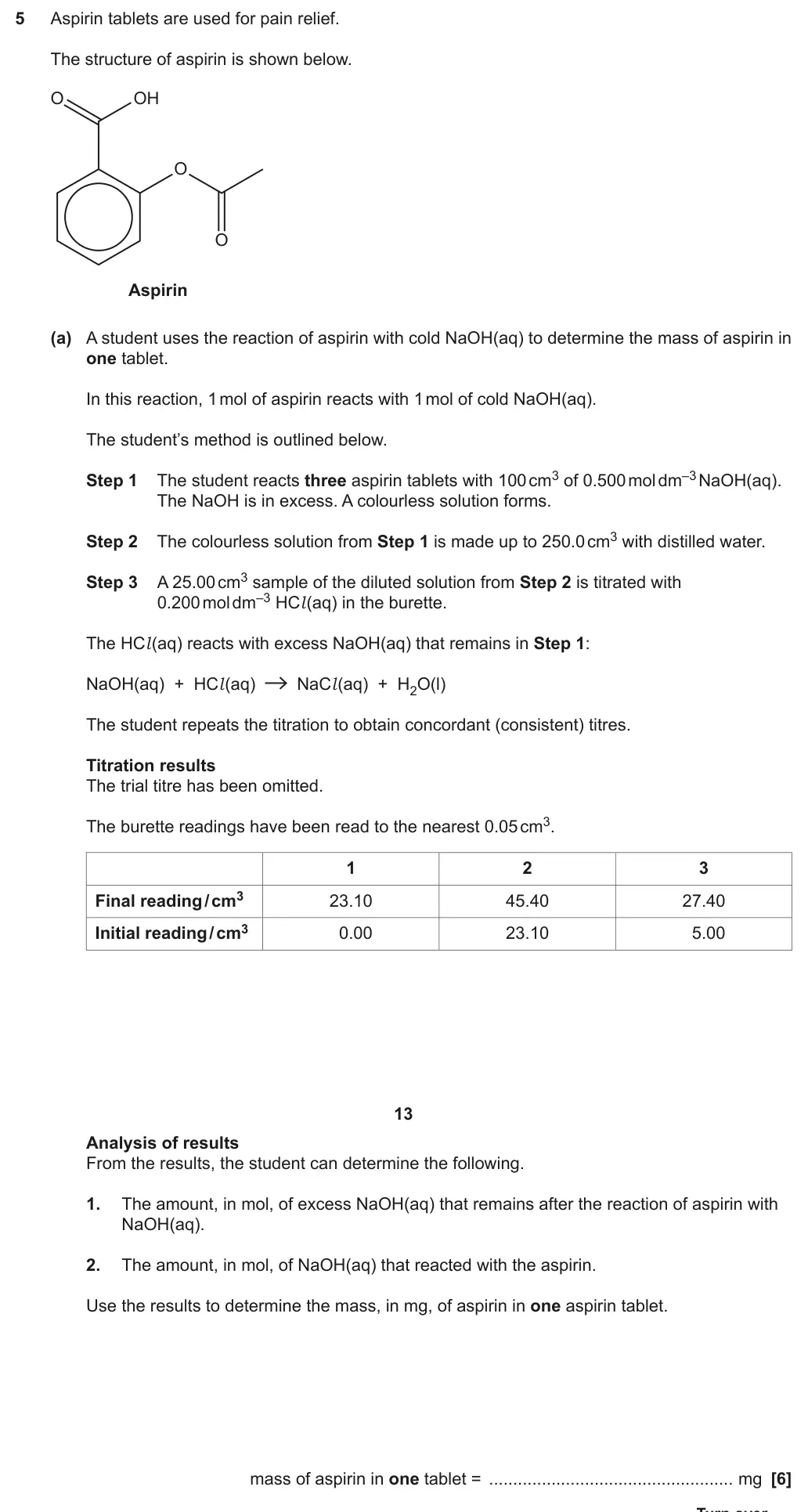
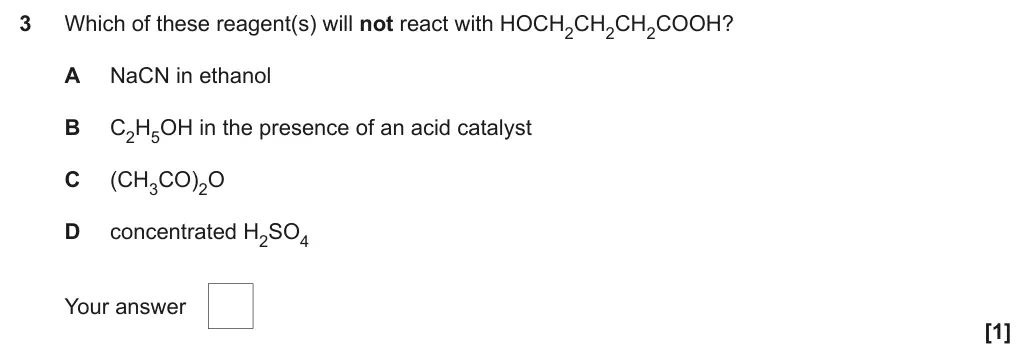
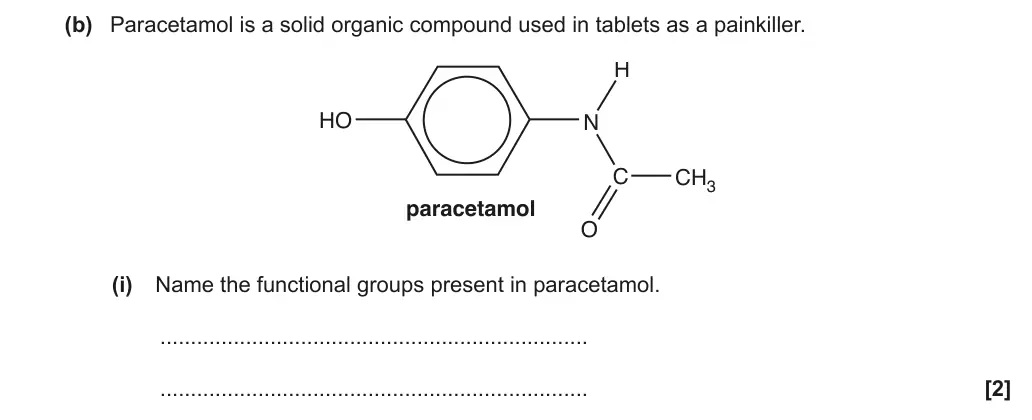
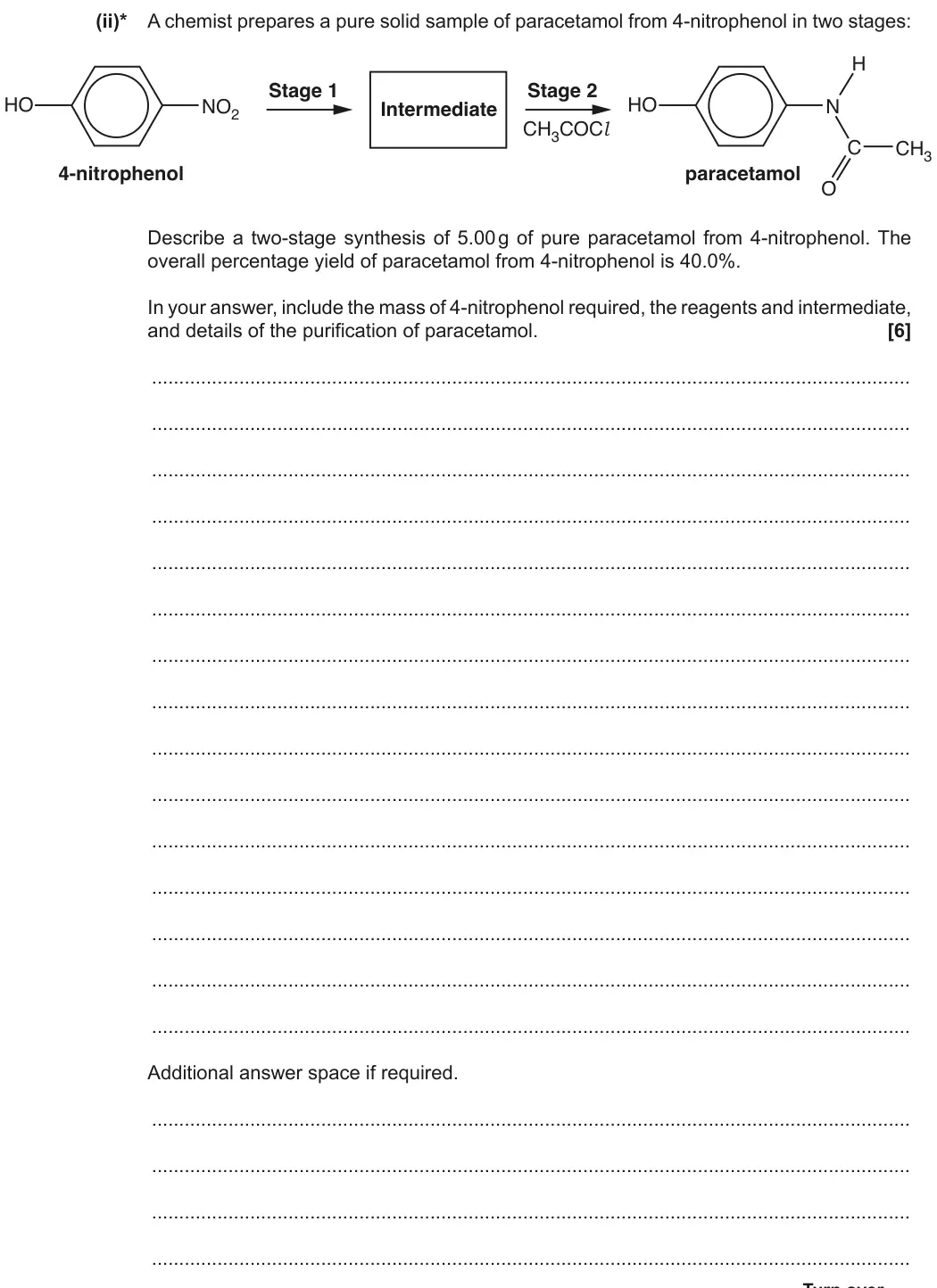
A chemist prepares a pure solid sample of paracetamol from 4-nitrophenol in two stages: Describe a two-stage synthesis of 5.00 g of pure paracetamol from 4-nitrophenol. The
Tap a question to zoom it. Where a part needs a table, graph or structure from an earlier part, that part folds out above it; the mark scheme and examiner's comment open underneath. Have the OCR Data Sheet beside you.
June 2025 · Paper 2 · Q51 markMultiple choiceHard
Answer
B
Mark scheme
Examiner's comment
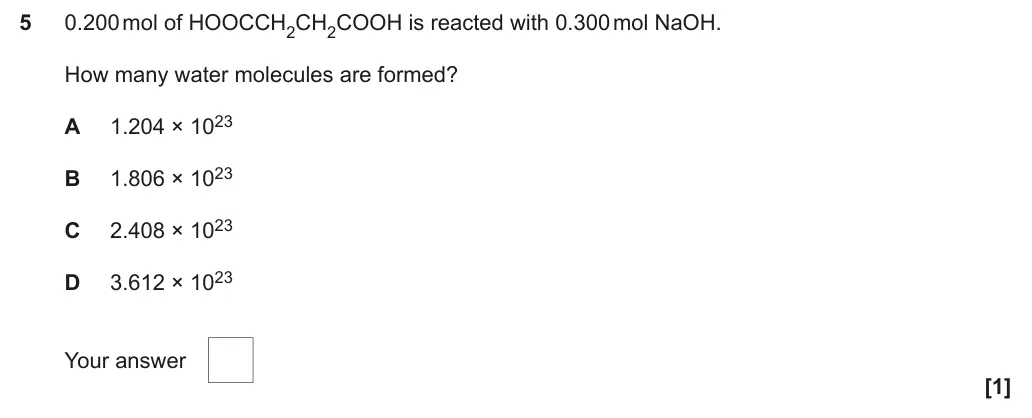
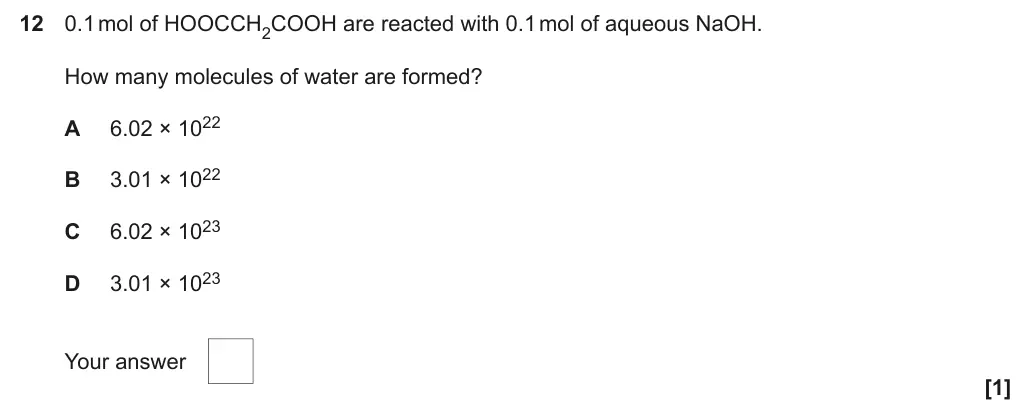
This question required using the idea of a limiting reagent, and candidates found it more challenging with just under half getting the correct answer. Some selected A, using just the moles of acid (i.e. 0.2 × 6.02 × 1023). C was more common, which recognises that 1 mole of acid gives 2 moles of water but does not account for NaOH being the limiting reagent (i.e. 0.4 × 6.02 × 1023). A few gave D as a response using twice the moles of NaOH (i.e. 0.6 × 6.02 × 1023).
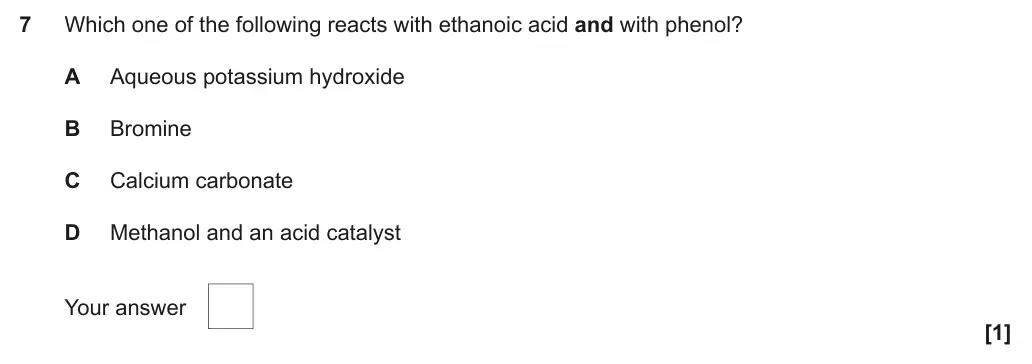
June 2025 · Paper 2 · Q91 markMultiple choiceEasy
Answer
D
Mark scheme
Examiner's comment
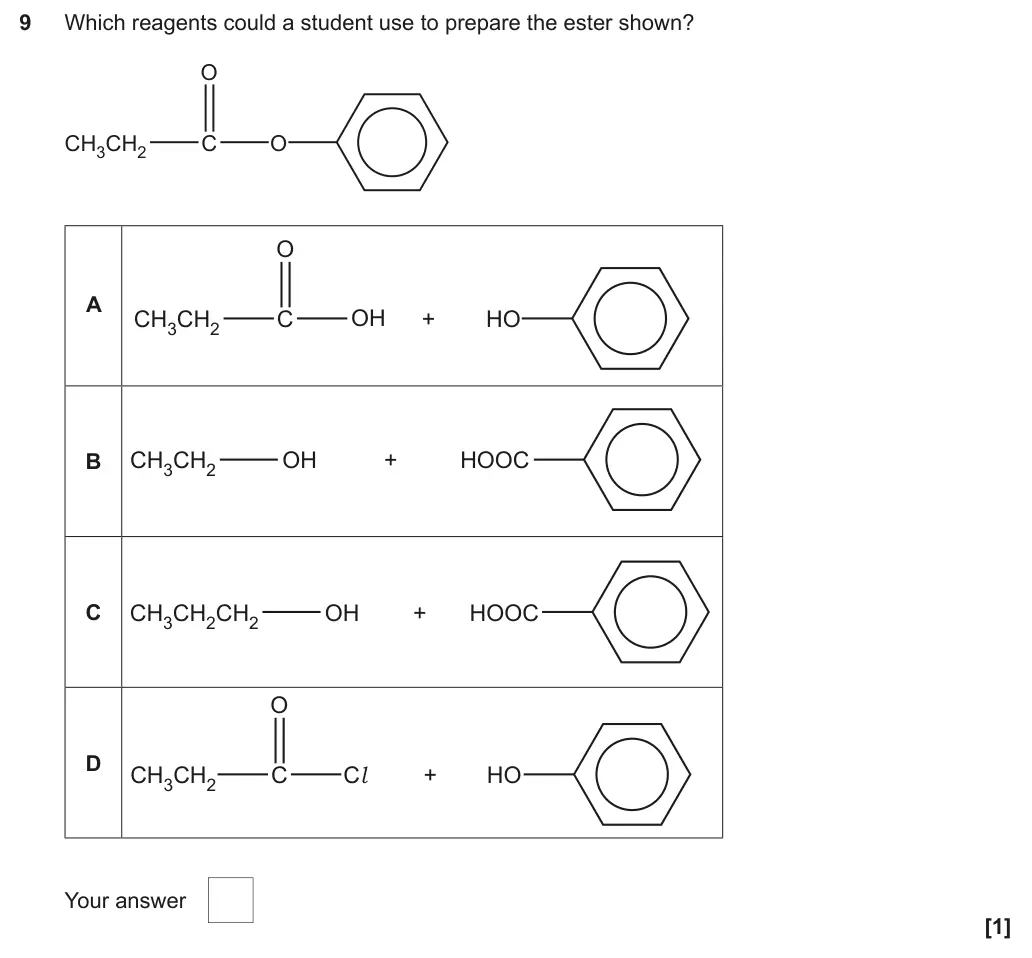
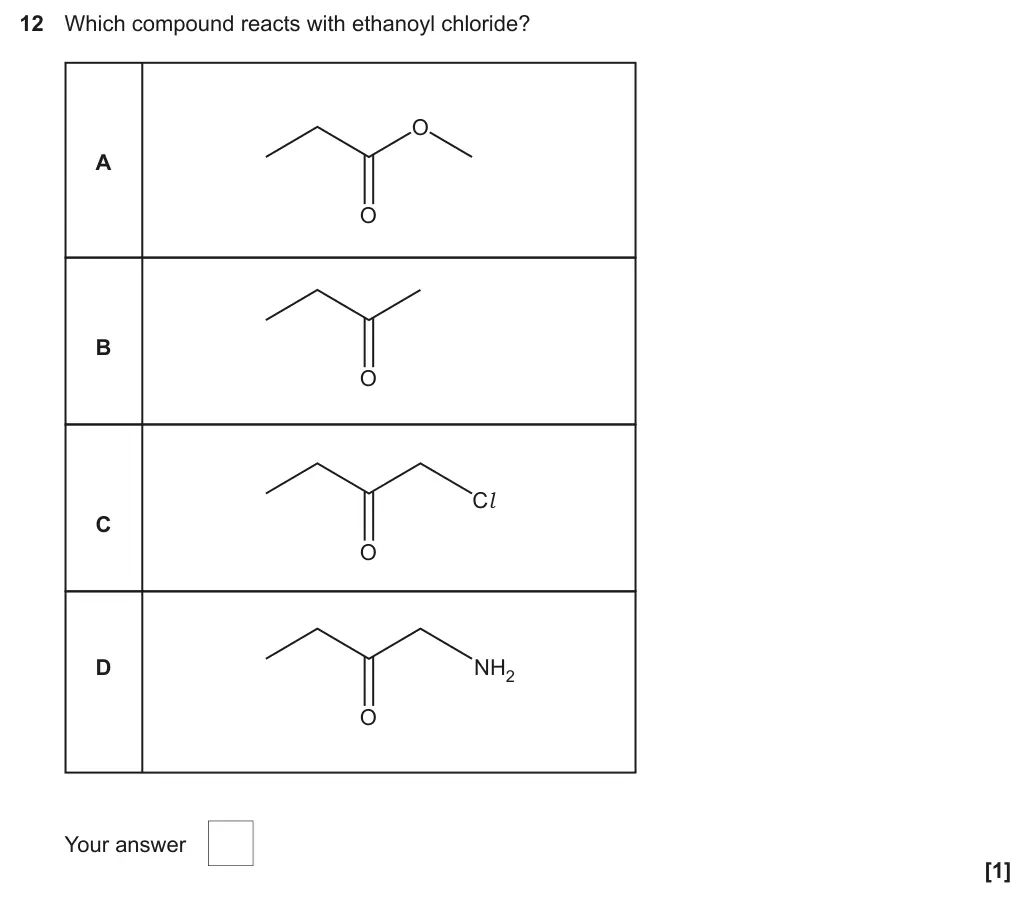
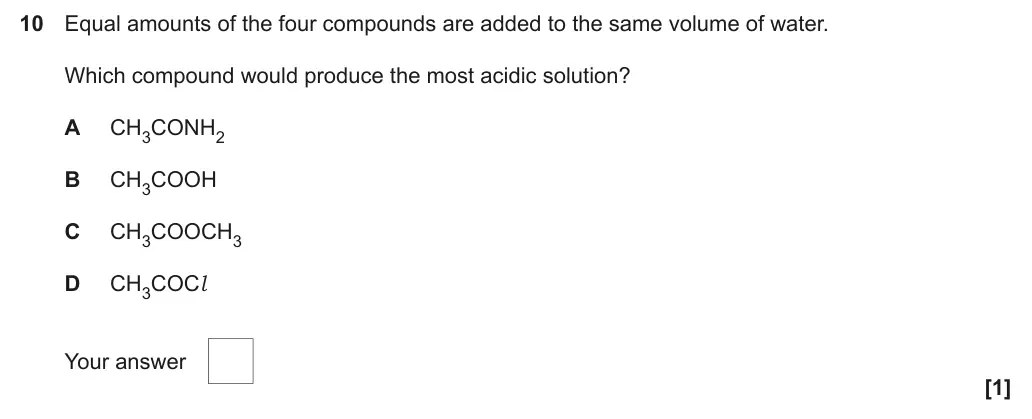
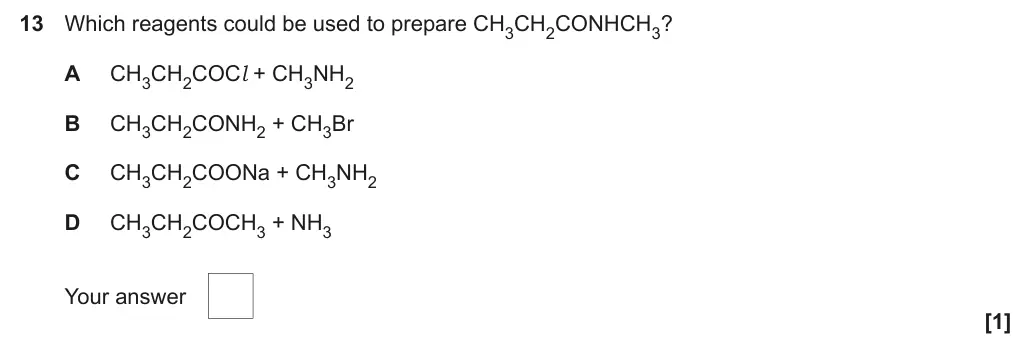
Both A and D were accepted here as correct responses, with nearly all candidates gaining a mark. The reaction with the carboxylic acid (A) rather than the acyl chloride (D) is likely to result in a very poor yield. Most candidates gave A, possibly as it was the first option in the list. The higher scoring candidates across the paper often selected D as the answer.
Notes from the mark scheme and report
key is D (acyl chloride + phenol)
mark scheme also ALLOWs A
June 2025 · Paper 2 · Q18(c)2 marksComplete table/diagramHard
Earlier part of question 18 that this part uses
Mark scheme
Examiner's comment
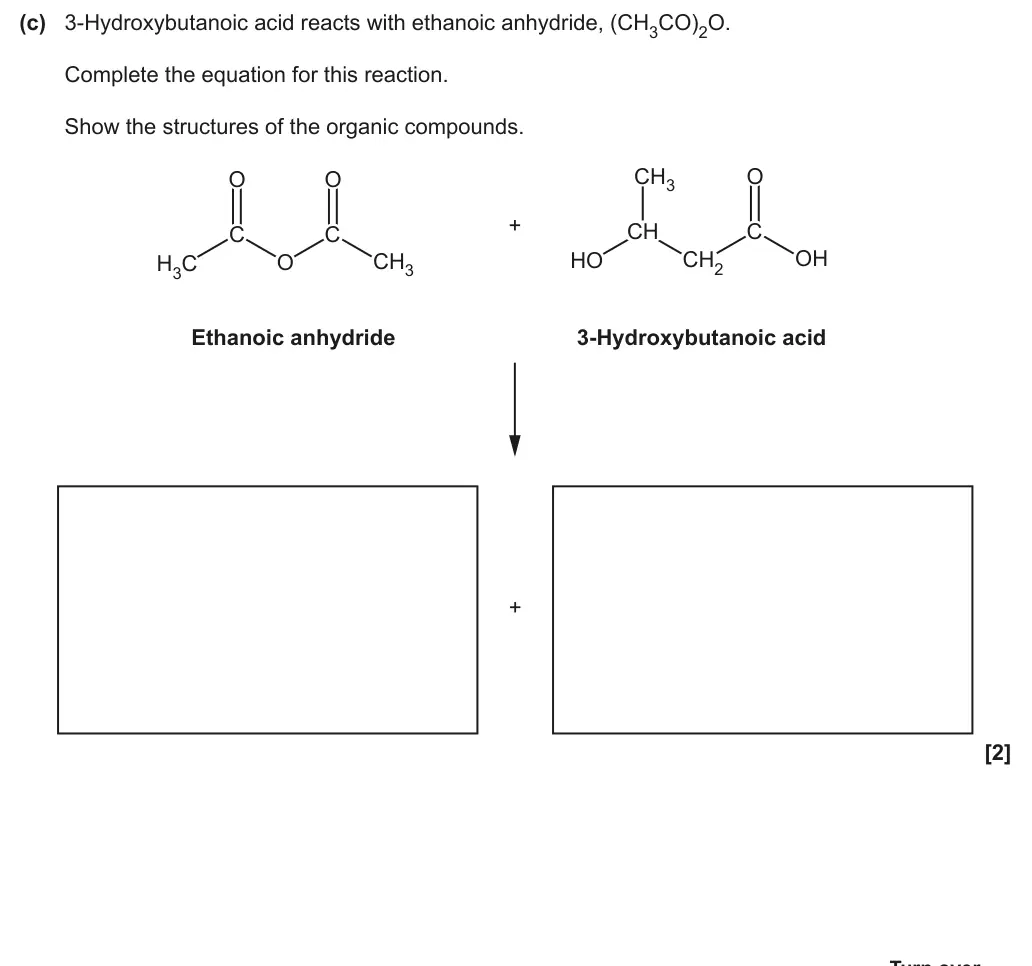
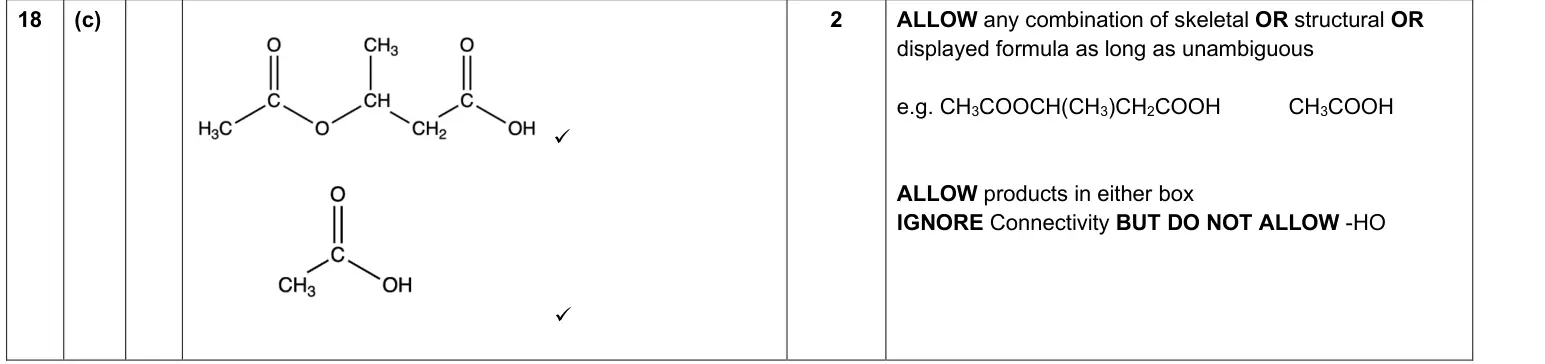
Candidates struggled with this question, about the reaction of an acid anhydride and an alcohol, with only the highest attaining across the paper scoring both marks. Possibly they were confused by the presence of the carboxylic acid group in the alcohol as well. Many showed the formation of a mixed acid anhydride product from the reaction of the two carboxylic acid groups. This reaction is not likely to occur. Lower attaining candidates clearly struggled, some drawing an aldehyde or giving water as one of the products and chemically unfeasible structures as the other product. A sizeable proportion of candidates made no attempt at this question.
Notes from the mark scheme and report
ester CH3COOCH(CH3)CH2COOH and CH3COOH in either box
IGNORE connectivity BUT DO NOT ALLOW –HO
June 2025 · Paper 2 · Q21(c)3 marksComplete table/diagramHard
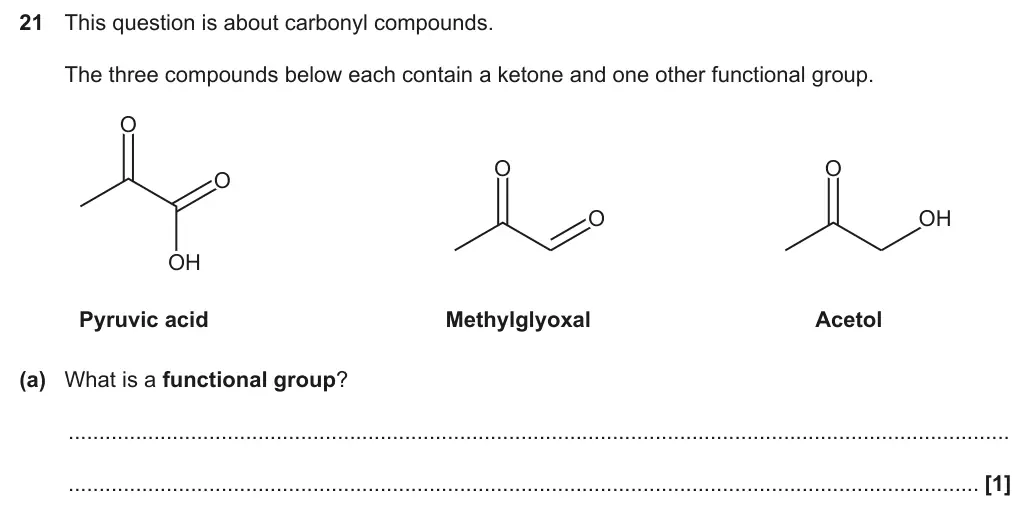
Earlier part of question 21 that this part uses
Mark scheme
Examiner's comment
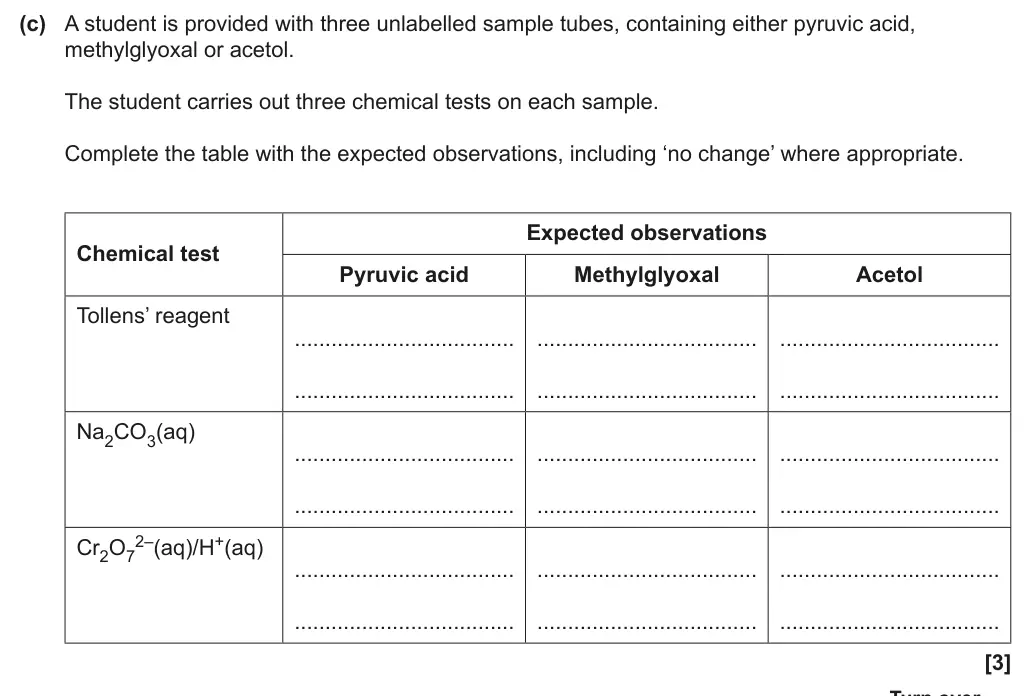
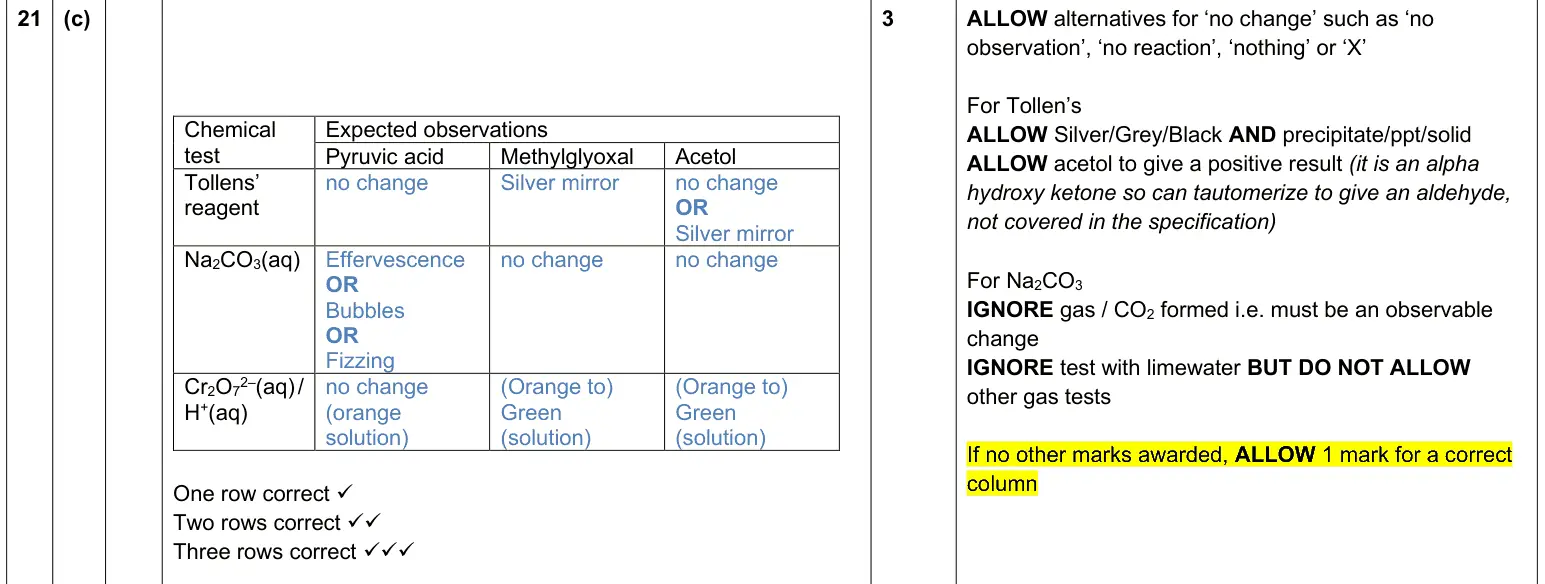
Very few candidates did not score any marks for this observation question. Common errors included: • gas/CO2 formed for the reaction with carbonate. The observation was needed • no reaction for methylglyoxal with dichromate, as they had not realised aldehydes will react as well as primary and secondary alcohols • positive test for all three with dichromate − often linked with incorrect answer in Question 9 • white precipitate with the reaction with carbonate • bubbles with acetol with carbonate (presence of C=O and O-H leading to possible confusion with an acid?). Candidates gave a range of responses for the reactions with no change, e.g. ‘no silver mirror formed’, ‘stays orange or ‘nothing’, these were still accepted but for clarity candidates should respond as the question asks.
Notes from the mark scheme and report
one mark per row
Tollens': silver mirror only for methylglyoxal (ALLOW acetol positive)
Na2CO3: effervescence only for pyruvic acid (IGNORE 'gas/CO2 formed', must be an observation)
dichromate: orange to green for methylglyoxal and acetol
Skills: PAG7 Qualitative analysis of organic functional groups
June 2025 · Paper 2 · Q21(e)7 marksShort answerHard
Earlier part of question 21 that this part uses
Mark scheme
Examiner's comment
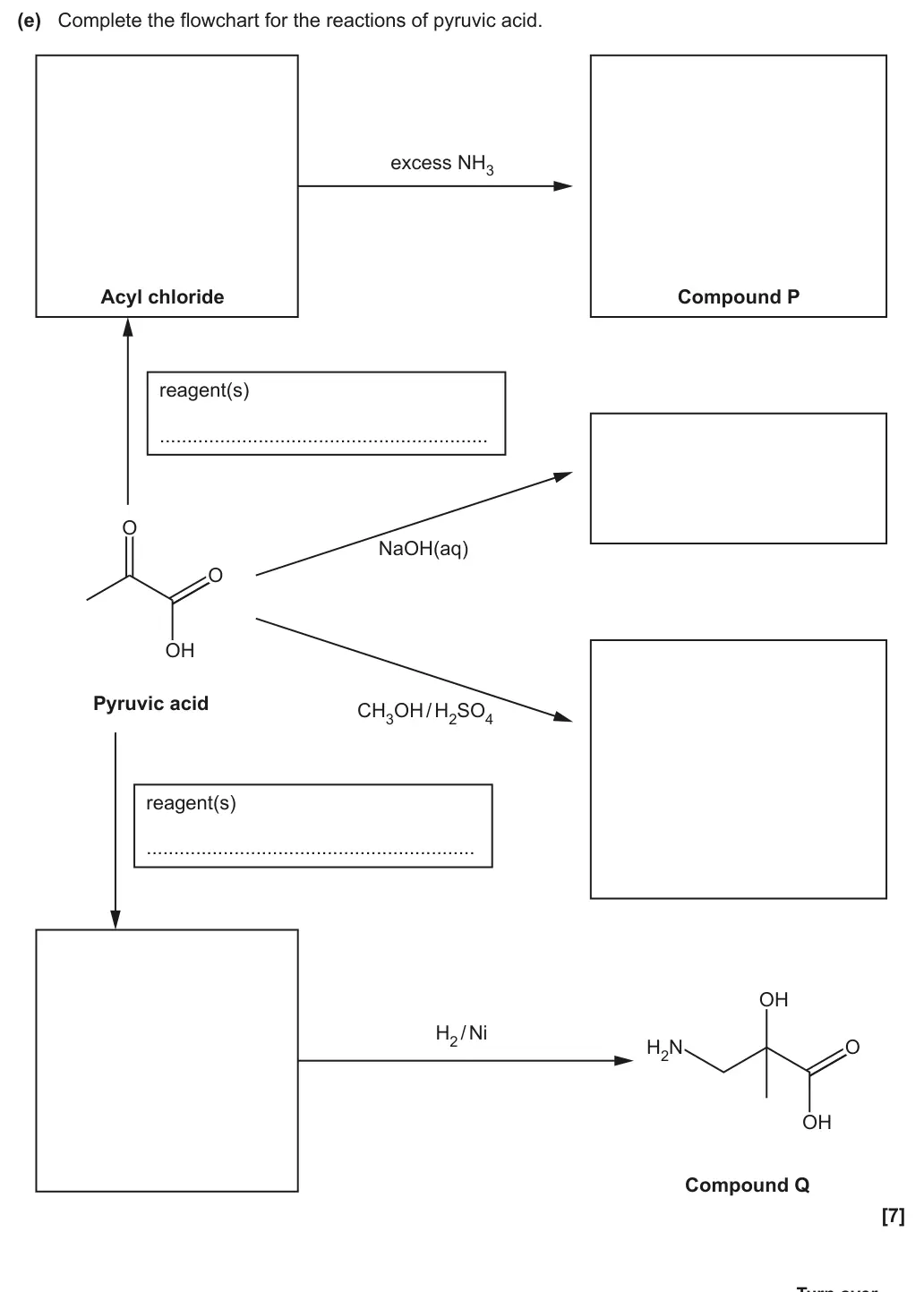
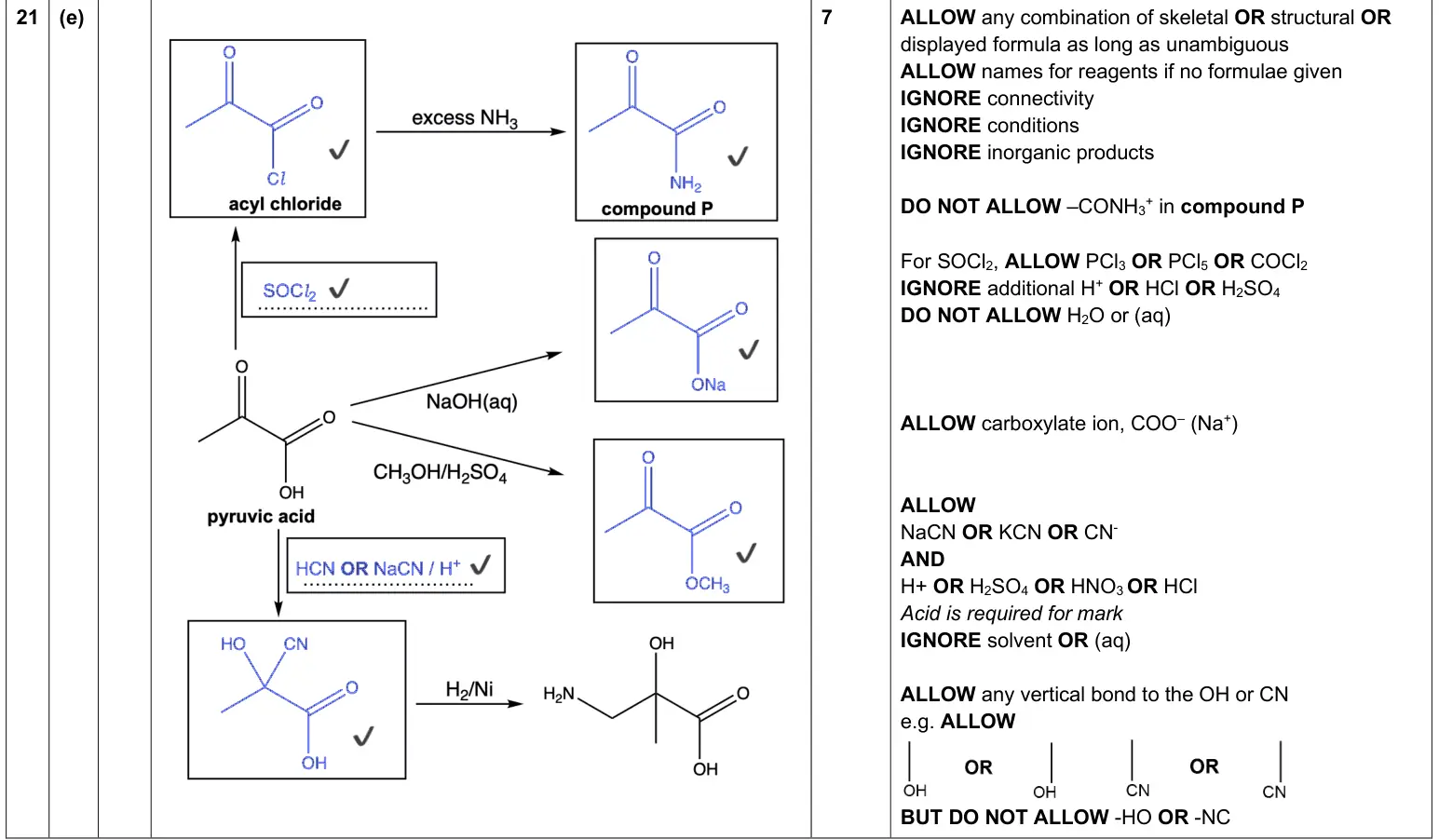
A wide range of marks were given for this question depending on candidates’ knowledge of different reactions. It was fairly common to see candidates drawing out synthetic route pathways on the additional blank pages to help them identify different reactions. This question was a good differentiator – those candidates with a wider knowledge of organic reactions were able to recall reagents and work out the structures of products, often gaining all 7 marks. Most candidates knew that SOCl2 is needed to form an acyl chloride with many giving the correct acyl chloride structure. Some attempted to use Cl2 or HCl instead of SOCl2. Some added Cl to the other end of the molecule leaving the -COOH group intact. Some had added a Cl on the structure removing only H on the -COOH group i.e. Many found it trickier to form compound P. Compound P often had -NH3 rather than -NH2. Some candidates reacted NH3 with various positions on the molecule. Many were able to react pyruvic acid with NaOH to form a salt as well as reaction with methanol in acid to for an ester. Care needed to be taken to keep the ketone group in the molecule and not attempt to react this as well. The trickiest step was the last one, which required a C-C bond forming reaction to extend the chain. Many knew that cyanide could be reacted here. Common incorrect reagents were KCN or NaCN with no H+, ammonia or NaBH4. The structure proved challenging for most candidates. Connectivity was sometimes an issue with the product formed with -NC or the omission of the triple bond between C and N if shown fully i.e. shown as C-N only. Some candidates left the C=O in place or missed out the methyl group or added an extra C before attaching the -CN i.e. Lower attaining candidates often attempted to just add NH3 or CH3NH2 here.
Notes from the mark scheme and report
SOCl2 (ALLOW PCl5/PCl3
DO NOT ALLOW (aq))
acyl chloride then primary amide (DO NOT ALLOW –CONH3+)
sodium carboxylate
methyl ester
NaCN/KCN AND acid (acid required) giving hydroxynitrile
DO NOT ALLOW –HO or –NC connectivity
Useful synthetic route maps for the whole specification, both with and without reagents, can be found on Teach Cambridge.
June 2024 · Paper 2 · Q17(d)2 marksShort answerHard
Earlier part of question 17 that this part uses
Mark scheme
Examiner's comment
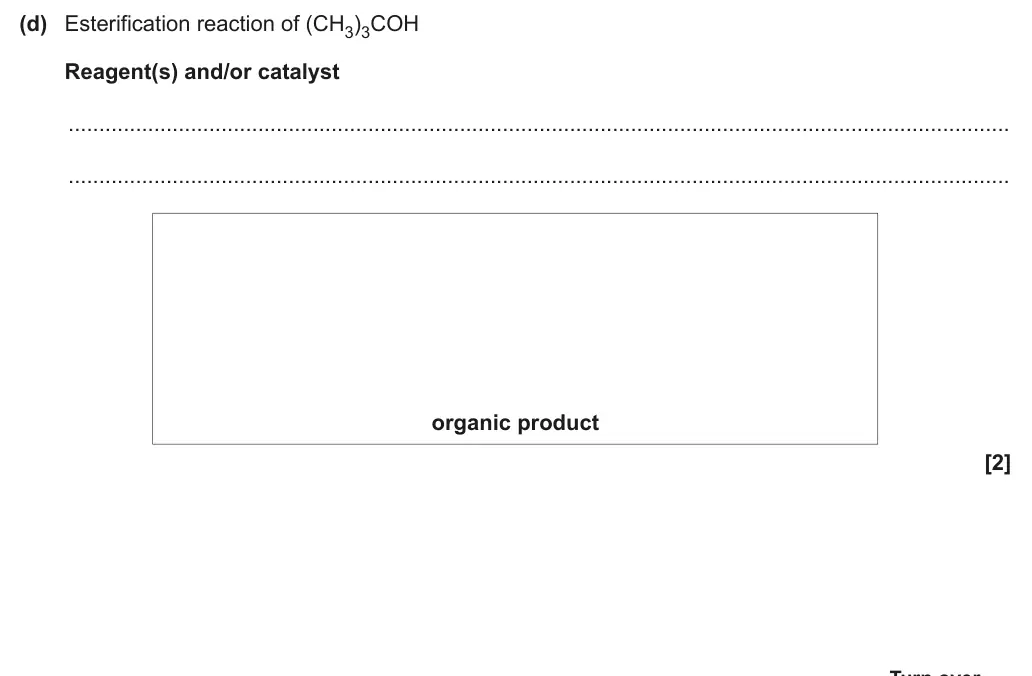
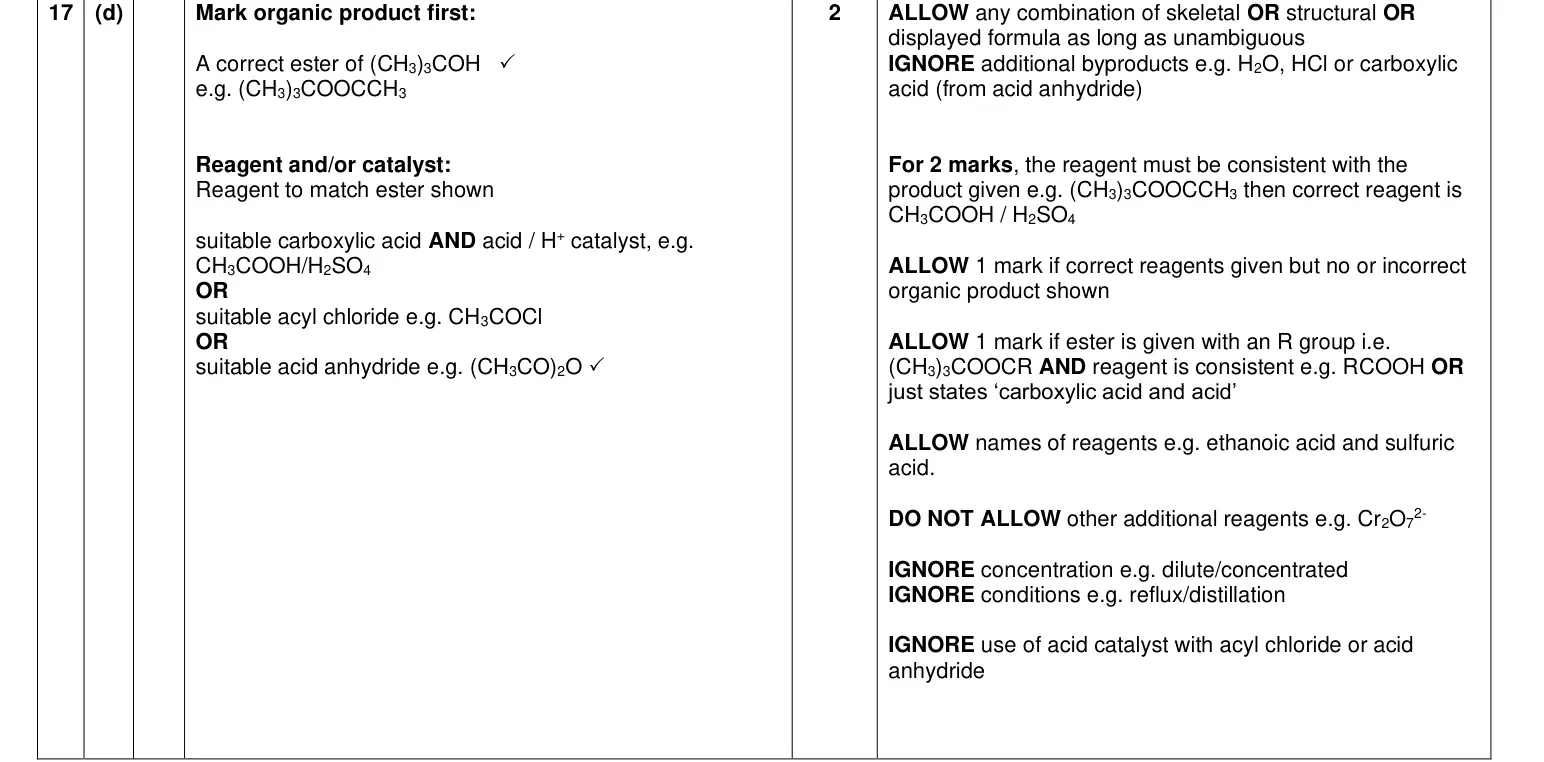
Once again, more than half scored both marks here but candidates found it more challenging than Question 17 (c). Many stated ‘carboxylic acid’ but did not identify the specific example to use to give their product. A common error was to omit the acid catalyst. Some had the ester the wrong way round: i.e. As seen with all parts of this question, some candidates struggled with the structural formula, resulting in some giving an additional carbon in their structure i.e. A few candidates used an acyl chloride but it was rare to see an acid anhydride suggested.
Notes from the mark scheme and report
mark product first: a correct ester of (CH3)3COH
reagent (carboxylic acid + acid catalyst, acyl chloride or acid anhydride) must match the ester
DO NOT ALLOW additional reagents e.g. Cr2O7 2–
June 2024 · Paper 2 · Q20(a)2 marksDrawing / labellingMedium
Mark scheme
Examiner's comment
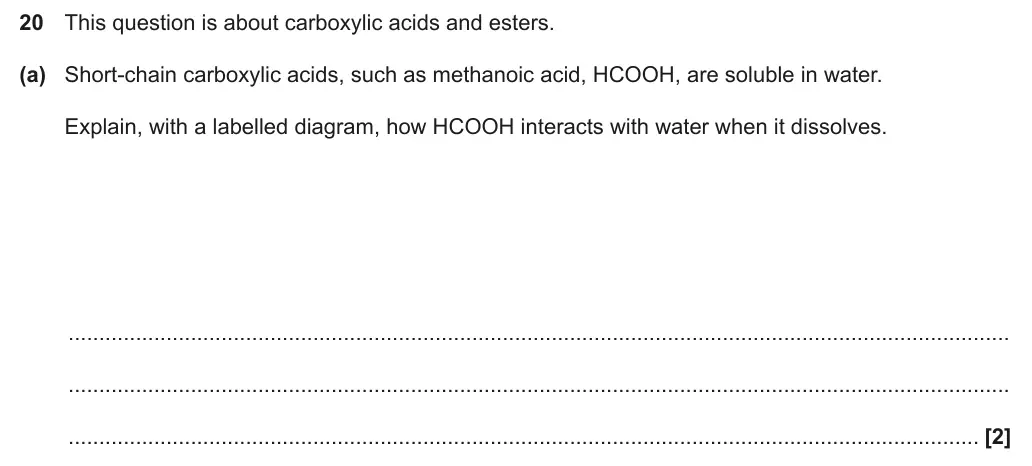
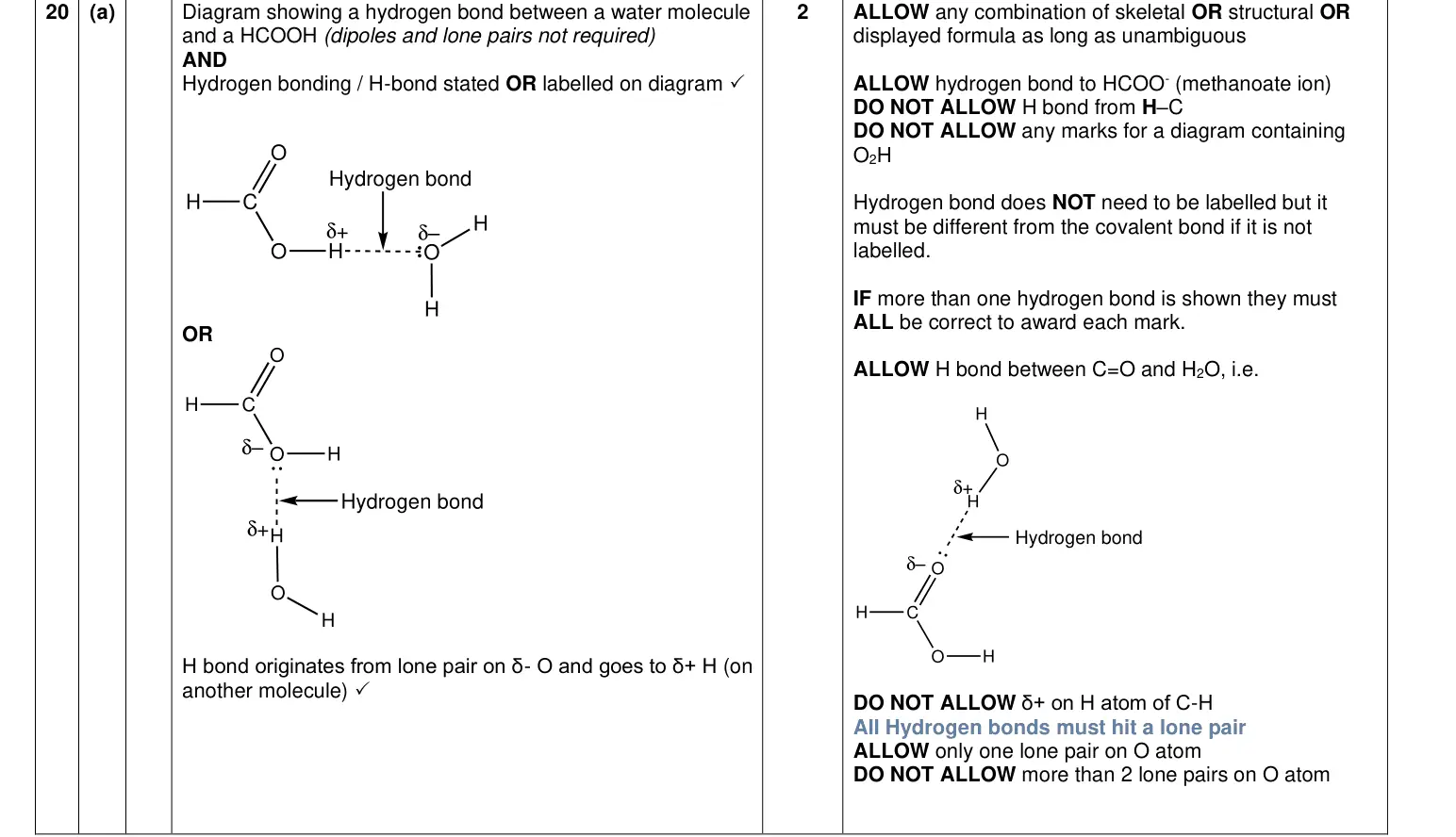
Most candidates were able to identify hydrogen bonding as being responsible for the solubility of methanoic acid. A minority of candidates did not gain any marks for this question. Some described the dissociation of methanoic acid into ions in water. Weaker candidates suggested this dissociation was sufficient to explain solubility. Some showed hydrogen bonds from H in the C-H bond in methanoic acid. Some drew hydrogen bonds from H to H or O to O. Most scored the first mark but lost the second mark usually for missing dipoles and/or lone pairs. Candidates often overcomplicated diagrams with multiple hydrogen bonds shown, increasing the likelihood of losing a mark for errors.
Notes from the mark scheme and report
hydrogen bond between HCOOH and H2O drawn and labelled
from lone pair on δ– O to δ+ H
DO NOT ALLOW H bond from H–C
DO NOT ALLOW diagram containing O2H
all hydrogen bonds shown must be correct
June 2024 · Paper 2 · Q20(b)(ii)4 marksEquation writingHard
Earlier part of question 20 that this part uses
Mark scheme
Examiner's comment
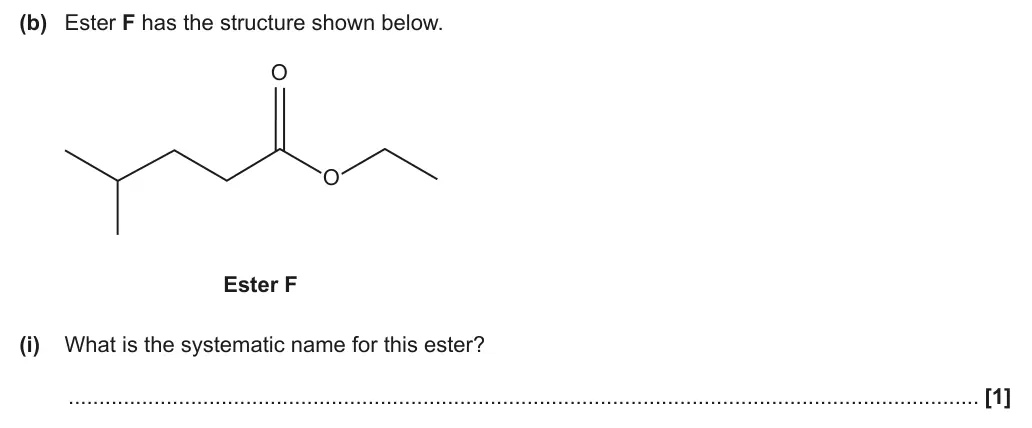
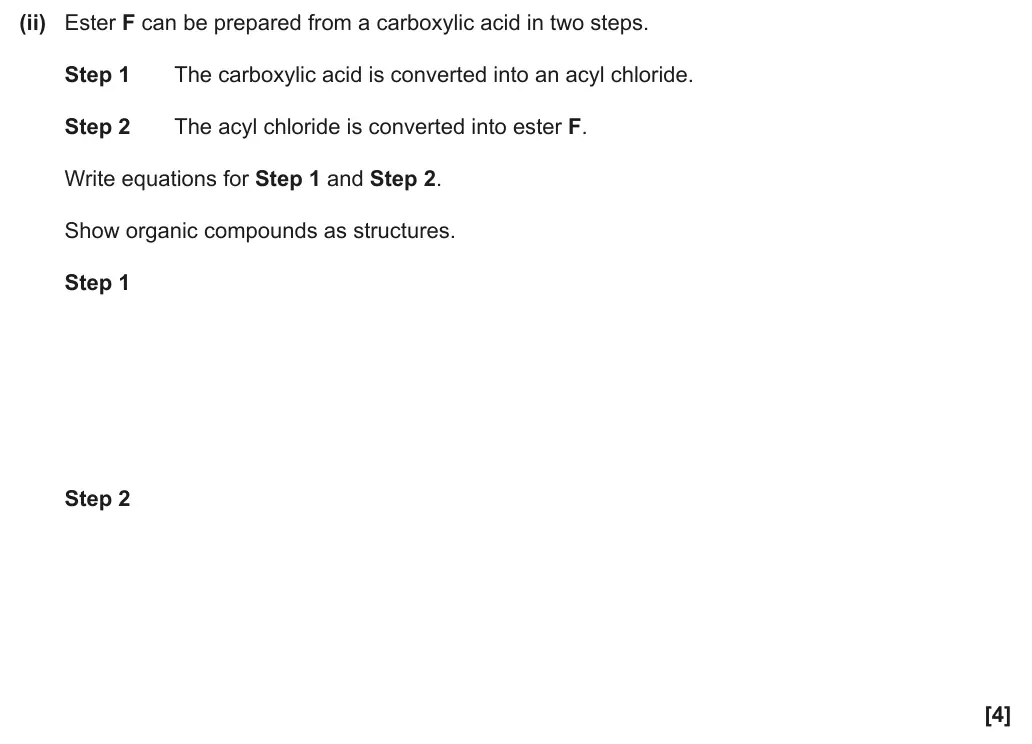
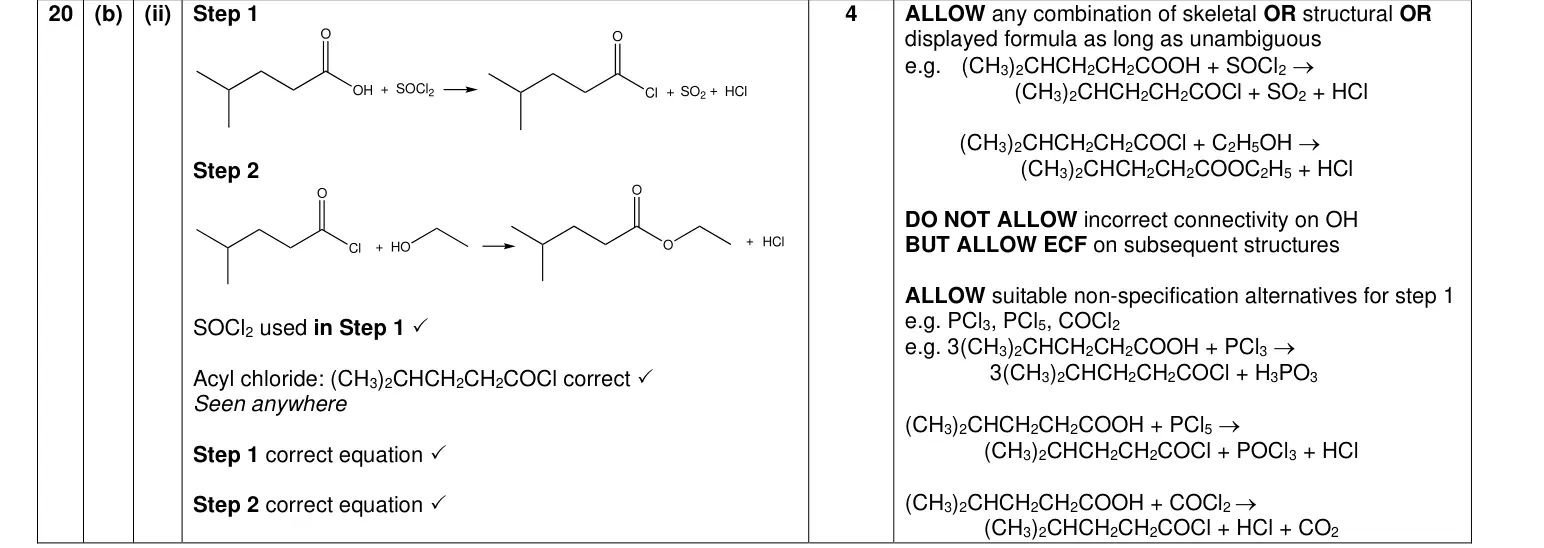
This question differentiated between candidates well with the full range of marks seen. Some couldn’t identify the correct reagent to use to form an acyl chloride i.e. SOCl2, so lost 2 marks for the first step. Use of HCl as an alternative was common. A significant number used SOCl2 but struggled to balance the equation. Many made errors with structures used, for example missing the CH3 side chain, adding CH3 to 3-position instead 4, inserting an additional CH2 group or using a much easier structure, e.g. ethanoic acid. None of these structures were given marks as they would not form Ester F. Some used R- instead to simplify, for which credit was given, but only if it was clear what structure R represented. Another common error was to include an additional O in the acyl chloride group i.e. COOCl not COCl. The most common error made in Step 2 was to omit the formation of HCl or to use H2O instead. A few lost the final mark for a connectivity error on ethanol i.e. OHCH2CH3.
Notes from the mark scheme and report
SOCl2 in step 1 giving acyl chloride + SO2 + HCl
acyl chloride + ethanol gives ester F + HCl
DO NOT ALLOW incorrect connectivity on OH (ECF on later structures)
June 2024 · Paper 2 · Q20(d)4 marksStructure / isomerMedium
Mark scheme
Examiner's comment
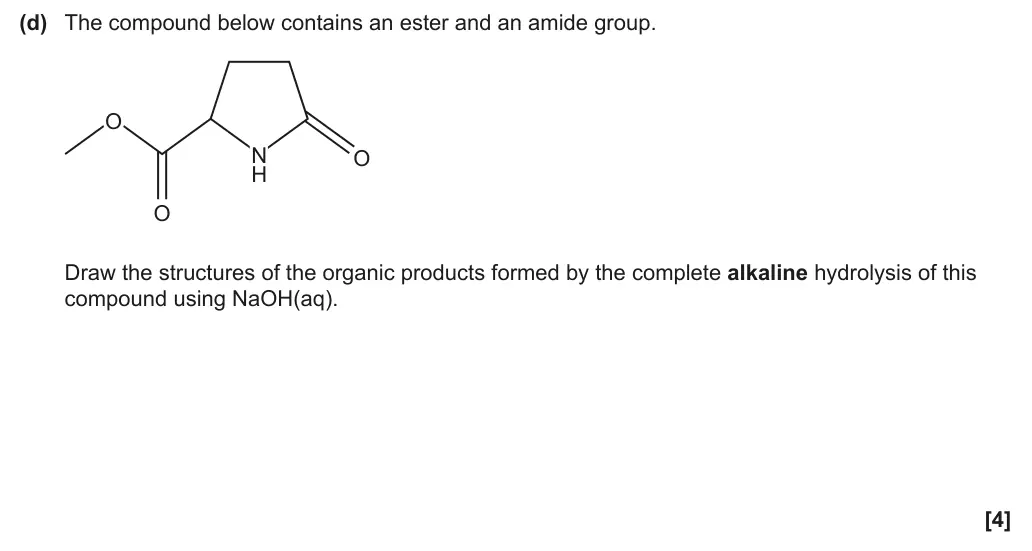
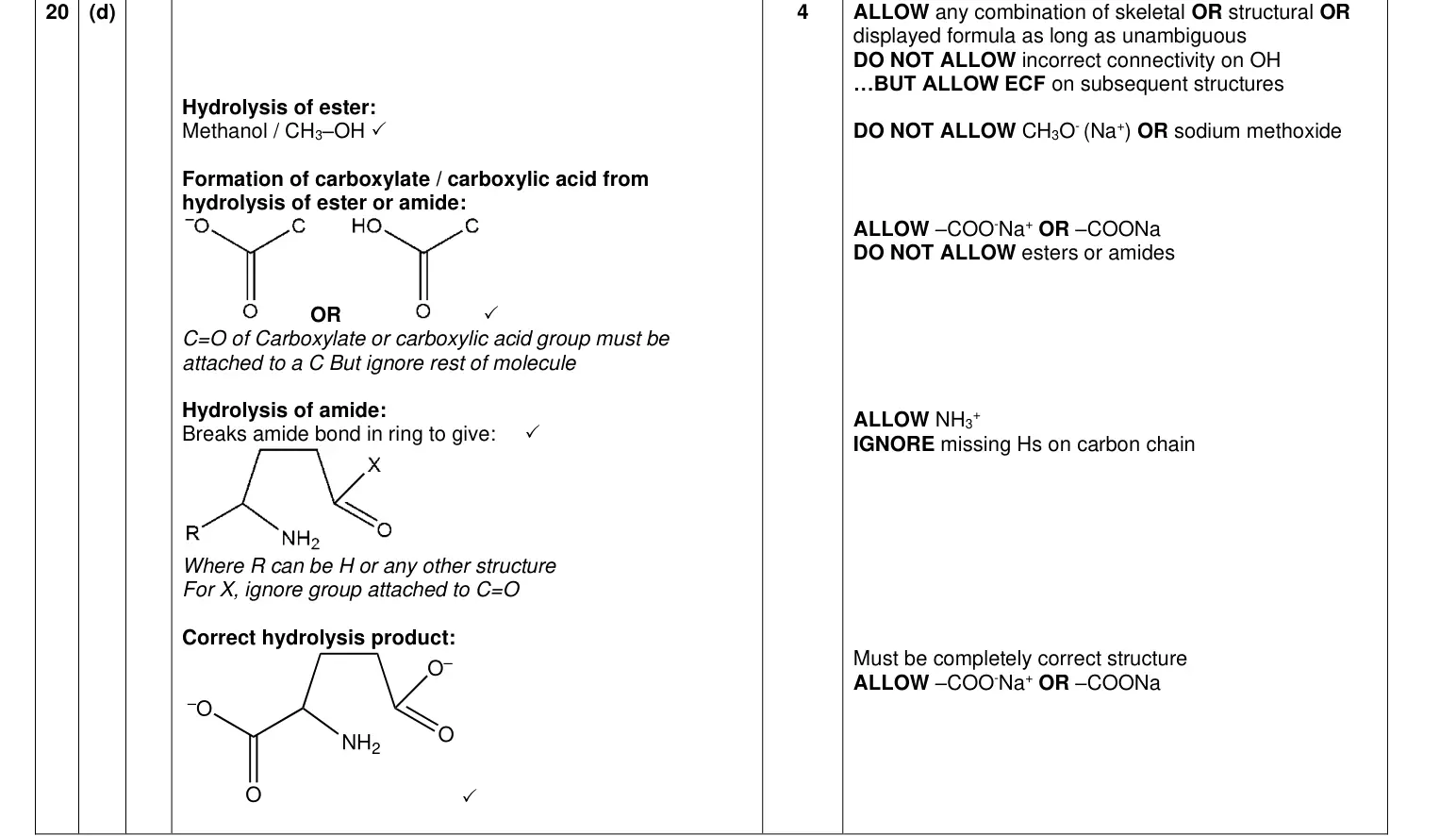
Just over a quarter of candidates were able to gain all 4 marks. The successful candidates clearly identified where the ester and amide would be hydrolysed on the structure provided, helping them draw out the correct products. This question differentiated well. Most were able to gain some credit for hydrolysing the ester to give methanol and a carboxylate or carboxylic acid, leaving the amide bond and ring intact. However, some lost the first mark for giving the methoxide ion, assuming that the alkaline conditions are capable of deprotonating the alcohol group. Lower attaining candidates often broke other C-C bonds in the ring forming a range of products. A few displayed the structure as C=O-Na+ and some also protonated the amine group either with the ring intact or broken.
Notes from the mark scheme and report
methanol (DO NOT ALLOW CH3O–Na+)
carboxylate from ester/amide hydrolysis
ring amide bond broken to give NH2
final product is the dicarboxylate with NH2 (–COO–Na+ allowed)
DO NOT ALLOW esters or amides remaining
June 2024 · Paper 2 · Q23(b)(i)3 marksEquation writingHard
Earlier part of question 23 that this part uses
Mark scheme
Examiner's comment
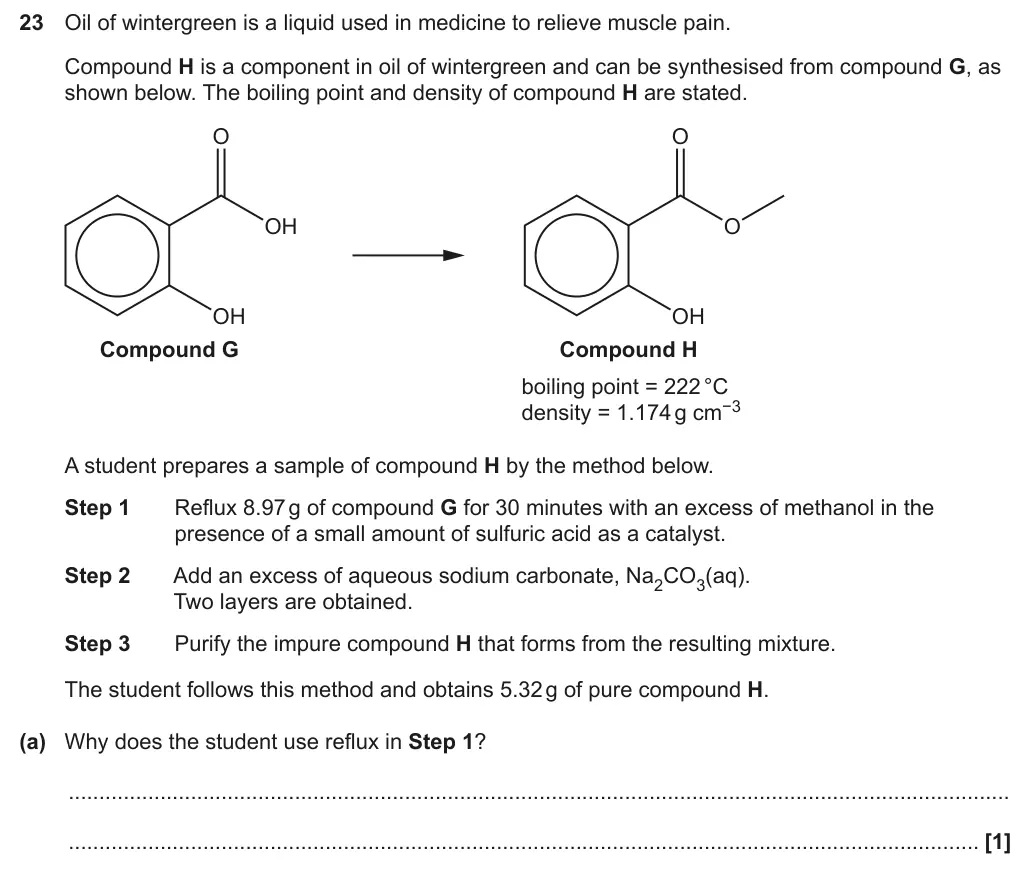
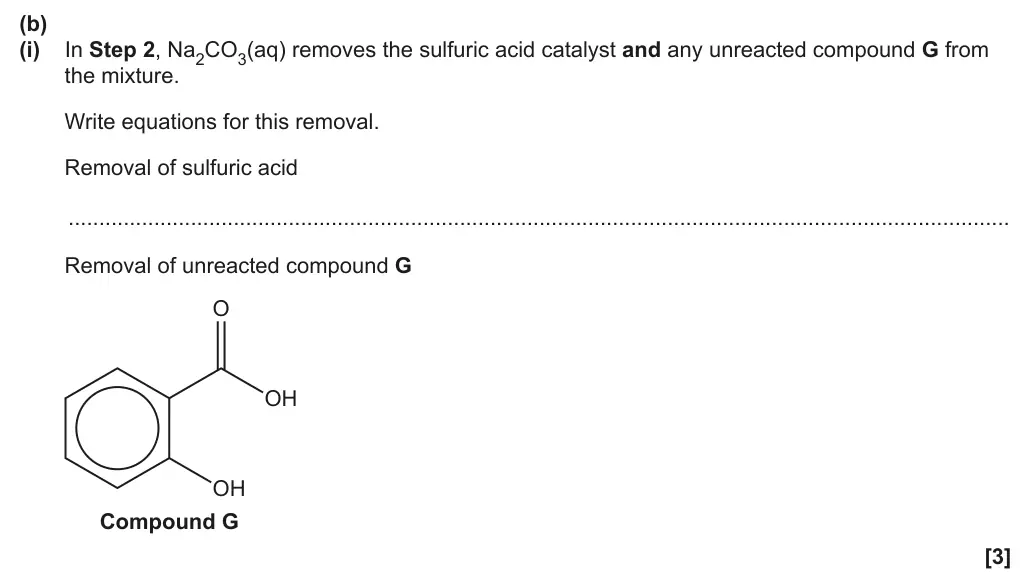
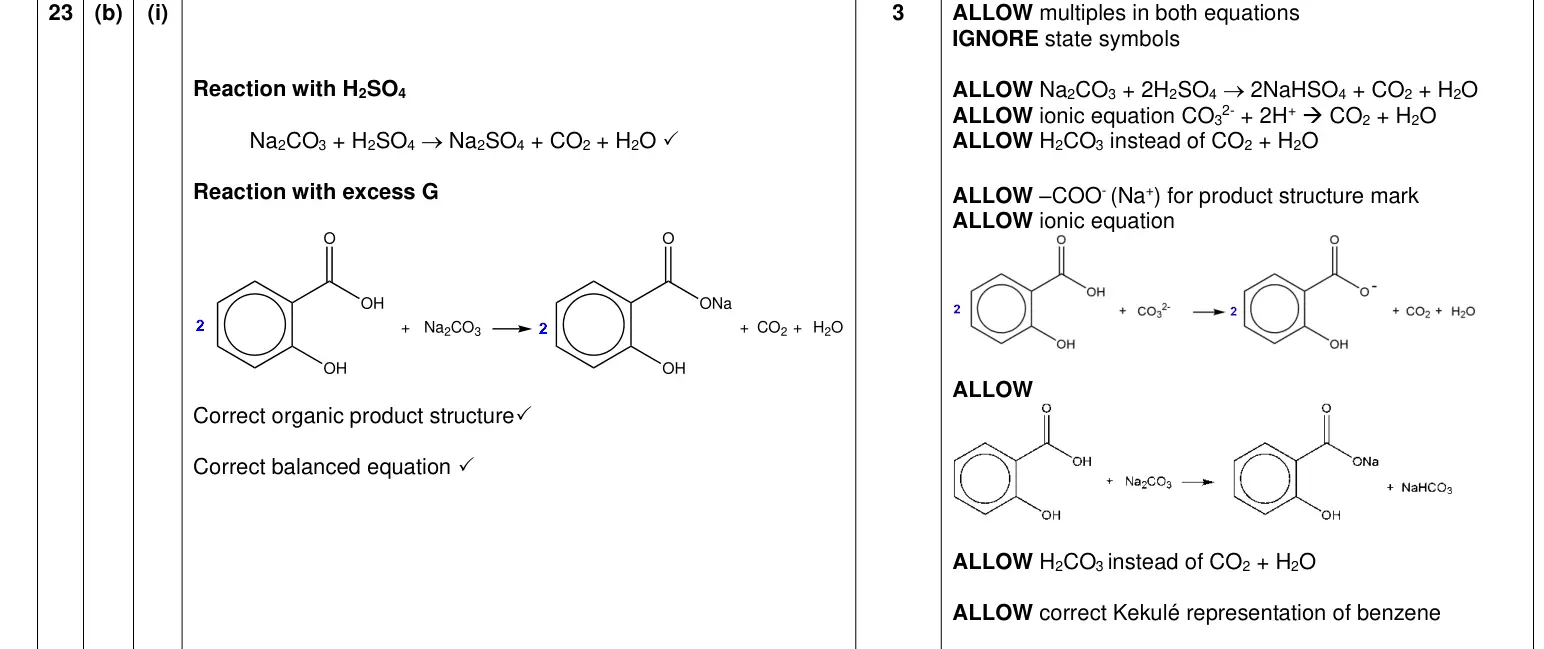
Another fairly challenging question, however most secured at least one mark for giving an equation for the reaction of sulfuric acid with sodium carbonate. Less confident candidates struggled to gain any marks as they were unable to give correct formula for sodium sulfate, giving NaSO4 for example. Although many attempted the equation showing the reaction of compound G with sodium carbonate, only some correctly identified that only the carboxyl group would react, not the phenol. A small minority of students were able to balance the second equation gaining all 3 marks.
Notes from the mark scheme and report
Na2CO3 + H2SO4 → Na2SO4 + CO2 + H2O
only the COOH of G reacts (phenol OH unchanged) giving –COONa
2 G per Na2CO3 (ALLOW 1:1 forming NaHCO3)
ALLOW ionic equations
June 2024 · Paper 2 · Q23(b)(ii)1 markShort answerMedium
Earlier parts of question 23 that this part uses
Mark scheme
Examiner's comment
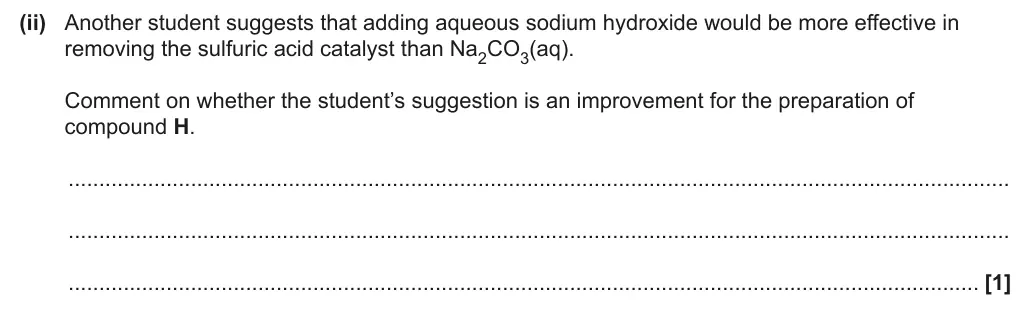
The best responses correctly identified that using sodium hydroxide was not an improvement and explained this either by stating that it would react with the phenol group or hydrolyse the ester group in compound H. However, most candidates appeared not to consider a reaction with H in their answer. Many focused on the neutralisation of sulfuric acid in a similar way to sodium carbonate and gave responses such as: • stronger base • no effervescence so harder to see when completely reacted • no CO2 produced so easier/safer/higher atom economy/less waste • requires double the moles compared to Na2SO4 to react
Notes from the mark scheme and report
NaOH would react with the phenol –OH OR hydrolyse the ester (compound H)
DO NOT ALLOW 'reacts with alcohol'
June 2023 · Paper 2 · Q121 markAO1Multiple choiceEasy
Answer
D
Mark scheme
Examiner's comment
Most candidates were able to correctly identify that amine D would be the one to react. However, some did not know what could react or were unable to spot the functional groups using skeletal formulae.
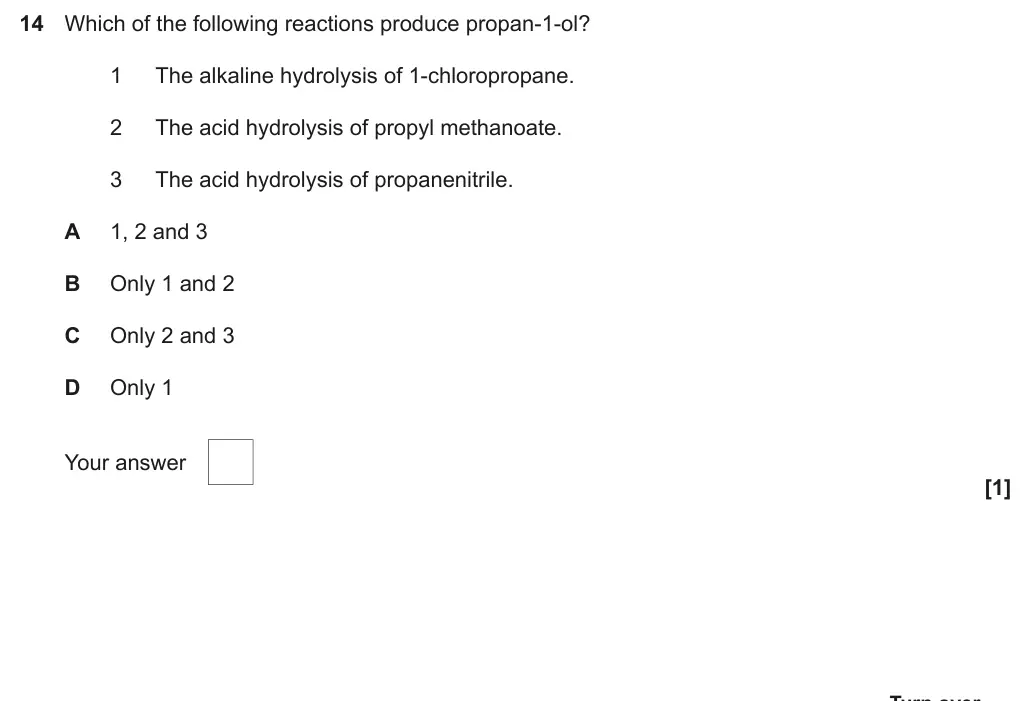
June 2023 · Paper 2 · Q141 markAO1Multiple choiceMedium
Answer
D
Mark scheme
Examiner's comment
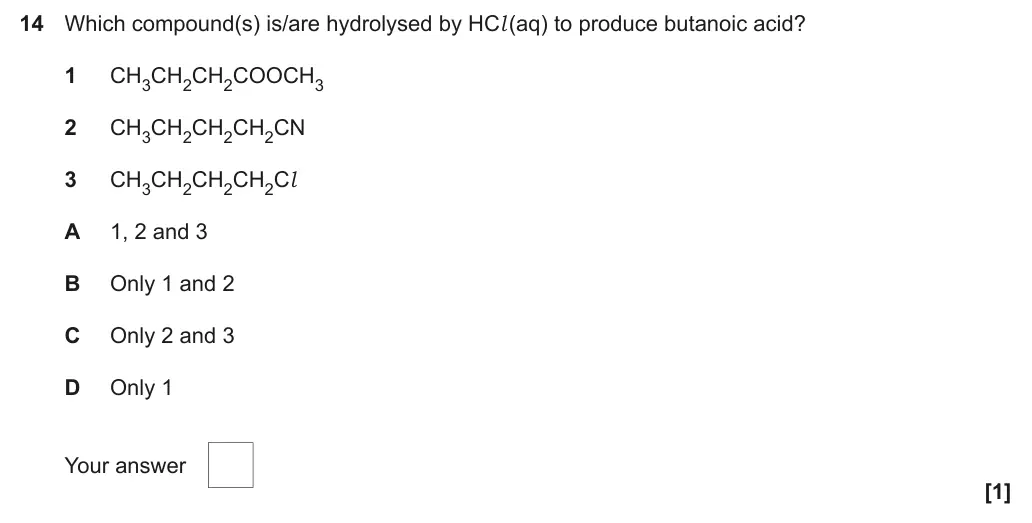
The most common incorrect response seen here was B. Candidates understood that nitriles can be hydrolysed but did not realise that it would give pentanoic acid not butanoic. Those who drew out the structures of the products for each were more likely to give the correct answer, D.
June 2023 · Paper 2 · Q20(a)4 marksAO2Short answerMedium
Mark scheme
Examiner's comment
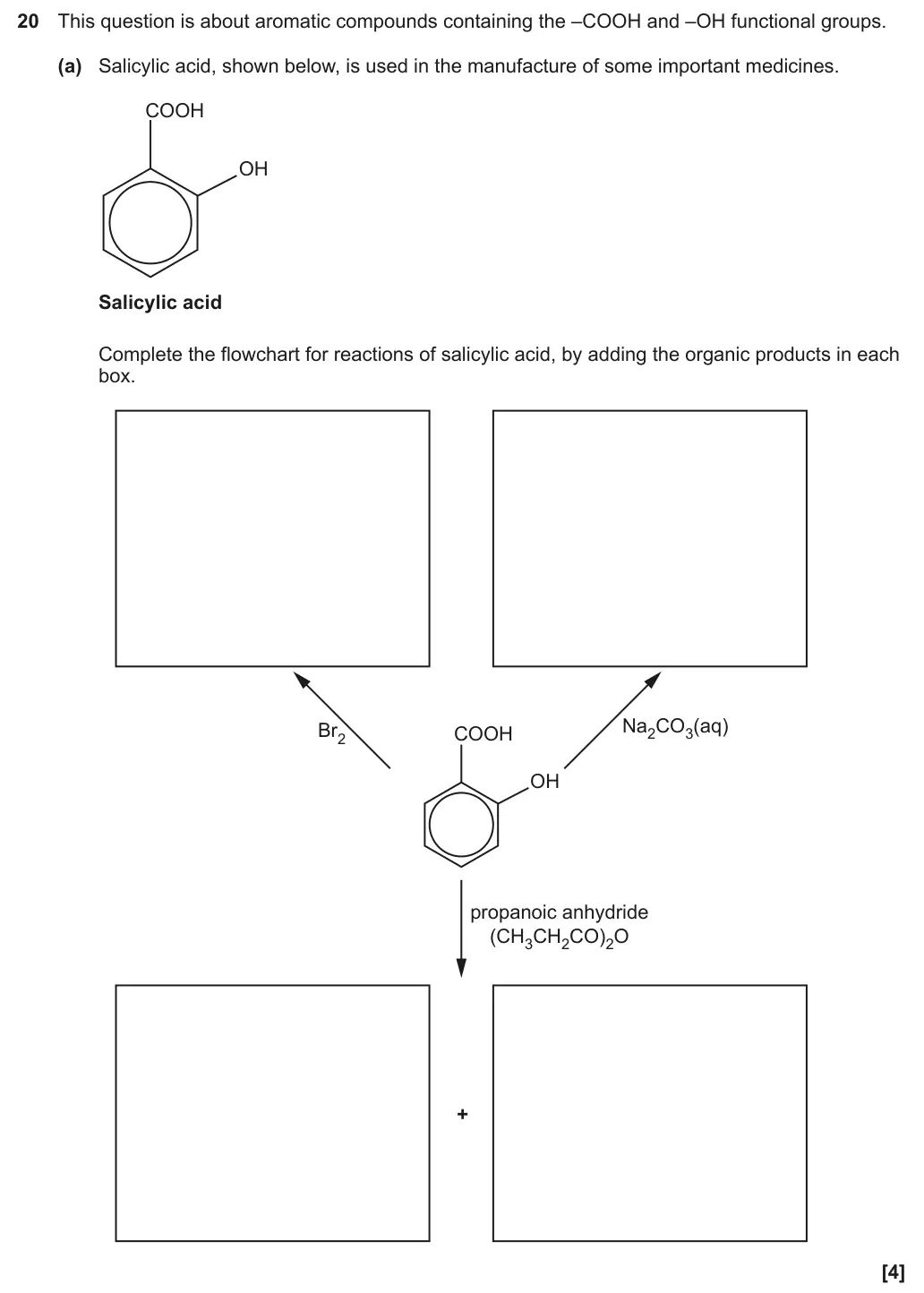
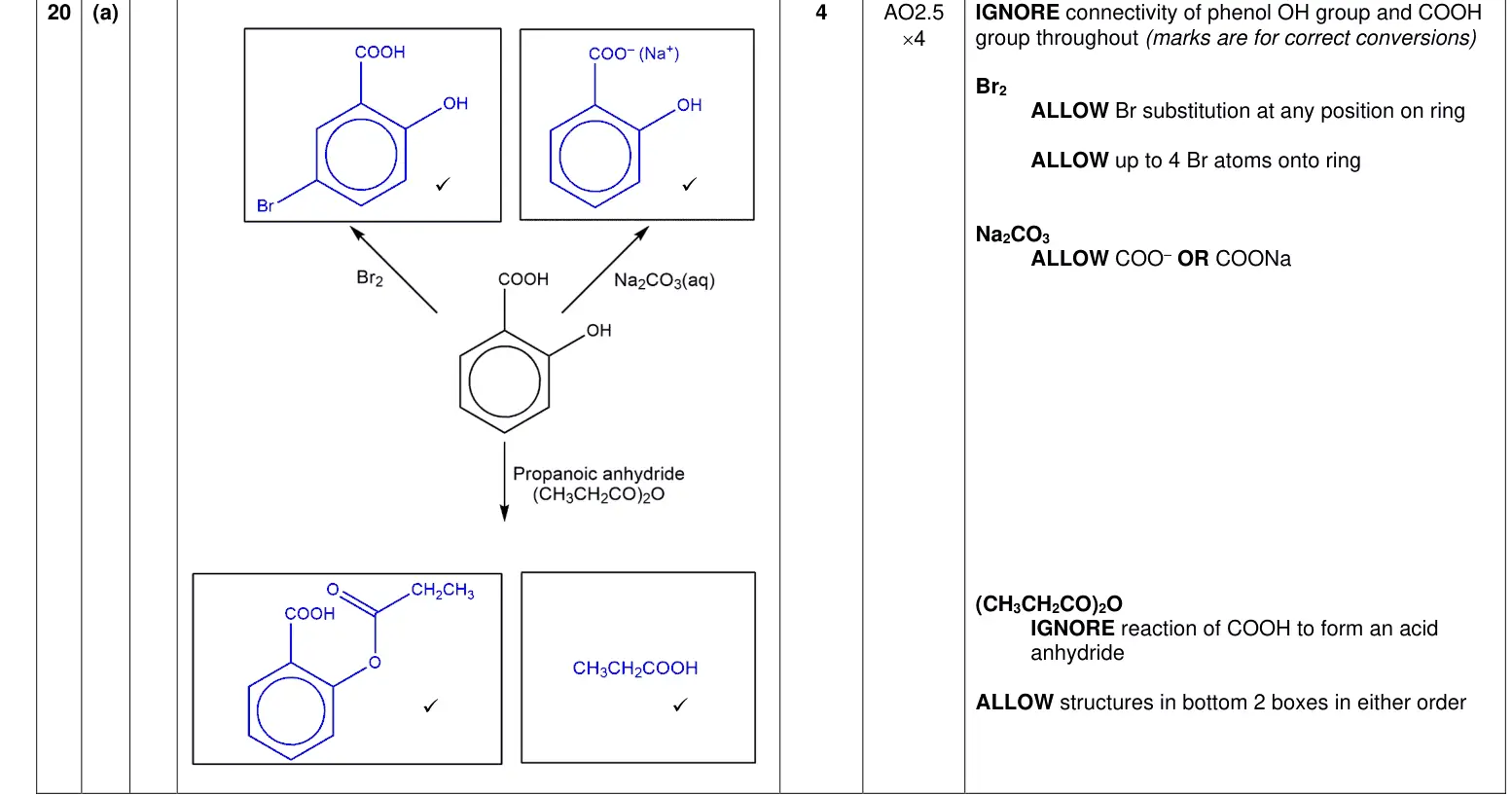
Overall, this question discriminated well with most candidates gaining some credit. Most candidates were able to suggest a correct product for the reaction of salicylic acid with bromine, with just a few candidates replacing the OH group with a Br atom. Most candidates recognised that the carboxylate salt would be produced from the reaction with Na2CO3 but not all were able to recall that the phenolic OH group is too weak acid to react. Some missed an O on carboxylate i.e. -CO-Na+. Some added Na or CO3 directly to the ring. The reaction with the anhydride proved much more challenging. All sorts of weird and wonderful structures of the main ‘ester’ product were given including joining the CH3 group of propanoic anhydride to the O of the phenol group. Some used the bottom two boxes to form esters with the COOH and OH groups in turn. Many did not identify propanoic acid as a by-product even if they had correctly identified the ester product. Water was a common incorrect product. Marks were also occasionally lost for missing the benzene ring on structures or missing the -OH or - COOH groups that were left unreacted.
Notes from the mark scheme and report
Br2 substitutes the ring (ALLOW any position, up to 4 Br)
Na2CO3 reacts with COOH only (COO– or COONa), phenol OH unchanged
anhydride esterifies the phenol OH giving ester + CH3CH2COOH
IGNORE COOH forming an anhydride
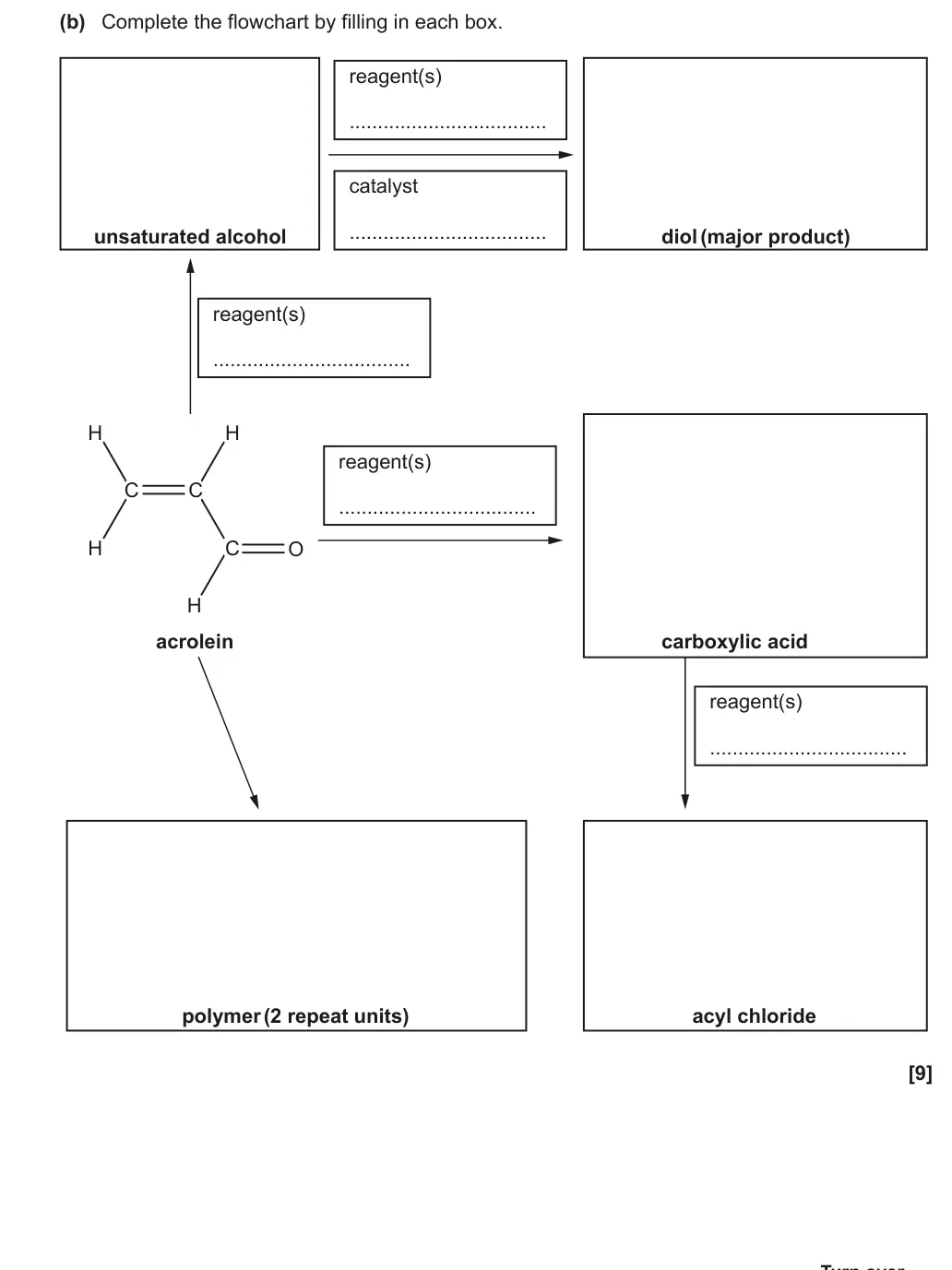
June 2023 · Paper 2 · Q22(b)9 marksAO1, 2Short answerMedium
Earlier part of question 22 that this part uses
Mark scheme
Examiner's comment
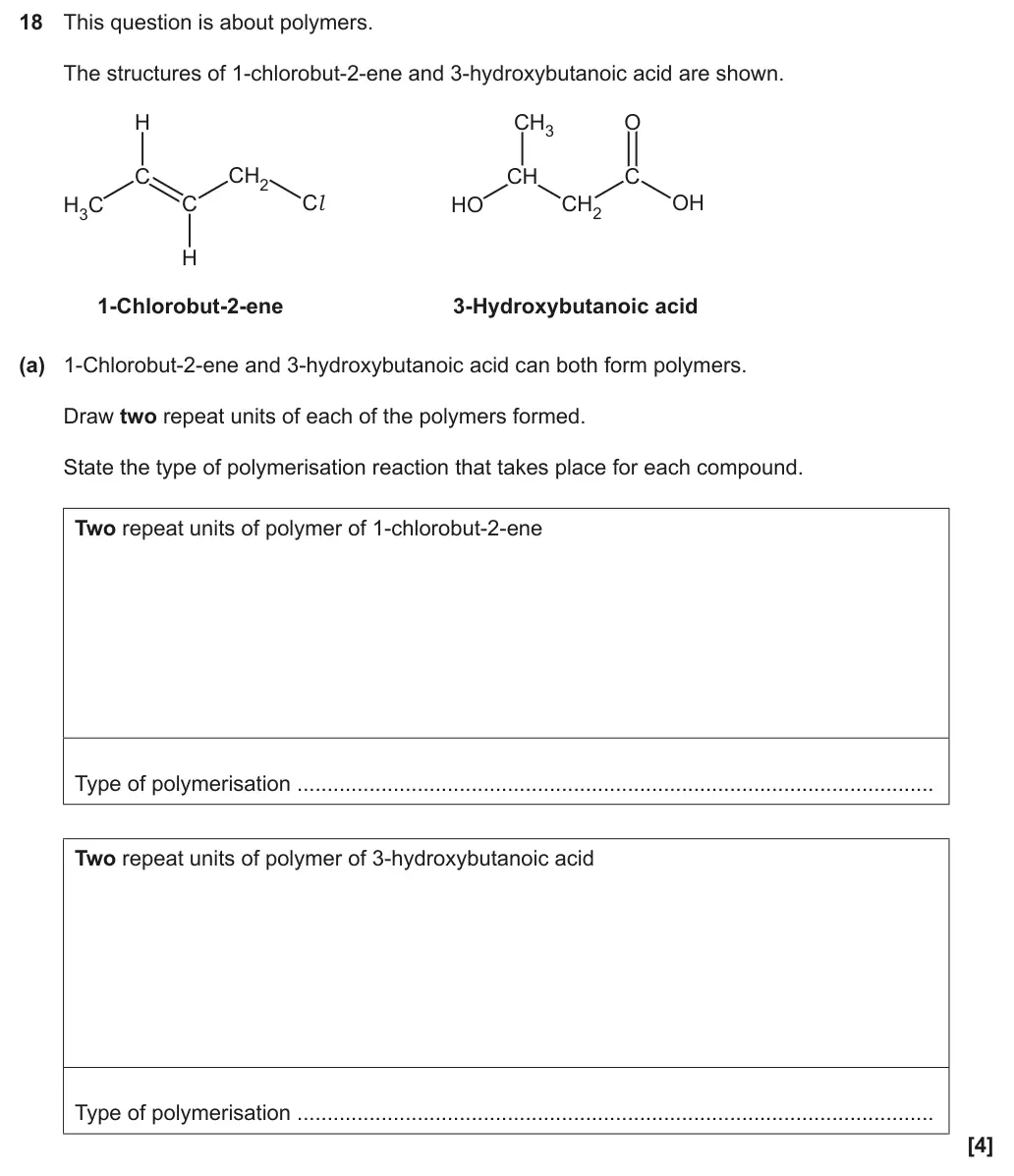
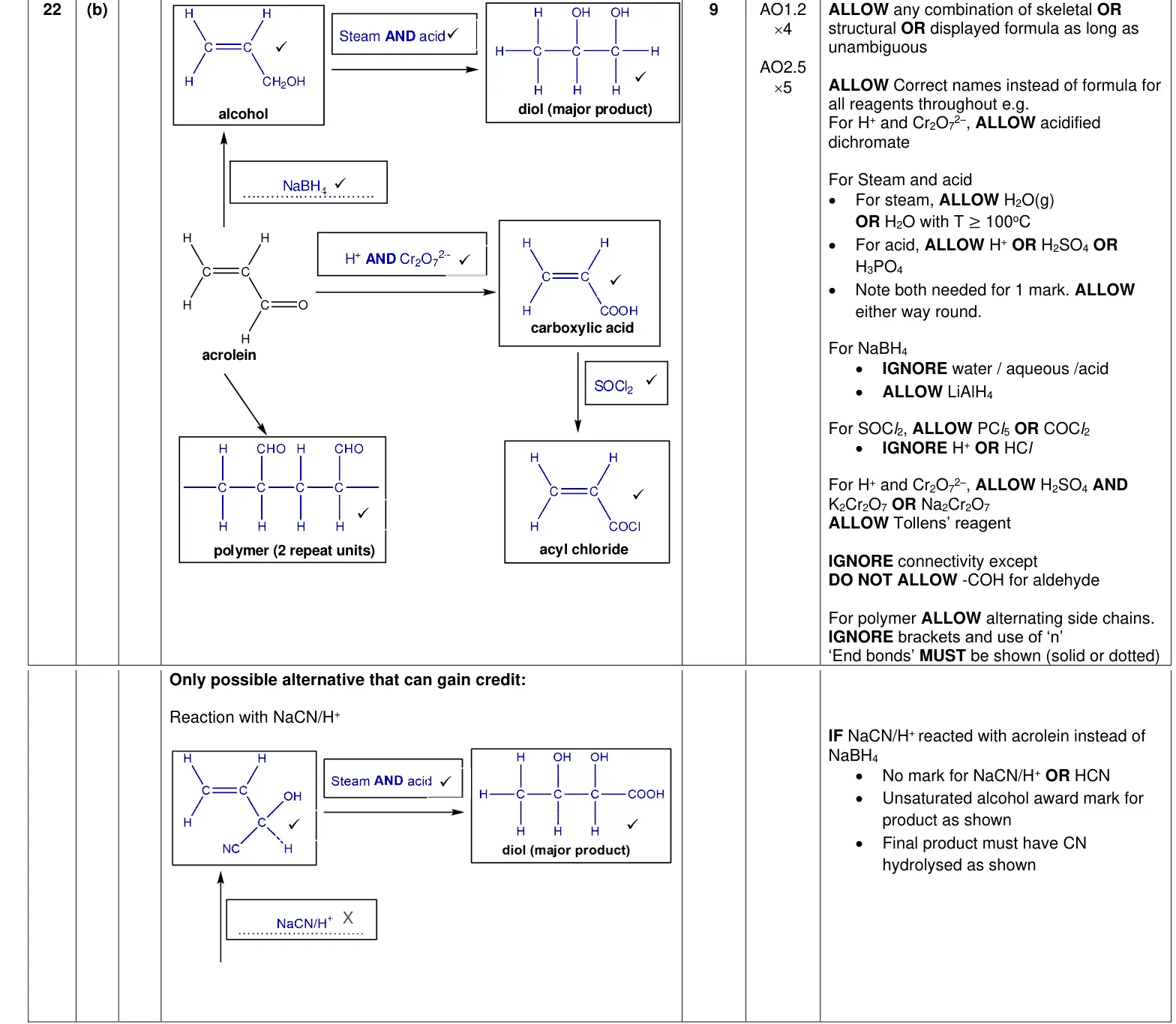
This question discriminated well. Many candidates were able to demonstrate an excellent knowledge of organic reactions and it was not uncommon to see scores of at least 7 marks. This question identified which candidates had learned their synthetic routes including necessary reagents and conditions. Marks were often lost for small details such as missing Hs (check all Cs have four bonds) or not specifying that steam is required for hydration of alkenes or missing the acid needed for oxidation. Many suggested the use of NaOH or just a mixture of acids to product the diol. The minor 1,3-diol or 1,1-diol product was often seen. The sequence leading to an acyl chloride from acrolein was usually the most well answered. However, quite a few tried to use HCl to make the acyl chloride. Many lost marks for the polymer for incorrect connectivity on the aldehyde, e.g. -COH or attempting to make a polymer via connection of the aldehyde group.
Notes from the mark scheme and report
NaBH4 gives H2C=CHCH2OH (C=C not reduced)
steam AND acid catalyst (both needed) gives propane-1,2-diol as major product
H+/Cr2O72– to H2C=CHCOOH
SOCl2 to acyl chloride
polymer with CHO side chains and end bonds
DO NOT ALLOW –COH for aldehyde
This topic guide provides a summary of synthetic routes. Copies of the summary posters without the conditions can be found on Teach Cambridge. This should be used in conjunction with the organic synthesis topic exploration pack.
June 2023 · Paper 3 · Q5(b)(ii)3 marksAO2Complete table/diagramMedium
Earlier part of question 5 that this part uses
Mark scheme
Examiner's comment
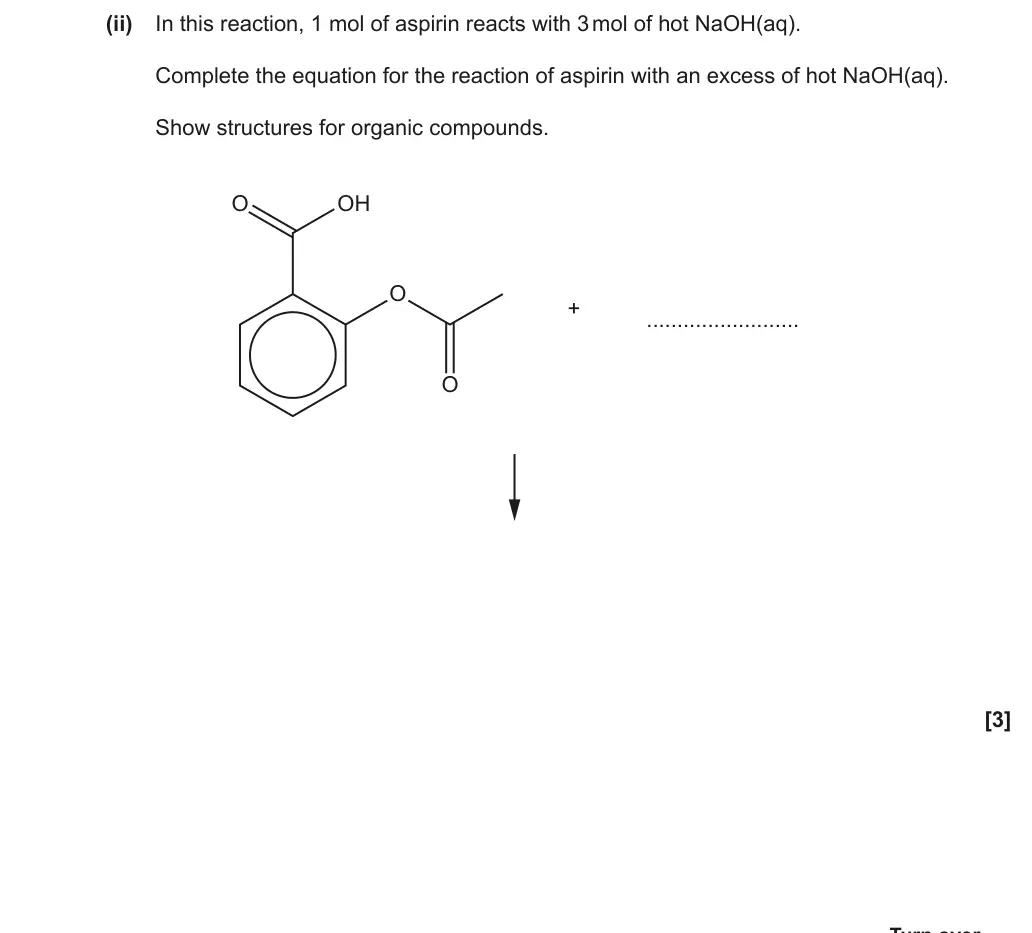
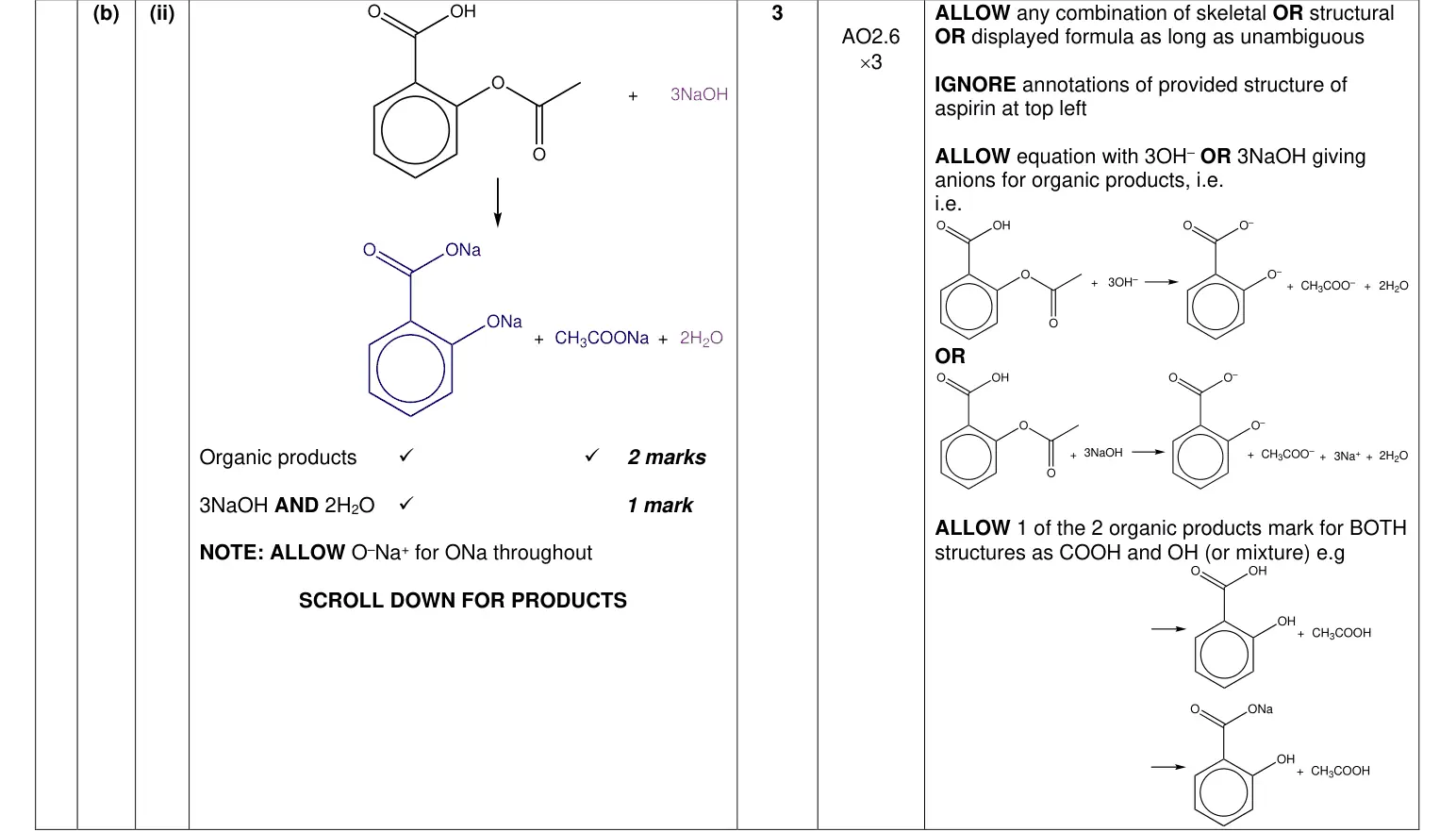
This question was the hardest part of Question 5 and about half the candidates were not given any marks. Some drew the sodium carboxylate salt of aspirin structure, leaving the ester link intact. A large number of candidates realised that the ester would be hydrolysed. Sometimes the sodium salts were often not shown and, even they were shown, the phenol group was often shown intact. The hardest mark was the formation of 2H2O and a large number of candidates showed the more intuitive but incorrect ‘3H2O’ instead.
Notes from the mark scheme and report
3NaOH AND 2H2O
products sodium salt of phenoxide-carboxylate (ONa and COONa) and CH3COONa
ALLOW ionic forms
1 of the 2 product marks if both shown as COOH and OH
Skills: M0.2 Use ratios, fractions and percentages
June 2023 · Paper 3 · Q6(e)6 marksAO36-mark level of responseHard
Mark scheme, with the levels and indicative points
Examiner's comment
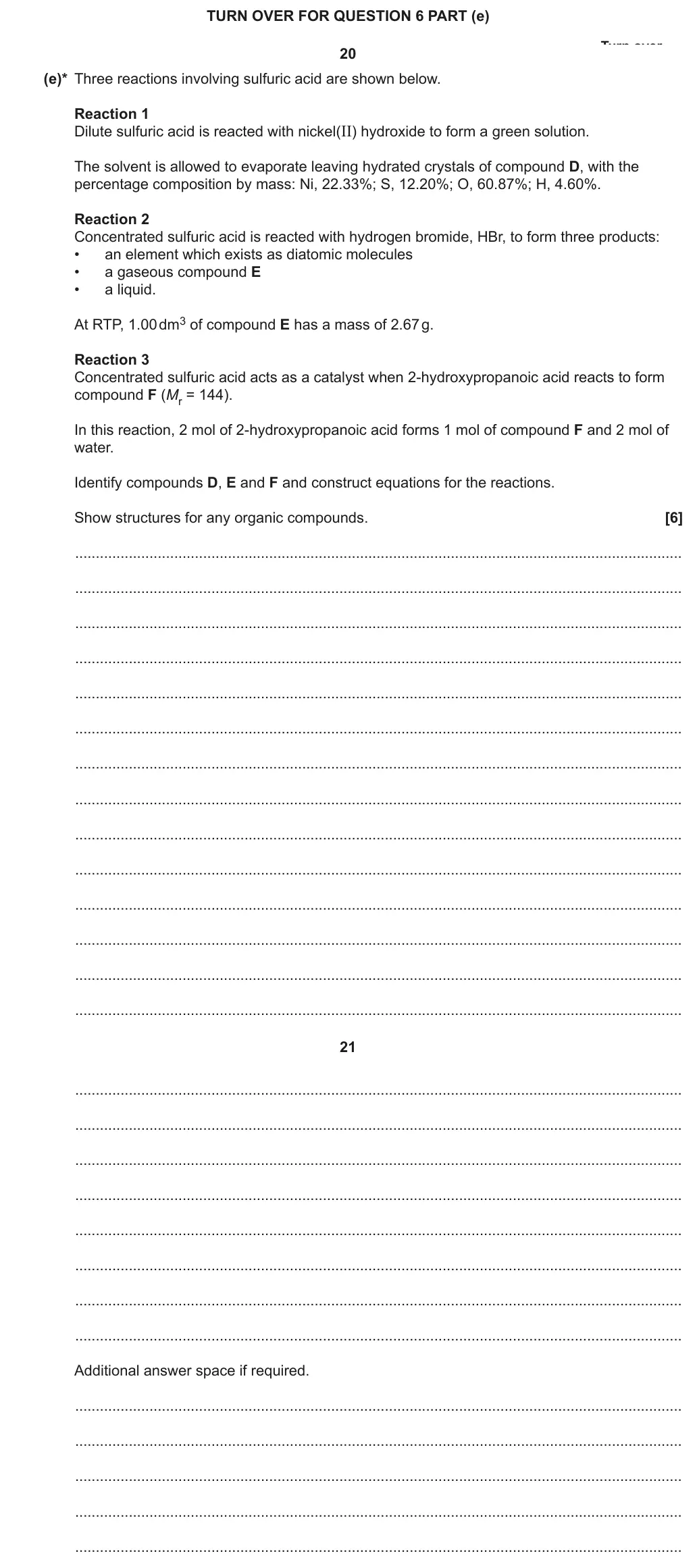
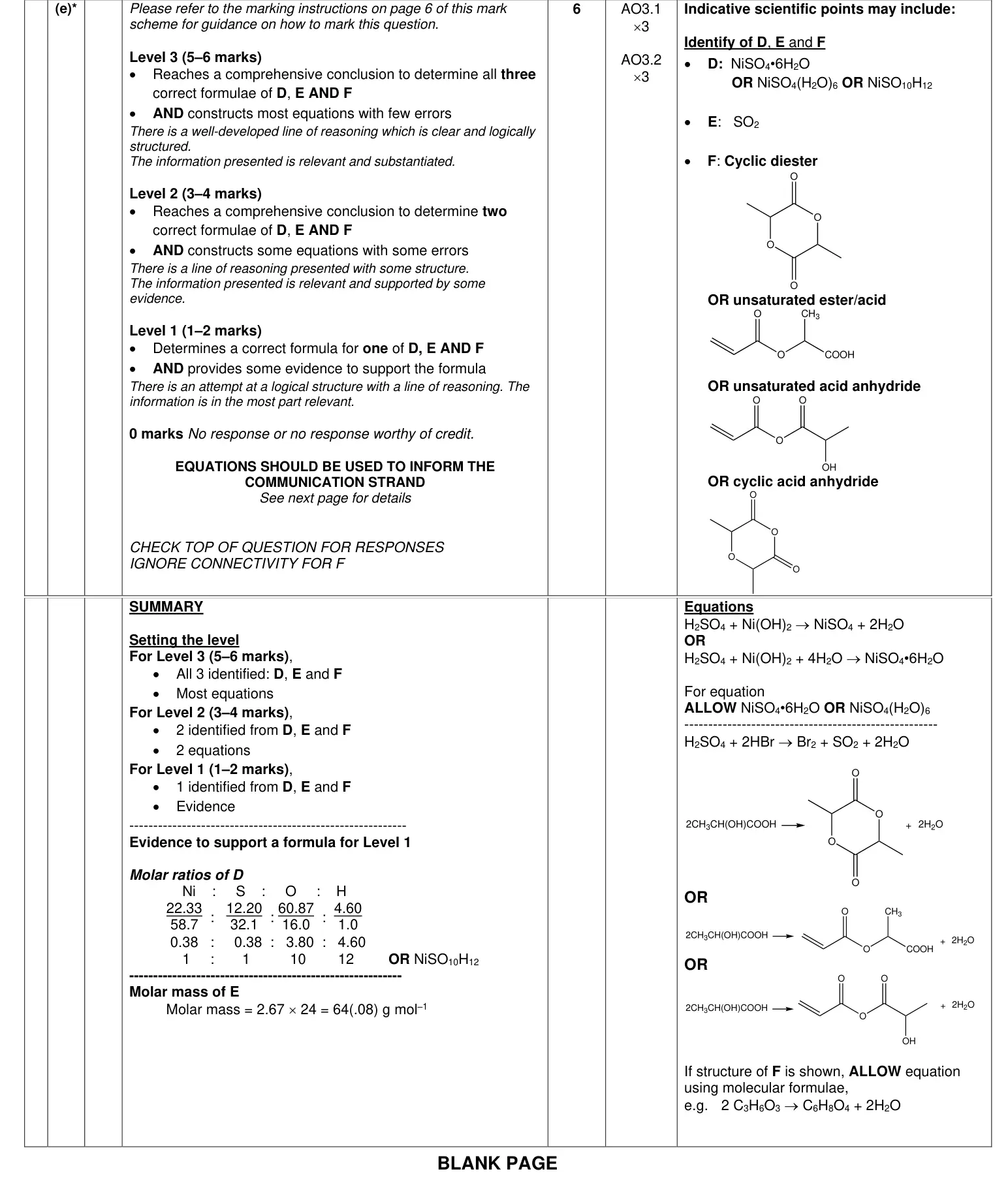
This level of response question required candidates to interpret three pieces of information to identify 3 unknown chemicals, linked by three reactions of sulfuric acid. Levels were assigned based on identifying the three unknowns and writing equations for the reactions. The 3 reactions were tiered in difficulty with the cyclic structure for compound F being the most difficult. The question discriminated extremely well, with comparatively few candidates not scoring any marks. This exemplar shows an excellent response which was awarded Level 3 and 6 marks. The crossing out shows how the candidate progressively solved the problem. Despite the crossing out, working is shown throughout, and the presentation of the response is very clear. For reaction 1, the candidate initially made an error in the stock formula determination calculation. Notice that the candidate crossed out their initial values and wrote them afresh. This approach is recommended. as changing incorrect numbers can lead to ambiguous numbers. In reaction 2, the candidate comfortably identified compound E from its molar mass and wrote a balanced equation for this reaction. For reaction 3, you can see how the candidate’s thought developed during the solve. They initially went for a straight chain structure and then worked out that there must be a cyclic structure. They finally show the cyclic diester as a conventional structural (based on glucose?), and with a balanced equation. This was an excellent response of a high-ability candidate and shows what a well-prepared candidate is capable of achieving.
Notes from the mark scheme and report
D = NiSO4•6H2O from mole ratio 1:1:10:12
E = SO2 (2.67 × 24 = 64)
H2SO4 + 2HBr → Br2 + SO2 + 2H2O
F = cyclic diester from 2 CH3CH(OH)COOH + 2H2O (ALLOW unsaturated ester/acid or anhydride isomers)
IGNORE connectivity for F
Skills: M0.2 Use ratios, fractions and percentages; M2.3 Substitute numerical values into algebraic equations using appropriate units for physical quantities
June 2022 · Paper 2 · Q101 markAO1Multiple choiceEasy
Answer
B
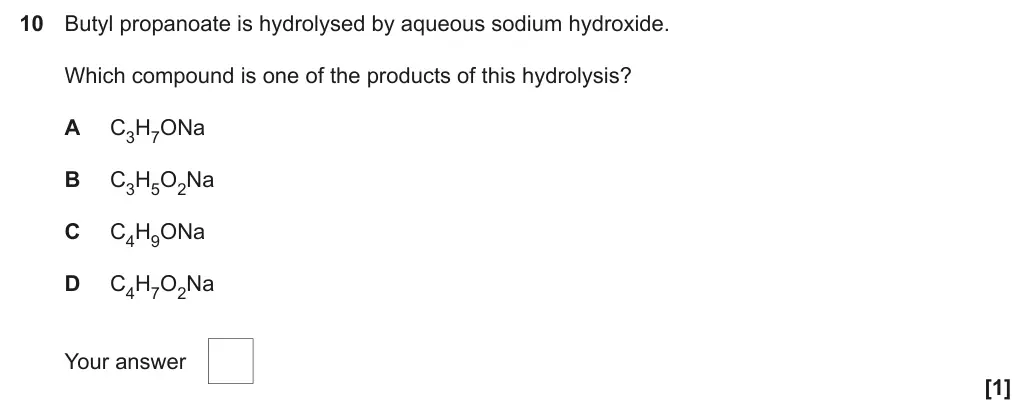
Mark scheme
Examiner's comment
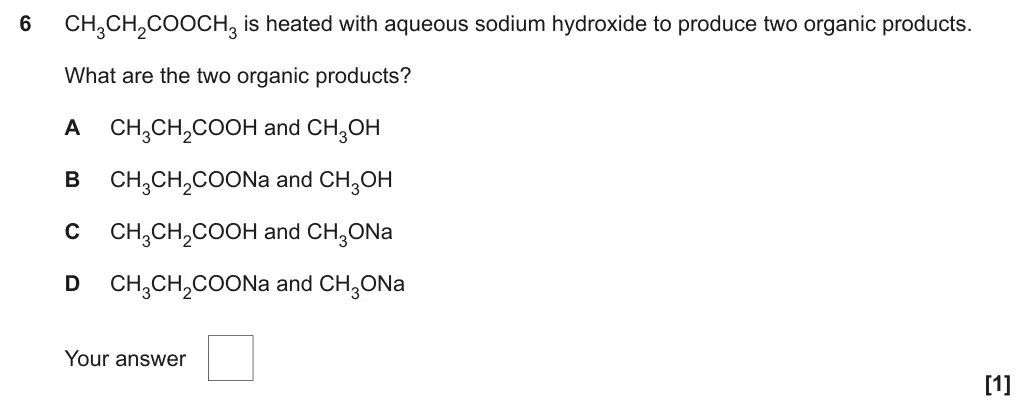
Most candidates correctly identified B as one of the products. These candidates often drew out the structures of butyl propanoate and the product options to aid in their selection.
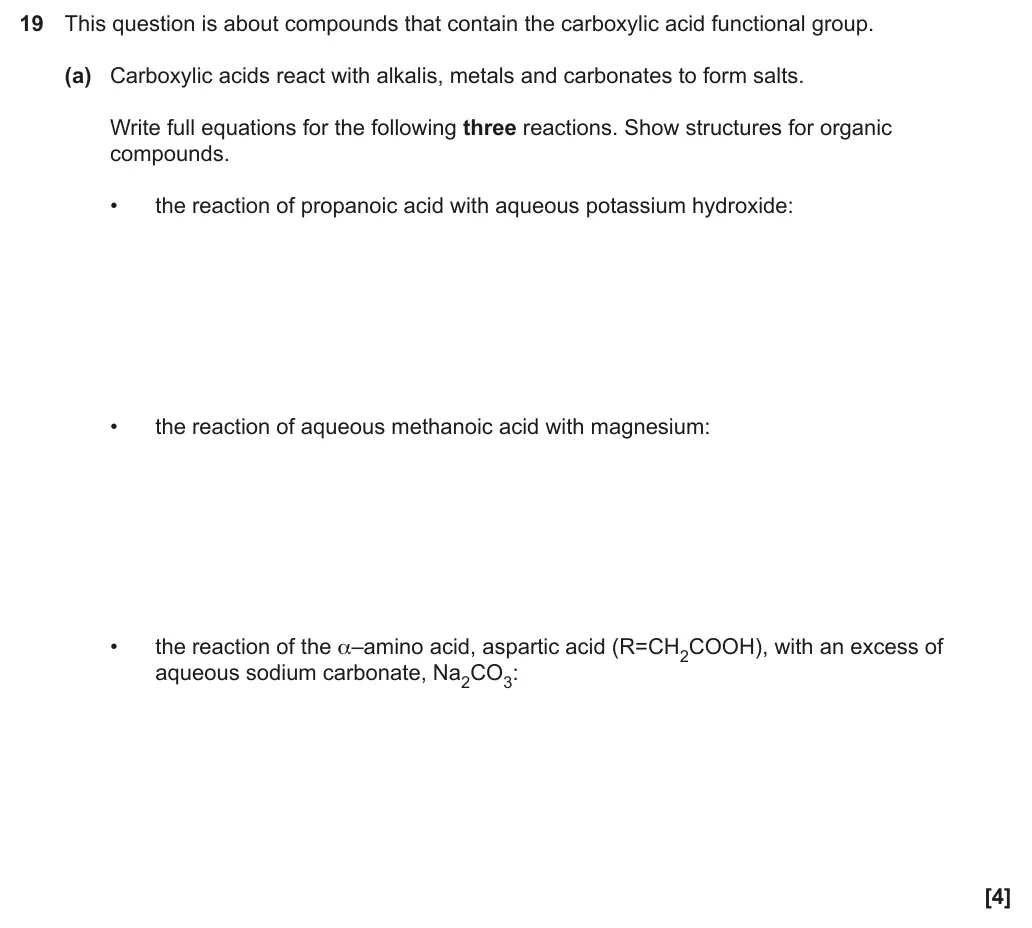
June 2022 · Paper 2 · Q19(a)4 marksAO2Equation writingHard
Mark scheme
Examiner's comment
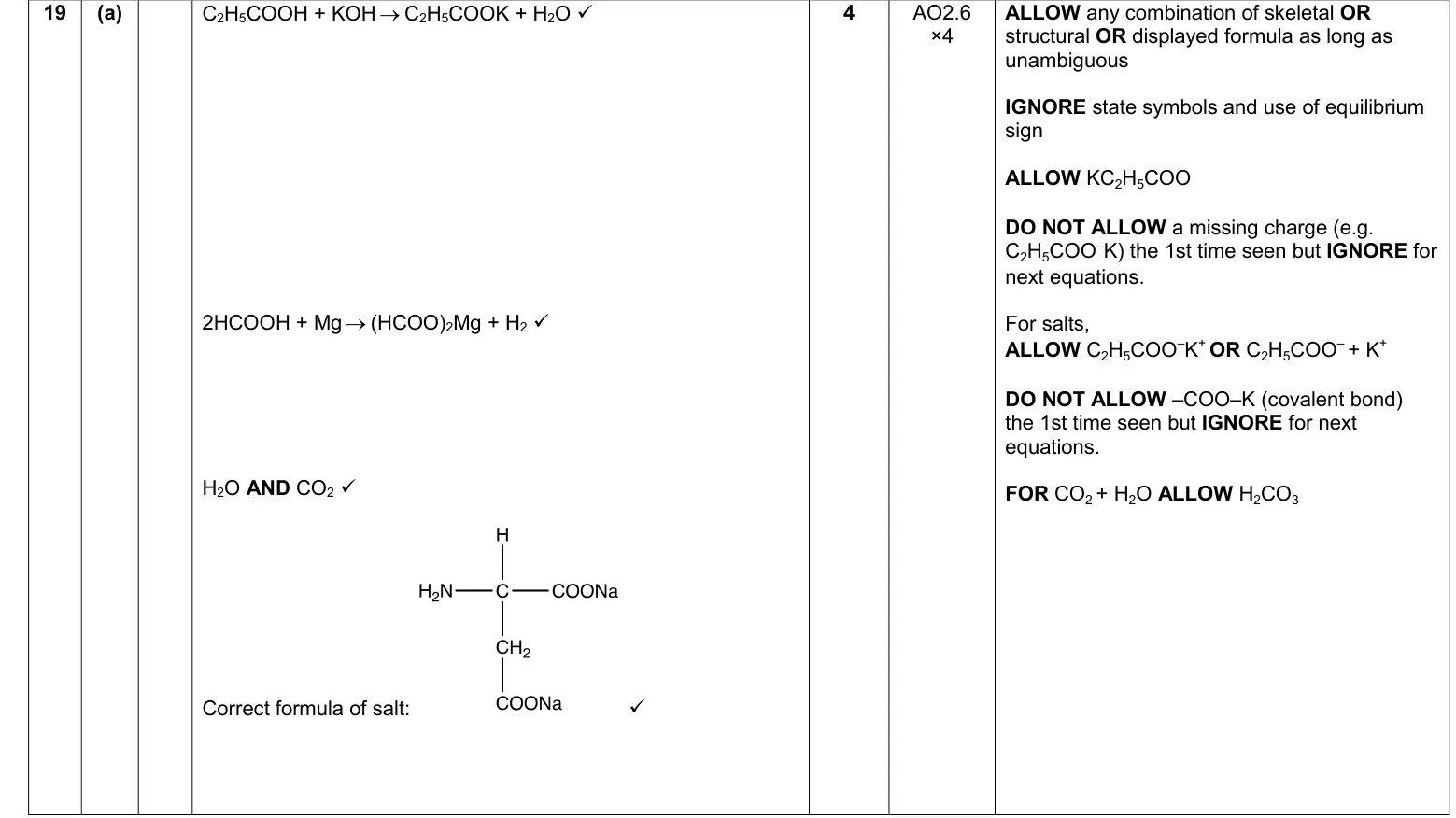
This question proved challenging for candidates. The first equation was often answered correctly, although some candidates used sodium hydroxide rather than potassium hydroxide in their response. The second equation was frequently incorrect. Candidates frequently missed a hydrogen from the structure for methanolic acid or did not recognise that hydrogen was a product. Many candidates did not account for magnesium having a 2+ charge when working out the product. For the third equation, the majority of candidates identified that carbon dioxide and water would be produced but were unable to give the correct formula of the salt as they did not interpret the information given regarding the R group.
Notes from the mark scheme and report
2HCOOH + Mg → (HCOO)2Mg + H2
both COOH groups of aspartic acid react with excess Na2CO3 giving H2O AND CO2 (ALLOW H2CO3)
DO NOT ALLOW –COO–K covalent bond or missing charge (penalise once)
Skills: M0.2 Use ratios, fractions and percentages
June 2022 · Paper 2 · Q19(b)4 marksAO2Complete table/diagramMedium
Mark scheme
Examiner's comment
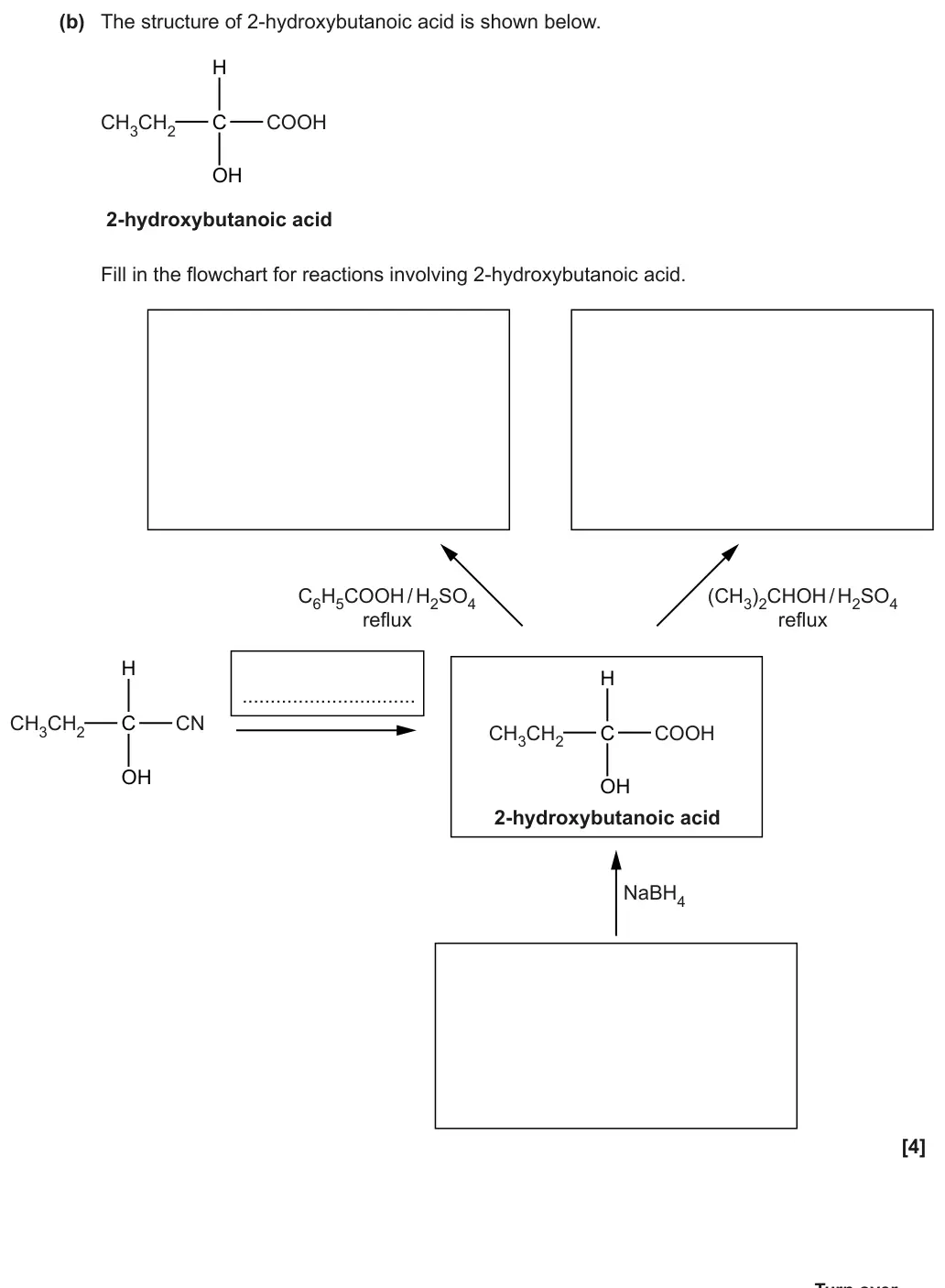
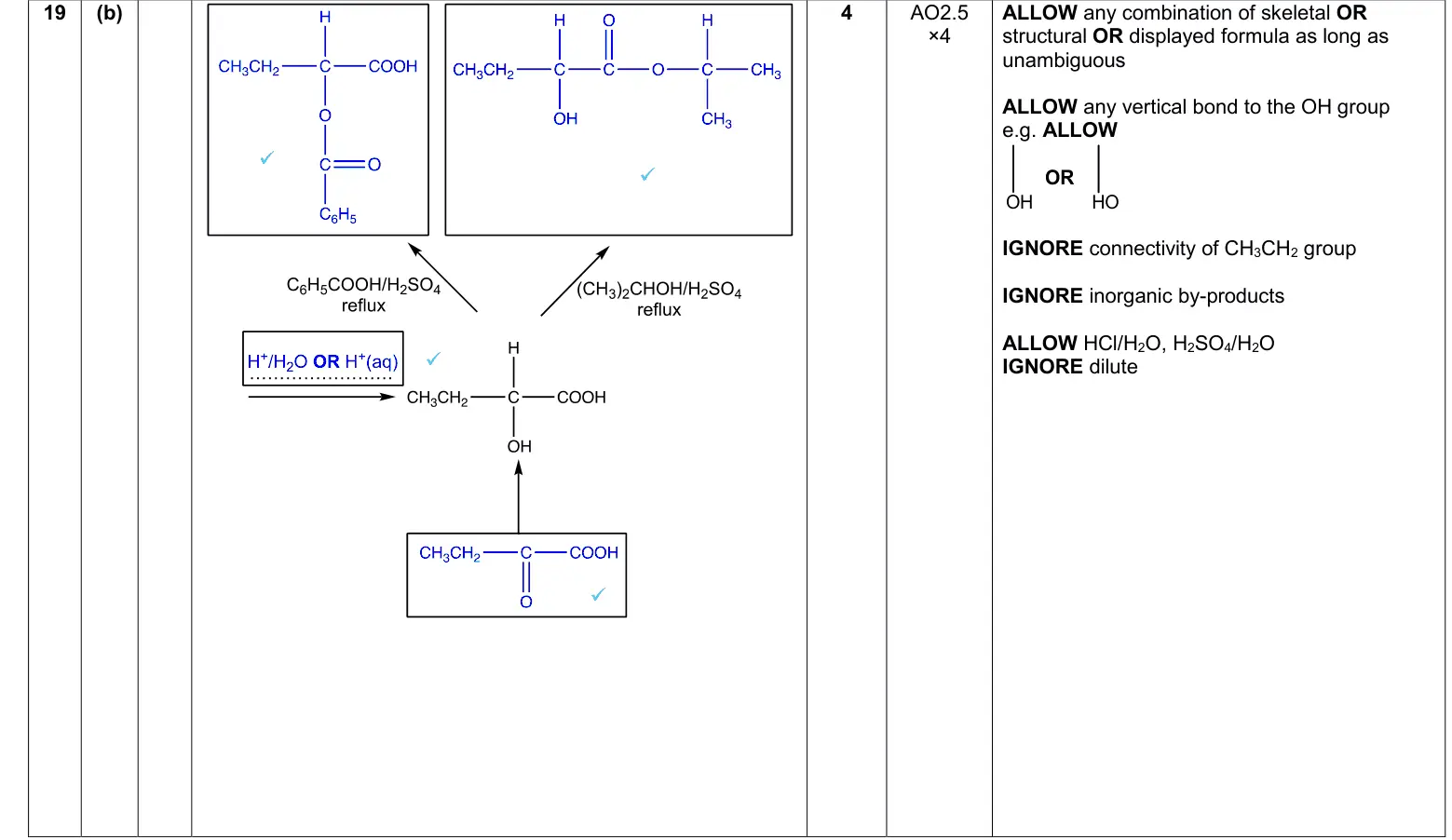
The majority of candidates were able to identify at least one of the structures. A significant number of candidates did not check the number of bonds of each atom in their structures and frequently had too many or too few hydrogen atoms attached. Most candidates identified that acidic conditions were required but some missed the aqueous condition that was also required for the mark.
Notes from the mark scheme and report
with C6H5COOH the OH group is esterified
with (CH3)2CHOH the COOH group is esterified
nitrile to acid needs H+/H2O (ALLOW HCl/H2O, H2SO4/H2O)
NaBH4 box is the ketone CH3CH2COCOOH
June 2022 · Paper 2 · Q20(f)2 marksAO3Short answerMedium
Mark scheme
Examiner's comment
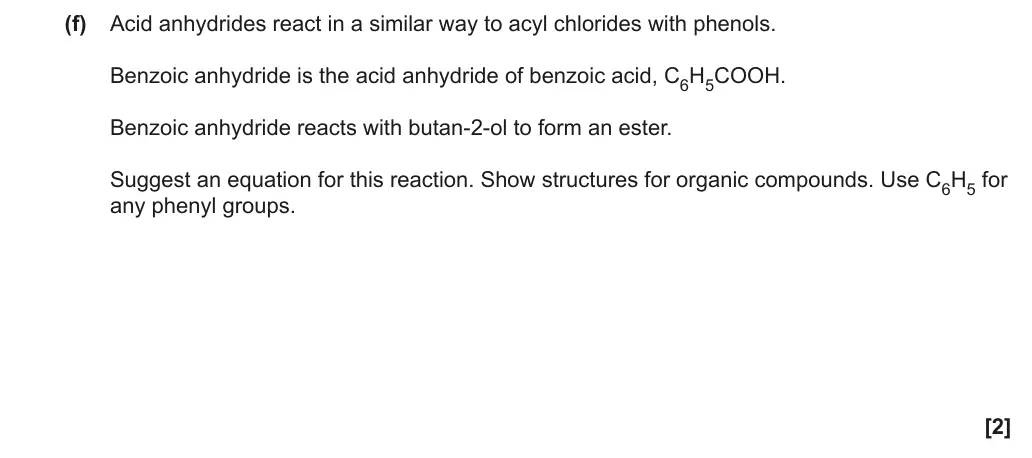
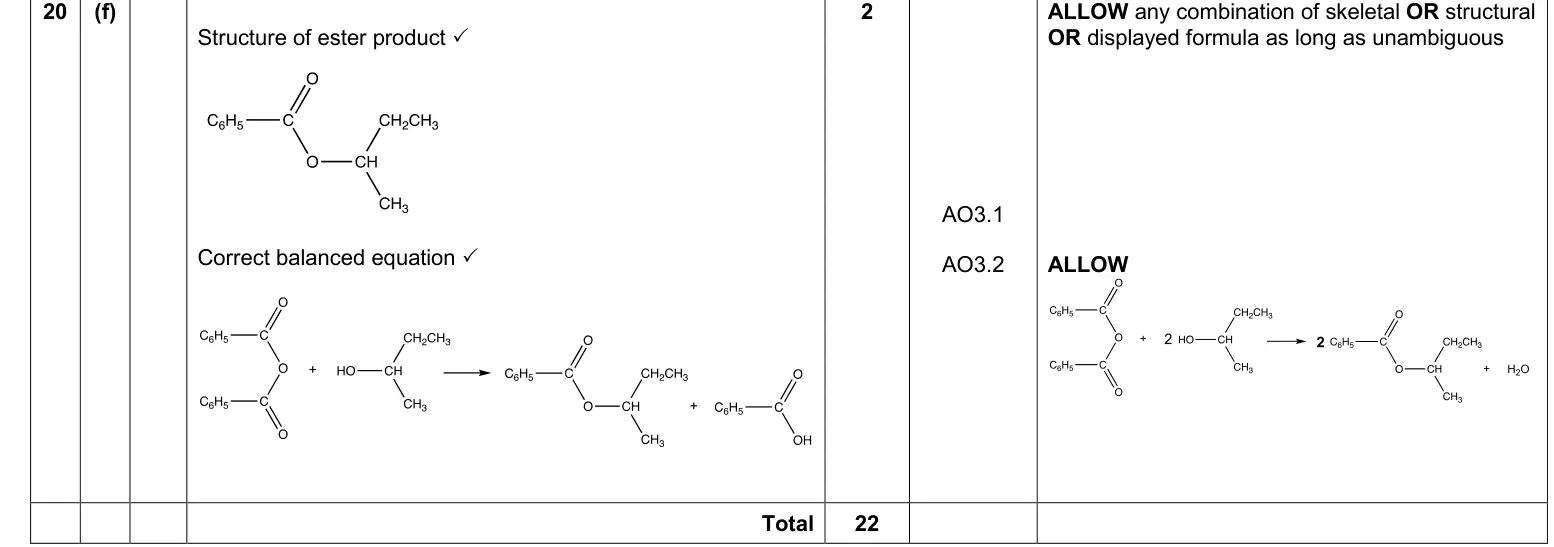
Most candidates did not secure a mark in this question. Many candidates used butan-1-ol in their equations or used benzoic acid rather than benzoic anhydride as the reactant. The most able candidates suggested that the benzoic acid product would then further react with butan-2-ol to produce a second ester molecule and water. This was an acceptable alternative response.
June 2022 · Paper 3 · Q6(b)(ii)2 marksAO3CalculationMedium
Earlier parts of question 6 that this part uses
Mark scheme
Examiner's comment
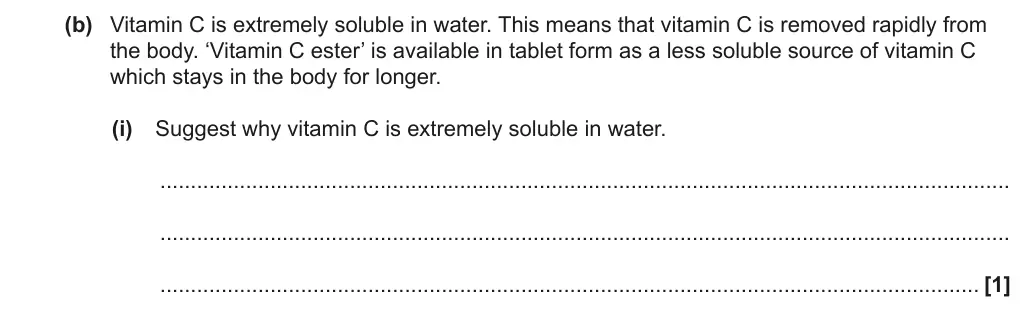
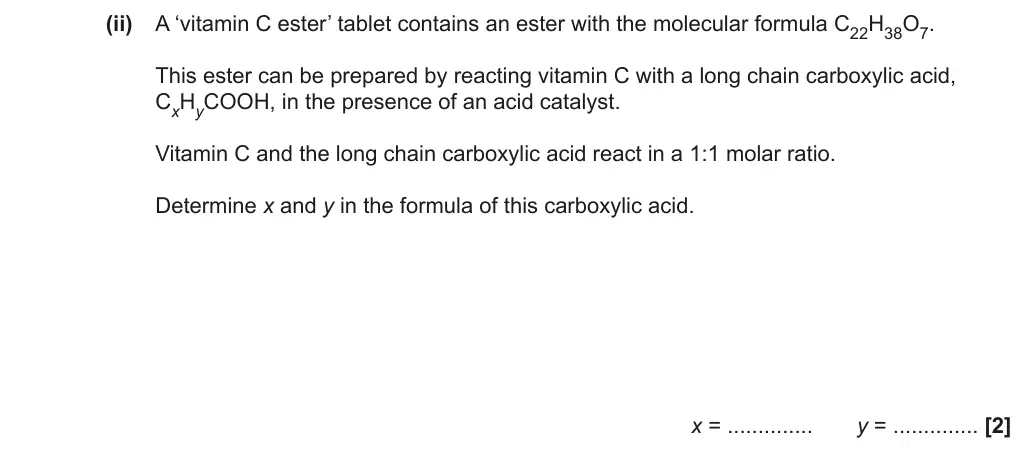
More successful responses determined that x = 15 and y = 31. The key to success here was to subtract the formula of vitamin C from the formula of the ester and to add the formula of water: C22H38O7 – C6H8O6 + H2O → C16H32O2 → C15H31COOH. A significant number of candidates did obtain one of these values, with 15/16 and 29/30/32 being common incorrect answers. Omitting part(s) of sequence above would result in these incorrect numbers.
Notes from the mark scheme and report
x = 15, y = 31 (C22H38O7 + H2O – C6H8O6 = C16H32O2)
Skills: M2.4 Solve algebraic equations
November 2021 · Paper 2 · Q61 markMultiple choice
Answer
B
Mark scheme
November 2021 · Paper 2 · Q151 markMultiple choice
Answer
A
Mark scheme
November 2021 · Paper 2 · Q18(b)7 marksAO1, 2Short answer
Earlier part of question 18 that this part uses
Mark scheme
Notes from the mark scheme and report
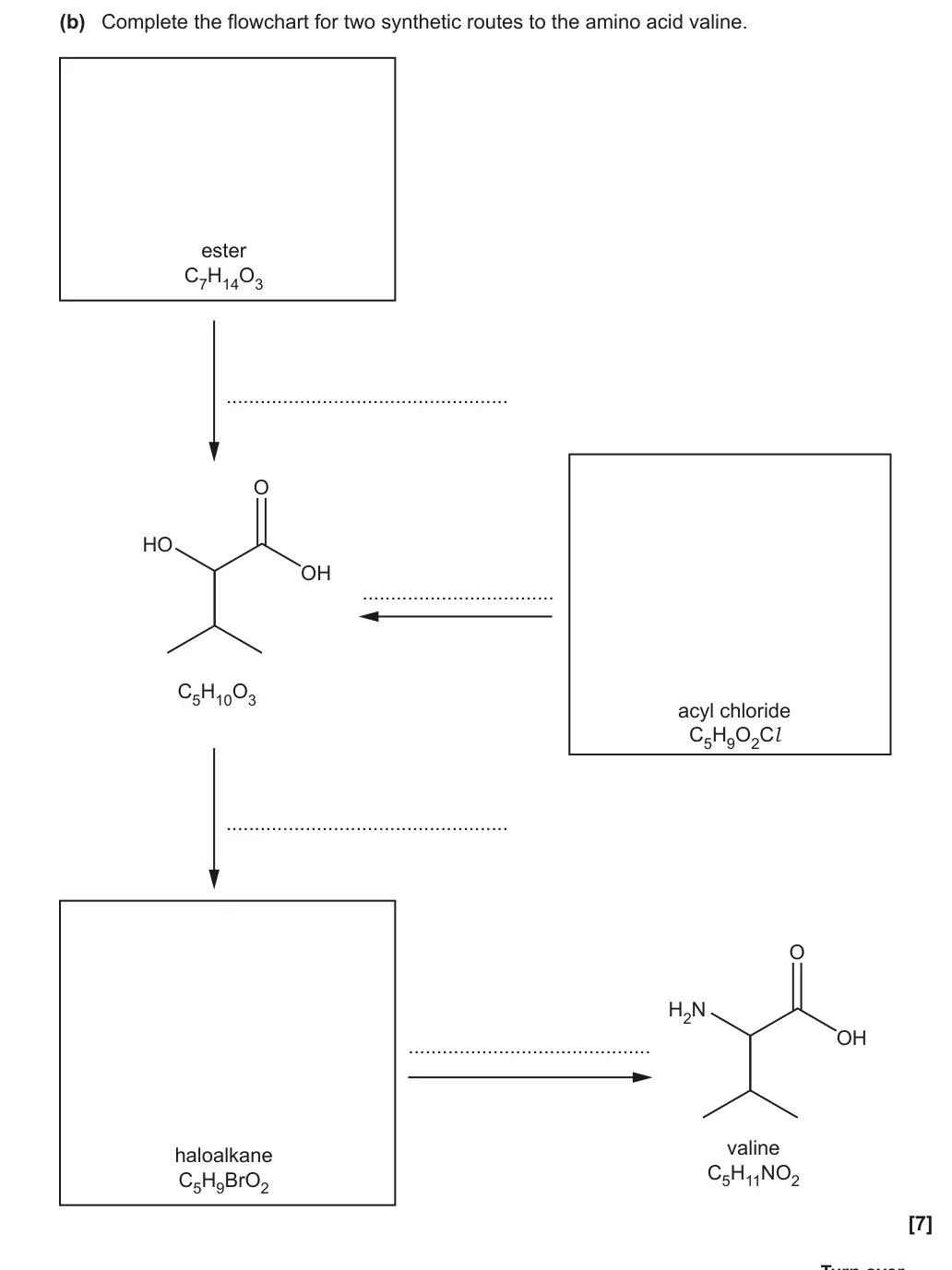
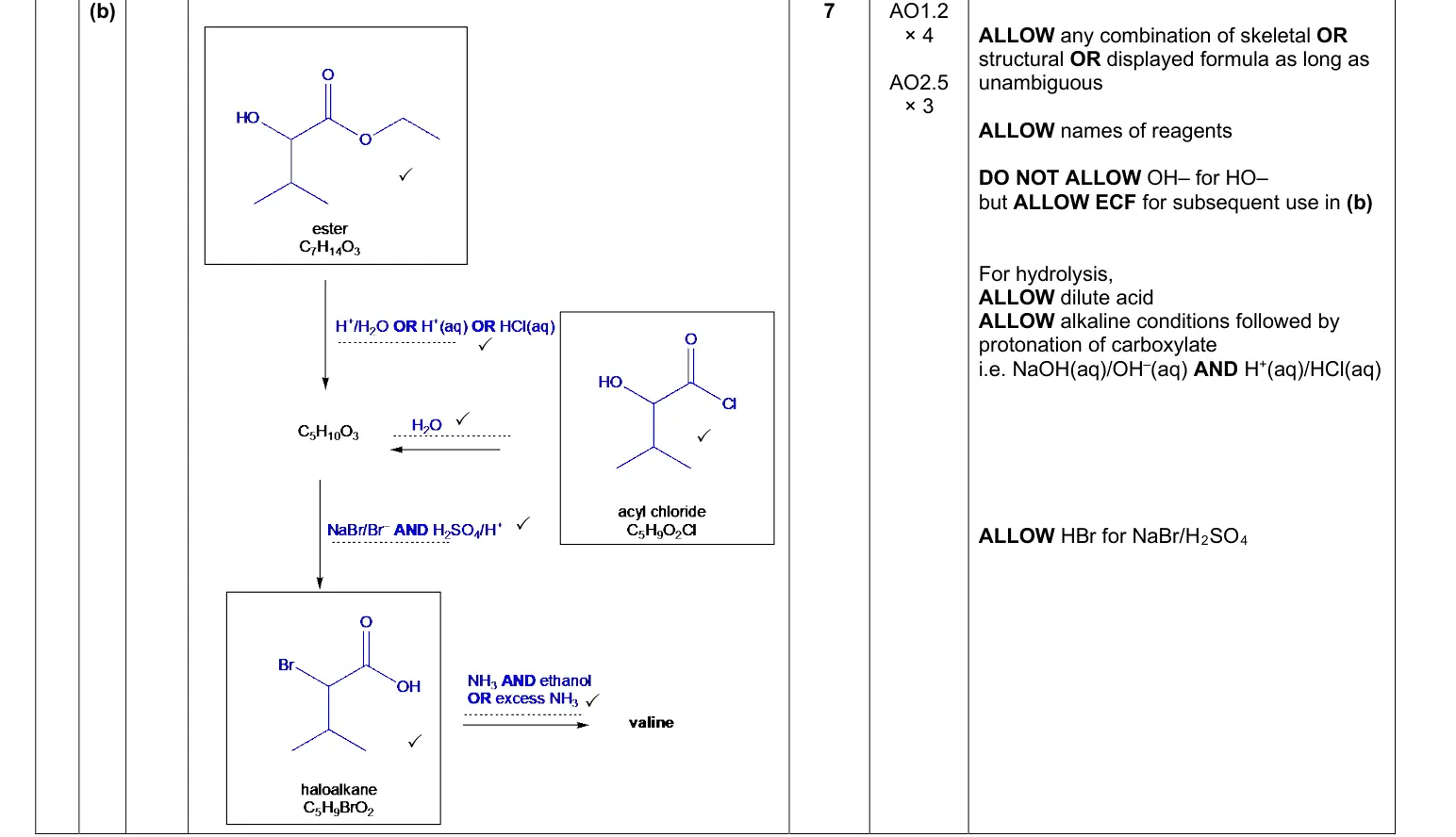
ethyl ester hydrolysed with H+(aq) (ALLOW alkali then acid)
acyl chloride + H2O
NaBr/H2SO4 (ALLOW HBr) to bromo acid
excess NH3/ethanol
DO NOT ALLOW OH– for HO–
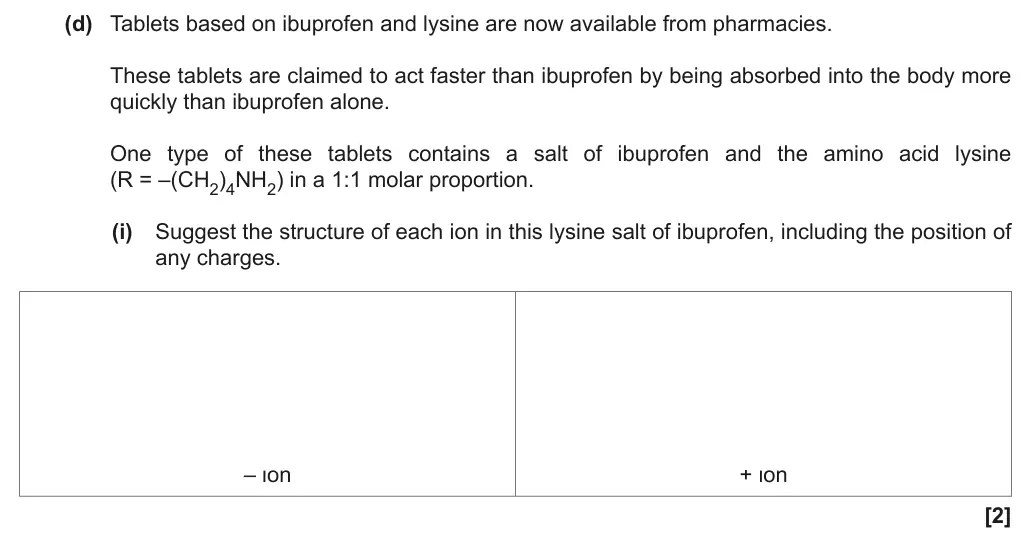
November 2021 · Paper 2 · Q18(d)(i)2 marksAO3Structure / isomer
Earlier parts of question 18 that this part uses
Mark scheme
Notes from the mark scheme and report
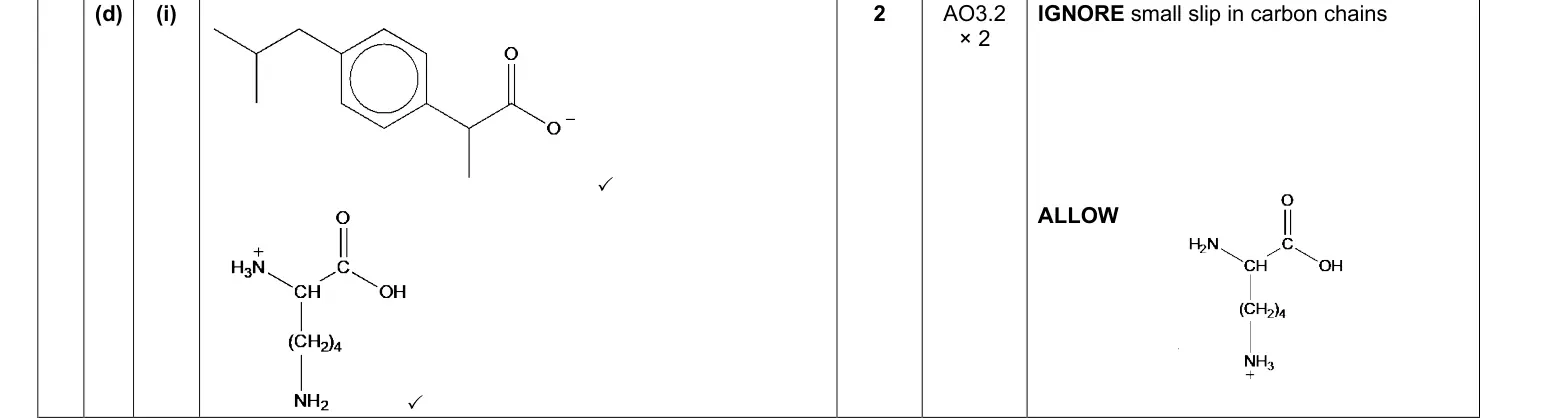
ibuprofen carboxylate COO–
lysine with one NH3+ (either amine group protonated)
IGNORE small slip in carbon chains
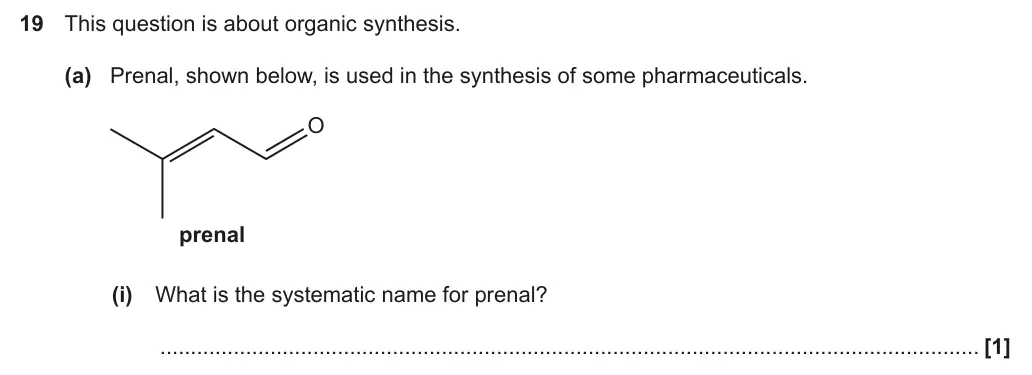
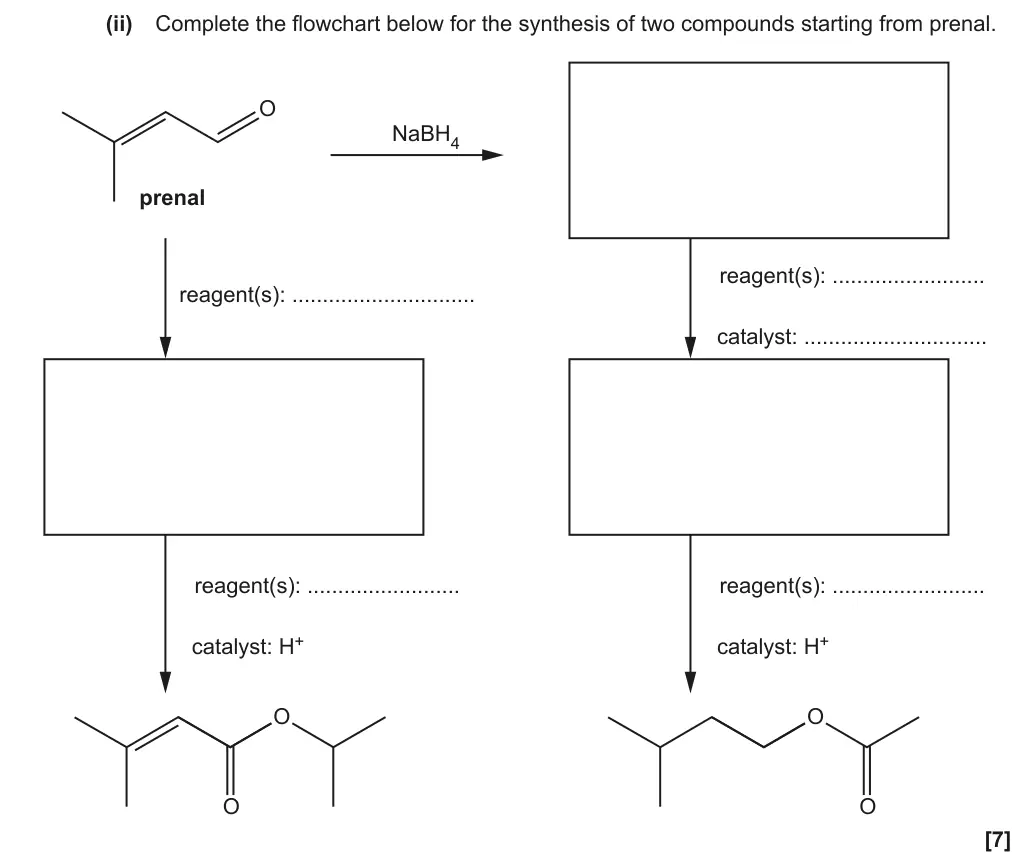
November 2021 · Paper 2 · Q19(a)(ii)7 marksAO1, 2Short answer
Earlier part of question 19 that this part uses
Mark scheme
Notes from the mark scheme and report
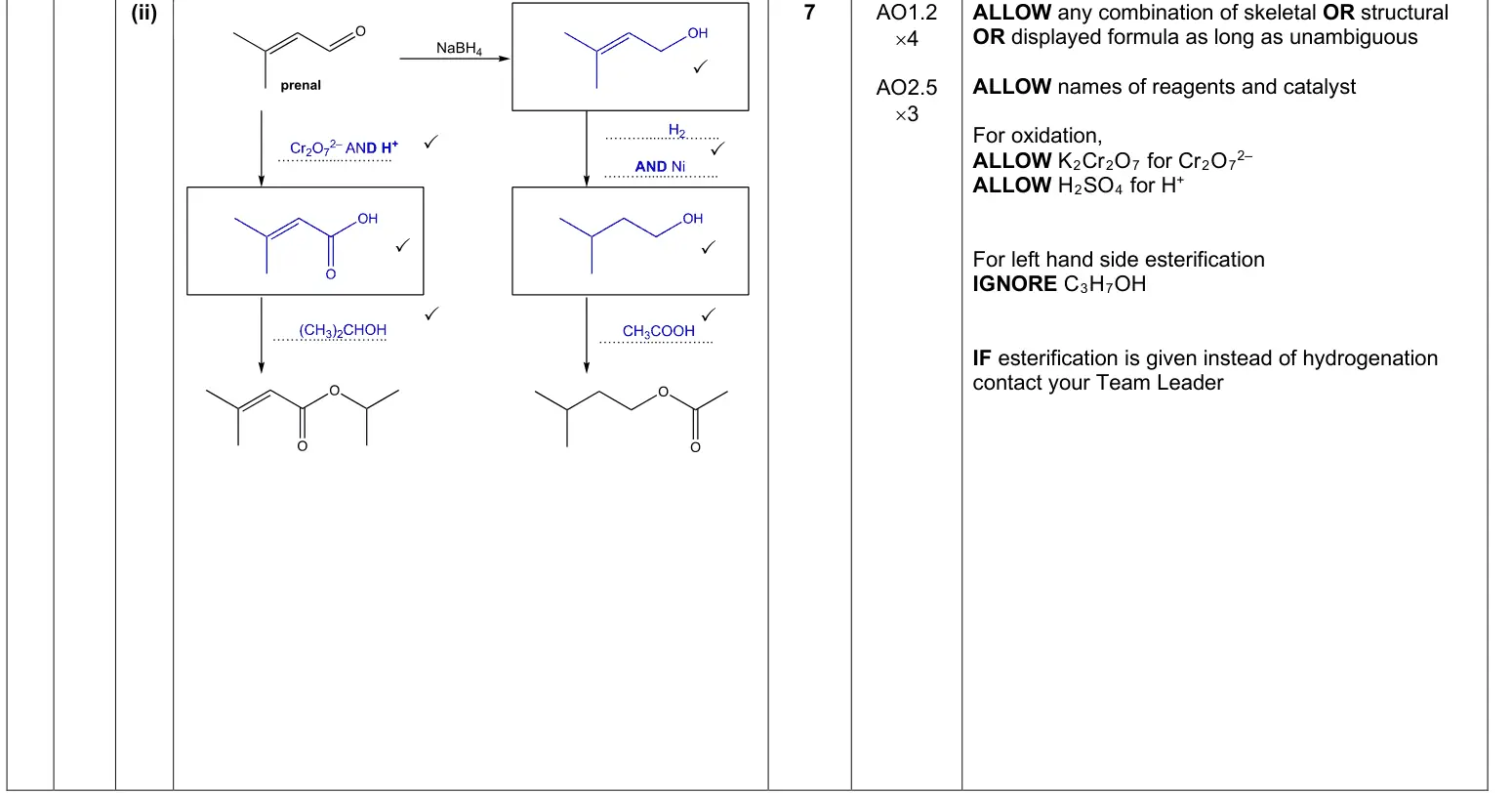
NaBH4 reduces C=O only (unsaturated alcohol)
then H2 AND Ni
then CH3COOH/H+
left route Cr2O72– AND H+ to unsaturated acid then (CH3)2CHOH/H+
ALLOW names of reagents
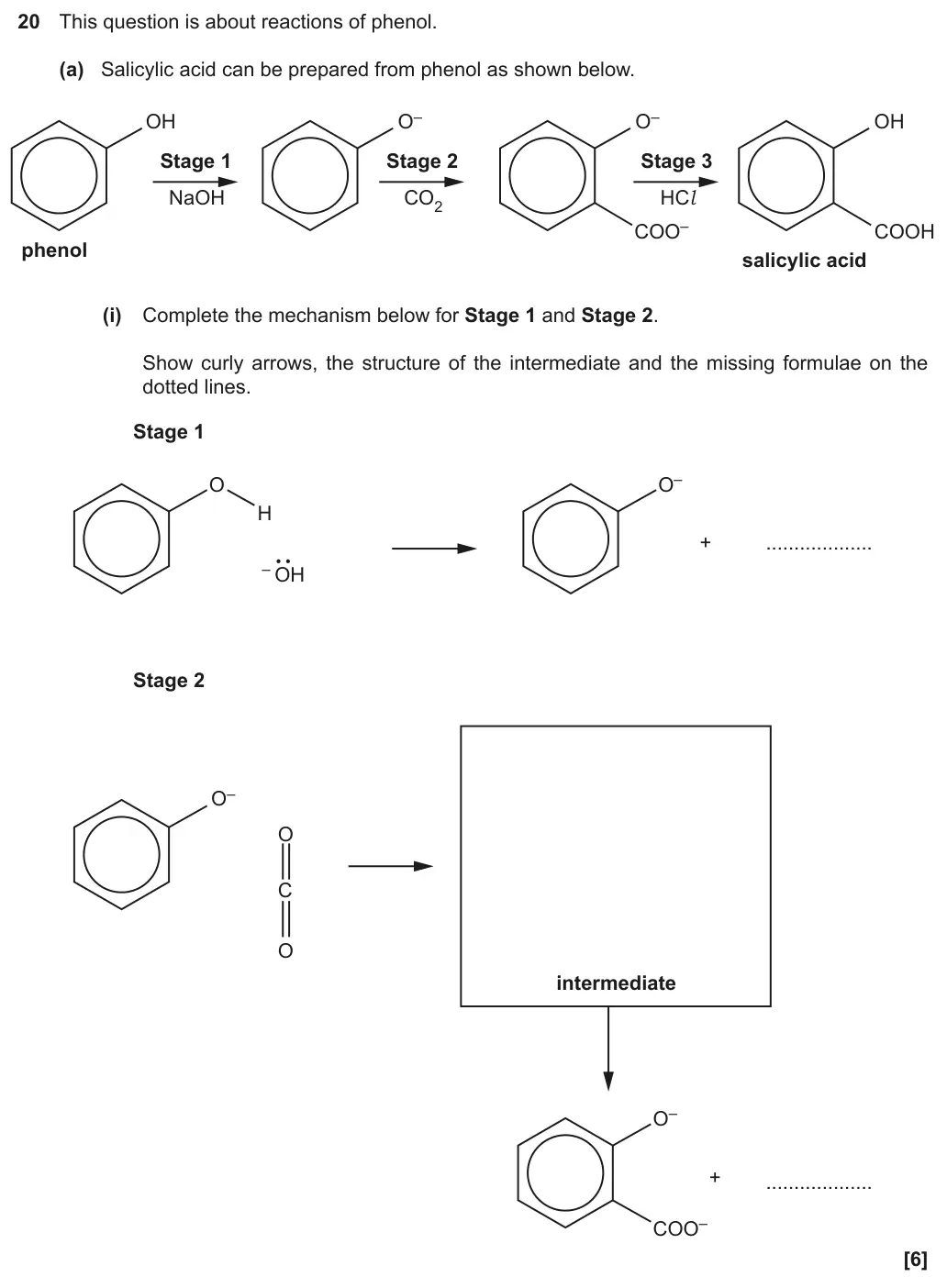
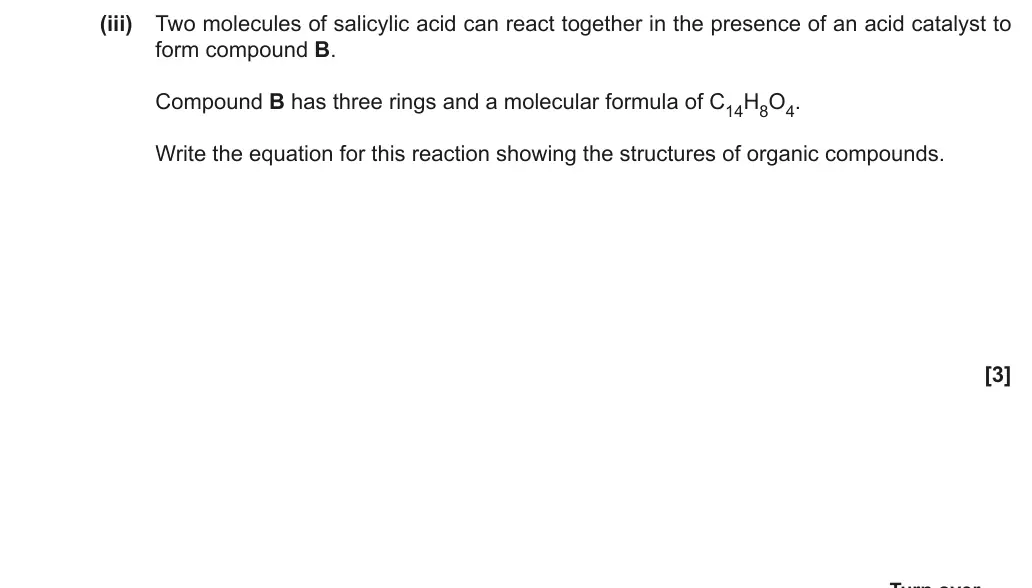
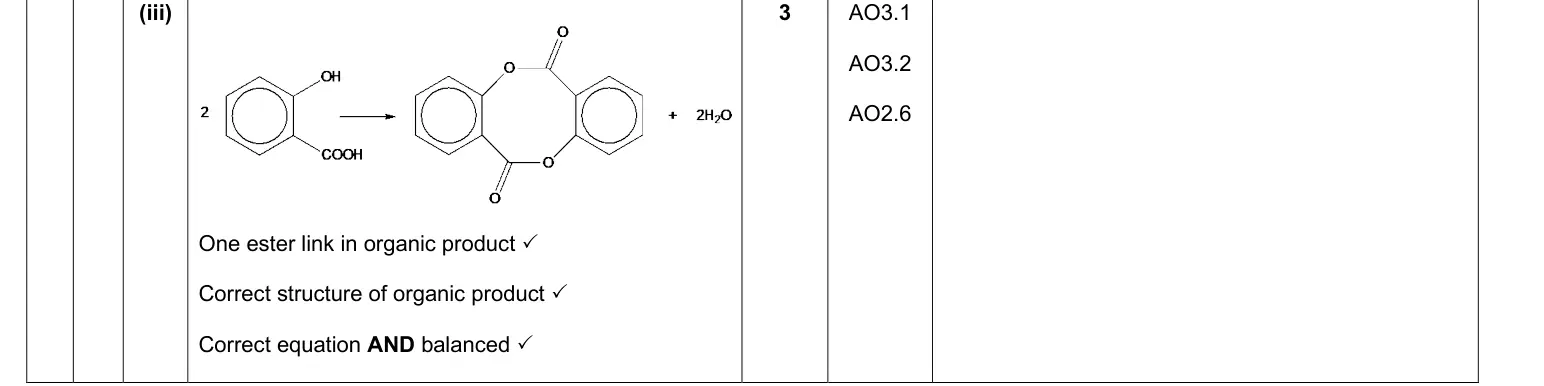
November 2021 · Paper 2 · Q20(a)(iii)3 marksAO2, 3Equation writingHard
Earlier part of question 20 that this part uses
Mark scheme
Examiner's comment
Question 20(a)(iii): Candidates who found this question difficult often did not recognise the functional groups present in the reacting molecule.
Notes from the mark scheme and report
cyclic diester (two ester links, three rings) from 2 molecules
2H2O to balance
November 2021 · Paper 3 · Q1(e)4 marksAO2Equation writingHard
Mark scheme
Examiner's comment
Q1(d), Q1(e), Q5(a)(i) • Unclear drawing of diagrams and labelling of laboratory apparatus: Q2(a) • Had difficulty explaining chemical ideas, often repeating the same points several times, e.g. Q1(e): Candidates needed to use their knowledge of reactions of carboxylic acids to construct two equations. See also comments made for Q1(e) and Q3(b).
Notes from the mark scheme and report
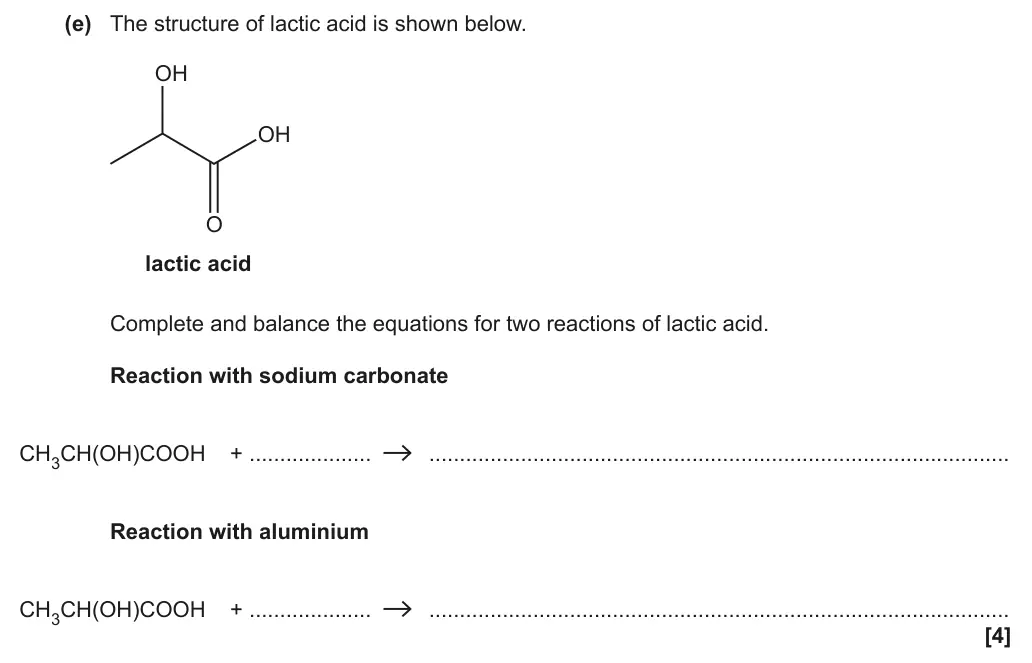
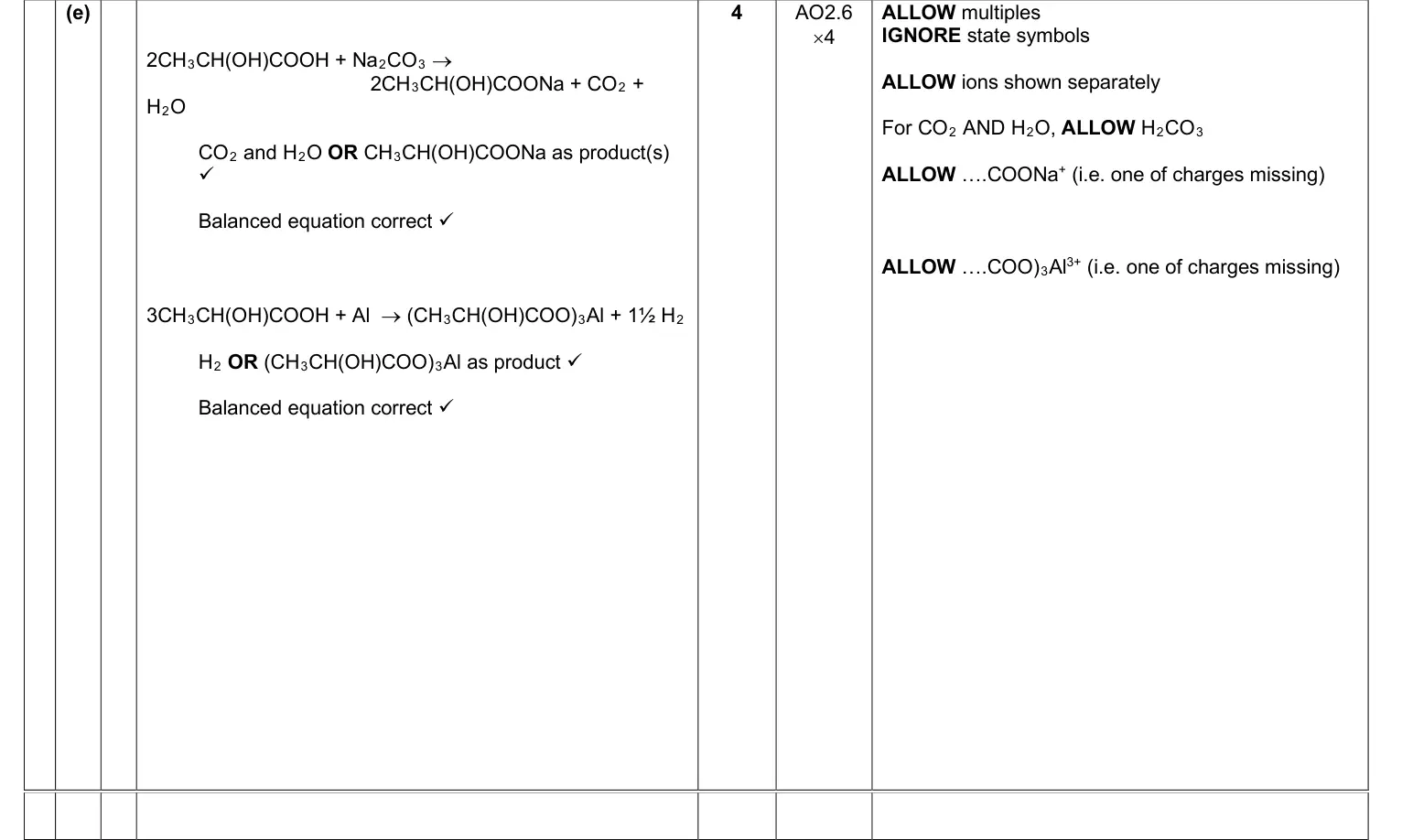
2:1 acid:Na2CO3 giving salt + CO2 + H2O
3 acid + Al → (CH3CH(OH)COO)3Al + 1½H2
alcohol OH does not react
ALLOW multiples
IGNORE state symbols
Skills: M0.2 Use ratios, fractions and percentages
November 2021 · Paper 3 · Q5(c)6 marksAO36-mark level of responseHard
Mark scheme, with the levels and indicative points
Examiner's comment
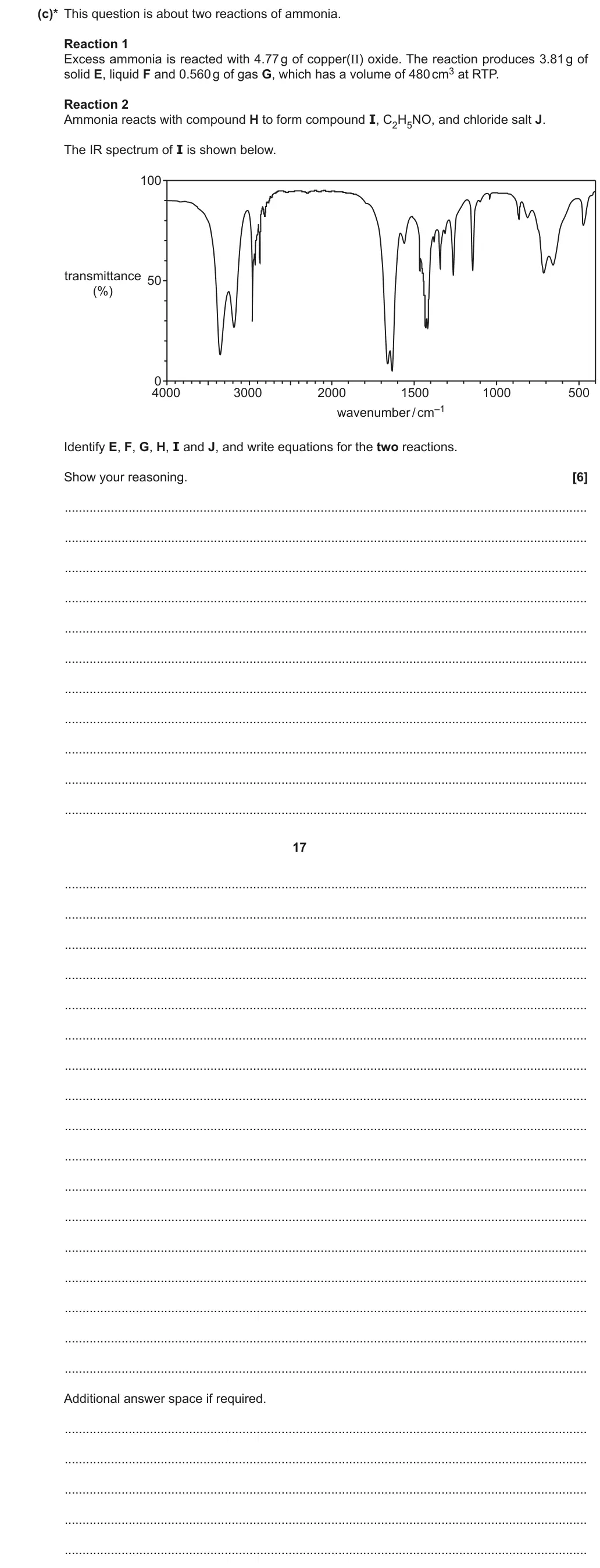
Q2(c), Q2(d): Predicting the effect of modifications to an experiment Q5(c): Interpreting information in a Level of Response question provided in an unfamiliar contexts • Had difficulty when writing equations for unfamiliar reactions, e.g. Q5(c) is a Level of Response question which is commented on after this section Level of response questions Q4(b): Candidates were required to analyse the graphical results of a rates investigation to determine the reaction order, rate and rate constant. Q5(c): Candidates were supplied with information about two reactions, supported by numerical data and an IR spectrum.
Notes from the mark scheme and report
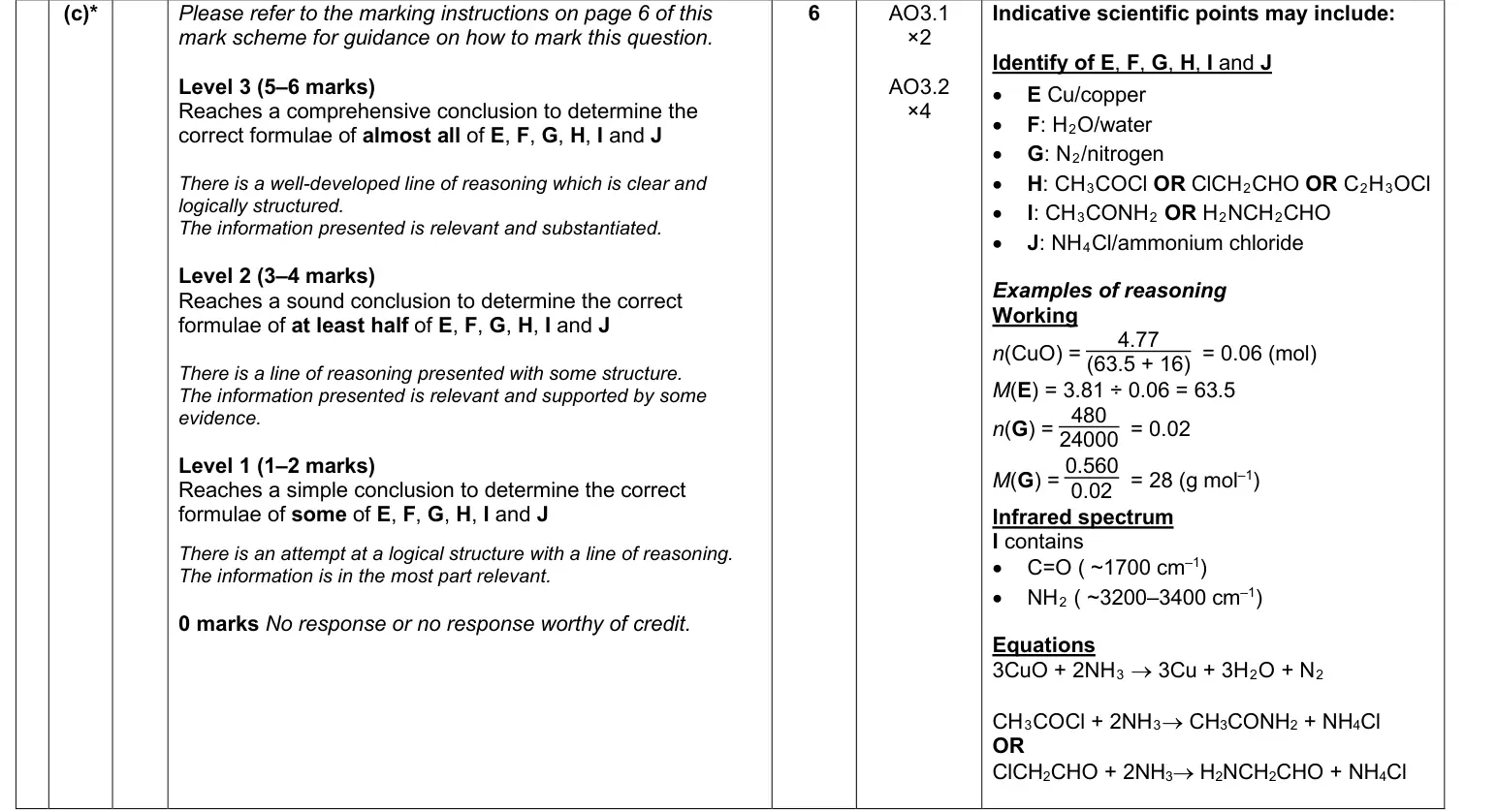
E = Cu (M = 3.81/0.06 = 63.5), F = H2O, G = N2 (M = 0.560/0.02 = 28)
3CuO + 2NH3 → 3Cu + 3H2O + N2
I has C=O (~1700) and N–H (3200–3400) so CH3CONH2
H = CH3COCl, J = NH4Cl
CH3COCl + 2NH3 → CH3CONH2 + NH4Cl
Skills: M0.2 Use ratios, fractions and percentages; M3.1 Translate information between graphical, numerical and algebraic forms
November 2020 · Paper 2 · Q31 markAO1Multiple choice
Answer
A
Mark scheme
November 2020 · Paper 2 · Q71 markAO1Multiple choice
Answer
A
Mark scheme
November 2020 · Paper 2 · Q141 markAO2Multiple choice
Answer
B
Mark scheme
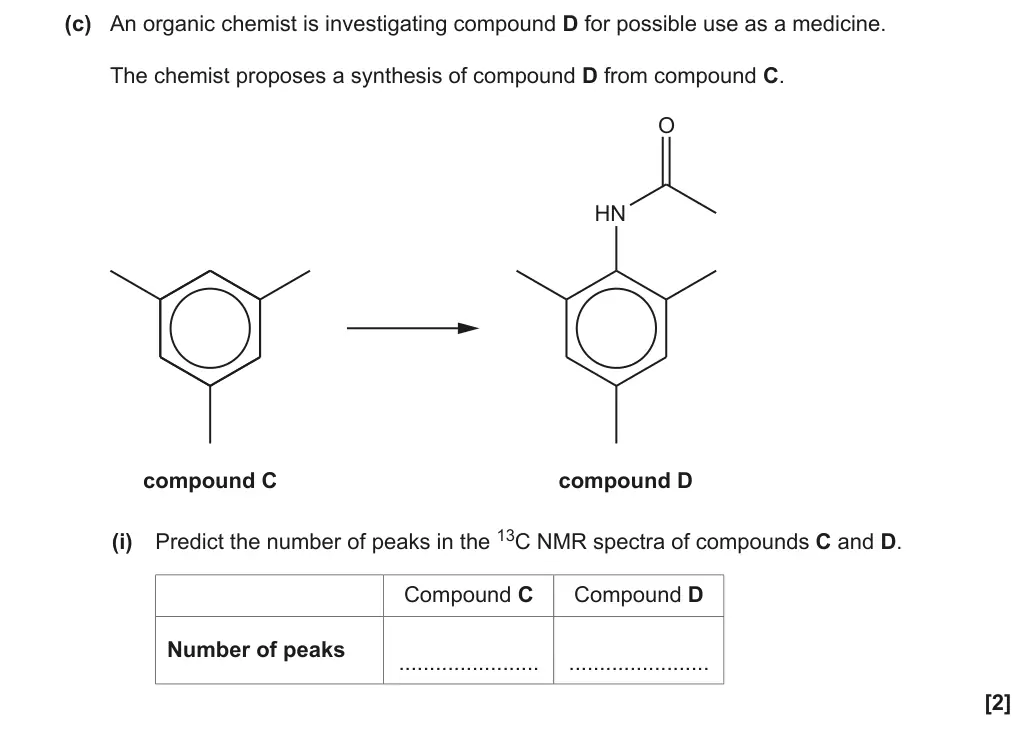
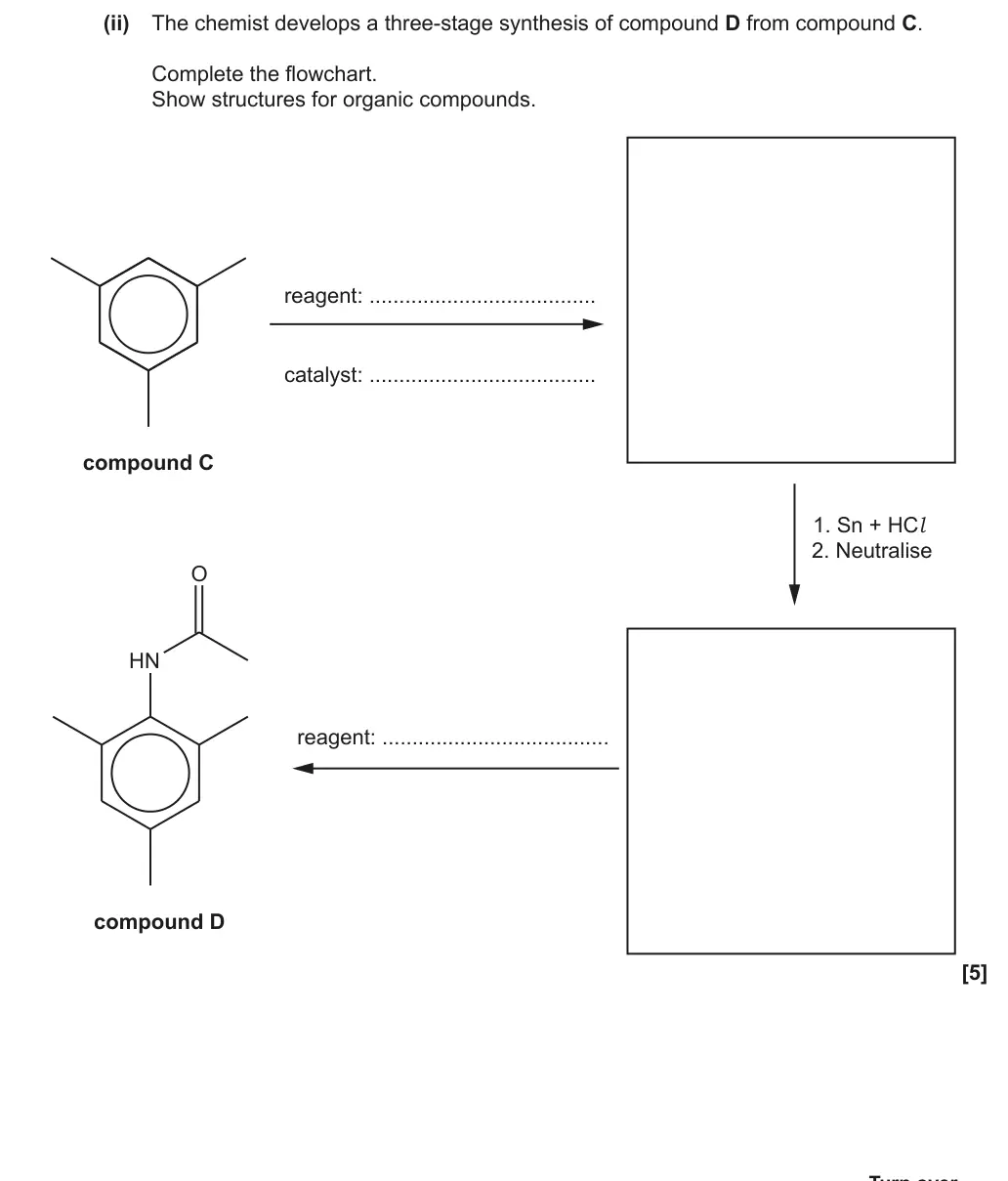
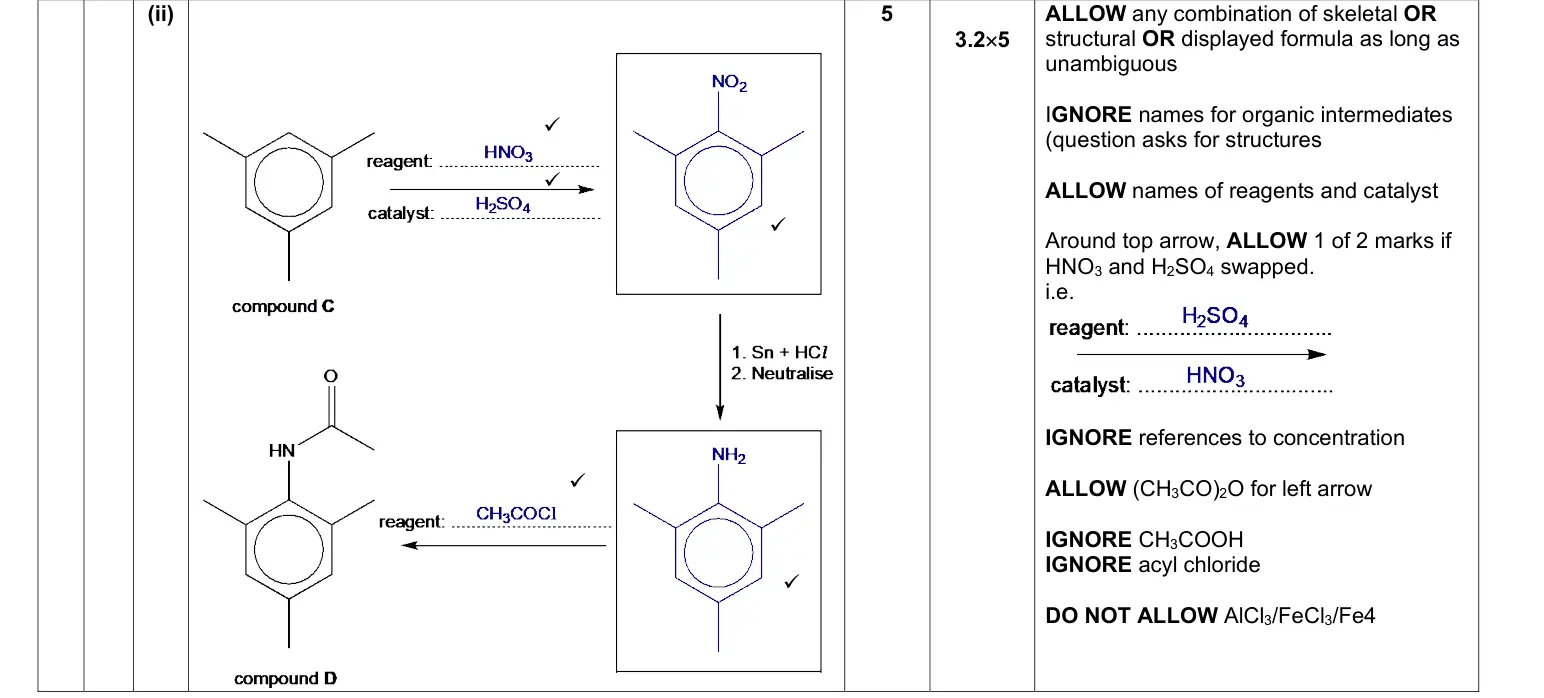
November 2020 · Paper 2 · Q17(c)(ii)5 marksAO3Complete table/diagram
Earlier part of question 17 that this part uses
Mark scheme
Notes from the mark scheme and report
HNO3 with H2SO4 catalyst (1 of 2 if swapped)
nitro compound then amine
CH3COCl or (CH3CO)2O for final stage (IGNORE CH3COOH)
DO NOT ALLOW AlCl3/FeCl3
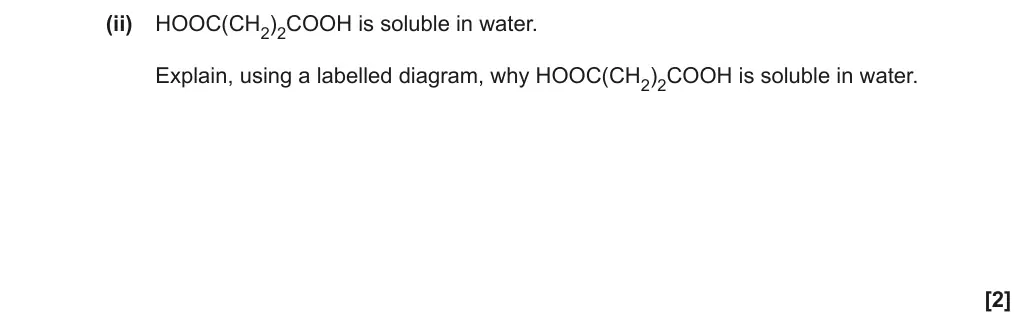
November 2020 · Paper 2 · Q18(a)(ii)2 marksAO2Short answerMedium
Earlier part of question 18 that this part uses
Mark scheme
Examiner's comment
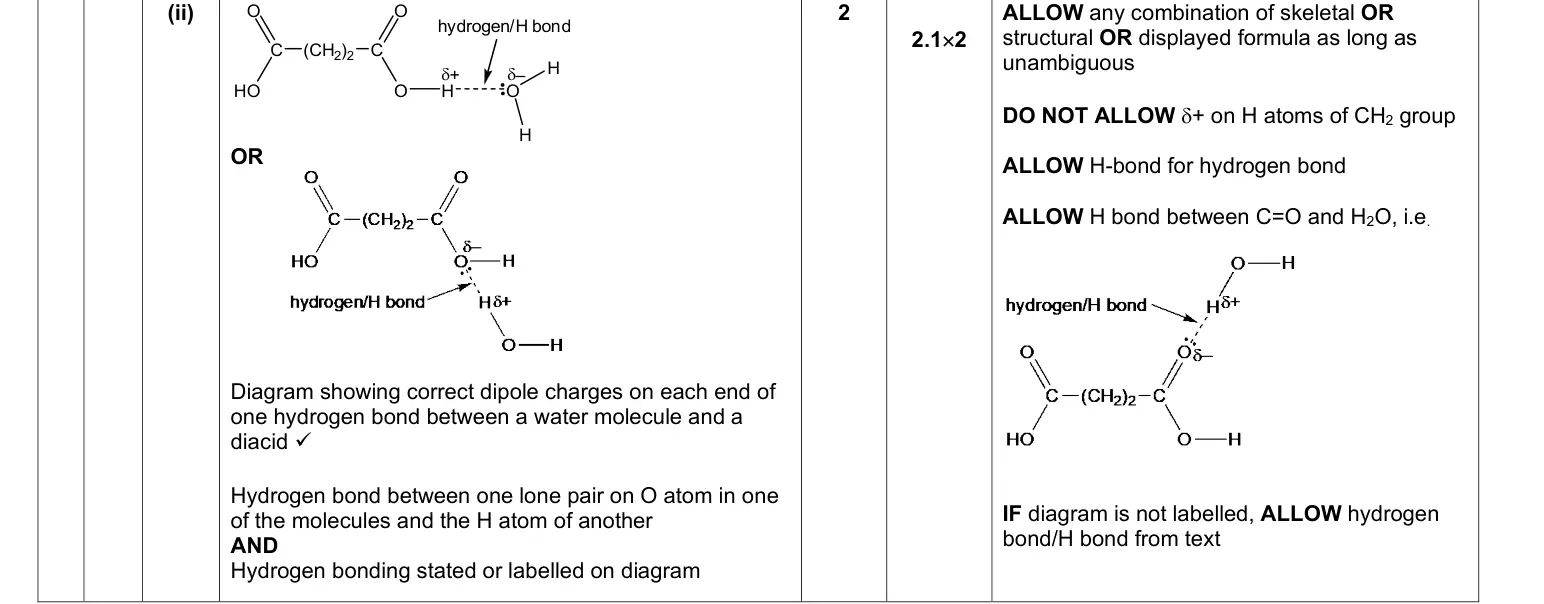
Question 18(a)(ii) Candidates who answered this question well had clear, labelled diagrams.
Notes from the mark scheme and report
dipoles δ+/δ– on each end of one hydrogen bond
H bond from lone pair on O to H
hydrogen bond labelled
DO NOT ALLOW δ+ on H atoms of CH2
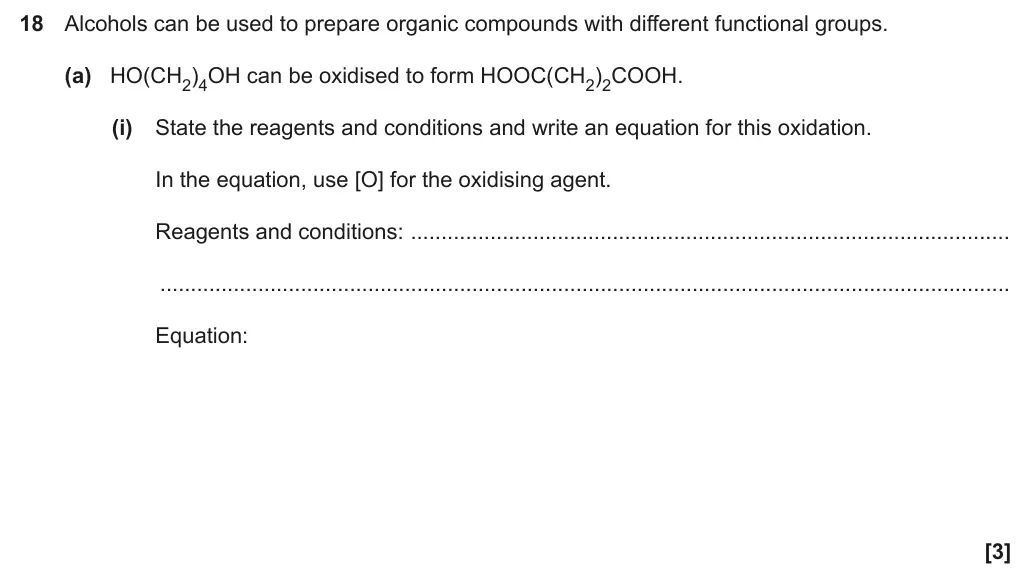
November 2020 · Paper 2 · Q18(b)(iii)3 marksAO1, 2Complete table/diagram
Earlier part of question 18 that this part uses
Mark scheme
Notes from the mark scheme and report
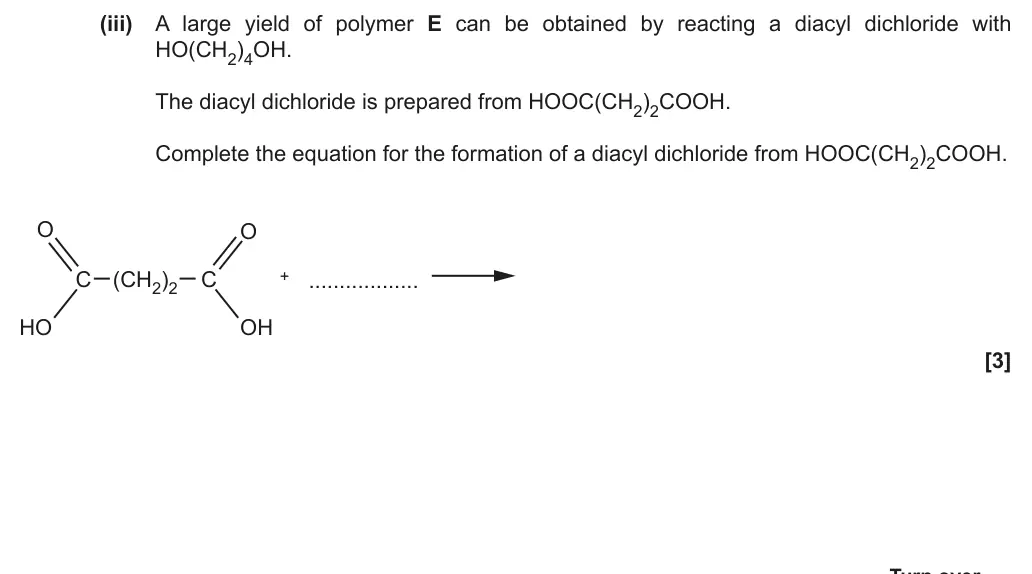
2SOCl2 gives ClOC(CH2)2COCl + 2SO2 + 2HCl
ALLOW PCl5 or PCl3 route
Skills: M0.2 Use ratios, fractions and percentages
November 2020 · Paper 2 · Q21(b)(ii)4 marksAO2Structure / isomer
Earlier part of question 21 that this part uses
Mark scheme
Notes from the mark scheme and report
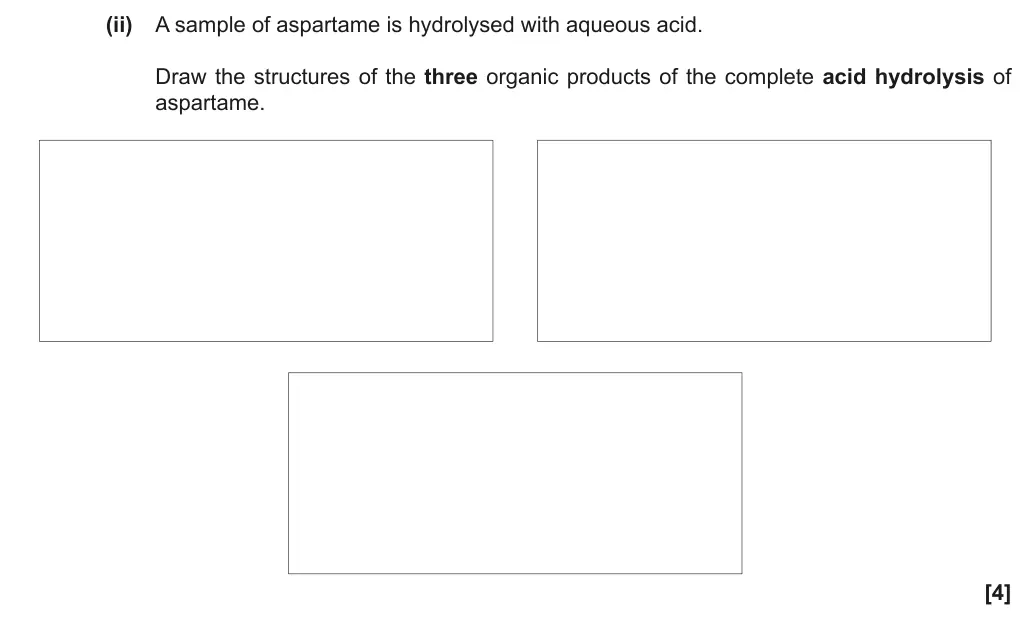
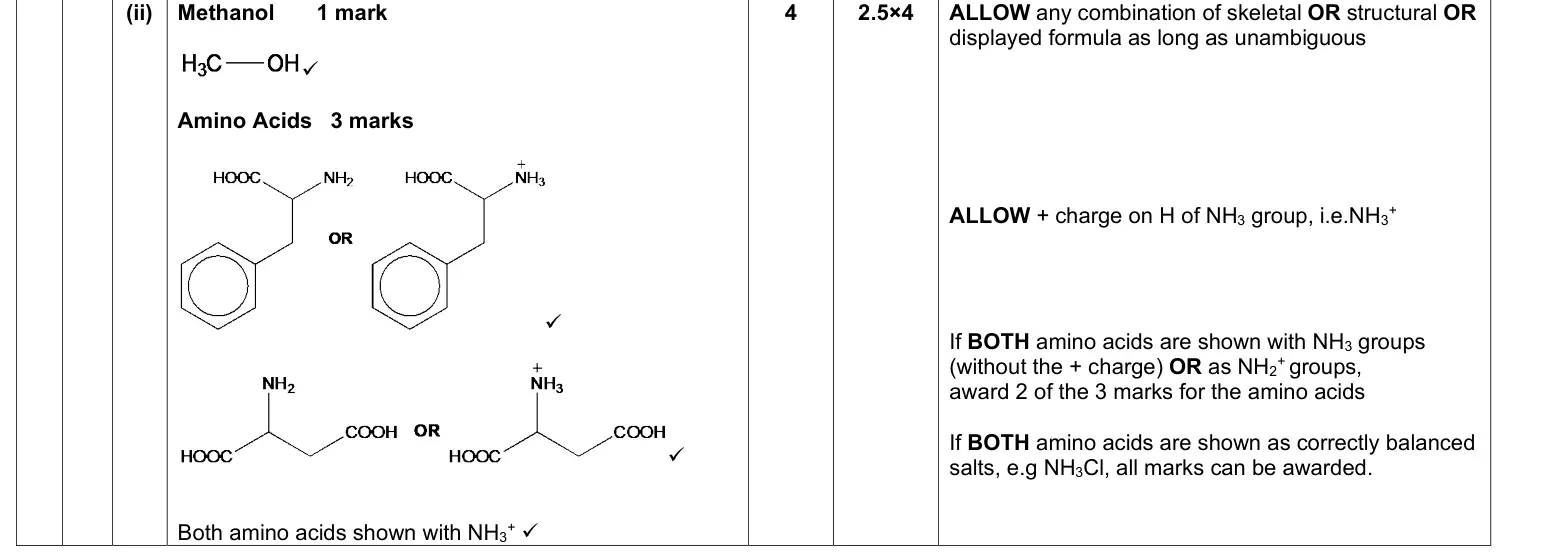
methanol plus two amino acids
both amino acids must show NH3+ for full marks (acid conditions): 2 of 3 if NH2/NH3 without charge
November 2020 · Paper 3 · Q6(c)4 marksAO3MechanismHard
Earlier part of question 6 that this part uses
Mark scheme
Examiner's comment
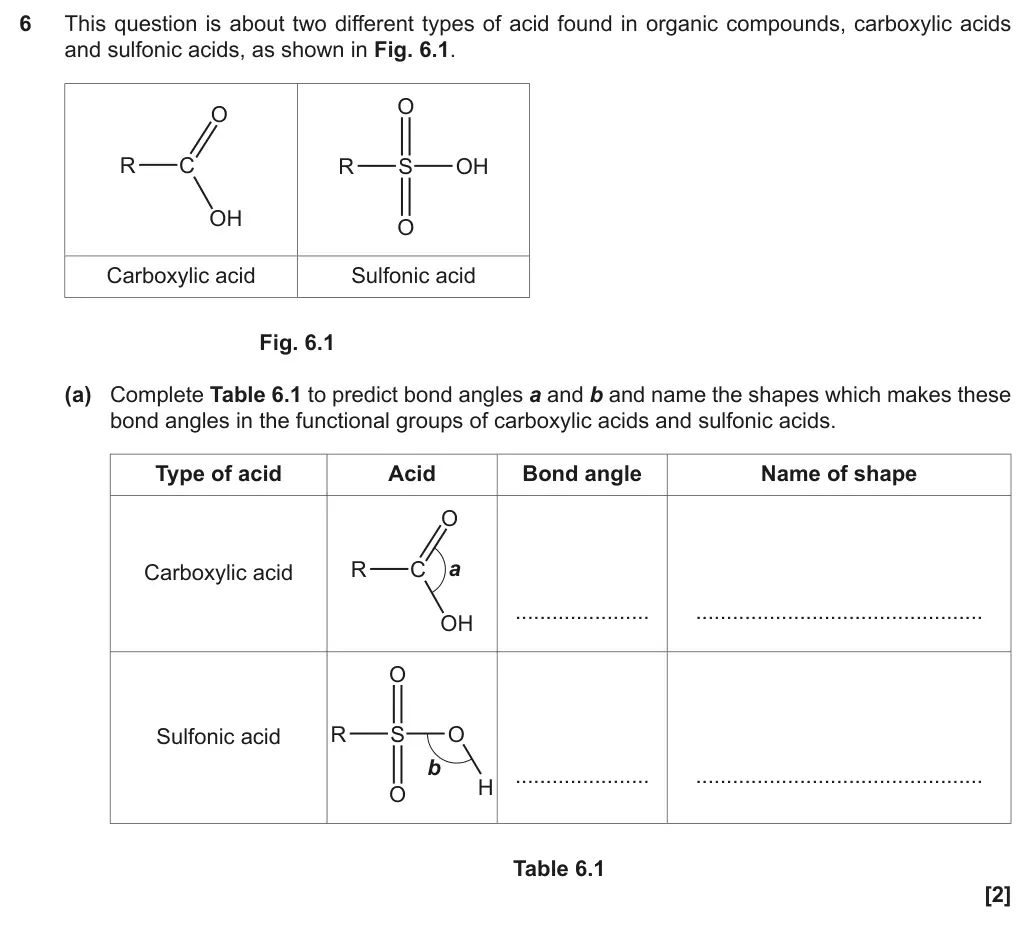
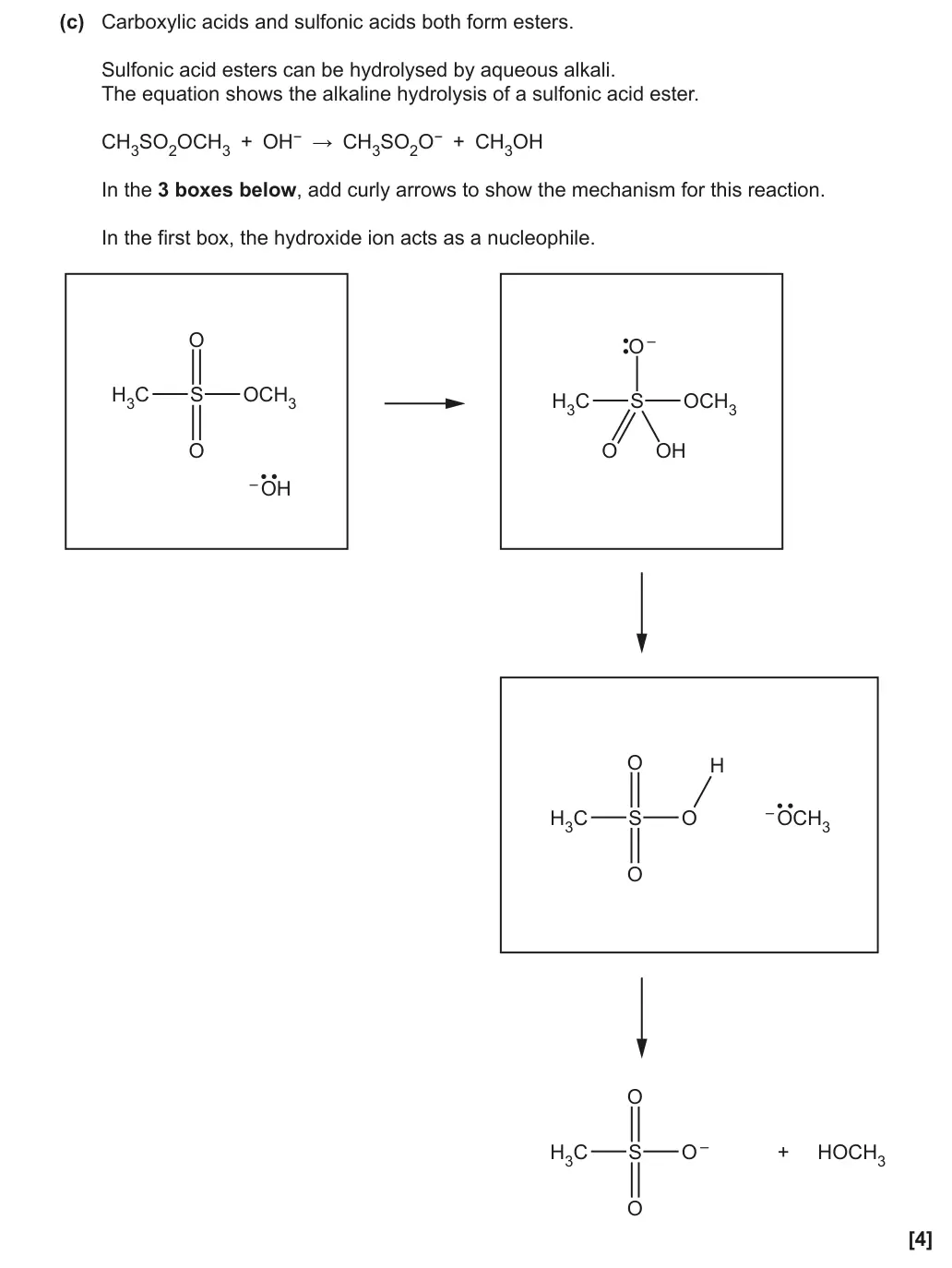
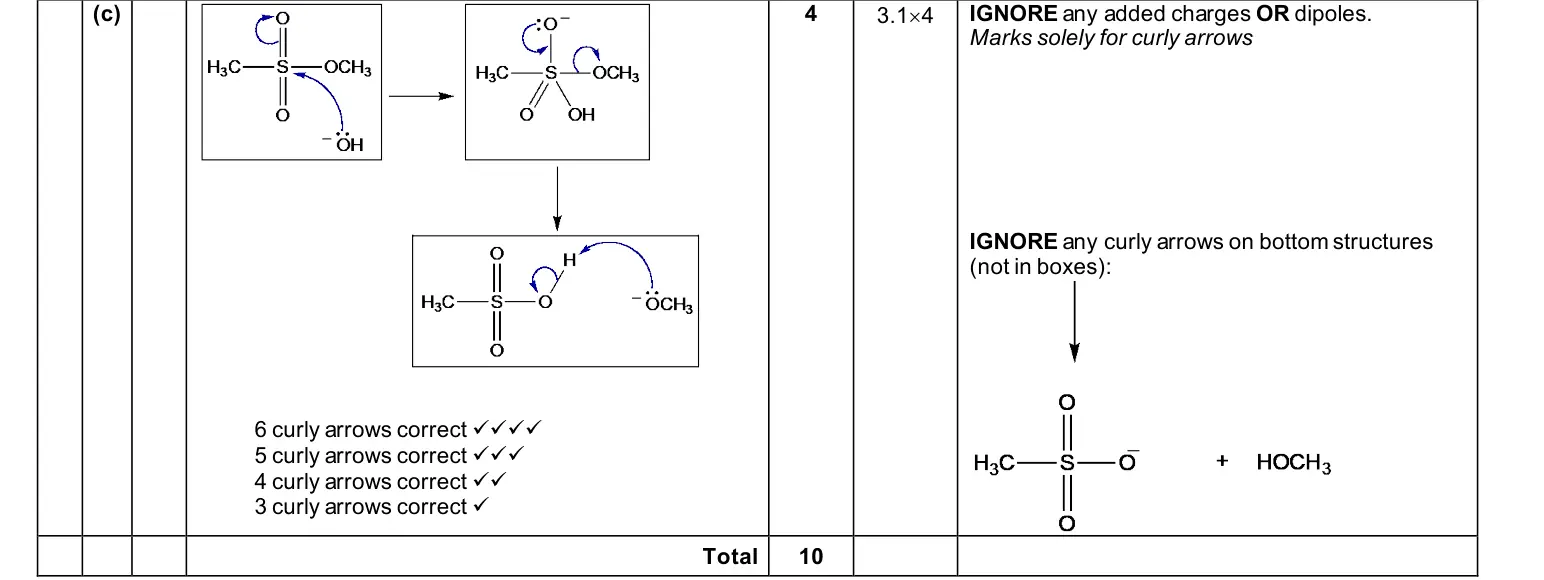
6(a) Candidates were expected to use their knowledge and understanding of bond angles and shapes. Most candidates were given both available marks. A significant number responded with incorrect names of shapes, or chose the wrong shape, such as pyramidal for the O–C–O bond angle in the carboxylic acid. Candidates are recommended to learn this basic area of chemistry. 6(b) Most candidates completed a correct equilibrium equation and assigned the correct acid-base pairs. A significant number of candidates used ethanoic acid instead of water in the equation. The examiners allowed error carried forward in this case for the acid-base pairs. Candidates found it much more difficult to explain whether the sulfonic acid had a lower pH value. The higher-attaining candidates answered concisely. They usually identifying that the sulfonic acid would have a lower pH as the pKa value was lower (or the Ka value greater), leading to more dissociation than ethanoic acid. Lower-attaining candidates often produced unfocussed and lengthy responses, sometimes relating increased dissociation in an acid to a higher, rather than a lower, pH. Some candidates approached their explanation mathematically, calculating pH values for ethanoic acid and sulfonic acid from their concentrations and pKa values. If correct, this approach was fully credited. 6(c) Most candidates showed a good understanding and appreciation of drawing curly arrows. It must be stressed that curly arrows that do not start from a lone pair, negative charge or a bond cannot be credited. Lower-attaining candidates often drew imprecisely positioned curly arrows, curly arrows in the wrong direction or to the wrong atoms. For their response to be credited with marks, candidates should position curly arrows to ensure credit when outlining reaction mechanisms. If any of your students’ results are not as expected, you may wish to consider one of our review of results services. For full information about the options available visit the OCR website. If university places are at stake you may wish to consider priority service 2 reviews of marking which have an earlier deadline to ensure your reviews are processed in time for university applications. Our priority is supporting you and your students this autumn and to support you as you prepare for summer 2021 exams. We’ll update our website information regularly with resources, guidance and key information. • Teachers • Students • Exams officers • Assessment specialists We are sending a weekly roundup to tell you about important updates. You can also sign up for your subject specific updates. If you haven’t already, sign up here. Attend one of our popular CPD courses to hear directly from a senior assessor or drop in to a Q&A session. All our courses for the academic year 2020-2021 are being delivered live via an online platform, so you can attend from any location. Please find details for all our courses on the relevant subject page on our website or visit OCR professional development. ExamBuilder is the question builder platform for a range of our GCSE, A Level, Cambridge Nationals, Cambridge Technicals and Functional Skills qualifications. See the full list of available qualifications in the sign up form. ExamBuilder is free for all OCR centres with an Interchange account and gives you unlimited users per centre. We need an Interchange username to validate the identity of your centre's first user account for ExamBuilder. If you do not have an Interchange account please contact your centre administrator (usually the Exams Officer) to request a username, or nominate an existing Interchange user in your department. Review of results
Notes from the mark scheme and report
marks solely for curly arrows (6 correct = 4 marks, 3 correct = 1 mark)
arrows from lone pair on –OH to S and S=O bond to O, O– lone pair reforming S=O and S–OCH3 bond to O, then –OCH3 lone pair to H and O–H bond to O
IGNORE added charges/dipoles
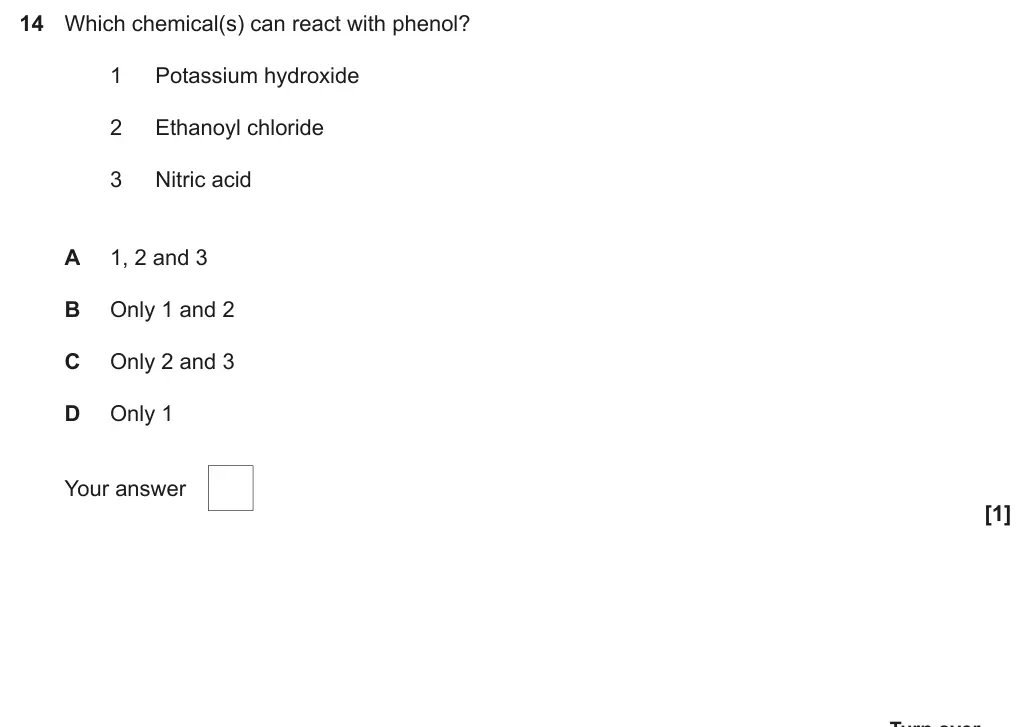
June 2019 · Paper 2 · Q141 markAO1Multiple choiceHard
Answer
A
Mark scheme
Examiner's comment
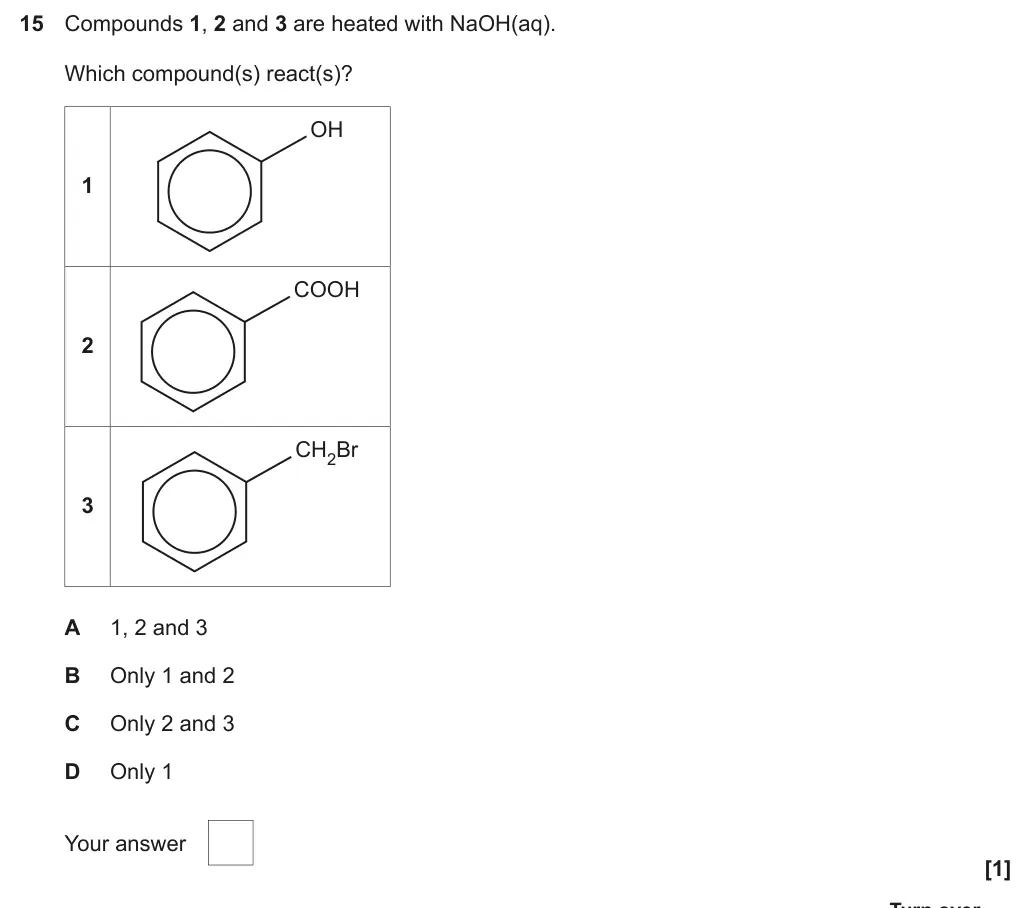
This question proved difficult. Many candidates correctly deduced that all three chemicals would react with phenol and selected A. Some candidates did not recognise that phenol would react with HNO3 without the need for a catalyst and selected B. Other candidates did not consider the weak acidity of phenol and selected C.
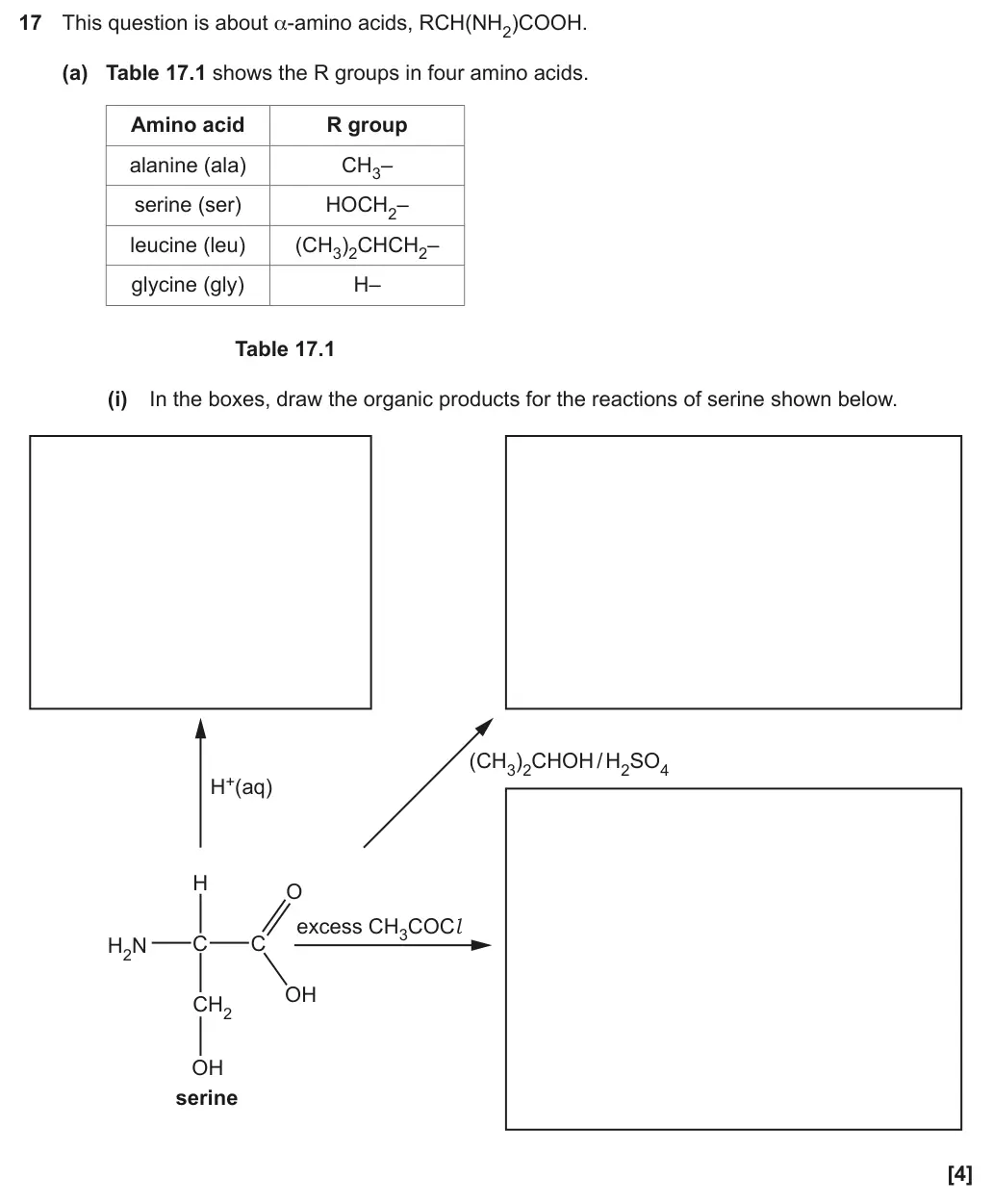
June 2019 · Paper 2 · Q17(a)(i)4 marksAO2Drawing / labellingMedium
Mark scheme
Examiner's comment
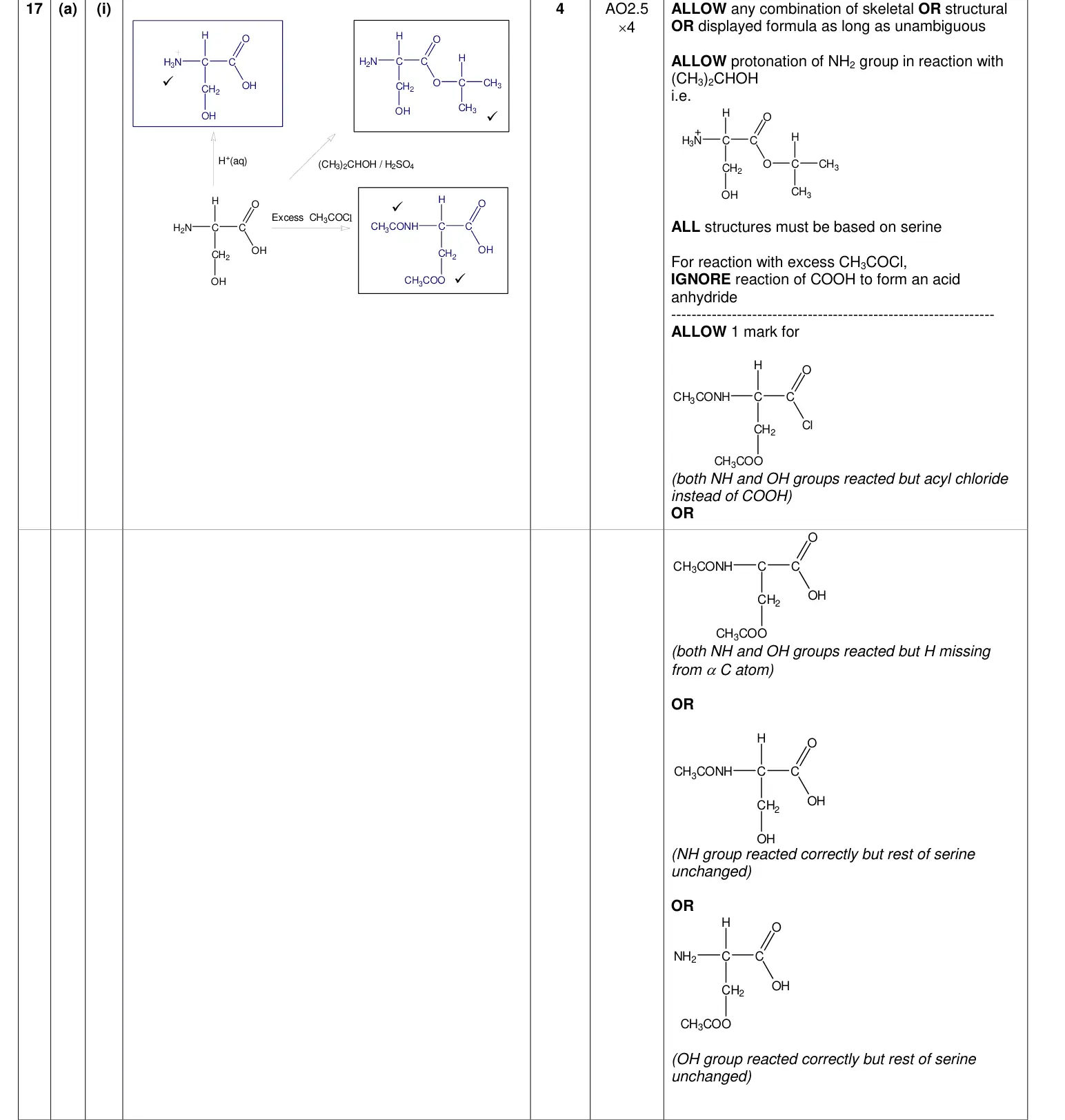
This question focused on the reactions of the different functional groups in serine. Candidates are familiar with these reactions and most candidates scored at least two marks. These were achieved by the formation of the ammonium ion by reaction with H+ and the formation of the ester from (CH3)2CHOH. Determining the organic product from the reaction of serine with excess CH3COCl proved more difficult. Some candidates realised that the OH of serine’s R group would react and others drew the amide formed from the reaction of the NH2 group. The best responses showed both conversions and scored full marks. Lower ability responses often showed organic products containing the Cl atom from the ethanoyl chloride rather than the CH3CO group. This response scored three marks. The candidate has drawn correct organic products for the reaction of serine with H+ and (CH3)2CHOH. The product from the reaction of excess CH3COCl shows the formation of an ester but not the formation of the amide. This product was seen often by examiners and scored one mark. If an amide group had been shown this response would have received full marks. Notice the candidate has presented their organic products clearly with the structures drawn in a similar manner to serine shown in the question. This is a good strategy to avoid errors and omissions when drawing organic structures.
Notes from the mark scheme and report
ester of COOH with propan-2-ol (ALLOW NH3+)
H3N+ with H+(aq)
excess CH3COCl reacts with BOTH NH2 (amide) and OH (ester)
all structures must be based on serine
1 mark if only one group acylated
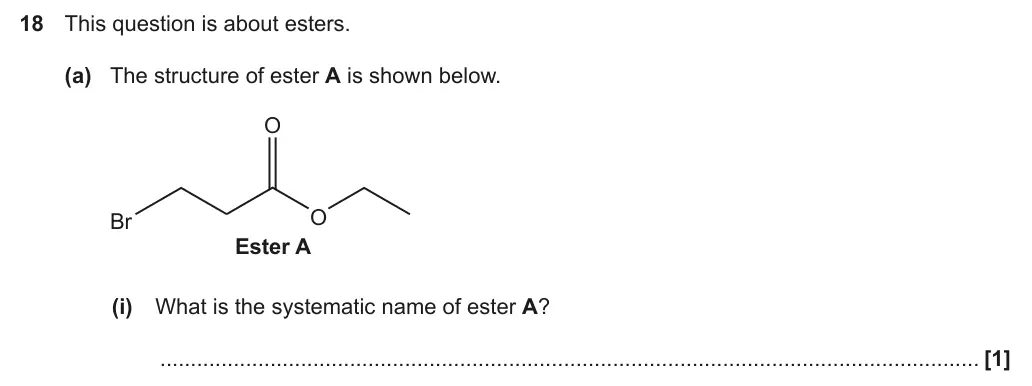
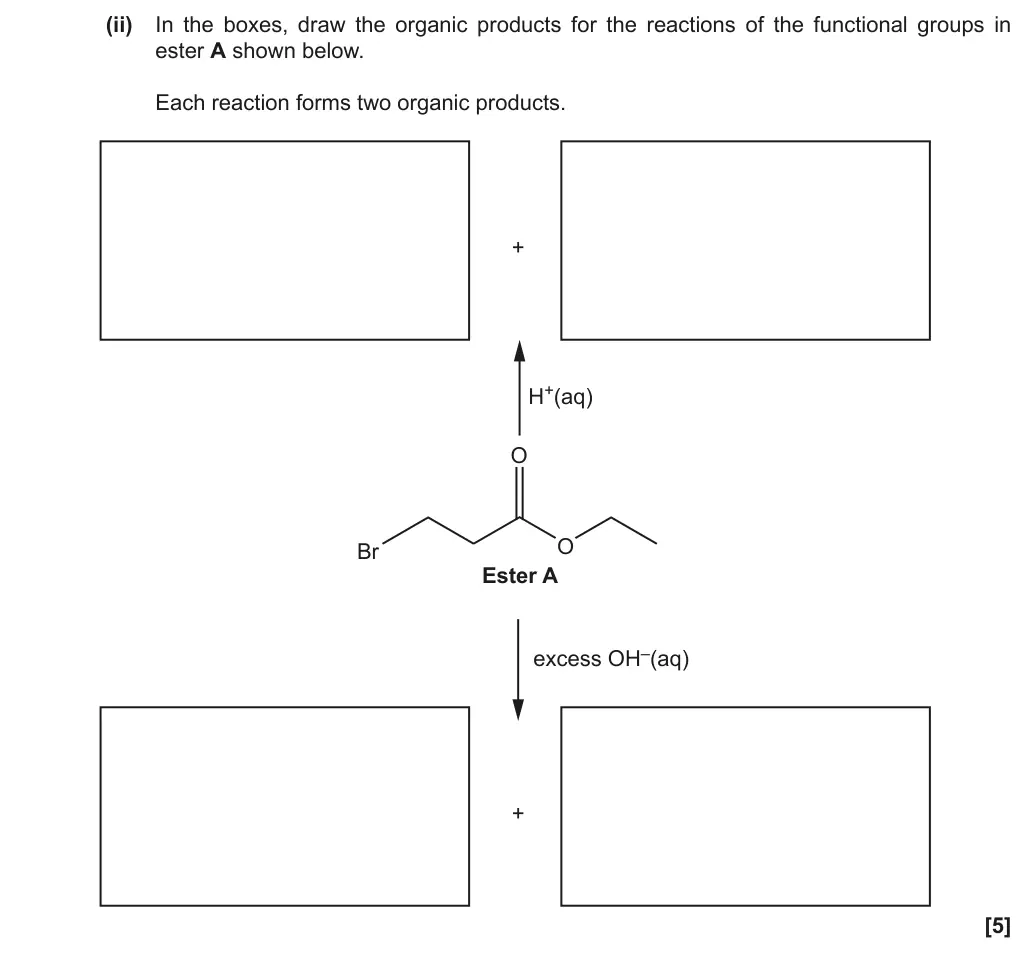
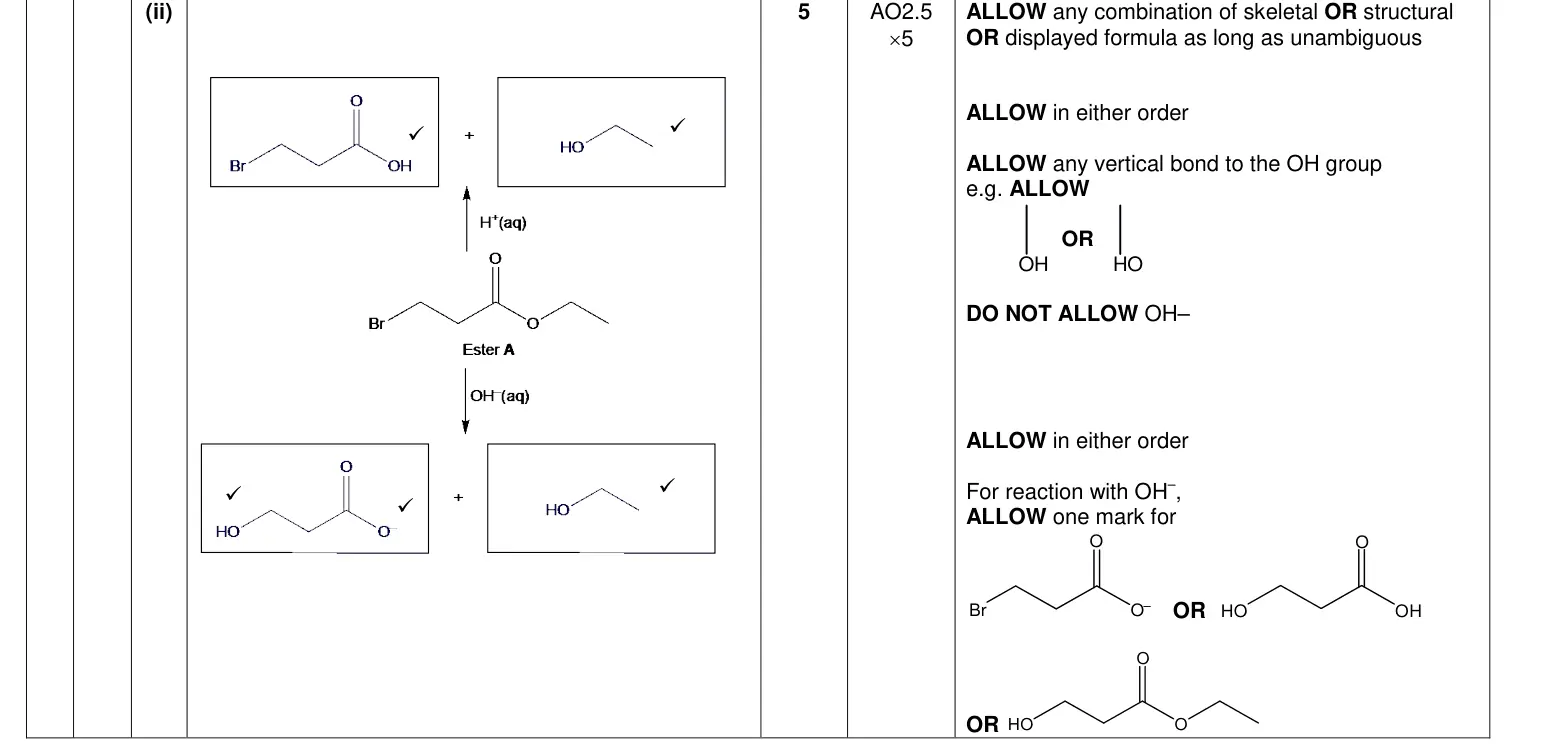
June 2019 · Paper 2 · Q18(a)(ii)5 marksAO2Drawing / labellingMedium
Earlier part of question 18 that this part uses
Mark scheme
Examiner's comment
This question required candidates to apply their knowledge of hydrolysis reactions to ester A. The majority of candidates were able to show 3-bromopropanoic acid and ethanol in the top two boxes to secure two marks. The organic products from the alkaline hydrolysis proved more difficult. Many candidates identified ethanol as a product in one of the lower boxes but lower ability responses showed the ethoxide ion. Some candidates drew the 3-bromopropanoate ion as the other product. Higher ability candidates realised that the Br atom would be replaced by an OH group and the best responses showed the correct carboxylate ion. Examiners were encouraged by the number of excellent responses seen and the majority of candidates scored 4 or 5 marks.
Notes from the mark scheme and report
acid: 3-bromopropanoic acid + ethanol
excess OH–: HOCH2CH2COO– + ethanol (C–Br also hydrolysed, carboxylate not acid)
DO NOT ALLOW OH– for the hydroxyl group
1 mark for partly reacted alkaline product
June 2019 · Paper 2 · Q18(a)(iii)1 markAO1Short answerHard
Earlier parts of question 18 that this part uses
Mark scheme
Examiner's comment
A LEVEL CHEMISTRY A Examiners’ report H432/02 Summer 2019 series Version 1 H432 For first teaching in 2015 www.ocr.org.uk/science Contents Introduction .............................................................................................................................................. 4 Paper 2 series overview ........................................................................................................................... 5 Section A overview ................................................................................................................................... 6 Question 3 ............................................................................................................................................ 6 Question 4 ............................................................................................................................................ 6 Question 5 ............................................................................................................................................ 7 Question 10 .......................................................................................................................................... 8 Question 12 .......................................................................................................................................... 9 Question 13 ........................................................................................................................................ 10 Question 14 ........................................................................................................................................ 10 Question 15 ........................................................................................................................................ 11 Section B overview ................................................................................................................................. 12 Question 16 (a) (i) ............................................................................................................................... 12 Question 16 (a) (ii) .............................................................................................................................. 12 Question 16 (b) (i) ............................................................................................................................... 13 Question 16 (b) (ii) .............................................................................................................................. 14 Question 16 (b) (iv) ............................................................................................................................. 14 Question 16 (b) (v) .............................................................................................................................. 15 Question 17 (a) (i) ............................................................................................................................... 17 Question 17 (a) (ii) .............................................................................................................................. 19 Question 17 (b) (i) ............................................................................................................................... 20 Question 18 (a) (i) ............................................................................................................................... 21 Question 18 (a) (ii) .............................................................................................................................. 22 Question 18 (b) ................................................................................................................................... 23 Question 18 (c) ................................................................................................................................... 23 Question 18 (d) ................................................................................................................................... 24 Question 18 (e) (i) ............................................................................................................................... 24 Question 18 (e) (ii) .............................................................................................................................. 26 Question 19 (a) (i) ............................................................................................................................... 27 Question 19 (a) (ii) .............................................................................................................................. 29 Question 19 (b) (i) ............................................................................................................................... 30 Question 19 (b) (iii) ............................................................................................................................. 32 Question 19 (b) (iv) ............................................................................................................................. 34 Question 20 (a) (i) ............................................................................................................................... 36 Question 20 (a) (ii) .............................................................................................................................. 37 Question 20 (a) (iii) ............................................................................................................................. 37 Question 20 (b) (i) ............................................................................................................................... 38 Question 21 ........................................................................................................................................ 39 Introduction Our examiners’ reports are produced to offer constructive feedback on candidates’ performance in the examinations. Question 18 (a) (i) This demanding question discriminated well. Question 18 (a) (ii) This question required candidates to apply their knowledge of hydrolysis reactions to ester A.
Notes from the mark scheme and report
hydrolysis
IGNORE acid/alkaline and nucleophilic substitution
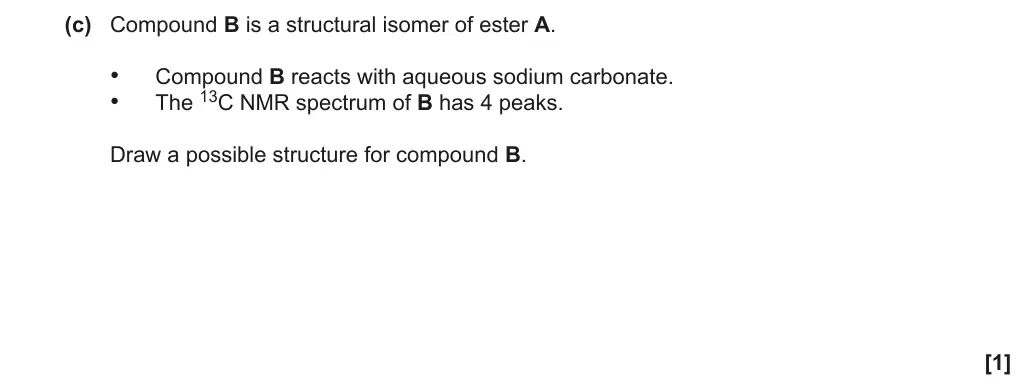
June 2019 · Paper 2 · Q18(c)1 markAO3Structure / isomerMedium
Earlier part of question 18 that this part uses
Mark scheme
Examiner's comment
This question required candidates to use both pieces of information to deduce that B was a carboxylic acid with two equivalent carbon atoms. Many candidates were able to suggest a suitable structure. However some candidates did not use all the information and it was common to see responses that showed an ester or a straight chain carboxylic acid.
Notes from the mark scheme and report
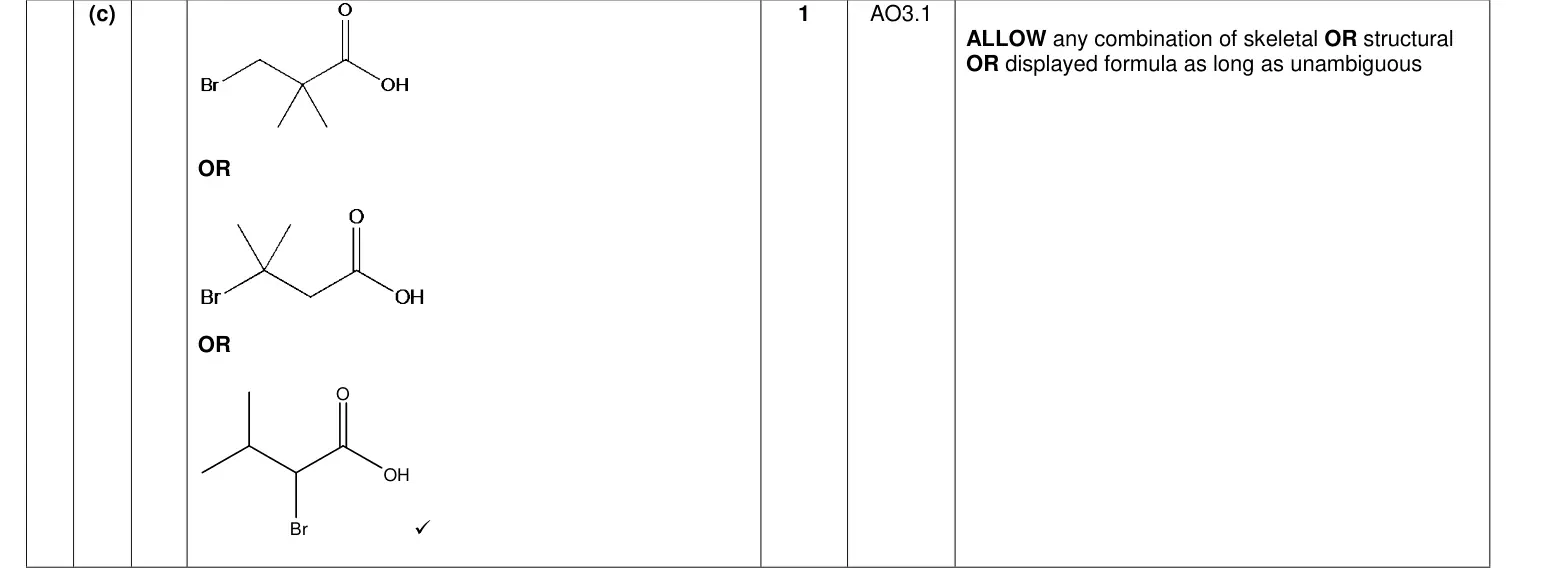
bromo-substituted C5 carboxylic acid with 4 carbon environments
June 2019 · Paper 2 · Q18(e)(i)6 marksAO36-mark level of responseMedium
Mark scheme, with the levels and indicative points
Examiner's comment
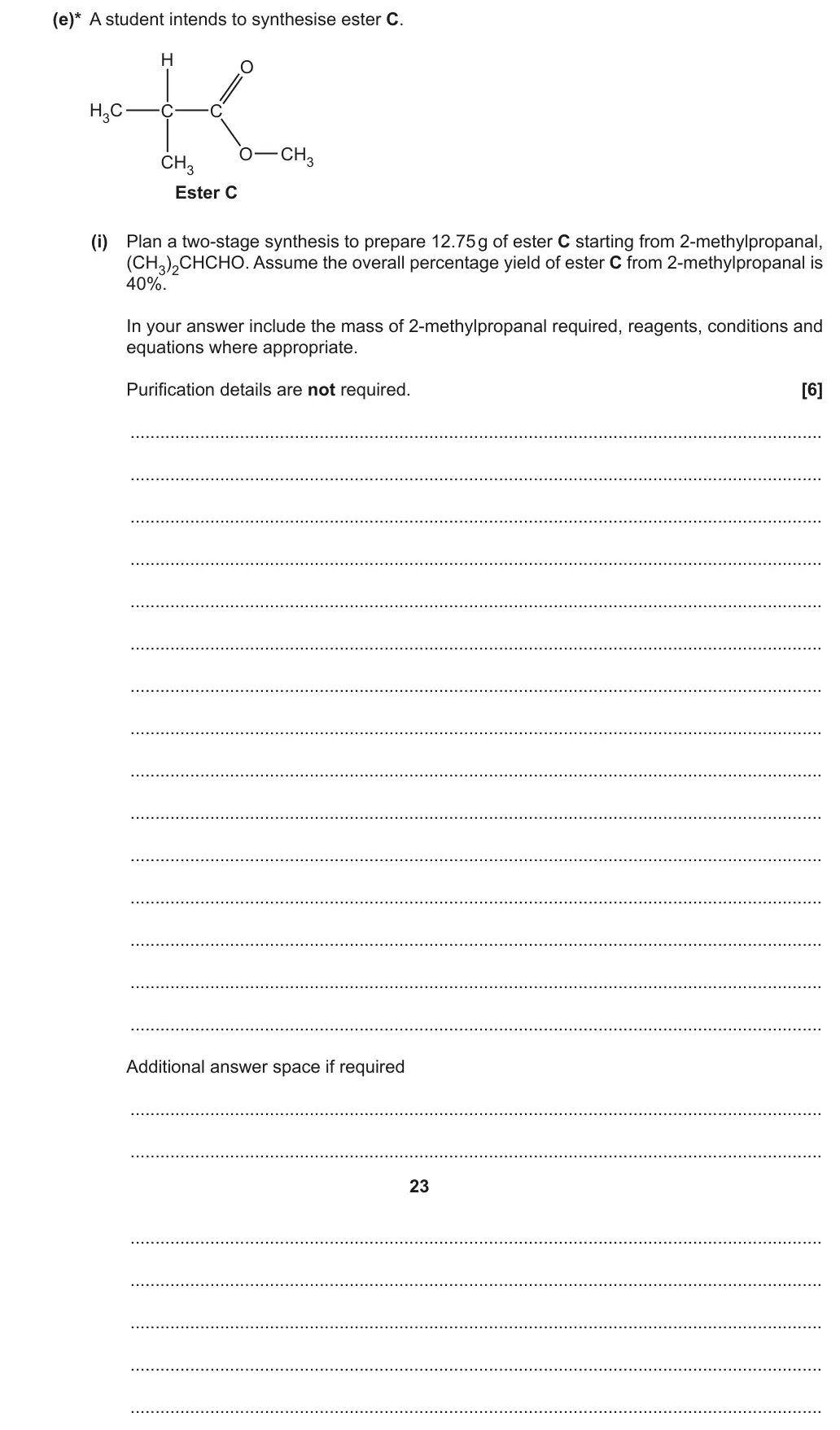
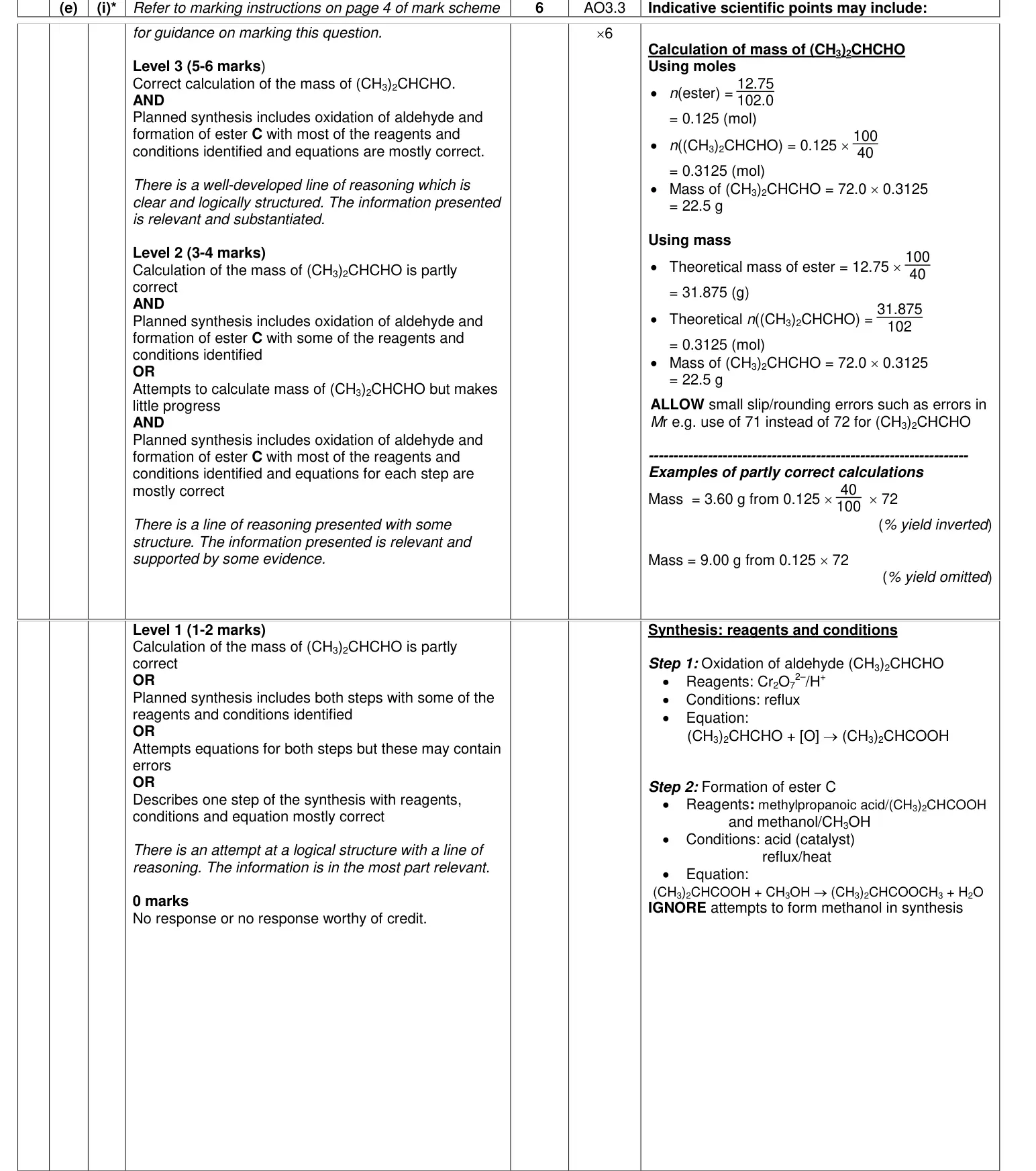
This question was marked using a level of response mark scheme. Most candidates gave a response worthy of at least Level 2 (3-4 marks) by either providing the synthetic steps with reagents and/or equations for the synthesis of ester C as well as calculating the mass of 2-methylpropanal required. determined the mass correctly and showed the synthesis efficiently, using equations to communicate the preparation of ester C and received Level 3 (5-6 marks). Some responses focused solely on the 2- methylpropanal and suggested it would be both oxidised and reduced with each of the products being used to form an ester. Others omitted the mass calculation or gave only a partial synthesis. Such responses received Level 1 (1-2 marks). A variety of responses was seen in this demanding question. In general candidates adopted one of two approaches. The most common was to multiply the Mr of 2-hydroxybenzoic acid by 200 and then subtract the mass of the 199 water molecules removed during polymerisation. The other approach used the Mr of the repeat unit. This was multiplied by 200 and the mass of H and OH at each end of the polymer was added to give the final answer. Many candidates were successful with the first step of their approach, but the best responses included the second step taking into account the Mr of water. A significant number of candidates used an incorrect value for the Mr in their first step. Candidates are advised to draw out the structure of a compound before determining the Mr. This is particularly important when only a name is given in the question. This response includes an excellent description of the synthesis of ester C. Each step is labelled clearly with the most of the reagents and conditions stated and correct equations. The candidate makes little progress with the calculation of the mass of 2-methylpropanal required, completing only the first step. This response satisfies the Level 2 criteria. The information is provided is relevant and presented with a clear logical structure and was therefore given the upper mark within the level and achieved four marks. The presentation of the synthesis by equations rather than words is an excellent strategy. Candidates are advised to adopt such an approach in questions like this as it allows them develop and clear line of reasoning without the need to write lots of unnecessary text.
Notes from the mark scheme and report
22.5 g (n = 0.125 × 100/40)
partly correct: 3.60 g (yield inverted), 9.00 g (yield omitted)
step 1 Cr2O72–/H+ reflux with [O] equation
step 2 methanol with acid catalyst, heat/reflux
IGNORE attempts to make methanol
Skills: M0.2 Use ratios, fractions and percentages; M2.3 Substitute numerical values into algebraic equations using appropriate units for physical quantities
June 2019 · Paper 2 · Q20(b)(i)4 marksAO3MechanismMedium
Earlier part of question 20 that this part uses
Mark scheme
Examiner's comment
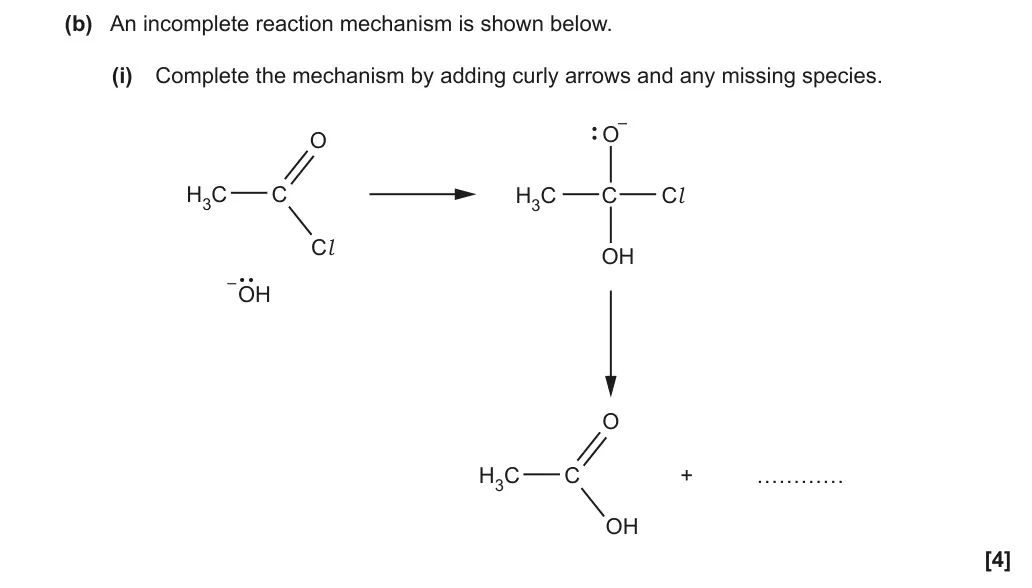
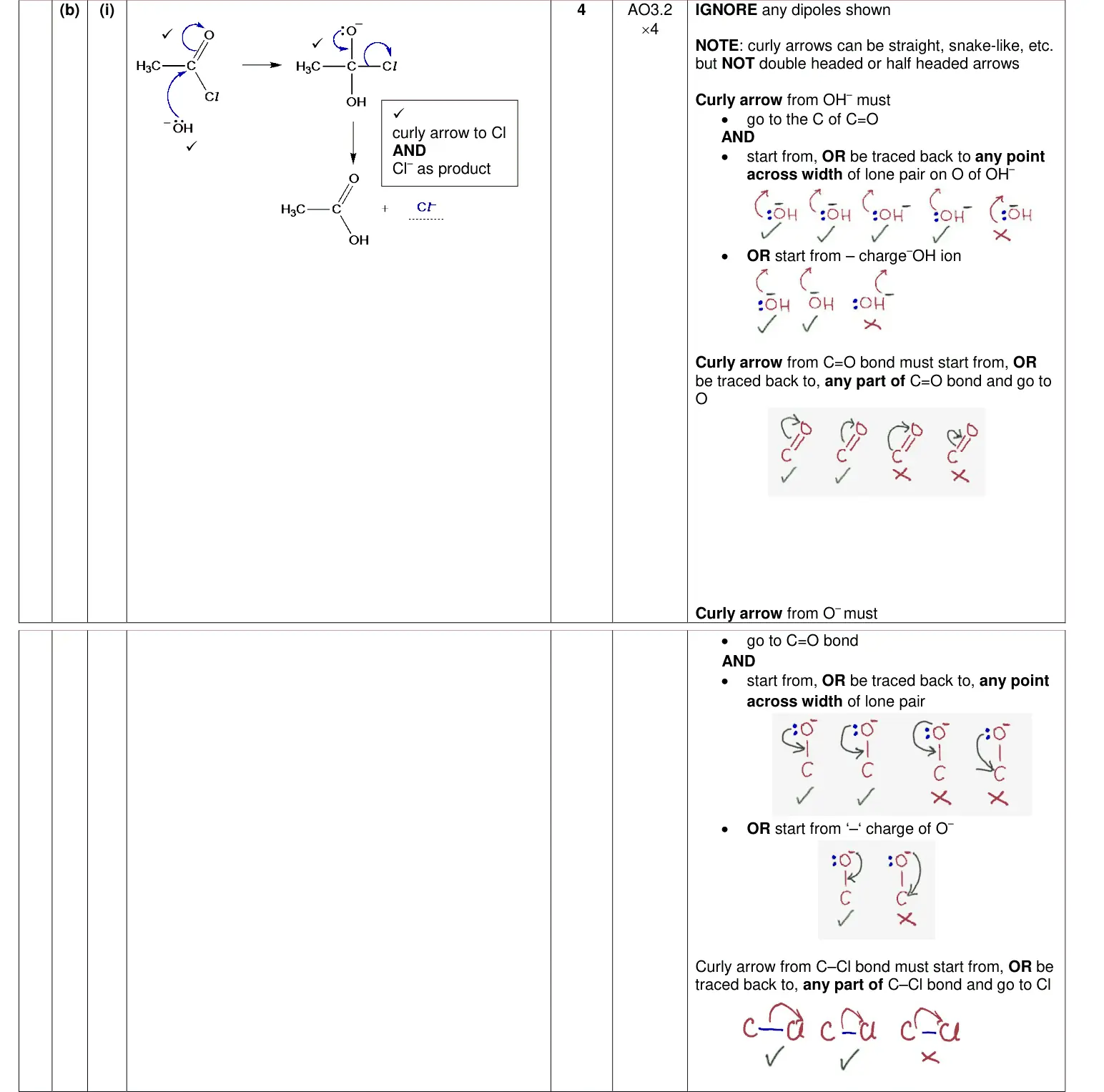
Examiners were encouraged by the number of excellent responses to this question. Candidates were able to confidently apply their knowledge of mechanisms to this unfamiliar example and the majority of the cohort scored at least two marks. In the first step candidates used their understanding of nucleophilic addition to show a correct curly arrow from the hydroxide ion to the C of the C=O bond as well as an arrow from this bond to the O. Many candidates were able to show the breaking of the C–Cl bond and the formation of a chloride ion, drawing on their experience of the reactions of haloalkanes. Some candidates recognised the need to include an arrow to reform the carbon-oxygen double bond, with the best responses showing this accurately. A common error was to draw the bond from the lone pair on O to the C atom, rather than the bond.
Notes from the mark scheme and report
arrow from lone pair or charge of OH– to C of C=O
arrow from C=O bond to O
arrow from lone pair/charge on O– to re-form C=O
arrow from C–Cl bond to Cl AND Cl– as product
IGNORE dipoles
no double-headed or half arrows
June 2019 · Paper 3 · Q2(b)1 markAO2Short answerHard
Earlier part of question 2 that this part uses
Mark scheme
Examiner's comment
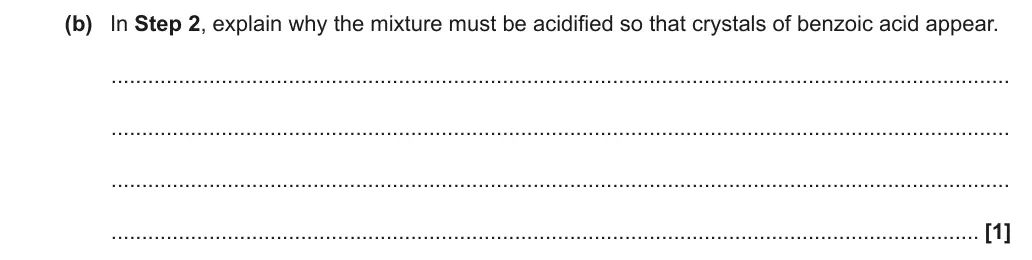
Candidates found this part extremely difficult. The question was aimed to stretch and challenge. Many candidates followed on directly from part (a), stating in simple terms that the alkaline solution needed to be neutralised to remove hydroxide ions. However, candidates were expected to recognise that the alkaline conditions would lead to benzoate ions rather than benzoic acid being present in the mixture. The mixture is acidified to protonate the benzoate. The hint in the question was about making the benzoic acid appearing when acid is added.
Notes from the mark scheme and report
H+ protonates benzoate/carboxylate ion to form benzoic acid
IGNORE responses only about neutralising the alkali/carbonate
Skills: PAG6 Synthesis of an organic solid
June 2018 · Paper 2 · Q16(c)3 marksDrawing / labellingMedium
Mark scheme
Examiner's comment
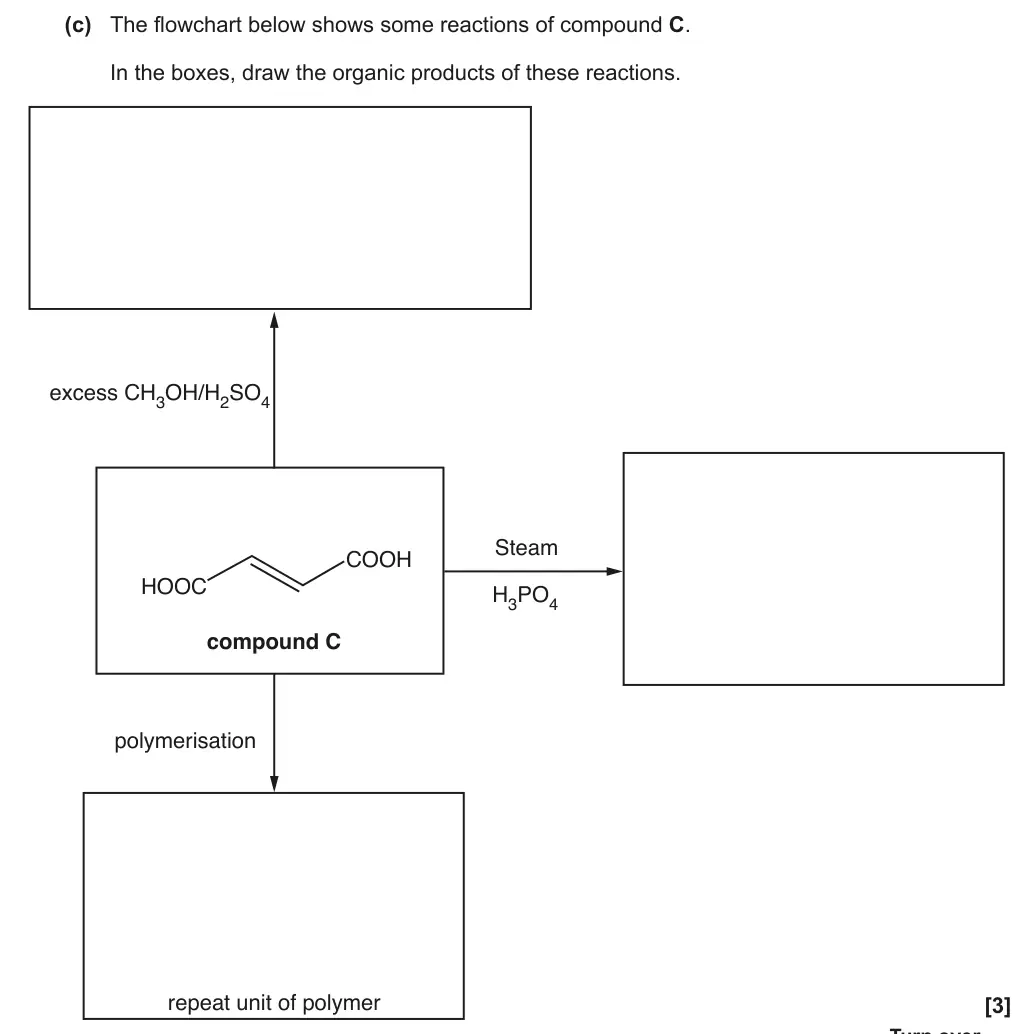
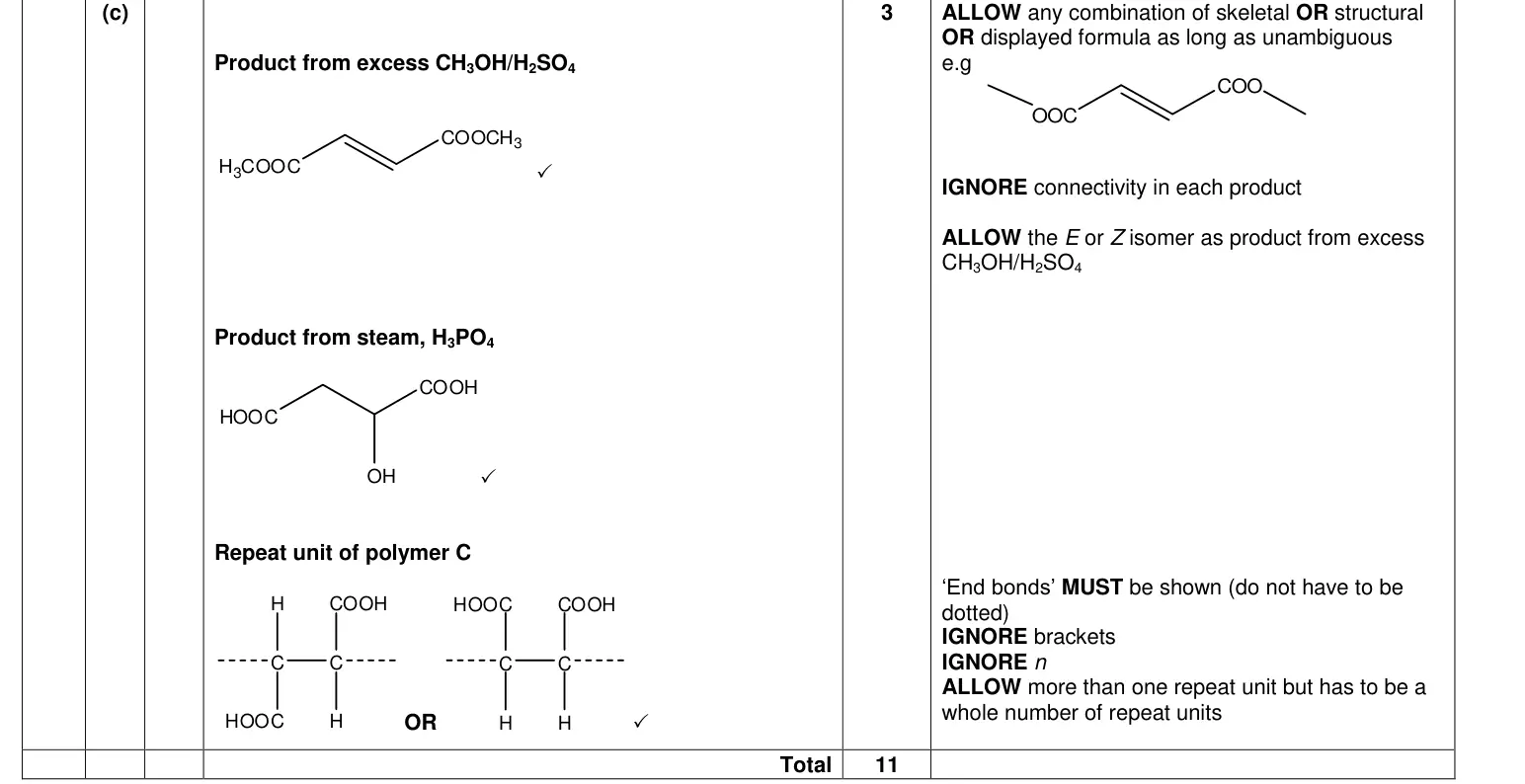
The majority of candidates were able to identify at least one product from the reactions of compound C. The polymerisation reaction appeared to be the most familiar, although some candidates attempted to draw a condensation polymer using the carboxylic acid groups rather than the alkene. The reaction of C with excess methanol was also well attempted. However, a significant number of candidates used chemical symbols to show their product. A proportion of these did not show the H atoms of the alkene group, showing only C=C in the centre of the structure. Candidates are advised to use the type of formulae given in a question as this will reduce the potential for error or omissions. The product from the hydration of C appeared to be the hardest to deduce. Many candidates recognised this reaction would produce an alcohol, but often included two OH groups – one on each C from the double bond – in their structure. Other candidates confused this reaction with hydrogenation and formed a saturated product from C.
Notes from the mark scheme and report
excess CH3OH gives the diester
end bonds MUST be shown on repeat unit
IGNORE brackets and n
ALLOW E or Z diester
June 2018 · Paper 2 · Q21(a)3 marksDrawing / labellingHard
Mark scheme
Examiner's comment
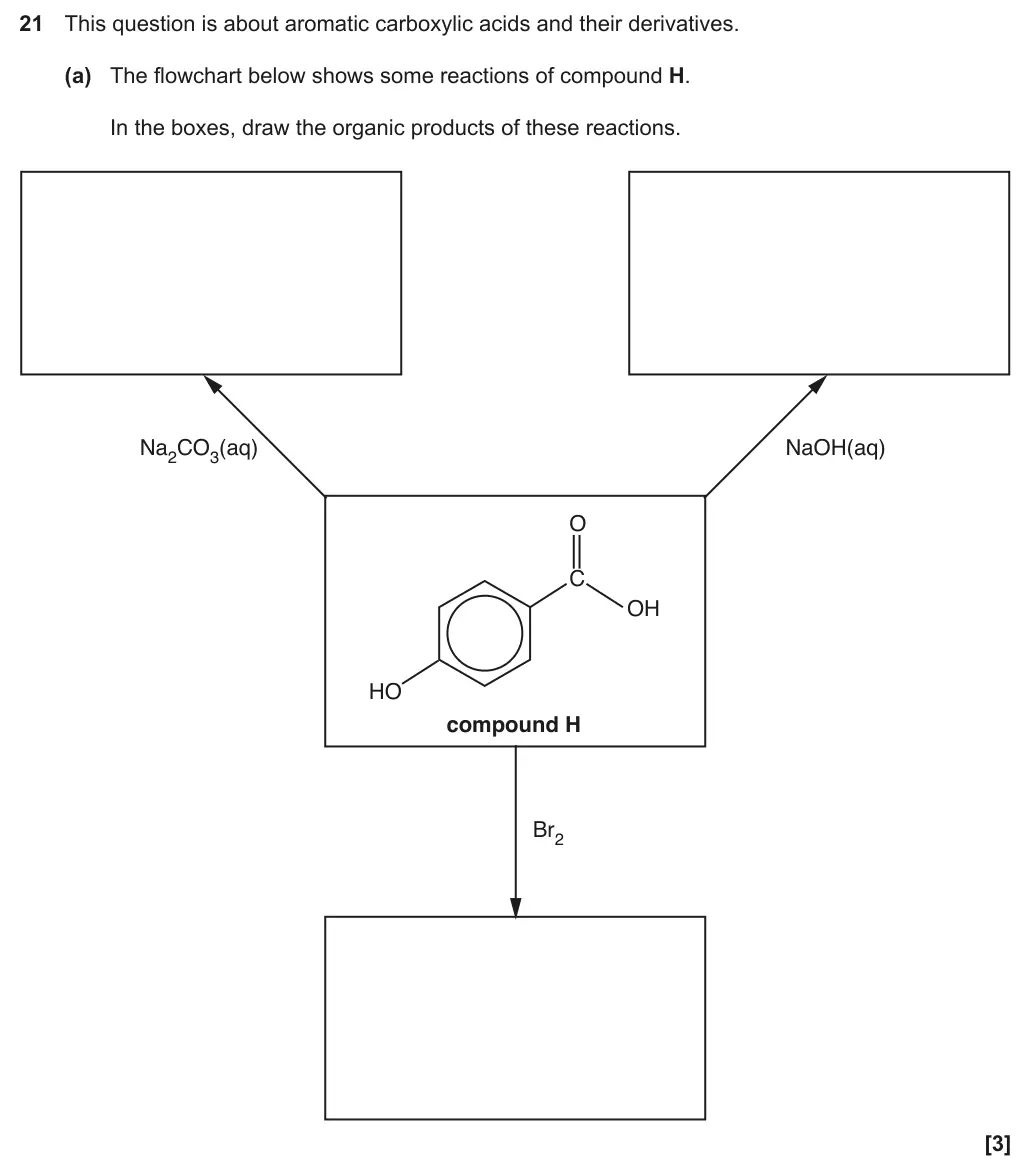
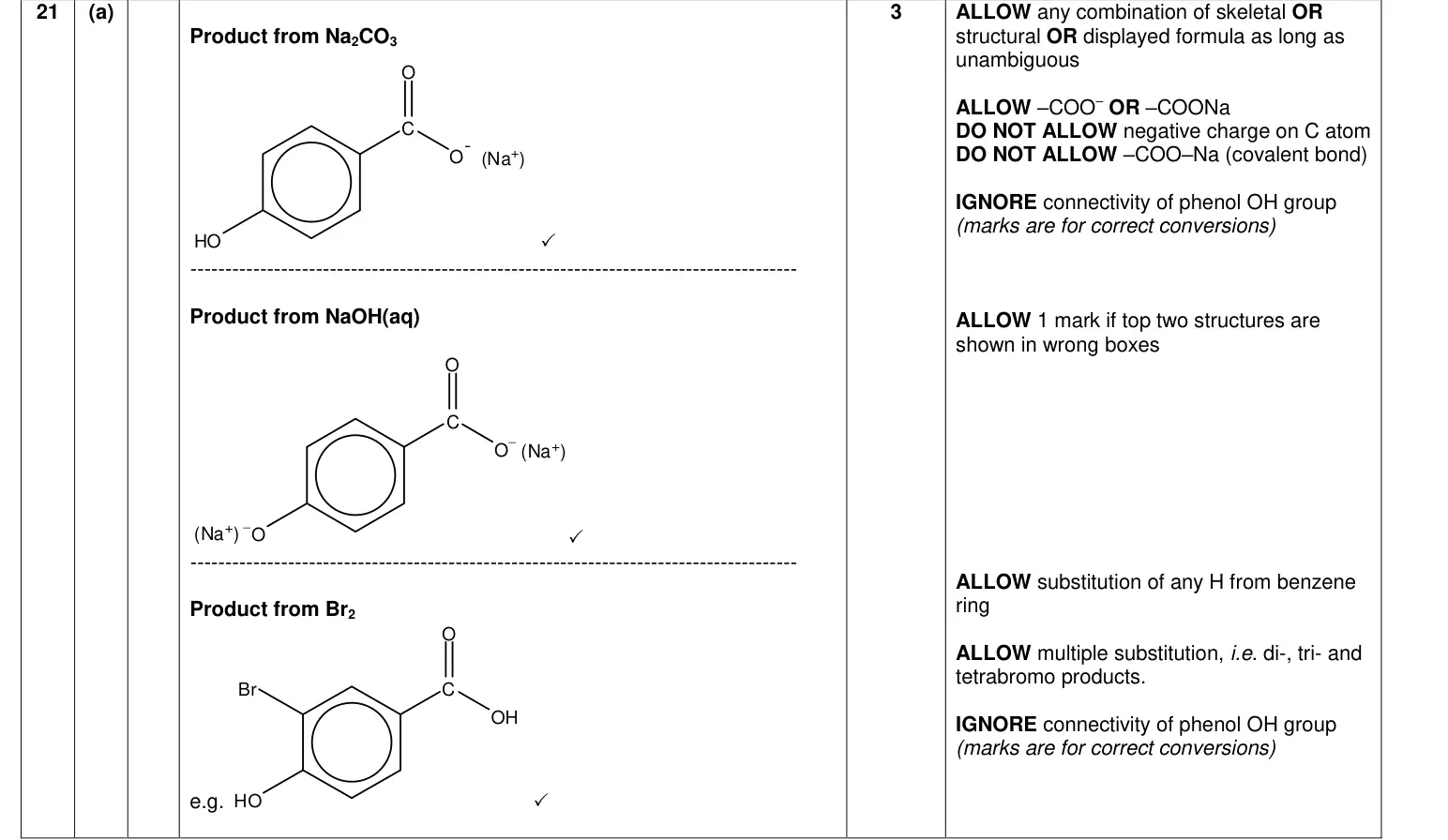
This question assessed different reactions of compound H, 4-hydroxybenzoic acid, and discriminated well. Two of the reactions focused on acid-base chemistry, using the reagents Na2CO3 and NaOH. Many candidates recognised that the carboxylic acid group would react in both cases but only some managed to identify when the phenol group was involved correctly. A number of responses suggested that a phenoxide ion was formed with sodium carbonate but not with sodium hydroxide. The third reaction was substitution with bromine. This reaction appeared more familiar to all candidates with the majority scoring this mark. A small proportion of candidates substituted the phenol OH group or carboxylic acid group.
Notes from the mark scheme and report
Na2CO3 reacts with COOH only
NaOH reacts with both COOH and phenol OH
Br2 substitutes on the ring (ALLOW any ring H, multiple substitution)
DO NOT ALLOW –COO–Na covalent bond
1 mark if top two structures in the wrong boxes
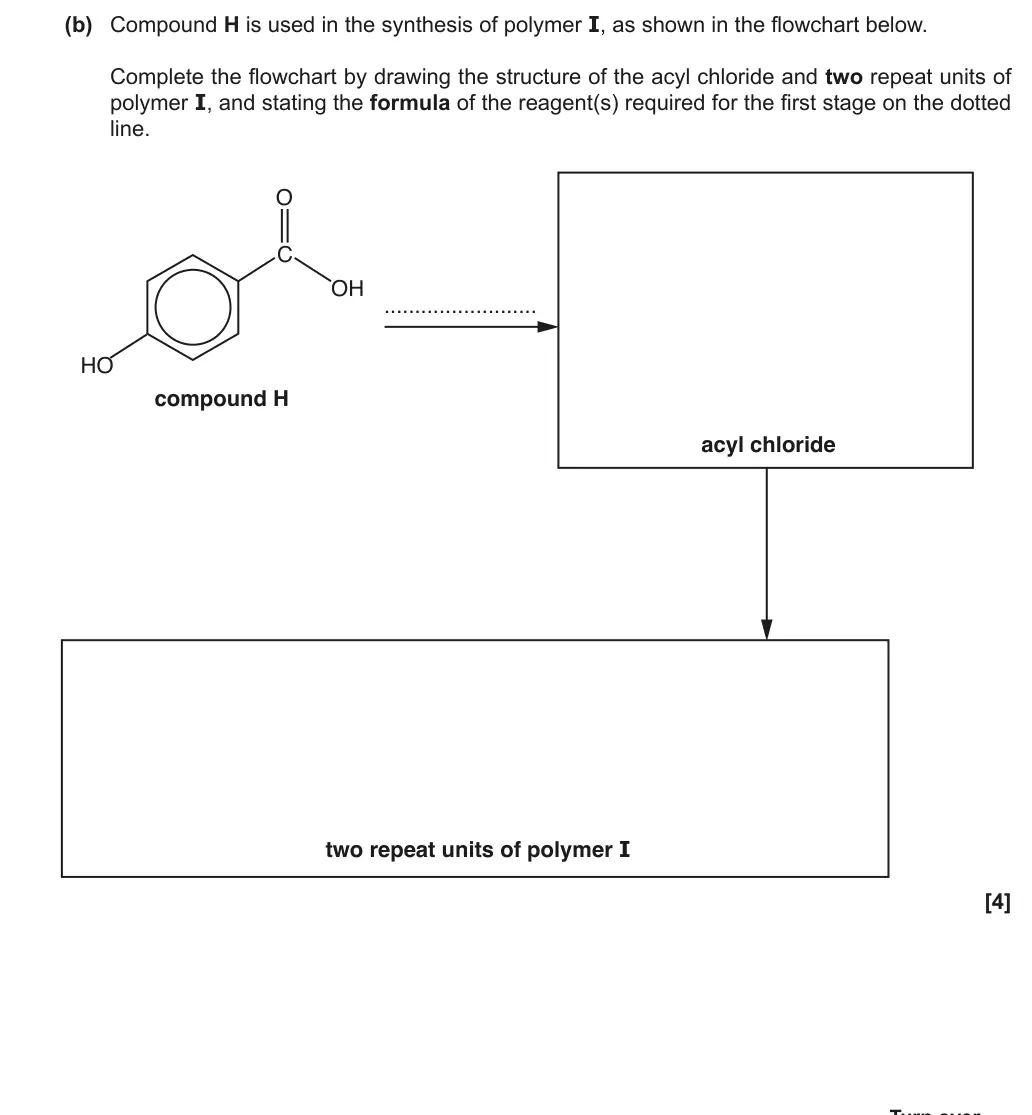
June 2018 · Paper 2 · Q21(b)4 marksStructure / isomerEasy
Earlier part of question 21 that this part uses
Mark scheme
Examiner's comment
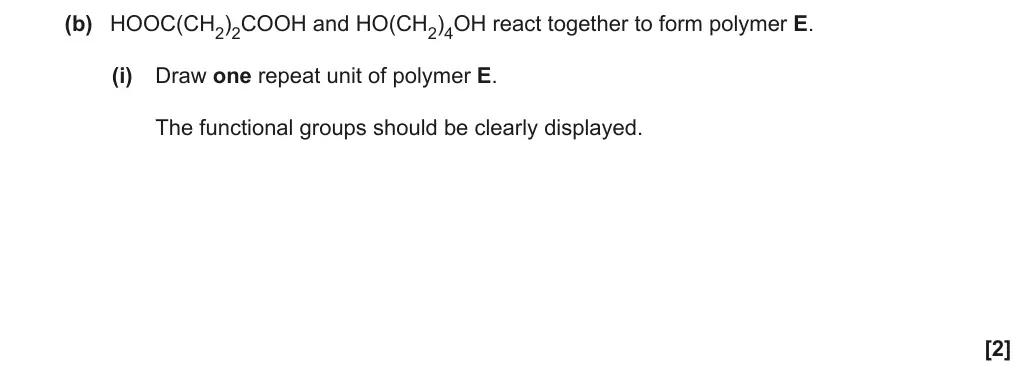
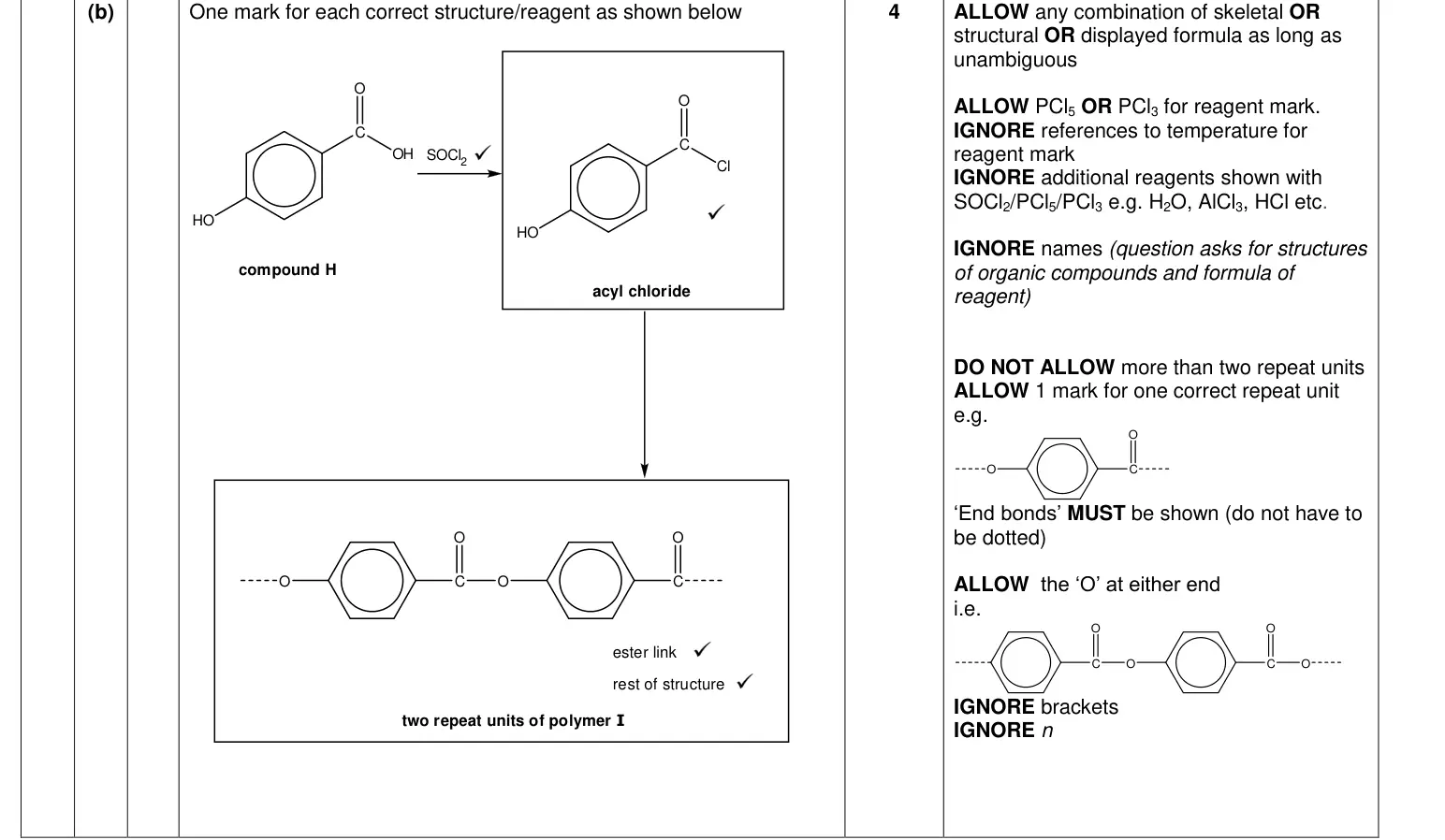
Compound H was also the focus for this question. Most candidates were able to provide the structure of the acyl chloride obtained from H but only some identified SOCl2 as the correct reagent. Common incorrect reagents included HCl and AlCl3. Most candidates recognised that polymer I was a polyester but only some were able to draw two repeat units correctly. Candidates are advised to practice drawing different polymers, taking care to ensure the correct number of repeat units are present when a specific number is required.
Notes from the mark scheme and report
SOCl2 (ALLOW PCl5 or PCl3)
acyl chloride with phenol OH kept
two repeat units with ester link and end bonds shown
DO NOT ALLOW more than two repeat units
1 mark for one correct repeat unit
June 2018 · Paper 3 · Q4(b)(ii)6 marks6-mark level of responseHard
Earlier part of question 4 that this part uses
Mark scheme, with the levels and indicative points
Examiner's comment
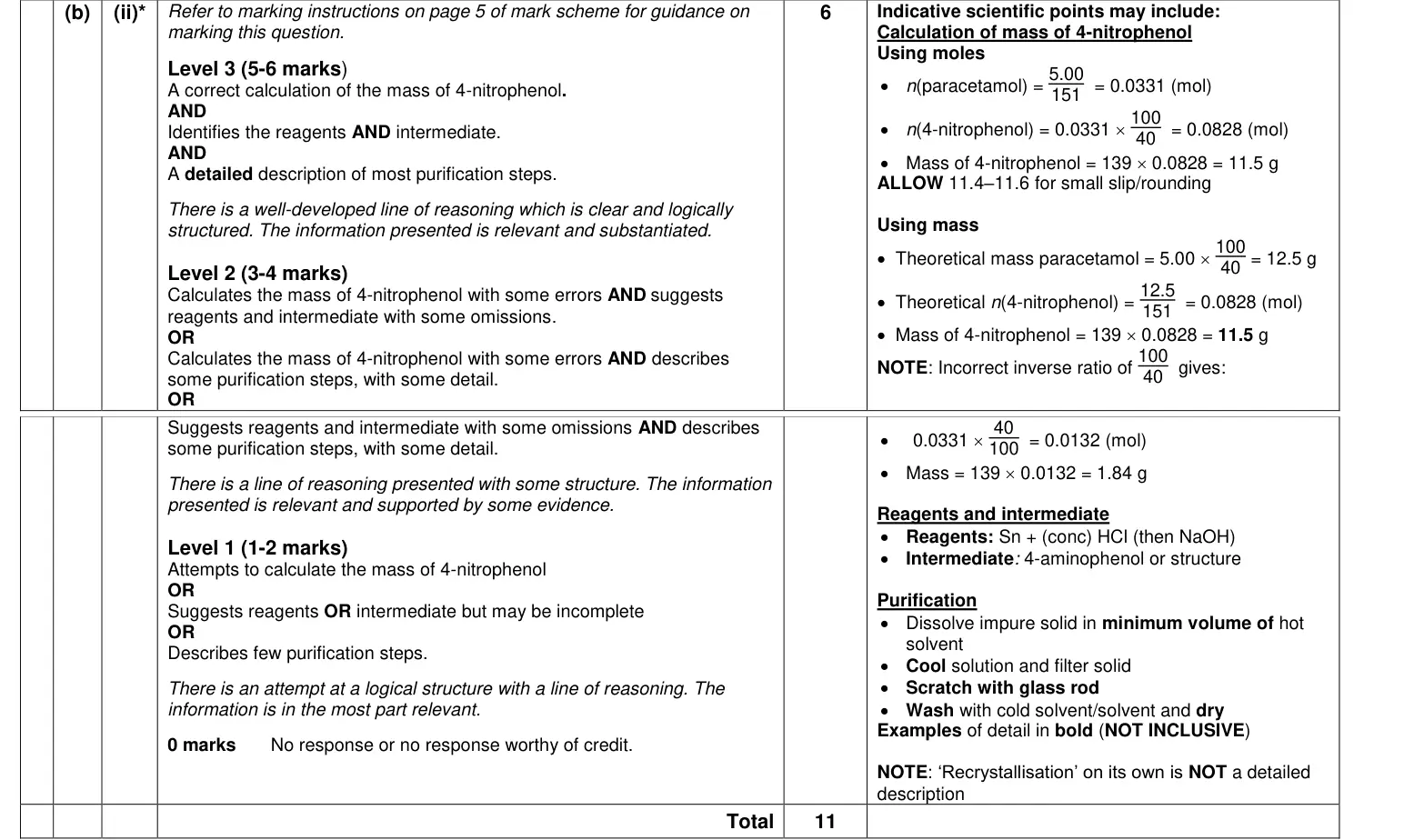
This part assessed practical aspects of a two-stage organic synthesis. Overall, candidates responded well, and this part was discriminating. Many candidates produced well-structured responses although lower ability candidates do have problems with constructing a cohesive response. Most candidates identified the correct reagents (Sn and concentrated HCl) and the intermediate (4- aminophenol), which was usually shown as its structure. Able candidates usually showed that 11.5 g of 4-nitrophenol is needed for the synthesis. A common error used the ‘inverse percentage’ ratio of 40/100, resulting in an incorrect mass of 1.84 g. Candidates are recommended to check whether a calculated answer looks sensible. Looking at the structures and with a percentage yield of 40%, 1.84 g does not look to be enough of the starting chemical. Some lower ability candidate responses assumed that 5.00 g was 40% of the required mass and responded with 5.00 × 100/40 = 12.5 g. There were some good descriptions of purification, although finer details such as using a minimum volume of hot solvent, washing with cold solvent, and drying) were often omitted. Candidates needed to respond with more than just ‘recrystallisation’. In the purification, common errors were showing the correct steps but in the wrong order and use of a drying agent such as CaCl2 (confusion with part of the purification of an organic liquid). These candidates seemed unaware that adding a solid drying agent to an organic solid would result in impure paracetamol rather than purifying. In comparison, Exemplar 12 is much less detailed: concentrated HCl has not been shown as a reagent for step 1, the candidate has not shown that they know how to carry out a percentage yield calculation, and the purification is confused, and lacks detail.
Notes from the mark scheme and report
5.00/151 = 0.0331 mol, ×100/40 = 0.0828 mol, × 139 = 11.5 g (inverted ratio gives 1.84 g)
Sn + conc HCl then NaOH
intermediate 4-aminophenol
recrystallise: dissolve in MINIMUM volume of HOT solvent, cool, filter, wash with cold solvent, dry
'recrystallisation' alone is not a detailed description
Skills: M0.2 Use ratios, fractions and percentages; M2.2 Change the subject of an equation; PAG6 Synthesis of an organic solid
June 2018 · Paper 3 · Q5(b)(ii)1 markEquation writingMedium
Earlier part of question 5 that this part uses
Mark scheme
Examiner's comment
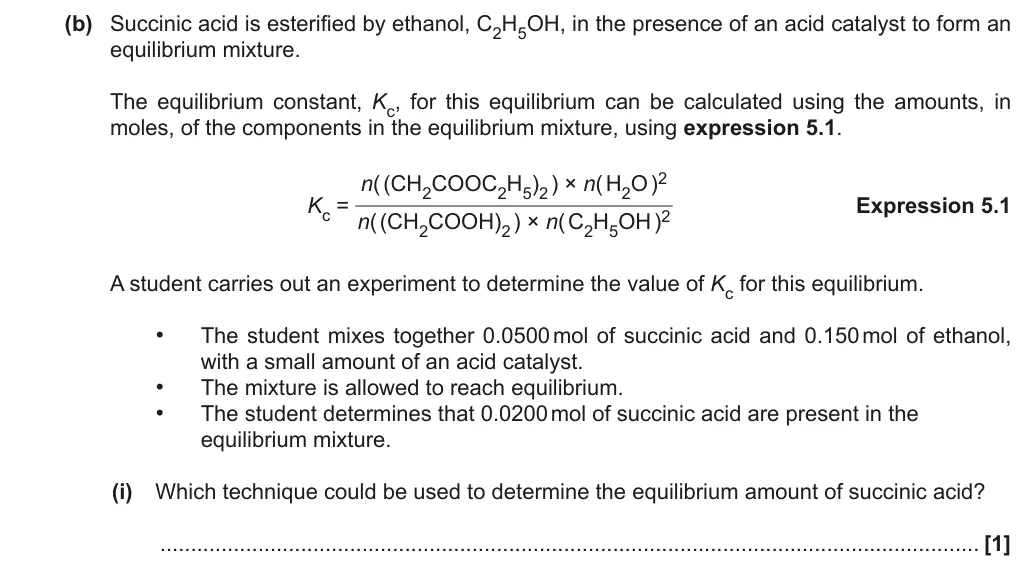
Candidates were required to derive the equation from which the supplied Kc expression had been written. Overall, this part was answered well but some candidates struggled with the brackets or used CH2COOH2 for succinic acid.
Notes from the mark scheme and report
(CH2COOH)2 + 2C2H5OH ⇌ (CH2COOC2H5)2 + 2H2O
ALLOW → and molecular formulae
June 2018 · Paper 3 · Q5(b)(iii)1 markStructure / isomerHard
Earlier parts of question 5 that this part uses
Mark scheme
Examiner's comment
This part discriminated extremely well with many candidates finding it difficult to convert the bracketed structural formula into a skeletal formula. Common errors were drawing of the mono-ester or omitting a carbon atom in the centre of the structure. Even when incorrect, most attempted answers were skeletal formulae.
Notes from the mark scheme and report
skeletal diethyl butanedioate
IGNORE displayed formulae
June 2017 · Paper 2 · Q101 markMultiple choice
Answer
D
Mark scheme
June 2017 · Paper 2 · Q121 markMultiple choice
Answer
A
Mark scheme
June 2017 · Paper 2 · Q131 markMultiple choice
Answer
A
Mark scheme
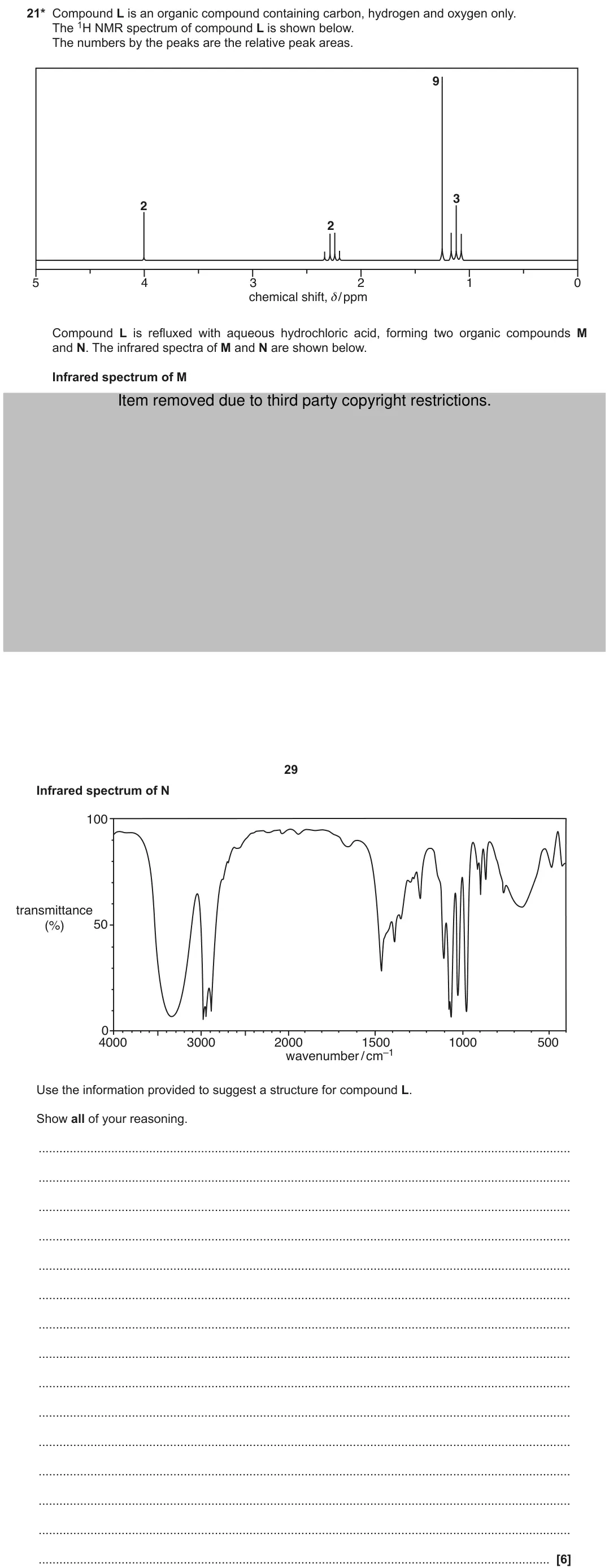
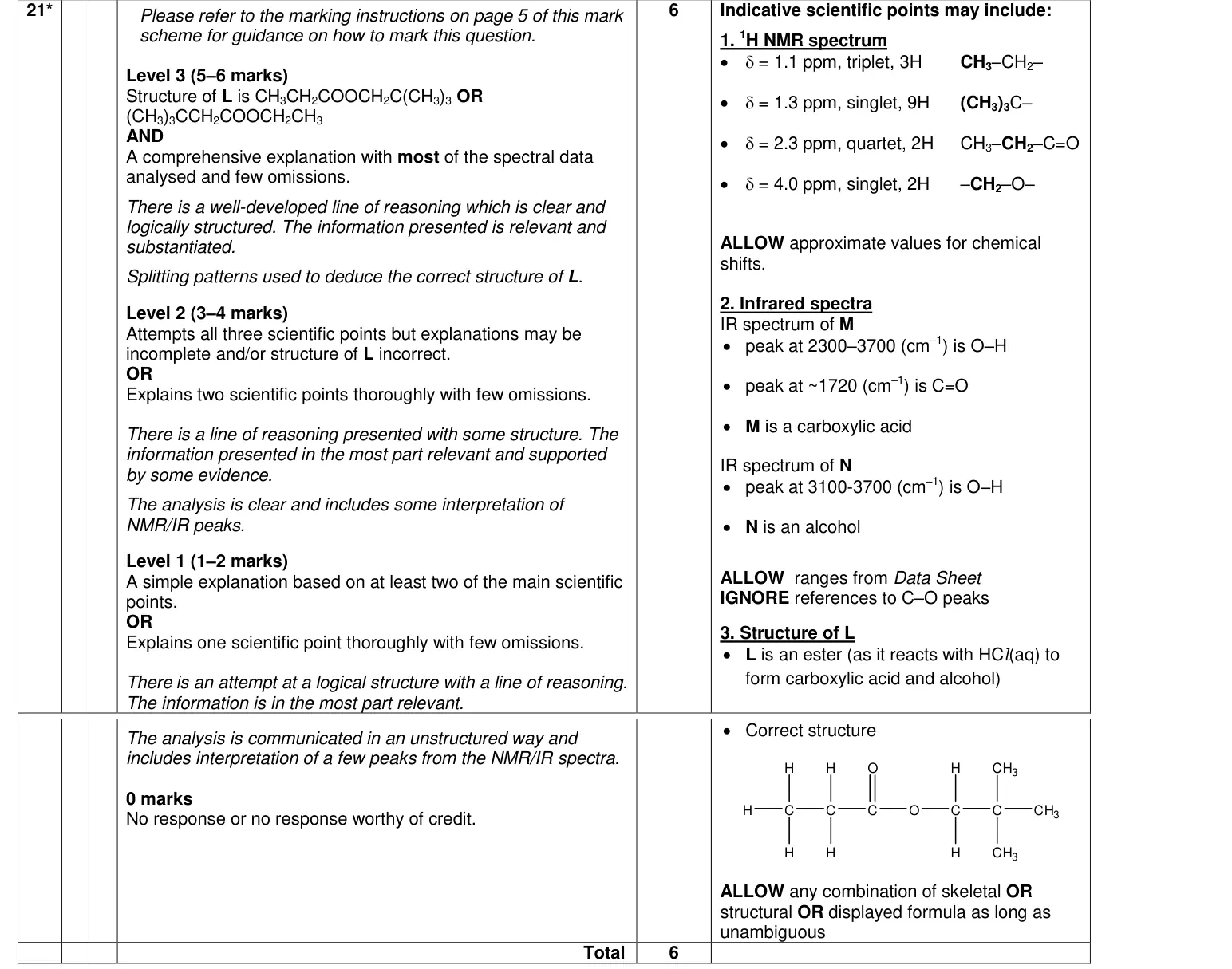
June 2017 · Paper 2 · Q216 marks6-mark level of response
Mark scheme, with the levels and indicative points
Notes from the mark scheme and report
triplet 3H + quartet 2H = CH3CH2
singlet 9H = (CH3)3C
singlet 2H at 4.0 = CH2–O
M broad O–H and C=O = carboxylic acid, N O–H = alcohol, so L is an ester: CH3CH2COOCH2C(CH3)3 or (CH3)3CCH2COOCH2CH3
IGNORE C–O peaks
Skills: M3.1 Translate information between graphical, numerical and algebraic forms
June 2017 · Paper 3 · Q4(b)(i)3 marksStructure / isomer
Earlier part of question 4 that this part uses
Mark scheme
Notes from the mark scheme and report
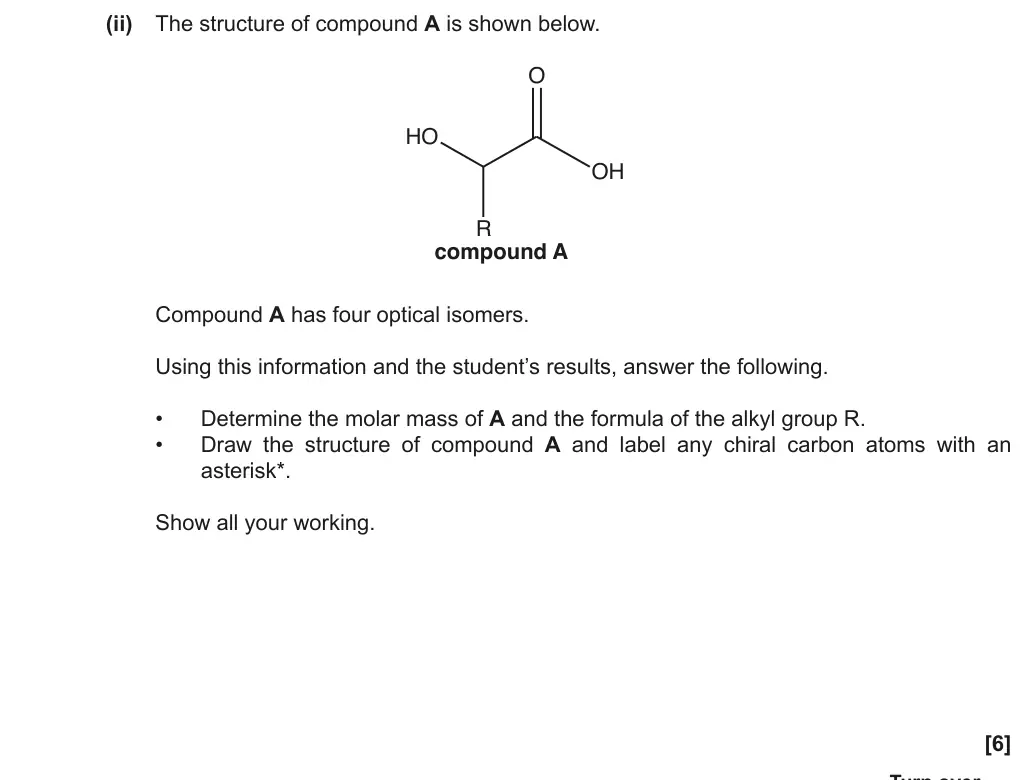
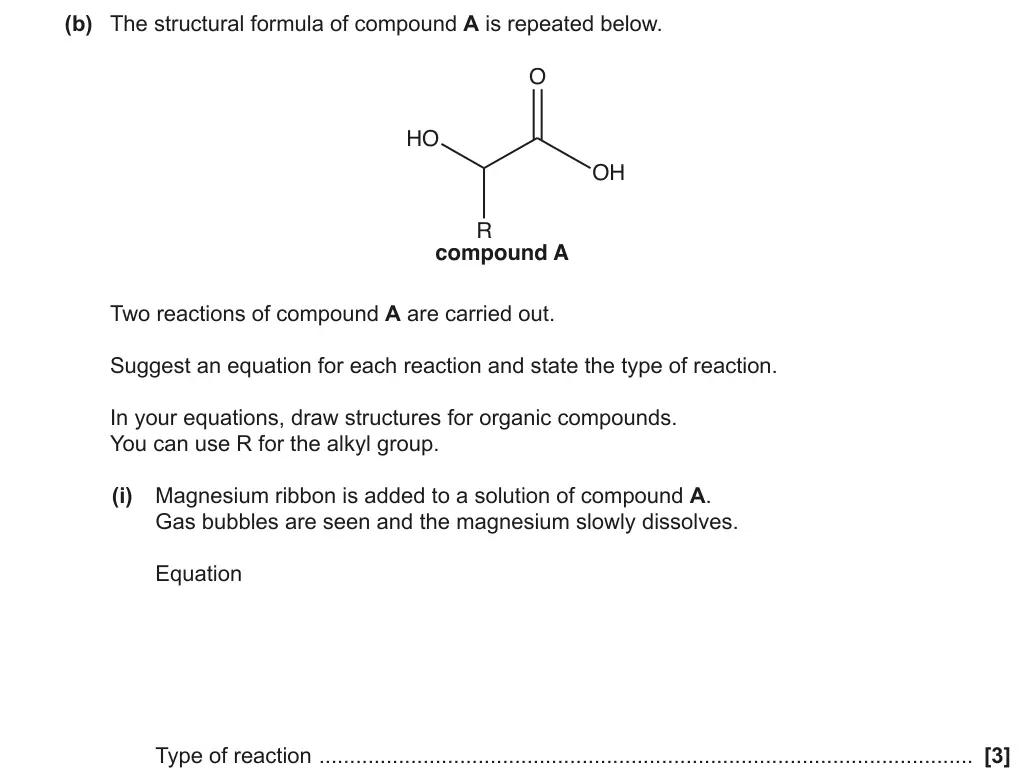
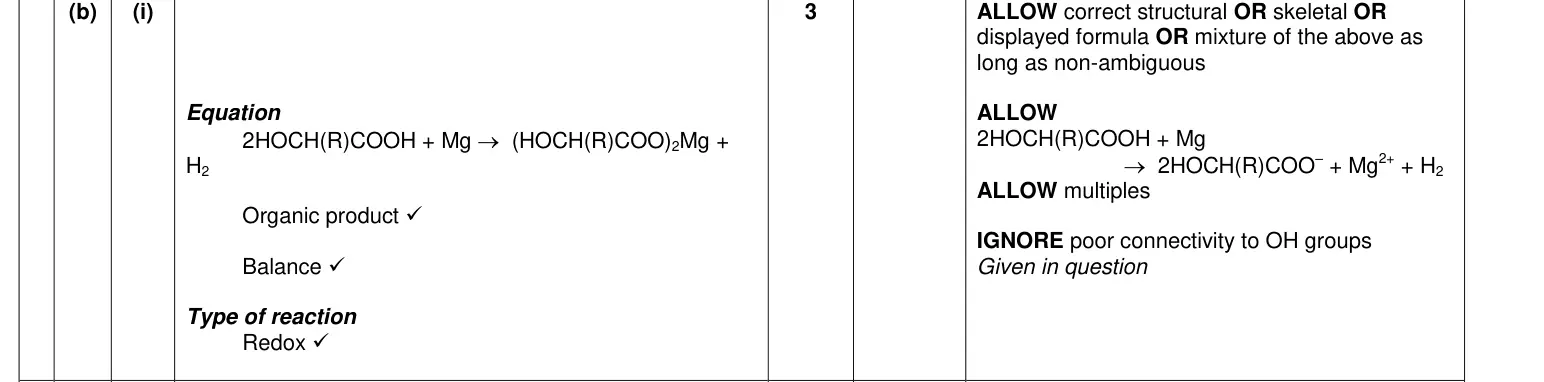
2HOCH(R)COOH + Mg → (HOCH(R)COO)2Mg + H2
redox
IGNORE poor connectivity to OH groups
June 2017 · Paper 3 · Q4(b)(ii)3 marksShort answer
Earlier part of question 4 that this part uses
Mark scheme
Notes from the mark scheme and report
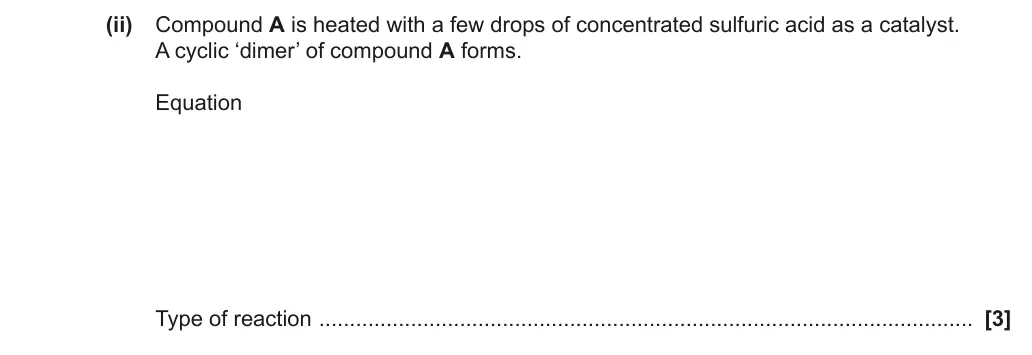
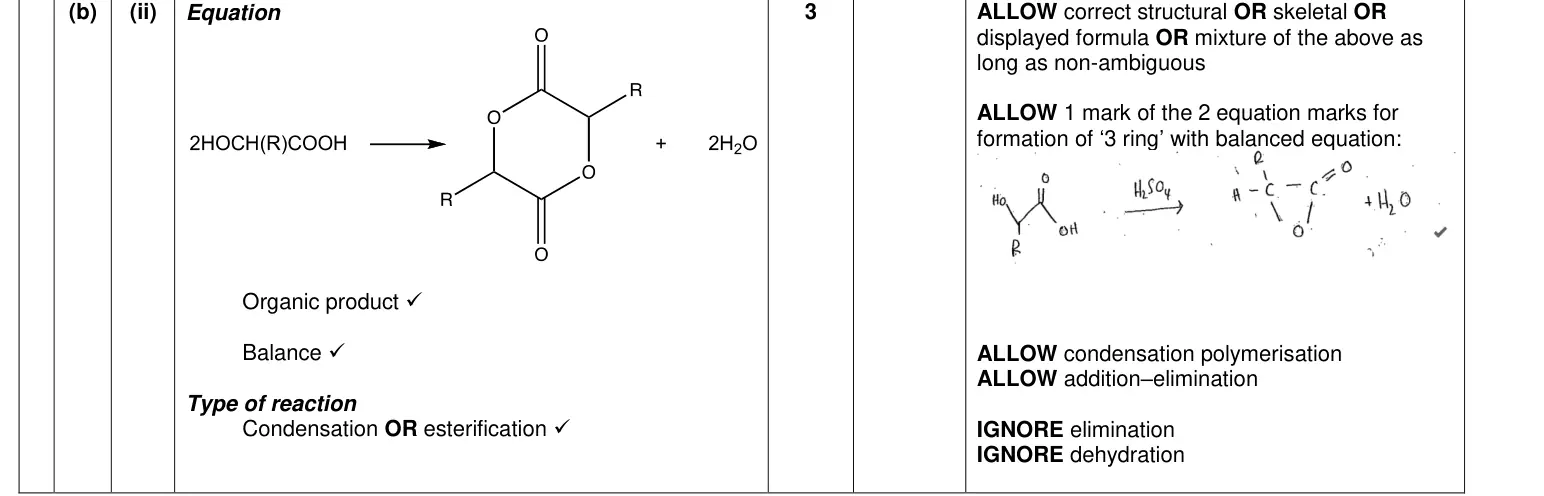
cyclic diester (six-membered ring) + 2H2O
condensation or esterification
1 mark of the equation marks for a '3 ring' with balanced equation
IGNORE elimination and dehydration
June 2017 · Paper 3 · Q5(a)(ii)2 marksEquation writing
Earlier part of question 5 that this part uses
Mark scheme
Notes from the mark scheme and report
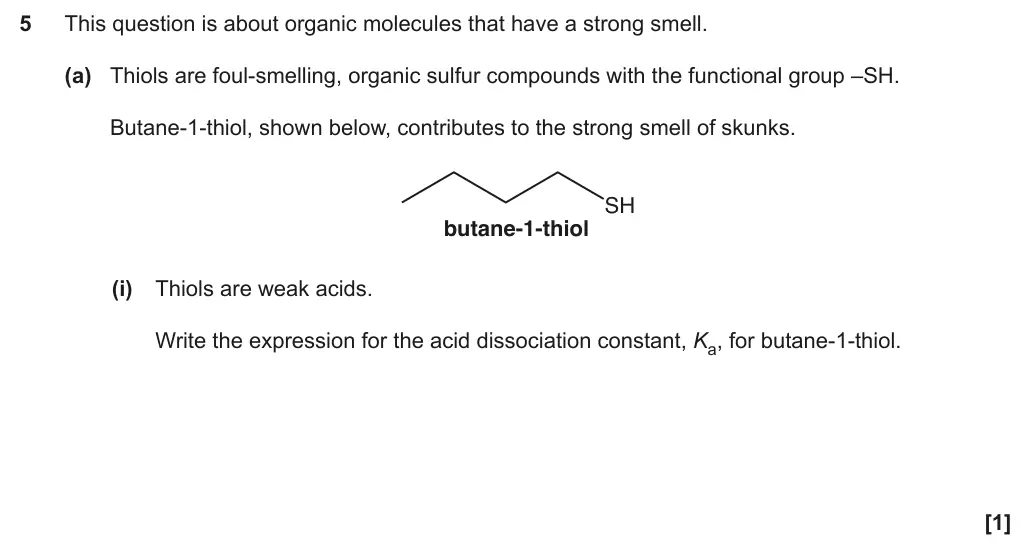
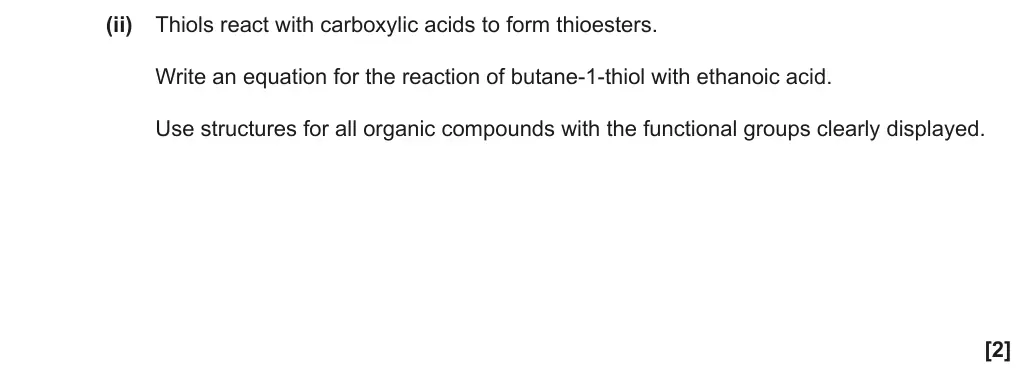
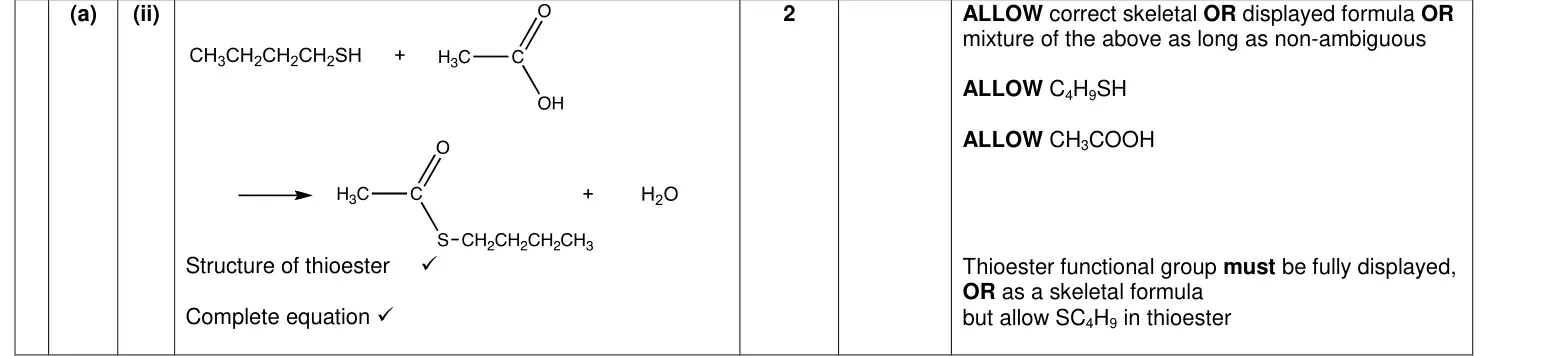
thioester C(=O)–S functional group must be fully displayed
H2O as second product
Work with an OCR chemistry tutor
Dropping marks on calculations, mechanisms or the six-markers? Book a trial session with a specialist OCR chemistry tutor.