Show the 11 learning outcomes from the specification
5.2.1(a) explanation of the term lattice enthalpy (formation of 1 mol of ionic lattice from gaseous ions, ∆LEH) and use as a measure of the strength of ionic bonding in a giant ionic lattice (see also 2.2.2 b– c)
5.2.1(b) use of the lattice enthalpy of a simple ionic solid (e.g. NaCl, MgCl2) and relevant energy terms for:
5.2.1(b)(i) the construction of Born–Haber cycles
5.2.1(b)(ii) related calculations
5.2.1(c) explanation and use of the terms:
5.2.1(c)(i) enthalpy change of solution (dissolving of 1 mol of solute, ∆solH)
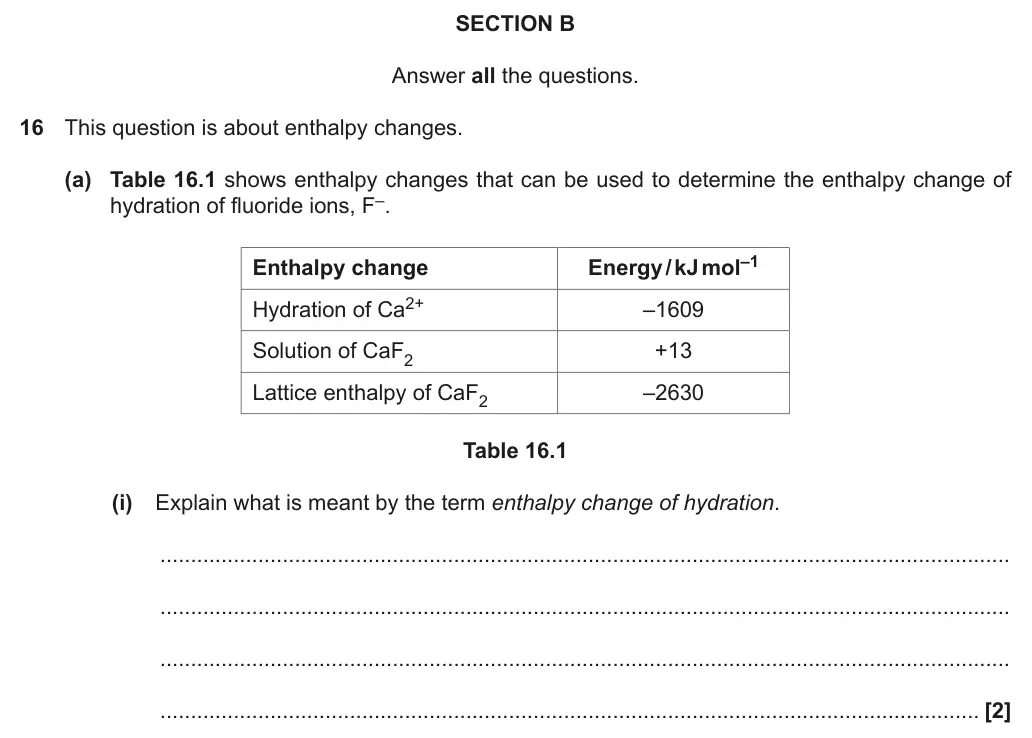
5.2.1(c)(ii) enthalpy change of hydration (dissolving of 1 mol of gaseous ions in water, ∆hydH)
5.2.1(d) use of the enthalpy change of solution of a simple ionic solid (e.g. NaCl, MgCl2) and relevant energy terms (enthalpy change of hydration and lattice enthalpy) for:
5.2.1(d)(i) the construction of enthalpy cycles
5.2.1(d)(ii) related calculations
5.2.1(e) qualitative explanation of the effect of ionic charge and ionic radius on the exothermic value of a lattice enthalpy and enthalpy change of hydration.
Six-mark level of response questions on this topic
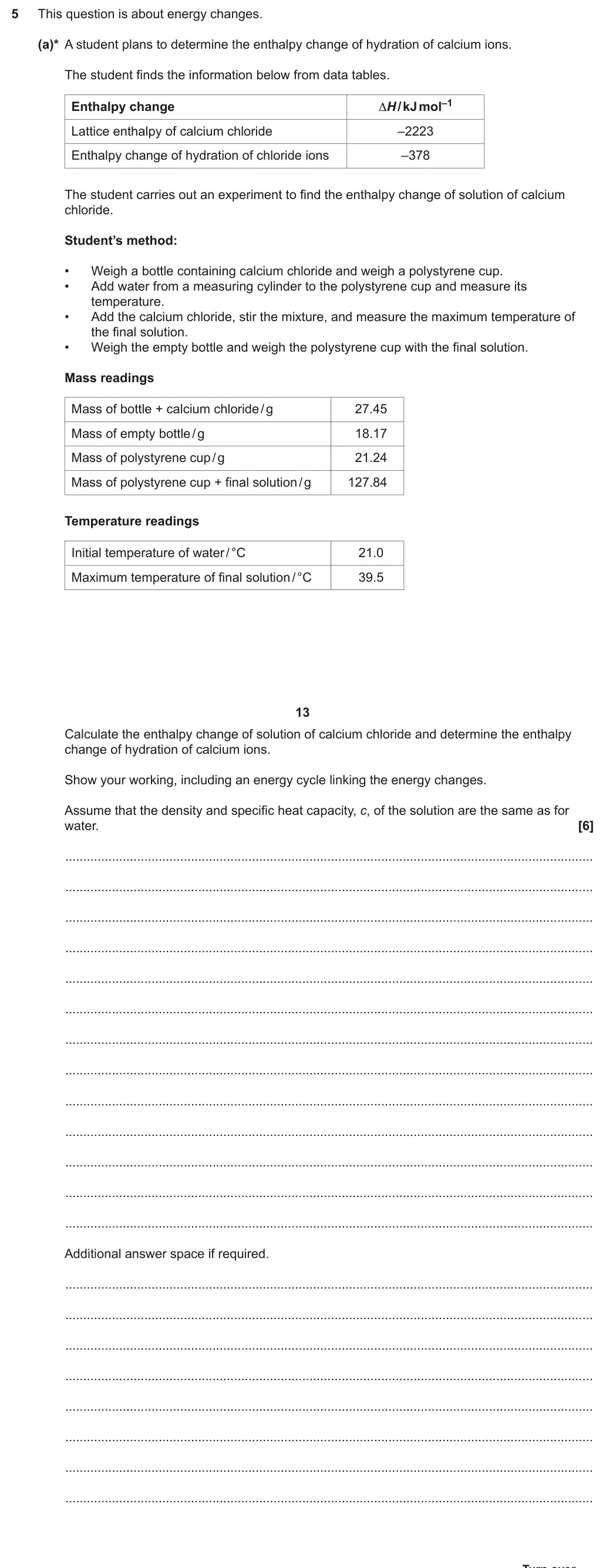
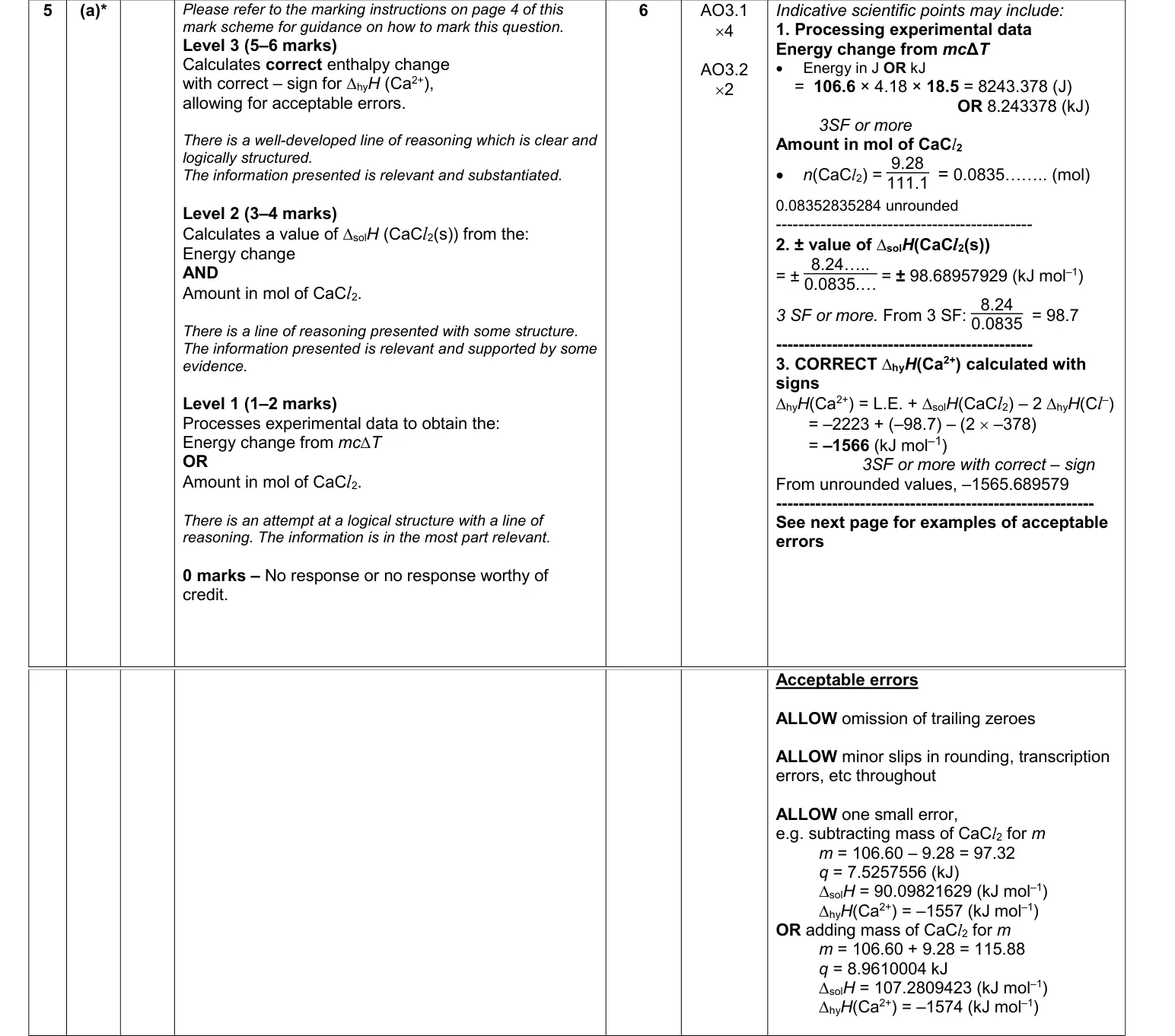
A student plans to determine the enthalpy change of hydration of calcium ions. Calculate the enthalpy change of solution of calcium chloride and determine the enthalpy
Tap a question to zoom it. Where a part needs a table, graph or structure from an earlier part, that part folds out above it; the mark scheme and examiner's comment open underneath. Have the OCR Data Sheet beside you.
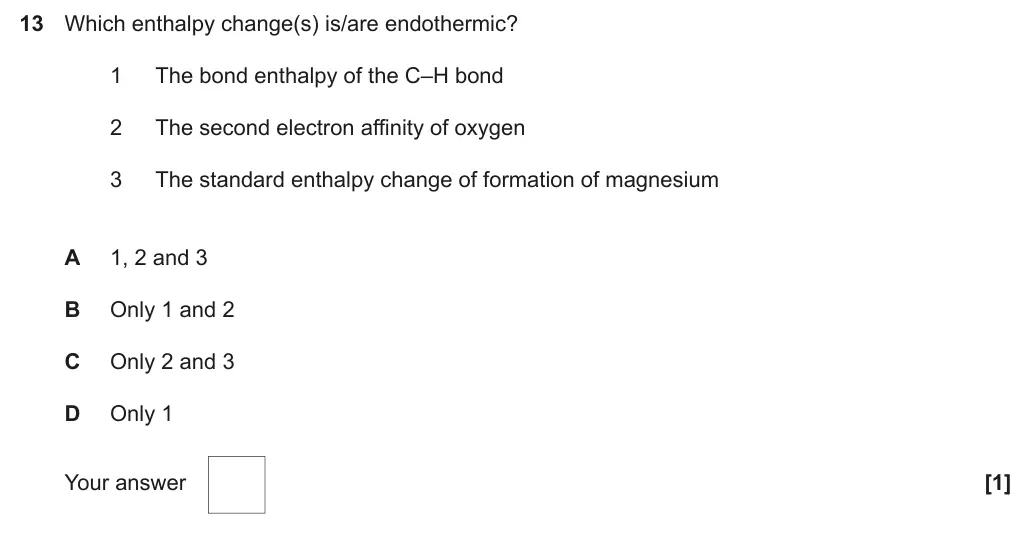
June 2025 · Paper 1 · Q31 markMultiple choiceMedium
Answer
B
Mark scheme
Examiner's comment
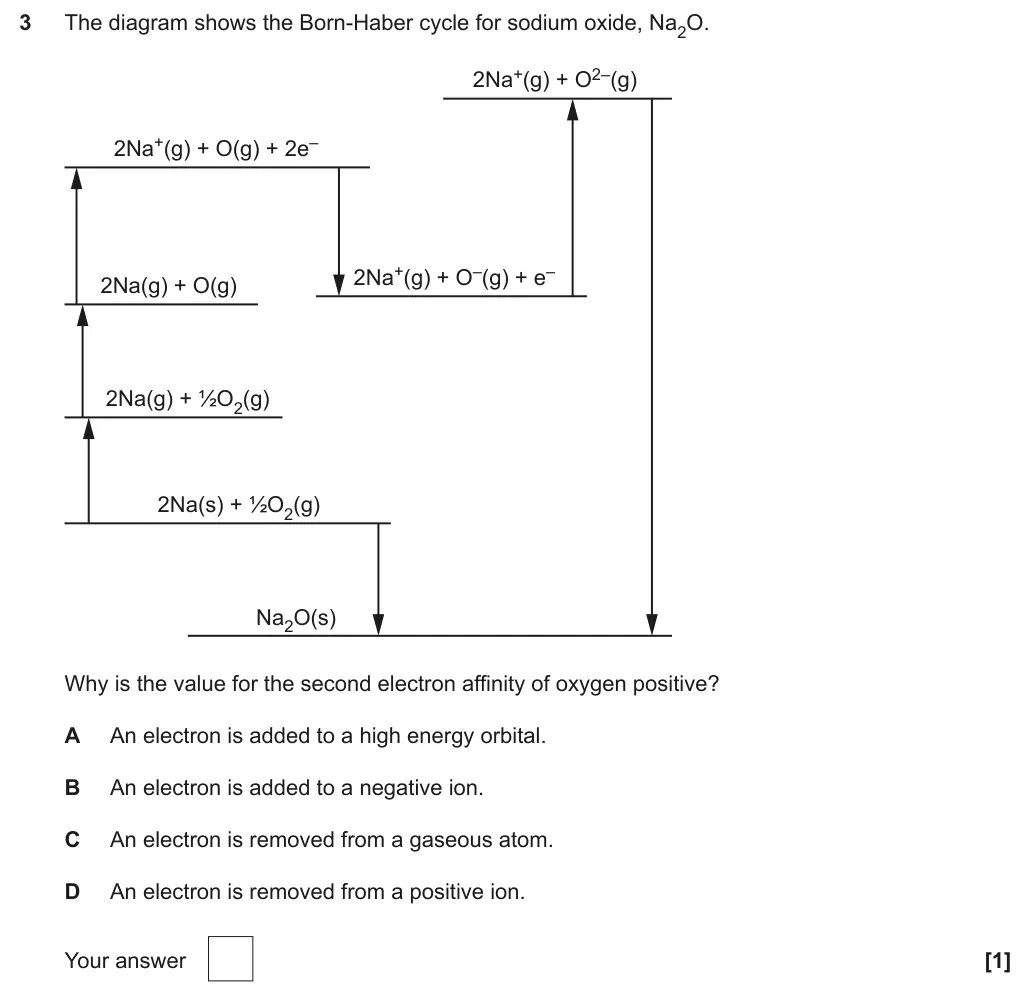
The correct answer was B. Most candidates were able to link the energy required to the repulsion between the negative charges. A few candidates suggested A and C. These candidates did not understand why the 2nd electron affinity is endothermic or that an electron was being added to form the O2- ion.
June 2024 · Paper 1 · Q16(c)(i)2 marksShort answerMedium
Mark scheme
Examiner's comment
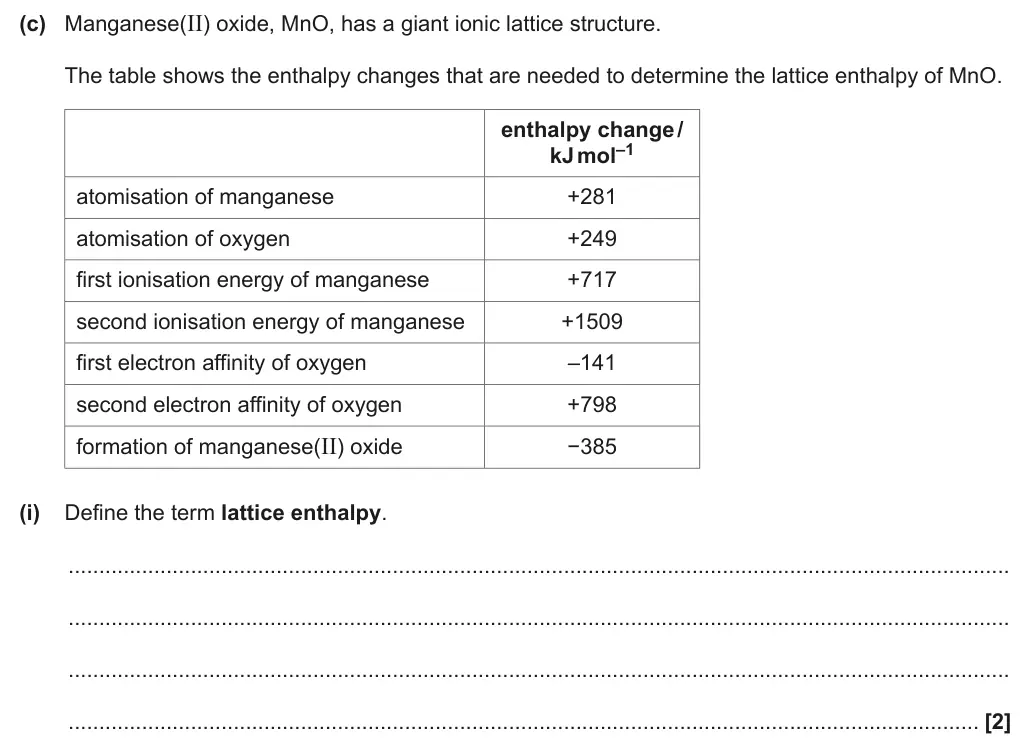
This question required a standard definition to be recalled. The two components are (a) one mole of an ionic lattice and (b) formed from its gaseous ion. Some candidates produced answers combining all the various definitions, most often 1 mol of gaseous ions. In general, when enthalpy definitions are required, candidates should be mindful of whether energy is given out or taken in. The phrase ‘enthalpy that accompanies’ may be most appropriate when candidates are unsure of the energy change.
Notes from the mark scheme and report
1 mol of ionic lattice formed from gaseous ions
DO NOT ALLOW 'one mole of gaseous ions'
June 2024 · Paper 1 · Q16(c)(ii)3 marksComplete table/diagramEasy
Earlier part of question 16 that this part uses
Mark scheme
Examiner's comment
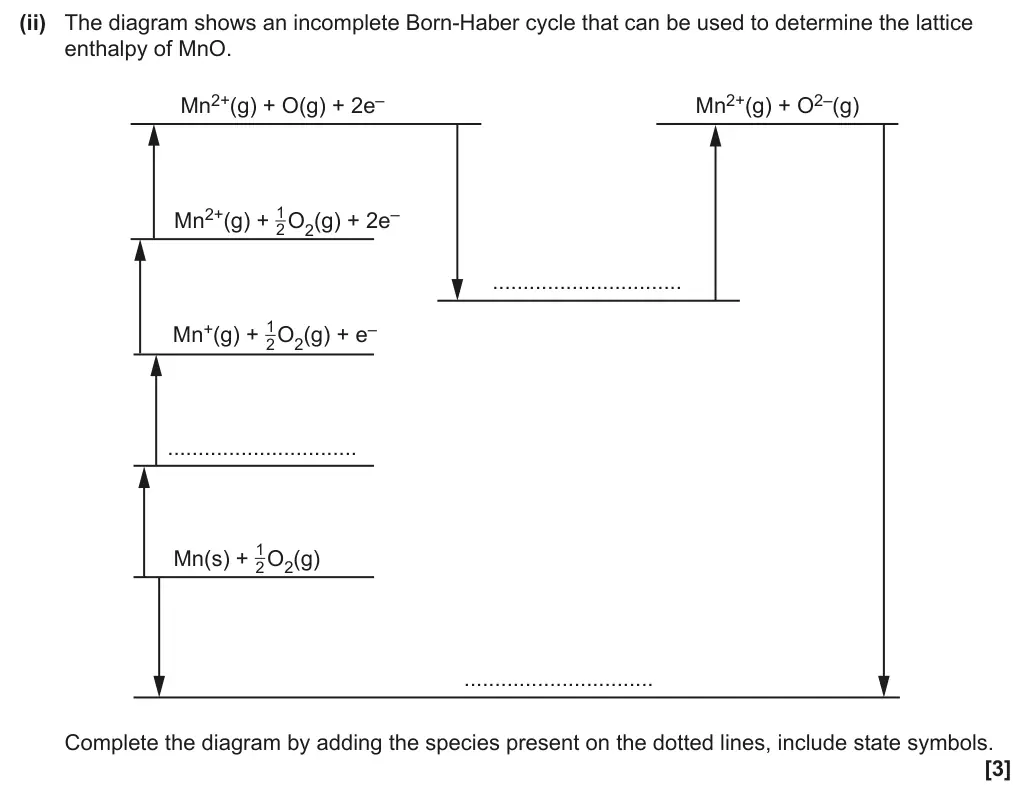
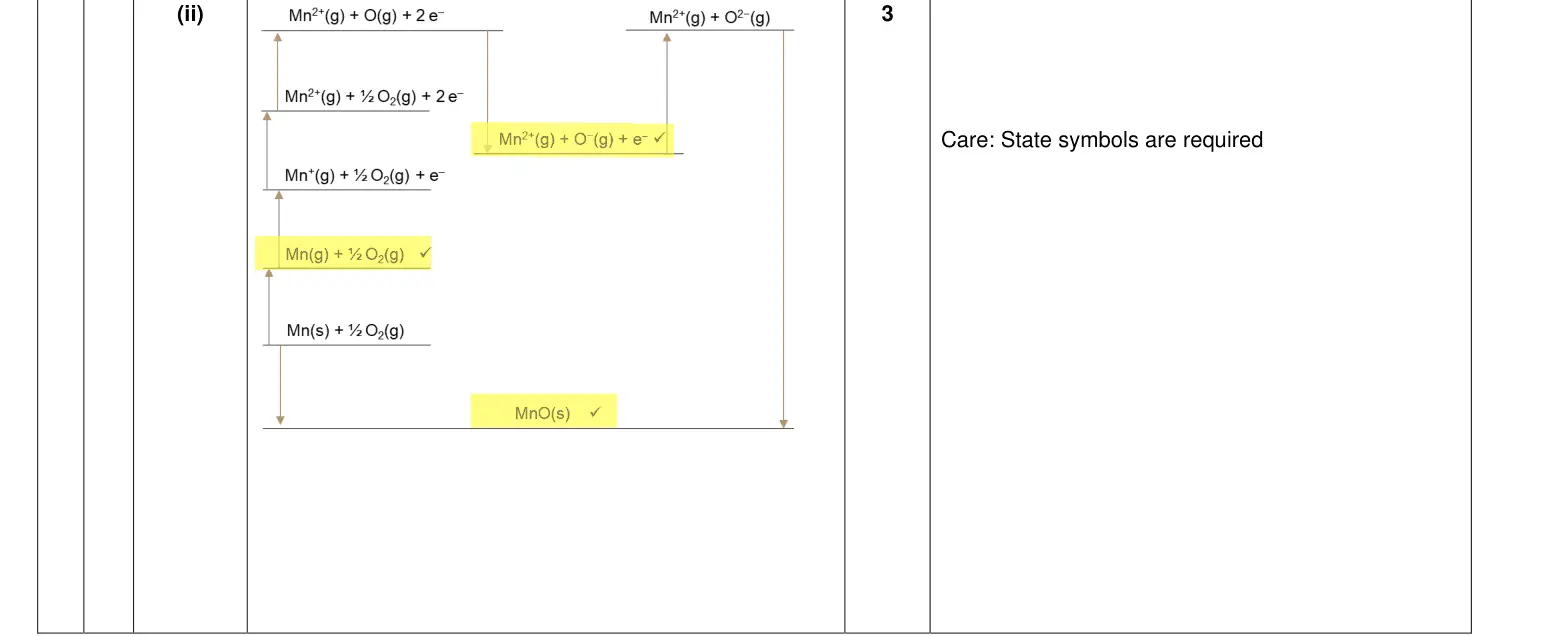
Most candidates scored all three marks. Some candidates wrote illegible state symbols where (g) and (s) were impossible to tell apart, but this was improved on from last year. Also, many candidates choose to write state symbols as a very small sub-script e.g. Mn(s) or O2(g). The convention is to use lower case letters of normal size e.g. Mn(s) or O2(g). The most common errors were the manganese formula, i.e. MnO2, and incorrect state symbol with (g) being used. Candidates also missed state symbols in one species, electron on the top left and an incorrect charge on either the Mn or O ions.
Notes from the mark scheme and report
state symbols required
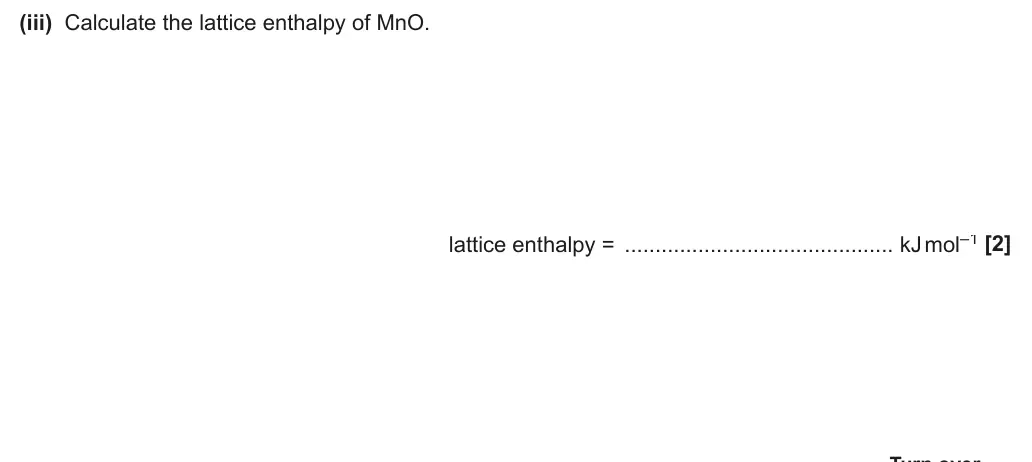
June 2024 · Paper 1 · Q16(c)(iii)2 marksCalculationMedium
Earlier parts of question 16 that this part uses
Mark scheme
Examiner's comment
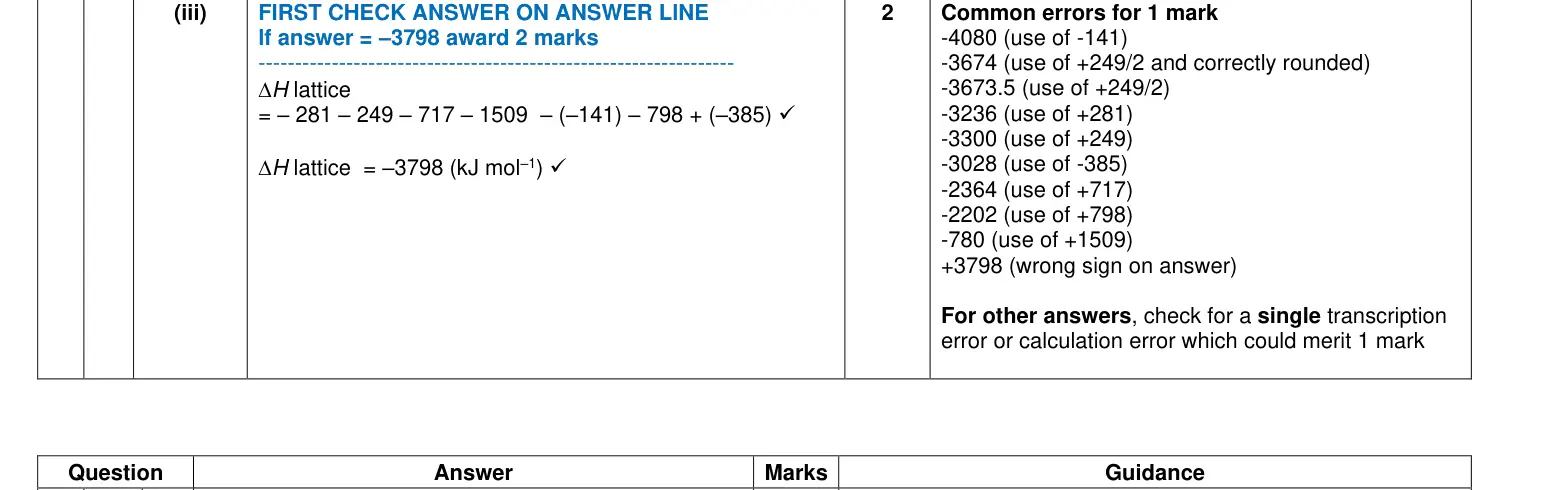
The correct answer was seen frequently, along with lots of the common errors listed on the mark scheme. Candidates tended to misjudge the mole ratio and divided +249 by two. Some candidates applied the cycle incorrectly and therefore used the wrong sign for an enthalpy change, leading to them attaining one mark. Candidates should check for transcription errors as -3789 was often written for - 3798.
Notes from the mark scheme and report
common errors: using –141 only, halving atomisation of O
sign errors
Skills: M2.2 Change the subject of an equation; M2.4 Solve algebraic equations
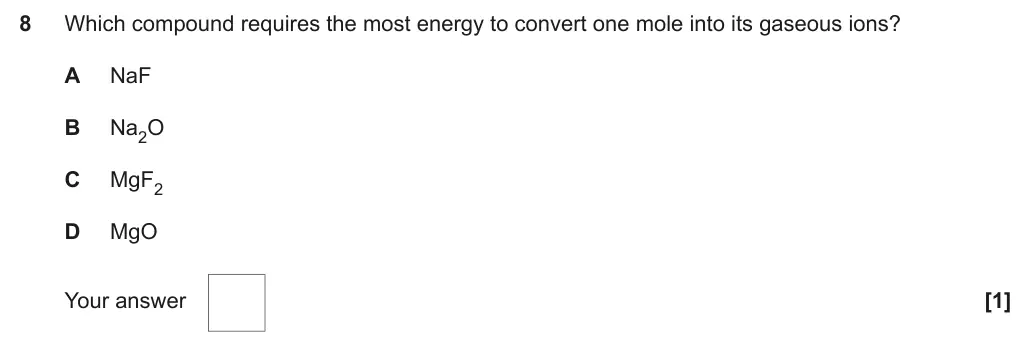
June 2023 · Paper 1 · Q81 markAO1Multiple choiceHard
Answer
D
Mark scheme
Examiner's comment
This question was another challenging idea. The correct answer was D. Many candidates chose A or C, possibly due to fluorine’s high electronegativity.
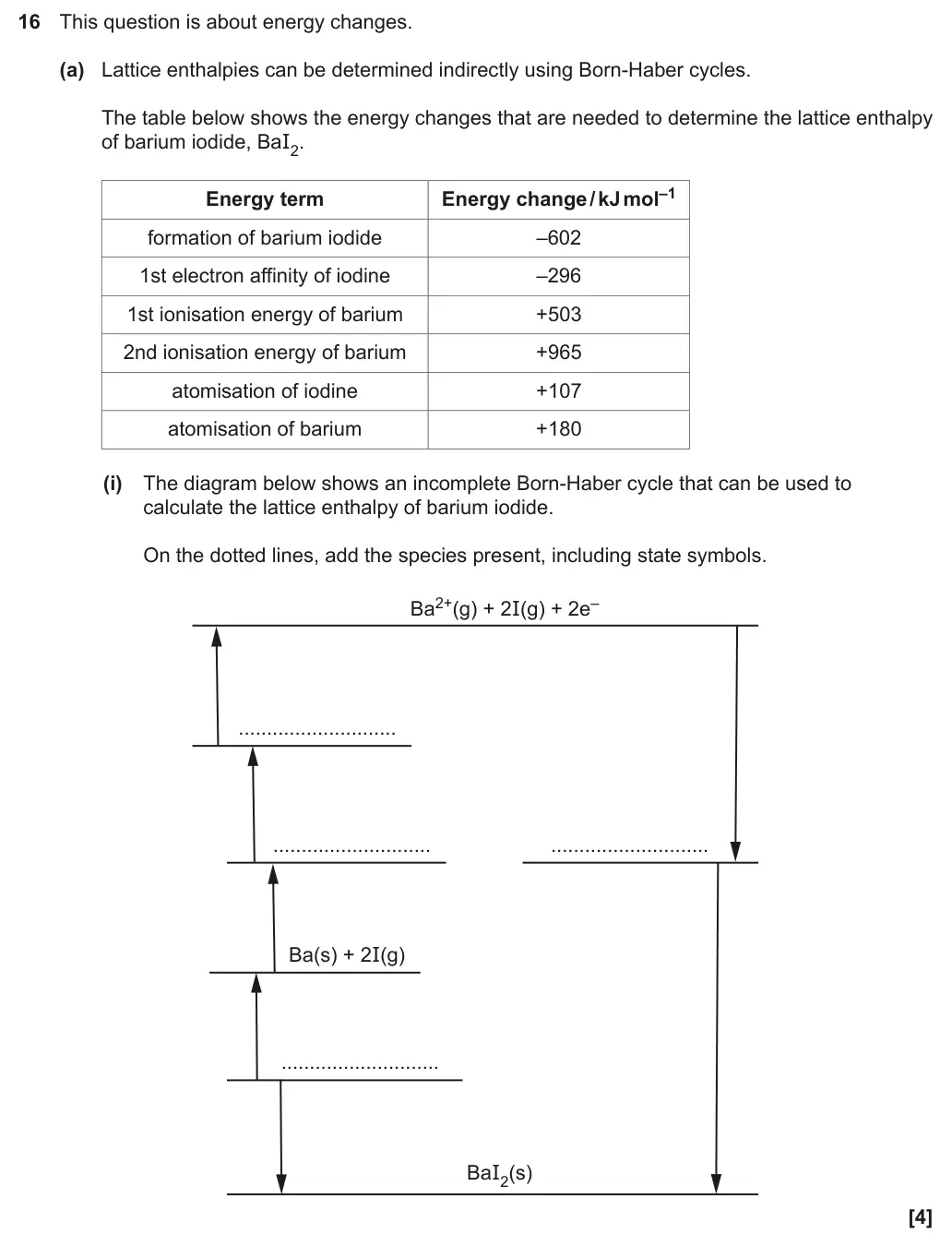
June 2023 · Paper 1 · Q16(a)(i)4 marksAO1Complete table/diagramMedium
Mark scheme
Examiner's comment
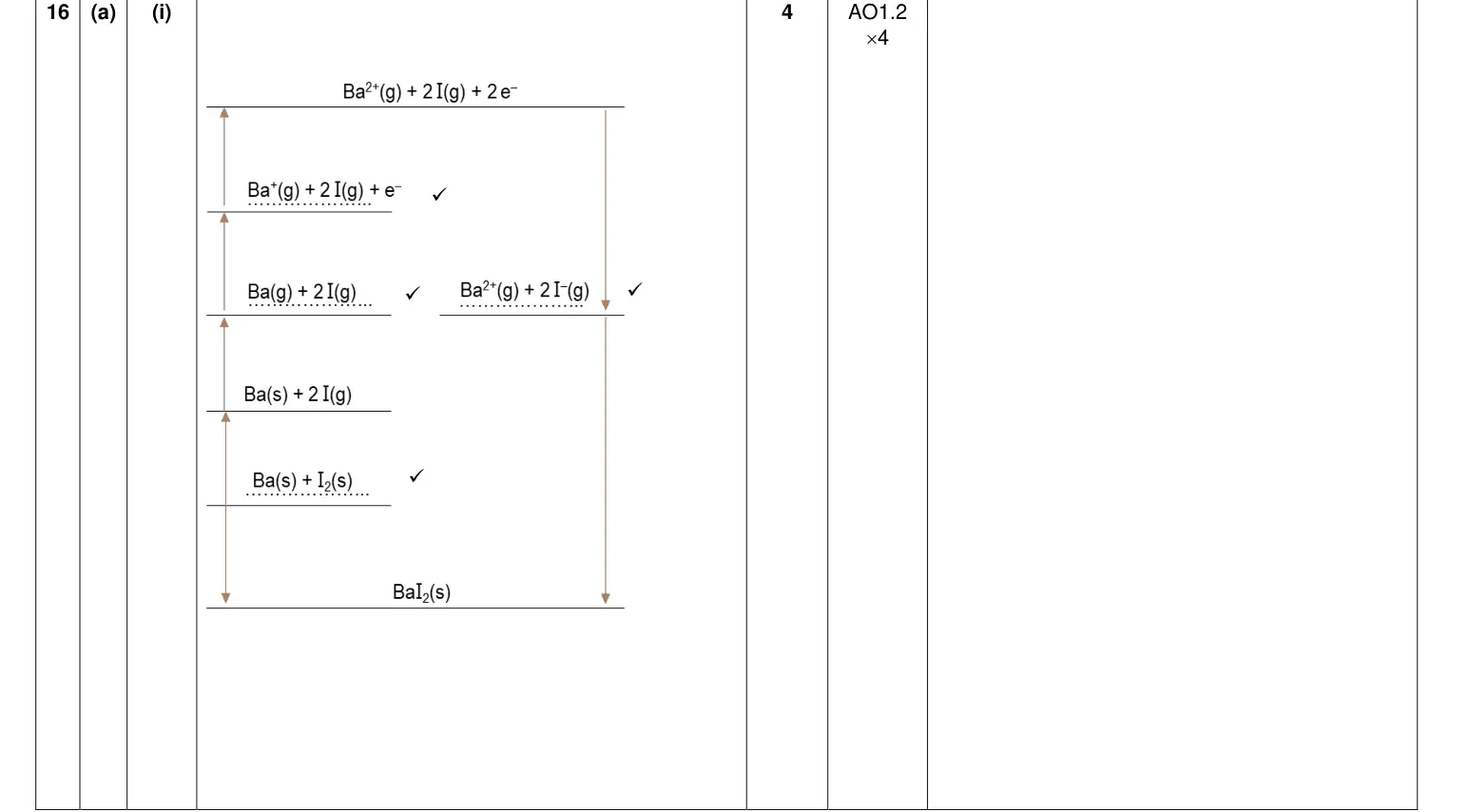
Some candidates wrote illegible state symbols where (g) and (s) were impossible to tell apart. Also, many candidates choose to write state symbols as a very small sub-script, e.g. Ba(s) or I2(s). The convention is to use lower case letters of normal size, e.g. Ba(s) or I2(g). The most common errors were the iodine state symbol, with both (g) and (l) being used, and the use of 2I for I2. Some candidates missed state symbols in one species, missed electrons with the two ions, or gave a charge on the top left iodine.
Notes from the mark scheme and report
species AND state symbols for each line: Ba(s) + I2(s)
Ba(g) + 2I(g)
Ba+(g) + 2I(g) + e–
Ba2+(g) + 2I–(g)
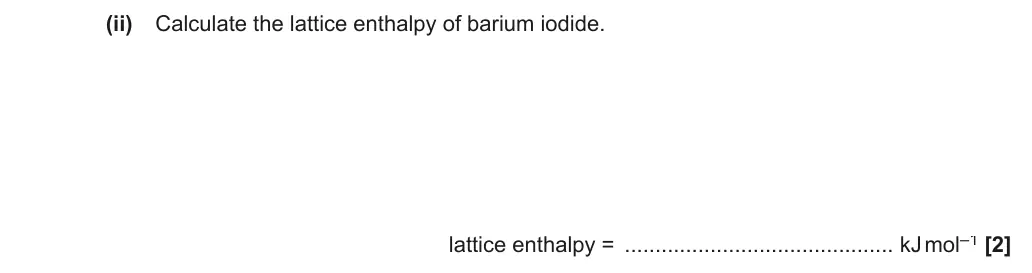
June 2023 · Paper 1 · Q16(a)(ii)2 marksAO2CalculationMedium
Earlier part of question 16 that this part uses
Mark scheme
Examiner's comment
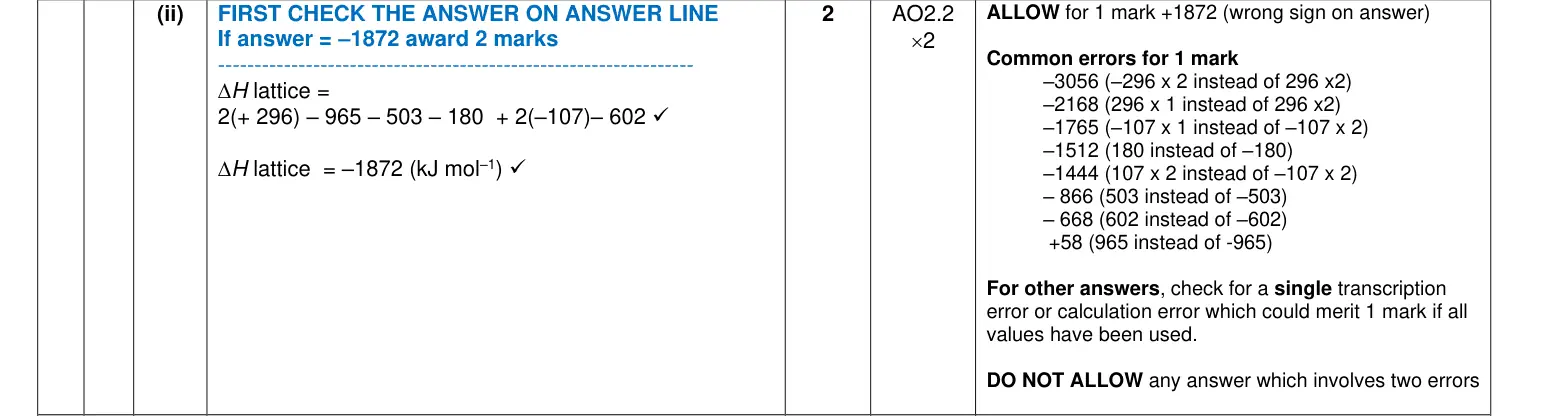
The correct was answer seen frequently, along with lots of the common errors. Candidates tended to forget the mole ratio and did not multiply either -107 or +296 by two. Some candidates applied the cycle incorrectly and therefore used the wrong sign for an enthalpy change, leading to them attaining 1 mark.
Notes from the mark scheme and report
1 mark for a single error: +1872 (sign), –2168 (296 × 1), –1765 (107 × 1), –3056
DO NOT ALLOW any answer with two errors
Skills: M2.2 Change the subject of an equation; M2.3 Substitute numerical values into algebraic equations using appropriate units for physical quantities; M2.4 Solve algebraic equations
June 2023 · Paper 3 · Q2(a)(ii)3 marksAO2CalculationHard
Earlier part of question 2 that this part uses
Mark scheme
Examiner's comment
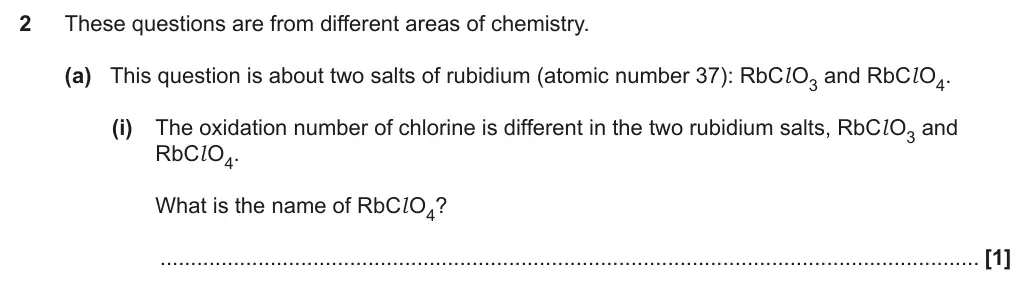
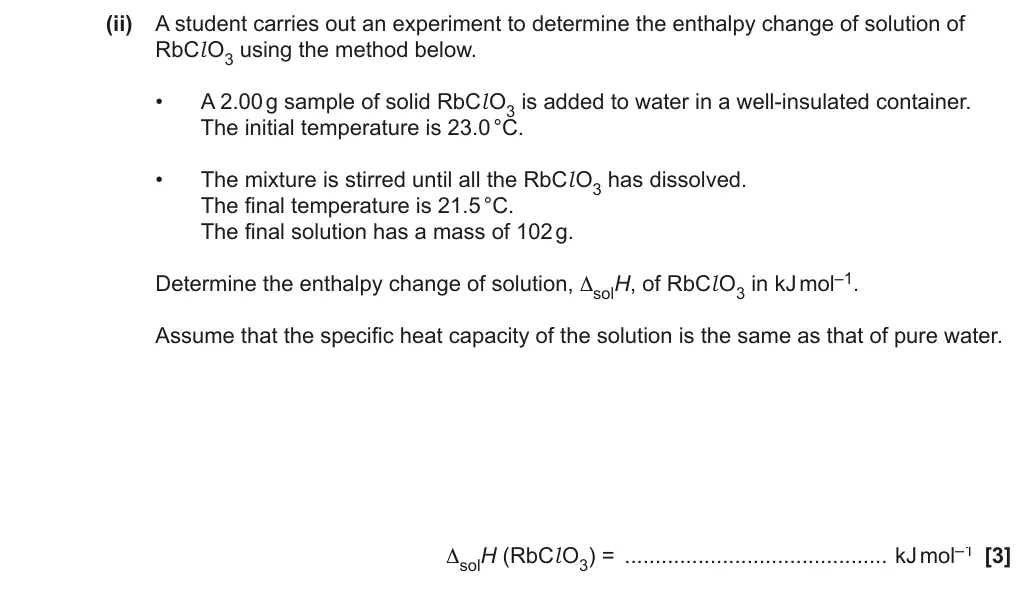
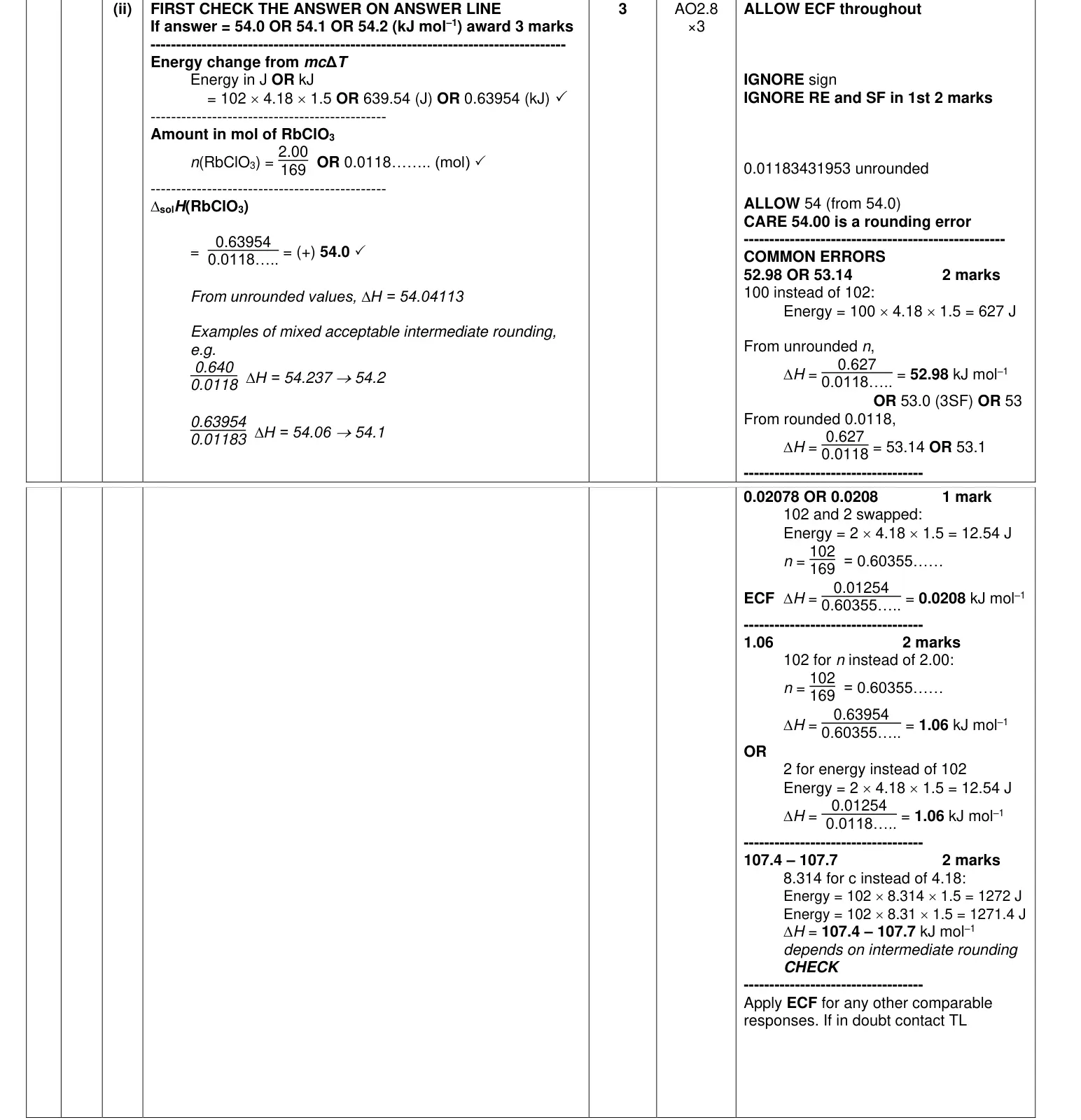
This question was a good discriminator, producing marks across the whole 3 mark range. More successful candidates correctly calculated the energy change, moles of RbClO3 and enthalpy change of solution. However, there were pitfalls for many including the following: • calculating the energy change using the mass of water rather than the mass of the solution. This was despite the suppled information that the specific heat capacity of the solution is the same as for water. Candidates should understand that m in mc∆T is the mass of the substance that produces ∆T • calculating an incorrect value for the molar mass of RbClO3. Instead of 169, this was often seen as 120.5 (using the atomic number of 37 for Rb, rather than the mass number of 85.5) and 185 (for RbClO4) • using values of m at the wrong stages in the calculation. e.g. 2 g with the energy change and 102 g or 100 g with the moles calculation • calculating the correct numerical value for the enthalpy change of solution, but then placing a ‘–‘ sign in front of the value, despite ∆T being for a decrease in temperature. Finally, as with all multi-step calculations, candidates are advised to use calculator values throughout. Any intermediate rounding introduces rounding errors in the final value. The final value can be rounded either to the significant figures demanded by the question or to the lowest number of significant figures used in the provided data.
Notes from the mark scheme and report
mass of solution 102 g (not 100 or 2.00 g)
∆T = 1.5
n = 2.00/169
+54.0 to 54.2
IGNORE sign
common errors: 100 instead of 102 (53.0) 2 marks, 102 and 2 swapped 1 mark, 8.314 used for c 2 marks
ALLOW ECF
Skills: M0.0 Recognise and make use of appropriate units in calculations; M0.2 Use ratios, fractions and percentages; M2.3 Substitute numerical values into algebraic equations using appropriate units for physical quantities; PAG3 Enthalpy determination
June 2022 · Paper 1 · Q91 markAO1Multiple choiceHard
Answer
A
Mark scheme
Examiner's comment
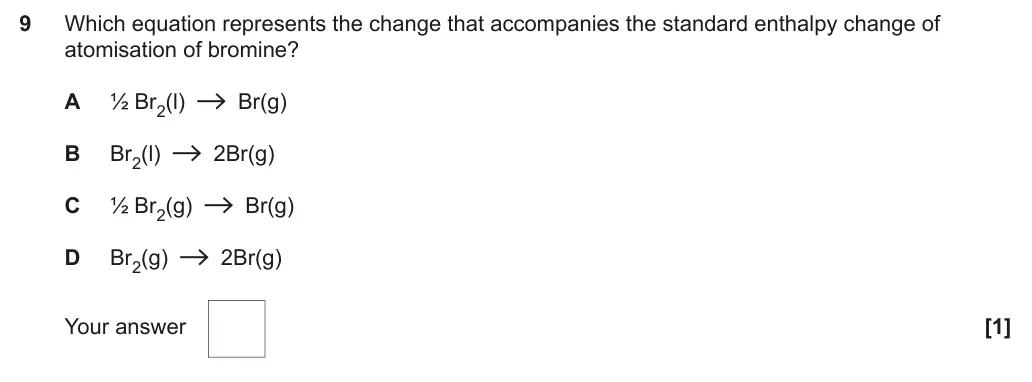
This question proved to be difficult, with fewer candidates selecting the correct answer of A. Option C was the most common distractor as many candidates did not know the standard state of bromine. Option B was selected by those candidates who confused the definitions of average bond enthalpy with the enthalpy change of atomisation.
Notes from the mark scheme and report
1 mol of gaseous atoms from the element in its standard state (liquid Br2)
June 2022 · Paper 3 · Q5(a)6 marksAO36-mark level of responseHard
Mark scheme, with the levels and indicative points
Examiner's comment
This question was assessed by level of response (LoR). Candidates were required to process raw experimental results to determine one enthalpy change, and then to determine a second enthalpy change by using an energy cycle. Levels were determined by the accuracy of the candidates’ processing of the results, calculations and use of the energy cycle. Marks within a level were determined by communication. This question discriminated extremely well. Level 3 candidates used the mass of solution as 106.6 g with mc∆T to obtain an energy change of 8.24 kJ. They then divided this value by the moles of CaCl2 that reacted (0.0835 mol) to obtain the enthalpy change of –98.7 kJ mol–1. Finally, they constructed an energy cycle which they then used to obtain the second enthalpy change of –1566 kJ mol–1. Level 2 candidates determined the first enthalpy change but may have used the approximate mass of 100 g for the mass of solution from the experimental method. Their energy cycle was often incorrect or absent, with the second enthalpy change calculated incorrectly. Level 1 candidates often calculated the initial energy change using mc∆T but made little further correct progress. Less successful responses used the solid mass of calcium chloride (9.28 g) instead of the mass of the solution in their mc∆T calculation. Overall, mathematical skills were displayed well but some basic errors were made, particularly with subtractions. This may have been the result of mis-keying values into a calculator and believing the answer displayed. calcium chloride and the first enthalpy change using a correct method. This response has not been given marks for the communication strand of Level 3 because there is nothing to indicate what the numbers refer to. The response could be summarised as a mass of numbers scrawled across the page. Unfortunately, this is the pattern of many responses. So, this response was given 3/6 marks.
Notes from the mark scheme and report
q = 106.6 × 4.18 × 18.5 = 8.24 kJ (mass of final solution)
n(CaCl2) = 9.28/111.1 = 0.0835
∆solH = –98.7
∆hydH(Ca2+) = –2223 + (–98.7) – 2(–378) = –1566
2 × hydration of Cl–
one small error allowed e.g. using 97.32 g or 115.88 g for m
Skills: M0.0 Recognise and make use of appropriate units in calculations; M2.3 Substitute numerical values into algebraic equations using appropriate units for physical quantities; M2.4 Solve algebraic equations; PAG3 Enthalpy determination
November 2021 · Paper 1 · Q16(c)(i)1 markAO1Short answer
Mark scheme
Notes from the mark scheme and report
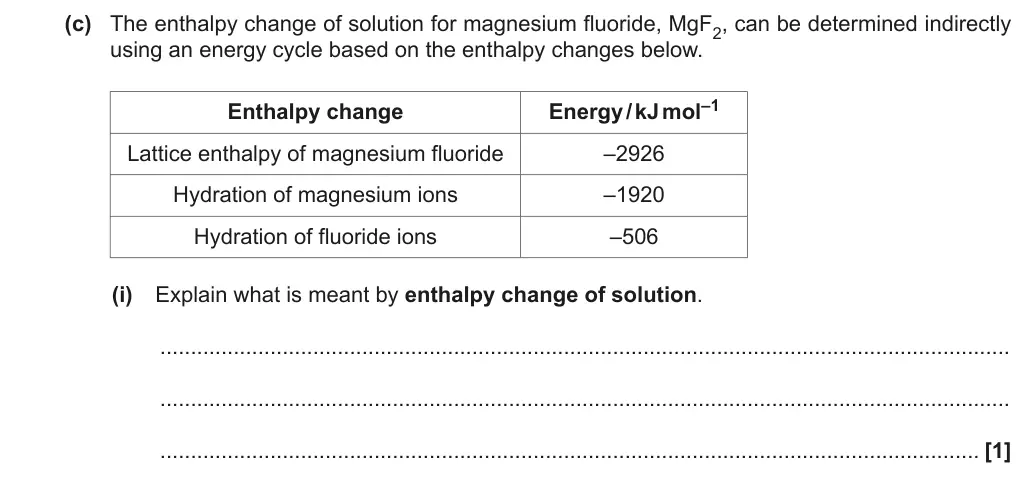
1 mole of a compound/solute dissolving
DO NOT ALLOW dissolving elements or formation of 1 mole of aqueous ions
IGNORE energy released/required
November 2021 · Paper 1 · Q16(c)(ii)2 marksAO2Short answer
Earlier part of question 16 that this part uses
Mark scheme
Notes from the mark scheme and report
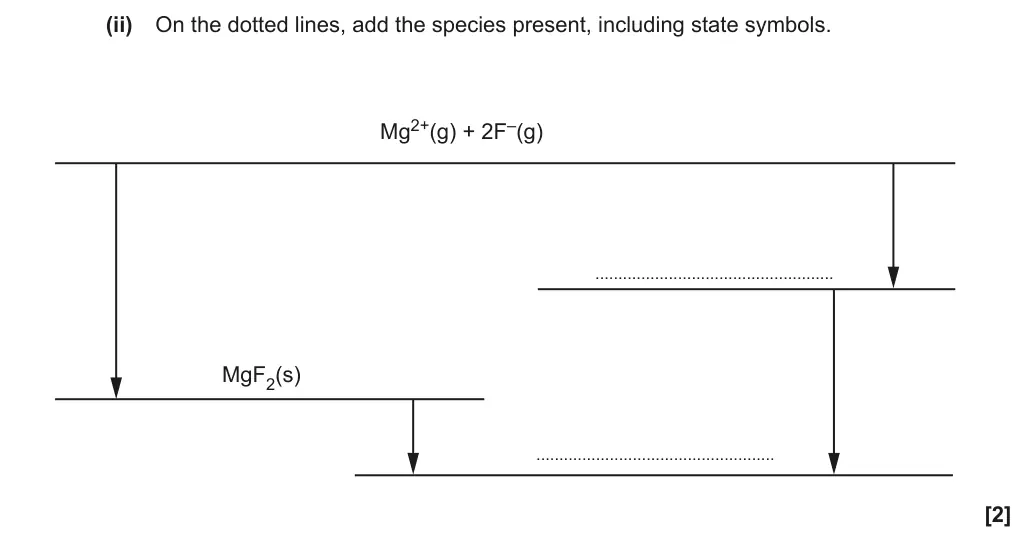
Mg2+(aq) + 2F–(g) then Mg2+(aq) + 2F–(aq)
state symbols required
ALLOW MgF2(aq) for bottom line
November 2021 · Paper 1 · Q16(c)(iii)1 markAO2CalculationMedium
Earlier parts of question 16 that this part uses
Mark scheme
Examiner's comment
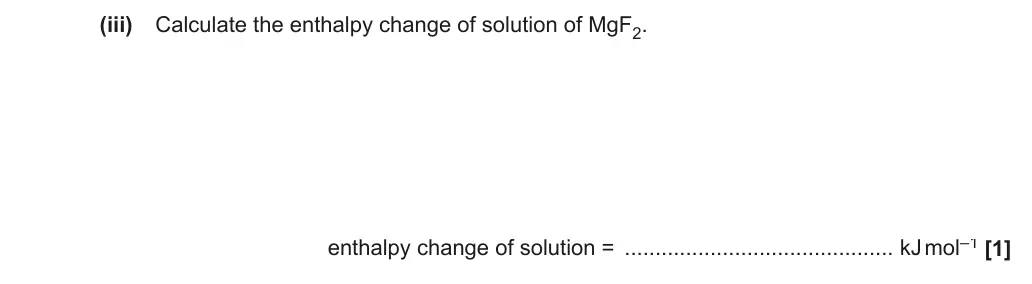
Question 16(c)(iii): This was an enthalpy solution/hydration cycle.
Notes from the mark scheme and report
–6 kJ mol–1
2 × hydration of F– needed
1 mark only
Skills: M2.3 Substitute numerical values into algebraic equations using appropriate units for physical quantities; M2.4 Solve algebraic equations
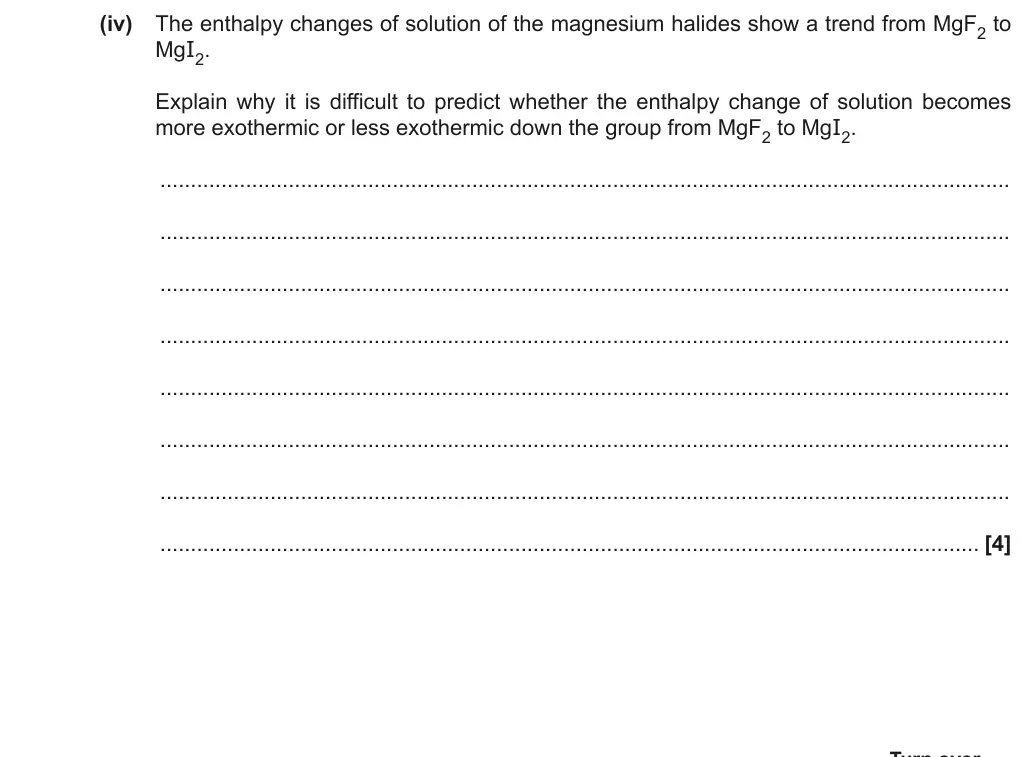
November 2021 · Paper 1 · Q16(c)(iv)4 marksAO1, 3Short answerMedium
Earlier part of question 16 that this part uses
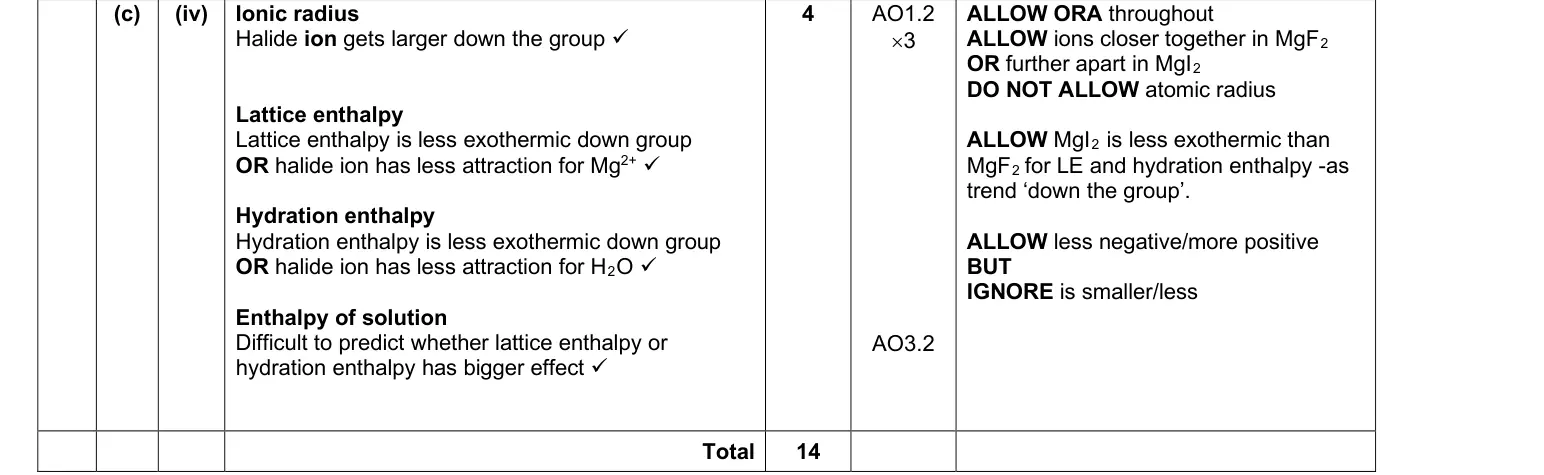
Mark scheme
Examiner's comment
Question 16(c)(iv): This question involved the qualitative explanation of the effect of ionic charge and ionic radius on the exothermic value of a lattice enthalpy and enthalpy change of hydration.
Notes from the mark scheme and report
halide ion larger down group (DO NOT ALLOW atomic radius)
lattice enthalpy AND hydration enthalpy both less exothermic
difficult to predict which has the bigger effect
IGNORE 'smaller/less' for less exothermic
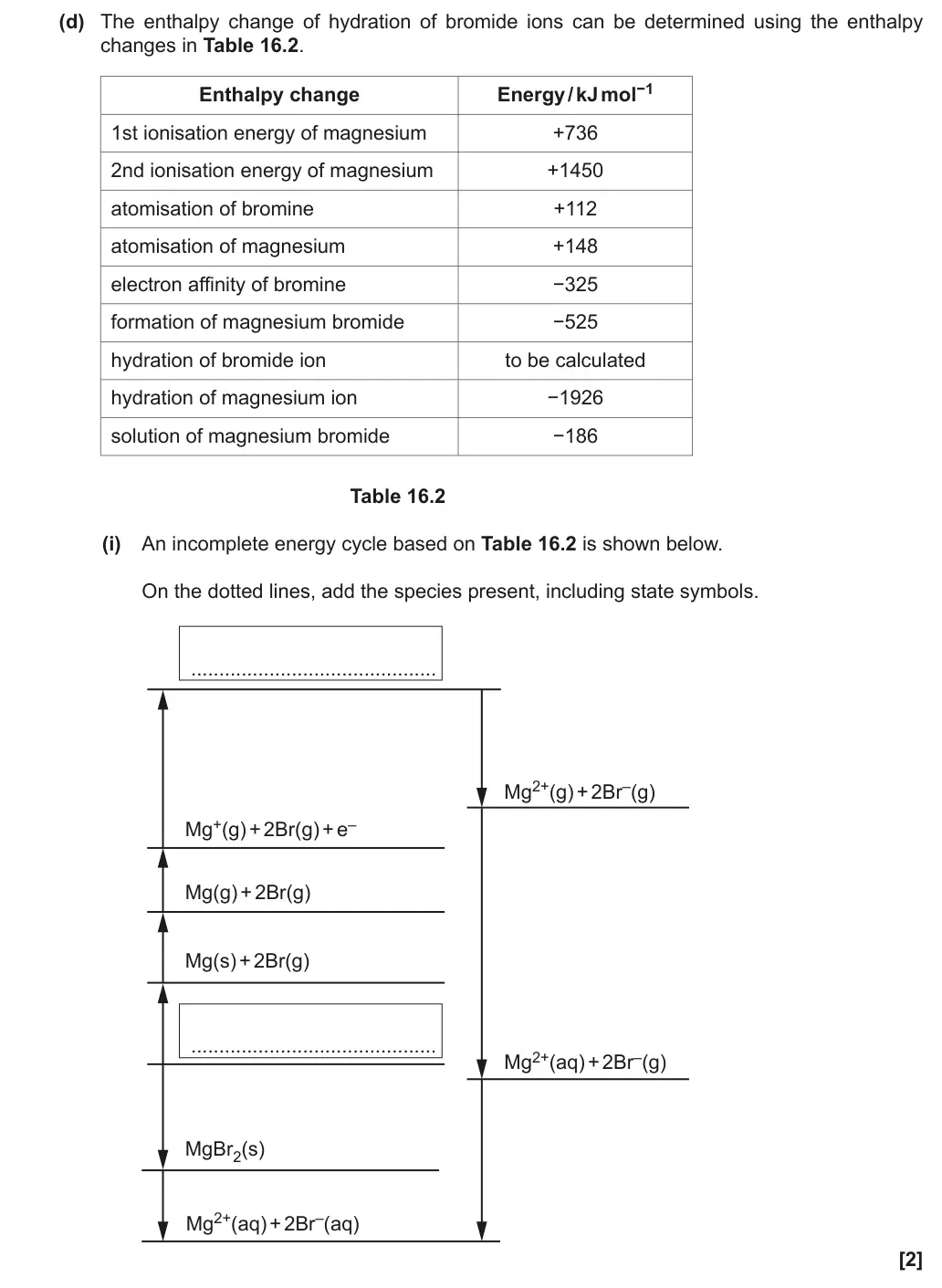
November 2020 · Paper 1 · Q16(d)(i)2 marksAO1Complete table/diagramHard
Mark scheme
Examiner's comment
Many candidates got the second ionisation energy equation. Very few candidates got the correct state symbol on the lower line for Br2, with solid being the common response.
Notes from the mark scheme and report
Mg2+(g) + 2Br(g) + 2e– and Mg(s) + Br2(l)
state symbols required – bromine is a liquid
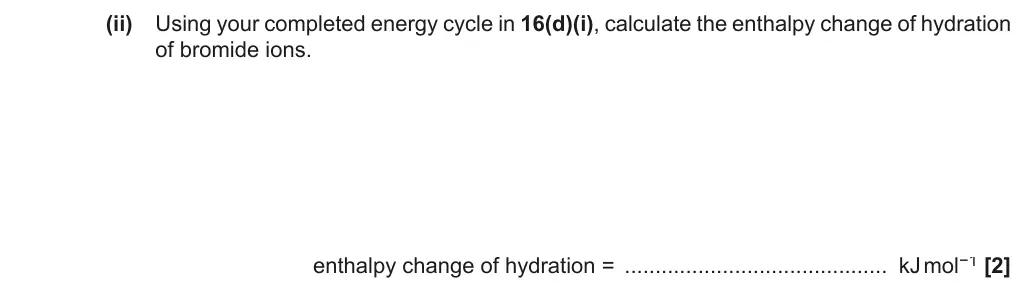
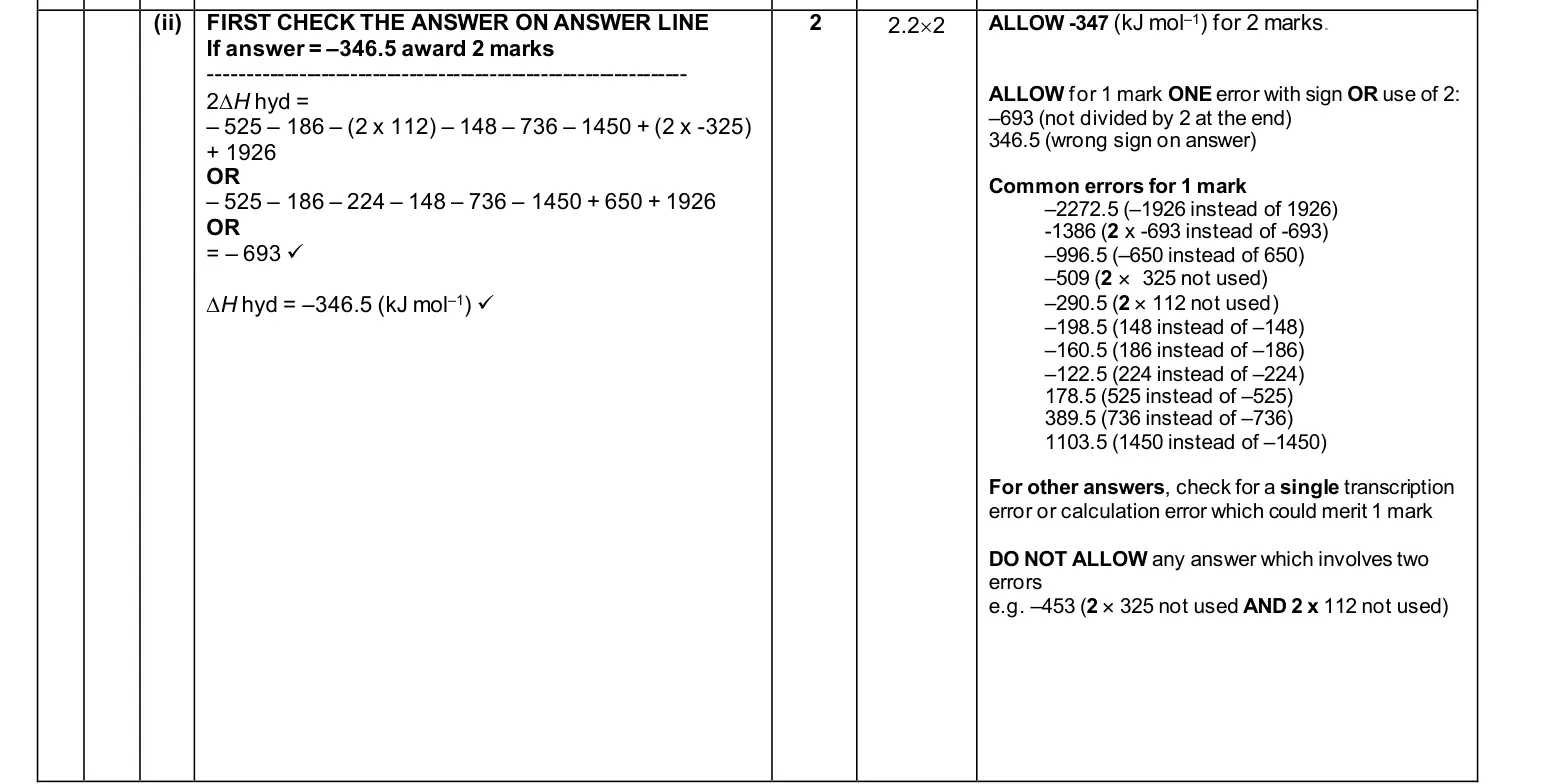
November 2020 · Paper 1 · Q16(d)(ii)2 marksAO2CalculationMedium
Earlier part of question 16 that this part uses
Mark scheme
Examiner's comment
OCR support Further support can be found in: The AS delivery guide ‘Theme: Identifying Unknowns’ https://www.ocr.org.uk/Images/208563-identifying-unknowns.pdf ‘Transition elements’: https://www.ocr.org.uk/qualifications/as-a-level-gce- chemistry-a-h032-h432-from-2015/delivery-guide/module-cam05-module-5- physical-chemistry-and-transition-elements/delivery-guide-cadg016- transition-elements The colours of the transition metal ions and complexes can be reviewed at: https://www.ocr.org.uk/Images/598991-colours-of-inorganic-ions-and- complexes-poster-.pdf Themes in candidate responses Calculation based questions Questions 16(d)(ii) and 16(d)(iii) This Born Haber cycle combined the traditional cycle with the enthalpy solution/hydration cycle.
Notes from the mark scheme and report
–346.5 (–693 ÷ 2)
2 × atomisation and 2 × electron affinity of Br
one sign or factor-of-2 error scores 1 (e.g. –693, +346.5, –509, –290.5)
two errors score 0
Skills: M2.2 Change the subject of an equation; M2.3 Substitute numerical values into algebraic equations using appropriate units for physical quantities; M2.4 Solve algebraic equations
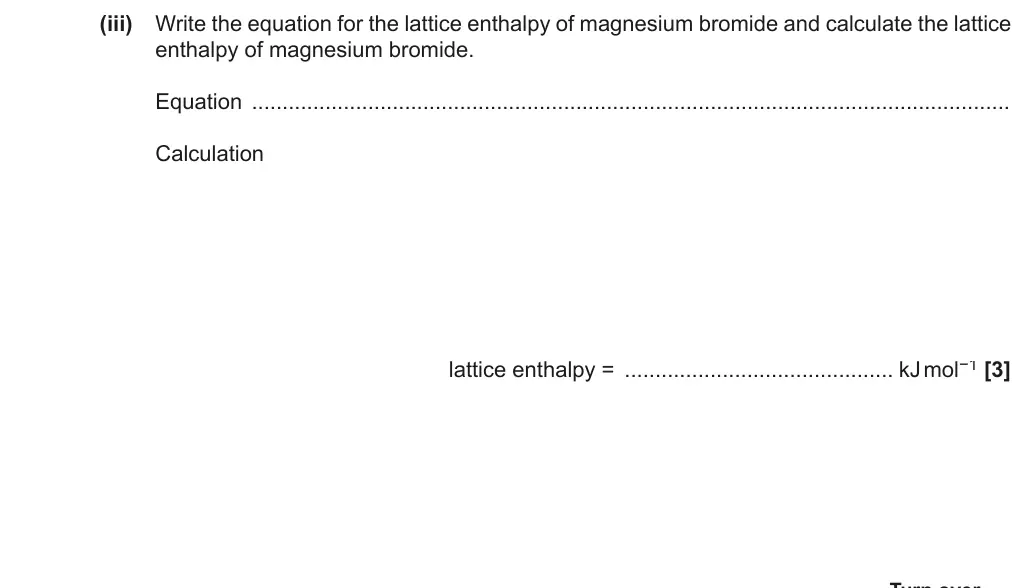
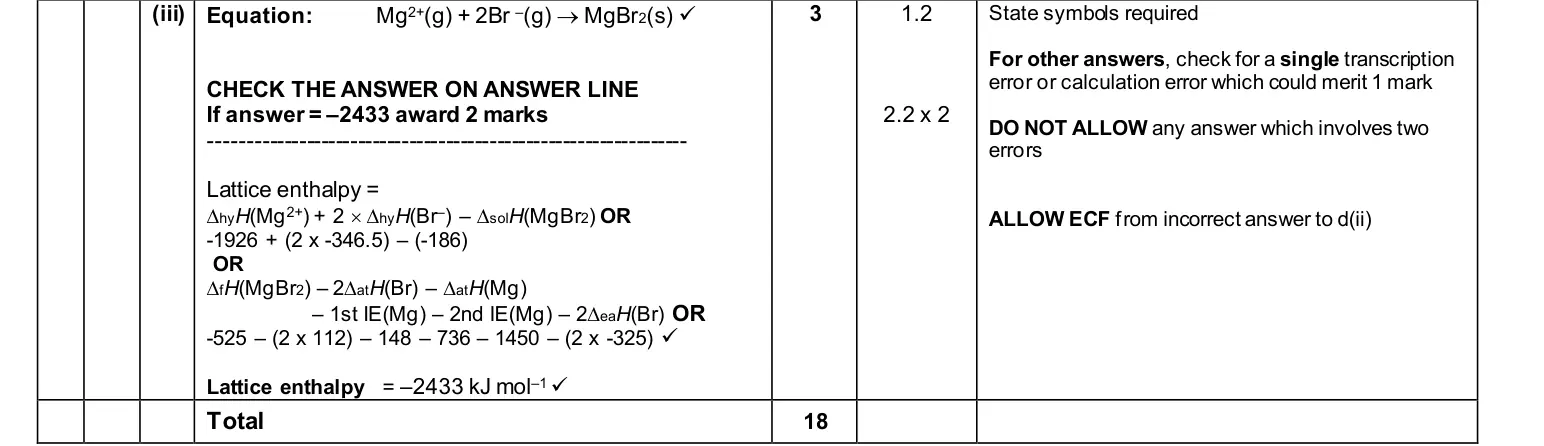
November 2020 · Paper 1 · Q16(d)(iii)3 marksAO1, 2Calculation
Earlier parts of question 16 that this part uses
Mark scheme
Notes from the mark scheme and report
Mg2+(g) + 2Br–(g) → MgBr2(s) with state symbols
–2433
ALLOW ECF from (d)(ii)
Skills: M2.3 Substitute numerical values into algebraic equations using appropriate units for physical quantities; M2.4 Solve algebraic equations
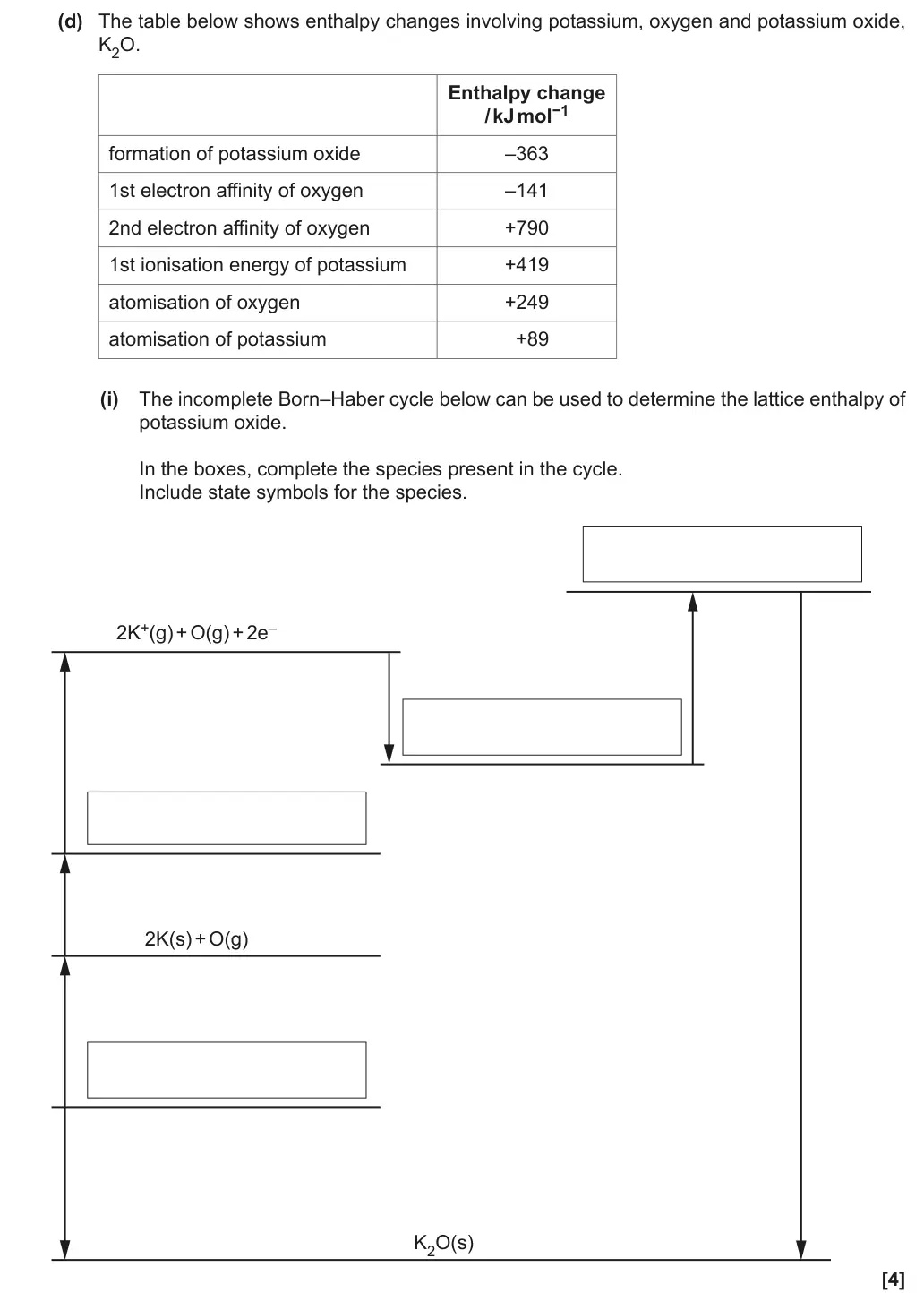
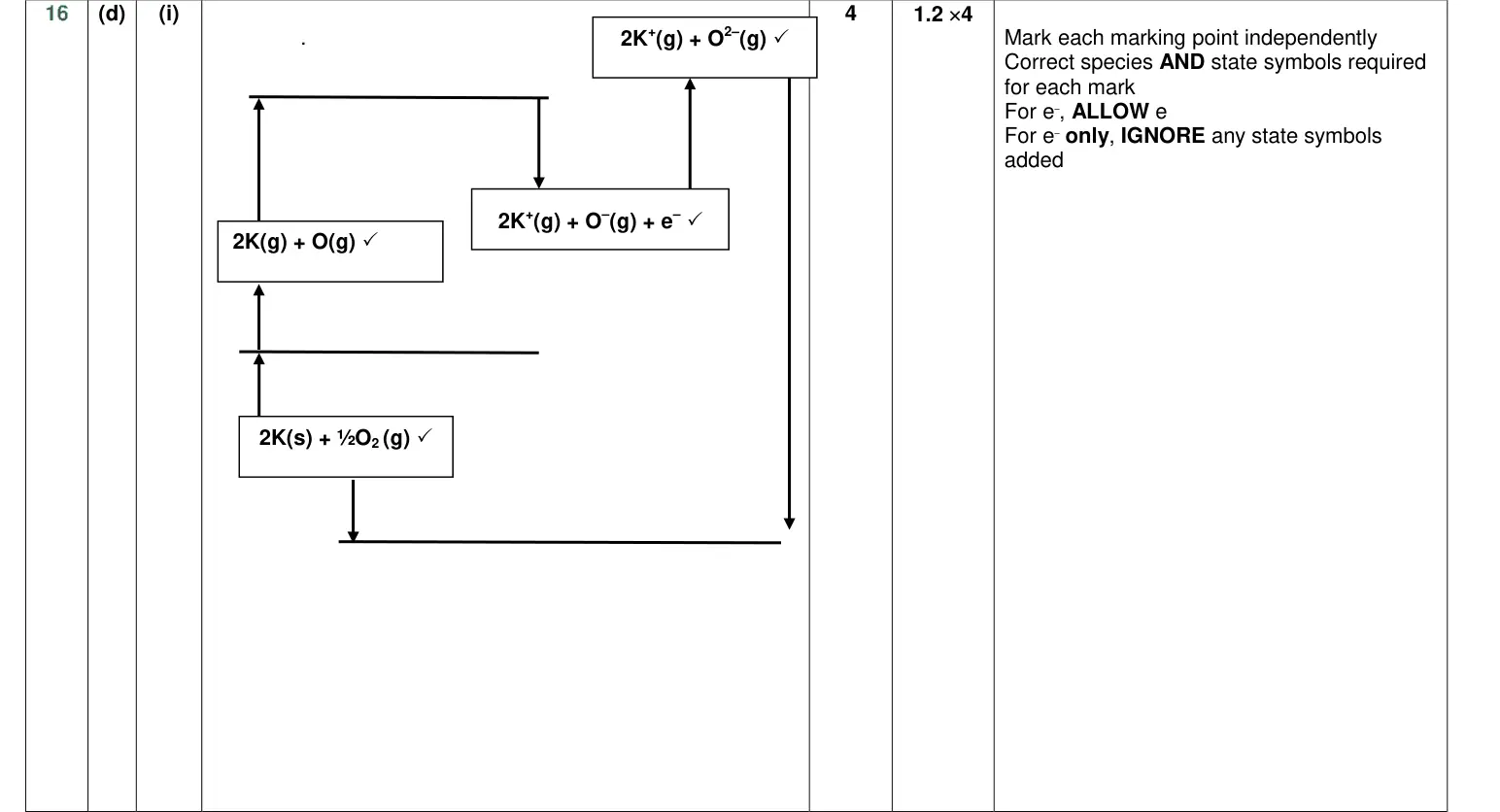
June 2019 · Paper 1 · Q16(d)(i)4 marksAO1Complete table/diagramMedium
Mark scheme
Examiner's comment
Some candidates wrote illegible state symbols where (g) and (s) were impossible to tell apart. Also, many candidates choose to write state symbols as a very small sub-script e.g. 2K(s) + ½O2(g). The convention is to use lower case letters of normal size e.g. 2K(s) + ½O2(g) In this exemplar it was impossible to tell if K had (s) or (g) as a state symbol. Consequently, no marks could be given.
Notes from the mark scheme and report
correct species AND state symbols for each mark
½O2(g)
2K+(g) + O–(g) + e–
ALLOW e for e–
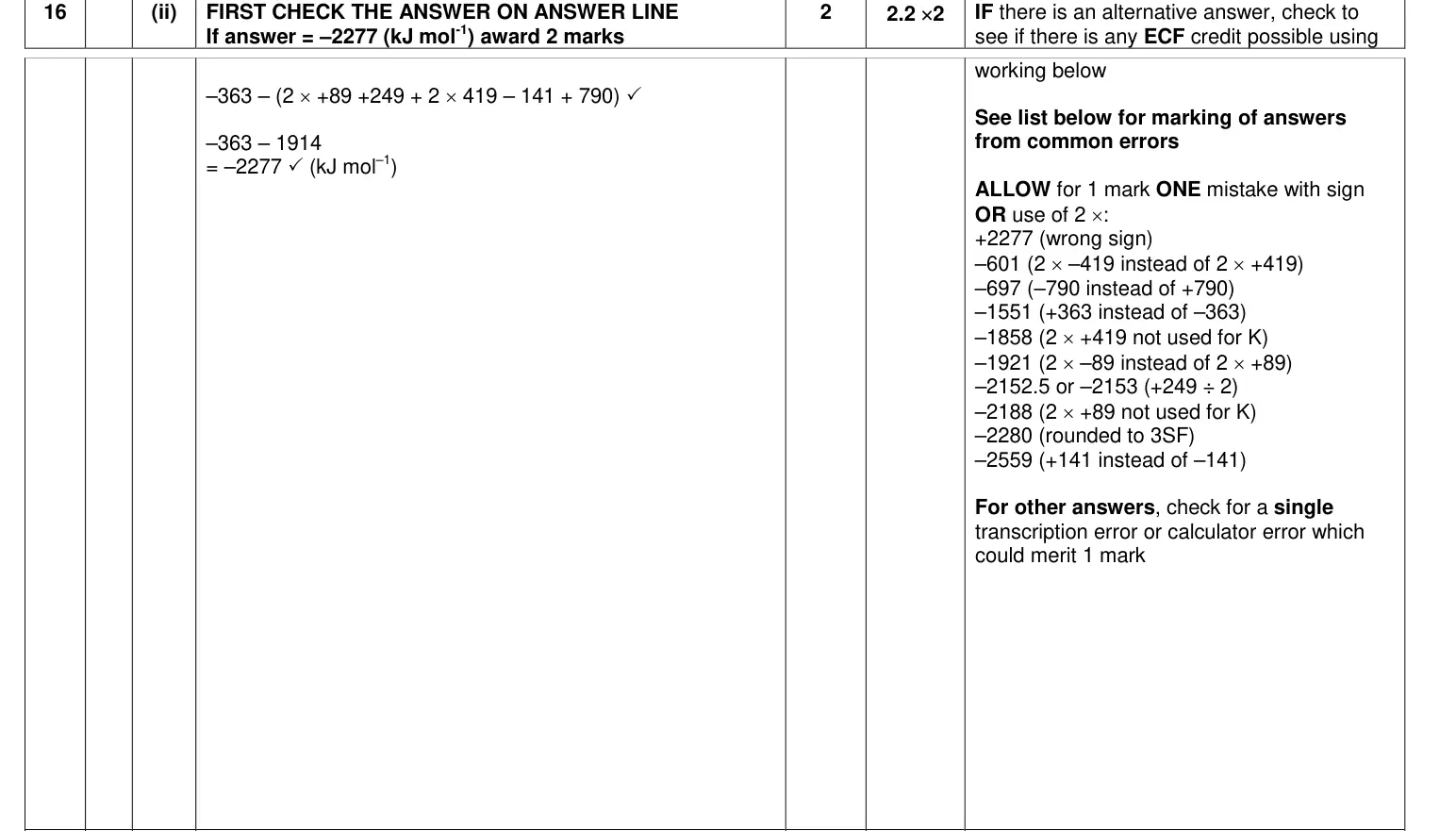
June 2019 · Paper 1 · Q16(d)(ii)2 marksAO2CalculationEasy
Earlier part of question 16 that this part uses
Mark scheme
Examiner's comment
Most candidates scored both marks. Candidates tended to forget the mole ratio of K meant its values should be multiplied by 2 in two places during this calculation.
Notes from the mark scheme and report
1 mark for one error with sign or ×2: +2277, –1858 (no 2 × 419), –2188 (no 2 × 89), –2152.5 (249 ÷ 2), –2280 (rounded to 3 SF)
Skills: M2.2 Change the subject of an equation; M2.3 Substitute numerical values into algebraic equations using appropriate units for physical quantities; M2.4 Solve algebraic equations
June 2019 · Paper 1 · Q16(e)(ii)2 marksAO1Short answerMedium
Earlier part of question 16 that this part uses
Mark scheme
Examiner's comment
Many candidates did not achieve full marks, often through ambiguous statements. A typical example is shown in the exemplar below. The exemplar here uses the vague term ‘due its smaller ionic size’. It is unclear which of the ions the candidate is referring to (or if they’re assuming that the metal oxide entity is an ion) and so they could not be given marks.. Also, it is oxygen ions that ‘bond’ – the reference to oxygen bonding in the response is not specific enough.
Notes from the mark scheme and report
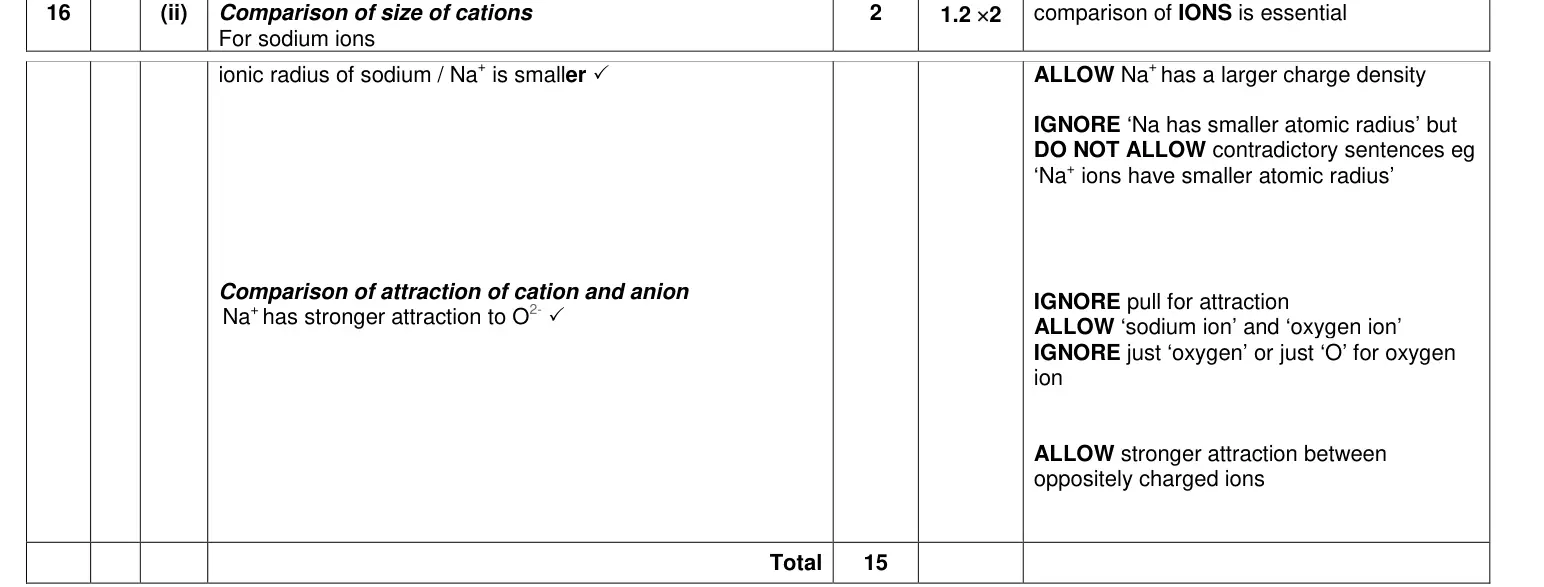
comparison of IONS essential: Na+ smaller ionic radius
Na+ stronger attraction to O2–
DO NOT ALLOW 'Na+ ions have smaller atomic radius'
IGNORE just 'oxygen' for oxide ion
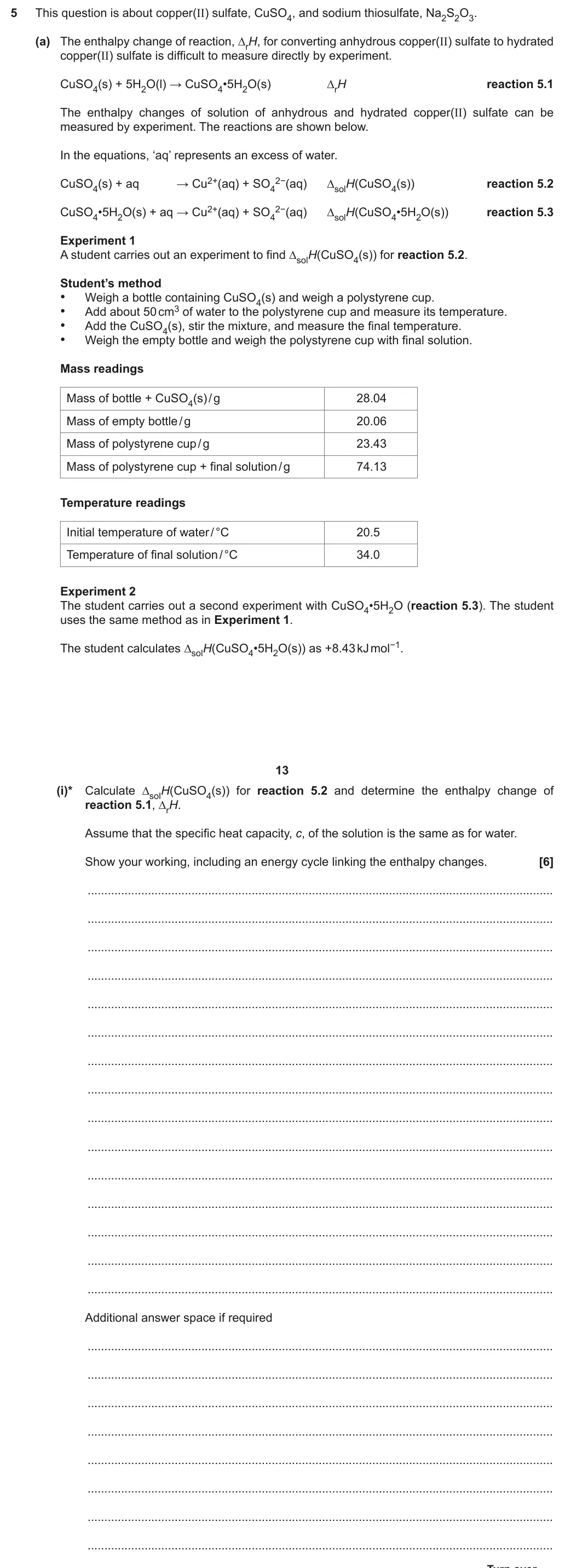
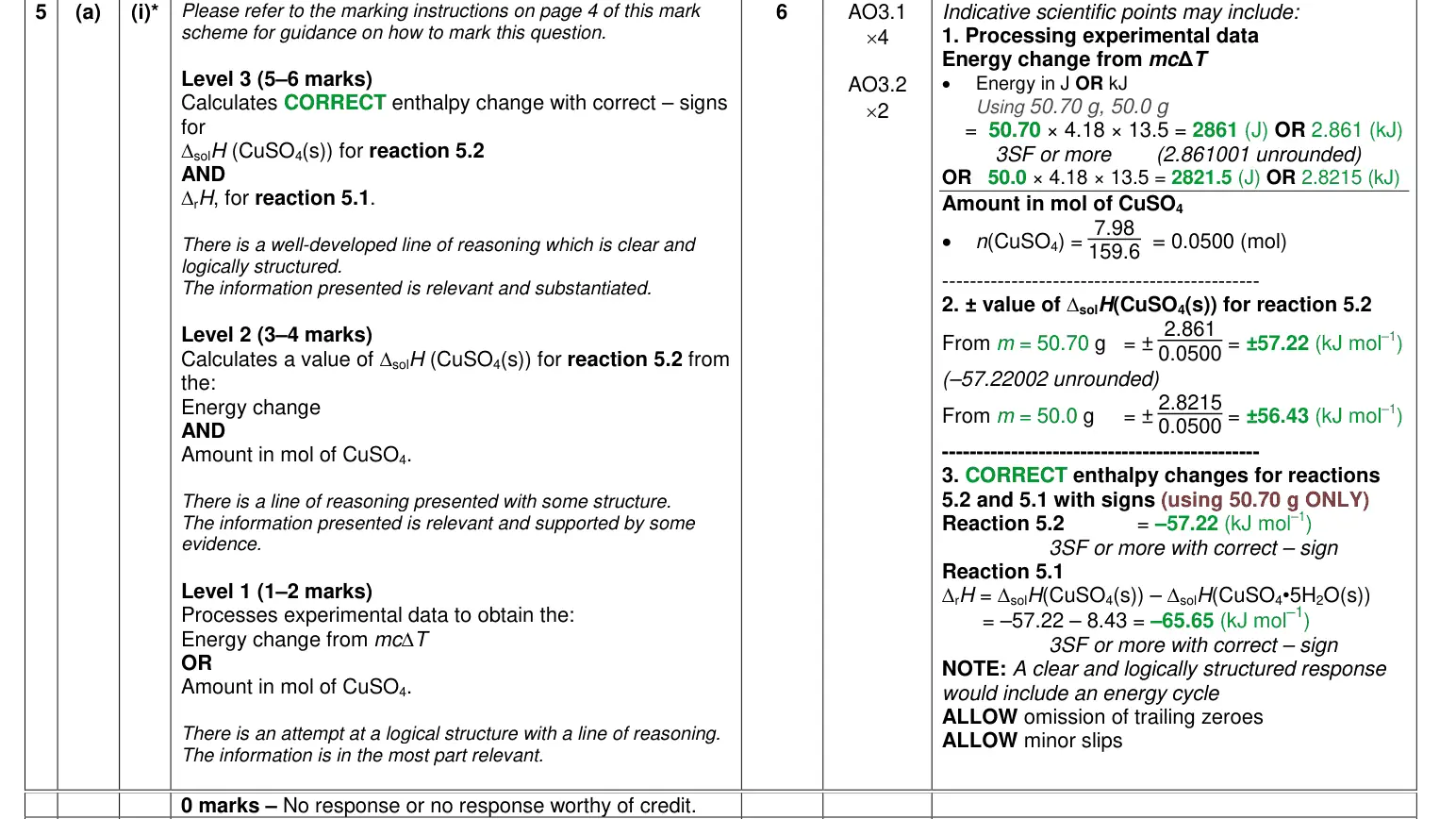
June 2019 · Paper 3 · Q5(a)(i)6 marksAO36-mark level of responseHard
Mark scheme, with the levels and indicative points
Examiner's comment
This question was assessed by level of response (LoR). Candidates were required to process raw experimental results to determine one enthalpy change, and then to determine a second enthalpy change by constructing and using an energy cycle. Levels were determined by the accuracy of the candidates’ processing, calculations and use of the energy cycle. This question discriminated extremely well. Level 3 candidates used the mass of solution as 50.7 g with mc∆T to obtain an energy change of 2861 J. They then divided this value by the moles of CuSO4 that reacted (0.05 mol) to obtain the enthalpy change of –57.22 kJ mol–1. Finally, they constructed an energy cycle which they then used to obtain the second enthalpy change of –65.65 kJ mol–1. Level 2 candidates determined the first enthalpy change but may have used the approximate mass of 50 g for the mass of solution from the experimental method. Their energy cycle was often incorrect or absent, with the second enthalpy change calculated incorrectly. Level 1 candidates often calculated the initial energy change using mc∆T but made little further correct progress. A significant number of lower ability candidates used the solid mass of copper sulfate in their calculation. Overall, mathematical skills were displayed well but some basic errors were made, particularly with subtractions. This may have been the result of mis-keying values into a calculator and believing the answer displayed. An example was the mass of the solution (74.13 – 23.43) being seen as 49.7 rather than 50.7. A significant number of candidates added or subtracted the mass of copper sulfate from 50.7 or 50 for their value of m in mc∆T, using for example 57.98 and 42.72. This limited the level that they could reach. initial energy change using mc∆T, the first enthalpy change using the energy change with the moles of copper sulfate, and the second enthalpy change including a clear energy cycle. Numbers are clearly shown and unrounded until the final values. This is an excellent response.
Notes from the mark scheme and report
mass of solution 50.70 g (not 50.0) and ∆T 13.5 °C
n(CuSO4) = 7.98/159.6 = 0.0500 mol
∆solH = –57.22 kJ mol–1 with – sign
∆rH = ∆solH(CuSO4) – ∆solH(CuSO4•5H2O) = –65.65
energy cycle expected
Skills: M0.0 Recognise and make use of appropriate units in calculations; M1.1 Use an appropriate number of significant figures; M2.3 Substitute numerical values into algebraic equations using appropriate units for physical quantities; M3.1 Translate information between graphical, numerical and algebraic forms; PAG3 Enthalpy determination
June 2018 · Paper 1 · Q131 markAO1Multiple choiceMedium
Answer
B
Mark scheme
Examiner's comment
D was the common distractor given as the answer by many candidates, suggesting confusion with the first electron affinity and second electron affinity of oxygen.
Notes from the mark scheme and report
∆fH of an element is zero
June 2018 · Paper 1 · Q16(a)(i)2 marksData interpretationEasy
Mark scheme
Examiner's comment
Most candidates were able to state that one mole of gaseous ions was dissolved into water. Common errors seen included candidates referring to the dissolving of one mole of substance (i.e. the enthalpy change of solution); the use of the generic term ‘solvent’ rather than water; and dissolving of gaseous ions into one mole of water.
Notes from the mark scheme and report
1 mole of gaseous ions
dissolve in water/form aqueous ions
IGNORE 'energy released' or 'energy required'
June 2018 · Paper 1 · Q16(a)(ii)4 marksComplete table/diagramEasy
Earlier part of question 16 that this part uses
Mark scheme
Examiner's comment
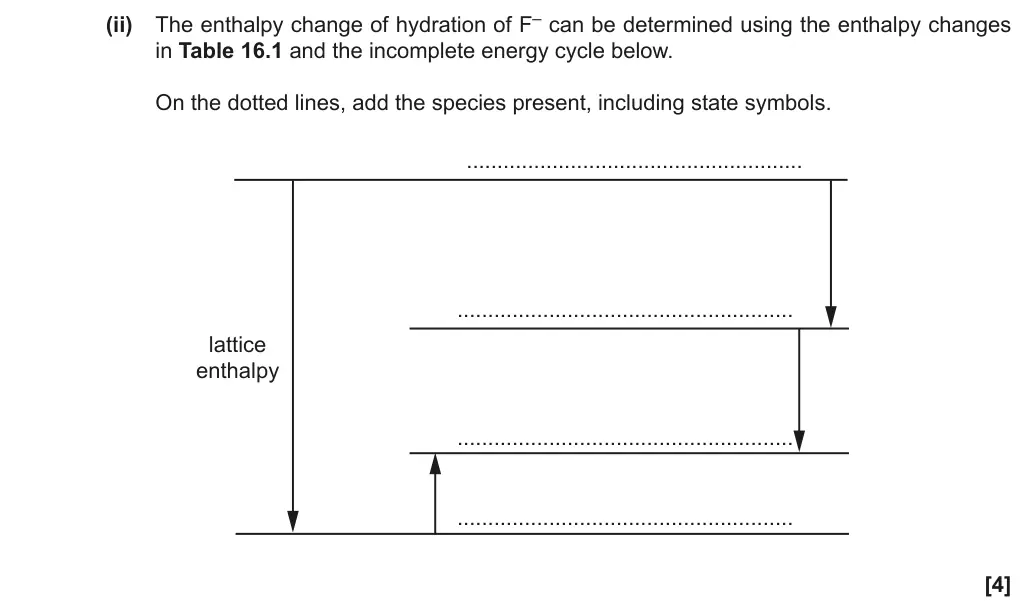
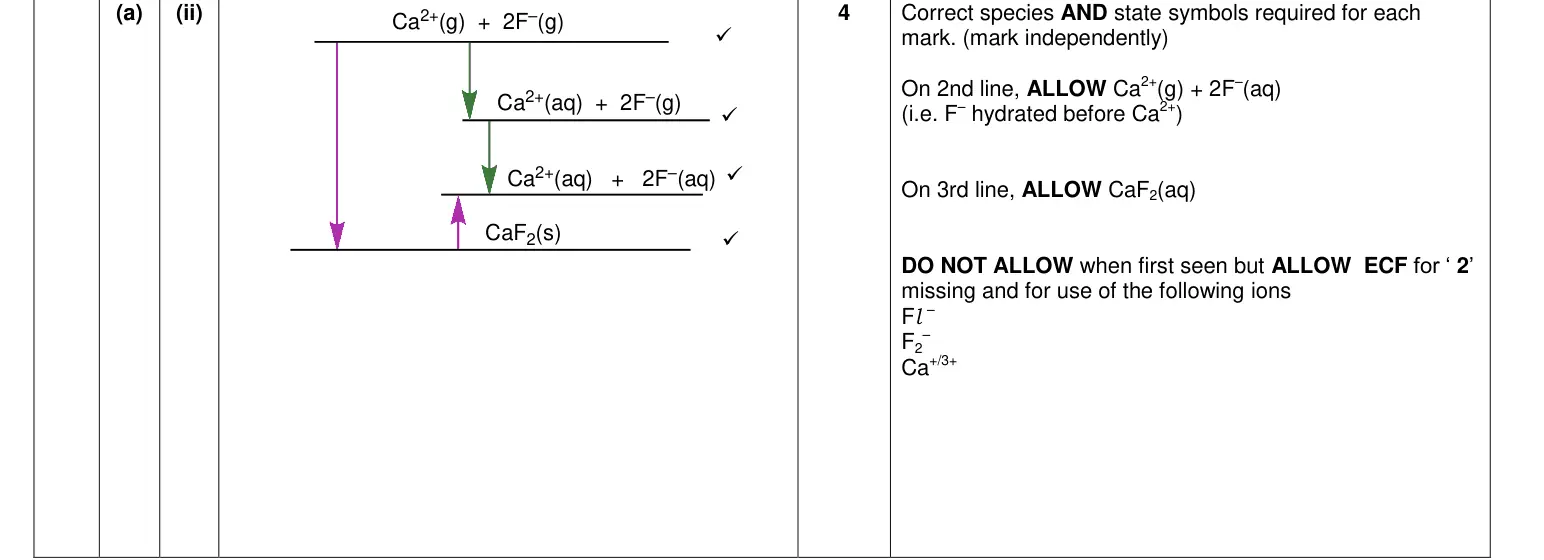
Most candidates were able to score some marks on this question with more able candidates scoring all 4 marks. Common errors included the omission of state symbols and the use of only one F–(g) ion (often despite a correct formula of CaF2 being seen on the bottom line). For some reason, many candidates write their lower case ‘s’ in an identical way to their lower case ‘g’. This means the examiner cannot distinguish between these state symbols on such scripts. Centres may wish to stress this point to prevent candidates losing marks unnecessarily.
Notes from the mark scheme and report
species AND state symbols for each mark: Ca2+(g) + 2F–(g), Ca2+(aq) + 2F–(g), Ca2+(aq) + 2F–(aq), CaF2(s)
ECF once for missing 2 or Fl–, F2–, Ca+
June 2018 · Paper 1 · Q16(a)(iii)2 marksCalculationEasy
Earlier parts of question 16 that this part uses
Mark scheme
Examiner's comment
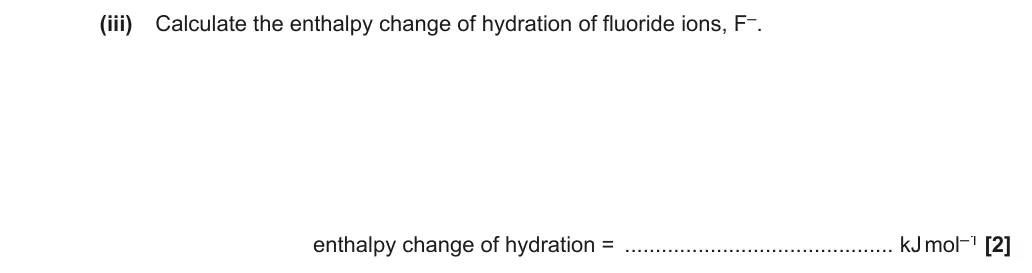
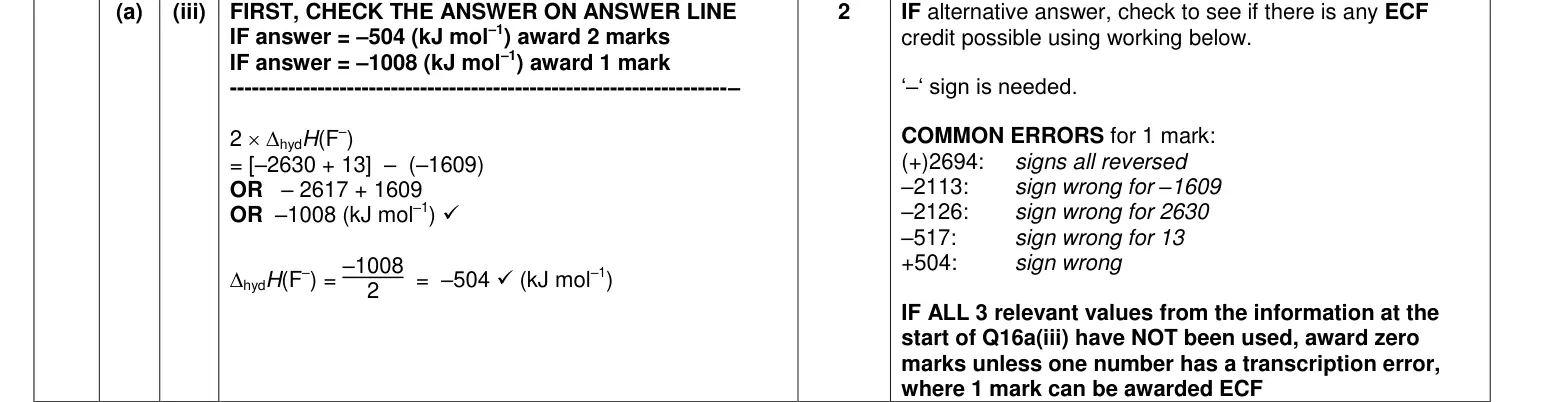
Most candidates were able to do this relatively straightforward calculation by rearranging the values of the enthalpy changes associated with the energy cycle diagram. However, a significant number forgot to divide –1008 by 2 to score full marks.
Notes from the mark scheme and report
–504
–1008 scores 1 (not divided by 2)
common sign errors +2694, –2113, –2126, –517, +504 score 1
minus sign needed
Skills: M2.2 Change the subject of an equation; M2.3 Substitute numerical values into algebraic equations using appropriate units for physical quantities; M2.4 Solve algebraic equations
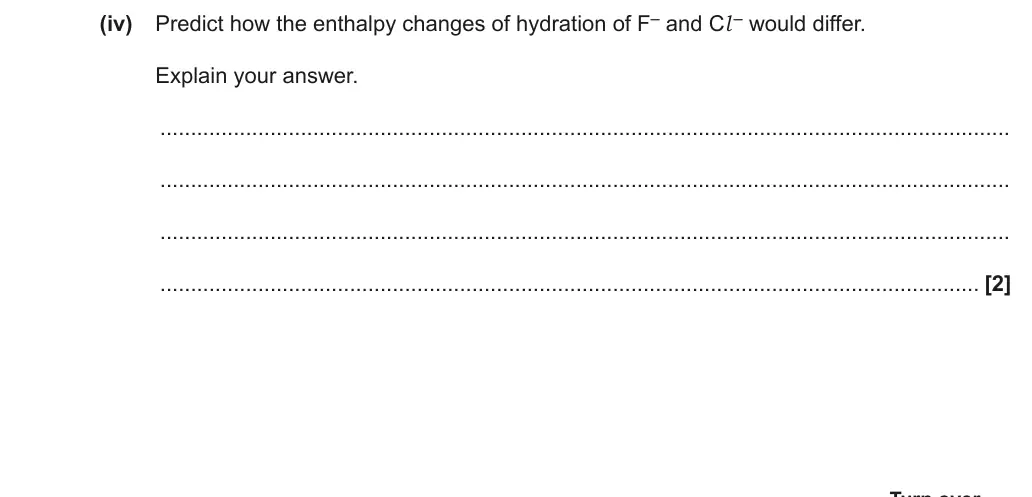
June 2018 · Paper 1 · Q16(a)(iv)2 marksShort answerMedium
Earlier part of question 16 that this part uses
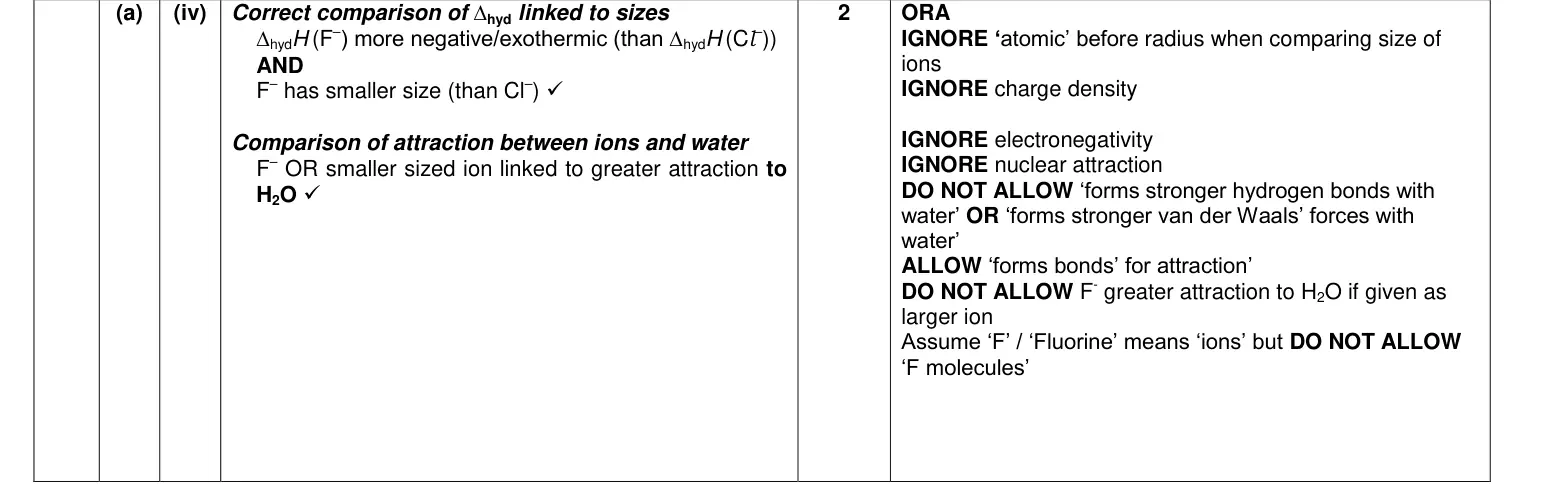
Mark scheme
Examiner's comment
When comparing enthalpy changes candidates need to be aware that descriptions such as ‘bigger’ or ‘smaller’ are meaningless as there are often negative signs involved. The correct description required here was that the enthalpy change of hydration of F– ions would be more negative than that of Cl– ions. Although some candidates wrote in terms of charge density, it was those candidates who related the smaller size of the F– ion to the difference in enthalpy change of hydration who received credit and went on to say that this was as a consequence of greater attraction to water molecules.