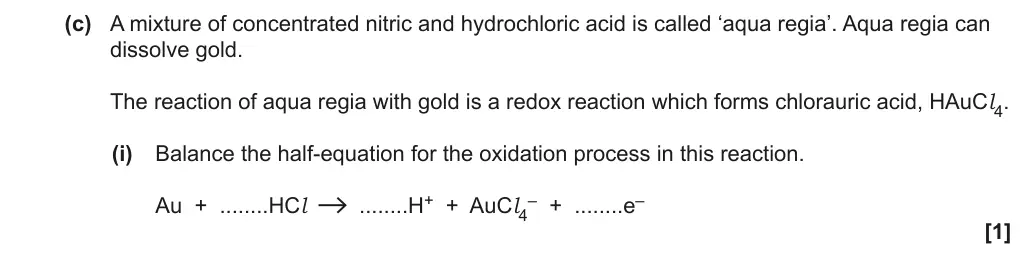
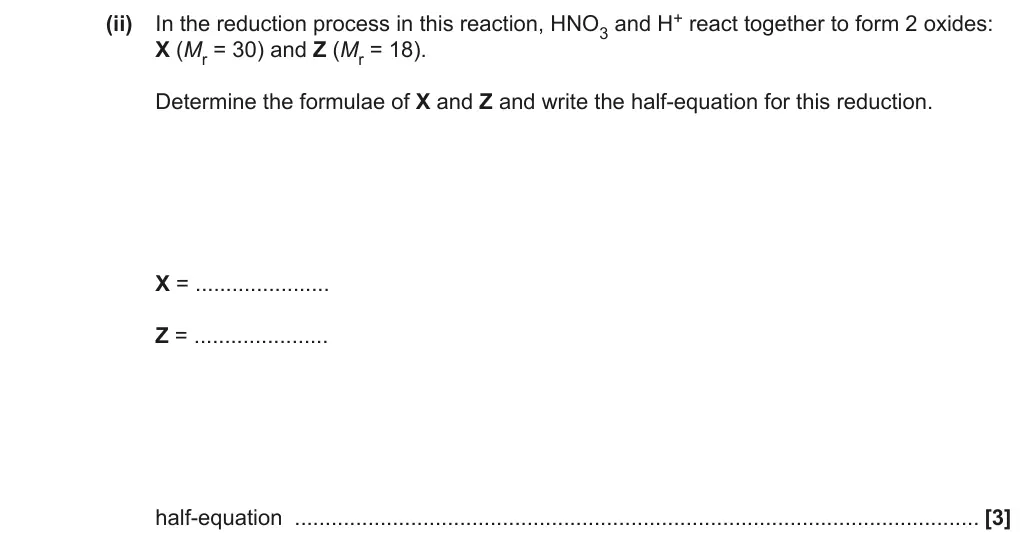
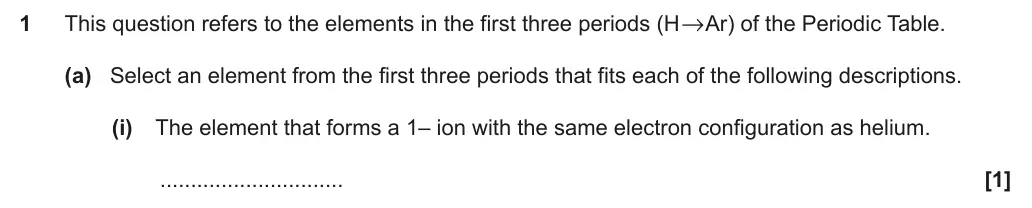
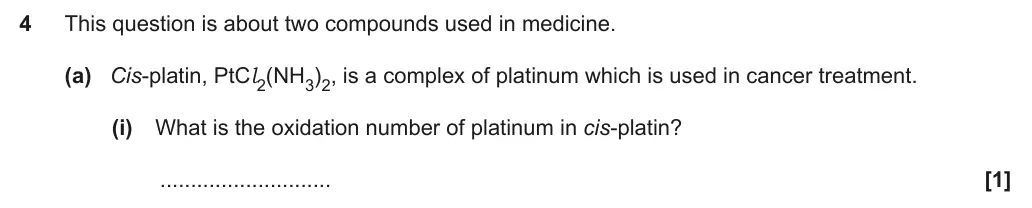
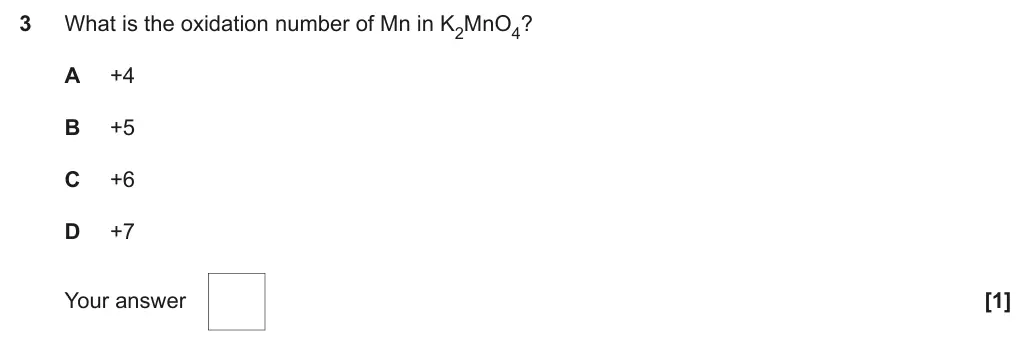
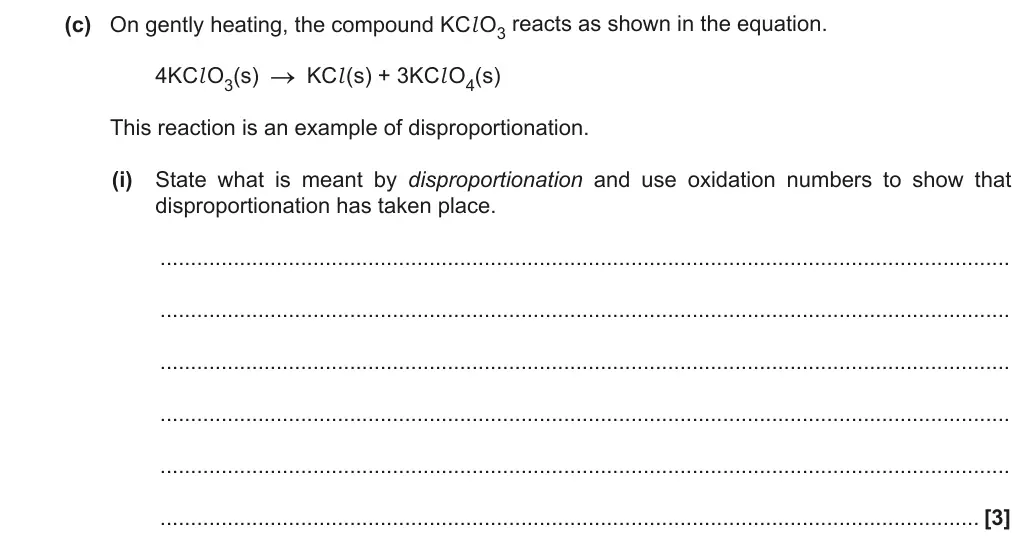
Notes and key-term cards for this topic are being written by our tutors. The past-paper questions below are ready now.
Learning outcomes
Show the 8 learning outcomes from the specification
2.1.5(a) rules for assigning and calculating oxidation number for atoms in elements, compounds and ions
2.1.5(b) writing formulae using oxidation numbers
2.1.5(c) use of a Roman numeral to indicate the magnitude of the oxidation number when an element may have compounds/ions with different oxidation numbers
2.1.5(d) oxidation and reduction in terms of:
2.1.5(d)(i) electron transfer
2.1.5(d)(ii) changes in oxidation number
2.1.5(e) redox reactions of metals with acids to form salts, including full equations (see also 2.1.4 c)
2.1.5(f) interpretation of redox equations in (e), and unfamiliar redox reactions, to make predictions in terms of oxidation numbers and electron loss/ gain.
Six-mark level of response questions on this topic
Tap a question to zoom it. Where a part needs a table, graph or structure from an earlier part, that part folds out above it; the mark scheme and examiner's comment open underneath. Have the OCR Data Sheet beside you.
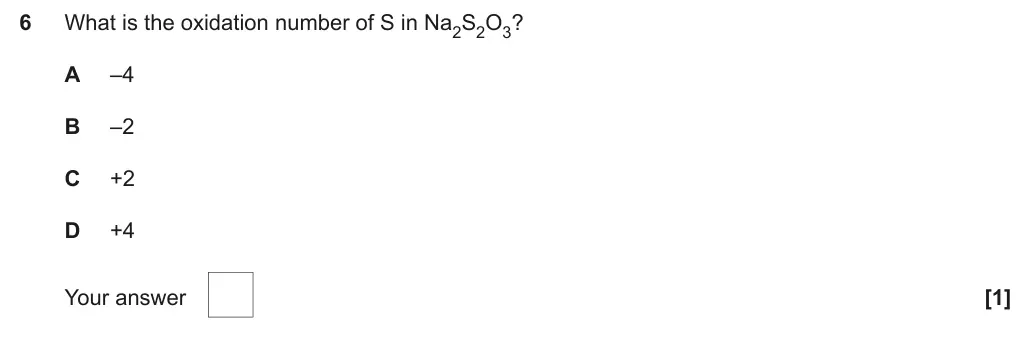
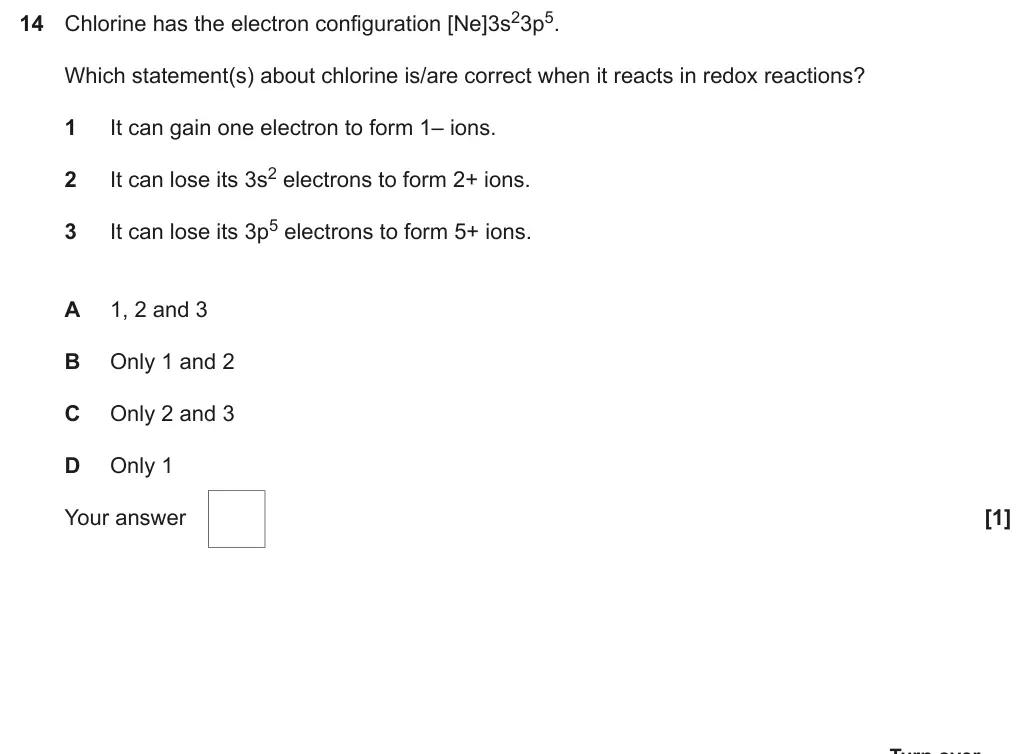
June 2025 · AS Paper 1 · Q61 markMultiple choiceMedium
Answer
C
Mark scheme
Examiner's comment
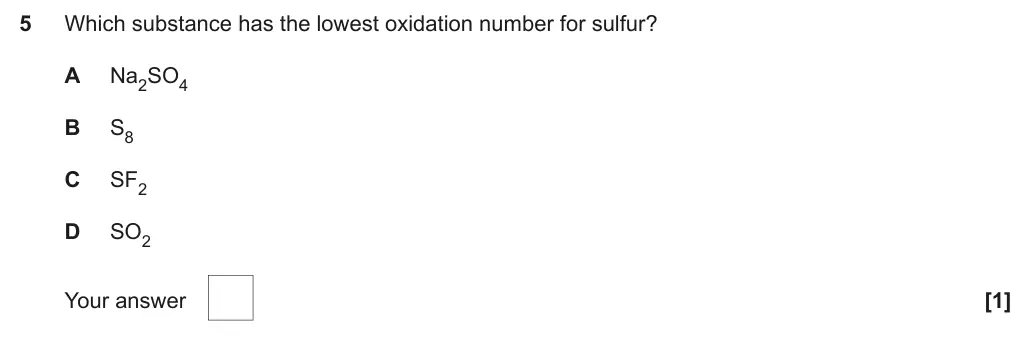
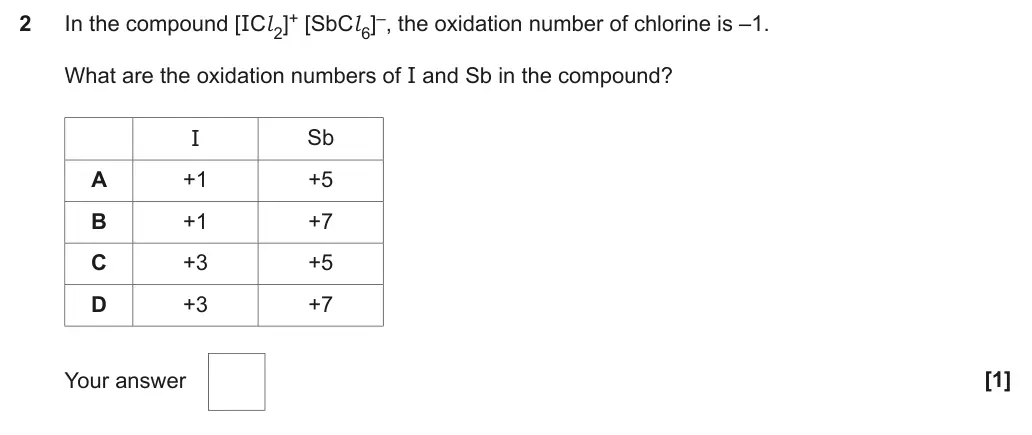
A significant number of candidates were unable to apply the oxidation number rules correctly to arrive at C as the correct response. Many candidates gave D as the response by forgetting to calculate per S atom. Some chose B, perhaps confusing this with the charge on a sulfide ion.
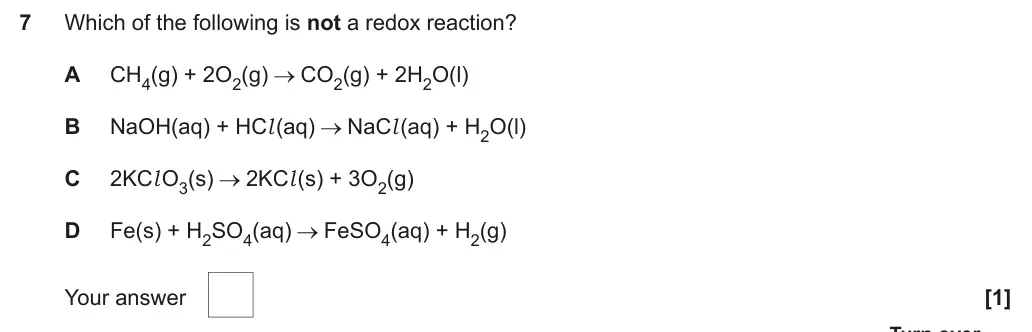
June 2025 · AS Paper 1 · Q71 markMultiple choiceMedium
Answer
B
Mark scheme
Examiner's comment
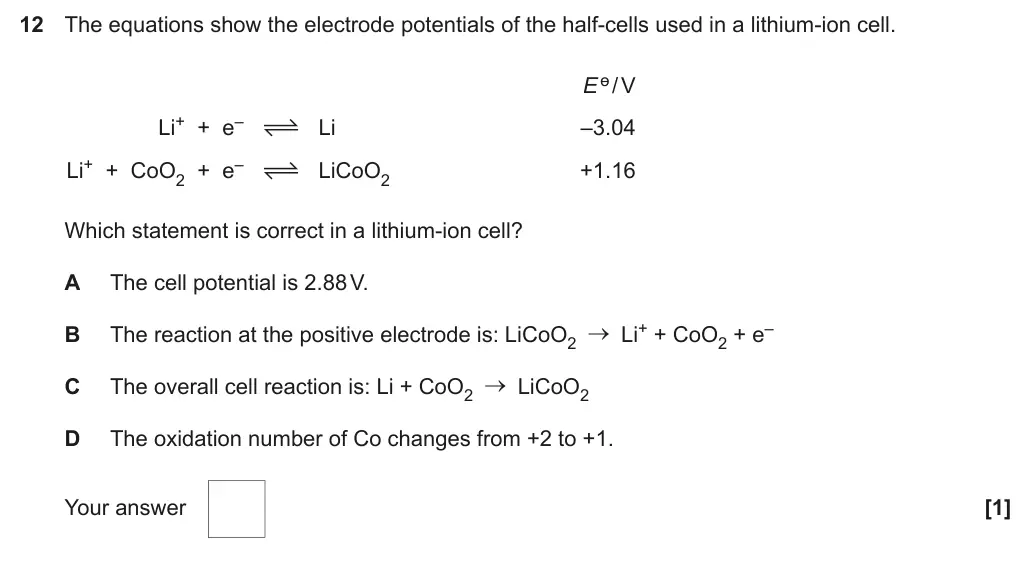
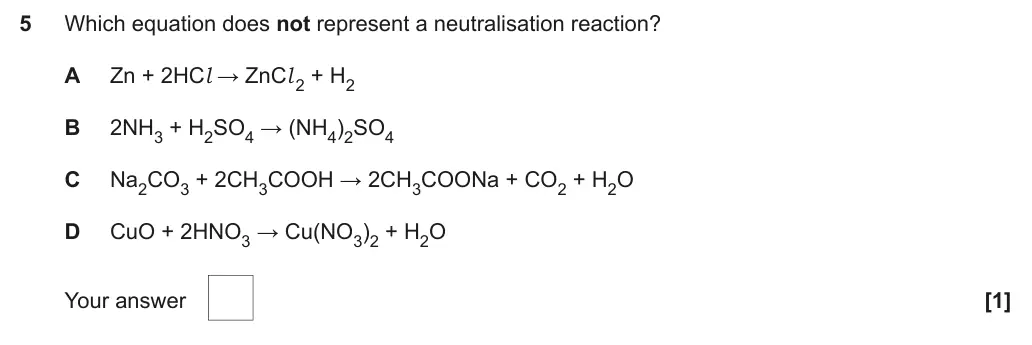
Many candidates wrote oxidation numbers below the equations, which is generally good practice. However, in this case, the incorrect options can be quickly excluded as they include an element with an oxidation state of zero, which clearly changes in the reaction. Over half obtained the correct response of B (a neutralisation reaction).
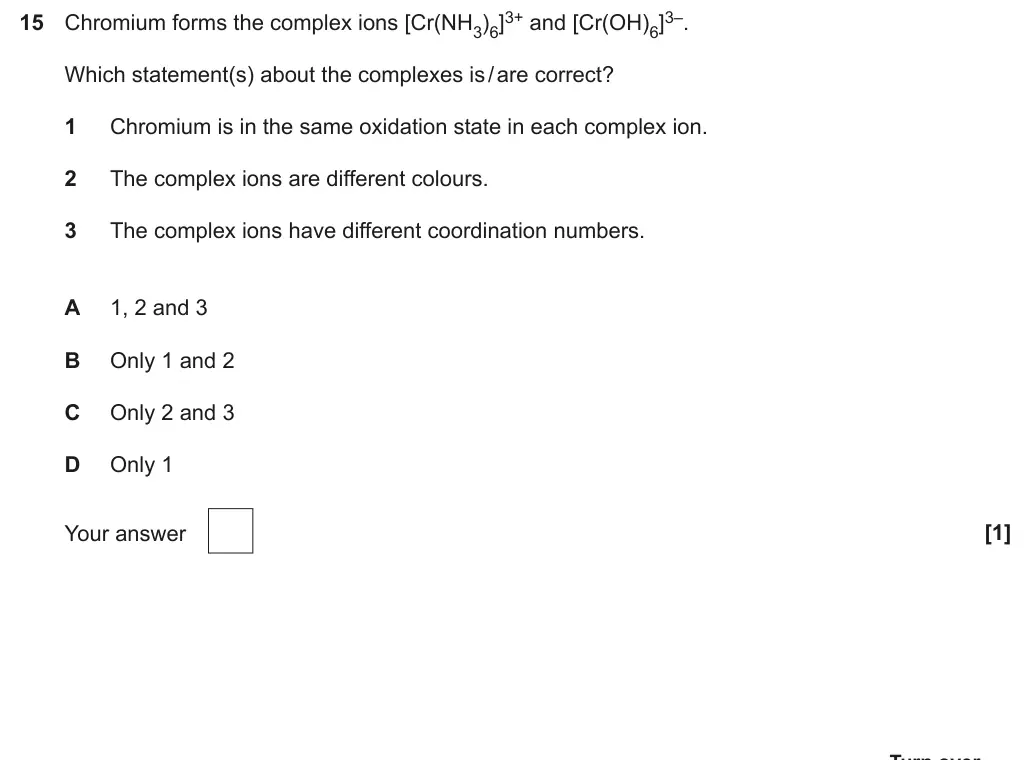
June 2025 · Paper 1 · Q151 markMultiple choiceMedium
Answer
B
Mark scheme
Examiner's comment
The correct answer was B. Most candidates chose the correct answer but a few selected C or D as they were unsuccessful in assigning oxidation numbers or coordination numbers to the given complex ion. Section B overview The section contained questions from all aspects of modules 1, 2, 3 and 5 of the specification. Candidates found many of the questions, including those with an extended response nature, relatively straightforward and the majority managed to cope with the mathematical content. As a rule, candidates should aim to use unrounded calculator values in their intermediate calculations to avoid rounding errors in their final answer. Candidates should be reminded to present their numerical working clearly. They should also be advised to avoid leaving two different solution approaches without crossing one of them out. If they need to restart an answer, they would be well advised to make use of additional space as necessary rather than trying to write their answers in the margins with the order of steps difficult to follow. In more complicated calculations, where multiple different chemical species and quantities are involved, using appropriate symbols and subscripts/descriptors in brackets, as well as units, helps appropriately identify numbers provided as amounts in moles/concentrations/masses. Some candidates were less confident and knowledgeable of content shared with the AS specification and traditionally taught earlier on in the course. These were specifically: structure and bonding, reaction rates and redox reactions of the halogens. Candidates wrote far more than was necessary in some responses. Candidates should avoid repeating sentences which often introduce contradictions at the end of the response when expanding on written answers. Where candidates make use of additional space, it would be worth reminding them to write down the full question part: in many cases where questions had a number, part and subpart, the part or subpart was missing (or incorrect).
June 2025 · Paper 1 · Q19(b)(ii)3 marksData interpretationEasy
Earlier part of question 19 that this part uses
Mark scheme
Examiner's comment
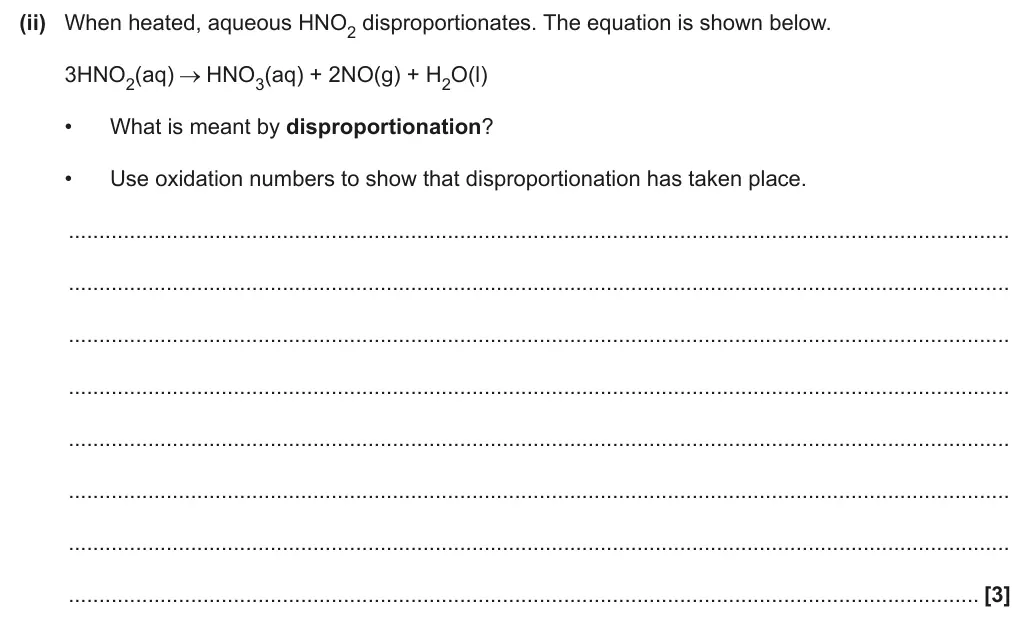
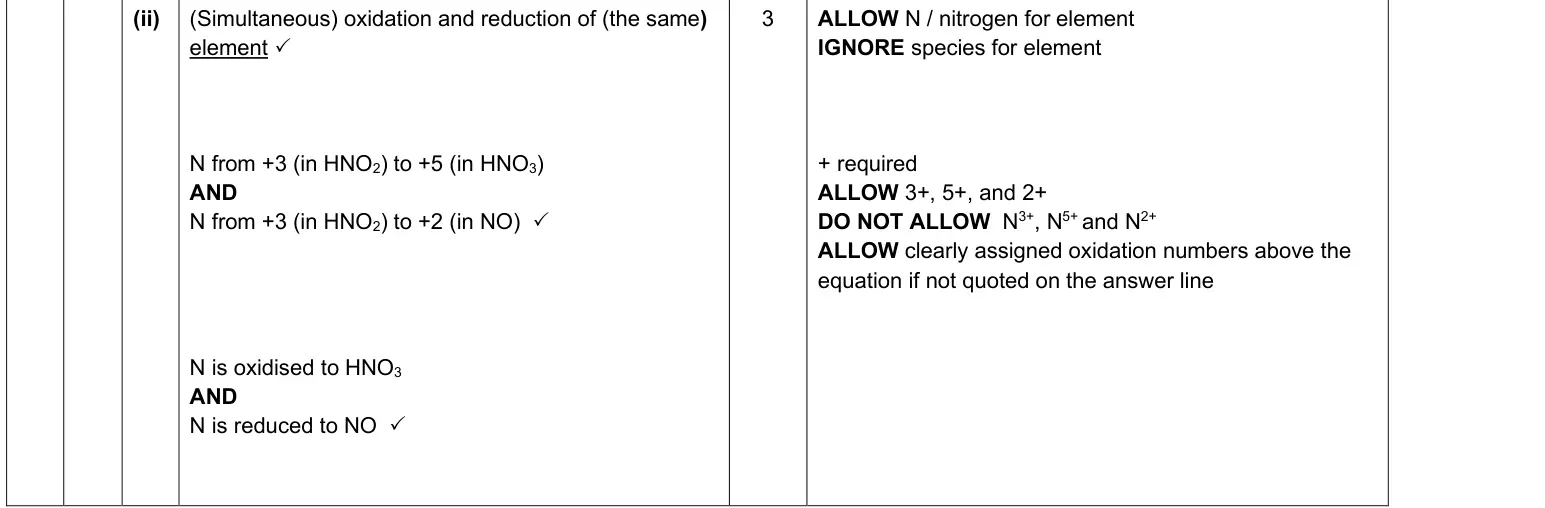
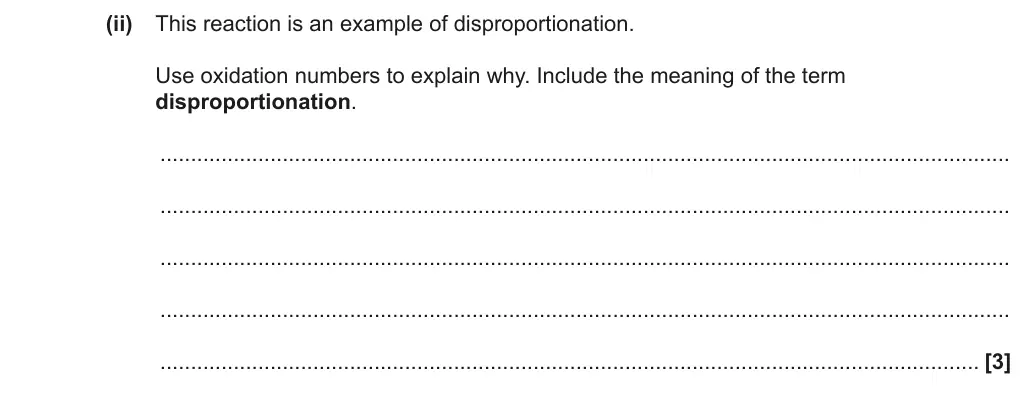
This was generally a well answered question from most candidates. The definition requires the use of ‘element’ rather than the more general term ‘species’. Candidates often went on to identify N as the element. Less successful candidates identified H or O from the redox change. A misconception for a few was that an ‘atom’ was disproportionated without realising this would be impossible. Oxidation numbers were mostly correct and correct oxidation and reduction identified, either by naming compounds in the answer space or labelling them in the equation. Candidates would be advised to make sure that there is a clear link between the oxidation number and the element that it refers to.
Notes from the mark scheme and report
oxidation and reduction of the same ELEMENT (IGNORE species)
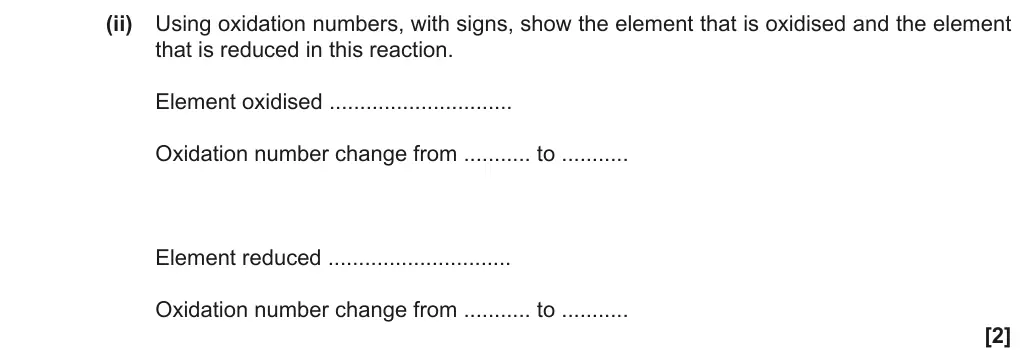
N +3 to +5 (in HNO3) AND +3 to +2 (in NO)
oxidised to HNO3 and reduced to NO
+ signs required
DO NOT ALLOW N3+, N5+, N2+
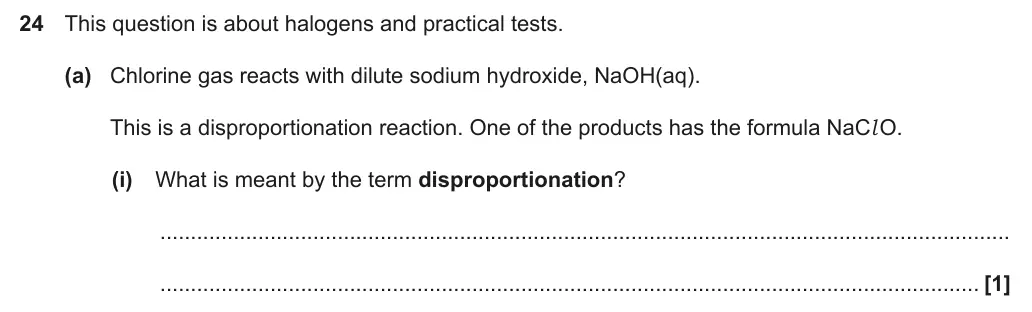
June 2025 · AS Paper 1 · Q22(a)3 marksShort answerMedium
Mark scheme
Examiner's comment
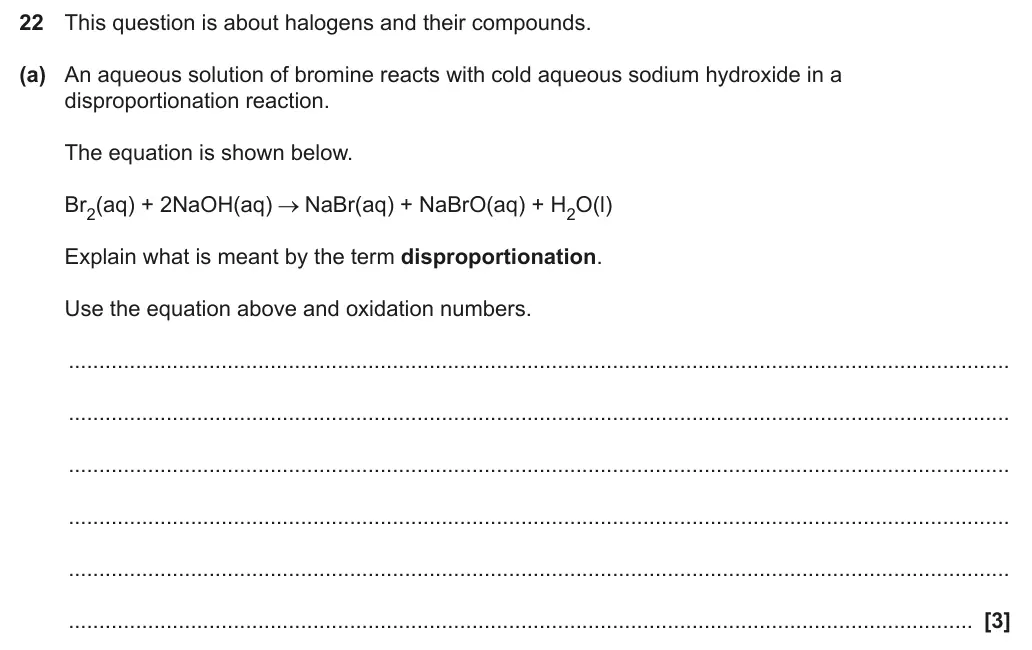
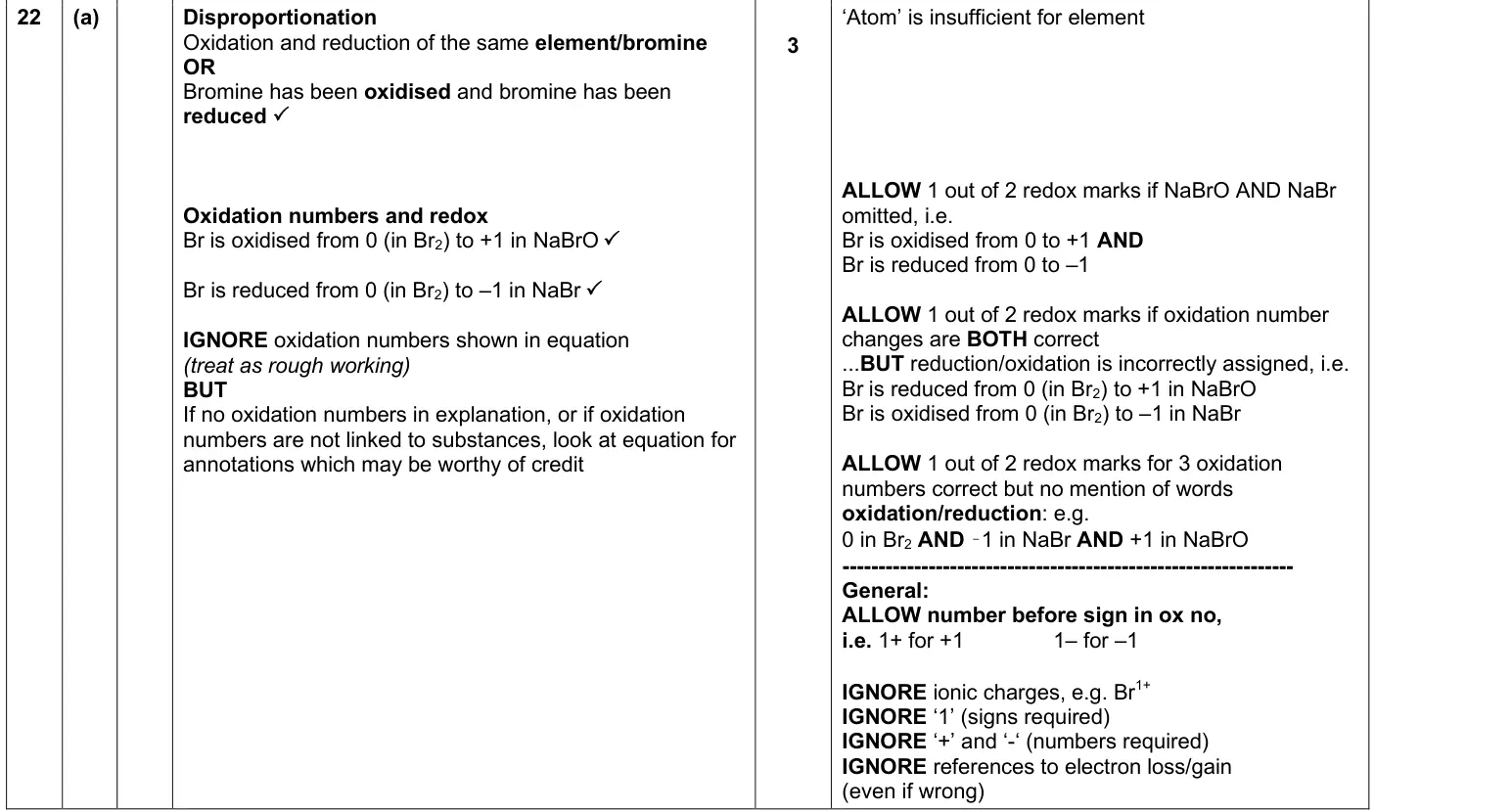
Over half of candidates scored full marks on this question, clearly stating the definition of disproportionation. Where a response did not state ‘element’ in the definition, the candidate usually went on to gain the first mark by clearly stating that bromine is oxidised and reduced. Oxidation numbers were usually assigned correctly, but marks were missed by not linking changes to chemicals, or by not stating which change was oxidation and/or reduction. These marks could sometimes be given from working around the equation, but candidates should be encouraged to include these links in their written response.
Notes from the mark scheme and report
'atom' insufficient for element
oxidation numbers need sign and number and must be linked to NaBrO and NaBr
1 of 2 redox marks if oxidation/reduction assigned the wrong way round
IGNORE electron loss/gain
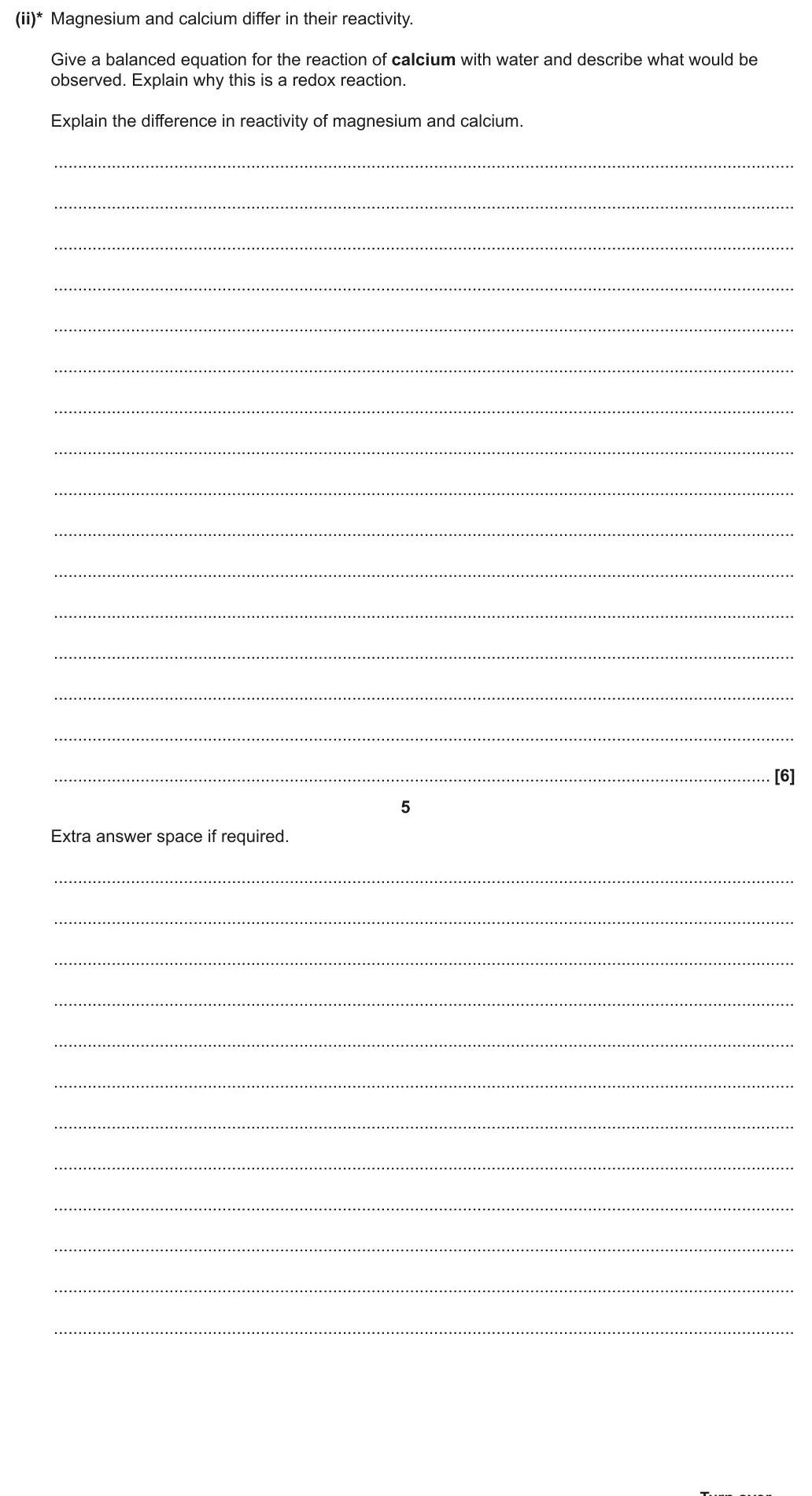
June 2025 · AS Paper 2 · Q2(a)(ii)6 marks6-mark level of responseMedium
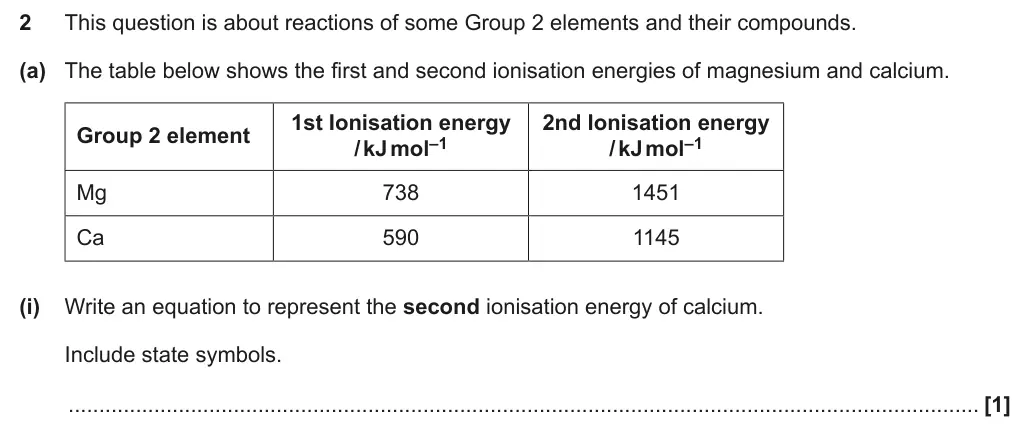
Earlier part of question 2 that this part uses
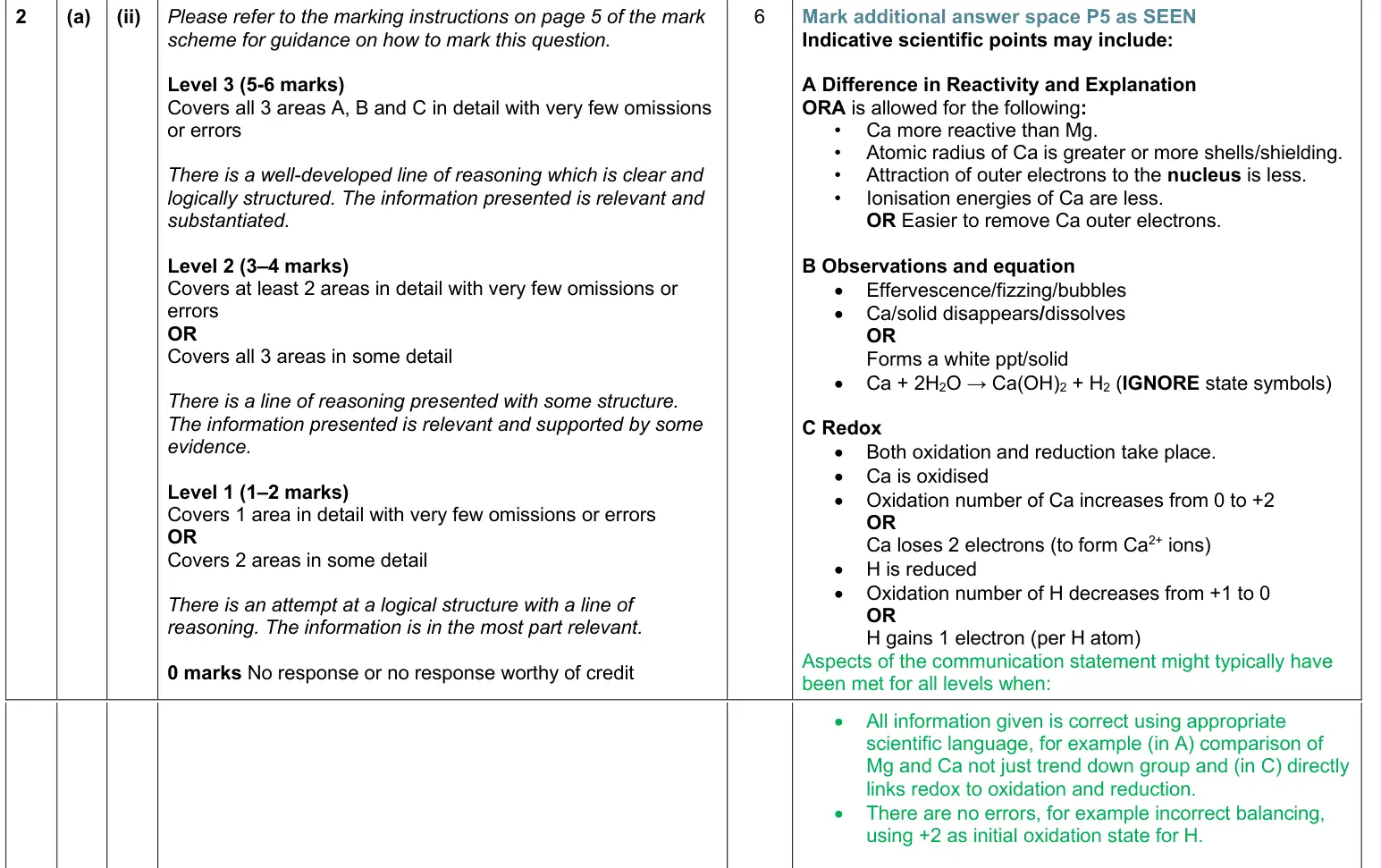
Mark scheme, with the levels and indicative points
Examiner's comment
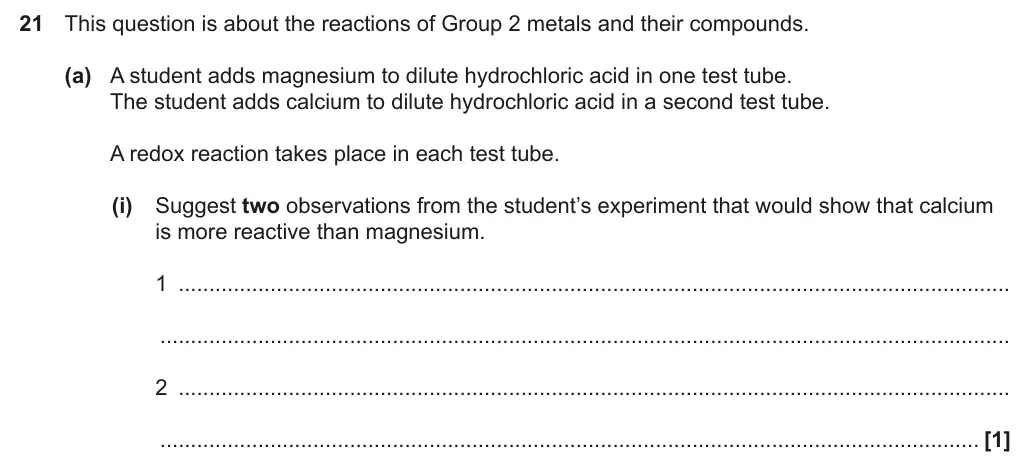
Many candidates scored highly on this level of response question, answering all three parts. Generally, candidates found it easier to explain the difference in reactivity between Mg and Ca than the other parts of the question. Some lacked clarity in their responses, describing a decreased “electrostatic attraction” without reference to the nucleus and/or outer electrons. Some muddled the order of reactivity describing the gain of electrons. A few candidates described a general trend down the group without linking to the position of Mg and Ca in the group. A number of candidates had an incorrect equation forming CaO rather than hydroxide and occasional errors in the formula, e.g. CaOH or balancing of the equation were seen. Most gave at least one correct observation. Some candidates suggested that bubbles would be seen but did not have hydrogen pro- duced in their equation. Most candidates were able to recognise that redox meant that oxidation and reduction took place. How- ever, some were not clear here, e.g. “it is redox as calcium is oxidised”. Most understood that to explain why this was a redox reaction they needed to give oxidation number changes and/or number of electrons lost or gained. Some errors were seen in assigning oxidation numbers such as H in water, which was given as +2, rather than +1 for each atom. Lower-attaining candidates often suggested that oxygen was reduced. Candidates should be aware that they do not need to fill the answer space provided. Often longer re- sponses introduce contradictions in responses. An excellent response which achieved Level 3 and gained all 6 marks.
Notes from the mark scheme and report
Ca + 2H2O → Ca(OH)2 + H2, fizzing and Ca dissolves/white ppt
Ca 0 to +2 oxidised, H +1 to 0 reduced (error: +2 as initial oxidation state of H)
compare Mg and Ca directly - larger radius, more shielding, less attraction, lower ionisation energies
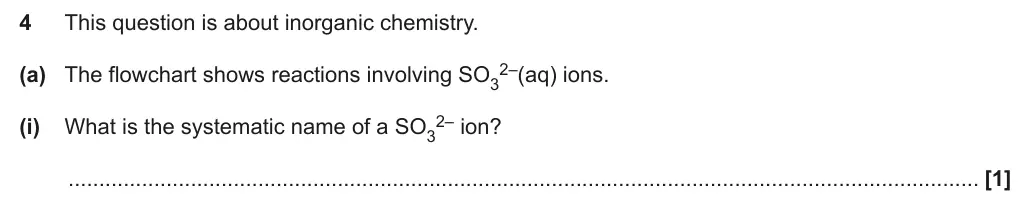
June 2025 · Paper 3 · Q4(a)(i)1 markShort answerMedium
Mark scheme
Examiner's comment
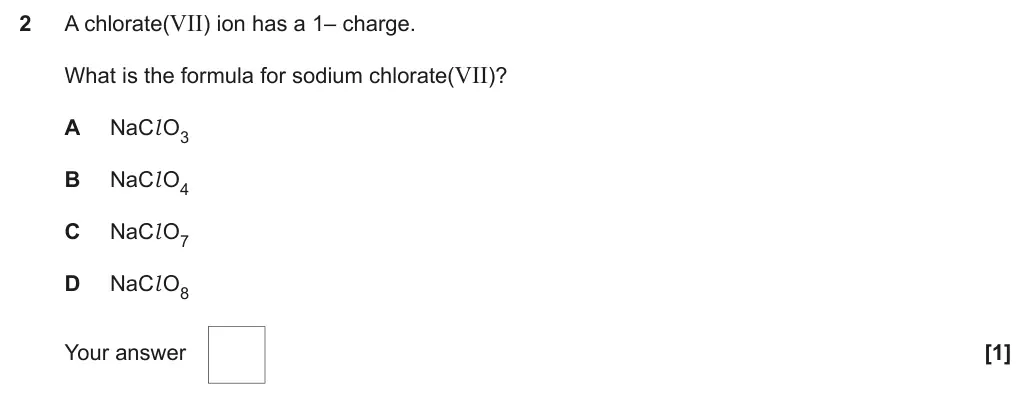
Candidates answered this question well. Overall, there has been an improvement of candidates’ ability to write systematic names involving Roman numerals Most incorrect responses either didn’t use a Roman numeral or referred to sulfur oxides or sulfides. Although not a systematic name, the mark scheme did allow sulfite. The old spellings, “sulphate” and “sulphur” are still commonly seen and were allowed.
Notes from the mark scheme and report
sulfate(IV): IV essential
ALLOW sulfite
DO NOT ALLOW 'oxide' in name
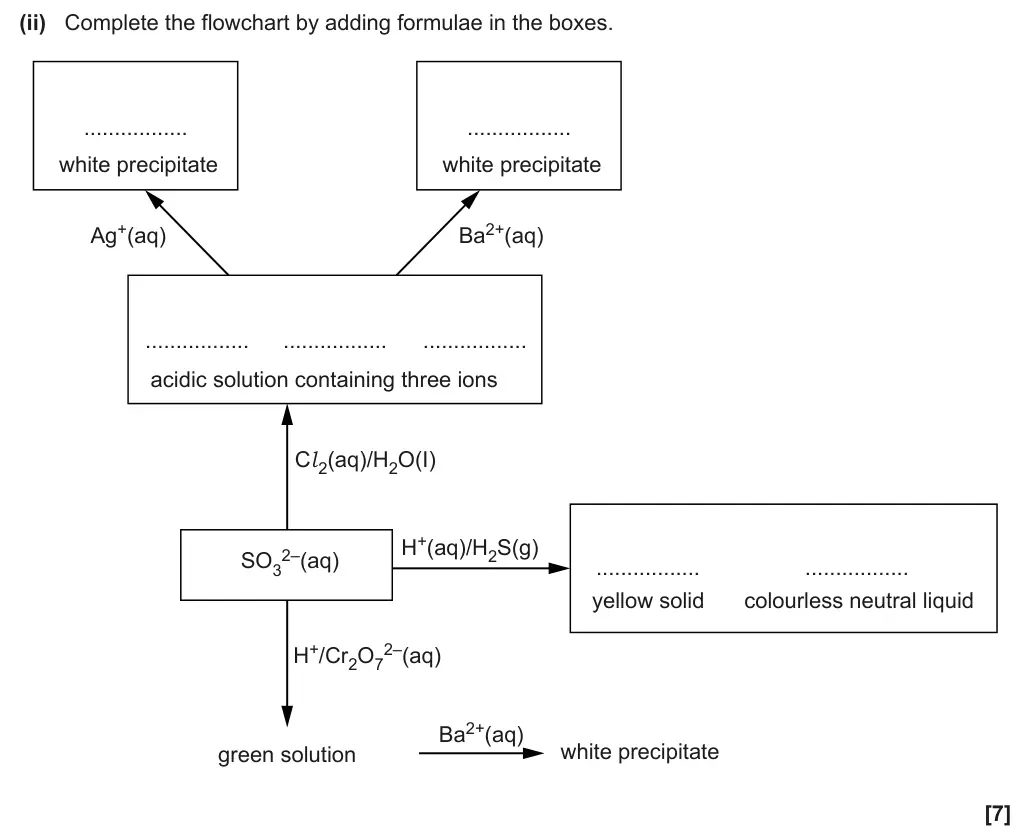
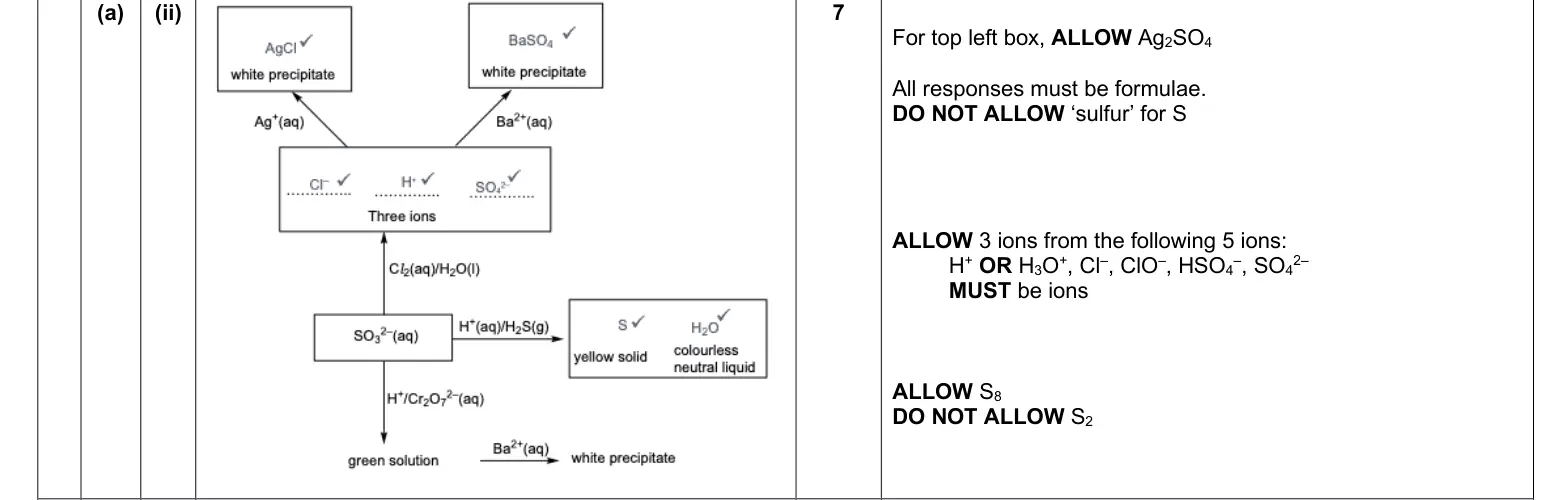
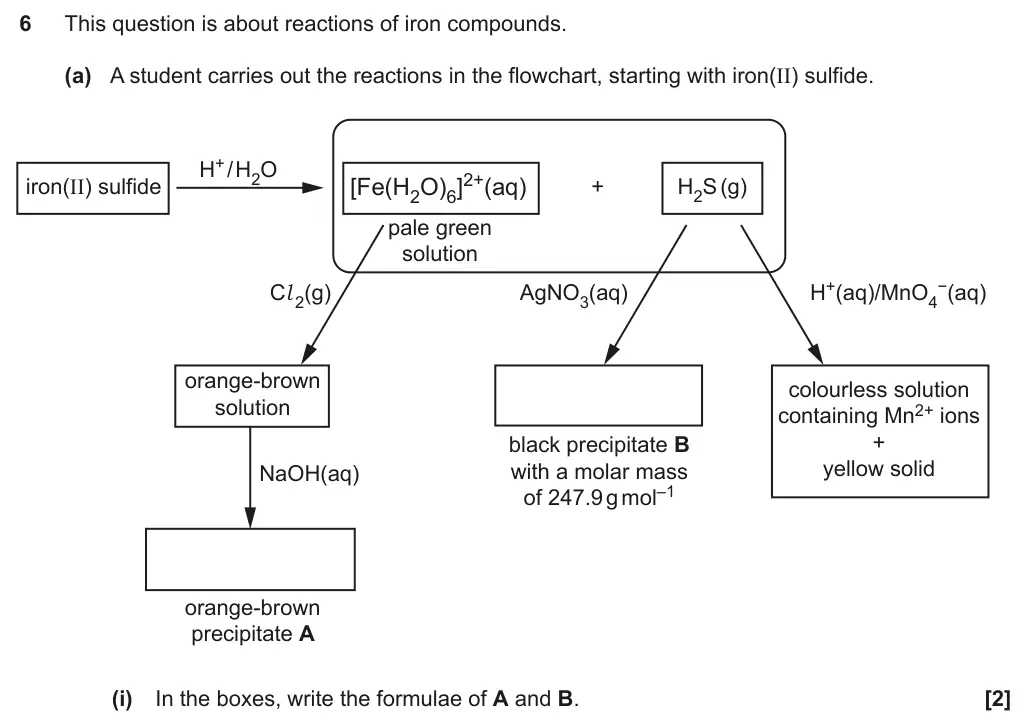
June 2025 · Paper 3 · Q4(a)(ii)7 marksShort answerHard
Earlier part of question 4 that this part uses
Mark scheme
Examiner's comment
Candidates produced a range of answers, and the question discriminated extremely well. The higher attaining candidates often gave 6 or 7 correct formulae. The flowchart contained many clues which most candidates used. Most were able to provide at least 3-4 of the required formulae and there was no consistently wrong answer. Most candidates gave H+ and Cl– as two of the three ions, and AgCl for the white precipitate with Ag+(aq). Both S and S8 were allowed for sulfur but S2 was not allowed. As SO42– ions are present, Ag2SO4 was also allowed for the precipitate with Ag+(aq). Common errors included acid formulae such as H2SO4 in place of water, an incorrect formula for BaSO4, giving BaSO3, writing SO4– for the sulfate ion, and OH– as one of the three ‘acidic’ ions. Lower attaining candidates added formulae without using information in the question. Examples include full formulae such as HCl in the box labelled ‘ions’ and CuCl42– for the yellow solid, despite Cu being absent in the flowchart.
Notes from the mark scheme and report
all responses must be formulae: AgCl (ALLOW Ag2SO4), BaSO4, three ions from H+, Cl–, SO42– (ALLOW ClO–, HSO4–), S (ALLOW S8
DO NOT ALLOW S2 or 'sulfur'), H2O
Skills: PAG4 Qualitative analysis of ions
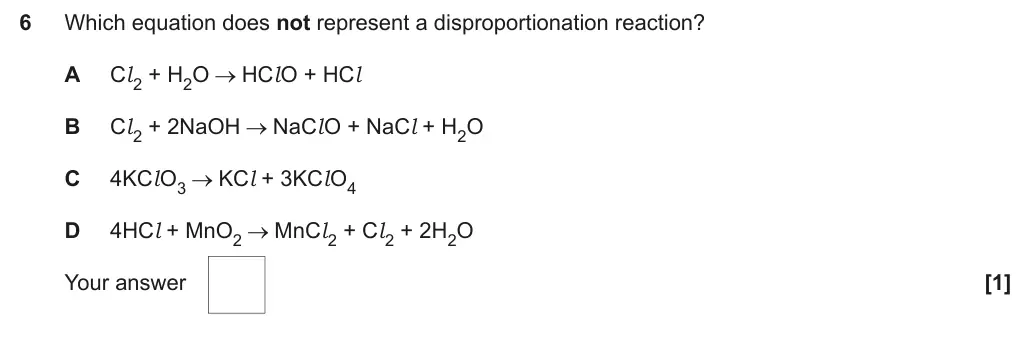
June 2024 · Paper 1 · Q61 markMultiple choiceHard
Answer
D
Mark scheme
Examiner's comment
The correct answer was D. This proved a more challenging question. Successful candidates often presented oxidation numbers above the equations to identify the element that was simultaneously oxidised and reduced. Most candidates recognised that A and B could be ruled out, with C being the most common error.
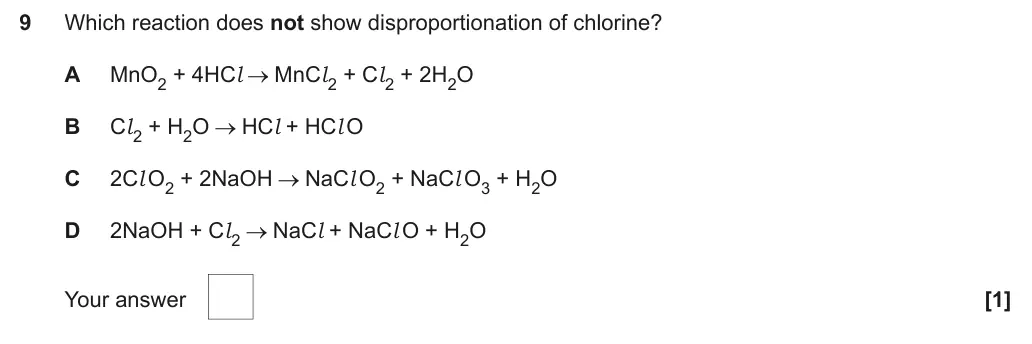
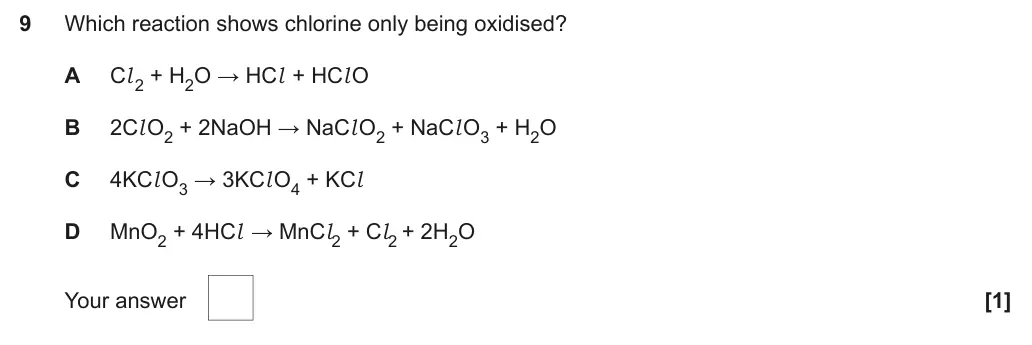
June 2024 · AS Paper 1 · Q91 markMultiple choiceMedium
Answer
A
Mark scheme
Examiner's comment
About half of the candidates chose A correctly. Most candidates wrote oxidation numbers below the chlorine in the equations, which is good practice, with C proving to be the main distractor. Note also the point made in Question 6 about underlining the word ‘not’.
June 2024 · Paper 1 · Q141 markMultiple choiceEasy
Answer
D
Mark scheme
Examiner's comment
The correct answer was D. Most candidates were able to select this response, but the common error was the selection of A. It is important that candidates can distinguish the difference between oxidation states and charge on the ions. Oxidation state is the measure of the number of electrons that an atom uses to bond with atoms of another element.
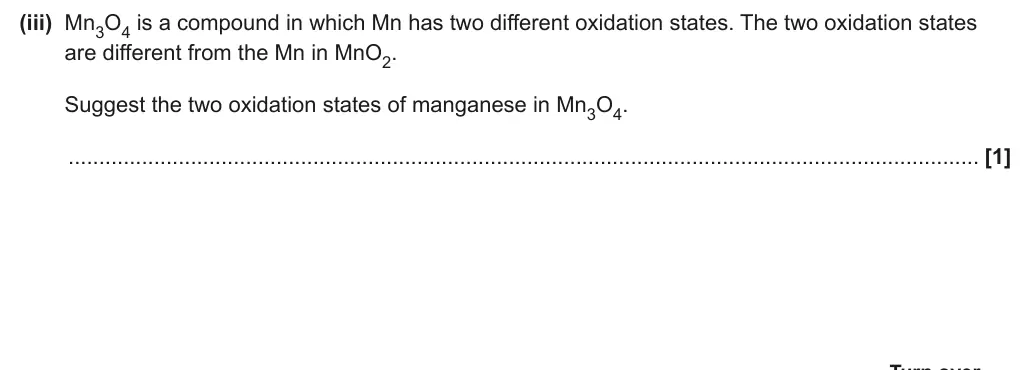
June 2024 · Paper 1 · Q16(b)(iii)1 markShort answerHard
Mark scheme
Examiner's comment
This question proved more challenging for candidates. Candidates stating +4 was the most common error; this is the oxidation state in MnO2. Some candidates stated fractions, negative values and gave the state symbol instead i.e. solid and liquid.
Notes from the mark scheme and report
+ sign required
DO NOT ALLOW Mn2+/Mn3+ (ions, not oxidation states)
DO NOT ALLOW +4
June 2024 · AS Paper 1 · Q21(b)(i)1 markShort answerMedium
Mark scheme
Examiner's comment
This question required candidates to work out a systematic name from a formula. Transition elements can have different oxidation numbers in their compounds and the systematic name needs to contain a Roman numeral. Approximately half the candidates were able to write the correct name as iron(III) oxide. An array of incorrect names were seen, commonly iron(II) oxide, presumably from the number of iron atoms in Fe2O3.
Notes from the mark scheme and report
must be systematic: iron(III) oxide
IGNORE iron(3) oxide, iron(III) dioxide
ALLOW no brackets
A systematic name may contain the oxidation number, not the number of atoms in the formula. So Fe2O3 is iron(III) oxide and not iron(II) oxide.
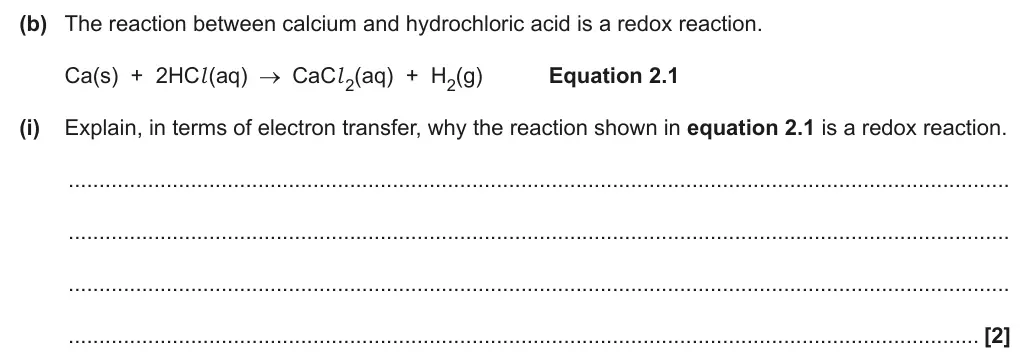
June 2024 · AS Paper 2 · Q2(b)(i)2 marksShort answerMedium
Mark scheme
Examiner's comment
Explaining redox reactions is a common question in exam papers, however here candidates needed to do it ‘in terms of electron transfer’. Subsequently, many lost a mark as they identified oxidation and reduction in terms of oxidation numbers only. However, many gave responses both in terms of oxidation numbers and electrons. It was necessary to be specific here and say Ca had lost 2 electrons, so a few lost the mark by only referring to ‘Ca losing electrons’. Some lost marks for only describing oxidation of Ca and not reduction of H. There was some evidence that candidates were not sure of Cl’s role in the reaction (i.e. as a spectator ion) with some stating it was reduced and/or accepted electrons from Ca but then gave them to H.
Notes from the mark scheme and report
Ca loses 2 electrons AND is oxidised
H(+) gains electron AND is reduced
IGNORE oxidation numbers (question asks for electron transfer)
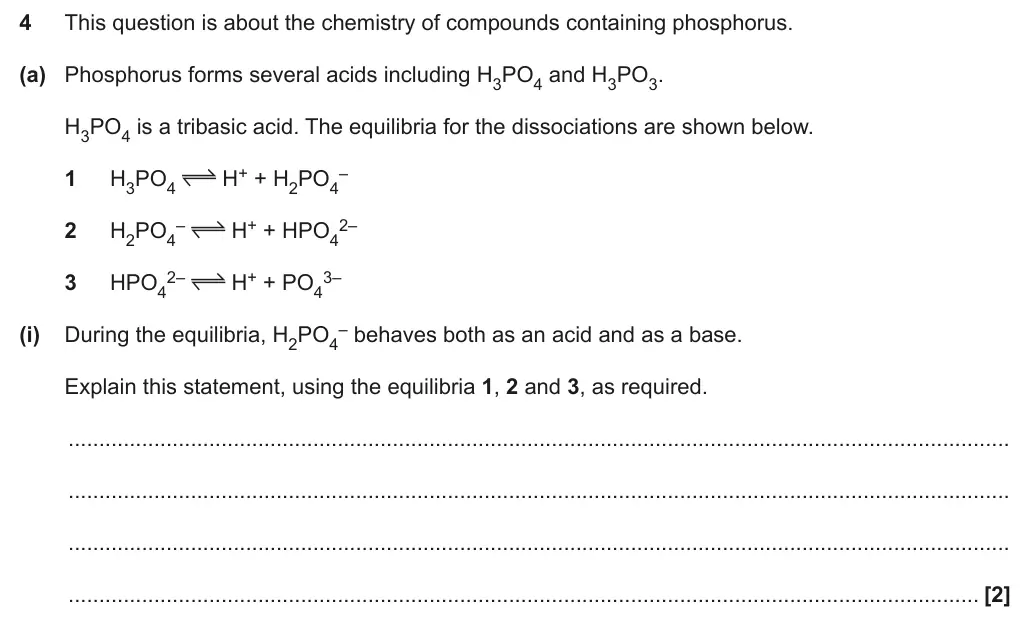
June 2024 · Paper 3 · Q4(a)(iii)1 markShort answerMedium
Earlier part of question 4 that this part uses
Mark scheme
Examiner's comment
Most candidates wrote the correct systematic name of phosphorus(III) acid and the clue given in the question for the name of H3PO4 should have helped. Common errors included phosphorus(IV) acid, the same as for H3PO4, and the (III) oxidation number being placed after ‘acid’ in the name. The commonest error though, was hydrogen phosphate. Candidates are advised to use any information provided in the question, which often contains clues. This certainly would have prevented hydrogen phosphate as a response.
Notes from the mark scheme and report
phosphoric(III) acid
DO NOT ALLOW phosphoric acid (III) or phosphorous acid
June 2024 · Paper 3 · Q4(b)(i)1 markEquation writingMedium
Mark scheme
Examiner's comment
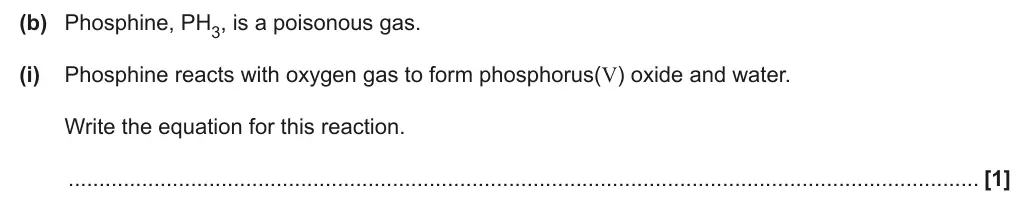
Candidates found this question quite challenging, with only about one-third writing a correct equation. The question gave the reactants and products with only the formula of phosphorus(V) oxide having to be worked out. The actual reaction does produce P4O10 but P2O5 was shown in almost all equations, and this was acceptable. Various incorrect formulae were seen for phosphorus(V) oxide including PO, PO2, P5O, HPO, etc. Unfortunately a significant number of candidates could not balance the equation, despite using correct formulae.
Notes from the mark scheme and report
4PH3 + 8O2 → P4O10 + 6H2O
ALLOW P2O5 version and multiples
IGNORE state symbols
Skills: M0.2 Use ratios, fractions and percentages
June 2024 · Paper 3 · Q4(b)(ii)3 marksEquation writingHard
Earlier part of question 4 that this part uses
Mark scheme
Examiner's comment
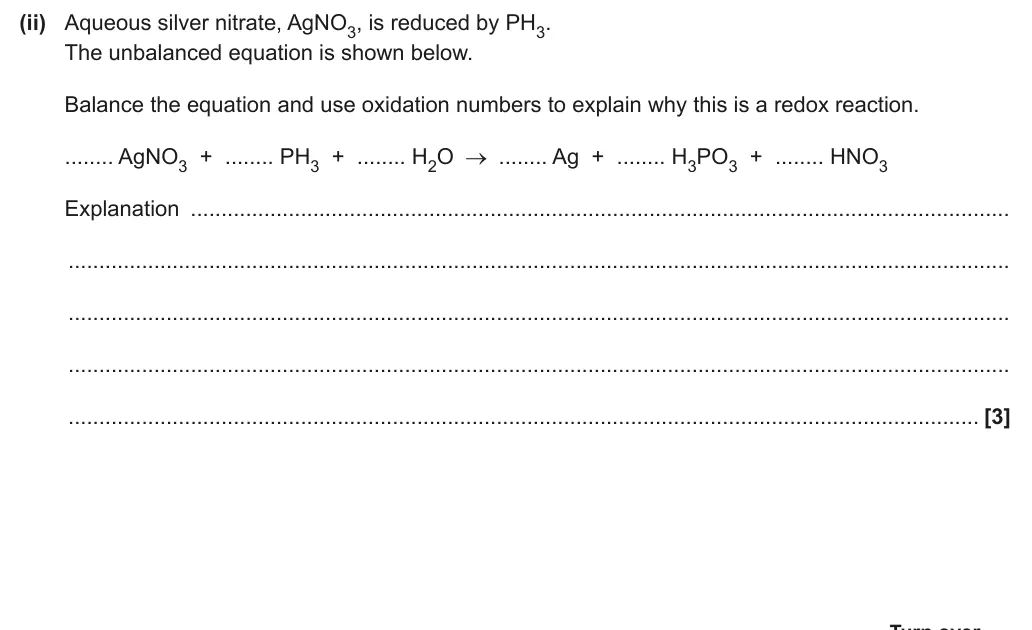
This question generated a wide range of responses, testing many important chemical skills. Candidates often used oxidation numbers correctly to show that silver is reduced and phosphorus oxidised, with silver being the easier. Hydrogen was sometimes incorrectly chosen for oxidation. The oxidation number change of +1 to 0 for silver was usually correct although +9 and +11 were common errors for silver in AgNO3, presumably by choosing the oxidation number of nitrogen as –3 or – 5. Candidates usually recognised that phosphorus started with an oxidation number of –3 but the oxidation number of +5 was a common error in H3PO3. Balancing the equation was the most difficult part of this question with numbers being added almost at random. It is easier to balance equations for redox reactions by balancing the oxidation number changes first.
Notes from the mark scheme and report
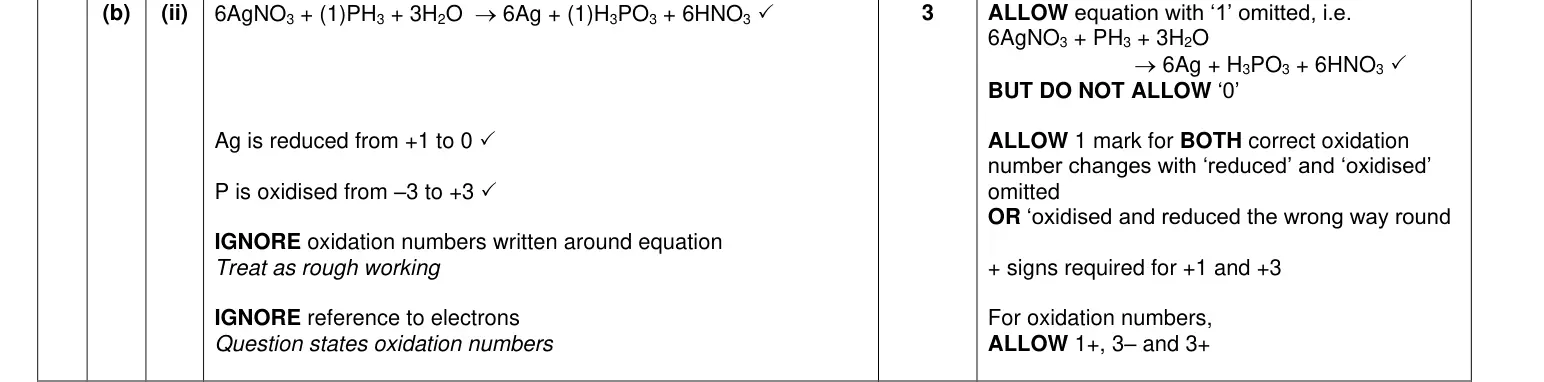
6AgNO3 + PH3 + 3H2O → 6Ag + H3PO3 + 6HNO3
Ag reduced +1 to 0, P oxidised –3 to +3
+ signs required
1 mark if both changes correct but oxidised/reduced omitted or reversed
IGNORE electrons
Ag+ and NO3– are among the common ions that students should know (see also Question 4 (c) (i)).
For a NO3– ion to have a charge of 1–, the oxidation number of nitrogen must be +5. By choosing –5, the charge on NO3 would be –11 and silver would have an oxidation number of +11. This is completely unrealistic and should be rejected as it points to a serious error.
Skills: M0.2 Use ratios, fractions and percentages
June 2023 · AS Paper 1 · Q51 markAO1Multiple choiceMedium
Answer
B
Mark scheme
Examiner's comment
Most candidates corrected selected option B. Many candidates wrote their oxidation numbers by each response with most identifying the oxidation number of S in S8 as being 0. The main distractors were A and C. Annotations showed that many assignments of oxidation number had the wrong sign. For example, assigning S as –2 for S (SF2) would result in C being chosen. This suggests that some candidates have an insufficient understanding of the rules for assigning oxidation numbers.
June 2023 · Paper 1 · Q121 markAO2Multiple choiceMedium
Answer
C
Mark scheme
Examiner's comment
Most candidates answered this question correctly with C.
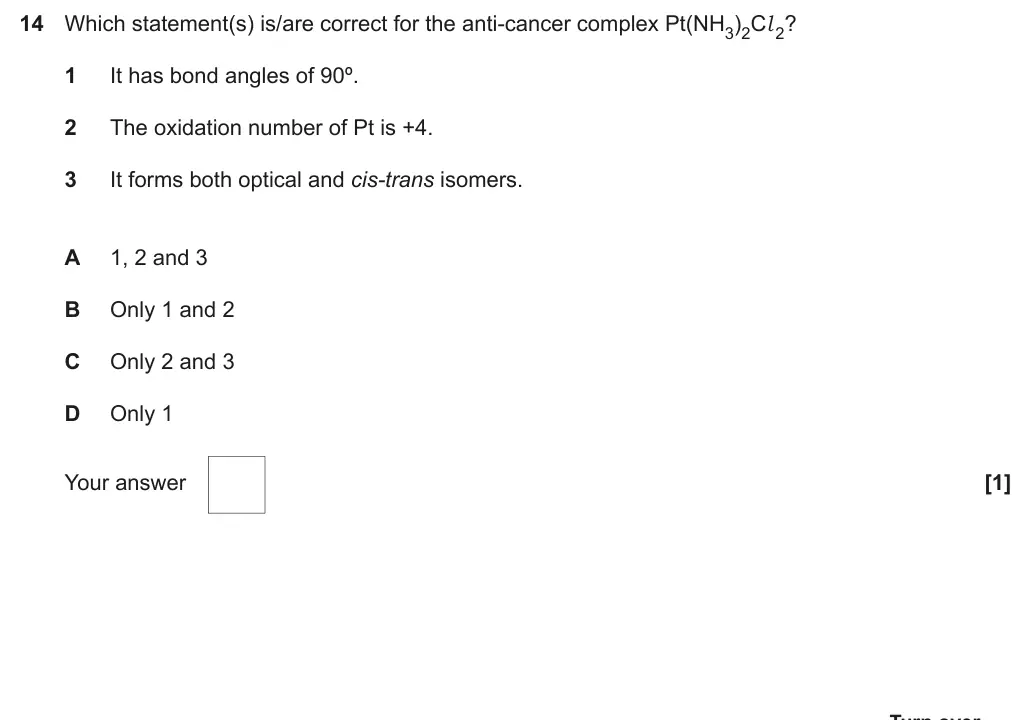
June 2023 · Paper 1 · Q141 markAO1Multiple choiceMedium
Answer
D
Mark scheme
Examiner's comment
The correct answer was D. Most candidates recognised that the complex represented cisplatin. Cisplatin has a bond angle of 90 degrees due to being square planar and shows cis/trans isomerism, but some candidates thought it showed optical isomerism too. Most could tell the oxidation number of platinum is not +4.
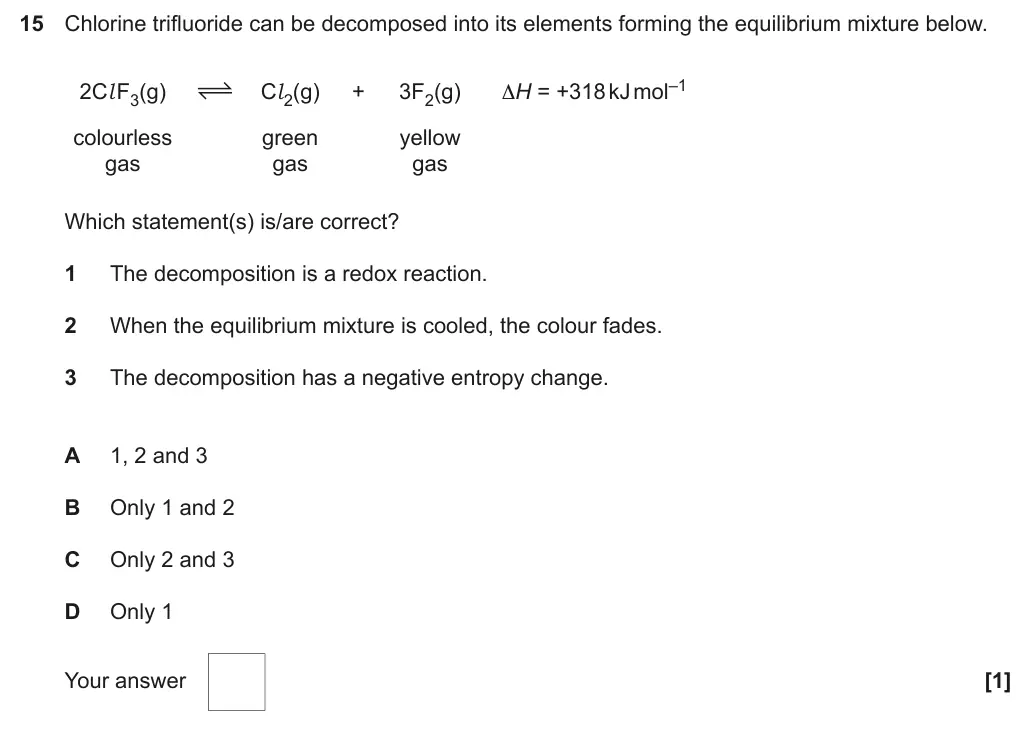
June 2023 · Paper 1 · Q151 markAO2Multiple choiceEasy
Answer
B
Mark scheme
Examiner's comment
This question was for the most part answered correctly with B. Errors came from not recognising the reaction is endothermic and therefore its equilibrium would shift to the left when the temperature decreases, ruling out option 2. Section B overview The section contained questions from all aspects of the specification. Candidates found many of the questions, including those with an extended response nature, straightforward and the majority managed to cope with the mathematical content. Candidates should use calculator values in their intermediate calculations to avoid rounding errors in their final answer. Well set out calculations which clearly indicate what each numerical value represents allow error carried forward marks to be awarded in the event of an incorrect answer. Some candidates were less confident and knowledgeable with the less demanding aspects of some questions. These were specifically: ionic equations, equations involving group 2 metals and their compounds, equilibria shifts and enthalpy changes. There was evidence that candidates wrote far more than necessary in some responses. For example, Question16 (b) was allotted a very generous 9 lines for an answer but many candidates provided repetitive responses and requoted the question. Many more effective responses provided 4 or 5 line answers but gained full marks. With the exception of questions marked using a level of response mark scheme, candidates should look to the marks available to give insight to the amount of detail, and discrete points, that needed to be made.
Notes from the mark scheme and report
Practice multiple choice questions can improve the skill in solving and identifying the distractors. Exposure to this type of question style will decrease the time taken over each question. These can often form the basis of end of topic tests.
Multiple choice question quizzes can be found via the resource-finder on Teach Cambridge and there are instructions on how to use the online versions of the multiple choice quizzes.
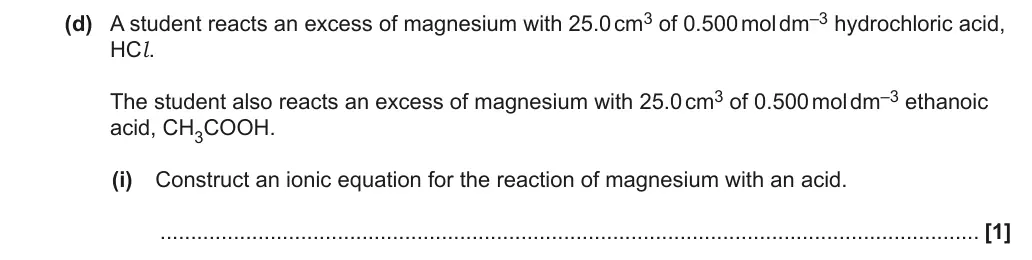
June 2023 · Paper 1 · Q20(d)(i)1 markAO2Equation writingHard
Mark scheme
Examiner's comment
Ionic equations still present candidates with a challenge. A few candidates scored the mark but many candidates gave a full equation or one that contained a mismatch of spectator ions as well as the correct ions.
Notes from the mark scheme and report
Mg + 2H+ → Mg2+ + H2
ALLOW multiples
June 2023 · AS Paper 2 · Q1(b)(i)1 markAO2Short answerHard
Mark scheme
Examiner's comment
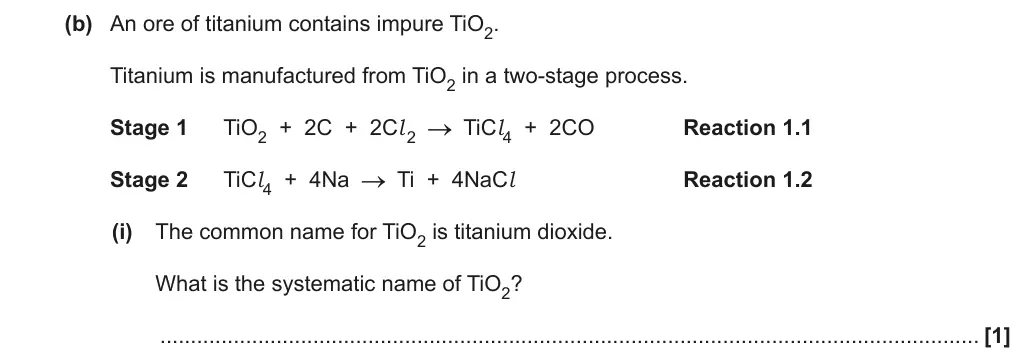
Very few candidates gave the correct answer for this question. The most common errors included: titanium oxide, titanium(IV) dioxide, titanium oxide(IV), titanium(II) oxide. A few also attempted to give names like those for organic compounds: 1,1-titanium dioxide or the reverse 1,1-dioxytitanium. How Science Works It is important in Chemistry to have clear communication by use of systematic and unambiguous nomenclature. This includes the use of Roman numerals to indicate the magnitude of the oxidation number when an element, such as Ti, may have different oxidation numbers in different compounds. See specification statement 2.1.5(c) and HSW8.
Notes from the mark scheme and report
titanium(IV) oxide
DO NOT ALLOW titanium dioxide
June 2023 · AS Paper 2 · Q3(b)3 marksAO1, 2Data interpretationHard
Mark scheme
Examiner's comment
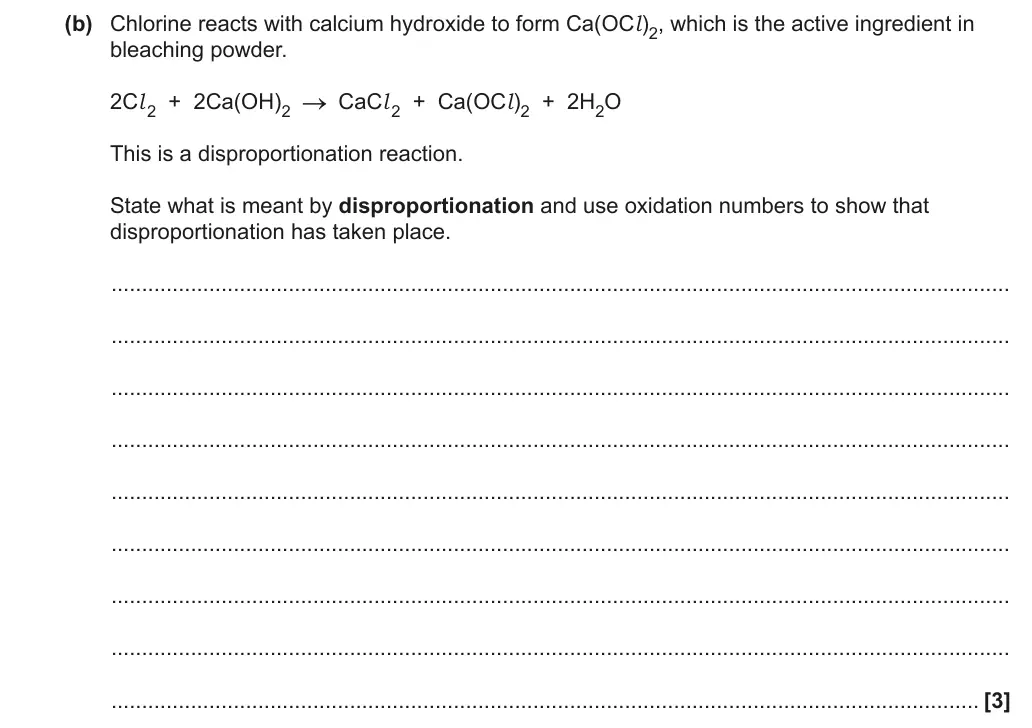
Most were able to explain the term disproportionation. Some missed the mark by not stating an element or chlorine. A very common error was giving final oxidation numbers of Cl as +2 and/or -2, rather than per atom. The link between oxidation number and species was not always clearly indicated or changes not specified as oxidation/reduction (or given as the wrong way round). It is vital to set out answer s clearly showing oxidation numbers, species and stating if oxidised or reduced. It is not enough to write on the equation given in the question as it often challenging to read these numbers, or they contradict the main answer. Some attempted to show that Ca has been disproportionated.
Notes from the mark scheme and report
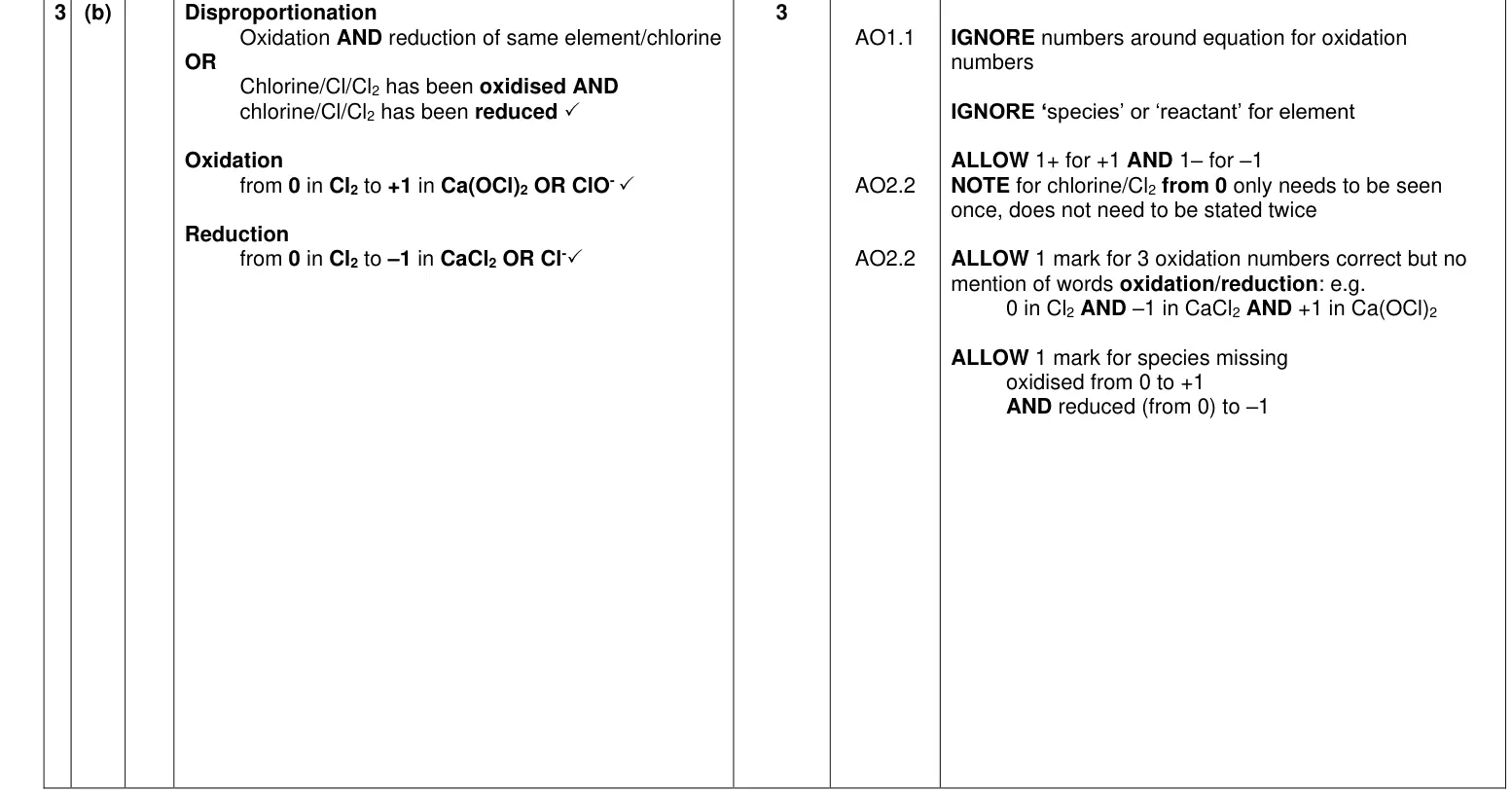
oxidation AND reduction of the same element
0 to +1 in Ca(OCl)2 and 0 to –1 in CaCl2
IGNORE 'species'/'reactant' for element
1 mark for three correct oxidation numbers without oxidation/reduction stated
June 2023 · Paper 3 · Q2(a)(i)1 markAO1Short answerHard
Mark scheme
Examiner's comment
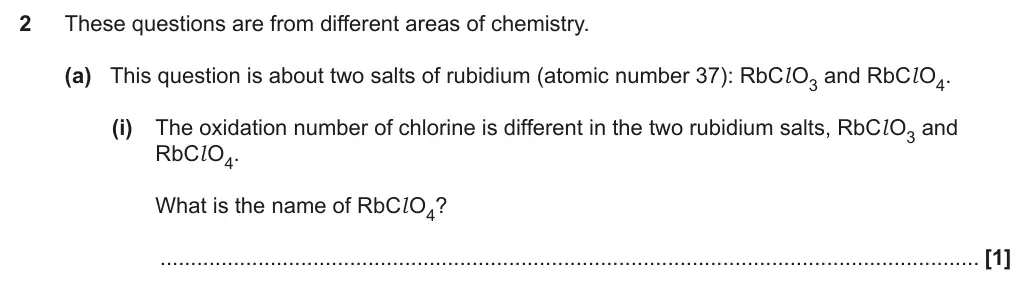
Candidates had difficulty in naming a compound using Roman numerals for an element which can have different oxidation numbers. For the name of RbClO4, many omitted the number entirely, showing just rubidium chlorate. Many inventive names such as rubidium chlorotetraoxide were seen. Some candidates wrote the correct VII before chlorate and many different Roman oxidation numbers were seen. Roman numerals’ use in naming compounds is part of chemical nomenclature, included in the specification.
June 2023 · Paper 3 · Q6(c)(ii)3 marksAO3CalculationEasy
Earlier part of question 6 that this part uses
Mark scheme
Examiner's comment
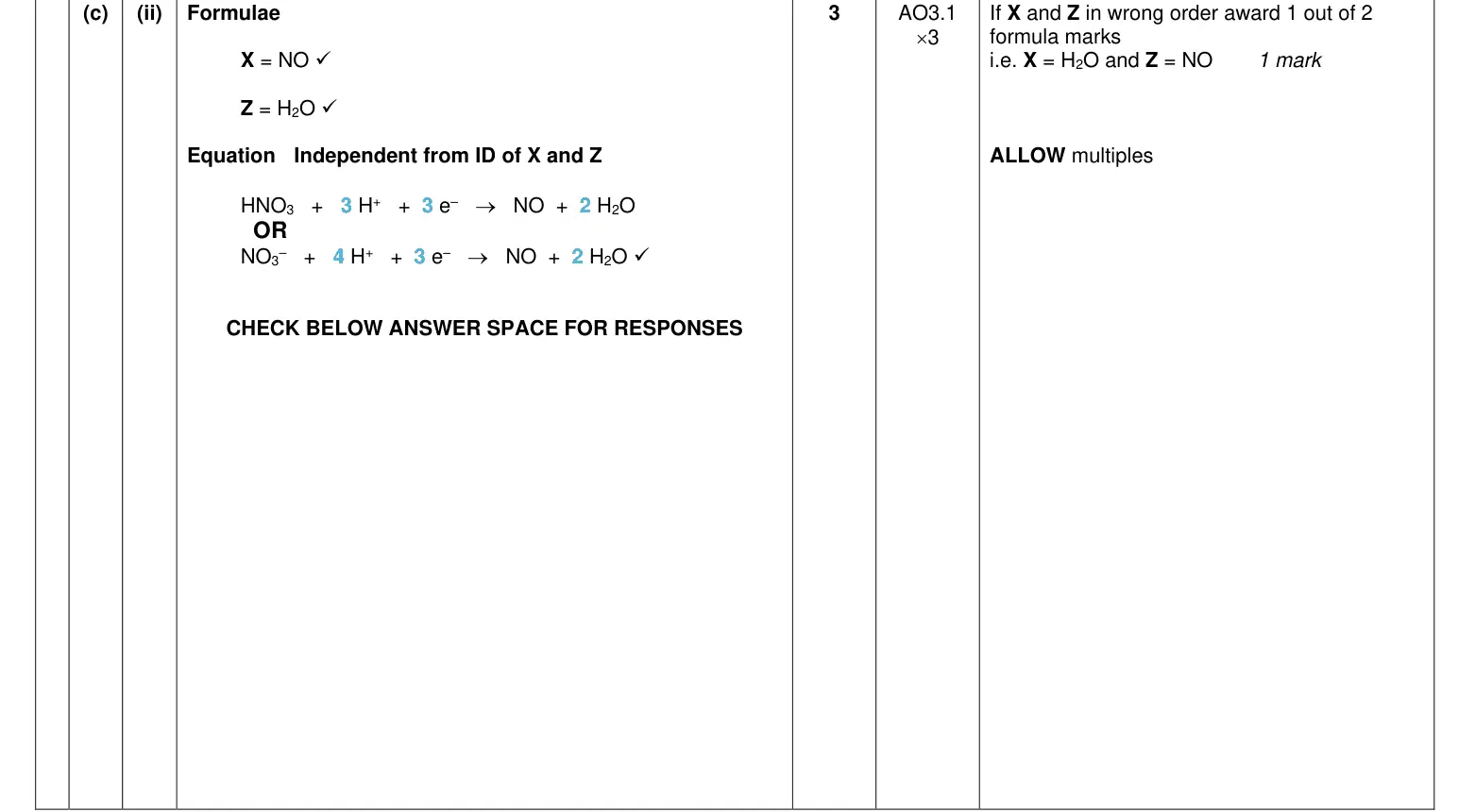
Almost all candidates identified X and Y as NO and H2O respectively, but the equation proved to be much more testing. Some candidates were careless, showing NO and H2O the wrong way round (credited with 1 out of these 2 marks) or with charges. For the equation, candidates needed to consider the oxidation number change of N from +5 to +2, This should have naturally led to 3e– being added on the left-hand side. Many candidates omitted the electrons entirely. Some did add 3e– but on the right. This suggests that candidates would benefit with practising the construction of half equations.
Notes from the mark scheme and report
X = NO, Z = H2O (1 of 2 if in wrong order)
HNO3 + 3H+ + 3e– → NO + 2H2O
equation mark independent of identification
June 2023 · Paper 3 · Q6(e)6 marksAO36-mark level of responseHard
Mark scheme, with the levels and indicative points
Examiner's comment
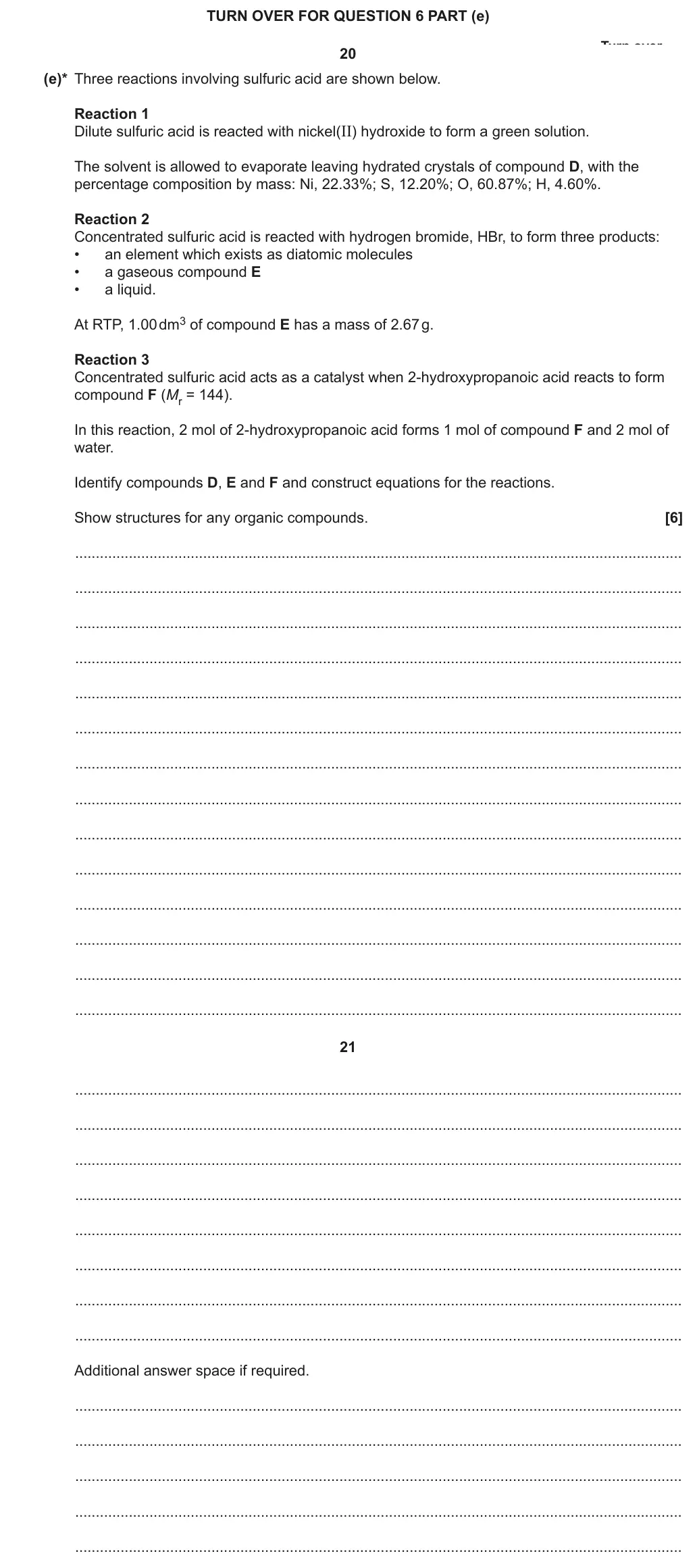
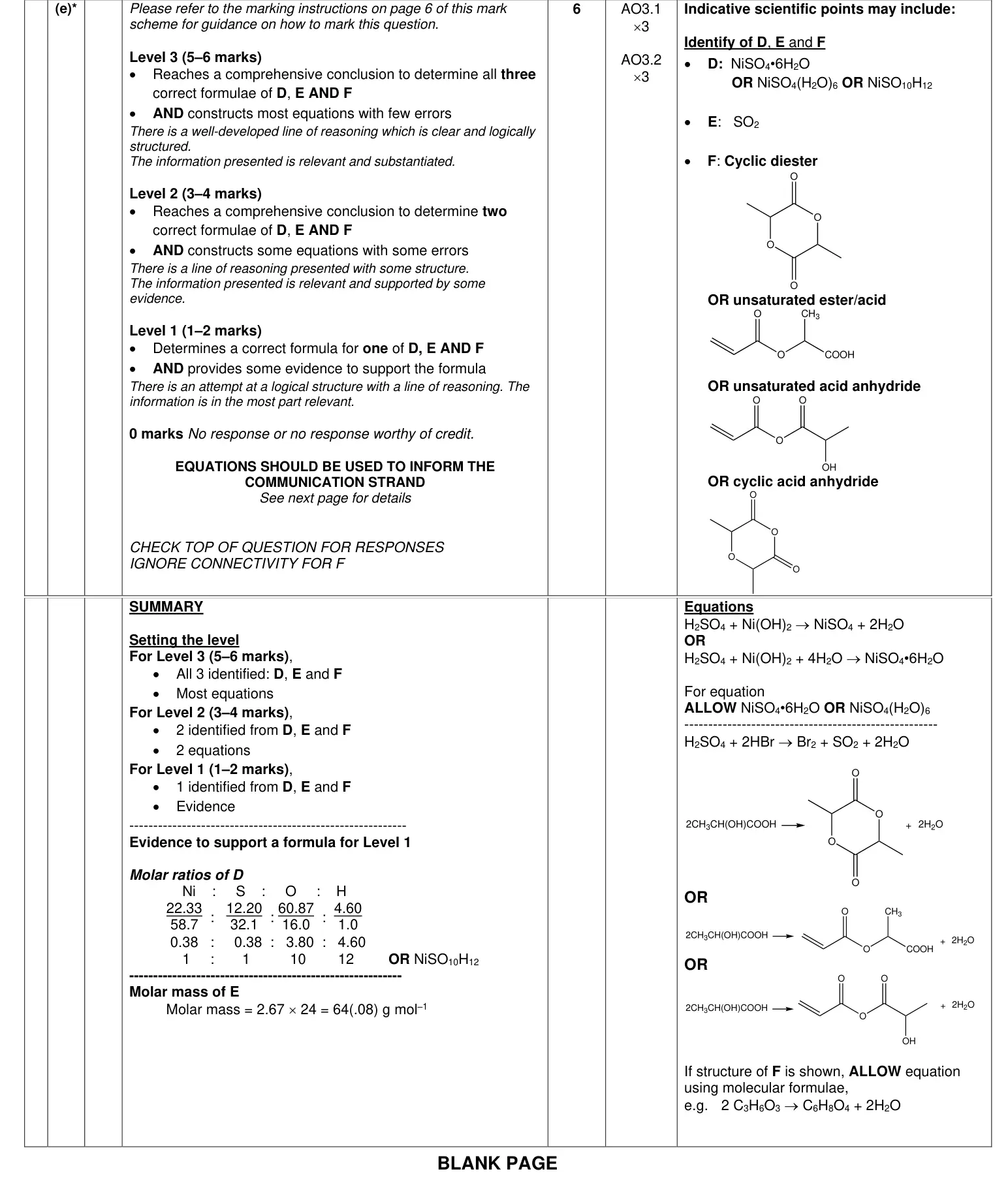
This level of response question required candidates to interpret three pieces of information to identify 3 unknown chemicals, linked by three reactions of sulfuric acid. Levels were assigned based on identifying the three unknowns and writing equations for the reactions. The 3 reactions were tiered in difficulty with the cyclic structure for compound F being the most difficult. The question discriminated extremely well, with comparatively few candidates not scoring any marks. This exemplar shows an excellent response which was awarded Level 3 and 6 marks. The crossing out shows how the candidate progressively solved the problem. Despite the crossing out, working is shown throughout, and the presentation of the response is very clear. For reaction 1, the candidate initially made an error in the stock formula determination calculation. Notice that the candidate crossed out their initial values and wrote them afresh. This approach is recommended. as changing incorrect numbers can lead to ambiguous numbers. In reaction 2, the candidate comfortably identified compound E from its molar mass and wrote a balanced equation for this reaction. For reaction 3, you can see how the candidate’s thought developed during the solve. They initially went for a straight chain structure and then worked out that there must be a cyclic structure. They finally show the cyclic diester as a conventional structural (based on glucose?), and with a balanced equation. This was an excellent response of a high-ability candidate and shows what a well-prepared candidate is capable of achieving.
Notes from the mark scheme and report
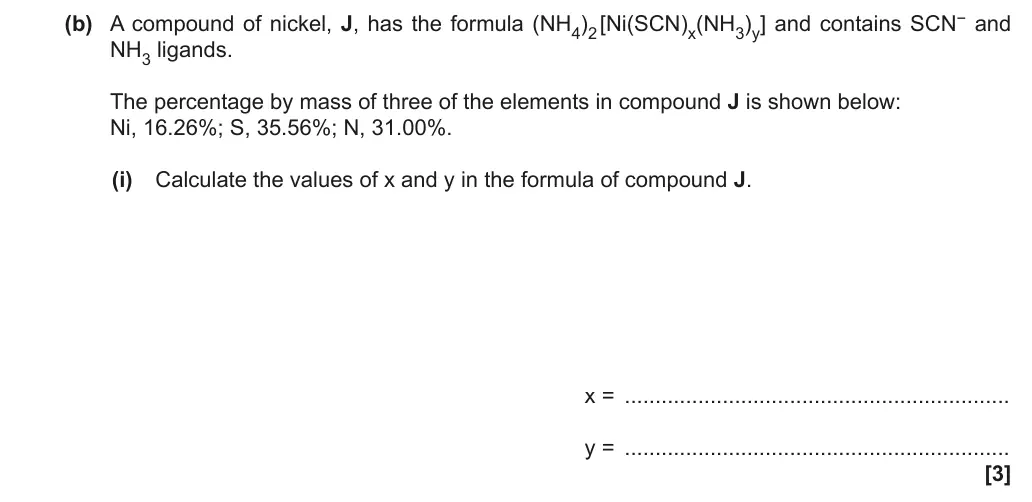
D = NiSO4•6H2O from mole ratio 1:1:10:12
E = SO2 (2.67 × 24 = 64)
H2SO4 + 2HBr → Br2 + SO2 + 2H2O
F = cyclic diester from 2 CH3CH(OH)COOH + 2H2O (ALLOW unsaturated ester/acid or anhydride isomers)
IGNORE connectivity for F
Skills: M0.2 Use ratios, fractions and percentages; M2.3 Substitute numerical values into algebraic equations using appropriate units for physical quantities
June 2022 · Paper 1 · Q61 markAO1Multiple choiceEasy
Answer
B
Mark scheme
Examiner's comment
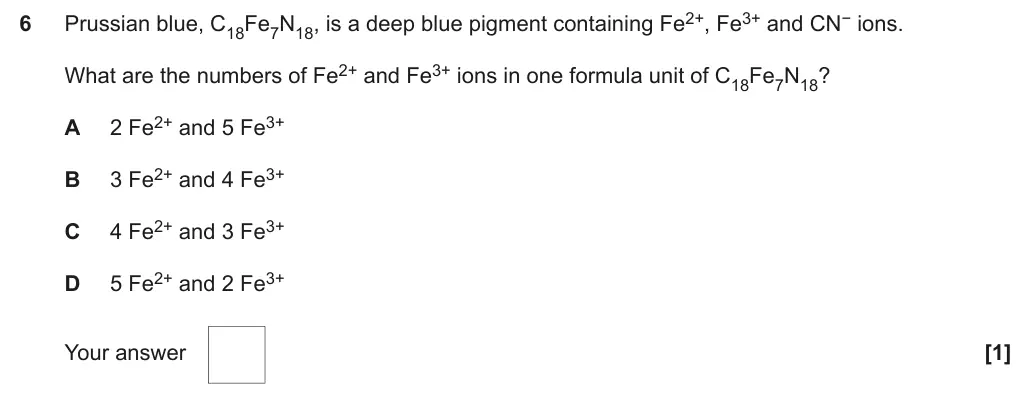
This was generally well answered. The key to candidates quickly arriving at the correct answer of B was to focus on identifying the number of CN- ions and calculating the total of 18 negatively charge ions. More successful candidates could clearly see that the combination of iron ions must add up to the total of 18 positively charged ions. Some candidates lost time here by working out formulae and trying to write out the structure of Prussian blue.
Notes from the mark scheme and report
18 CN– so total positive charge 18 from 7 Fe
Skills: M2.4 Solve algebraic equations
June 2022 · Paper 1 · Q21(a)(ii)2 marksAO2Equation writingHard
Earlier part of question 21 that this part uses
Mark scheme
Examiner's comment
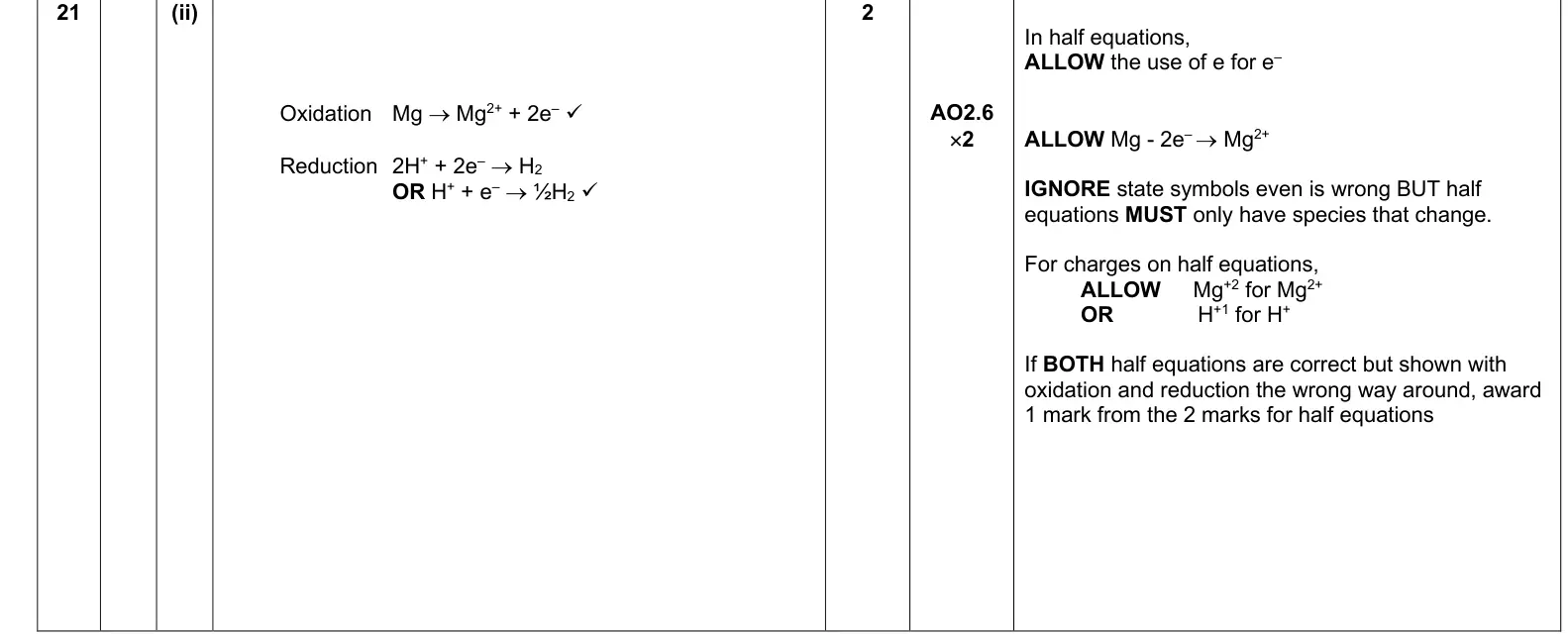
Some candidates coped well with this question which was based on the AS part of the specification and gained both marks. More candidates gained 1 mark through writing one half equation, usually the oxidation of magnesium. Common errors were for chlorine to featuring in the reduction half equation and the lack of electrons in their answers. Very few candidates mixed up the oxidation and reduction equations.
Notes from the mark scheme and report
Mg → Mg2+ + 2e–
2H+ + 2e– → H2
only species that change
1 mark if both correct but labelled the wrong way round
June 2022 · Paper 1 · Q22(c)6 marksAO36-mark level of responseHard
Mark scheme, with the levels and indicative points
Examiner's comment
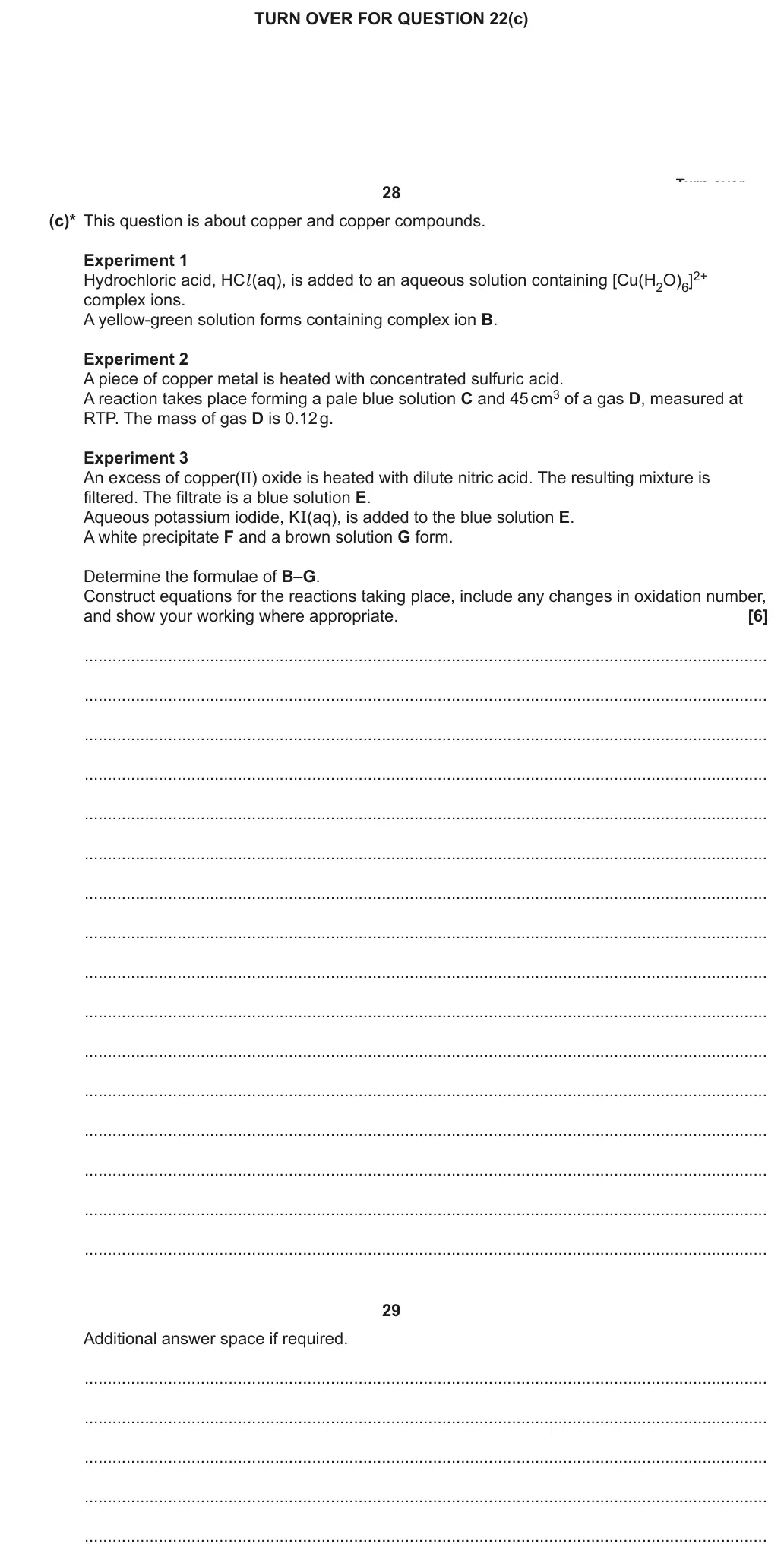
Answers were distributed across all 3 levels of achievement. Most of the candidates managed to identify at least some of the substances. Of the equations, the reaction of copper (II) oxide with nitric acid was most regularly seen correct, although many students could also represent the ligand replacement in Experiment 1. Many candidates were able to calculate Mr for gas D but some of those suggesting SO2 as a possible formula preferred to have an equation in experiment 2 producing hydrogen. A few candidates used the Mr to suggest that the gas was 2O2 and as such candidates found the equation between copper and sulphuric acid challenging. A good number of candidates identified F and G, recognising what they had learned from their work on redox titrations, and some were able to reproduce the equation. Incorrect formula of copper (I) iodide (CuI2) was a common error. Many candidates made no attempt at identifying changes in oxidation states. Candidates are advised to address all parts of the question in order to access the higher levels and to allow sufficient time to attempt the LoR questions. The candidate has clearly set out the three experiments, written the equation and followed with a clear identification of each of the formulae B-G. The calculation is well laid out and the response clearly indicates how the final value has been calculated. Oxidation numbers have then been commented on where appropriate. The colours of the transition metal ions and complexes can be reviewed at: A Level Chemistry A - Colours of inorganic ions and complexes (ocr.org.uk) If any of your students’ results are not as expected, you may wish to consider one of our post-results services. For full information about the options available visit the OCR website. We send a weekly roundup to tell you about important updates. You can also sign up for your subject specific updates. If you haven’t already, sign up here. Attend one of our popular CPD courses to hear directly from a senior assessor or drop in to a Q&A session. Most of our courses are delivered live via an online platform, so you can attend from any location. Please find details for all our courses on the relevant subject page on our website or visit OCR professional development. ExamBuilder is the question builder platform for a range of our GCSE, A Level, Cambridge Nationals and Cambridge Technicals qualifications. Find out more. ExamBuilder is free for all OCR centres with an Interchange account and gives you unlimited users per centre. We need an Interchange username to validate the identity of your centre's first user account for ExamBuilder. If you do not have an Interchange account please contact your centre administrator (usually the Exams Officer) to request a username, or nominate an existing Interchange user in your department. Review students' exam performance with our free online results analysis tool. It is available for all GCSEs, AS and A Levels and Cambridge Nationals. It allows you to: • review and run analysis reports on exam performance • analyse results at question and/or topic level • compare your centre with OCR national averages • identify trends across the centre • facilitate effective planning and delivery of courses • identify areas of the curriculum where students excel or struggle • help pinpoint strengths and weaknesses of students and teaching departments. Find out more. Post-results services Keep up-to-date OCR Professional Development Signed up for ExamBuilder?
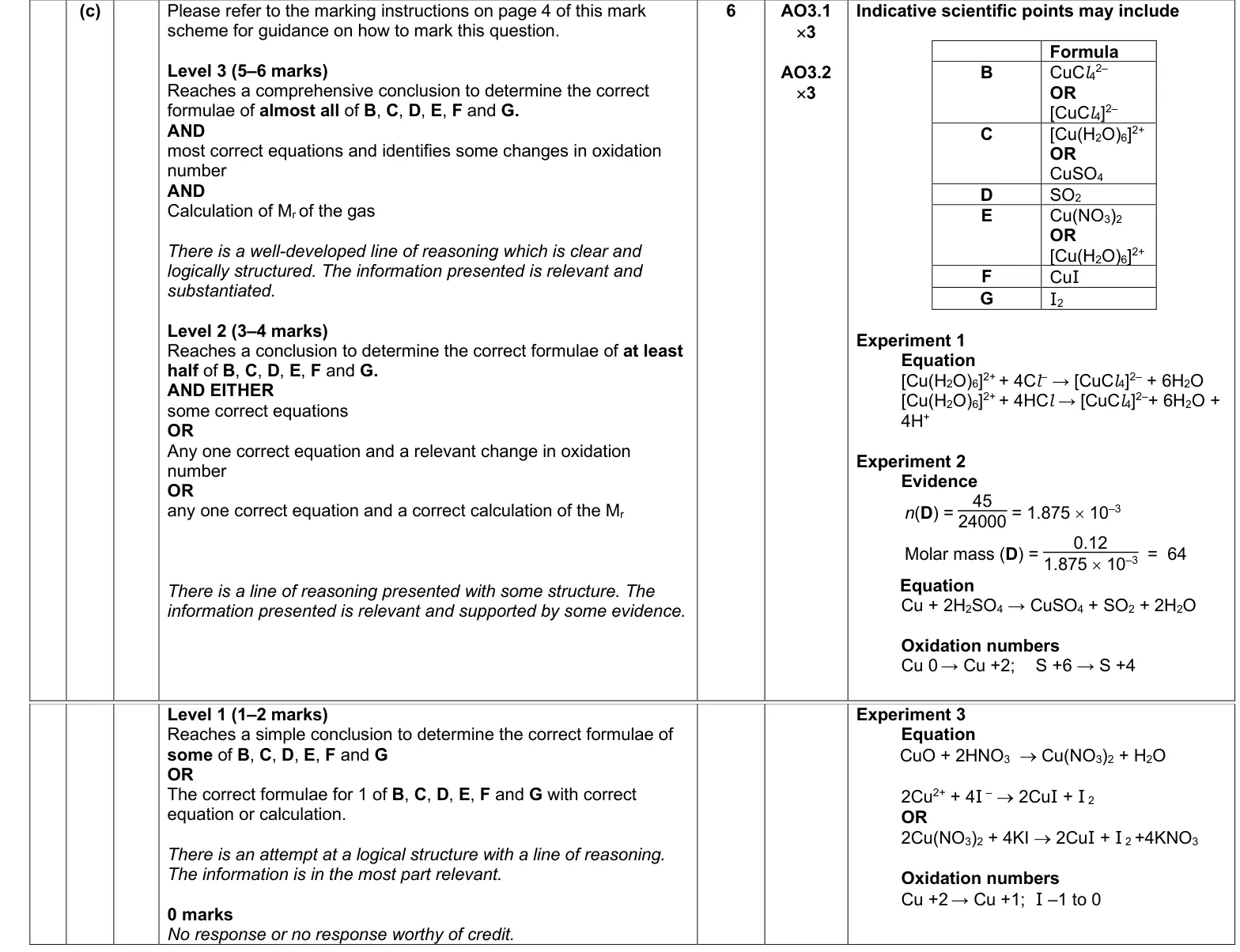
Notes from the mark scheme and report
B = [CuCl4]2–
D: n = 45/24000, M = 64 so SO2, C = CuSO4 with Cu 0 to +2 and S +6 to +4
E = Cu(NO3)2
F = CuI (white) and G = I2 with Cu +2 to +1 and I –1 to 0
Level 3 needs Mr calculation, most equations and some oxidation number changes
The AS delivery guide ‘Theme: Identifying Unknowns’ https://www.ocr.org.uk/Images/208563-identifying-unknowns.pdf ‘Transition elements’: Delivery Guide for OCR AS/A Level Chemistry A
Skills: M0.2 Use ratios, fractions and percentages; M2.3 Substitute numerical values into algebraic equations using appropriate units for physical quantities
June 2022 · AS Paper 1 · Q23(b)2 marksAO3Complete table/diagramHard
Mark scheme
Examiner's comment
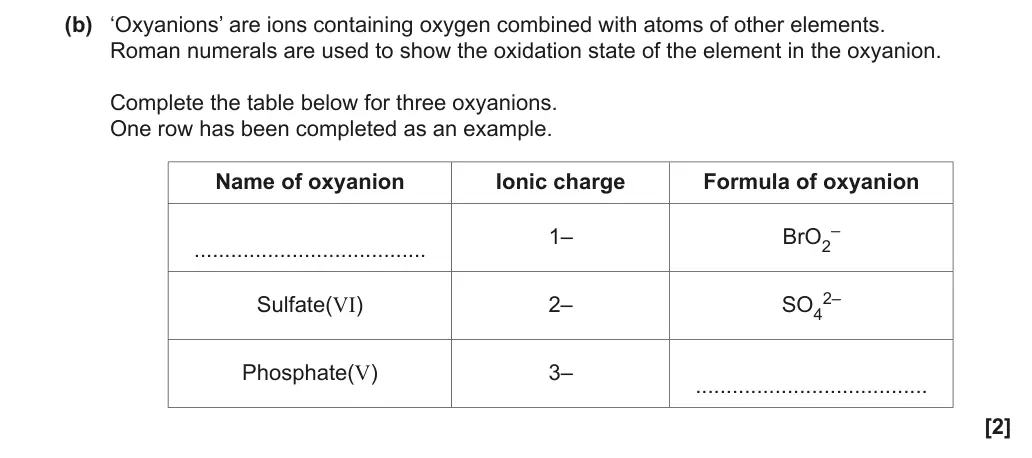
Although this question included important clues within the table, these were usually ignored by candidates and this item did not score as well as expected. The bromate(III) was poorly identified, with many candidates missing the oxidation state of the bromine. Many candidates wrote bromide, bromate without (III), bromide (III), bromate (VI) and other oxidation numbers. The phosphate ion was more familiar with many candidates identifying its formula as PO43–. A common error was the inclusion of the wrong number of oxygen atoms in the ion, such as PO5 with various charges.
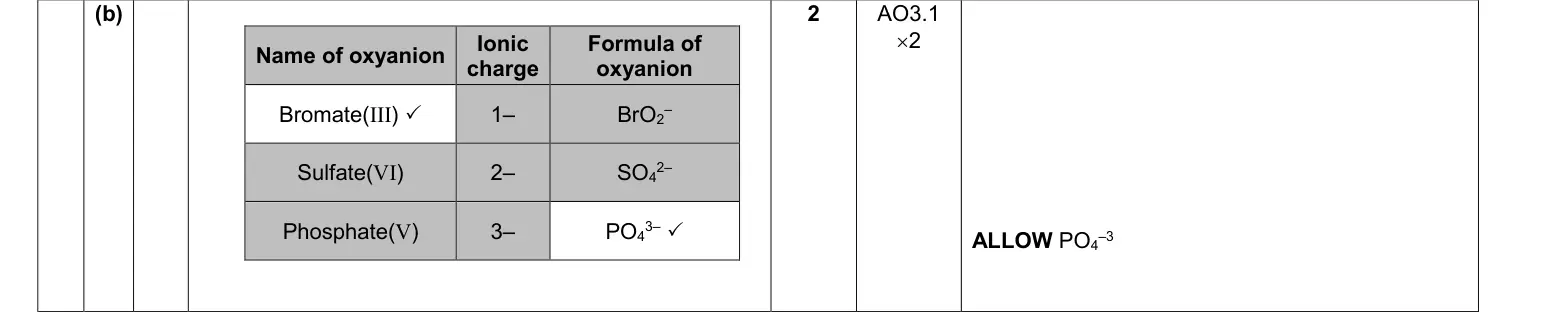
Notes from the mark scheme and report
bromate(III)
PO4 3– (ALLOW PO4 –3)
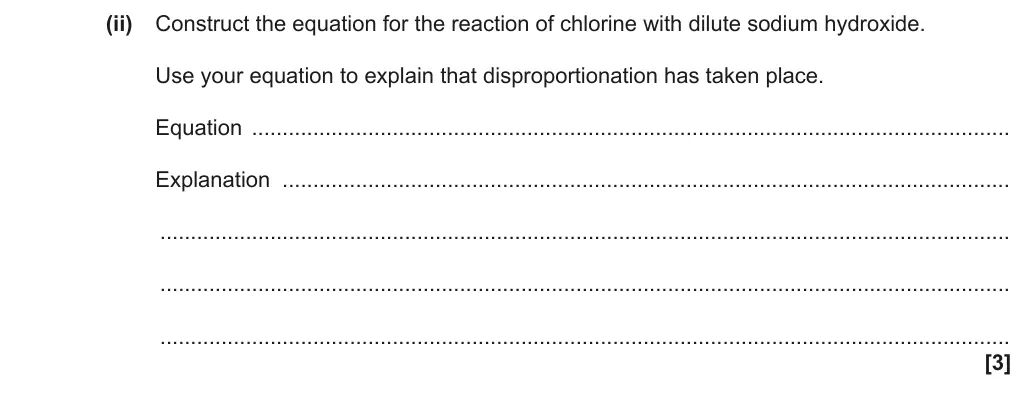
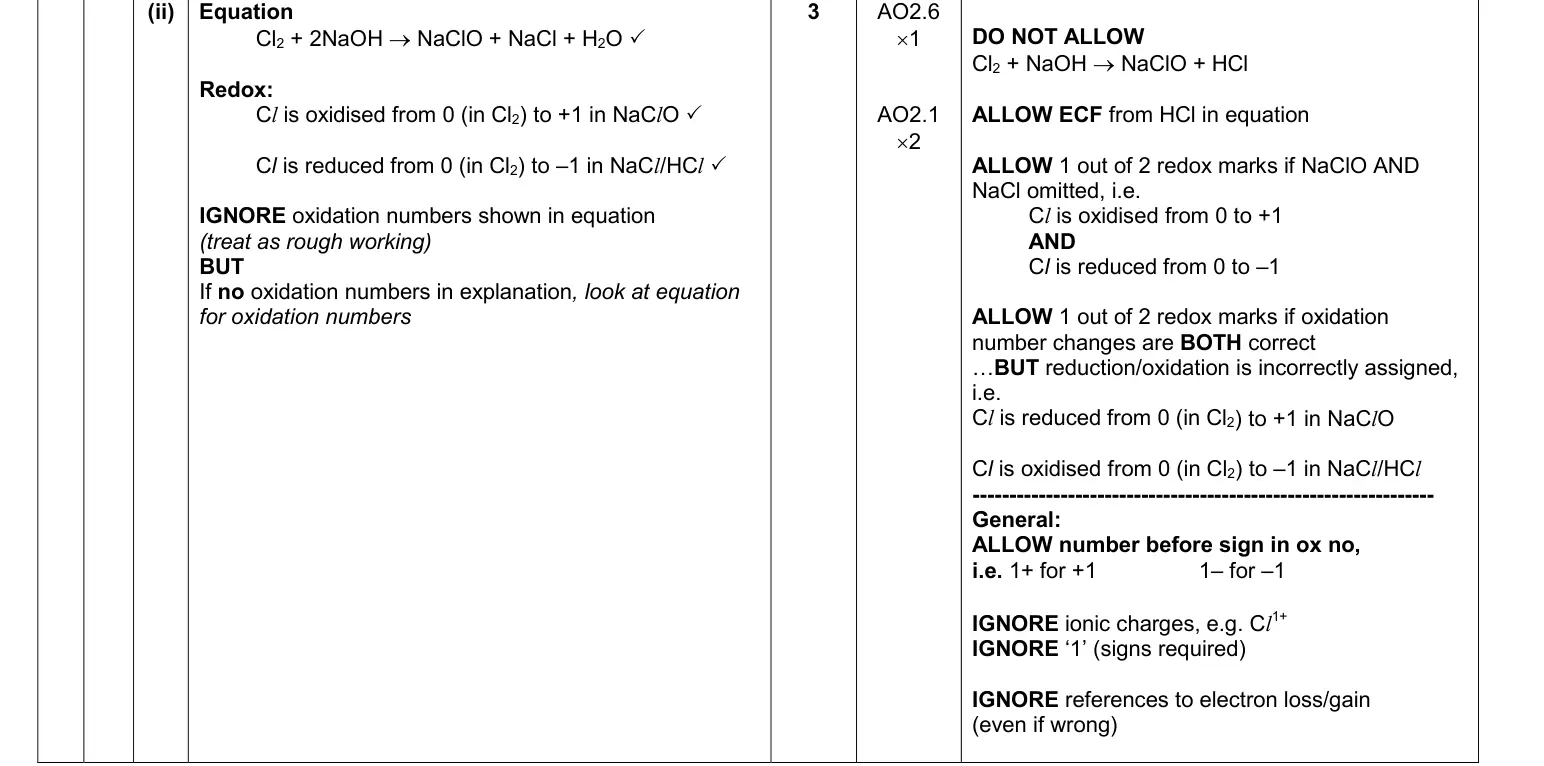
June 2022 · AS Paper 1 · Q24(a)(ii)3 marksAO2Equation writingMedium
Earlier part of question 24 that this part uses
Mark scheme
Examiner's comment
Candidates found the equation hard, despite this reaction being specification content and the inclusion in the earlier part of the stem of ‘NaClO’ as one product. The correct response required candidates to realise that NaCl would be a product and to balance the resulting equation. Some did not add the balancing ‘2’ before NaOH, and many selected HCl as the second product, a compound that would react further with NaOH to produce NaCl. The explanation worked the same whether NaCl or HCl had been identified as the second product. There were some excellent responses, providing the correct oxidation number changes, linking these to the species involved and identifying the changes as either oxidation or reduction. Two explanation marks were available with marks not being given for omission of one of the three features described above. This exemplar has been included to emphasise the points made above. It was only possible to award this response 1/3 marks. The equation shows the common error of the second chlorine-containing product being HCl and not NaCl: 0 marks The candidate has identified the oxidation number changes and has linked these to the correct species. The last statement in brackets is correct but the candidate has not communicated which oxidation number change is oxidation and which is reduction: 1/2 marks
Notes from the mark scheme and report
DO NOT ALLOW Cl2 + NaOH → NaClO + HCl
signs required on oxidation numbers
1 of 2 redox marks if changes correct but oxidation/reduction assigned the wrong way round
IGNORE electron loss/gain
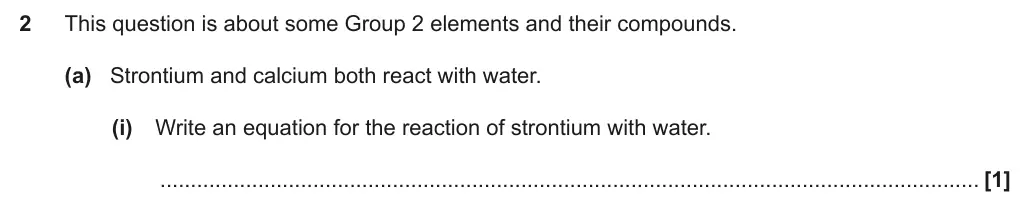
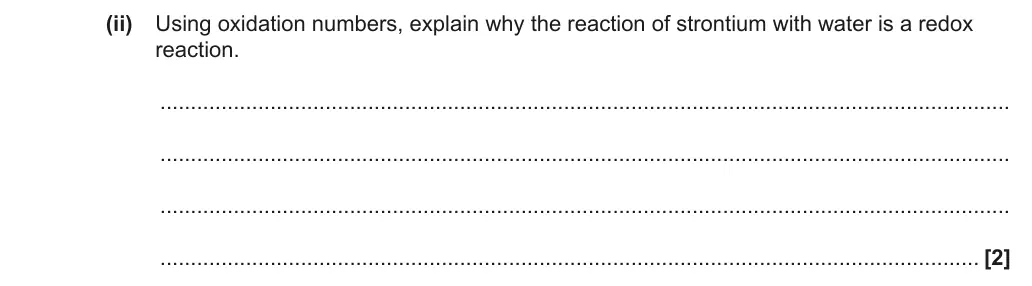
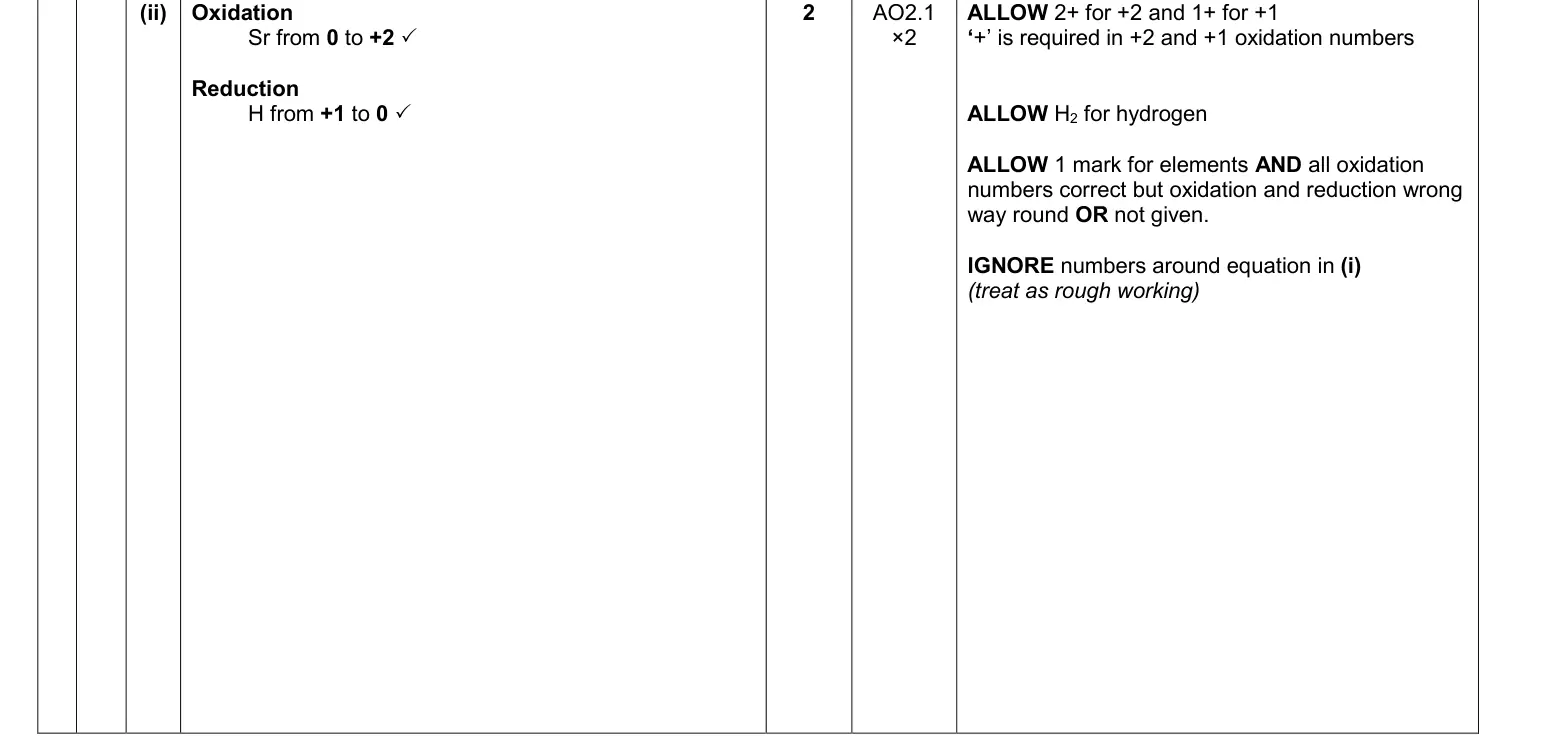
June 2022 · AS Paper 2 · Q2(a)(ii)2 marksAO2Short answerMedium
Earlier part of question 2 that this part uses
Mark scheme
Examiner's comment
Most candidates managed to score at least 1 mark for this question. The most common reason for losing a mark, despite demonstrating a good understanding of redox, was stating that H changed from +2 to 0 (need to give oxidation number per atom). Other errors seen included only giving change for Sr, descriptions in terms of electrons rather than oxidation numbers, Sr change from 0 to +1 (linked to SrOH), oxygen being reduced rather than H and mixing up oxidation/reduction or not specifying.
Notes from the mark scheme and report
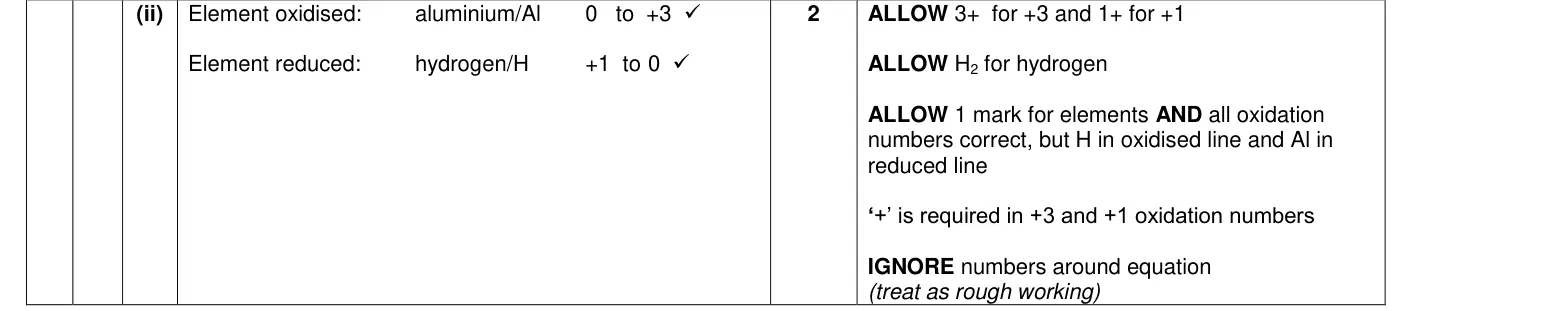
Sr 0 to +2 oxidation, H +1 to 0 reduction
'+' sign required
1 mark if all numbers correct but oxidation/reduction reversed or not given
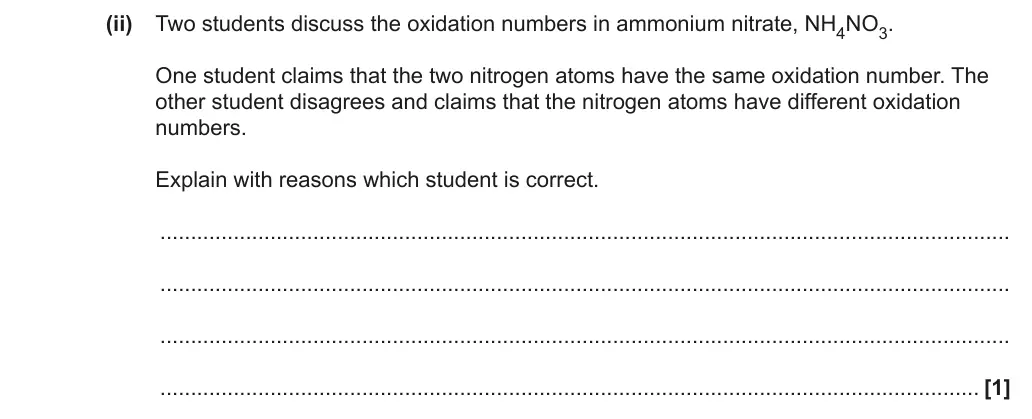
June 2022 · Paper 3 · Q1(a)(ii)1 markAO1Short answerHard
Earlier part of question 1 that this part uses
Mark scheme
Examiner's comment
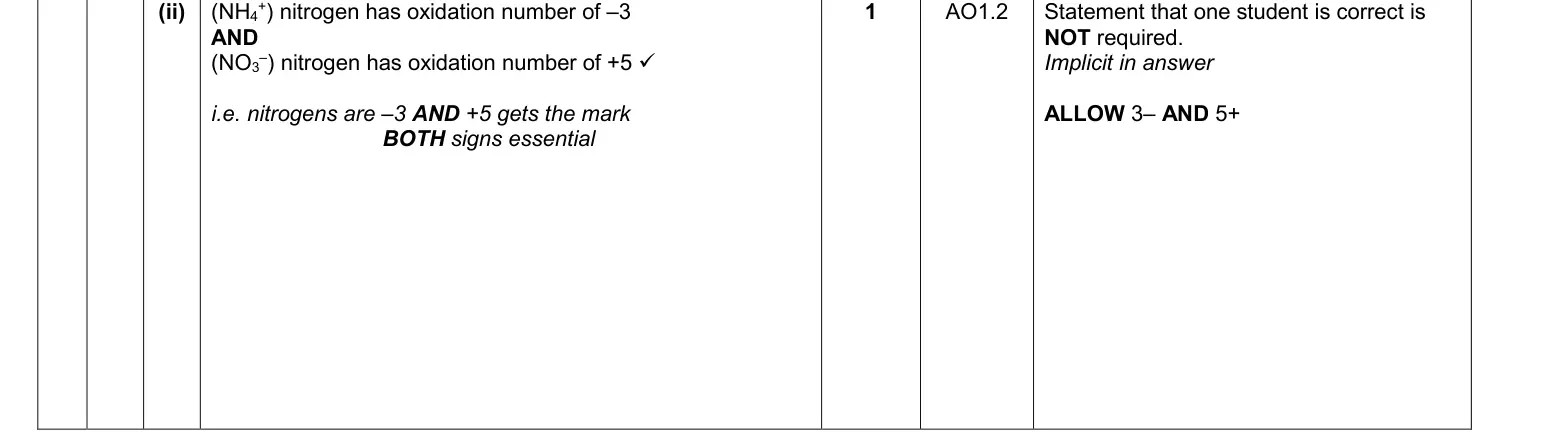
Considering the large number of candidates describing NH4NO3 as molecular in Question 1 (a) (i), most candidates identified here that NH4NO3 contains NH4+ and NO3– ions. Most then went on to show that the nitrogen atoms in the ions have different oxidation numbers: –3 and +5 respectively. Candidates were only given marks if both signs had been included and this was usually the case. –4 and +6 were common incorrect responses, presumably by ignoring the charges on the ions. Comparatively few candidates grouped the nitrogen atoms together and suggested that they had the same oxidation number.
Notes from the mark scheme and report
N in NH4+ is –3 AND N in NO3– is +5
both signs essential
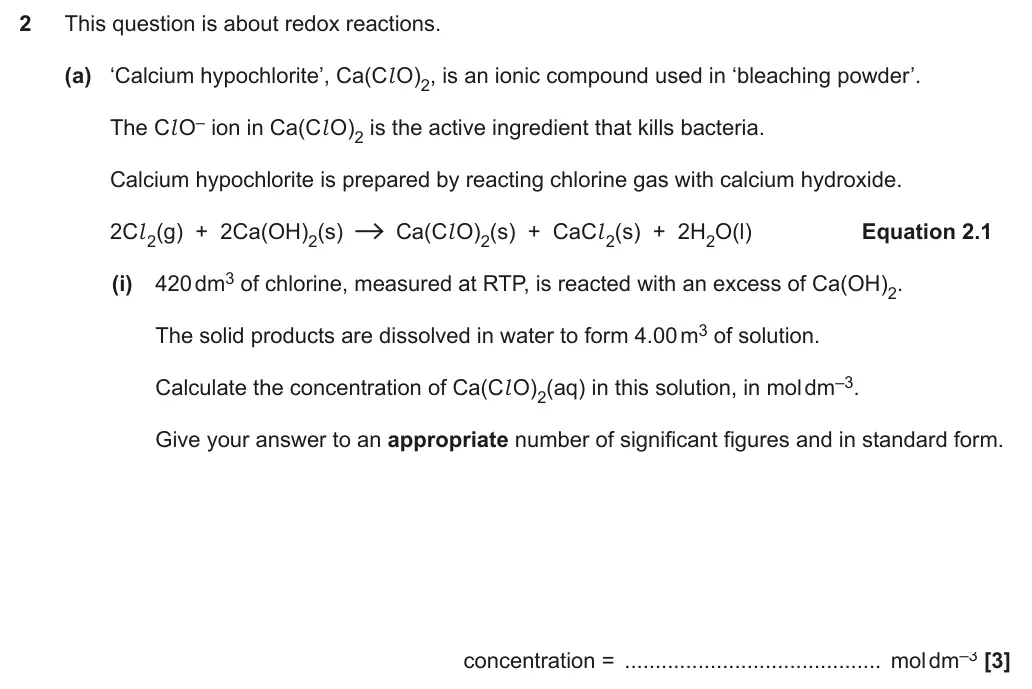
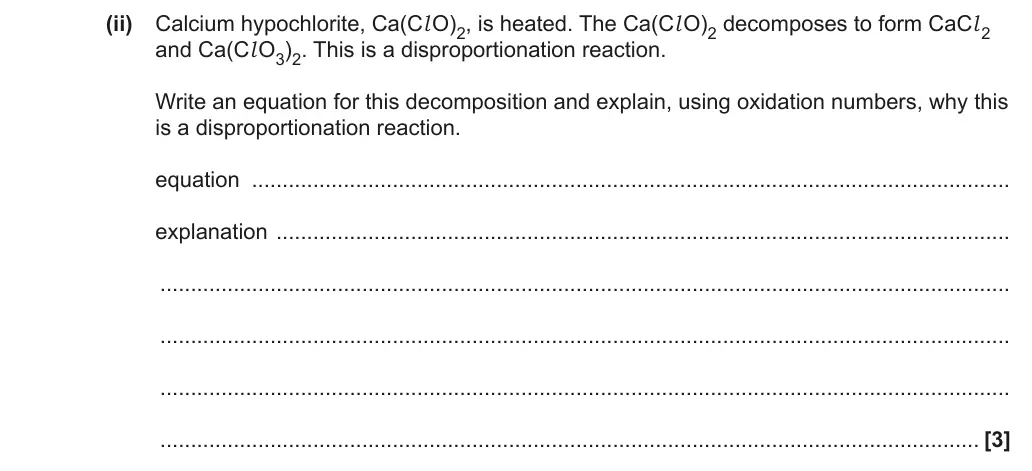
June 2022 · Paper 3 · Q2(a)(ii)3 marksAO1, 2Equation writingHard
Earlier part of question 2 that this part uses
Mark scheme
Examiner's comment
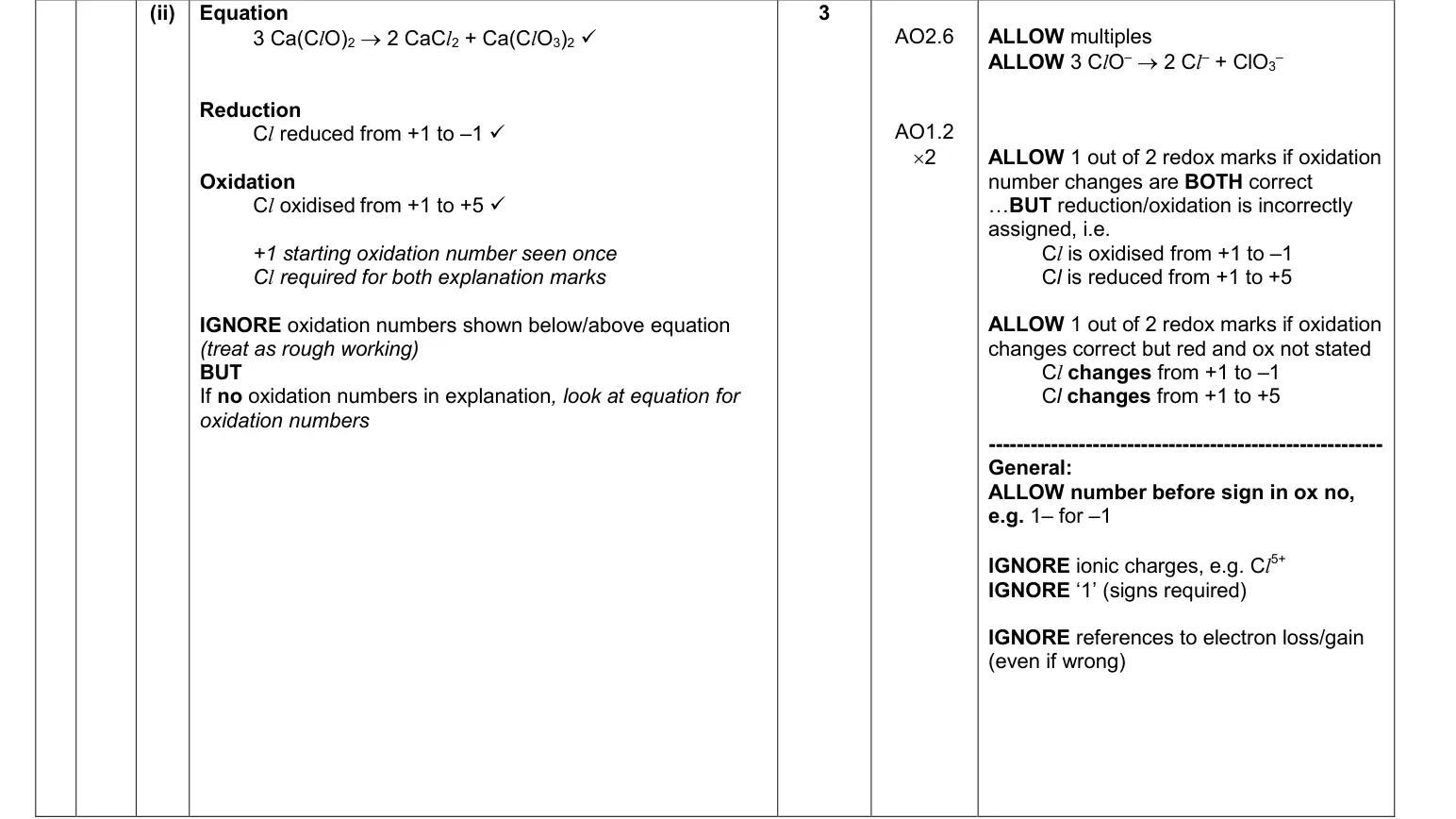
Candidates were required to write a balanced equation from provided reactants and products and to use oxidation numbers to illustrate disproportionation. In the equation, the reactants and products were sometimes unbalanced, or incorrectly balanced. A common error was to balance the equation after first adding O2 as an extra reactant. Illustrating disproportionation proved to be easier with the oxidation number changes from the initial +1 being required. Otherwise, more successful responses sometimes missed out on marks if they omitted detail. For example, the oxidation number changes were stated but the candidate omitted to state which change was oxidation and which was reduction. The best responses identified Ca(ClO3)2 as the oxidation product and CaCl2 as the reduction product. One unexpected error on many scripts was for calcium to be identified as the element undergoing disproportionation, with oxidation number changes from +6 to +14 and +2. It was difficult to see why this happened, with Ca forming +2 compounds, but the error was common.
Notes from the mark scheme and report
3Ca(ClO)2 → 2CaCl2 + Ca(ClO3)2
Cl reduced +1 to –1 and Cl oxidised +1 to +5
1 of 2 redox marks if changes correct but oxidation/reduction mis-assigned or not stated
signs required
IGNORE ionic charges such as Cl5+
November 2021 · Paper 1 · Q21 markMultiple choice
Answer
B
Mark scheme
November 2021 · Paper 1 · Q19(b)(i)2 marksAO2Short answer
Earlier part of question 19 that this part uses
Mark scheme
Notes from the mark scheme and report
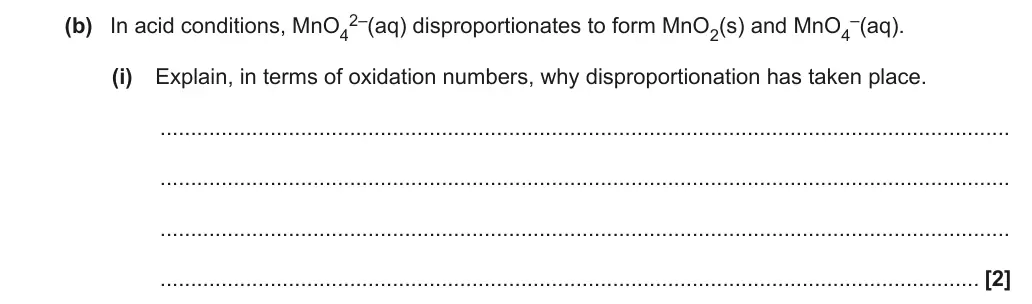
Mn oxidised from +6 to +7 AND reduced from +6 to +4
signs required
1 mark if numbers correct but not linked to oxidation/reduction
November 2021 · AS Paper 1 · Q23(b)2 marksAO1Data interpretation
Mark scheme
Notes from the mark scheme and report
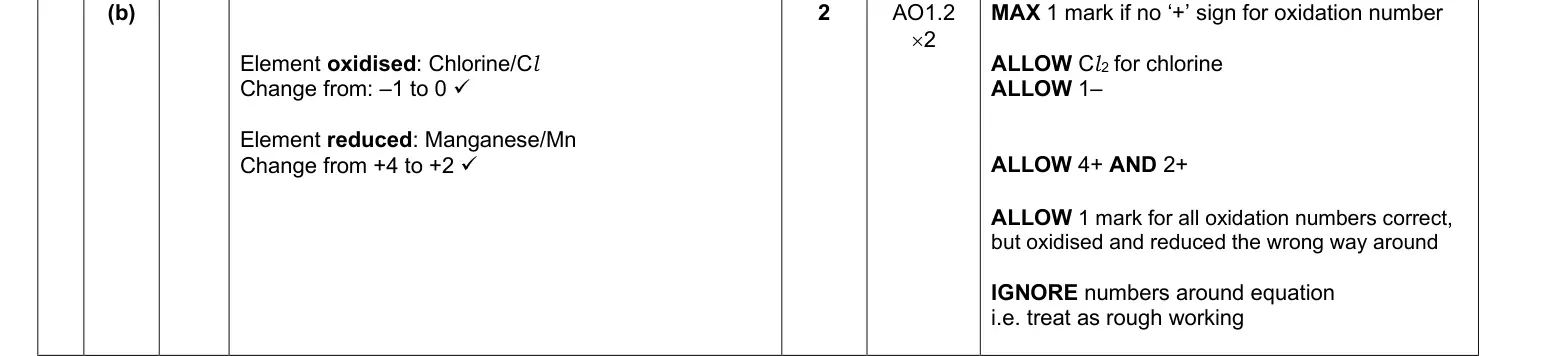
MAX 1 if no + sign for oxidation number
1 mark if all oxidation numbers correct but oxidised and reduced wrong way round
November 2021 · Paper 3 · Q1(e)4 marksAO2Equation writingHard
Mark scheme
Examiner's comment
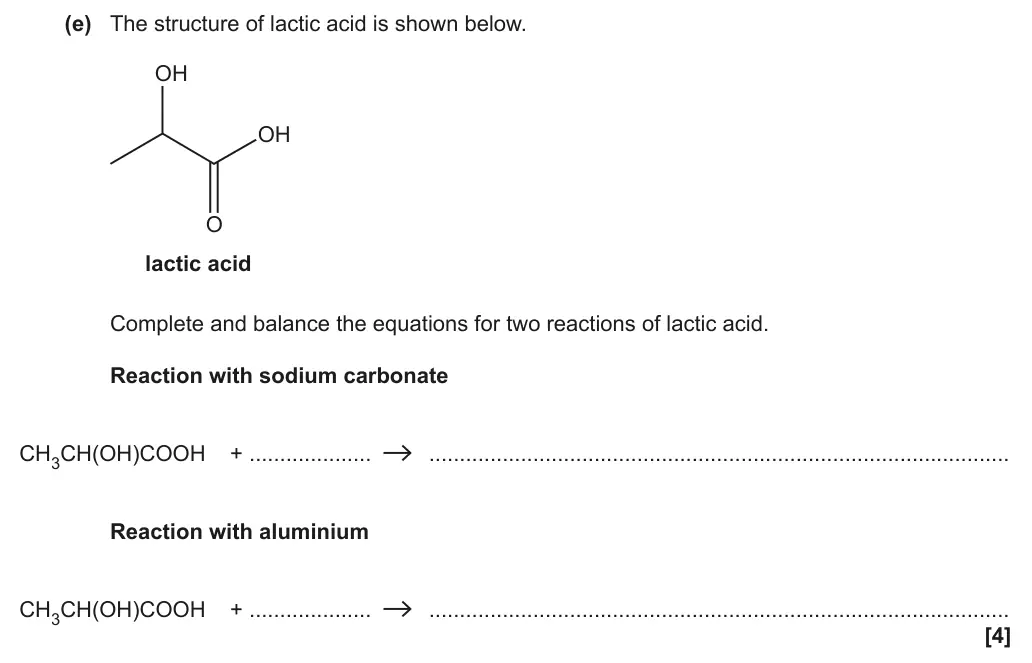
Q1(d), Q1(e), Q5(a)(i) • Unclear drawing of diagrams and labelling of laboratory apparatus: Q2(a) • Had difficulty explaining chemical ideas, often repeating the same points several times, e.g. Q1(e): Candidates needed to use their knowledge of reactions of carboxylic acids to construct two equations. See also comments made for Q1(e) and Q3(b).
Notes from the mark scheme and report
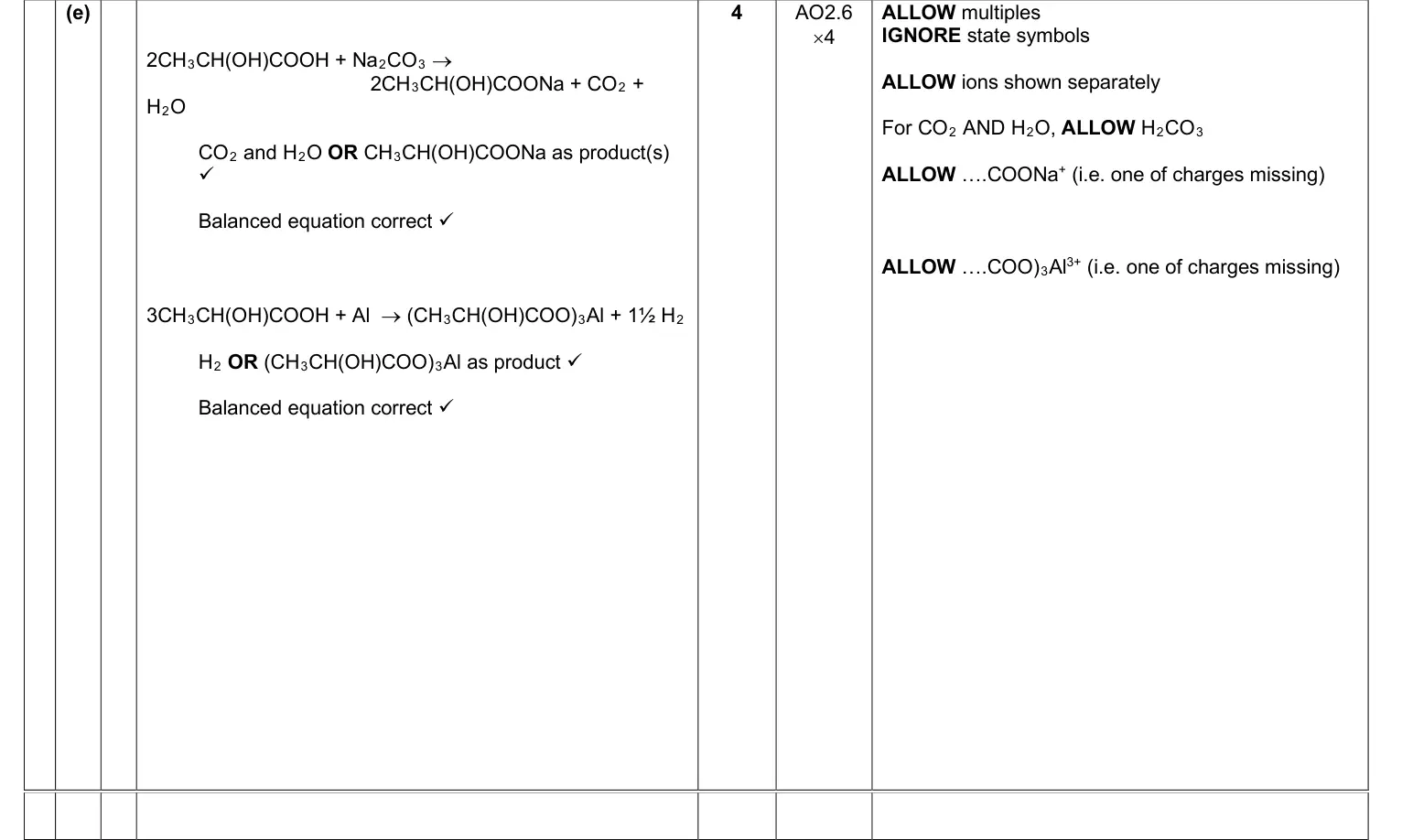
2:1 acid:Na2CO3 giving salt + CO2 + H2O
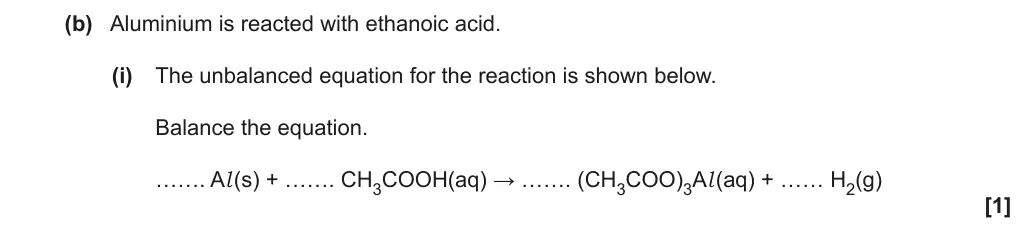
3 acid + Al → (CH3CH(OH)COO)3Al + 1½H2
alcohol OH does not react
ALLOW multiples
IGNORE state symbols
Skills: M0.2 Use ratios, fractions and percentages
November 2021 · Paper 3 · Q5(a)(i)2 marksAO1Equation writingHard
Mark scheme
Examiner's comment
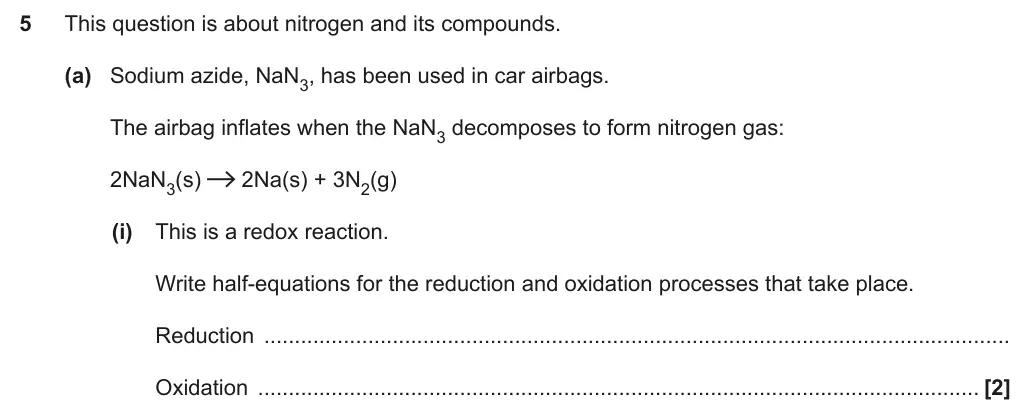
Q1(d), Q1(e), Q5(a)(i) • Unclear drawing of diagrams and labelling of laboratory apparatus: Q2(a) • Had difficulty explaining chemical ideas, often repeating the same points several times, e.g. Q5(a)(i) required candidates to write half equations for a redox reaction.
Notes from the mark scheme and report
reduction Na+ + e– → Na
oxidation 2N3– → 3N2 + 2e–
1 mark if both correct but wrong way round
ALLOW multiples
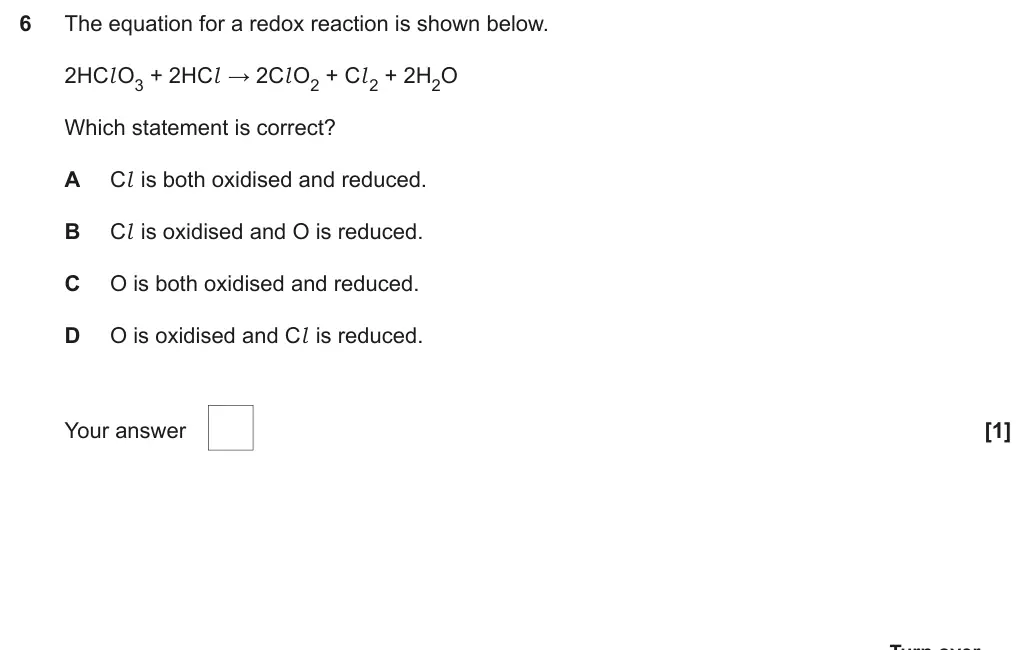
November 2020 · AS Paper 1 · Q61 markAO1Multiple choiceMedium
Answer
A
Mark scheme
Examiner's comment
Candidates performed well with this question. Most successful candidates wrote the oxidation numbers beneath the equation to work out that Cl is both oxidised and reduced. This is a good strategy.
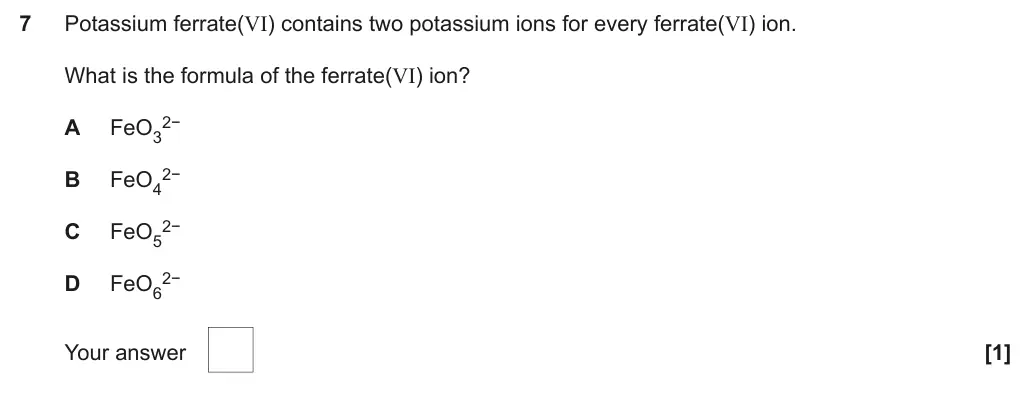
November 2020 · AS Paper 1 · Q71 markAO1Multiple choiceHard
Answer
B
Mark scheme
Examiner's comment
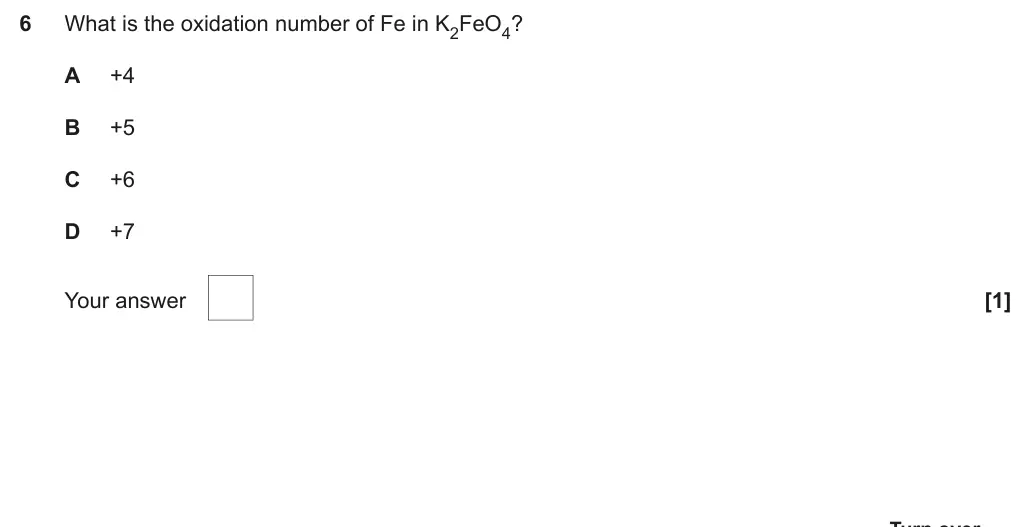
Candidates found this question difficult with less than half choosing B, FeO42–, as the correct response. There was no obvious key distractor, with A, C and D all being chosen by candidates.
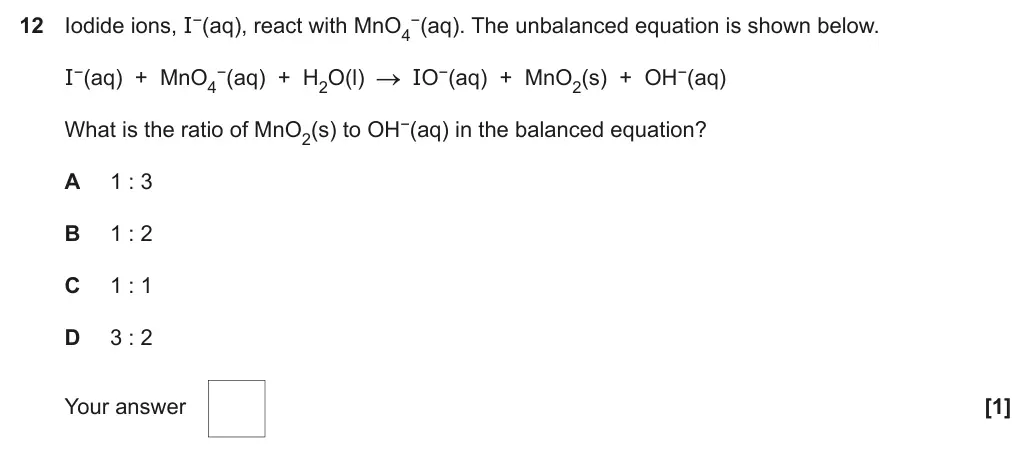
November 2020 · Paper 1 · Q121 markAO2Multiple choice
Answer
C
Mark scheme
Notes from the mark scheme and report
3I– + 2MnO4– + H2O → 3IO– + 2MnO2 + 2OH–
Skills: M0.2 Use ratios, fractions and percentages
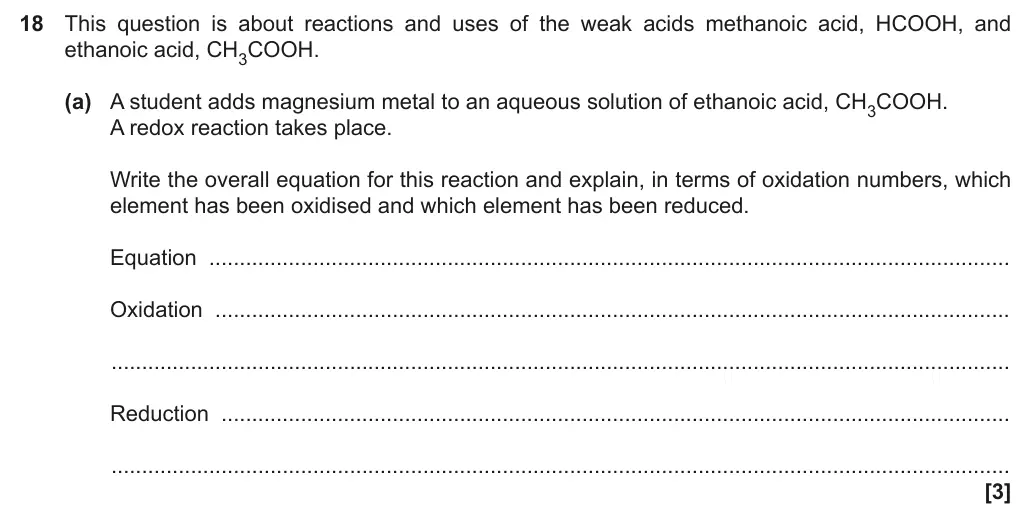
November 2020 · Paper 1 · Q18(a)3 marksAO1, 2Equation writing
Mark scheme
Notes from the mark scheme and report
Mg + 2CH3COOH → (CH3COO)2Mg + H2
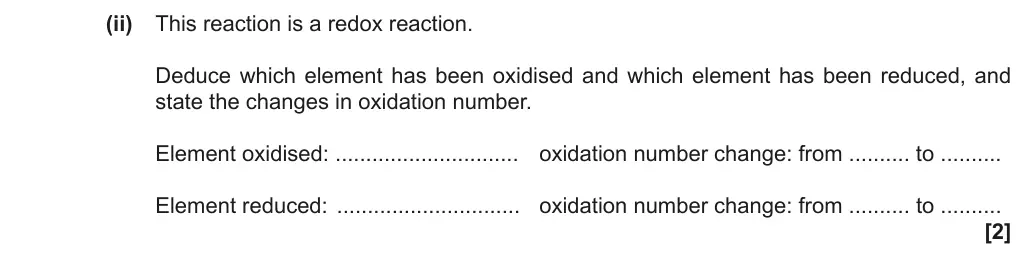
Mg 0 to +2 oxidised
H +1 to 0 reduced
1 mark for correct oxidation numbers wrongly linked to redox
November 2020 · Paper 1 · Q22(b)(ii)1 markAO2Short answer
Earlier part of question 22 that this part uses
Mark scheme
Notes from the mark scheme and report
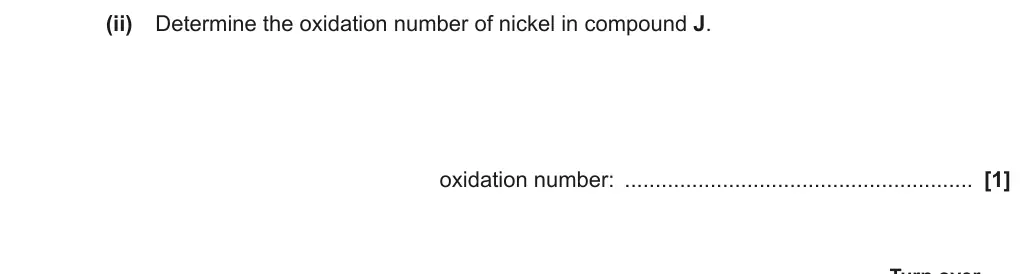
+2
+ sign required
November 2020 · AS Paper 2 · Q1(a)1 markAO2Short answerMedium
Mark scheme
Examiner's comment
For example, Question 1(a) justified using oxidation numbers rather than numbers of electrons and Question 3(b)(ii) giving the general trend in group 2 rather than comparing Ba and Ca.
Notes from the mark scheme and report
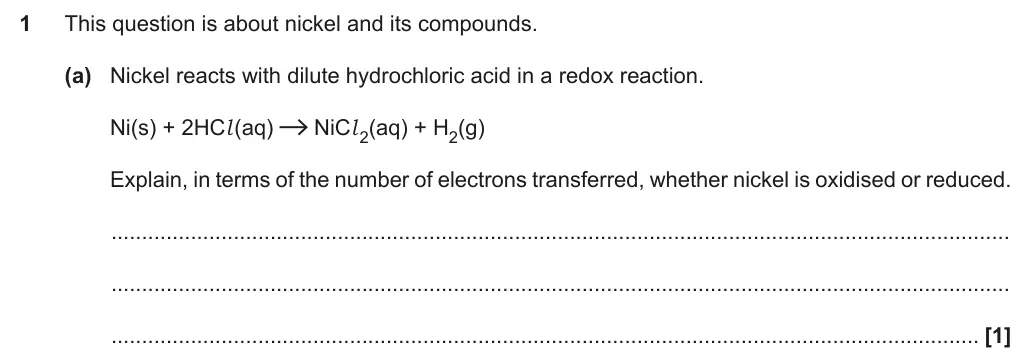
oxidised AND nickel has lost two electrons
IGNORE reference to oxidation numbers
November 2020 · AS Paper 2 · Q3(d)(i)1 markAO2Equation writingMedium
Mark scheme
Examiner's comment
3(a) More able candidates scored well in this question, setting out their answers in a logical order. They often first discussed Ca and its bonding and structure, linking this to the physical properties and then doing the same for Br. A number of candidates discussed the chemical properties of Ca and Br, such as their ability to bond with other elements, ionisation energy and their reactivity based on their position in the periodic table. Some candidates gave a good description of metallic bonding but then went on to discuss melting point in terms of intermolecular forces. 3(b)(i) Most candidates were able to give the correct diagrams for ionic bonding, although care needs to be taken that diagrams are well drawn with both charges given. Some gave diagrams for covalent bonding. 3(b)(ii) It was important to answer the question asked. A number of responses lost marks for describing the general trend down group 2 without making reference at all to calcium and barium. Most candidates managed to score at least one mark here but a considerable proportion missed the second marking point explaining that nuclear attraction was less in Ba. 3(c)(i) This was dependent on candidates’ ability to give correct formula of aluminium hydroxide, Al(OH)3. Writing correct formulae is an important skill in chemistry, which should be practised regularly in different topics to help candidates master the skill. 3(c)(ii) Most candidates were able to recognise that water had the higher boiling point due to hydrogen bonding. However, it was evident in a number of responses that they were unclear that this is an example of an intermolecular force and doesn’t just refer to the covalent bond formed between O and H. Most avoided discussing the intermolecular forces present in H2Se even although both London forces and permanent dipole-dipole interactions were accepted as they may not have come across this specific example and had not been given electronegativity data. 3(d)(i) Very few candidates scored this mark. Although a number of candidates did give sodium bromate as the answer (with the omission of the oxidation state), many other answers were seen suggesting candidates are not aware of naming conventions for inorganic compounds. 3(d)(ii) This is the first time in a reformed chemistry AS paper that the question space has been left unstructured for oxidation number changes. The highest-attaining candidates set out their responses clearly, dealing with changes for oxidation and reduction separately, and giving the correct oxidation numbers. Some struggled to obtain an oxidation state of Br in NaBrO3 as +5, suggesting +1 instead.
Notes from the mark scheme and report
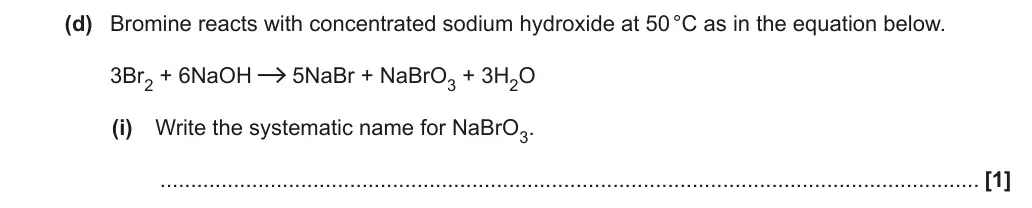
sodium bromate(V)
November 2020 · AS Paper 2 · Q3(d)(ii)3 marksAO1, 2Data interpretationMedium
Earlier part of question 3 that this part uses
Mark scheme
Examiner's comment
3(a) More able candidates scored well in this question, setting out their answers in a logical order. They often first discussed Ca and its bonding and structure, linking this to the physical properties and then doing the same for Br. A number of candidates discussed the chemical properties of Ca and Br, such as their ability to bond with other elements, ionisation energy and their reactivity based on their position in the periodic table. Some candidates gave a good description of metallic bonding but then went on to discuss melting point in terms of intermolecular forces. 3(b)(i) Most candidates were able to give the correct diagrams for ionic bonding, although care needs to be taken that diagrams are well drawn with both charges given. Some gave diagrams for covalent bonding. 3(b)(ii) It was important to answer the question asked. A number of responses lost marks for describing the general trend down group 2 without making reference at all to calcium and barium. Most candidates managed to score at least one mark here but a considerable proportion missed the second marking point explaining that nuclear attraction was less in Ba. 3(c)(i) This was dependent on candidates’ ability to give correct formula of aluminium hydroxide, Al(OH)3. Writing correct formulae is an important skill in chemistry, which should be practised regularly in different topics to help candidates master the skill. 3(c)(ii) Most candidates were able to recognise that water had the higher boiling point due to hydrogen bonding. However, it was evident in a number of responses that they were unclear that this is an example of an intermolecular force and doesn’t just refer to the covalent bond formed between O and H. Most avoided discussing the intermolecular forces present in H2Se even although both London forces and permanent dipole-dipole interactions were accepted as they may not have come across this specific example and had not been given electronegativity data. 3(d)(i) Very few candidates scored this mark. Although a number of candidates did give sodium bromate as the answer (with the omission of the oxidation state), many other answers were seen suggesting candidates are not aware of naming conventions for inorganic compounds. 3(d)(ii) This is the first time in a reformed chemistry AS paper that the question space has been left unstructured for oxidation number changes. The highest-attaining candidates set out their responses clearly, dealing with changes for oxidation and reduction separately, and giving the correct oxidation numbers. Some struggled to obtain an oxidation state of Br in NaBrO3 as +5, suggesting +1 instead.
Notes from the mark scheme and report
same element both oxidised (0 to +5) and reduced (0 to –1)
1 mark if all three oxidation numbers correct but oxidation/reduction mis-assigned
November 2020 · Paper 3 · Q4(a)(i)3 marksAO2Equation writingMedium
Mark scheme
Examiner's comment
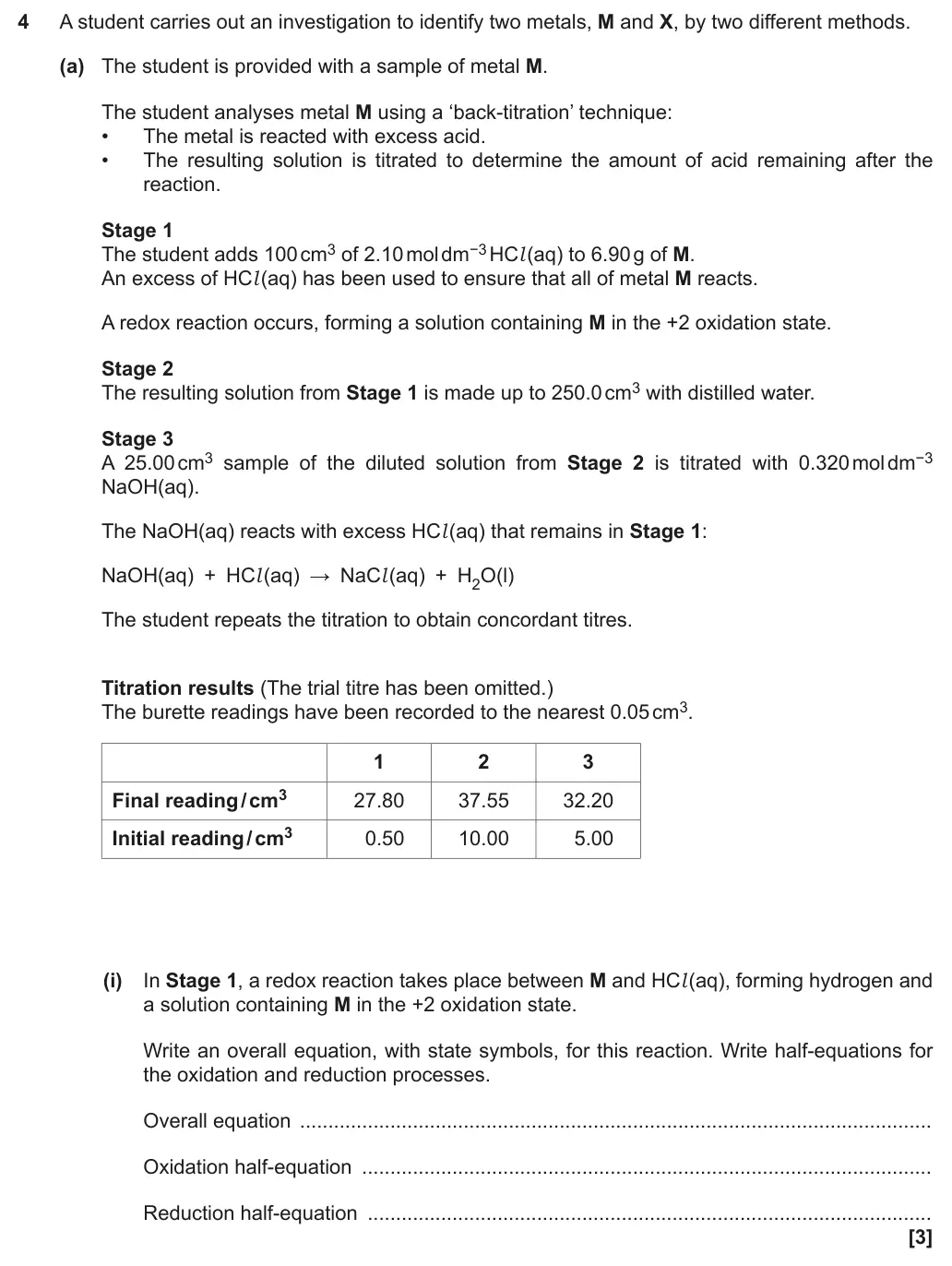
4(a)(i) This question required candidates to write an overall equation and half equations for oxidation and reduction. Many candidates made errors within one or more equations. The overall equation was often written without state symbols, despite the question instruction ‘with state symbols’. The oxidation half equation was more likely to be correct than the reduction half equation, which often used Cl instead of H+. When H+ was used, the half equation was often unbalanced or electrons had been omitted. It is recommended that candidates carefully use the chemical information in the question. 4(a)(ii) Most candidates identified that all the metal would have reacted when it had all disappeared and that gas bubbles from the reaction would have stopped. Some responses did not emphasise that these observations would have stopped and this prevented credit being given. 4(a)(iii) The ionic equation for neutralisation of an acid with an alkali was well known and this question was answered correctly by most candidates. 4(a)(iv) Candidates were presented with information about a back titration, a technique that they would be unlikely to have encountered during their course. The question stem to 4a(iv) suggested a three-step strategy. Many candidates followed this guidance and were credited with many of the available marks. Marks were given for a correct method (by error carried forward) even if there was an error or omission in the multi-step calculation. This emphasises the importance of clear working. Most candidates determined the correct mean titre of 27.25 cm3. A few candidates did take the mean of all three titres rather than the closest. Most calculated that 8.72 × 10⁻³ mol of NaOH reacted with the same number of moles of HCl in the titration and then scaled up the HCl by a factor of 10 to 8.72 × 10⁻² mol in the 250 cm3 volumetric flask. These steps are standard for many titration calculations and gave a route to three of the six available marks. The more difficult back titration steps then followed and the higher-attaining candidates recognised the need to subtract this amount of HCl from the original amount of HCl used to react with metal M. These candidates then divide this value by two to find the moles of M that reacted (from the 1 : 2 stoichiometry of M : HCl). The correct calculation then gave a relative atomic mass of M as 112 and its identity as cadmium. It was common for candidates to omit the division by two and to arrive at a relative atomic mass of 56 for iron. The mark scheme shows the variety of metals that candidates identified from their calculations, the errors made, and the error carried forward marks that resulted. Many lower-attaining candidates did not follow the 3 steps in the stem, using only the original amount of HCl and ignoring the titration. This approach was not credited with marks. A large range of marks was seen, and the question discriminated extremely well. 4(b)(i) This straightforward mole calculation required candidates to determine the mass of CO2 as 2.75 g from the table of results and to divide this value by the molar mass of CO2 to arrive at 0.0625 mol. Most candidates were successful. As with other questions providing raw experimental results, lower-attaining candidates often chose the wrong data from the supplied results. 4(b)(ii) Many candidates used their value from 4b(i) with the mass of X2CO3 from the results table to obtain a value for the molar mass (233.13 from 14.57 ÷ 0.0625). Higher-attaining candidates obtained a value for the atomic mass of X (86.56 from 233.13) and identified X as the Group 1 metal rubidium. Some candidates did not recognise the significance of the formula of X2CO3 and identified X instead as strontium (Ar = 87.6). Lower-attaining candidates often used incorrect data from the supplied information and made little progress with this calculation. 4(c)(i) Most candidates suggested that the mass of the flask and contents could be reweighed until the mass no longer changed. An alternative creditworthy suggestion was to attach a gas syringe and to measure the gas volume until it no longer changed. Vague suggestions such as ‘leave for longer’ were not credited with marks. 4(c)(ii) Candidates found this question challenging. Success required candidates to appreciate that some CO2 dissolving would result in less mass of CO2 being recorded as lost, meaning that less moles of CO2 had apparently been formed and so less moles of X2CO3 had reacted. Using n = m/M, this would show that the calculated molar mass of X2CO3 appears to be greater. Only the highest-attaining candidates successfully navigated this question.
Notes from the mark scheme and report
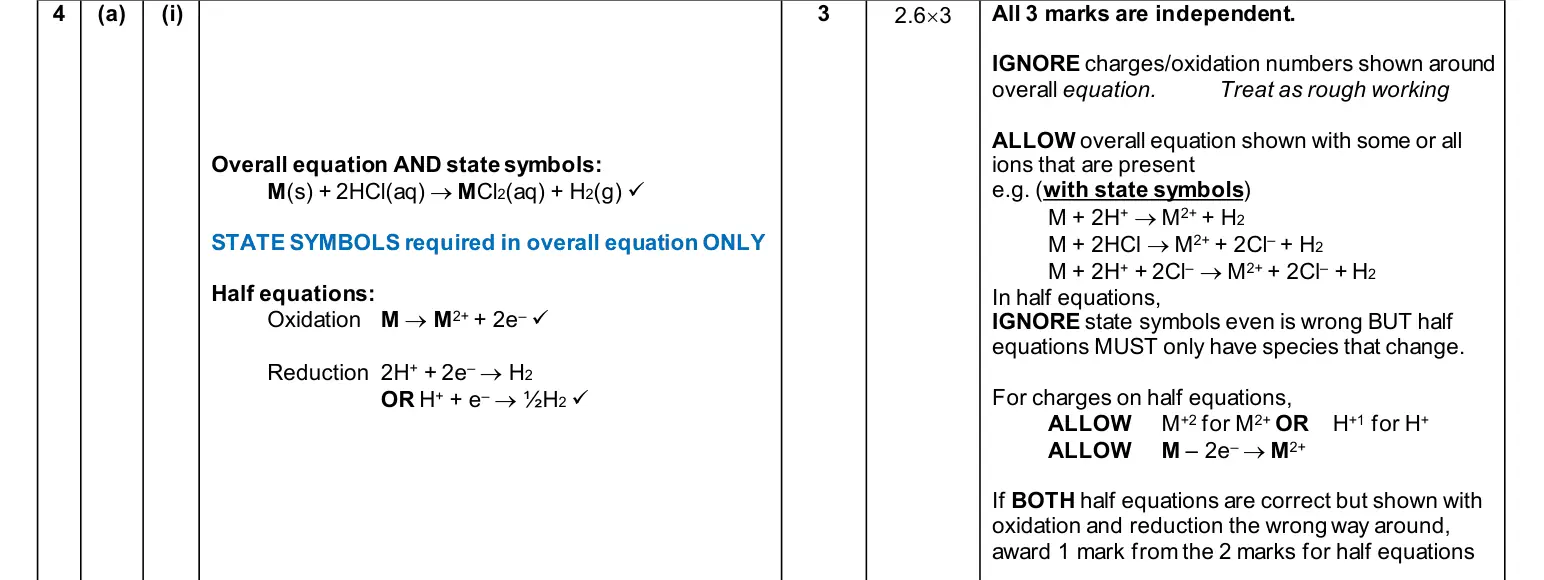
M(s) + 2HCl(aq) → MCl2(aq) + H2(g) - state symbols required in overall equation only
M → M2+ + 2e–
2H+ + 2e– → H2
half-equations must only contain species that change
1 mark if both correct but oxidation/reduction swapped
November 2020 · Paper 3 · Q4(a)(ii)2 marksAO3Short answerMedium
Earlier part of question 4 that this part uses
Mark scheme
Examiner's comment
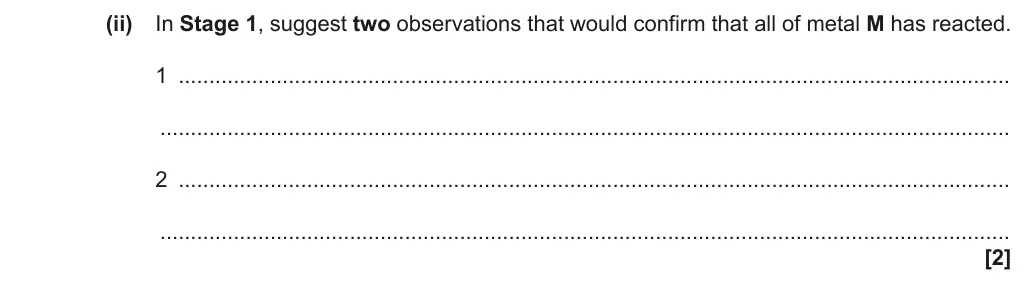
4(a)(i) This question required candidates to write an overall equation and half equations for oxidation and reduction. Many candidates made errors within one or more equations. The overall equation was often written without state symbols, despite the question instruction ‘with state symbols’. The oxidation half equation was more likely to be correct than the reduction half equation, which often used Cl instead of H+. When H+ was used, the half equation was often unbalanced or electrons had been omitted. It is recommended that candidates carefully use the chemical information in the question. 4(a)(ii) Most candidates identified that all the metal would have reacted when it had all disappeared and that gas bubbles from the reaction would have stopped. Some responses did not emphasise that these observations would have stopped and this prevented credit being given. 4(a)(iii) The ionic equation for neutralisation of an acid with an alkali was well known and this question was answered correctly by most candidates. 4(a)(iv) Candidates were presented with information about a back titration, a technique that they would be unlikely to have encountered during their course. The question stem to 4a(iv) suggested a three-step strategy. Many candidates followed this guidance and were credited with many of the available marks. Marks were given for a correct method (by error carried forward) even if there was an error or omission in the multi-step calculation. This emphasises the importance of clear working. Most candidates determined the correct mean titre of 27.25 cm3. A few candidates did take the mean of all three titres rather than the closest. Most calculated that 8.72 × 10⁻³ mol of NaOH reacted with the same number of moles of HCl in the titration and then scaled up the HCl by a factor of 10 to 8.72 × 10⁻² mol in the 250 cm3 volumetric flask. These steps are standard for many titration calculations and gave a route to three of the six available marks. The more difficult back titration steps then followed and the higher-attaining candidates recognised the need to subtract this amount of HCl from the original amount of HCl used to react with metal M. These candidates then divide this value by two to find the moles of M that reacted (from the 1 : 2 stoichiometry of M : HCl). The correct calculation then gave a relative atomic mass of M as 112 and its identity as cadmium. It was common for candidates to omit the division by two and to arrive at a relative atomic mass of 56 for iron. The mark scheme shows the variety of metals that candidates identified from their calculations, the errors made, and the error carried forward marks that resulted. Many lower-attaining candidates did not follow the 3 steps in the stem, using only the original amount of HCl and ignoring the titration. This approach was not credited with marks. A large range of marks was seen, and the question discriminated extremely well. 4(b)(i) This straightforward mole calculation required candidates to determine the mass of CO2 as 2.75 g from the table of results and to divide this value by the molar mass of CO2 to arrive at 0.0625 mol. Most candidates were successful. As with other questions providing raw experimental results, lower-attaining candidates often chose the wrong data from the supplied results. 4(b)(ii) Many candidates used their value from 4b(i) with the mass of X2CO3 from the results table to obtain a value for the molar mass (233.13 from 14.57 ÷ 0.0625). Higher-attaining candidates obtained a value for the atomic mass of X (86.56 from 233.13) and identified X as the Group 1 metal rubidium. Some candidates did not recognise the significance of the formula of X2CO3 and identified X instead as strontium (Ar = 87.6). Lower-attaining candidates often used incorrect data from the supplied information and made little progress with this calculation. 4(c)(i) Most candidates suggested that the mass of the flask and contents could be reweighed until the mass no longer changed. An alternative creditworthy suggestion was to attach a gas syringe and to measure the gas volume until it no longer changed. Vague suggestions such as ‘leave for longer’ were not credited with marks. 4(c)(ii) Candidates found this question challenging. Success required candidates to appreciate that some CO2 dissolving would result in less mass of CO2 being recorded as lost, meaning that less moles of CO2 had apparently been formed and so less moles of X2CO3 had reacted. Using n = m/M, this would show that the calculated molar mass of X2CO3 appears to be greater. Only the highest-attaining candidates successfully navigated this question.
Notes from the mark scheme and report
ALL fizzing has stopped
ALL the metal has dissolved ('metal disappears' not quite enough)
IGNORE constant mass and no temperature increase
June 2019 · Paper 1 · Q21 markAO1Multiple choiceHard
Answer
C
Mark scheme
Examiner's comment
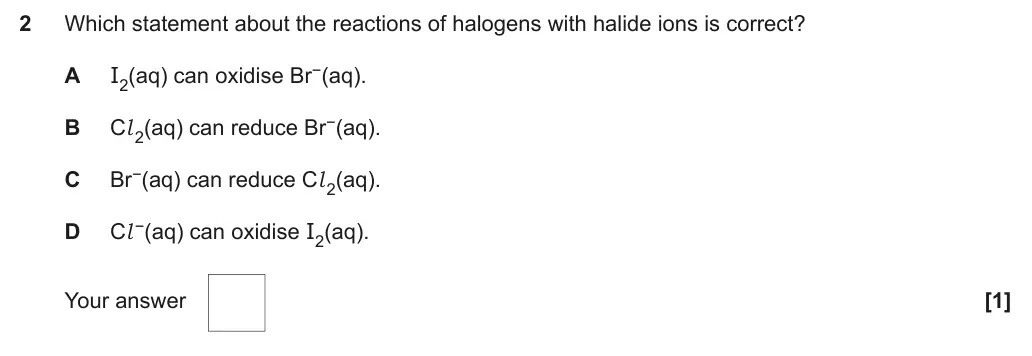
This question proved to be difficult, with only the most able candidates selecting the correct answer of C. Many candidates confused the trends in oxidising power of the halogens with trends in the reducing power of the halide ions. Down the group, the oxidising power of the halogens decreases but the reducing power of the halide ions increases. Option A is incorrect because iodine is a weaker oxidising agent than bromine, option B (the most common incorrect answer) is incorrect because chlorine is not a reducing agent (it’s an oxidising agent) and option D is incorrect because the chloride ion is not an oxidising agent (it’s a reducing agent).
June 2019 · Paper 1 · Q51 markAO1Multiple choiceMedium
Answer
B
Mark scheme
Examiner's comment
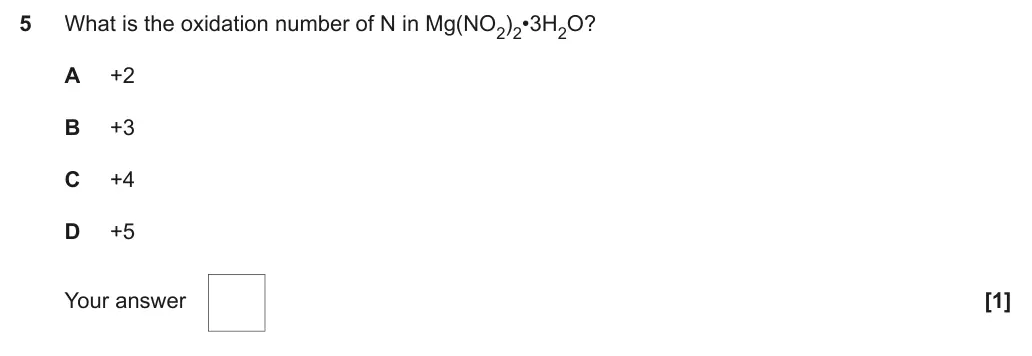
The correct answer B required candidates to assign correct oxidation numbers to Mg and O. The most common error was option A (+2), obtained by candidates thinking that O has an oxidation number of -1
June 2019 · Paper 1 · Q61 markAO1Multiple choiceEasy
Answer
D
Mark scheme
Examiner's comment
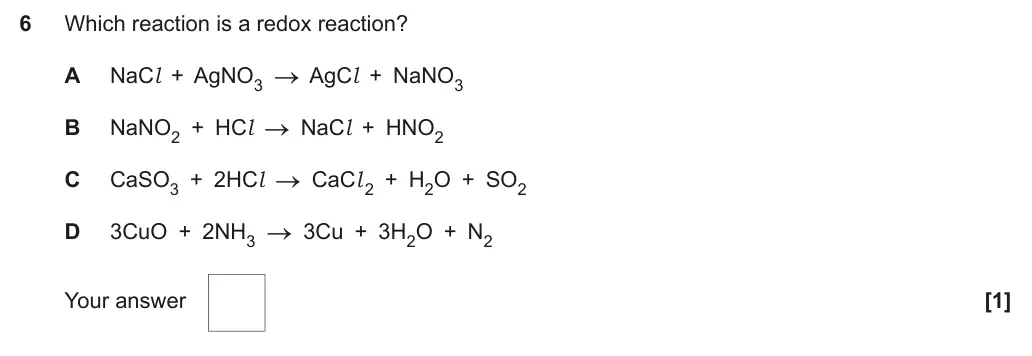
This was generally well answered. The key to candidates quickly arriving at the correct answer (D) was to focus on the first compound in each equation. Good candidates could see clearly that the CuO in option D had been reduced to Cu. Some candidates lost time here by working out oxidation numbers for all the elements in all the equations.
June 2019 · AS Paper 1 · Q81 markAO1Multiple choice
Answer
D
Mark scheme
June 2019 · AS Paper 1 · Q91 markAO2Multiple choiceMedium
Answer
D
Mark scheme
Examiner's comment
Despite most scripts being covered with annotations of oxidation numbers, only about half of all candidates obtained the correct answer of D.. Option B was the most common incorrect response, followed by option C. The annotations on these scripts often showed incorrect assignments of oxidation numbers.
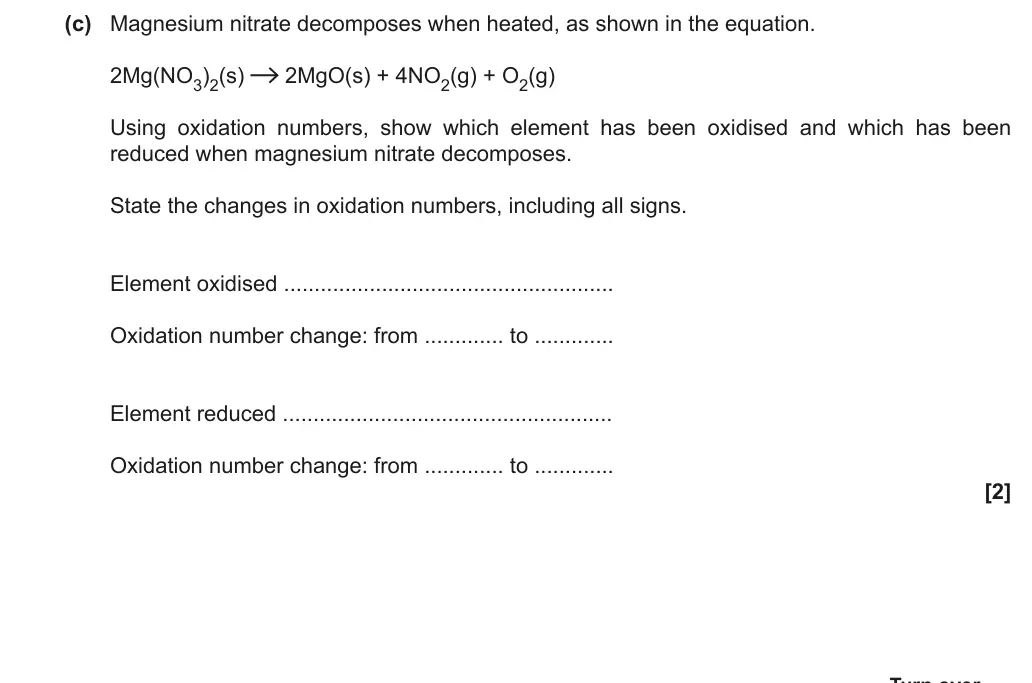
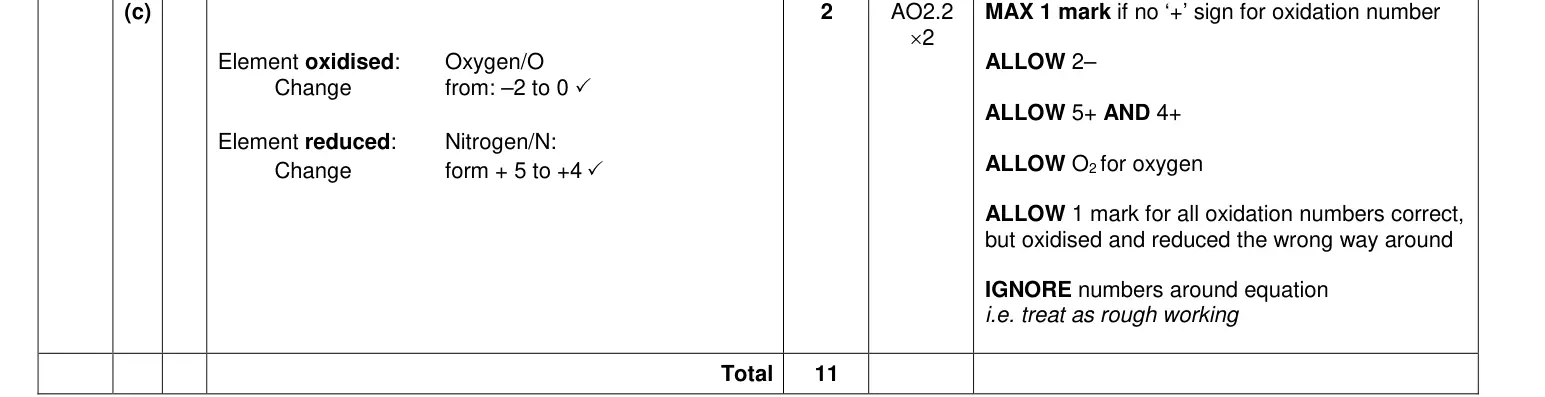
June 2019 · AS Paper 2 · Q2(c)2 marksAO2Short answerMedium
Mark scheme
Examiner's comment
Less than half the candidates answered this question correctly. This may be because they are not used to assigning oxidation numbers within formulae that contain brackets.
Notes from the mark scheme and report
O oxidised –2 to 0, N reduced +5 to +4
MAX 1 if no '+' sign
1 mark if all numbers correct but oxidised/reduced reversed
June 2019 · Paper 3 · Q6(a)(ii)1 markAO3Short answerMedium
Earlier part of question 6 that this part uses
Mark scheme
Examiner's comment
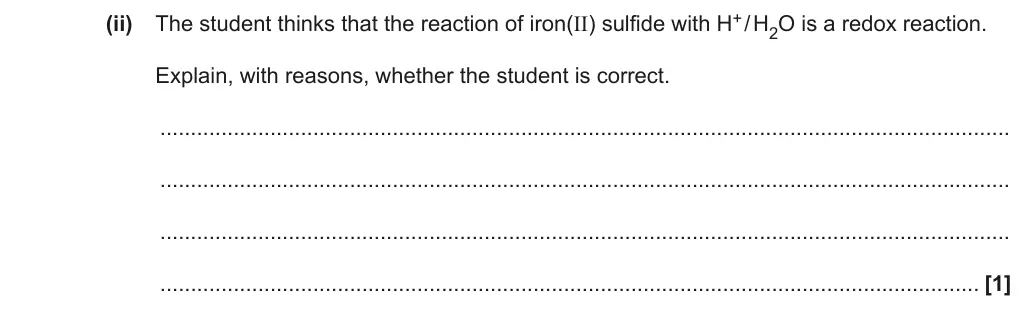
Just over half the candidates identified that the student was incorrect, and that the reaction is not redox. Candidates were expected to provide some evidence to support their statement, in terms of no oxidation number changes. Some candidates claimed that the reaction was not redox because only sulfur changed oxidation number, suggesting a misunderstanding of redox.
Notes from the mark scheme and report
student incorrect AND no oxidation numbers change (e.g. Fe stays +2)
ALLOW no electron transfer
June 2018 · Paper 1 · Q21 markAO2Multiple choiceMedium
Answer
C
Mark scheme
Examiner's comment
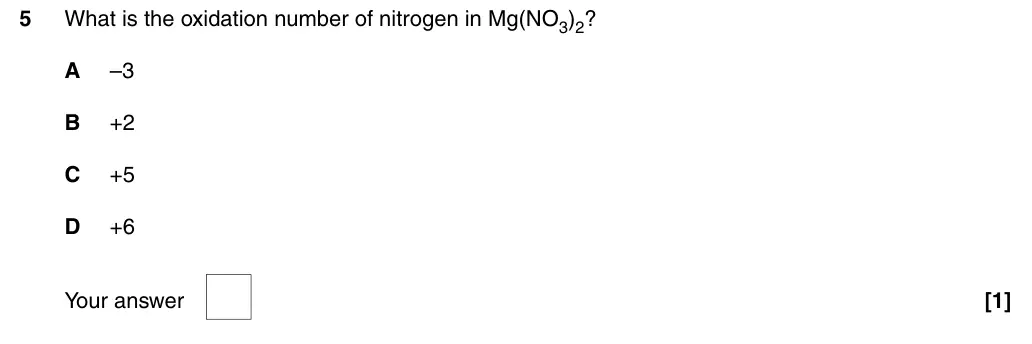
The majority of candidates showed a good understanding of oxidation number and gave the correct answer.
June 2018 · AS Paper 1 · Q51 markMultiple choiceHard
Answer
A
Mark scheme
Examiner's comment
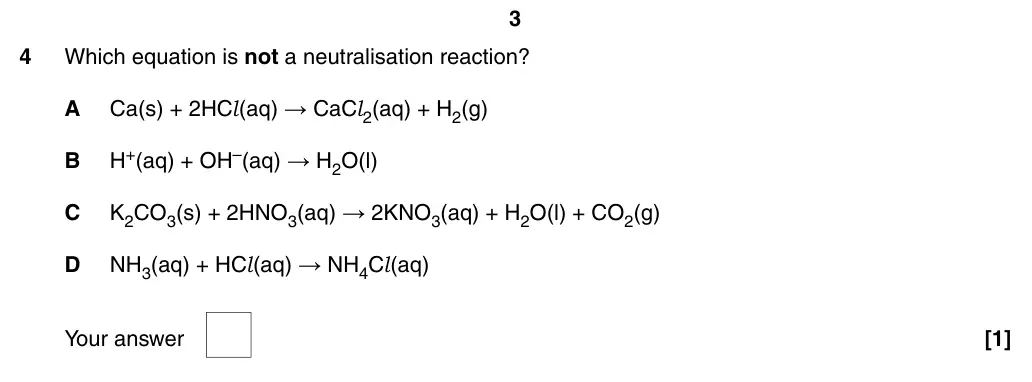
Candidates found this part difficult with many selecting B, the equation that looked a little different, rather than the correct answer of A (a redox equation). This suggests that many candidates are unaware of the role of ammonia as a base.
June 2018 · AS Paper 1 · Q61 markMultiple choiceEasy
Answer
C
Mark scheme
Examiner's comment
Nearly all candidates responded with the correct response of C. Candidates seem to have a very good understanding of applying oxidation number rules.
Notes from the mark scheme and report
ALLOW +6
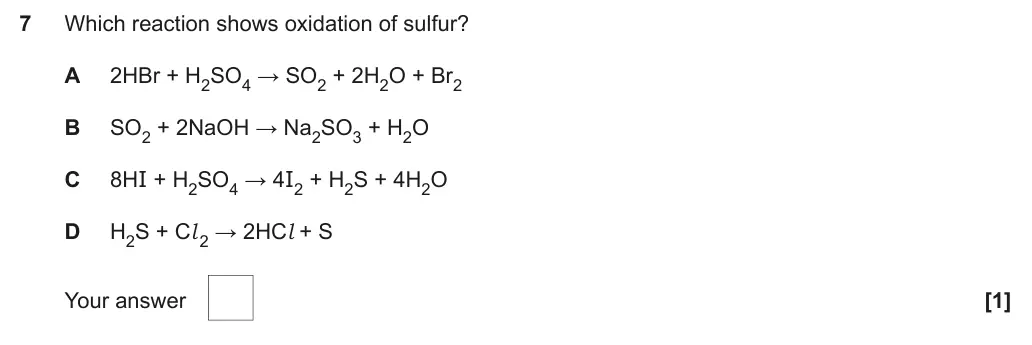
June 2018 · AS Paper 1 · Q71 markMultiple choiceMedium
Answer
D
Mark scheme
Examiner's comment
Candidates needed to do a lot of work to solve this problem and most wrote oxidation numbers around the equations. This systematic process allowed most candidates to find that D is the only option in which sulfur is oxidised.
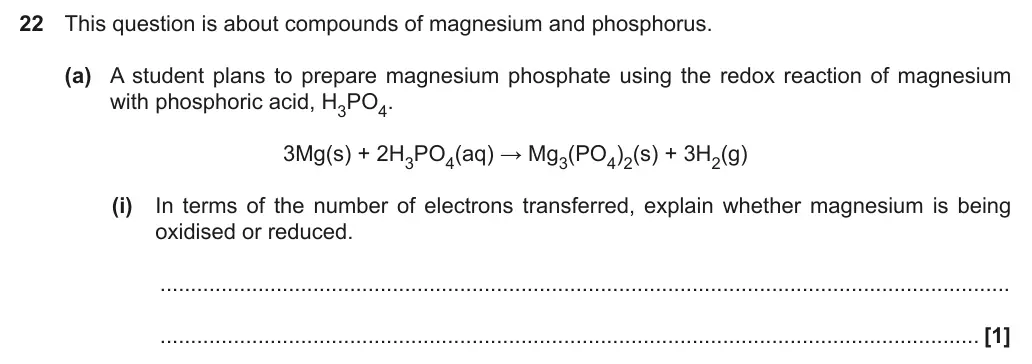
June 2018 · AS Paper 1 · Q22(a)(i)1 markShort answerMedium
Mark scheme
Examiner's comment
Despite the question clearly asking for a response in terms of the number of electrons transferred, most candidates answered in terms of oxidation number changes. Candidates are recommended to read the question and to answer in terms of its requirements. Underlining ‘number of electrons’ may have helped candidates to answer the question that had been set.
Notes from the mark scheme and report
'oxidised' AND loses 2 electrons (2 essential)
ALLOW Mg loses 6 electrons (3Mg)
IGNORE oxidation numbers
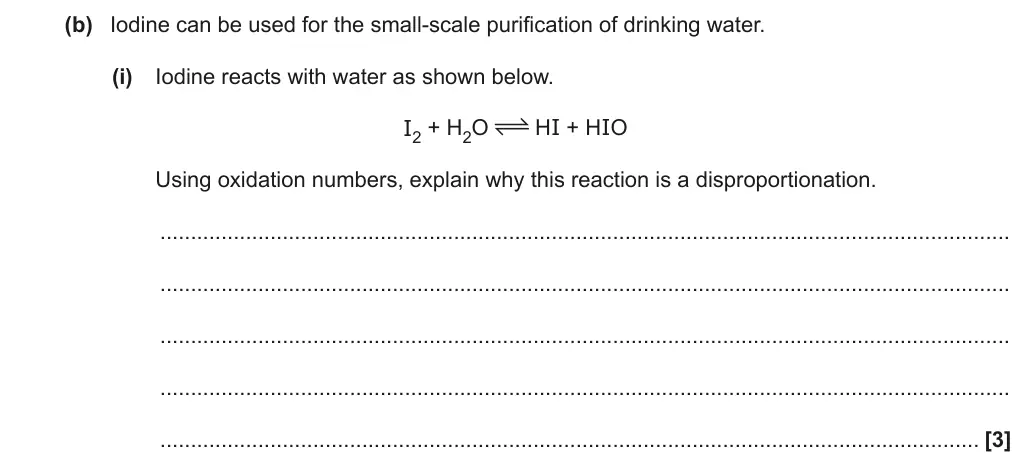
June 2018 · AS Paper 2 · Q3(b)(i)3 marksShort answerMedium
Mark scheme
Examiner's comment
Most candidates were aware of disproportionation but lost marks by not stating the species or whether the process was oxidation or reduction. Here the candidate has lost a mark for not stating the initial oxidation number of elemental iodine as 0.
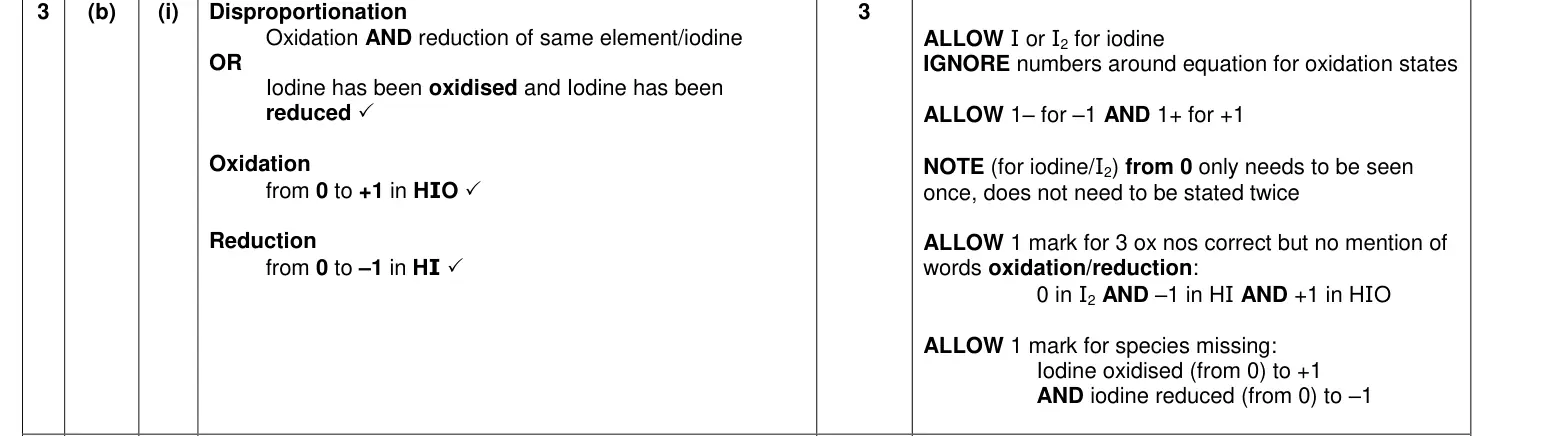
Notes from the mark scheme and report
same element oxidised and reduced
0 to +1 in HIO and 0 to –1 in HI
1 mark only for three correct oxidation numbers without the words oxidation/reduction
June 2018 · Paper 3 · Q1(a)(vii)1 markShort answerEasy
Earlier part of question 1 that this part uses
Mark scheme
Examiner's comment
Most candidates correctly selected carbon. From their A Level studies, candidates would expect hydrogen to have an oxidation number of +1 and to form compounds with carbon (CH4) and silicon (SiH4) in which the element has an oxidation number of –4. Although hydrogen is actually slightly less electronegative than carbon, hydrogen is slightly more electronegative than silicon. Therefore, in the case of SiH4, silicon has an oxidation number of +4. A response of silicon still indicates a correct understanding of oxidation number rules and was also credited
Notes from the mark scheme and report
carbon (CH4)
ALLOW silicon
June 2018 · Paper 3 · Q4(a)(i)1 markShort answerEasy
Mark scheme
Examiner's comment
Almost all candidates responded with the correct oxidation number of +2. Incorrect responses were 0 (the overall charge of the complex), +4 or 2 (with no sign). Candidates are reminded on the importance of the sign in assigning oxidation numbers.
Notes from the mark scheme and report
+2
sign required
June 2017 · Paper 1 · Q31 markMultiple choice
Answer
C
Mark scheme
June 2017 · Paper 1 · Q17(c)(i)3 marksData interpretation
Mark scheme
Notes from the mark scheme and report
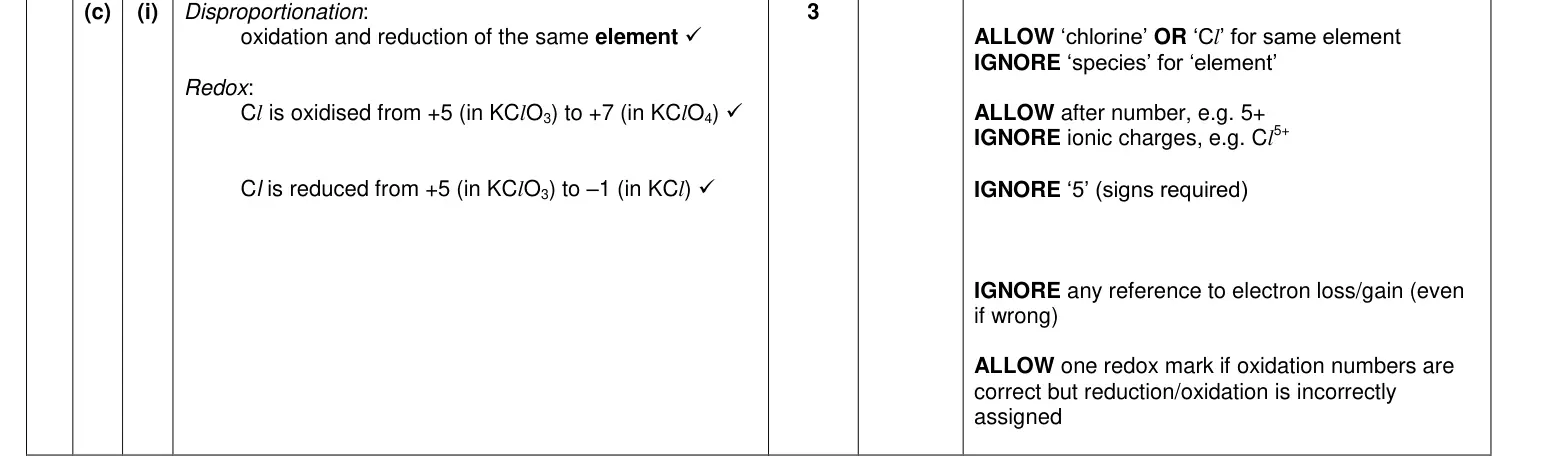
same element oxidised and reduced
Cl +5 to +7 and +5 to –1
signs required
IGNORE ionic charges such as Cl5+
1 redox mark if numbers correct but oxidation/reduction wrongly assigned
June 2017 · Paper 1 · Q17(c)(ii)1 markShort answer
Earlier part of question 17 that this part uses
Mark scheme
Notes from the mark scheme and report
potassium chlorate(VII)
brackets required
June 2017 · AS Paper 1 · Q24(b)(i)1 markEquation writing
Mark scheme
Notes from the mark scheme and report
ALLOW multiples
Skills: M0.2 Use ratios, fractions and percentages
June 2017 · AS Paper 1 · Q24(b)(ii)2 marksData interpretation
Earlier part of question 24 that this part uses
Mark scheme
Notes from the mark scheme and report
+ sign required in +3 and +1
1 mark if elements and oxidation numbers correct but on the wrong lines
June 2017 · Paper 3 · Q2(d)(i)1 markShort answer
Mark scheme
Notes from the mark scheme and report
sodium nitrate(III)
ALLOW sodium nitrite
June 2017 · Paper 3 · Q2(d)(ii)2 marksShort answer
Earlier part of question 2 that this part uses
Mark scheme
Notes from the mark scheme and report
Na 0 to +1 oxidised, N +3 to 0 reduced
+ sign required
1 mark if all correct but on wrong lines
June 2017 · Paper 3 · Q2(d)(iii)1 markEquation writing
Earlier parts of question 2 that this part uses
Mark scheme
Notes from the mark scheme and report
2NaNO2 + 6Na → 4Na2O + N2
ALLOW multiples
IGNORE state symbols
Skills: M0.2 Use ratios, fractions and percentages
June 2017 · Paper 3 · Q4(b)(i)3 marksStructure / isomer
Earlier part of question 4 that this part uses
Mark scheme
Notes from the mark scheme and report
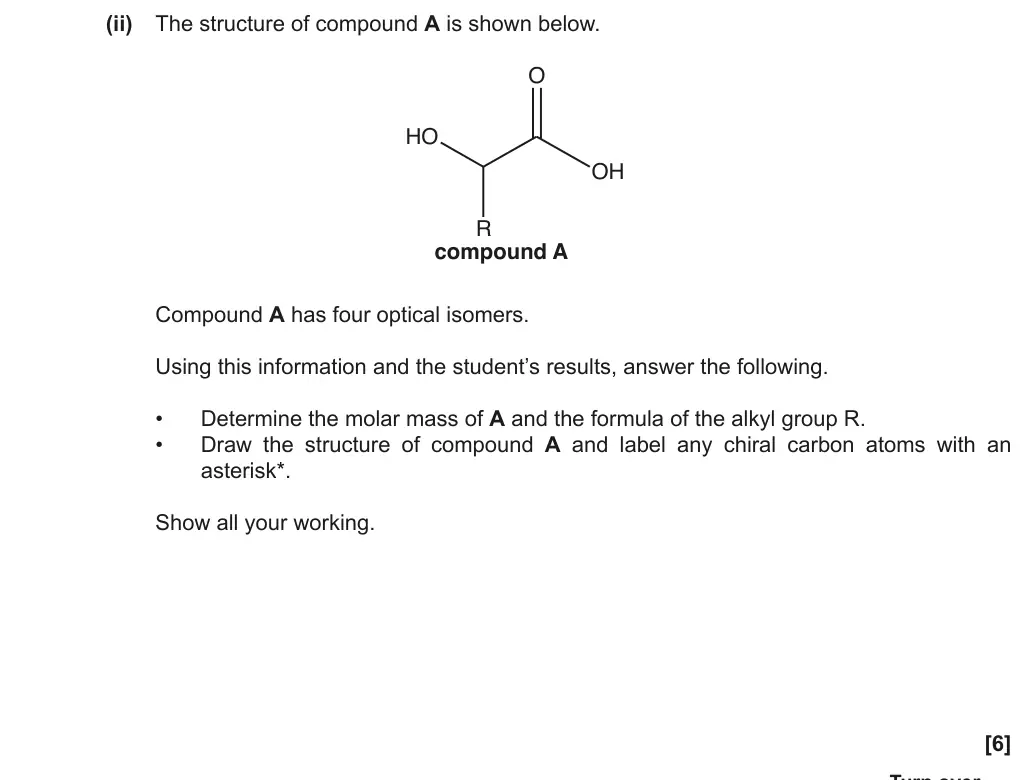
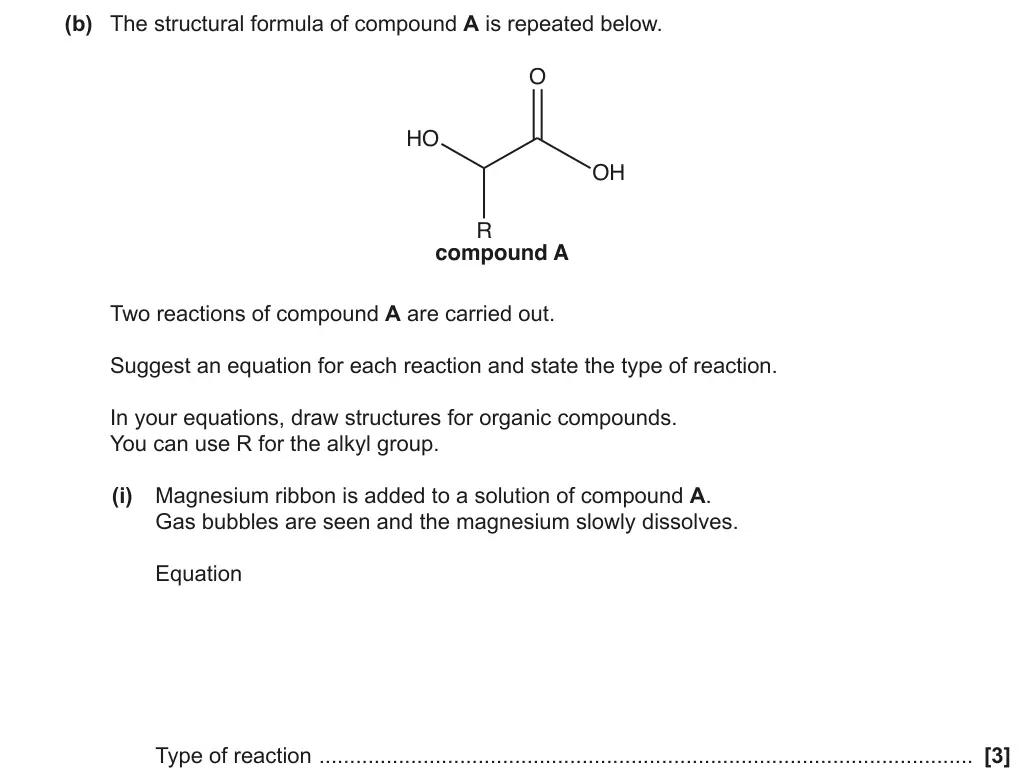
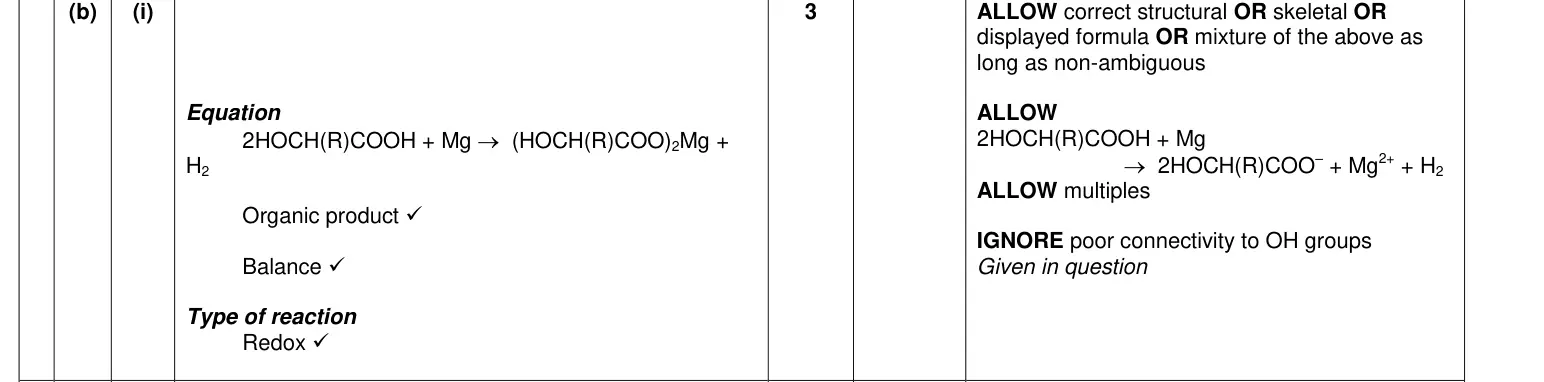
2HOCH(R)COOH + Mg → (HOCH(R)COO)2Mg + H2
redox
IGNORE poor connectivity to OH groups
June 2016 · AS Paper 1 · Q41 markMultiple choice
Answer
A
Mark scheme
June 2016 · AS Paper 1 · Q51 markMultiple choice
Answer
C
Mark scheme
June 2016 · AS Paper 1 · Q22(d)2 marksAO1Short answer
Mark scheme
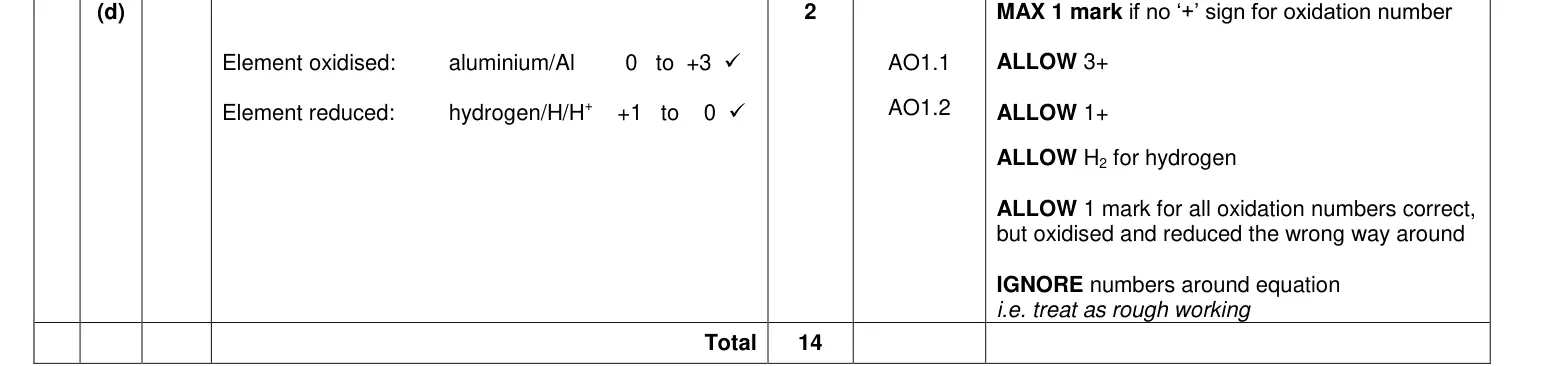
Notes from the mark scheme and report
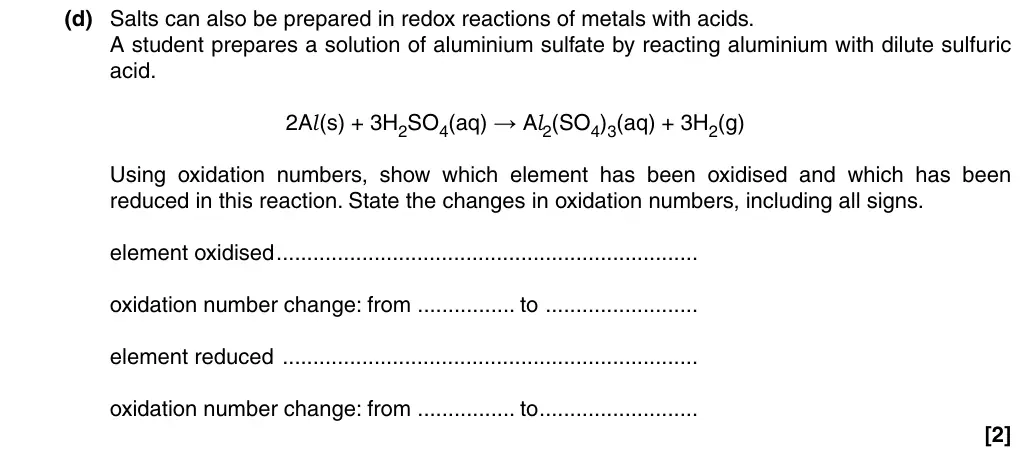
MAX 1 if no '+' sign on oxidation numbers
1 mark if all oxidation numbers correct but oxidised/reduced the wrong way round
June 2016 · AS Paper 2 · Q1(a)(ii)1 markAO1Short answer
Earlier part of question 1 that this part uses
Mark scheme
Notes from the mark scheme and report
must say TWO electrons lost
IGNORE reference to oxidation numbers
Work with an OCR chemistry tutor
Dropping marks on calculations, mechanisms or the six-markers? Book a trial session with a specialist OCR chemistry tutor.