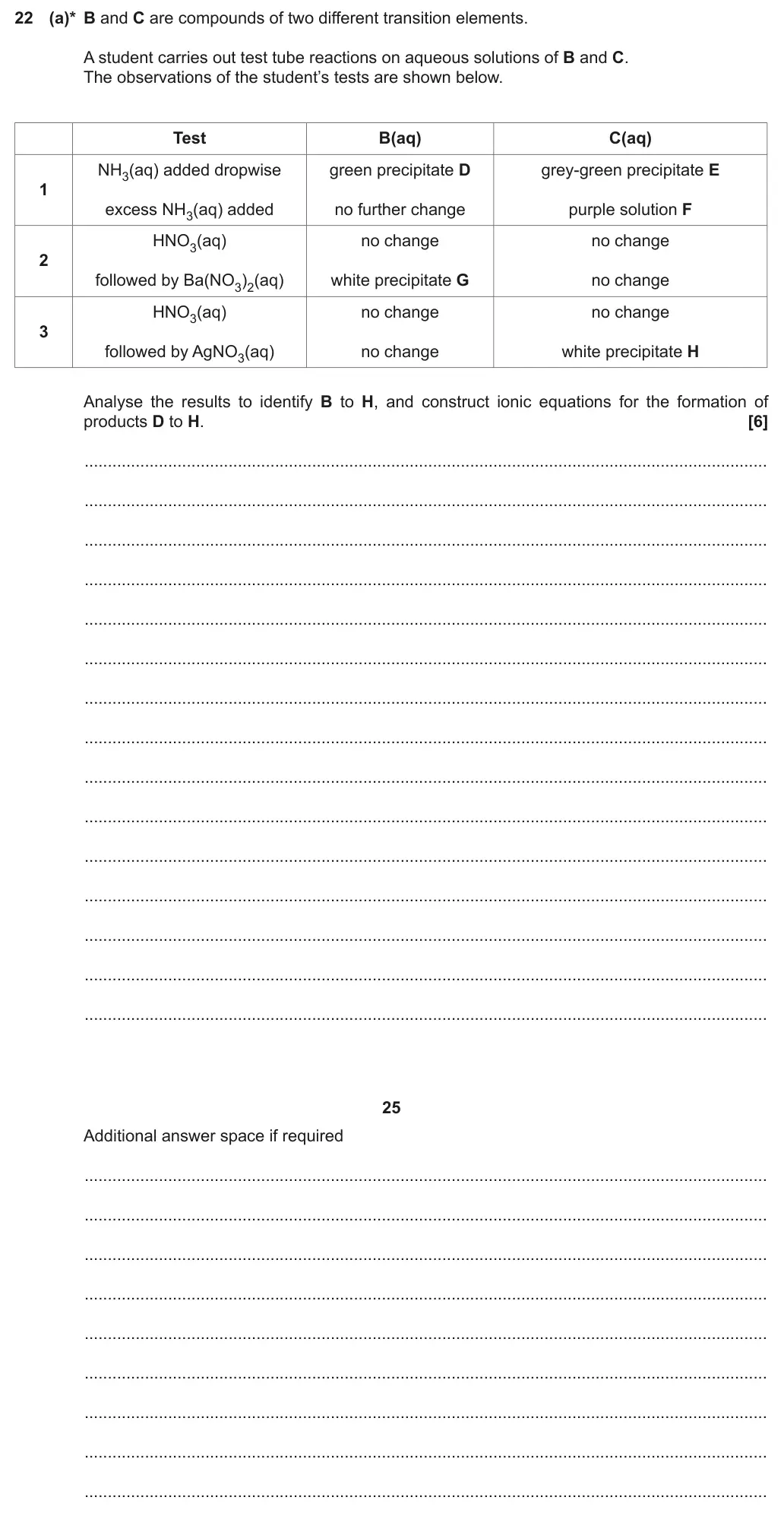
(a)* B and C are compounds of two different transition elements. Analyse the results to identify B to H, and construct ionic equations for the formation of
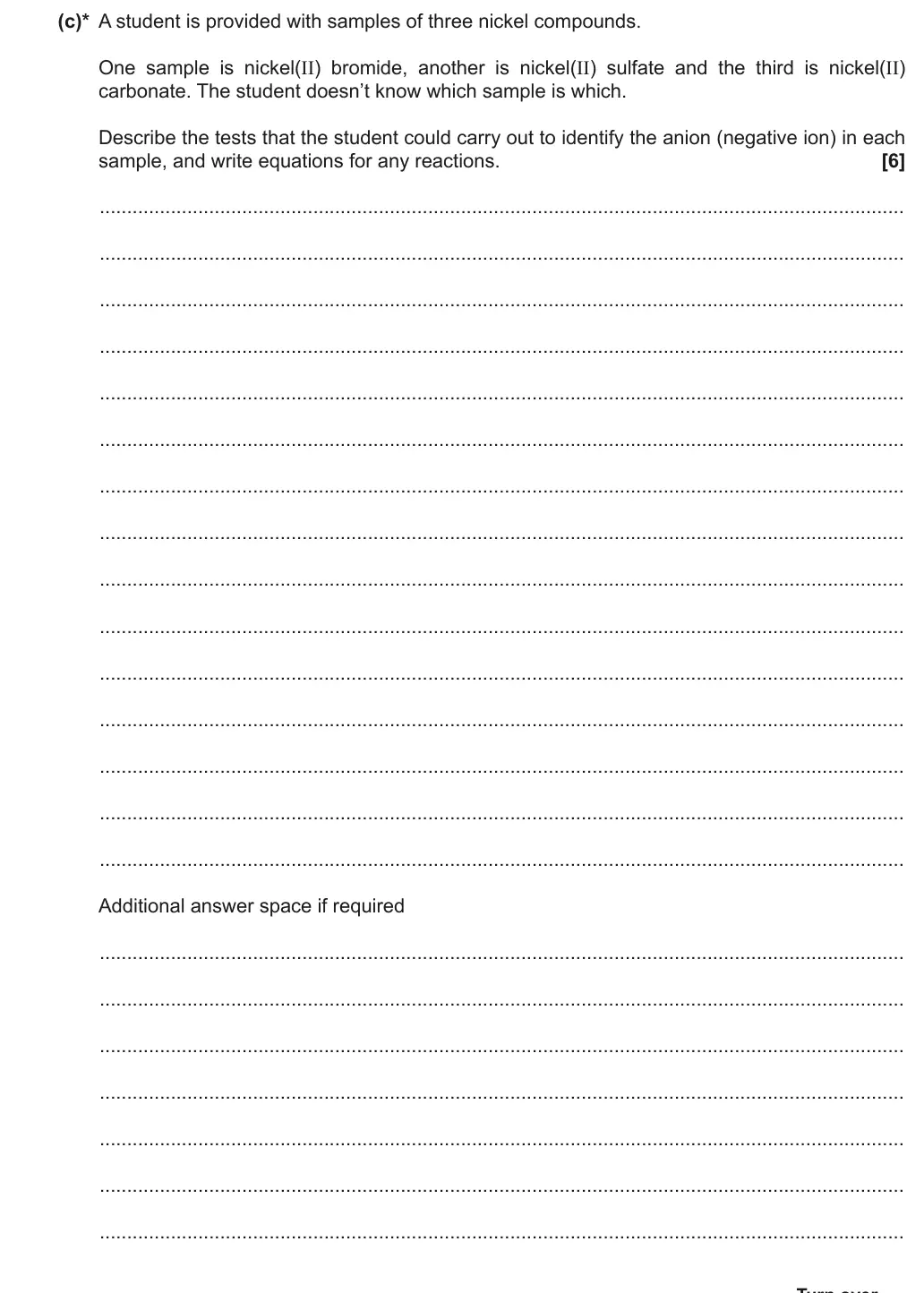
A student is provided with samples of three nickel compounds. Describe the tests that the student could carry out to identify the anion (negative ion) in each
Tap a question to zoom it. Where a part needs a table, graph or structure from an earlier part, that part folds out above it; the mark scheme and examiner's comment open underneath. Have the OCR Data Sheet beside you.
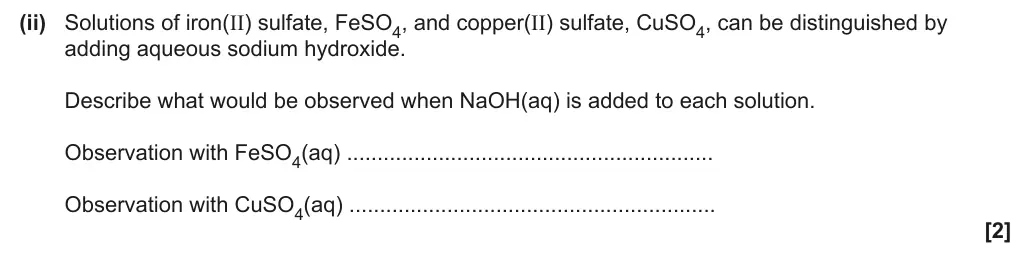
June 2025 · Paper 1 · Q21(a)(ii)2 marksShort answerMedium
Mark scheme
Examiner's comment
Most candidates were able to identity the correct colour and followed this by describing a precipitate or solid. A few candidates missed the observation of the precipitate. Incorrect colours suggested were yellow, cream and brown. The latter was perhaps as a confusion with the Fe3+ ion.
Notes from the mark scheme and report
green precipitate (Fe2+)
(pale) blue precipitate (Cu2+)
1 mark for both colours without 'precipitate'
DO NOT ALLOW dark blue
Skills: PAG4 Qualitative analysis of ions
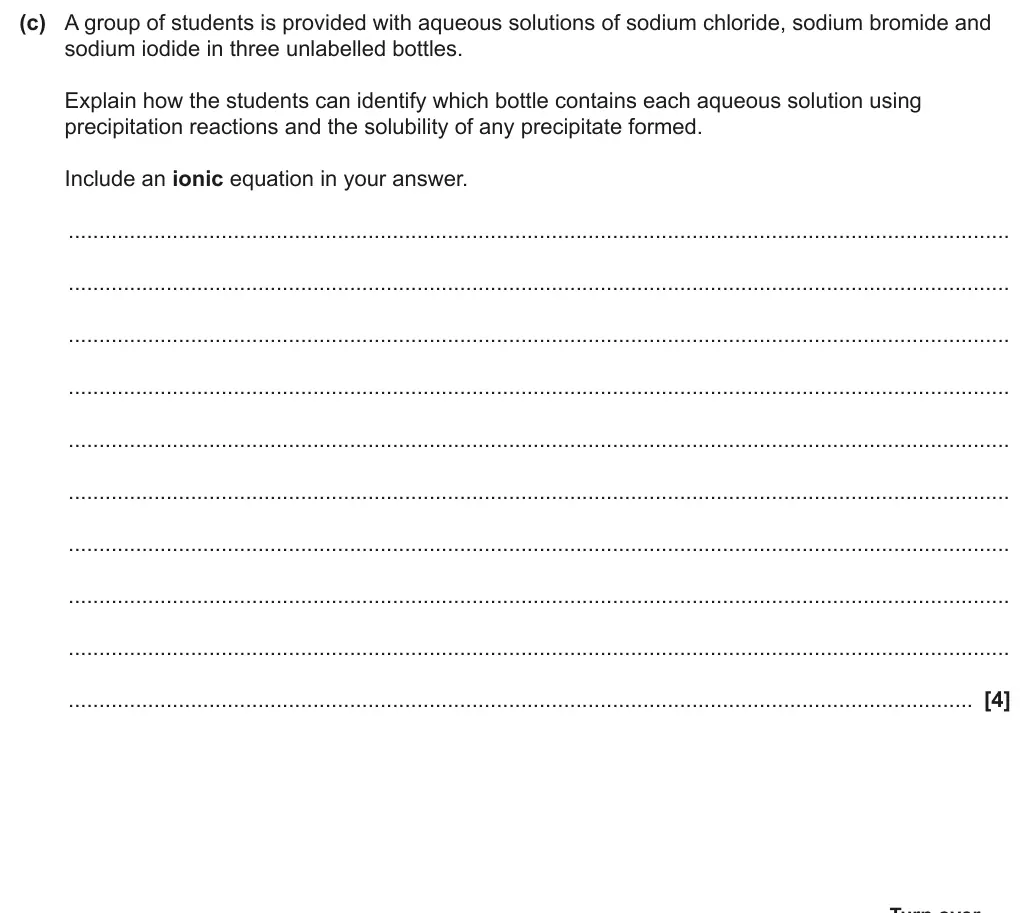
June 2025 · AS Paper 1 · Q22(c)4 marksShort answerHard
Mark scheme
Examiner's comment
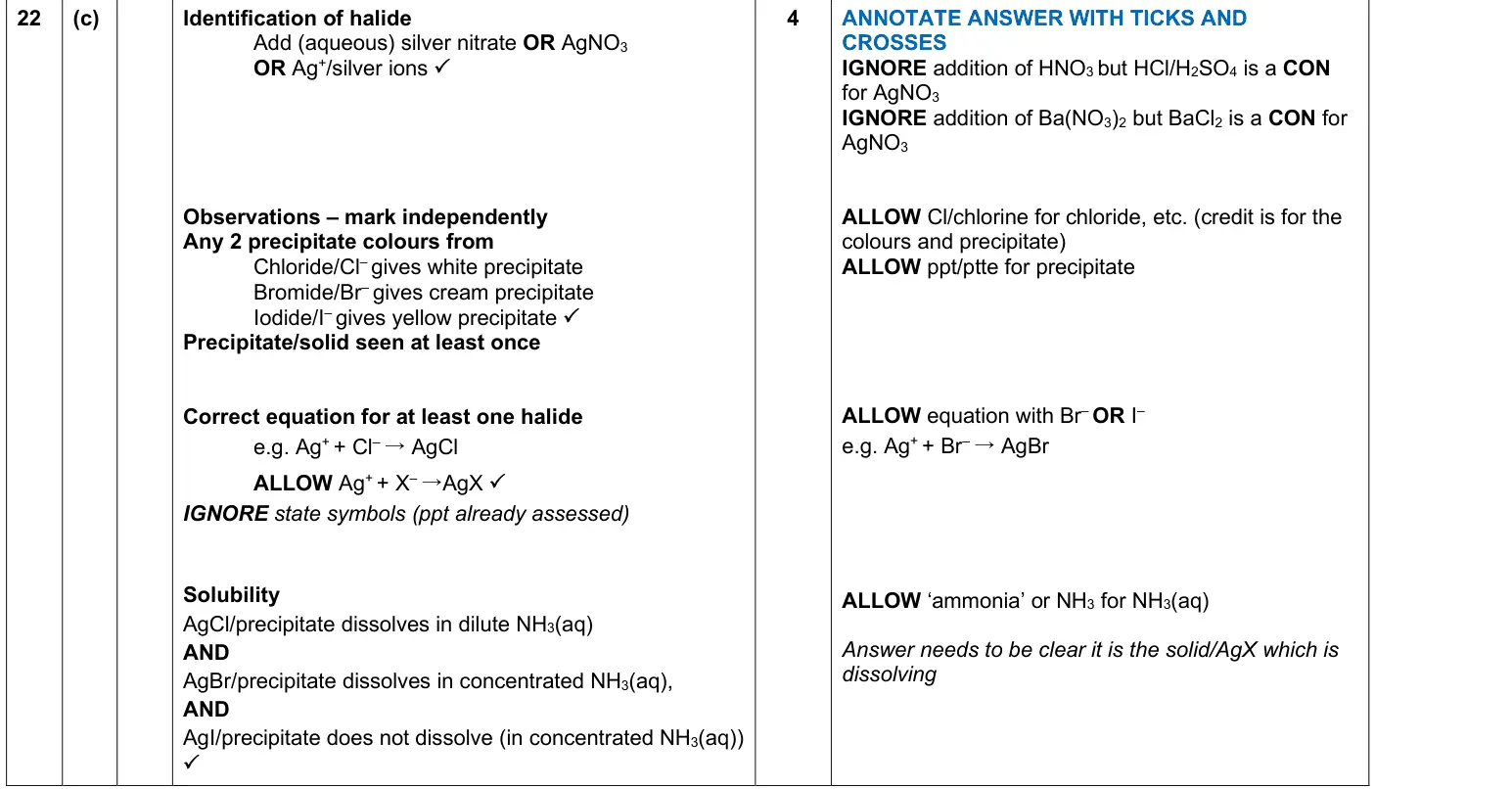
This question was a very good discriminator. Most candidates knew that silver nitrate should be added to the solutions and knew the colour of precipitates produced. Some candidates did not score the second mark by only giving colours and not stating they were solids. Many candidates were also able to give a correct ionic equation, with only the highest scoring candidates explicitly stating it was the AgX precipitates which had different solubilities in ammonia. A small number of candidates mistook this for a question on halogen displacement, scoring no marks. naming the solution and its result. Ionic equations are given (although only one is needed) and relative solubilities of the precipitates in ammonia are stated. This response was given the full 4 marks.
Notes from the mark scheme and report
AgNO3
any two precipitate colours
ionic equation
AgCl dissolves in dilute NH3, AgBr in concentrated NH3, AgI insoluble (must be clear the precipitate dissolves)
HCl/H2SO4 or BaCl2 is a CON (IGNORE HNO3)
Skills: PAG4 Qualitative analysis of ions
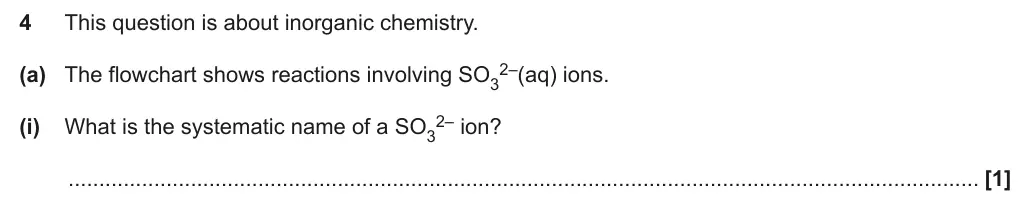
June 2025 · Paper 3 · Q4(a)(ii)7 marksShort answerHard
Earlier part of question 4 that this part uses
Mark scheme
Examiner's comment
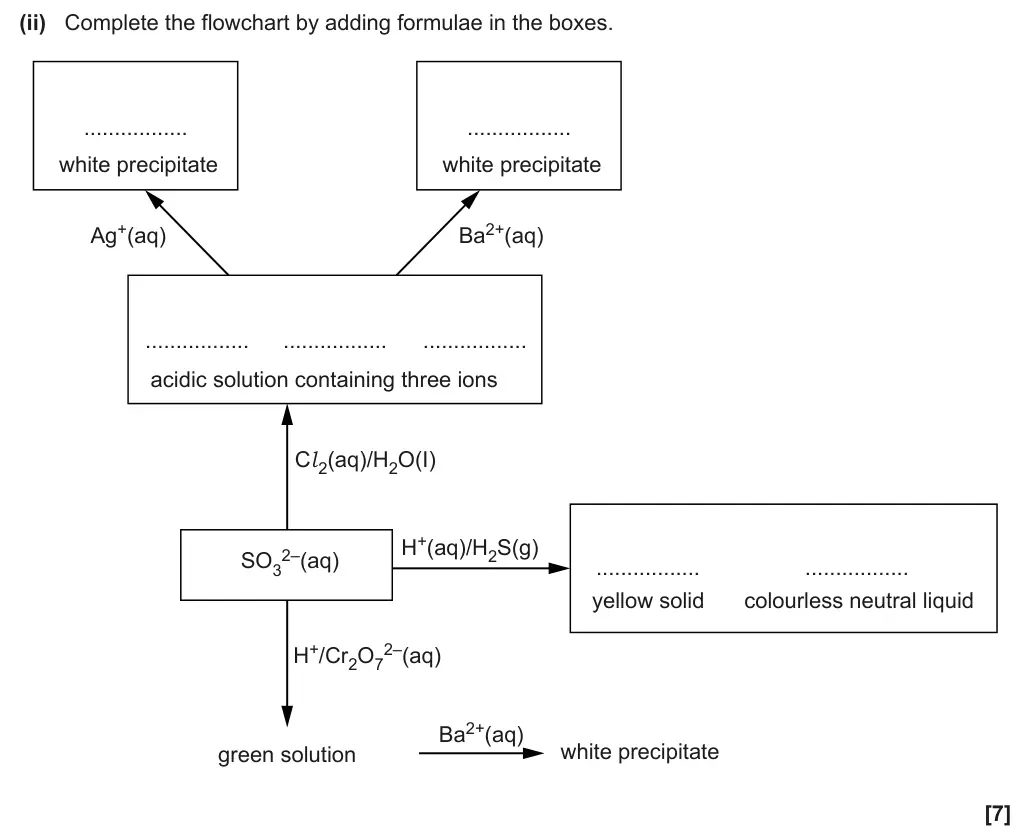
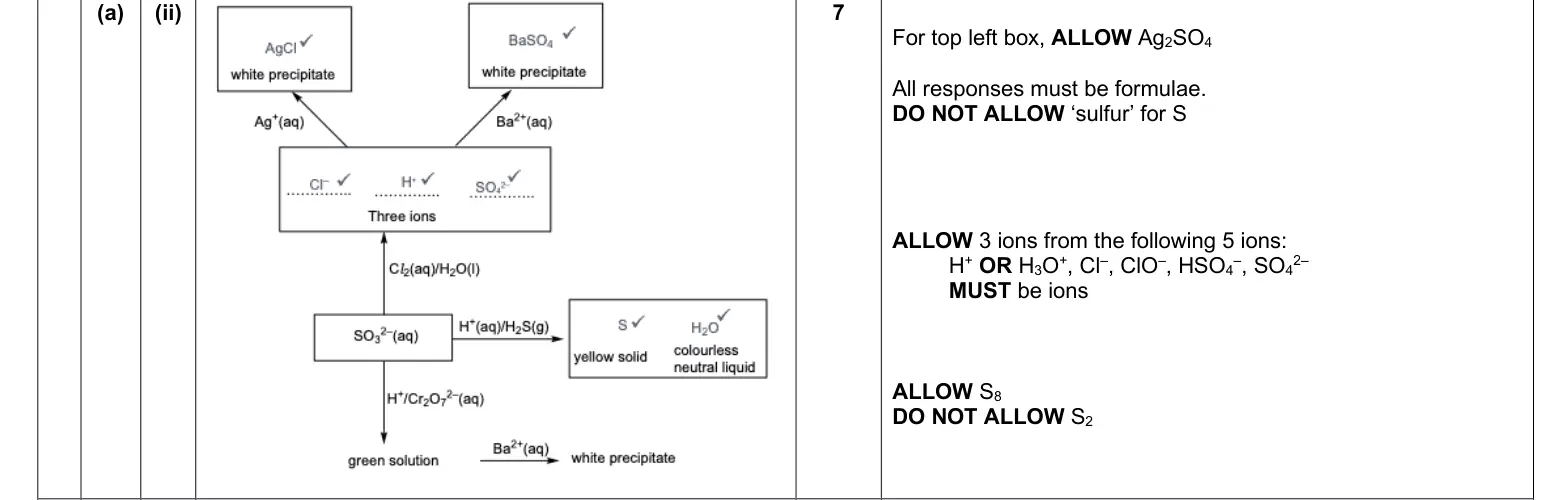
Candidates produced a range of answers, and the question discriminated extremely well. The higher attaining candidates often gave 6 or 7 correct formulae. The flowchart contained many clues which most candidates used. Most were able to provide at least 3-4 of the required formulae and there was no consistently wrong answer. Most candidates gave H+ and Cl– as two of the three ions, and AgCl for the white precipitate with Ag+(aq). Both S and S8 were allowed for sulfur but S2 was not allowed. As SO42– ions are present, Ag2SO4 was also allowed for the precipitate with Ag+(aq). Common errors included acid formulae such as H2SO4 in place of water, an incorrect formula for BaSO4, giving BaSO3, writing SO4– for the sulfate ion, and OH– as one of the three ‘acidic’ ions. Lower attaining candidates added formulae without using information in the question. Examples include full formulae such as HCl in the box labelled ‘ions’ and CuCl42– for the yellow solid, despite Cu being absent in the flowchart.
Notes from the mark scheme and report
all responses must be formulae: AgCl (ALLOW Ag2SO4), BaSO4, three ions from H+, Cl–, SO42– (ALLOW ClO–, HSO4–), S (ALLOW S8
DO NOT ALLOW S2 or 'sulfur'), H2O
Skills: PAG4 Qualitative analysis of ions
June 2024 · AS Paper 1 · Q101 markMultiple choiceEasy
Answer
B
Mark scheme
Examiner's comment
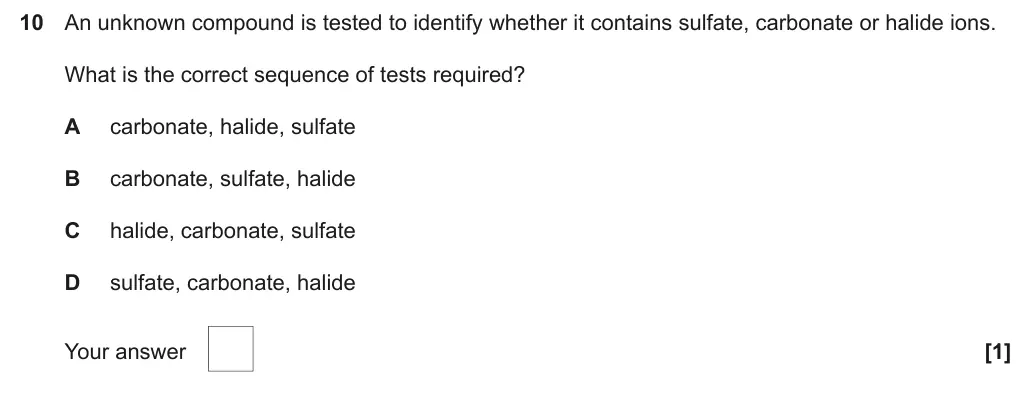
This question was answered well with most candidates correctly selecting the sequence shown in B.
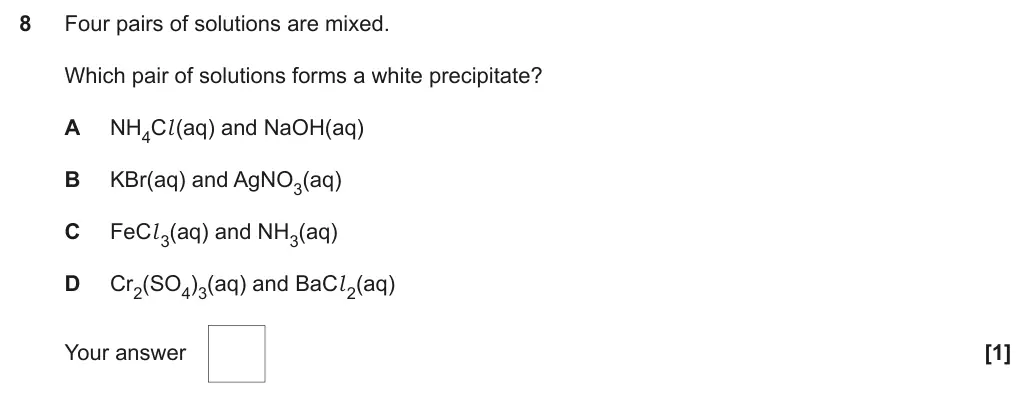
June 2024 · Paper 1 · Q131 markMultiple choiceHard
Answer
D
Mark scheme
Examiner's comment
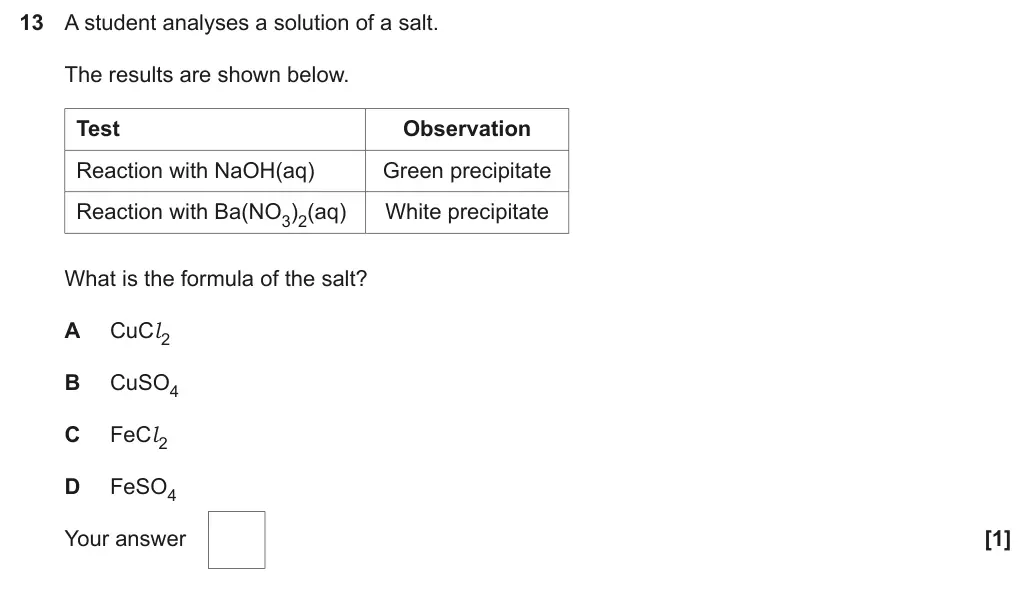
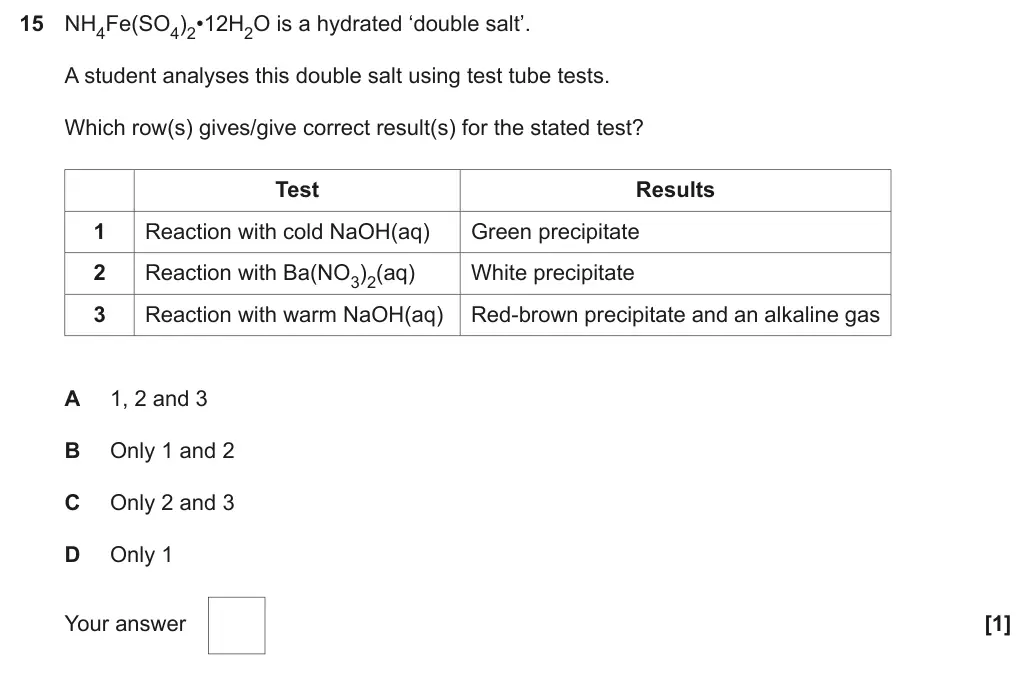
The correct answer was D. Many candidates were able to identify the green precipitate as Fe(OH)2 and the white precipitate as BaSO4. A few candidates suggested C, identifying BaCl2 as the white precipitate, or B, identifying Cu(OH)2 as the green precipitate.
June 2024 · AS Paper 2 · Q1(c)(iii)2 marksShort answerMedium
Mark scheme
Examiner's comment
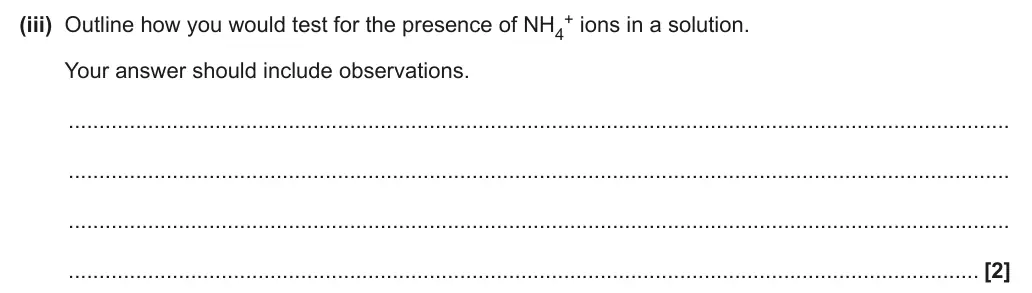
Higher-attaining candidates often gave a very detailed responses with all stages, including warming the NaOH, use of damp litmus paper and some included an ionic equation. Quite a few lost a mark as they missed the addition of hydroxide, just warmed, but they still gained mark for testing with indicator paper. Some thought that the indicator paper would turn red or be bleached and a few gave incorrect ion test e.g. add silver nitrate, add acid. Over a third of candidates did not score on this question, with a significant proportion not even attempting it.
Notes from the mark scheme and report
(warm with) NaOH/hydroxide
damp litmus/indicator paper turns blue
DO NOT ALLOW ammonium hydroxide or ammonia as reagent
Skills: PAG4 Qualitative analysis of ions
June 2023 · Paper 1 · Q111 markAO2Multiple choiceMedium
Answer
D
Mark scheme
Examiner's comment
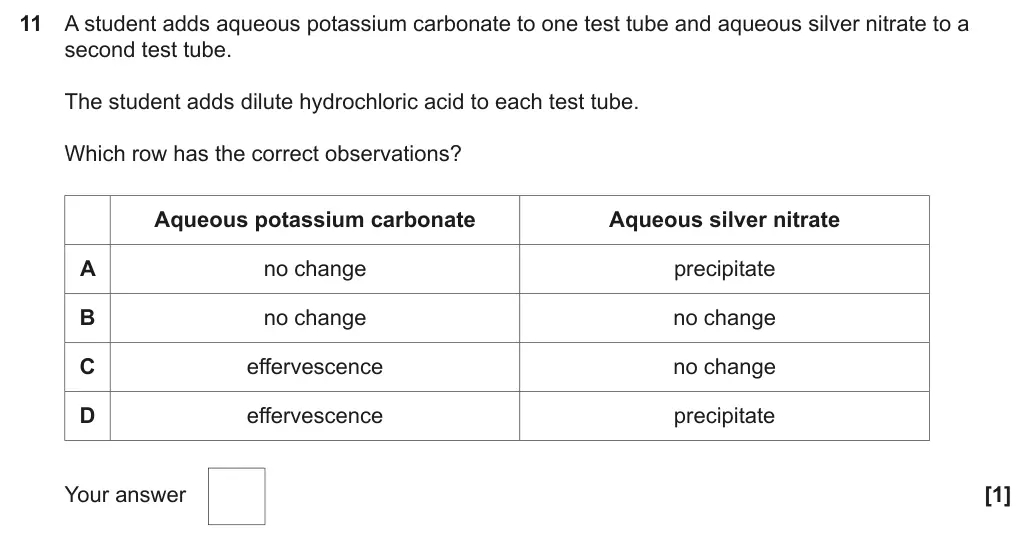
Most candidates answered this correctly with D. Errors came from candidates not realising HCl provided Cl- ions that would react with AgNO3 and therefore they did not recognise the formation of the white precipitate.
June 2023 · AS Paper 2 · Q2(b)(i)2 marksAO2Equation writingHard
Mark scheme
Examiner's comment
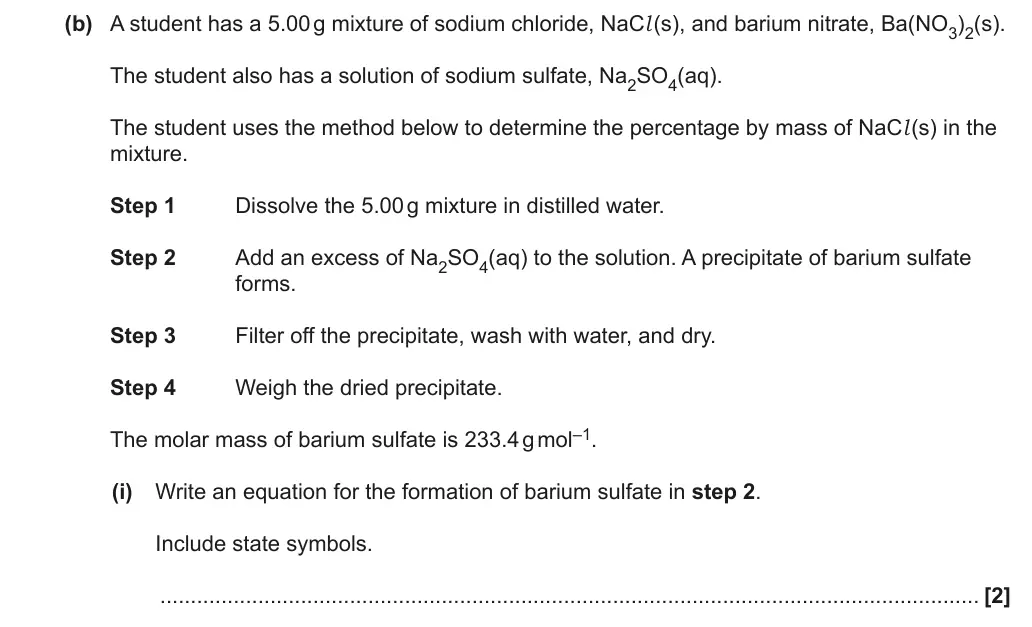
Less than half the candidates gained credit for this challenging question. There was lots of information to process. Many struggled to give the correct formula for the products, e.g. NaNO3, Ba2SO4, or had issues with balancing. Some tried to involve the NaCl in the reaction, either recognising that it didn’t react (acceptable on the mark scheme) or forming barium chloride or even Cl2. Lots of candidates lost the mark for state symbols as they left Ba(NO3)2 as (s), not recognising that in step 1 the mixture was dissolved in water so should now be (aq).
Notes from the mark scheme and report
BaSO4(s) with other species (aq)
ALLOW ionic equation
state symbol mark dependent on balanced equation
June 2023 · Paper 3 · Q4(c)(ii)3 marksAO2Short answerMedium
Earlier part of question 4 that this part uses
Mark scheme
Examiner's comment
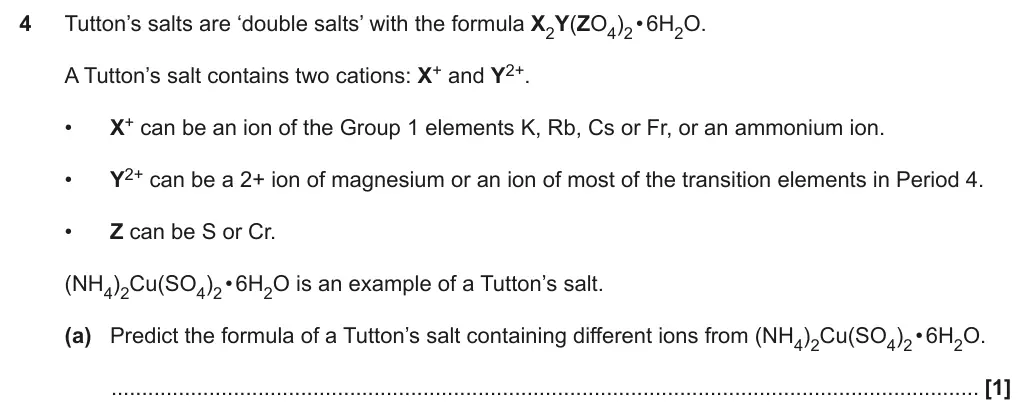
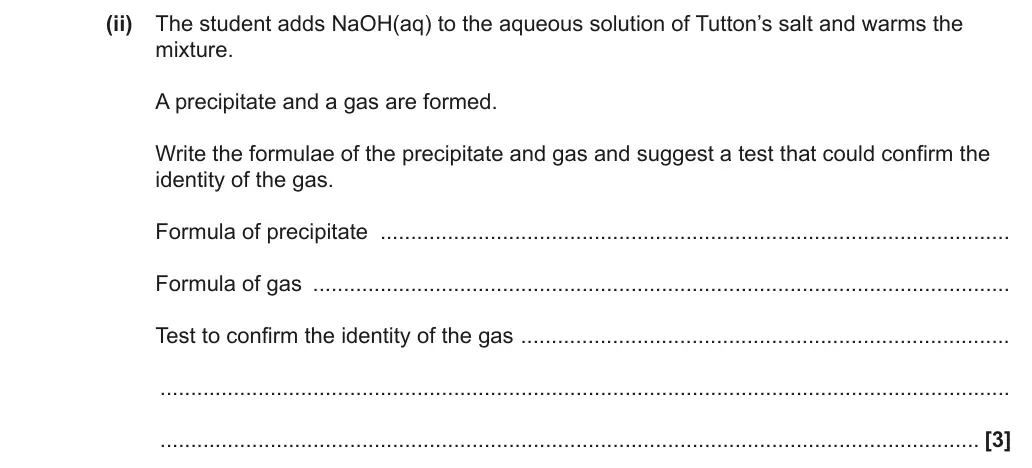
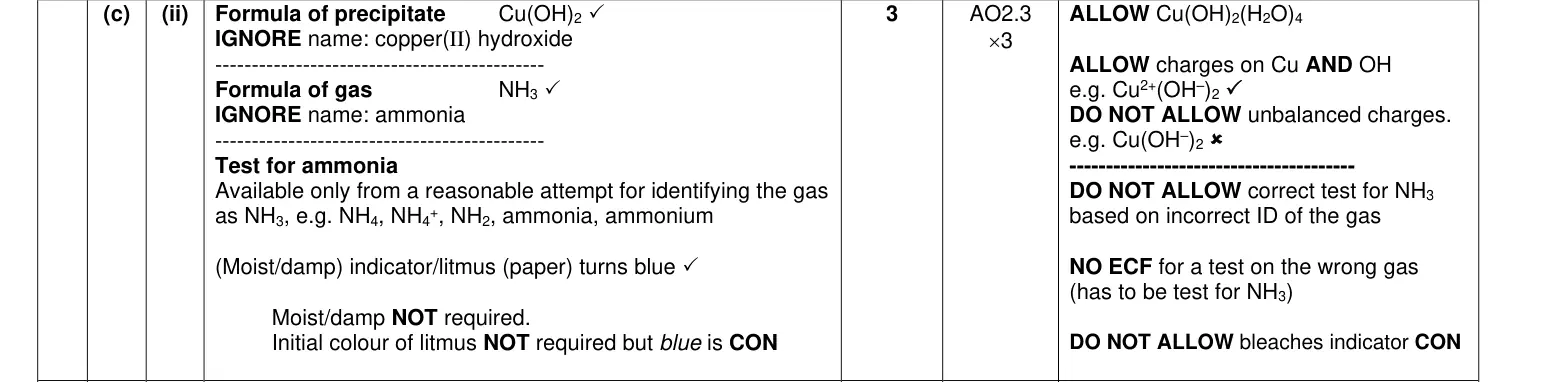
Addition of NaOH(aq) to the Tutton’s salt results in two reactions: precipitation of copper(II) hydroxide and a reaction of an ammonium ion, used to show its presence as a qualitative test. As with Question 4 (c) (i), this part discriminated very well with many candidates able to be rewarded with some of the marks. The formula of copper(II) hydroxide, as Cu(OH)2 or Cu(OH)2(H2O)2 were both acceptable. This was correct more often than the responses related to the ammonium ion. The formula of the gas formed in the reaction of NaOH(aq) with the ammonium ion caused problems, with NH3 and its subsequent test with moist indicator turning blue seen much less than the reaction of Cu2+(aq) ions. Hydrogen (the ‘squeaky pop test) and oxygen (relighting a glowing split) were common incorrect responses. This was another question in which referring back to the formula of the Tutton’s salt would have revealed important clues.
Notes from the mark scheme and report
Cu(OH)2 and NH3 (formulae required
IGNORE names)
moist indicator/litmus turns blue
no ECF for a test on the wrong gas
DO NOT ALLOW unbalanced charges or 'bleaches indicator'
Skills: PAG4 Qualitative analysis of ions
June 2023 · Paper 3 · Q4(c)(iii)2 marksAO2Short answerMedium
Earlier part of question 4 that this part uses
Mark scheme
Examiner's comment
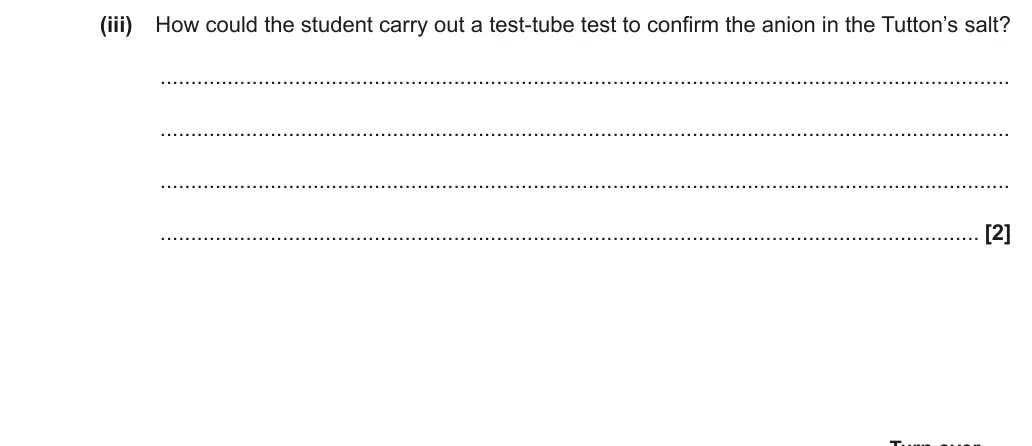
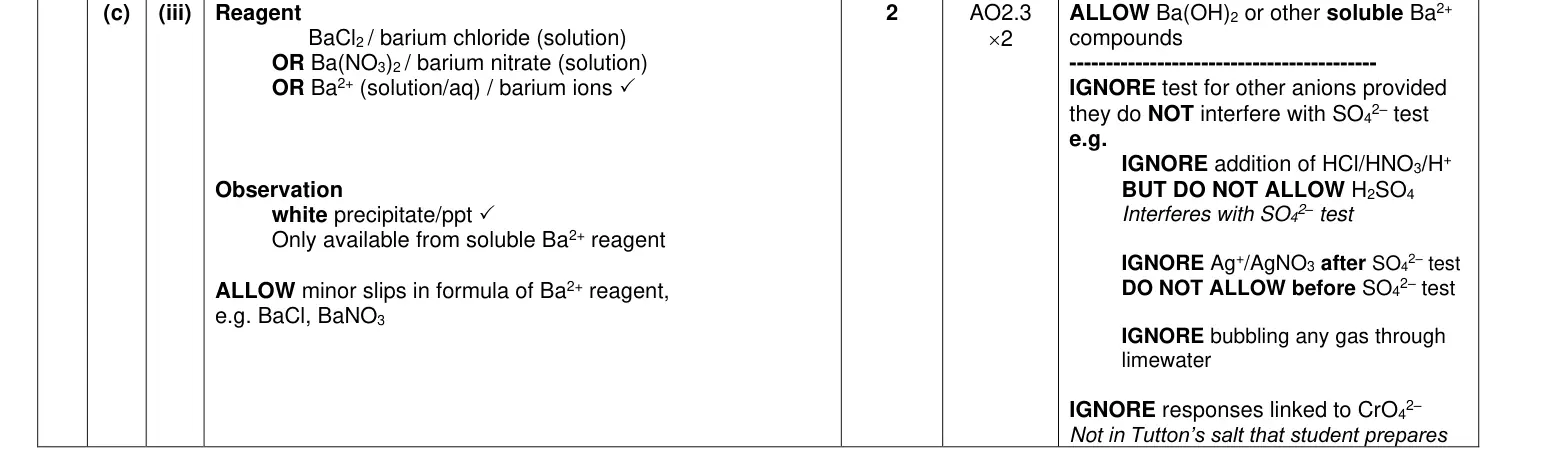
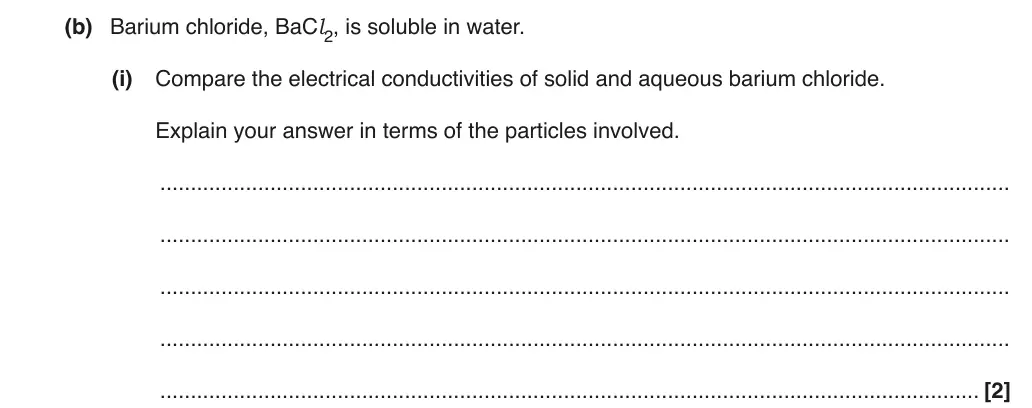
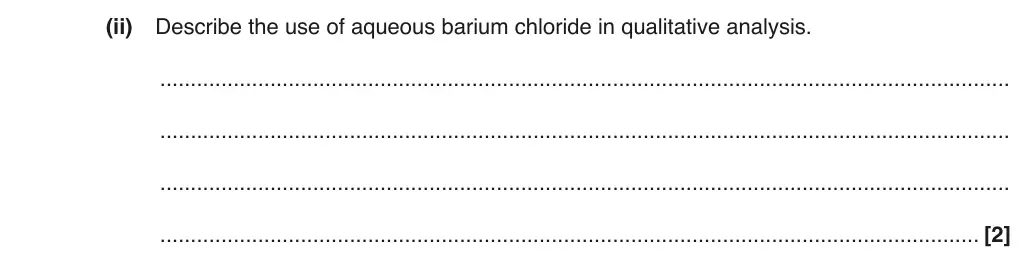
Th final part of Question 4 required candidates to identify the anion in the Tutton’s salt as sulfate, and to recall that Ba2+ ions is used for the sulfate test to form a white precipitate. Any soluble barium compound was credited with barium chloride and nitrate being the commonest seen. As with earlier parts, this part discriminated very well. Most candidates who knew that barium ions were needed also collected the mark for the white precipitate observation. Over half the candidates did not score here, the most common errors being to repeat the test for the ammonium ion, or to use silver nitrate, clear confusion with the halide test.
Notes from the mark scheme and report
BaCl2 or Ba(NO3)2 solution gives white precipitate
observation only from a soluble Ba2+ reagent
DO NOT ALLOW H2SO4 added
DO NOT ALLOW AgNO3 before the sulfate test
Skills: PAG4 Qualitative analysis of ions
June 2022 · Paper 1 · Q21(b)(ii)1 markAO3Equation writingEasy
Earlier part of question 21 that this part uses
Mark scheme
Examiner's comment
This question was answered well, with many candidates giving one of the equations in the ‘ALLOW’ part of the mark scheme. Those candidates who did not gain this mark gave full equations or missed out state symbols.
ALLOW H+ + OH– → H2O OR Ba2+ + SO4 2– → BaSO4 with state symbols
June 2022 · AS Paper 1 · Q24(b)5 marksAO3Extended responseMedium
Mark scheme
Examiner's comment
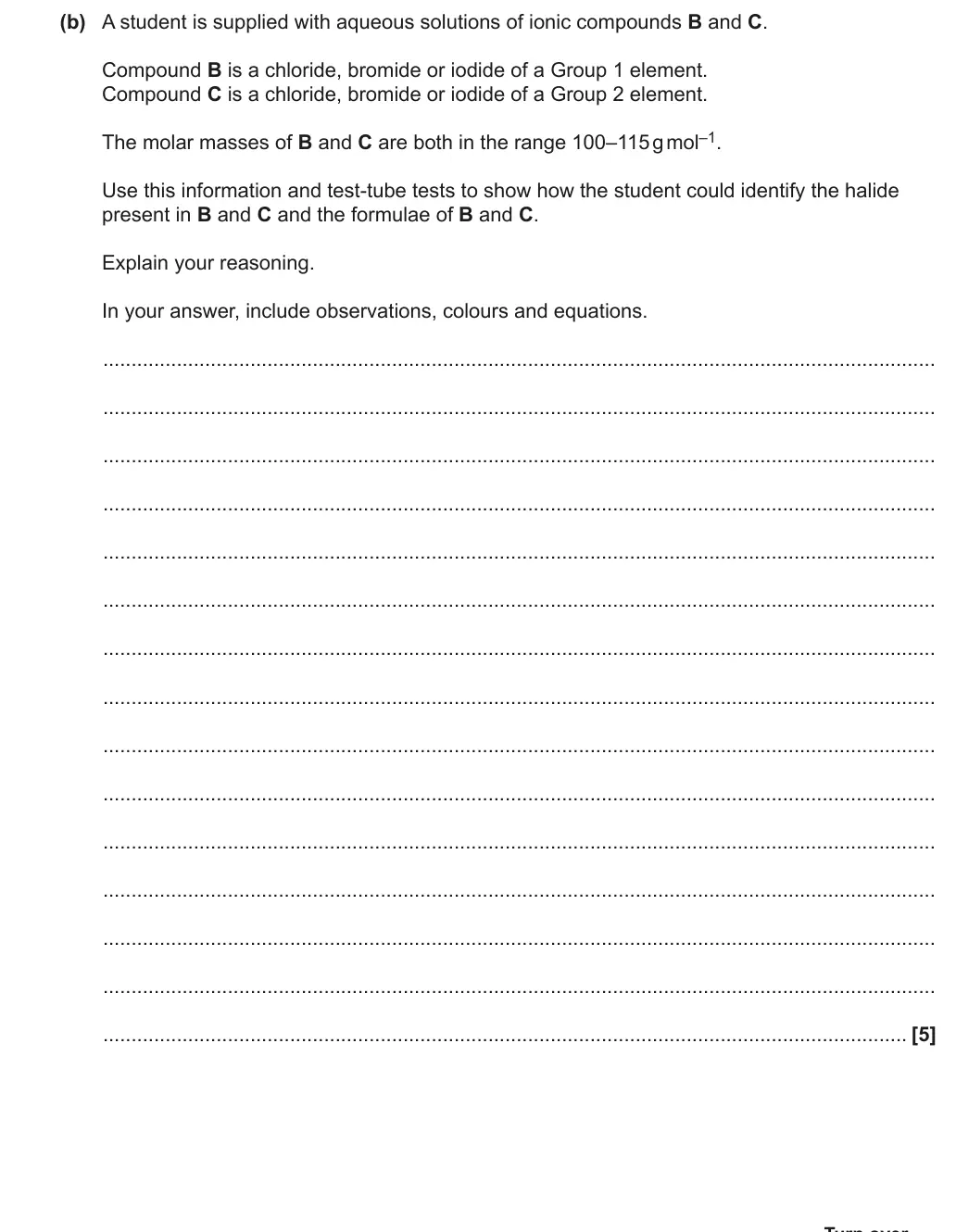
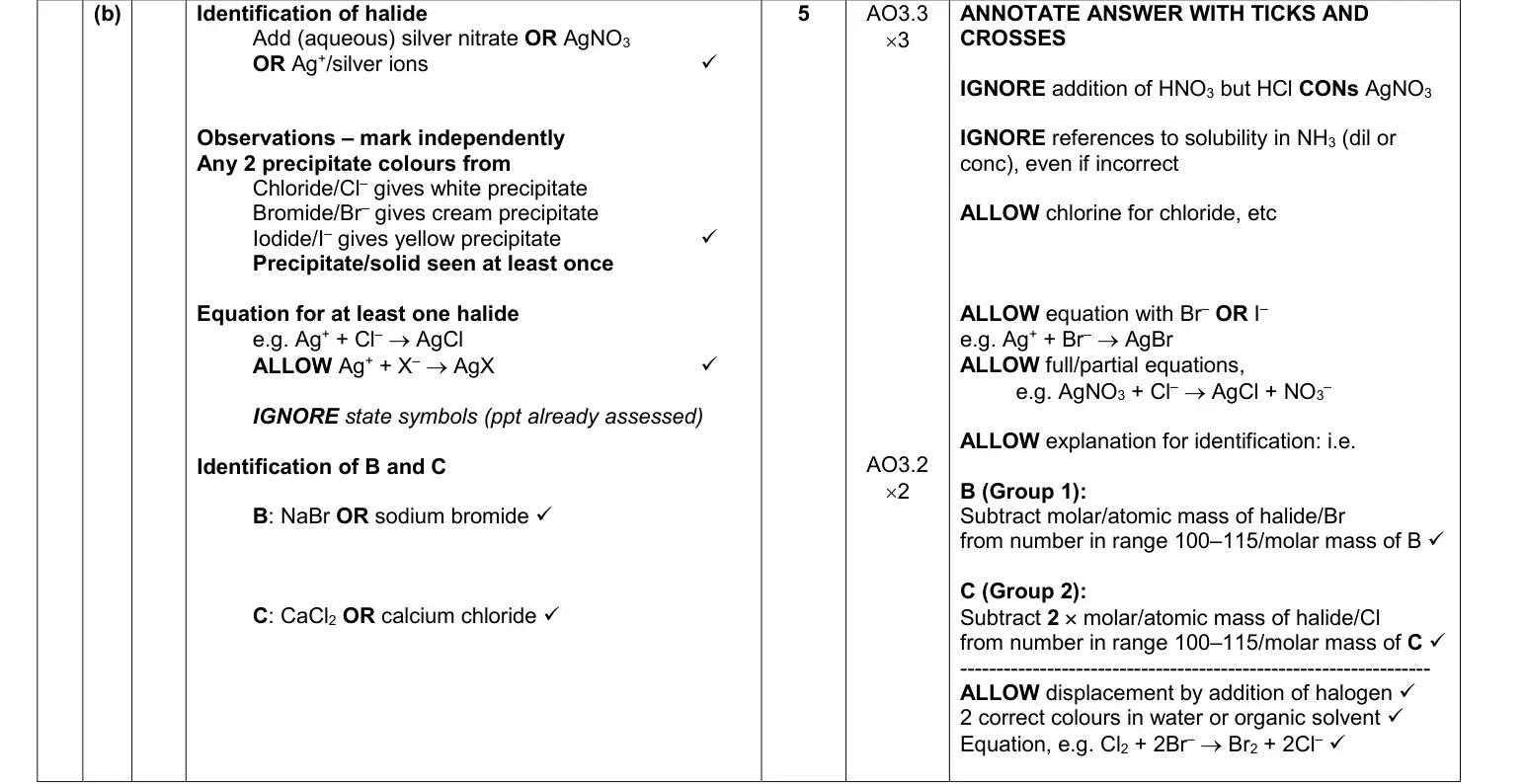
Candidates generally answered the first part of this question well. Most candidates were able to identify silver nitrate (or a halogen displacement method), to describe the expected observations, supported with mainly correct ionic equations. Candidates found it much harder to identify B and C as NaBr and CaCl2. They could do this in various ways by matching possible formula with the provided molar mass ranges. The mark scheme did allow marks to be given when candidates described the identification process, although this was often very muddled, so, only the most able few candidates fully identified the unknown B and C.
Notes from the mark scheme and report
AgNO3 then any two precipitate colours
ionic equation for at least one halide
B = NaBr and C = CaCl2 from molar mass range
HCl CONs AgNO3 (IGNORE HNO3)
IGNORE solubility in NH3
ALLOW halogen displacement alternative
Skills: M0.2 Use ratios, fractions and percentages; PAG4 Qualitative analysis of ions
June 2022 · AS Paper 2 · Q2(b)(ii)2 marksAO3Short answerEasy
Earlier part of question 2 that this part uses
Mark scheme
Examiner's comment
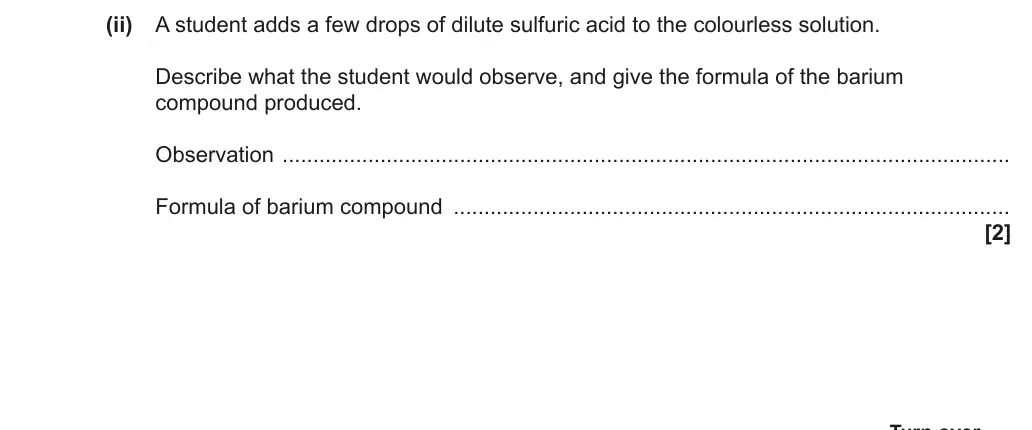
Most candidates were able to give the formula of the barium compound as BaSO4. However, they did not recognise that this would cause a white ppt to be seen, presumably as not in the context of qualitative ions testing. Many candidates said they would see bubbling/fizzing. Some gave a colour change as they were possibly considering what would be seen if an indicator is present. Others mentioned a precipitate but with no colour given. Some candidates gave the incorrect formula, such as Ba2SO4 or Ba(SO4)2, again showing the importance of practising writing formulae. In addition, some candidates wrote out the whole equation for the reaction.
Notes from the mark scheme and report
white precipitate
BaSO4
We have produced a topic support pack to assist with learning about the reaction of group 2 elements and their compounds: http://www.ocr.org.uk/Images/364103-chemistry-of-group- 2.docx
Skills: PAG4 Qualitative analysis of ions
November 2021 · Paper 1 · Q151 markMultiple choice
Answer
C
Mark scheme
November 2020 · Paper 1 · Q22(a)6 marksAO36-mark level of response
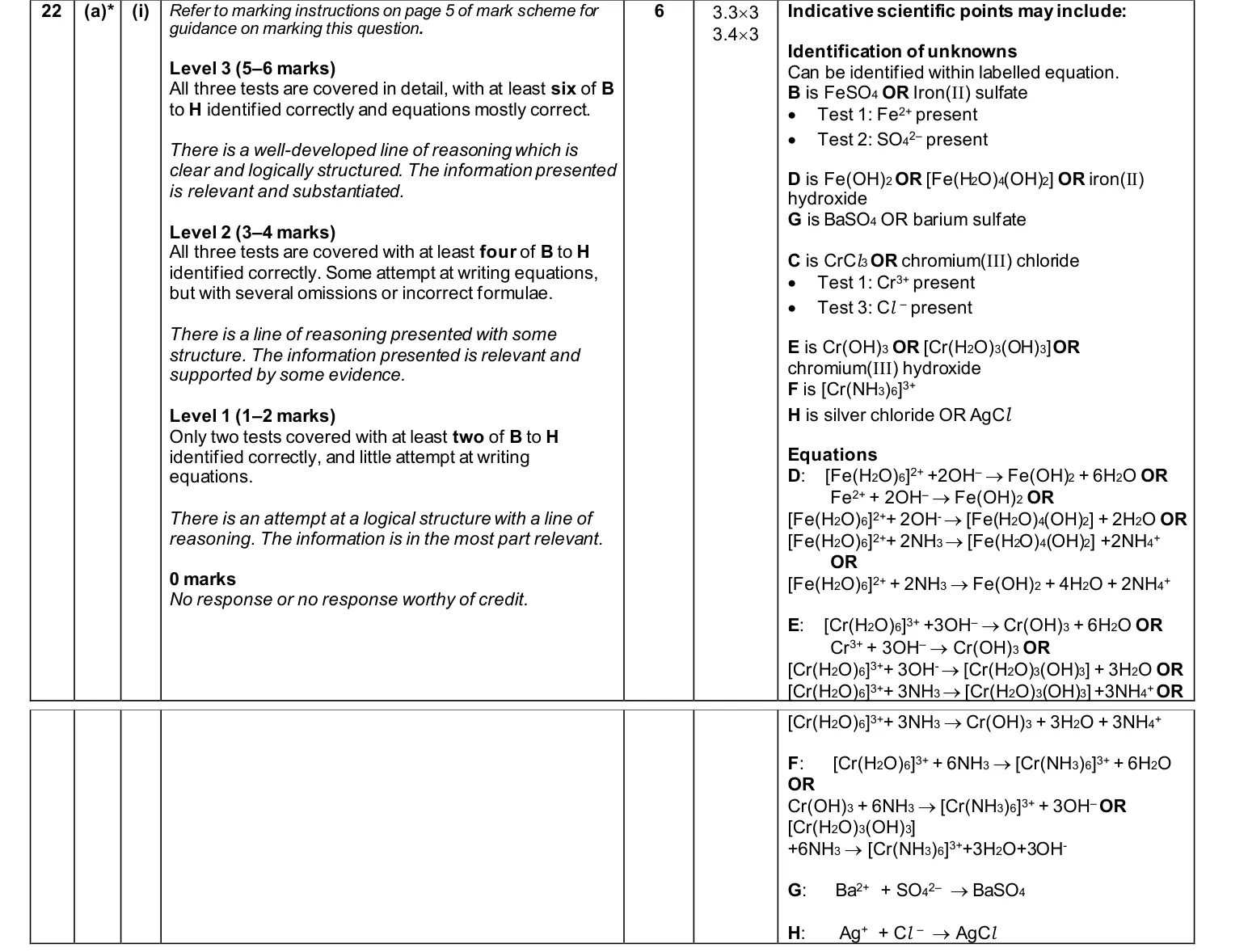
Mark scheme, with the levels and indicative points
Notes from the mark scheme and report
B = FeSO4, D = Fe(OH)2, G = BaSO4
C = CrCl3, E = Cr(OH)3, F = [Cr(NH3)6]3+, H = AgCl
ionic equations for D–H
Level 3 needs at least six identified and equations mostly correct
Skills: PAG4 Qualitative analysis of ions
November 2020 · AS Paper 2 · Q1(c)6 marksAO1, 2, 36-mark level of responseMedium
Mark scheme, with the levels and indicative points
Examiner's comment
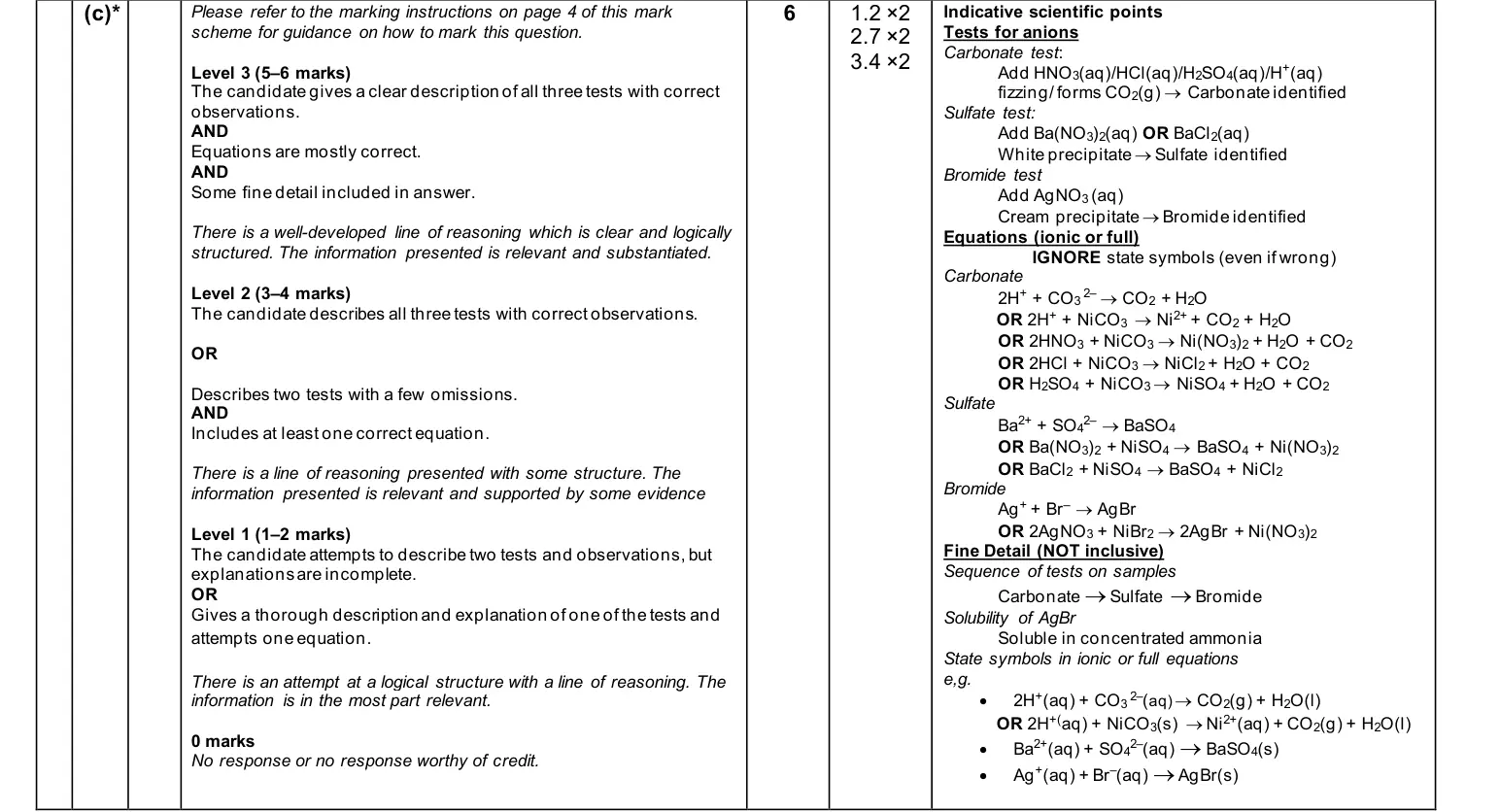
1(a) A considerable number of candidates did not score the mark here despite knowing that it was an oxidation reaction. They either omitted to give the number of electrons lost or gave their justification using oxidation numbers. This question highlights the importance of reading the question carefully and answering the question asked, not one that may have been seen previously. 1(b)(i) Most candidates were able to make some progress with this calculation. Common errors included omitting to multiply by two to find the number of moles of HCl or not multiplying their volume in dm3 by 1000 to give an answer in cm3. 1(b)(ii) More candidates struggled with this part of calculation. A significant number of candidates used the number of moles rounded to 3 SF but then gave a final answer to 4 SF, giving an answer of 78.48 cm3. This was given credit as correct calculation had been carried out for one mark. A couple of candidates correctly used the ideal gas equation and were given credit for this, but made it more complicated than necessary for one mark. 1(b)(iii) Very few candidates managed to gain marks here. Most did not recognise that HCl was the limiting reagent in the reaction and suggested that a greater volume of H2 would be produced, as same mass of Mg would give a greater number of moles. 1(c)* Very few candidates managed to score full marks for this question. Even the highest-attaining candidates struggled with writing balanced chemical equations. The most successful candidates used ionic equations with state symbols in their responses. A large proportion of candidates gave unnecessary details such as testing for CO2 using limewater or the colours of other silver halide precipitates. The best responses broken down their response to cover each test in turn, giving clear and concise details for each.
Notes from the mark scheme and report
acid then fizzing for carbonate
Ba2+(aq) white precipitate for sulfate
AgNO3(aq) cream precipitate for bromide
sequence carbonate then sulfate then halide
equations ionic or full, IGNORE state symbols
Skills: PAG4 Qualitative analysis of ions
June 2019 · AS Paper 1 · Q23(b)5 marksAO3Extended responseHard
Mark scheme
Examiner's comment
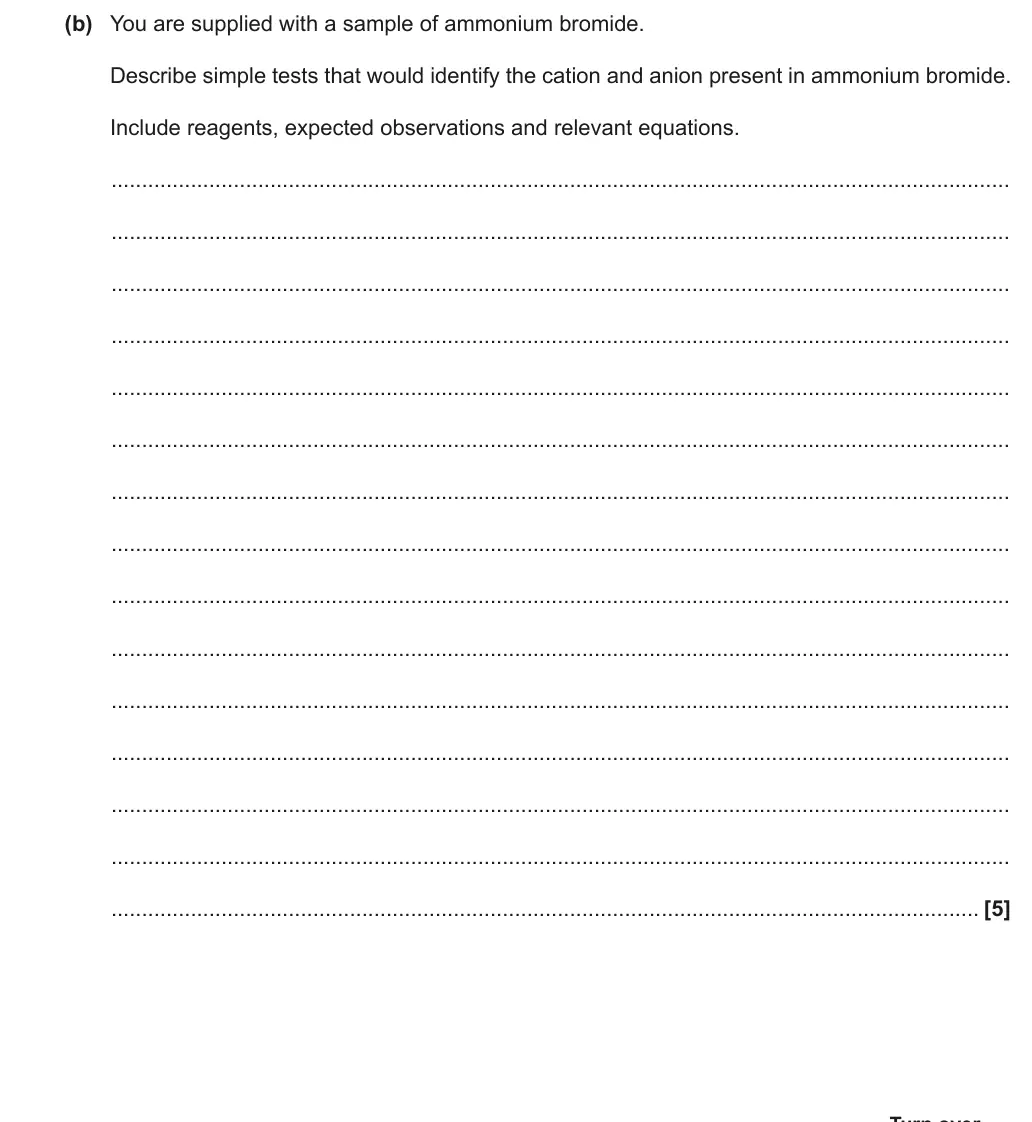
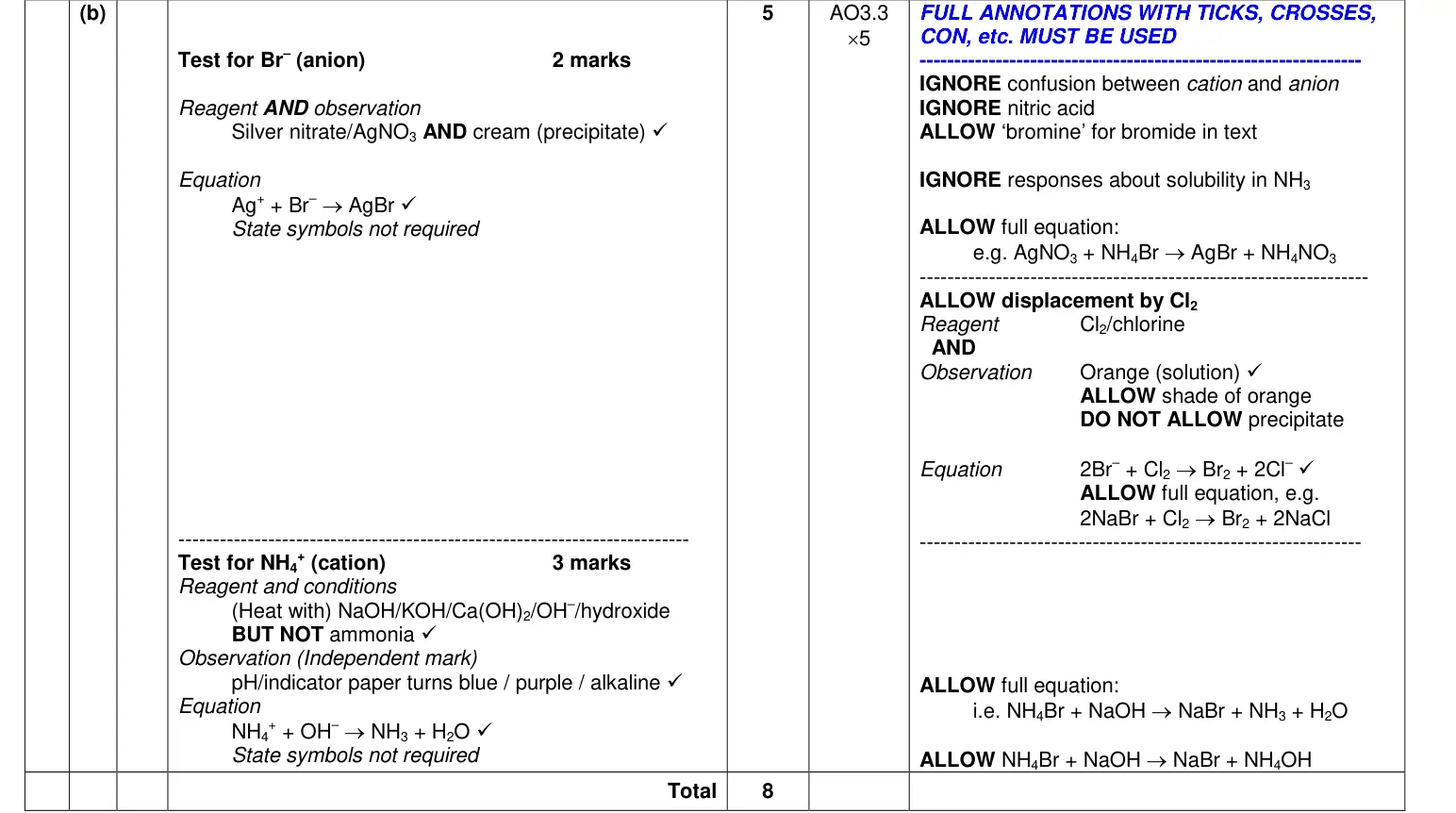
This question was best discriminator of the paper and rewarded the well-prepared candidates who were competent in writing equations. Most candidates were given the 2 marks for the bromide test with silver nitrate and the related equation (usually shown ionically). Many found the test for the ammonium ion more challenging to describe. The alkaline nature of ammonia was well-known and the indicator colour change to blue was often seen. Many candidates omitted the NaOH reagent and tested the compound with indicator, thinking that the ammonium ion itself is alkaline. Few candidates were able to write the equation for the ammonium test. Lower attaining students often outlined electrolysis as a test and many candidates wrote about the carbonate and sulfate tests prior to the halide test.
Notes from the mark scheme and report
NaOH (NOT ammonia) and heat, damp indicator paper turns blue
AgNO3 gives cream precipitate
IGNORE nitric acid
ionic or full equations allowed
ALLOW displacement by Cl2 giving orange solution (DO NOT ALLOW precipitate)
Skills: PAG4 Qualitative analysis of ions
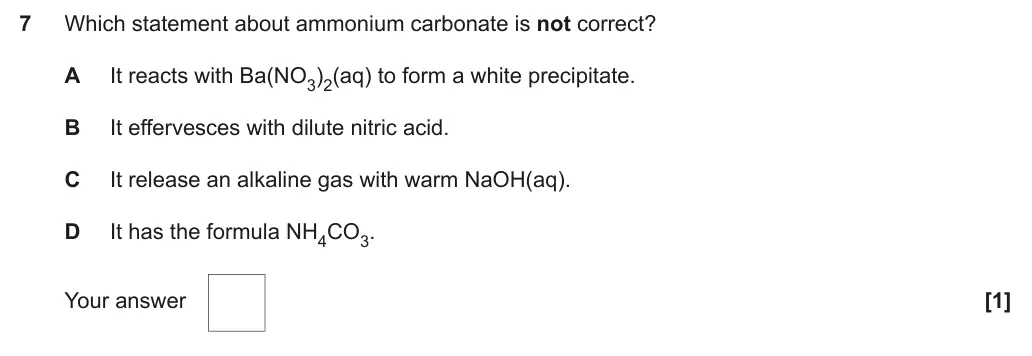
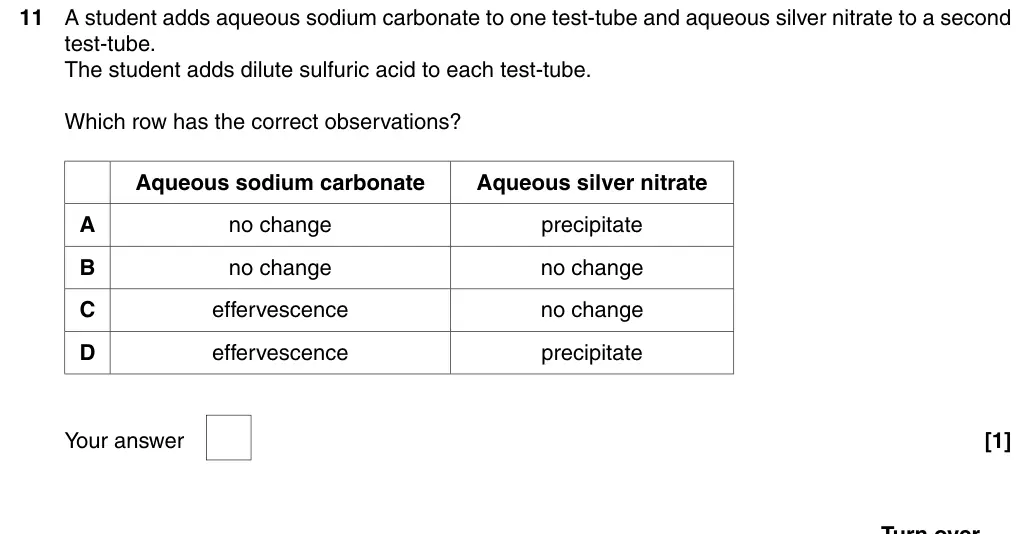
June 2018 · Paper 1 · Q71 markAO2Multiple choiceMedium
Answer
D
Mark scheme
Examiner's comment
Most candidates knew that the formula given in D was incorrect.
Notes from the mark scheme and report
formula is (NH4)2CO3
Skills: PAG4 Qualitative analysis of ions
June 2018 · AS Paper 1 · Q23(a)(ii)2 marksEquation writingHard
Earlier part of question 23 that this part uses
Mark scheme
Examiner's comment
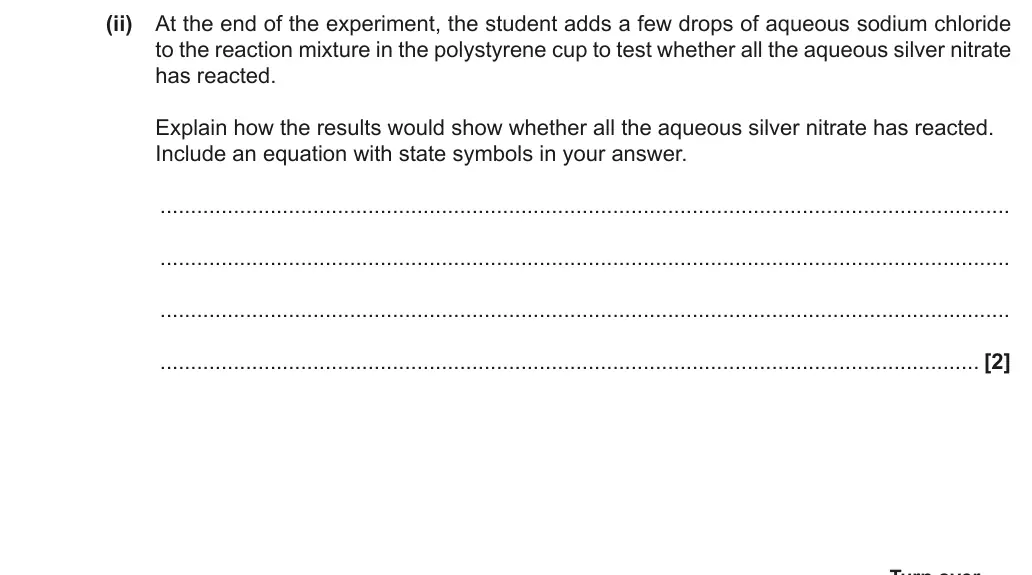
Most candidates recognised that silver nitrate and chloride ions react together to form a white precipitate, but many did not make the link between this observation and whether any silver nitrate was left unreacted. Many candidates did not give a correct equation, with missing or incorrect state symbols being common. This question discriminated extremely well.
Notes from the mark scheme and report
state symbols required in equation
observation must be linked to conclusion (white precipitate = not all reacted)
Skills: PAG4 Qualitative analysis of ions
June 2017 · Paper 1 · Q81 markMultiple choice
Answer
D
Mark scheme
June 2017 · Paper 1 · Q17(d)(i)2 marksEquation writing
Mark scheme
Notes from the mark scheme and report
state symbols needed
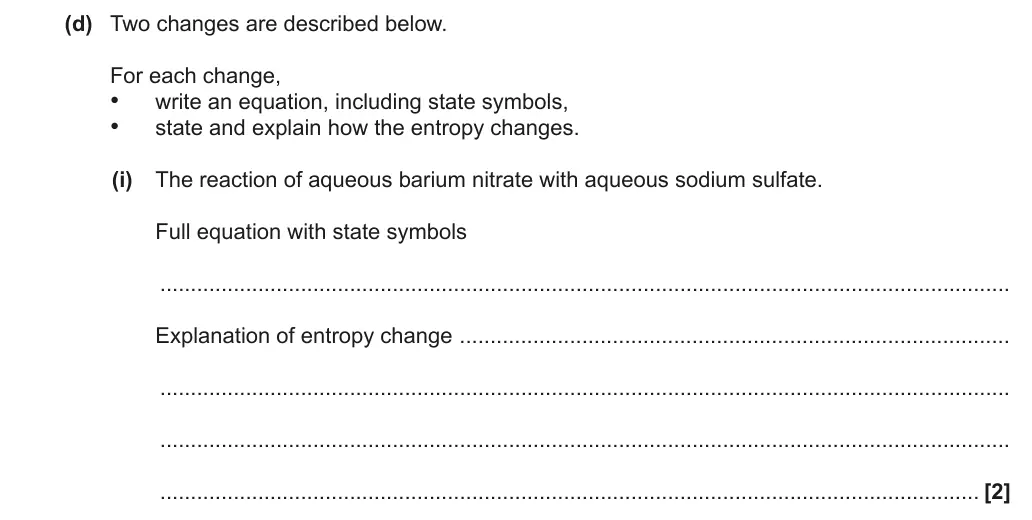
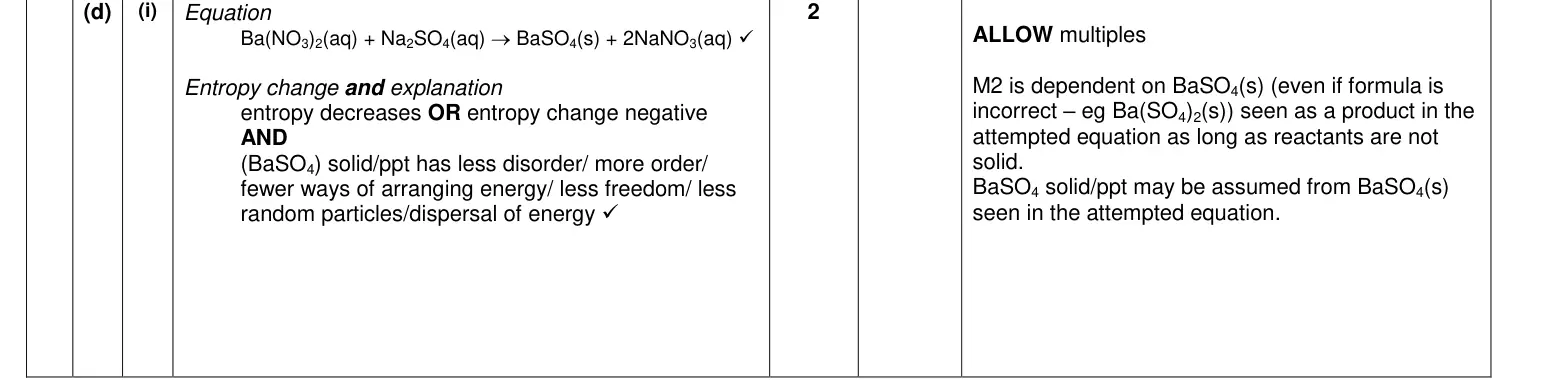
entropy decreases because solid BaSO4 formed
entropy mark dependent on BaSO4(s) as product
June 2017 · AS Paper 1 · Q22(b)5 marksExtended response
Mark scheme
Notes from the mark scheme and report
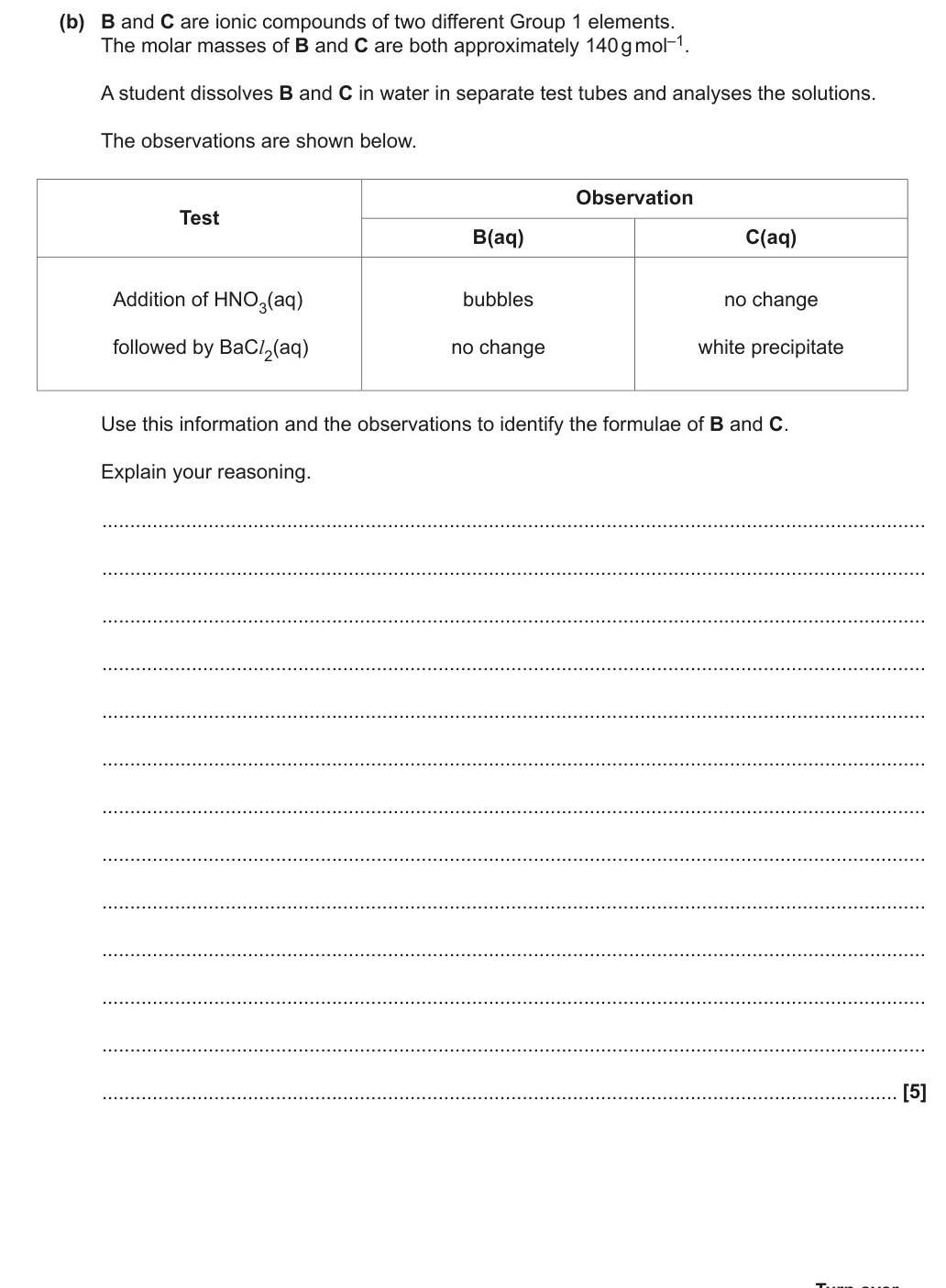
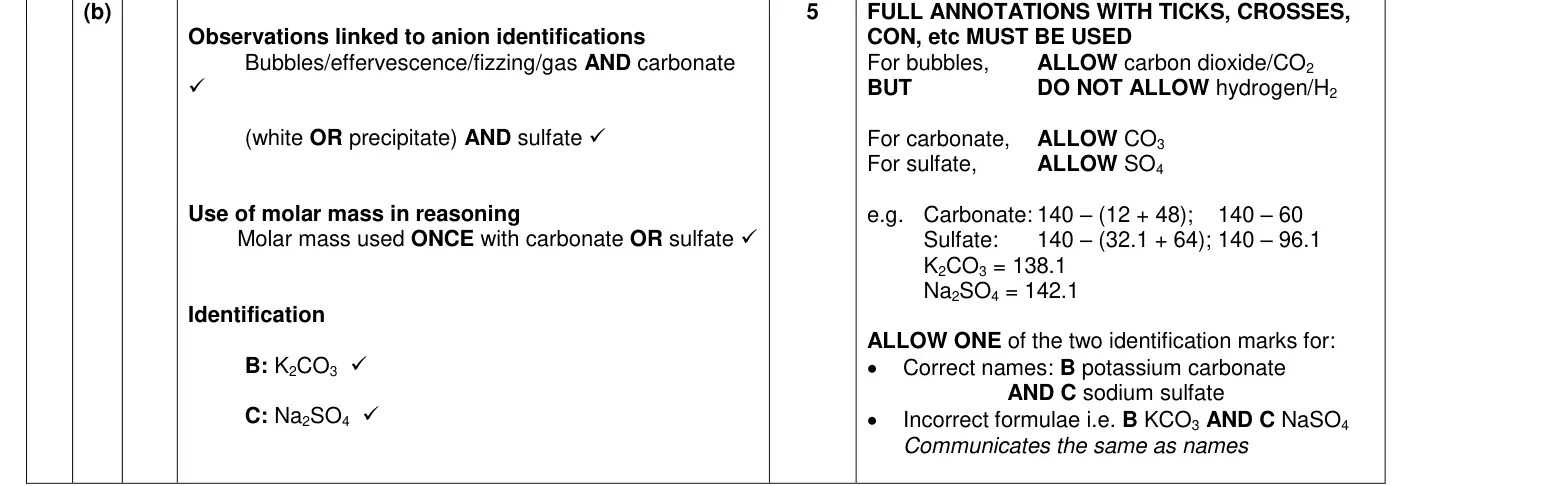
DO NOT ALLOW hydrogen for bubbles
molar mass must be used at least once in reasoning
names or KCO3/NaSO4 score only one of the two identification marks
Skills: PAG4 Qualitative analysis of ions
June 2017 · AS Paper 2 · Q1(b)(ii)2 marksShort answer
Earlier part of question 1 that this part uses
Mark scheme
Notes from the mark scheme and report
test for sulfate giving white precipitate
IGNORE cloudy
DO NOT ALLOW result linked to incorrect anion
Skills: PAG4 Qualitative analysis of ions
June 2016 · AS Paper 1 · Q111 markMultiple choice
Answer
D
Mark scheme
June 2016 · AS Paper 1 · Q23(c)(ii)1 markAO1Short answer
Earlier part of question 23 that this part uses
Mark scheme
Notes from the mark scheme and report
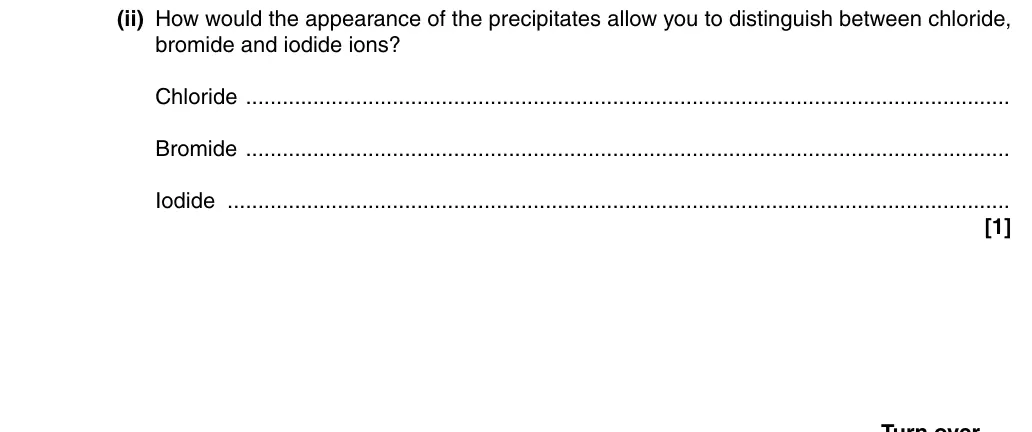
all three colours (white, cream, yellow) required for the mark
Skills: PAG4 Qualitative analysis of ions
Work with an OCR chemistry tutor
Dropping marks on calculations, mechanisms or the six-markers? Book a trial session with a specialist OCR chemistry tutor.