Answer
C
Mark scheme

Examiner's comment
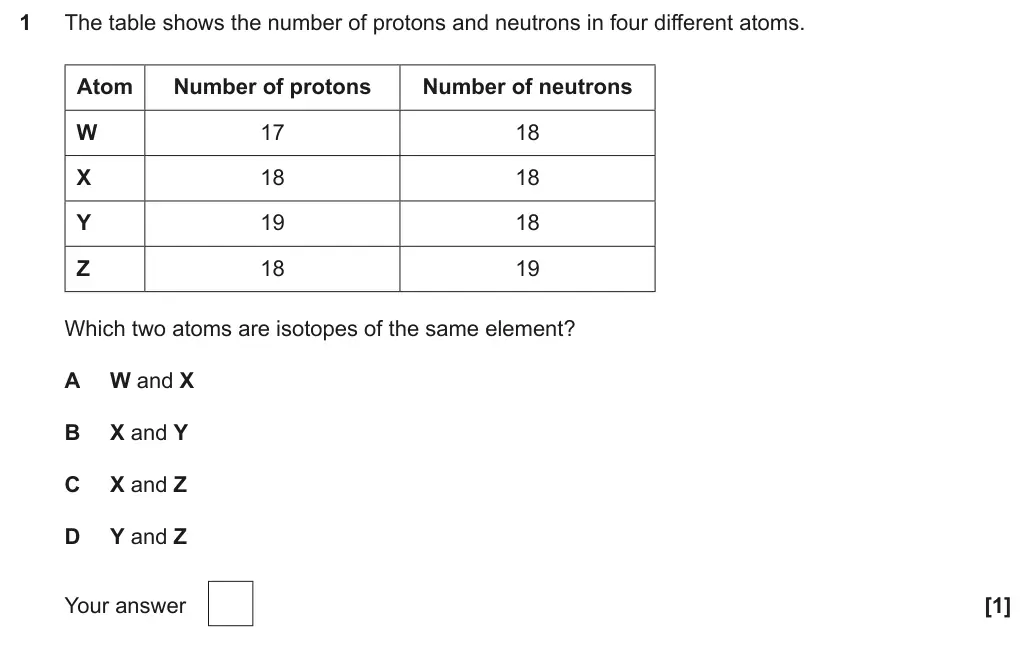
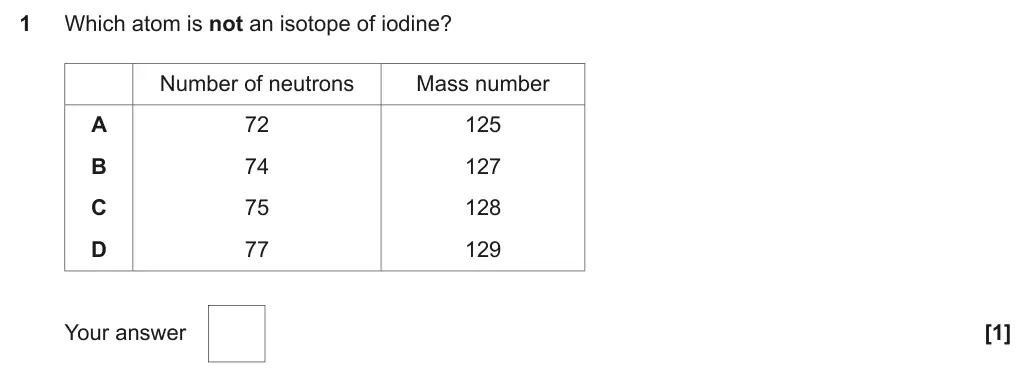
The correct answer was C. Incorrect answers were rarely seen as candidates had a secure knowledge of isotopes.
C
The correct answer was C. Incorrect answers were rarely seen as candidates had a secure knowledge of isotopes.
A
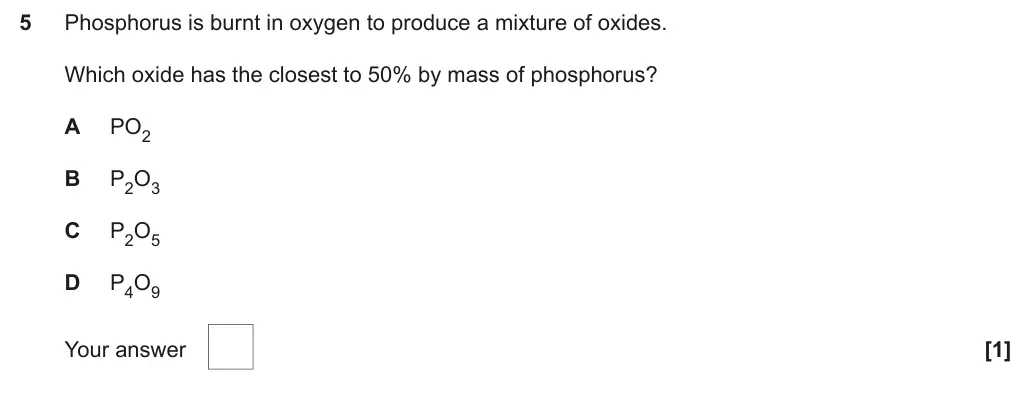
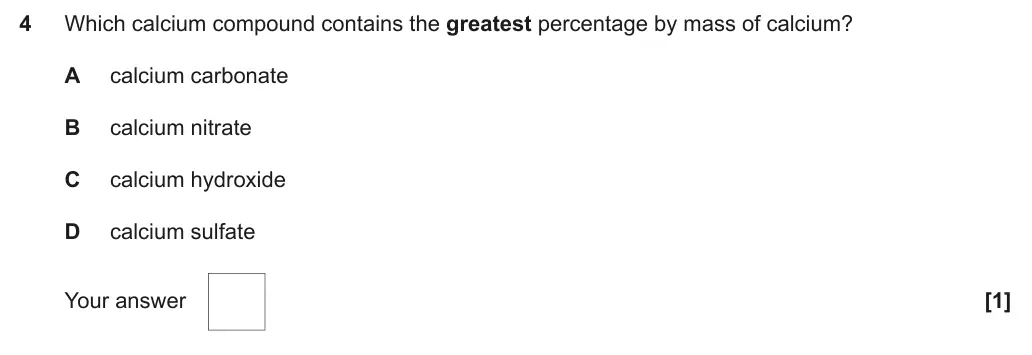
Many candidates gave the correct response of A. B was the most common incorrect response, presumably assuming the 2:3 ratio of atoms is closest to 50:50 (and not taking into account relative atom masses).
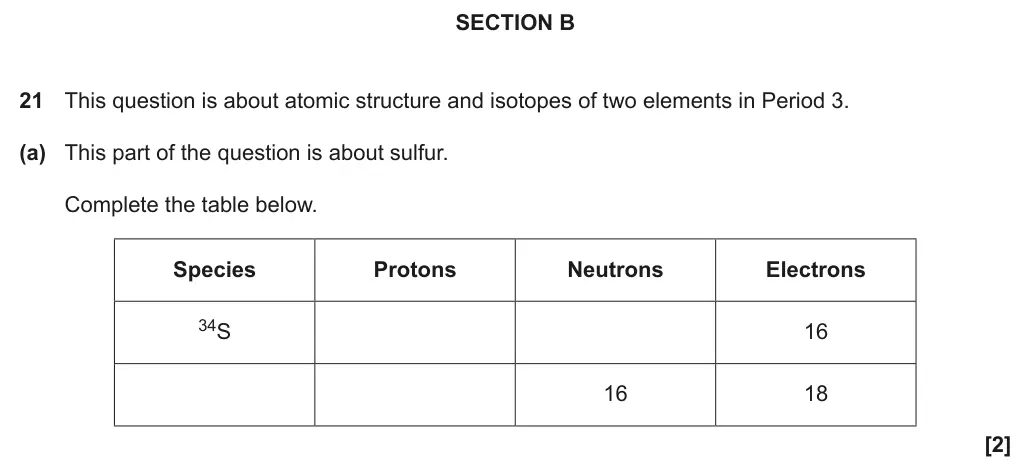
This question proved low scoring, with many candidates not using the information in the question and giving species other than sulfur. ‘Ar’ was the most common error, which lost both marks as 18 was usually then given as the proton number (incorrectly assumed from the species having 18 electrons).
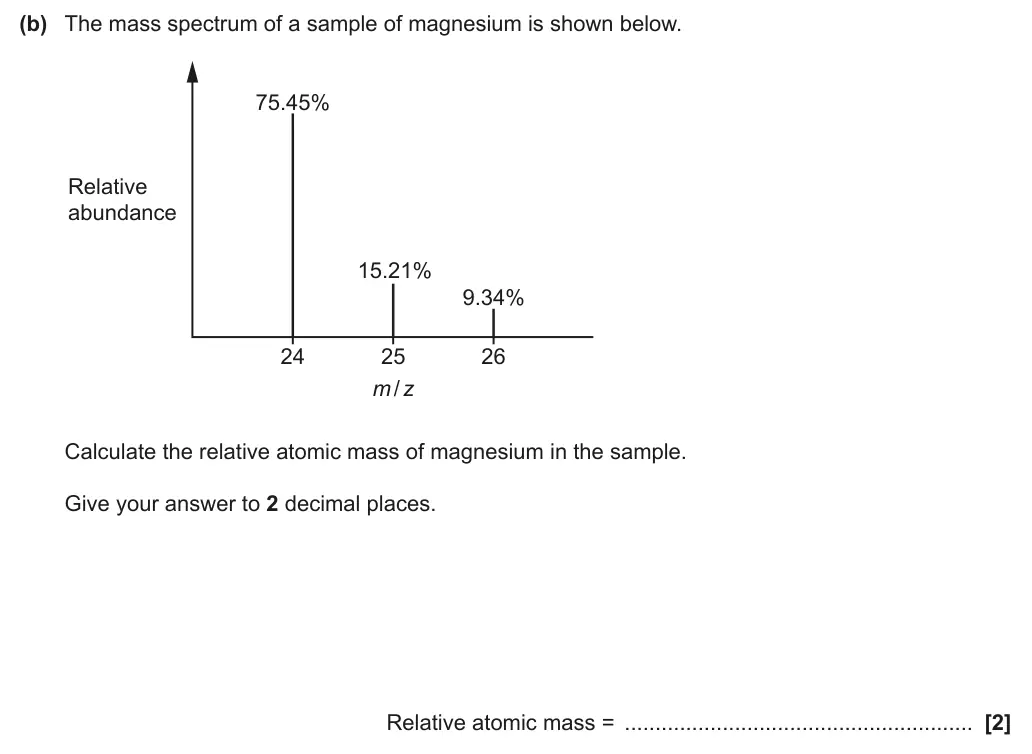
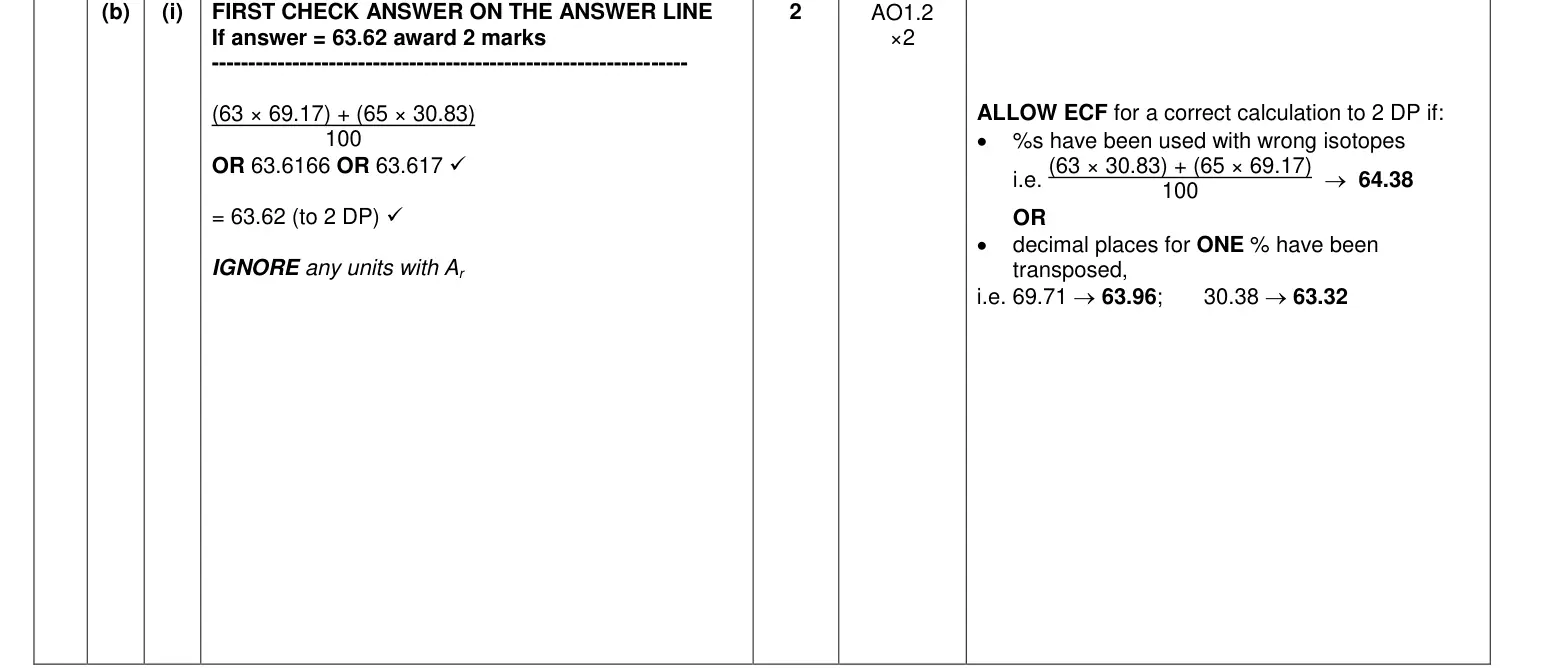
Candidates answered this question very well. A few mistyped the numbers into their calculator after giving the correct calculation and even fewer made rounding errors. This type of question has featured on previous examinations, and it was encouraging to see how well it was answered.
Skills: M0.2 Use ratios, fractions and percentages; M1.2 Find arithmetic means; M3.1 Translate information between graphical, numerical and algebraic forms
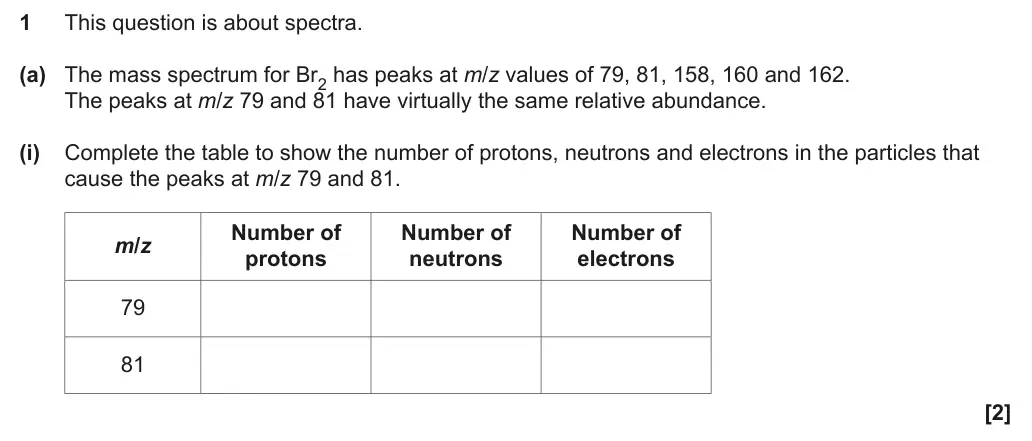
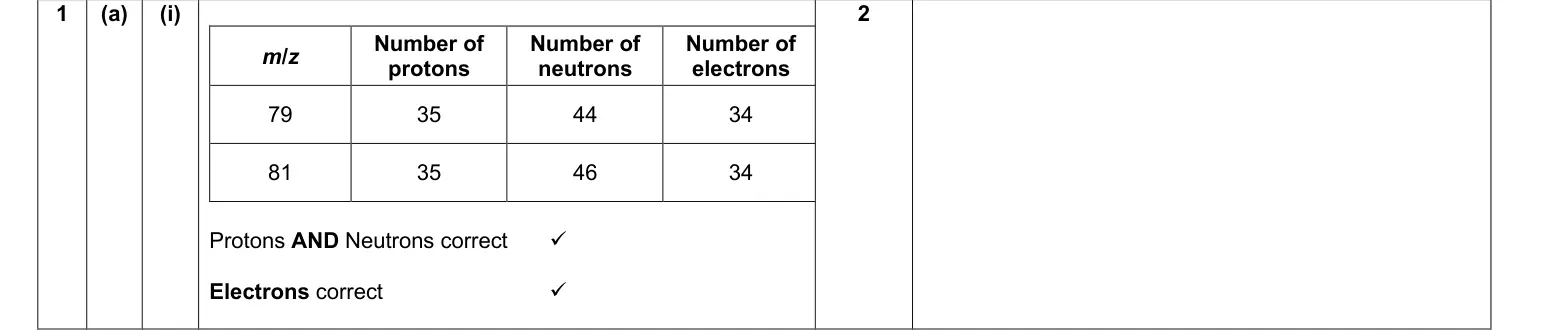
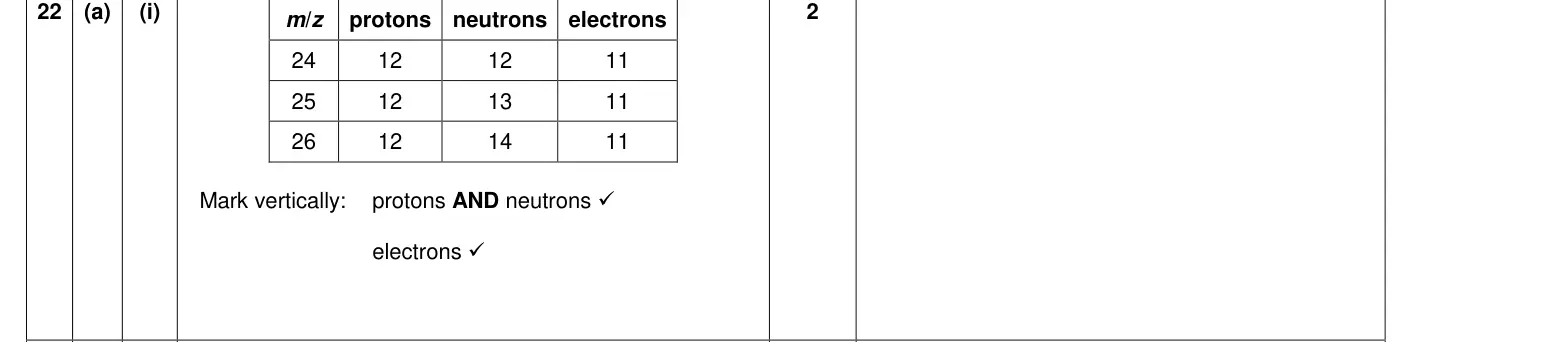
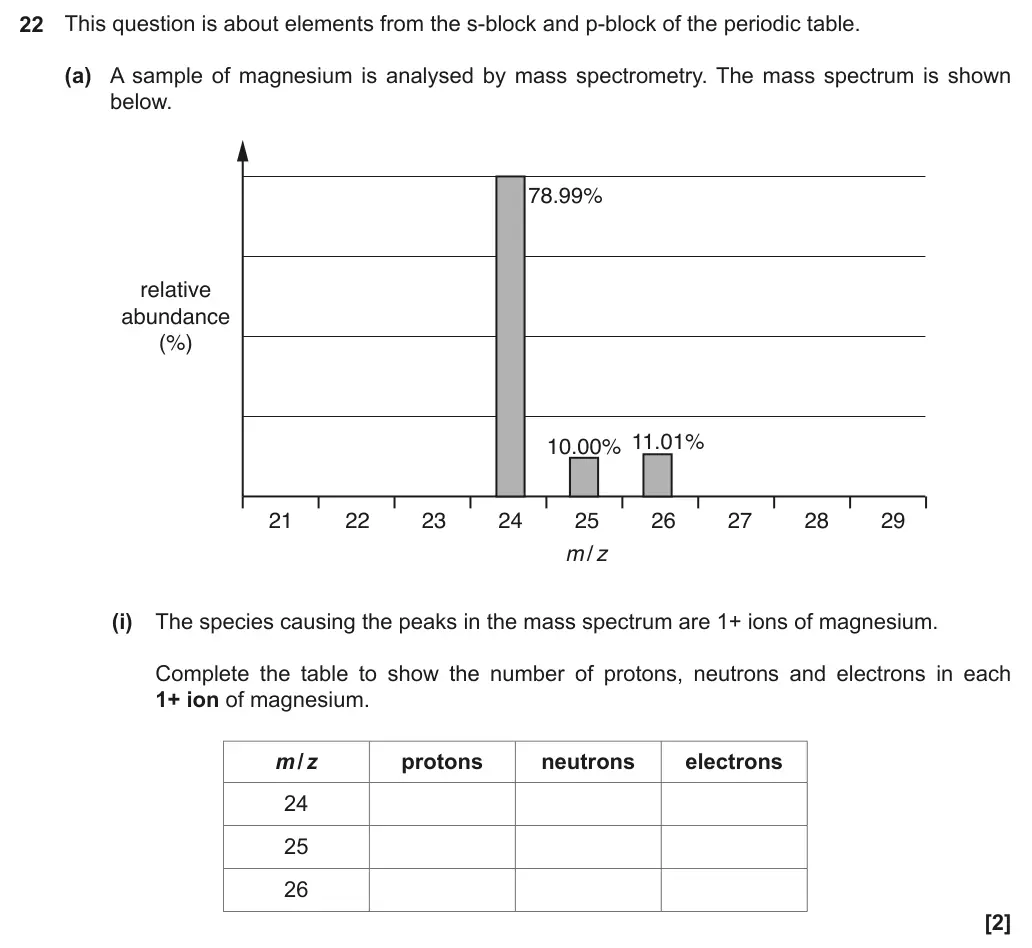
Most candidates answered protons and neutrons correctly, but very few worked out the electrons for the mass spectrometry particles correctly, with 35 being the most common incorrect response. The information in the question needs to be read very carefully. With 2 marks allocated, there is a clue that the question might not be as straightforward as it first seems. Question 1 (a) (i) and Question 1 (a) (ii) proved to be excellent discriminators between students at different grades.
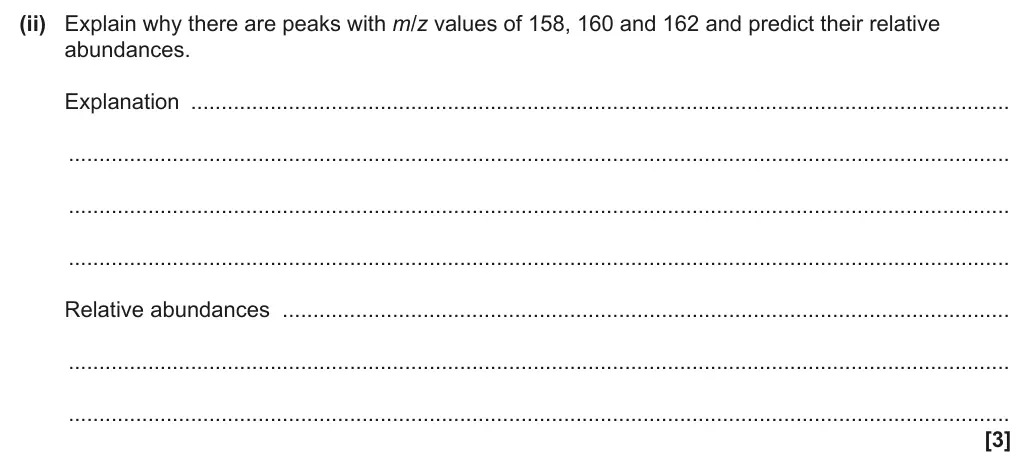
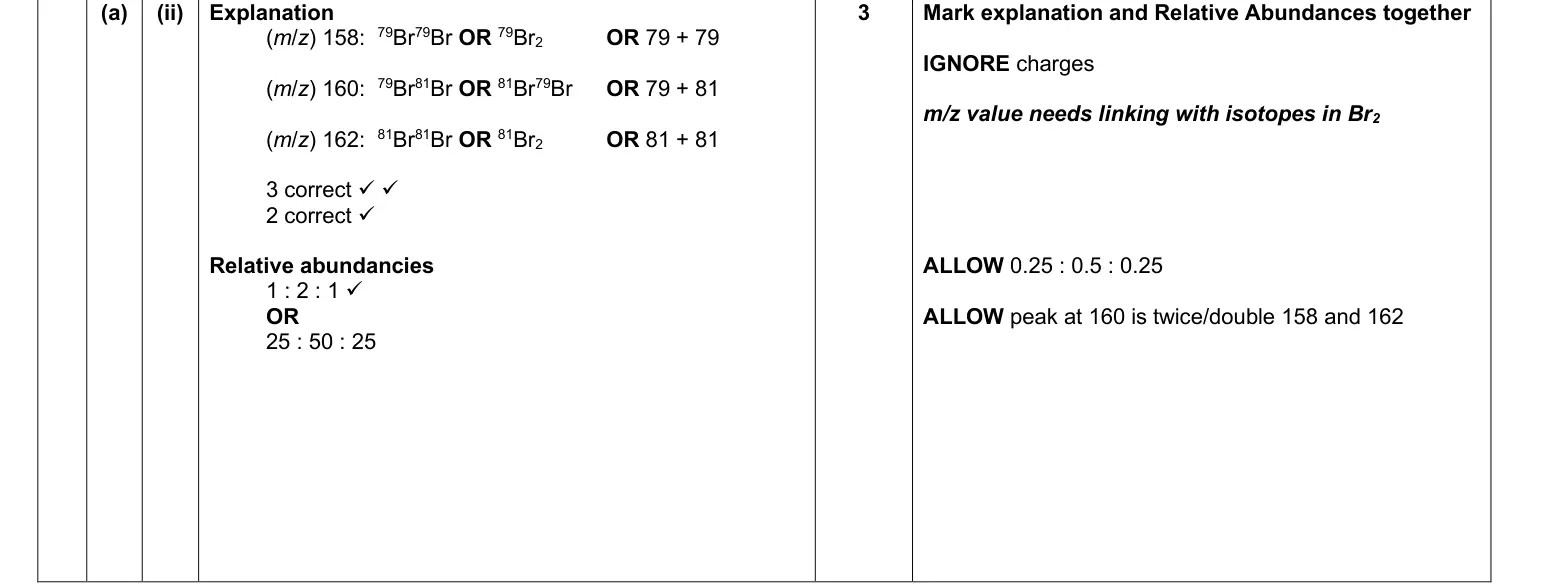
Most candidates gave vague responses in terms of the properties of isotopes. Some candidates were able to work out that the 158 and 162 peaks resulted from two 79Br and two 81Br isotopes respectively. The peak at 160 proved to be more difficult with many claiming that it resulted from two 80Br isotopes rather than one 79Br and one 81Br isotope. Predicting the relative abundance of the peaks was difficult, the most common response being that the peaks would have the same heights, presumably because the 79Br and 81Br isotopes have similar abundances.
Skills: M0.2 Use ratios, fractions and percentages
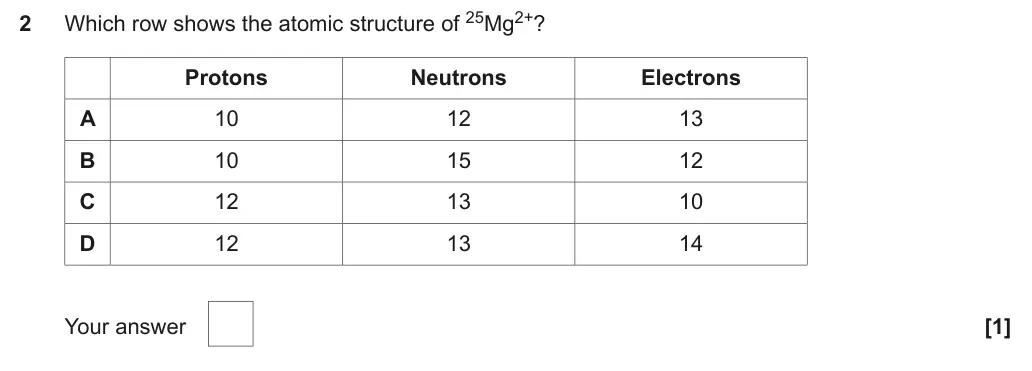
C
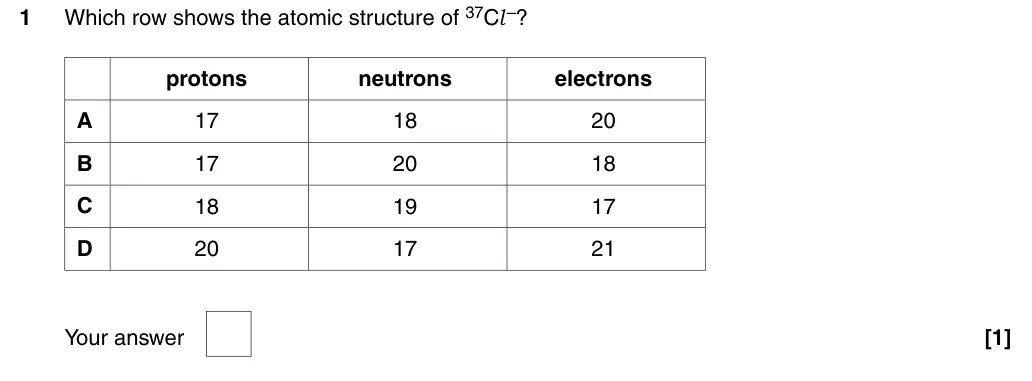
Most candidates recognised the correct atomic structure, a basic chemical skill taken forward from GCSE.
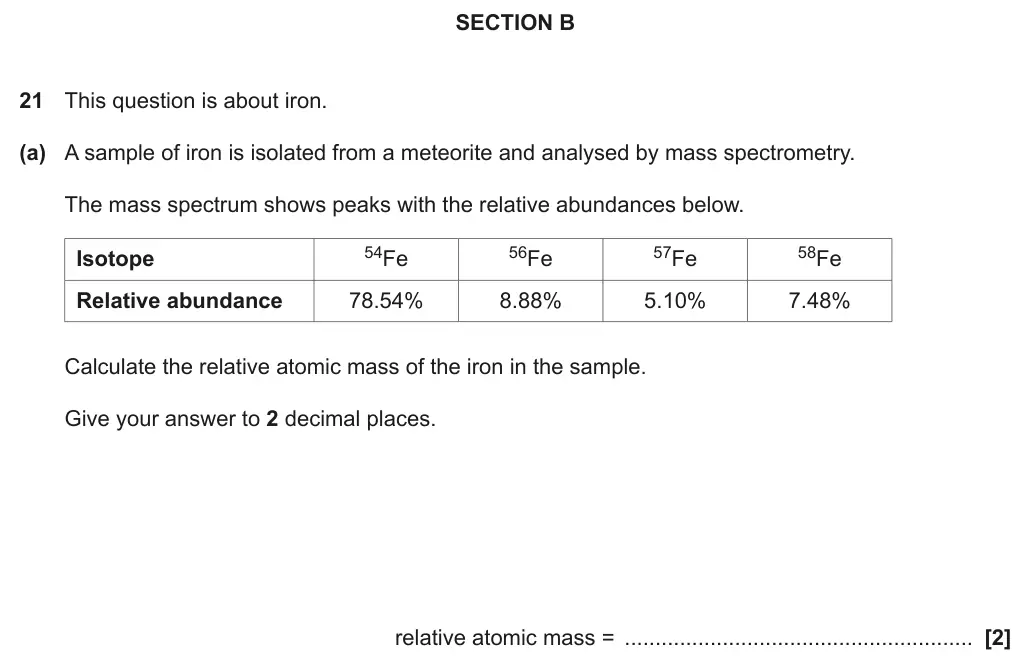
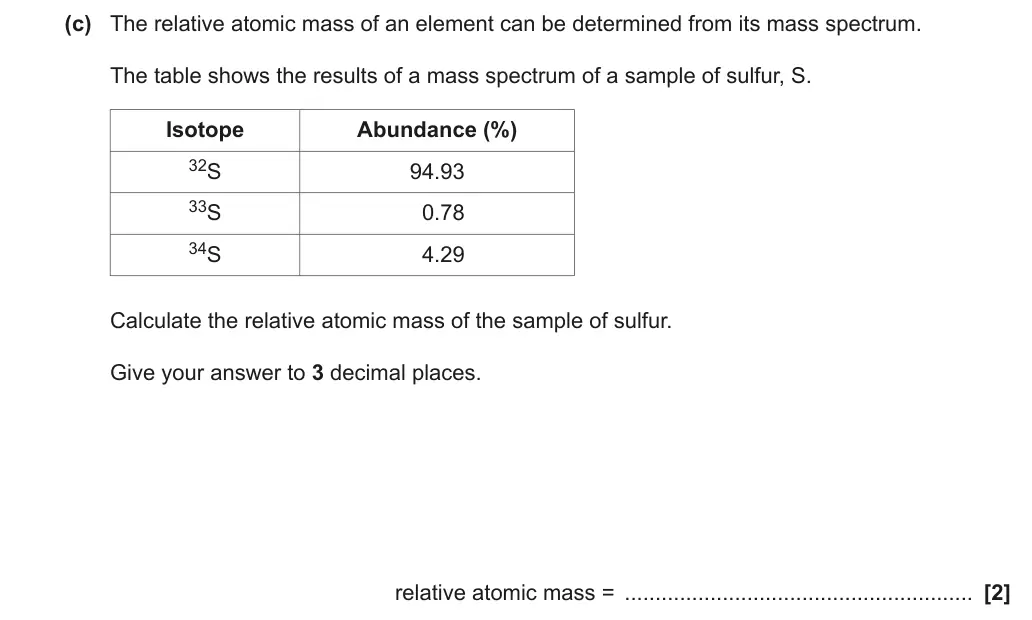
Candidates answered this question very well. A few mis-wrote the numbers and even fewer gave responses to the incorrect number of decimal places. This type of question has featured on previous examinations, and it was encouraging to see how well it was answered, even with more isotopes being included than previously.
Skills: M0.2 Use ratios, fractions and percentages; M1.1 Use an appropriate number of significant figures
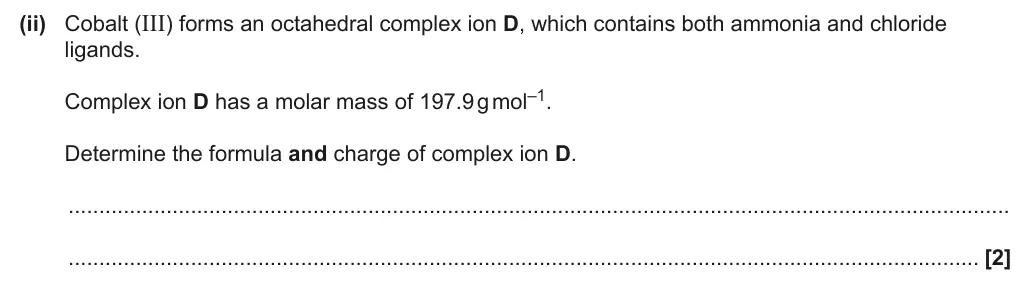
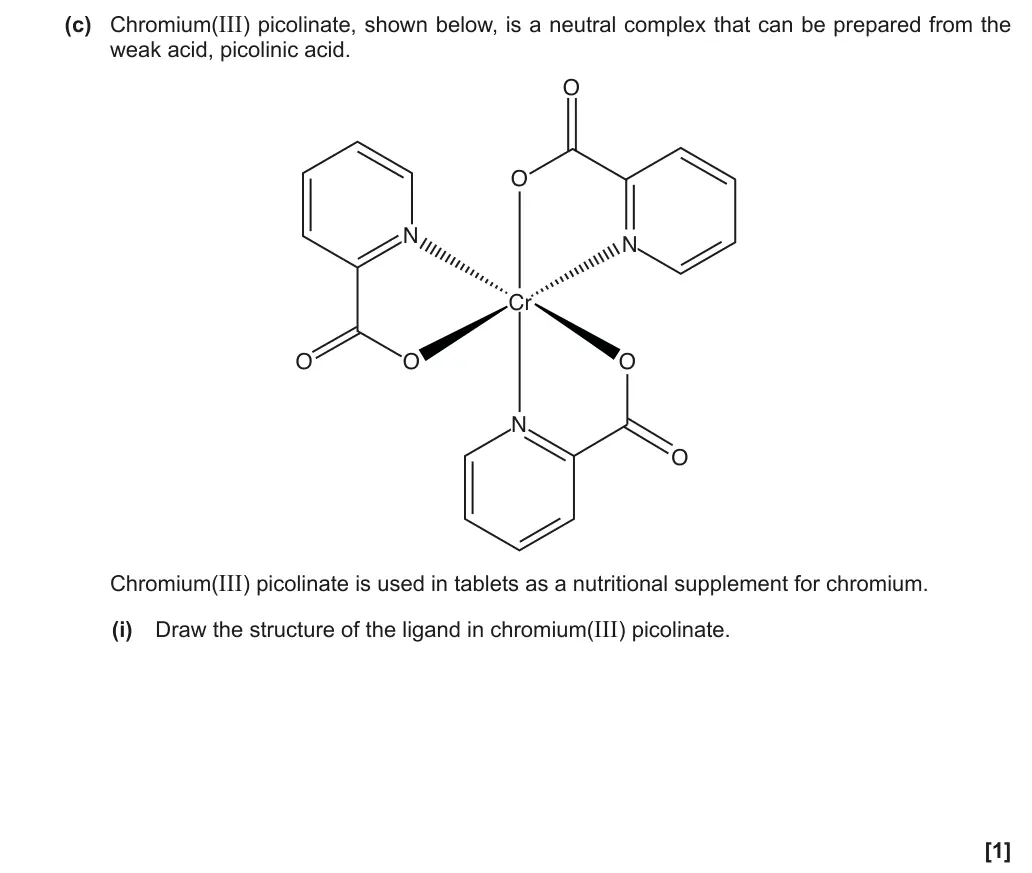
Most candidates identified the formula and the charge as 1+. A few candidates stated no charge or 3+. Candidates should consider the use of brackets in the formula, e.g. square brackets to show the complex and curly brackets to show the number of ligands attached. A few candidates used NH4 rather than NH3 for the ammonia ligand.
Skills: M0.2 Use ratios, fractions and percentages; M2.4 Solve algebraic equations
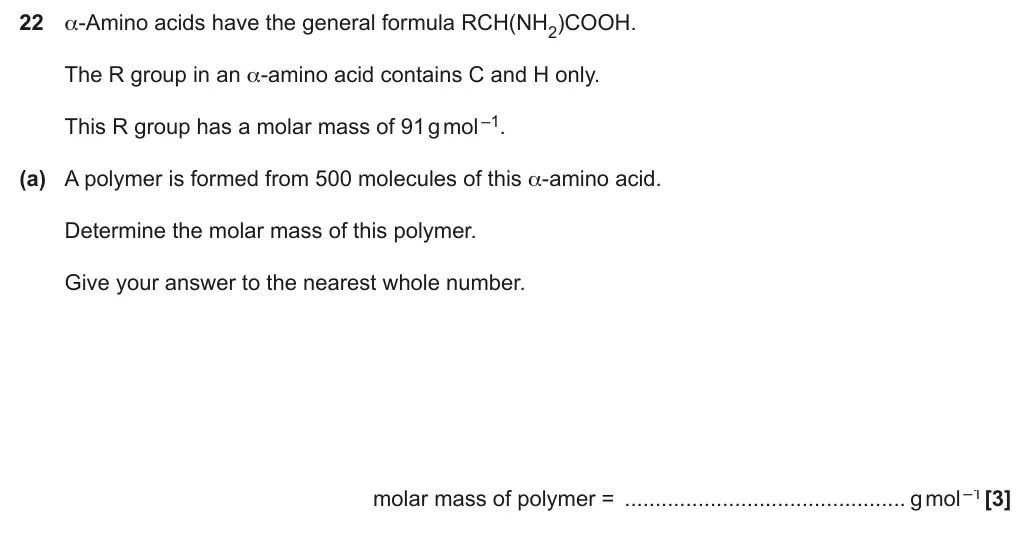
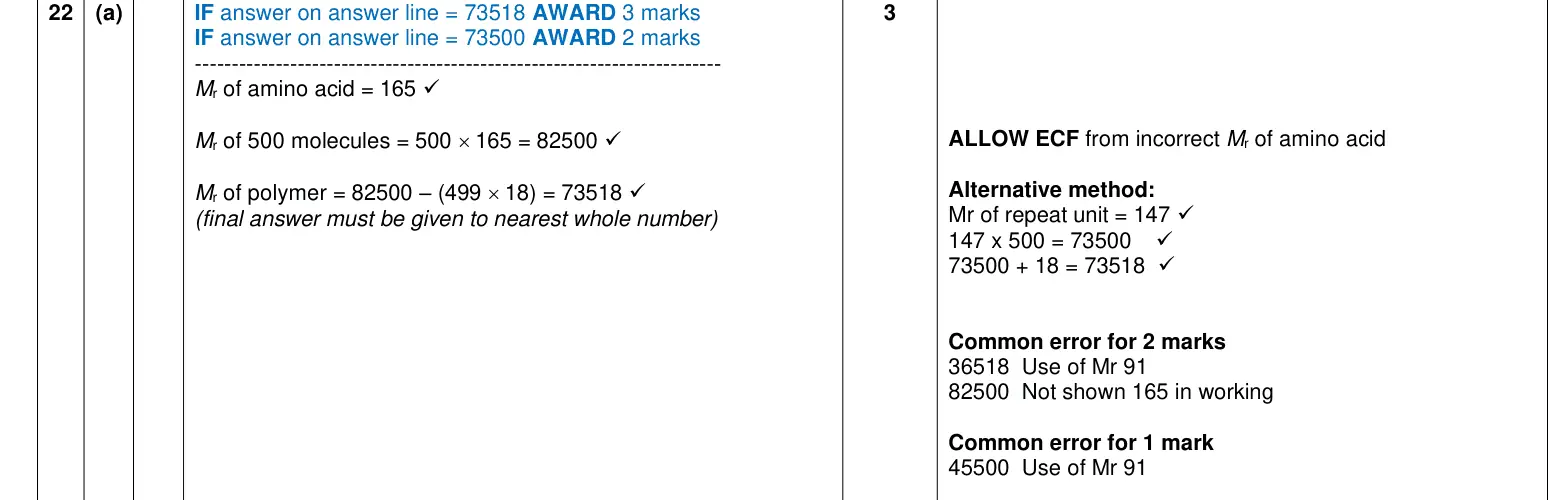
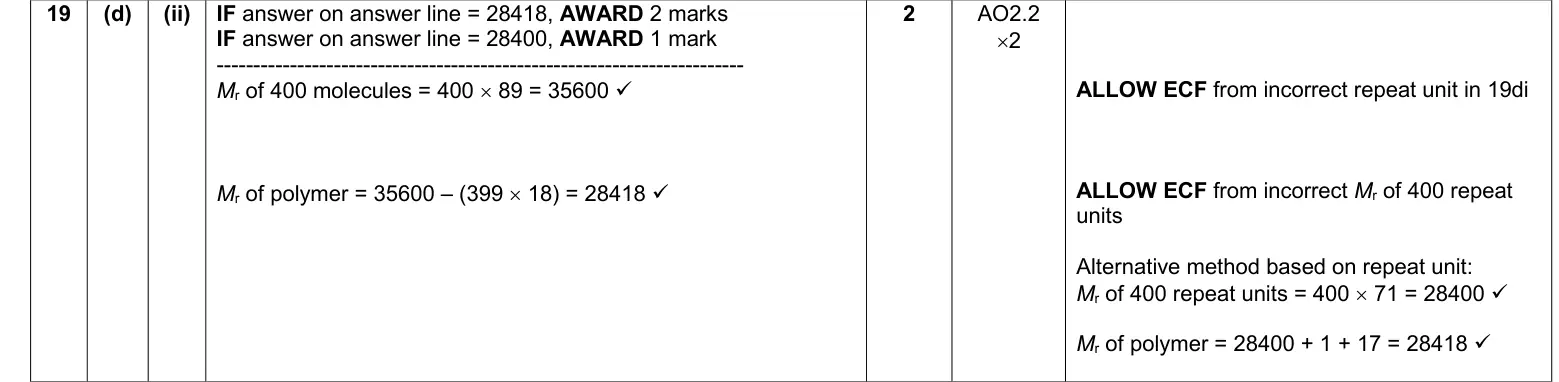
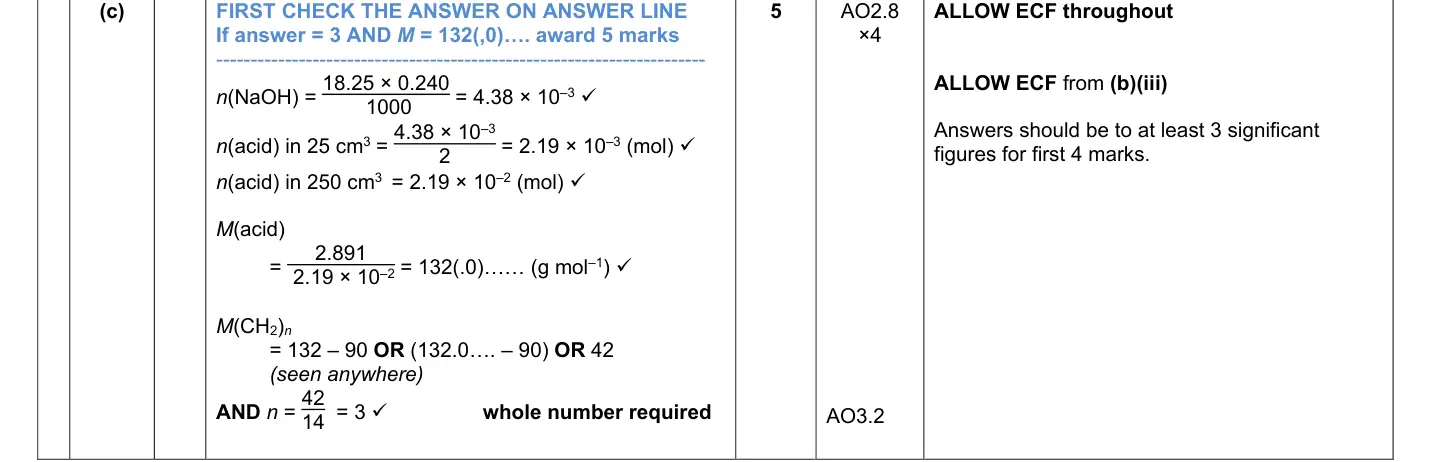
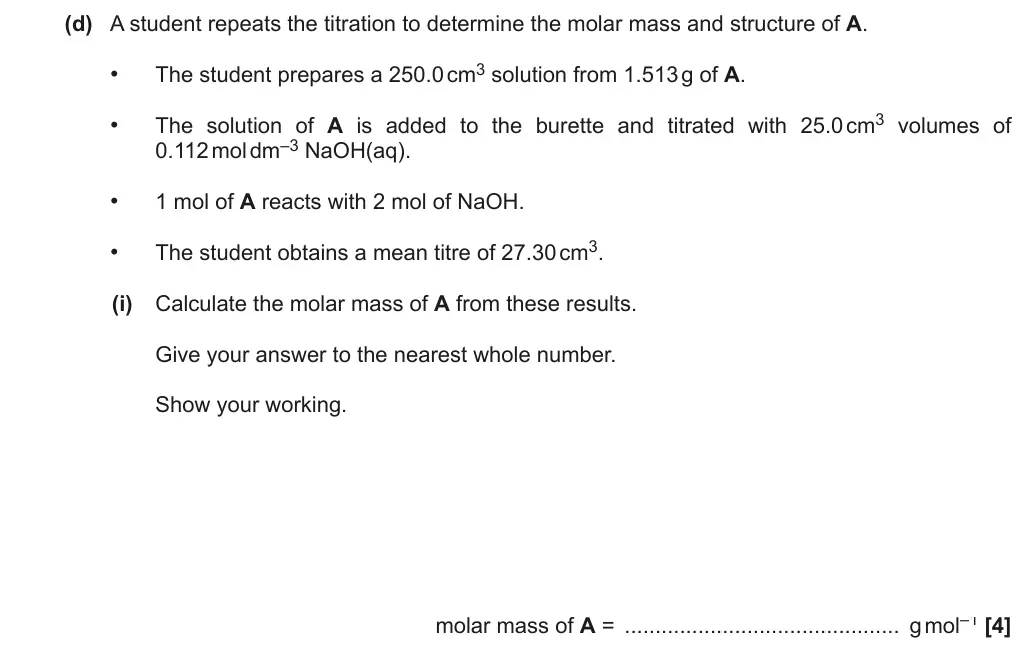
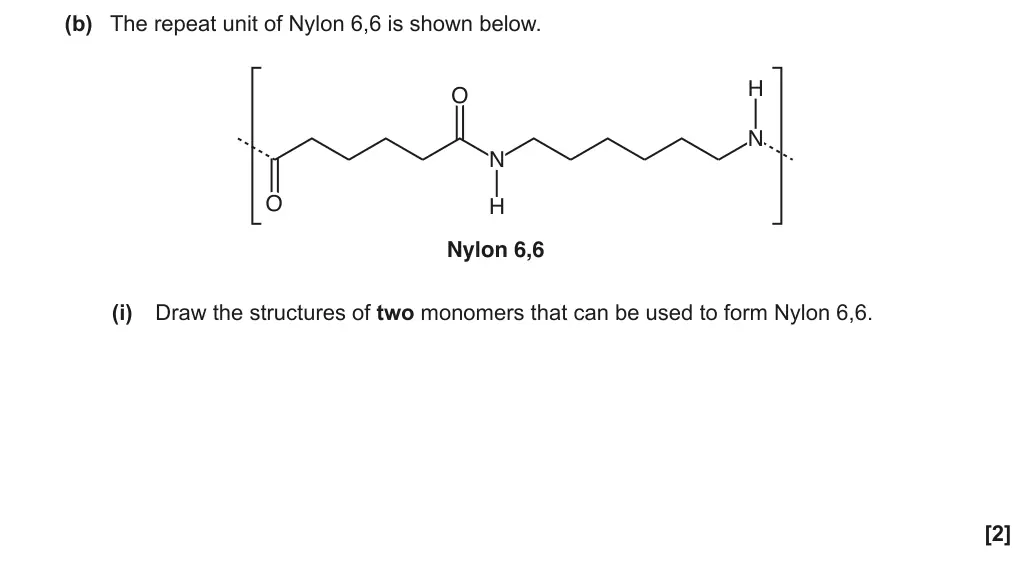
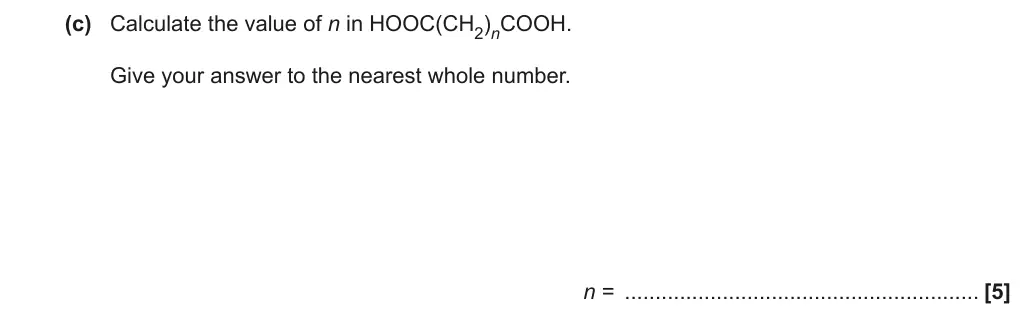
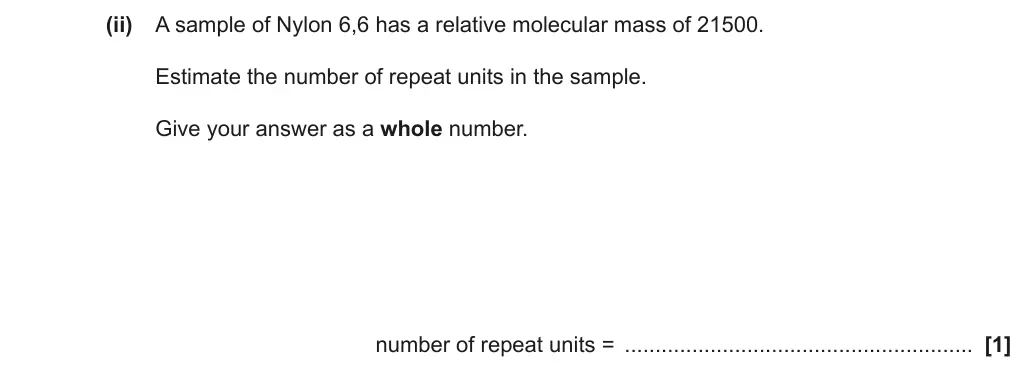
Most candidates managed to score at least one mark here, either for correctly determining the molar mass of the monomer, the repeat unit in the polymer or alternatively they multiplied a molar mass by 500. Many candidates gained 2 marks for either 73500 or 82500 but then struggled to account for the water lost. Some candidates lost marks due to errors in calculating the molar mass of the monomer or some tried to incorporate the use of Avogadro’s constant into the calculation. Many misunderstood what atoms would be lost during polymerisation. For example, a common incorrect response seen was found by subtracting 2 from the correct molar mass giving 163, followed by multiplication by 500 to give 81500 and finally adding of 2 to give 81502. Some struggled to understand what was meant by nearest whole number, e.g. rounding 73518 to 74000 or 82500 to 80000.
Skills: M0.2 Use ratios, fractions and percentages; M2.3 Substitute numerical values into algebraic equations using appropriate units for physical quantities
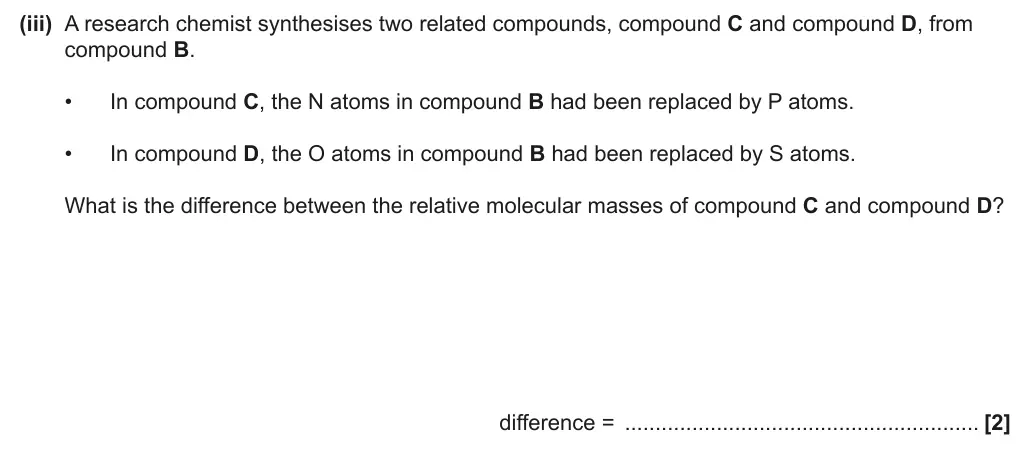
This question was answered extremely well with about three-quarters of candidates securing both marks. Most candidates calculated the molecular masses of compounds C and D as 380 and 441.7 respectively, to obtain a difference of 61.7. Some candidates adopted a simpler different approach which gives the same correct answer, working out the difference between the masses of nitrogen and phosphorus (for C) and oxygen and sulfur (for D). ECF was applied to any incorrect molecular formulae from Question 2 (c) (i) from which both marks could be obtained.
Skills: M0.2 Use ratios, fractions and percentages
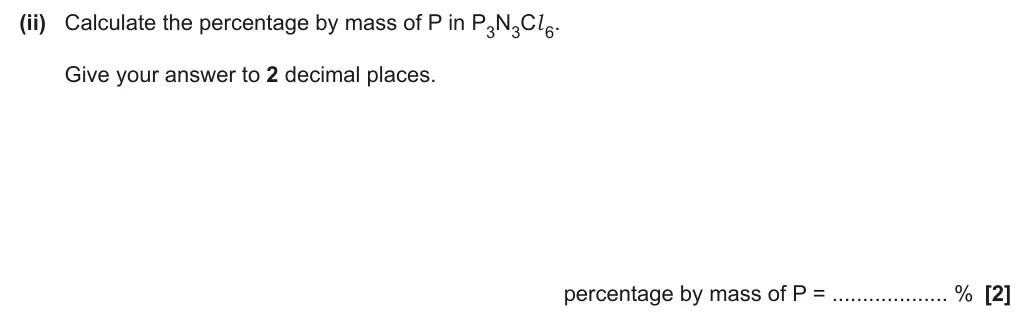
In contrast to equation writing, candidates found this simple calculation far easier with the majority obtaining both marks for 26.72. Common incorrect percentages were 26.7 (wrong number of decimal places) and 8.91 (using 31 rather than 3 × 31 for the numerator).
Skills: M0.2 Use ratios, fractions and percentages; M1.1 Use an appropriate number of significant figures
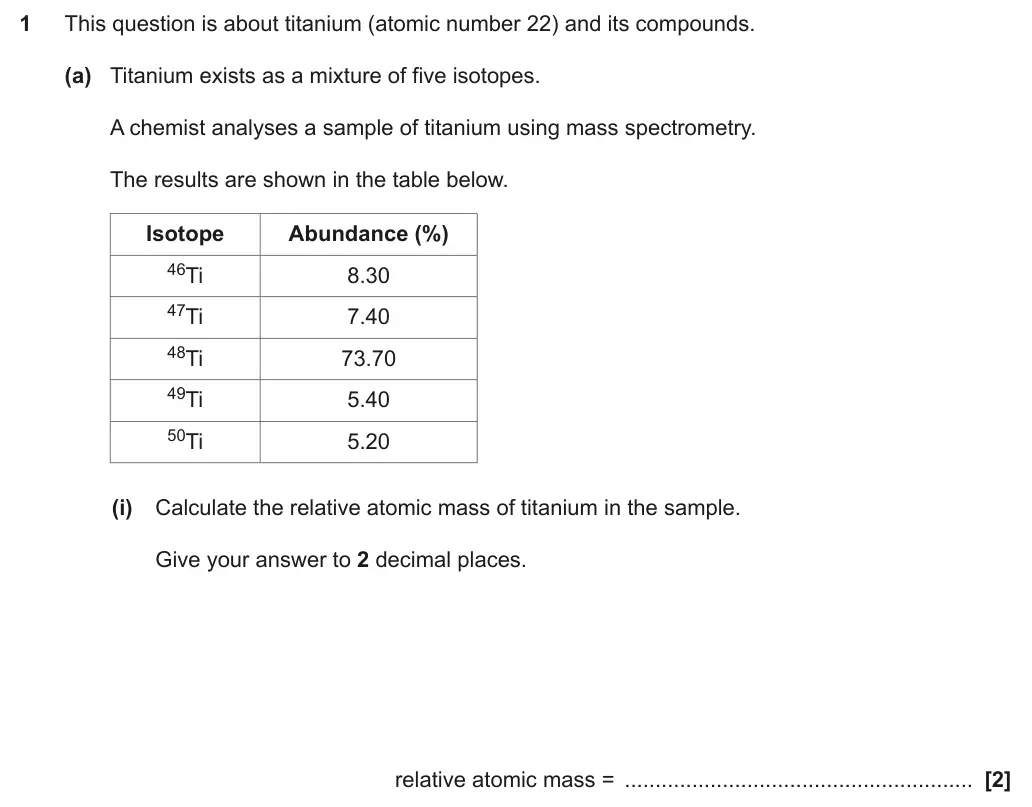
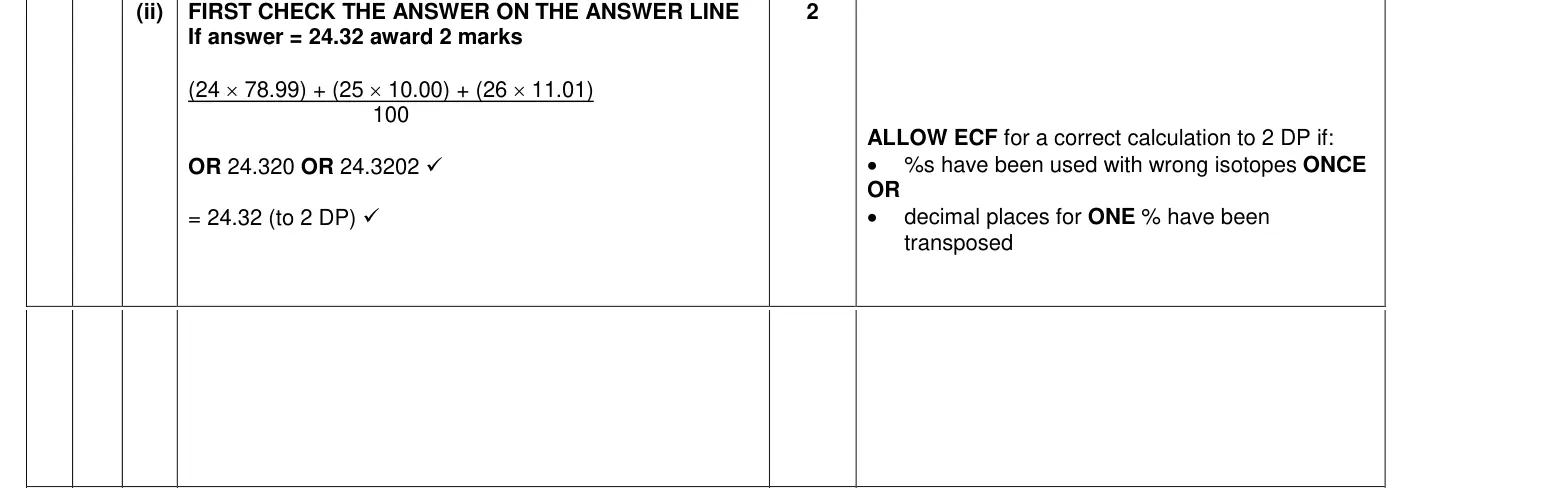
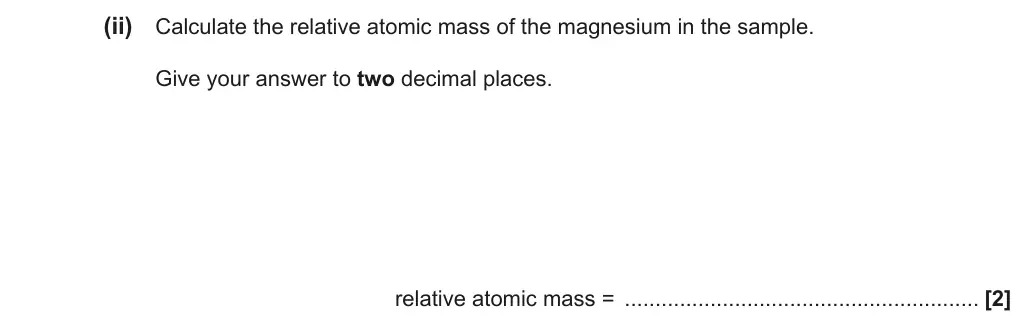
Most candidates scored both marks. Some lost marks for minor slips such as not giving their final answer to 2 decimal places or making calculator errors. A few didn't know how to attempt the calculation or calculated the average mass.
Skills: M0.2 Use ratios, fractions and percentages; M1.2 Find arithmetic means
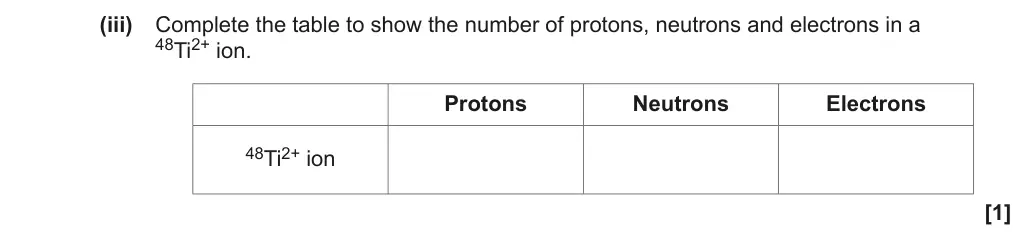
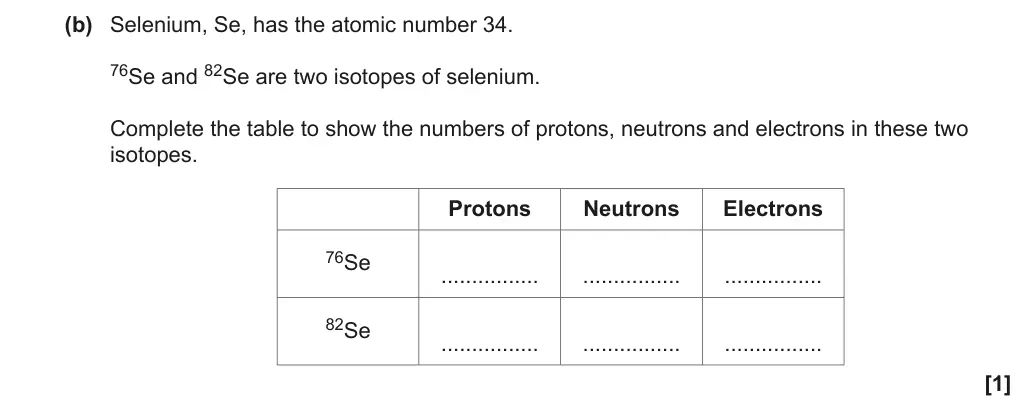
Most candidates gained this mark. Common errors included giving 24 or 22 for number of electrons, or 48 or 24 for neutrons. A few used the relative atomic mass of 47.9 from the periodic table so gave 24.7 for number of neutrons.
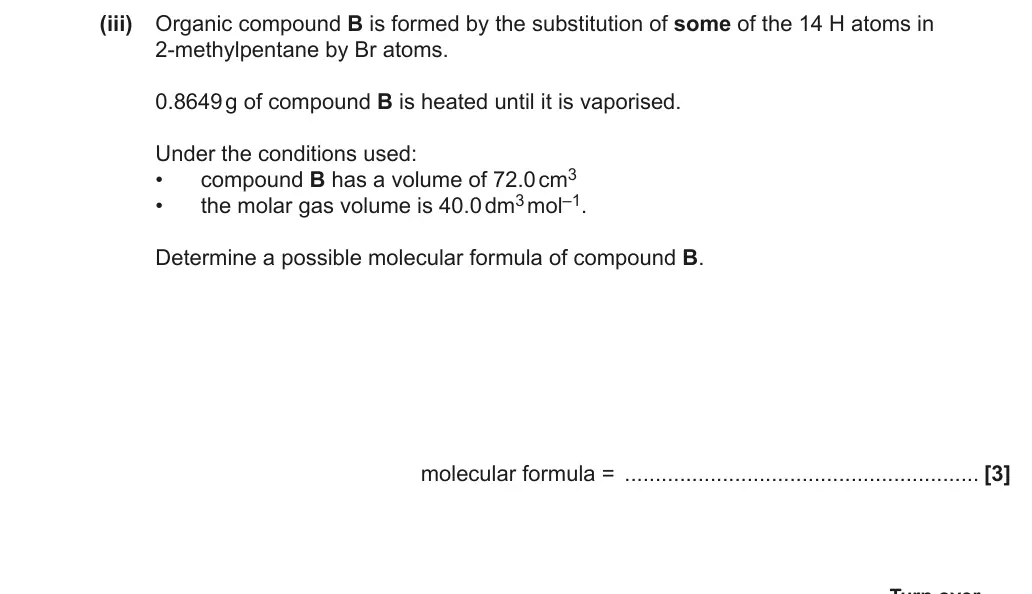
Overall, this question was well answered with over half of candidates gaining all 3 marks. The use of a different molar volume confused some candidates. Some attempted to use PV=nRT or different combinations of the figures given with varying degrees of success. Lower attaining candidates typically struggled with unit conversions and were unable to make use of the units to help them work out the methodology to use.
Skills: M0.0 Recognise and make use of appropriate units in calculations; M2.3 Substitute numerical values into algebraic equations using appropriate units for physical quantities; M2.4 Solve algebraic equations
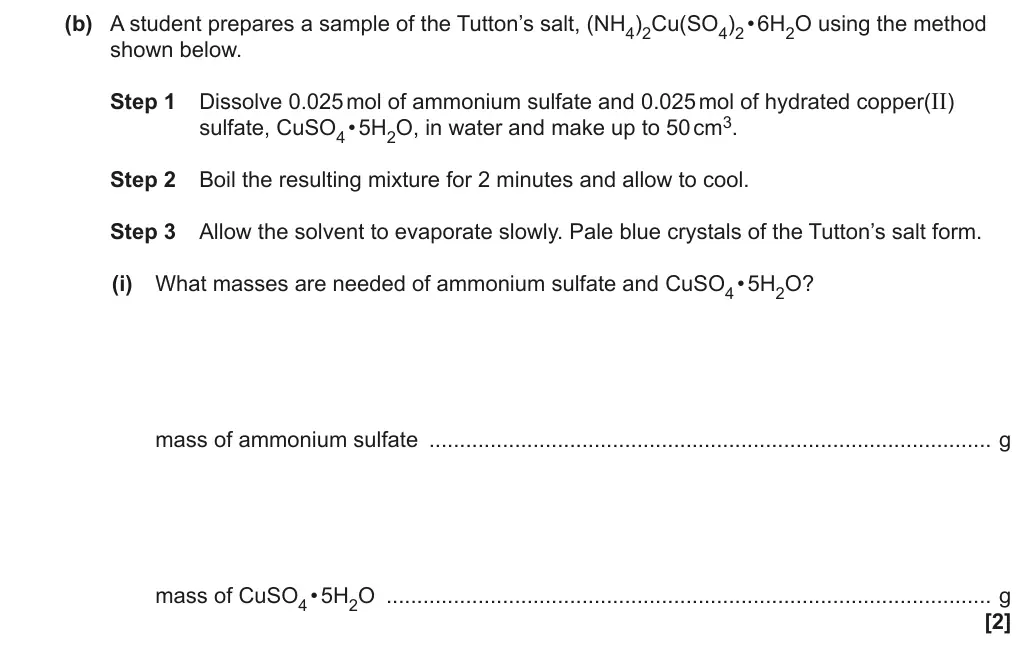
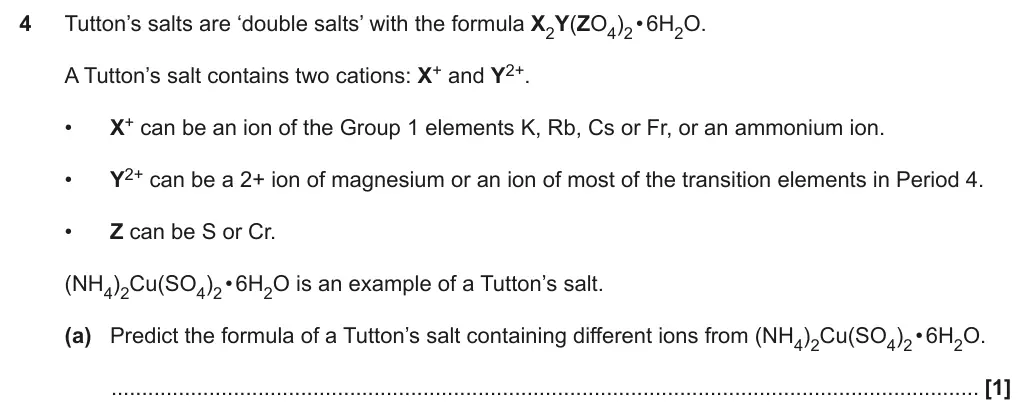
This question required candidates to calculate the masses of two reactants that could be used to prepare a sample of the Tutton’s salt. Candidates were supplied with the formula of hydrated copper(II) sulfate but not the formula of ammonium sulfate, so candidates needed to work out its formula from ions that candidates are expected to be able to recall from the specification. Just over half the candidates obtained both correct masses but many obtained just one correct mass, usually that of CuSO4•6H2O. This exemplar shows a typical response with the incorrect formula of ammonium sulfate clear shown by the candidate, resulting in the incorrect mass of 2.8525 g. This incorrect formula and mass were seen in many responses and, from the initial crossings out, this candidate is clearly confused about how to tackle this simple mole calculation. The incorrect answer of 2.85 g was seen on almost as many scripts as the correct answer of 3.30 g. The moral is that candidates need to learn the formula and charges of the common ions encountered in chemistry. The comments here apply also to Question 6 (b) (i), where formulae need to be written using ions listed in the specification.
Skills: M0.2 Use ratios, fractions and percentages; M2.3 Substitute numerical values into algebraic equations using appropriate units for physical quantities
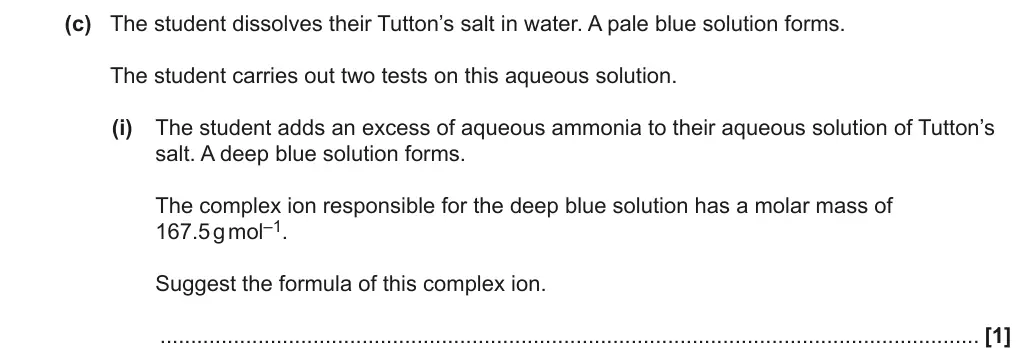
This reaction of copper(II) ions with aqueous ammonia and the formula of the complex ion formed are part of the specification. Within this novel context, the molar mass had been provided as a clue. Less than half the candidates correctly gave the correct formula and it was noticeable how well this part discriminated across abilities. This was another example of many candidates being unable to apply their knowledge and understanding to a novel context.
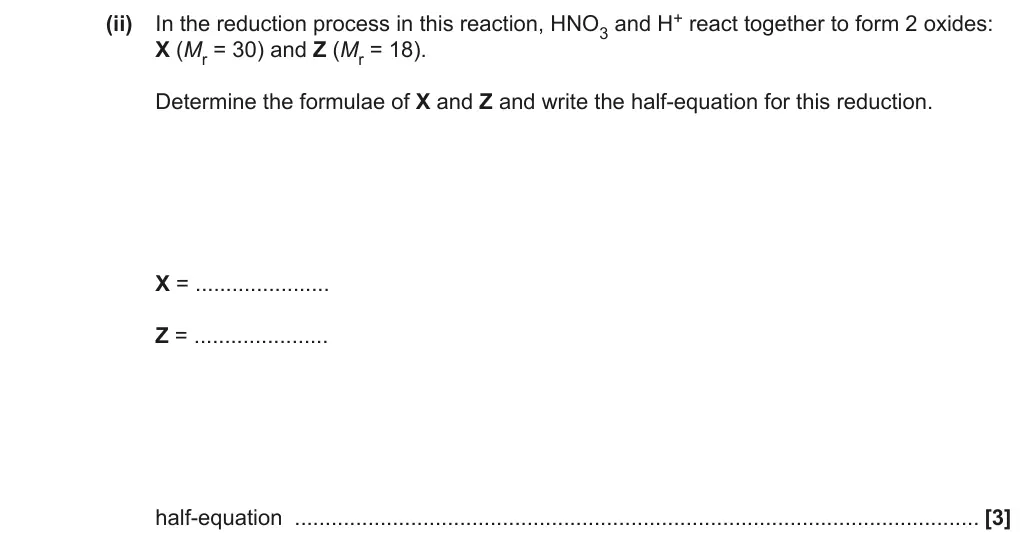
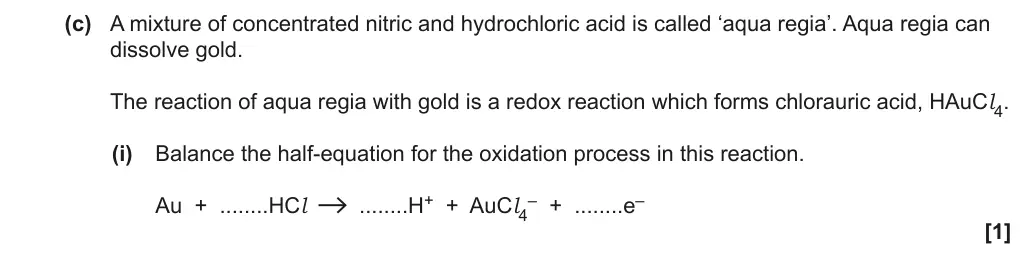
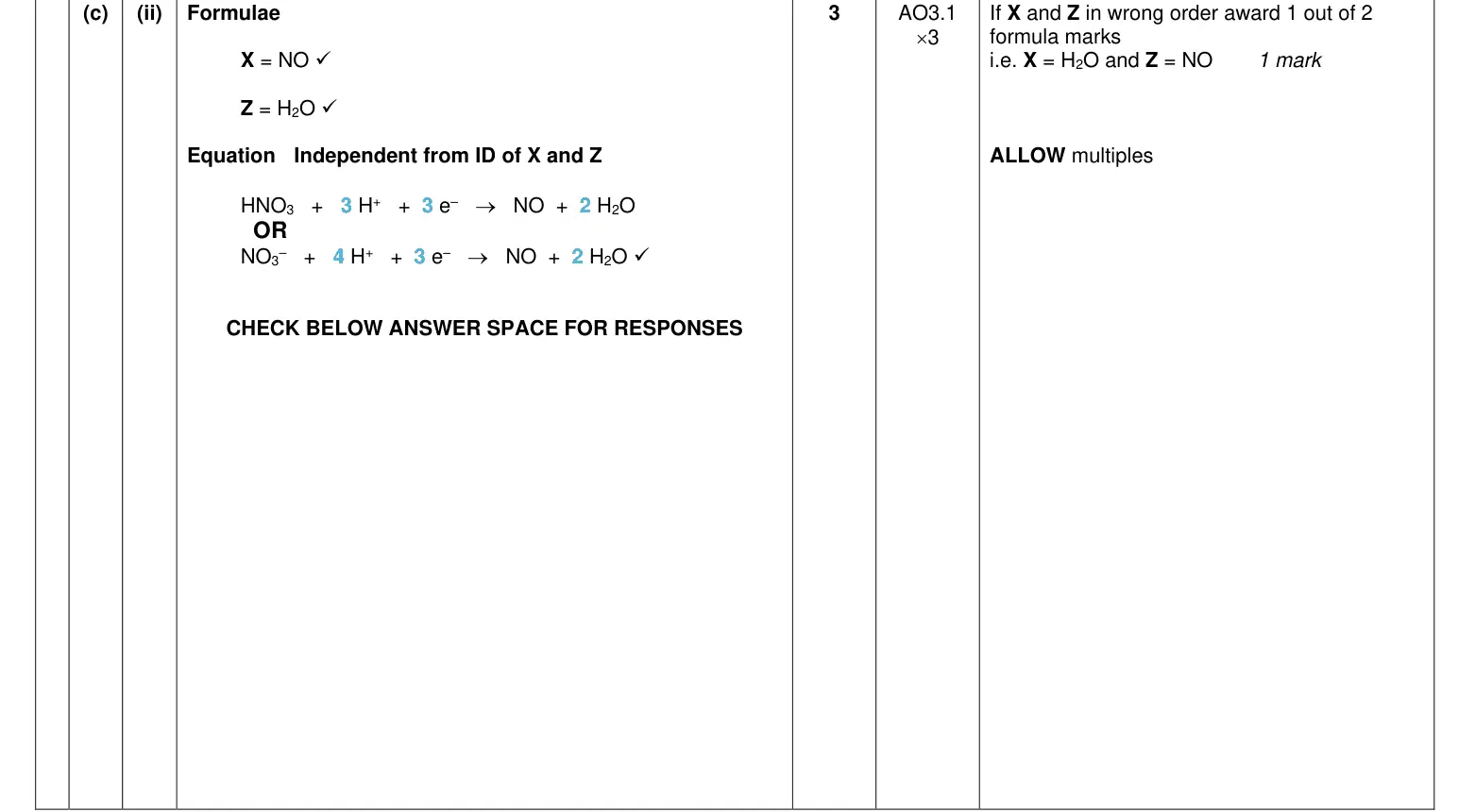
Almost all candidates identified X and Y as NO and H2O respectively, but the equation proved to be much more testing. Some candidates were careless, showing NO and H2O the wrong way round (credited with 1 out of these 2 marks) or with charges. For the equation, candidates needed to consider the oxidation number change of N from +5 to +2, This should have naturally led to 3e– being added on the left-hand side. Many candidates omitted the electrons entirely. Some did add 3e– but on the right. This suggests that candidates would benefit with practising the construction of half equations.
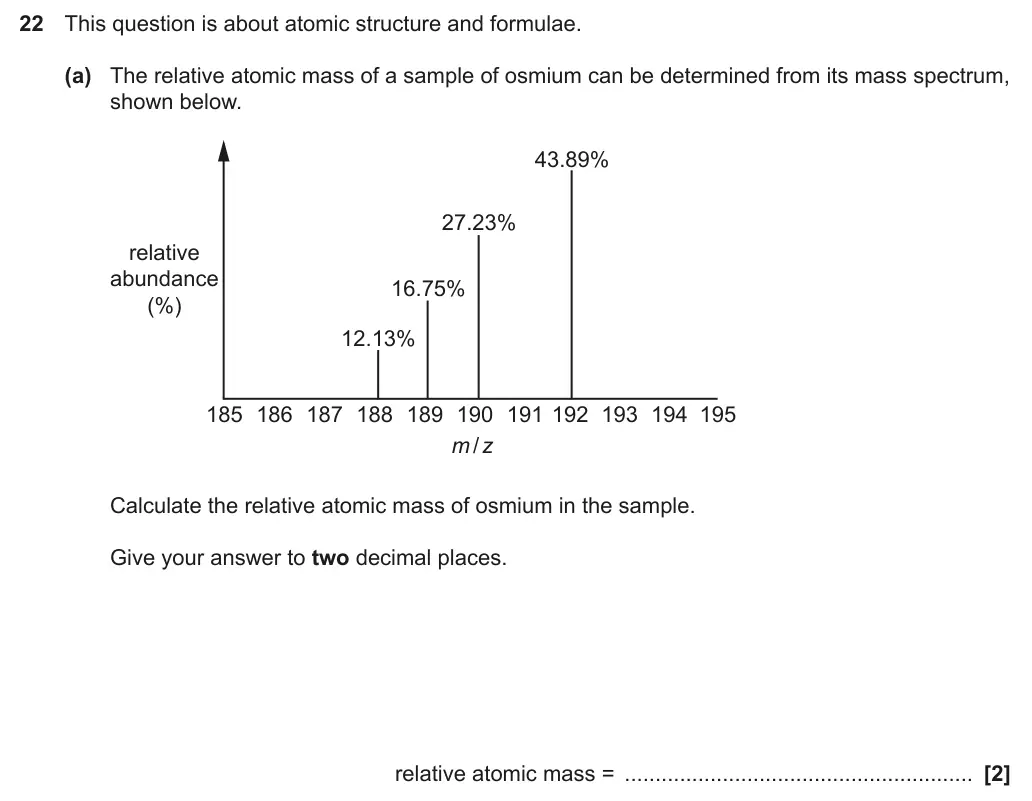
Candidates answered this question very successfully. Few candidates mis-wrote the numbers and even fewer gave answers to the incorrect number of decimal places. This type of question has featured on previous examinations and it was pleasing to see how well it was answered, even with more isotopes being included than in previous instances.
Skills: M0.2 Use ratios, fractions and percentages; M1.2 Find arithmetic means; M3.1 Translate information between graphical, numerical and algebraic forms
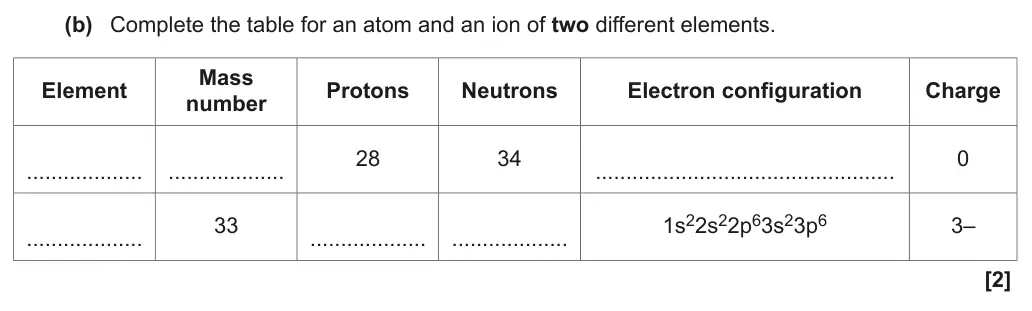
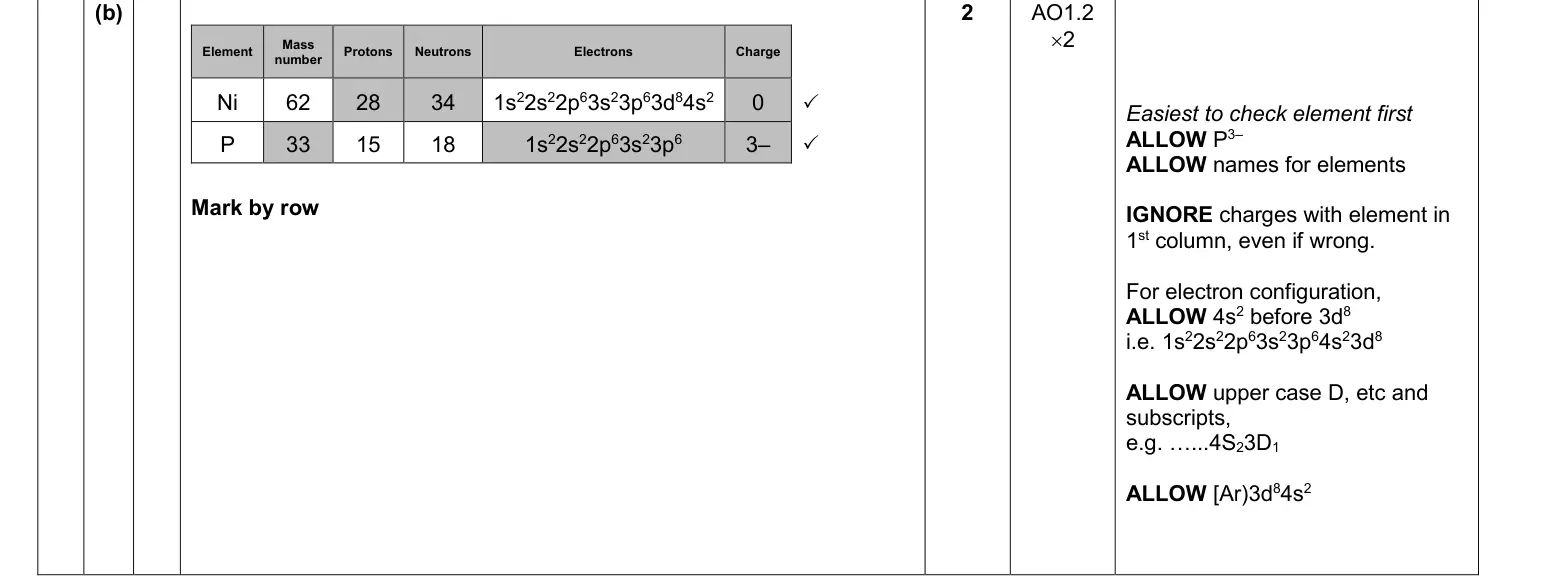
This question produced many mixed responses. Most candidates correctly identified nickel. However, its electron configuration was frequently shown as 3d10 instead of 3d8 and some less successful responses gave nickel’s relative atomic mass of 58.7 from the periodic table, instead of the mass number of the isotope provided. Many candidates selected the incorrect element for phosphorus, with argon being a key distractor from the extra 3 electrons in the P3– ion. The numbers of protons and neutrons were largely correct, although the wrong way round for many less successful responses.
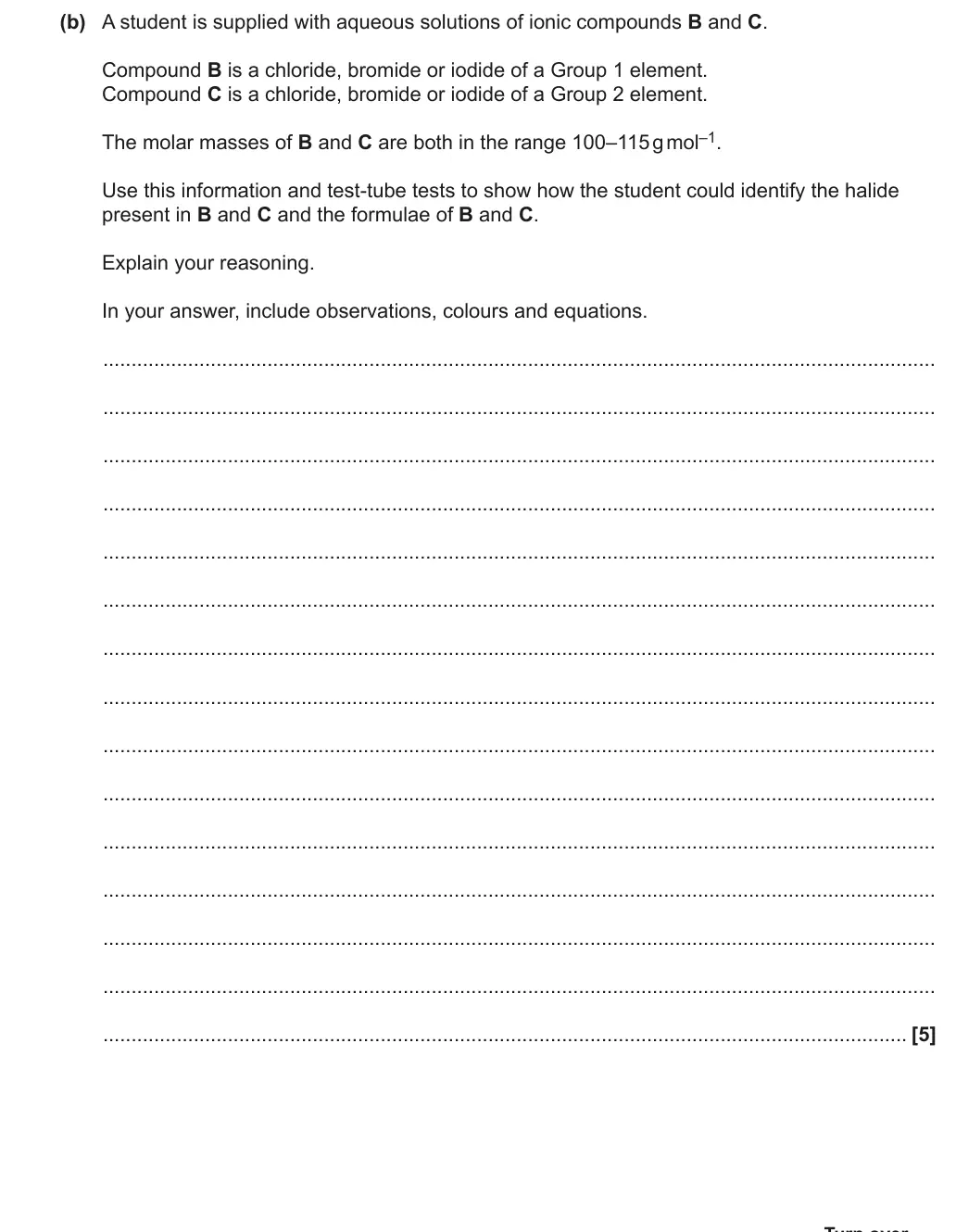
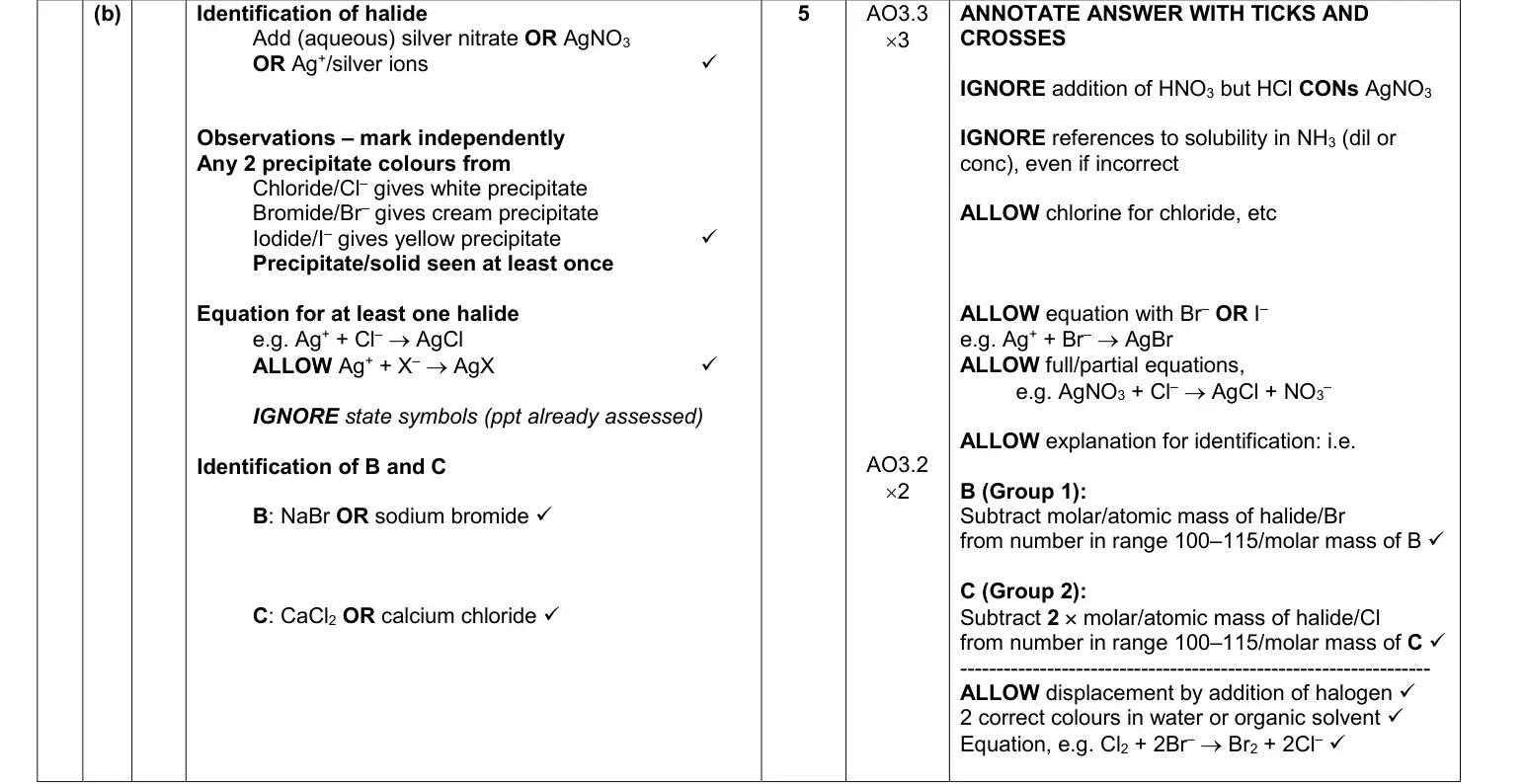
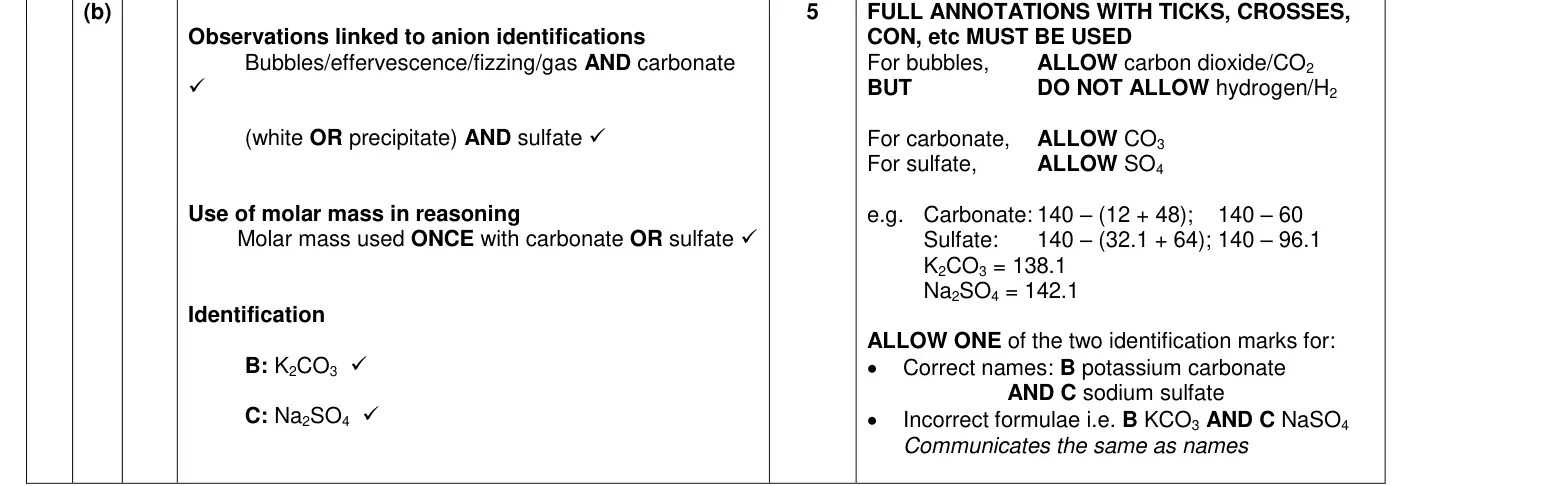
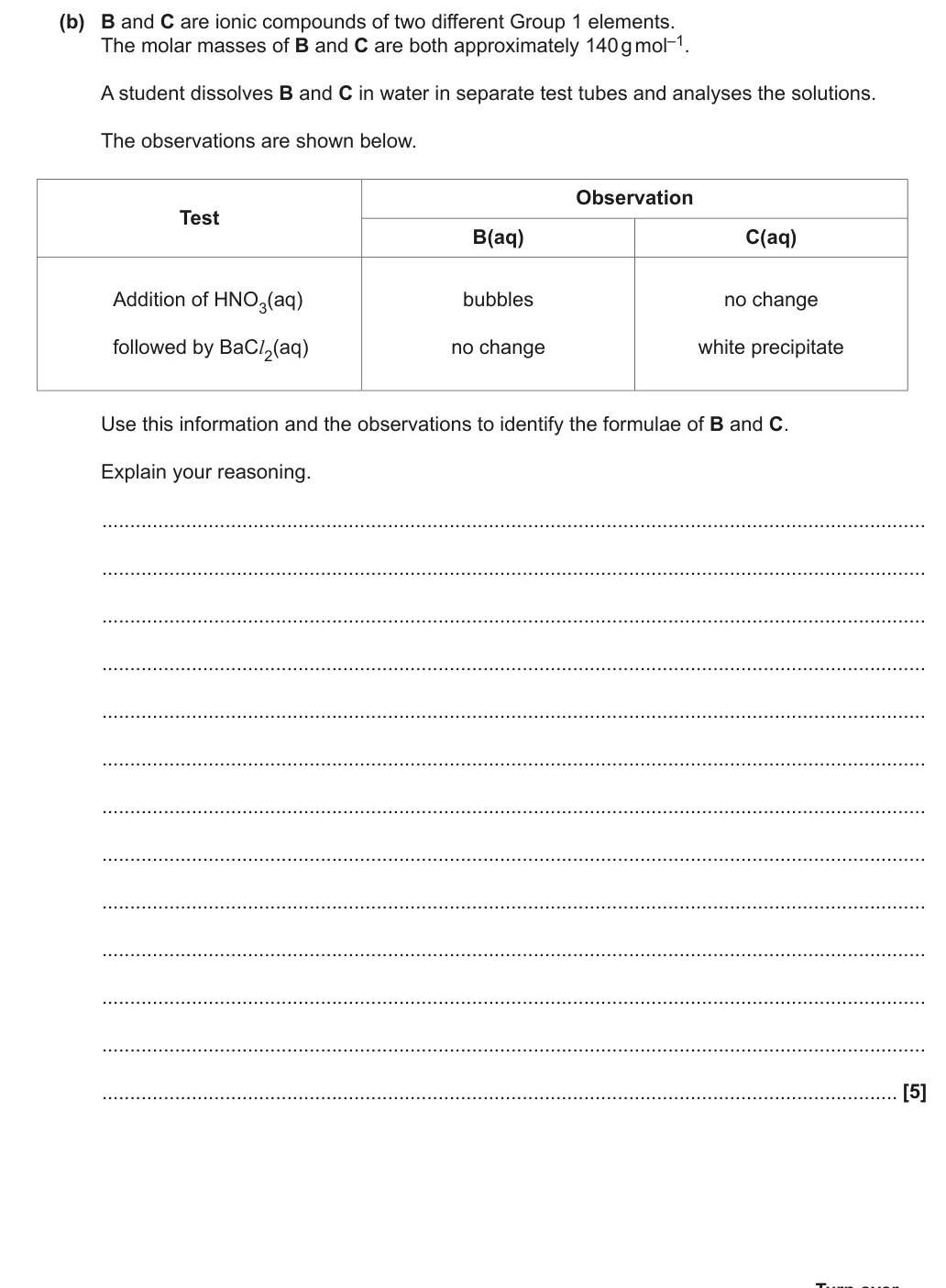
Candidates generally answered the first part of this question well. Most candidates were able to identify silver nitrate (or a halogen displacement method), to describe the expected observations, supported with mainly correct ionic equations. Candidates found it much harder to identify B and C as NaBr and CaCl2. They could do this in various ways by matching possible formula with the provided molar mass ranges. The mark scheme did allow marks to be given when candidates described the identification process, although this was often very muddled, so, only the most able few candidates fully identified the unknown B and C.
Skills: M0.2 Use ratios, fractions and percentages; PAG4 Qualitative analysis of ions
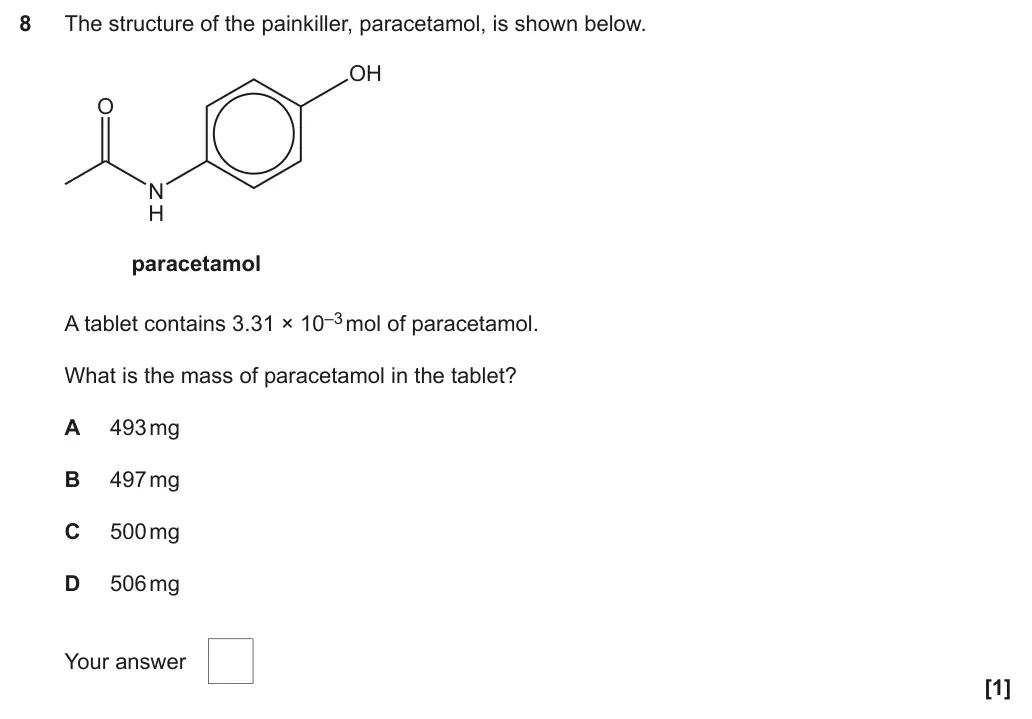
C
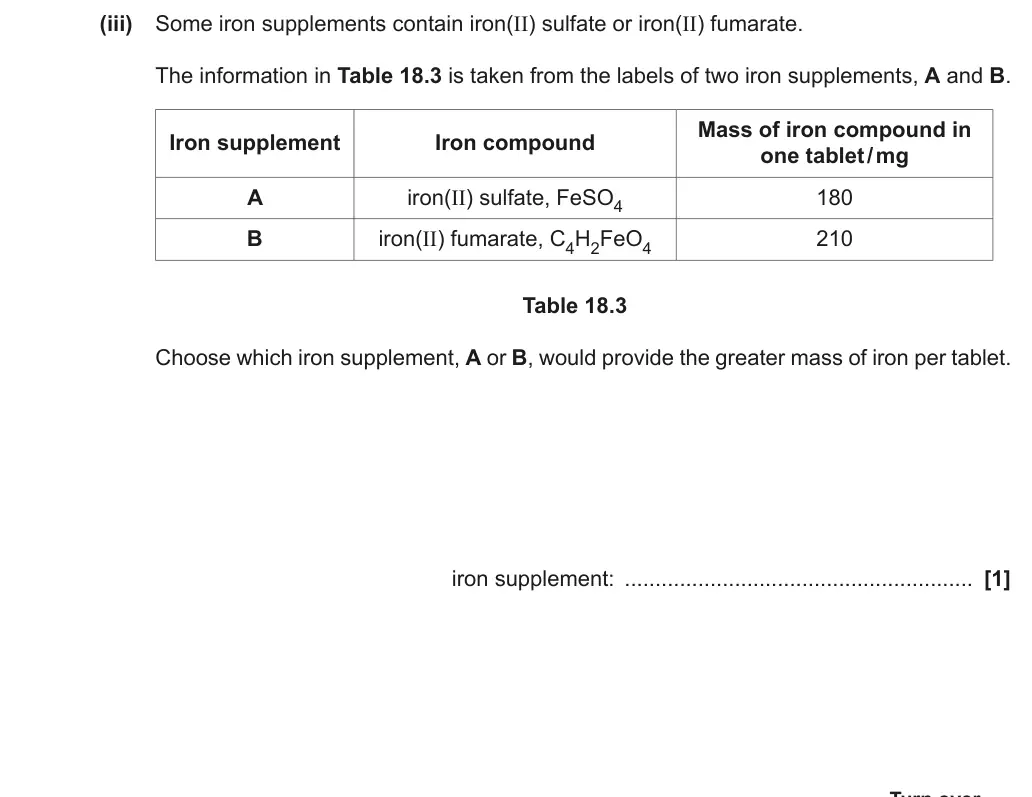
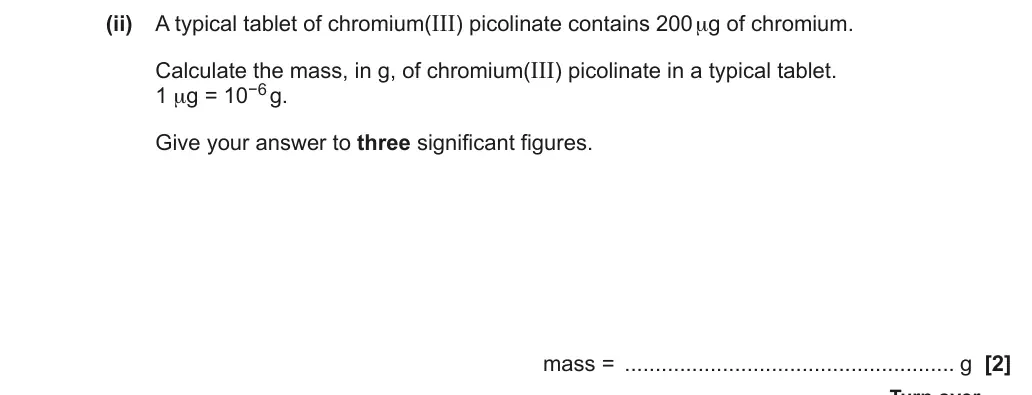
The majority of candidates correctly calculated C as the mass of paracetamol in the tablet.
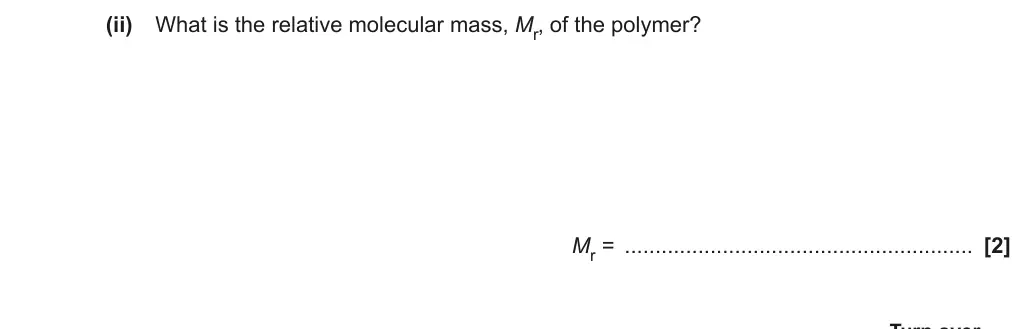
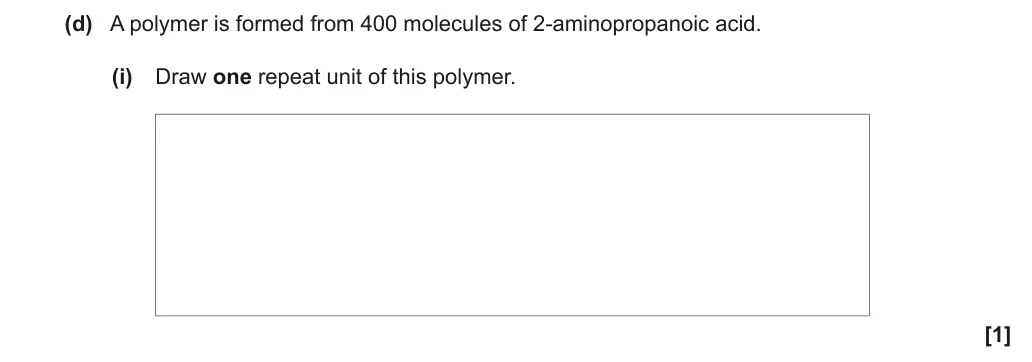
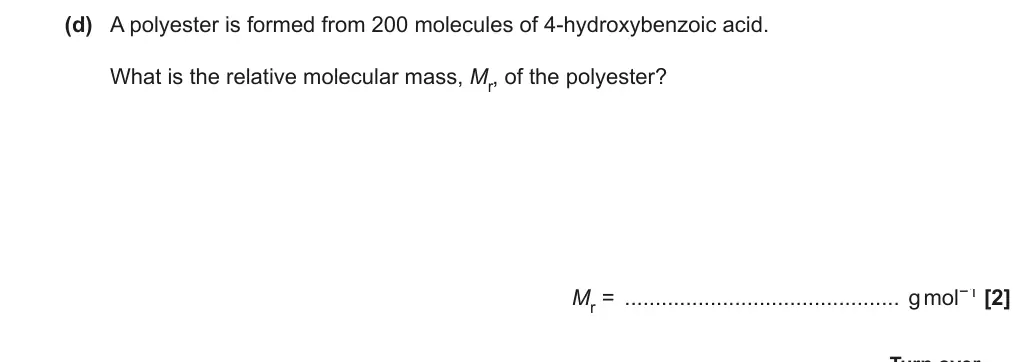
A variety of responses were seen in this demanding question. In general candidates adopted one of two approaches. The most common was to multiply the Mr of the repeat unit by 200 and then add the mass of H and OH at each end of the polymer. The other approach used the Mr of the monomer by 200 and then subtract the mass of the 199 water molecules removed in the polymerisation. Many candidates were successful with the first step of their approach, but the best responses included the second step taking into account the Mr of water. A significant number of candidates used an incorrect value for the Mr.
Skills: M0.2 Use ratios, fractions and percentages
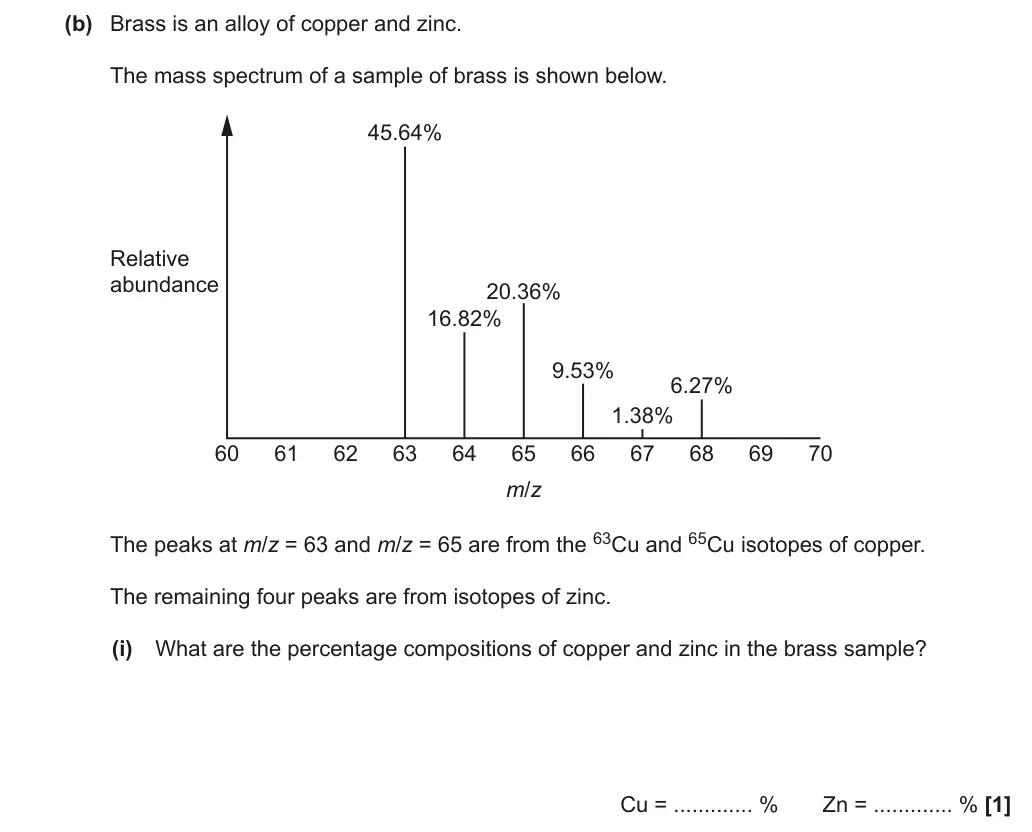
Question 1 (b) presented candidates with a mass spectrum of two elements in an alloy. This novel question was answered well, and the introductory part (i) provided candidates with a hint of how to approach the harder part (ii). Almost all candidates analysed the percentages to show that the brass sample contains 66% Cu and 34% Zn, the 34 being required in Question 1 (b) (ii).
Skills: M0.2 Use ratios, fractions and percentages; M3.1 Translate information between graphical, numerical and algebraic forms
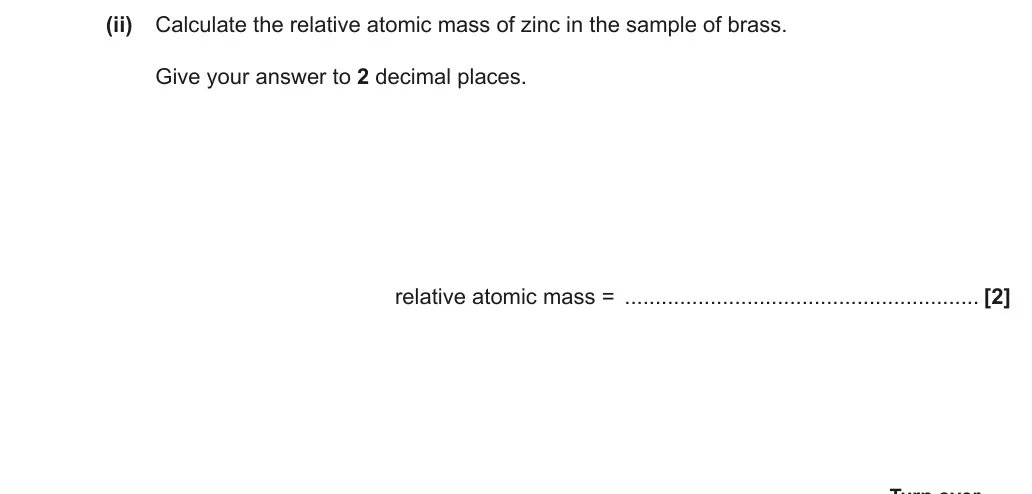
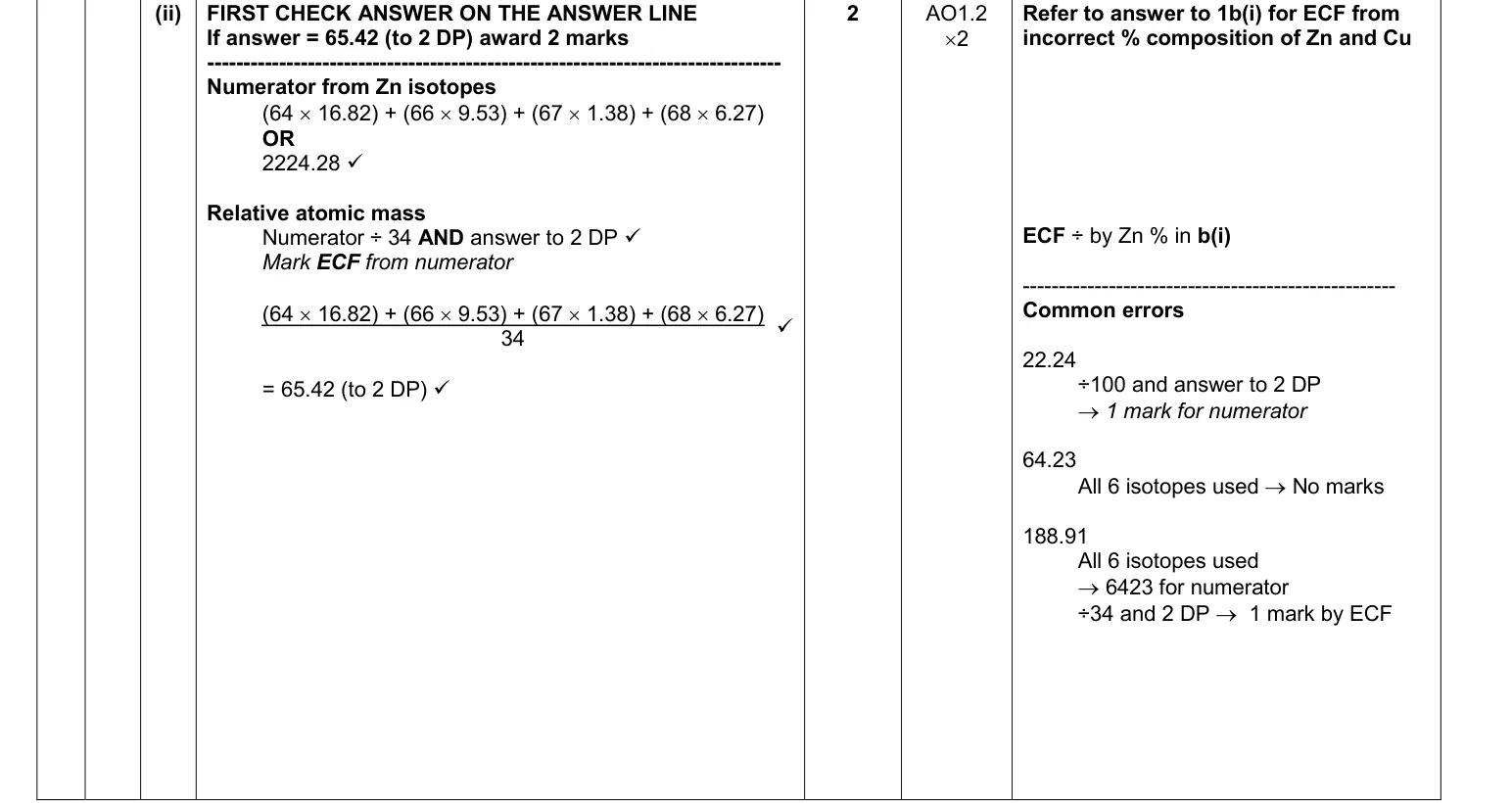
Most candidates produced a stock expression for a relative atomic mass calculation with the numerator comprising the four zinc isotopes with their respective percentage abundances, equating to 2224.28. The second mark required candidates to realise that the numerator needed to be divided by the total zinc percentage abundance of 34% to produce a value of 65.42. Less successful responses divided by 100% to obtain a value of 22.24. Almost all candidates gave their answers to the required two decimal places. The second mark proved to be a very good discriminator, with some candidates usually obtaining both marks with less successful responses still able to obtain the first mark for the numerator.
Skills: M0.2 Use ratios, fractions and percentages; M1.2 Find arithmetic means
Skills: M0.2 Use ratios, fractions and percentages; M1.1 Use an appropriate number of significant figures
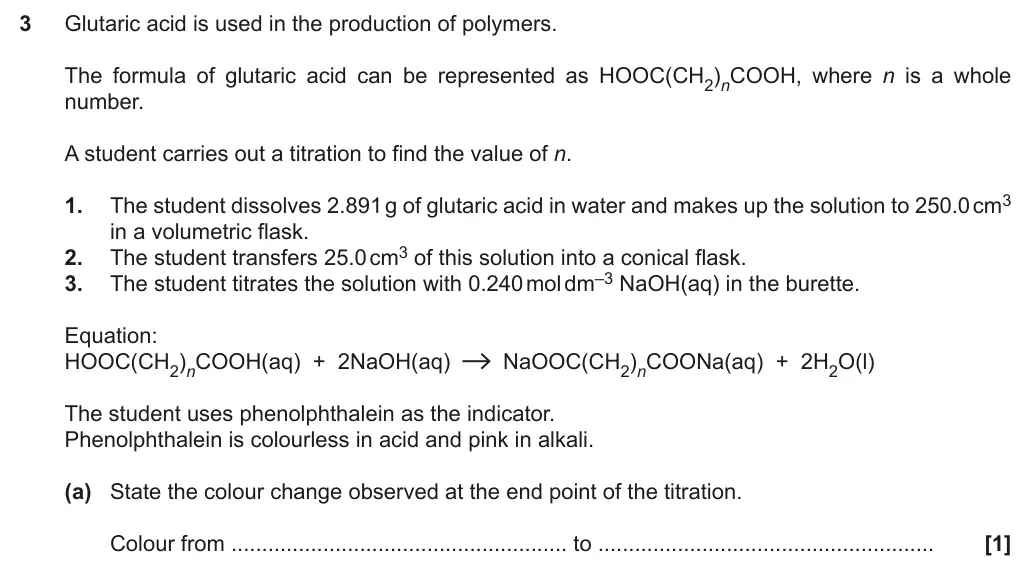
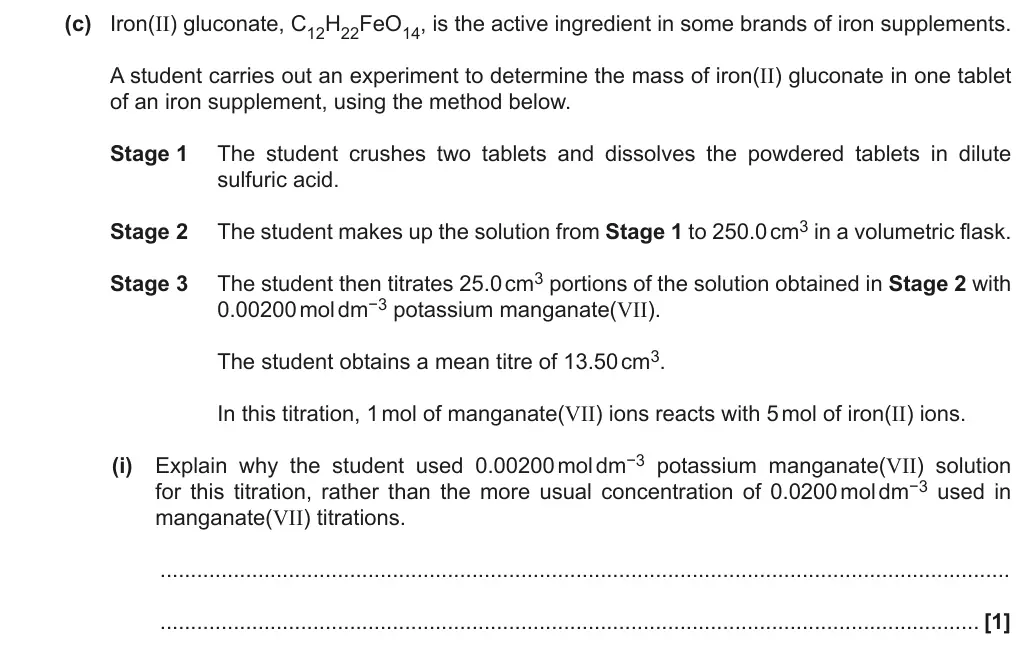
Skills: M0.2 Use ratios, fractions and percentages; M2.3 Substitute numerical values into algebraic equations using appropriate units for physical quantities; M2.4 Solve algebraic equations; PAG2 Acid–base titration
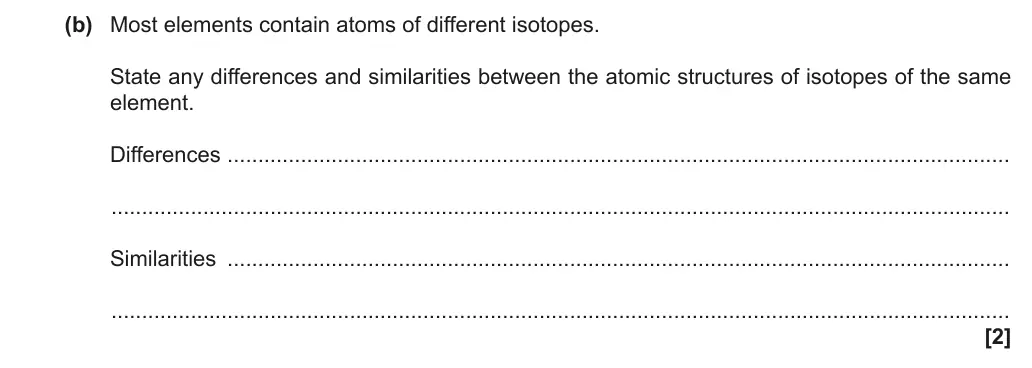
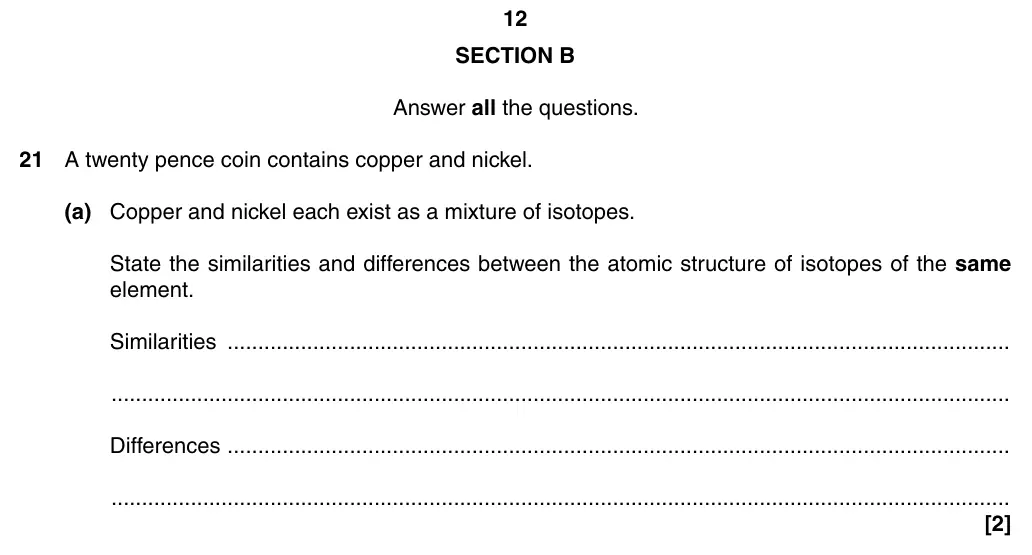
21(a) Most candidates could recall the number of electrons in the first four shells as being 2, 8, 18 and 32. However, many made errors for the third and fourth shell. Common incorrect responses included 2,8,18,18 and 2,8,8,8, perhaps linking back to GCSE coverage. 2,6,10,14 was also seen, confusing shells with subshells. 21(b) Almost all candidates were aware that different isotopes had different numbers of neutrons. For the similarities, ‘the same number of protons’ was usually identified, but the same number electrons was omitted by many candidates. This suggested that candidates were concentrating on the nucleus and did not read the question closely enough which asked for ‘atomic’ structures. 21(c)(ii) This was a high demand question and only the highest scoring answers identified that the peak at 72 was caused by a chlorine molecule containing the chlorine-35 and chlorine-37 isotopes shown in the supplied mass spectrum. Very few candidates went on to predict further peaks with m/z values of 70 (from 35Cl35Cl) and 74 (from 37Cl37Cl). There was little pattern in the incorrect responses, suggestion that many were guesses.
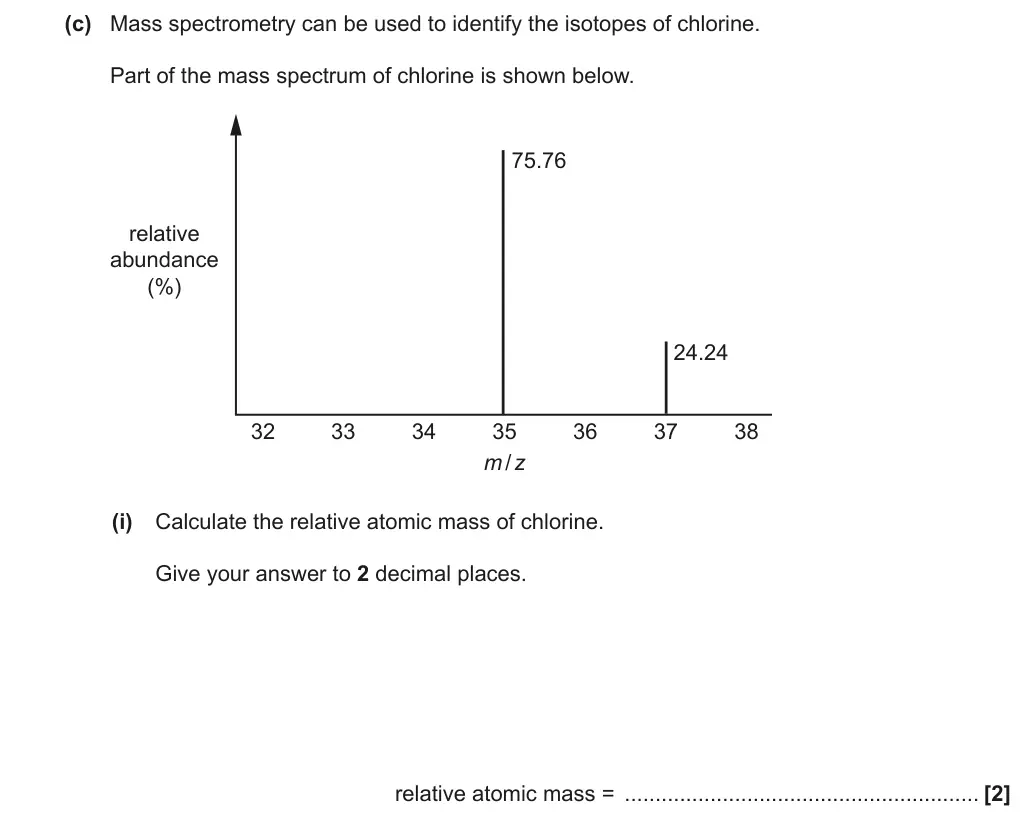
21(a) Most candidates could recall the number of electrons in the first four shells as being 2, 8, 18 and 32. However, many made errors for the third and fourth shell. Common incorrect responses included 2,8,18,18 and 2,8,8,8, perhaps linking back to GCSE coverage. 2,6,10,14 was also seen, confusing shells with subshells. 21(b) Almost all candidates were aware that different isotopes had different numbers of neutrons. For the similarities, ‘the same number of protons’ was usually identified, but the same number electrons was omitted by many candidates. This suggested that candidates were concentrating on the nucleus and did not read the question closely enough which asked for ‘atomic’ structures. 21(c)(ii) This was a high demand question and only the highest scoring answers identified that the peak at 72 was caused by a chlorine molecule containing the chlorine-35 and chlorine-37 isotopes shown in the supplied mass spectrum. Very few candidates went on to predict further peaks with m/z values of 70 (from 35Cl35Cl) and 74 (from 37Cl37Cl). There was little pattern in the incorrect responses, suggestion that many were guesses.
Skills: M0.2 Use ratios, fractions and percentages; M1.2 Find arithmetic means; M3.1 Translate information between graphical, numerical and algebraic forms
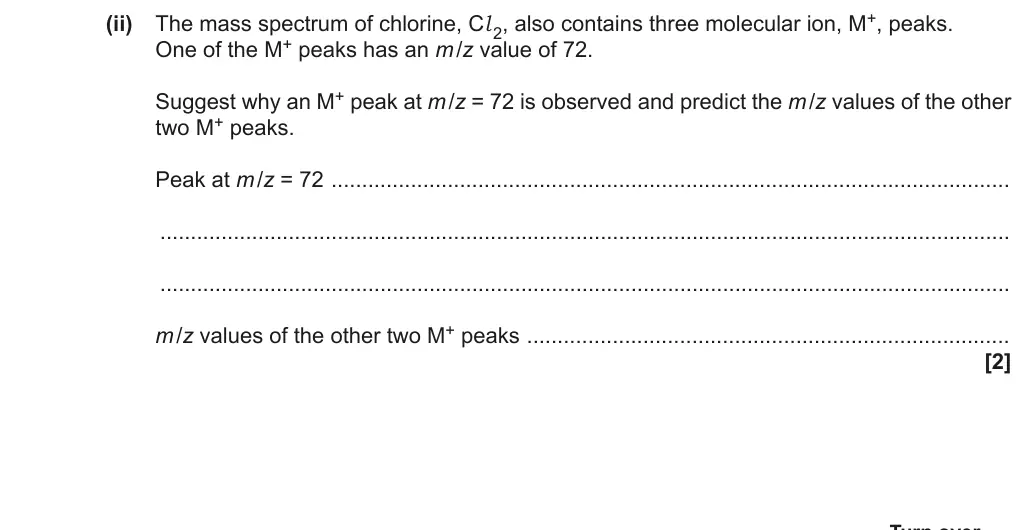
21(a) Most candidates could recall the number of electrons in the first four shells as being 2, 8, 18 and 32. However, many made errors for the third and fourth shell. Common incorrect responses included 2,8,18,18 and 2,8,8,8, perhaps linking back to GCSE coverage. 2,6,10,14 was also seen, confusing shells with subshells. 21(b) Almost all candidates were aware that different isotopes had different numbers of neutrons. For the similarities, ‘the same number of protons’ was usually identified, but the same number electrons was omitted by many candidates. This suggested that candidates were concentrating on the nucleus and did not read the question closely enough which asked for ‘atomic’ structures. 21(c)(ii) This was a high demand question and only the highest scoring answers identified that the peak at 72 was caused by a chlorine molecule containing the chlorine-35 and chlorine-37 isotopes shown in the supplied mass spectrum. Very few candidates went on to predict further peaks with m/z values of 70 (from 35Cl35Cl) and 74 (from 37Cl37Cl). There was little pattern in the incorrect responses, suggestion that many were guesses.
Skills: M3.1 Translate information between graphical, numerical and algebraic forms
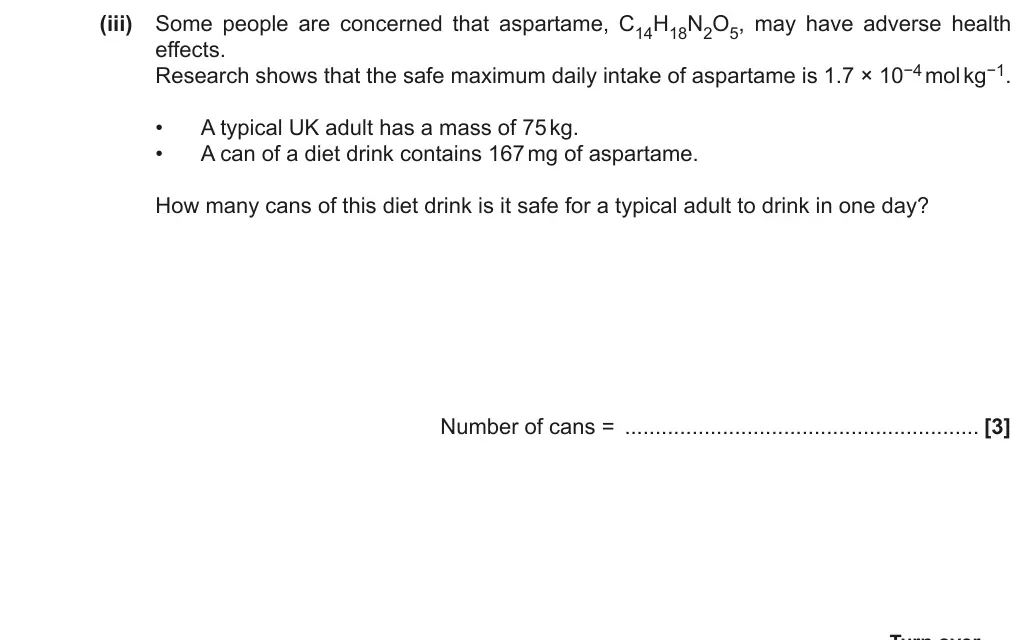
Skills: M0.0 Recognise and make use of appropriate units in calculations; M0.1 Recognise and use expressions in decimal and ordinary form; M0.2 Use ratios, fractions and percentages
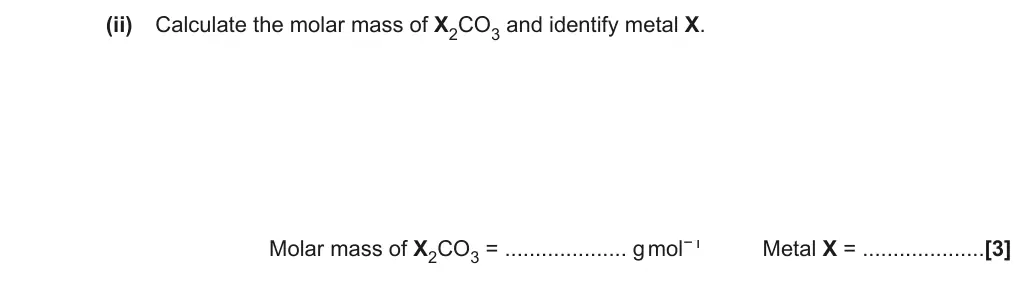
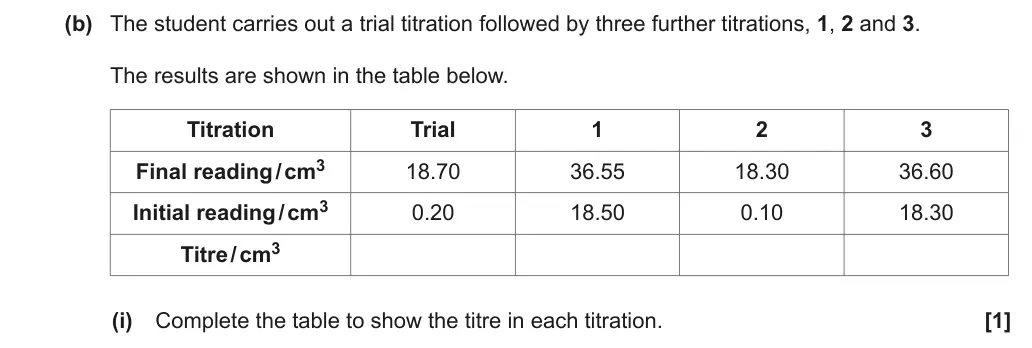
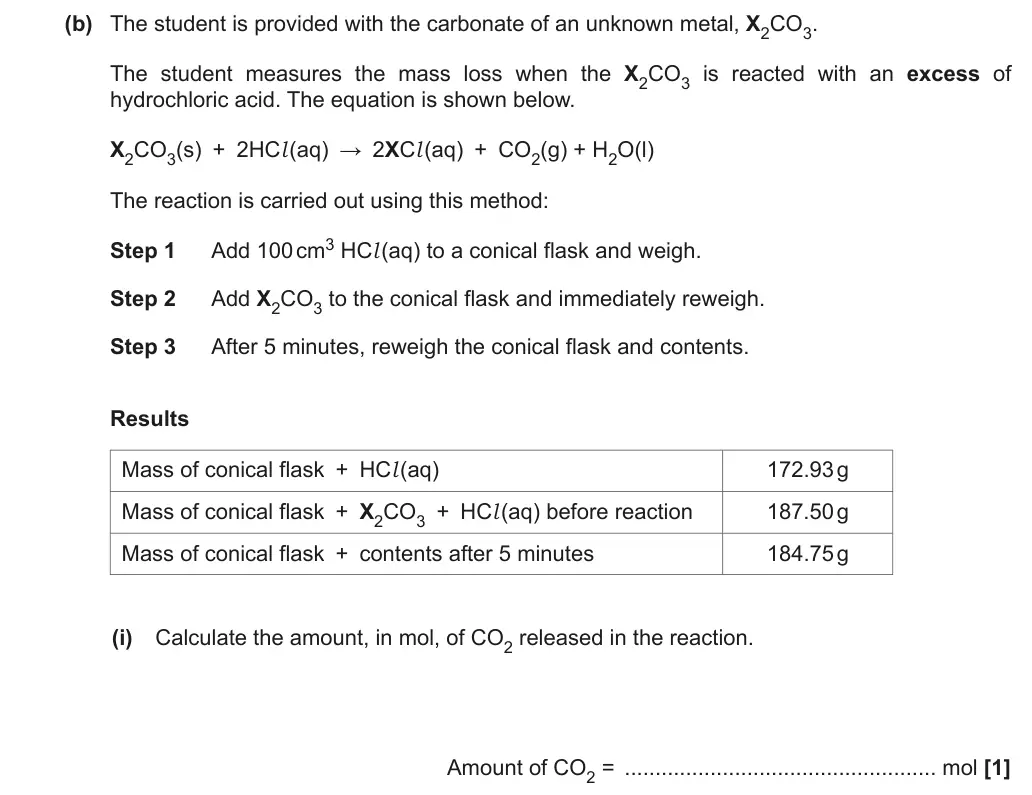
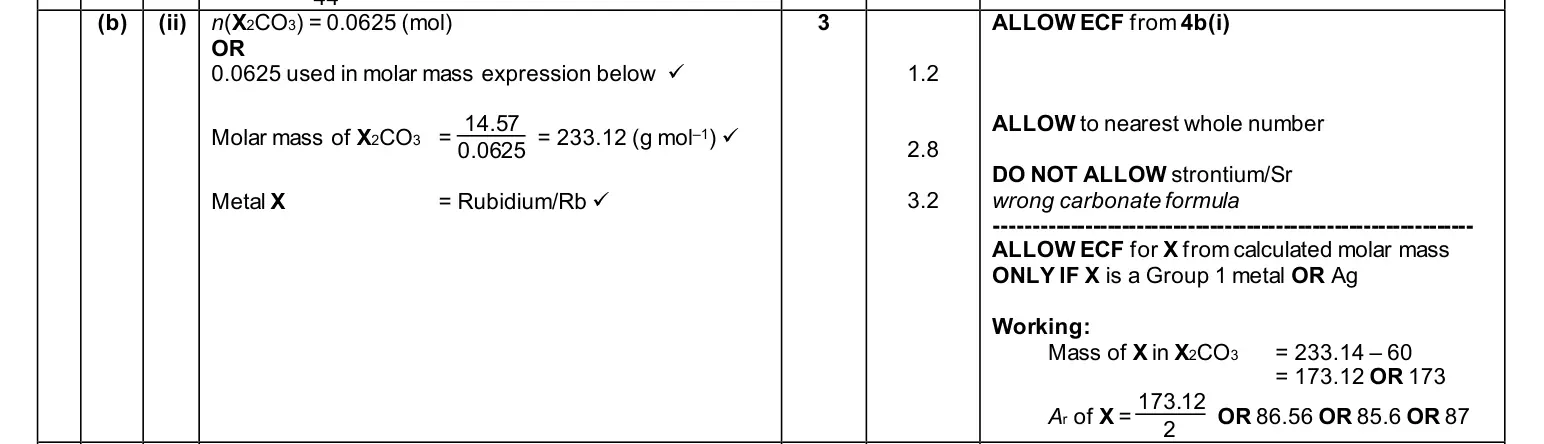
4(a)(i) This question required candidates to write an overall equation and half equations for oxidation and reduction. Many candidates made errors within one or more equations. The overall equation was often written without state symbols, despite the question instruction ‘with state symbols’. The oxidation half equation was more likely to be correct than the reduction half equation, which often used Cl instead of H+. When H+ was used, the half equation was often unbalanced or electrons had been omitted. It is recommended that candidates carefully use the chemical information in the question. 4(a)(ii) Most candidates identified that all the metal would have reacted when it had all disappeared and that gas bubbles from the reaction would have stopped. Some responses did not emphasise that these observations would have stopped and this prevented credit being given. 4(a)(iii) The ionic equation for neutralisation of an acid with an alkali was well known and this question was answered correctly by most candidates. 4(a)(iv) Candidates were presented with information about a back titration, a technique that they would be unlikely to have encountered during their course. The question stem to 4a(iv) suggested a three-step strategy. Many candidates followed this guidance and were credited with many of the available marks. Marks were given for a correct method (by error carried forward) even if there was an error or omission in the multi-step calculation. This emphasises the importance of clear working. Most candidates determined the correct mean titre of 27.25 cm3. A few candidates did take the mean of all three titres rather than the closest. Most calculated that 8.72 × 10⁻³ mol of NaOH reacted with the same number of moles of HCl in the titration and then scaled up the HCl by a factor of 10 to 8.72 × 10⁻² mol in the 250 cm3 volumetric flask. These steps are standard for many titration calculations and gave a route to three of the six available marks. The more difficult back titration steps then followed and the higher-attaining candidates recognised the need to subtract this amount of HCl from the original amount of HCl used to react with metal M. These candidates then divide this value by two to find the moles of M that reacted (from the 1 : 2 stoichiometry of M : HCl). The correct calculation then gave a relative atomic mass of M as 112 and its identity as cadmium. It was common for candidates to omit the division by two and to arrive at a relative atomic mass of 56 for iron. The mark scheme shows the variety of metals that candidates identified from their calculations, the errors made, and the error carried forward marks that resulted. Many lower-attaining candidates did not follow the 3 steps in the stem, using only the original amount of HCl and ignoring the titration. This approach was not credited with marks. A large range of marks was seen, and the question discriminated extremely well. 4(b)(i) This straightforward mole calculation required candidates to determine the mass of CO2 as 2.75 g from the table of results and to divide this value by the molar mass of CO2 to arrive at 0.0625 mol. Most candidates were successful. As with other questions providing raw experimental results, lower-attaining candidates often chose the wrong data from the supplied results. 4(b)(ii) Many candidates used their value from 4b(i) with the mass of X2CO3 from the results table to obtain a value for the molar mass (233.13 from 14.57 ÷ 0.0625). Higher-attaining candidates obtained a value for the atomic mass of X (86.56 from 233.13) and identified X as the Group 1 metal rubidium. Some candidates did not recognise the significance of the formula of X2CO3 and identified X instead as strontium (Ar = 87.6). Lower-attaining candidates often used incorrect data from the supplied information and made little progress with this calculation. 4(c)(i) Most candidates suggested that the mass of the flask and contents could be reweighed until the mass no longer changed. An alternative creditworthy suggestion was to attach a gas syringe and to measure the gas volume until it no longer changed. Vague suggestions such as ‘leave for longer’ were not credited with marks. 4(c)(ii) Candidates found this question challenging. Success required candidates to appreciate that some CO2 dissolving would result in less mass of CO2 being recorded as lost, meaning that less moles of CO2 had apparently been formed and so less moles of X2CO3 had reacted. Using n = m/M, this would show that the calculated molar mass of X2CO3 appears to be greater. Only the highest-attaining candidates successfully navigated this question.
Skills: M0.2 Use ratios, fractions and percentages; M2.2 Change the subject of an equation; PAG1 Moles determination
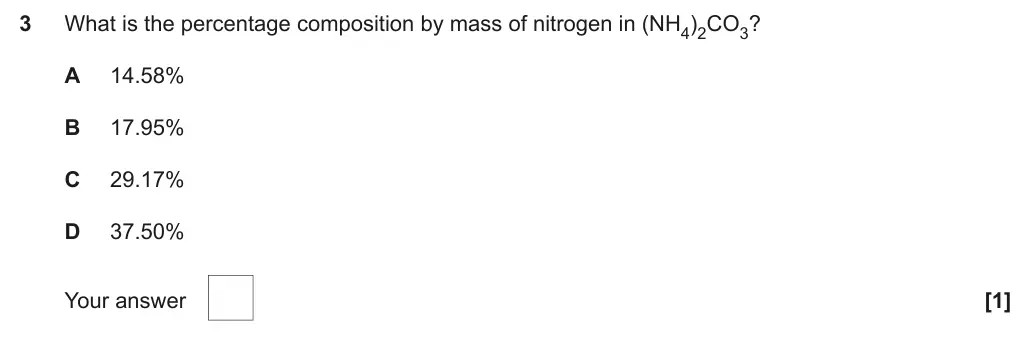
C
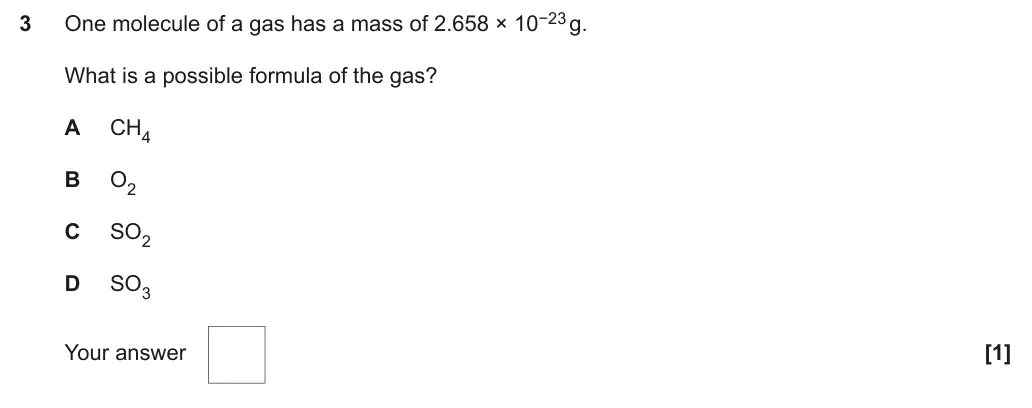
A
This question was quite well answered with many candidates calculating the Mr by multiplying the mass by Avogadro’s number. This gave the answer as 16, which matches the Mr of CH4, giving A as the correct answer. Option B provided a distractor as oxygen atoms have a relative mass of 16 whereas option B relates to O2 molecules with a relative mass of 32. Some candidates got part way through the calculation and then appeared to choose an answer at random.
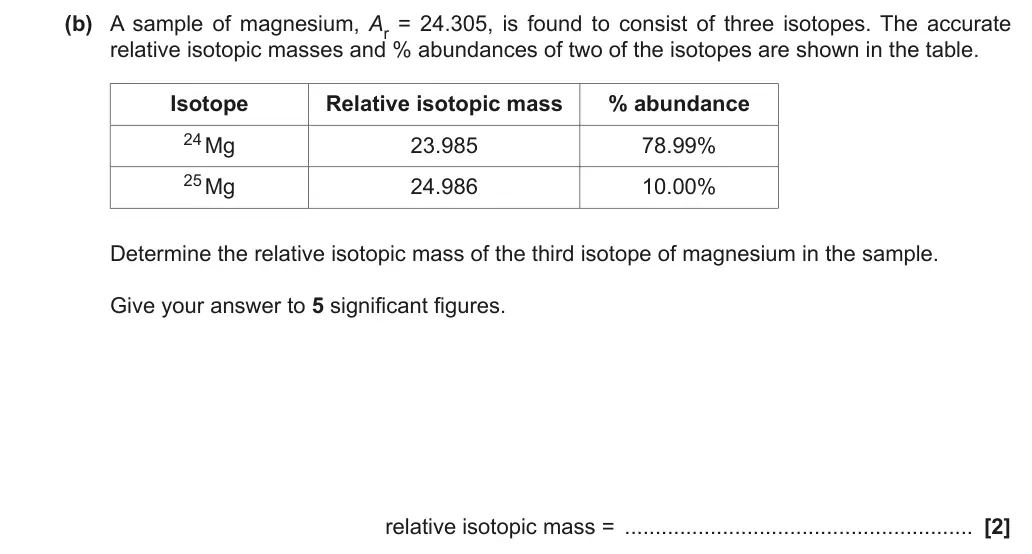
This was mathematically challenging, but candidates who did not arrive at the correct answer were able to get partial credit for showing working.
Skills: M0.2 Use ratios, fractions and percentages; M1.1 Use an appropriate number of significant figures; M2.2 Change the subject of an equation; M2.4 Solve algebraic equations
A LEVEL CHEMISTRY A Examiners’ report H432/01 Summer 2019 series Version 1 H432 For first teaching in 2015 www.ocr.org.uk/science Contents Introduction .............................................................................................................................................. 4 Paper 1 series overview ........................................................................................................................... 5 Section A overview ................................................................................................................................... 6 Question 2 ............................................................................................................................................ 6 Question 3 ............................................................................................................................................ 6 Question 4 ............................................................................................................................................ 7 Question 5 ............................................................................................................................................ 7 Question 6 ............................................................................................................................................ 8 Question 8 ............................................................................................................................................ 8 Question 9 ............................................................................................................................................ 9 Question 10 .......................................................................................................................................... 9 Question 11 ........................................................................................................................................ 10 Question 13 ........................................................................................................................................ 10 Question 14 ........................................................................................................................................ 11 Question 15 ........................................................................................................................................ 11 Section B overview ................................................................................................................................. 12 Question 16 (a) ................................................................................................................................... 12 Question 16 (b) ................................................................................................................................... 12 Question 16 (c) (i) ............................................................................................................................... 12 Question 16 (c) (ii) .............................................................................................................................. 13 Question 16 (d) (i) ............................................................................................................................... 14 Question 16 (d) (ii) .............................................................................................................................. 15 Question 16 (e) (i) ............................................................................................................................... 16 Question 16 (e) (ii) .............................................................................................................................. 16 Question 17 (a) ................................................................................................................................... 17 Question 17 (b) ................................................................................................................................... 19 Question 18 (a) (i) ............................................................................................................................... 20 Question 18 (a) (ii) .............................................................................................................................. 20 Question 18 (a) (iii) ............................................................................................................................. 21 Question 18 (a) (iv) ............................................................................................................................. 22 Question 18 (a) (v) .............................................................................................................................. 22 Question 18 (b) (i) ............................................................................................................................... 22 Question 18 (b) (ii) .............................................................................................................................. 23 Question 18 (c) (i) ............................................................................................................................... 24 Question 18 (c) (ii) .............................................................................................................................. 24 Question 19 (a) (i) ............................................................................................................................... 25 Question 19 (a) (ii) .............................................................................................................................. 25 Question 19 (a) (iii) ............................................................................................................................. 26 Question 19 (b) (i) ............................................................................................................................... 26 Question 19 (b) (ii) .............................................................................................................................. 27 Question 19 (b) (iii) ............................................................................................................................. 27 Question 19 (b) (iv) ............................................................................................................................. 28 Question 19 (c) (i) ............................................................................................................................... 28 Question 19 (c) (ii) .............................................................................................................................. 29 Question 20 (a) ................................................................................................................................... 29 Question 20 (b) (i) ............................................................................................................................... 30 Question 20 (b) (ii) .............................................................................................................................. 30 Question 20 (b) (iii) ............................................................................................................................. 31 Question 20 (b) (iv) ............................................................................................................................. 32 Question 20 (b) (v) .............................................................................................................................. 32 Question 20 (c) ................................................................................................................................... 33 Question 21 ........................................................................................................................................ 34 Introduction Our examiners’ reports are produced to offer constructive feedback on candidates’ performance in the examinations. Question 18 (c) (i) Only a very small minority of candidates appreciated that a larger titre reduces percentage error in titre values. Question 18 (c) (ii) Many candidates coped well with this multi-step calculation.
Skills: M0.2 Use ratios, fractions and percentages
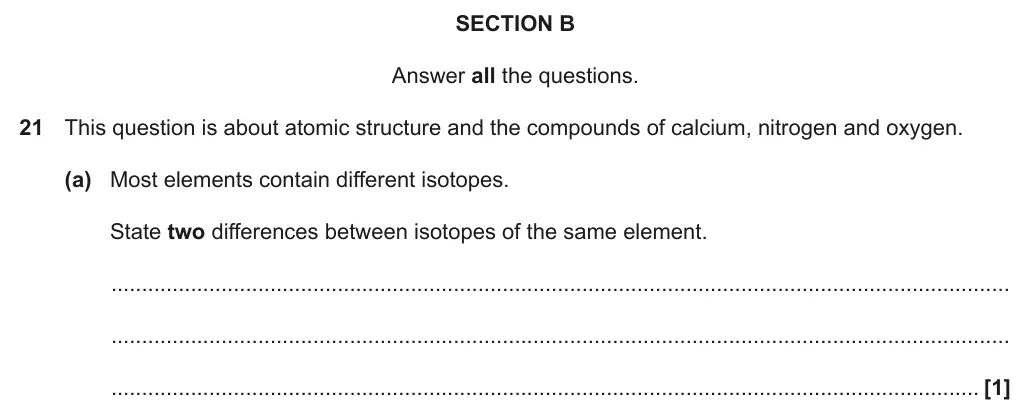
Candidates needed to state two differences for 1 mark. Most candidates selected ‘different numbers of neutrons’ but this was often followed up by different ‘relative atomic mass’, the weighted mean of different isotopes, rather than ’different mass’ for a single isotope. This suggested that many candidates may not have understood the meaning of ’relative’ in ‘relative atomic mass’.
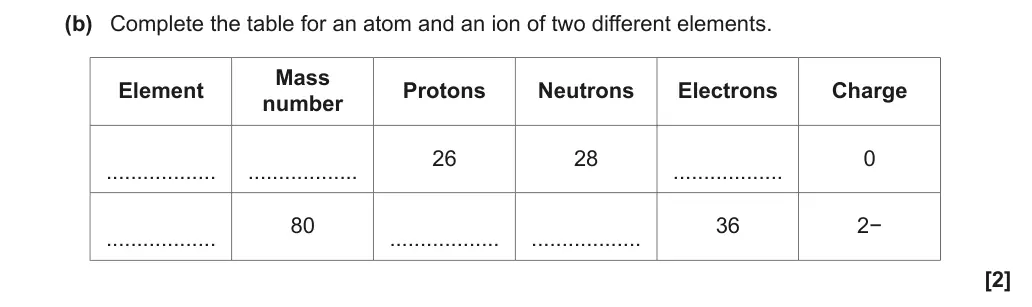
Candidates answered this question reasonably well but many selected incorrect elements despite having identified the correct mass number and numbers of protons, neutrons and electrons. A common error was a mass number of 55.8 for Fe, clearly a confusion between the mass number of an isotope and relative atomic mass (see also comments for 21(a)). Mn was also a common error for the first element, presumably by matching the mass number of 54 with the relative atomic mass of Mn (54.9).
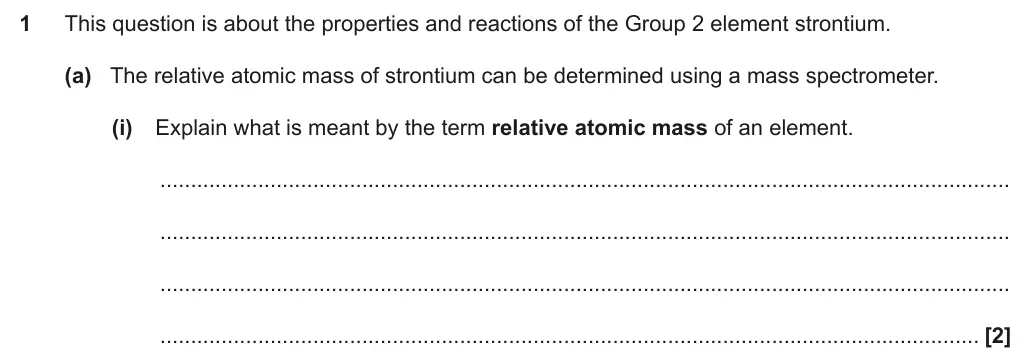
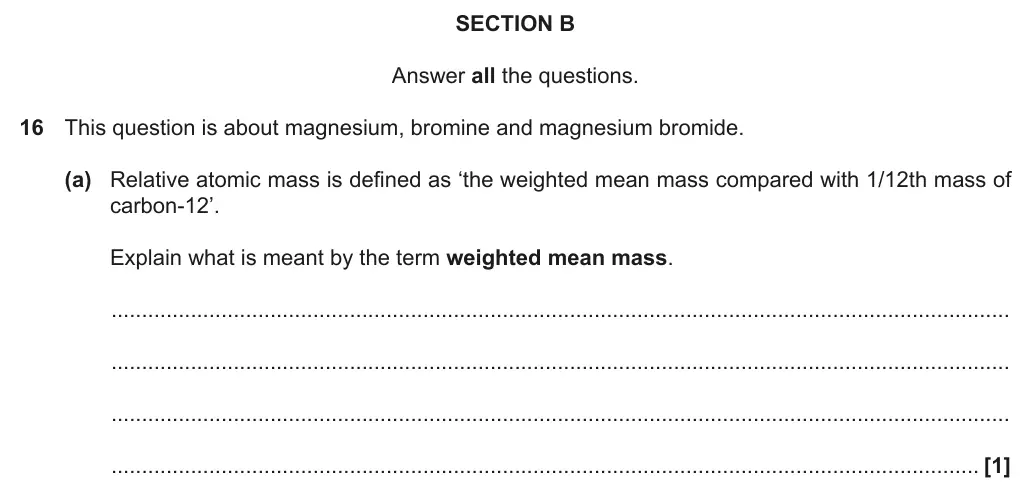
Most candidates were given at least one mark but lost the second mark due to omitting the word “atom”, or “mean” or “one-twelfth”
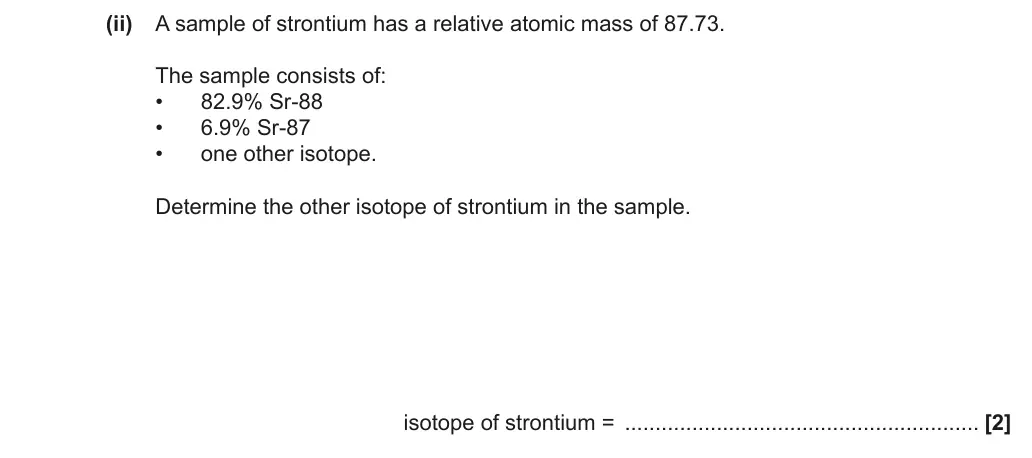
Algebra was used very well here and allowed most candidates to obtain at least one mark, with the majority obtaining 2 marks
Skills: M0.2 Use ratios, fractions and percentages; M1.2 Find arithmetic means; M2.2 Change the subject of an equation; M2.4 Solve algebraic equations
A LEVEL CHEMISTRY A Examiners’ report H432/02 Summer 2019 series Version 1 H432 For first teaching in 2015 www.ocr.org.uk/science Contents Introduction .............................................................................................................................................. 4 Paper 2 series overview ........................................................................................................................... 5 Section A overview ................................................................................................................................... 6 Question 3 ............................................................................................................................................ 6 Question 4 ............................................................................................................................................ 6 Question 5 ............................................................................................................................................ 7 Question 10 .......................................................................................................................................... 8 Question 12 .......................................................................................................................................... 9 Question 13 ........................................................................................................................................ 10 Question 14 ........................................................................................................................................ 10 Question 15 ........................................................................................................................................ 11 Section B overview ................................................................................................................................. 12 Question 16 (a) (i) ............................................................................................................................... 12 Question 16 (a) (ii) .............................................................................................................................. 12 Question 16 (b) (i) ............................................................................................................................... 13 Question 16 (b) (ii) .............................................................................................................................. 14 Question 16 (b) (iv) ............................................................................................................................. 14 Question 16 (b) (v) .............................................................................................................................. 15 Question 17 (a) (i) ............................................................................................................................... 17 Question 17 (a) (ii) .............................................................................................................................. 19 Question 17 (b) (i) ............................................................................................................................... 20 Question 18 (a) (i) ............................................................................................................................... 21 Question 18 (a) (ii) .............................................................................................................................. 22 Question 18 (b) ................................................................................................................................... 23 Question 18 (c) ................................................................................................................................... 23 Question 18 (d) ................................................................................................................................... 24 Question 18 (e) (i) ............................................................................................................................... 24 Question 18 (e) (ii) .............................................................................................................................. 26 Question 19 (a) (i) ............................................................................................................................... 27 Question 19 (a) (ii) .............................................................................................................................. 29 Question 19 (b) (i) ............................................................................................................................... 30 Question 19 (b) (iii) ............................................................................................................................. 32 Question 19 (b) (iv) ............................................................................................................................. 34 Question 20 (a) (i) ............................................................................................................................... 36 Question 20 (a) (ii) .............................................................................................................................. 37 Question 20 (a) (iii) ............................................................................................................................. 37 Question 20 (b) (i) ............................................................................................................................... 38 Question 21 ........................................................................................................................................ 39 Introduction Our examiners’ reports are produced to offer constructive feedback on candidates’ performance in the examinations. Question 18 (d) Question 18 (e) (i) This question was marked using a level of response mark scheme.
Skills: M0.2 Use ratios, fractions and percentages
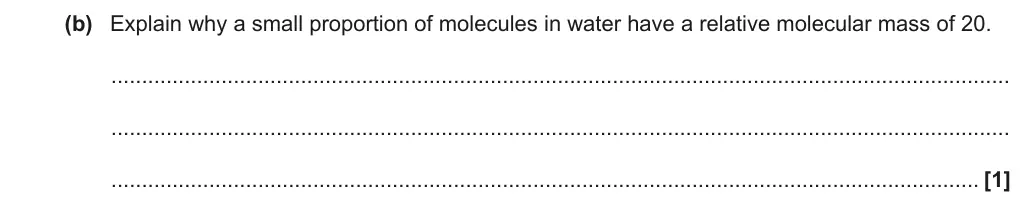
Many candidates recognised that the presence of hydrogen or oxygen isotopes could explain the high relative molecular mass of water. The best responses discussed D2O or molecules with other combinations of isotopes including 18O and even 3H. Exemplar 1 shows a good response which explains the relative molecular mass of 20 in terms of the presence of 18O. Many candidates claimed that some water molecules had the formula of H4O, often bringing lone pairs and hydrogen bonds into their explanations, as shown in Exemplar 2. D2O is encountered in proton NMR spectroscopy, so candidates will have encountered it during their studies, but many candidates were unable to link this to the relative molecular mass of 20.
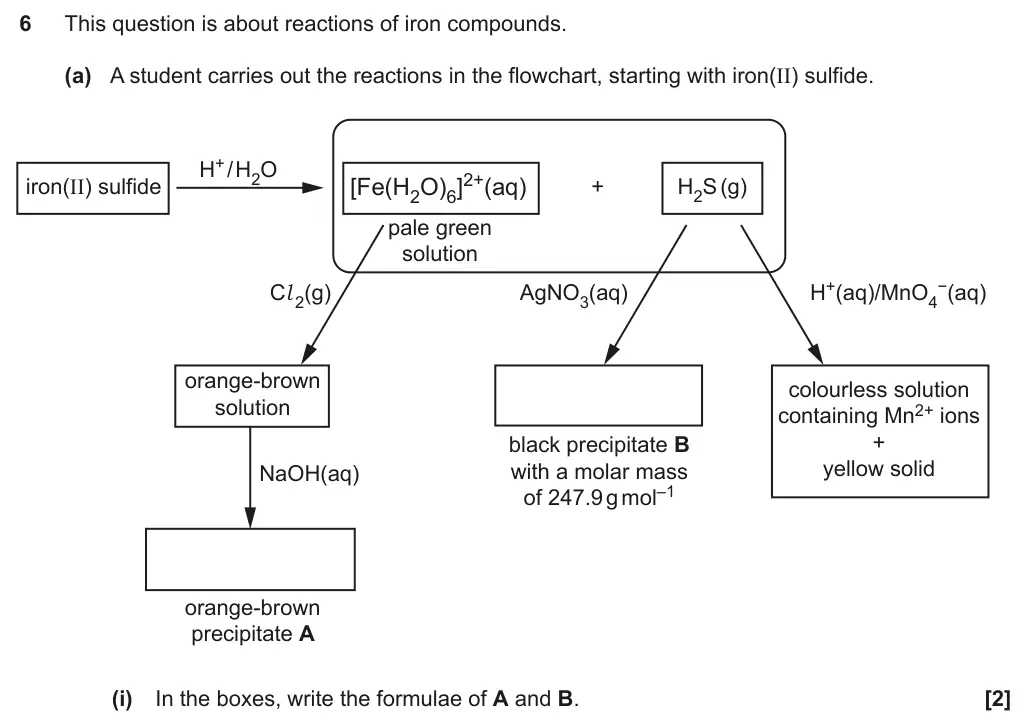
Most candidates were given 1 or 2 marks for this part. The black precipitate B (Ag2S) was identified correctly more often the orange precipitate A, which was often shown as Fe(OH)2 instead of Fe(OH)3 or Fe(OH)3(H2O)3. Significantly, identification of B required interpretation of new information whereas A required knowledge of transition element chemistry.
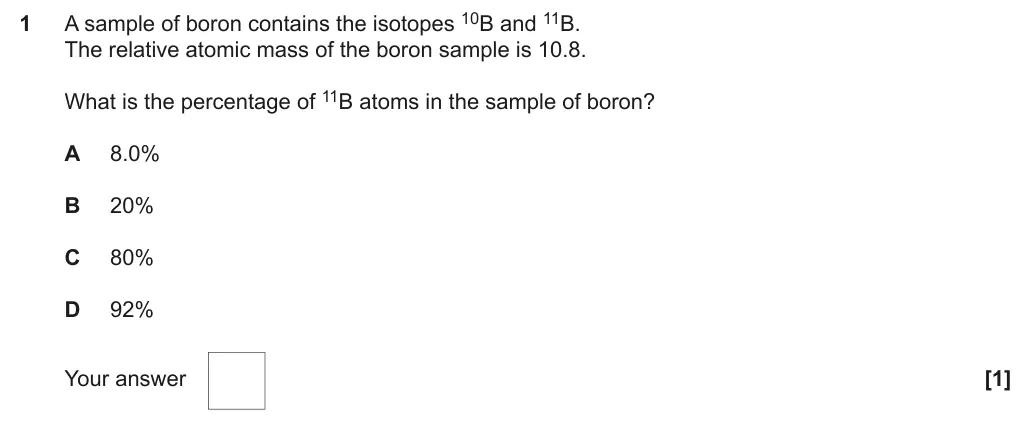
C
The majority of candidates were able to calculate the correct answer.
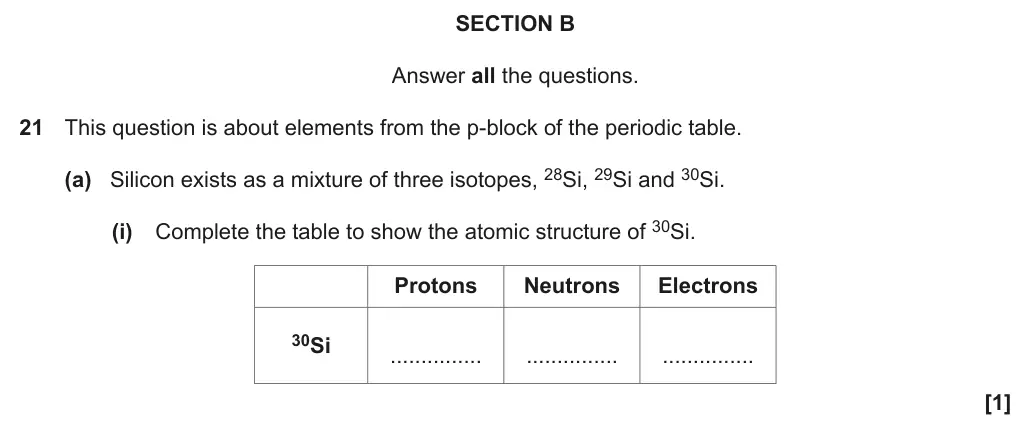
This question was an easy starter to the paper with most candidates producing the correct answer.
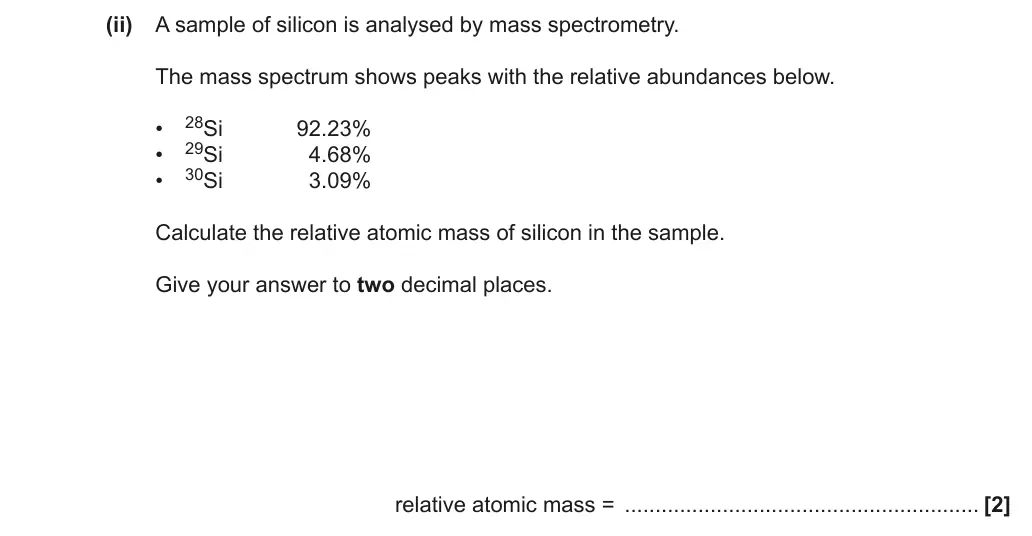
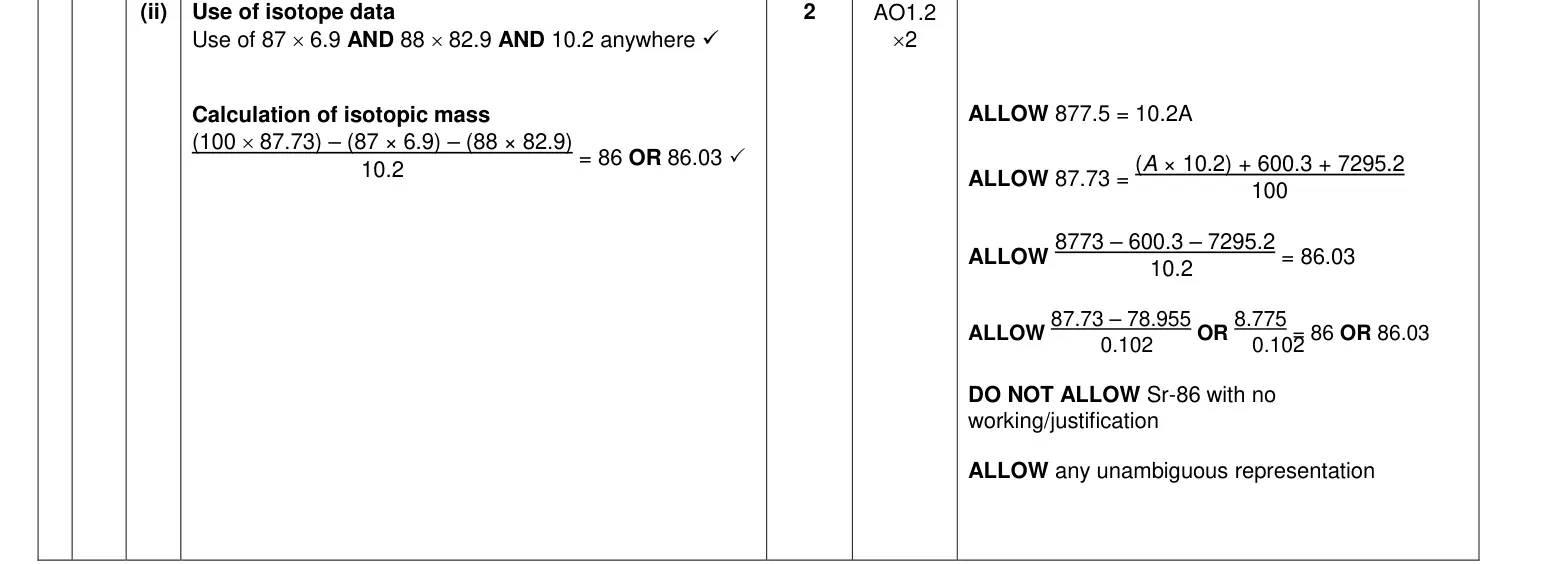
Almost all candidates followed a well-learnt procedure to complete the calculation. Despite being in the rubric to the question, some candidates did not give an answer to two decimal places. Others made a rounding error in reducing 28.1086 to two decimal places, with 28.10 and 28.12 being common errors.
Skills: M0.2 Use ratios, fractions and percentages; M1.1 Use an appropriate number of significant figures
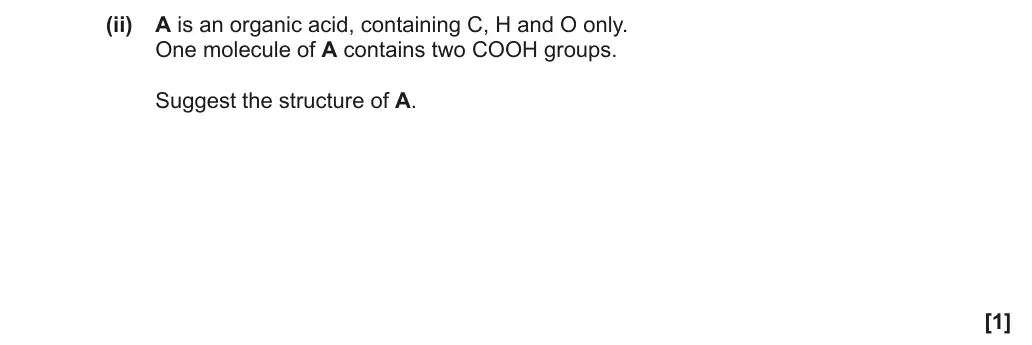
Most candidates that obtained a sensible value for the previous question managed to draw a creditable structure. Allowing error carried forward meant that feasibly derived structures could be credited a mark.
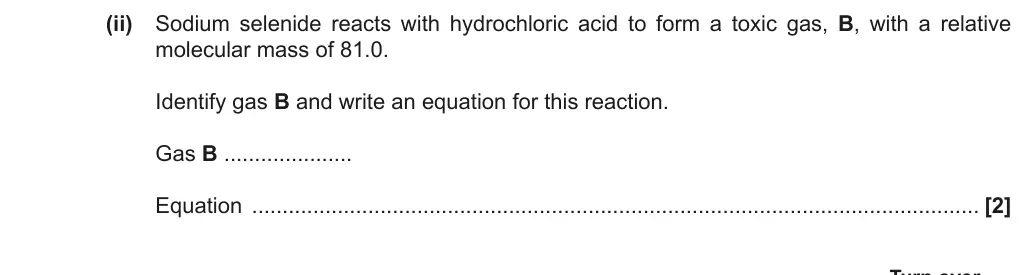
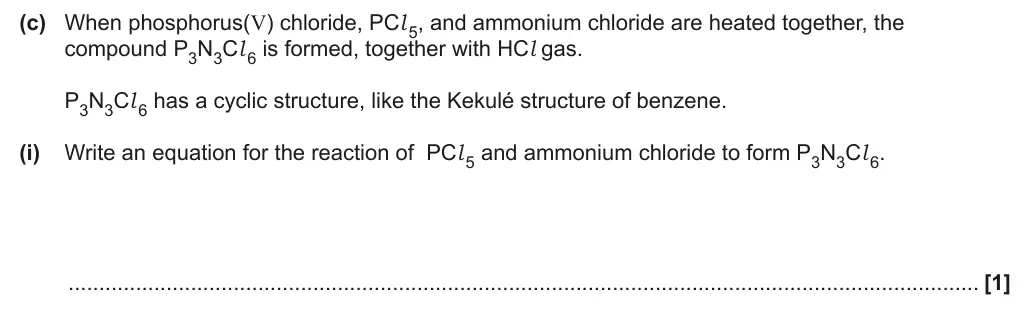
The majority of candidates obtained 1 or 2 marks on this question. The most common errors seen were identifying the gas as H2S or incorrect balancing.

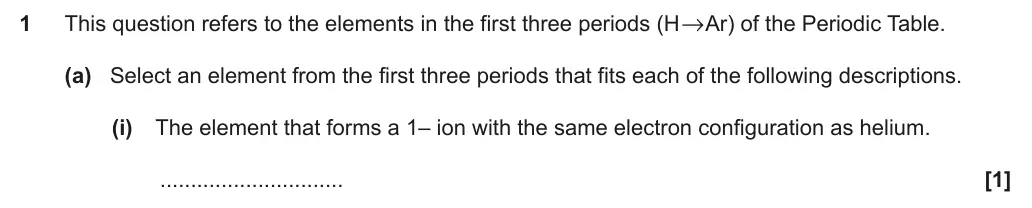
Almost all candidates correctly responded with phosphorus and this was the easiest part of 1(a).
Skills: M2.4 Solve algebraic equations
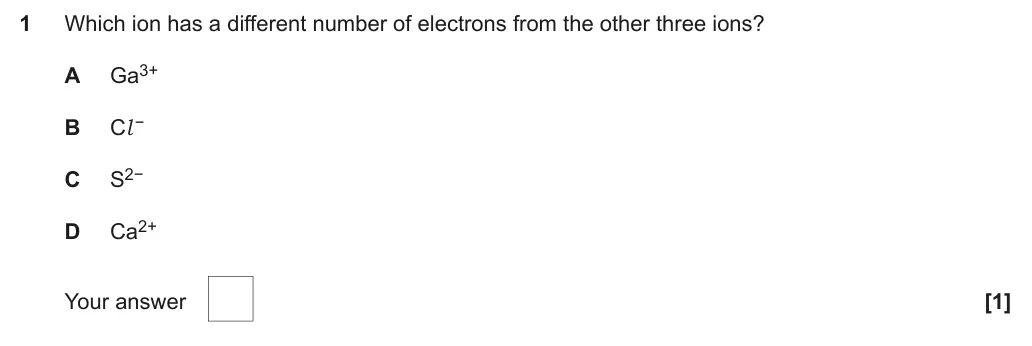
A
D
C
Skills: M0.2 Use ratios, fractions and percentages; M1.2 Find arithmetic means; M3.1 Translate information between graphical, numerical and algebraic forms
Skills: PAG4 Qualitative analysis of ions
Skills: M0.2 Use ratios, fractions and percentages; M0.3 Estimate results
Skills: M0.0 Recognise and make use of appropriate units in calculations; M0.1 Recognise and use expressions in decimal and ordinary form; M1.1 Use an appropriate number of significant figures
B
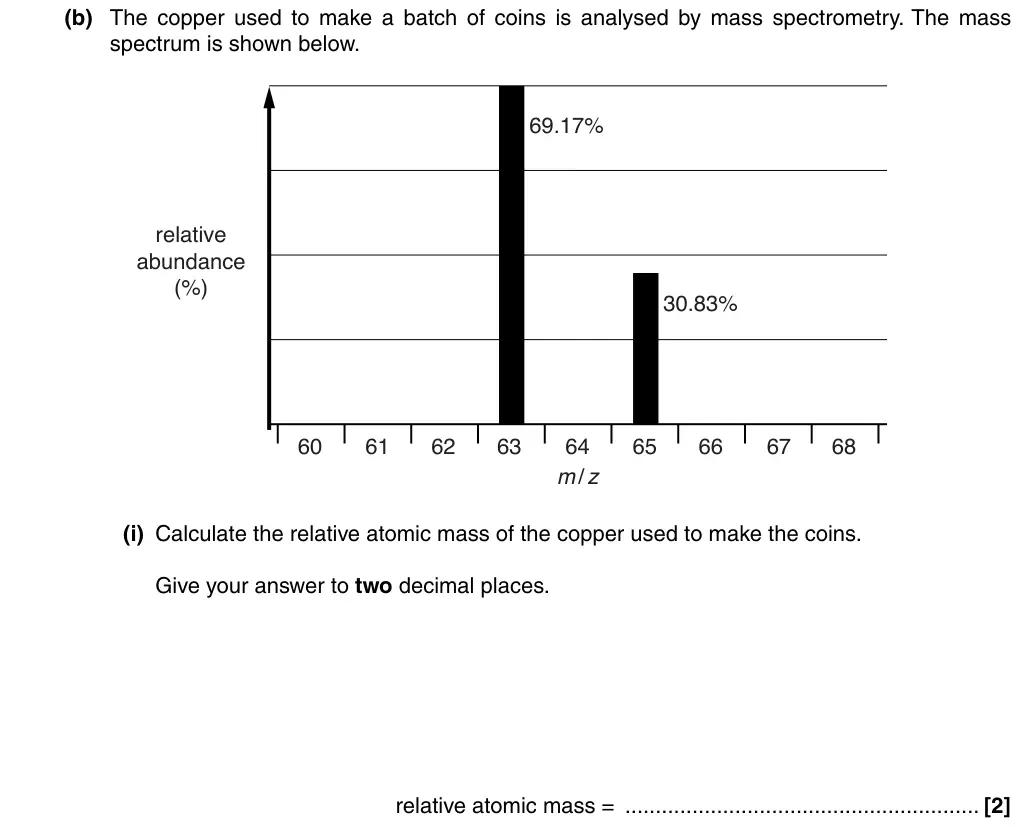
Skills: M0.2 Use ratios, fractions and percentages; M1.2 Find arithmetic means; M3.1 Translate information between graphical, numerical and algebraic forms
Dropping marks on calculations, mechanisms or the six-markers? Book a trial session with a specialist OCR chemistry tutor.