Notes and key-term cards for this topic are being written by our tutors. The past-paper questions below are ready now.
Learning outcomes
Show the 21 learning outcomes from the specification
5.1.1(a) explanation and use of the terms: rate of reaction, order, overall order, rate constant, half- life, rate-determining step
5.1.1(b) deduction of:
5.1.1(b)(i) orders from experimental data
5.1.1(b)(ii) a rate equation from orders of the form: rate = k[A]m[B]n, where m and n are 0, 1 or 2
5.1.1(c) calculation of the rate constant, k, and related quantities, from a rate equation including determination of units
5.1.1(d) from a concentration– time graph:
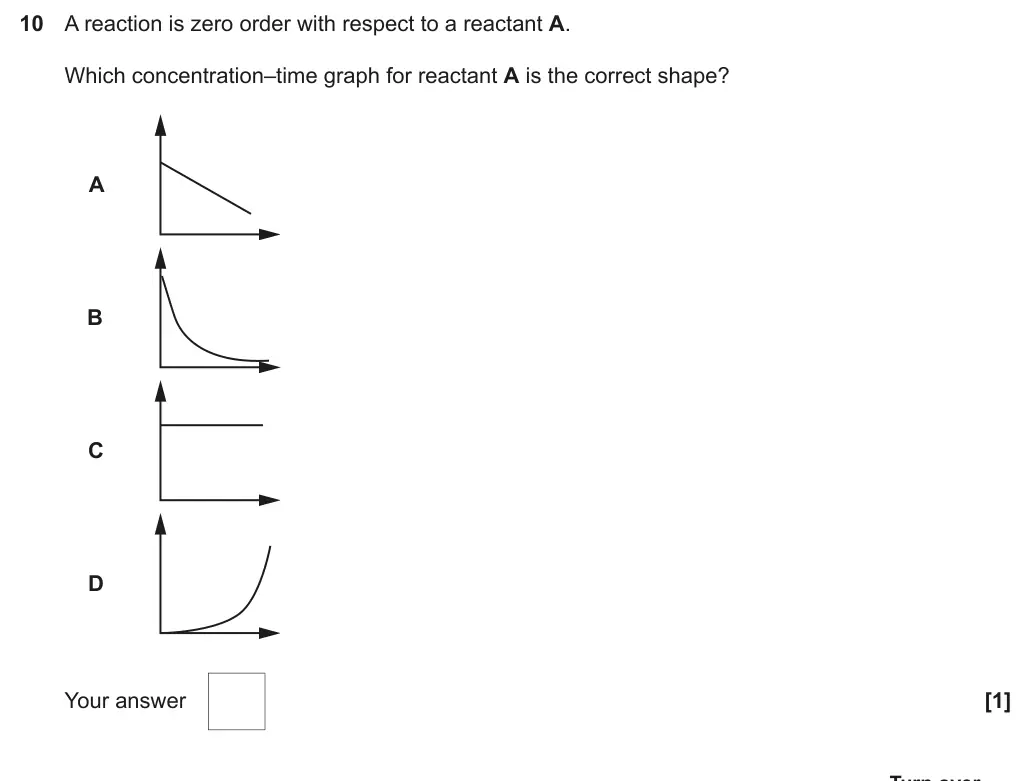
5.1.1(d)(i) deduction of the order (0 or 1) with respect to a reactant from the shape of the graph
5.1.1(d)(ii) calculation of reaction rates from the measurement of gradients (see also 3.2.2 b)
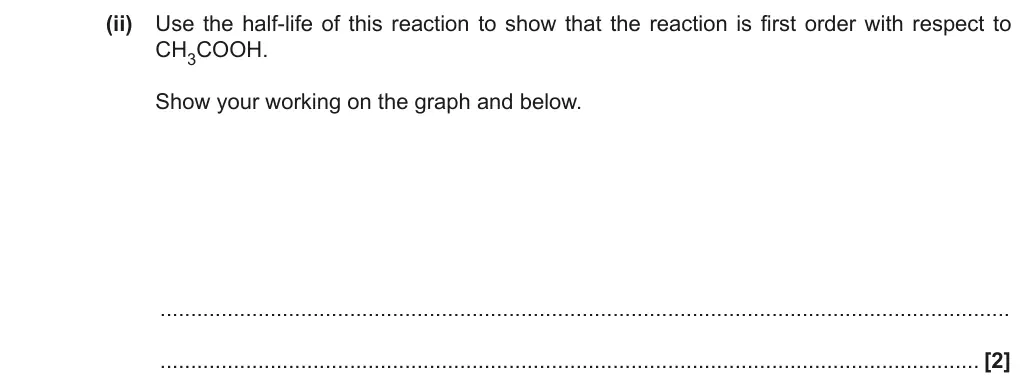
5.1.1(e) from a concentration– time graph of a first order reaction, measurement of constant half-life, t1/2
5.1.1(f) for a first order reaction, determination of the rate constant, k, from the constant half-life, t1/2, using the relationship: k = ln 2/ t1/2
5.1.1(g) from a rate– concentration graph:
5.1.1(g)(i) deduction of the order (0, 1 or 2) with respect to a reactant from the shape of the graph
5.1.1(g)(ii) determination of rate constant for a first order reaction from the gradient
5.1.1(h) the techniques and procedures used to investigate reaction rates by the initial rates method and by continuous monitoring, including use of colorimetry (see also 3.2.2 e)
5.1.1(i) for a multi-step reaction, prediction of,
5.1.1(i)(i) a rate equation that is consistent with the rate-determining step
5.1.1(i)(ii) possible steps in a reaction mechanism from the rate equation and the balanced equation for the overall reaction
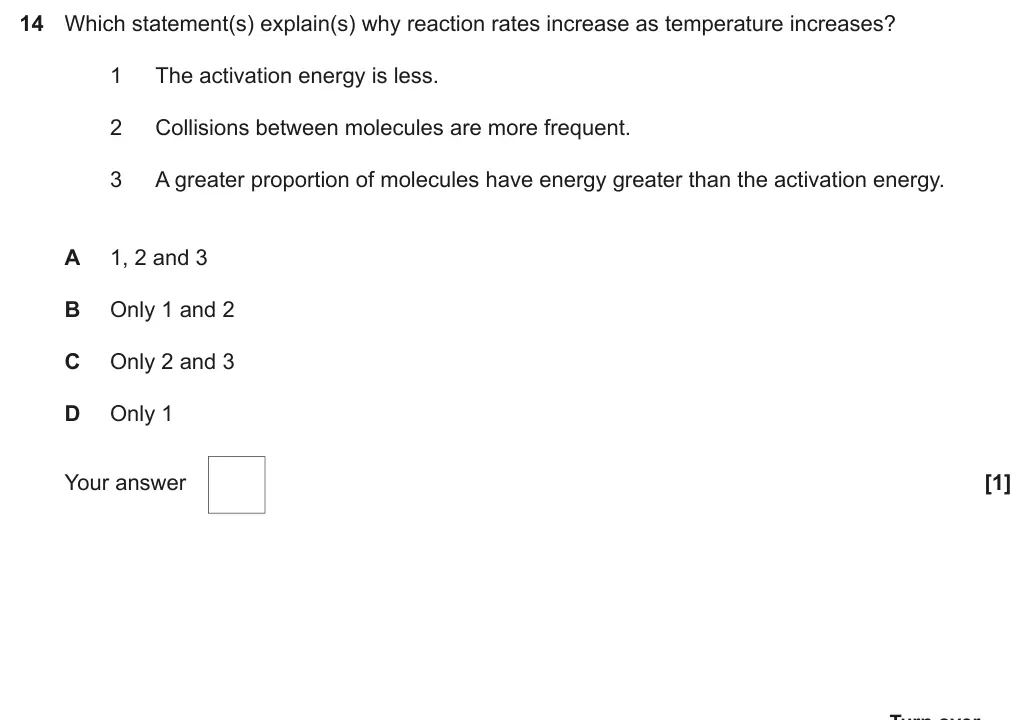
5.1.1(j) a qualitative explanation of the effect of temperature change on the rate of a reaction and hence the rate constant (see 3.2.2 f– g)
5.1.1(k) the Arrhenius equation:
5.1.1(k)(i) the exponential relationship between the rate constant, k and temperature, T given by the Arrhenius equation, k = Ae–Ea/RT
5.1.1(k)(ii) determination of Eaand A graphically using: ln k = – Ea/RT + ln A derived from the Arrhenius equation.
Six-mark level of response questions on this topic
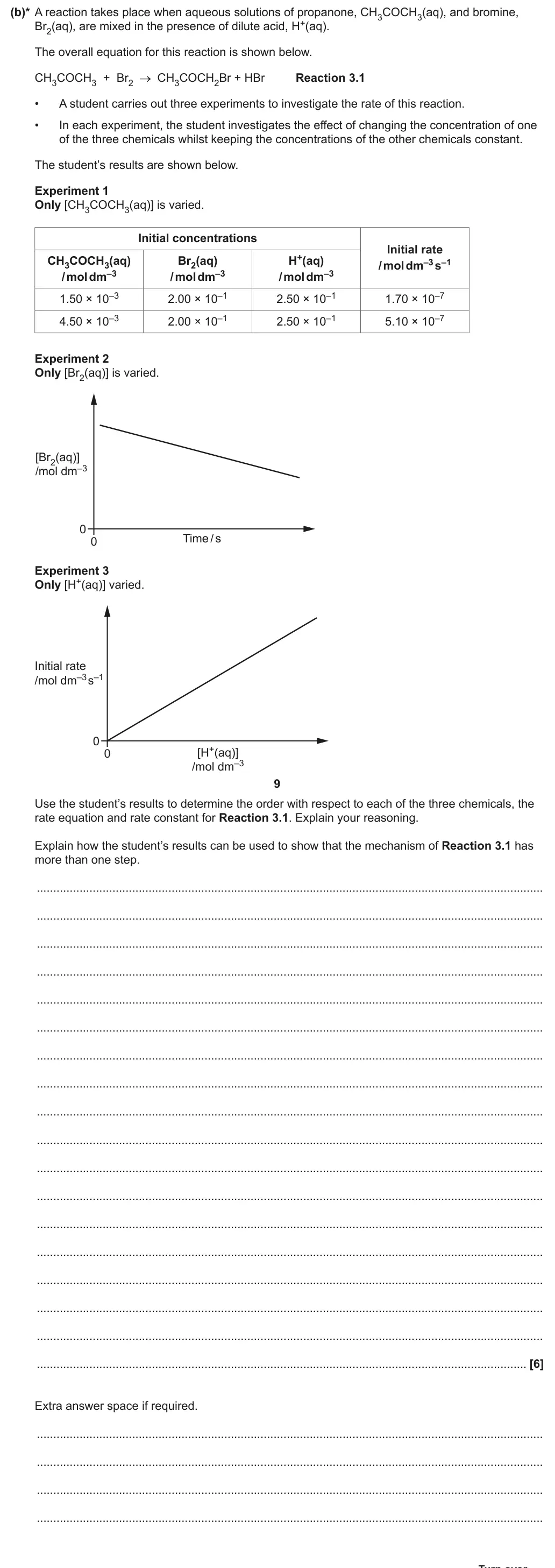
A reaction takes place when aqueous solutions of propanone, CH3COCH3(aq), and bromine, Use the student’s results to determine the order with respect to each of the three chemicals, the
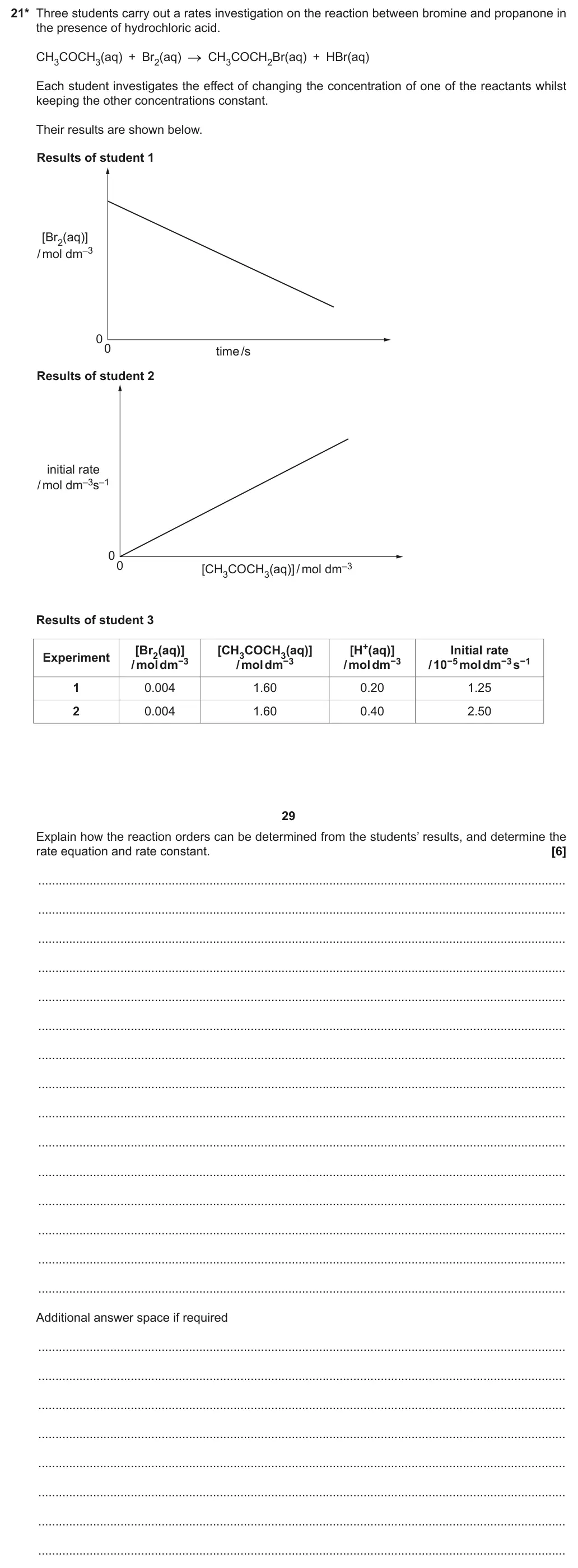
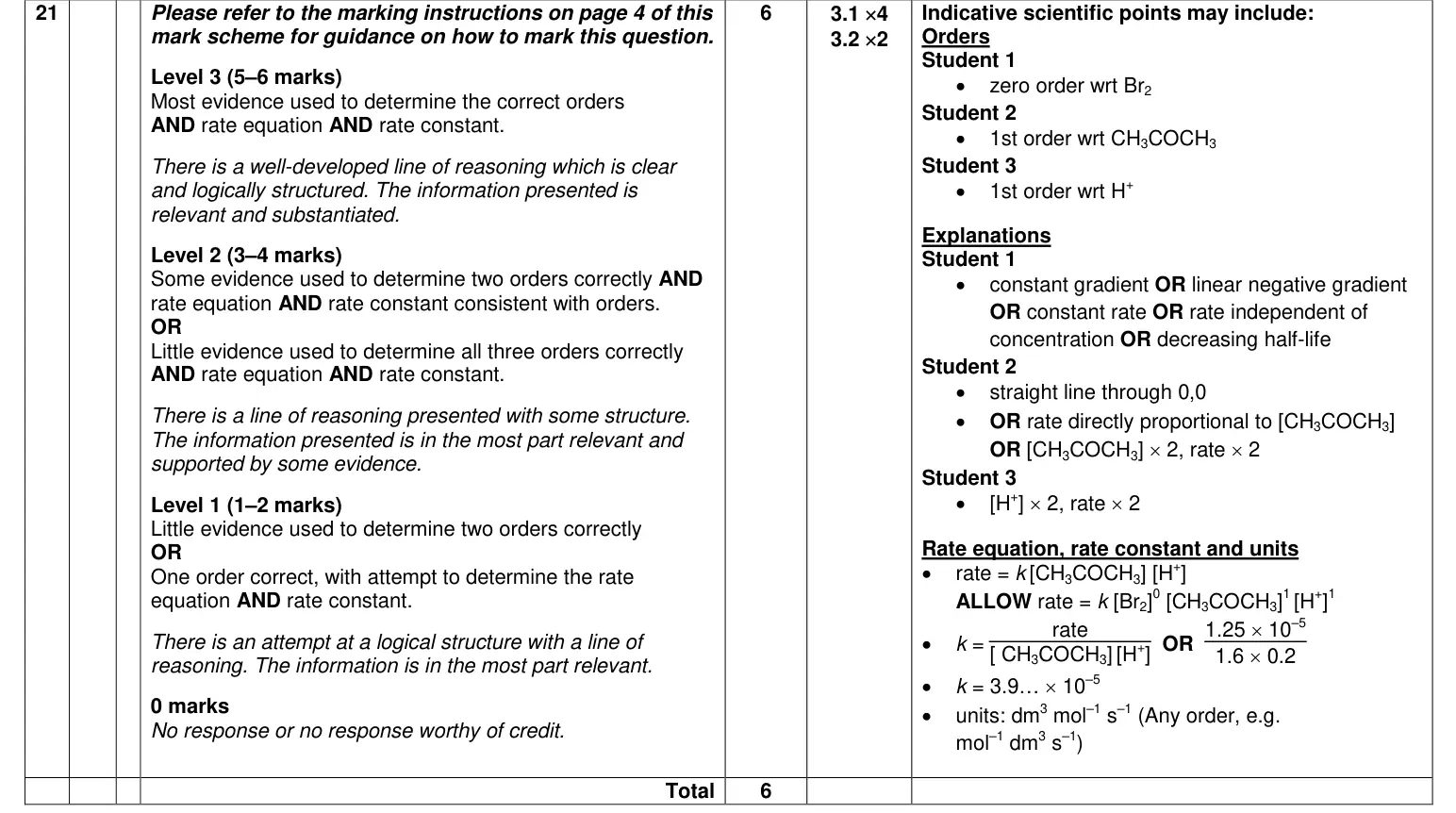
Three students carry out a rates investigation on the reaction between bromine and propanone in Explain how the reaction orders can be determined from the students’ results, and determine the
Tap a question to zoom it. Where a part needs a table, graph or structure from an earlier part, that part folds out above it; the mark scheme and examiner's comment open underneath. Have the OCR Data Sheet beside you.
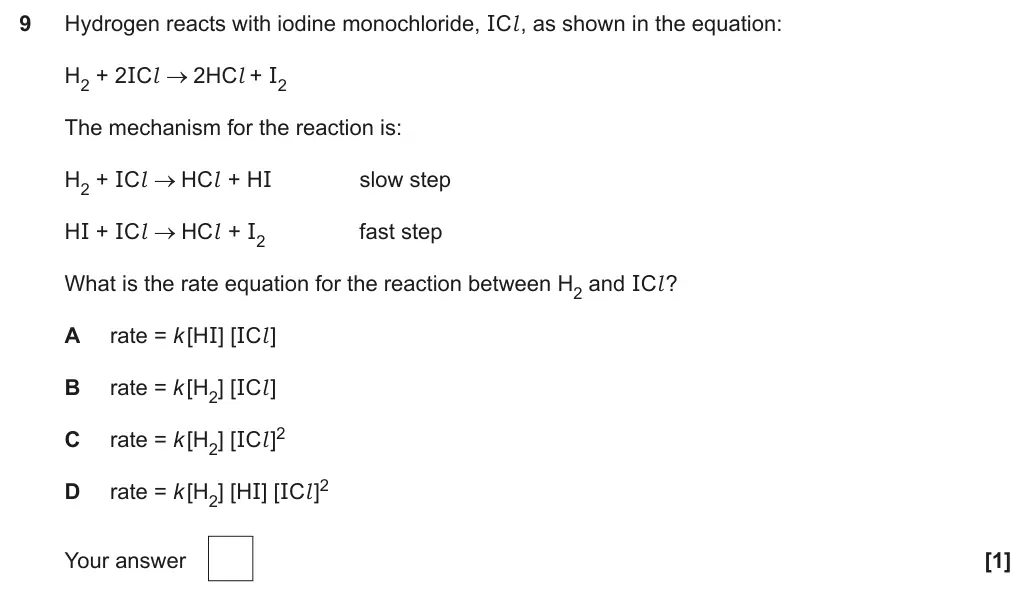
June 2025 · Paper 1 · Q91 markMultiple choiceHard
Answer
B
Mark scheme
Examiner's comment
The correct answer was B. This question proved slightly more challenging, but a significant number of candidates selected this response. The most common incorrect answer was C due to, presumably, basing their reasoning on the stoichiometric equation rather than the mechanism.
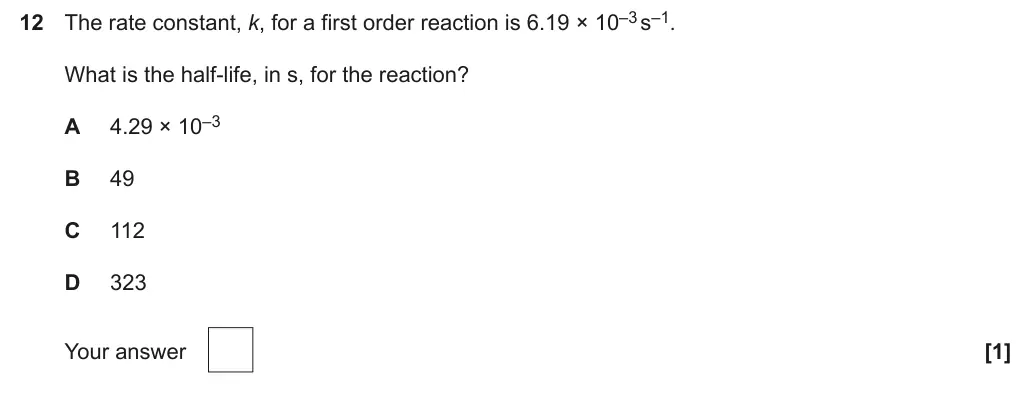
June 2025 · Paper 1 · Q121 markMultiple choiceMedium
Answer
C
Mark scheme
Examiner's comment
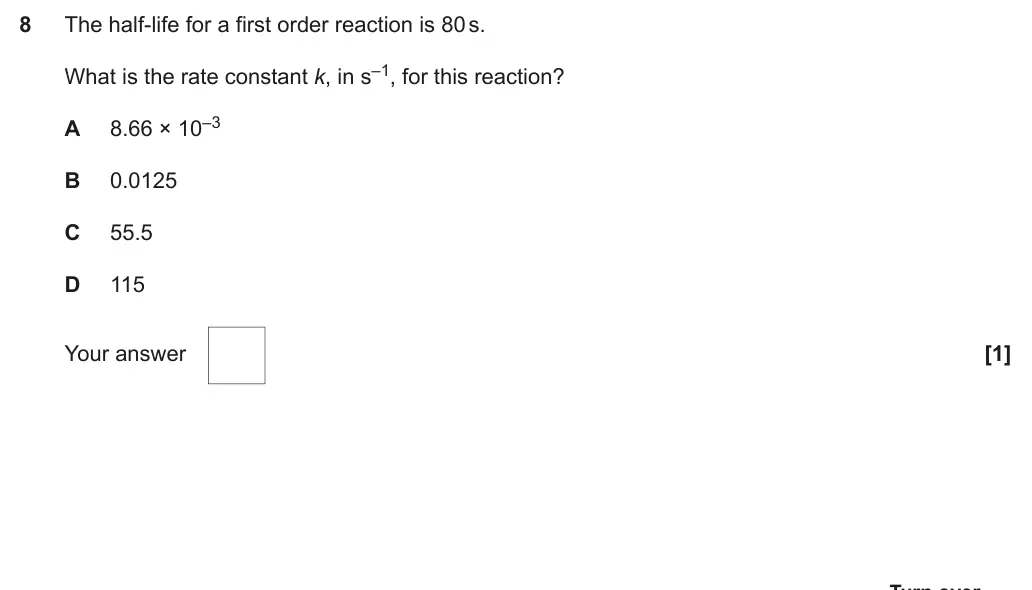
The correct answer was C. A good number of candidates chose this response as they were able to recall the mathematical relationship between k and half-life i.e. k = ln 2 / t1/2. The most common incorrect answer was A.
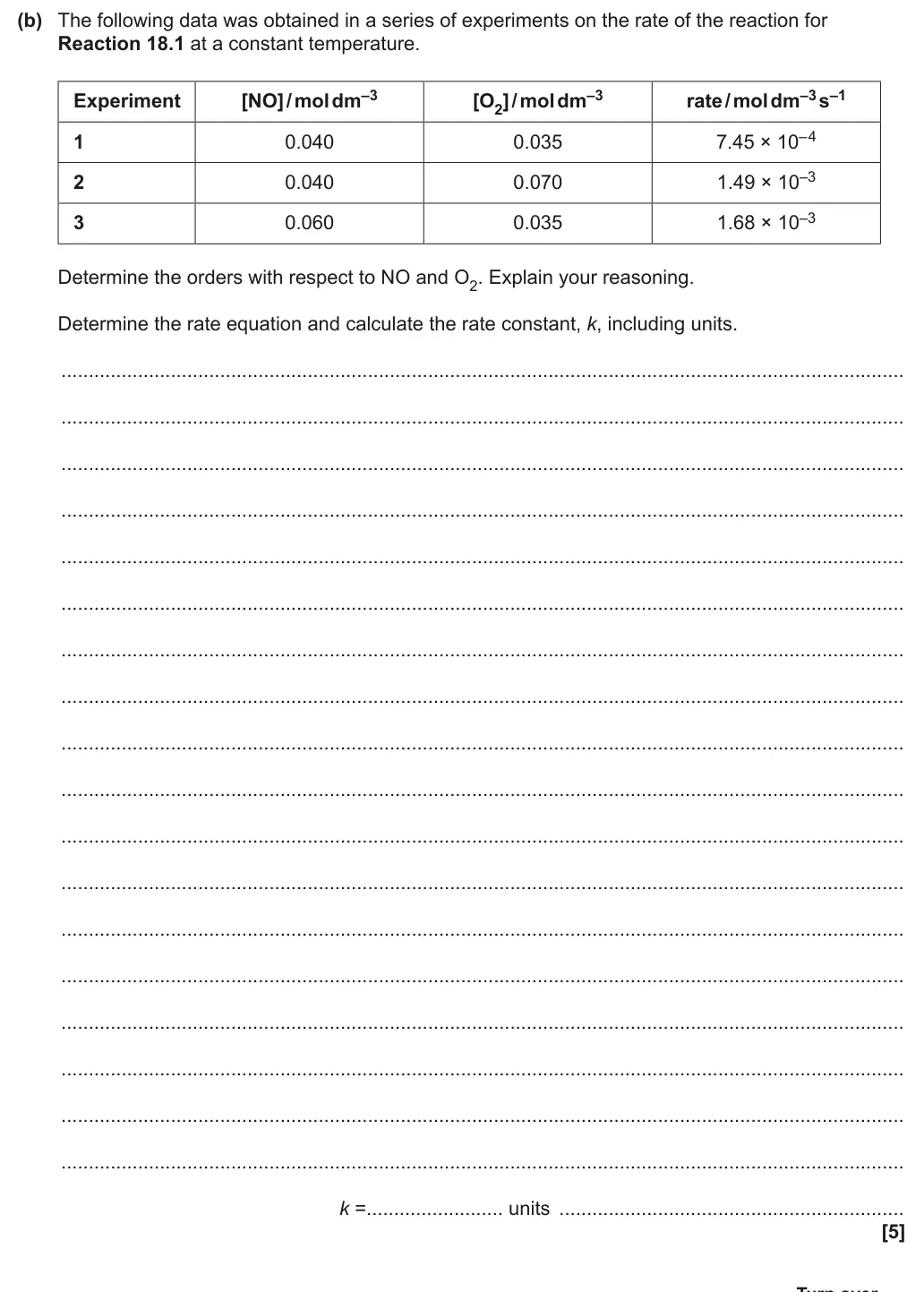
June 2025 · Paper 1 · Q18(b)5 marksCalculationHard
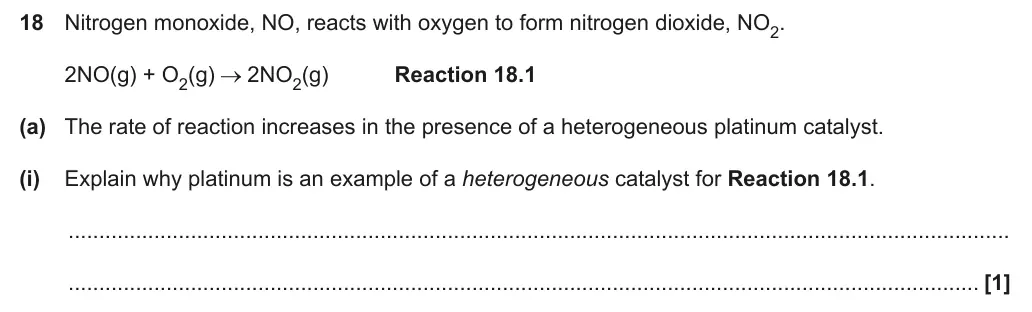
Earlier part of question 18 that this part uses
Mark scheme
Examiner's comment
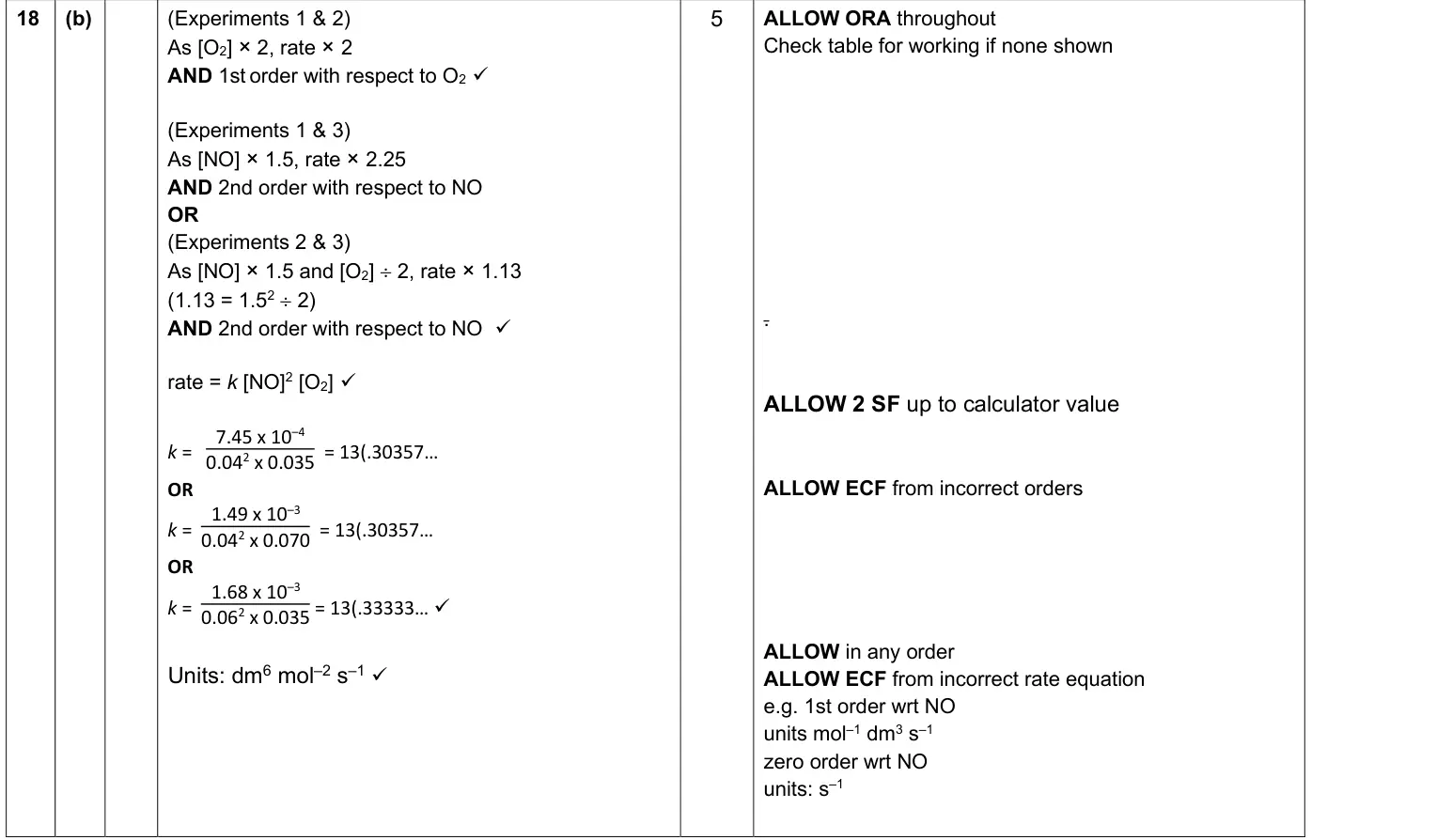
Lots of candidates were given 5 marks. They were able to use the experimental evidence to deduce the orders, write a rate equation and calculate k. The best candidates listed their reasoning for the orders rather than writing in large paragraphs of prose which sometimes got confused and led to contradictions. A good proportion of candidates recognised that 2.25 was 1.52, although a few thought that the 2nd order with respect to NO was a result of ‘2.25 being approximately 2 times 1.5’. Less successful candidates assumed that if they couldn’t identify what the relationship was between the concentration and the rate, that meant it was zero order. Less successful candidates were also unsuccessful in working out the units. A few candidates omitted k in their rate equations or didn’t write a rate equation. Many candidates were given marks as ECF from incorrect orders.
Notes from the mark scheme and report
rate = k[NO]2[O2]
k = 13.3
units dm6 mol–2 s–1
ALLOW ECF from incorrect orders and rate equation
Skills: M0.0 Recognise and make use of appropriate units in calculations; M0.2 Use ratios, fractions and percentages; M2.2 Change the subject of an equation; M2.3 Substitute numerical values into algebraic equations using appropriate units for physical quantities; PAG10 Rates of reaction – initial rates
June 2025 · Paper 1 · Q18(c)(i)1 markComplete table/diagramHard
Mark scheme
Examiner's comment
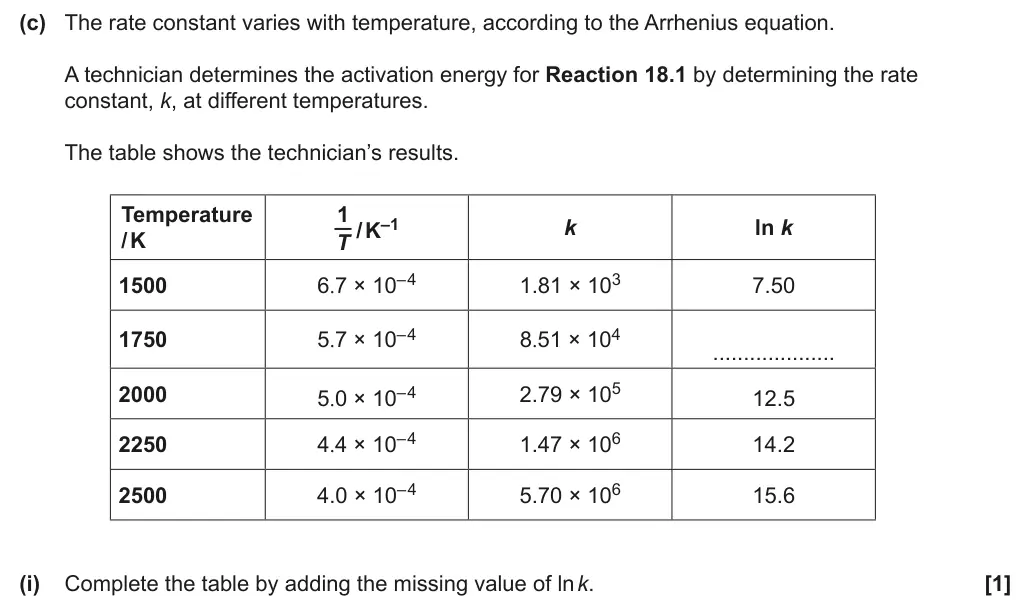
Excellent responses were seen with either 11.35 or 11.4 given. A few candidates suggested 10.4 or 11.40. This could have been from completing Question 18 (c) (ii) first and then choosing the value for part (c) (i) based on their line of best fit (e.g. 10.40).
Notes from the mark scheme and report
ln(8.51 × 10^4) = 11.4 / 11.35
Skills: M0.4 Use calculators to find and use power, exponential and logarithmic functions; M2.5 Use logarithms in relation to quantities that range over several orders of magnitude
June 2025 · Paper 1 · Q18(c)(ii)4 marksCalculationMedium
Earlier parts of question 18 that this part uses
Mark scheme
Examiner's comment
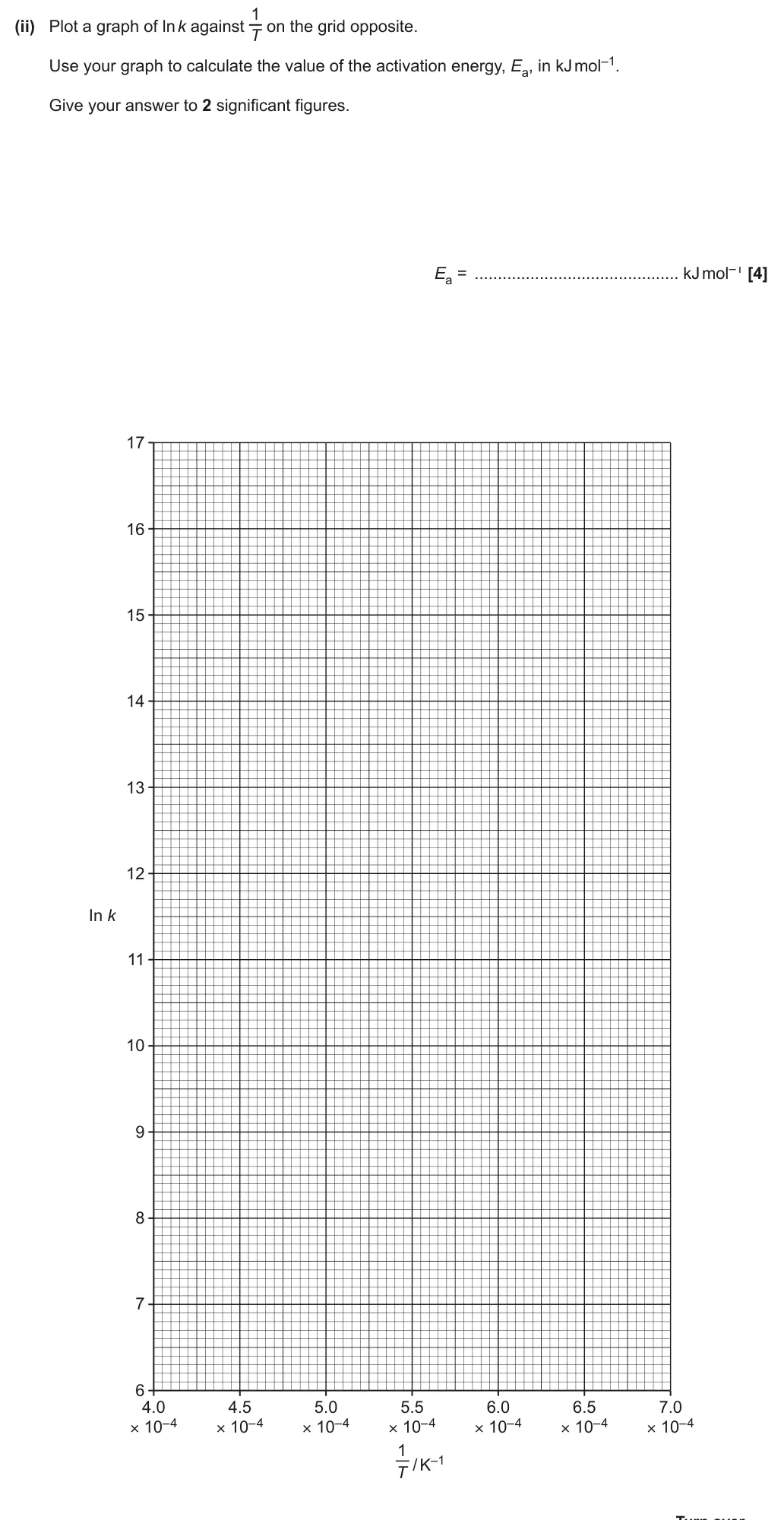
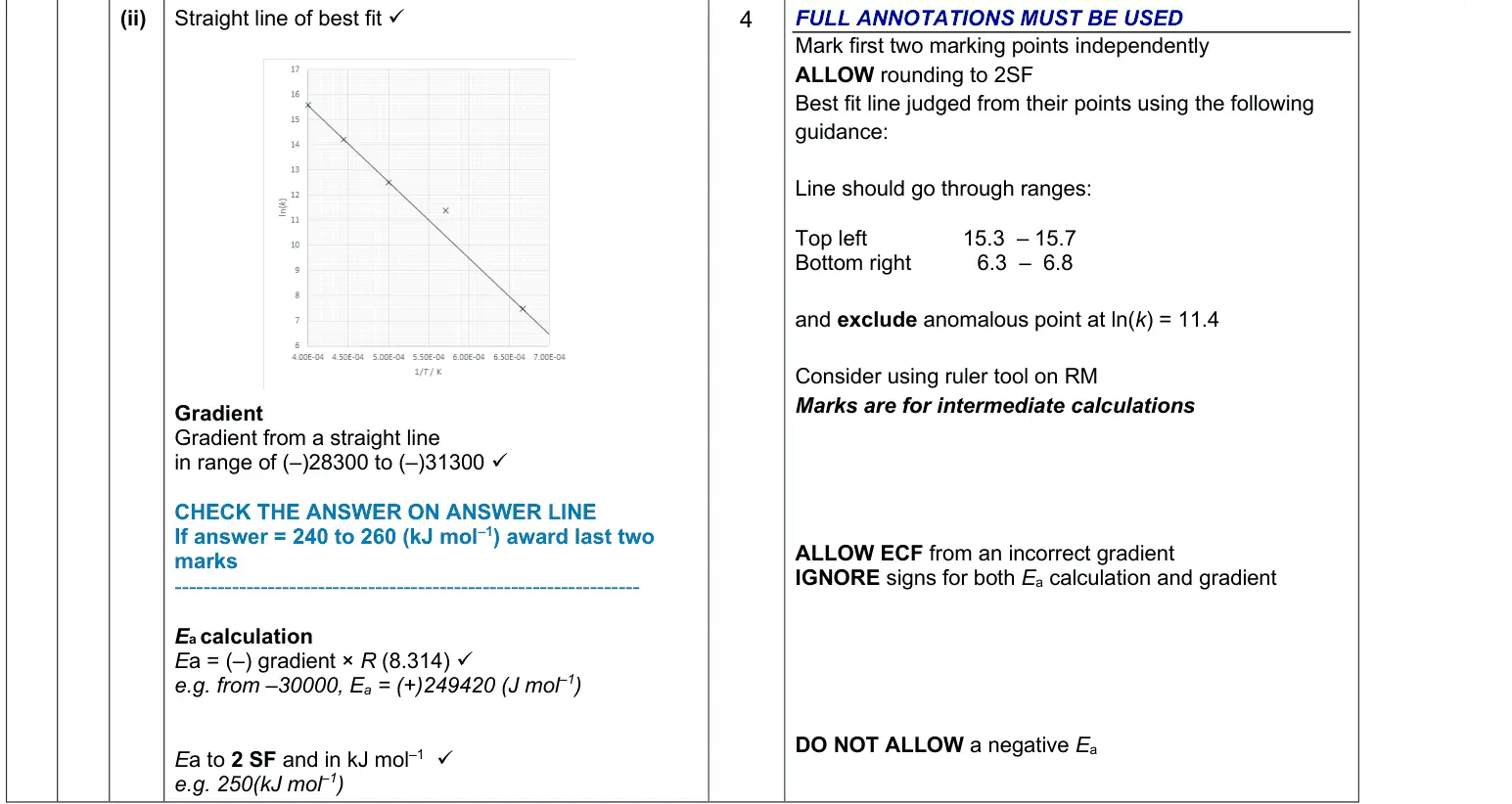
Nearly all candidates were able to draw the line of best fit and linked the equation of a straight line to the equation. A few candidates drew a curve, and some included the anomalous result. Gradients were calculated with accuracy with a few candidates calculating the gradient using an inverted formula. A few didn’t notice the x-axis didn’t go to 0, so used Δx in their gradient at -7x10⁻⁴ and ended up with a gradient of about -12800 and Ea of 110 as ECF. Most candidates knew to multiply by R but a few incorrectly divided by R. Some candidates didn’t give to 2 SF and / or convert to kJ and gave a negative value. A few candidates tried to substitute values into lnk = - Ea/RT + lnA, rather than use the graph. Many realised that they didn’t have a y-intercept and then calculated the gradient. Those that were able to complete the maths calculated the correct answer within the range.
Notes from the mark scheme and report
best-fit straight line excluding the anomalous point at ln k = 11.4
gradient –28 300 to –31 300
Ea = –gradient × 8.314
2 SF in kJ mol–1 (240–260)
DO NOT ALLOW a negative Ea
Skills: M0.0 Recognise and make use of appropriate units in calculations; M1.1 Use an appropriate number of significant figures; M2.3 Substitute numerical values into algebraic equations using appropriate units for physical quantities; M3.2 Plot two variables from experimental or other data; M3.3 Determine the slope and intercept of a linear graph
June 2025 · Paper 3 · Q3(b)6 marks6-mark level of responseMedium
Mark scheme, with the levels and indicative points
Examiner's comment
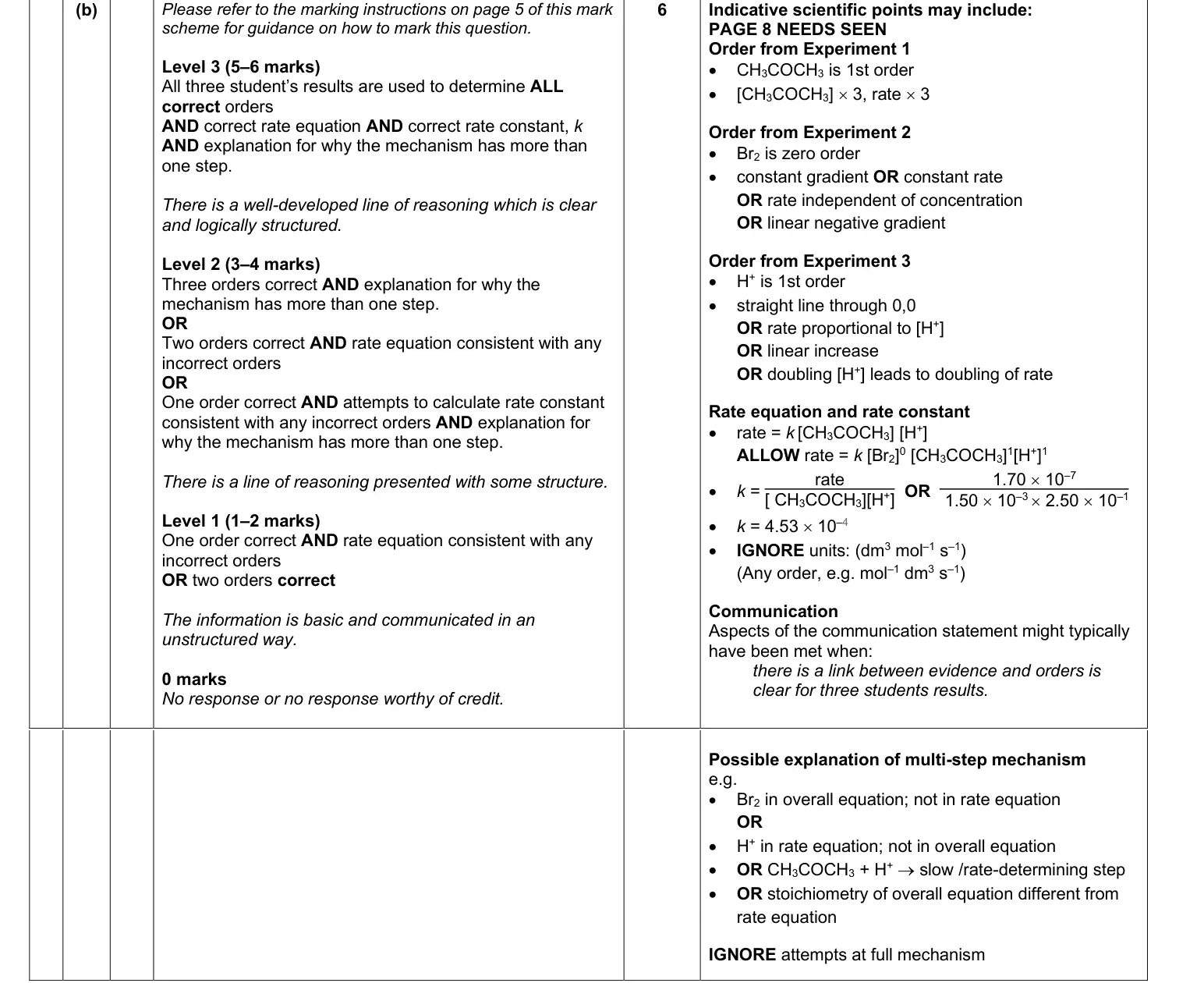
Most candidates were able to gain some marks for this Level of Response (LoR) question, with very few obtaining no marks. To achieve Level 1, candidates needed to identify at least 2 of the 3 orders with no further correct analysis. For Level 2 candidates were also expected to show the correct rate equation to match their orders or to provide a reason for why the mechanism must proceed via more than one step. Most candidates reaching Level 2 wrote a correct rate equation and usually calculated the rate constant. At this level, comparatively few produced a valid analysis of the mechanism. For a Level 3 response, all three aspects of the analysis were required: correct orders, correct rate equation and rate constant, and a correct explanation of the mechanism. Many candidates were able to provide all three aspects. Candidates usually determined the 1st order with respect to propanone from the initial rates data provided. The 1st order with respect to H+ from the rate–concentration graph was often seen. The zero order with respect to bromine from the concentration–time graph caused more problems, with many candidates incorrectly choosing 1st or 2nd order. The communication strand for this LoR question was given if the candidate had linked their orders with the evidence provided. Most candidates gave the initial rates but the evidence from the graphs was often omitted and vague. Responses such as ‘because of the graph’ are inadequate. The candidate’s response also had to be structured in a comprehensive way. This strand was usually given. beyond the minimum requirements for Level 3 including the communication strand.
Notes from the mark scheme and report
propanone first order ([ ] × 3, rate × 3)
Br2 zero order (constant gradient on concentration–time graph)
H+ first order (straight line through origin)
rate = k[CH3COCH3][H+]
k = 4.53 × 10^-4
Br2 in overall equation but not in rate equation (and H+ in rate equation but not overall) so more than one step
Skills: M0.2 Use ratios, fractions and percentages; M2.3 Substitute numerical values into algebraic equations using appropriate units for physical quantities; M3.1 Translate information between graphical, numerical and algebraic forms; PAG10 Rates of reaction – initial rates
June 2024 · Paper 1 · Q91 markMultiple choiceHard
Answer
B
Mark scheme
Examiner's comment
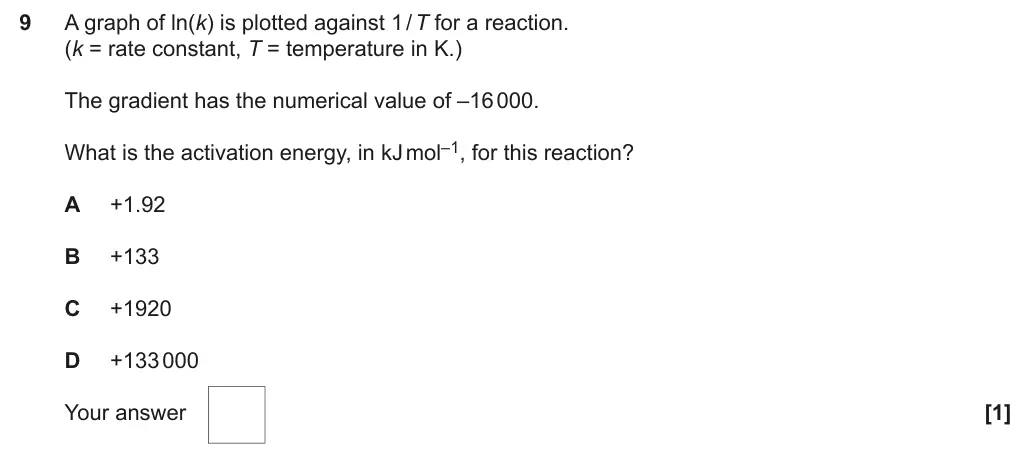
The correct answer was B. Candidates generally find the use and manipulation of the Arrhenius equation challenging. Focus was need on the unit conversion when using R (Jmol-1K-1) for the gradient and activation energy (kJ mol-1). This led to a few candidates selecting D. It is worth reminding candidates that the two forms of this equation are given on the data sheet.
June 2024 · Paper 1 · Q101 markMultiple choiceHard
Answer
D
Mark scheme
Examiner's comment
The correct answer was D. Candidates performed well on this question with incorrect answers rarely seen. A minority of candidates confused rate-concentration graphs with concentration-time graphs.
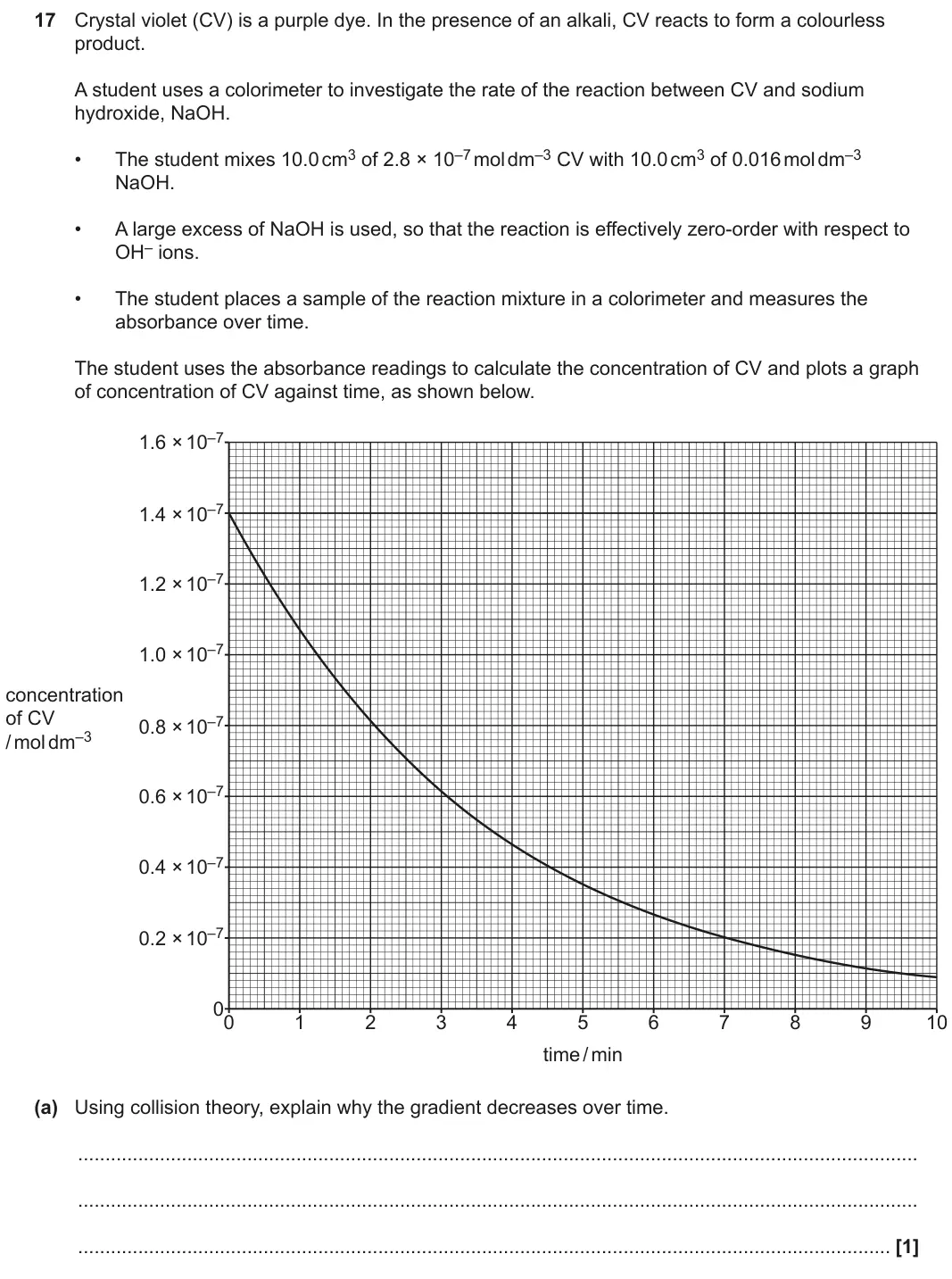
June 2024 · Paper 1 · Q17(b)6 marks6-mark level of responseEasy
Earlier part of question 17 that this part uses
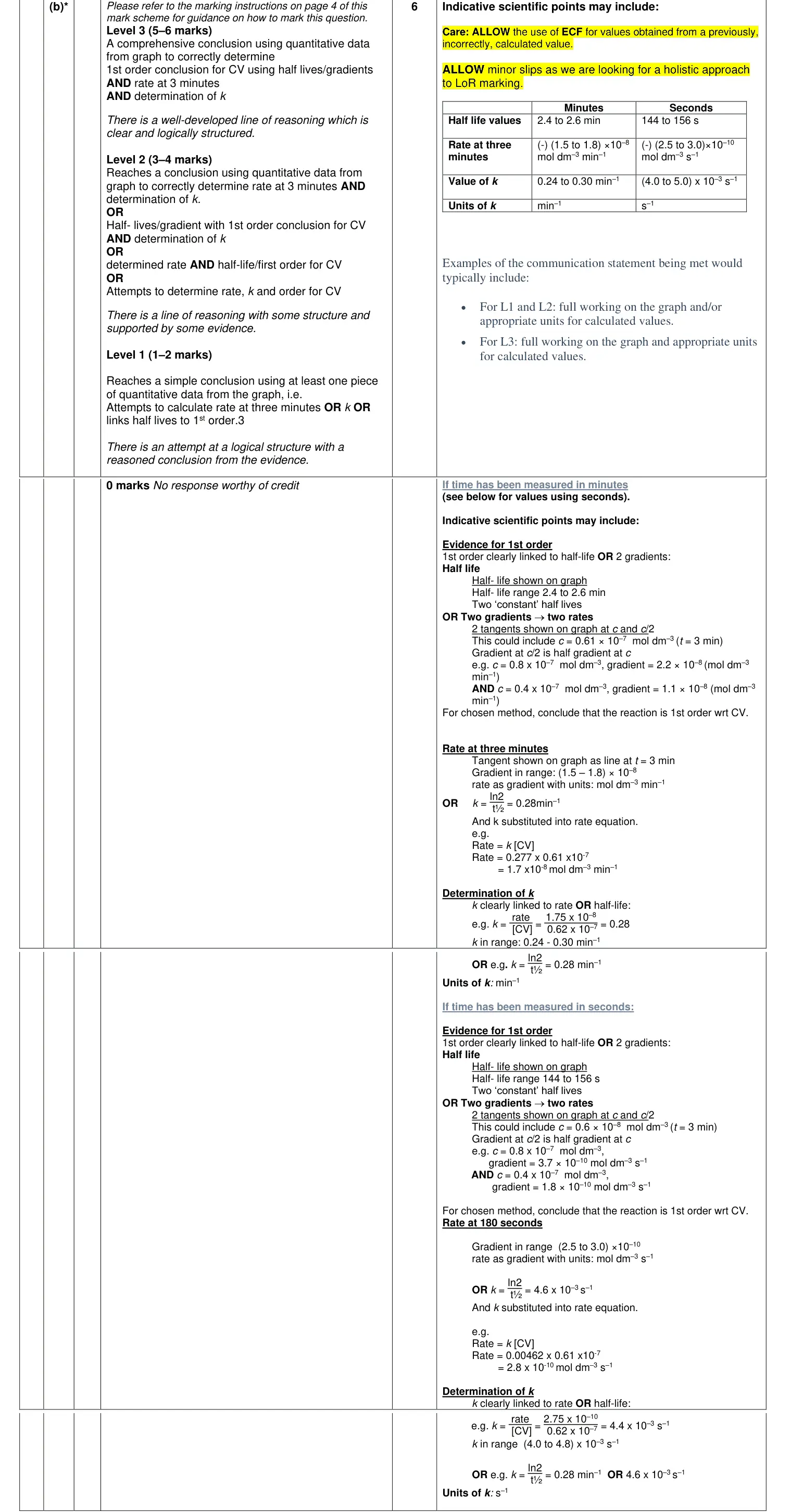
Mark scheme, with the levels and indicative points
Examiner's comment
The first Level of Response question in the paper was answered well with the higher-attaining candidates on the paper scoring full marks. These students started with a nice clear analysis of the half-life, referring to labelled sections of the graph, then went on to calculate the rate from a well-drawn tangent with correct indices and were careful to write down the correct units. Then used the rate equation to calculate K and get the correct units. Almost all candidates were able to conclude that it was first order for CV. Most used the half-life approach with others comparing two gradients. Candidates should be advised, especially in LoR questions, that the conclusion needs a clear link to the data. The gradient at 3 minutes was done well and the candidates used the appropriate scale from the graph in their calculations. Clarity of communication does require indication of what is being calculated and how the numbers were obtained. This would allow an initial rate versus a rate at three minutes to be distinguished. Units were particularly important in this question as some candidates used minutes from the graph while others converted time into seconds. A common error was to state the wrong units or leave them out altogether. Most candidates used the rate equation to calculate K and get the correct units. A few approached the value by using k = ln2 t½ . Error carried forward was given for those with incorrect half-lives or rate value. Candidate errors arose from graph readings that caused rate to be wrong, errors in concentrations used in rate or K calculation, and badly drawn tangents causing the rate to be out of tolerance. Some candidates tried to adjust the concentrations as if conducting mole calculations or take the rate from two points on the graph. The candidate scored Level 3. The graph was clearly used to obtain half-lives and gradients. This was communicated on the answer lines, showing calculations and units.
Notes from the mark scheme and report
half-lives or gradients on the graph
tangent at 3 min
k from t½ = ln2/k or from rate/[CV]
units of k
M3 section of the Maths Skills handbook contains useful information on use of graphs in chemistry, including M3.5 on drawing and using the slope of the tangent to a curve as a measure of a rate of change: Teach Cambridge (ocr.org.uk)
Skills: M0.0 Recognise and make use of appropriate units in calculations; M1.1 Use an appropriate number of significant figures; M3.1 Translate information between graphical, numerical and algebraic forms; M3.5 Draw and use the slope of a tangent to a curve as a measure of rate of change
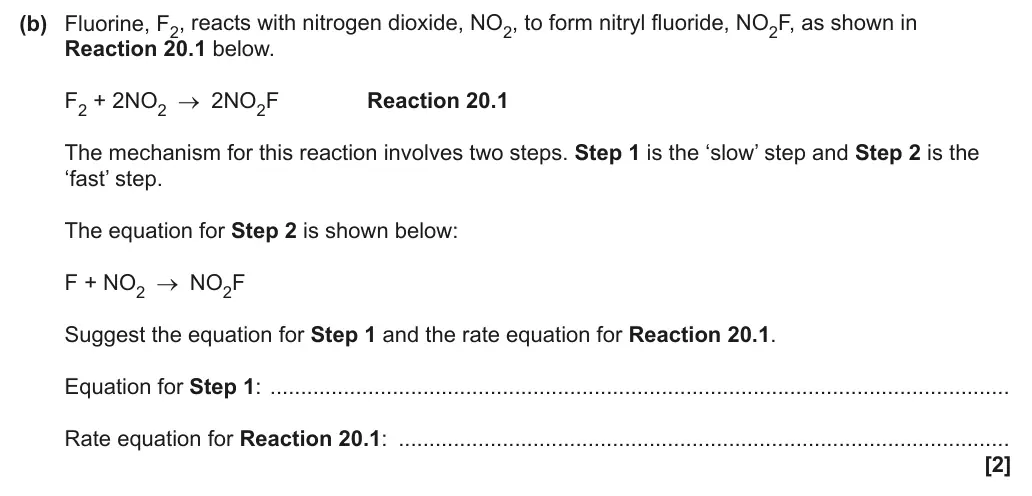
June 2024 · Paper 1 · Q20(b)2 marksShort answerHard
Mark scheme
Examiner's comment
Candidates found this question more challenging. Many candidates deduced Step 1 and then went on to state the rate equation. A few candidates incorrectly deduced F rather than F2 and/or obtained a second order for NO2
Notes from the mark scheme and report
Step 1 = overall minus Step 2
rate equation from slow step must include k
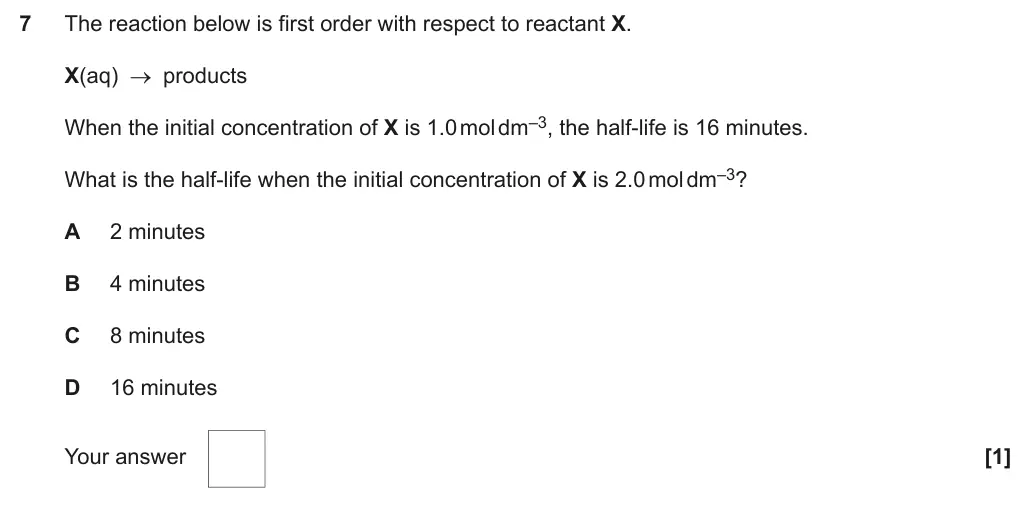
June 2023 · Paper 1 · Q71 markAO1Multiple choiceMedium
Answer
D
Mark scheme
Examiner's comment
Half of the candidates chose the correct half-life of D and a large proportion of the others chose 8 minutes, halving the time as the concentration was doubled, causing C to be a common error.
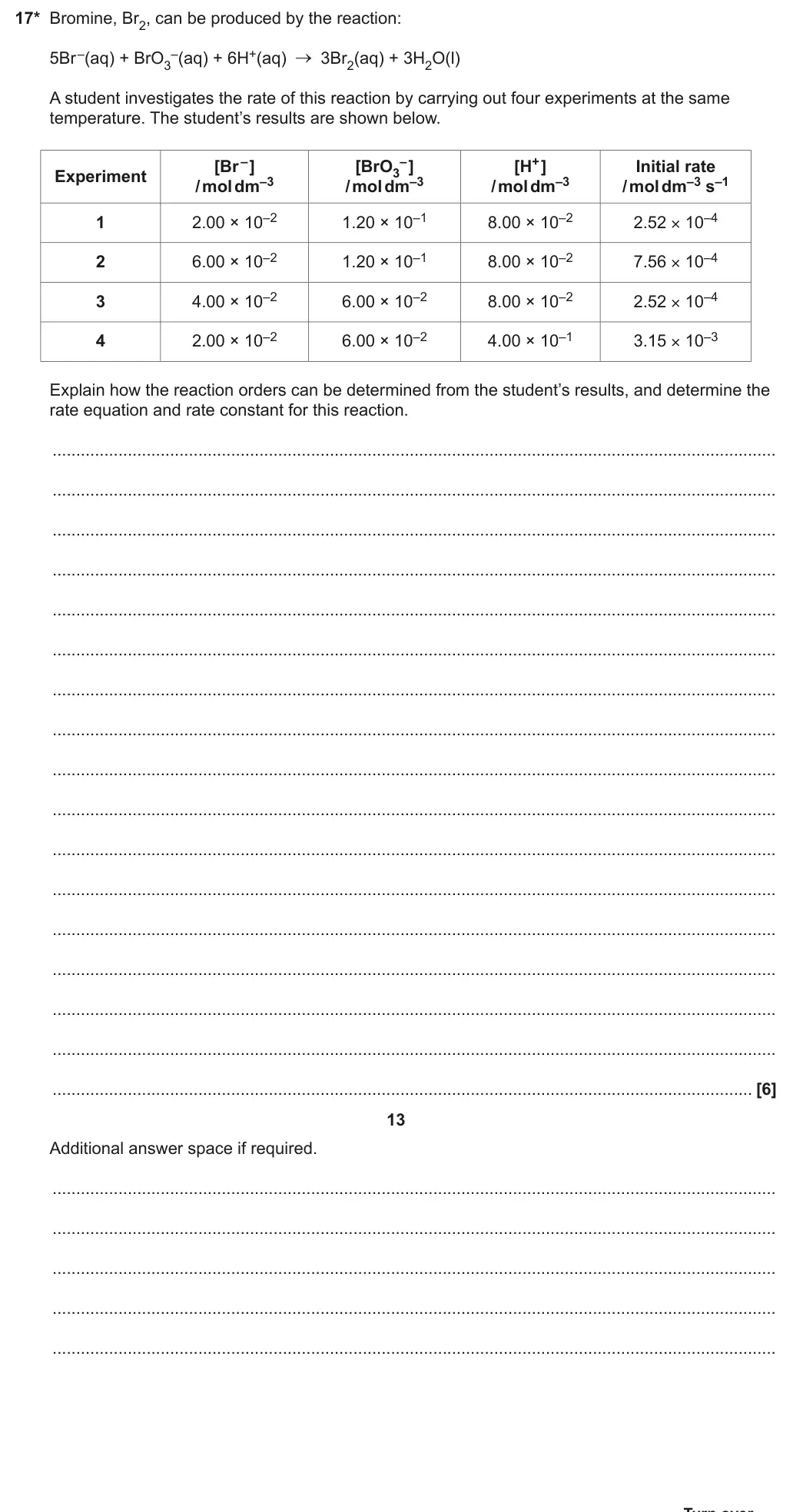
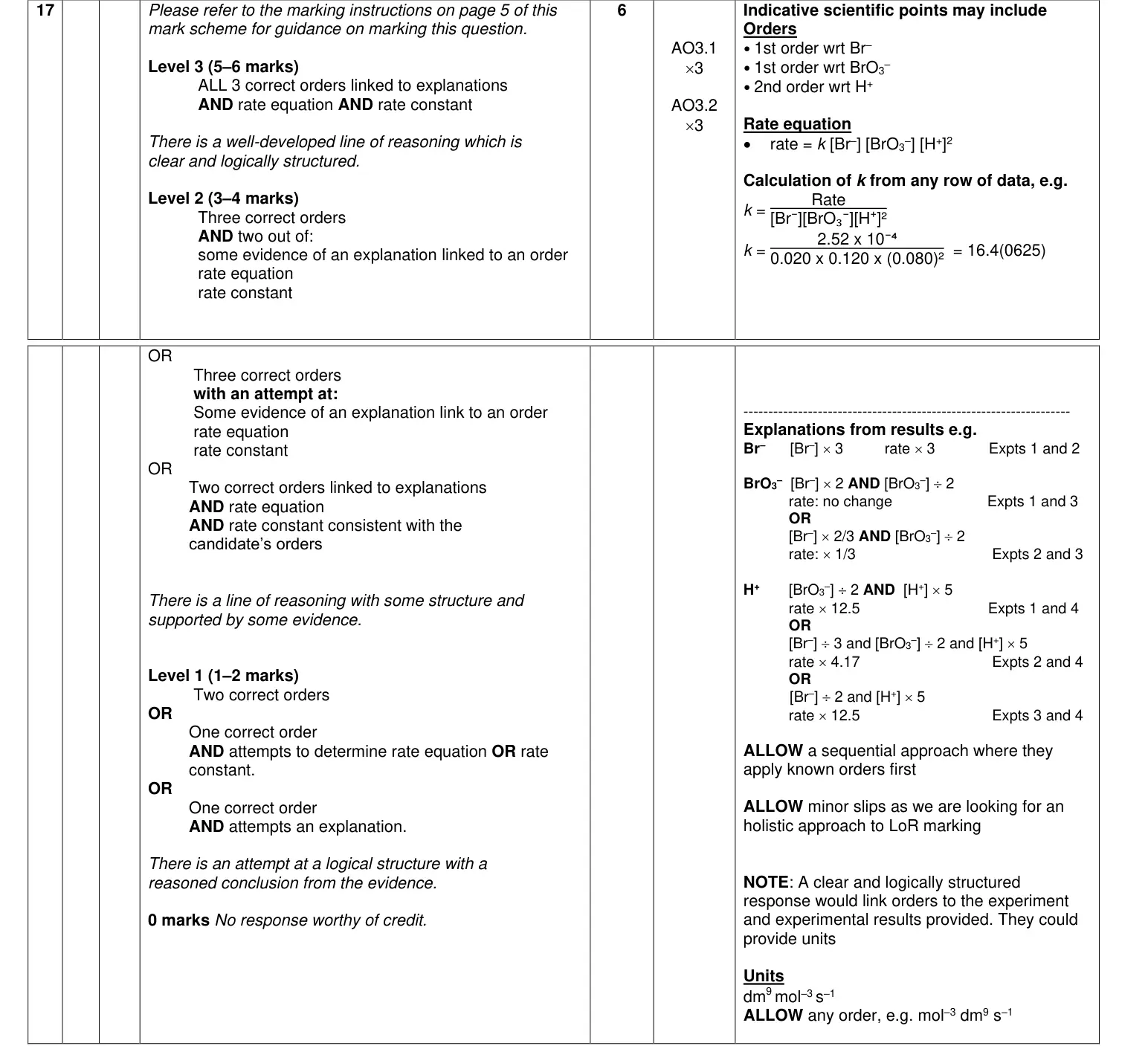
June 2023 · Paper 1 · Q176 marksAO36-mark level of responseEasy
Mark scheme, with the levels and indicative points
Examiner's comment
The first Level of Response question in the paper was answered well. Almost all candidates were able to conclude that the experimental results showed that they were consistent with first order with respect to Br-. Some candidates were able to use a sequential approach to determine the orders with respect to BrO3- and H+, reaching a Level 3, but others found this more problematic. Some did not notice that more than one concentration had been changed between experiments. This led to many determining the rate to be 0 order with respect to [BrO3-] and [H+]. Candidates should focus on the quality of their descriptions when linking data to their conclusions with some candidates creating their own data set to fit their explanations. Having determined orders, nearly all candidates were able to give a corresponding rate equation and could calculate a value for the rate constant, albeit with frequent omission of units. Some candidates confused the rate equation with a Kc expression.
Notes from the mark scheme and report
first order Br– (expts 1 and 2)
first order BrO3– (expts 1 and 3, both concentrations change)
second order H+ (expts 1 and 4, ×5 gives ×25 after allowing for BrO3–)
rate = k[Br–][BrO3–][H+]2
k = 16.4 from any row of data
Skills: M0.0 Recognise and make use of appropriate units in calculations; M0.2 Use ratios, fractions and percentages; M2.3 Substitute numerical values into algebraic equations using appropriate units for physical quantities; PAG10 Rates of reaction – initial rates
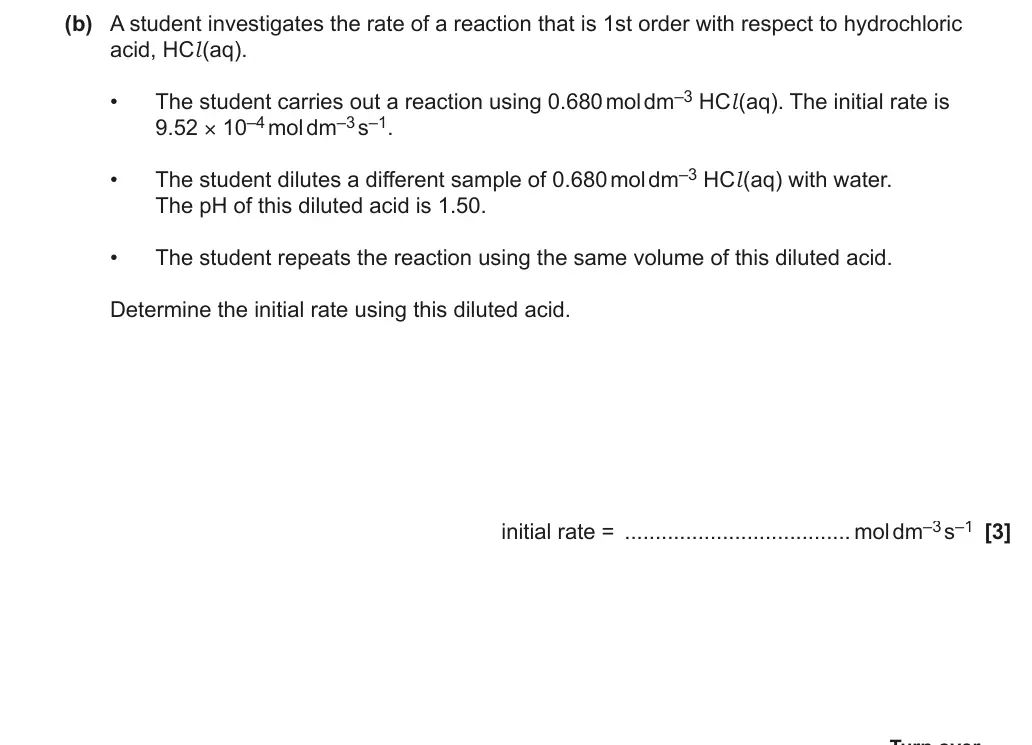
June 2023 · Paper 3 · Q2(b)3 marksAO3CalculationHard
Mark scheme
Examiner's comment
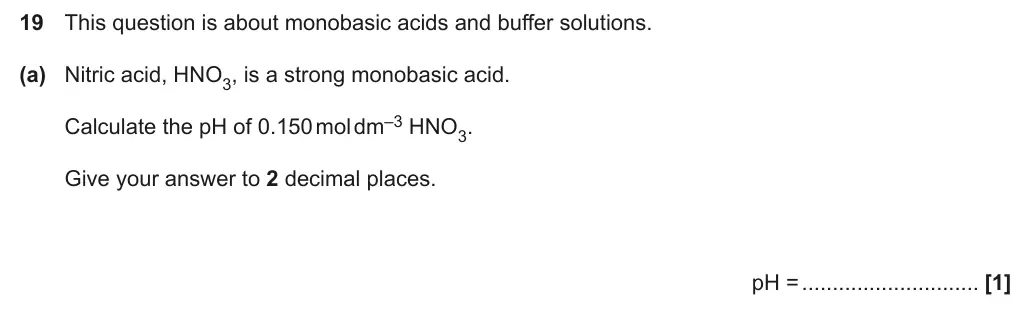
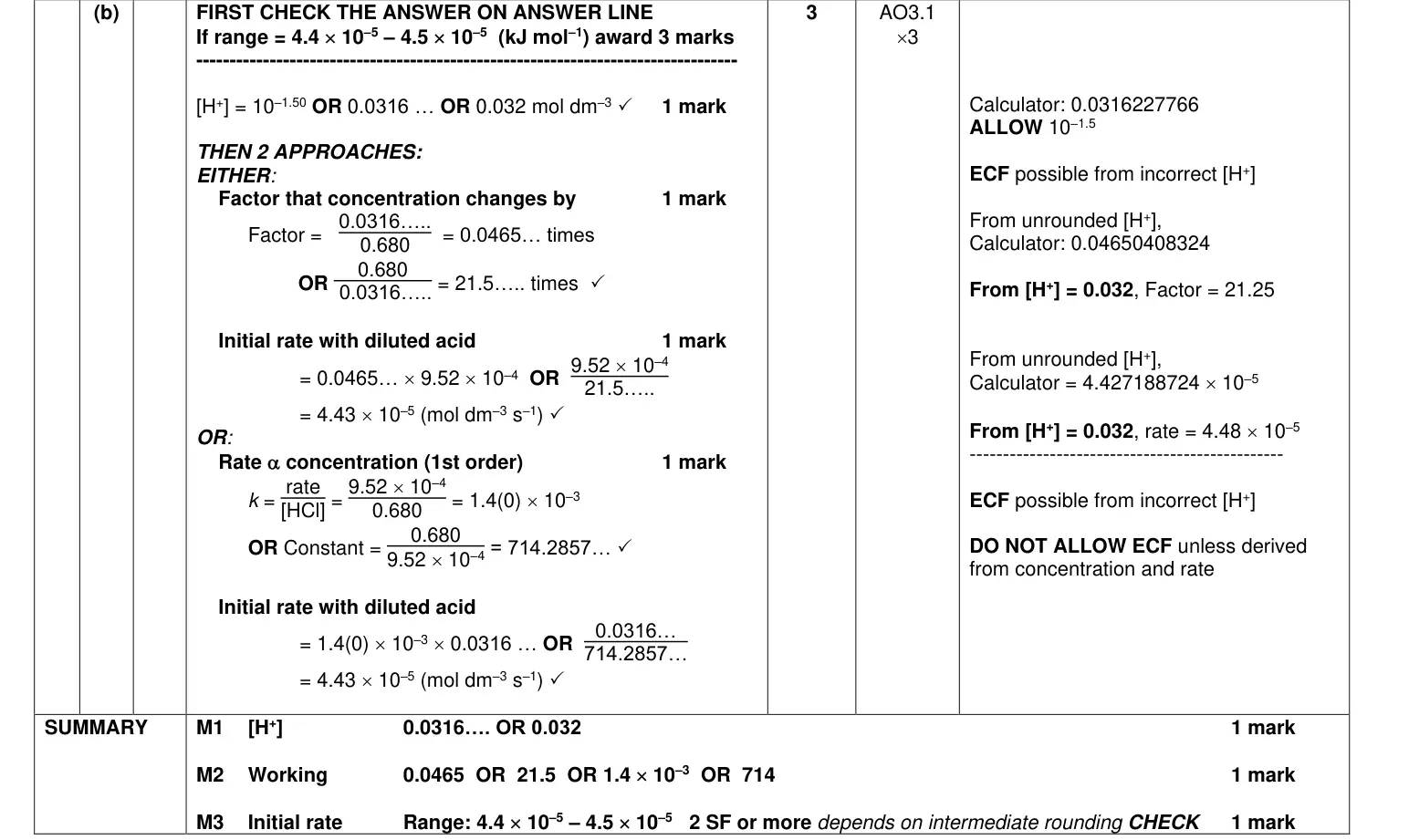
The marks for this calculation were much more polarised than the calculation in Question 2 (a). Many candidates worked through the problem methodically to get an answer for the initial rate between 4.4 10–5 and 4.5 10–5 mol dm–3 s–1. A substantial number of candidates worked out [H+] using 10–pH for 1 mark but were then unable to progress any further. This was a novel calculation, requiring candidates to develop their own strategy for its solution. Candidates who found this question difficult often attempted a solution based on stock weak acid calculation, using [H+]2/[HA].
Notes from the mark scheme and report
factor 0.0316/0.680 or k = rate/[HCl] = 1.40 × 10⁻³
rate 4.4–4.5 × 10⁻⁵
ECF only if derived from concentration and rate
Skills: M0.2 Use ratios, fractions and percentages; M0.4 Use calculators to find and use power, exponential and logarithmic functions; M2.5 Use logarithms in relation to quantities that range over several orders of magnitude
June 2022 · Paper 1 · Q81 markAO1Multiple choiceEasy
Answer
A
Mark scheme
Examiner's comment
This question was quite well answered with many candidates realising that for a first order reaction, determination of the rate constant, k, from the constant half-life, t1/2, they should use the relationship: k = ln 2/t1/2. A common error was option B, as many used 1/t used for ln 2/t1/2.
Notes from the mark scheme and report
k = ln 2 / t½
Skills: M0.4 Use calculators to find and use power, exponential and logarithmic functions; M2.3 Substitute numerical values into algebraic equations using appropriate units for physical quantities
June 2022 · Paper 1 · Q16(a)(ii)5 marksAO1, 2, 3CalculationHard
Earlier part of question 16 that this part uses
Mark scheme
Examiner's comment
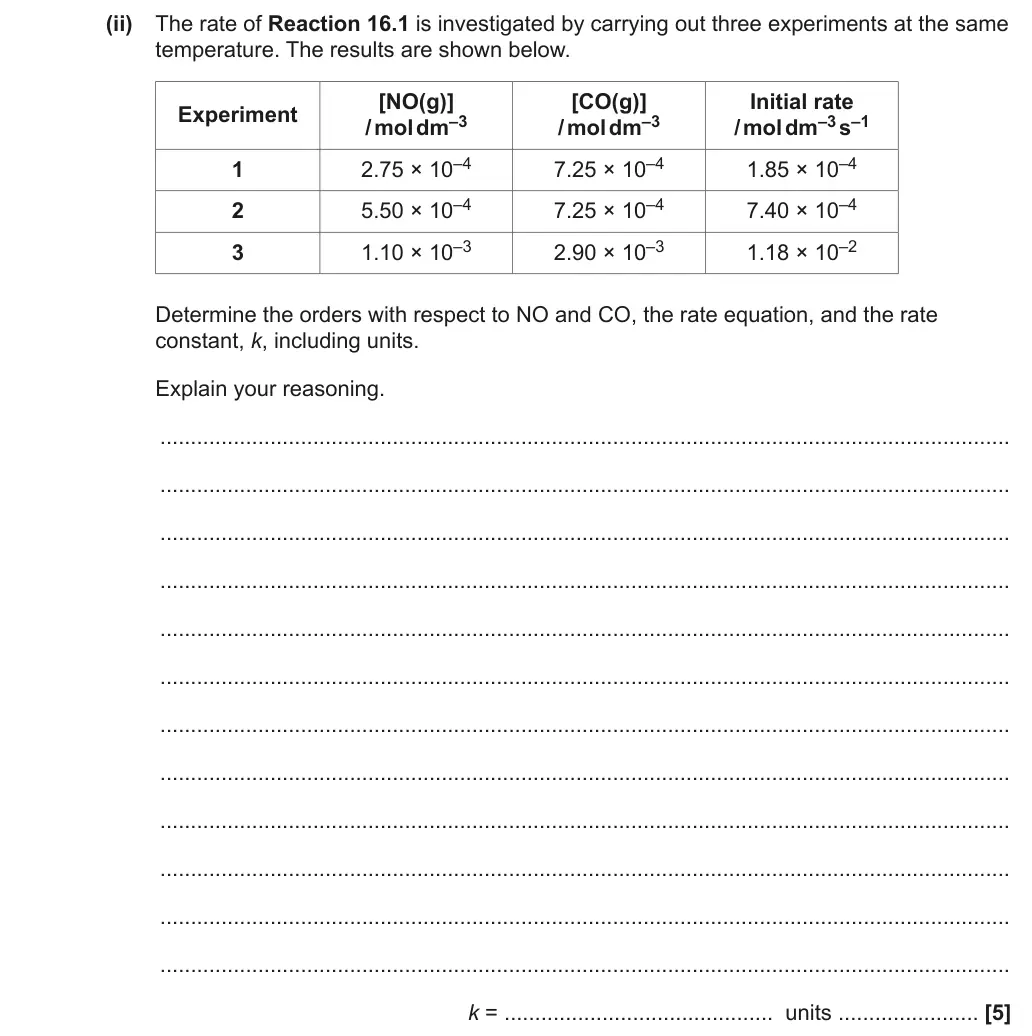
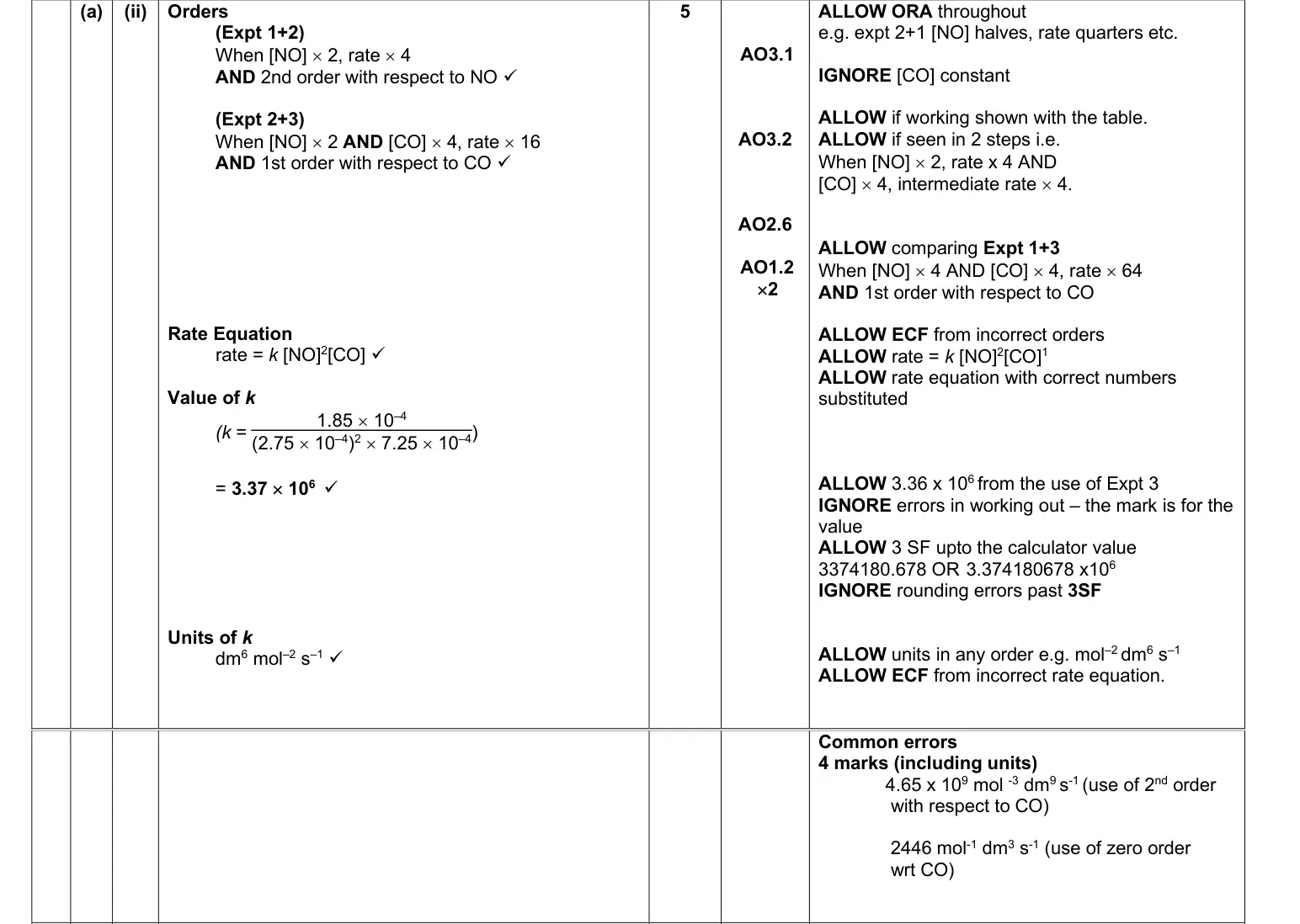
Many candidates were able to explain clearly the second order dependence on [NO] but many found it more challenging to identify and explain the first order relationship for [CO], where the candidate had to consider the second order dependence on [NO] to work out the effect on rate for the change in [CO]. Most gave a rate equation of the correct format based on the orders they had stated, and worked out a value for k. Although some did not determine the correct units, there was an encouraging number who managed this either from memory or by cancelling. The most common error was not including s-1
Notes from the mark scheme and report
NO second order from expts 1 and 2
CO first order needs both concentrations changing (expts 2 and 3: rate × 16)
k = 3.37 × 10^6 dm6 mol–2 s–1
common errors 4.65 × 10^9 mol–3 dm9 s–1 (CO second order) and 2446 mol–1 dm3 s–1 (CO zero order) score 4 with ECF
Skills: M0.0 Recognise and make use of appropriate units in calculations; M0.2 Use ratios, fractions and percentages; M2.3 Substitute numerical values into algebraic equations using appropriate units for physical quantities; PAG10 Rates of reaction – initial rates
June 2022 · Paper 1 · Q16(b)2 marksAO3Short answerMedium
Mark scheme
Examiner's comment
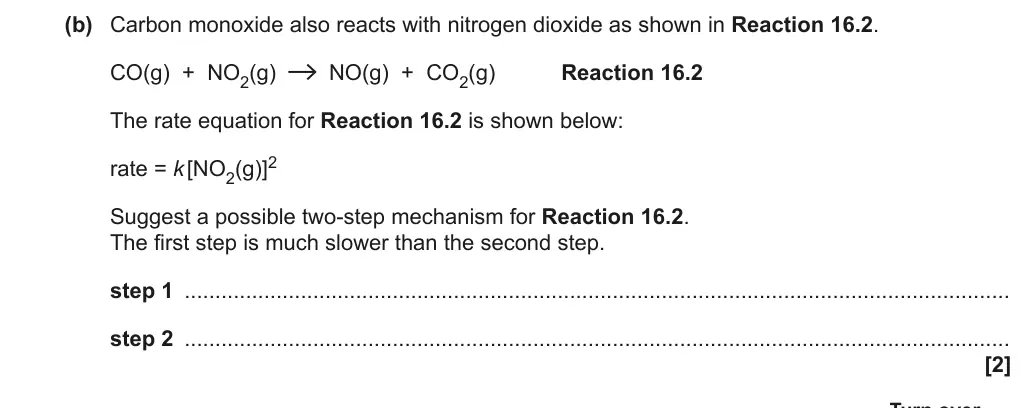
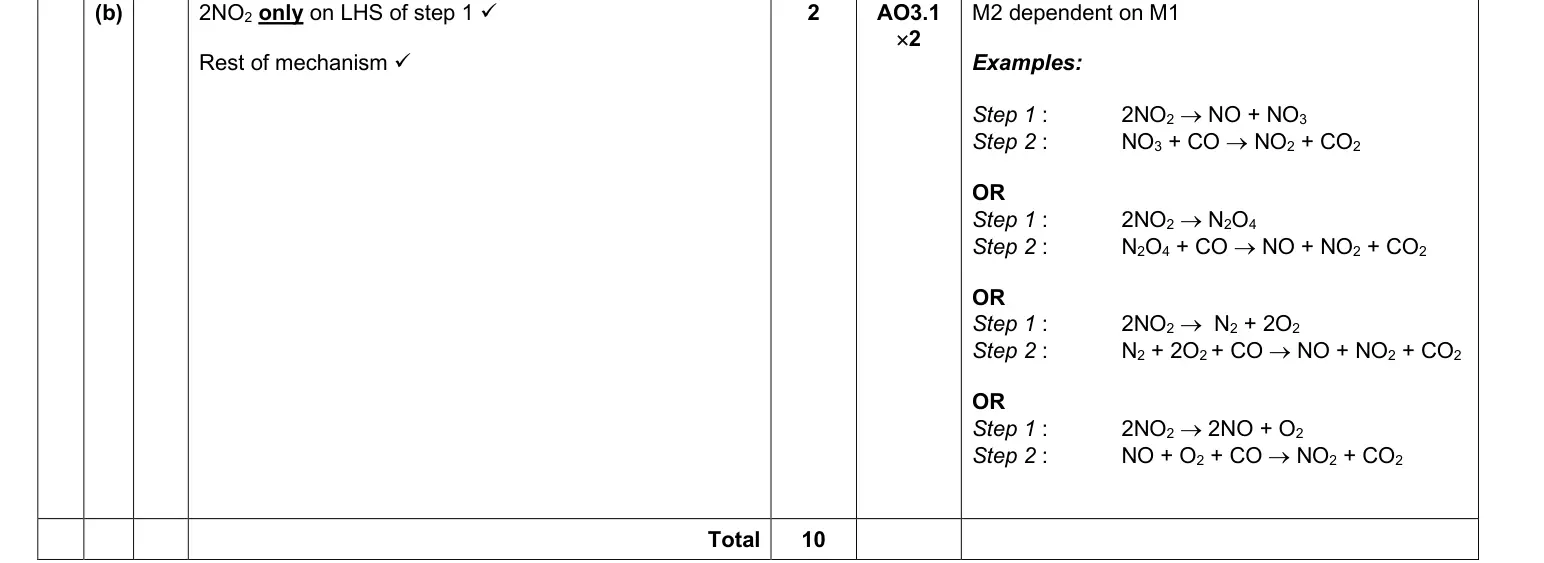
Many candidates recognised the need for 2NO2 in the first step, with slightly less then adding an appropriate second step. Errors included unbalanced species and unbalanced charges. A wide range of suggested possible mechanisms were seen, including several which led to multiple correct versions of the overall equation. Both balanced equations needed to combine to form the overall equation. However, a few inventive candidates gave a first step of NO2 + NO2 → 2NO2, followed by the full balanced equation for the second step – this was not given marks.
Notes from the mark scheme and report
step 1 must have 2NO2 only on the left
second mark dependent on the first
steps must add up to the overall equation
June 2022 · Paper 3 · Q4(a)4 marksAO1, 2Short answerMedium
Mark scheme
Examiner's comment
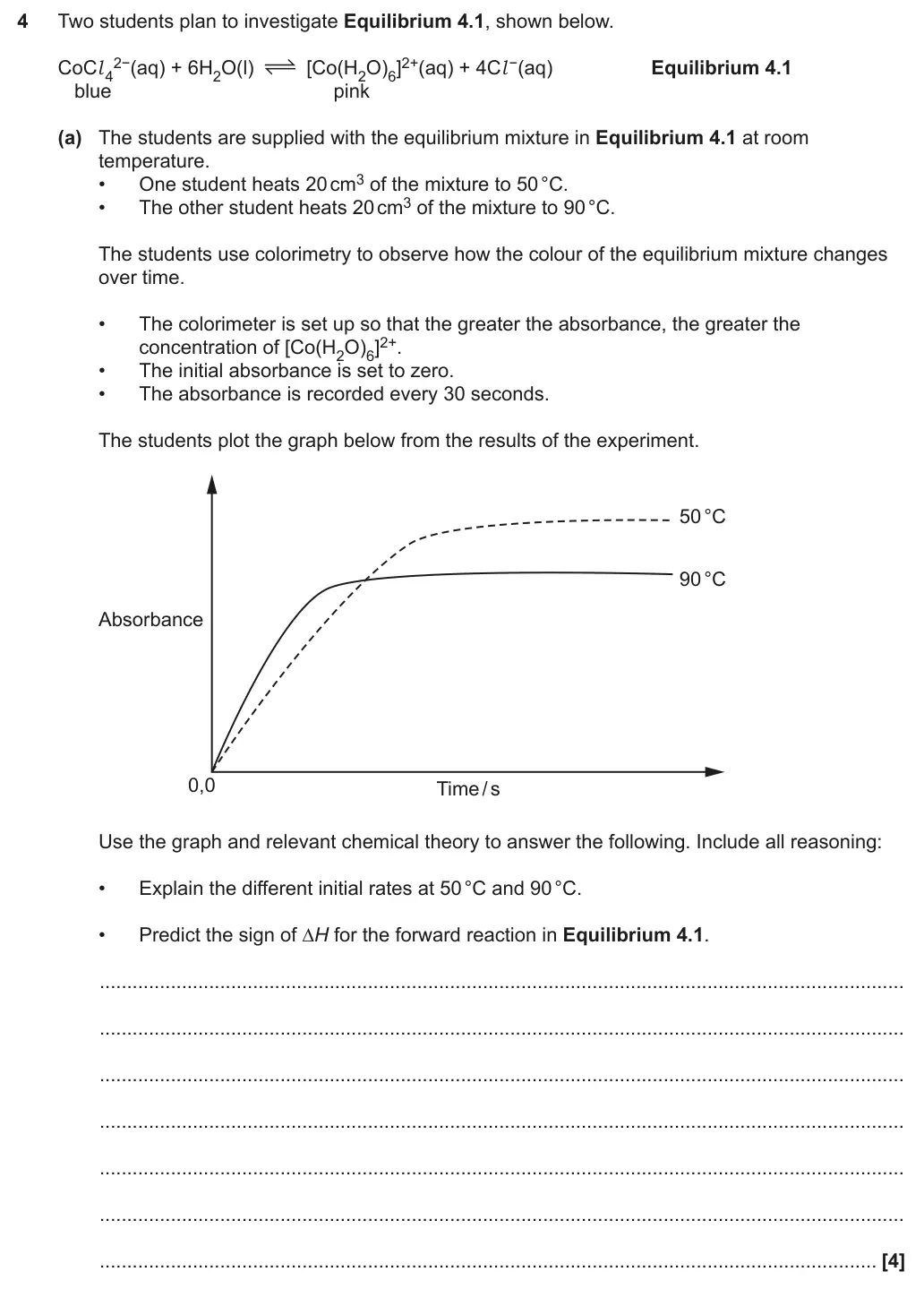
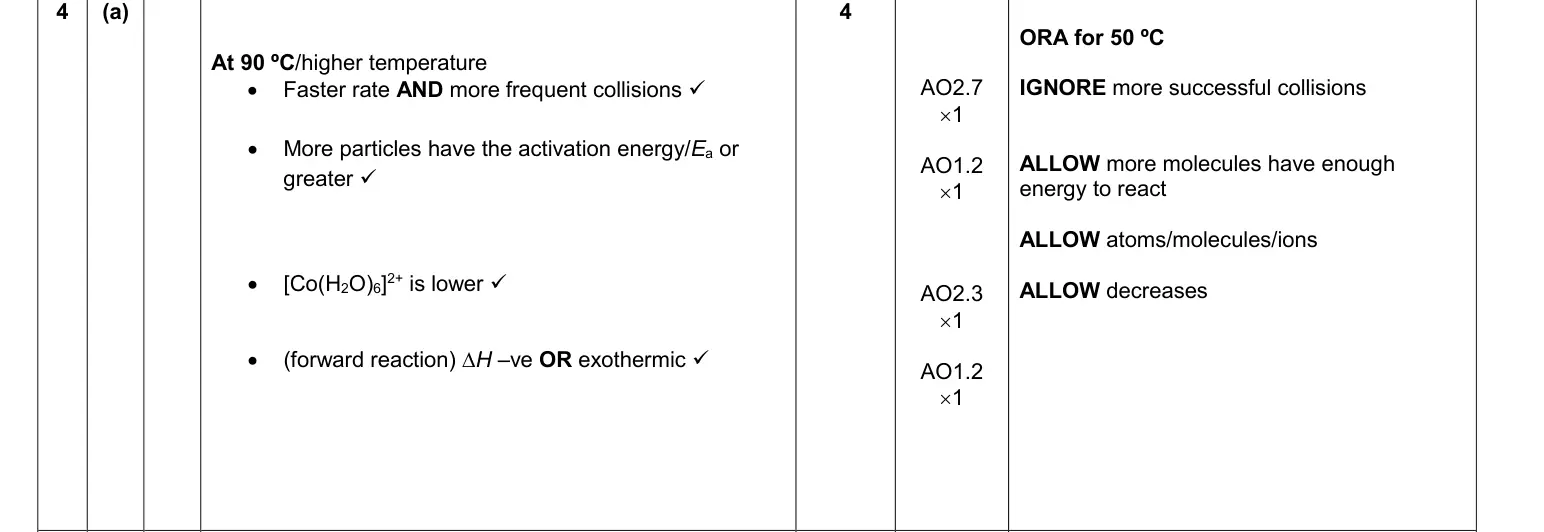
This question asked candidates to explain the different rates from a novel experiment carried out at 50ºC and 90ºC, and to predict the ∆H sign for the forward reaction. Candidate explanations for the rates were often superficial, solely in terms of greater energy at 90ºC. Many responses referred neither to the different frequency of collisions nor the greater number of particles exceeding the activation energy at 90ºC. Most candidates predicted that ∆H would have a negative sign. Candidates were expected to link the evidence from the absorbance data in the graph to less [Co(H2O)6]2+ being present at 90ºC. When experimental information has been presented, candidates are advised to look for the evidence responsible in their explanations.
Notes from the mark scheme and report
at 90 °C faster rate AND more frequent collisions
more particles have energy ≥ Ea
equilibrium [Co(H2O)6]2+ is lower at 90 °C so forward reaction exothermic/∆H negative
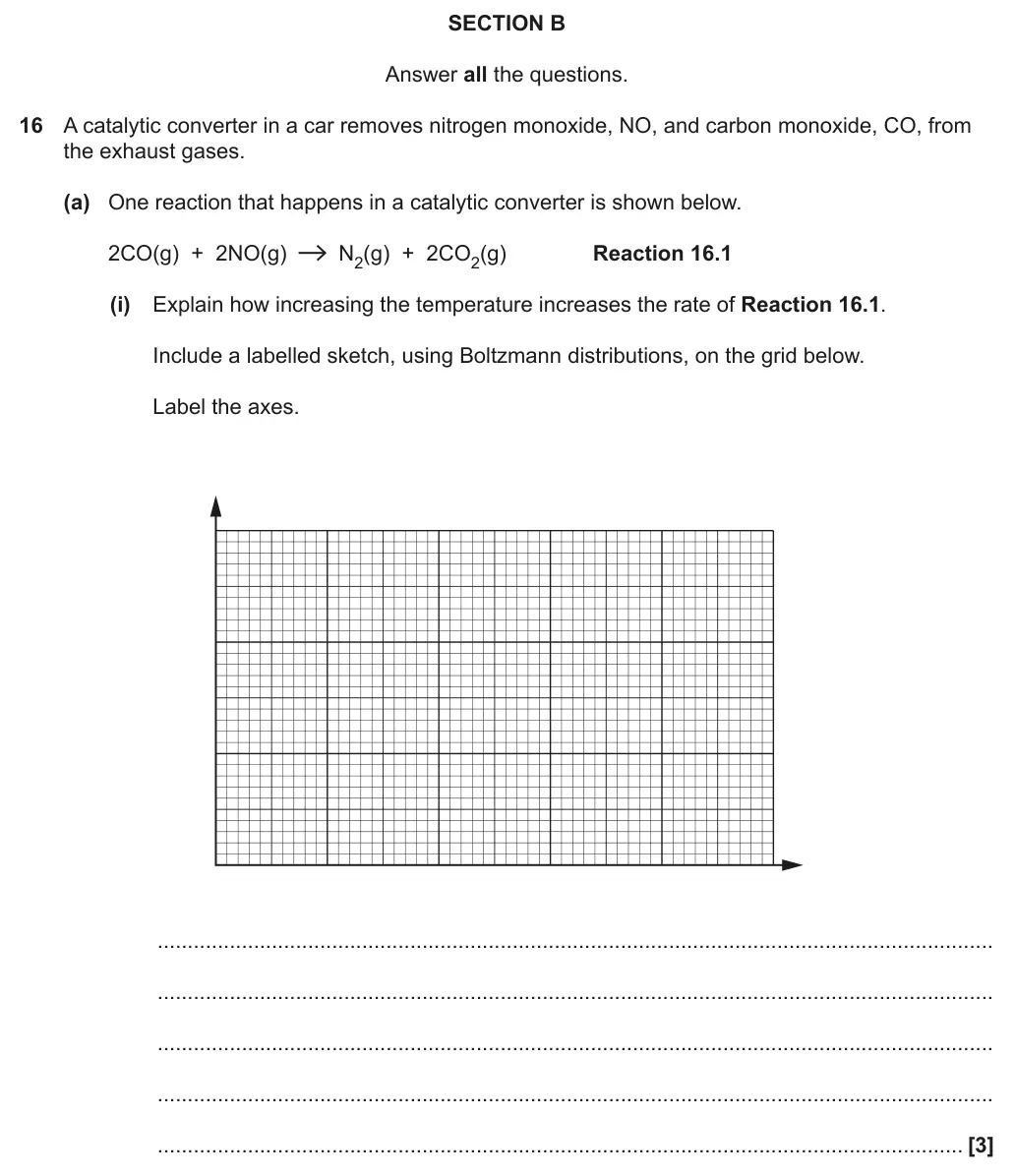
IGNORE more successful collisions
Skills: M3.1 Translate information between graphical, numerical and algebraic forms; PAG9 Rates of reaction – continuous monitoring
November 2021 · Paper 1 · Q21(a)(i)2 marksAO3Short answerMedium
Mark scheme
Examiner's comment
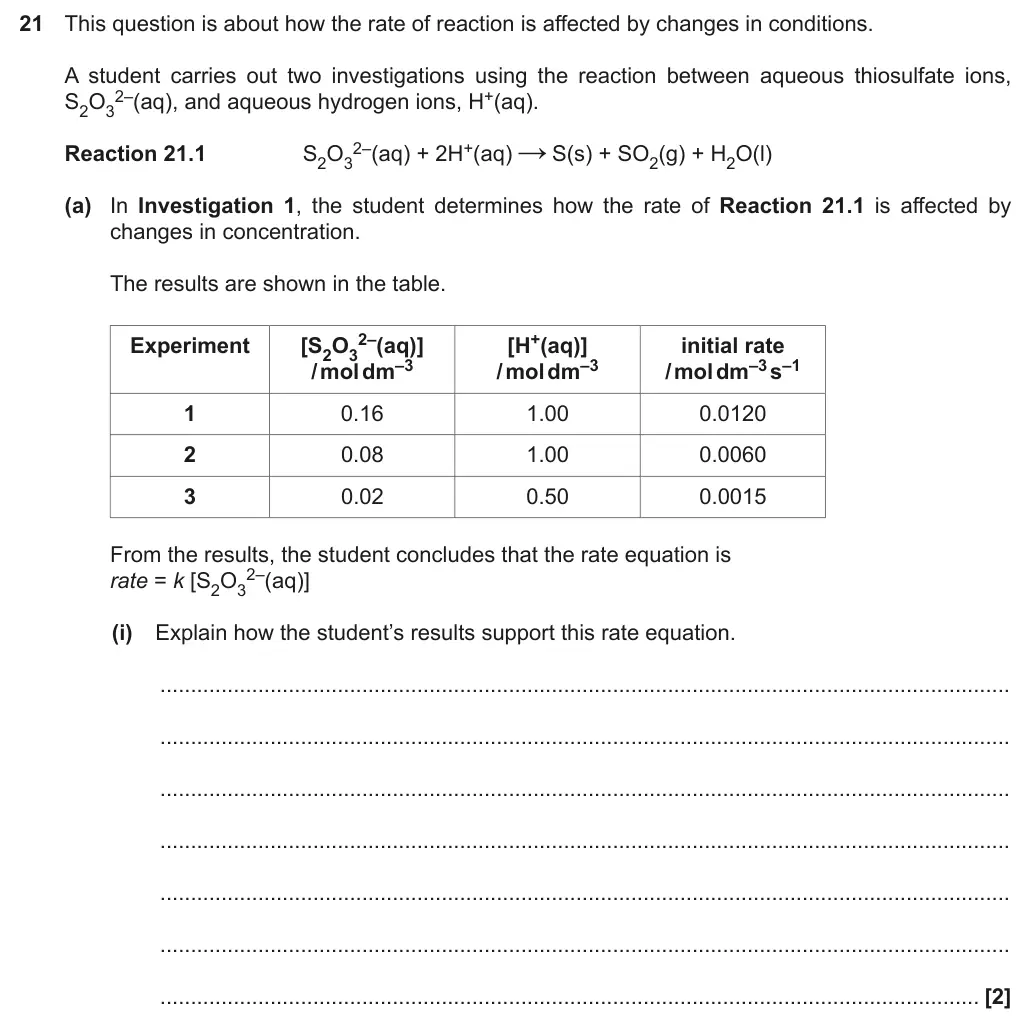
Question 21(a)(i): Most candidates found the order with respect to S2O32- by comparing experiments 1 and 2.
Notes from the mark scheme and report
expts 1 and 2: [S2O3 2–] halves, rate halves so first order
expts 2 and 3: [S2O3 2–] ×¼ and [H+] halves, rate ×¼ so zero order in H+
Skills: M0.2 Use ratios, fractions and percentages; PAG10 Rates of reaction – initial rates
November 2021 · Paper 1 · Q21(a)(ii)2 marksAO3Short answer
Earlier part of question 21 that this part uses
Mark scheme
Notes from the mark scheme and report
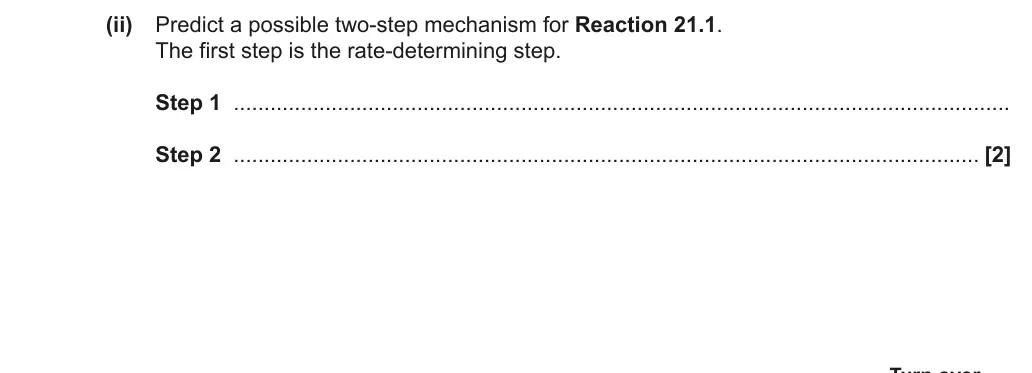
S2O3 2– is the only reactant in step 1
two steps must add to the overall equation
November 2021 · Paper 1 · Q21(b)(i)3 marksAO2CalculationMedium
Earlier part of question 21 that this part uses
Mark scheme
Examiner's comment
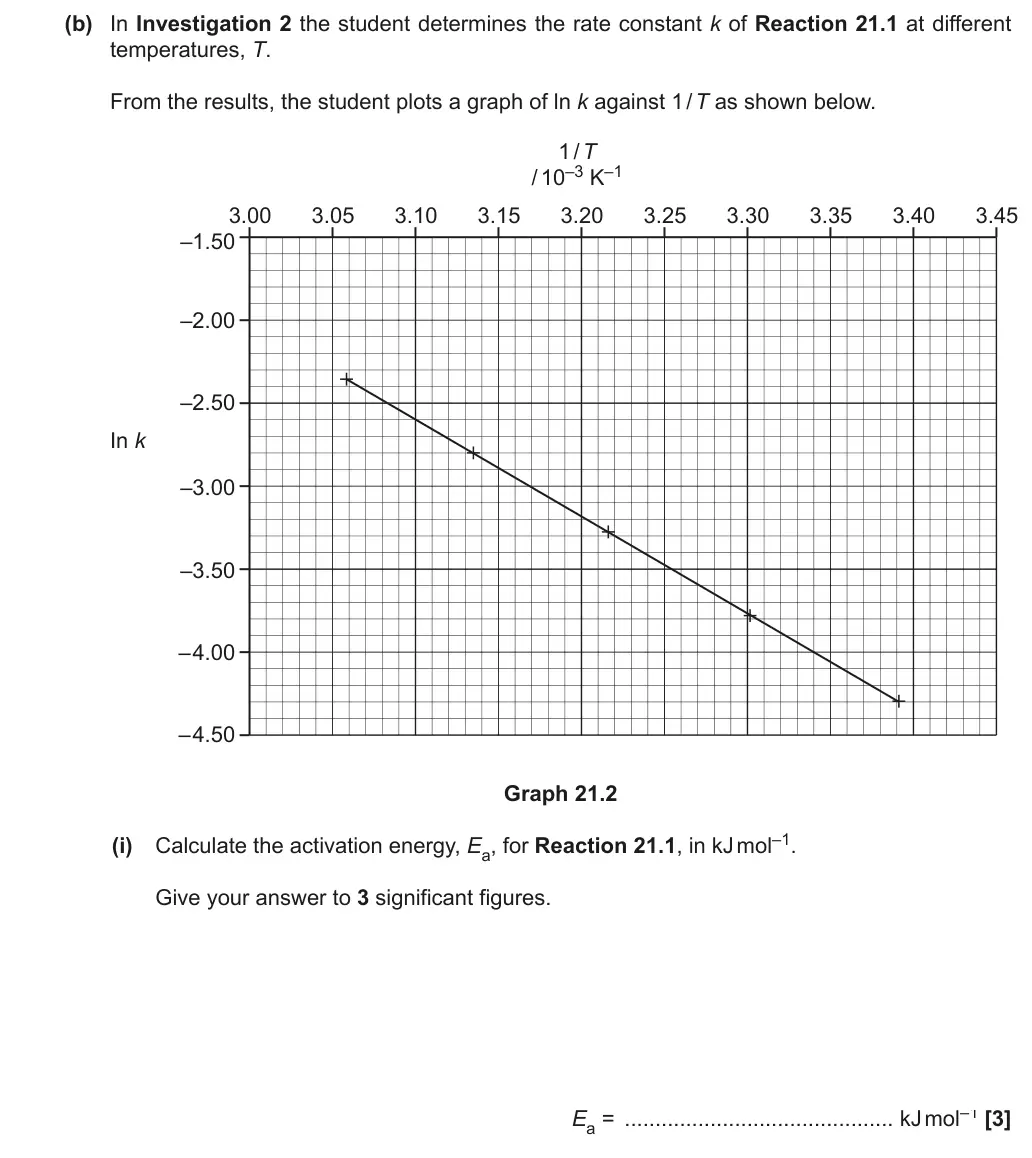
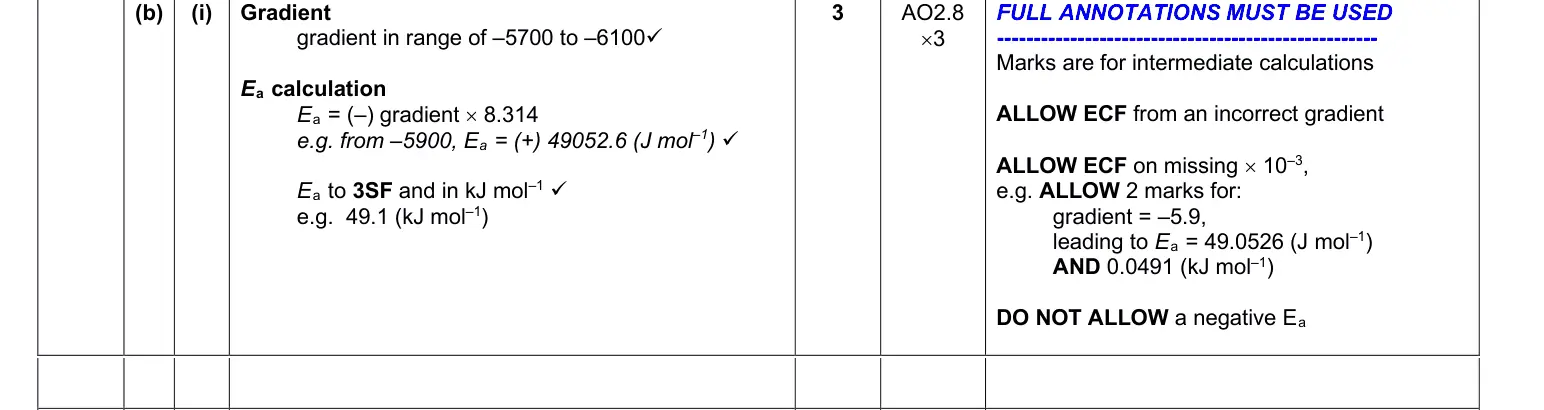
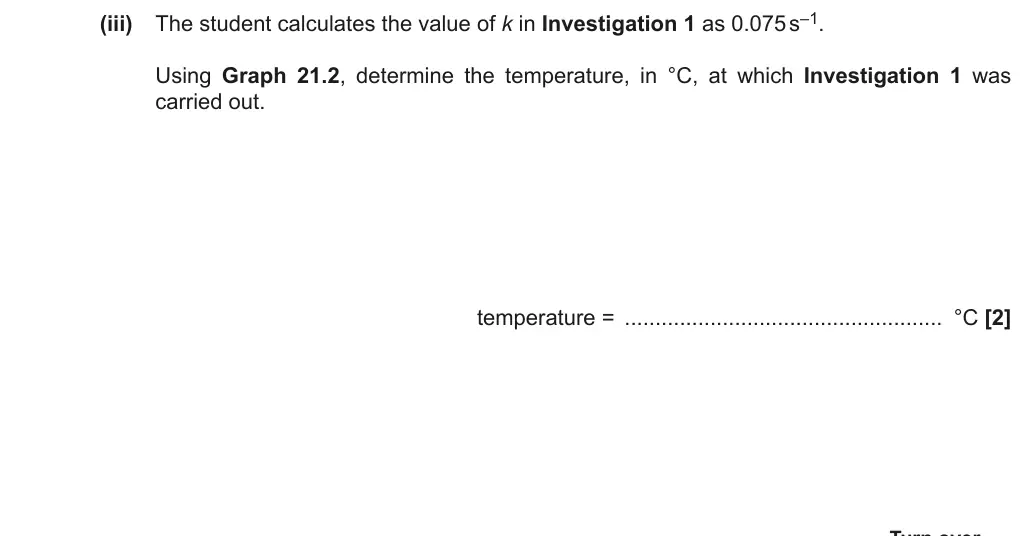
Question 21(b)(i): This question asked the candidate to determine the activation energy and to use the graph to calculate the temperature that an investigation was carried out..
Notes from the mark scheme and report
gradient –5700 to –6100
Ea = –gradient × 8.314
convert to kJ and 3 SF
missing × 10–3 on axis scores 2
DO NOT ALLOW negative Ea
Skills: M0.0 Recognise and make use of appropriate units in calculations; M1.1 Use an appropriate number of significant figures; M2.3 Substitute numerical values into algebraic equations using appropriate units for physical quantities; M3.3 Determine the slope and intercept of a linear graph; M3.4 Calculate rate of change from a graph showing a linear relationship
November 2021 · Paper 1 · Q21(b)(ii)1 markAO3Short answer
Earlier part of question 21 that this part uses
Mark scheme
Notes from the mark scheme and report
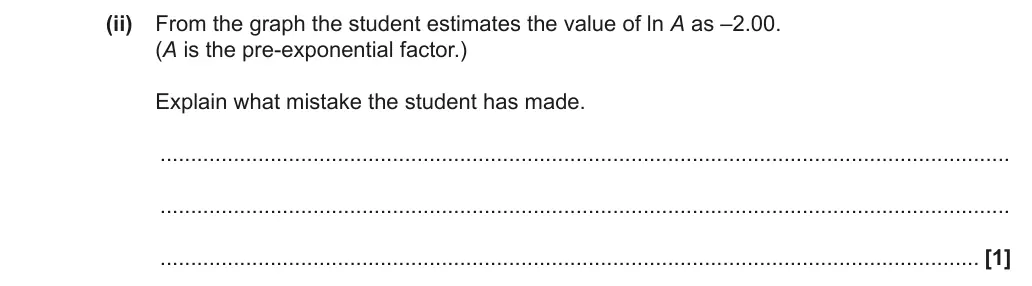
ln A is the intercept where 1/T (x-axis) = 0, not where the plotted axes meet
Skills: M3.1 Translate information between graphical, numerical and algebraic forms; M3.3 Determine the slope and intercept of a linear graph
November 2021 · Paper 1 · Q21(b)(iii)2 marksAO3Calculation
Earlier parts of question 21 that this part uses
Mark scheme
Notes from the mark scheme and report
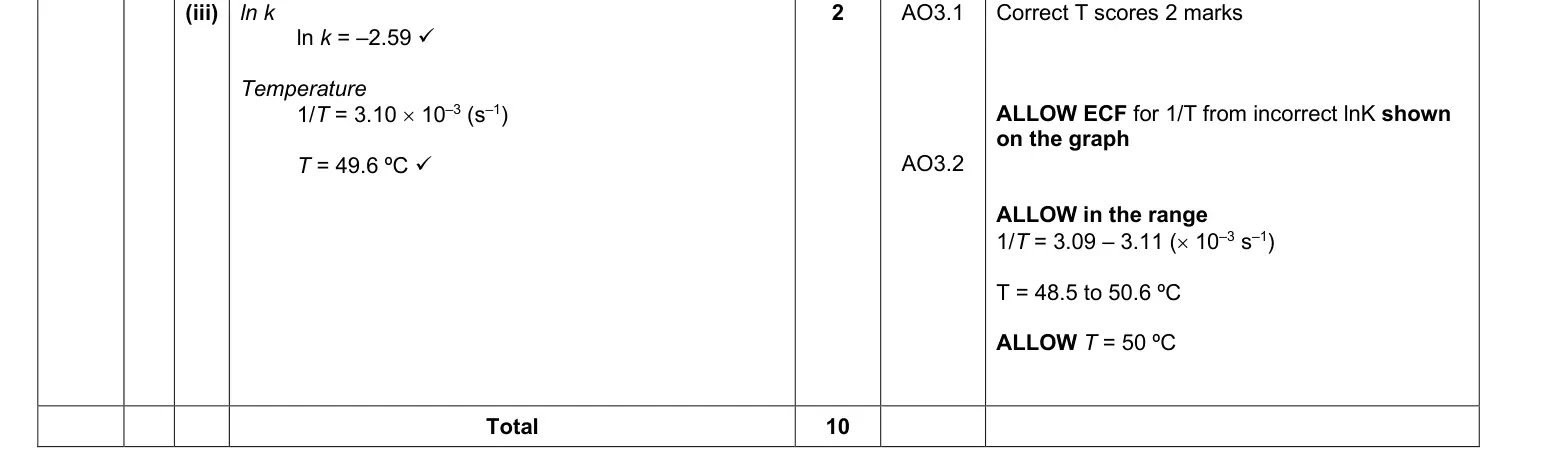
ln k = –2.59
read 1/T = 3.10 × 10⁻³ (ALLOW 3.09–3.11)
T = 49.6 °C after converting from K
Skills: M0.0 Recognise and make use of appropriate units in calculations; M0.4 Use calculators to find and use power, exponential and logarithmic functions; M2.5 Use logarithms in relation to quantities that range over several orders of magnitude; M3.1 Translate information between graphical, numerical and algebraic forms
November 2021 · Paper 3 · Q4(a)1 markAO3Short answerMedium
Mark scheme
Examiner's comment
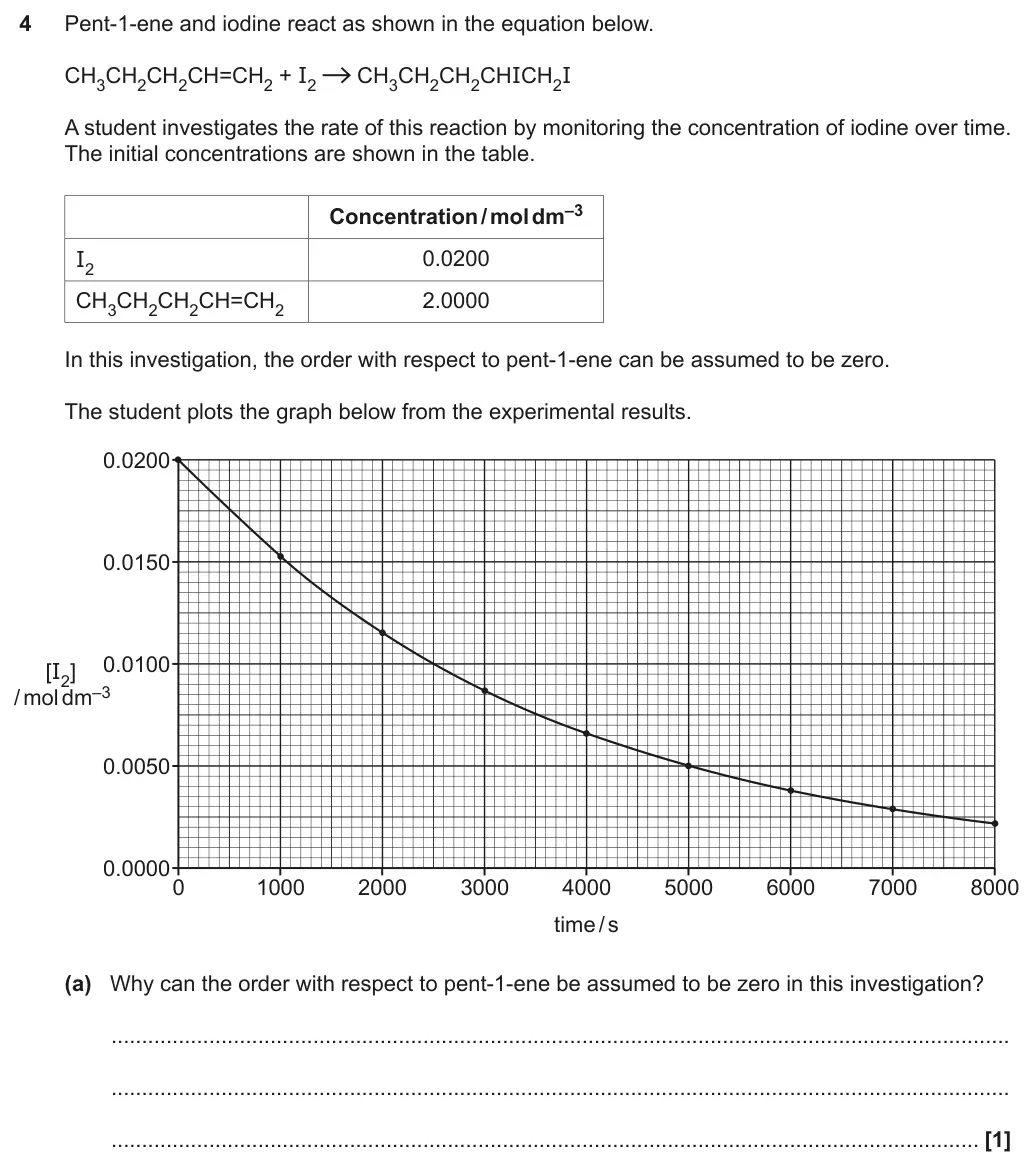
Q4(a) required candidates to identify that pent-1-ene was in great excess.
Notes from the mark scheme and report
(large) excess of pent-1-ene / its concentration is much greater so effectively constant
Skills: PAG9 Rates of reaction – continuous monitoring
November 2021 · Paper 3 · Q4(b)6 marksAO36-mark level of responseHard
Earlier part of question 4 that this part uses
Mark scheme, with the levels and indicative points
Examiner's comment
Q1(a) Partial pressure calculation Q1(d) Formula determination from percentage composition by mass Q2(b) Converting mass and volume into moles Q3(b) Unstructured titration calculation Q5(a)(ii) Ideal gas calculation Q5(b)(i) Calculation of the pH of a weak acid • Produced clear and concise responses for a Level of Response question based on a familiar context i.e., Q4(b) rates by continuous monitoring and graphical analysis. • Had difficulty when answering questions requiring application of knowledge and understanding on questions set in novel and unfamiliar contexts, e.g. Q4(b) is a Level of Response question which is commented on after this section. Q5(c) is a Level of Response question which is commented on after this section Level of response questions Q4(b): Candidates were required to analyse the graphical results of a rates investigation to determine the reaction order, rate and rate constant.
Notes from the mark scheme and report
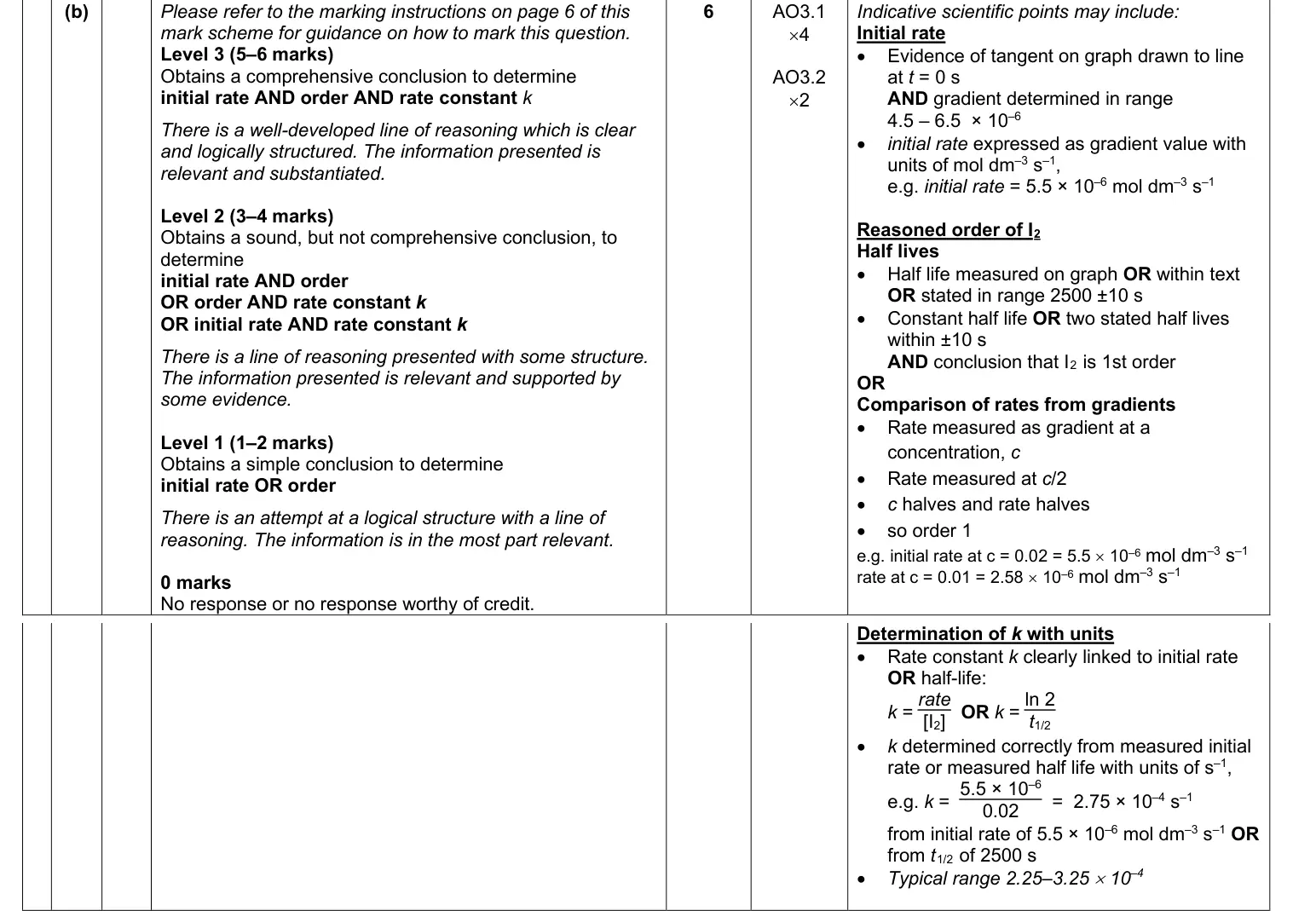
tangent at t = 0 gives initial rate 4.5–6.5 × 10⁻⁶ mol dm–3 s–1
constant half-life of about 2500 s (two half-lives shown) so first order
k = rate/[I2] or ln2/t½ with units s–1
Skills: M0.0 Recognise and make use of appropriate units in calculations; M2.3 Substitute numerical values into algebraic equations using appropriate units for physical quantities; M3.1 Translate information between graphical, numerical and algebraic forms; M3.5 Draw and use the slope of a tangent to a curve as a measure of rate of change; PAG9 Rates of reaction – continuous monitoring
November 2021 · Paper 3 · Q4(c)(i)2 marksAO2Equation writingMedium
Earlier part of question 4 that this part uses
Mark scheme
Examiner's comment
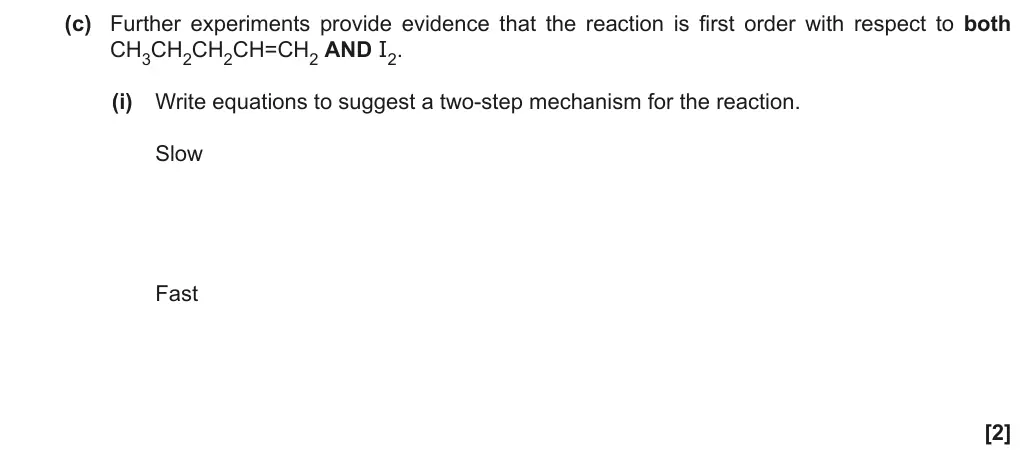
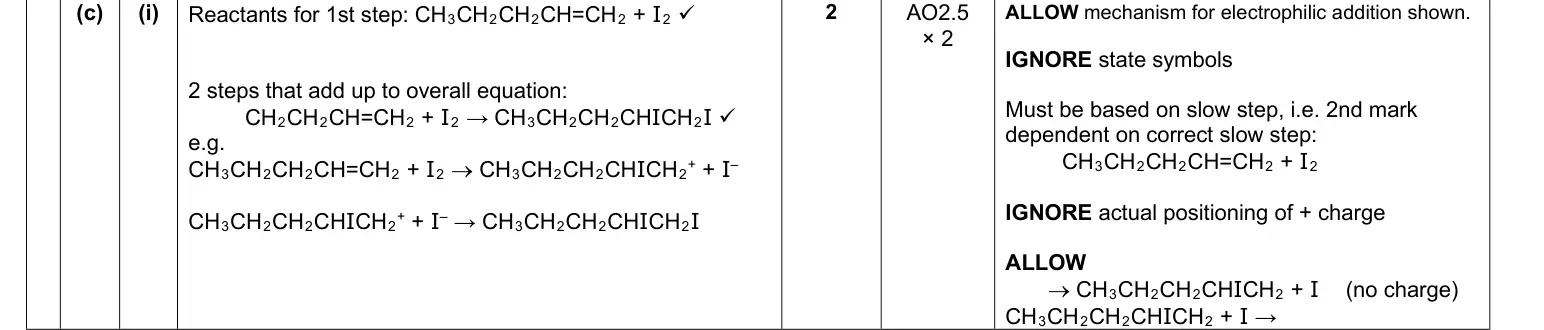
Q4(c)(i) required candidates to suggest equations for a two-step mechanism.
Notes from the mark scheme and report
slow step must have CH3CH2CH2CH=CH2 + I2 as reactants
two steps must add up to the overall equation
second mark dependent on correct slow step
ALLOW electrophilic addition mechanism
November 2021 · Paper 3 · Q4(c)(ii)2 marksAO3Short answerMedium
Earlier part of question 4 that this part uses
Mark scheme
Examiner's comment
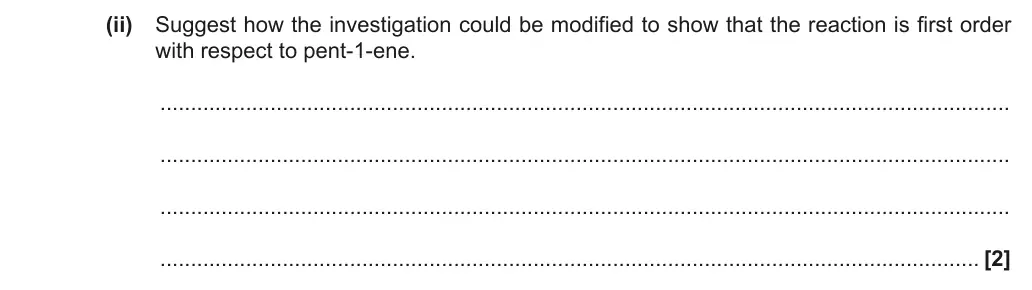
Q4(c)(ii) Candidates needed to suggest monitoring the change in rate with changing pent-1-ene concentration while keeping the iodine concentration constant.
Notes from the mark scheme and report
keep [I2] constant or use a large excess of I2
monitor [pent-1-ene] over time or how [pent-1-ene] affects rate
ALLOW initial rates approach with different pent-1-ene concentrations
Skills: PAG10 Rates of reaction – initial rates; PAG9 Rates of reaction – continuous monitoring
November 2020 · Paper 1 · Q81 markAO2Multiple choice
Answer
D
Mark scheme
Notes from the mark scheme and report
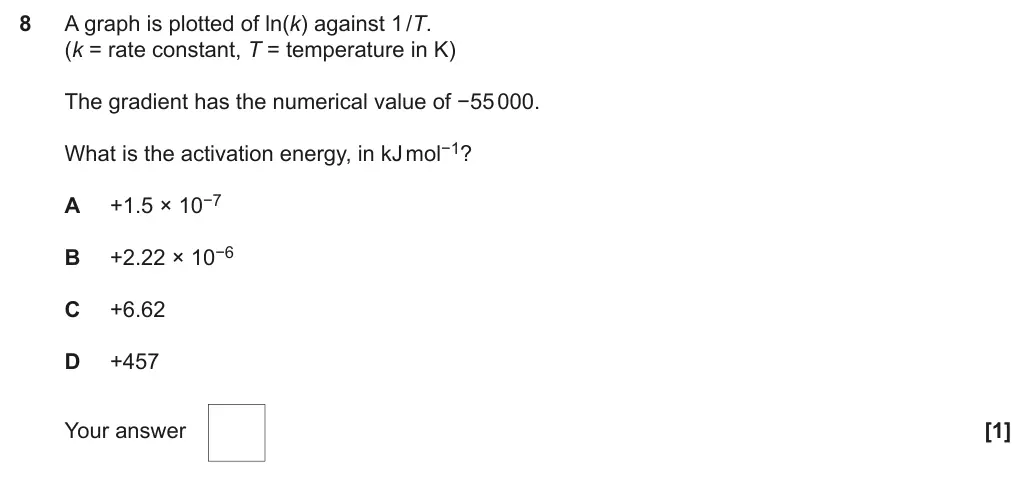
Ea = –gradient × R, then convert J to kJ
Skills: M0.0 Recognise and make use of appropriate units in calculations; M2.3 Substitute numerical values into algebraic equations using appropriate units for physical quantities; M3.3 Determine the slope and intercept of a linear graph
November 2020 · Paper 1 · Q101 markAO1Multiple choice
Answer
C
Mark scheme
Notes from the mark scheme and report
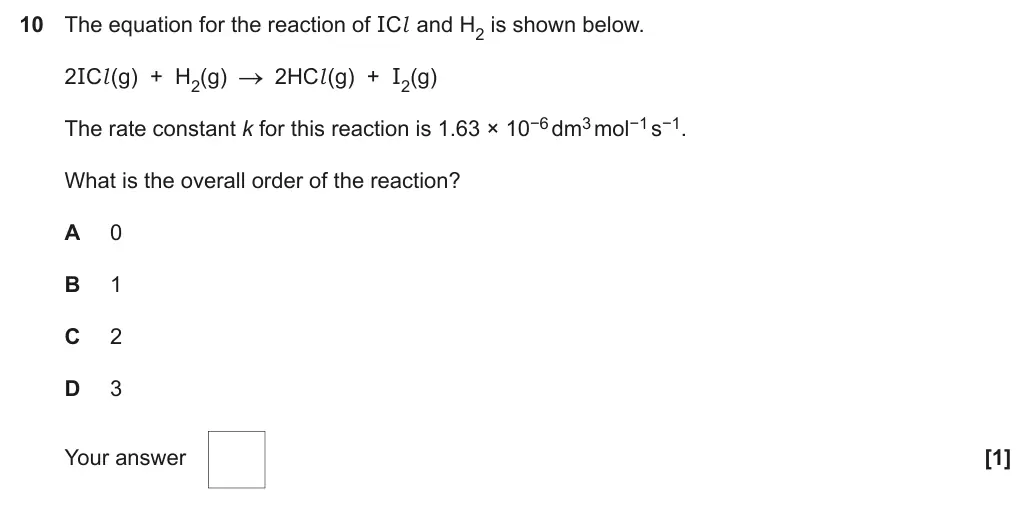
overall order deduced from the units of k
Skills: M0.0 Recognise and make use of appropriate units in calculations
November 2020 · Paper 1 · Q20(a)(i)1 markAO3Short answerMedium
Mark scheme
Examiner's comment
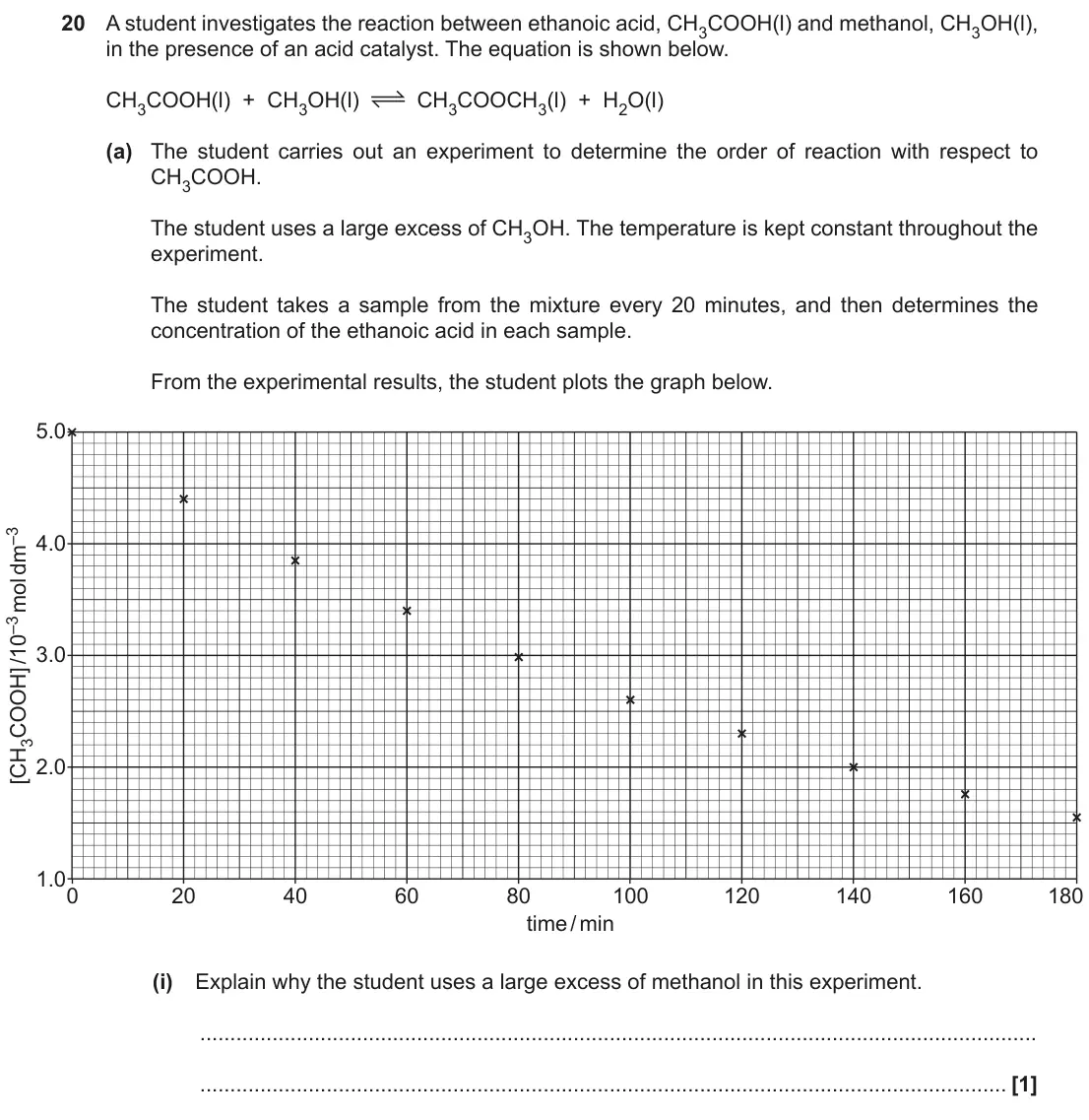
Most candidates used incorrect ideas about reaction going to completion or the methanol not being limiting.
Notes from the mark scheme and report
IGNORE 'methanol does not run out/not limiting'
Skills: PAG9 Rates of reaction – continuous monitoring
November 2020 · Paper 1 · Q20(a)(ii)2 marksAO3CalculationHard
Earlier part of question 20 that this part uses
Mark scheme
Examiner's comment
Very few candidates were given full marks. Higher-attaining students calculated one half life in range but very few could come up with a second half life as the graph did not allow another successive half life to be obtained. Higher-attaining candidates chose alternative half lives from the data given.
Notes from the mark scheme and report
two half-lives shown on graph (102–110 min) AND statement that half-life is constant
values on the graph.
Further guidance on rates of reaction can be found at: https://www.ocr.org.uk/Images/371956-experiments-on-rates-of-reaction.doc
Skills: M3.1 Translate information between graphical, numerical and algebraic forms; PAG9 Rates of reaction – continuous monitoring
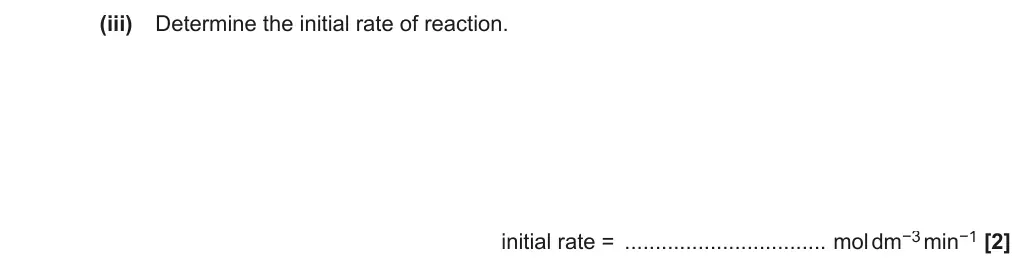
November 2020 · Paper 1 · Q20(a)(iii)2 marksAO3CalculationHard
Earlier parts of question 20 that this part uses
Mark scheme
Examiner's comment
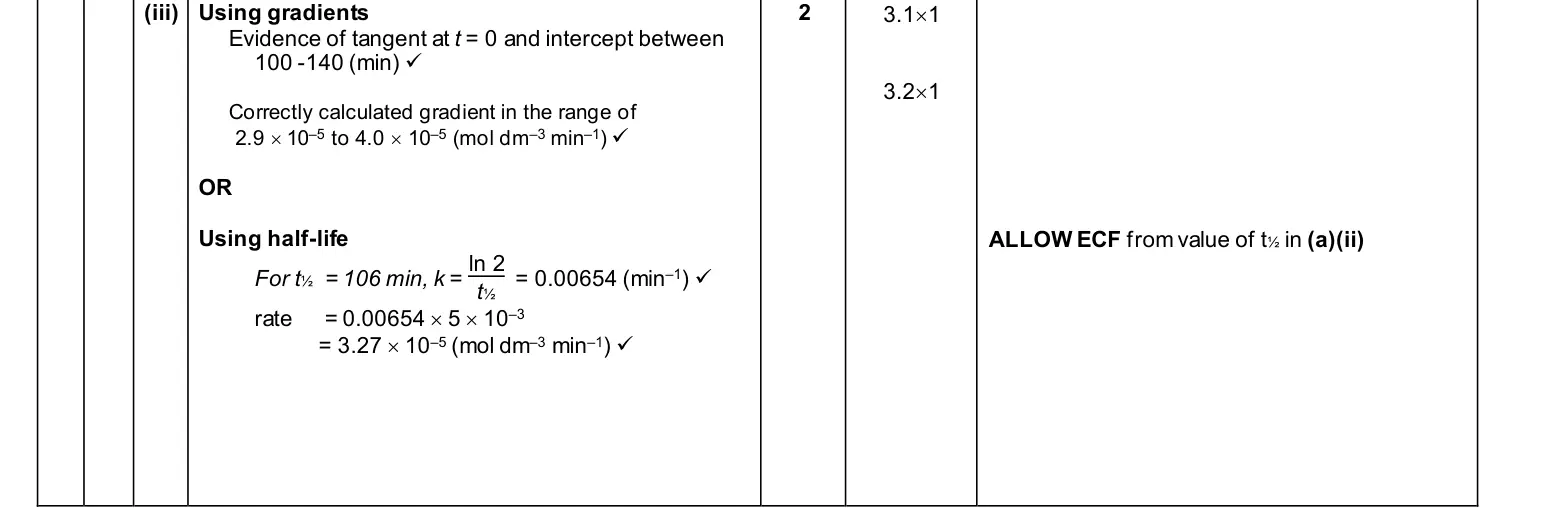
This question required the candidate to draw a line of best fit and then draw a tangent at t=0. Many candidates did not draw a line of best fit, and many did not get a tangent in the acceptable range. Very few candidates processed the gradient by using the correct subtraction on the y axis (scale was from 1 to 5) or by using the 10-3 on the axis label. Electrode potentials
Notes from the mark scheme and report
tangent at t = 0 (gradient 2.9–4.0 × 10^–5) OR k = ln 2/t½ then rate = k × 5.0 × 10^–3
note 10^–3 on y-axis
ALLOW ECF from t½
Skills: M2.3 Substitute numerical values into algebraic equations using appropriate units for physical quantities; M3.1 Translate information between graphical, numerical and algebraic forms; M3.5 Draw and use the slope of a tangent to a curve as a measure of rate of change; PAG9 Rates of reaction – continuous monitoring
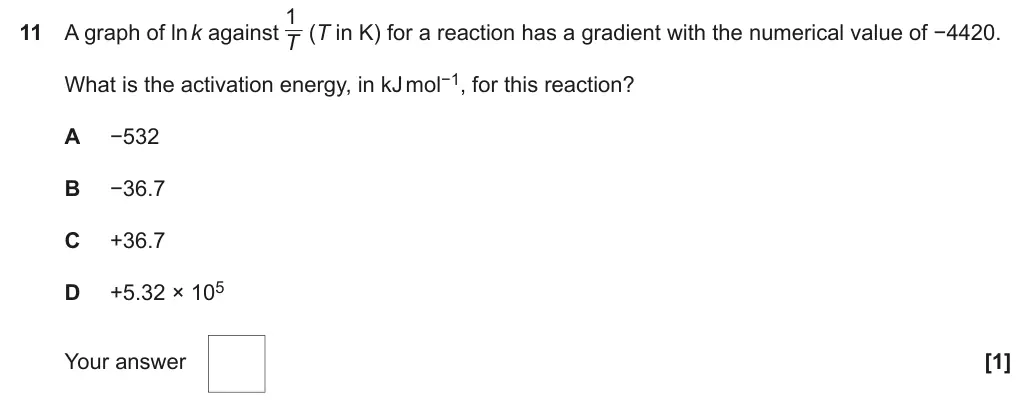
June 2019 · Paper 1 · Q111 markAO2Multiple choiceEasy
Answer
C
Mark scheme
Examiner's comment
This was well answered, with many candidates understanding that the activation energy in kJmol–1 is equal to (- gradient x R ) divided by 1000, leading to C as the correct answer. Common errors included dividing the gradient by R, giving option A. or forgetting the minus sign and opting for B.
June 2019 · Paper 1 · Q216 marksAO36-mark level of responseEasy
Mark scheme, with the levels and indicative points
Examiner's comment
The second Level of Response question in the paper was also answered very well. Almost all candidates determined the order with respect to H+ to be first order and gave suitable explanations. A very high proportion of candidates determined the order with respect to CH3COCH3 to be first order and related this to the direct proportionality shown on the graph. The zero order with respect to Br2 proved a little more problematic with many candidates just giving an order with no attempted explanation. Having determined orders, nearly all candidates were able to give a corresponding rate equation and could calculate a value for the rate constant, albeit with frequent omission of units and forgetting that the initial rates given were in terms of 10–5. An example of a complete answer achieving L3 (6 marks) is given. This candidate gave each order clearly followed by a concise explanation of each choice. The rate equation (based on the orders given) is clearly stated, the calculation clearly shows working and correct units are given.
Notes from the mark scheme and report
zero order in Br2 (straight line concentration–time, constant gradient)
first order in CH3COCH3 (straight line through origin)
first order in H+ (doubling doubles rate)
rate = k[CH3COCH3][H+]
k = 3.9 × 10⁻⁵ dm3 mol–1 s–1
Skills: M0.0 Recognise and make use of appropriate units in calculations; M0.2 Use ratios, fractions and percentages; M2.3 Substitute numerical values into algebraic equations using appropriate units for physical quantities; M3.1 Translate information between graphical, numerical and algebraic forms; PAG10 Rates of reaction – initial rates; PAG9 Rates of reaction – continuous monitoring
June 2019 · Paper 3 · Q1(e)1 markAO2CalculationHard
Mark scheme
Examiner's comment
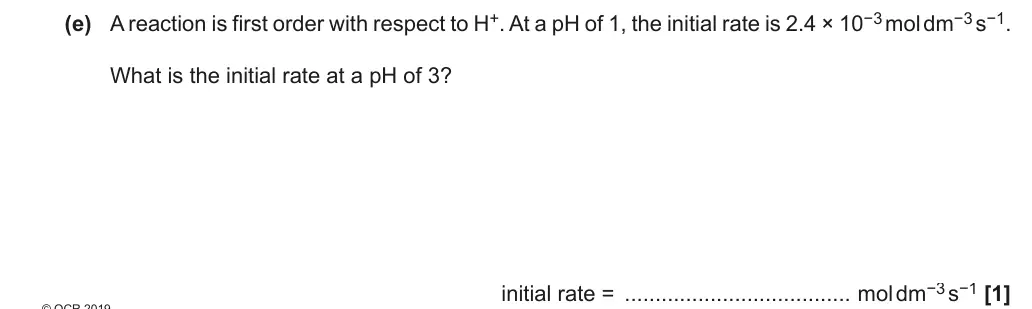
This part tested an understanding of pH as a logarithmic scale and the relationship between rates and order. This part discriminated extremely well. A pH of 3 meant that the H+ concentration would be 100 times less than at a pH of 1. Being a first order reaction with respect to H+, the initial rate is simply 100 times less than at a pH of 1: 2.4 × 10⁻⁵ mol dm–3 s–1. The higher-ability candidates identified the relationships and often wrote the correct answer on the answer line with no visible working (presumably doing the calculation in their head). Others used their well-learnt equations to calculate the same correct answer. Many candidates found the calculation difficult and 7.2 × 10⁻³ (3 × (2.4 × 10–3)) was a very common incorrect answer. If candidates had fully scrutinised this answer, they may have realised that a more dilute solution cannot produce a faster rate.
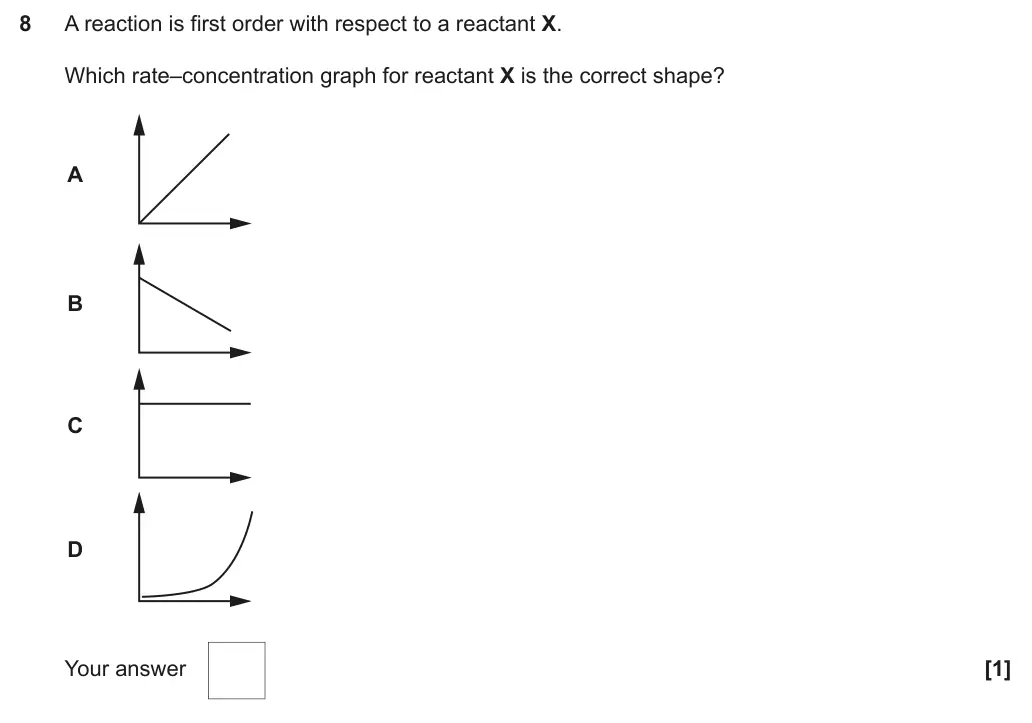
June 2018 · Paper 1 · Q81 markAO1Multiple choiceEasy
Answer
A
Mark scheme
Examiner's comment
The vast majority of candidates knew graph A was correct.
June 2018 · Paper 1 · Q141 markAO1Multiple choiceMedium
Answer
C
Mark scheme
Examiner's comment
This was almost universally correct.
June 2018 · Paper 1 · Q17(a)6 marks6-mark level of responseEasy
Mark scheme, with the levels and indicative points
Examiner's comment
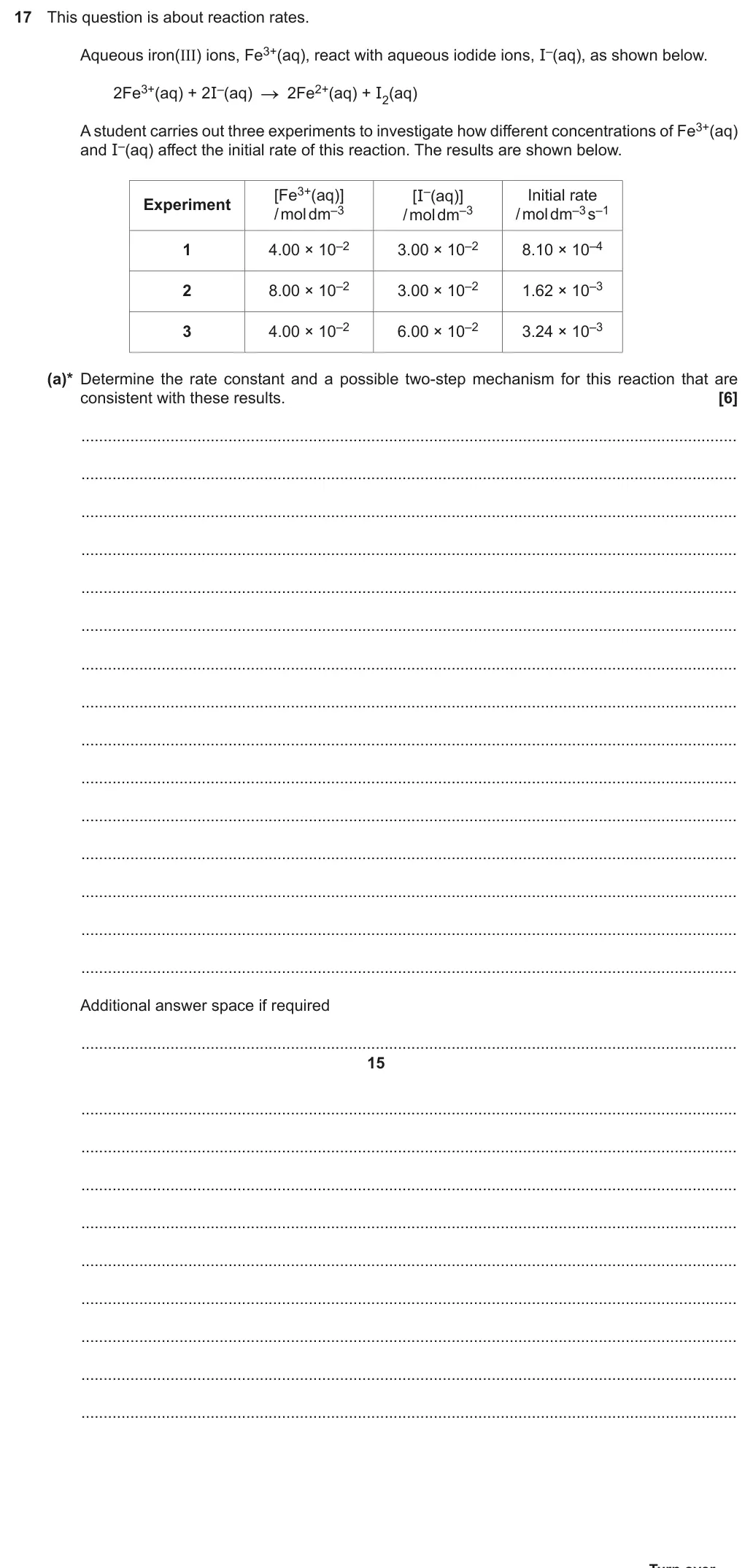
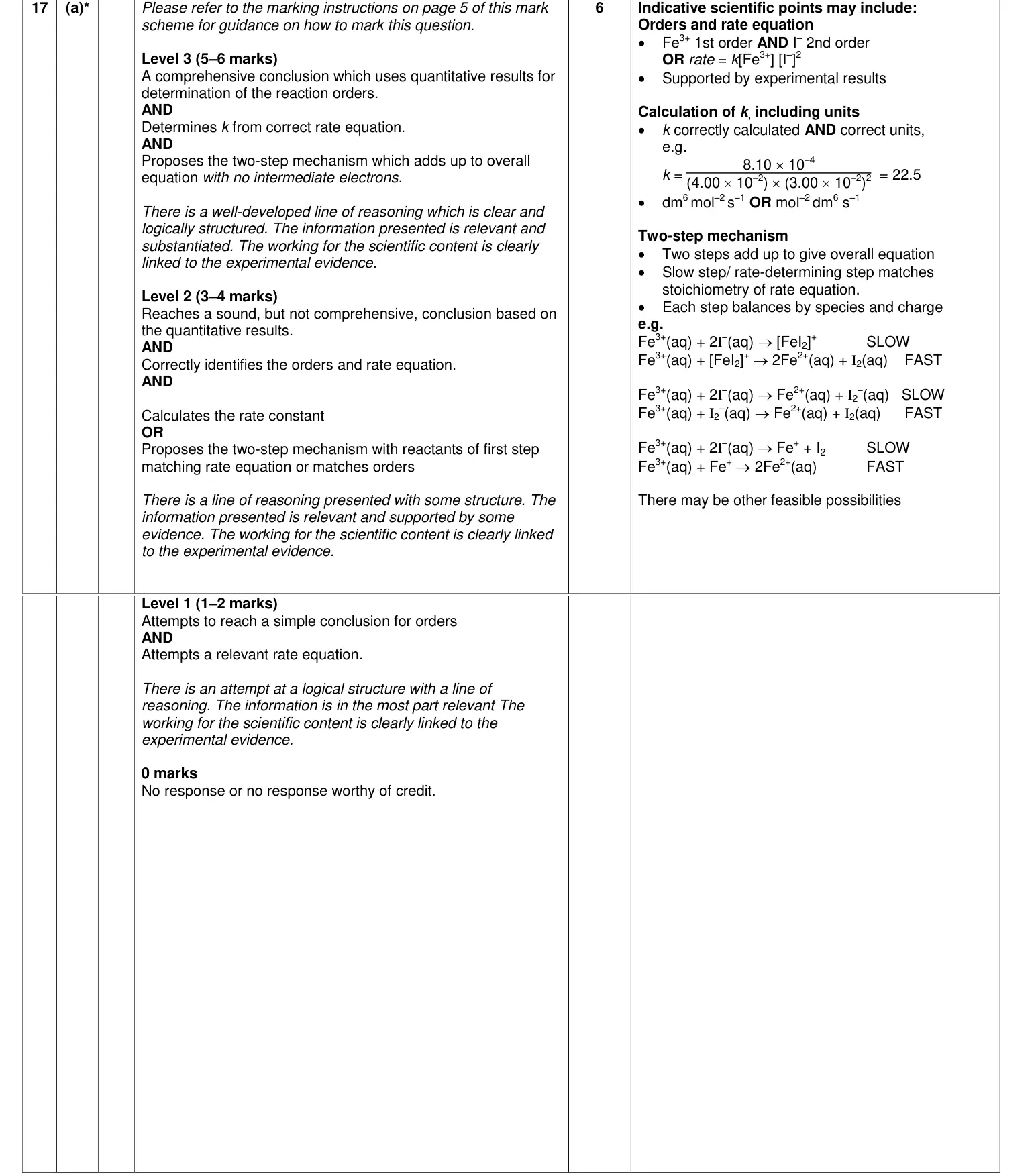
Most candidates were able to use the information in the table to determine the order of reaction with respect to Fe3+ ions and I– ions, which were 1 and 2 respectively. Most candidates were then able to use this knowledge and further information from the table to determine the rate constant, including units (22.5 dm6 mol–1 s–1). Many candidates appreciated that the mechanism involved a stoichiometric ratio of 1 : 2 with respect to Fe3+ ions and I– ions, but only the more able were able to suggest a suitable possible two step mechanism. Common errors in proposing a mechanism included equations such as Fe3+(aq) + 2I–(aq) Fe2+(aq) + ½I2(aq) + I–(aq) which gives a net ratio of 1 : 1 for the reactants. or Fe3+(aq) + 2I–(aq) Fe2+(aq) + I2(aq) + e– which although introducing a correct ratio of reactants also introduces a ‘floating’ electron which in all reality would have attached itself to one of the product species. In questions such as 17a where the quality of extended responses is assessed candidates need to be aware of the need for explanation of their answers. For instance, just giving a correct order of a species in the rate equation is not as strong an answer as one which explains how altering, say doubling, the concentration of a reactant effects the overall rate of reaction, leading to determination of the order. This exemplifies how a concise response can gain full marks on a Level of Response question. The candidate has clearly identified which data they have referred to in the table, and explained the conclusions that can be drawn. The rate equation is then clearly shown, along with subsequent working to determine the value of the rate constant. Finally, the suggested mechanism is given, along with an indication of which is the slow step. The line breaks clearly identify each stage in the response, and it fully satisfies the level 3 criteria in the mark scheme.
Notes from the mark scheme and report
Fe3+ first order and I– second order supported by quantitative comparison of experiments
k = 22.5 dm6 mol–2 s–1
two steps must add up to overall equation, slow step matches rate equation, each step balanced for species and charge with no electrons
Skills: M0.0 Recognise and make use of appropriate units in calculations; M0.2 Use ratios, fractions and percentages; M2.3 Substitute numerical values into algebraic equations using appropriate units for physical quantities; PAG10 Rates of reaction – initial rates
June 2018 · Paper 1 · Q17(b)(i)3 marksCalculationMedium
Mark scheme
Examiner's comment
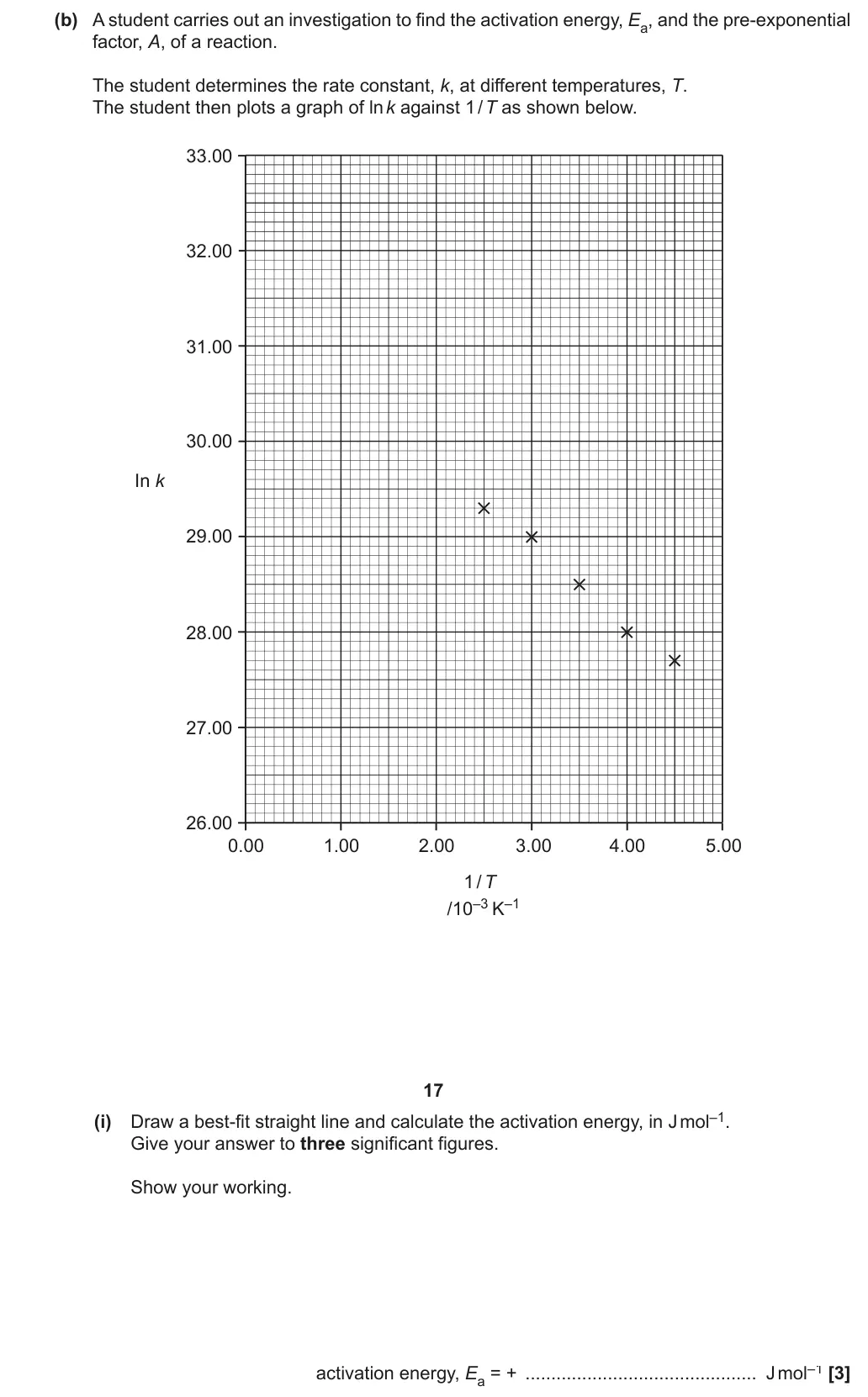
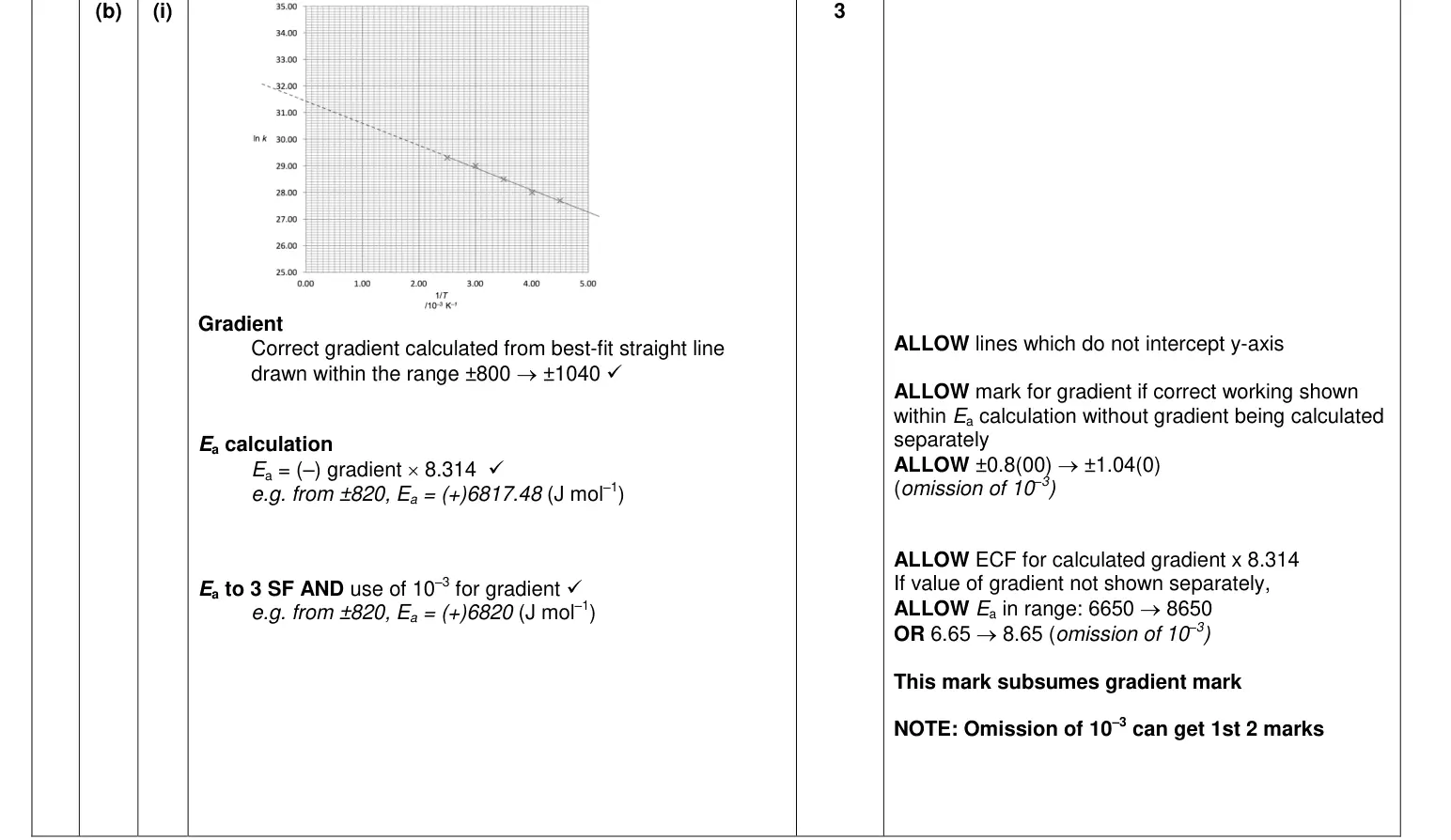
Higher ability candidates realised that the gradient was equivalent to –Ea/R and determined a gradient within the range ± 800 to ± 1040, depending upon the line drawn. Credit was given to gradients of ± 0.800 to ± 1.040 resulting from calculations which omitted 10–3 on the x-axis. The negative gradient was multiplied by R to determine Ea with a value rounded to 3 significant figures. Common errors were omission of 10–3 in the calculation which led to Ea values between 6.65 and 8.65 J mol–1, or not rounding to 3 significant figures.
Notes from the mark scheme and report
gradient in range –800 to –1040 (K)
Ea = –gradient × 8.314
3 sig figs AND use of 10^–3 on x-axis
omission of 10^–3 can score first 2 marks
ALLOW lines that do not reach the y-axis
Skills: M1.1 Use an appropriate number of significant figures; M2.3 Substitute numerical values into algebraic equations using appropriate units for physical quantities; M3.2 Plot two variables from experimental or other data; M3.3 Determine the slope and intercept of a linear graph
June 2018 · Paper 1 · Q17(b)(ii)2 marksCalculationMedium
Earlier part of question 17 that this part uses
Mark scheme
Examiner's comment
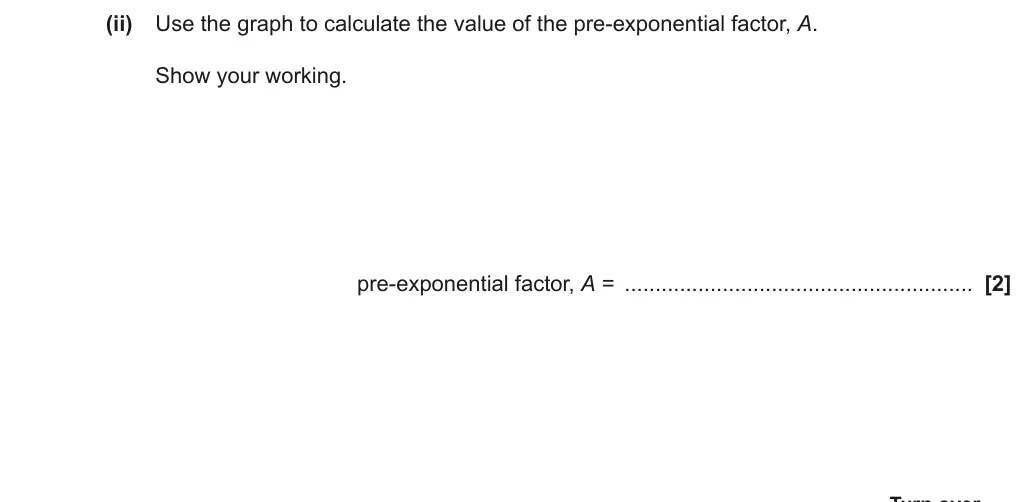
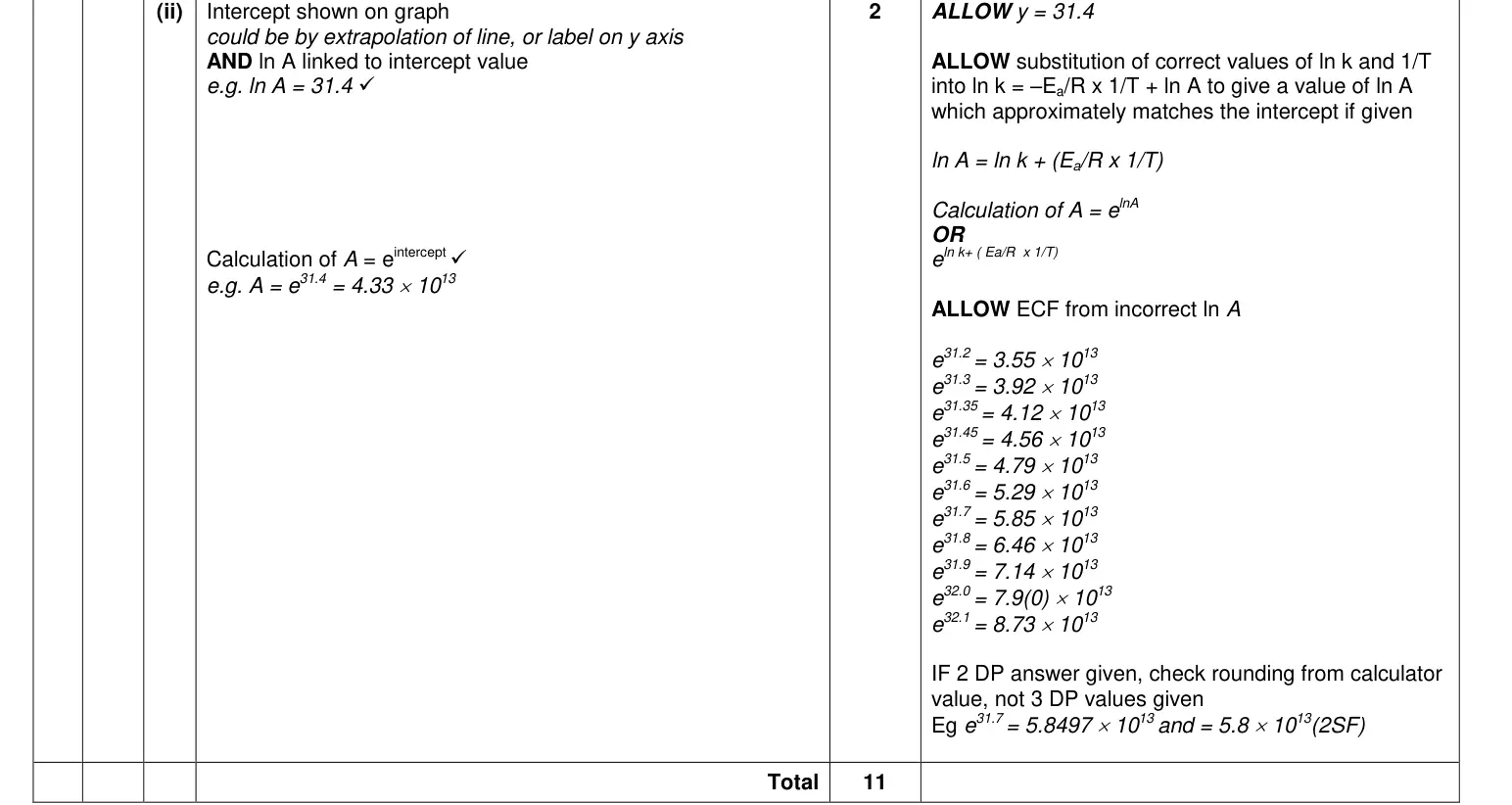
Higher ability candidates realised that the y-intercept of ln k was equivalent to ln A and A was equivalent to e(ln A) and were able to process this readily in their calculators. Common errors were to mis-read the intercept. For example, 31.5 was frequently seen as 31.05. Other candidates assumed the y-intercept was log A and tried to determine A by 10(log A).
Notes from the mark scheme and report
ln A = y-intercept (extrapolate line to 1/T = 0) about 31.4
A = e^intercept about 4.3 × 10^13
ALLOW substitution of a point into ln k = –Ea/RT + ln A
ALLOW ECF from incorrect ln A
Skills: M0.4 Use calculators to find and use power, exponential and logarithmic functions; M2.5 Use logarithms in relation to quantities that range over several orders of magnitude; M3.3 Determine the slope and intercept of a linear graph
June 2018 · Paper 3 · Q2(a)(i)5 marksCalculationEasy
Mark scheme
Examiner's comment
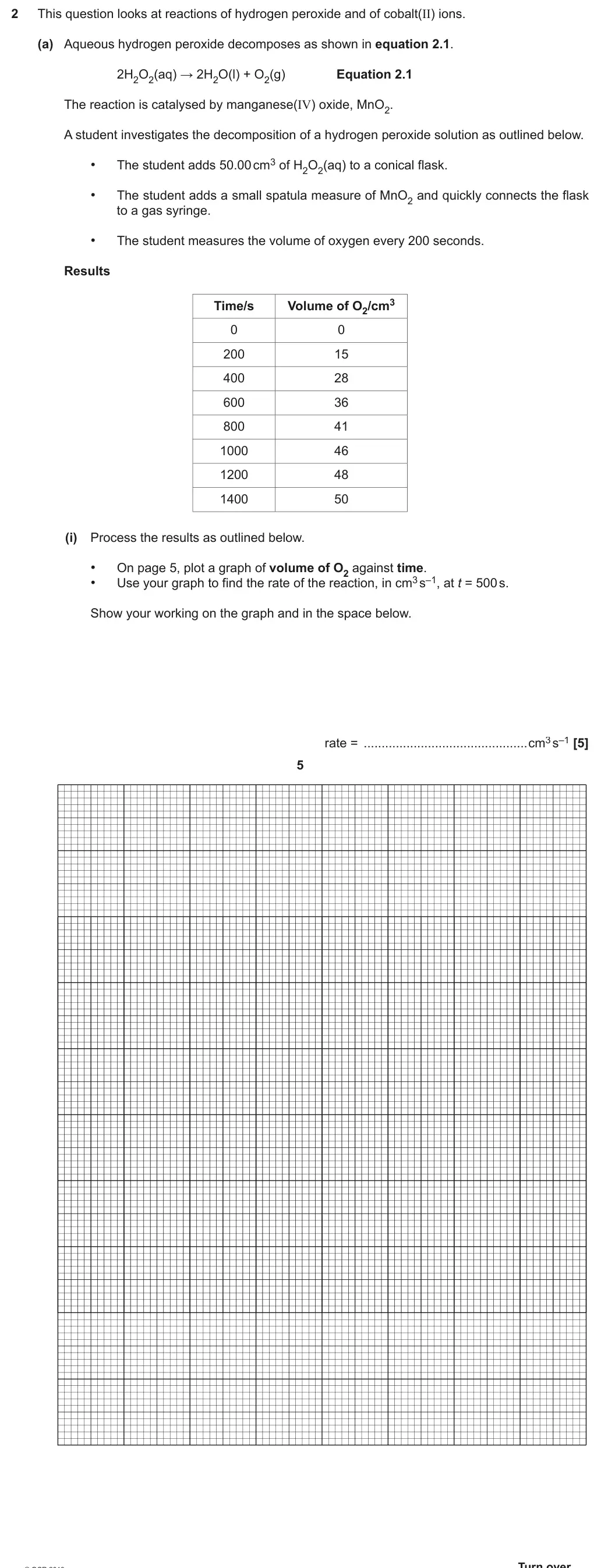
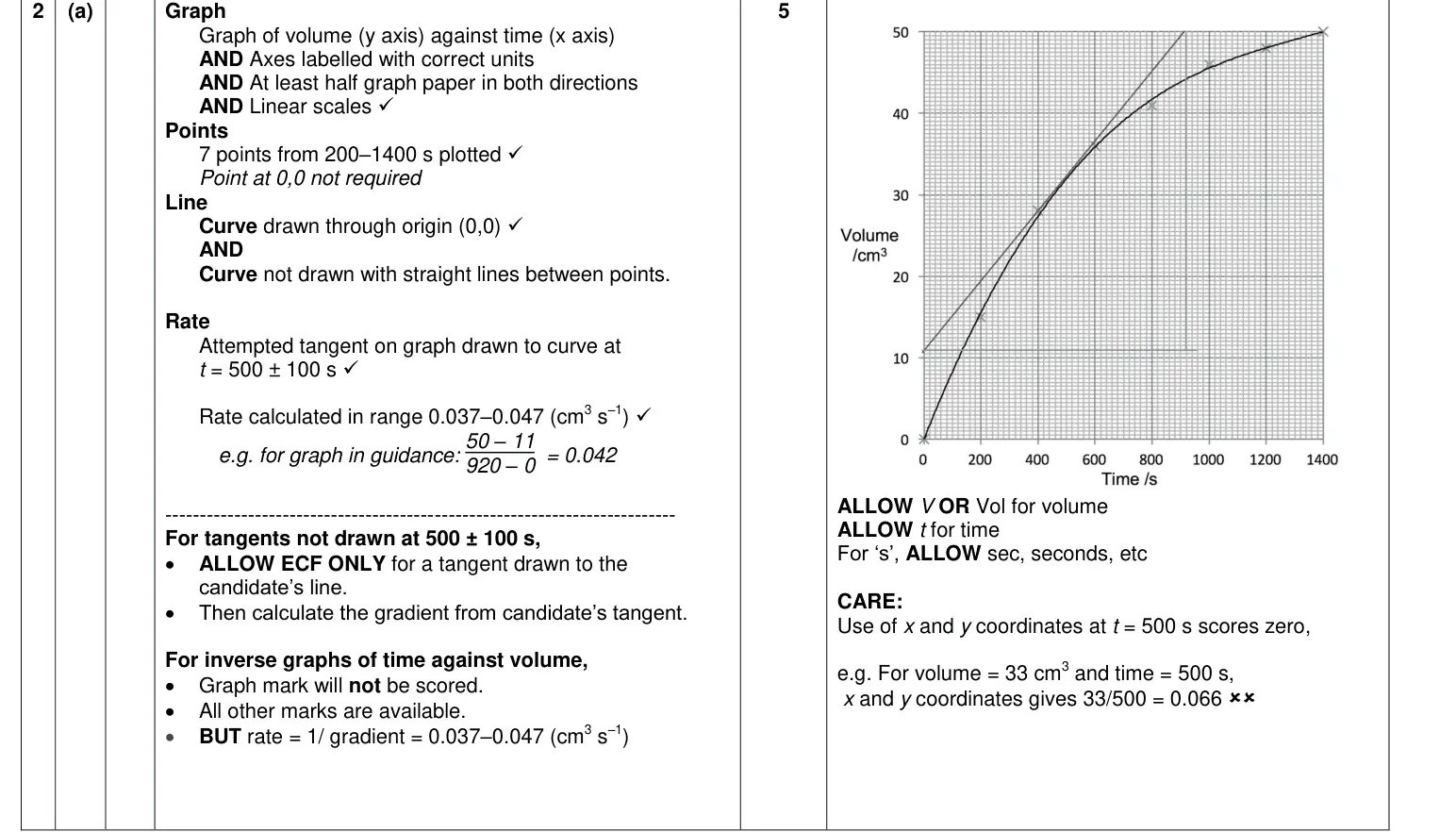
The graph was generally well drawn although many didn’t realise that a tangent needed to be drawn. A few tried to draw a straight line of best fit, rather than a curve. Most candidates were able to construct a correct graph, assigning the axes correctly and making good use of the graph paper. Points were usually plotted correctly and most candidates made a good attempt to draw a curved line of best fit. Candidates then needed to draw a tangent at 500 seconds and to measure its gradient to calculate the rate. Lower ability candidates did not draw a tangent to their curve and just calculated the volume formed at 500 seconds.
Notes from the mark scheme and report
axes labelled with units, linear scales using at least half the grid
smooth curve through origin not point-to-point lines
tangent at t = 500 ± 100 s
rate 0.037–0.047
using x and y coordinates at 500 s (33/500 = 0.066) scores zero
Skills: M3.1 Translate information between graphical, numerical and algebraic forms; M3.2 Plot two variables from experimental or other data; M3.5 Draw and use the slope of a tangent to a curve as a measure of rate of change; PAG9 Rates of reaction – continuous monitoring
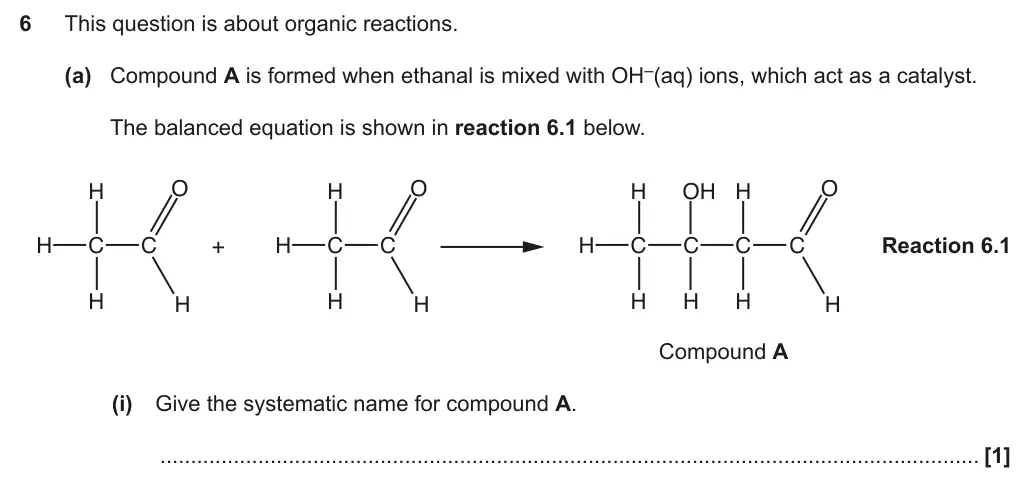
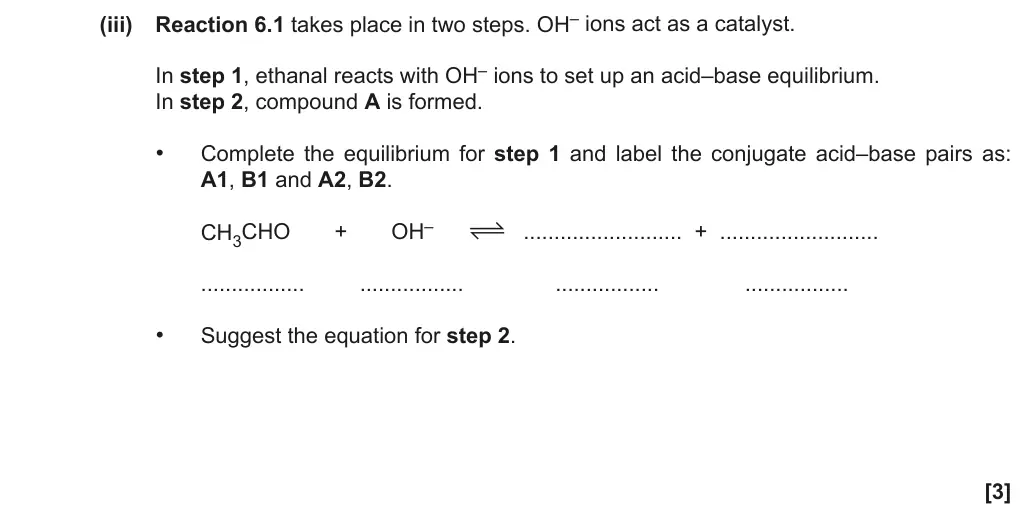
June 2018 · Paper 3 · Q6(a)(iii)3 marksComplete table/diagramHard
Earlier part of question 6 that this part uses
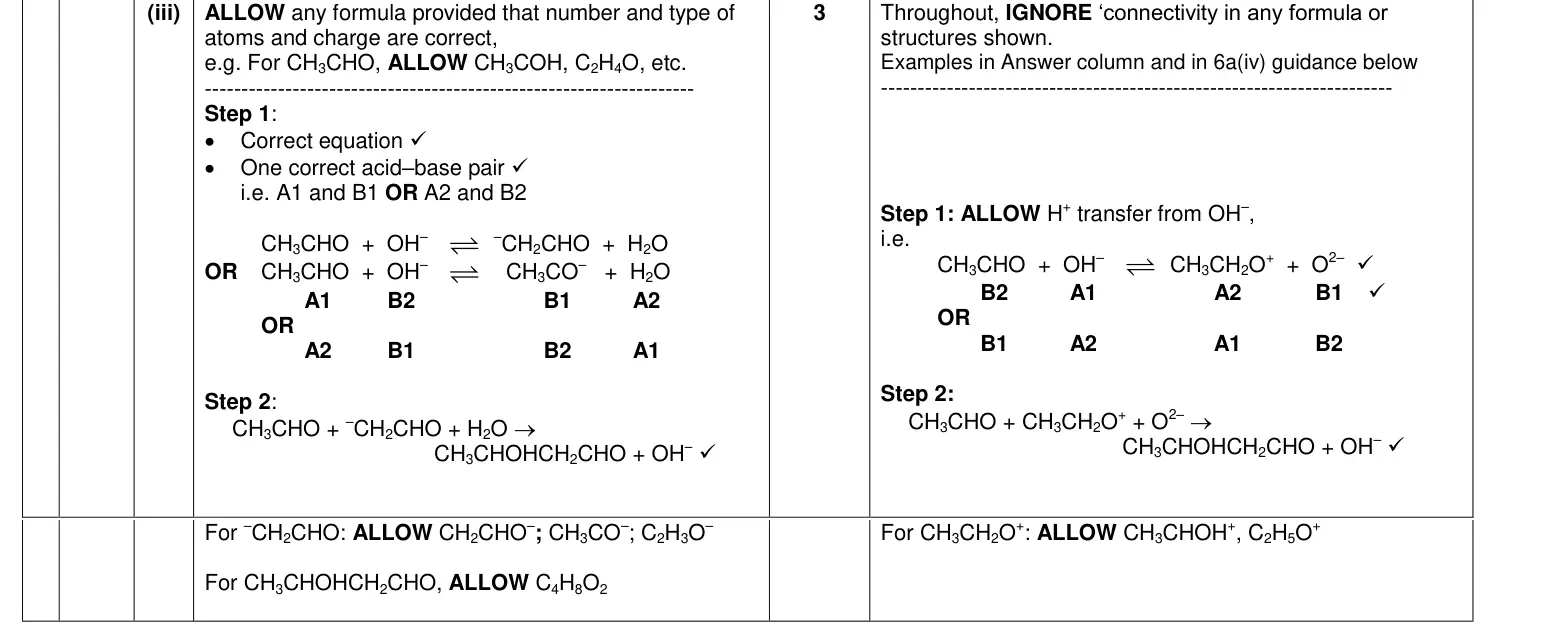
Mark scheme
Examiner's comment
This novel question linked together acid–base equilibria with a multi-step process. Many candidates completed an equation to generate acid–base pairs, which were then usually assigned correctly. The final equation was challenging but the highest ability candidates were able to combine together all the information with their earlier responses to arrive at the correct equation. See Exemplar 15.
Notes from the mark scheme and report
step 1 CH3CHO + OH– ⇌ –CH2CHO + H2O with pairs A1/B1 and A2/B2 labelled
Skills: PAG9 Rates of reaction – continuous monitoring
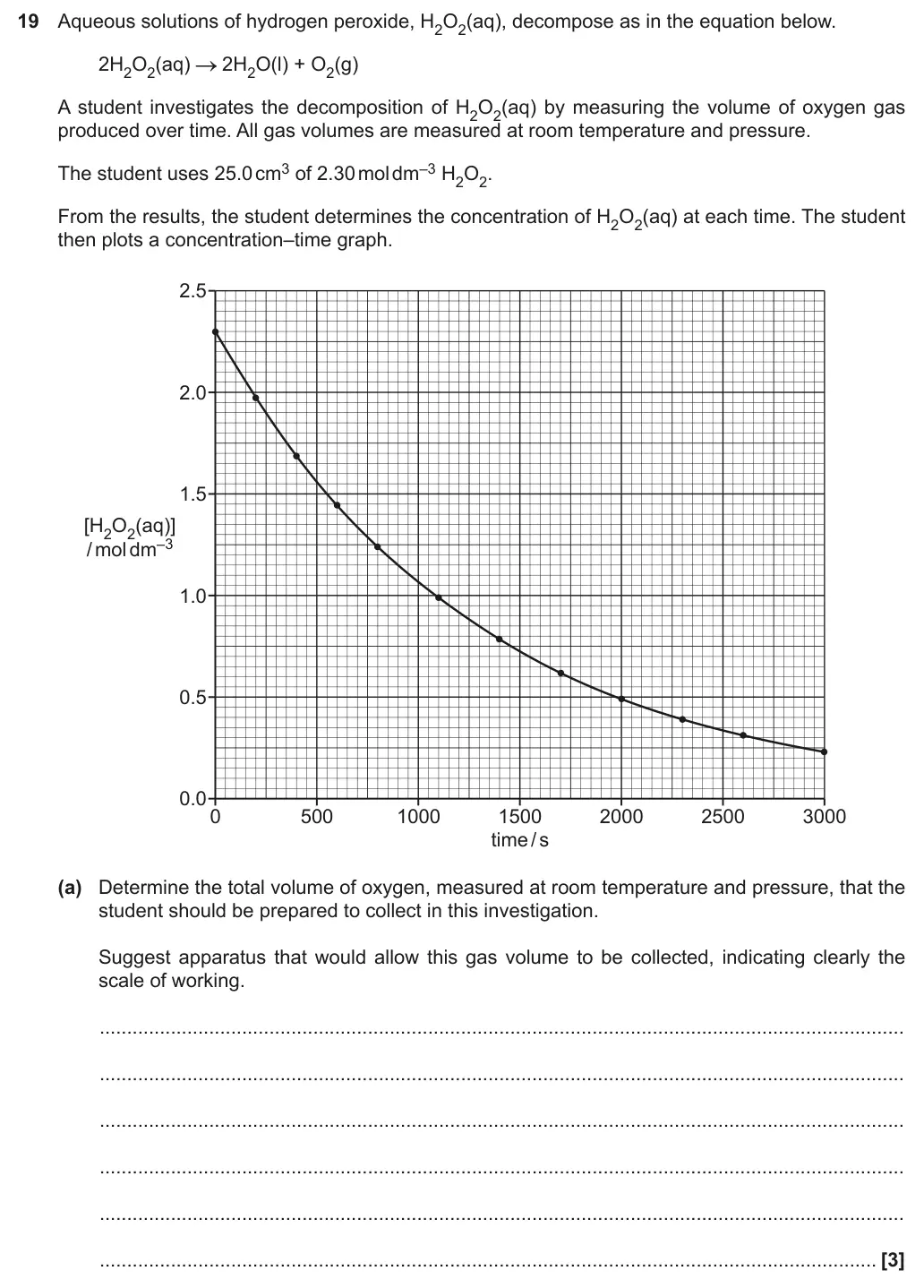
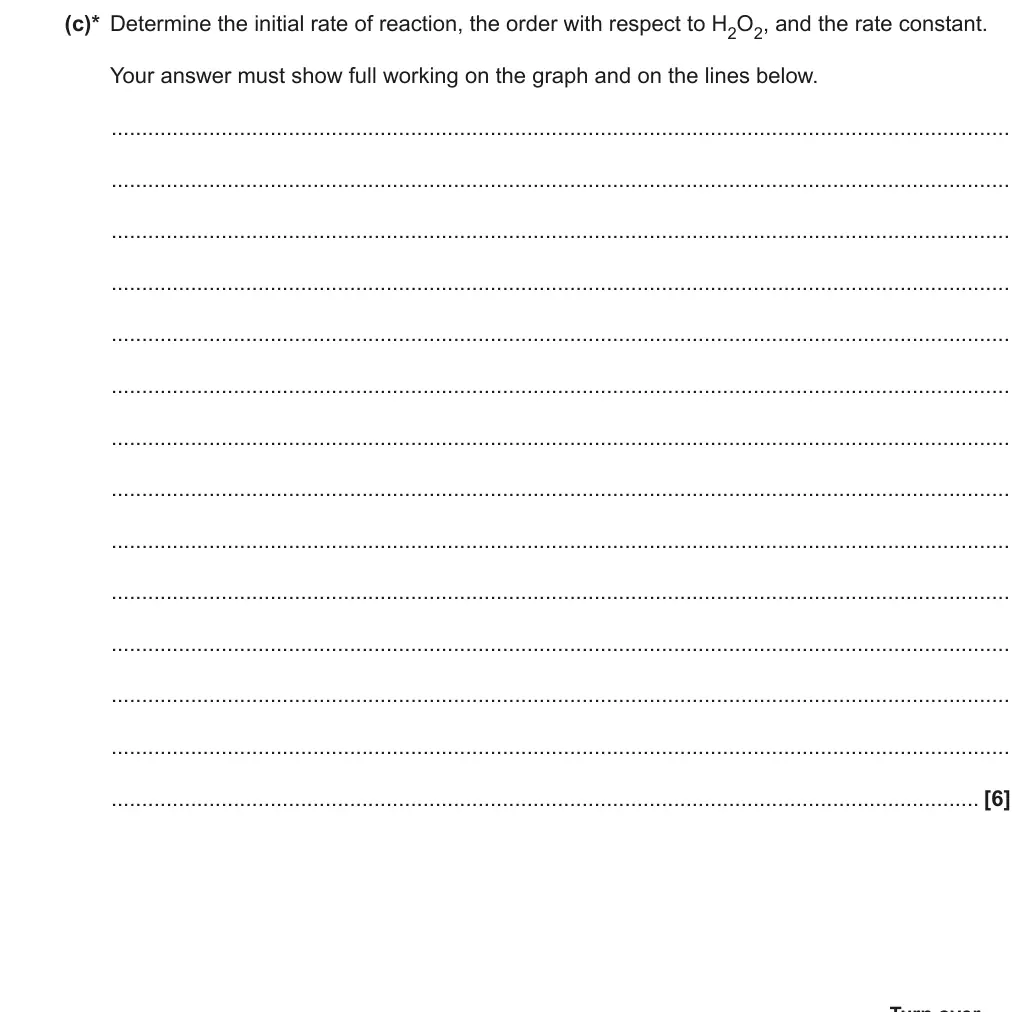
June 2017 · Paper 1 · Q19(c)6 marks6-mark level of response
Earlier part of question 19 that this part uses
Mark scheme, with the levels and indicative points
Notes from the mark scheme and report
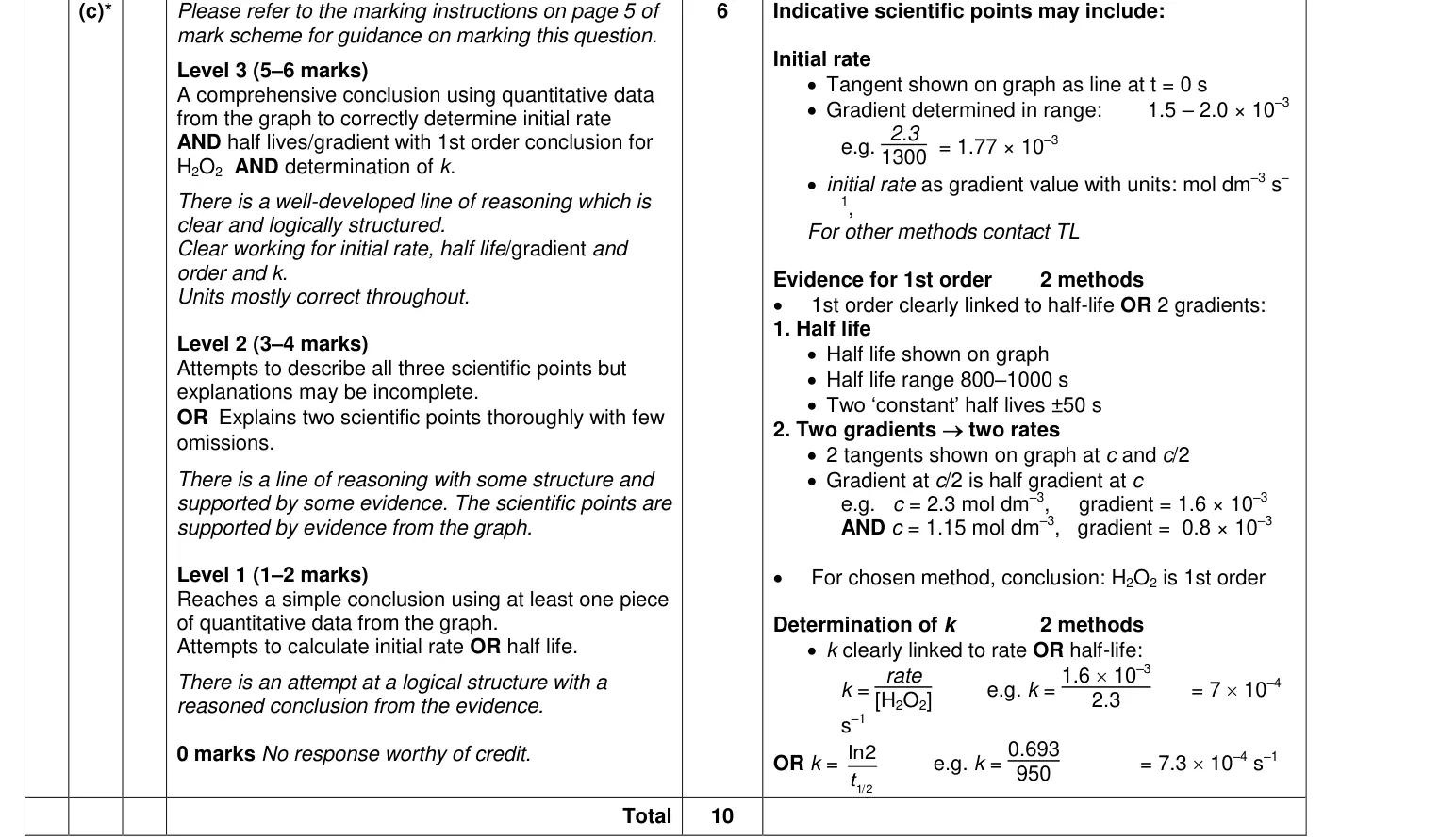
tangent at t = 0 (gradient 1.5–2.0 × 10⁻³ mol dm–3 s–1)
two constant half-lives (800–1000 s) or gradient halves at c/2 gives first order
k = rate/[H2O2] or ln2/t½ with units s–1
Skills: M0.0 Recognise and make use of appropriate units in calculations; M2.3 Substitute numerical values into algebraic equations using appropriate units for physical quantities; M3.1 Translate information between graphical, numerical and algebraic forms; M3.5 Draw and use the slope of a tangent to a curve as a measure of rate of change
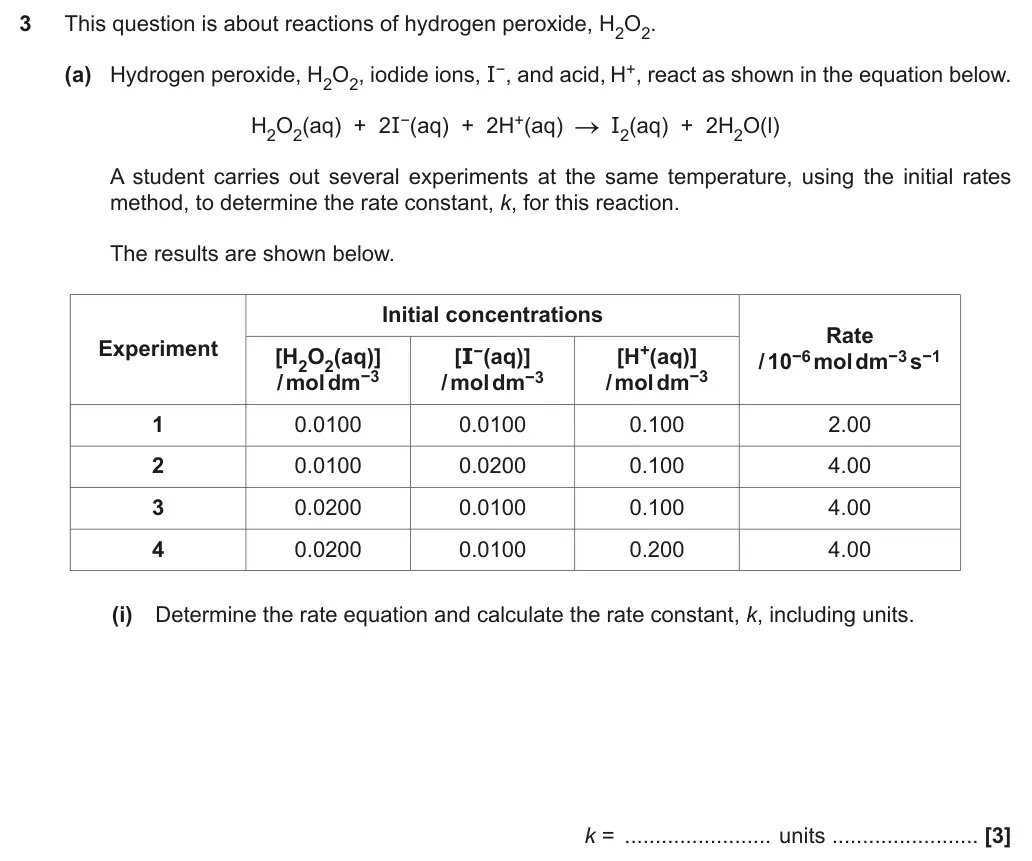
June 2017 · Paper 3 · Q3(a)(i)3 marksCalculation
Mark scheme
Notes from the mark scheme and report
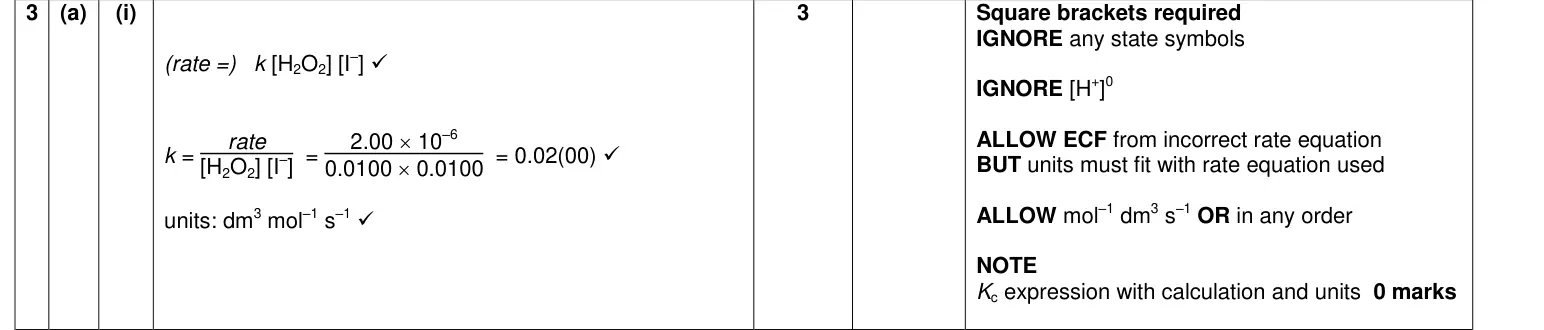
rate = k[H2O2][I–] (zero order in H+)
square brackets required
k = 0.0200 dm3 mol–1 s–1
ALLOW ECF from incorrect rate equation but units must fit
Kc expression scores 0
Skills: M0.0 Recognise and make use of appropriate units in calculations; M0.2 Use ratios, fractions and percentages; M2.3 Substitute numerical values into algebraic equations using appropriate units for physical quantities; PAG10 Rates of reaction – initial rates
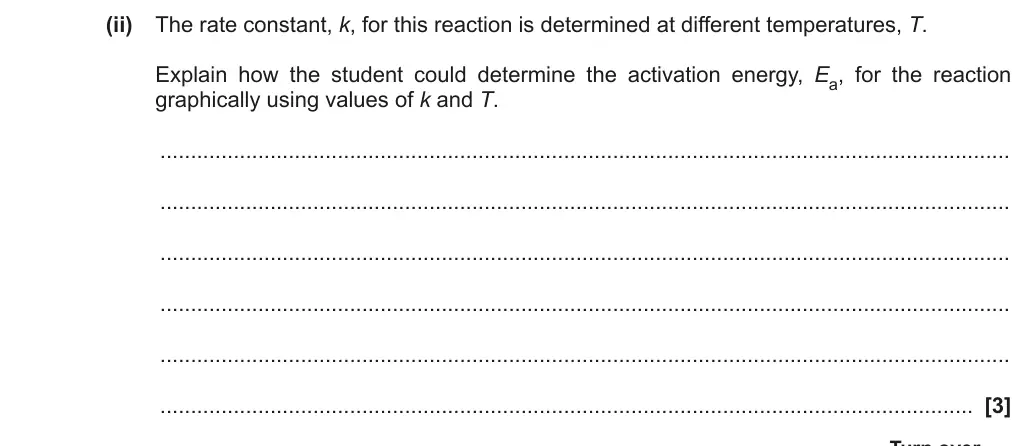
June 2017 · Paper 3 · Q3(a)(ii)3 marksShort answer
Earlier part of question 3 that this part uses
Mark scheme
Notes from the mark scheme and report
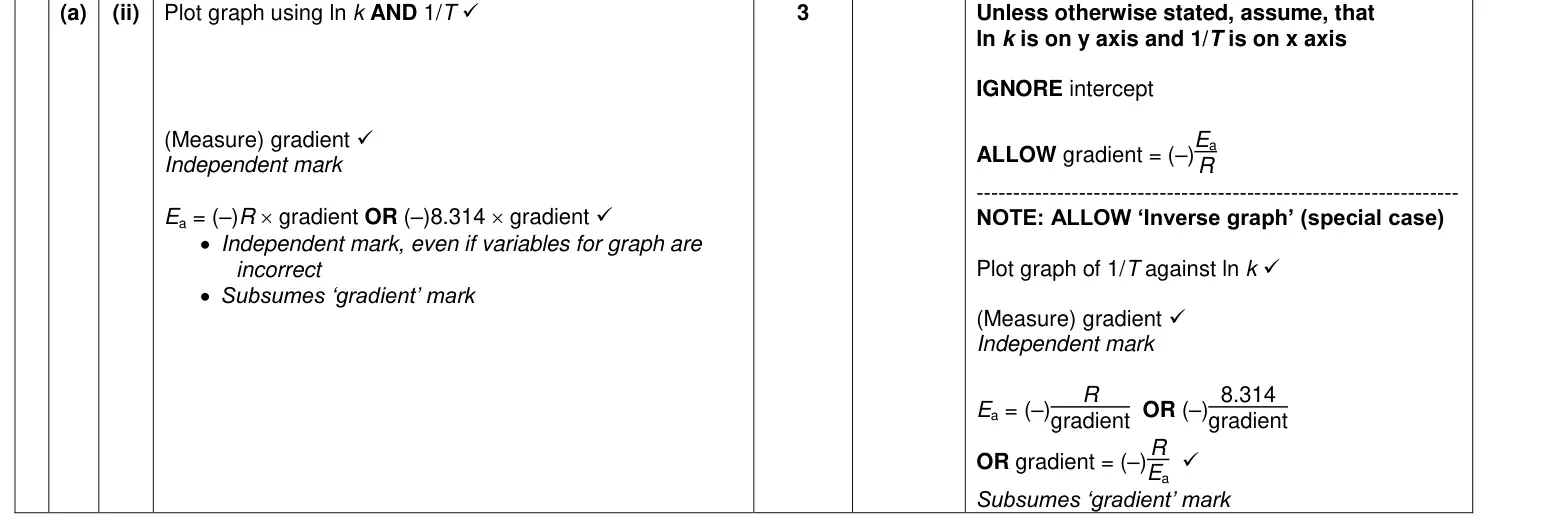
plot ln k against 1/T
measure gradient
Ea = –R × gradient
IGNORE intercept
Skills: M3.1 Translate information between graphical, numerical and algebraic forms; M3.3 Determine the slope and intercept of a linear graph
Work with an OCR chemistry tutor
Dropping marks on calculations, mechanisms or the six-markers? Book a trial session with a specialist OCR chemistry tutor.