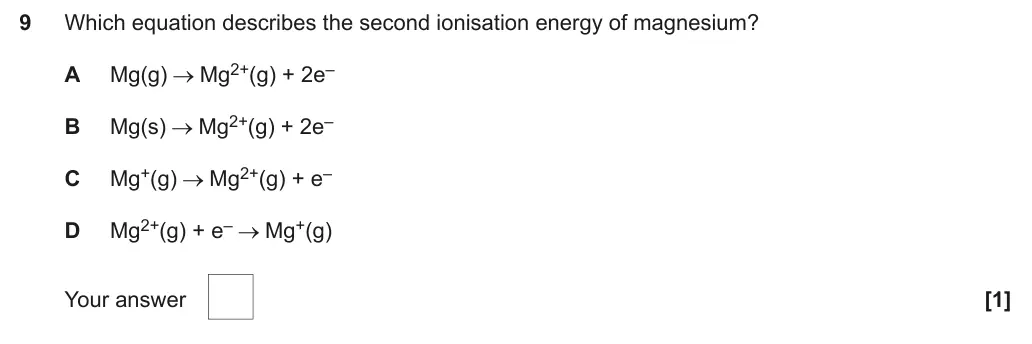
Answer
C
Mark scheme

Examiner's comment
This question was answered well with most candidates correctly selecting C.
Notes and key-term cards for this topic are being written by our tutors. The past-paper questions below are ready now.
| Series | Paper | Q | What it asks |
|---|---|---|---|
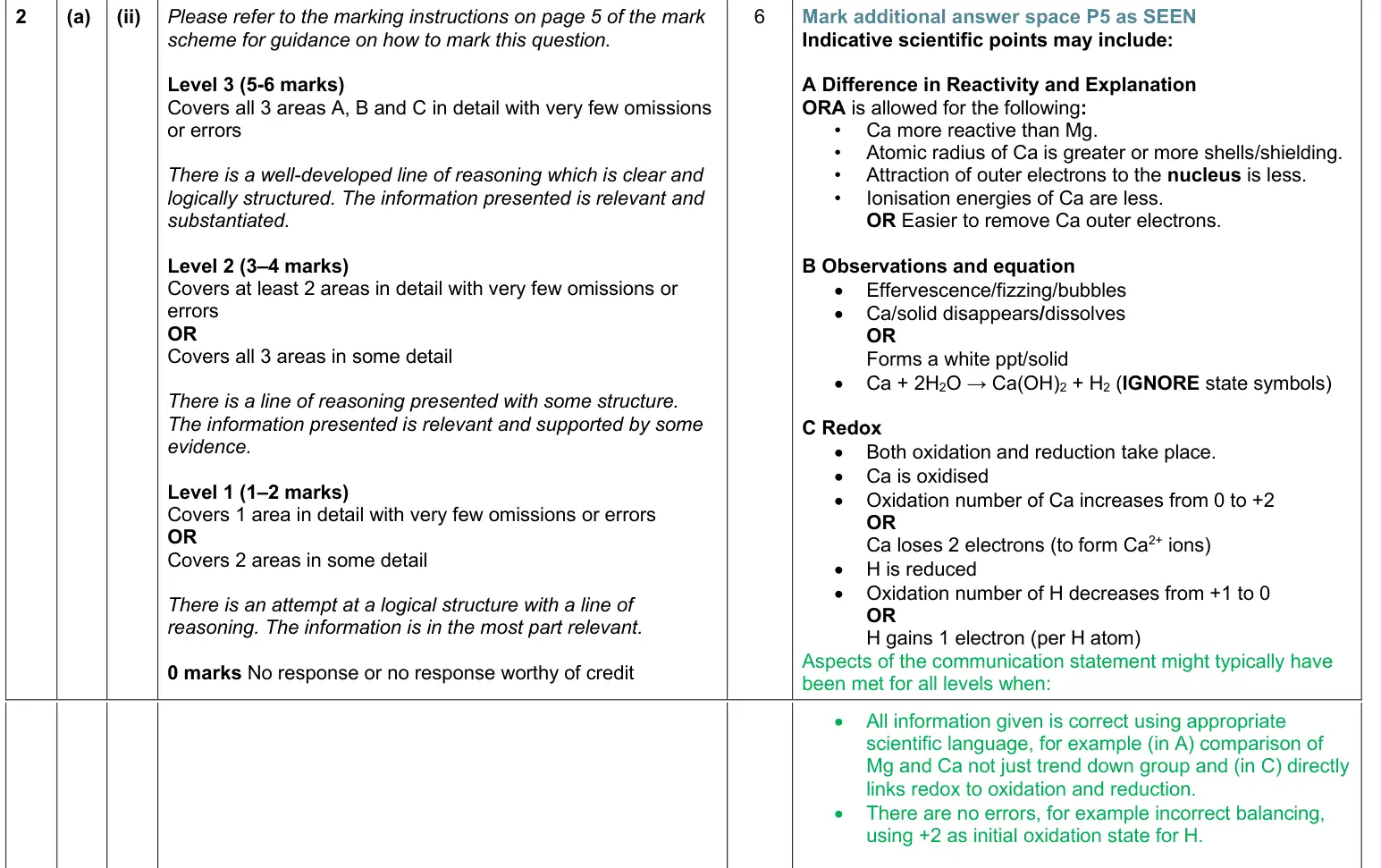
| June 2025 | AS Paper 2 | 2(a)(ii) | Magnesium and calcium differ in their reactivity. observed. Explain why this is a redox reaction. |
C
This question was answered well with most candidates correctly selecting C.
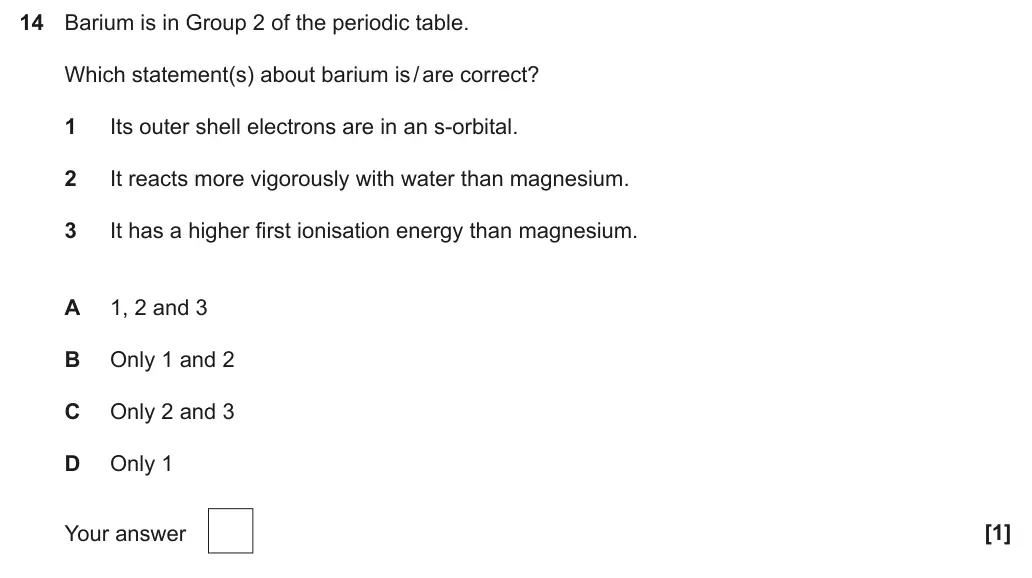
B
The correct answer was B. Most candidates were able to select this response, showing a good knowledge of group 2 chemistry. Some candidates did not successfully recall the trend in reactivity and/or ionisation energy and selected A or D.
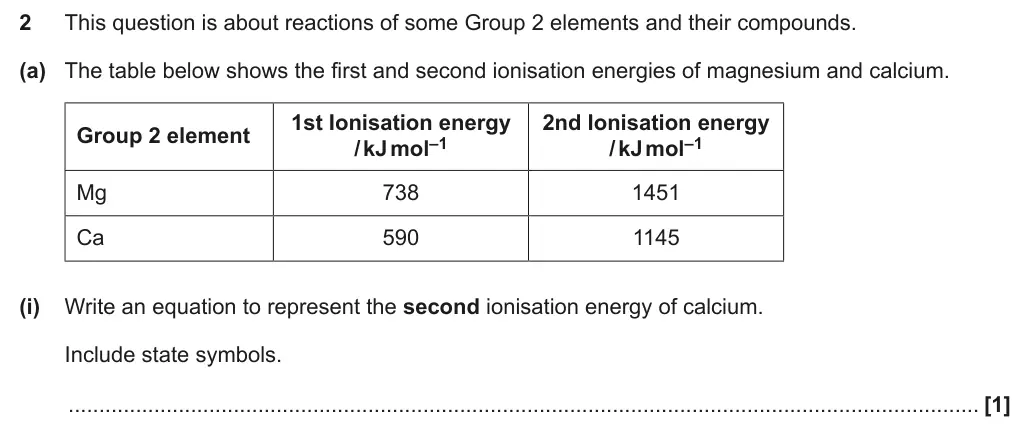
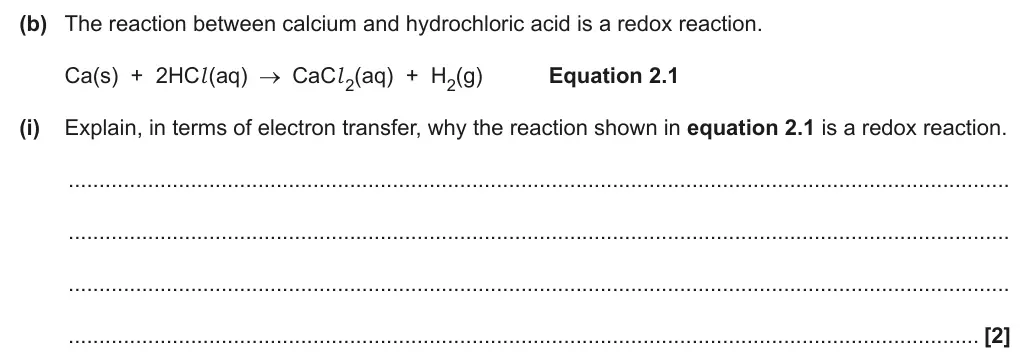
More than half of the candidates gave the correct equation. However, many lost the mark for missing or incorrect state symbols. In some responses it was hard to differentiate between (g) and (s) – candidates need to make sure their handwriting is clear so credit can be given. Some other errors that were seen included: losing 2 electrons, incorrect charges, gaining electrons or using Mg rather than Ca.
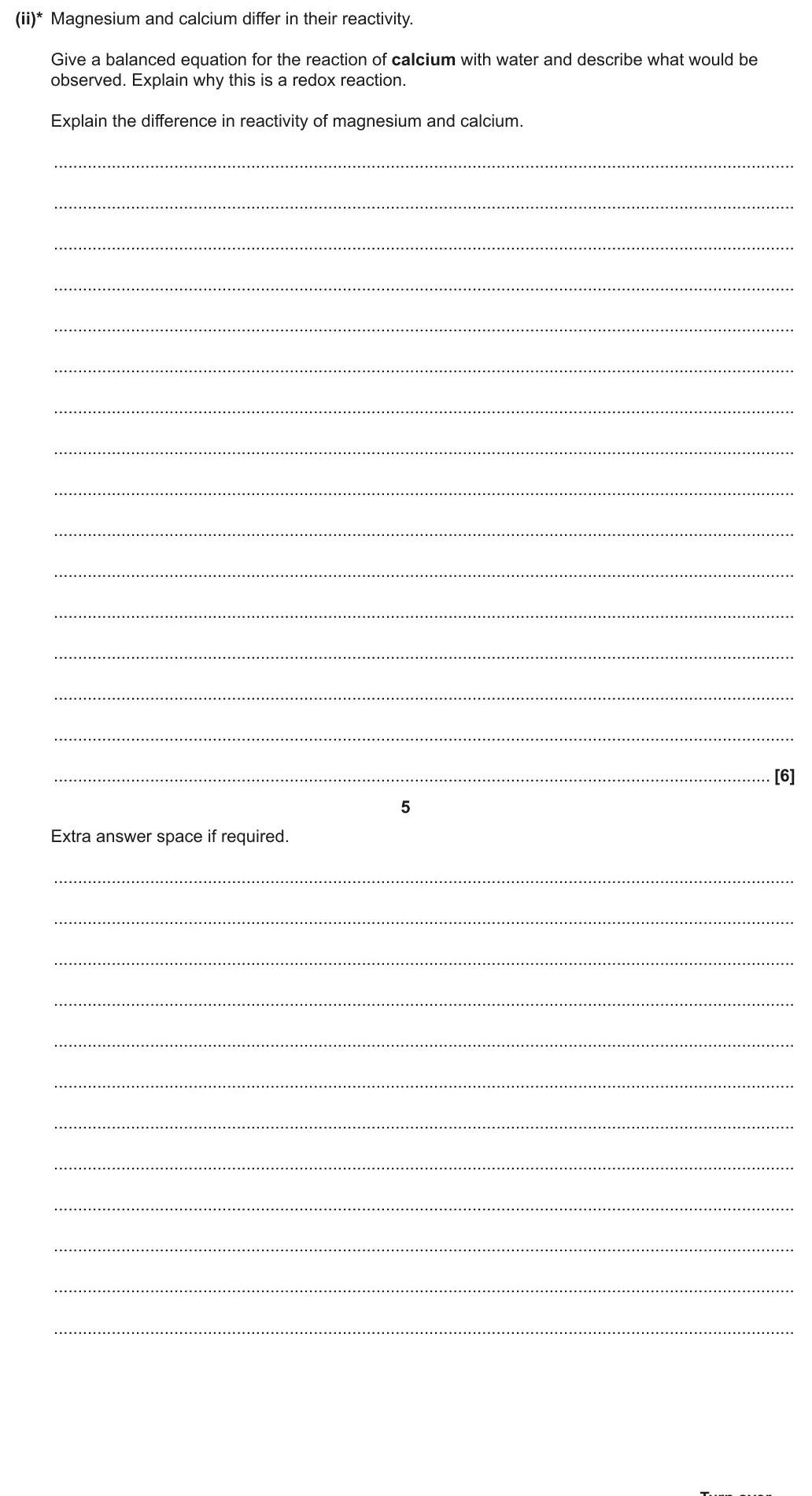
Many candidates scored highly on this level of response question, answering all three parts. Generally, candidates found it easier to explain the difference in reactivity between Mg and Ca than the other parts of the question. Some lacked clarity in their responses, describing a decreased “electrostatic attraction” without reference to the nucleus and/or outer electrons. Some muddled the order of reactivity describing the gain of electrons. A few candidates described a general trend down the group without linking to the position of Mg and Ca in the group. A number of candidates had an incorrect equation forming CaO rather than hydroxide and occasional errors in the formula, e.g. CaOH or balancing of the equation were seen. Most gave at least one correct observation. Some candidates suggested that bubbles would be seen but did not have hydrogen pro- duced in their equation. Most candidates were able to recognise that redox meant that oxidation and reduction took place. How- ever, some were not clear here, e.g. “it is redox as calcium is oxidised”. Most understood that to explain why this was a redox reaction they needed to give oxidation number changes and/or number of electrons lost or gained. Some errors were seen in assigning oxidation numbers such as H in water, which was given as +2, rather than +1 for each atom. Lower-attaining candidates often suggested that oxygen was reduced. Candidates should be aware that they do not need to fill the answer space provided. Often longer re- sponses introduce contradictions in responses. An excellent response which achieved Level 3 and gained all 6 marks.
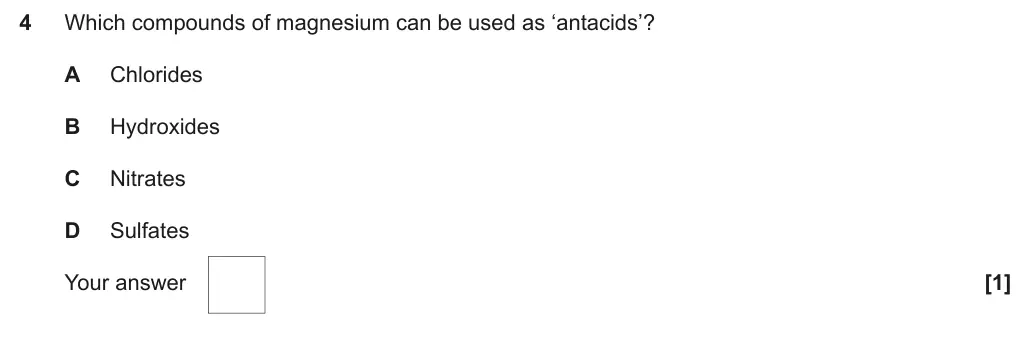
B
The correct answer was B. Most candidates selected this response and understood that hydroxides were needed to neutralise an acid. Incorrect options were also selected in equal measure. It is important that candidates make the link between theory and practical use.
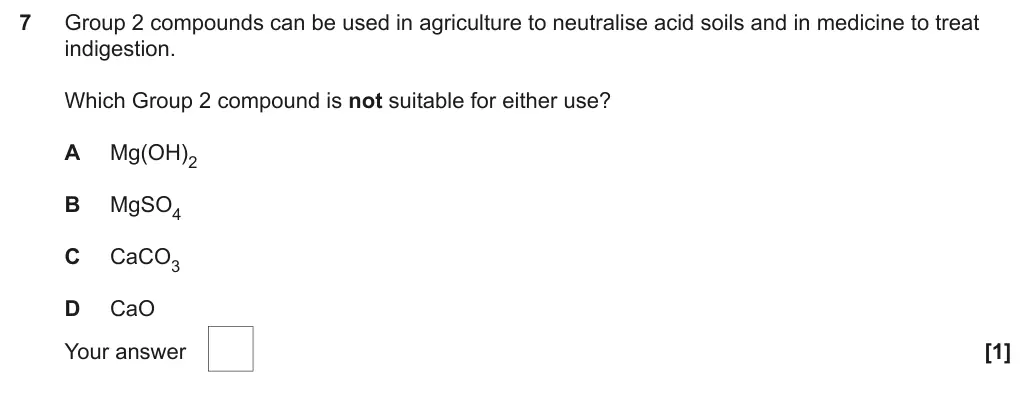
B
Some candidates correctly chose MgSO4. No option showed up as a ‘main’ distractor and many candidates may have just guessed. As this question assesses recall of a specification learning outcome, this suggests that the content had not been learnt by many candidates. Note also the points made in Question 6 about underlining the word ‘not’.
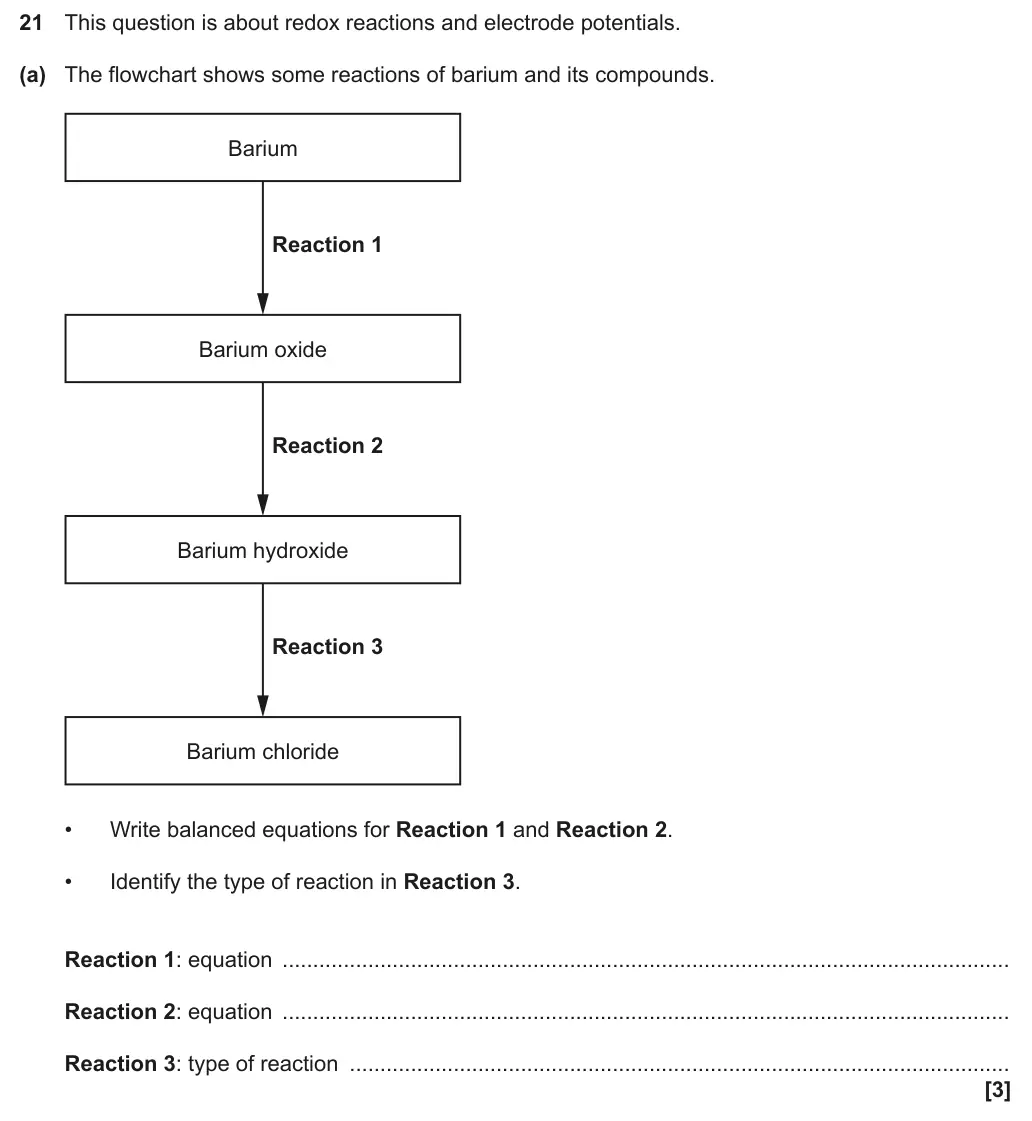
Some candidates coped well with this question which was based on the AS part of the specification and gained all three marks. Common errors were for unbalanced equations in reaction 1 or adding H2 to the product of reaction 2. Reaction 3 was often, incorrectly, considered as: redox, halogenation, nucleophilic substitution or a precipitation reaction.
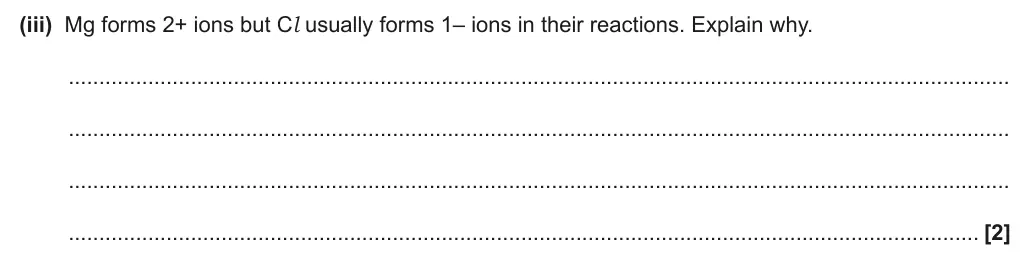
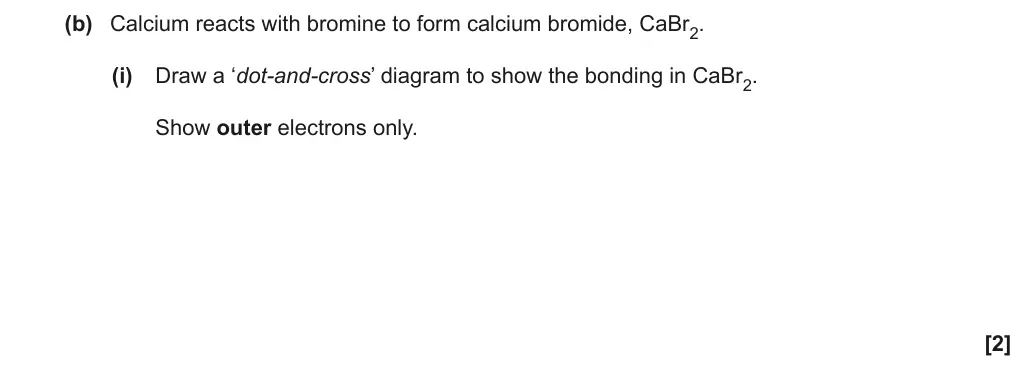
Generally, this question was well answered with a clear understanding of how and why ions are formed. However, approximately a quarter of students only gained 1 mark as they either didn’t explain electrons being lost by Mg and gained by Cl or gave no justification. A common slip was stating Cl has one electron in its outer shell. Some described bonding between Mg and Cl, which wasn’t what the question asked, but this didn’t prevent them from scoring both marks.

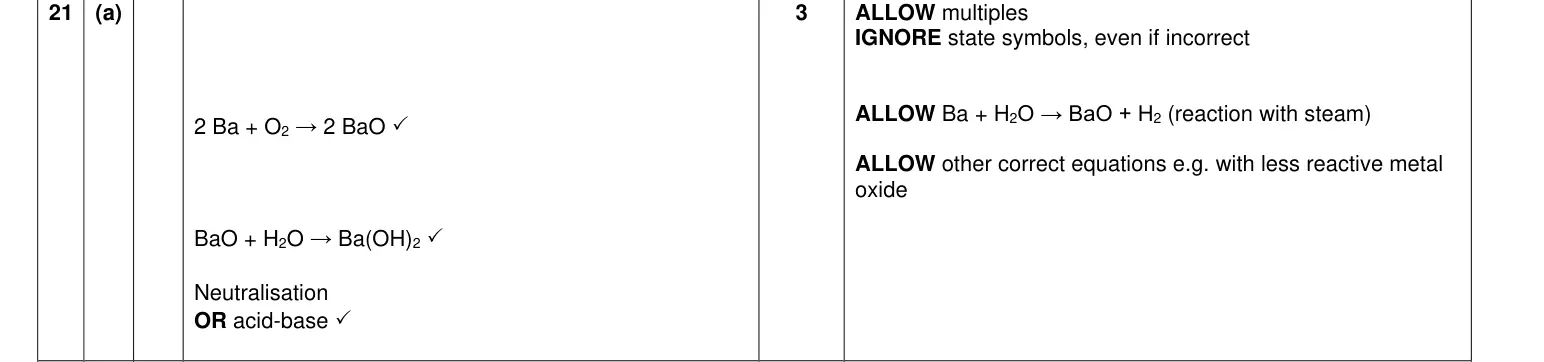
Many candidates correctly gave the balanced equation here. However, some didn’t balance but had the correct formula. A few gave Mg2 as a reactant or MgO2 as a product. Some had O2 on both sides of the equation.
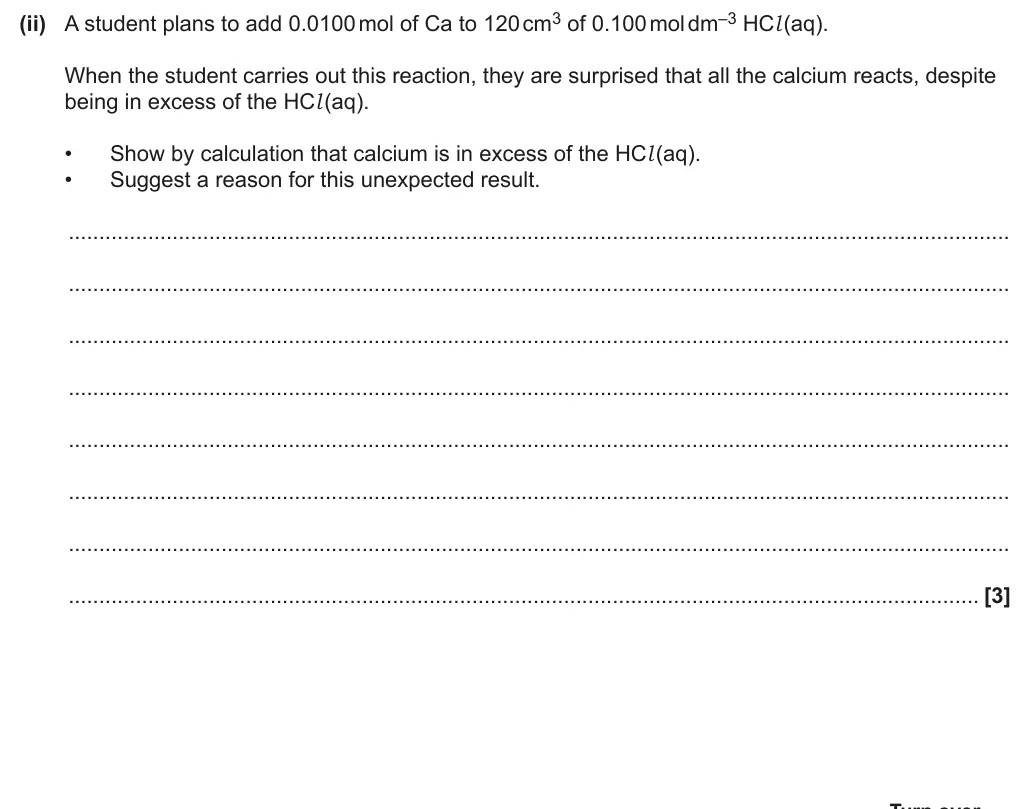
Most candidates correctly calculated the amount of HCl as 0.012 mol. However, many struggled with demonstrating that Ca is in excess. Responses often highlighted misconceptions here in terms of candidates’ understanding about excess and limiting reagents. For example, ‘Ca has a lower concentration than HCl so becomes the limiting reagent’ and ‘Not all the HCl had reacted’ Many compared moles of HCl calculated (i.e. 0.012) directly to moles of Ca (i.e. 0.01) saying that HCl was in excess, despite being told otherwise in the question. Some had the 2:1 ratio of HCl to Ca the wrong way around. Some attempted to calculate mass of Ca and HCl to use for comparison. Only a small proportion of candidates were able to access the third mark and correctly suggest that Ca was also reacting with water. Some other suggestions that were seen included: • ‘Ca reacted with oxygen or was impure’. In both cases this would mean that we would expect solid to remain. • ‘Higher concentration of HCl added’, or ‘HCl is a strong acid’, or ‘acid acts as a catalyst’. • ‘H2 evolved’ or ‘Ca reacts with hydrogen formed’. • ‘Human error’, ‘didn’t weigh Ca correctly’, ‘measured volume of HCl incorrectly’.
Skills: M0.0 Recognise and make use of appropriate units in calculations; M0.2 Use ratios, fractions and percentages
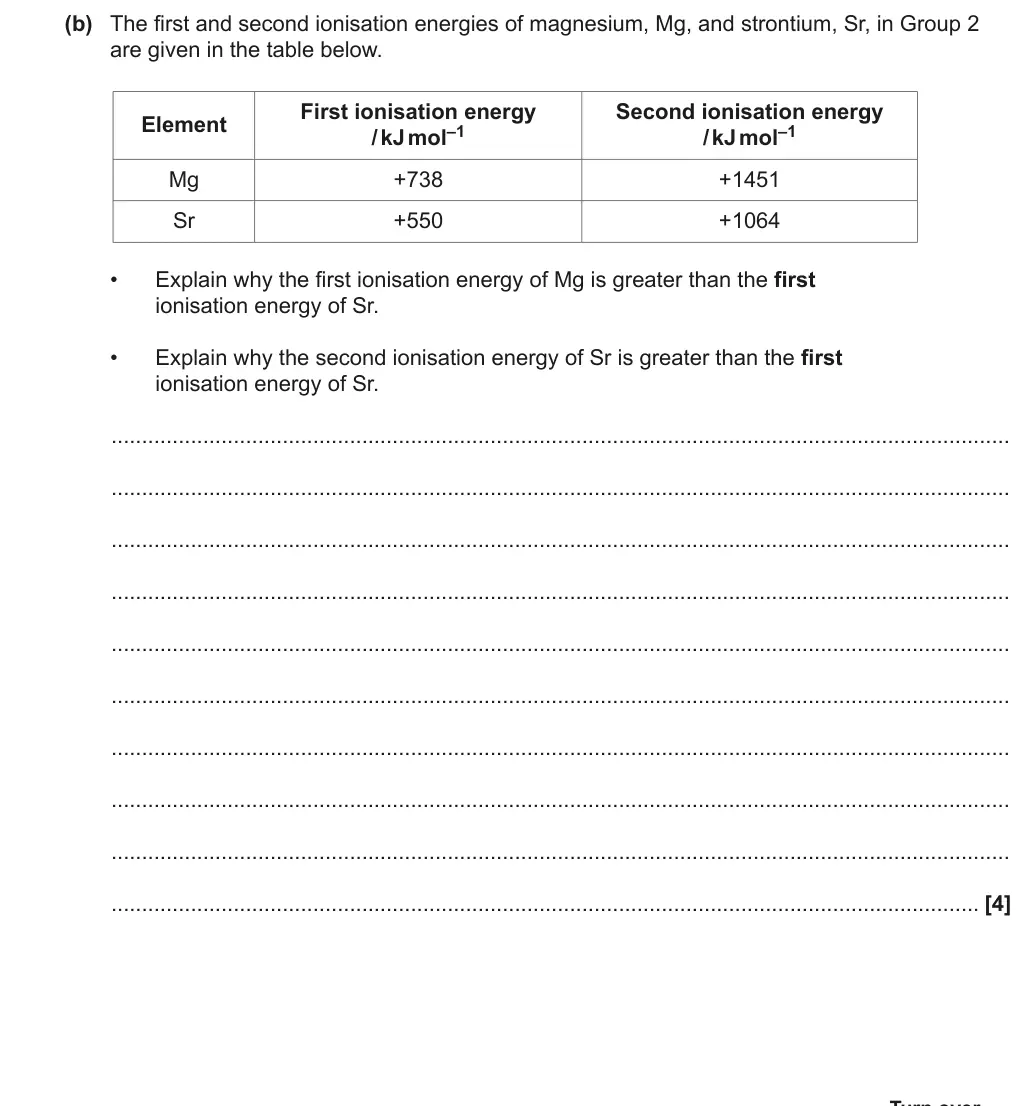
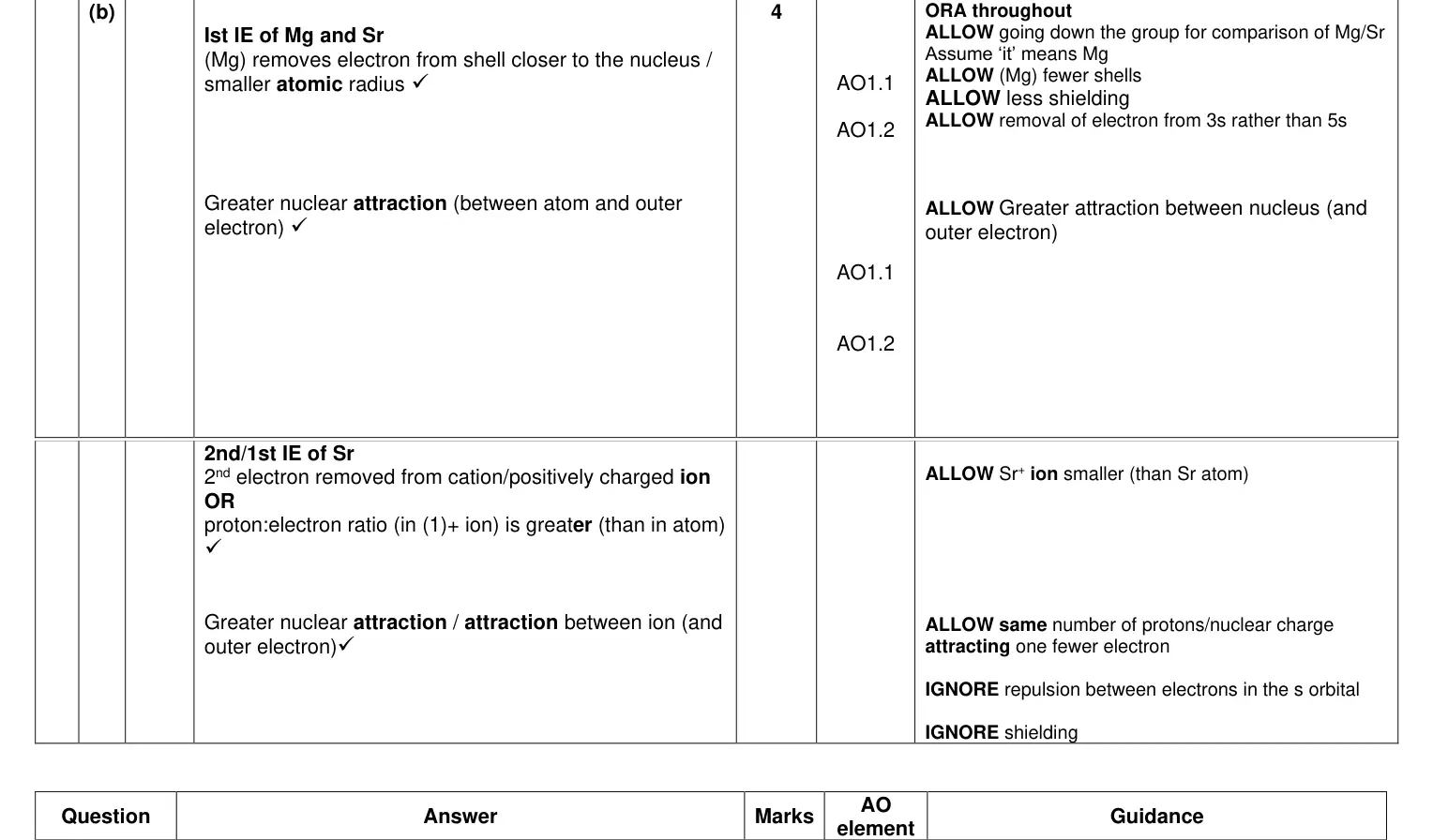
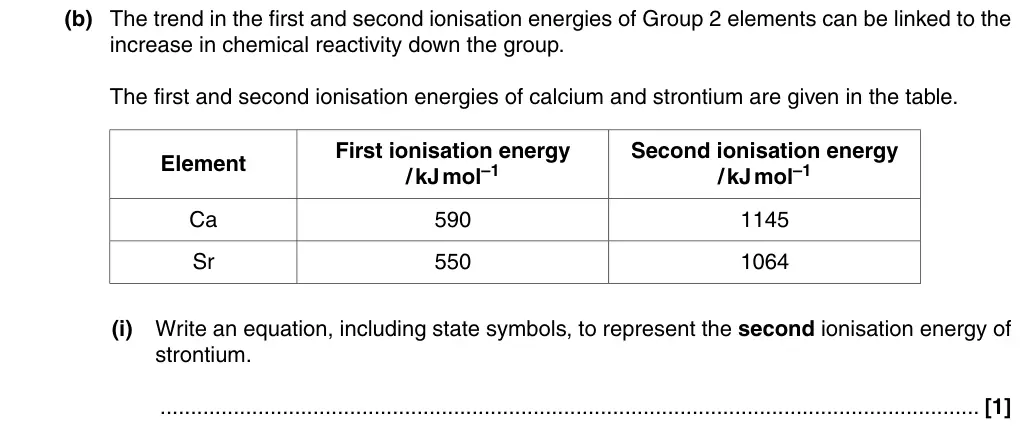
Most candidates were able to explain why the first ionisation energy of Mg is greater than that of Sr due to the Mg’s smaller atomic radius/less shielding and therefore increased nuclear attraction. Candidates should be reminded that there is no requirement to restate the question in their answers. Terminology is important and some candidates lost marks as they referred to nuclear radius instead of atomic radius. However, most candidates did not recognise that the second ionisation energy of Sr involves removing an electron from a +1 ion and instead discussed the repulsion between electrons in the s orbital. Atomic radius instead of ionic radius was often seen when discussing the Sr+ ion. Some candidates were still referring to Mg in this part of their answer and they should be advised to reread the question between each part to remain focused on the requirement.
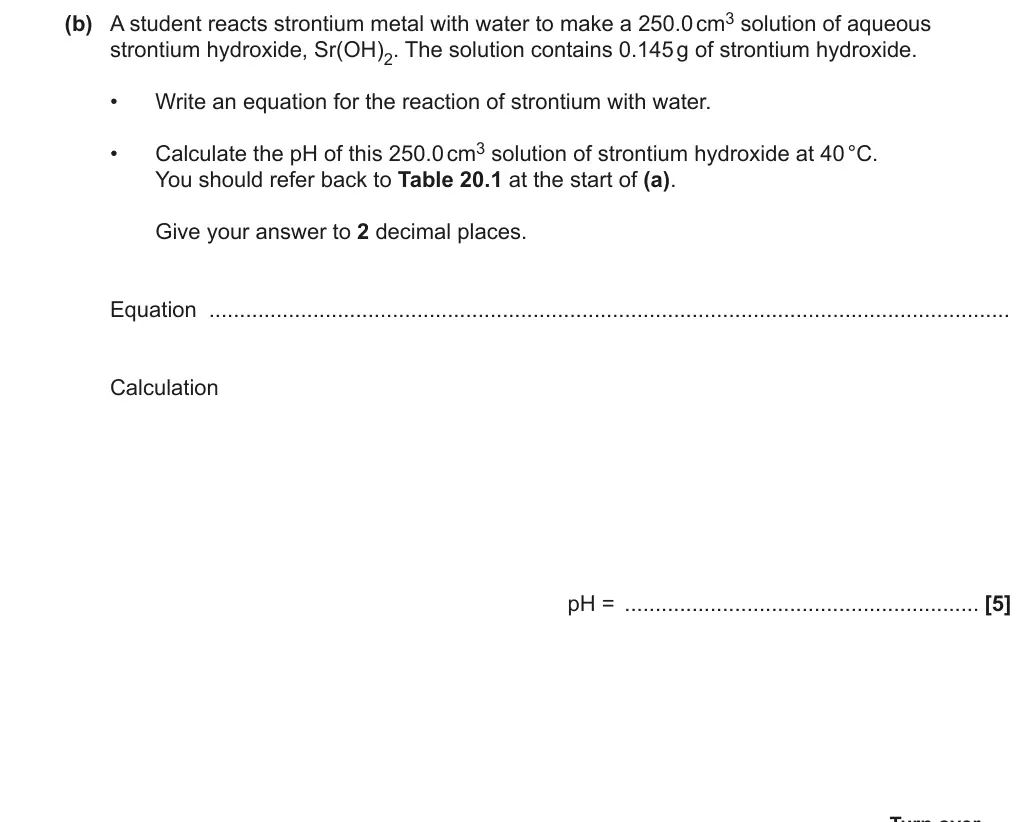
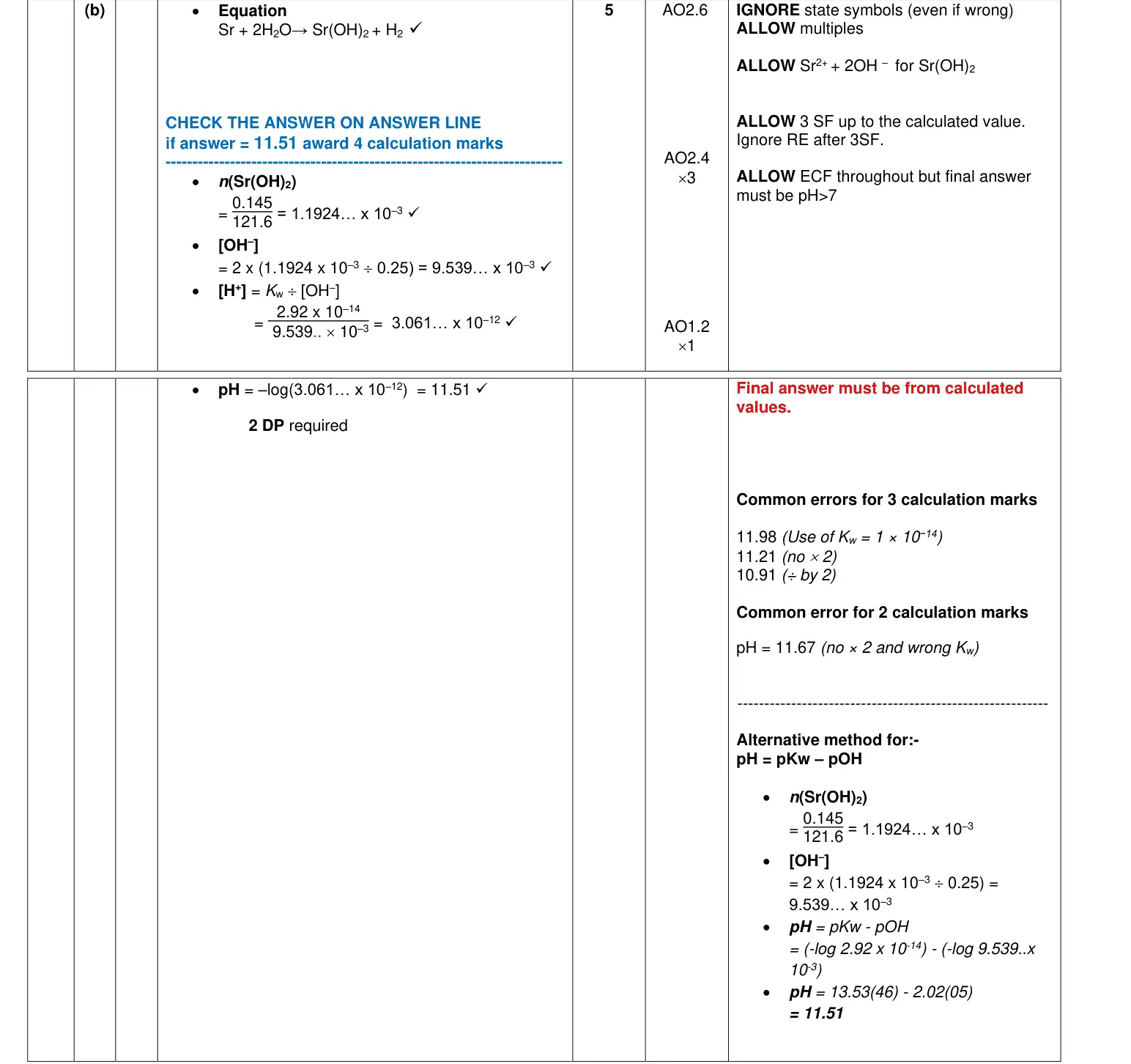
Most candidates wrote the correct equation. Common errors were using Sr2+ as reactant, not balancing the H2O and not having the H2 as second product. Most candidates calculated the moles of Sr(OH)2 correctly but fewer recognised that [OH-] = twice the [Sr(OH)2]. As a result, most candidates scored 3 calculation marks. A few candidates chose the incorrect Kw value.
Skills: M0.2 Use ratios, fractions and percentages; M0.4 Use calculators to find and use power, exponential and logarithmic functions; M2.3 Substitute numerical values into algebraic equations using appropriate units for physical quantities; M2.5 Use logarithms in relation to quantities that range over several orders of magnitude
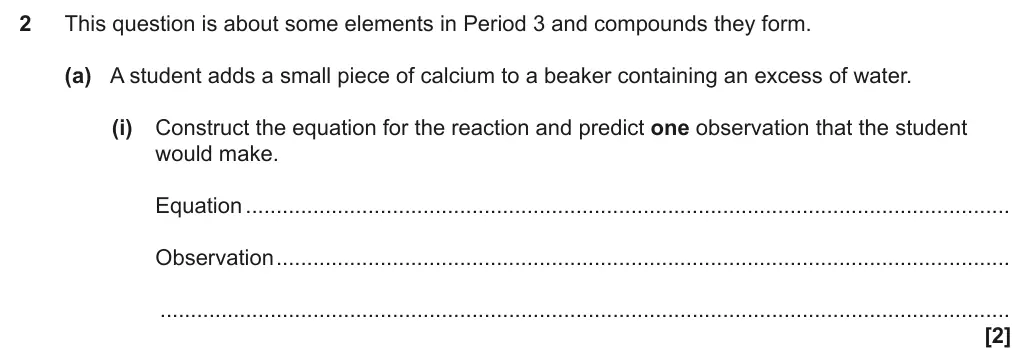
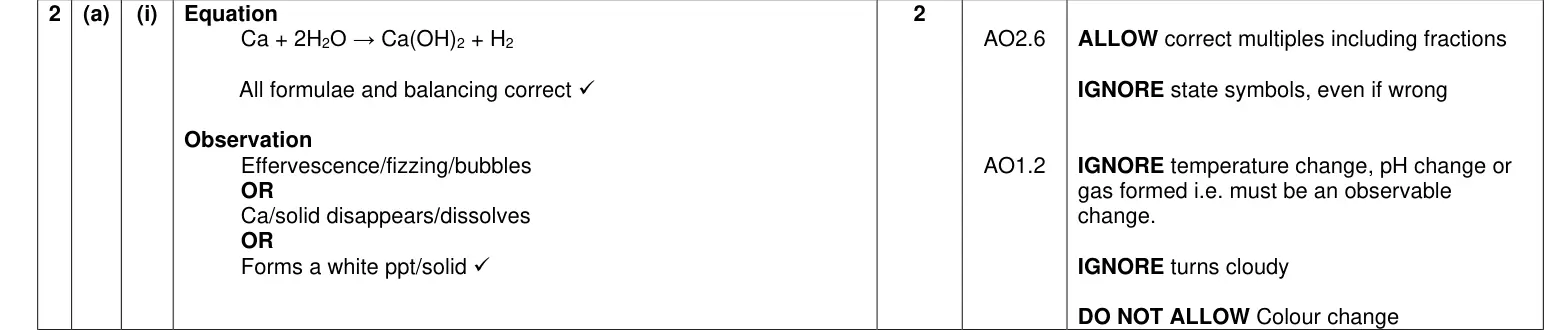
Most candidates scored the mark for the correct observation. A few said what would happen rather than what they would see, e.g. gas is formed, pH would increase, mass lost or even reference to the ‘squeaky pop’ test. Many struggled to give the correct balanced equation with either CaO being given as a product or incorrect balancing. Many did not have a gas produced but then had bubbling as an observation.

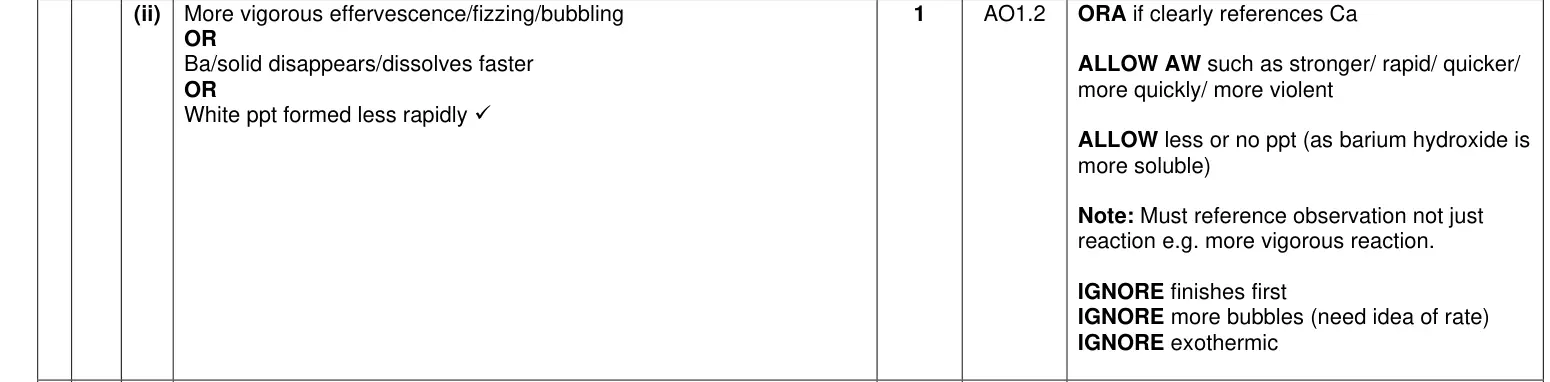
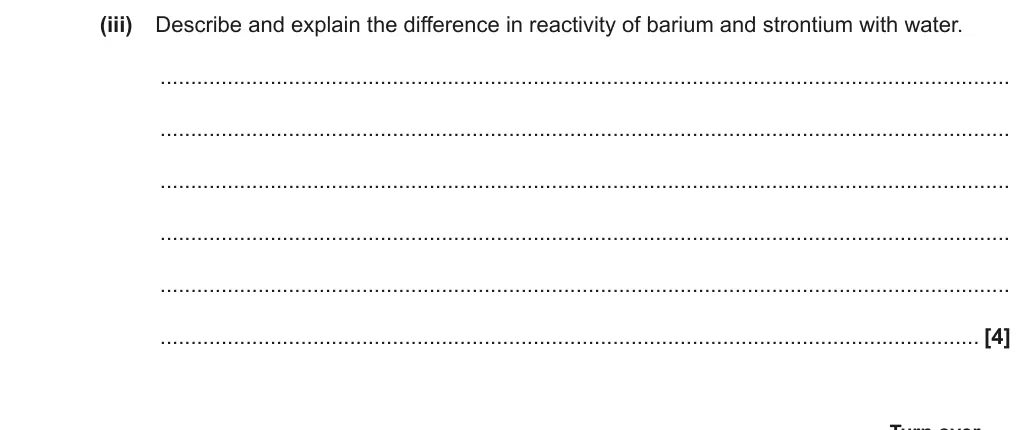
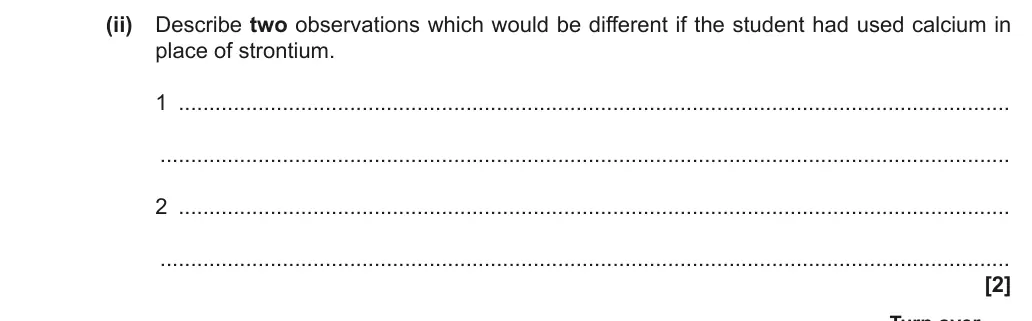
Responses not about observations were very common, e.g. more vigorous reaction, Ba is more reactive. Some described Ba as being less reactive. Many responses did not include the idea of rate (for example, ‘more bubbles’) or were not comparative (for example, ‘vigorous bubbling’).
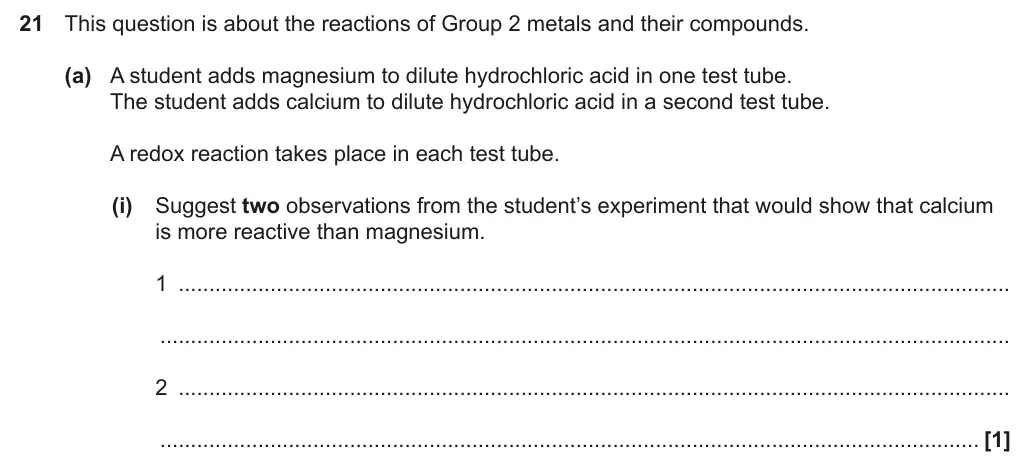
Very few candidates made two valid statements where both clearly indicated an idea of relative rate – in almost all cases one of the descriptions would be about quantity of gas rather than rate of gas production. Some candidates identified a precipitate being formed, colour change, or gave a general answer of the reaction happening quicker.

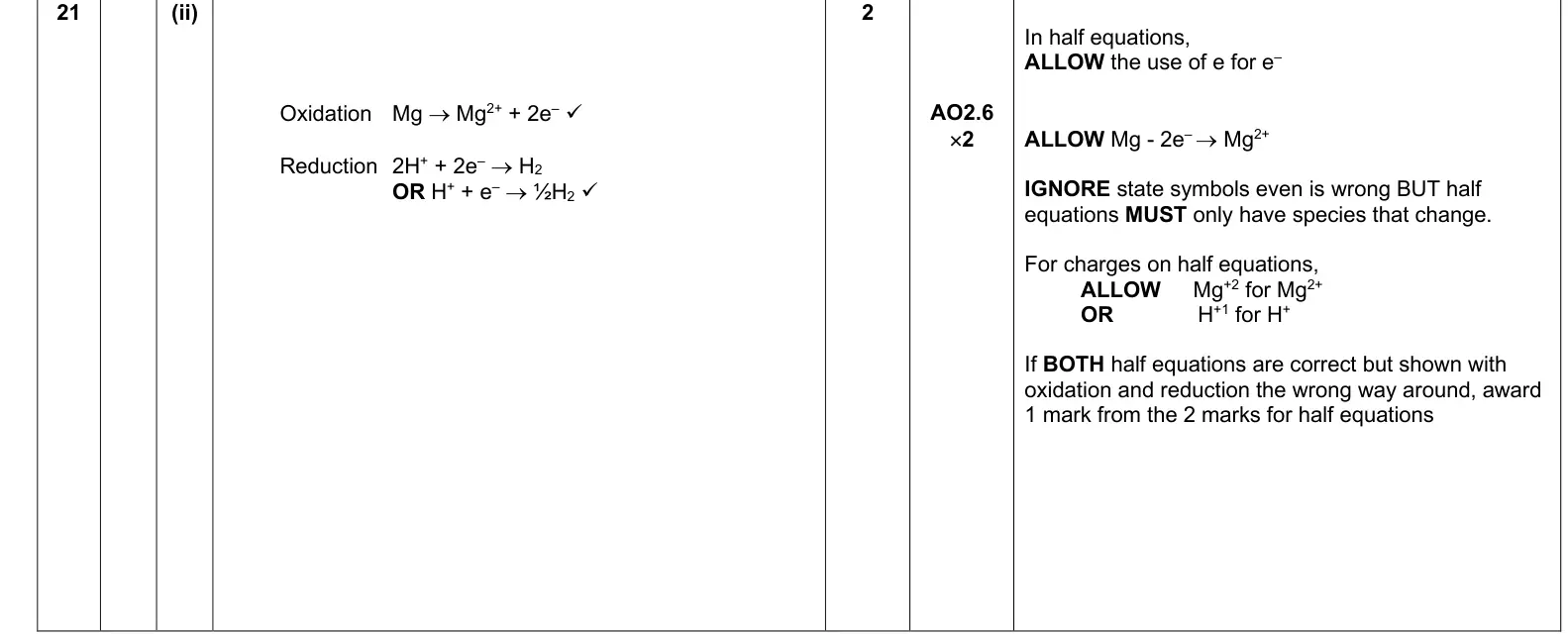
Some candidates coped well with this question which was based on the AS part of the specification and gained both marks. More candidates gained 1 mark through writing one half equation, usually the oxidation of magnesium. Common errors were for chlorine to featuring in the reduction half equation and the lack of electrons in their answers. Very few candidates mixed up the oxidation and reduction equations.
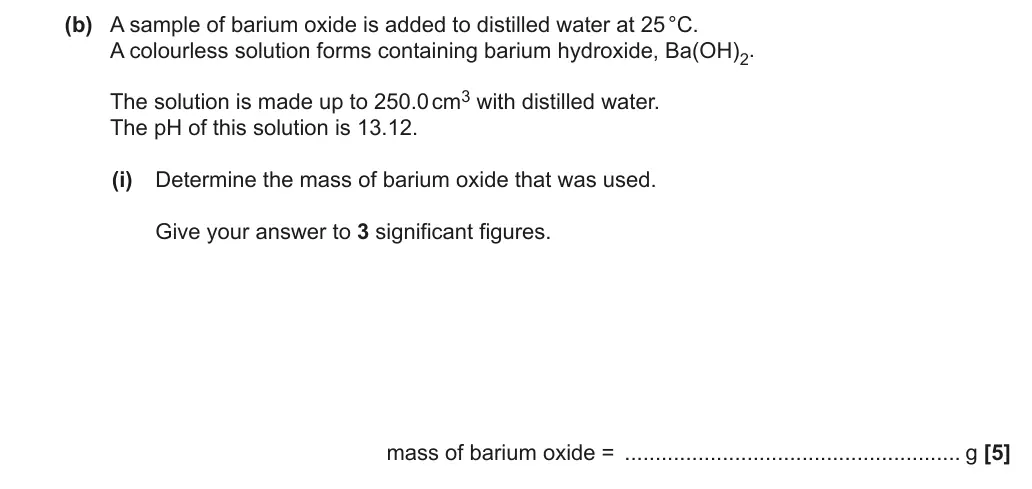
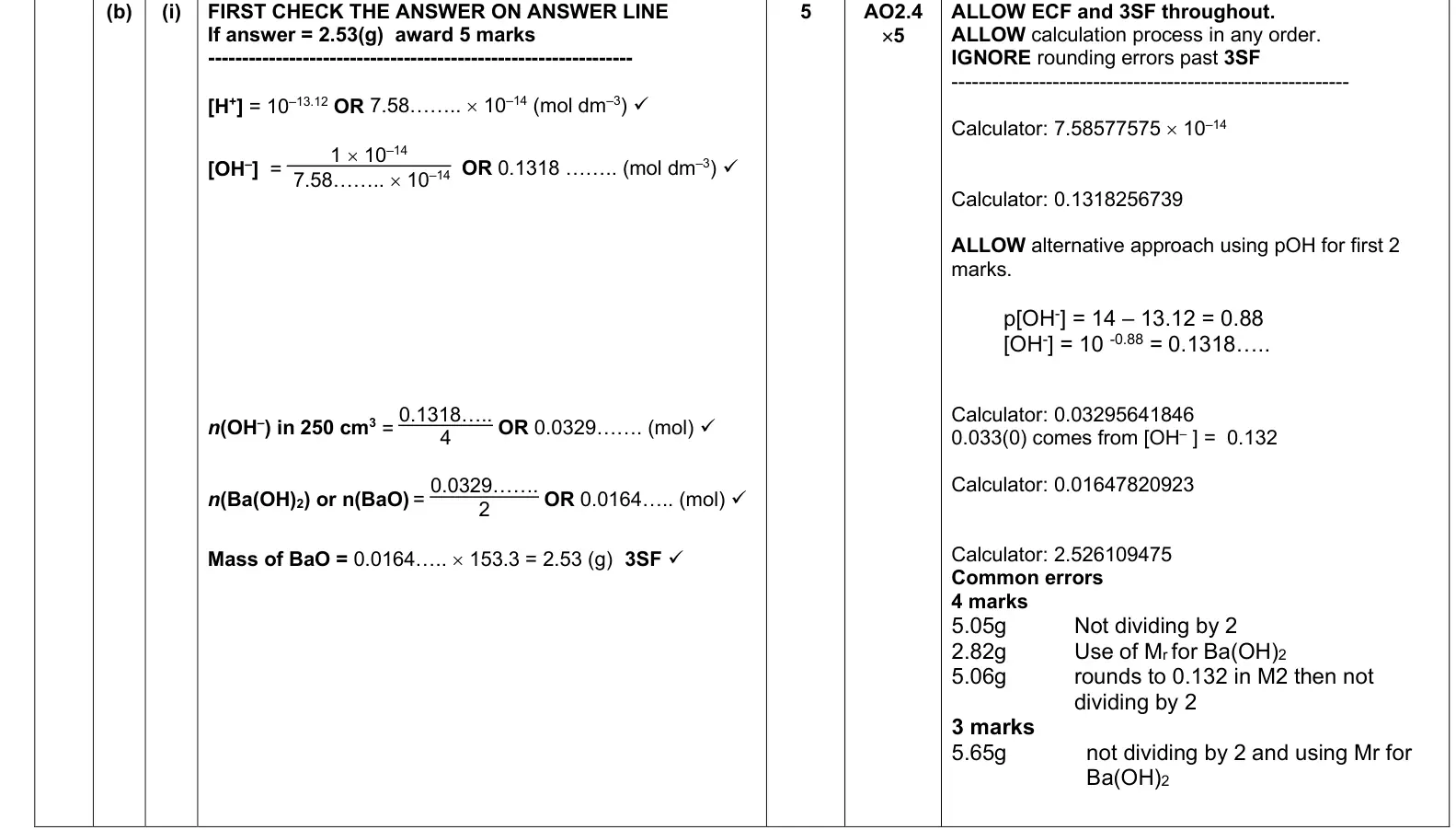
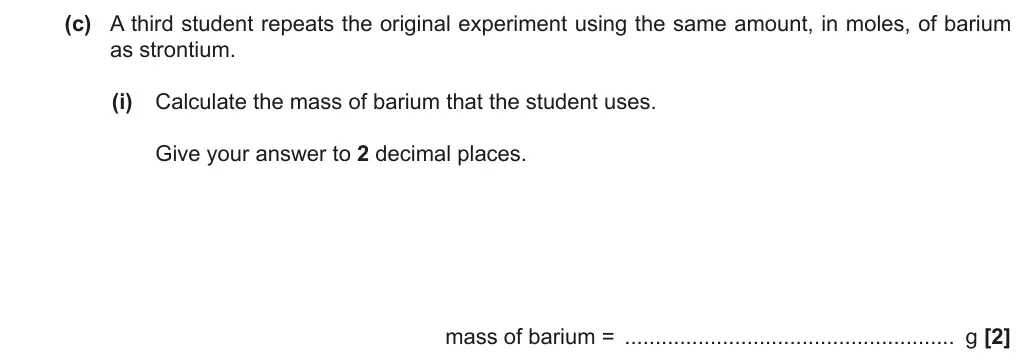
Although few candidates got the correct final answer, however almost all achieved some marks from this calculation through error carried forward, with marks spread across the available range. Almost all candidates were able to find the concentrations of hydrogen and hence hydroxide ions. A few candidates successfully used p[OH-] method. Most were able to calculate the moles of hydroxide ions in 250cm3. Many then did not realise the need to half this number to find the moles of barium, and/or used the Mr for barium hydroxide instead of barium oxide.
Skills: M0.2 Use ratios, fractions and percentages; M0.4 Use calculators to find and use power, exponential and logarithmic functions; M1.1 Use an appropriate number of significant figures; M2.5 Use logarithms in relation to quantities that range over several orders of magnitude
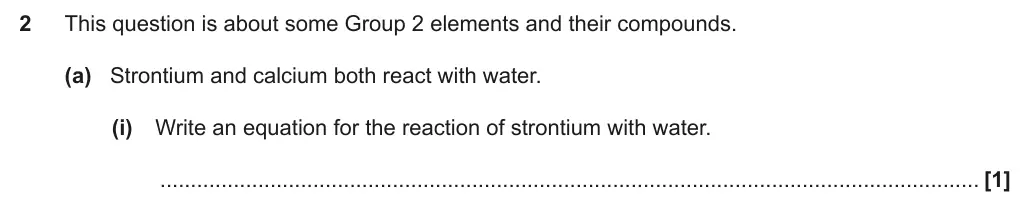
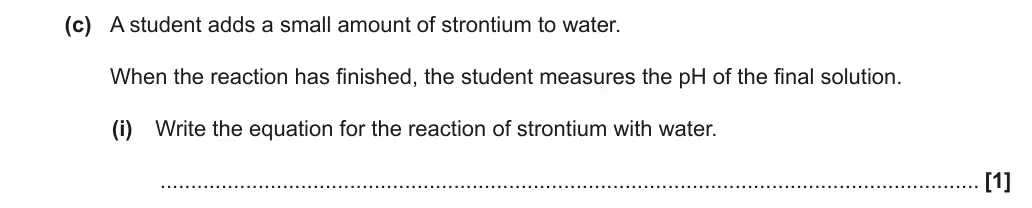
Around half of all candidates did not score this mark. The most common error was giving SrO as the product rather than the hydroxide. Other errors included incorrect balancing (missing 2 on H2O, SrOH as the formula of the hydroxide and no hydrogen formed (often giving H2O instead)).
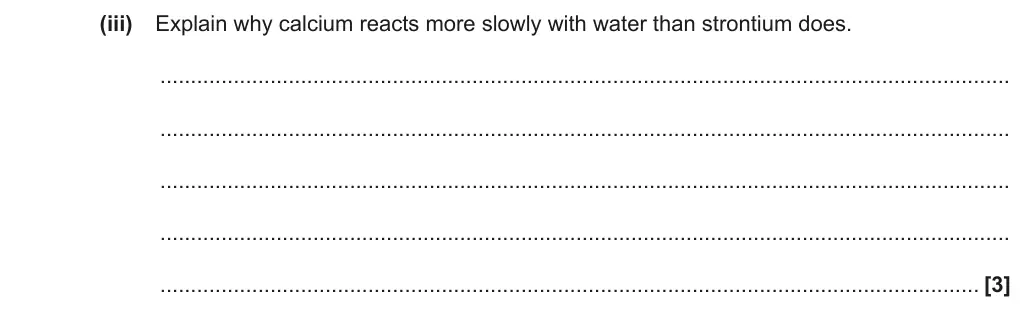
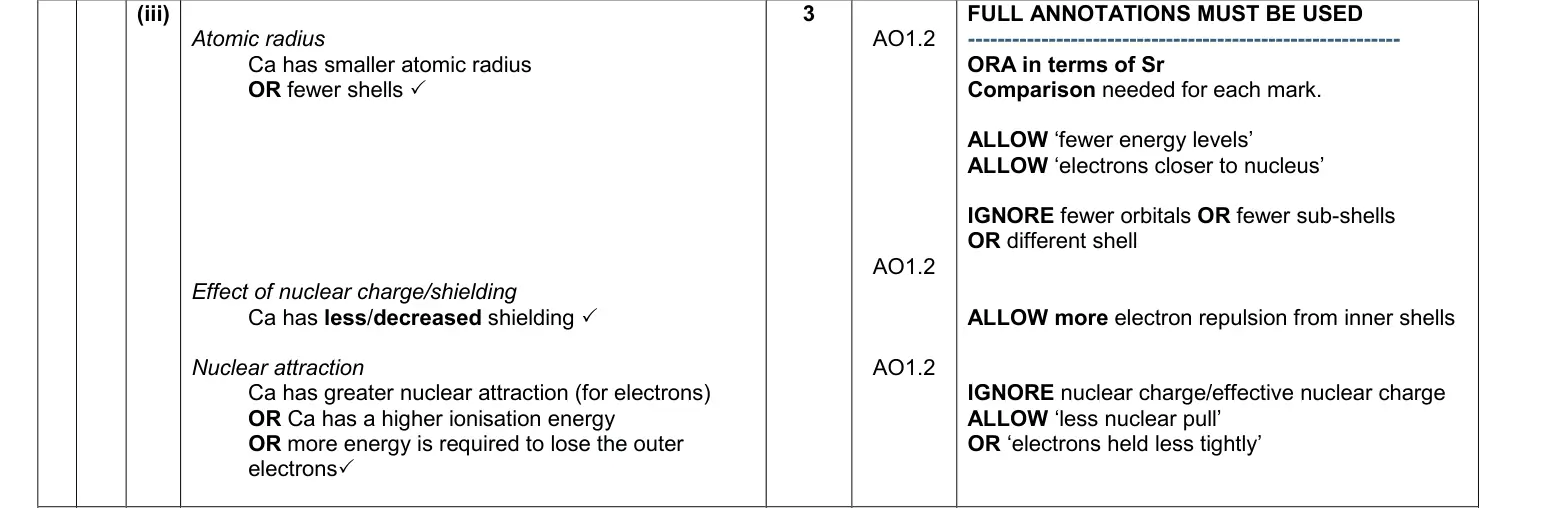
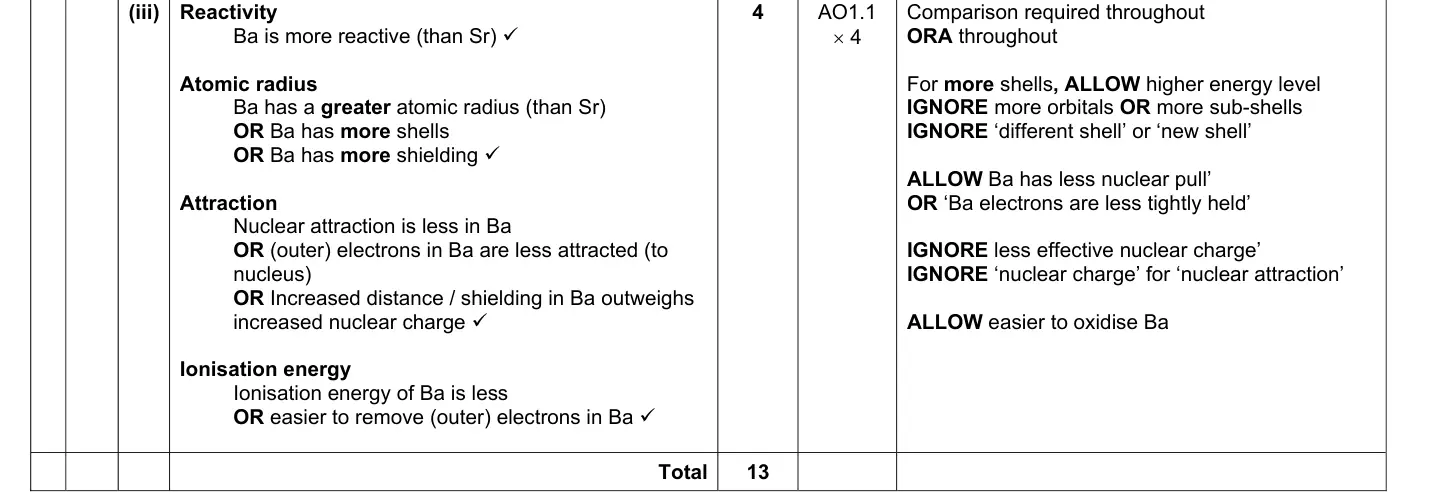
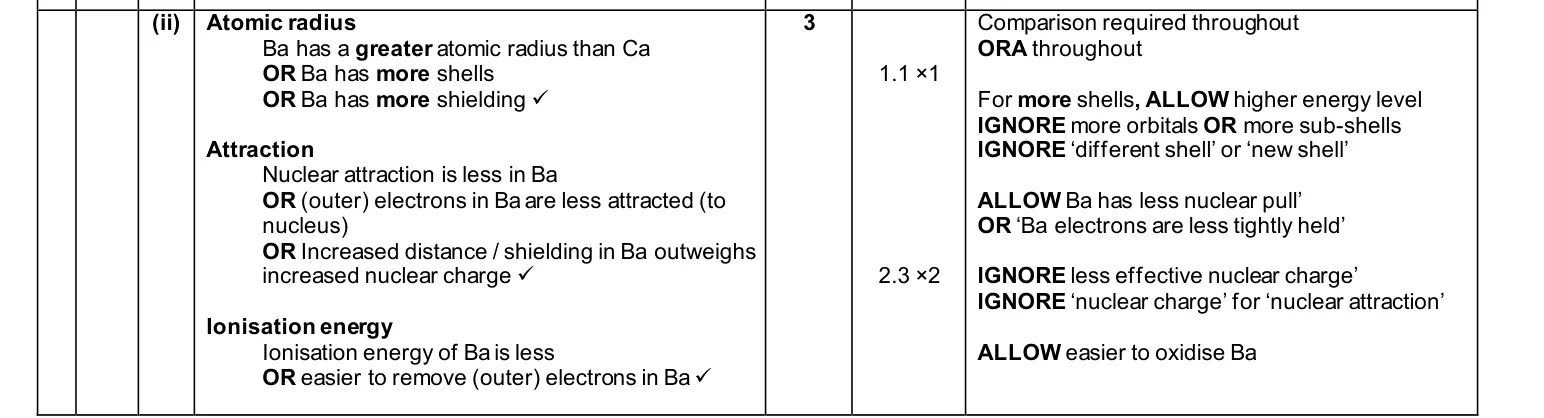
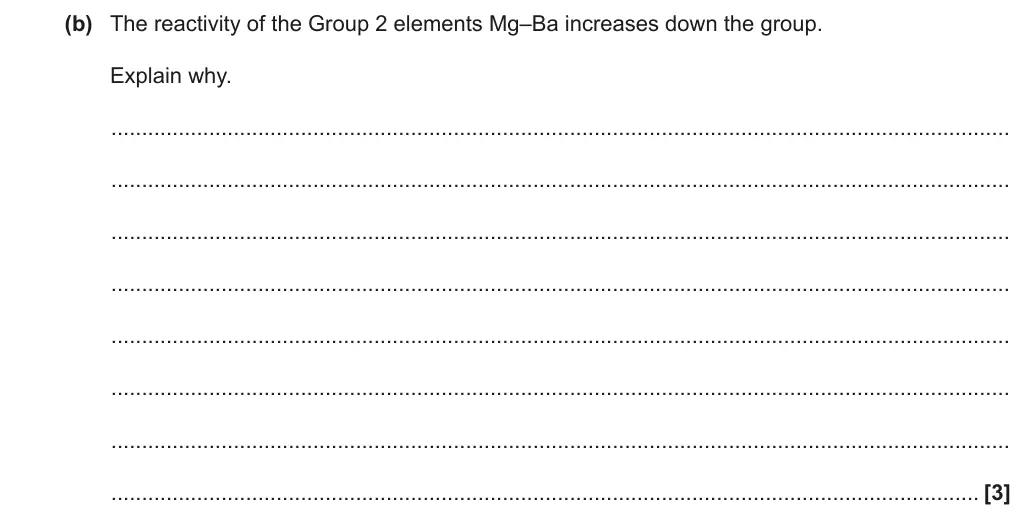
Most candidates gained some marks here although a significant proportion were unable to score all 3 marks covering atomic radius, shielding, nuclear attraction/IE. The mark most often missed was for shielding. Some candidates did not answer the question asked and gave the trend down the group so could not be given marks unless they made it clear Sr is below Ca in the group. Care must be taken to answer question asked not similar questions they have seen before. The best responses were those with direct comparative statements, e.g. “Ca has a smaller atomic radius than Sr”. It is worth noting that harder/easier to lose electrons didn’t gain marks, but was seen fairly frequently, as response needs to be in terms of energy required or linked to nuclear attraction.
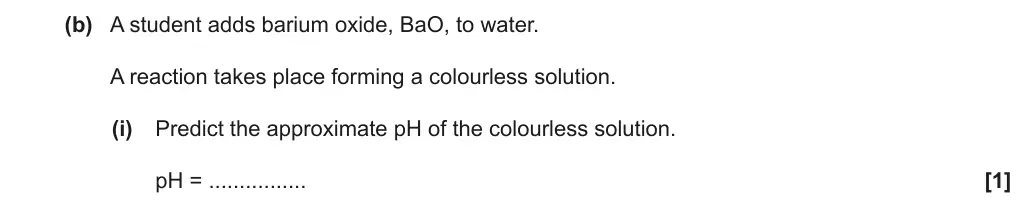
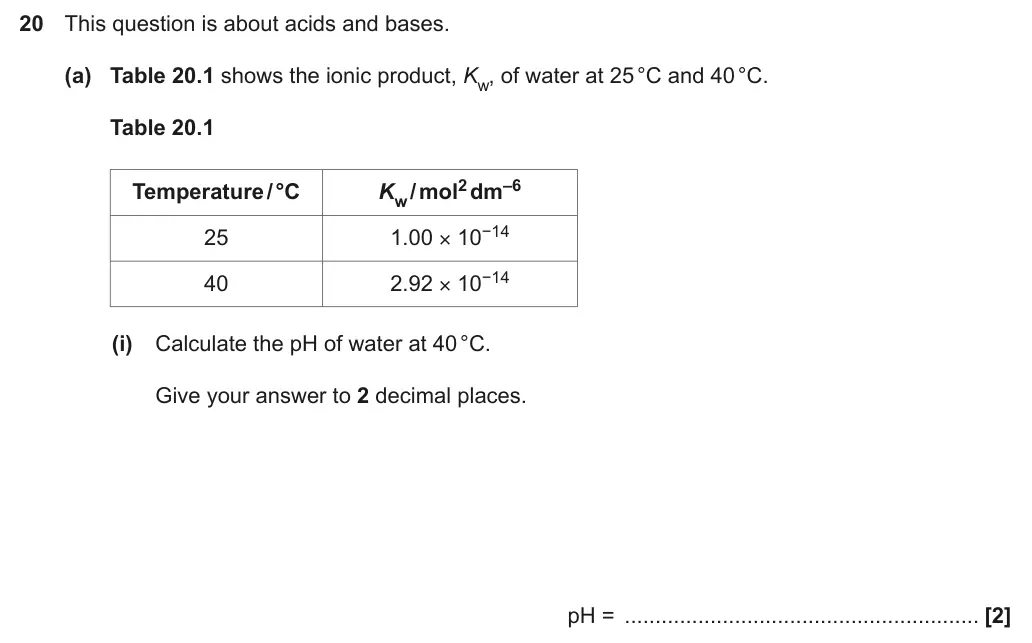
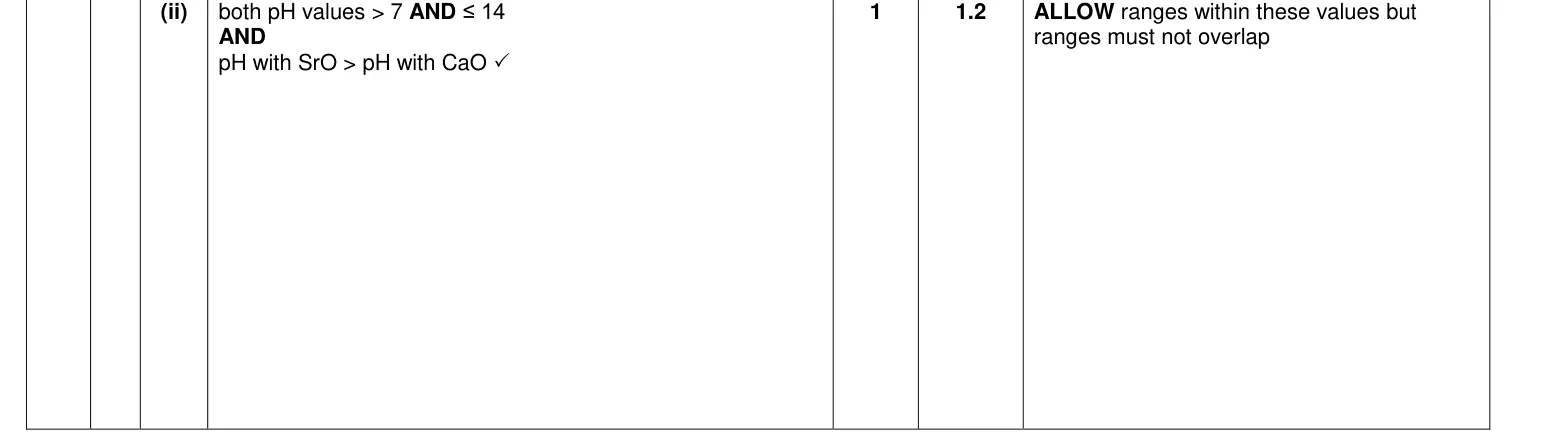
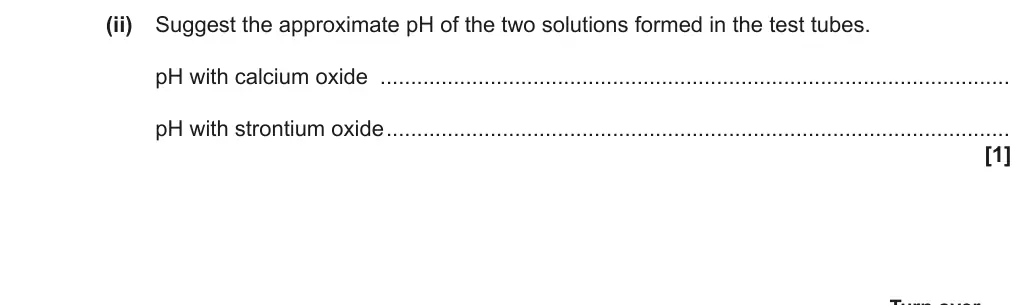
Most candidates gained this mark. The most common incorrect response was pH 7 with a few giving a pH value of less than 7.

Skills: M3.1 Translate information between graphical, numerical and algebraic forms
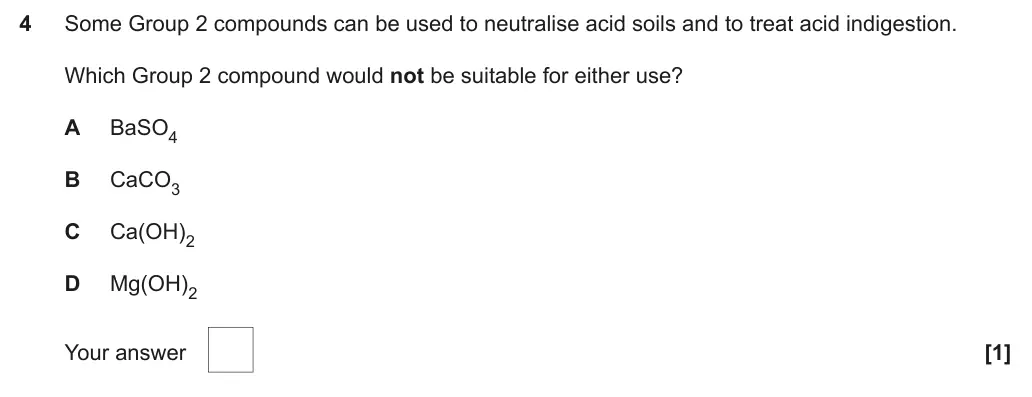
A
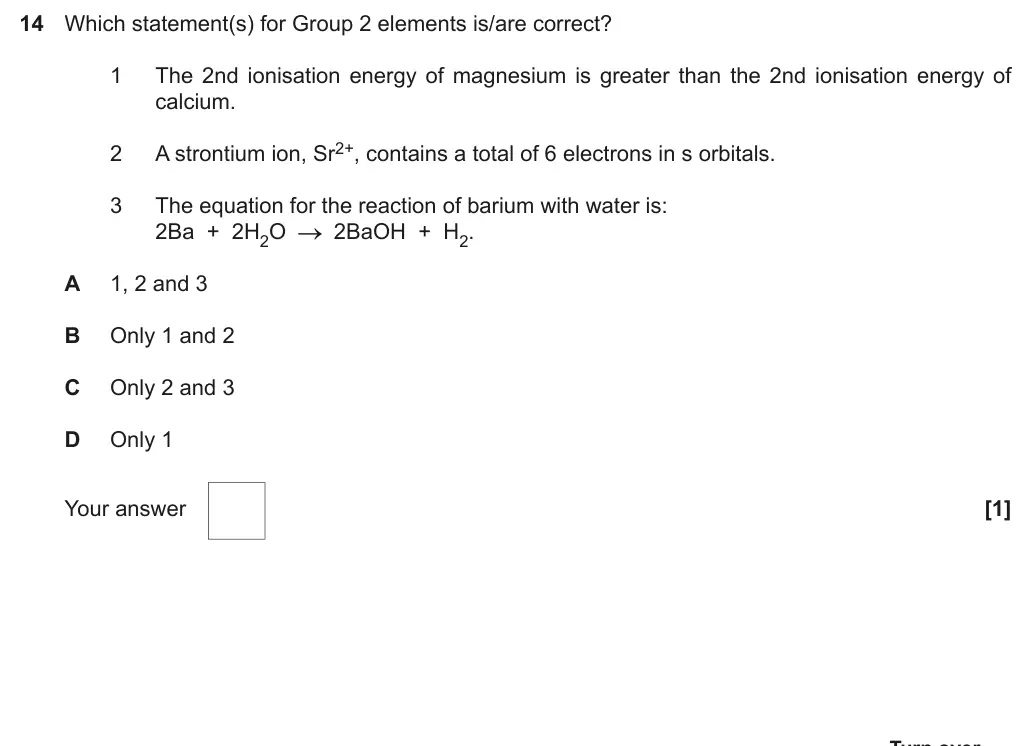
D
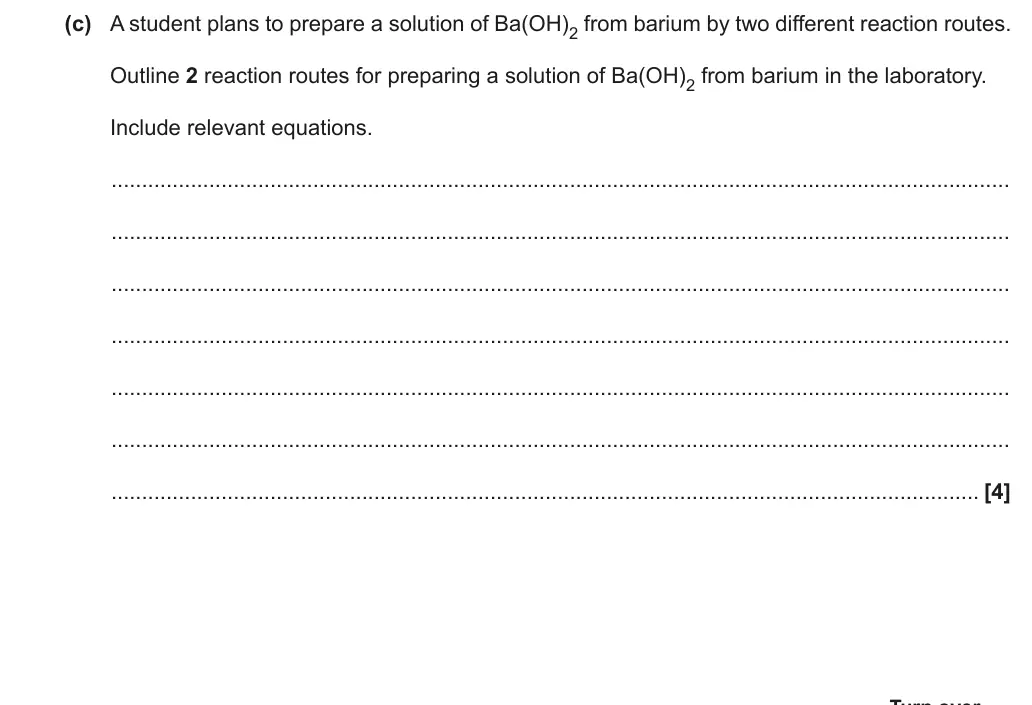
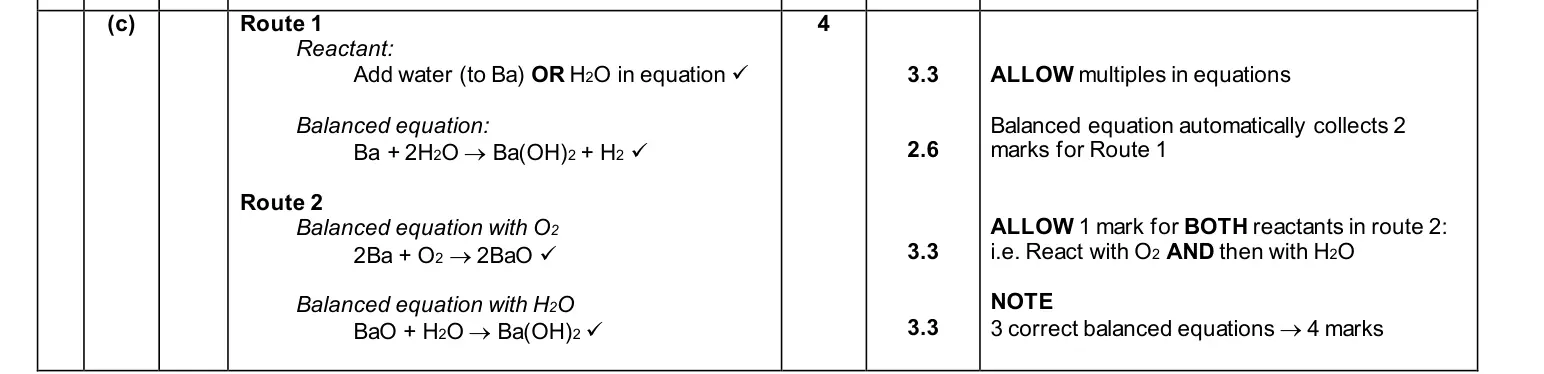
23(a) This question required candidates to calculate the moles of Ba(OH)2 in 100 cm3, to scale this value up to 1 dm3 for the concentration of Ba(OH)2 and finally to multiply this value by 2 to obtain the concentration of OH– ions of 0.454 mol dm–3. This part discriminated extremely well. Lower-attaining candidates would often calculate an incorrect molar mass of Ba(OH)2 and scale up by either 10 or 2. The commonest incorrect answer seen was 0.227, half of the correct answer by omitting the ×2 stage. Most candidates did supply their final answer to the required 3 significant figures. As with all calculations, candidates should round once, at the end of the calculation. Rounding of intermediate values can lead to significant rounding errors. Sometimes, intermediate values were rounded to 2 significant figures when the final value required 3. This use of maths will almost certainly lead to a rounding error in the final answer. Candidates should show clear working so that credit can be given for such responses by applying error carried forward. Many candidates produced largely unreferenced numbers. 23(b) Many candidates seemed to be unfamiliar with the term ‘concordant titres’. Acceptable responses were ‘within 0.1 cm3 and within 0.05 cm3. Common incorrect answers for this important term included ‘the closest titres’, ‘similar titres’, ‘repeated titres’ and ‘within 0.5 cm3’. 23(c) Many candidates were able to calculate the amount of HNO3 in the titration as 4.28 × 10⁻³ mol. Most candidates were credited for the amount of Ba(OH)2 as 2.14 × 10⁻³ mol, half the calculated amount of HNO3. Candidates then need to scale up this value by 1000/25 to obtain the concentration as 0.0856 mol dm–3. Unlike Q23(a), all intermediate calculations gave values to 3 significant figures. Candidates found this stock titration calculation easier than the more unfamiliar 23(a), with many scoring all 3 marks. Discrimination was extremely good, but about a third of candidates did not receive any marks. Candidates should be encouraged to practise stock titration calculations as part of their preparation for the examinations. Candidates should show clear working so that credit can be given for such responses by applying error carried forward. As with Q23(a), many candidates produced largely unreferenced numbers. 23(d) Candidates often find questions linked to practical work challenging. The two reaction routes involving Group 2 reactions are drawn directly from the specification: the reaction of barium with water, and the reaction of barium with oxygen, followed by water. Most candidates found this difficult, and the one-step route using barium and water was seen far more often than the two-step oxygen then water approach. Only the highest-attaining candidates were able to suggest two routes, with scores of 3/4 or 4/4 marks being comparatively rare. As with 21(c)(ii) and 25c(iii), candidates had difficulty in interpreting provided information. OCR support Our new practical question packs, split up by PAG, provide additional opportunities for students to practise questions relating to practical work. They are available on Interchange: https://interchange.ocr.org.uk/Downloads/H432_H433_Chemistry_PAG_ Practice_Question_Sets.zip
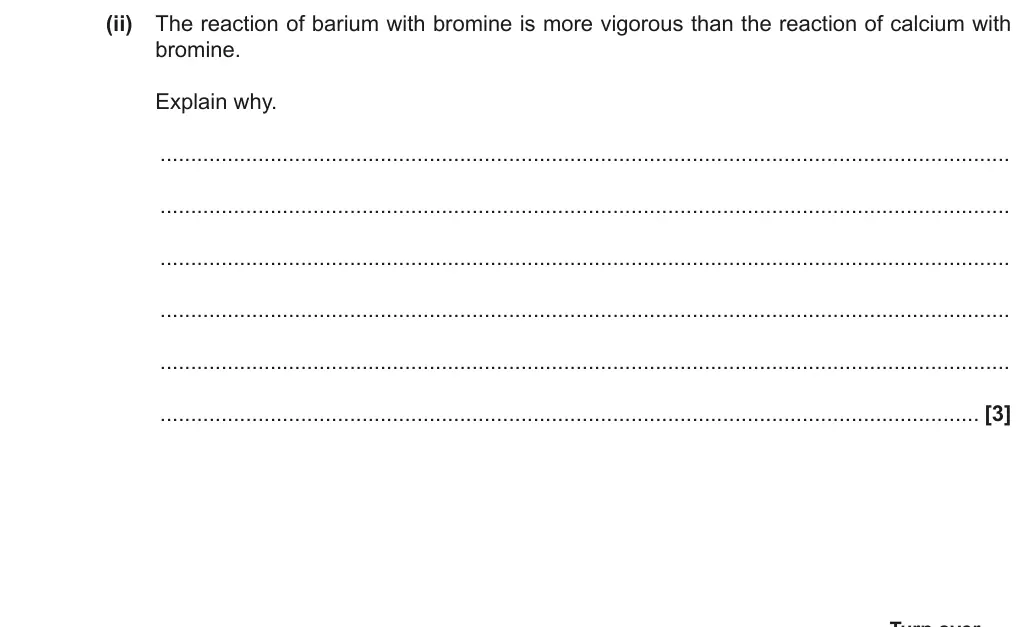
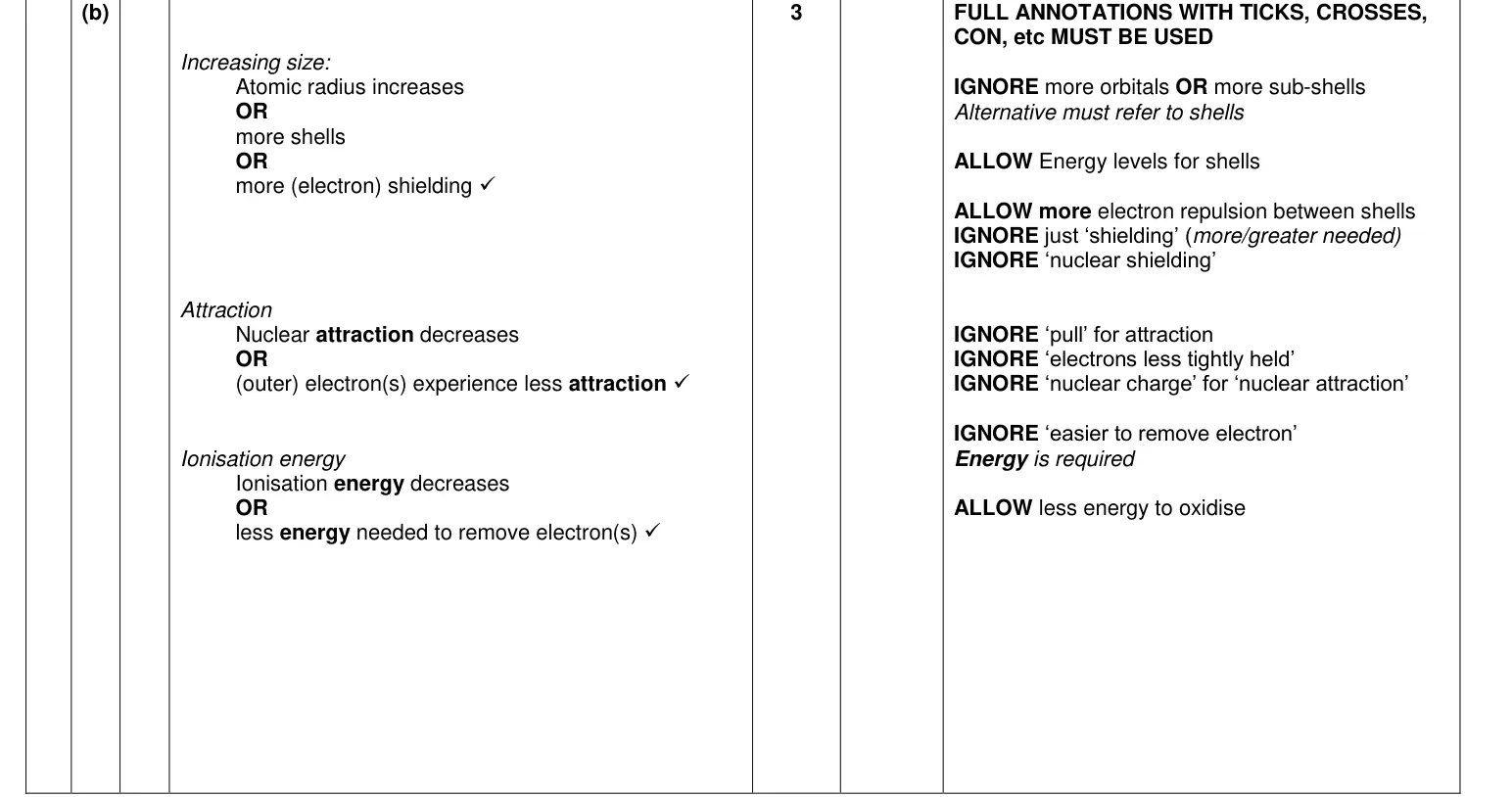
For example, Question 1(a) justified using oxidation numbers rather than numbers of electrons and Question 3(b)(ii) giving the general trend in group 2 rather than comparing Ba and Ca.
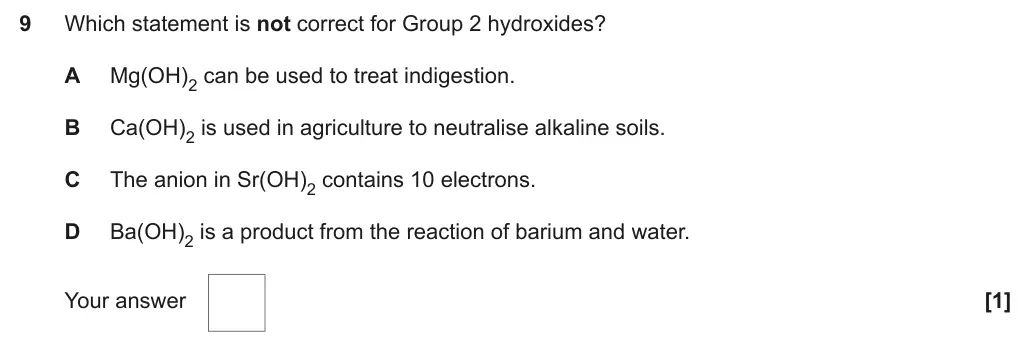
B
This question was not well answered, with many candidates giving option C rather than the correct answer of B. Many candidates mis-read option B as acidic soil rather than alkaline soil, so thought that option B was correct, whereas in fact it was the only incorrect statement. Many candidates opted for option C, not realising the anion is OH– which does have 10 electrons.
A LEVEL CHEMISTRY A Examiners’ report H432/01 Summer 2019 series Version 1 H432 For first teaching in 2015 www.ocr.org.uk/science Contents Introduction .............................................................................................................................................. 4 Paper 1 series overview ........................................................................................................................... 5 Section A overview ................................................................................................................................... 6 Question 2 ............................................................................................................................................ 6 Question 3 ............................................................................................................................................ 6 Question 4 ............................................................................................................................................ 7 Question 5 ............................................................................................................................................ 7 Question 6 ............................................................................................................................................ 8 Question 8 ............................................................................................................................................ 8 Question 9 ............................................................................................................................................ 9 Question 10 .......................................................................................................................................... 9 Question 11 ........................................................................................................................................ 10 Question 13 ........................................................................................................................................ 10 Question 14 ........................................................................................................................................ 11 Question 15 ........................................................................................................................................ 11 Section B overview ................................................................................................................................. 12 Question 16 (a) ................................................................................................................................... 12 Question 16 (b) ................................................................................................................................... 12 Question 16 (c) (i) ............................................................................................................................... 12 Question 16 (c) (ii) .............................................................................................................................. 13 Question 16 (d) (i) ............................................................................................................................... 14 Question 16 (d) (ii) .............................................................................................................................. 15 Question 16 (e) (i) ............................................................................................................................... 16 Question 16 (e) (ii) .............................................................................................................................. 16 Question 17 (a) ................................................................................................................................... 17 Question 17 (b) ................................................................................................................................... 19 Question 18 (a) (i) ............................................................................................................................... 20 Question 18 (a) (ii) .............................................................................................................................. 20 Question 18 (a) (iii) ............................................................................................................................. 21 Question 18 (a) (iv) ............................................................................................................................. 22 Question 18 (a) (v) .............................................................................................................................. 22 Question 18 (b) (i) ............................................................................................................................... 22 Question 18 (b) (ii) .............................................................................................................................. 23 Question 18 (c) (i) ............................................................................................................................... 24 Question 18 (c) (ii) .............................................................................................................................. 24 Question 19 (a) (i) ............................................................................................................................... 25 Question 19 (a) (ii) .............................................................................................................................. 25 Question 19 (a) (iii) ............................................................................................................................. 26 Question 19 (b) (i) ............................................................................................................................... 26 Question 19 (b) (ii) .............................................................................................................................. 27 Question 19 (b) (iii) ............................................................................................................................. 27 Question 19 (b) (iv) ............................................................................................................................. 28 Question 19 (c) (i) ............................................................................................................................... 28 Question 19 (c) (ii) .............................................................................................................................. 29 Question 20 (a) ................................................................................................................................... 29 Question 20 (b) (i) ............................................................................................................................... 30 Question 20 (b) (ii) .............................................................................................................................. 30 Question 20 (b) (iii) ............................................................................................................................. 31 Question 20 (b) (iv) ............................................................................................................................. 32 Question 20 (b) (v) .............................................................................................................................. 32 Question 20 (c) ................................................................................................................................... 33 Question 21 ........................................................................................................................................ 34 Introduction Our examiners’ reports are produced to offer constructive feedback on candidates’ performance in the examinations. Question 16 (c) (i) Question 16 (c) (ii) These two sub-questions were well answered.
These two sub-questions were well answered.
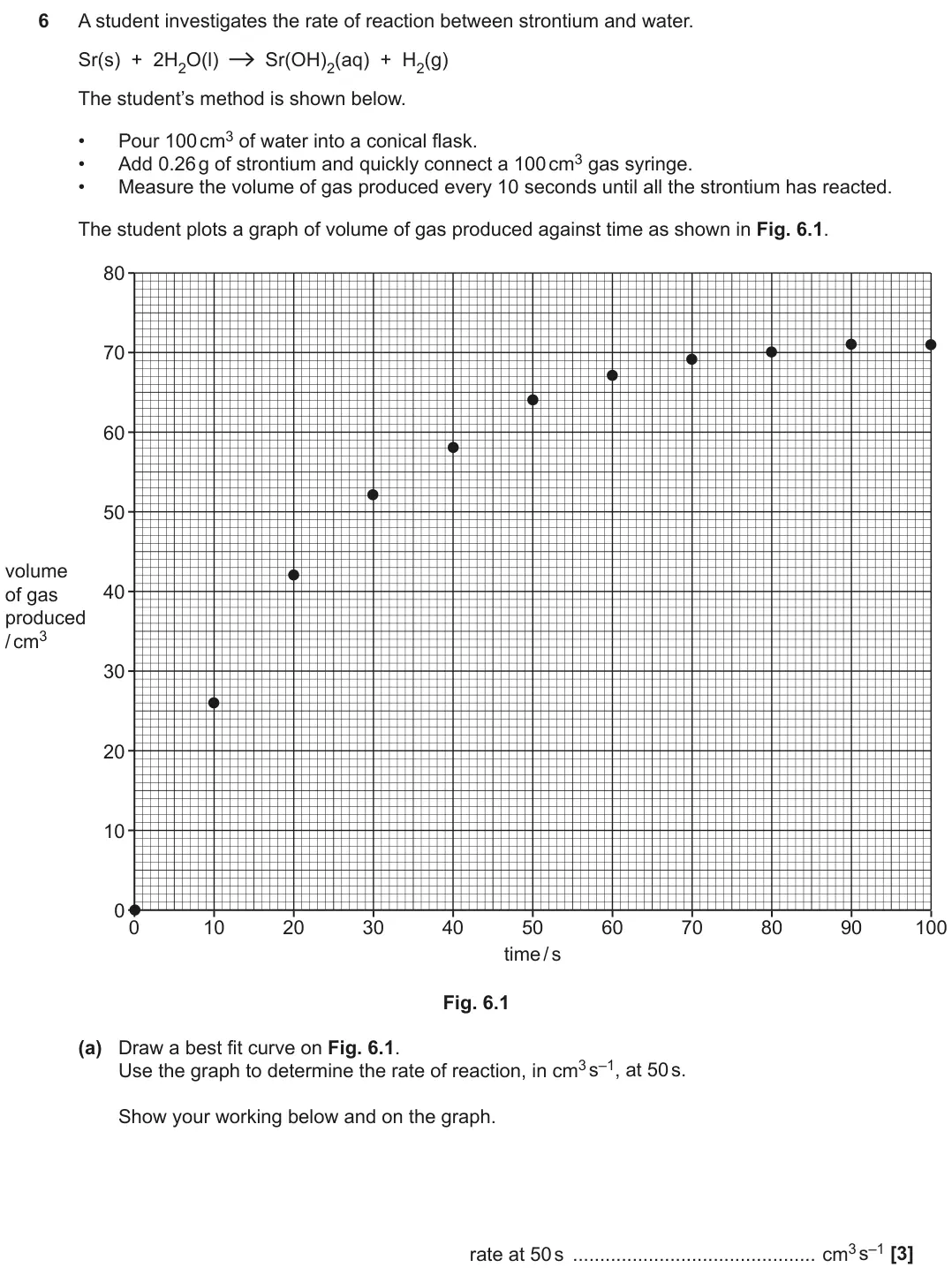
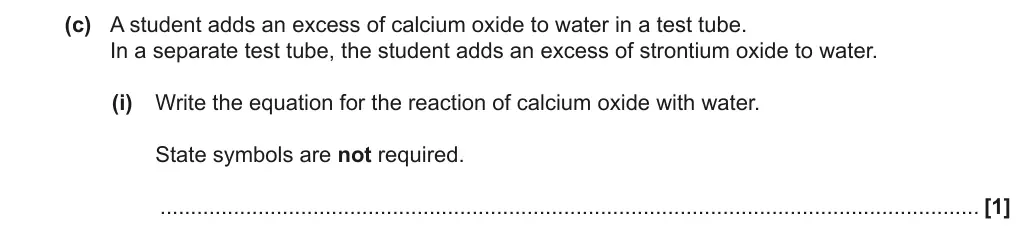
Nearly half of the candidates did not answer this question correctly, mainly because of incorrect balancing or the formation of strontium oxide instead of strontium hydroxide.
Most candidates were able to identify at least one difference, although a significant number of responses stated the opposite trend

Dropping marks on calculations, mechanisms or the six-markers? Book a trial session with a specialist OCR chemistry tutor.