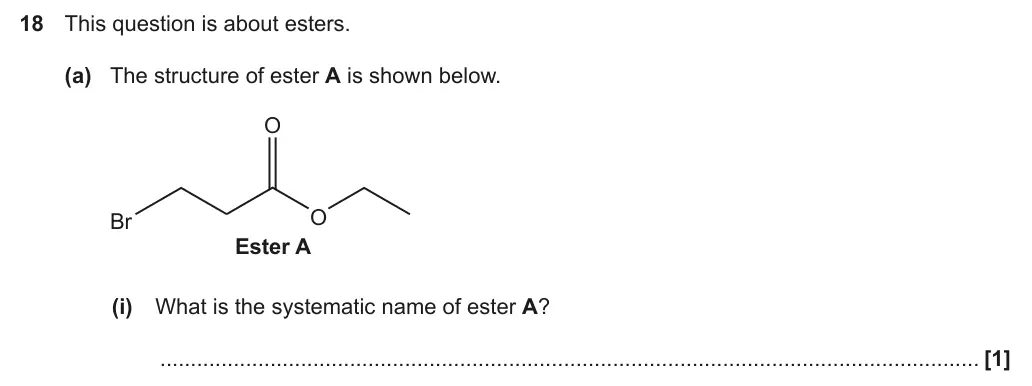
Structure and isomer questions

Draw or deduce a structure: skeletal and displayed formulae, stereoisomers, repeat units and the products of reactions. 83 questions.

Other types: Multiple-choice questions · Calculation questions · Equation questions · Mechanism questions · Six-mark level of response questions · Practical questions · Graph and data questions · Short-answer questions

June 2025 · AS Paper 1 · Q21(c) 3 marks Structure / isomer Medium periodicity
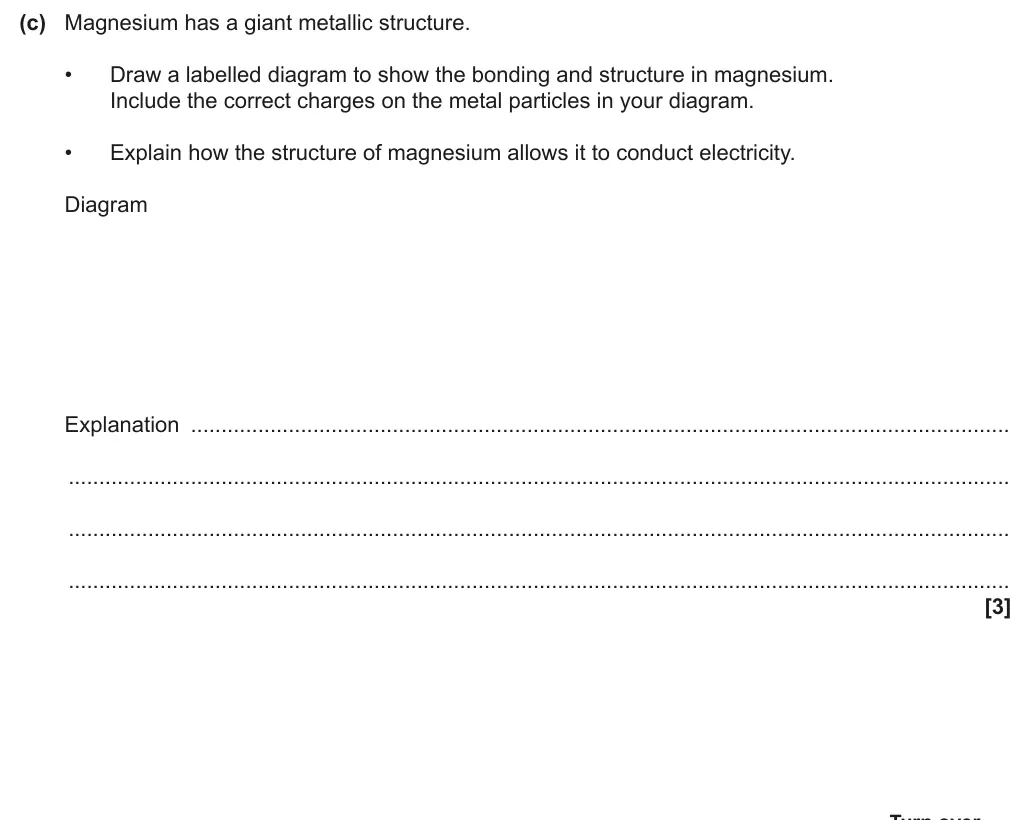
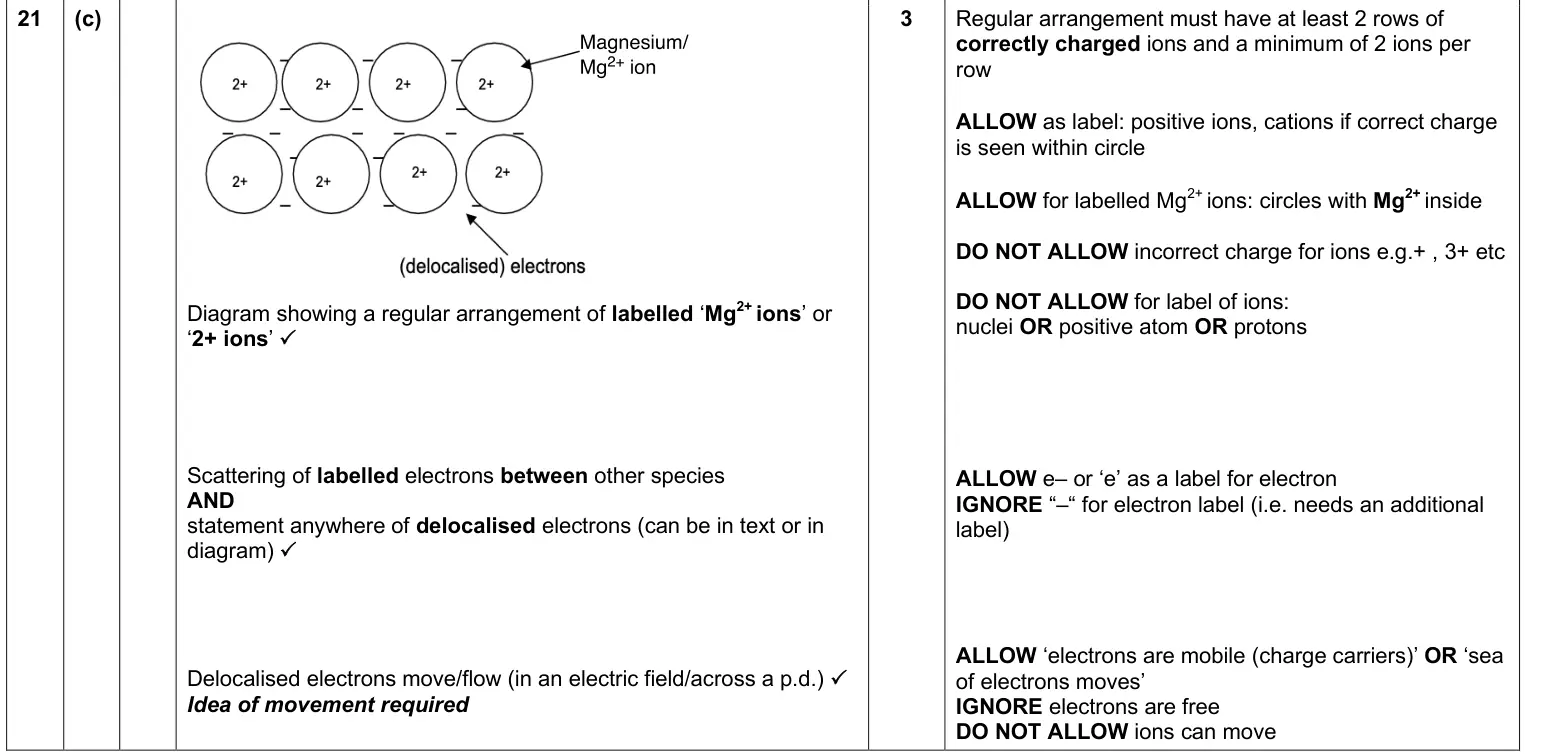
(c) Magnesium has a giant metallic structure.
• Draw a labelled diagram to show the bonding and structure in magnesium.
Include the correct charges on the metal particles in your diagram.
• Explain how the structure of magnesium allows it to conduct electricity.
Diagram
Explanation  ......................................................................................................................................
..........................................................................................................................................................
..........................................................................................................................................................
..........................................................................................................................................................
[3]
June 2025 · AS Paper 1 · Q25(a) 3 marks Structure / isomer Medium alcohols
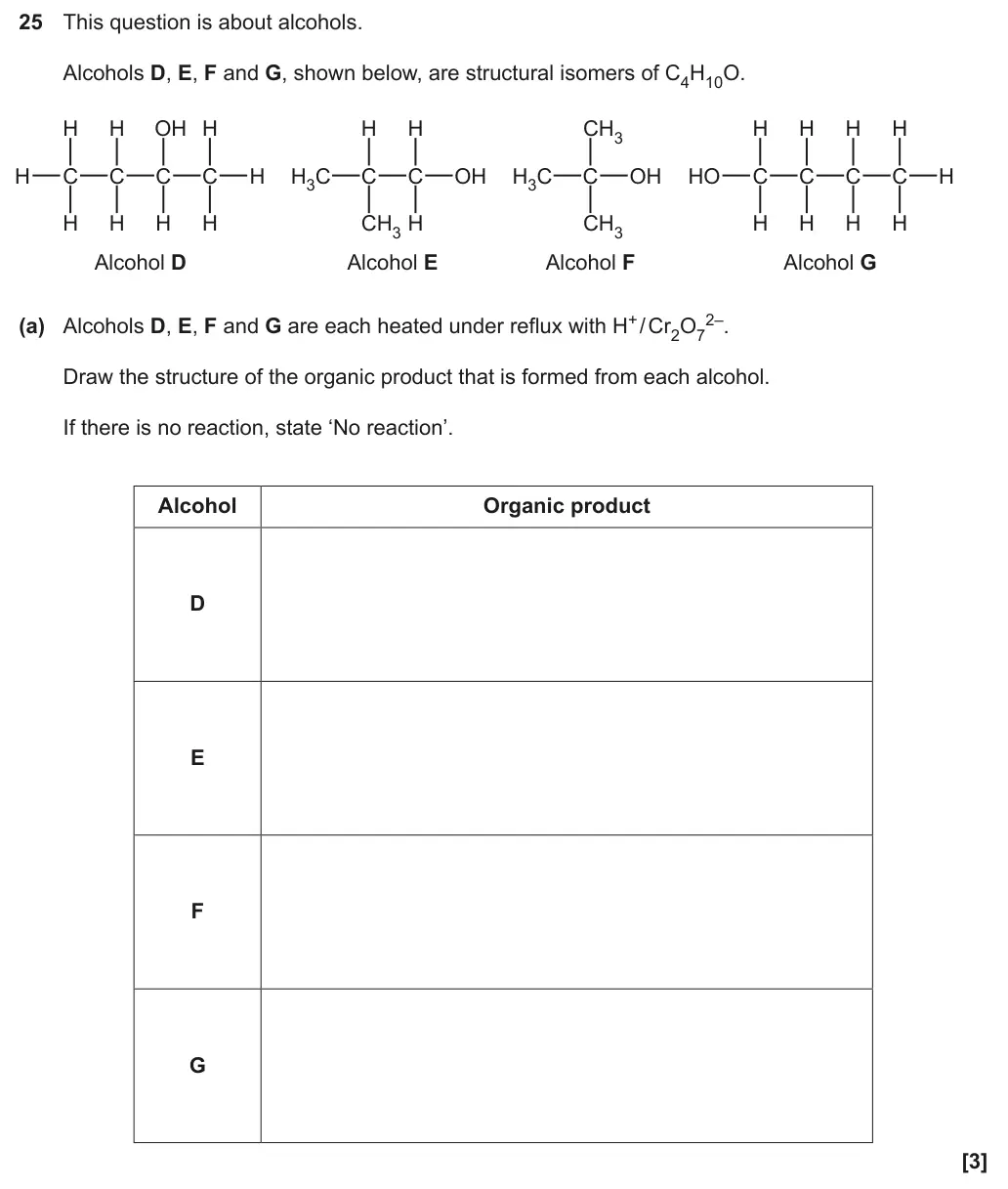
25 This question is about alcohols.
Alcohols D, E, F and G, shown below, are structural isomers of C4H10O.
H H OH H H H CH3 H H H H
H C C C C H H3C C C OH H3C C OH HO C C C C H
H H H H CH3 H CH3 H H H H
Alcohol D Alcohol E Alcohol F Alcohol G
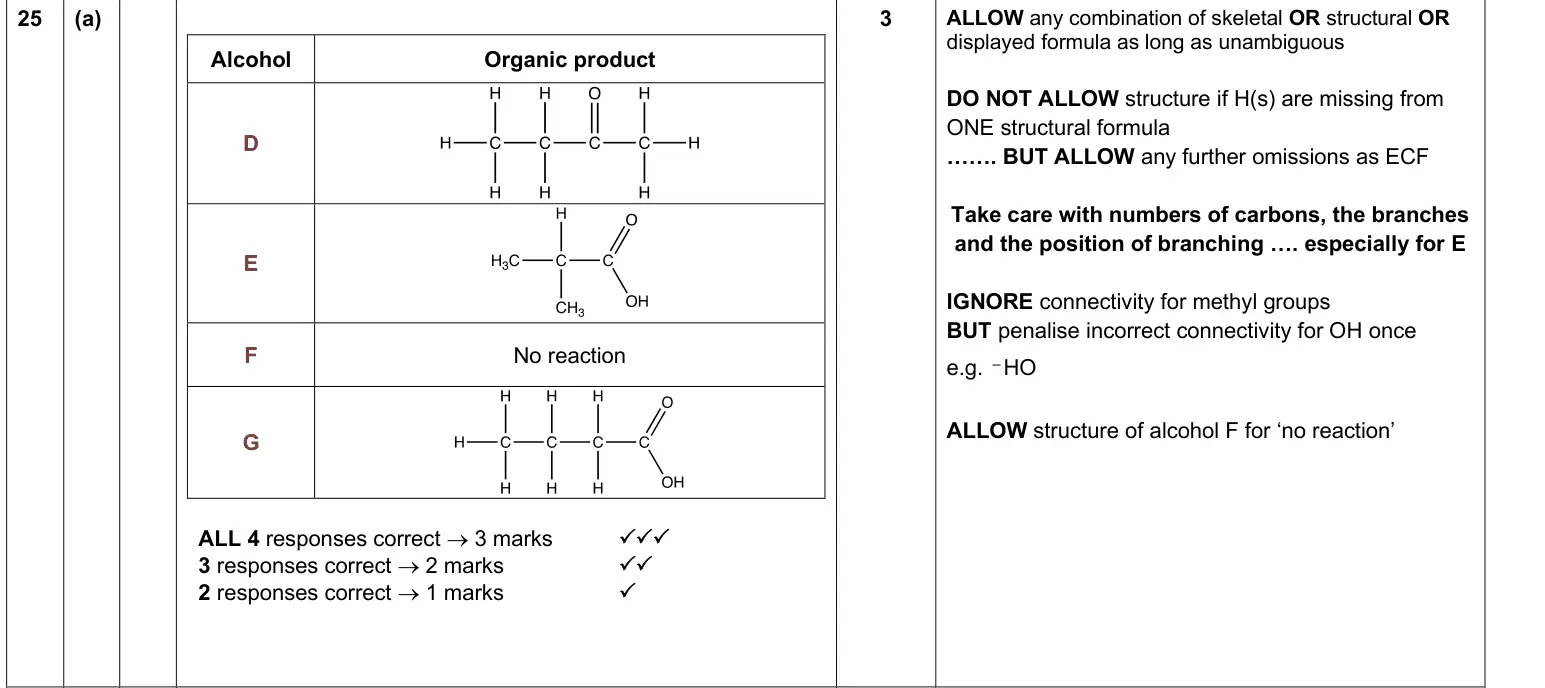
(a) Alcohols D, E, F and G are each heated under reflux with H+ / Cr2O7 2–.
Draw the structure of the organic product that is formed from each alcohol.
If there is no reaction, state ‘No reaction’.
Alcohol Organic product
D
E
F
G
[3]
June 2025 · AS Paper 1 · Q25(b) 1 mark Structure / isomer Medium alcoholsorganic basics
Earlier part of question 25 that this part usesEarlier part of June 2025 Paper 1 question 25
(b) Alcohols D, E, F and G are each heated with concentrated H2SO4, which acts as an acid
catalyst.
Which alcohol forms a mixture of two alkenes that are structural isomers of one another?
Alcohol ..................... [1]
June 2025 · AS Paper 2 · Q3(c) 2 marks Structure / isomer Medium alcoholsalkenesorganic synthesis as
Earlier part of question 3 that this part usesEarlier part of June 2025 Paper 2 question 3
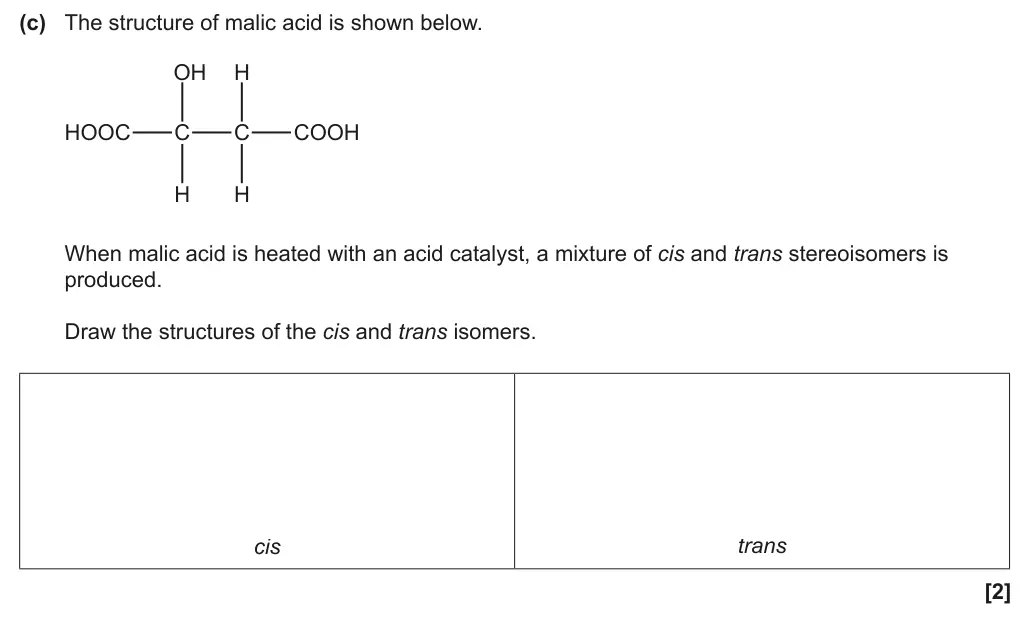
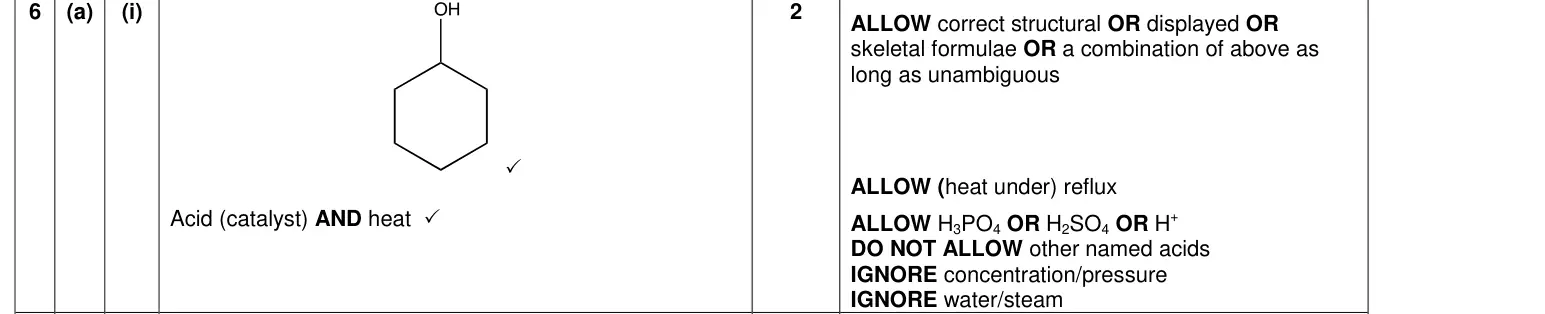
(c) The structure of malic acid is shown below.
OH H
HOOC C C COOH
H H
When malic acid is heated with an acid catalyst, a mixture of cis and trans stereoisomers is
produced.
Draw the structures of the cis and trans isomers.
cis trans
[2]
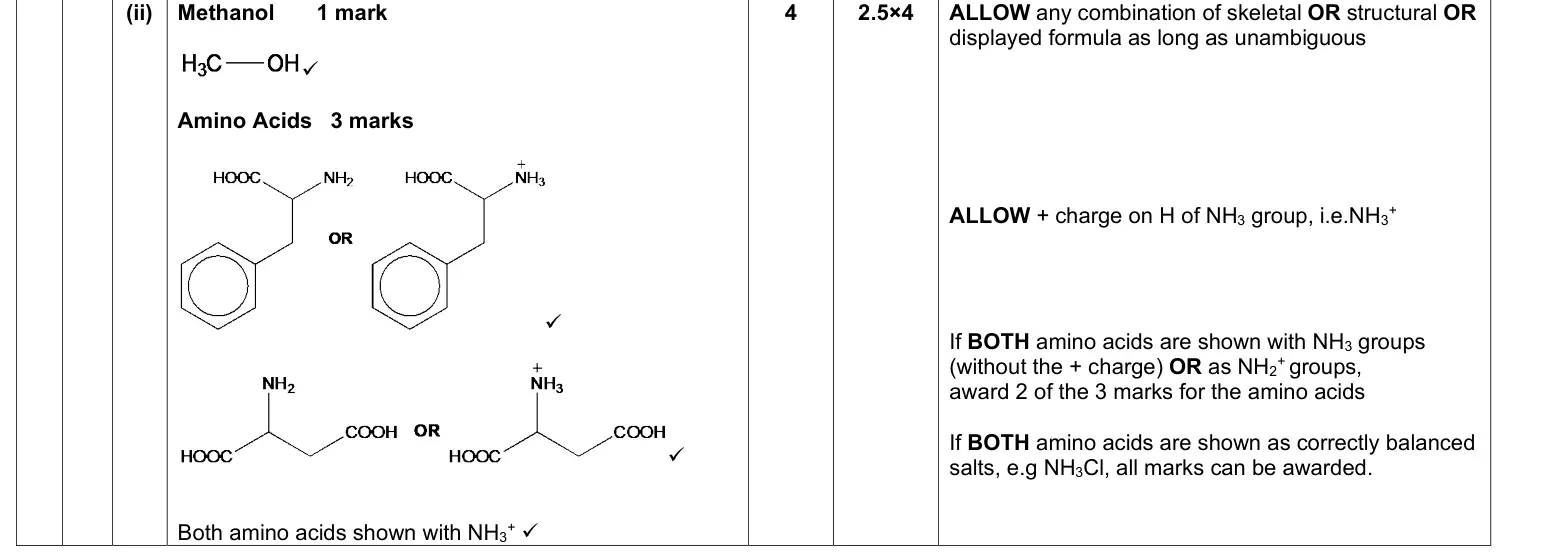
June 2025 · AS Paper 2 · Q4(c) 2 marks Structure / isomer Easy organic basics
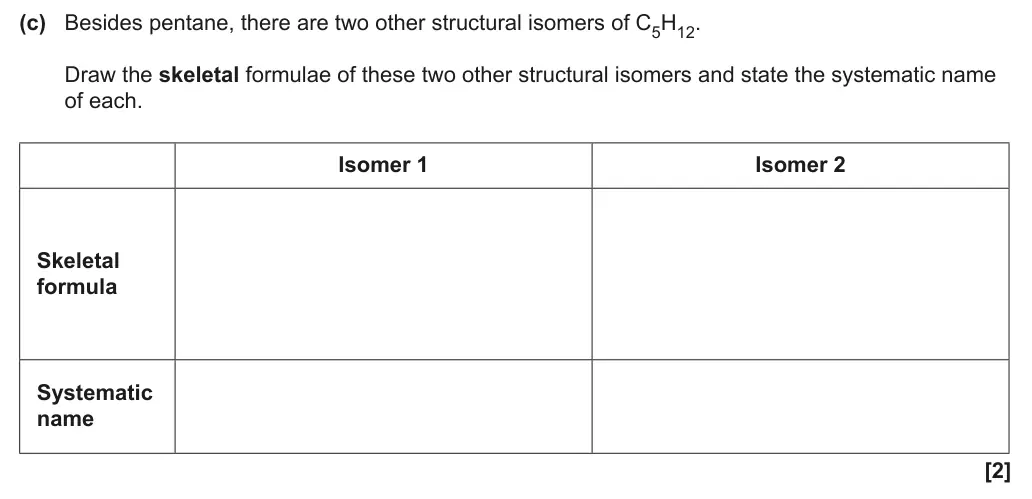
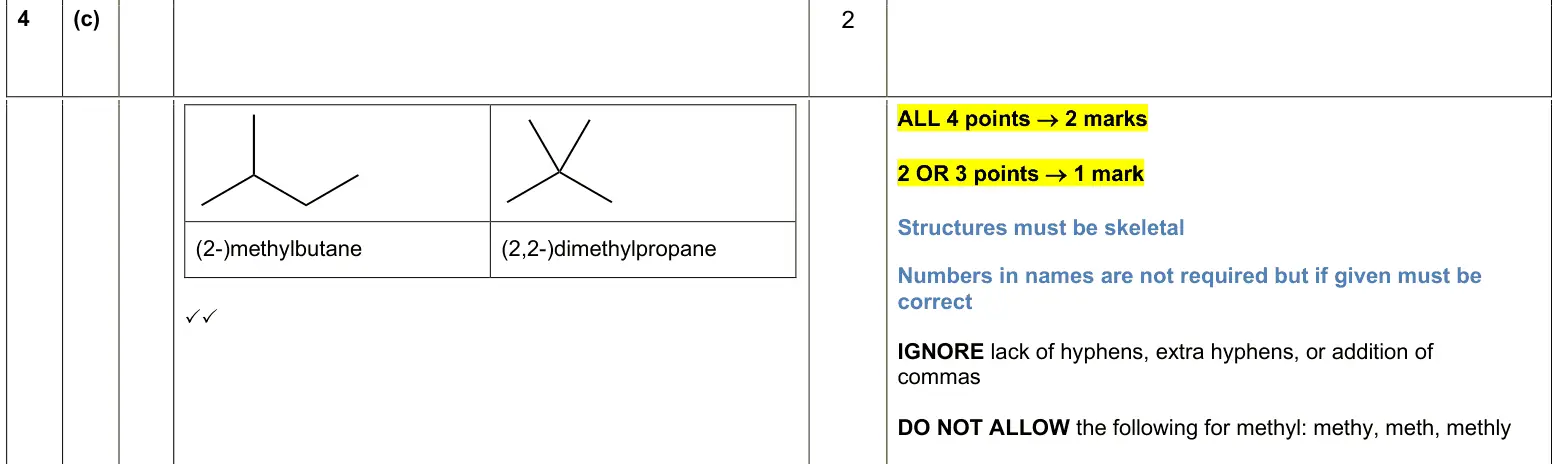
(c) Besides pentane, there are two other structural isomers of C5H12.
Draw the skeletal formulae of these two other structural isomers and state the systematic name
of each.
Isomer 1 Isomer 2
Skeletal
formula
Systematic
name
[2]
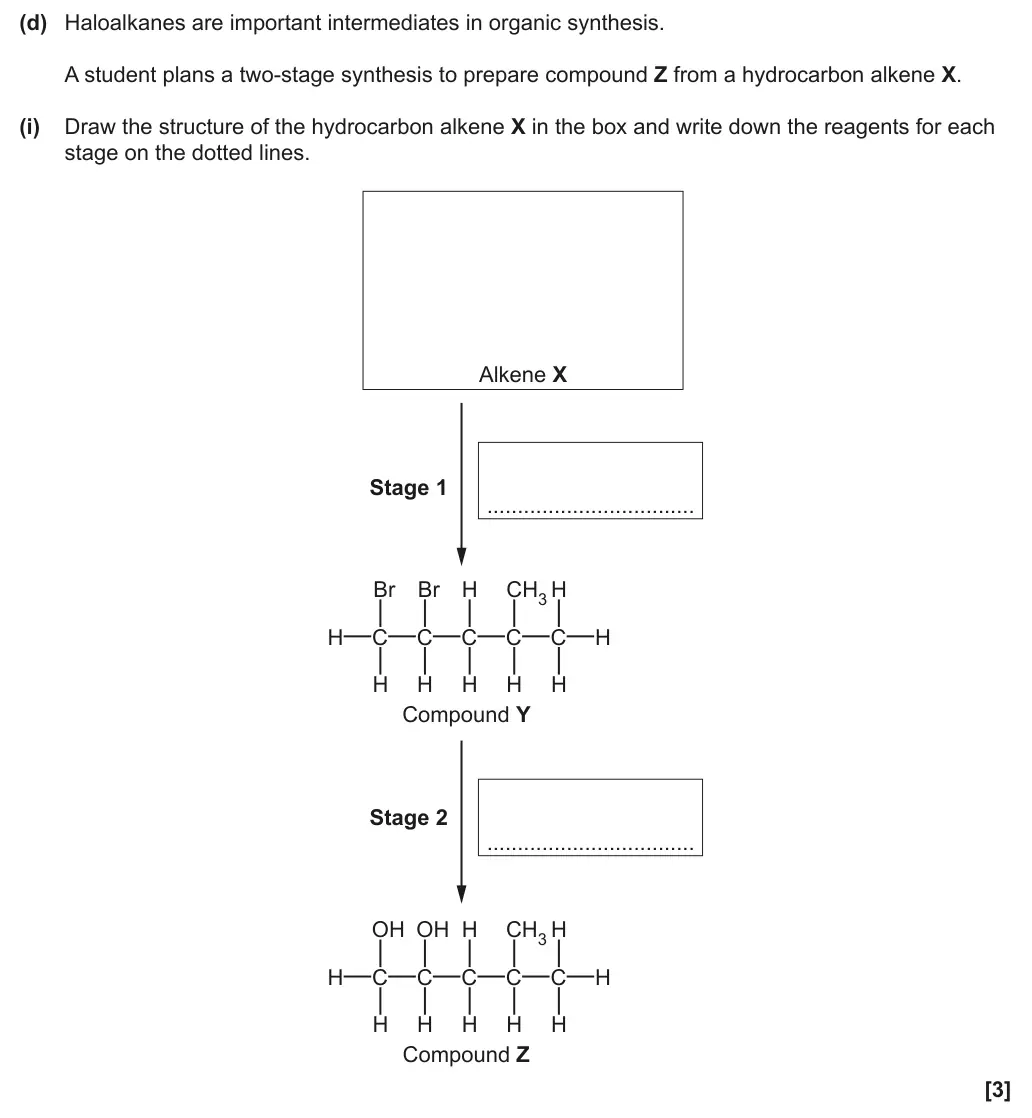
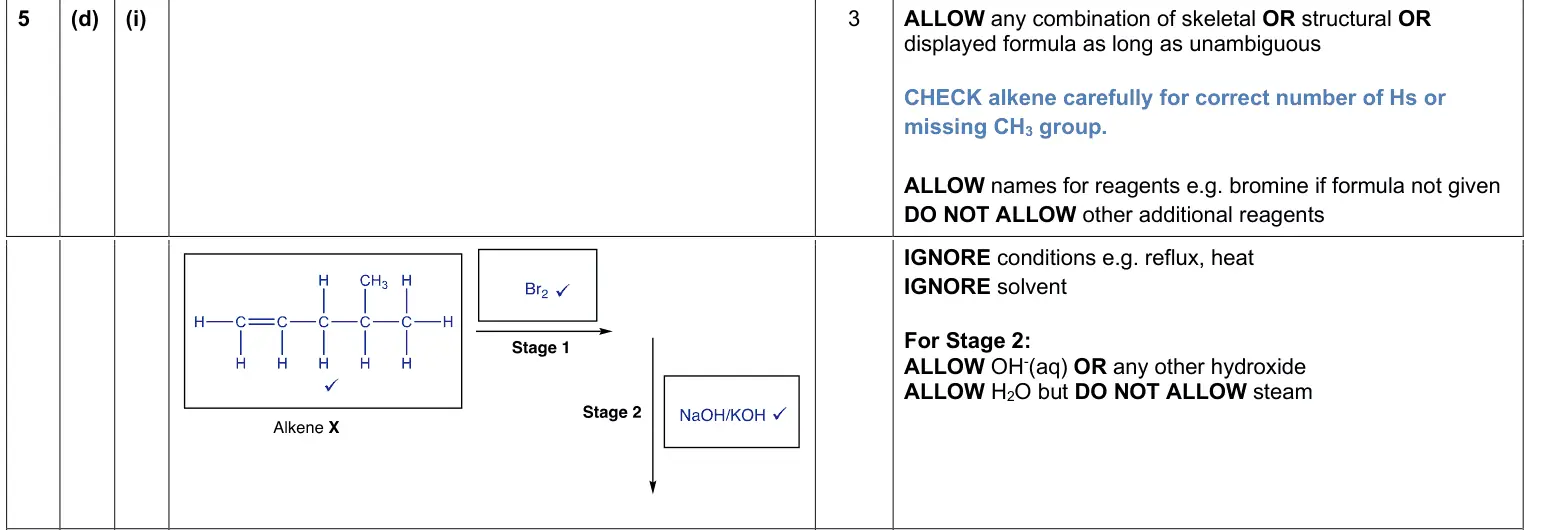
June 2025 · AS Paper 2 · Q5(d)(i) 3 marks Structure / isomer Medium organic synthesis asalkeneshaloalkanes
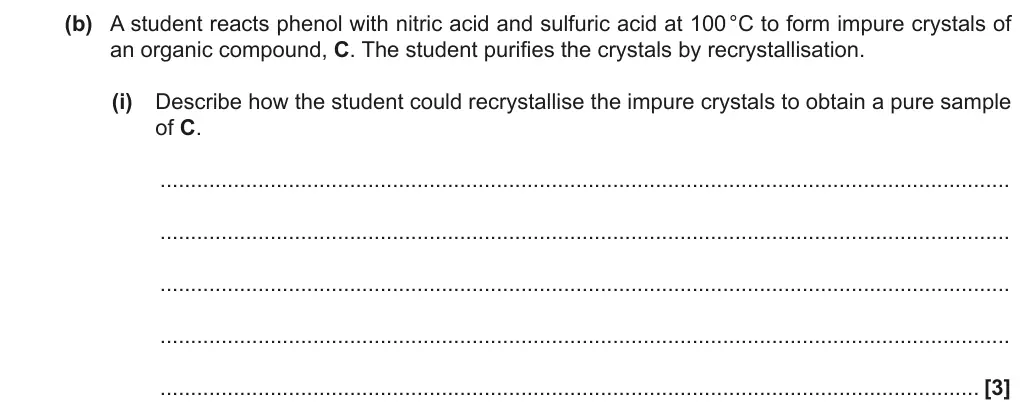
(d) Haloalkanes are important intermediates in organic synthesis.
A student plans a two-stage synthesis to prepare compound Z from a hydrocarbon alkene X.
(i) Draw the structure of the hydrocarbon alkene X in the box and write down the reagents for each
stage on the dotted lines.
Alkene X
Stage 1
..................................
Br Br H CH3 H
H C C C C C H
H H H H H
Compound Y
Stage 2
..................................
OH OH H CH3 H
H C C C C C H
H H H H H
Compound Z
[3]
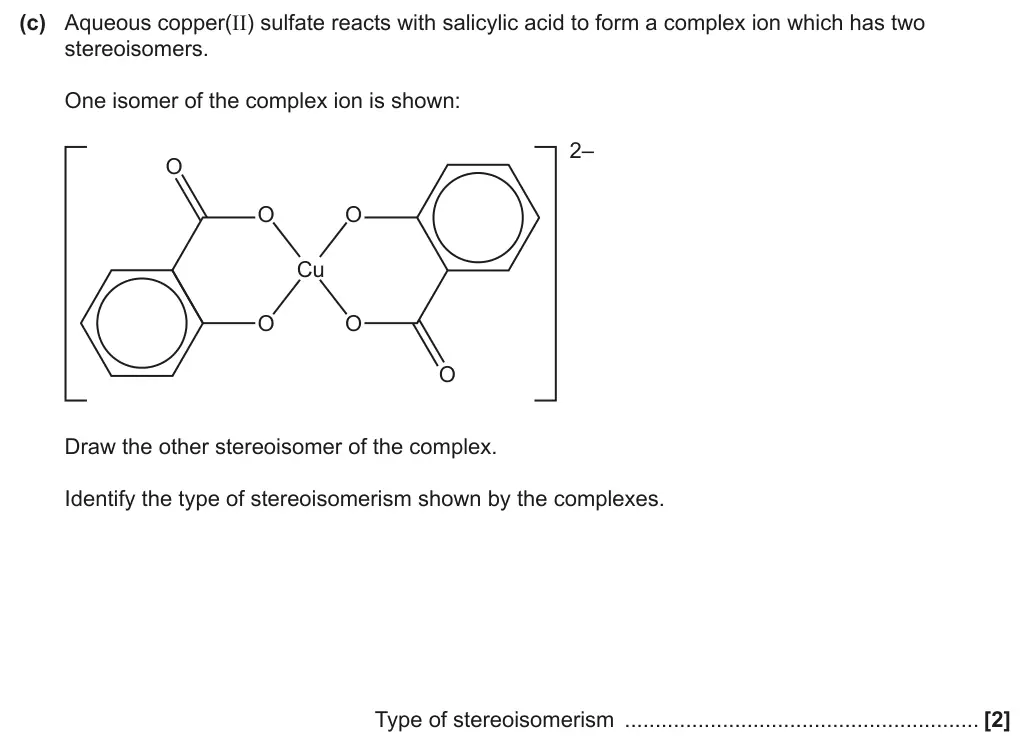
June 2025 · Paper 1 · Q21(c) 2 marks Structure / isomer Hard transition elements
(c)  Aqueous copper(II) sulfate reacts with salicylic acid to form a complex ion which has two
stereoisomers.
One isomer of the complex ion is shown:
2–
O
O O
Cu
O O
O
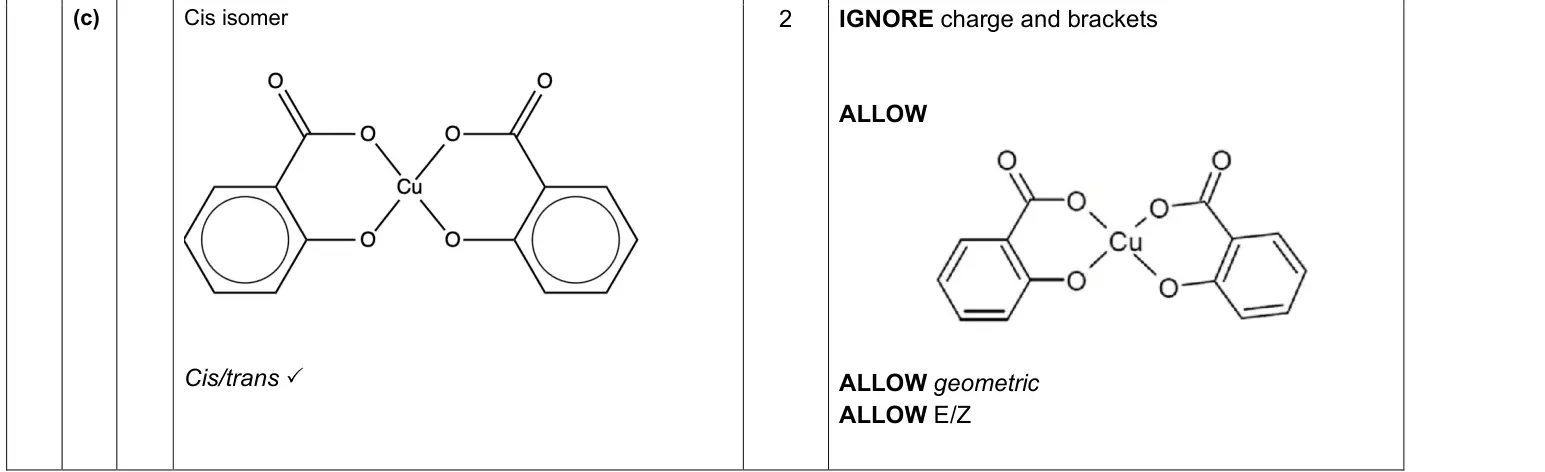
Draw the other stereoisomer of the complex.
Identify the type of stereoisomerism shown by the complexes.
Type of stereoisomerism  .......................................................... [2]
June 2025 · Paper 2 · Q16(c)(i) 2 marks Structure / isomer Medium alkenes
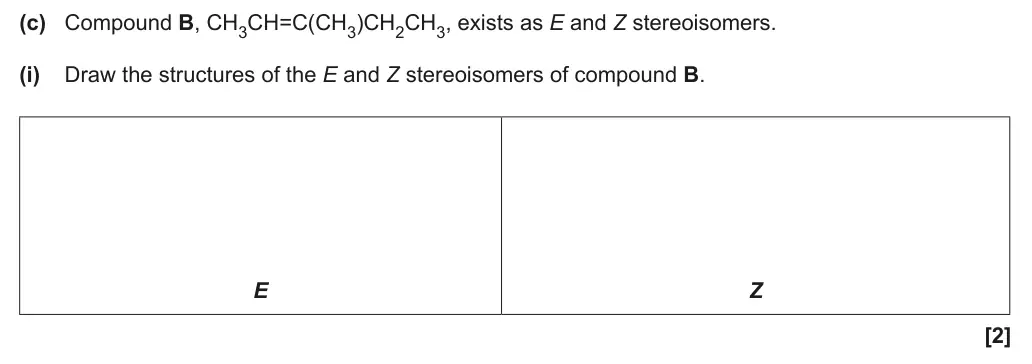
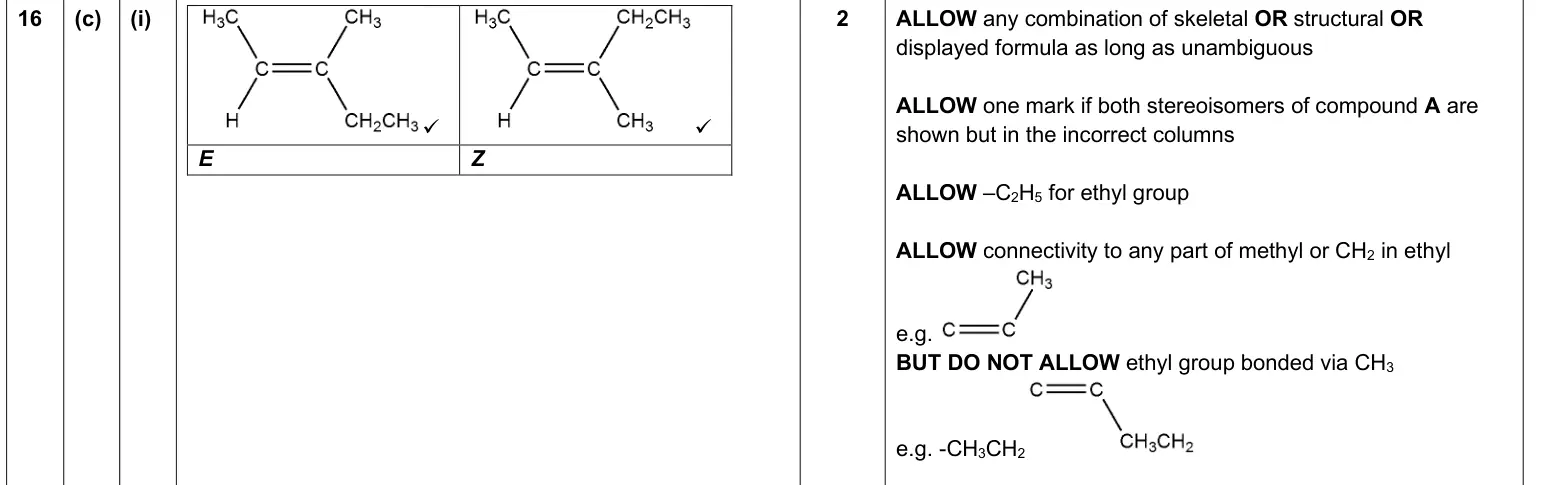
(c) Compound B, CH3CH=C(CH3)CH2CH3, exists as E and Z stereoisomers.
(i) Draw the structures of the E and Z stereoisomers of compound B.
E Z
[2]
June 2025 · Paper 2 · Q18(a) 4 marks Structure / isomer Hard condensation polymersalkenes
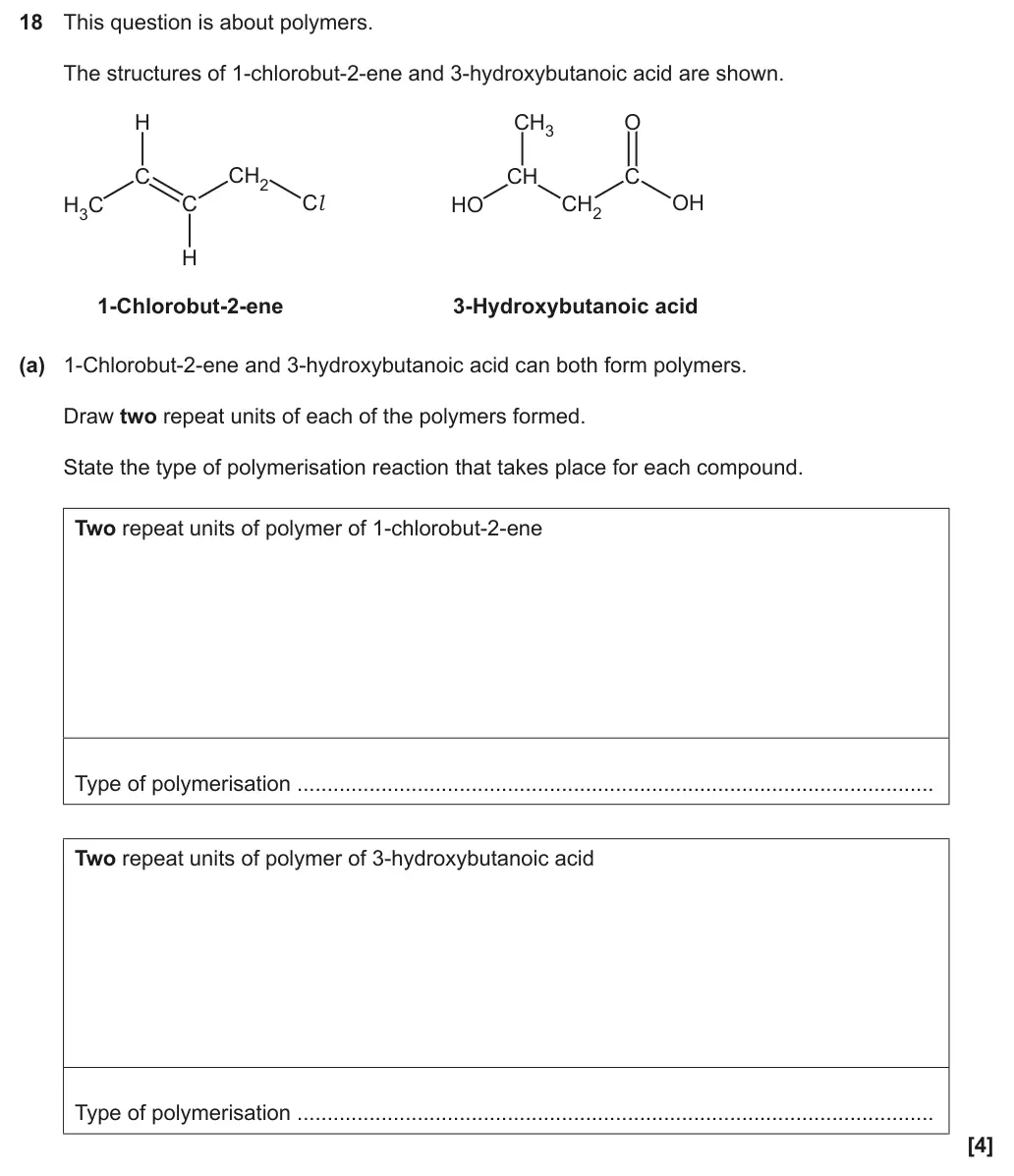
18 This question is about polymers.
The structures of 1-chlorobut-2-ene and 3-hydroxybutanoic acid are shown.
H CH3 O
C CH2 CH C
H3C C Cl HO CH2 OH
H
1-Chlorobut-2-ene 3-Hydroxybutanoic acid
(a) 1-Chlorobut-2-ene and 3-hydroxybutanoic acid can both form polymers.
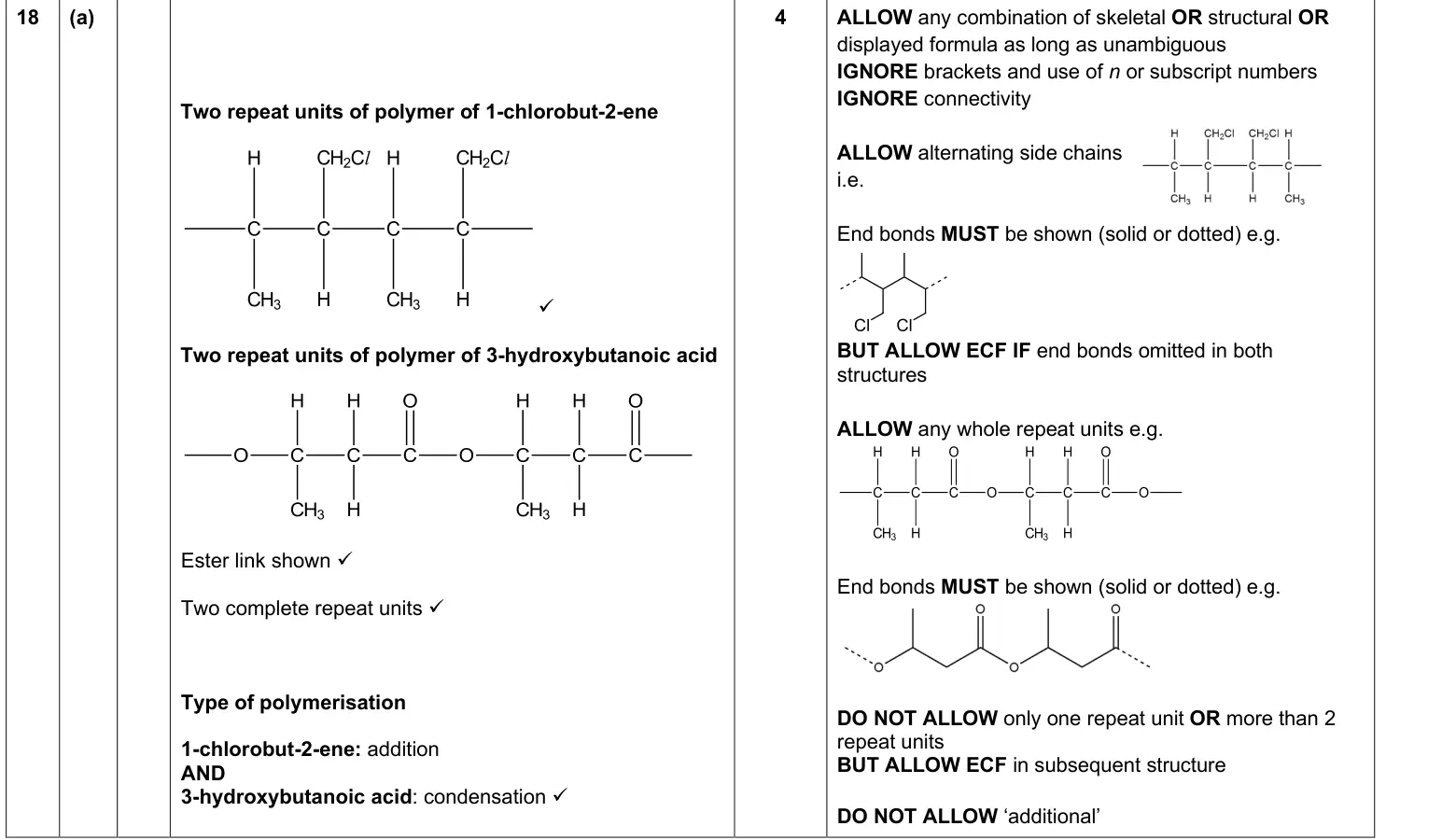
Draw two repeat units of each of the polymers formed.
State the type of polymerisation reaction that takes place for each compound.
Two repeat units of polymer of 1-chlorobut-2-ene
Type of polymerisation ..........................................................................................................
Two repeat units of polymer of 3-hydroxybutanoic acid
Type of polymerisation ..........................................................................................................
[4]
June 2025 · Paper 2 · Q18(b)(ii) 1 mark Structure / isomer Medium condensation polymersalkenes
Earlier part of question 18 that this part usesEarlier part of June 2025 Paper 2 question 18
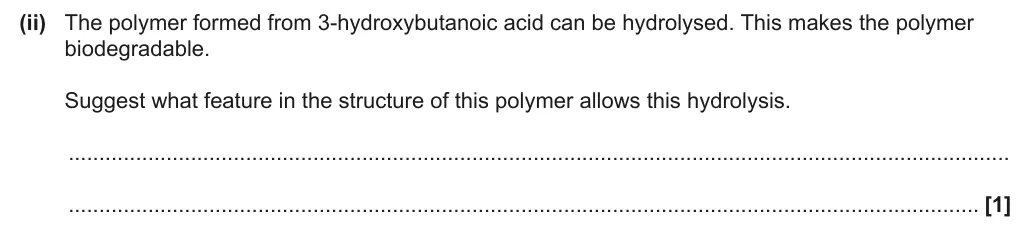
(ii) The polymer formed from 3-hydroxybutanoic acid can be hydrolysed. This makes the polymer
biodegradable.
Suggest what feature in the structure of this polymer allows this hydrolysis.
..........................................................................................................................................................
..................................................................................................................................................... [1]
June 2025 · Paper 2 · Q20(c)(iii) 2 marks Structure / isomer Hard aromatic compounds
Earlier part of question 20 that this part usesEarlier part of June 2025 Paper 2 question 20
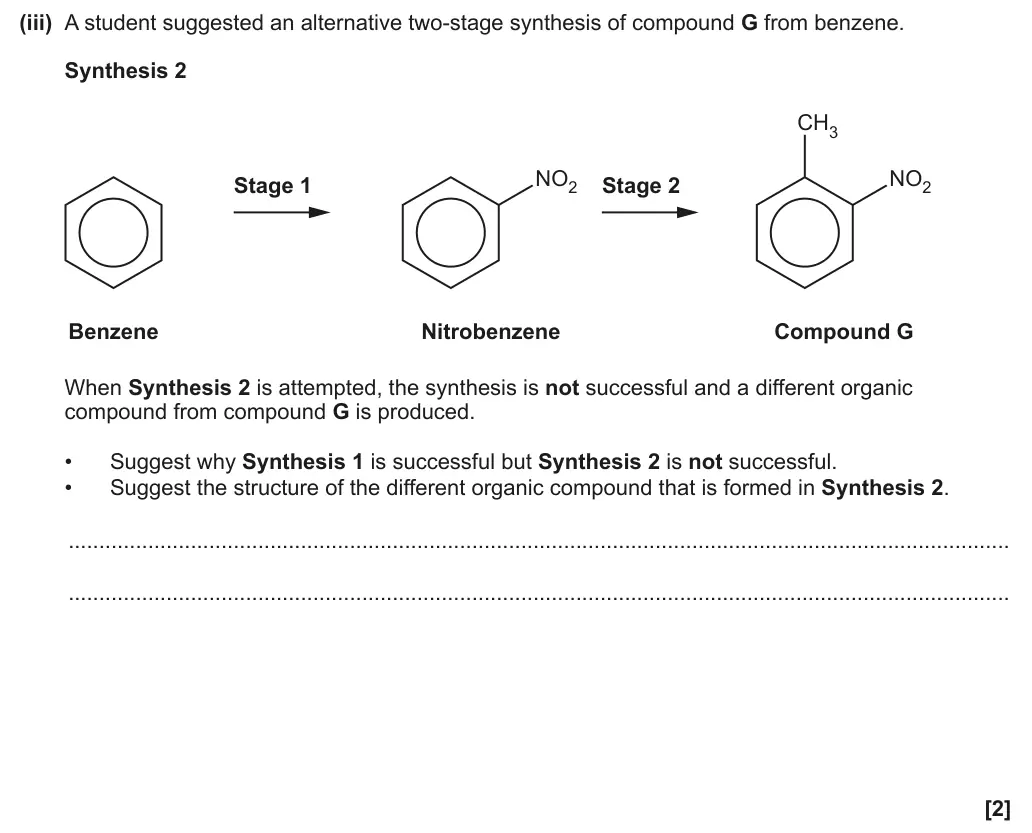
(iii) A student suggested an alternative two-stage synthesis of compound G from benzene.
Synthesis 2
CH3
NO2 NO2
Stage 1 Stage 2
Benzene Nitrobenzene Compound G
When Synthesis 2 is attempted, the synthesis is not successful and a different organic
compound from compound G is produced.
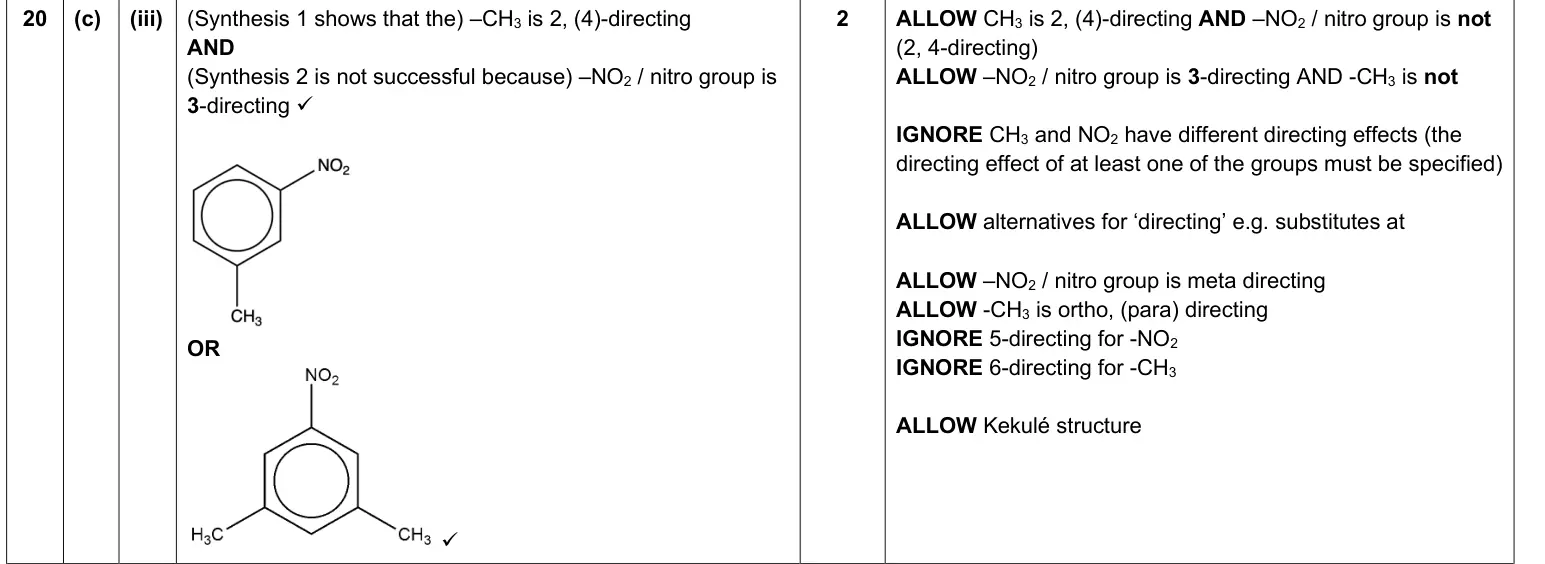
• Suggest why Synthesis 1 is successful but Synthesis 2 is not successful.
• Suggest the structure of the different organic compound that is formed in Synthesis 2.
..........................................................................................................................................................
..........................................................................................................................................................
[2]
June 2025 · Paper 2 · Q22(b)(i) 2 marks Structure / isomer Medium organic synthesis
Question 22(b) starts on Page 30
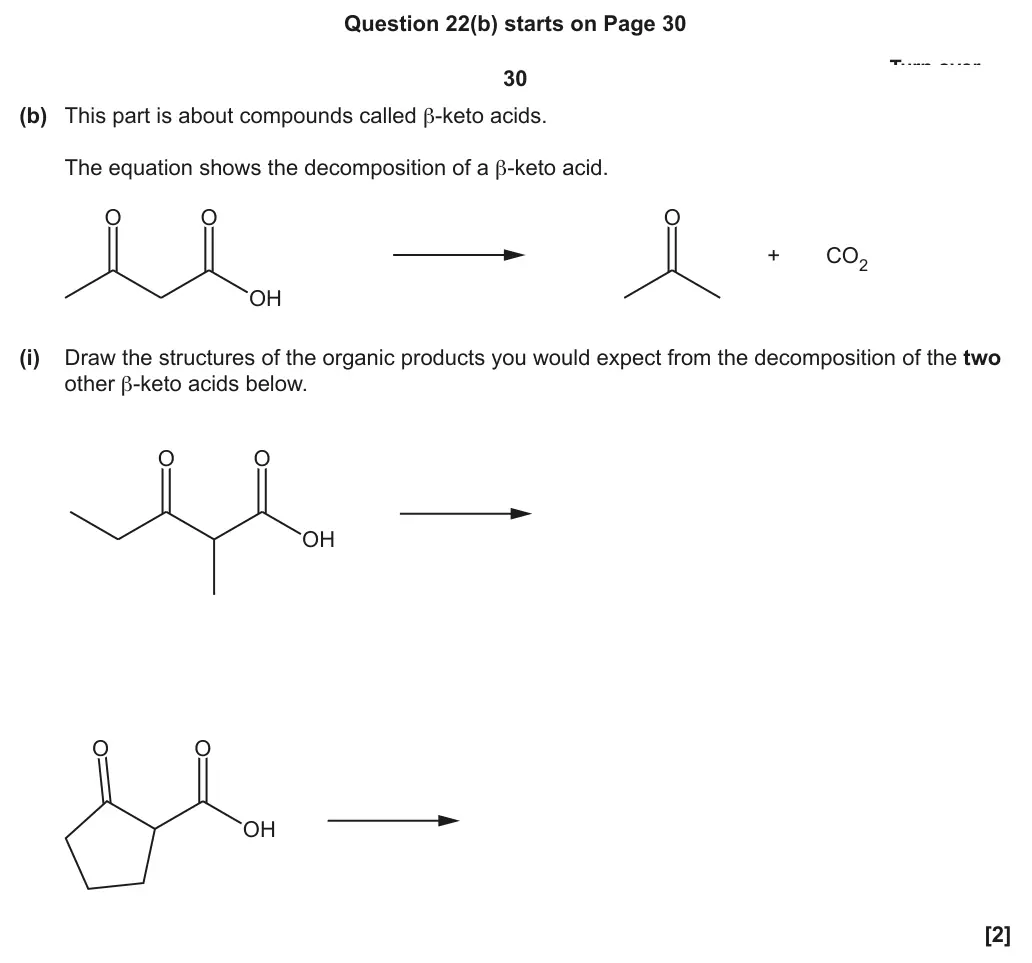
(b) This part is about compounds called β-keto acids.
The equation shows the decomposition of a β-keto acid.
O O O
+ CO2
OH
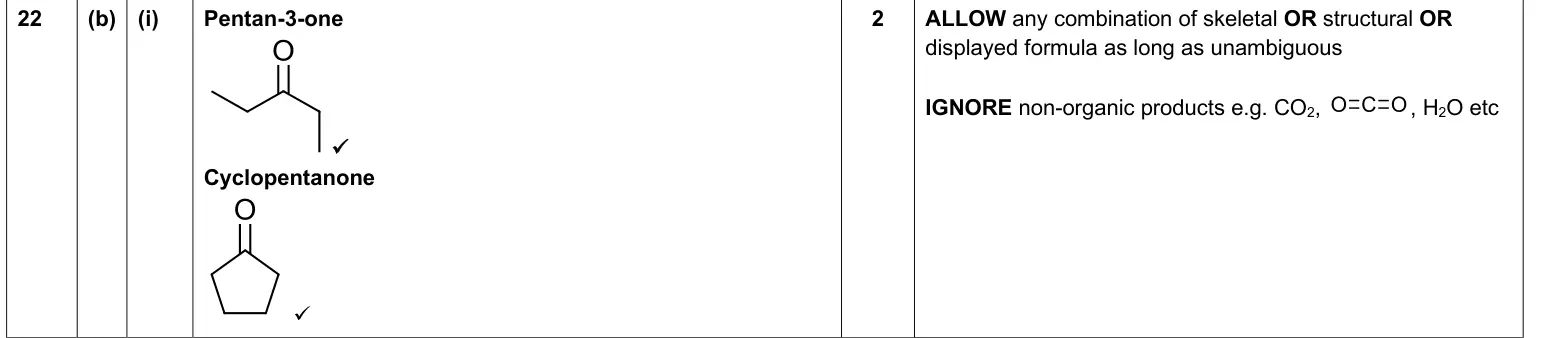
(i) Draw the structures of the organic products you would expect from the decomposition of the two
other β-keto acids below.
O O
OH
O O
OH
[2]
June 2025 · Paper 3 · Q2(a)(i) 1 mark Structure / isomer Easy organic basics
2 This question is about different compounds that each contain O and H atoms covalently bonded
together.
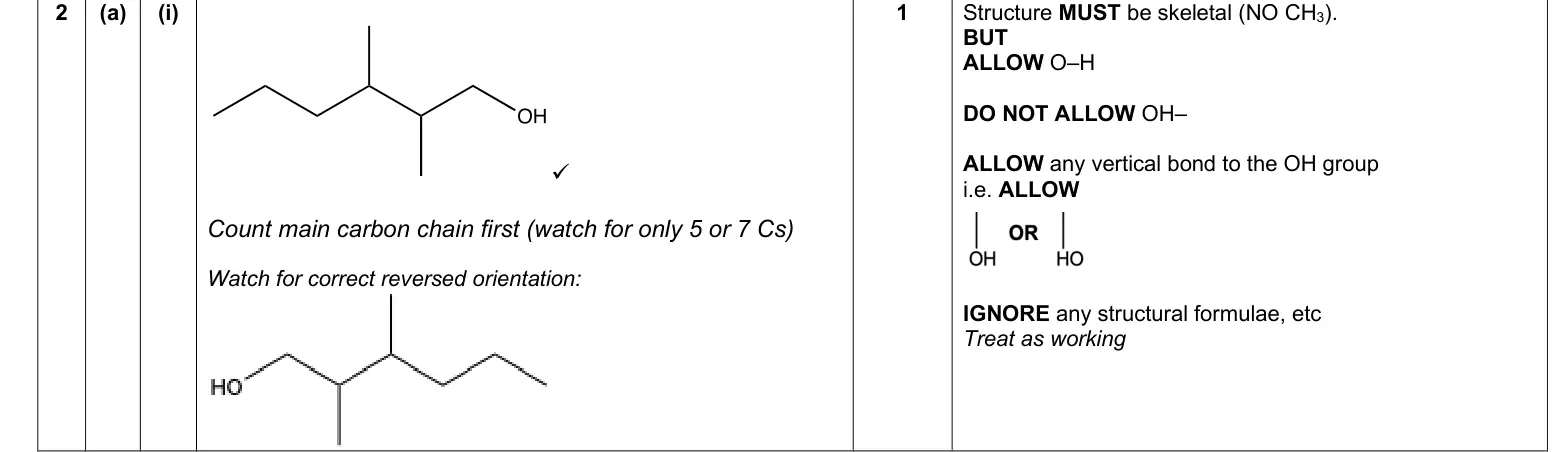
(a) The alcohol 2,3‑dimethylhexan‑1‑ol has the molecular formula C8H18O.
(i) Draw the skeletal formula of 2,3‑dimethylhexan‑1‑ol.
[1]
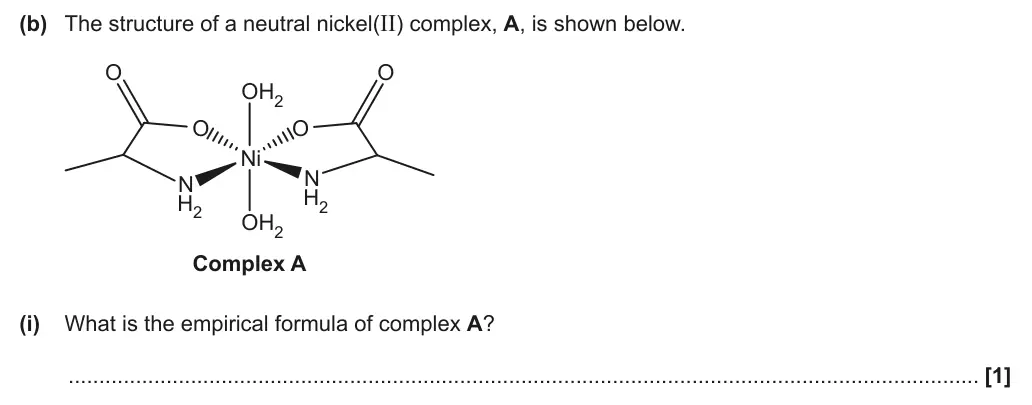
June 2025 · Paper 3 · Q4(b)(ii) 3 marks Structure / isomer Medium transition elementsamino acids amides and chirality
Earlier part of question 4 that this part usesEarlier part of June 2025 Paper 3 question 4
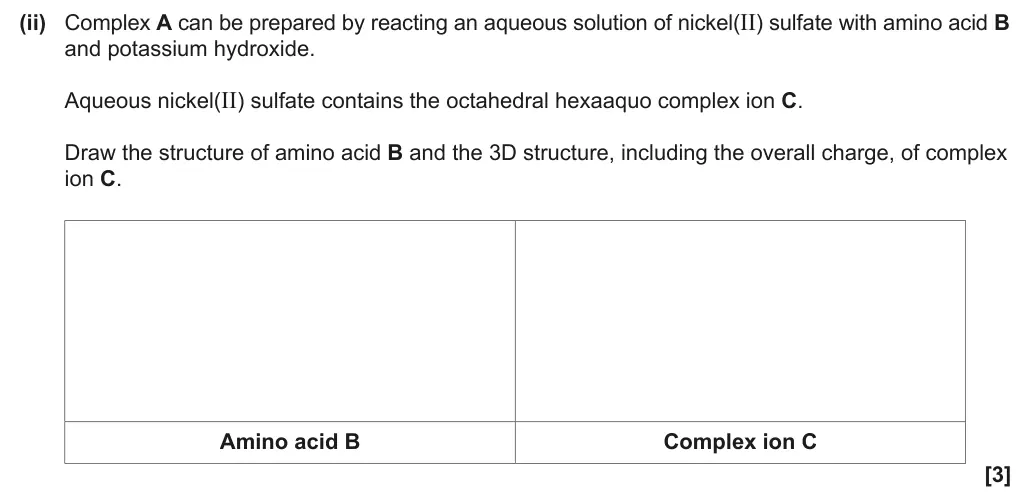
(ii) Complex A can be prepared by reacting an aqueous solution of nickel(II) sulfate with amino acid B
and potassium hydroxide.
Aqueous nickel(II) sulfate contains the octahedral hexaaquo complex ion C.
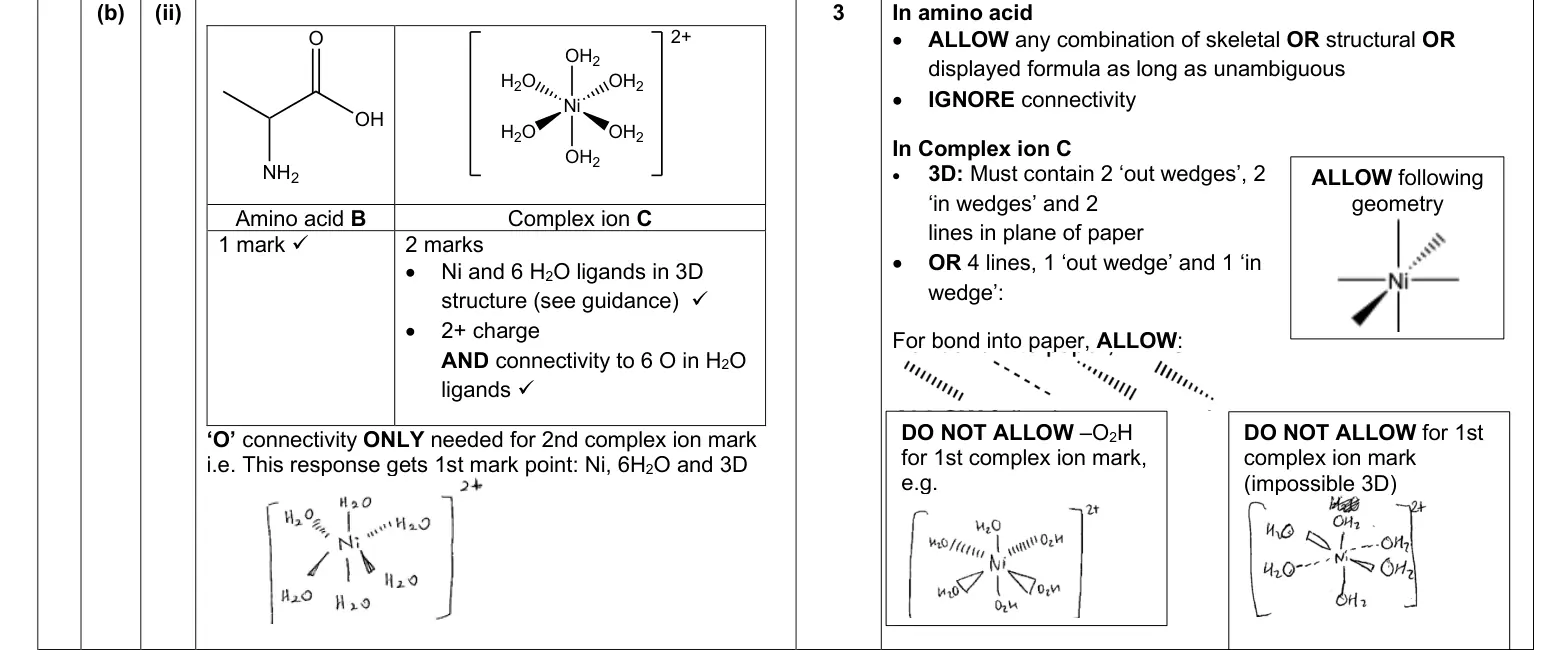
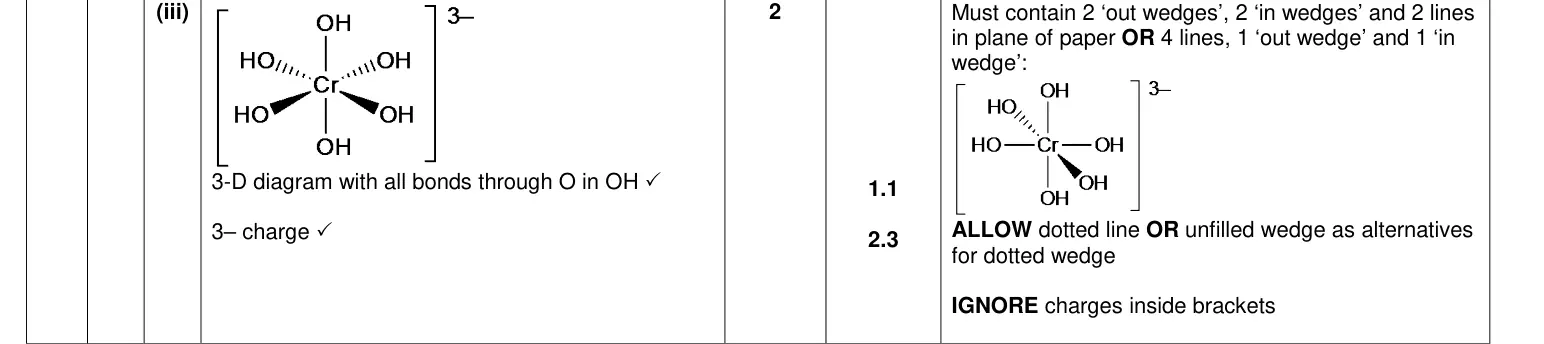
Draw the structure of amino acid B and the 3D structure, including the overall charge, of complex
ion C.
Amino acid B Complex ion C
[3]
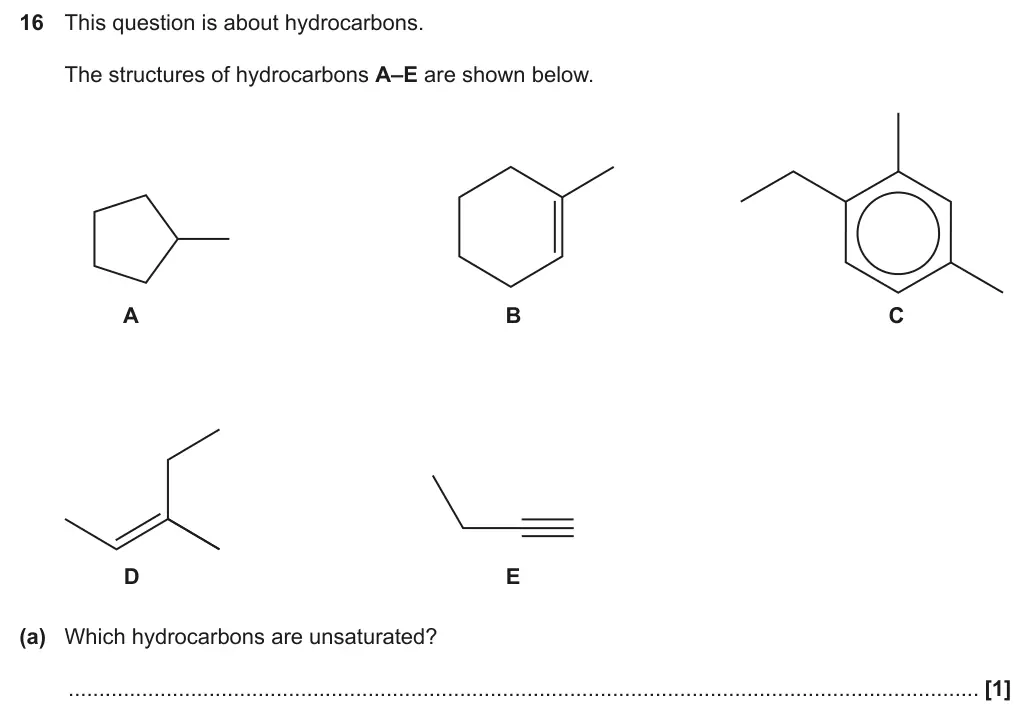
June 2024 · Paper 2 · Q16(a) 1 mark Structure / isomer Hard organic basics
16 This question is about hydrocarbons.
The structures of hydrocarbons A–E are shown below.
A B C
D E
(a) Which hydrocarbons are unsaturated?
..................................................................................................................................................... [1]
June 2024 · Paper 2 · Q20(c) 2 marks Structure / isomer Medium condensation polymers
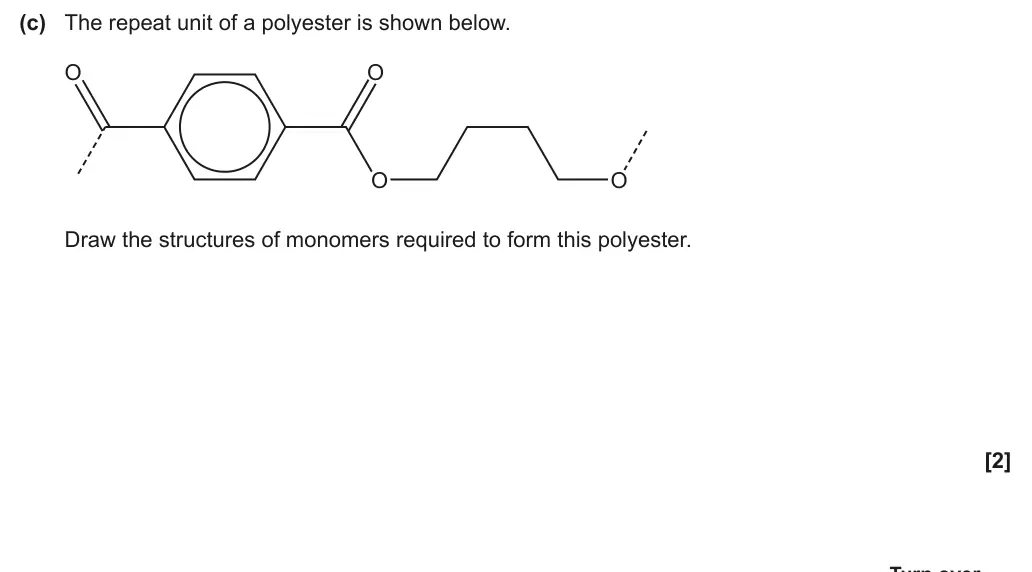
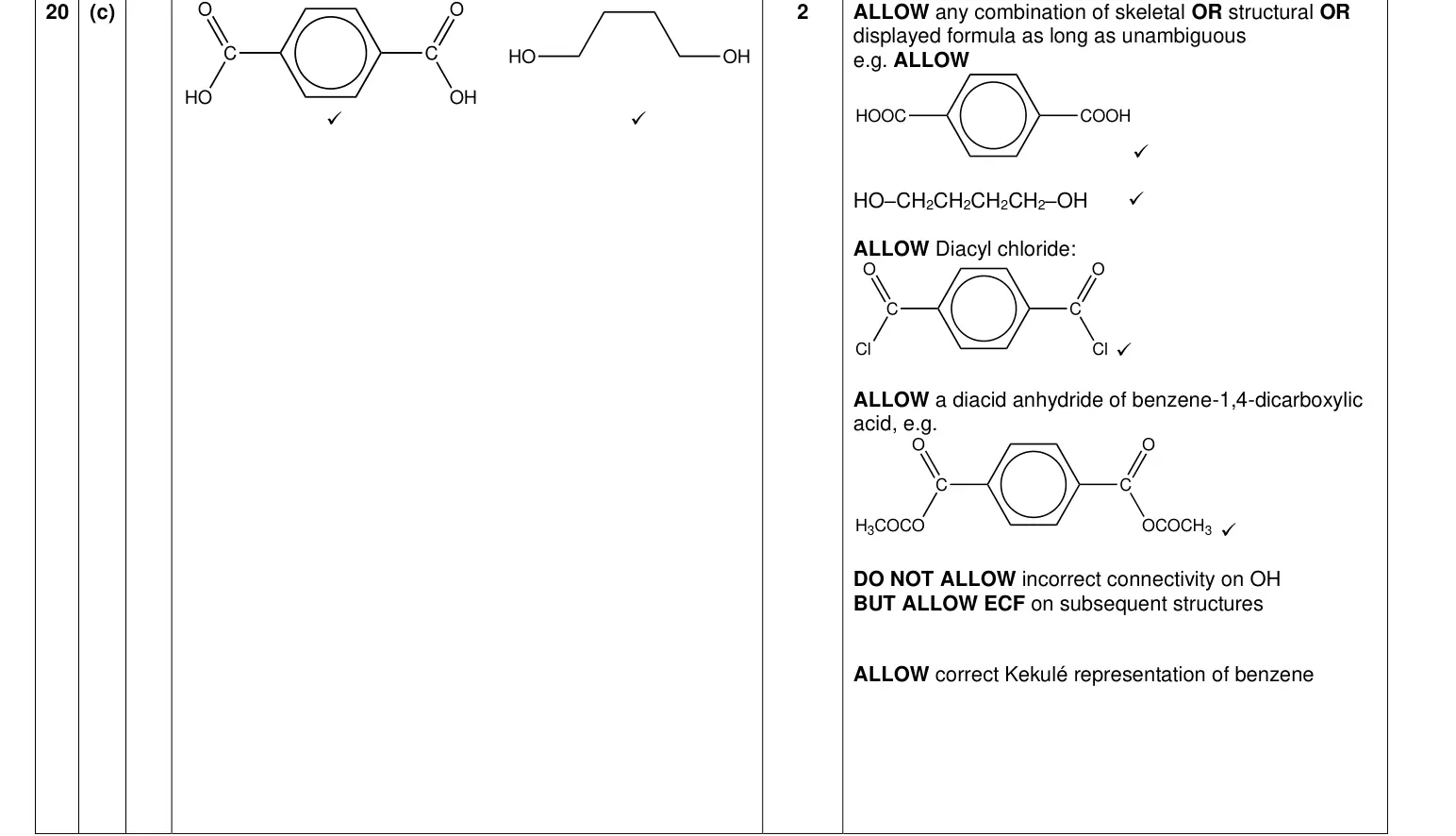
(c) The repeat unit of a polyester is shown below.
O O
O O
Draw the structures of monomers required to form this polyester.
[2]
June 2024 · Paper 2 · Q20(d) 4 marks Structure / isomer Medium carboxylic acids and esterscondensation polymersorganic synthesis
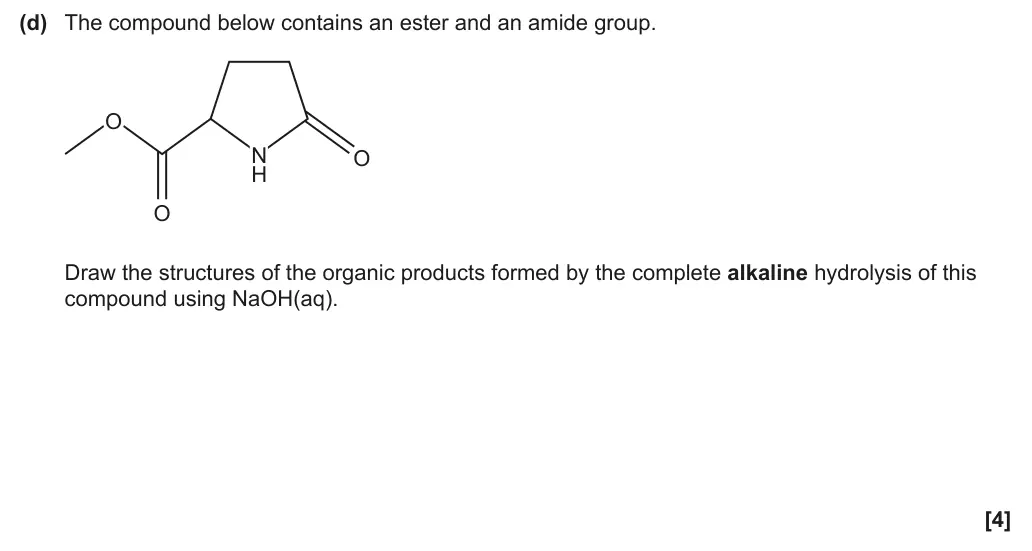
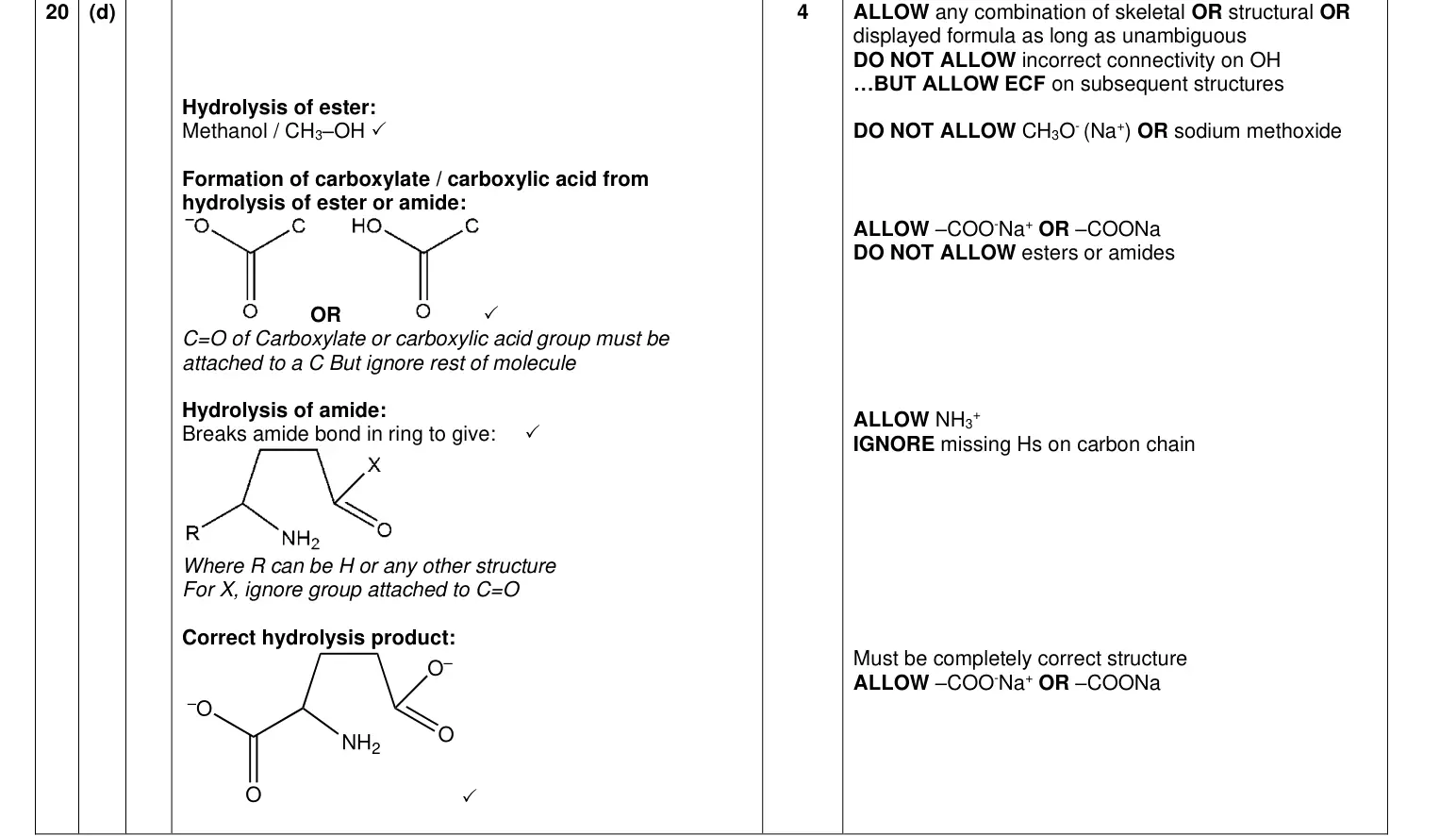
(d) The compound below contains an ester and an amide group.
O
N O
H
O
Draw the structures of the organic products formed by the complete alkaline hydrolysis of this
compound using NaOH(aq).
[4]
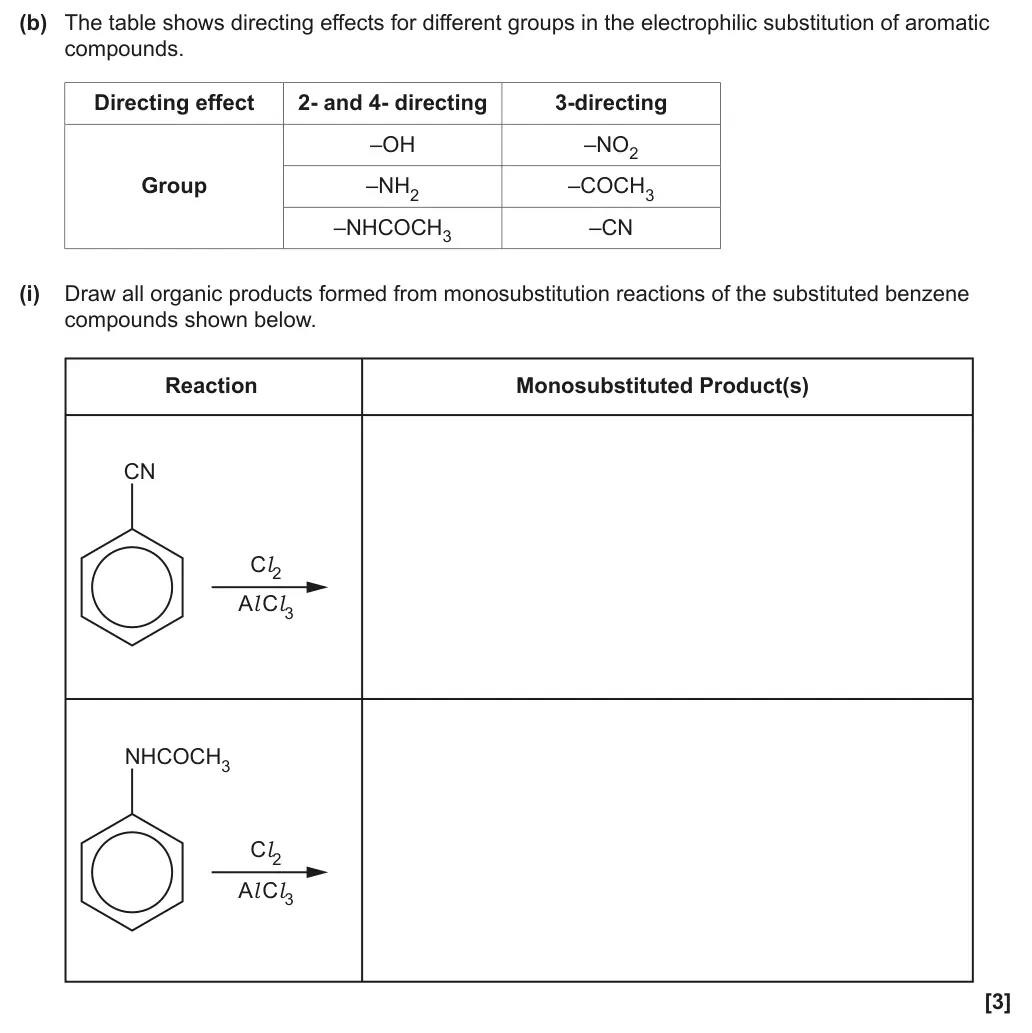
June 2024 · Paper 2 · Q21(b)(i) 3 marks Structure / isomer Easy aromatic compounds
(b) The table shows directing effects for different groups in the electrophilic substitution of aromatic
compounds.
Directing effect 2- and 4- directing 3-directing
–OH –NO2
Group –NH2 –COCH3
–NHCOCH3 –CN
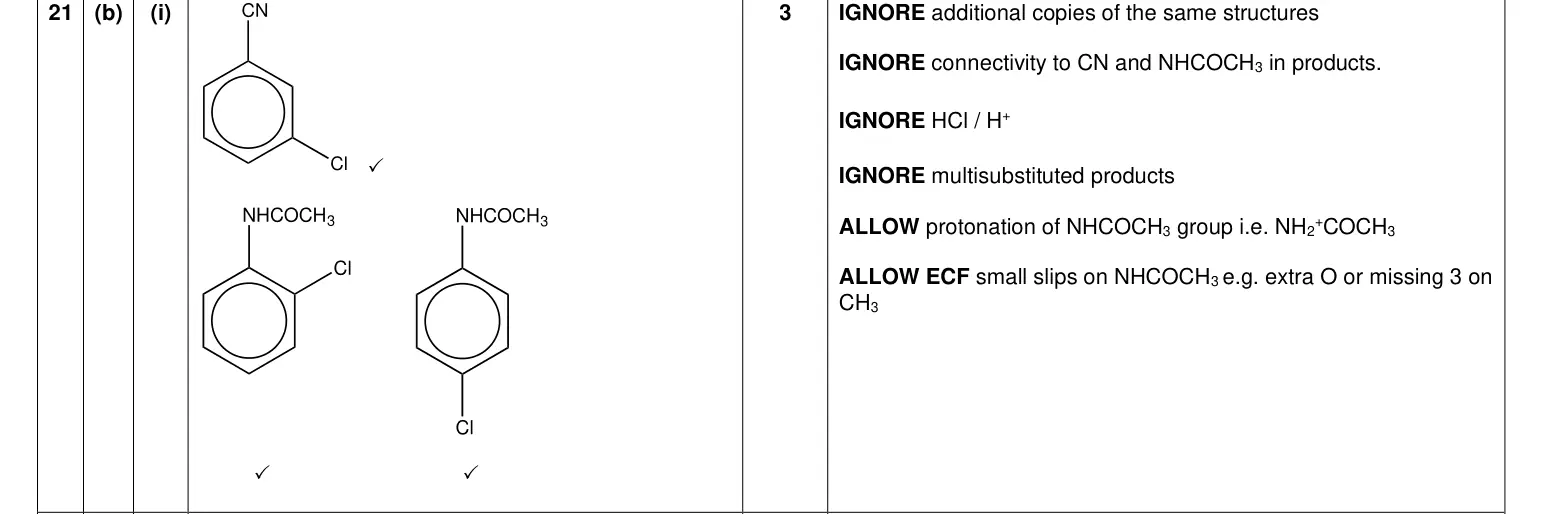
(i) Draw all organic products formed from monosubstitution reactions of the substituted benzene
compounds shown below.
Reaction Monosubstituted Product(s)
CN
Cl2
Al Cl3
NHCOCH3
Cl2
Al Cl3
[3]
June 2024 · Paper 3 · Q3(a)(ii) 3 marks Structure / isomer Medium transition elements
Earlier part of question 3 that this part usesEarlier part of June 2024 Paper 3 question 3
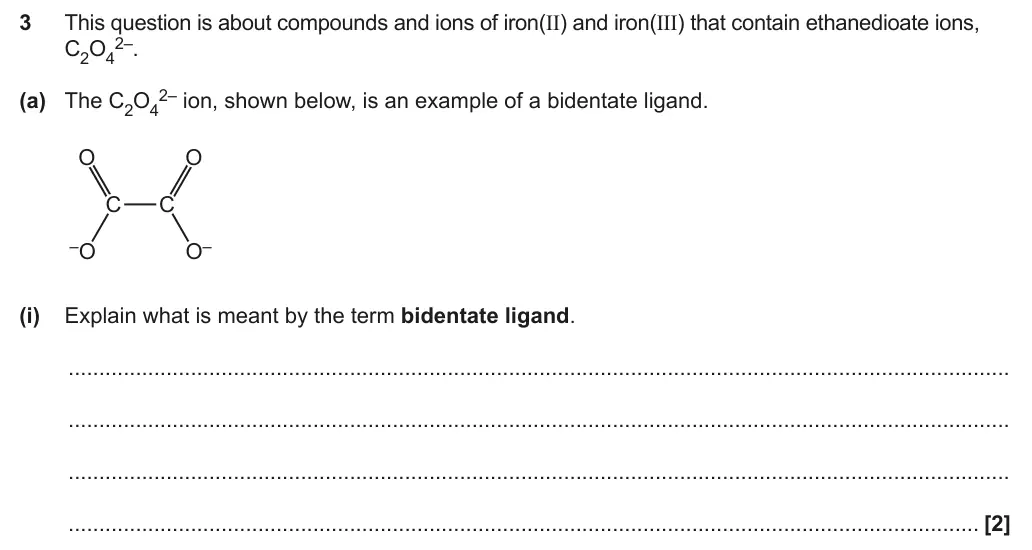
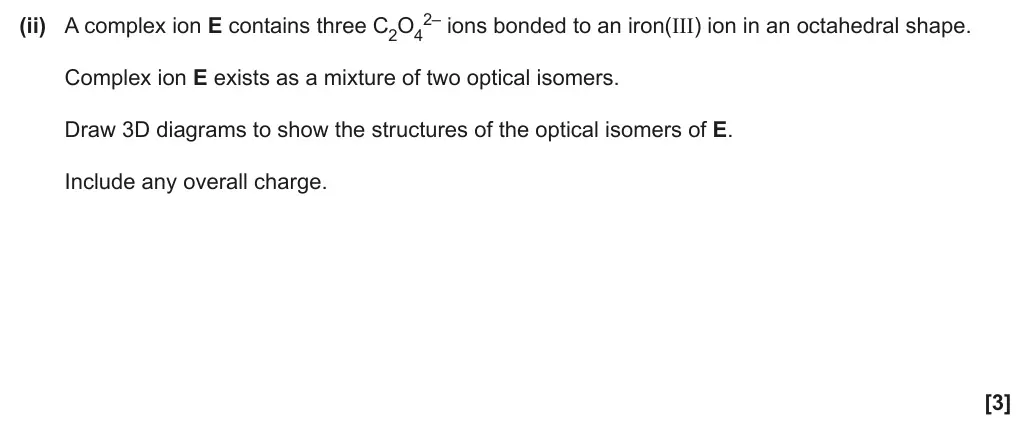
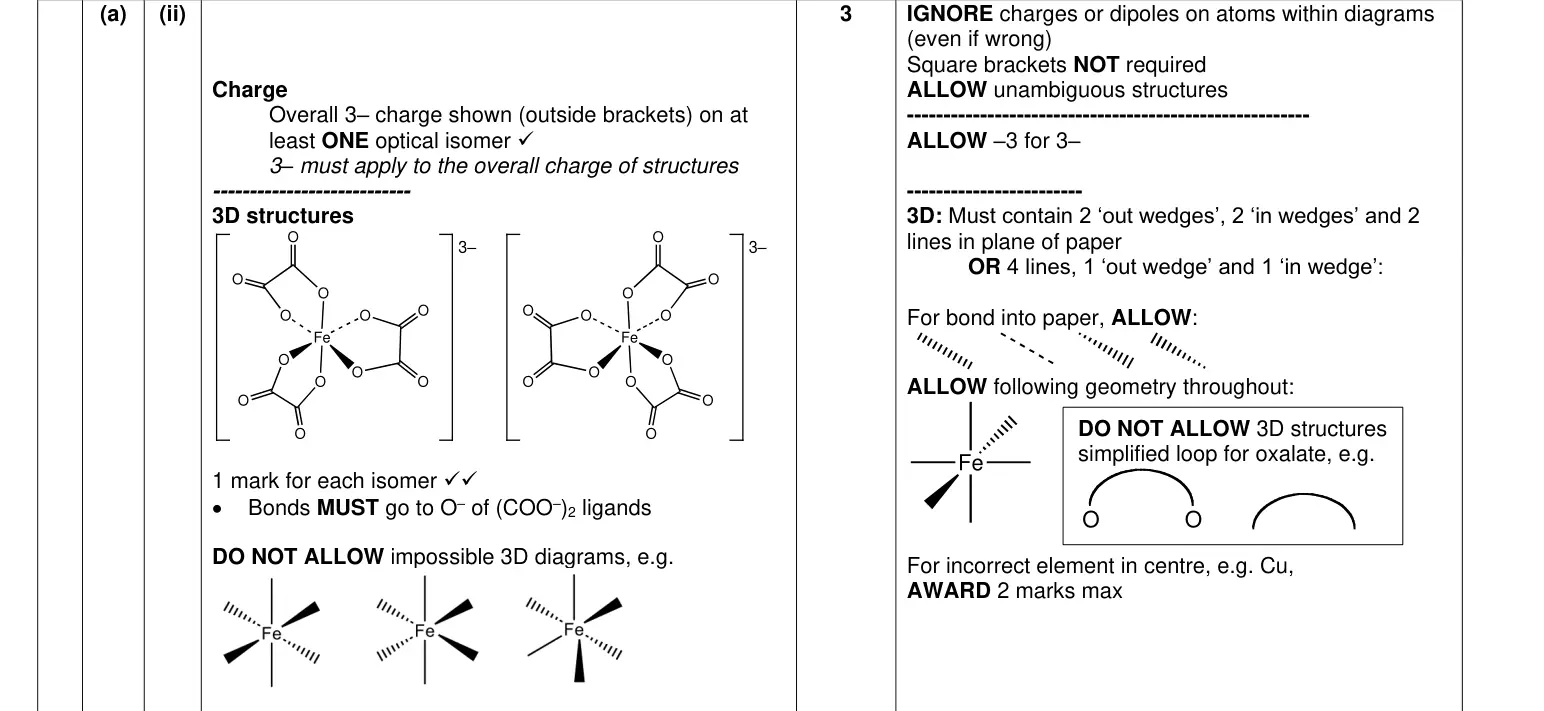
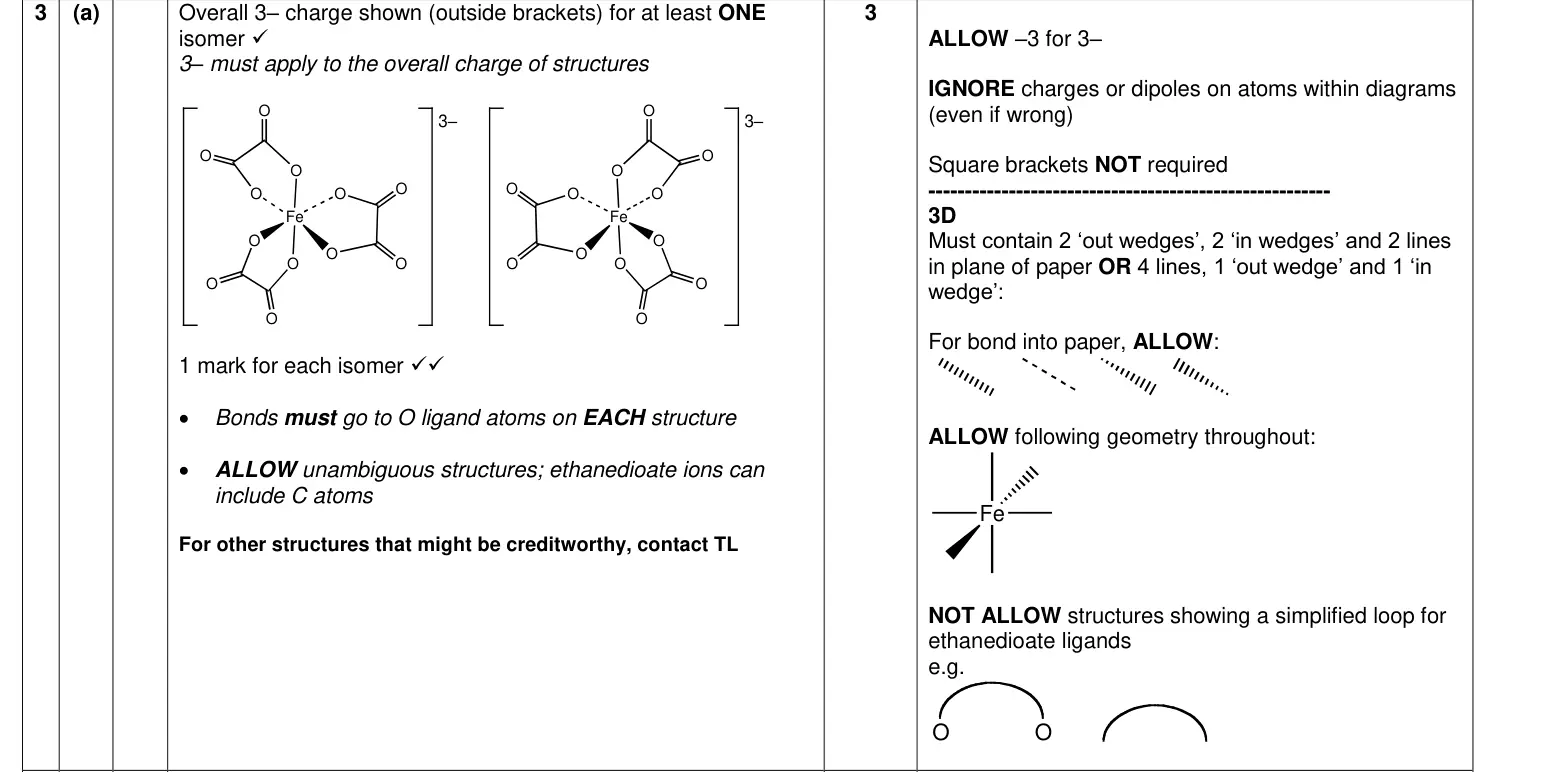
(ii) A complex ion E contains three C2O4 2– ions bonded to an iron(III) ion in an octahedral shape.
Complex ion E exists as a mixture of two optical isomers.
Draw 3D diagrams to show the structures of the optical isomers of E.
Include any overall charge.
[3]
June 2024 · Paper 3 · Q4(a)(ii) 3 marks Structure / isomer Hard bonding and structure
Earlier part of question 4 that this part usesEarlier part of June 2024 Paper 3 question 4
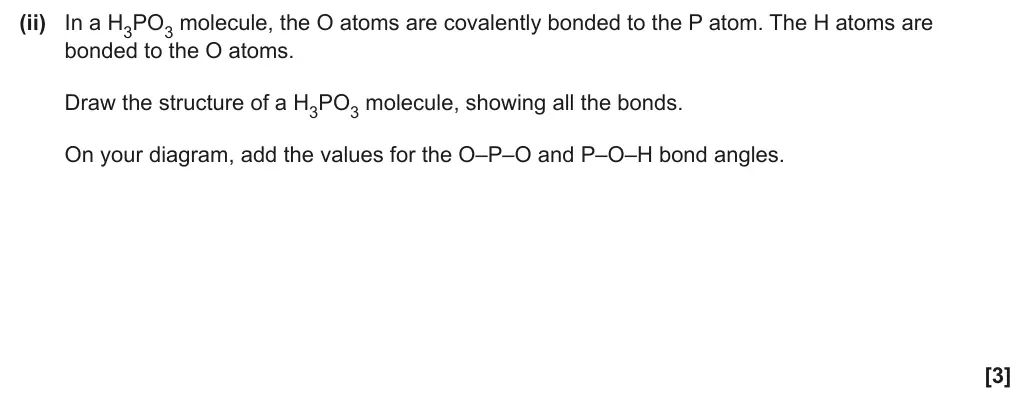
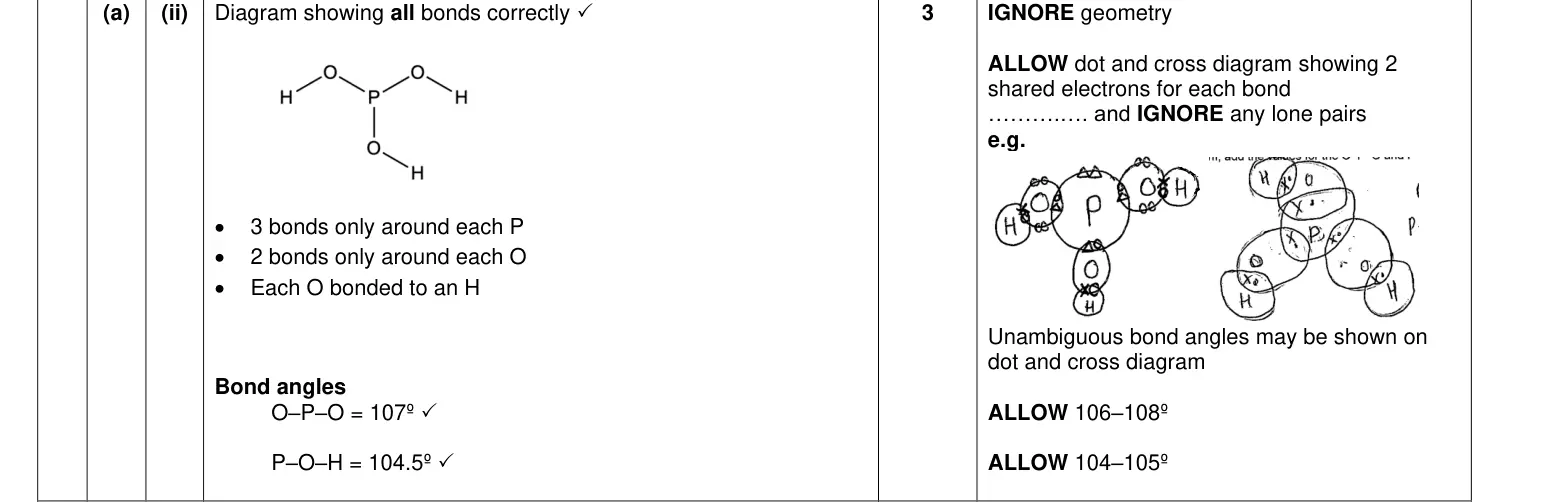
(ii) In a H3PO3 molecule, the O atoms are covalently bonded to the P atom. The H atoms are
bonded to the O atoms.
Draw the structure of a H3PO3 molecule, showing all the bonds.
On your diagram, add the values for the O–P–O and P–O–H bond angles.
[3]
June 2023 · Paper 2 · Q17(c)(i) 3 marks AO2 Structure / isomer Hard alcoholsorganic basics
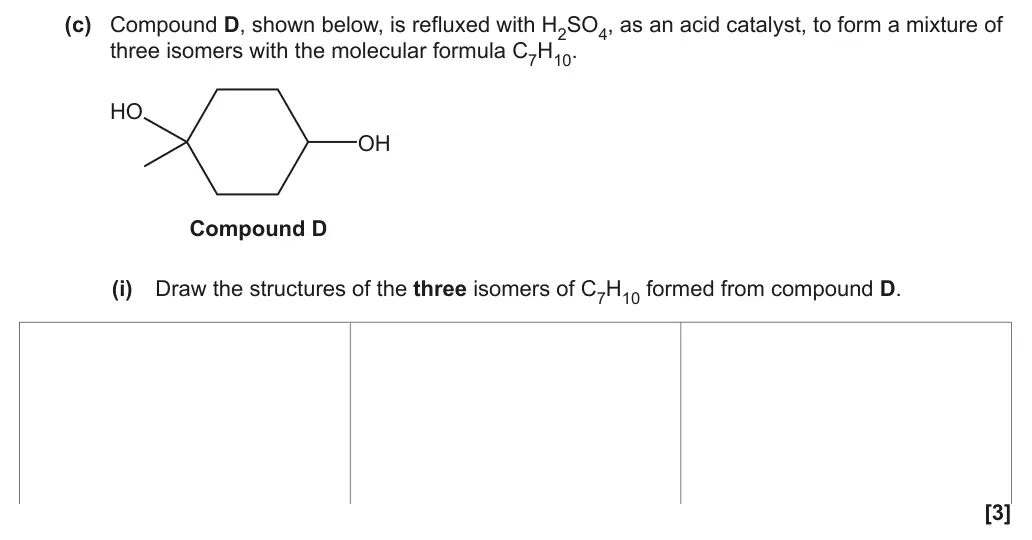
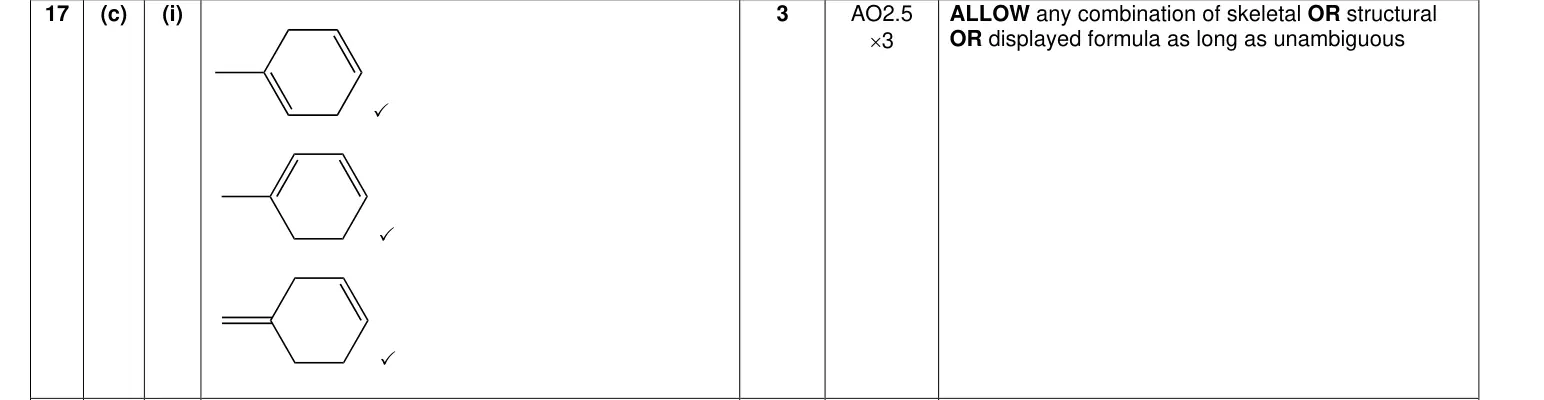
(c) Compound D, shown below, is refluxed with H2SO4, as an acid catalyst, to form a mixture of
three isomers with the molecular formula C7H10.
HO
OH
Compound D
(i) Draw the structures of the three isomers of C7H10 formed from compound D.
[3]
June 2023 · Paper 2 · Q20(b)(i) 3 marks AO1, 3 Structure / isomer Hard condensation polymers
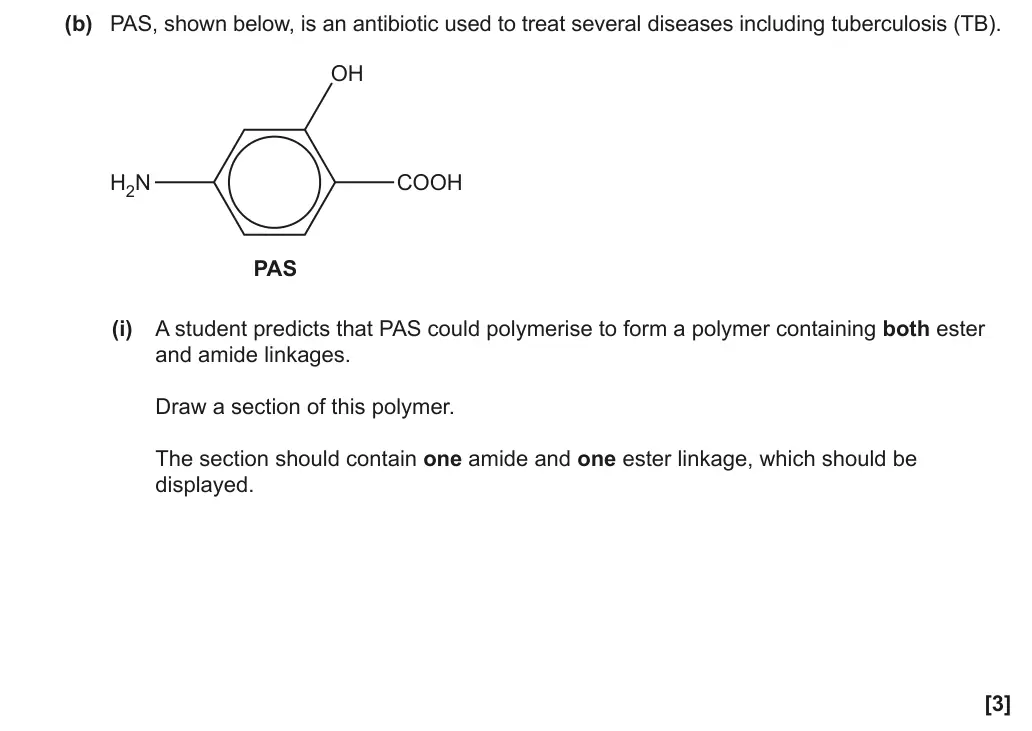
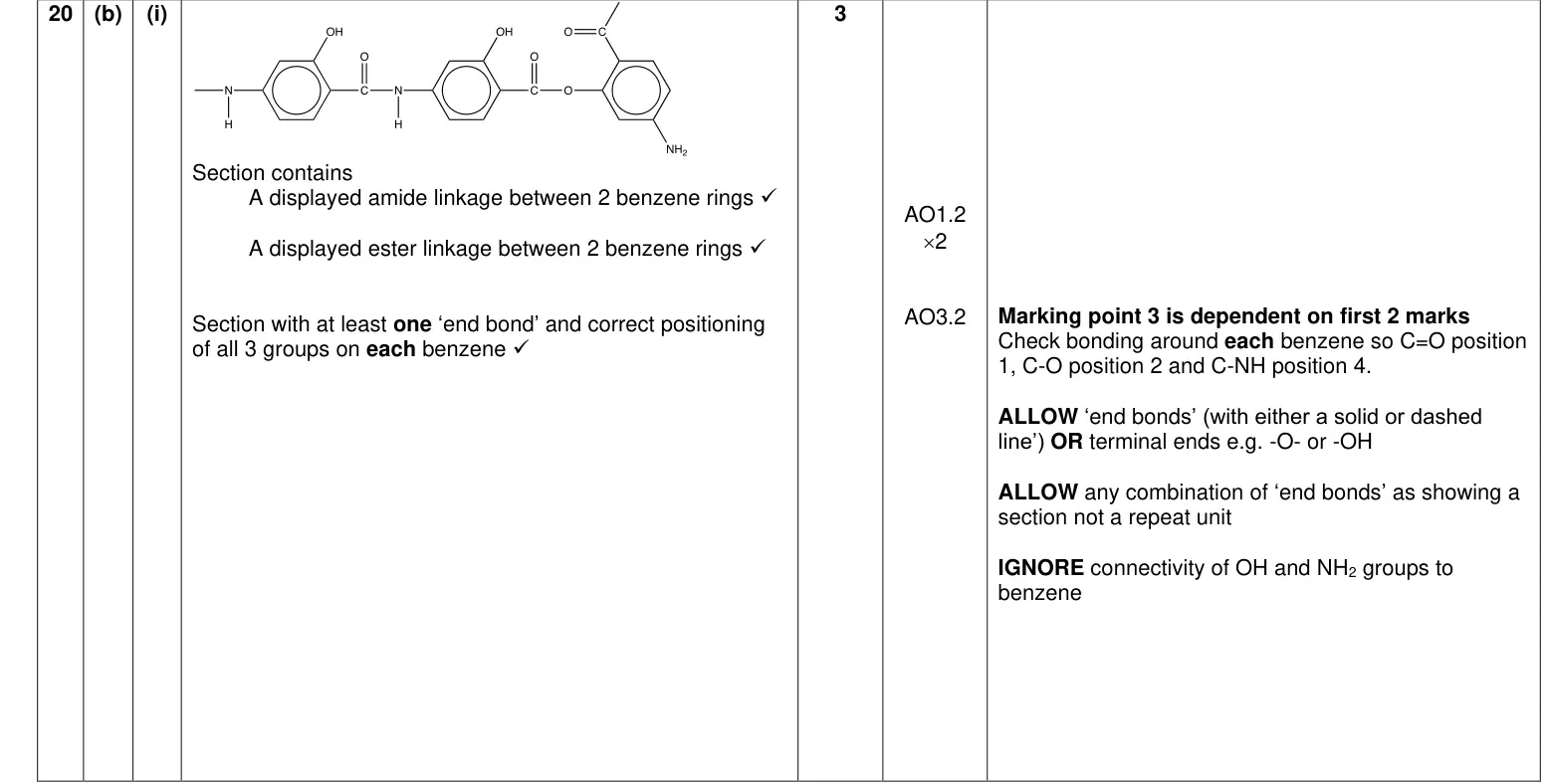
(b) PAS, shown below, is an antibiotic used to treat several diseases including tuberculosis (TB).
OH
H2N COOH
PAS
(i) A student predicts that PAS could polymerise to form a polymer containing both ester
and amide linkages.
Draw a section of this polymer.
The section should contain one amide and one ester linkage, which should be
displayed.
[3]
June 2023 · Paper 2 · Q21(b)(ii) 2 marks AO1 Structure / isomer Medium amino acids amides and chirality
Earlier parts of question 21 that this part usesEarlier part of June 2023 Paper 2 question 21Earlier part of June 2023 Paper 2 question 21
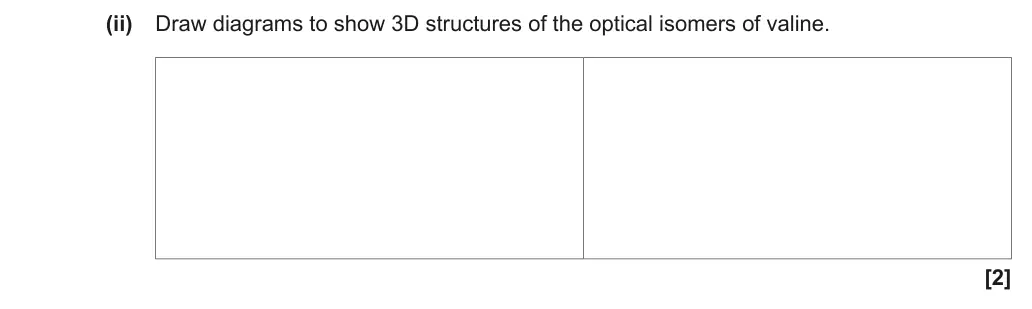
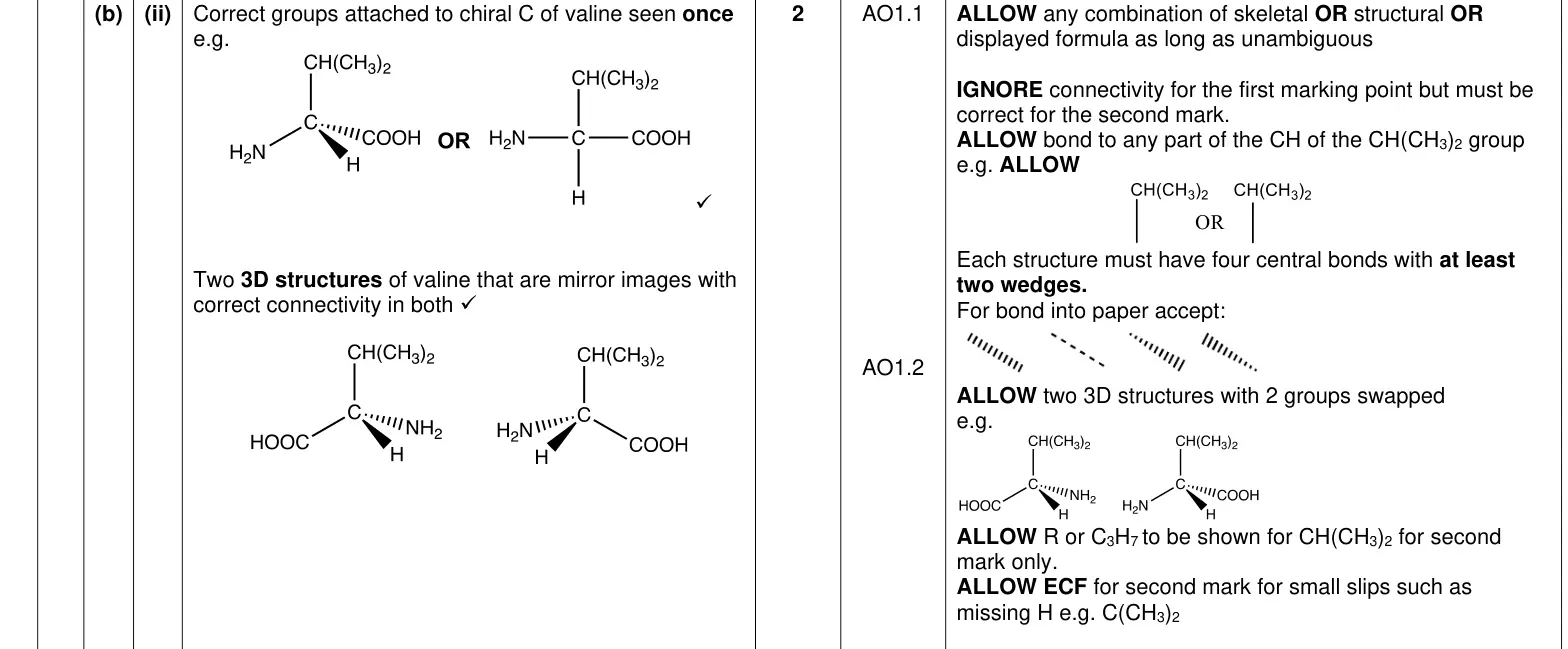
(ii) Draw diagrams to show 3D structures of the optical isomers of valine.
[2]
June 2023 · Paper 2 · Q21(c)(ii) 4 marks AO2 Structure / isomer Medium condensation polymersamino acids amides and chirality
Earlier part of question 21 that this part usesEarlier part of June 2023 Paper 2 question 21
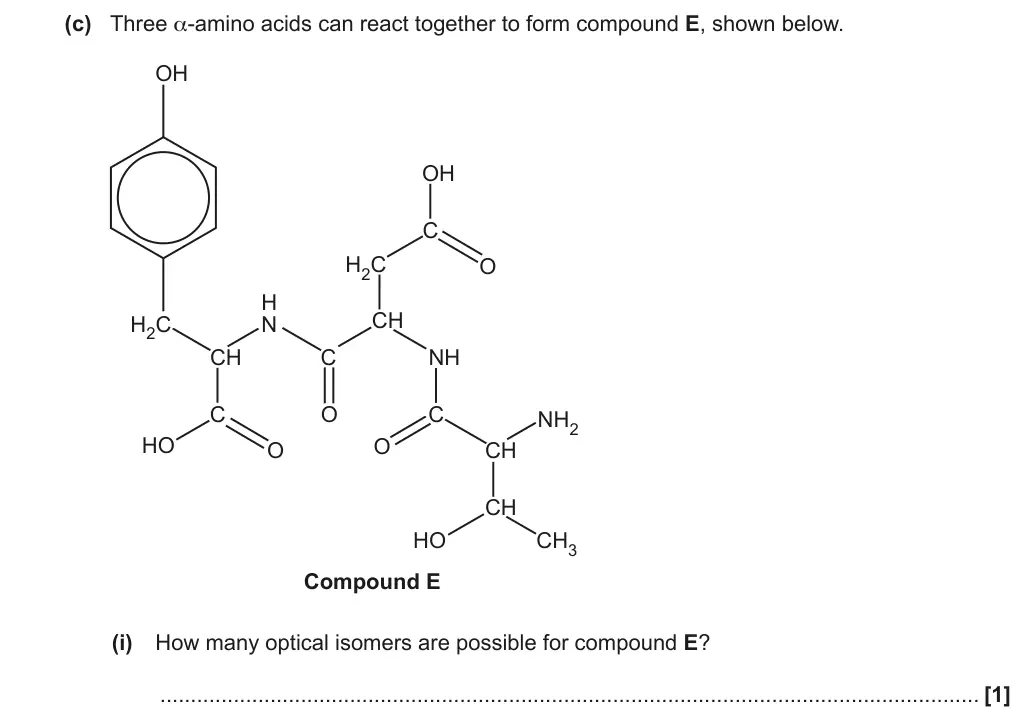
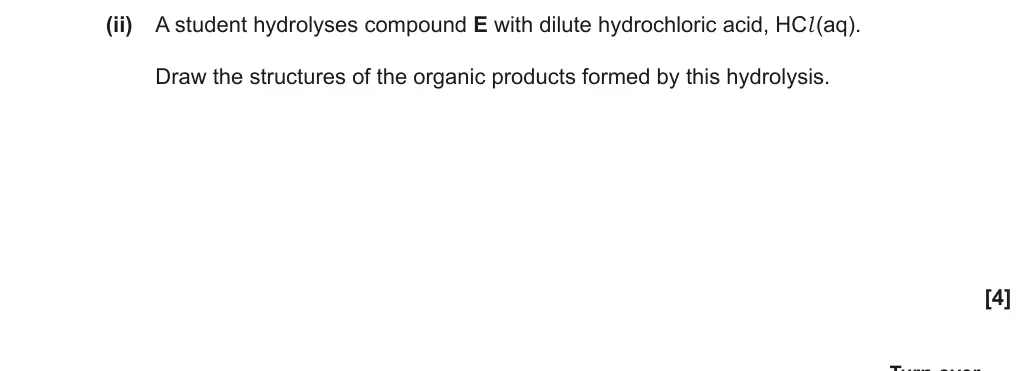
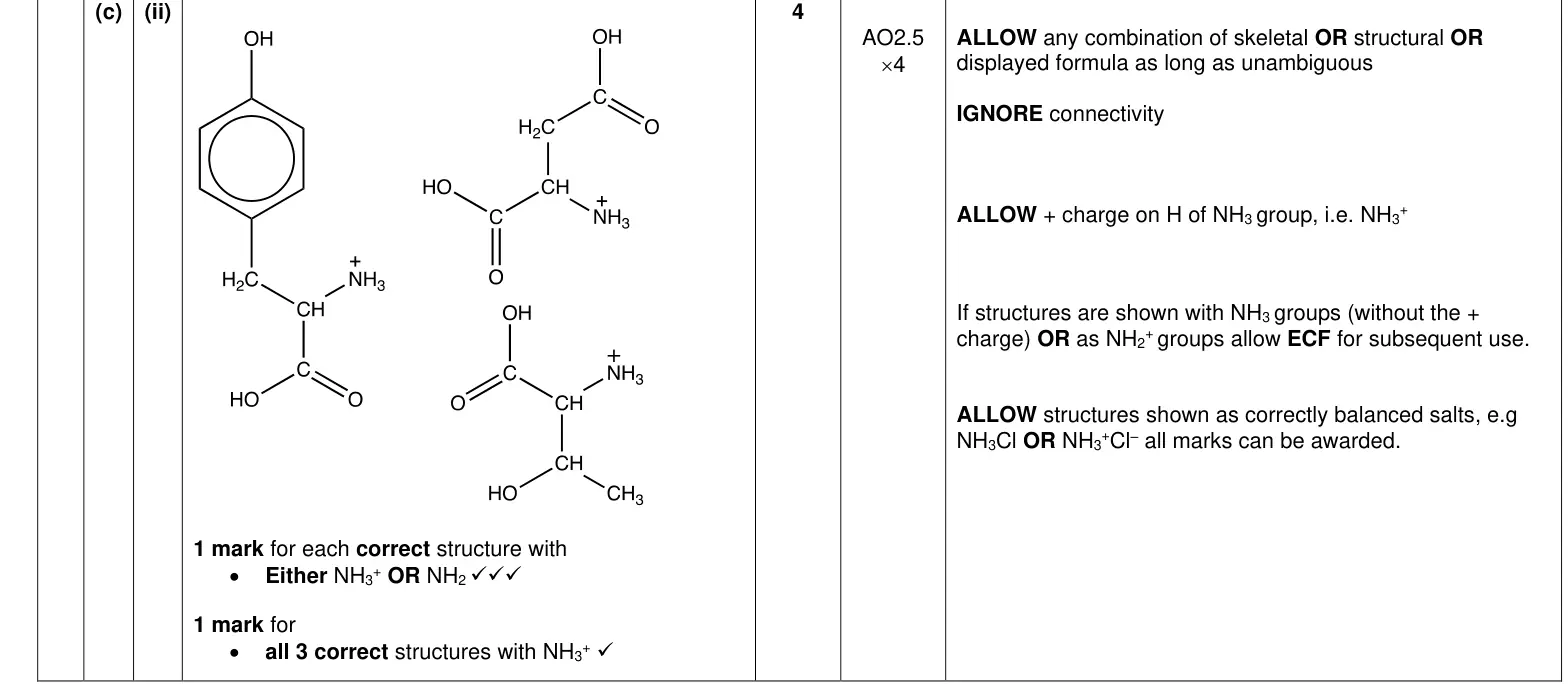
(ii) A student hydrolyses compound E with dilute hydrochloric acid, HCl (aq).
Draw the structures of the organic products formed by this hydrolysis.
[4]
June 2022 · Paper 1 · Q22(a)(ii) 4 marks AO1, 3 Structure / isomer Easy transition elementsamount of substance
Earlier part of question 22 that this part usesEarlier part of June 2022 Paper 1 question 22
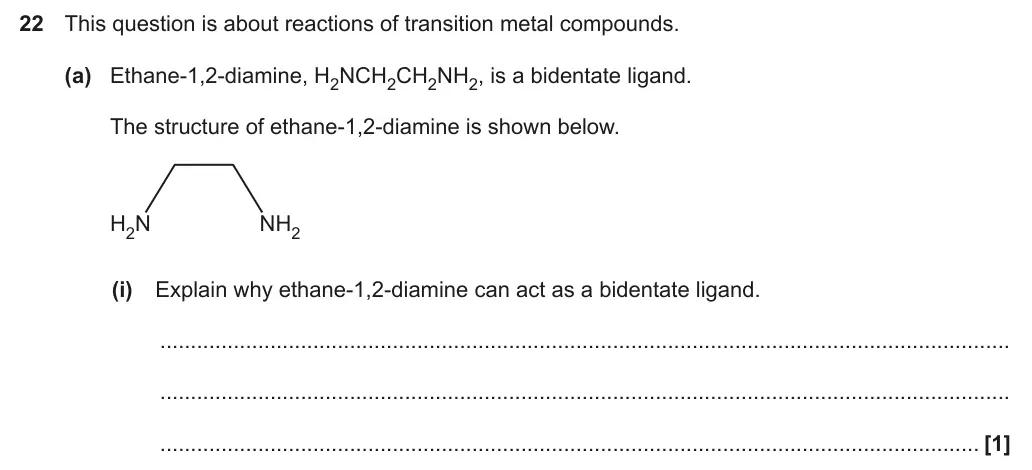
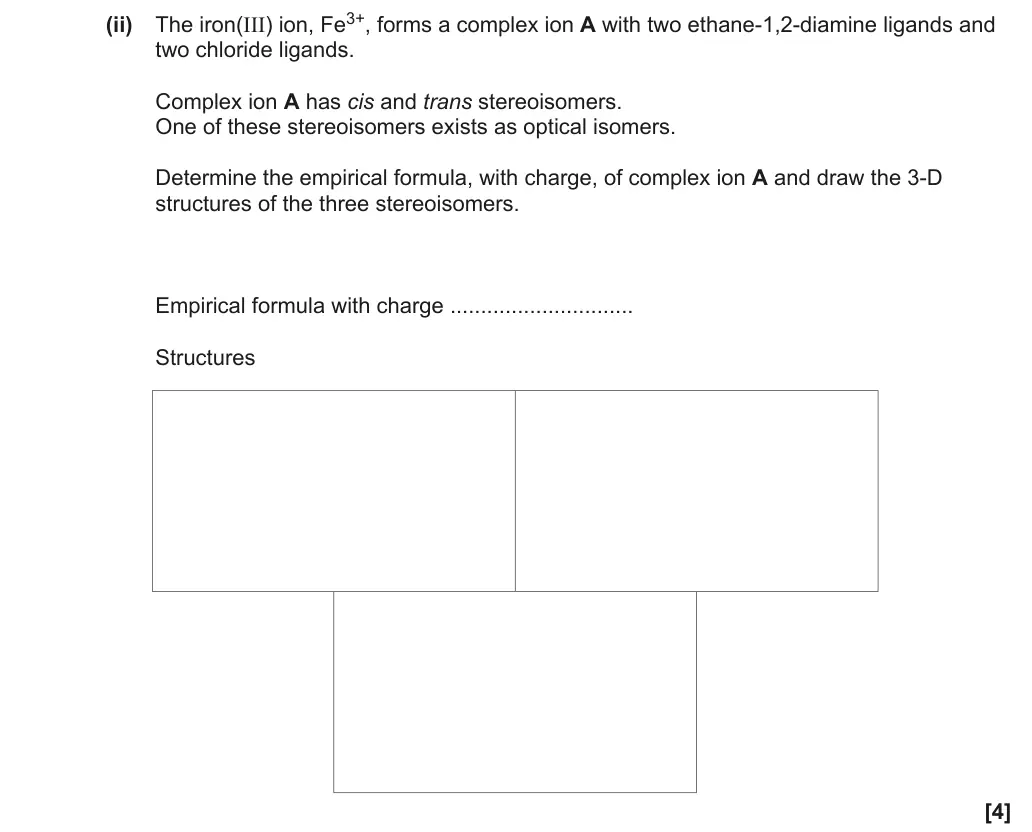
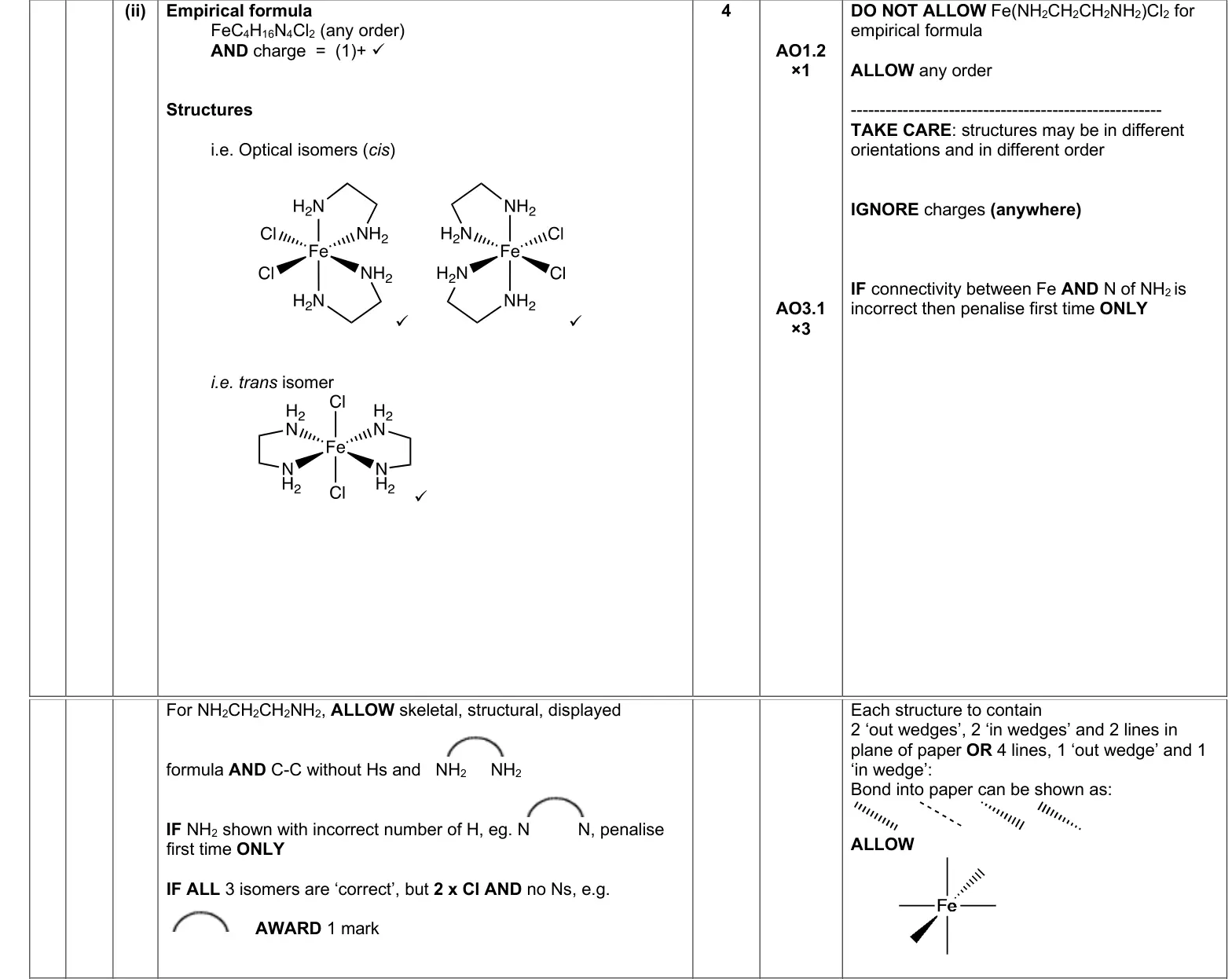
(ii) The iron(III) ion, Fe3+, forms a complex ion A with two ethane-1,2-diamine ligands and
two chloride ligands.
Complex ion A has cis and trans stereoisomers.
One of these stereoisomers exists as optical isomers.
Determine the empirical formula, with charge, of complex ion A and draw the 3-D
structures of the three stereoisomers.
Empirical formula with charge ..............................
Structures
[4]
June 2022 · Paper 2 · Q16(b)(iii) 2 marks AO1, 2 Structure / isomer Easy alkenesorganic basics
Earlier part of question 16 that this part usesEarlier part of June 2022 Paper 2 question 16
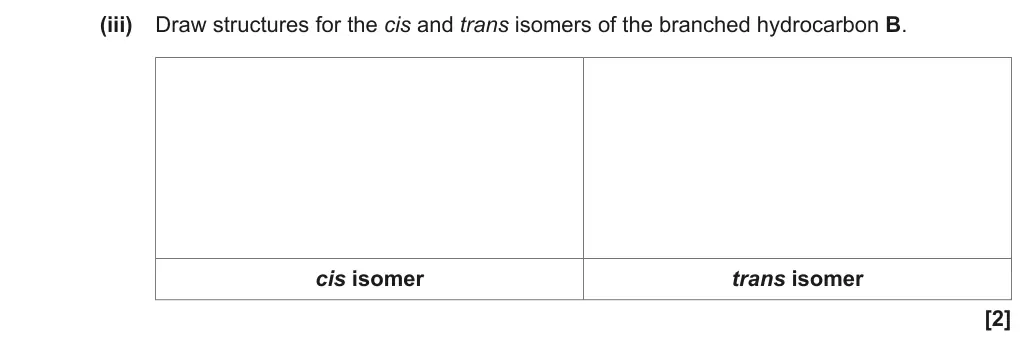
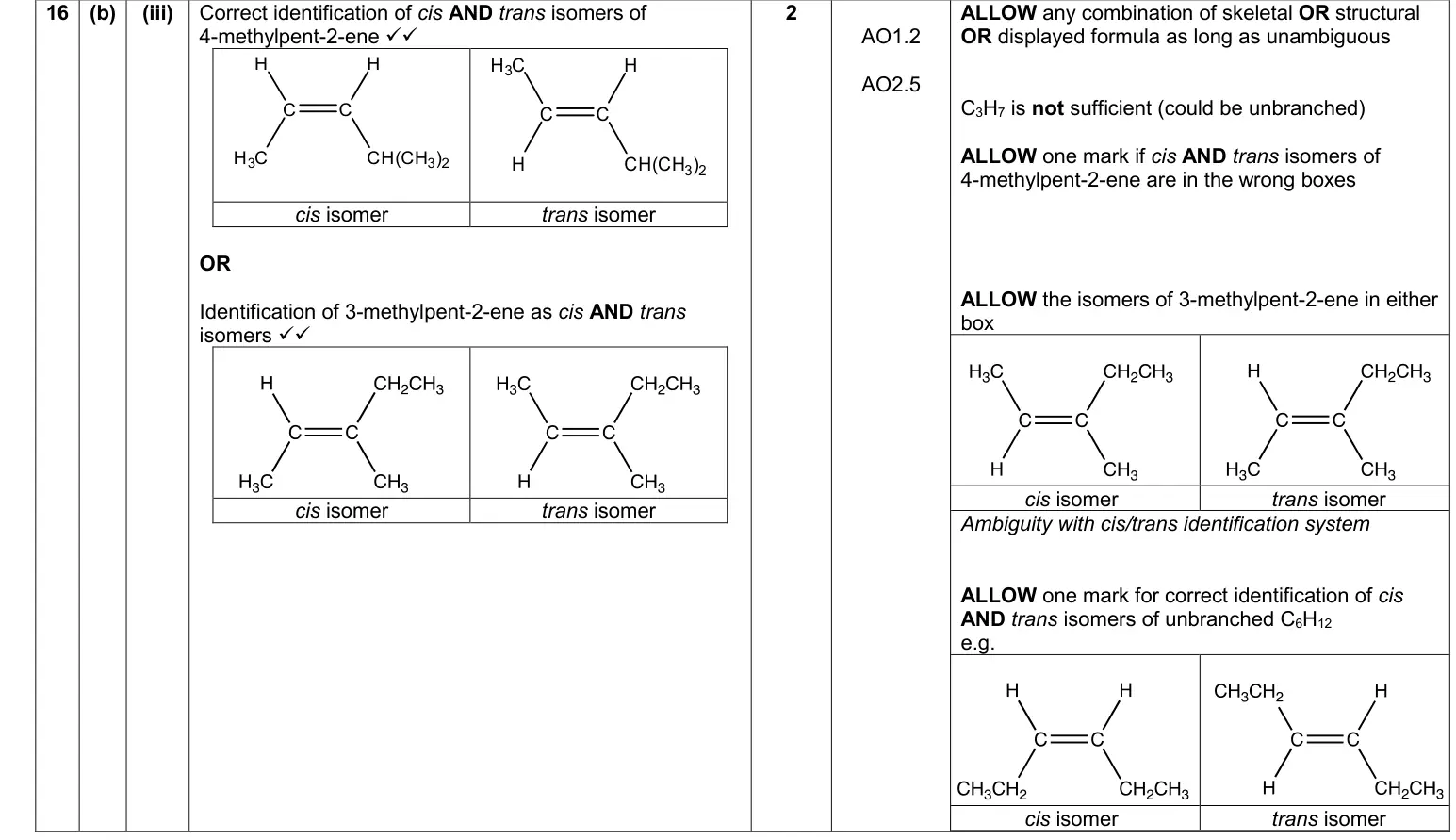
(iii) Draw structures for the cis and trans isomers of the branched hydrocarbon B.
cis isomer trans isomer
[2]
June 2022 · Paper 2 · Q16(b)(iv) 2 marks AO2 Structure / isomer Hard amino acids amides and chiralityorganic basics
Earlier part of question 16 that this part usesEarlier part of June 2022 Paper 2 question 16
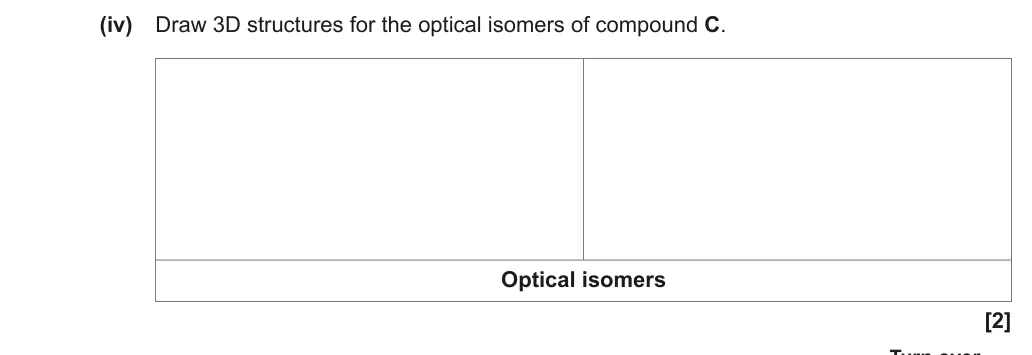
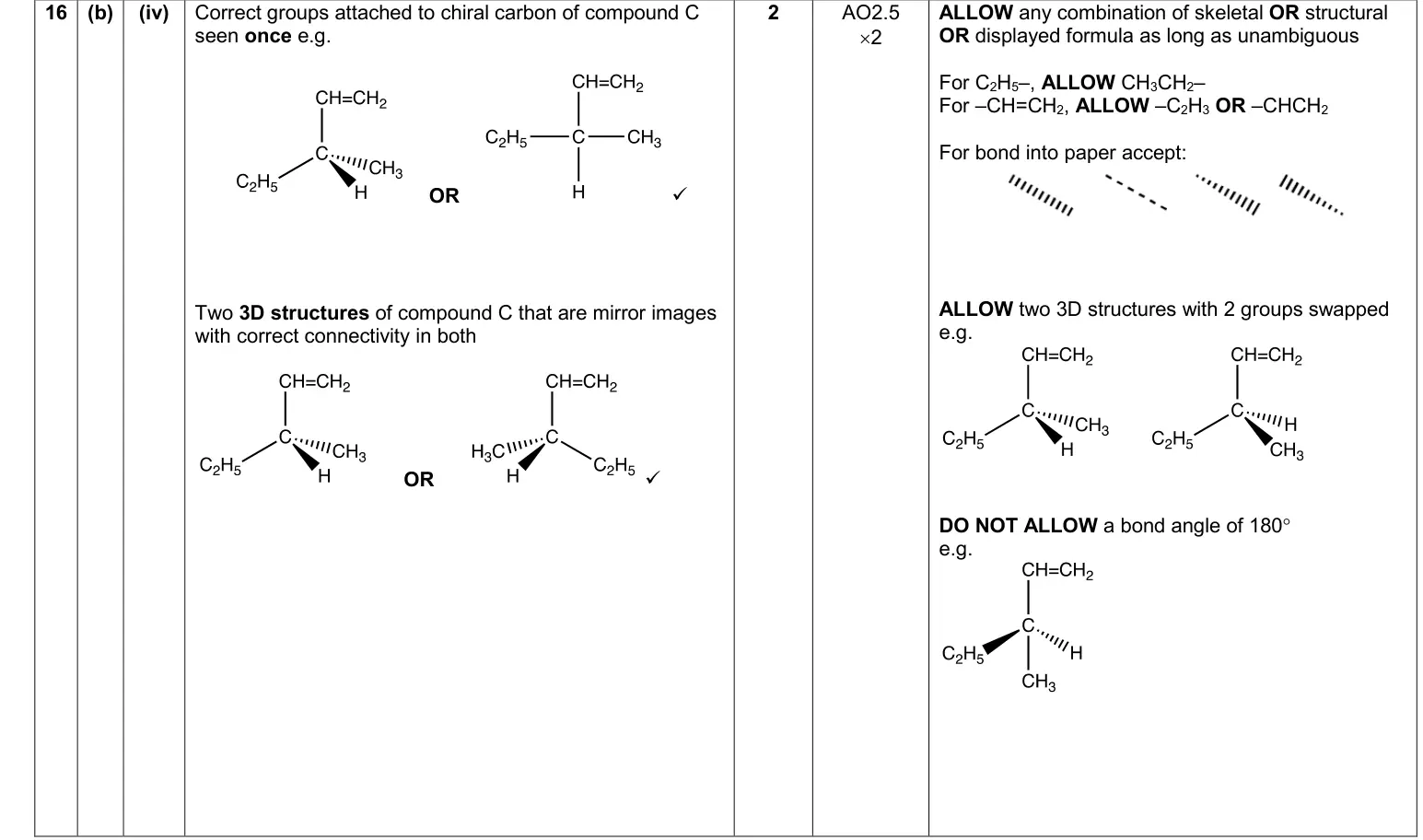
(iv) Draw 3D structures for the optical isomers of compound C.
Optical isomers
[2]
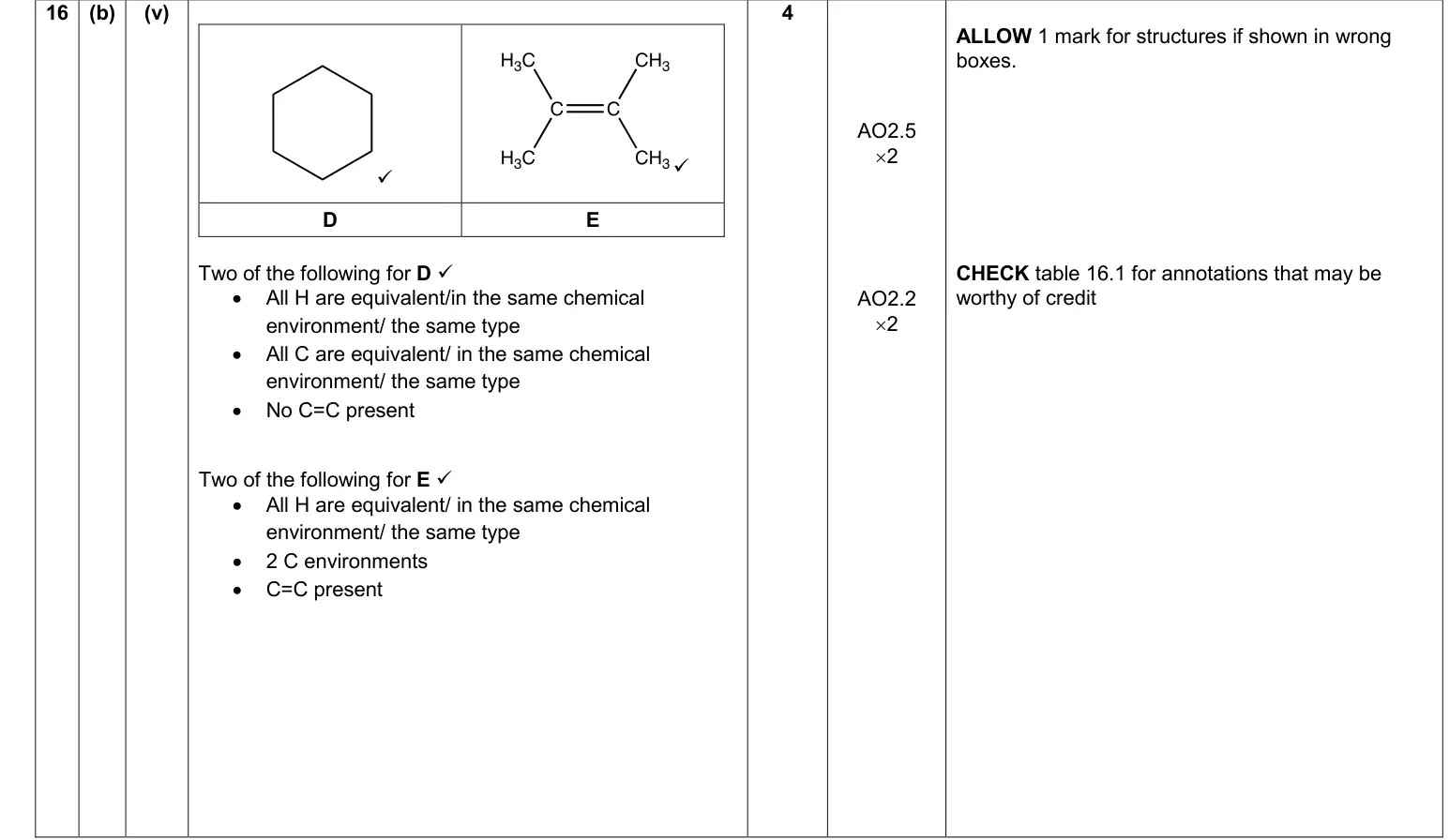
June 2022 · Paper 2 · Q16(b)(v) 4 marks AO2 Structure / isomer Easy nmr spectroscopyinfrared and mass spectrometry
Earlier part of question 16 that this part usesEarlier part of June 2022 Paper 2 question 16
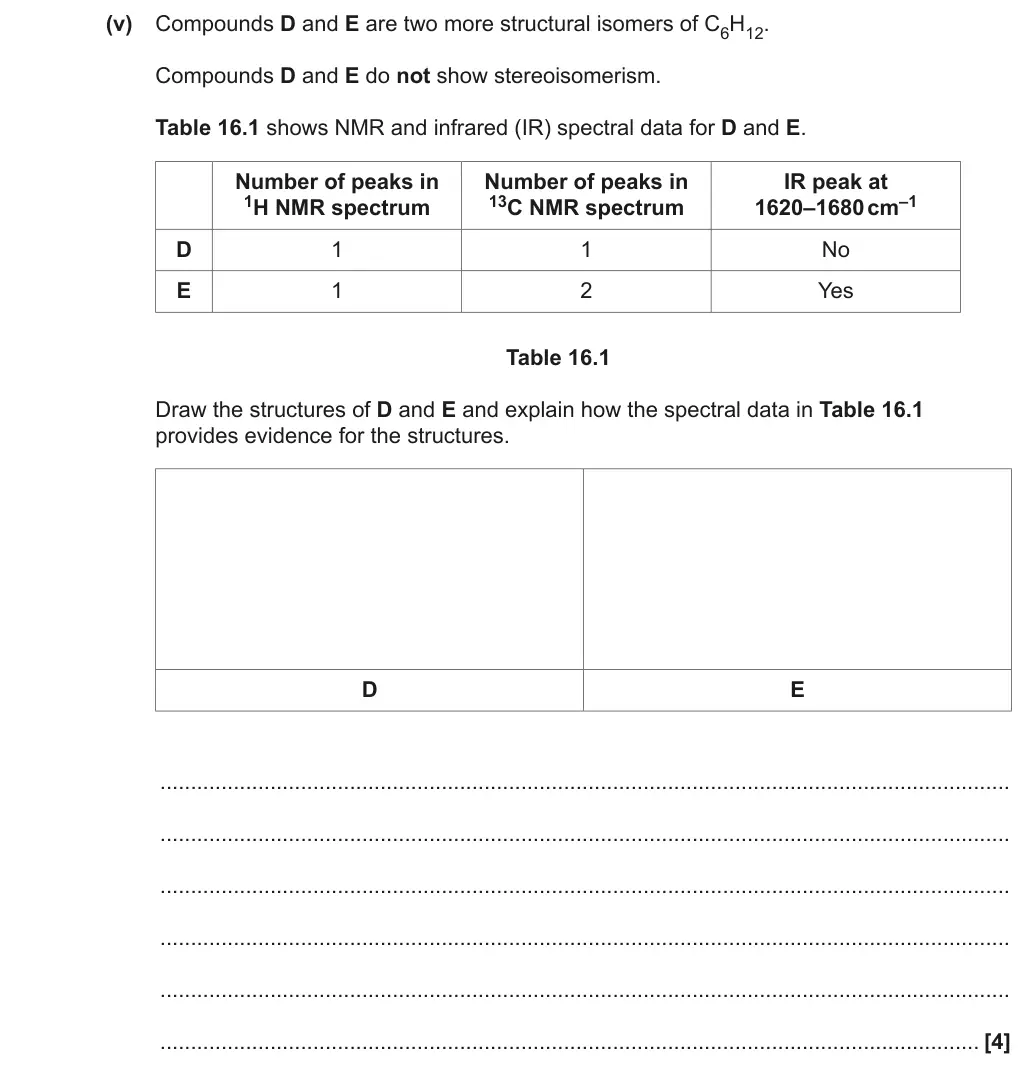
(v) Compounds D and E are two more structural isomers of C6H12.
Compounds D and E do not show stereoisomerism.
Table 16.1 shows NMR and infrared (IR) spectral data for D and E.
Number of peaks in Number of peaks in IR peak at
1H NMR spectrum 13C NMR spectrum 1620–1680 cm–1
D 1 1 No
E 1 2 Yes
Table 16.1
Draw the structures of D and E and explain how the spectral data in Table 16.1
provides evidence for the structures.
D E
...........................................................................................................................................
...........................................................................................................................................
...........................................................................................................................................
...........................................................................................................................................
...........................................................................................................................................
...................................................................................................................................... [4]
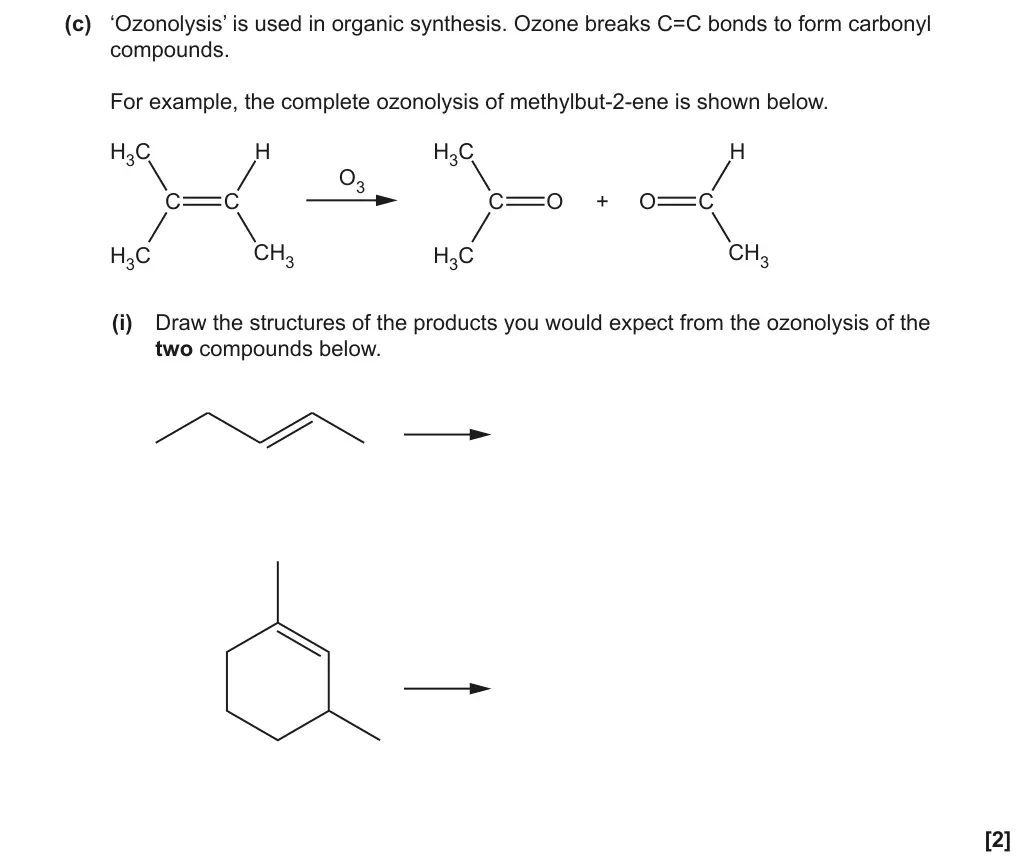
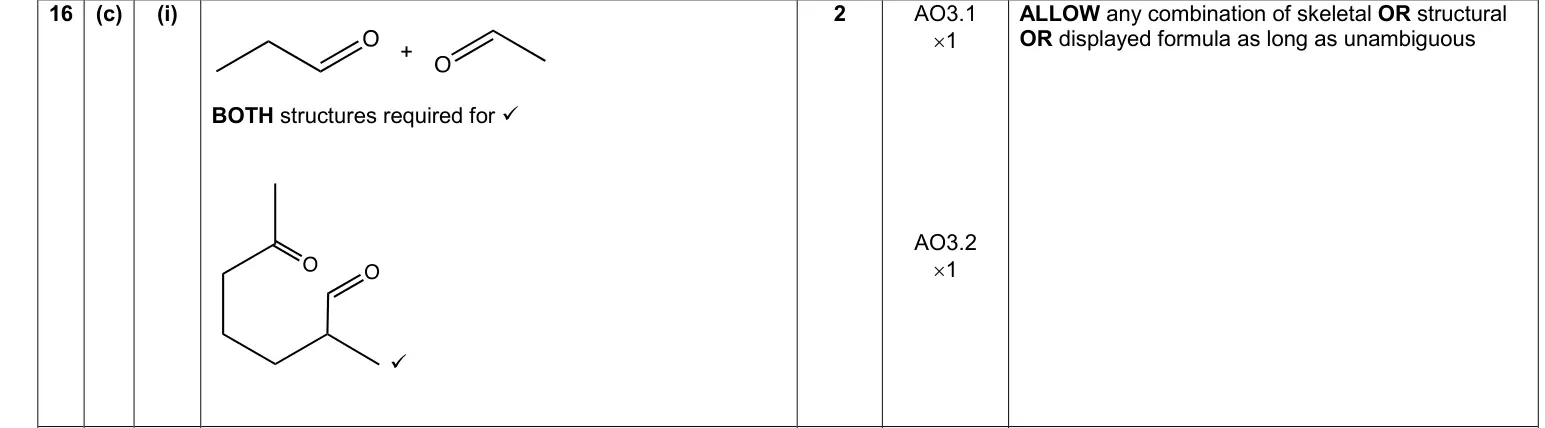
June 2022 · Paper 2 · Q16(c)(i) 2 marks AO3 Structure / isomer Medium organic synthesis
(c) ‘Ozonolysis’ is used in organic synthesis. Ozone breaks C=C bonds to form carbonyl
compounds.
For example, the complete ozonolysis of methylbut-2-ene is shown below.
H3C H H3C H
O3
C C C O + O C
H3C CH3 H3C CH3
(i) Draw the structures of the products you would expect from the ozonolysis of the
two compounds below.
[2]
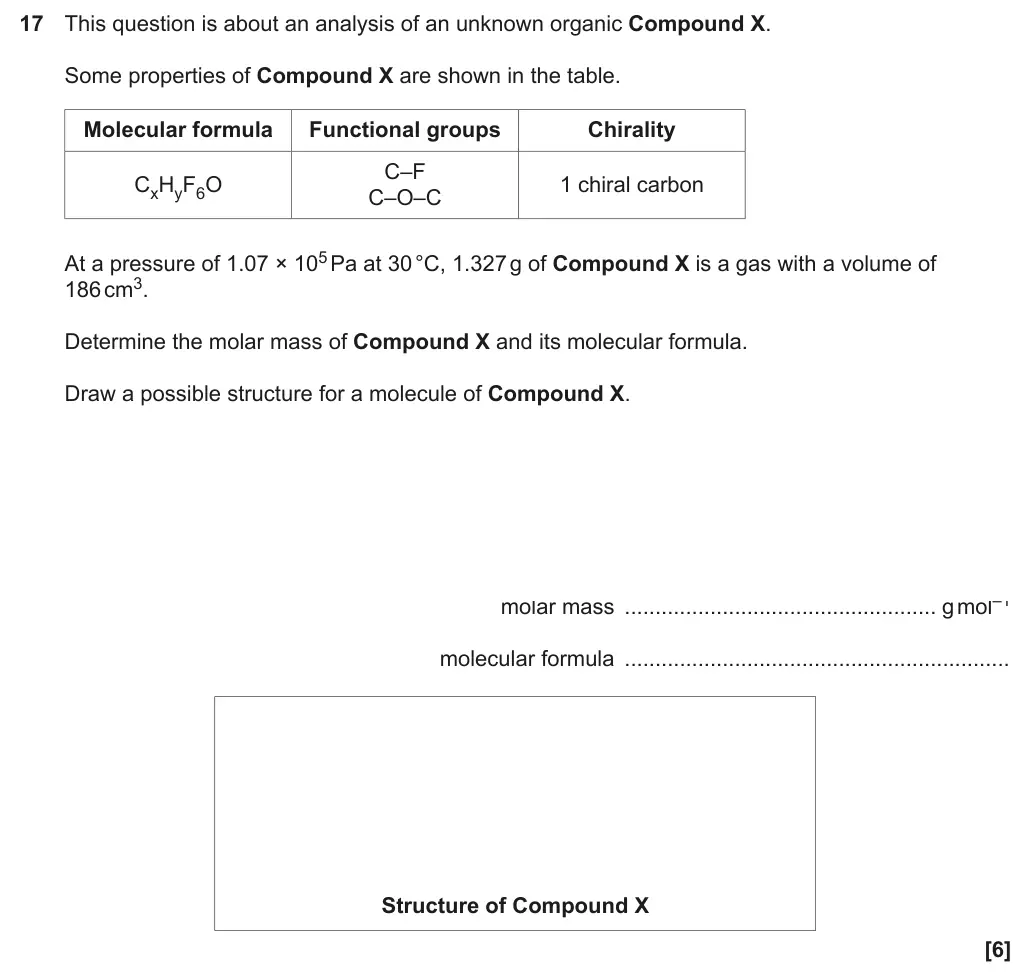
June 2022 · Paper 2 · Q17 6 marks AO1, 2 Structure / isomer Hard amount of substanceamino acids amides and chirality
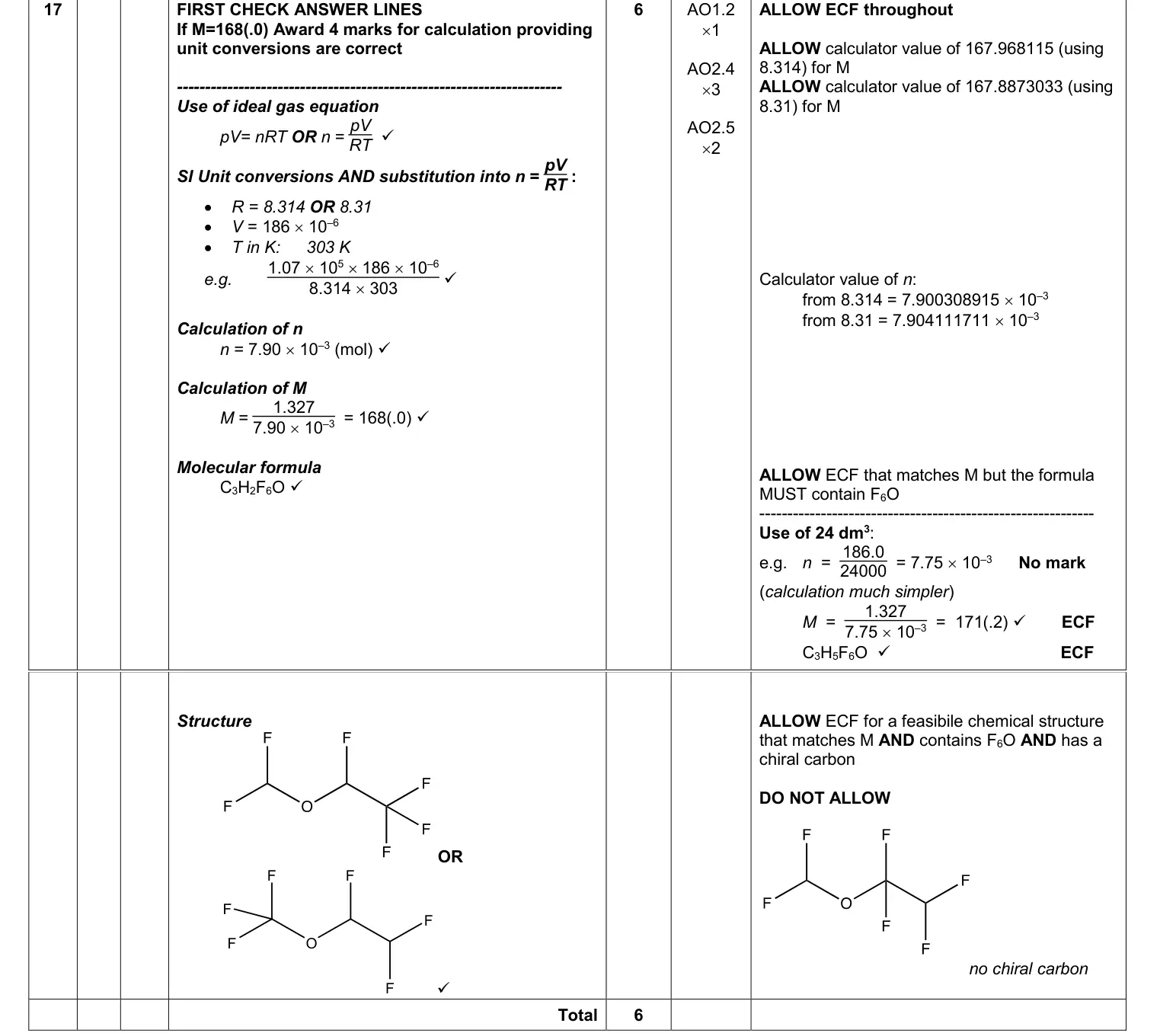
17 This question is about an analysis of an unknown organic Compound X.
Some properties of Compound X are shown in the table.
Molecular formula Functional groups Chirality
C–F
CxHyF6O 1 chiral carbon
C–O–C
At a pressure of 1.07 × 10⁵ Pa at 30 °C, 1.327 g of Compound X is a gas with a volume of
186 cm3.
Determine the molar mass of Compound X and its molecular formula.
Draw a possible structure for a molecule of Compound X.
molar mass  ................................................... g mol–1
molecular formula  ...............................................................
Structure of Compound X
[6]
June 2022 · Paper 2 · Q18(b) 4 marks AO1, 2, 3 Structure / isomer Easy amount of substanceinfrared and mass spectrometry
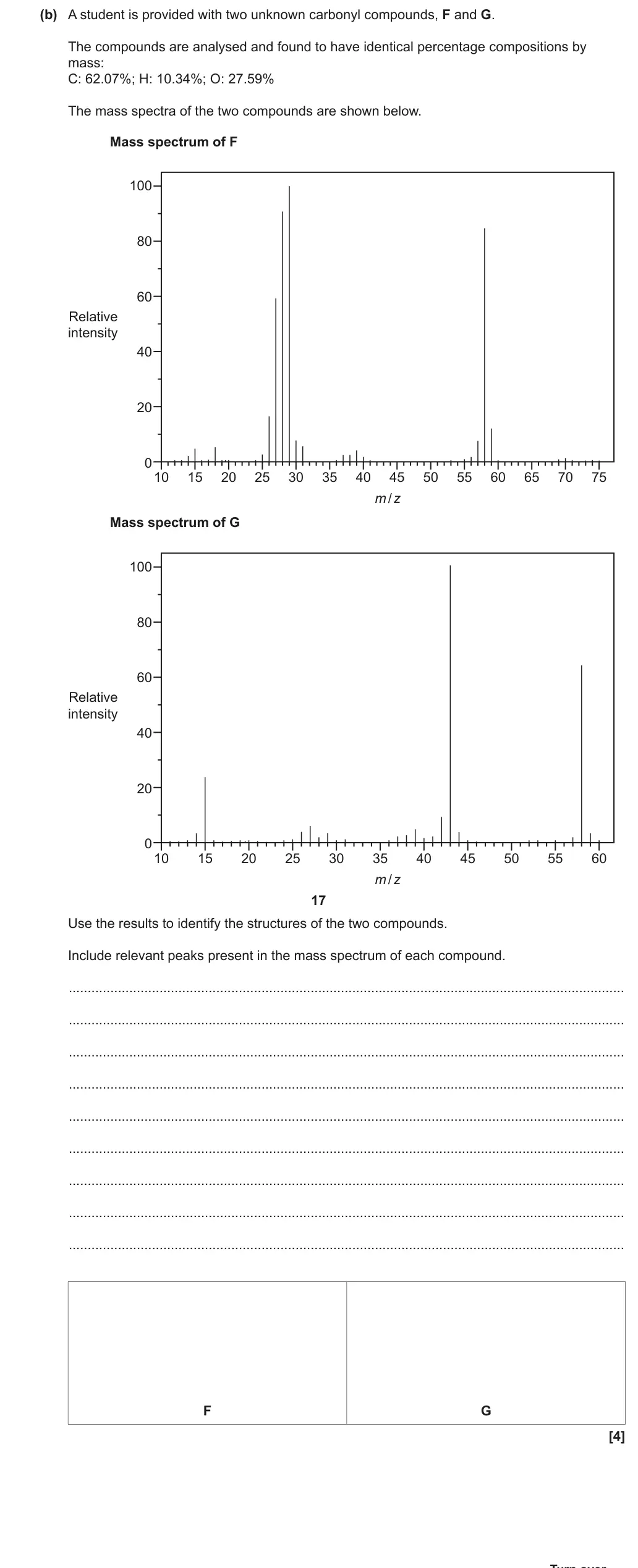
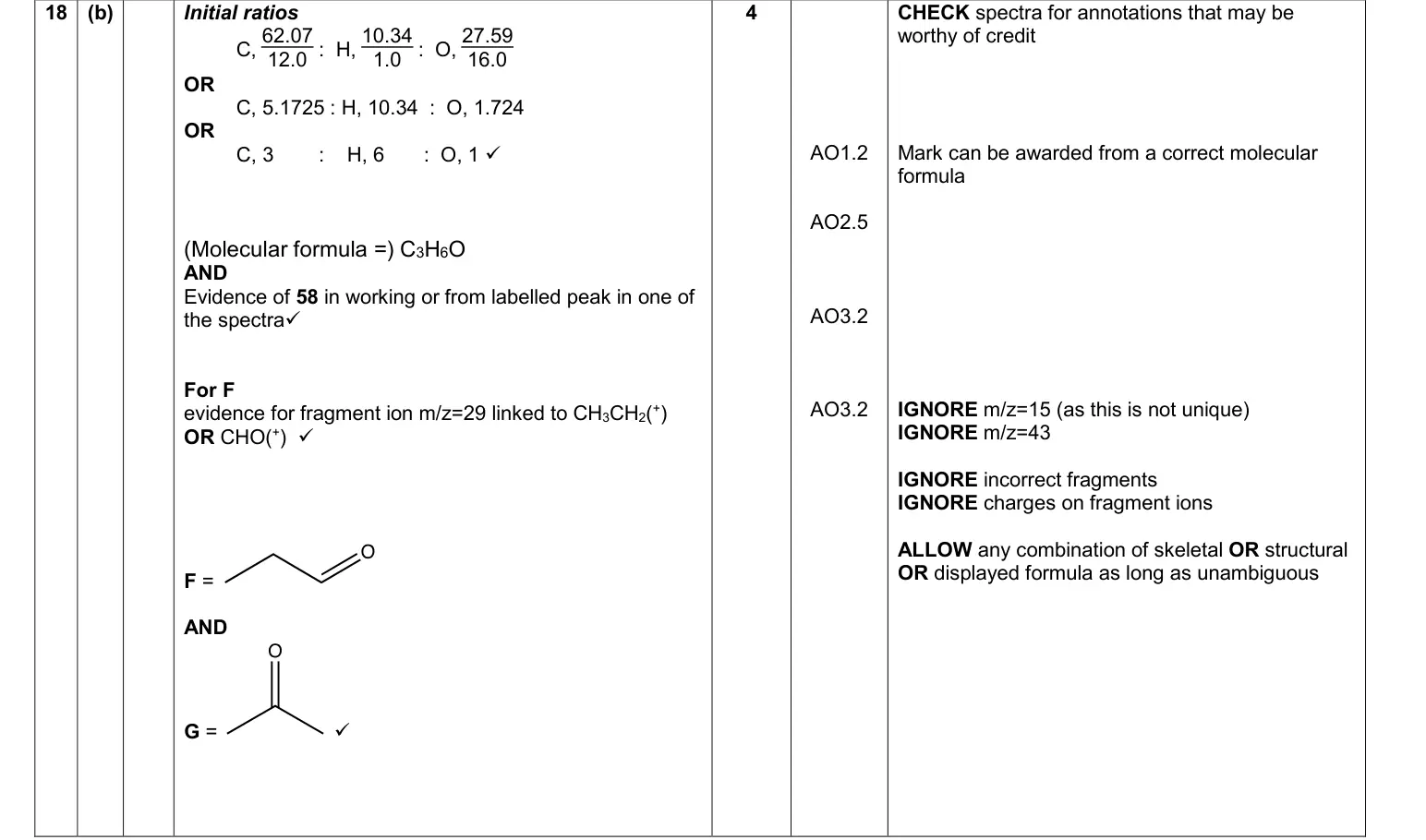
(b) A student is provided with two unknown carbonyl compounds, F and G.
The compounds are analysed and found to have identical percentage compositions by
mass:
C: 62.07%; H: 10.34%; O: 27.59%
The mass spectra of the two compounds are shown below.
Mass spectrum of F
100
80
60
Relative
intensity
40
20
0
10 15 20 25 30 35 40 45 50 55 60 65 70 75
m / z
Mass spectrum of G
100
80
60
Relative
intensity
40
20
0
10 15 20 25 30 35 40 45 50 55 60
m / z
Use the results to identify the structures of the two compounds.
Include relevant peaks present in the mass spectrum of each compound.
...................................................................................................................................................
...................................................................................................................................................
...................................................................................................................................................
...................................................................................................................................................
...................................................................................................................................................
...................................................................................................................................................
...................................................................................................................................................
...................................................................................................................................................
...................................................................................................................................................
F G
[4]
June 2022 · Paper 2 · Q19(c)(i) 2 marks AO1, 2 Structure / isomer Medium alkenesorganic basics
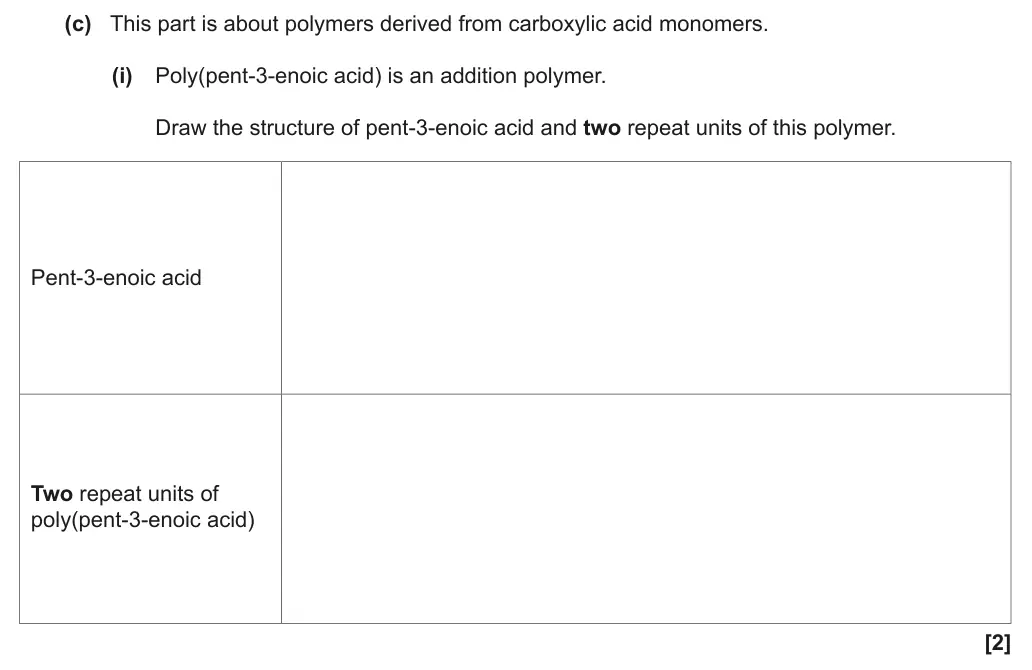
(c) This part is about polymers derived from carboxylic acid monomers.
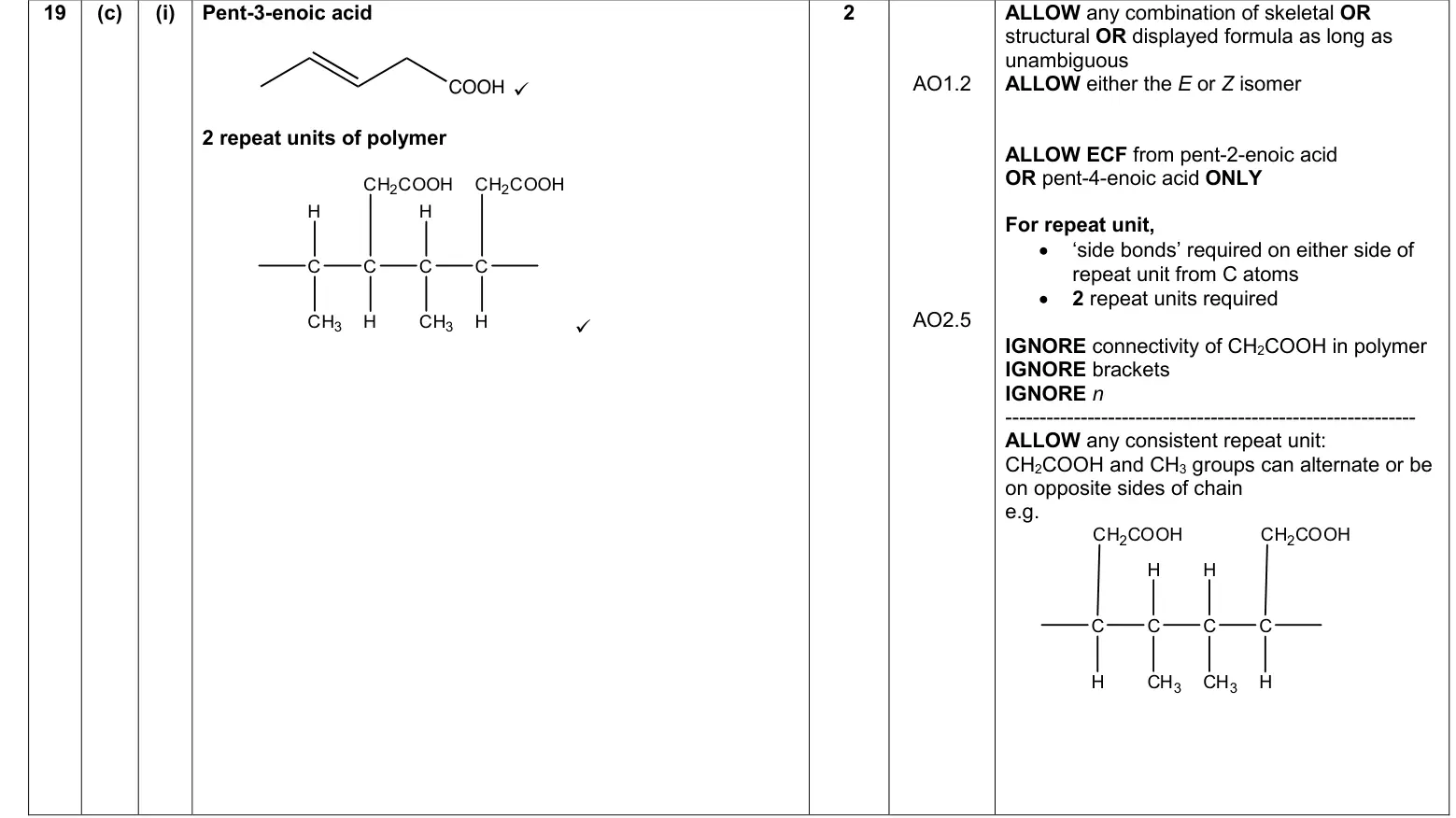
(i) Poly(pent-3-enoic acid) is an addition polymer.
Draw the structure of pent-3-enoic acid and two repeat units of this polymer.
Pent-3-enoic acid
Two repeat units of
poly(pent-3-enoic acid)
[2]
June 2022 · Paper 2 · Q19(c)(iii) 1 mark AO3 Structure / isomer Hard condensation polymers
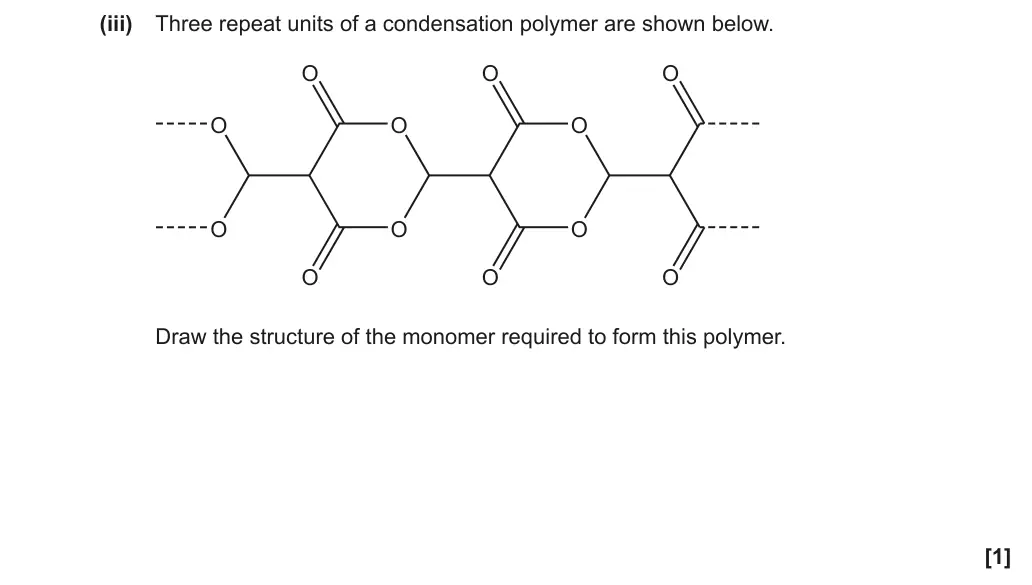
(iii) Three repeat units of a condensation polymer are shown below.
O O O
O O O
O O O
O O O
Draw the structure of the monomer required to form this polymer.
[1]
November 2021 · AS Paper 1 · Q21(d)(i) 1 mark AO2 Structure / isomer organic basics
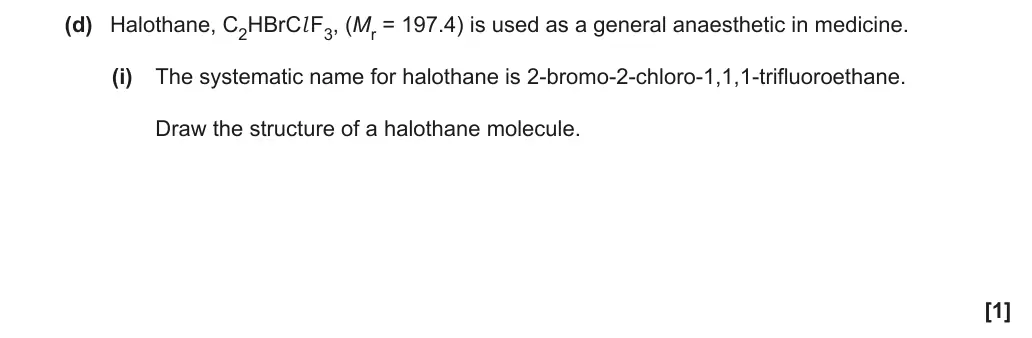
(d) Halothane, C2HBrCl F3, (Mr = 197.4) is used as a general anaesthetic in medicine.
(i) The systematic name for halothane is 2-bromo-2-chloro-1,1,1-trifluoroethane.
Draw the structure of a halothane molecule.
[1]
November 2021 · AS Paper 2 · Q2(c) 2 marks AO2 Structure / isomer alkanes
Earlier part of question 2 that this part usesEarlier part of November 2021 Paper 2 question 2
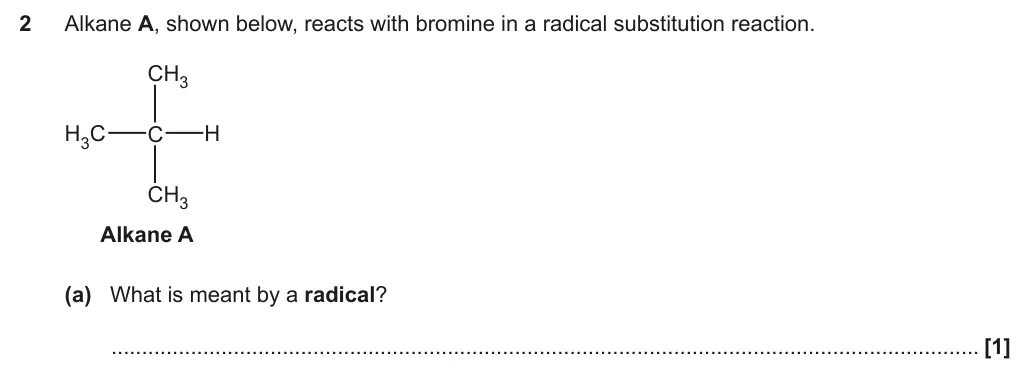
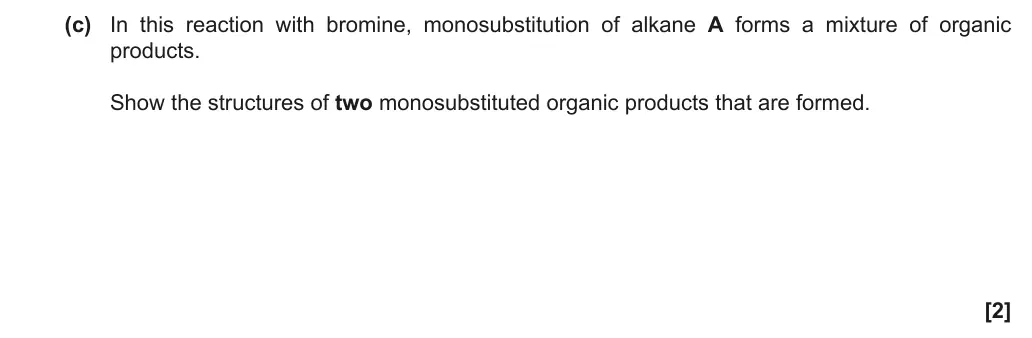
(c) In this reaction with bromine, monosubstitution of alkane A forms a mixture of organic
products.
Show the structures of two monosubstituted organic products that are formed.
[2]
November 2021 · Paper 2 · Q16(d)(ii) 2 marks AO3 Structure / isomer Medium organic synthesiscarbon carbon bond formation
Earlier part of question 16 that this part usesEarlier part of November 2021 Paper 2 question 16
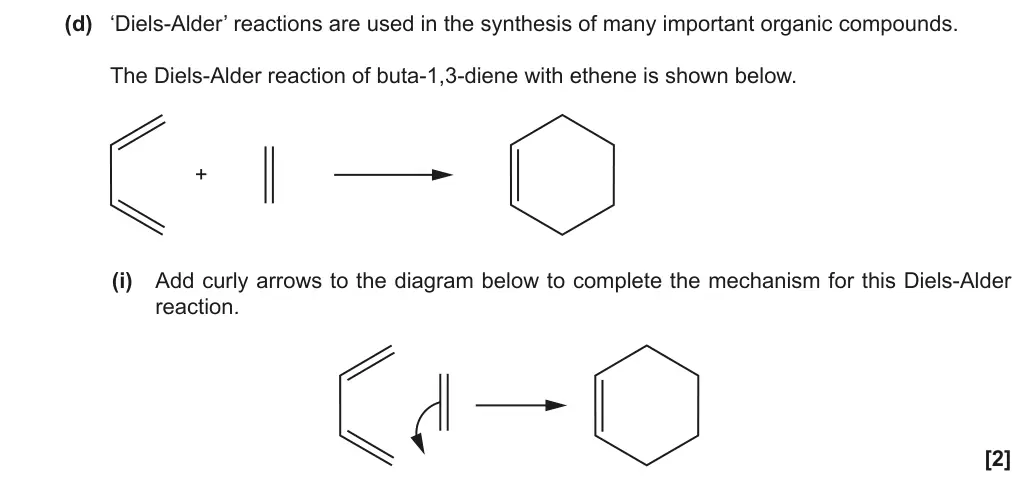
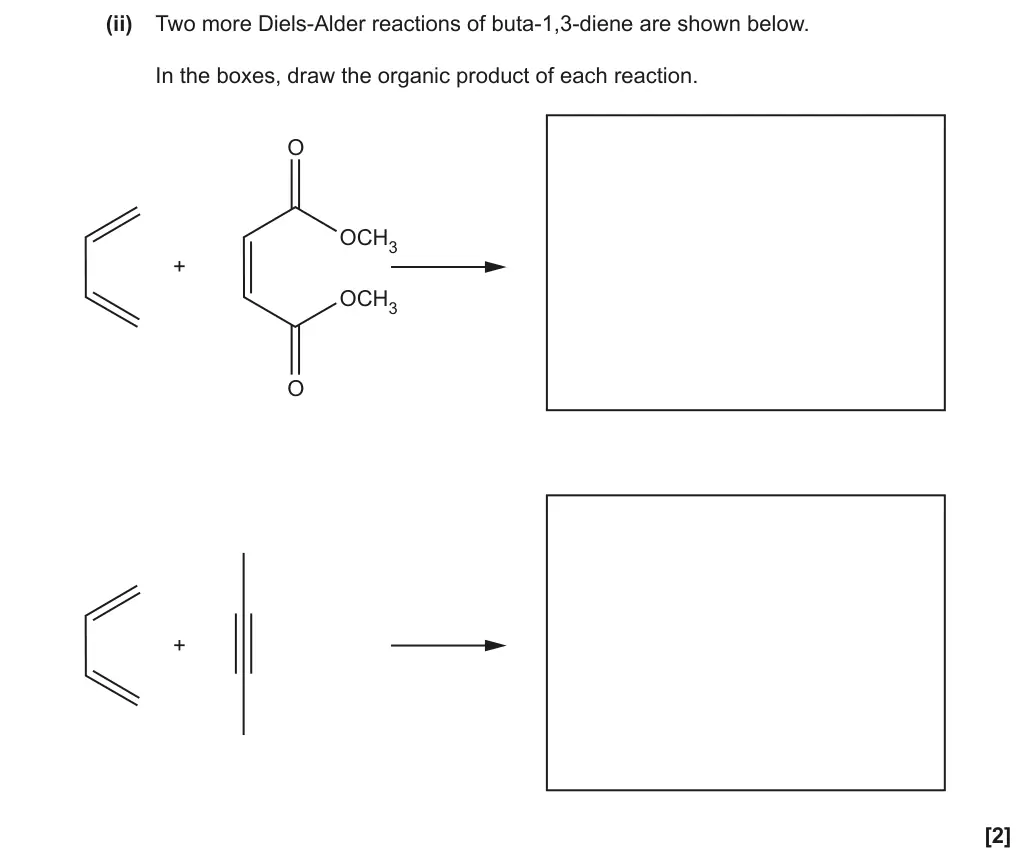
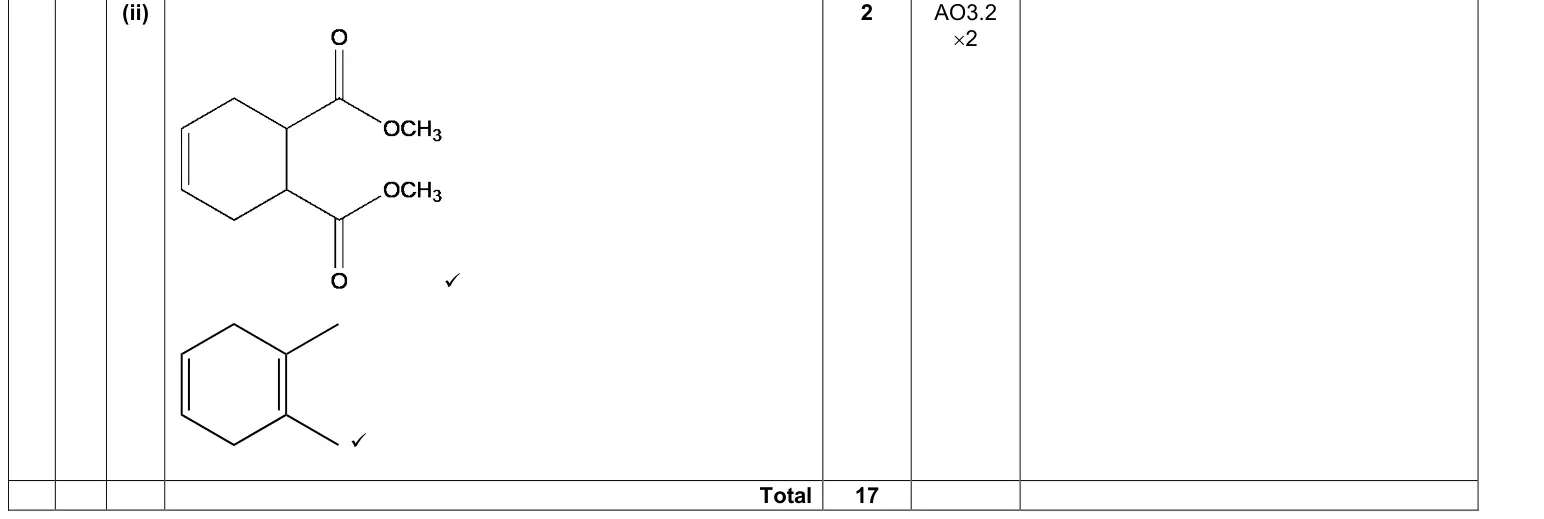
(ii) Two more Diels-Alder reactions of buta-1,3-diene are shown below.
In the boxes, draw the organic product of each reaction.
O
OCH3
+
OCH3
O
+
[2]
November 2021 · Paper 2 · Q17(c) 4 marks AO1, 2 Structure / isomer condensation polymersorganic basics
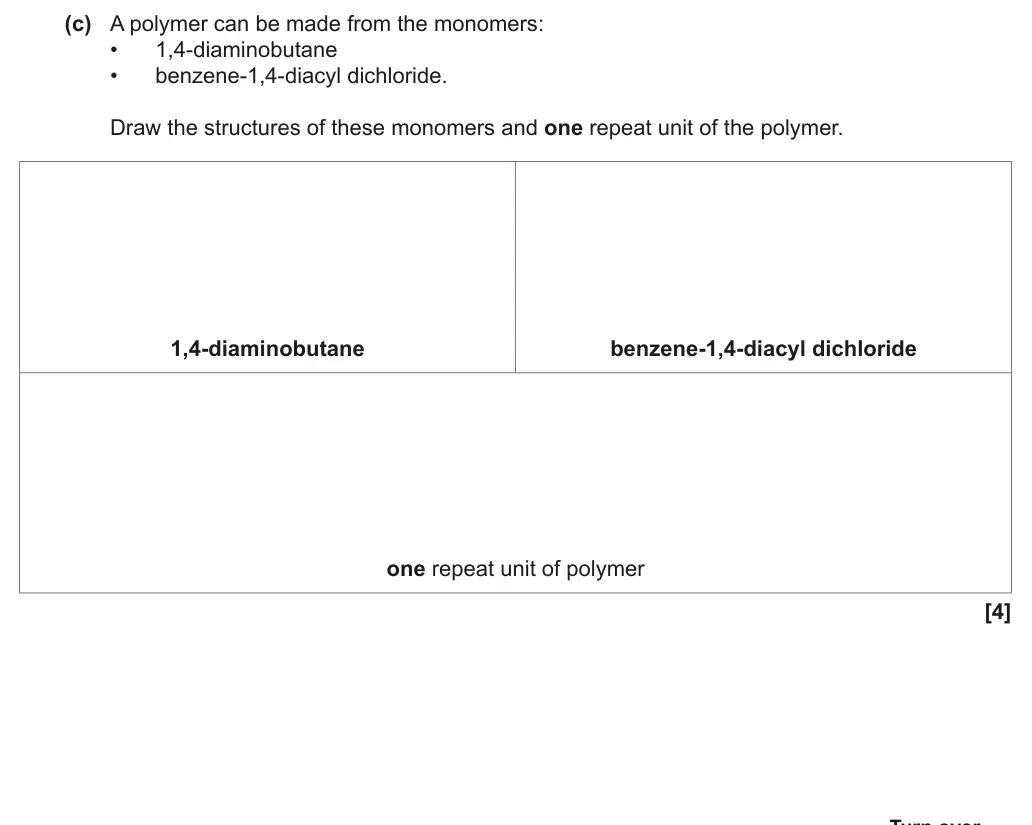
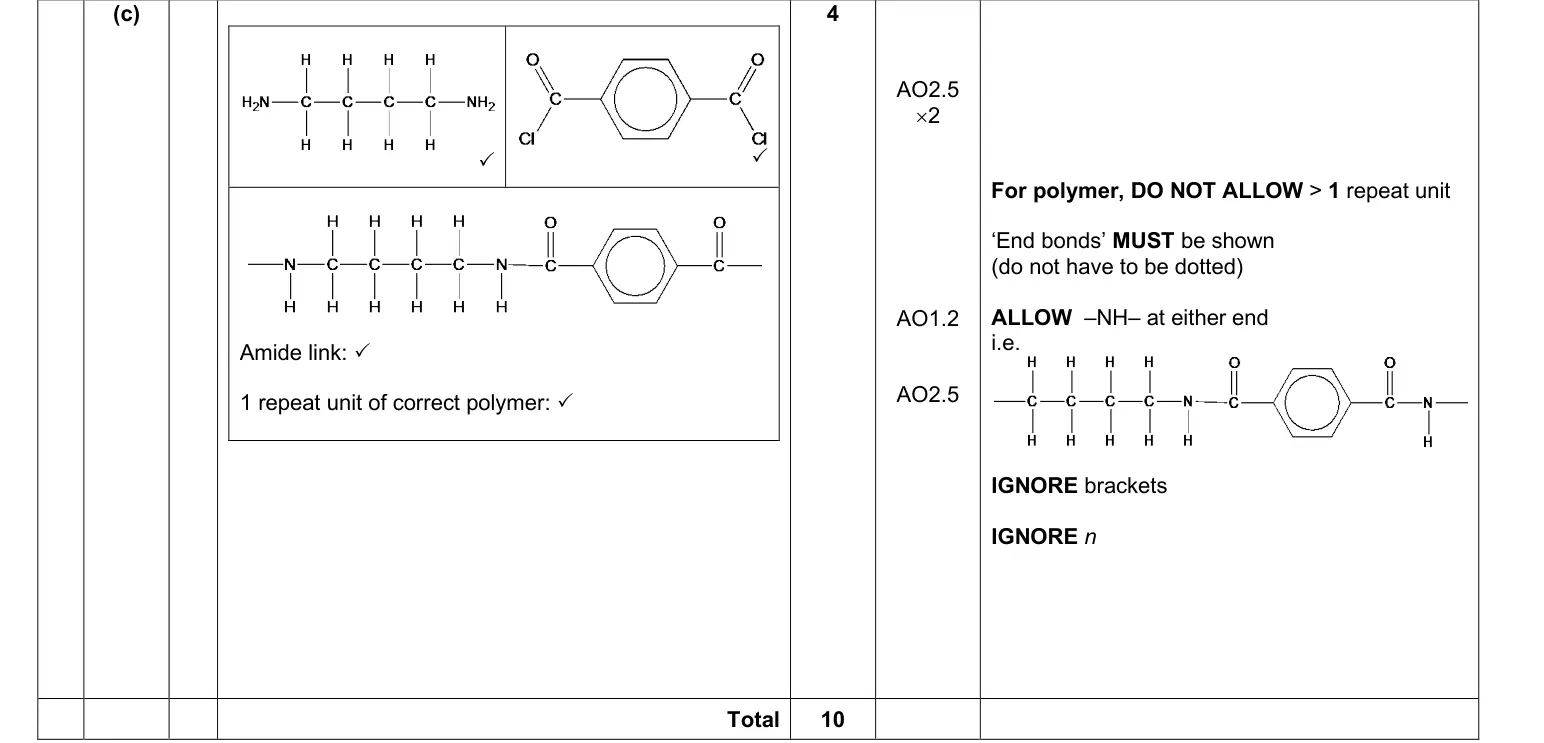
(c) A polymer can be made from the monomers:
• 1,4-diaminobutane
• benzene-1,4-diacyl dichloride.
Draw the structures of these monomers and one repeat unit of the polymer.
1,4-diaminobutane benzene-1,4-diacyl dichloride
one repeat unit of polymer
[4]
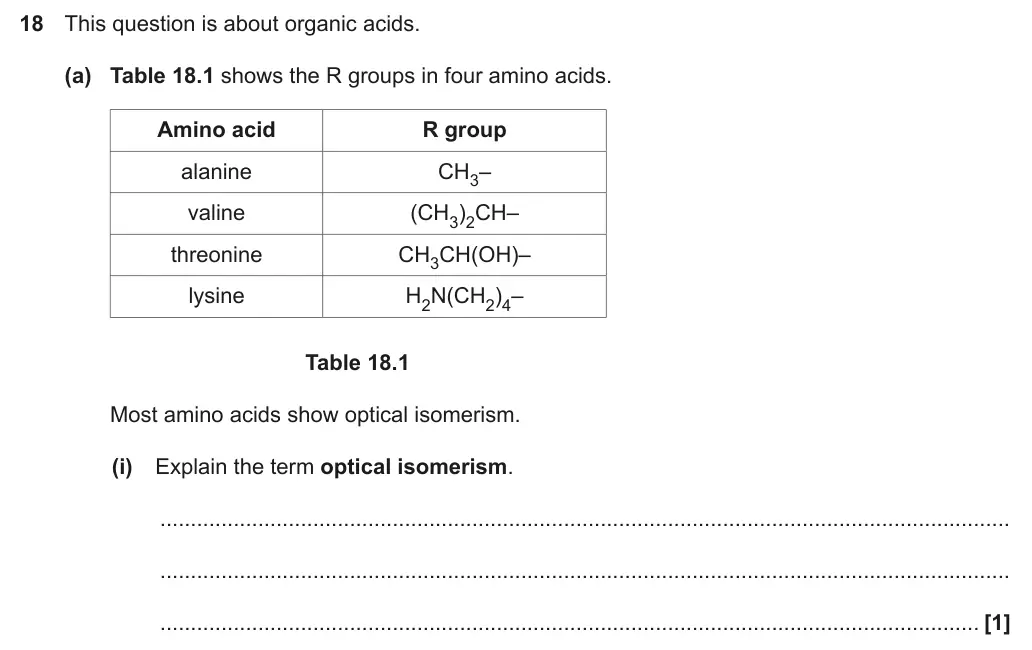
November 2021 · Paper 2 · Q18(a)(ii) 2 marks AO2 Structure / isomer amino acids amides and chirality
Earlier part of question 18 that this part usesEarlier part of November 2021 Paper 2 question 18
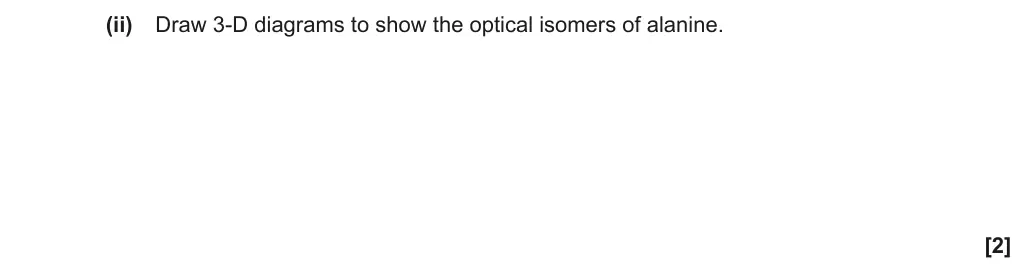
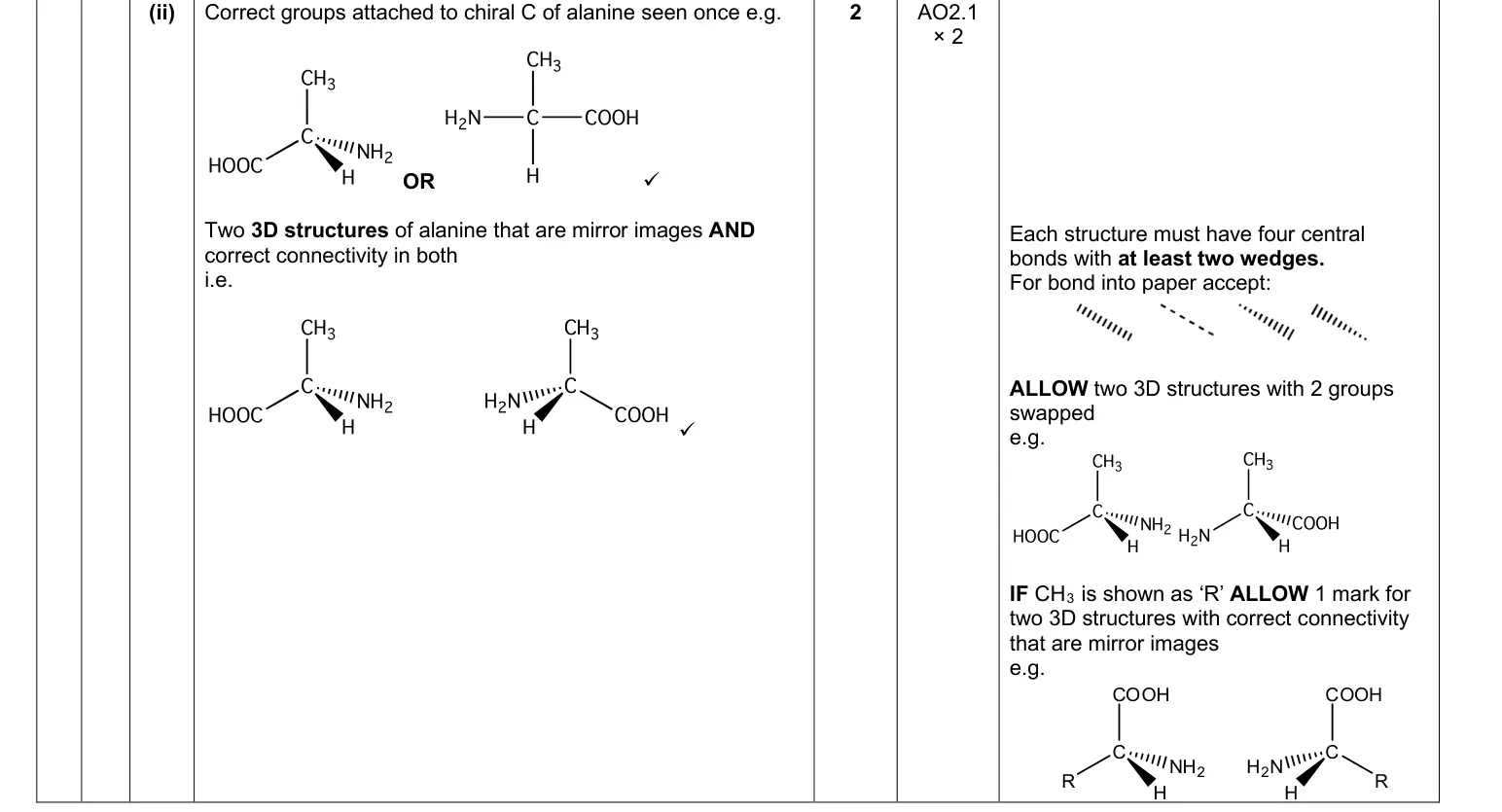
(ii) Draw 3-D diagrams to show the optical isomers of alanine.
[2]
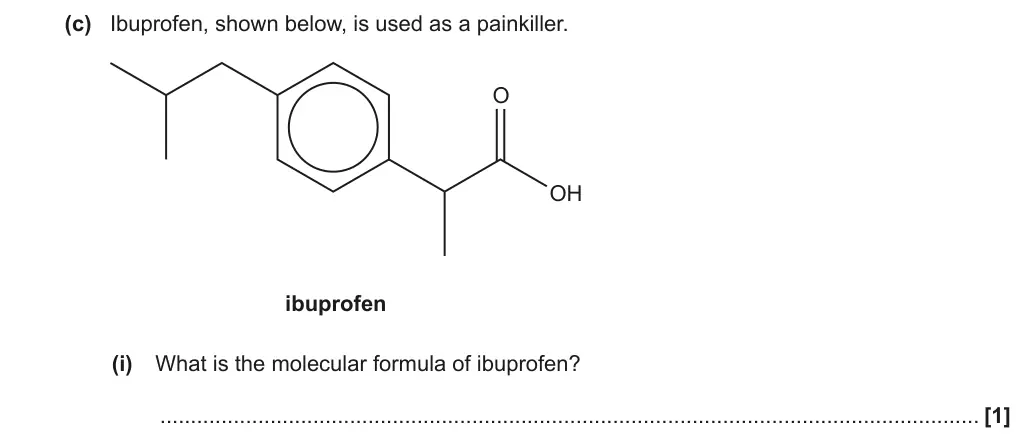
November 2021 · Paper 2 · Q18(d)(i) 2 marks AO3 Structure / isomer aminescarboxylic acids and estersamino acids amides and chirality
Earlier parts of question 18 that this part usesEarlier part of November 2021 Paper 2 question 18Earlier part of November 2021 Paper 2 question 18
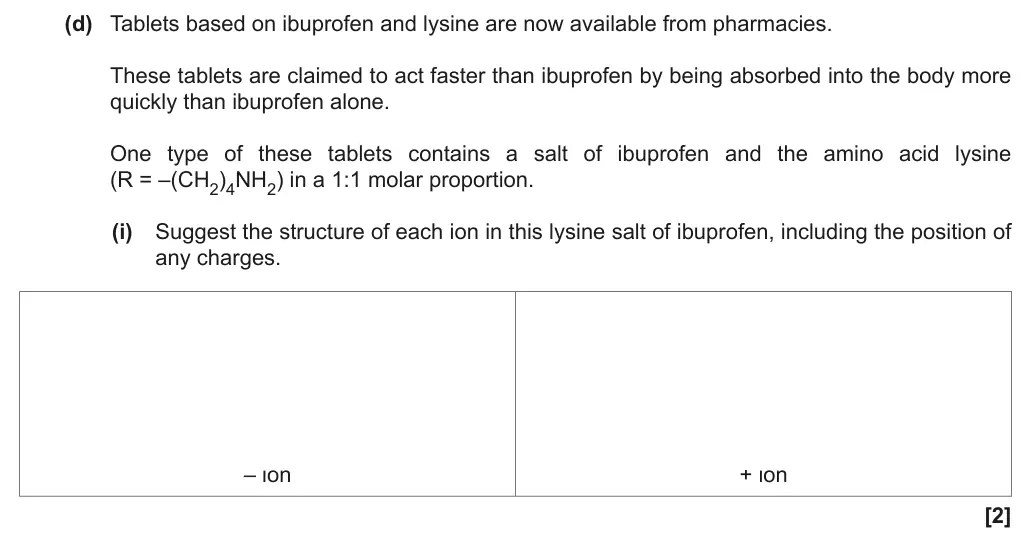
(d) Tablets based on ibuprofen and lysine are now available from pharmacies.
These tablets are claimed to act faster than ibuprofen by being absorbed into the body more
quickly than ibuprofen alone.
One type of these tablets contains a salt of ibuprofen and the amino acid lysine
(R = –(CH2)4NH2) in a 1:1 molar proportion.
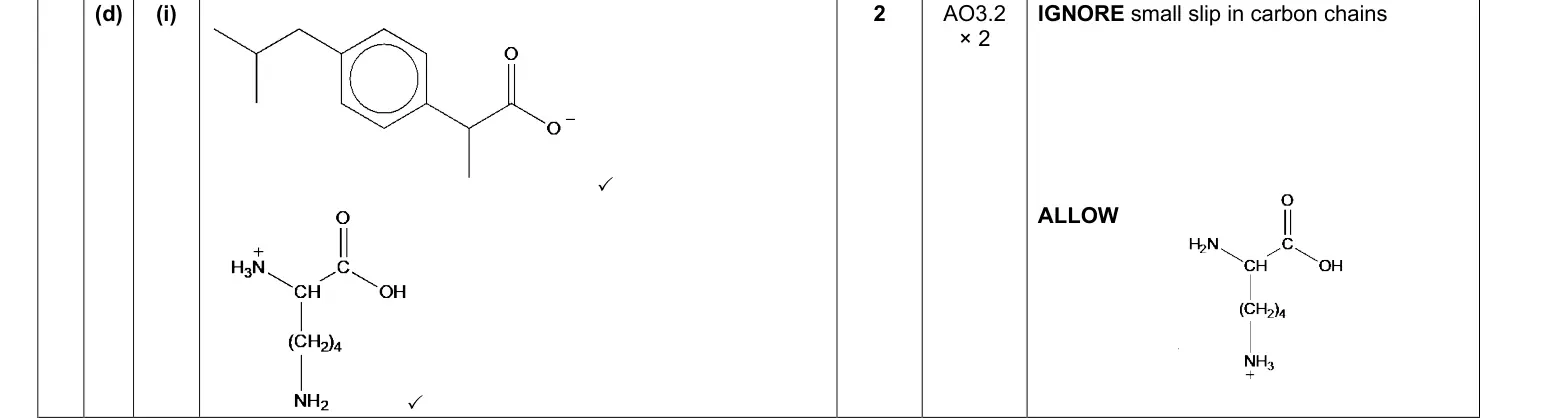
(i) Suggest the structure of each ion in this lysine salt of ibuprofen, including the position of
any charges.
– ion + ion
[2]
November 2021 · Paper 2 · Q20(b)(ii) 6 marks AO1, 3 Structure / isomer amount of substanceinfrared and mass spectrometryaromatic compoundsnmr spectroscopy
Earlier part of question 20 that this part usesEarlier part of November 2021 Paper 2 question 20
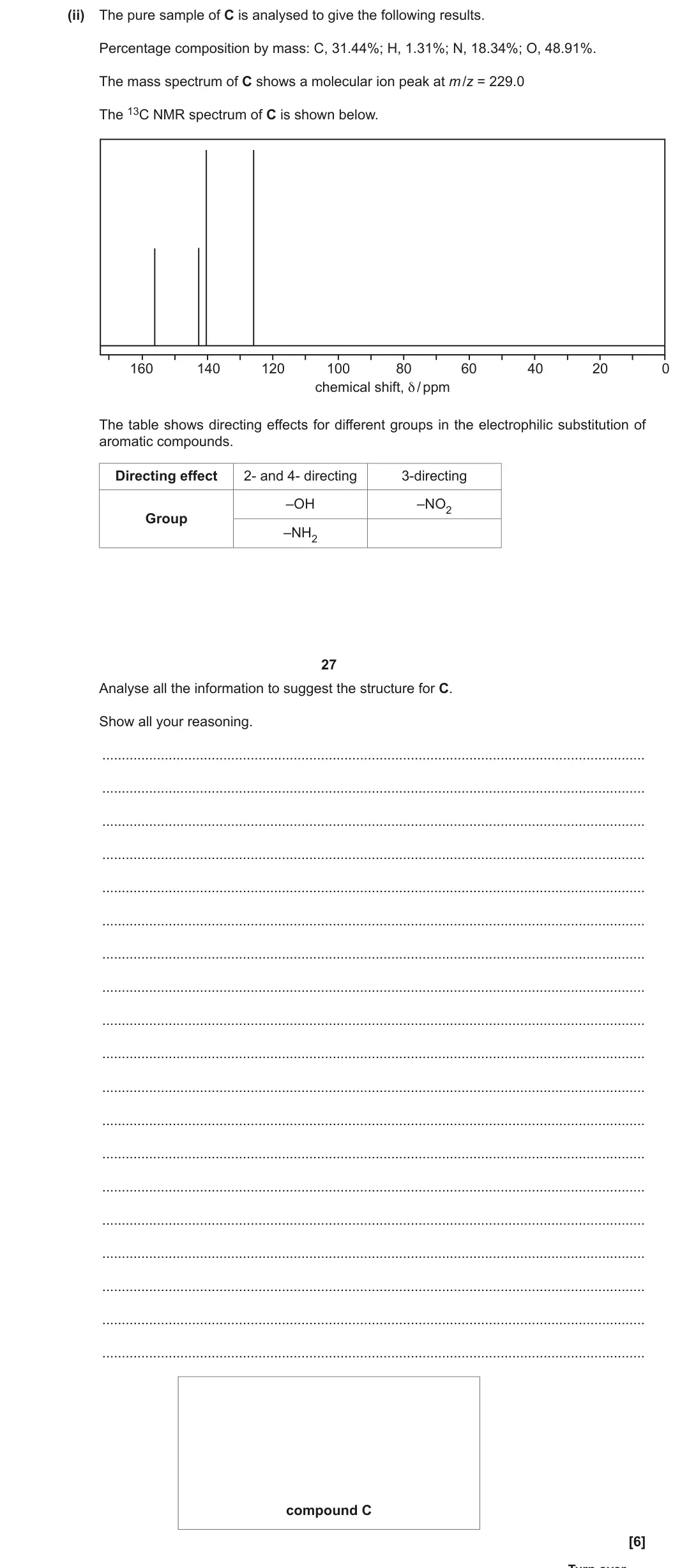
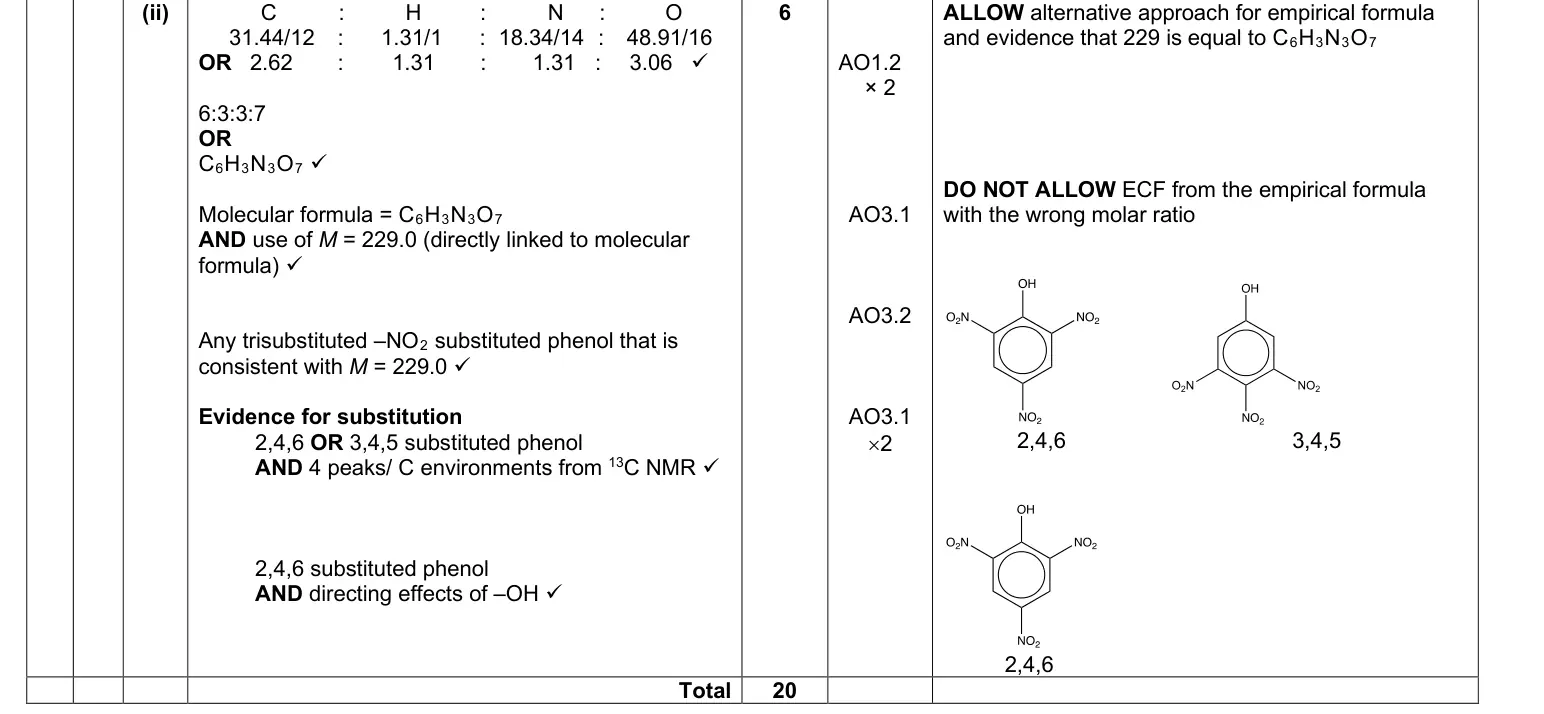
(ii) The pure sample of C is analysed to give the following results.
Percentage composition by mass: C, 31.44%; H, 1.31%; N, 18.34%; O, 48.91%.
The mass spectrum of C shows a molecular ion peak at m /z = 229.0
The 13C NMR spectrum of C is shown below.
160 140 120 100 80 60 40 20 0
chemical shift, δ / ppm
The table shows directing effects for different groups in the electrophilic substitution of
aromatic compounds.
Directing effect 2- and 4- directing 3-directing
–OH –NO2
Group
–NH2
Analyse all the information to suggest the structure for C.
Show all your reasoning.
...........................................................................................................................................
...........................................................................................................................................
...........................................................................................................................................
...........................................................................................................................................
...........................................................................................................................................
...........................................................................................................................................
...........................................................................................................................................
...........................................................................................................................................
...........................................................................................................................................
...........................................................................................................................................
...........................................................................................................................................
...........................................................................................................................................
...........................................................................................................................................
...........................................................................................................................................
...........................................................................................................................................
...........................................................................................................................................
...........................................................................................................................................
...........................................................................................................................................
...........................................................................................................................................
compound C
[6]
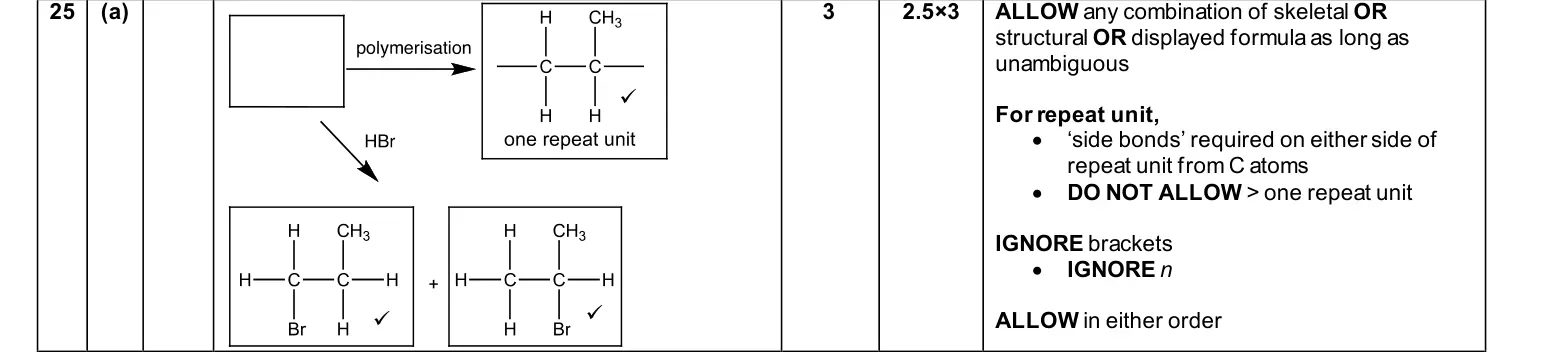
November 2020 · AS Paper 1 · Q25(a) 3 marks AO2 Structure / isomer Medium alkenes
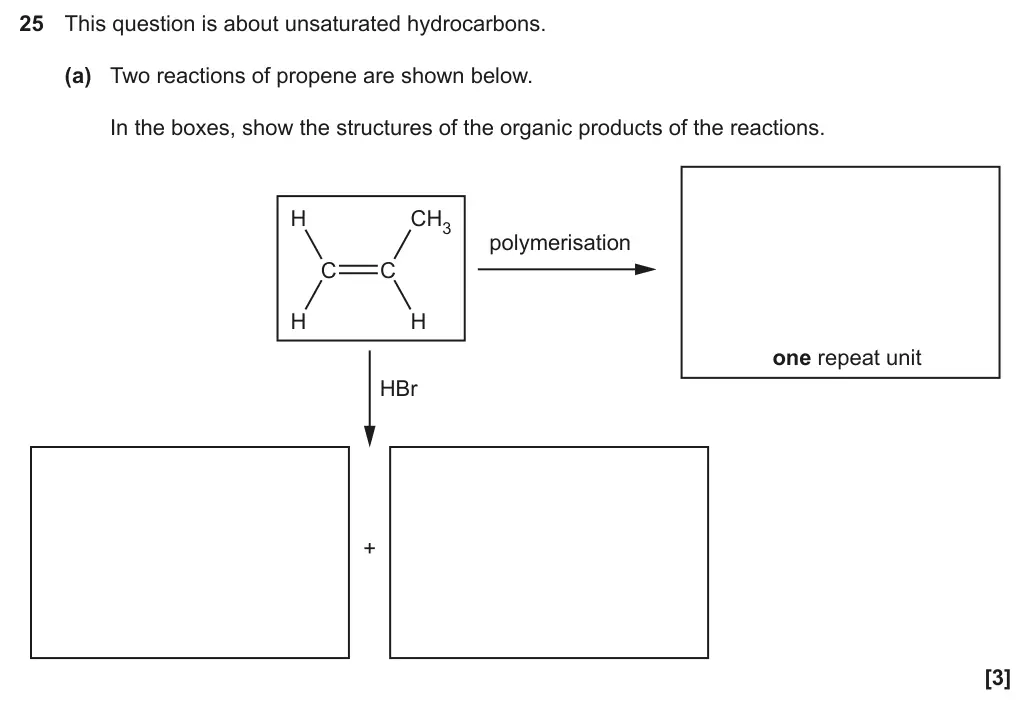
25 This question is about unsaturated hydrocarbons.
(a) Two reactions of propene are shown below.
In the boxes, show the structures of the organic products of the reactions.
H CH3
polymerisation
C C
H H
one repeat unit
HBr
+
[3]
November 2020 · AS Paper 1 · Q25(c)(iv) 2 marks AO3 Structure / isomer Medium organic basics
Earlier part of question 25 that this part usesEarlier part of November 2020 Paper 1 question 25
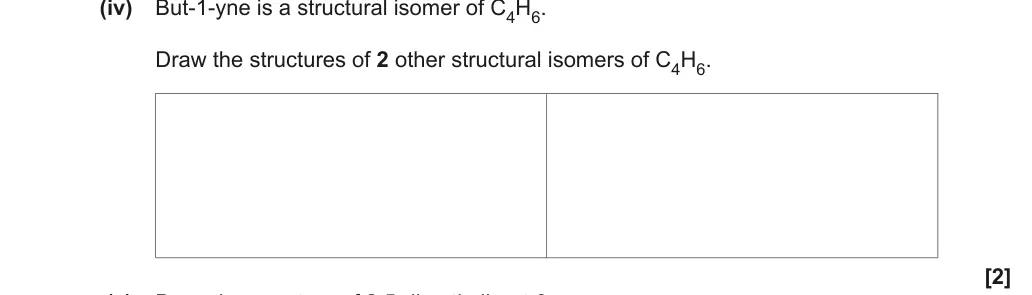
(iv) But-1-yne is a structural isomer of C4H6.
Draw the structures of 2 other structural isomers of C4H6.
[2]
November 2020 · AS Paper 1 · Q25(c)(v) 1 mark AO2 Structure / isomer Medium organic basics
Earlier part of question 25 that this part usesEarlier part of November 2020 Paper 1 question 25
(v) Draw the structure of 2,5-dimethylhept-3-yne.
[1]
November 2020 · Paper 2 · Q16(b)(ii) 2 marks AO1, 2 Structure / isomer amino acids amides and chirality
Earlier part of question 16 that this part usesEarlier part of November 2020 Paper 2 question 16
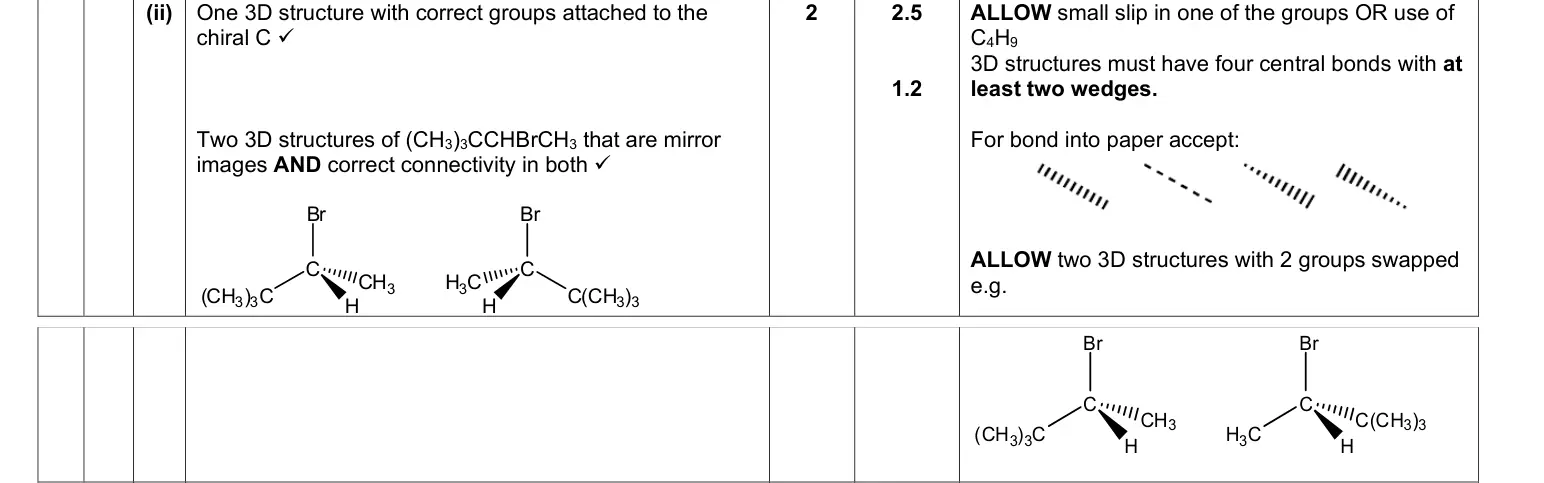
(ii) Draw 3D diagrams for the stereoisomers of (CH3)3CCHBrCH3.
[2]
November 2020 · Paper 2 · Q17(a)(i) 2 marks AO2 Structure / isomer alkenesaromatic compounds
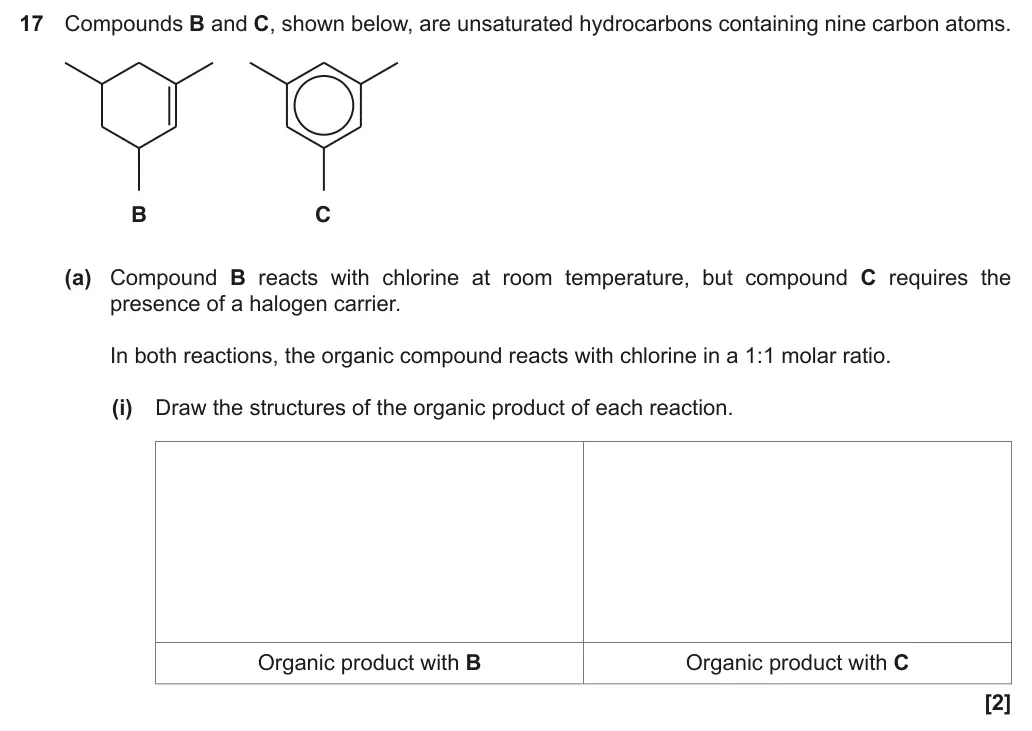
17 Compounds B and C, shown below, are unsaturated hydrocarbons containing nine carbon atoms.
B C
(a) Compound B reacts with chlorine at room temperature, but compound C requires the
presence of a halogen carrier.
In both reactions, the organic compound reacts with chlorine in a 1:1 molar ratio.
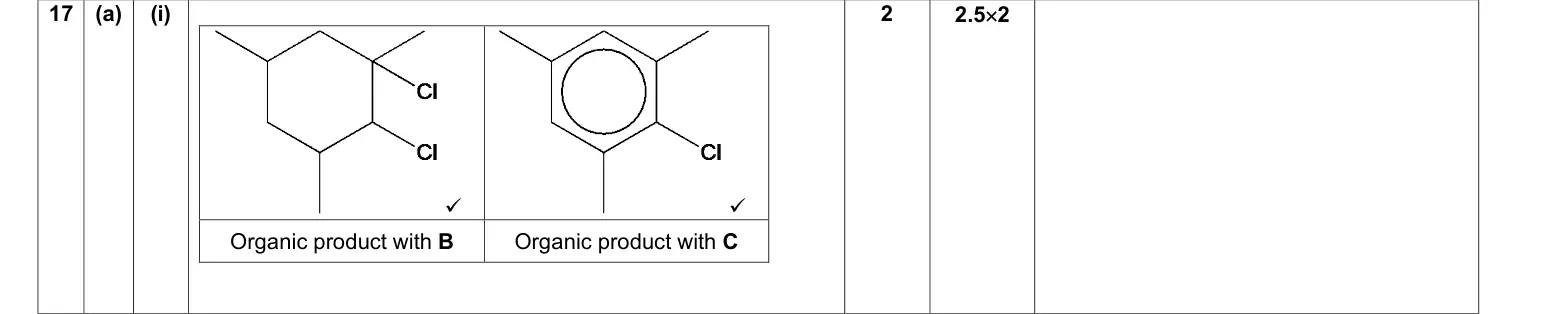
(i) Draw the structures of the organic product of each reaction.
Organic product with B Organic product with C
[2]
November 2020 · Paper 2 · Q18(b)(i) 2 marks AO1, 2 Structure / isomer condensation polymers
Earlier part of question 18 that this part usesEarlier part of November 2020 Paper 2 question 18
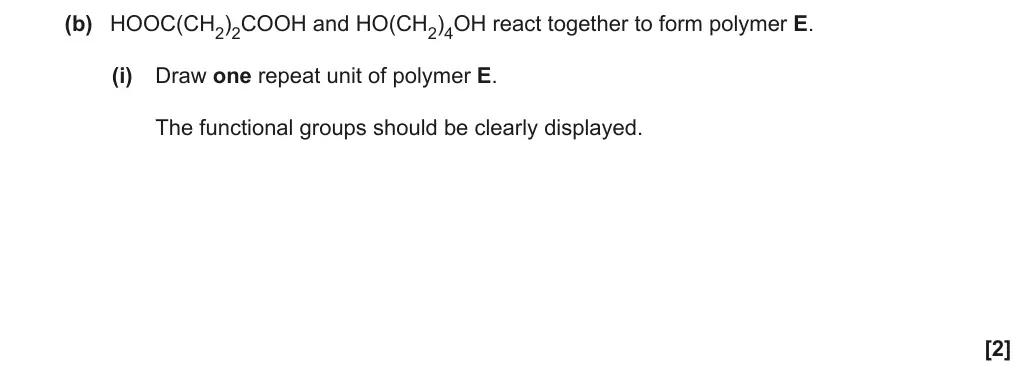
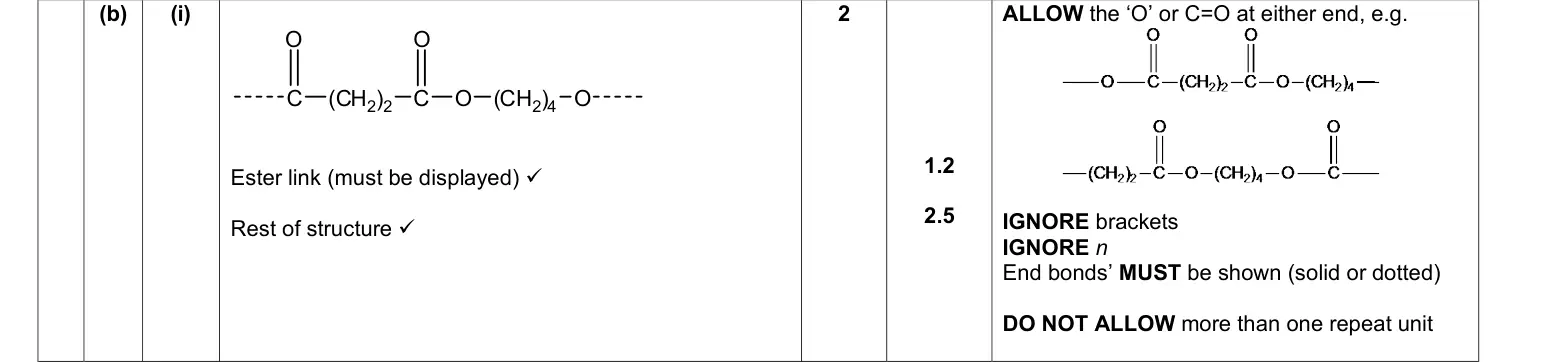
(b) HOOC(CH2)2COOH and HO(CH2)4OH react together to form polymer E.
(i) Draw one repeat unit of polymer E.
The functional groups should be clearly displayed.
[2]
November 2020 · Paper 3 · Q1(b)(ii) 6 marks AO2, 3 Structure / isomer Hard amount of substancenmr spectroscopy
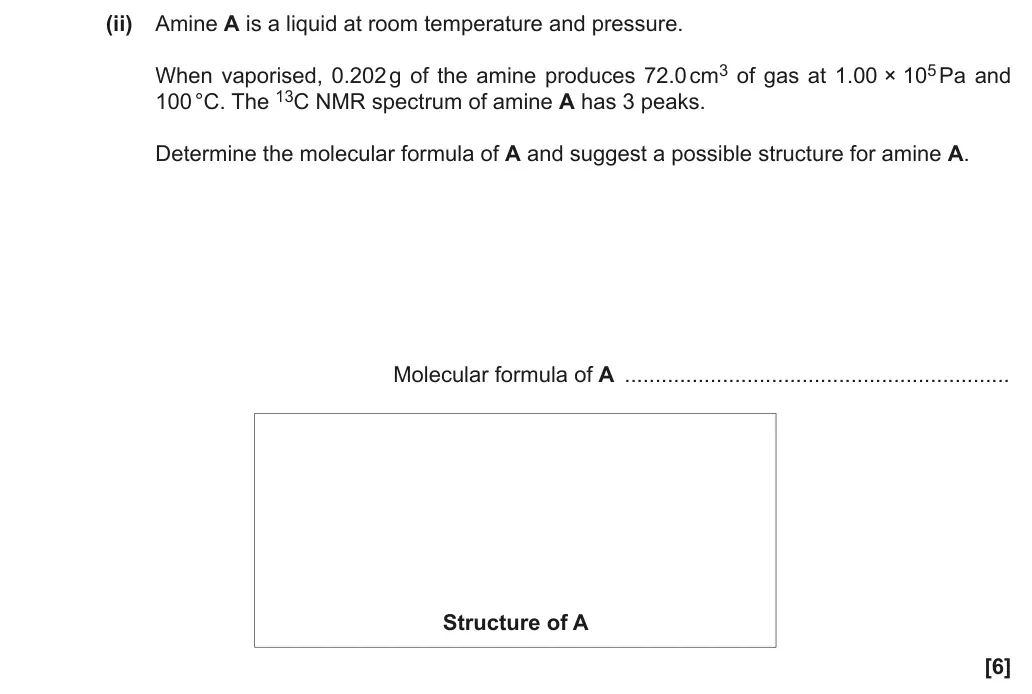
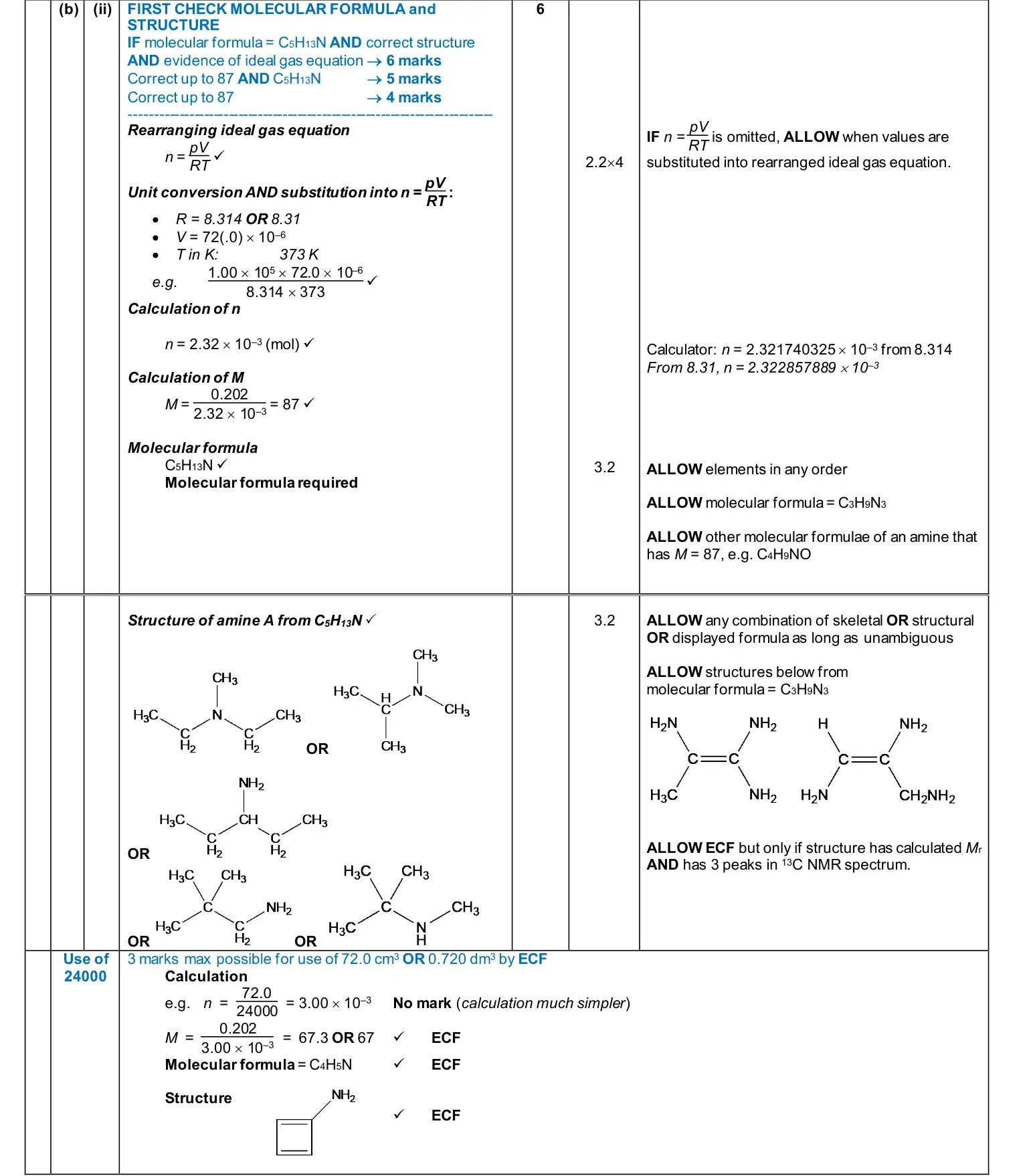
(ii) Amine A is a liquid at room temperature and pressure.
When vaporised, 0.202 g of the amine produces 72.0 cm3 of gas at 1.00 × 10⁵ Pa and
100 °C. The 13C NMR spectrum of amine A has 3 peaks.
Determine the molecular formula of A and suggest a possible structure for amine A.
Molecular formula of A  ...............................................................
Structure of A
[6]
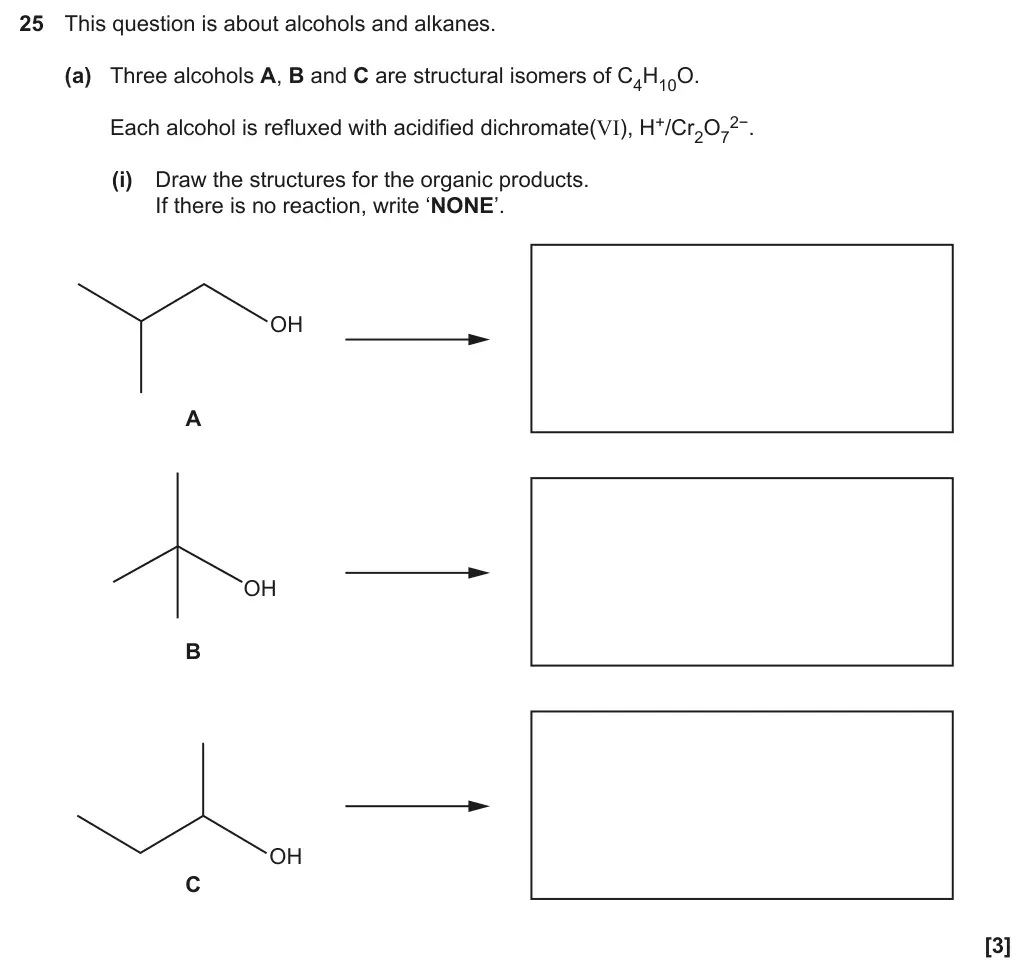
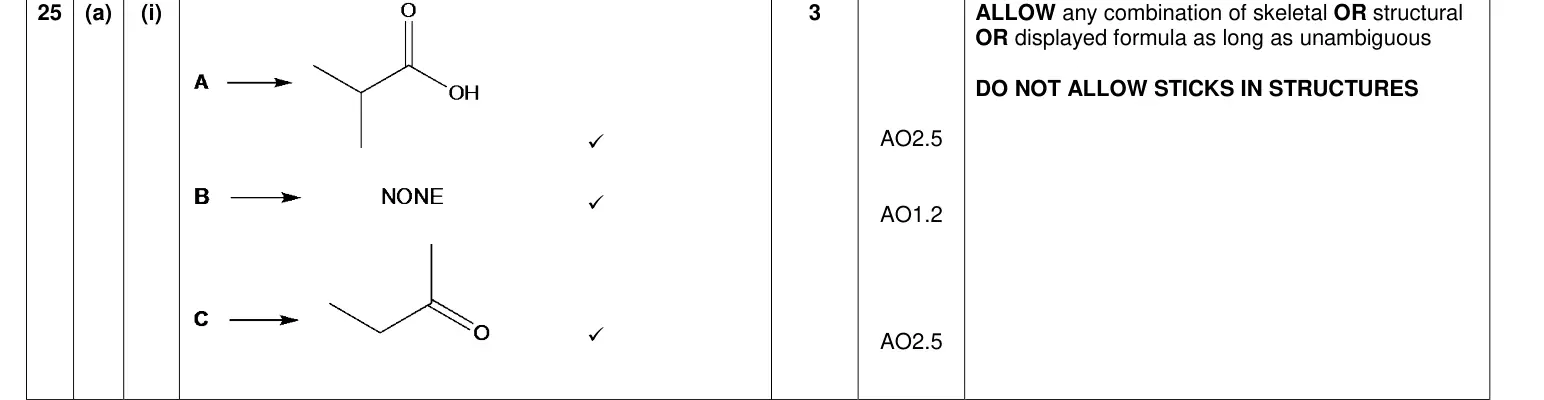
June 2019 · AS Paper 1 · Q25(a)(i) 3 marks AO1, 2 Structure / isomer Hard alcohols
25 This question is about alcohols and alkanes.
(a) Three alcohols A, B and C are structural isomers of C4H10O.
Each alcohol is refluxed with acidified dichromate(VI), H+/Cr2O7 2−.
(i) Draw the structures for the organic products.
If there is no reaction, write ‘NONE’.
OH
A
OH
B
OH
C
[3]
June 2019 · AS Paper 2 · Q3(c)(i) 1 mark AO1 Structure / isomer Easy organic basics
(c) 2-Iodo-2-methylbutane is an isomer of 1-iodopentane.
(i) Draw the structure of 2-iodo-2-methylbutane.
[1]
June 2019 · Paper 1 · Q18(a)(iii) 2 marks AO1, 2 Structure / isomer Medium transition elements
Earlier part of question 18 that this part usesEarlier part of June 2019 Paper 1 question 18
(iii) Draw a 3-D diagram for the shape of the complex ion that forms in Experiment 2, Step 2.
Include the charge of the ion.
........
[2]
June 2019 · Paper 2 · Q16(b)(v) 4 marks AO1, 2 Structure / isomer Hard alkenesamino acids amides and chirality
Earlier part of question 16 that this part usesEarlier part of June 2019 Paper 2 question 16
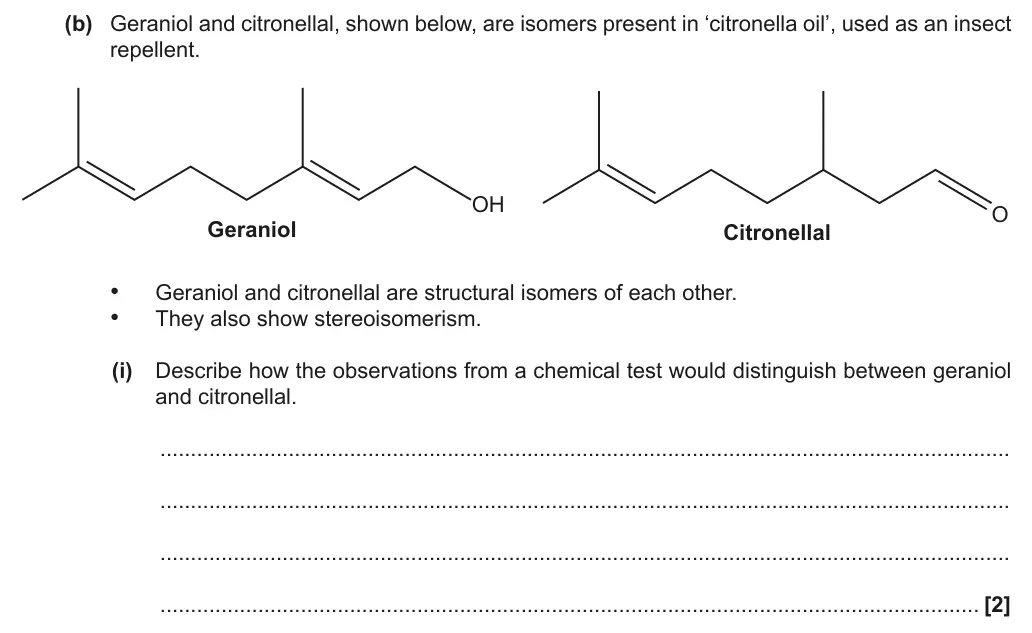
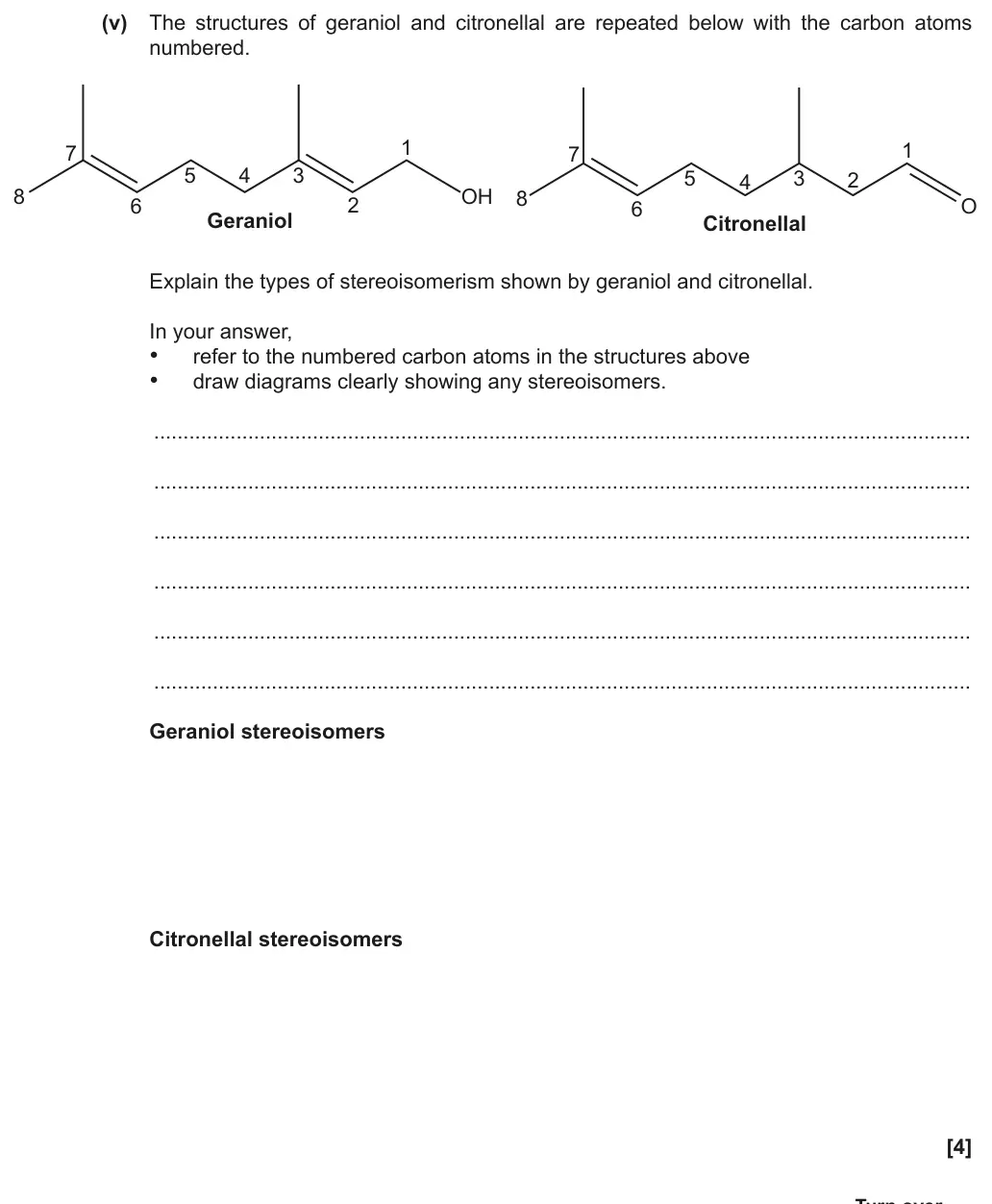
(v) The structures of geraniol and citronellal are repeated below with the carbon atoms
numbered.
7 1 1
7
5 4 3 5 4 3 2
8 OH 8
6 2 6 O
Geraniol Citronellal
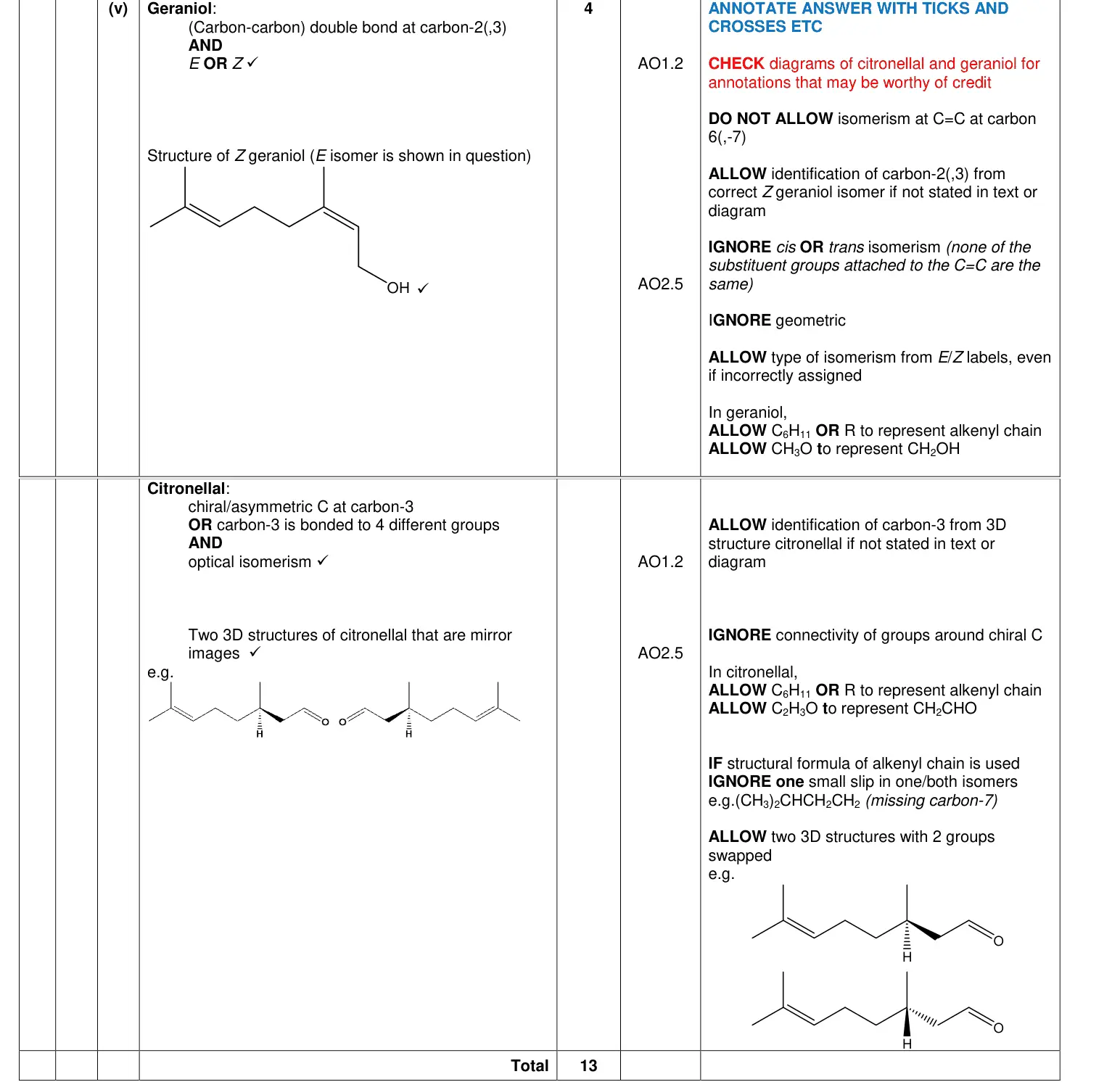
Explain the types of stereoisomerism shown by geraniol and citronellal.
In your answer,
• refer to the numbered carbon atoms in the structures above
• draw diagrams clearly showing any stereoisomers.
...........................................................................................................................................
...........................................................................................................................................
...........................................................................................................................................
...........................................................................................................................................
...........................................................................................................................................
...........................................................................................................................................
Geraniol stereoisomers
Citronellal stereoisomers
[4]
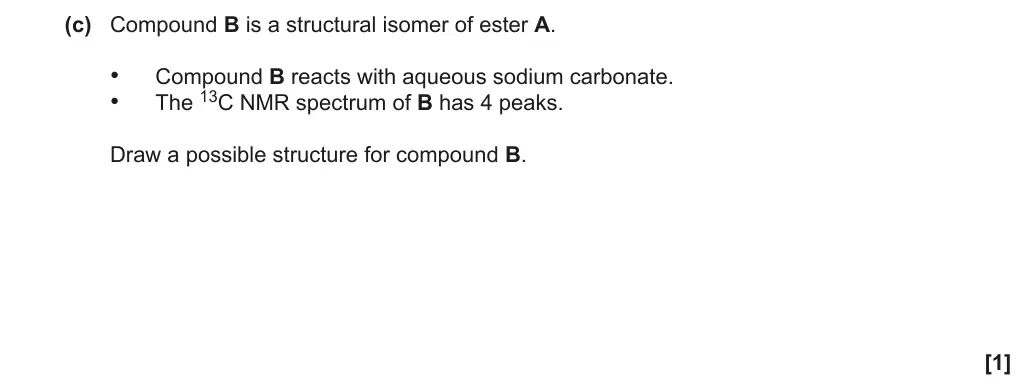
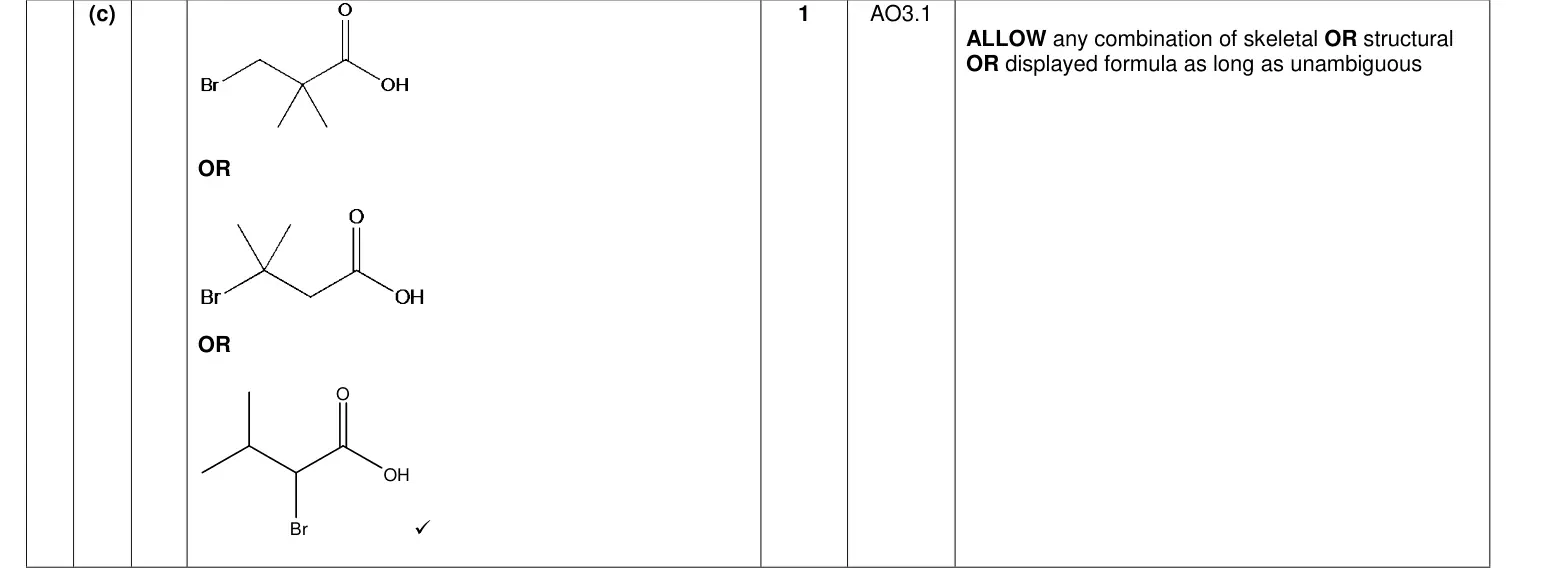
June 2019 · Paper 2 · Q18(c) 1 mark AO3 Structure / isomer Medium nmr spectroscopyorganic basicscarboxylic acids and esterschromatography and functional group tests
Earlier part of question 18 that this part usesEarlier part of June 2019 Paper 2 question 18
(c) Compound B is a structural isomer of ester A.
• Compound B reacts with aqueous sodium carbonate.
• The 13C NMR spectrum of B has 4 peaks.
Draw a possible structure for compound B.
[1]
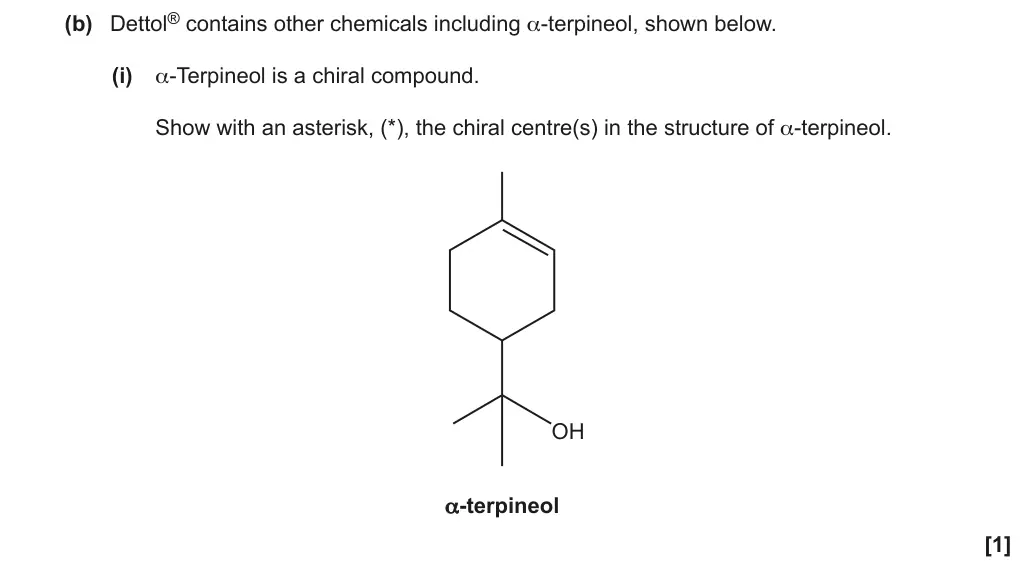
June 2019 · Paper 3 · Q4(b)(iii) 4 marks AO3 Structure / isomer Medium organic synthesisalkenesalcohols
Earlier part of question 4 that this part usesEarlier part of June 2019 Paper 3 question 4
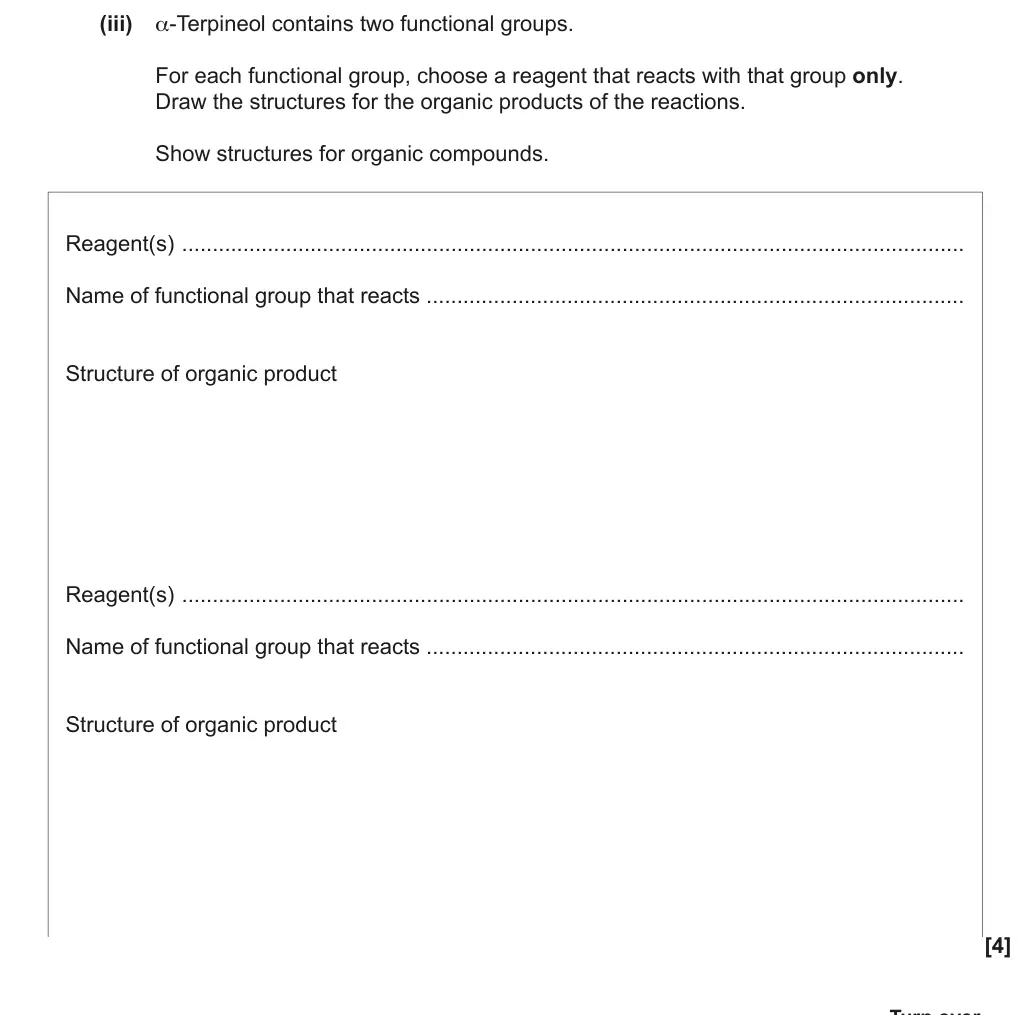
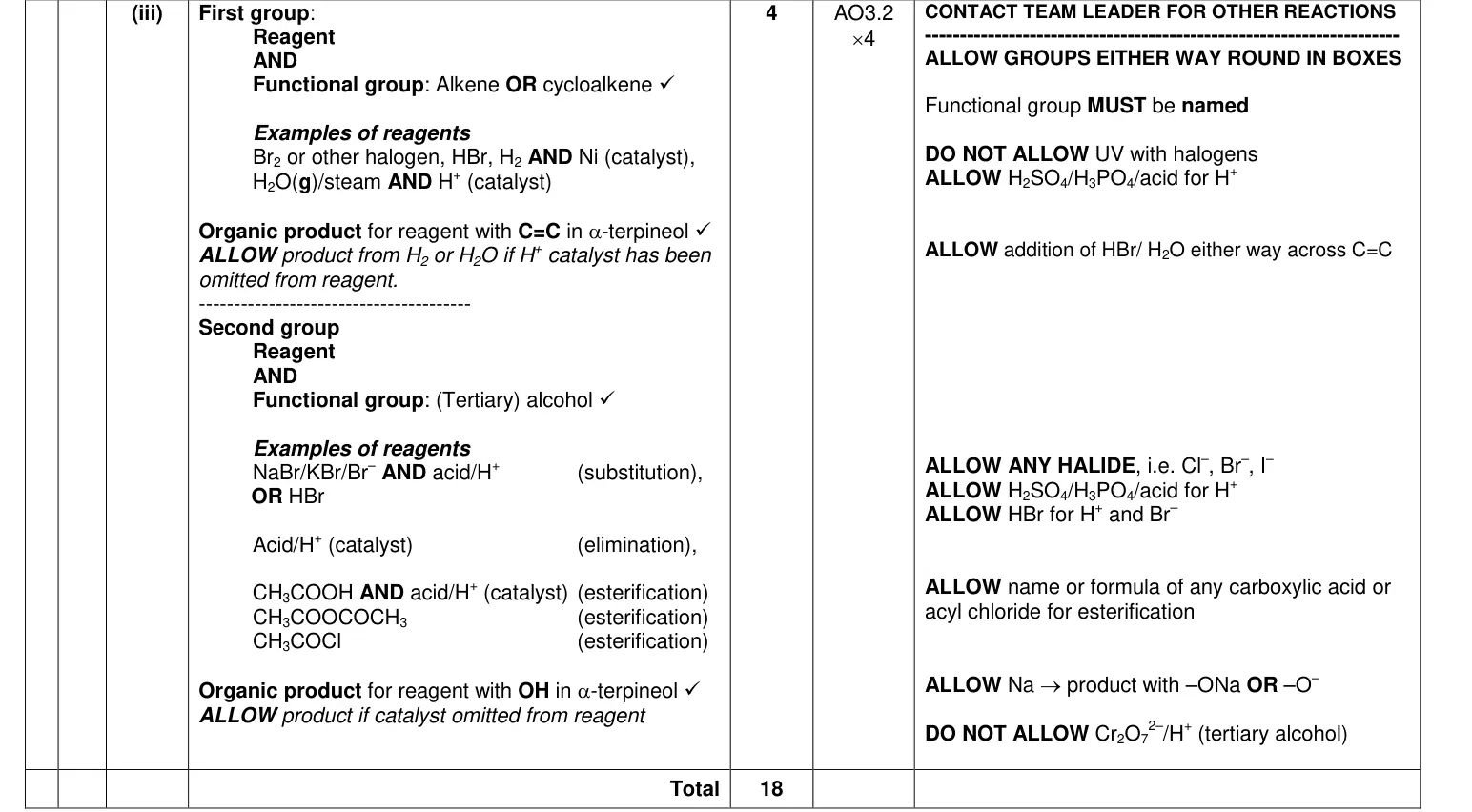
(iii) α-Terpineol contains two functional groups.
For each functional group, choose a reagent that reacts with that group only.
Draw the structures for the organic products of the reactions.
Show structures for organic compounds.
Reagent(s)  ................................................................................................................................
Name of functional group that reacts ........................................................................................
Structure of organic product
Reagent(s)  ................................................................................................................................
Name of functional group that reacts ........................................................................................
Structure of organic product
[4]
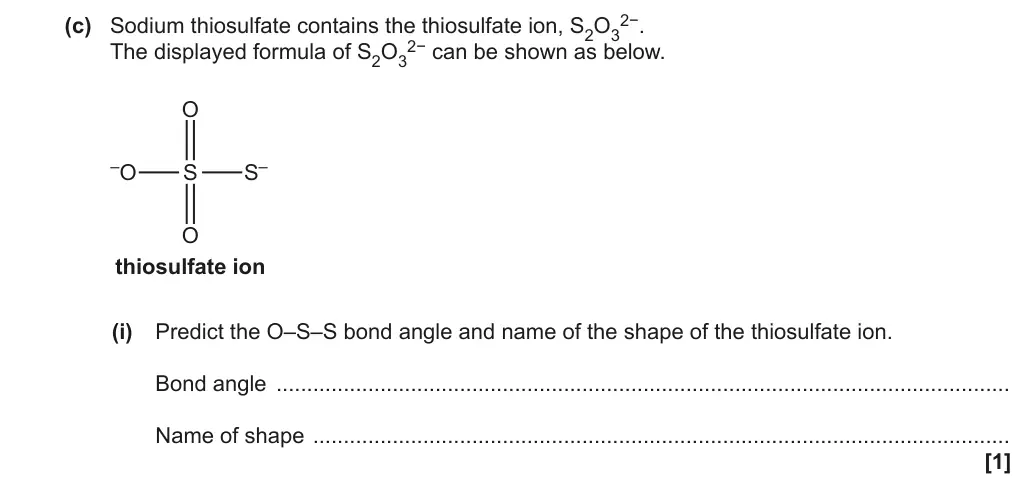
June 2019 · Paper 3 · Q5(c)(ii) 1 mark AO3 Structure / isomer Medium bonding and structure
Earlier part of question 5 that this part usesEarlier part of June 2019 Paper 3 question 5
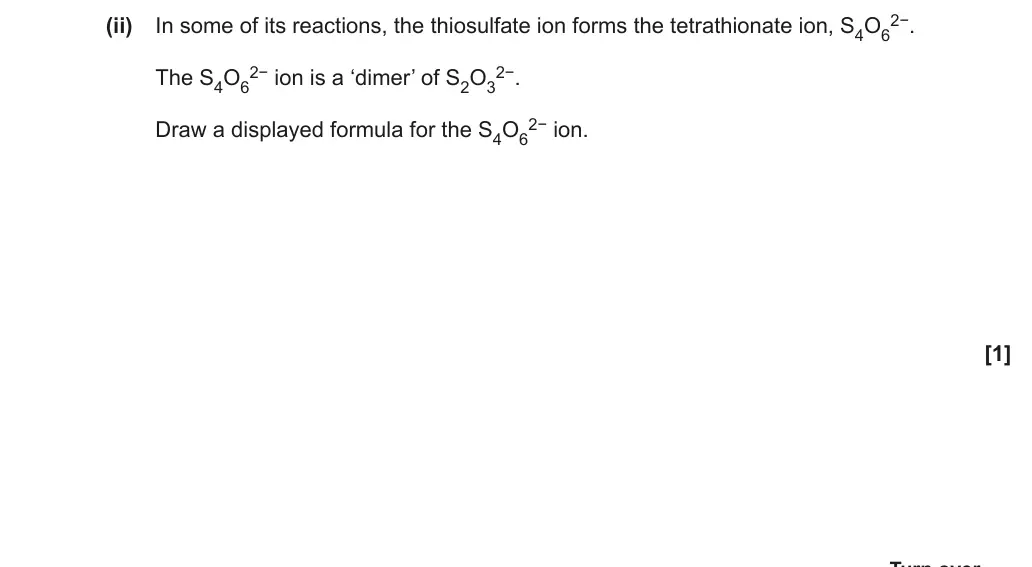
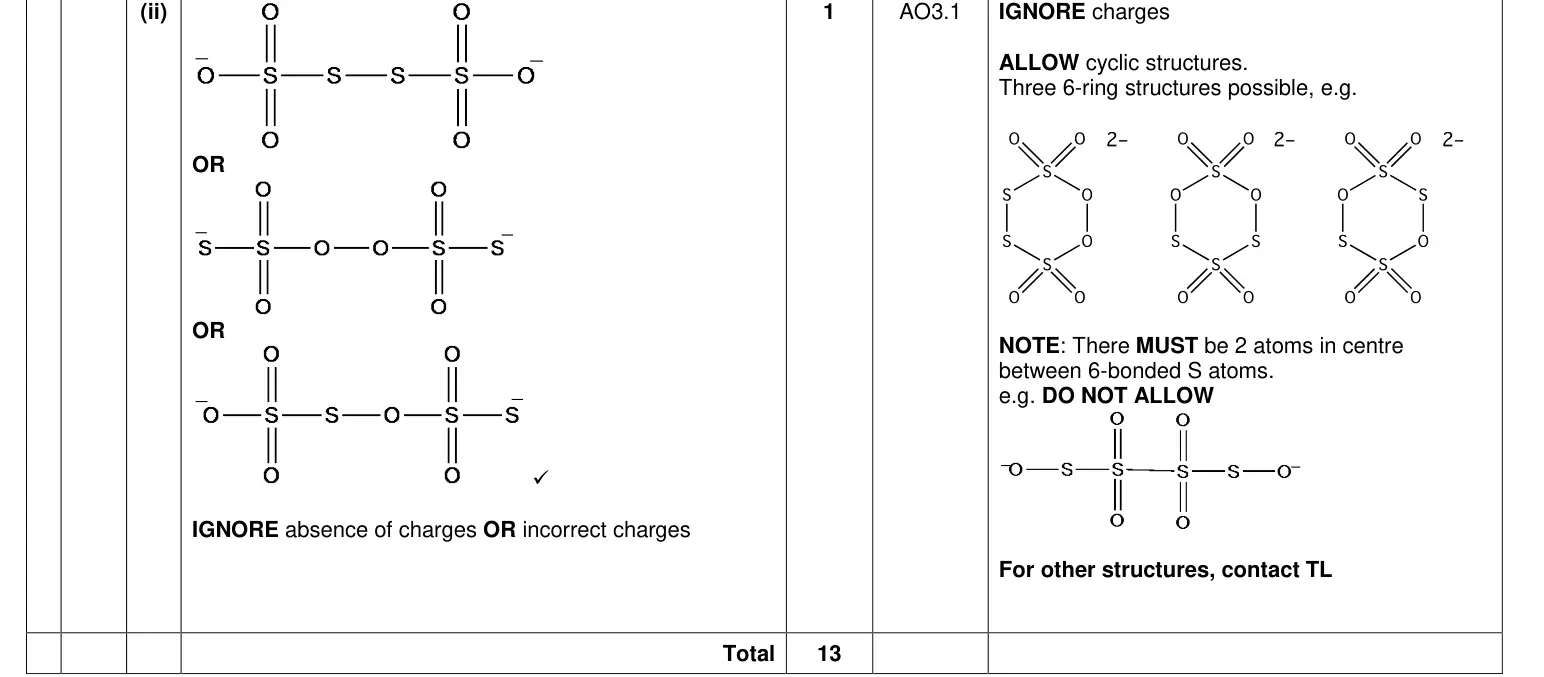
(ii) In some of its reactions, the thiosulfate ion forms the tetrathionate ion, S4O6 2−.
The S4O6 2− ion is a ‘dimer’ of S2O3 2−.
Draw a displayed formula for the S4O6 2− ion.
[1]
June 2018 · AS Paper 1 · Q21(b)(i) 1 mark Structure / isomer Medium bonding and structure
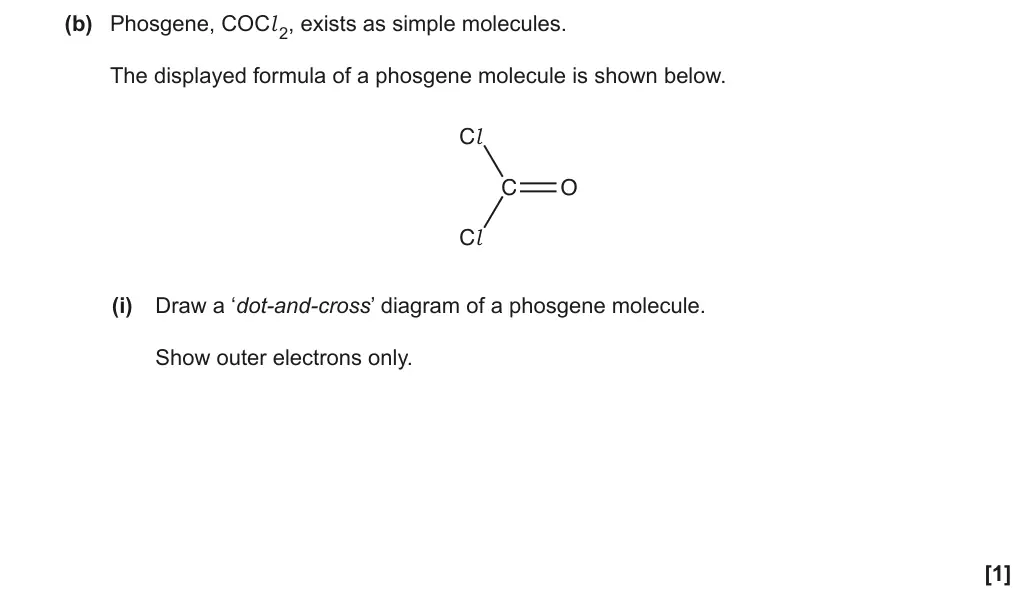
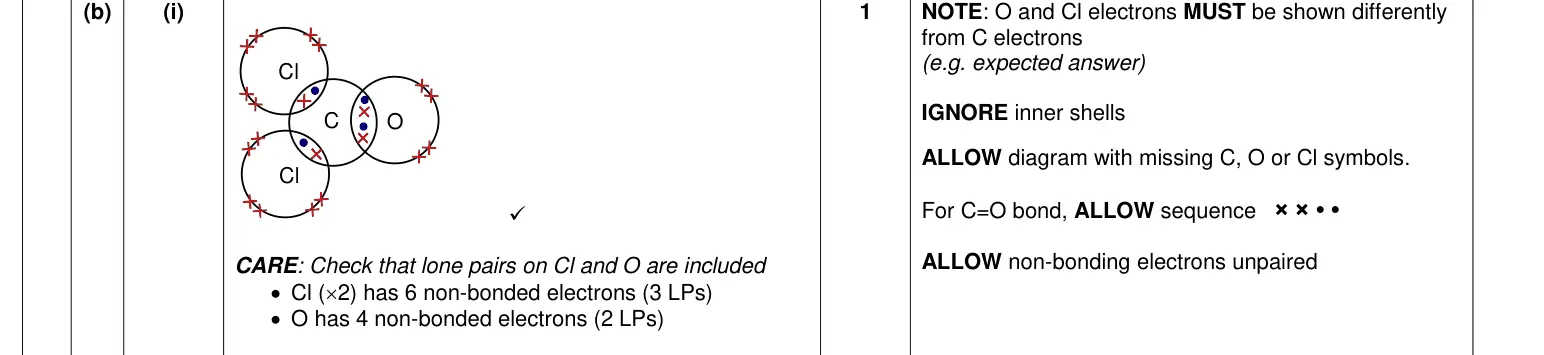
(b) Phosgene, COCl 2, exists as simple molecules.
The displayed formula of a phosgene molecule is shown below.
Cl
C O
Cl
(i) Draw a ‘dot-and-cross’ diagram of a phosgene molecule.
Show outer electrons only.
[1]
June 2018 · AS Paper 2 · Q1(d)(ii) 1 mark Structure / isomer Medium organic basicsatomic structure and isotopes
Earlier part of question 1 that this part usesEarlier part of June 2018 Paper 2 question 1
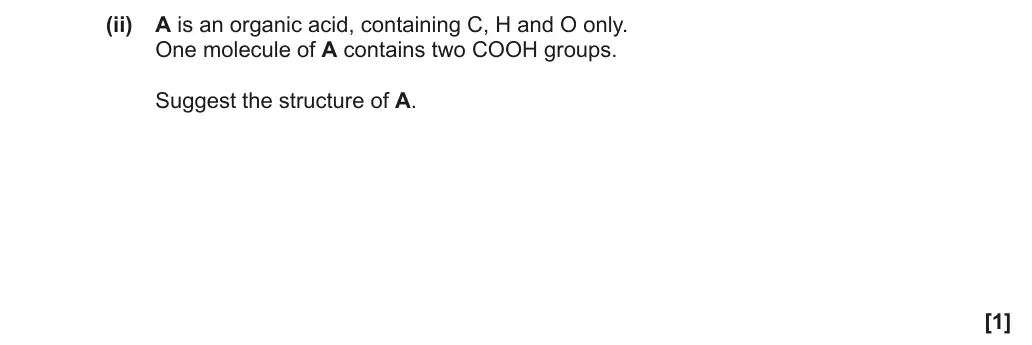
(ii) A is an organic acid, containing C, H and O only.
One molecule of A contains two COOH groups.
Suggest the structure of A.
[1]
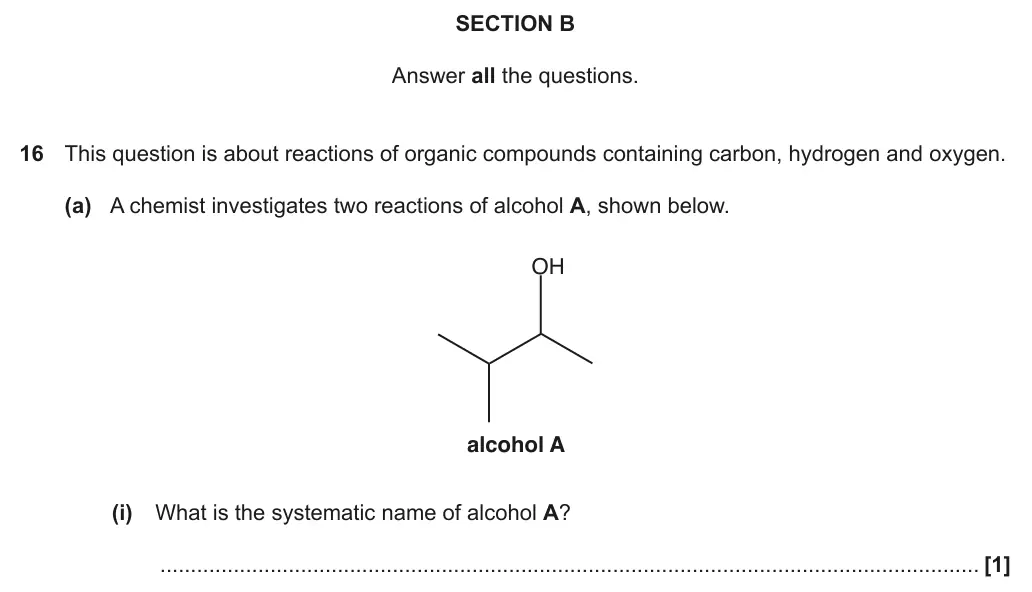
June 2018 · Paper 2 · Q16(a)(iii) 2 marks Structure / isomer Medium alcoholsorganic basics
Earlier part of question 16 that this part usesEarlier part of June 2018 Paper 2 question 16
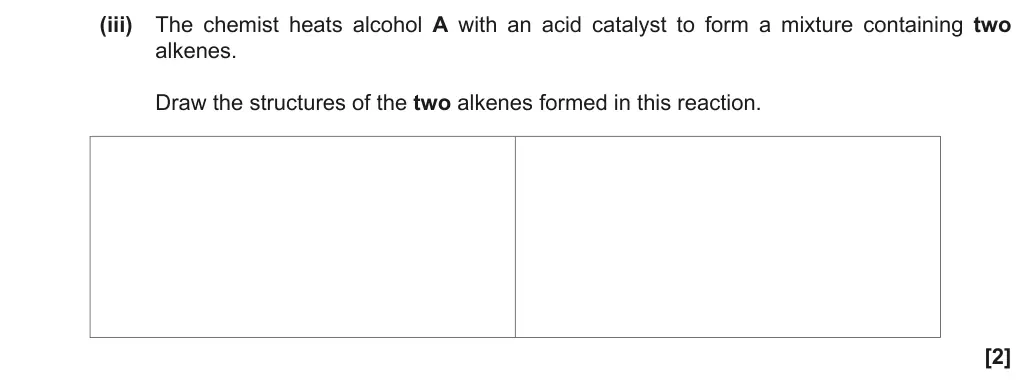
(iii) The chemist heats alcohol A with an acid catalyst to form a mixture containing two
alkenes.
Draw the structures of the two alkenes formed in this reaction.
[2]
June 2018 · Paper 2 · Q17(a) 2 marks Structure / isomer Easy amino acids amides and chirality
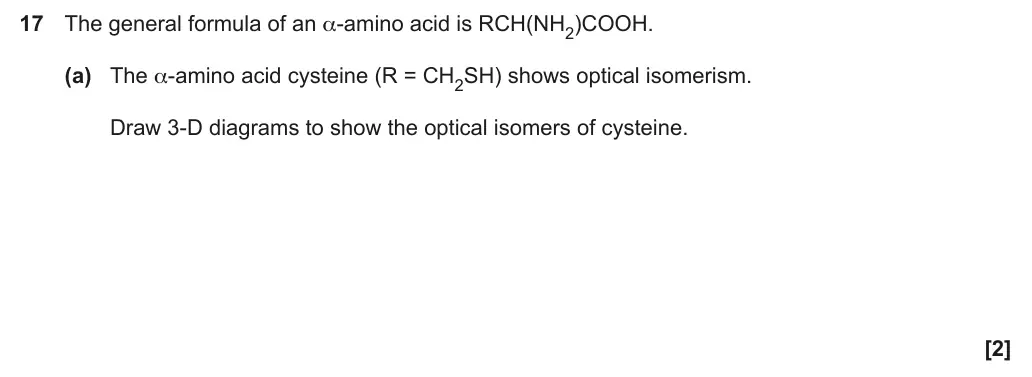
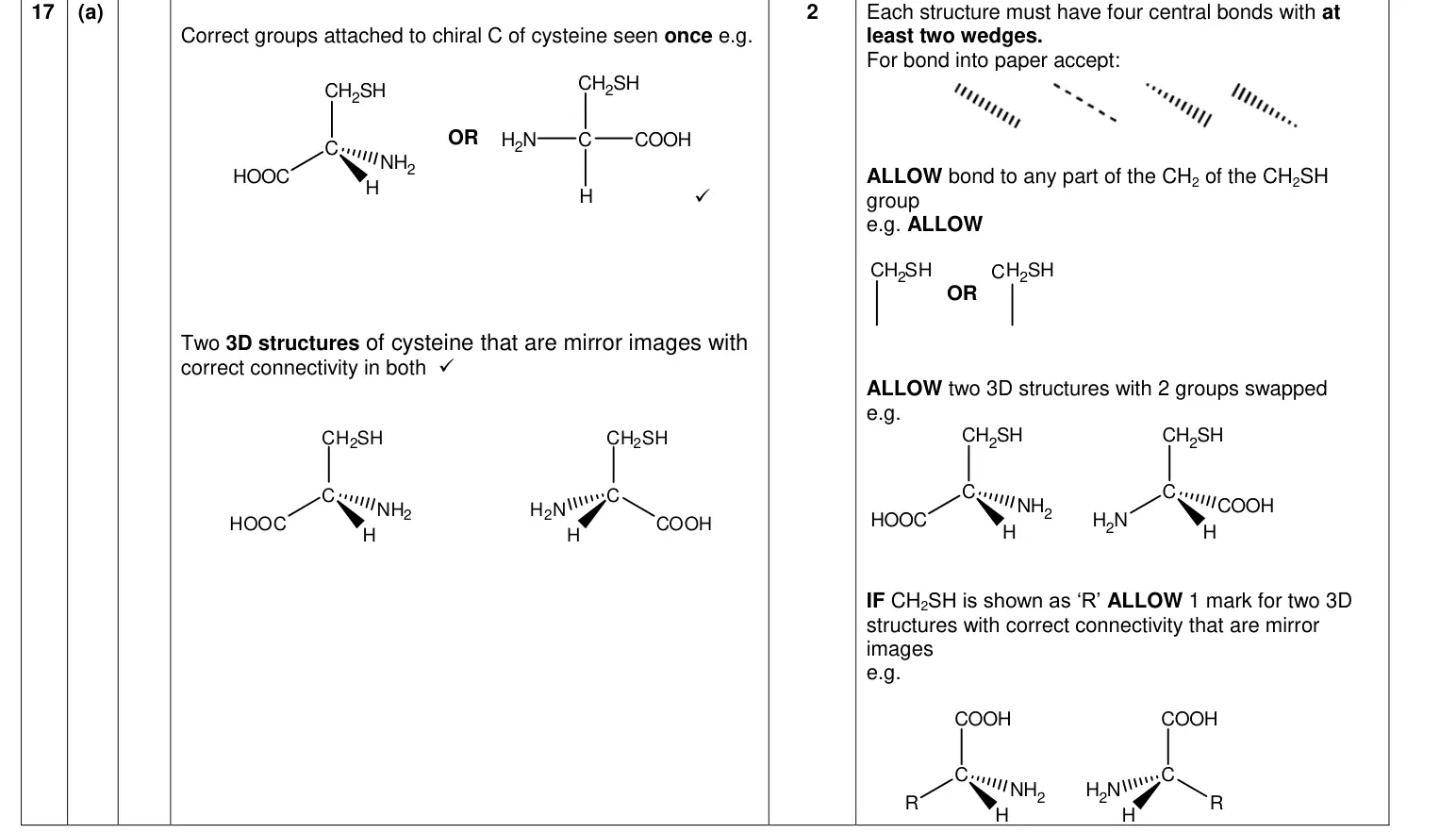
17 The general formula of an α-amino acid is RCH(NH2)COOH.
(a) The α-amino acid cysteine (R = CH2SH) shows optical isomerism.
Draw 3-D diagrams to show the optical isomers of cysteine.
[2]
June 2018 · Paper 2 · Q17(b) 2 marks Structure / isomer Hard amino acids amides and chiralityamines
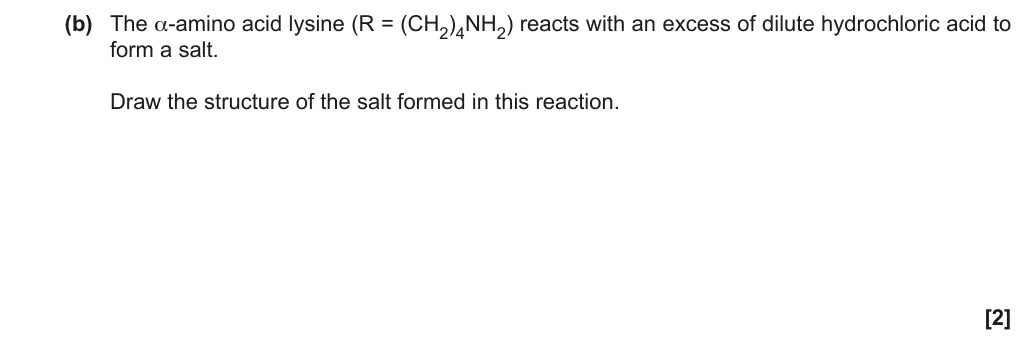
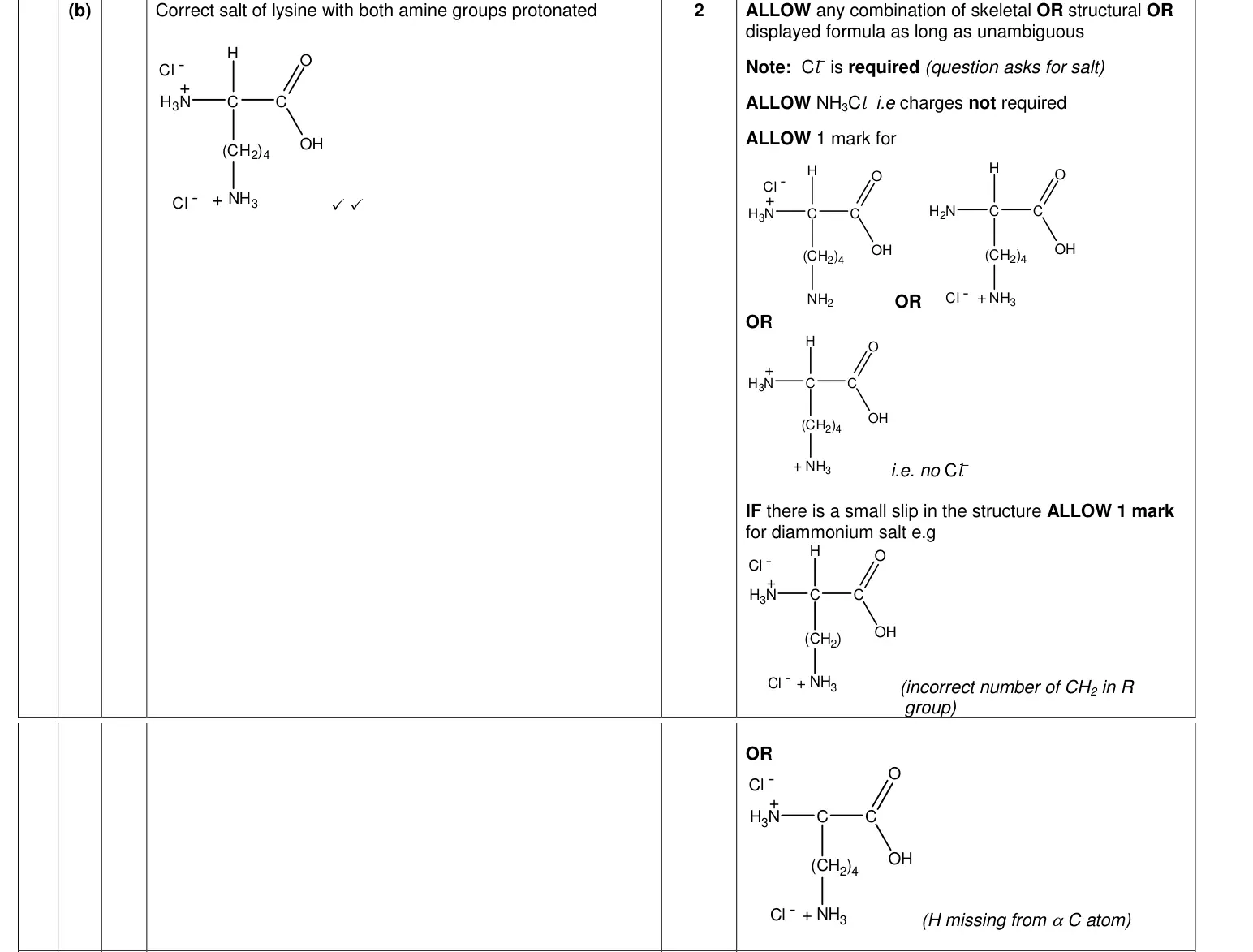
(b) The α-amino acid lysine (R = (CH2)4NH2) reacts with an excess of dilute hydrochloric acid to
form a salt.
Draw the structure of the salt formed in this reaction.
[2]
June 2018 · Paper 2 · Q17(c) 3 marks Structure / isomer Hard condensation polymersamino acids amides and chirality
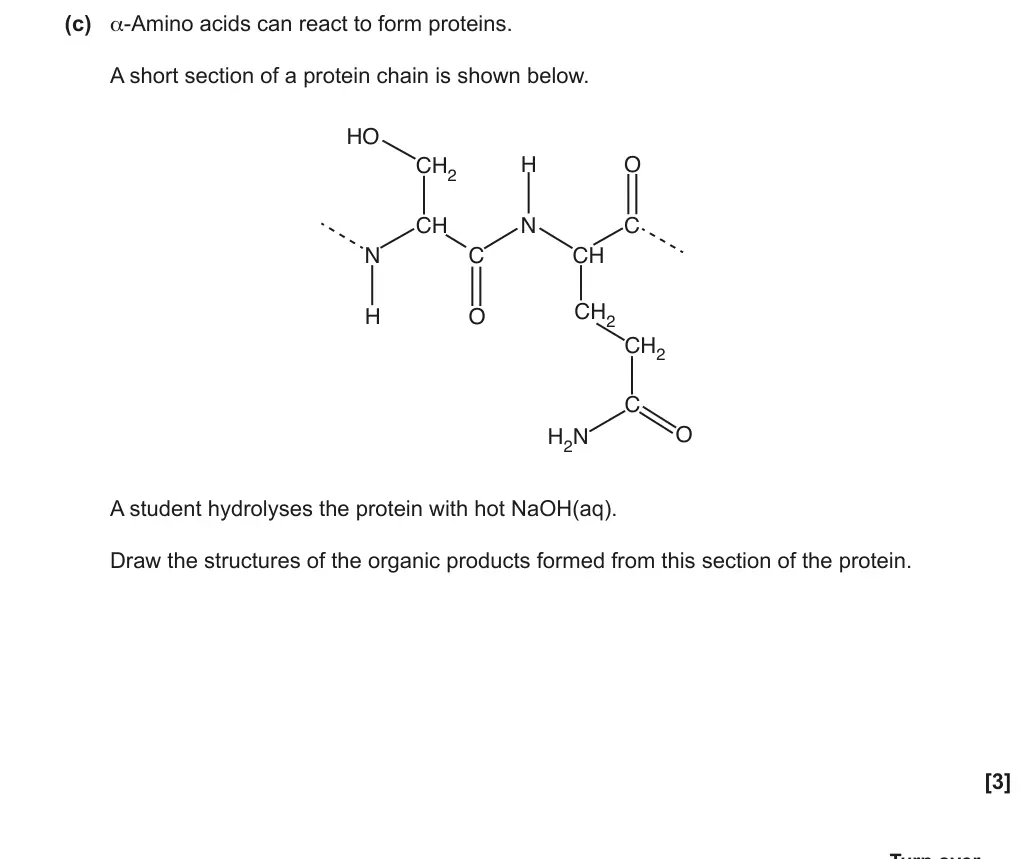
(c) α-Amino acids can react to form proteins.
A short section of a protein chain is shown below.
HO
CH2 H O
CH N C
N C CH
H O CH2
CH2
C
H2N O
A student hydrolyses the protein with hot NaOH(aq).
Draw the structures of the organic products formed from this section of the protein.
[3]
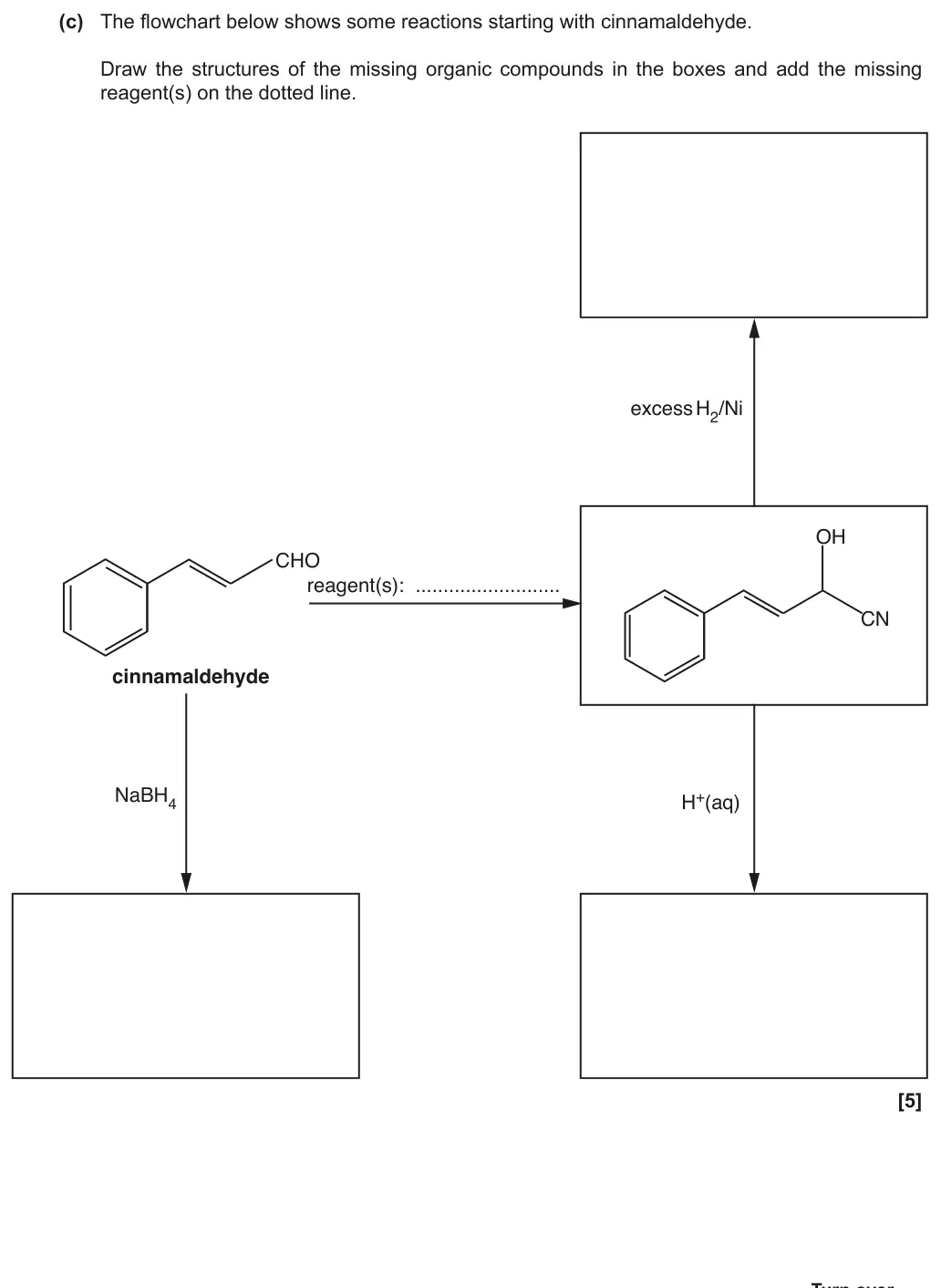
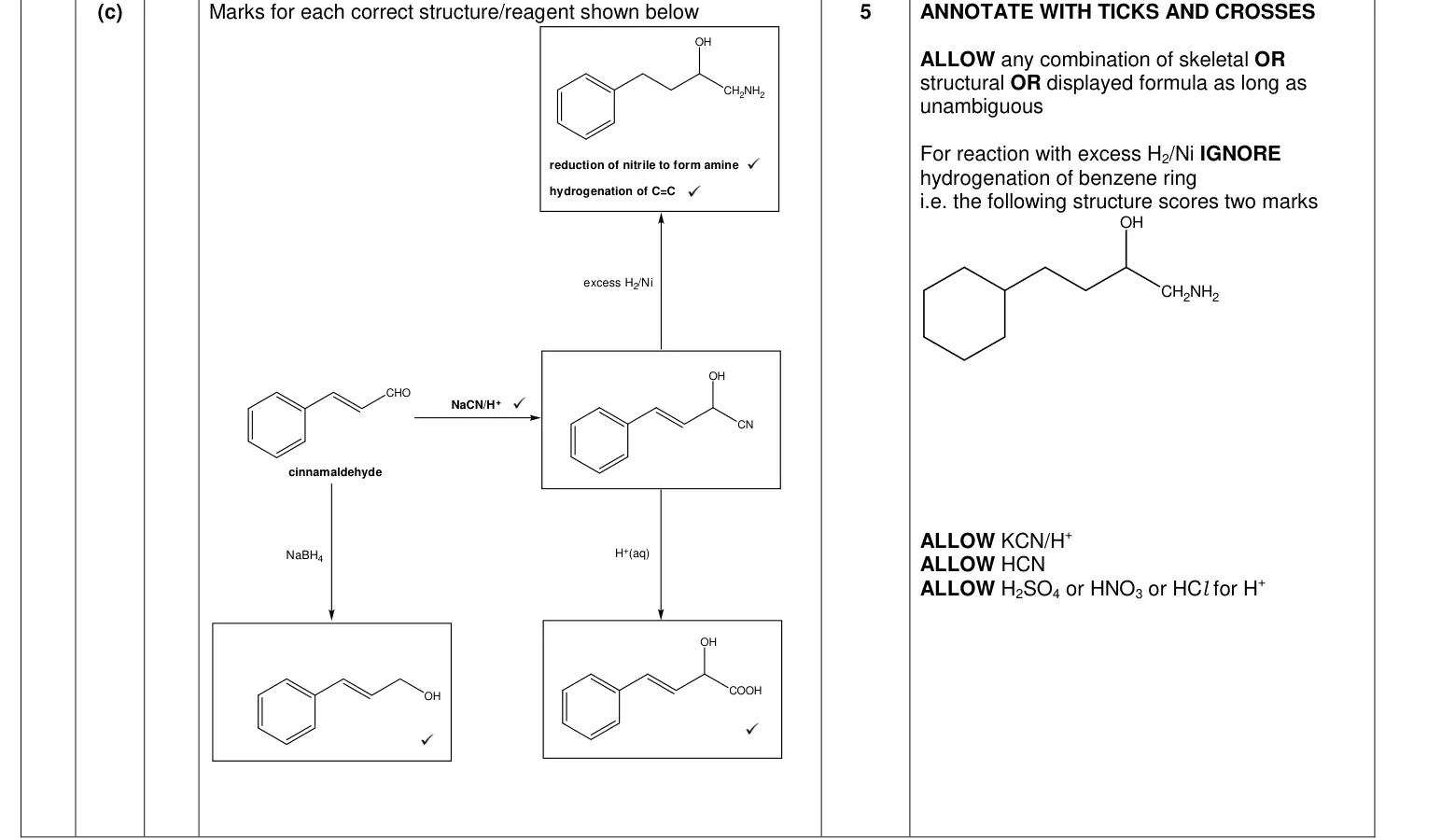
June 2018 · Paper 2 · Q20(c) 5 marks Structure / isomer Medium carbonyl compoundsalkenescarbon carbon bond formation
Earlier part of question 20 that this part usesEarlier part of June 2018 Paper 2 question 20
(c) The flowchart below shows some reactions starting with cinnamaldehyde.
Draw the structures of the missing organic compounds in the boxes and add the missing
reagent(s) on the dotted line.
excess H2/Ni
OH
CHO
reagent(s):  ..........................
CN
cinnamaldehyde
NaBH4
H+(aq)
[5]
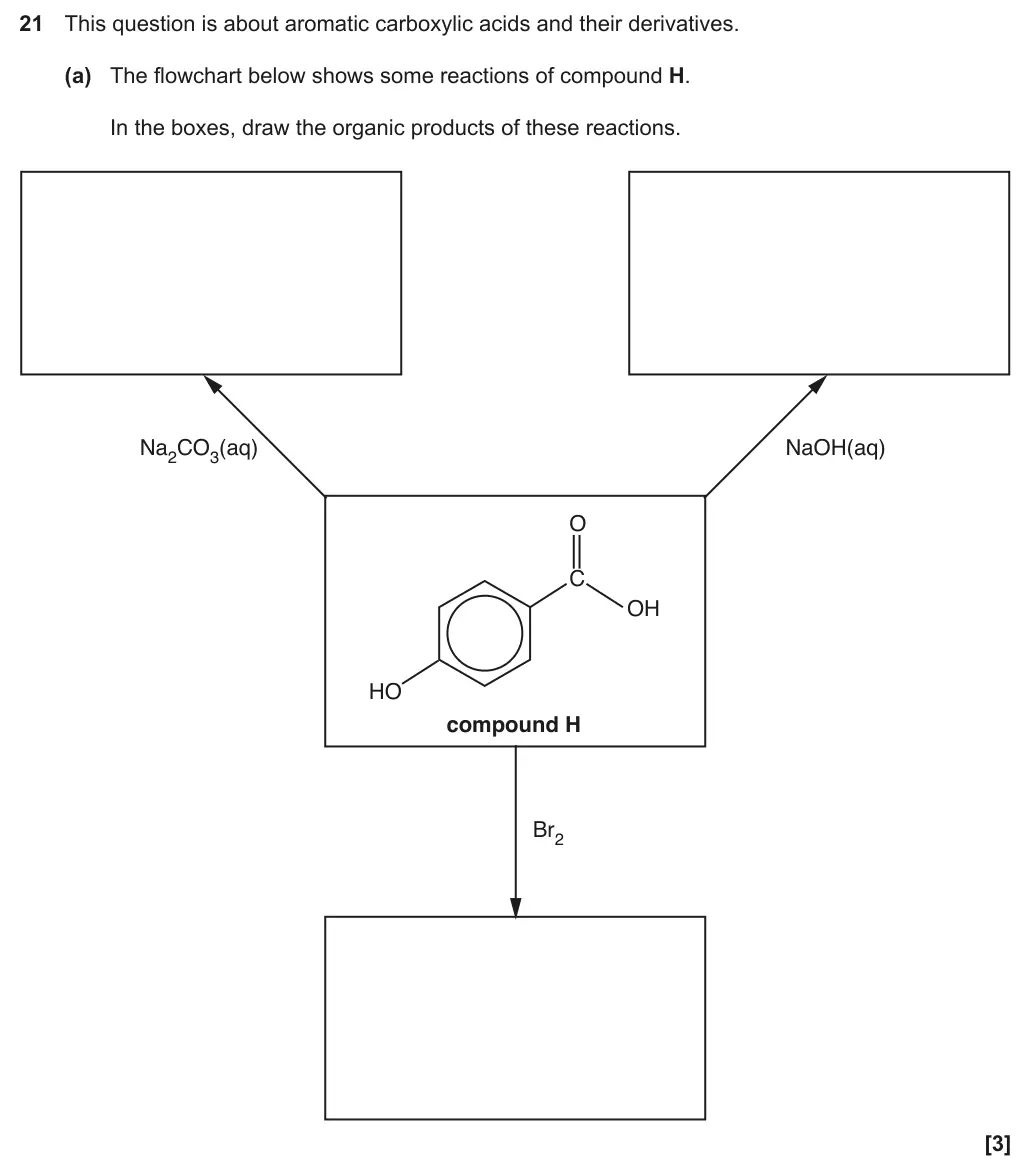
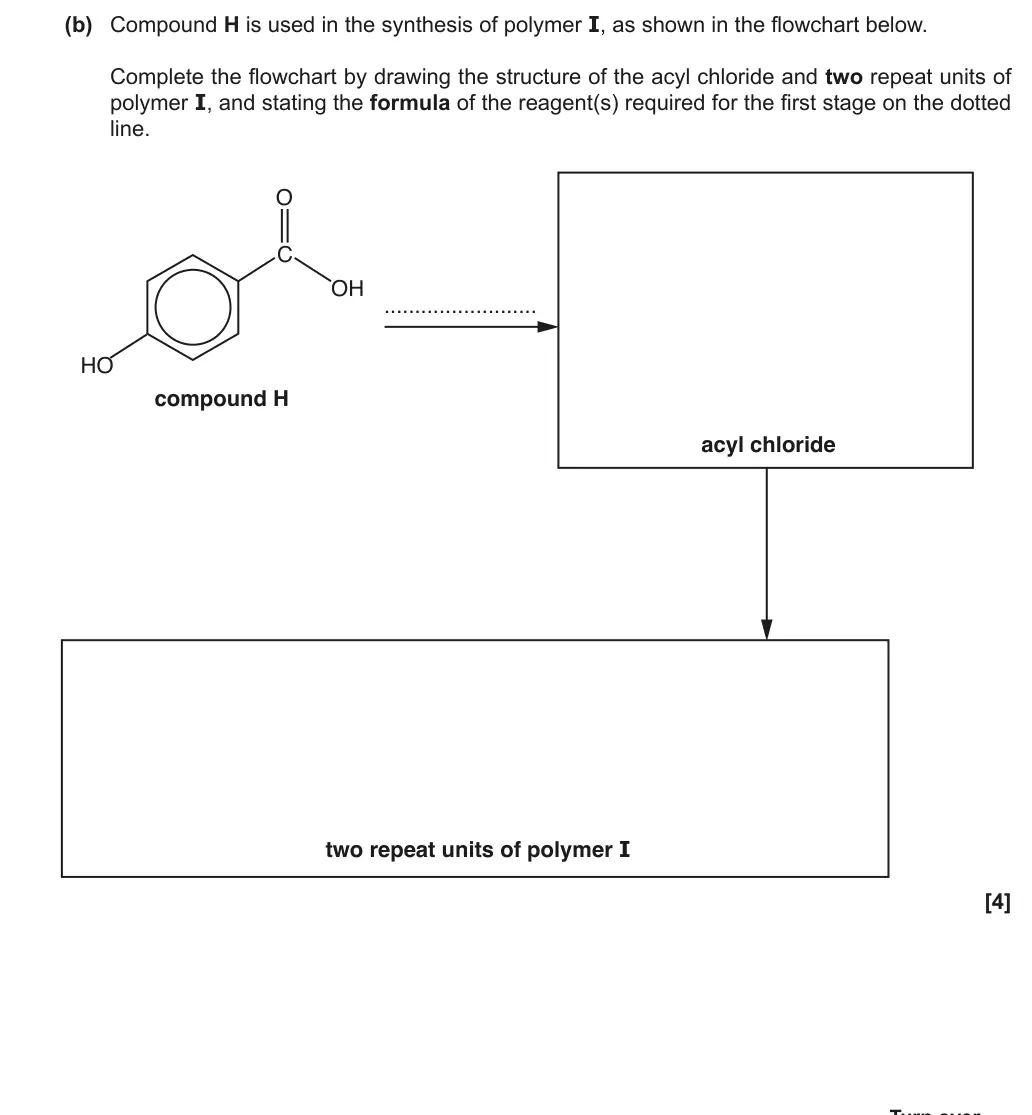
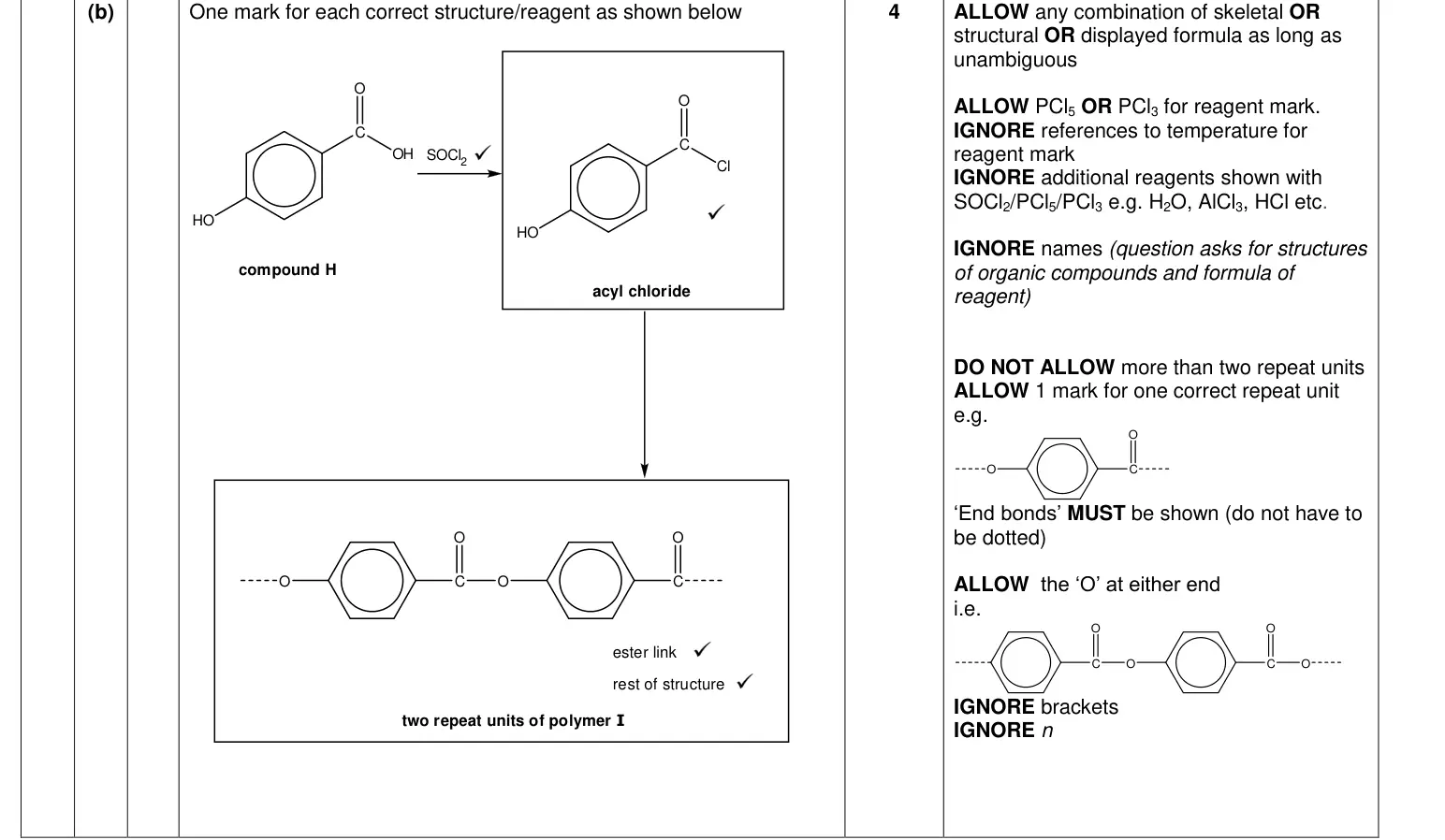
June 2018 · Paper 2 · Q21(b) 4 marks Structure / isomer Easy carboxylic acids and esterscondensation polymers
Earlier part of question 21 that this part usesEarlier part of June 2018 Paper 2 question 21
(b) Compound H is used in the synthesis of polymer I, as shown in the flowchart below.
Complete the flowchart by drawing the structure of the acyl chloride and two repeat units of
polymer I, and stating the formula of the reagent(s) required for the first stage on the dotted
line.
O
C
OH
.........................
HO
compound H
acyl chloride
two repeat units of polymer I
[4]
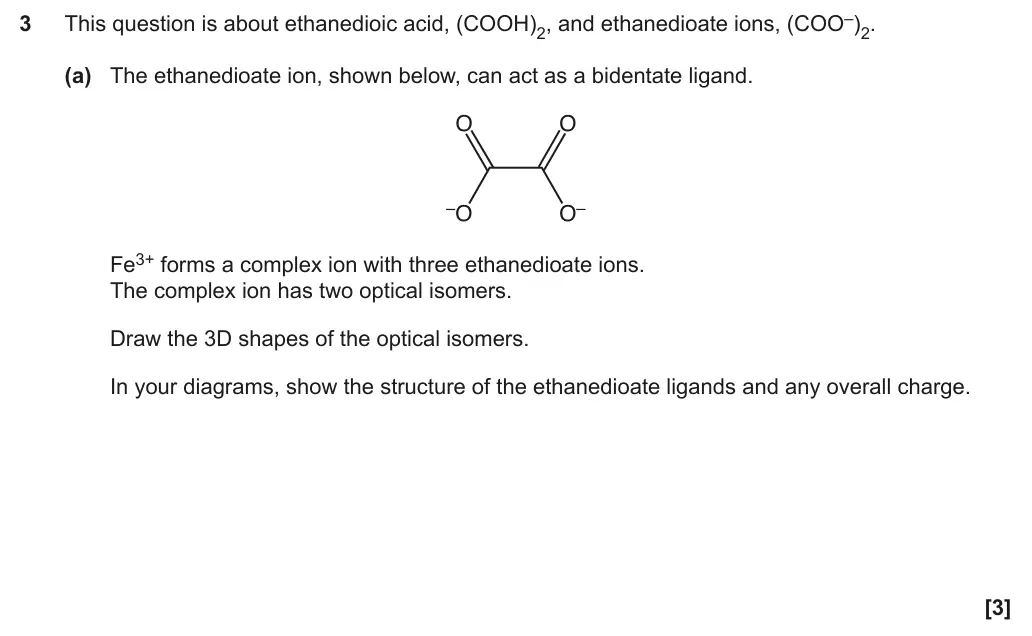
June 2018 · Paper 3 · Q3(a) 3 marks Structure / isomer Easy transition elements
3 This question is about ethanedioic acid, (COOH)2, and ethanedioate ions, (COO–)2.
(a) The ethanedioate ion, shown below, can act as a bidentate ligand.
O O
–O O–
Fe3+ forms a complex ion with three ethanedioate ions.
The complex ion has two optical isomers.
Draw the 3D shapes of the optical isomers.
In your diagrams, show the structure of the ethanedioate ligands and any overall charge.
[3]
June 2018 · Paper 3 · Q5(b)(iii) 1 mark Structure / isomer Hard carboxylic acids and estersorganic basics
Earlier parts of question 5 that this part usesEarlier part of June 2018 Paper 3 question 5Earlier part of June 2018 Paper 3 question 5
(iii) Draw the skeletal formula of the ester present in the equilibrium mixture.
[1]
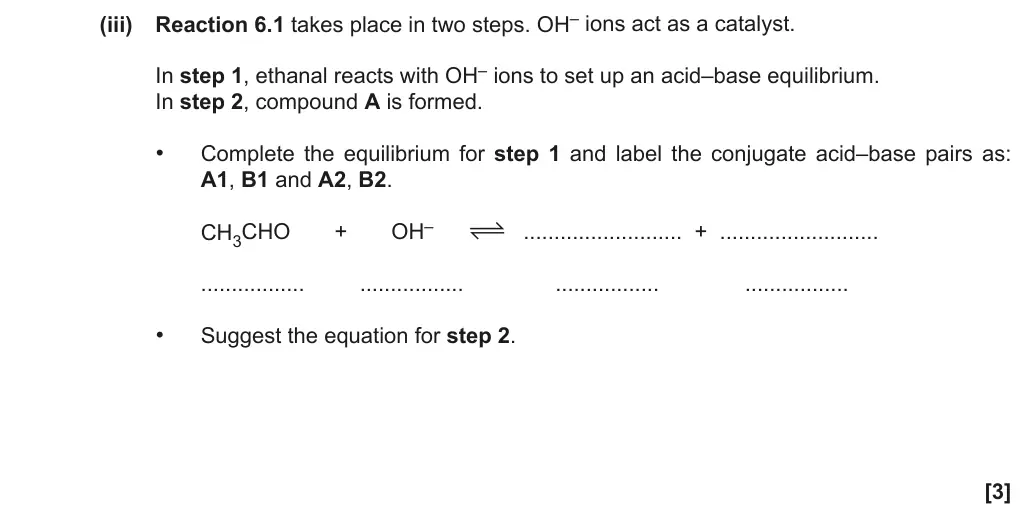
June 2018 · Paper 3 · Q6(a)(iv) 1 mark Structure / isomer Hard organic synthesiscarbonyl compoundscarbon carbon bond formation
Earlier parts of question 6 that this part usesEarlier part of June 2018 Paper 3 question 6Earlier part of June 2018 Paper 3 question 6
(iv) A similar reaction takes place when propanone, (CH3)2CO, is mixed with OH–(aq) ions.
Draw the structure of the organic product of this reaction.
[1]
June 2017 · AS Paper 2 · Q5(c) 4 marks Structure / isomer infrared and mass spectrometryorganic basics
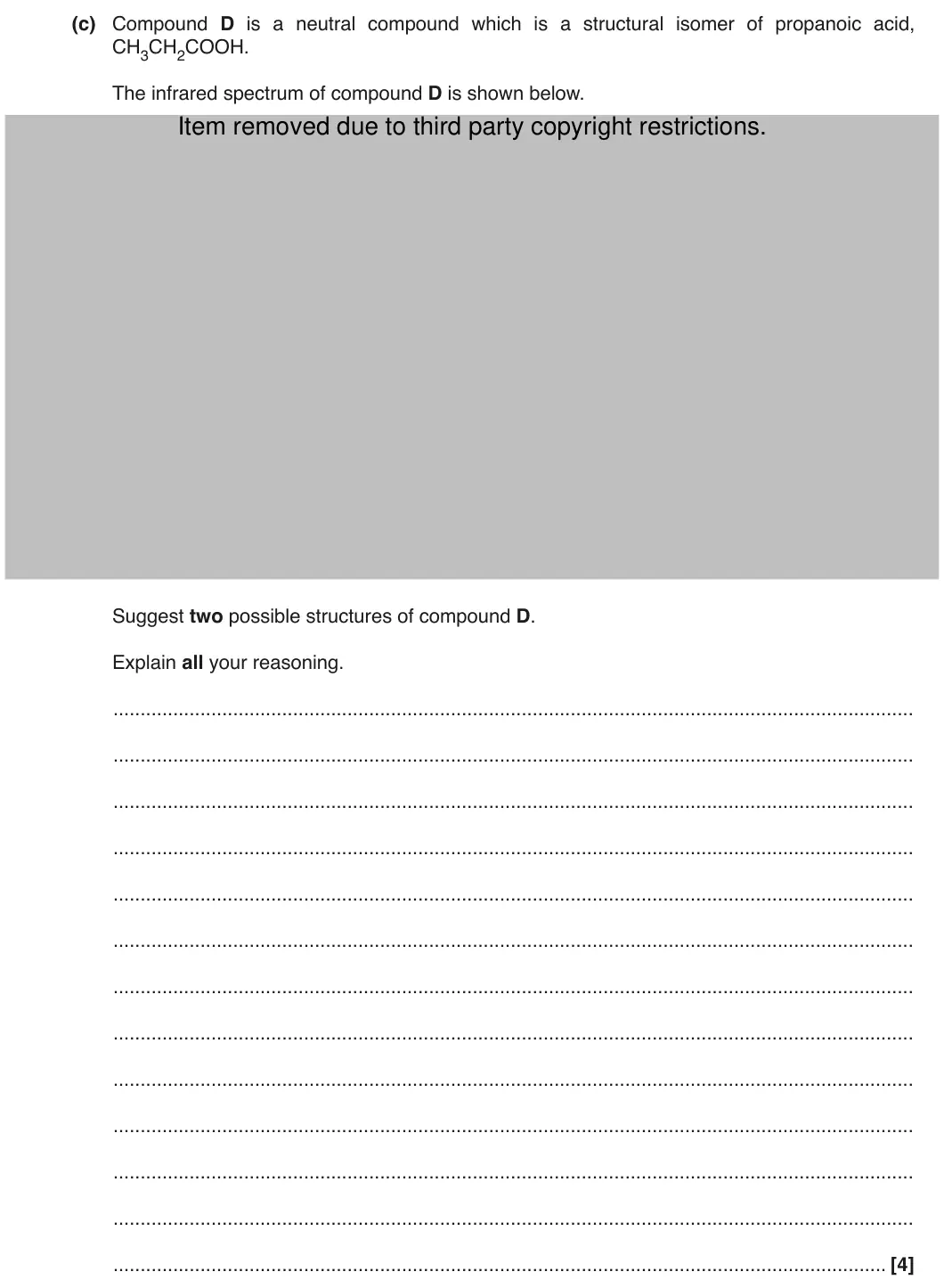
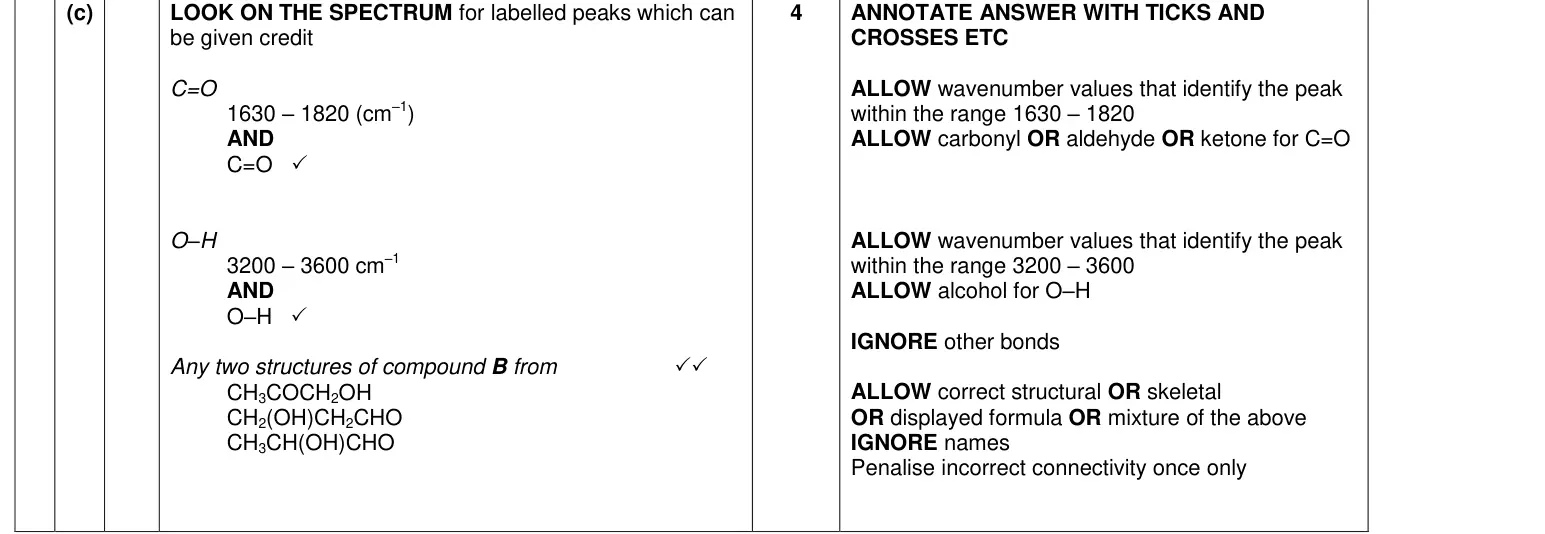
(c) Compound D is a neutral compound which is a structural isomer of propanoic acid,
CH3CH2COOH.
The infrared spectrum of compound D is shown below.
Item removed due to third party copyright restrictions.
Suggest two possible structures of compound D.
Explain all your reasoning.
...................................................................................................................................................
...................................................................................................................................................
...................................................................................................................................................
...................................................................................................................................................
...................................................................................................................................................
...................................................................................................................................................
...................................................................................................................................................
...................................................................................................................................................
...................................................................................................................................................
...................................................................................................................................................
...................................................................................................................................................
...................................................................................................................................................
.............................................................................................................................................. [4]
June 2017 · AS Paper 2 · Q5(d)(v) 1 mark Structure / isomer organic basics
Earlier parts of question 5 that this part usesEarlier part of June 2017 Paper 2 question 5Earlier part of June 2017 Paper 2 question 5
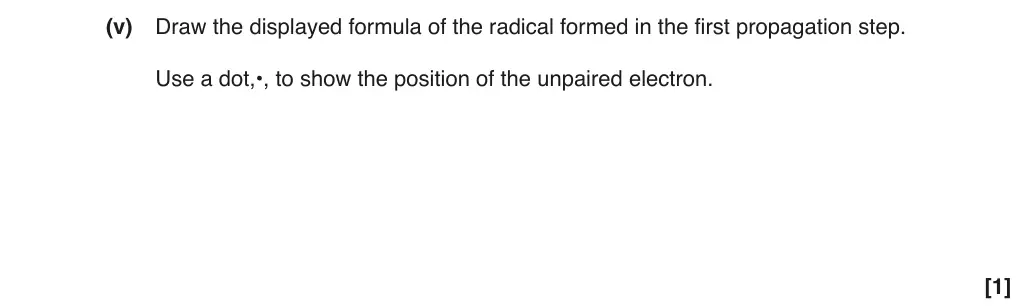
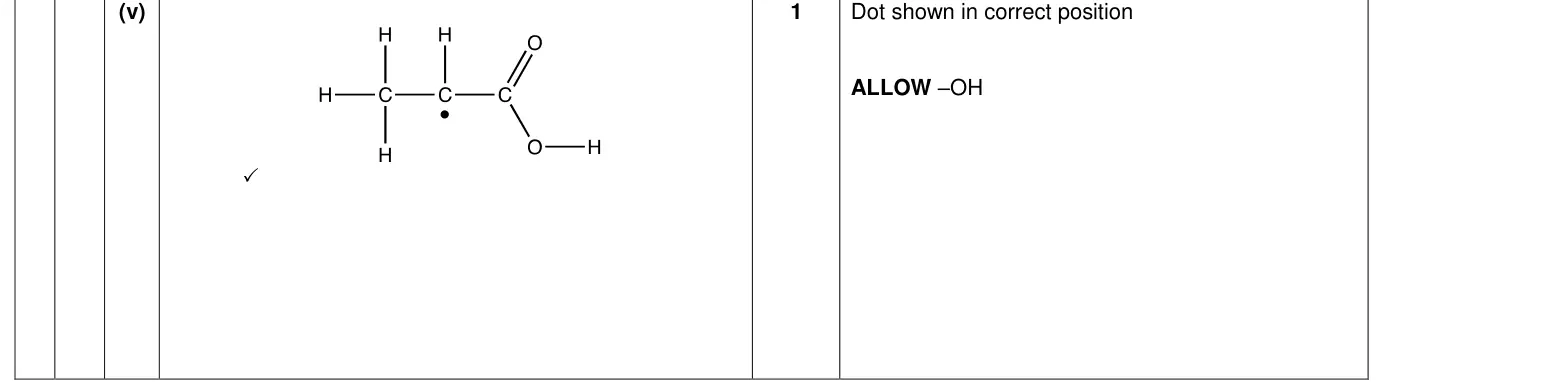
(v) Draw the displayed formula of the radical formed in the first propagation step.
Use a dot,•, to show the position of the unpaired electron.
[1]
June 2017 · AS Paper 2 · Q5(d)(vi) 1 mark Structure / isomer alkanes
Earlier part of question 5 that this part usesEarlier part of June 2017 Paper 2 question 5
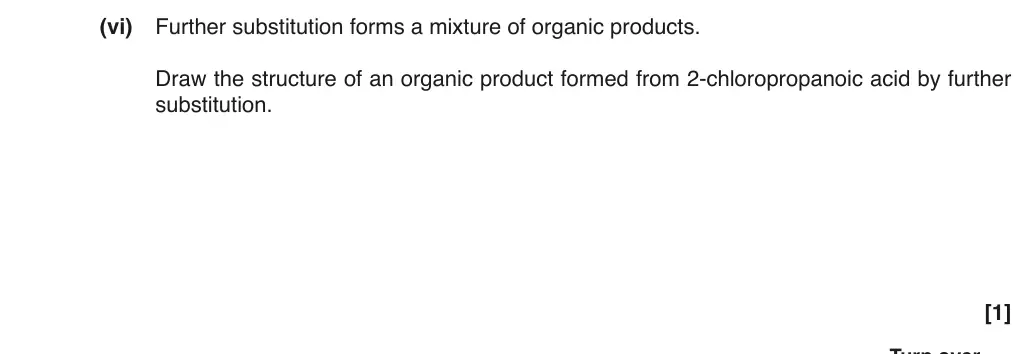
(vi) Further substitution forms a mixture of organic products.
Draw the structure of an organic product formed from 2-chloropropanoic acid by further
substitution.
[1]
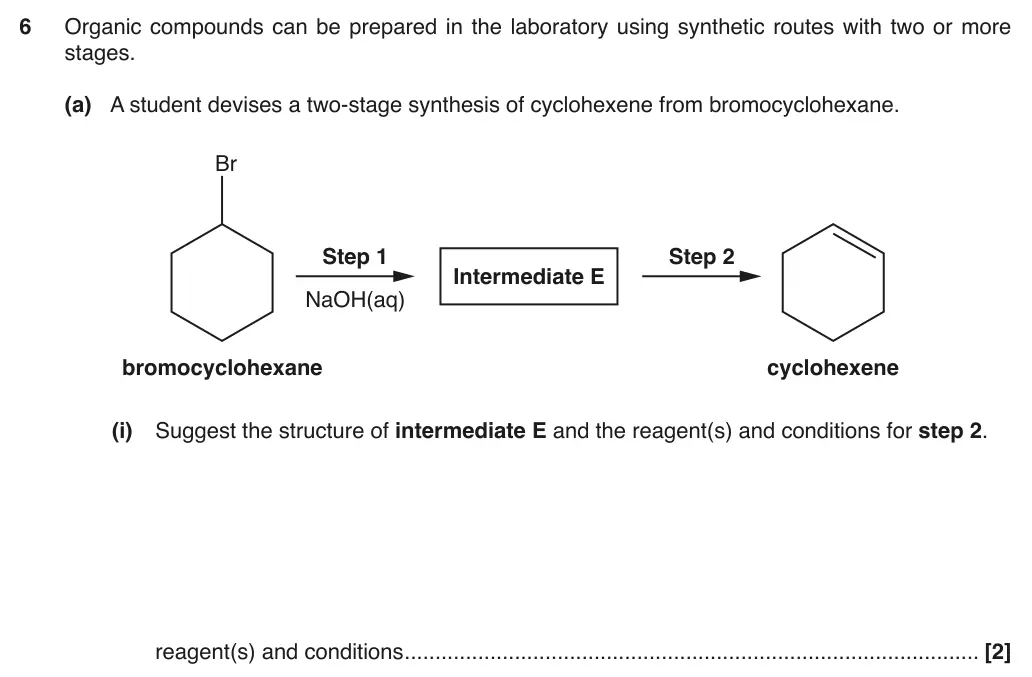
June 2017 · AS Paper 2 · Q6(a)(i) 2 marks Structure / isomer organic synthesis asalcoholshaloalkanes
6 Organic compounds can be prepared in the laboratory using synthetic routes with two or more
stages.
(a) A student devises a two-stage synthesis of cyclohexene from bromocyclohexane.
Br
Step 1 Step 2
Intermediate E
NaOH(aq)
bromocyclohexane cyclohexene
(i) Suggest the structure of intermediate E and the reagent(s) and conditions for step 2.
reagent(s) and conditions .............................................................................................. [2]
June 2017 · Paper 2 · Q16(a) 2 marks Structure / isomer alkanesbonding and structure
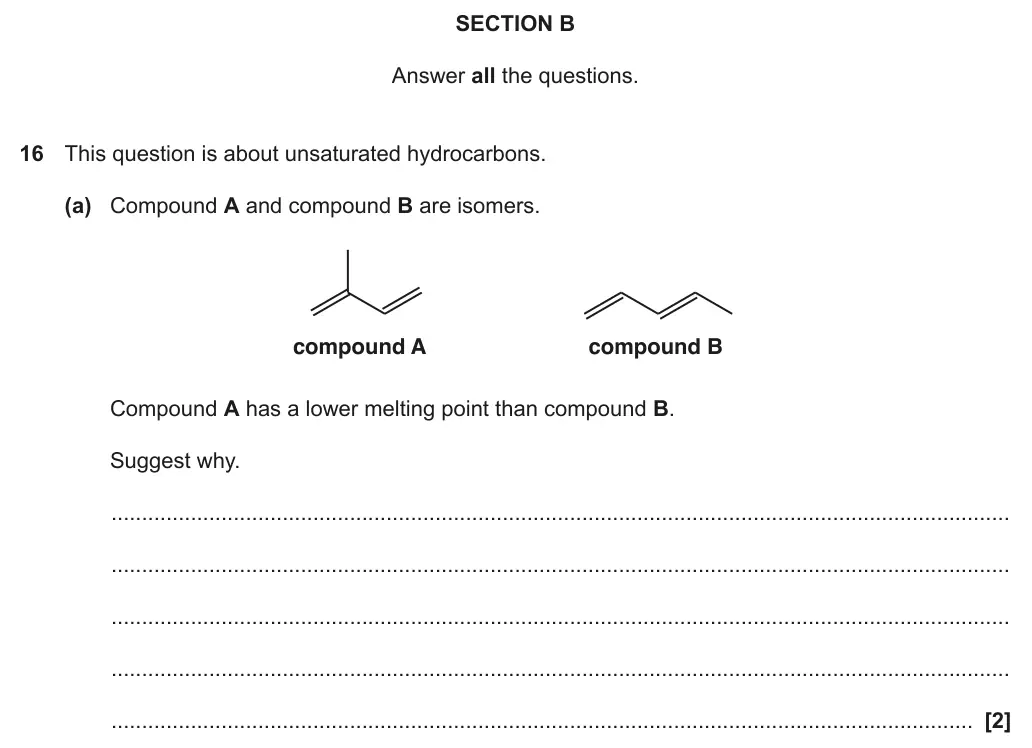
SECTION B
Answer all the questions.
16 This question is about unsaturated hydrocarbons.
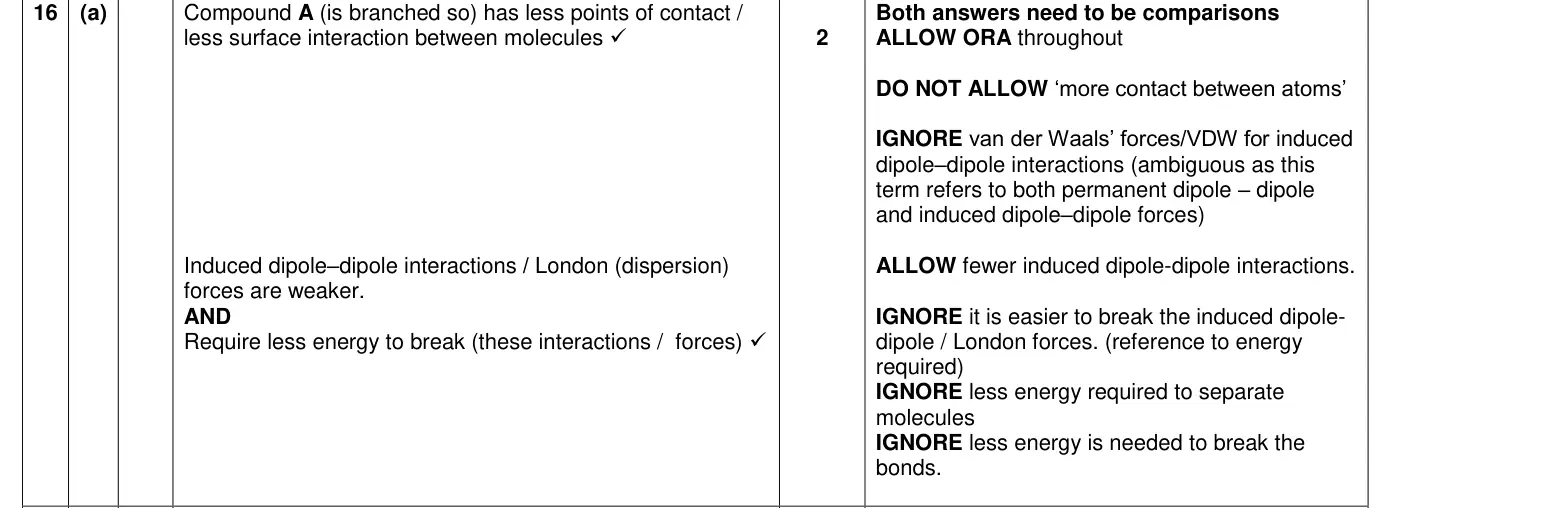
(a) Compound A and compound B are isomers.
compound A compound B
Compound A has a lower melting point than compound B.
Suggest why.
...................................................................................................................................................
...................................................................................................................................................
...................................................................................................................................................
...................................................................................................................................................
............................................................................................................................................. [2]
June 2017 · Paper 2 · Q16(b)(iii) 2 marks Structure / isomer alkenes
Earlier part of question 16 that this part usesEarlier part of June 2017 Paper 2 question 16
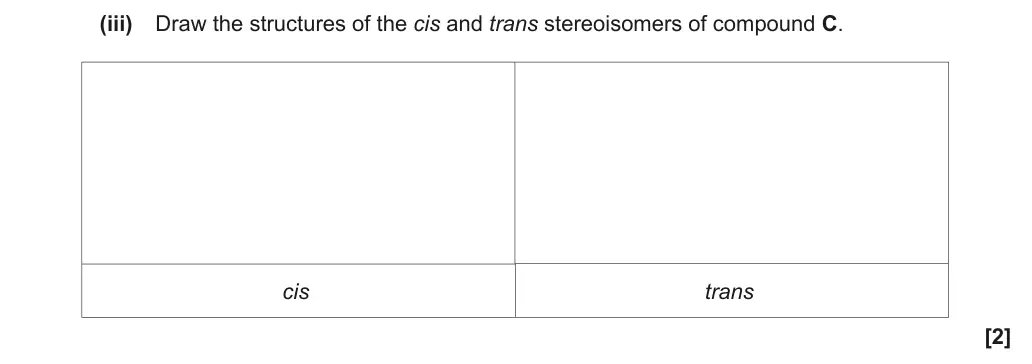
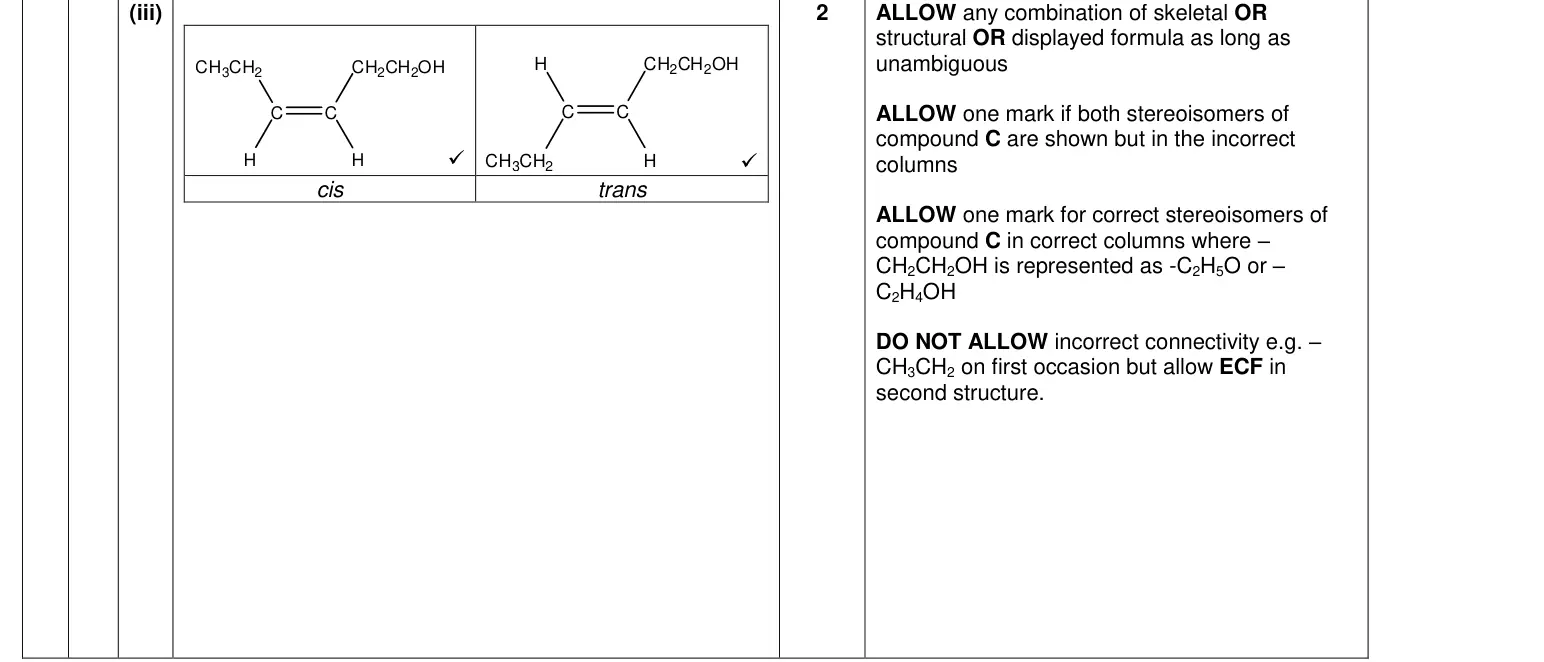
(iii) Draw the structures of the cis and trans stereoisomers of compound C.
cis trans
[2]
June 2017 · Paper 2 · Q16(d)(ii) 2 marks Structure / isomer alkenes
Earlier part of question 16 that this part usesEarlier part of June 2017 Paper 2 question 16
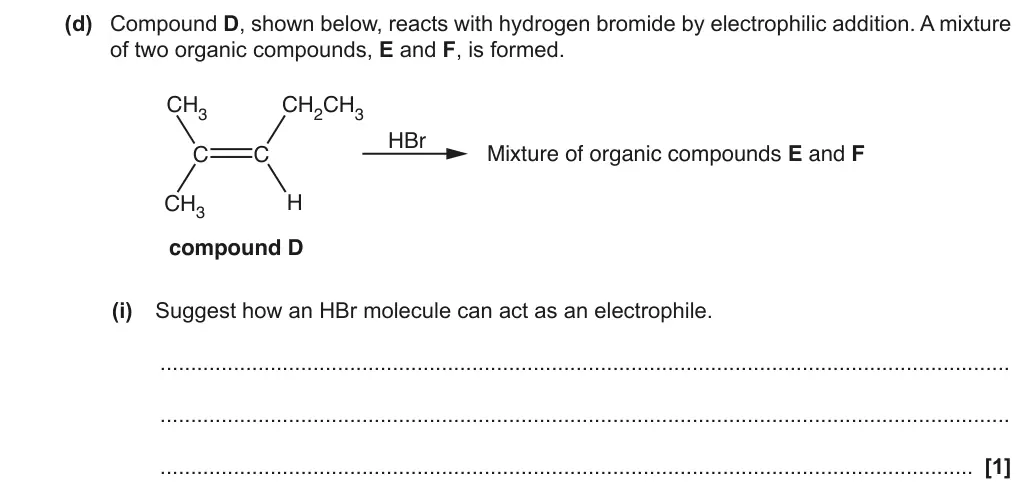
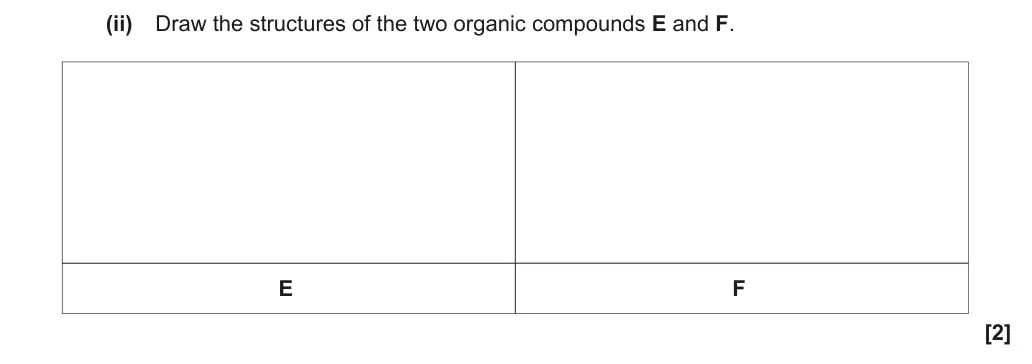
(ii) Draw the structures of the two organic compounds E and F.
E F
[2]
June 2017 · Paper 2 · Q17(c)(ii) 3 marks Structure / isomer aromatic compounds
Earlier part of question 17 that this part usesEarlier part of June 2017 Paper 2 question 17
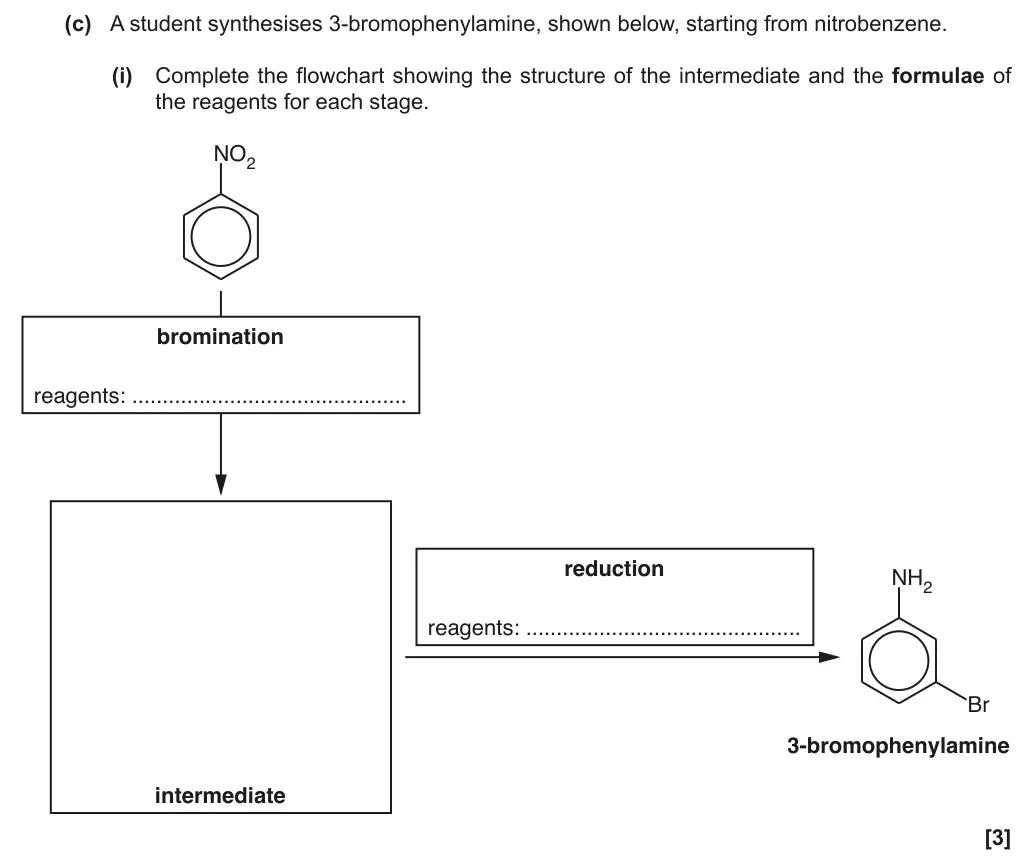
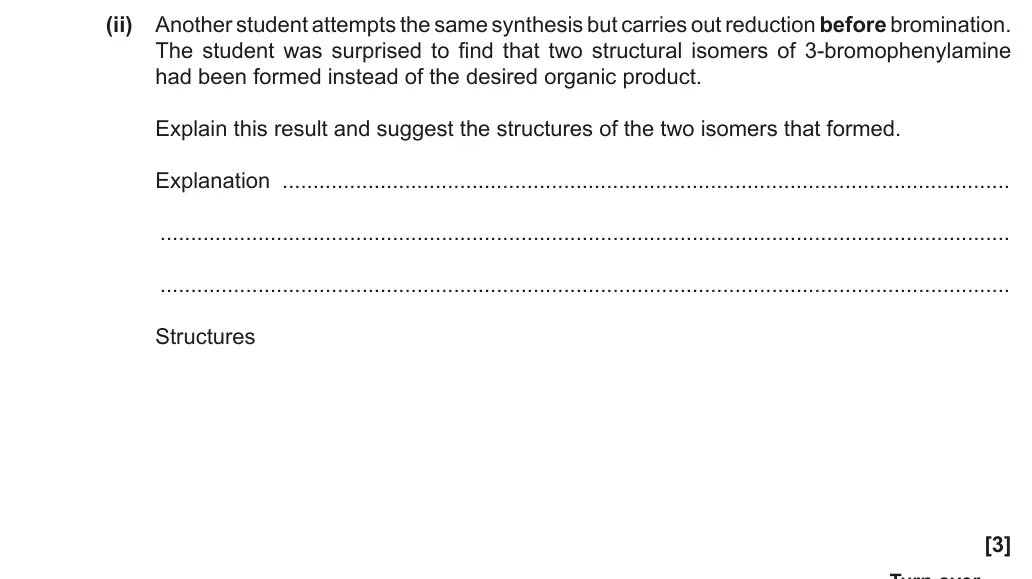
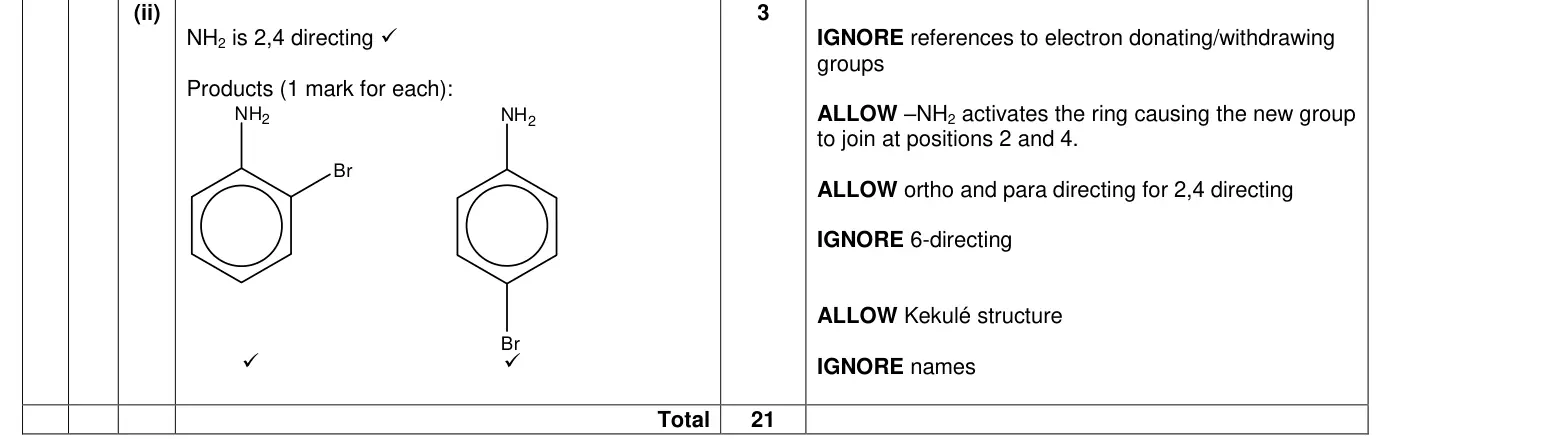
(ii) Another student attempts the same synthesis but carries out reduction before bromination.
The student was surprised to find that two structural isomers of 3-bromophenylamine
had been formed instead of the desired organic product.
Explain this result and suggest the structures of the two isomers that formed.
Explanation  .......................................................................................................................
...........................................................................................................................................
...........................................................................................................................................
Structures
[3]
June 2017 · Paper 2 · Q18(b)(i) 2 marks Structure / isomer condensation polymers
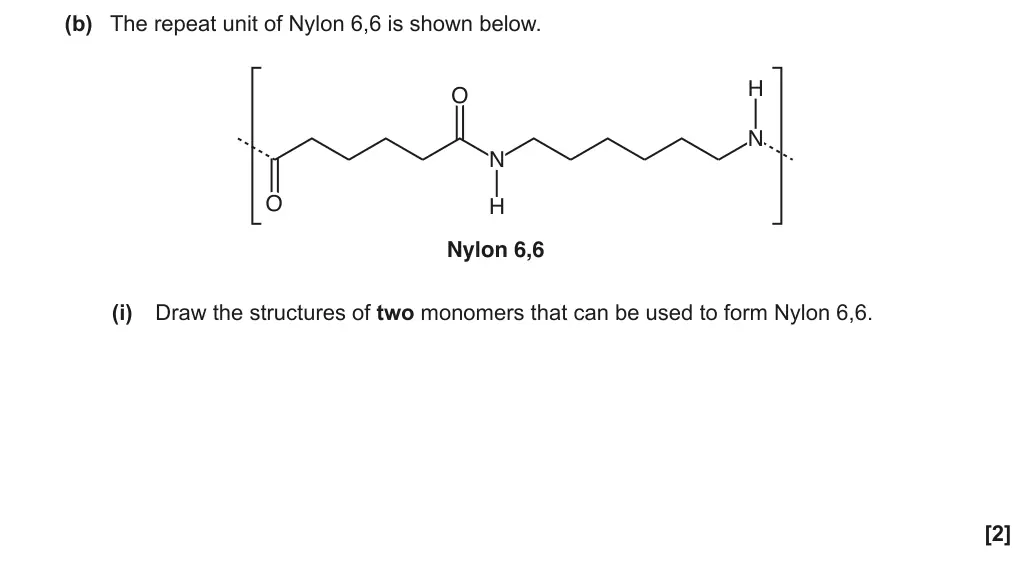
(b) The repeat unit of Nylon 6,6 is shown below.
H
O
N
N
O H
Nylon 6,6
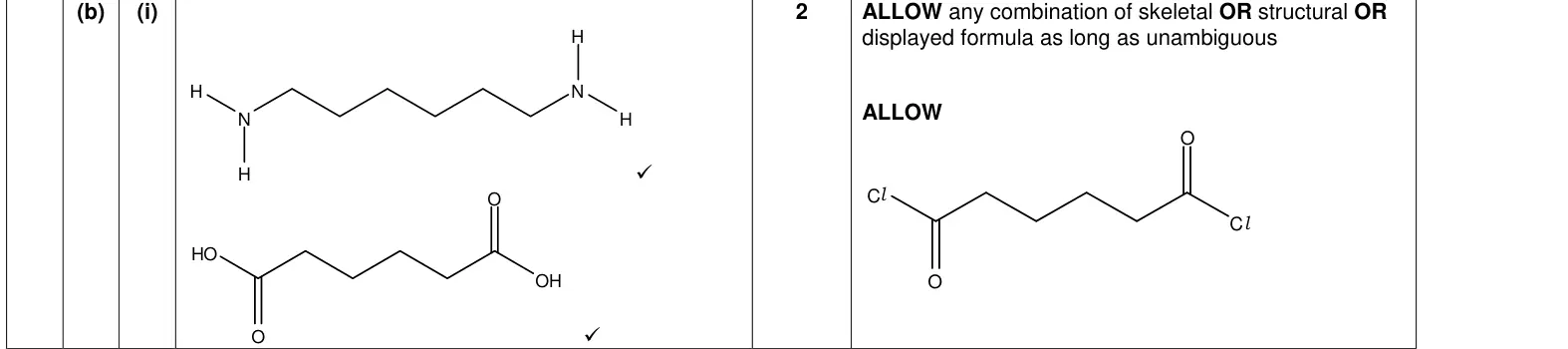
(i) Draw the structures of two monomers that can be used to form Nylon 6,6.
[2]
June 2017 · Paper 3 · Q3(c)(i) 1 mark Structure / isomer organic basics
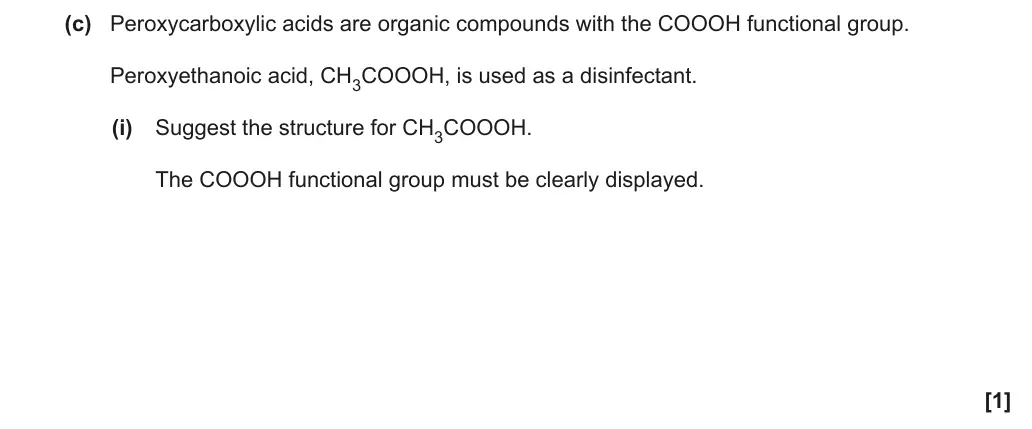
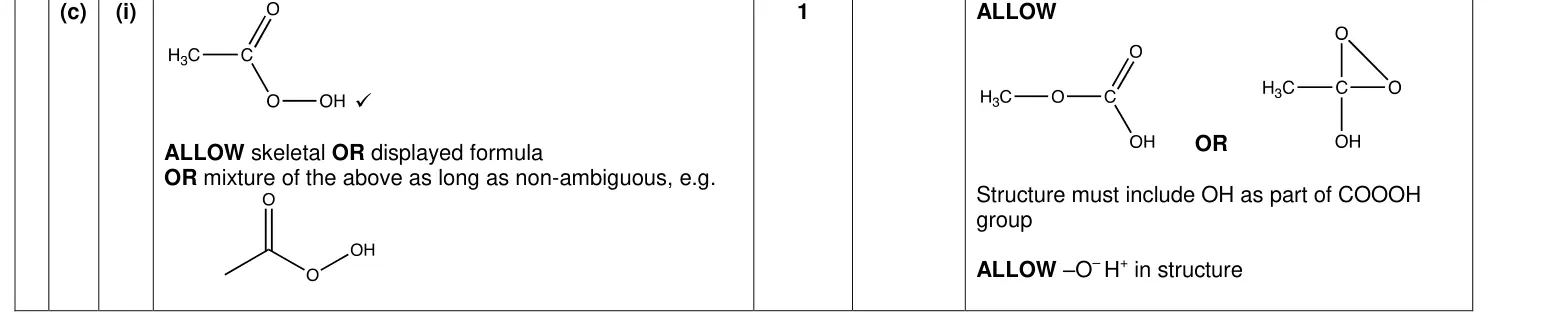
(c) Peroxycarboxylic acids are organic compounds with the COOOH functional group.
Peroxyethanoic acid, CH3COOOH, is used as a disinfectant.
(i) Suggest the structure for CH3COOOH.
The COOOH functional group must be clearly displayed.
[1]
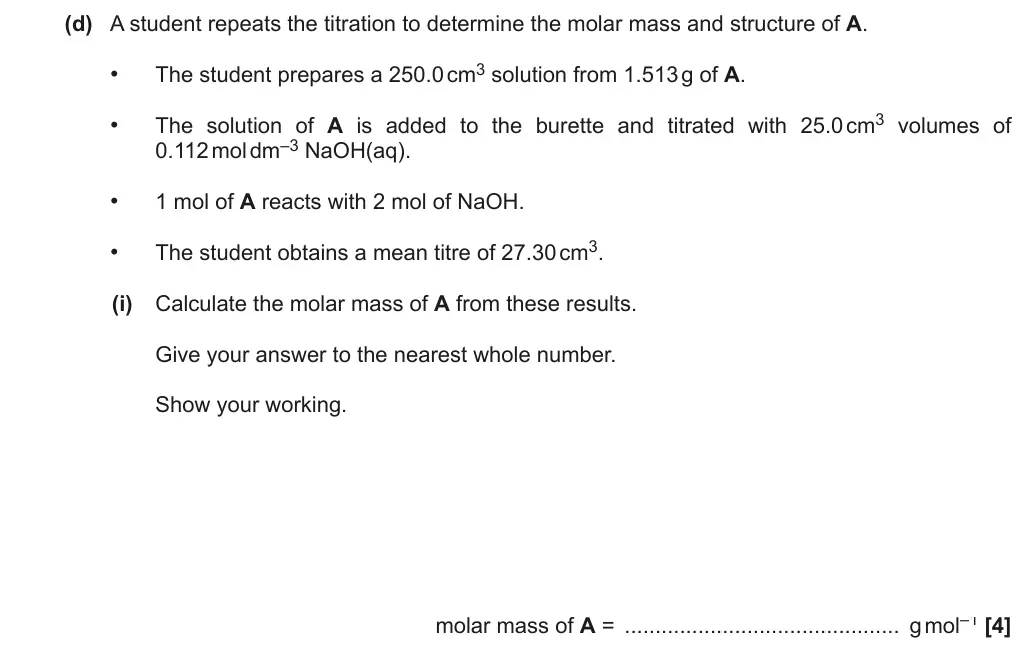
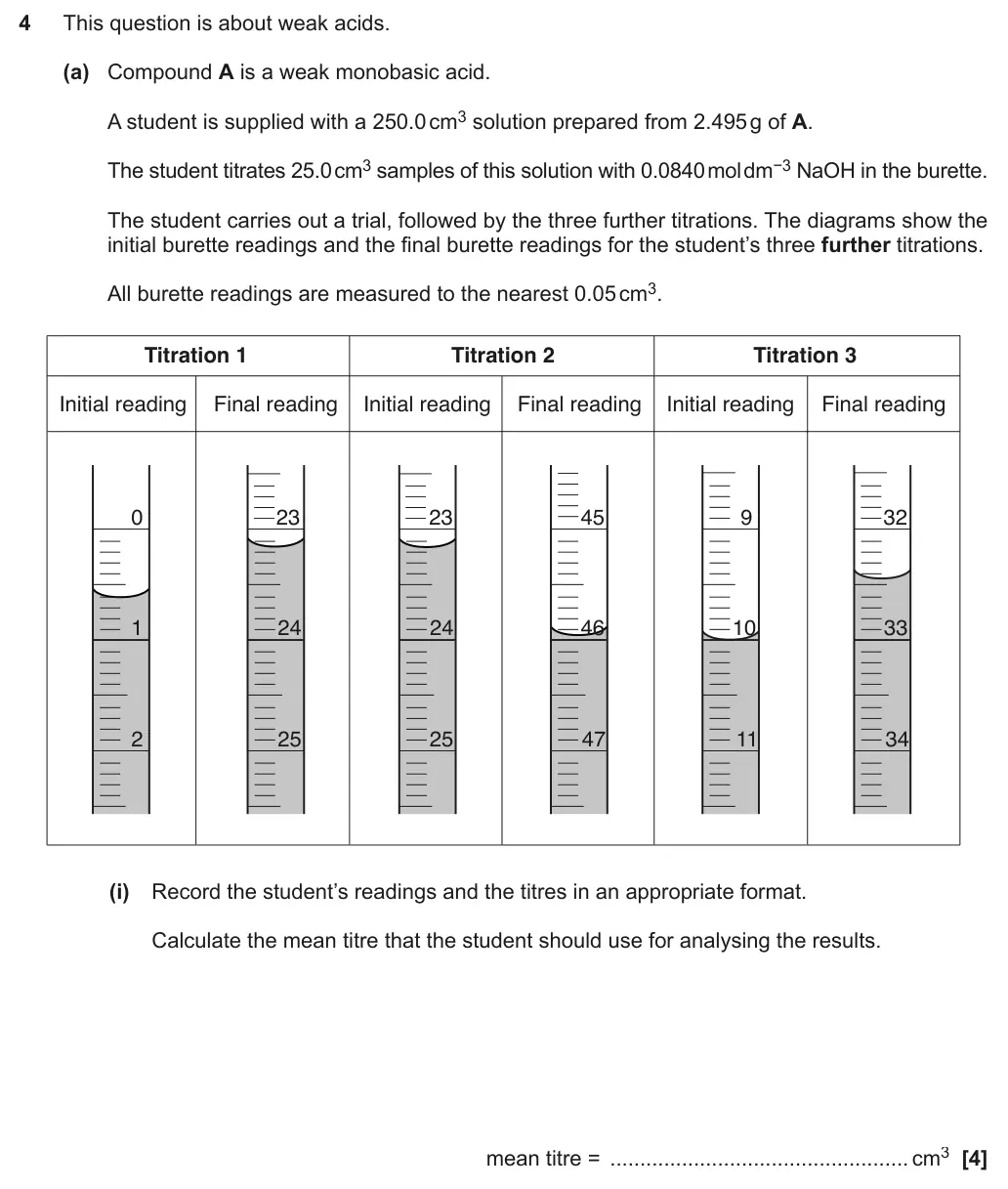
June 2017 · Paper 3 · Q4(a)(ii) 6 marks Structure / isomer acids and titrationsamount of substanceamino acids amides and chirality
Earlier part of question 4 that this part usesEarlier part of June 2017 Paper 3 question 4
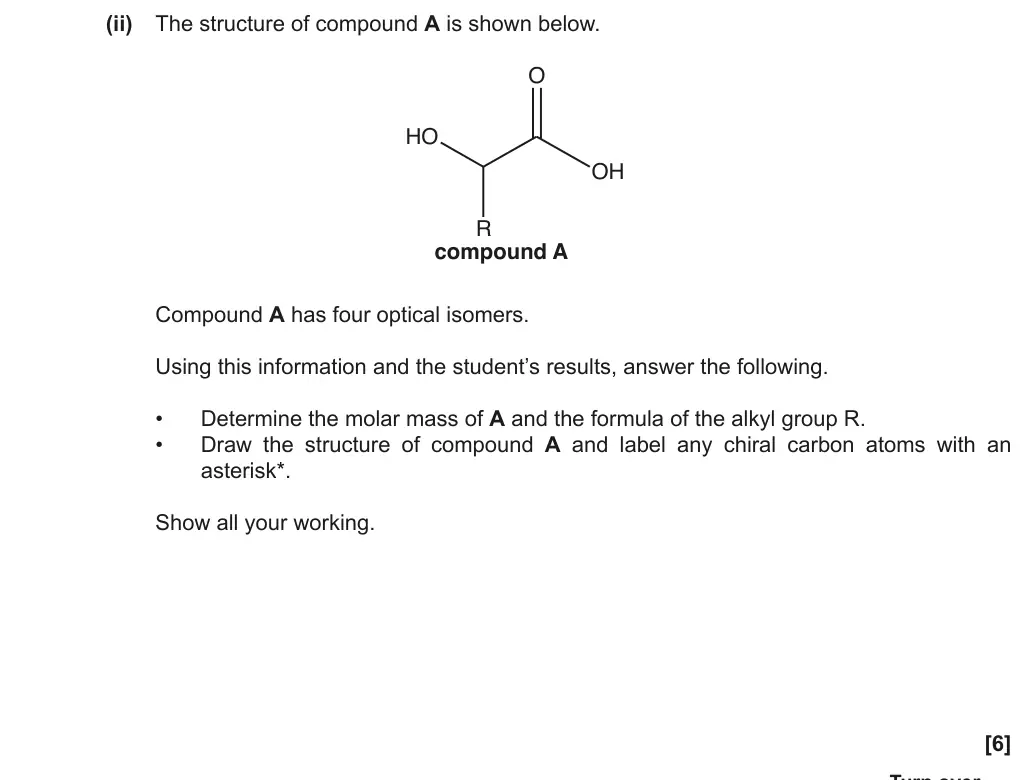
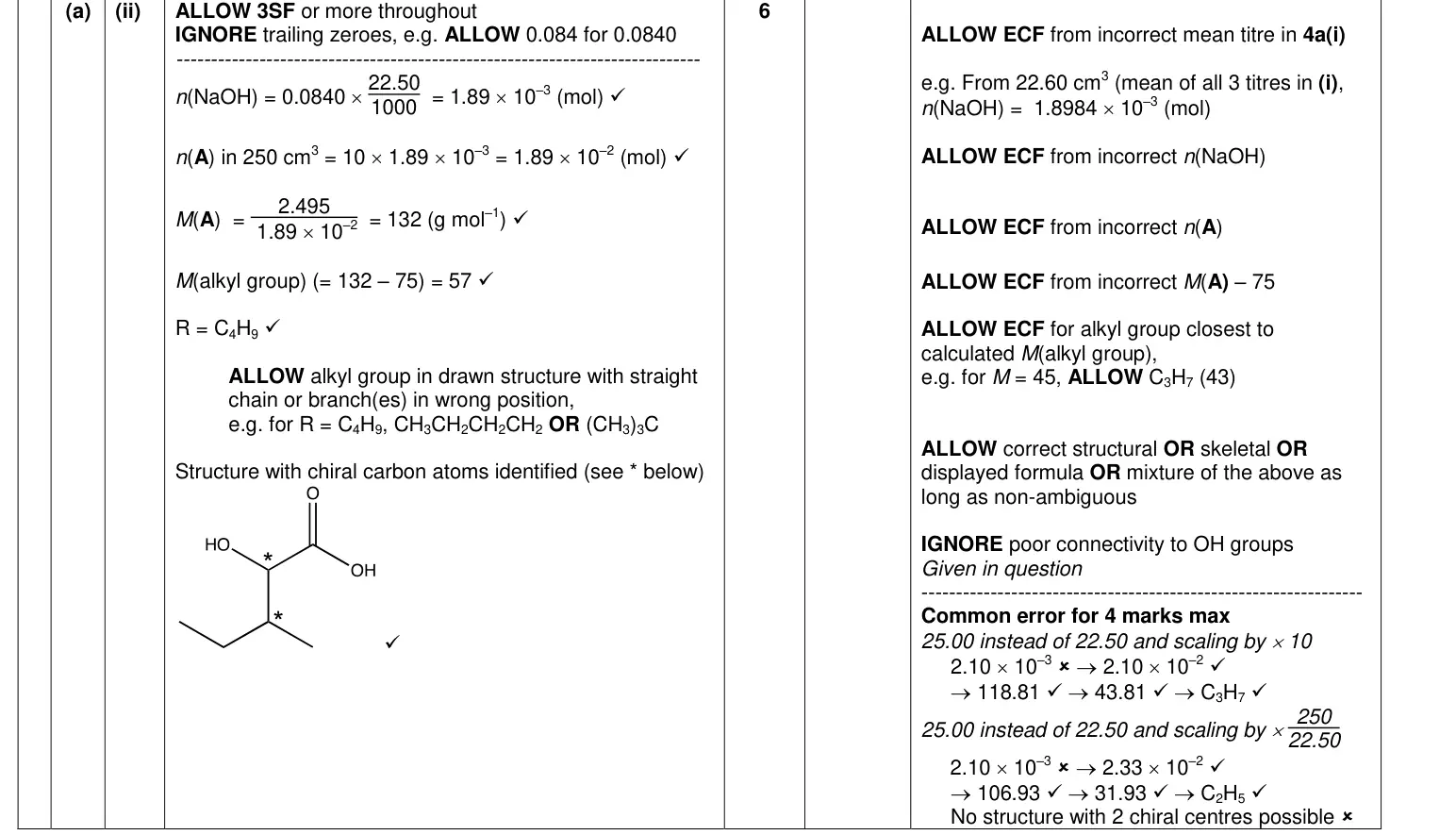
(ii) The structure of compound A is shown below.
O
HO
OH
R
compound A
Compound A has four optical isomers.
Using this information and the student’s results, answer the following.
• Determine the molar mass of A and the formula of the alkyl group R.
• Draw the structure of compound A and label any chiral carbon atoms with an
asterisk*.
Show all your working.
[6]
June 2017 · Paper 3 · Q4(b)(i) 3 marks Structure / isomer carboxylic acids and estersformulae and equationsredox
Earlier part of question 4 that this part usesEarlier part of June 2017 Paper 3 question 4
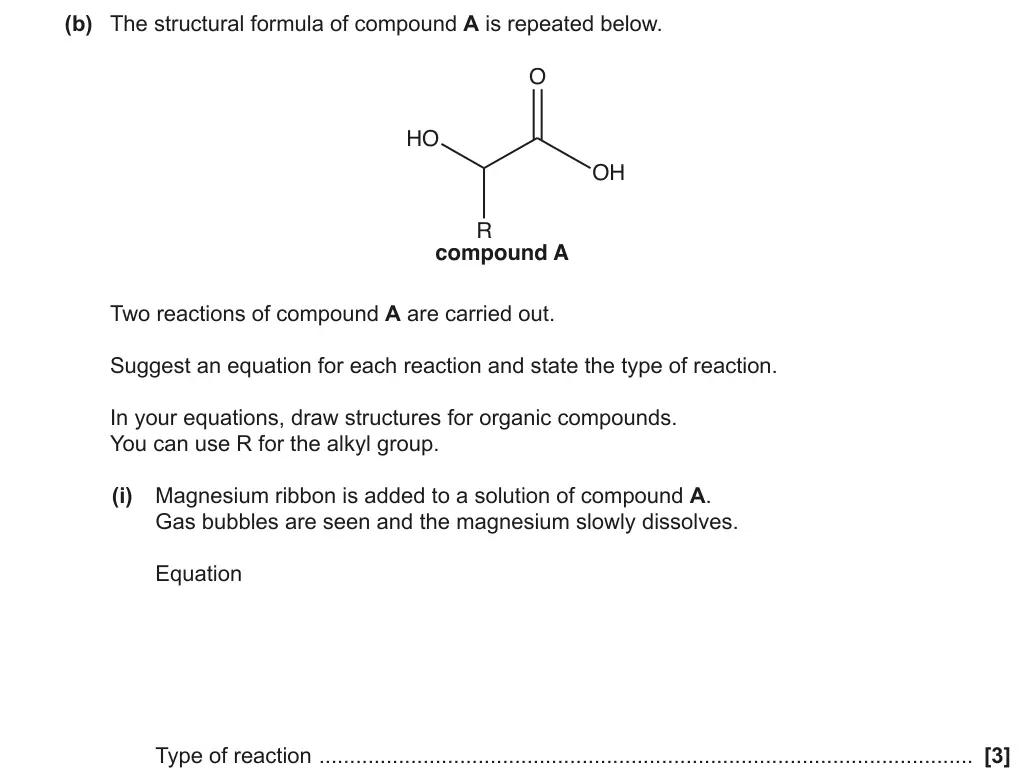
(b) The structural formula of compound A is repeated below.
O
HO
OH
R
compound A
Two reactions of compound A are carried out.
Suggest an equation for each reaction and state the type of reaction.
In your equations, draw structures for organic compounds.
You can use R for the alkyl group.
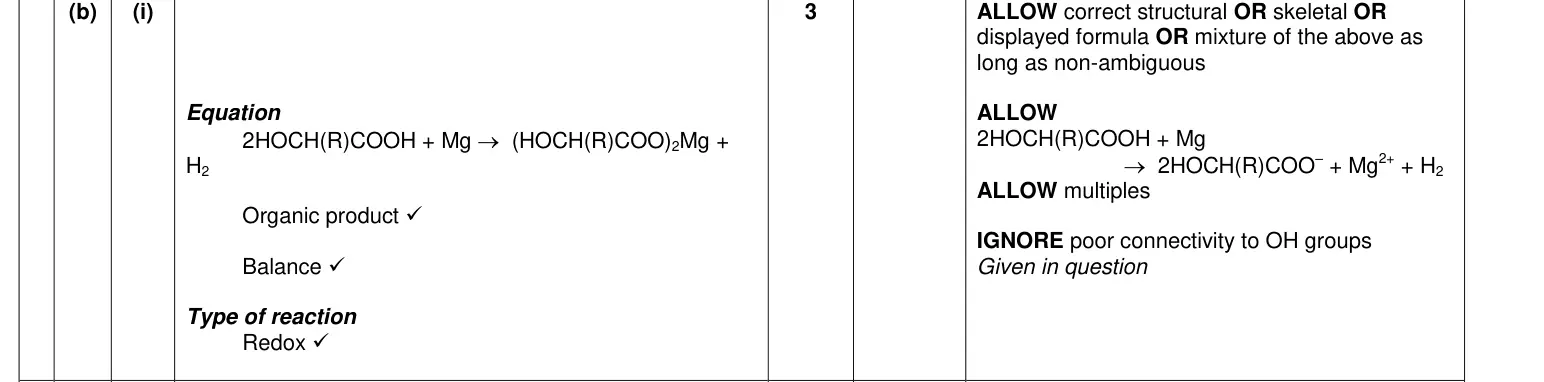
(i) Magnesium ribbon is added to a solution of compound A.
Gas bubbles are seen and the magnesium slowly dissolves.
Equation
Type of reaction  ........................................................................................................... [3]
June 2017 · Paper 3 · Q4(c)(i) 1 mark Structure / isomer transition elements
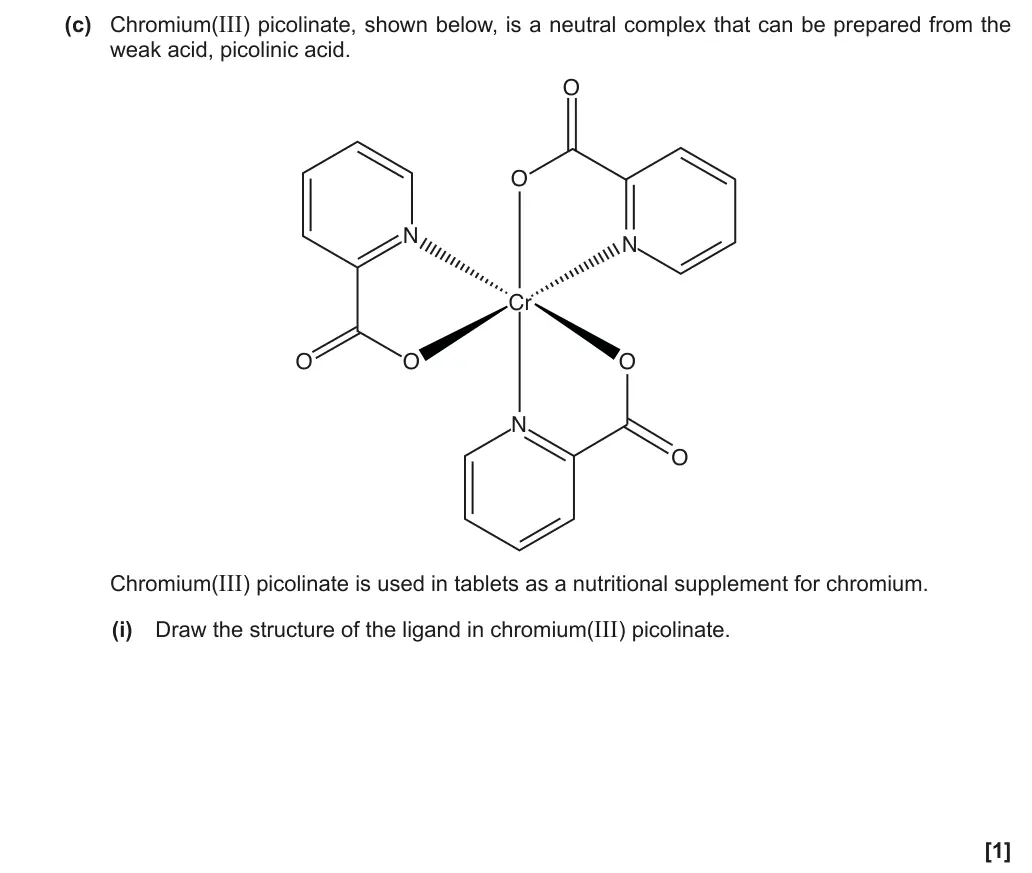
(c) Chromium(III) picolinate, shown below, is a neutral complex that can be prepared from the
weak acid, picolinic acid.
O
O
N
N
Cr
O O O
N
O
Chromium(III) picolinate is used in tablets as a nutritional supplement for chromium.
(i) Draw the structure of the ligand in chromium(III) picolinate.
[1]
June 2017 · Paper 3 · Q5(a)(iii) 1 mark Structure / isomer organic basics
Earlier part of question 5 that this part usesEarlier part of June 2017 Paper 3 question 5
(iii) When beer is exposed to light, 3-methylbut-2-ene-1-thiol is formed, which gives an
unpleasant smell and flavour to the beer.
Draw the skeletal formula for 3-methylbut-2-ene-1-thiol.
[1]
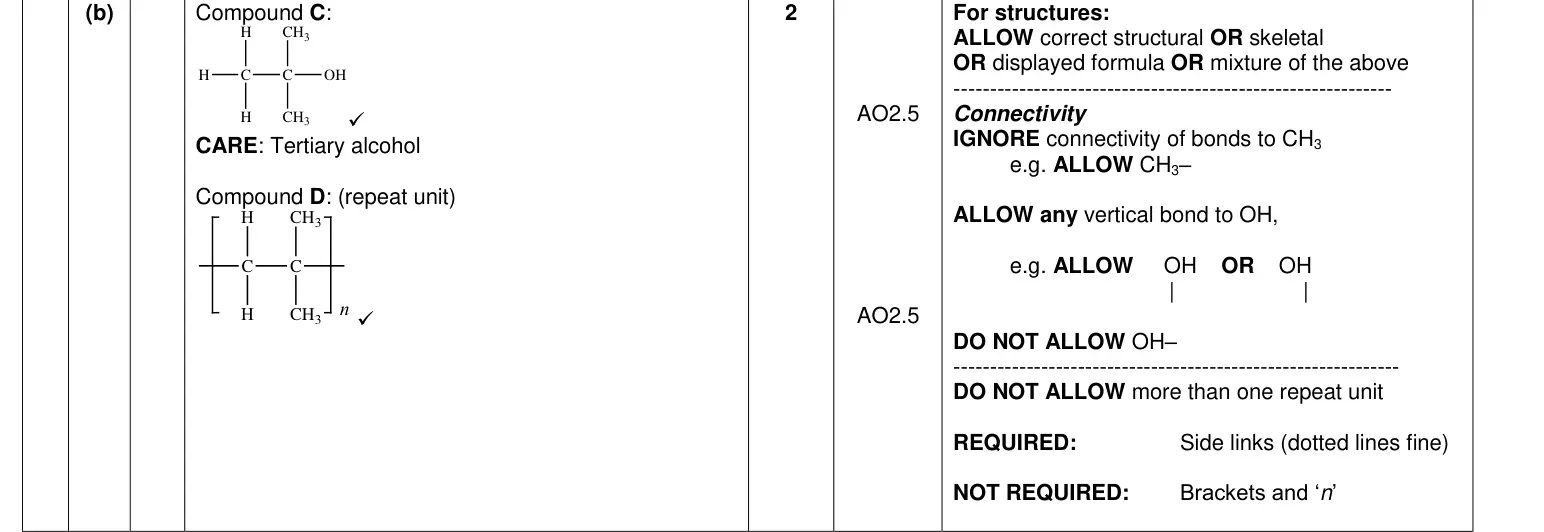
June 2016 · AS Paper 1 · Q26(b) 2 marks AO2 Structure / isomer alcoholsalkenes
Earlier part of question 26 that this part usesEarlier part of June 2016 Paper 1 question 26
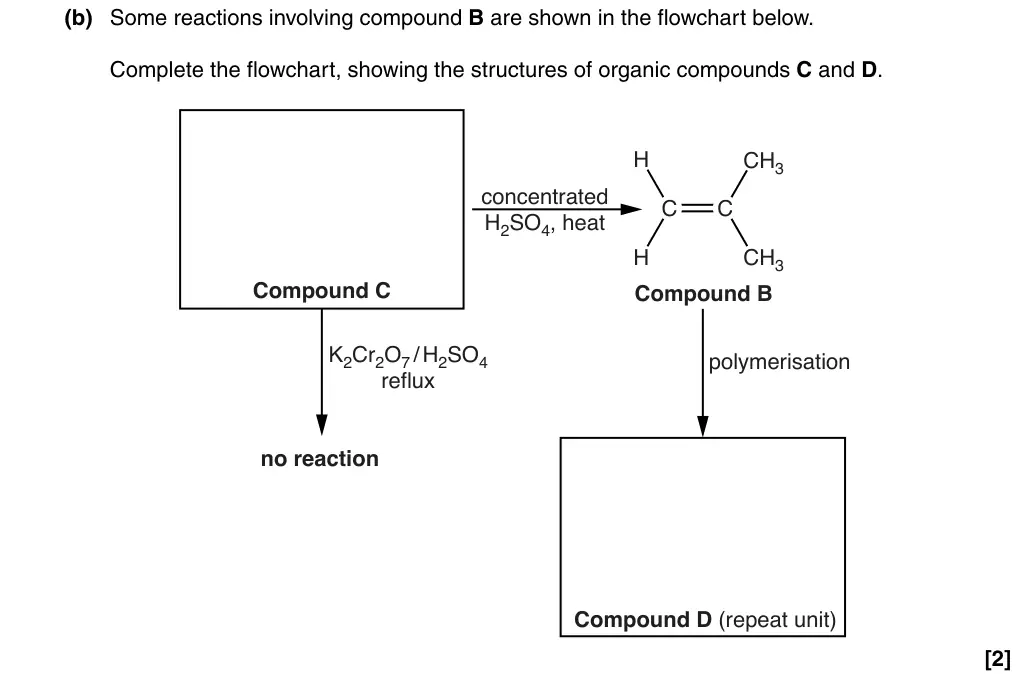
(b) Some reactions involving compound B are shown in the flowchart below.
Complete the flowchart, showing the structures of organic compounds C and D.
H CH3
concentrated
C C
H2SO4, heat
H CH3
Compound C Compound B
K2Cr2O7 / H2SO4 polymerisation
reflux
no reaction
Compound D (repeat unit)
[2]
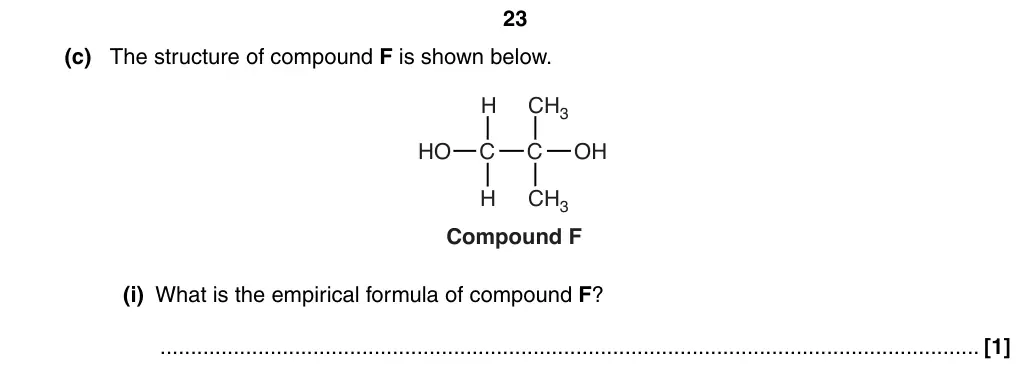
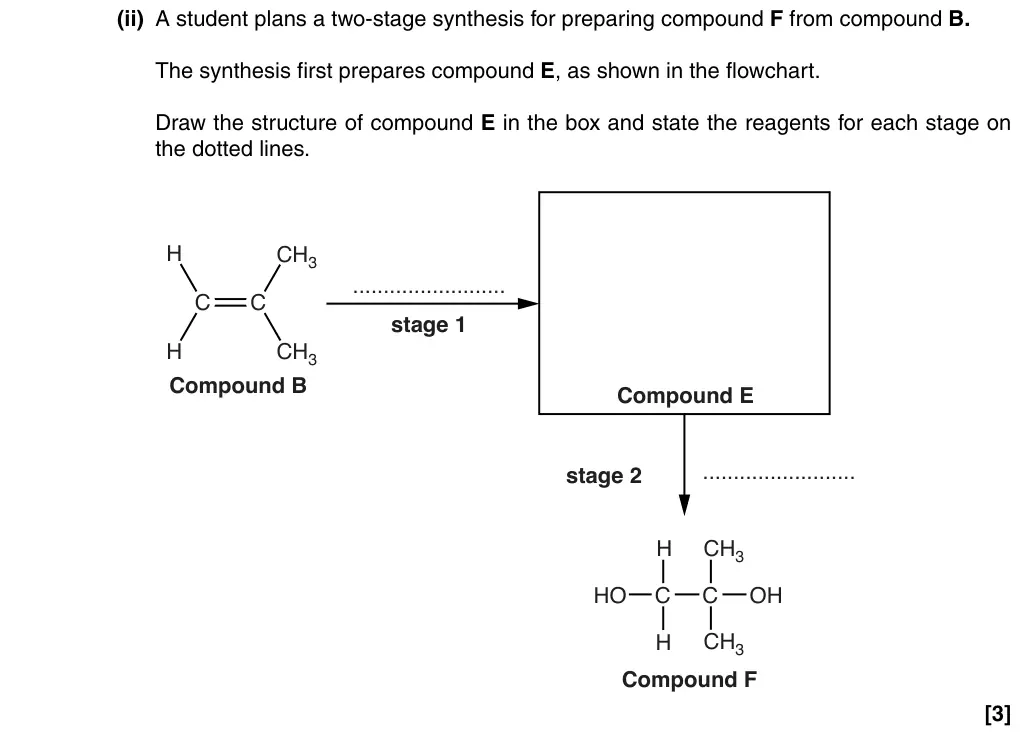
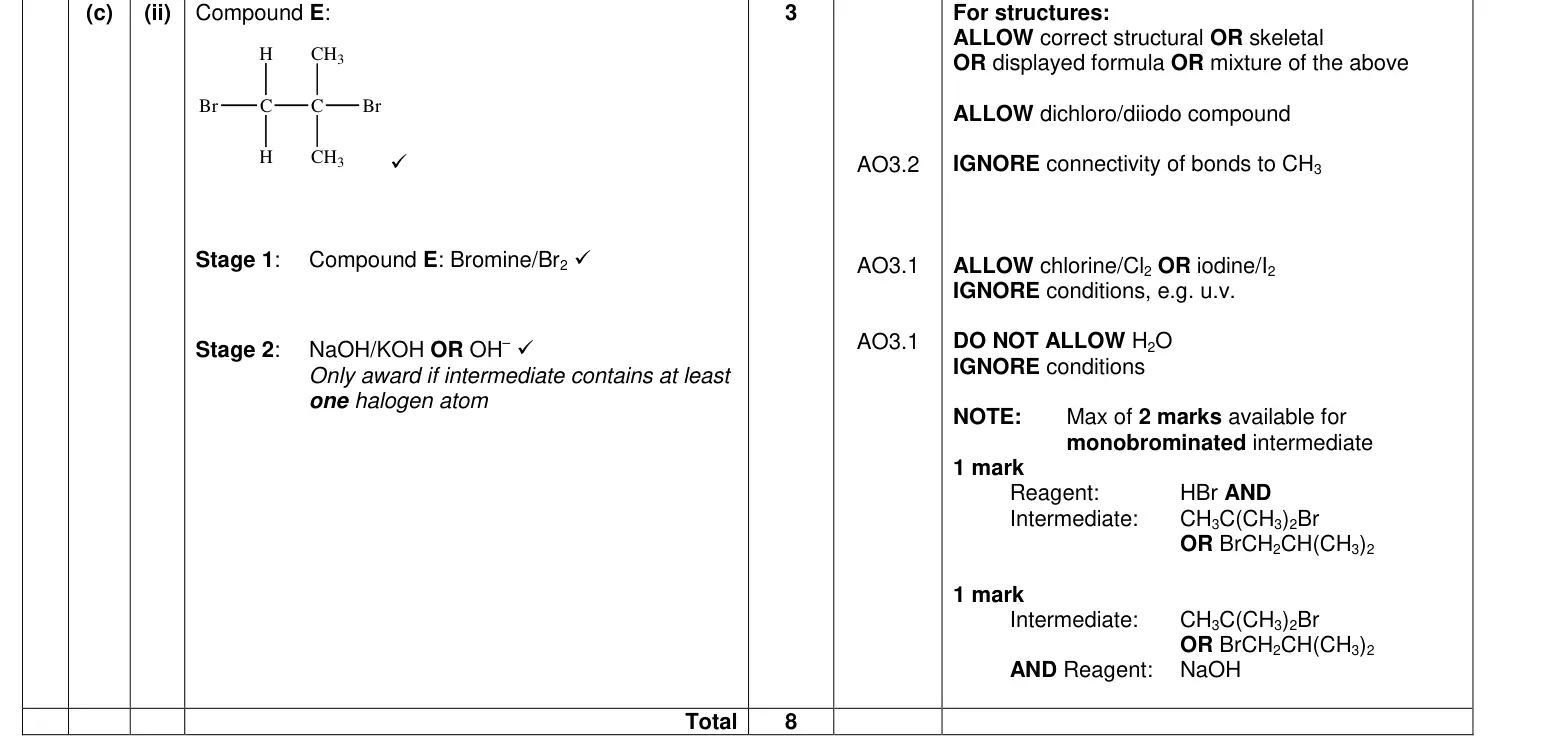
June 2016 · AS Paper 1 · Q26(c)(ii) 3 marks AO3 Structure / isomer organic synthesis asalkeneshaloalkanes
Earlier parts of question 26 that this part usesEarlier part of June 2016 Paper 1 question 26Earlier part of June 2016 Paper 1 question 26
(ii) A student plans a two-stage synthesis for preparing compound F from compound B.
The synthesis first prepares compound E, as shown in the flowchart.
Draw the structure of compound E in the box and state the reagents for each stage on
the dotted lines.
H CH3
.........................
C C
stage 1
H CH3
Compound B
Compound E
stage 2 .........................
H CH3
HO C C OH
H CH3
Compound F
[3]
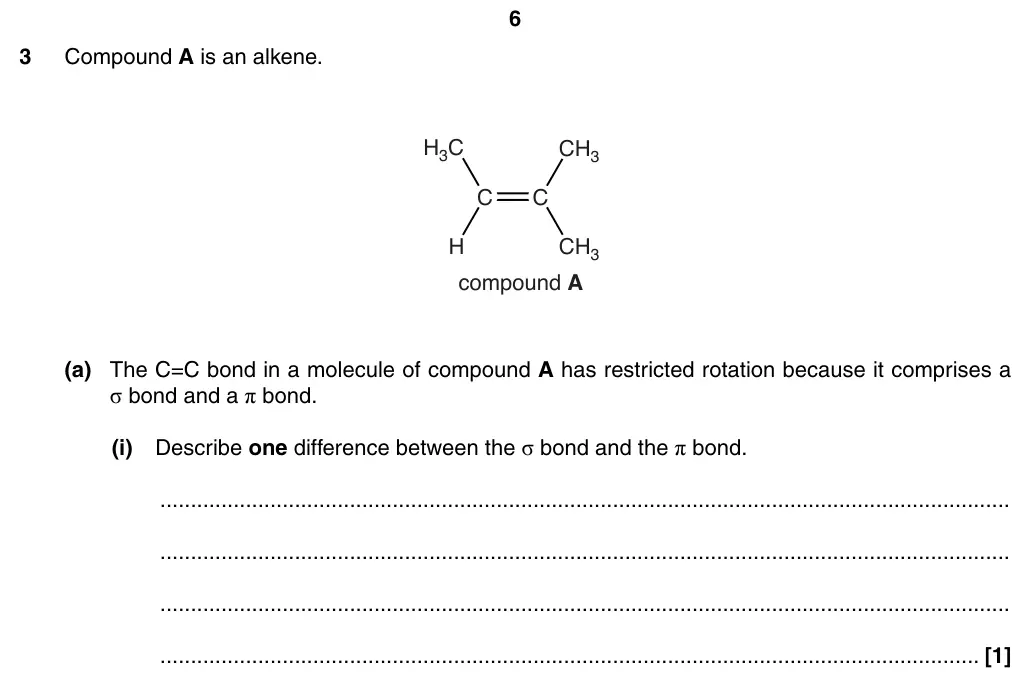
June 2016 · AS Paper 2 · Q3(a)(iii) 2 marks Structure / isomer alkenesorganic basics
Earlier part of question 3 that this part usesEarlier part of June 2016 Paper 2 question 3
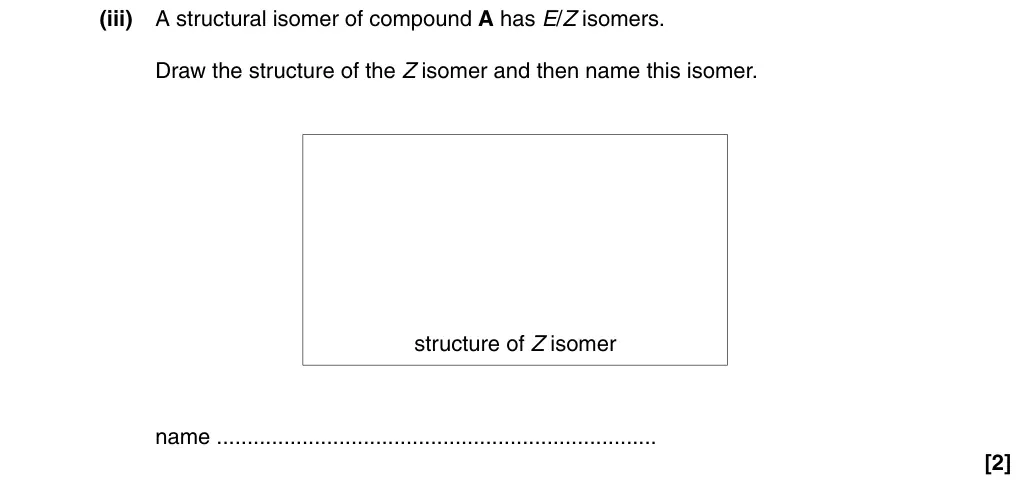
(iii) A structural isomer of compound A has E/Z isomers.
Draw the structure of the Z isomer and then name this isomer.
structure of Z isomer
name ........................................................................
[2]

Work with an OCR chemistry tutor

Dropping marks on calculations, mechanisms or the six-markers? Book a trial session with a specialist OCR chemistry tutor.

Prefer email? Send an enquiry

If you are under 18, please include a parent's contact details. Enquiries go to enquiries@chemistryaleveltutor.com and are deleted once handled. All tutoring is online.