Notes and key-term cards for this topic are being written by our tutors. The past-paper questions below are ready now.
Learning outcomes
Show the 4 learning outcomes from the specification
6.2.1(a) the basicity of amines in terms of proton acceptance by the nitrogen lone pair and the reactions of amines with dilute acids, e.g. HCl (aq), to form salts
6.2.1(b) the preparation of:
6.2.1(b)(i) aliphatic amines by substitution of haloalkanes with excess ethanolic ammonia and amines
6.2.1(b)(ii) aromatic amines by reduction of nitroarenes using tin and concentrated hydrochloric acid.
Six-mark level of response questions on this topic
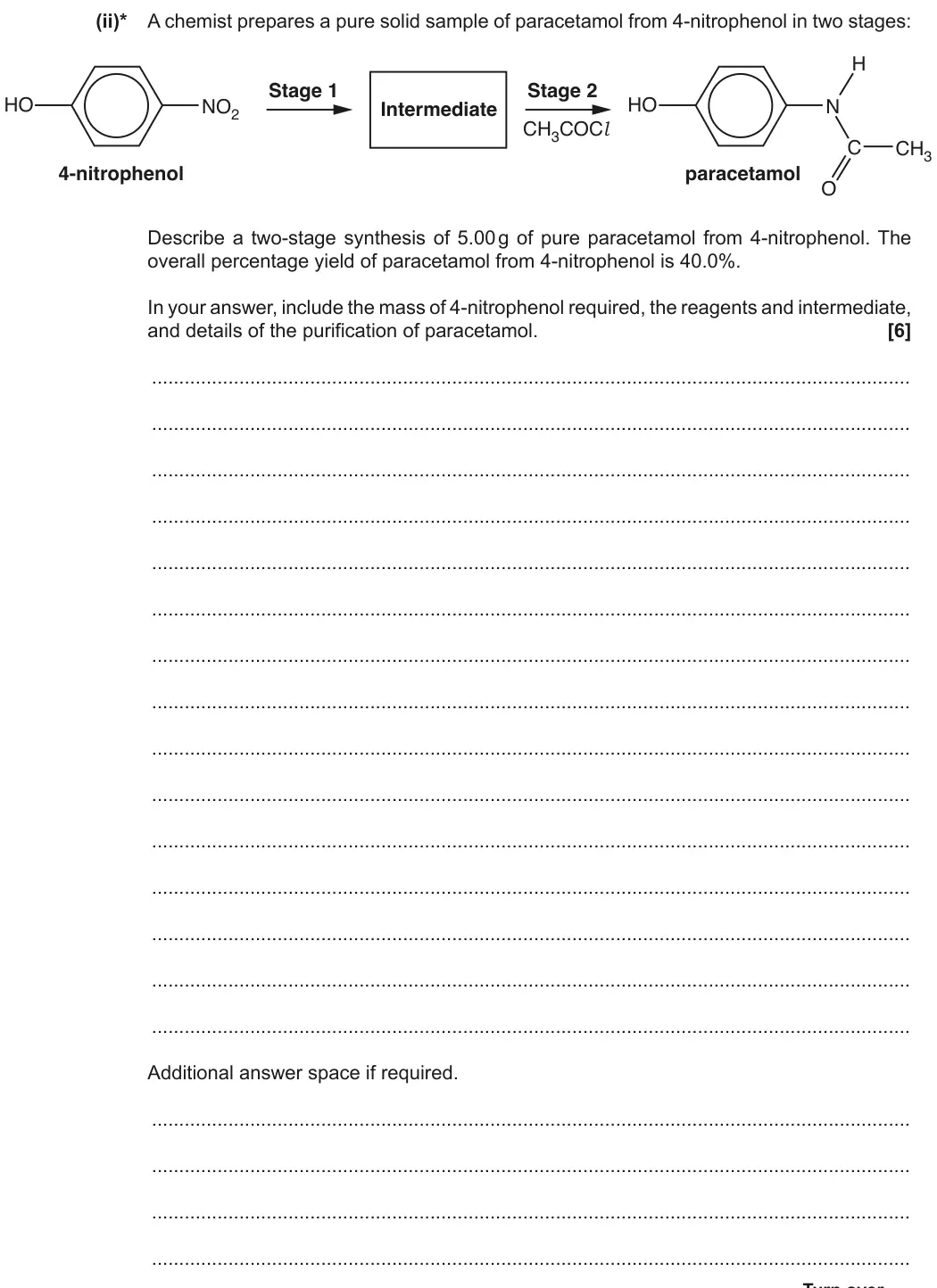
A chemist prepares a pure solid sample of paracetamol from 4-nitrophenol in two stages: Describe a two-stage synthesis of 5.00 g of pure paracetamol from 4-nitrophenol. The
Tap a question to zoom it. Where a part needs a table, graph or structure from an earlier part, that part folds out above it; the mark scheme and examiner's comment open underneath. Have the OCR Data Sheet beside you.
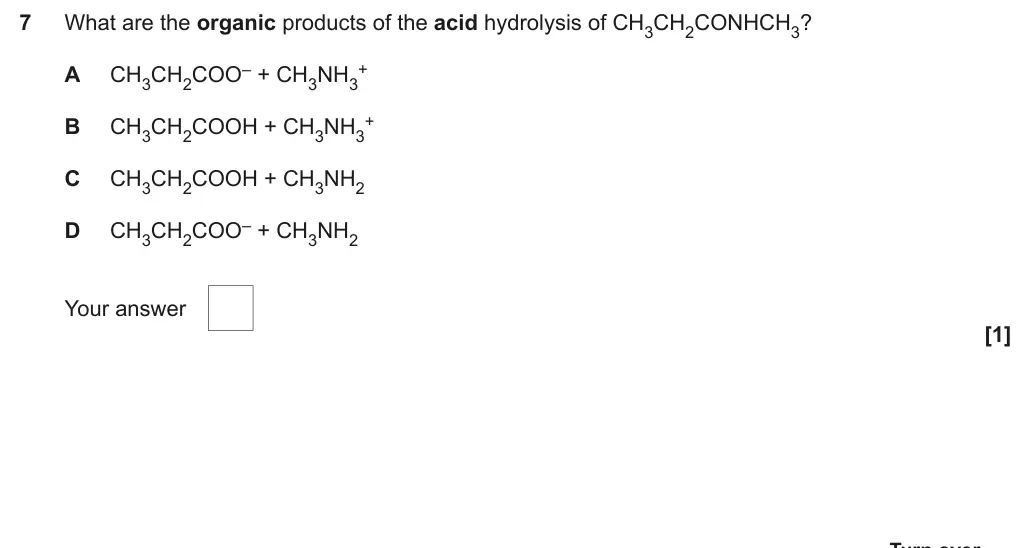
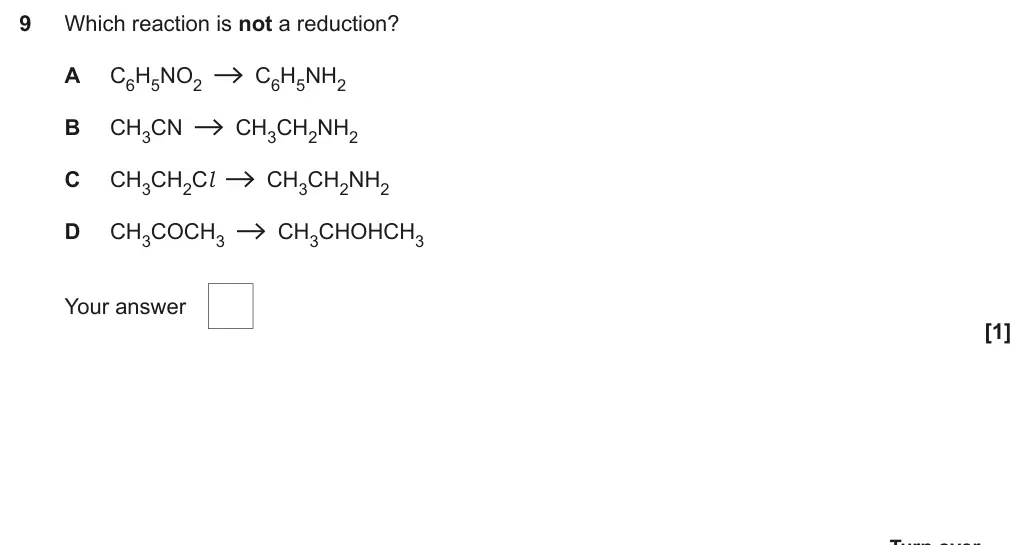
June 2025 · Paper 2 · Q71 markMultiple choiceMedium
Answer
B
Mark scheme
Examiner's comment
Most gave the correct response B. However, some found this tricky, with both A, with the acid group deprotonated and the amine protonated, and C, with no consideration of the acidic conditions, being common incorrect responses.
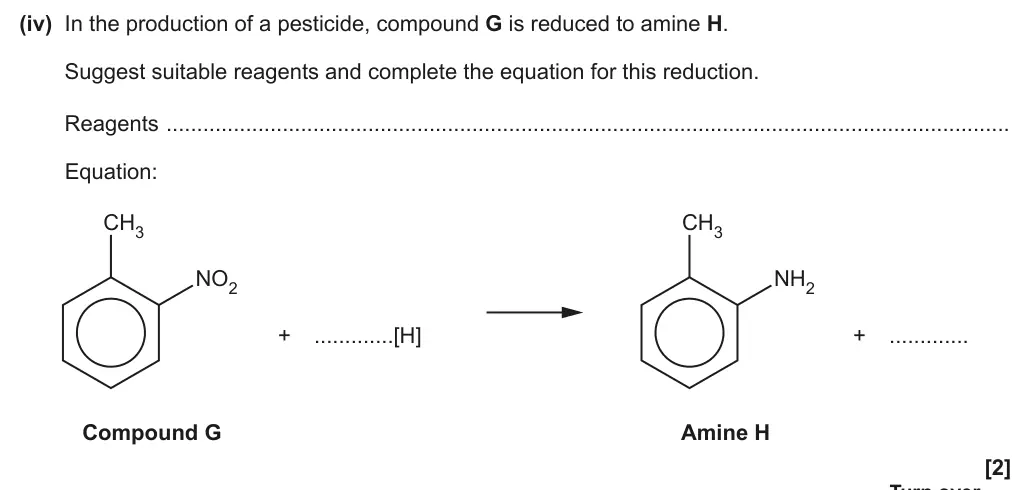
June 2025 · Paper 2 · Q20(c)(iv)2 marksComplete table/diagramHard
Earlier part of question 20 that this part uses
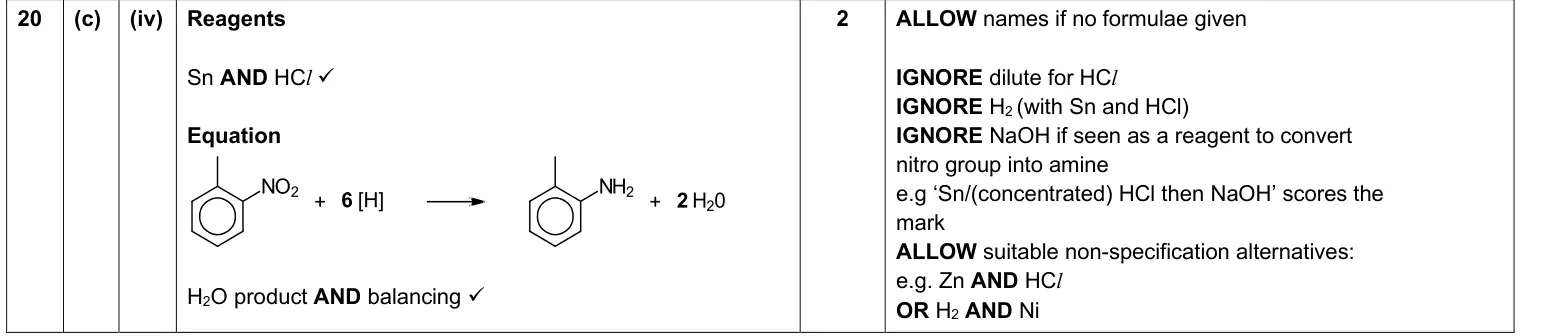
Mark scheme
Examiner's comment
Most were able to correctly identify reagents for the reaction, with Sn/HCl being the most common response and a small number giving H2/Ni. Many incorrectly suggested NaBH4 or LiAlH4 as the reagent. A few had NH3 as reagent. Lots of candidates struggled to correctly complete and balance the equation despite both organic reactant/product and [H] being given. Some were confused by the use of [H] representing the reducing agent, so added reagents to the line, e.g. 3H2 [H], or NH3 [H]. A common error seen for balancing was 2[H] → O2.
Notes from the mark scheme and report
Sn AND HCl
6[H] and 2H2O
IGNORE NaOH added afterwards
ALLOW Zn/HCl or H2/Ni
Skills: M0.2 Use ratios, fractions and percentages
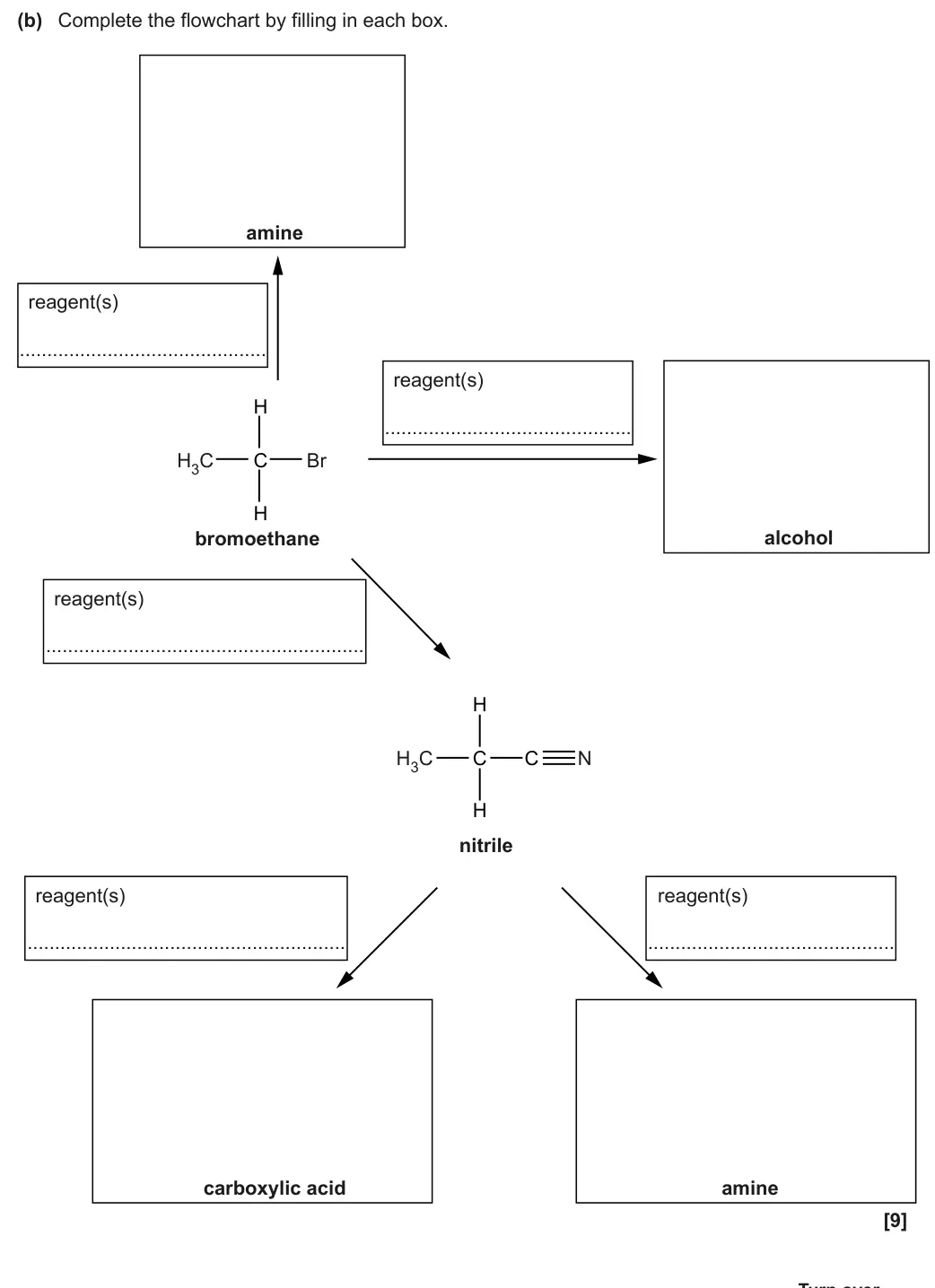
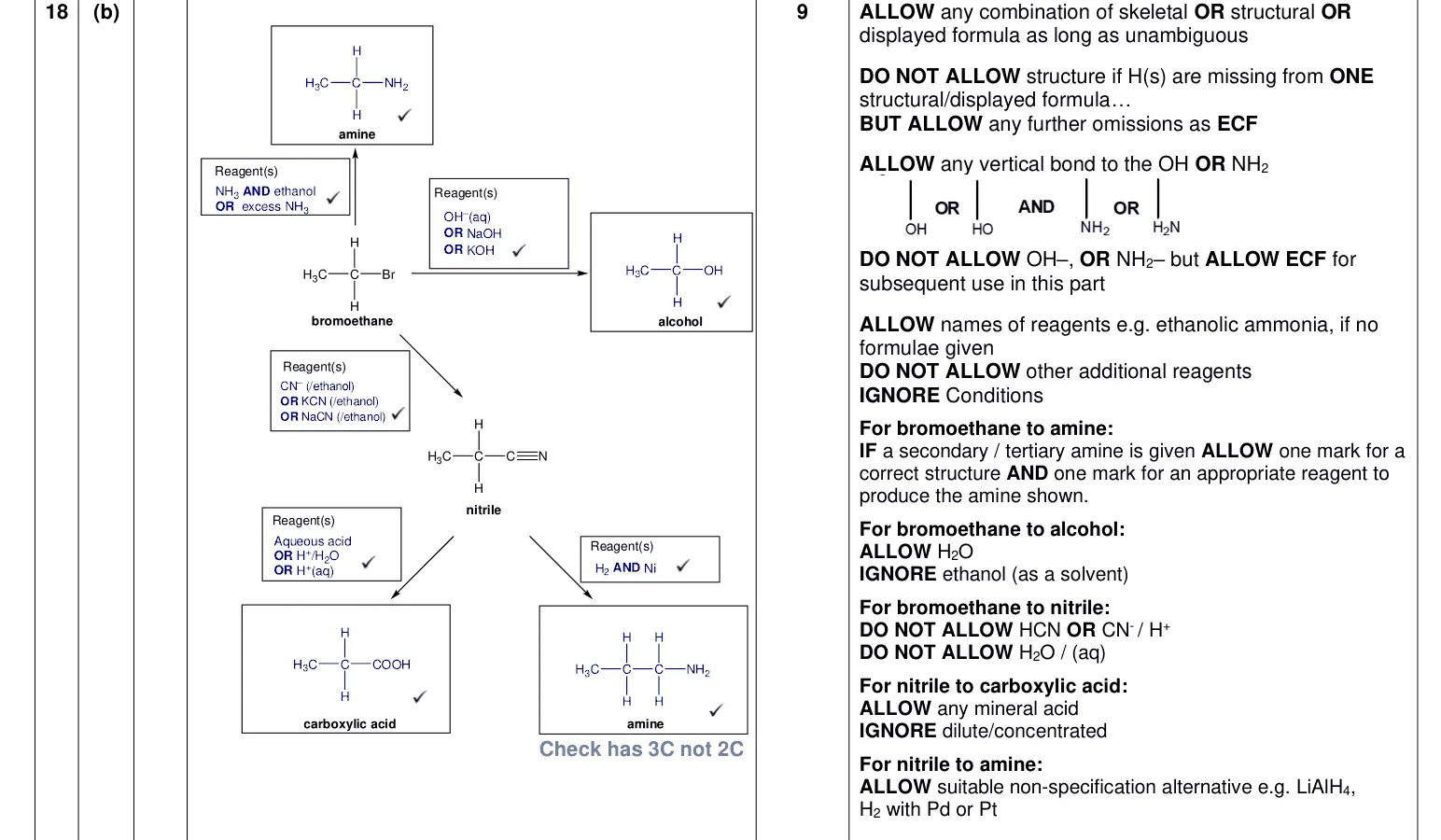
June 2024 · Paper 2 · Q18(b)9 marksShort answerMedium
Mark scheme
Examiner's comment
This question was well-answered with around a half of candidates scoring 8 or 9 marks. The full range of marks was seen across the whole cohort. The most common reasons for losing marks were for the addition of extra, contradictory reagents or for missing hydrogens from structures. Bromoethane to amine: The amine structure was mostly correct with a few adding an extra hydrogen to the amine i.e. CH3CH2NH3. Most gave the correct reagent as NH3 but some omitted either ethanol or excess, so did not score here. Bromoethane to alcohol: The alcohol structure was usually correct. However, many lost the reagent mark here for the addition of acid/ H+/H2SO4 alongside the hydroxide. Bromoethane to nitrile: A suitable cyanide was often used, but again many included an acid catalyst or aqueous conditions (aq) so lost the mark here. Ideally candidates would react in ethanol to prevent hydrolysis of the haloalkane. Nitrile to carboxylic acid: Most gave the correct carboxylic acid structure, while occasionally ethanoic acid was given instead of propanoic acid. Most identified the need for acid as a reagent but some omitted water or (aq). Nitrile to amine: H2 was often seen as the reagent but sometimes without a catalyst. Many gave an incorrect structure here either with a missing C (i.e. ethylamine) or missing hydrogens on the first carbon i.e.
Notes from the mark scheme and report
NH3 in ethanol/excess NH3 gives CH3CH2NH2
OH–(aq) gives ethanol
KCN in ethanol (DO NOT ALLOW HCN, CN–/H+ or aqueous)
H+(aq) gives propanoic acid
H2 AND Ni gives CH3CH2CH2NH2 (3 C not 2 C)
DO NOT ALLOW OH– or NH2– as structures
structure with H missing penalised once
A useful resource for teaching about organic synthetic routes including functional groups, reagents and two-step processes can be found in the Topic Exploration pack on Teach Cambridge.
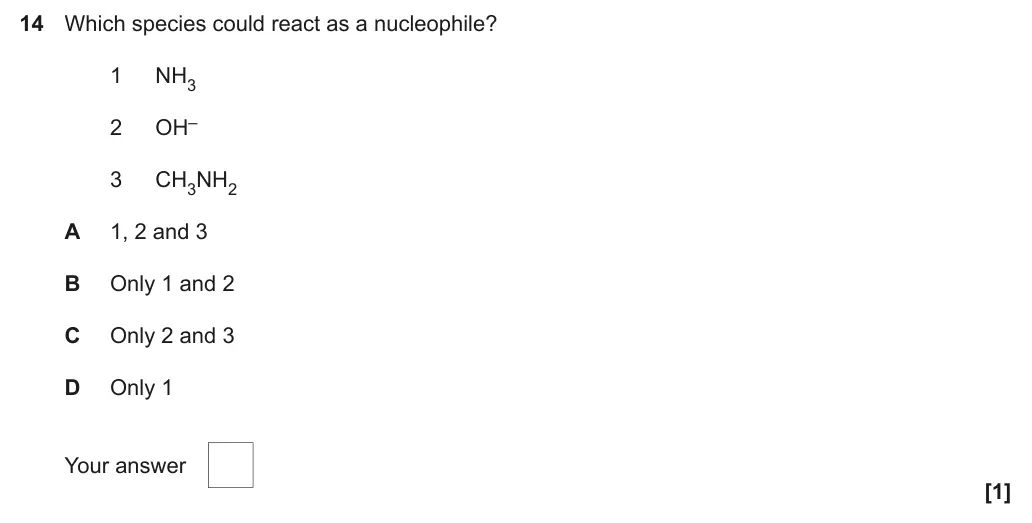
June 2022 · Paper 2 · Q141 markAO1Multiple choiceMedium
Answer
A
Mark scheme
Examiner's comment
Many candidates did not identify CH3NH2 as a nucleophile and selected option B.
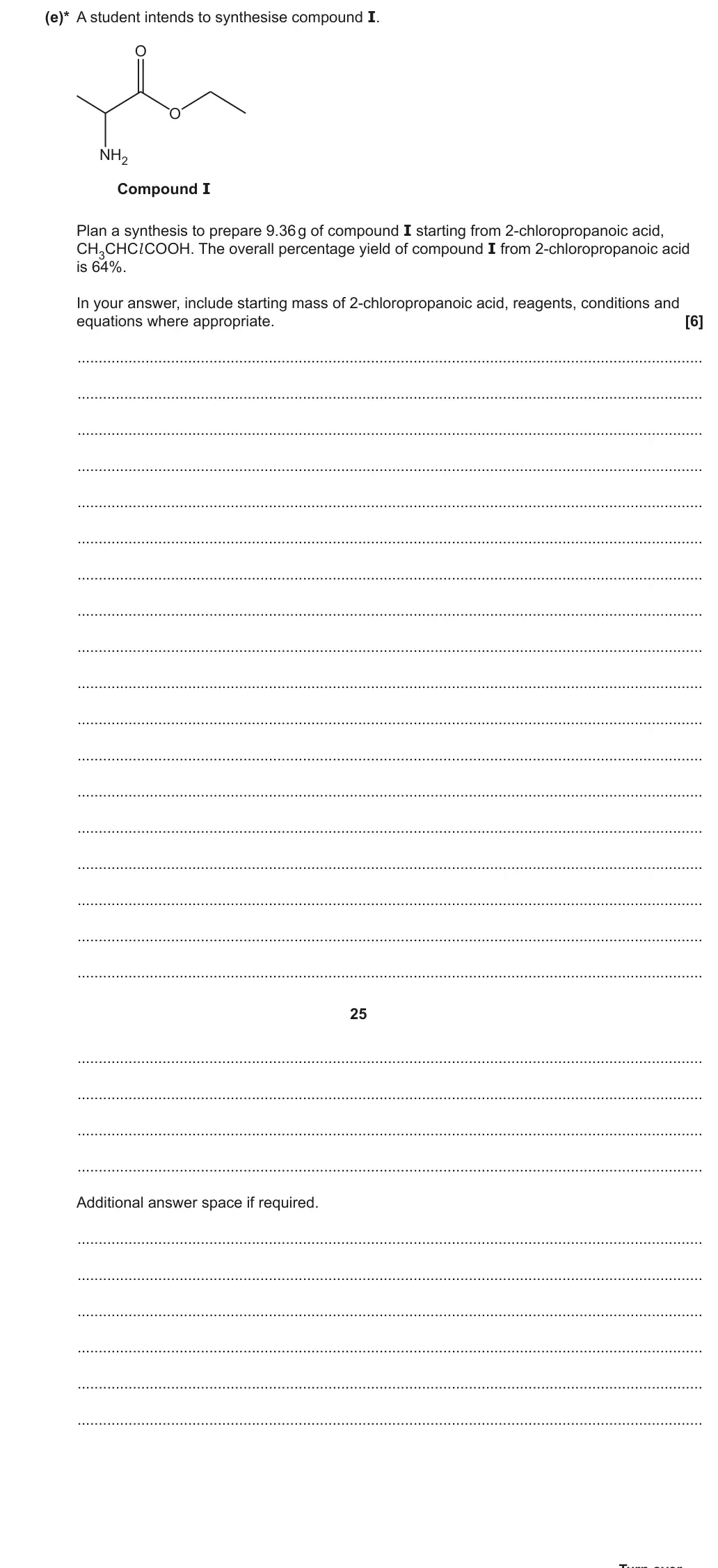
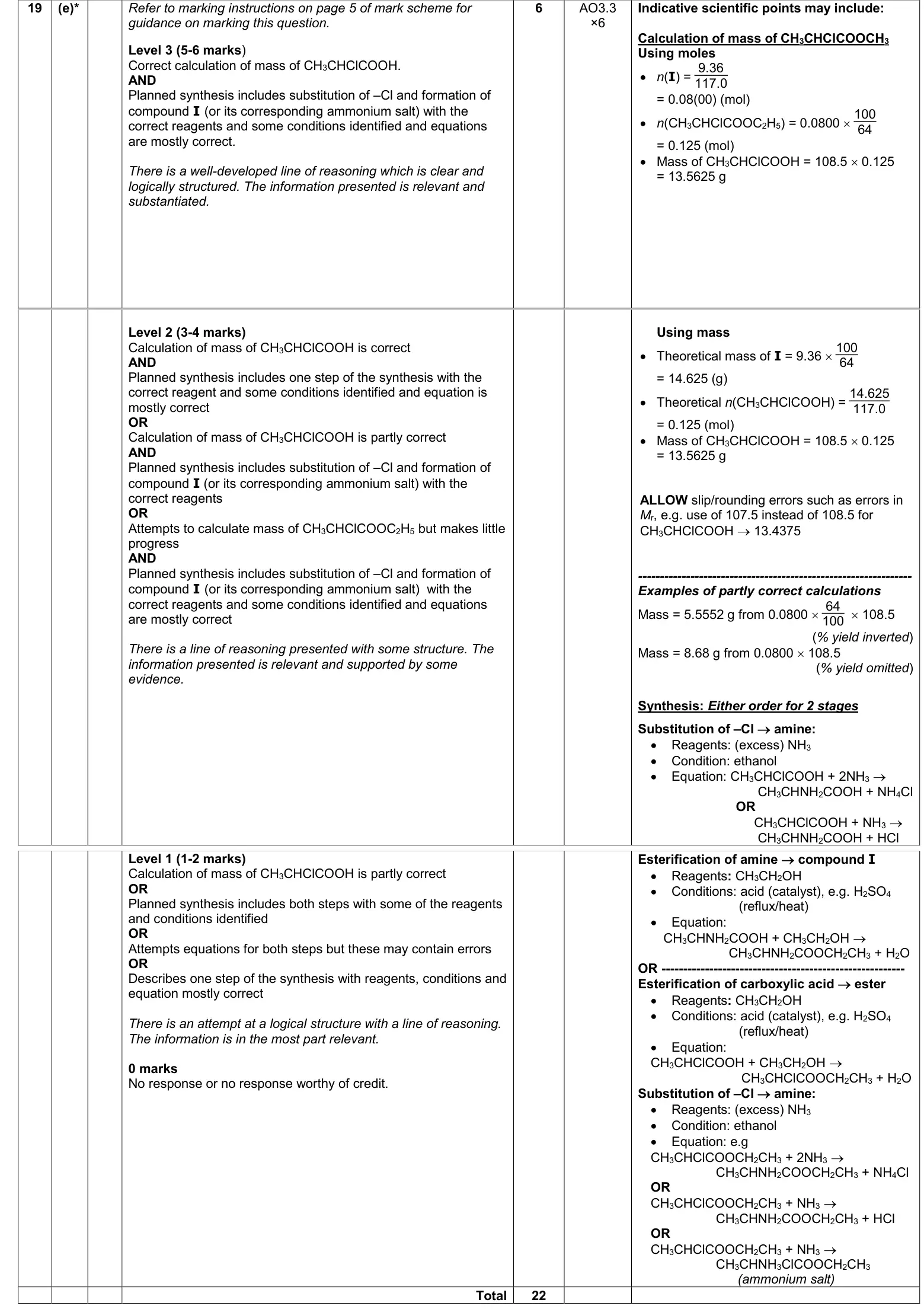
June 2022 · Paper 2 · Q19(e)6 marksAO36-mark level of responseMedium
Mark scheme, with the levels and indicative points
Examiner's comment
This question was marked using a level of response mark scheme. Most candidates gave an answer worth of at least Level 2 (3-4 marks) by providing the synthetic steps with reagents and equations for the synthesis of compound I. Exemplar 2, below, shows a frequent Level 2 response. The best performing candidates correctly determined the mass attempting to calculate the mass and showed the synthesis efficiently, using equations to communicate the preparation of compound I, with these responses being given Level 3 (5-6 marks). A number of responses omitted the mass calculation, such responses received Level 2 (1-2 marks). In this response the candidate has attempted to calculate the starting mass but has made little progress. Two stages of the synthesis have been covered with the reagents and most of the conditions identified. Both equations are complete. This is a Level 2 response and 4 marks have been given as the repones is logical and well communicated
Notes from the mark scheme and report
mass of CH3CHClCOOH = 13.56 g (0.0800 mol × 100/64 × 108.5)
partly correct e.g. 5.56 g from inverted yield
excess NH3 in ethanol substitutes Cl
ethanol with acid catalyst (H2SO4) to esterify (ALLOW ammonium salt of I)
Skills: M0.2 Use ratios, fractions and percentages; M2.2 Change the subject of an equation
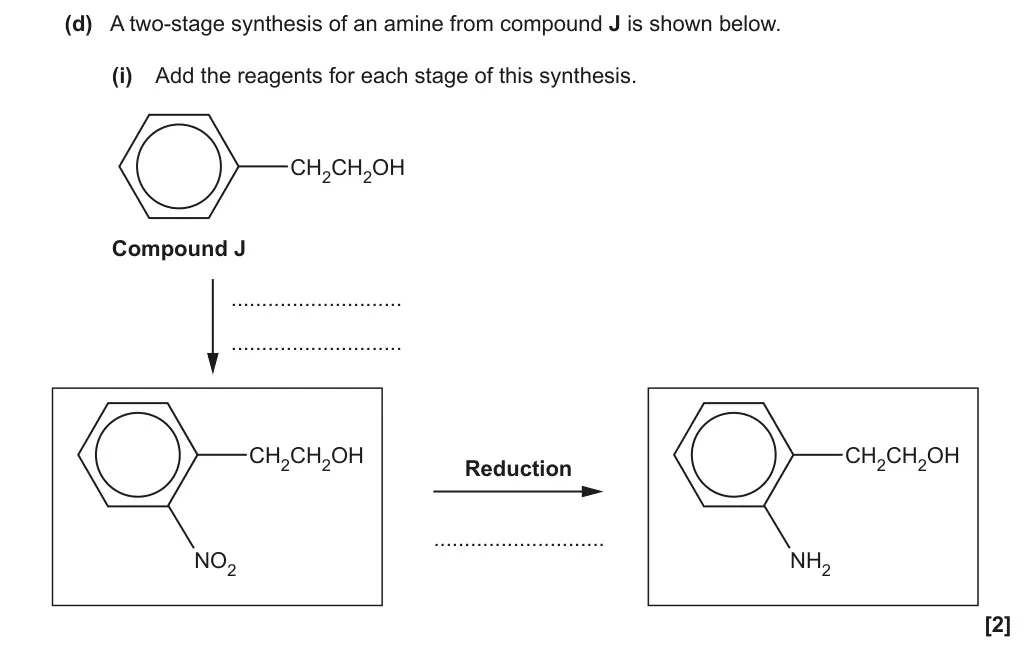
June 2022 · Paper 2 · Q20(d)(i)2 marksAO1Short answerMedium
Earlier part of question 20 that this part uses
Mark scheme
Examiner's comment
Candidates were familiar with the reagents required in these two reactions.
Notes from the mark scheme and report
HNO3 with H2SO4 for nitration
Sn and HCl for reduction
IGNORE concentrations
IGNORE NaOH after Sn/HCl
IGNORE H2
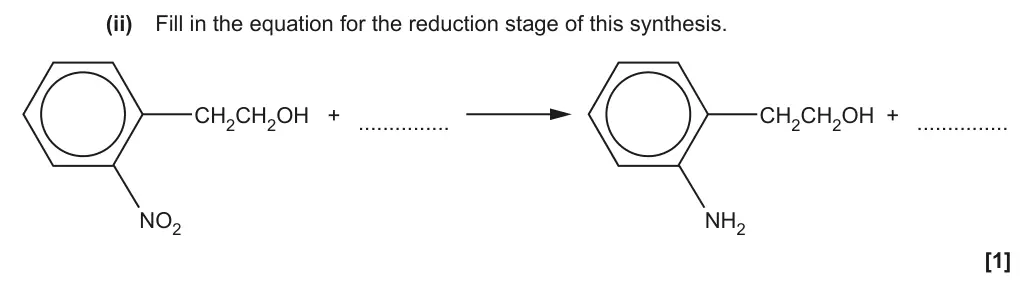
June 2022 · Paper 2 · Q20(d)(ii)1 markAO2Complete table/diagramMedium
Earlier part of question 20 that this part uses
Mark scheme
Examiner's comment
The most able candidates were able to identify the use of 6[H] as the reducing agent and the production of 2 water molecules. Incorrect responses commonly included the use of HCl and NaBH4 as a reactant.
Notes from the mark scheme and report
6[H] on the left and 2H2O on the right
Skills: M0.2 Use ratios, fractions and percentages
November 2021 · Paper 2 · Q91 markMultiple choice
Answer
C
Mark scheme
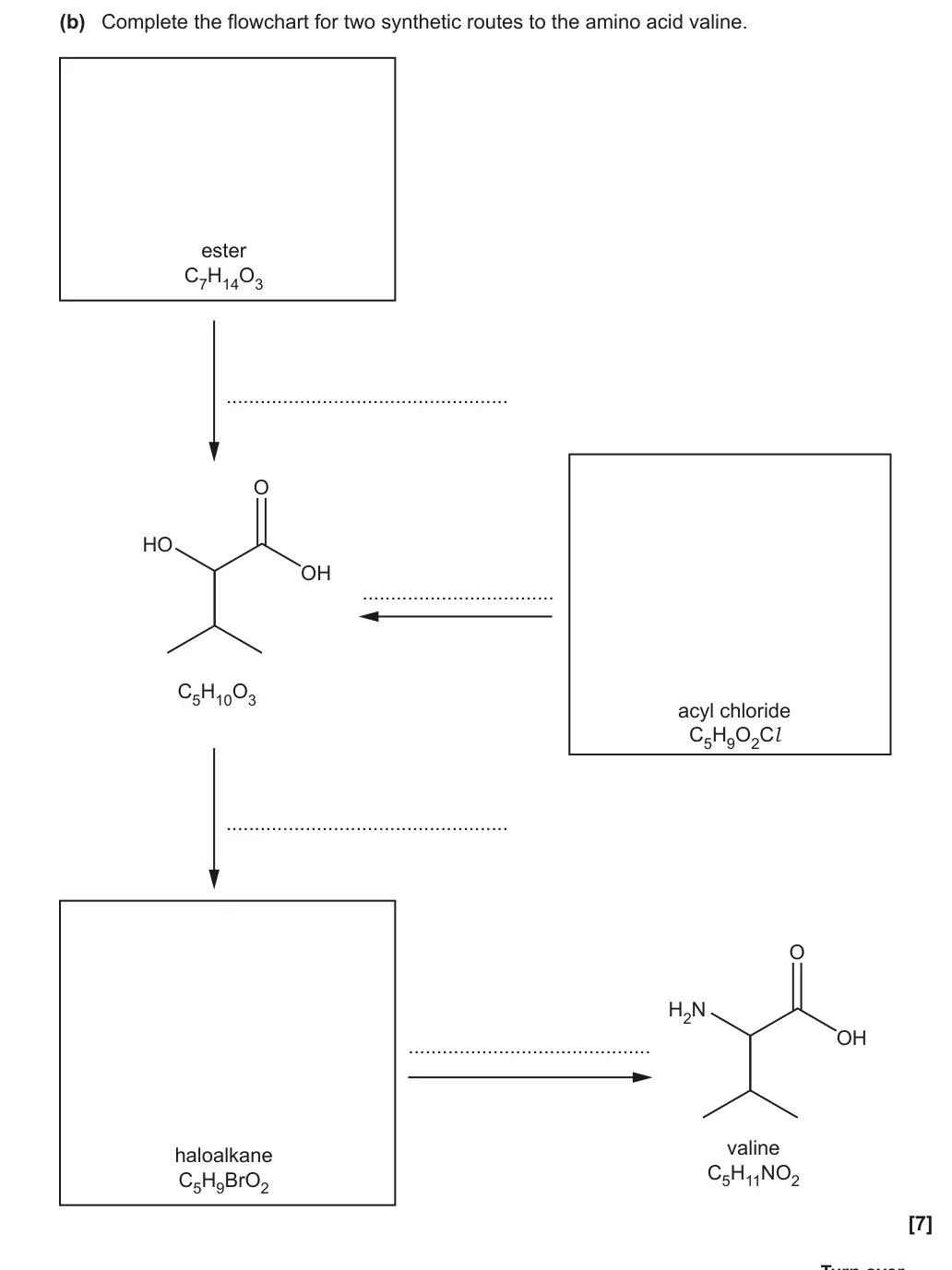
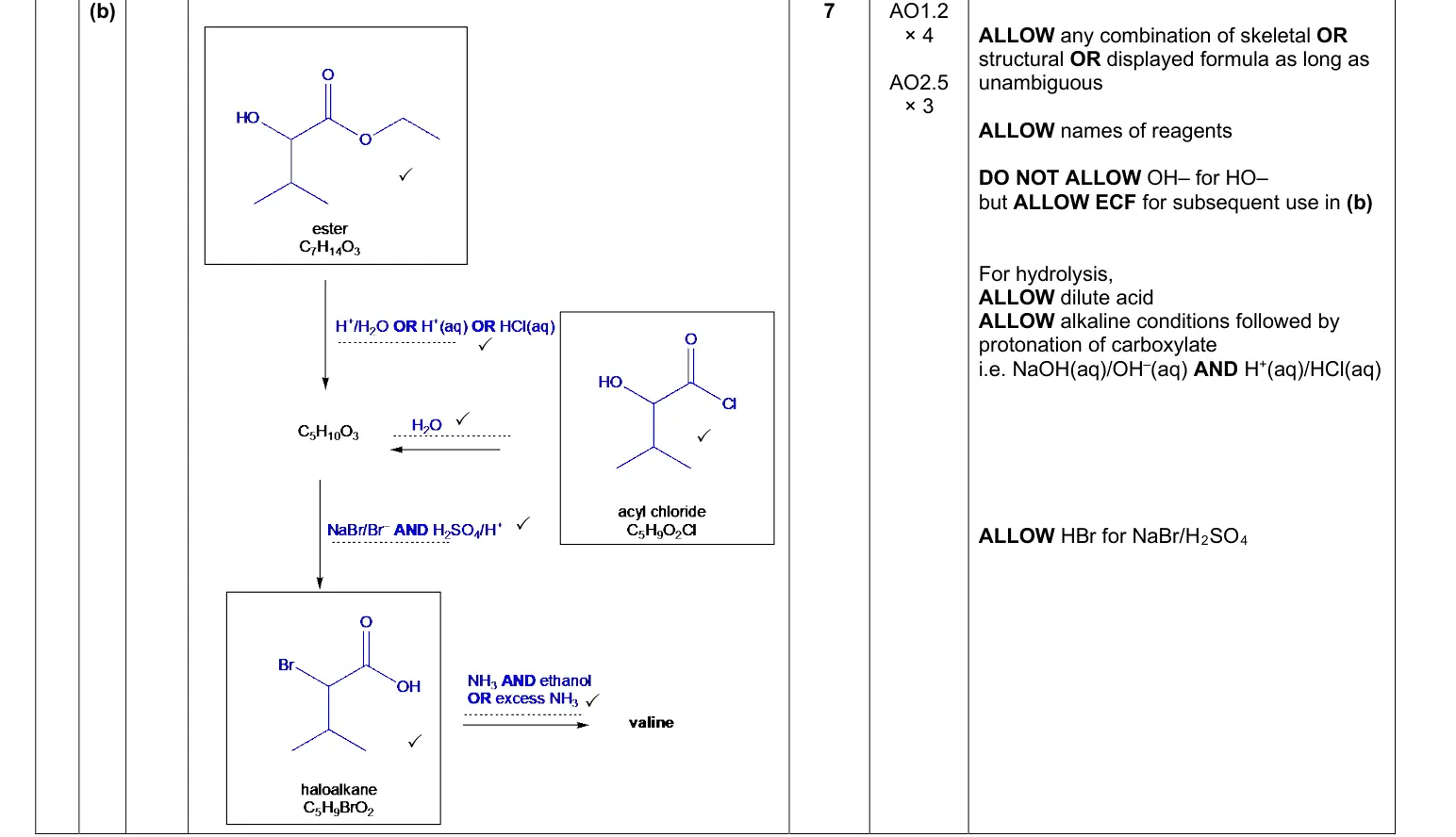
November 2021 · Paper 2 · Q18(b)7 marksAO1, 2Short answer
Earlier part of question 18 that this part uses
Mark scheme
Notes from the mark scheme and report
ethyl ester hydrolysed with H+(aq) (ALLOW alkali then acid)
acyl chloride + H2O
NaBr/H2SO4 (ALLOW HBr) to bromo acid
excess NH3/ethanol
DO NOT ALLOW OH– for HO–
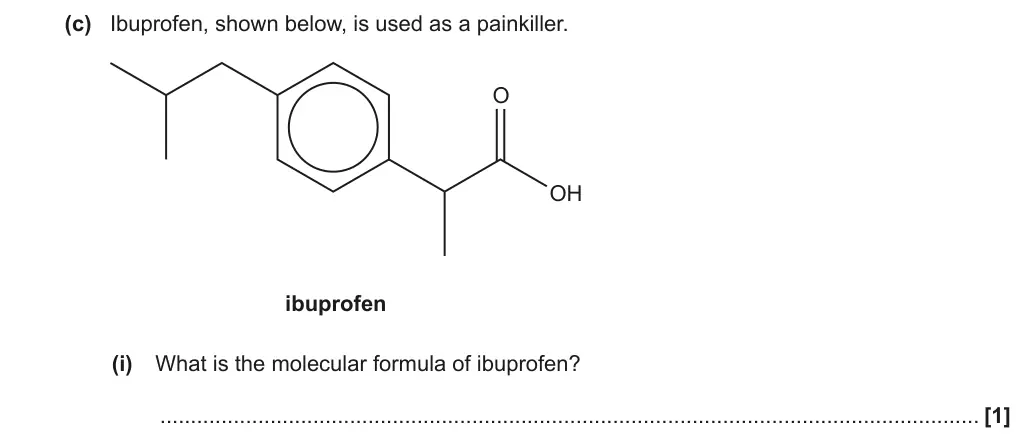
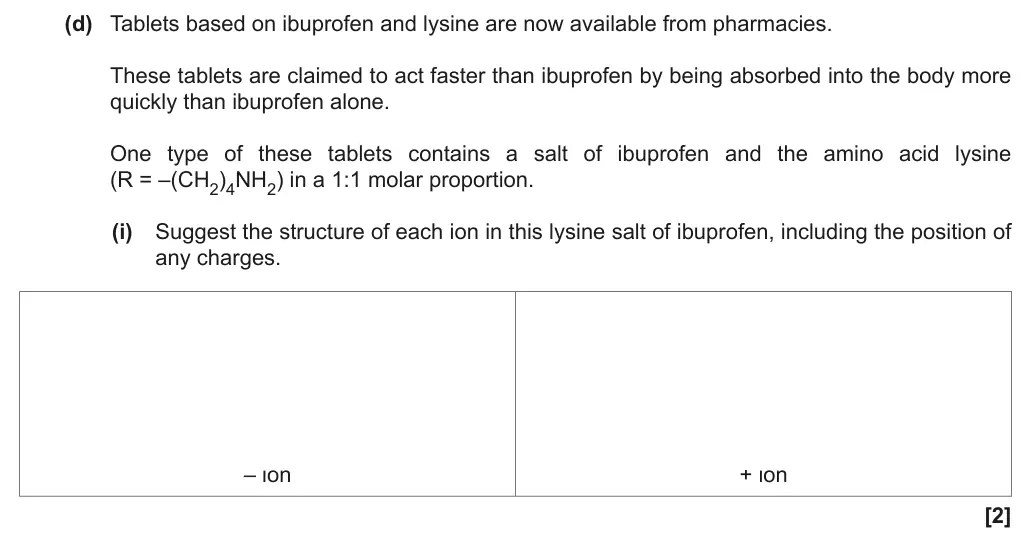
November 2021 · Paper 2 · Q18(d)(i)2 marksAO3Structure / isomer
Earlier parts of question 18 that this part uses
Mark scheme
Notes from the mark scheme and report
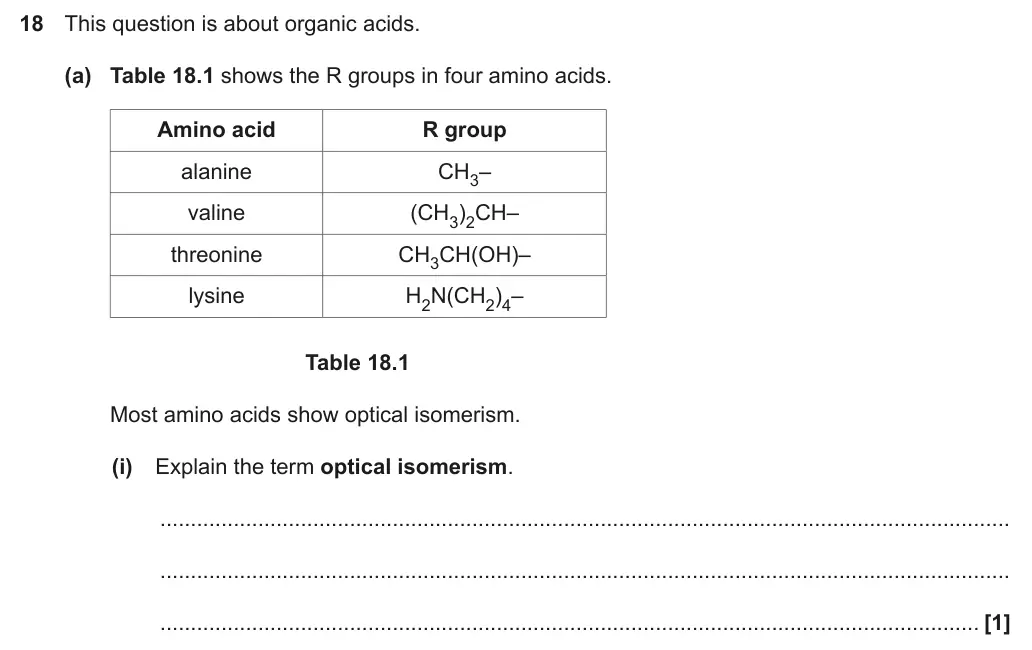
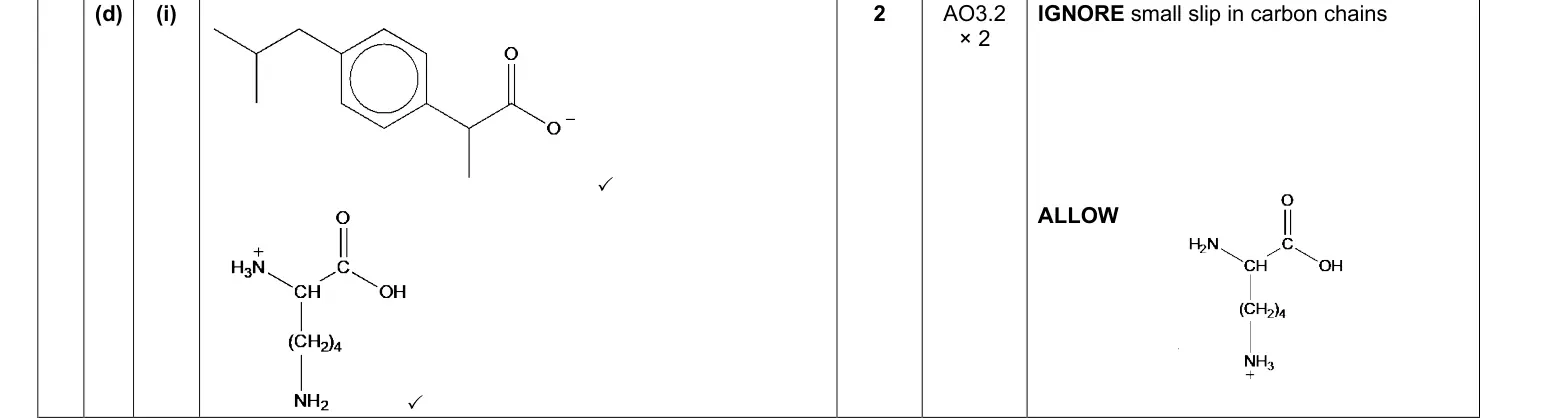
ibuprofen carboxylate COO–
lysine with one NH3+ (either amine group protonated)
IGNORE small slip in carbon chains
November 2020 · Paper 2 · Q17(c)(ii)5 marksAO3Complete table/diagram
Earlier part of question 17 that this part uses
Mark scheme
Notes from the mark scheme and report
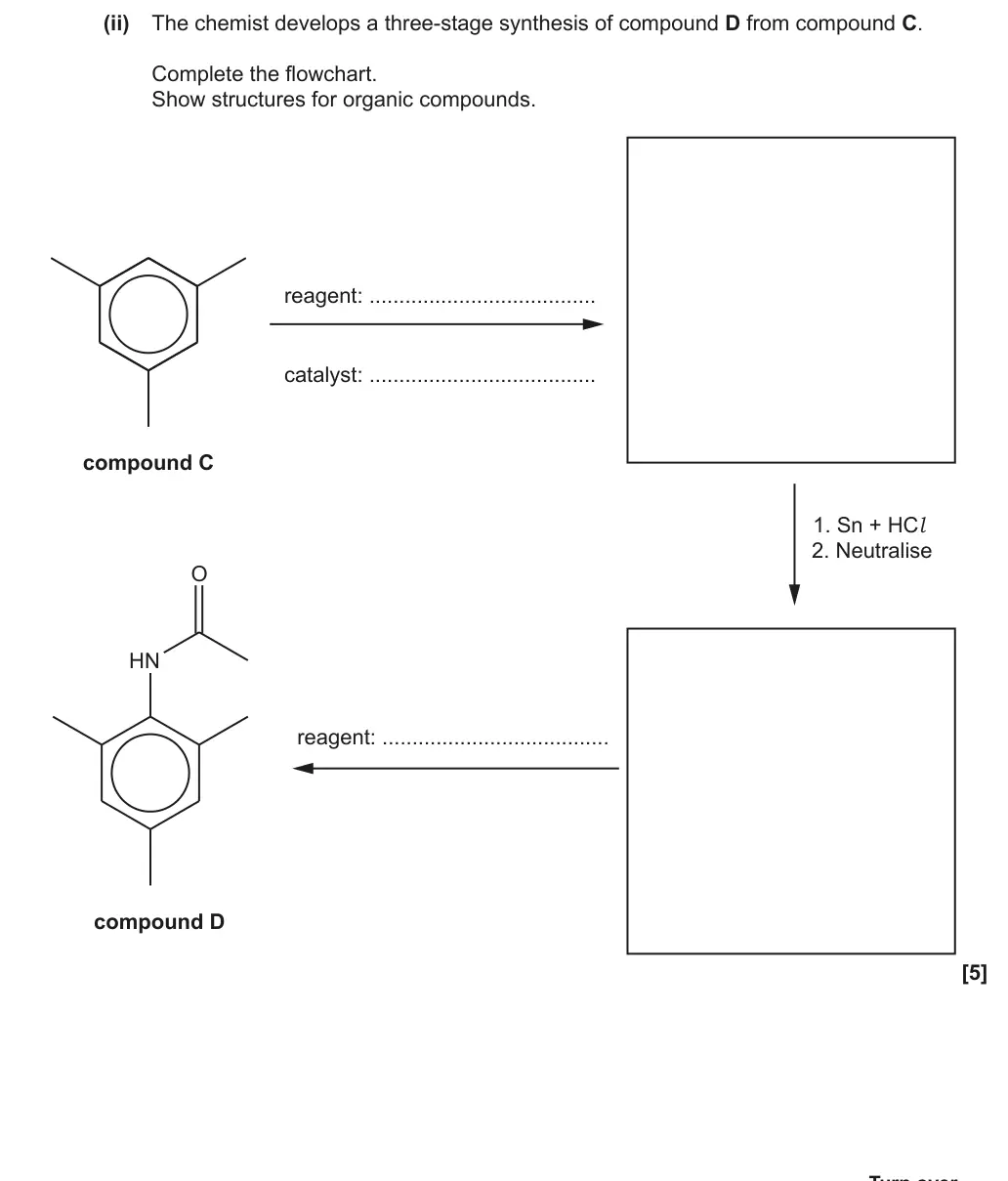
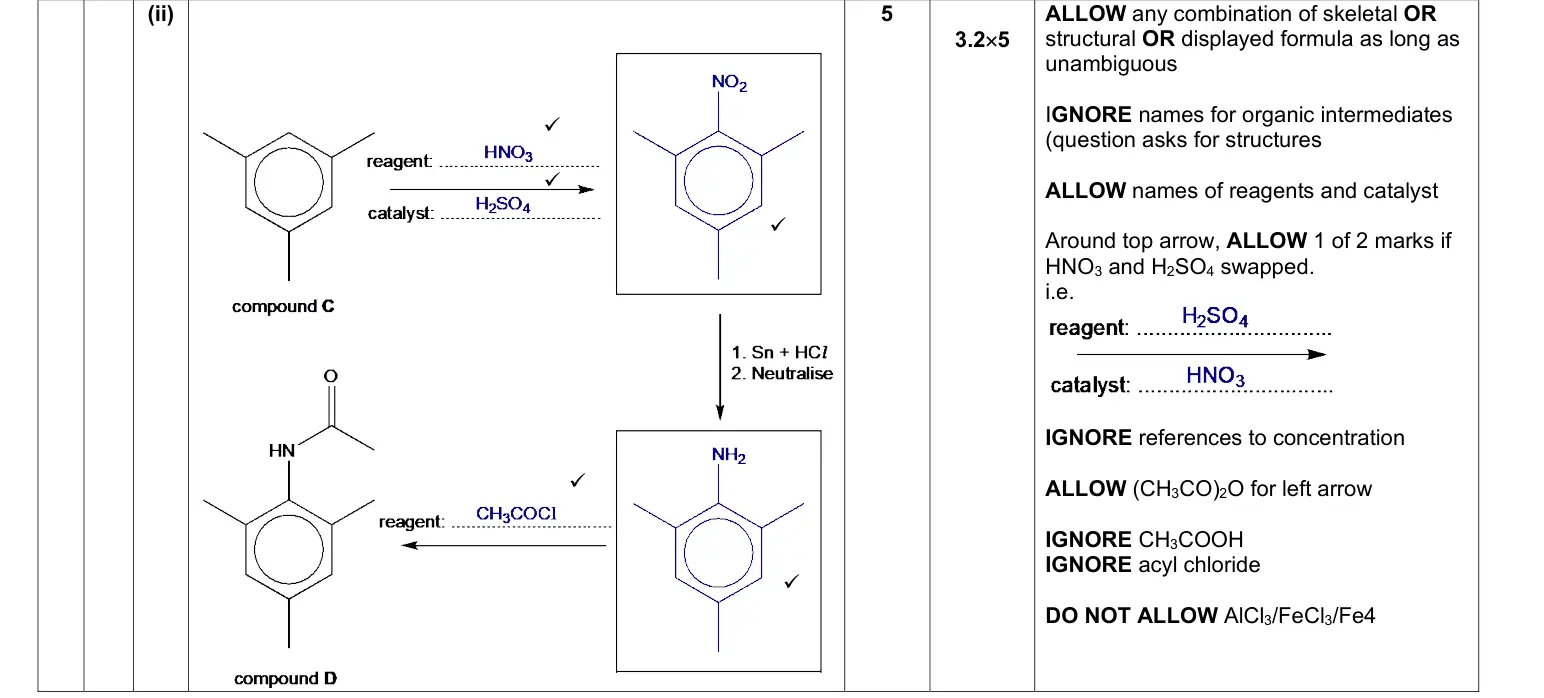
HNO3 with H2SO4 catalyst (1 of 2 if swapped)
nitro compound then amine
CH3COCl or (CH3CO)2O for final stage (IGNORE CH3COOH)
DO NOT ALLOW AlCl3/FeCl3
November 2020 · Paper 2 · Q21(a)5 marksAO2Complete table/diagram
Mark scheme
Notes from the mark scheme and report
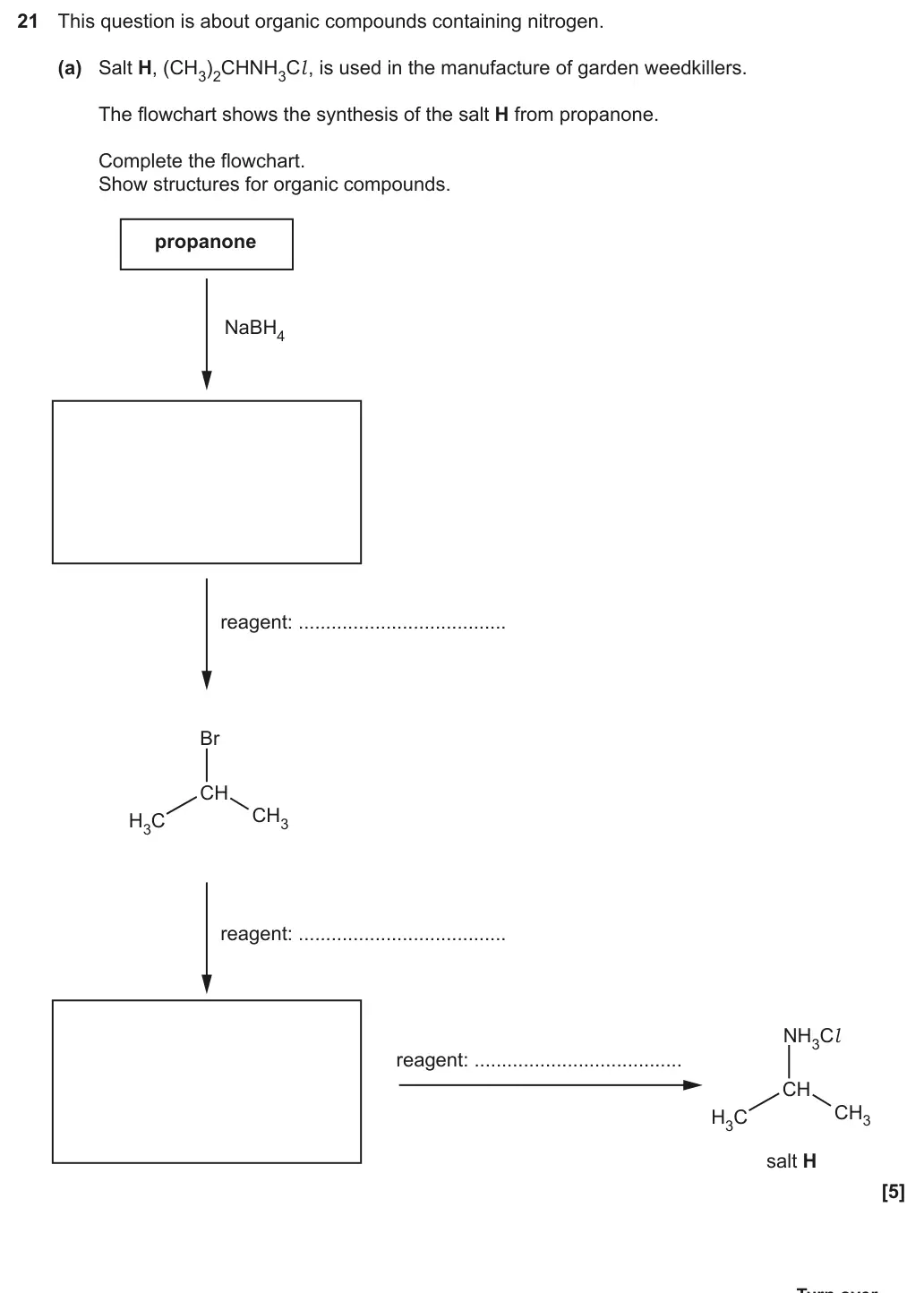
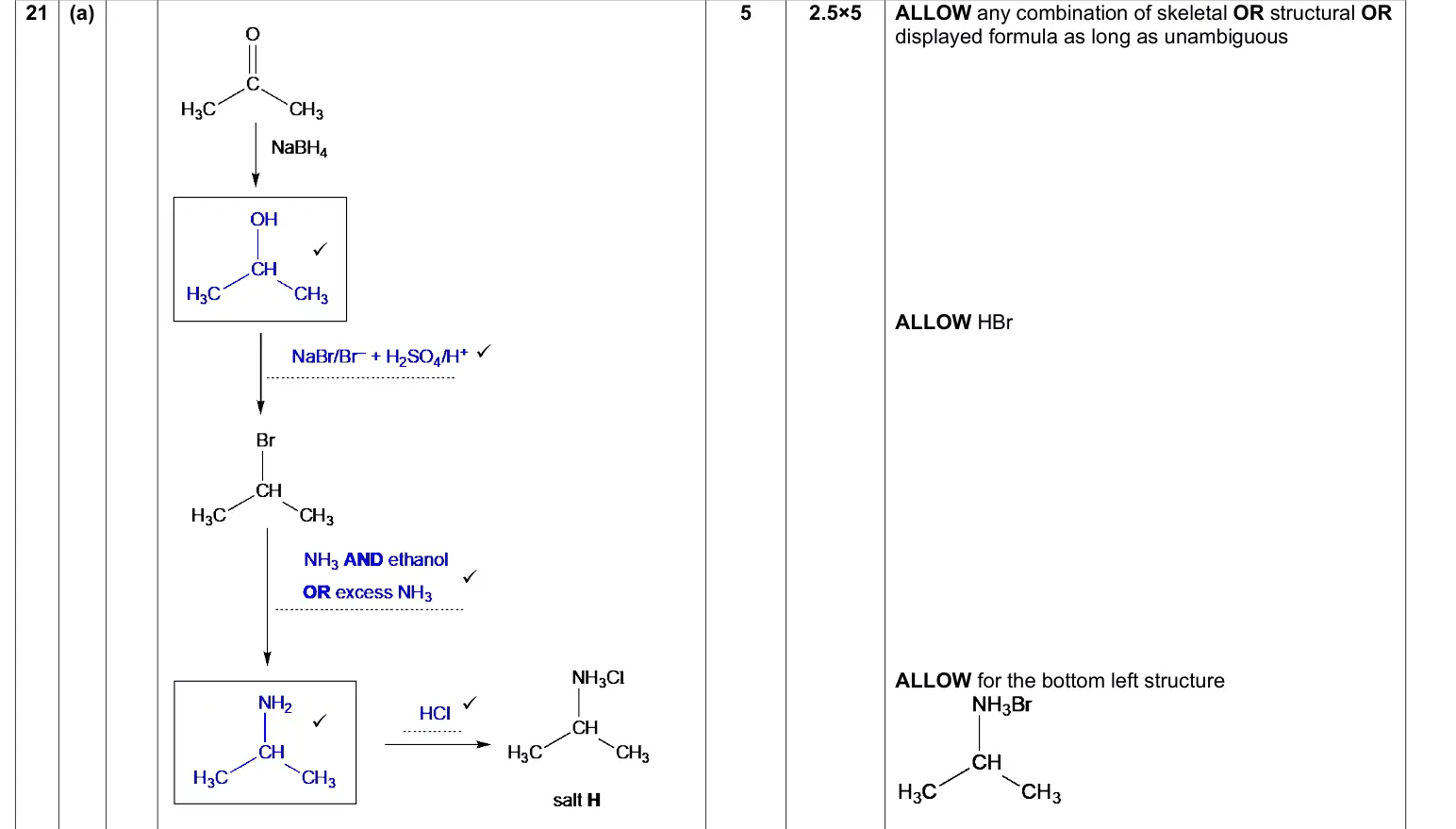
propan-2-ol
NaBr/H2SO4 (ALLOW HBr)
excess NH3 in ethanol gives (CH3)2CHNH2
HCl for the salt
June 2019 · Paper 2 · Q19(b)(iv)7 marksAO2Short answerHard
Earlier parts of question 19 that this part uses
Mark scheme
Examiner's comment
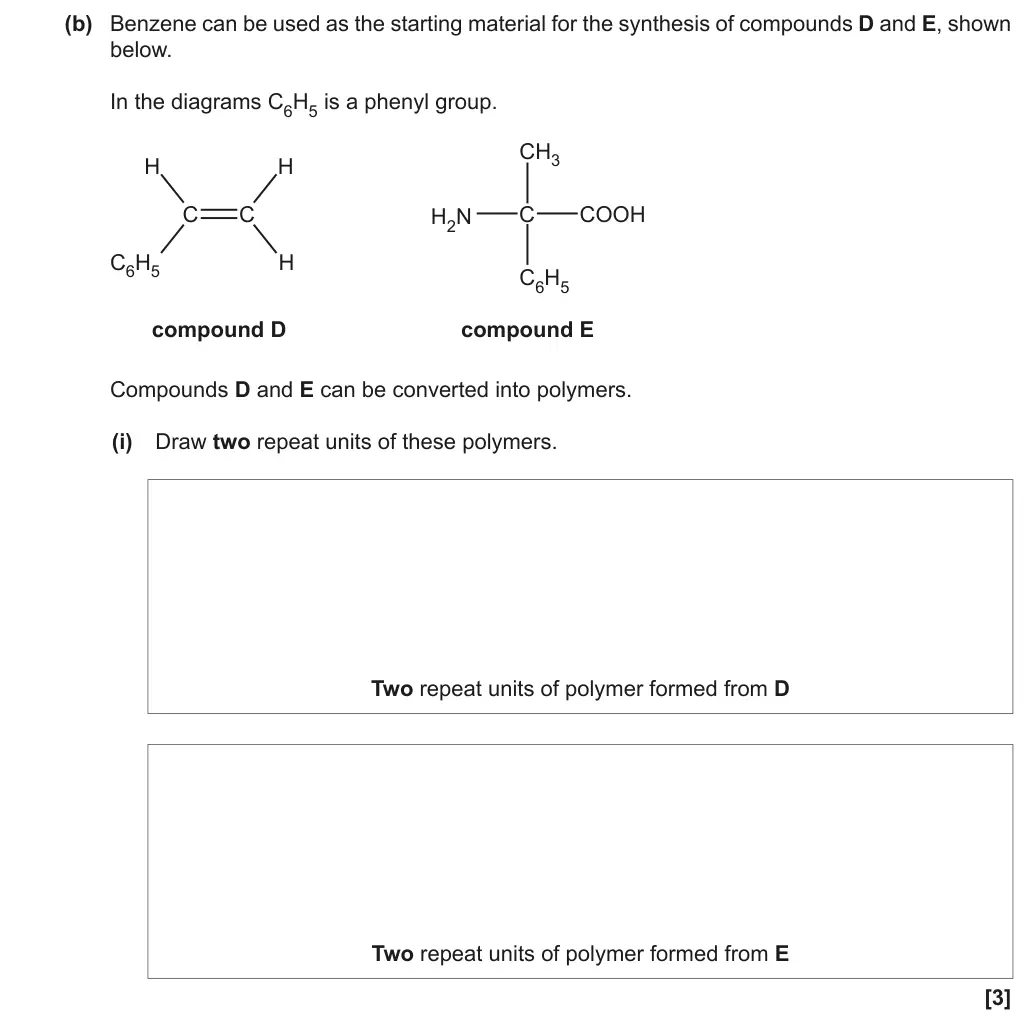
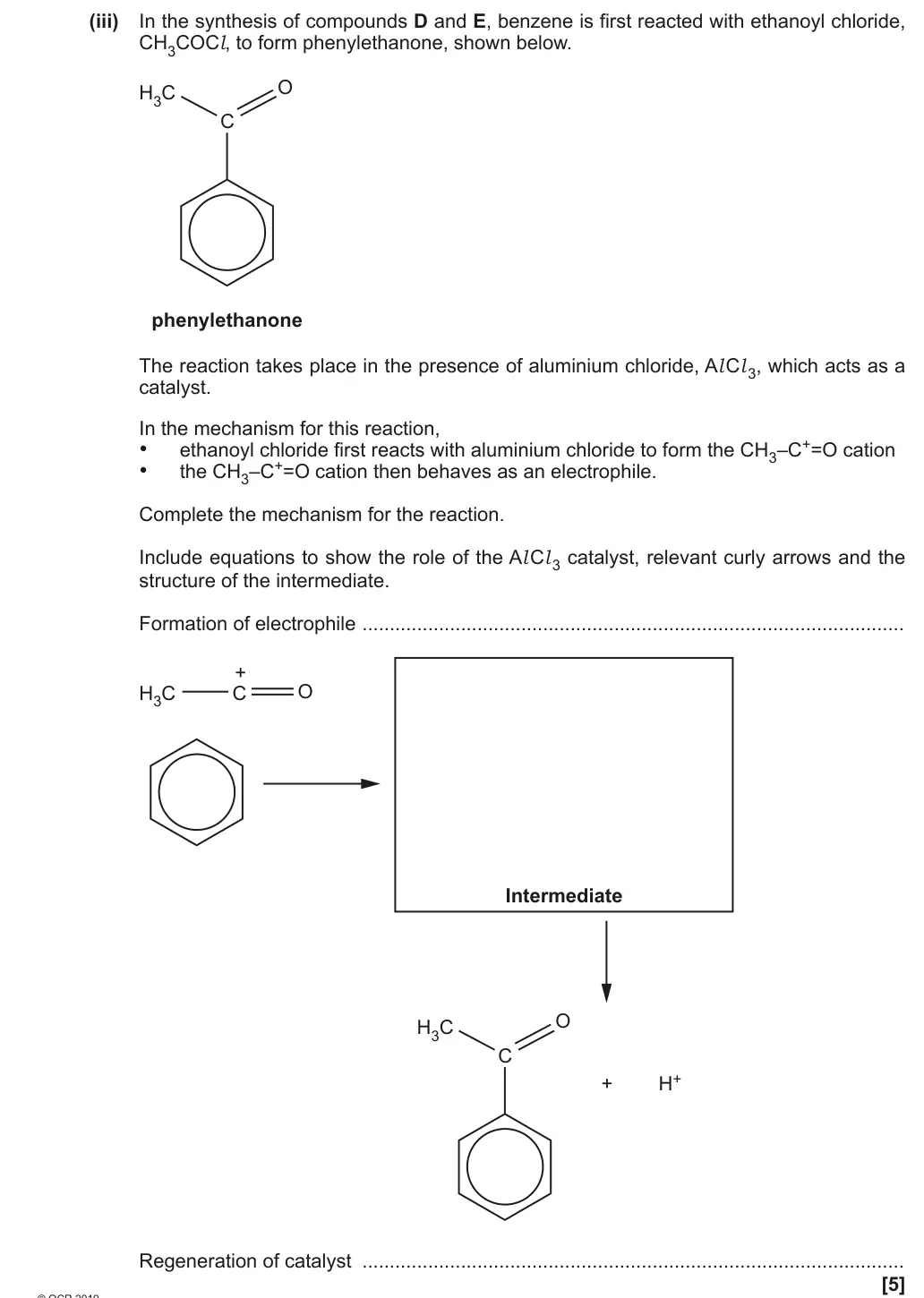
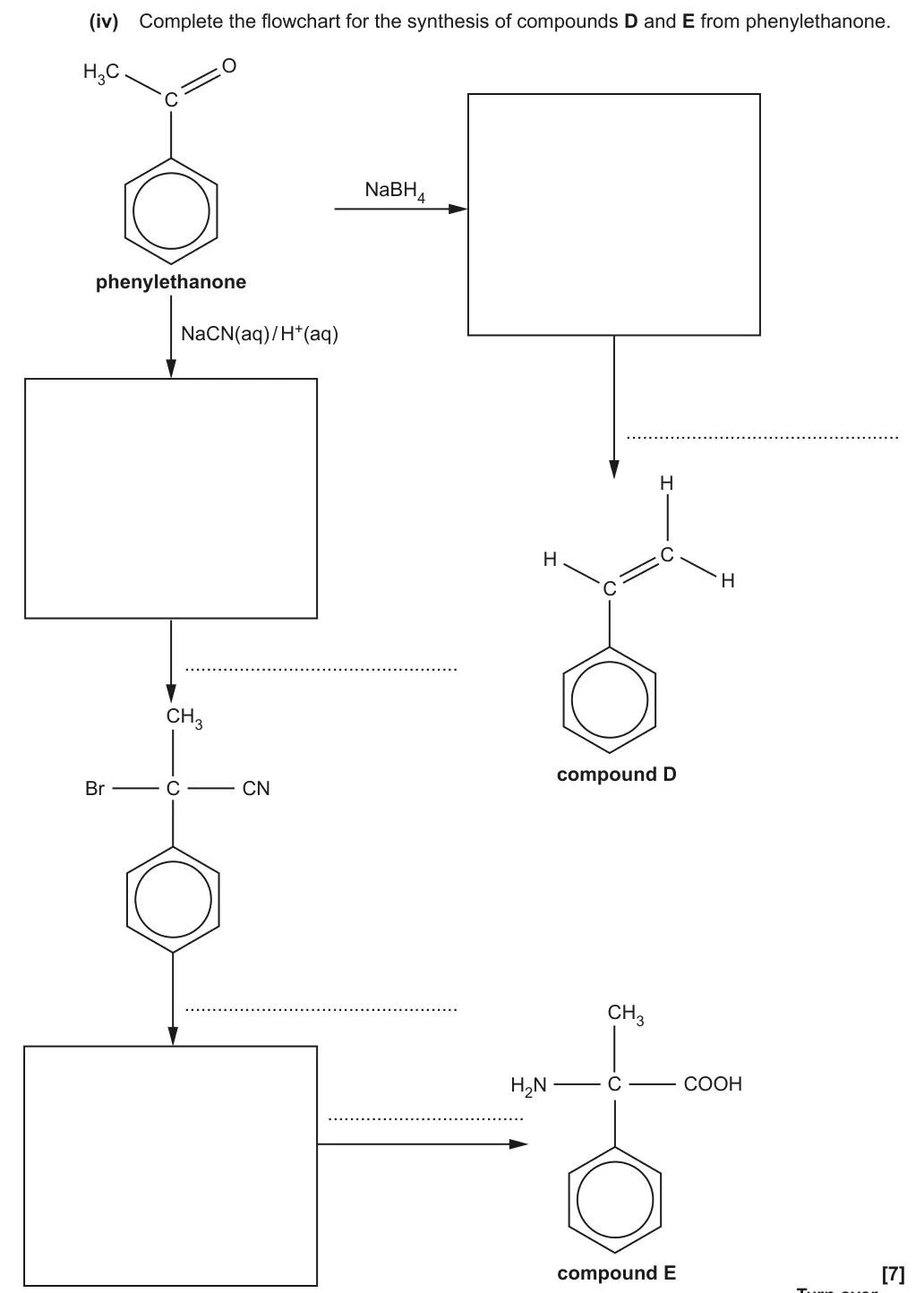
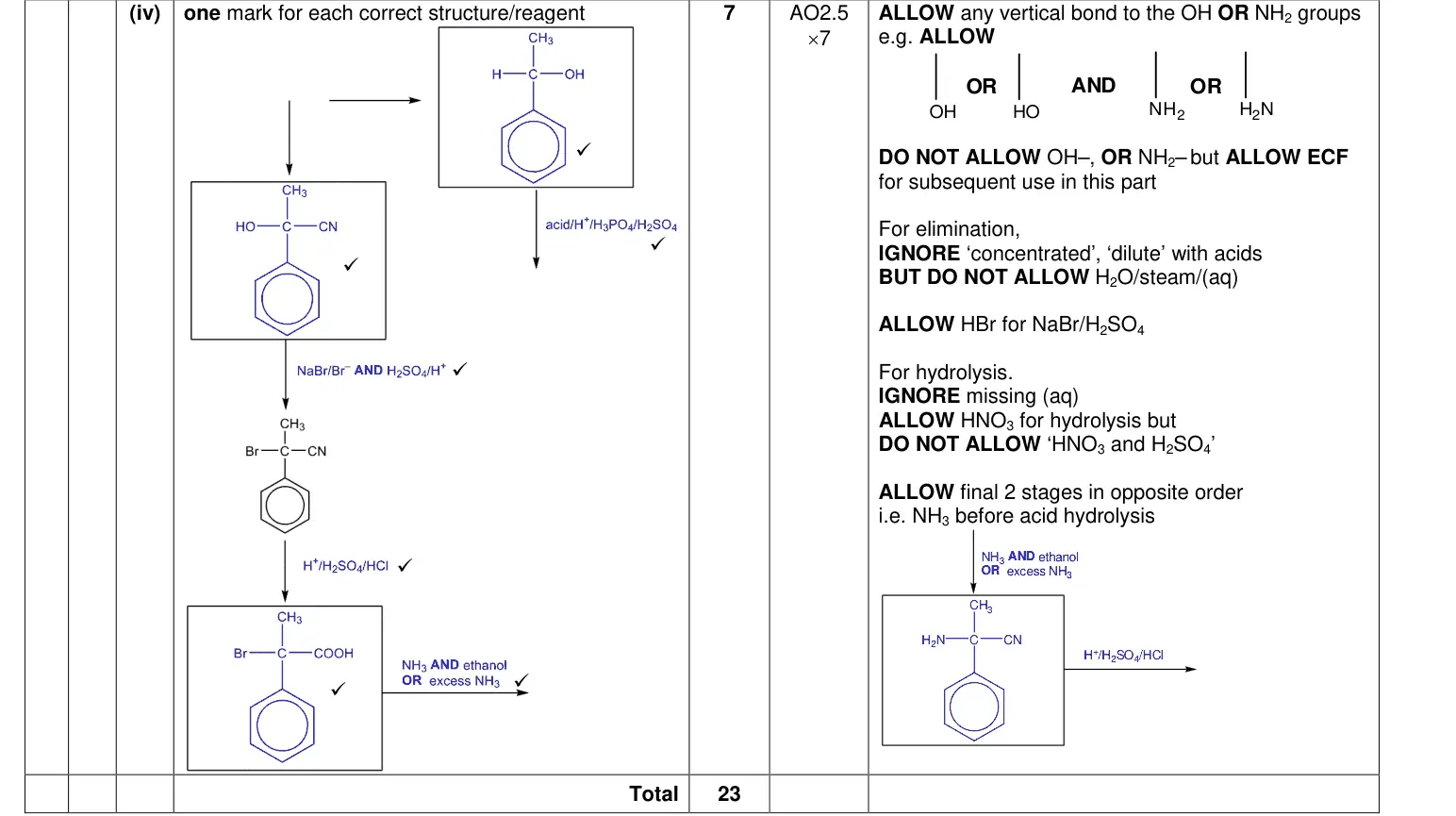
This question required candidates to apply knowledge of organic reactions from across the specification and discriminated well. Candidates with a good knowledge of reagents and conditions frequently scored over five marks. More detailed feedback is discussed with Exemplar 7, below. Phenylethanone is the starting point of this flowchart which shows the synthesis of compounds D and E. Synthesis of D The first step in the synthesis of D is the reduction of the ketone group. This response demonstrates a common error seen by examiners. The candidate has correctly deduced that than alcohol is formed but has omitted a hydrogen atom. Candidates are advised to take care when drawing structures. If a carbon atom is displayed it should be shown to be making four bonds. The final step of the synthesis is the dehydration of the alcohol with an acid. This candidate has used H3PO4. H2SO4 was also frequently seen. Lower ability responses included reference to water or steam and this was not credited. Synthesis of E The first step of the synthesis of E from phenylethanone is the reaction with NaCN(aq)/H+(aq). This candidate identifies that the product of the reaction is a hydroxynitrile but unfortunately this cannot be credited due to the incorrect linking of the OH group via the H atom. Candidates should be aware that, when drawing structures, groups must be bonded via the correct atoms. The next step of the synthesis is the substitution of the OH group. The candidate correctly recognises that NaBr is a suitable reagent but omits an acid, e.g. H2SO4, which is also required for this reaction. This error was seen frequently by examiners. The final two steps involve the substitution of the Br atom and acid hydrolysis of the nitrile group. In this case the candidate chooses the reaction with excess NH3. The structure of the correct product of this reaction is shown and the synthesis is completed by identifying a suitable reagent for the final step. Other candidates opted to perform these steps in the reverse order and the mark scheme allowed full credit for either approach. Common errors in the final steps were omissions. Some candidates simply stated NH3 without mentioning ethanol. Others identified water as important for the hydrolysis but did not include reference to an acid.
Notes from the mark scheme and report
1-phenylethanol then acid catalyst (DO NOT ALLOW H2O/steam/(aq)) for D
hydroxynitrile, NaBr/H2SO4 (ALLOW HBr), acid hydrolysis of CN, excess NH3/ethanol (last two stages in either order)
DO NOT ALLOW OH– or NH2– for the groups
June 2018 · Paper 2 · Q17(b)2 marksStructure / isomerHard
Mark scheme
Examiner's comment
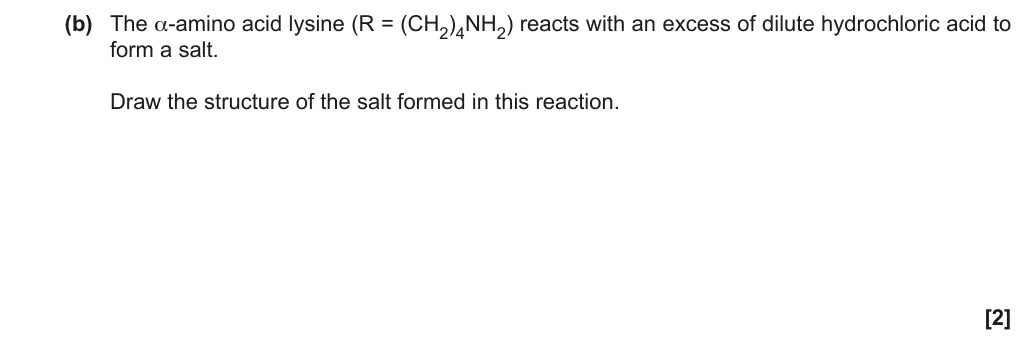
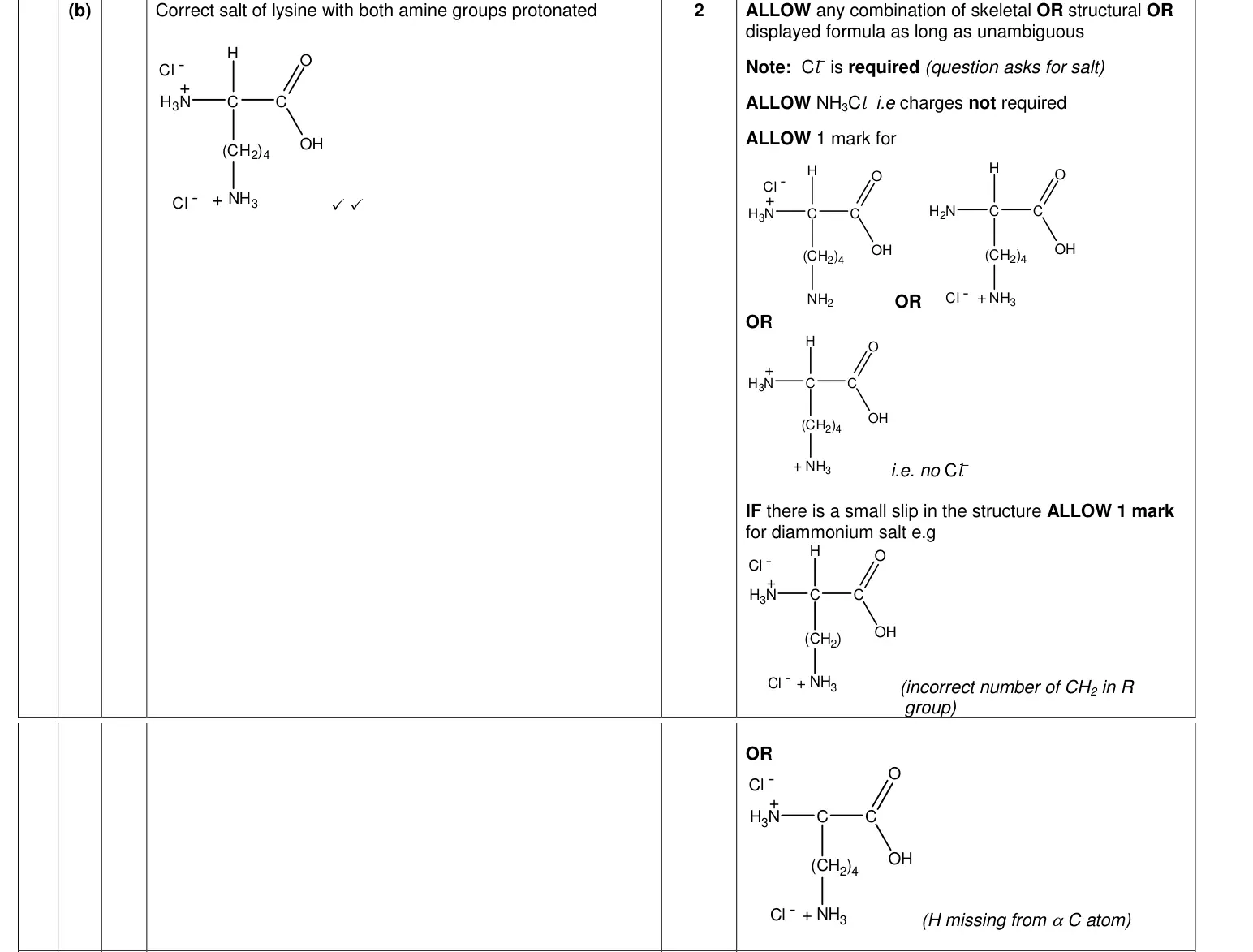
In contrast to part (a) this question proved difficult and discriminated well. The higher ability candidates correctly identified the dichloride salt produced by the reaction of lysine with excess acid. Some candidates formed ammonium ions on both nitrogen atoms but omitted the chloride ions. Others only formed a monochloride salt, leaving the R group unchanged. These two approaches scored one mark.
Notes from the mark scheme and report
BOTH amine groups protonated (excess HCl)
Cl– required because question asks for salt
1 mark if only one NH2 protonated or no Cl–
June 2018 · Paper 3 · Q4(b)(ii)6 marks6-mark level of responseHard
Earlier part of question 4 that this part uses
Mark scheme, with the levels and indicative points
Examiner's comment
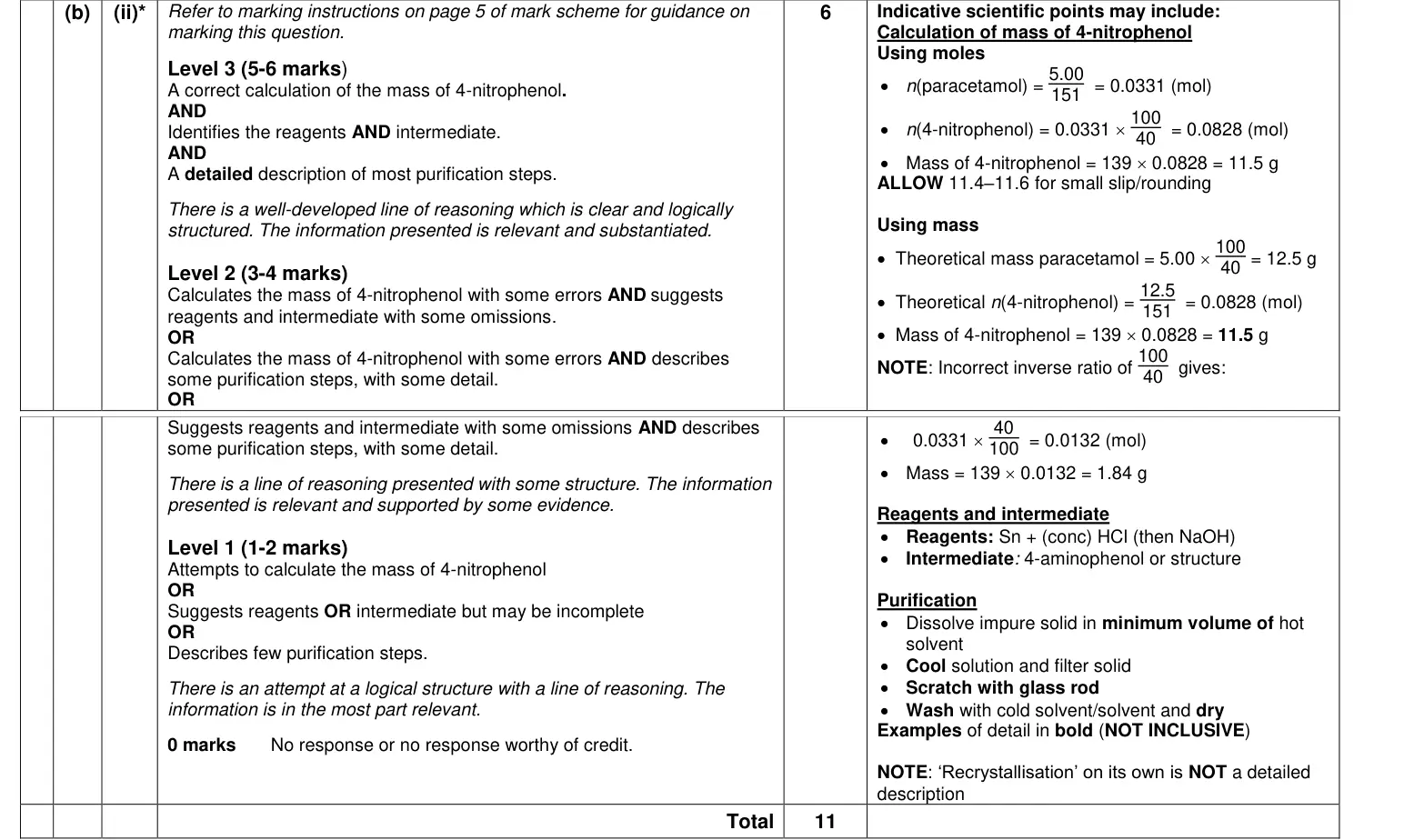
This part assessed practical aspects of a two-stage organic synthesis. Overall, candidates responded well, and this part was discriminating. Many candidates produced well-structured responses although lower ability candidates do have problems with constructing a cohesive response. Most candidates identified the correct reagents (Sn and concentrated HCl) and the intermediate (4- aminophenol), which was usually shown as its structure. Able candidates usually showed that 11.5 g of 4-nitrophenol is needed for the synthesis. A common error used the ‘inverse percentage’ ratio of 40/100, resulting in an incorrect mass of 1.84 g. Candidates are recommended to check whether a calculated answer looks sensible. Looking at the structures and with a percentage yield of 40%, 1.84 g does not look to be enough of the starting chemical. Some lower ability candidate responses assumed that 5.00 g was 40% of the required mass and responded with 5.00 × 100/40 = 12.5 g. There were some good descriptions of purification, although finer details such as using a minimum volume of hot solvent, washing with cold solvent, and drying) were often omitted. Candidates needed to respond with more than just ‘recrystallisation’. In the purification, common errors were showing the correct steps but in the wrong order and use of a drying agent such as CaCl2 (confusion with part of the purification of an organic liquid). These candidates seemed unaware that adding a solid drying agent to an organic solid would result in impure paracetamol rather than purifying. In comparison, Exemplar 12 is much less detailed: concentrated HCl has not been shown as a reagent for step 1, the candidate has not shown that they know how to carry out a percentage yield calculation, and the purification is confused, and lacks detail.
Notes from the mark scheme and report
5.00/151 = 0.0331 mol, ×100/40 = 0.0828 mol, × 139 = 11.5 g (inverted ratio gives 1.84 g)
Sn + conc HCl then NaOH
intermediate 4-aminophenol
recrystallise: dissolve in MINIMUM volume of HOT solvent, cool, filter, wash with cold solvent, dry
'recrystallisation' alone is not a detailed description
Skills: M0.2 Use ratios, fractions and percentages; M2.2 Change the subject of an equation; PAG6 Synthesis of an organic solid
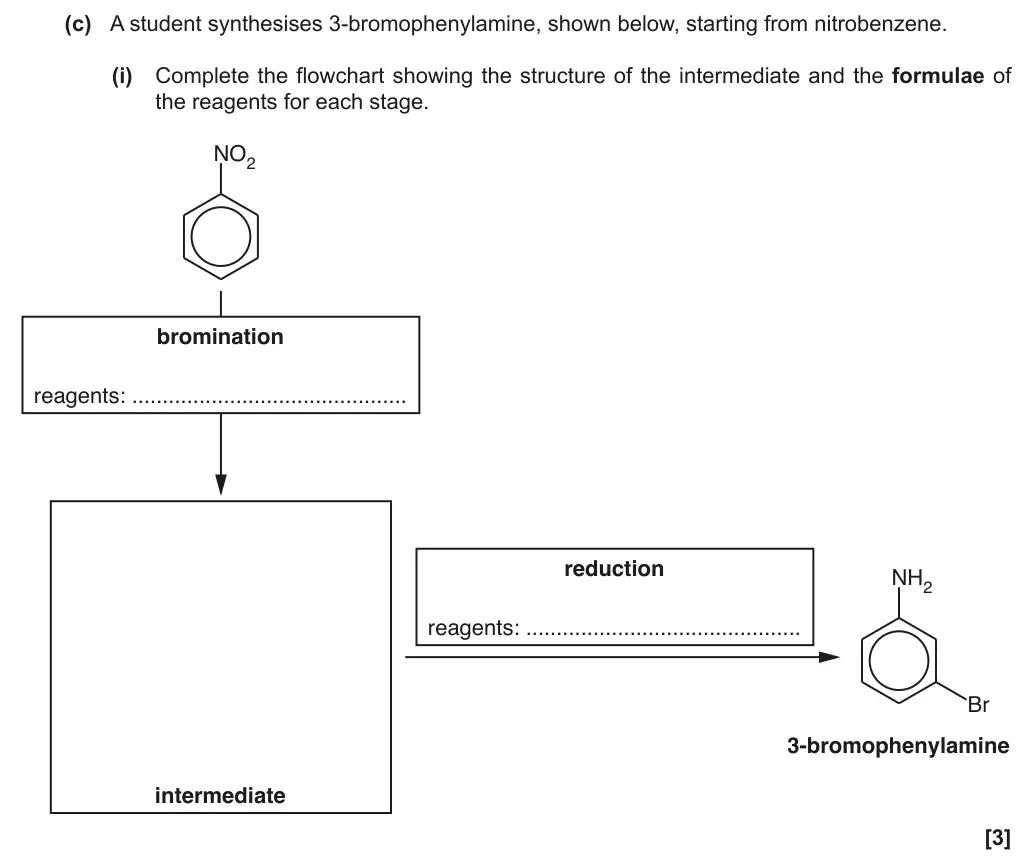
June 2017 · Paper 2 · Q17(c)(i)3 marksComplete table/diagram
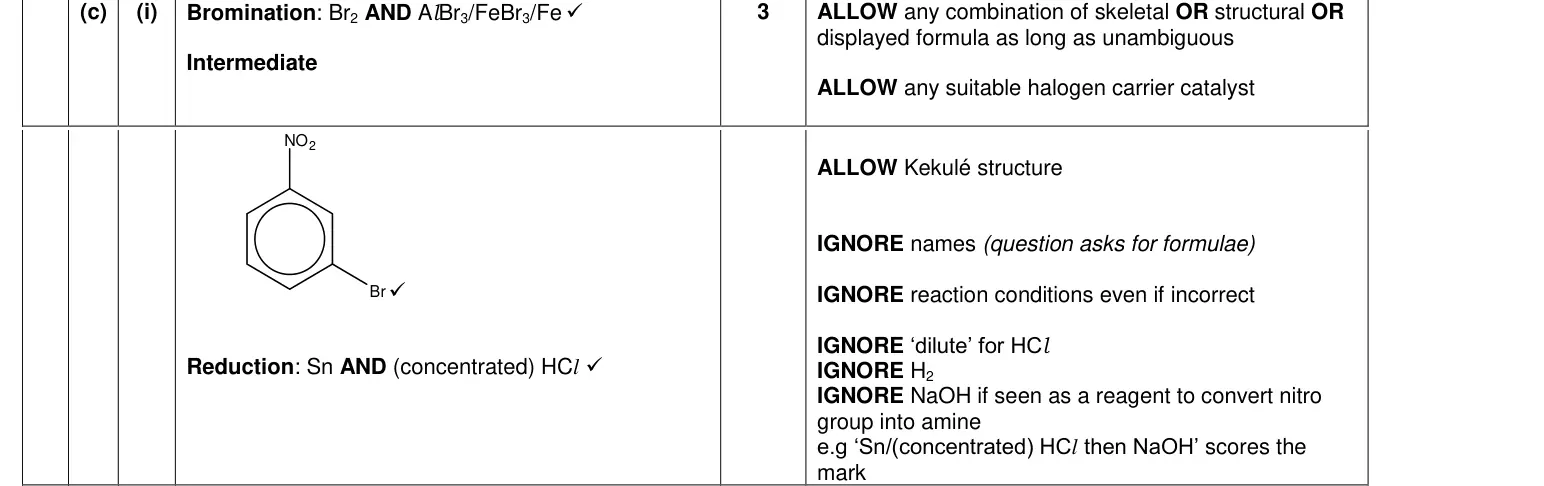
Mark scheme
Notes from the mark scheme and report
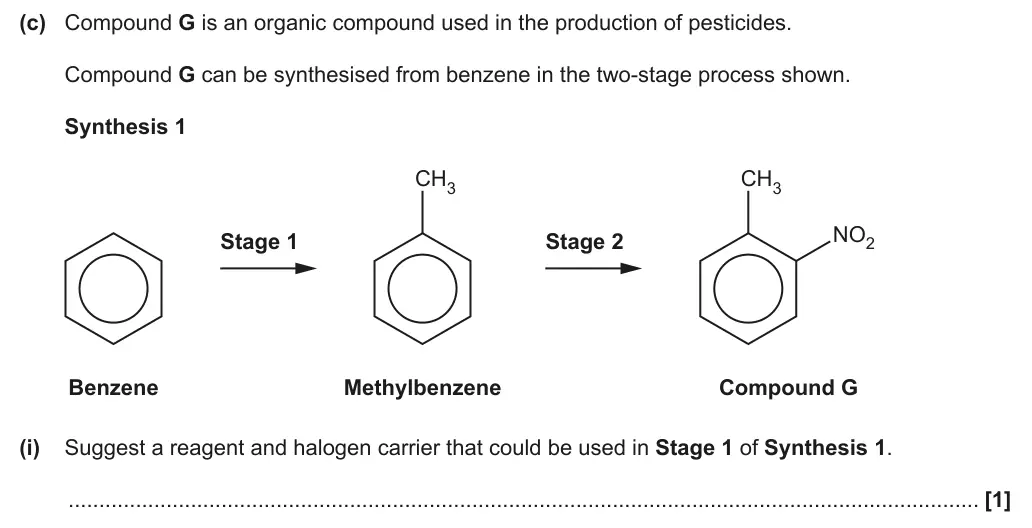
Br2 AND AlBr3/FeBr3/Fe
intermediate 3-bromonitrobenzene
Sn AND (conc) HCl
IGNORE names (formulae asked for), conditions and H2
June 2017 · Paper 2 · Q18(a)(iii)2 marksShort answer
Earlier part of question 18 that this part uses
Mark scheme
Notes from the mark scheme and report
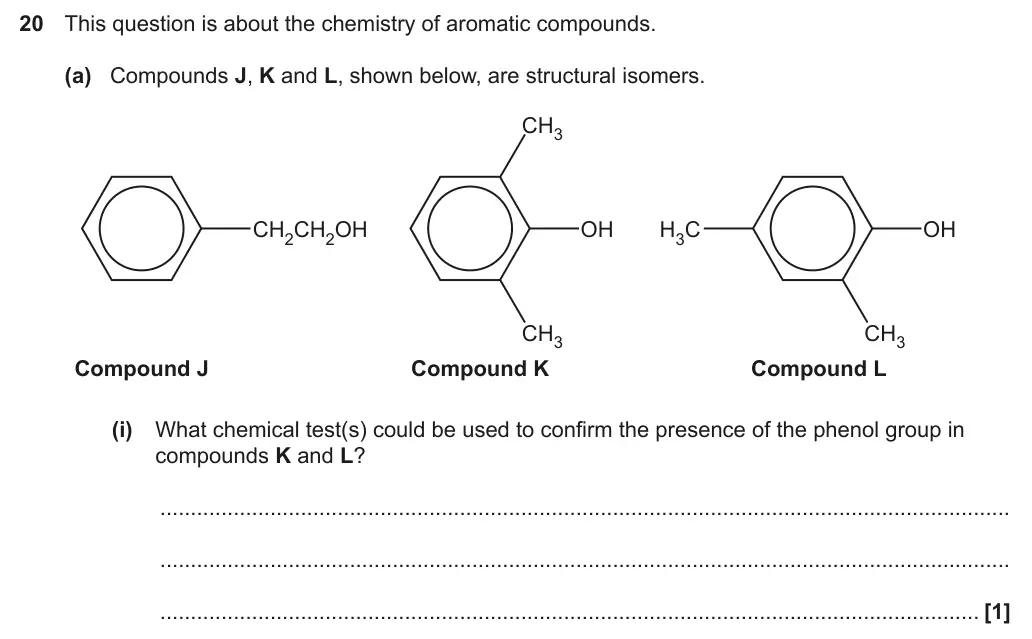
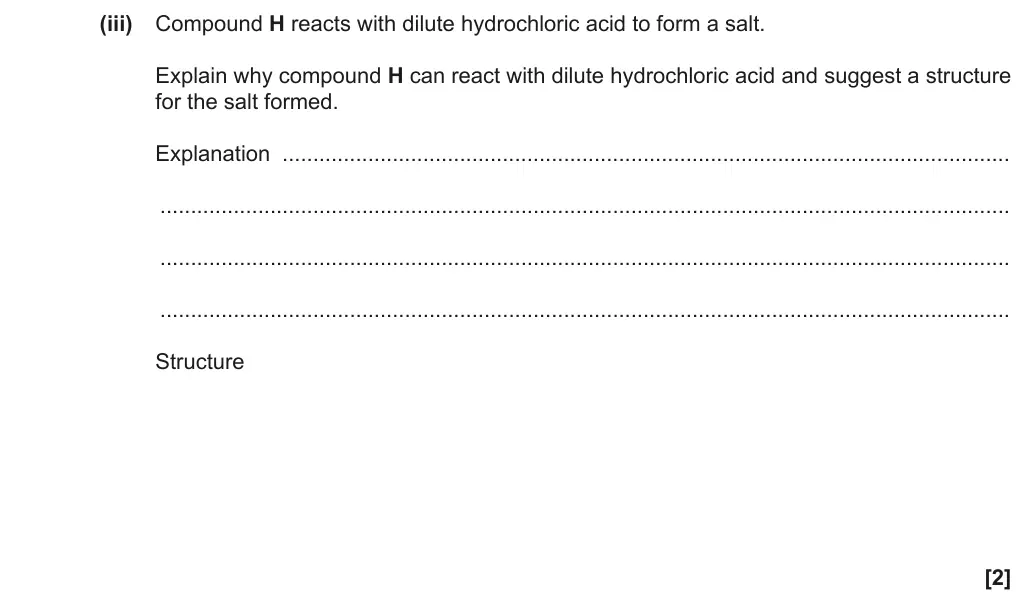
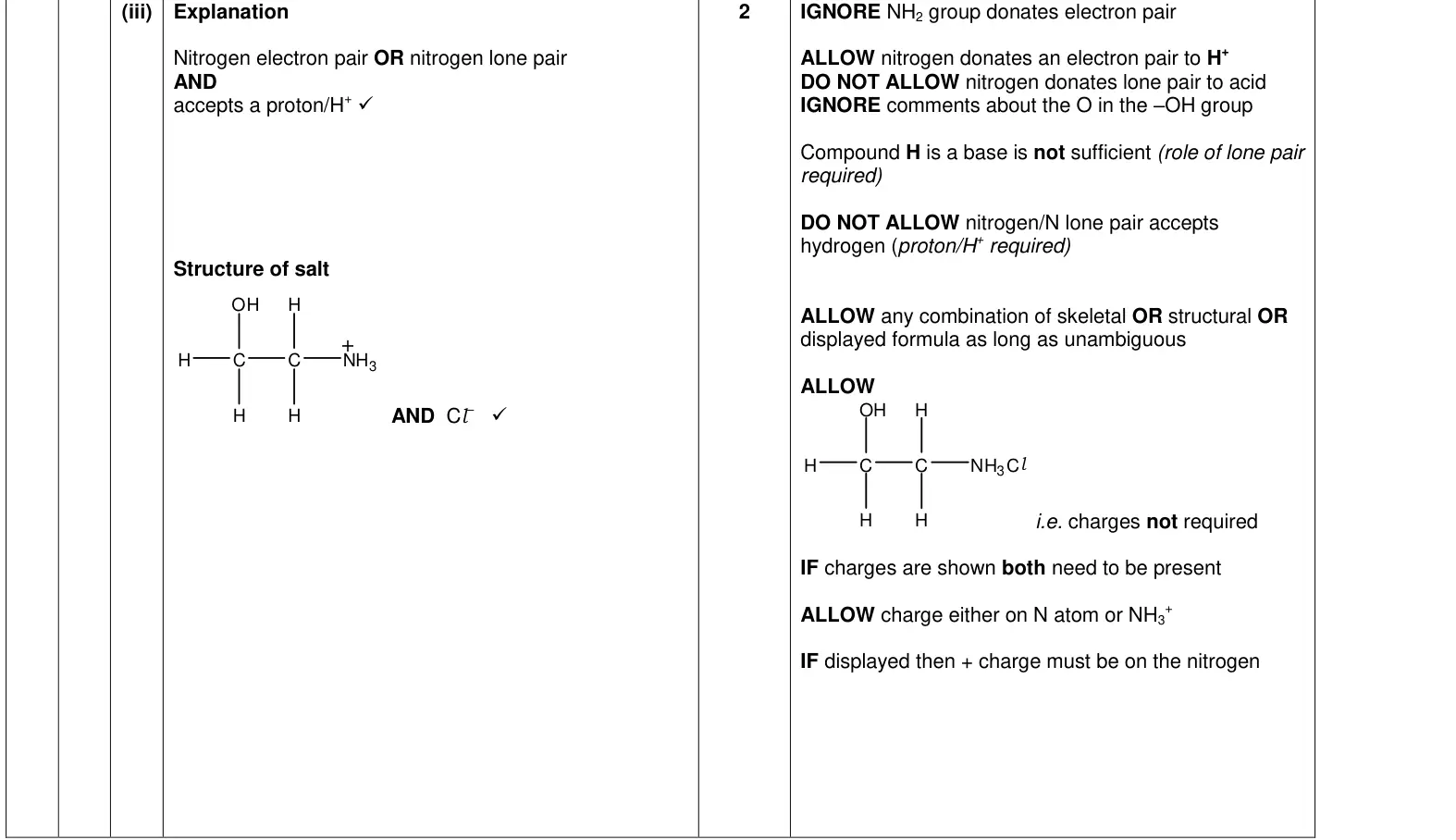
lone pair on N accepts a proton/H+ ('is a base' not sufficient
DO NOT ALLOW 'accepts hydrogen' or 'donates lone pair to acid')
salt HOCH2CH2NH3+ Cl–: if charges shown both must be present, + on N
Work with an OCR chemistry tutor
Dropping marks on calculations, mechanisms or the six-markers? Book a trial session with a specialist OCR chemistry tutor.