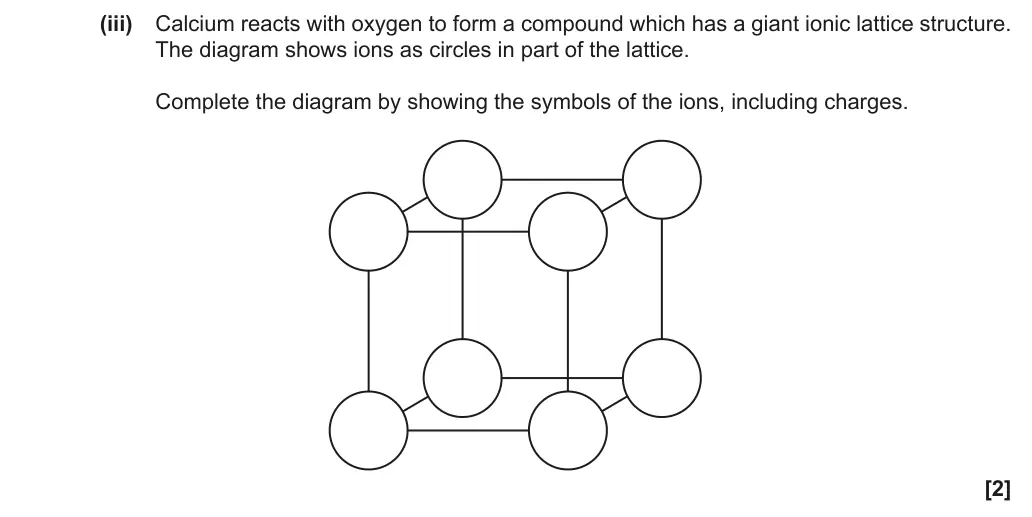
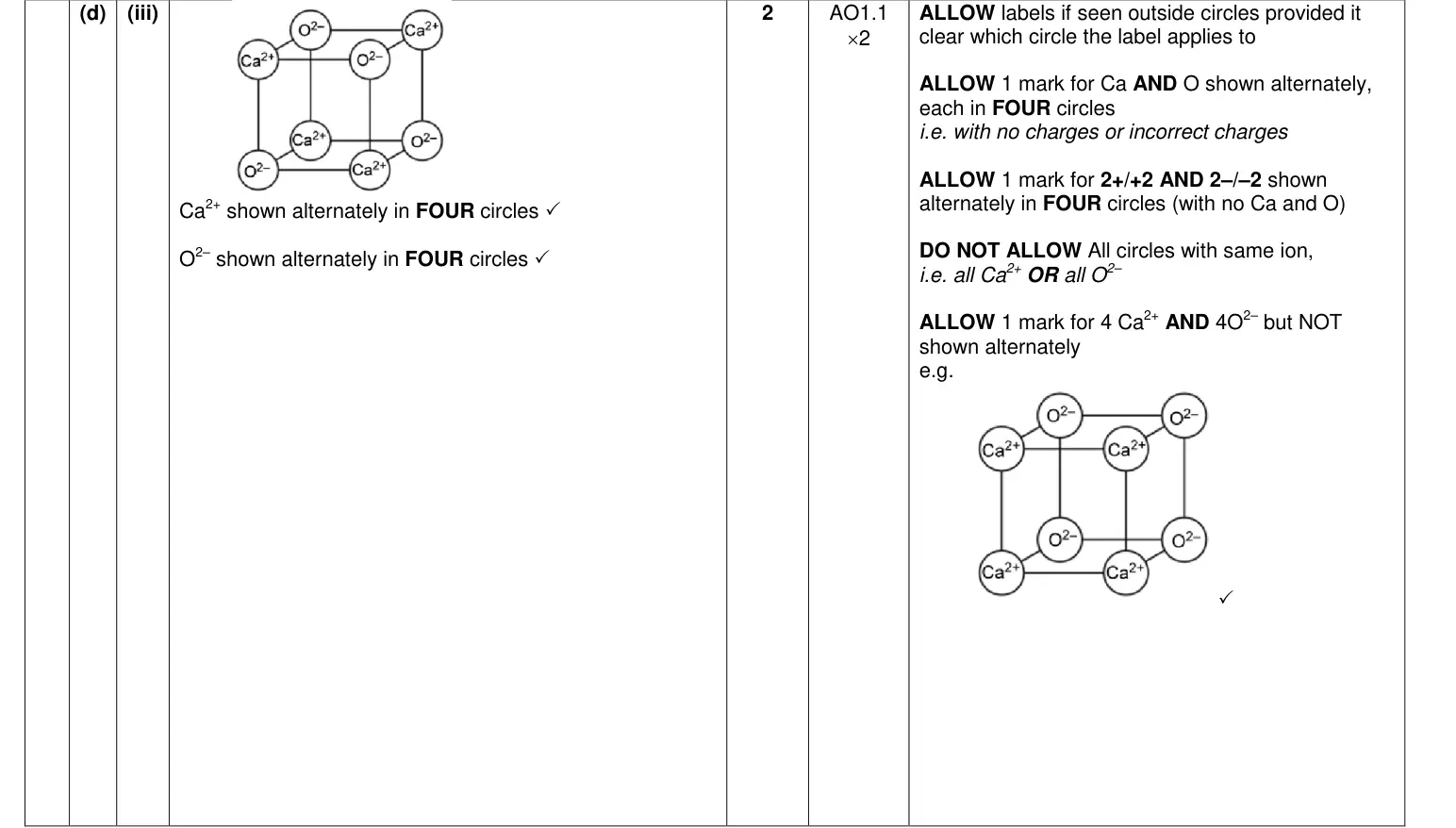
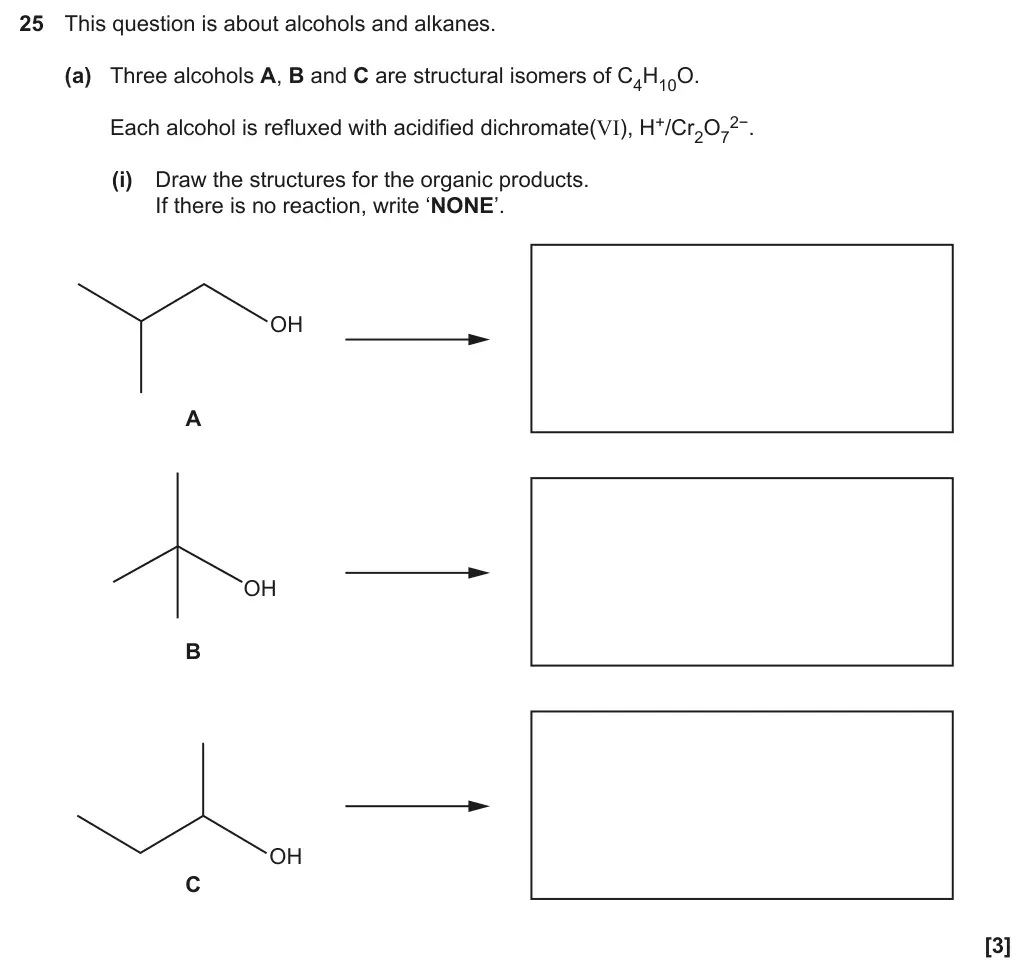
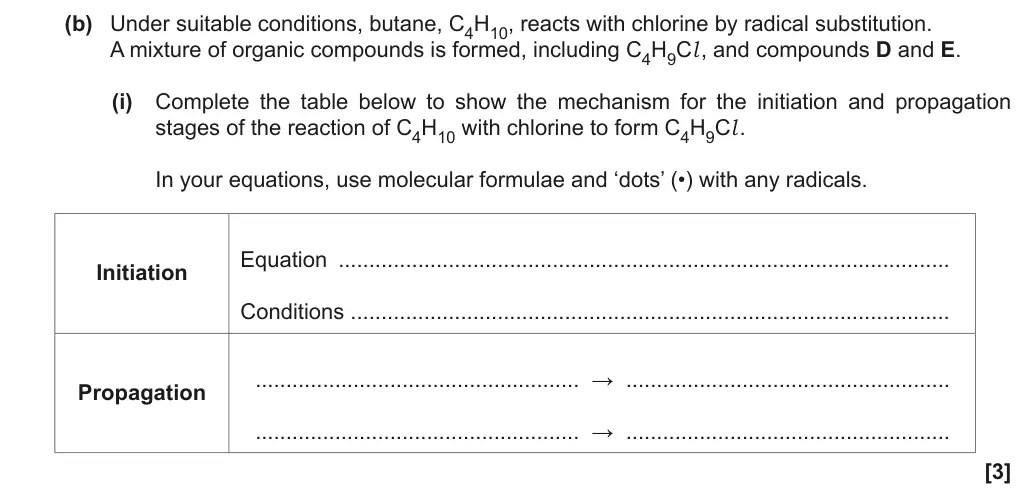
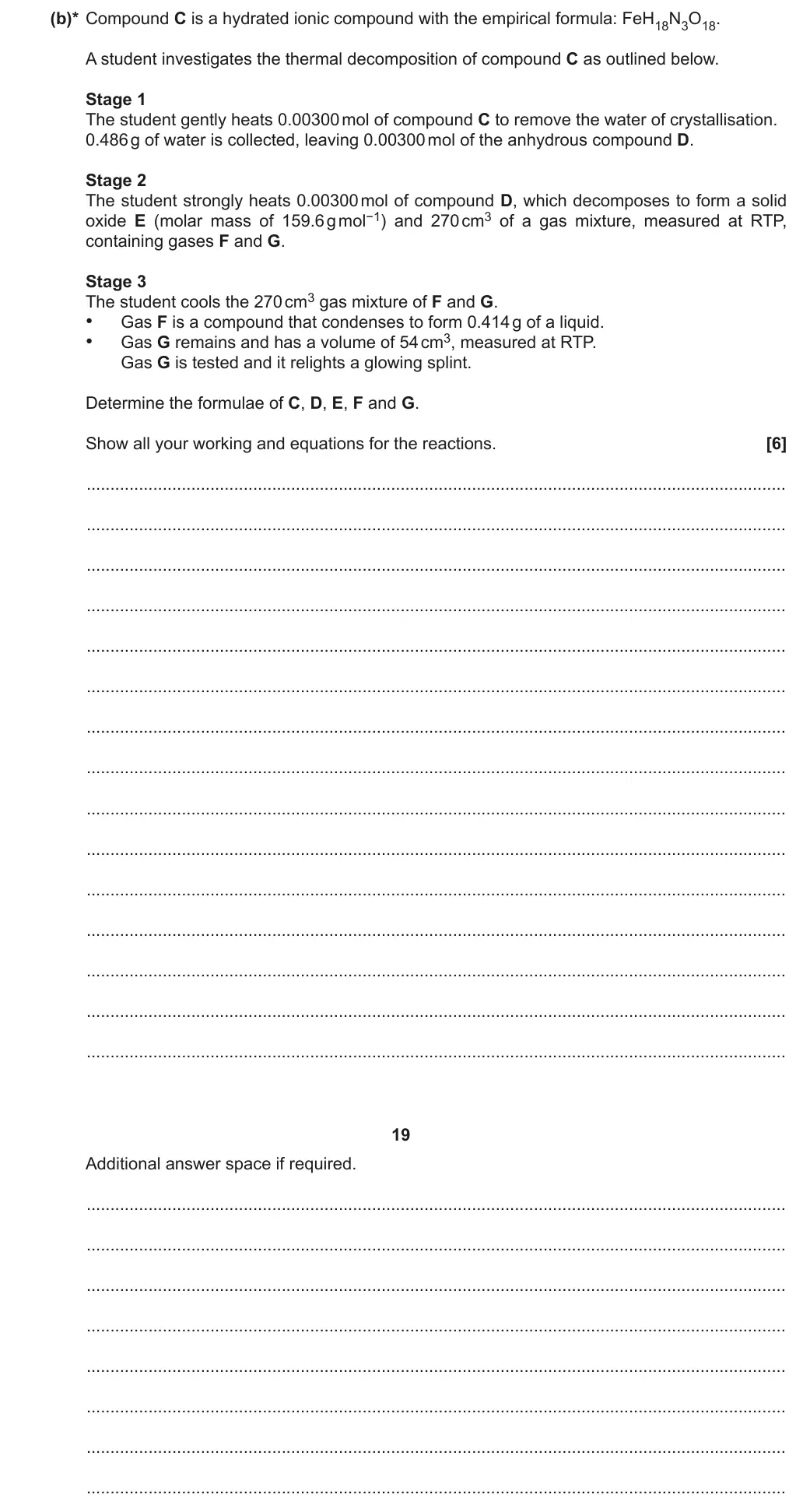
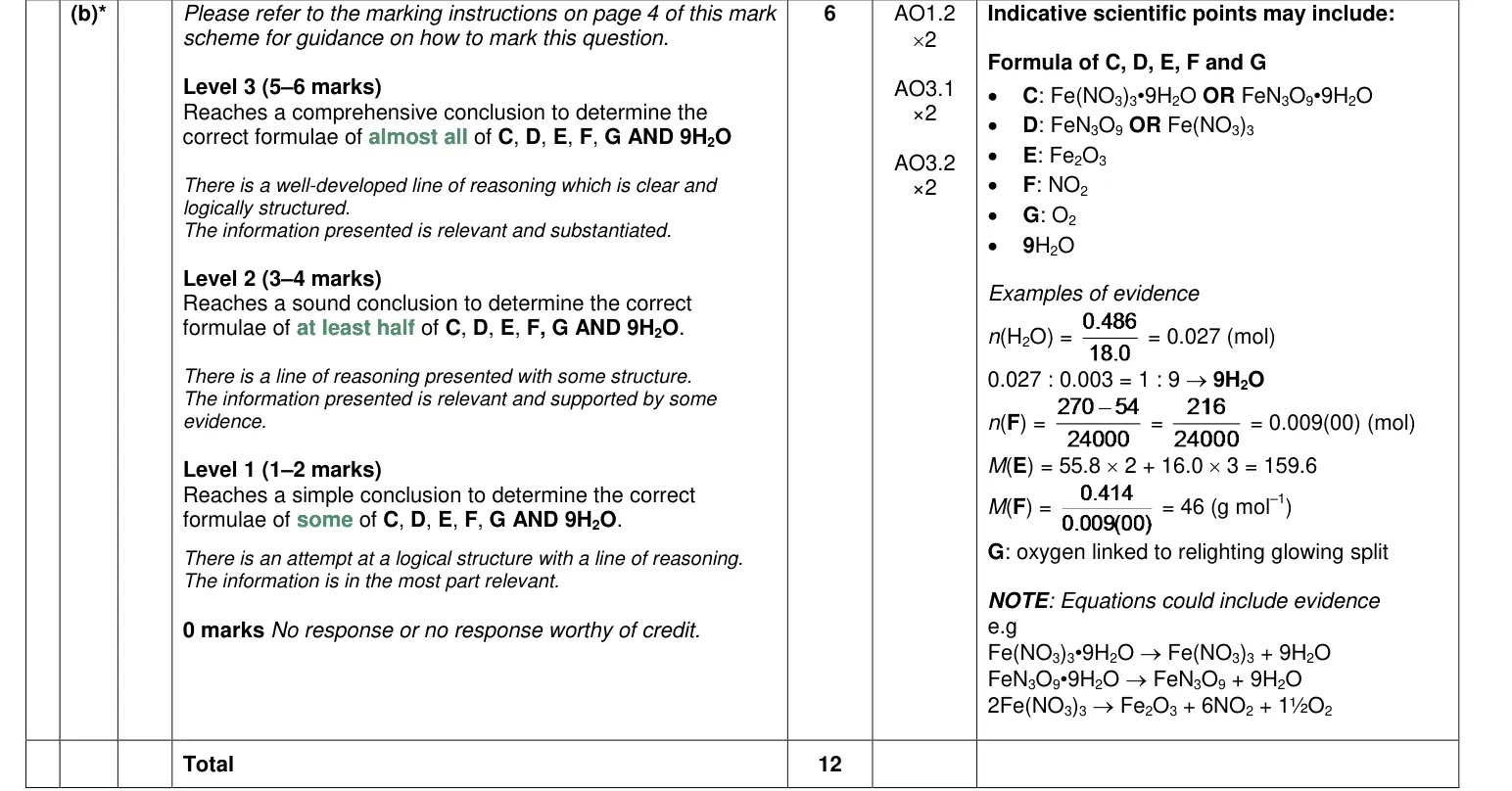
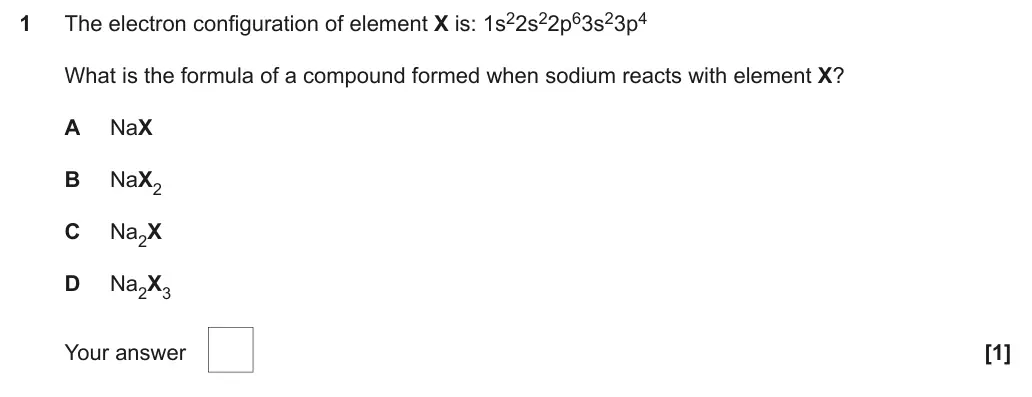
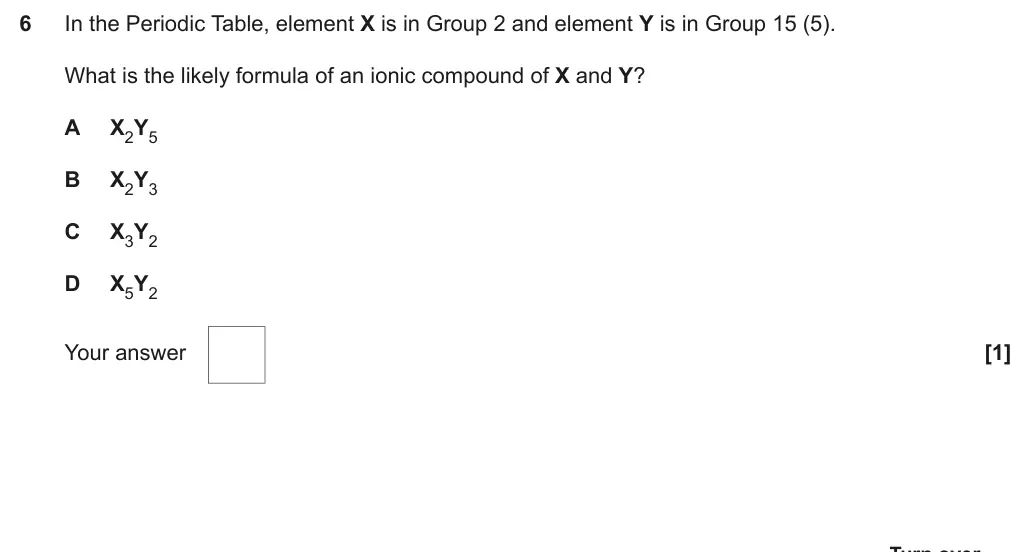
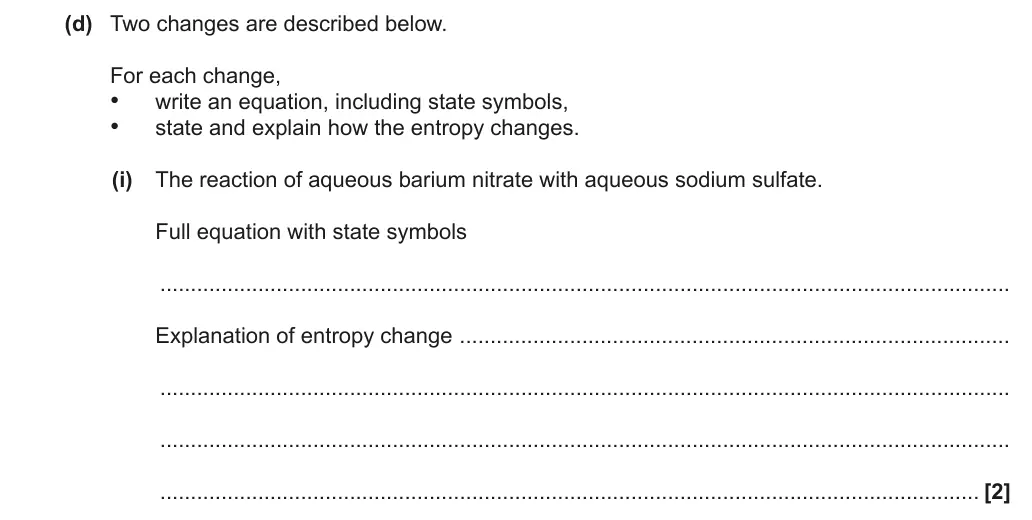
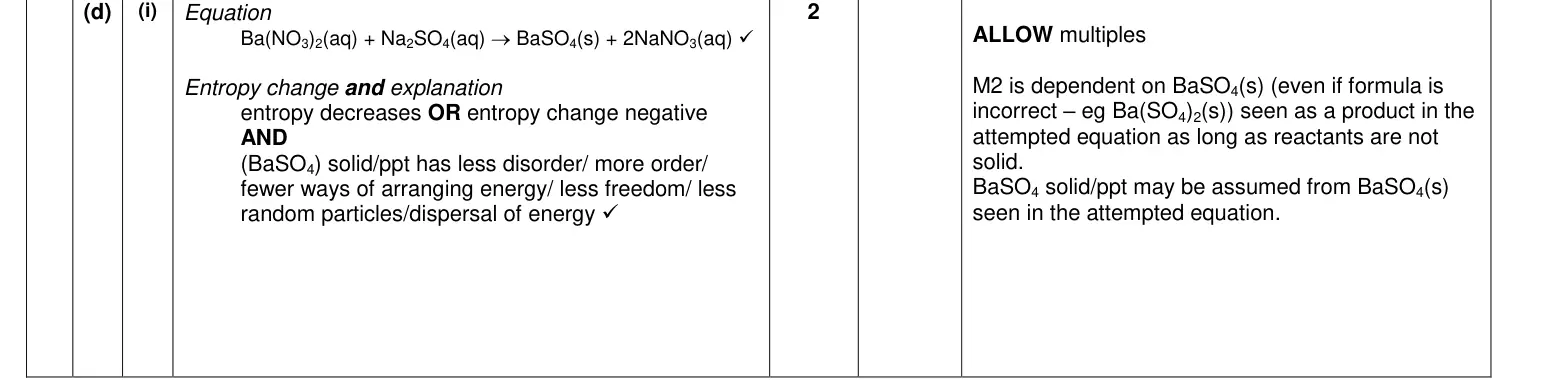
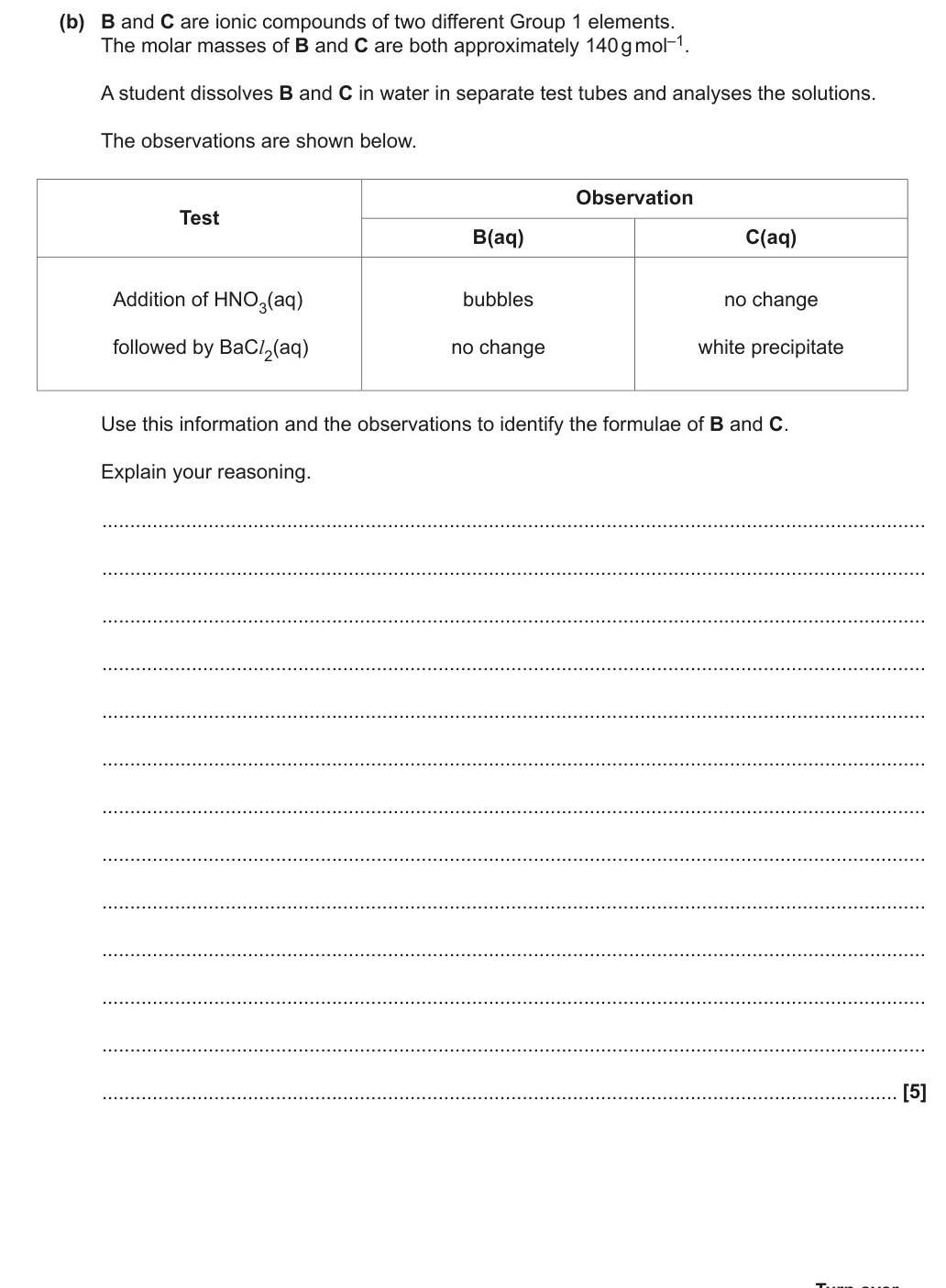
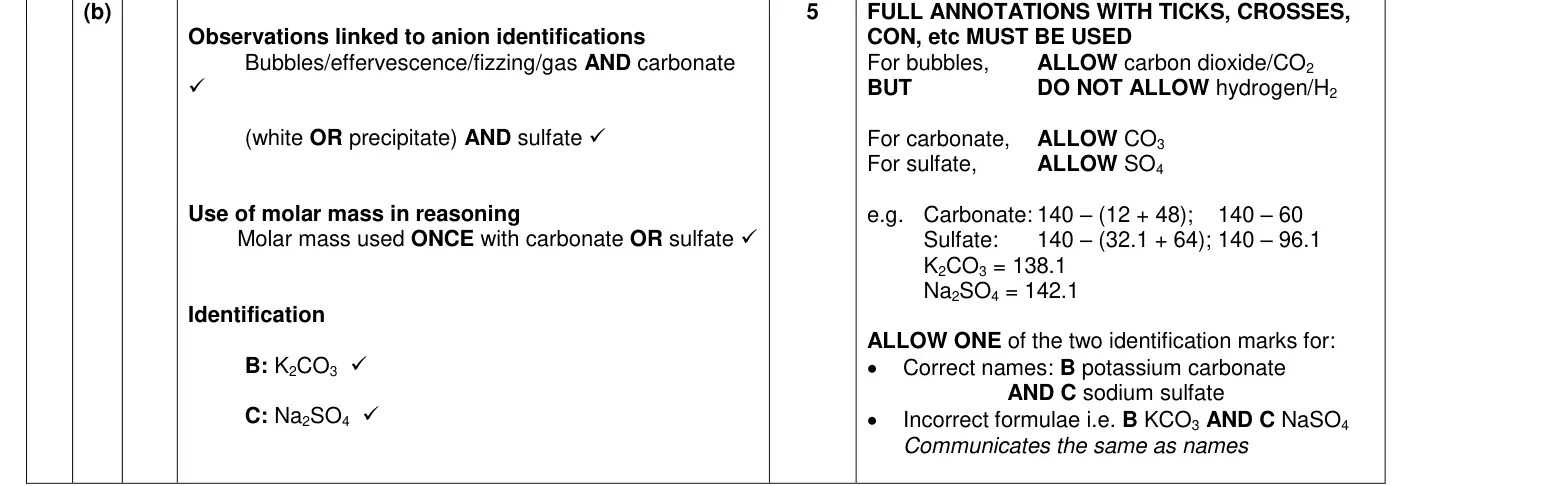
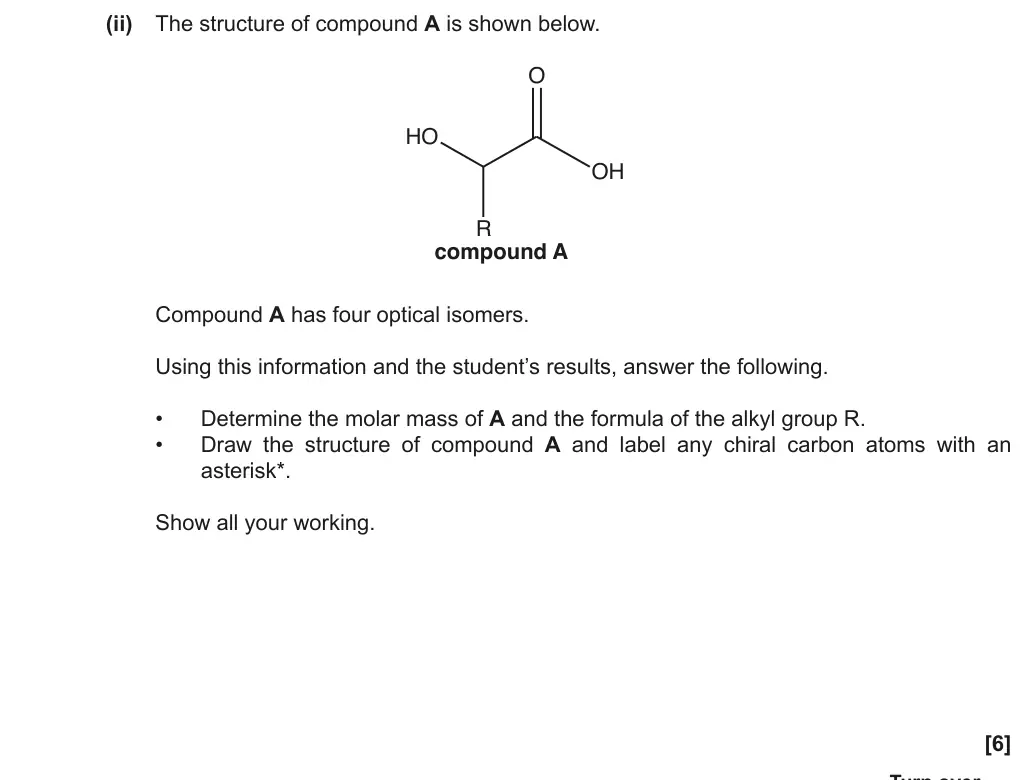
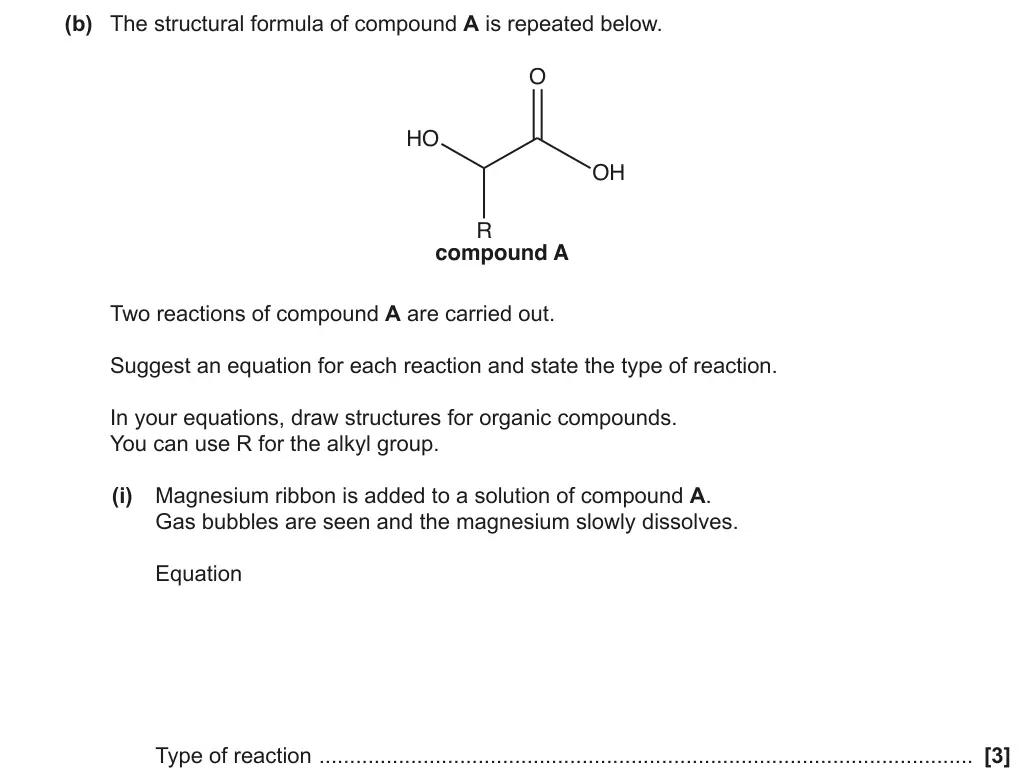
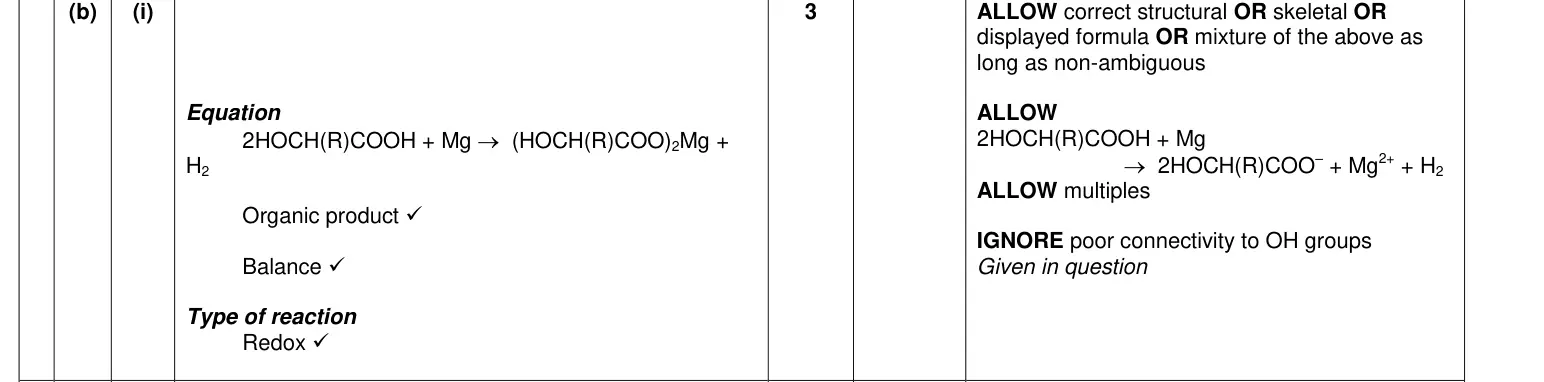
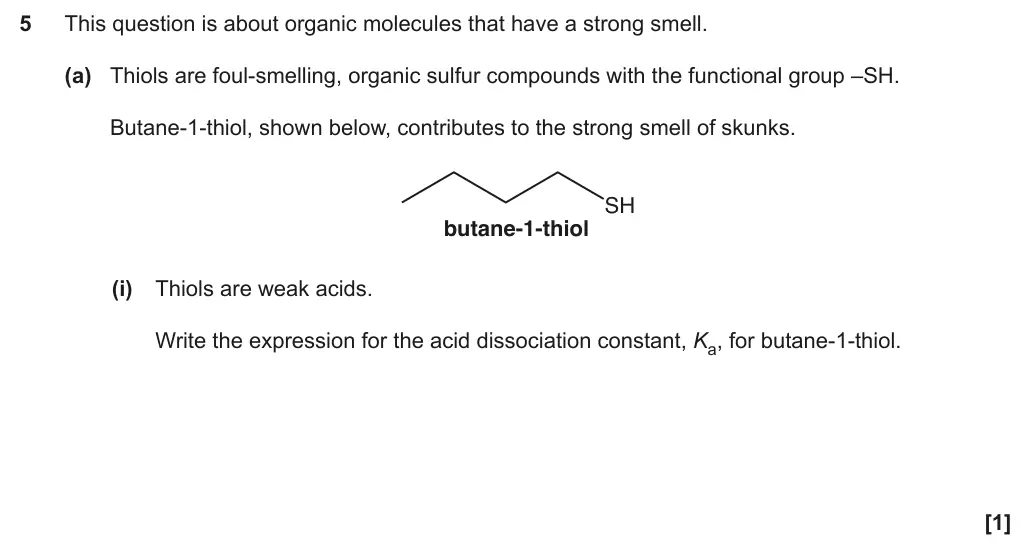
Notes and key-term cards for this topic are being written by our tutors. The past-paper questions below are ready now.
Learning outcomes
Show the 4 learning outcomes from the specification
2.1.2(a) the writing of formulae of ionic compounds from ionic charges, including:
2.1.2(a)(i) prediction of ionic charge from the position of an element in the periodic table
2.1.2(a)(ii) recall of the names and formulae for the following ions: NO3–, CO32–, SO42–, OH–, NH4+, Zn2+ and Ag+
2.1.2(b) construction of balanced chemical equations (including ionic equations), including state symbols, for reactions studied and for unfamiliar reactions given appropriate information.
Six-mark level of response questions on this topic
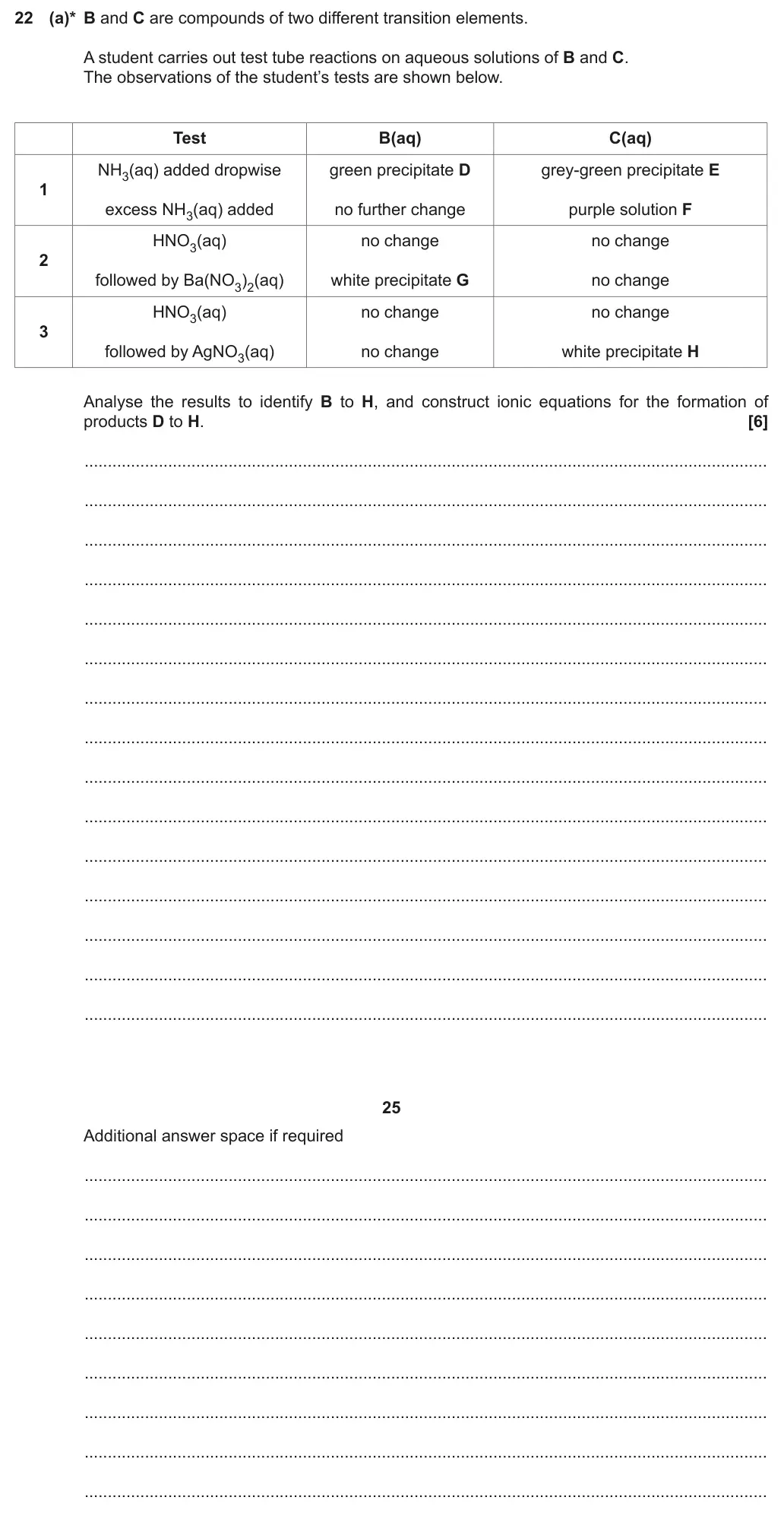
(a)* B and C are compounds of two different transition elements. Analyse the results to identify B to H, and construct ionic equations for the formation of
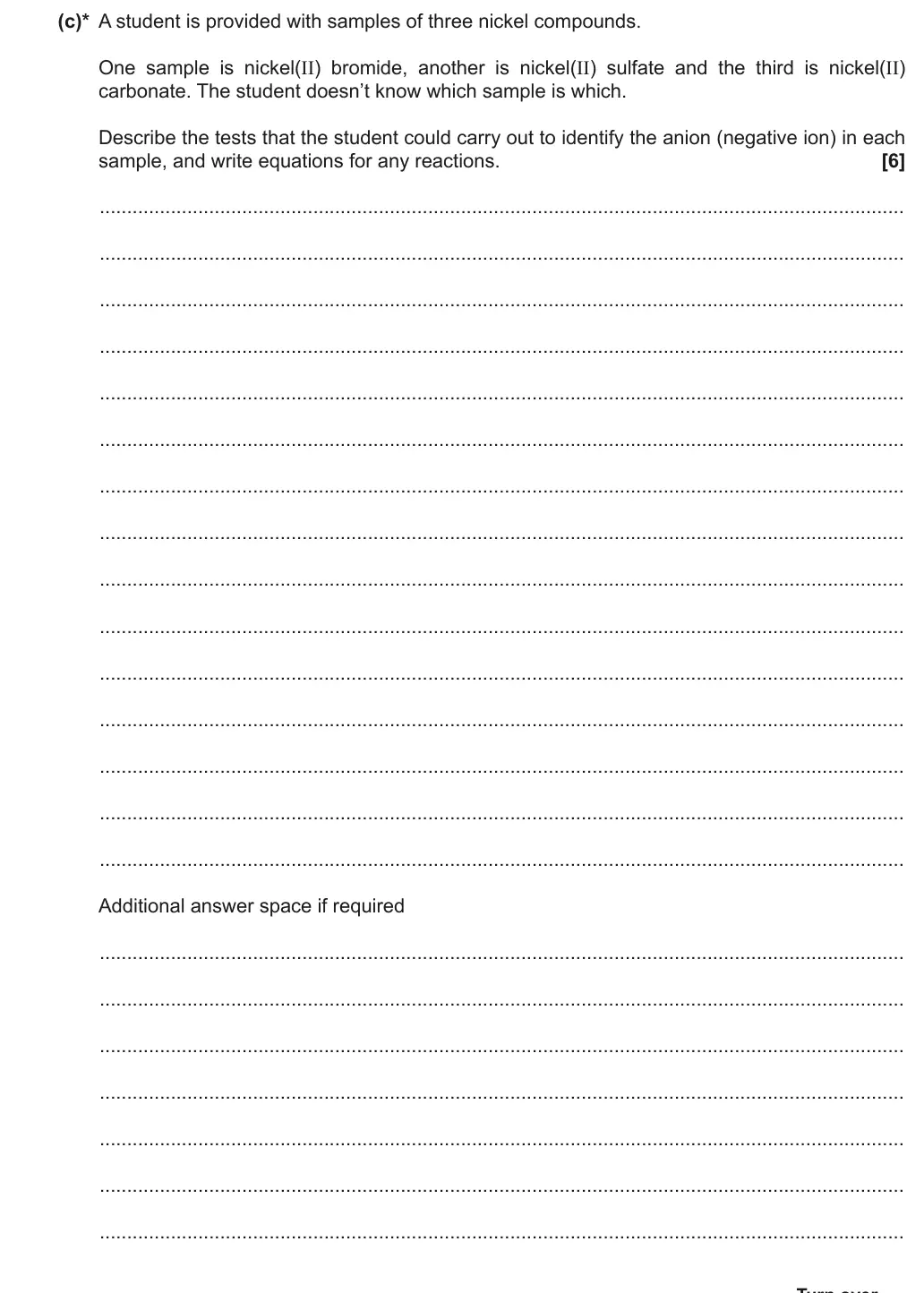
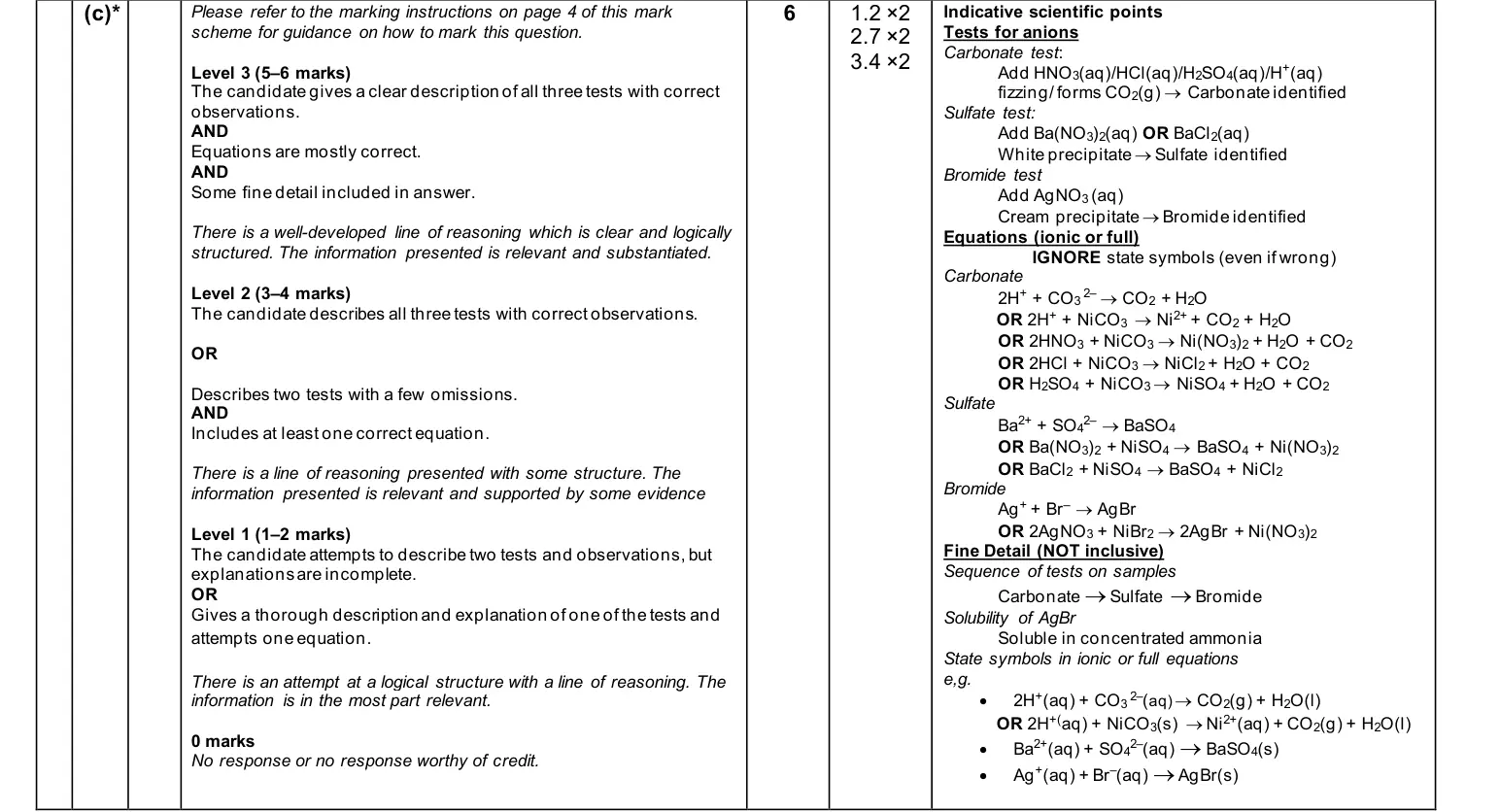
A student is provided with samples of three nickel compounds. Describe the tests that the student could carry out to identify the anion (negative ion) in each
Tap a question to zoom it. Where a part needs a table, graph or structure from an earlier part, that part folds out above it; the mark scheme and examiner's comment open underneath. Have the OCR Data Sheet beside you.
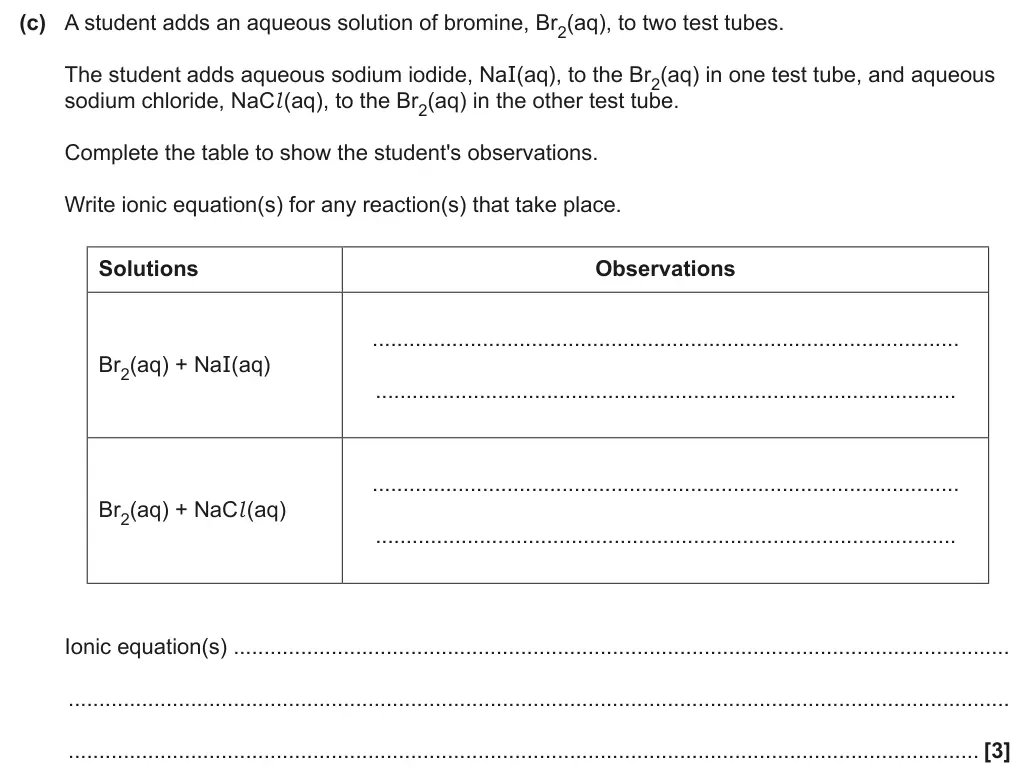
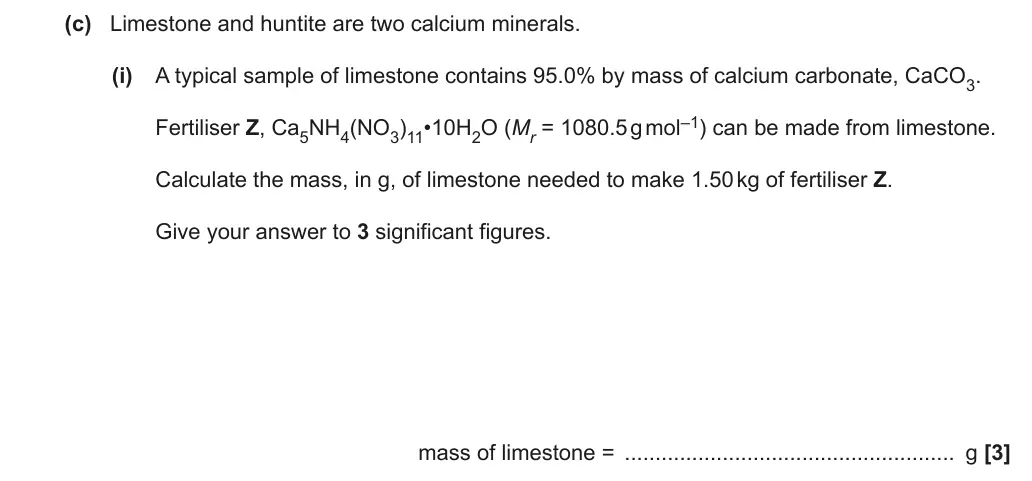
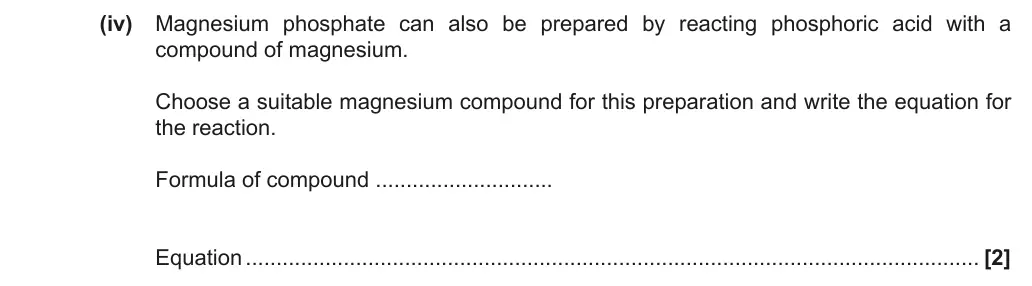
June 2025 · Paper 1 · Q16(c)3 marksEquation writingHard
Mark scheme
Examiner's comment
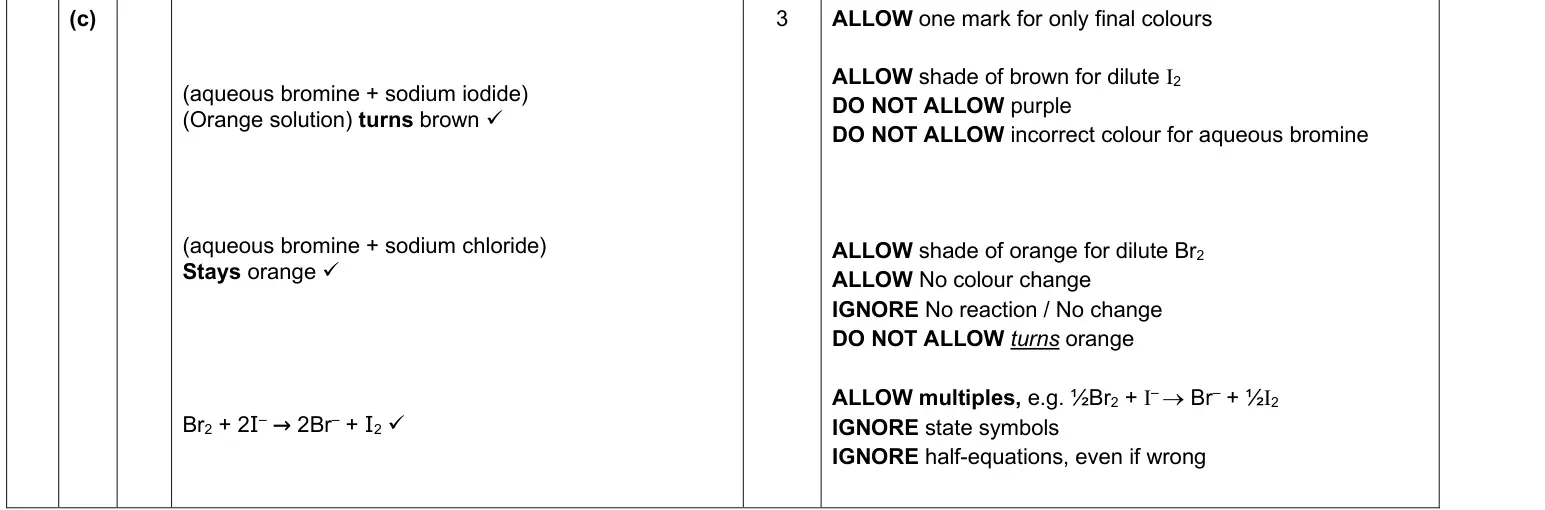
This question required the candidates to know the observations of the reactions of group 7 and to recognise a change in colour to show the evidence of a chemical reaction. This question proved difficult for candidates with few being given all three marks. Colours were not well-known with I2 in aqueous solution often described as purple. Other incorrect answers included no colours stated, effervescence and descriptions of the formation of the halide precipitates. Several candidates gave an equation instead of an observation. The PAGs – section 1.2.1 (d) mentions accurate use of terminology to describe change instead of just final colours. A good number of candidates were able to provide the correct ionic equation, although several incorrectly included Na in their equations or wrote half equations. Occasionally candidates wrote more than one incorrect equation, often forming Cl2.
We have produced a teacher and delivery guide to assist with learning about the reaction of group 7 elements and their compounds: Teach Cambridge (ocr.org.uk) Links to the legacy coursework tasks and PAG practice question sets can be found on Teach Cambridge.
Exam hints for students can be found on the OCR website.
Skills: PAG4 Qualitative analysis of ions
June 2025 · AS Paper 1 · Q24(b)1 markEquation writingEasy
Mark scheme
Examiner's comment
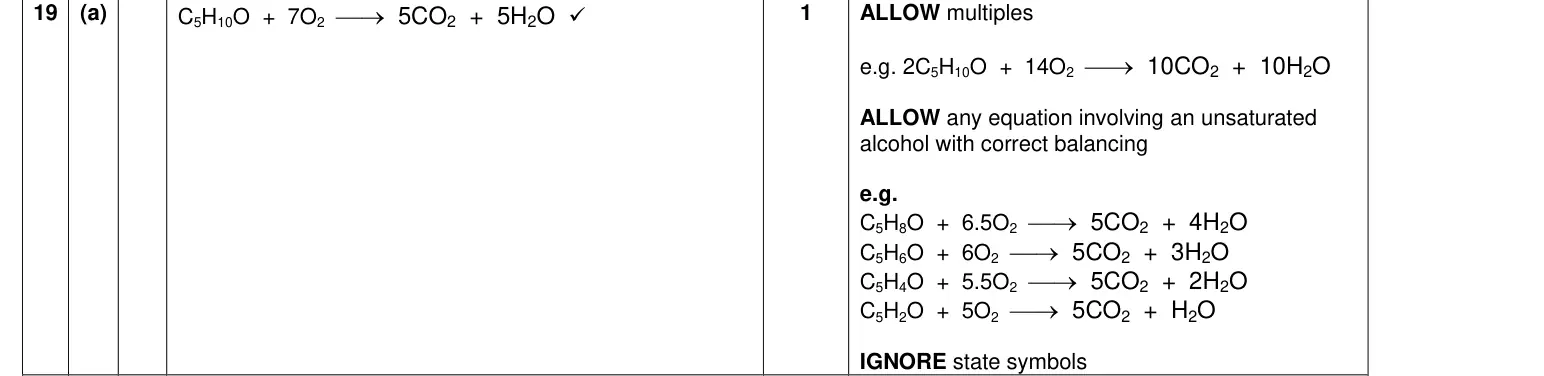
This was well answered by the majority of candidates. Where the mark was missed, it was either through incorrect products or incorrect balancing of oxygen.
Notes from the mark scheme and report
ALLOW multiples
IGNORE state symbols
Skills: M0.2 Use ratios, fractions and percentages
June 2025 · Paper 2 · Q16(d)1 markEquation writingMedium
Mark scheme
Examiner's comment
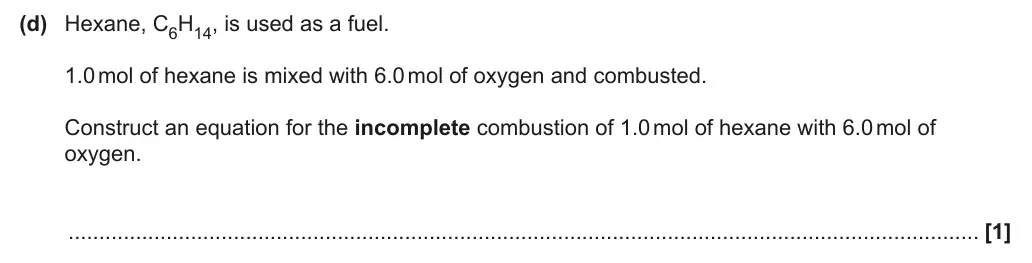
Most candidates were unable to gain credit here. The most common incorrect response given was C6H14 + 6O2 → 6CO + 7H2O which doesn’t balance in terms of oxygen. A significant number recognised that this was not balanced so gave C6H14 + 6.5O2 → 6CO + 7H2O but this misses the crucial 1:6 ratio of fuel/hexane to oxygen required in the question. Some gave H2 as a product of incomplete combustion, e.g. C6H14 + 6.5O2 → 6CO + 6H2O + H2. Candidates need to be reminded that C or CO will form in a limited supply of O2 but not H2. Candidates seemed unaware that multiple C products of combustion can be formed in one reaction. A few gave O2 as a product as well as a reactant.
Notes from the mark scheme and report
C6H14 + 6O2 → 5CO + C + 7H2O (or other CO/CO2/C combinations in a 1:6 ratio)
DO NOT ALLOW H2 as a product
Skills: M0.2 Use ratios, fractions and percentages
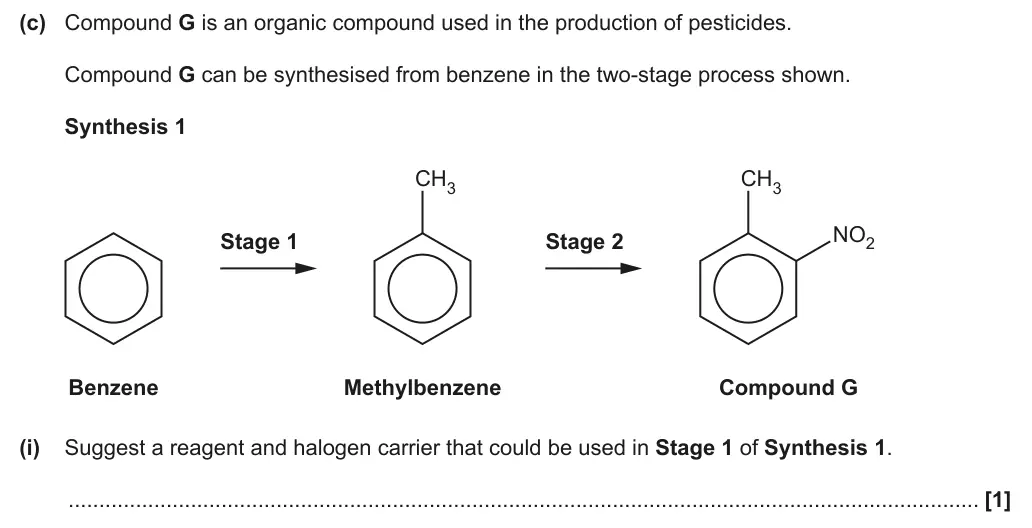
June 2025 · Paper 2 · Q20(c)(iv)2 marksComplete table/diagramHard
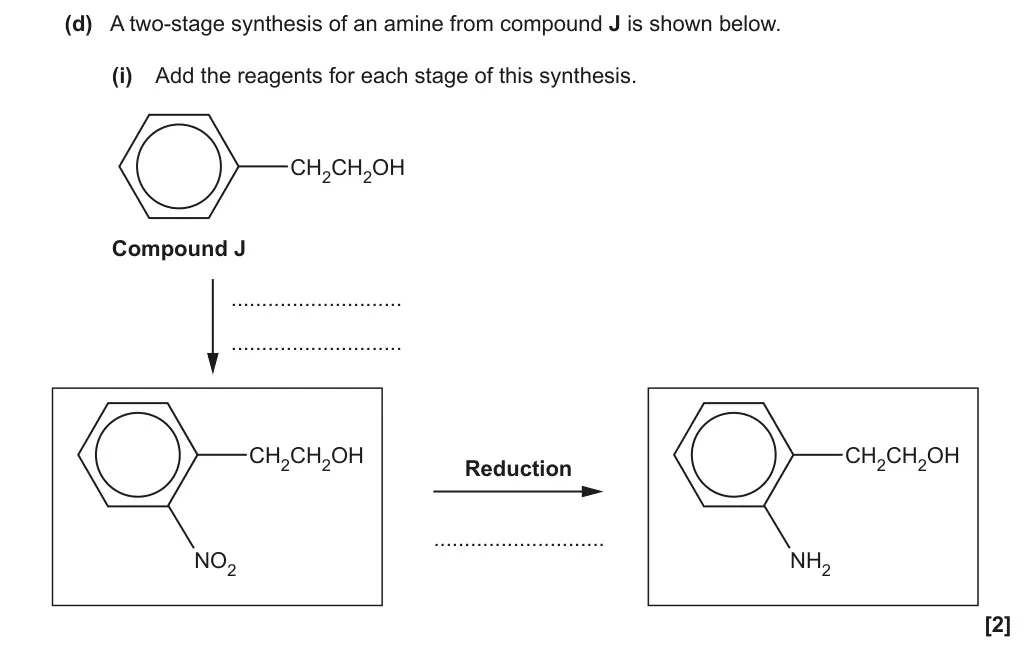
Earlier part of question 20 that this part uses
Mark scheme
Examiner's comment
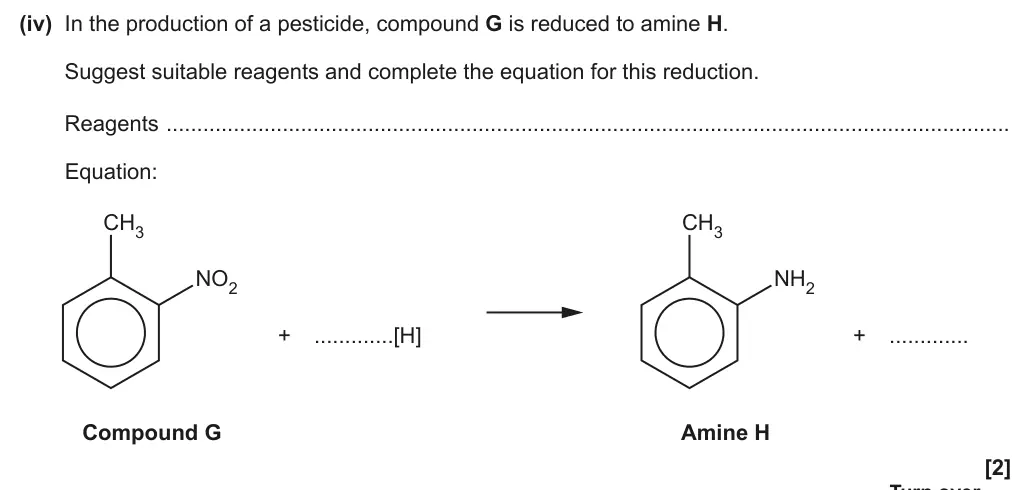
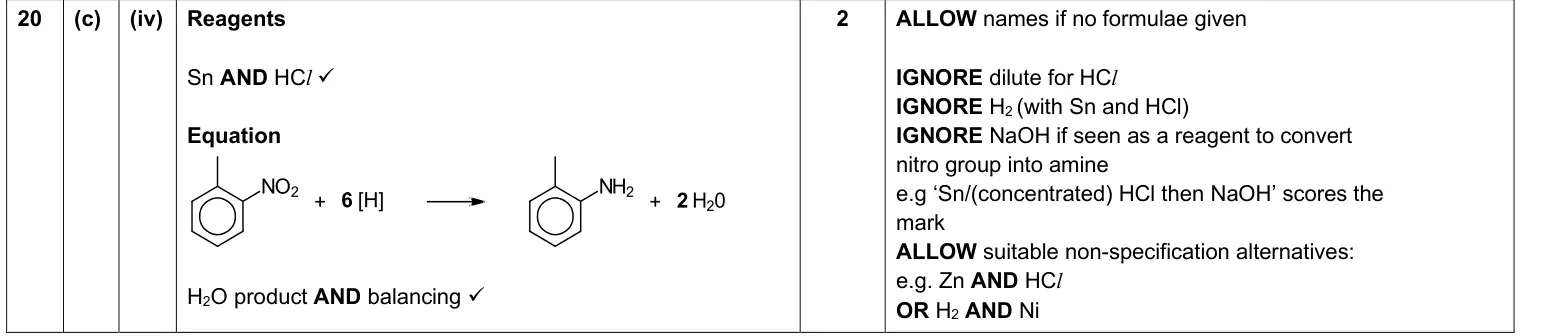
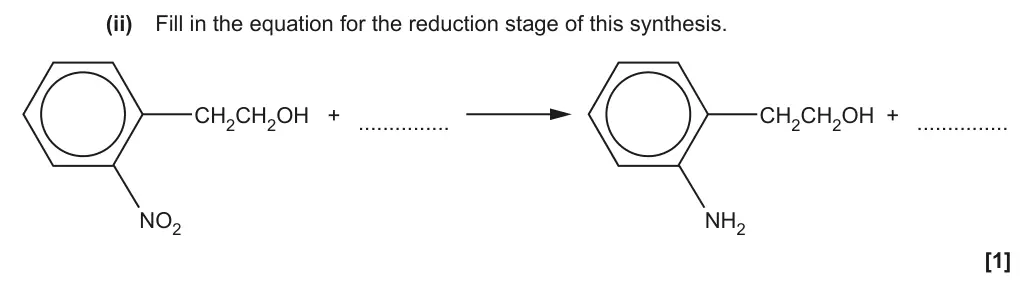
Most were able to correctly identify reagents for the reaction, with Sn/HCl being the most common response and a small number giving H2/Ni. Many incorrectly suggested NaBH4 or LiAlH4 as the reagent. A few had NH3 as reagent. Lots of candidates struggled to correctly complete and balance the equation despite both organic reactant/product and [H] being given. Some were confused by the use of [H] representing the reducing agent, so added reagents to the line, e.g. 3H2 [H], or NH3 [H]. A common error seen for balancing was 2[H] → O2.
Notes from the mark scheme and report
Sn AND HCl
6[H] and 2H2O
IGNORE NaOH added afterwards
ALLOW Zn/HCl or H2/Ni
Skills: M0.2 Use ratios, fractions and percentages
June 2024 · Paper 1 · Q20(a)(ii)2 marksEquation writingEasy
Mark scheme
Examiner's comment
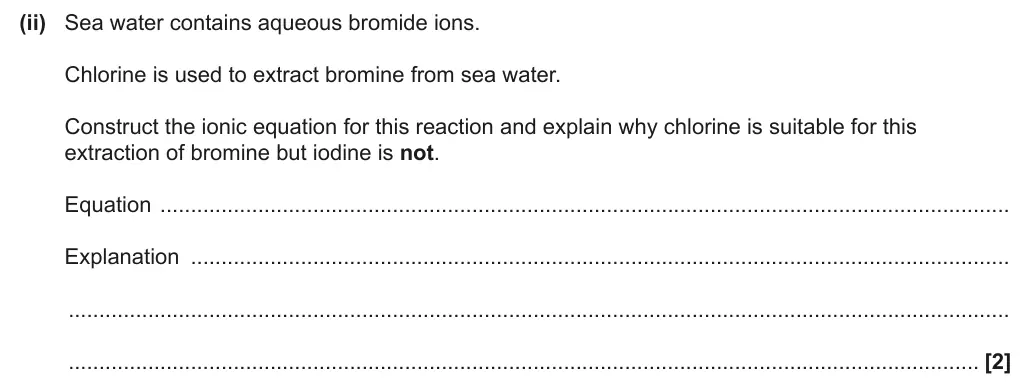
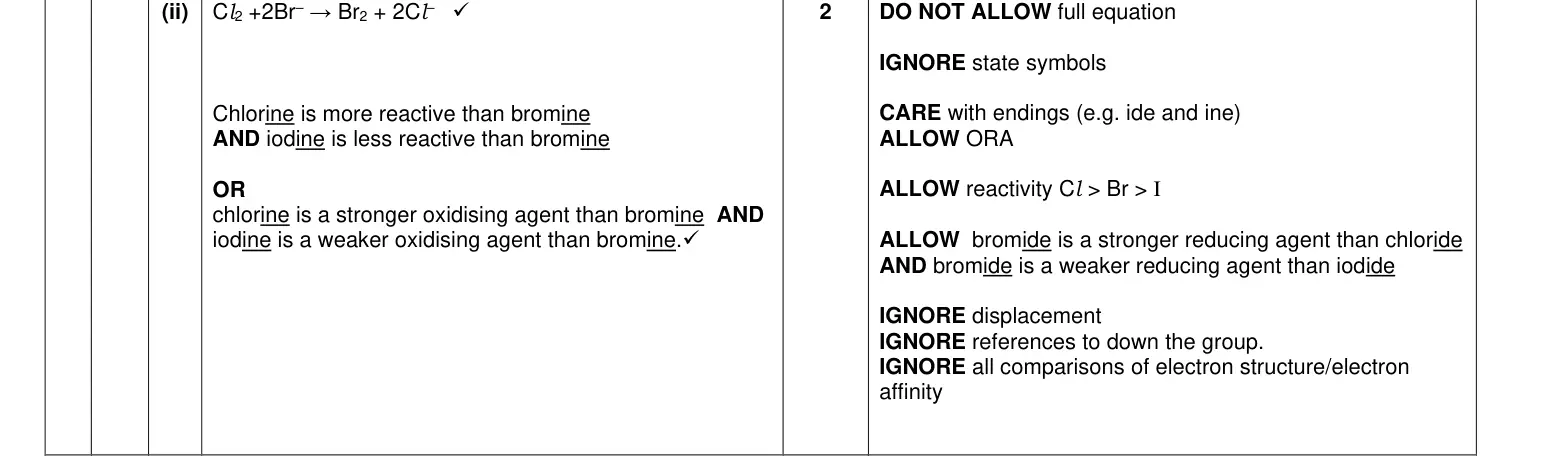
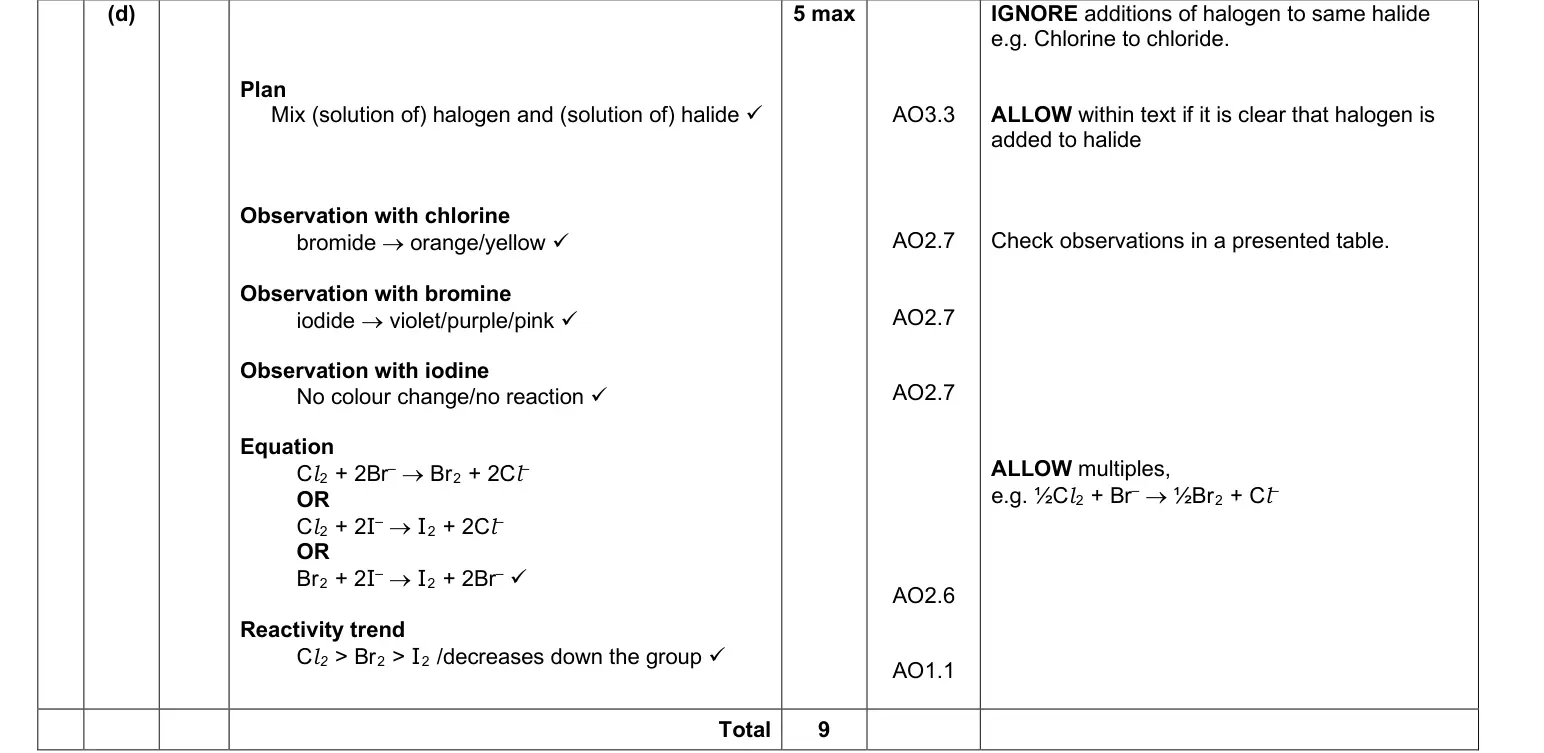
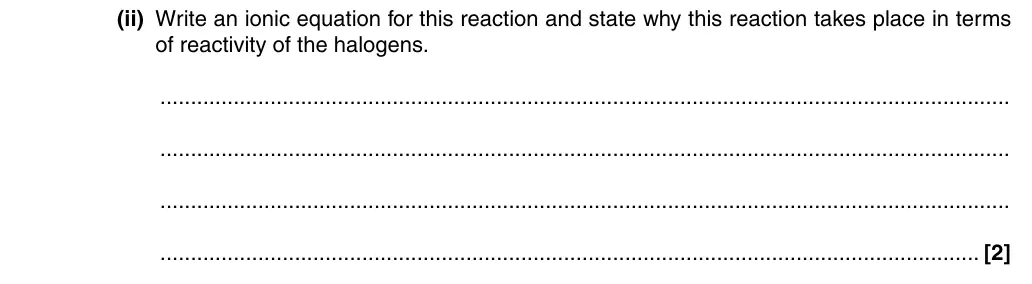
Most students scored the equation mark, although some presented unbalanced equations. Nearly all candidates used the ionic equation. Explanations were well argued with most candidates using the order of reactivity. A few considered the oxidising power of the halogen. Candidates are advised to ensure that both comparisons are clearly made, and it is obvious which of the two halogens the response is referring to. It is also important that candidates can distinguish between a halogen and a halide. Some candidates explained in terms of electronegativity and displacement.
Notes from the mark scheme and report
ionic equation required (DO NOT ALLOW full equation)
compare reactivity/oxidising strength of Cl2, Br2 and I2
care with -ide/-ine
We have produced a teacher and delivery guide to assist with learning about the reaction of group 7 elements and their compounds: Teach Cambridge (ocr.org.uk)
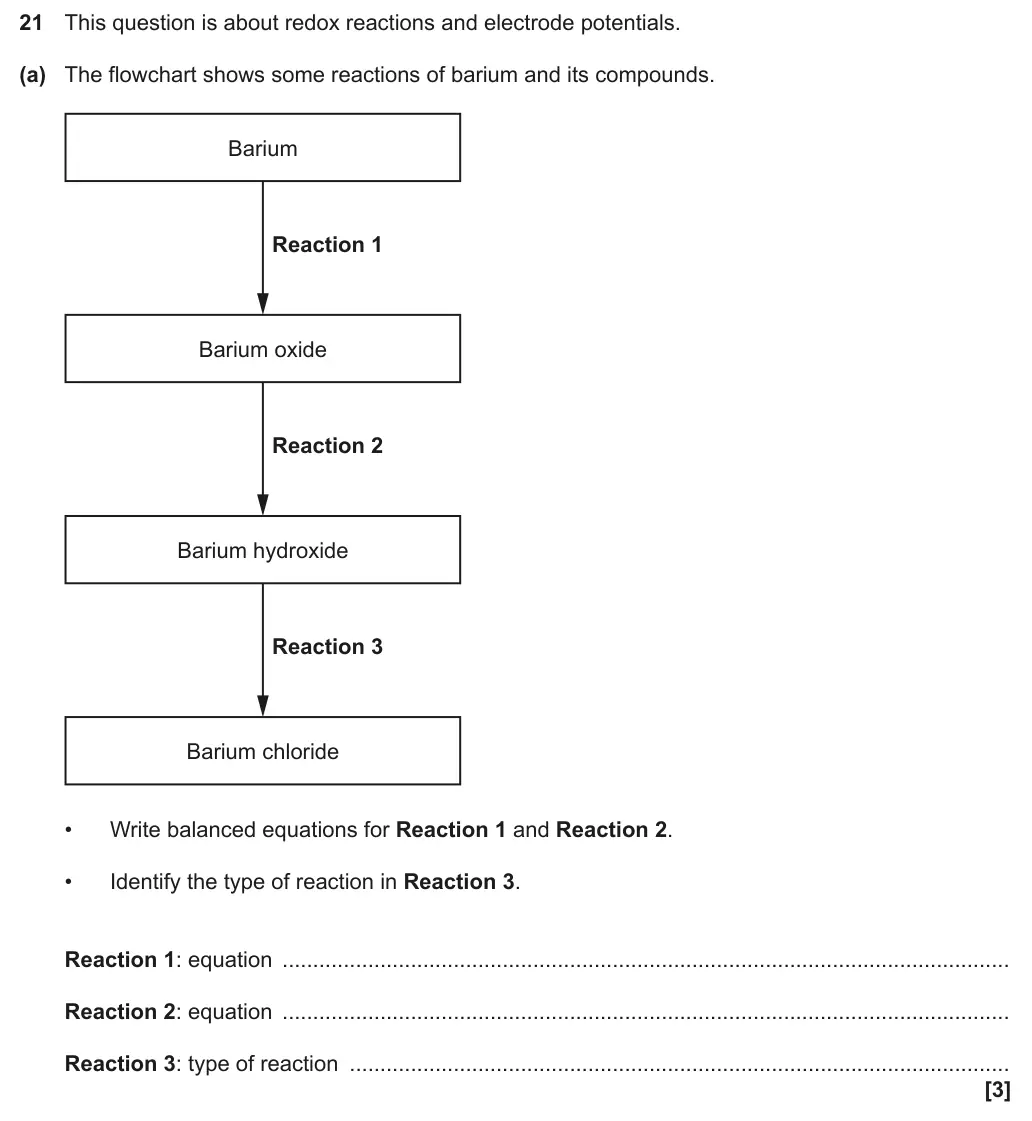
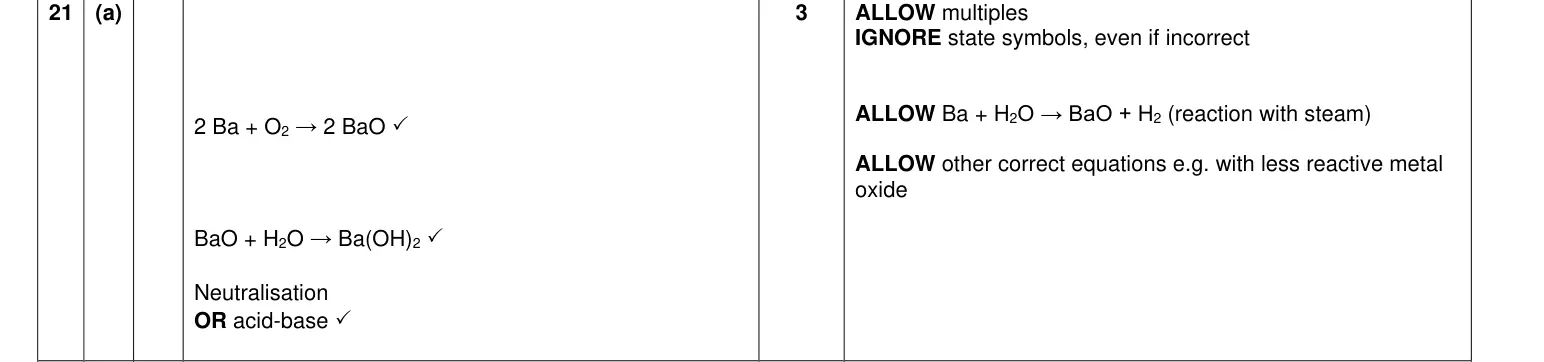
June 2024 · Paper 1 · Q21(a)3 marksEquation writingMedium
Mark scheme
Examiner's comment
Some candidates coped well with this question which was based on the AS part of the specification and gained all three marks. Common errors were for unbalanced equations in reaction 1 or adding H2 to the product of reaction 2. Reaction 3 was often, incorrectly, considered as: redox, halogenation, nucleophilic substitution or a precipitation reaction.
Notes from the mark scheme and report
ALLOW multiples
IGNORE state symbols
Reaction 3 = neutralisation/acid–base
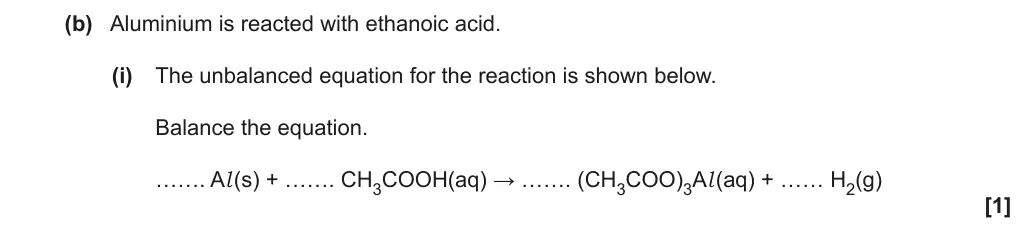
Regular practice writing formulae and balancing chemical equations will help to consolidate these concepts, avoiding basic errors such as giving formula of group 2 hydroxide as BaOH.
We have produced a topic exploration pack to assist with learning about the reaction of group 2 elements and their compounds: Teach Cambridge (ocr.org.uk)
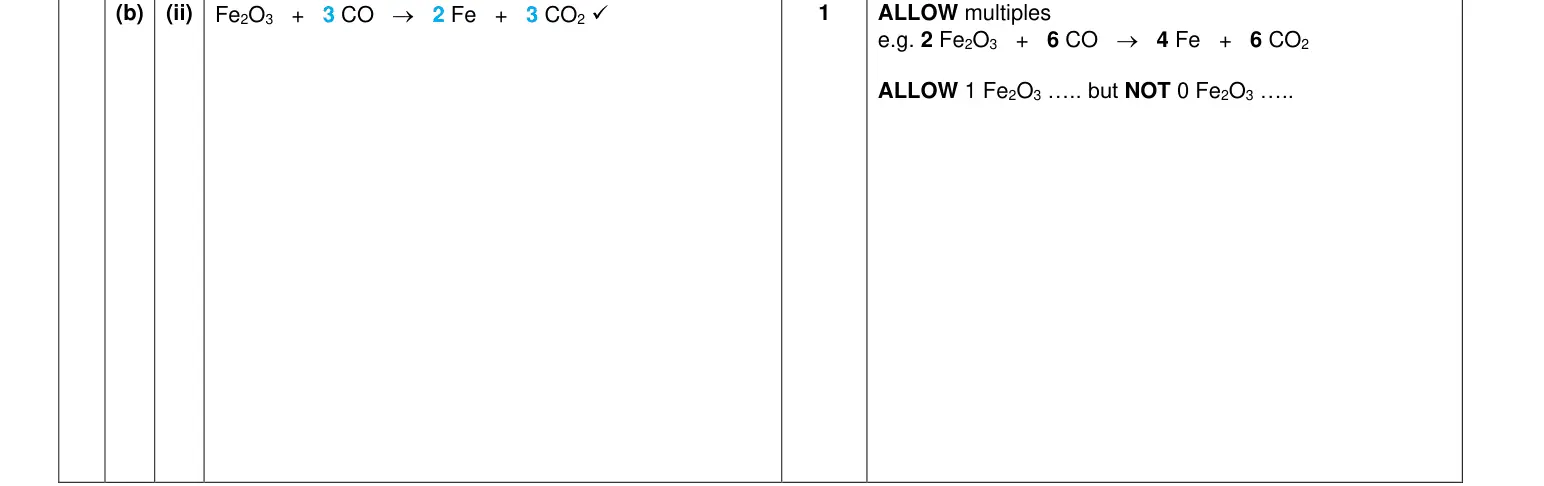
June 2024 · AS Paper 1 · Q21(b)(ii)1 markEquation writingEasy
Earlier part of question 21 that this part uses
Mark scheme
Examiner's comment
Most candidates were able to balance this straightforward equation.
Notes from the mark scheme and report
ALLOW multiples
Skills: M0.2 Use ratios, fractions and percentages
June 2024 · AS Paper 1 · Q25(a)2 marksComplete table/diagramMedium
Mark scheme
Examiner's comment
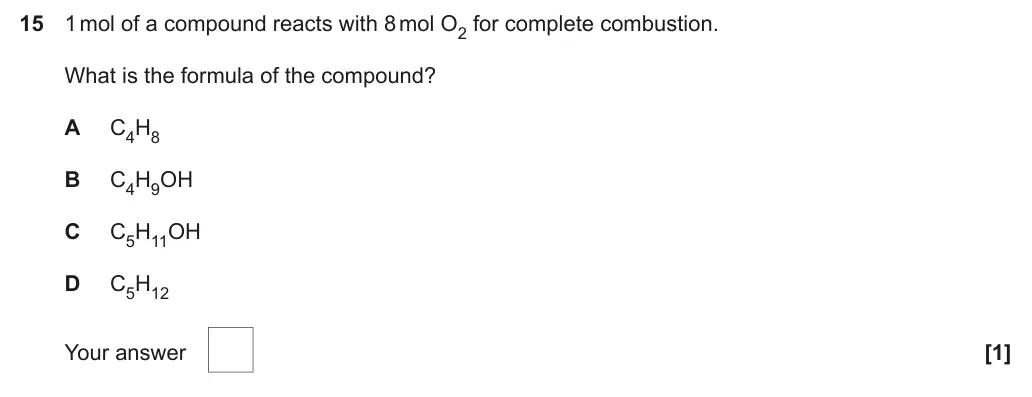
Most candidates identified the correct products of this combustion as CO2 and H2O. The second mark was available for a balanced equation but many balanced O2 with an 8 rather than with 7½. Candidates need to be very careful when writing equations for the combustion of alcohols as it is easy to miss the O atom within the alcohol formula.
Notes from the mark scheme and report
C5H12O + 7½O2 → 5CO2 + 6H2O
ALLOW multiples
Skills: M0.2 Use ratios, fractions and percentages
June 2024 · AS Paper 2 · Q2(c)(ii)2 marksEquation writingMedium
Earlier part of question 2 that this part uses
Mark scheme
Examiner's comment
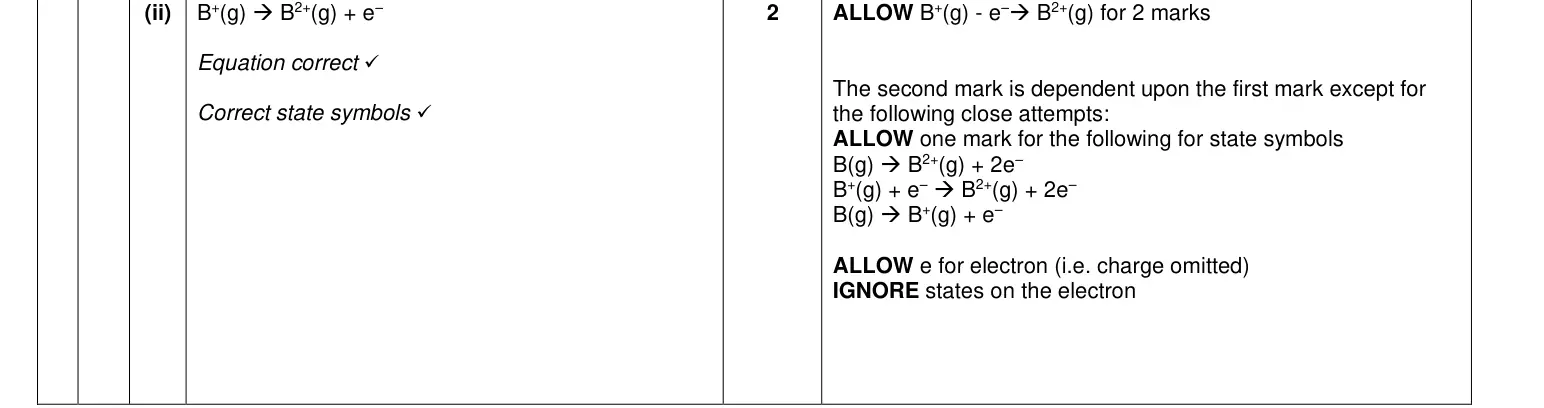
More than half of candidates scored both marks here. Errors seen included missing or incorrect state symbols, especially (s), but also (aq) was seen. Some had electrons on the left hand side of the equation, i.e. ‘B+ + e- → Be2+’. Some included negatively charged ions and occasionally the wrong element was used, e.g. Mg or Be.
Notes from the mark scheme and report
B+(g) → B2+(g) + e–
state-symbol mark dependent on correct equation except for listed near-misses (e.g. B(g) → B2+(g) + 2e–)
June 2024 · Paper 2 · Q20(b)(ii)4 marksEquation writingHard
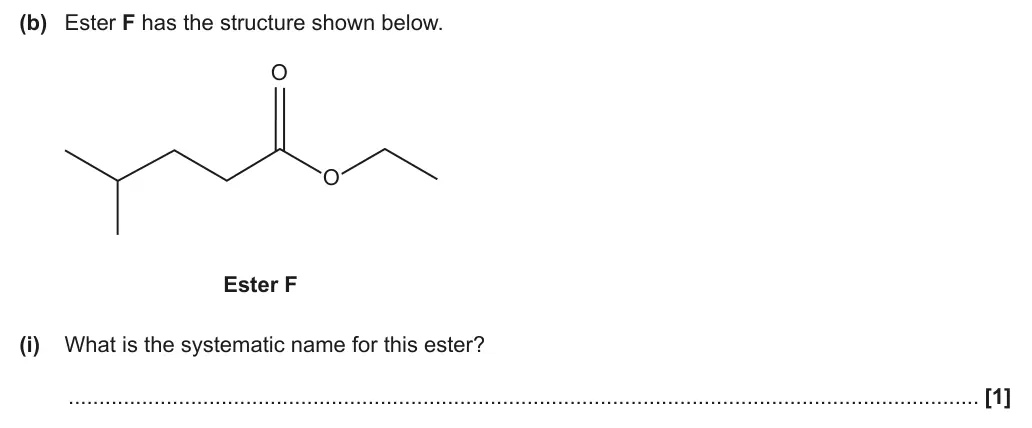
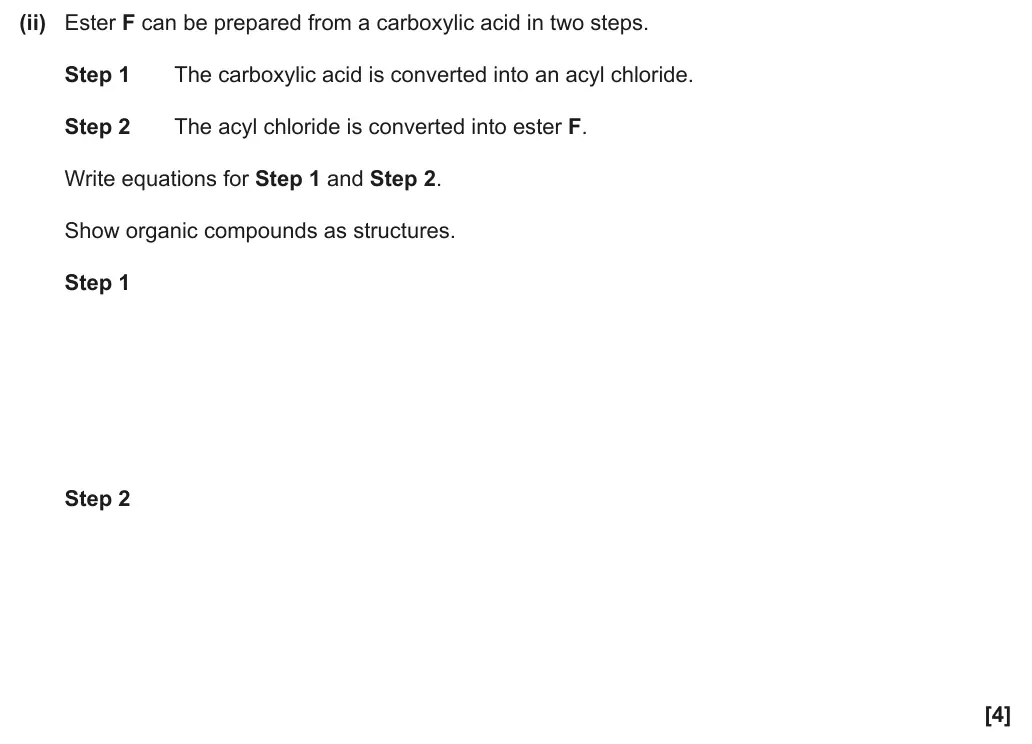
Earlier part of question 20 that this part uses
Mark scheme
Examiner's comment
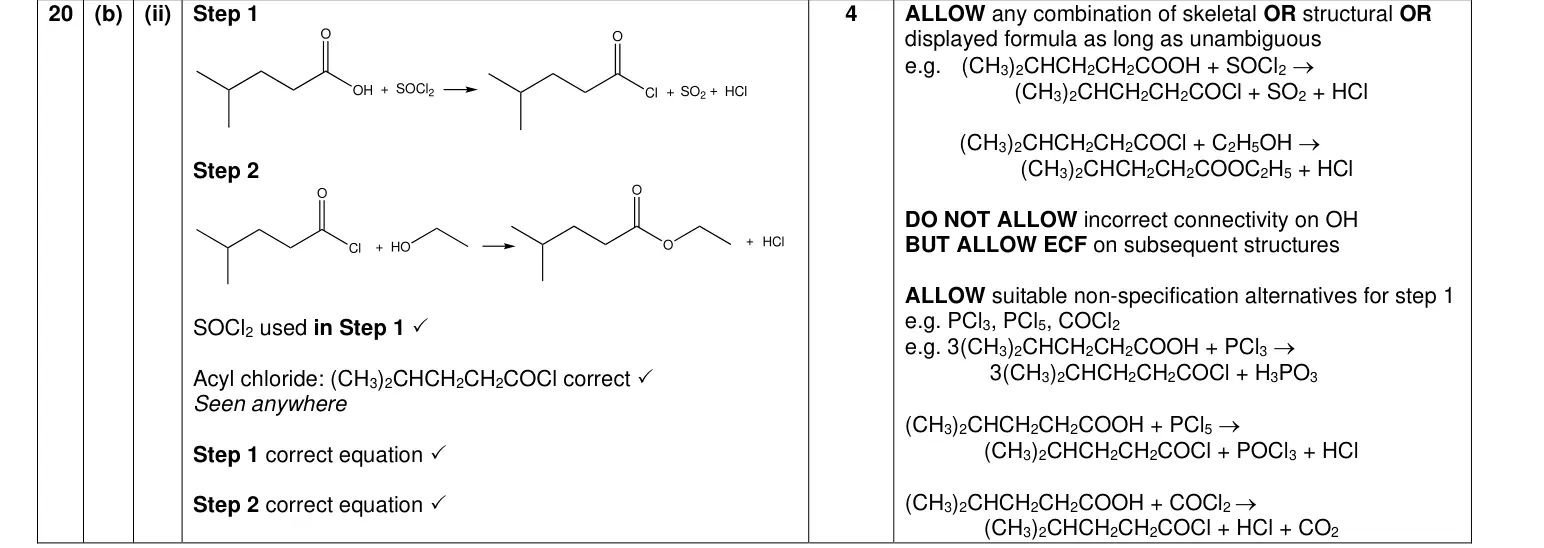
This question differentiated between candidates well with the full range of marks seen. Some couldn’t identify the correct reagent to use to form an acyl chloride i.e. SOCl2, so lost 2 marks for the first step. Use of HCl as an alternative was common. A significant number used SOCl2 but struggled to balance the equation. Many made errors with structures used, for example missing the CH3 side chain, adding CH3 to 3-position instead 4, inserting an additional CH2 group or using a much easier structure, e.g. ethanoic acid. None of these structures were given marks as they would not form Ester F. Some used R- instead to simplify, for which credit was given, but only if it was clear what structure R represented. Another common error was to include an additional O in the acyl chloride group i.e. COOCl not COCl. The most common error made in Step 2 was to omit the formation of HCl or to use H2O instead. A few lost the final mark for a connectivity error on ethanol i.e. OHCH2CH3.
Notes from the mark scheme and report
SOCl2 in step 1 giving acyl chloride + SO2 + HCl
acyl chloride + ethanol gives ester F + HCl
DO NOT ALLOW incorrect connectivity on OH (ECF on later structures)
June 2024 · Paper 2 · Q21(b)(ii)2 marksEquation writingMedium
Earlier part of question 21 that this part uses
Mark scheme
Examiner's comment
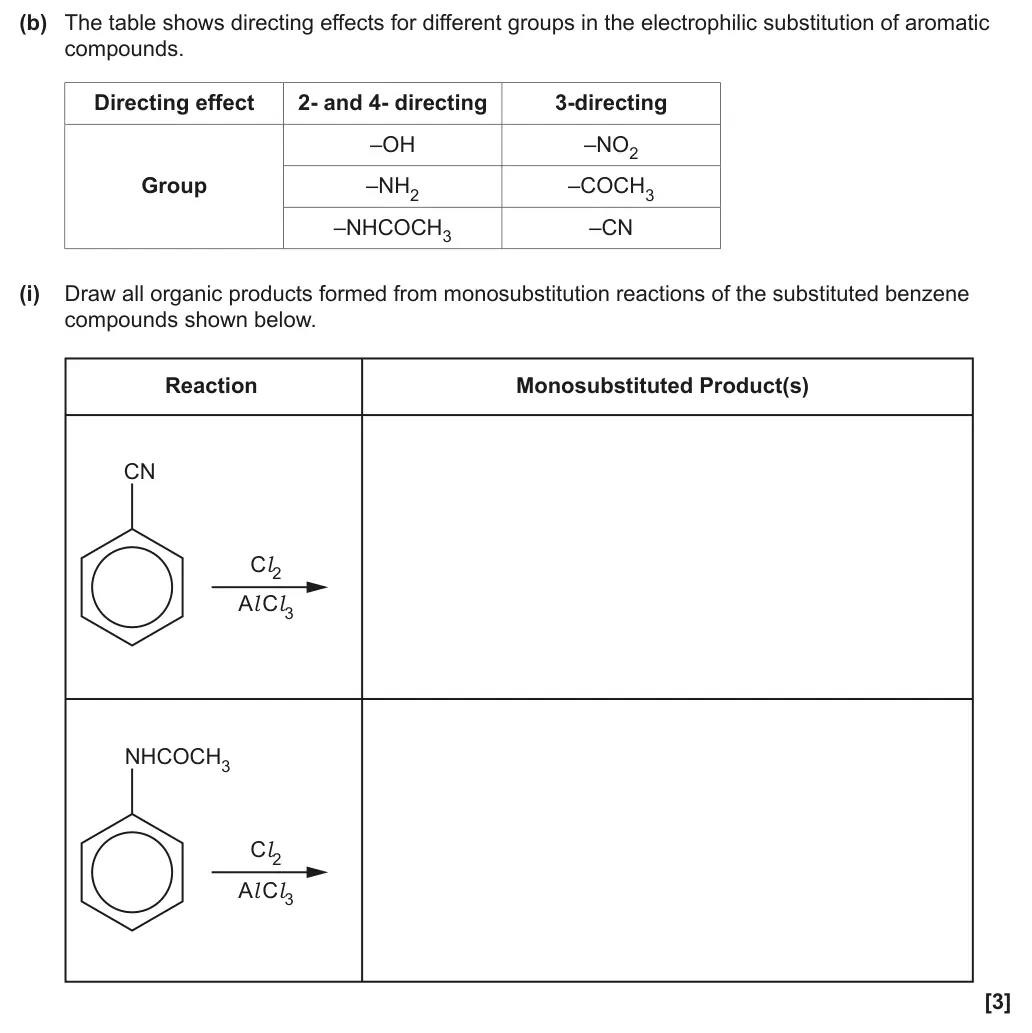
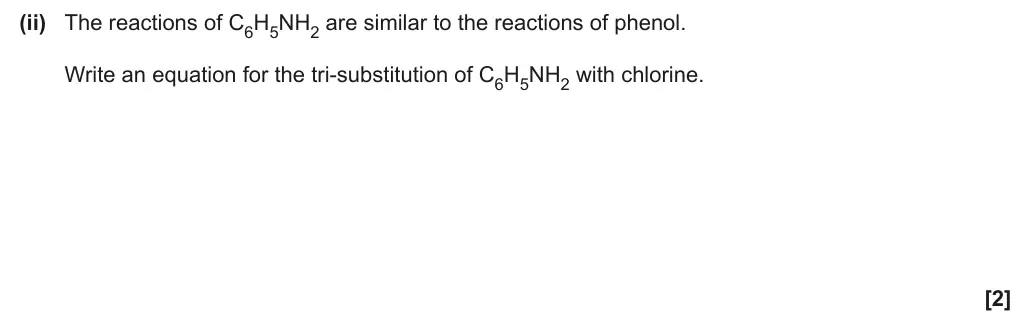
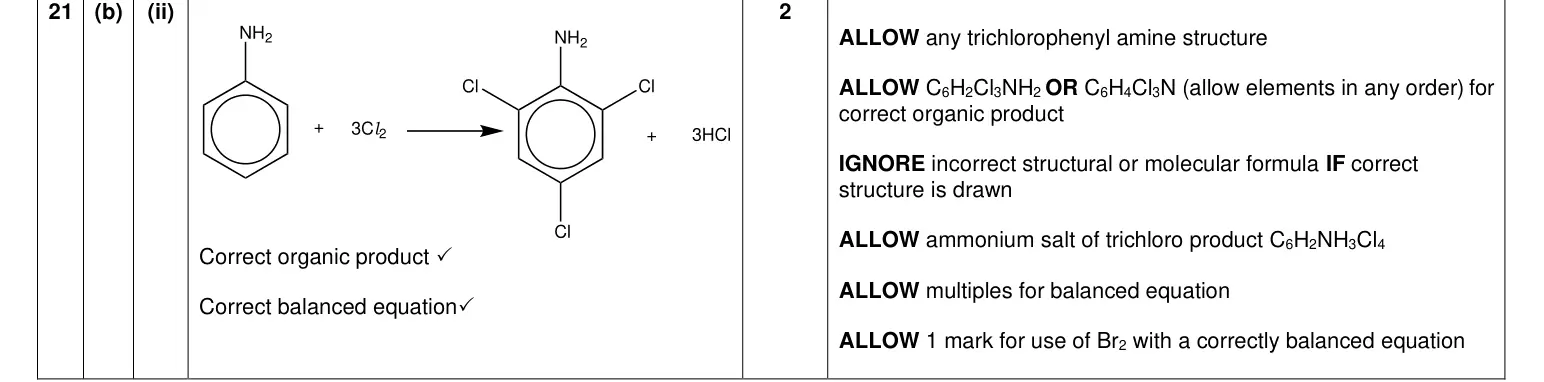
The majority of candidates were able to give a suitable tri-substituted product, with many showing the structure although not asked for in the question. Many were also able to give a correct balanced equation too. Some were unsure how phenylamine would react showing the reaction with the amine group or only giving a monosubstituted product. Some didn’t form HCl as another product, reacting phenyl amine with 1.5 Cl2 instead. Others gave hydrogen as the product.
Notes from the mark scheme and report
2,4,6-trichlorophenylamine (ALLOW any trichloro structure) + 3HCl with 3Cl2
1 mark for a balanced equation using Br2
June 2024 · Paper 2 · Q23(b)(i)3 marksEquation writingHard
Earlier part of question 23 that this part uses
Mark scheme
Examiner's comment
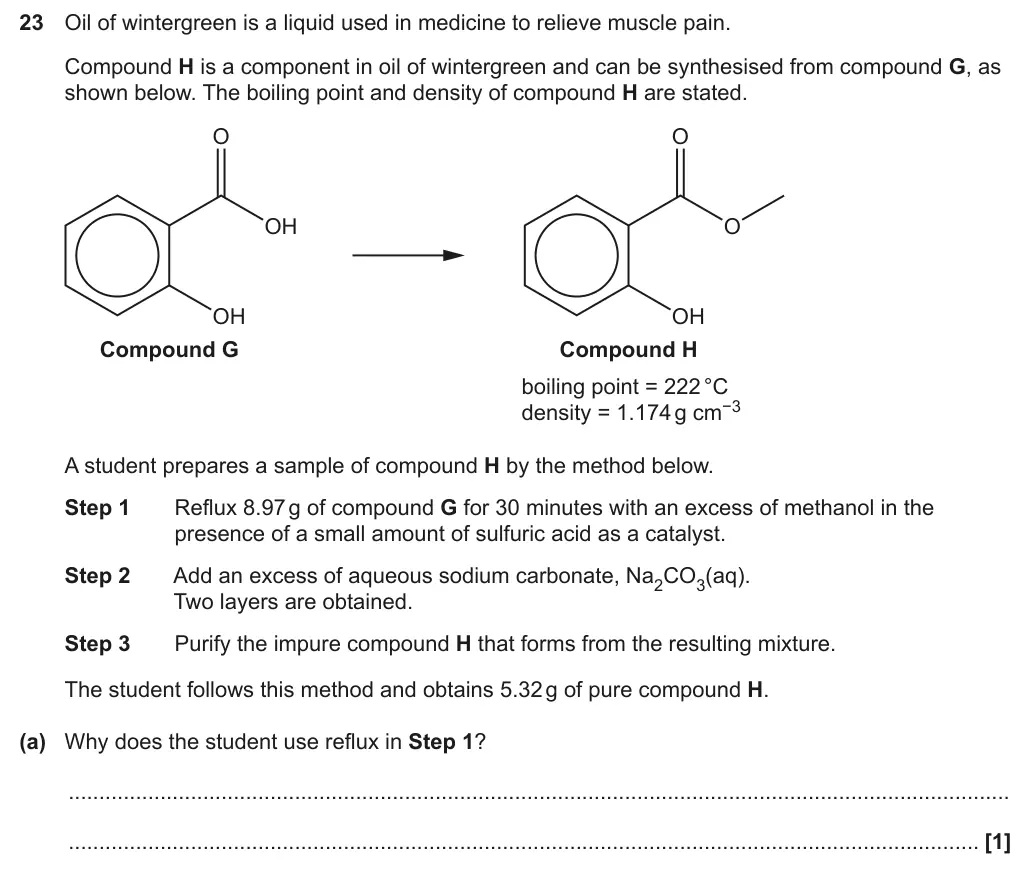
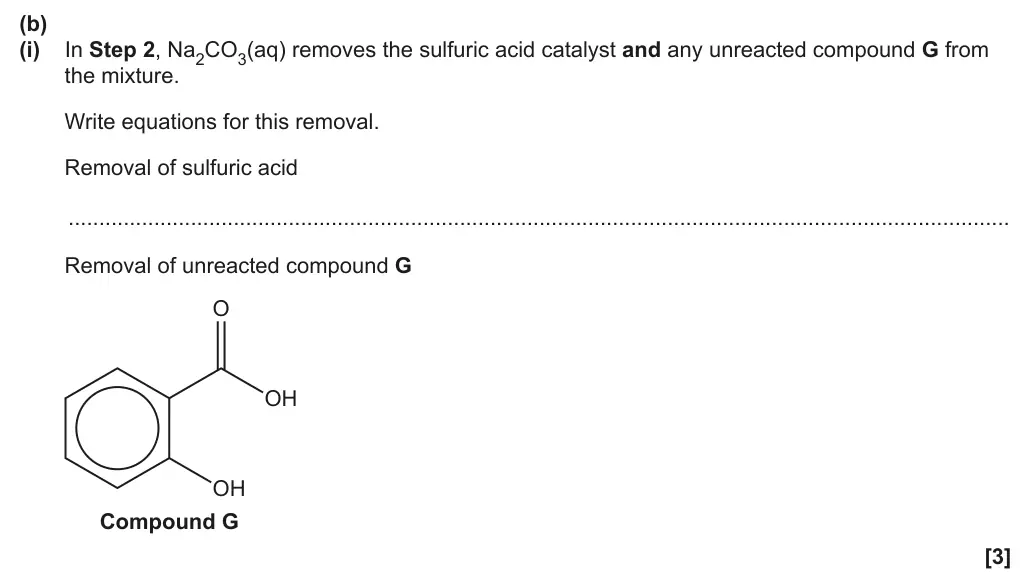
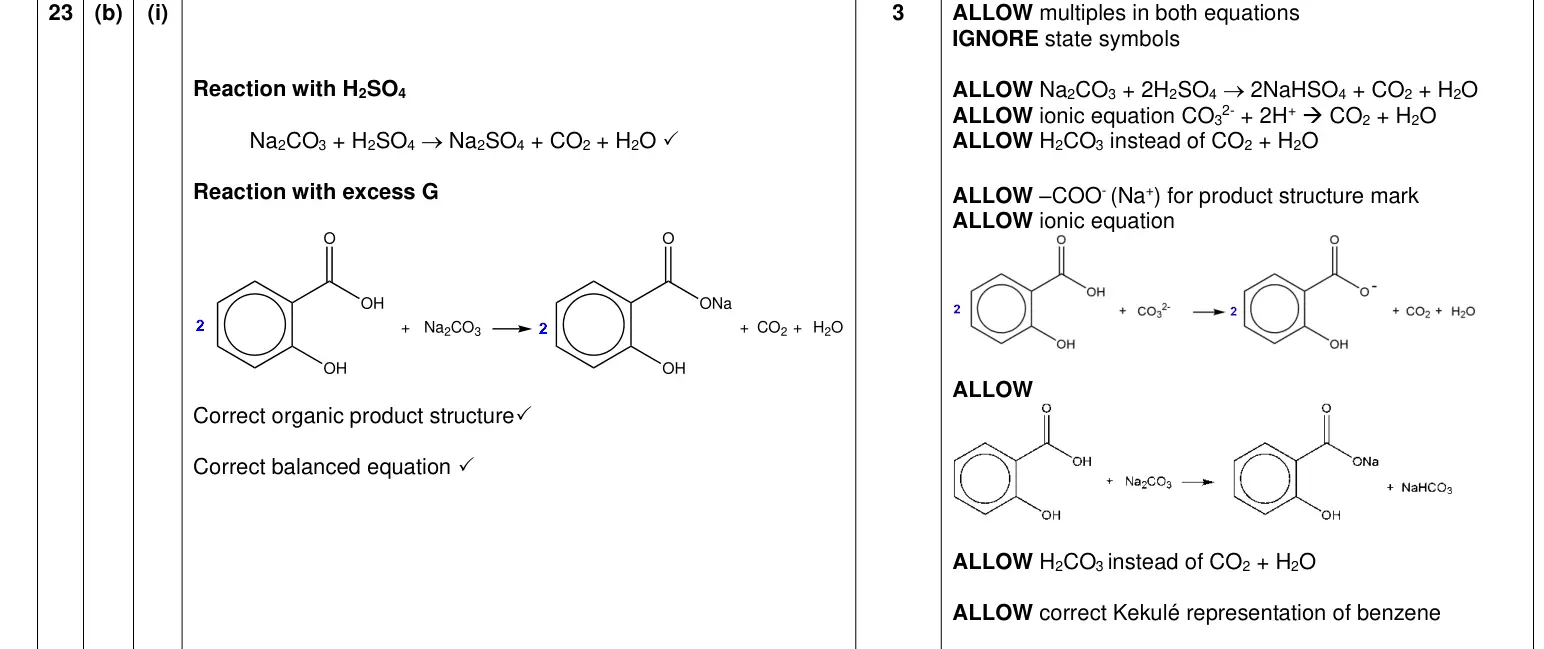
Another fairly challenging question, however most secured at least one mark for giving an equation for the reaction of sulfuric acid with sodium carbonate. Less confident candidates struggled to gain any marks as they were unable to give correct formula for sodium sulfate, giving NaSO4 for example. Although many attempted the equation showing the reaction of compound G with sodium carbonate, only some correctly identified that only the carboxyl group would react, not the phenol. A small minority of students were able to balance the second equation gaining all 3 marks.
Notes from the mark scheme and report
Na2CO3 + H2SO4 → Na2SO4 + CO2 + H2O
only the COOH of G reacts (phenol OH unchanged) giving –COONa
2 G per Na2CO3 (ALLOW 1:1 forming NaHCO3)
ALLOW ionic equations
June 2024 · Paper 3 · Q2(b)(ii)3 marksCalculationMedium
Earlier part of question 2 that this part uses
Mark scheme
Examiner's comment
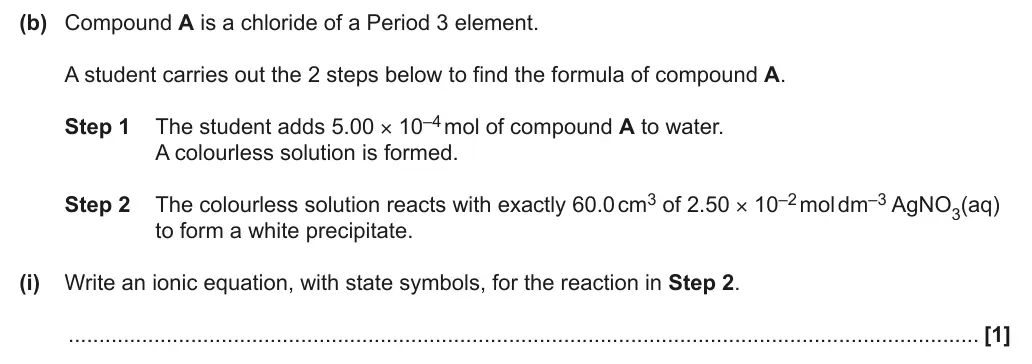
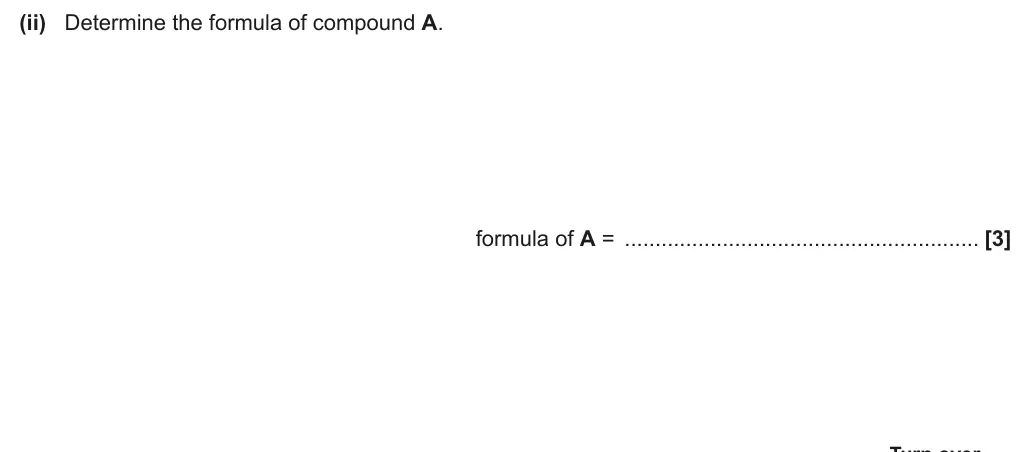
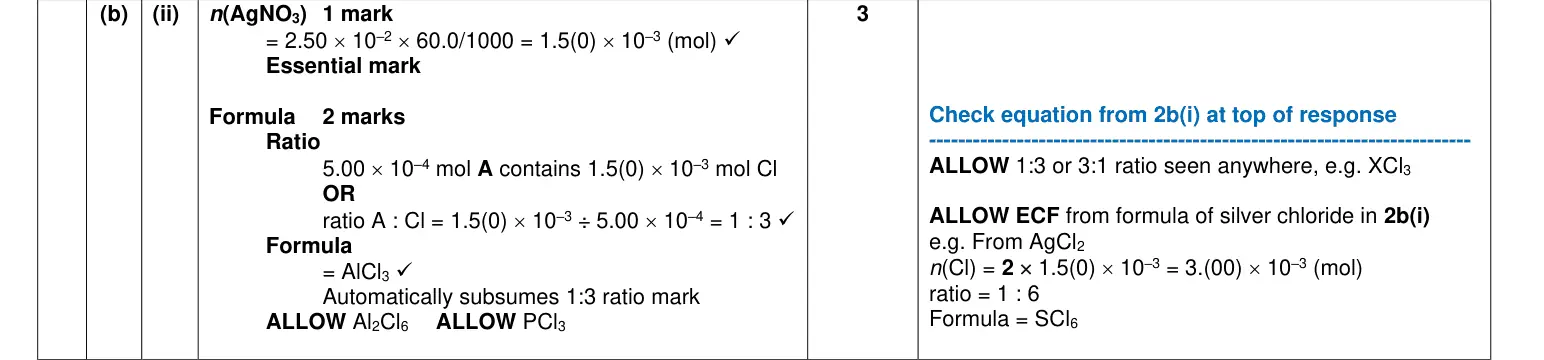
Most candidates determined the moles of AgNO3 and hence Ag+ as 1.50 × 10⁻³ mol. This was given 1 mark, but candidates then needed to use this amount to predict the identity of compound A. Most candidates could not see the way forward and many received only 1 mark. Many candidates had worked out ‘something’ from the supplied data, without knowing where this initial step would take them. Candidates needed to spot that the ratio of the element : Cl in compound A was 5 × 10⁻⁴ : 1.50 × 10⁻³ or 1 : 3. The correct formula of AlCl3 then follows. MgCl2 was a common error obtained by subtracting 5 × 10⁻⁴ from 1.50 × 10⁻³ to obtain a 1 : 2 ratio. This question would be a good exercise for improving the application skills of candidates.
Notes from the mark scheme and report
n(AgNO3) = 1.50 × 10⁻³ is the essential mark
ratio A:Cl = 1:3 so AlCl3 (ALLOW Al2Cl6 or PCl3)
ALLOW ECF from formula of silver chloride in (b)(i)
Skills: M0.2 Use ratios, fractions and percentages
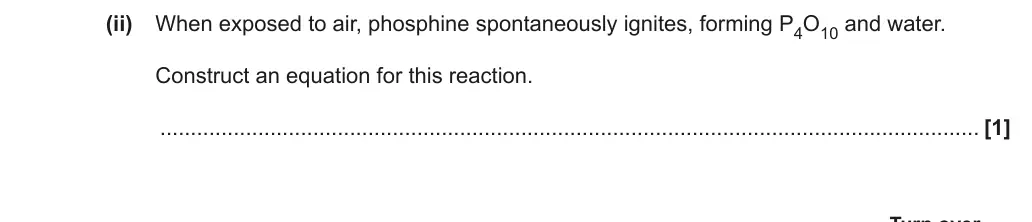
June 2024 · Paper 3 · Q4(b)(i)1 markEquation writingMedium
Mark scheme
Examiner's comment
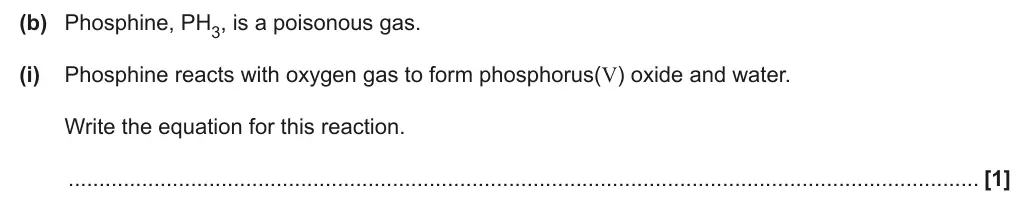
Candidates found this question quite challenging, with only about one-third writing a correct equation. The question gave the reactants and products with only the formula of phosphorus(V) oxide having to be worked out. The actual reaction does produce P4O10 but P2O5 was shown in almost all equations, and this was acceptable. Various incorrect formulae were seen for phosphorus(V) oxide including PO, PO2, P5O, HPO, etc. Unfortunately a significant number of candidates could not balance the equation, despite using correct formulae.
Notes from the mark scheme and report
4PH3 + 8O2 → P4O10 + 6H2O
ALLOW P2O5 version and multiples
IGNORE state symbols
Skills: M0.2 Use ratios, fractions and percentages
June 2024 · Paper 3 · Q4(b)(ii)3 marksEquation writingHard
Earlier part of question 4 that this part uses
Mark scheme
Examiner's comment
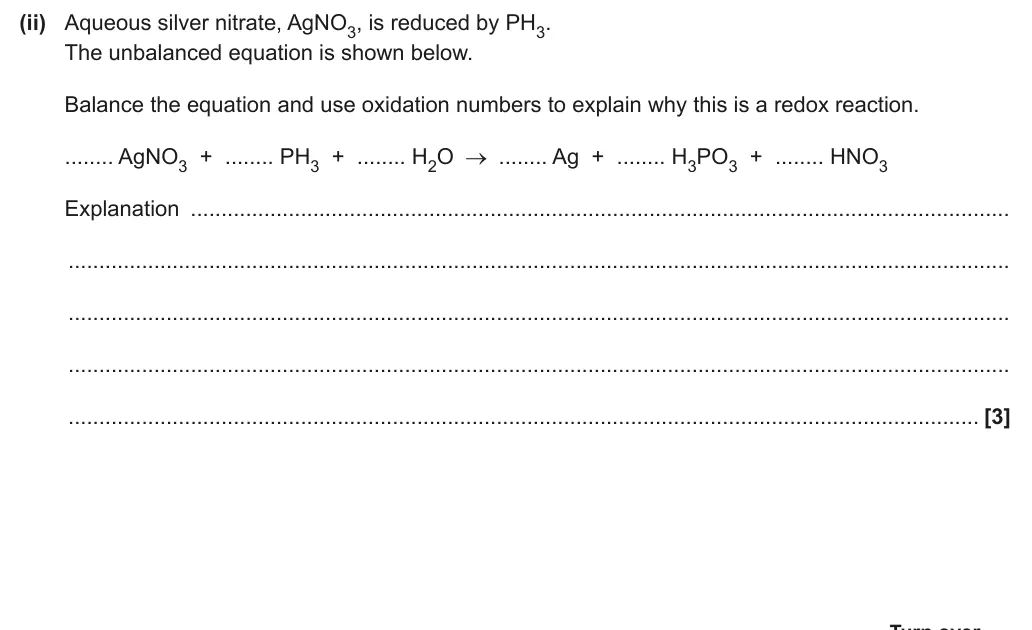
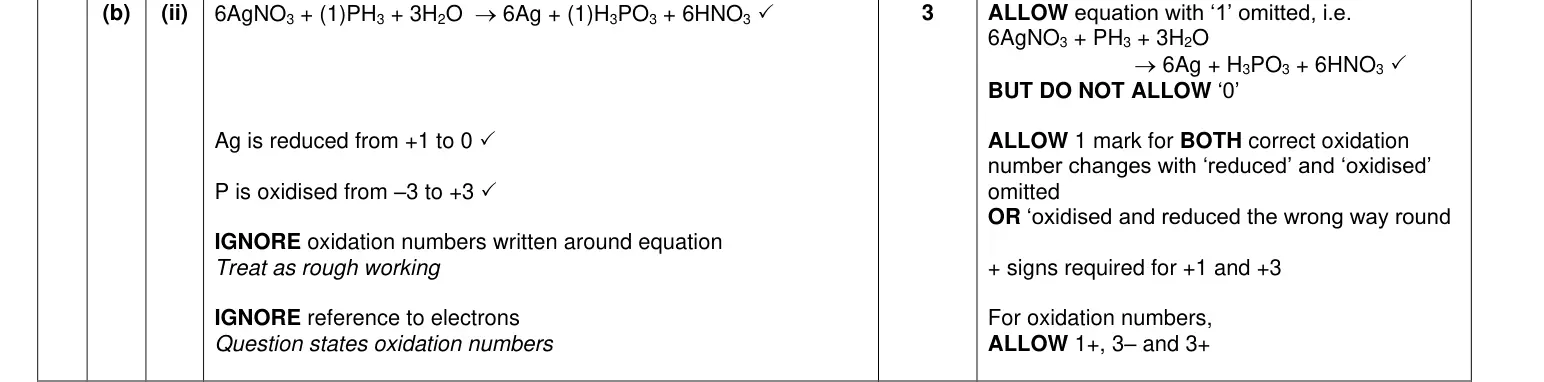
This question generated a wide range of responses, testing many important chemical skills. Candidates often used oxidation numbers correctly to show that silver is reduced and phosphorus oxidised, with silver being the easier. Hydrogen was sometimes incorrectly chosen for oxidation. The oxidation number change of +1 to 0 for silver was usually correct although +9 and +11 were common errors for silver in AgNO3, presumably by choosing the oxidation number of nitrogen as –3 or – 5. Candidates usually recognised that phosphorus started with an oxidation number of –3 but the oxidation number of +5 was a common error in H3PO3. Balancing the equation was the most difficult part of this question with numbers being added almost at random. It is easier to balance equations for redox reactions by balancing the oxidation number changes first.
Notes from the mark scheme and report
6AgNO3 + PH3 + 3H2O → 6Ag + H3PO3 + 6HNO3
Ag reduced +1 to 0, P oxidised –3 to +3
+ signs required
1 mark if both changes correct but oxidised/reduced omitted or reversed
IGNORE electrons
Ag+ and NO3– are among the common ions that students should know (see also Question 4 (c) (i)).
For a NO3– ion to have a charge of 1–, the oxidation number of nitrogen must be +5. By choosing –5, the charge on NO3 would be –11 and silver would have an oxidation number of +11. This is completely unrealistic and should be rejected as it points to a serious error.
Skills: M0.2 Use ratios, fractions and percentages
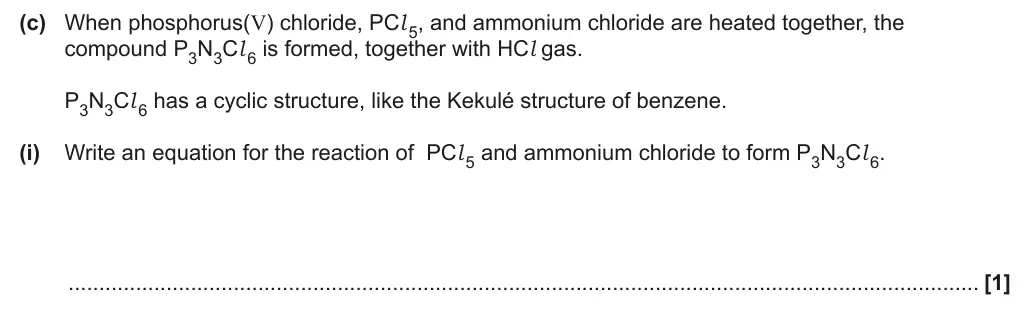
June 2024 · Paper 3 · Q4(c)(i)1 markEquation writingEasy
Mark scheme
Examiner's comment
This question again required candidates to construct an equation. Candidates were provided with the formula of all species reactants and products except for that of ammonium chloride. Candidates are expected to know that the ammonium ion is NH4+ but many incorrect equations showed NH3Cl. About half the candidates were able to construct a correctly balanced equation with the ‘12’ balancing number for HCl being the hardest part. This links back to the ‘assessment for learning’ callout added to Question 4 (b) (ii) in this report. As with other questions requiring equations to be written, this question differentiated very well. Writing formulae and balancing equations are fundamentals for mastering chemistry and candidates are advised to practise these skills throughout the course.
Notes from the mark scheme and report
3PCl5 + 3NH4Cl → P3N3Cl6 + 12HCl
ALLOW multiples
The specification states the following.
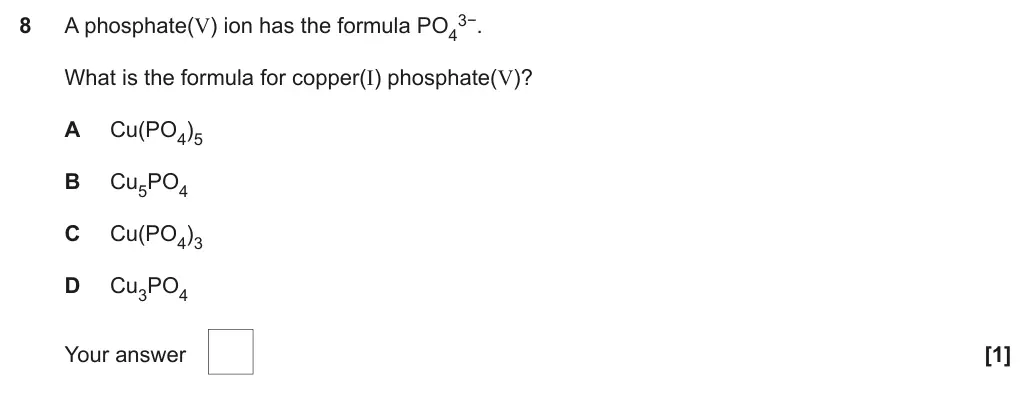
Formulae and equations 2.1.2(a) the writing of formulae of ionic compounds from ionic charges, including: (i) prediction of ionic charge from the position of an element in the periodic table (ii) recall of the names and formulae for the following ions: NO3 –, CO3 2–, SO4 2–, OH–, NH4 +, Zn2+ and Ag+ This section will be studied at the start of the two-year course and form the backbone for chemical literacy. For success in chemistry, the common ions should be learnt.
Skills: M0.2 Use ratios, fractions and percentages
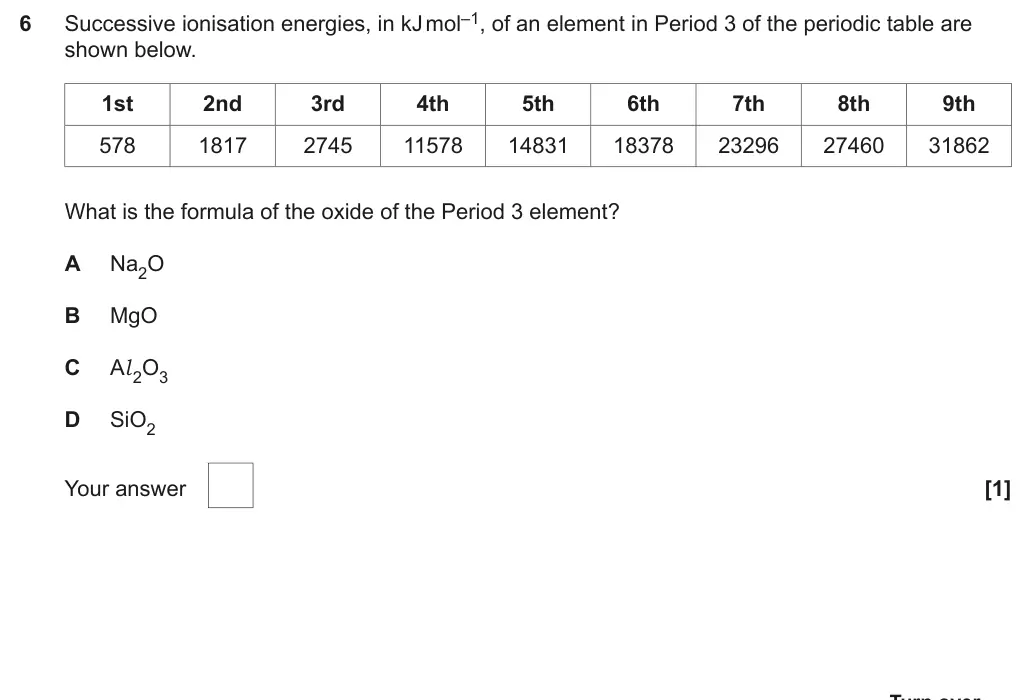
June 2023 · AS Paper 1 · Q61 markAO2Multiple choiceMedium
Answer
C
Mark scheme
Examiner's comment
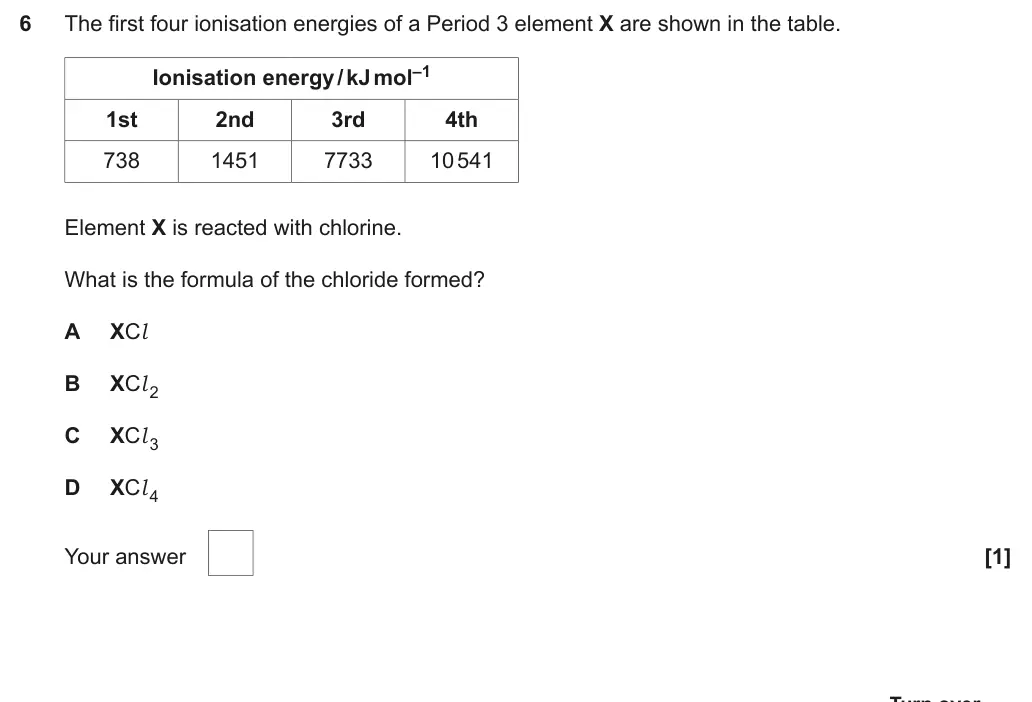
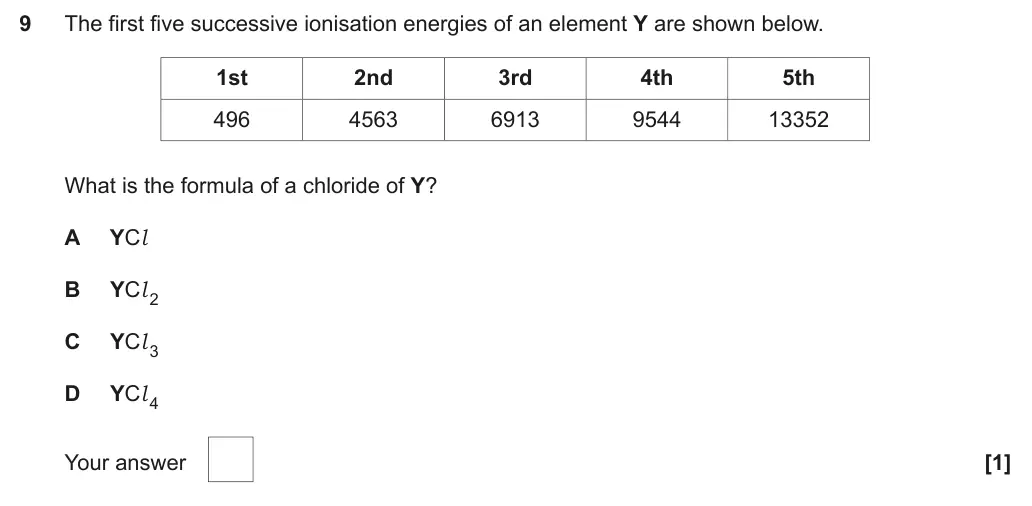
Most candidate chose the correct response of C. From the annotations on the scripts, most candidates identified the largest jump between the 3rd and 4th ionisation energies. Option D proved to be the main distractor. Having identified the correct large jump, a significant number of candidates chose the group at the end of the jump (Group 4) rather than the group at the start of the jump (Group 3). This suggests a misconception.
June 2023 · Paper 1 · Q20(c)(i)1 markAO2Equation writingMedium
Mark scheme
Examiner's comment
This was often answered correctly but some candidates gave the incorrect formulae for Sr(NO3)2 and either no other product or H2 gas.
Notes from the mark scheme and report
DO NOT ALLOW H2CO3 for H2O + CO2 (a gas is produced)
ALLOW multiples
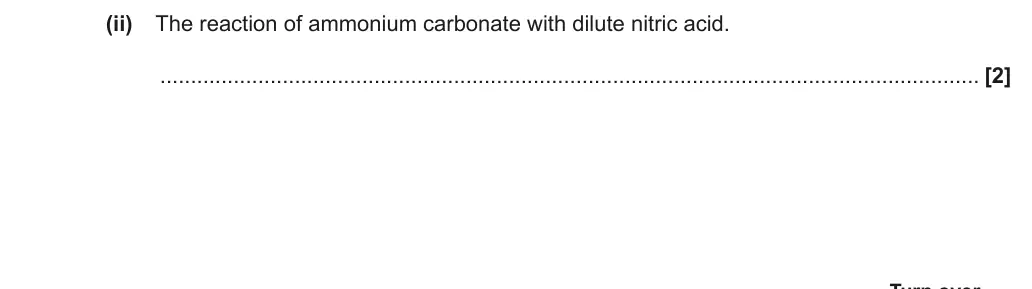
June 2023 · AS Paper 1 · Q22(b)(ii)2 marksAO2Short answerMedium
Earlier part of question 22 that this part uses
Mark scheme
Examiner's comment
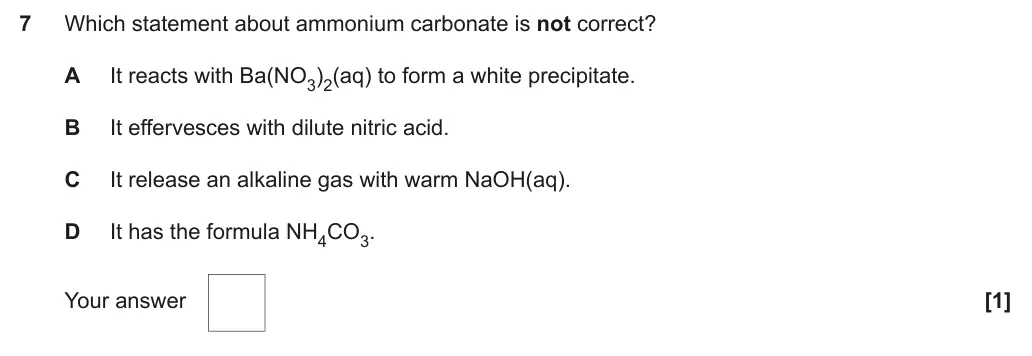
This item was much more demanding than the equation in 22(b)(i) and was often answered incorrectly. Most were unable to work out the formula of the two ammonium compounds, with NH3 often shown instead of NH4. A mark was available for 4 of the 5 formulae being correct but comparatively few were able to construct the correct balanced equation. Candidates are expected to know the formula and charge of ammonium and carbonate ions and the common acids (sulfuric, hydrochloric and nitric) and these are clearly listed in the specification.
Notes from the mark scheme and report
any 4 formulae correct for 1 mark
all 5 correct and balanced for 2
ALLOW H2CO3 for CO2 + H2O
Skills: M0.2 Use ratios, fractions and percentages
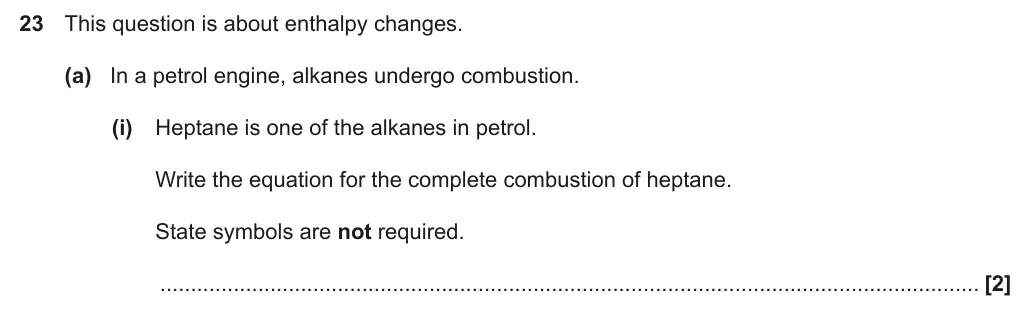
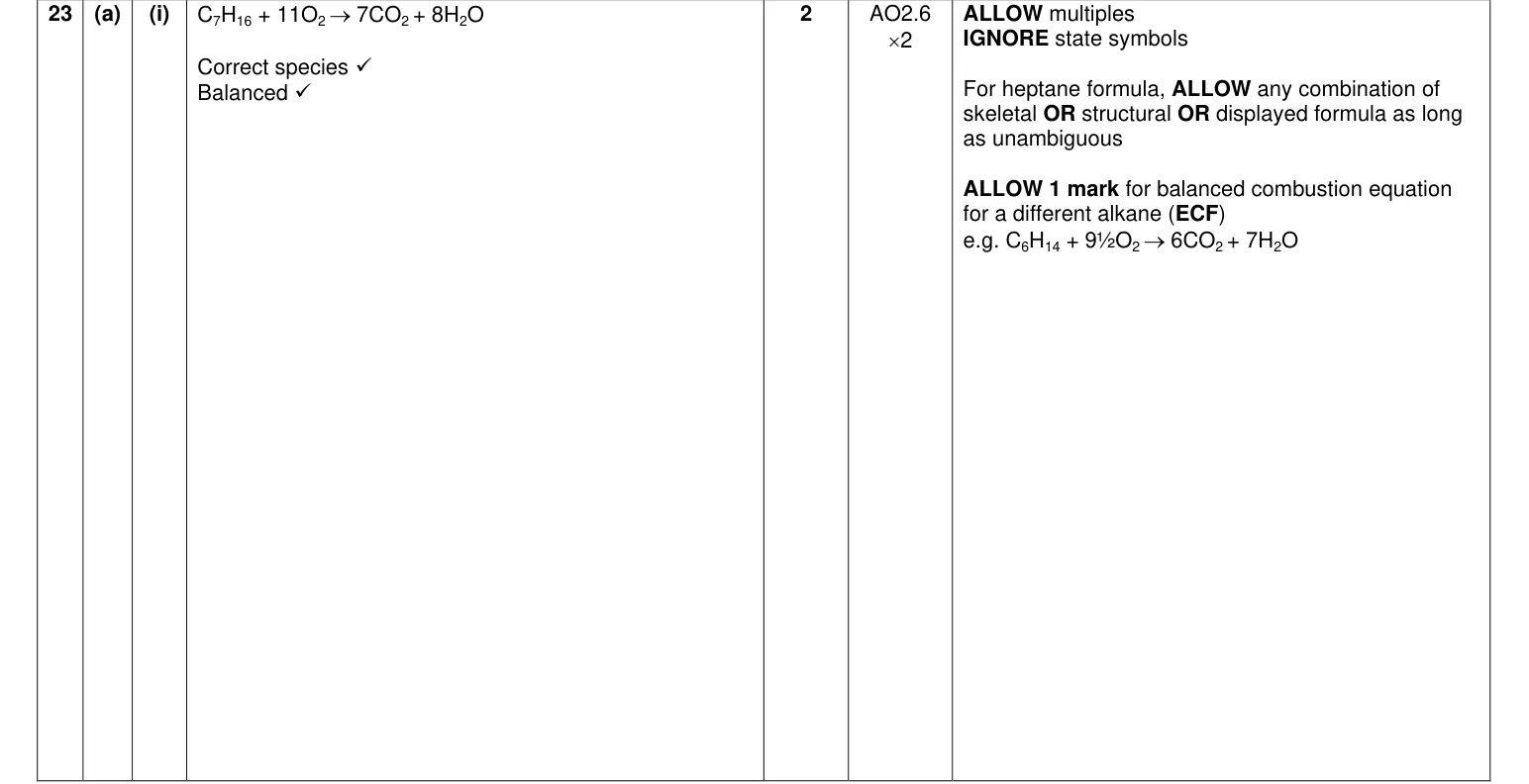
June 2023 · AS Paper 1 · Q23(a)(i)2 marksAO2Equation writingEasy
Mark scheme
Examiner's comment
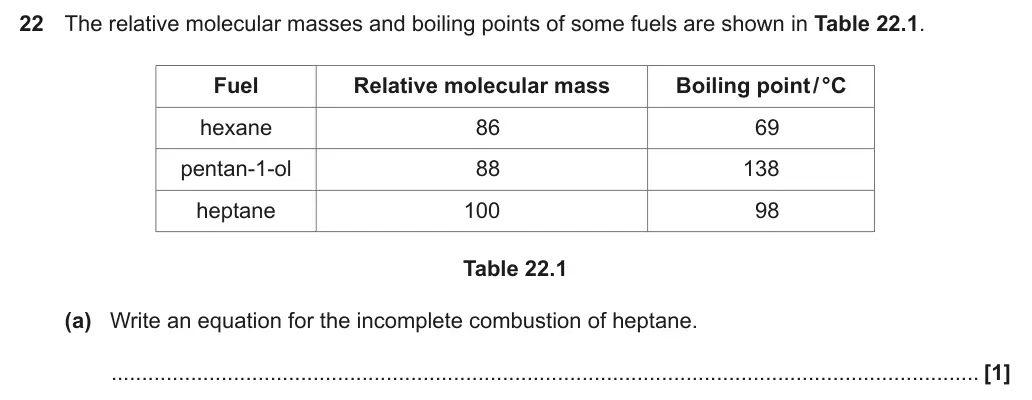
Most candidates were able to construct a balanced equation for the combustion of heptane. Most were aware that CO2 and H2O would be the products although some generated CO, C6H12 or unusual compounds such as C7H14O. The hardest part was the formula of heptane itself with use of hexane instead being a common error; candidates who made this error were given 1 mark, provided that their equation was balanced.
Notes from the mark scheme and report
11O2
ALLOW multiples
1 mark ECF for a balanced combustion equation of a different alkane
Skills: M0.2 Use ratios, fractions and percentages
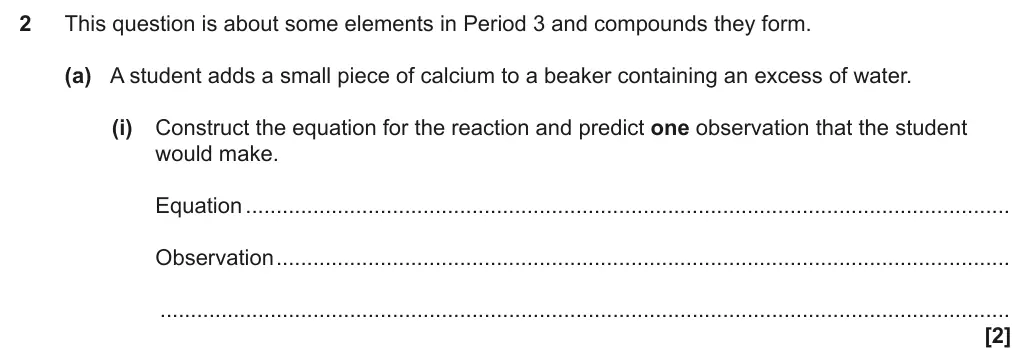
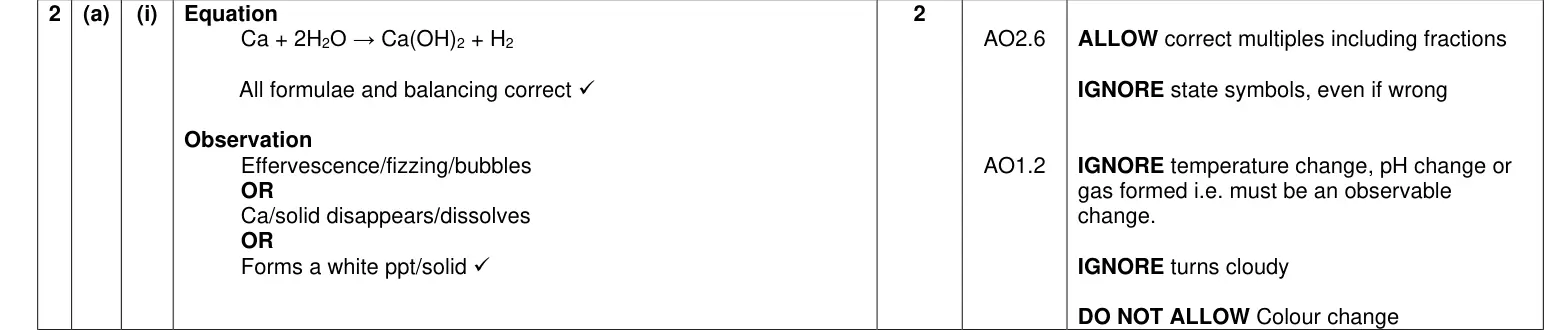
June 2023 · AS Paper 2 · Q2(a)(i)2 marksAO1, 2Equation writingMedium
Mark scheme
Examiner's comment
Most candidates scored the mark for the correct observation. A few said what would happen rather than what they would see, e.g. gas is formed, pH would increase, mass lost or even reference to the ‘squeaky pop’ test. Many struggled to give the correct balanced equation with either CaO being given as a product or incorrect balancing. Many did not have a gas produced but then had bubbling as an observation.
Notes from the mark scheme and report
Ca + 2H2O → Ca(OH)2 + H2
observation must be observable (fizzing, solid disappears, white ppt): IGNORE gas formed, temperature or pH change, 'turns cloudy'
DO NOT ALLOW colour change
OCR has some resources to help support the understanding of balancing symbol equations such as this delivery guide for Atoms and equations.
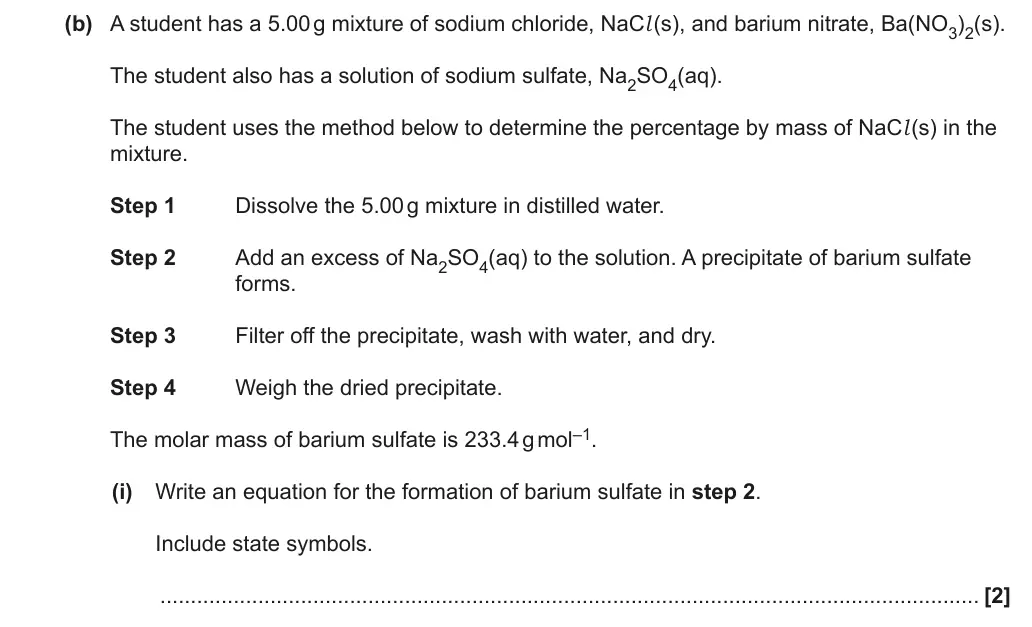
June 2023 · AS Paper 2 · Q2(b)(i)2 marksAO2Equation writingHard
Mark scheme
Examiner's comment
Less than half the candidates gained credit for this challenging question. There was lots of information to process. Many struggled to give the correct formula for the products, e.g. NaNO3, Ba2SO4, or had issues with balancing. Some tried to involve the NaCl in the reaction, either recognising that it didn’t react (acceptable on the mark scheme) or forming barium chloride or even Cl2. Lots of candidates lost the mark for state symbols as they left Ba(NO3)2 as (s), not recognising that in step 1 the mixture was dissolved in water so should now be (aq).
Notes from the mark scheme and report
BaSO4(s) with other species (aq)
ALLOW ionic equation
state symbol mark dependent on balanced equation
June 2023 · Paper 2 · Q16(b)(ii)2 marksAO2Equation writingMedium
Earlier part of question 16 that this part uses
Mark scheme
Examiner's comment
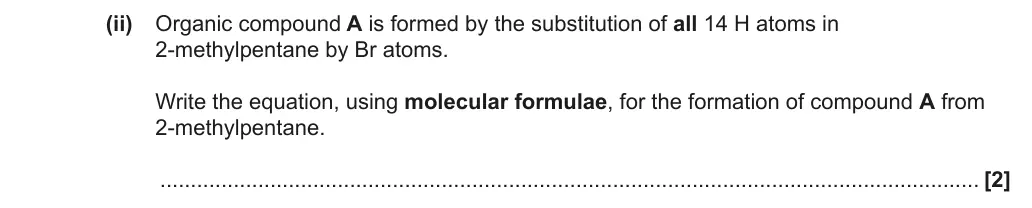
Most responses gained at least 1 mark for this question giving the correct molecular formula of C6Br14. However many hadn’t assimilated that when a hydrogen atom is substituted in an alkane it requires one mole of a halogen and produces one mole of the hydrogen halide. So many gave this incorrect equation instead: C6H14 + 7Br2 → C6Br14 + 7H2. Some lost marks for C5H14 or for use of structural formulae.
Notes from the mark scheme and report
C6Br14
C6H14 + 14Br2 → C6Br14 + 14HBr (HBr, not H2)
1 mark if balanced but not in molecular formulae
Skills: M0.2 Use ratios, fractions and percentages
June 2023 · Paper 2 · Q17(a)2 marksAO2Equation writingHard
Mark scheme
Examiner's comment
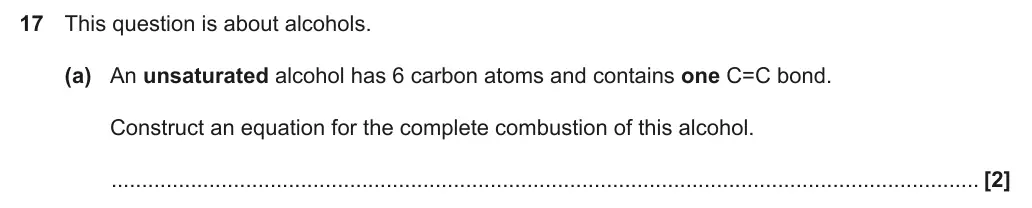
Approximately half the candidates gained both marks here but just over a third gained no credit. A very common error was C6H12 + 9O2 → 6CO2 + 6H2O missing the need for an alcohol group. Another common error was balancing with 9O2 i.e. not deducting O from alcohol from their count of O atoms. Some struggled to determine the correct number of Hs when a single C=C bond is introduced so gave C6H12OH or C6H13OH instead. Lower attaining candidates did not understand what happens during complete combustion. For example, they used [O] instead of molecular oxygen or didn’t have CO2 and water as the products. Some used structural formula which made it easier to get the correct formula of the reactant but often made it trickier to balance the equation.
Notes from the mark scheme and report
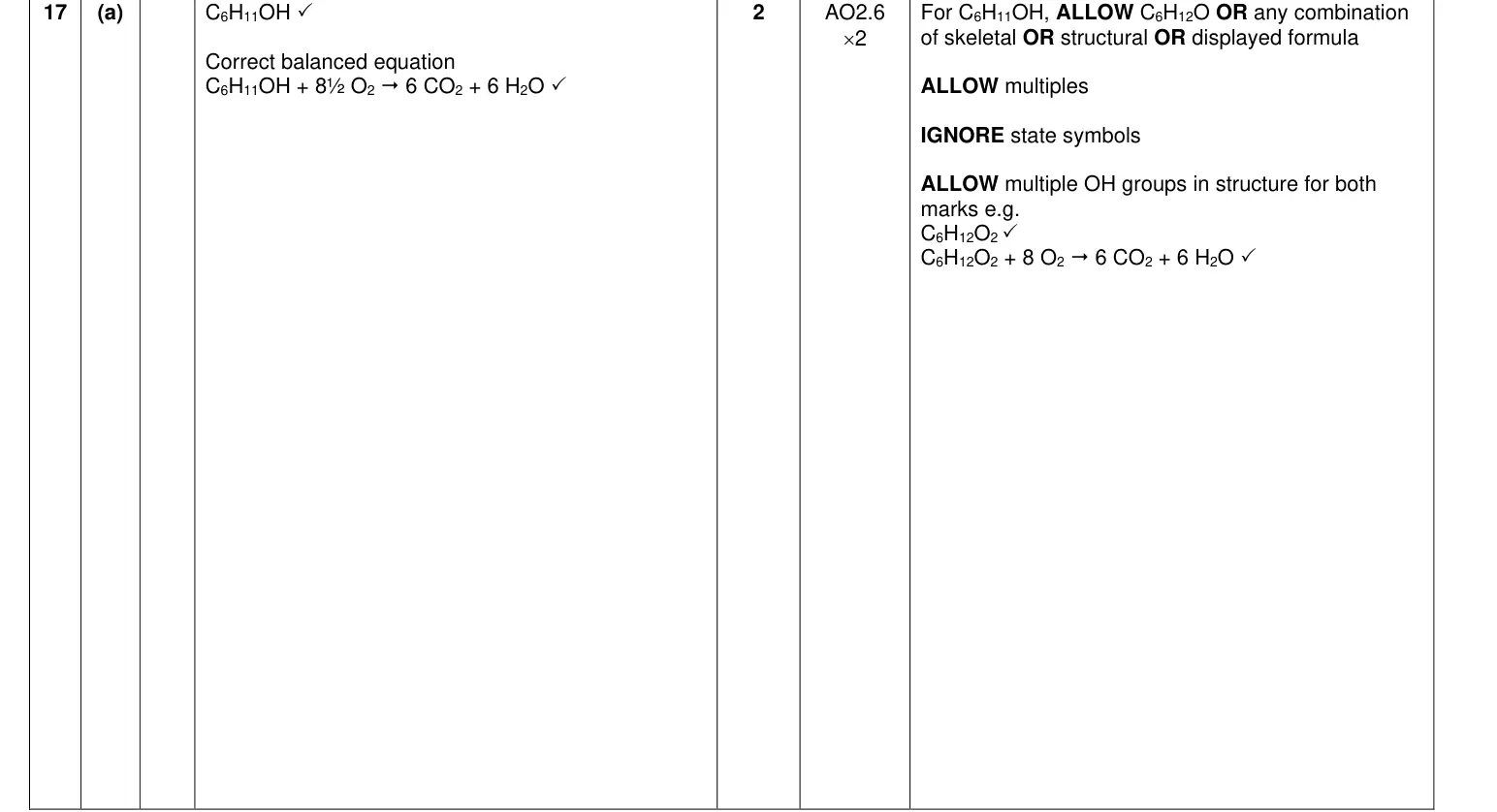
C6H11OH (C6H12O) + 8½O2 → 6CO2 + 6H2O
ALLOW multiples
IGNORE state symbols
Skills: M0.2 Use ratios, fractions and percentages
June 2023 · Paper 2 · Q17(b)3 marksAO2Complete table/diagramMedium
Mark scheme
Examiner's comment
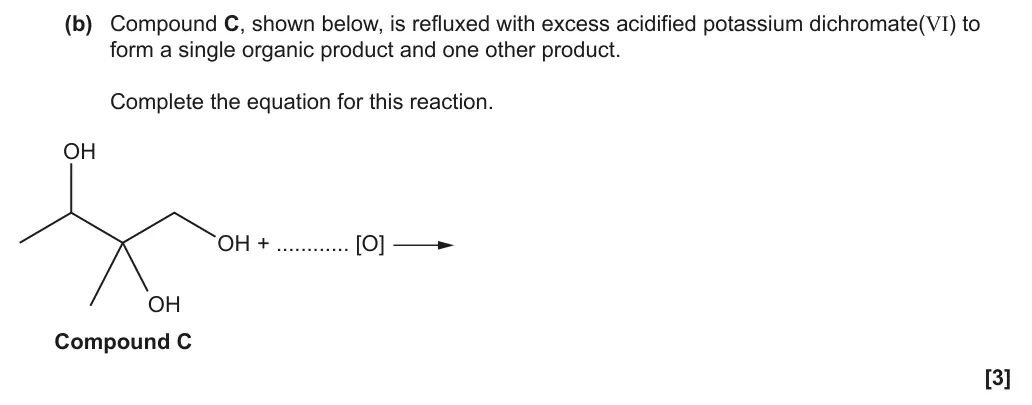
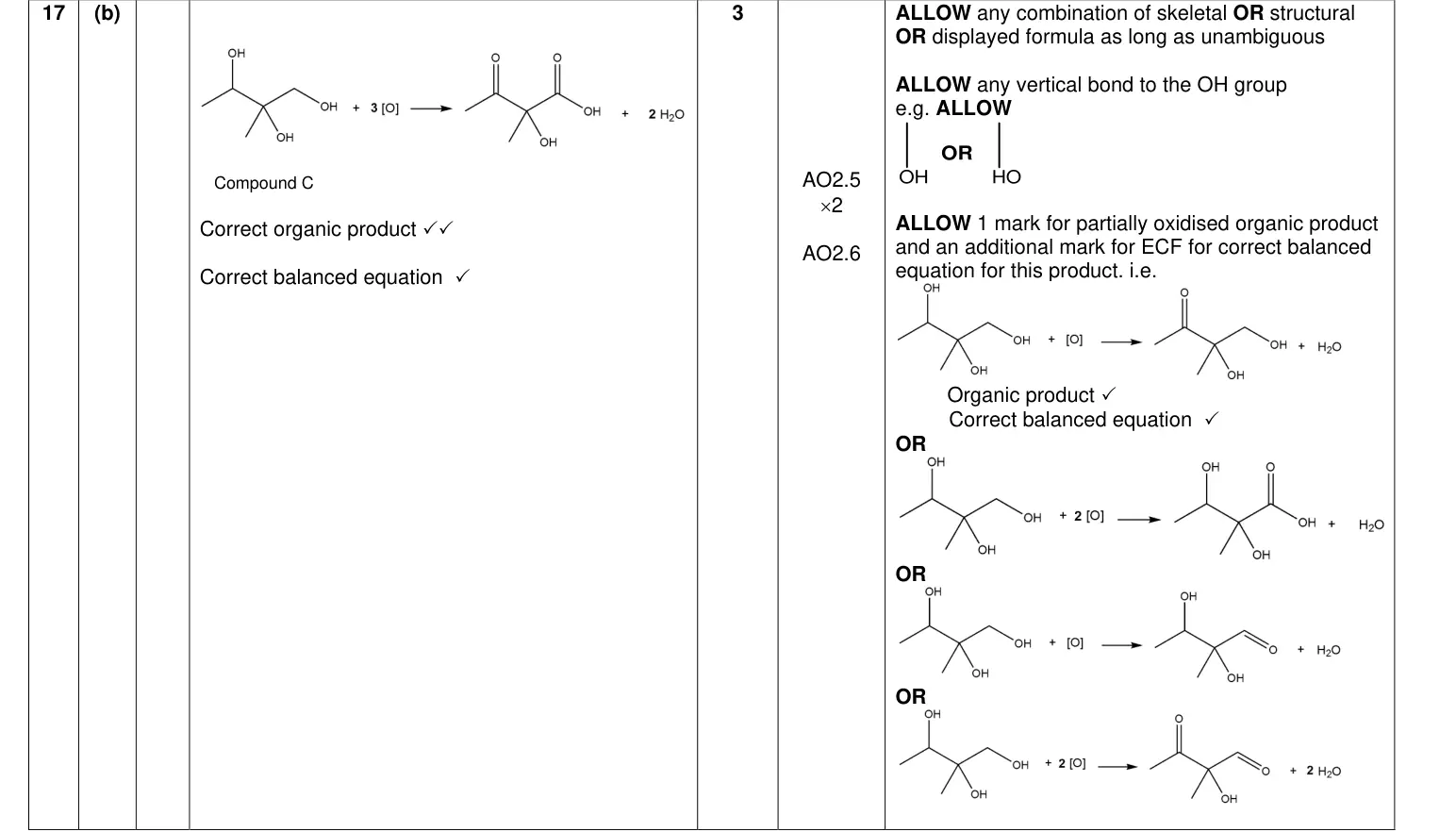
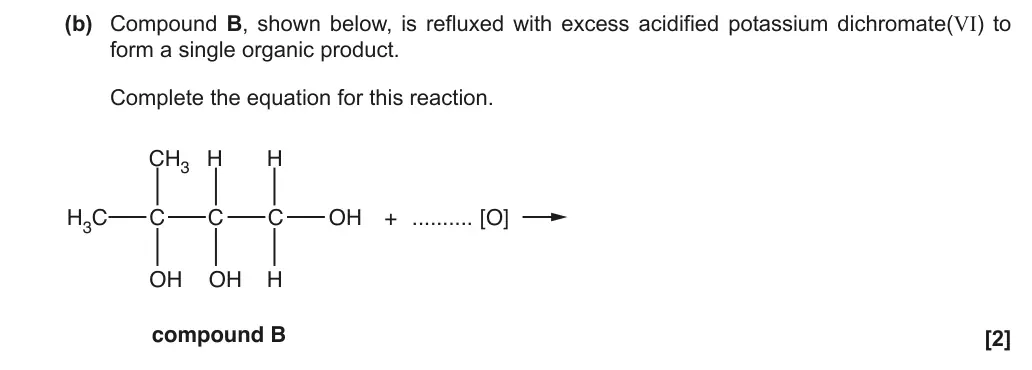
The higher attaining candidates scored well here, with many being able to identify both the primary alcohol being oxidised to the carboxylic acid and the secondary alcohol being oxidised to the ketone and obtaining correct balancing. A good strategy adopted by some candidates was labelling the three alcohol groups with their classification, i.e. primary, secondary, and tertiary. Some missed the water by-product or gave H2 instead. Some gained credit for partial oxidation products as shown in the guidance on the mark scheme. However, more than a third gained no credit here with many attempting to oxidise the tertiary alcohol or removing it entirely. Some made a mistake by adding an extra CH2 on to the product before COOH group - again demonstrating the importance of counting atoms when balancing equations. Oxidation of alcohols is typically taught in the first year with very simple examples, but candidates need to practise more complex examples. Candidates need to be reminded that every oxidation step requires an [O] and every OH group oxidised produces a water molecule.
Notes from the mark scheme and report
secondary OH to ketone, primary OH to COOH (reflux, excess), tertiary OH unchanged
3[O] and 2H2O
1 mark for partially oxidised product plus ECF mark for its balanced equation
Skills: M0.2 Use ratios, fractions and percentages
June 2023 · Paper 3 · Q4(a)1 markAO3Short answerHard
Mark scheme
Examiner's comment
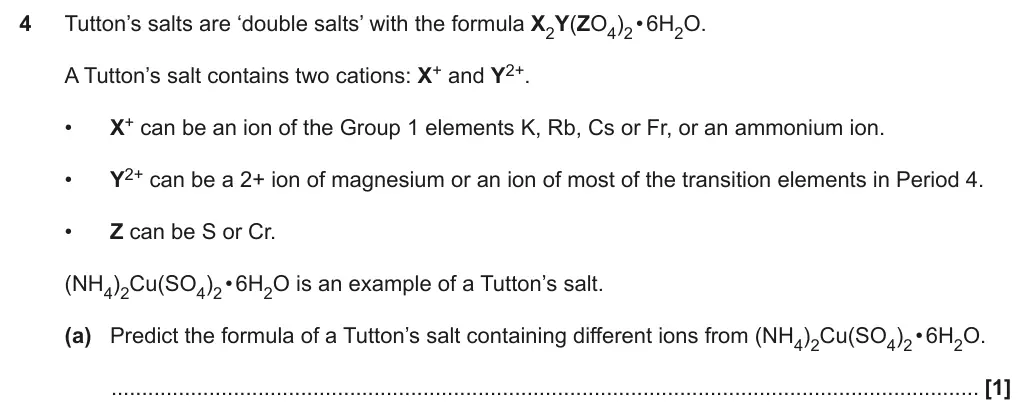
Question 4 assesses candidates’ ability to apply their chemical knowledge and understanding from different parts of the specification in a novel context. Information is supplied throughout the question, and clues are sometimes presented to candidates. In part (a), candidates are introduced to Tutton’s salts and are given an example of a Tutton’s salt that forms the context of the whole question. A candidate needs to apply the information in the bullet points to predict the formula of a different Tutton’s salt. This question discriminated extremely well across different abilities and highlighted that some candidates struggled to use supplied information. This was repeated in other parts of Question 4. Just over half the candidates gave a correct formula from the information. Some candidates did not choose one of the acceptable ions shown in the first and second bullet points, and many chose S rather than Cr, despite S being in the supplied Tutton’s salt; a significant number omitted the •6H2O.
Notes from the mark scheme and report
X from K, Rb, Cs, Fr only
Y = Mg or Ti to Ni (not Cu, Sc or Zn)
Z must be Cr
e.g. K2Mg(CrO4)2•6H2O
June 2023 · Paper 3 · Q4(b)(i)2 marksAO1CalculationMedium
Earlier part of question 4 that this part uses
Mark scheme
Examiner's comment
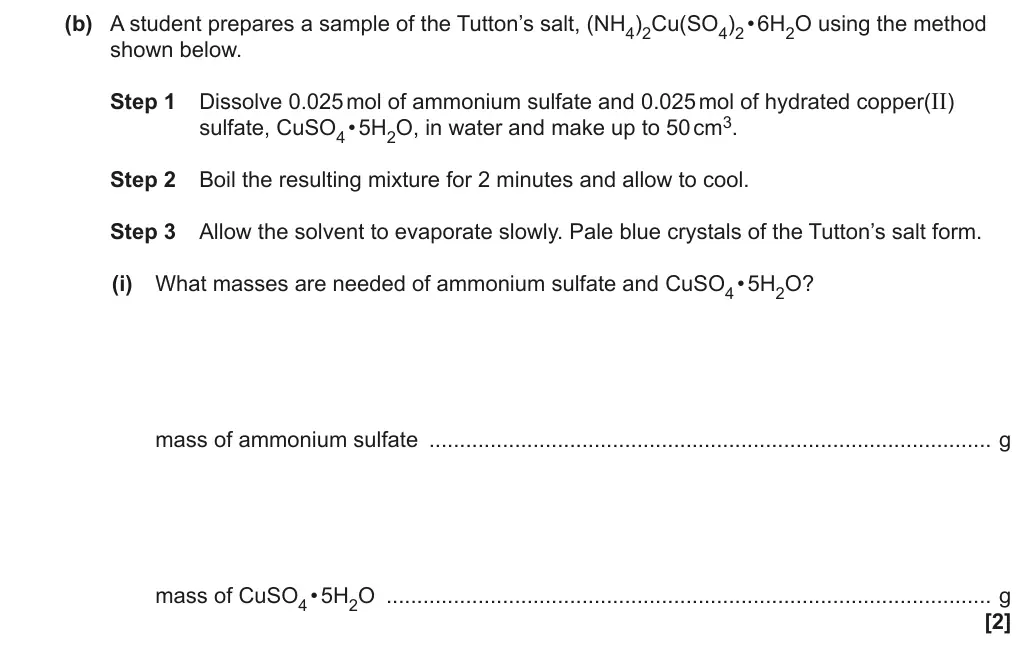
This question required candidates to calculate the masses of two reactants that could be used to prepare a sample of the Tutton’s salt. Candidates were supplied with the formula of hydrated copper(II) sulfate but not the formula of ammonium sulfate, so candidates needed to work out its formula from ions that candidates are expected to be able to recall from the specification. Just over half the candidates obtained both correct masses but many obtained just one correct mass, usually that of CuSO4•6H2O. This exemplar shows a typical response with the incorrect formula of ammonium sulfate clear shown by the candidate, resulting in the incorrect mass of 2.8525 g. This incorrect formula and mass were seen in many responses and, from the initial crossings out, this candidate is clearly confused about how to tackle this simple mole calculation. The incorrect answer of 2.85 g was seen on almost as many scripts as the correct answer of 3.30 g. The moral is that candidates need to learn the formula and charges of the common ions encountered in chemistry. The comments here apply also to Question 6 (b) (i), where formulae need to be written using ions listed in the specification.
Notes from the mark scheme and report
(NH4)2SO4 3.30 g
CuSO4•5H2O 6.24 g (must include water of crystallisation)
Skills: M0.2 Use ratios, fractions and percentages; M2.3 Substitute numerical values into algebraic equations using appropriate units for physical quantities
June 2023 · Paper 3 · Q6(b)(i)2 marksAO2Equation writingHard
Earlier part of question 6 that this part uses
Mark scheme
Examiner's comment
Candidates were required to write a balanced equation for an acid–base reaction. As with Question 4 (b) (ii), candidates needed to write formulae from what should have been common ions, but the formulae for aluminium oxide and aluminium nitrate were often incorrect. In the equation, the reactants and products were sometimes unbalanced, or incorrectly balanced. A common error was H2 instead of H2O as the second product. The question was an excellent discriminator.
Notes from the mark scheme and report
Al2O3 + 6HNO3 → 2Al(NO3)3 + 3H2O
1 mark for any three species correct
DO NOT ALLOW more than 4 species
ALLOW ionic equation
Skills: M0.2 Use ratios, fractions and percentages
June 2022 · AS Paper 1 · Q61 markAO2Multiple choiceMedium
Answer
B
Mark scheme
Examiner's comment
Although two steps were required to solve this problem, most candidates answered this question correctly. Candidate annotations showed that many identified element X as being in Group 2 and even as magnesium. The correct formula of XCl2 (B) then usually followed.
June 2022 · Paper 1 · Q61 markAO1Multiple choiceEasy
Answer
B
Mark scheme
Examiner's comment
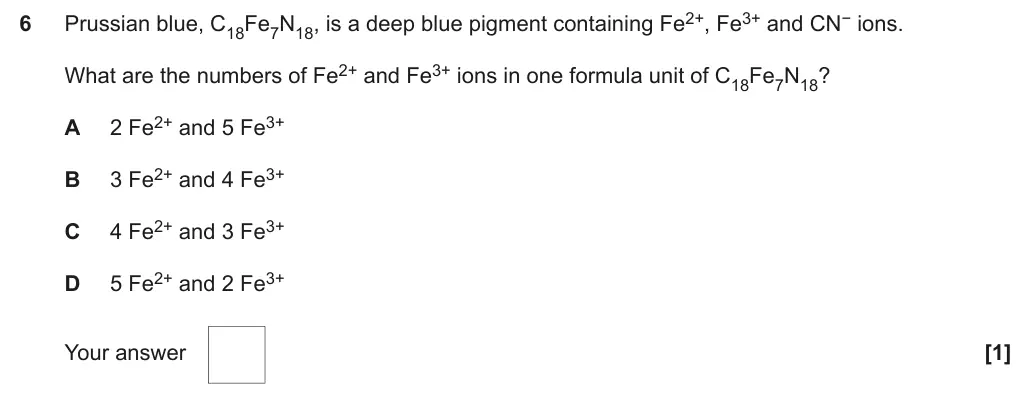
This was generally well answered. The key to candidates quickly arriving at the correct answer of B was to focus on identifying the number of CN- ions and calculating the total of 18 negatively charge ions. More successful candidates could clearly see that the combination of iron ions must add up to the total of 18 positively charged ions. Some candidates lost time here by working out formulae and trying to write out the structure of Prussian blue.
Notes from the mark scheme and report
18 CN– so total positive charge 18 from 7 Fe
Skills: M2.4 Solve algebraic equations
June 2022 · Paper 1 · Q21(b)(ii)1 markAO3Equation writingEasy
Earlier part of question 21 that this part uses
Mark scheme
Examiner's comment
This question was answered well, with many candidates giving one of the equations in the ‘ALLOW’ part of the mark scheme. Those candidates who did not gain this mark gave full equations or missed out state symbols.
ALLOW H+ + OH– → H2O OR Ba2+ + SO4 2– → BaSO4 with state symbols
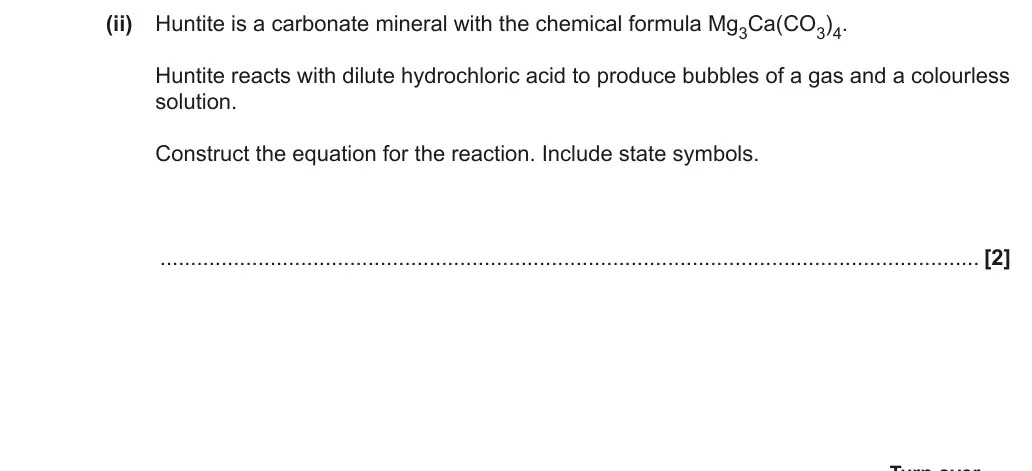
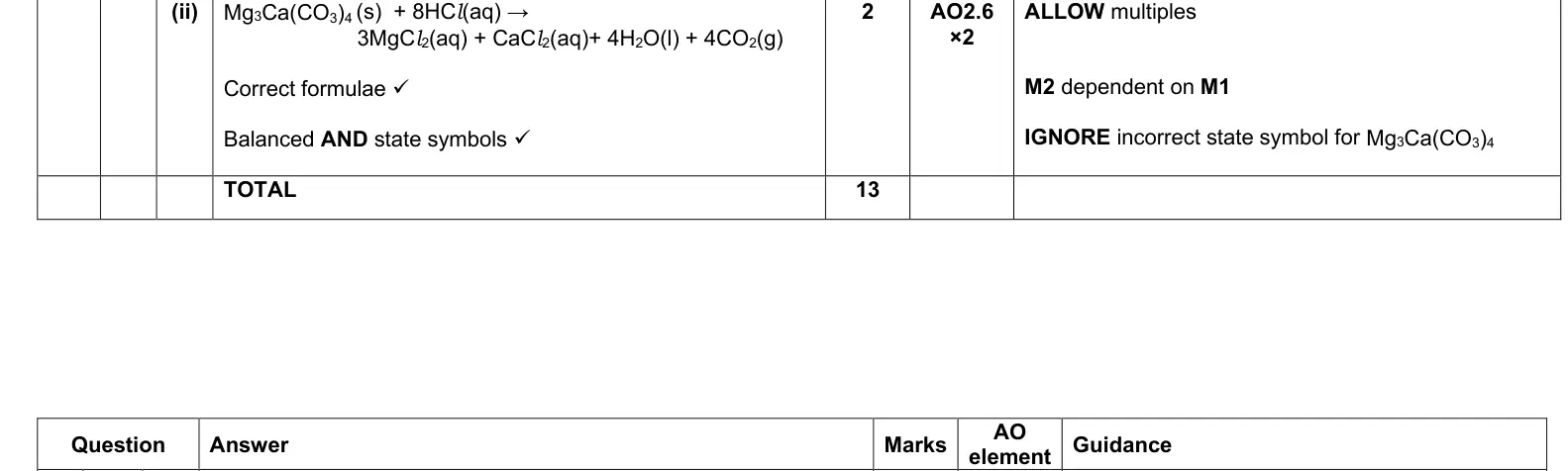
June 2022 · Paper 1 · Q21(c)(ii)2 marksAO2Equation writingHard
Earlier part of question 21 that this part uses
Mark scheme
Examiner's comment
This was another very challenging question using an unfamiliar mineral. Most candidates identified a formula of salts containing both magnesium and calcium, or carbonates of the separate elements. Only the most successful candidates were able to give the correct formula. Common errors, for those who solved the formulae, were the use of “4”HCl in balancing and the absence of state symbols.
balancing/state symbols mark dependent on correct formulae
June 2022 · AS Paper 1 · Q23(a)(ii)2 marksAO1Complete table/diagramEasy
Earlier part of question 23 that this part uses
Mark scheme
Examiner's comment
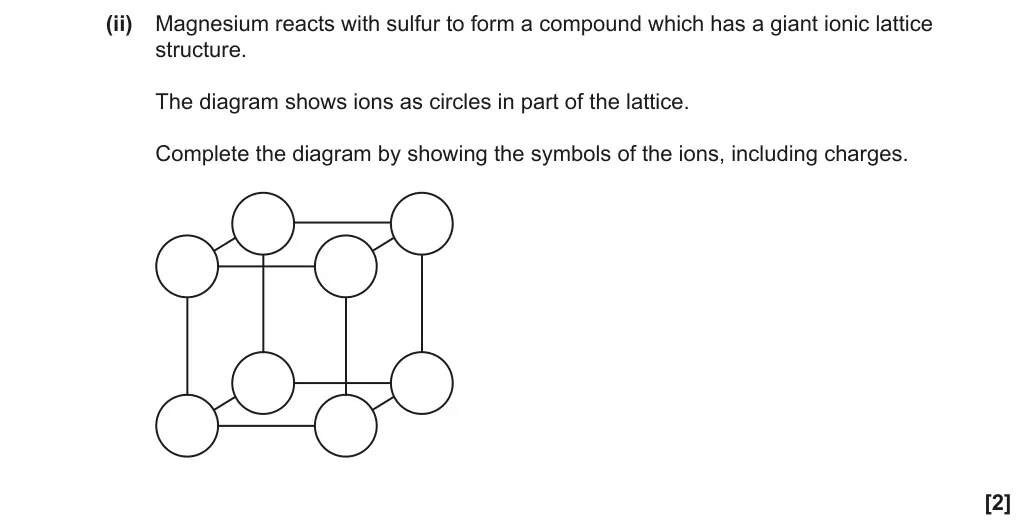
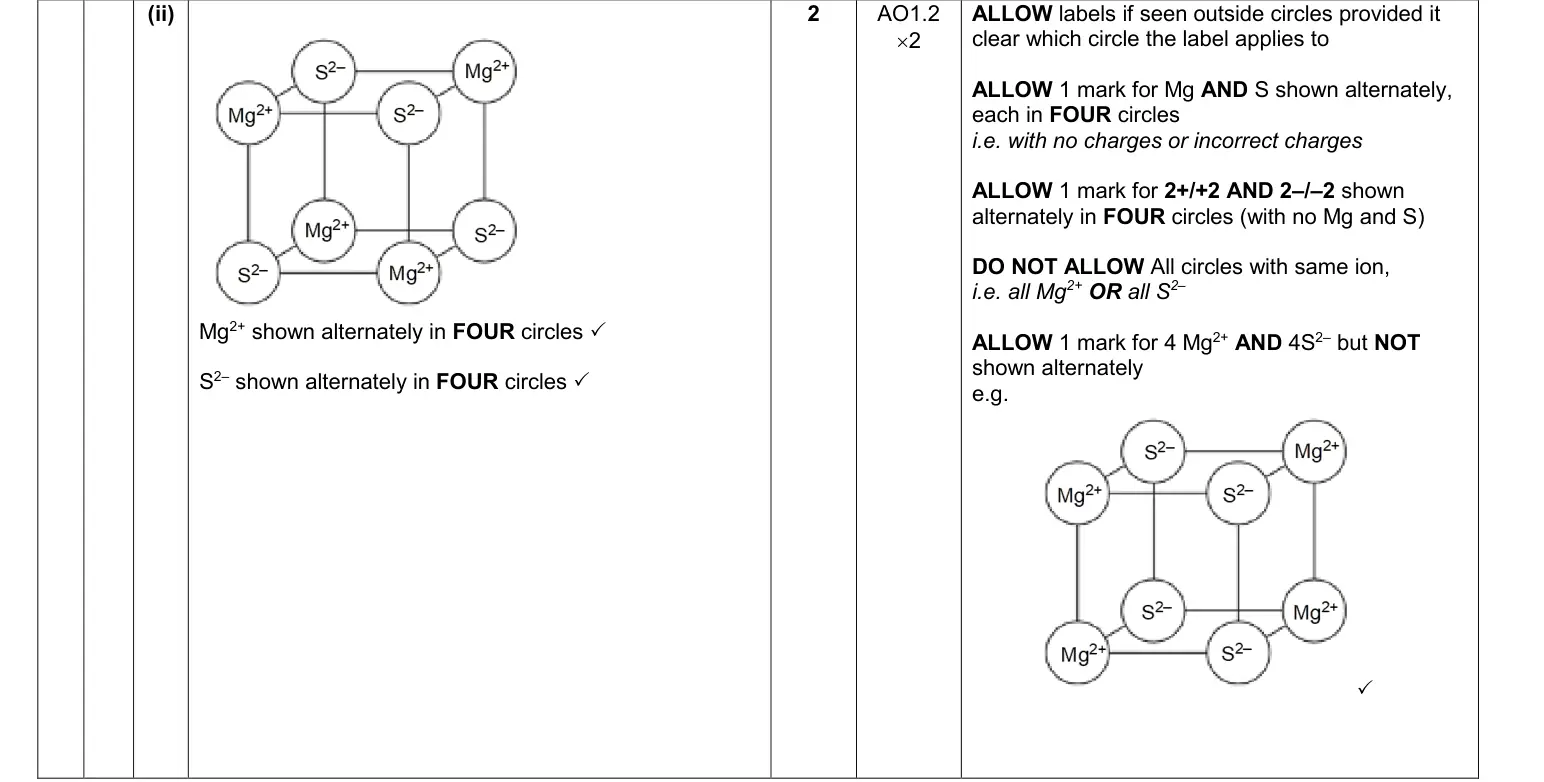
Most candidates correctly drew alternating Mg2+ and S2– labels in the circles. Some candidates made errors, however, including 2+ and 2– without Mg and S, incorrect or omitted charges, and placing the ions in layers rather than alternating.
Notes from the mark scheme and report
Mg2+ and S2– must alternate, FOUR circles each
1 mark if alternating but charges missing/incorrect
DO NOT ALLOW all circles the same ion
June 2022 · AS Paper 2 · Q1(d)2 marksAO2Equation writingMedium
Mark scheme
Examiner's comment
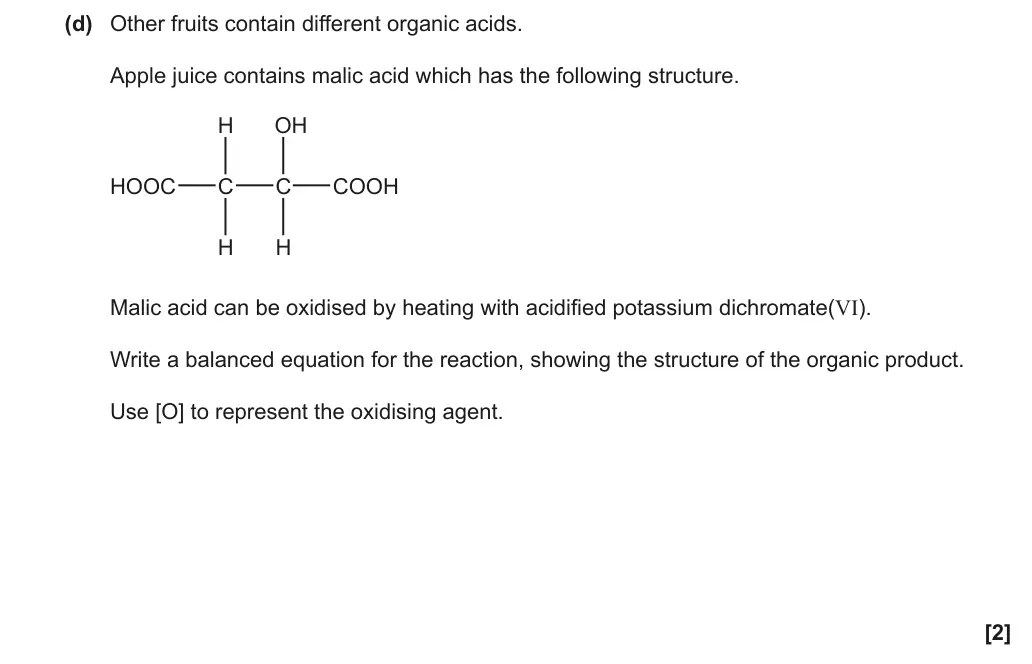
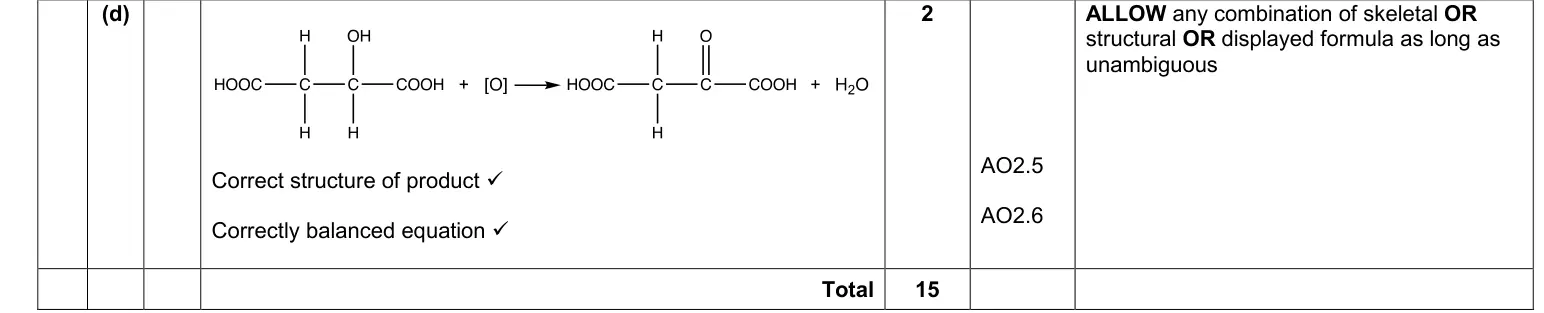
Despite oxidation of alcohols being a topic that has been assessed many times, candidates found this question very tricky with a majority failing to score any marks. Candidates needed to correctly identify this as a secondary alcohol which, when oxidised, will become a ketone. A wide range of errors were seen, including the following: Other errors included forming C=C or removing COOH. Approximately half of those that got the correct structure were also able to balance the equation gaining both marks. Some forgot that another product was formed or gave H2 instead. Candidates were given the structure and told to use [O] to represent the oxidising agent. However, some attempted to use structural or molecular formula and/or adding in dichromate to their answers.
Notes from the mark scheme and report
secondary alcohol group oxidised to ketone HOOCCH2COCOOH
COOH groups unchanged
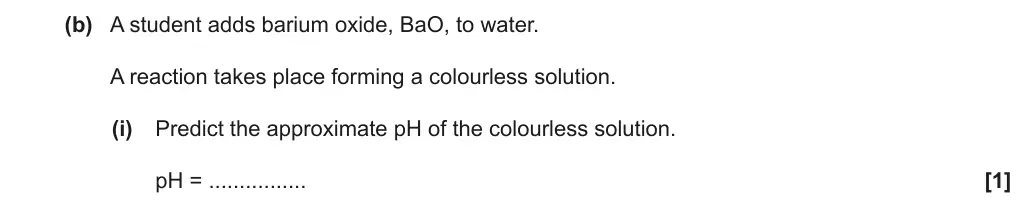
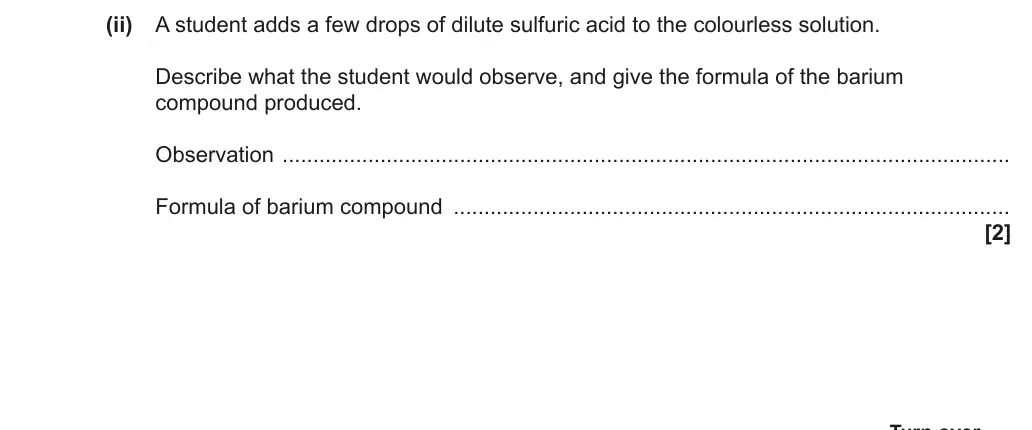
June 2022 · AS Paper 2 · Q2(b)(ii)2 marksAO3Short answerEasy
Earlier part of question 2 that this part uses
Mark scheme
Examiner's comment
Most candidates were able to give the formula of the barium compound as BaSO4. However, they did not recognise that this would cause a white ppt to be seen, presumably as not in the context of qualitative ions testing. Many candidates said they would see bubbling/fizzing. Some gave a colour change as they were possibly considering what would be seen if an indicator is present. Others mentioned a precipitate but with no colour given. Some candidates gave the incorrect formula, such as Ba2SO4 or Ba(SO4)2, again showing the importance of practising writing formulae. In addition, some candidates wrote out the whole equation for the reaction.
Notes from the mark scheme and report
white precipitate
BaSO4
We have produced a topic support pack to assist with learning about the reaction of group 2 elements and their compounds: http://www.ocr.org.uk/Images/364103-chemistry-of-group- 2.docx
Skills: PAG4 Qualitative analysis of ions
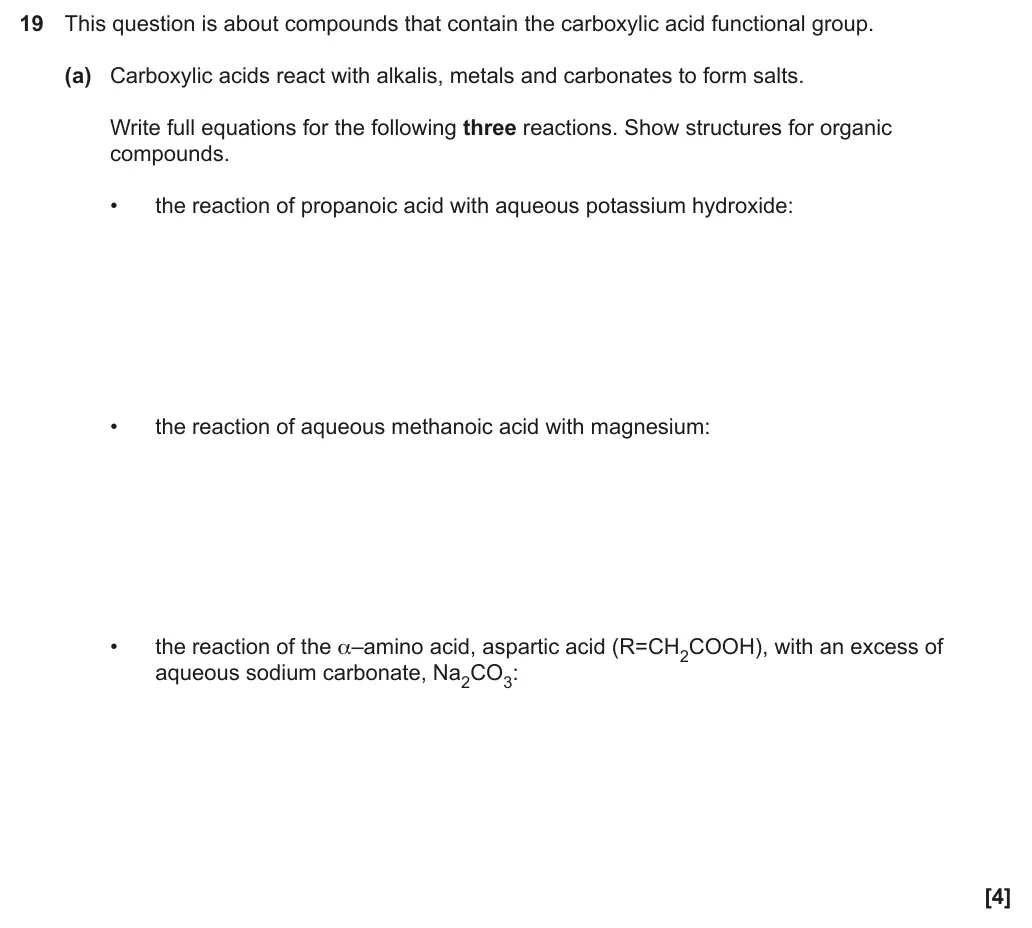
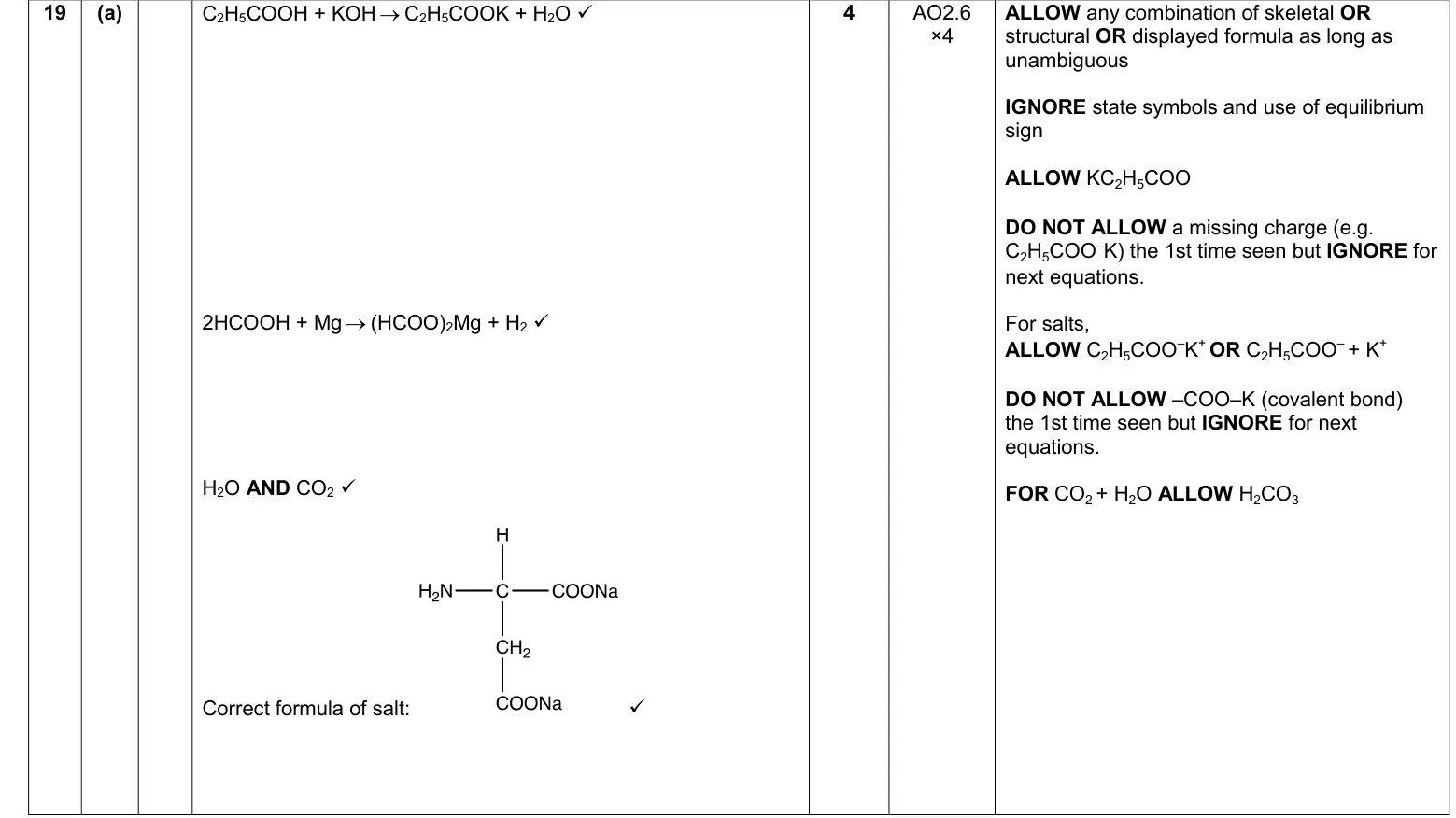
June 2022 · Paper 2 · Q19(a)4 marksAO2Equation writingHard
Mark scheme
Examiner's comment
This question proved challenging for candidates. The first equation was often answered correctly, although some candidates used sodium hydroxide rather than potassium hydroxide in their response. The second equation was frequently incorrect. Candidates frequently missed a hydrogen from the structure for methanolic acid or did not recognise that hydrogen was a product. Many candidates did not account for magnesium having a 2+ charge when working out the product. For the third equation, the majority of candidates identified that carbon dioxide and water would be produced but were unable to give the correct formula of the salt as they did not interpret the information given regarding the R group.
Notes from the mark scheme and report
2HCOOH + Mg → (HCOO)2Mg + H2
both COOH groups of aspartic acid react with excess Na2CO3 giving H2O AND CO2 (ALLOW H2CO3)
DO NOT ALLOW –COO–K covalent bond or missing charge (penalise once)
Skills: M0.2 Use ratios, fractions and percentages
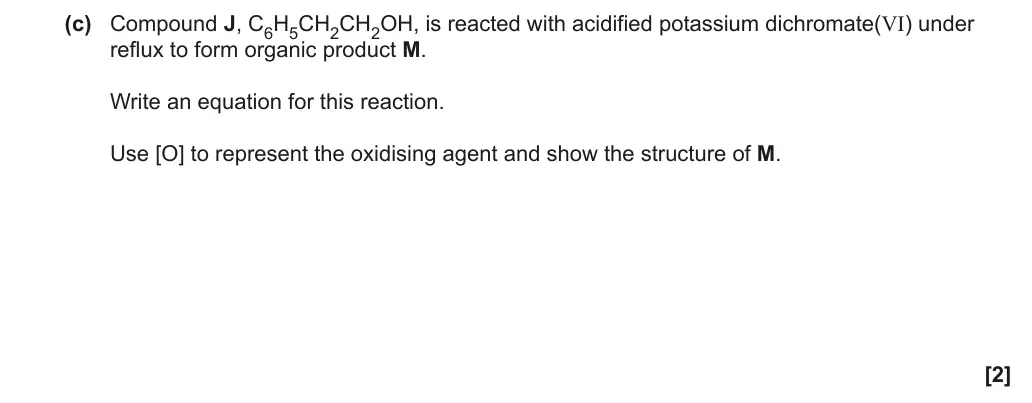
June 2022 · Paper 2 · Q20(c)2 marksAO2Equation writingEasy
Earlier part of question 20 that this part uses
Mark scheme
Examiner's comment
Most candidates were able to score at least 1 mark for this question. Common errors included candidates producing two water molecules or failing to balance [O]. A significant proportion of candidates did not score any marks, frequently due to the organic product having too many carbon atoms in it.
Notes from the mark scheme and report
product C6H5CH2COOH (reflux)
2[O] and H2O
Skills: M0.2 Use ratios, fractions and percentages
June 2022 · Paper 2 · Q20(d)(ii)1 markAO2Complete table/diagramMedium
Earlier part of question 20 that this part uses
Mark scheme
Examiner's comment
The most able candidates were able to identify the use of 6[H] as the reducing agent and the production of 2 water molecules. Incorrect responses commonly included the use of HCl and NaBH4 as a reactant.
Notes from the mark scheme and report
6[H] on the left and 2H2O on the right
Skills: M0.2 Use ratios, fractions and percentages
June 2022 · Paper 2 · Q20(f)2 marksAO3Short answerMedium
Mark scheme
Examiner's comment
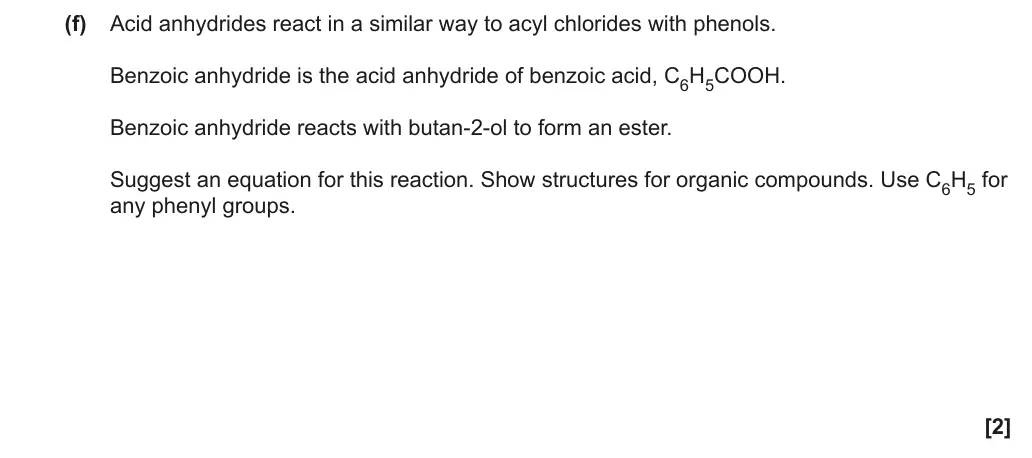
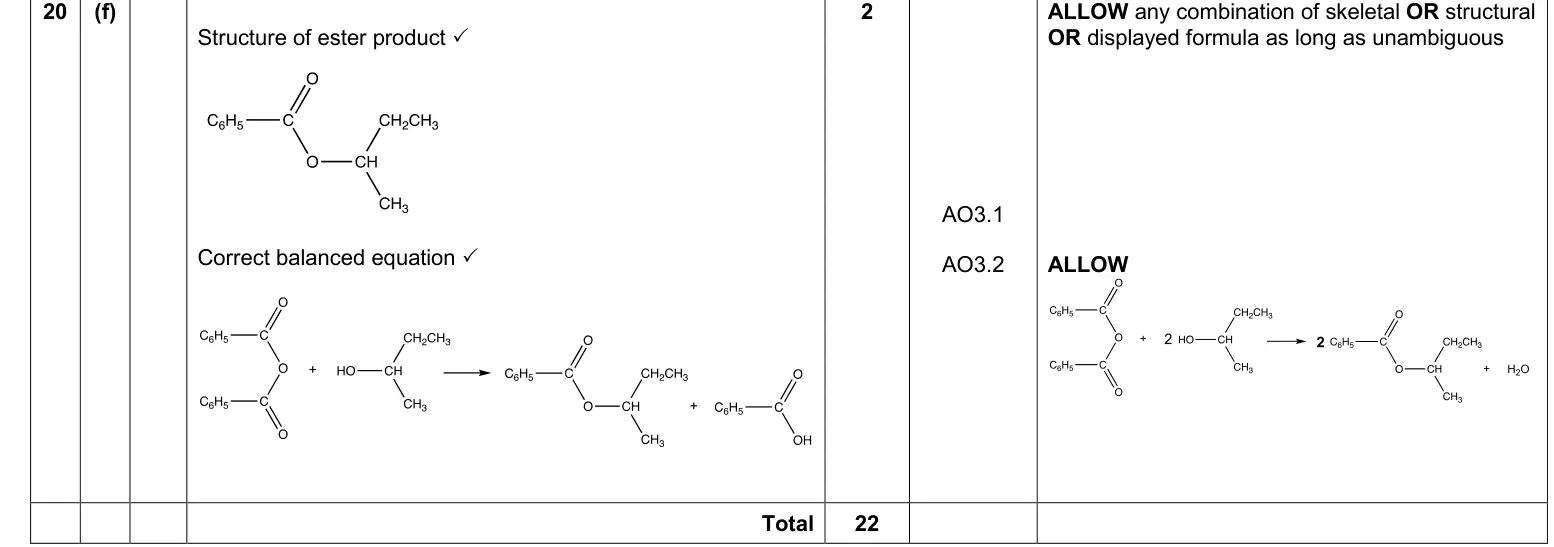
Most candidates did not secure a mark in this question. Many candidates used butan-1-ol in their equations or used benzoic acid rather than benzoic anhydride as the reactant. The most able candidates suggested that the benzoic acid product would then further react with butan-2-ol to produce a second ester molecule and water. This was an acceptable alternative response.
June 2022 · Paper 3 · Q1(d)(ii)3 marksAO2Equation writingHard
Earlier part of question 1 that this part uses
Mark scheme
Examiner's comment
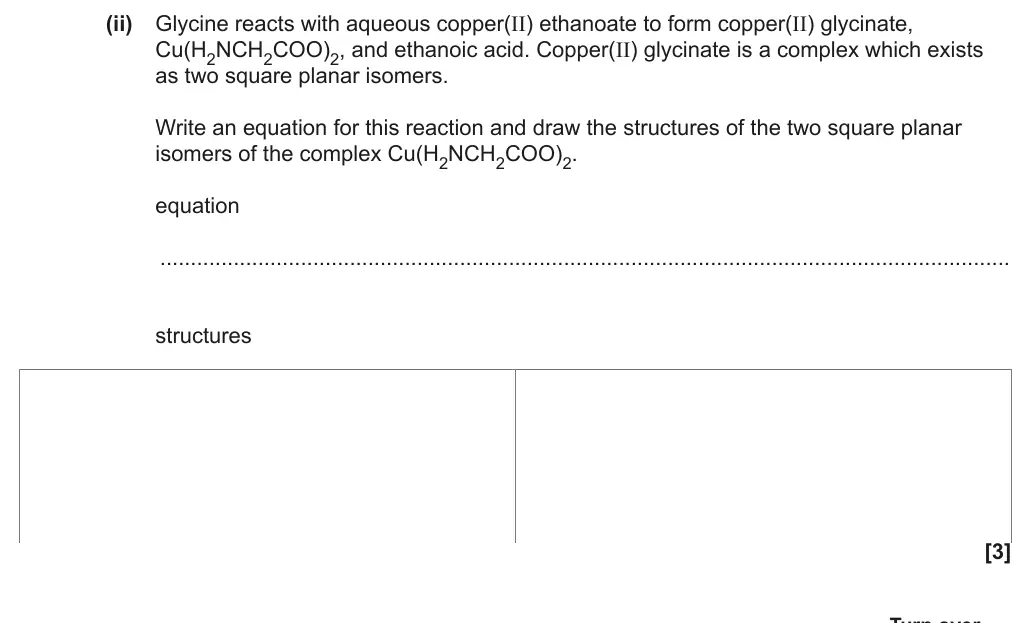
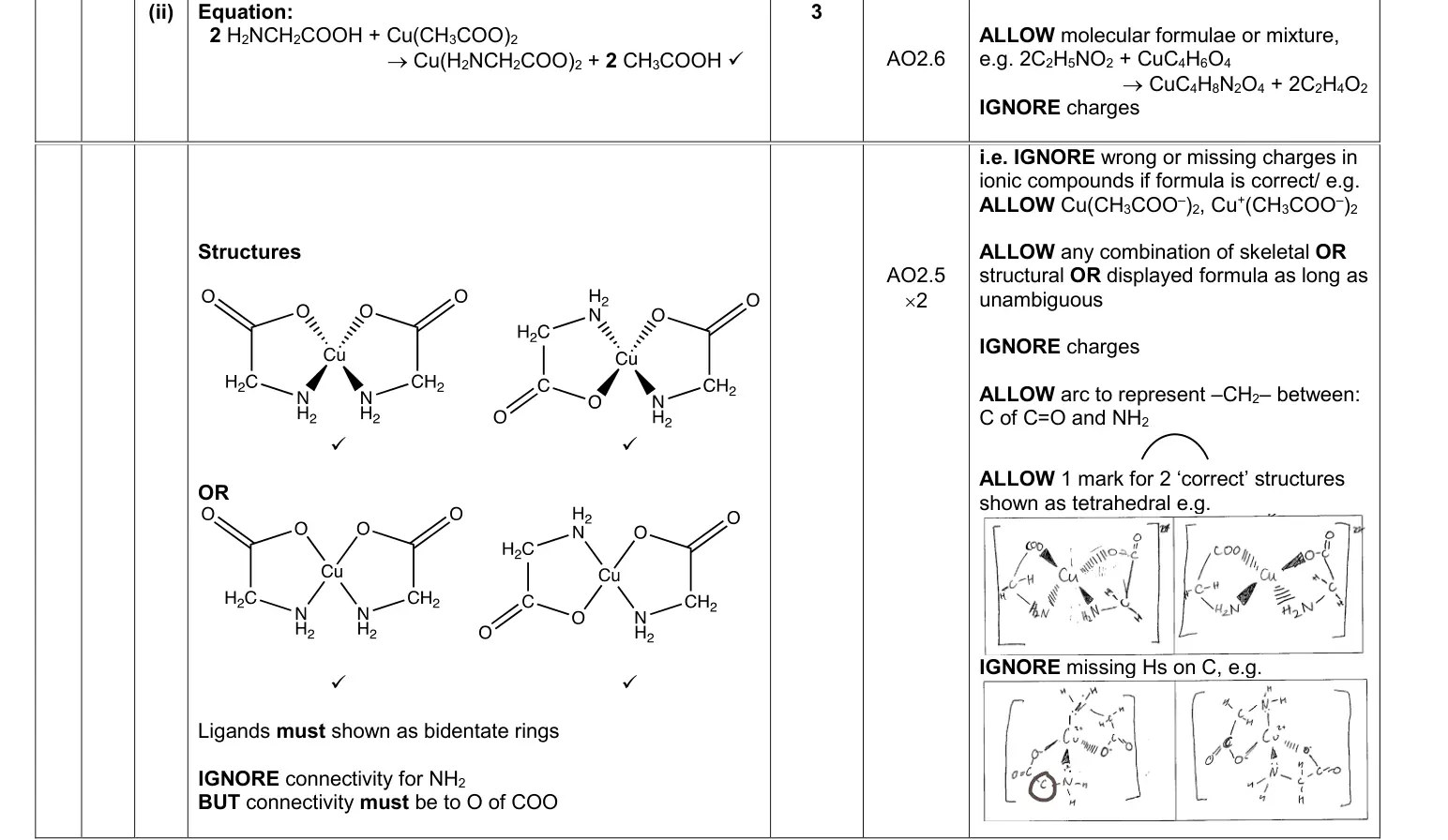
Candidates were asked to predict an unfamiliar equation from provided information and to draw structures of square planar complexes containing an amino acid. Candidates found the structures easier than the equation, with many drawing 3D structures with 2 out-wedges and 2 in-wedges and attaching the NH2 and COO groups correctly. It was also common to see a ‘criss-cross’ orientation, looking down on the complex, which is easier to draw. Many candidates connected the NH2 and COO groups next to, and across from, each another in the isomers. A common error was for candidates to rotate their first structure, to produce a second drawing of the first structure. Less successful responses often tried to attach NH2 and COO groups but with no CH2 between the groups to produce a cyclic attachment. A minority of candidates ignored ‘square planar’ and drew tetrahedral structures instead. The equation proved to be very difficult, the commonest error being omission of the ‘2’ balancing numbers for H2NCH2COOH and CH3COOH. The formulae for ethanol or propanoic acid were also often seen for ethanoic acid. Candidates are advised to check all formulae and then to check balancing, the golden rules for successfully constructing all equations.
cis and trans square planar isomers with ligands shown as bidentate rings bonded through N and O of COO
1 mark if both drawn as tetrahedral
IGNORE charges
Skills: M4.2 Visualise and represent 2-D and 3-D forms including 2-D representations of 3-D objects
June 2022 · Paper 3 · Q2(a)(ii)3 marksAO1, 2Equation writingHard
Earlier part of question 2 that this part uses
Mark scheme
Examiner's comment
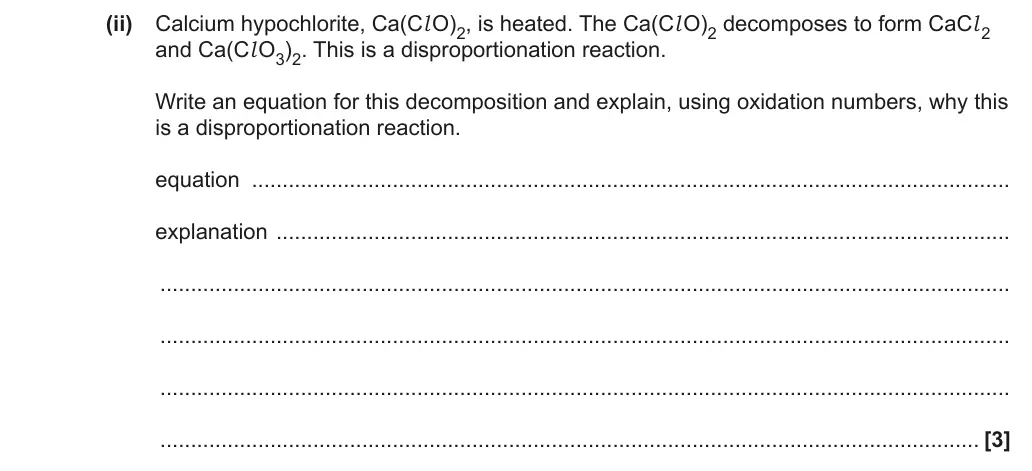
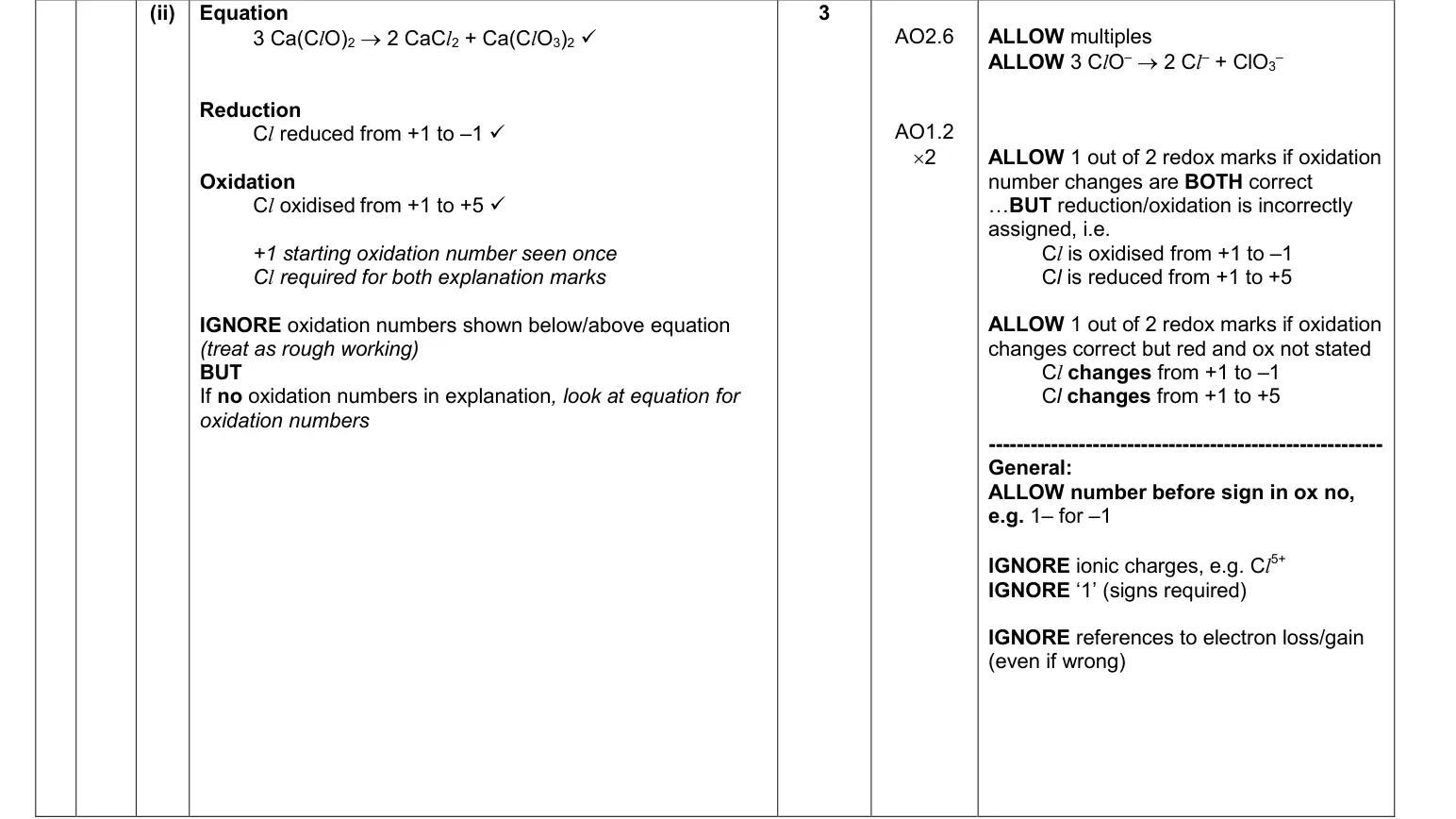
Candidates were required to write a balanced equation from provided reactants and products and to use oxidation numbers to illustrate disproportionation. In the equation, the reactants and products were sometimes unbalanced, or incorrectly balanced. A common error was to balance the equation after first adding O2 as an extra reactant. Illustrating disproportionation proved to be easier with the oxidation number changes from the initial +1 being required. Otherwise, more successful responses sometimes missed out on marks if they omitted detail. For example, the oxidation number changes were stated but the candidate omitted to state which change was oxidation and which was reduction. The best responses identified Ca(ClO3)2 as the oxidation product and CaCl2 as the reduction product. One unexpected error on many scripts was for calcium to be identified as the element undergoing disproportionation, with oxidation number changes from +6 to +14 and +2. It was difficult to see why this happened, with Ca forming +2 compounds, but the error was common.
Notes from the mark scheme and report
3Ca(ClO)2 → 2CaCl2 + Ca(ClO3)2
Cl reduced +1 to –1 and Cl oxidised +1 to +5
1 of 2 redox marks if changes correct but oxidation/reduction mis-assigned or not stated
signs required
IGNORE ionic charges such as Cl5+
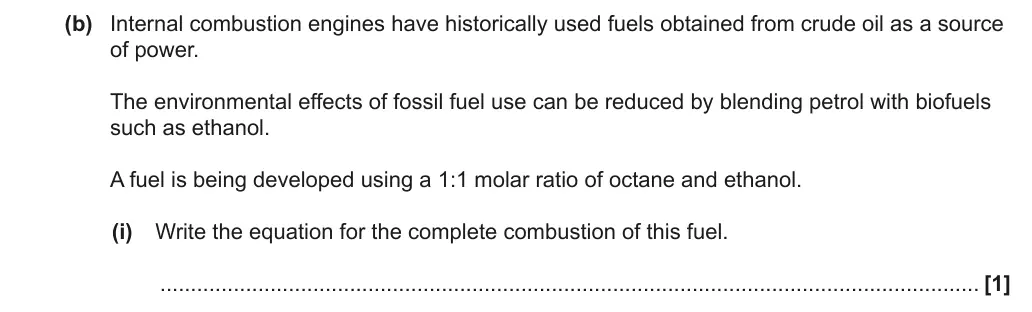
June 2022 · Paper 3 · Q5(b)(i)1 markAO2Equation writingEasy
Mark scheme
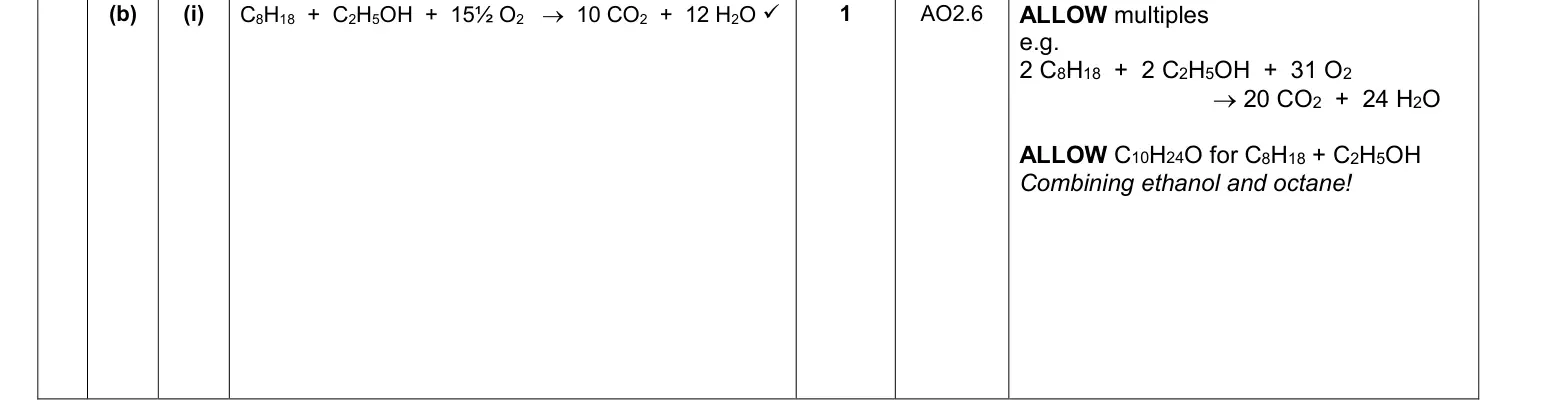
Examiner's comment
Most candidates attempted to write an equation for the combustion of the 1:1 molar mixture of octane and ethanol. The formulae of C8H18 and C2H5OH were usually seen although some candidates combined these as a ‘mixture formula’ of C10H24O (which was accepted). The balancing of the equation using 15½O2 was the hardest part of the equation and many different balancing numbers for O2 were seen (10CO2 and 12H2O where usually correct). Less successful responses often attempted a combustion equation using octane OR ethanol, but not both. This is not an easy equation to construct, and the context was novel. Overall candidates made a good attempt at this question.
Notes from the mark scheme and report
C8H18 + C2H5OH + 15½O2 → 10CO2 + 12H2O
ALLOW multiples
Skills: M0.2 Use ratios, fractions and percentages
November 2021 · Paper 1 · Q31 markMultiple choice
Answer
D
Mark scheme
November 2021 · Paper 1 · Q51 markMultiple choice
Answer
D
Mark scheme
November 2021 · Paper 1 · Q18(a)2 marksAO1, 2Equation writing
Mark scheme
Notes from the mark scheme and report
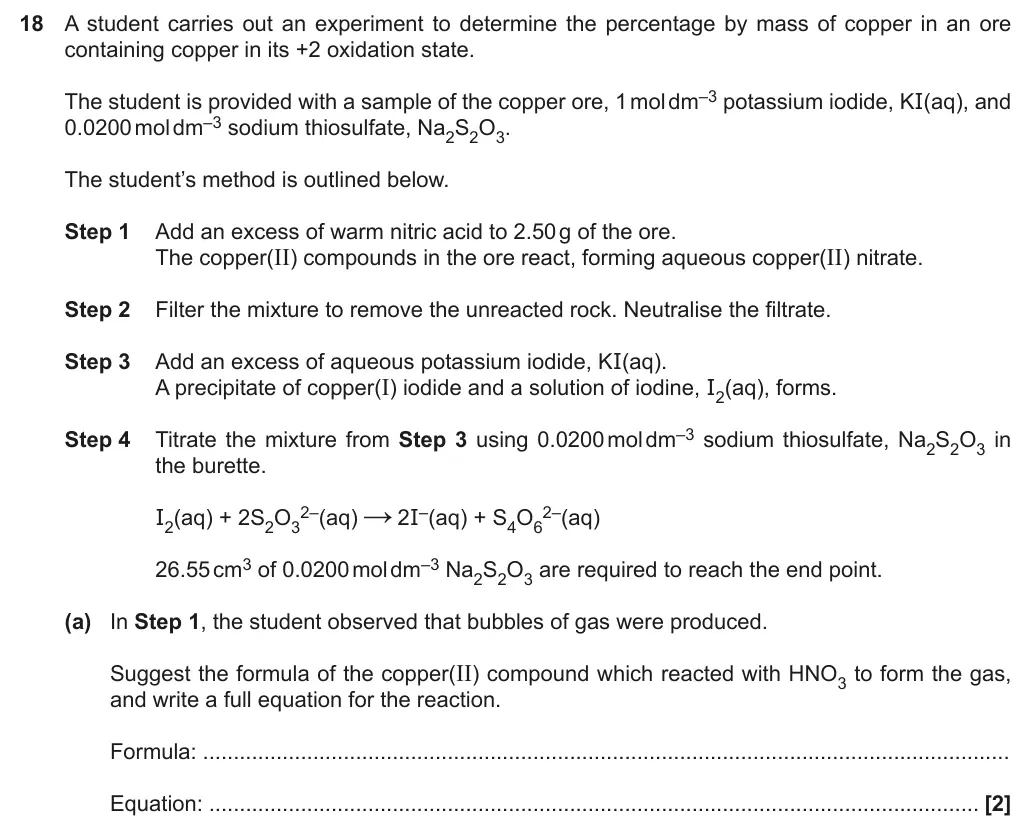
CuCO3 and balanced equation giving CO2
ALLOW other copper(II) compounds giving a gas e.g. CuSO3
November 2021 · AS Paper 1 · Q23(c)1 markAO2Equation writing
Mark scheme
Notes from the mark scheme and report
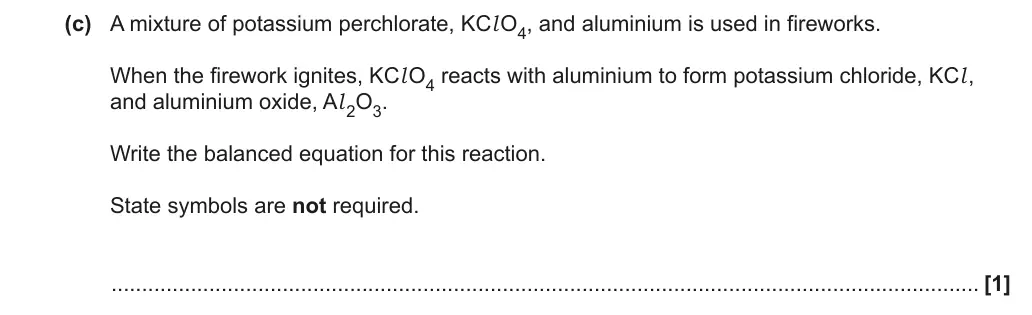
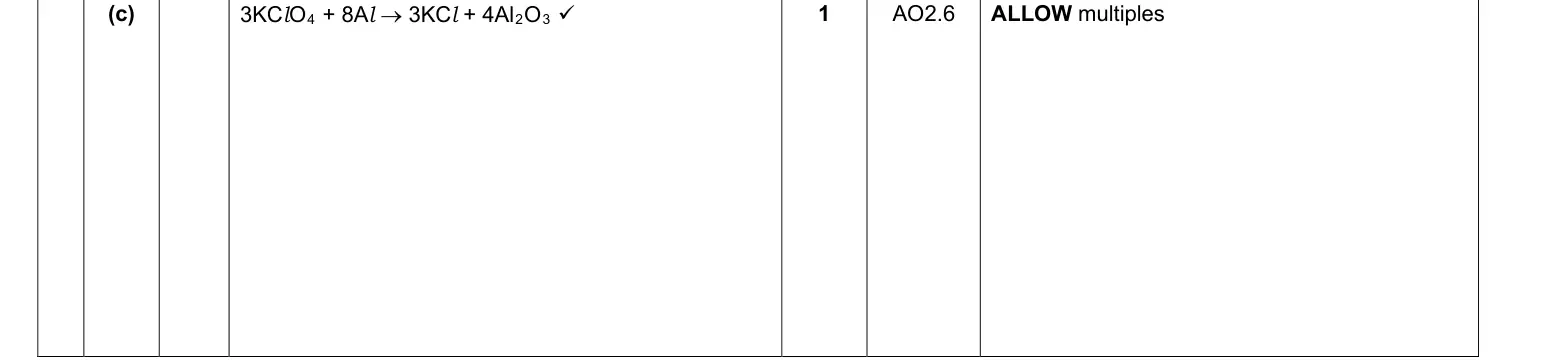
3KClO4 + 8Al → 3KCl + 4Al2O3
ALLOW multiples
Skills: M0.2 Use ratios, fractions and percentages
November 2021 · AS Paper 1 · Q23(d)5 marksAO1, 2, 3Equation writing
November 2021 · AS Paper 2 · Q2(d)2 marksAO2Equation writing
Earlier part of question 2 that this part uses
Mark scheme
Notes from the mark scheme and report
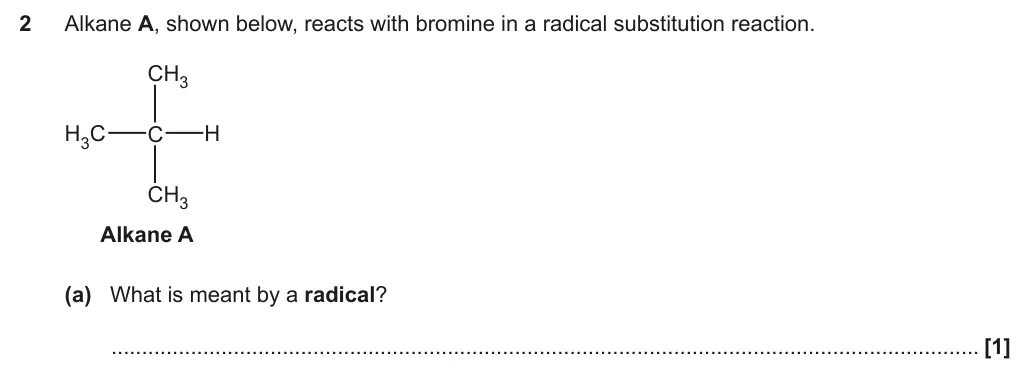
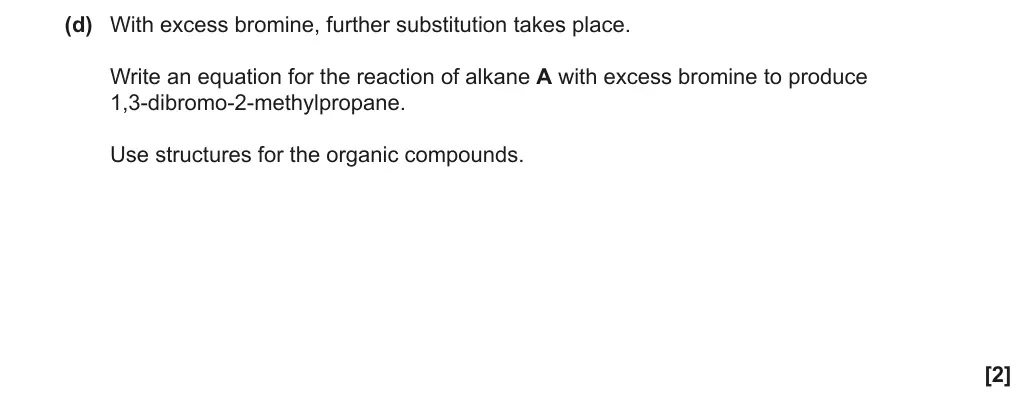
2Br2 and 2HBr needed to balance
correct structure of 1,3-dibromo-2-methylpropane
November 2021 · Paper 2 · Q41 markMultiple choice
Answer
C
Mark scheme
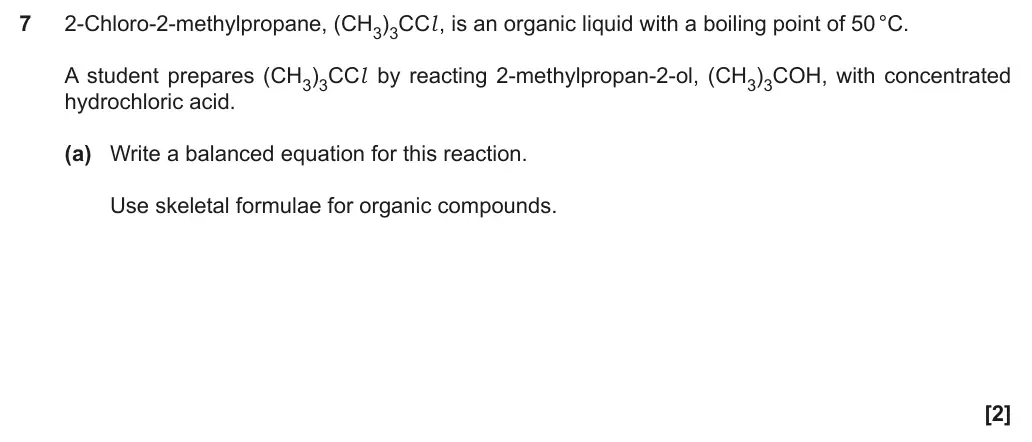
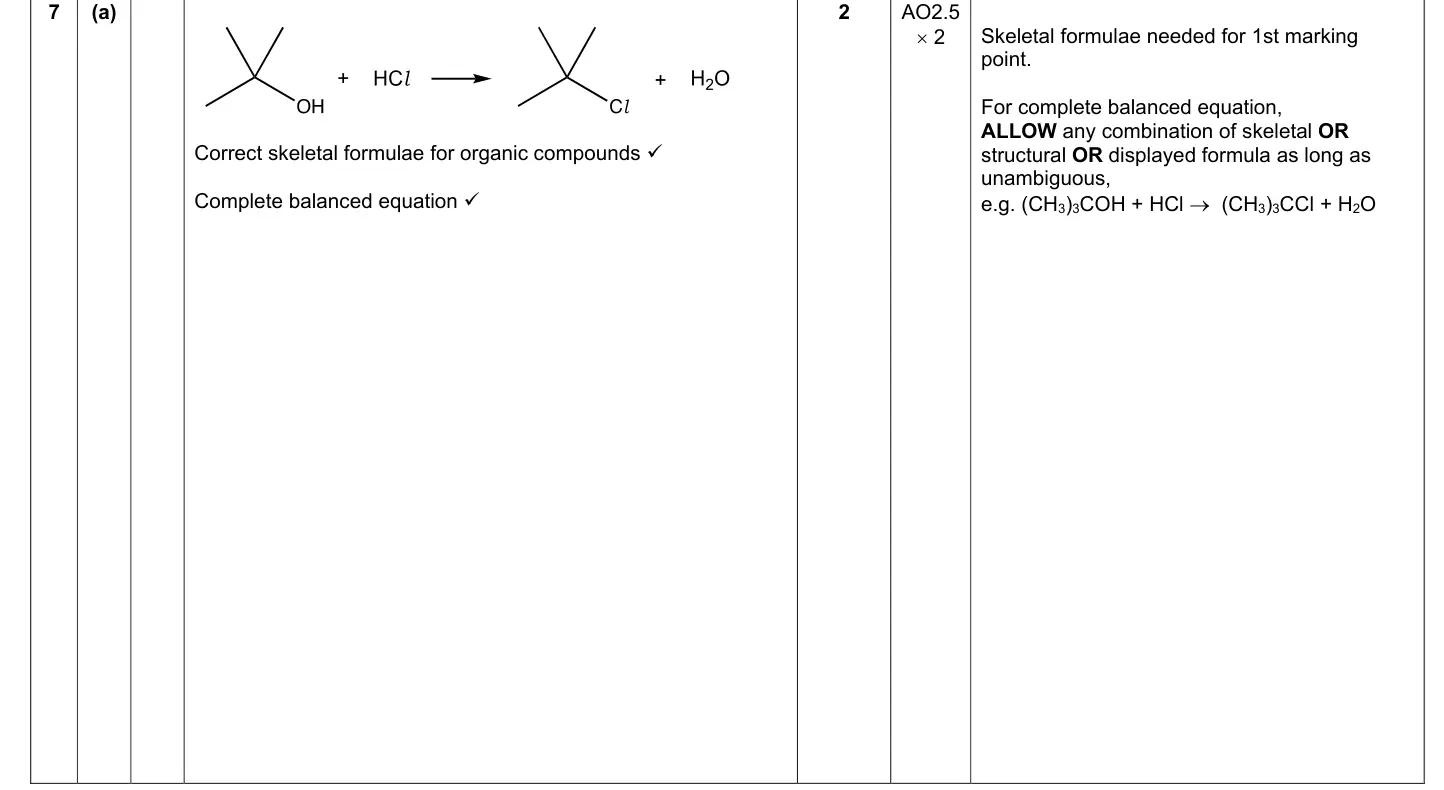
November 2021 · AS Paper 2 · Q7(a)2 marksAO2Equation writing
Mark scheme
Notes from the mark scheme and report
skeletal formulae required for the first mark
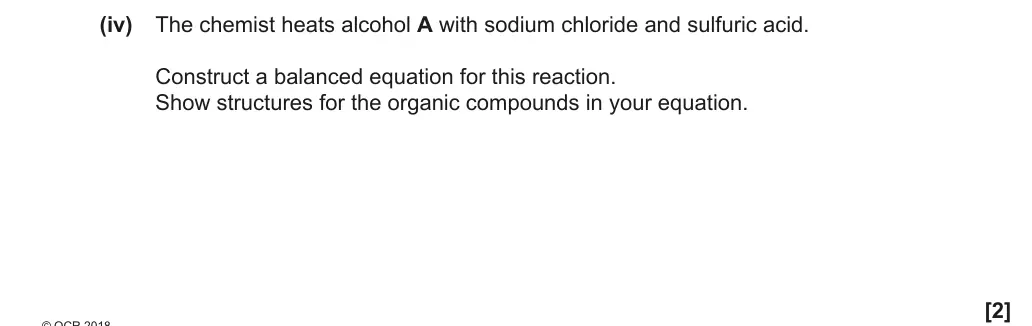
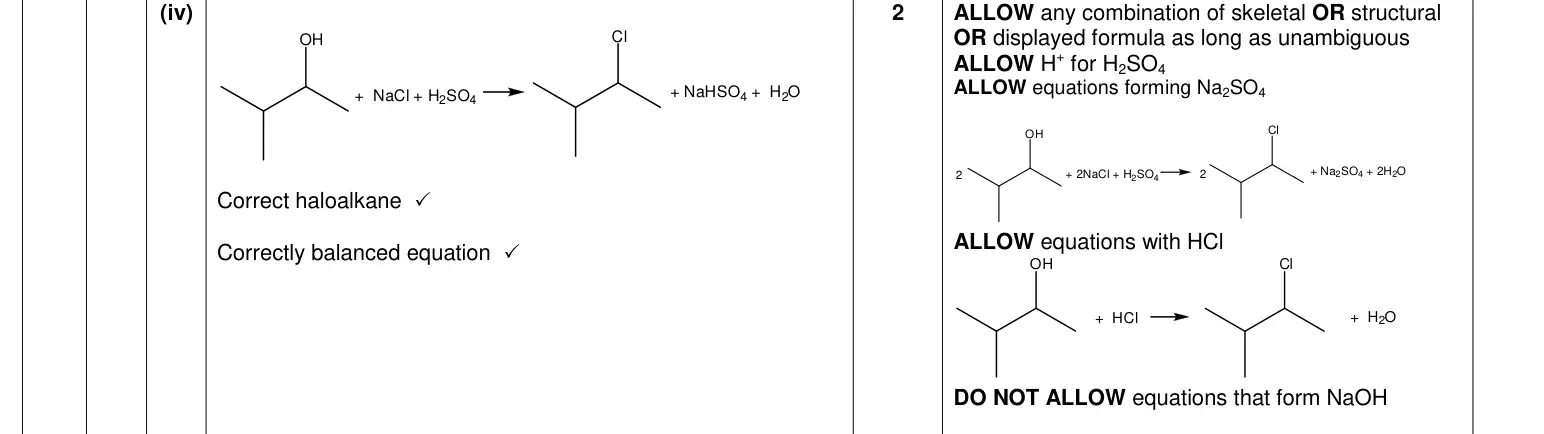
(CH3)3COH + HCl → (CH3)3CCl + H2O
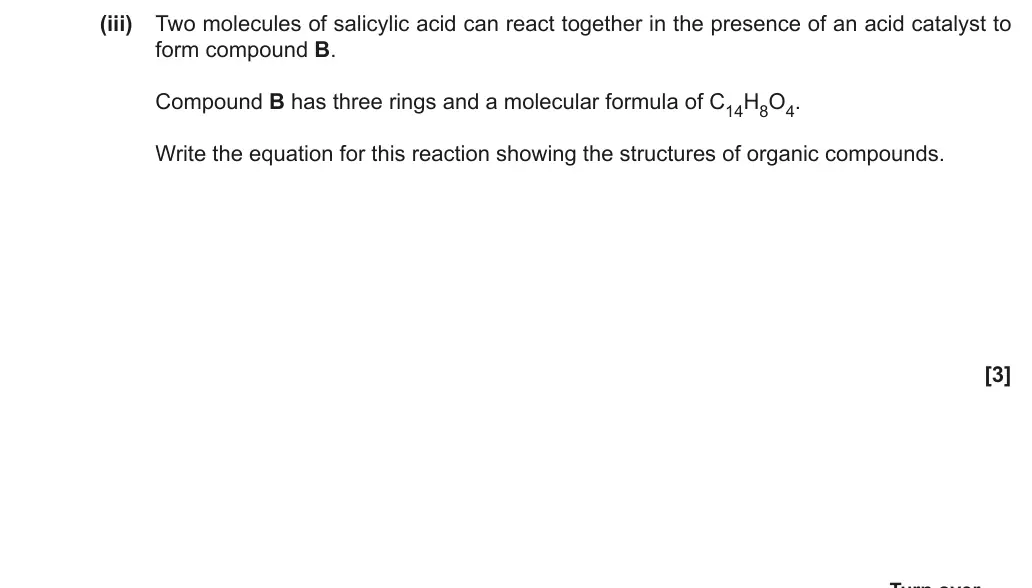
November 2021 · Paper 2 · Q20(a)(iii)3 marksAO2, 3Equation writingHard
Earlier part of question 20 that this part uses
Mark scheme
Examiner's comment
Question 20(a)(iii): Candidates who found this question difficult often did not recognise the functional groups present in the reacting molecule.
Notes from the mark scheme and report
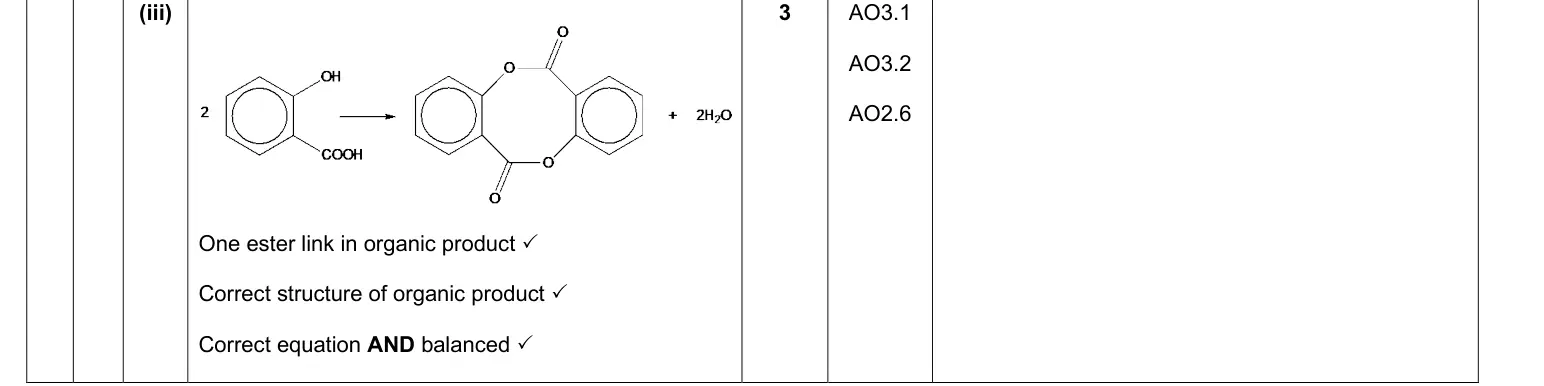
cyclic diester (two ester links, three rings) from 2 molecules
2H2O to balance
November 2021 · Paper 3 · Q1(d)4 marksAO1, 2Equation writingHard
Mark scheme
Examiner's comment
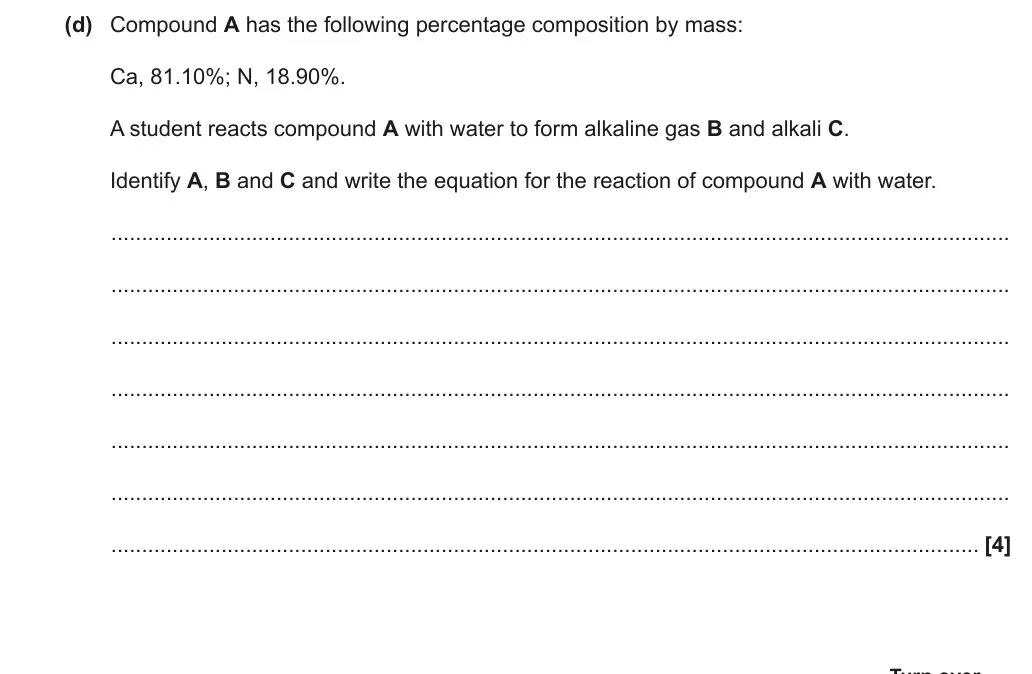
Q1(a) Partial pressure calculation Q1(d) Formula determination from percentage composition by mass Q2(b) Converting mass and volume into moles Q3(b) Unstructured titration calculation Q5(a)(ii) Ideal gas calculation Q5(b)(i) Calculation of the pH of a weak acid • Produced clear and concise responses for a Level of Response question based on a familiar context i.e., Q4(b) rates by continuous monitoring and graphical analysis. • Had difficulty when answering questions requiring application of knowledge and understanding on questions set in novel and unfamiliar contexts, e.g. Q1(d), Q1(e), Q5(a)(i) • Unclear drawing of diagrams and labelling of laboratory apparatus: Q2(a) • Had difficulty explaining chemical ideas, often repeating the same points several times, e.g. Q1(d) Candidates were required to analyse provided information to identify three unknown compounds and to write an equation.
Notes from the mark scheme and report
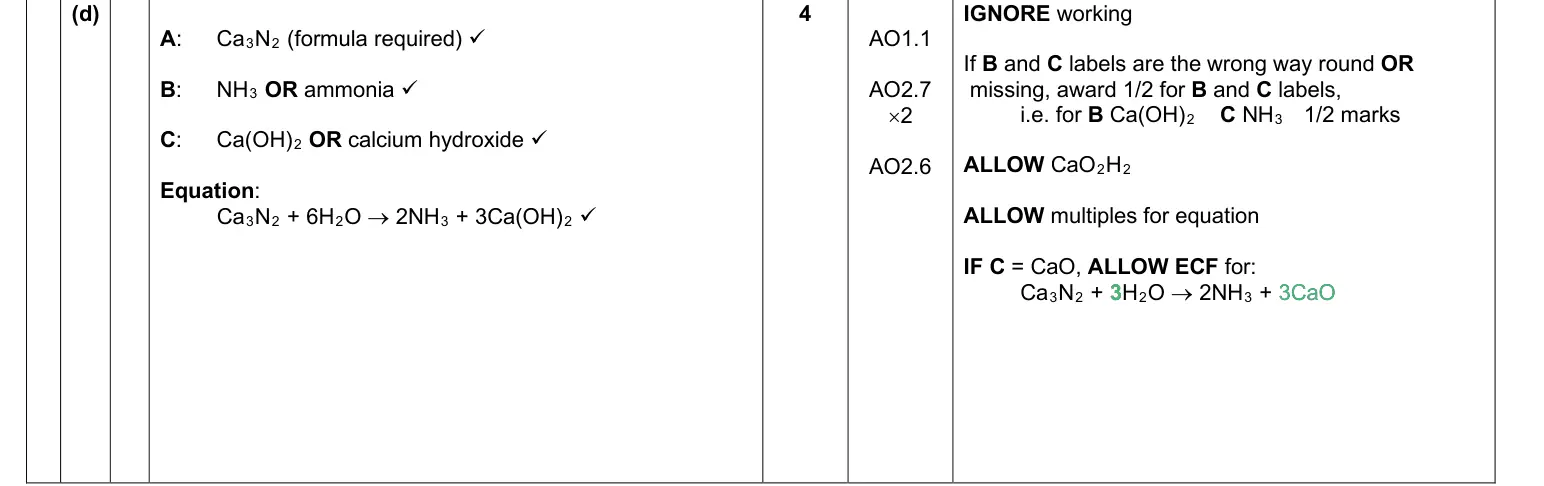
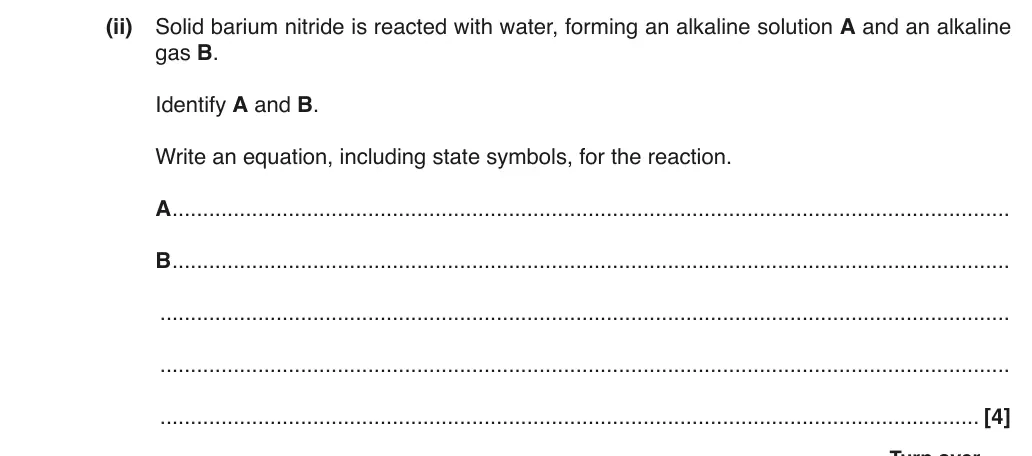
A = Ca3N2 (formula required), B = NH3, C = Ca(OH)2
Ca3N2 + 6H2O → 2NH3 + 3Ca(OH)2
1 of 2 if B and C labels wrong way round
ECF for CaO as C
Skills: M0.2 Use ratios, fractions and percentages
November 2021 · Paper 3 · Q1(e)4 marksAO2Equation writingHard
Mark scheme
Examiner's comment
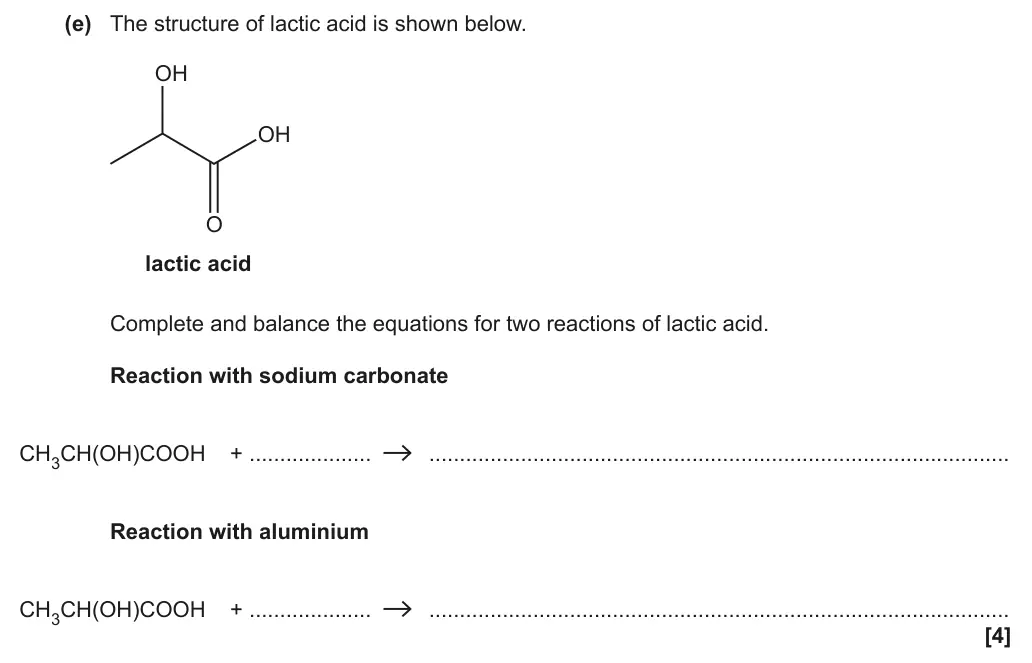
Q1(d), Q1(e), Q5(a)(i) • Unclear drawing of diagrams and labelling of laboratory apparatus: Q2(a) • Had difficulty explaining chemical ideas, often repeating the same points several times, e.g. Q1(e): Candidates needed to use their knowledge of reactions of carboxylic acids to construct two equations. See also comments made for Q1(e) and Q3(b).
Notes from the mark scheme and report
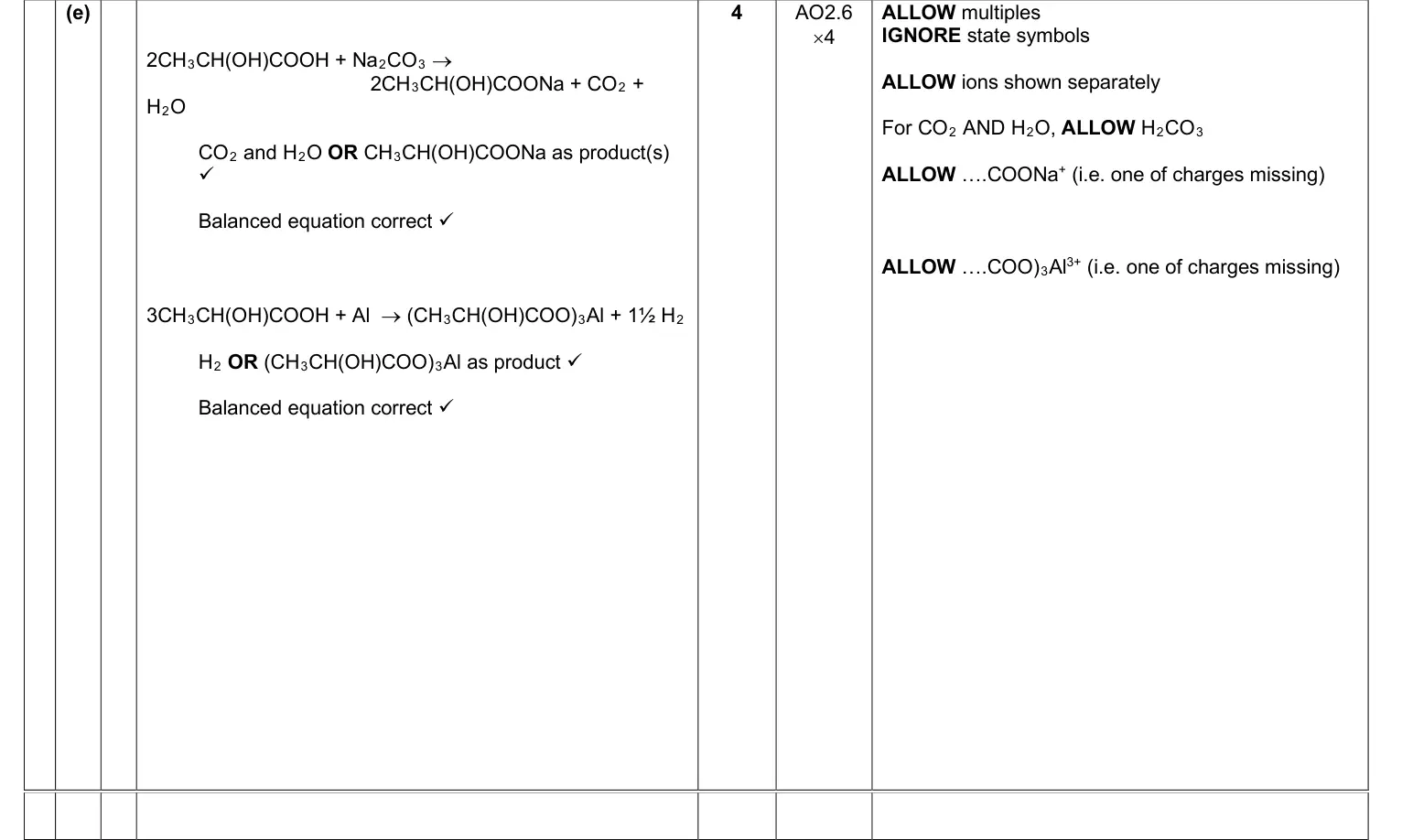
2:1 acid:Na2CO3 giving salt + CO2 + H2O
3 acid + Al → (CH3CH(OH)COO)3Al + 1½H2
alcohol OH does not react
ALLOW multiples
IGNORE state symbols
Skills: M0.2 Use ratios, fractions and percentages
November 2021 · Paper 3 · Q5(b)(iii)3 marksAO2, 3Equation writingMedium
Earlier part of question 5 that this part uses
Mark scheme
Examiner's comment
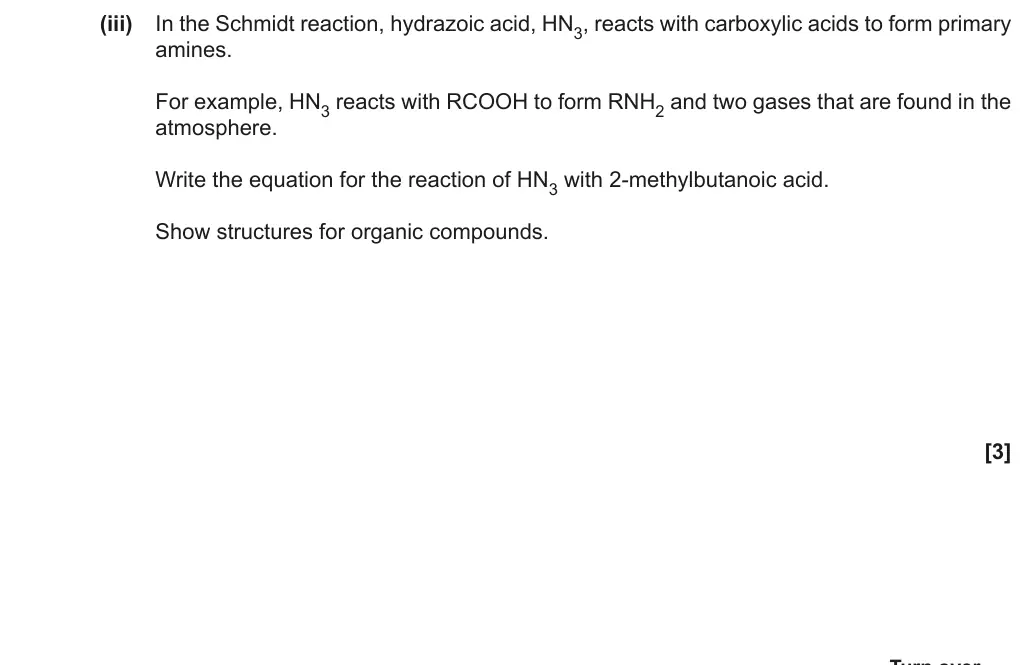
Q1(f) Outlining a mechanism for an unfamiliar reaction Q5(b)(iii) Predicting the equation for an unfamiliar organic reaction • Did not consider what a question is asking or read the information, e.g. Q5(b)(iii) Candidates were expected to interpret information for an unfamiliar organic reaction and to write a balanced question. In Q5(b)(iii), 2-methylbutanoic acid is CH3CH(CH3)CH2COOH.
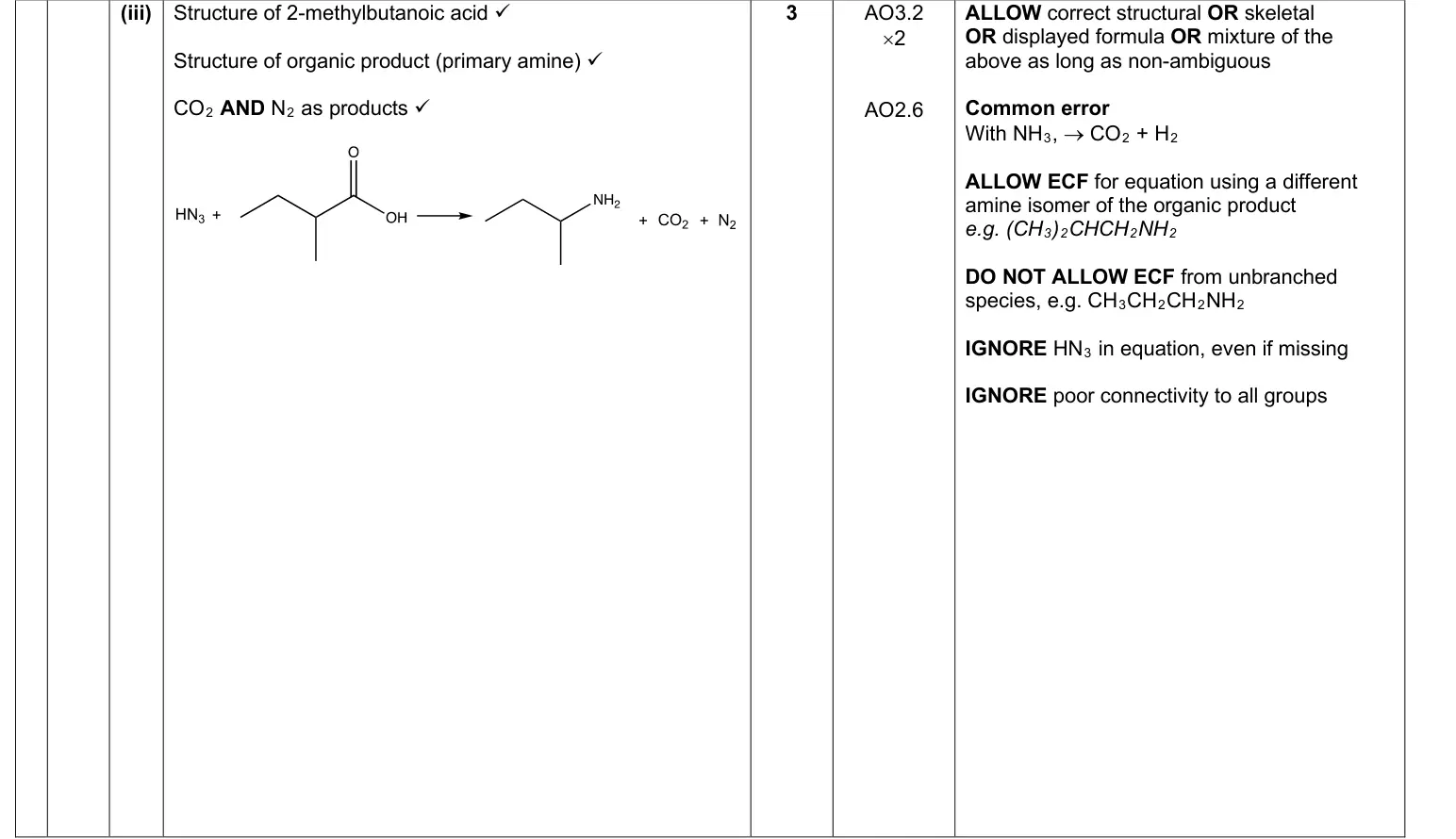
Notes from the mark scheme and report
structure of 2-methylbutanoic acid
amine is CH3CH2CH(CH3)NH2 (butan-2-amine)
CO2 AND N2 as products
DO NOT ALLOW ECF from unbranched species
common error: CO2 + H2 from using NH3
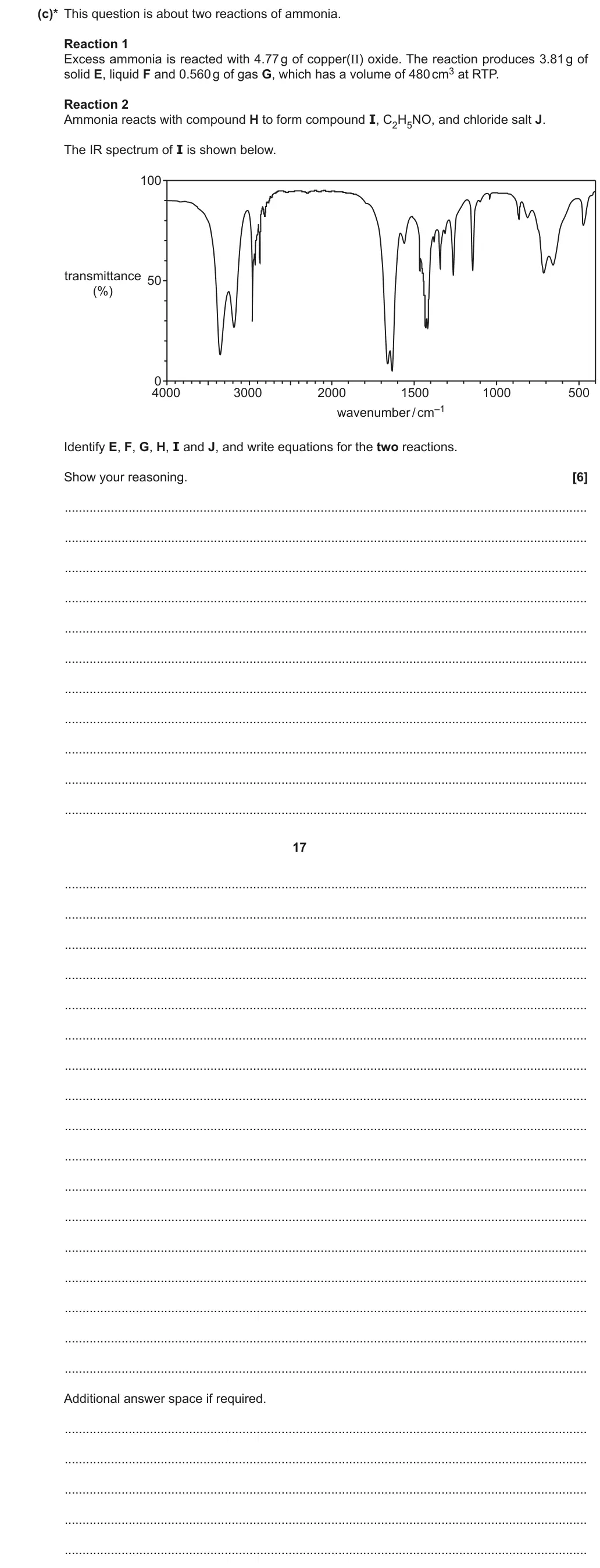
November 2021 · Paper 3 · Q5(c)6 marksAO36-mark level of responseHard
Mark scheme, with the levels and indicative points
Examiner's comment
Q2(c), Q2(d): Predicting the effect of modifications to an experiment Q5(c): Interpreting information in a Level of Response question provided in an unfamiliar contexts • Had difficulty when writing equations for unfamiliar reactions, e.g. Q5(c) is a Level of Response question which is commented on after this section Level of response questions Q4(b): Candidates were required to analyse the graphical results of a rates investigation to determine the reaction order, rate and rate constant. Q5(c): Candidates were supplied with information about two reactions, supported by numerical data and an IR spectrum.
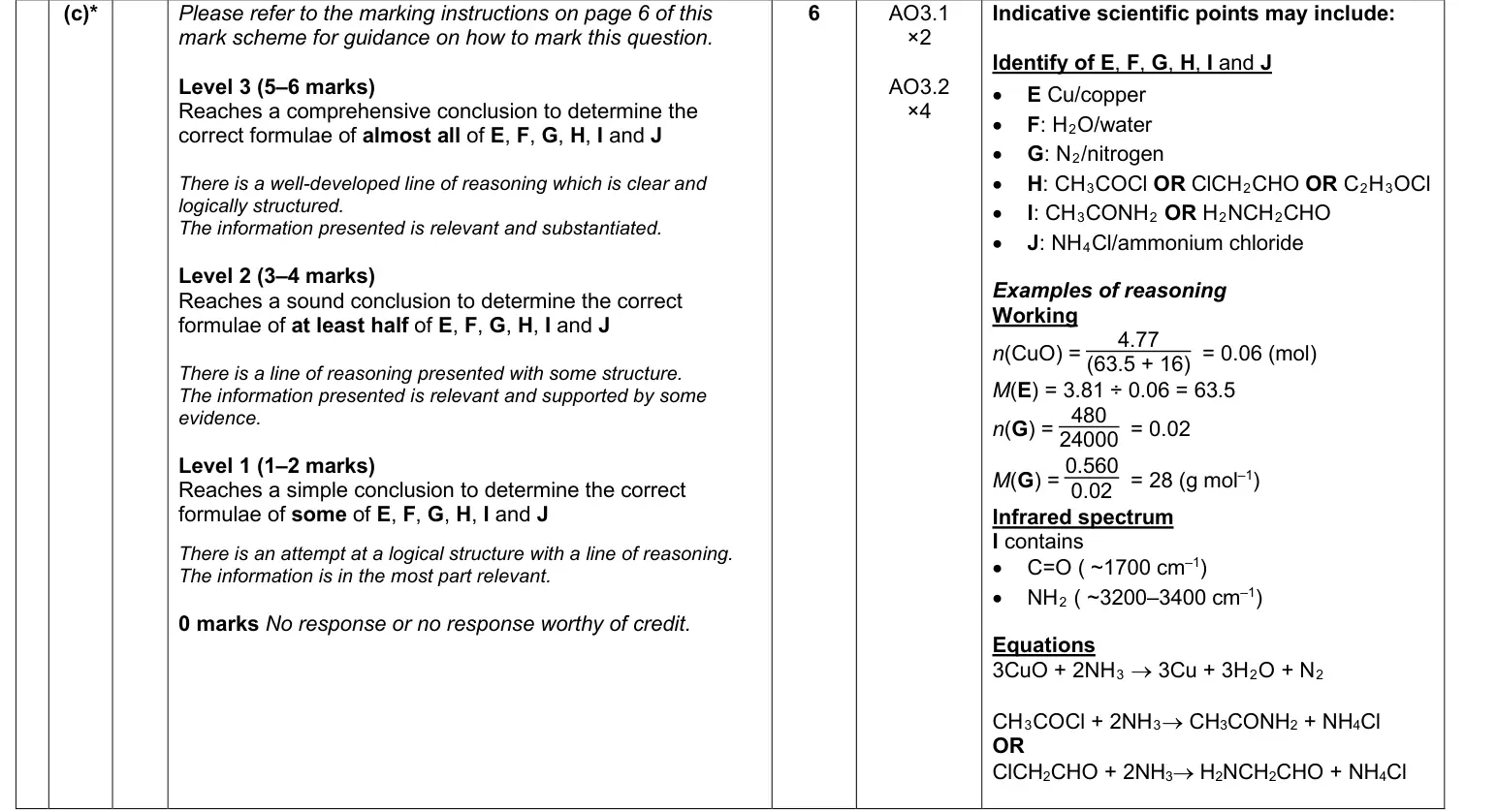
Notes from the mark scheme and report
E = Cu (M = 3.81/0.06 = 63.5), F = H2O, G = N2 (M = 0.560/0.02 = 28)
3CuO + 2NH3 → 3Cu + 3H2O + N2
I has C=O (~1700) and N–H (3200–3400) so CH3CONH2
H = CH3COCl, J = NH4Cl
CH3COCl + 2NH3 → CH3CONH2 + NH4Cl
Skills: M0.2 Use ratios, fractions and percentages; M3.1 Translate information between graphical, numerical and algebraic forms
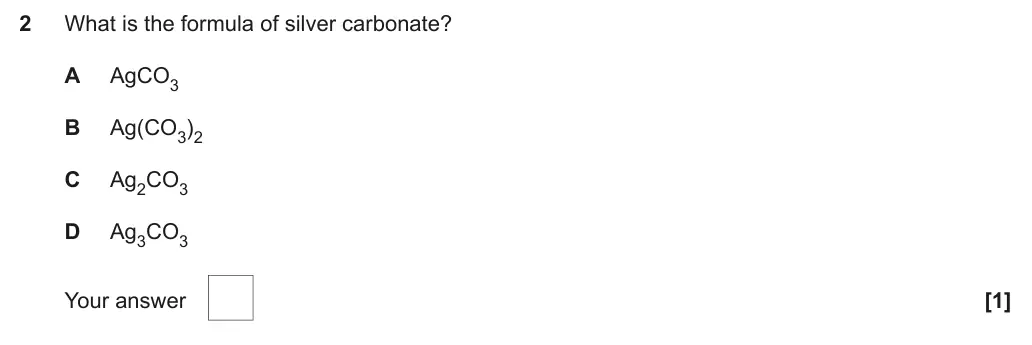
November 2020 · AS Paper 1 · Q21 markAO1Multiple choiceMedium
Answer
C
Mark scheme
Examiner's comment
Candidates are expected to know the charges on silver and carbonate ions. However, a number of candidates responded with A: AgCO3, rather than C: Ag2CO3.
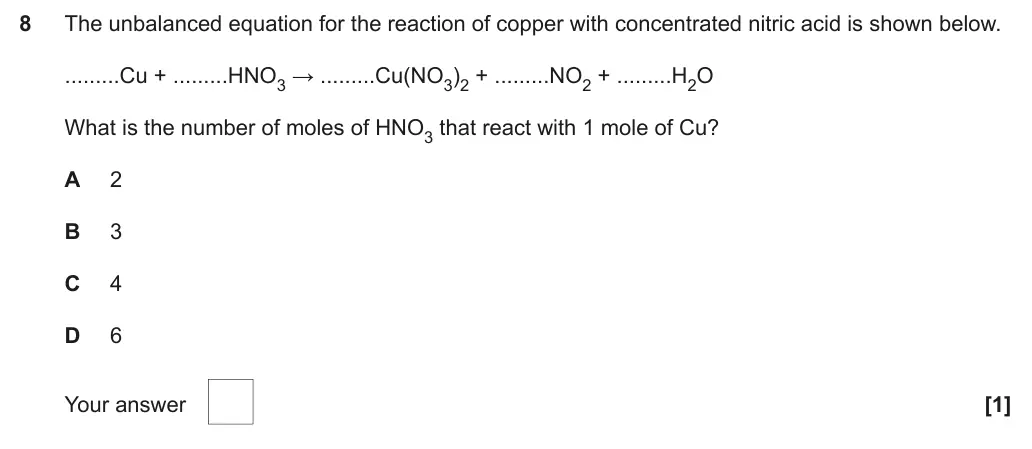
November 2020 · AS Paper 1 · Q81 markAO1Multiple choiceHard
Answer
C
Mark scheme
Examiner's comment
Candidates found this question difficult, with the nitric acid N atoms being split between two products, Cu(NO3)2 and NO2. B proved to be the biggest distractor from the correct response of C, probably the result of miscounting the N atoms.
November 2020 · Paper 1 · Q21(a)5 marksAO1, 2Equation writingMedium
Mark scheme
Examiner's comment
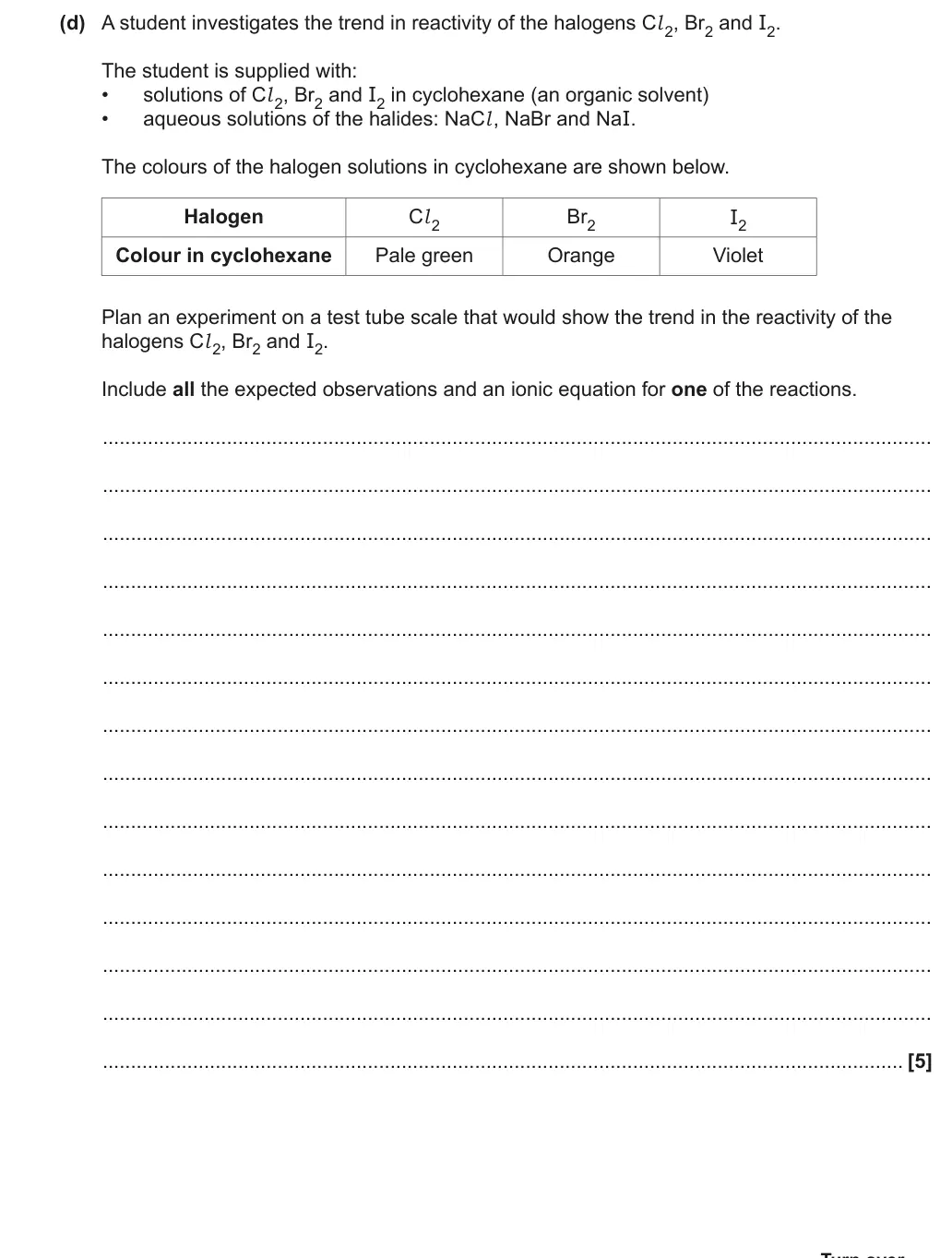
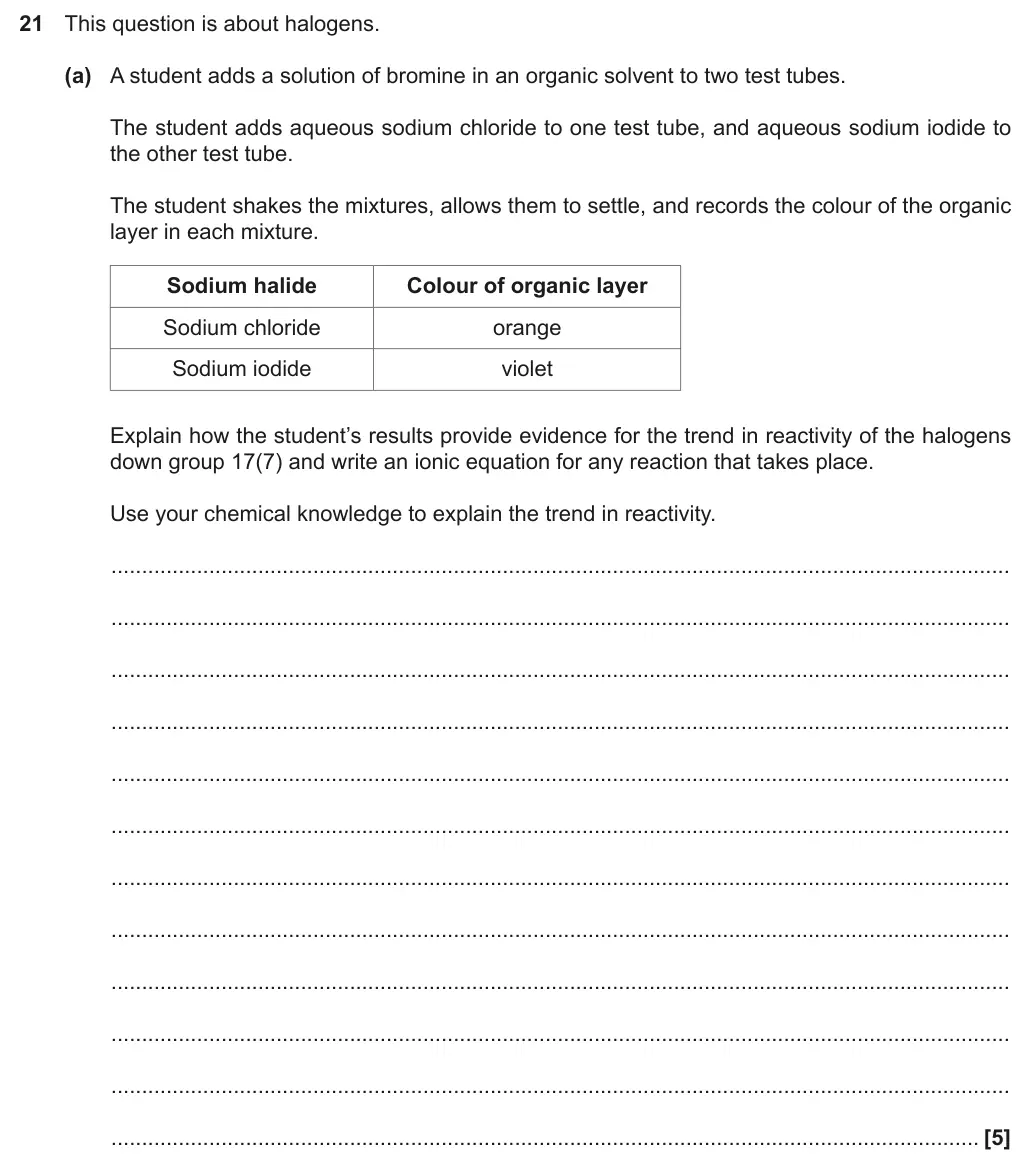
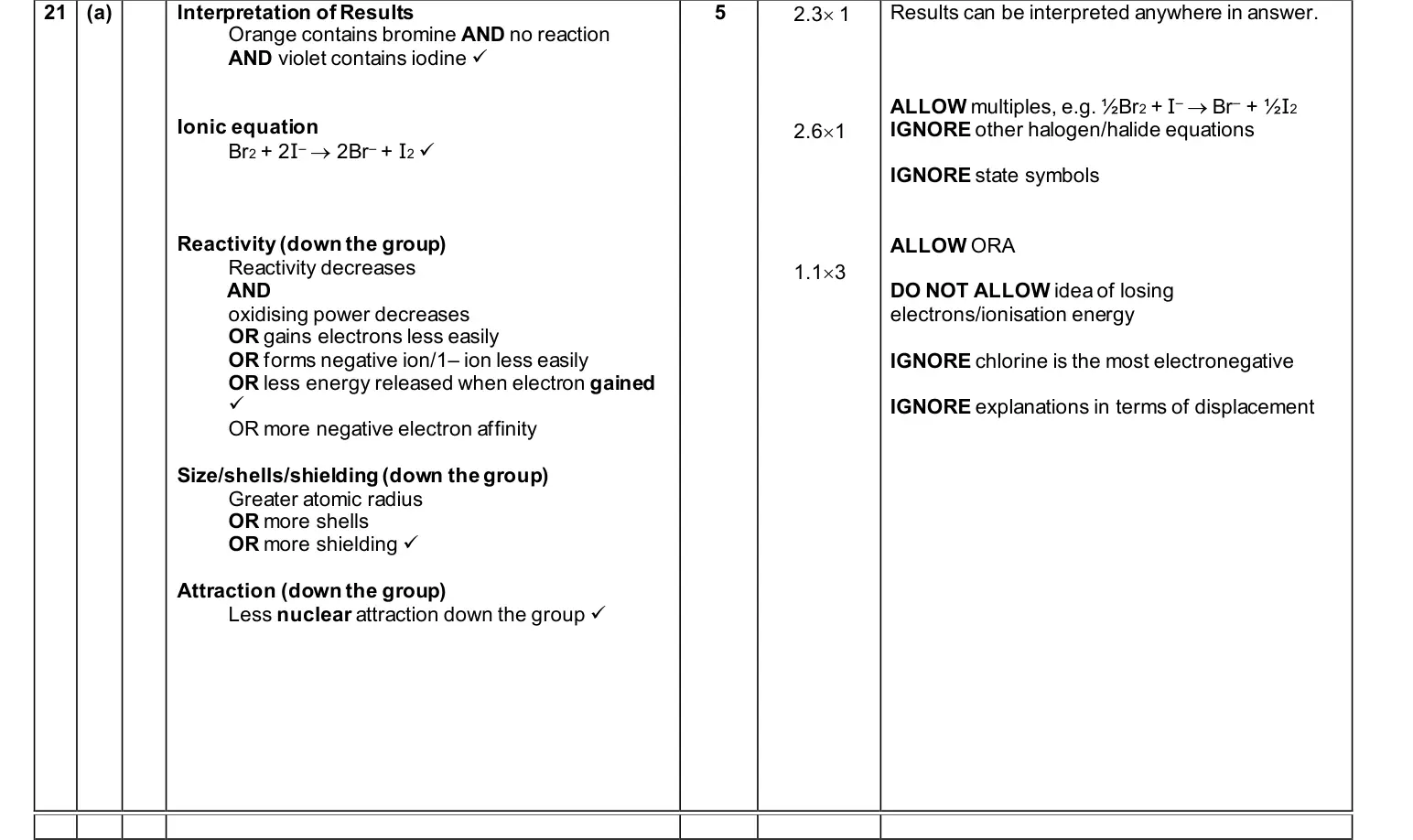
This question required the candidate to explain the reactivity of the halogens given experimental observations. Higher-attaining candidates were able to explain the observations with ionic equations and explain the reactivity in terms of gaining electrons. Some candidates did not associate the colour with the halogen and linked it with the halide ion, but then did explain the trend in reactivity due to the ability to gain electrons. Lower-attaining candidates explained the reaction in terms of displacement (which was ignored) and they did not proceed with ionic equations or describe the ability to gain electrons. Key teaching and learning points – comments on improving performance Candidates could improve their performance in this examination by: • Practising the skills required to complete multiple choice questions. • Showing clearly structured working in their calculation questions so that methods are understood and followed. • Practising linking experimental observations with theoretical understanding to improve the quality of descriptions and explanations. • Making sure that they use the appropriate terminology. • Developing their ability to write ionic equations. • Improving their ability to process experimental results from graphical data. Guidance on using this paper as a mock This paper should be used in conjunction with H432/02 and H432/03. Candidates should sit the paper under examination conditions in the allotted time. The marked paper should be reviewed, in conjunction with the mark scheme, by the student to identify the terminology and structure required within the questions to achieve full credit. Internal moderation will add validity to the credit given. If any of your students’ results are not as expected, you may wish to consider one of our review of results services. For full information about the options available visit the OCR website. If university places are at stake you may wish to consider priority service 2 reviews of marking which have an earlier deadline to ensure your reviews are processed in time for university applications. Our priority is supporting you and your students this autumn and to support you as you prepare for summer 2021 exams. We’ll update our website information regularly with resources, guidance and key information. • Teachers • Students • Exams officers • Assessment specialists We are sending a weekly roundup to tell you about important updates. You can also sign up for your subject specific updates. If you haven’t already, sign up here. Attend one of our popular CPD courses to hear directly from a senior assessor or drop in to a Q&A session. All our courses for the academic year 2020-2021 are being delivered live via an online platform, so you can attend from any location. Please find details for all our courses on the relevant subject page on our website or visit OCR professional development. ExamBuilder is the question builder platform for a range of our GCSE, A Level, Cambridge Nationals, Cambridge Technicals and Functional Skills qualifications. See the full list of available qualifications in the sign up form. ExamBuilder is free for all OCR centres with an Interchange account and gives you unlimited users per centre. We need an Interchange username to validate the identity of your centre's first user account for ExamBuilder. If you do not have an Interchange account please contact your centre administrator (usually the Exams Officer) to request a username, or nominate an existing Interchange user in your department. Review of results
Notes from the mark scheme and report
orange = bromine, no reaction with Cl–
violet = iodine formed
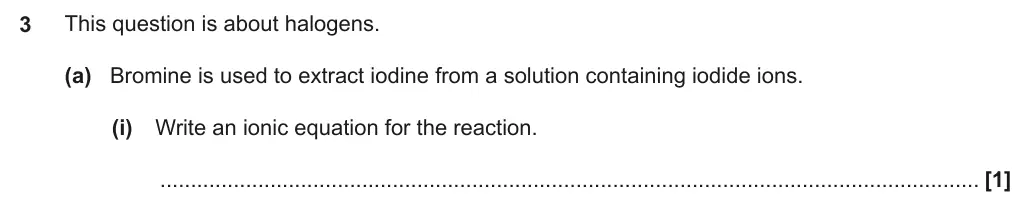
Br2 + 2I– → 2Br– + I2
reactivity/oxidising power decreases down group: larger radius/more shielding, less nuclear attraction for gained electron
DO NOT ALLOW losing electrons/ionisation energy
IGNORE explanations in terms of displacement
rather than electron affinity. The colour of the organic layer was also associated with the halide ion rather than the halogen.
Further guidance can be found in the AS Level delivery guide ‘Theme: Patterns’ (Group 2 and Group 17): https://www.ocr.org.uk/Images/231740- patterns.pdf Links to the legacy coursework tasks and PAG practice question sets can be found on OCR Interchange.
Skills: PAG4 Qualitative analysis of ions
November 2020 · Paper 1 · Q22(a)6 marksAO36-mark level of response
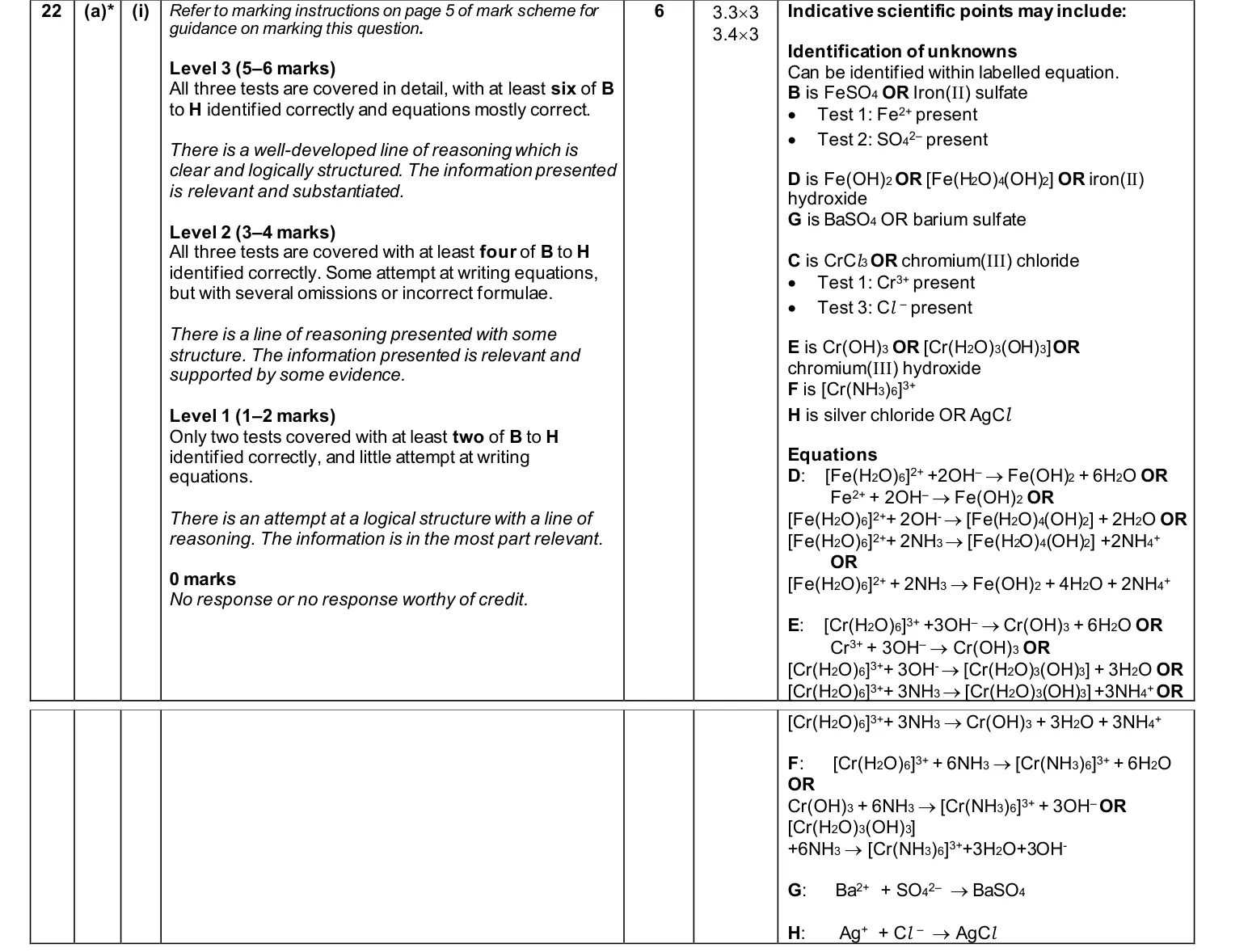
Mark scheme, with the levels and indicative points
Notes from the mark scheme and report
B = FeSO4, D = Fe(OH)2, G = BaSO4
C = CrCl3, E = Cr(OH)3, F = [Cr(NH3)6]3+, H = AgCl
ionic equations for D–H
Level 3 needs at least six identified and equations mostly correct
Skills: PAG4 Qualitative analysis of ions
November 2020 · AS Paper 1 · Q22(a)(ii)1 markAO2Equation writingMedium
Earlier part of question 22 that this part uses
Mark scheme
Examiner's comment
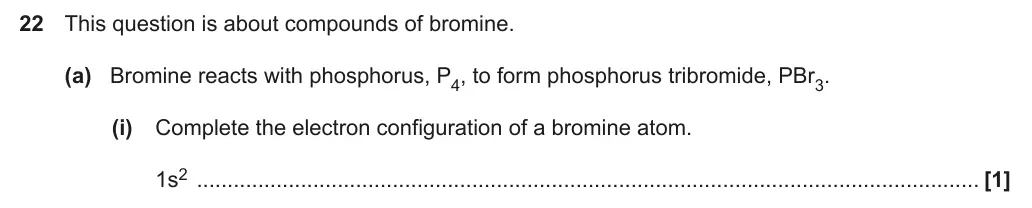
22(a)(i) Candidates answered this part well, showing good knowledge and understanding of electron configuration. When incorrect, it was usually errors with the number of electrons in the 3d and 4p subshells. 22a(ii) Most candidates were able to construct a correct balanced equation for this unfamiliar equation. The commonest error was use of Br instead of Br2 in the equation. 22(b) Structure and bonding continues to be a difficult concept for many candidates. This part did discriminate extremely well, with high-attaining candidates identifying that the compound would have a giant ionic lattice with fixed ions in the solid state which become mobile in the liquid state to conduct electricity. It was common for ‘ionic’ or ‘giant’ to be omitted in the name of the lattice. Most candidates used the ideal gas equation, which was usually rearranged correctly, with substituted values for p, V, R and T being added. A common mistake was for the volume in cm3 to be multiplied by 10–3 rather than 10–6 for the necessary conversion into m3. Low-attaining candidates often did not convert 100 ºC into 373 K. Unfortunately, candidates making an error in unit conversions then obtained an unrealistic molar mass for A and were then unable to derive a possible molecular formula. Well-prepared candidates carried out the calculation well with clear working. It was very encouraging to see the number of candidates able to predict the molecular formula of A as BrF5 from the calculated molar mass of 174.6 g mol–1. There were, however a significant number of incorrect responses, suggesting that some candidates found this type of question challenging. Some candidates used the molar gas volume at room temperature and pressure of 24.0 dm3 mol–1. Two of the five marks were still available for this response.
Notes from the mark scheme and report
P4 not P
ALLOW multiples
Skills: M0.2 Use ratios, fractions and percentages
November 2020 · AS Paper 1 · Q23(c)4 marksAO2, 3Short answerHard
Mark scheme
Examiner's comment
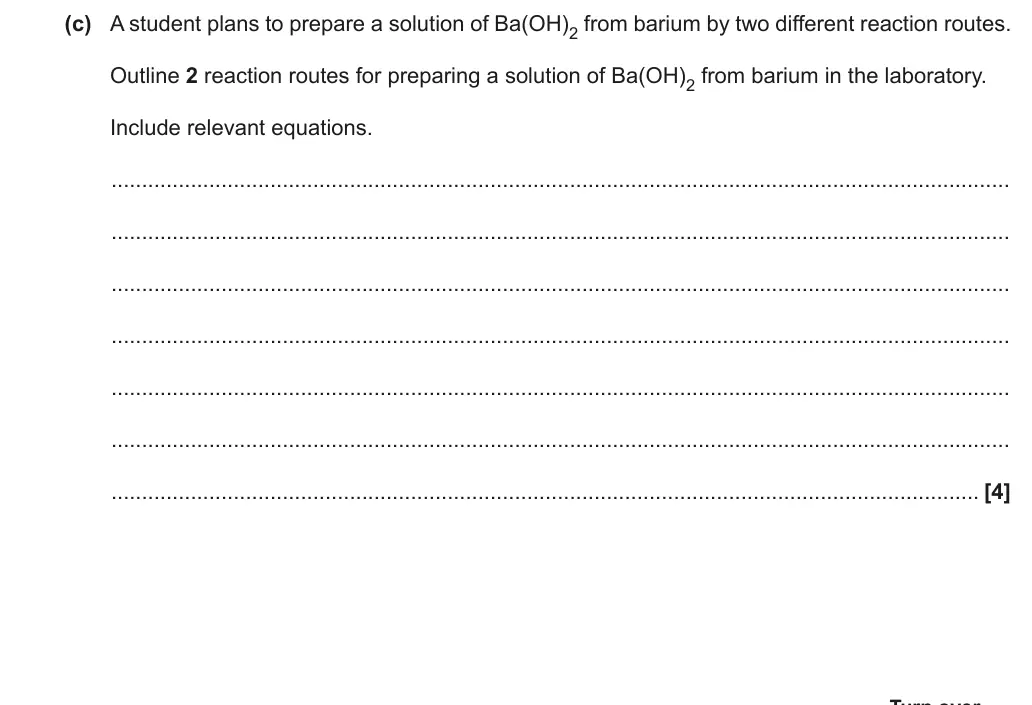
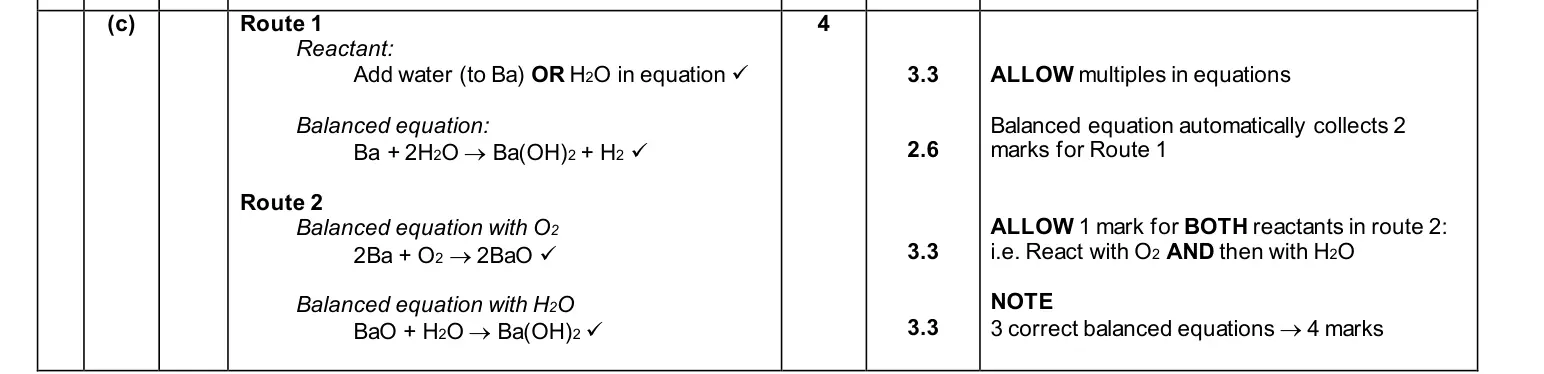
23(a) This question required candidates to calculate the moles of Ba(OH)2 in 100 cm3, to scale this value up to 1 dm3 for the concentration of Ba(OH)2 and finally to multiply this value by 2 to obtain the concentration of OH– ions of 0.454 mol dm–3. This part discriminated extremely well. Lower-attaining candidates would often calculate an incorrect molar mass of Ba(OH)2 and scale up by either 10 or 2. The commonest incorrect answer seen was 0.227, half of the correct answer by omitting the ×2 stage. Most candidates did supply their final answer to the required 3 significant figures. As with all calculations, candidates should round once, at the end of the calculation. Rounding of intermediate values can lead to significant rounding errors. Sometimes, intermediate values were rounded to 2 significant figures when the final value required 3. This use of maths will almost certainly lead to a rounding error in the final answer. Candidates should show clear working so that credit can be given for such responses by applying error carried forward. Many candidates produced largely unreferenced numbers. 23(b) Many candidates seemed to be unfamiliar with the term ‘concordant titres’. Acceptable responses were ‘within 0.1 cm3 and within 0.05 cm3. Common incorrect answers for this important term included ‘the closest titres’, ‘similar titres’, ‘repeated titres’ and ‘within 0.5 cm3’. 23(c) Many candidates were able to calculate the amount of HNO3 in the titration as 4.28 × 10⁻³ mol. Most candidates were credited for the amount of Ba(OH)2 as 2.14 × 10⁻³ mol, half the calculated amount of HNO3. Candidates then need to scale up this value by 1000/25 to obtain the concentration as 0.0856 mol dm–3. Unlike Q23(a), all intermediate calculations gave values to 3 significant figures. Candidates found this stock titration calculation easier than the more unfamiliar 23(a), with many scoring all 3 marks. Discrimination was extremely good, but about a third of candidates did not receive any marks. Candidates should be encouraged to practise stock titration calculations as part of their preparation for the examinations. Candidates should show clear working so that credit can be given for such responses by applying error carried forward. As with Q23(a), many candidates produced largely unreferenced numbers. 23(d) Candidates often find questions linked to practical work challenging. The two reaction routes involving Group 2 reactions are drawn directly from the specification: the reaction of barium with water, and the reaction of barium with oxygen, followed by water. Most candidates found this difficult, and the one-step route using barium and water was seen far more often than the two-step oxygen then water approach. Only the highest-attaining candidates were able to suggest two routes, with scores of 3/4 or 4/4 marks being comparatively rare. As with 21(c)(ii) and 25c(iii), candidates had difficulty in interpreting provided information. OCR support Our new practical question packs, split up by PAG, provide additional opportunities for students to practise questions relating to practical work. They are available on Interchange: https://interchange.ocr.org.uk/Downloads/H432_H433_Chemistry_PAG_ Practice_Question_Sets.zip
Notes from the mark scheme and report
Route 1 Ba + 2H2O
Route 2 via BaO then water
ALLOW multiples
1 mark for both reactants O2 then H2O in route 2 without equations
November 2020 · AS Paper 1 · Q25(c)(iii)2 marksAO2Equation writingMedium
Earlier part of question 25 that this part uses
Mark scheme
Examiner's comment
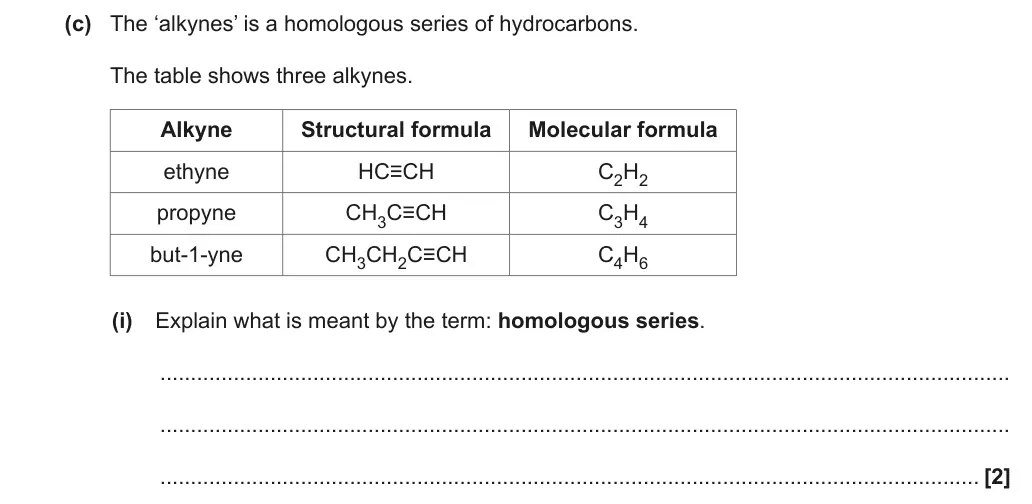
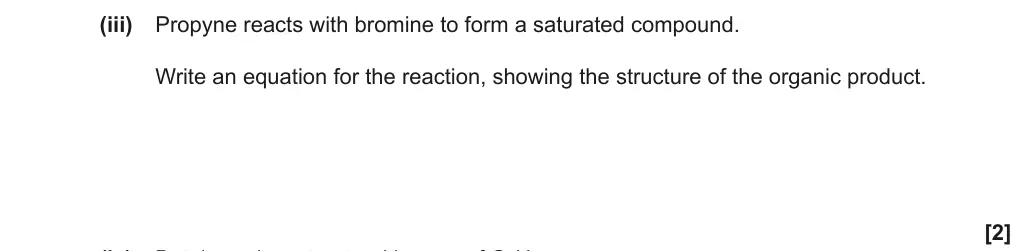
25(a) This part was generally well-answered with well-prepared candidates scoring all three marks. The most common errors resulted from the products of reaction with HBr. The same structure was often drawn, reversed in one of the boxes. Candidates should take care to check that the atoms in a structure have the correct number of bonds. Some candidates added HBr across the C=C double bond but left the C=C bond intact in their final structures, showing carbon atoms with 5 bonds instead of 4. 25(b) As with 25(a), this question rewarded the well-prepared candidate and discriminated well. Conversely, many mechanisms showed little resemblance to the accepted mechanism for electrophilic addition. Mechanisms were often seen showing curly arrows going in the wrong direction and between the wrong bonds and atoms, with incorrect charges and dipoles, and partial charges used where full charges were required. Many candidates were aware that members of a homologous series have the same functional group and react in similar ways. A second mark was available for stating that the formula of successive members increases by CH2. It is important to stress ‘successive’ in communicating this information. 25(c)(ii) This part required candidates to apply their understanding of a ‘general formula’ in a novel context. Many candidates analysed the provided formulae for the alkynes homologous series to derive the correct general formula of CnH2n–2. There was no real pattern in the incorrect responses which usually contained a mixture of numbers for the H atom, e.g. CnH2n, CnHn+1. 25(c)(iii) Although attempted by most candidates, comparatively few responses could be credited. The key to success was again to use the information provided: the formation of a saturated compound. The commonest response seen showed addition of 1 Br2 molecule to form the unsaturated CH3CBr=CHBr instead of the saturated CH3CBr2–CBr2 by addition of 2 Br2. This question was one of the most difficult on the exam paper. 25(c)(iv) Most candidates achieved 1 of the available 2 marks for drawing the structure of but-2-yne, CH3C≡CCH3. The structure of but-1-yne was then usually drawn in the other box despite it being provided already in the table at the start of part (c). A variety of creditworthy structures were seen, including H2C=CH– CH=CH2, cyclobutene and isomers of methylcyclopropane. 25(c)(v) It was encouraging to see the many correct structures drawn from the unfamiliar 2,5-dimethylhept-3-yne. Most candidates positioned the C≡C group and the two substituted CH3 groups correctly. The commonest error was showing a main stem with 6, rather than 7 C atoms. If any of your students’ results are not as expected, you may wish to consider one of our review of results services. For full information about the options available visit the OCR website. If university places are at stake you may wish to consider priority service 2 reviews of marking which have an earlier deadline to ensure your reviews are processed in time for university applications. Our priority is supporting you and your students this autumn and to support you as you prepare for summer 2021 exams. We’ll update our website information regularly with resources, guidance and key information. • Teachers • Students • Exams officers • Assessment specialists We are sending a weekly roundup to tell you about important updates. You can also sign up for your subject specific updates. If you haven’t already, sign up here. Attend one of our popular CPD courses to hear directly from a senior assessor or drop in to a Q&A session. All our courses for the academic year 2020-2021 are being delivered live via an online platform, so you can attend from any location. Please find details for all our courses on the relevant subject page on our website or visit OCR professional development. ExamBuilder is the question builder platform for a range of our GCSE, A Level, Cambridge Nationals, Cambridge Technicals and Functional Skills qualifications. See the full list of available qualifications in the sign up form. ExamBuilder is free for all OCR centres with an Interchange account and gives you unlimited users per centre. We need an Interchange username to validate the identity of your centre's first user account for ExamBuilder. If you do not have an Interchange account please contact your centre administrator (usually the Exams Officer) to request a username, or nominate an existing Interchange user in your department. Review of results
Notes from the mark scheme and report
2Br2 needed to form a saturated product
ALLOW C3H4 for propyne
ALLOW H3CCBr2CHBr2
Skills: M0.2 Use ratios, fractions and percentages
November 2020 · AS Paper 2 · Q1(c)6 marksAO1, 2, 36-mark level of responseMedium
Mark scheme, with the levels and indicative points
Examiner's comment
1(a) A considerable number of candidates did not score the mark here despite knowing that it was an oxidation reaction. They either omitted to give the number of electrons lost or gave their justification using oxidation numbers. This question highlights the importance of reading the question carefully and answering the question asked, not one that may have been seen previously. 1(b)(i) Most candidates were able to make some progress with this calculation. Common errors included omitting to multiply by two to find the number of moles of HCl or not multiplying their volume in dm3 by 1000 to give an answer in cm3. 1(b)(ii) More candidates struggled with this part of calculation. A significant number of candidates used the number of moles rounded to 3 SF but then gave a final answer to 4 SF, giving an answer of 78.48 cm3. This was given credit as correct calculation had been carried out for one mark. A couple of candidates correctly used the ideal gas equation and were given credit for this, but made it more complicated than necessary for one mark. 1(b)(iii) Very few candidates managed to gain marks here. Most did not recognise that HCl was the limiting reagent in the reaction and suggested that a greater volume of H2 would be produced, as same mass of Mg would give a greater number of moles. 1(c)* Very few candidates managed to score full marks for this question. Even the highest-attaining candidates struggled with writing balanced chemical equations. The most successful candidates used ionic equations with state symbols in their responses. A large proportion of candidates gave unnecessary details such as testing for CO2 using limewater or the colours of other silver halide precipitates. The best responses broken down their response to cover each test in turn, giving clear and concise details for each.
Notes from the mark scheme and report
acid then fizzing for carbonate
Ba2+(aq) white precipitate for sulfate
AgNO3(aq) cream precipitate for bromide
sequence carbonate then sulfate then halide
equations ionic or full, IGNORE state symbols
Skills: PAG4 Qualitative analysis of ions
November 2020 · AS Paper 2 · Q3(c)(i)1 markAO2Equation writingMedium
Mark scheme
Examiner's comment
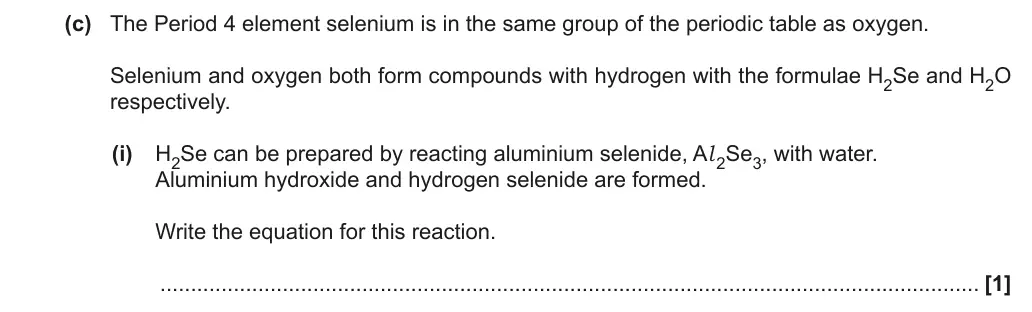
3(a) More able candidates scored well in this question, setting out their answers in a logical order. They often first discussed Ca and its bonding and structure, linking this to the physical properties and then doing the same for Br. A number of candidates discussed the chemical properties of Ca and Br, such as their ability to bond with other elements, ionisation energy and their reactivity based on their position in the periodic table. Some candidates gave a good description of metallic bonding but then went on to discuss melting point in terms of intermolecular forces. 3(b)(i) Most candidates were able to give the correct diagrams for ionic bonding, although care needs to be taken that diagrams are well drawn with both charges given. Some gave diagrams for covalent bonding. 3(b)(ii) It was important to answer the question asked. A number of responses lost marks for describing the general trend down group 2 without making reference at all to calcium and barium. Most candidates managed to score at least one mark here but a considerable proportion missed the second marking point explaining that nuclear attraction was less in Ba. 3(c)(i) This was dependent on candidates’ ability to give correct formula of aluminium hydroxide, Al(OH)3. Writing correct formulae is an important skill in chemistry, which should be practised regularly in different topics to help candidates master the skill. 3(c)(ii) Most candidates were able to recognise that water had the higher boiling point due to hydrogen bonding. However, it was evident in a number of responses that they were unclear that this is an example of an intermolecular force and doesn’t just refer to the covalent bond formed between O and H. Most avoided discussing the intermolecular forces present in H2Se even although both London forces and permanent dipole-dipole interactions were accepted as they may not have come across this specific example and had not been given electronegativity data. 3(d)(i) Very few candidates scored this mark. Although a number of candidates did give sodium bromate as the answer (with the omission of the oxidation state), many other answers were seen suggesting candidates are not aware of naming conventions for inorganic compounds. 3(d)(ii) This is the first time in a reformed chemistry AS paper that the question space has been left unstructured for oxidation number changes. The highest-attaining candidates set out their responses clearly, dealing with changes for oxidation and reduction separately, and giving the correct oxidation numbers. Some struggled to obtain an oxidation state of Br in NaBrO3 as +5, suggesting +1 instead.
Notes from the mark scheme and report
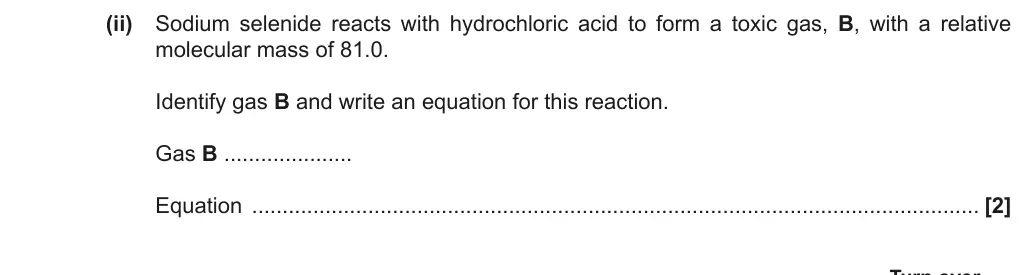
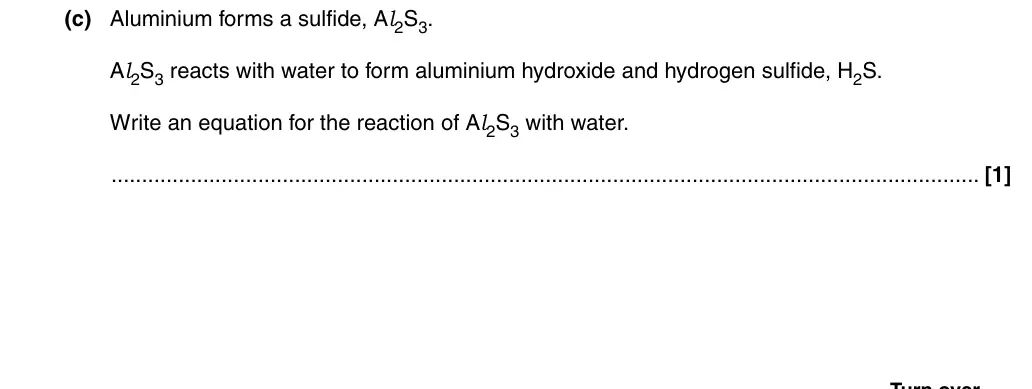
Al2Se3 + 6H2O → 2Al(OH)3 + 3H2Se
Skills: M0.2 Use ratios, fractions and percentages
November 2020 · AS Paper 2 · Q5(b)1 markAO2Equation writingMedium
Earlier part of question 5 that this part uses
Mark scheme
Examiner's comment
5(a) Generally this was well answered. However, some candidates only gave two responses where three were required, presumably because it was worth two marks. 5(b) A significant number of candidates did not gain the mark here as they incorrectly balanced the number of oxygens, forgetting that the alcohol contains an O atom i.e. 6.5 O2 given rather than 6. 5(c) Nomenclature in organic chemistry takes lots of practice. Approximately half of the candidates did not score this mark. It was more challenging as they needed to work with skeletal structures but evidence of drawing out displayed formula was often seen. 5(d)(i) Most candidates were able to recall the formula to calculate atom economy, however a number made errors in working out Mr values. However, some left this blank or just gave an answer without any working. 5(d)(ii) Mechanisms were often seen showing curly arrows going in the wrong direction and between the wrong bonds and atoms, charges and dipoles were often incorrect, and partial changes used where full charges were required. Writing mechanisms is an important skill in organic chemistry so it is vital that time is spent practising writing them out and fully understanding the significance of the curly arrow. 5(d)(iii) Many candidates gave the correct mechanism here, with common incorrect responses being other types of mechanism, substitution only, or isomerism. 5(e) Very few candidates gained both marks here. It was not enough here to just state faster/slower without specifying which haloalkane they were referring to. It was also important to specify the C-X bond not just vague reference to the chlorine or bromine bond. Many described the difference in bond polarity so had the wrong order. Some were more general and discussed the reactivity of bromine and chlorine themselves. 5(f)* This was a challenging problem-solving question, relying on candidates to make use of all of the information provided to determine the structure. Very few candidates made no attempt at all at this question. The most common error was incorrectly identifying the peak at 3000 cm-1 as O-H from a carboxylic acid, despite it being indicated on the data sheet that this would be a broad peak. It suggested that candidates were not familiar with looking at spectra and understanding what data it gave. Candidates should also be reminded when answering these types of question that they should give the structures, not just molecular formulae, where possible. If any of your students’ results are not as expected, you may wish to consider one of our review of results services. For full information about the options available visit the OCR website. If university places are at stake you may wish to consider priority service 2 reviews of marking which have an earlier deadline to ensure your reviews are processed in time for university applications. Our priority is supporting you and your students this autumn and to support you as you prepare for summer 2021 exams. We’ll update our website information regularly with resources, guidance and key information. • Teachers • Students • Exams officers • Assessment specialists We are sending a weekly roundup to tell you about important updates. You can also sign up for your subject specific updates. If you haven’t already, sign up here. Attend one of our popular CPD courses to hear directly from a senior assessor or drop in to a Q&A session. All our courses for the academic year 2020-2021 are being delivered live via an online platform, so you can attend from any location. Please find details for all our courses on the relevant subject page on our website or visit OCR professional development. ExamBuilder is the question builder platform for a range of our GCSE, A Level, Cambridge Nationals, Cambridge Technicals and Functional Skills qualifications. See the full list of available qualifications in the sign up form. ExamBuilder is free for all OCR centres with an Interchange account and gives you unlimited users per centre. We need an Interchange username to validate the identity of your centre's first user account for ExamBuilder. If you do not have an Interchange account please contact your centre administrator (usually the Exams Officer) to request a username, or nominate an existing Interchange user in your department. Review of results
Notes from the mark scheme and report
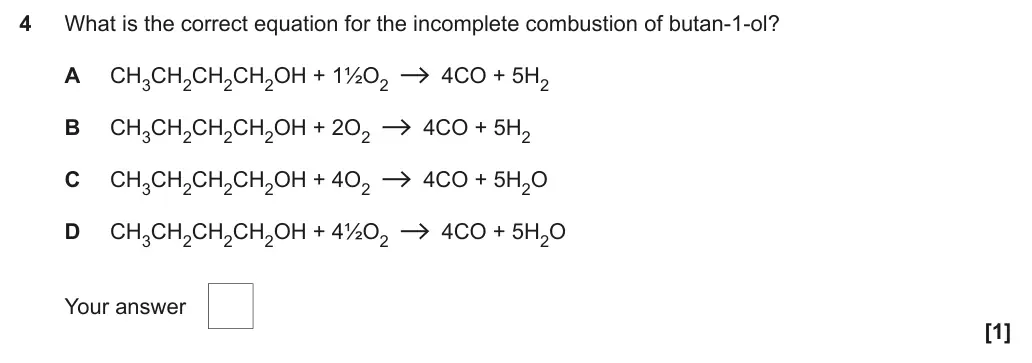
6O2 → 4CO2 + 5H2O
DO NOT ALLOW [O]
Skills: M0.2 Use ratios, fractions and percentages
November 2020 · Paper 2 · Q17(b)3 marksAO2Short answer
Earlier part of question 17 that this part uses
Mark scheme
Notes from the mark scheme and report
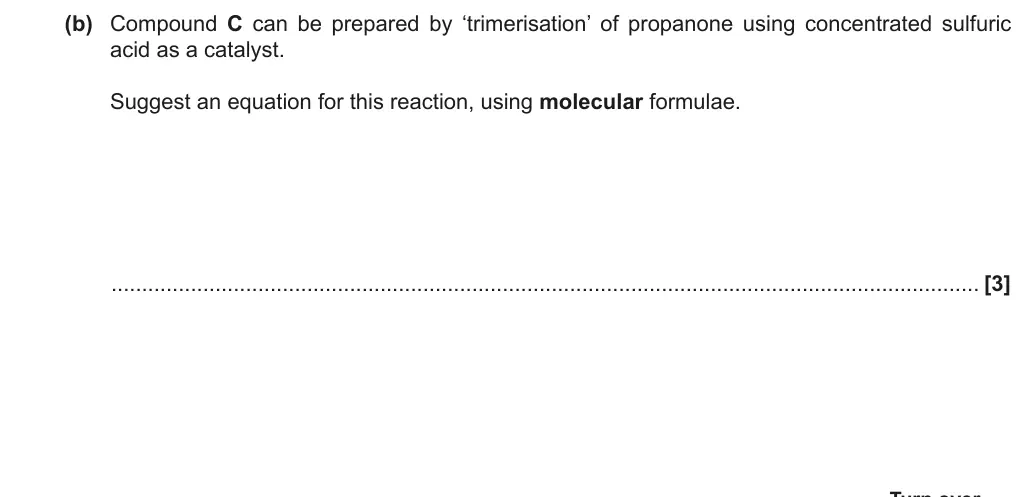
3C3H6O → C9H12 + 3H2O
molecular formulae required
H2O as by-product
Skills: M0.2 Use ratios, fractions and percentages
November 2020 · Paper 2 · Q18(a)(i)3 marksAO1, 2Equation writingMedium
Mark scheme
Examiner's comment
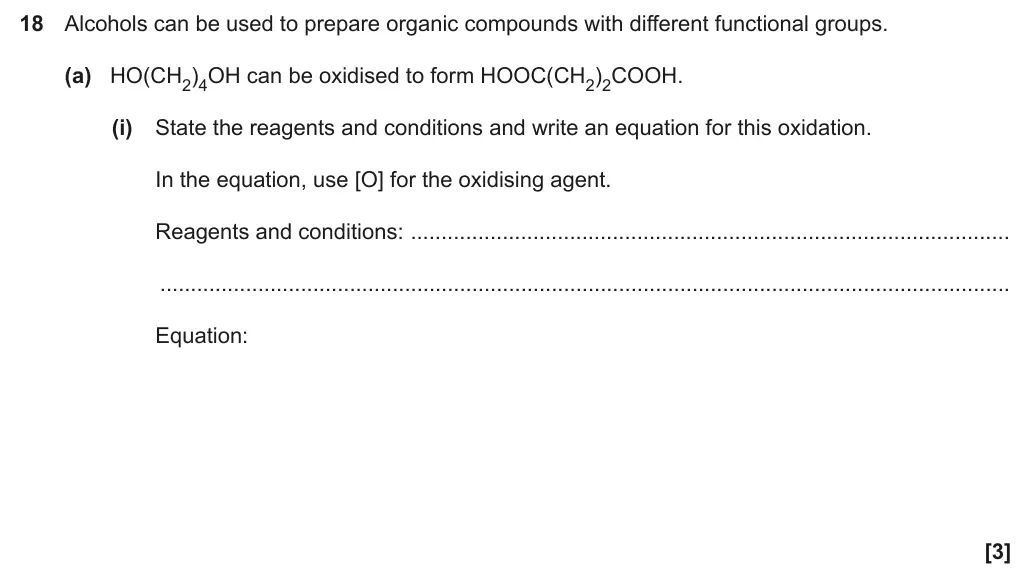
Question 18(a)(i) Many candidates did not correctly balance this equation or missed water as a product entirely.
Notes from the mark scheme and report
K2Cr2O7 AND acid AND reflux
4[O] and 2H2O
Skills: M0.2 Use ratios, fractions and percentages
November 2020 · Paper 2 · Q18(b)(iii)3 marksAO1, 2Complete table/diagram
Earlier part of question 18 that this part uses
Mark scheme
Notes from the mark scheme and report
2SOCl2 gives ClOC(CH2)2COCl + 2SO2 + 2HCl
ALLOW PCl5 or PCl3 route
Skills: M0.2 Use ratios, fractions and percentages
November 2020 · Paper 3 · Q4(a)(i)3 marksAO2Equation writingMedium
Mark scheme
Examiner's comment
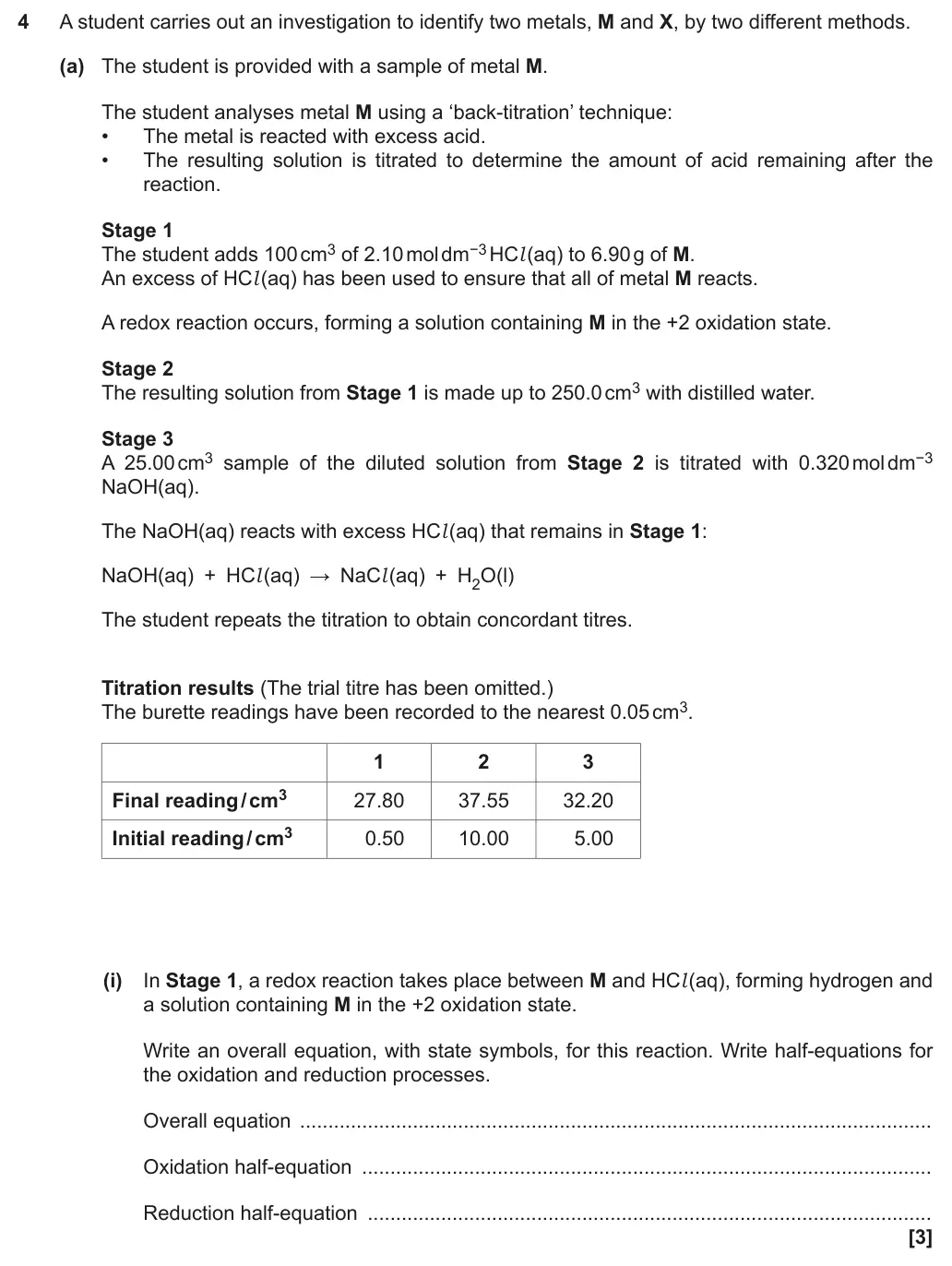
4(a)(i) This question required candidates to write an overall equation and half equations for oxidation and reduction. Many candidates made errors within one or more equations. The overall equation was often written without state symbols, despite the question instruction ‘with state symbols’. The oxidation half equation was more likely to be correct than the reduction half equation, which often used Cl instead of H+. When H+ was used, the half equation was often unbalanced or electrons had been omitted. It is recommended that candidates carefully use the chemical information in the question. 4(a)(ii) Most candidates identified that all the metal would have reacted when it had all disappeared and that gas bubbles from the reaction would have stopped. Some responses did not emphasise that these observations would have stopped and this prevented credit being given. 4(a)(iii) The ionic equation for neutralisation of an acid with an alkali was well known and this question was answered correctly by most candidates. 4(a)(iv) Candidates were presented with information about a back titration, a technique that they would be unlikely to have encountered during their course. The question stem to 4a(iv) suggested a three-step strategy. Many candidates followed this guidance and were credited with many of the available marks. Marks were given for a correct method (by error carried forward) even if there was an error or omission in the multi-step calculation. This emphasises the importance of clear working. Most candidates determined the correct mean titre of 27.25 cm3. A few candidates did take the mean of all three titres rather than the closest. Most calculated that 8.72 × 10⁻³ mol of NaOH reacted with the same number of moles of HCl in the titration and then scaled up the HCl by a factor of 10 to 8.72 × 10⁻² mol in the 250 cm3 volumetric flask. These steps are standard for many titration calculations and gave a route to three of the six available marks. The more difficult back titration steps then followed and the higher-attaining candidates recognised the need to subtract this amount of HCl from the original amount of HCl used to react with metal M. These candidates then divide this value by two to find the moles of M that reacted (from the 1 : 2 stoichiometry of M : HCl). The correct calculation then gave a relative atomic mass of M as 112 and its identity as cadmium. It was common for candidates to omit the division by two and to arrive at a relative atomic mass of 56 for iron. The mark scheme shows the variety of metals that candidates identified from their calculations, the errors made, and the error carried forward marks that resulted. Many lower-attaining candidates did not follow the 3 steps in the stem, using only the original amount of HCl and ignoring the titration. This approach was not credited with marks. A large range of marks was seen, and the question discriminated extremely well. 4(b)(i) This straightforward mole calculation required candidates to determine the mass of CO2 as 2.75 g from the table of results and to divide this value by the molar mass of CO2 to arrive at 0.0625 mol. Most candidates were successful. As with other questions providing raw experimental results, lower-attaining candidates often chose the wrong data from the supplied results. 4(b)(ii) Many candidates used their value from 4b(i) with the mass of X2CO3 from the results table to obtain a value for the molar mass (233.13 from 14.57 ÷ 0.0625). Higher-attaining candidates obtained a value for the atomic mass of X (86.56 from 233.13) and identified X as the Group 1 metal rubidium. Some candidates did not recognise the significance of the formula of X2CO3 and identified X instead as strontium (Ar = 87.6). Lower-attaining candidates often used incorrect data from the supplied information and made little progress with this calculation. 4(c)(i) Most candidates suggested that the mass of the flask and contents could be reweighed until the mass no longer changed. An alternative creditworthy suggestion was to attach a gas syringe and to measure the gas volume until it no longer changed. Vague suggestions such as ‘leave for longer’ were not credited with marks. 4(c)(ii) Candidates found this question challenging. Success required candidates to appreciate that some CO2 dissolving would result in less mass of CO2 being recorded as lost, meaning that less moles of CO2 had apparently been formed and so less moles of X2CO3 had reacted. Using n = m/M, this would show that the calculated molar mass of X2CO3 appears to be greater. Only the highest-attaining candidates successfully navigated this question.
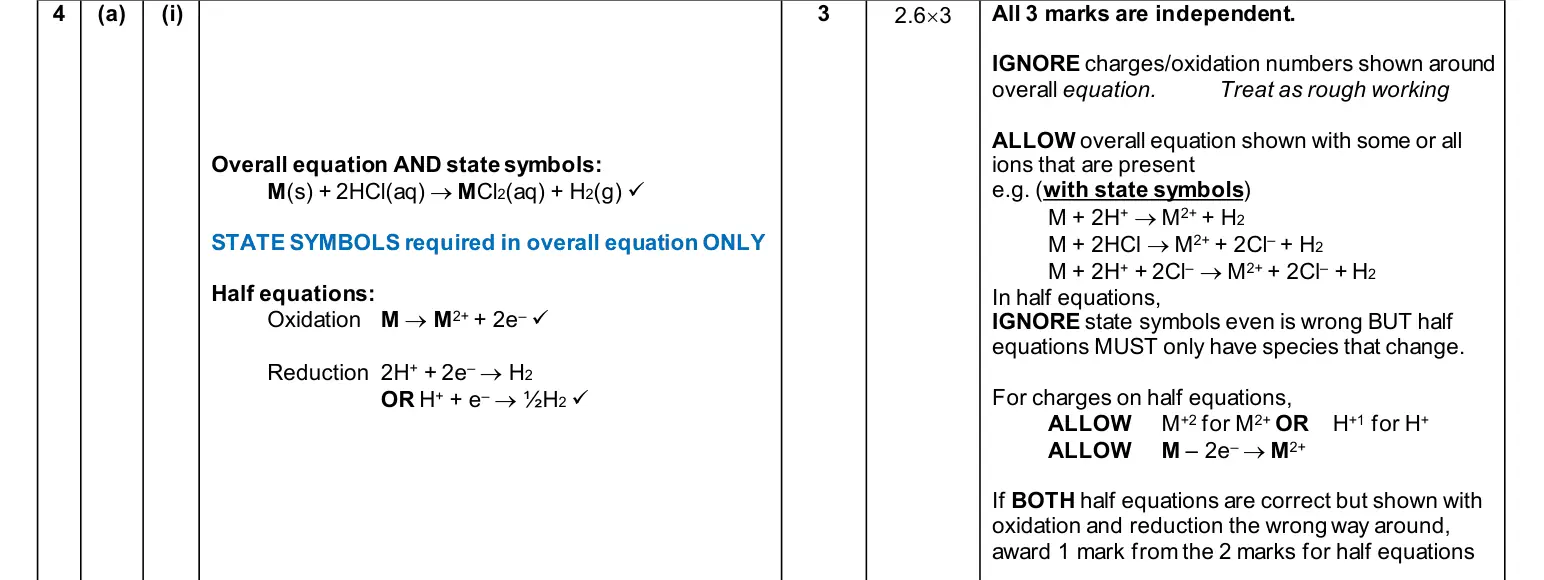
Notes from the mark scheme and report
M(s) + 2HCl(aq) → MCl2(aq) + H2(g) - state symbols required in overall equation only
M → M2+ + 2e–
2H+ + 2e– → H2
half-equations must only contain species that change
1 mark if both correct but oxidation/reduction swapped
June 2019 · AS Paper 1 · Q81 markAO1Multiple choice
Answer
D
Mark scheme
June 2019 · Paper 1 · Q18(a)(ii)1 markAO2Short answerMedium
Earlier part of question 18 that this part uses
Mark scheme
Examiner's comment
The most common error for this question was to omit the state symbols, sometimes on only one species. Both a correct equation and the correct state symbols were required for the mark.
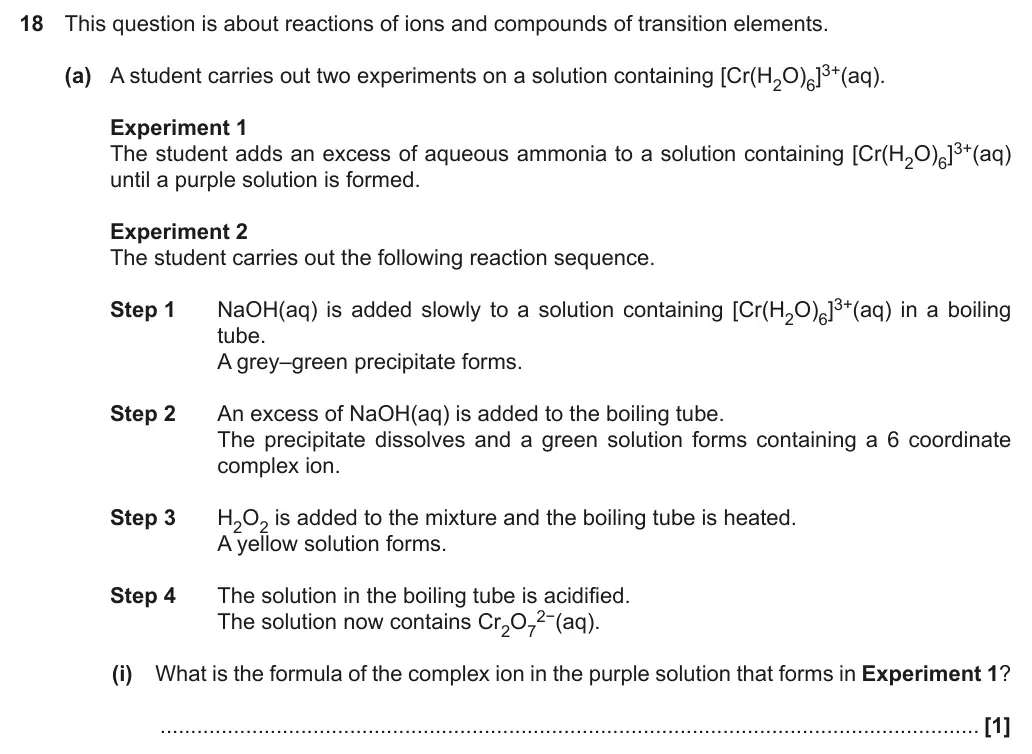
Notes from the mark scheme and report
state symbols required with Cr(OH)3(s)
ALLOW complexed or hybrid equations
June 2019 · AS Paper 1 · Q21(d)(i)2 marksAO1, 2Short answerHard
Mark scheme
Examiner's comment
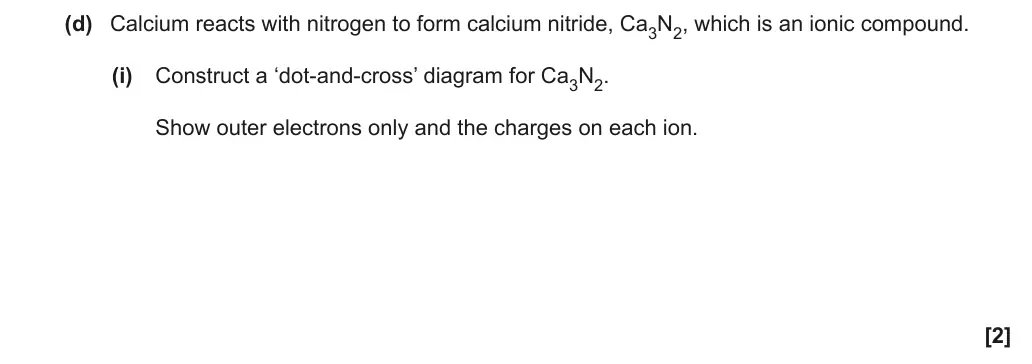
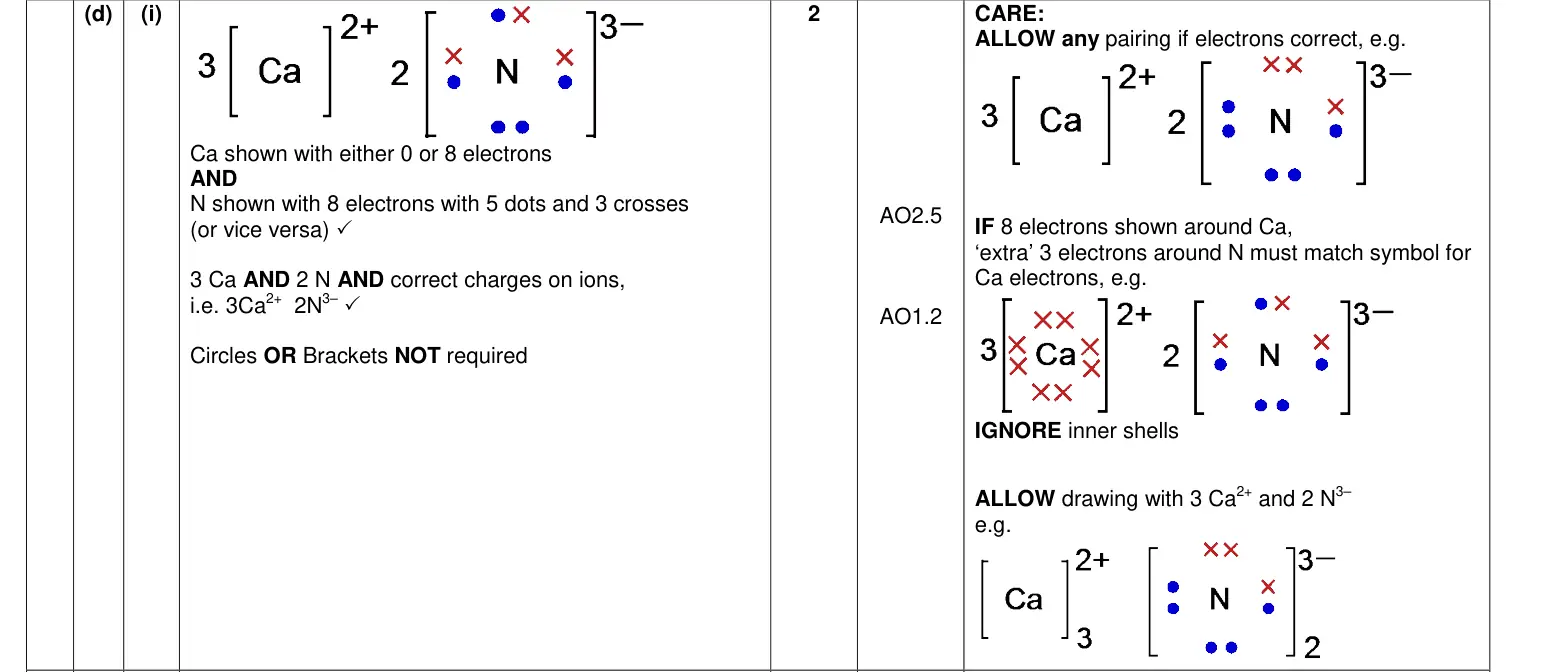
Most candidates showed a correct, clear ‘dot and cross’ diagram. Lower attaining candidates sometimes used wrong charges, not enough ions or an incorrect number of electrons on N. Covalently-bonded molecules were seen, but rarely.
Notes from the mark scheme and report
3 Ca2+ AND 2 N3– with correct charges
N with 8 electrons (5 of one symbol and 3 of the other)
circles/brackets not required
June 2019 · AS Paper 1 · Q21(d)(ii)2 marksAO2Equation writingMedium
Earlier part of question 21 that this part uses
Mark scheme
Examiner's comment
Most candidates were given 1 of the 2 available marks for showing the formula of one correct product, Ca(OH)2 or NH3. The best answers identified both products and were then able to balance the equation. Common errors included ‘CaO’ as a product and incorrect compounds of nitrogen (see the two responses above). This part discriminated very well.
Notes from the mark scheme and report
1 mark for Ca(OH)2 OR NH3 as a product
ALLOW NH4OH for NH3
Skills: M0.2 Use ratios, fractions and percentages
June 2019 · AS Paper 1 · Q21(d)(iii)2 marksAO1Complete table/diagramMedium
Mark scheme
Examiner's comment
Most candidates completed the diagram with correct Ca2+ and O2– ions, shown alternately. Many different errors were seen for which 1 of the 2 marks could sometimes be given, e.g. 2+ and 2–, or Ca and O shown alternately. Some candidates used incorrect ions, with N3– the most common as a carry- over from 21d(i) and (ii). Some candidates completed each face of the structure with the same ion, rather than different ions alternately.
Notes from the mark scheme and report
Ca2+ and O2– must alternate, FOUR circles each
1 mark for alternating Ca and O with missing/incorrect charges
DO NOT ALLOW all circles the same ion
June 2019 · AS Paper 1 · Q25(a)(iii)1 markAO2Complete table/diagramHard
Earlier part of question 25 that this part uses
Mark scheme
Examiner's comment
AS LEVEL CHEMISTRY A Examiners’ report H032/01 Summer 2019 series Version 1 H032 For first teaching in 2015 www.ocr.org.uk/science Contents Introduction .............................................................................................................................................. 4 Paper 1 series overview ........................................................................................................................... 5 Section A overview ................................................................................................................................... 6 Question 2 ............................................................................................................................................ 6 Question 4 ............................................................................................................................................ 6 Question 5 ............................................................................................................................................ 7 Question 6 ............................................................................................................................................ 7 Question 9 ............................................................................................................................................ 8 Question 10 .......................................................................................................................................... 9 Question 11 ........................................................................................................................................ 10 Question 12 ........................................................................................................................................ 10 Question 14 ........................................................................................................................................ 11 Question 15 ........................................................................................................................................ 11 Question 17 ........................................................................................................................................ 12 Question 18 ........................................................................................................................................ 13 Question 19 ........................................................................................................................................ 13 Question 20 ........................................................................................................................................ 14 Section B overview ................................................................................................................................. 15 Question 21 (a) ................................................................................................................................... 15 Question 21 (b) .................................................................................................................................. 15 Question 21 (c) ................................................................................................................................... 16 Question 21 (d) (i) ............................................................................................................................... 16 Question 21 (d) (ii) .............................................................................................................................. 17 Question 21 (d) (iii) ............................................................................................................................. 18 Question 21 (d) (iv) ............................................................................................................................. 19 Question 22 (a) (i) ............................................................................................................................... 20 Question 22 (a) (ii) .............................................................................................................................. 20 Question 22 (b) ................................................................................................................................... 21 Question 22 (c) ................................................................................................................................... 22 Question 23 (a) ................................................................................................................................... 23 Question 23 (b) ................................................................................................................................... 24 Question 24 (a) (i) ............................................................................................................................... 25 Question 24 (a) (ii) .............................................................................................................................. 25 Question 24 (b) (i) ............................................................................................................................... 26 Question 24 (b) (ii) .............................................................................................................................. 27 Question 25 (a) (i), (ii) and (iii) ............................................................................................................ 28 Question 25 (b) (i) ............................................................................................................................... 29 Question 25 (b) (ii) .............................................................................................................................. 29 Question 25 (b) (iii) ............................................................................................................................. 30 Introduction Our examiners’ reports are produced to offer constructive feedback on candidates’ performance in the examinations. Question 25 (a) (i), (ii) and (iii) Part 25(a)(i) discriminated extremely well and rewarded well-prepared candidates.
Notes from the mark scheme and report
6 O2 (the O atom in the alcohol must be counted)
Skills: M0.2 Use ratios, fractions and percentages
June 2019 · AS Paper 1 · Q25(b)(ii)1 markAO2Equation writingMedium
Earlier part of question 25 that this part uses
Mark scheme
Examiner's comment
Only the highest attaining candidates were able to write the correct equation. Although most candidates did identify the organic product as C4Cl10, the other product was usually seen as 5H2 rather than 10HCl.
Notes from the mark scheme and report
10 Cl2 and 10 HCl
ALLOW structural formulae
Skills: M0.2 Use ratios, fractions and percentages
June 2019 · Paper 3 · Q2(a)1 markAO1Equation writingMedium
Mark scheme
Examiner's comment
This equation presented problems for many candidates, despite the question asking for an equation between carbonate ions and water. An acceptable equation had to be ionic and needed to produce OH– (for the alkaline solution) and either HCO3– or CO2. Many candidates wrote an equation with H+ instead of H2O, with lower ability candidates showing the carbonate ion with the wrong charge as CO3–. Many candidates wrote full equations despite the question asking for an ionic equation. Candidates do need to read the instructions in the question.
Notes from the mark scheme and report
CO32– + H2O → OH– + HCO3–
ionic equation required
IGNORE equations with H+ or H3O+ (question asks for reaction with H2O)
IGNORE state symbols
June 2019 · Paper 3 · Q3(a)(i)1 markAO2Equation writingHard
Mark scheme
Examiner's comment
This equation proved to be very testing and only a minority of candidates were able to write a balanced equation for this reaction forming Pb, CO2 and H2O. Many different and implausible products were seen such as O2, H2, and CH3OH.
Notes from the mark scheme and report
4Pb2O3 + 3CH4 → 8Pb + 3CO2 + 6H2O (ALLOW versions forming CO or C)
ALLOW multiples
IGNORE state symbols
Skills: M0.2 Use ratios, fractions and percentages
June 2019 · Paper 3 · Q6(b)6 marksAO1, 36-mark level of responseHard
Mark scheme, with the levels and indicative points
Examiner's comment
This question presented a practical scenario in which candidates were asked to identify 5 unknown chemicals. There are many routes that lead to correct identifications of the unknowns. Most candidates identified G as oxygen and made some headway towards identifying C and D by determining that 9 waters of crystallisation were present in C. The formulae of C and D sometimes followed but many candidates found it difficult to link 9H2O to their formulae. The best responses showed the nitrate ion separately in the formula, e.g. Fe(NO3)3, but many showed the empirical formula instead, e.g. FeN3O9. Gas G (NO2) proved to be the most difficult unknown to identify as it required two pieces of data for its determination. There were some very competent attempts at writing equations, with the decomposition of compound D in Stage 2 to form E, F and G being the most difficult. 1:9 molar ratio of C: H2O. The candidate then writes the correct equation for Stage 1, using NO3 for the nitrate ion. The candidate then identifies E, F and G using a methodical approach with clear working throughout. Finally, the candidate writes the correct equation for the reaction in Stage 2. This is an excellent Level 3 response, given 6/6 marks.
Notes from the mark scheme and report
n(H2O) = 0.027 so 9H2O
C = Fe(NO3)3•9H2O, D = Fe(NO3)3, E = Fe2O3 (M 159.6), F = NO2 (0.414/0.00900 = 46), G = O2 (relights glowing splint)
2Fe(NO3)3 → Fe2O3 + 6NO2 + 1½O2
Skills: M0.2 Use ratios, fractions and percentages; M2.3 Substitute numerical values into algebraic equations using appropriate units for physical quantities
June 2018 · AS Paper 1 · Q11 markMultiple choiceEasy
Answer
C
Mark scheme
Examiner's comment
Nearly all candidates responded with the correct response of C.
June 2018 · Paper 1 · Q61 markAO1Multiple choiceEasy
Answer
C
Mark scheme
Examiner's comment
Nearly all candidates were able to determine the most likely formula.
June 2018 · Paper 1 · Q71 markAO2Multiple choiceMedium
Answer
D
Mark scheme
Examiner's comment
Most candidates knew that the formula given in D was incorrect.
Notes from the mark scheme and report
formula is (NH4)2CO3
Skills: PAG4 Qualitative analysis of ions
June 2018 · AS Paper 1 · Q91 markMultiple choiceMedium
Answer
A
Mark scheme
Examiner's comment
Success depended on identifying the group of Y and working out the formula of the chloride. Most candidates recognised the large increase between 1st and 2nd ionisation energies, leading to the conclusion that Y is in Group 1 and the correct formula is YCl (A).
June 2018 · AS Paper 1 · Q151 markMultiple choiceMedium
Answer
D
Mark scheme
Examiner's comment
Most candidates selected A or D, with D being the correct option. Presumably, A was chosen by halving the ‘8’ in C4H8 without considering that each H2O molecule contains two H atoms. The successful answer of D usually resulted from the candidate constructing equations.
June 2018 · AS Paper 1 · Q22(a)(iv)2 marksEquation writingMedium
Earlier part of question 22 that this part uses
Mark scheme
Examiner's comment
Candidates were expected to identify a suitable reagent for this reaction, with most choosing magnesium oxide, hydroxide or carbonate. Credit was also given for using a soluble magnesium salt such as its sulfate, chloride or nitrate. The correct equation often followed, but errors sometimes appeared in the form of incorrect formulae, such as MgOH for magnesium hydroxide. The exemplar shows a good clear response, using MgO as the reagent.
Notes from the mark scheme and report
MgO, Mg(OH)2 or MgCO3 (or a soluble Mg salt)
no ECF from incorrect formula
ALLOW multiples
IGNORE state symbols
June 2018 · AS Paper 1 · Q22(b)(ii)1 markEquation writingEasy
Earlier part of question 22 that this part uses
Mark scheme
Examiner's comment
Most candidates were able to write a correctly balanced equation for this reaction.
Notes from the mark scheme and report
ALLOW multiples
Skills: M0.2 Use ratios, fractions and percentages
June 2018 · AS Paper 1 · Q23(a)(ii)2 marksEquation writingHard
Earlier part of question 23 that this part uses
Mark scheme
Examiner's comment
Most candidates recognised that silver nitrate and chloride ions react together to form a white precipitate, but many did not make the link between this observation and whether any silver nitrate was left unreacted. Many candidates did not give a correct equation, with missing or incorrect state symbols being common. This question discriminated extremely well.
Notes from the mark scheme and report
state symbols required in equation
observation must be linked to conclusion (white precipitate = not all reacted)
Skills: PAG4 Qualitative analysis of ions
June 2018 · AS Paper 1 · Q24(b)(iii)2 marksEquation writingHard
Earlier part of question 24 that this part uses
Mark scheme
Examiner's comment
Many candidates correctly drew the structure of compound D but comparatively few were able to construct a correct equation. For this equation, candidates needed to apply their knowledge and understanding of monosubstitution of alkanes to substitution of three H atoms by three Cl atoms. This task proved to be one of the most difficult questions on this paper. The exemplar shows an excellent response. The candidate has drawn a trisubstituted structure that fits the molar mass of 175.5 g mol–1 and a correct equation for its formation. Many attempts at this equation showed H2 as the second product rather than HCl.
June 2018 · AS Paper 2 · Q2(c)(ii)2 marksEquation writingMedium
Earlier part of question 2 that this part uses
Mark scheme
Examiner's comment
The majority of candidates obtained 1 or 2 marks on this question. The most common errors seen were identifying the gas as H2S or incorrect balancing.
Notes from the mark scheme and report
H2Se
DO NOT ALLOW H2S for gas B but ALLOW ECF for equation
IGNORE state symbols
June 2018 · AS Paper 2 · Q3(a)(i)1 markEquation writingMedium
Mark scheme
Examiner's comment
Around 50% of candidates answered this correctly. The most common error was not balancing the equation, and many did not know what an ionic equation was.
Notes from the mark scheme and report
ALLOW multiples
IGNORE state symbols
June 2018 · AS Paper 2 · Q3(d)(i)1 markEquation writingEasy
Mark scheme
Examiner's comment
A good attempt by many candidates but some lost marks by having the wrong state of bromine, even though the question stated it was a liquid changing to a gas. Many added water or oxygen, some confused the equation with bond enthalpy and answers such as Br2 (l) 2Br(g) were commonly seen.
Notes from the mark scheme and report
Br2(l) → Br2(g)
state symbols essential
June 2018 · Paper 2 · Q16(a)(iv)2 marksEquation writingHard
Earlier part of question 16 that this part uses
Mark scheme
Examiner's comment
This question proved difficult for candidates. Although many candidates were able to identify the correct organic product, only the higher ability candidates were able to construct an appropriate balanced equation. A common error was to omit the role of the acid; this is shown in Exemplar 2 below. Lower ability candidates appeared not to recognise this reaction and suggested an alkoxide salt, rather than a haloalkane as the organic product. This type of response was seen frequently by examiners. The candidate has drawn the correct structure of the haloalkane formed and scores the first mark. However, the response fails to recognise that the reaction occurs under acidic conditions and omits the sulfuric acid from the equation.
Notes from the mark scheme and report
DO NOT ALLOW equations that form NaOH
ALLOW Na2SO4 version, H+ for H2SO4, or equation with HCl
June 2018 · Paper 2 · Q16(b)2 marksComplete table/diagramHard
Mark scheme
Examiner's comment
This question required candidates to apply their knowledge of the oxidation of alcohols to complete the equation for the complete oxidation of compound B. This question discriminated well. Many candidates correctly identified the organic product but only the higher ability candidates could complete the equation. A common error was to omit water as a product of the reaction.
Notes from the mark scheme and report
reflux with excess: primary OH to COOH, secondary OH to C=O, tertiary OH unchanged
3[O] and 2H2O
Skills: M0.2 Use ratios, fractions and percentages
June 2018 · Paper 2 · Q22(a)1 markEquation writingMedium
Mark scheme
Examiner's comment
The majority of candidates were able to provide a correct equation for the incomplete combustion of heptane.
Notes from the mark scheme and report
product must be CO and/or C with H2O
ALLOW multiples and mixtures with CO2
Skills: M0.2 Use ratios, fractions and percentages
June 2018 · Paper 2 · Q22(c)(ii)2 marksEquation writingHard
Earlier part of question 22 that this part uses
Mark scheme
Examiner's comment
Many candidates found this demanding question very difficult. Some were able to deduce that propanone was the carbonyl compound in the reaction. Only the most able recognised that water was a by-product of this reaction.
Notes from the mark scheme and report
carbonyl compound is propanone
H2O as the other product
structures required
June 2018 · Paper 3 · Q5(b)(ii)1 markEquation writingMedium
Earlier part of question 5 that this part uses
Mark scheme
Examiner's comment
Candidates were required to derive the equation from which the supplied Kc expression had been written. Overall, this part was answered well but some candidates struggled with the brackets or used CH2COOH2 for succinic acid.
Notes from the mark scheme and report
(CH2COOH)2 + 2C2H5OH ⇌ (CH2COOC2H5)2 + 2H2O
ALLOW → and molecular formulae
June 2018 · Paper 3 · Q6(a)(iii)3 marksComplete table/diagramHard
Earlier part of question 6 that this part uses
Mark scheme
Examiner's comment
This novel question linked together acid–base equilibria with a multi-step process. Many candidates completed an equation to generate acid–base pairs, which were then usually assigned correctly. The final equation was challenging but the highest ability candidates were able to combine together all the information with their earlier responses to arrive at the correct equation. See Exemplar 15.
Notes from the mark scheme and report
step 1 CH3CHO + OH– ⇌ –CH2CHO + H2O with pairs A1/B1 and A2/B2 labelled
June 2017 · Paper 1 · Q17(d)(i)2 marksEquation writing
Mark scheme
Notes from the mark scheme and report
state symbols needed
entropy decreases because solid BaSO4 formed
entropy mark dependent on BaSO4(s) as product
June 2017 · AS Paper 1 · Q22(b)5 marksExtended response
Mark scheme
Notes from the mark scheme and report
DO NOT ALLOW hydrogen for bubbles
molar mass must be used at least once in reasoning
names or KCO3/NaSO4 score only one of the two identification marks
Skills: PAG4 Qualitative analysis of ions
June 2017 · AS Paper 1 · Q24(b)(i)1 markEquation writing
Mark scheme
Notes from the mark scheme and report
ALLOW multiples
Skills: M0.2 Use ratios, fractions and percentages
June 2017 · AS Paper 2 · Q1(c)(ii)4 marksEquation writing
Earlier part of question 1 that this part uses
Mark scheme
Notes from the mark scheme and report
A = Ba(OH)2, B = NH3
barium nitride must be Ba3N2
state symbols required
no ECF from any incorrect formula
June 2017 · Paper 2 · Q16(e)(ii)4 marksCalculation
Earlier part of question 16 that this part uses
Mark scheme
Notes from the mark scheme and report
n(H2) = 0.220 so 11 C=C
saturated product with two rings is C40H78
C40H56 + 11H2 → C40H78
ECF only from C40H82 or C40H80
Skills: M0.2 Use ratios, fractions and percentages; M2.3 Substitute numerical values into algebraic equations using appropriate units for physical quantities
June 2017 · Paper 2 · Q19(a)1 markEquation writing
Mark scheme
Notes from the mark scheme and report
C5H10O + 7O2 → 5CO2 + 5H2O
ALLOW any correctly balanced unsaturated C5 alcohol
IGNORE state symbols
Skills: M0.2 Use ratios, fractions and percentages
June 2017 · Paper 3 · Q2(d)(iii)1 markEquation writing
Earlier parts of question 2 that this part uses
Mark scheme
Notes from the mark scheme and report
2NaNO2 + 6Na → 4Na2O + N2
ALLOW multiples
IGNORE state symbols
Skills: M0.2 Use ratios, fractions and percentages
June 2017 · Paper 3 · Q4(b)(i)3 marksStructure / isomer
Earlier part of question 4 that this part uses
Mark scheme
Notes from the mark scheme and report
2HOCH(R)COOH + Mg → (HOCH(R)COO)2Mg + H2
redox
IGNORE poor connectivity to OH groups
June 2017 · Paper 3 · Q5(a)(iv)2 marksEquation writing
Earlier part of question 5 that this part uses
Mark scheme
Notes from the mark scheme and report
cyclic product (1,3-dithiane ring with two CH3 on the same carbon) + H2O
balanced equation
June 2016 · AS Paper 1 · Q21 markMultiple choice
Answer
C
Mark scheme
June 2016 · AS Paper 1 · Q23(a)(ii)2 marksAO1Equation writing
Earlier part of question 23 that this part uses
Mark scheme
Notes from the mark scheme and report
ALLOW multiples
IGNORE state symbols
IGNORE explanation in terms of electronegativity
June 2016 · AS Paper 1 · Q24(b)1 markAO2Equation writing
Earlier part of question 24 that this part uses
Mark scheme
Notes from the mark scheme and report
state symbols required
IGNORE spectator ions shown on both sides
June 2016 · AS Paper 2 · Q2(c)1 markAO2Equation writing
Mark scheme
Notes from the mark scheme and report
Al2S3 + 6H2O → 2Al(OH)3 + 3H2S
IGNORE state symbols
ALLOW multiples
Skills: M0.2 Use ratios, fractions and percentages
Work with an OCR chemistry tutor
Dropping marks on calculations, mechanisms or the six-markers? Book a trial session with a specialist OCR chemistry tutor.