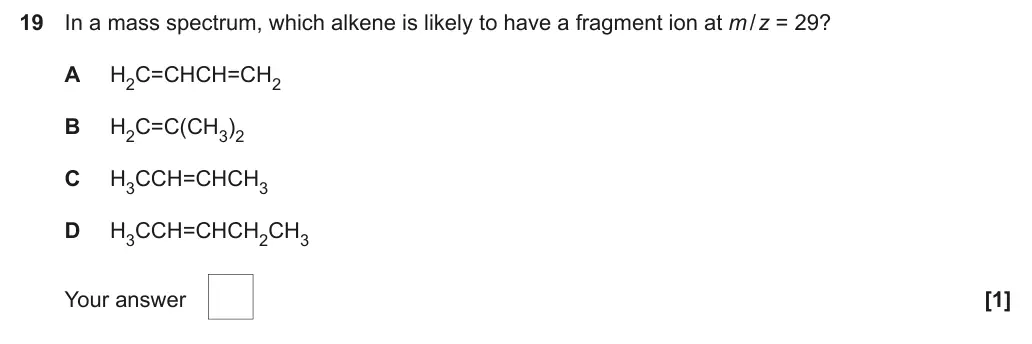
Answer
D
Mark scheme

Examiner's comment
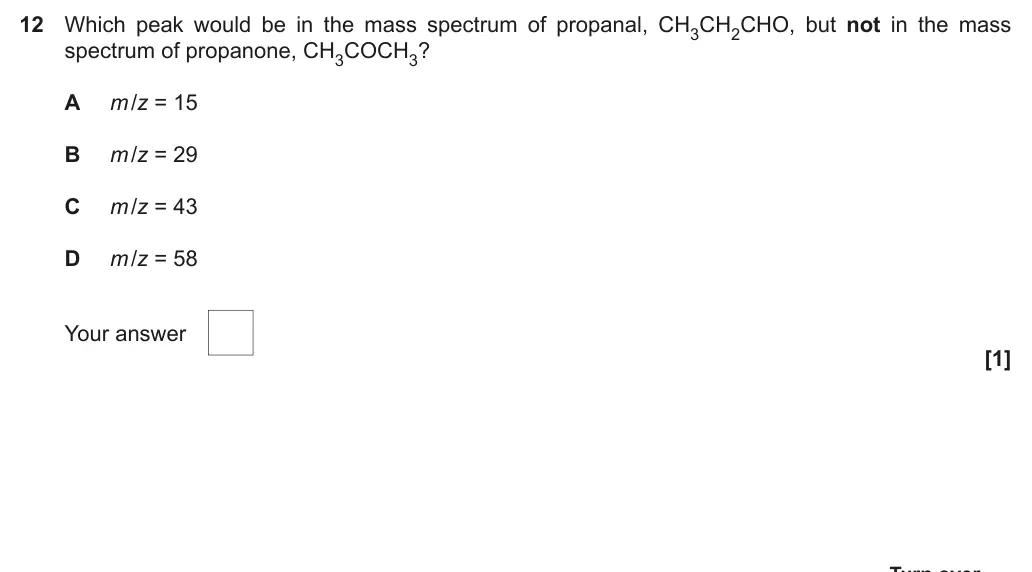
A significant number did not recognise the CH3CH2 group in D would give the fragment ion at m/z = 29.
Notes and key-term cards for this topic are being written by our tutors. The past-paper questions below are ready now.
| Series | Paper | Q | What it asks |
|---|---|---|---|
| June 2025 | Paper 2 | 23(b) | An unknown organic compound N is analysed and produces the following results. Determine the structure of the compound N, showing all your reasoning. |
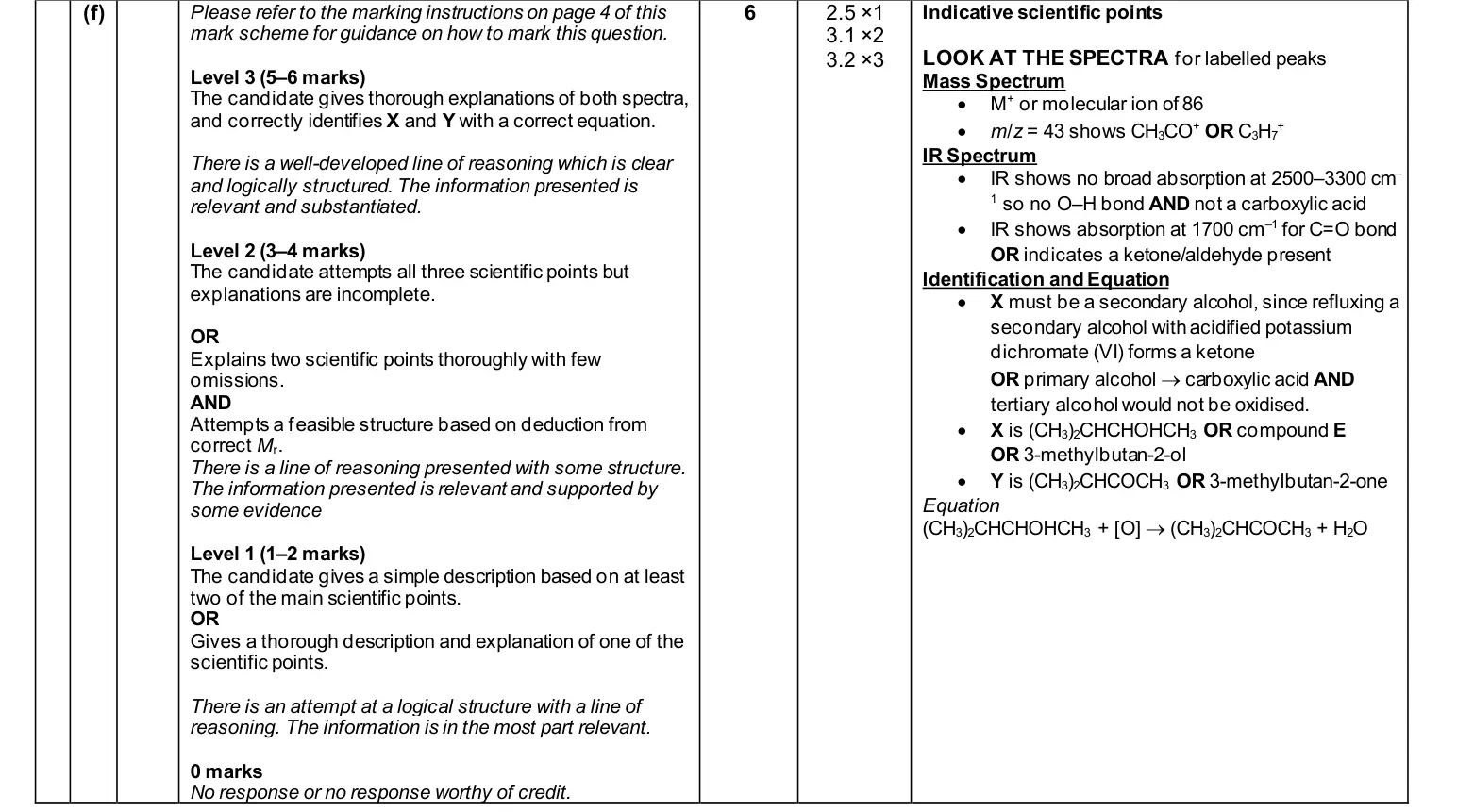
| June 2024 | AS Paper 2 | 6 | Compound X is an organic compound with two functional groups. Use all the information to determine a possible structure of compound X. |
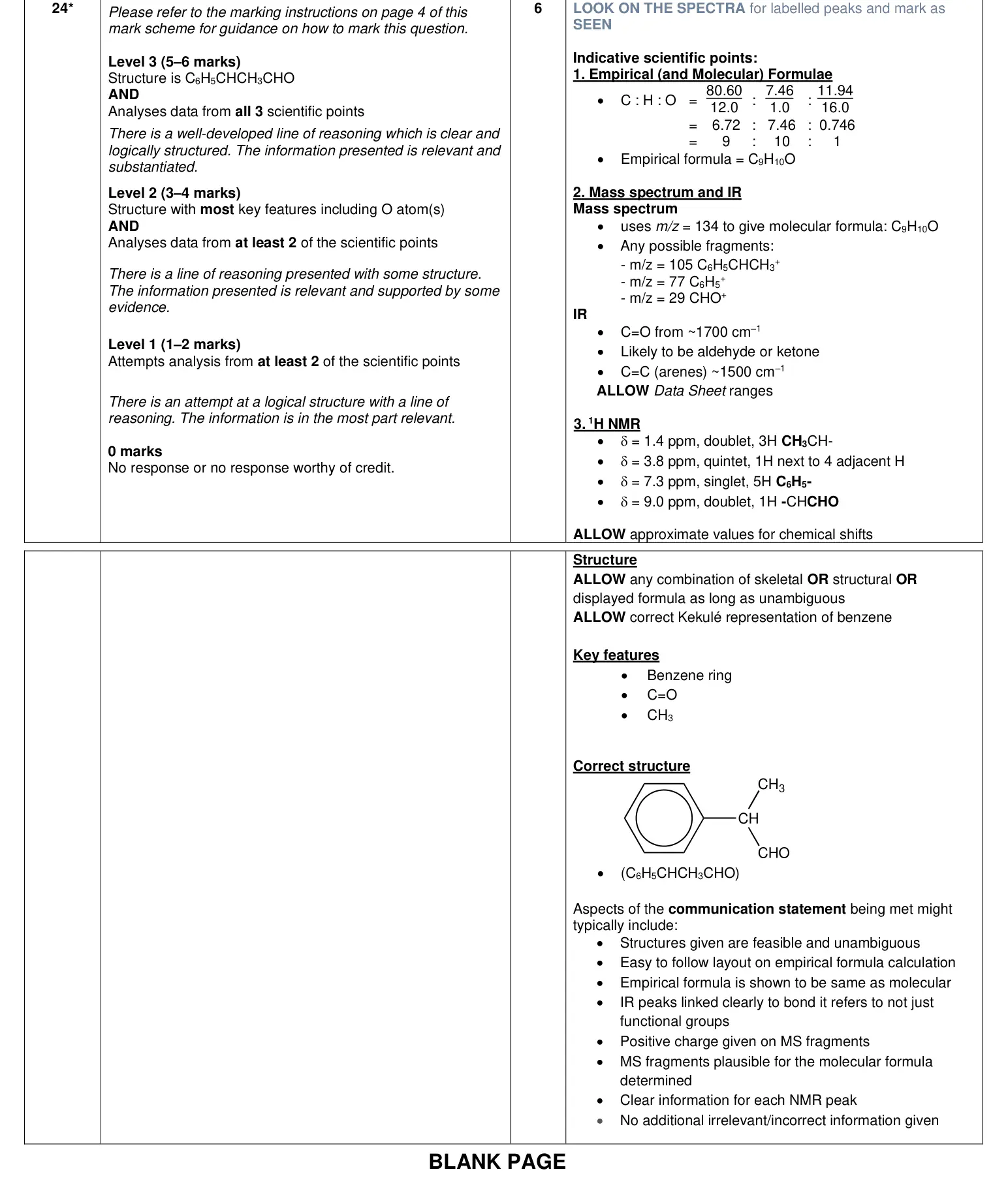
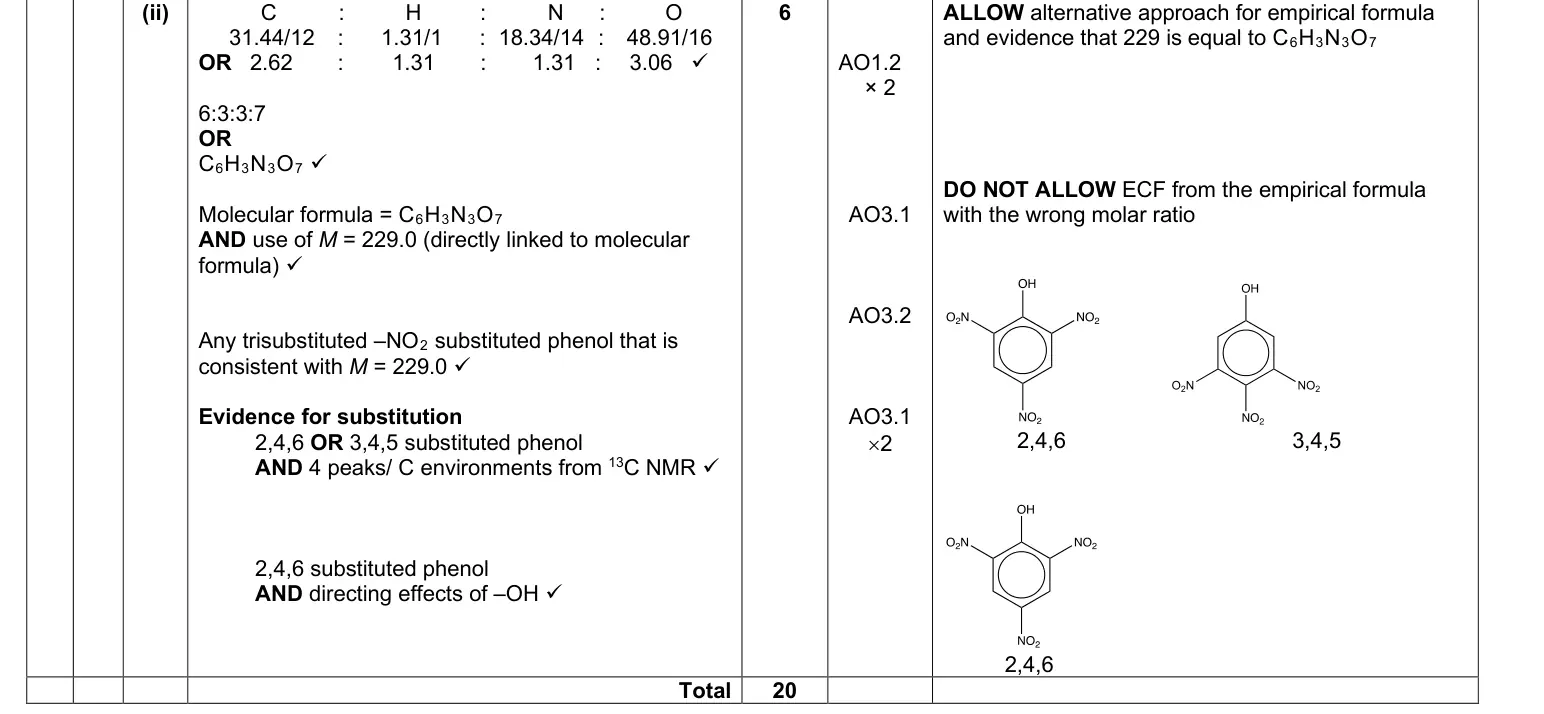
| June 2024 | Paper 2 | 24 | Analysis of an unknown organic compound J produces the following results. Determine the structure of compound J, showing all your reasoning. [6] |
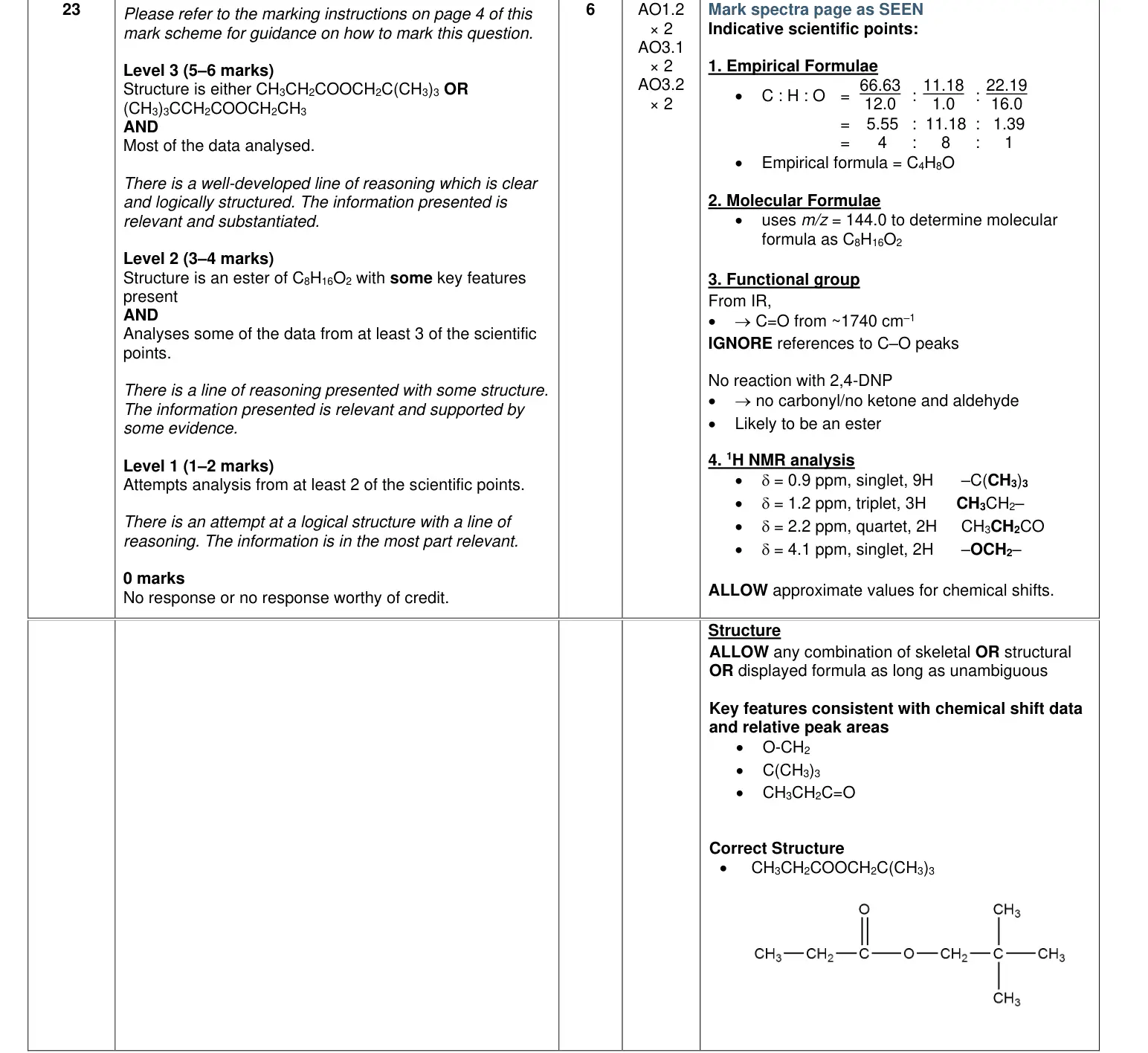
| June 2023 | Paper 2 | 23 | An unknown organic compound is analysed. Use the information to identify the organic compound. |
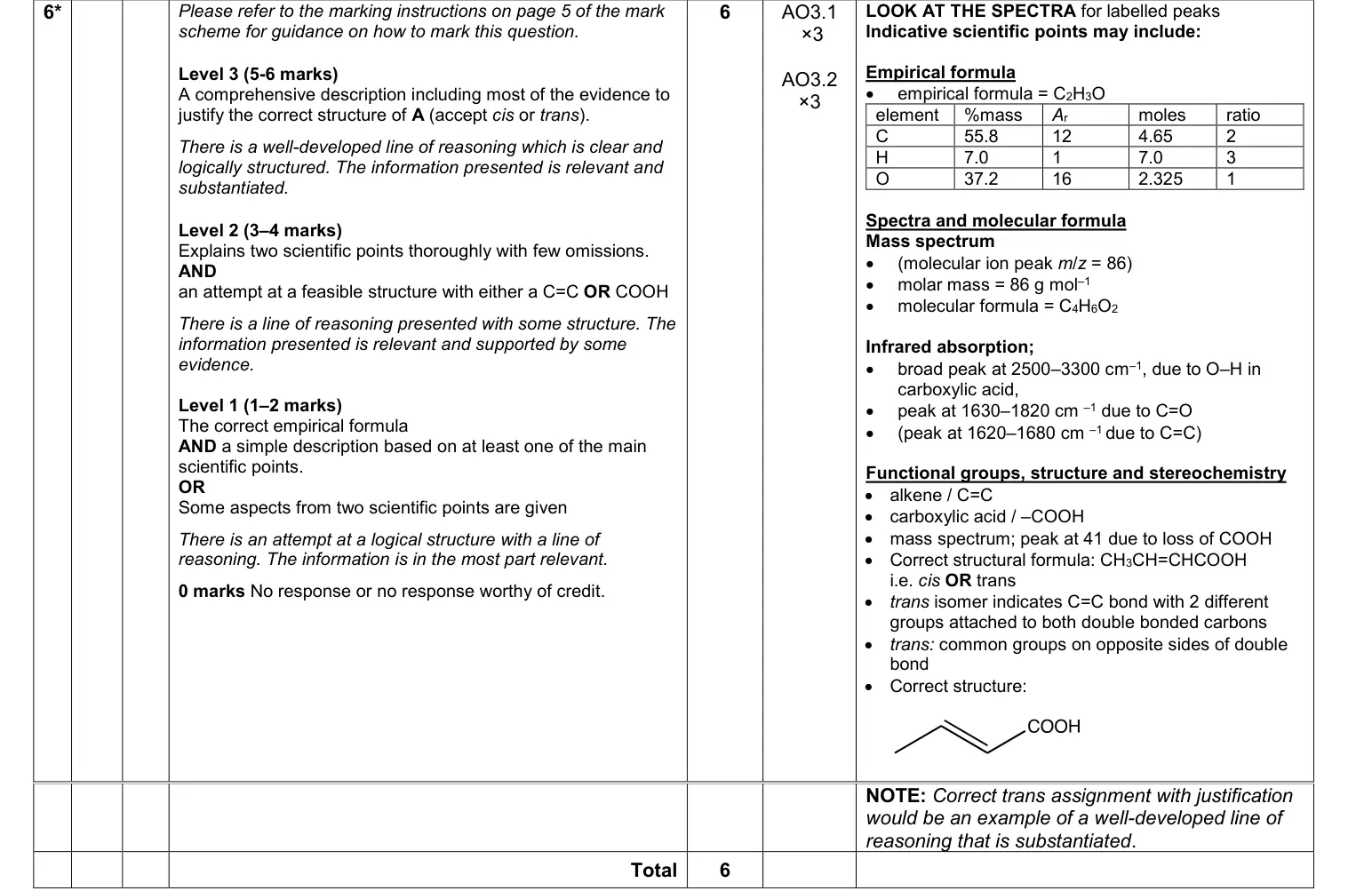
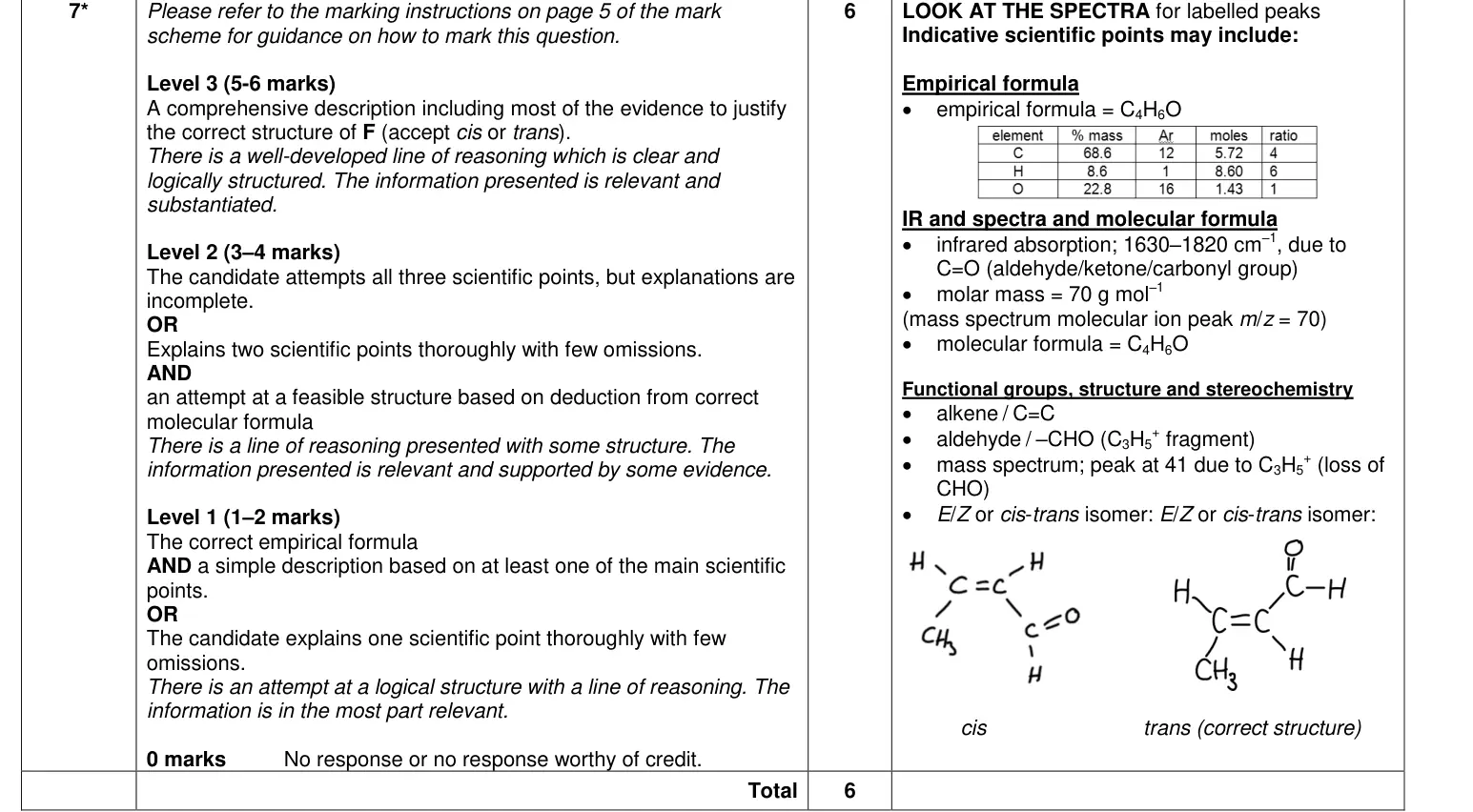
| June 2022 | AS Paper 2 | 6 | The organic compound A is unsaturated and is a trans stereoisomer. Use the information to determine the structure of compound A. |
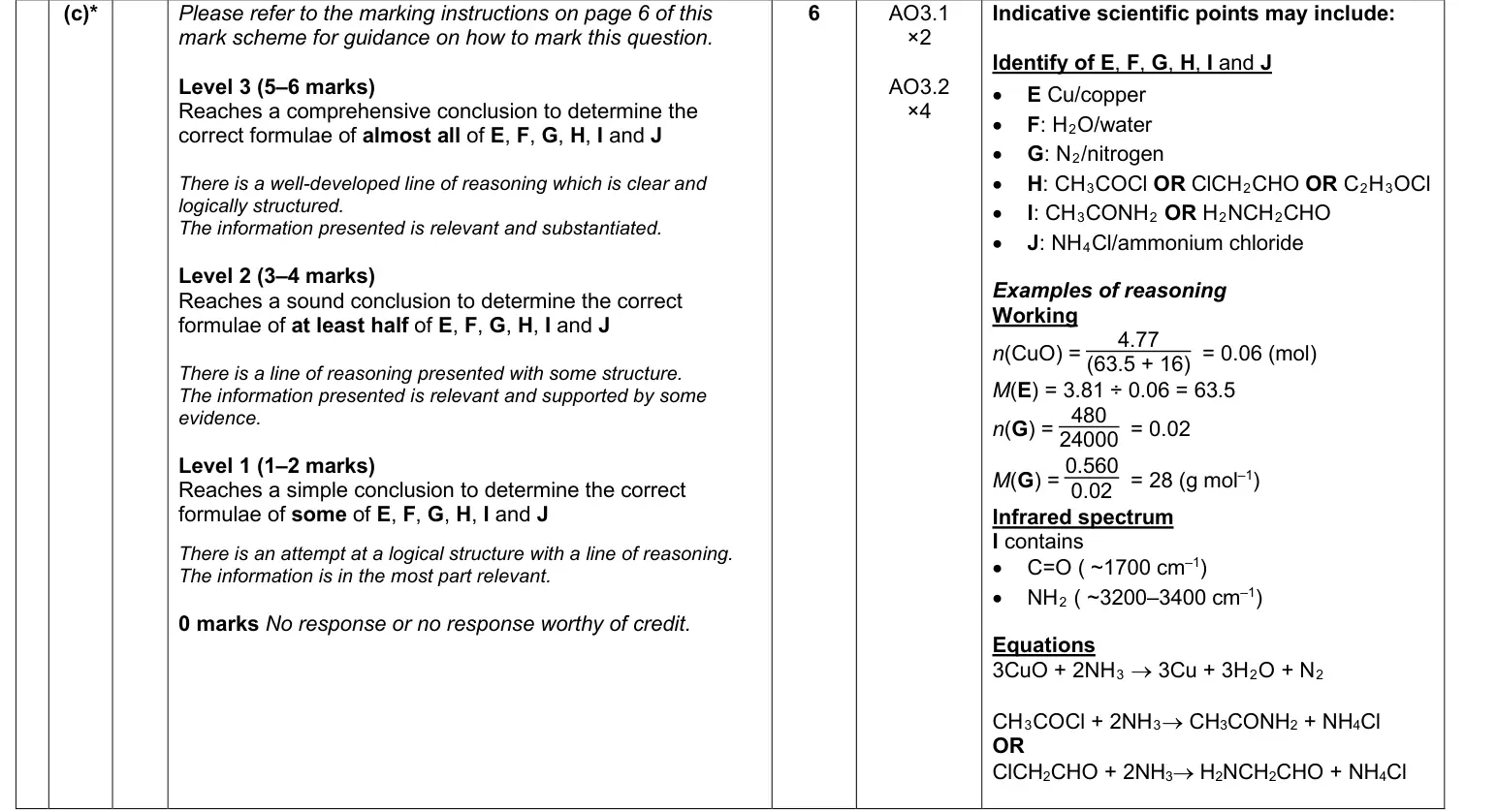
| November 2021 | Paper 3 | 5(c) | This question is about two reactions of ammonia. Identify E, F, G, H, I and J, and write equations for the two reactions. |
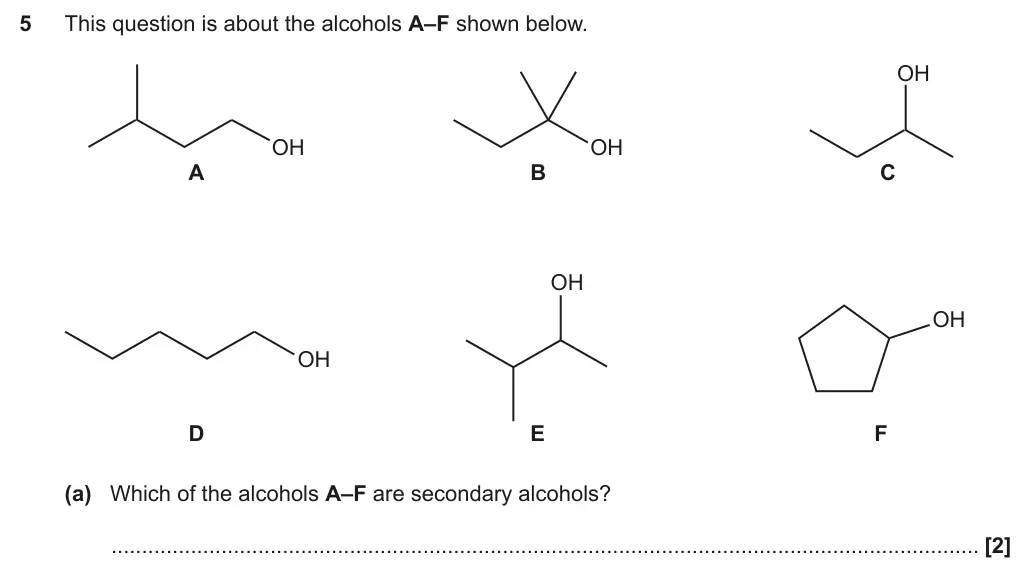
| November 2020 | AS Paper 2 | 5(f) | The structures of A–F are repeated below. |
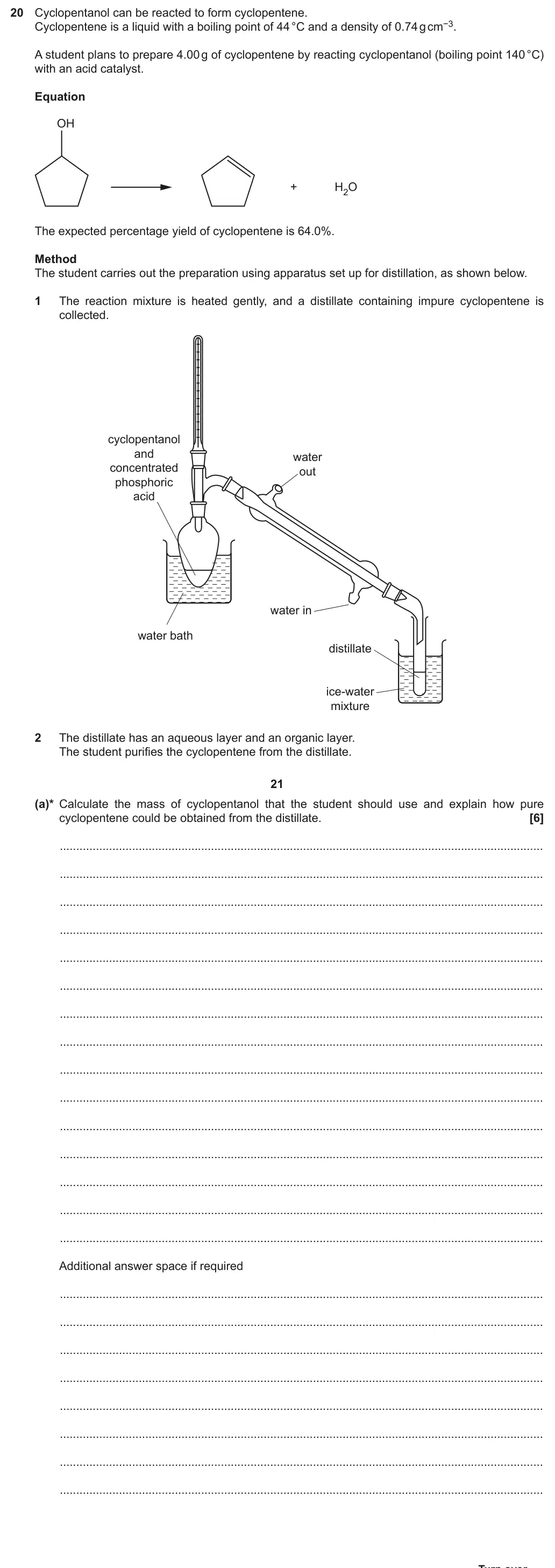
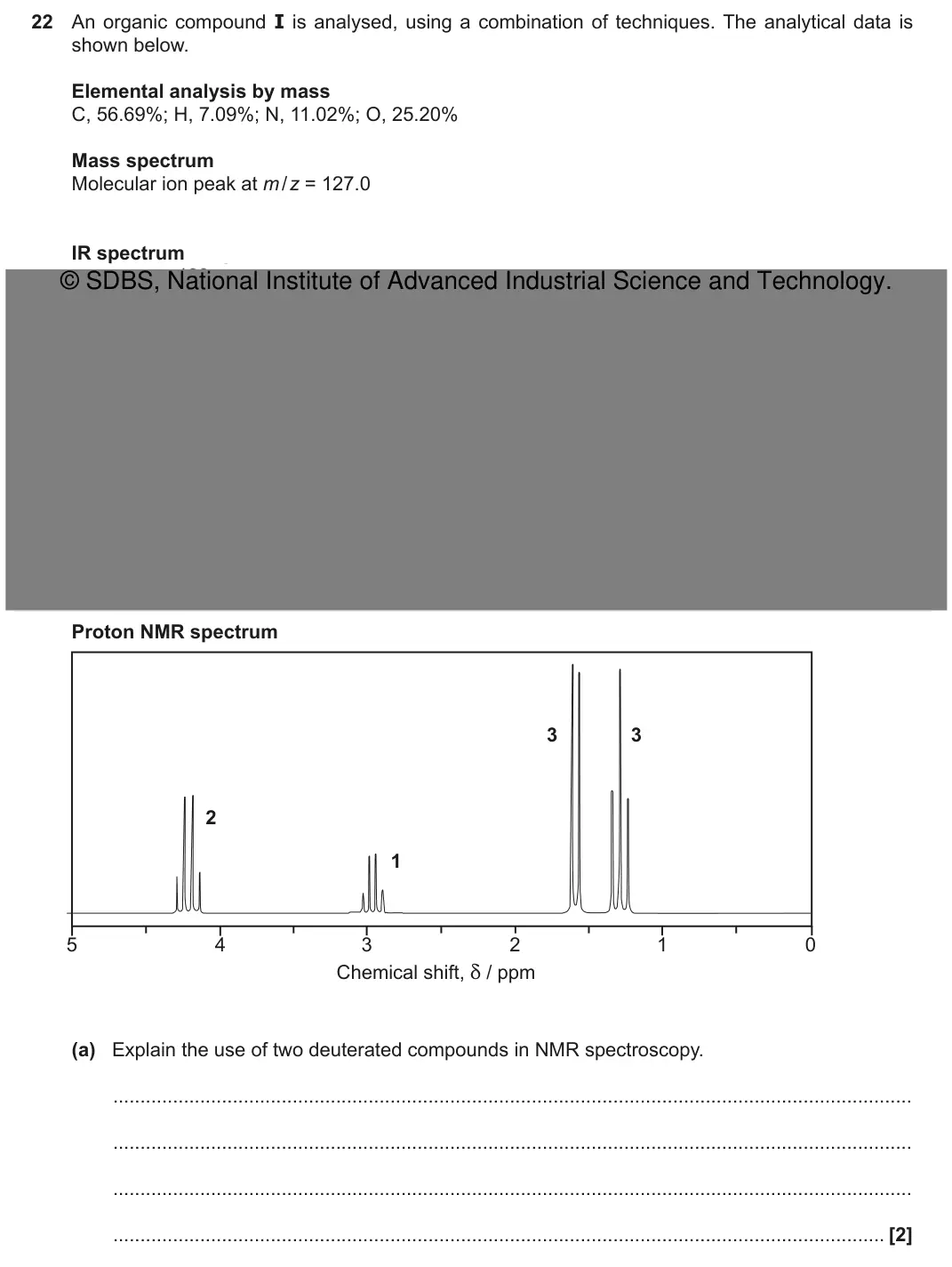
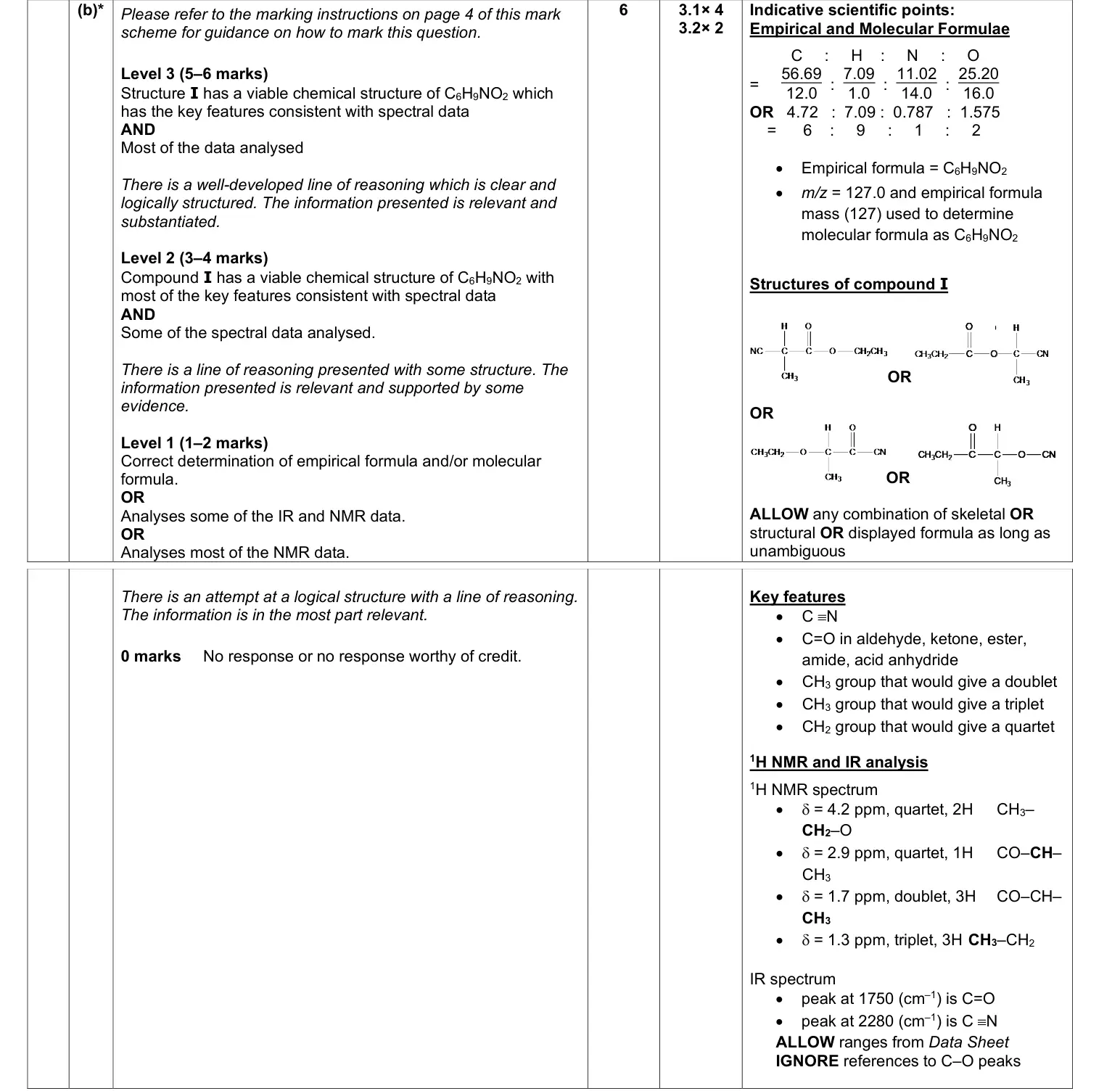
| November 2020 | Paper 2 | 22(b) | Determine the structure of compound I, showing all your reasoning. [6] |
| June 2019 | Paper 2 | 21 | Analysis of an unknown organic compound produced the following results. Use the results to suggest one possible structure for the unknown compound. |
| June 2018 | AS Paper 2 | 7 | Compound F is a trans stereoisomer which is a useful intermediate in organic synthesis. Determine the structure of compound F. |
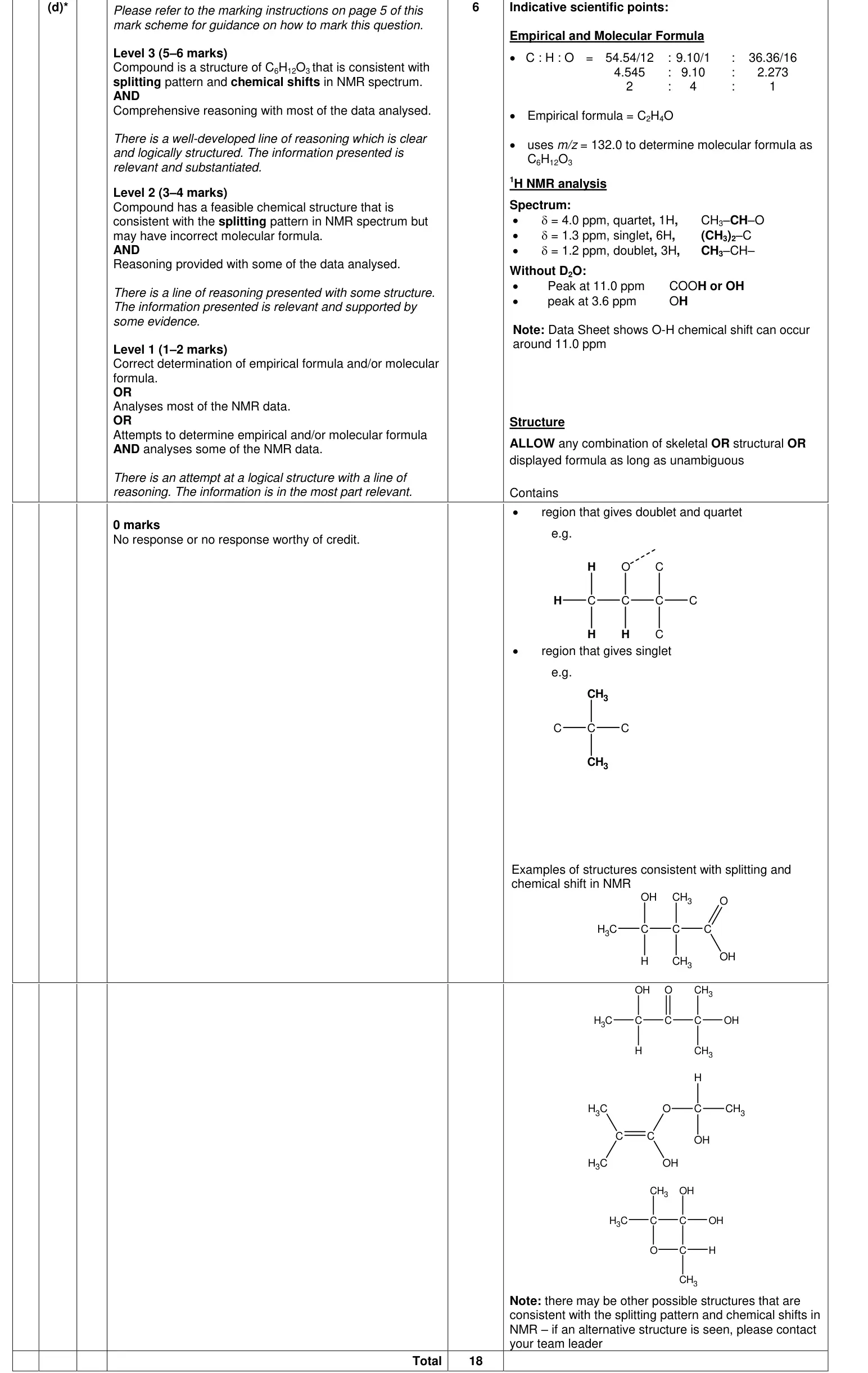
| June 2018 | Paper 2 | 22(d) | A scientist is researching compounds that might be suitable as fuel additives. Use the information provided to suggest a structure for the compound. |
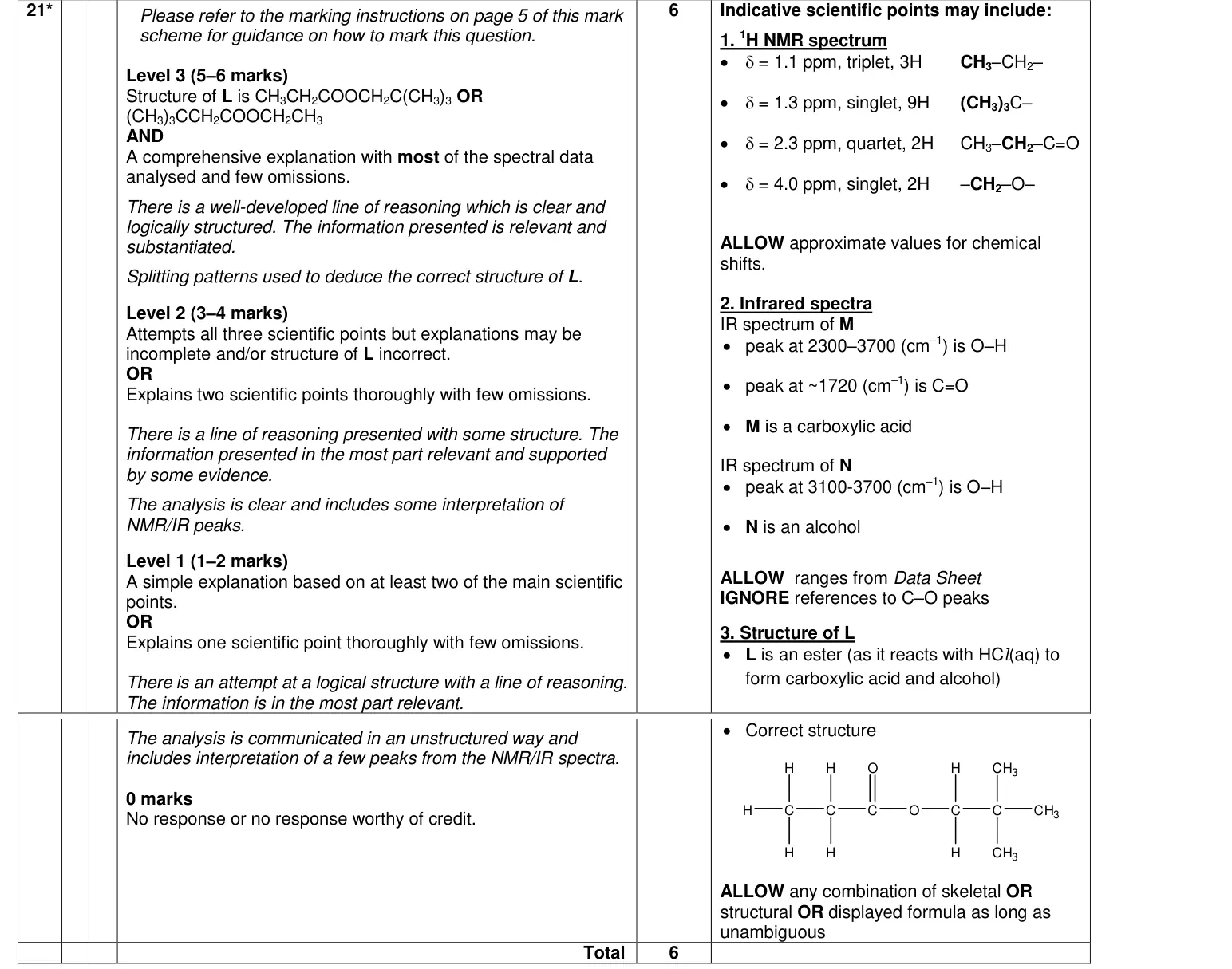
| June 2017 | Paper 2 | 21 | Compound L is an organic compound containing carbon, hydrogen and oxygen only. Use the information provided to suggest a structure for compound L. |
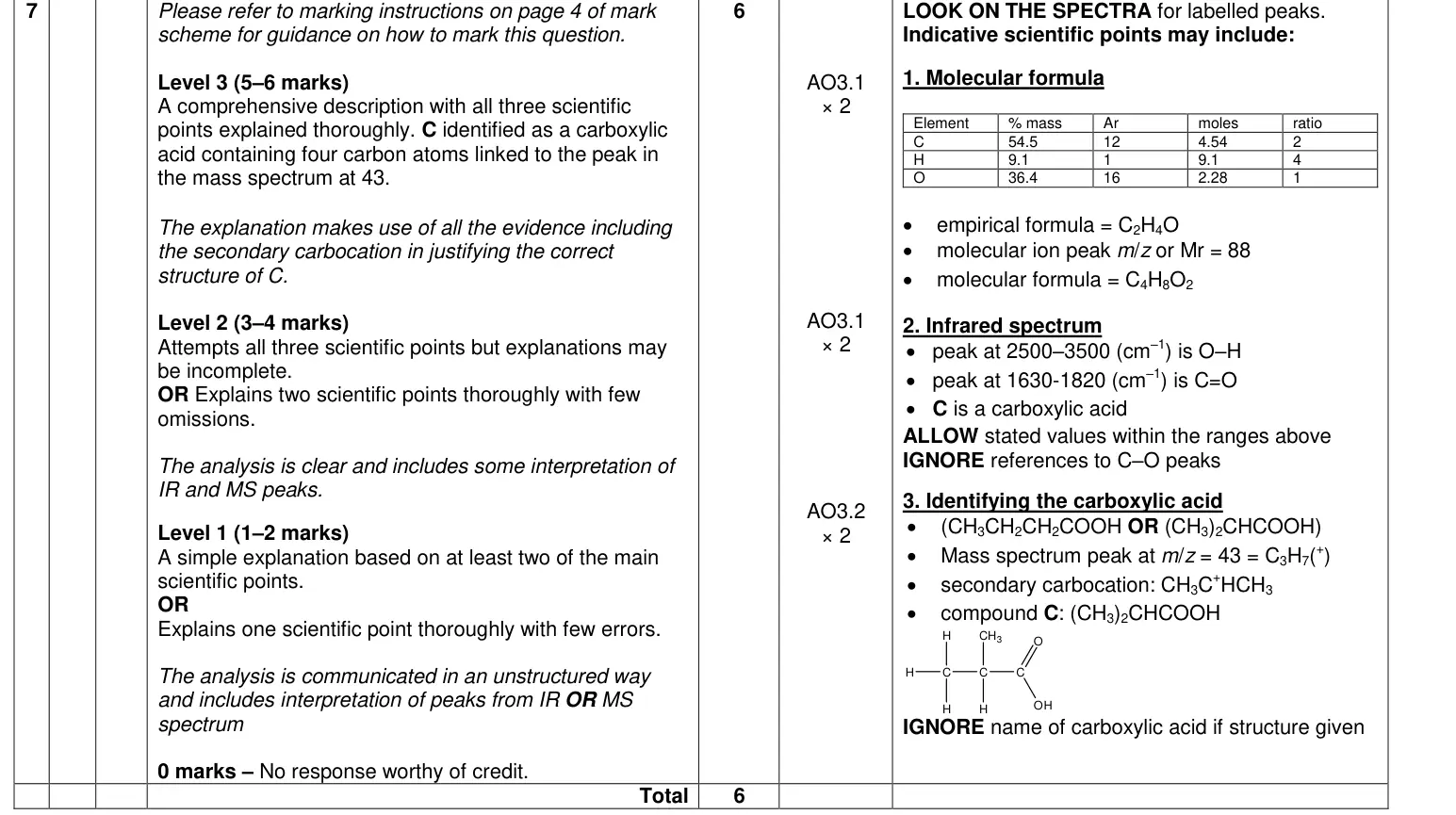
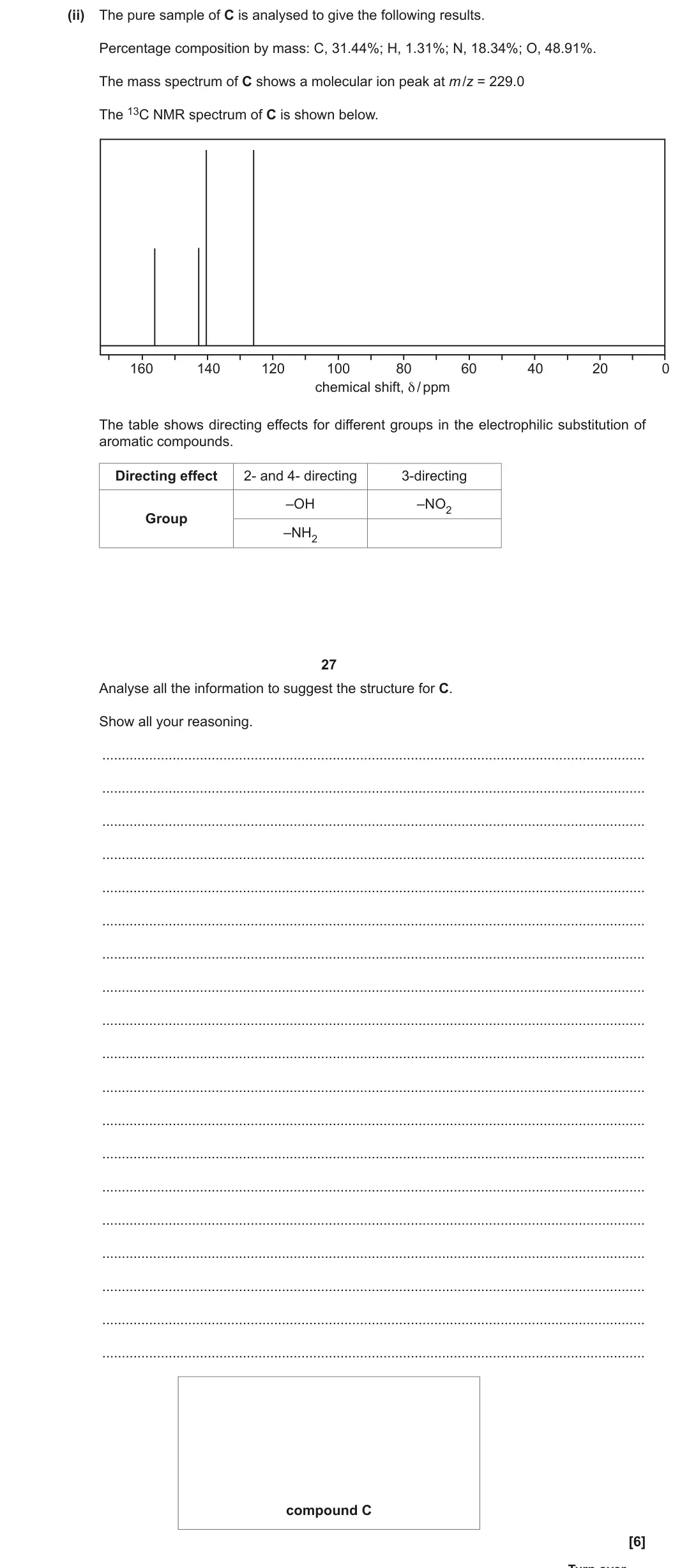
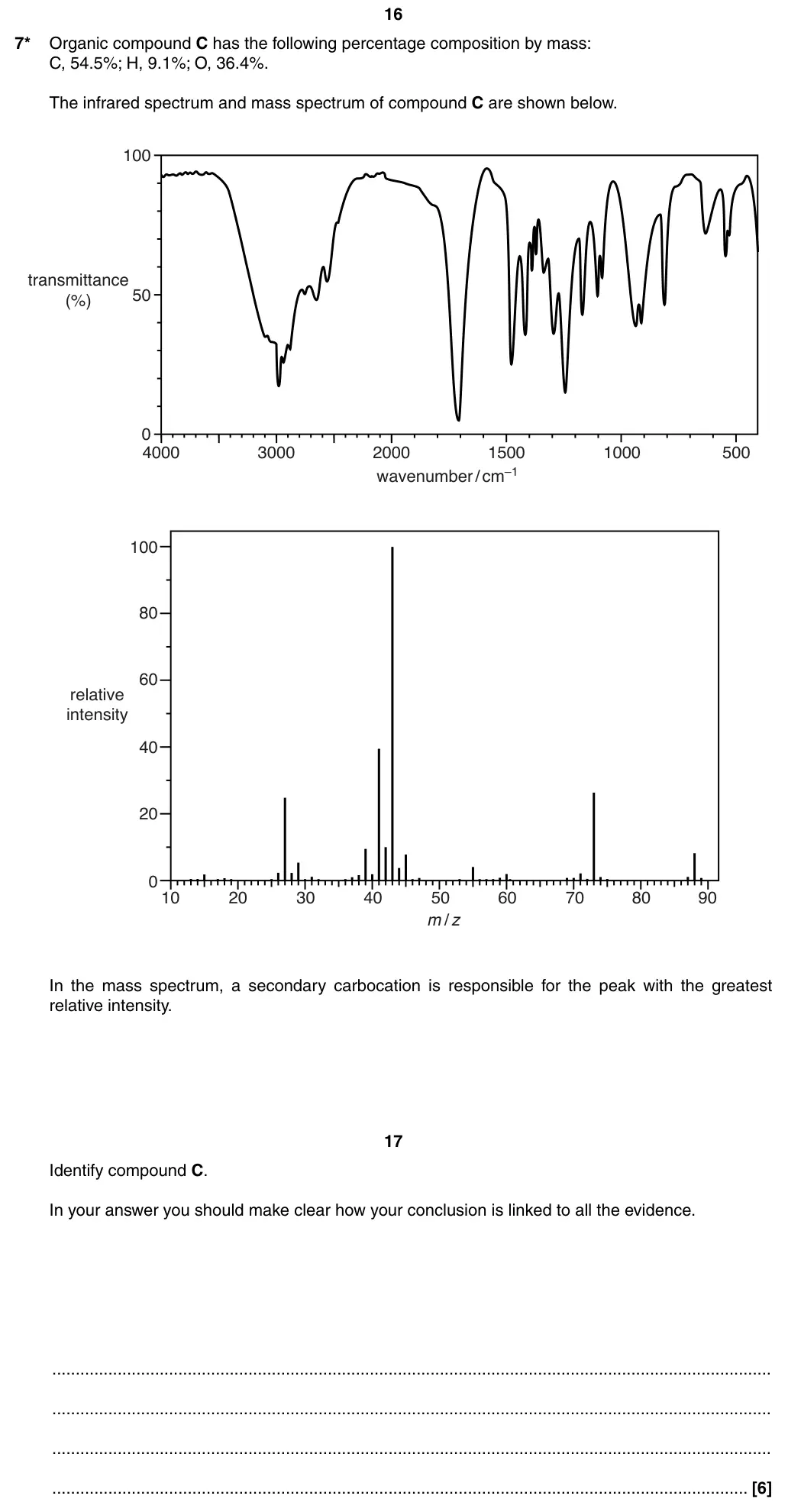
| June 2016 | AS Paper 2 | 7 | Organic compound C has the following percentage composition by mass: Identify compound C. |
D
A significant number did not recognise the CH3CH2 group in D would give the fragment ion at m/z = 29.
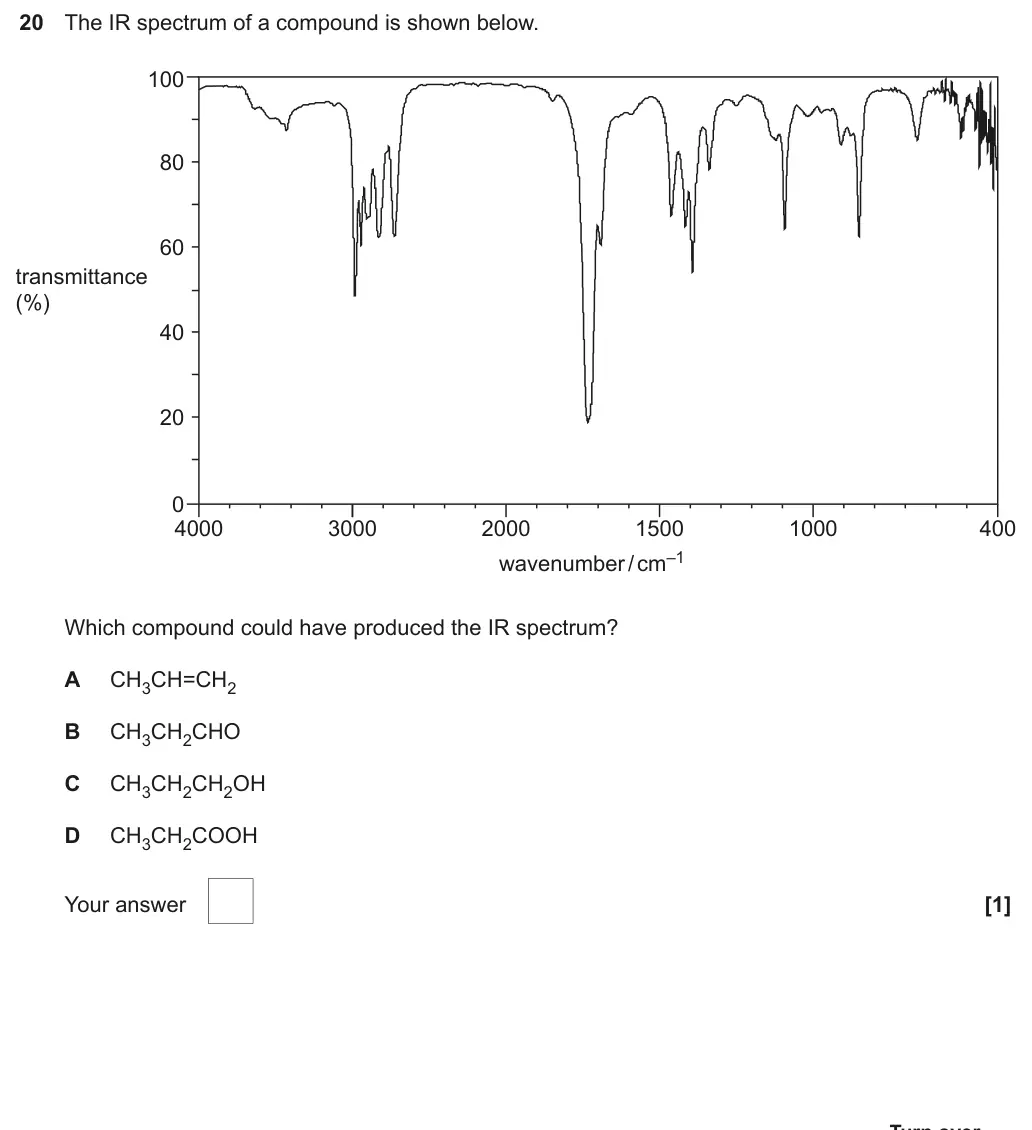
B
Roughly half of candidates gained this mark, with D being the most common incorrect response (mistaking the peaks at around 3000cm-1 as a broad peak caused by a O-H bond in a carboxylic acid). Section B overview Section B includes short response question styles (structured questions, problem solving, calculations, practical) and extended response questions. This section of the paper is worth 50 marks.
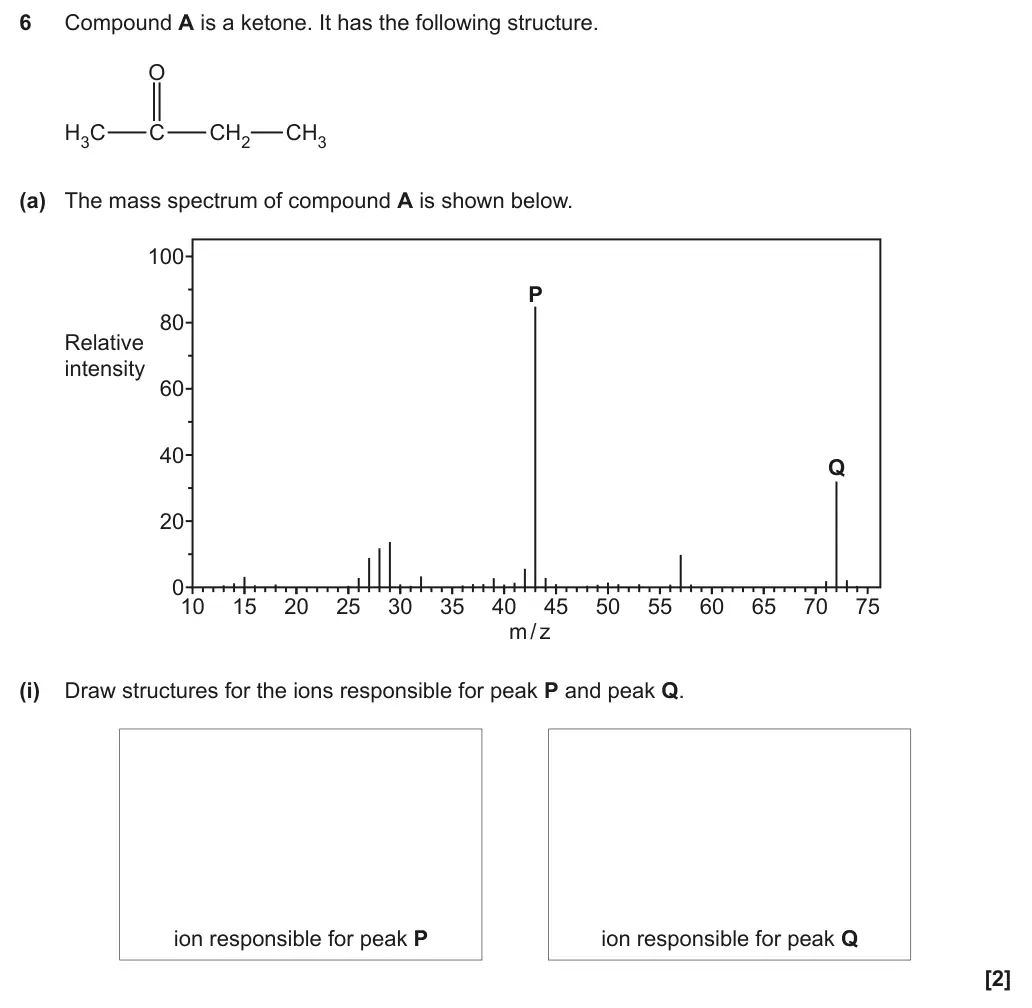
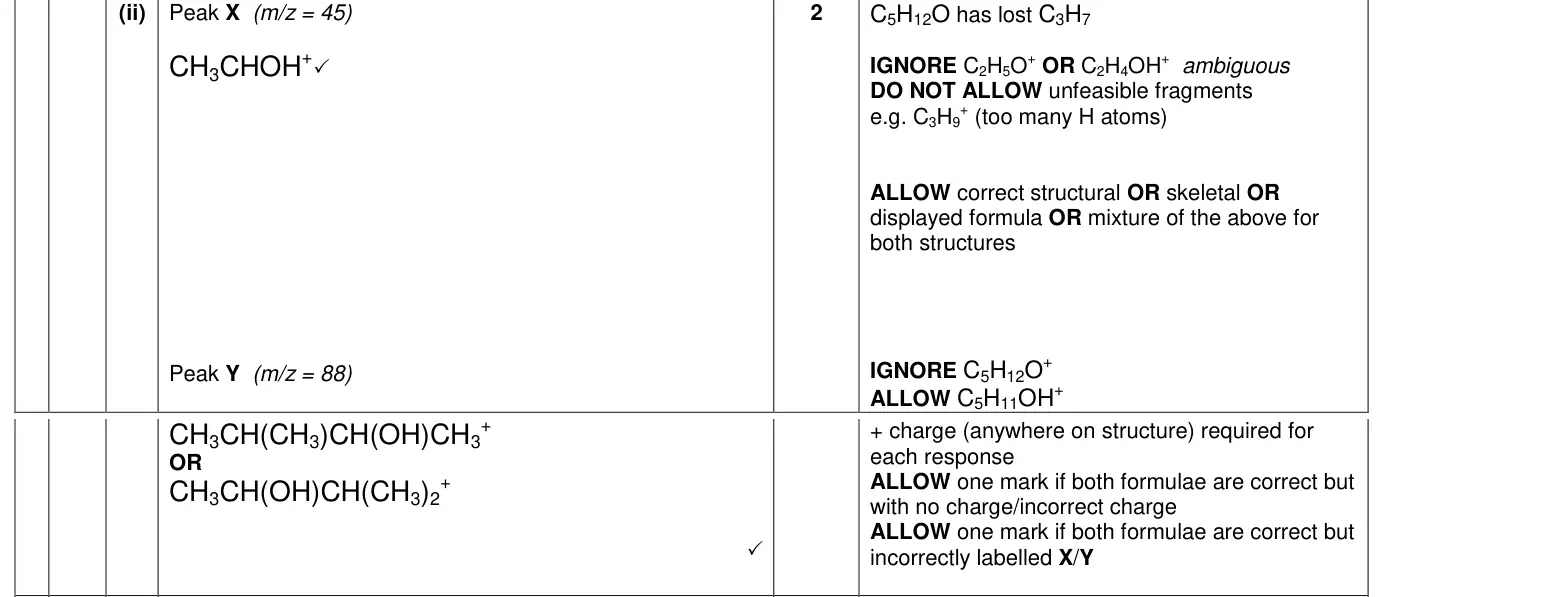
Most candidates only scored 1 mark as they omitted the charges, despite being asked in the question for the structures of ions. Some gave charge on the fragment P but not on the molecular ion Q. Some also gave ions that would have the correct mass but don’t exist in this molecule, e.g. P CH2CH2CH3+. A few gave molecular formulas rather than structures.
Skills: M3.1 Translate information between graphical, numerical and algebraic forms

Many recognised it as the M+1 peak but did not explain why it is there. Some suggested the addition of a H to the molecular ion. Some suggested it was due to different isotopes but did not specify for C-13. Other isomers, e.g. H-2, exist in such small natural abundance they would not be detectable. Lower-attaining candidates that struggled with (i) often thought that it was the M+ peak and so gave the Mr of the compound.
Skills: M3.1 Translate information between graphical, numerical and algebraic forms
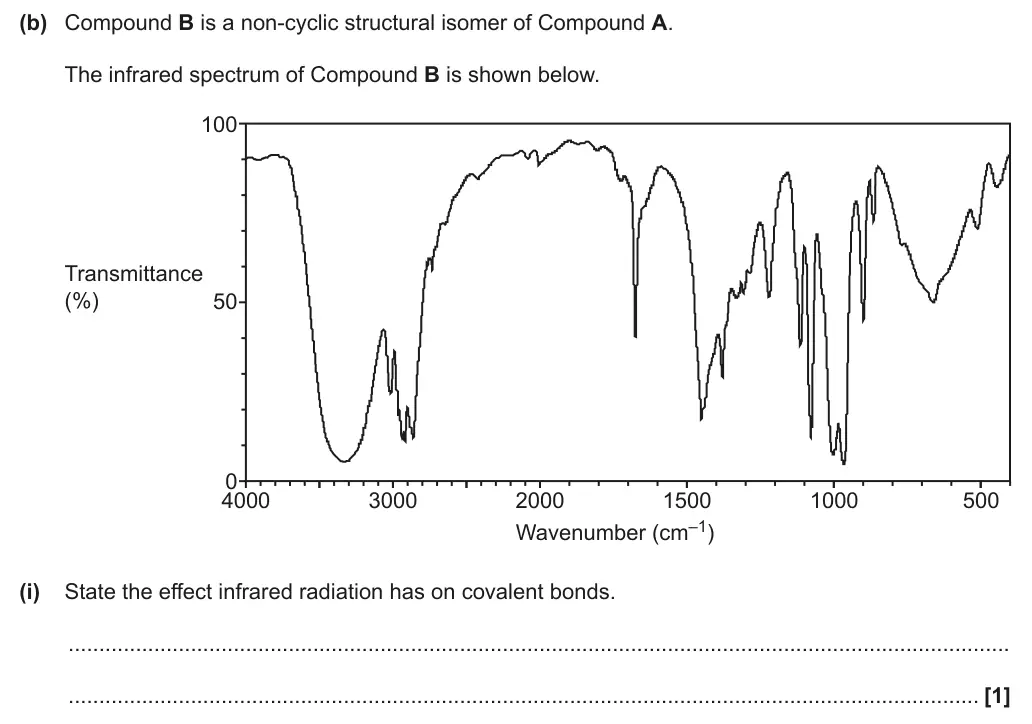
The majority of candidates said infrared radiation caused the bonds to vibrate. This was not sufficient for the mark as the bonds would already be vibrating – but IR causes them to vibrate more. A significant number thought that IR would cause the bonds to break.
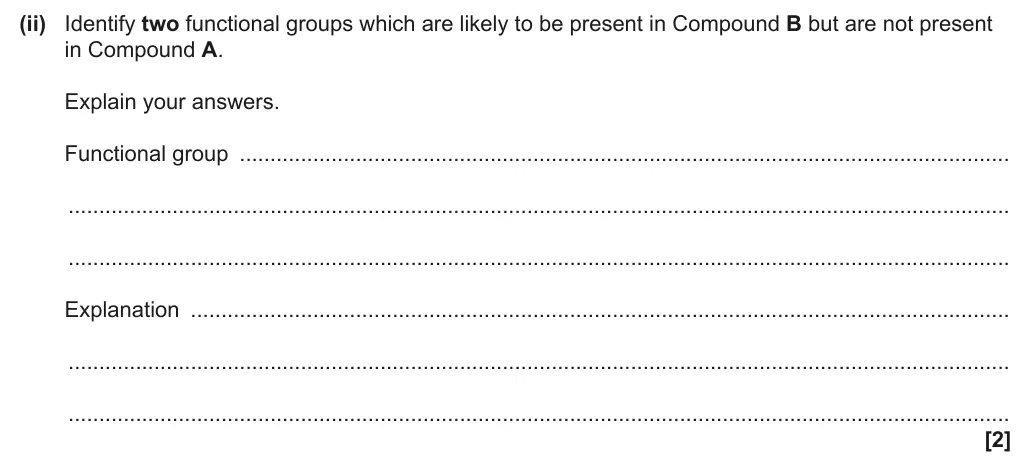
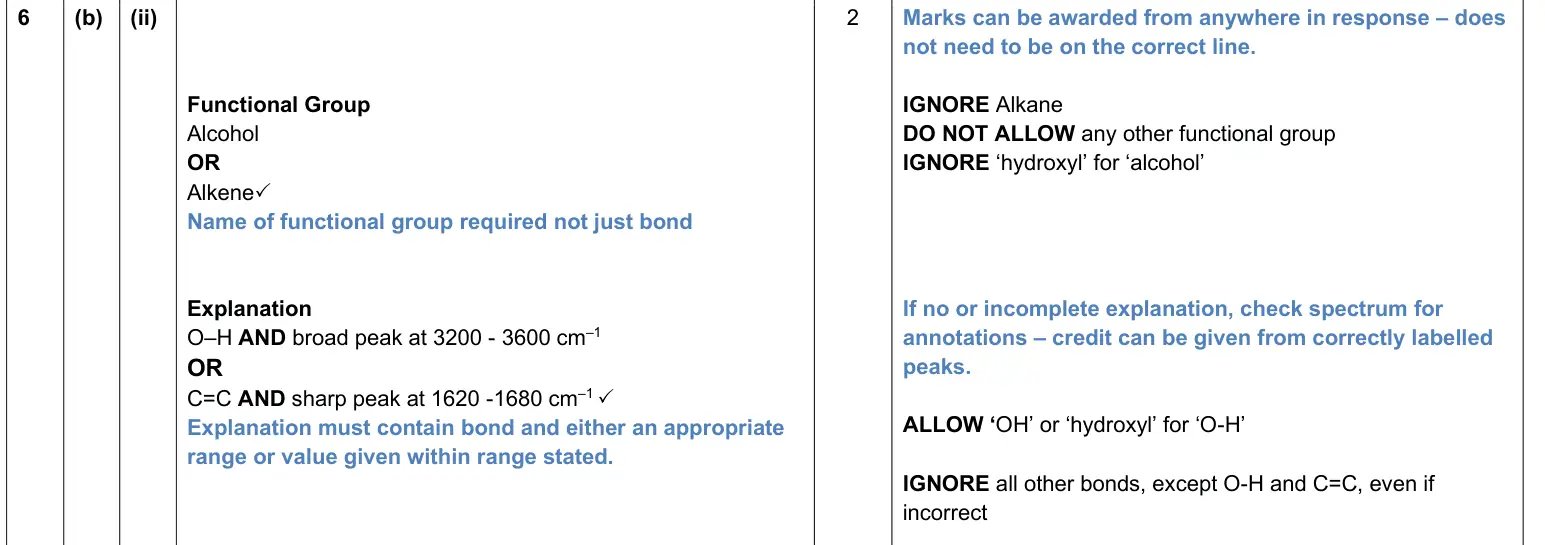
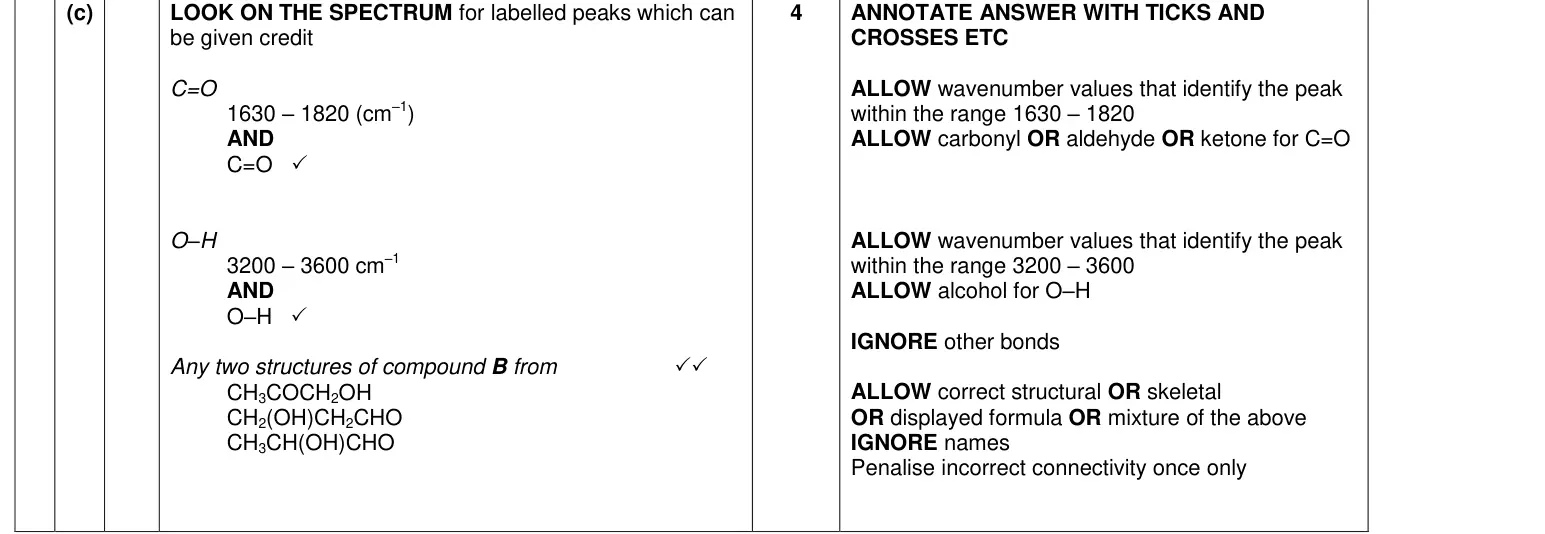
Candidates must take care to name functional groups rather than just bonds as O-H bonds are found in both carboxylic acids and alcohols, C=C are found in alkenes and arenes. Many candidates thought that there was a carboxylic acid present in B, not realising this would then have too many O atoms to be a structural isomer. Similarly, some identified a halogen. Candidates must be clear about the IR peaks identified ensuring they give precise values within the range identified on the data sheet. Many candidates still confuse O-H in a carboxylic acid, which gives a much broader peak that merges into the C-H stretch, and O-H in alcohol, still broad but distinct from C- H.
Skills: M3.1 Translate information between graphical, numerical and algebraic forms
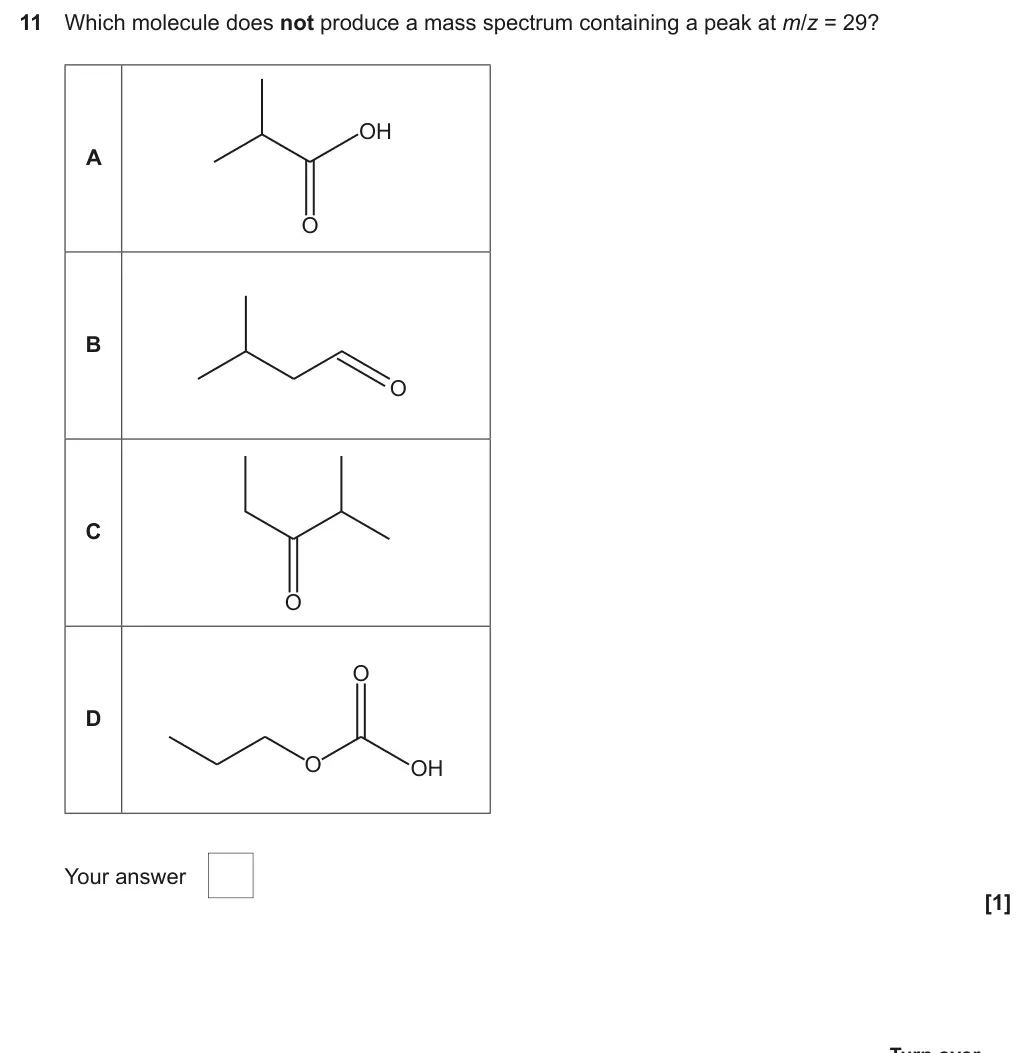
A
Most gave the correct answer A here. The most common incorrect response seen was B. It is possible that some candidates misread the question as option B is the first one that does contain a peak at m/z = 29. Alternatively, candidates may have been looking for C2H5 and may not have spotted the CHO group in B.
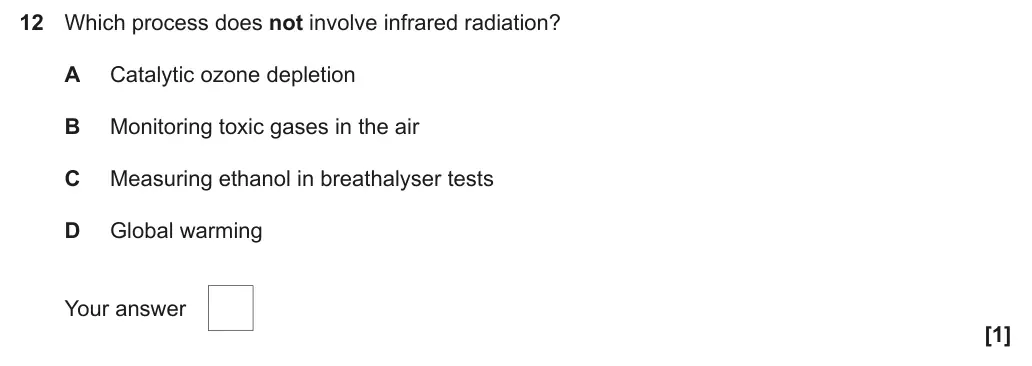
A
Most gave the correct response A here. However, a significant proportion gave an incorrect response. Many gave B or C not knowing these common examples of IR use. Some also gave D not seeing the link to global warming.
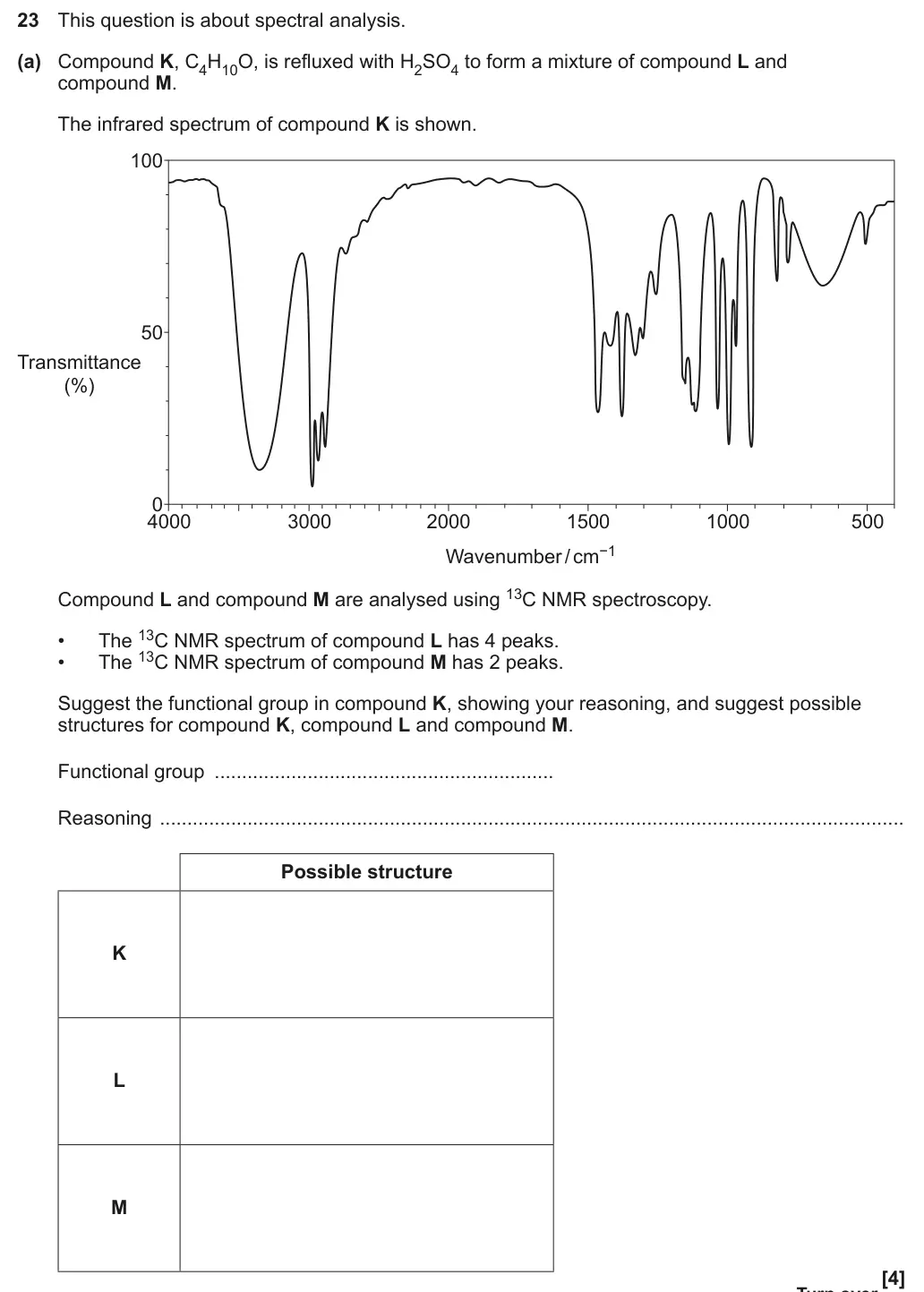
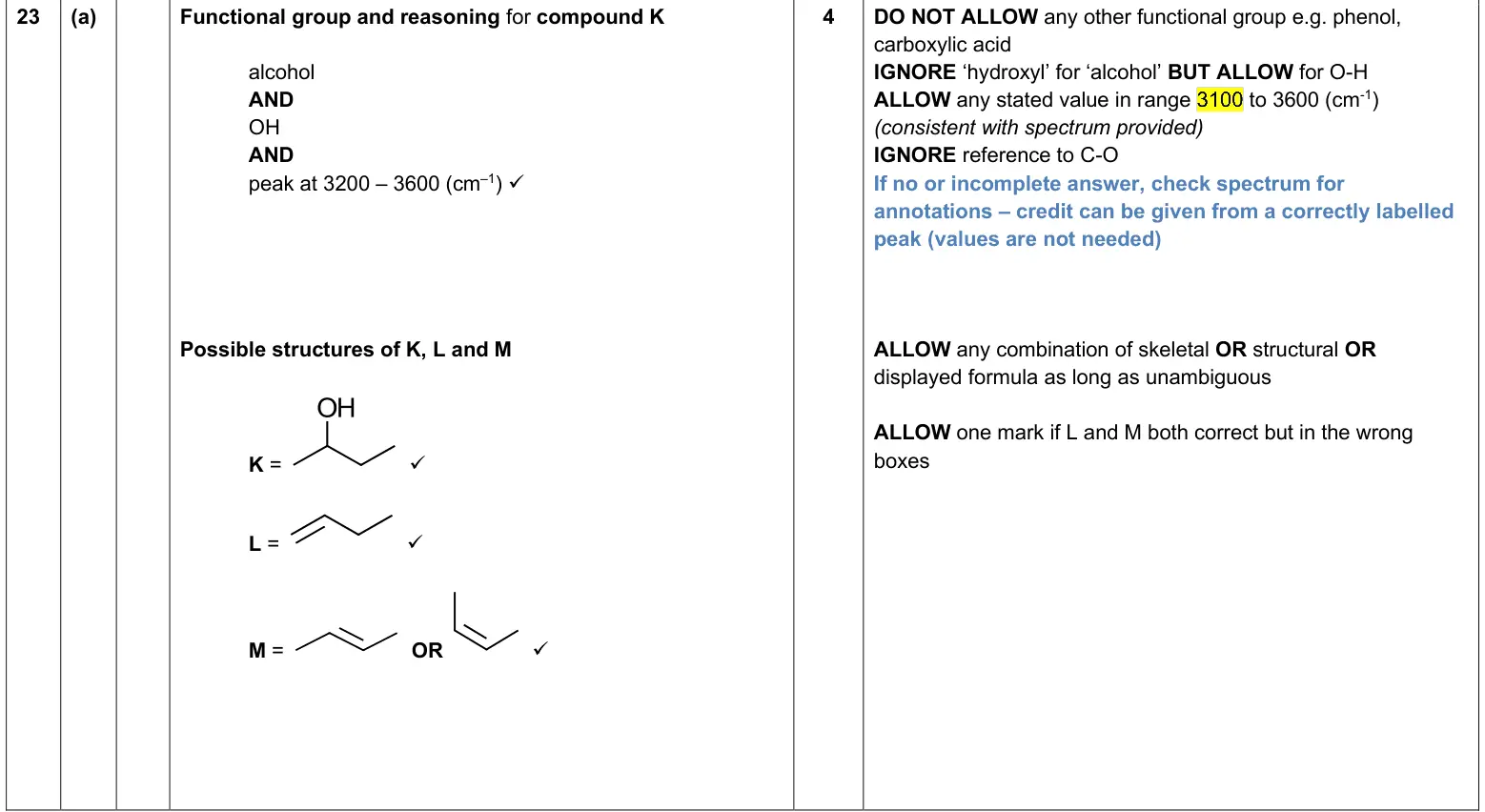
Very few candidates scored all 4 marks. The mark for identifying the alcohol functional group due to the presence of O-H bond in IR between 3200-3600 cm-1 was often lost for missing information. O-H or OH or hydroxy alone was not accepted as OH groups can be found within other functional groups i.e. phenol and carboxylic acid. Equally, it was important to identify the correct bond from the IR spectrum; in this case, O-H gives the most definitive answer. Other bonds are present, e.g. C-H and C-O but do not tell us that it is an alcohol. A few misinterpreted the ‘reasoning’ question stem and said alcohols would have the correct general formula to fit C4H10O or that alcohols could be dehydrated to make different alkenes, which is correct, but confirmation needed to come from the IR provided in the question. Many candidates gave a primary alcohol, butan-1-ol, as K. It appears many candidates focused on the fact that K was refluxed with H2SO4 and assumed this was oxidation, despite there being no K2Cr2O7, giving L and M as aldehydes, ketones or carboxylic acids. Some just gave alcohols with different structural formula for the alcohol for L and M, attempting to use the 13C NMR data. A significant proportion of candidates did not gain any marks on this question.
Skills: M3.1 Translate information between graphical, numerical and algebraic forms
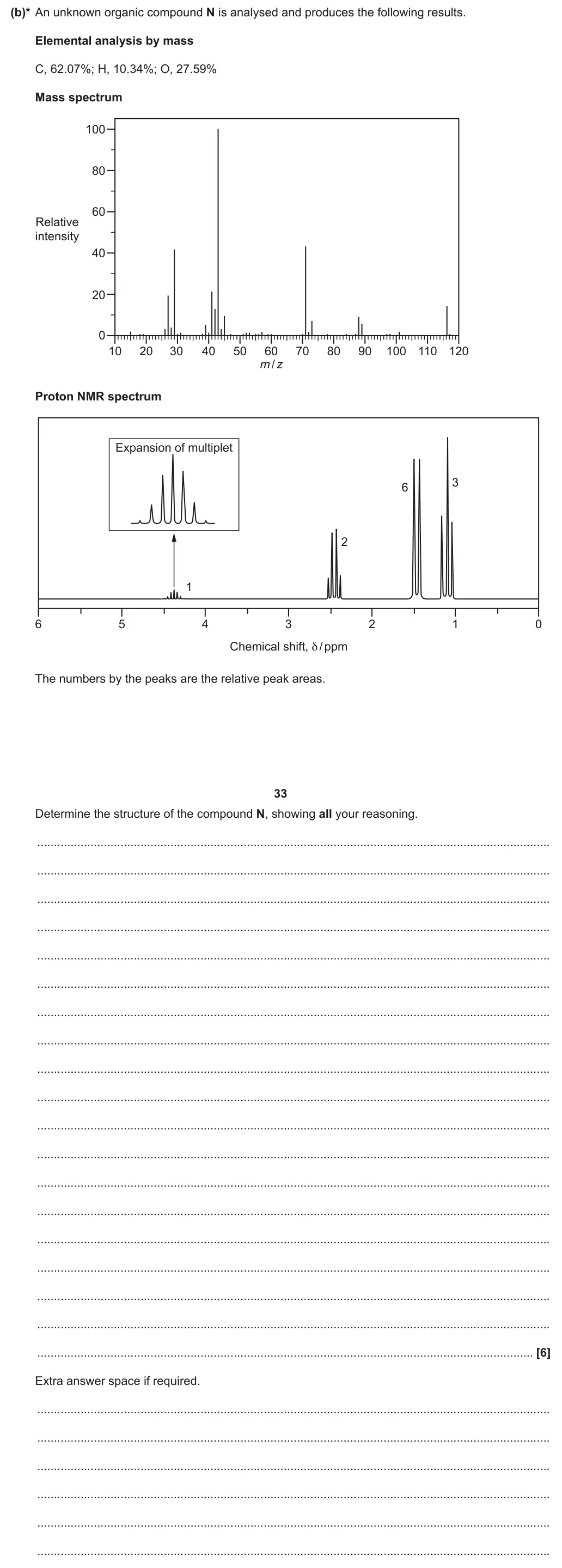
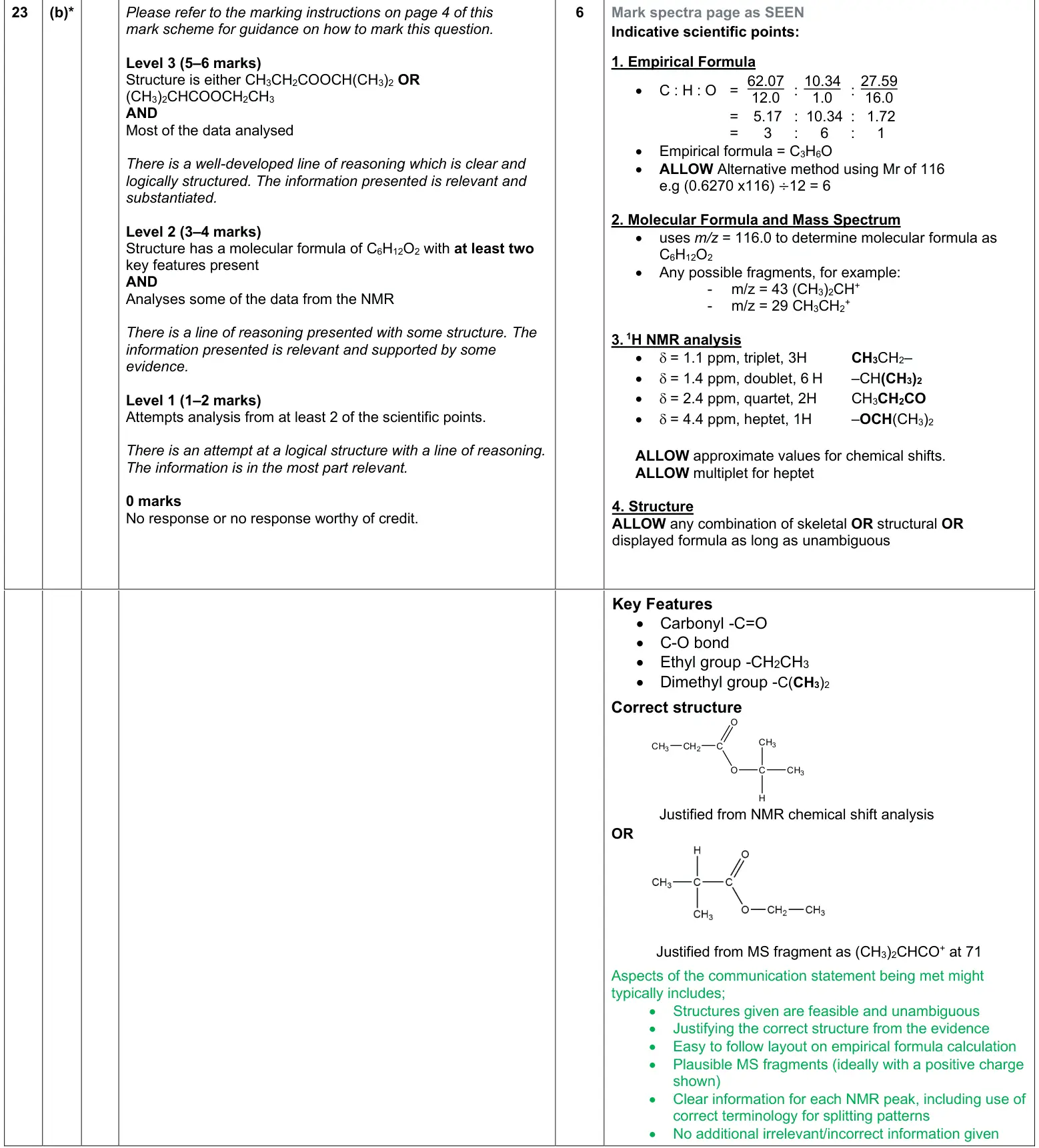
Most candidates achieved Level 3 and were able to gain 5 or 6 marks. The communication mark was given when a clear justification was given for either ester from their NMR data or from the mass spectrum fragment ions. The highest attaining candidates were able to organise their interpretation of the NMR data clearly in a table, showing how they used the information on chemical shift, integration and splitting to produce a fragment and finally linking these together to give a correct structure. However, for some candidates, while information was correctly determined, this was not then used to give a final structure. Some candidates analysed the fragment peaks from the mass spec. The best solutions linked the structure with peaks in the mass spectrum, e.g. CH3CH2+ peak at m/z 29 and C3H7+ peak at m/z 43, even though these fragments were often missing a charge when referred to. Some candidates only achieved Level 2 as although their structures had the correct molecular formula they contained -OH (suggesting N was a hydroxyl ketone or carboxylic acid) rather than H-C-O (found in esters) by misinterpreting the peak at 4.4 ppm as an O-H peak. Candidates should be reminded that the H bonded to an O will not couple with neighbouring Hs and can be present anywhere in the spectrum. This is usually highlighted by running the spectrum in D2O, removing this peak. Some candidates correctly identified parts of the molecule from their analysis of the NMR data but then gave a molecule which didn’t fit this, e.g. identified the (CH3)2CH fragment but then did not show it in the final structure or included a -COOH despite there being no peak at 10-12 ppm. Some, despite understanding that the peak at 2.4 ppm was next to -C=O and showed quartet splitting so had 3 neighbouring H, would assign it as a carbonyl group with the methyl group on one side and a CH2 on the other side. Lower attaining candidates struggled to interpret the NMR data, especially the presence of 6 equivalent Hs – many translated this as being a straight chain rather than 2 x CH3 groups. It is also important that candidates make use of the chemical shift information on the data sheet to give a chemical environment and try to use that to piece together their structure. Almost all candidates attempted to calculate the empirical formula and determine the molecular formula of the unknown compound, N, and therefore secured Level 1. However, many of these candidates gave structures which were not consistent with the molecular formula. This limited them to achieving Level 1, 2 marks only. Also, those without a final structure could only score a maximum of 2 marks. This response achieved Level 2 and 4 marks. The final structure is a hydroxy ketone, not one of the correct esters, but does have the correct molecular formula and C=O as well as an ethyl group. The candidate has analysed some of the NMR data. The communication mark has been given as the analysis shown in their response is easy to follow with clear information given for each NMR peak.
Skills: M0.2 Use ratios, fractions and percentages; M3.1 Translate information between graphical, numerical and algebraic forms
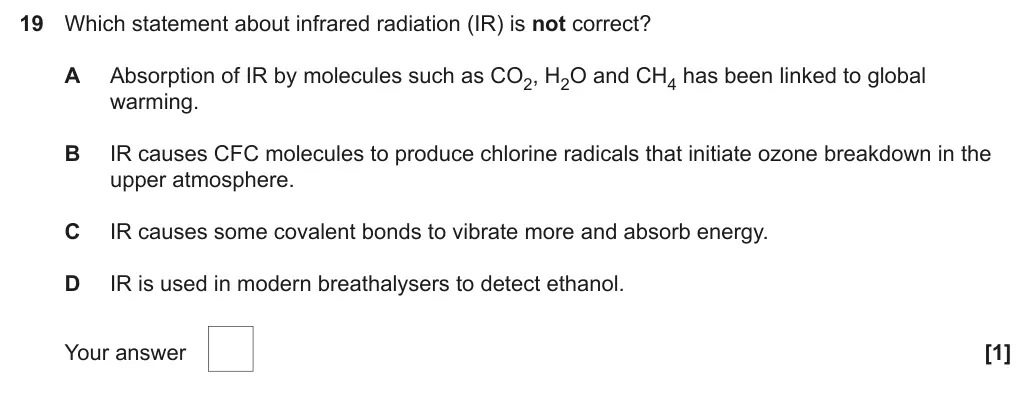
B
Some candidates correctly chose option B, with the other options being chosen randomly. From the importance placed on the causes of global warming, it was interesting to see that many incorrectly chose option A. Note also the points made in Question 6 about underlining the word ‘not’.
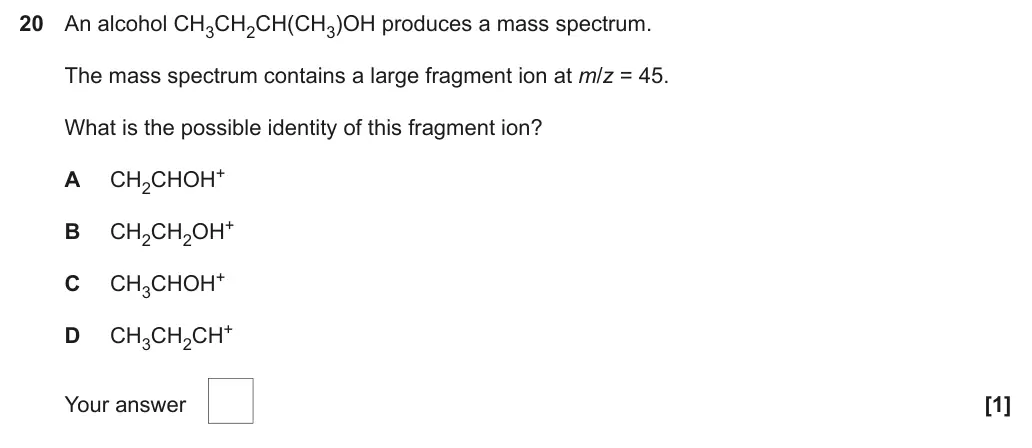
C
Most candidates first worked out the molecular mass of each fragment and annotated their scripts with this information, eliminating options A and C in the process. More successful responses than drew out the structure of the alcohol, to work out that only option C could have produced the fragment. This is evidence of good exam technique. Predictably, option B was the main distractor. This question discriminated well. Section B overview Section B includes short response question styles (structured questions, problem solving, calculations, practical) and extended response questions. This section of the paper is worth 50 marks.
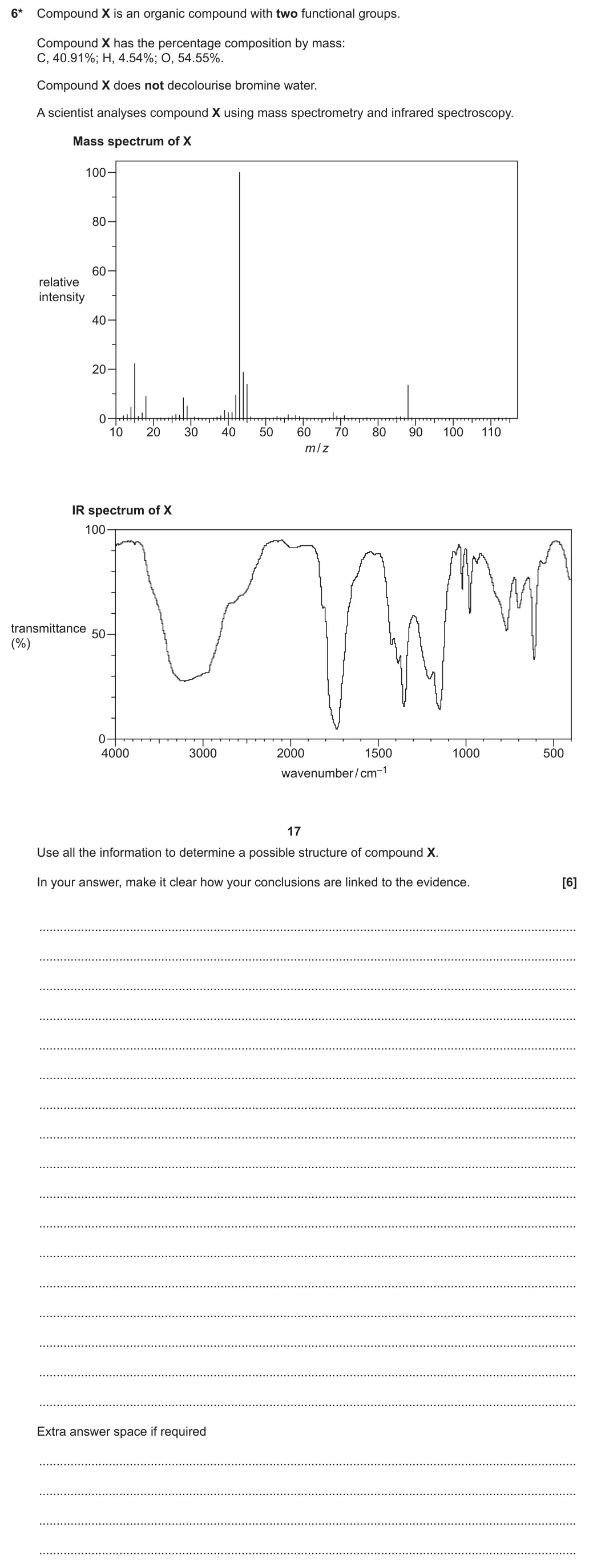
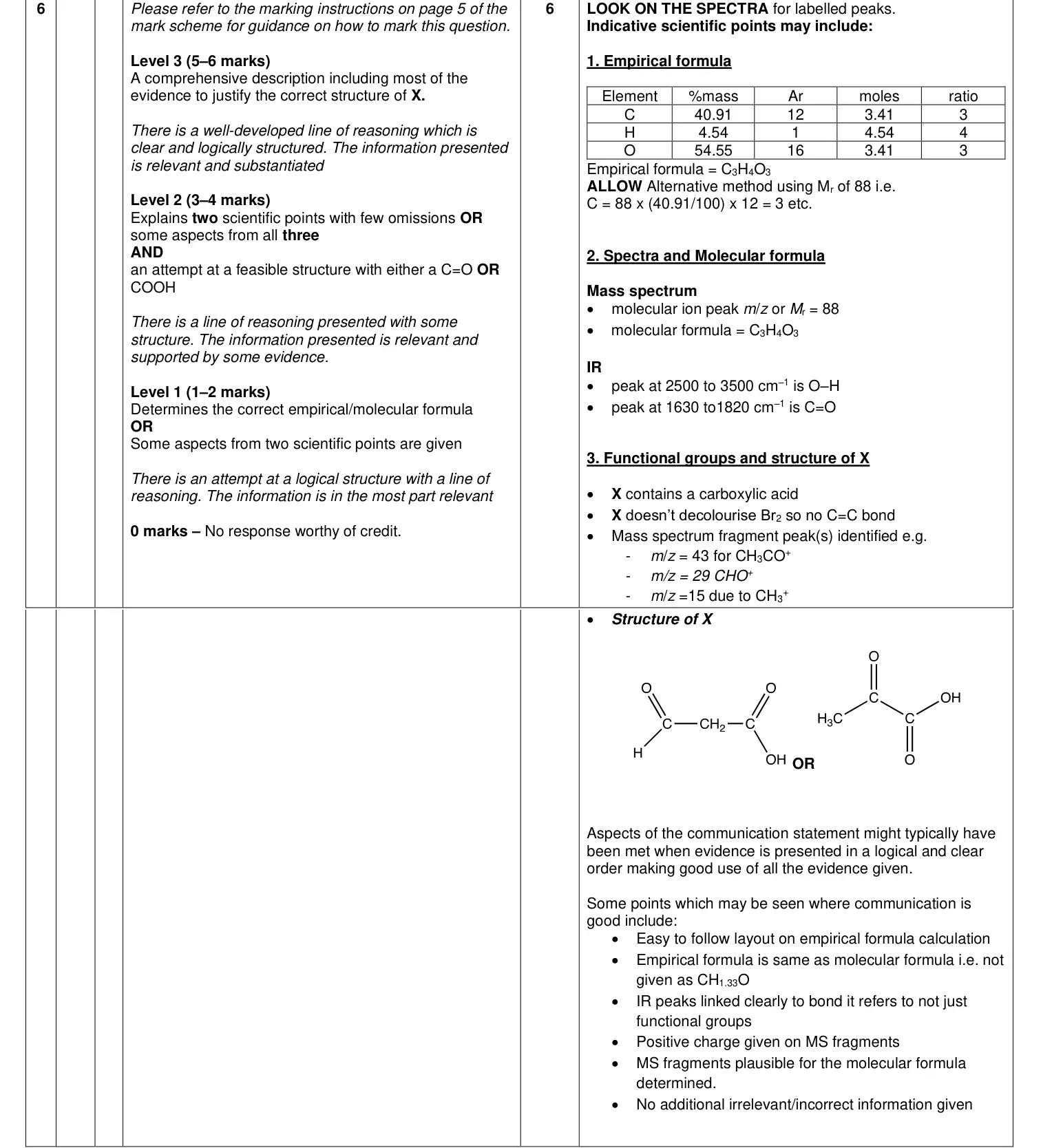
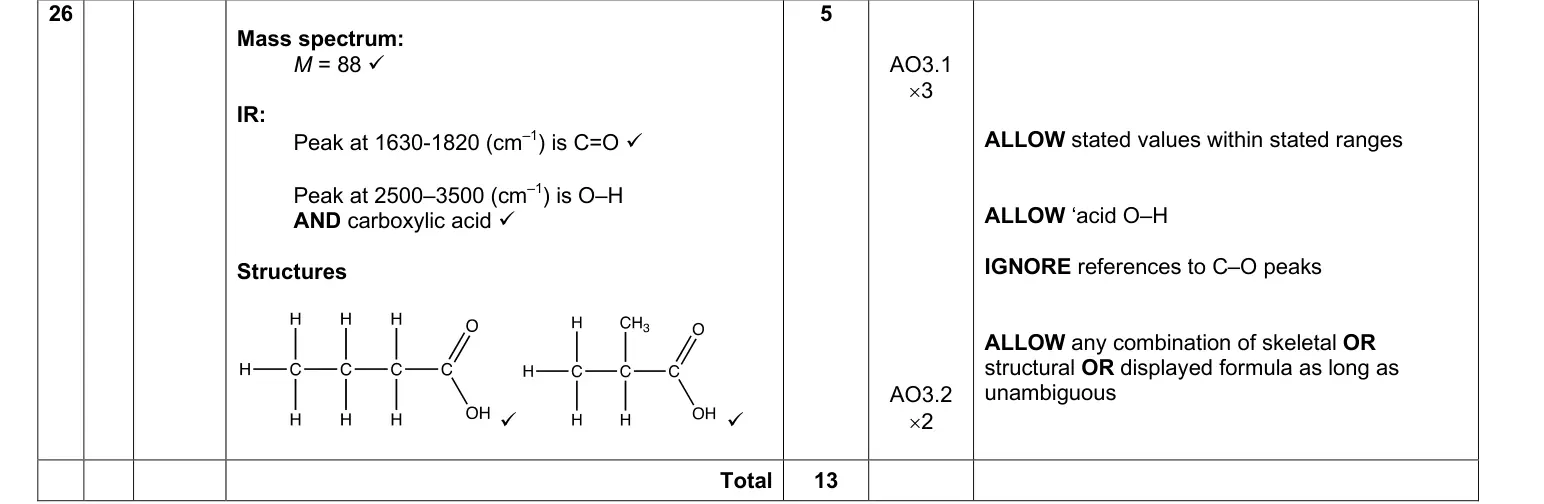
Over a third of candidates achieved Level 3, gaining 5 or 6 marks. A correct structure (either aldehyde or ketone) alone was not enough to award Level 3 and candidates were expected to give a comprehensive description of how the evidence helped them determine the structure. The biggest challenge for many candidates was finding the correct empirical formula. The ratio worked out to 1:1.33:1 so many incorrectly rounded this to either 1:1:1 or 1:2:1, which meant they struggled to find a molecular formula that worked and added up to 88. Incorrect molecular formulas seen included C3H3O3, which adds to 87 (often the extra H was just added to make it fit), or C4H8O2, which does add to 88. Most candidates could analyse the IR spectrum, identifying peaks corresponding to C=O or O-H. Candidates should identify bonds present before making conclusions about the functional groups. Many were able to use mass spectra to determine the Mr value from the M+ peak. Some did go on to make use of other peaks, identifying fragments and confirming whether the structure was an aldehyde or ketone depending on analysis. For example, CHO+ at m/z = 29 suggests an aldehyde, or conversely CH3+ at m/z = 15 suggests a ketone. Candidates should always be encouraged to comment on all the data provided. This can be through good annotation of the spectra and notes added to the first page of the question. Many candidates didn’t mention the evidence from the bromine test. If candidates pieced together information to give a structure that is chemically feasible containing either a C=O or COOH group then they could achieve Level 2. Without a structure they were limited to Level 1. The most common incorrect structures seen included butanoic acid, 2-hydroxypropenoic acid or structures with 2 × C=O and an alcohol OH. This response achieved Level 2 - 4 marks. Despite a correct calculation for empirical formula, they rounded incorrectly to CHO. They then state that molecular formula is C4H8O2 which matches the Mr value determined from the mass spectrum but not their empirical formula. They demonstrated good analysis of the IR spectrum and have even looked at potential fragments from the mass spectrum. The response meets the Level 2 descriptor as they have a feasible structure with a COOH group and have some analysis of all three scientific points. The communication is good with a clearly laid out calculation and bonds identified from IR and MS fragments have a positive charge.
Skills: M0.2 Use ratios, fractions and percentages; M3.1 Translate information between graphical, numerical and algebraic forms
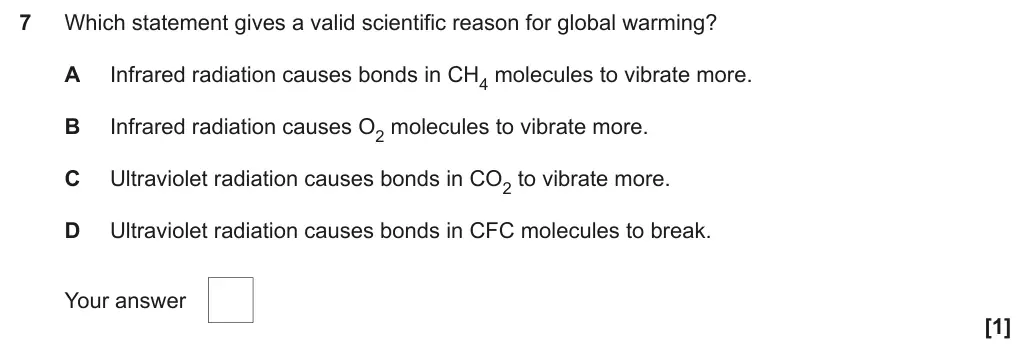
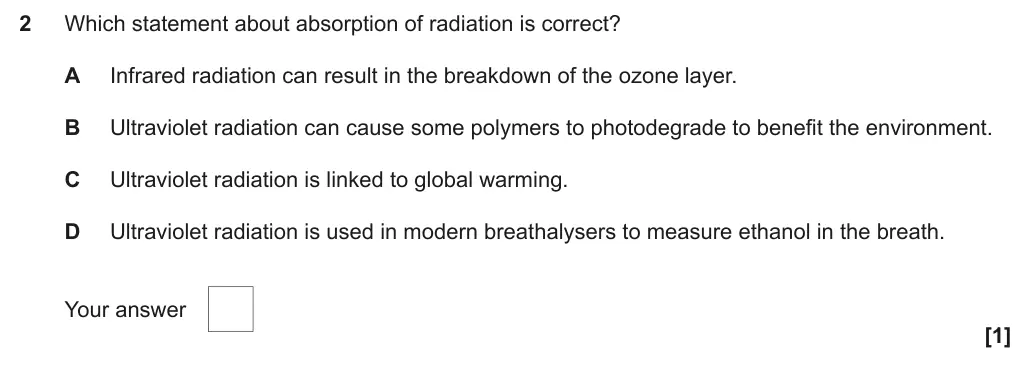
A
Most candidates gave the incorrect response D as their answer. Ultraviolet radiation does cause bonds in CFC molecules to break, and candidates may have been influenced by Question 8. However it is not a valid scientific reason for global warming. It suggests candidates may be confused about global warming verses the depletion of the ozone layer. This question was looking for candidates to link global warming to infrared active molecules i.e. C-H bond in methane. Just under a fifth of candidates gave the correct answer A.
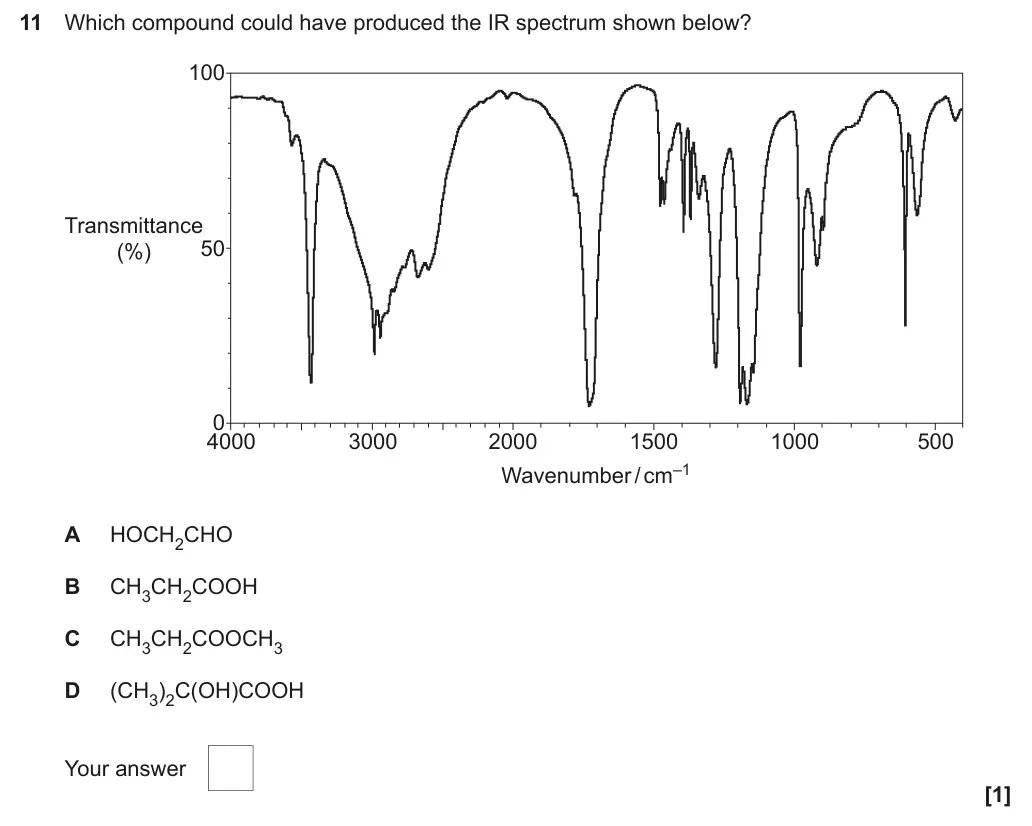
D
Many missed the separate O–H in alcohol and O–H in carboxylic acid peaks as it is unusual to see clearly defined peaks for both in an IR spectrum. Those who got D tended to annotate the spectrum, noting the sharp peak as O–H bond, as well as drawing out structures for each option. A was the most common incorrect response. It is good to remind candidates to look at all possible options before making a final decision.
Skills: M3.1 Translate information between graphical, numerical and algebraic forms
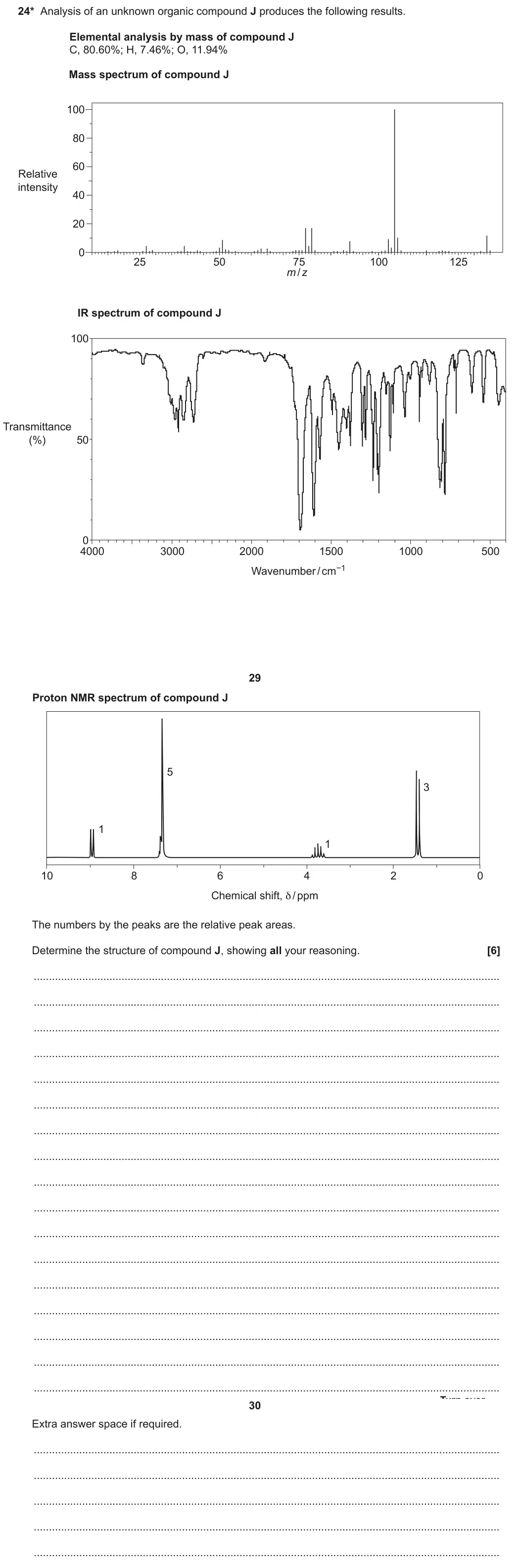
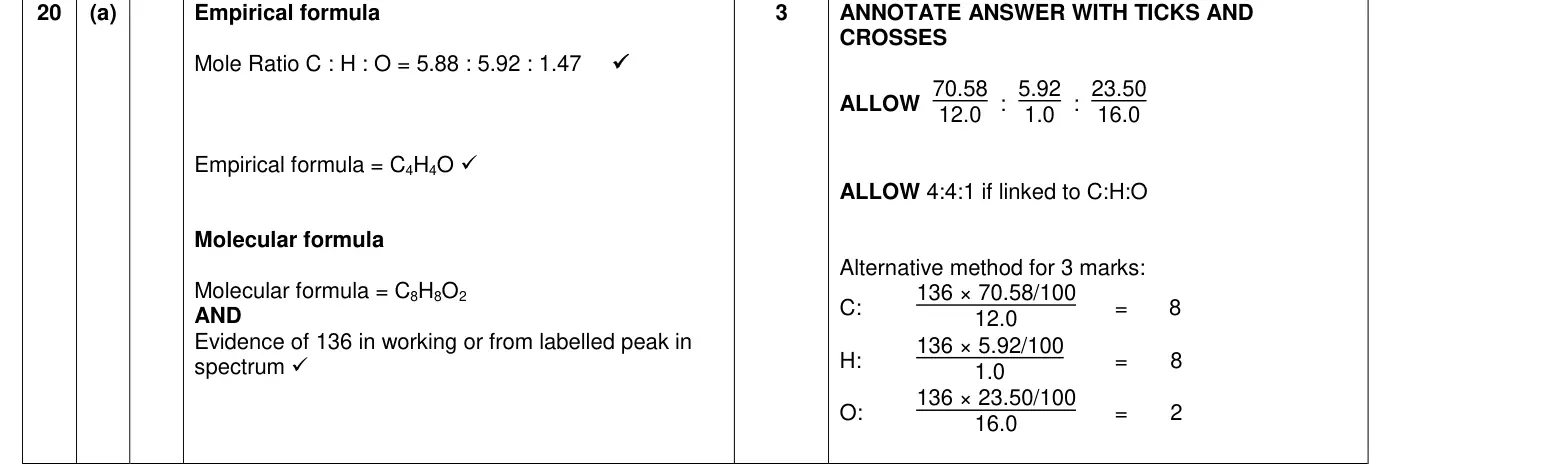
This question was well-attempted by most candidates, with the majority of candidates gaining full marks or gaining 4 marks for a top Level 2 response. Many candidates showed excellent recall of how to determine the correct empirical formula from the percentage composition data. Most then went on to use the m/z peak on the mass spectrum to confirm that the Mr was 134, and therefore the molecular formula was identical to the empirical formula. A few also made use of the mass spectrum to identify possible fragment ions including a correct positive charge. Most candidates used the IR spectrum to identify a C=O bond and many also mentioned the absence of O-H or spotted C=C for arenes. Lower attaining candidates sometimes incorrectly mentioned the presence of a carboxylic acid O-H despite the molecular formula only having 1 oxygen atom. Many candidates annotated the NMR spectrum and/or presented their analysis clearly in a table format and were able to identify aldehyde and arene hydrogen environments. The best candidates had fragments built up alongside their NMR analysis clearly building them using chemical shift, integration ratios and splitting patterns. Those that struggled to interpret the splitting patterns correctly suggested incorrect structures but often with correct features so were still able to score Level 2, 4 marks. Some initially identified the multiplet peak at 3.8ppm as being HC-O environment but many realised this did not fit the IR data. However, some changed other evidence to fit this, e.g. the peak at 9.0 ppm being an O-H rather than CHO and the IR having C=C only without C=O as well. A large proportion of candidates were able to correctly determine the structure of compound J, recognising that the peak at 3.8 ppm was shifted up-field as adjacent to both the benzene ring and the aldehyde group. The data sheet refers to this: ‘CH bonded to ‘shifting groups’ on either side, e.g. O– CH2–C=O, may be shifted more than indicated above’. Several candidates who did not get the correct structure gave structures which were chemically unfeasible, e.g. with pentavalent carbons. Many candidates had several structures as part of working but did not always ensure their final structure was clearly highlighted. A very small number of candidates received no credit for this question, as the majority were able to show analysis of 2 aspects, e.g. the calculation of empirical formula and labelling of IR or NMR spectra. There is clear and detailed analysis throughout this response to determine the correct final structure for J. The empirical formula calculation shows how the empirical formula was determined. On the mass spectrum the annotation links to the Mr of 134 and at the end of the response they have identified the fragment responsible for the parent ion. The C=O IR peak is labelled and described in the response. The NMR analysis is clear, with each peak being numbered and linked to a table which shows how the candidate has identified the hydrogens responsible for each peak as well as linking to neighbouring hydrogens from splitting patterns. The final compound is labelled as such to distinguish it clearly from other structures given, which were part of their problem solving to find a structure that fits all of the analysis they had completed.
Skills: M0.2 Use ratios, fractions and percentages; M3.1 Translate information between graphical, numerical and algebraic forms
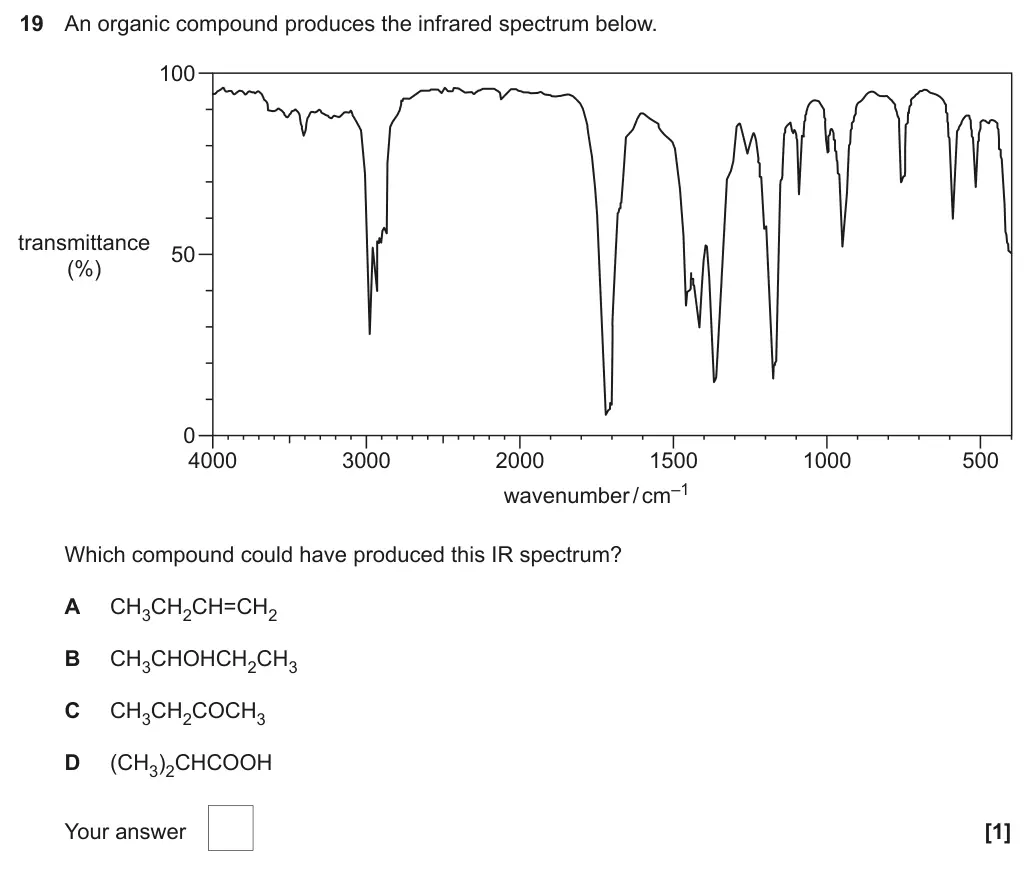
C
Less than half the candidates interpreted which compound could have produced the IR spectrum. Many wrote the functional groups present alongside each option and all four options were seen in the responses. It was expected that the presence of a C=O absorption at 1700 cm–1 would have led to A and B to be eliminated. Some thought that the peak at 3000 cm–1 was for the carboxylic acid O–H which diverted some away from the correct option, C.
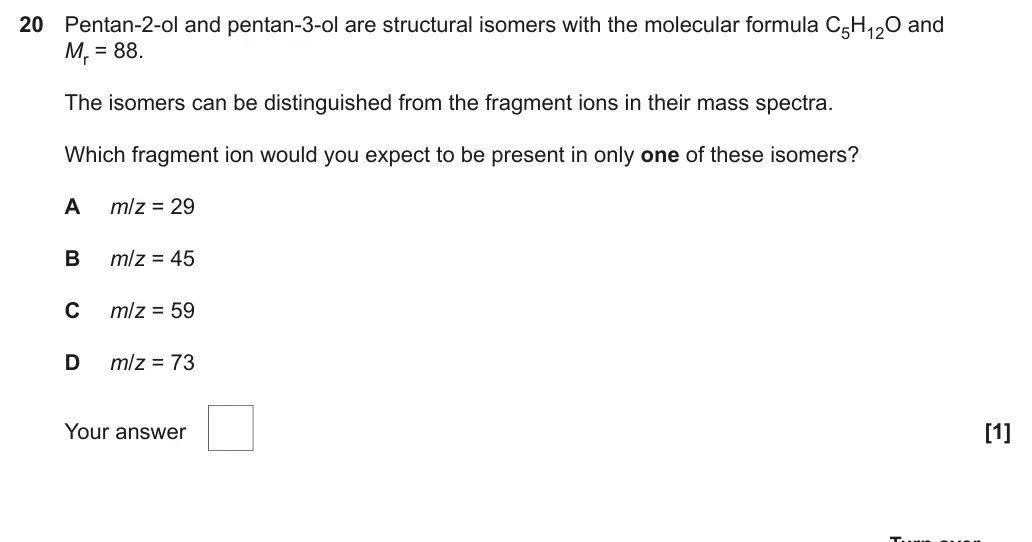
B
Candidates found this question a little easier and, as with previous organic questions, the best route to success was to draw out the structures of the organic isomers. For mass spectrum fragmentation, this ensures that the molecules can visually be split up into possible fragments. So well over half the candidates correctly identified the possible fragments and the correct option, B. Section B overview Section B includes short answer question styles (structured questions, problem solving, calculations, practical) and extended response questions. This section of the paper is worth 50 marks.
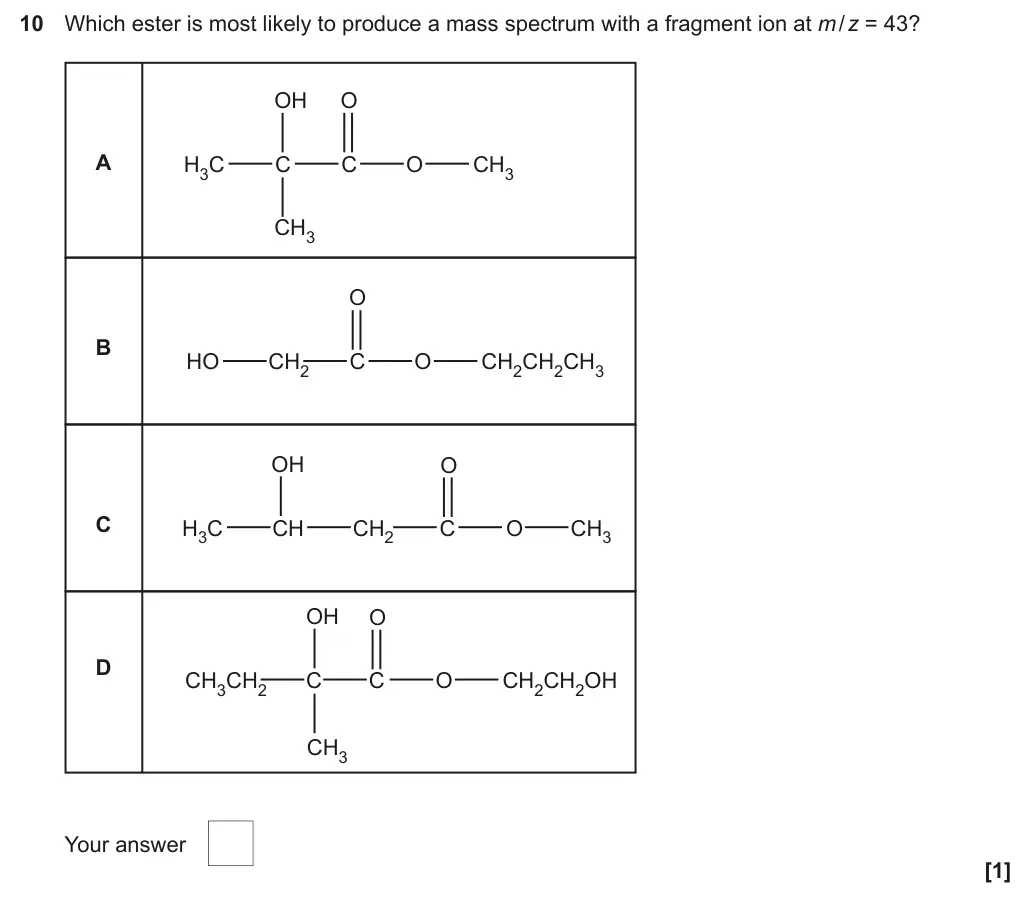
B
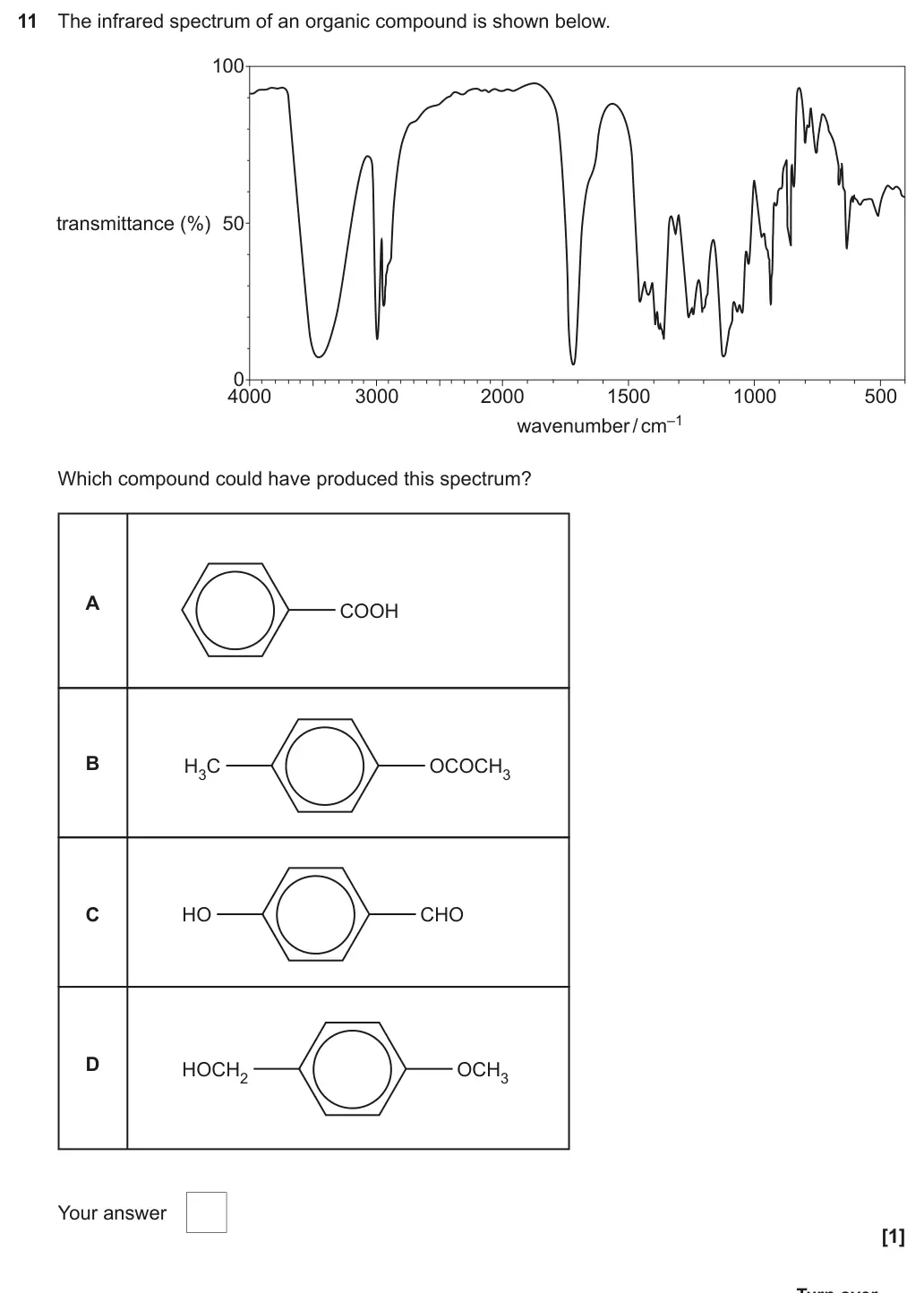
C
Many gained credit here but as A was the most common incorrect response it demonstrates the need to make sure candidates can recognise the difference between an alcoholic O-H and carboxylic acid O-H in IR.
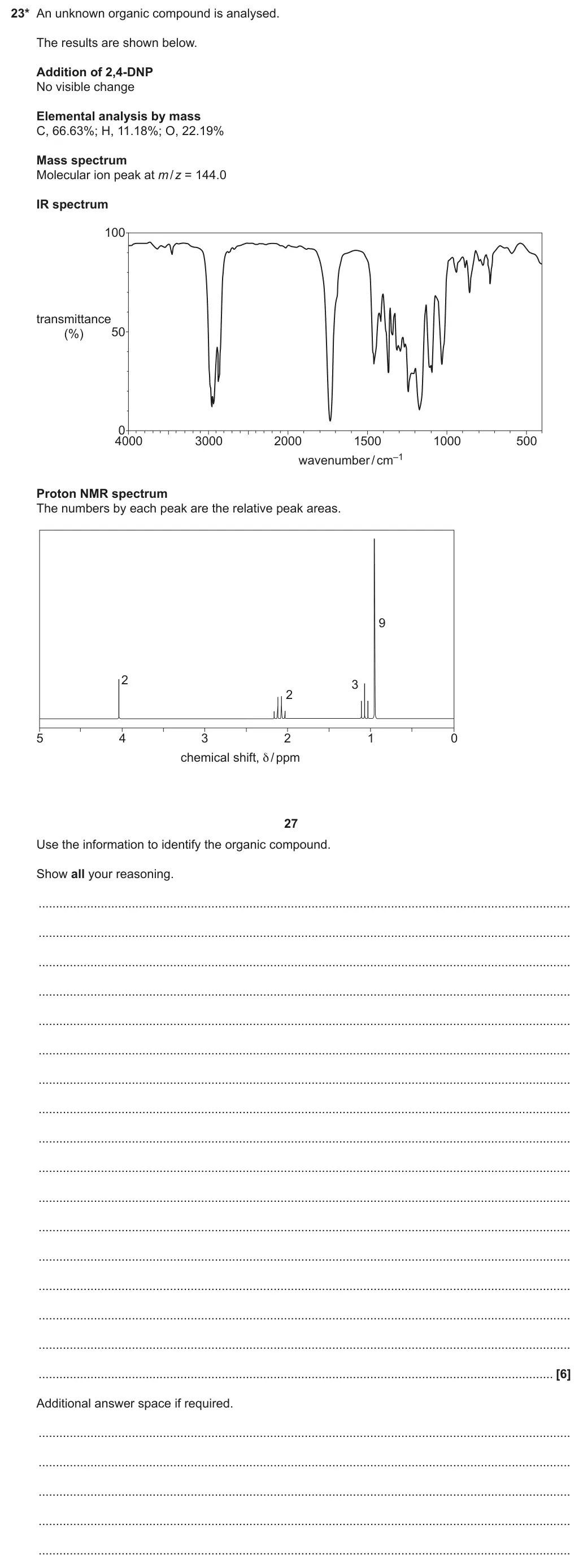
Most candidates were able to deduce the empirical and/or molecular formula of the organic compound. Analysis of the IR spectrum was also well attempted, but some candidates assumed the unknown was a carboxylic acid, attributing the sharp peak just below 3000 cm–1 to an OH group. Others misidentified the C=O peak as a C=C group suggesting alkene or arene structure. They were often led to this conclusion as they believed no precipitate with 2,4-DNP suggested no C=O rather than no aldehyde or ketone. Good analysis of the NMR data was crucial for deducing the correct ester. Some candidates opted to annotate the proton NMR spectrum, some produced tables and others gave written details for each peak. It was vital that they were able to interpret all information for each peak i.e. number of proton environments, the type of environment from chemical shift, the number of protons in each environment from relative peak areas and use of splitting patterns to find information about adjacent protons. Many tried to make the data fit their proposed structure rather than the other way round. Some suggested structures that were only partially consistent with the data such as CH3CH2CH2COOC(CH3)3 and were awarded Level 2. Others did not take full note of all the information provided, for example omitting the 2,4-DNP observations, giving the ketone (CH3)3COCH2COCH2CH3 or not checking it matched the molecular formula CH3CH2COOC(CH3)3 so only achieved Level 1. Candidates need to be encouraged to draw a structure as without they can only achieve a maximum of 2 marks despite some excellent analysis of the data. Conversely, it is not sufficient to just give a structure, candidates must give analysis of the data provided. This is a good Level 3 6 mark response. As well as this clearly laid out analysis they also had details written on the question, e.g. no aldehyde or ketone due to no reaction with 2,4-DNP. This response has been selected due to the detailed analysis of NMR data that has been summarised in a table.
Skills: M0.2 Use ratios, fractions and percentages; M3.1 Translate information between graphical, numerical and algebraic forms; PAG7 Qualitative analysis of organic functional groups
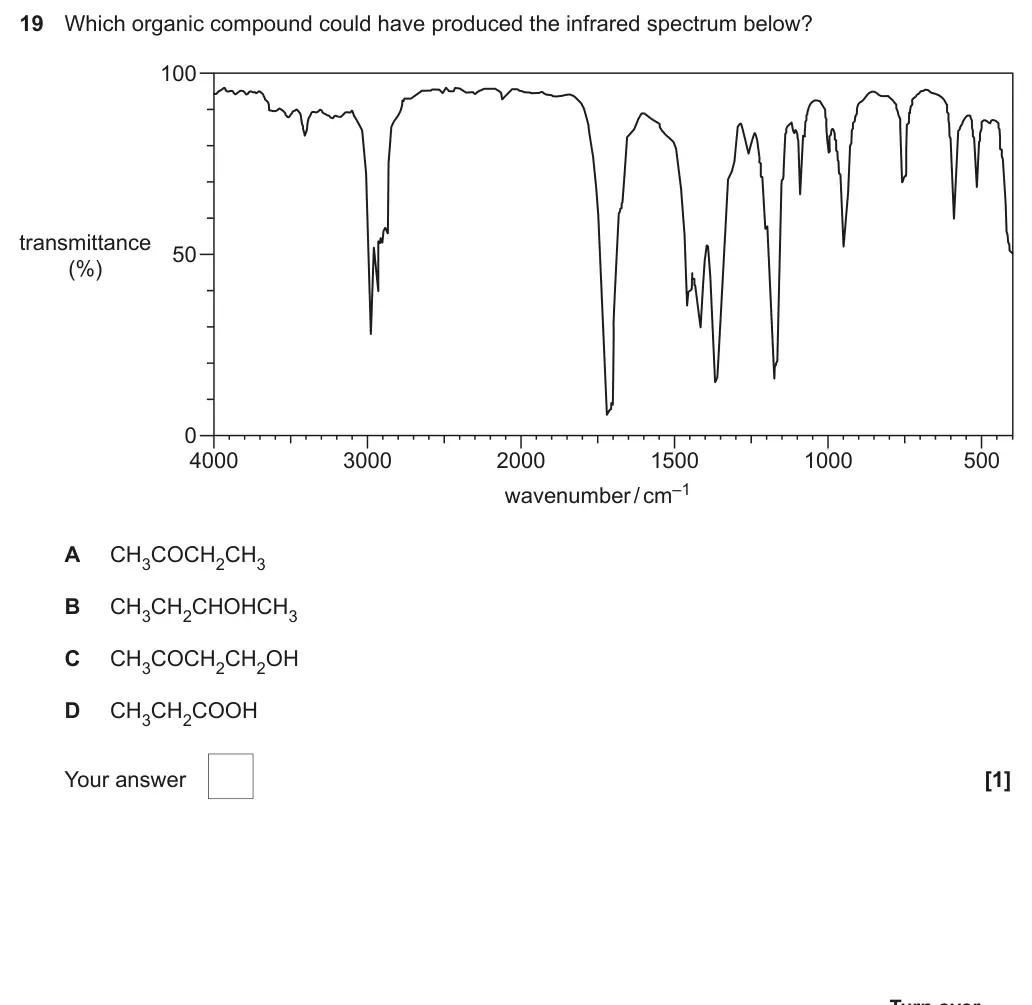
A
Candidates found this question hard with many selecting C or D instead of the correct option, B. Candidates appeared to have assigned the C–H absorption at 3000 cm–1 to an O–H group (from an alcohol or carboxylic acid). Candidates should appreciate that this C–H absorption will be present in any organic compound possessing a C–H group (that is, nearly all organic compounds).
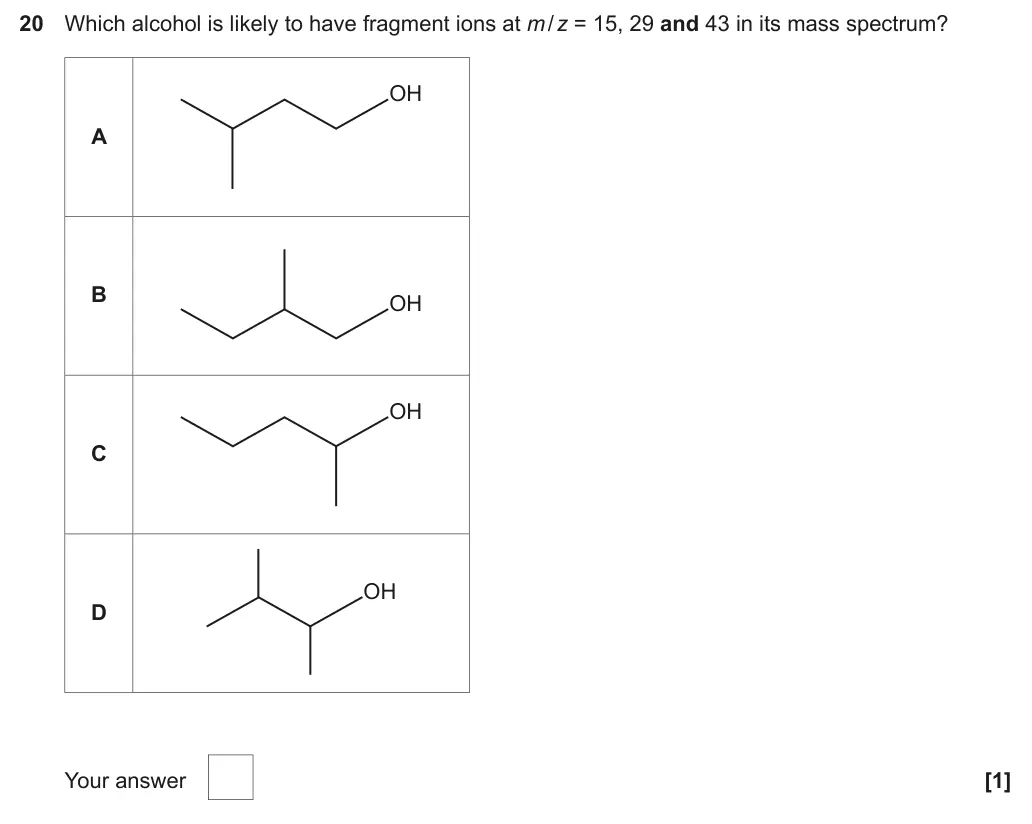
C
Compared to Question 19, candidates had more success with this question. Most drew out all the bonds in each structure, a good approach that should allow the candidate to identify the compound that would produce the three peaks. Section B overview Section B includes short answer question styles (structured questions, problem solving, calculations, practical) and extended response questions. This section of the paper is worth 50 marks.
B
Candidates found this multiple choice question challenging. While some identified B as the correct answer, many candidates selected C.
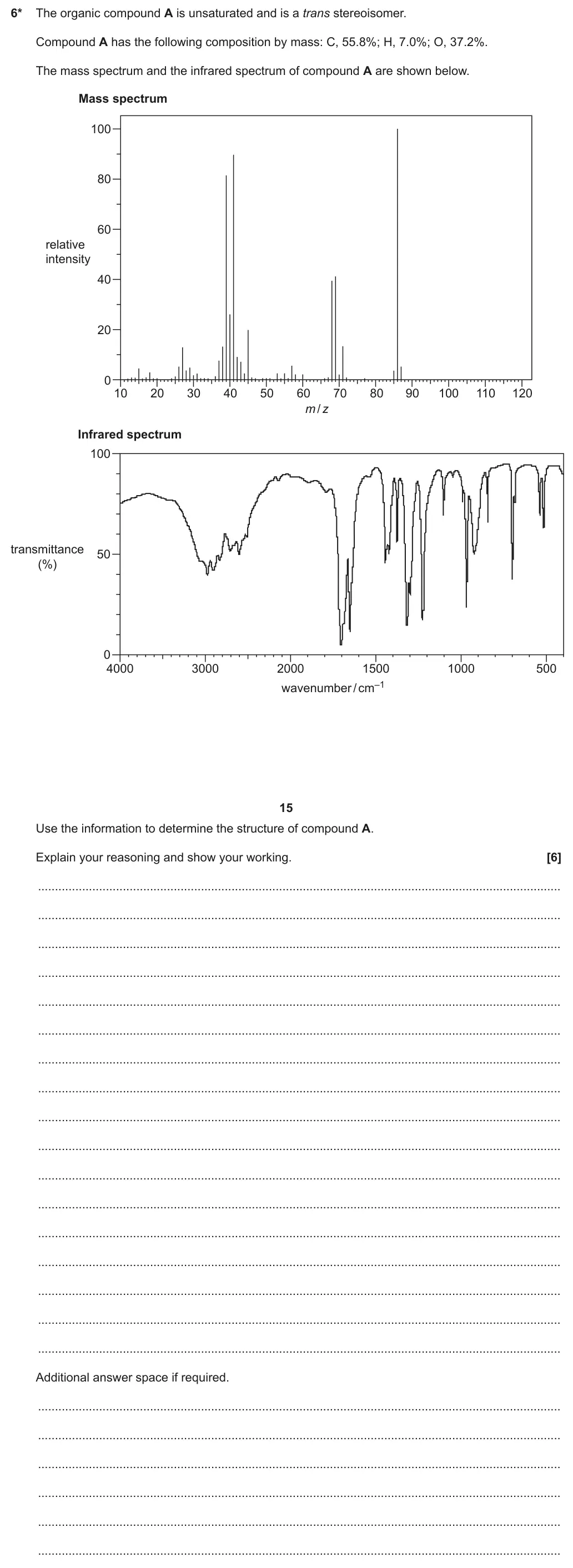
About a third of candidates were given Level 3 for this question. The key to answering this style of question well is to make sure all the information provided is used and to avoid contradictory statements, e.g. “structure contains carboxylic acid from IR” but then not present in final structure drawn, or a structure that doesn’t match the molecular formula given. A significant number of candidates did not include C=C despite being told in the question that it was “unsaturated and is a trans stereoisomer”, plus the C=C bond is shown in the IR and molecular formula needed unsaturation. The M+1 peak did confuse some candidates who then tried to add an extra H to final structure. It is very important that any structure given is feasible in terms of bonding; many candidates gave structures with C with 5 bonds (with both C=C and C=O attached), limiting them to achieving only L1. Some candidates gave a cis structure rather than trans. Other candidates ignored the O-H peak (from the carboxylic acid) in the IR spectrum, attributing this to a C-H bond as it was not as smooth or as prominent as they may have seen in other spectra. Some listed the bonds observed in the IR without linking to their position – this can easily be done by annotating the spectra. Many candidates had messy answers with lots of rough working which was then not crossed out – this made their answer very confusing. Note that no marks were given for just the empirical formula calculation and some attempted to produce a structure from the empirical formula without determining the Mr from the M+ peak in mass spectrum. This is an example of a good response which achieved L3 6 marks. Empirical and molecular formula are determined. Spectra have been annotated to aid their interpretation, but they have also included the key IR peaks as well as a MS fragment in their response. The correct structure for A is clearly drawn out. The response is clear and concise, with all information presented being relevant. If any of your students’ results are not as expected, you may wish to consider one of our post-results services. For full information about the options available visit the OCR website. We send a weekly roundup to tell you about important updates. You can also sign up for your subject specific updates. If you haven’t already, sign up here. Attend one of our popular CPD courses to hear directly from a senior assessor or drop in to a Q&A session. Most of our courses are delivered live via an online platform, so you can attend from any location. Please find details for all our courses on the relevant subject page on our website or visit OCR professional development. ExamBuilder is the question builder platform for a range of our GCSE, A Level, Cambridge Nationals and Cambridge Technicals qualifications. Find out more. ExamBuilder is free for all OCR centres with an Interchange account and gives you unlimited users per centre. We need an Interchange username to validate the identity of your centre's first user account for ExamBuilder. If you do not have an Interchange account please contact your centre administrator (usually the Exams Officer) to request a username, or nominate an existing Interchange user in your department. Review students' exam performance with our free online results analysis tool. It is available for all GCSEs, AS and A Levels and Cambridge Nationals. It allows you to: • review and run analysis reports on exam performance • analyse results at question and/or topic level • compare your centre with OCR national averages • identify trends across the centre • facilitate effective planning and delivery of courses • identify areas of the curriculum where students excel or struggle • help pinpoint strengths and weaknesses of students and teaching departments. Find out more. Post-results services Keep up-to-date OCR Professional Development Signed up for ExamBuilder?
Skills: M0.2 Use ratios, fractions and percentages; M3.1 Translate information between graphical, numerical and algebraic forms; M4.2 Visualise and represent 2-D and 3-D forms including 2-D representations of 3-D objects
B
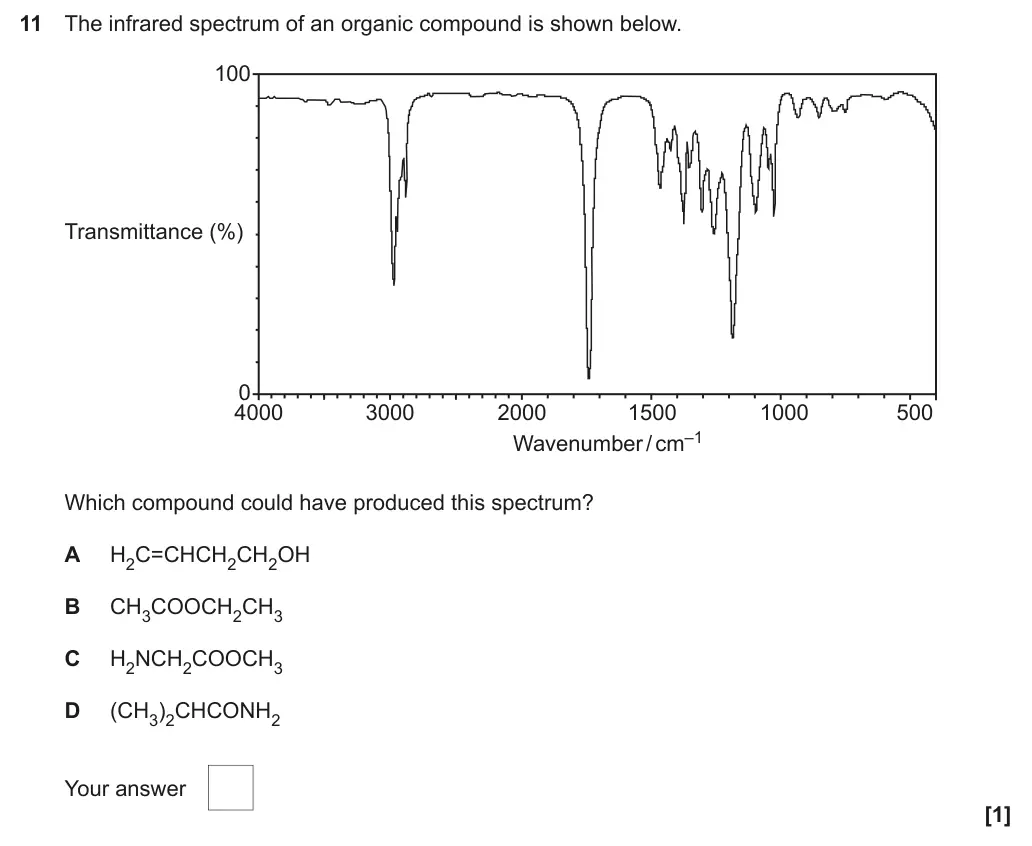
Most candidates correctly identified C as the compound after labelling the peaks in the spectrum.
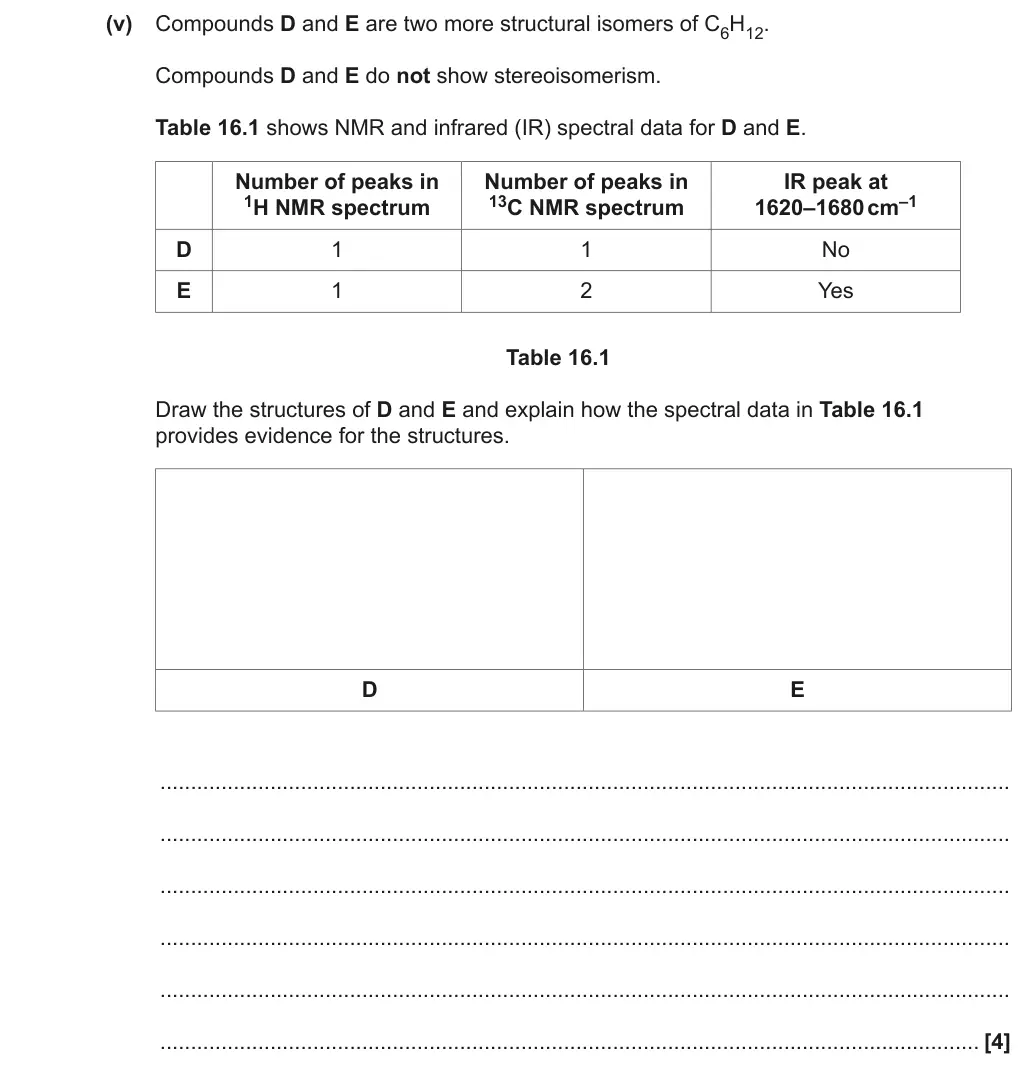
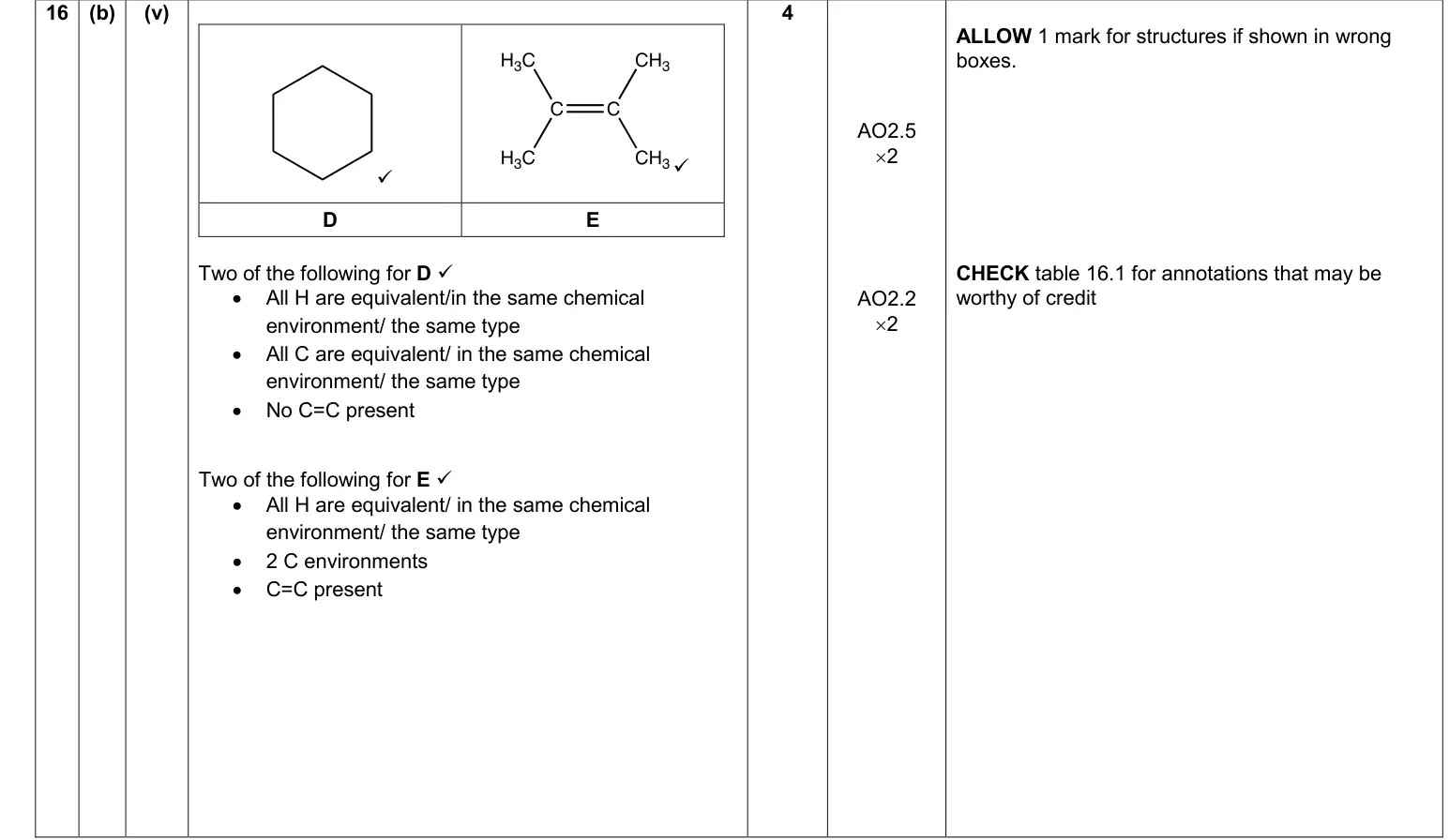
Most candidates were able to correctly draw the structure of D and E. Many candidates did not explain their answers in terms of the number of different hydrogen and carbon environments or the presence/ absence of a carbon-carbon double bond.
Skills: M4.3 Understand the symmetry of 2-D and 3-D shapes
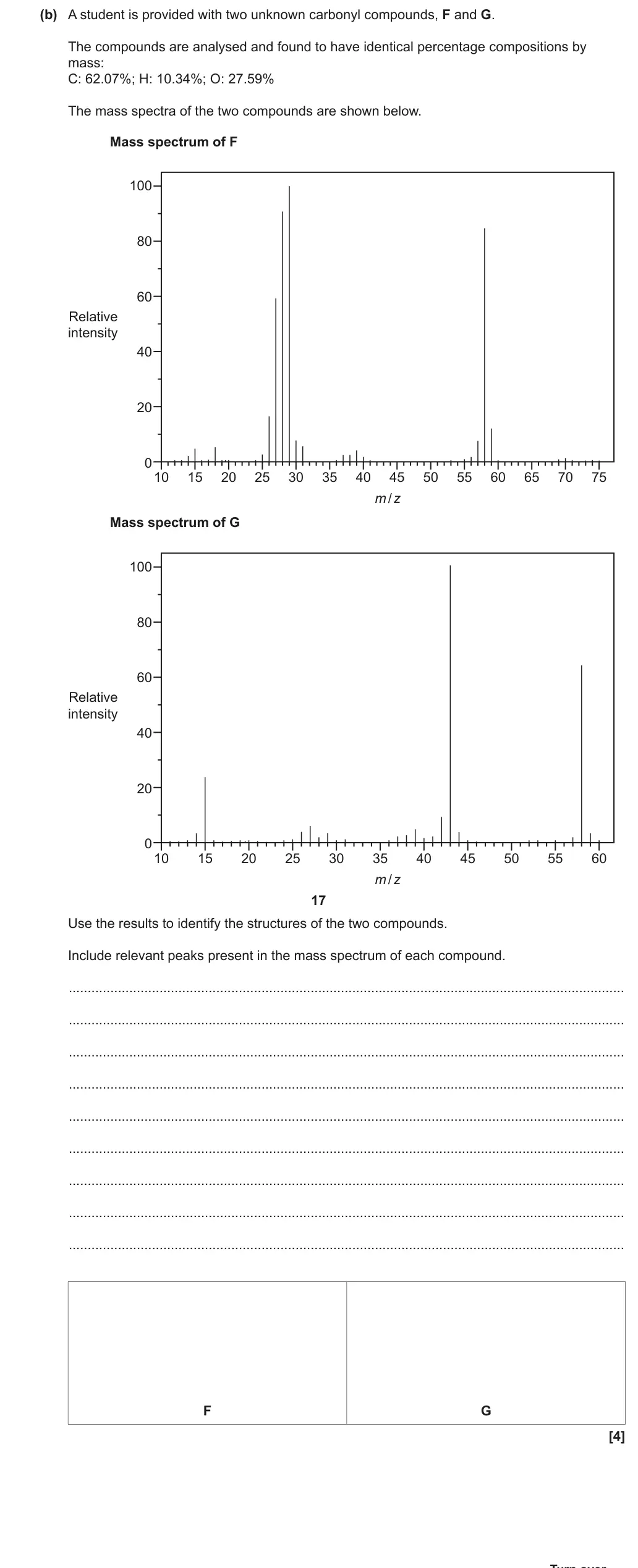
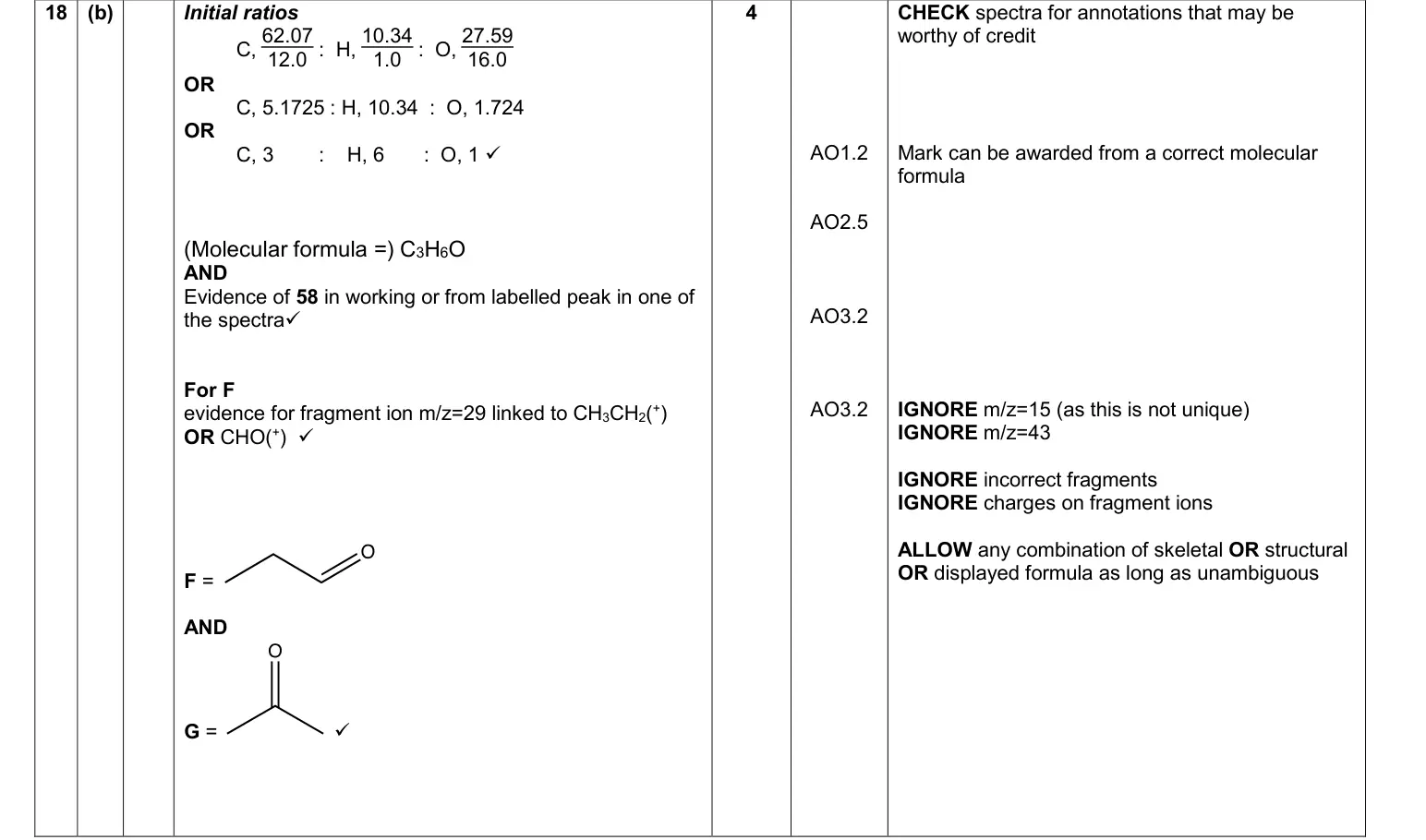
Most candidates were able to calculate the initial ratios and then use this to calculate the molecular formula, linking to the m/z peak at 58. The most common error seen was for the structures of F and G to the in the incorrect boxes, suggesting that candidates have not interpreted the fragment ions to work out F was the aldehyde.
Skills: M0.2 Use ratios, fractions and percentages; M3.1 Translate information between graphical, numerical and algebraic forms
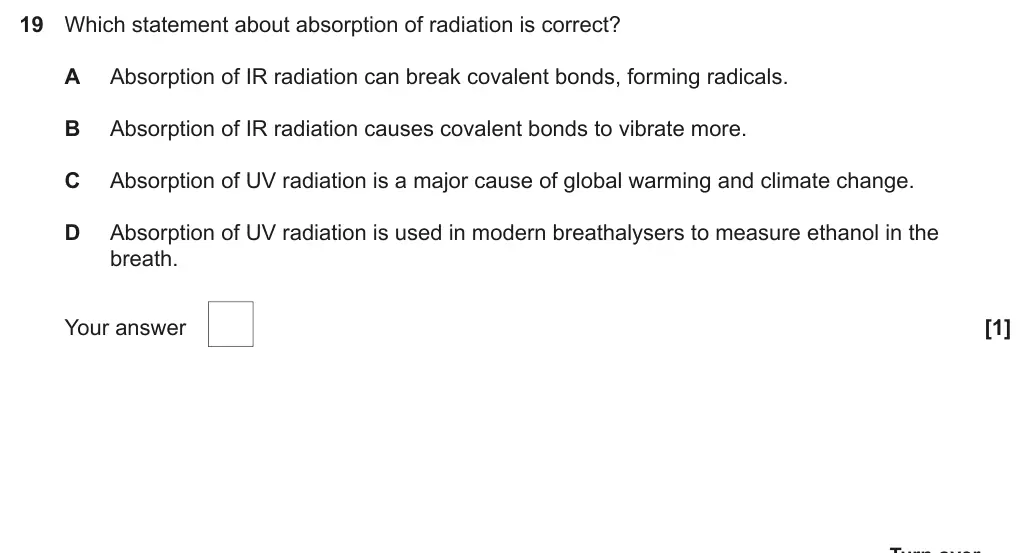
B
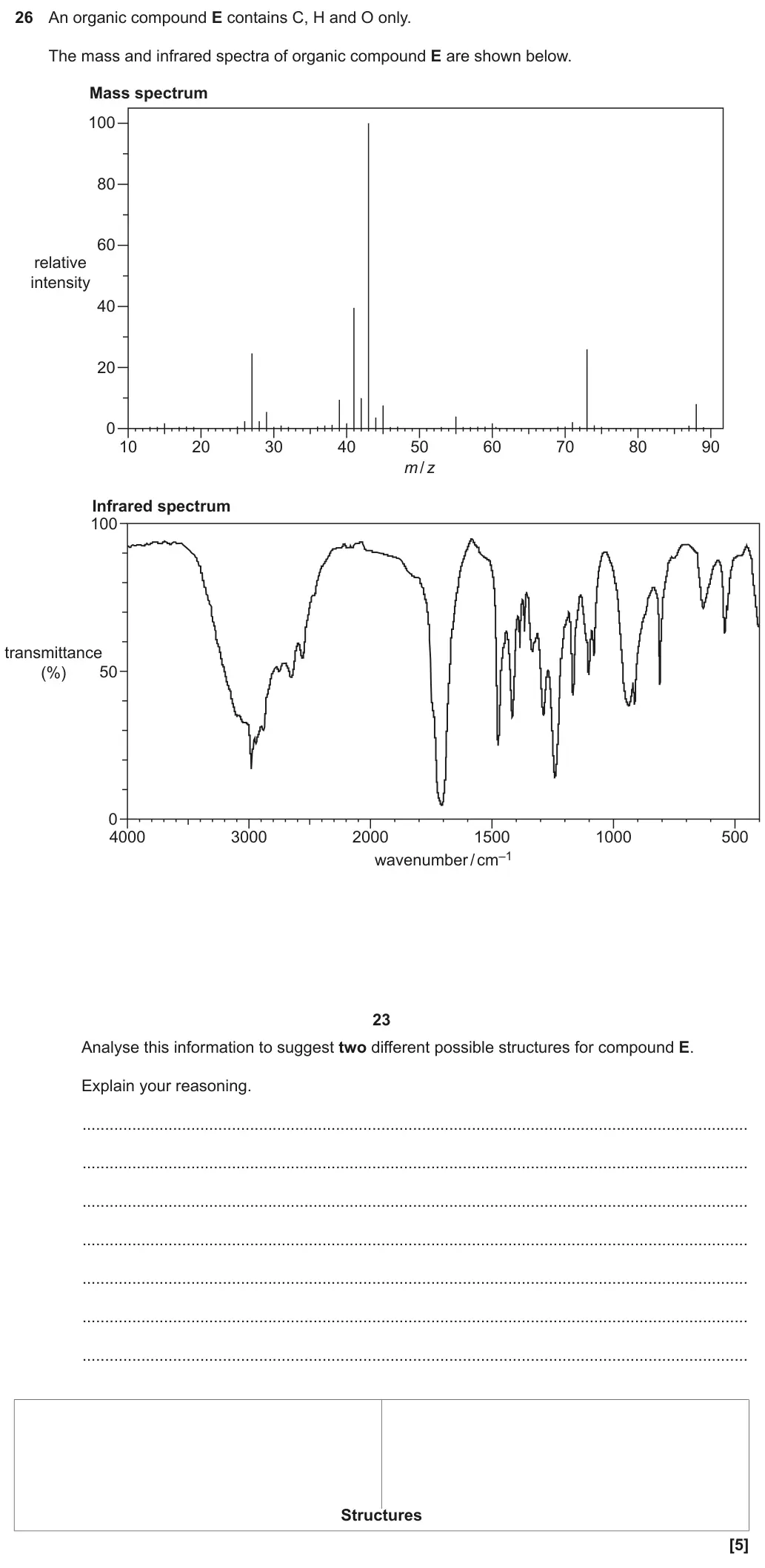
Skills: M3.1 Translate information between graphical, numerical and algebraic forms
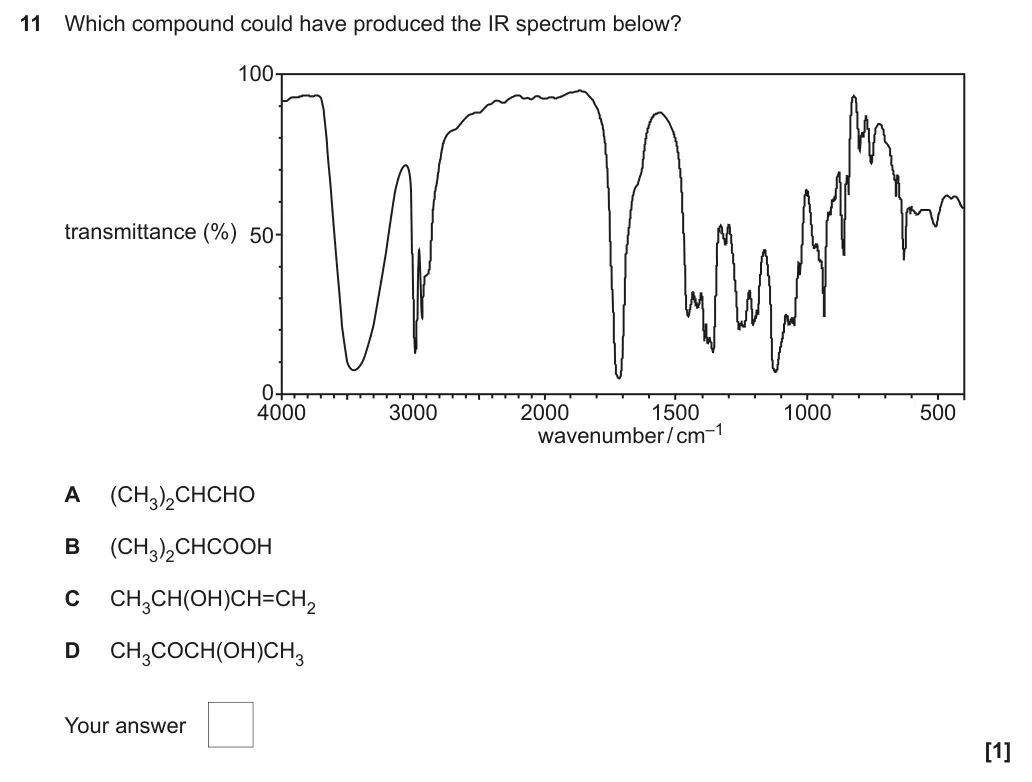
D
B
Skills: M0.2 Use ratios, fractions and percentages; M3.1 Translate information between graphical, numerical and algebraic forms
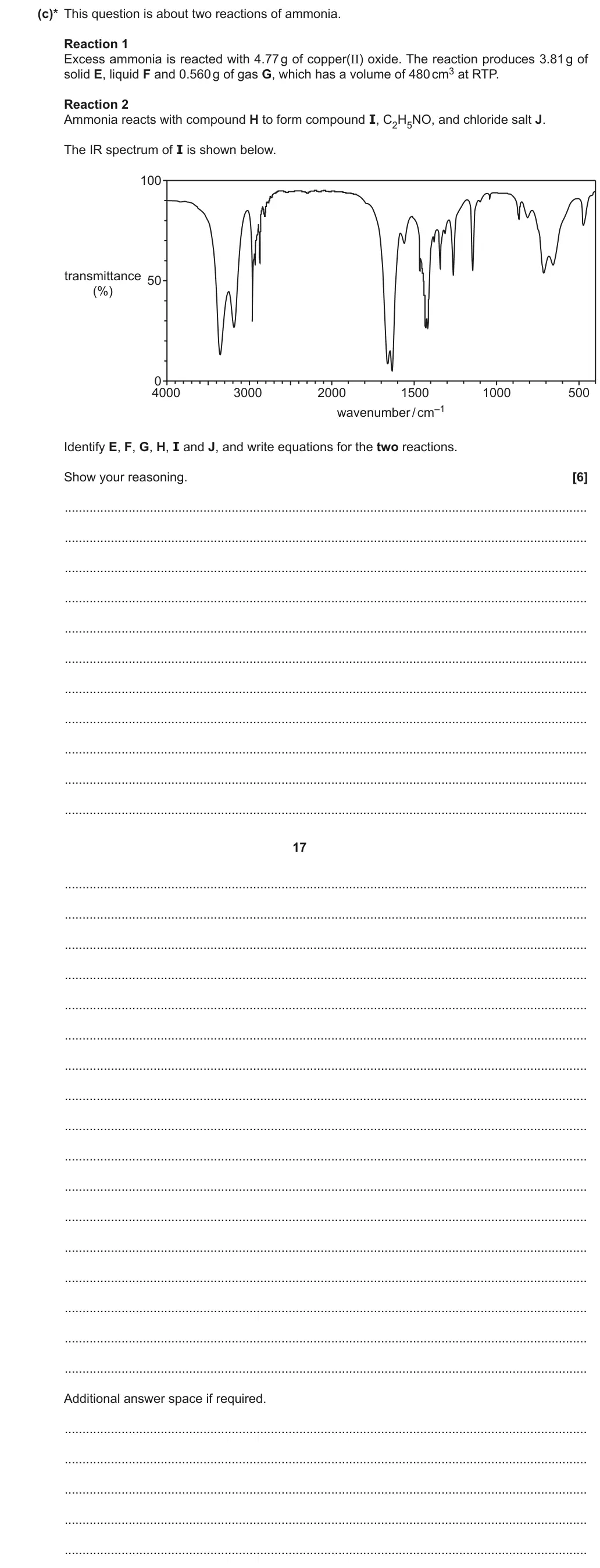
Q2(c), Q2(d): Predicting the effect of modifications to an experiment Q5(c): Interpreting information in a Level of Response question provided in an unfamiliar contexts • Had difficulty when writing equations for unfamiliar reactions, e.g. Q5(c) is a Level of Response question which is commented on after this section Level of response questions Q4(b): Candidates were required to analyse the graphical results of a rates investigation to determine the reaction order, rate and rate constant. Q5(c): Candidates were supplied with information about two reactions, supported by numerical data and an IR spectrum.
Skills: M0.2 Use ratios, fractions and percentages; M3.1 Translate information between graphical, numerical and algebraic forms
C
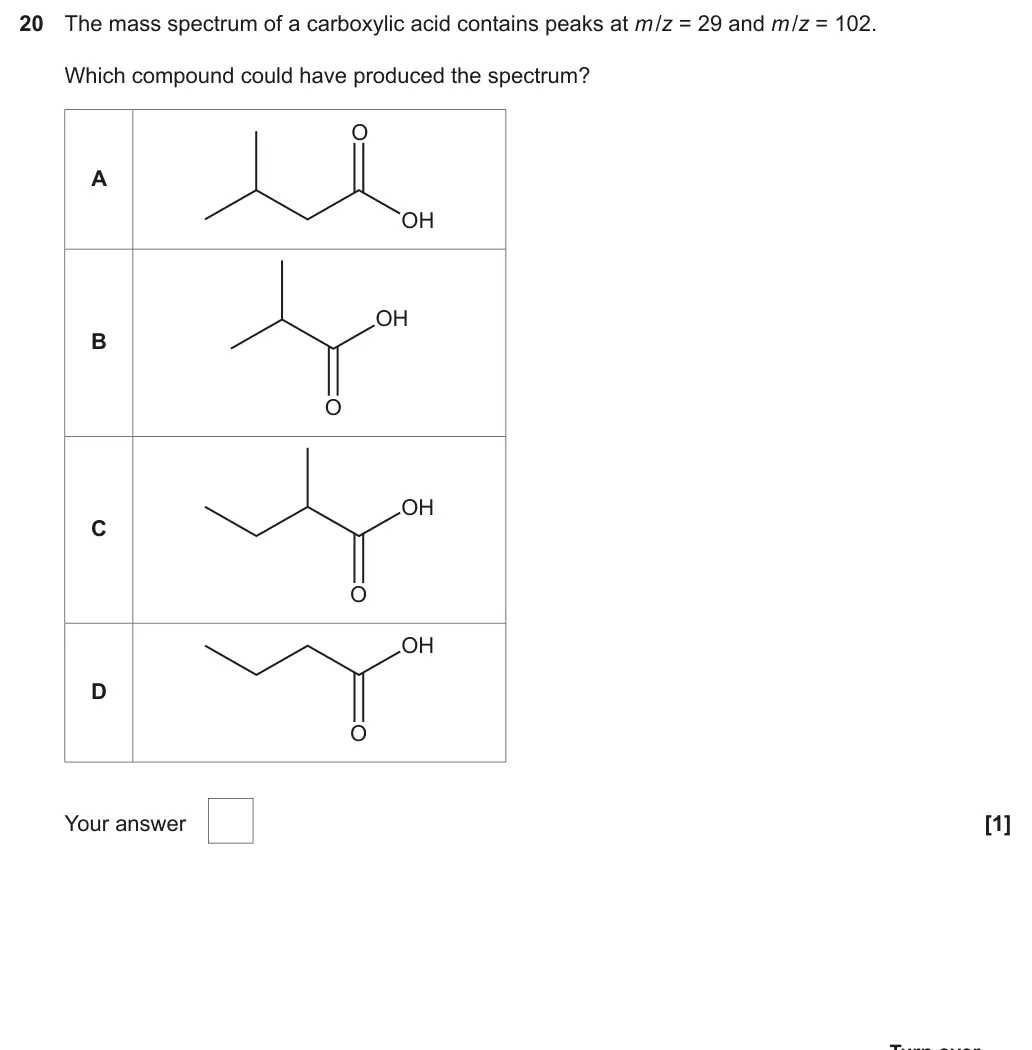
From the working on the scripts, the best approach was to reduce the options down to A and C, the two with a molecular mass of 102. The best candidates then identified option C as the one with a CH3CH2 group for 29. Option A was the key distractor. Section B overview Section B includes short answer question styles (structured questions, problem solving, calculations, practical) and extended response questions. This section of the paper is worth 50 marks. Comments on specific questions
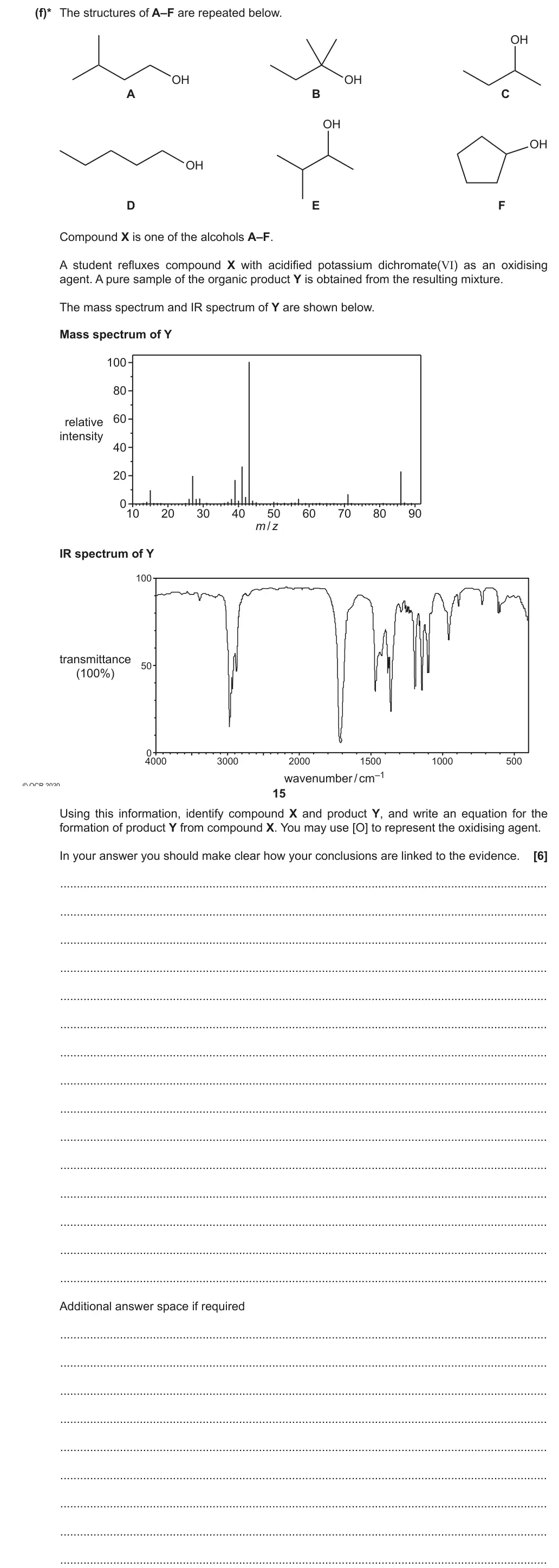
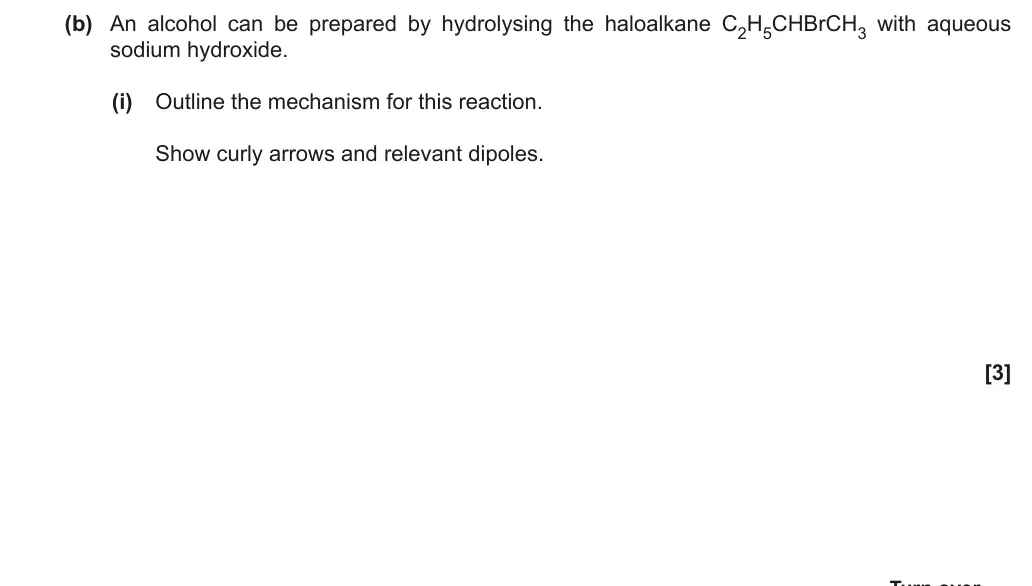
5(a) Generally this was well answered. However, some candidates only gave two responses where three were required, presumably because it was worth two marks. 5(b) A significant number of candidates did not gain the mark here as they incorrectly balanced the number of oxygens, forgetting that the alcohol contains an O atom i.e. 6.5 O2 given rather than 6. 5(c) Nomenclature in organic chemistry takes lots of practice. Approximately half of the candidates did not score this mark. It was more challenging as they needed to work with skeletal structures but evidence of drawing out displayed formula was often seen. 5(d)(i) Most candidates were able to recall the formula to calculate atom economy, however a number made errors in working out Mr values. However, some left this blank or just gave an answer without any working. 5(d)(ii) Mechanisms were often seen showing curly arrows going in the wrong direction and between the wrong bonds and atoms, charges and dipoles were often incorrect, and partial changes used where full charges were required. Writing mechanisms is an important skill in organic chemistry so it is vital that time is spent practising writing them out and fully understanding the significance of the curly arrow. 5(d)(iii) Many candidates gave the correct mechanism here, with common incorrect responses being other types of mechanism, substitution only, or isomerism. 5(e) Very few candidates gained both marks here. It was not enough here to just state faster/slower without specifying which haloalkane they were referring to. It was also important to specify the C-X bond not just vague reference to the chlorine or bromine bond. Many described the difference in bond polarity so had the wrong order. Some were more general and discussed the reactivity of bromine and chlorine themselves. 5(f)* This was a challenging problem-solving question, relying on candidates to make use of all of the information provided to determine the structure. Very few candidates made no attempt at all at this question. The most common error was incorrectly identifying the peak at 3000 cm-1 as O-H from a carboxylic acid, despite it being indicated on the data sheet that this would be a broad peak. It suggested that candidates were not familiar with looking at spectra and understanding what data it gave. Candidates should also be reminded when answering these types of question that they should give the structures, not just molecular formulae, where possible. If any of your students’ results are not as expected, you may wish to consider one of our review of results services. For full information about the options available visit the OCR website. If university places are at stake you may wish to consider priority service 2 reviews of marking which have an earlier deadline to ensure your reviews are processed in time for university applications. Our priority is supporting you and your students this autumn and to support you as you prepare for summer 2021 exams. We’ll update our website information regularly with resources, guidance and key information. • Teachers • Students • Exams officers • Assessment specialists We are sending a weekly roundup to tell you about important updates. You can also sign up for your subject specific updates. If you haven’t already, sign up here. Attend one of our popular CPD courses to hear directly from a senior assessor or drop in to a Q&A session. All our courses for the academic year 2020-2021 are being delivered live via an online platform, so you can attend from any location. Please find details for all our courses on the relevant subject page on our website or visit OCR professional development. ExamBuilder is the question builder platform for a range of our GCSE, A Level, Cambridge Nationals, Cambridge Technicals and Functional Skills qualifications. See the full list of available qualifications in the sign up form. ExamBuilder is free for all OCR centres with an Interchange account and gives you unlimited users per centre. We need an Interchange username to validate the identity of your centre's first user account for ExamBuilder. If you do not have an Interchange account please contact your centre administrator (usually the Exams Officer) to request a username, or nominate an existing Interchange user in your department. Review of results
Skills: M3.1 Translate information between graphical, numerical and algebraic forms
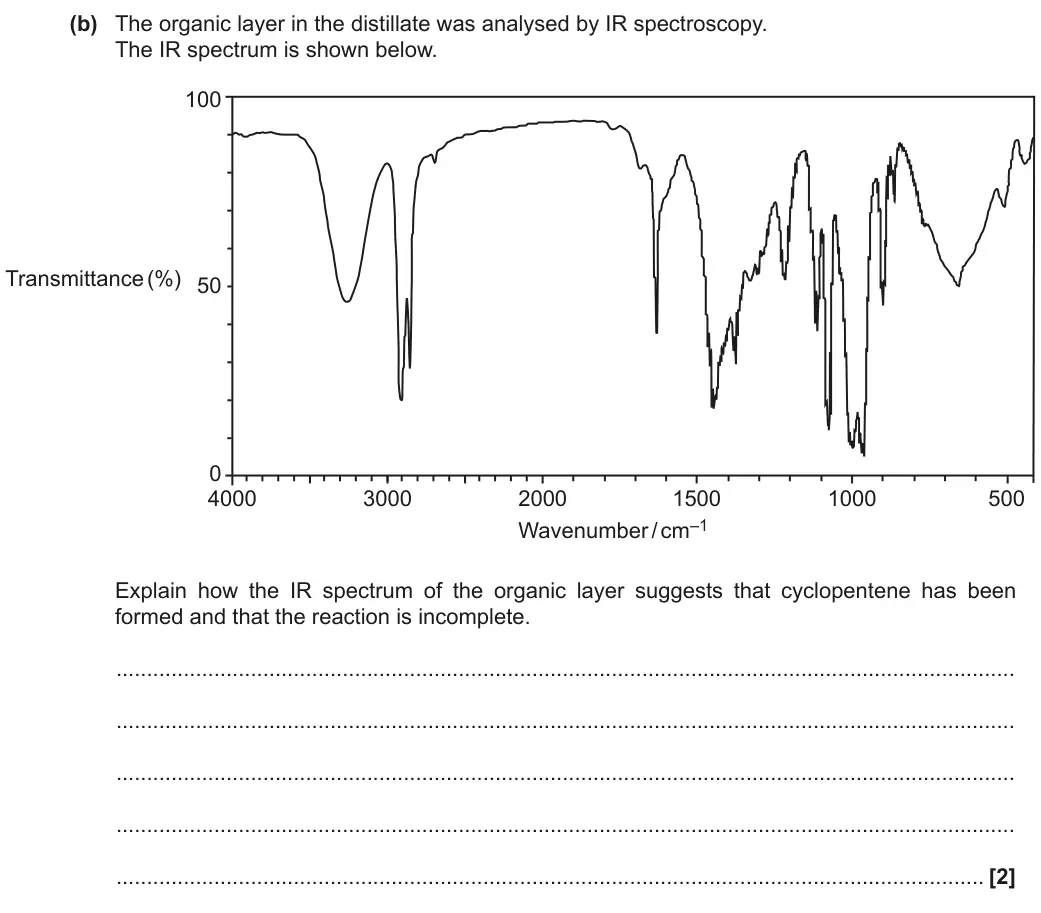
Skills: M3.1 Translate information between graphical, numerical and algebraic forms
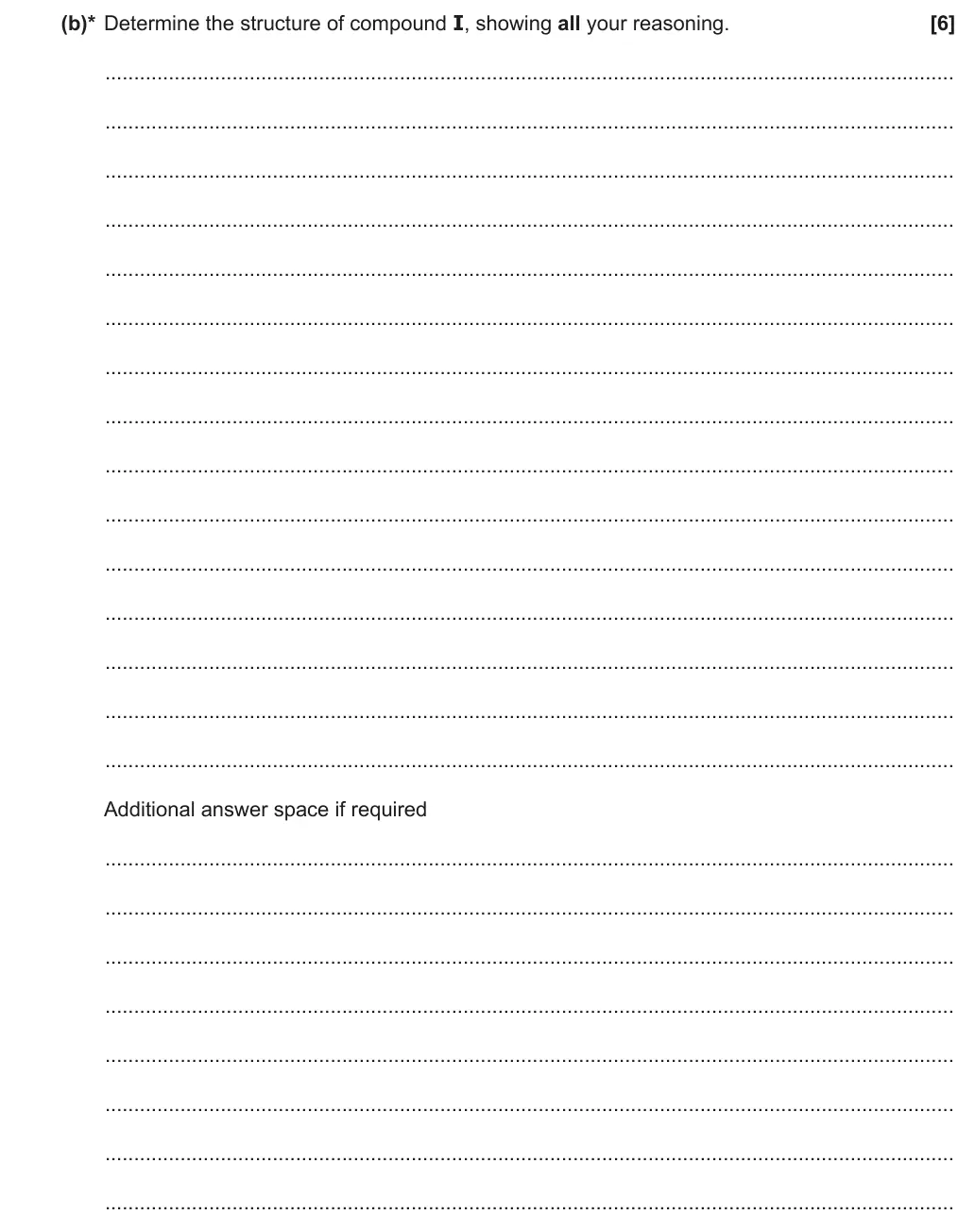
Question 22(b) Candidates achieving Level 2 had most of the key features, e.g.
Skills: M0.2 Use ratios, fractions and percentages; M3.1 Translate information between graphical, numerical and algebraic forms
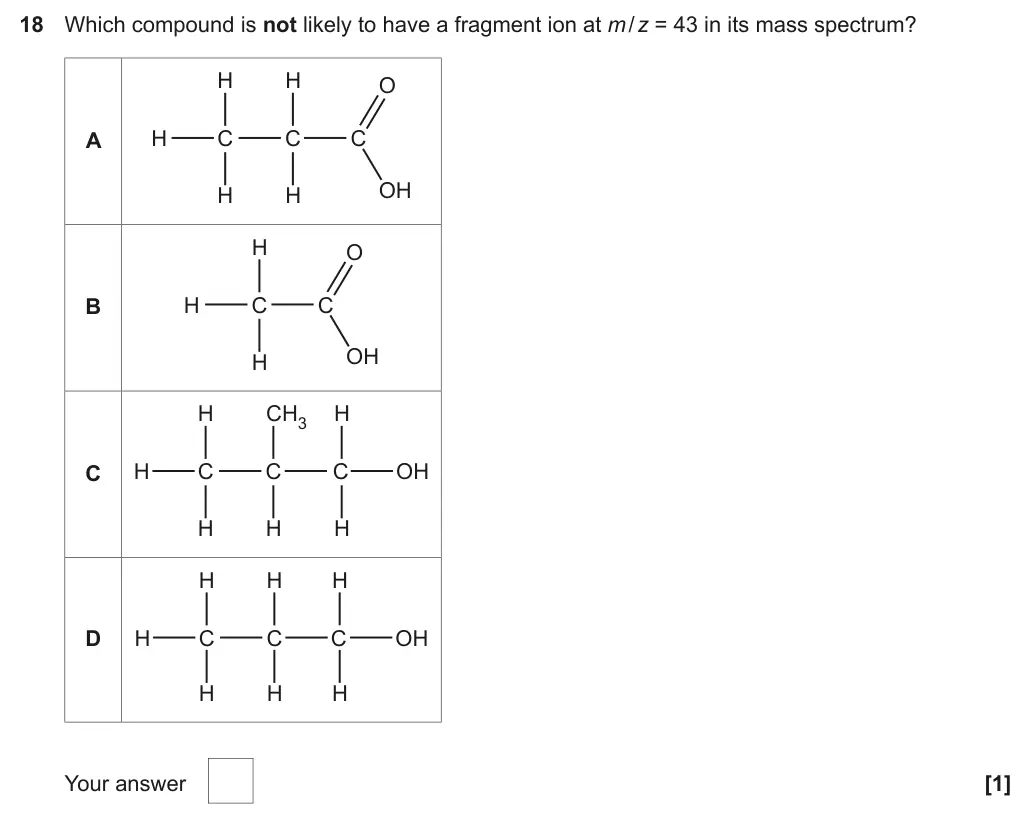
A
Candidates found this part difficult. Less than half the candidates selected the correct option A, with ‘B’ being the main distractor. From annotations on scripts, successful candidates often drew rings around parts of the structures which helps in identifying parts of a structure that might fragment.
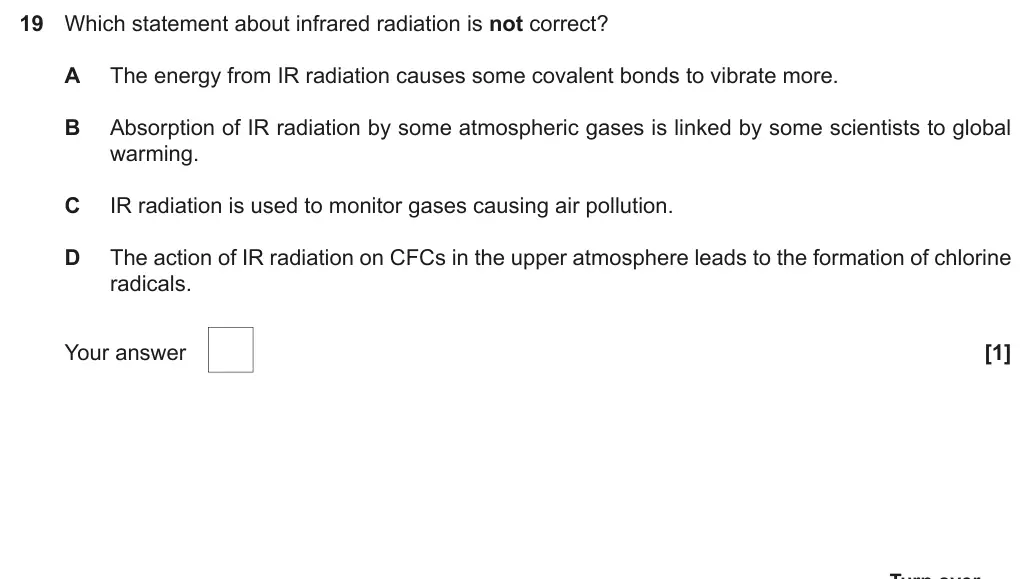
D
Less than half the candidates correctly chose option D. This part discriminated well, with less able candidates selecting the incorrect A and C in similar amounts. A small number of candidates selected B.
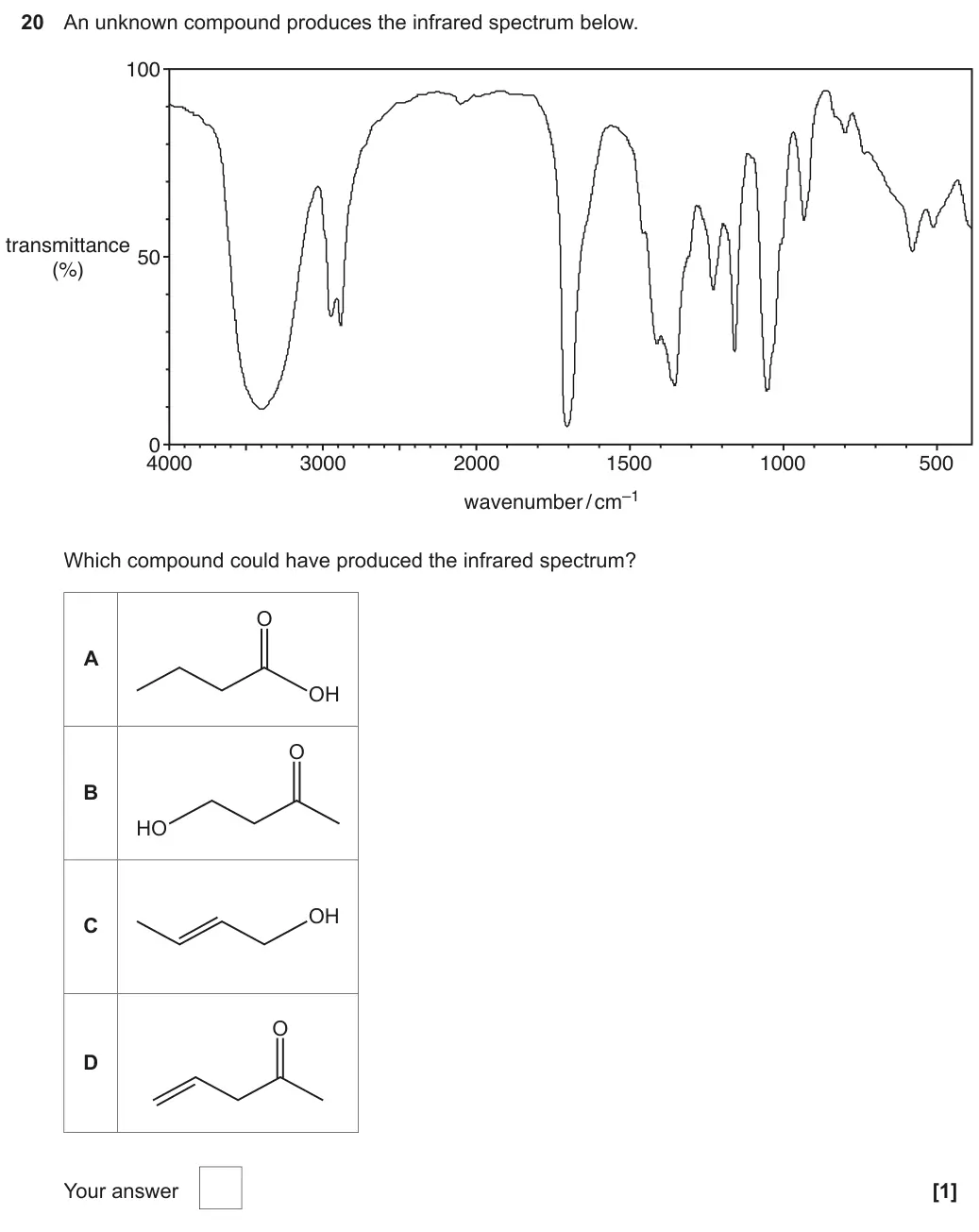
B
Able candidates selected option B, identifying that the O–H peak matches an alcohol rather than carboxylic acid from the wavenumbers. Many candidates opted for option A, the carboxylic acid, which would have a much broader O–H peak with slightly lower wavenumber range. Annotations were common on the spectrum and a sizeable number labelled the C–H peak with O–H, a clear misconception which was also mentioned in the report for H032/01 from June 2018. Section B overview Section B includes short answer question styles (structured questions, problem solving, calculations, practical) and extended response questions. This section of the paper is worth 50 marks.
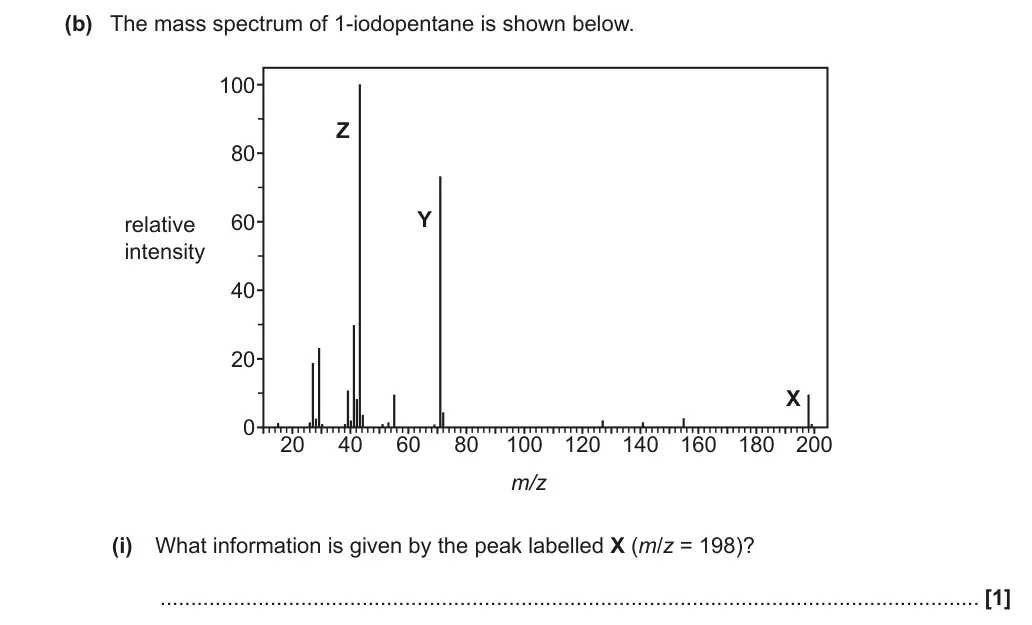
This was generally well answered. The most common incorrect answer was atomic mass.
Skills: M3.1 Translate information between graphical, numerical and algebraic forms

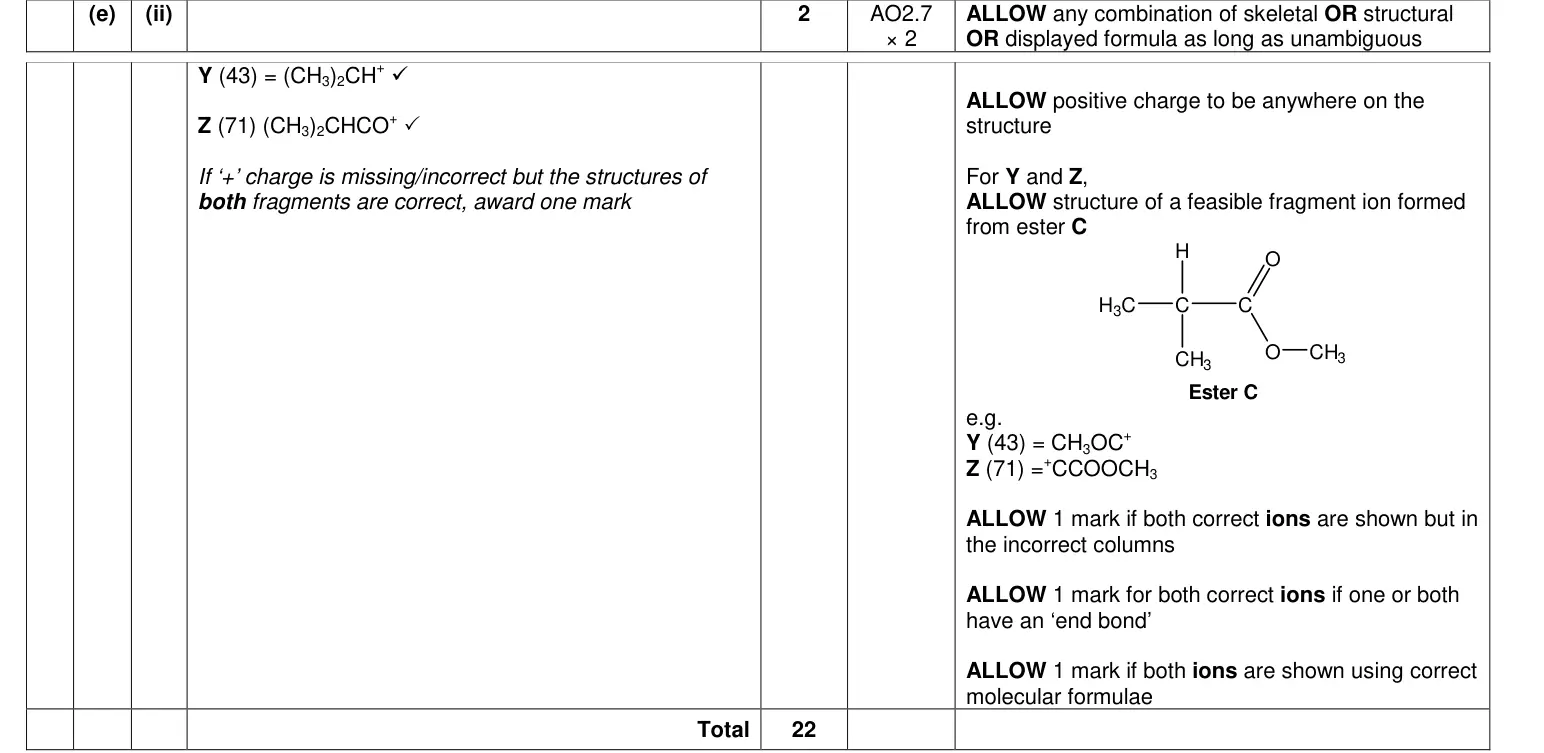
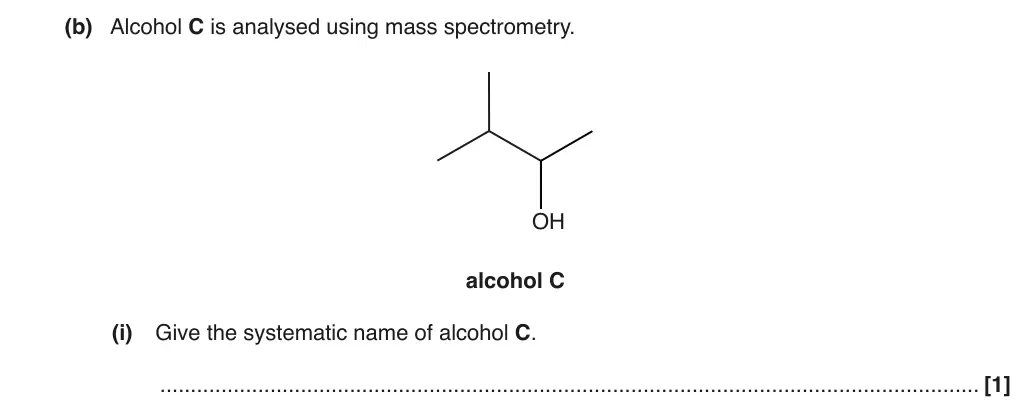
Most students gained one mark on this question as they omitted the + sign or wrote the molecular formula instead of the structural formula.
Skills: M3.1 Translate information between graphical, numerical and algebraic forms
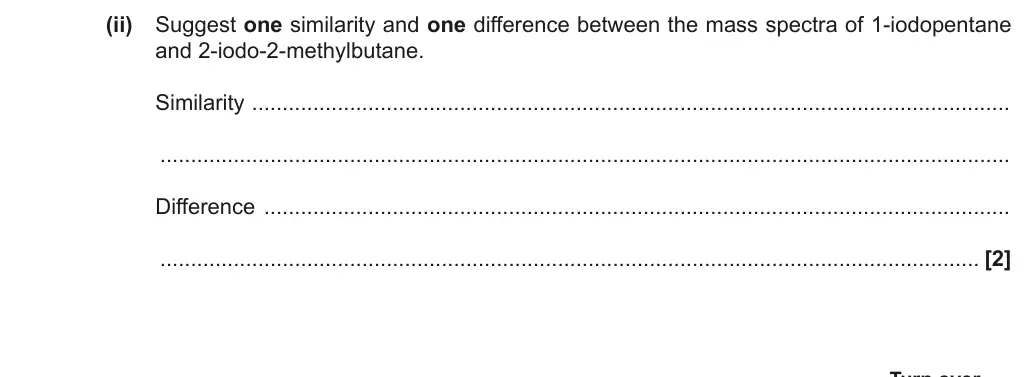
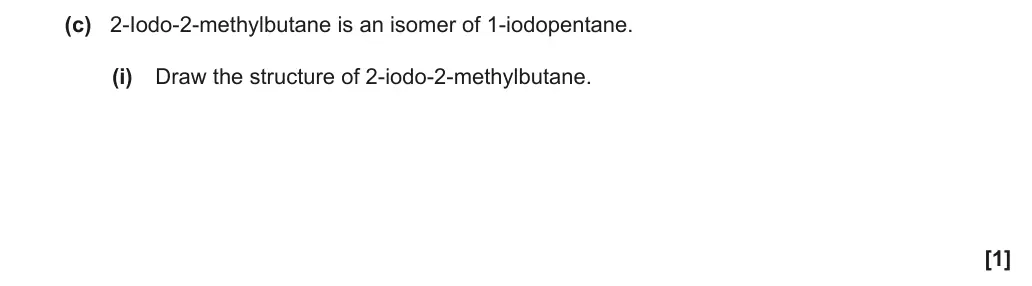
Most candidates answered the similarity part correctly, many wrote vague answers to the difference and were not specific. A common error focused on the peak at m/z = 71, very few recognised that the Z peak at 43 would not be present for 2-iodo-2-methylbutane
Skills: M3.1 Translate information between graphical, numerical and algebraic forms
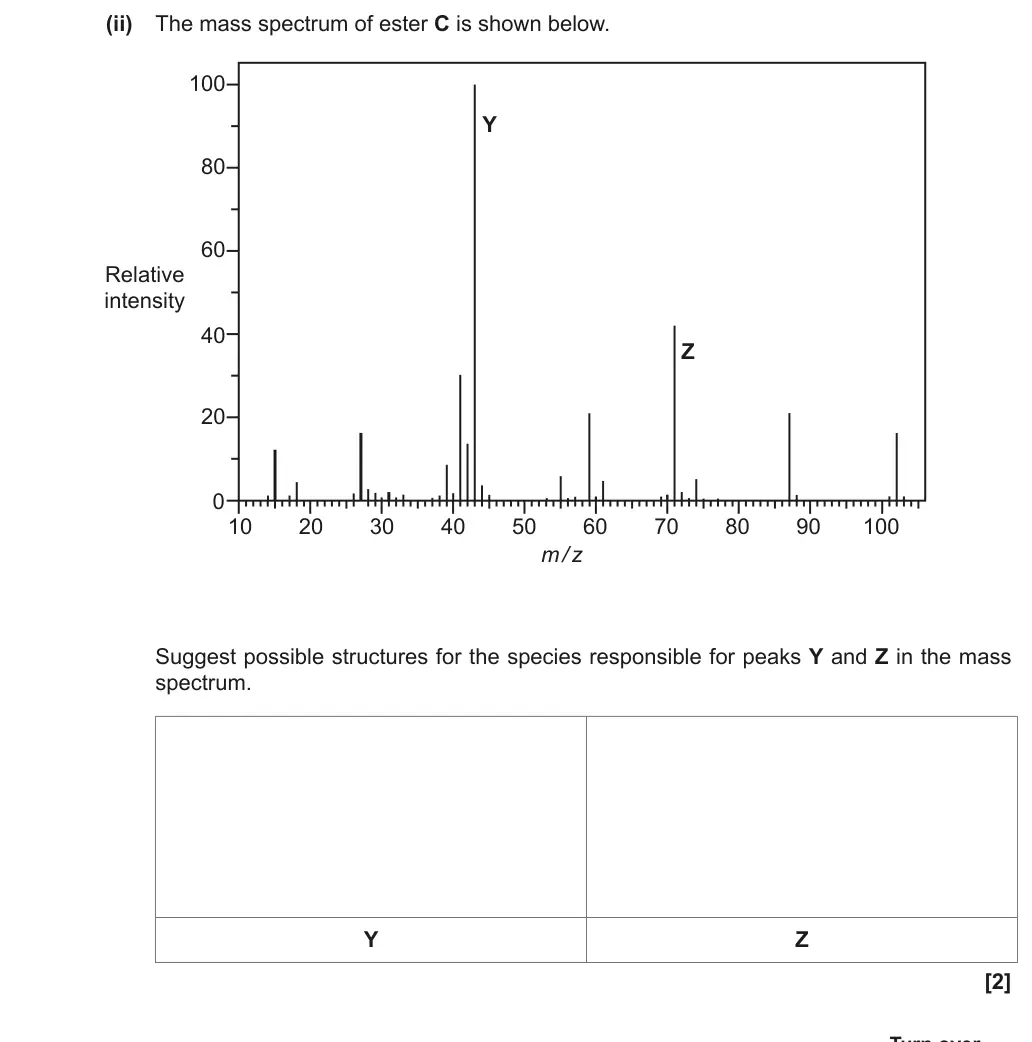
Most candidates were able to provide a correct structure for each of the ions responsible for the peaks labelled Y and Z. Some candidates omitted the charge, or included ‘end bonds’. These responses were able to achieve one mark if both fragments were correct. So the majority of candidates scored one or two marks in this part.
Skills: M3.1 Translate information between graphical, numerical and algebraic forms
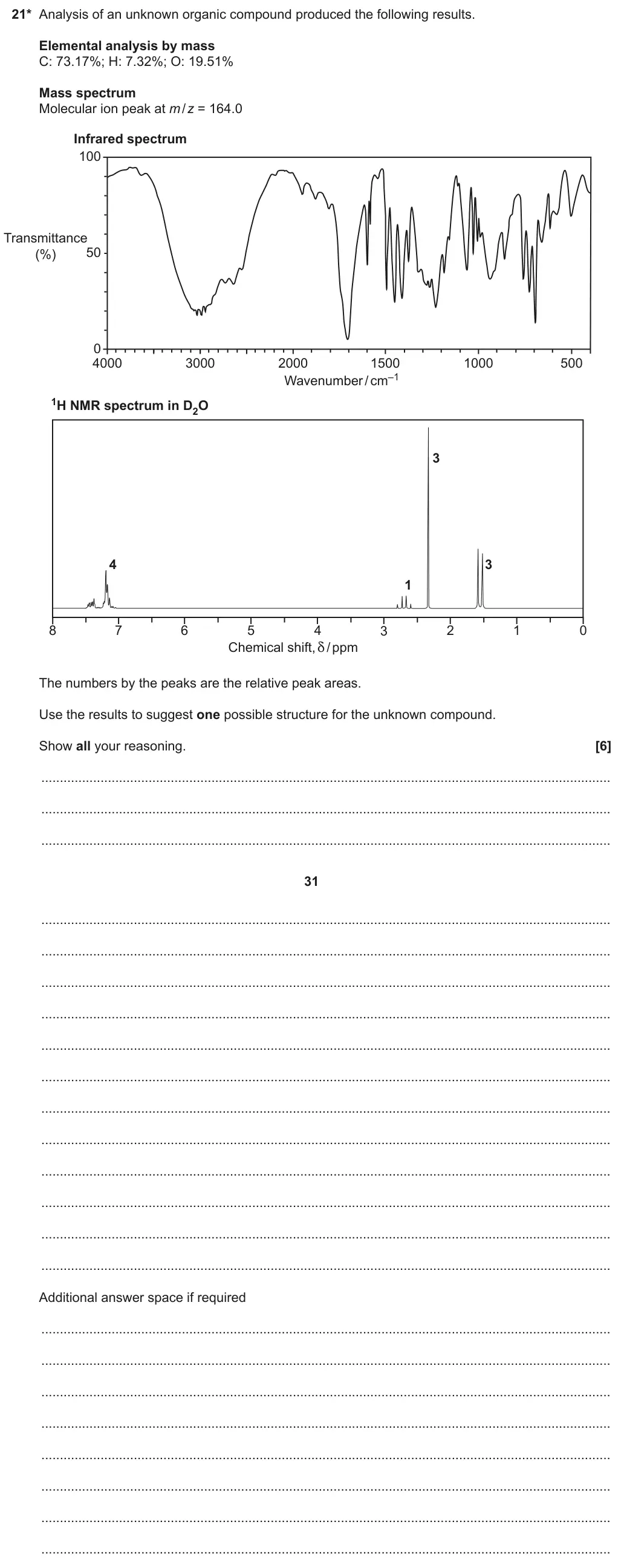
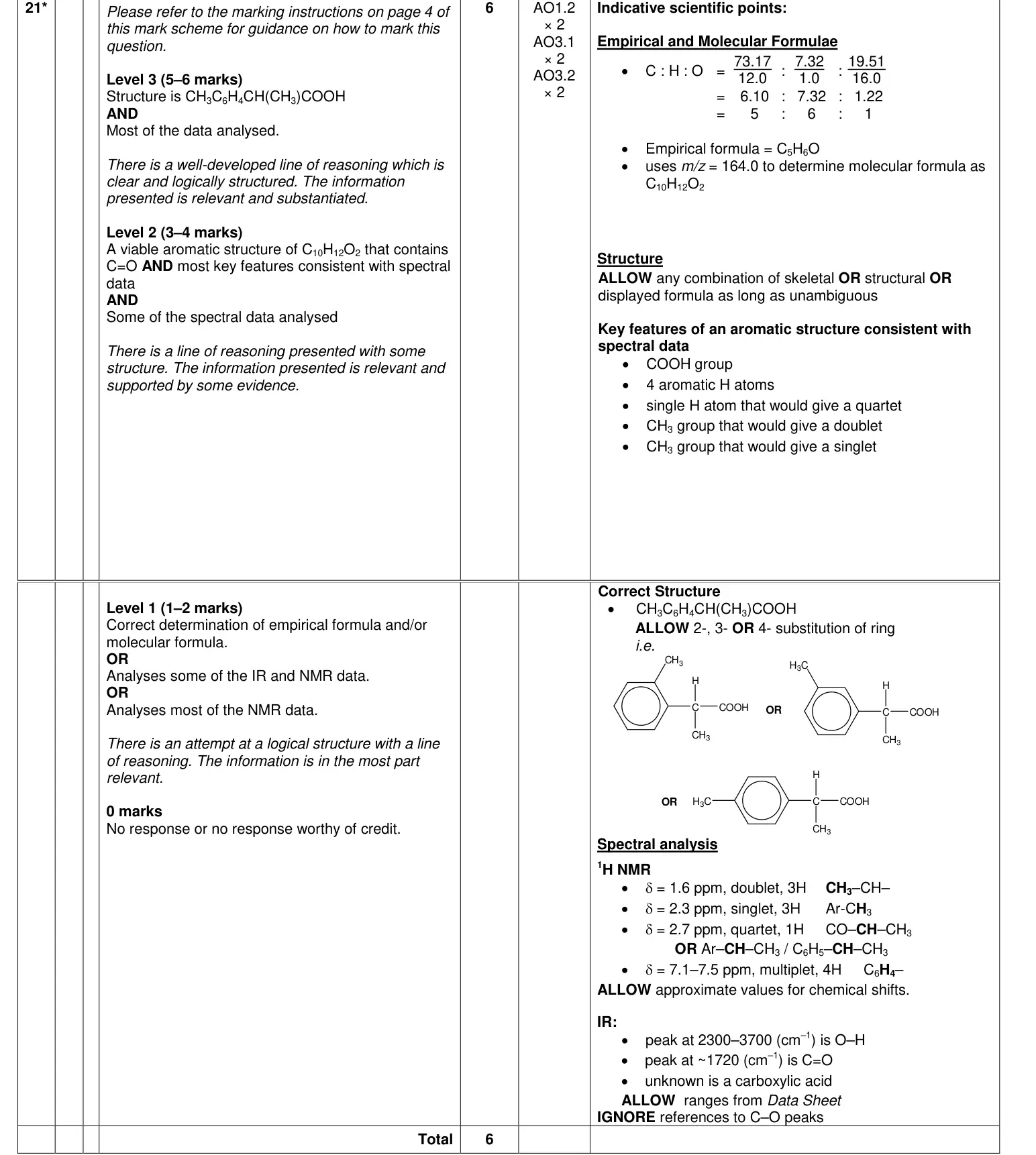
Candidates are confident in tackling questions requiring spectral analysis. Most candidates were able to determine the empirical and molecular formula of the unknown compound and analyse the IR and NMR data. A number of excellent responses were seen which included interpretation of the peak splitting in the NMR spectrum. However, many candidates were unable to suggest a structure that matched their spectral analysis. The majority of structures seen were aromatic but not all contained the carboxylic acid group. Some candidates focused on the NMR data and suggested a structure that was consistent with some of these peaks and included a two substituents of the ring or a degree of chain branching. Lower ability responses often showed a simpler structure of a monosubstituted ring with a straight chain. Stronger responses were able to use all the data to suggest a correct structure as demonstrated in significant proportion of responses were given six marks. This candidate starts their analysis by determining the empirical and molecular formula of the unknown compound. Next the IR and NMR data is analysed in a clear, logical fashion. Although not shown in this report, the candidate had annotated the spectra, a good strategy. At the end of the response the candidate has determined a possible structure. Notice how the candidate has crossed out the first attempt at a structure. This is much better than rubbing out a pencil diagram and re-drawing over the space as this often leads to unclear images that are difficult for examiners to read. This candidate received full marks in this question.
Skills: M0.2 Use ratios, fractions and percentages; M3.1 Translate information between graphical, numerical and algebraic forms
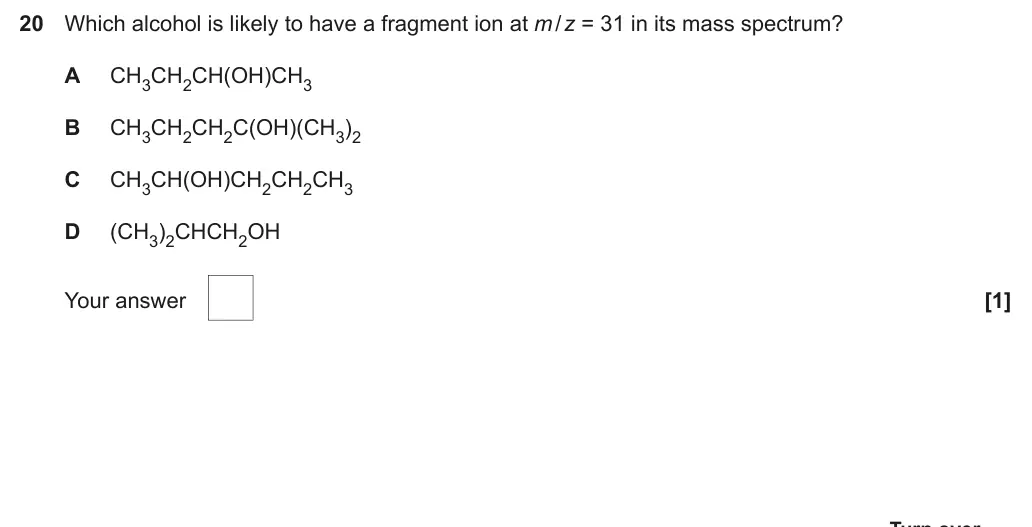
D
Overall, candidates answered this question well with many selecting the correct response of D. From scripts, successful candidates drew vertical lines to isolate likely fragments. Section B Overview
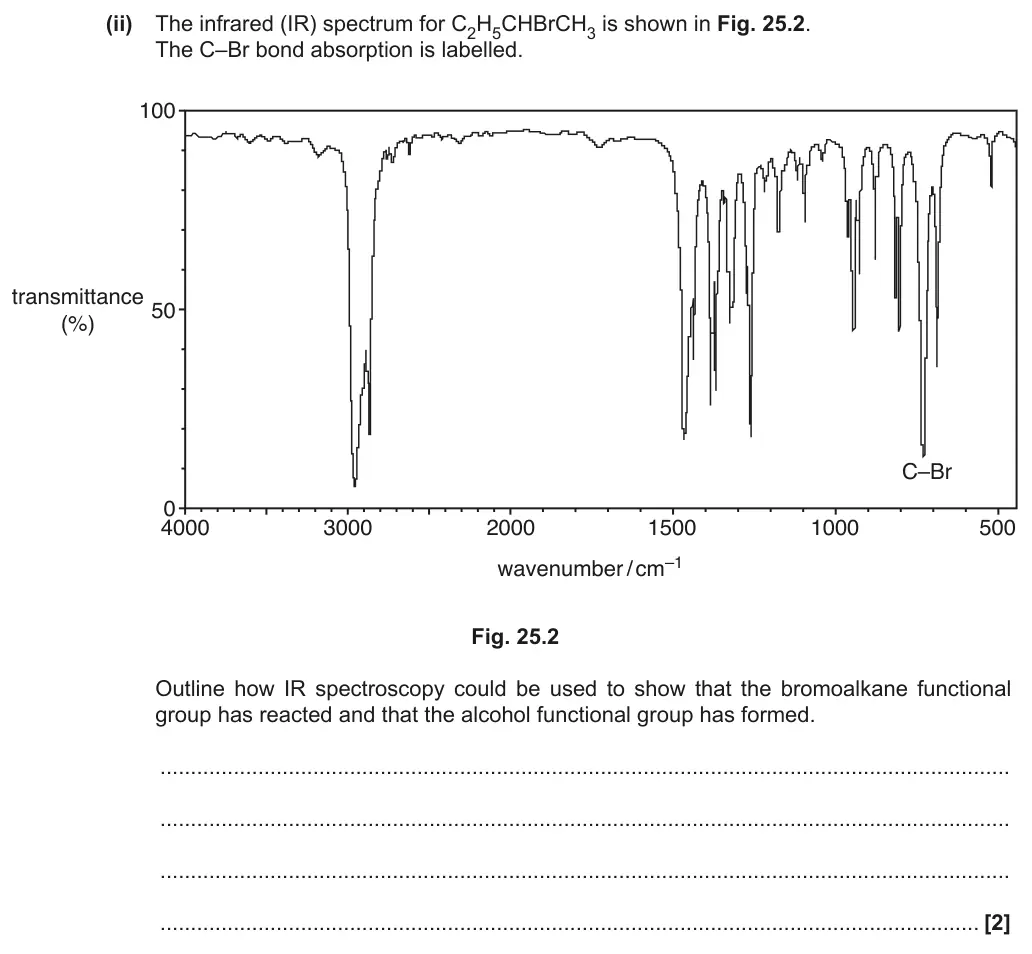
This part discriminated very well with able candidates identifying that the absorption for the C–Br bond would disappear, with a new peak appearing for the alcohol O–H bond. A significant number of candidates did not seem to understand what was required, with many interpreting the spectrum as that of the alcohol, rather than predicting how the spectrum would change during the reaction. A common error was to interpret the absorption for a C–H bond at ~3000 cm–1 as that of an O–H bond. Copyright acknowledgements Q25(b)(ii) spectrum © SDBSWeb : https://sdbs.db.aist.go.jp/sdbs/cgi-bin/cre_index.cgi (National Institute of Advanced Industrial Science and Technology, accessed 31 January 2017).
Skills: M3.1 Translate information between graphical, numerical and algebraic forms
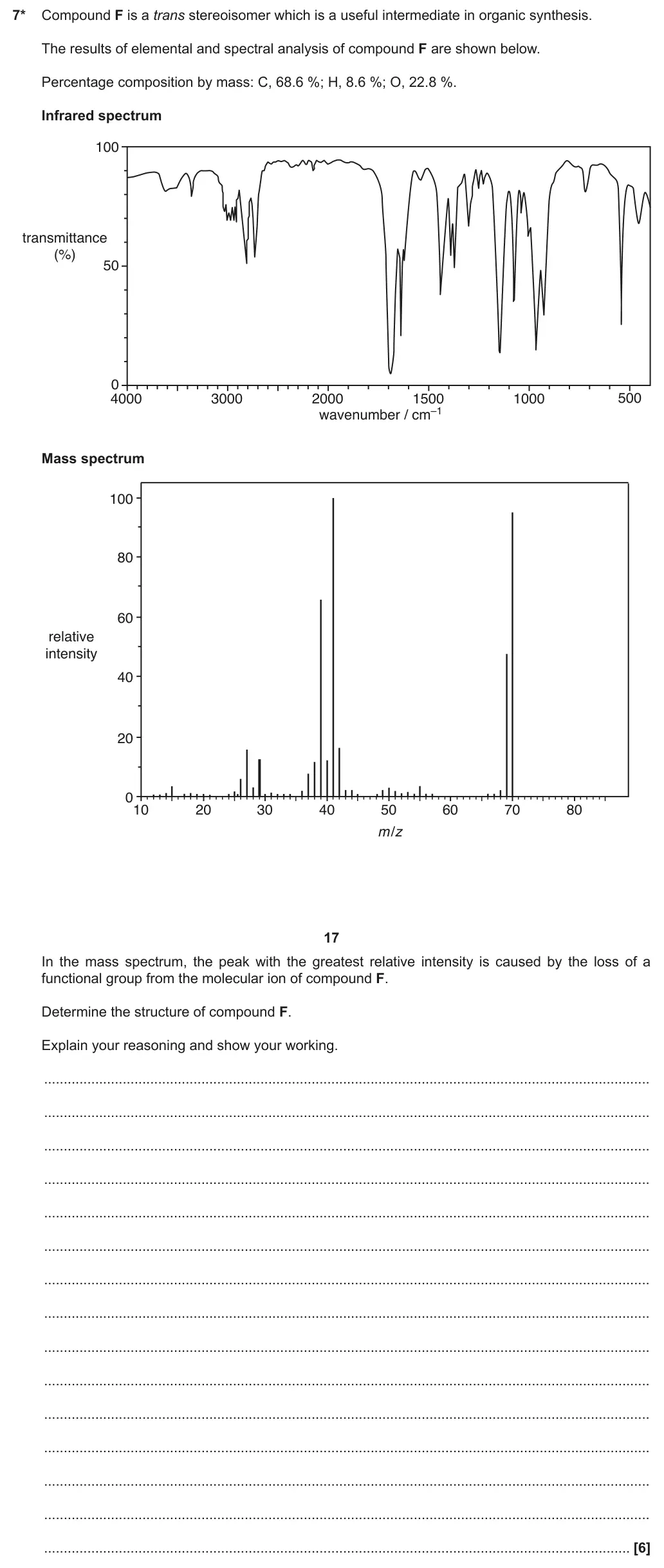
This question was a good discriminator. Most candidates were able to deduce the empirical formula and the C=O peak on the IR spectrum. However, many mistook the C-H peaks around 3000 cm-1 for an alcohol O-H peak or assumed from the empirical formula that it was an alcohol so made the spectra ‘fit’ their hypothesis. At AS, the exposure of candidates to IR and MS spectra is not as comprehensive as in the second year of A Level and this was evident. There was very little annotation of the spectra and candidates should be encouraged to do this as it is helpful to them in their deductions (and to the examiners for crediting marks). Analysis of the IR spectrum was much more detailed than the mass spectrum. Most candidates just referred to the molecular ion peak and made no attempt, or an incorrect attempt, at discerning the peak at 41. Those that did quickly realised what the structure was and gained 5 or 6 marks. Some candidates, despite ascertaining that a trans stereoisomer should be drawn, drew the cis version instead. This candidate has very logically worked through all the information provided and has come up with the correct structure from the deductions. Like most candidates, the crucial information about F being a trans isomer was not picked up so they drew the double bond in the wrong place. Copyright acknowledgements Q7, graph 1 © SDBSWeb : https://sdbs.db.aist.go.jp/sdbs/cgi-bin/cre_index.cgi (National Institute of Advanced Industrial Science and Technology, accessed 31 January 2017). Q7, graph 2 © SDBSWeb : https://sdbs.db.aist.go.jp/sdbs/cgi-bin/cre_index.cgi (National Institute of Advanced Industrial Science and Technology, accessed 31 January 2017).
Skills: M0.2 Use ratios, fractions and percentages; M3.1 Translate information between graphical, numerical and algebraic forms
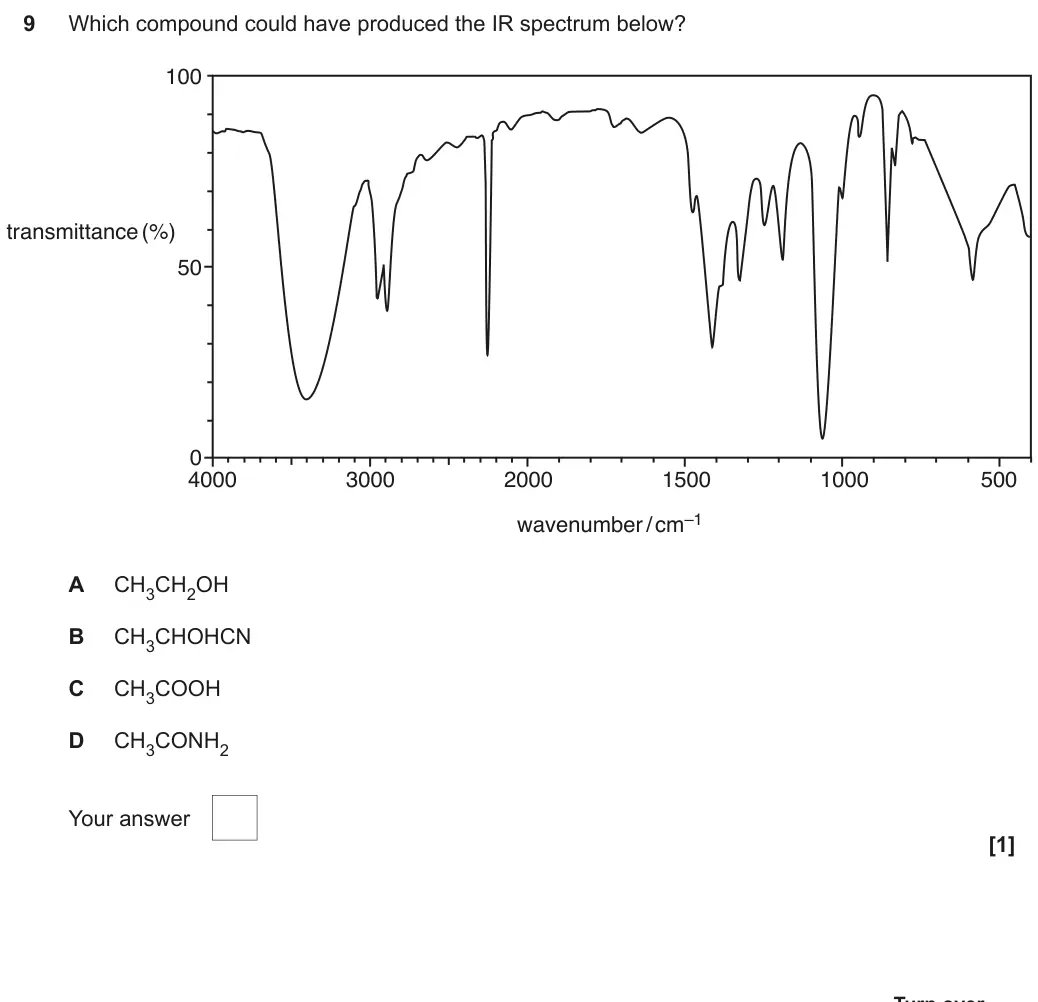
B
Most candidates correctly identified B as the compound after labelling the O-H and C≡N peaks in the spectrum.
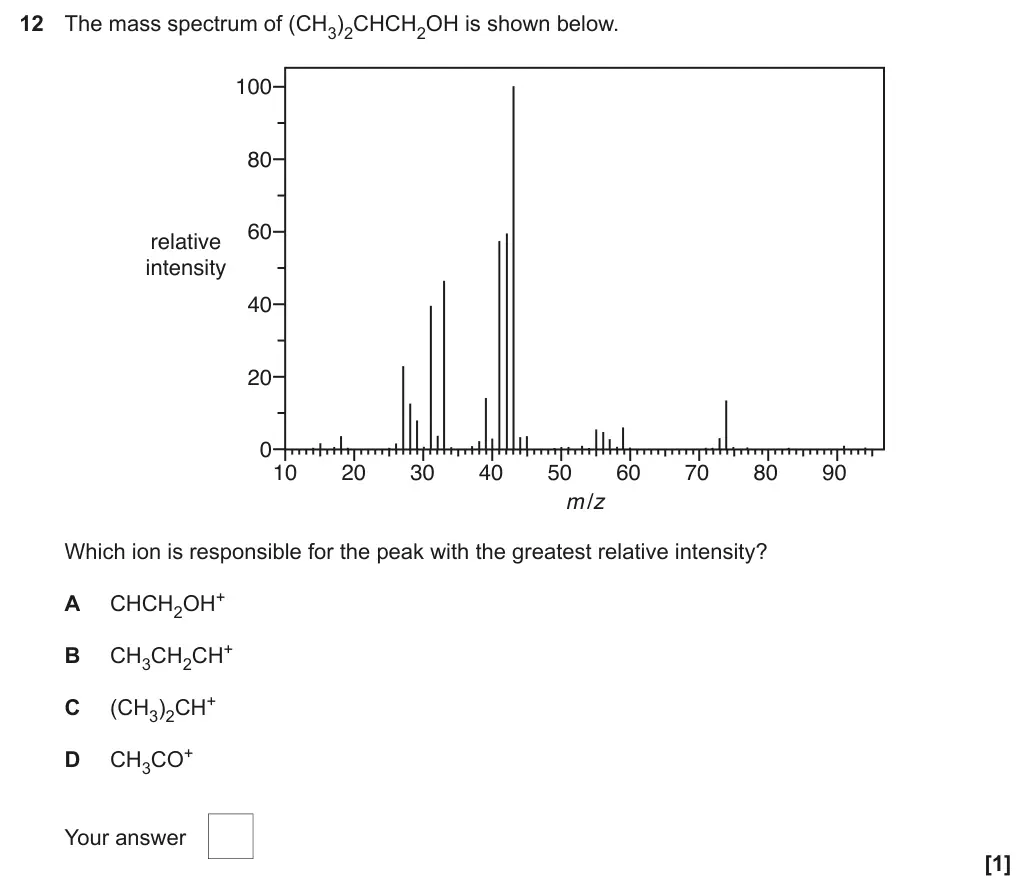
C
Most candidates were able to identify C as the fragment responsible for the peak at m/z = 43. A number of different approaches were used. Some candidates determined the mass of each fragment shown while others drew the structures to see which were likely to be formed from (CH3)2CHCH2OH.
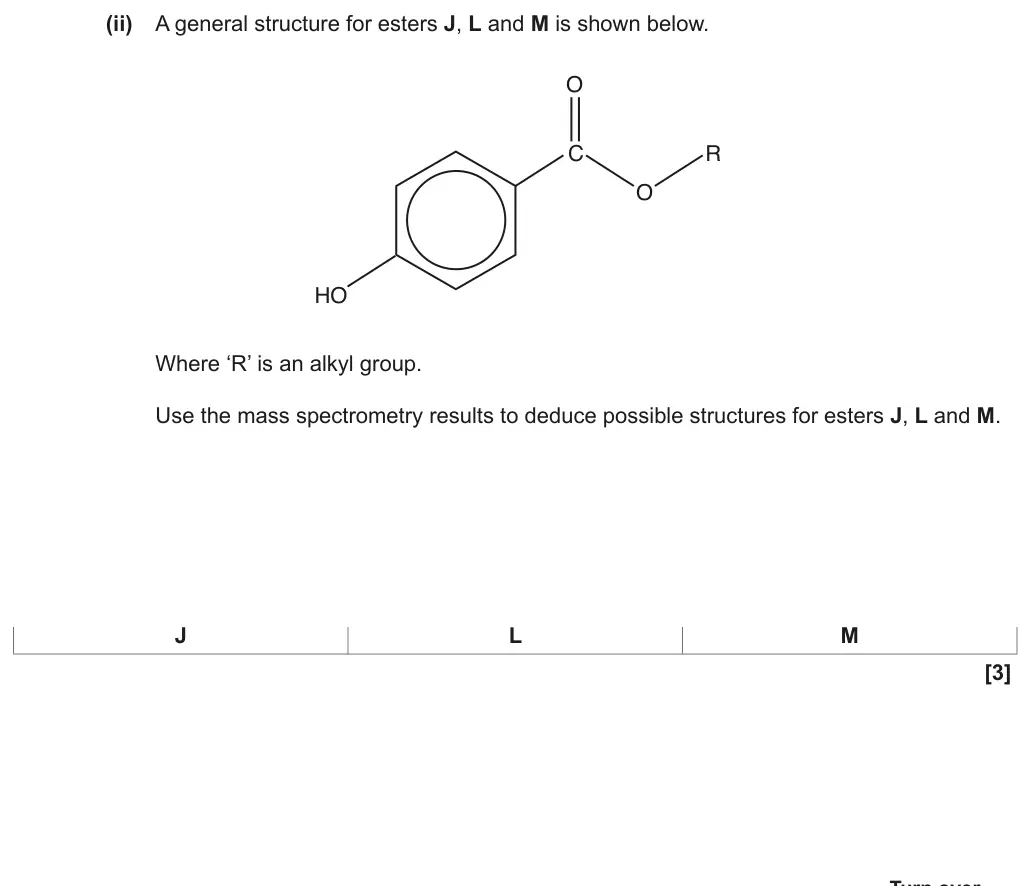
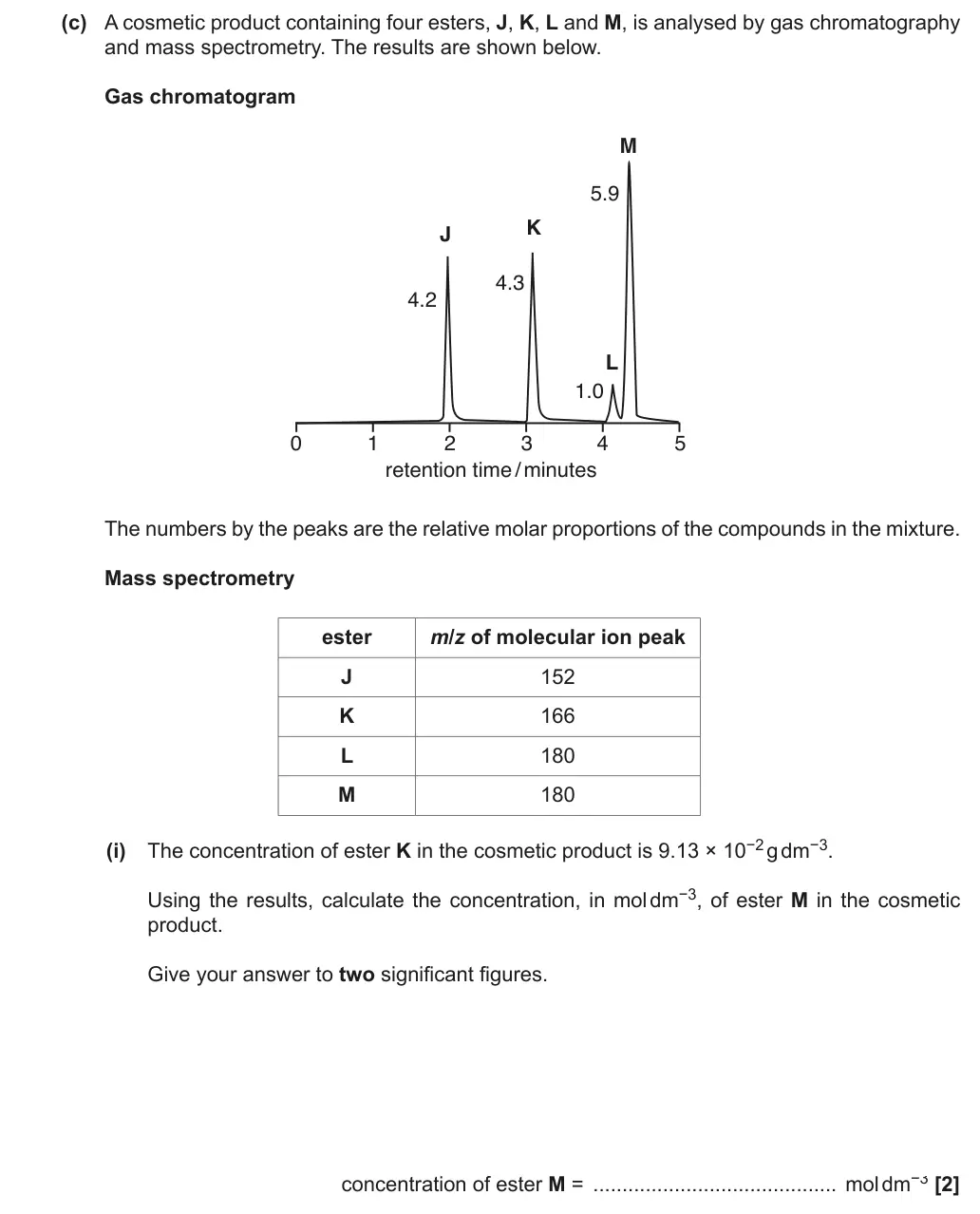
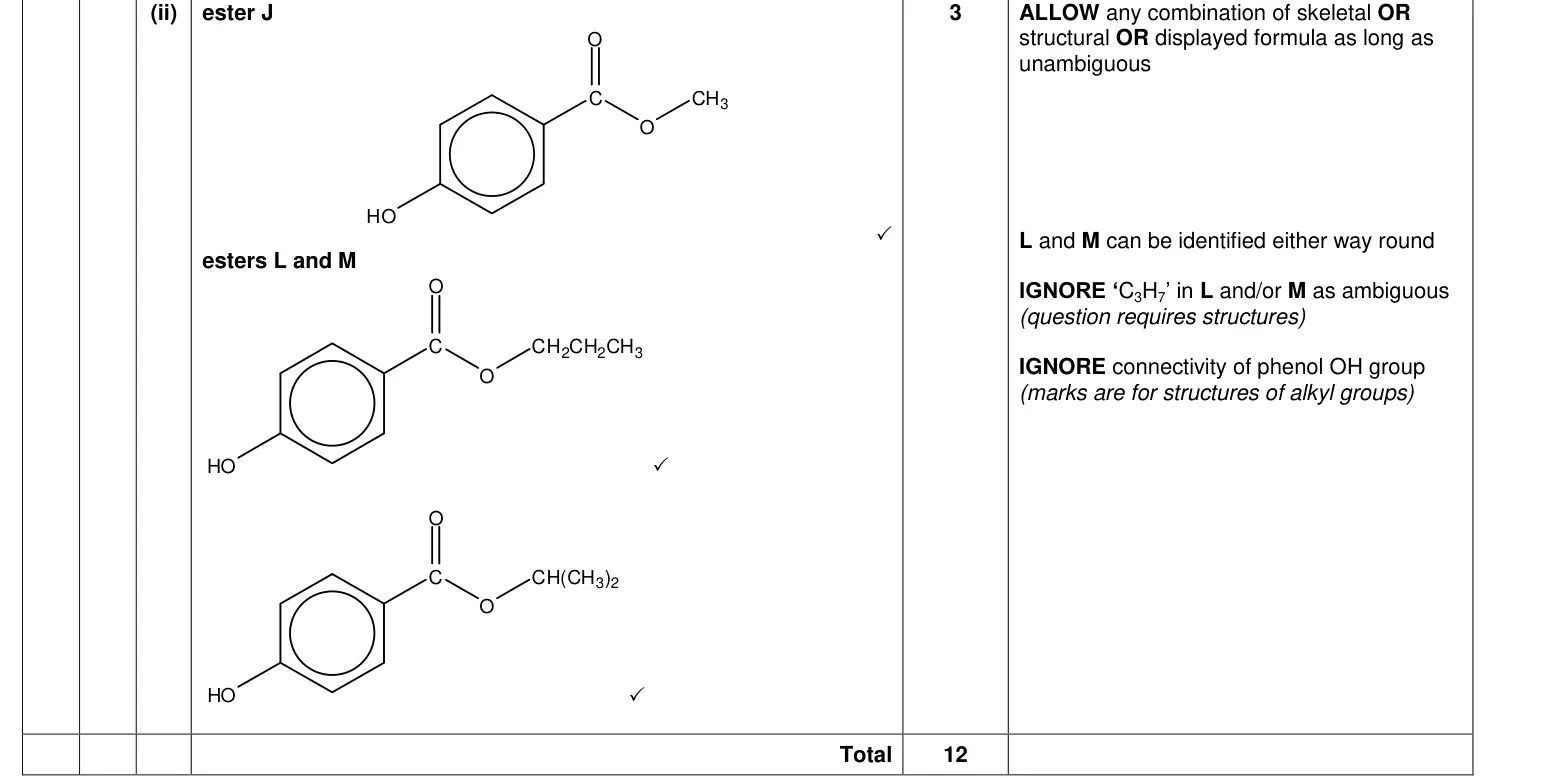
Examiners were encouraged by the number of good responses to this problem solving question. Most candidates achieved at least one mark in this part, often from a correct structure of J. Although many candidates deduced that the R group for both L and M consisted of 3 C atoms and 7 H atoms, only the highest ability candidates were able to join these correctly. A small but significant number of responses showed R groups that involved O atoms, despite the prompt that the R represented an alkyl group. Candidates are advised to read questions carefully.
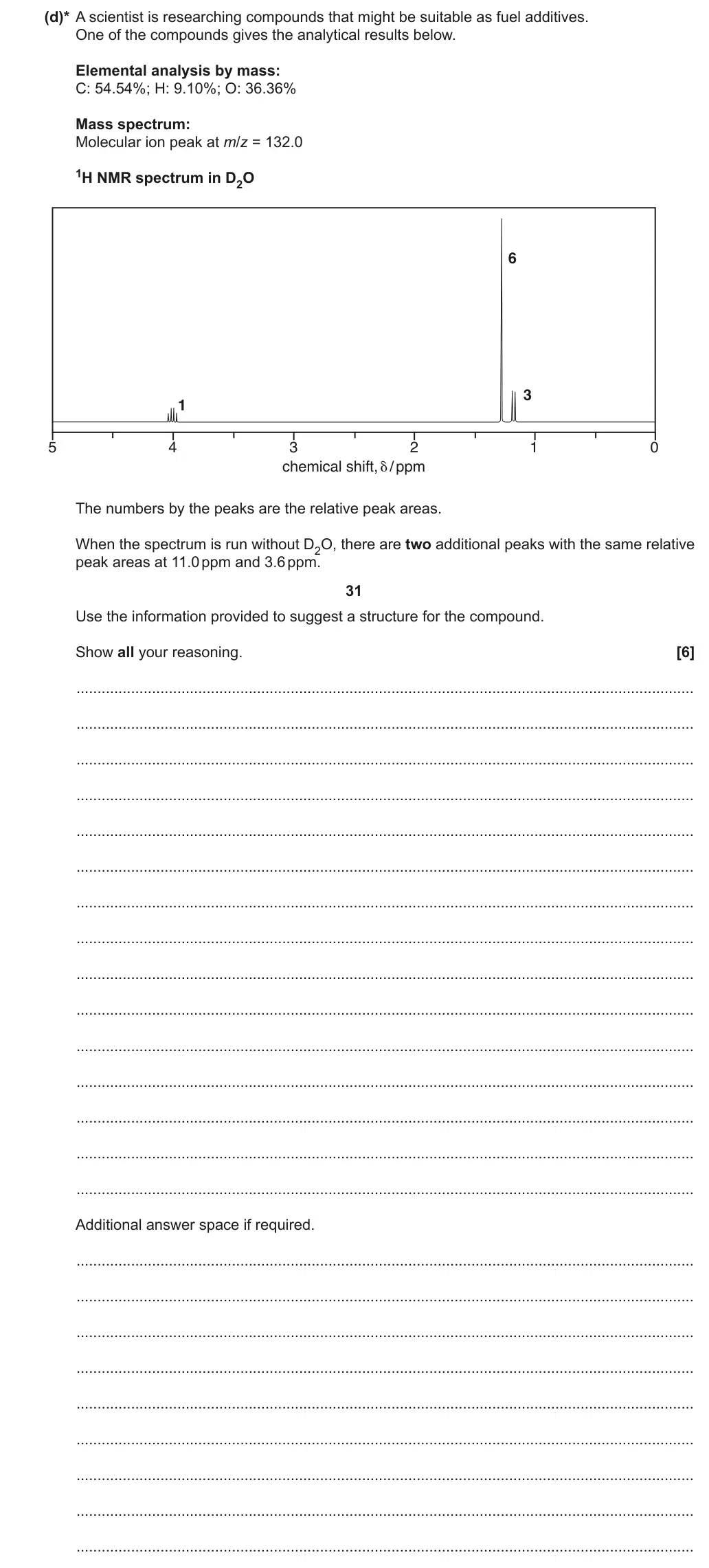
Most candidates were able to determine the empirical and molecular formula of the unknown compound. A number of excellent and clear response were seen, where the NMR data was explained, including interpretation of the additional peaks observed without D2O. However many candidates were unable to suggest a structure that matched their NMR interpretation. Some candidates used the quartet, doublet and singlet to suggest a structure that would give rise to this splitting pattern, but which was not consistent with the chemical shifts, see Exemplar 12. Such responses received a level 2 mark (3-4). Stronger responses were able to use all the data to suggest a correct structure. The most common was CH3CH(OH)C(CH3)2COOH although other viable structures, including CH3CH(OH)COC(CH3)2OH, were also seen. Examiners were impressed with the problem solving ability shown by candidates and a significant proportion of responses were credited six marks. This logically presented Level 2 response uses the elemental analysis and mass spectrum data to determine the correct empirical and molecular formula of the unknown compound. The peaks in the NMR spectrum are analysed in detail, with a clear explanation of the splitting patterns. A comment about the two additional peaks observed when the spectrum is run without D2O is also provided. The response concludes with a structure of C6H12O3 that would show a singlet, doublet and quartet in its 1H NMR spectrum. However, this structure is not consistent with the chemical shift values shown in the spectrum provided. In particular this structure would produce a quartet between 2.0–2.9 ppm, rather than at 4.0 as in the spectrum shown. Consequentially this response does not achieve Level 3. When tackling questions of this type candidates are advised to check that a proposed structure would produce peaks in the correct region of the NMR spectrum to ensure it is totally consistent with the data analysed. Copyright acknowledgements Section A, Q9 © SDBS, National Institute of Advanced Industrial Science and Technology. Reproduced by kind permission of SDBS. Section A, Q12 © SDBS, National Institute of Advanced Industrial Science and Technology. Reproduced by kind permission of SDBS.
Skills: M0.2 Use ratios, fractions and percentages; M3.1 Translate information between graphical, numerical and algebraic forms
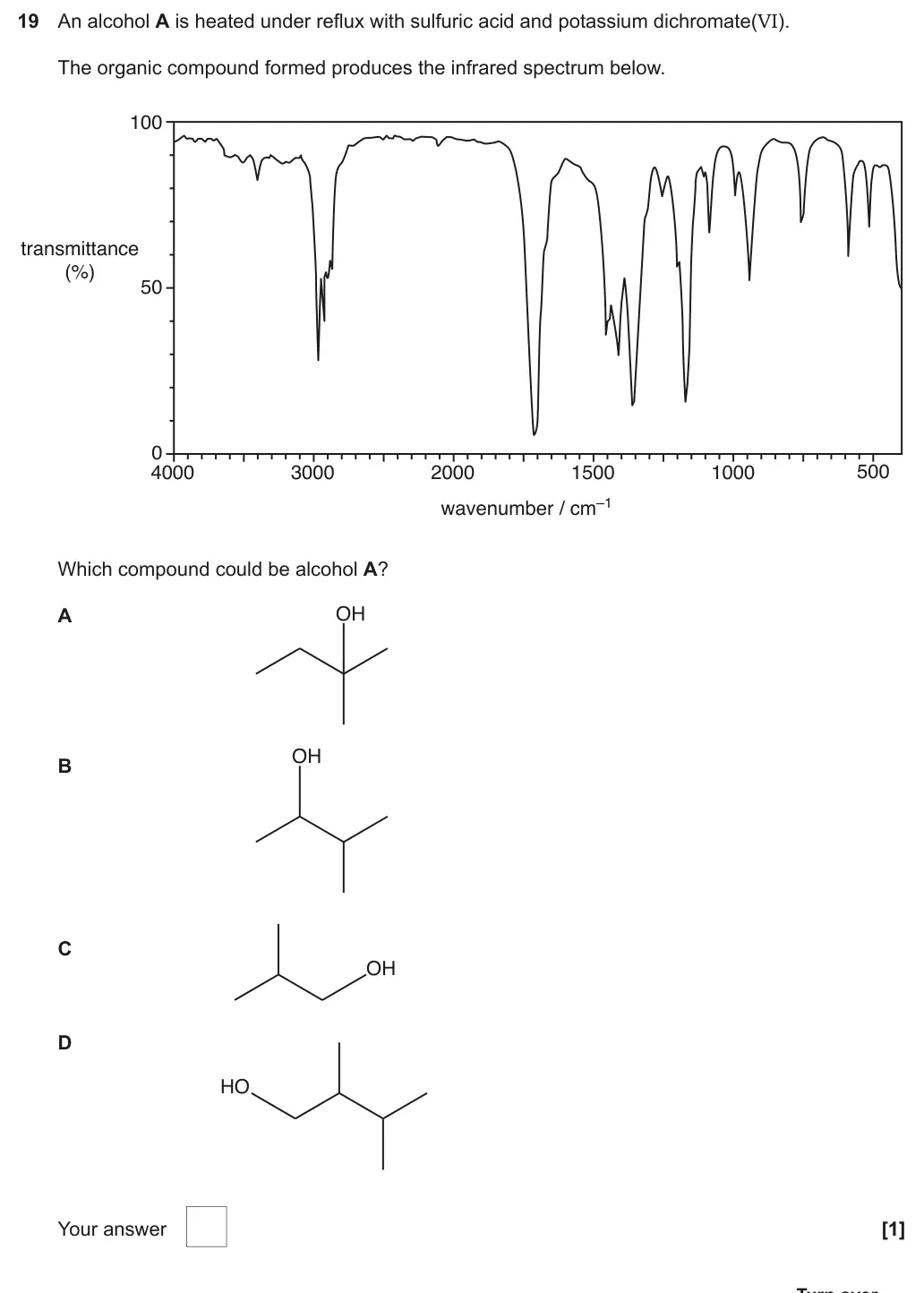
B
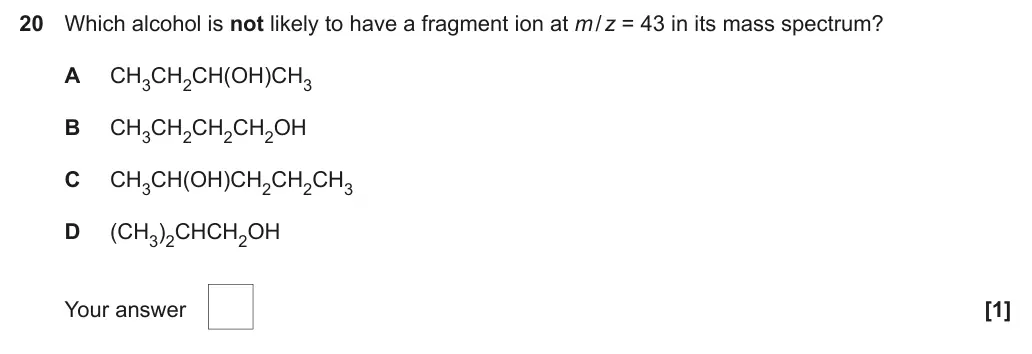
A
Skills: M3.1 Translate information between graphical, numerical and algebraic forms
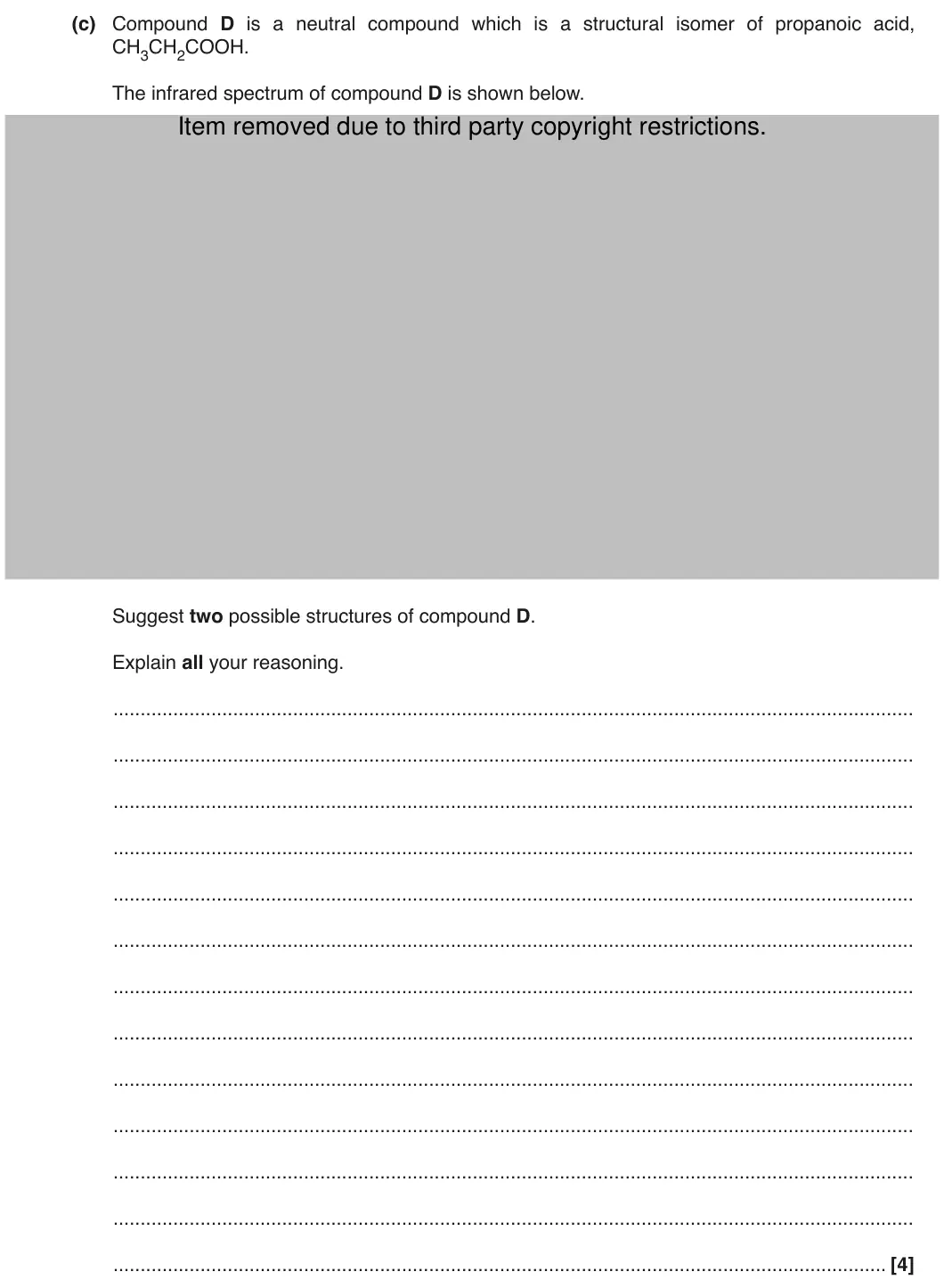
Skills: M3.1 Translate information between graphical, numerical and algebraic forms
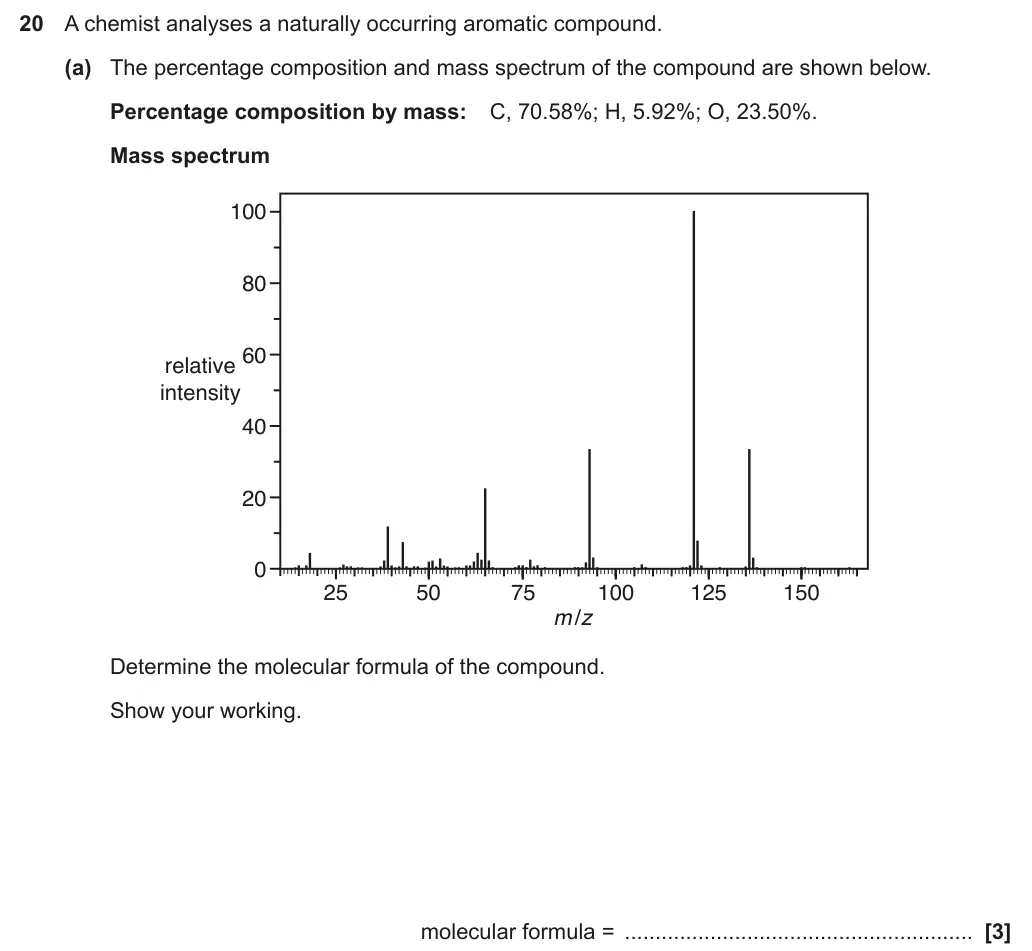
Skills: M0.2 Use ratios, fractions and percentages; M3.1 Translate information between graphical, numerical and algebraic forms
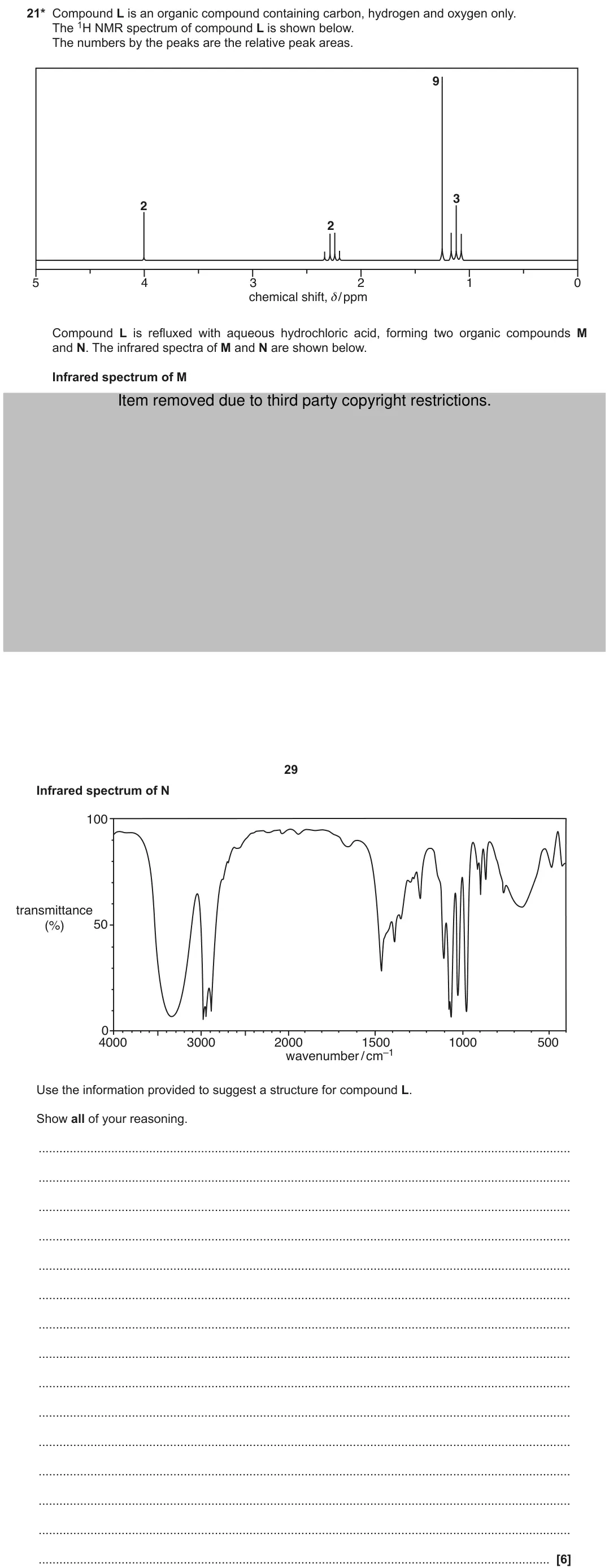
Skills: M3.1 Translate information between graphical, numerical and algebraic forms
Skills: M0.2 Use ratios, fractions and percentages; M3.1 Translate information between graphical, numerical and algebraic forms
Dropping marks on calculations, mechanisms or the six-markers? Book a trial session with a specialist OCR chemistry tutor.