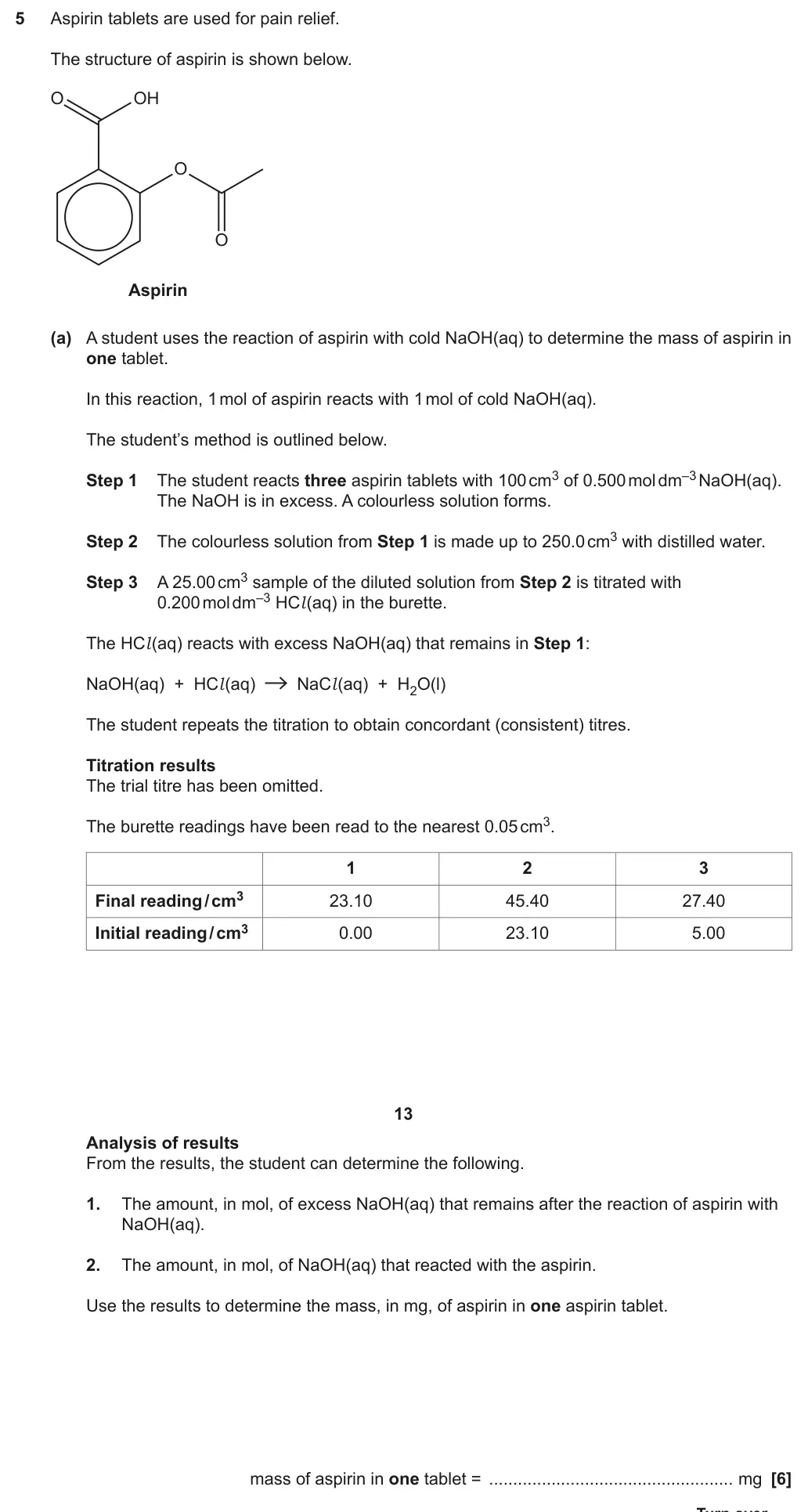
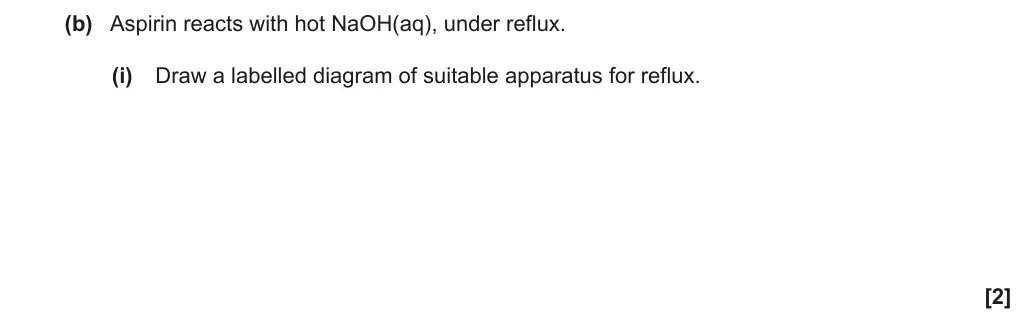
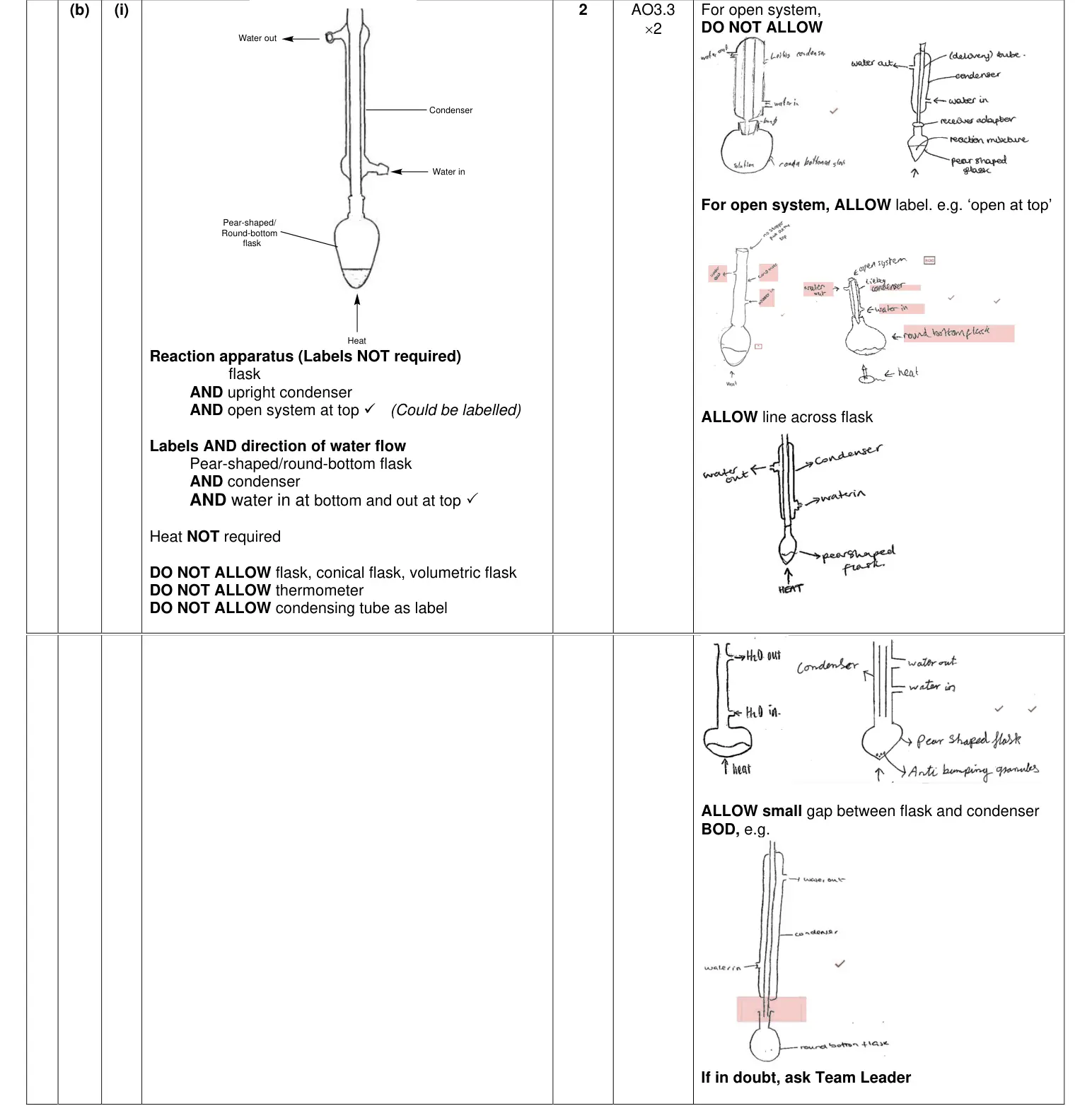
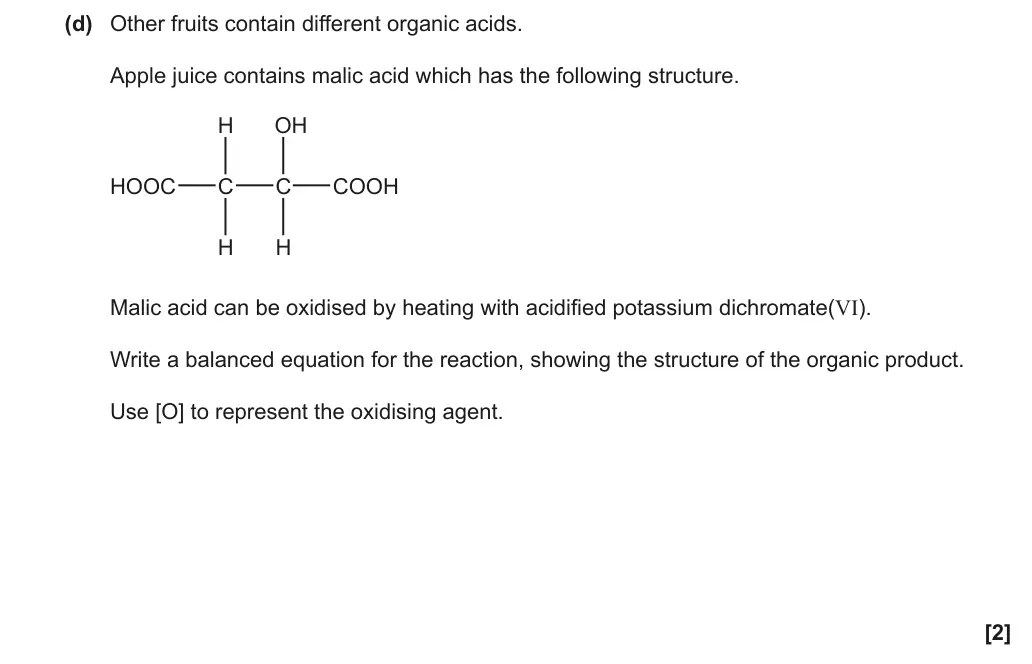
Notes and key-term cards for this topic are being written by our tutors. The past-paper questions below are ready now.
Learning outcomes
Show the 7 learning outcomes from the specification
4.2.3(a) the techniques and procedures for:
4.2.3(a)(i) use of Quickfit apparatus including for distillation and heating under reflux
4.2.3(a)(ii) preparation and purification of an organic liquid including: • use of a separating funnel to remove an organic layer from an aqueous layer • drying with an anhydrous salt (e.g. MgSO4, CaCl2) • redistillation
4.2.3(b) for an organic molecule containing several functional groups:
4.2.3(b)(i) identification of individual functional groups
4.2.3(b)(ii) prediction of properties and reactions
4.2.3(c) two-stage synthetic routes for preparing organic compounds.
Six-mark level of response questions on this topic
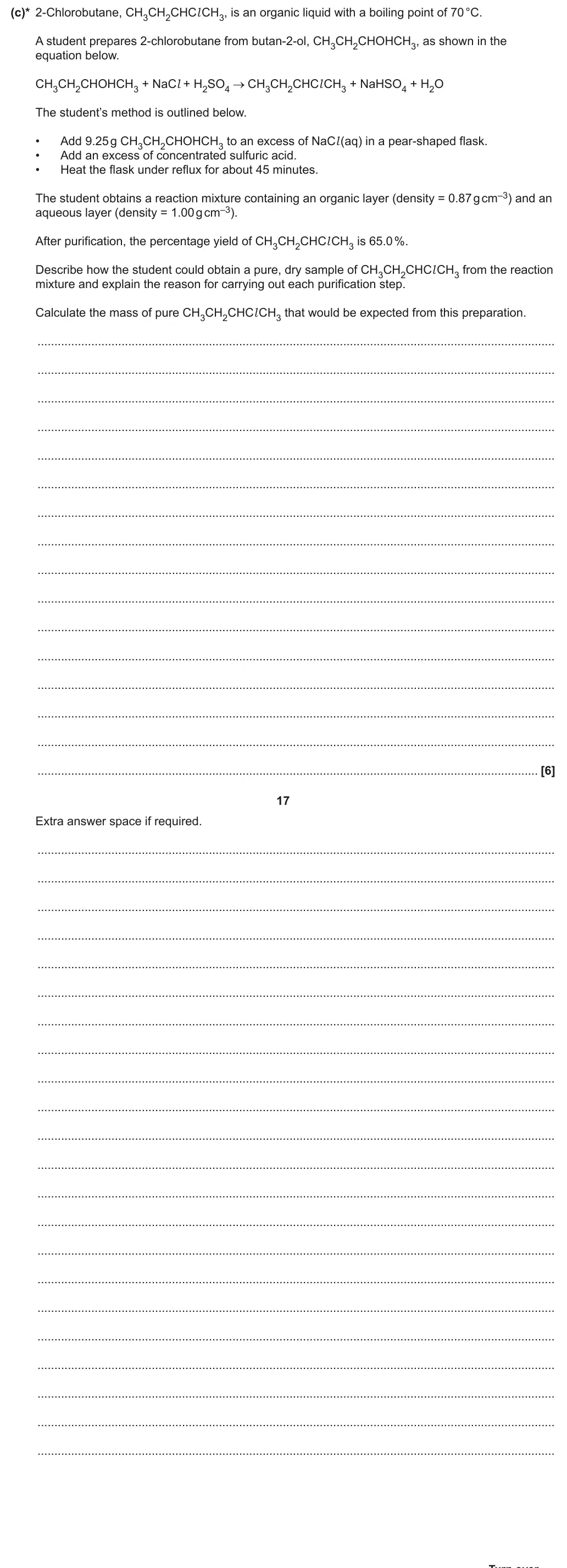
2-Chlorobutane, CH3CH2CHCl CH3, is an organic liquid with a boiling point of 70 °C. Describe how the student could obtain a pure, dry sample of CH3CH2CHCl CH3 from the reaction
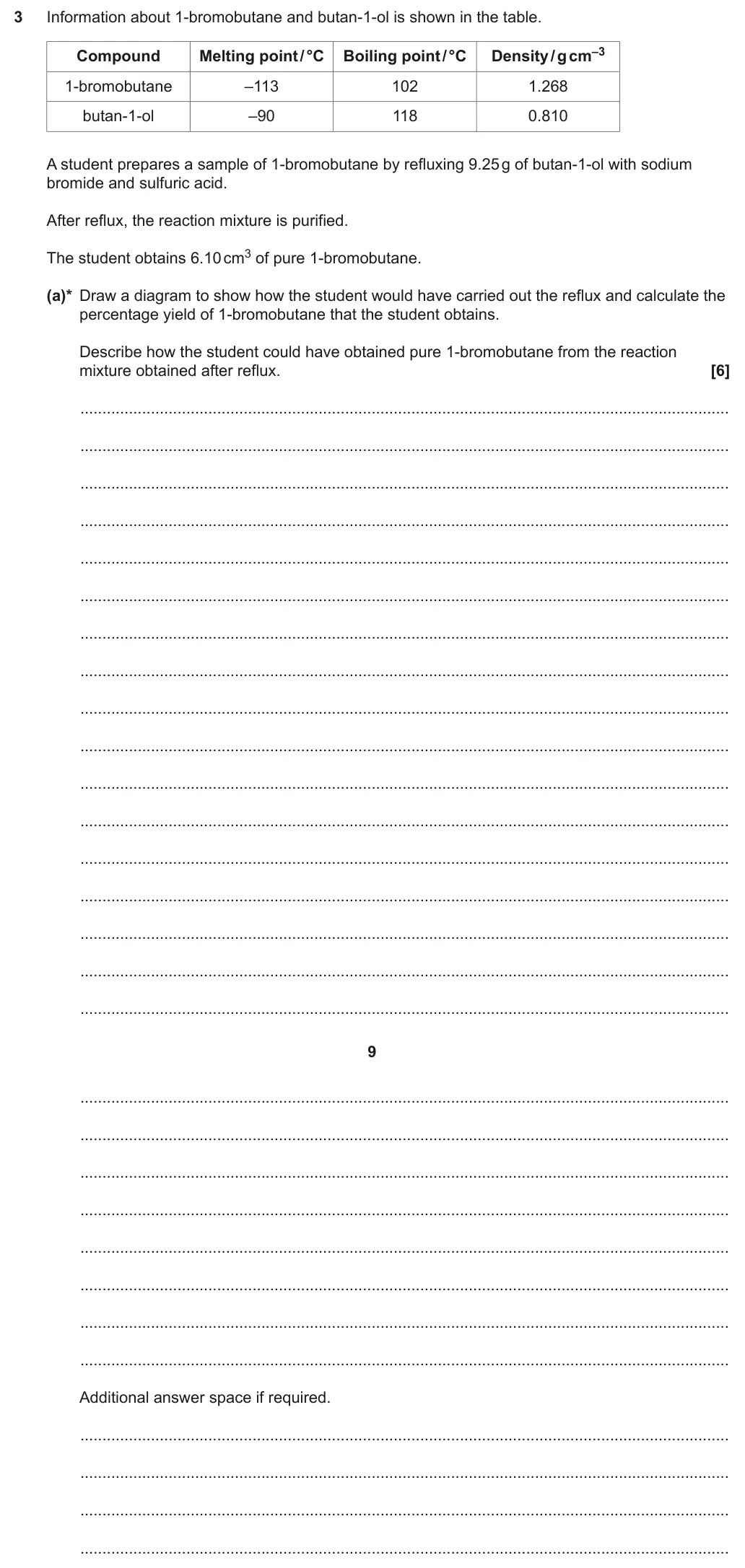
Draw a diagram to show how the student would have carried out the reflux and calculate the Describe how the student could have obtained pure 1-bromobutane from the reaction
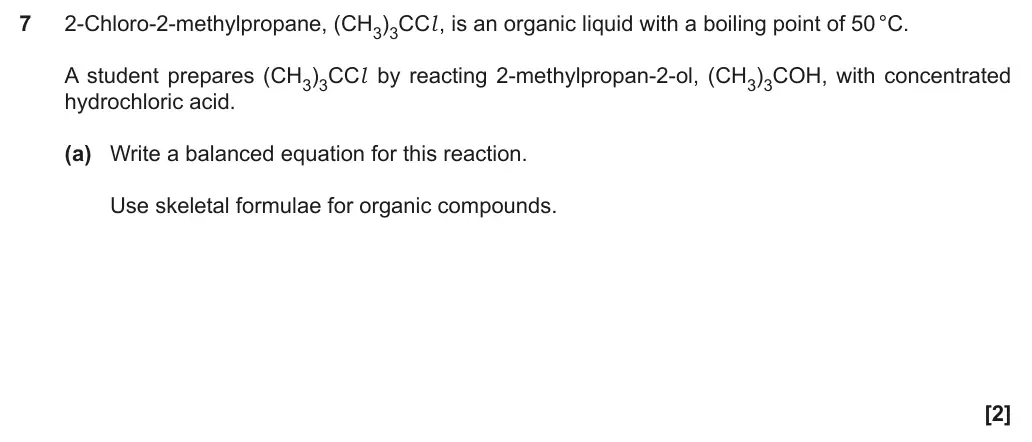
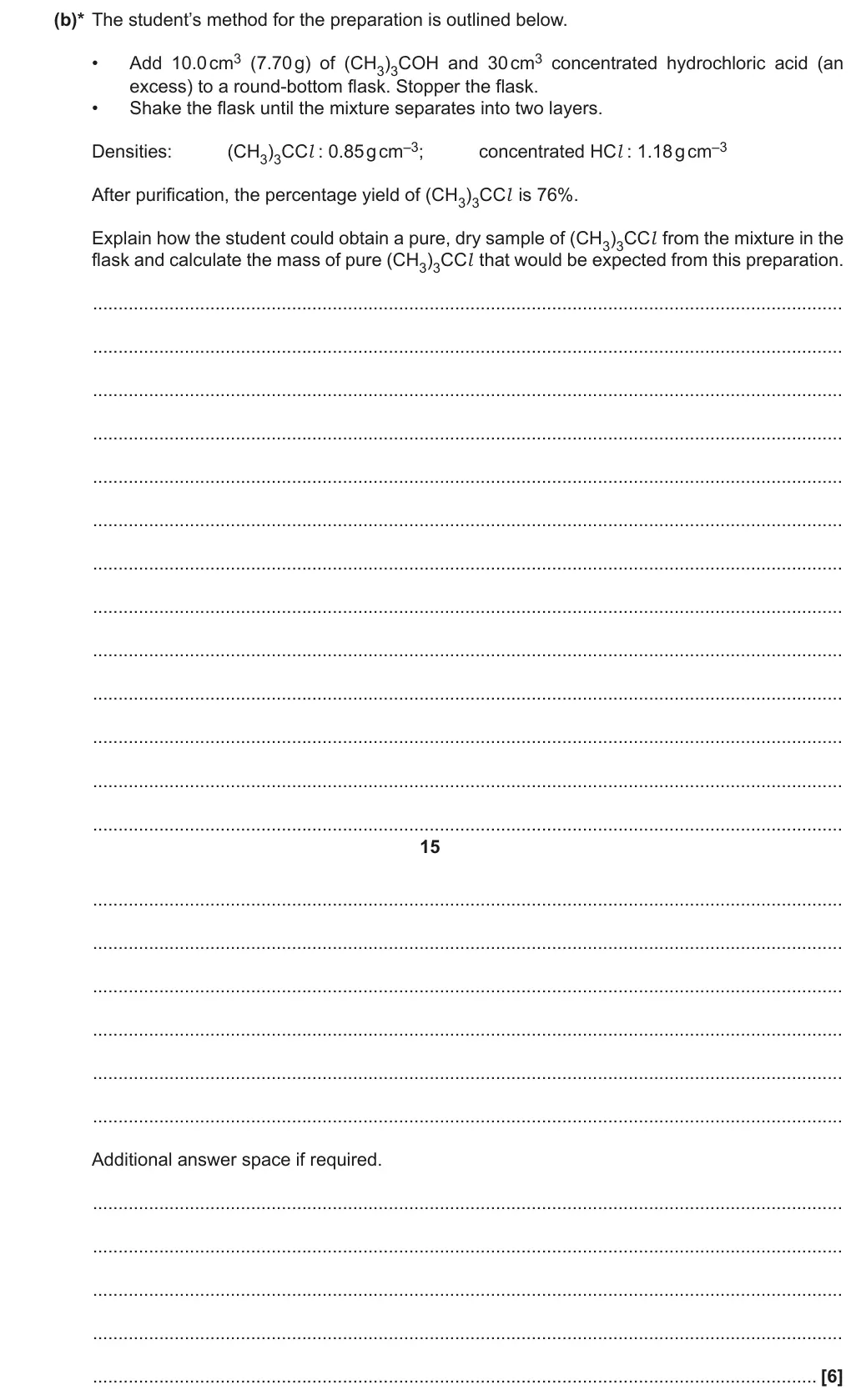
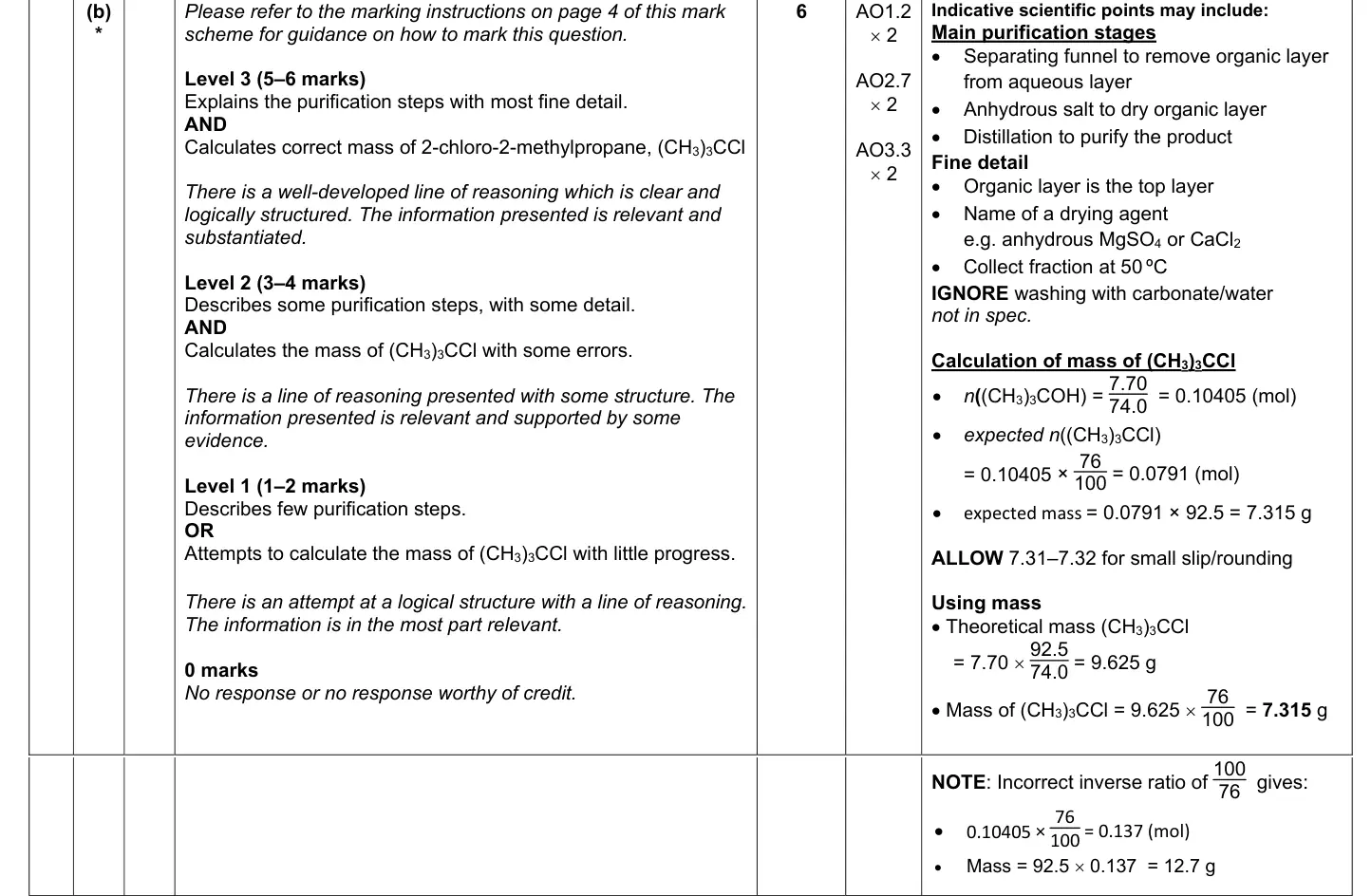
The student’s method for the preparation is outlined below. Explain how the student could obtain a pure, dry sample of (CH3)3CCl from the mixture in the
Draw a labelled diagram to show how you would safely set up apparatus for the preparation. Outline a method to obtain a pure sample of 1-bromobutane from the
Describe the oxidation reactions of butan-1-ol forming an aldehyde and a carboxylic acid. Explain, using a diagram, how the aldehyde can be produced in the laboratory by controlling
Tap a question to zoom it. Where a part needs a table, graph or structure from an earlier part, that part folds out above it; the mark scheme and examiner's comment open underneath. Have the OCR Data Sheet beside you.
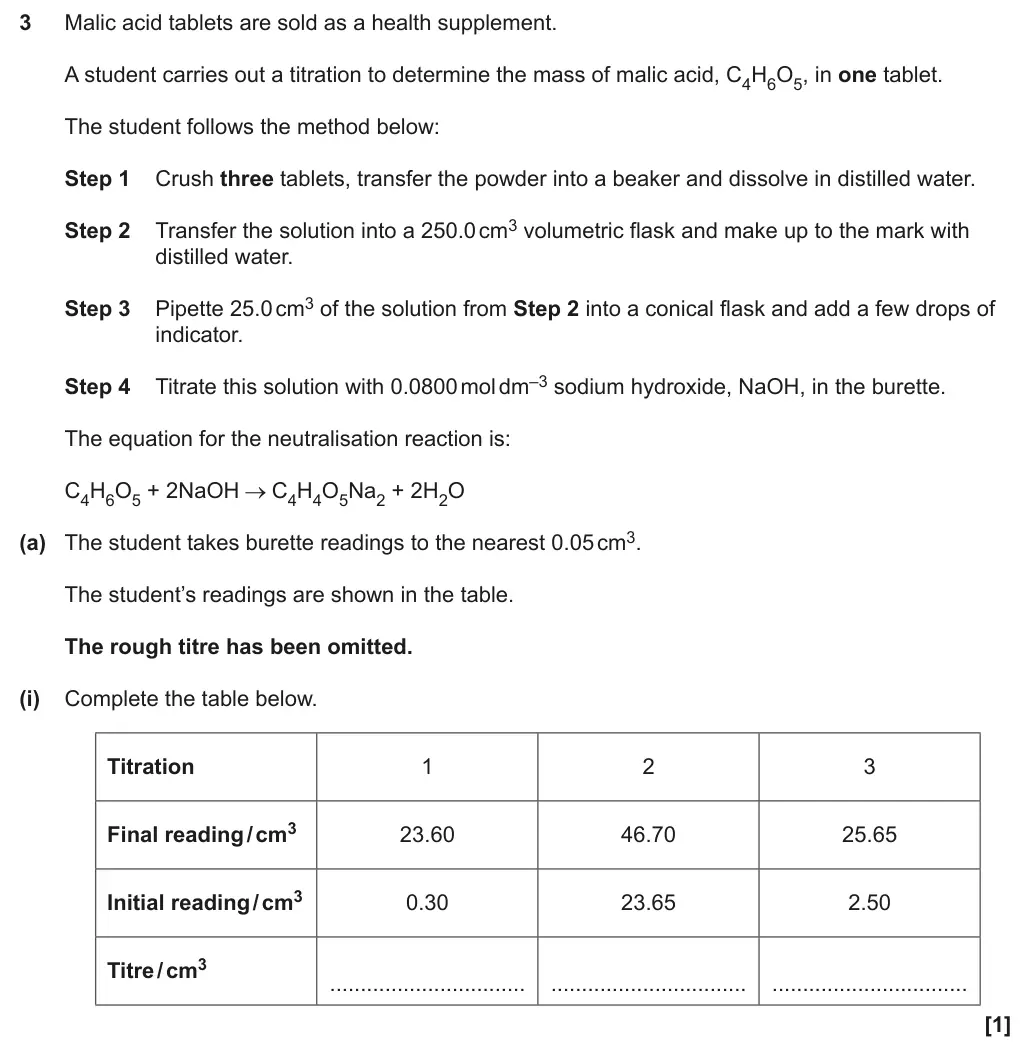
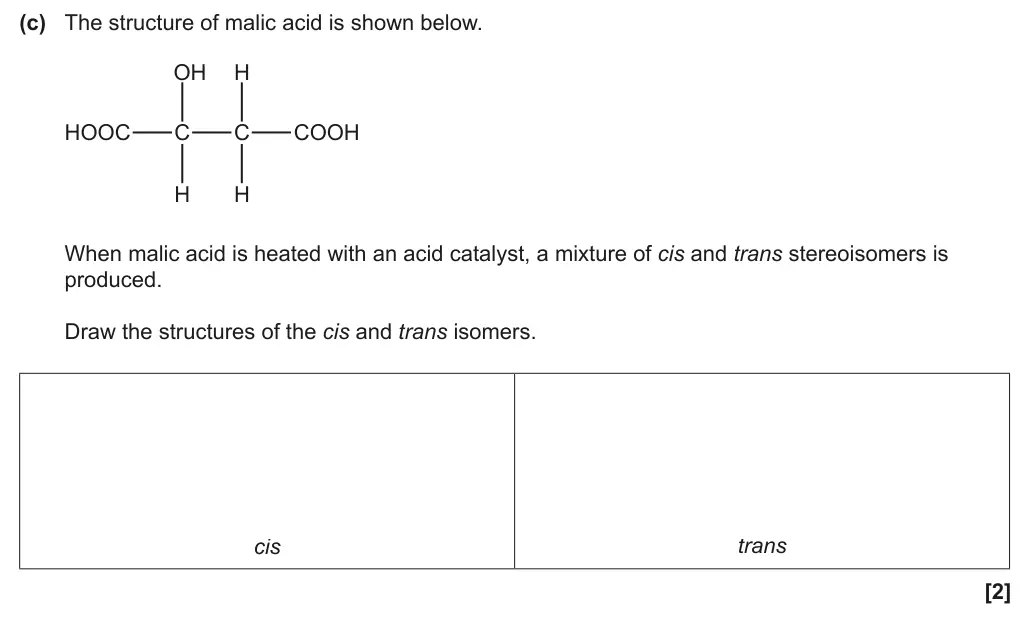
June 2025 · AS Paper 2 · Q3(c)2 marksStructure / isomerMedium
Earlier part of question 3 that this part uses
Mark scheme
Examiner's comment
Approximately half of the candidates did not score any marks for this question. Many left the OH group on the alkenes formed i.e. removed H2 rather than H2O. Some attempted to draw cis/trans isomers with structures with no C=C in them. Some drew any alkene, e.g. but-2-ene, to show cis/trans, but this was not given here. Common reasons for scoring 1 mark included the isomers being the wrong way round or poor connectivity to -COOH groups.
Notes from the mark scheme and report
dehydration gives HOOCCH=CHCOOH
one mark if both stereoisomers shown in wrong columns
DO NOT ALLOW incorrect connectivity to COOH (first occasion only)
Skills: M4.2 Visualise and represent 2-D and 3-D forms including 2-D representations of 3-D objects
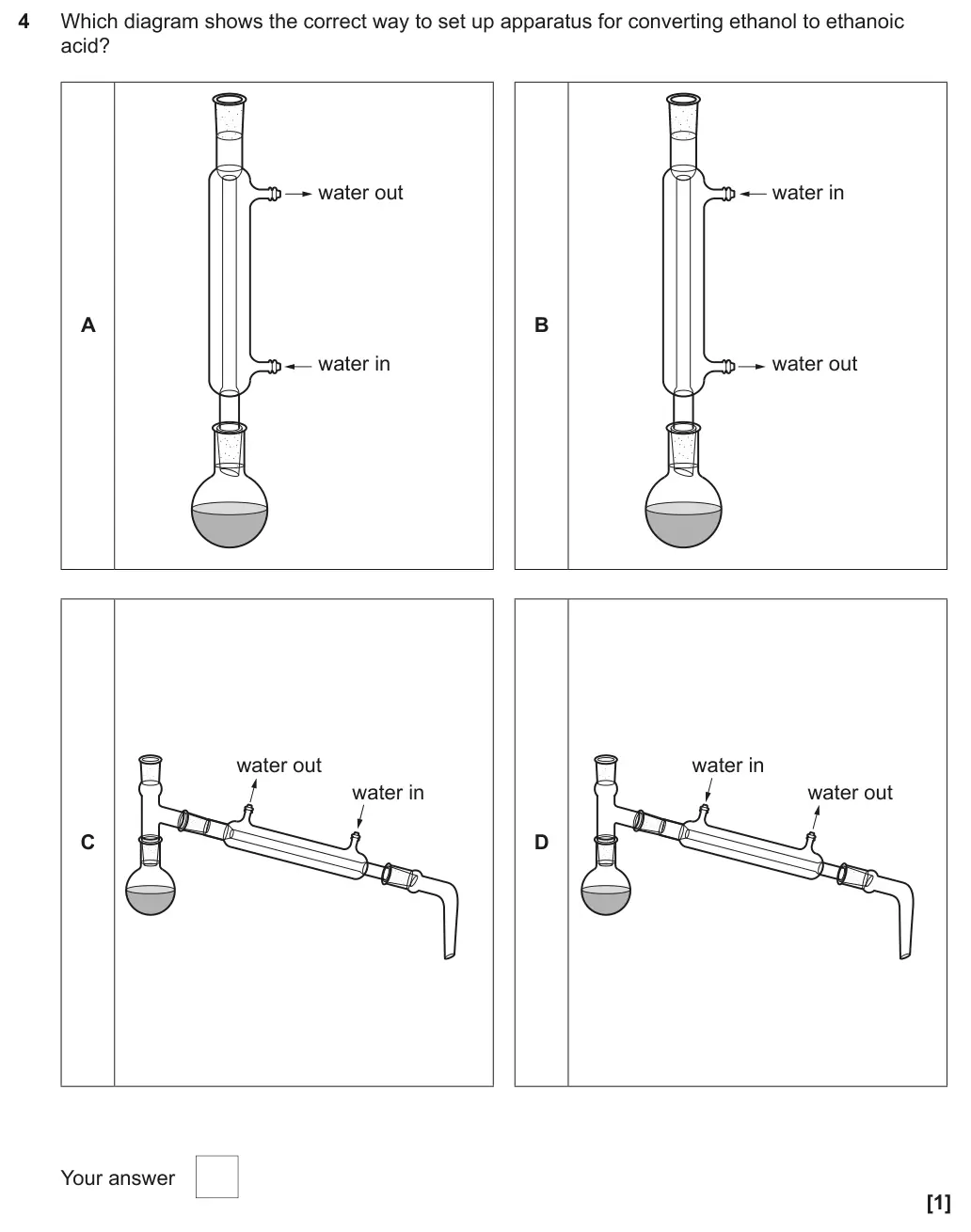
June 2025 · Paper 2 · Q41 markMultiple choiceMedium
Answer
A
Mark scheme
Examiner's comment
The majority of candidates were able to recognise that reflux should be used for this reaction and selected A with the correct water flow through the condenser. The most common incorrect response was C using distillation but a few selected B or D with the incorrect water flow.
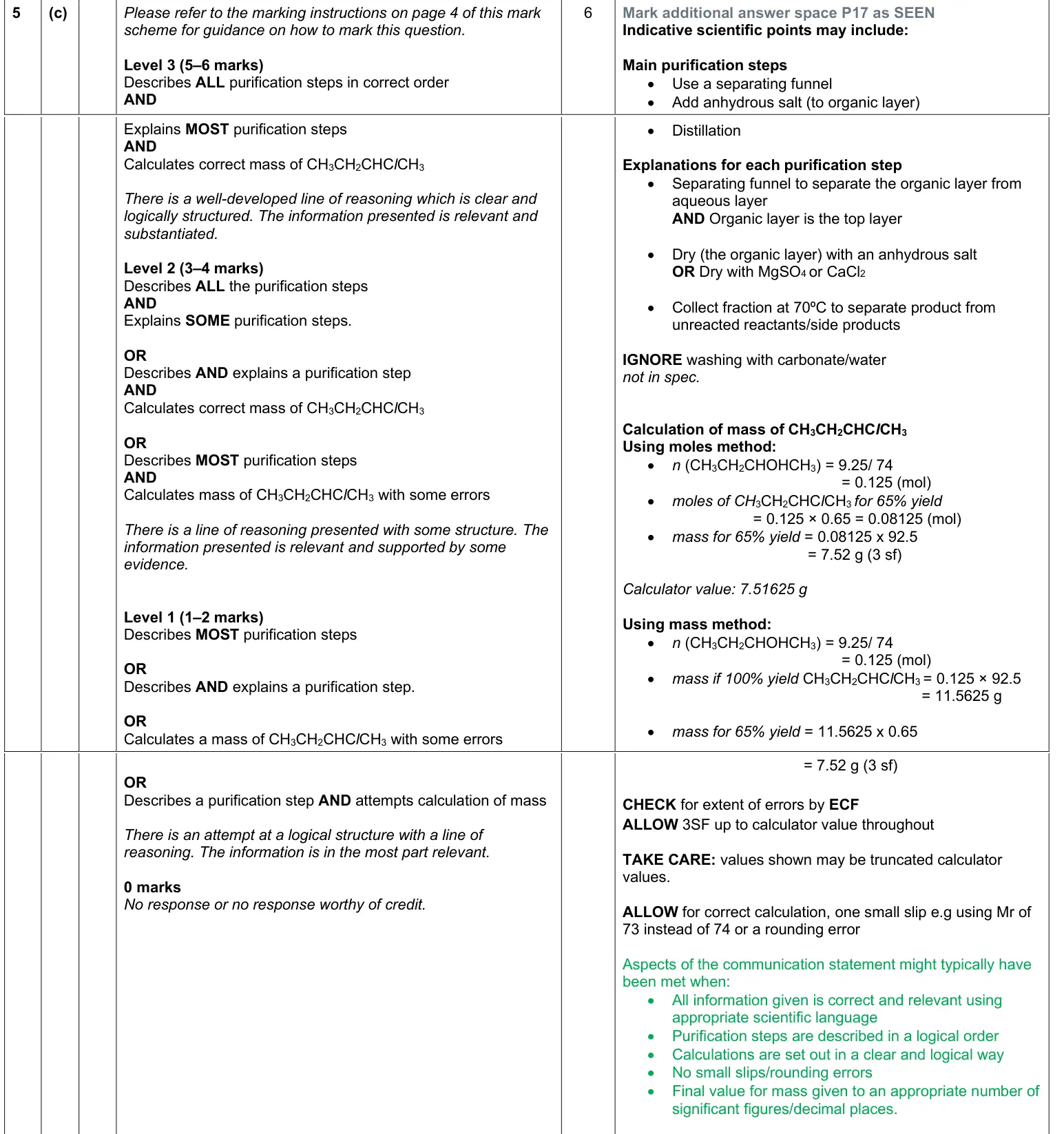
June 2025 · AS Paper 2 · Q5(c)6 marks6-mark level of responseMedium
Mark scheme, with the levels and indicative points
Examiner's comment
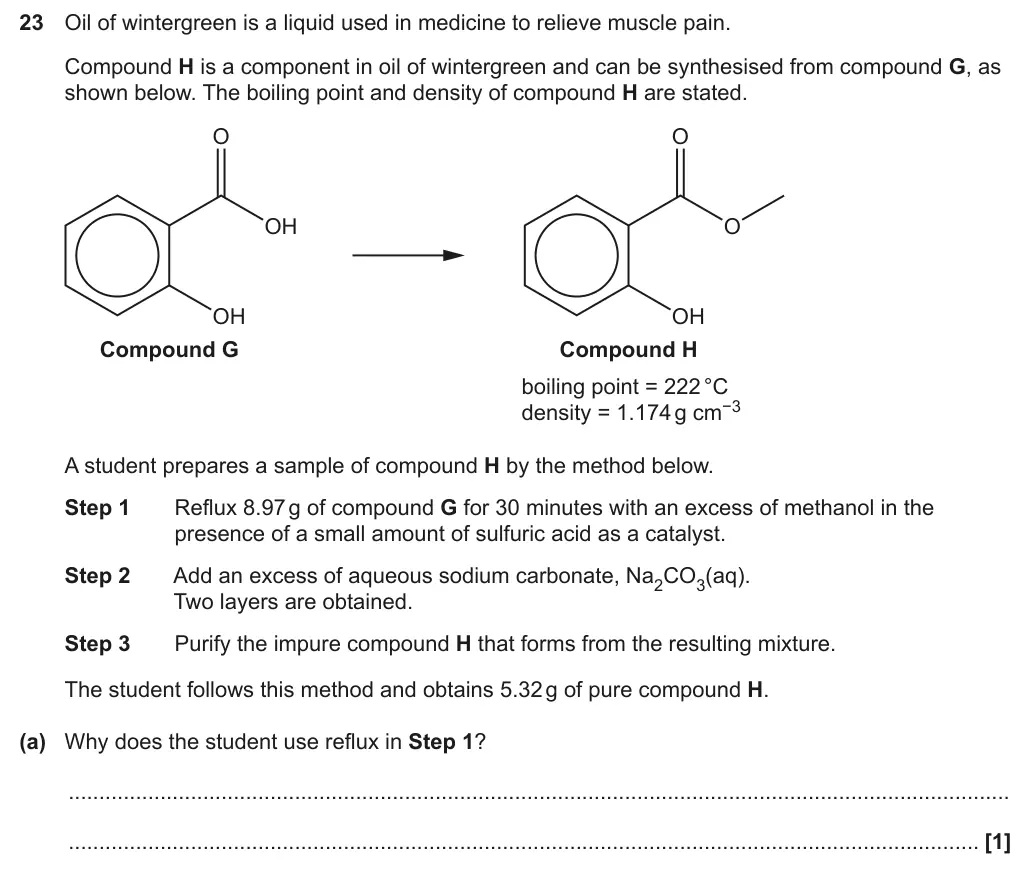
Many understood the necessary steps to purify a liquid and were confident with the calculation. Most knew at least one or two purification steps and could explain their purpose. Reasons marks were lost included: • Not remembering the correct name for equipment i.e. separating funnel • Getting the layers the wrong way round despite being given density information • Unclear which layer an anhydrous salt was added to for drying • Using an inappropriate salt for dry step, e.g. Na2CO3 or MgCO3 • Slips in calculations, e.g. incorrect Mr values, yield inverted or not accounted for • Thinking a solid would be formed • Describing reflux (including drawing apparatus) • Saying to distil at a specific boiling point but not stating the actual value (given in the question) As with all calculations, it is important to set out working clearly as it helps to avoid slips. Remind candi- dates of the importance of checking their Mr values – many made slips here. Candidates should also avoid rounding intermediate values and consider the number of significant figures used for the final re- sponse. Some rounded intermediate values to less than 3 significant figures but gave a final response to 4 or more. The response scored Level 3 and gained all 6 marks. All three purification steps are given in the correct order and explained. The calculation for mass is set out clearly and the final mass is given to 3 signifi- cant figures.
Notes from the mark scheme and report
separating funnel - organic layer is the top (less dense) layer
dry with anhydrous MgSO4/CaCl2
distil collecting fraction at 70 °C
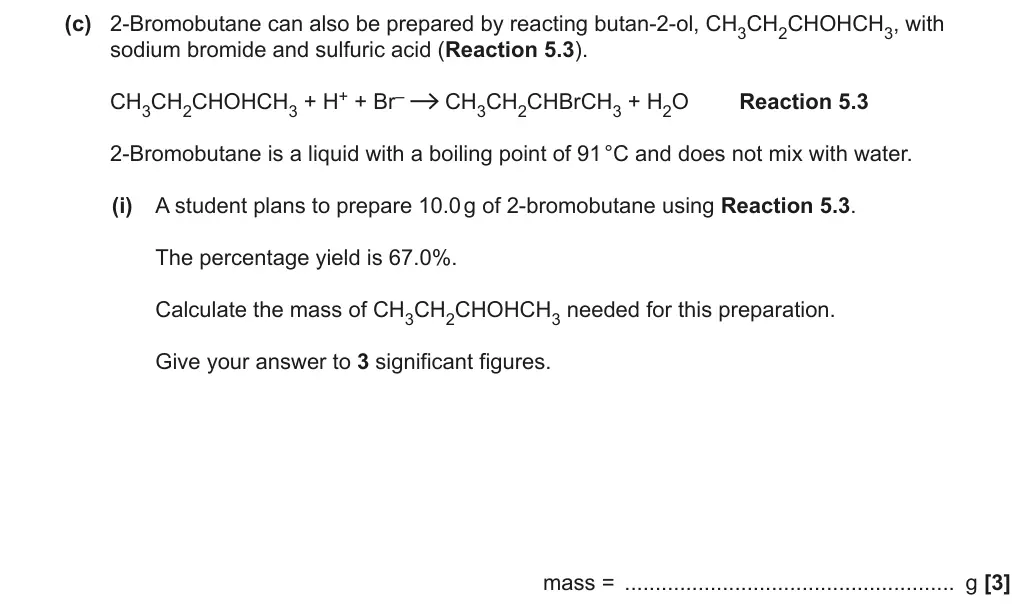
0.125 mol × 0.65 × 92.5 = 7.52 g
IGNORE washing with carbonate/water
ALLOW one small slip e.g. Mr 73
Skills: M0.2 Use ratios, fractions and percentages; M1.1 Use an appropriate number of significant figures; M2.3 Substitute numerical values into algebraic equations using appropriate units for physical quantities; PAG5 Synthesis of an organic liquid
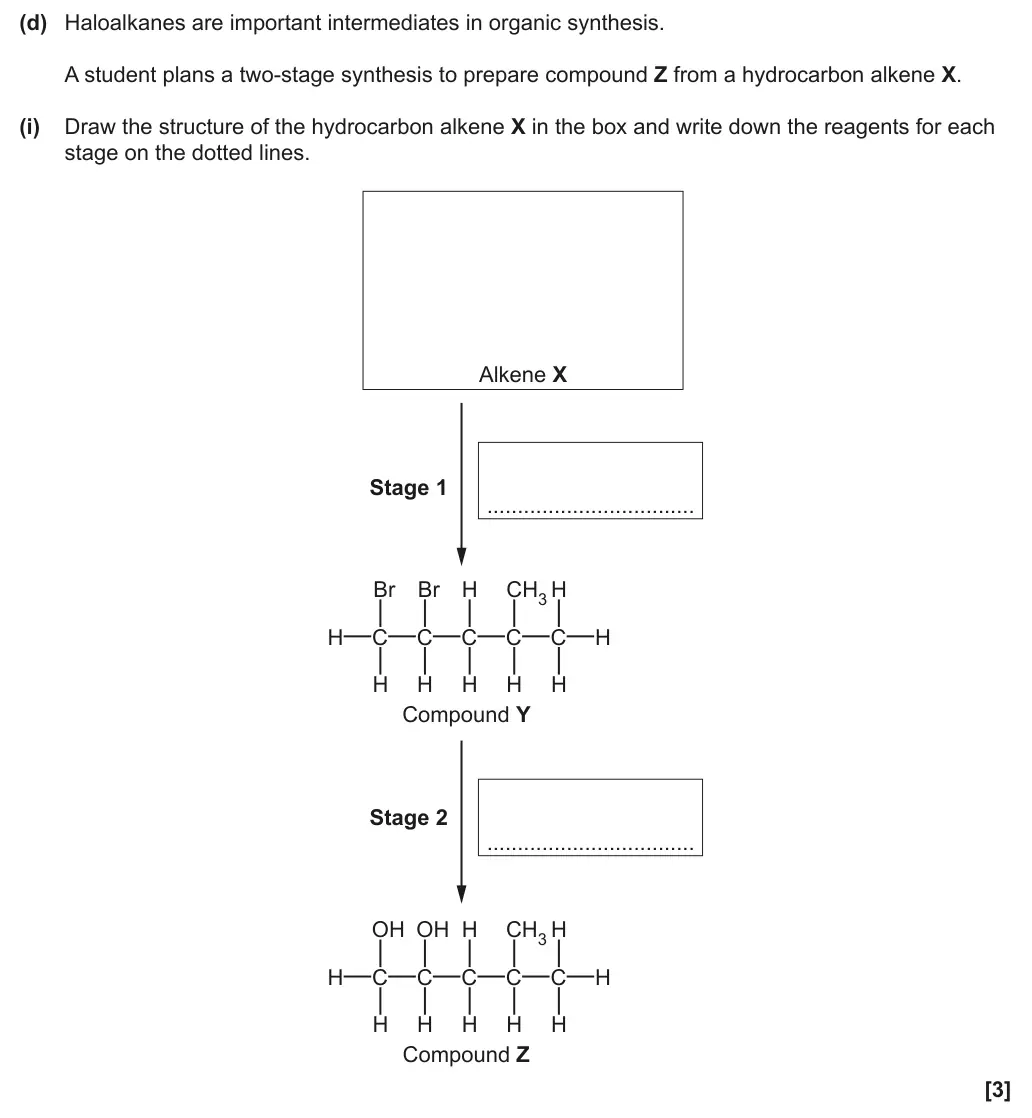
June 2025 · AS Paper 2 · Q5(d)(i)3 marksStructure / isomerMedium
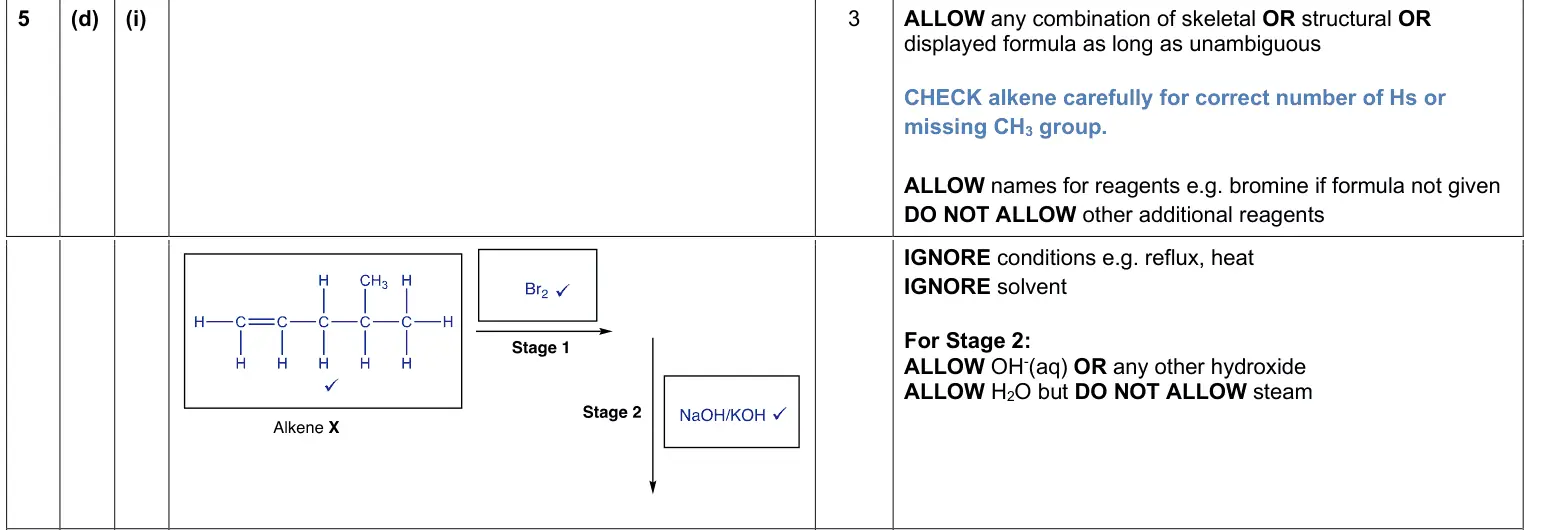
Mark scheme
Examiner's comment
Candidates need to be reminded to check structures carefully – common errors included additional H atoms around C=C or missing the -CH3 group. Some used -C4H9 rather than writing out the complete structure; unfortunately, this is ambiguous so didn’t score the mark. Lower-attaining candidates some- times gave an alkane rather than an alkene, reacting with Br2 in presence of UV. Many had the correct reagents but added additional incorrect reagents resulting in loss of the mark, e.g. the addition of H2SO4 as a catalyst alongside NaOH for stage 2.
Notes from the mark scheme and report
alkene X is 4-methylpent-1-ene (check number of H and CH3 branch)
Stage 1 Br2
Stage 2 NaOH/KOH(aq) (ALLOW H2O but DO NOT ALLOW steam)
DO NOT ALLOW additional reagents
IGNORE conditions and solvent
June 2025 · AS Paper 2 · Q6(b)(ii)2 marksShort answerMedium
Earlier parts of question 6 that this part uses
Mark scheme
Examiner's comment
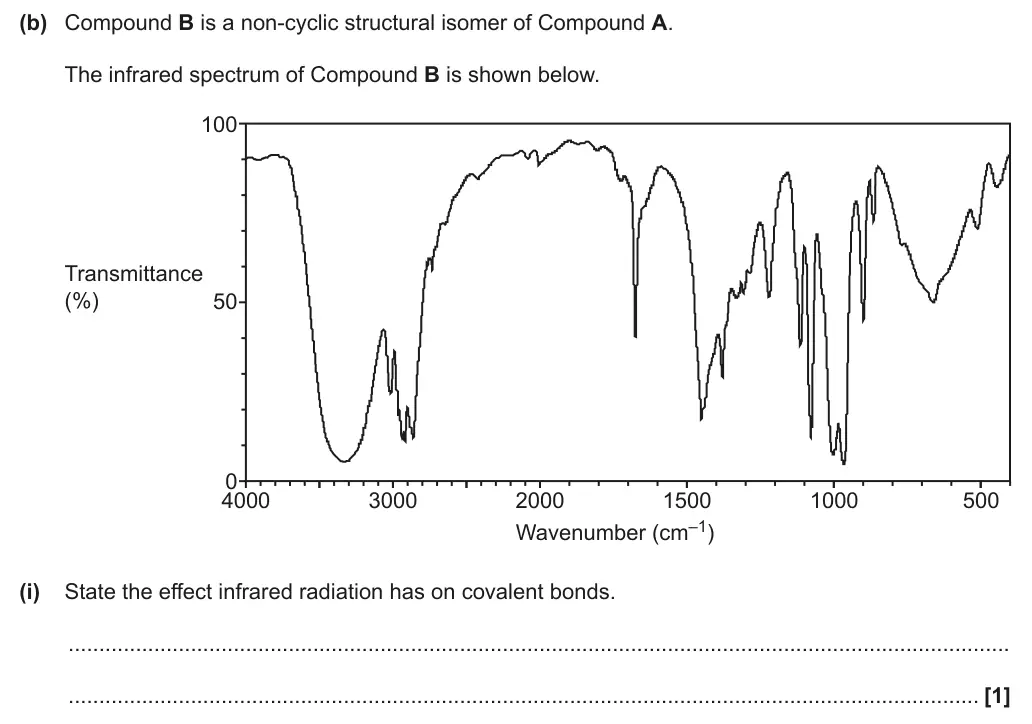
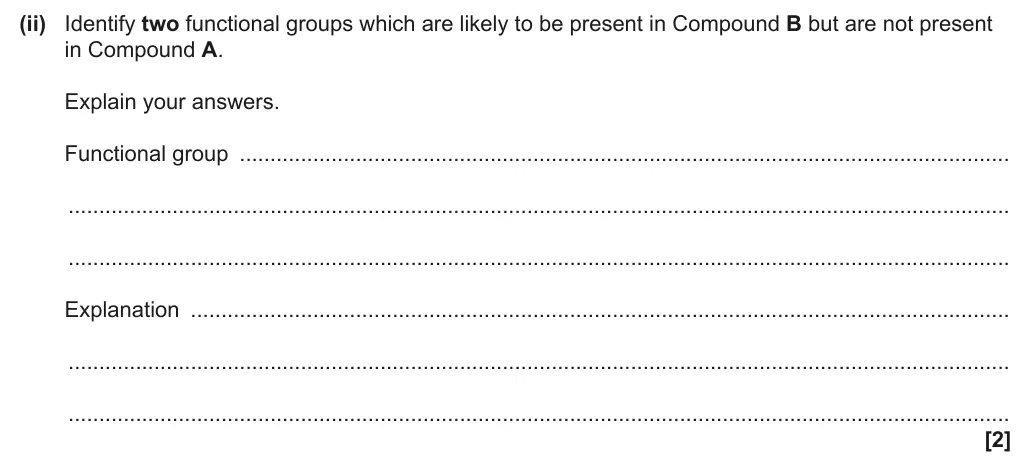
Candidates must take care to name functional groups rather than just bonds as O-H bonds are found in both carboxylic acids and alcohols, C=C are found in alkenes and arenes. Many candidates thought that there was a carboxylic acid present in B, not realising this would then have too many O atoms to be a structural isomer. Similarly, some identified a halogen. Candidates must be clear about the IR peaks identified ensuring they give precise values within the range identified on the data sheet. Many candidates still confuse O-H in a carboxylic acid, which gives a much broader peak that merges into the C-H stretch, and O-H in alcohol, still broad but distinct from C- H.
Notes from the mark scheme and report
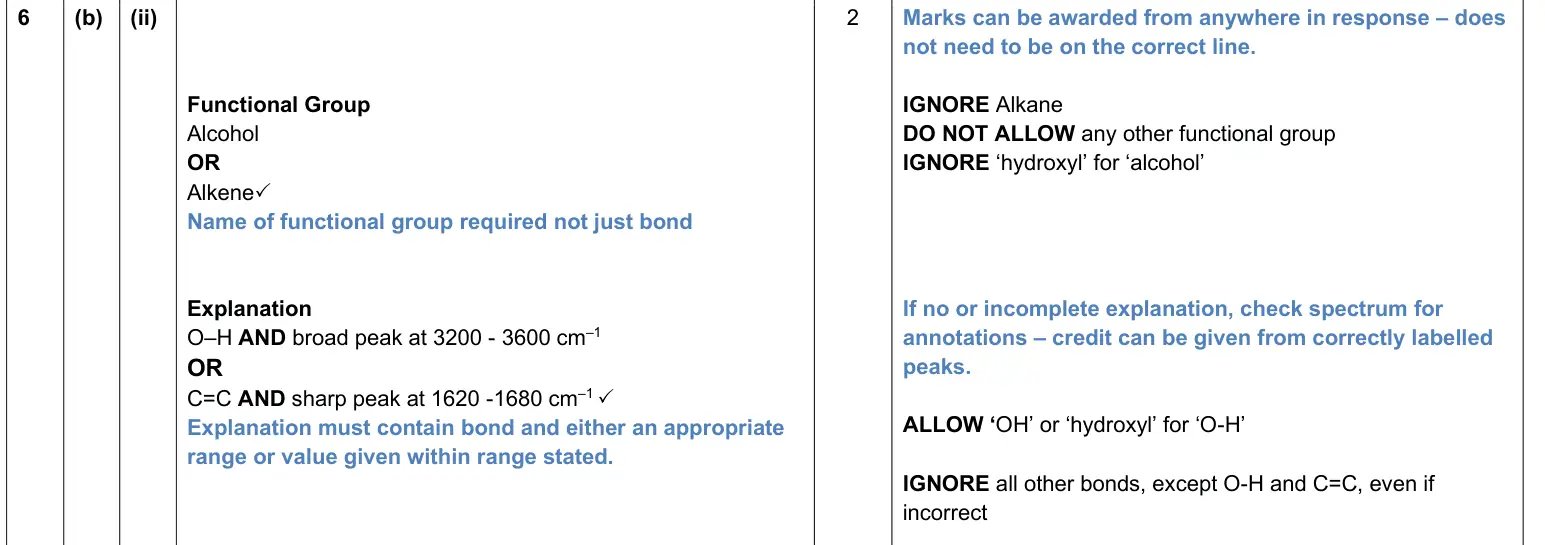
alcohol with O–H broad peak at 3200–3600
alkene with C=C peak at 1620–1680
name of functional group required not just the bond
explanation needs bond AND wavenumber range/value
IGNORE alkane
DO NOT ALLOW any other functional group
Candidates are often confused about how IR works. Our delivery guide for identifying un- knowns contains information on IR including how it works and the use of a simple spring model to help explain. There is also a link to a TES resource with a bank of real IR spectra which clearly shows difference between O-H in an alcohol and O-H in a carboxylic acid.
Skills: M3.1 Translate information between graphical, numerical and algebraic forms
June 2025 · Paper 2 · Q176 marks6-mark level of responseMedium
Mark scheme, with the levels and indicative points
Examiner's comment
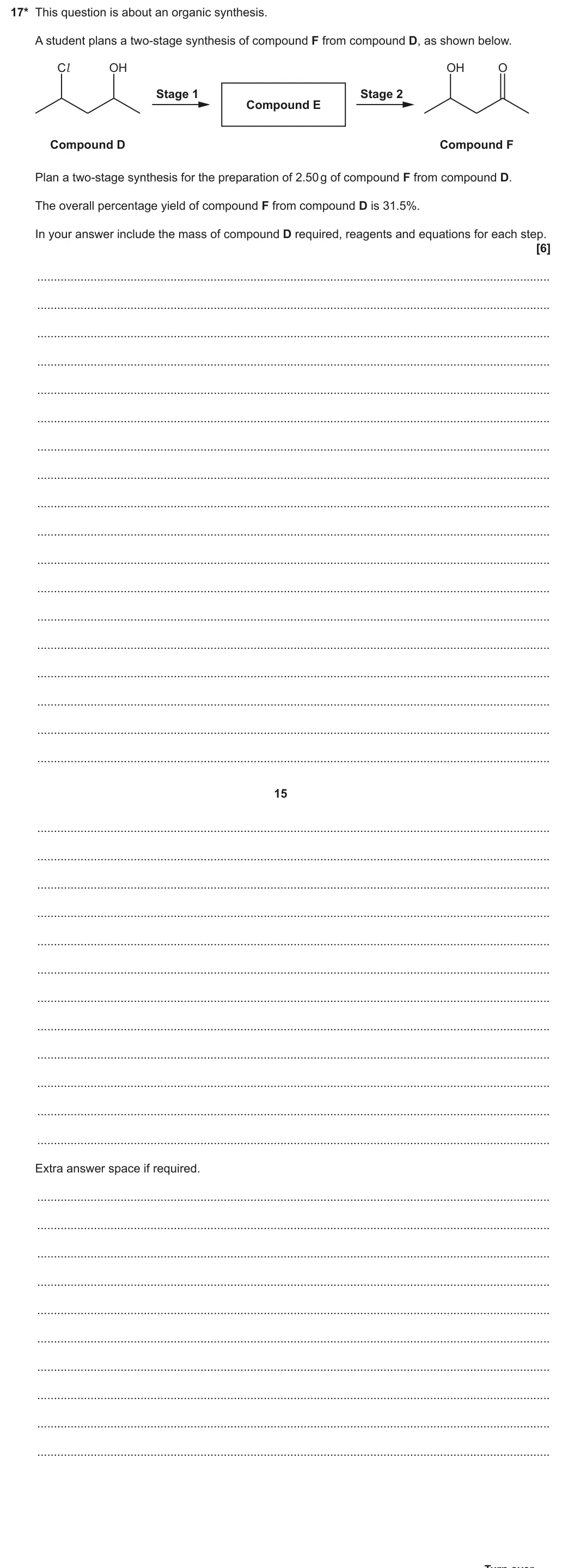
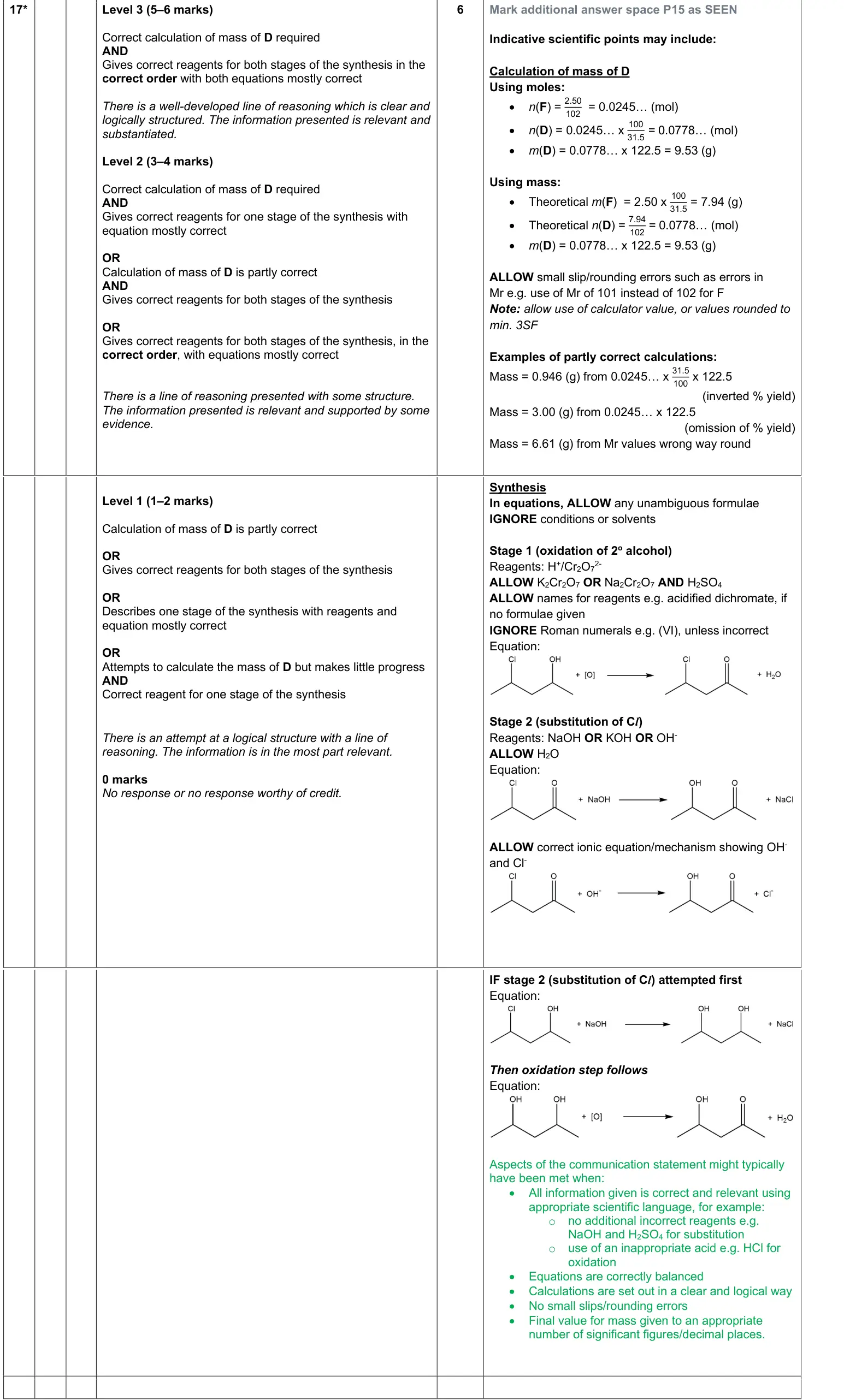
Generally, this question was well answered with most candidates achieving Level 3. Many candidates knew the correct reagents to use to carry out the two-stage synthesis. Some missed out on Level 3 as they had the steps in the wrong order. It was essential to carry out the oxidation prior to substitution otherwise both -OH groups would be oxidised. A significant number struggled with the calculation of the mass of compound D required. Many gave the answer as 7.94g so had only considered the yield, not the difference in molar mass of F compared to D. Other common errors seen in the calculation included errors in Mr values, missing or inverted percentage yield, as well as intermediate rounding of values to two significant figures. Level 2 could still be achieved without the calculation if they had the correct reagents in the correct order with equations mostly correct. To be mostly correct we required them to have at least one of the inorganic reactants or products given. Communication marks were lost if there were errors in reactants or products as well as balancing of equations. Students using skeletal structures generally made fewer mistakes with the balanced equation than those using structural formulae, where additional Hs were inserted alongside the ketone group i.e. CH3CHClCH2CHOCH3. Lower attaining students attempted to write the H+/K2Cr2O7 in the balanced equation and didn’t know to represent this with [O]. Other common errors in balancing the oxidation equation included missing H₂O or using 2[O]. A common error was to see H2SO4 as a ‘catalyst’ added with NaOH in the substitution reaction – this additional and unnecessary reagent lost candidates the communication mark. This response achieved Level 3 and all 6 marks. The calculation is laid out clearly showing both Mr values used in the calculation. Showing the values used in each step makes it much easier to spot where any errors may have been made if the correct value is not obtained. The reagents for each stage are given and the reactions are carried out in the correct order. The equations are given and are correctly balanced. This was an excellent response.
Notes from the mark scheme and report
m(D) = 9.53 g (0.946 g inverted yield, 3.00 g yield omitted are partly correct)
oxidation with H+/Cr2O7 2– using [O] then substitution of Cl with NaOH(aq)
IGNORE conditions
inappropriate acid (HCl) or extra reagents limit communication
Skills: M0.2 Use ratios, fractions and percentages; M1.1 Use an appropriate number of significant figures; M2.2 Change the subject of an equation; M2.3 Substitute numerical values into algebraic equations using appropriate units for physical quantities
June 2025 · Paper 2 · Q19(b)(ii)4 marksShort answerMedium
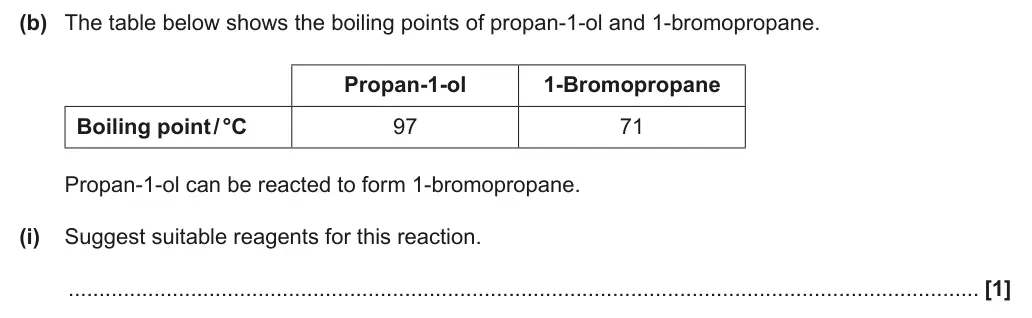
Earlier part of question 19 that this part uses
Mark scheme
Examiner's comment
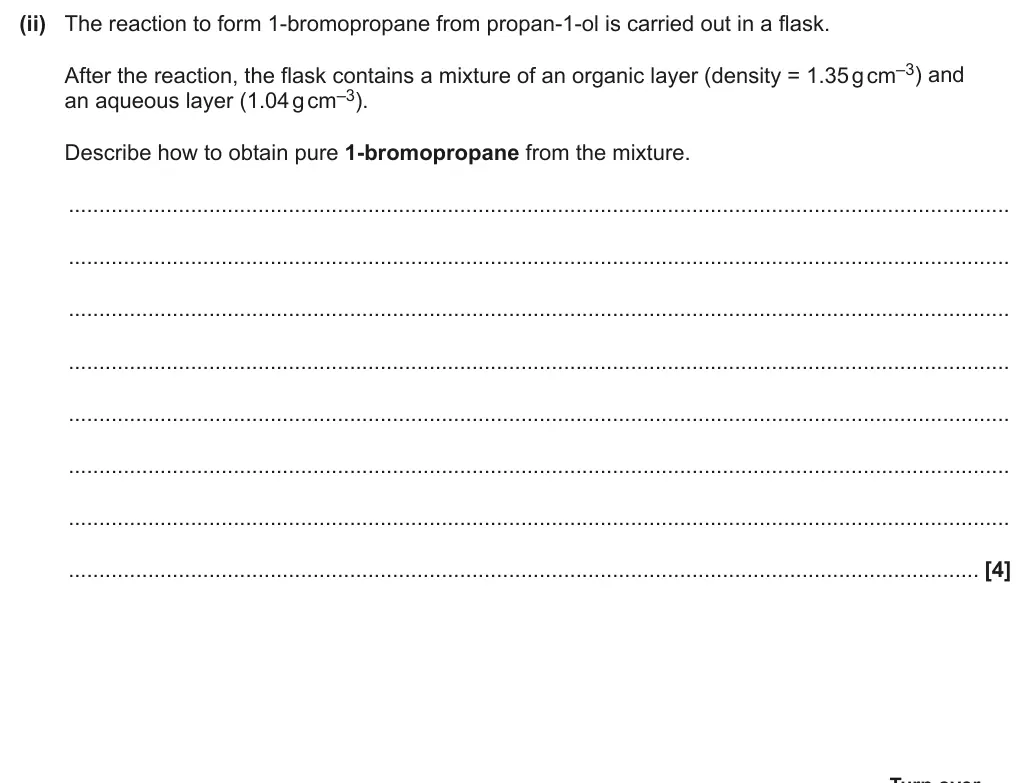
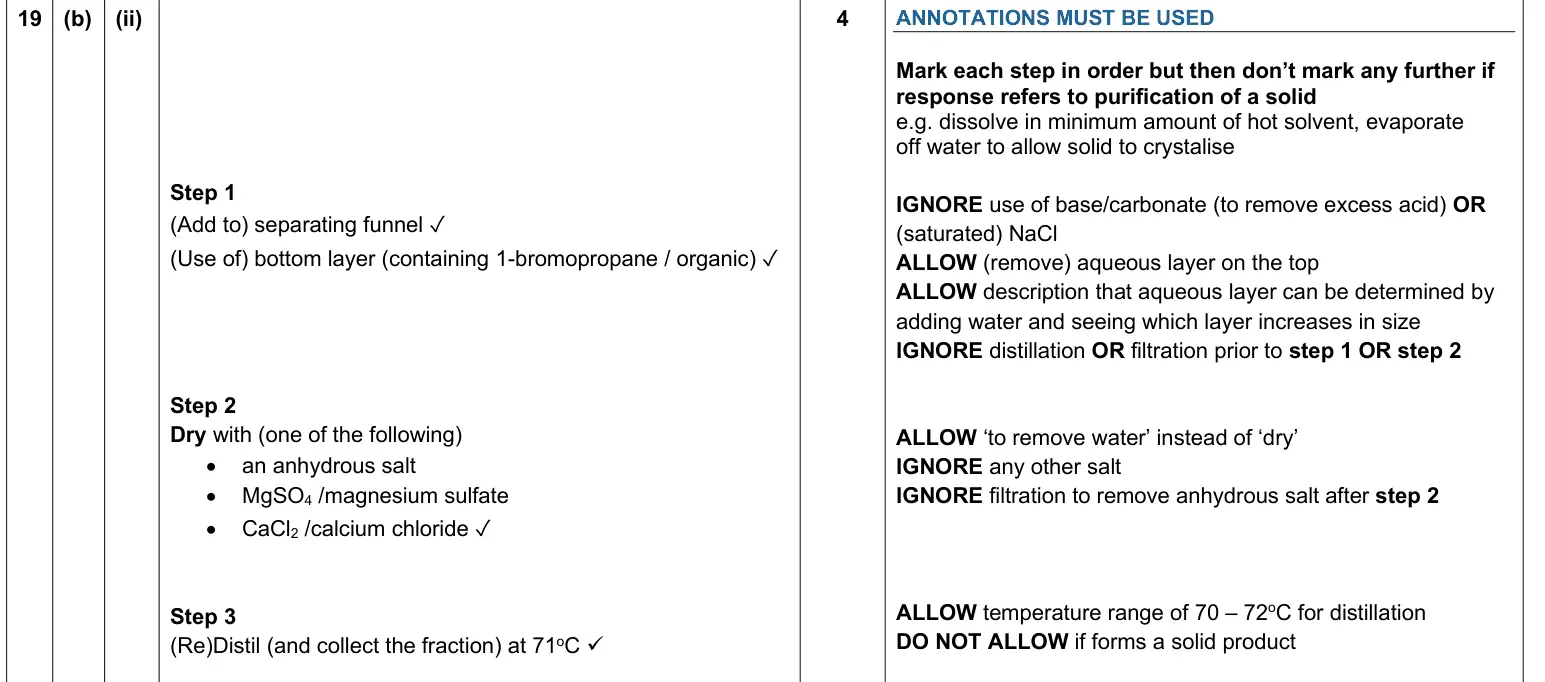
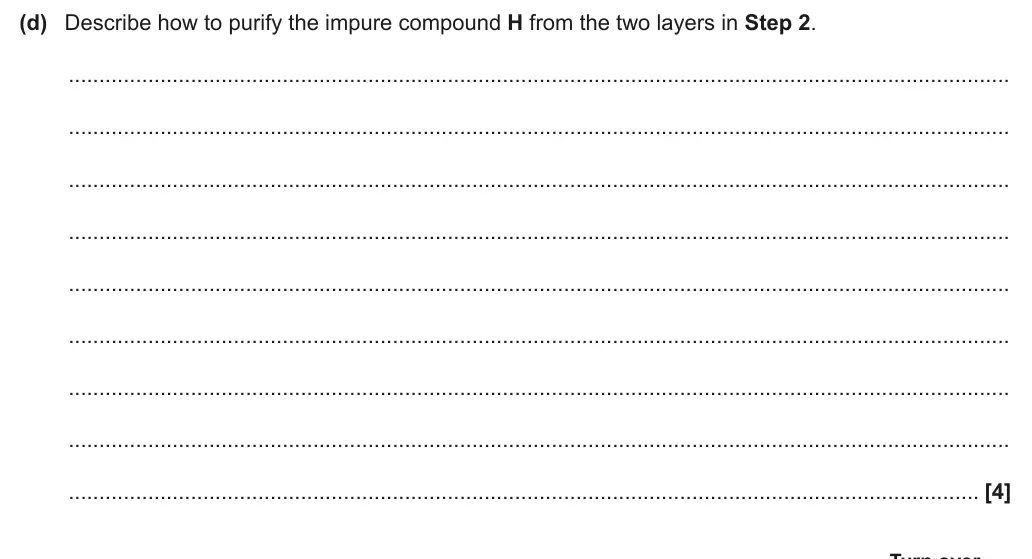
Candidates appeared better prepared for this type of question than in previous sessions, with a significant proportion achieving 3 or 4 marks. It differentiated well between candidates at different grades. Most candidates recognised the organic layer would be at the bottom but couldn’t always name the apparatus used to separate these two layers with incorrect responses including burettes, pear-shaped flasks, separating flasks and separating tubes. Some were confused about the density information, thinking that as the organic layer is denser it would be on top, or if adding more water it would then switch around the layers. Many gave the first step but not step 2 and 3. Lots of detail was given about how to use the separating funnel, e.g. invert to mix, vent to release pressure build up etc., to fill up the space provided. Most that went on to add an anhydrous salt were able to explain that it was used to dry the organic layer and were able to give a suitable example. Some candidates often misunderstood how to use them suggesting the anhydrous salt should be added to the separating funnel or the aqueous layer. Some candidates also suggested washing the layer with water or aqueous sodium carbonate to remove the acid once the organic layer had been dried. Many candidates either omitted the temperature to distil at to obtain pure 1-bromopropane or confused it with the boiling point of propan-1-ol (reactant) also given in the question. Some said to collect the distillate at its boiling point but didn’t quote the value that they had been given in the question so did not score the final mark. Many candidates introduced additional, unnecessary steps. Lower attaining candidates often confused the purification with that of an organic solid i.e. recrystallisation and scored 0 marks. A clear and concise response which scored all 4 marks.
Notes from the mark scheme and report
separating funnel
keep bottom (denser organic) layer
dry with anhydrous salt (MgSO4/CaCl2)
redistil collecting at 71 °C (70–72)
no further marks if purification of a solid described
We have produced a range of practice exam questions linked to the purification of an organic liquid (PAG5) which can be found on the Teach Cambridge website.
This video produced by MaChemGuy is helpful for reviewing PAG 5: PRACTICAL SKILLS - PAG 5 - SYNTHESIS OF AN ORGANIC LIQUID.
Skills: PAG5 Synthesis of an organic liquid
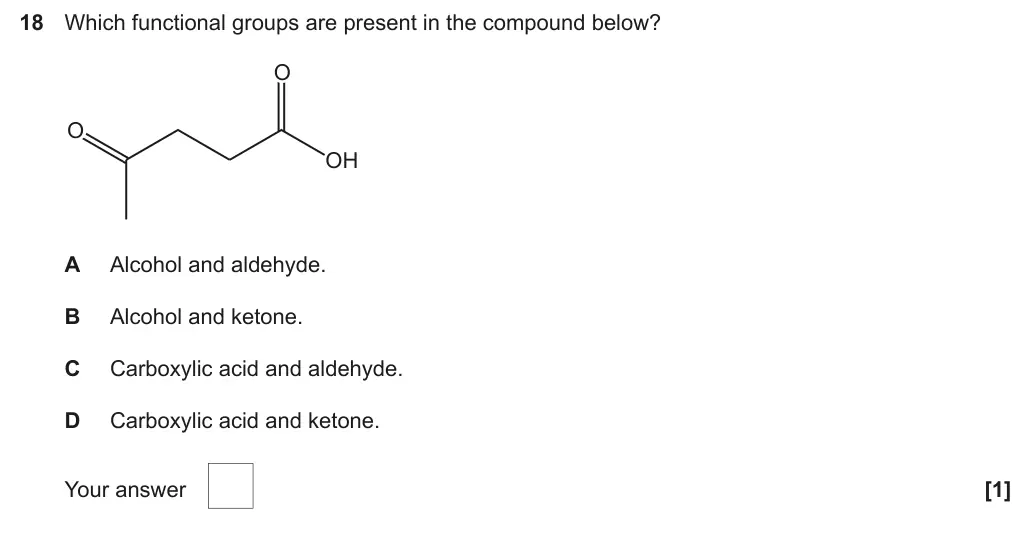
June 2024 · AS Paper 1 · Q181 markMultiple choiceHard
Answer
D
Mark scheme
Examiner's comment
Many candidates wrote the functional groups on the structure shown on their scripts, which reflects good exam technique. Most correctly identified that the compound contains ketone and carboxylic acid functional groups (D). This was an excellent discriminator.
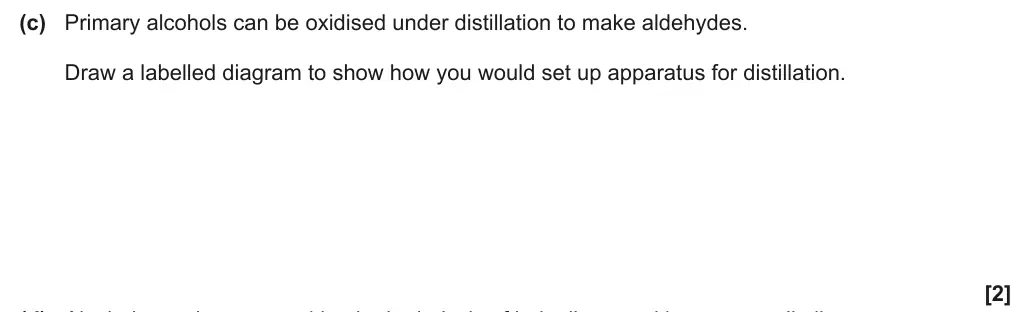
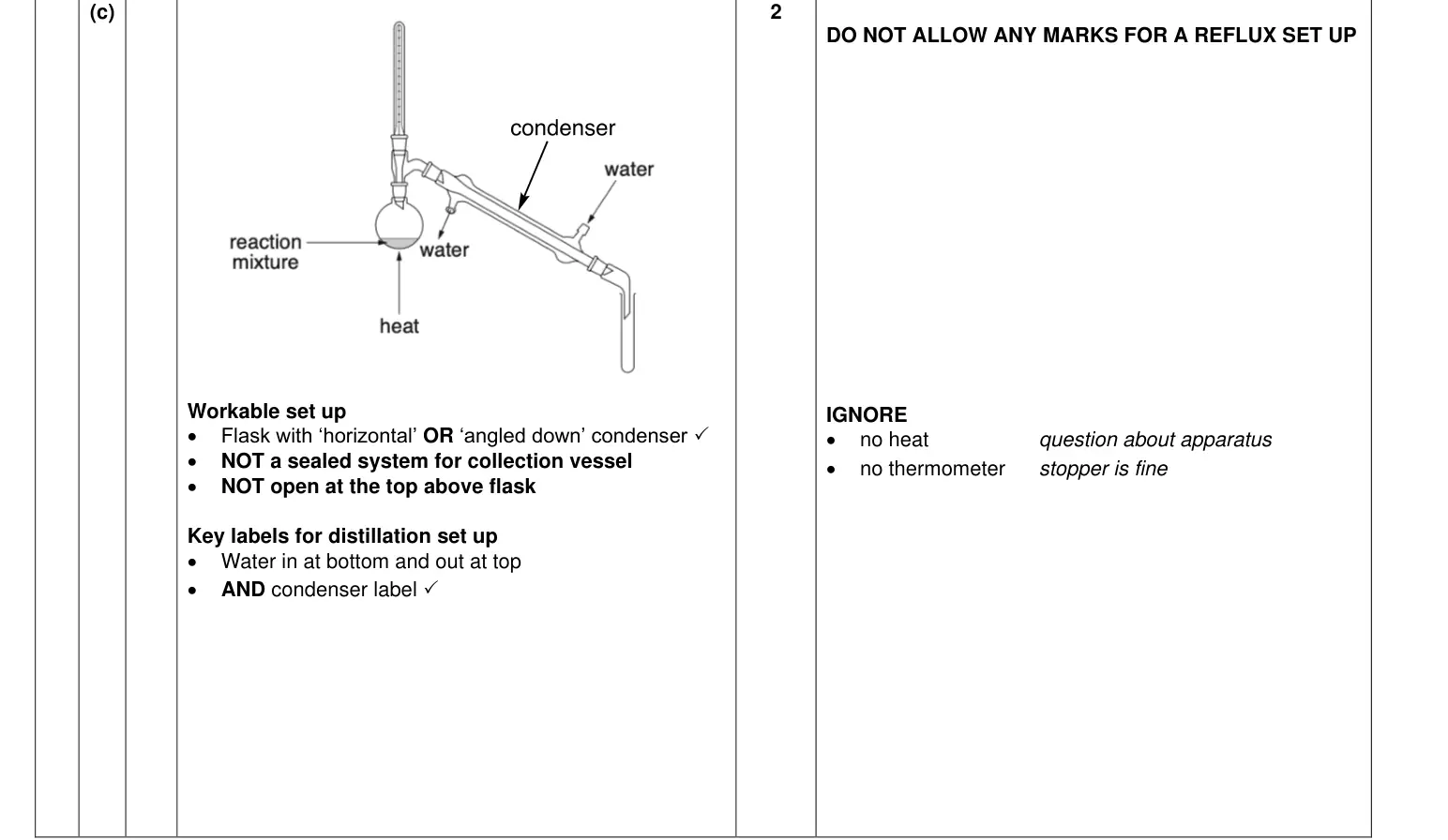
June 2024 · AS Paper 1 · Q25(c)2 marksDrawing / labellingHard
Mark scheme
Examiner's comment
The presentation of many candidates’ diagrams in questions such as this one requires improvement. The mark scheme was generous, requiring to first see that a candidate knew what distillation is. A first mark was given for a set up comprising a flask connected to a roughly horizontal condenser. There had to be no gap above the condenser and the overall set up could not be a closed system. A second mark was given for minimal labels: condenser and correct direction of water flow. Nearly half the candidates received no marks for their diagram with only just over a quarter being given both marks. Typical errors included: • a reflux set up • open above the flask • a closed system • water flowing the wrong way • the condenser labelled as condensation tube, cooling tube, cooling funnel, distiller, etc. Less successful responses showed a conical flask, beaker or test tube being heated. The best advice is to spend some time instructing students how to draw diagrams and to label the apparatus using the accepted scientific names. Students increasingly appear to be finding these questions challenging.
Notes from the mark scheme and report
DO NOT ALLOW any marks for a reflux set up
condenser horizontal or angled down
not a sealed system
water in at bottom and out at top
IGNORE no heat or thermometer
Practise the drawing of common organic apparatus as part of the practical work carried out for the practical endorsement.
Skills: PAG5 Synthesis of an organic liquid
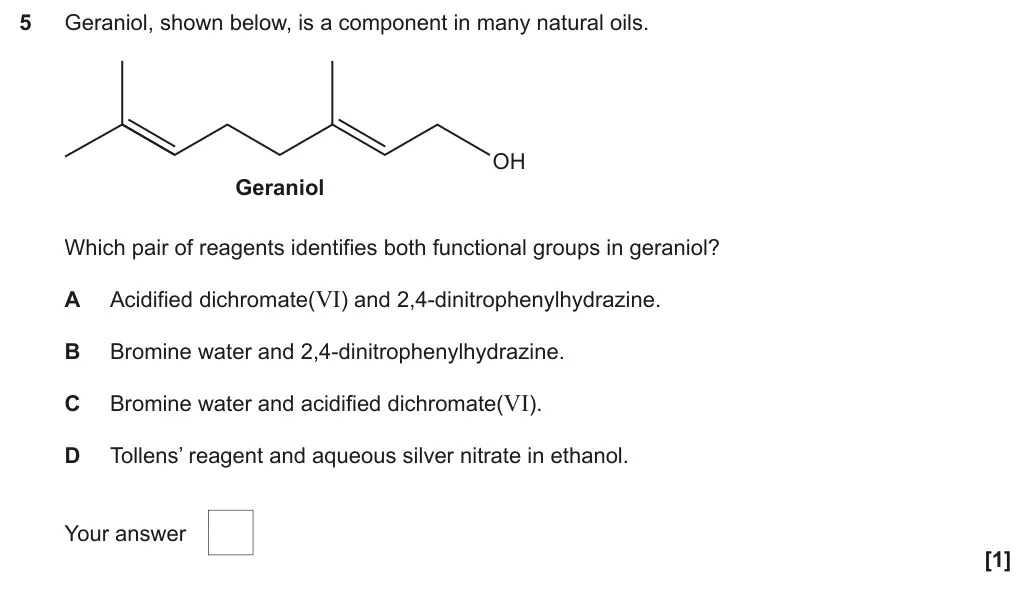
June 2024 · Paper 2 · Q51 markMultiple choiceMedium
Answer
C
Mark scheme
Examiner's comment
The majority of candidates were able to correctly identify the two functional groups and the correct corresponding test i.e. alkene using bromine water and primary alcohol using 2,4-dinitrophenylhydrazine. The most common incorrect response was B.
Notes from the mark scheme and report
alkene (bromine water) and primary alcohol (acidified dichromate)
Skills: PAG7 Qualitative analysis of organic functional groups
June 2024 · Paper 2 · Q23(d)4 marksShort answerHard
Earlier part of question 23 that this part uses
Mark scheme
Examiner's comment
Many candidates identified the need to describe the isolation and purification of a liquid in response to this question. Some struggled to remember the name of the apparatus required i.e. ‘separating funnel’ but could describe the separation of layers. The best responses used the density data provided to explain that the lower layer would contain compound H. A few gained a mark for a description of the addition of water to identify the correct layer to discard. In generally, candidates only have experience of the organic layer being less dense in their practical work which was reflected in their responses. The use of an anhydrous salt to dry the organic layer was well-known, but many candidates gave vague answers such as ‘add anhydrous salt’ failing to justify why the salt was needed. Many recognised the need to purify the resultant liquid by distillation, but not all linked to the boiling point of compound H to secure this final mark. Some who didn’t dry with an anhydrous salt said to heat to 100oC to remove water. Approximately a third of candidates gained no marks here. Candidates thought that compound H would form crystals so described recrystallisation rather than a method to purify an organic liquid. Other responses attempted to merge both methods together. This candidate scored 1 mark for this response for the use of a ‘separating funnel’. They have attempted to use the density information but have incorrectly identified that the density of H as being low which would make it the top layer. Candidates needed to know that the density of water is 1 g cm-3 to be able to make a correct comparison. There is no addition of an anhydrous salt to dry the organic layer. They have recognised the need to distil but have not given the correct temperature at which to collect the pure compound. However, if they had given the boiling point for distillation no mark would have been given as they would lose this final mark for describing the purification of a solid. It was very common to see responses which described the purification of a solid, often in addition to that of a liquid.
Notes from the mark scheme and report
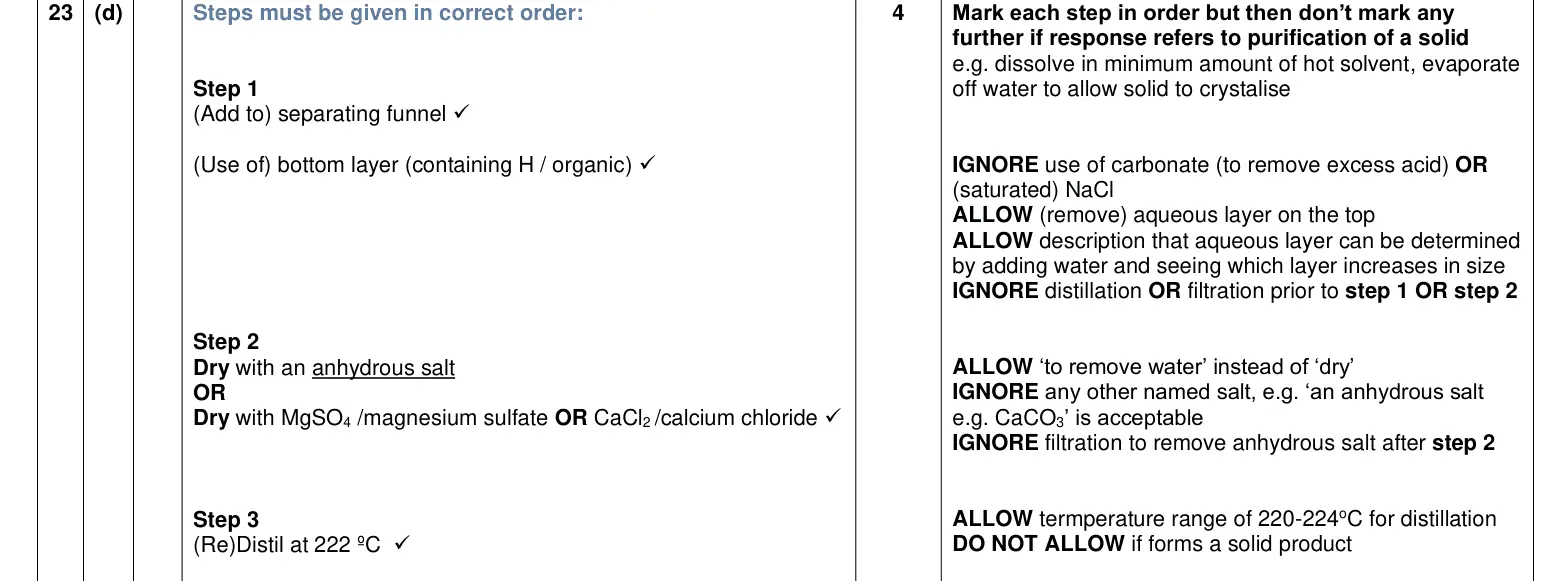
steps in order: separating funnel
keep the bottom (organic, denser) layer
dry with anhydrous MgSO4/CaCl2
redistil at 222 °C
no further credit if the method treats H as a solid (recrystallisation)
The method to purify an organic liquid was poorly understood by many candidates. Many of the candidates answered this question using techniques to purify an organic solid which is covered in the second year of A Level, rather than an organic liquid which is covered in the first year. It is important to spend time comparing both methods and helping candidates identify when each method is required.
OCR have produced a range of practice exam questions linked to the purification of an organic liquid (PAG5). These can be found on Teach Cambridge.
Skills: PAG5 Synthesis of an organic liquid
June 2023 · AS Paper 1 · Q181 markAO2Multiple choiceHard
Answer
D
Mark scheme
Examiner's comment
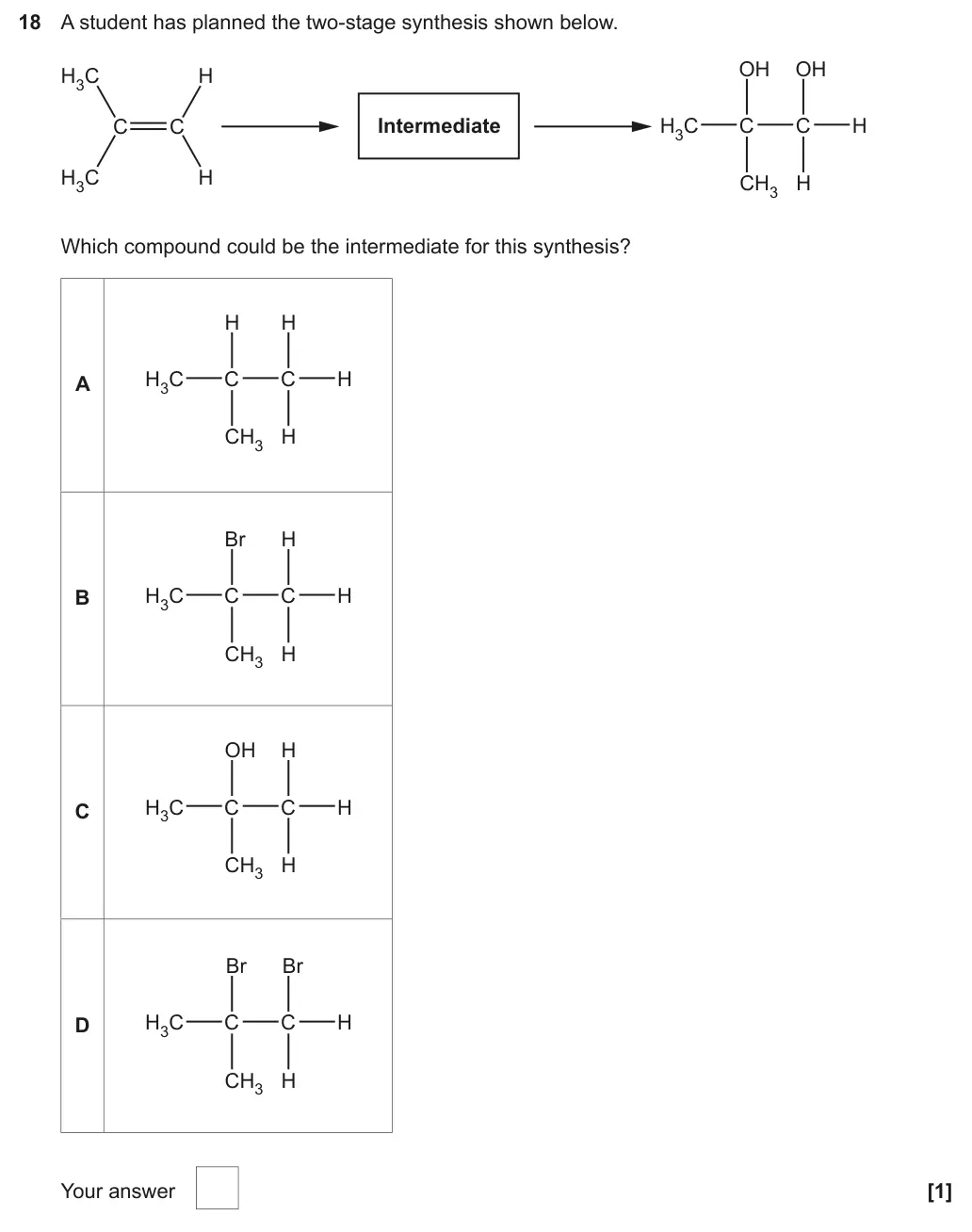
Candidates find it difficult to identify an intermediate within a synthesis and less than half selected the correct option, D.
June 2023 · Paper 3 · Q5(b)(i)2 marksAO3Drawing / labellingMedium
Earlier part of question 5 that this part uses
Mark scheme
Examiner's comment
Most candidates drew a diagram that looked like a vertical condenser above a flask. The quality of the diagrams was not very good. Candidates then needed to label their diagram. Errors included a bung or thermometer inserted at the top of the condenser and water flowing the wrong way in the condenser. For labelling, candidates were expected to use scientific terminology. Responses such as ‘condensation tube’ and vague terms such as ‘flask’ were not credited. These labels were often omitted. A significant number drew a set up for distillation instead of reflux.
Notes from the mark scheme and report
flask AND upright condenser AND open at top
labels pear-shaped/round-bottom flask, condenser, water in at bottom and out at top
DO NOT ALLOW conical/volumetric flask, thermometer or sealed system
heat not required
Skills: PAG5 Synthesis of an organic liquid
June 2022 · AS Paper 2 · Q1(d)2 marksAO2Equation writingMedium
Mark scheme
Examiner's comment
Despite oxidation of alcohols being a topic that has been assessed many times, candidates found this question very tricky with a majority failing to score any marks. Candidates needed to correctly identify this as a secondary alcohol which, when oxidised, will become a ketone. A wide range of errors were seen, including the following: Other errors included forming C=C or removing COOH. Approximately half of those that got the correct structure were also able to balance the equation gaining both marks. Some forgot that another product was formed or gave H2 instead. Candidates were given the structure and told to use [O] to represent the oxidising agent. However, some attempted to use structural or molecular formula and/or adding in dichromate to their answers.
Notes from the mark scheme and report
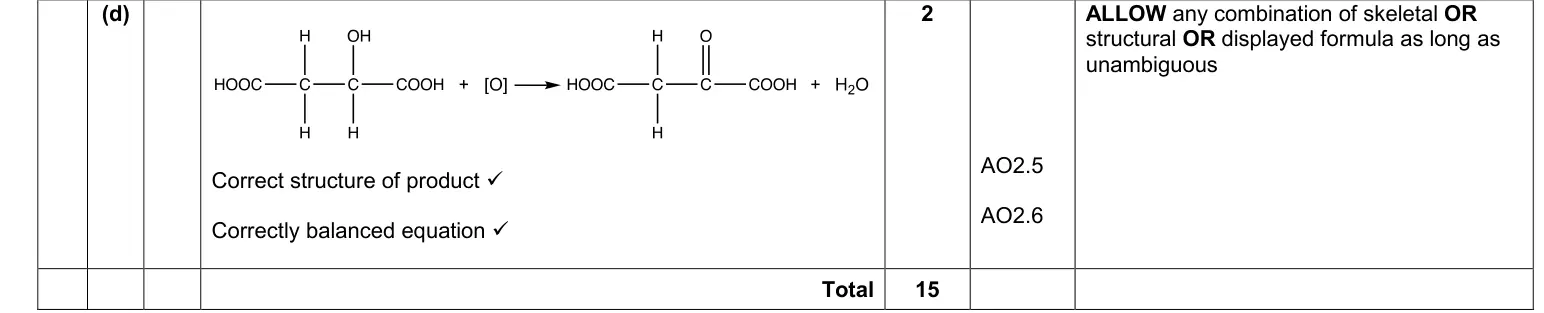
secondary alcohol group oxidised to ketone HOOCCH2COCOOH
COOH groups unchanged
June 2022 · AS Paper 2 · Q5(c)(ii)3 marksAO3Short answerMedium
Earlier part of question 5 that this part uses
Mark scheme
Examiner's comment
This question was not answered well with over half the candidates failing to score any marks. While some candidates seemed familiar with the techniques required, describing the process to separate the layers, they often struggled to name the separating funnel. Common approaches were to attempt to ‘filter’ the layers or to use heat (via evaporation or distillation) to drive off the water. Some attempted to use Na2CO3 or NaOH to dry the organic layer – perhaps confusing neutralisation of any remaining acid. Although distillation appeared frequently many did not give the temperature so did not gain marks. The order of the procedure was also not always clear with distillation before using a drying agent. Some described attempts to crystallise the organic layer. The range of answers suggests students may need more practical experience with separating organic liquids.
Notes from the mark scheme and report
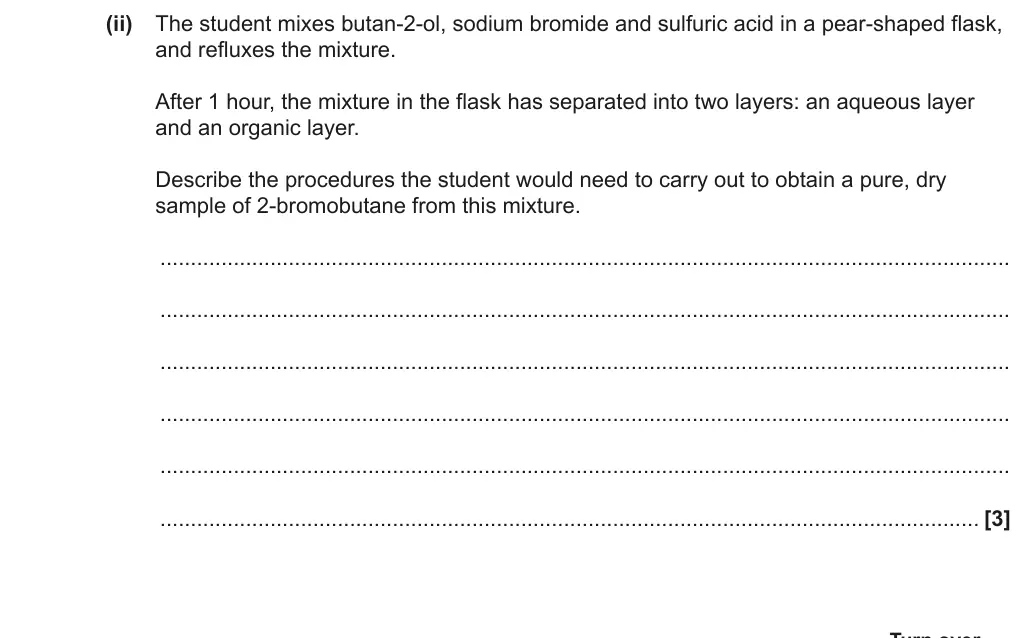
separating funnel to separate layers
dry organic layer with anhydrous salt (MgSO4, CaCl2)
distil and collect fraction at 91 °C
Skills: PAG5 Synthesis of an organic liquid
June 2022 · Paper 3 · Q3(a)6 marksAO2, 36-mark level of responseMedium
Mark scheme, with the levels and indicative points
Examiner's comment
Showed limited knowledge and understanding of practical scenarios and drawing labelled diagrams of apparatus, e.g. • Question 3 (a): Diagram of reflux • Question 3 (a): Purification of an organic liquid There was no evidence that any time constraints had led to a candidate underperforming or of scripts where there were no responses to many questions.
Notes from the mark scheme and report
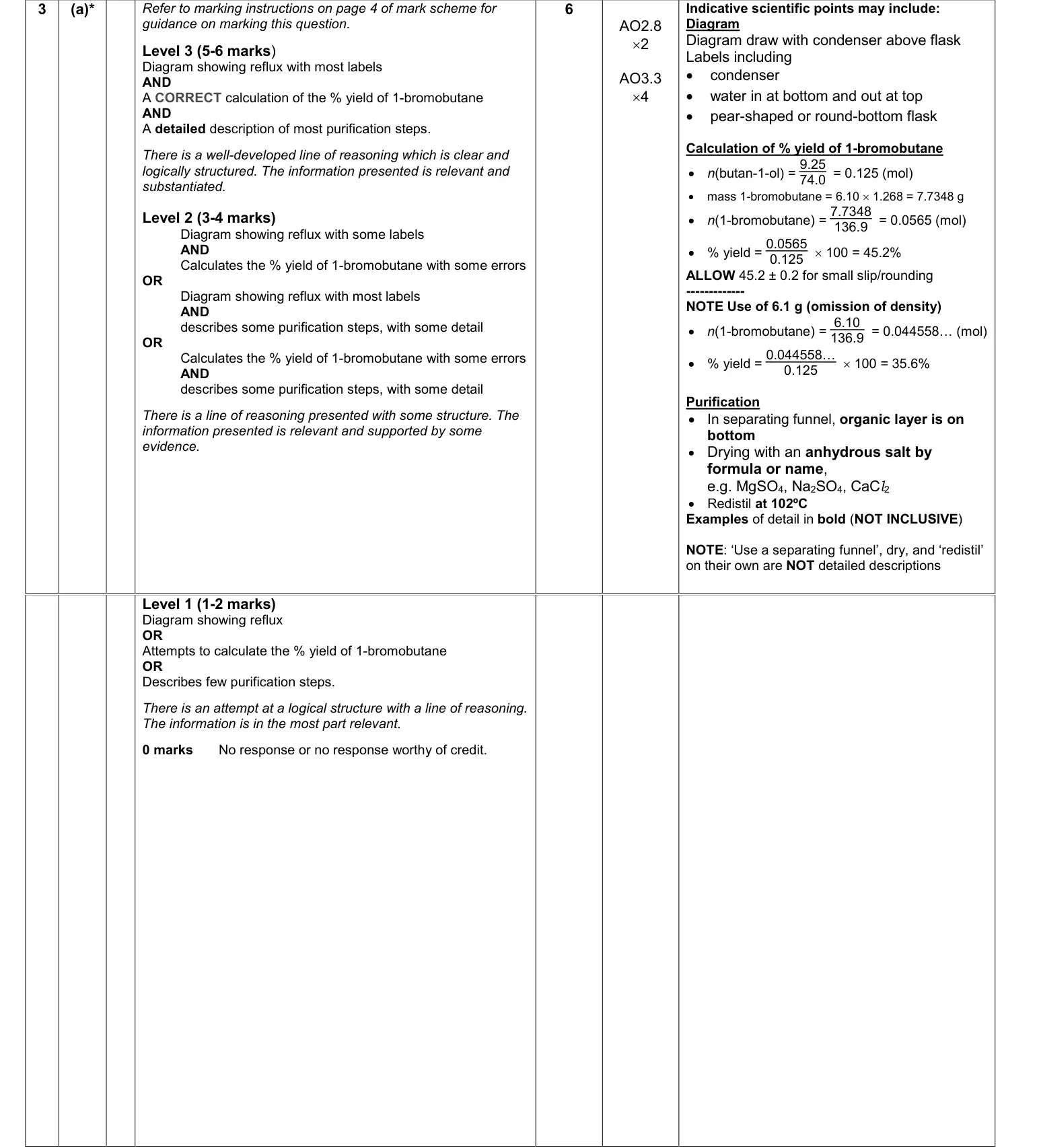
reflux diagram: condenser above flask, water in at bottom and out at top
mass = 6.10 × 1.268 = 7.73 g, yield 45.2% (35.6% if density omitted)
separating funnel - organic layer is the BOTTOM layer (denser), dry with named anhydrous salt, redistil at 102 °C
bare 'separate, dry, redistil' not detailed
Skills: M0.0 Recognise and make use of appropriate units in calculations; M0.2 Use ratios, fractions and percentages; M2.3 Substitute numerical values into algebraic equations using appropriate units for physical quantities; PAG5 Synthesis of an organic liquid
November 2021 · AS Paper 1 · Q24(c)(ii)2 marksAO3Drawing / labelling
Earlier part of question 24 that this part uses
Mark scheme
Notes from the mark scheme and report
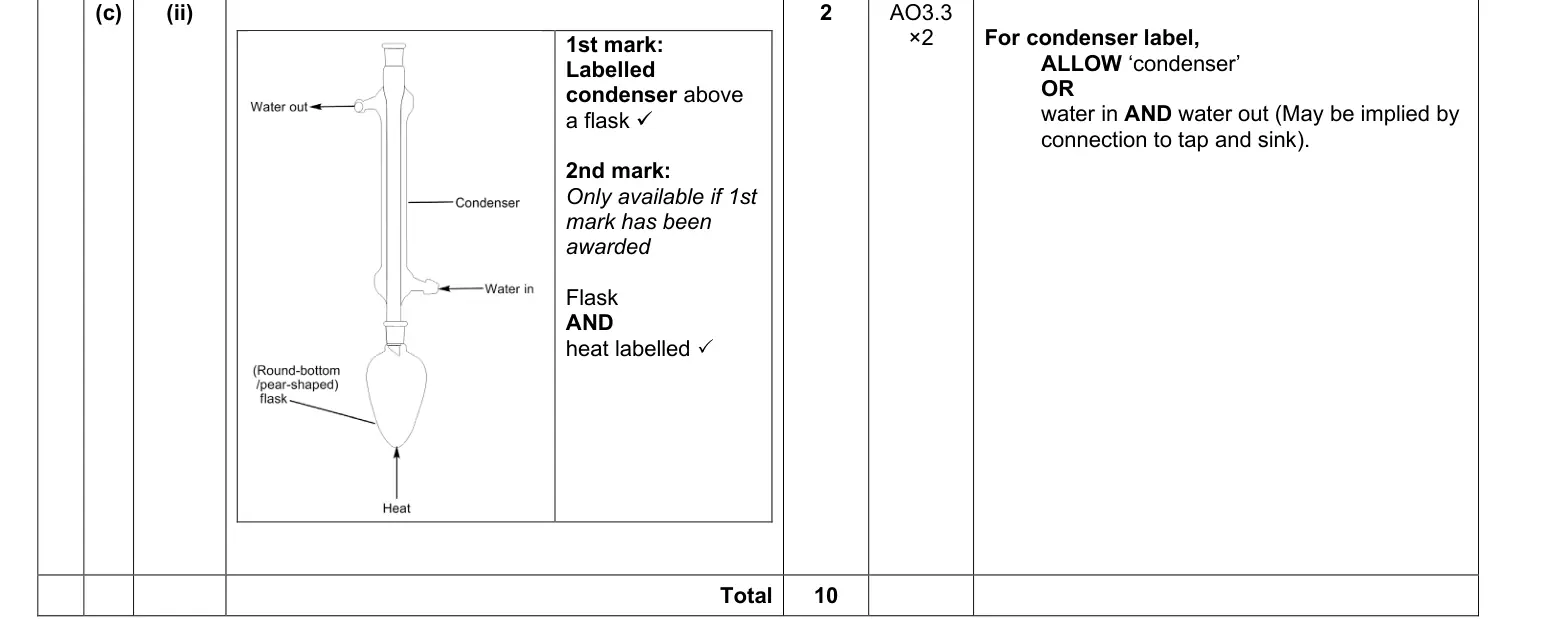
labelled condenser above a flask
second mark (flask and heat labelled) only if first mark awarded
ALLOW water in and water out as condenser label
Skills: PAG5 Synthesis of an organic liquid
November 2021 · AS Paper 2 · Q7(b)6 marksAO1, 2, 36-mark level of response
Earlier part of question 7 that this part uses
Mark scheme, with the levels and indicative points
Notes from the mark scheme and report
separating funnel – organic layer is the TOP layer (lower density)
dry with anhydrous MgSO4/CaCl2
distil collecting at 50 °C
mass = 7.70/74.0 × 0.76 × 92.5 = 7.3 g
inverse ratio 100/76 gives 12.7 g
IGNORE washing with carbonate/water
Skills: M0.2 Use ratios, fractions and percentages; M2.3 Substitute numerical values into algebraic equations using appropriate units for physical quantities; PAG5 Synthesis of an organic liquid
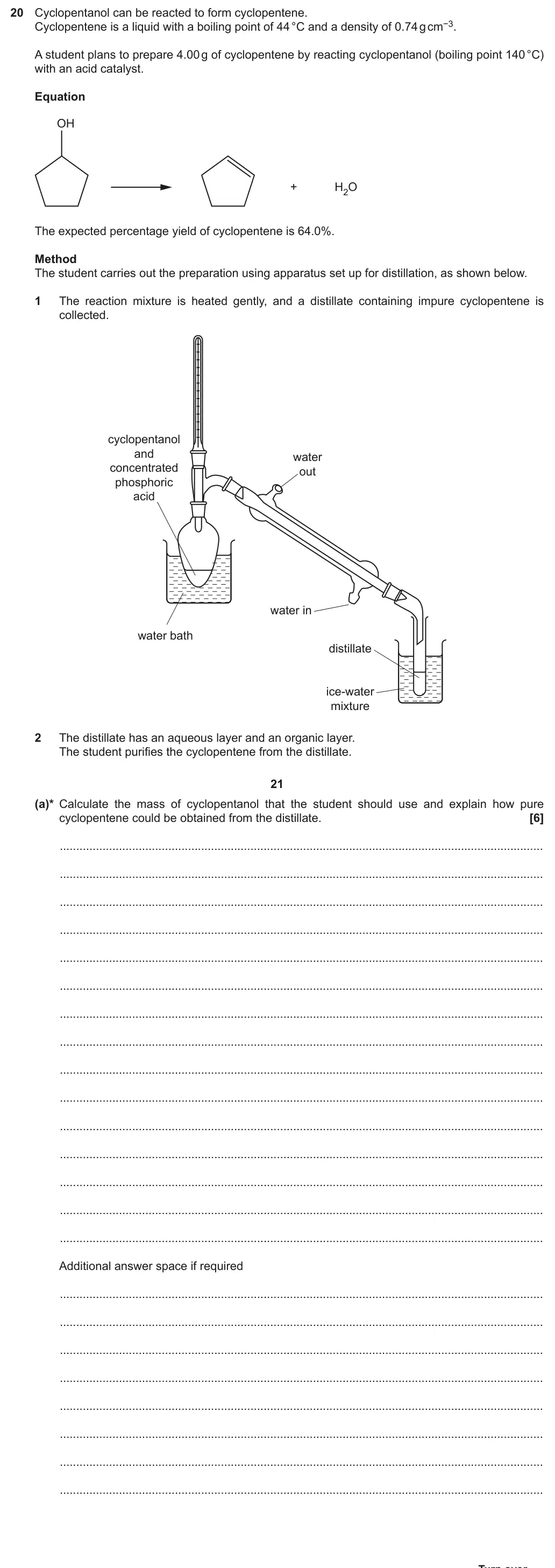
November 2020 · Paper 2 · Q20(a)6 marksAO2, 36-mark level of responseMedium
Mark scheme, with the levels and indicative points
Examiner's comment
Level of response questions Question 20(a) This question differentiated well.
Notes from the mark scheme and report
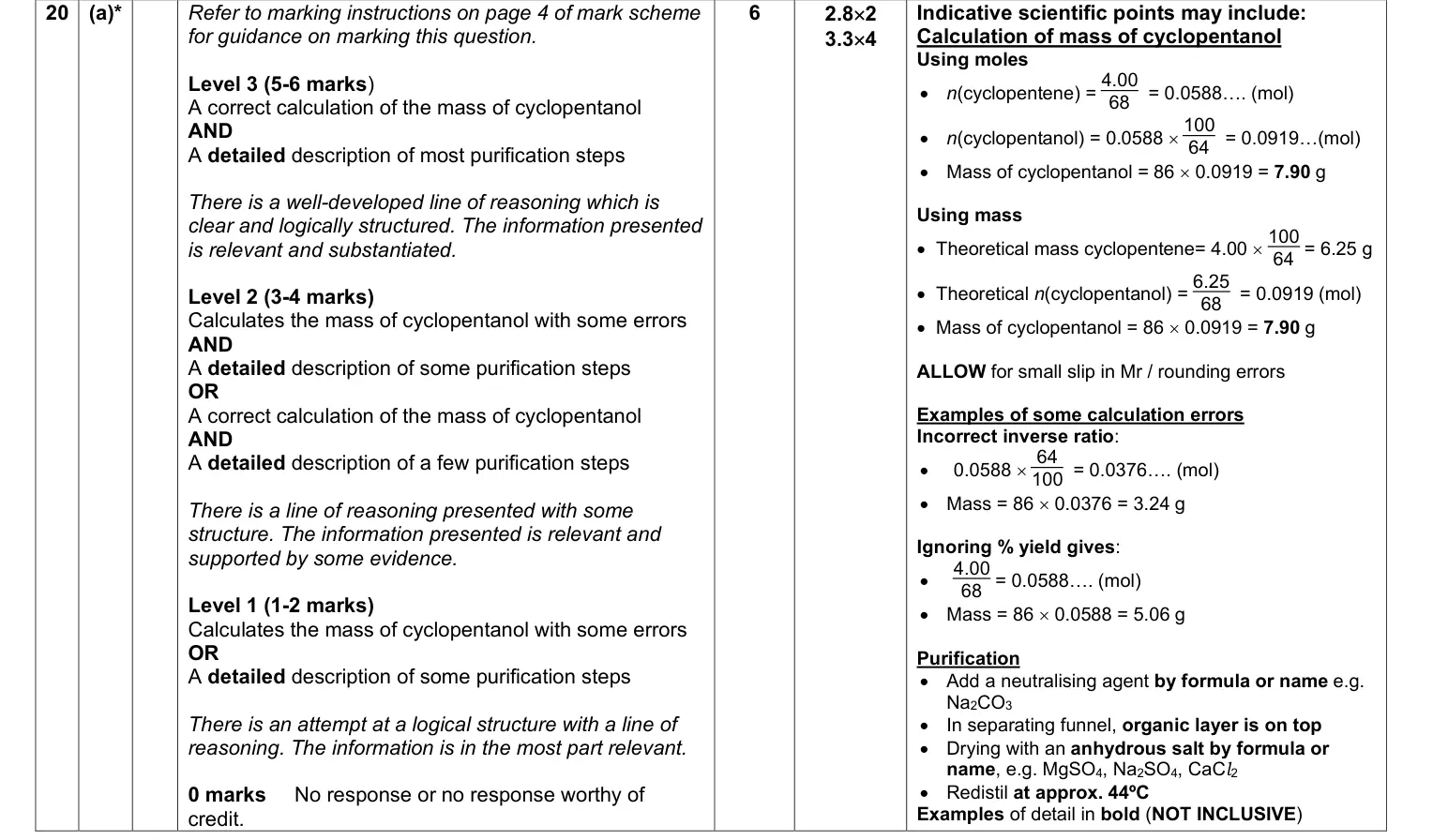
mass of cyclopentanol 7.90 g (errors: inverse ratio 3.24 g, ignoring yield 5.06 g)
neutralise e.g. Na2CO3
separating funnel with organic layer on top
dry with anhydrous salt e.g. MgSO4
redistil at about 44 °C
Skills: M0.2 Use ratios, fractions and percentages; M2.2 Change the subject of an equation; PAG5 Synthesis of an organic liquid
November 2020 · Paper 3 · Q1(a)(i)2 marksAO1Complete table/diagramHard
Mark scheme
Examiner's comment
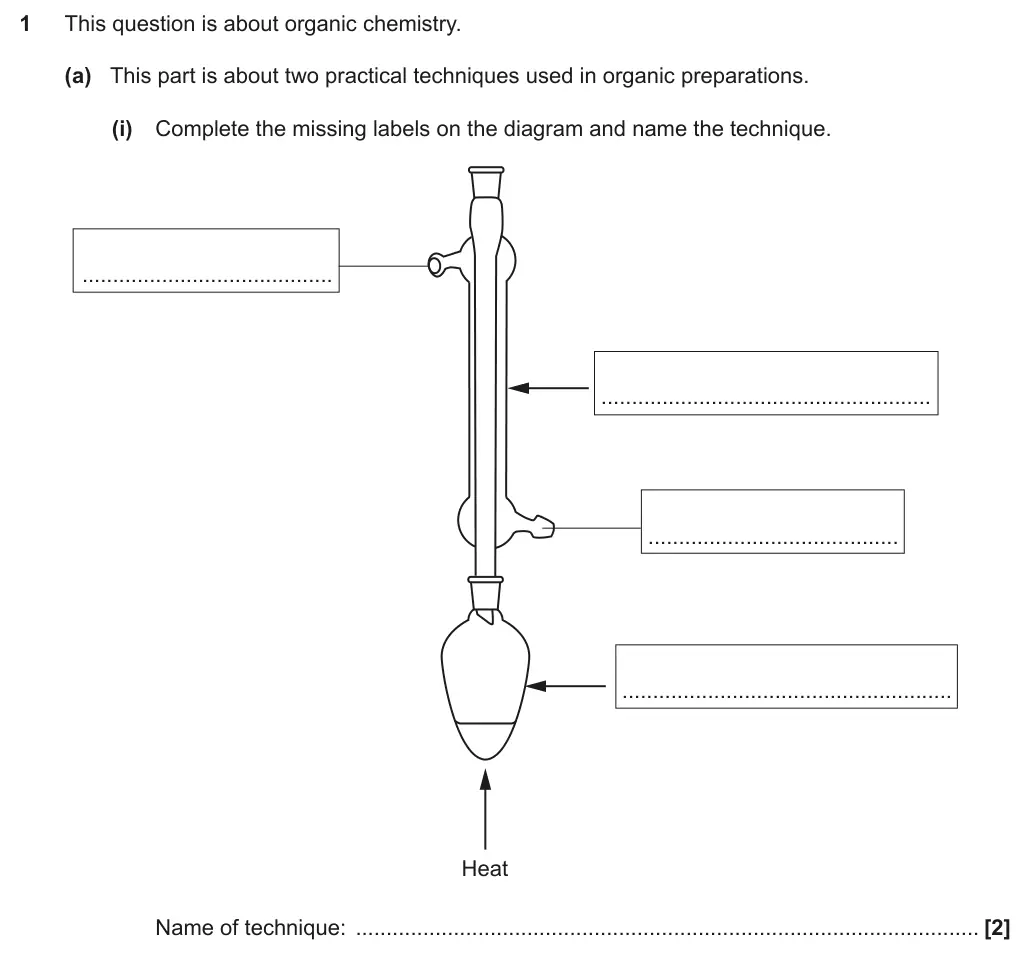
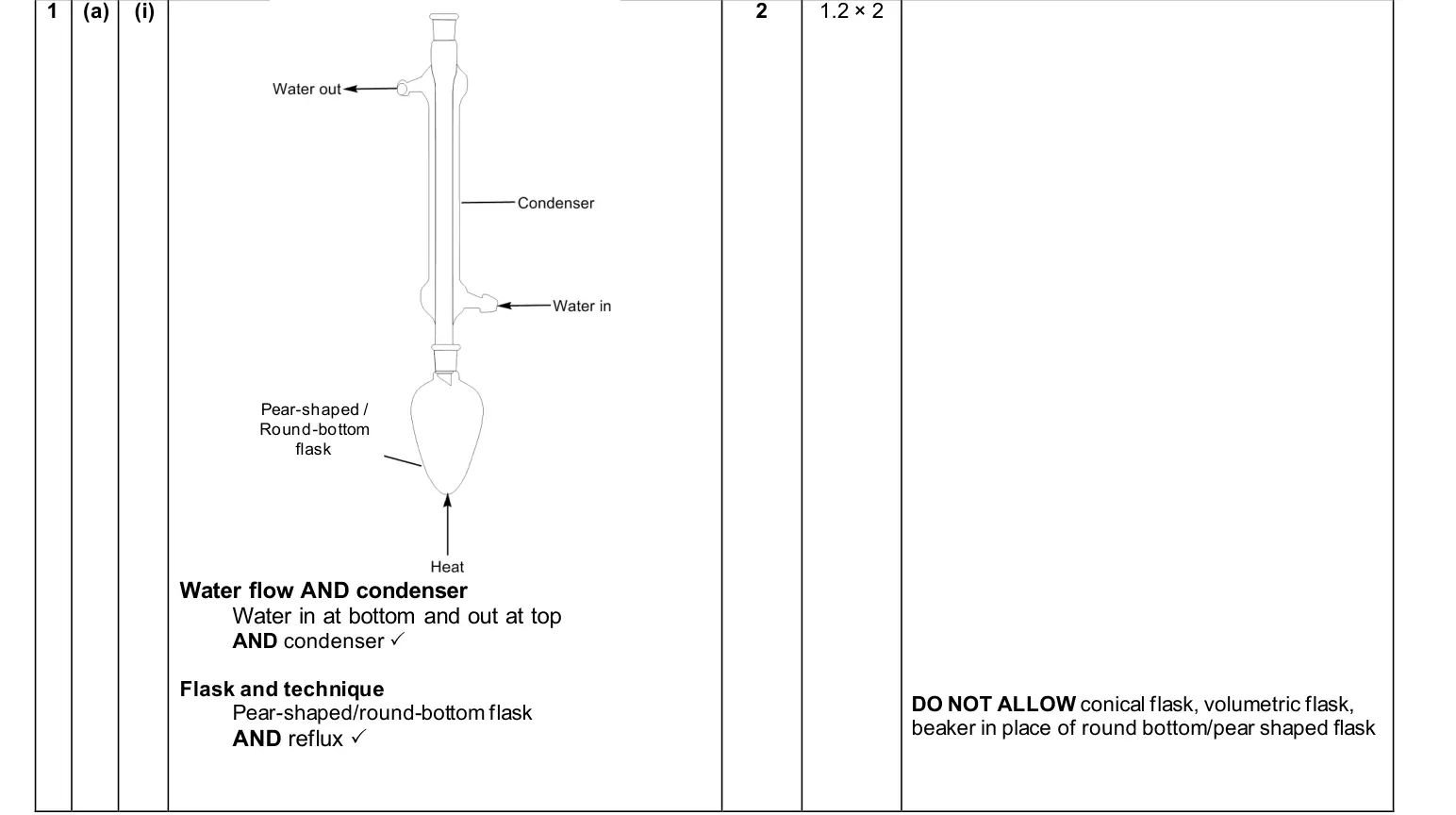
1a(i) Most candidates labelled some of the apparatus correctly and identified the reflux technique. A significant number showed water flowing in the wrong direction and ‘distillation’ was given as the name of the technique. The ‘condenser’ was sometimes labelled incorrectly, e.g. ‘condensation tube, ‘distillation tube’ and ‘water jacket’. Only just over half the candidates were given both marks. 1a(ii) Many diagrams were incomplete and it was comparatively rare for both of the two available marks to be given. Important labels were often missing. Some candidates drew diagrams of other techniques, such as distillation. Many responses were not credited with marks and this question was often omitted. Candidates need practice in recognising practical techniques and in drawing acceptable diagrams. 1b(i) Candidates were expected to explain the different boiling points of three amines. Most candidates linked increased branching with less surface contact between molecules, leading to weaker induced dipole interactions (London forces). Fewer candidates linked the decreasing boiling points to less energy being required to break the intermolecular bonds. The highest performing candidates recognised the large difference between the boiling points of the primary and tertiary amines. They then identified the cause: primary amines form hydrogen bonds but tertiary amines do not. This question was answered reasonably well with fewer candidates than in the past describing relative strengths of covalent bonds, a common misconception. 1(b)(ii) Most candidates rearranged the ideal gas equation correctly to make n the subject. They then substituted correct values for p, V, R and T into the equation, with correct unit conversions. Most candidates then calculated n correctly as 2.32 × 10⁻³ and combined this value with the mass of 0.202 g to derive the molecular formula as 87. Lower-attaining candidates often made an error in their conversion of cm3 into m3, by multiplying by 10–3 rather than 10–6. This error resulted in a value of n as 2.32 and the unrealistic molecular mass of 8.7 × 10⁻³, from which a molecular formula is impossible. Candidates in this position are advised to check back at the unit conversions in the working. Very few candidates did not convert 100ºC into 373 K. Candidates with the correct molecular formula of 87 usually suggested C5H13N as the molecular formula. A significant number quoted C5H11NH2. This response was not credited as it is not a ‘molecular’ formula. There are several possible structures of C5H13N with three 13C NMR peaks and any were credited. Error carried forward was applied from a different molecular mass for both the molecular formula and a structure. This emphasises the importance of working within calculation; credit will always be given for a correct method. Instead of using the ideal gas equation, some candidates used the molar gas constant at room temperature and pressure, 24.0 dm3, which gives a molecular mass of 67. This simplified approach could only gain the final 2 marks for this question: a molecular formula (with an error carried forward value of 67, e.g. C4H5N) and a structure of an amine with this molecular formula and 3 peaks in the 13C NMR spectrum. 1(c) Candidates were supplied with information about an unfamiliar reaction of an amino acid and asked to predict a possible equation. Many candidates suggested H2O as one product, being the difference in the formula of the amino acid and the C3H3NO cyclic organic product. Any cyclic structure of C3H3NO that met the bonding rules for C, H, N and O was credited. Examples included a 4-membered ring lactam and substituted cyclopropenes. A significant number of candidates showed an equation for the reaction of two molecules of the amino acid to form 2 H2O and a cyclic dipeptide. Although chemically feasible, the dipeptide could not be credited because the molecular formula was C3H3NO in the question. This error could have been avoided if the information in the question had been used.
Notes from the mark scheme and report
water in at bottom and out at top AND condenser
pear-shaped/round-bottom flask AND reflux
DO NOT ALLOW conical flask, volumetric flask or beaker
Skills: PAG5 Synthesis of an organic liquid
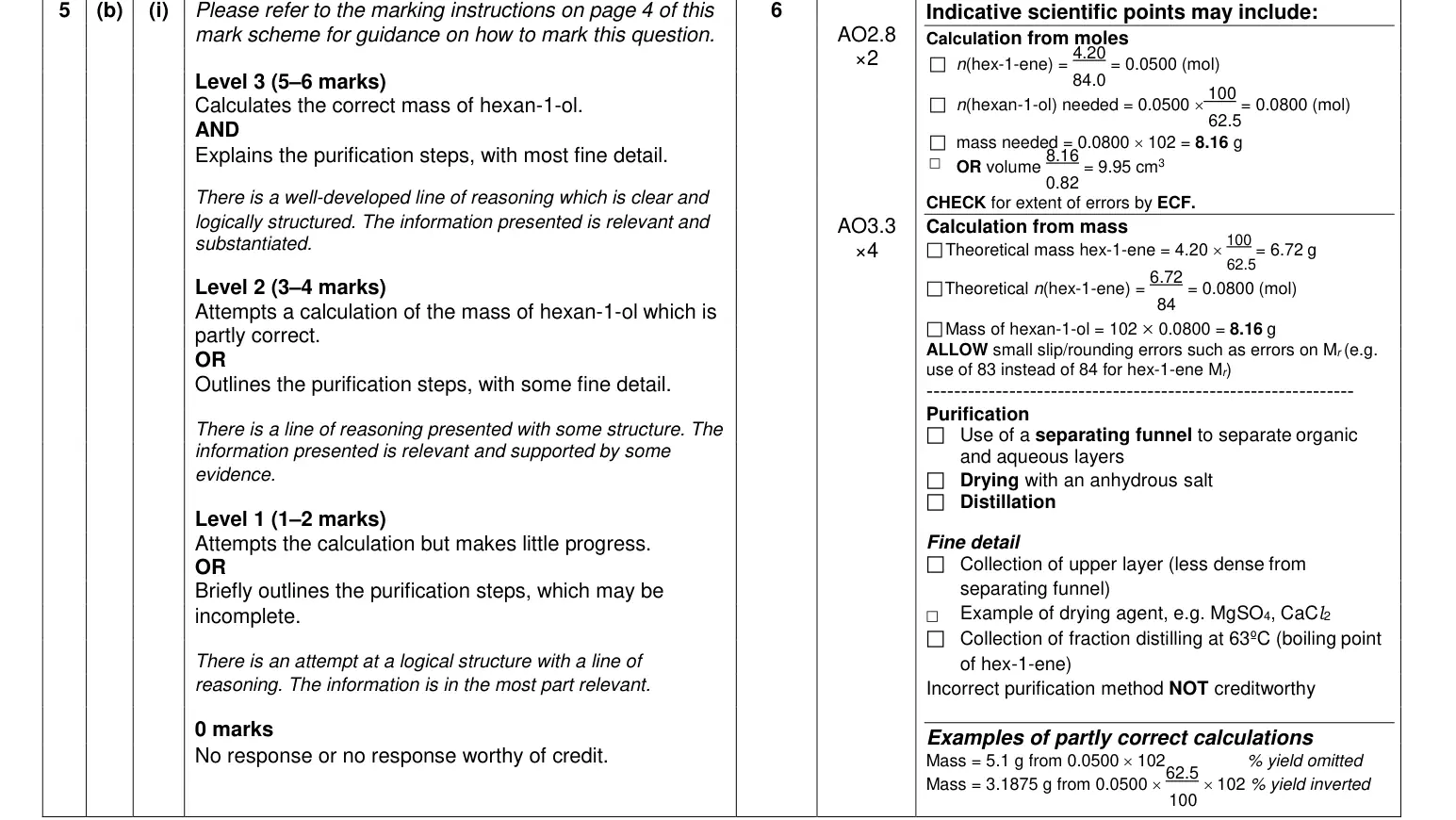
June 2019 · AS Paper 2 · Q5(b)(i)6 marksAO2, 36-mark level of responseHard
Mark scheme, with the levels and indicative points
Examiner's comment
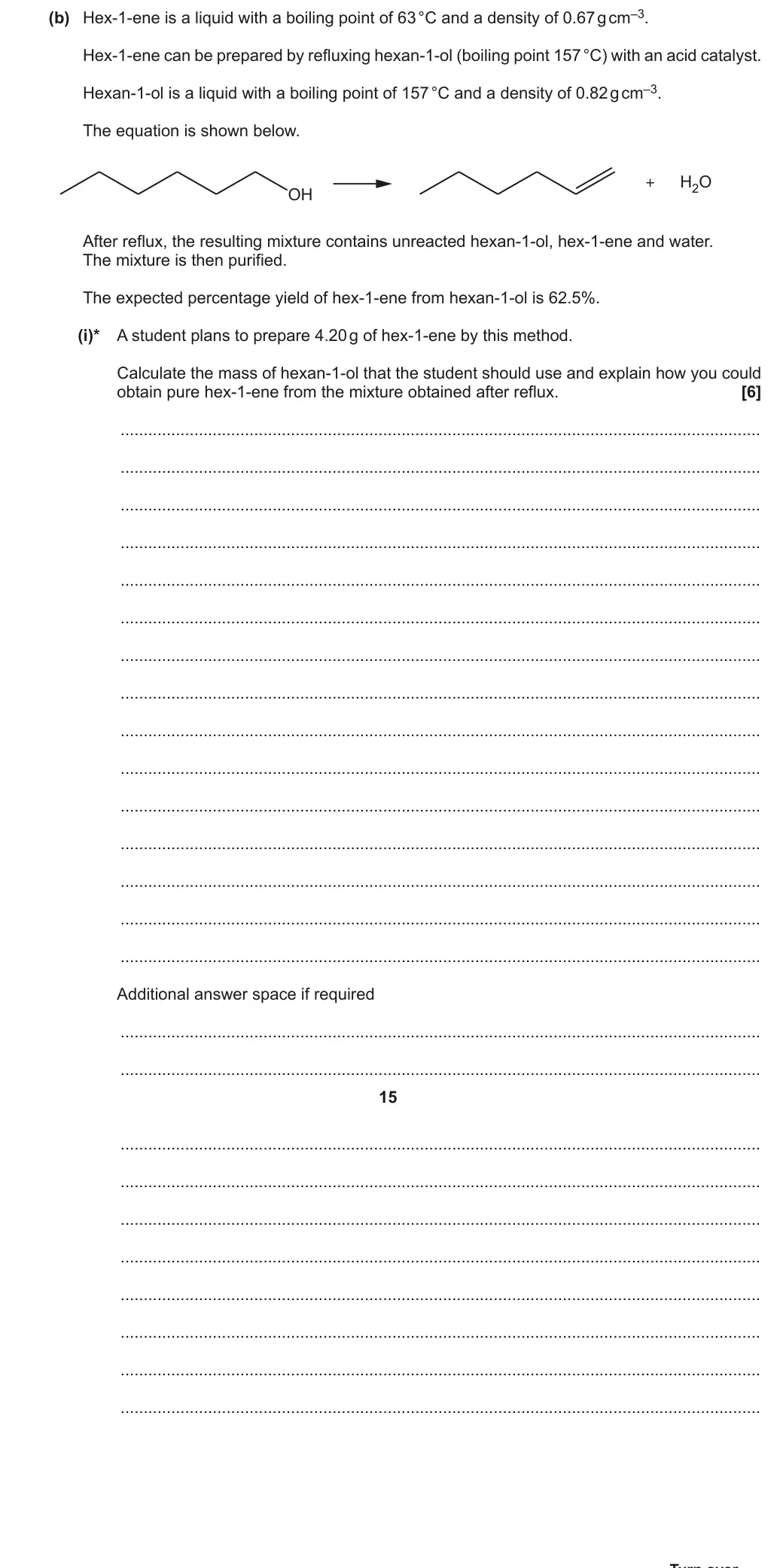
This question discriminated well and most were able to attempt to calculate a mass and explain the purification steps with some fine detail. It was evident that most candidates were aware of the apparatus required but the logic in the order was sometimes out of sequence. Drying agents were mentioned, some of the examples used were incorrect and errors were made with the boiling points if candidates mentioned distillation. This in a response of an excellent approach to this question, it was given 6 marks. The correct mass has been calculated and all of the fine detail, except distilling at 63°C
Notes from the mark scheme and report
0.0500 mol hex-1-ene needs 0.0800 mol hexan-1-ol = 8.16 g
partly correct: 5.1 g (% yield omitted), 3.19 g (% yield inverted)
separating funnel (upper organic layer), dry with anhydrous MgSO4/CaCl2, distil collecting fraction at 63 °C
incorrect purification method not creditworthy
Skills: M0.2 Use ratios, fractions and percentages; M2.2 Change the subject of an equation; M2.3 Substitute numerical values into algebraic equations using appropriate units for physical quantities; PAG5 Synthesis of an organic liquid
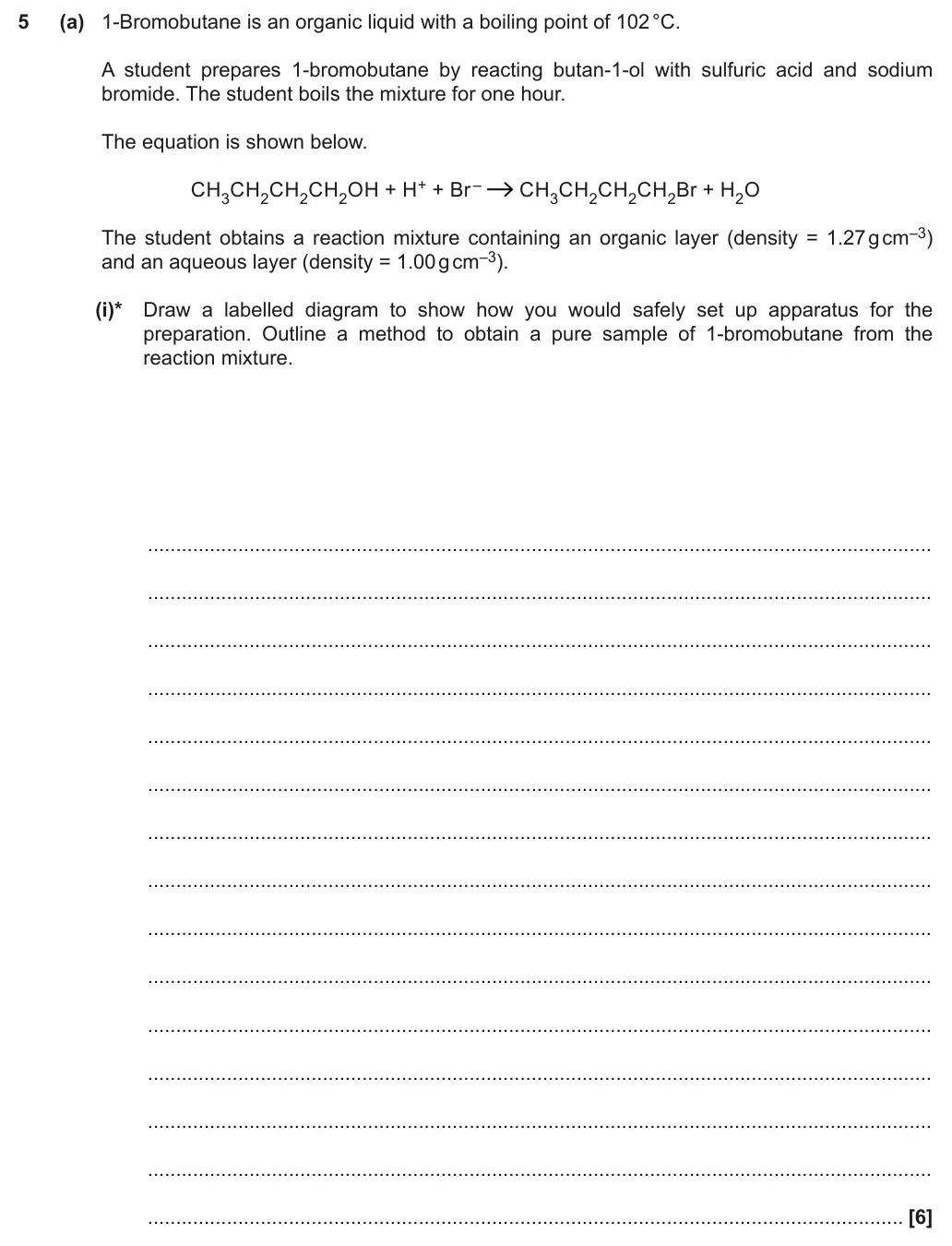
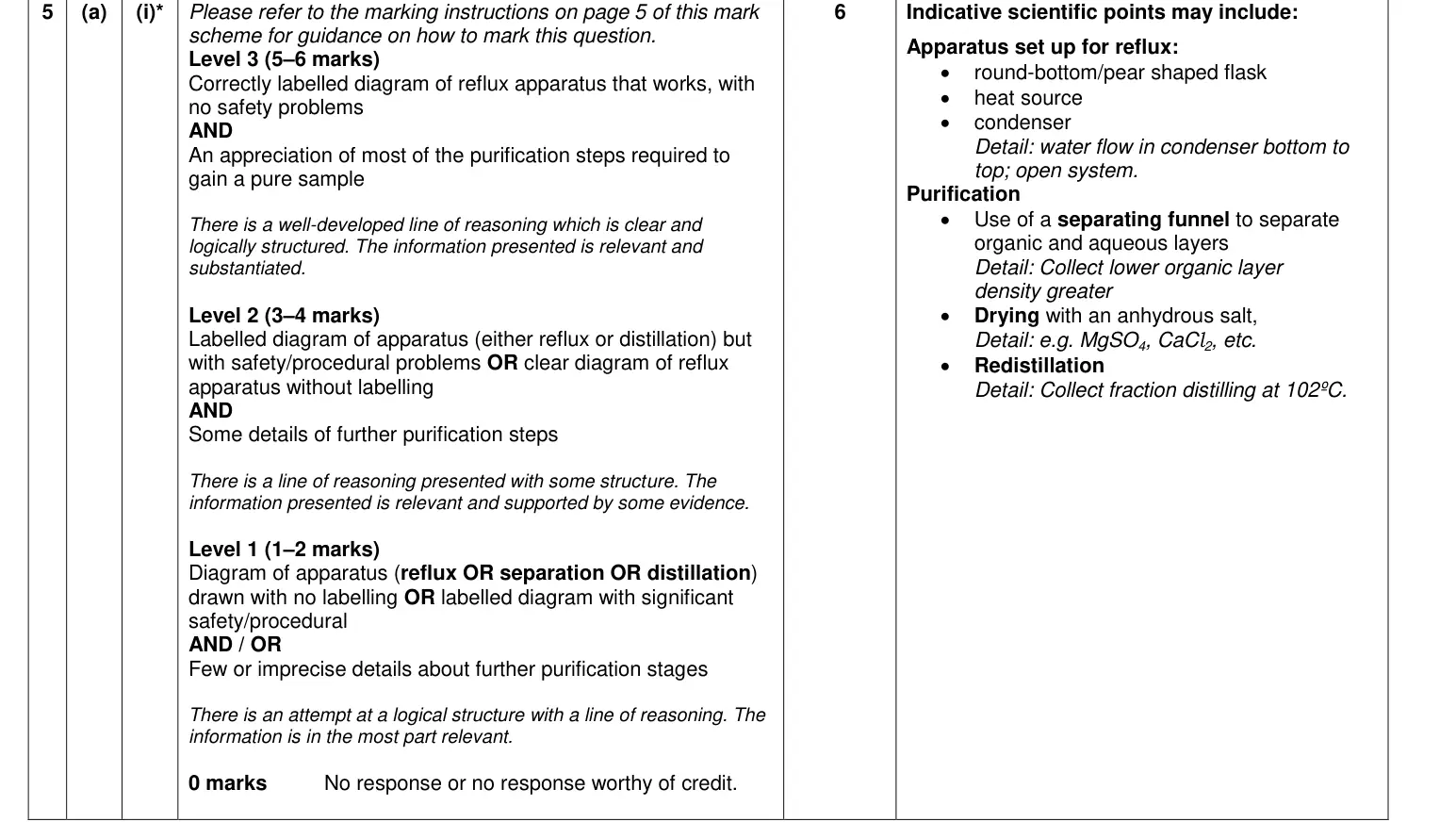
June 2018 · AS Paper 2 · Q5(a)(i)6 marks6-mark level of responseHard
Mark scheme, with the levels and indicative points
Examiner's comment
Candidates were not prepared to answer this type of question and the diagrams were hard to give credit to. Many had significant safety implications such as open beakers of butan-1-ol being heated by a Bunsen burner. Most mis-read the question and just outlined the method for purification and struggled to recall the practical details. Very few candidates mentioned the use of anhydrous salts, referring instead to ‘boiling off’ the water. This candidate was credited 4 marks for this level 2 answer. Although they have drawn distillation apparatus instead of reflux, they have considered the boiling point of the product, detailed using a separating funnel, a drying agent and that the lower organic layer would be drawn off first.
Notes from the mark scheme and report
reflux with water in at bottom of condenser and open system
separating funnel – organic layer is the lower (denser) layer
dry with anhydrous salt
redistil collecting at 102 °C
Skills: PAG5 Synthesis of an organic liquid
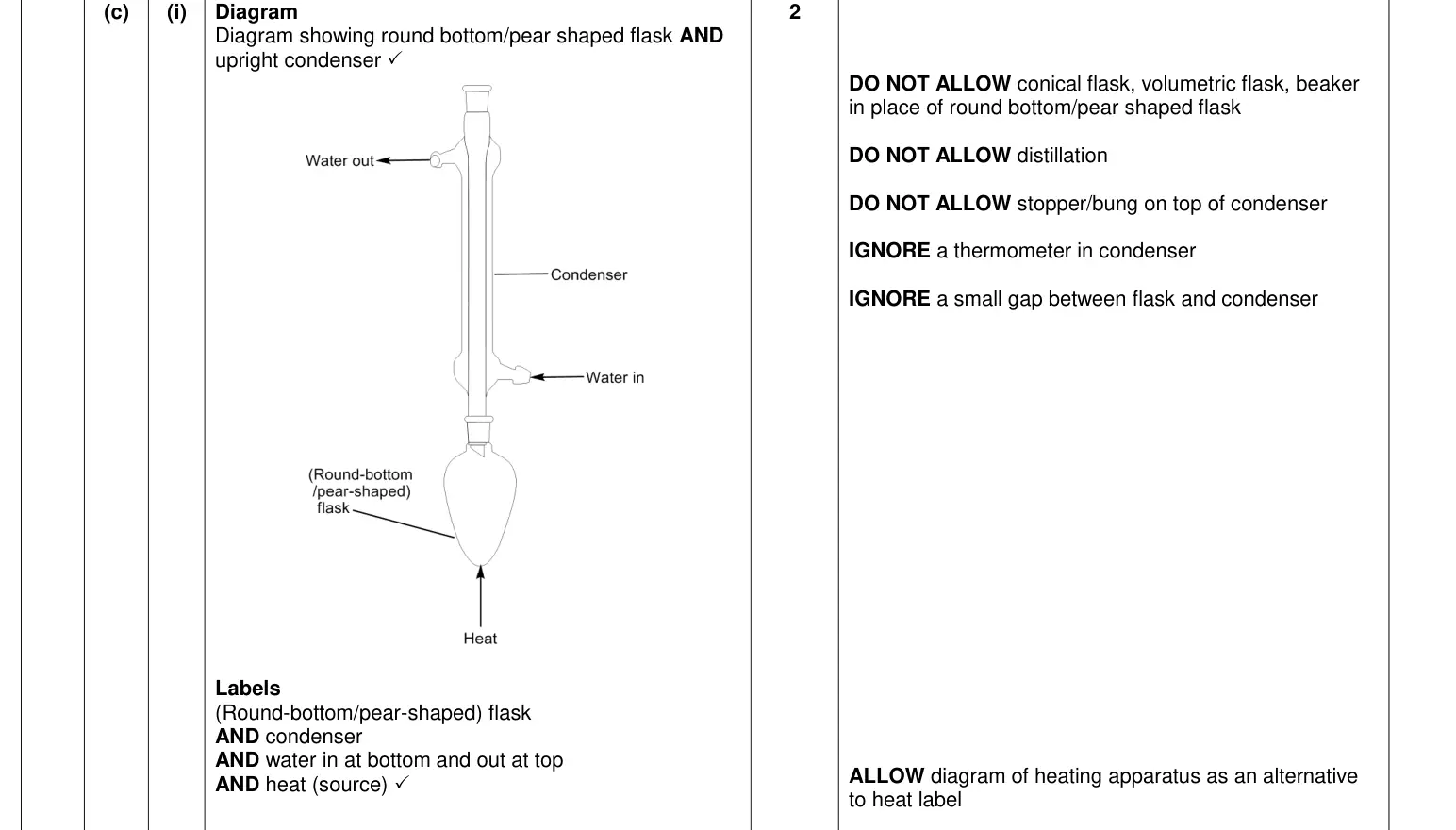
June 2018 · Paper 2 · Q19(c)(i)2 marksDrawing / labellingEasy
Mark scheme
Examiner's comment
Most candidates were able to draw a suitable diagram to show the apparatus required for reflux but some included a stopper on top of the condenser. Many of the diagrams were labelled appropriately but common errors included incorrect direction of water flow or omission of the ‘flask’ label. A small but significant proportion of candidates drew a diagram showing distillation.
Notes from the mark scheme and report
round-bottom/pear-shaped flask AND upright condenser
labels: water in at bottom and out at top, heat
DO NOT ALLOW conical flask/beaker
DO NOT ALLOW distillation
DO NOT ALLOW stopper on top of condenser
Skills: PAG5 Synthesis of an organic liquid
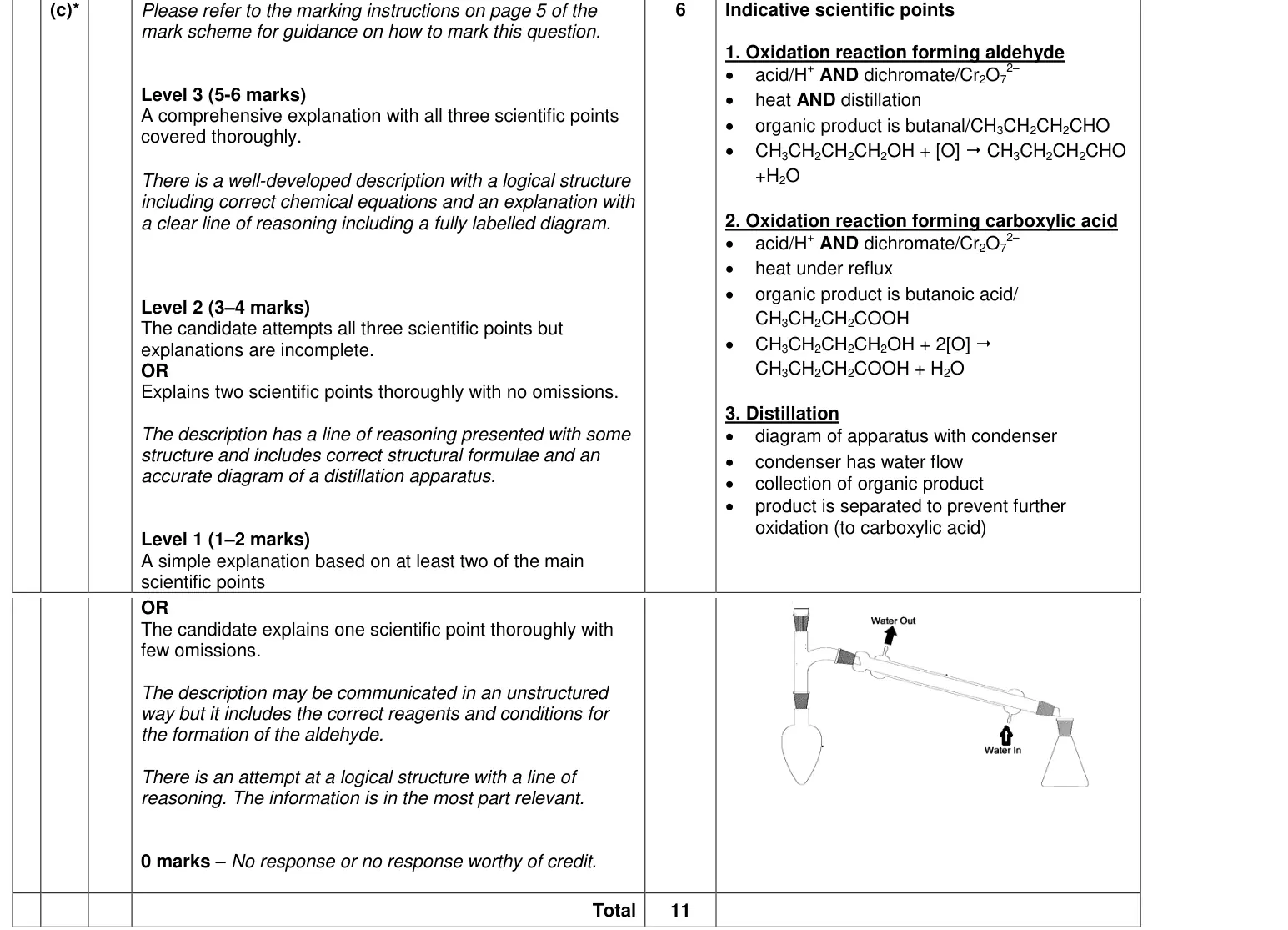
June 2017 · AS Paper 2 · Q4(c)6 marks6-mark level of response
Mark scheme, with the levels and indicative points
Notes from the mark scheme and report
acidified dichromate
distil for butanal (removed to prevent further oxidation), reflux for butanoic acid
equations with [O] (2[O] for the acid)
distillation diagram with condenser and water flow
Skills: PAG5 Synthesis of an organic liquid
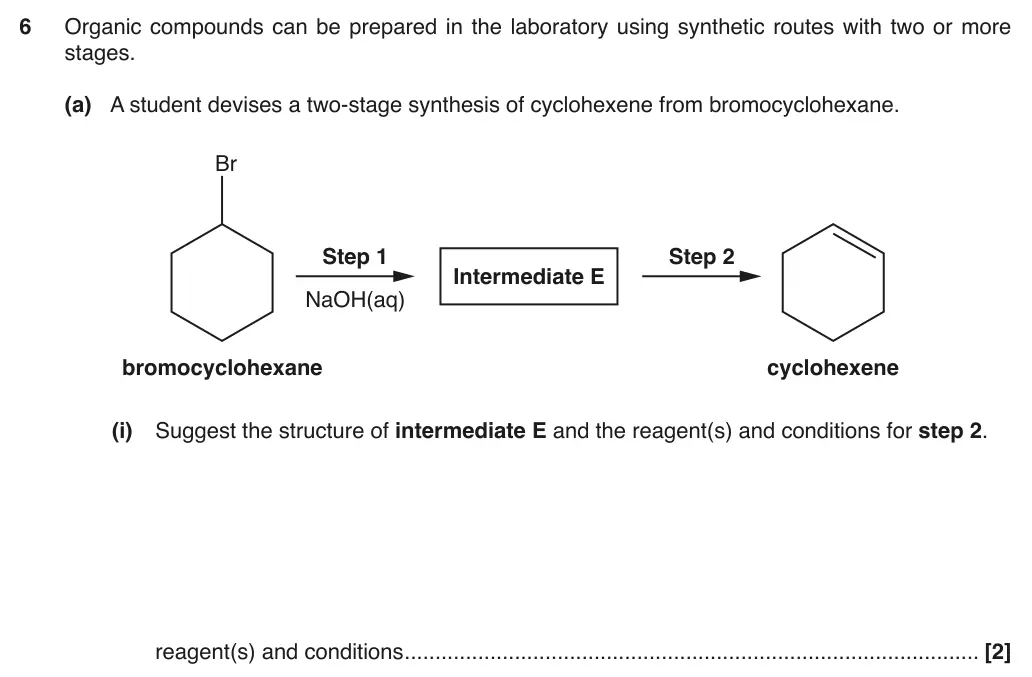
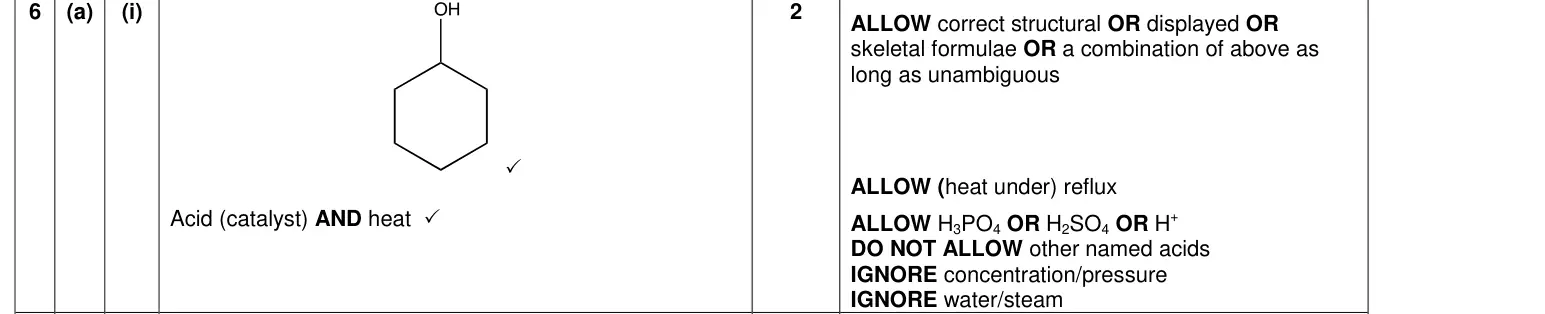
June 2017 · AS Paper 2 · Q6(a)(i)2 marksStructure / isomer
Mark scheme
Notes from the mark scheme and report
E = cyclohexanol
acid catalyst (H3PO4/H2SO4/H+) AND heat
DO NOT ALLOW other named acids
IGNORE water/steam
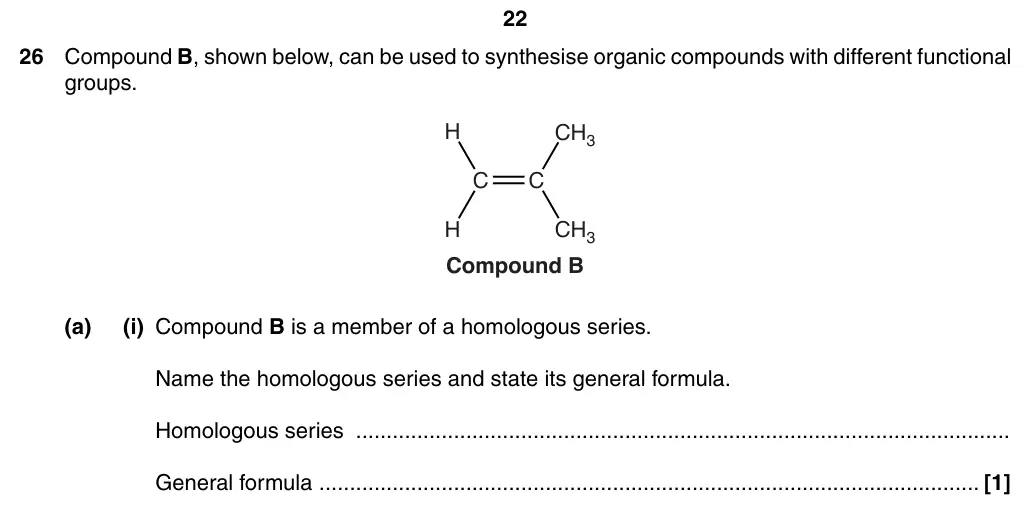
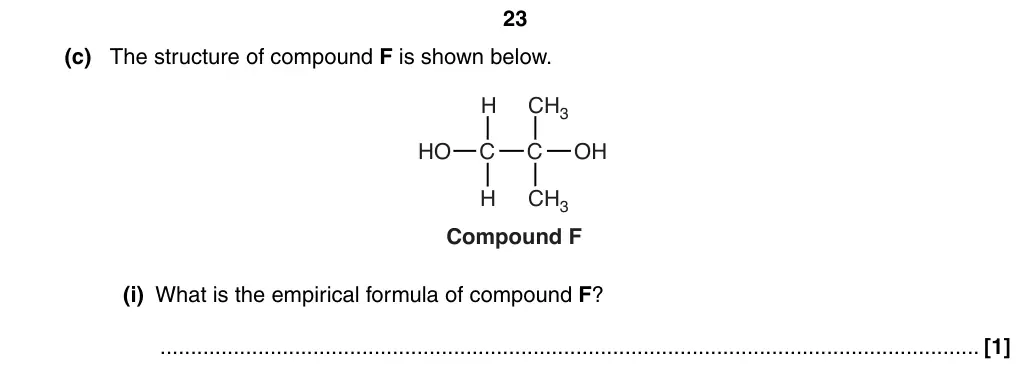
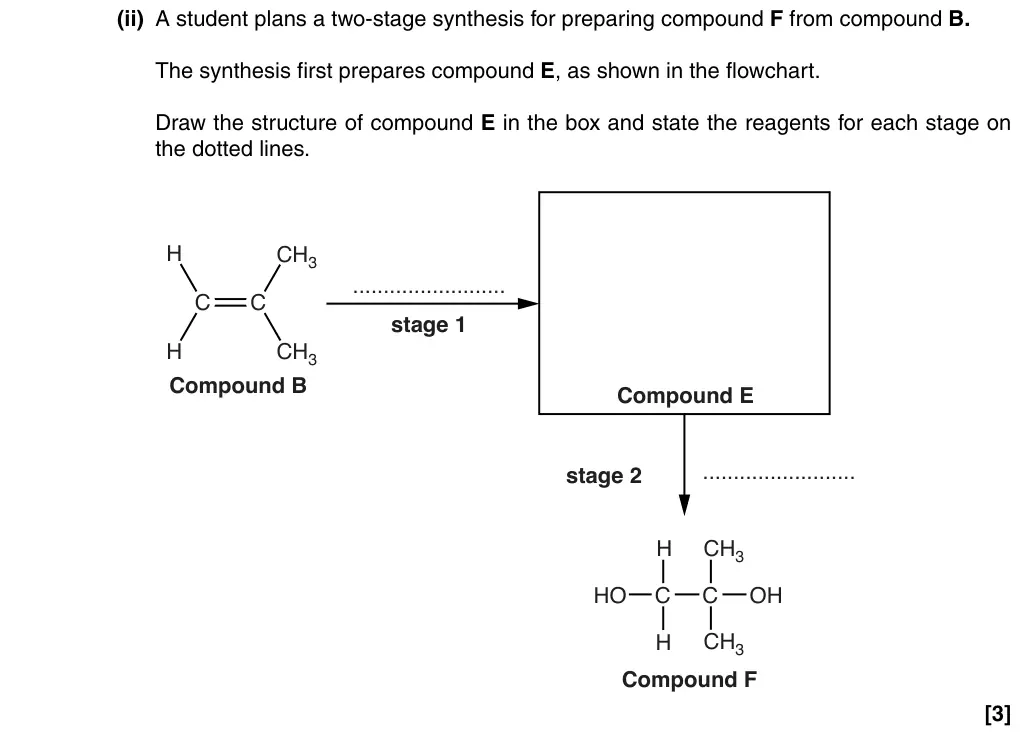
June 2016 · AS Paper 1 · Q26(c)(ii)3 marksAO3Structure / isomer
Earlier parts of question 26 that this part uses
Mark scheme
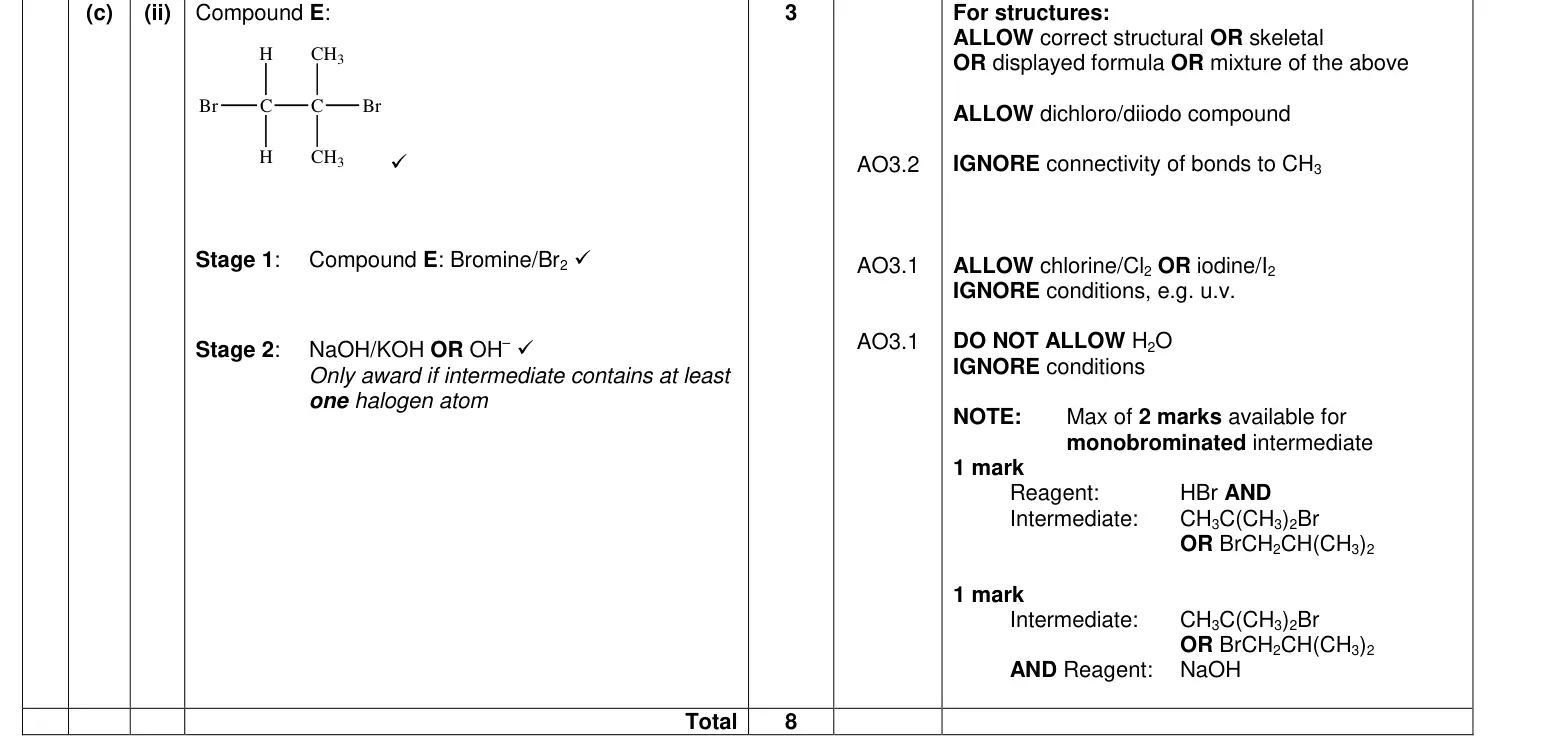
Notes from the mark scheme and report
DO NOT ALLOW H2O for stage 2
MAX 2 for a monobrominated intermediate via HBr
ALLOW dichloro/diiodo compound
June 2016 · AS Paper 2 · Q6(c)(ii)2 marksAO3Short answer
Earlier parts of question 6 that this part uses
Mark scheme
Notes from the mark scheme and report
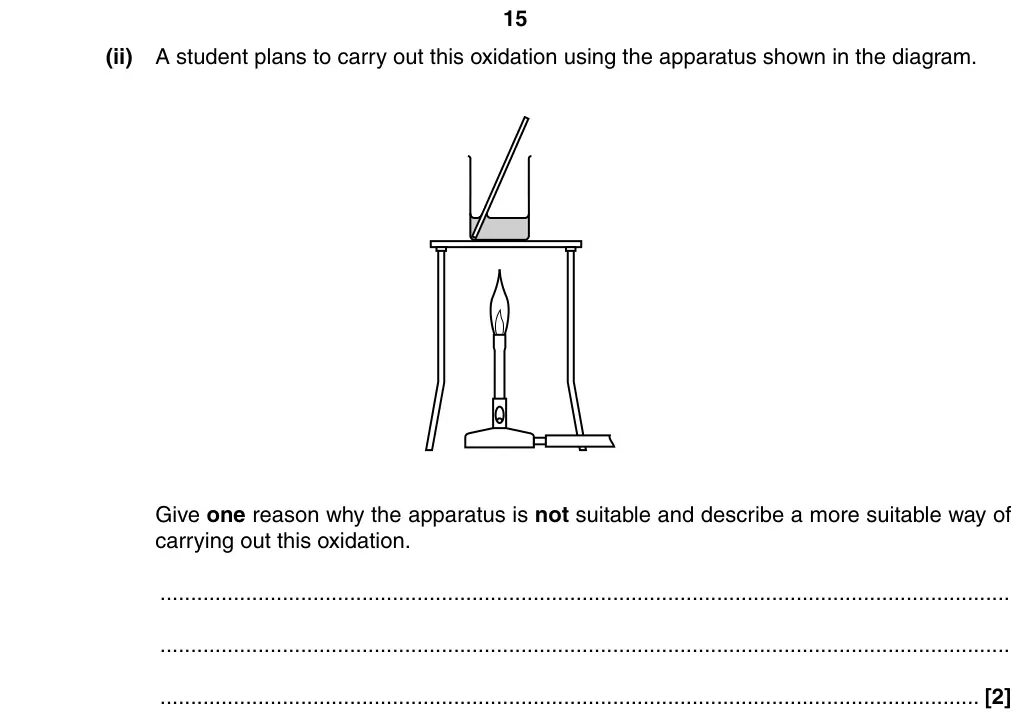
butan-2-ol/butanone flammable or volatile so would evaporate (DO NOT ALLOW 'the product or reactant' unspecified)
heat under reflux
DO NOT ALLOW distillation
DO NOT ALLOW closed system
IGNORE vague health and safety
Skills: PAG5 Synthesis of an organic liquid
Work with an OCR chemistry tutor
Dropping marks on calculations, mechanisms or the six-markers? Book a trial session with a specialist OCR chemistry tutor.