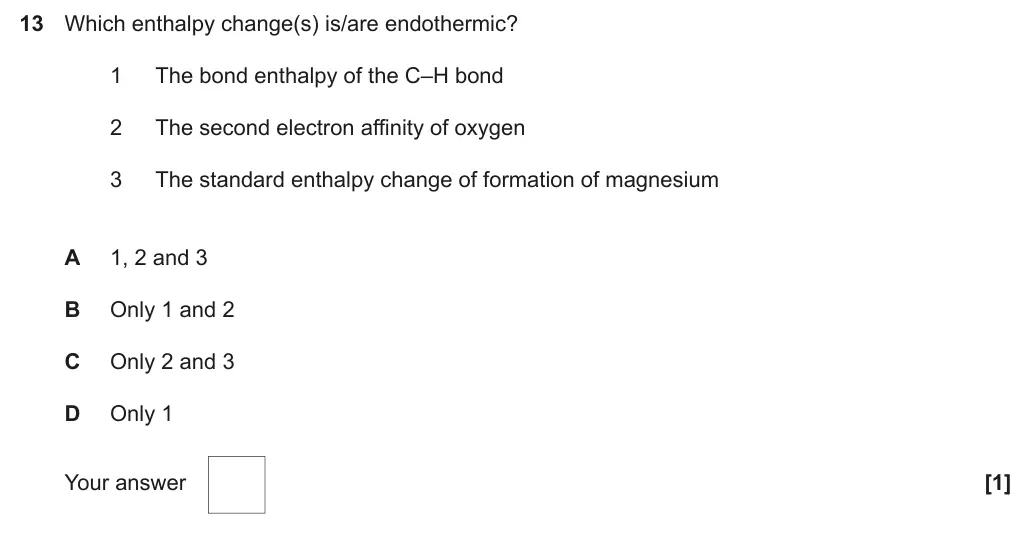
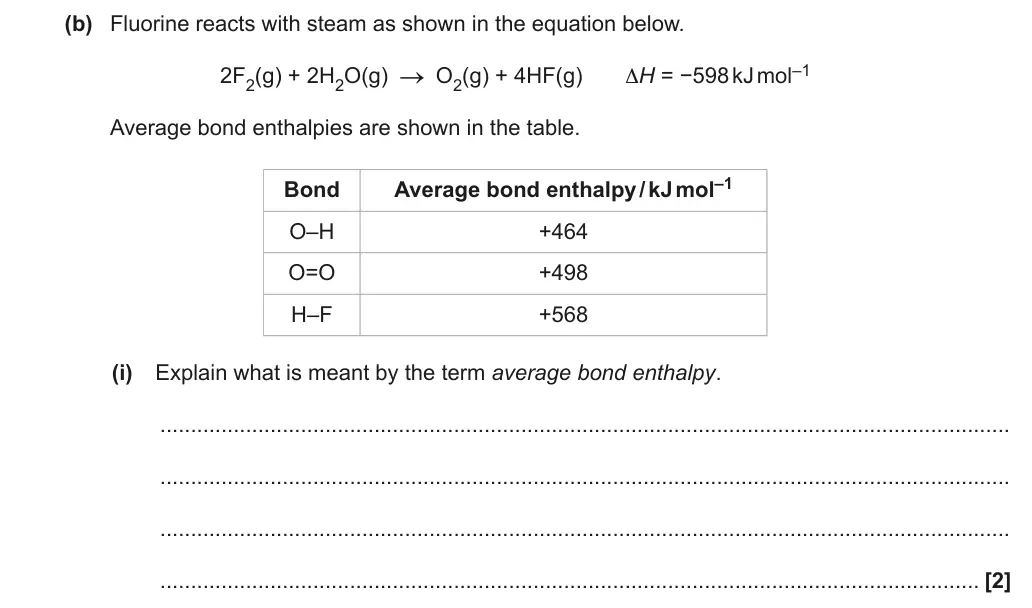
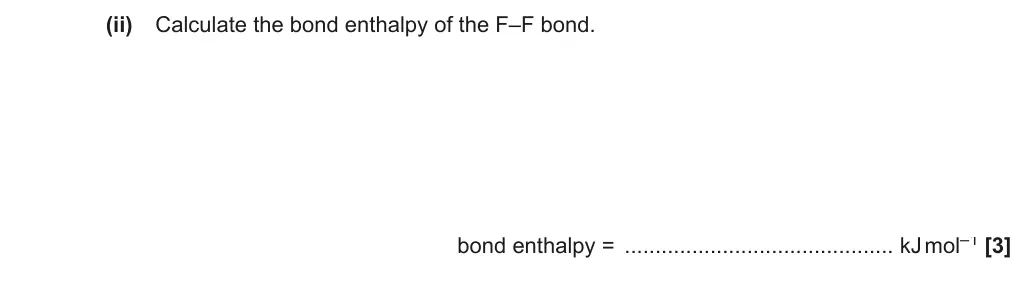
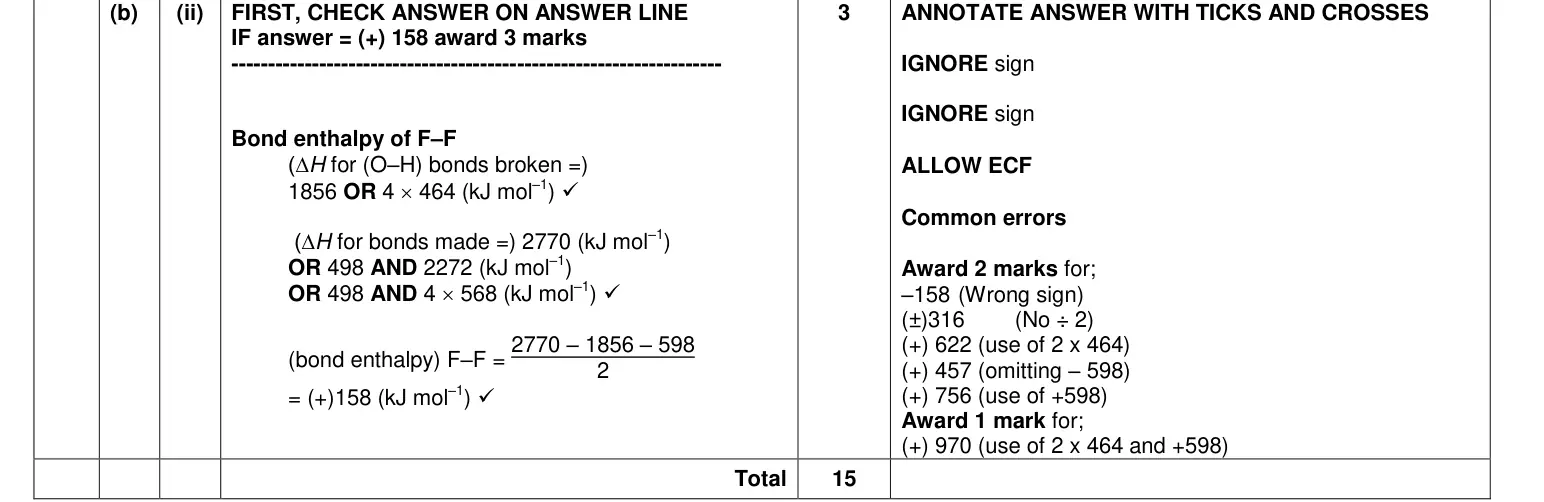
Show the 18 learning outcomes from the specification
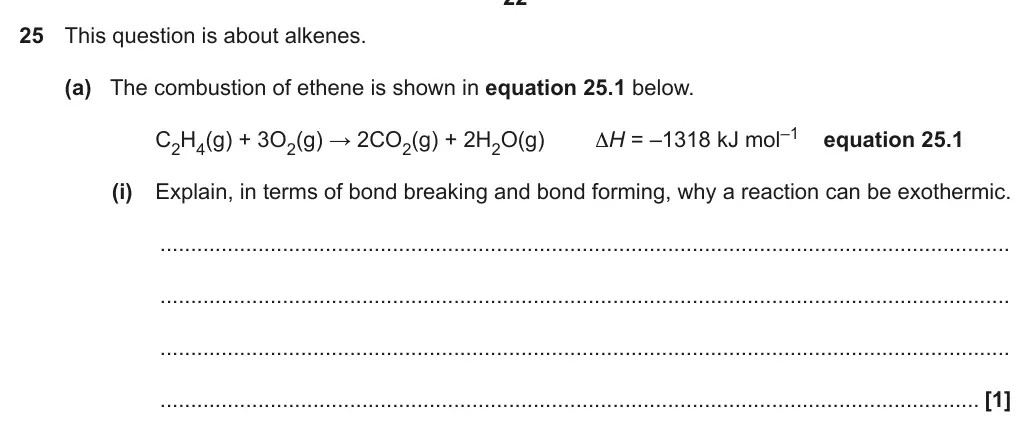
3.2.1(a) explanation that some chemical reactions are accompanied by enthalpy changes that are exothermic (∆H, negative) or endothermic (∆H, positive)
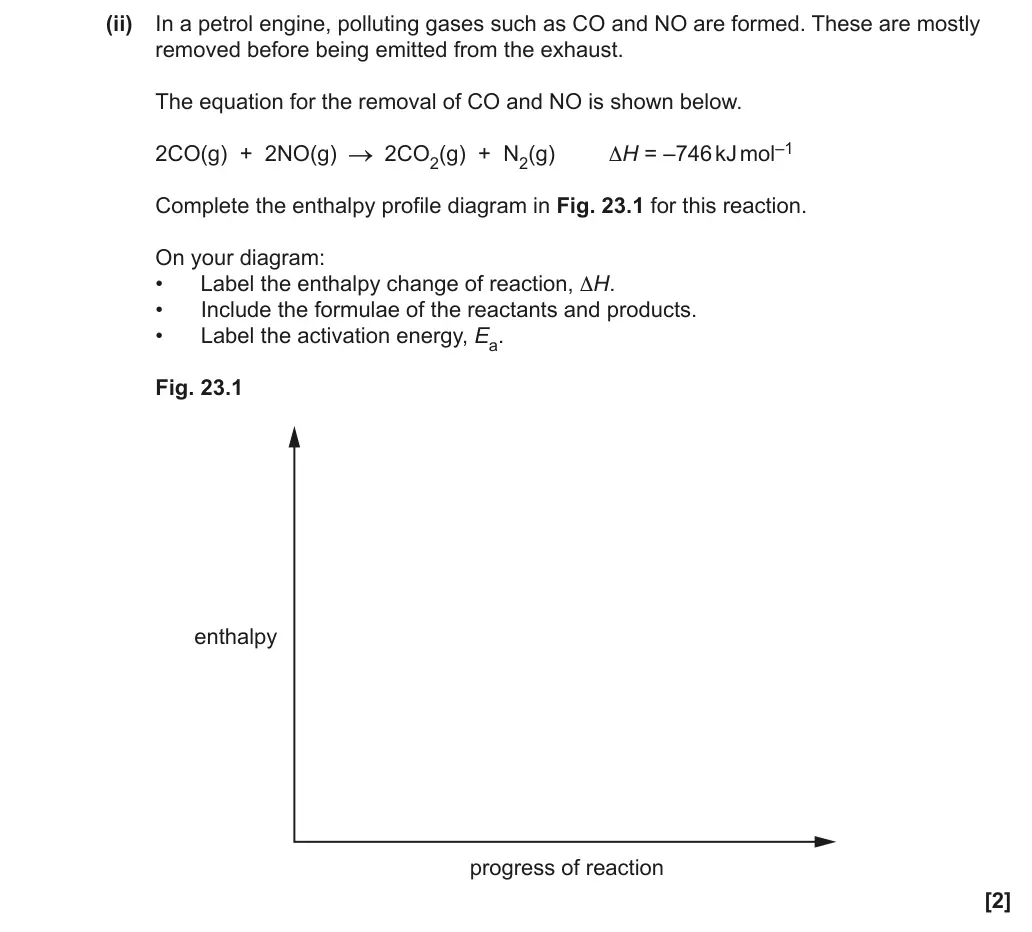
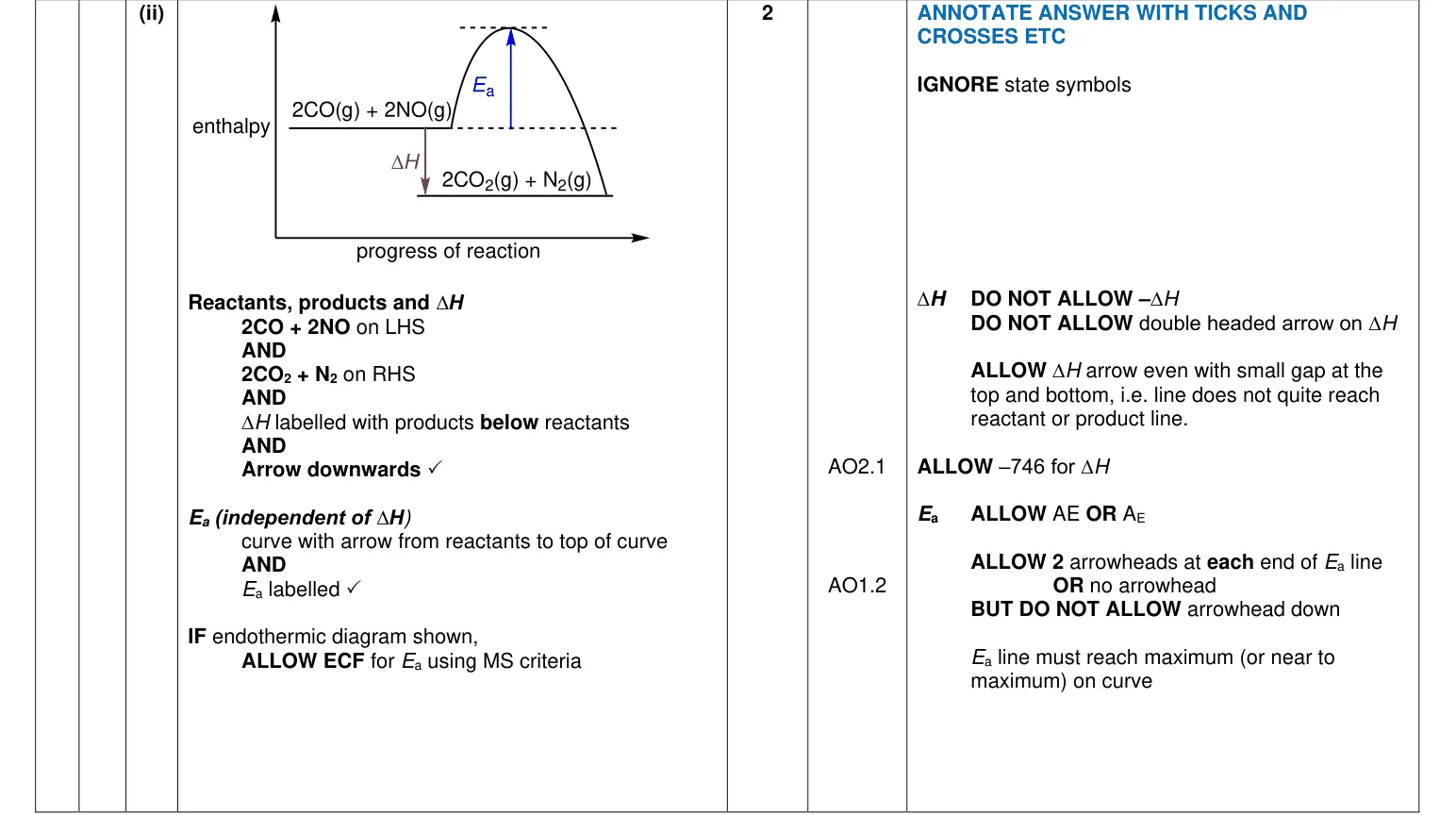
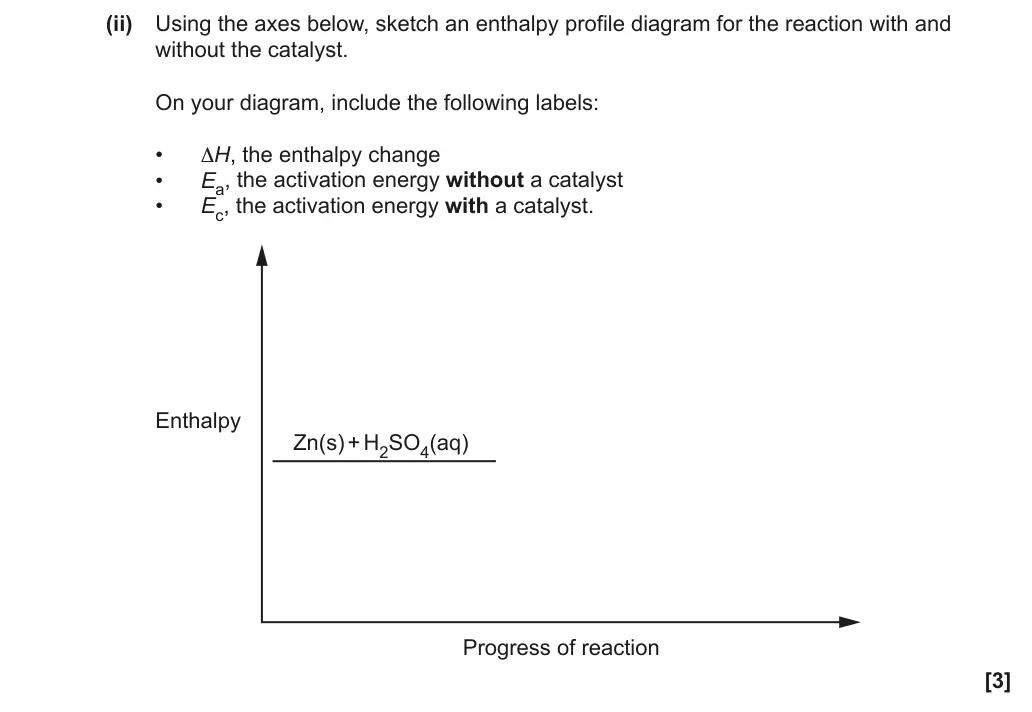
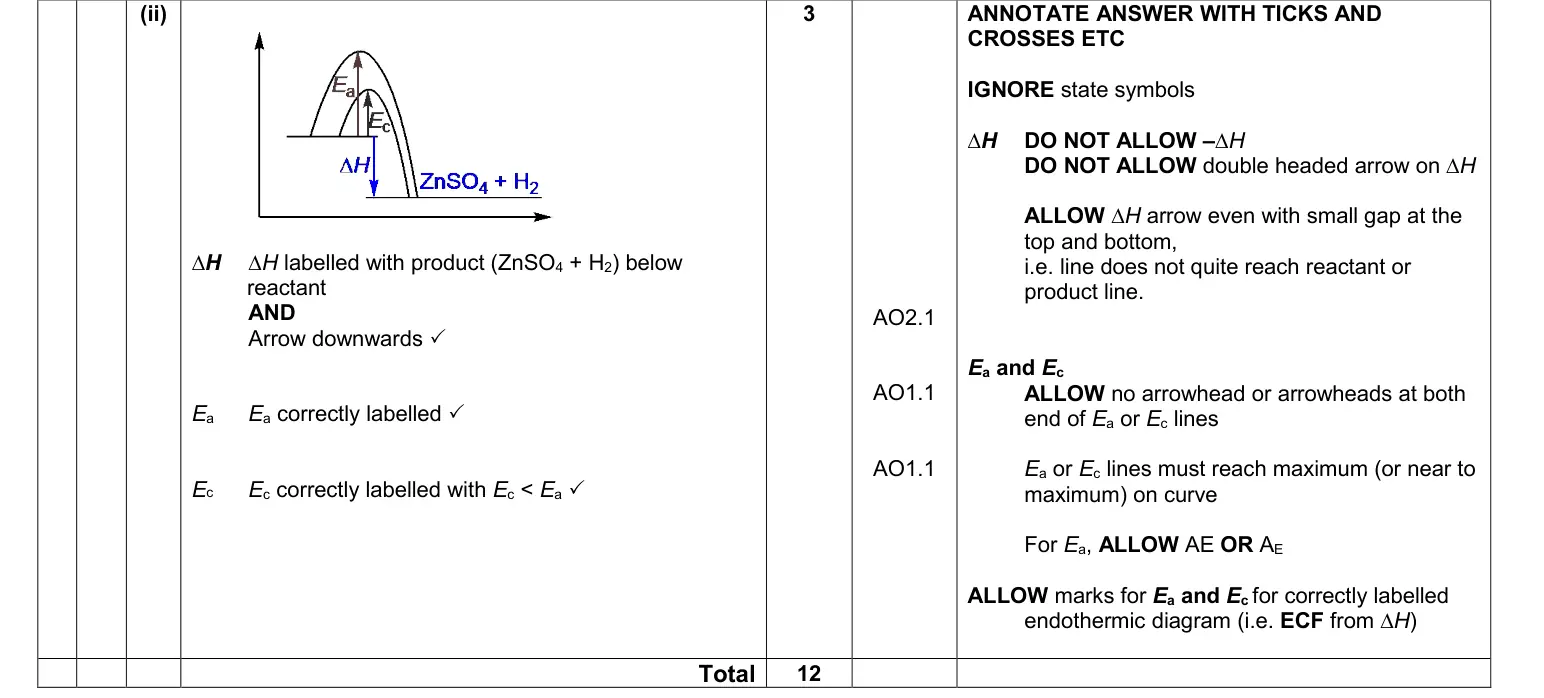
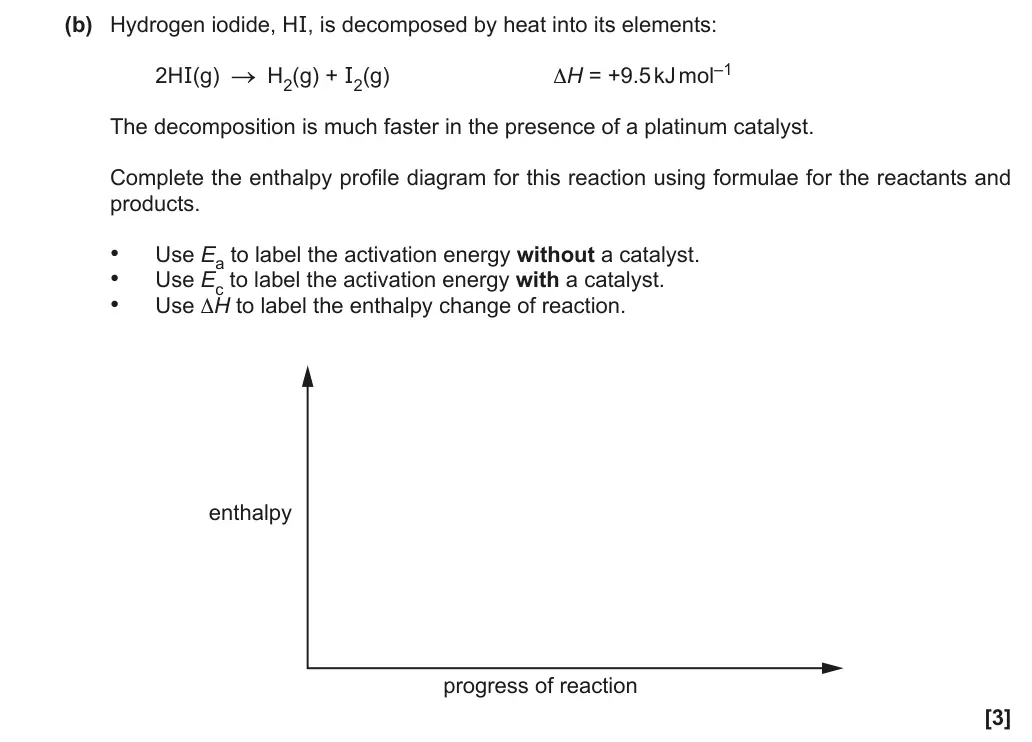
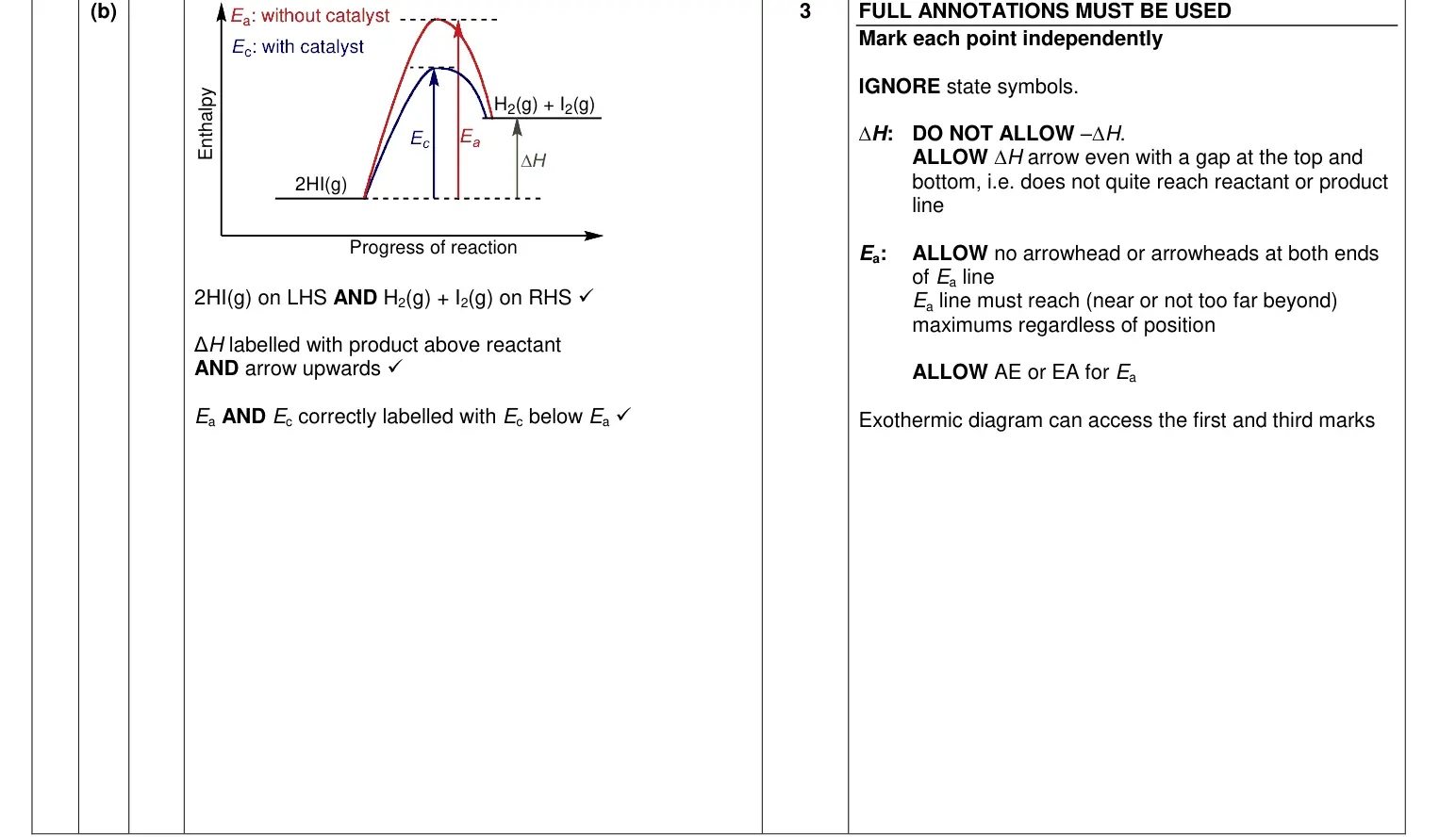
3.2.1(b) construction of enthalpy profile diagrams to show the difference in the enthalpy of reactants compared with products
3.2.1(c) qualitative explanation of the term activation energy, including use of enthalpy profile diagrams
3.2.1(d) explanation and use of the terms:
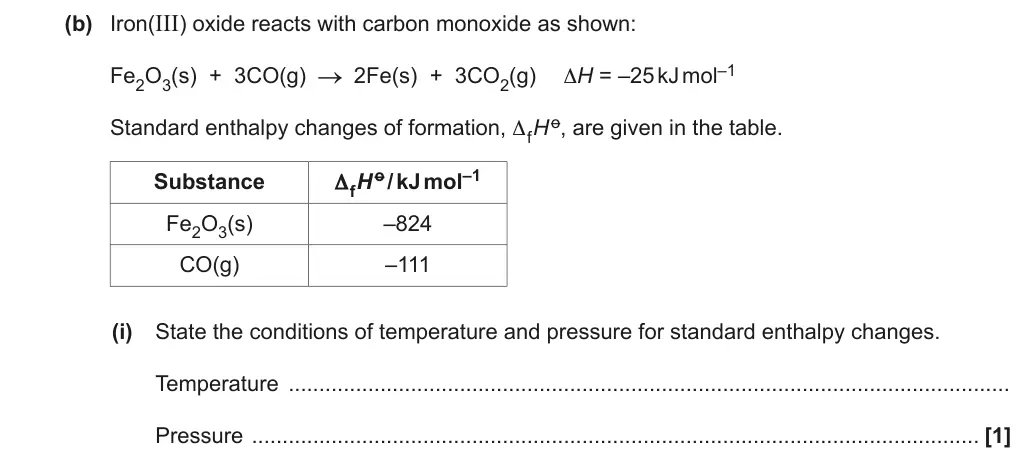
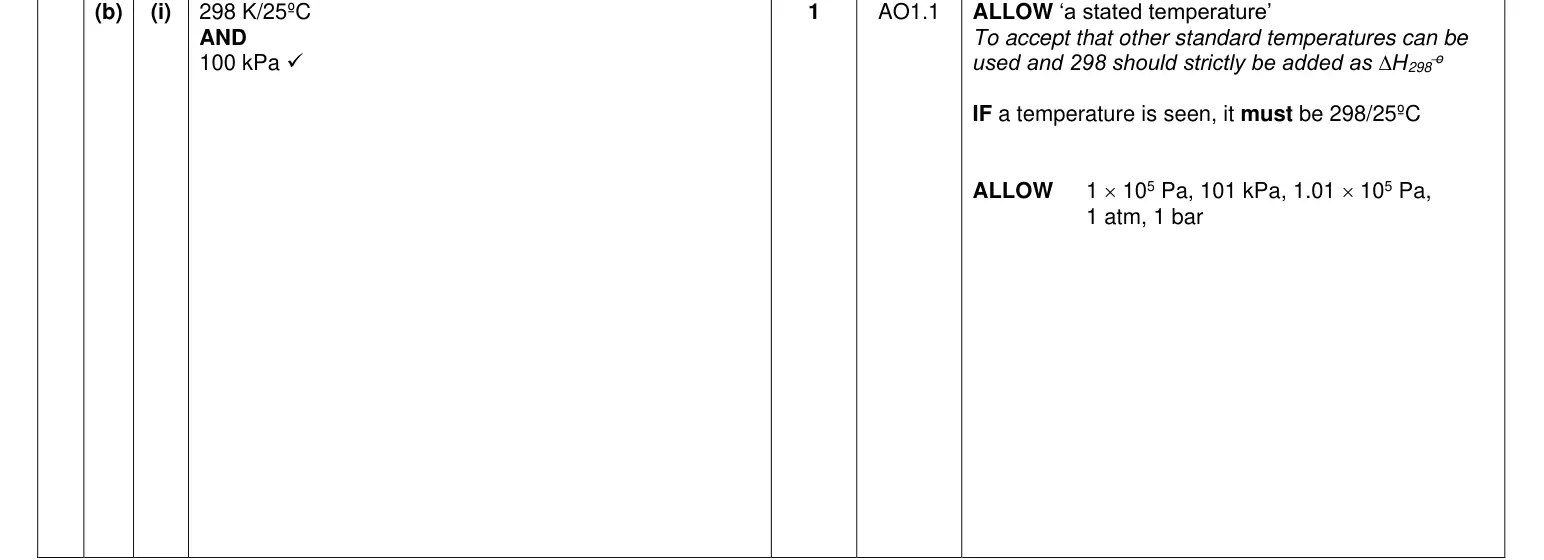
3.2.1(d)(i) standard conditions and standard states (physical states under standard conditions)
3.2.1(d)(ii) enthalpy change of reaction (enthalpy change associated with a stated equation, ∆rH)
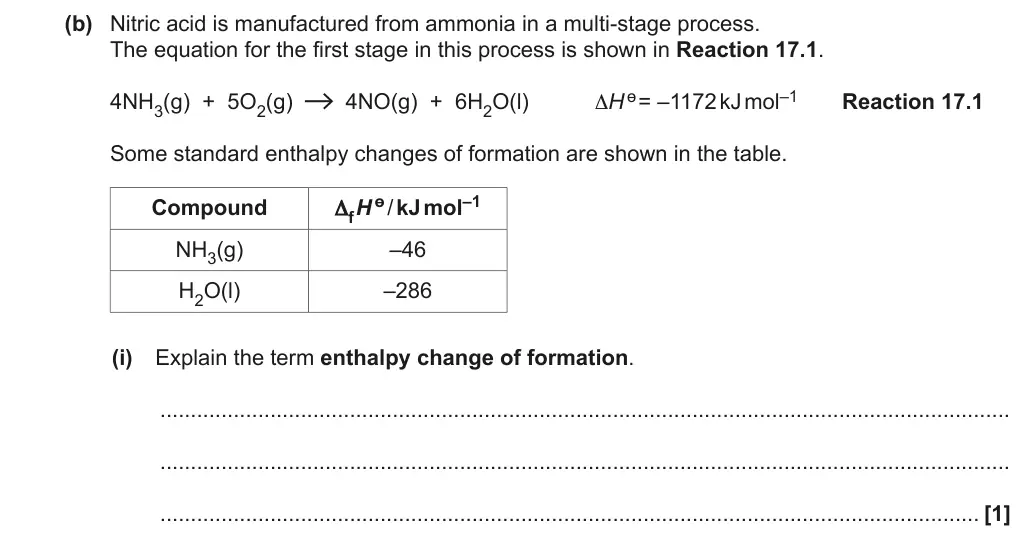
3.2.1(d)(iii) enthalpy change of formation (formation of 1 mol of a compound from its elements, ∆fH)
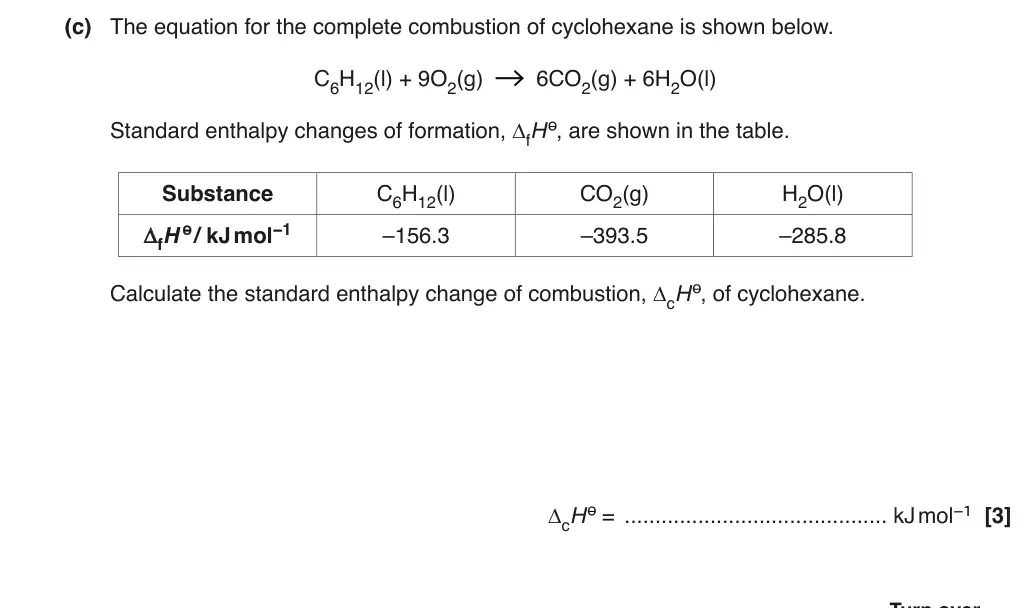
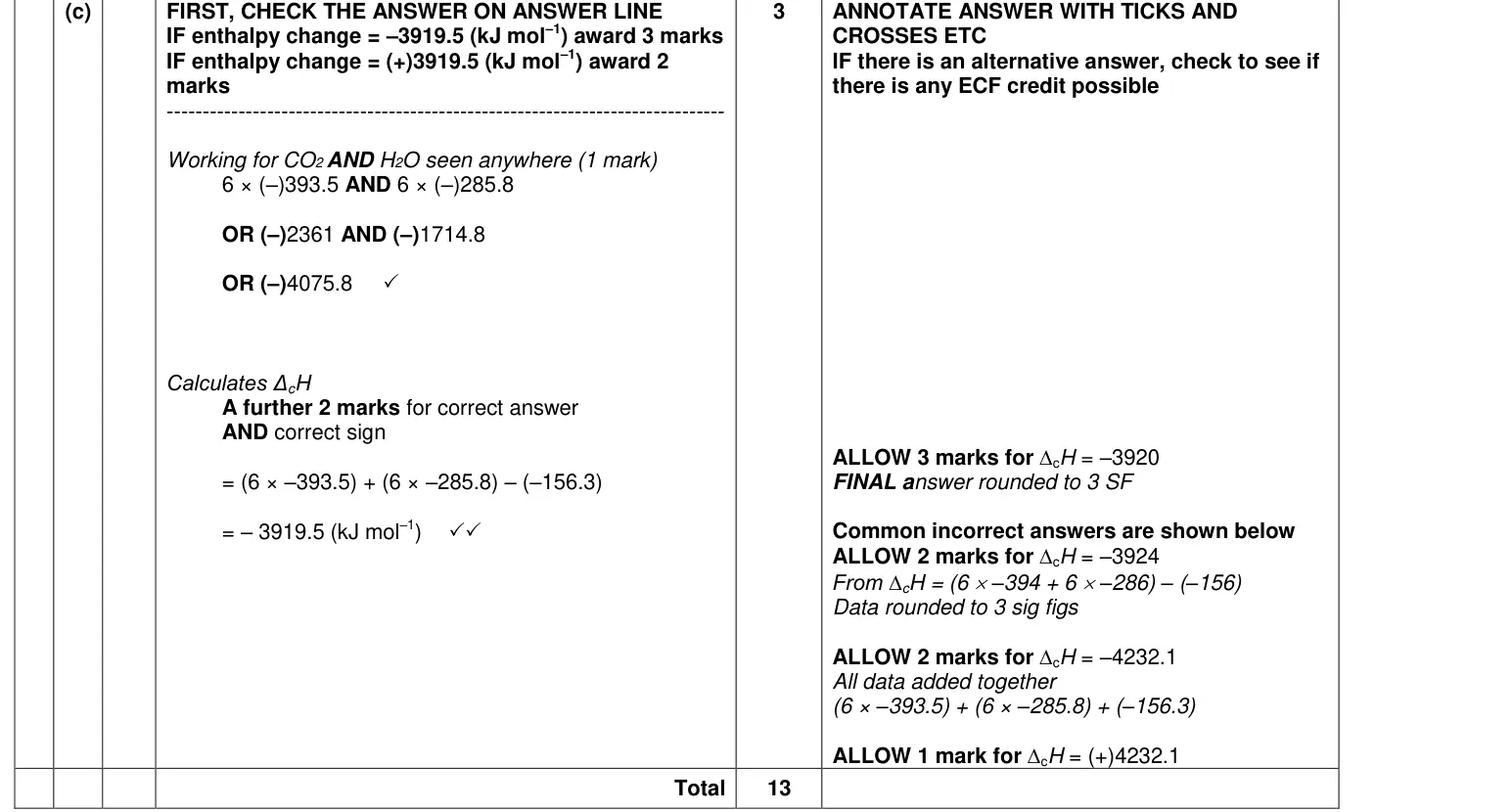
3.2.1(d)(iv) enthalpy change of combustion (complete combustion of 1 mol of a substance, ∆cH)
3.2.1(d)(v) enthalpy change of neutralisation (formation of 1 mol of water from neutralisation, ∆neutH)
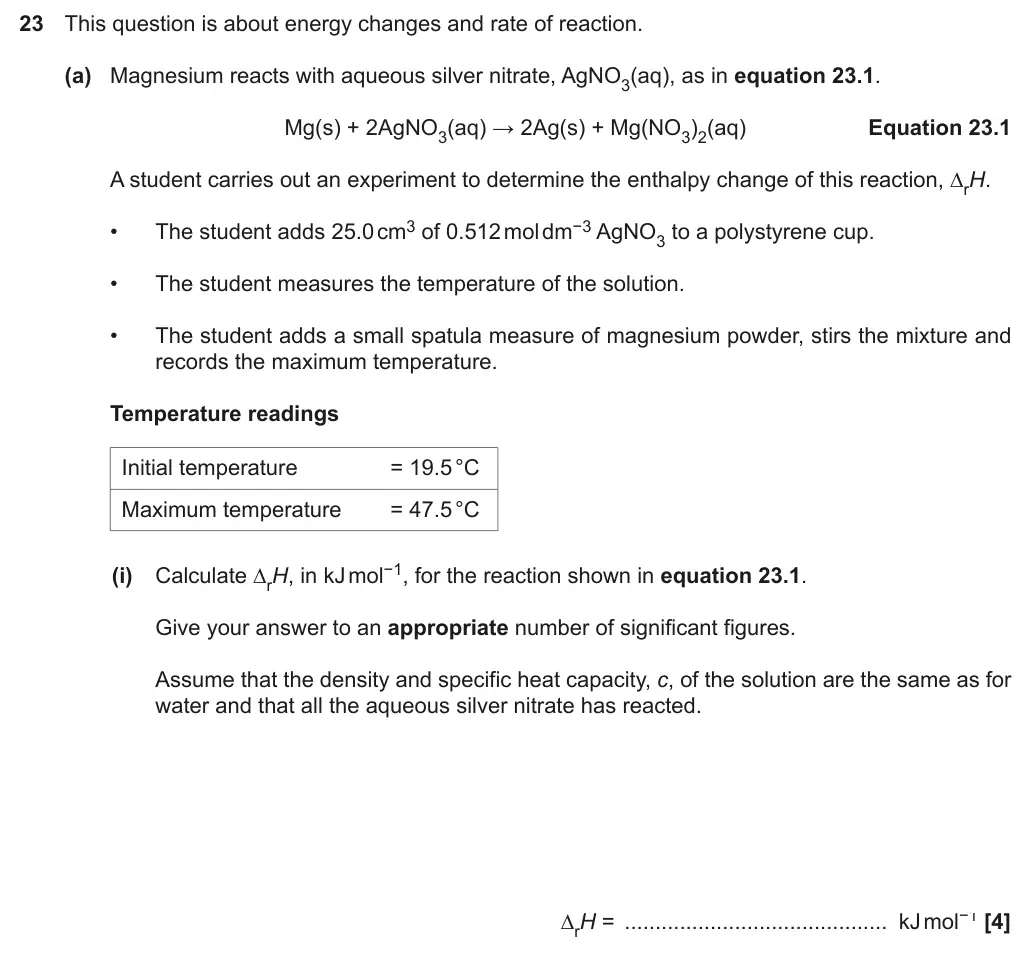
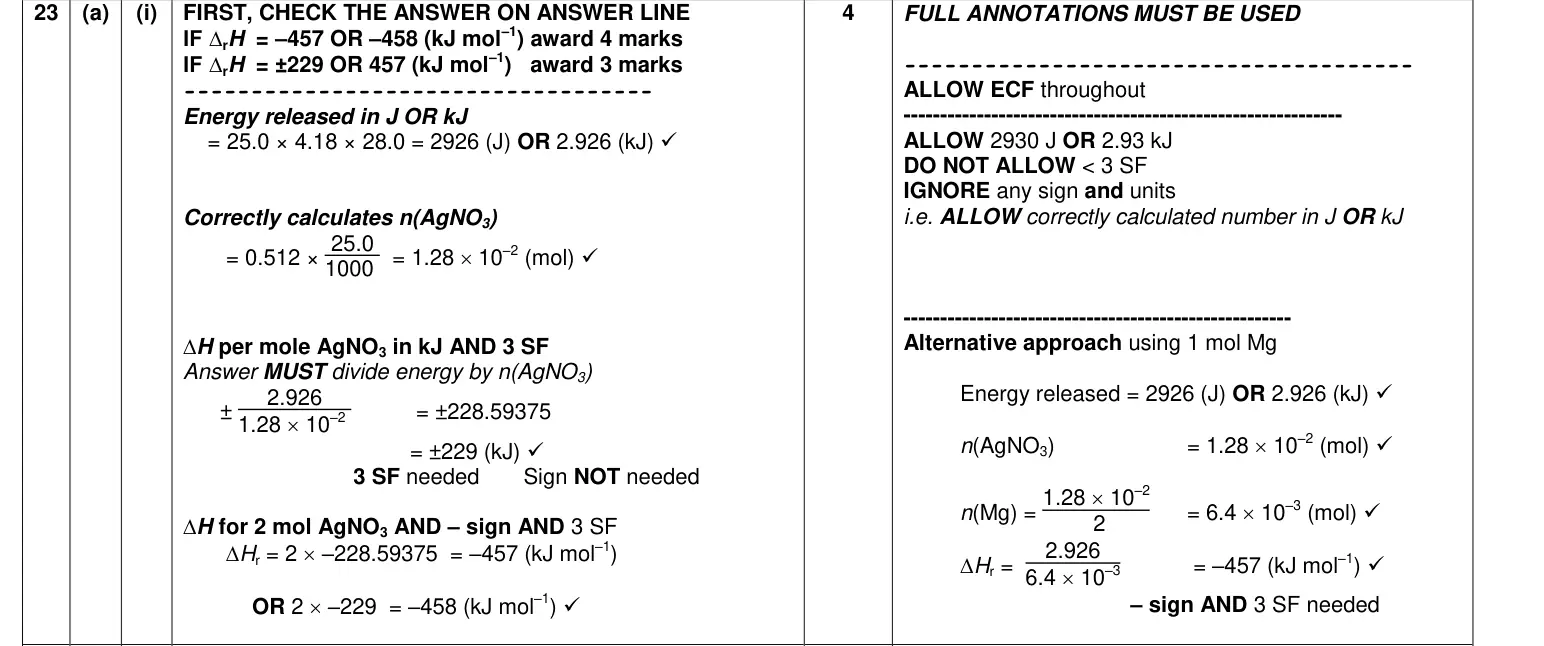
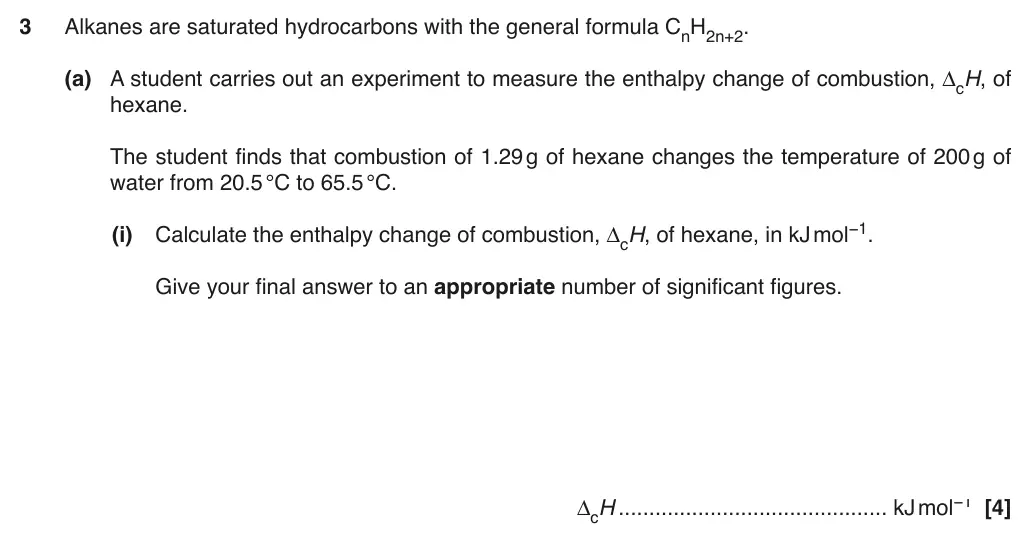
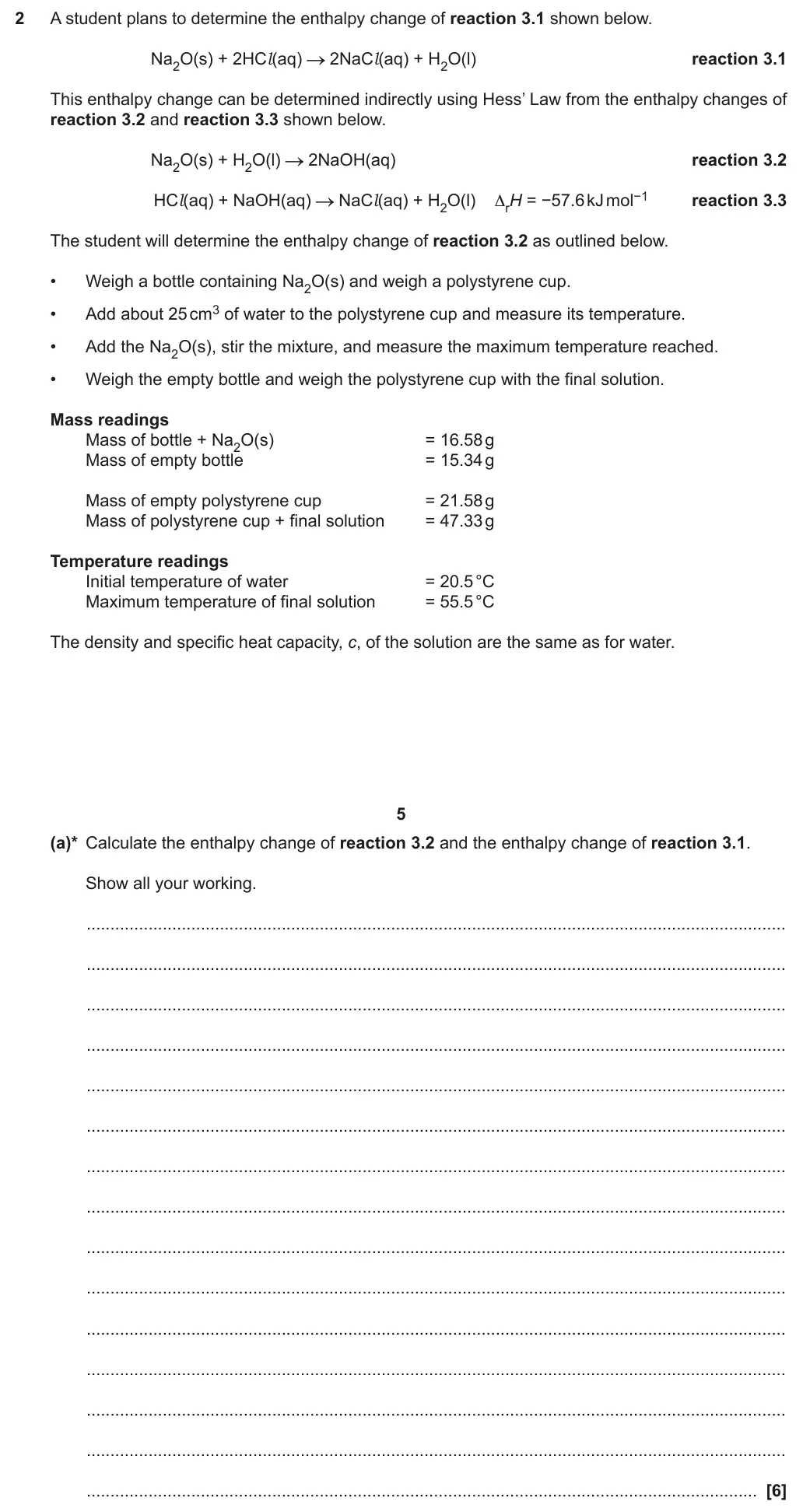
3.2.1(e) determination of enthalpy changes directly from appropriate experimental results, including use of the relationship: q = mc∆T
3.2.1(f)(i) explanation of the term average bond enthalpy (as the breaking of 1 mol of bonds in gaseous molecules)
3.2.1(f)(ii) explanation of exothermic and endothermic reactions in terms of enthalpy changes associated with the breaking and making of chemical bonds
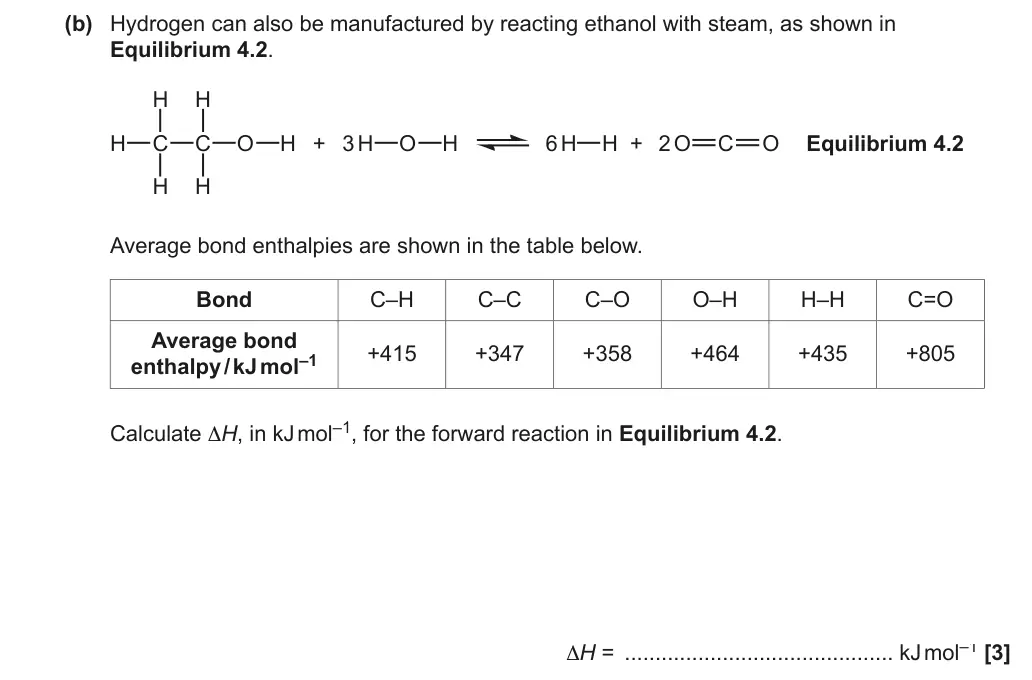
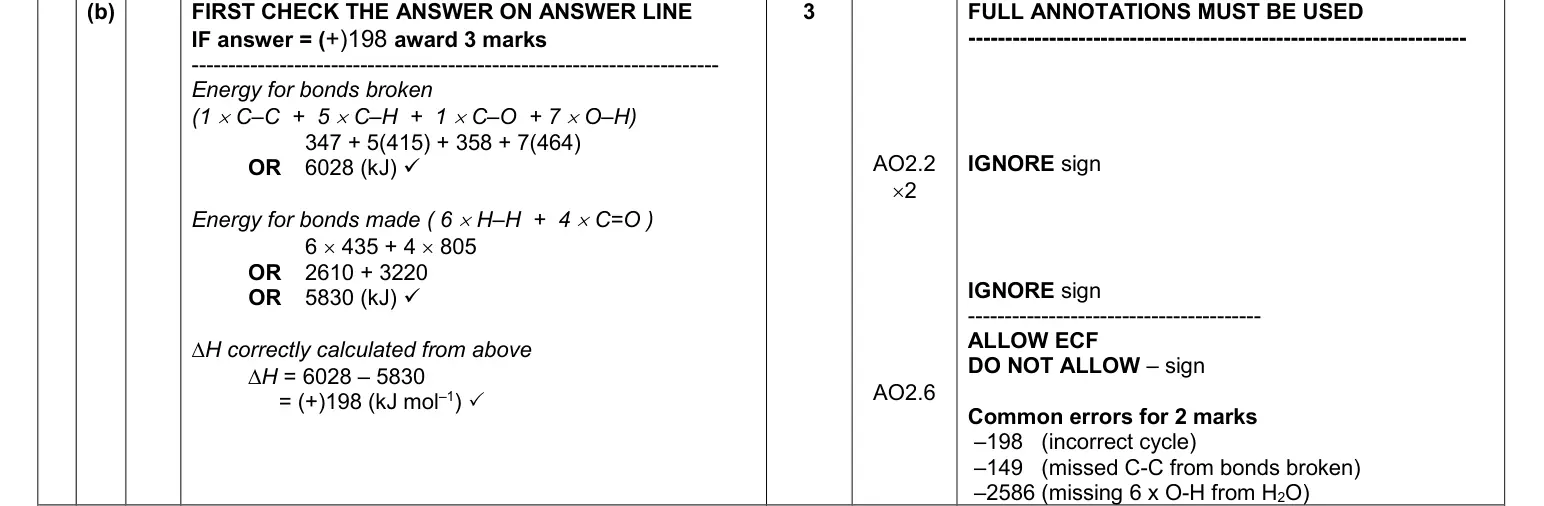
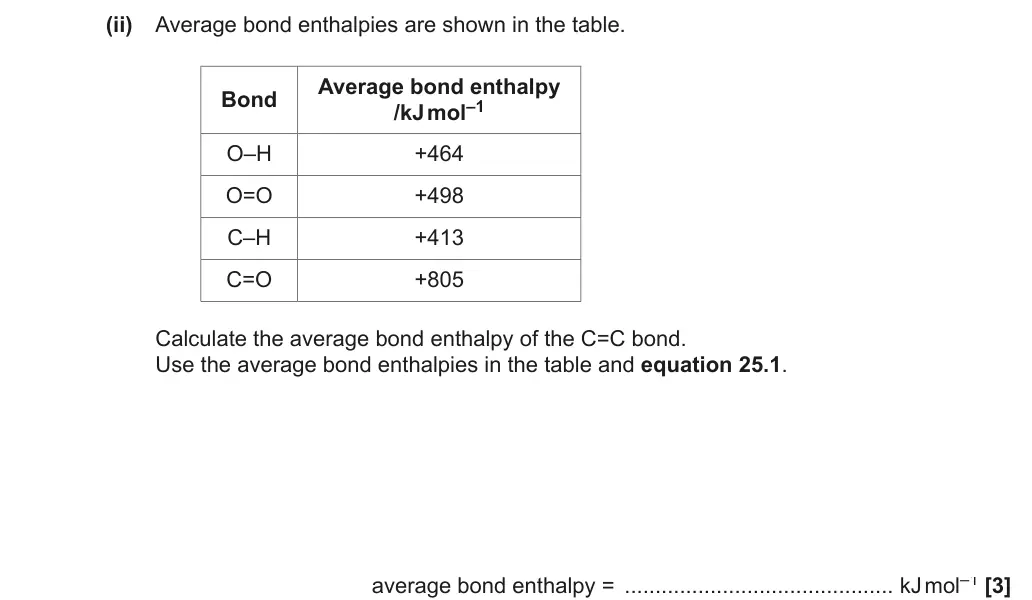
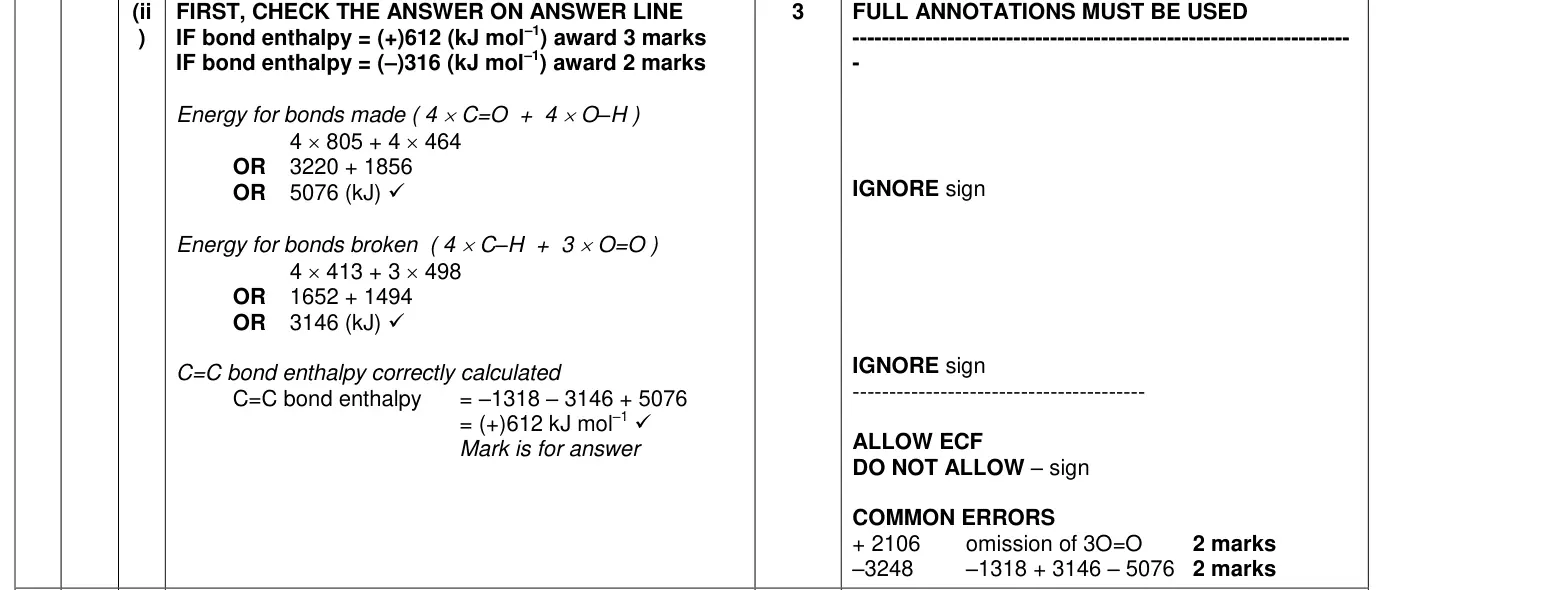
3.2.1(f)(iii) use of average bond enthalpies to calculate enthalpy changes and related quantities (see also 2.2.2 f)
3.2.1(g) Hess’ law for construction of enthalpy cycles and calculations to determine indirectly:
3.2.1(g)(i) an enthalpy change of reaction from enthalpy changes of combustion
3.2.1(g)(ii) an enthalpy change of reaction from enthalpy changes of formation
3.2.1(g)(iii) enthalpy changes from unfamiliar enthalpy cycles
3.2.1(h) the techniques and procedures used to determine enthalpy changes directly and indirectly.
Six-mark level of response questions on this topic
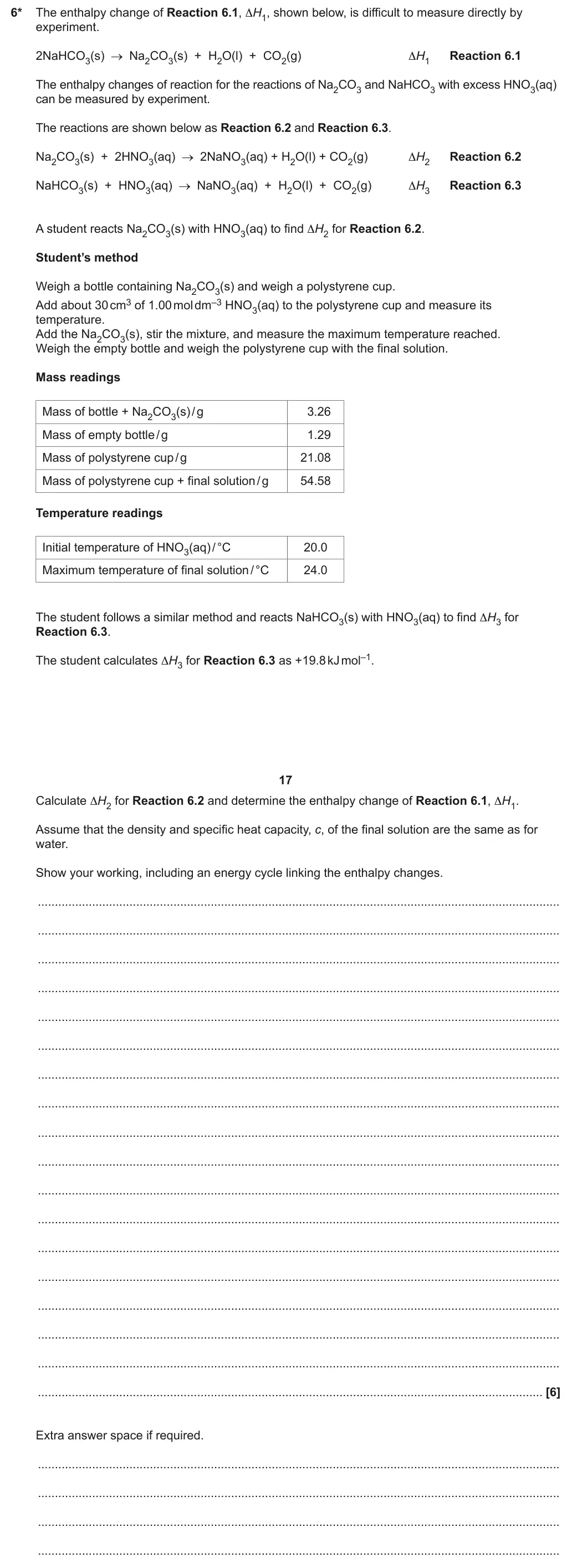
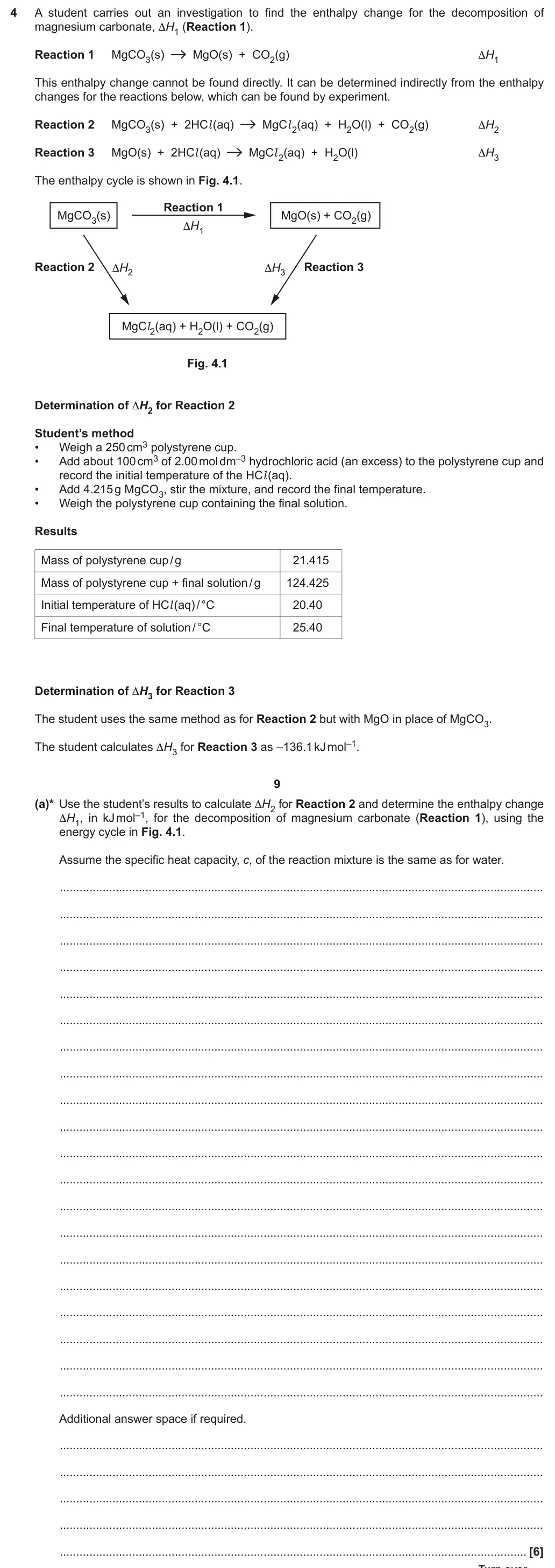
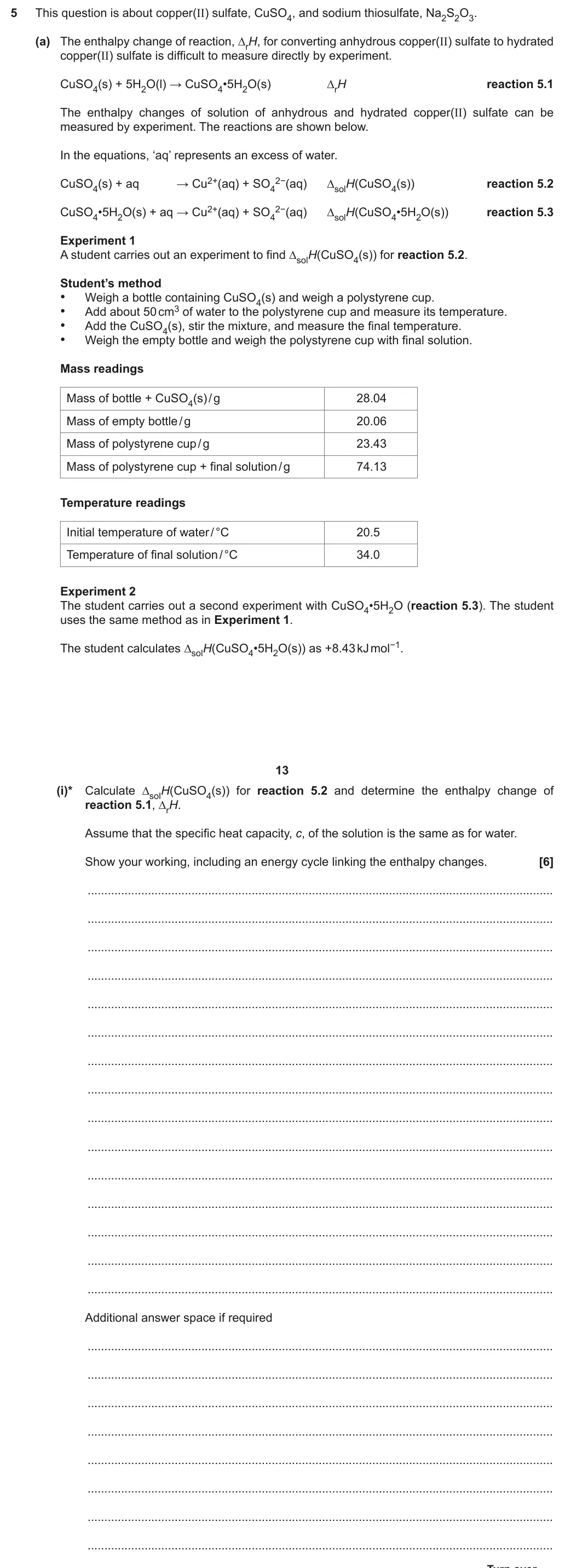
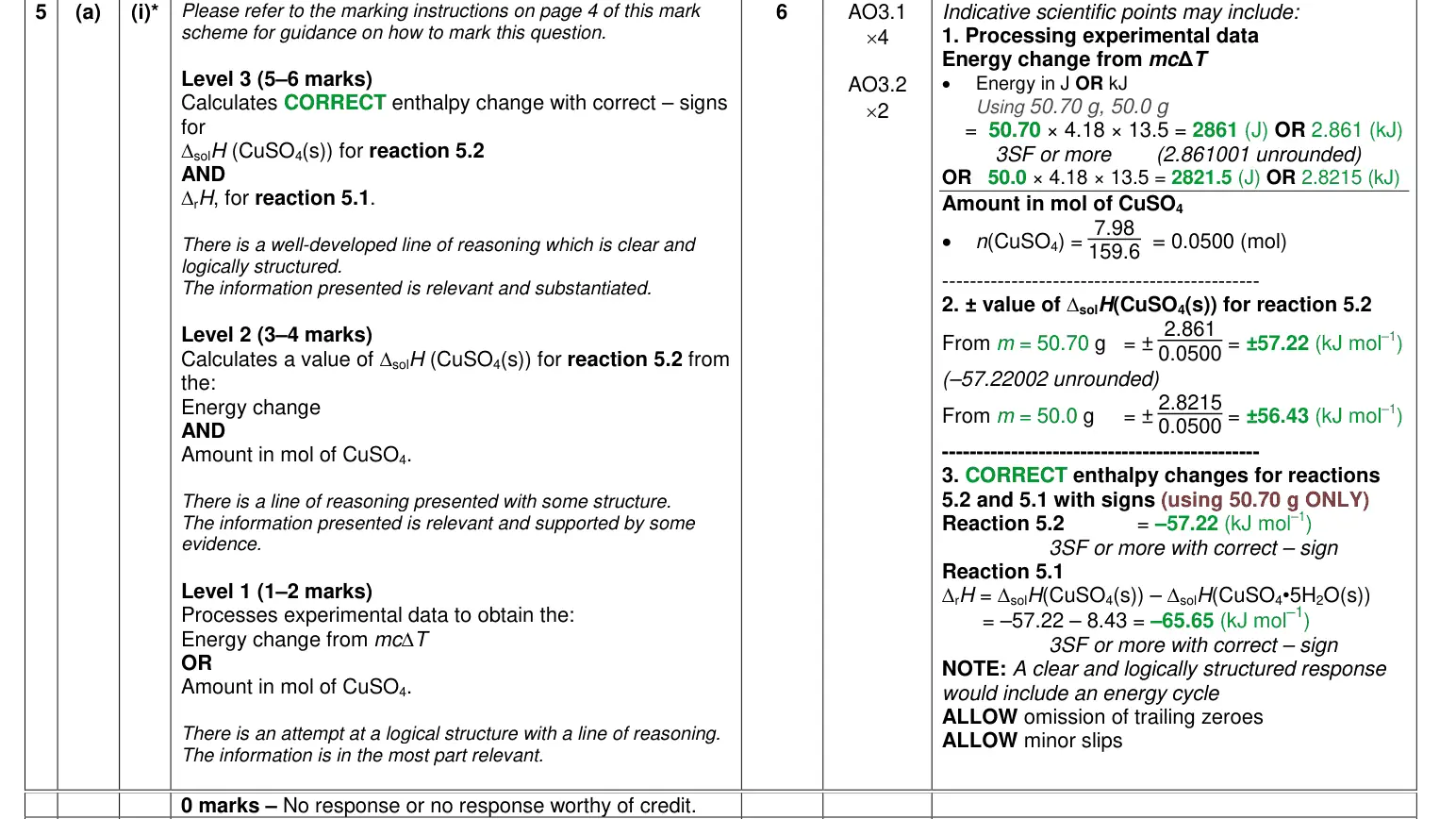
The enthalpy change of Reaction 6.1, ∆H1, shown below, is difficult to measure directly by Calculate ∆H2 for Reaction 6.2 and determine the enthalpy change of Reaction 6.1, ∆H1.
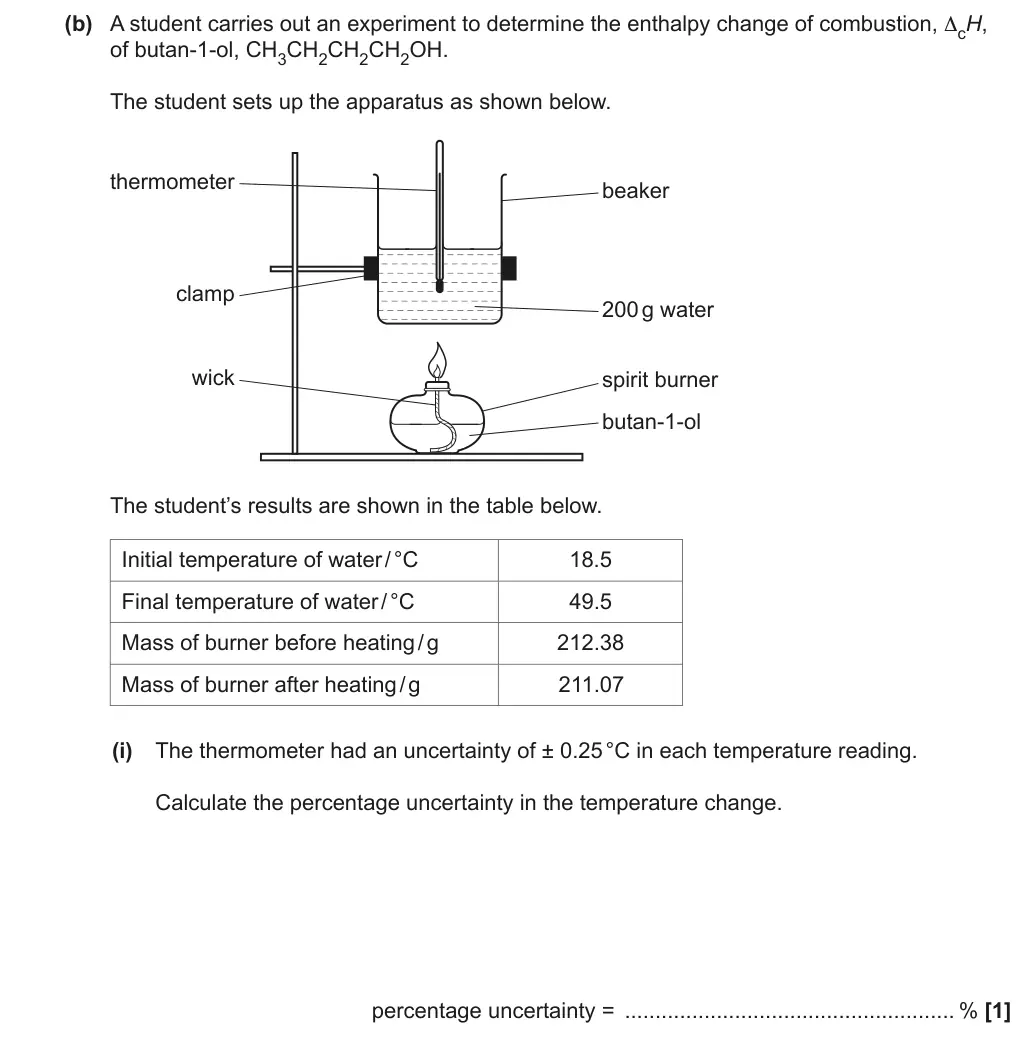
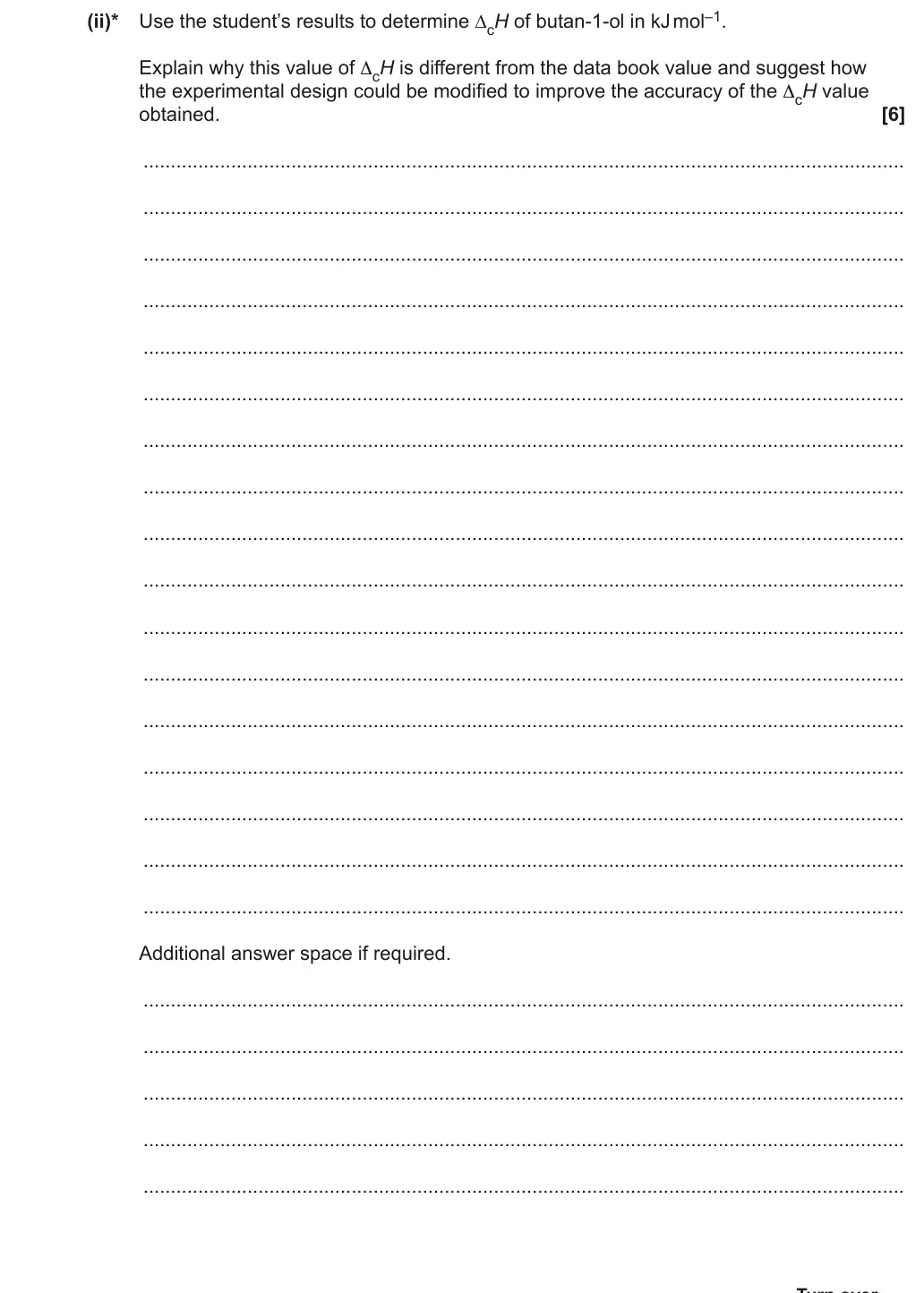
Use the student’s results to determine ∆cH of butan-1-ol in kJ mol–1. Explain why this value of ΔcH is different from the data book value and suggest how
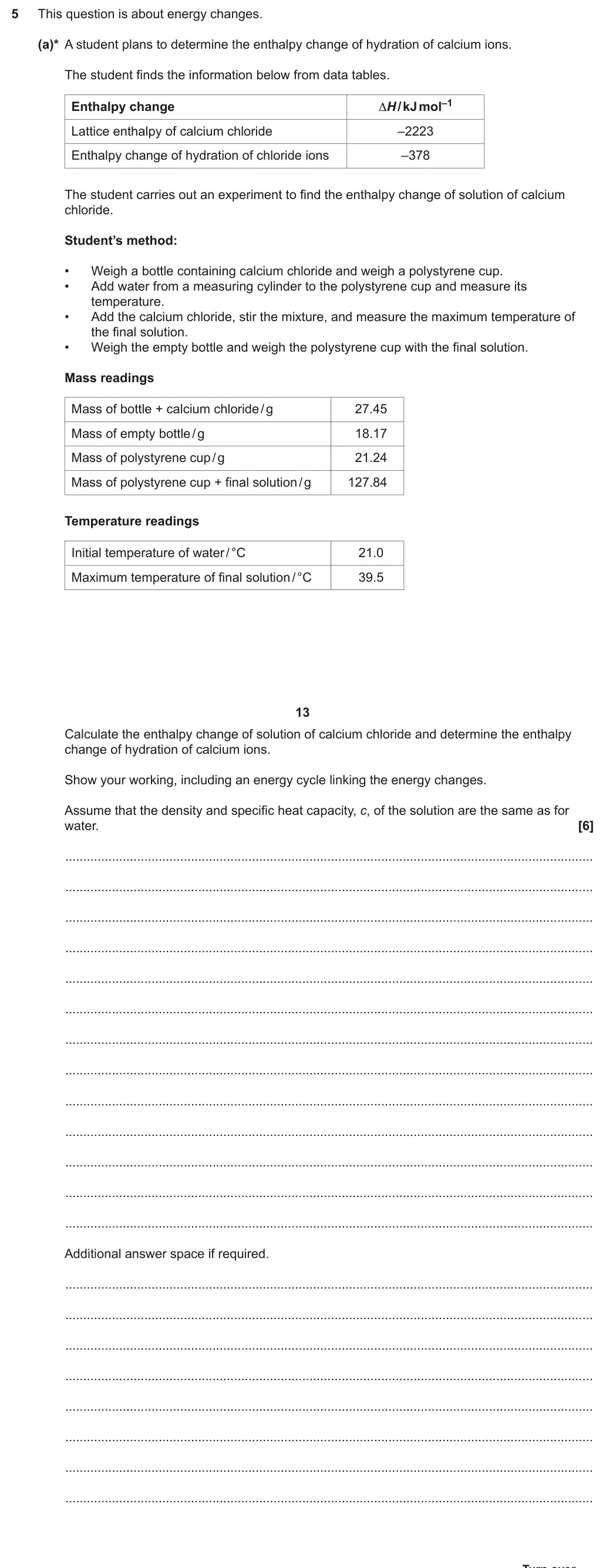
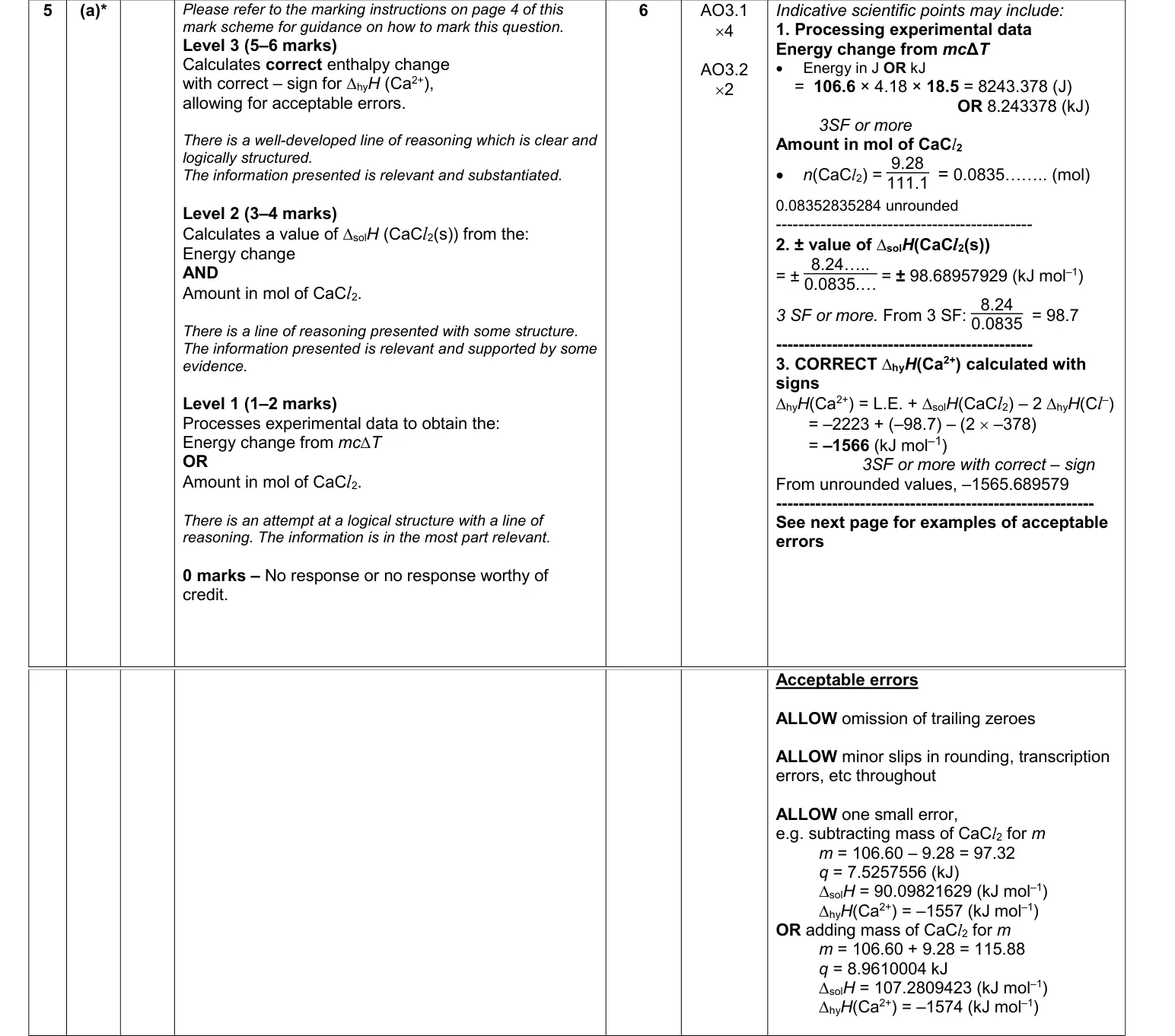
A student plans to determine the enthalpy change of hydration of calcium ions. Calculate the enthalpy change of solution of calcium chloride and determine the enthalpy
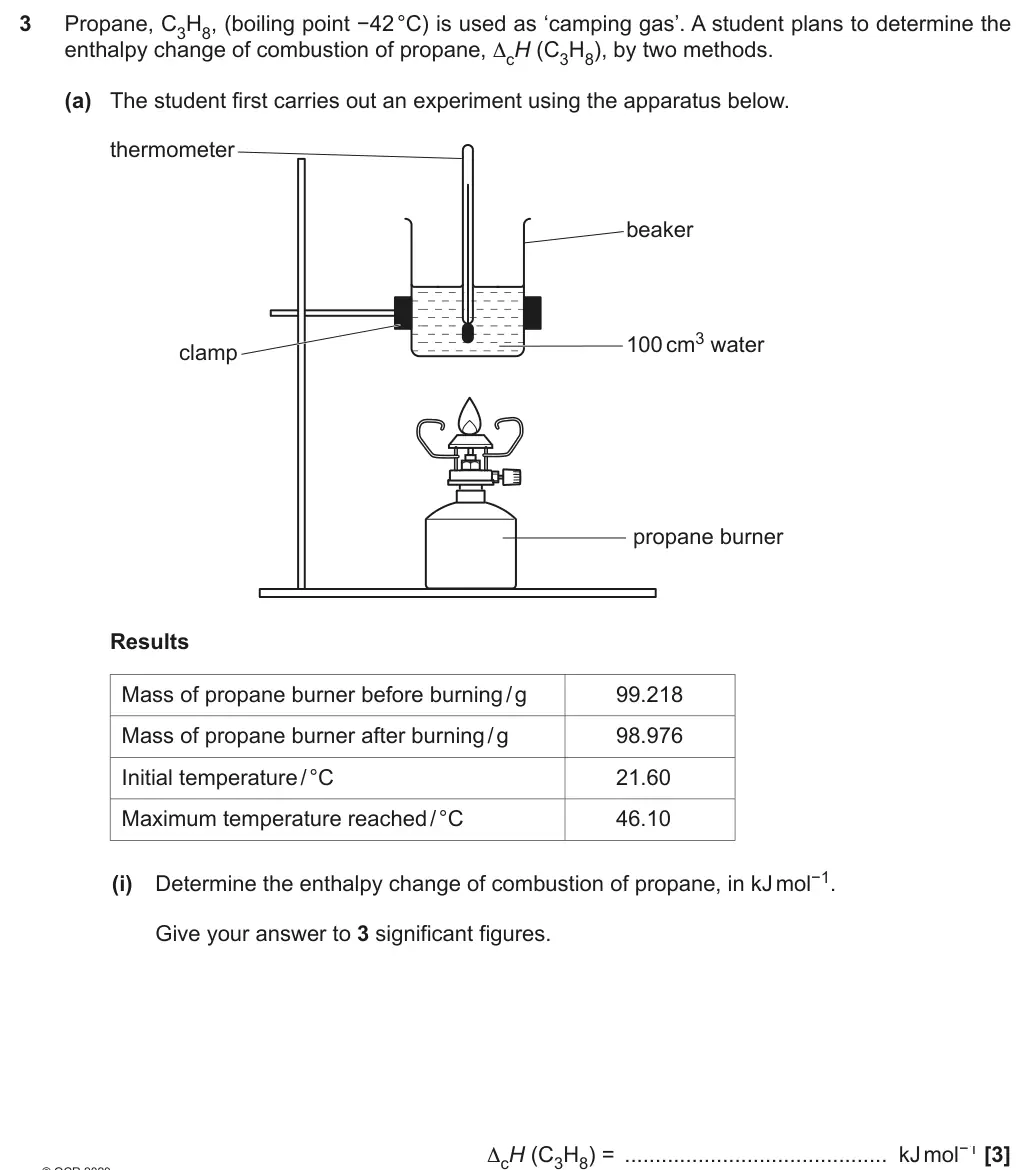
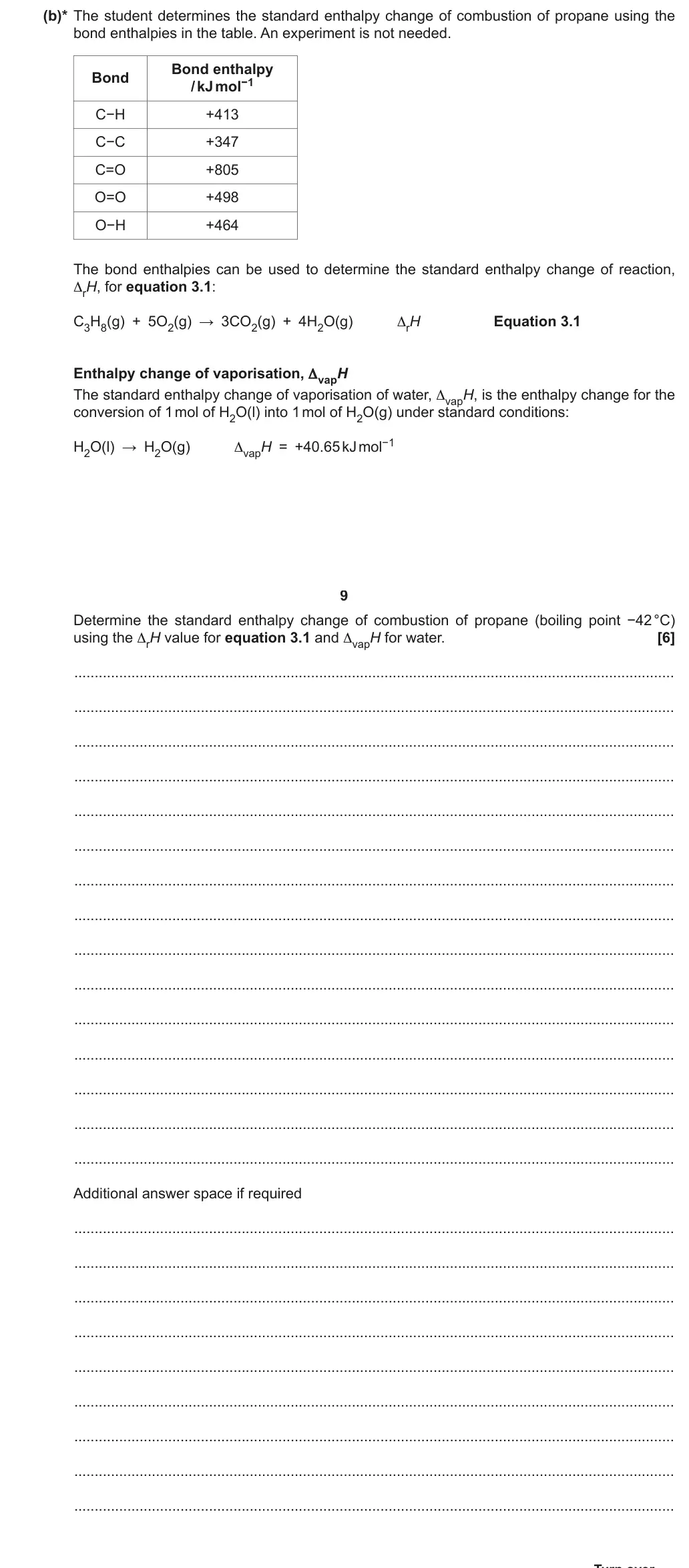
The student determines the standard enthalpy change of combustion of propane using the Determine the standard enthalpy change of combustion of propane (boiling point −42 °C)
Tap a question to zoom it. Where a part needs a table, graph or structure from an earlier part, that part folds out above it; the mark scheme and examiner's comment open underneath. Have the OCR Data Sheet beside you.
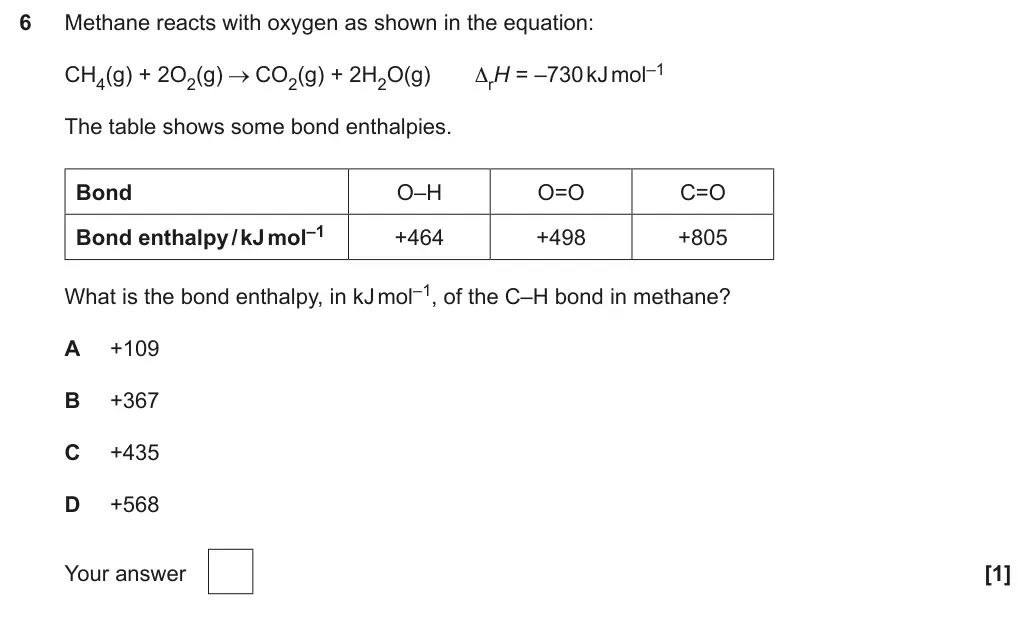
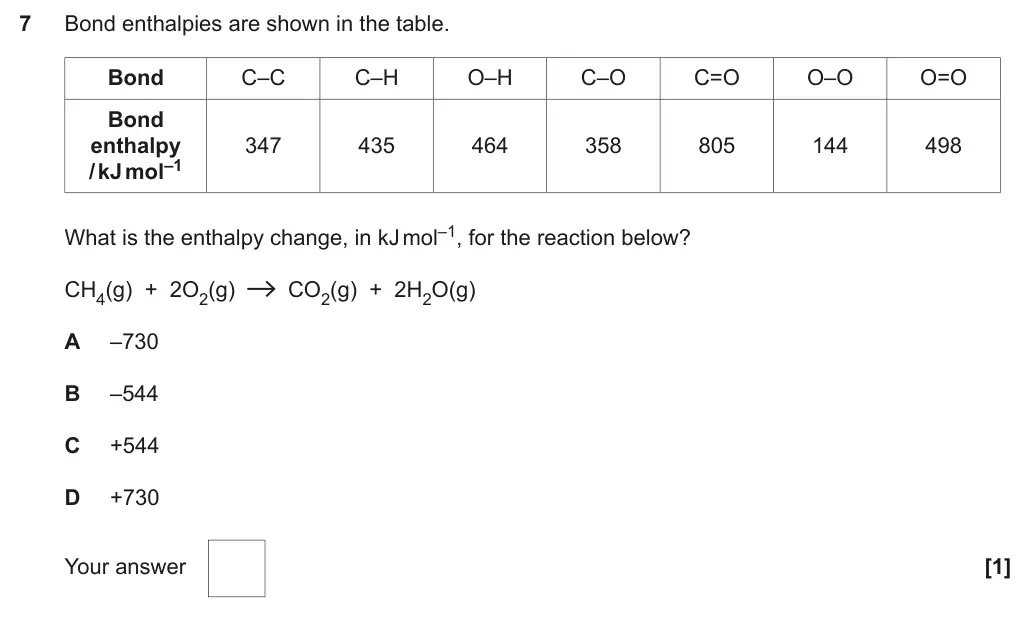
June 2025 · Paper 1 · Q61 markMultiple choiceEasy
Answer
C
Mark scheme
Examiner's comment
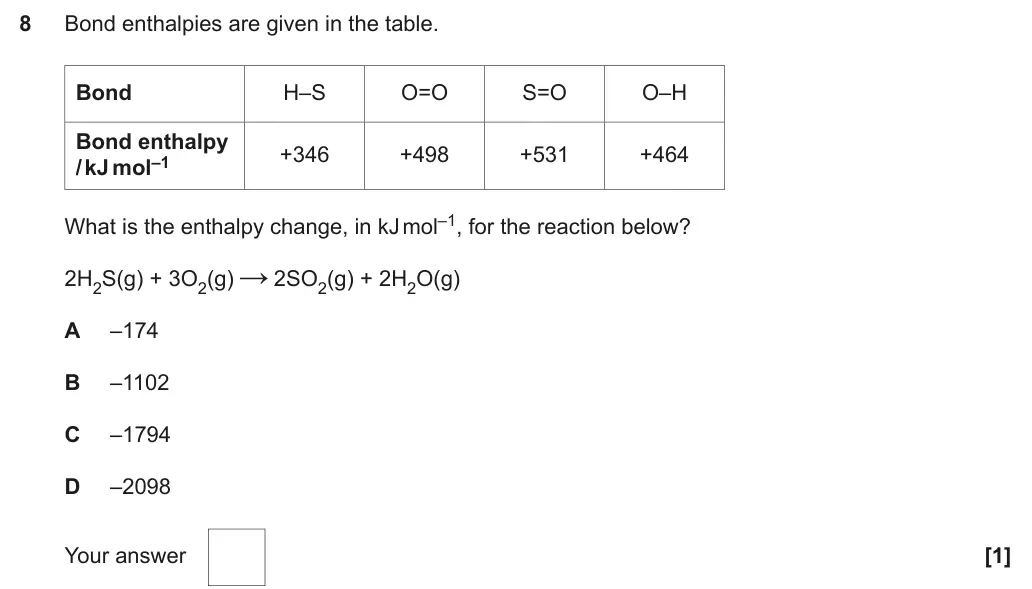
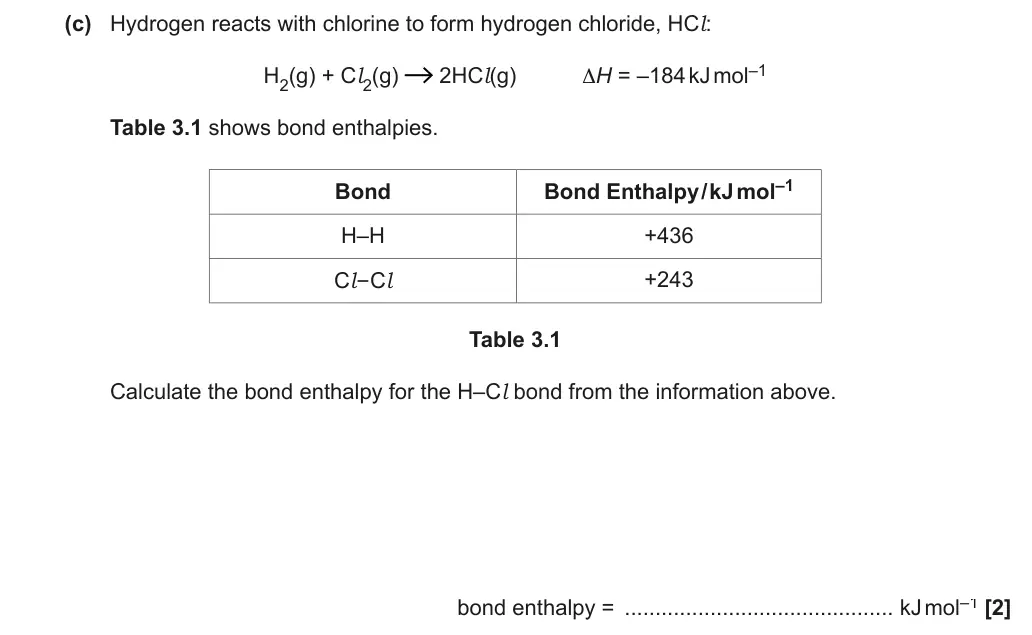
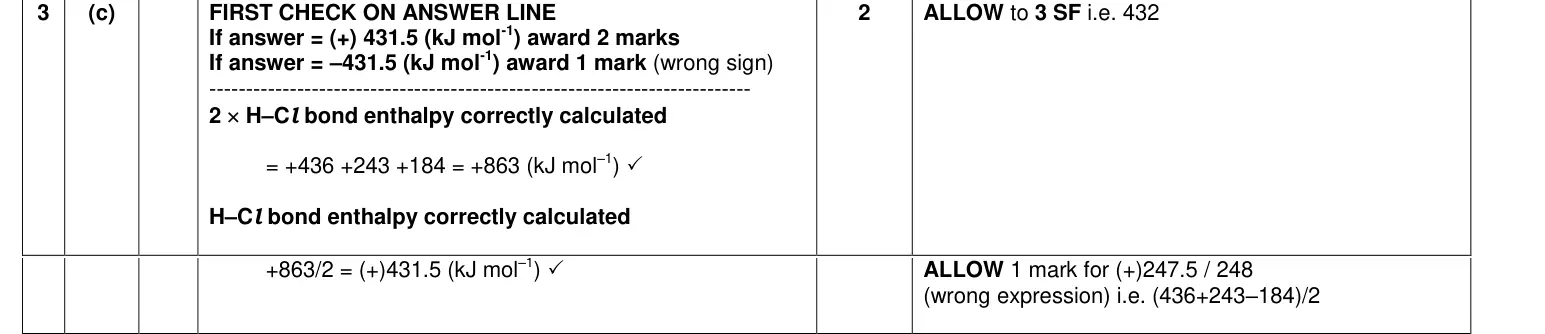
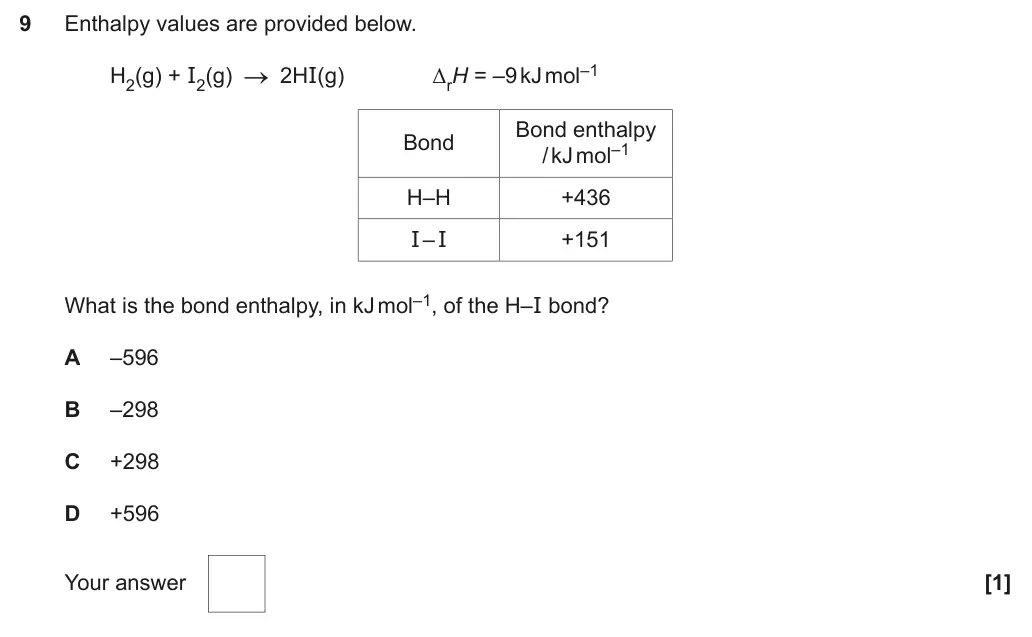
The correct answer was C. This question was well answered by most candidates. Candidates should be encouraged to use the space around the question to jot down the equation and perform any calculations. Those who obtained an incorrect answer did not consider the number of moles of bonds broken or made and used wrong signs.
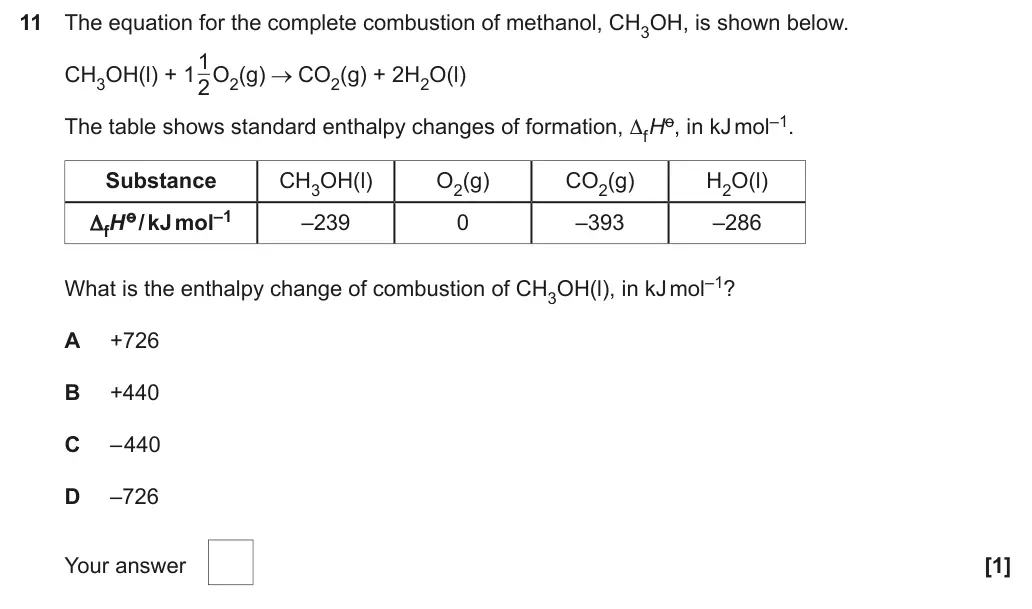
June 2025 · AS Paper 1 · Q111 markMultiple choiceMedium
Answer
D
Mark scheme
Examiner's comment
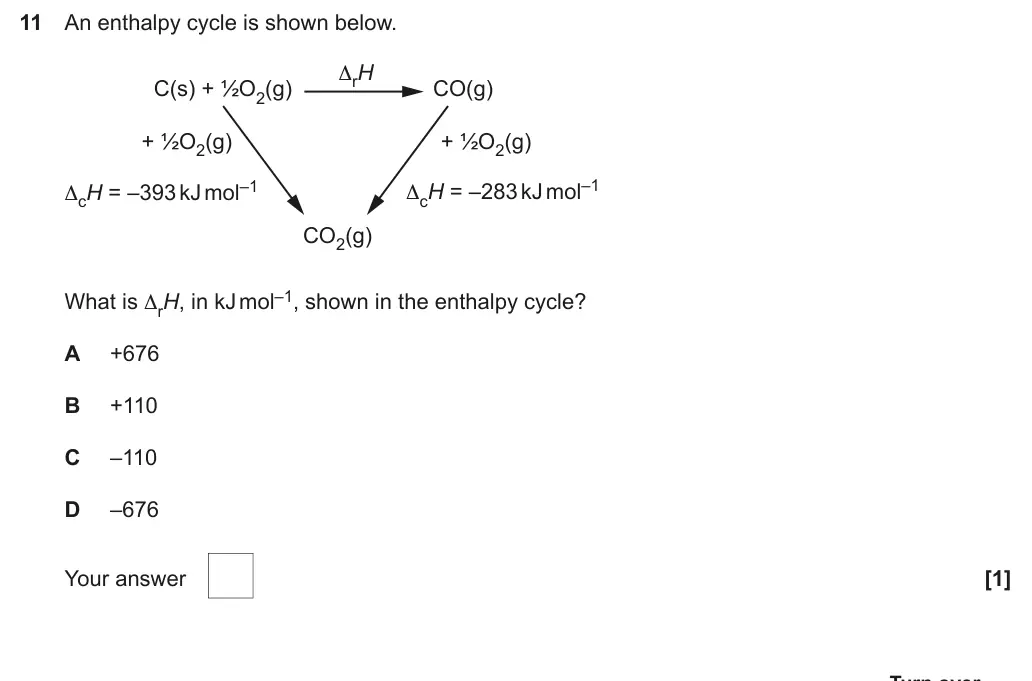
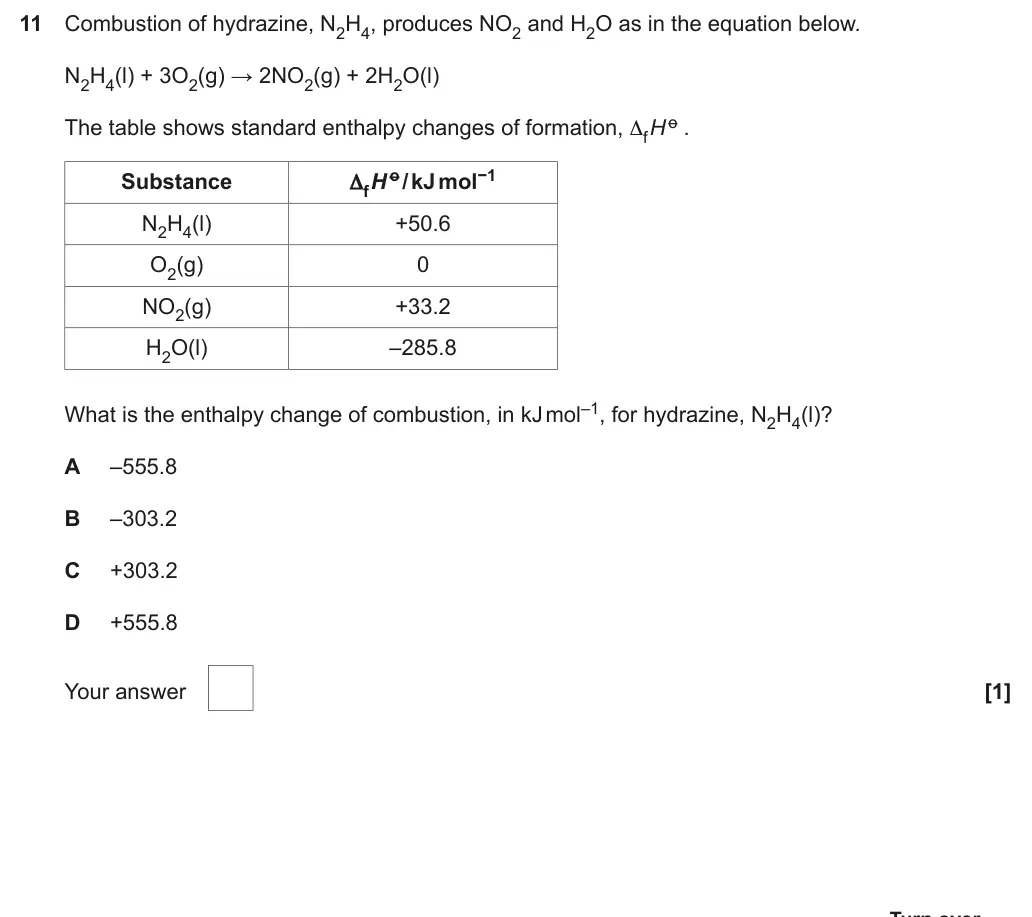
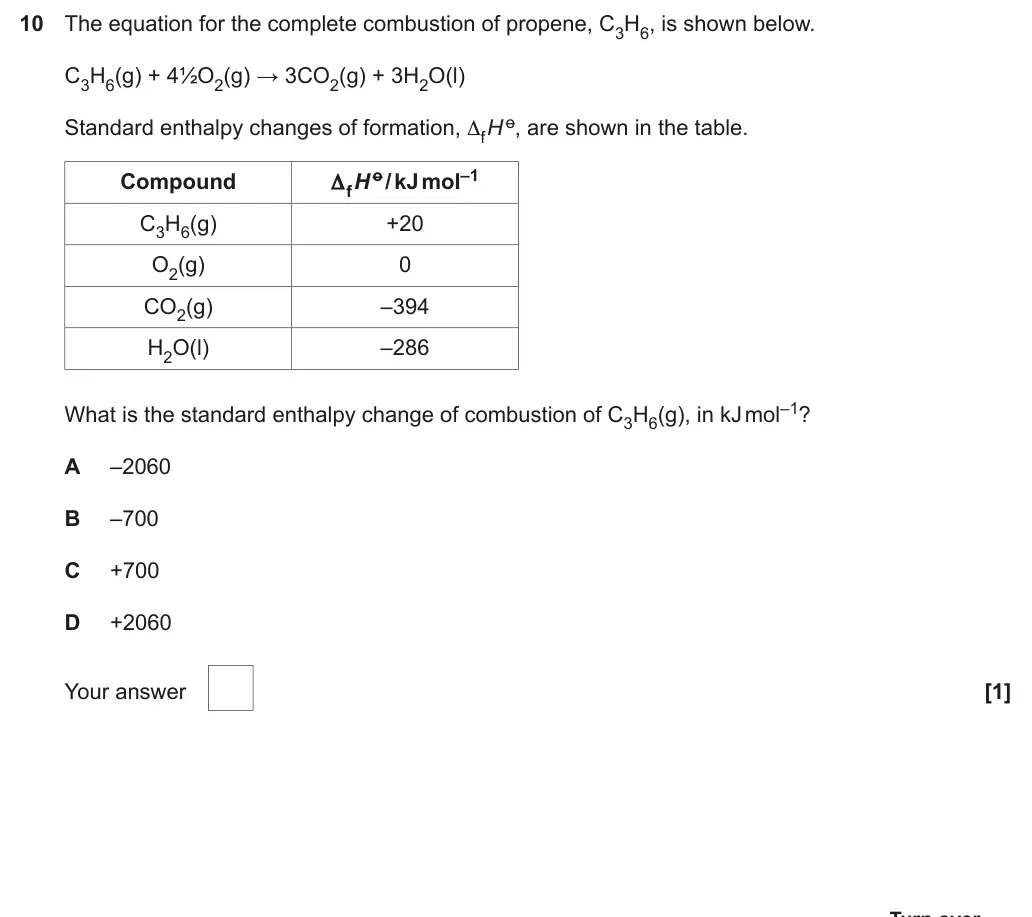
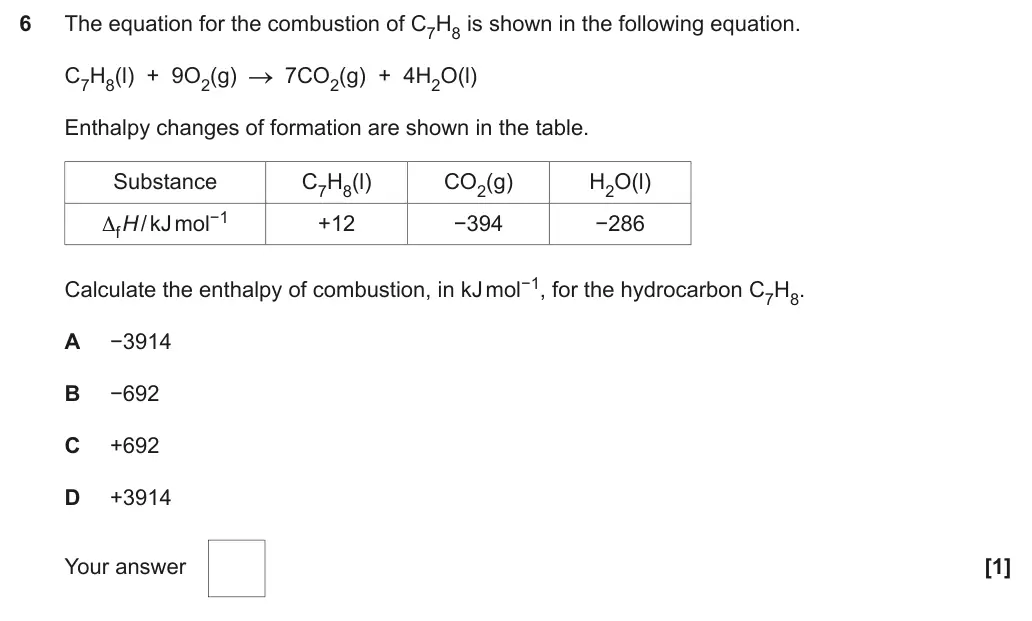
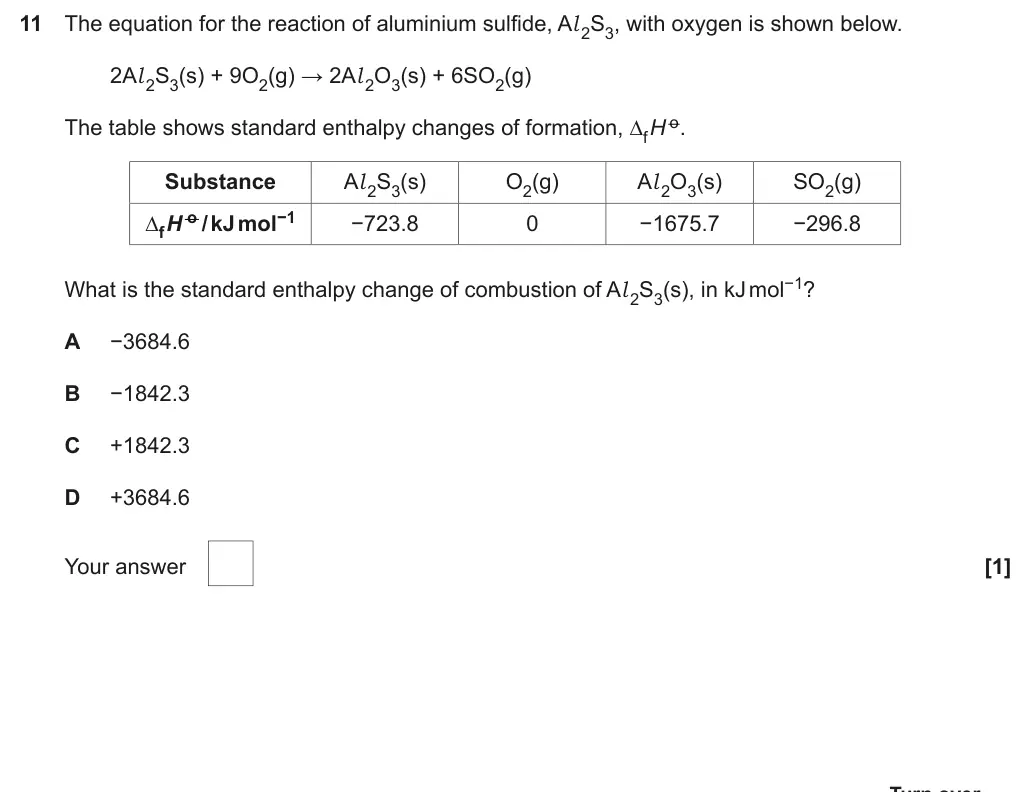
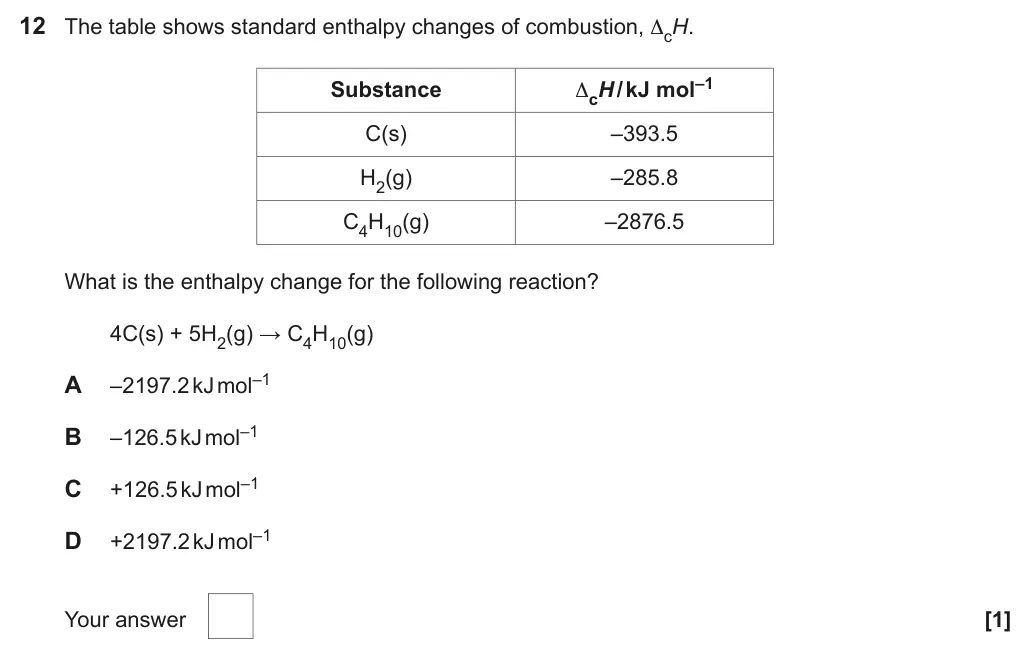
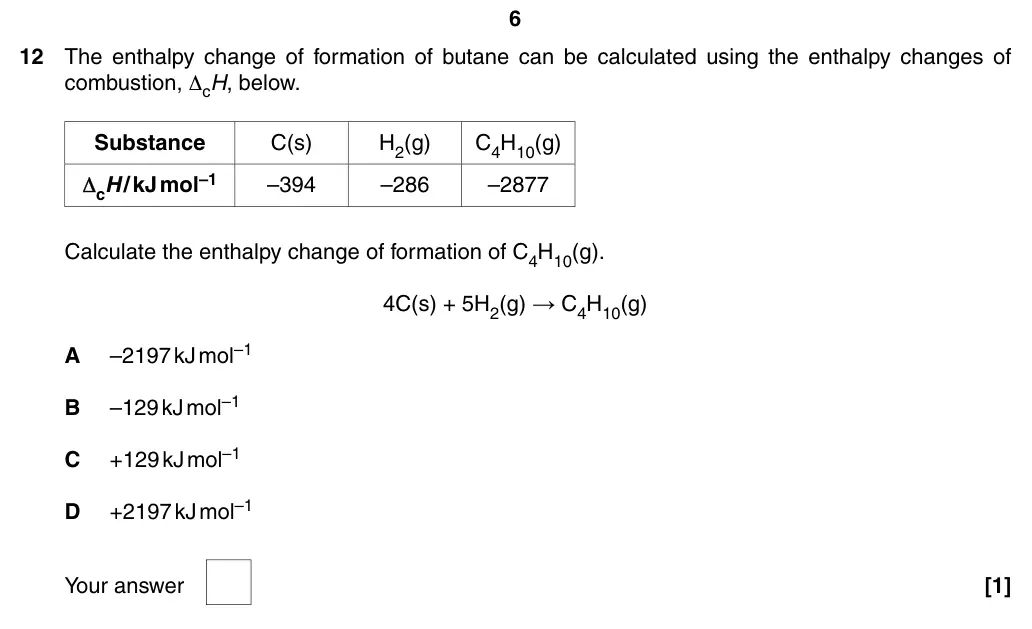
Over half of candidates correctly calculated the enthalpy change of combustion. A was the most common incorrect response, due to the Hess cycle being the wrong way round. In some instances, candidates corrected this error by appreciating the reaction would be exothermic and therefore picked the negative value instead.
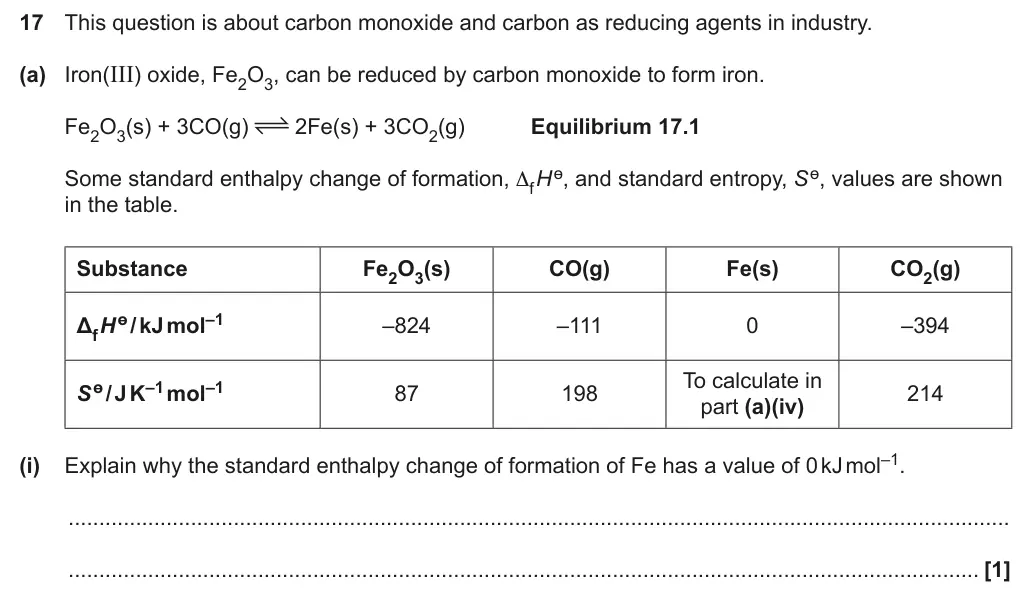
June 2025 · Paper 1 · Q17(a)(i)1 markShort answerEasy
Mark scheme
Examiner's comment
Most candidates were able to identify that Fe is already in its elemental state and the enthalpy change of formation would, therefore, be 0 kJ mol-1. Less successful candidates described iron as being in its natural state or an atom and thus didn’t have a formation enthalpy.
Notes from the mark scheme and report
iron is an element (in its standard state)
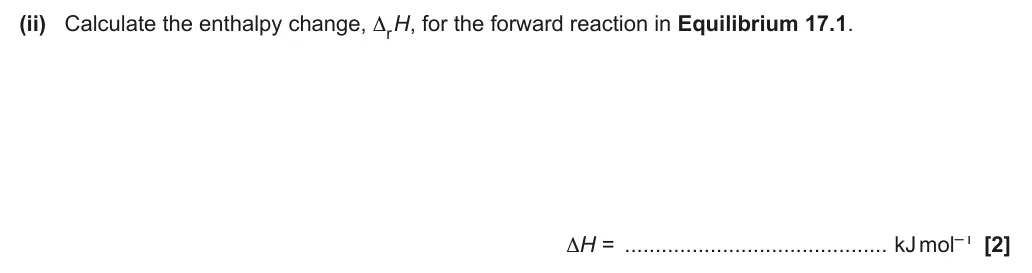
June 2025 · Paper 1 · Q17(a)(ii)2 marksCalculationHard
Earlier part of question 17 that this part uses
Mark scheme
Examiner's comment
Many candidates were given both marks with the correct answer of -25 kJ mol-1. The best responses showed clear working using a Hess’s law cycle. Common errors of +25 and not using the correct multiples were seen from a few candidates.
Notes from the mark scheme and report
common errors (1 mark): +763 (no 3 × –394), +25 (sign), –247 (no 3 × –111), –2339 (added reactants)
answer –25
Skills: M0.2 Use ratios, fractions and percentages; M2.3 Substitute numerical values into algebraic equations using appropriate units for physical quantities
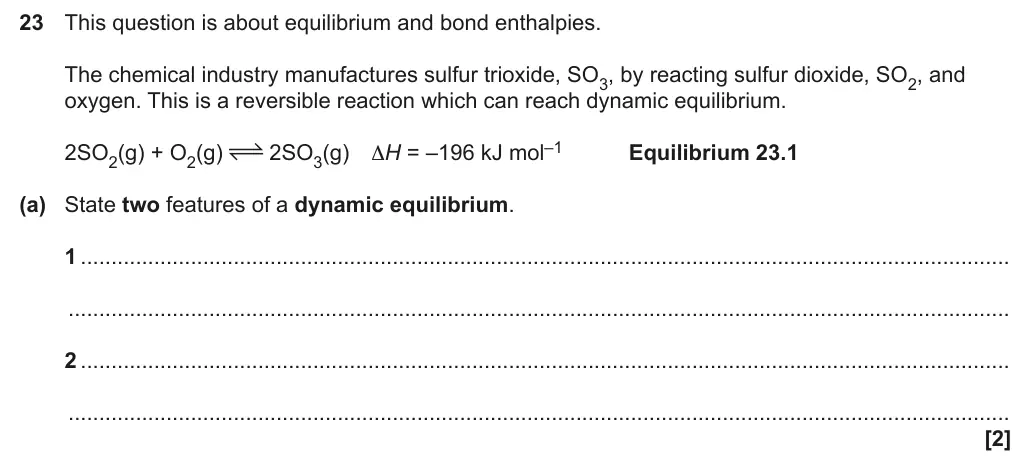
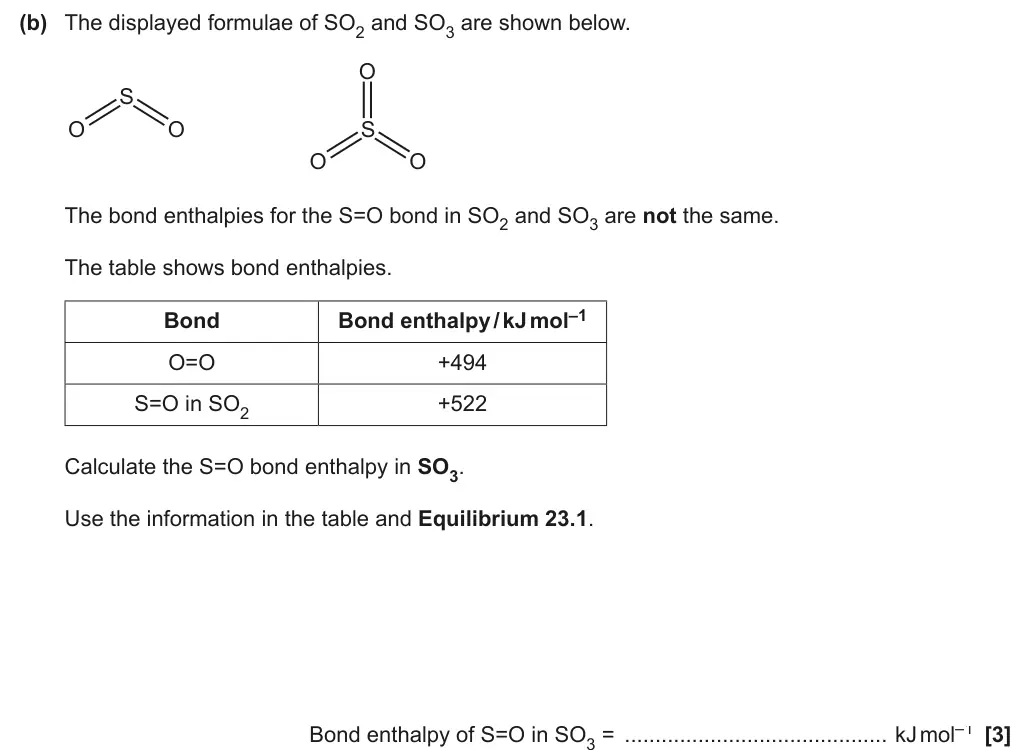
June 2025 · AS Paper 1 · Q23(b)3 marksCalculationHard
Earlier part of question 23 that this part uses
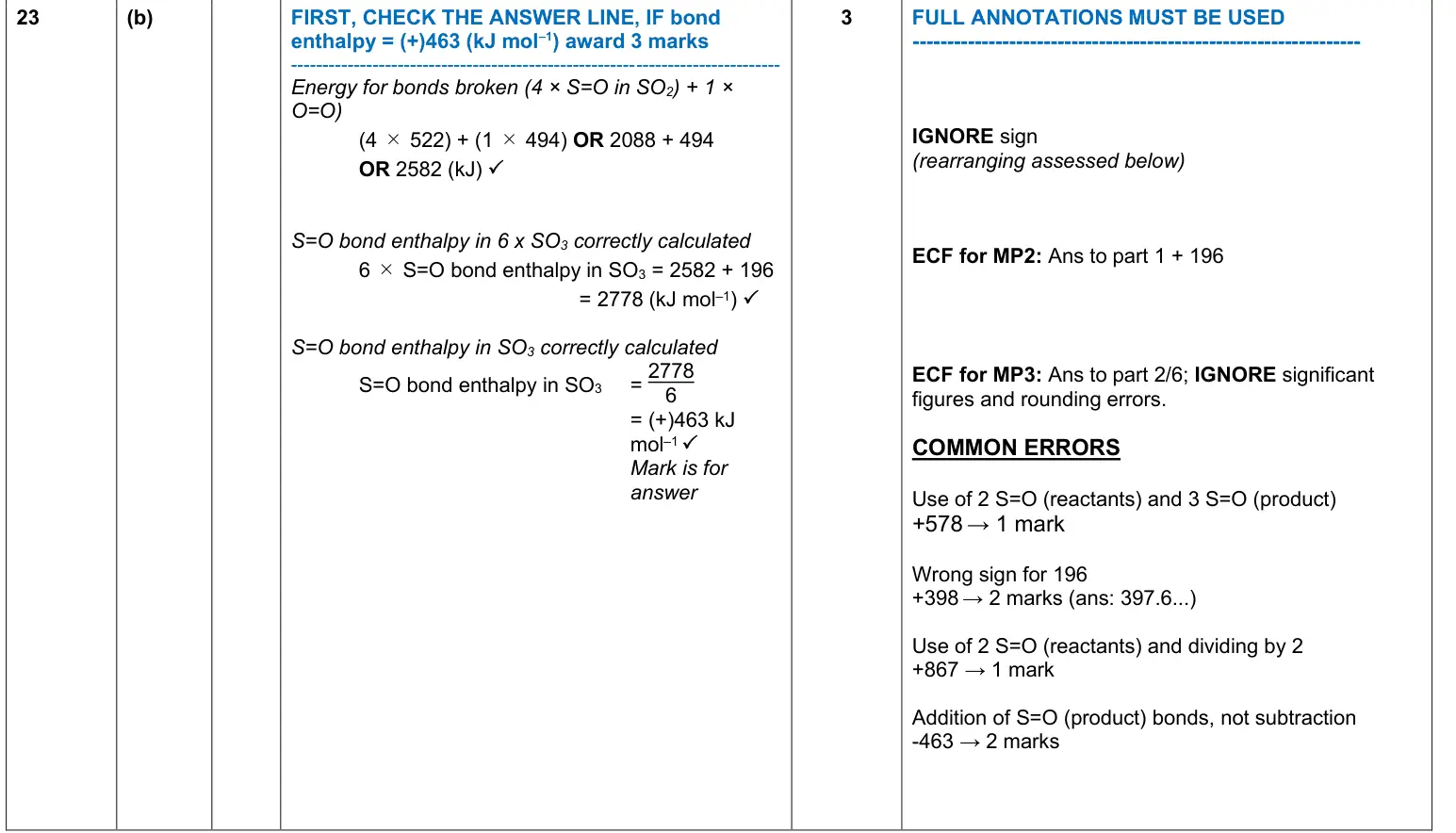
Mark scheme
Examiner's comment
This bond energy calculation proved difficult for some. Roughly a third of candidates obtained the correct enthalpy change of 463 kJ mol–1 for all 3 marks, but 0 marks was the next common score. Despite evidence that candidates had clearly practised this type of problem and they recognised that there were going to be three stages to the calculation, candidates frequently did not use the stoichiometry shown in the equation and therefore divided by 2 and 3 respectively for marking points 1 and 3 (rather than 4 and 6). Another common error was incorrect treatment of the enthalpy of reaction value (subtracting rather than adding 196 for the second marking point or omitting it altogether). Drawing out the total number of molecules helped students understand the numbers of bonds involved and should be encouraged. It is also worth reiterating the sign for bond enthalpies. As with all multi-stage calculations, error carried forward was applied, allowing credit to be given for a subsequent correct method.
Notes from the mark scheme and report
4 S=O broken in 2SO2 and 6 S=O made in 2SO3
common errors: +578 (2 and 3 S=O bonds), +398 (wrong sign for 196), –463
IGNORE sign of final answer
Skills: M2.2 Change the subject of an equation; M2.3 Substitute numerical values into algebraic equations using appropriate units for physical quantities; M2.4 Solve algebraic equations
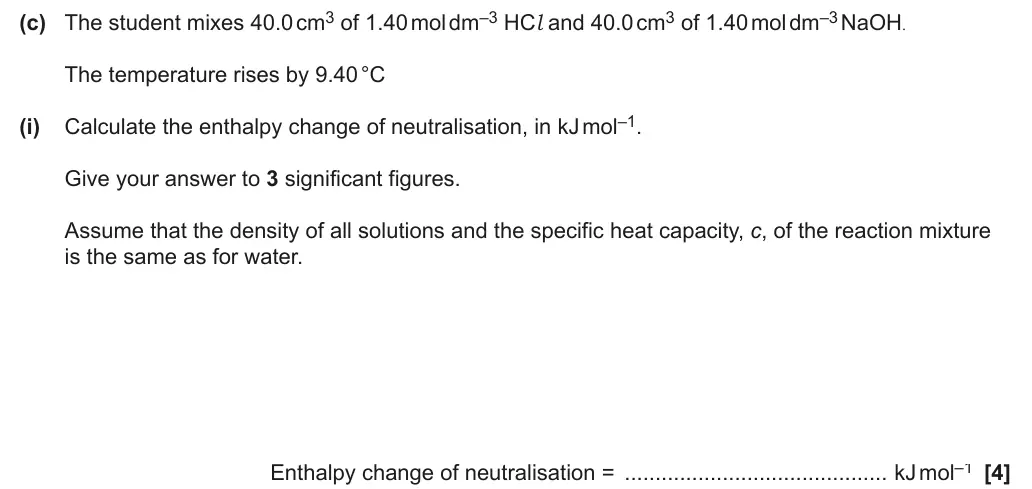
June 2025 · AS Paper 2 · Q1(c)(i)4 marksCalculationEasy
Mark scheme
Examiner's comment
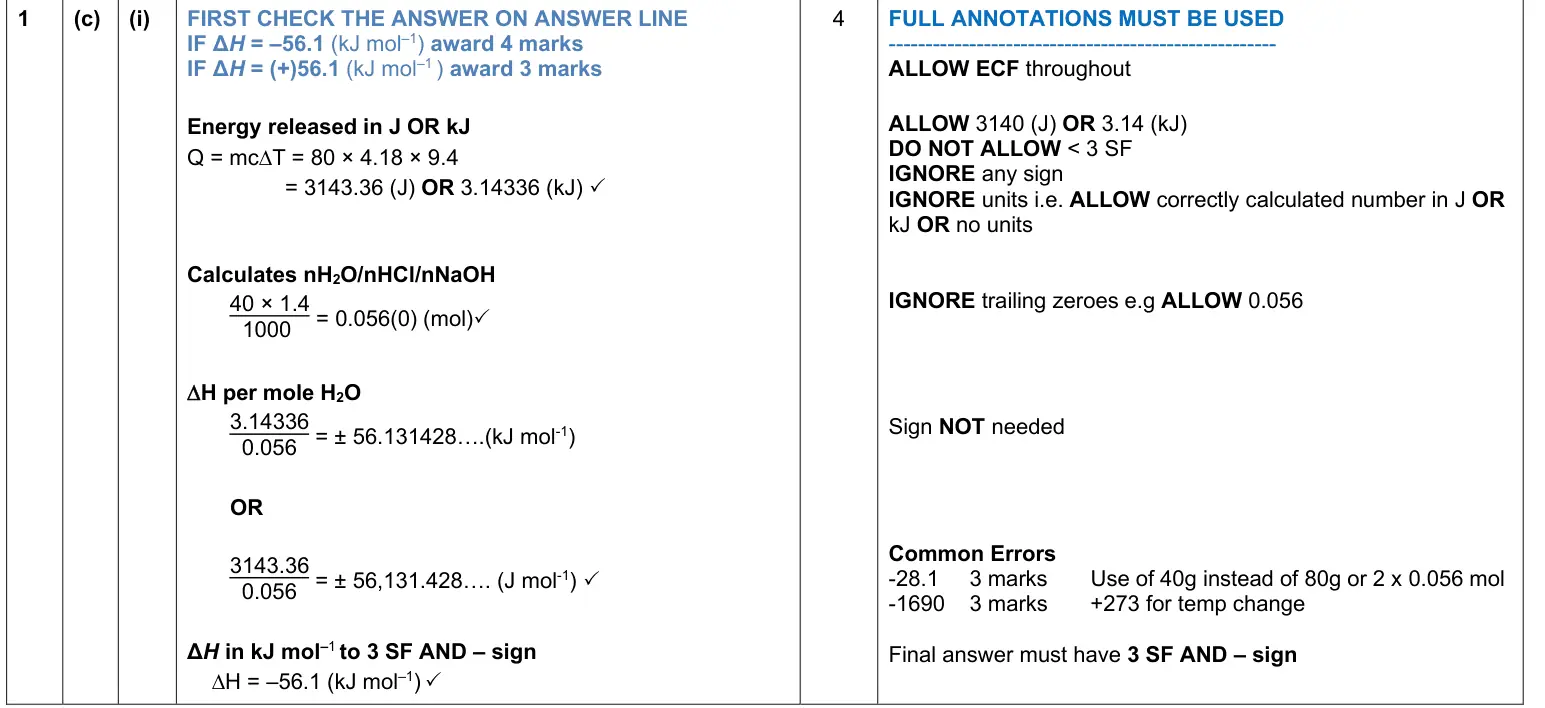
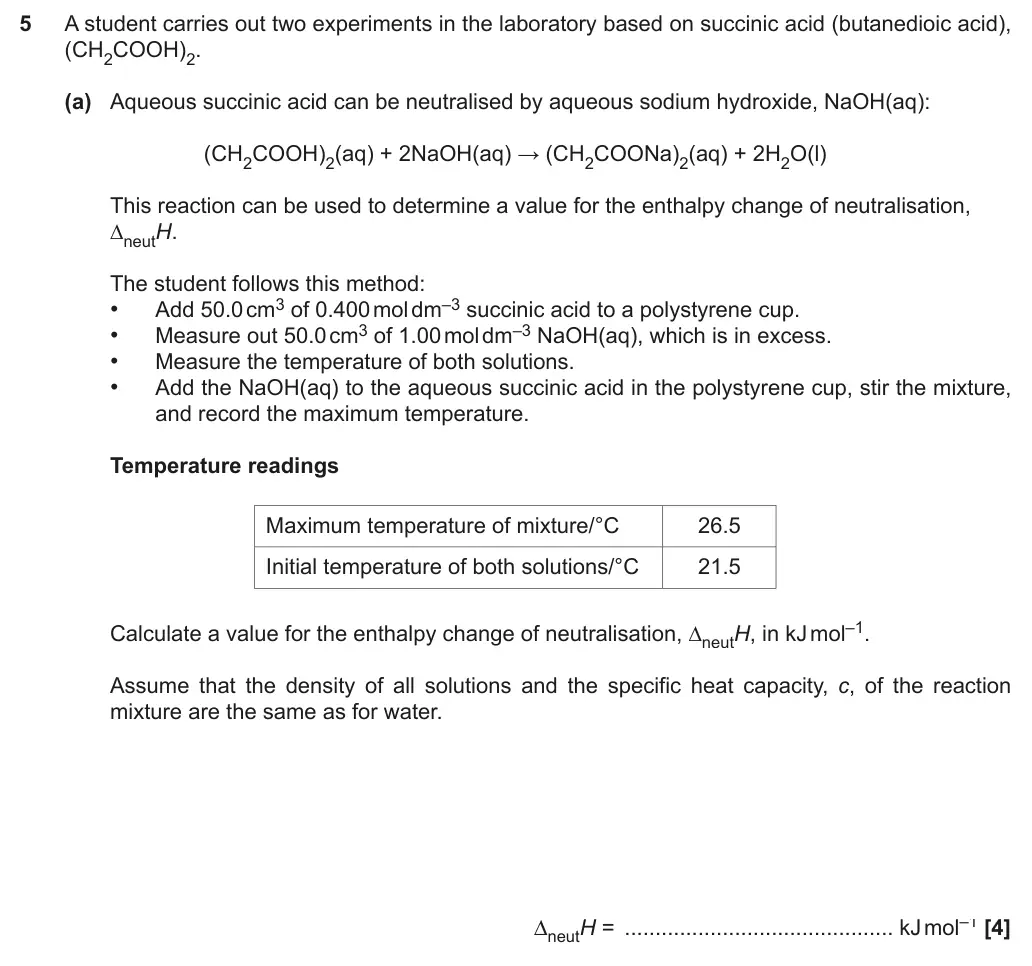
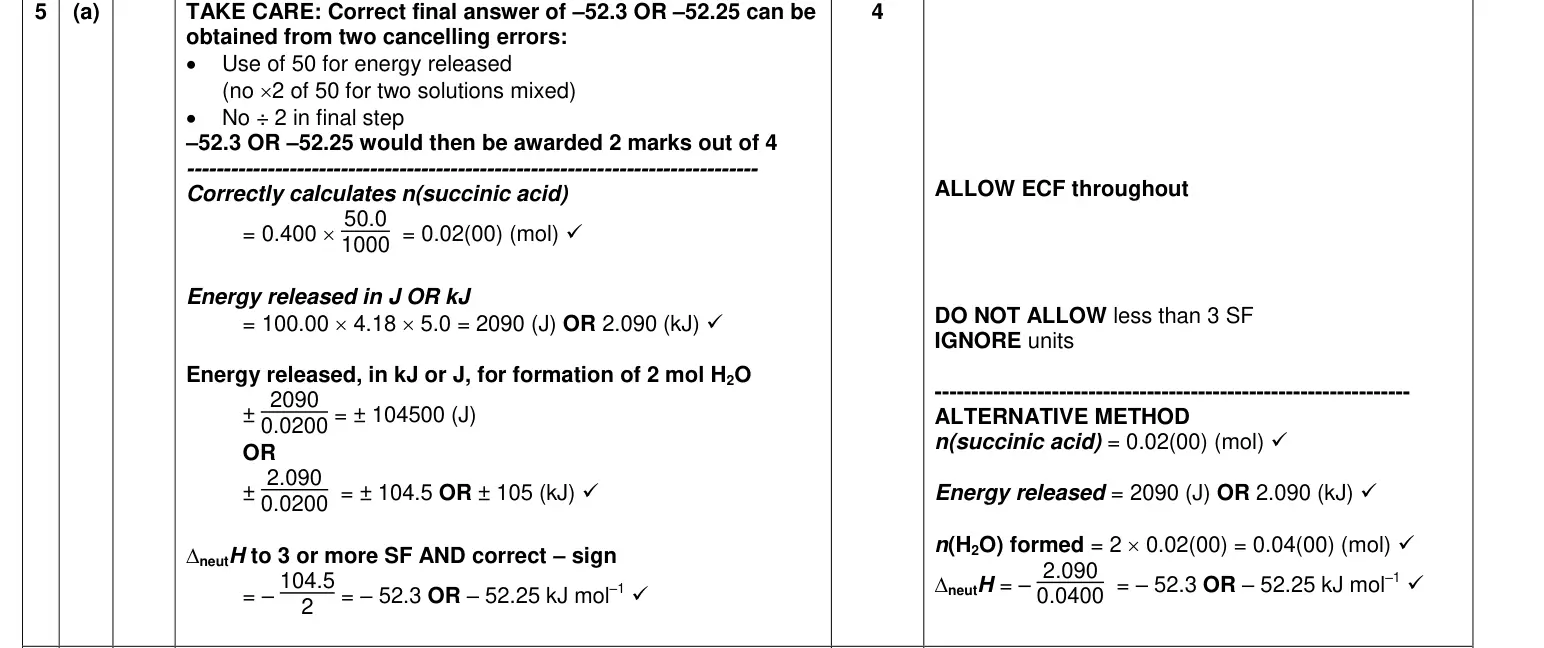
Many well-structured calculations were seen, even if all the marks weren’t achieved. Almost all candi- dates calculated the number of moles involved. For those candidates’ hat didn’t get full marks, it was often caused by using an incorrect mass in Q = mcΔT. Some tried to calculate the mass of NaOH and HCl (from moles and Mr values) while others didn’t add the total volumes together i.e. used 40 g rather than 80 g. Some used moles × 2 i.e. 0.112 rather than per mole of water formed. One of the most common errors was the omission of the negative sign for the final enthalpy change. Some put a positive charge instead. Some lost a mark for the incorrect significant figures.
Notes from the mark scheme and report
common errors (3 marks): –28.1 from using 40 g instead of 80 g or 2 × 0.056 mol, –1690 from adding 273 to the temperature change, +56.1 (no – sign)
3 SF AND – sign required
ALLOW ECF throughout
Skills: M0.0 Recognise and make use of appropriate units in calculations; M1.1 Use an appropriate number of significant figures; M2.3 Substitute numerical values into algebraic equations using appropriate units for physical quantities; PAG3 Enthalpy determination
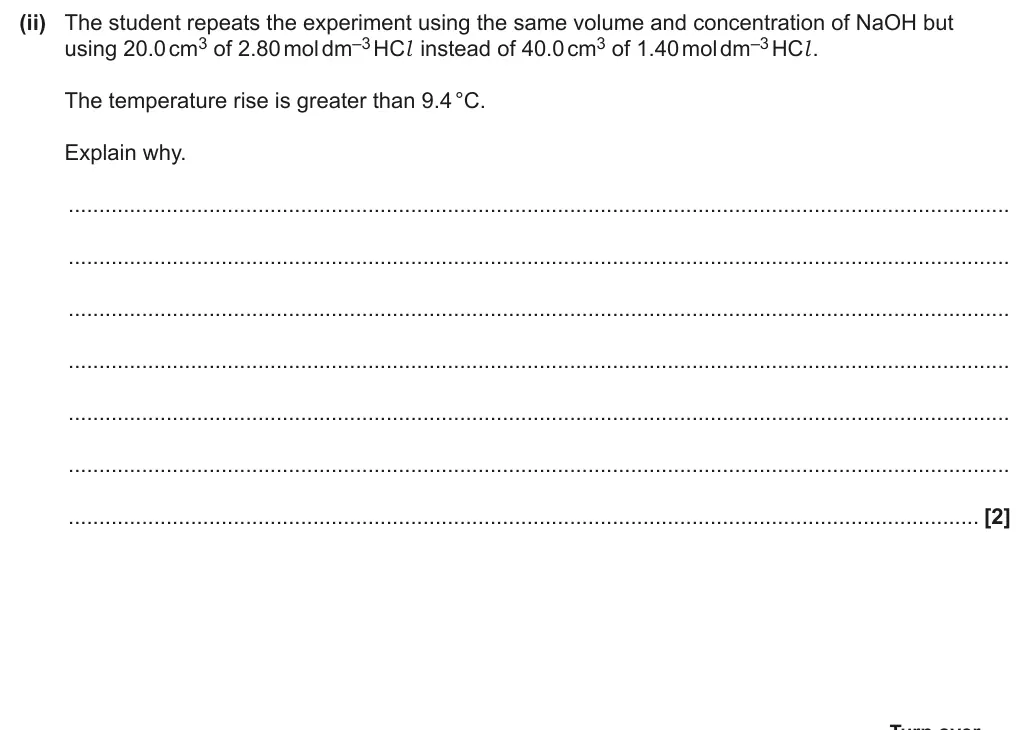
June 2025 · AS Paper 2 · Q1(c)(ii)2 marksShort answerHard
Earlier part of question 1 that this part uses
Mark scheme
Examiner's comment
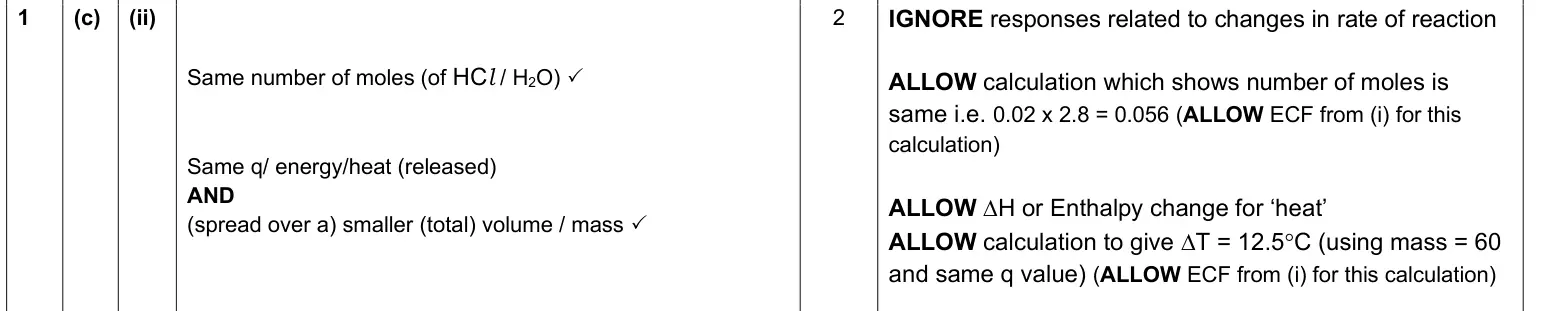
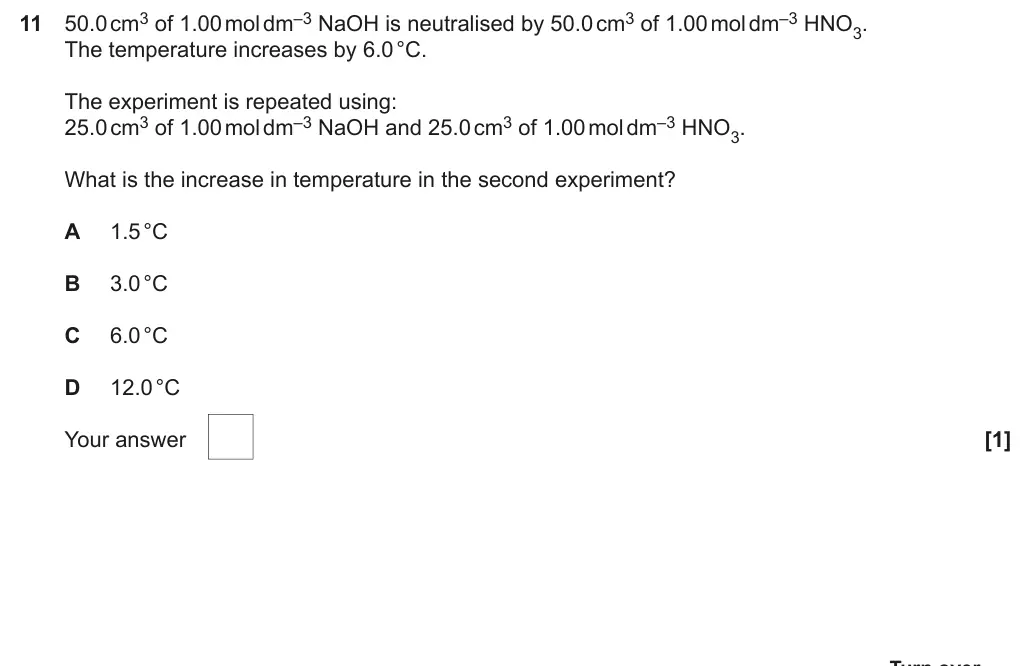
Many candidates found this question challenging. Some managed to recognise the idea that the moles remained the same. Fewer recognised that the en- thalpy change stayed the same while the mass/volume decreased. A minority combined both ideas to- gether. Many gave responses in terms of increasing concentration increases rate, attributing a higher tempera- ture to more collisions.
Notes from the mark scheme and report
same number of moles so same energy released AND smaller total volume/mass heated
IGNORE responses about rate of reaction
Candidates struggled to understand the difference between the rate of reaction and the en- thalpy change, often indicating that more collisions would result in more energy being re- leased. Make sure that candidates know that overall energy change depends on the net dif- ference in bond energies between reactants and products per mole. While an increase in con- centration can lead to a faster rate of reaction, it will not change the enthalpy change of the reaction.
We have some useful resources to support this: Topic Exploration Pack: Kinetics and Catalysis https://teachcambridge.org/item/9fbefaed-4ade-4f22-95ec-3defcfef5a46 Delivery guide (H032) Enthalpy changes https://teachcambridge.org/item/6f16de69-f654-407c-b513-3ed7902ef9ce
Skills: M0.2 Use ratios, fractions and percentages; PAG3 Enthalpy determination
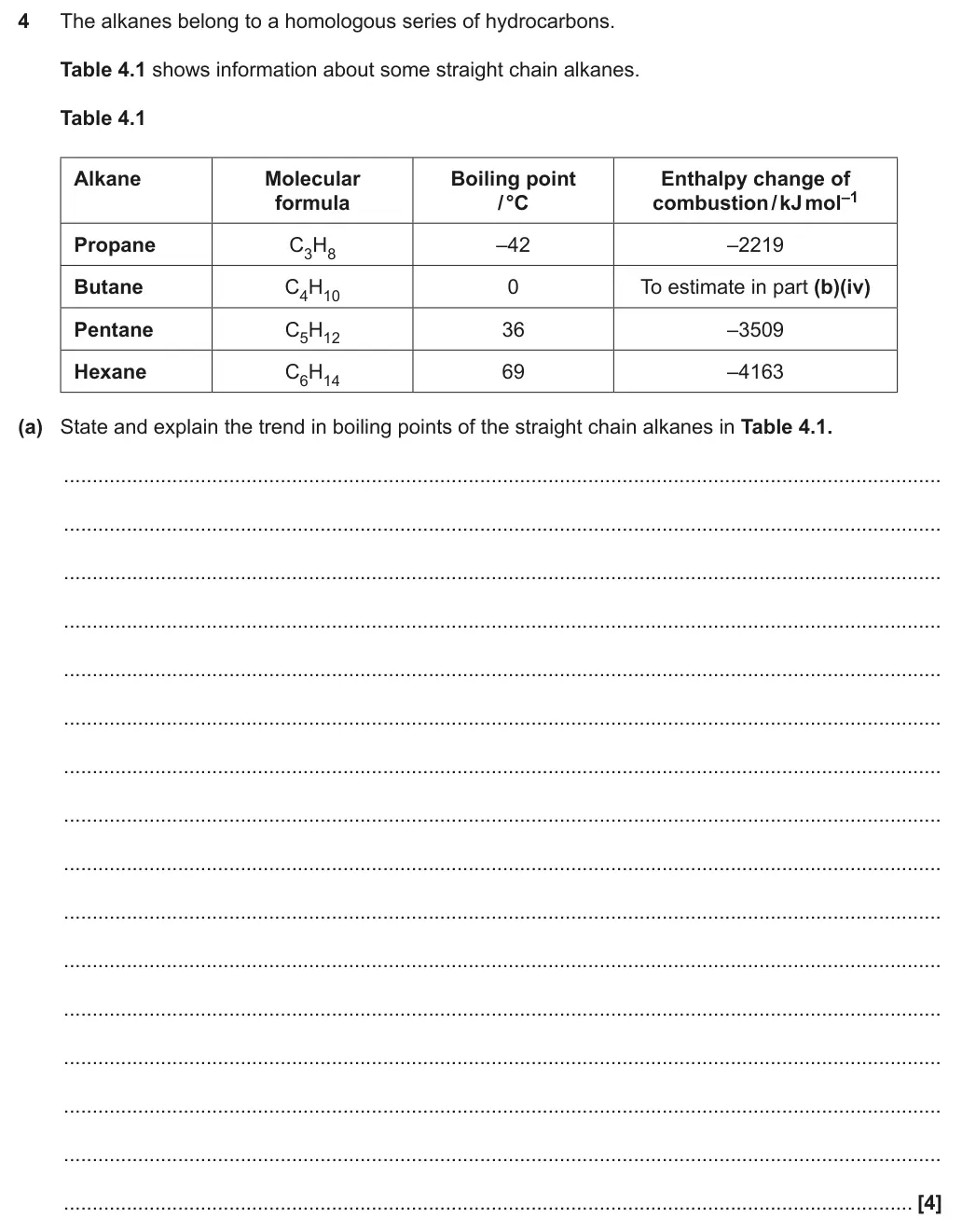
June 2025 · AS Paper 2 · Q4(b)(ii)2 marksCalculationMedium
Earlier parts of question 4 that this part uses
Mark scheme
Examiner's comment
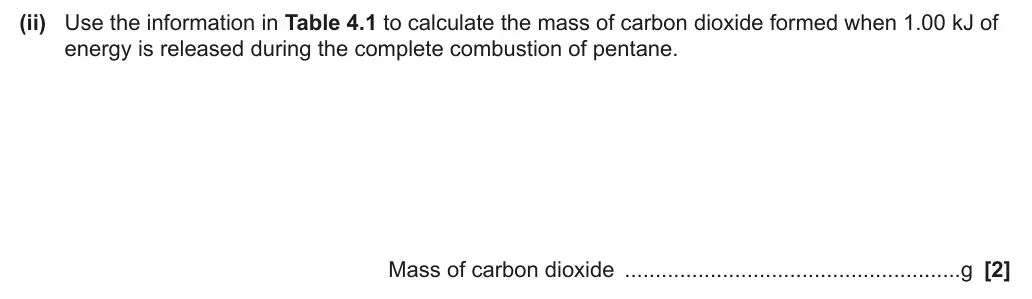
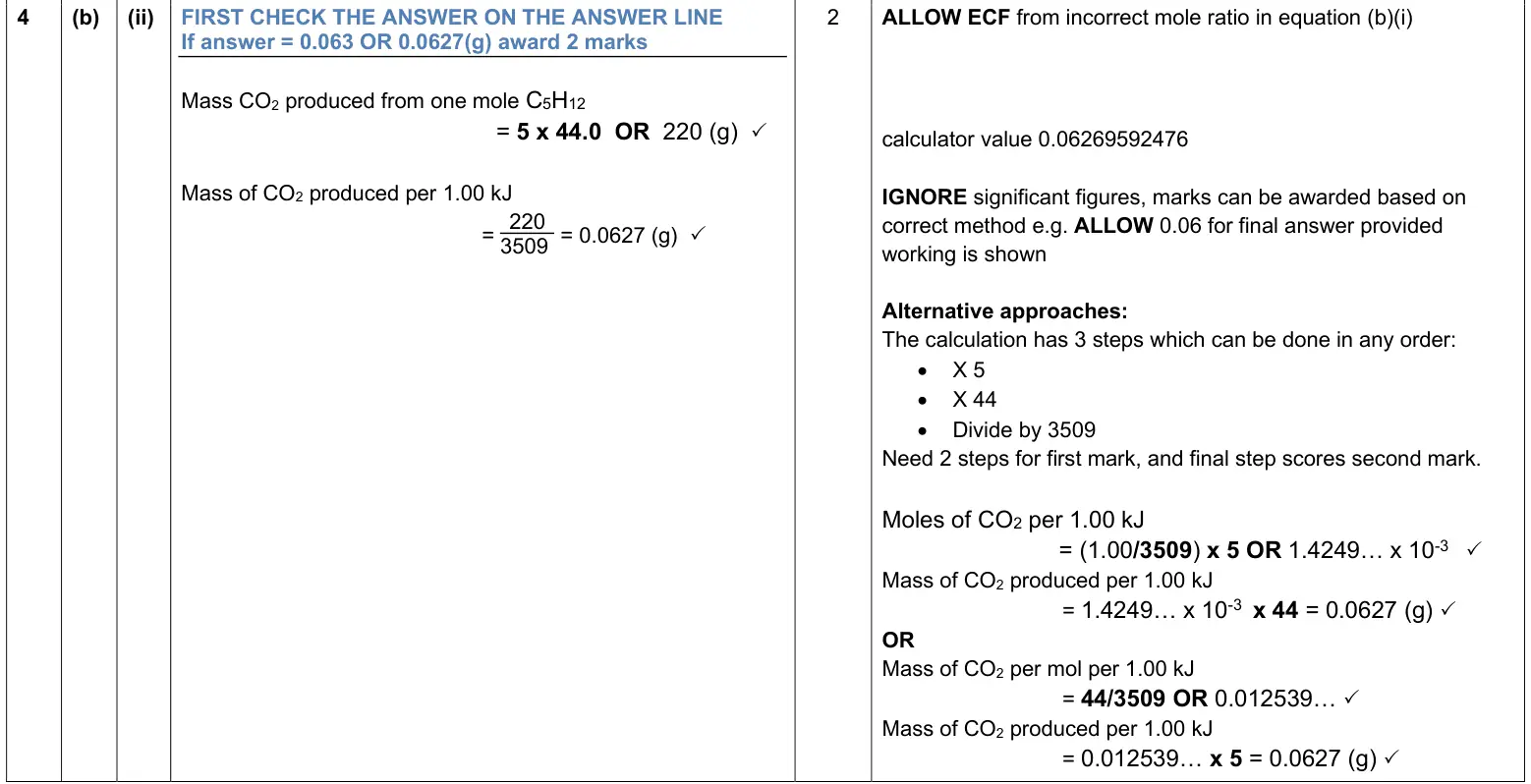
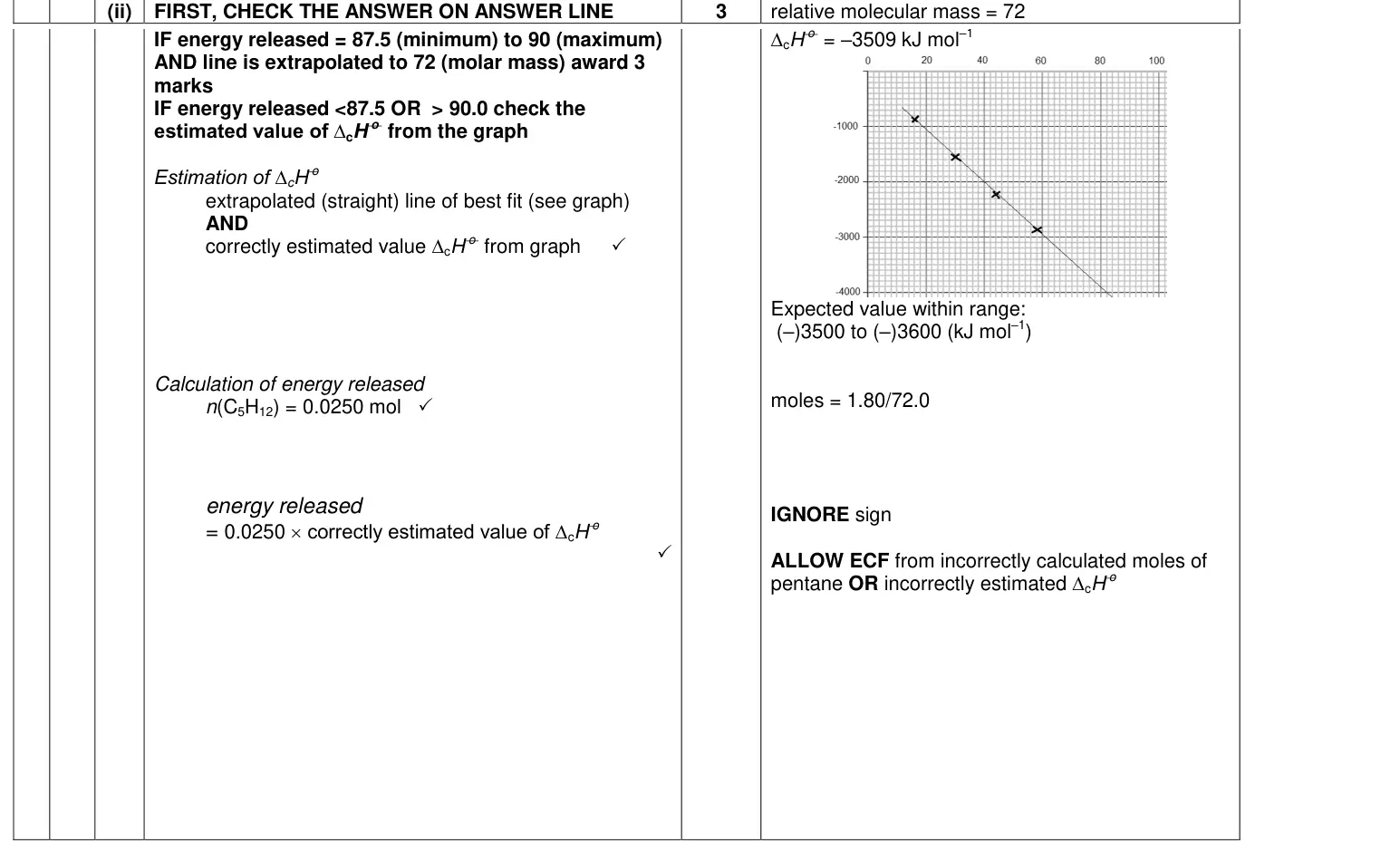
Many found this unfamiliar calculation quite tricky. Some tried to use the equation q = mcT to try to find a mass. Others tried a Hess cycle. Some multiplied by the Mr for pentane rather than carbon dioxide. A common error was to use 1000 J in the calculation, despite the enthalpy change being given in kJ mol-1, giving a final answer of 62.7g.
Notes from the mark scheme and report
5 × 44.0 = 220 g CO2 per 3509 kJ so 0.0627 g
ALLOW ECF from mole ratio in (b)(i)
IGNORE significant figures
Skills: M0.2 Use ratios, fractions and percentages; M2.3 Substitute numerical values into algebraic equations using appropriate units for physical quantities
June 2025 · AS Paper 2 · Q4(b)(iii)2 marksComplete table/diagramEasy
Earlier parts of question 4 that this part uses
Mark scheme
Examiner's comment
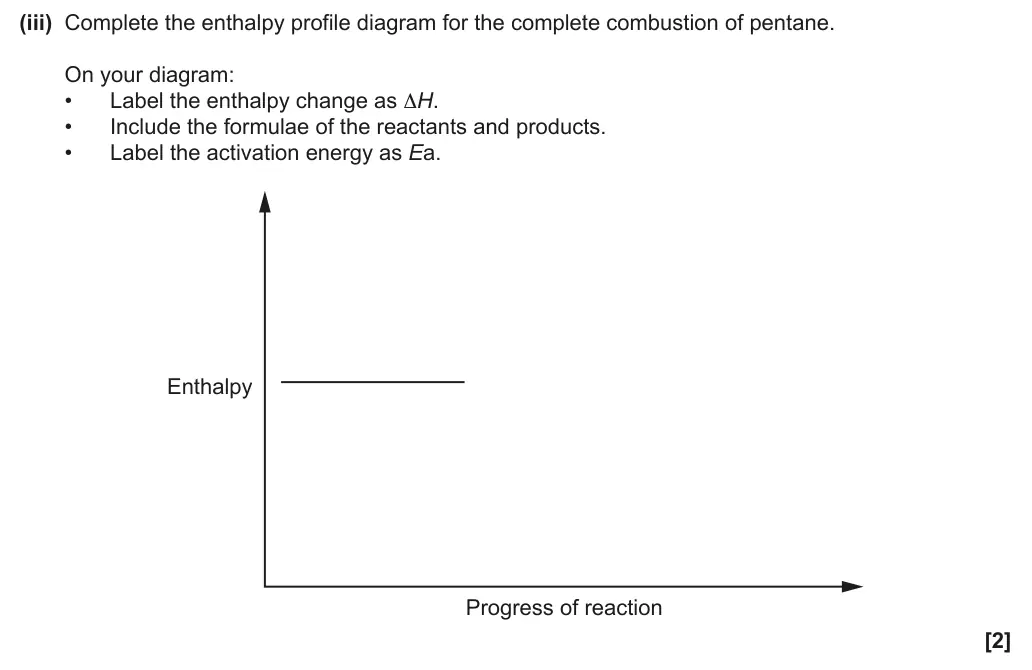
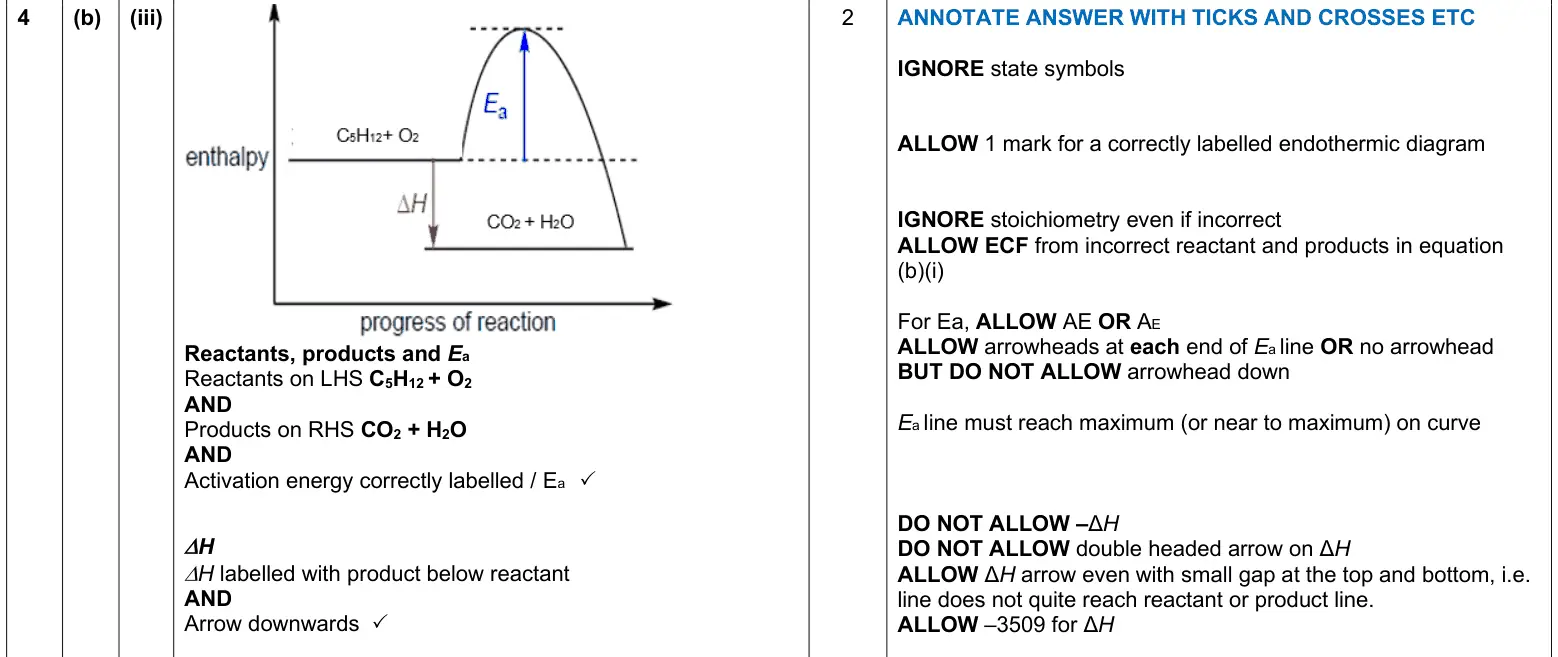
Most candidates were able to score 2 marks here for this familiar question. However, marks were lost for the following errors: • Double headed arrows or arrow wrong way round for H or missing arrow heads • Arrow for Ea not extending to the maximum • Missing formula for reactants and products • −H label • Ea arrow drawn from products up to maximum A few drew an endothermic profile diagram limiting their mark to 1.
Notes from the mark scheme and report
products CO2 + H2O below reactants C5H12 + O2 with ∆H arrow downwards (DO NOT ALLOW –∆H or double-headed arrow)
Ea from reactants to peak (DO NOT ALLOW arrowhead down)
1 mark for correctly labelled endothermic diagram
Skills: M3.1 Translate information between graphical, numerical and algebraic forms
June 2025 · AS Paper 2 · Q4(b)(iv)1 markData interpretationHard
Earlier part of question 4 that this part uses
Mark scheme
Examiner's comment
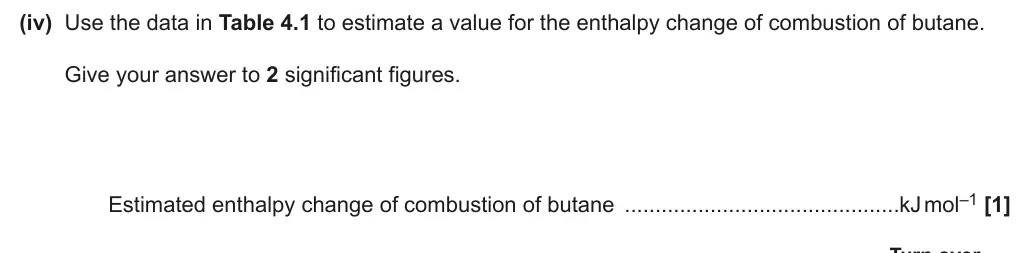
Many struggled to give the correct response here. They were expected to find the mid-point between the values given for propane and pentane. (The difference between pentane and hexane could also be used.) They then needed to give the value to 2 significant figures. Candidates were generally confident at giving final answers to 3 significant figures but struggled here when asked for only 2. A significant number also forgot to include the – sign.
Notes from the mark scheme and report
–2900
must be 2 SF with negative sign
Skills: M0.3 Estimate results; M1.1 Use an appropriate number of significant figures
June 2025 · Paper 3 · Q66 marks6-mark level of responseMedium
Mark scheme, with the levels and indicative points
Examiner's comment
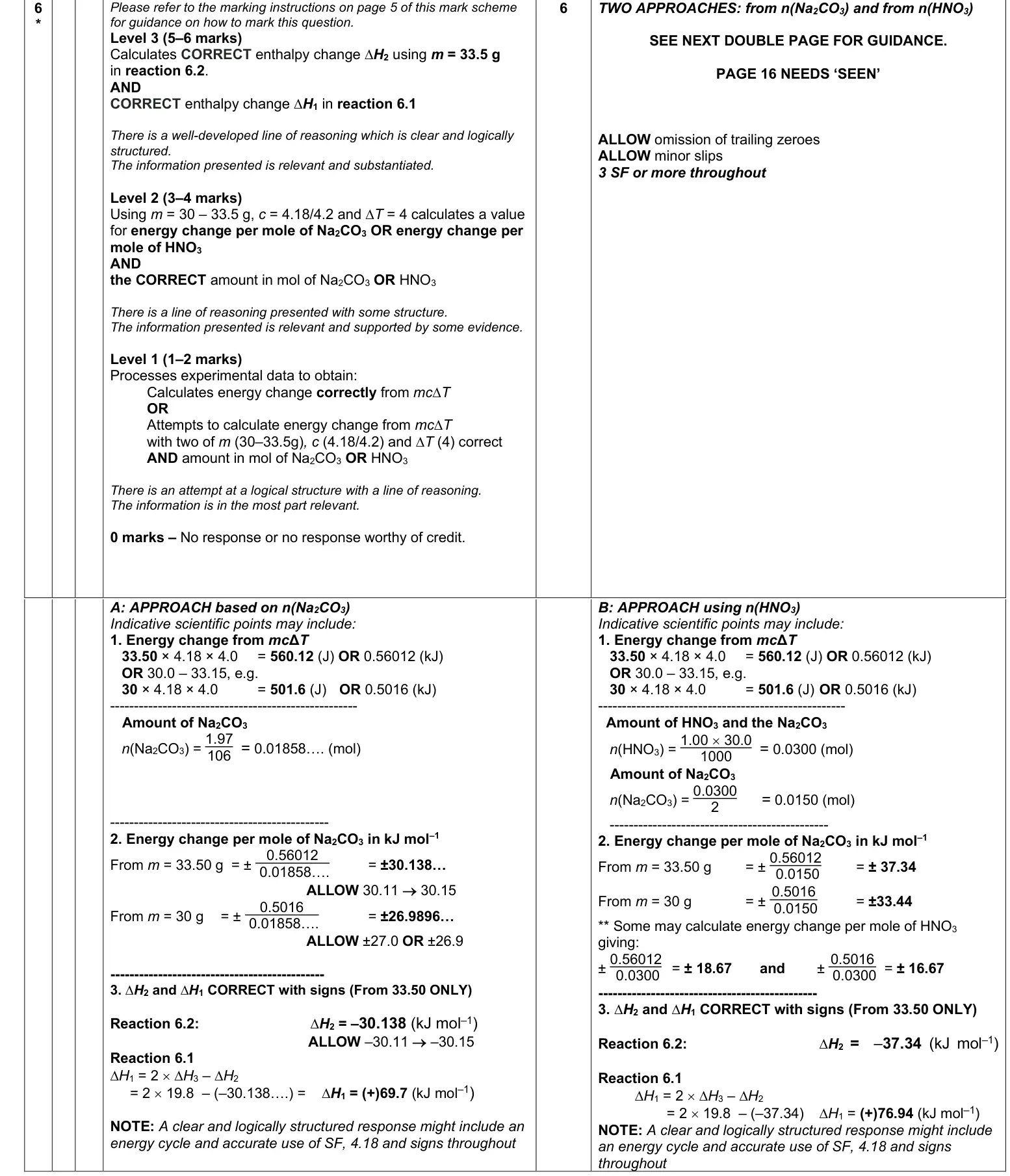
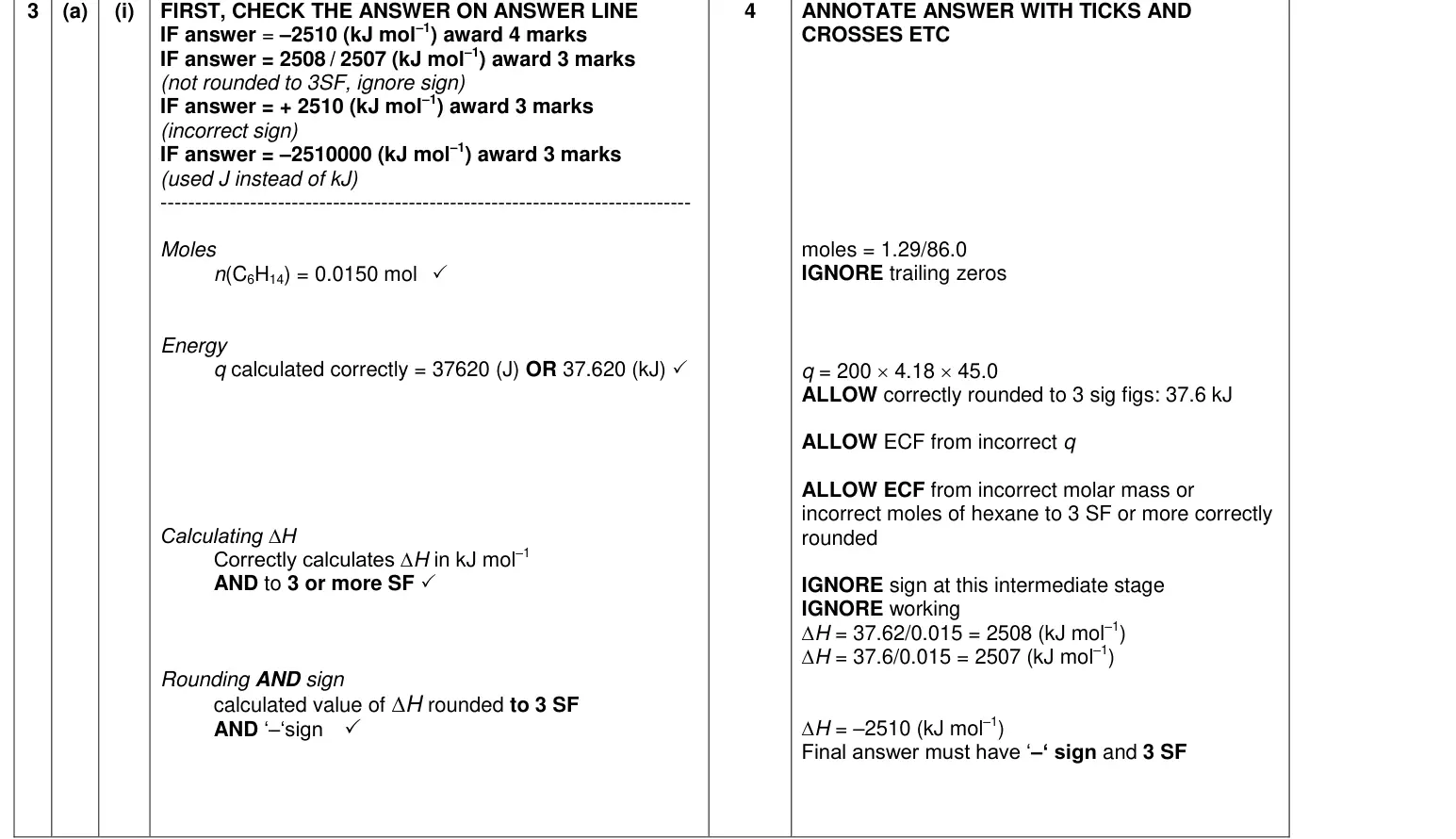
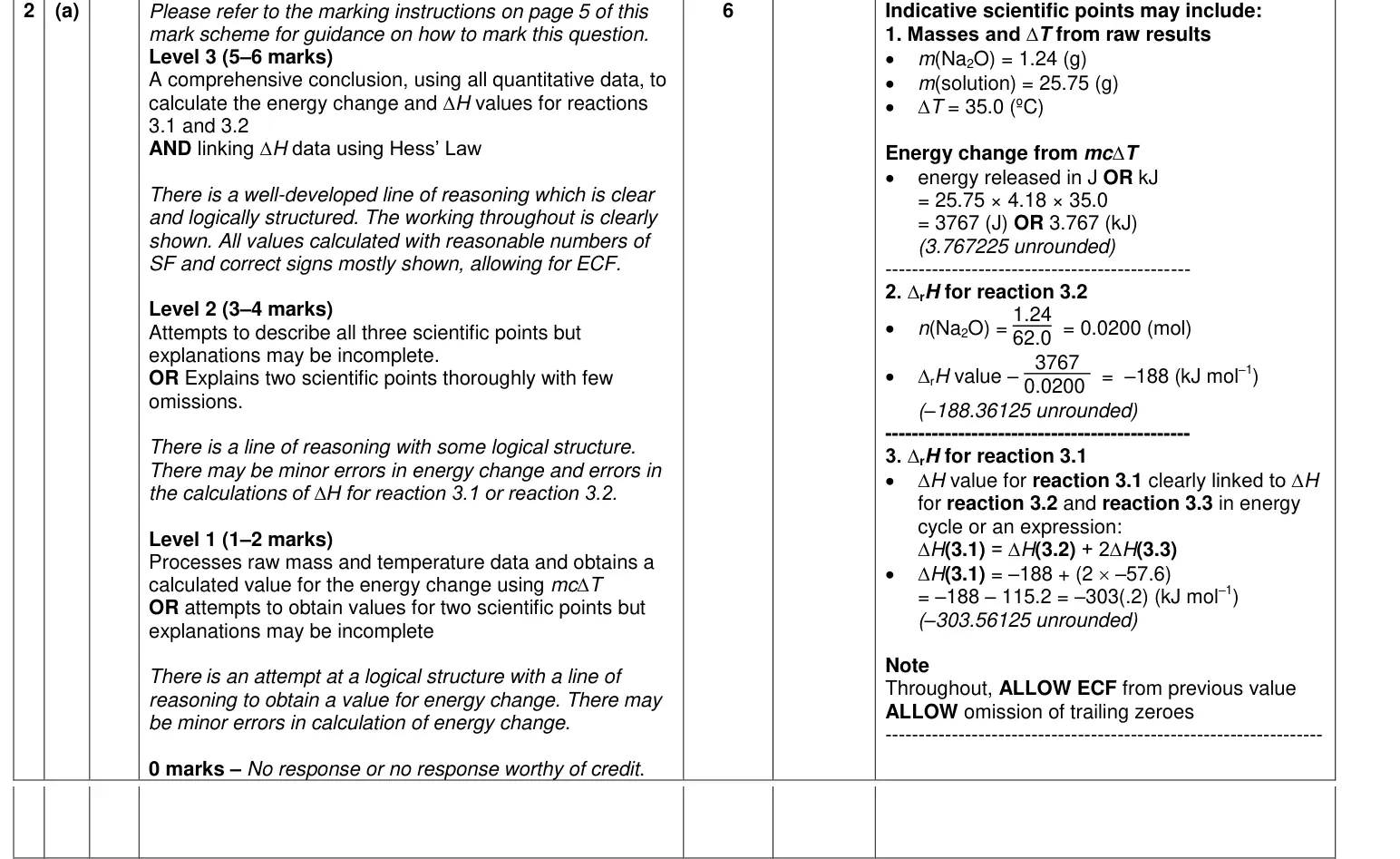
As with the other Level of Response (LoR) question (Question 3(a)), most candidates were able to gain some marks for this question, with very few obtaining no marks. Overall fewer candidates were given Level 3 for Q6 than for Q3(a). To achieve Level 1, candidates needed to calculate a value for the energy change q from mc∆T using at least two of m, c and ∆T. Candidates needed to first process the raw experimental results provided to extract the required values for the calculation. In the mc∆T calculation, the most common incorrect values used were 1.97 (the mass of Na2CO3) for m, 8.314 (the gas constant) for c and 277 (Kelvin) for ∆T. Only the lowest attaining candidates were unable to carry out this task. For Level 2, candidates were expected to determine the energy change per mole using the correct mc∆T value. Most candidates reached Level 2. A Level 3 response proved to be more elusive, requiring candidates to use an energy cycle to determine an enthalpy change. This task was far more testing than the requirements for Level 2. Some leeway was allowed for values used within the response. For m, a value in the range of 30 – 33.5 was allowed to take into account either HNO3(aq) or the mass of solution. Responses calculated per mole of Na2CO3 or HNO3 were allowed. This allowed for the fact that, even though the question described an excess of HNO3 being used in the reaction, the volume and concentration specified (30 cm3 of 1.00 dm3 HNO3) is short of being an excess. The approach taken is fully outlined in the mark scheme for this question and ensured no students were disadvantaged. The communication strand for this LoR question was given for responses that were arranged in a cohesive way. Unfortunately, a significant number of candidates produced responses that were difficult to follow with unlabelled quantities and numbers spread randomly across the page.
Notes from the mark scheme and report
m = 33.50 g (mass of final solution, not 30 cm3)
q = 33.50 × 4.18 × 4.0 = 560 J
n(Na2CO3) = 1.97/106 (or via n(HNO3) = 0.0300 if acid limiting)
∆H2 = –30.1 (temperature rise so exothermic)
∆H1 = 2∆H3 – ∆H2 = +69.7 kJ mol–1
energy cycle and signs
Skills: M0.0 Recognise and make use of appropriate units in calculations; M1.1 Use an appropriate number of significant figures; M2.3 Substitute numerical values into algebraic equations using appropriate units for physical quantities; M2.4 Solve algebraic equations; PAG3 Enthalpy determination
June 2024 · Paper 1 · Q71 markMultiple choiceMedium
Answer
A
Mark scheme
Examiner's comment
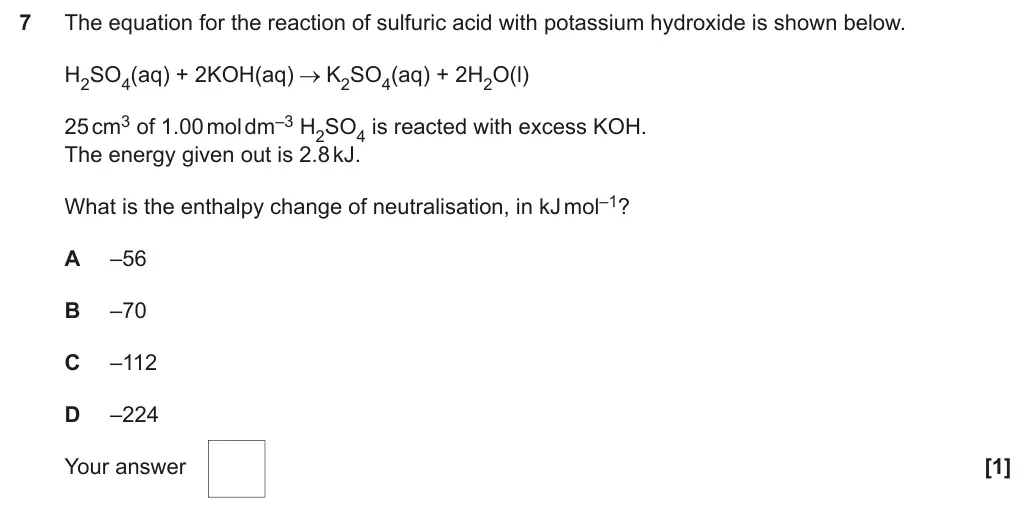
The correct answer was A. Some candidates showed full working in the space provided. B and C were common errors. Those who selected C did not take into account the need to half the reaction’s enthalpy change to meet the definition requirements of one mole of water.
June 2024 · AS Paper 1 · Q111 markMultiple choiceEasy
Answer
C
Mark scheme
Examiner's comment
This question was answered well with most candidates correctly selecting C.
June 2024 · Paper 1 · Q16(a)(i)4 marksCalculationMedium
Mark scheme
Examiner's comment
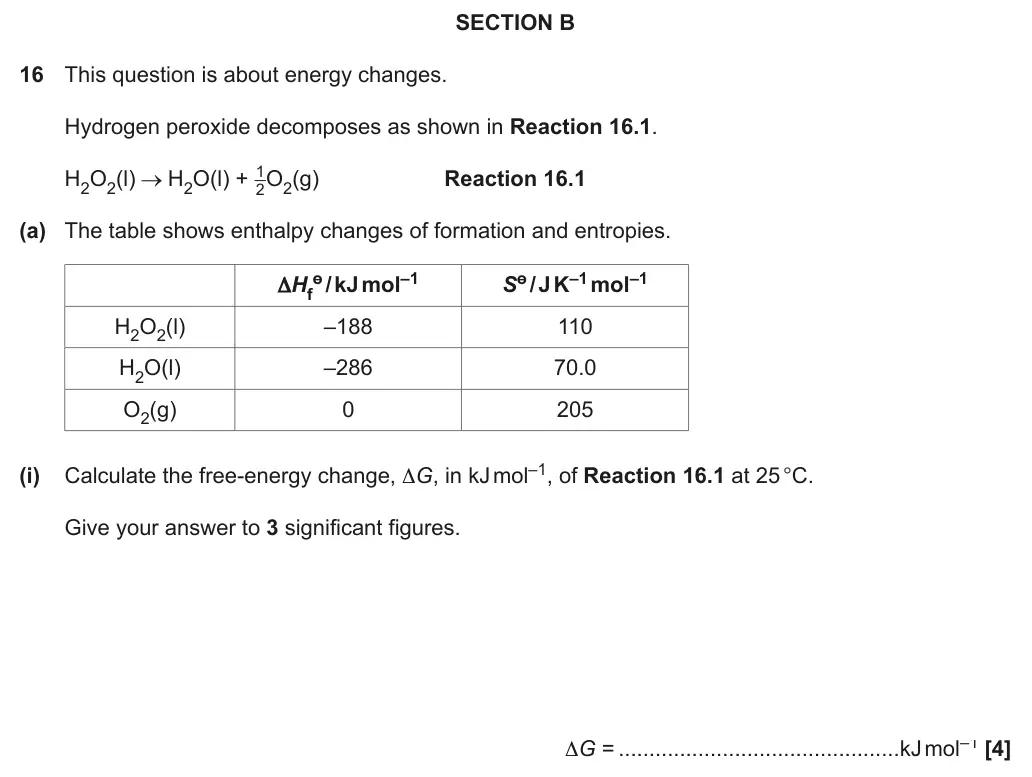
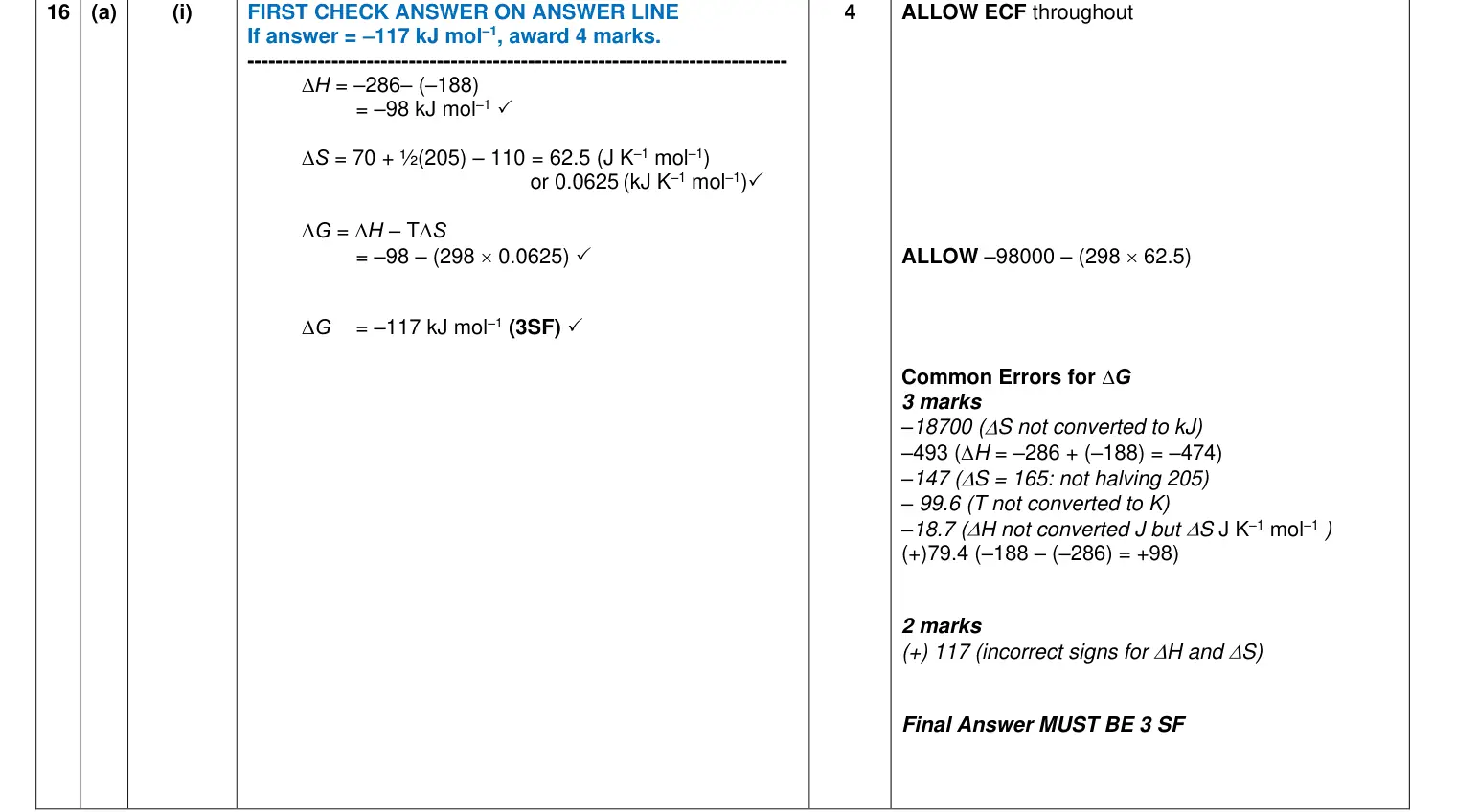
Almost all candidates had a good attempt at this calculation, with many gaining full marks. Most were able to calculate the entropy change. Almost all could reproduce the equation for free energy. Of those who did not get the correct final answer, the most common error was not converting the entropy value into kJ and / or the temperature to K. There were a few candidates who did not manipulate the equation correctly. A few candidates incorrectly calculated ΔS, obtaining the value of 165 J K-1 mol-1 or ΔH, obtaining -474 kJ mol-1. Candidates were given ECF in these cases.
Notes from the mark scheme and report
∆S in J K–1 mol–1 must be converted to kJ
½ mol O2 in ∆S
3 sig figs required
Skills: M0.0 Recognise and make use of appropriate units in calculations; M1.1 Use an appropriate number of significant figures; M2.3 Substitute numerical values into algebraic equations using appropriate units for physical quantities
June 2024 · Paper 1 · Q16(b)(i)3 marksComplete table/diagramHard
Earlier part of question 16 that this part uses
Mark scheme
Examiner's comment
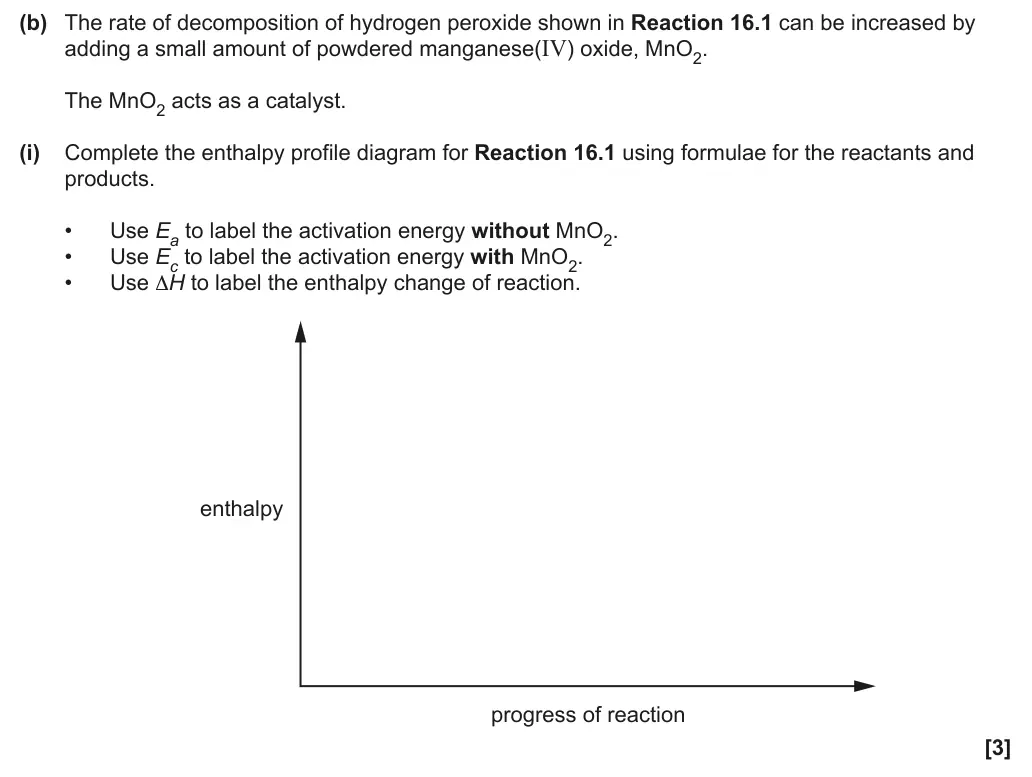
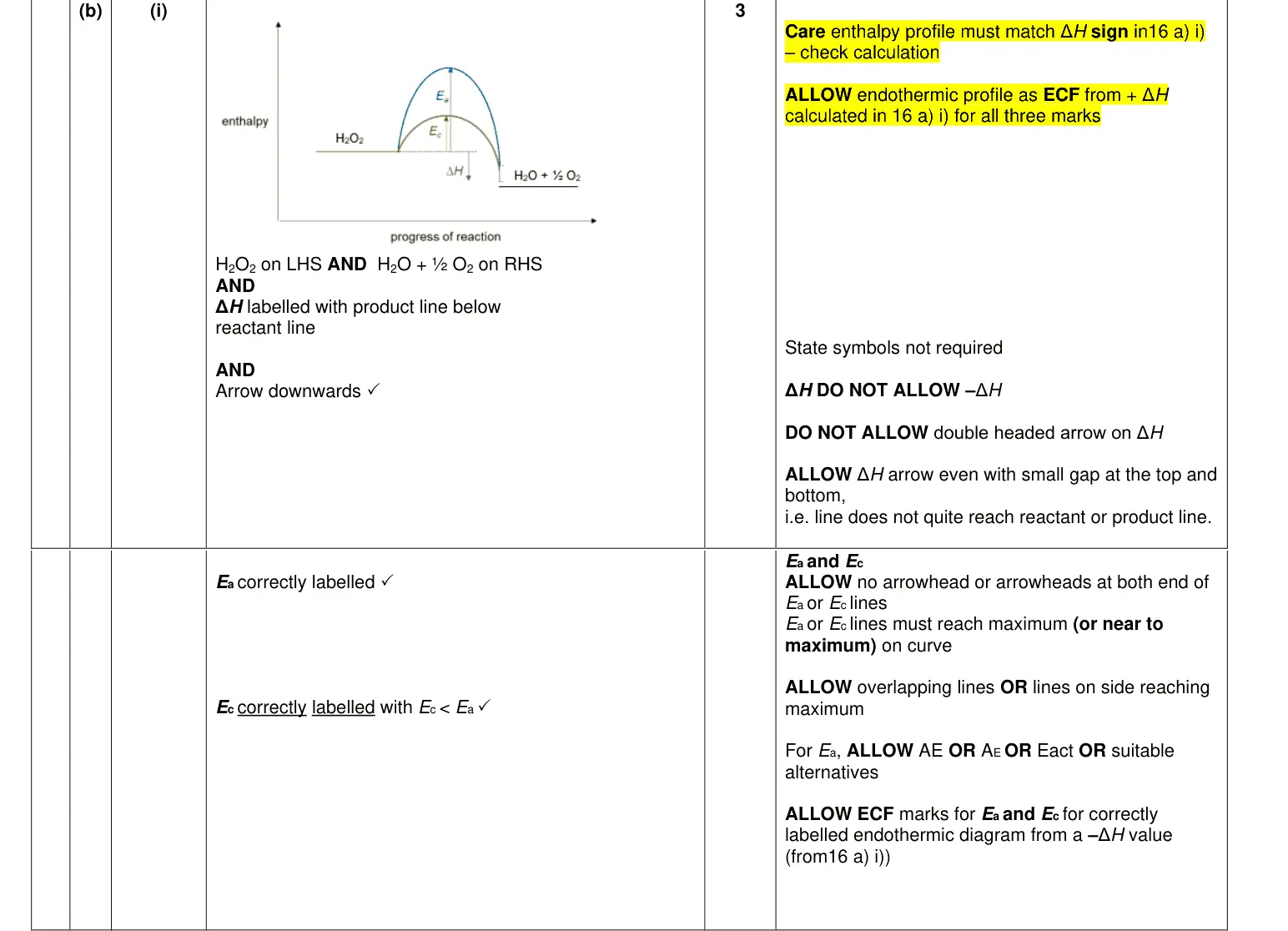
This question proved more difficult for candidates with lots of inaccuracies. The profile was dependent on the calculation for ΔH in Question 16 (a) (i). The arrowhead for ΔH needs to be pointing from the reactants to the products. The activation energies, again, need to start at the reactant line and go to the maximum level of the curve. Those that needed to draw an endothermic profile were far more likely to make an error with the Ea and Ec arrows, often starting from the product line or even from the base line of the graph. A significant number of candidates did not add arrows and instead labelled the curves Ea and Ec. Some candidates drew a Boltzmann distribution curve scoring 0 marks. The candidate has the correct exothermic profile but has the incorrect starting point for the activation energy going from the product line.
Notes from the mark scheme and report
profile must match the sign of ∆H from (a)(i) (ECF allowed)
Ea and Ec lines both start at reactant level
June 2024 · AS Paper 1 · Q23(b)3 marksCalculationHard
Mark scheme
Examiner's comment
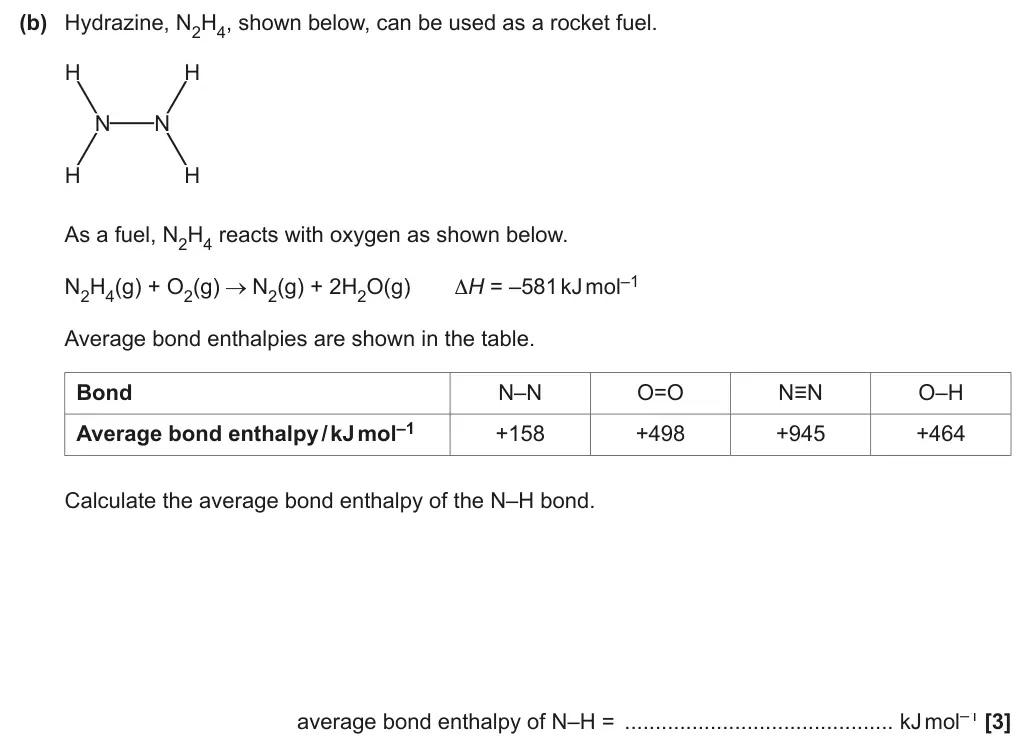
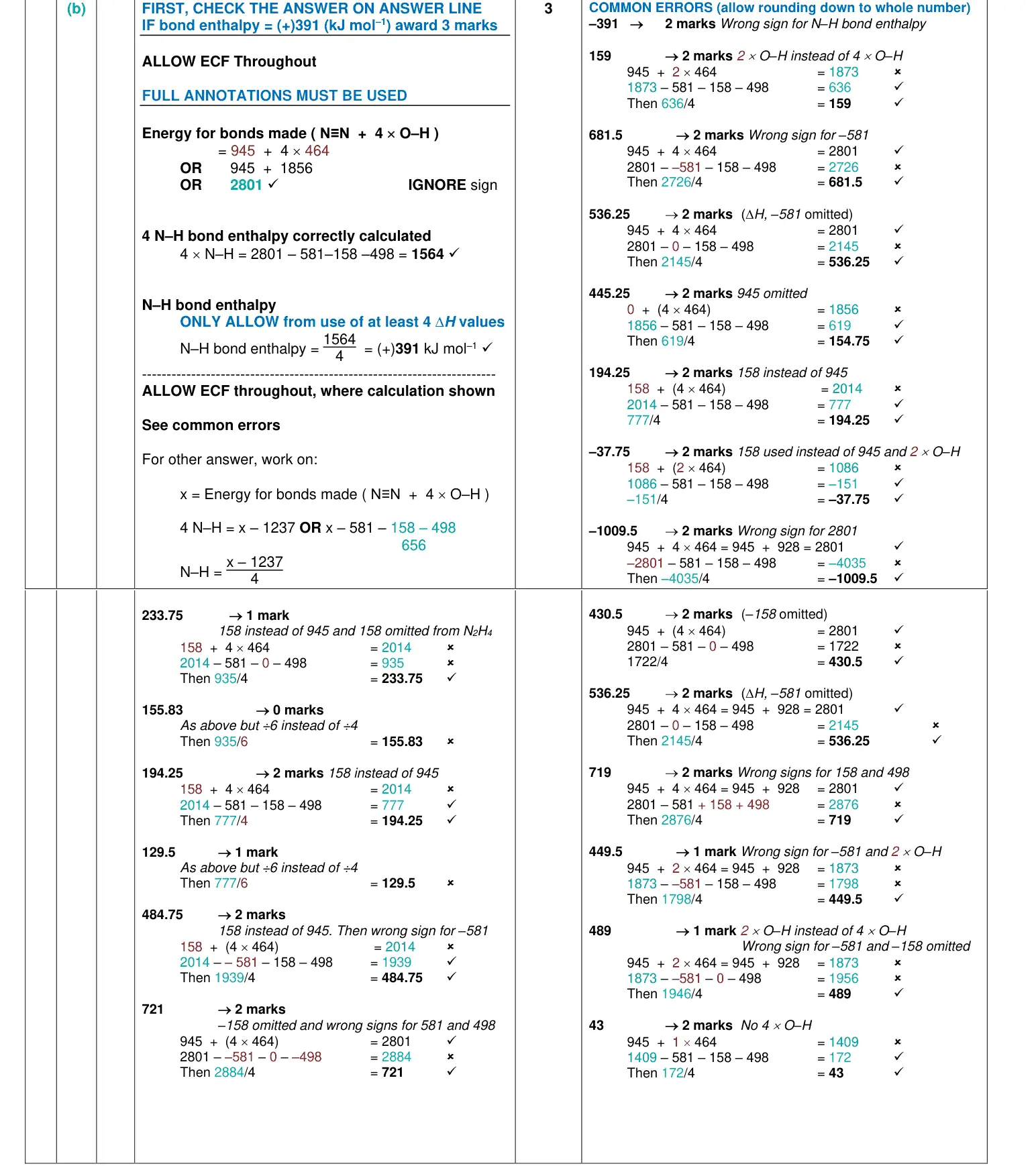
This bond energy calculation contained more values than in recent papers and many candidates found analysing the data difficult. Despite this, the question discriminated extremely well with about half the candidates obtaining the correct enthalpy change of 391 kJ mol–1 for all 3 marks, despite an incorrect final response. Successful responses showed that some candidates had clearly practised this type of problem and they recognised that there were going to be three stages to the calculation: • use of 945 and 4 ´ –464 to obtain 2801 • correct incorporation of the other ∆H values to obtain 1564 for 4 N–H • division by 4 for 1 N–H bond to obtain 391 kJ mol–1 As with all multi-stage calculations, error carried forward was applied, allowing credit to be given for a correct method. The commonest errors were: • use of 2 O–H instead of 4 O–H in the 1st step. • use of 158 for N–N in the 1st step instead of 945 for NN (Did these candidates not recall that N2 has a triple bond?) • omission of some data for the second step.
Notes from the mark scheme and report
common errors (2 marks): –391 (wrong sign), 159 (2 × O–H instead of 4), 681.5 (wrong sign for –581), 536.25 (∆H omitted)
ALLOW ECF throughout
Skills: M2.2 Change the subject of an equation; M2.3 Substitute numerical values into algebraic equations using appropriate units for physical quantities; M2.4 Solve algebraic equations
June 2024 · AS Paper 2 · Q3(a)1 markShort answerHard
Mark scheme
Examiner's comment
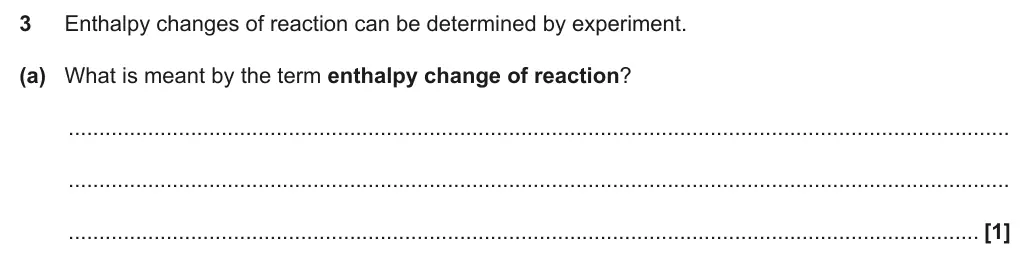
The term was not well known, with only a small proportion of candidates scoring this mark. Many gave the definition for enthalpy change of combustion or formation or bond enthalpy. Many referred to one mole of either reactants or products or bonds, or sometimes a combination of these. Lower-attaining candidates often said it was the temperature change.
Notes from the mark scheme and report
enthalpy change for the molar quantities in the stated equation
DO NOT ALLOW 'energy released'
IGNORE standard conditions
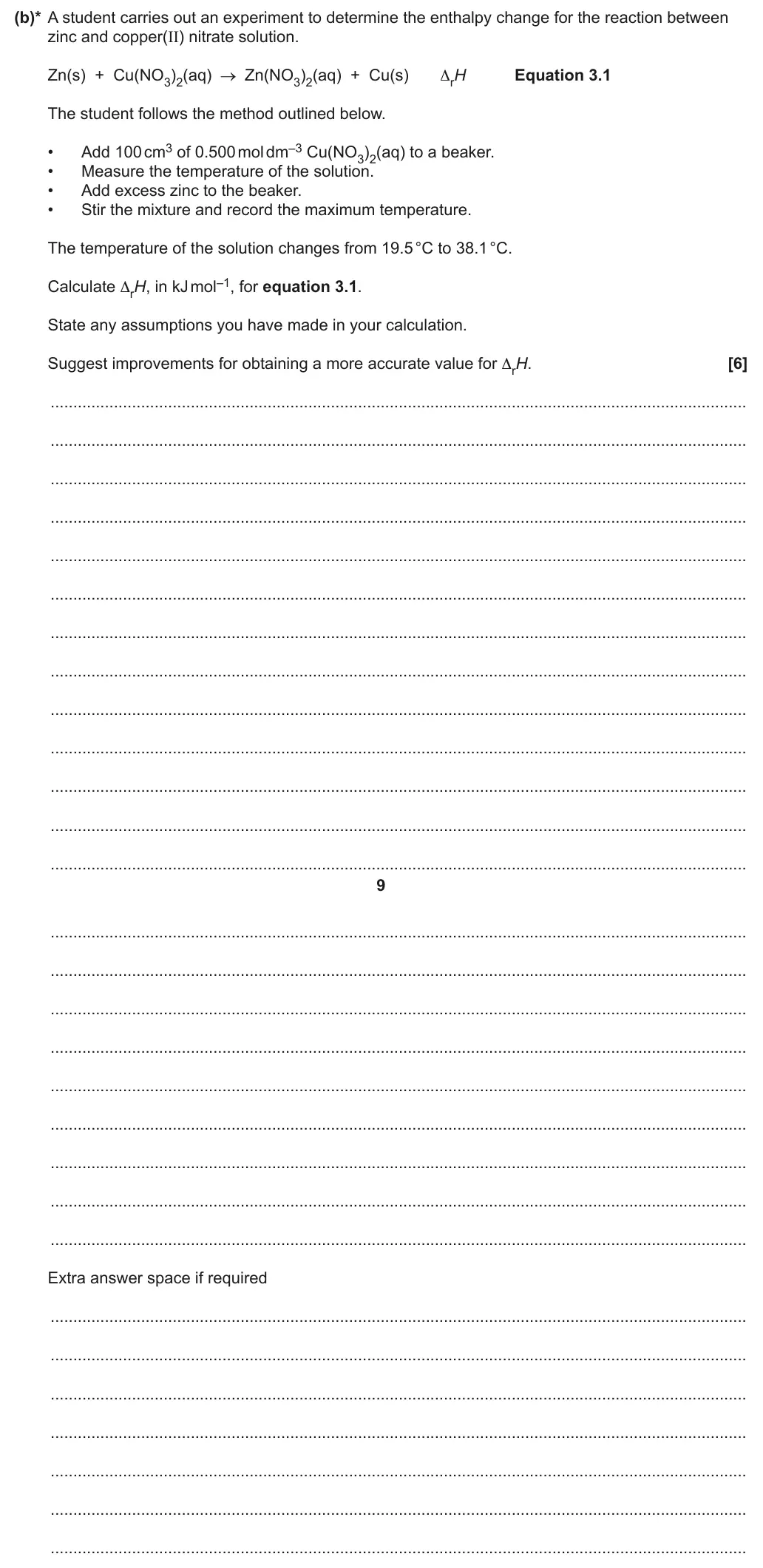
June 2024 · AS Paper 2 · Q3(b)6 marks6-mark level of responseHard
Earlier part of question 3 that this part uses
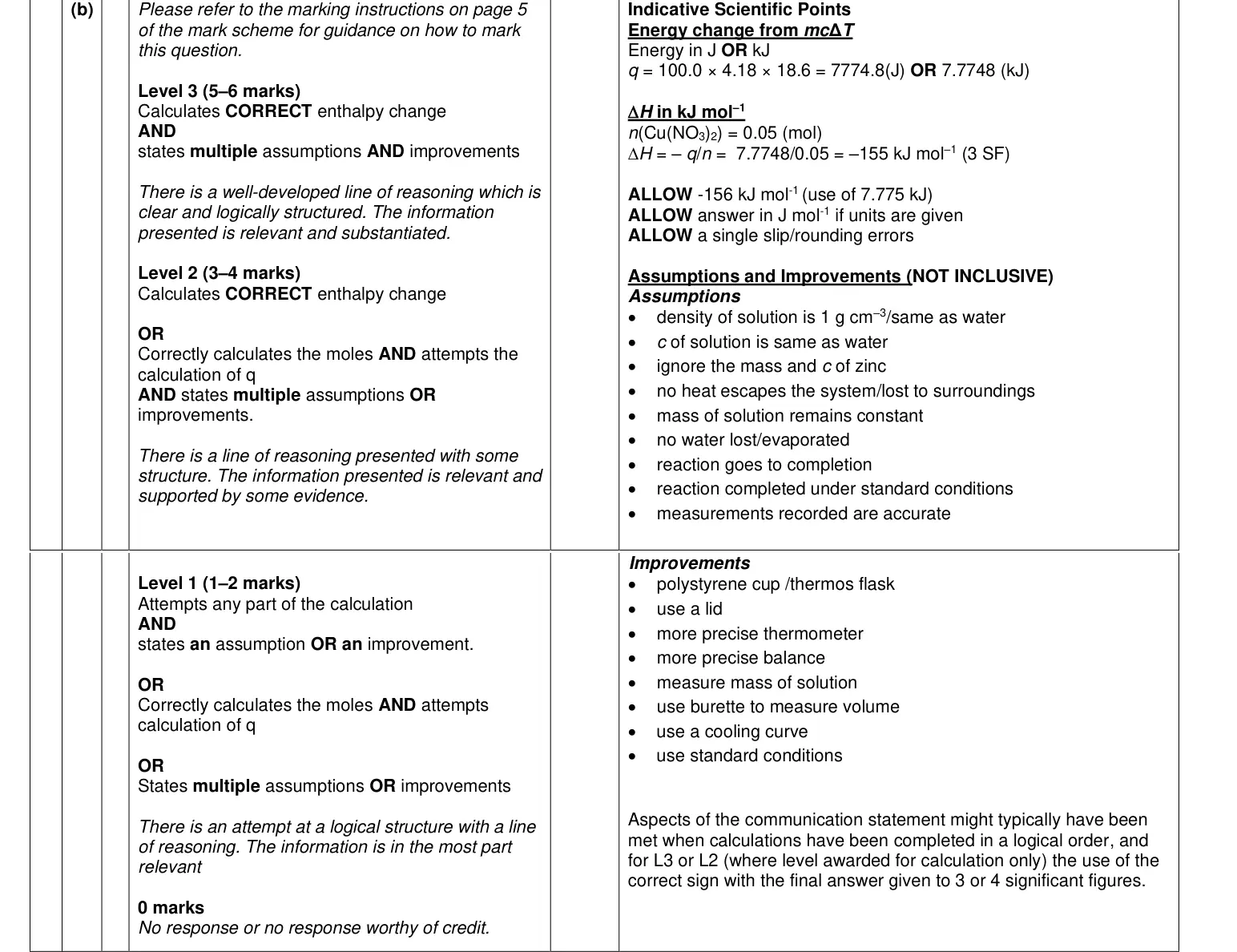
Mark scheme, with the levels and indicative points
Examiner's comment
The calculation of enthalpy change was generally well-answered and the majority of candidates were able to recall the equation q = mcT. Many candidates forgot the minus sign or gave a positive sign for final enthalpy change. Errors in calculation were most commonly for using an incorrect mass, usually by finding the mass of copper(II) nitrate (from moles and Mr). Some also used the wrong value for the heat capacity, selecting the value for R from the data sheet instead. Many gave the final answer to an inappropriate six significant figures. Candidates often found it challenging to give appropriate assumptions and improvements, limiting the level achieved to Level 2. However, many candidates did correctly give the assumptions that the specific heat capacity and density of the solution was the same as water. This is usually stated for the candidates with these types of questions. The most common improvements suggested were use of a polystyrene cup, adding a lid or using a thermometer with a higher resolution. Quite a few candidates suggested using a larger volume of solution which would indeed reduce the % uncertainty in the volume measurement. However, it would lead to a smaller temperature change, increasing the % uncertainty in the temperature measurement. Some confused the question with a calculation of enthalpy change of combustion and gave improvements accordingly, e.g. ‘use a copper or bomb calorimeter’, ‘draft shields’, ‘heat for longer’, ‘position of flame and supplies of oxygen’. This response achieved Level 3 - 6 marks. There is a correct calculation for H, the final value has a correct negative sign and is given to 4 significant figures. Lots of valid assumptions and improvements are given.
Notes from the mark scheme and report
q = 100 × 4.18 × 18.6 = 7.77 kJ
n(Cu(NO3)2) = 0.05
∆H = –155 kJ mol–1 with negative sign
assumptions (density/c same as water, no heat loss, ignore zinc)
improvements (polystyrene cup, lid, cooling curve, more precise thermometer)
Skills: M0.0 Recognise and make use of appropriate units in calculations; M1.1 Use an appropriate number of significant figures; M2.3 Substitute numerical values into algebraic equations using appropriate units for physical quantities; PAG3 Enthalpy determination
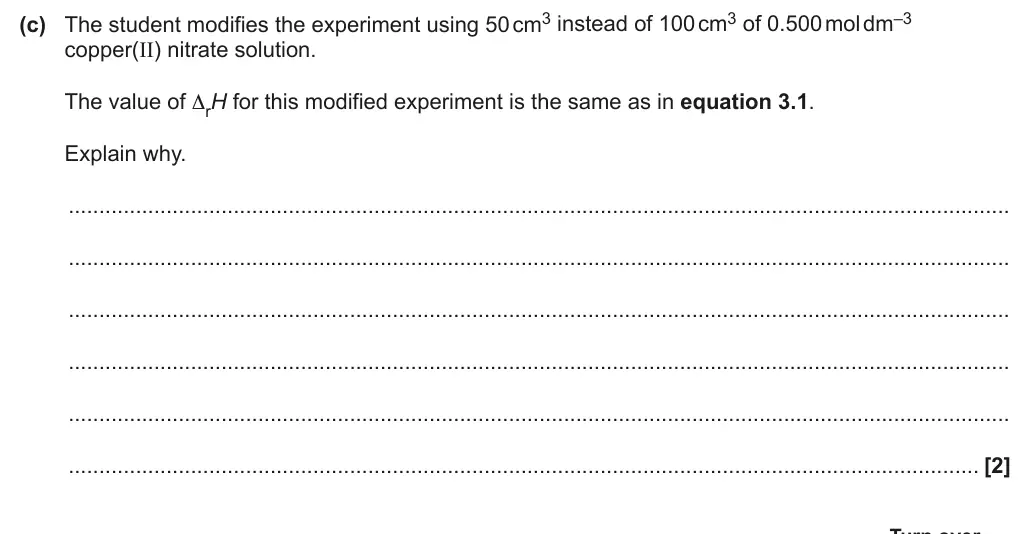
June 2024 · AS Paper 2 · Q3(c)2 marksShort answerMedium
Earlier part of question 3 that this part uses
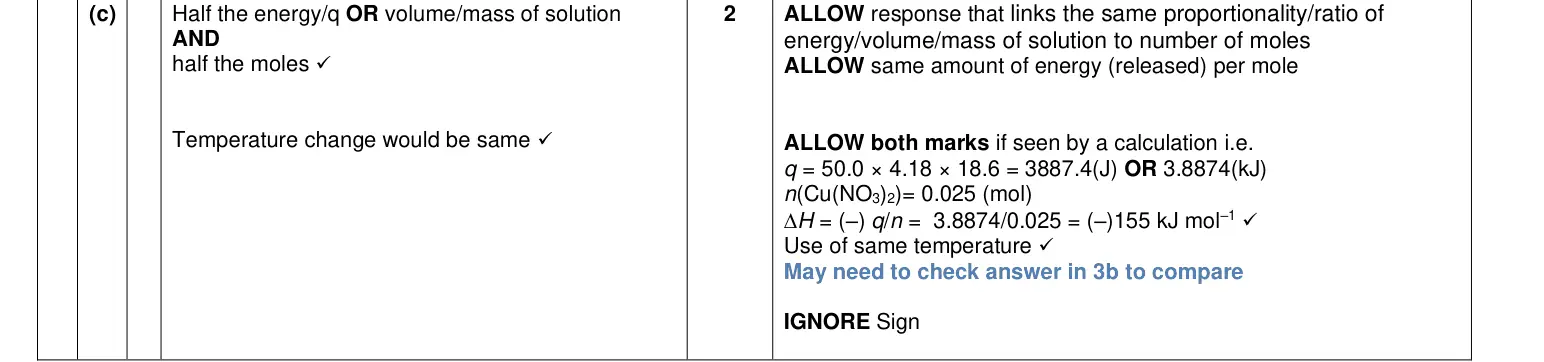
Mark scheme
Examiner's comment
There was a lot of misunderstanding associated with this question, with many candidates failing to score any marks. Many said that nothing would change as the concentration was still the same or because the same bonds were being broken and formed. Under a quarter of students scored 1 mark, usually for making the link between the drop in volume to a change in the q and n values. A few did state that the temperature didn't change. Only a small proportion scored both marks, usually by showing by calculation that the temperature change was the same, moles was half and energy was half. Some did believe that the temperature changed, either that it decreased as less reacted or increased as there was less volume to heat. A wide variety of alternative responses were given including: ‘Enthalpy change the same regardless of mass used’ ‘Number of moles doesn’t impact energy required as it is the same bonds breaking’ ‘Energy to break and form bonds will still be the same with any volume’ ‘Amount of energy required to make the new bond would be the same’ ‘Only concentration has an effect on bond enthalpy values not volume’ ‘Decrease in volume increases concentration’ ‘Cu(NO3)2 would still run out first so enthalpy change is the same’ ‘Zn is in excess so it doesn’t matter how much volume we use because Zn and Cu(NO3)2 still 1:1 ratio.’ ‘Mole ratio is still the same’ or ‘same molar ratio’ wasn’t enough.
Notes from the mark scheme and report
half the energy/volume AND half the moles
temperature change the same
ALLOW shown by calculation
Skills: M0.2 Use ratios, fractions and percentages
June 2024 · Paper 3 · Q2(a)(i)1 markShort answerMedium
Mark scheme
Examiner's comment
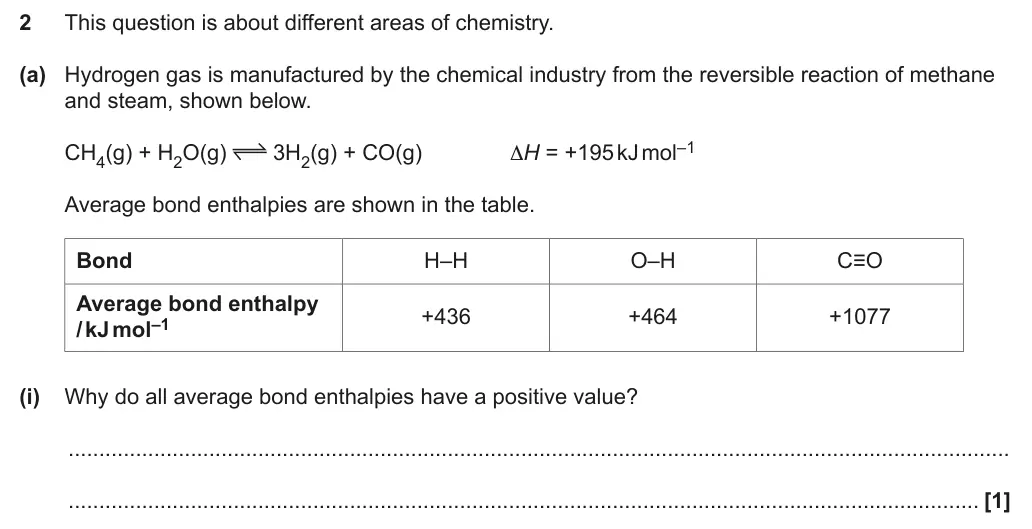
Most candidates were aware that a bond enthalpy is a measure of the energy to break bonds. Most went on to link the positive sign to an endothermic reaction which requires energy. Some candidates linked bond enthalpies to bond formation instead. A significant number of responses described an endothermic reaction, instead of bond enthalpy, in terms of the energy required to break bonds being greater than the energy to make bonds. This was the answer to a different question and could not be given marks.
Notes from the mark scheme and report
bond breaking is endothermic/requires energy
IGNORE 'more energy needed to break bonds than released making bonds'
June 2024 · Paper 3 · Q2(a)(ii)3 marksCalculationHard
Earlier part of question 2 that this part uses
Mark scheme
Examiner's comment
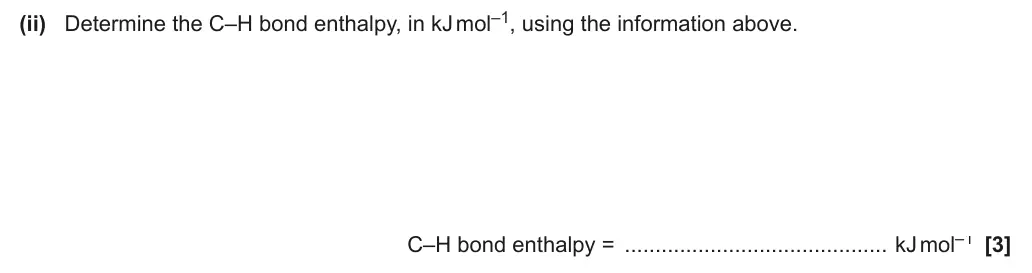
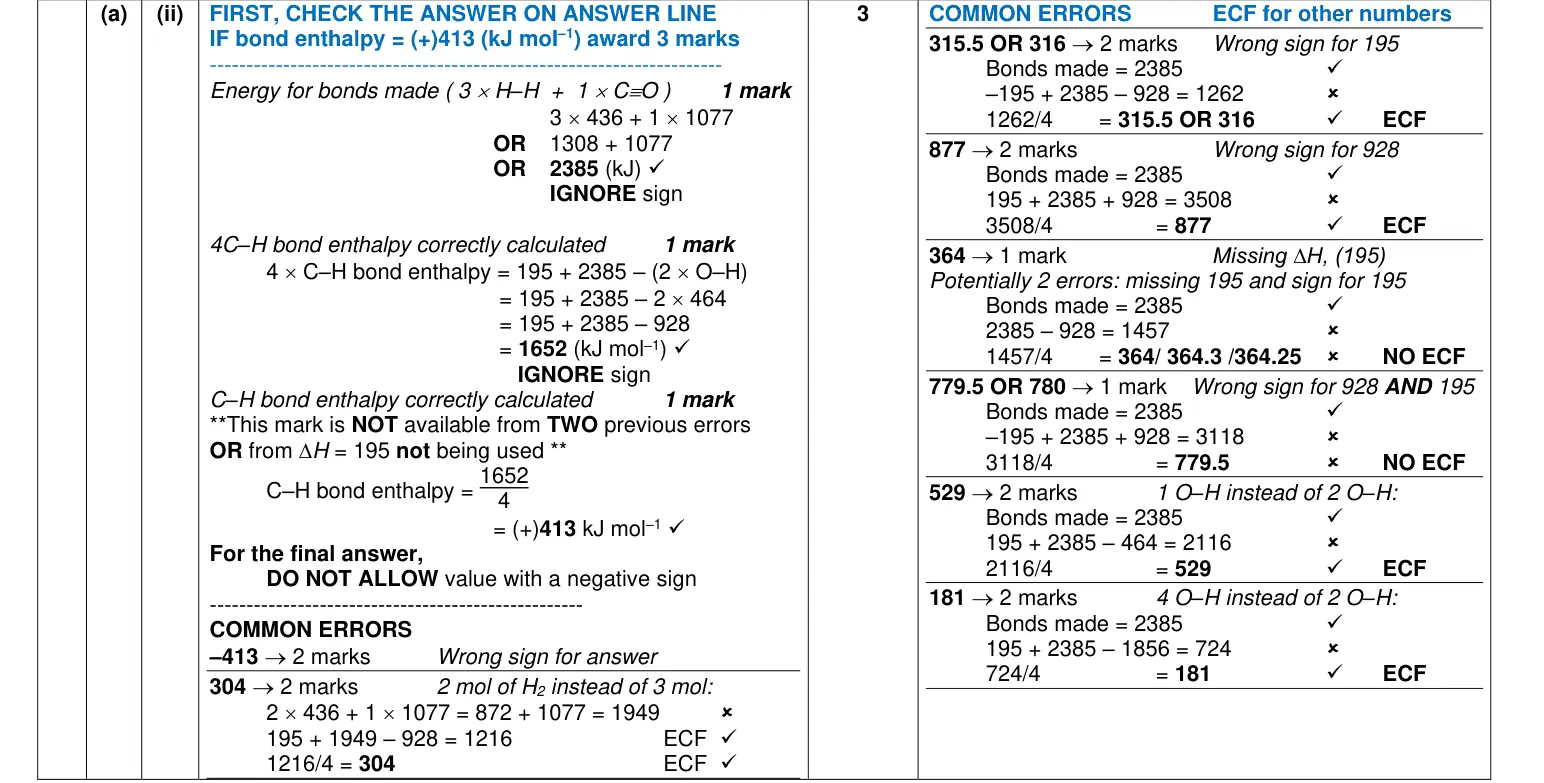
This question differentiated well, with about half the candidates obtaining the correct bond enthalpy of +413 kJ mol–1. With ECF, few candidates scored 0 marks. Most candidates calculated the energy involved in making 3 H–H bonds and 1 C≡O bond as 2385 kJ mol–1. This value had to be incorporated with the energy associated with breaking bonds and the enthalpy change of –195 kJ mol–1. It was this step where problems arose. There were many errors with signs and the lowest attaining candidates sometimes omitted the enthalpy change completely in their calculation. The commonest error of 315.5 kJ mol–1 was the result of using the wrong sign for the enthalpy change. With ECF, this was still given 2 of the 3 available marks.
Notes from the mark scheme and report
common errors: –413 (sign, 2 marks), 304 (2 mol H2), 316 (wrong sign for 195), 364 (∆H omitted, 1 mark), 529 (1 O–H instead of 2)
DO NOT ALLOW negative final value
Skills: M2.2 Change the subject of an equation; M2.3 Substitute numerical values into algebraic equations using appropriate units for physical quantities; M2.4 Solve algebraic equations
June 2024 · Paper 3 · Q2(a)(iii)2 marksCalculationMedium
Earlier part of question 2 that this part uses
Mark scheme
Examiner's comment
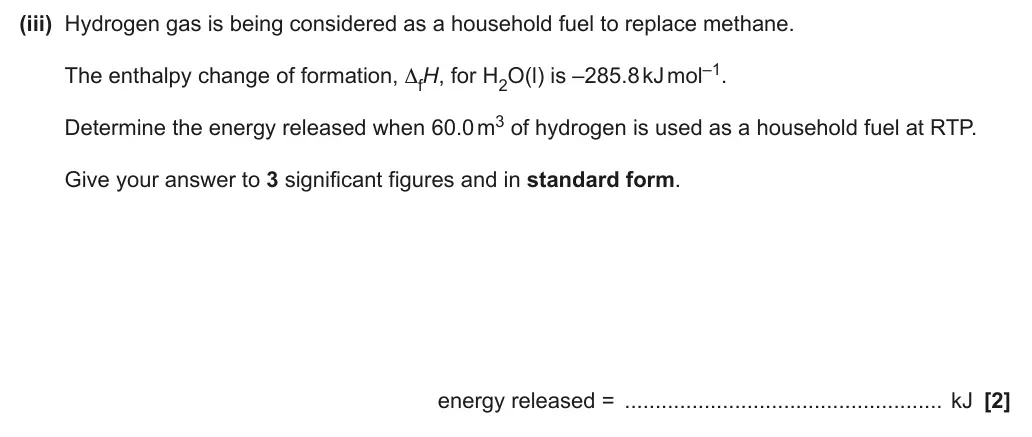
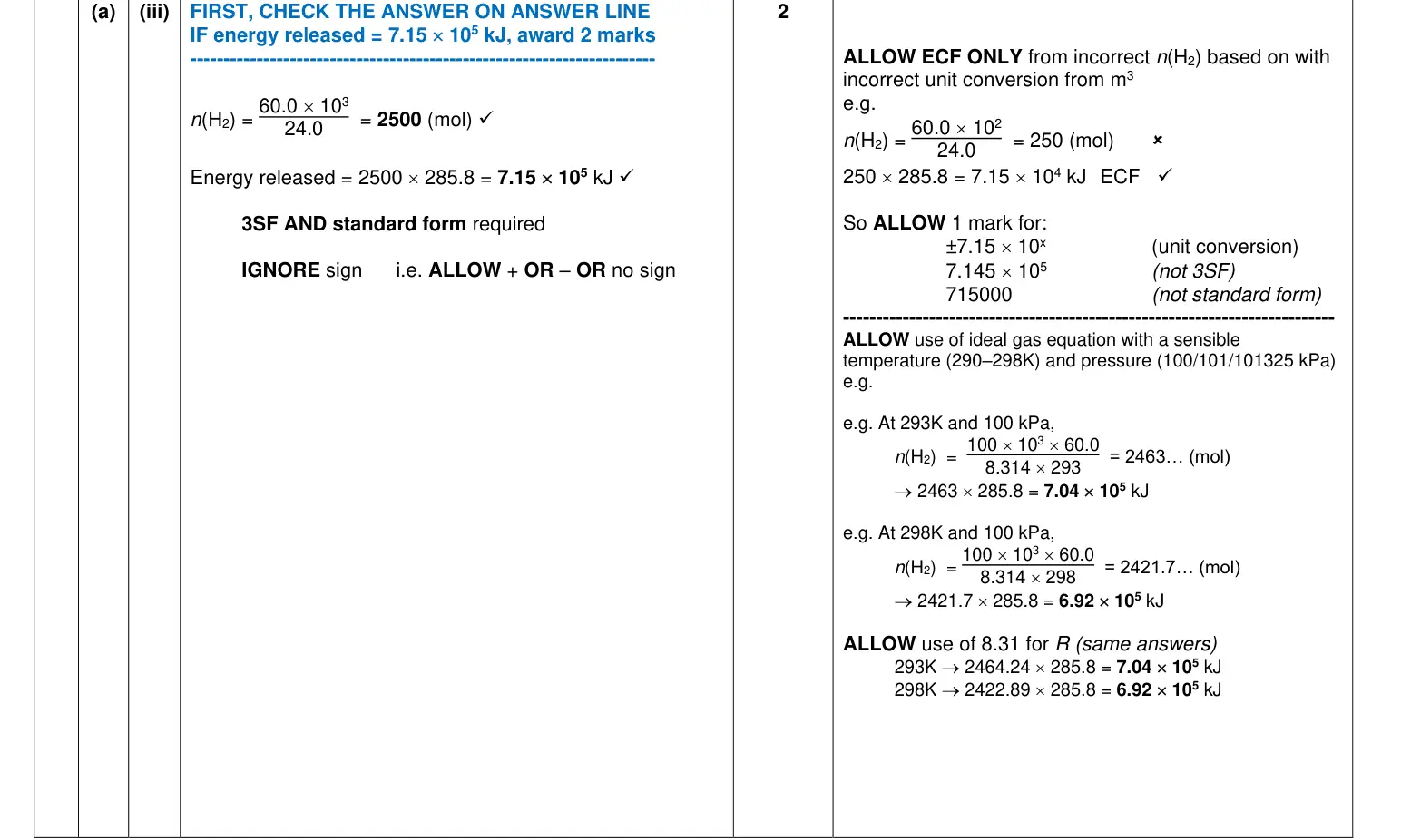
Unlike the standard bond enthalpy calculation in Question 2 (a) (ii), this question required candidates to apply their understanding of enthalpy changes to a new context relevant to energy. Candidates also had to interconvert units and provide an answer to 3 significant figures in standard form. Apart from the chemistry, there were various mathematical skills to use. Candidates found this question much more demanding than Question 2 (a) (ii), with only just over a half gaining marks. The first step involved working out that the number of moles of hydrogen gas in 60 m3 at RTP is 2500 mol. Candidates then had to apply their understanding of ∆fH to calculate the energy as 7.15 × 10⁵ kJ. Common mistakes included: • multiplying 60 m3 by the enthalpy change of 285.8 kJ mol–1 (omitting to calculate the moles of H2 – a lack of understanding) • using more than 3 significant figures, e.g. 7.145 instead of 7.15 • making an error with powers of 10 in the mole calculation (usuallysually by not converting 60 m3 into 60,000 dm3, leading to 2.5 moles). This type of question looks simple but makes for an excellent way of developing application and mathematical skills.
Notes from the mark scheme and report
convert m3 to dm3 (n = 2500 mol)
3 sig figs AND standard form required
1 mark for 7.15 × 10^x, 7.145 × 10^5 or 715000
IGNORE sign
Skills: M0.0 Recognise and make use of appropriate units in calculations; M0.1 Recognise and use expressions in decimal and ordinary form; M1.1 Use an appropriate number of significant figures
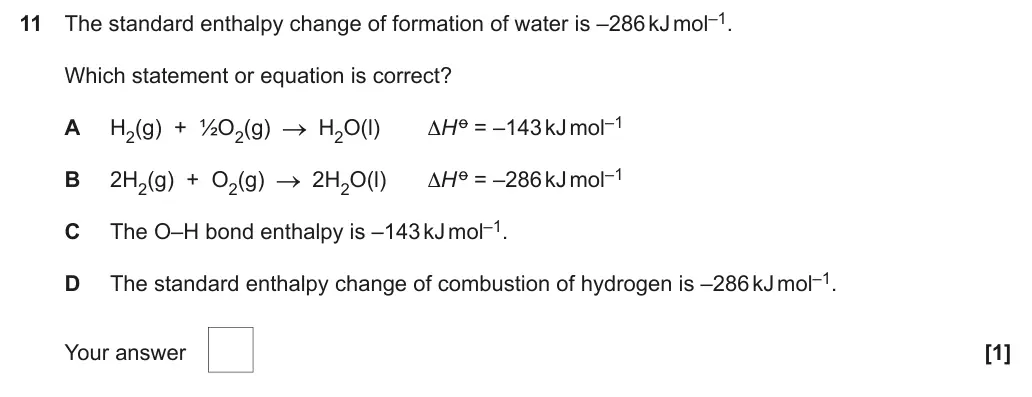
June 2023 · AS Paper 1 · Q111 markAO1Multiple choiceHard
Answer
D
Mark scheme
Examiner's comment
This question proved to be very difficult with only the highest attaining candidates obtaining the correct response of D. Options A and C were the main distractors but there didn’t seem to be any clear pattern. The many candidates could not identify the correct response suggests that candidates have difficulty in understanding the real meaning of these enthalpy terms.
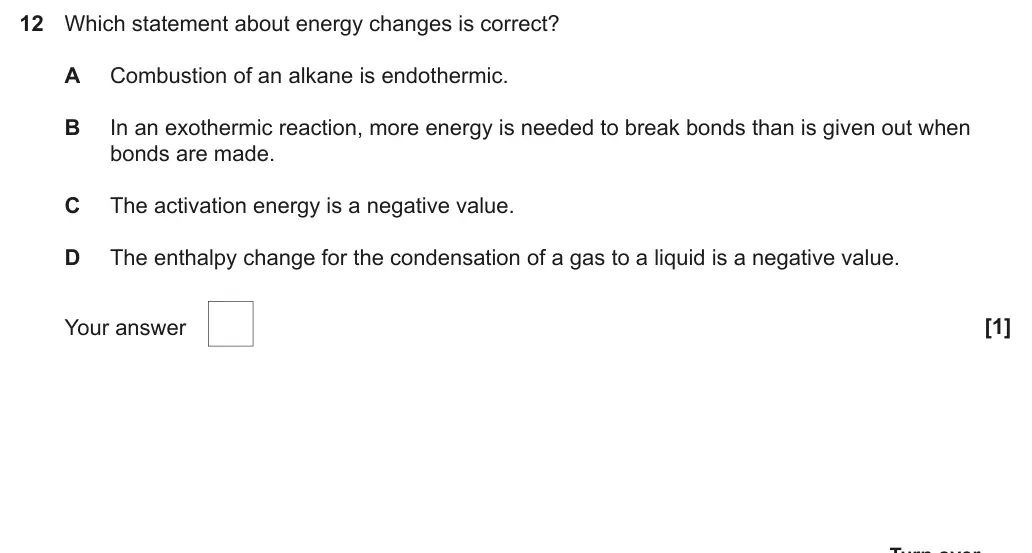
June 2023 · AS Paper 1 · Q121 markAO1Multiple choiceMedium
Answer
D
Mark scheme
Examiner's comment
The theme of problems with enthalpy terms continued with Question 12, with only about half of the candidates choosing the correct option D.
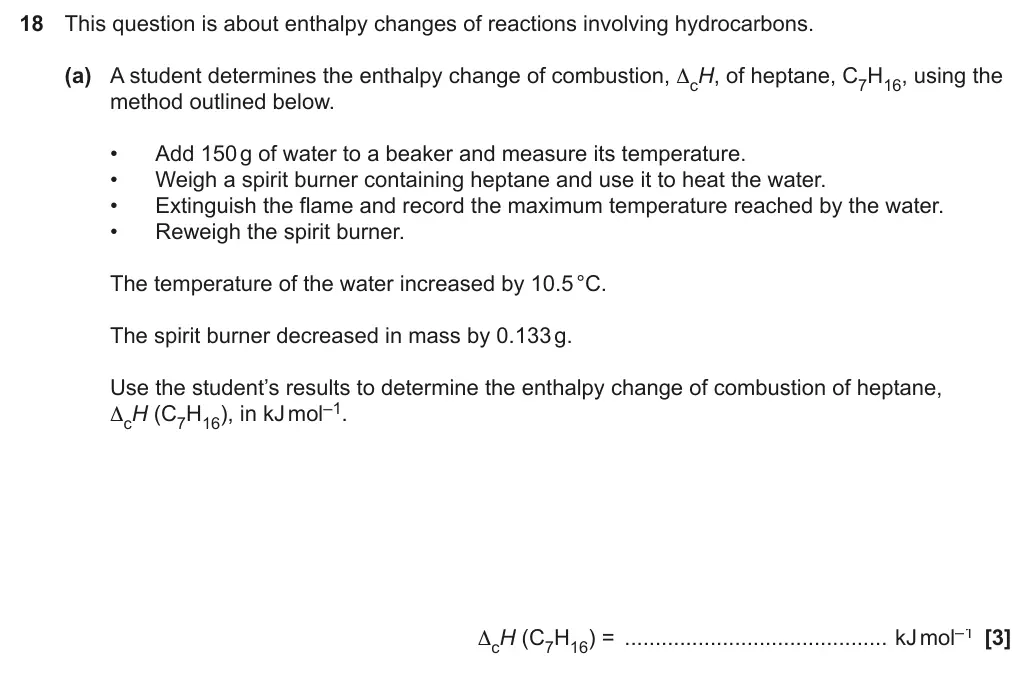
June 2023 · Paper 1 · Q18(a)3 marksAO2CalculationHard
Mark scheme
Examiner's comment
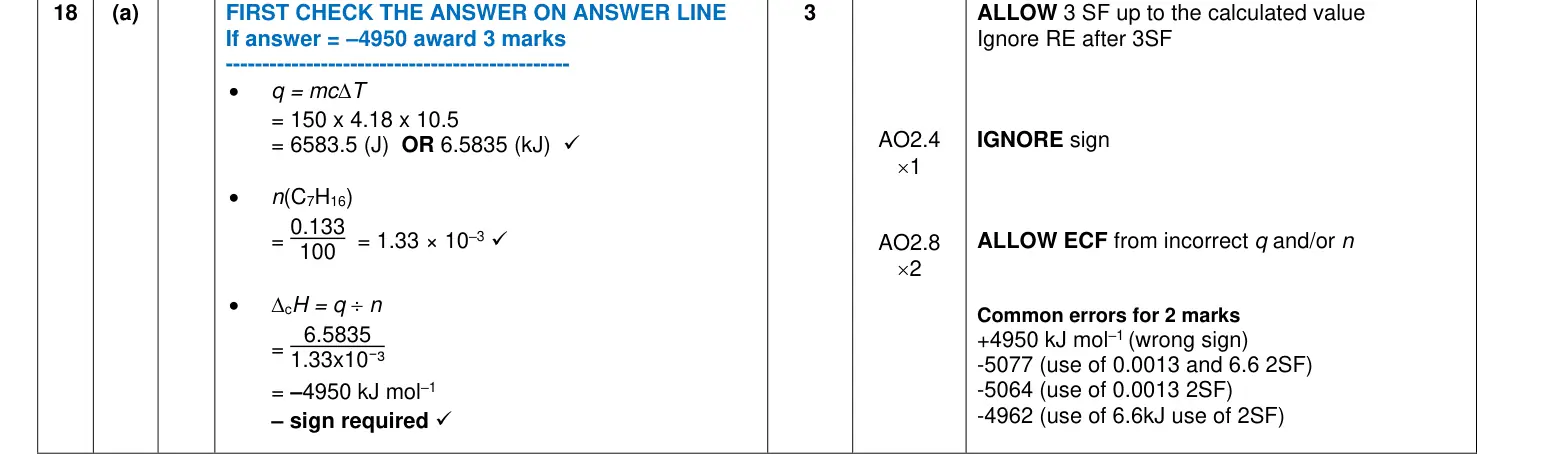
Many candidates calculated the correct value of q and scored all three marks. Common errors saw some candidates using the incorrect mass, of either 0.133 or that added to or subtracted from the 150. The temperature change was given but a few candidates added the 10.5 to 273 in order to, incorrectly, convert to K. The final mark required the candidate to link the temperature increase to an exothermic value and include a minus sign.
Notes from the mark scheme and report
q = 150 × 4.18 × 10.5
n = 0.133/100
– sign required
common errors for 2 marks: +4950, –5077/–5064 (use of 2 SF)
Skills: M0.0 Recognise and make use of appropriate units in calculations; M0.2 Use ratios, fractions and percentages; M2.3 Substitute numerical values into algebraic equations using appropriate units for physical quantities; PAG3 Enthalpy determination
June 2023 · Paper 1 · Q18(b)2 marksAO2CalculationHard
Mark scheme
Examiner's comment
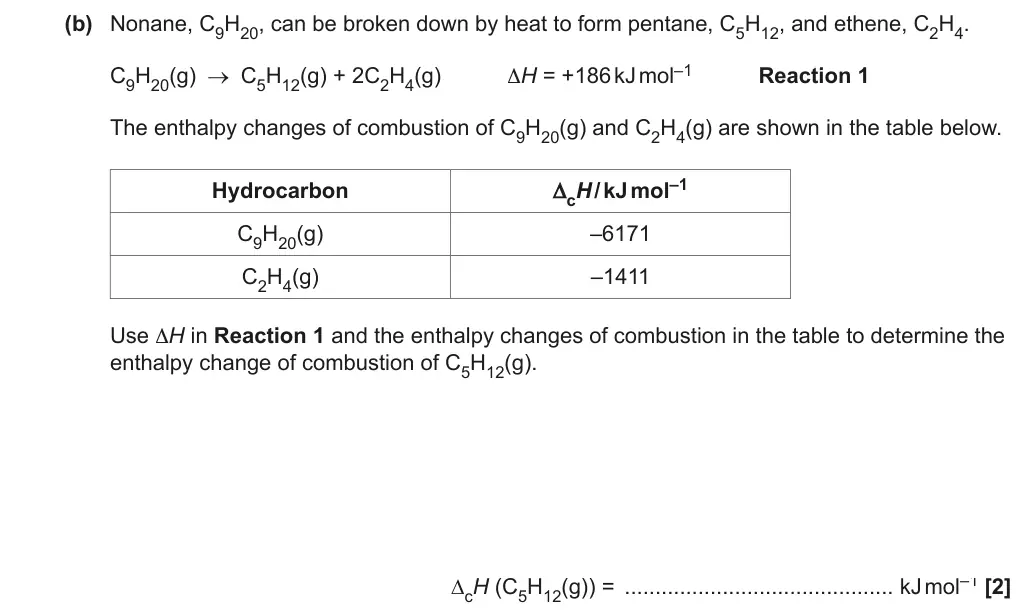
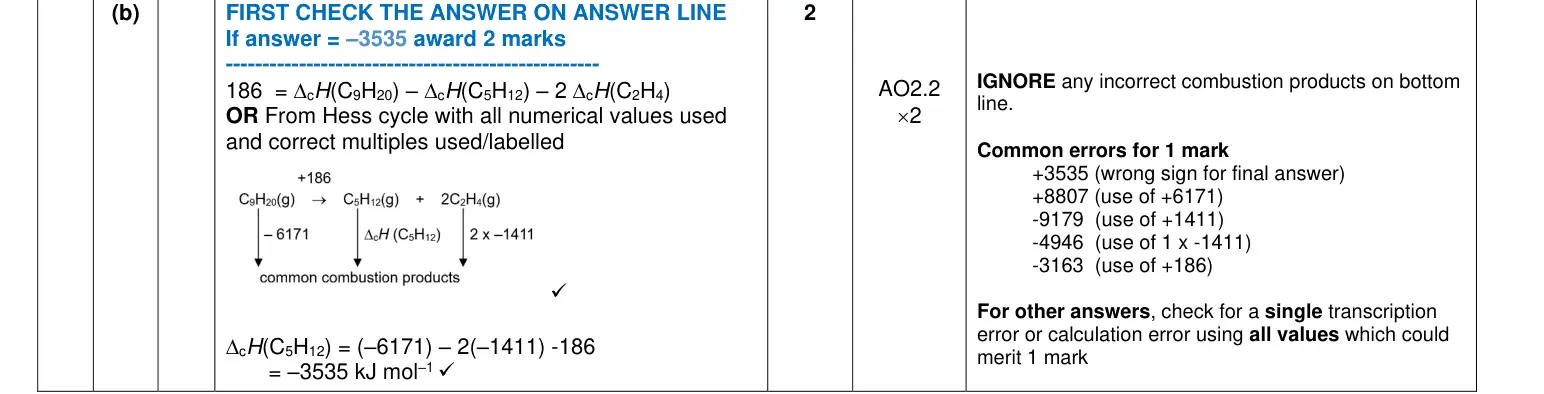
This calculation proved difficult. Many candidates did not deduce the correct cycle. Of those who did, a significant majority did not appreciate the stoichiometry and/or use the correct signs from the cycle. Many candidates scored 1 mark for this question, which was gained as an error carried forward, in the enthalpy cycle. -3163 was a common error. This candidate showed clarity in their working by drawing a correct Hess cycle and then applying correct multiples and directions for the enthalpy changes.
Notes from the mark scheme and report
186 = ∆cH(C9H20) – ∆cH(C5H12) – 2∆cH(C2H4)
common errors for 1 mark: +3535, –4946 (1 × –1411), –3163 (+186)
Skills: M2.2 Change the subject of an equation; M2.3 Substitute numerical values into algebraic equations using appropriate units for physical quantities; M2.4 Solve algebraic equations
June 2023 · AS Paper 1 · Q23(a)(ii)2 marksAO1, 2Complete table/diagramMedium
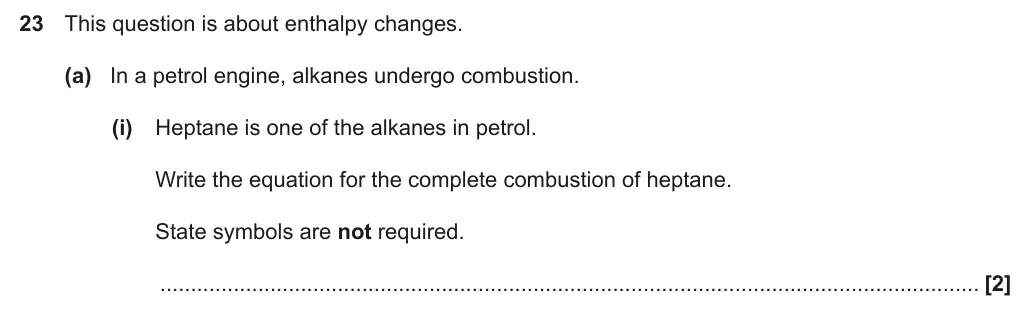
Earlier part of question 23 that this part uses
Mark scheme
Examiner's comment
Most candidates obtained 1 or 2 of the available marks, the commonest errors being use of a double- headed arrow for ∆H or a –∆H label. Some candidates showed endothermic profiles and these could create issues with positioning of the ∆H and Ea arrows. Generally, positioning of ∆H and Ea arrows was imprecise and candidates are advised to start and finish the positions of their arrows accurately. The mark scheme did allow for some leeway but positioning of arrows could generally be improved.
Notes from the mark scheme and report
products below reactants with ∆H arrow downwards
DO NOT ALLOW –∆H or double-headed ∆H arrow
Ea from reactants to top of curve, DO NOT ALLOW arrowhead down
Skills: M3.1 Translate information between graphical, numerical and algebraic forms
June 2023 · AS Paper 1 · Q23(b)(i)1 markAO1Short answerMedium
Mark scheme
Examiner's comment
Only just over a half of candidates obtained this mark with one of the conditions being incorrect, usually as 273 K or 100 Pa. It is important that candidates learn these standard conditions.
Notes from the mark scheme and report
298 K/25 °C AND 100 kPa (ALLOW 101 kPa, 1 atm)
June 2023 · AS Paper 1 · Q23(b)(ii)3 marksAO2CalculationHard
Earlier part of question 23 that this part uses
Mark scheme
Examiner's comment
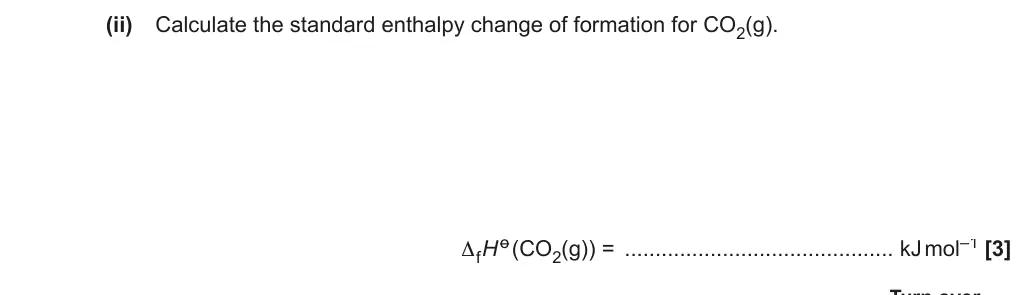
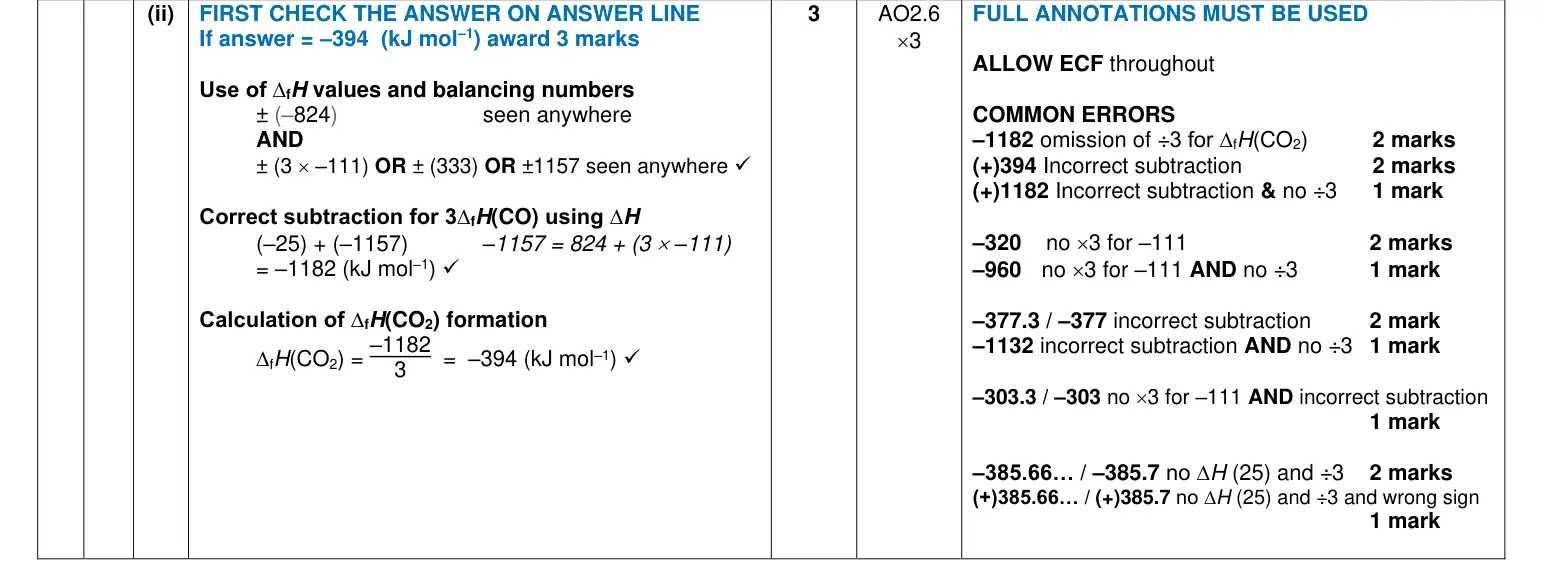
This question discriminated extremely well with many obtaining the correct enthalpy change of –394 kJ mol–1 for 3 marks. There were 3 stages to the calculating: • Use of –824 and 3 –111 to obtain –1157 • Correct incorporation of –25 to obtain –1182 • Division by 3 for 1 mole of CO2 to obtain –394 kJ mol–1 Weak candidates usually gained the first marking point but did not get any further. Incorrect signs were common as was not dividing by 3 for the final marking point. The mark scheme allowed ECF to be applied, provided that there was some correct method in the response. Unfortunately, many responses were very difficult to follow, often shown as numbers almost placed at random in the answer space. This makes it very difficult to identify any logic and to apply ECF. Exemplar 3 serves as a model, clear response, showing what is possible.
Notes from the mark scheme and report
common errors: –1182 (no ÷3) scores 2
+394 scores 2
–320 (no ×3 for CO) scores 2
ALLOW ECF throughout
Skills: M2.2 Change the subject of an equation; M2.3 Substitute numerical values into algebraic equations using appropriate units for physical quantities; M2.4 Solve algebraic equations
June 2023 · AS Paper 2 · Q4(a)2 marksAO1Short answerMedium
Mark scheme
Examiner's comment
Approximately half of candidates scored both marks. Many lost marks for saying ‘energy required’ or ‘energy needed’ which demonstrated a lack of understanding that for an exothermic reaction this would be the activation energy not the enthalpy change. Some also had 1 mole of substance but this was reacted with 1 mole of oxygen or formed 1 mole of products.
Notes from the mark scheme and report
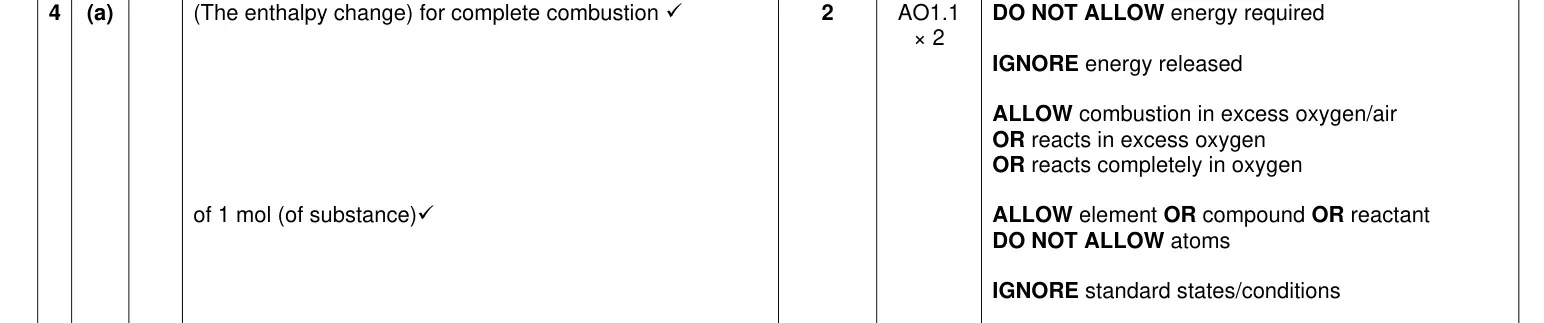
complete combustion of 1 mol of substance
DO NOT ALLOW 'energy required' or 1 mol of atoms
IGNORE standard conditions
June 2023 · AS Paper 2 · Q4(b)(ii)6 marksAO2, 36-mark level of responseMedium
Earlier part of question 4 that this part uses
Mark scheme, with the levels and indicative points
Examiner's comment
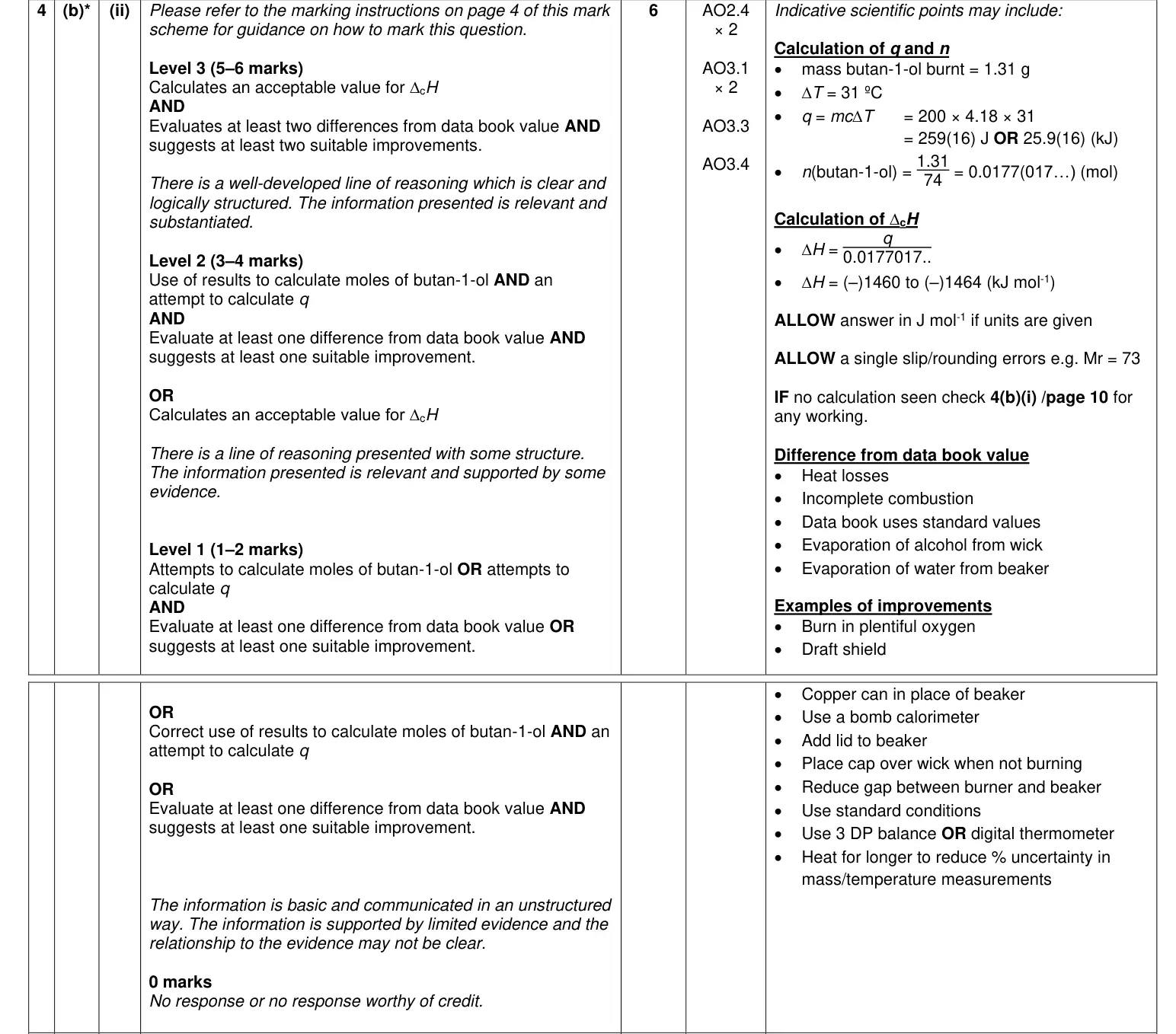
Many candidates limited themselves to only L1 here by not calculating the enthalpy change from the student’s results. Remind candidates to read the question carefully and to use all the information provided (such as tables of results). Some missed out on L3 as their evaluation lacked detail, as they needed to include at least two differences and two suitable improvements. Not all improvements given were suitable, with some suggesting candidates confusing different practicals - for example, ‘use a polystyrene cup’ or ‘heat to a constant mass’. It was evident that some lacked understanding about complete combustion, with suggestions to ‘measure mass until it doesn’t change any further’ or ‘heat water for longer’ to make sure complete combustion had occurred. Some also suggested ‘using a larger mass’ but further information was needed for credit to be given. This exemplar shows a candidate who achieved L3 with all 6 marks given. Working for the calculation of H is clear with all steps shown, in a logical order, and the final answer has correct negative sign. More than 2 differences and 2 improvements are given. The communication is clear, linking potential differences with suggestion for improvements.
improvements: draught shield, lid, copper can, cap on wick, bomb calorimeter
Further information about practical skills assessed on written exams can be found in Section 3 of the practical skills handbook. If using the suggested practical activities developed by OCR, then encourage candidates to answer the extension opportunity questions to help develop a deeper understanding in preparation for written assessments.
Skills: M0.0 Recognise and make use of appropriate units in calculations; M2.3 Substitute numerical values into algebraic equations using appropriate units for physical quantities; PAG3 Enthalpy determination
June 2023 · AS Paper 2 · Q4(b)(iii)1 markAO3CalculationMedium
Earlier parts of question 4 that this part uses
Mark scheme
Examiner's comment
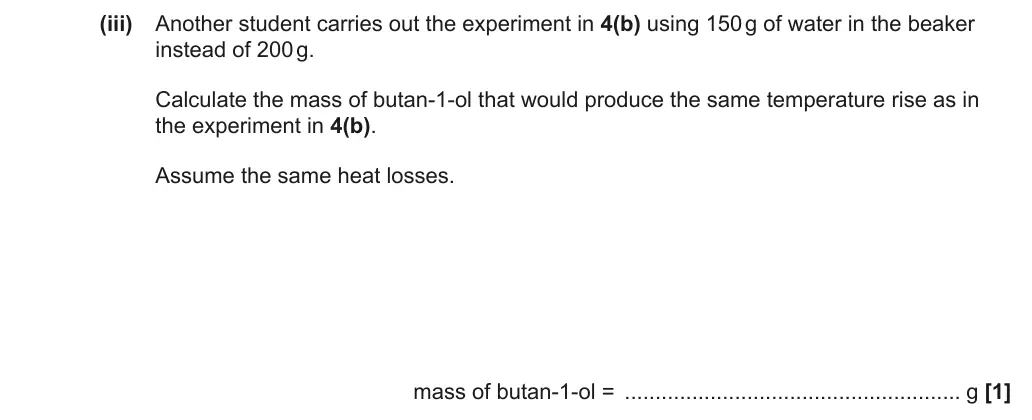
Those that were more confident with the calculation in (ii) were more likely to get the answer here. ECF was occasionally seen from an incorrect mass or enthalpy change depending on method used. Many were able to work out q using 150g of water even if they had incorrectly calculated q in (ii) - such as previously using 1.31g.
Notes from the mark scheme and report
0.75 × 1.31 = 0.9825 g (ALLOW 0.98–0.99)
ALLOW ECF from (b)(ii)
Skills: M0.2 Use ratios, fractions and percentages; M2.2 Change the subject of an equation
June 2023 · AS Paper 2 · Q4(c)(i)4 marksAO2CalculationHard
Mark scheme
Examiner's comment
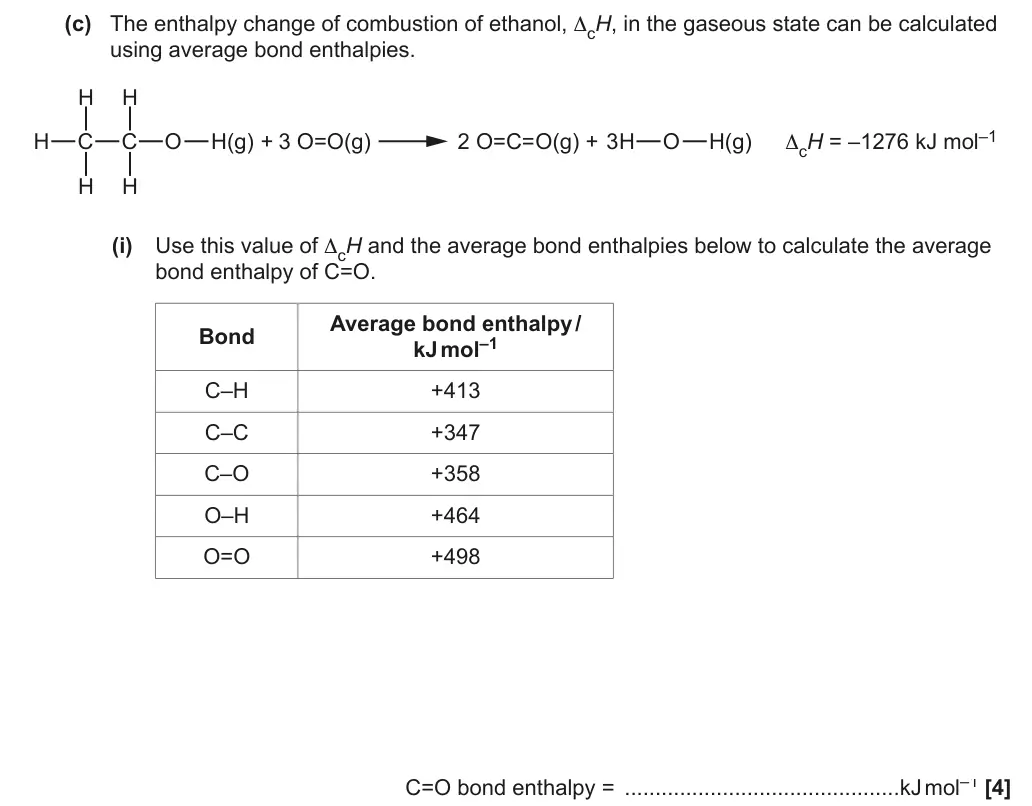
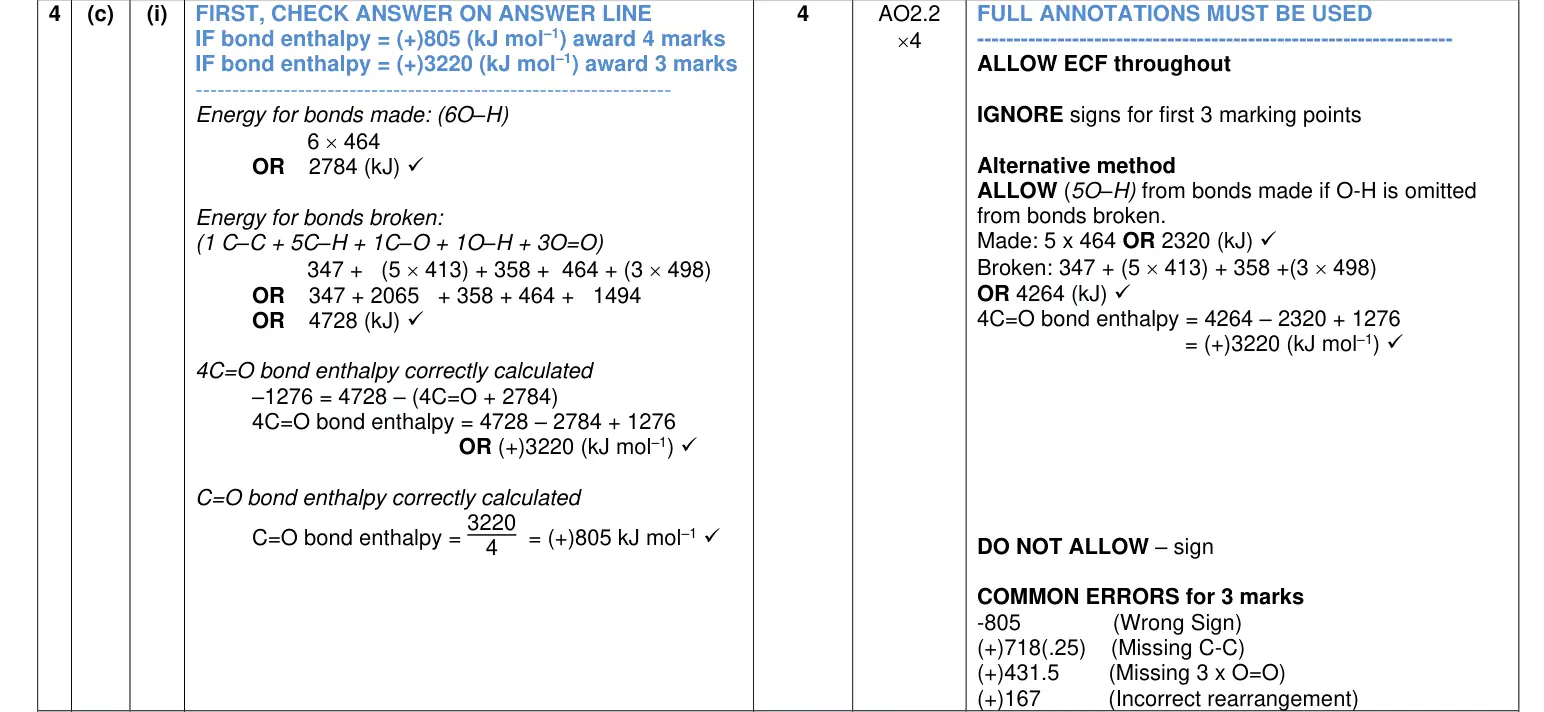
Candidates’ working was often unclear and very difficult to follow for this question, making it challenging to find errors and award ECF where appropriate. Despite being given the displayed formula, many were unable to correctly count the bonds in the molecules. Missing some or all of C-C, C-O and 3 x O=O from the bonds broken was often seen. Some only counted 2 x C=O bonds in the products. Some subtracted the bonds broken from bonds made or omitted the enthalpy change from their calculation. Very few candidates gave a negative value for their final bond enthalpy.
Skills: M2.2 Change the subject of an equation; M2.3 Substitute numerical values into algebraic equations using appropriate units for physical quantities; M2.4 Solve algebraic equations
June 2023 · AS Paper 2 · Q4(c)(ii)2 marksAO3Short answerHard
Earlier part of question 4 that this part uses
Mark scheme
Examiner's comment
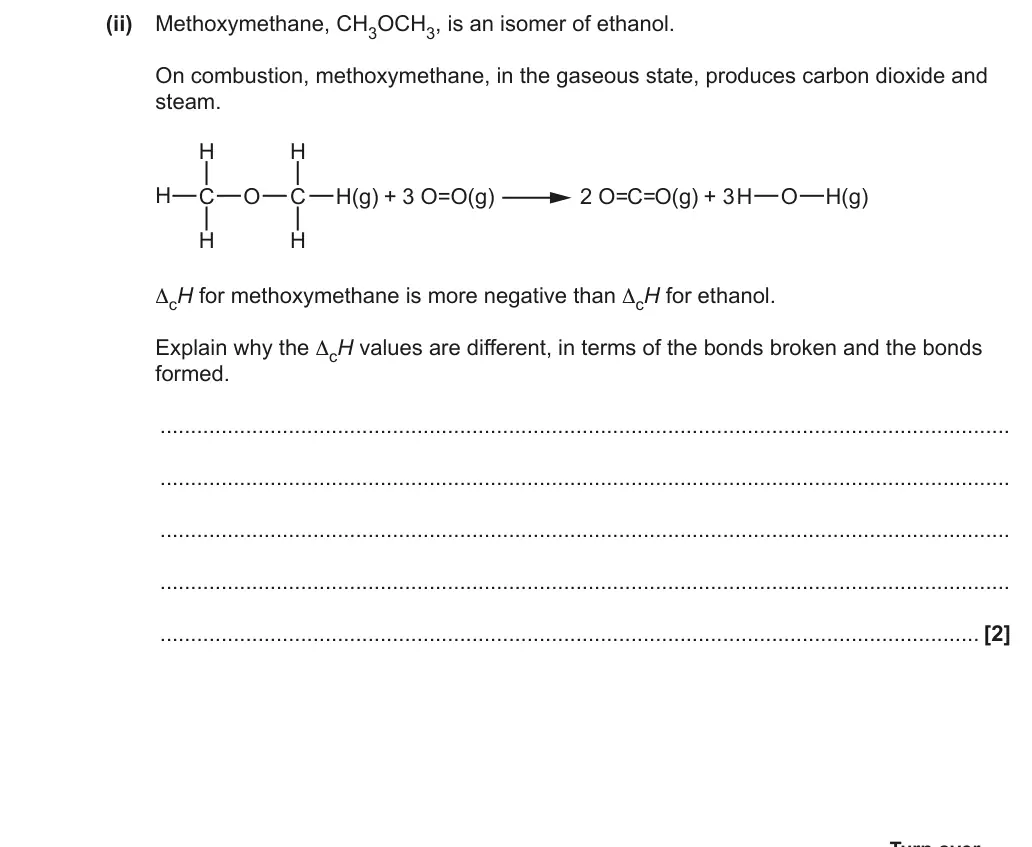
Very few candidates scored both marks here. Many just gave a generic response describing an exothermic reaction i.e. ‘more energy is released in bond forming than needed for bond breaking’ rather than answering the question asked. It was evident from many responses that candidates are unclear that energy is needed for bond breaking and released in bond forming. Some tried to compare specific bonds but often failed to account for them all, comparing presence of C-O and extra C-H in methoxymethane to O-H in ethanol but forgetting the C-C bond, resulting in methoxymethane having stronger bonds/more energy to break bonds. Lots didn't recognise that the same products were formed in both reactions.
Notes from the mark scheme and report
less energy needed to break bonds in methoxymethane (bonds weaker)
energy released forming bonds is the same (same bonds formed)
IGNORE calculations
June 2023 · Paper 3 · Q2(a)(ii)3 marksAO2CalculationHard
Earlier part of question 2 that this part uses
Mark scheme
Examiner's comment
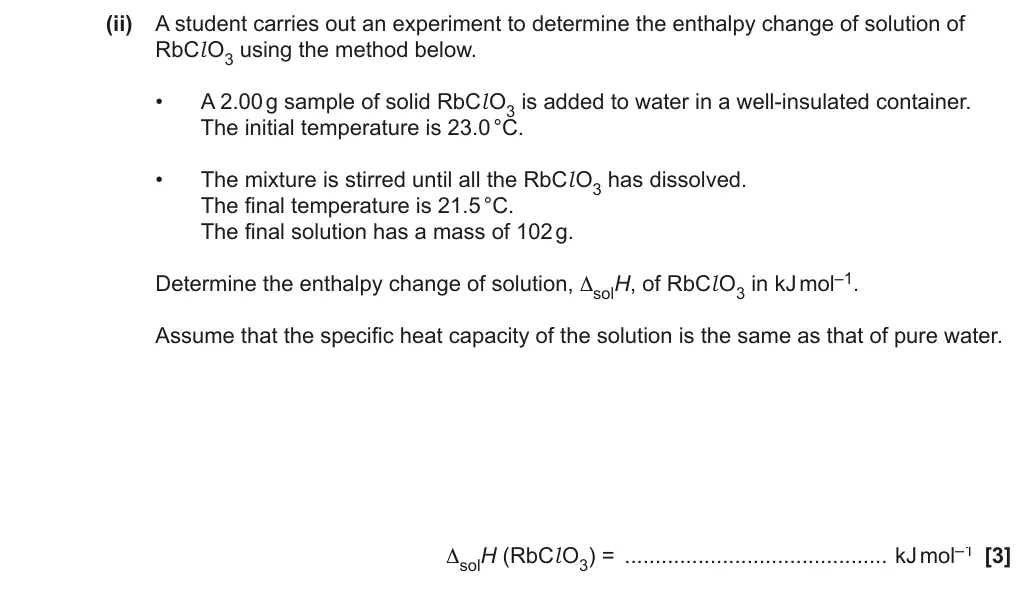
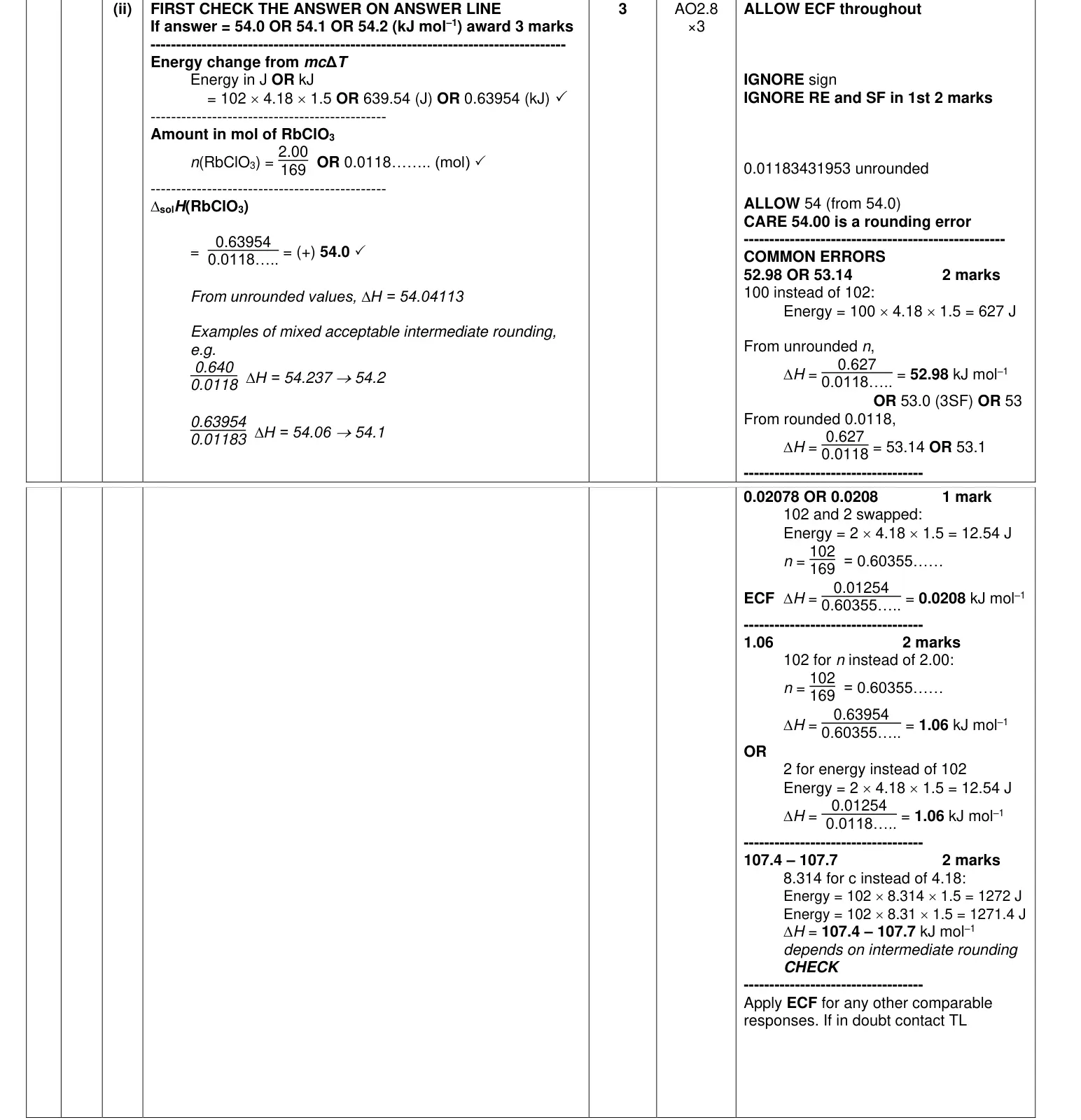
This question was a good discriminator, producing marks across the whole 3 mark range. More successful candidates correctly calculated the energy change, moles of RbClO3 and enthalpy change of solution. However, there were pitfalls for many including the following: • calculating the energy change using the mass of water rather than the mass of the solution. This was despite the suppled information that the specific heat capacity of the solution is the same as for water. Candidates should understand that m in mc∆T is the mass of the substance that produces ∆T • calculating an incorrect value for the molar mass of RbClO3. Instead of 169, this was often seen as 120.5 (using the atomic number of 37 for Rb, rather than the mass number of 85.5) and 185 (for RbClO4) • using values of m at the wrong stages in the calculation. e.g. 2 g with the energy change and 102 g or 100 g with the moles calculation • calculating the correct numerical value for the enthalpy change of solution, but then placing a ‘–‘ sign in front of the value, despite ∆T being for a decrease in temperature. Finally, as with all multi-step calculations, candidates are advised to use calculator values throughout. Any intermediate rounding introduces rounding errors in the final value. The final value can be rounded either to the significant figures demanded by the question or to the lowest number of significant figures used in the provided data.
Notes from the mark scheme and report
mass of solution 102 g (not 100 or 2.00 g)
∆T = 1.5
n = 2.00/169
+54.0 to 54.2
IGNORE sign
common errors: 100 instead of 102 (53.0) 2 marks, 102 and 2 swapped 1 mark, 8.314 used for c 2 marks
ALLOW ECF
Skills: M0.0 Recognise and make use of appropriate units in calculations; M0.2 Use ratios, fractions and percentages; M2.3 Substitute numerical values into algebraic equations using appropriate units for physical quantities; PAG3 Enthalpy determination
June 2022 · Paper 1 · Q71 markAO2Multiple choiceHard
Answer
A
Mark scheme
Examiner's comment
This was another challenging question, with fewer candidates choosing the correct answer of A. The distractor, D, was obtained by swapping products and reactants in the calculation or in an incorrect enthalpy cycle. Candidates should have ruled out C and D straight away as enthalpy of combustion is always exothermic. Where working was shown, candidates omitted one or more of the multiples in the bonds formed or broken.
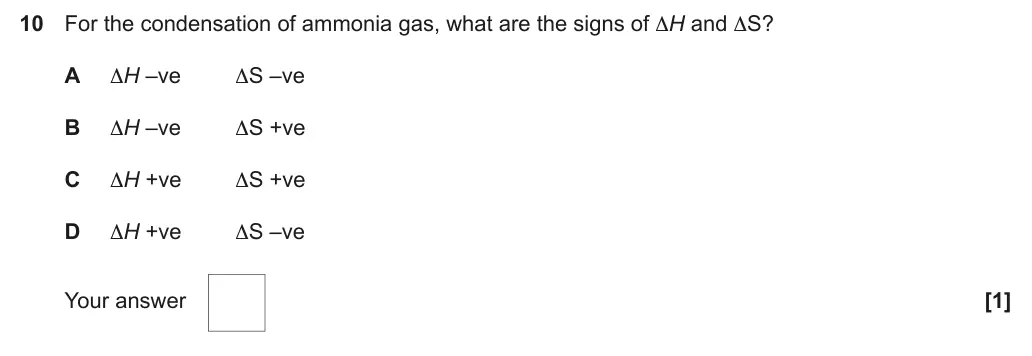
June 2022 · Paper 1 · Q101 markAO2Multiple choiceMedium
Answer
A
Mark scheme
Examiner's comment
Only some candidates chose the correct answer of A. Option D was a common incorrect answer through not recognising that the enthalpy change for condensation is negative.
June 2022 · AS Paper 1 · Q111 markAO2Multiple choiceMedium
Answer
A
Mark scheme
Examiner's comment
Candidates answered this question reasonably well with most choosing either the correct option A, or the incorrect D (the same numerical value but with the wrong sign). Energy cycles and Hess’ law seemed to be well known with most candidates drawing their cycle by the question. Candidates should take care with the direction of the arrows as these travel in different directions for formation and combustion problems. The incorrect option D was the result of arrows in the wrong direction.
June 2022 · Paper 1 · Q17(a)(i)4 marksAO1, 2CalculationHard
Mark scheme
Examiner's comment
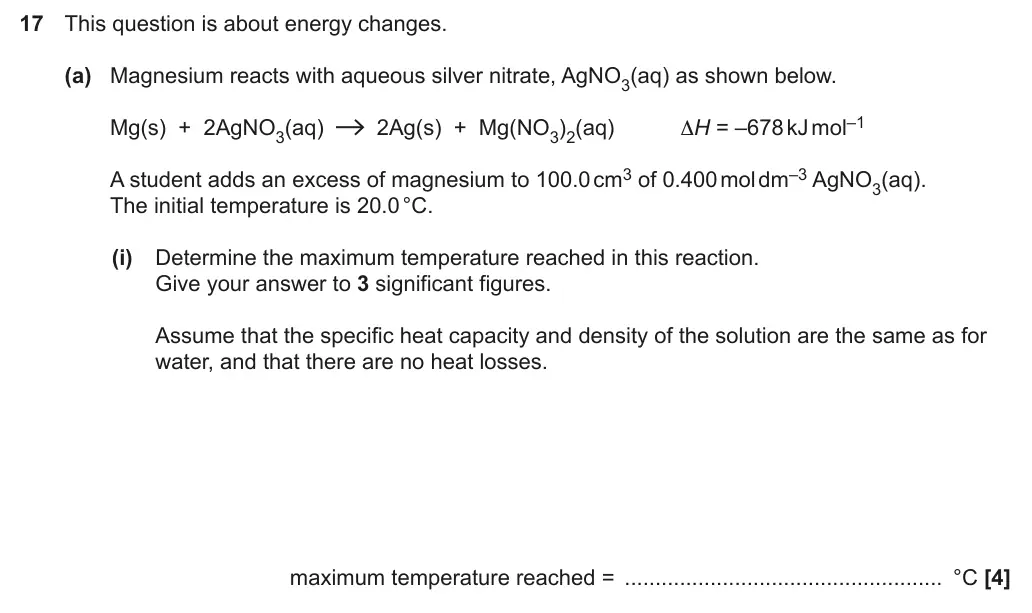
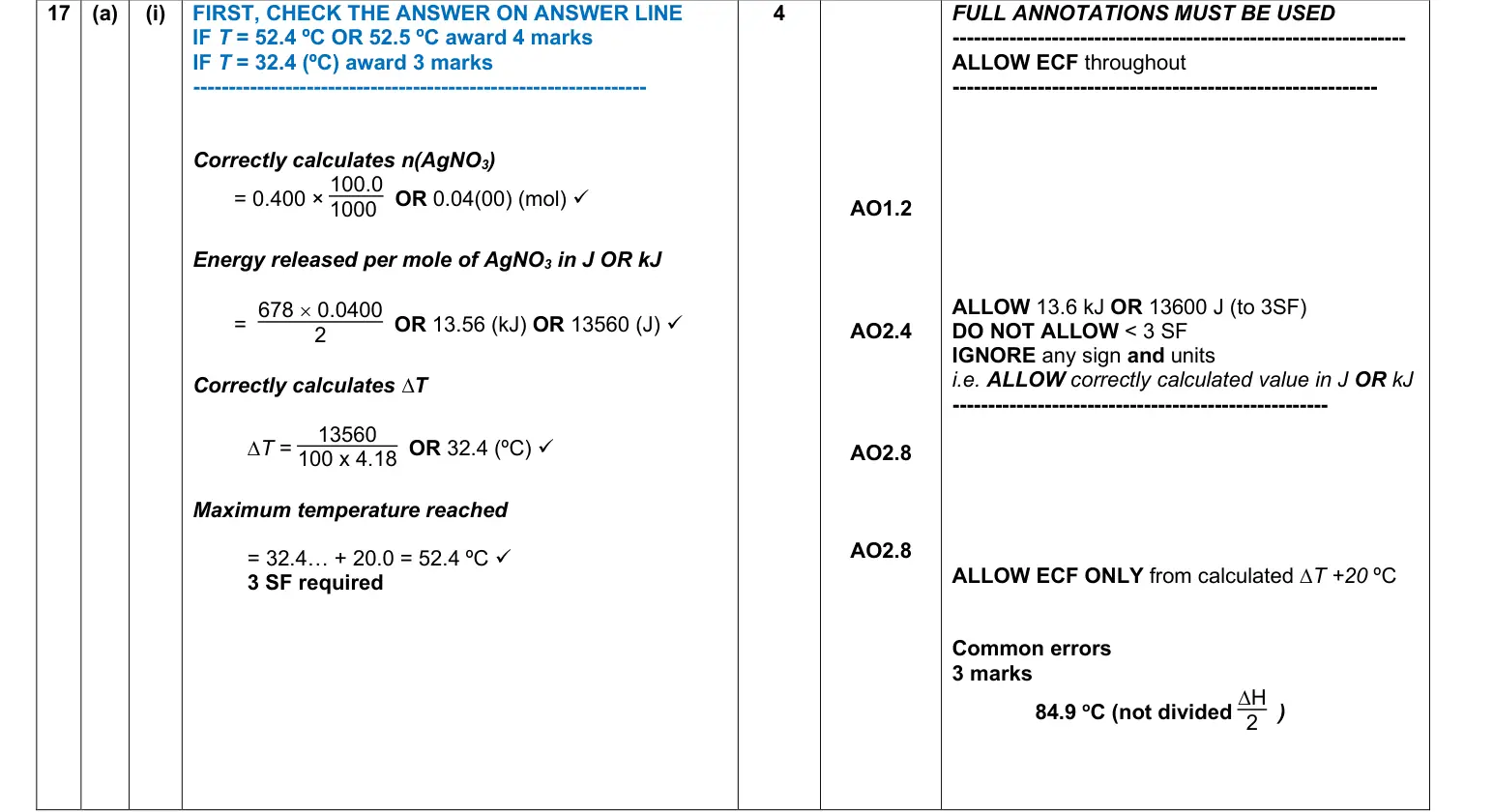
Many candidates made some attempt at this unusual twist on a Q = mcΔT calculation, but only a minority of candidates produced a fully correct answer. A temperature of 84.9 oC was seen much more often than 52.4 oC. The calculation of n(AgNO3) was performed well. Common errors were not dividing the moles by 2, not recognising the need to calculate the energy released per mole of AgNO3, confusing the mass of water with the mass of the silver nitrate solid or of using an energy in kJ alongside a value of c based on J.
Notes from the mark scheme and report
n(AgNO3) = 0.0400
energy = 678 × 0.0400/2 = 13.56 kJ (2 mol AgNO3 per ∆H)
∆T = 32.4
add 20.0 gives 52.4 °C to 3 sig figs
common errors 32.4 (∆T only) and 84.9 (no ÷2) score 3
Skills: M0.0 Recognise and make use of appropriate units in calculations; M1.1 Use an appropriate number of significant figures; M2.2 Change the subject of an equation; M2.3 Substitute numerical values into algebraic equations using appropriate units for physical quantities; PAG3 Enthalpy determination
June 2022 · Paper 1 · Q17(a)(ii)1 markAO3Short answerHard
Earlier part of question 17 that this part uses
Mark scheme
Examiner's comment
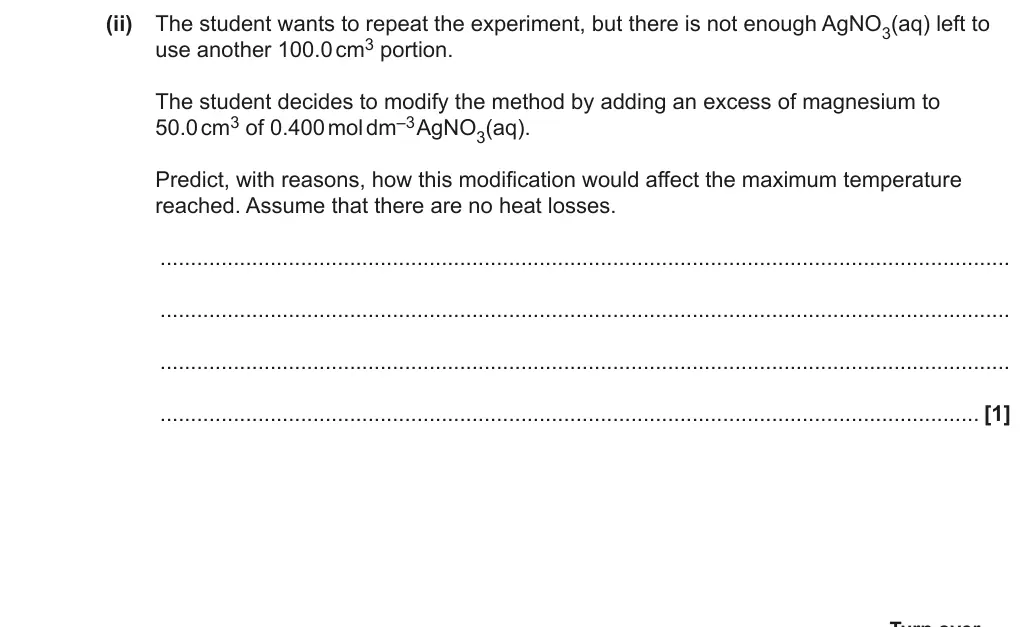
Although there were a few well explained, correct answers, this question proved challenging for most candidates. Candidates needed to link the changes as a proportion (e.g. half) to be given the mark. Candidates often only considered the change to energy or mass, but not both, e.g. dealt only with the decrease in moles reacting leading to a smaller temperature rise.
Notes from the mark scheme and report
same maximum temperature AND half the energy/moles AND half the mass/volume
Skills: M0.2 Use ratios, fractions and percentages; PAG3 Enthalpy determination
June 2022 · Paper 1 · Q17(b)(i)1 markAO1Short answerMedium
Mark scheme
Examiner's comment
The majority of candidates gave the required definition correctly, frequently going beyond to include ideas about standard states and conditions. The smaller number of incorrect responses covered a range of errors, including assuming that 1 mole of elements were reacting and (perhaps as a result of later work on lattice enthalpies) bringing in a requirement for the compound or the elements to be gaseous.
Notes from the mark scheme and report
1 mole of compound formed from its elements
DO NOT ALLOW 1 mole of element
DO NOT ALLOW 'gaseous elements'
June 2022 · Paper 1 · Q17(b)(ii)2 marksAO2CalculationHard
Earlier part of question 17 that this part uses
Mark scheme
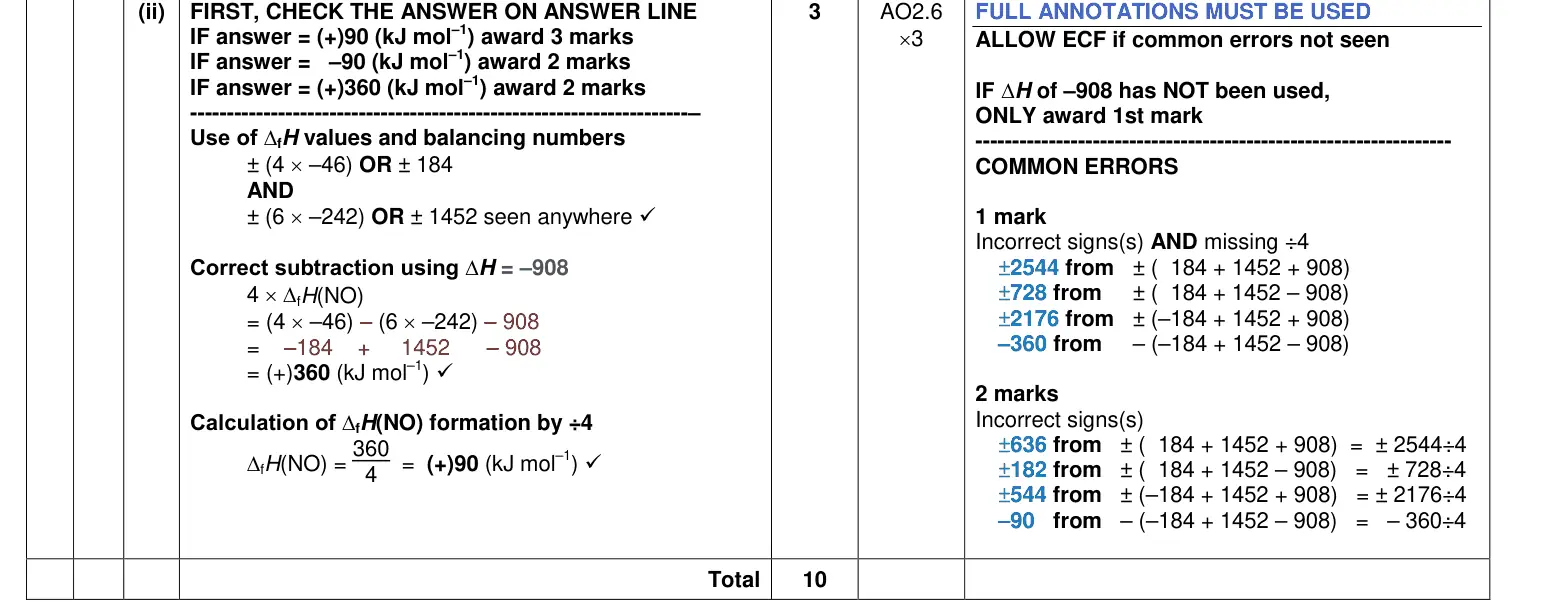
Examiner's comment
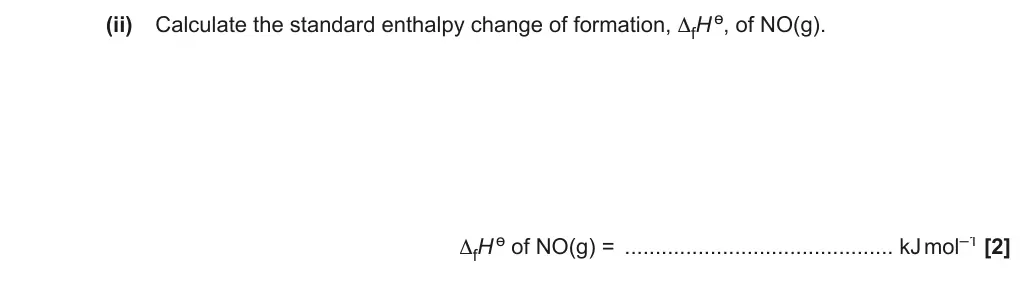
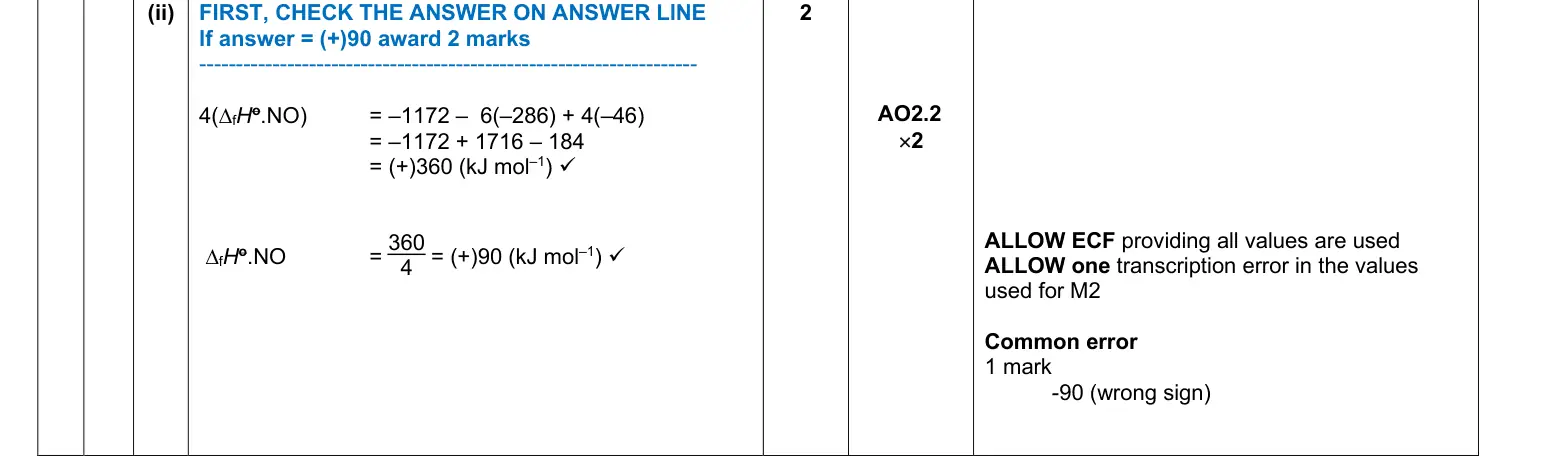
This calculation proved difficult. Many candidates did not deduce the correct cycle. Of those who did, a significant majority did not appreciate the stoichiometry and/or use the correct signs from the cycle. Many students scored 1 mark for this question which was gained as an error carried forward, providing all the values had been used in the enthalpy cycle. -90 was a common error.
Notes from the mark scheme and report
4∆fH(NO) = –1172 + 1716 – 184 = +360
÷4 = +90
–90 scores 1
Skills: M2.2 Change the subject of an equation; M2.3 Substitute numerical values into algebraic equations using appropriate units for physical quantities; M2.4 Solve algebraic equations
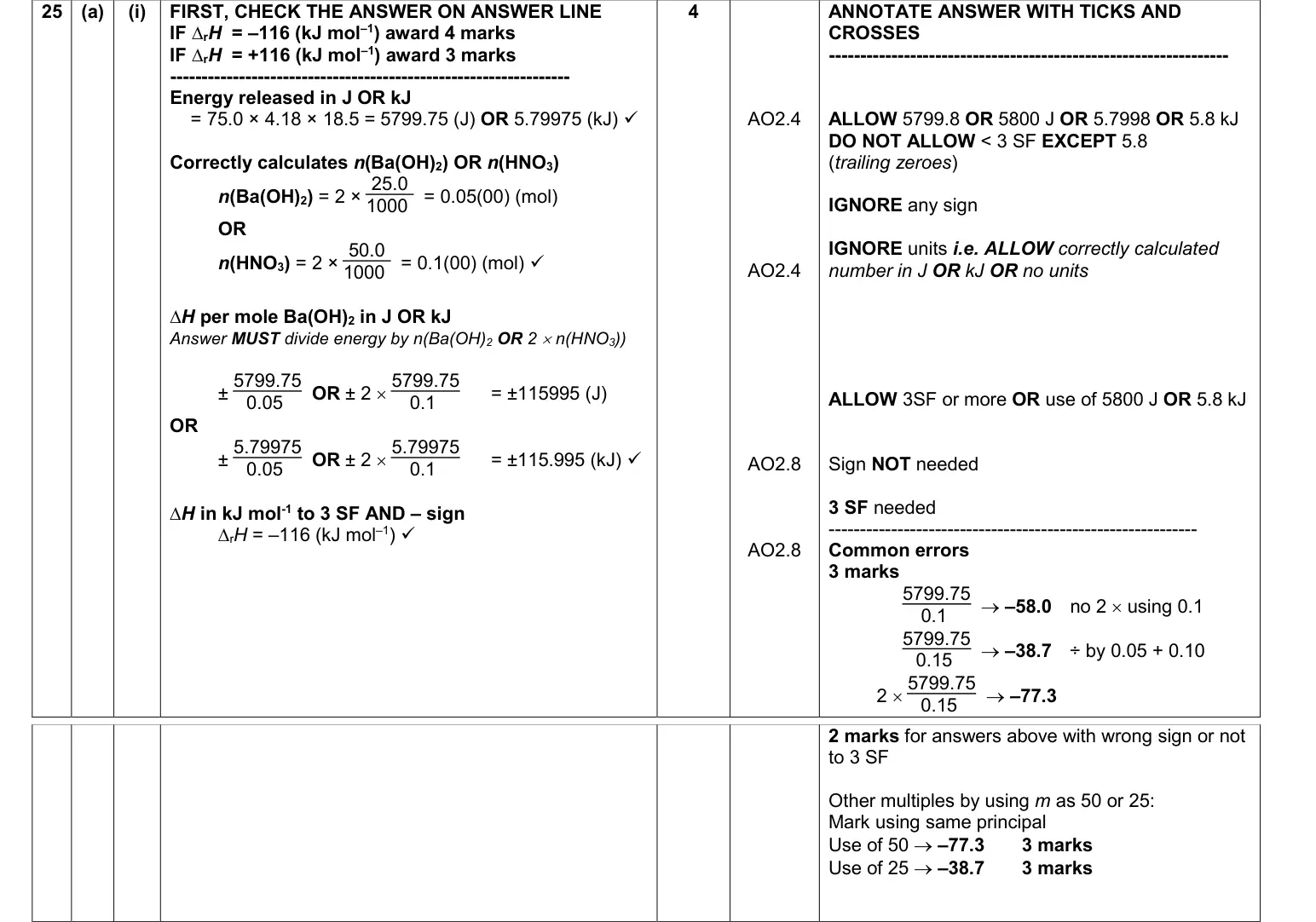
June 2022 · AS Paper 1 · Q25(a)(i)4 marksAO2CalculationMedium
Mark scheme
Examiner's comment
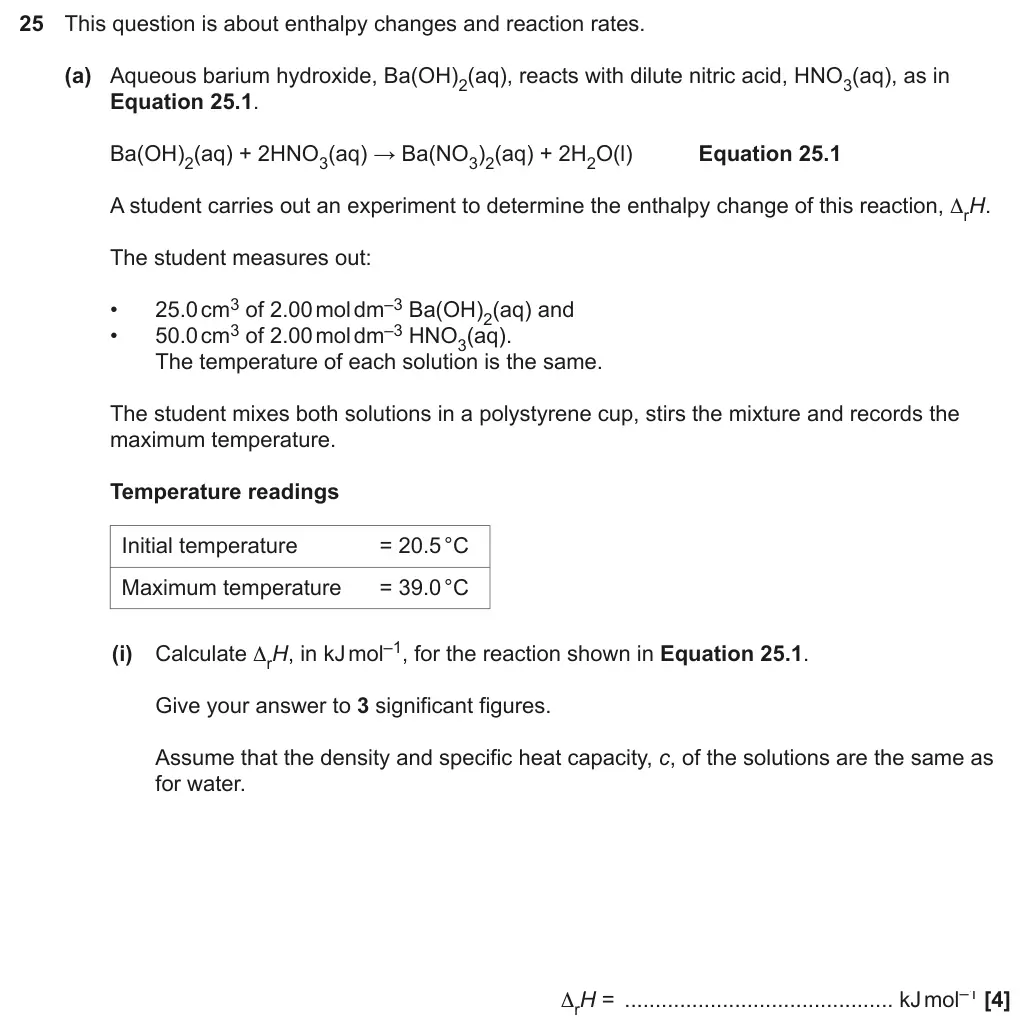
More successful candidates followed a well-rehearsed method for processing experimental enthalpy results to arrive at an enthalpy change. The result was usually the correct answer of –116 kJ mol–1. Most candidates combined the 2 volumes (25 cm3 and 50 cm3) to give 75 cm3 with m = 75 g and then calculated the correct energy change of 5799.75 J using mc∆T. Some candidates did not combine the volumes and used m = 25 g or 50 g instead. Most candidates worked out the amount in moles of Ba(OH)2 and HNO3. Unfortunately, these calculations were often scattered across the page with no indication of what the calculated values applied to. Some candidates incorrectly combined the moles (0.10 and 0.05) and divided this value (usually 0.15) into the energy change. The mark scheme accounted for these errors and allowed error carried forward marks to be allocated appropriately. Candidates are strongly advised to organise their calculation in a coherent way and to show what each calculated value applies to so that error carried forward can be applied for mistakes. misunderstanding the meaning of m in the equation q = mc∆T, used for finding the energy change q from experimental results. The information states that the density of the solutions is the same as for water, 1.00 g cm–3. Therefore, the mass m that changes temperature ∆T is 75.0 g and the energy change is 75.0 4.18 18.5 J. This candidate has correctly calculated the moles of one of the reactants, Ba(OH)2, as 0.0500 but has then calculated its mass as 75.0 4.18 18.5 J = 8.565 g and has used this in mc∆T. So the key message is that m in mc∆T is where the thermometer has been placed.
Notes from the mark scheme and report
mass is 75.0 g (both solutions)
divide by n(Ba(OH)2) = 0.0500 not n(HNO3)
common errors –58.0, –38.7, –77.3 (3 marks)
+ sign loses 1 mark
3 sig figs needed
In the equation q = mc∆T, mass m is the mass of the substance that changes temperature by ∆T. This substance has a specific heat capacity, c. Looking at the experimental results, the substance changing temperature is the mixture of the two solutions, which have volumes of 25 cm3 and 50 cm3. This is where the thermometer has been placed.
Skills: M0.0 Recognise and make use of appropriate units in calculations; M1.1 Use an appropriate number of significant figures; M2.3 Substitute numerical values into algebraic equations using appropriate units for physical quantities; PAG3 Enthalpy determination
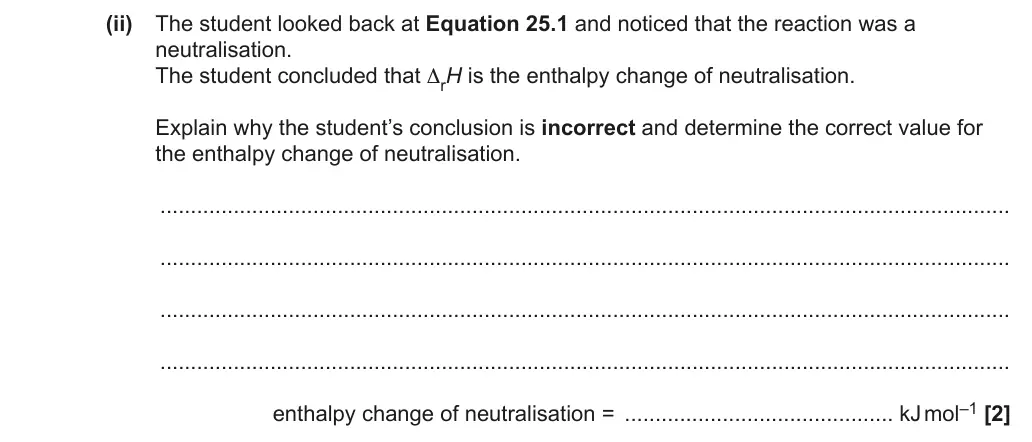
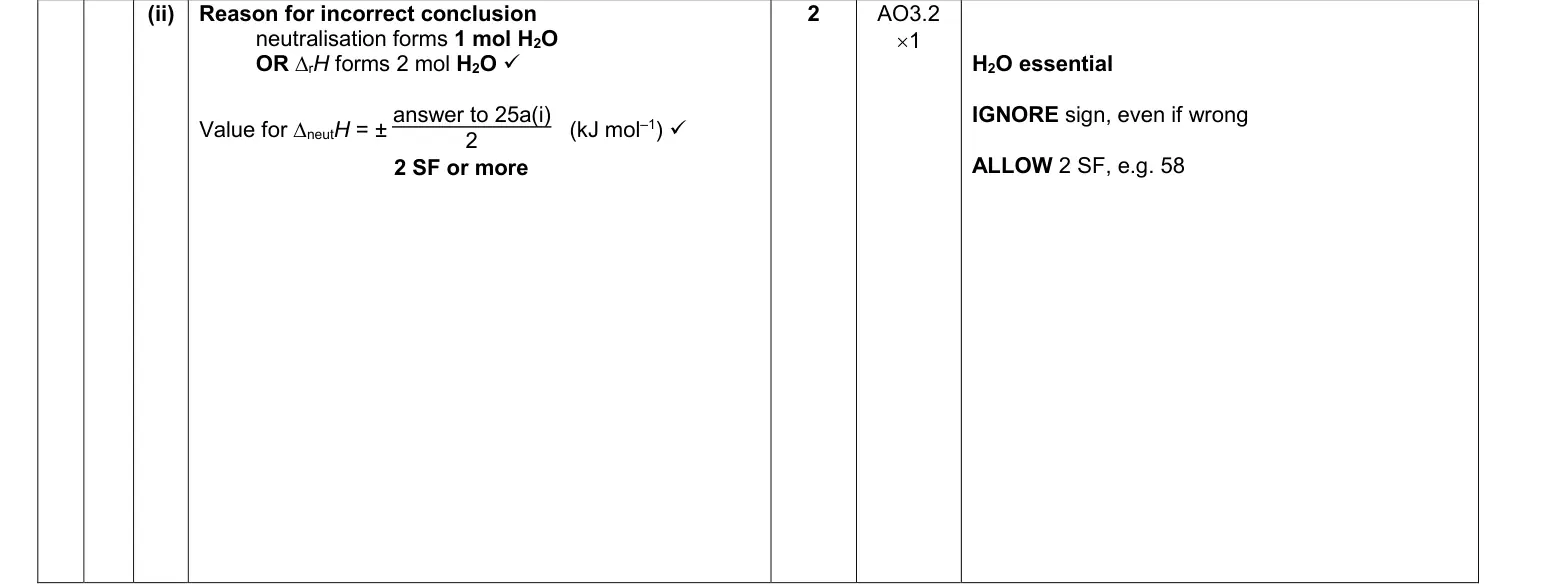
June 2022 · AS Paper 1 · Q25(a)(ii)2 marksAO3CalculationHard
Earlier part of question 25 that this part uses
Mark scheme
Examiner's comment
Many candidates correctly identified that neutralisation is the formation of 1 mole of water, whereas this equation forms 2 moles of water. Significantly fewer were then able to use their answer to the calculation in Question 25 (a) (i) to determine a value for the neutralisation enthalpy as half of that that value. This was a novel question, not used in previous examinations, and many candidates coped with the challenge admirably.
Notes from the mark scheme and report
neutralisation refers to formation of 1 mol H2O (H2O essential) but equation forms 2 mol
value = answer to (a)(i) ÷ 2
IGNORE sign
Skills: M0.2 Use ratios, fractions and percentages
June 2022 · AS Paper 2 · Q3(b)(ii)3 marksAO1, 2Short answerMedium
Earlier part of question 3 that this part uses
Mark scheme
Examiner's comment
Less than half of all candidates managed to gain all 3 marks giving the correct enthalpy profile diagram. Many demonstrated a lack of understanding about what an enthalpy profile diagram shows as seen by labelling of curves for Ea/Ec rather than the enthalpy change or arrows for ∆H extending to the x-axis. Other errors also seen included, -ΔH, double headed ΔH arrow, activation energy lines starting at products, endothermic profiles, Ea and Ec the wrong way round and missing or incorrect labels. Some candidates found it tricky to give activation lines for both catalysed and uncatalysed reactions on the same diagram, these often overlapped or did not extend to the top of the energy barrier.
Notes from the mark scheme and report
products below reactants with ∆H arrow downwards (DO NOT ALLOW –∆H or double-headed arrow)
Ea and Ec arrows from reactant level to top of curve, Ec < Ea
ECF for Ea/Ec on endothermic diagram
Skills: M3.1 Translate information between graphical, numerical and algebraic forms
June 2022 · AS Paper 2 · Q4(b)3 marksAO2CalculationMedium
Mark scheme
Examiner's comment
Despite the structures being drawn out with displayed formula, a significant number of candidates did not correctly count all the bonds. Common errors included missing C-C from ethanol or O-H bonds in water. Most candidates set out their working clearly, so it was easy to identify any errors in calculation steps and award ECF appropriately. Some also had the calculation the wrong way round (made – broken) missing the essential idea that energy is needed to break bonds and released to make bonds, as well as link to endothermic changes being positive and exothermic changes being negative.
Notes from the mark scheme and report
common errors for 2 marks: –198 (cycle reversed), –149 (missed C–C), –2586 (missed 6 O–H from 3H2O)
DO NOT ALLOW – sign on final answer
It is important to evaluate candidates understanding of enthalpy changes and build on prior knowledge from KS4. We have produced a transition guide for KS4 to KS5 on enthalpy: https://www.ocr.org.uk/Images/361305-enthalpy-changes-ks4-ks5.pdf. This includes a checkpoint task which is very useful for checking understanding of this topic, including the difference between endothermic and exothermic reaction, drawing profile diagrams, and calculating enthalpy changes from bond enthalpies.
Skills: M0.2 Use ratios, fractions and percentages; M2.3 Substitute numerical values into algebraic equations using appropriate units for physical quantities
June 2022 · Paper 3 · Q5(a)6 marksAO36-mark level of responseHard
Mark scheme, with the levels and indicative points
Examiner's comment
This question was assessed by level of response (LoR). Candidates were required to process raw experimental results to determine one enthalpy change, and then to determine a second enthalpy change by using an energy cycle. Levels were determined by the accuracy of the candidates’ processing of the results, calculations and use of the energy cycle. Marks within a level were determined by communication. This question discriminated extremely well. Level 3 candidates used the mass of solution as 106.6 g with mc∆T to obtain an energy change of 8.24 kJ. They then divided this value by the moles of CaCl2 that reacted (0.0835 mol) to obtain the enthalpy change of –98.7 kJ mol–1. Finally, they constructed an energy cycle which they then used to obtain the second enthalpy change of –1566 kJ mol–1. Level 2 candidates determined the first enthalpy change but may have used the approximate mass of 100 g for the mass of solution from the experimental method. Their energy cycle was often incorrect or absent, with the second enthalpy change calculated incorrectly. Level 1 candidates often calculated the initial energy change using mc∆T but made little further correct progress. Less successful responses used the solid mass of calcium chloride (9.28 g) instead of the mass of the solution in their mc∆T calculation. Overall, mathematical skills were displayed well but some basic errors were made, particularly with subtractions. This may have been the result of mis-keying values into a calculator and believing the answer displayed. calcium chloride and the first enthalpy change using a correct method. This response has not been given marks for the communication strand of Level 3 because there is nothing to indicate what the numbers refer to. The response could be summarised as a mass of numbers scrawled across the page. Unfortunately, this is the pattern of many responses. So, this response was given 3/6 marks.
Notes from the mark scheme and report
q = 106.6 × 4.18 × 18.5 = 8.24 kJ (mass of final solution)
n(CaCl2) = 9.28/111.1 = 0.0835
∆solH = –98.7
∆hydH(Ca2+) = –2223 + (–98.7) – 2(–378) = –1566
2 × hydration of Cl–
one small error allowed e.g. using 97.32 g or 115.88 g for m
Skills: M0.0 Recognise and make use of appropriate units in calculations; M2.3 Substitute numerical values into algebraic equations using appropriate units for physical quantities; M2.4 Solve algebraic equations; PAG3 Enthalpy determination
June 2022 · Paper 3 · Q5(b)(ii)3 marksAO2CalculationEasy
Earlier part of question 5 that this part uses
Mark scheme
Examiner's comment
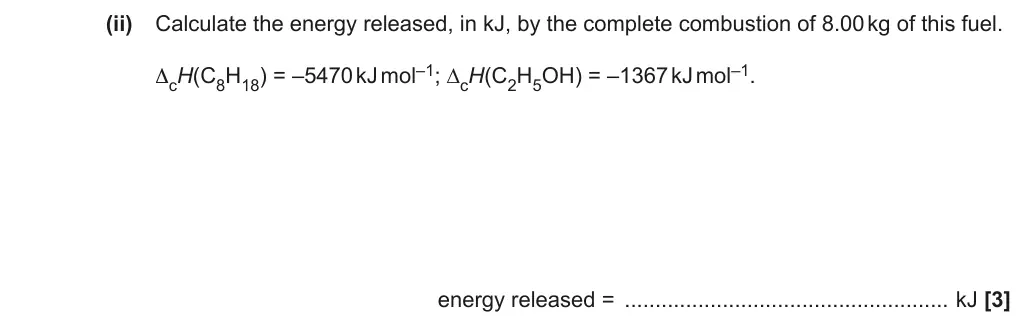
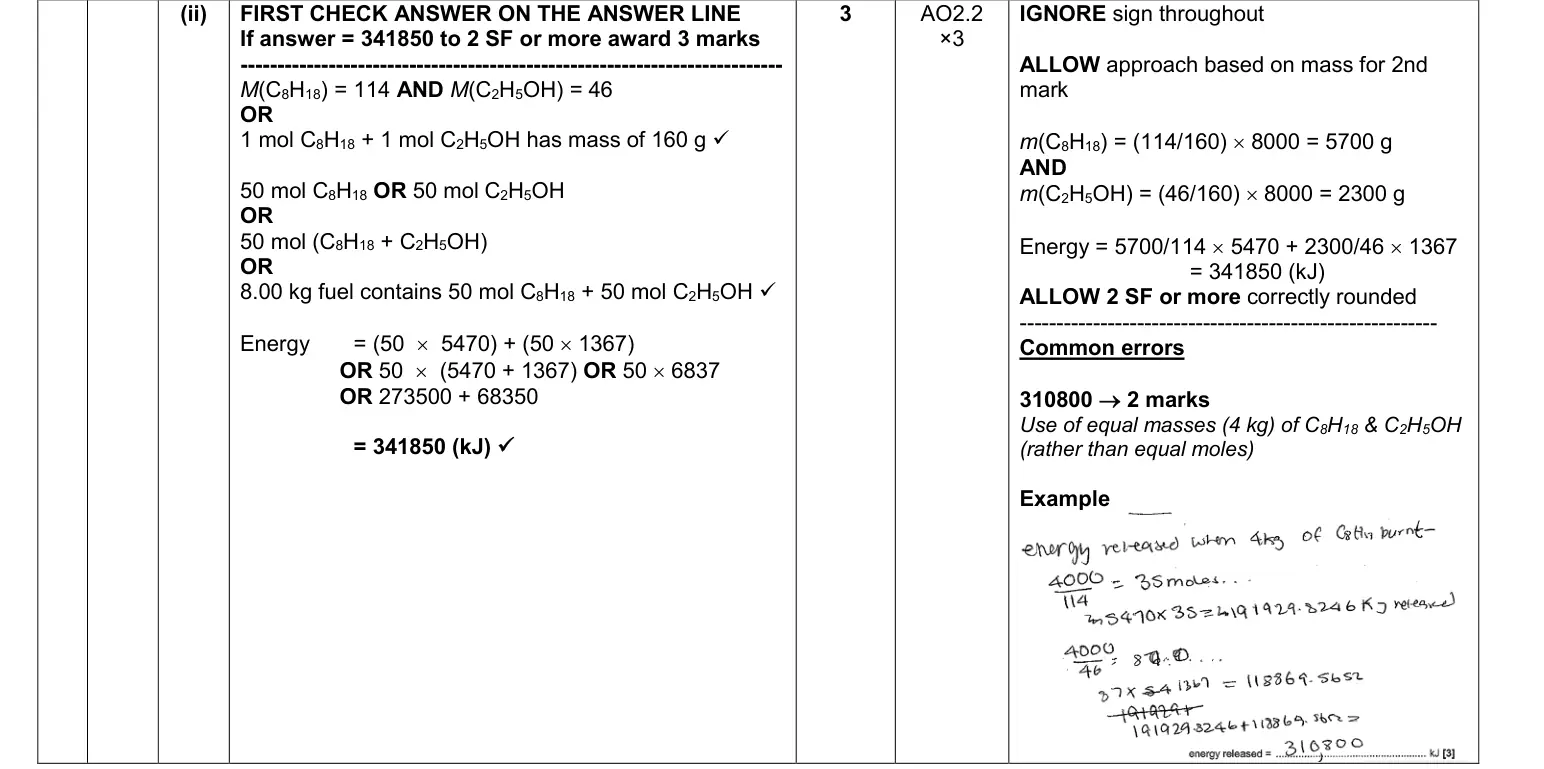
This question took the novel context introduced in 5b a stage further by considering the energy released during the combustion of this fuel. Most candidates were able to obtain some credit, and many obtained the correct energy of 341,850 kJ. The commonest error was for candidates to assume that the 8 kg mixture would contain 4 kg of octane and 4 kg of ethanol, rather than an equal moles of each. Such an approach could still be partly given marks by ECF, provided that the method was sound and clear.
Notes from the mark scheme and report
160 g per mole pair so 50 mol of each
341 850 kJ
common error 310 800 (equal masses 4 kg each rather than equal moles) scores 2
IGNORE sign
Skills: M0.0 Recognise and make use of appropriate units in calculations; M0.2 Use ratios, fractions and percentages; M2.3 Substitute numerical values into algebraic equations using appropriate units for physical quantities
November 2021 · Paper 1 · Q81 markMultiple choice
Answer
B
Mark scheme
November 2021 · AS Paper 1 · Q101 markAO2Multiple choice
Answer
A
Mark scheme
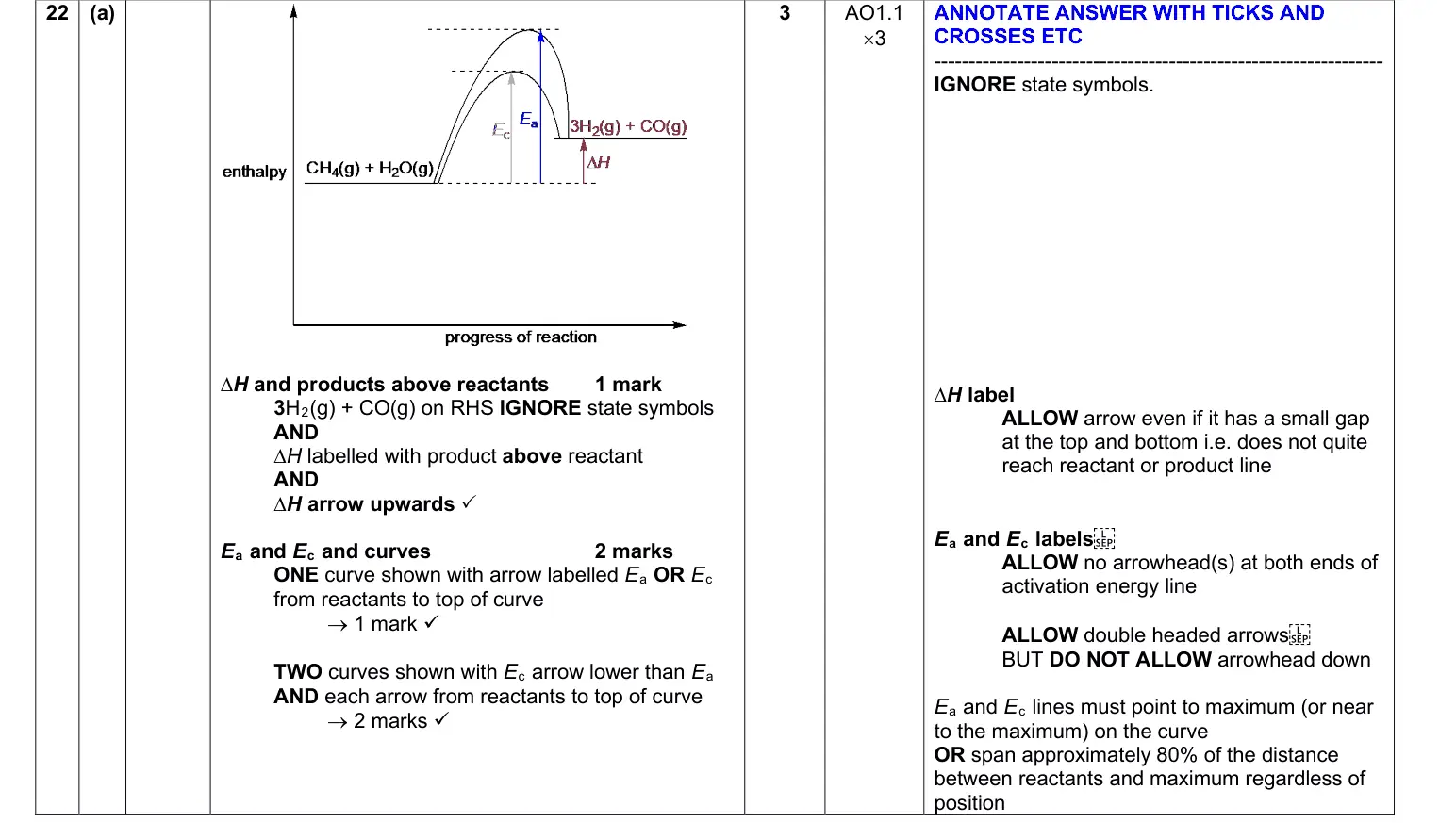
November 2021 · AS Paper 1 · Q22(a)3 marksAO1Complete table/diagram
Mark scheme
Notes from the mark scheme and report
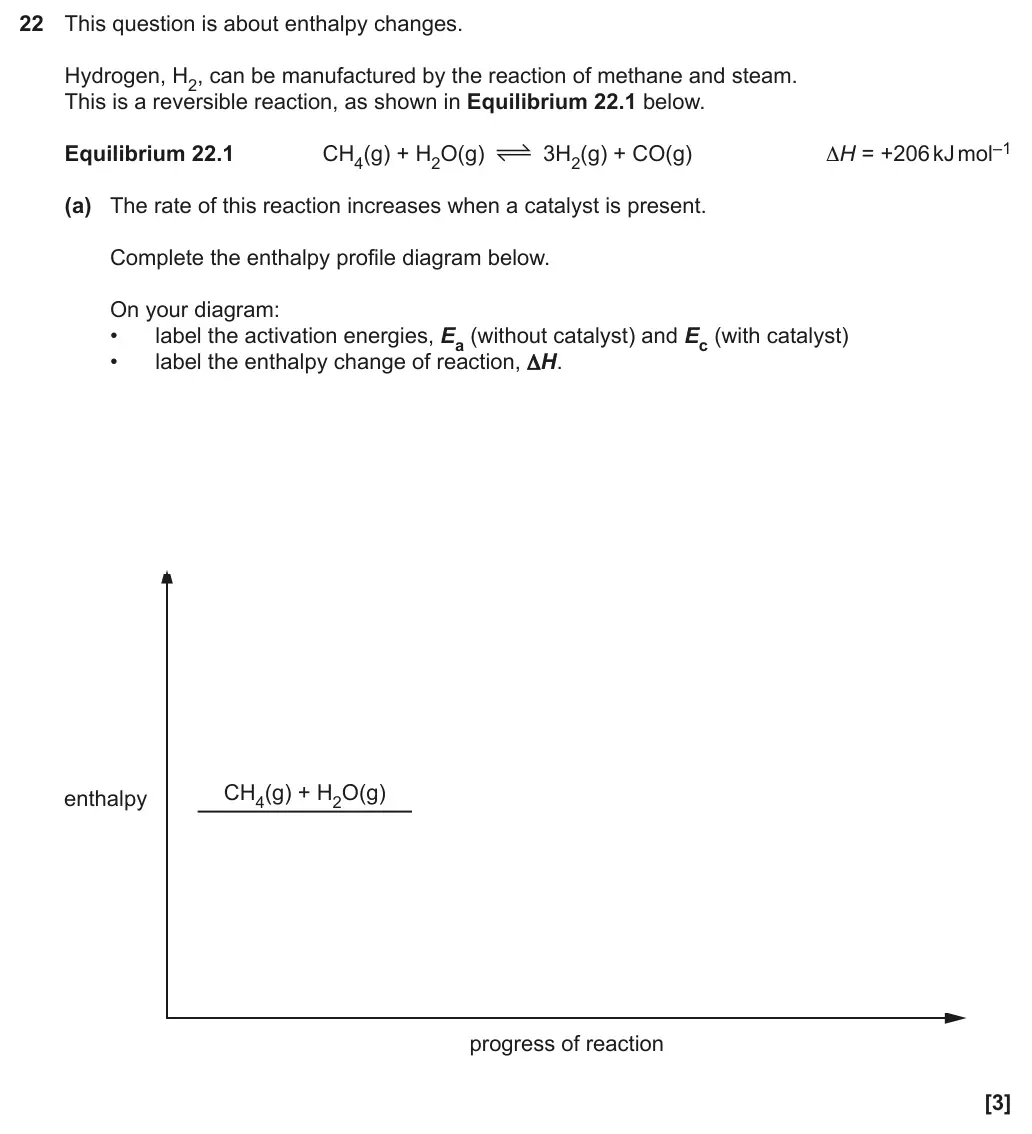
products above reactants with ∆H arrow upwards
Ec arrow lower than Ea, both from reactants to top of curve
DO NOT ALLOW arrowhead down on Ea/Ec
IGNORE state symbols
Skills: M3.1 Translate information between graphical, numerical and algebraic forms
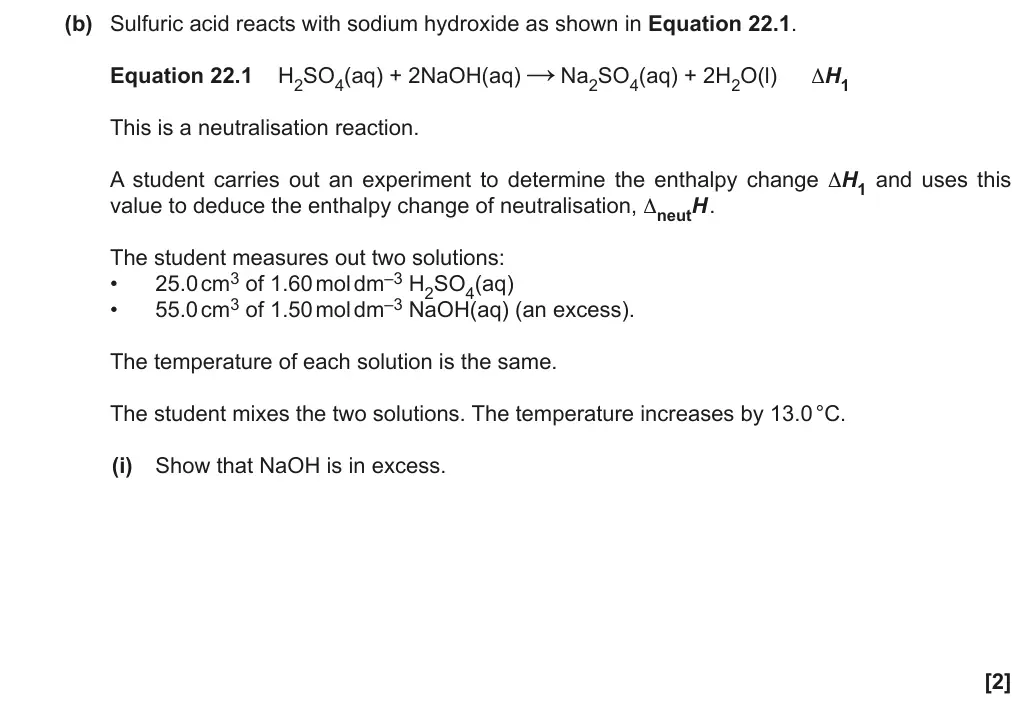
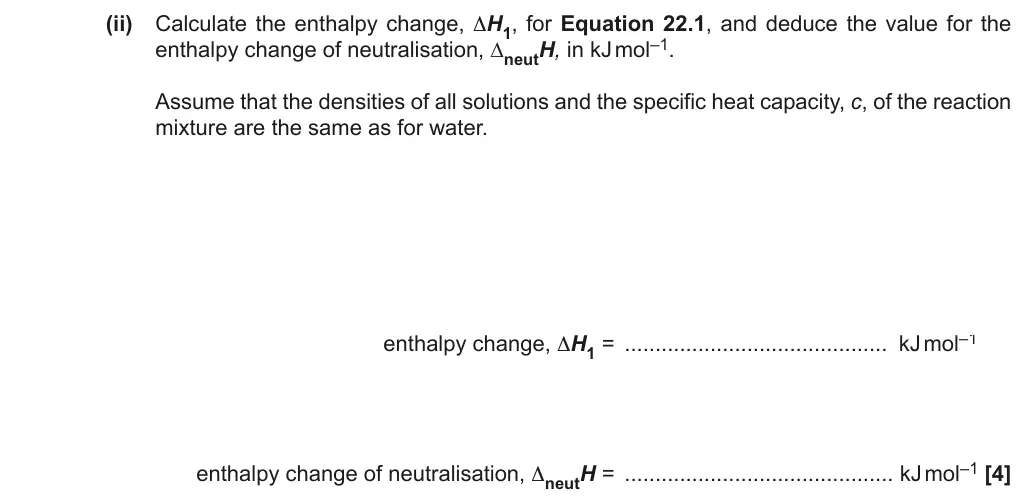
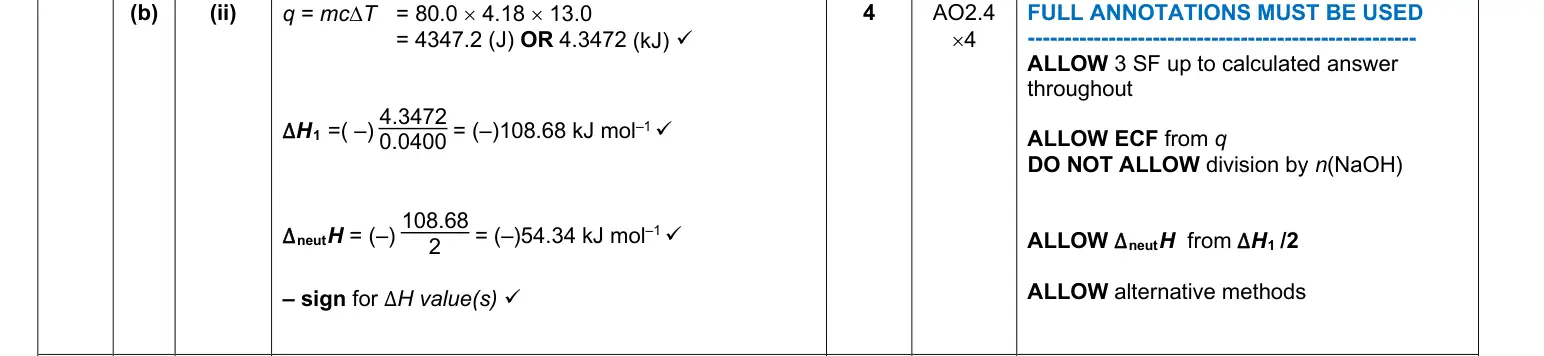
November 2021 · Paper 1 · Q22(b)(ii)4 marksAO2CalculationMedium
Earlier part of question 22 that this part uses
Mark scheme
Examiner's comment
Question 22(b)(ii): This question asked the candidates to calculate the enthalpy change and then to deduce the value for the enthalpy change of neutralisation.
Notes from the mark scheme and report
mass = 80.0 g (total volume)
divide by n(H2SO4) (DO NOT ALLOW n(NaOH))
∆neutH = ∆H1/2
– sign required
Skills: M0.0 Recognise and make use of appropriate units in calculations; M0.2 Use ratios, fractions and percentages; M2.3 Substitute numerical values into algebraic equations using appropriate units for physical quantities; PAG3 Enthalpy determination
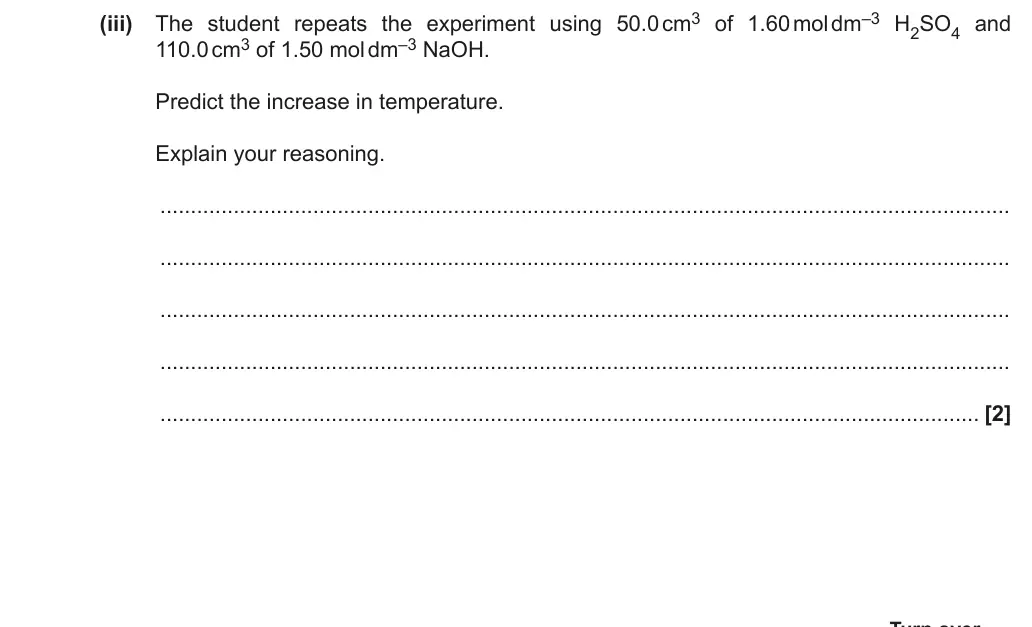
November 2021 · Paper 1 · Q22(b)(iii)2 marksAO3Short answer
Earlier parts of question 22 that this part uses
Mark scheme
Notes from the mark scheme and report
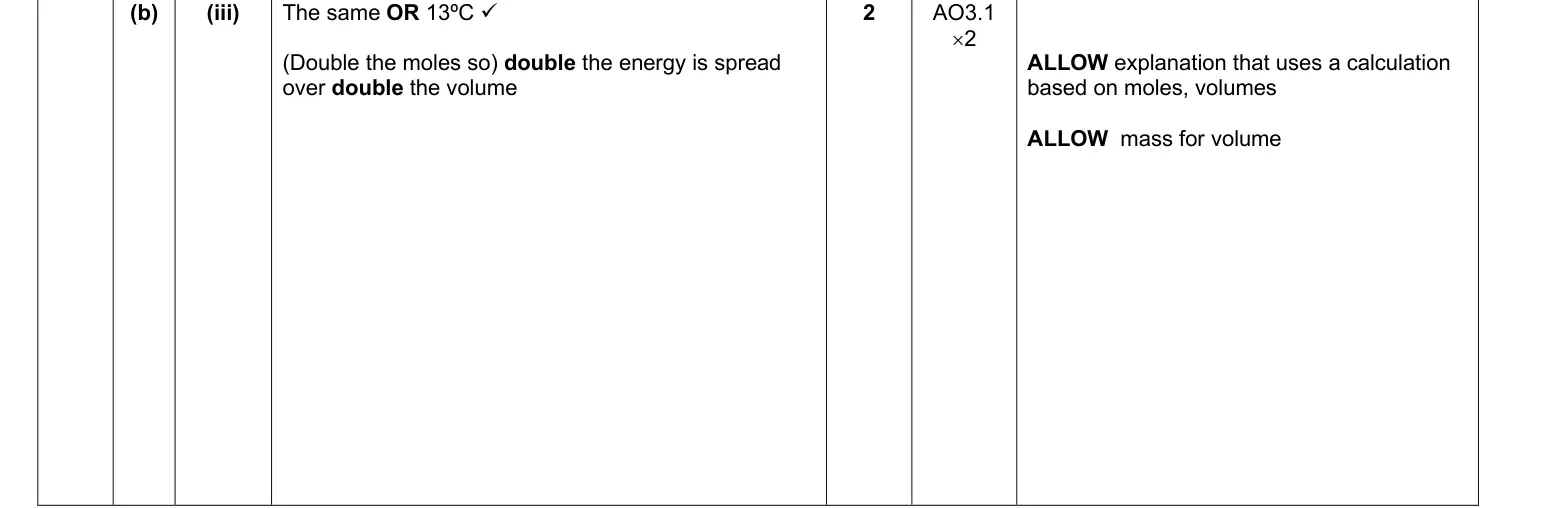
same temperature rise (13 °C): double the energy spread over double the volume
Skills: M0.2 Use ratios, fractions and percentages; PAG3 Enthalpy determination
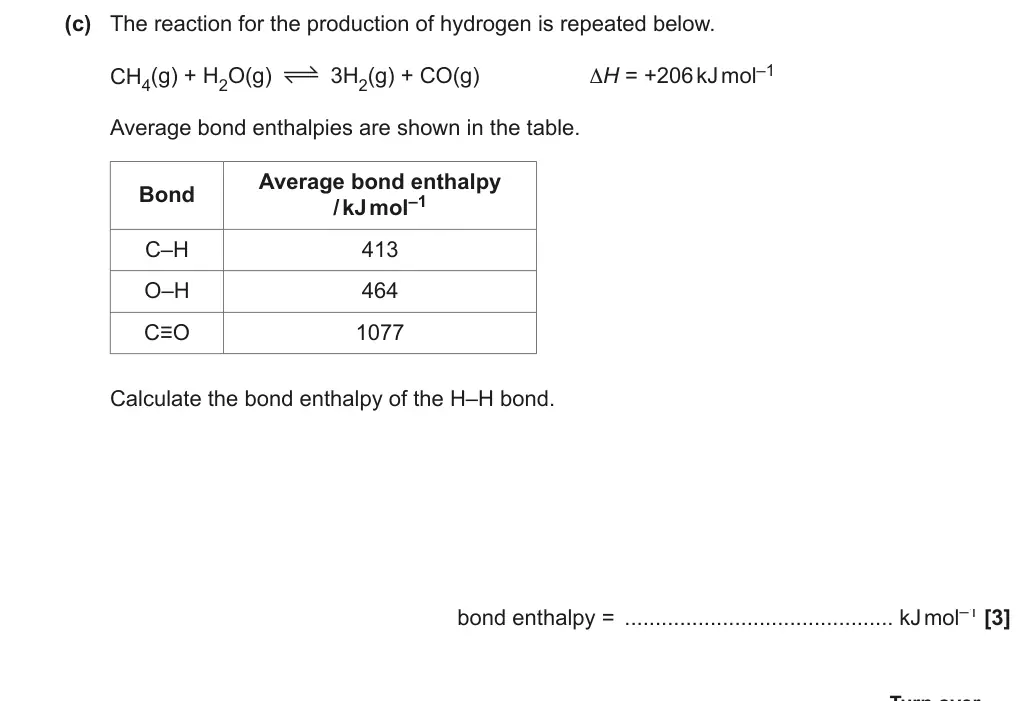
November 2021 · AS Paper 1 · Q22(c)3 marksAO2Calculation
Earlier part of question 22 that this part uses
Mark scheme
Notes from the mark scheme and report
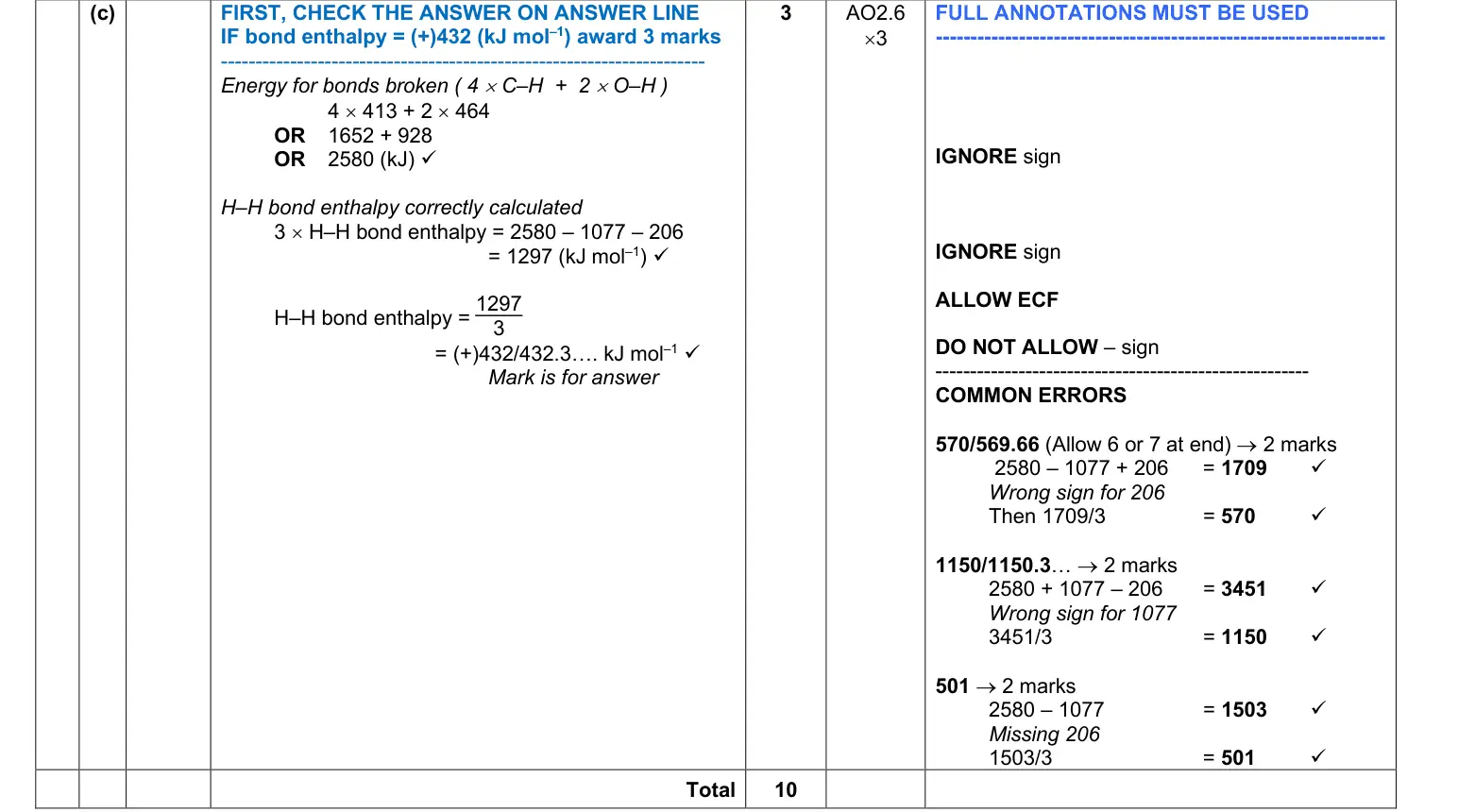
common errors (2 marks): wrong sign for 206 (570), wrong sign for 1077 (1150), missing 206 (501)
DO NOT ALLOW – sign on answer
ALLOW ECF
Skills: M2.2 Change the subject of an equation; M2.3 Substitute numerical values into algebraic equations using appropriate units for physical quantities; M2.4 Solve algebraic equations
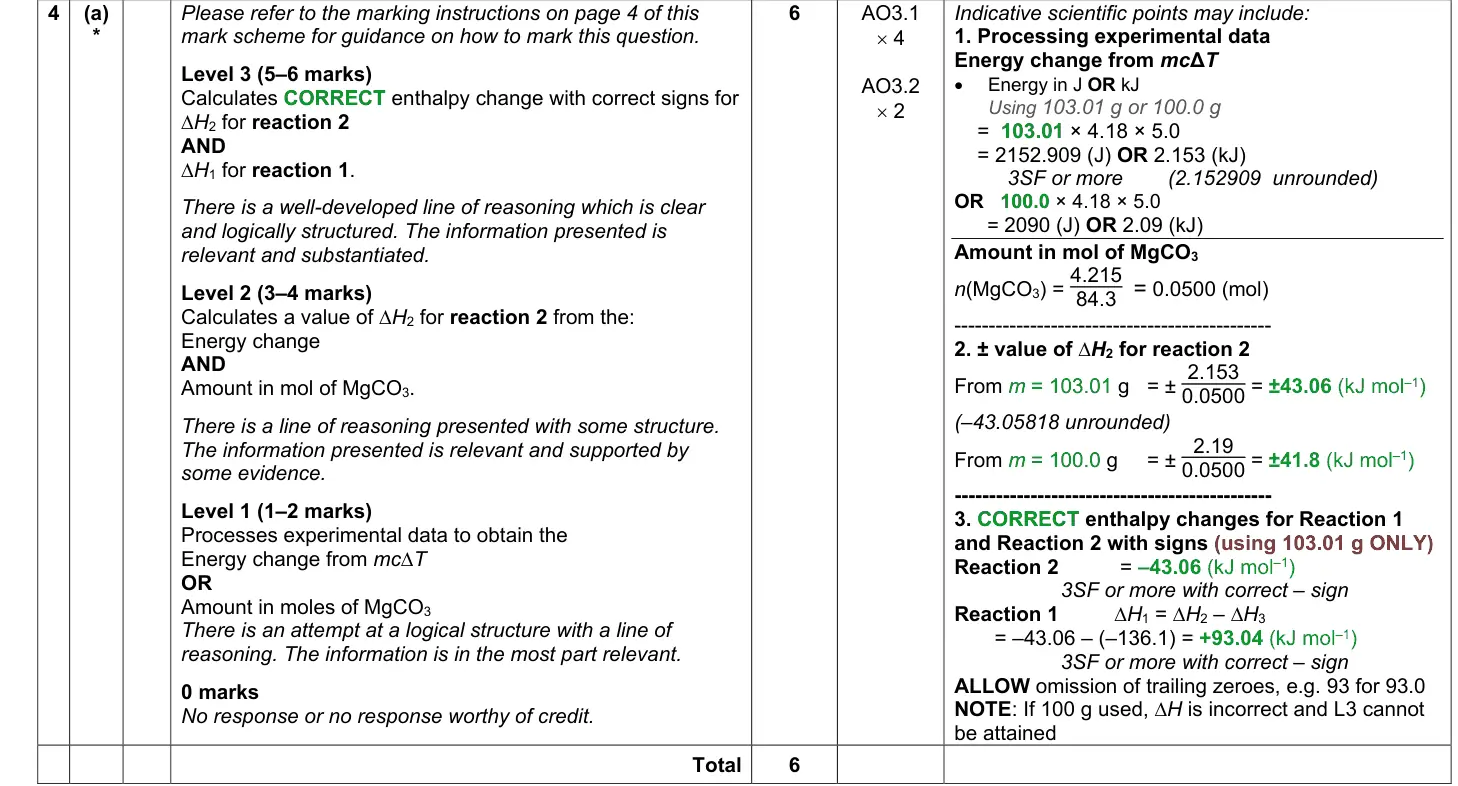
November 2021 · AS Paper 2 · Q4(a)6 marksAO36-mark level of response
Mark scheme, with the levels and indicative points
Notes from the mark scheme and report
mass of solution 103.01 g from weighings (using 100 g cannot reach Level 3)
q = mc∆T = 2153 J
n(MgCO3) = 0.0500
∆H2 = –43.06 with sign
∆H1 = ∆H2 – ∆H3 = +93.04 kJ mol–1
Skills: M0.0 Recognise and make use of appropriate units in calculations; M1.1 Use an appropriate number of significant figures; M2.3 Substitute numerical values into algebraic equations using appropriate units for physical quantities; M2.4 Solve algebraic equations; PAG3 Enthalpy determination
November 2020 · Paper 1 · Q61 markAO2Multiple choice
Answer
A
Mark scheme
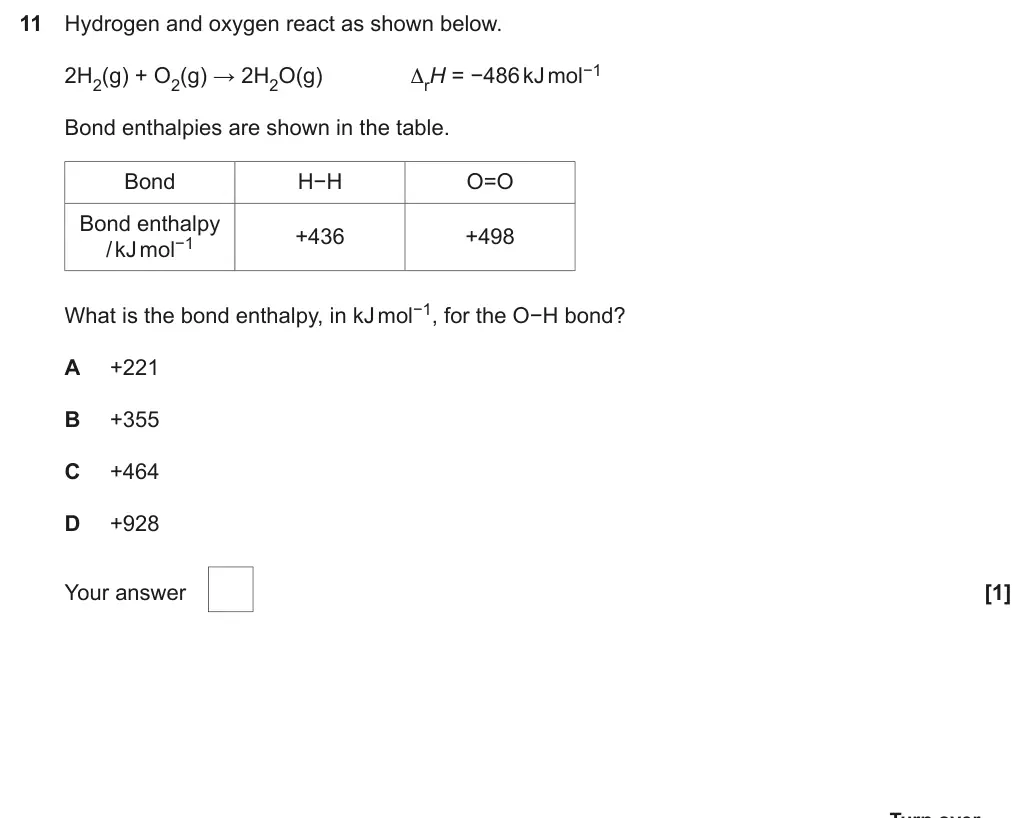
November 2020 · AS Paper 1 · Q111 markAO2Multiple choiceMedium
Answer
C
Mark scheme
Examiner's comment
The best candidates drew out the bonds on each side of the equation to help them select C, +464. The main distractor proved to be D, obtained from counting 2, rather than 4 O–H bonds. This error could have been prevented by drawing out the bonds.
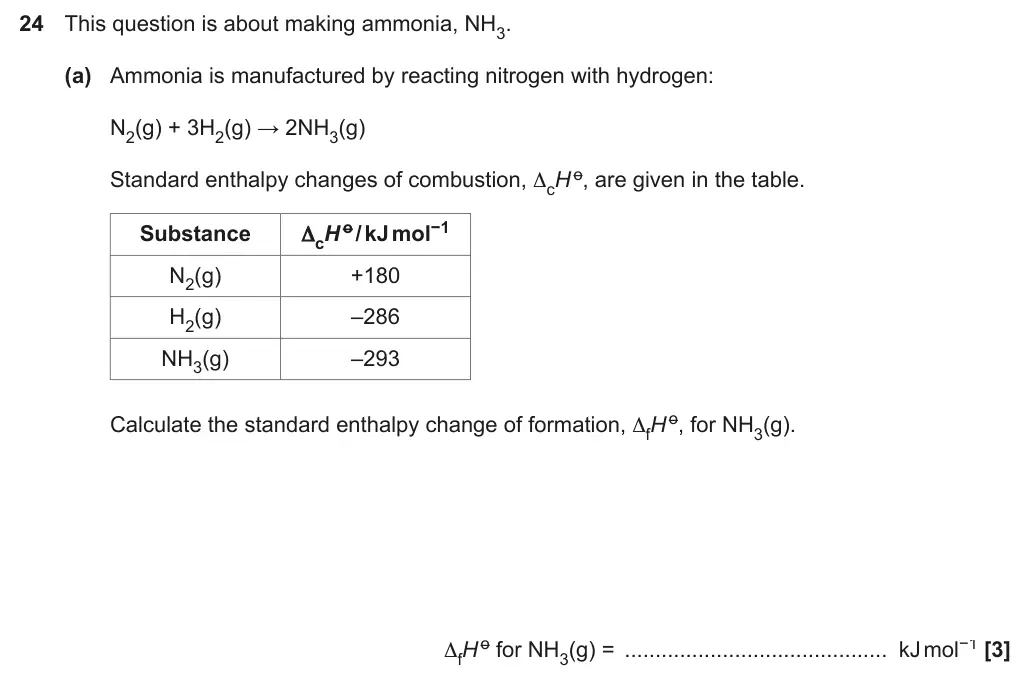
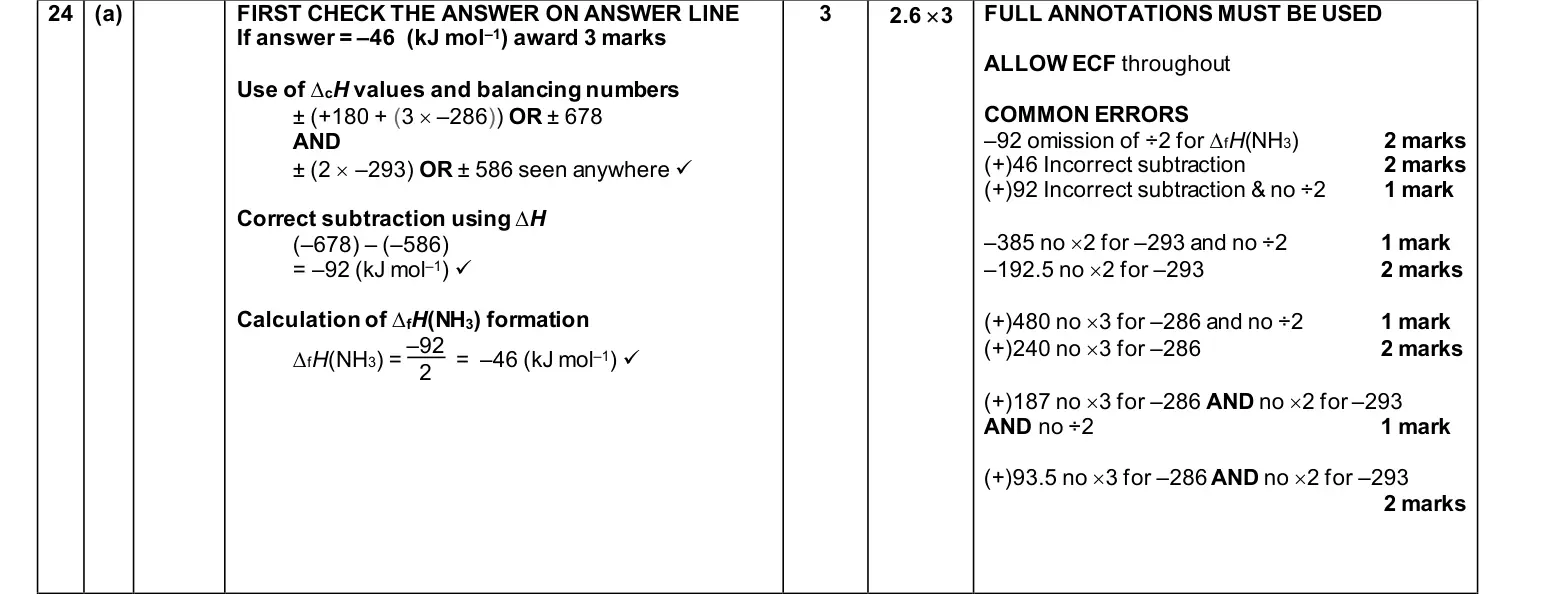
November 2020 · AS Paper 1 · Q24(a)3 marksAO2CalculationMedium
Mark scheme
Examiner's comment
24(a) Most candidates were able to make some progress with the enthalpy calculation. Most recognised that the provided ∆cH values had to be multiplied by the balancing numbers in the equation. Most candidates processed the data on either side of the equation correctly and subtracted the combined enthalpy change from one side of the equation from the other, although the subtraction was sometimes the wrong way round. This resulted in answers of +92, or –92 kJ mol–1, with the exothermic value being correct. An enthalpy change of –92 kJ mol–1 was the commonest final answer, with comparatively few candidates recognising that the enthalpy change of formation of NH3 is for the formation of 1 mol of NH3 and not 2 mol as in the equation. 24(b) This question was well-answered showing that most candidates were well-acquainted with the Boltzmann distribution. Some candidates used one diagram to show the effect of increasing the temperature and of using a catalyst. Other candidates showed two curves, one for temperature, the other for the presence of a catalyst. Either approach could produce a clear response. Most candidates knew that the activation energy was lower with a catalyst that without. A significant number of candidates limited their explanations to ‘successful collisions’ without referring to more molecules exceeding the lower activation energy in the presence of catalyst or at a higher temperature. The best responses secured all five marks from a well-drawn and annotated graph supported by a brief explanation. Candidate should make full use of annotated diagrams to communicate their answers.
Notes from the mark scheme and report
common errors: –92 (no ÷2) scores 2
+46 (wrong subtraction) scores 2
+92 scores 1
no ×3 for H2 or no ×2 for NH3 lose a mark each
Skills: M0.2 Use ratios, fractions and percentages; M2.3 Substitute numerical values into algebraic equations using appropriate units for physical quantities; M2.4 Solve algebraic equations
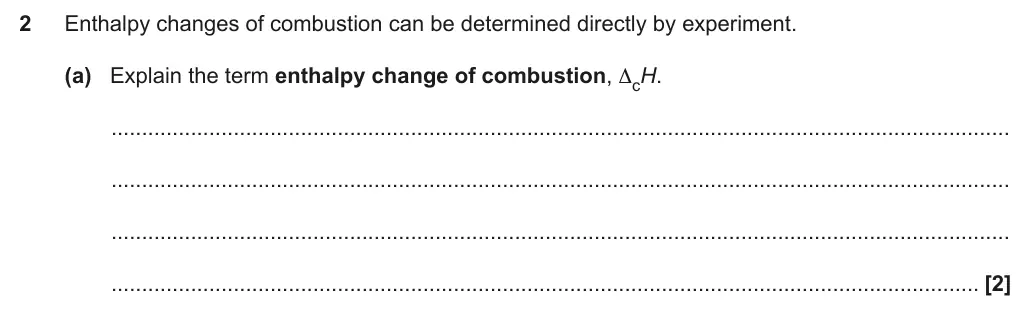
November 2020 · AS Paper 2 · Q2(a)2 marksAO1Short answerMedium
Mark scheme
Examiner's comment
2 (a) Most candidates managed to gain at least one mark for this question having learnt the definition. Some lost a mark for stating one mole of substance gives one mole of product, clearly confusing their definitions. 2(b) Nearly all candidates managed to gain at least one mark for correctly calculating the moles of cyclohexane burnt and the majority also used q = mc∆T. However, very few candidates managed to gain all 4 marks, most frequently losing the final mark for SF and sign. Other common errors included using the mass of cyclohexane in calculation of q, using Gas Constant R rather than specific heat capacity of water, or not using ∆T but using 293 K instead. 2(c)(i) A significant number of candidates struggled to correctly calculate the % uncertainties for the apparatus given or did not back up their claims with any calculations. Even the highest-attaining candidates often did not account for two measurements for temperature, or tried to calculate the % uncertainty for each temperature measurement taken. 2(c)(ii) Most candidates gained at least one mark here from one of the three acceptable responses. There was some evidence of candidates being confused here by the use of average bond enthalpies to find values of enthalpy of combustion. Others discussed human errors, need for repeat measurements or precision of equipment, demonstrating a lack of understanding with regard to the language used in scientific measurement. 2(c)(iii) This was a challenging question. Some candidates gained one mark for reduced accuracy due to increased heat loss or water evaporation. The responses given demonstrated that candidates often do not understand the factors that influence the accuracy in scientific experiments. Some indicated that repeating results would improve accuracy. Another common response was that a longer time would allow for complete combustion, failing to understand that degree of combustion is due to the availability of oxygen, not the time taken.
Notes from the mark scheme and report
complete combustion (or in excess oxygen) of 1 mol of substance
IGNORE 'energy required'
DO NOT ALLOW 1 mol of atoms
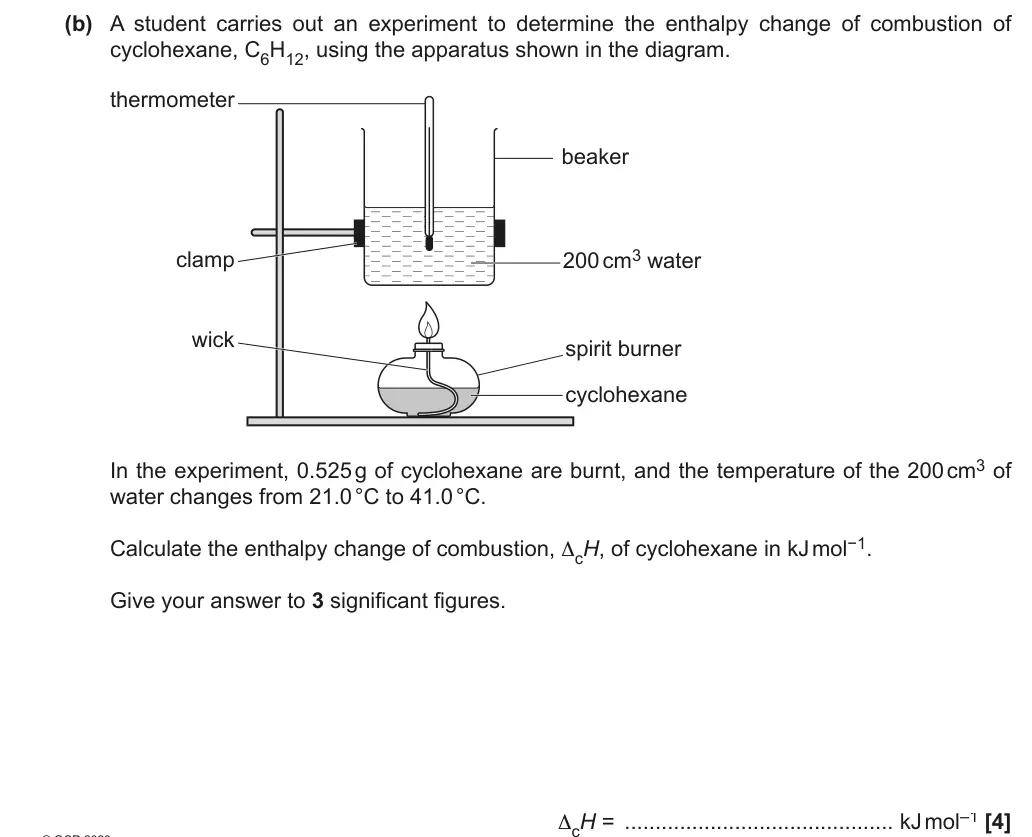
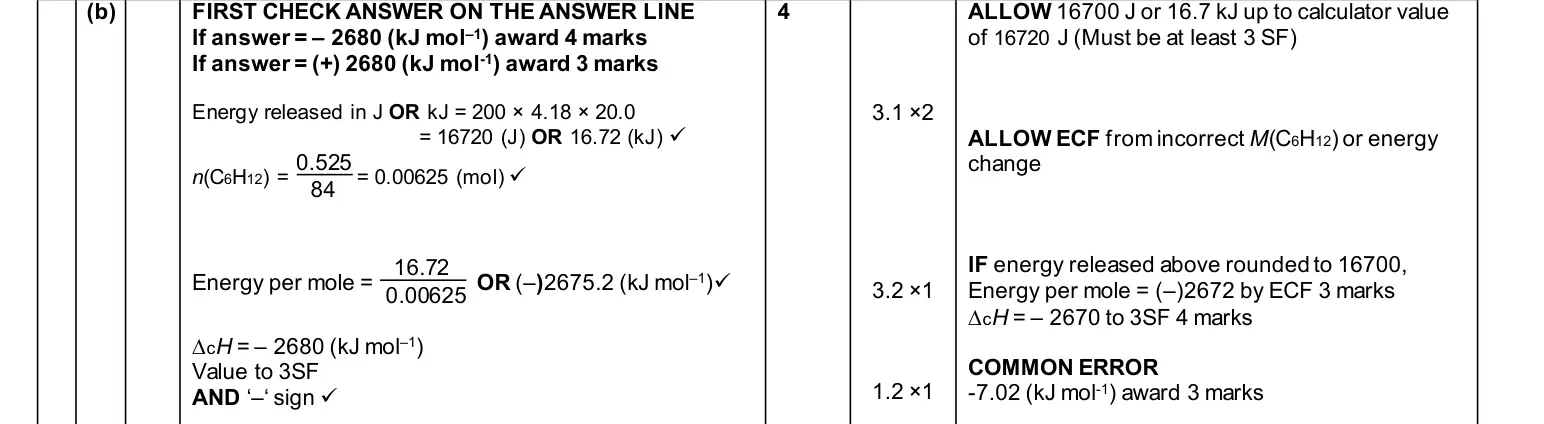
November 2020 · AS Paper 2 · Q2(b)4 marksAO1, 3CalculationMedium
Earlier part of question 2 that this part uses
Mark scheme
Examiner's comment
2 (a) Most candidates managed to gain at least one mark for this question having learnt the definition. Some lost a mark for stating one mole of substance gives one mole of product, clearly confusing their definitions. 2(b) Nearly all candidates managed to gain at least one mark for correctly calculating the moles of cyclohexane burnt and the majority also used q = mc∆T. However, very few candidates managed to gain all 4 marks, most frequently losing the final mark for SF and sign. Other common errors included using the mass of cyclohexane in calculation of q, using Gas Constant R rather than specific heat capacity of water, or not using ∆T but using 293 K instead. 2(c)(i) A significant number of candidates struggled to correctly calculate the % uncertainties for the apparatus given or did not back up their claims with any calculations. Even the highest-attaining candidates often did not account for two measurements for temperature, or tried to calculate the % uncertainty for each temperature measurement taken. 2(c)(ii) Most candidates gained at least one mark here from one of the three acceptable responses. There was some evidence of candidates being confused here by the use of average bond enthalpies to find values of enthalpy of combustion. Others discussed human errors, need for repeat measurements or precision of equipment, demonstrating a lack of understanding with regard to the language used in scientific measurement. 2(c)(iii) This was a challenging question. Some candidates gained one mark for reduced accuracy due to increased heat loss or water evaporation. The responses given demonstrated that candidates often do not understand the factors that influence the accuracy in scientific experiments. Some indicated that repeating results would improve accuracy. Another common response was that a longer time would allow for complete combustion, failing to understand that degree of combustion is due to the availability of oxygen, not the time taken.
Notes from the mark scheme and report
–2680: 3 SF AND negative sign (+2680 scores 3)
mass of water 200 g not mass of fuel in q = mc∆T
common error –7.02 scores 3
ALLOW ECF
Skills: M0.0 Recognise and make use of appropriate units in calculations; M1.1 Use an appropriate number of significant figures; M2.3 Substitute numerical values into algebraic equations using appropriate units for physical quantities; PAG3 Enthalpy determination
November 2020 · AS Paper 2 · Q2(c)(ii)2 marksAO3Short answerMedium
Earlier part of question 2 that this part uses
Mark scheme
Examiner's comment
Question 2(c) demonstrated that some candidates are unsure on what is meant by accuracy and the impact that uncertainties have.
Notes from the mark scheme and report
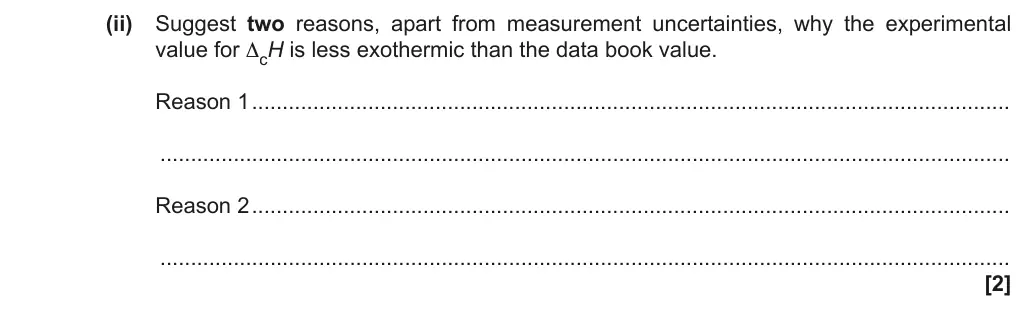
heat loss to surroundings / incomplete combustion / non-standard conditions
IGNORE reference to evaporation
Skills: PAG3 Enthalpy determination
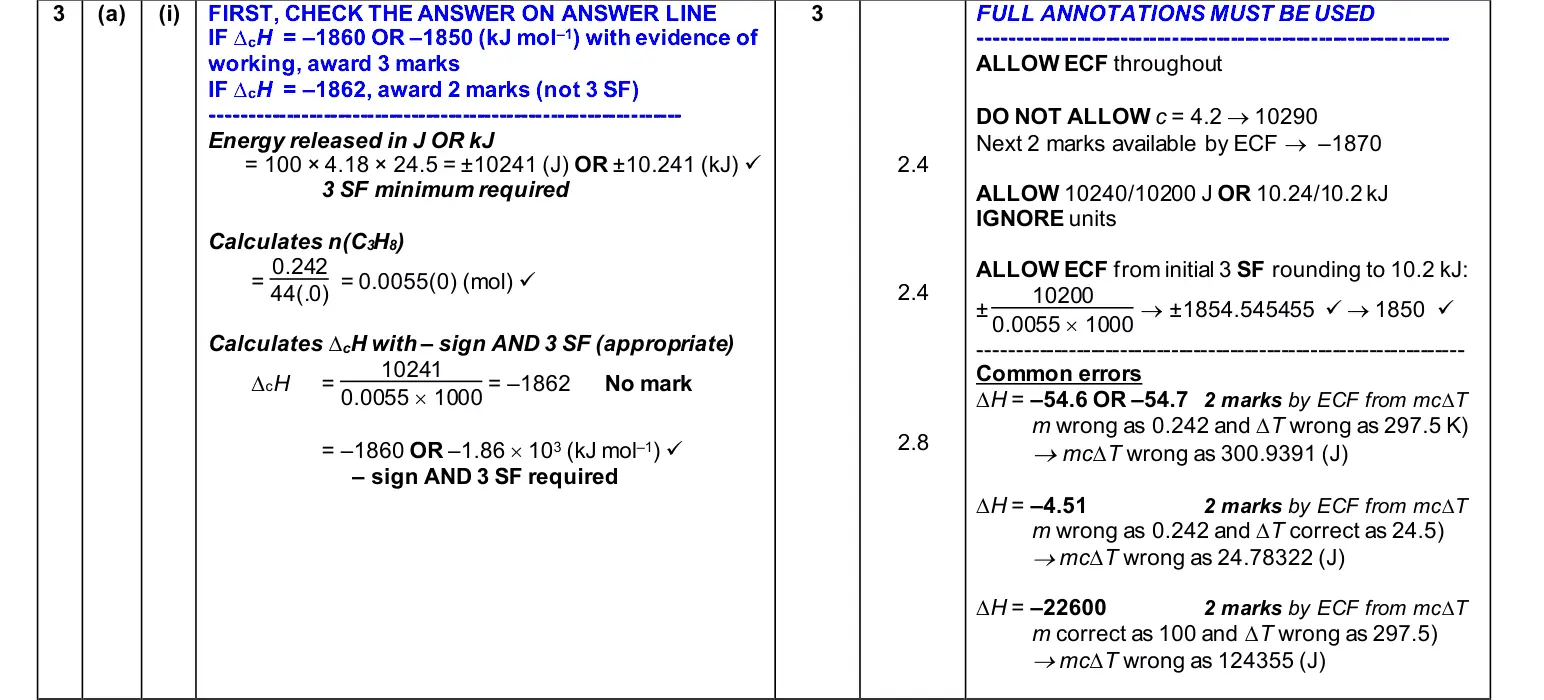
November 2020 · Paper 3 · Q3(a)(i)3 marksAO2CalculationHard
Mark scheme
Examiner's comment
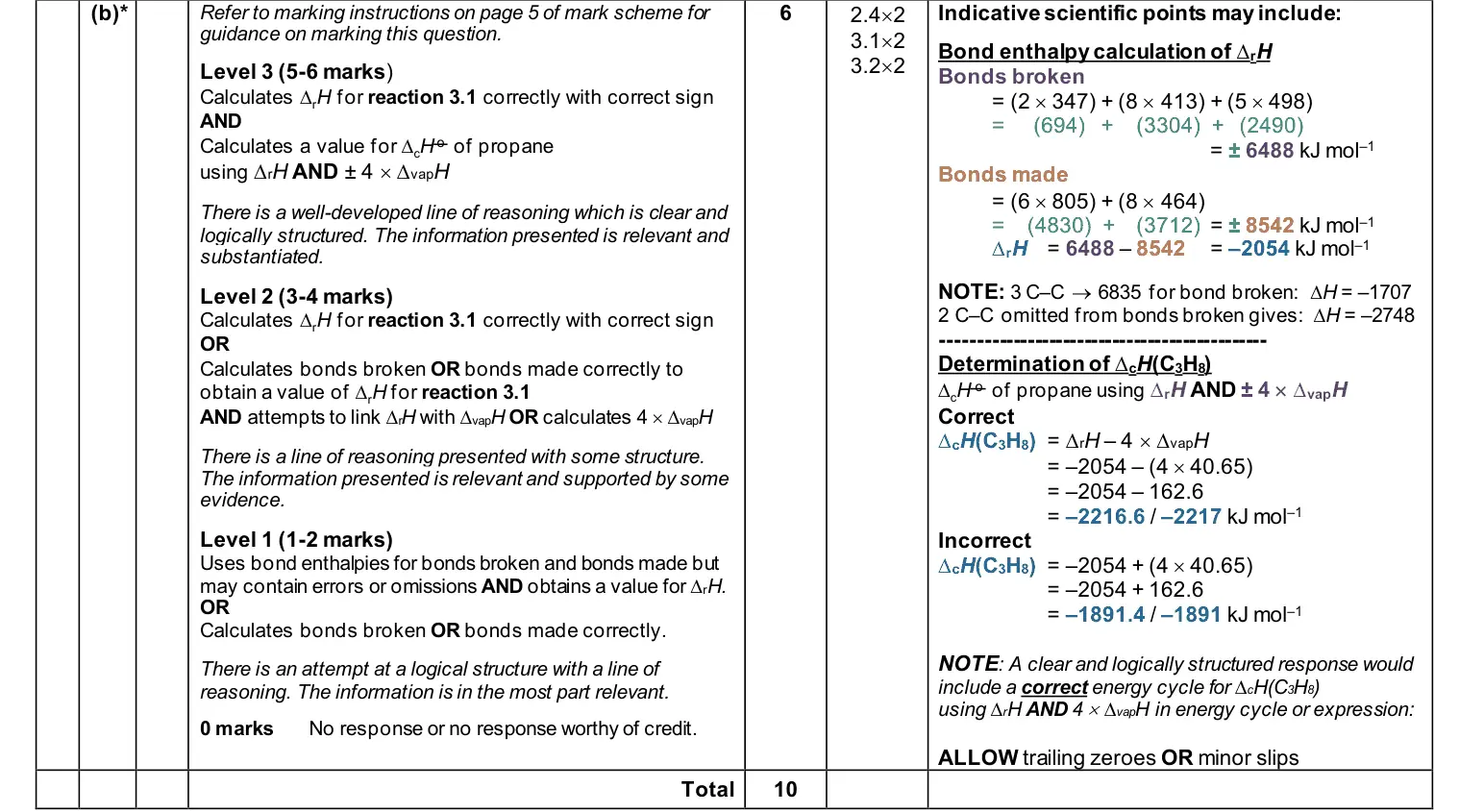
3(a)(i) Most candidates analysed the raw practical results supplied to correctly calculate the energy change as 10,241 J using q = mc∆T, and the amount of propane burnt as 0.0550 mol. Candidates usually determined the energy change per mole of propane as 1862 kJ. The question asked for the enthalpy change of combustion to 3 significant figures, which gives –1860 kJ mol–1. The mark for this final value was often not given because either the – sign was omitted or the answer was not quoted to the required 3 significant figures. Candidates are advised to read the requirements of each question more closely to eliminate such errors. A double-check on significant figure requirements is recommended before moving on to the next question. Lower-attaining candidates often extracted the wrong data from the results table. Instead of the mass of water (100 cm3), the mass of propane burnt (0.242 g) was often used in the q = mc∆T calculation. Candidates are advised that the thermometer measures the temperature change of the material in which it is placed (the water). 3(a)(ii) One mark was available for identifying two reasons for the difference in enthalpy change. It was expected that candidates would respond with ‘heat loss’ and ‘incomplete combustion’. Most candidates suggested heat loss but the other reason often suggested was equipment error, e.g. the thermometer did not reading correctly’, ‘the balance gave incorrect readings’. Candidates are advised that responses of faulty apparatus are unlikely to be creditworthy. 3(b) This question was assessed by LoR. Level 3 candidates calculated the enthalpy change for Equation 3.1 correctly as –2054 kJ mol–1. They linked 4 × ∆vapH with the enthalpy change for Equation 3.1 in an energy cycle and calculated the enthalpy change of combustion as –2054 – (4 × 40.65) = –2216.6 kJ mol–1. Most Level 3 candidates drew out bonds in the molecules involved in Equation 3.1, which allowed them to visually count the bonds broken and bonds made. This strategy is recommended to all candidates for any calculation based on bond enthalpies and is much more likely to generate the correct enthalpy change than visualising the relevant bonds solely from the equation. Level 2 candidates often derived the correct enthalpy change for Equation 3.1 but then tried to link this value with ∆vapH instead of 4 × ∆vapH. Other Level 2 candidates calculated ∆H correctly for either the bonds broken or bonds made and combine this value with 4 × ∆vapH. A common error was the omission of the 2 C–C bonds in propane, use of 3 C–C, instead of 2 C–C, bonds, or use of 4, rather than 8 O–H bonds. These errors could have been avoided by drawing out the bonds as described above. Level 1 candidates typically attempted to use the bond enthalpies to calculate energies for bonds broken and bonds made but made several errors. They then combined this value with ∆vapH. This question discriminated extremely well across different abilities.
Notes from the mark scheme and report
common errors (2 marks by ECF): m = 0.242 g (mass of propane) used in mc∆T, ∆T taken as 297.5 K
–1862 scores 2 (not 3 SF)
DO NOT ALLOW c = 4.2
– sign AND 3 SF required
Skills: M0.0 Recognise and make use of appropriate units in calculations; M1.1 Use an appropriate number of significant figures; M2.3 Substitute numerical values into algebraic equations using appropriate units for physical quantities; PAG3 Enthalpy determination
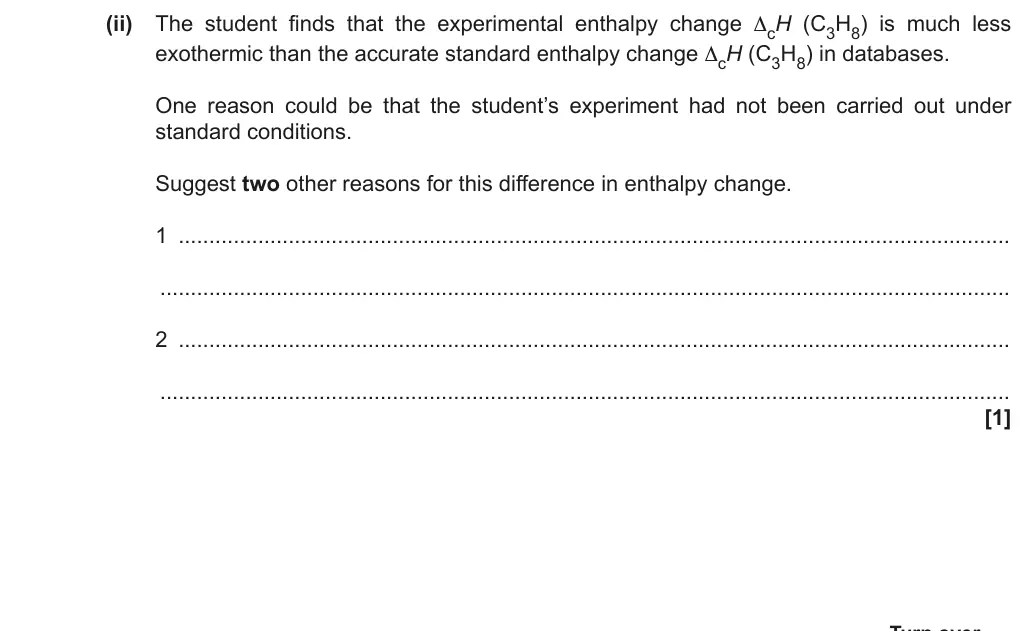
November 2020 · Paper 3 · Q3(a)(ii)1 markAO1Short answerHard
Earlier part of question 3 that this part uses
Mark scheme
Examiner's comment
3(a)(i) Most candidates analysed the raw practical results supplied to correctly calculate the energy change as 10,241 J using q = mc∆T, and the amount of propane burnt as 0.0550 mol. Candidates usually determined the energy change per mole of propane as 1862 kJ. The question asked for the enthalpy change of combustion to 3 significant figures, which gives –1860 kJ mol–1. The mark for this final value was often not given because either the – sign was omitted or the answer was not quoted to the required 3 significant figures. Candidates are advised to read the requirements of each question more closely to eliminate such errors. A double-check on significant figure requirements is recommended before moving on to the next question. Lower-attaining candidates often extracted the wrong data from the results table. Instead of the mass of water (100 cm3), the mass of propane burnt (0.242 g) was often used in the q = mc∆T calculation. Candidates are advised that the thermometer measures the temperature change of the material in which it is placed (the water). 3(a)(ii) One mark was available for identifying two reasons for the difference in enthalpy change. It was expected that candidates would respond with ‘heat loss’ and ‘incomplete combustion’. Most candidates suggested heat loss but the other reason often suggested was equipment error, e.g. the thermometer did not reading correctly’, ‘the balance gave incorrect readings’. Candidates are advised that responses of faulty apparatus are unlikely to be creditworthy. 3(b) This question was assessed by LoR. Level 3 candidates calculated the enthalpy change for Equation 3.1 correctly as –2054 kJ mol–1. They linked 4 × ∆vapH with the enthalpy change for Equation 3.1 in an energy cycle and calculated the enthalpy change of combustion as –2054 – (4 × 40.65) = –2216.6 kJ mol–1. Most Level 3 candidates drew out bonds in the molecules involved in Equation 3.1, which allowed them to visually count the bonds broken and bonds made. This strategy is recommended to all candidates for any calculation based on bond enthalpies and is much more likely to generate the correct enthalpy change than visualising the relevant bonds solely from the equation. Level 2 candidates often derived the correct enthalpy change for Equation 3.1 but then tried to link this value with ∆vapH instead of 4 × ∆vapH. Other Level 2 candidates calculated ∆H correctly for either the bonds broken or bonds made and combine this value with 4 × ∆vapH. A common error was the omission of the 2 C–C bonds in propane, use of 3 C–C, instead of 2 C–C, bonds, or use of 4, rather than 8 O–H bonds. These errors could have been avoided by drawing out the bonds as described above. Level 1 candidates typically attempted to use the bond enthalpies to calculate energies for bonds broken and bonds made but made several errors. They then combined this value with ∆vapH. This question discriminated extremely well across different abilities.
Notes from the mark scheme and report
any two for 1 mark: heat loss to surroundings, incomplete combustion (IGNORE incomplete 'reaction'), evaporation of water
IGNORE evaporation of C3H8
Skills: PAG3 Enthalpy determination
November 2020 · Paper 3 · Q3(b)6 marksAO2, 36-mark level of responseHard
Earlier part of question 3 that this part uses
Mark scheme, with the levels and indicative points
Examiner's comment
3(a)(i) Most candidates analysed the raw practical results supplied to correctly calculate the energy change as 10,241 J using q = mc∆T, and the amount of propane burnt as 0.0550 mol. Candidates usually determined the energy change per mole of propane as 1862 kJ. The question asked for the enthalpy change of combustion to 3 significant figures, which gives –1860 kJ mol–1. The mark for this final value was often not given because either the – sign was omitted or the answer was not quoted to the required 3 significant figures. Candidates are advised to read the requirements of each question more closely to eliminate such errors. A double-check on significant figure requirements is recommended before moving on to the next question. Lower-attaining candidates often extracted the wrong data from the results table. Instead of the mass of water (100 cm3), the mass of propane burnt (0.242 g) was often used in the q = mc∆T calculation. Candidates are advised that the thermometer measures the temperature change of the material in which it is placed (the water). 3(a)(ii) One mark was available for identifying two reasons for the difference in enthalpy change. It was expected that candidates would respond with ‘heat loss’ and ‘incomplete combustion’. Most candidates suggested heat loss but the other reason often suggested was equipment error, e.g. the thermometer did not reading correctly’, ‘the balance gave incorrect readings’. Candidates are advised that responses of faulty apparatus are unlikely to be creditworthy. 3(b) This question was assessed by LoR. Level 3 candidates calculated the enthalpy change for Equation 3.1 correctly as –2054 kJ mol–1. They linked 4 × ∆vapH with the enthalpy change for Equation 3.1 in an energy cycle and calculated the enthalpy change of combustion as –2054 – (4 × 40.65) = –2216.6 kJ mol–1. Most Level 3 candidates drew out bonds in the molecules involved in Equation 3.1, which allowed them to visually count the bonds broken and bonds made. This strategy is recommended to all candidates for any calculation based on bond enthalpies and is much more likely to generate the correct enthalpy change than visualising the relevant bonds solely from the equation. Level 2 candidates often derived the correct enthalpy change for Equation 3.1 but then tried to link this value with ∆vapH instead of 4 × ∆vapH. Other Level 2 candidates calculated ∆H correctly for either the bonds broken or bonds made and combine this value with 4 × ∆vapH. A common error was the omission of the 2 C–C bonds in propane, use of 3 C–C, instead of 2 C–C, bonds, or use of 4, rather than 8 O–H bonds. These errors could have been avoided by drawing out the bonds as described above. Level 1 candidates typically attempted to use the bond enthalpies to calculate energies for bonds broken and bonds made but made several errors. They then combined this value with ∆vapH. This question discriminated extremely well across different abilities.
Notes from the mark scheme and report
bonds broken 6488, bonds made 8542, ∆rH = –2054
errors: 3 C–C used (–1707), C–C omitted (–2748)
∆cH needs H2O(l) so ∆cH = ∆rH – 4 × ∆vapH = –2217
adding 4 × 40.65 (–1891) is incorrect
Skills: M0.2 Use ratios, fractions and percentages; M2.3 Substitute numerical values into algebraic equations using appropriate units for physical quantities
June 2019 · AS Paper 1 · Q101 markAO1Multiple choiceMedium
Answer
B
Mark scheme
Examiner's comment
This part discriminated extremely well. Most candidates correctly identified option B but a sizeable number of less able candidates chose the different options in almost equal amounts. It was difficult to recognise where candidates were having problems and the incorrect responses were probably mainly guesses.
June 2019 · Paper 1 · Q101 markAO2Multiple choiceHard
Answer
A
Mark scheme
Examiner's comment
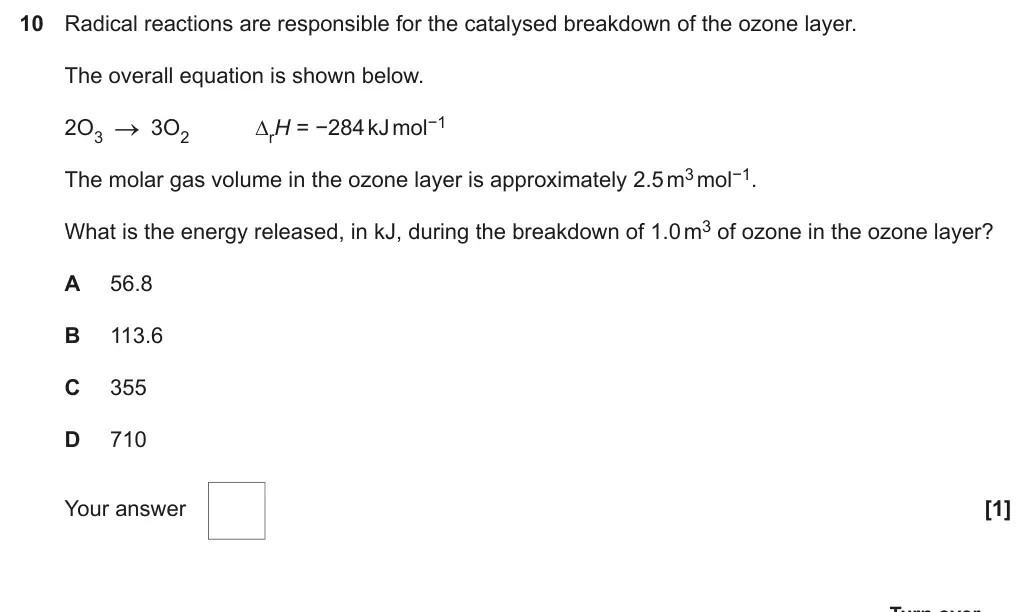
This was another challenging question, with only the most able candidates choosing the correct answer of A. Candidates had to calculate the number of moles of O3 (by dividing 1.0 by 2.5) and then had to use the information in the equation (that 2 moles of O3 releases 284 kJ). The most common error was option B, presumably because candidates thought that 1 mole of O3 releases 284 kJ (rather than 2 moles). Candidates should be aware that a given enthalpy change relates to the molar quantities as shown in the equation.
June 2019 · AS Paper 1 · Q111 markAO1Multiple choiceHard
Answer
B
Mark scheme
Examiner's comment
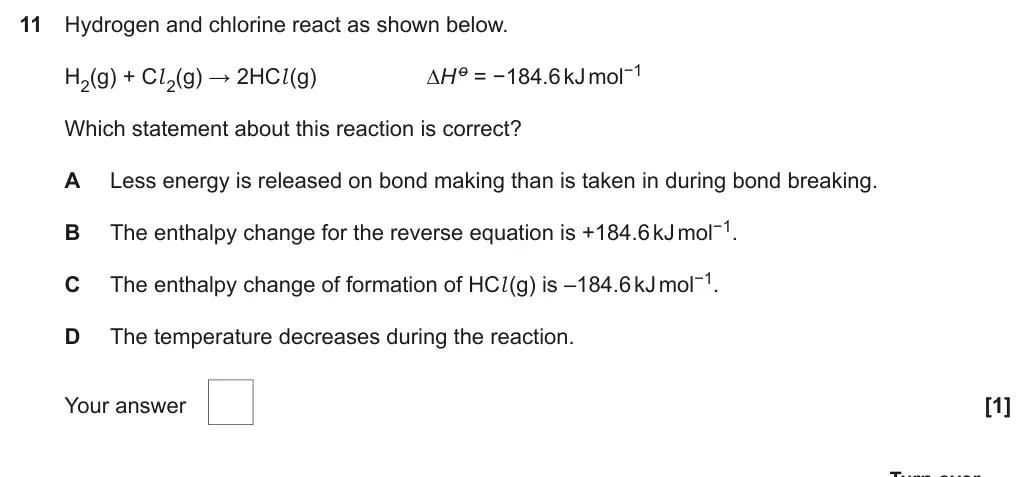
Many candidates found this question difficult with less than half choosing the correct option of B. Options A and C proved to be the main discriminators in almost equal amounts. Although first encountered at GCSE level, energies associated with bond breaking and bond making continue to cause candidates problems at AS and A Level. The discriminator C would have been chosen by candidates who did not recognise that –184.6 kJ is released when 2 mol HCl is formed and that the enthalpy change of formation would be half this value.
June 2019 · Paper 1 · Q19(a)(i)1 markAO1Short answerMedium
Mark scheme
Examiner's comment
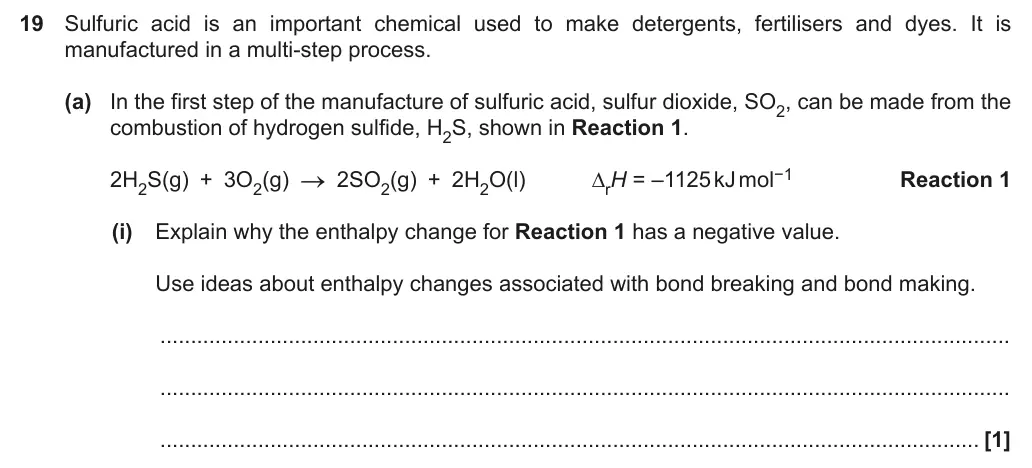
This question caused problems for candidates. The main error was careless phrasing. Many candidates correctly referred to the energy being required for bond breaking, but then also discussed bond making in terms of the energy used, suggesting that bond making was endothermic. Responses simply stating more bonds were made than broken were ignored.
Notes from the mark scheme and report
must link energy with both breaking and making bonds
IGNORE more bonds made than broken
June 2019 · Paper 1 · Q19(a)(iii)3 marksAO2CalculationHard
Earlier part of question 19 that this part uses
Mark scheme
Examiner's comment
This calculation proved very difficult. Many candidates did not deduce the correct cycle. Of those who did, a significant majority did not appreciate the stoichiometry of the equation and did not double the ΔcH values or half the initially calculated value of ΔfH(H2S).
Notes from the mark scheme and report
both ∆cH values ×2
subtract ∆rH
divide by 2
+20(.1) scores 2
ALLOW –20.1
Skills: M2.2 Change the subject of an equation; M2.3 Substitute numerical values into algebraic equations using appropriate units for physical quantities; M2.4 Solve algebraic equations
June 2019 · AS Paper 1 · Q24(b)(i)1 markAO1Short answerMedium
Mark scheme
Examiner's comment
Only just over half of the candidates were able to quote standard conditions for enthalpy measurements. Errors included an incorrect temperature, often 273 and 293 K, or incorrect pressure (e.g. 1000 kPa, 100 atm). Candidates are reminded that ‘room temperature’ is not a standard temperature – a specific figure must be stated.
Notes from the mark scheme and report
298 K/25 °C AND 100 kPa
ALLOW 101 kPa, 1 atm, 1 bar
June 2019 · AS Paper 1 · Q24(b)(ii)3 marksAO2CalculationMedium
Earlier part of question 24 that this part uses
Mark scheme
Examiner's comment
Most candidates were able to make some progress with the enthalpy calculation. Most recognised that the provided ∆fH values had to be multiplied by the balancing numbers in the equation. Correct processing of these values with ∆H for the reaction discriminated well between candidates. The response shows a response that was given 2 out of the 3 available marks. The candidate has correctly calculated +360 kJ mol–1 from their enthalpy cycle but has not realised that this value is for 4 mol NH3 and must be divided by 4 to obtain the enthalpy change of formation of 1 mol of NH3. It was impressive that the correct answer of +90 kJ mol–1 was achieved by about one-third of candidates. Question 25 (a) (i), (ii) and (iii) Part 25(a)(i) discriminated extremely well and rewarded well-prepared candidates. Most candidates recognised that B is a tertiary alcohol and will not react with acidified dichromate. The structure from A was often shown as an aldehyde rather than a carboxylic acid. It was also common for candidates to replace the OH group of A with the carboxyl COOH group, gaining a carbon atom in the chain in the process. The ketone oxidation product from C proved to be easier. Part 25(a)(ii) proved to be difficult. Candidates need to be careful in identifying the longest carbon chain to derive the stem of an organic name. Many candidates thought that alcohol C was a branched propanol, with 1-methylpropan-1-ol being seen very often instead of the correct name of butan-2-ol. In part 25(a)(iii), less than half the candidates wrote a correctly-balanced equation for this reaction. Although 4CO2 and 5H2O were usually seen for the products, oxygen was usually seen as 6½O2, rather than 6O2. Candidates need to look very closely at the formula of the organic compound so that the O in C4H10O is accounted for in the balancing.
Notes from the mark scheme and report
common errors: –90 (sign), +360 (missing ÷4)
if ∆H of –908 not used only 1st mark available
Skills: M2.2 Change the subject of an equation; M2.3 Substitute numerical values into algebraic equations using appropriate units for physical quantities; M2.4 Solve algebraic equations
June 2019 · Paper 3 · Q5(a)(i)6 marksAO36-mark level of responseHard
Mark scheme, with the levels and indicative points
Examiner's comment
This question was assessed by level of response (LoR). Candidates were required to process raw experimental results to determine one enthalpy change, and then to determine a second enthalpy change by constructing and using an energy cycle. Levels were determined by the accuracy of the candidates’ processing, calculations and use of the energy cycle. This question discriminated extremely well. Level 3 candidates used the mass of solution as 50.7 g with mc∆T to obtain an energy change of 2861 J. They then divided this value by the moles of CuSO4 that reacted (0.05 mol) to obtain the enthalpy change of –57.22 kJ mol–1. Finally, they constructed an energy cycle which they then used to obtain the second enthalpy change of –65.65 kJ mol–1. Level 2 candidates determined the first enthalpy change but may have used the approximate mass of 50 g for the mass of solution from the experimental method. Their energy cycle was often incorrect or absent, with the second enthalpy change calculated incorrectly. Level 1 candidates often calculated the initial energy change using mc∆T but made little further correct progress. A significant number of lower ability candidates used the solid mass of copper sulfate in their calculation. Overall, mathematical skills were displayed well but some basic errors were made, particularly with subtractions. This may have been the result of mis-keying values into a calculator and believing the answer displayed. An example was the mass of the solution (74.13 – 23.43) being seen as 49.7 rather than 50.7. A significant number of candidates added or subtracted the mass of copper sulfate from 50.7 or 50 for their value of m in mc∆T, using for example 57.98 and 42.72. This limited the level that they could reach. initial energy change using mc∆T, the first enthalpy change using the energy change with the moles of copper sulfate, and the second enthalpy change including a clear energy cycle. Numbers are clearly shown and unrounded until the final values. This is an excellent response.
Notes from the mark scheme and report
mass of solution 50.70 g (not 50.0) and ∆T 13.5 °C
n(CuSO4) = 7.98/159.6 = 0.0500 mol
∆solH = –57.22 kJ mol–1 with – sign
∆rH = ∆solH(CuSO4) – ∆solH(CuSO4•5H2O) = –65.65
energy cycle expected
Skills: M0.0 Recognise and make use of appropriate units in calculations; M1.1 Use an appropriate number of significant figures; M2.3 Substitute numerical values into algebraic equations using appropriate units for physical quantities; M3.1 Translate information between graphical, numerical and algebraic forms; PAG3 Enthalpy determination
June 2018 · AS Paper 1 · Q111 markMultiple choiceHard
Answer
B
Mark scheme
Examiner's comment
This question proved to be the most difficult of the multiple-choice questions. Most candidates constructed a correct energy cycle using the provided equation. This gave an energy change of –3684.6 kJ mol–1 (A). The question asks for the enthalpy change of combustion for Al2S3, which is half this value (option B). As with question 2, candidates are advised to read the question carefully.
June 2018 · AS Paper 1 · Q121 markMultiple choiceHard
Answer
B
Mark scheme
Examiner's comment
Candidates find questions based on practical procedures difficult and this question proved to be no exception. A similar number of candidates selected each option, suggesting that most guessed. The correct option is B.
June 2018 · Paper 1 · Q131 markAO1Multiple choiceMedium
Answer
B
Mark scheme
Examiner's comment
D was the common distractor given as the answer by many candidates, suggesting confusion with the first electron affinity and second electron affinity of oxygen.
Notes from the mark scheme and report
∆fH of an element is zero
June 2018 · Paper 1 · Q16(b)(i)2 marksShort answerMedium
Mark scheme
Examiner's comment
Only the higher ability candidates could explain the term average bond enthalpy. The specification clarifies that candidates are not expected to memorise a formal definition, and makes clear the limits expected for candidate explanations. One mark was credited for mention of breaking one mole of bonds; to score the second mark candidates had to clarify that this is in gaseous molecules. A common error was to describe the enthalpy change as being applied to bonds in one mole of molecules.
Notes from the mark scheme and report
breaking of 1 mole of bonds
in gaseous molecules
DO NOT ALLOW bonds formed
DO NOT ALLOW ionic bonds
June 2018 · Paper 1 · Q16(b)(ii)3 marksCalculationEasy
Earlier part of question 16 that this part uses
Mark scheme
Examiner's comment
This relatively straightforward calculation depended upon a candidates’ knowledge that the sum of average bond enthalpies of bonds formed subtracted from the sum of average bond enthalpies of bonds broken was equal to ∆H (– 598 kJ mol–1), and that a rearrangement of this sum gave the value of the bond enthalpy associated with 2 mol of F–F bonds (+316 kJ mol–1). Thus, the bond enthalpy of the F–F bond required division by two.
Notes from the mark scheme and report
+158
common errors for 2 marks: –158, 316 (no ÷2), 622 (2 × 464), 457 (omitting –598), 756 (+598)
970 scores 1
Skills: M2.2 Change the subject of an equation; M2.3 Substitute numerical values into algebraic equations using appropriate units for physical quantities; M2.4 Solve algebraic equations
June 2018 · Paper 1 · Q20(b)3 marksComplete table/diagramEasy
Mark scheme
Examiner's comment
Apart from lower ability candidates, who opted to draw Boltzmann distributions, most candidates scored well here. Common errors included: omission of formulae of reactants and/or products; using a double-headed arrow for ∆H; and masking the lower part of the Ea line with the Ec line so it appeared that Ea was an additional energy increase above the Ec value.
Notes from the mark scheme and report
endothermic: products above reactants with ∆H arrow upwards
Ec below Ea, both from reactant level to their maxima
DO NOT ALLOW –∆H
exothermic diagram can still score first and third marks
Skills: M3.1 Translate information between graphical, numerical and algebraic forms
June 2018 · AS Paper 1 · Q23(a)(i)4 marksCalculationHard
Mark scheme
Examiner's comment
Candidates are well-versed with the relationship q = mc∆T and most were able to calculate that 2.926 kJ of energy was released in this reaction. It was also common to see the amount of AgNO3 correctly calculated as 1.28 × 10⁻³ mol. Candidates were expected to determine the amount of energy released from 1 mol AgNO3 as 229 kJ and finally to multiply this value by 2 for the molar quantities in the equation to match the ‘enthalpy change of reaction’. It was common to see –229 given as the final answer but this was rarely multiplied by 2. The question also required the final answer to be given to an appropriate number of significant figures. Many candidates seemed to be unaware that this reflects the least significant figure provided in the data, in this case 3 significant figures. The exemplar shows a typical response for 3 of the available 4 marks. Many omitted the negative sign in their ∆H value to consider the exothermicity of the reaction. Candidates are also advised to only round at the end of a multi-step calculation. Rounding of intermediate values introduces rounding errors in the final answer. Answer = –457 kJ mol–1
Notes from the mark scheme and report
3 SF and – sign needed
±229 scores 3 (not doubled for 2 mol AgNO3)
mass used in q is 25.0 g of solution
ALLOW ECF throughout
Skills: M0.0 Recognise and make use of appropriate units in calculations; M0.2 Use ratios, fractions and percentages; M1.1 Use an appropriate number of significant figures; M2.3 Substitute numerical values into algebraic equations using appropriate units for physical quantities; PAG3 Enthalpy determination
June 2018 · AS Paper 2 · Q3(c)2 marksCalculationEasy
Mark scheme
Examiner's comment
Most candidates made a good attempt at this question. The most common mistake was to use the wrong sign when incorporating the enthalpy change into the calculation, or not to incorporate it at all.
Notes from the mark scheme and report
431.5
–431.5 scores 1 (wrong sign)
247.5 scores 1 (wrong expression)
must divide by 2
Skills: M2.2 Change the subject of an equation; M2.3 Substitute numerical values into algebraic equations using appropriate units for physical quantities; M2.4 Solve algebraic equations
June 2018 · AS Paper 2 · Q3(d)(ii)1 markShort answerMedium
Earlier part of question 3 that this part uses
Mark scheme
Examiner's comment
The majority of candidates answered this question incorrectly. Only 10% of candidates mentioned intermolecular/London forces. Most stated ‘exothermic’ or described breaking covalent bonds.
Notes from the mark scheme and report
endothermic AND energy needed to overcome London forces/intermolecular forces
DO NOT ALLOW van der Waals' forces
June 2018 · AS Paper 2 · Q4(a)(i)2 marksComplete table/diagramEasy
Mark scheme
Examiner's comment
Most candidates were able to gain the first mark, but many lost the second mark by putting a double headed arrow or -∆H.
Notes from the mark scheme and report
products below reactants with ∆H arrow downwards
Ea to top of curve
DO NOT ALLOW –∆H or double-headed ∆H arrow
1 mark for a correctly labelled endothermic diagram
Skills: M3.1 Translate information between graphical, numerical and algebraic forms
June 2018 · AS Paper 2 · Q4(a)(ii)4 marksCalculationEasy
Earlier part of question 4 that this part uses
Mark scheme
Examiner's comment
Most candidates were able to convert from tonnes to moles and then went on to complete the majority of the calculation steps. Many omitted to divide by 4 and were credited 3 marks. Some candidates lost marks by not stating the answer to standard form or quoted their answer to more than 3 significant figures. A number of candidates attempted to use Q = mc∆T and did not get very far in the calculation.
Notes from the mark scheme and report
tonnes to g
÷4 for per mole NH3
3 sig figs AND standard form (6.79 × 10^7)
common errors 2.72 × 10^8 (no ÷4), 1.09 × 10^9 (×4), 6.79 × 10^1 (no tonnes to g)
Skills: M0.0 Recognise and make use of appropriate units in calculations; M0.1 Recognise and use expressions in decimal and ordinary form; M0.2 Use ratios, fractions and percentages; M1.1 Use an appropriate number of significant figures
June 2018 · Paper 3 · Q5(a)4 marksCalculationMedium
Mark scheme
Examiner's comment
The direct determination of an enthalpy change is a common practical procedure. Most candidates were able to calculate the energy change in the reaction as 2.09 kJ, with comparatively few not adding the two 50 cm3 volumes in their calculation. Common errors were using the mass or moles of succinic acid in the mc∆T calculation or to use 278 K, rather than 5ºC for ∆T. Most candidates calculated that 0.02 mol of succinic acid had reacted. The best responses recognised that the enthalpy change of neutralisation (i.e. formation of 1 mol of H2O) was required and that 0.02 mol succinic acid produced 2 × 0.02 = 0.04 mol H2O. 2.09 kJ was then scaled up to give the correct ∆H value of –52.25 kJ mol–1. Example 1 follows this approach and each stage in the working can be followed easily. Most candidates scaled up using 0.02 mol to obtain –104.6 kJ mol–1 and then thought that this was the final answer. Lower ability candidates often calculated the moles of succinic acid as 0.02 but also calculated the moles of NaOH as 0.05 mol. They often then went on to scale up their energy change by 0.05 or 0.07. Many responses were disorganised and poorly presented with unsubstantiated numbers across the answer space. Imperfect calculations may be partially credited by applying error carried forward but this is only possible if sense can be made of the response. Compare the responses in Exemplar 13 and Exemplar 14. In Exemplar 14, there is no labelling to show what each stage refers to. It looks as if the candidate has calculated the moles of NaOH rather than succinic acid and has used this in the subsequent stage. Error carried forward has been applied generously on this assumption. Answer = –52.25 kJ mol–1.
Notes from the mark scheme and report
–52.3 from two cancelling errors (50 g instead of 100 g AND no ÷2) scores only 2
succinic acid limiting, 2 mol H2O per mol acid
DO NOT ALLOW fewer than 3 SF
– sign required
Skills: M0.0 Recognise and make use of appropriate units in calculations; M1.1 Use an appropriate number of significant figures; M2.3 Substitute numerical values into algebraic equations using appropriate units for physical quantities; PAG3 Enthalpy determination
June 2017 · Paper 1 · Q91 markMultiple choice
Answer
C
Mark scheme
June 2017 · AS Paper 1 · Q111 markMultiple choice
Answer
C
Mark scheme
June 2017 · AS Paper 1 · Q121 markMultiple choice
Answer
B
Mark scheme
June 2017 · Paper 1 · Q18(b)(iv)3 marksCalculation
Earlier part of question 18 that this part uses
Mark scheme
Notes from the mark scheme and report
common errors: +110.5 (sign) scores 2
+184.6 (no 4CO2) scores 2
–117.25 (wrong cycle) scores 2
no marks if any value omitted
Skills: M2.2 Change the subject of an equation; M2.3 Substitute numerical values into algebraic equations using appropriate units for physical quantities; M2.4 Solve algebraic equations
June 2017 · AS Paper 1 · Q25(a)(i)1 markShort answer
Mark scheme
Notes from the mark scheme and report
must link energy to both breaking and making bonds
ALLOW bond breaking endothermic AND bond making exothermic
June 2017 · AS Paper 1 · Q25(a)(ii)3 marksCalculation
Earlier part of question 25 that this part uses
Mark scheme
Notes from the mark scheme and report
common errors: +2106 (omission of 3 O=O) and –3248 score 2
(–)316 scores 2
DO NOT ALLOW – sign on final answer
Skills: M2.2 Change the subject of an equation; M2.3 Substitute numerical values into algebraic equations using appropriate units for physical quantities; M2.4 Solve algebraic equations
June 2017 · AS Paper 2 · Q3(a)(i)4 marksCalculation
Mark scheme
Notes from the mark scheme and report
–2510 required: 3 SF AND negative sign
+2510 or 2508/2507 or –2510000 (J not kJ) score 3
ALLOW ECF from incorrect q or moles
Skills: M0.0 Recognise and make use of appropriate units in calculations; M1.1 Use an appropriate number of significant figures; M2.3 Substitute numerical values into algebraic equations using appropriate units for physical quantities; PAG3 Enthalpy determination
June 2017 · AS Paper 2 · Q3(a)(ii)2 marksShort answer
Earlier part of question 3 that this part uses
Mark scheme
Notes from the mark scheme and report
heat loss to surroundings / incomplete combustion / non-standard conditions
IGNORE reference to evaporation
Skills: PAG3 Enthalpy determination
June 2017 · AS Paper 2 · Q3(b)(ii)3 marksCalculation
Earlier part of question 3 that this part uses
Mark scheme
Notes from the mark scheme and report
line of best fit must be extrapolated to Mr = 72
∆cH estimate (–)3500 to (–)3600
n = 0.0250 mol
IGNORE sign
ALLOW ECF from incorrect moles or estimate
Skills: M0.3 Estimate results; M2.3 Substitute numerical values into algebraic equations using appropriate units for physical quantities; M3.1 Translate information between graphical, numerical and algebraic forms; M3.2 Plot two variables from experimental or other data
June 2017 · AS Paper 2 · Q3(c)3 marksCalculation
Mark scheme
Notes from the mark scheme and report
–3919.5
+3919.5 scores 2
–4232.1 (all data added) scores 2
–3924 from data rounded to 3 SF scores 2
Skills: M2.3 Substitute numerical values into algebraic equations using appropriate units for physical quantities; M2.4 Solve algebraic equations
June 2017 · Paper 3 · Q2(a)6 marks6-mark level of response
Mark scheme, with the levels and indicative points
Notes from the mark scheme and report
mass of solution 25.75 g and ∆T 35.0 °C from raw data
q = mc∆T = 3767 J
n(Na2O) = 0.0200 mol so ∆H(3.2) = –188 kJ mol–1
∆H(3.1) = ∆H(3.2) + 2∆H(3.3) = –303.6
signs and SF
Skills: M0.0 Recognise and make use of appropriate units in calculations; M1.1 Use an appropriate number of significant figures; M2.3 Substitute numerical values into algebraic equations using appropriate units for physical quantities; PAG3 Enthalpy determination
June 2016 · AS Paper 1 · Q121 markMultiple choice
Answer
B
Mark scheme
June 2016 · AS Paper 1 · Q24(a)4 marksAO2Calculation
Mark scheme
Notes from the mark scheme and report
common error: 50 g instead of 100 g in mc∆T (–29.3, 3 marks)
final mark needs – sign, kJ AND 3 sig figs
DO NOT ALLOW fewer than 3 sig figs for energy
Skills: M0.0 Recognise and make use of appropriate units in calculations; M1.1 Use an appropriate number of significant figures; M2.3 Substitute numerical values into algebraic equations using appropriate units for physical quantities; PAG3 Enthalpy determination
June 2016 · AS Paper 2 · Q4(a)(i)1 markAO2Short answer
Mark scheme
Notes from the mark scheme and report
more energy required for bond breaking than released by bond making
June 2016 · AS Paper 2 · Q4(a)(ii)2 marksAO1, 2Drawing / labelling
Earlier part of question 4 that this part uses
Mark scheme
Notes from the mark scheme and report
products above reactants with upward ∆H arrow
N2(g) + ½O2(g) → N2O(g) with state symbols
DO NOT ALLOW multiples (1 mol N2O formed)
IGNORE activation energy
Skills: M3.1 Translate information between graphical, numerical and algebraic forms
Work with an OCR chemistry tutor
Dropping marks on calculations, mechanisms or the six-markers? Book a trial session with a specialist OCR chemistry tutor.