Tap a question to zoom it. Where a part needs a table, graph or structure from an earlier part, that part folds out above it; the mark scheme and examiner's comment open underneath. Have the OCR Data Sheet beside you.
June 2025 · Paper 1 · Q17(c)(i)1 markShort answerEasy
Mark scheme
Examiner's comment
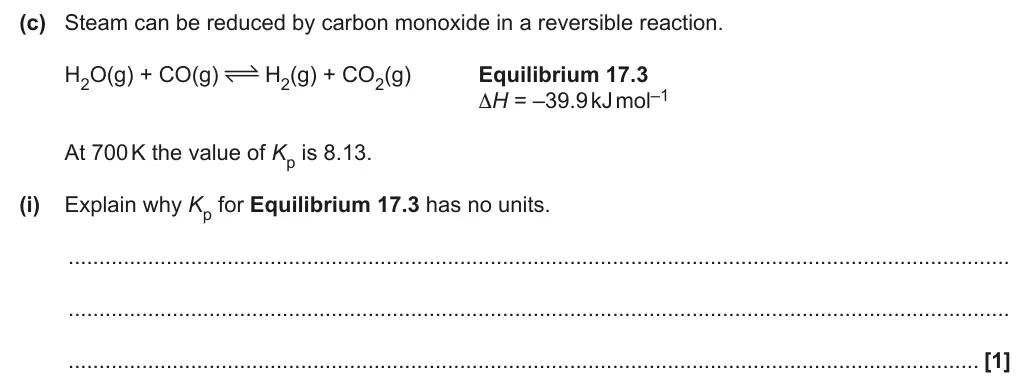
This question was well answered by many candidates. There was a clear description of units cancelling, although some did correctly compare the molar ratios. Some candidates showed this in a clearly written equation. Less successful candidates were not given the mark due unclear terminology or explanation. The question was to explain Kp so the units would need to be a pressure unit rather than concentration (as in a Kc expression).
Notes from the mark scheme and report
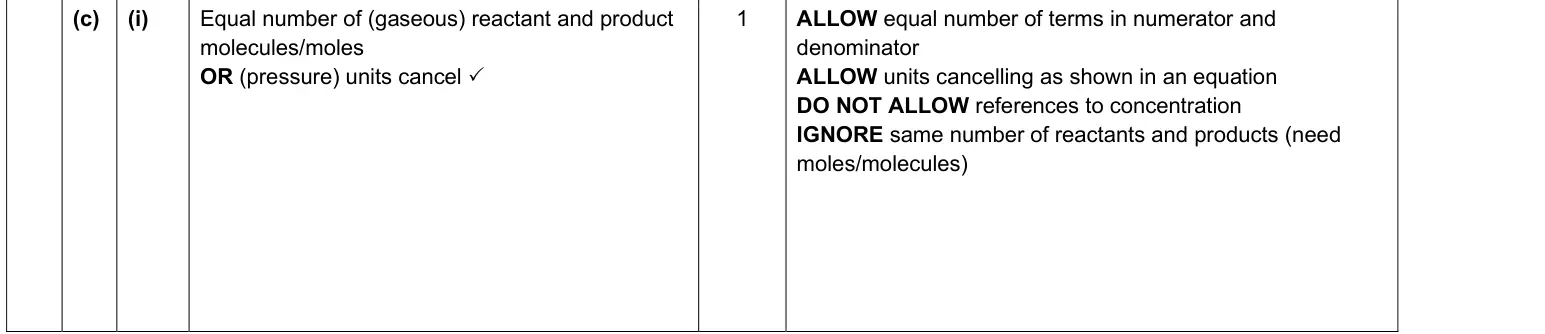
equal number of gaseous moles/molecules of reactants and products so (pressure) units cancel
DO NOT ALLOW references to concentration
IGNORE 'same number of reactants and products' without moles
June 2025 · Paper 1 · Q17(c)(ii)3 marksCalculationHard
Earlier part of question 17 that this part uses
Mark scheme
Examiner's comment
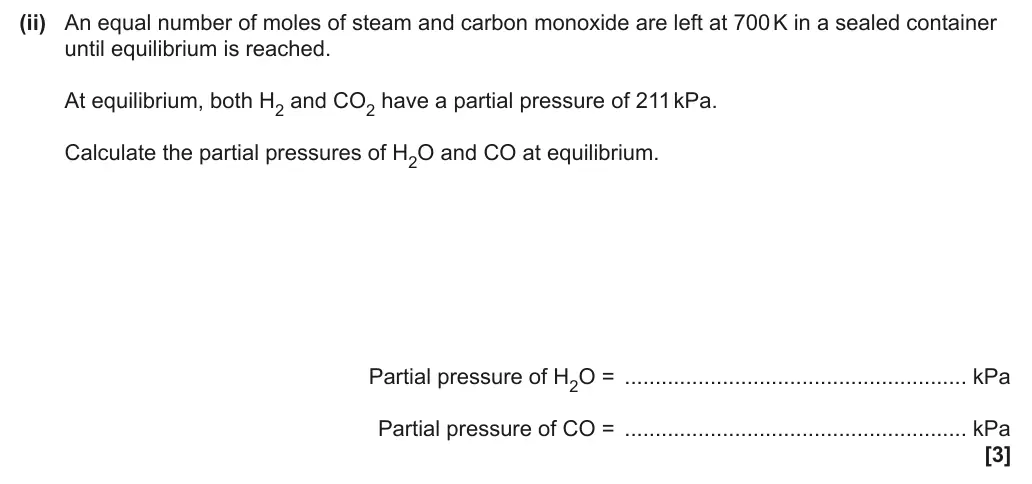
This question required the calculation of two partial pressures. This question proved to be a challenge for most students. Common errors were to divide the 5476 by 2 instead of using the square root. Many were given a mark for recognising that the partial pressures needed to be the same. A common error was 602 from the incorrect rearrangement of the Kp expression and some candidates used the value for R (8.31) rather than 8.13 in the Kp expression. Less successful candidates attempted, unsuccessfully, to use an ICE table to work out the moles of everything at equilibrium.
Notes from the mark scheme and report
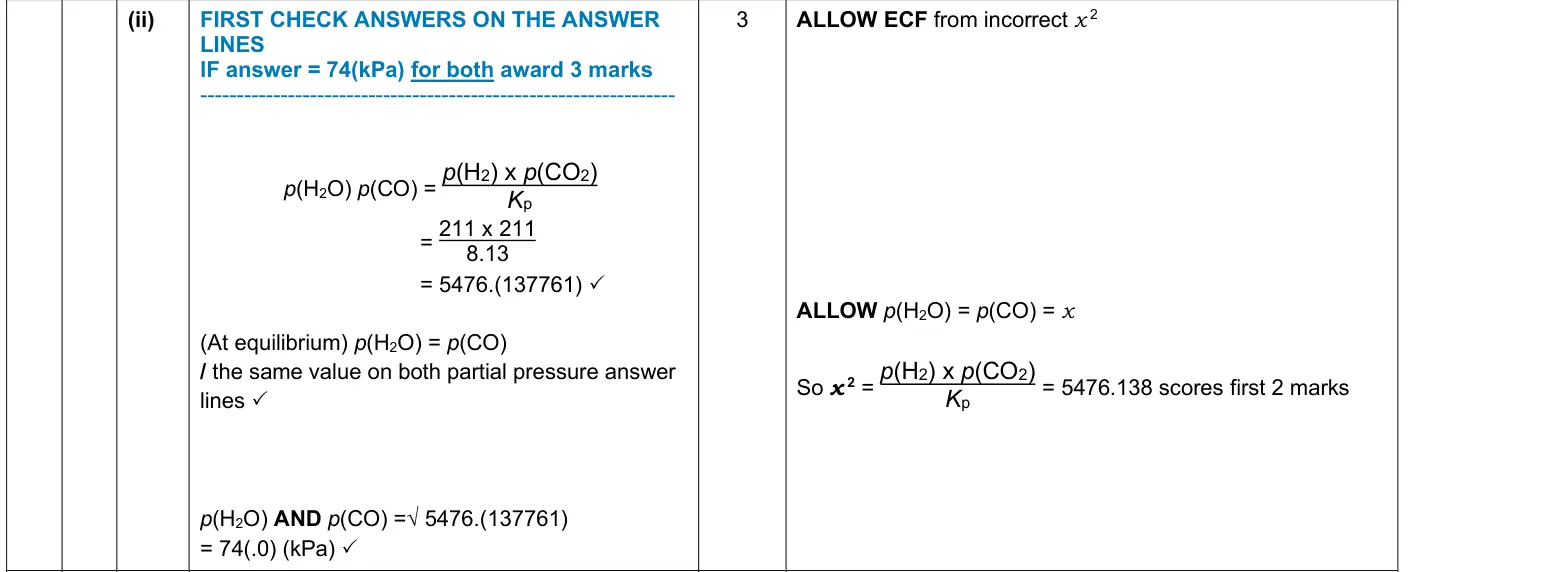
p(H2O) × p(CO) = 211 × 211 ÷ 8.13 = 5476
p(H2O) = p(CO) so take square root = 74 kPa for both
Skills: M2.2 Change the subject of an equation; M2.3 Substitute numerical values into algebraic equations using appropriate units for physical quantities; M2.4 Solve algebraic equations
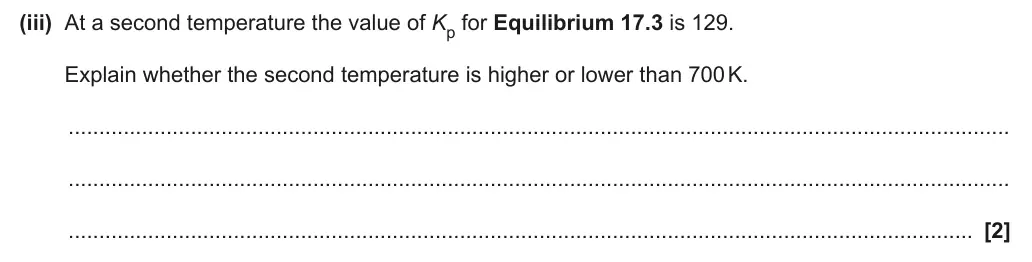
June 2025 · Paper 1 · Q17(c)(iii)2 marksShort answerMedium
Earlier part of question 17 that this part uses
Mark scheme
Examiner's comment
This question required the candidate to link the change in Kp value to the change in temperature. The question was answered well by many candidates. Most identified it was lower and exothermic, but not all went on to say that equilibrium shifted. A few candidates mixed up their lefts and rights and could be advised to use the terms products side and reactant side, as identified by the written equation. Misconceptions included that a higher T was because Kp is higher and that ‘Kp shifted to the right’ rather than the equilibrium.
Notes from the mark scheme and report
lower temperature AND forward reaction exothermic
Kp has increased so equilibrium position shifted to the right
ALLOW ORA
Skills: M0.3 Estimate results
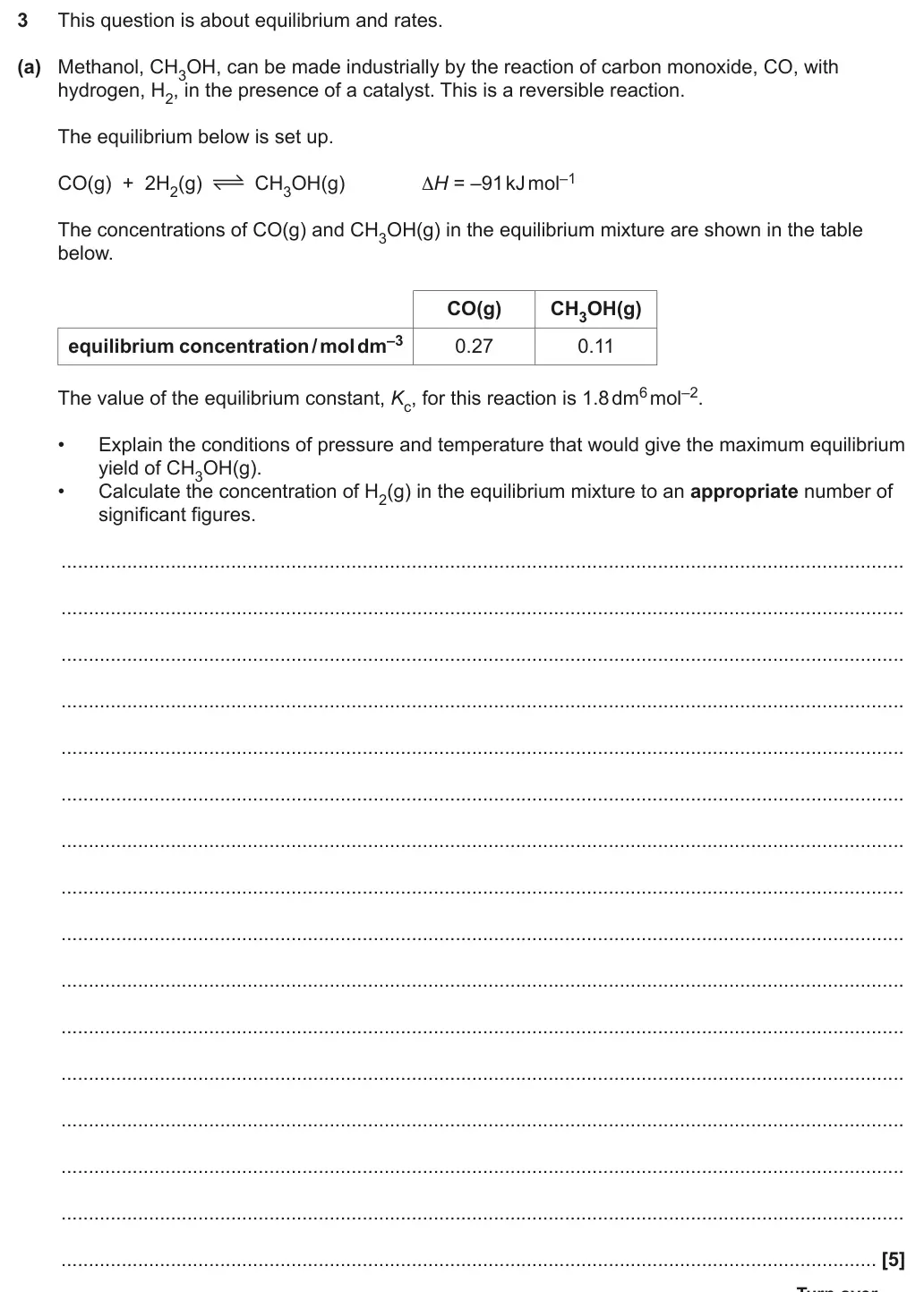
June 2025 · Paper 3 · Q3(a)5 marksCalculationEasy
Mark scheme
Examiner's comment
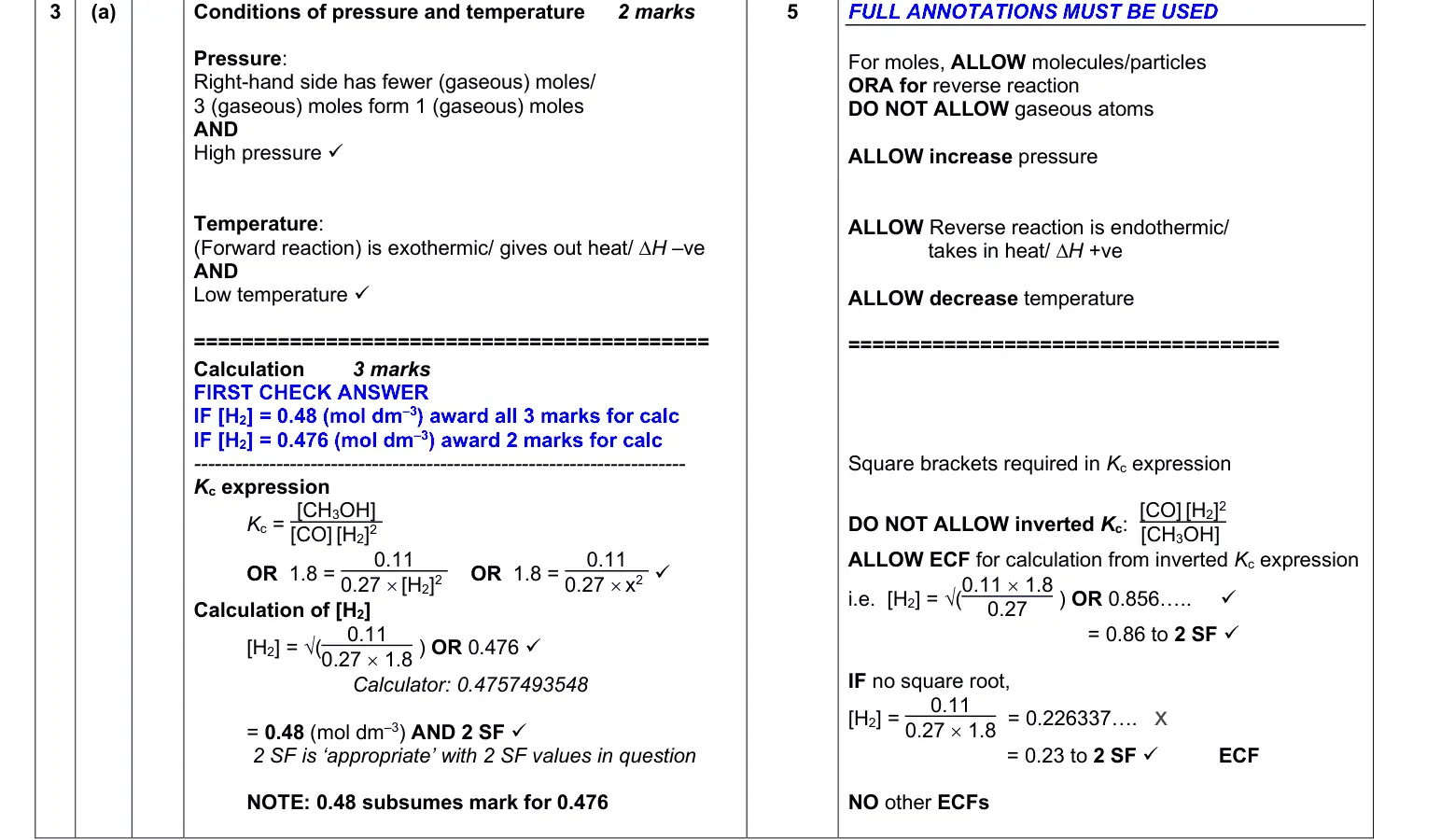
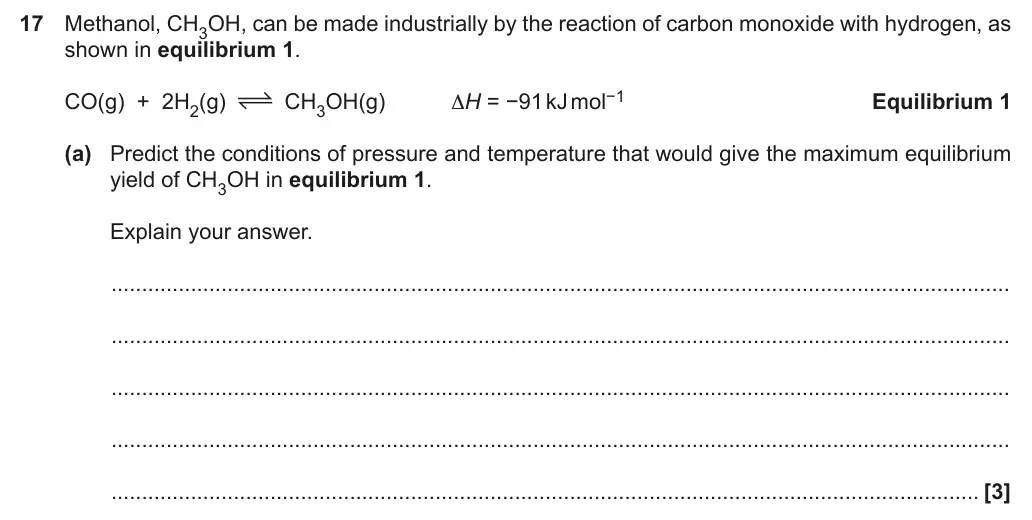
This question was answered confidently with most candidates identified the conditions for a maximum equilibrium yield from the equation: a high pressure from fewer gaseous moles in the product and a low temperature from the exothermic reaction. This was all that the question asked but candidates often wrote far too much, considering operational conditions, rate, safely and expense. Unfortunately, candidates could end up contradicting themselves and wasting valuable time. Candidates are advised to read what the question is asking and to limit their response to this. The calculation was answered well, with most identifying that 2 significant figures is appropriate as the lowest number of significant figures present in the data provided in the question. Thus 0.48 mol dm–3 was commonly seen, rather than 0.476. The Kc expression was usually correct and most candidates rearranged this correctly to make [H2] the subject. The square root calculation showed that some candidates did not appear to have the required calculator skills. A significant number of candidates showed the Kc expression upside down and the mark scheme allowed ECF to be applied following this error.
Notes from the mark scheme and report
high pressure because fewer gaseous moles on right (DO NOT ALLOW gaseous atoms)
low temperature because forward reaction exothermic
square brackets required in Kc
square root needed
0.48 to 2 SF (0.476 loses a mark)
ECF only from inverted Kc or no square root
Skills: M1.1 Use an appropriate number of significant figures; M2.2 Change the subject of an equation; M2.3 Substitute numerical values into algebraic equations using appropriate units for physical quantities; M2.4 Solve algebraic equations
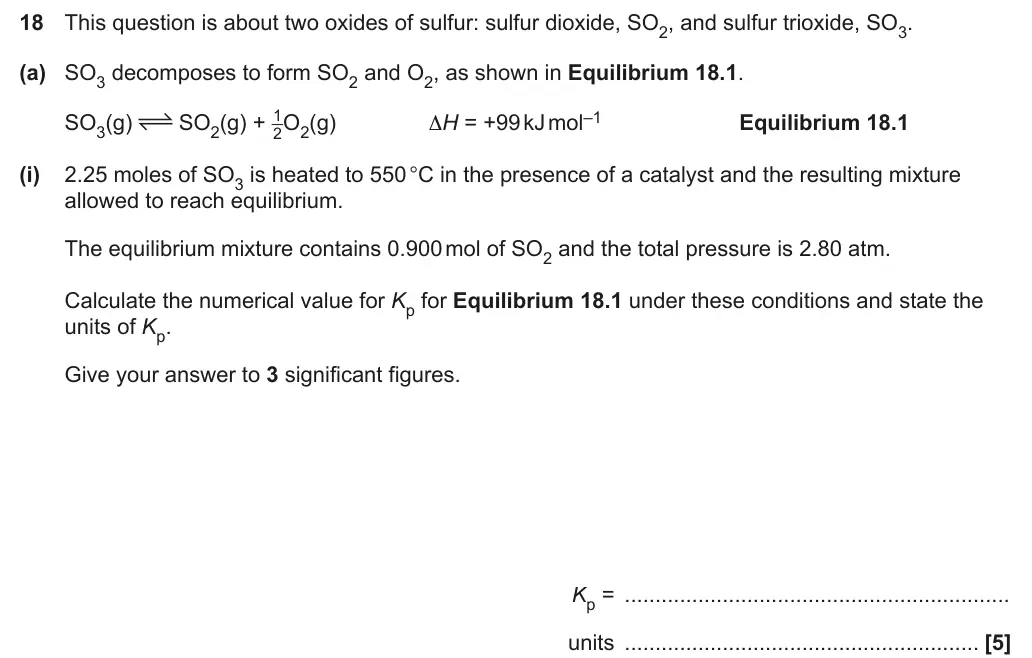
June 2024 · Paper 1 · Q18(a)(i)5 marksCalculationHard
Mark scheme
Examiner's comment
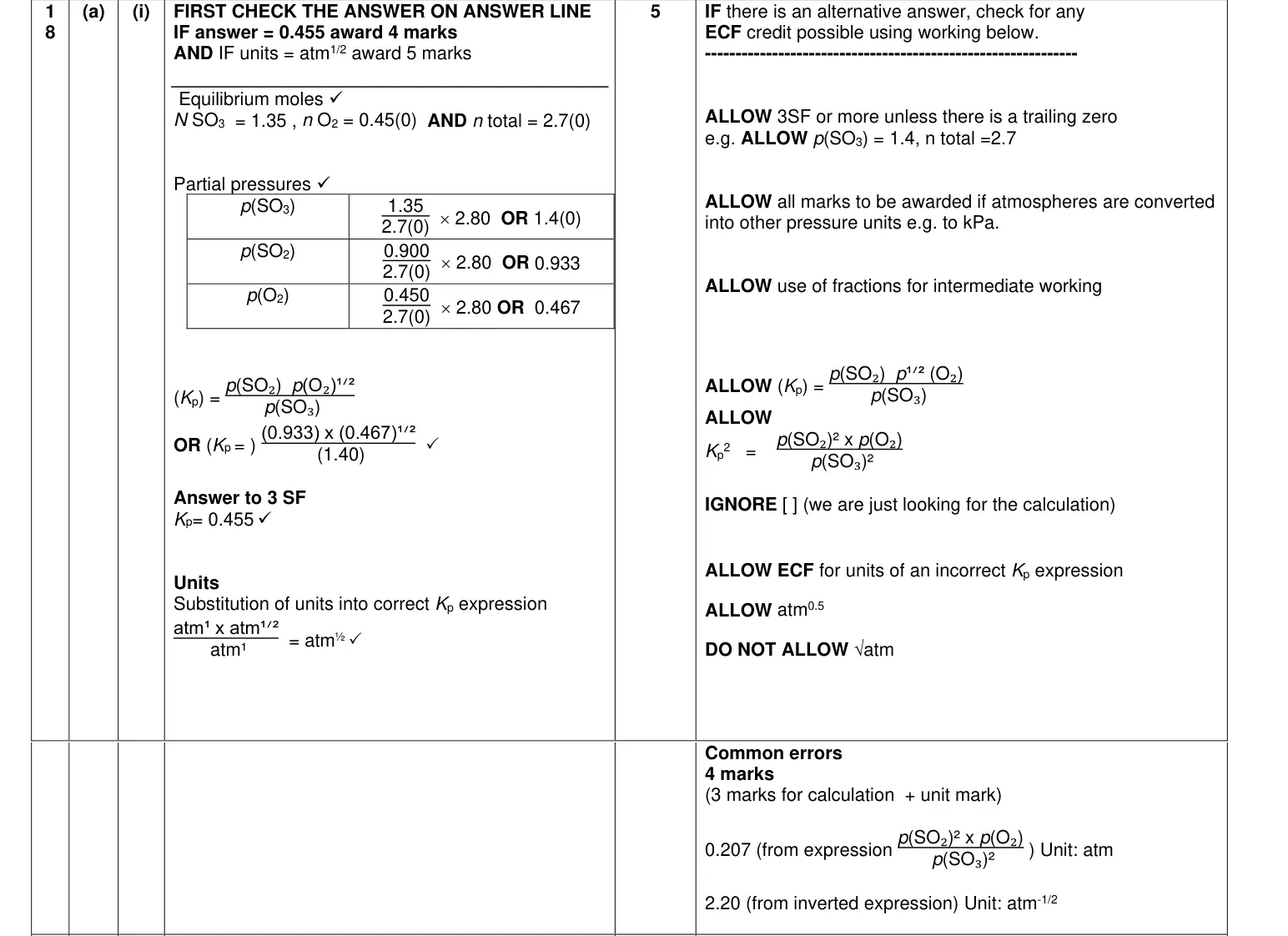
Candidates tend to find Kp calculations difficult and so a strategy to work their way through them could include: • Write the Kp expression using the molar ratio given in the question. Care should be taken not to change the molar ratio to help an easier calculation. Square brackets should not be used as these represent concentration. • Calculation of initial moles present, with careful consideration of the use of appropriate significant figures • Calculation of the change in moles present • Deduction of the number of moles present at equilibrium • Determination of total moles present at equilibrium These steps are often best completed as RICE tables (Ratio, Initial, Change, Equilibrium) and should look to use the appropriate amount of significant figures to avoid having a rounding error in the final answer.
Notes from the mark scheme and report
equilibrium moles via ½ stoichiometry for O2
mole fractions × total pressure
units atm½
Kp values are for the equation as stated. Candidates should recognise that changing the stoichiometry of the equation changes the Kp value.
Skills: M0.0 Recognise and make use of appropriate units in calculations; M0.2 Use ratios, fractions and percentages; M1.1 Use an appropriate number of significant figures; M2.3 Substitute numerical values into algebraic equations using appropriate units for physical quantities
June 2024 · Paper 1 · Q18(a)(ii)2 marksShort answerHard
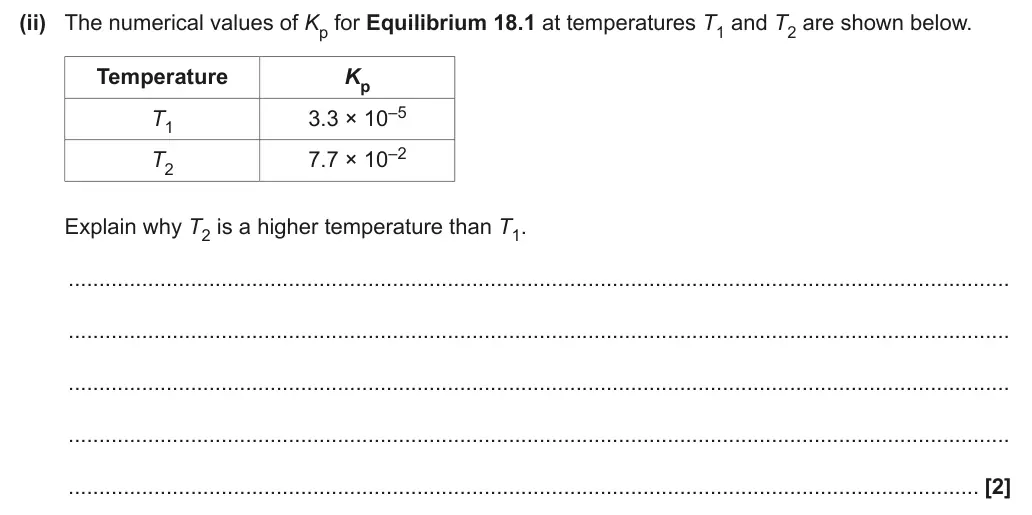
Earlier part of question 18 that this part uses
Mark scheme
Examiner's comment
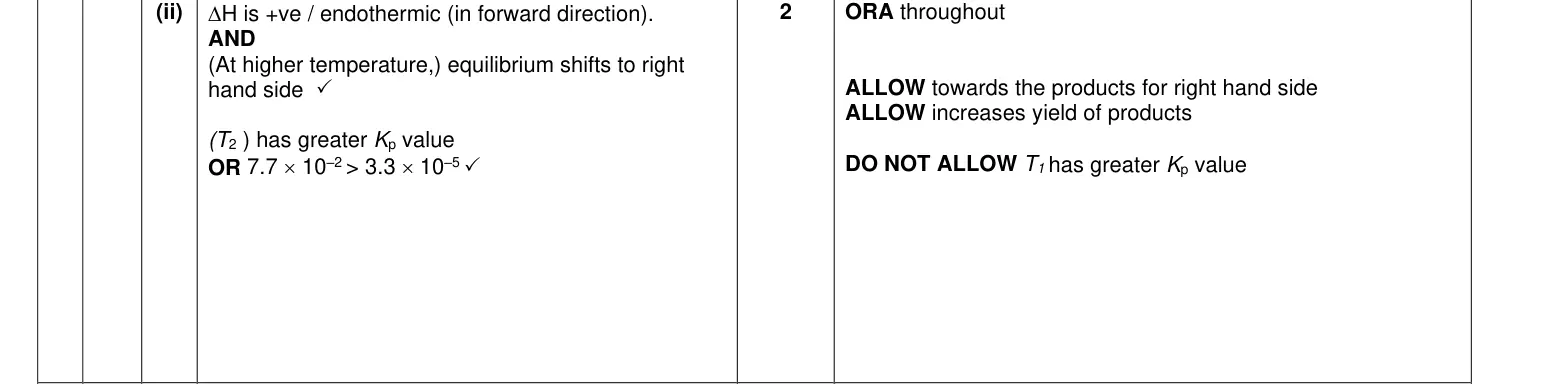
Candidates performed well with this question and many stated that Kp would increase. Some identified the forward reaction as endothermic but did not link this to equilibrium being shifted to the right, thus increasing the ratio within the Kp expression. A few candidates sought to incorrectly explain the effect by using Le Chatelier effect on pressure. Candidates found this question demanding. Many candidates explained the formation of a polar bond by describing the difference in electronegativity between S and O. Many answers had descriptions about symmetry but explained polarity in terms of polar bonds/charges cancelling instead of dipoles. A symmetric molecule (all bonds identical and no lone pairs) will not be polar even if individual bonds within the molecular are polar. The individual dipoles on the bonds ‘cancel out’ due to the symmetrical shape of the molecule. There is no net dipole moment: the molecule is non-polar
Notes from the mark scheme and report
ORA
must link endothermic to Kp increase with T
DO NOT ALLOW 'T1 has greater Kp'
June 2024 · Paper 1 · Q18(a)(iii)2 marksShort answerHard
Earlier part of question 18 that this part uses
Mark scheme
Examiner's comment
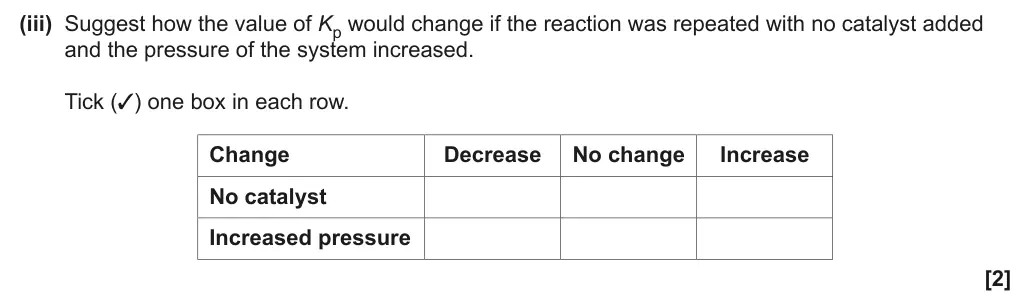
This proved a challenging question where candidates did not stick to the principle that Kp (or Ka) values only change due to temperature changes. Only a few candidates scored both marks with many having the Kp value changing due to increased pressure.
Notes from the mark scheme and report
catalyst: no change
pressure: no change (Kp constant)
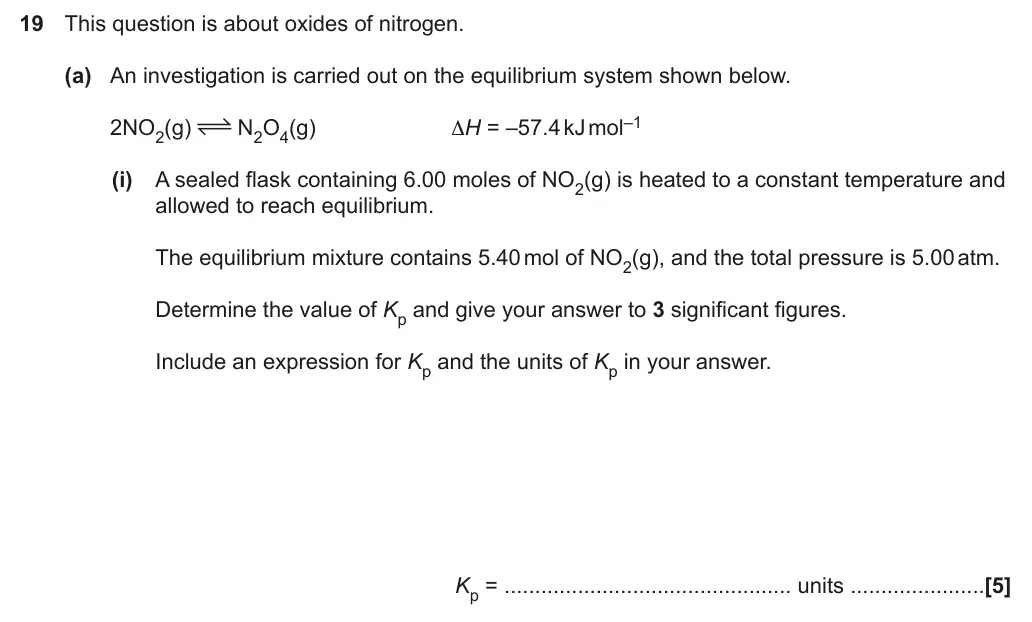
June 2023 · Paper 1 · Q19(a)(i)5 marksAO1, 2CalculationHard
Mark scheme
Examiner's comment
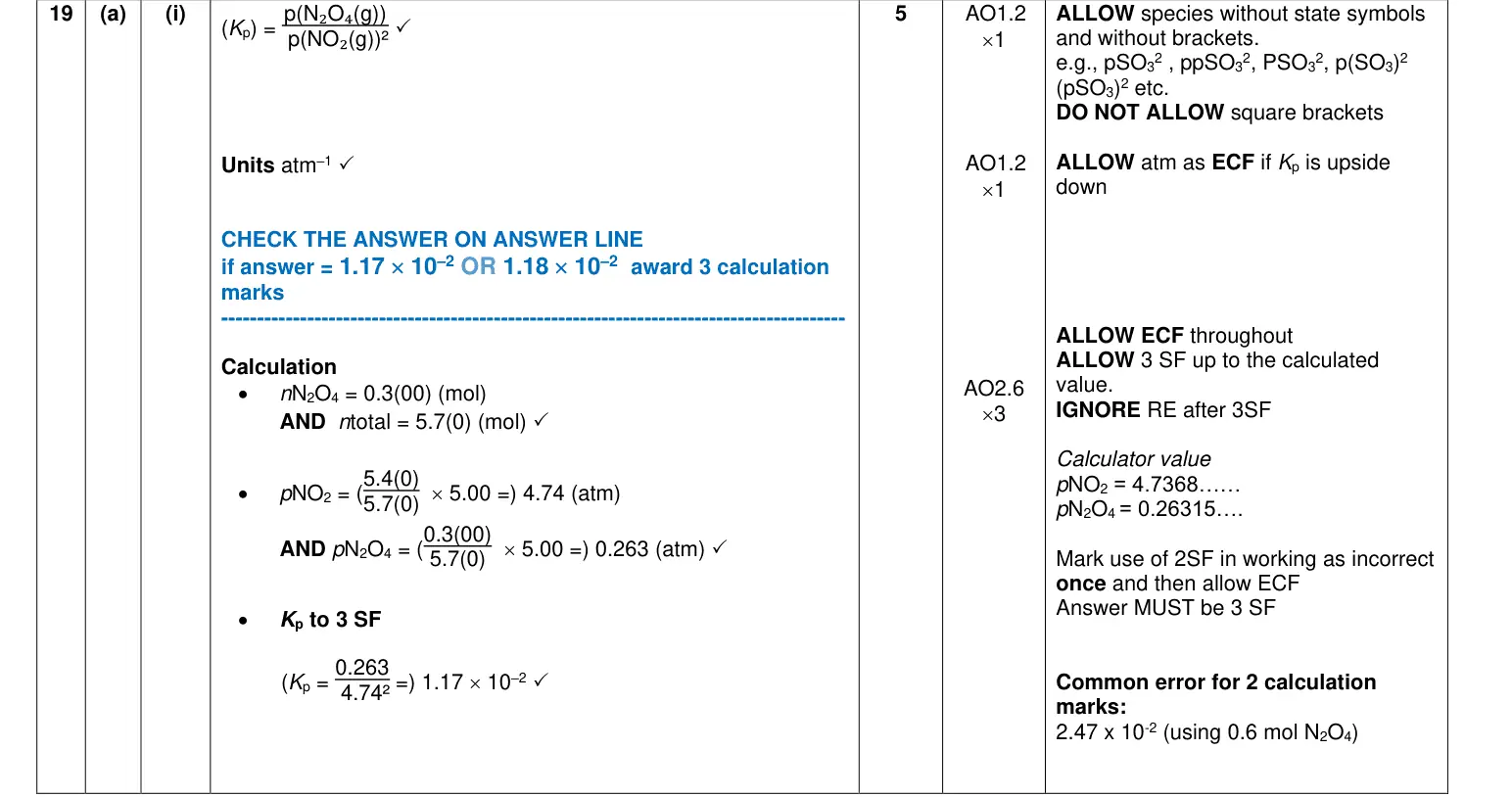
Candidates tend to find Kp calculations difficult and so a strategy to work their way through them could include: • write the Kp expression, with units, ensuring square brackets are not used. Common mistakes with units included atm-1 mol-1, mol-1 dm3, kPa-1 • calculation of initial moles present, with careful consideration of the use of appropriate significant figures • calculation of the change in moles present • deduction of the number of moles present at equilibrium • determination of total moles present at equilibrium. These steps are often best completed as RICE tables (Ratio, Initial, Change, Equilibrium) and should look to use the appropriate amount of significant figures: • calculation of mole fractions at equilibrium • calculation of partial pressures at equilibrium • inserting partial pressure vales into the Kp expression and avoiding any unnecessary unit conversions • writing an answer to the required number of significant figures.
Notes from the mark scheme and report
DO NOT ALLOW square brackets in Kp
n(N2O4) = 0.300 and total 5.70
units atm–1
3 SF (1.17 × 10⁻²)
common error 2.47 × 10⁻² (0.6 mol N2O4) scores 2 calculation marks
Skills: M0.0 Recognise and make use of appropriate units in calculations; M0.2 Use ratios, fractions and percentages; M1.1 Use an appropriate number of significant figures; M2.3 Substitute numerical values into algebraic equations using appropriate units for physical quantities
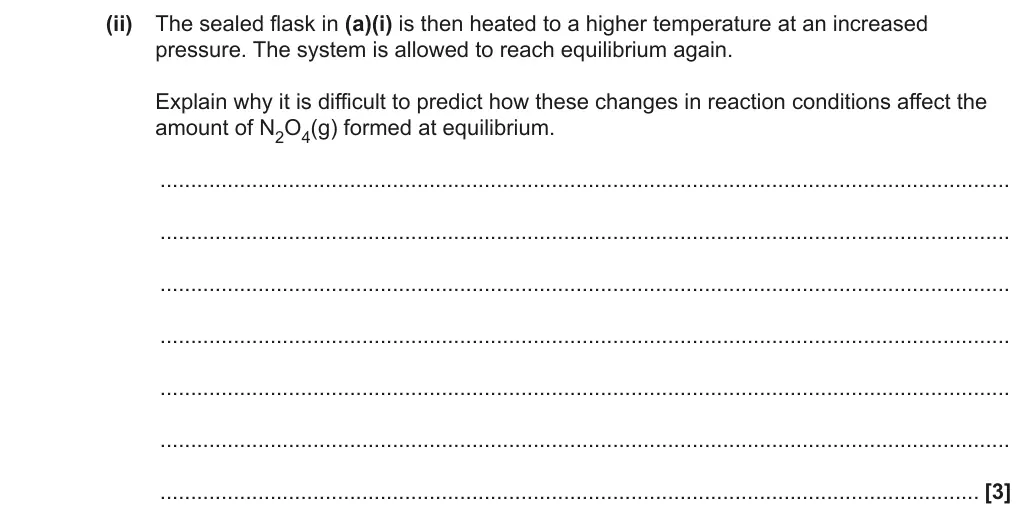
June 2023 · Paper 1 · Q19(a)(ii)3 marksAO2, 3Short answerEasy
Earlier part of question 19 that this part uses
Mark scheme
Examiner's comment
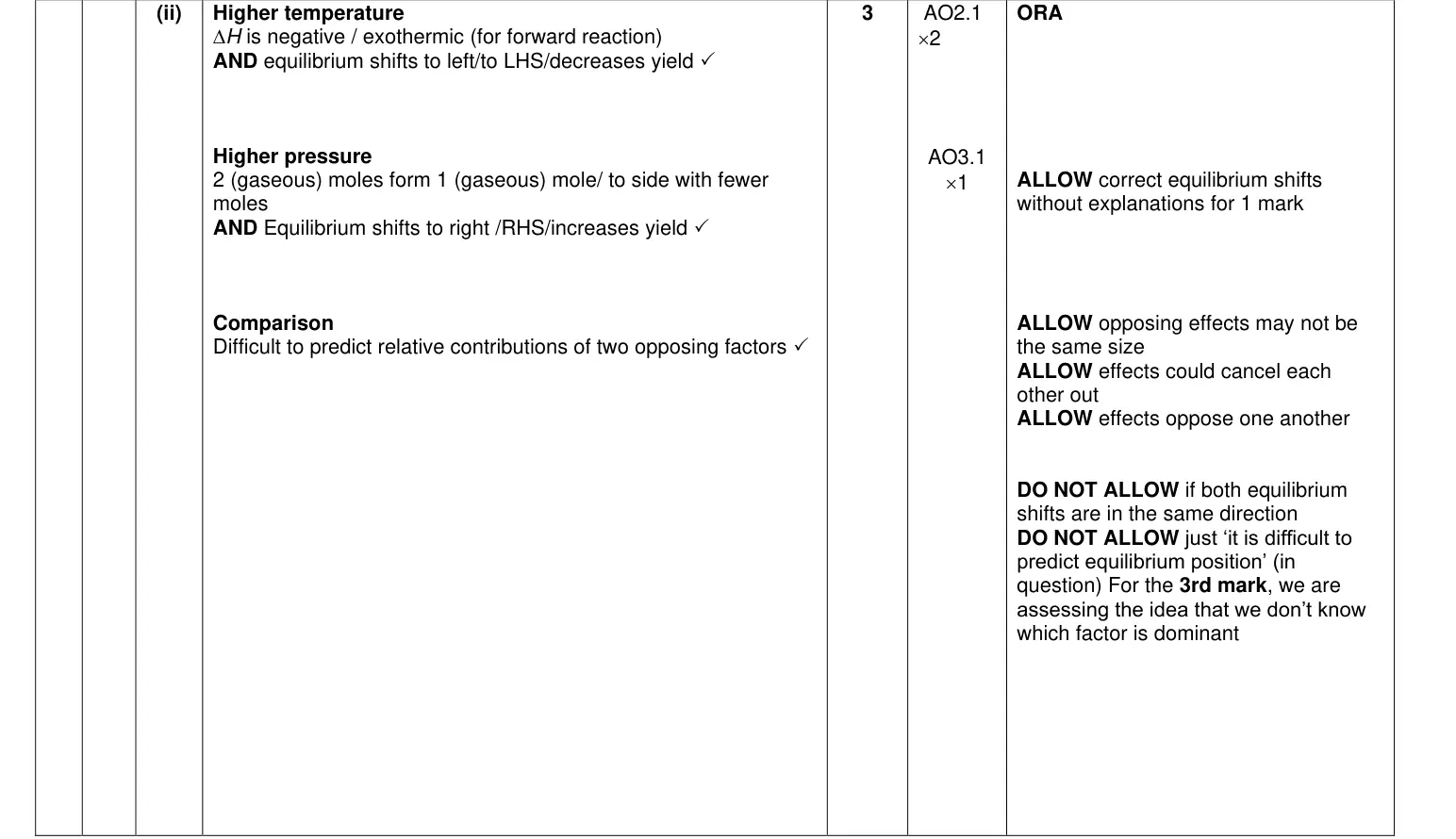
This question was answered for the most part correctly with many candidates scoring 2 marks for the explanations of the effect on the equilibrium position by the changing of the temperature and pressure. Most candidates were able to recognise the changes had opposite effects but could not score the final mark, as their response needed the concept of opposing factors, or ‘we don’t know which factor is dominant’. Some did not write anything about equilibrium and attempted answers based on rate, or loss of energy/chemicals to the surroundings.
Notes from the mark scheme and report
higher T shifts left (forward reaction exothermic)
higher P shifts right (fewer gaseous moles)
cannot tell which opposing effect is dominant
DO NOT ALLOW both shifts in the same direction
June 2023 · Paper 3 · Q6(d)5 marksAO1, 2CalculationHard
Mark scheme
Examiner's comment
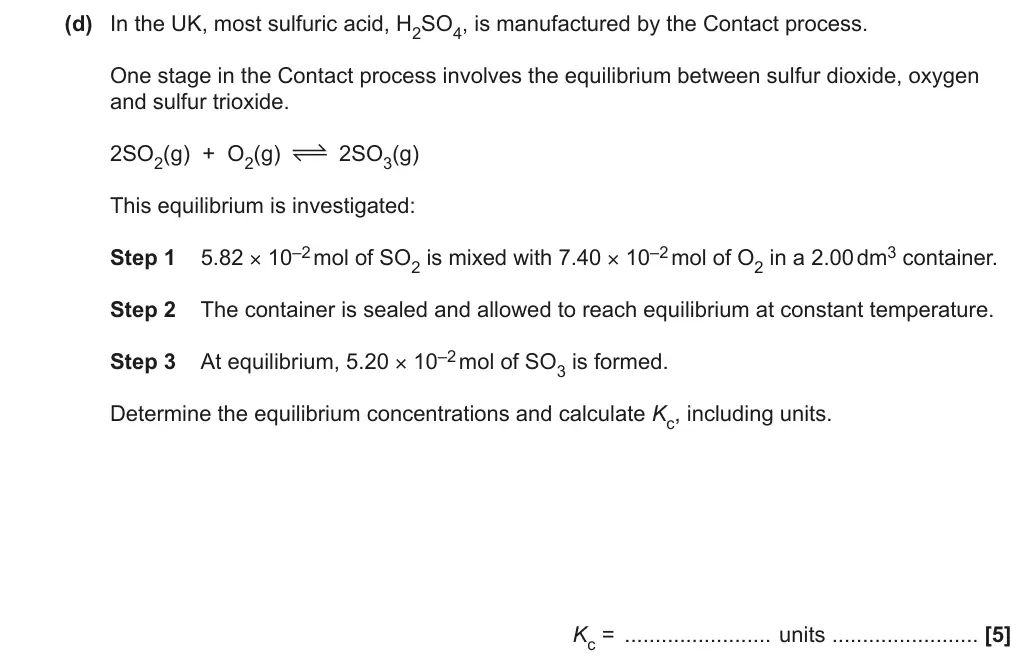
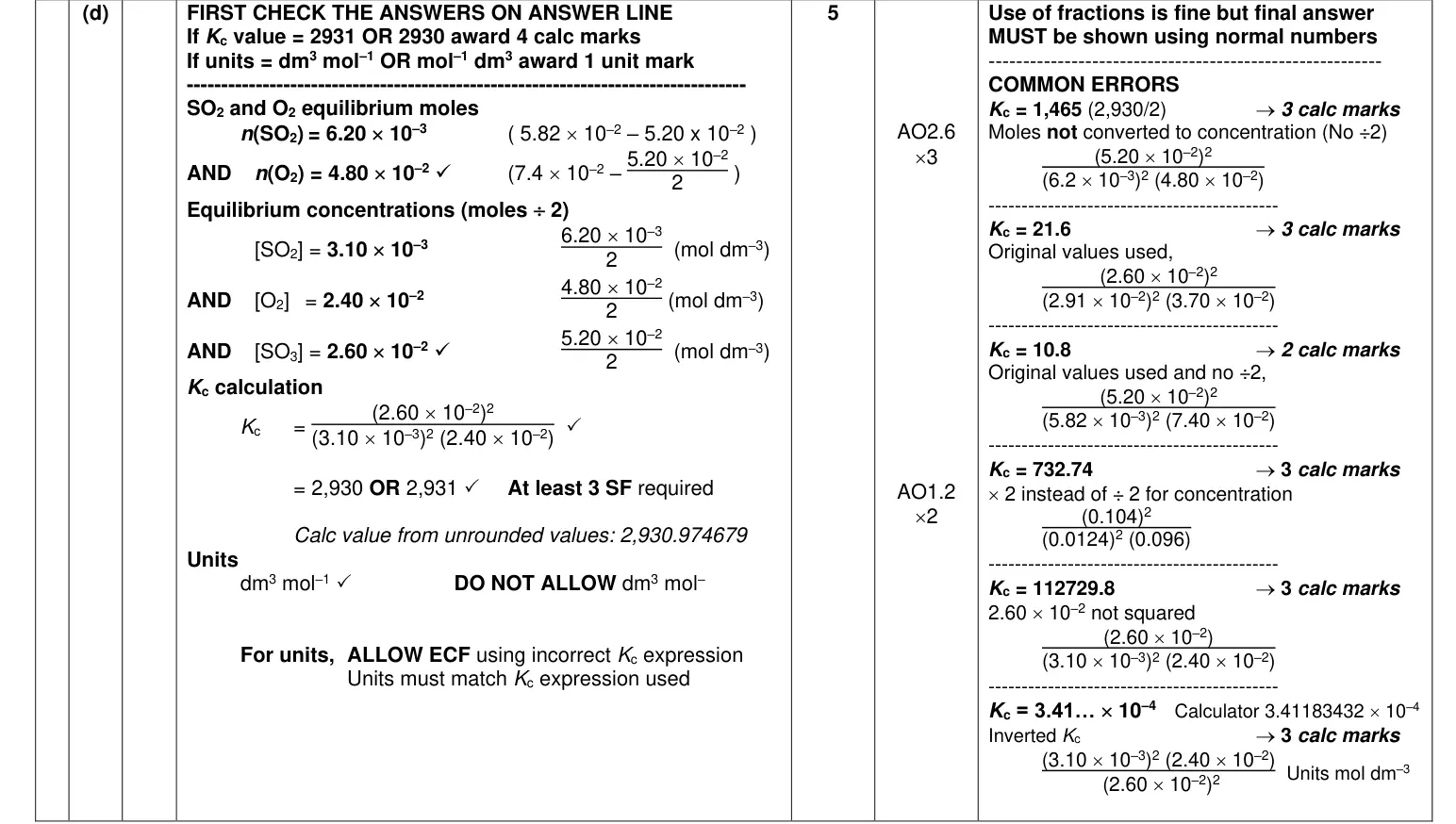
As with the stock titration calculation in Question 5 (a), candidates were much more comfortable in tackling a stock Kc calculation. These have been assessed in several previous H432/01 exams and many excellent responses were seen, gaining all 5 marks. Error carried forwards allowed for an early slip in the calculation to be credited subsequently for a correct method. The hardest part of the calculation was the initial determination of the equilibrium moles and concentrations. The equilibrium moles of O2 was the main error, presumably from the 2:1:2 stoichiometry. Some candidates multiplied by 2 instead of dividing by 2 for the concentration. A common error was for candidates to use a partial pressure approach. These errors lost intermediate marks by credit could then be awarded for using the correct Kc expression to generate a Kc value with correct units. Very few candidates did not gain any marks.
common errors: no ÷ 2 (1465), original values used (21.6), SO3 not squared, inverted Kc
units must match Kc expression used
Skills: M0.0 Recognise and make use of appropriate units in calculations; M0.2 Use ratios, fractions and percentages; M1.1 Use an appropriate number of significant figures; M2.3 Substitute numerical values into algebraic equations using appropriate units for physical quantities
June 2022 · Paper 1 · Q20(a)6 marksAO1, 26-mark level of responseEasy
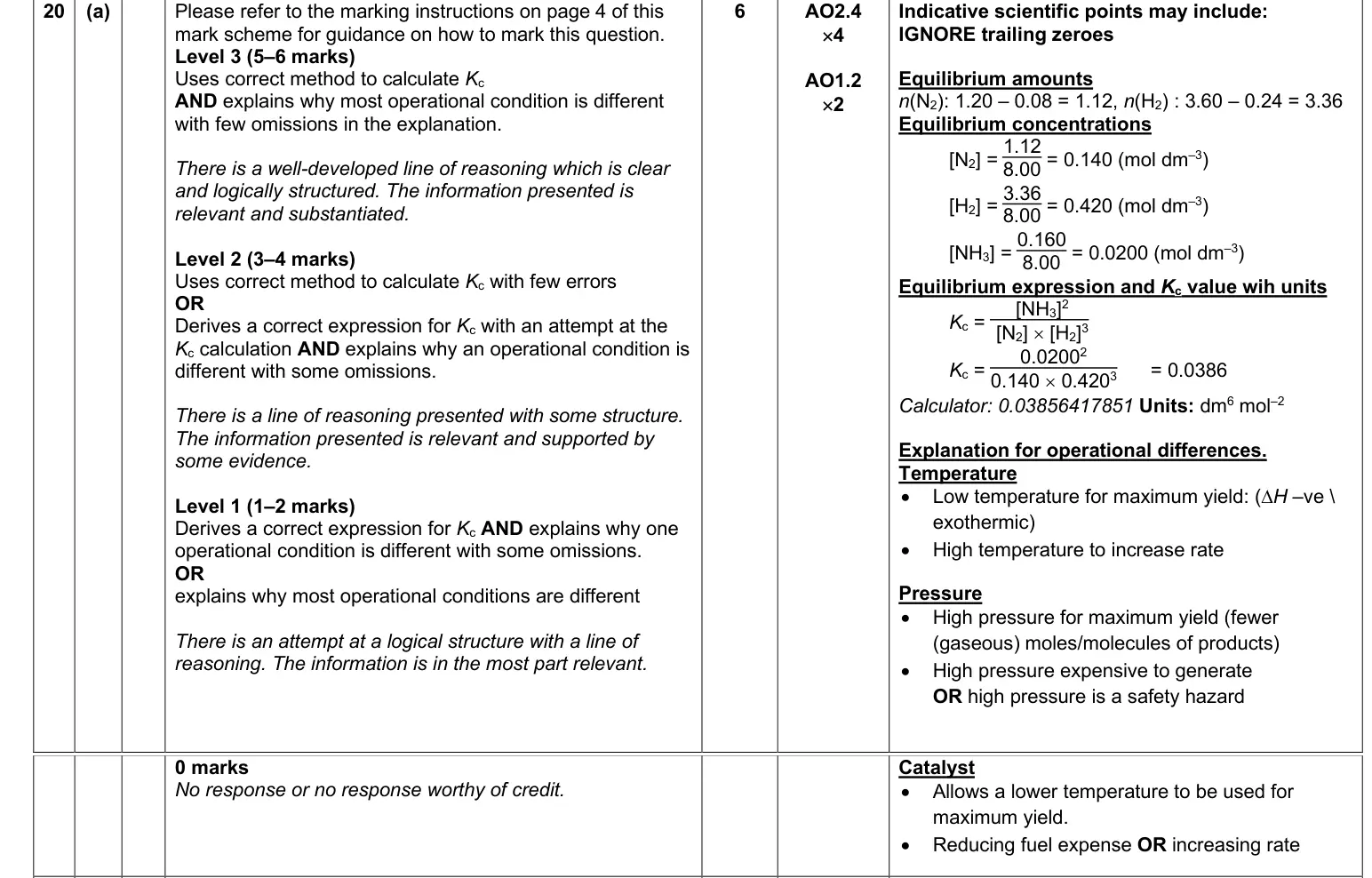
Mark scheme, with the levels and indicative points
Examiner's comment
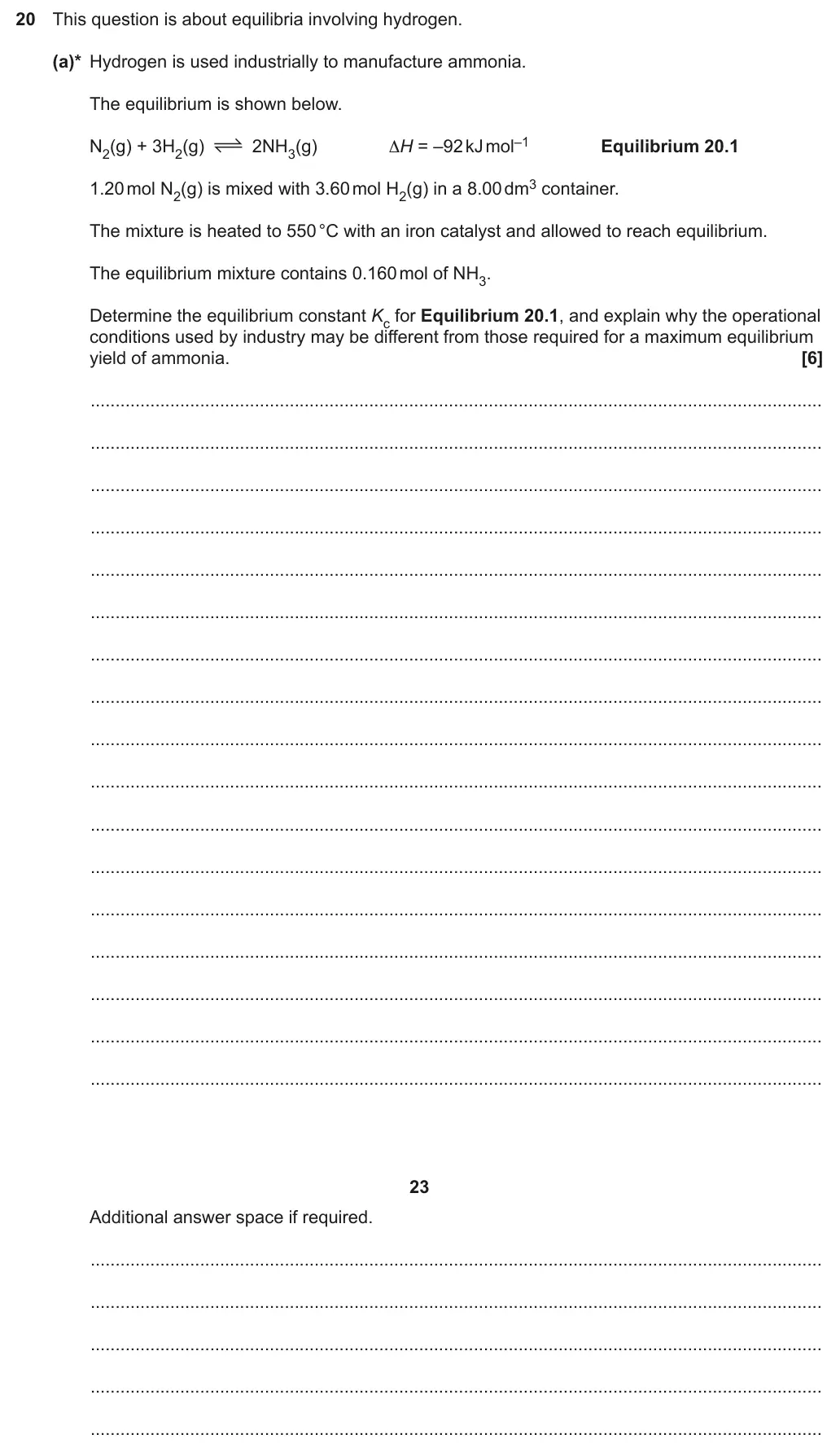
This Level of Response question was generally well answered with many candidates achieving maximum marks by simply considering what was required in the question. Responses were often split between a calculation on the main paper and the conditions explanation on extra pages. The calculation errors included no shift or incorrect shift in the equilibrium values. Not calculating the concentration or incorrectly multiplying by 8 rather than dividing by 8. Some candidates attempted a ‘hybrid’ calculation of Kp by trying to calculate a mole fraction and partial pressures. There was a number of candidates who confidently worked out the value of Kc. There were also some very good analyses of the operational conditions. Many of those who had done well on the calculation treated the explanation as an afterthought, not giving it enough attention to give them an answer that would access Level 3. An example of a complete answer, showing a good level of communication in the description and the calculation layout, achieving Level 3 (6 marks) is shown above. This candidate gave a clear method using an “ICE” table to calculate the number of moles at equilibrium. The calculation of the new concentrations can be seen by the use of [ ] and division by 8. The candidate then shows the Kc expression and substitutes the numerical values before successfully calculating the value and includes the units. This is followed by a concise explanation of the conditions used by industry.
Notes from the mark scheme and report
equilibrium moles N2 1.12, H2 3.36 (0.08 and 0.24 reacted)
divide by 8.00 dm3
Kc = 0.0386 dm6 mol–2
low temperature/high pressure for yield vs high temperature for rate, cost and safety of high pressure
catalyst allows lower temperature
Skills: M0.0 Recognise and make use of appropriate units in calculations; M0.2 Use ratios, fractions and percentages; M2.3 Substitute numerical values into algebraic equations using appropriate units for physical quantities
June 2022 · Paper 1 · Q20(b)(i)1 markAO1Short answerMedium
Mark scheme
Examiner's comment
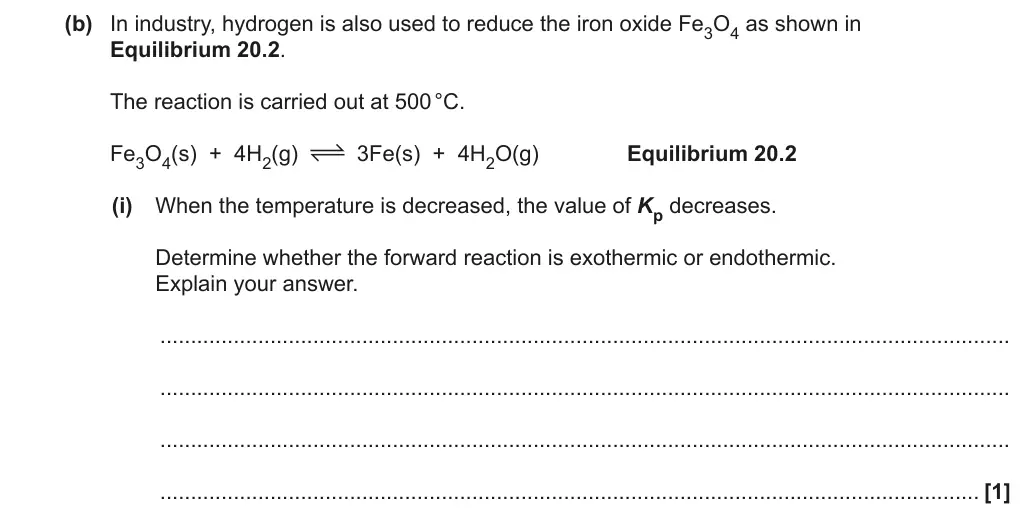
Candidates coped well with this question, but many candidates did not gain the mark due to ambiguous statements. Some identified the forward reaction as endothermic, but stated that Kp decreased which was given in the question. Others simply stated that the forward reaction was endothermic as the reverse reaction was exothermic.
Notes from the mark scheme and report
equilibrium shifts left as T decreases AND forward reaction endothermic
June 2022 · Paper 1 · Q20(b)(ii)1 markAO3Short answerMedium
Earlier part of question 20 that this part uses
Mark scheme
Examiner's comment
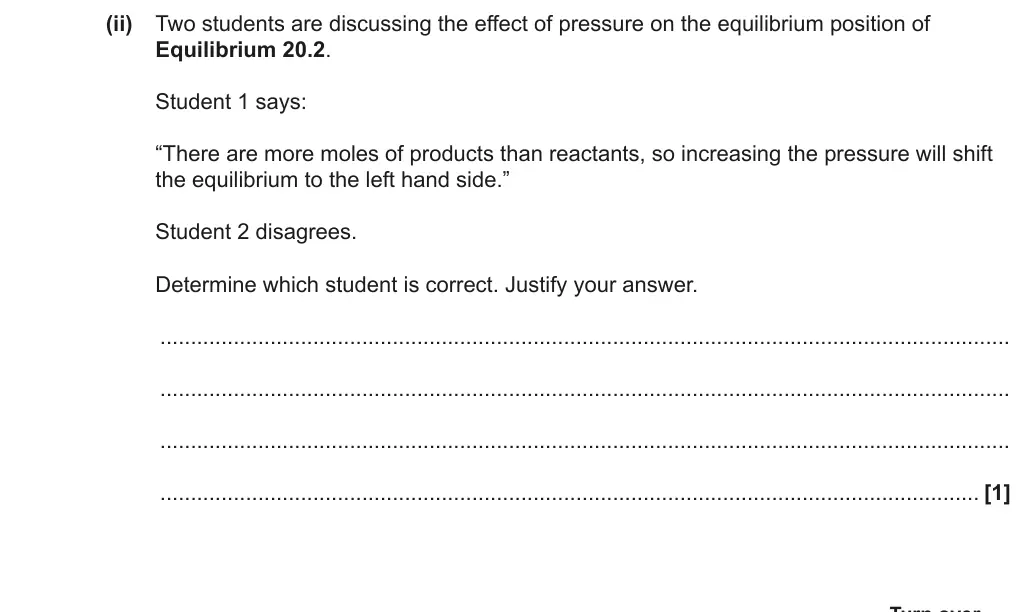
Many candidates gave the correct reason to agree with student 2. Those who agreed with student 1 did not see the equation as a heterogeneous equilibrium system. There were a small number of responses agreeing with student 2 but for the wrong reason – such as a confusion about how the position of equilibrium can change when the value of Kp stays constant. Candidates are advised to read through and address all parts of the question as a minority of students didn’t identify which student was correct but gave a correct explanation.
Notes from the mark scheme and report
Student 2 correct AND same number of moles of GAS on each side (solids ignored)
June 2022 · Paper 3 · Q4(b)(ii)3 marksAO3Short answerMedium
Earlier parts of question 4 that this part uses
Mark scheme
Examiner's comment
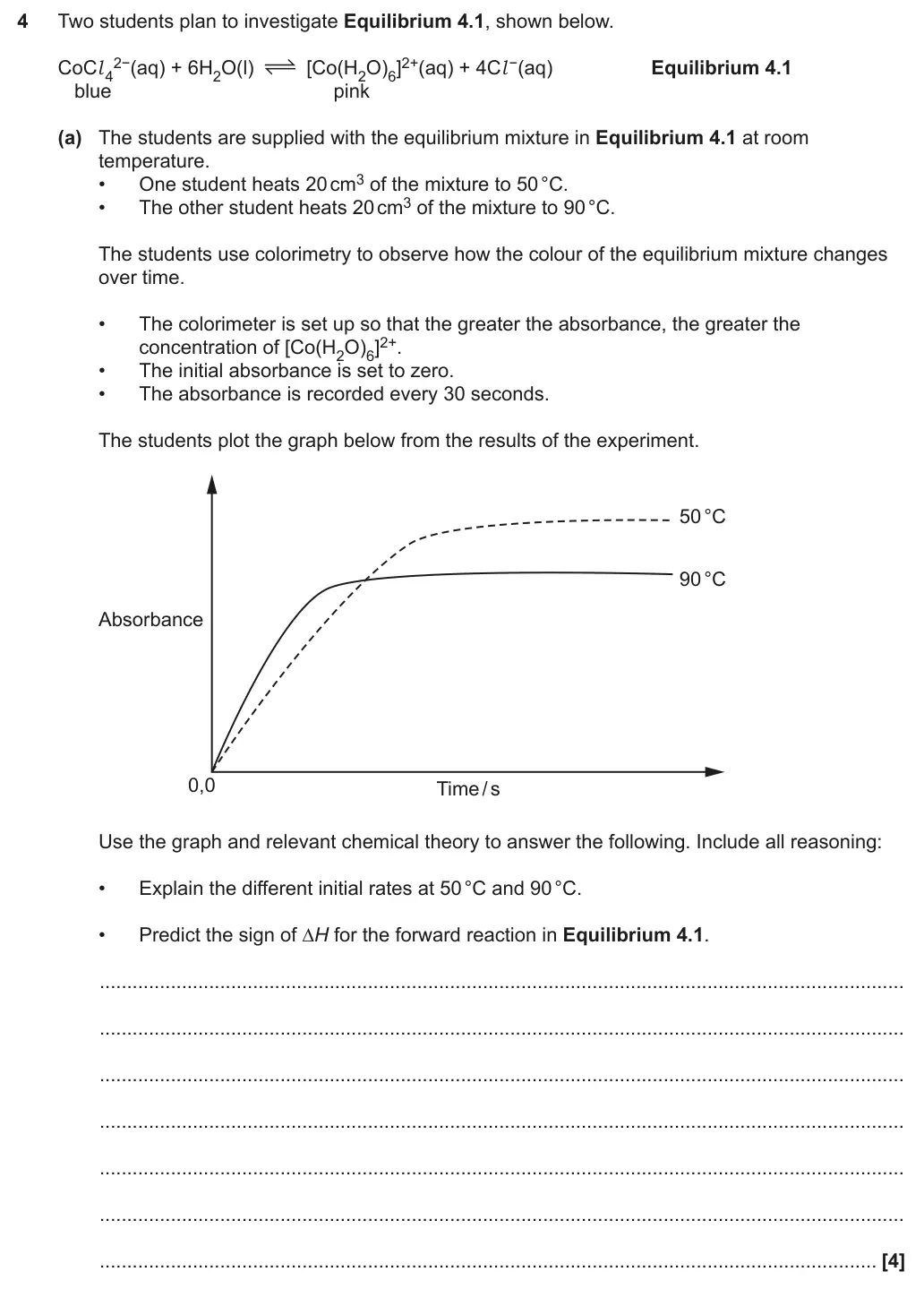
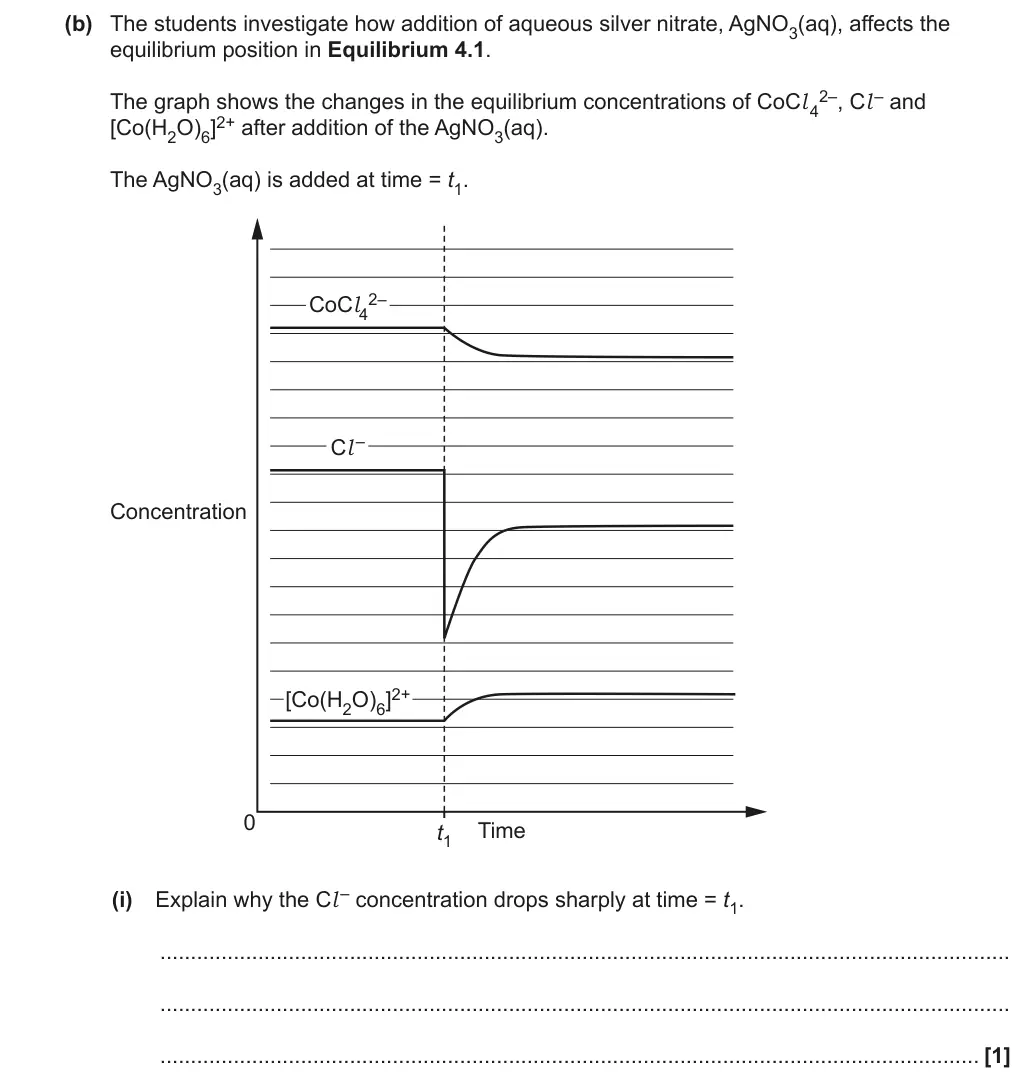
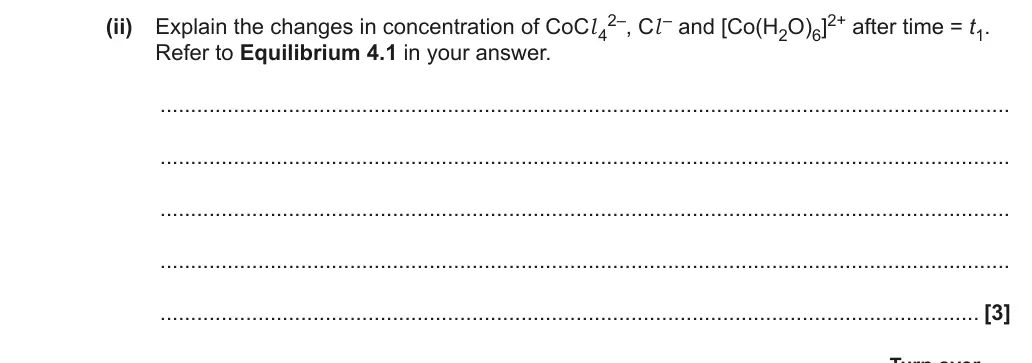
In contrast with Question 4 (a), most candidates did interpret the graphical information provided and related this to the reduced concentration of CoCl42– ions and the increased concentration of [Co(H2O)6]2+ ions. Most candidates also referred to Equilibrium 4.1 to conclude that the equilibrium shifts to the right. Only the very best candidates recognised that the increase in Cl– concentration following the initial addition of AgNO3 was 4 times greater than the increase in the concentration of Co(H2O)6]2+, arising from the 4 : 1 ratio in the stoichiometry in the equation.
Notes from the mark scheme and report
Cl– increase is 4 × the change in the complex ions
equilibrium shifts to the right (to replace Cl–)
Skills: M0.2 Use ratios, fractions and percentages; M3.1 Translate information between graphical, numerical and algebraic forms
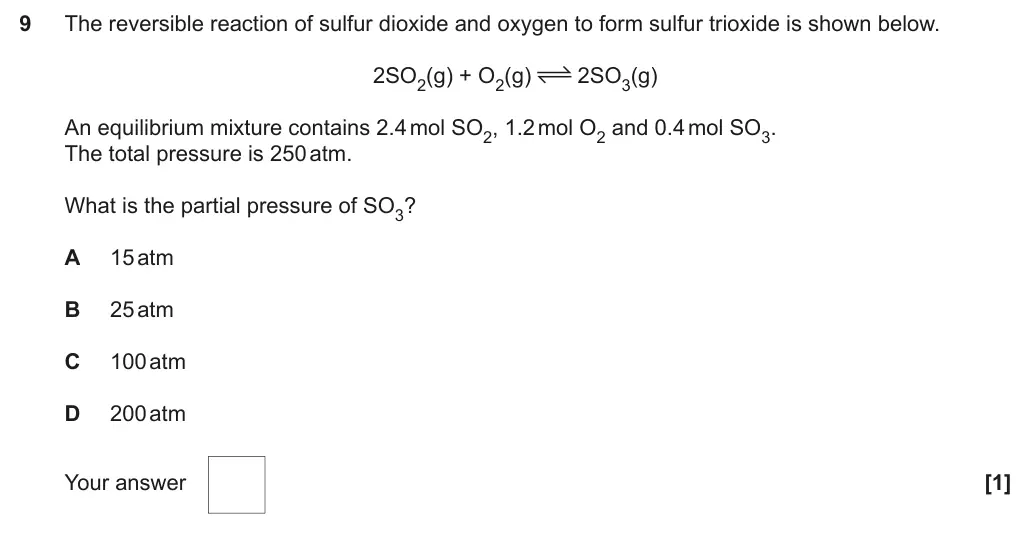
November 2021 · Paper 1 · Q91 markMultiple choice
Answer
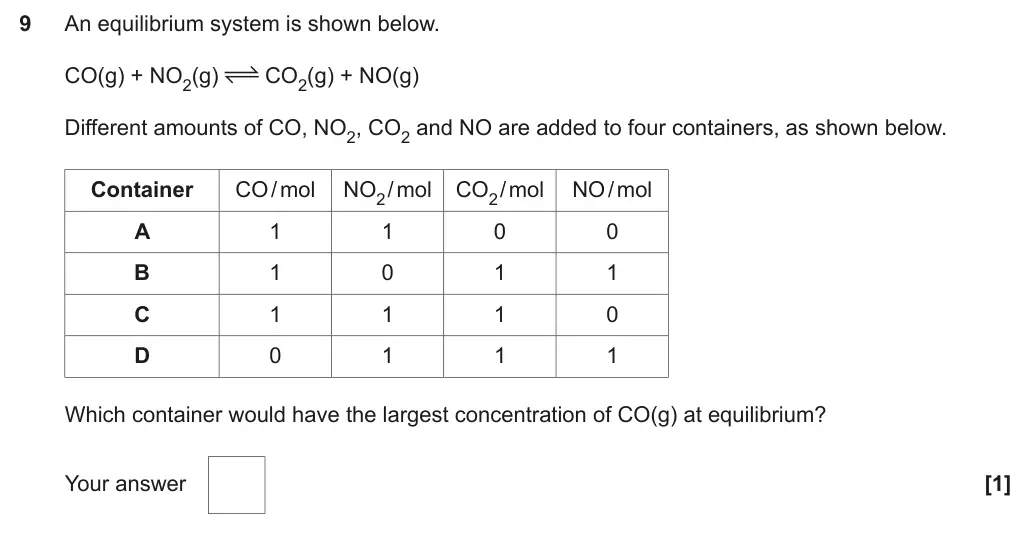
B
Mark scheme
November 2021 · Paper 1 · Q20(c)(i)4 marksAO2CalculationMedium
Earlier part of question 20 that this part uses
Mark scheme
Examiner's comment
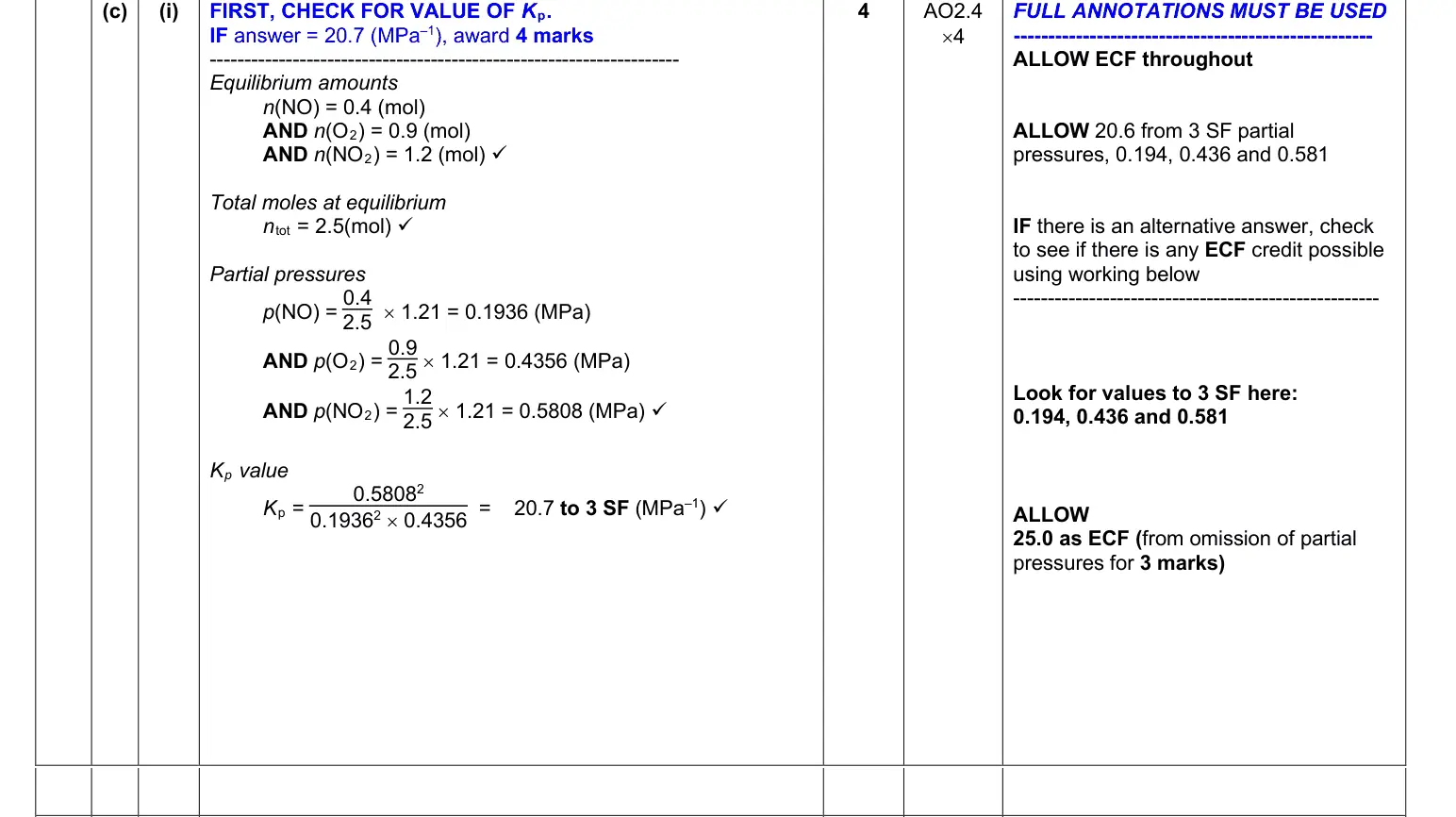
Question 20(c): This question asked the candidate to calculate Kp.
Notes from the mark scheme and report
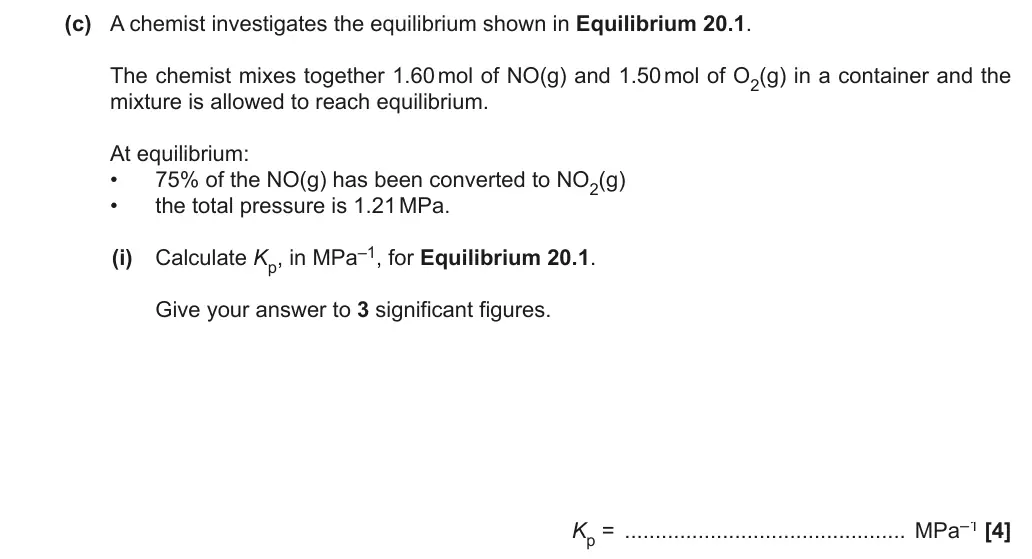
equilibrium moles 0.4, 0.9 and 1.2 (total 2.5)
partial pressures = mole fraction × 1.21
ALLOW 20.6 from 3 SF partial pressures
25.0 (moles used, no partial pressures) scores 3
Skills: M0.2 Use ratios, fractions and percentages; M1.1 Use an appropriate number of significant figures; M2.3 Substitute numerical values into algebraic equations using appropriate units for physical quantities
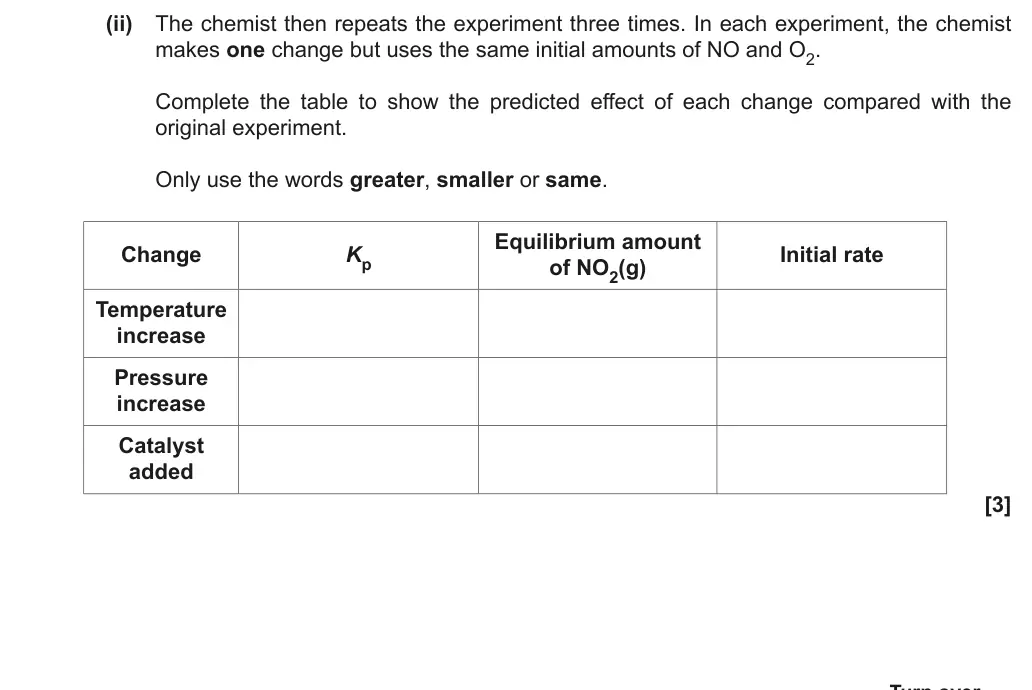
November 2021 · Paper 1 · Q20(c)(ii)3 marksAO1Complete table/diagramMedium
Earlier parts of question 20 that this part uses
Mark scheme
Examiner's comment
Question 20(c): This question asked the candidate to calculate Kp.
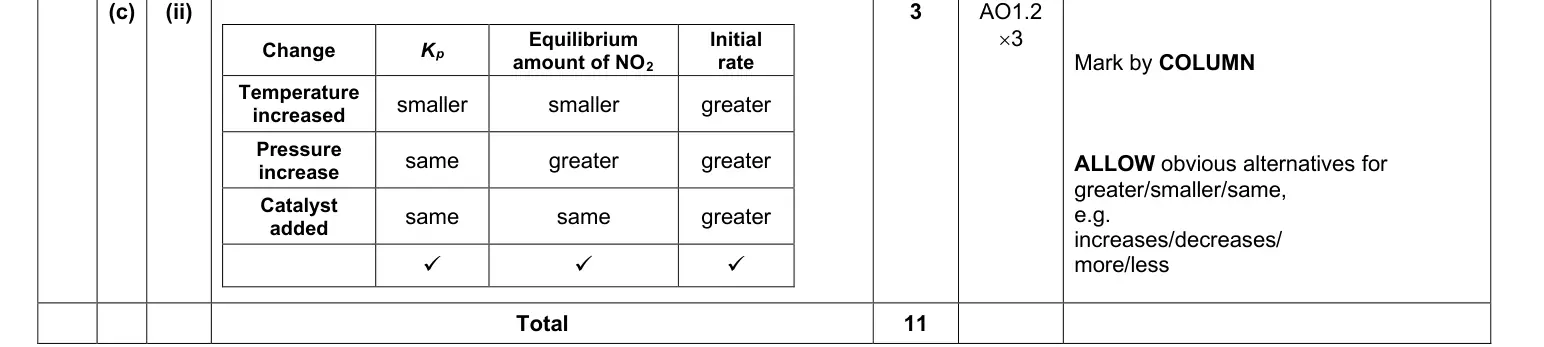
Notes from the mark scheme and report
marked by column: Kp smaller/same/same
amount of NO2 smaller/greater/same
initial rate greater for all three
November 2021 · Paper 3 · Q1(a)2 marksAO1CalculationHard
Mark scheme
Examiner's comment
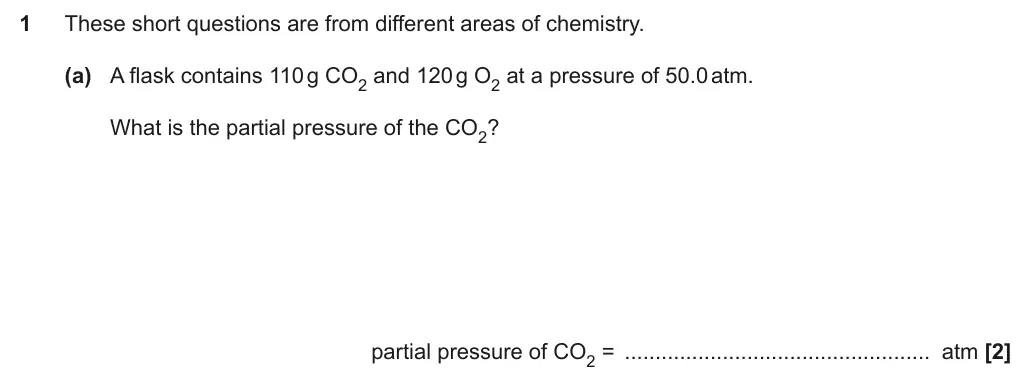
Q1(a) Partial pressure calculation Q1(d) Formula determination from percentage composition by mass Q2(b) Converting mass and volume into moles Q3(b) Unstructured titration calculation Q5(a)(ii) Ideal gas calculation Q5(b)(i) Calculation of the pH of a weak acid • Produced clear and concise responses for a Level of Response question based on a familiar context i.e., Q4(b) rates by continuous monitoring and graphical analysis. • Had difficulty when answering questions requiring application of knowledge and understanding on questions set in novel and unfamiliar contexts, e.g. Q1(a): Candidates were assessed on their understanding of partial pressure.
Notes from the mark scheme and report
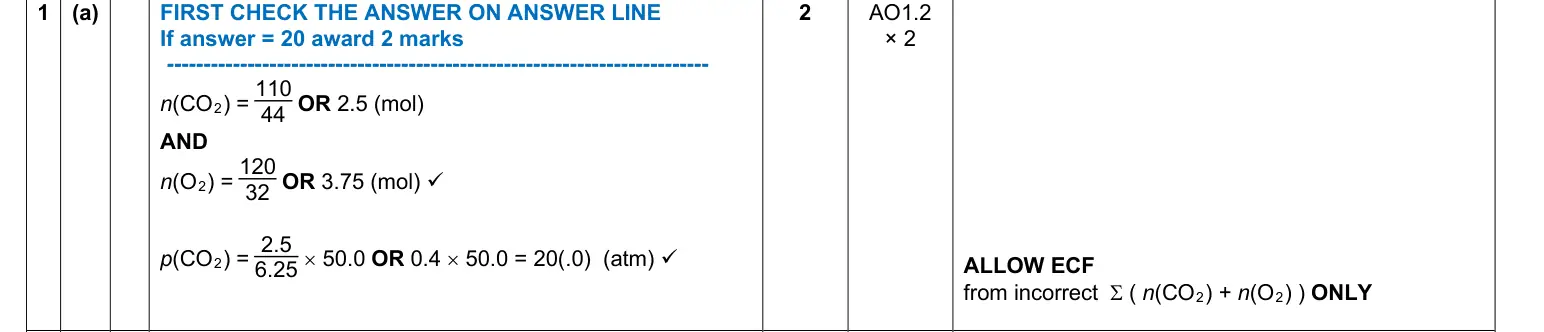
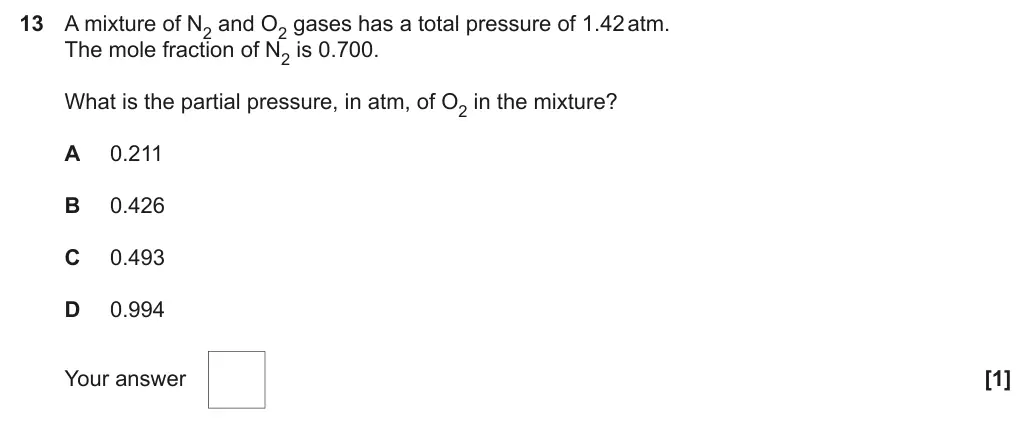
n(CO2) = 2.5 and n(O2) = 3.75
mole fraction 0.4 × 50.0 = 20 atm
ALLOW ECF from incorrect total moles only
Skills: M0.2 Use ratios, fractions and percentages; M2.3 Substitute numerical values into algebraic equations using appropriate units for physical quantities
November 2021 · Paper 3 · Q1(b)2 marksAO1, 2CalculationMedium
Mark scheme
Examiner's comment
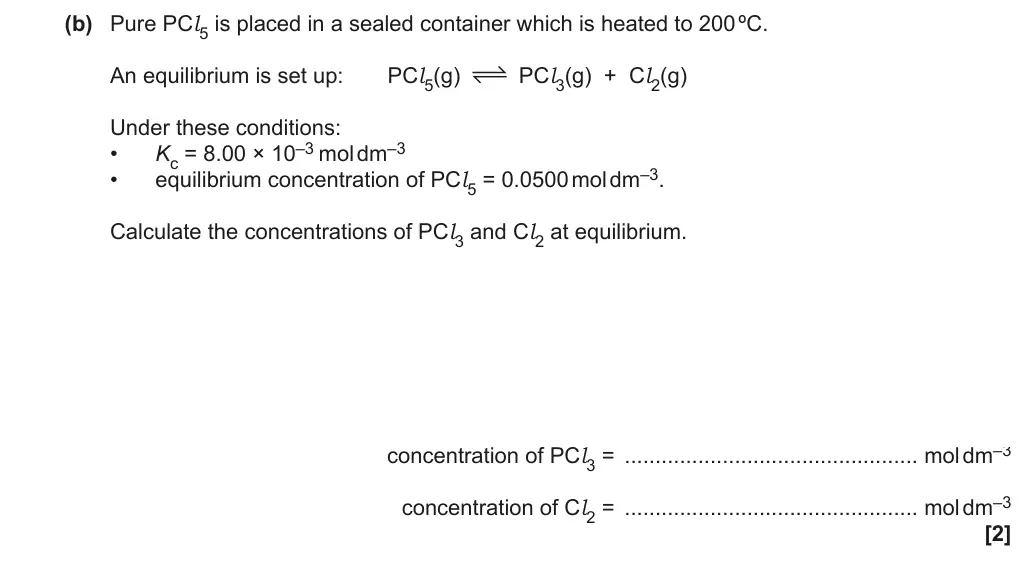
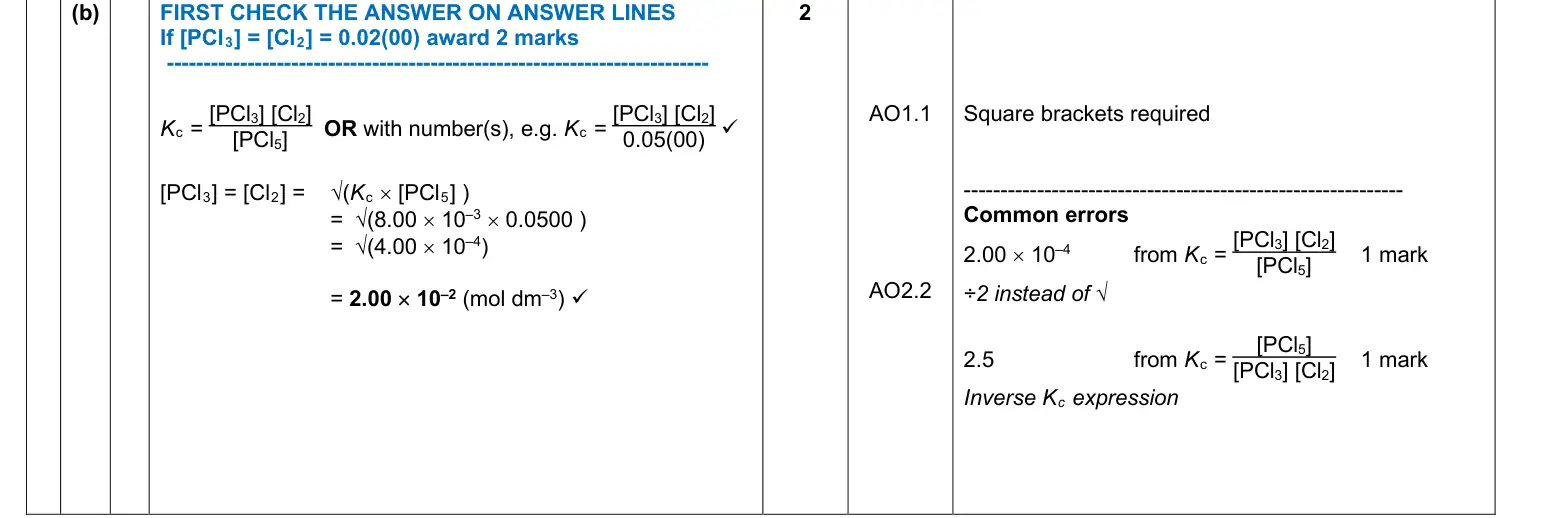
Q1(b): Candidates were required to apply their understanding of Kc to a novel context requiring some mathematical awareness.
Notes from the mark scheme and report
square brackets required in Kc
common errors: ÷2 instead of √ (2.00 × 10⁻⁴), inverse Kc expression (2.5)
Skills: M2.2 Change the subject of an equation; M2.3 Substitute numerical values into algebraic equations using appropriate units for physical quantities; M2.4 Solve algebraic equations
November 2020 · Paper 1 · Q91 markAO2Multiple choice
Answer
B
Mark scheme
Notes from the mark scheme and report
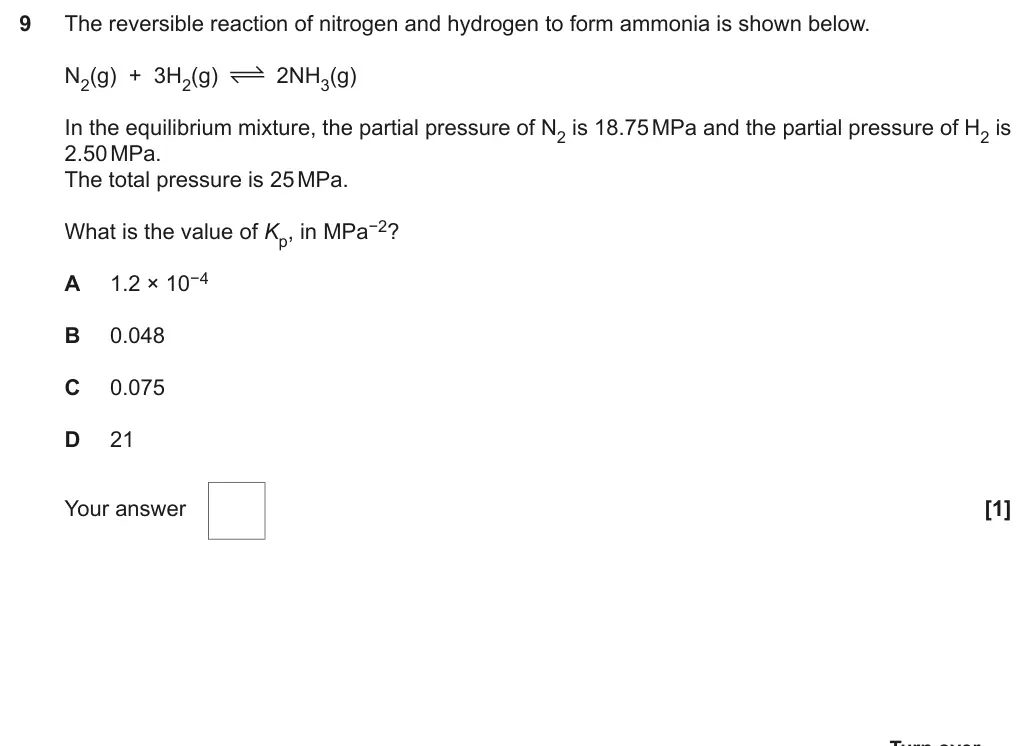
p(NH3) = 25 – 18.75 – 2.50
Skills: M0.2 Use ratios, fractions and percentages; M2.3 Substitute numerical values into algebraic equations using appropriate units for physical quantities
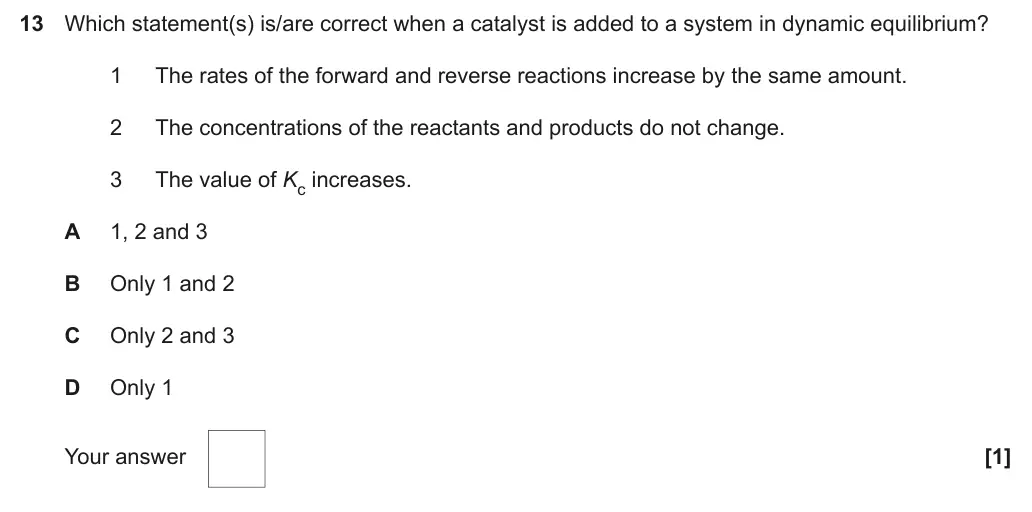
November 2020 · Paper 1 · Q131 markAO1Multiple choice
Answer
B
Mark scheme
November 2020 · Paper 1 · Q17(d)3 marksAO1, 3CalculationMedium
Earlier part of question 17 that this part uses
Mark scheme
Examiner's comment
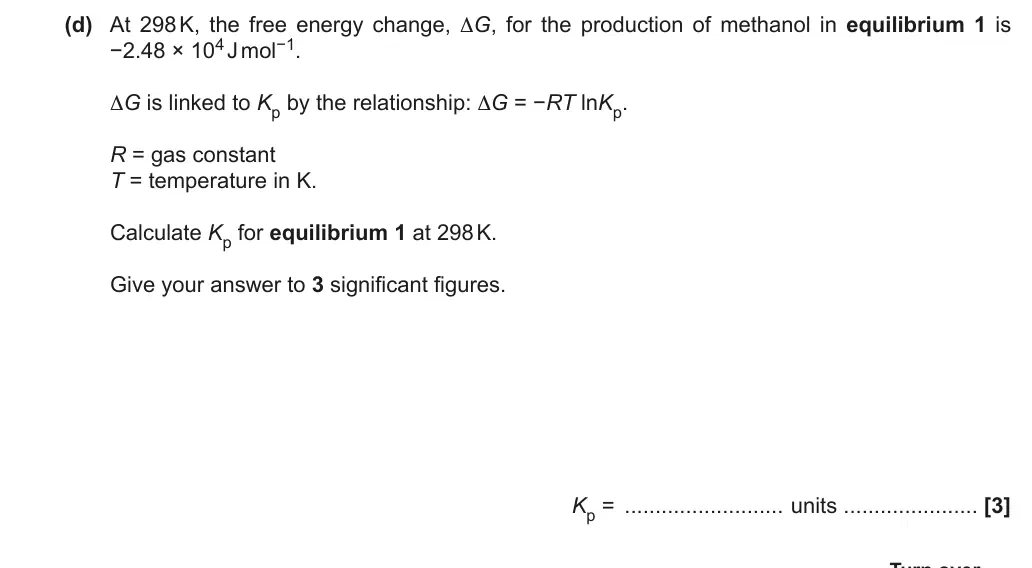
This was an unfamiliar expression linking ∆G and Kp. Many candidates correctly calculated this number. Some candidates calculated ln Kp as 10.0 but then put a – in front for the e calculation. The question required the answer to 3 significant figures. Higher-attaining candidates were able to work out the units as any pressure unit -2 .
Notes from the mark scheme and report
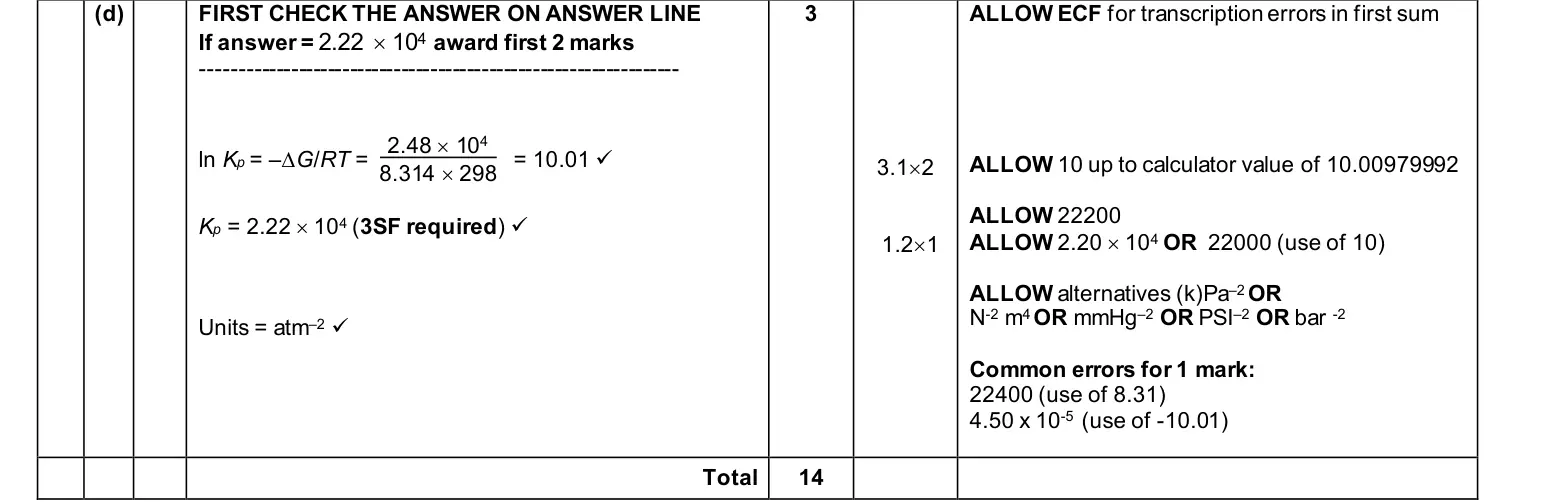
ln Kp = –∆G/RT = 10.01
Kp = 2.22 × 10^4 (3 sig figs)
units atm–2 (or Pa–2 etc.)
common errors 22400 (R = 8.31) and 4.50 × 10^–5 (sign) score 1
Skills: M0.0 Recognise and make use of appropriate units in calculations; M0.4 Use calculators to find and use power, exponential and logarithmic functions; M1.1 Use an appropriate number of significant figures; M2.2 Change the subject of an equation; M2.5 Use logarithms in relation to quantities that range over several orders of magnitude
November 2020 · Paper 1 · Q20(b)4 marksAO1, 2CalculationMedium
Earlier part of question 20 that this part uses
Mark scheme
Examiner's comment
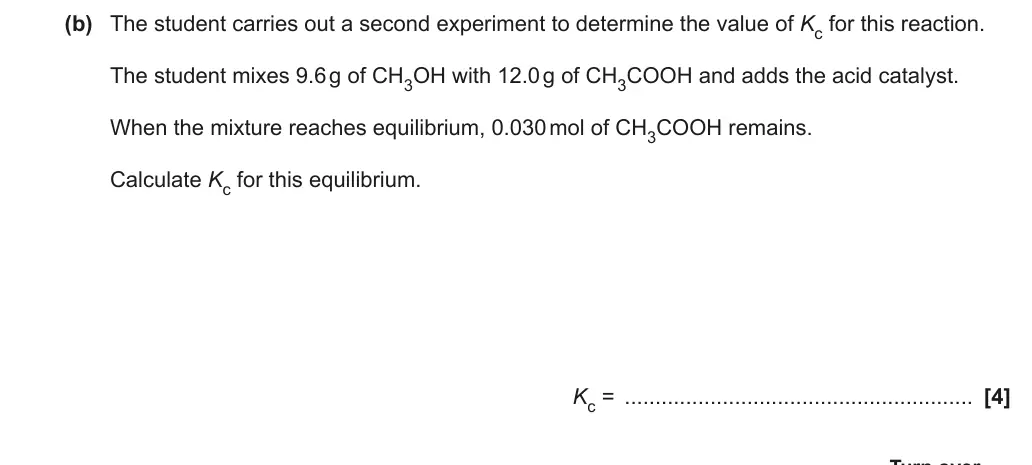
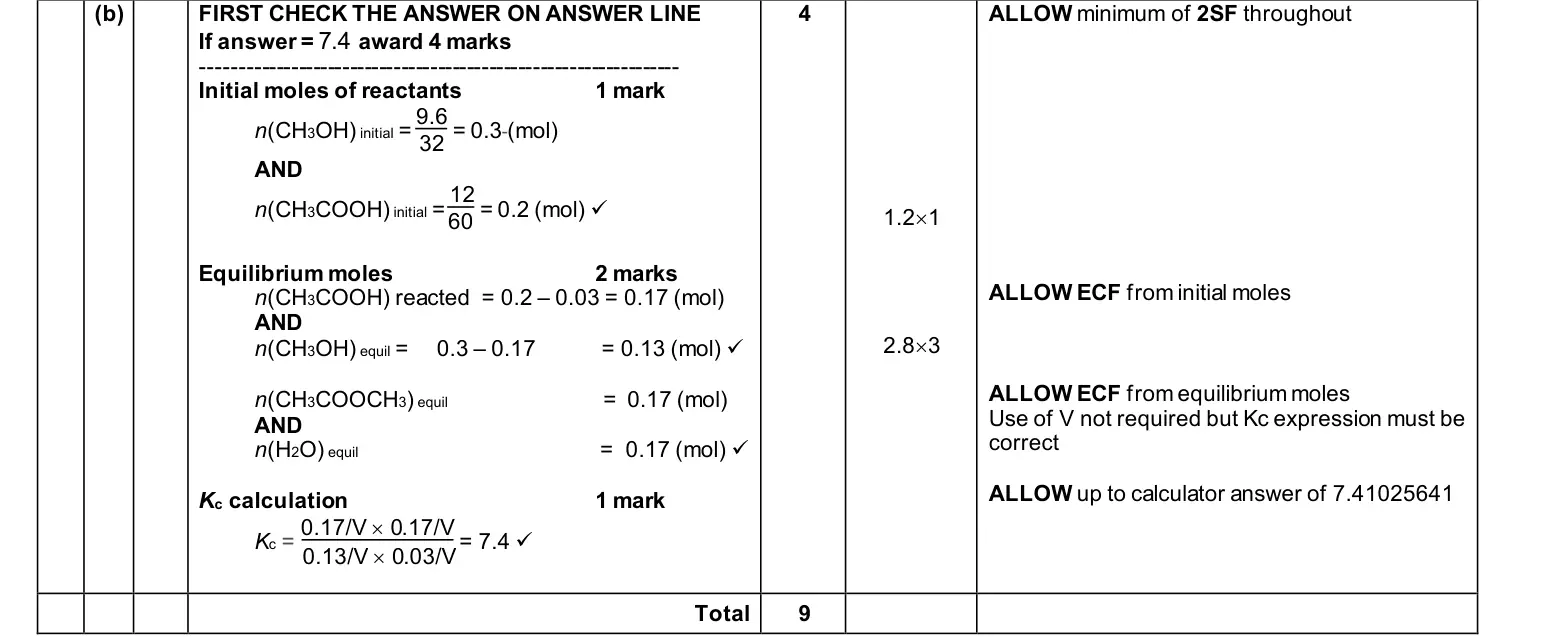
This question asked the candidate to calculate Kc. Higher-attaining students tended to gain full marks. Some candidates made full use of tables (e.g. RICE: Reaction, Initial concentration, Change in concentration, Equilibrium concentration) which allowed for credit to be given through error carried forward. Some candidates did not use 0.03 as the change, and lower-attaining candidates did not use water in the Kc expression. Candidates should remember to provide written indications of what it is they are working out – presenting the calculations without any annotations can make it harder for error carried forward marks to be given if there is an error in their calculation.
Notes from the mark scheme and report
initial moles 0.3 and 0.2
0.17 mol reacted so 0.13, 0.03, 0.17, 0.17 at equilibrium
Kc = 7.4
V cancels but expression must be correct
Skills: M0.2 Use ratios, fractions and percentages; M2.3 Substitute numerical values into algebraic equations using appropriate units for physical quantities
November 2020 · Paper 3 · Q5(a)2 marksAO1Complete table/diagramMedium
Mark scheme
Examiner's comment
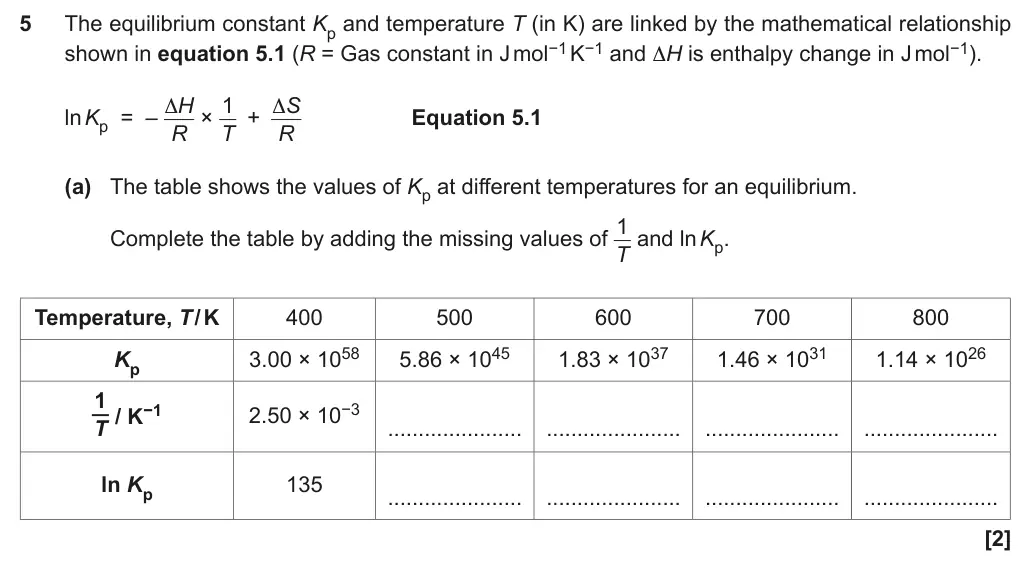
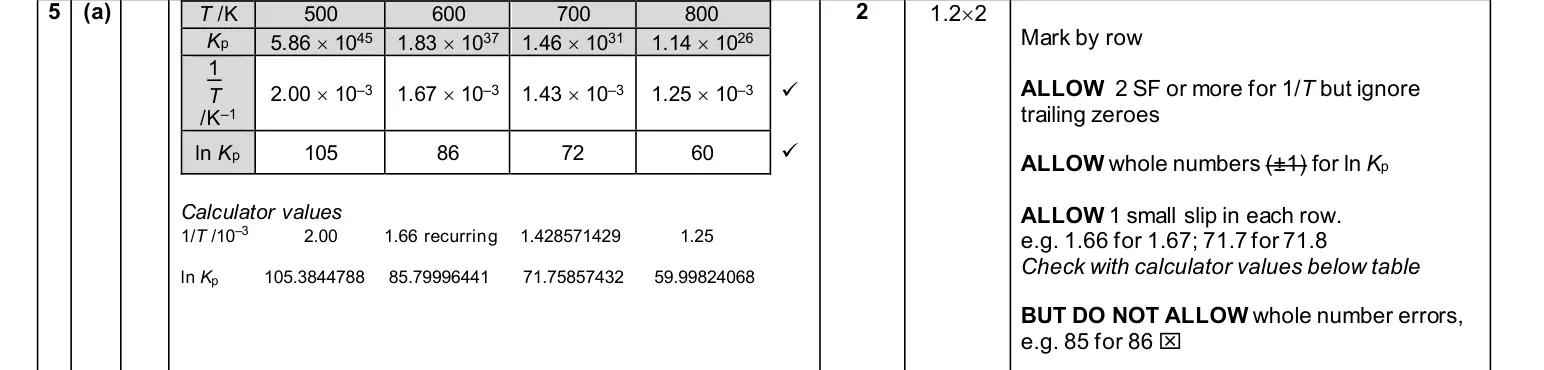
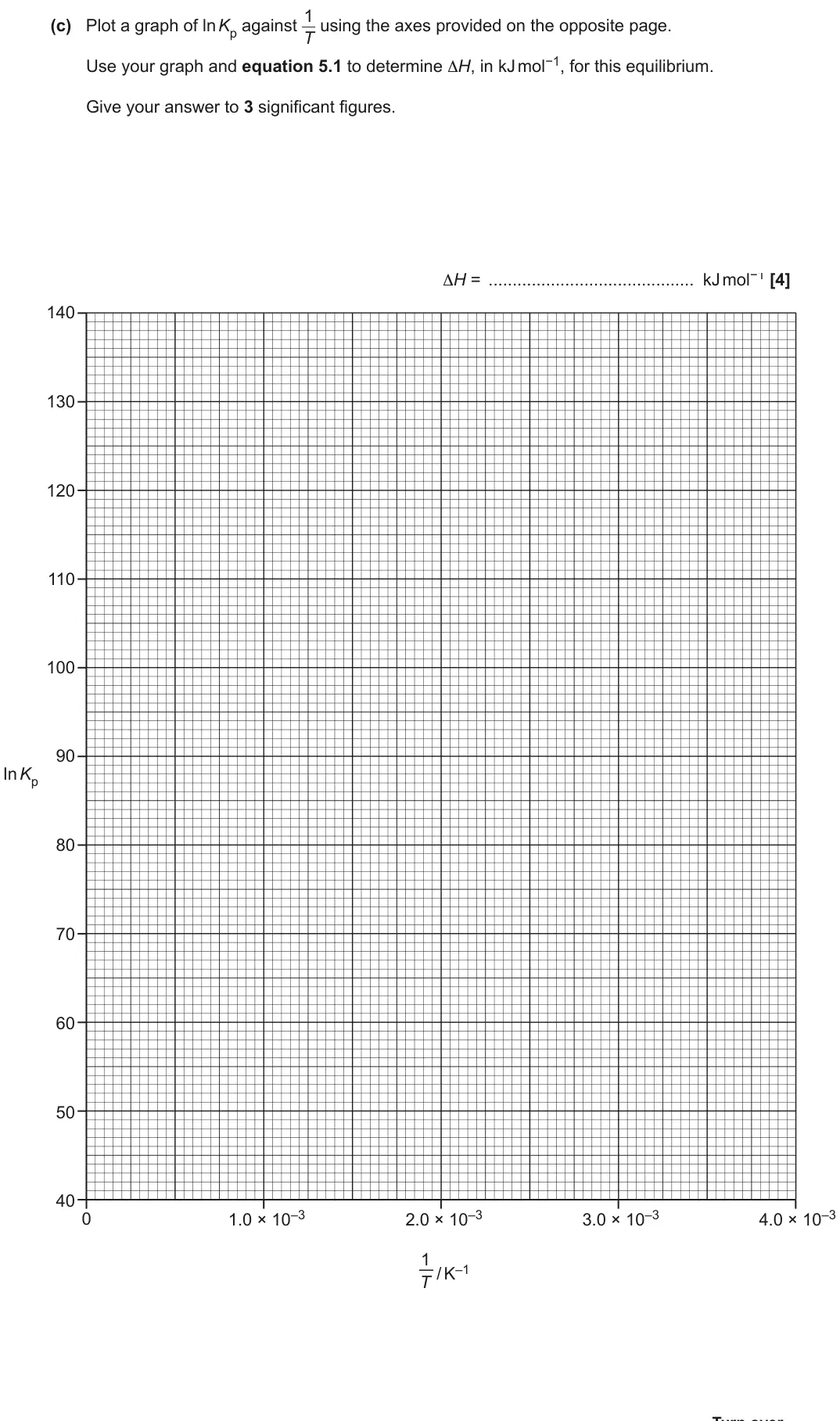
Question 5 related an unfamiliar mathematical relationship with the y = mx + c equation for a straight line. Use of y = mx + c is a mathematical requirement of A level chemistry and candidates were expected to apply their understanding of the Arrhenius equation (part of the specification) which makes use of this straight-line equation in a novel context. Many candidates were unable to use this mathematical concept. In contrast, higher-attaining candidates were able to be credited with marks throughout question 5. 5(a) Candidates were expected to complete values for 1/T and ln Kp from supplied T and Kp values. Candidates were supplied with an example and this enabled most candidates to obtain both available marks. 5(b) Most candidates were aware that a decrease in Kp with increasing temperature signals that the forward reaction is exothermic. The question also asked for the effect on the equilibrium position. A significant number of candidates omitted this part of the question. Candidates are advised to check back to all the requirements in a question. 5(c) Candidates were required to plot a graph using their calculated values from 5(a). The axes for the graph had been provided. It was expected that the plotting of 5 points, with a best-fit straight line, would be straightforward. Many candidates plotted one or more points incorrectly, particularly the point at 1/T = 1.25 × 10⁻³. Candidates then needed to recognise that the gradient is equal to –∆H/R from Equation 5.1, to measure the gradient, and then to determine ∆H. Most candidates recognised that the gradient needed to be measured but its value was then not taken any further. The higher-attaining candidates correctly multiplied the gradient by R but did not always convert the calculated J mol–1 value into kJ mol–1, or to express their value to 3 significant figures, as required in the question. Significantly, nearly a third of candidates did not collect any of the four available marks. The question was an excellent discriminator. 5(d) Mathematically able candidates used the y = mx + c equation for a straight line with the supplied mathematical relationship (Equation 5.1) to identify the y intercept as ∆S/R. They then stated that ∆S could be determined by multiplying the value of the y intercept by R. Many candidates found the mathematical requirements of parts 5(c) and 5(d) difficult. Responses for 5(d) were often in terms of the gradient instead of ‘intercept’.
Notes from the mark scheme and report
mark by row
1/T to 2 SF or more
ln Kp whole numbers 105, 86, 72, 60
DO NOT ALLOW whole-number errors e.g. 85 for 86
Skills: M0.1 Recognise and use expressions in decimal and ordinary form; M0.4 Use calculators to find and use power, exponential and logarithmic functions; M2.5 Use logarithms in relation to quantities that range over several orders of magnitude
November 2020 · Paper 3 · Q5(b)1 markAO2Short answerMedium
Earlier part of question 5 that this part uses
Mark scheme
Examiner's comment
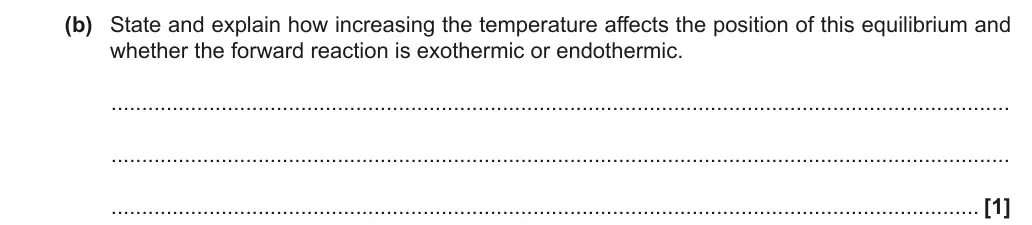
Question 5 related an unfamiliar mathematical relationship with the y = mx + c equation for a straight line. Use of y = mx + c is a mathematical requirement of A level chemistry and candidates were expected to apply their understanding of the Arrhenius equation (part of the specification) which makes use of this straight-line equation in a novel context. Many candidates were unable to use this mathematical concept. In contrast, higher-attaining candidates were able to be credited with marks throughout question 5. 5(a) Candidates were expected to complete values for 1/T and ln Kp from supplied T and Kp values. Candidates were supplied with an example and this enabled most candidates to obtain both available marks. 5(b) Most candidates were aware that a decrease in Kp with increasing temperature signals that the forward reaction is exothermic. The question also asked for the effect on the equilibrium position. A significant number of candidates omitted this part of the question. Candidates are advised to check back to all the requirements in a question. 5(c) Candidates were required to plot a graph using their calculated values from 5(a). The axes for the graph had been provided. It was expected that the plotting of 5 points, with a best-fit straight line, would be straightforward. Many candidates plotted one or more points incorrectly, particularly the point at 1/T = 1.25 × 10⁻³. Candidates then needed to recognise that the gradient is equal to –∆H/R from Equation 5.1, to measure the gradient, and then to determine ∆H. Most candidates recognised that the gradient needed to be measured but its value was then not taken any further. The higher-attaining candidates correctly multiplied the gradient by R but did not always convert the calculated J mol–1 value into kJ mol–1, or to express their value to 3 significant figures, as required in the question. Significantly, nearly a third of candidates did not collect any of the four available marks. The question was an excellent discriminator. 5(d) Mathematically able candidates used the y = mx + c equation for a straight line with the supplied mathematical relationship (Equation 5.1) to identify the y intercept as ∆S/R. They then stated that ∆S could be determined by multiplying the value of the y intercept by R. Many candidates found the mathematical requirements of parts 5(c) and 5(d) difficult. Responses for 5(d) were often in terms of the gradient instead of ‘intercept’.
Notes from the mark scheme and report
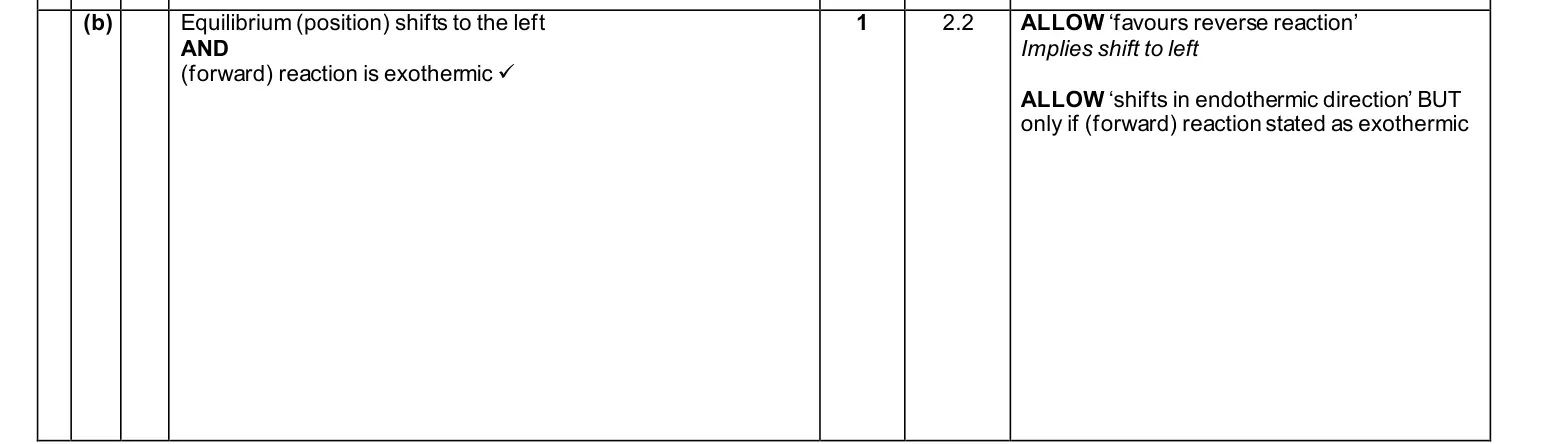
equilibrium shifts to the left AND forward reaction is exothermic (Kp decreases as T increases)
Skills: M0.3 Estimate results
November 2020 · Paper 3 · Q5(c)4 marksAO3CalculationMedium
Earlier parts of question 5 that this part uses
Mark scheme
Examiner's comment
Question 5 related an unfamiliar mathematical relationship with the y = mx + c equation for a straight line. Use of y = mx + c is a mathematical requirement of A level chemistry and candidates were expected to apply their understanding of the Arrhenius equation (part of the specification) which makes use of this straight-line equation in a novel context. Many candidates were unable to use this mathematical concept. In contrast, higher-attaining candidates were able to be credited with marks throughout question 5. 5(a) Candidates were expected to complete values for 1/T and ln Kp from supplied T and Kp values. Candidates were supplied with an example and this enabled most candidates to obtain both available marks. 5(b) Most candidates were aware that a decrease in Kp with increasing temperature signals that the forward reaction is exothermic. The question also asked for the effect on the equilibrium position. A significant number of candidates omitted this part of the question. Candidates are advised to check back to all the requirements in a question. 5(c) Candidates were required to plot a graph using their calculated values from 5(a). The axes for the graph had been provided. It was expected that the plotting of 5 points, with a best-fit straight line, would be straightforward. Many candidates plotted one or more points incorrectly, particularly the point at 1/T = 1.25 × 10⁻³. Candidates then needed to recognise that the gradient is equal to –∆H/R from Equation 5.1, to measure the gradient, and then to determine ∆H. Most candidates recognised that the gradient needed to be measured but its value was then not taken any further. The higher-attaining candidates correctly multiplied the gradient by R but did not always convert the calculated J mol–1 value into kJ mol–1, or to express their value to 3 significant figures, as required in the question. Significantly, nearly a third of candidates did not collect any of the four available marks. The question was an excellent discriminator. 5(d) Mathematically able candidates used the y = mx + c equation for a straight line with the supplied mathematical relationship (Equation 5.1) to identify the y intercept as ∆S/R. They then stated that ∆S could be determined by multiplying the value of the y intercept by R. Many candidates found the mathematical requirements of parts 5(c) and 5(d) difficult. Responses for 5(d) were often in terms of the gradient instead of ‘intercept’.
Notes from the mark scheme and report
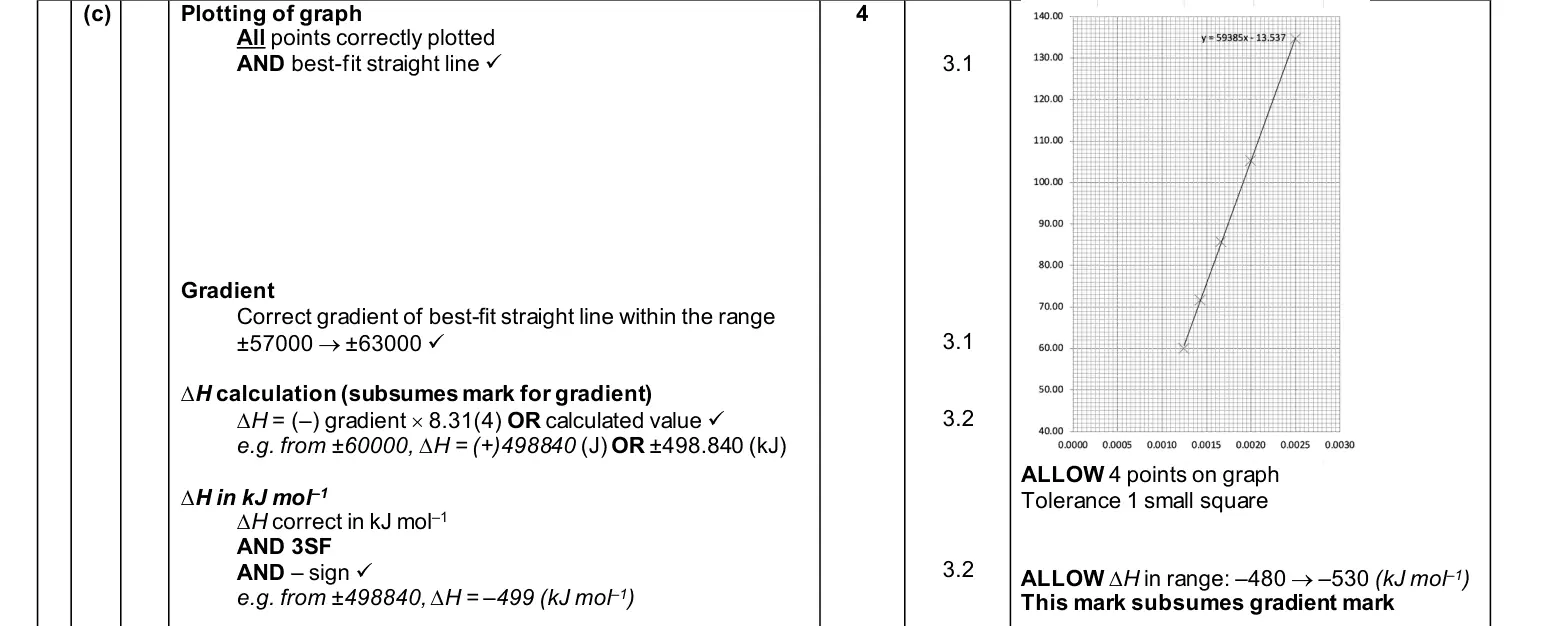
all points plotted with best-fit straight line
gradient ±57 000 to ±63 000
∆H = –gradient × 8.314
answer in kJ mol–1 to 3 SF with – sign (range –480 to –530)
Skills: M0.0 Recognise and make use of appropriate units in calculations; M1.1 Use an appropriate number of significant figures; M2.3 Substitute numerical values into algebraic equations using appropriate units for physical quantities; M3.1 Translate information between graphical, numerical and algebraic forms; M3.2 Plot two variables from experimental or other data; M3.3 Determine the slope and intercept of a linear graph
June 2019 · Paper 1 · Q19(b)(i)2 marksAO1CalculationMedium
Mark scheme
Examiner's comment
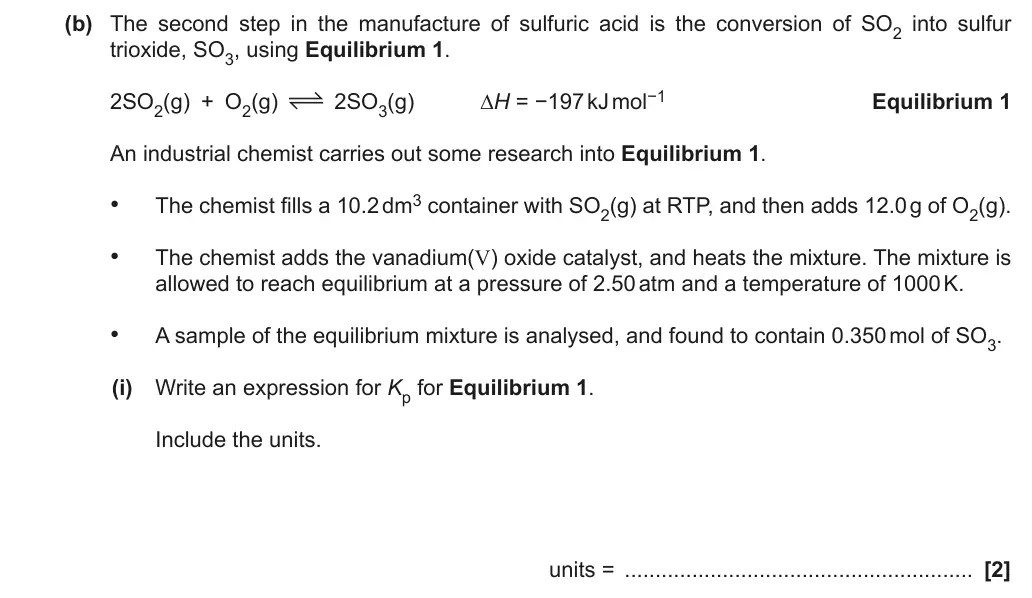
The equilibrium expression was correct in most responses. Occasionally incorrect square brackets were used instead of round brackets. Candidates should be reminded that square brackets indicate a concentration and are not appropriate for use in Kp expressions.
Notes from the mark scheme and report
DO NOT ALLOW square brackets
atm–1 (ALLOW any pressure unit)
ECF atm if Kp inverted
Skills: M0.0 Recognise and make use of appropriate units in calculations
June 2019 · Paper 1 · Q19(b)(ii)5 marksAO2CalculationHard
Earlier part of question 19 that this part uses
Mark scheme
Examiner's comment
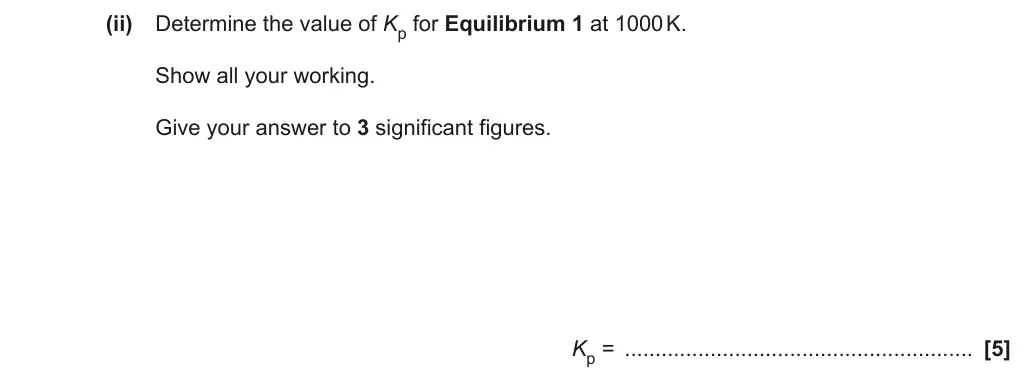
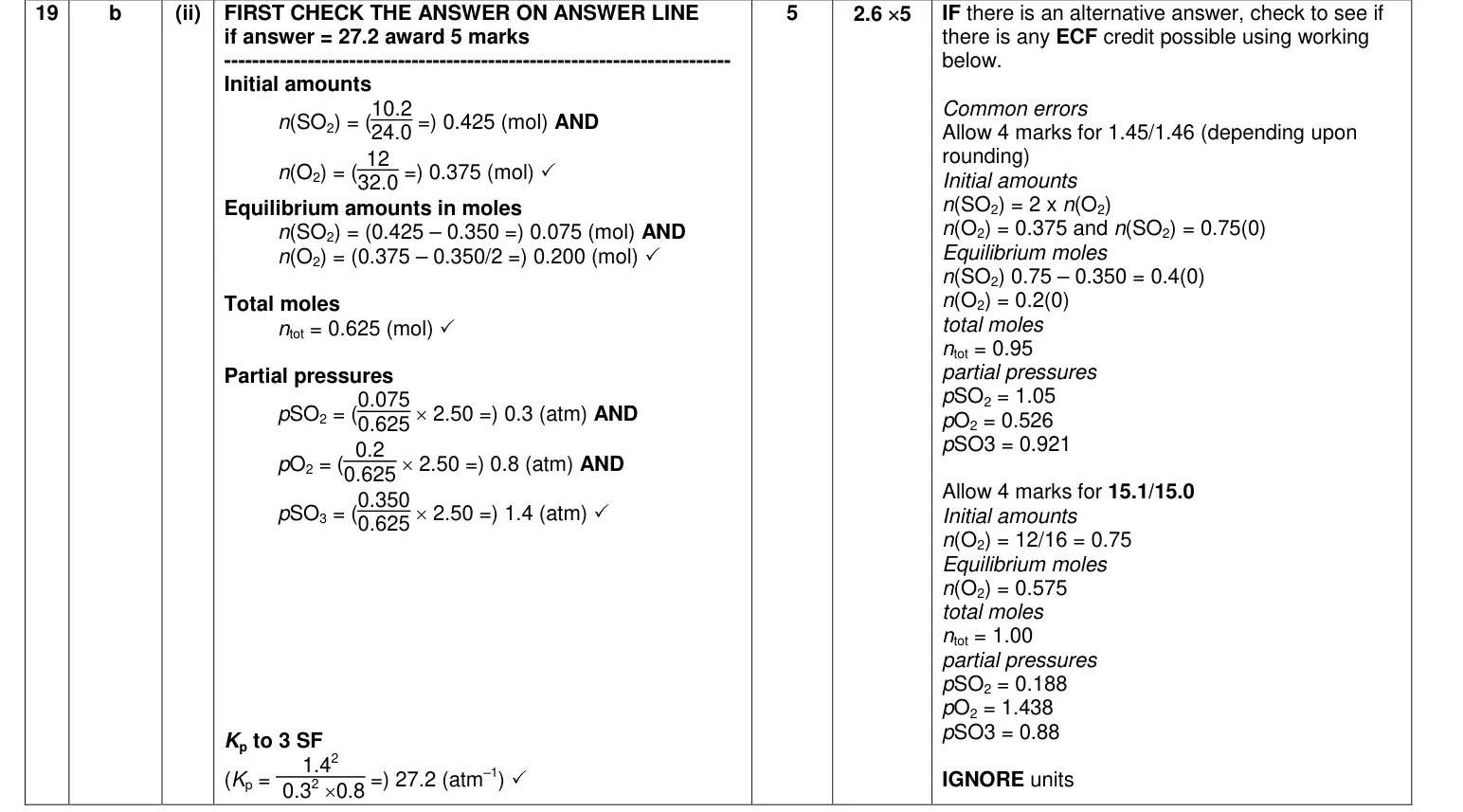
Candidates tend to find Kp calculations difficult and so may need guidance in developing a strategy to work their way through them. A typical approach is: • Calculation of initial moles present • Calculation of the change in moles present • Deduction of the number of moles present at equilibrium • Determination of total moles present at equilibrium • Calculation of mole fractions at equilibrium • Calculation of partial pressures at equilibrium • Inserting partial pressure vales into the Kp expression • Writing an answer to the required number of significant figures.
Notes from the mark scheme and report
initial SO2 from 10.2/24.0 and O2 from 12.0/32.0
O2 used = 0.350/2
total moles 0.625
common errors 1.45 (n(SO2) = 2 × n(O2)) and 15.1 (12/16 for O2) score 4
3 SF
Skills: M0.2 Use ratios, fractions and percentages; M1.1 Use an appropriate number of significant figures; M2.3 Substitute numerical values into algebraic equations using appropriate units for physical quantities
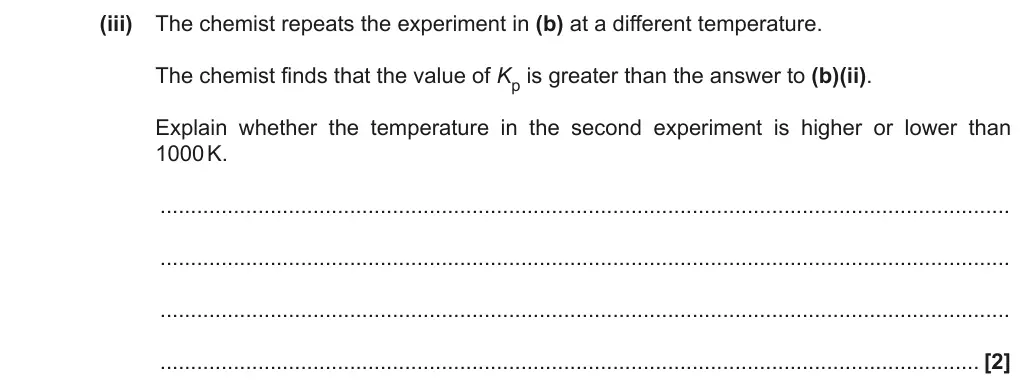
June 2019 · Paper 1 · Q19(b)(iii)2 marksAO3Short answerEasy
Earlier parts of question 19 that this part uses
Mark scheme
Examiner's comment
Some very wordy responses to this straightforward question were seen. Candidates are reminded that keeping responses concise and to the point can make their answer clearer, and there is no need to fill the whole question space provided if an answer can be provided more succinctly.
Notes from the mark scheme and report
greater Kp means equilibrium shifted to right
lower temperature because forward reaction is exothermic
June 2019 · Paper 1 · Q19(b)(iv)1 markAO3Short answerMedium
Earlier part of question 19 that this part uses
Mark scheme
Examiner's comment
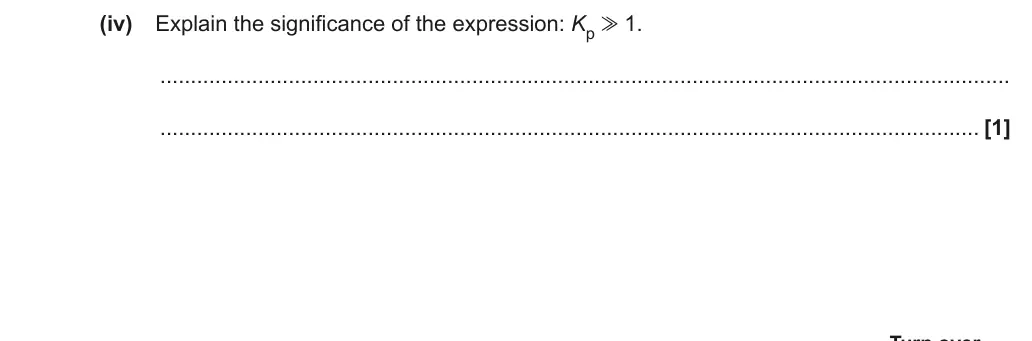
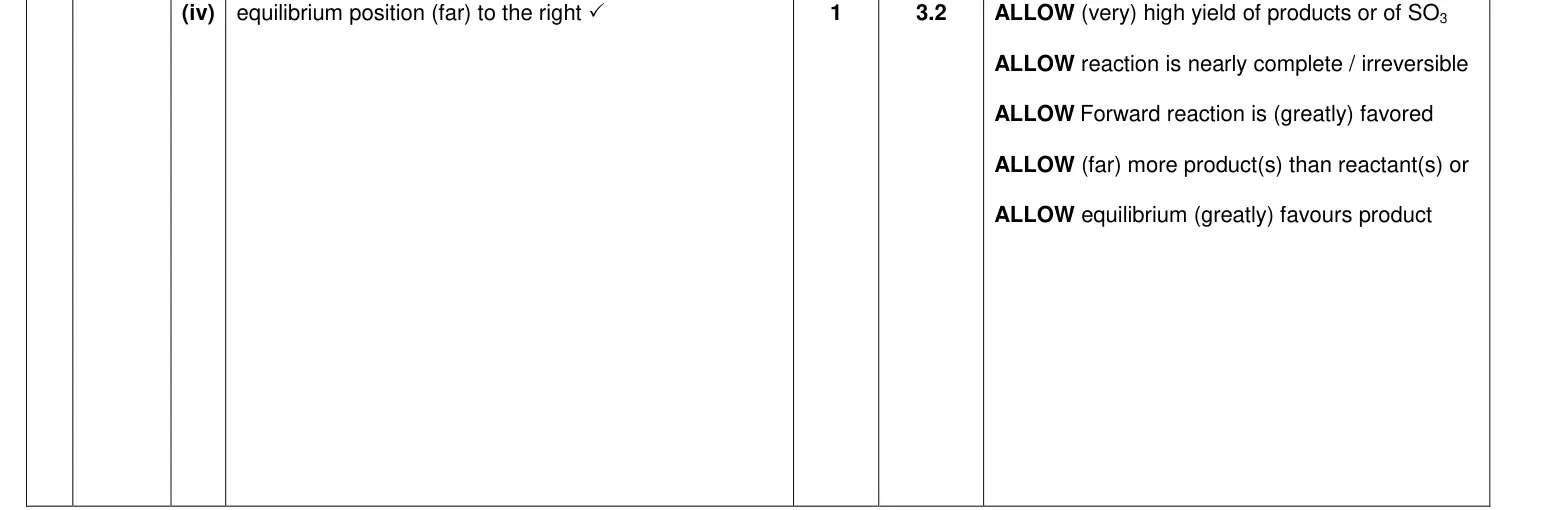
Most candidates realised that the symbol indicated the equilibrium was (far) to the right hand side. The common error was to tell the examiner that Kp was bigger than 1.
Notes from the mark scheme and report
equilibrium position (far) to the right
ALLOW reaction nearly complete/high yield of products
Skills: M0.3 Estimate results; M2.1 Understand and use the symbols =, <, <<, >>, >, ∝, ~, ⇌
June 2019 · Paper 3 · Q1(c)1 markAO2CalculationMedium
Mark scheme
Examiner's comment
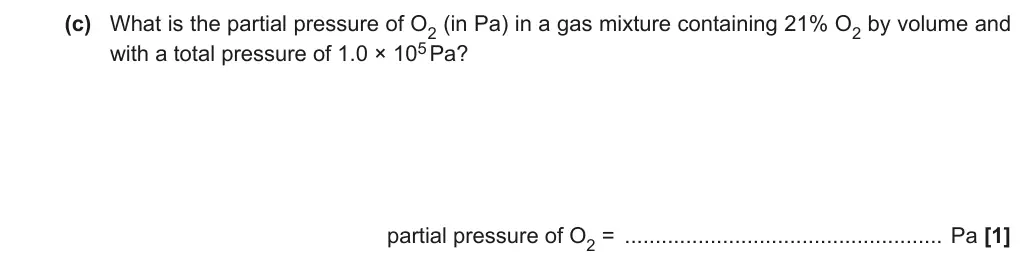
This question tested an understanding of ‘partial pressure’ as a concept. Most candidates obtained the correct response of 21,000 Pa or 2.1 × 10⁴ Pa. Scaling proved to be a common error with 2.1 × 10⁻⁴ Pa being seen, presumably from dividing, instead of multiplying, 0.21 by 1 × 104. In calculations, candidates are advised to think about whether their answer is sensible, rather than relying just on the answer displayed on the calculator.
Notes from the mark scheme and report
0.21 × 1.0 × 10^5 = 2.1 × 10^4 Pa
Skills: M0.1 Recognise and use expressions in decimal and ordinary form; M0.2 Use ratios, fractions and percentages
June 2018 · Paper 1 · Q91 markAO1Multiple choiceEasy
Answer
B
Mark scheme
Examiner's comment
This was a very successful multiple choice question for nearly all candidates.
June 2018 · Paper 1 · Q18(a)2 marksCalculationMedium
Mark scheme
Examiner's comment
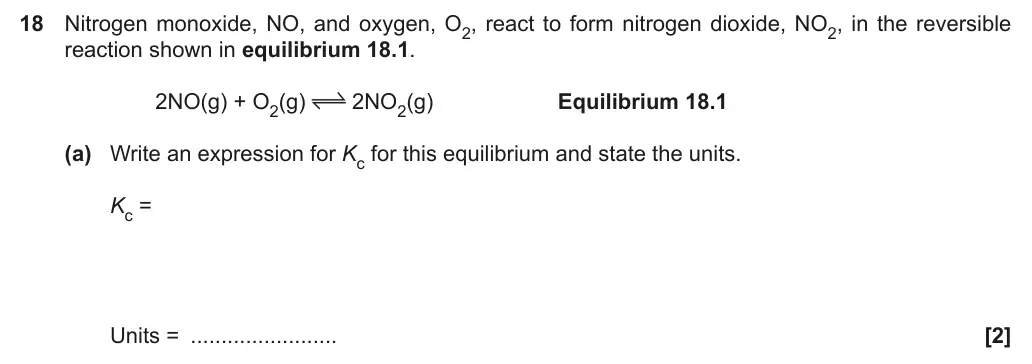
The expression and the units were almost universally known by the candidates.
Notes from the mark scheme and report
square brackets essential
units dm3 mol–1
ALLOW mol dm–3 as ECF from inverted expression
Skills: M0.0 Recognise and make use of appropriate units in calculations
June 2018 · Paper 1 · Q18(b)4 marksCalculationMedium
Earlier part of question 18 that this part uses
Mark scheme
Examiner's comment
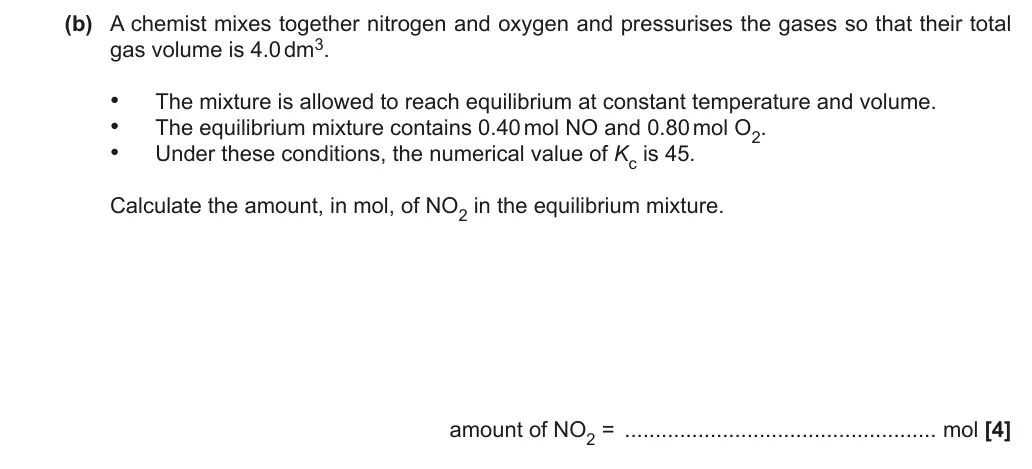
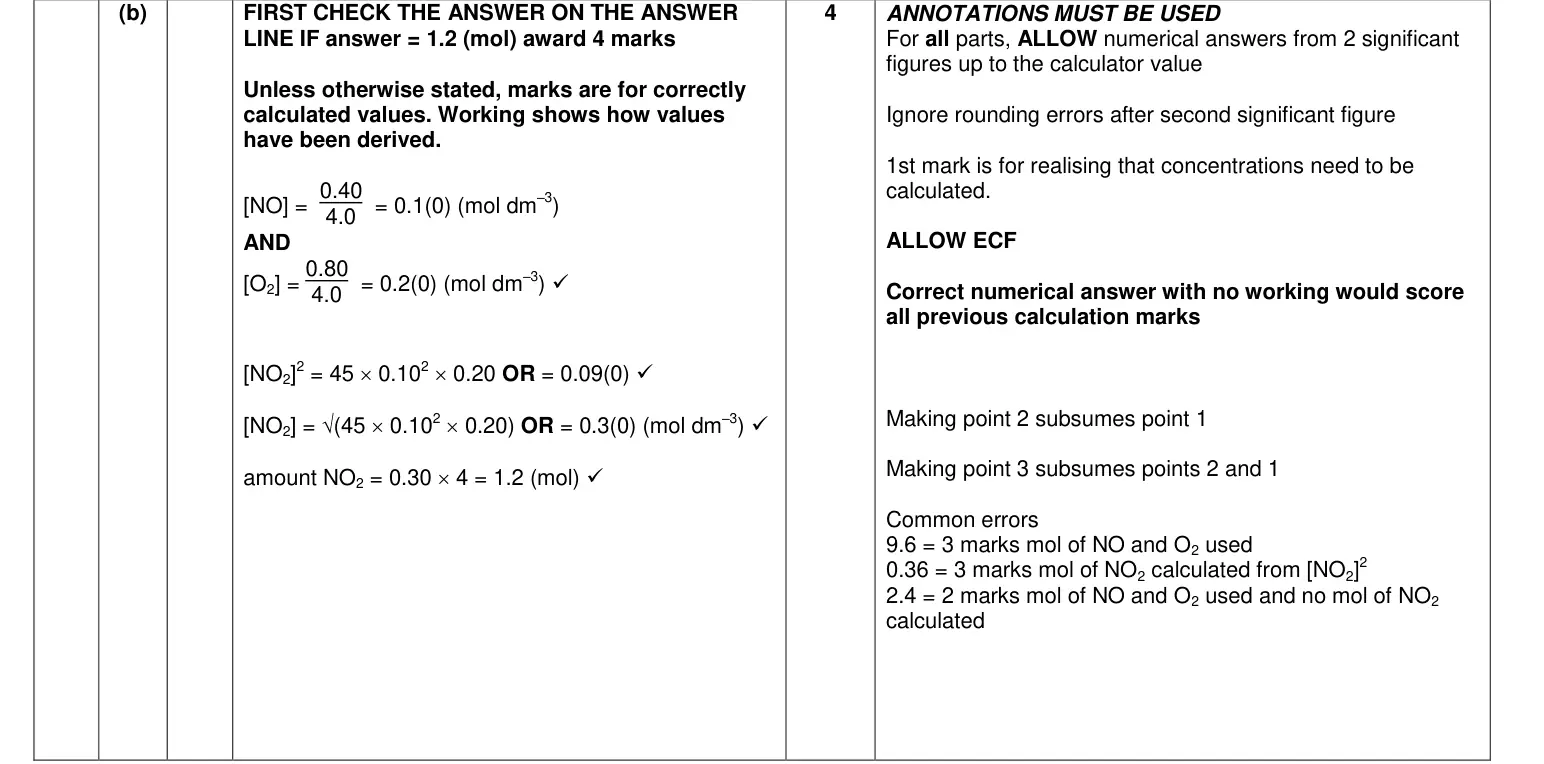
There were three steps to this calculation: Conversion of molar quantities of NO and O2 to molar concentrations. Insertion into the Kc expression and determination (via a square root calculation) of the molar concentration of NO2. Conversion of the molar concentration of NO2 to a molar quantity. Steps 1 and/or 3 of the calculation were occasionally omitted but if the calculation was presented in a coherent manner, even here, partial credit was awarded.
Notes from the mark scheme and report
convert mol to concentrations (÷ 4.0) first
square root of 0.090
× 4 to get mol
common errors 9.6 (moles used, 3 marks), 0.36 (no square root, 3 marks), 2.4 (2 marks)
Skills: M2.2 Change the subject of an equation; M2.3 Substitute numerical values into algebraic equations using appropriate units for physical quantities; M2.4 Solve algebraic equations
June 2018 · Paper 1 · Q18(c)(i)1 markShort answerMedium
Earlier part of question 18 that this part uses
Mark scheme
Examiner's comment
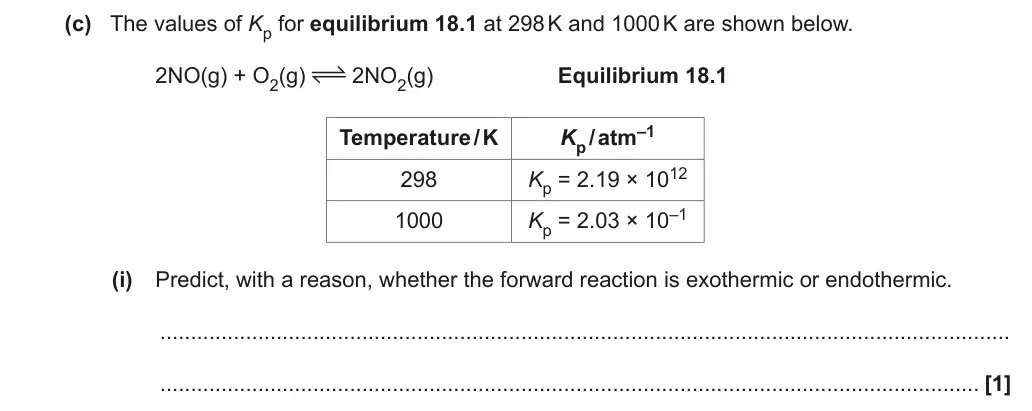
Most candidates knew the forward reaction was exothermic due to Kp decreasing as temperature increased. A common error was to write vague responses such as ‘Kp decreases with temperature’.
Notes from the mark scheme and report
exothermic AND Kp decreases as temperature increases
June 2018 · Paper 1 · Q18(c)(ii)3 marksShort answerHard
Earlier parts of question 18 that this part uses
Mark scheme
Examiner's comment
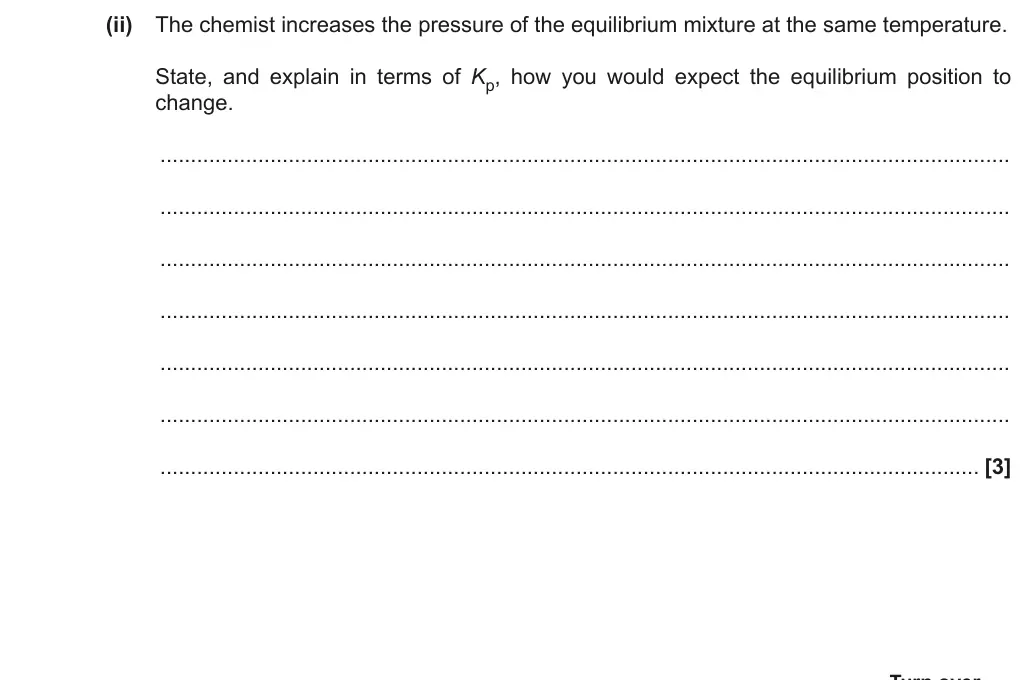
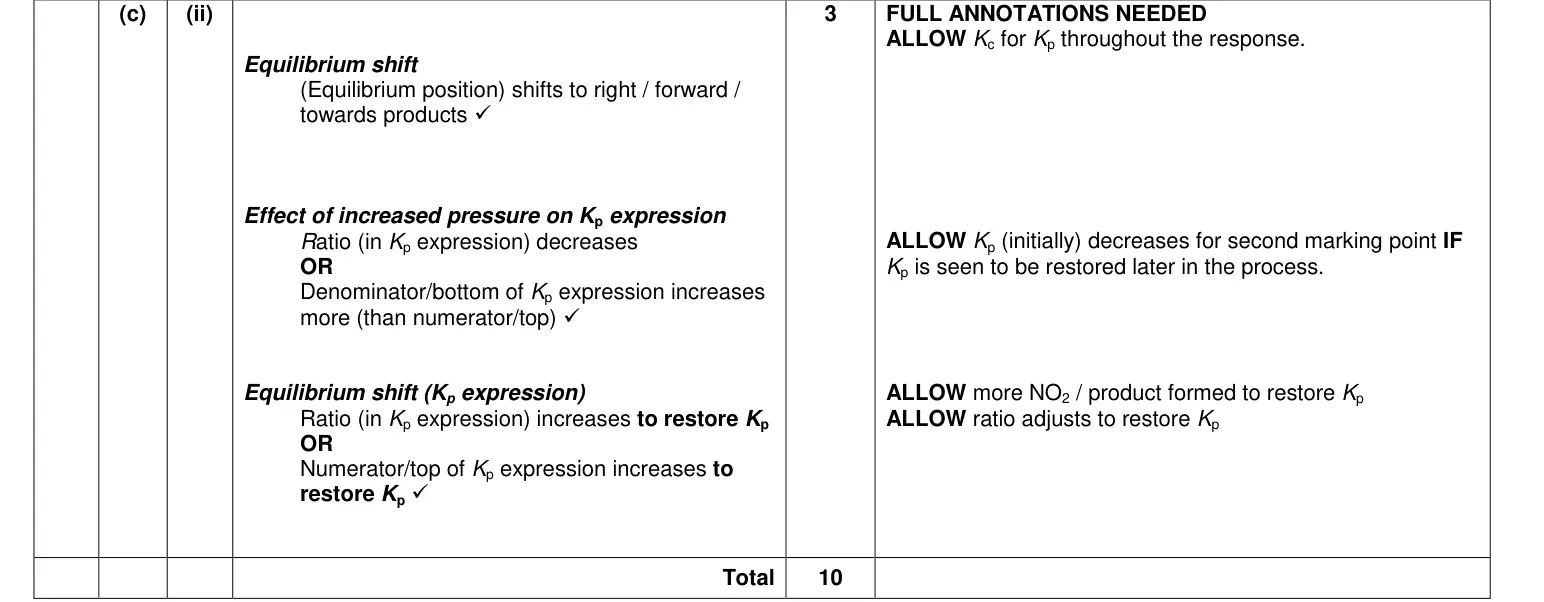
Candidates almost universally secured the first mark for equilibrium shifting to the right. Many scored this by simple application of Le Chatelier’s principle, and then went on to incorrectly explain Kp increased because of this shift. Very few realised that (a constant) Kp drives Le Chatelier’s principle (and not the other way around). An increase of pressure will increase the value of the partial pressures in the bottom half of the Kp expression more than the top half, thus (initially) decreasing the Kp ratio. Therefore, to restore Kp, the amount of NO2 present must increase; consequently, the equilibrium shifts to the right.
Notes from the mark scheme and report
shifts right
denominator of Kp expression increases more than numerator so ratio falls below Kp
more NO2 formed to restore Kp
ALLOW 'Kp initially decreases' only if Kp is then restored
Skills: M0.3 Estimate results
June 2018 · Paper 3 · Q5(b)(i)1 markShort answerHard
Mark scheme
Examiner's comment
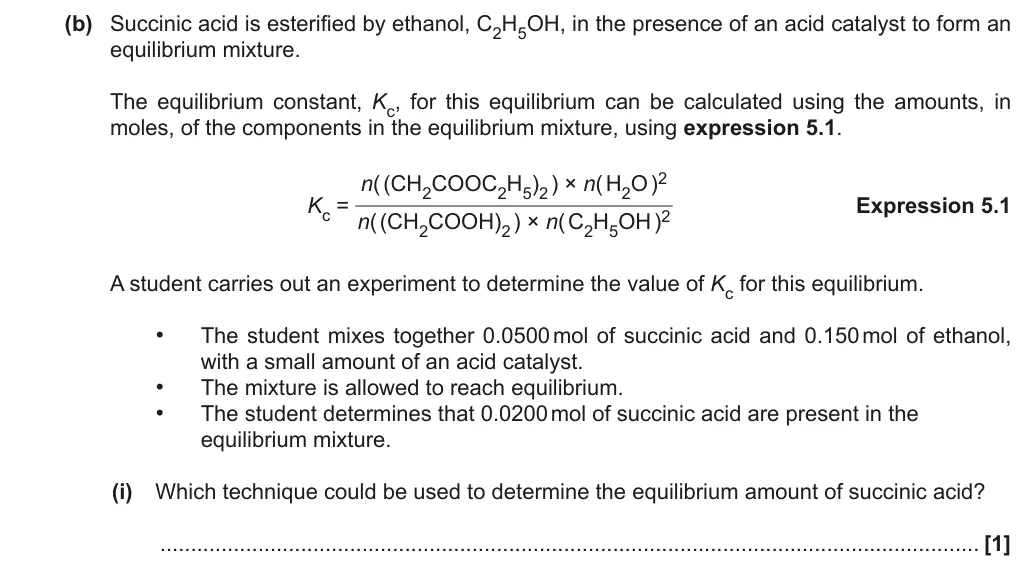
Candidates found this part difficult and only higher ability candidates identified that a titration could easily determine the concentration of succinic acid. The answers seen covered most of the techniques encountered in the course. Candidates should consider the information provided in a practical context to arrive at an informed response rather than what sometimes seemed to be a guess.
Notes from the mark scheme and report
titration
IGNORE type of titration
Skills: PAG2 Acid–base titration
June 2018 · Paper 3 · Q5(b)(iv)1 markShort answerMedium
Earlier part of question 5 that this part uses
Mark scheme
Examiner's comment
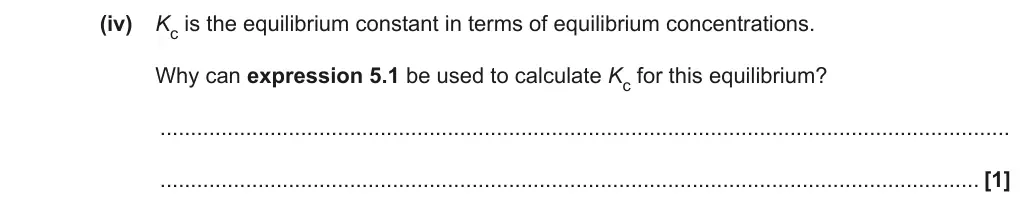
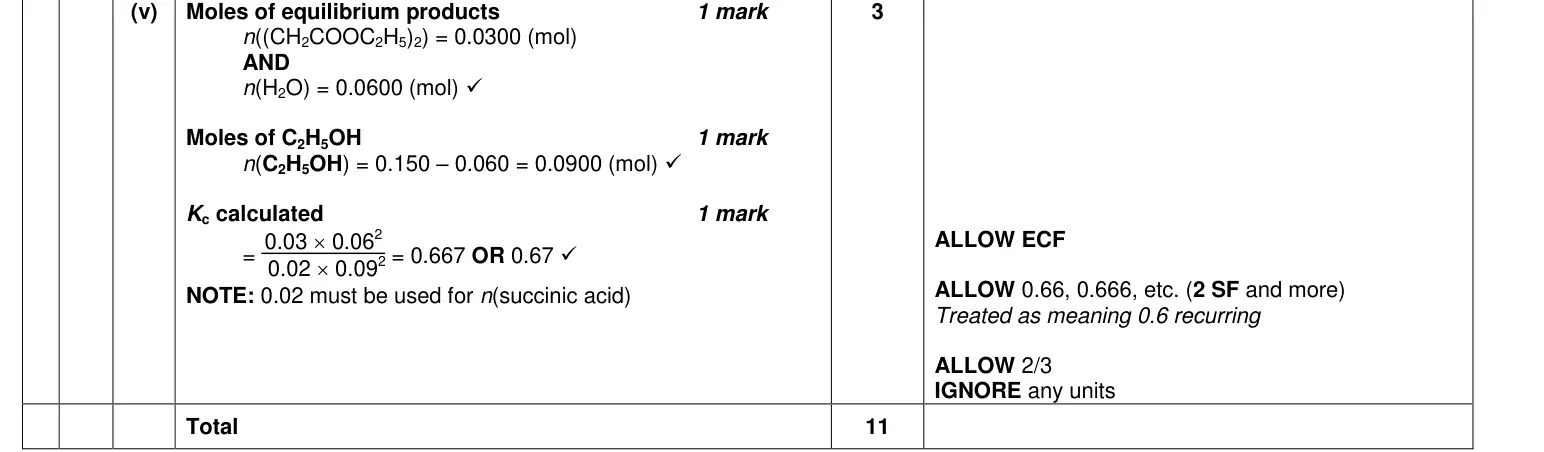
Many candidates did not seem to realise that the supplied equation used moles, not concentrations. Those who did often stated that the mole representation could be used because the volume was the same for all. Of those who went on to state that the volume would cancel, only a few explained why that was true in this particular case. This challenging part discriminated very well. The best responses showed the units as n/V in the expression and showed that the volumes cancel. Question 5b(v) Overall, this part discriminated well with many candidates obtaining the correct answer of 0.67. Common errors included a one significant figure answer of 0.6 or 0.7 and 0.375, by using 0.12 mol instead of 0.09 mol for the moles of ethanol. Many successful answers were well-presented and included a table of initial and final values. This gave a systematic way of deriving the equilibrium moles.
Notes from the mark scheme and report
volume cancels / same number of moles on each side of the equation
IGNORE 'volume is the same' and 'Kc has no units'
June 2018 · Paper 3 · Q5(b)(v)3 marksCalculationHard
Earlier parts of question 5 that this part uses
Mark scheme
Examiner's comment
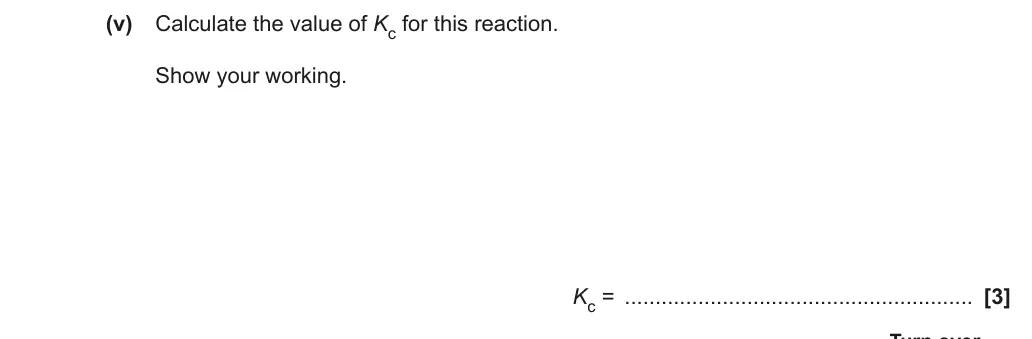
A LEVEL H432/03 Summer 2018 series Version 1 H432 For first teaching in 2015 CHEMISTRY A Examiners’ report www.ocr.org.uk/chemistry Contents Introduction .............................................................................................................................................. 3 Paper H432/03 series overview ................................................................................................................ 4 Question 1(a)(i) ..................................................................................................................................... 5 Question 1(a)(ii) .................................................................................................................................... 5 Question 1(a)(iii) ................................................................................................................................... 5 Question 1(a)(iv) ................................................................................................................................... 6 Question 1(a)(v) .................................................................................................................................... 6 Question 1(a)(vi) ................................................................................................................................... 6 Question 1(a)(vii) .................................................................................................................................. 6 Question 1(a)(viii).................................................................................................................................. 7 Question 1(b) ........................................................................................................................................ 7 Question 2(a)(i) ................................................................................................................................... 10 Question 2(a)(ii) .................................................................................................................................. 11 Question 2(b) ...................................................................................................................................... 13 Question 2(c)(i) ................................................................................................................................... 14 Question 2(c)(ii) .................................................................................................................................. 14 Question 3(a) ...................................................................................................................................... 15 Question 3(b)(i) ................................................................................................................................... 16 Question 3(b)(ii) .................................................................................................................................. 17 Question 4(a)(i) ................................................................................................................................... 18 Question 4(a)(ii) .................................................................................................................................. 19 Question 4(b)(i) ................................................................................................................................... 20 Question 4(b)(ii)* ................................................................................................................................. 21 Question 5(a) ...................................................................................................................................... 25 Question 5(b)(i) ................................................................................................................................... 27 Question 5(b)(ii) .................................................................................................................................. 27 Question 5(b)(iii) ................................................................................................................................. 27 Question 5(b)(iv) ................................................................................................................................. 28 Question 5b(v) .................................................................................................................................... 28 Question 6(a)(i) ................................................................................................................................... 29 Question 6(a)(ii) .................................................................................................................................. 29 Question 6(a)(iii) ................................................................................................................................. 30 Question 6(a)(iv) ................................................................................................................................. 31 Question 6(b)* ..................................................................................................................................... 31 Introduction Our examiners’ reports are produced to offer constructive feedback on candidates’ performance in the examinations. Question 5b(v) Overall, this part discriminated well with many candidates obtaining the correct answer of 0.67.
Skills: M0.2 Use ratios, fractions and percentages; M2.3 Substitute numerical values into algebraic equations using appropriate units for physical quantities
June 2017 · Paper 1 · Q131 markMultiple choice
Answer
B
Mark scheme
June 2017 · Paper 1 · Q18(b)(i)1 markShort answer
Mark scheme
Notes from the mark scheme and report
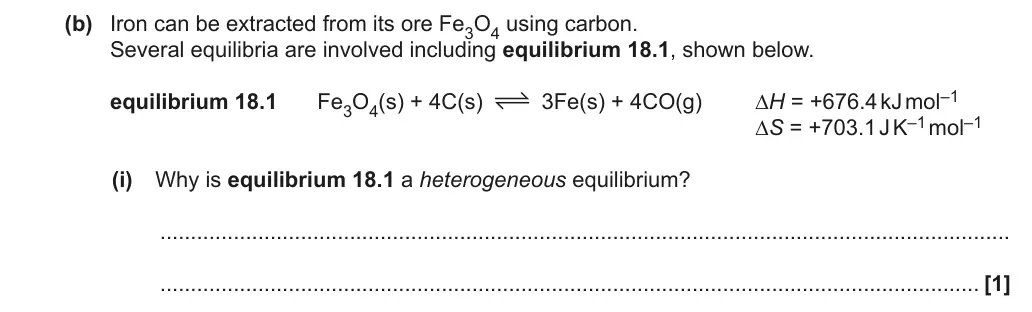
species in different states/phases
June 2017 · Paper 1 · Q18(b)(ii)1 markShort answer
Earlier part of question 18 that this part uses
Mark scheme
Notes from the mark scheme and report
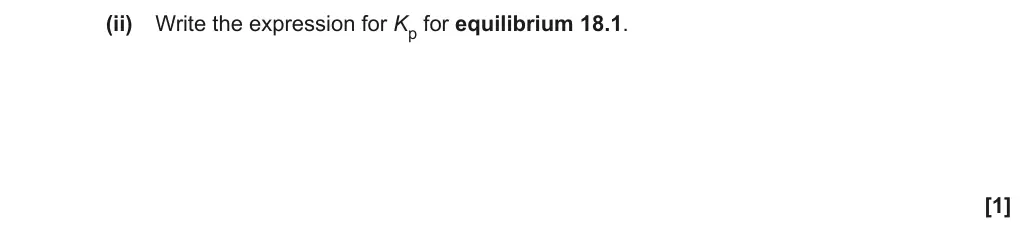
Kp = p(CO)4 only (solids omitted)
DO NOT ALLOW square brackets
June 2017 · Paper 1 · Q20(b)(i)2 marksShort answer
Mark scheme
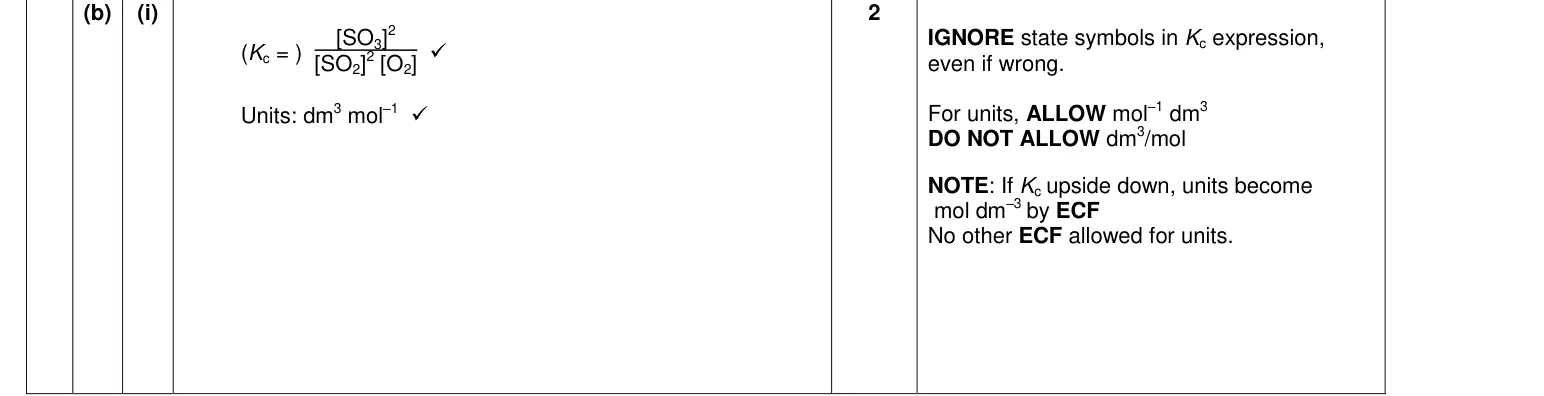
Notes from the mark scheme and report
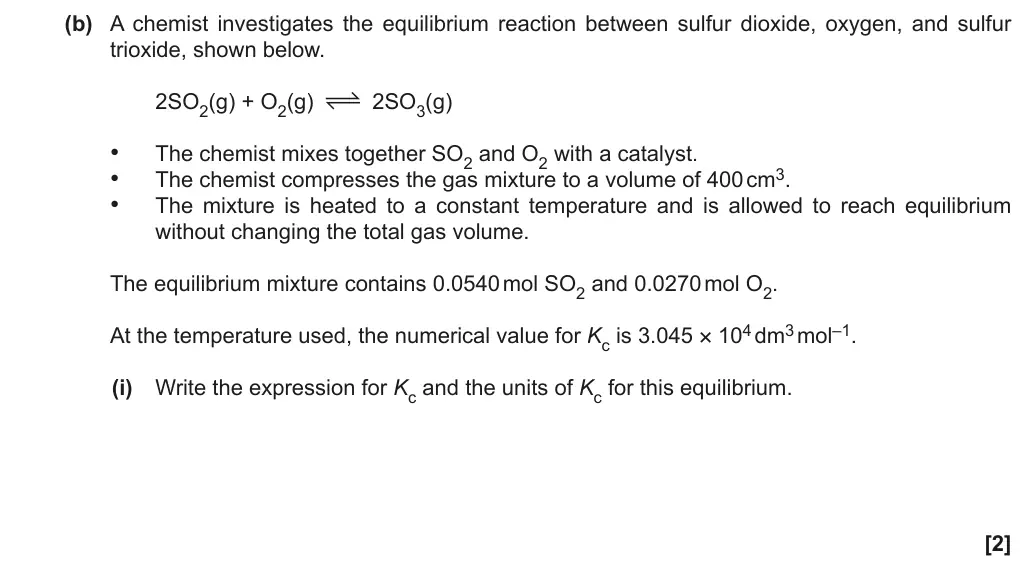
units dm3 mol–1 (DO NOT ALLOW dm3/mol)
ECF on units only if Kc upside down
Skills: M0.0 Recognise and make use of appropriate units in calculations
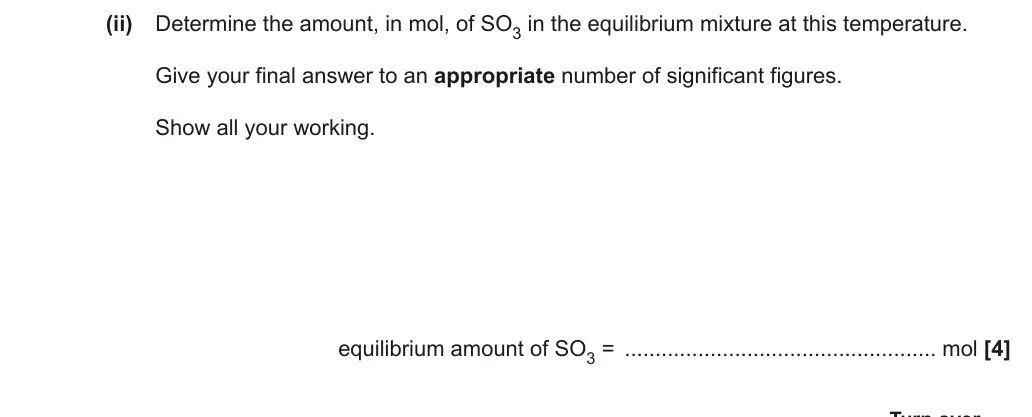
June 2017 · Paper 1 · Q20(b)(ii)4 marksCalculation
Earlier part of question 20 that this part uses
Mark scheme
Notes from the mark scheme and report
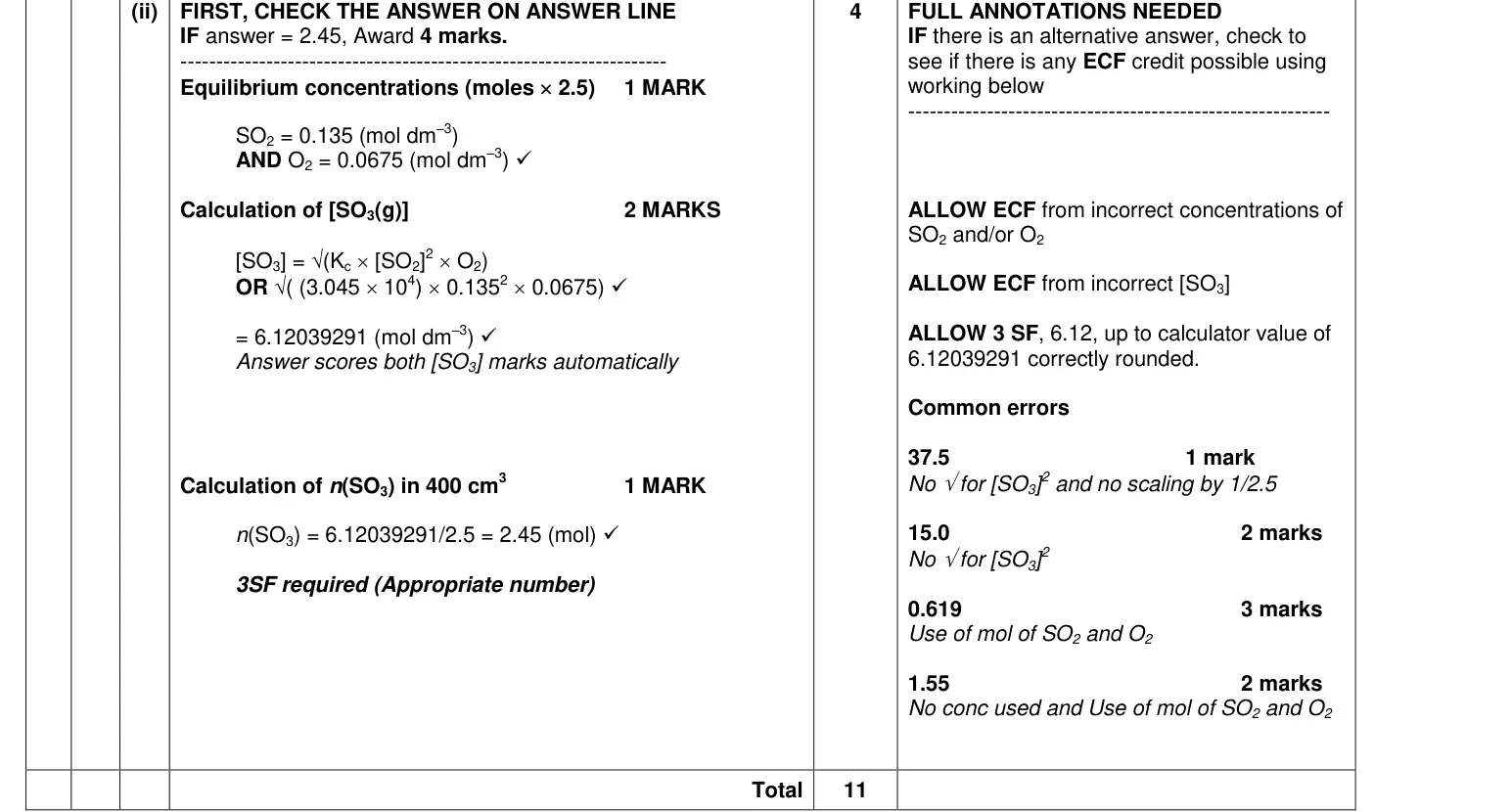
convert moles to concentrations (÷0.400) before using Kc
square root for [SO3]
convert back to moles
3 SF (2.45)
common errors 15.0 (no √) scores 2 and 0.619 (moles used) scores 3
Skills: M0.0 Recognise and make use of appropriate units in calculations; M1.1 Use an appropriate number of significant figures; M2.2 Change the subject of an equation; M2.3 Substitute numerical values into algebraic equations using appropriate units for physical quantities; M2.4 Solve algebraic equations
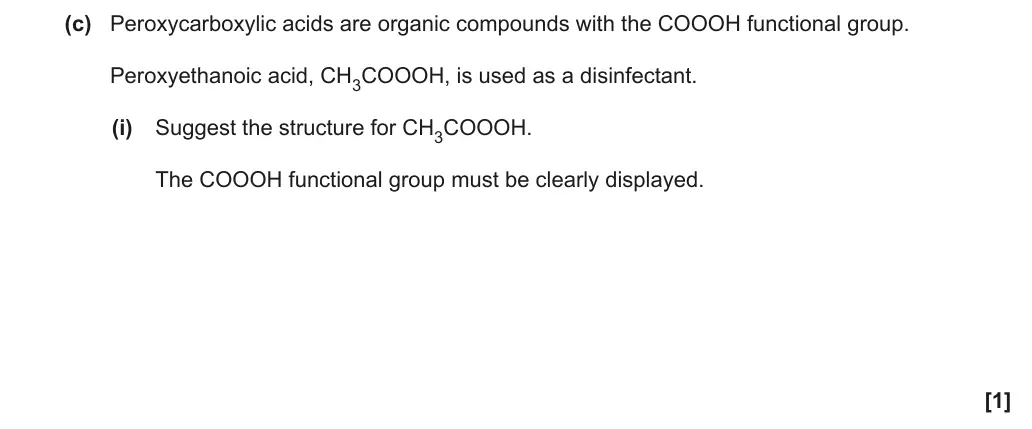
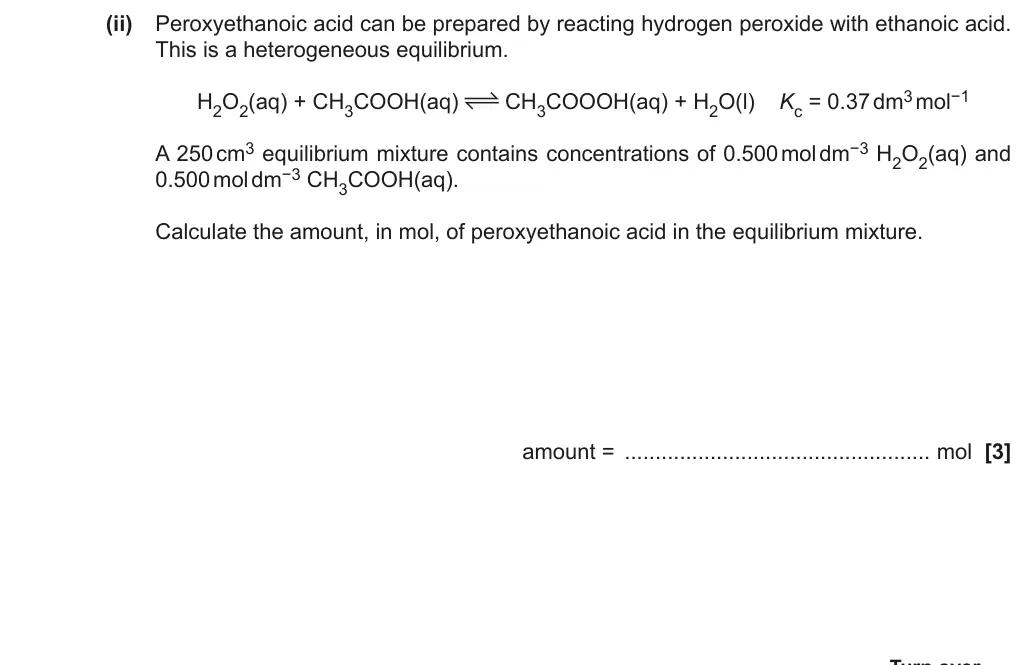
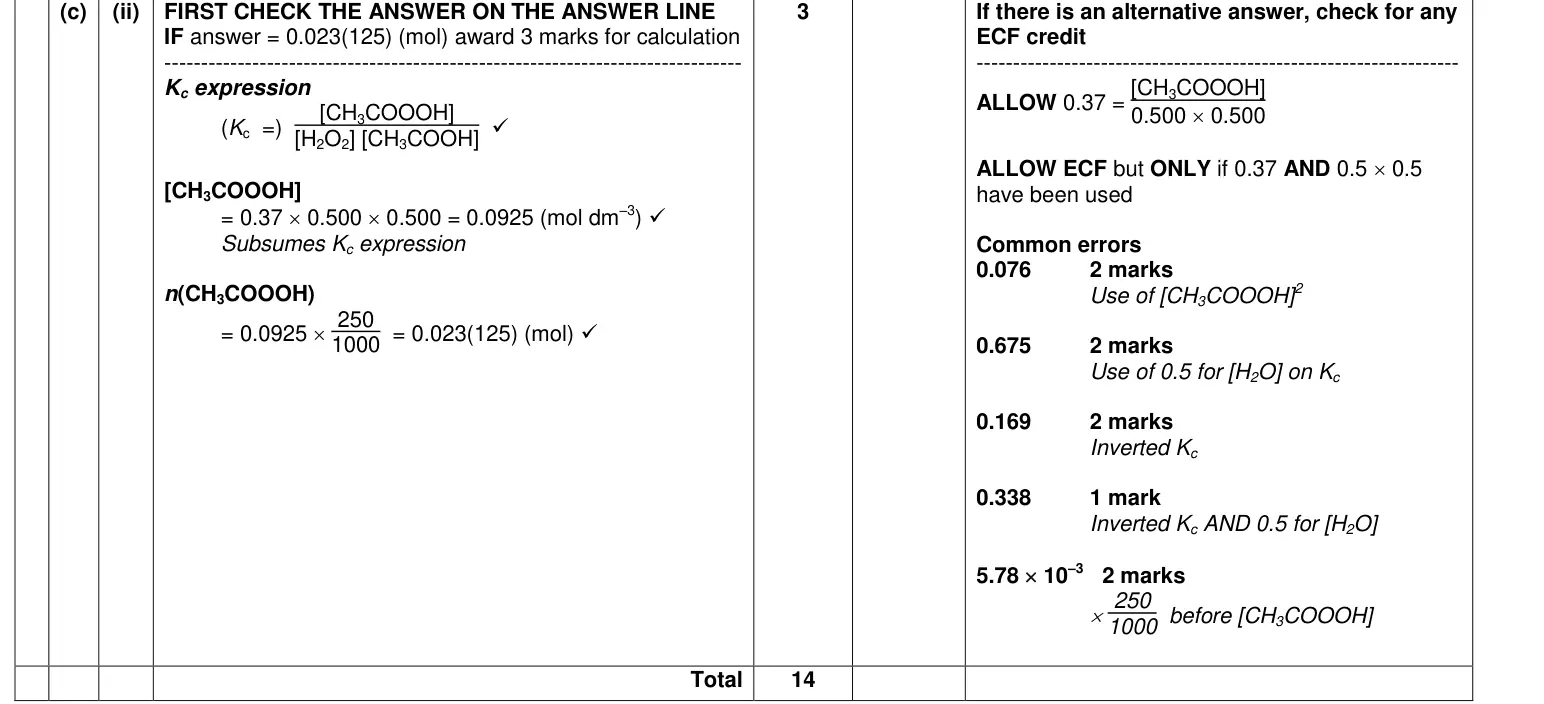
June 2017 · Paper 3 · Q3(c)(ii)3 marksCalculation
Earlier part of question 3 that this part uses
Mark scheme
Notes from the mark scheme and report
H2O(l) omitted from Kc
common errors: [CH3COOOH]2 (0.076), 0.5 used for [H2O] (0.675), inverted Kc (0.169)
Skills: M0.2 Use ratios, fractions and percentages; M2.2 Change the subject of an equation; M2.3 Substitute numerical values into algebraic equations using appropriate units for physical quantities
Work with an OCR chemistry tutor
Dropping marks on calculations, mechanisms or the six-markers? Book a trial session with a specialist OCR chemistry tutor.