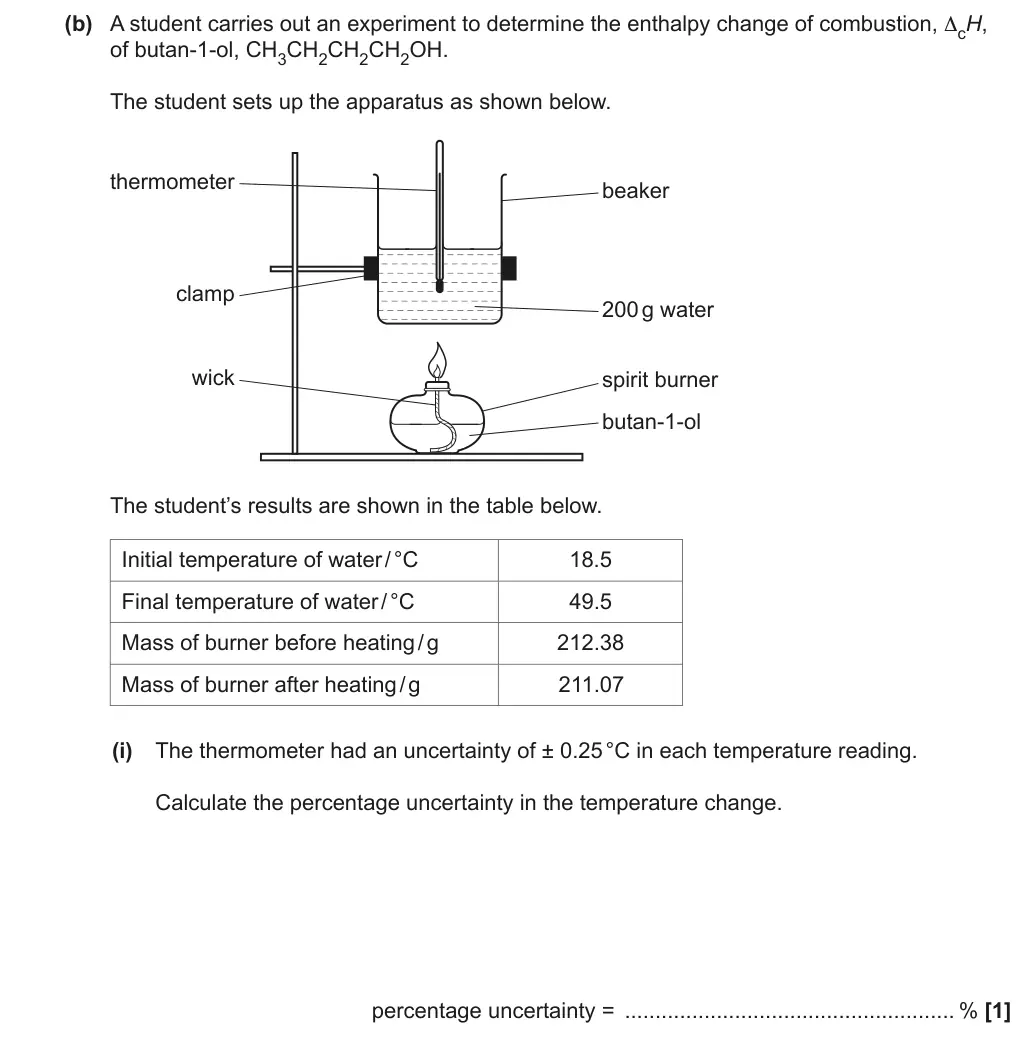
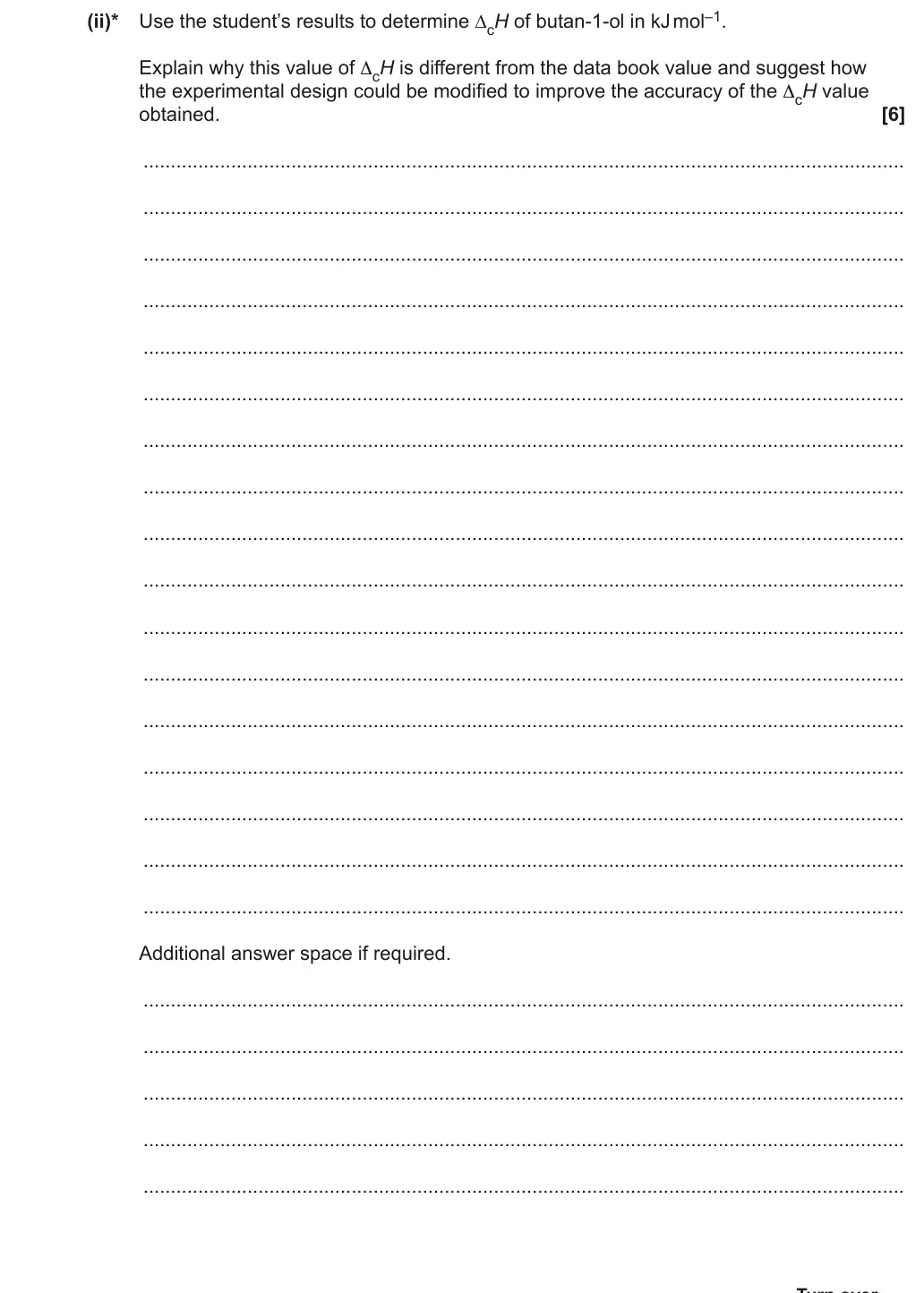
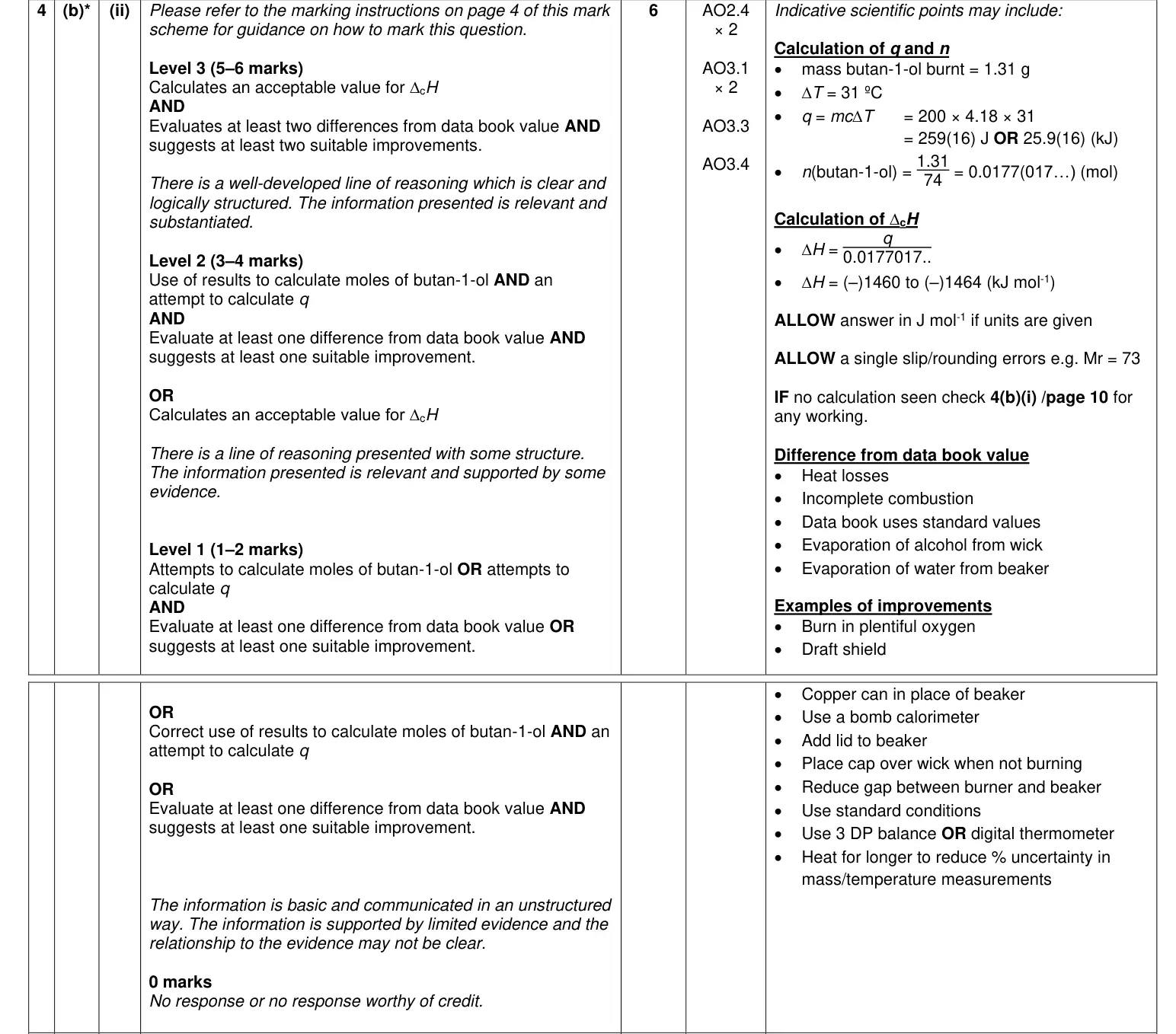
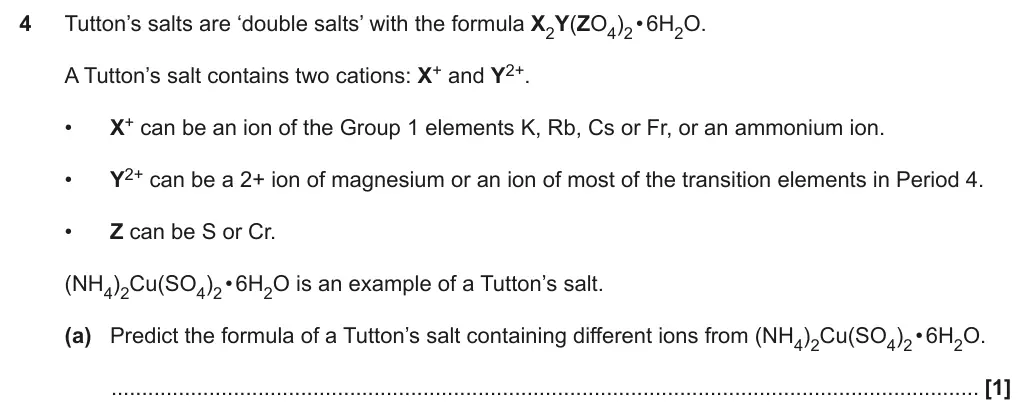
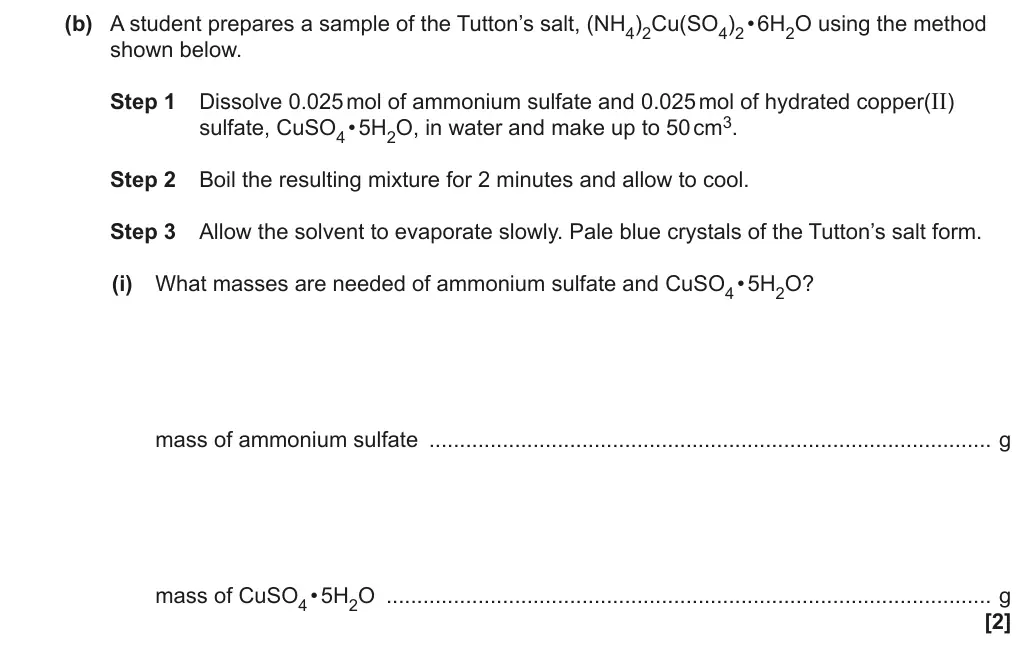
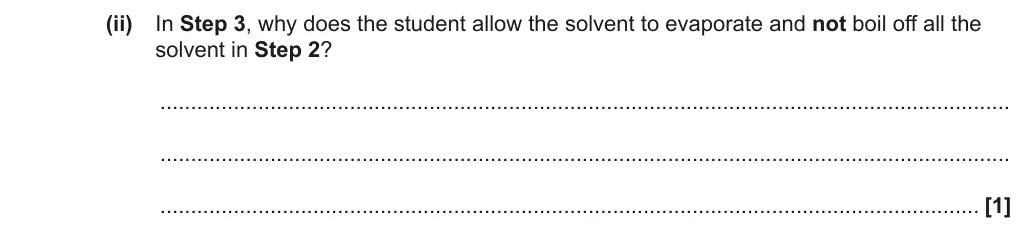
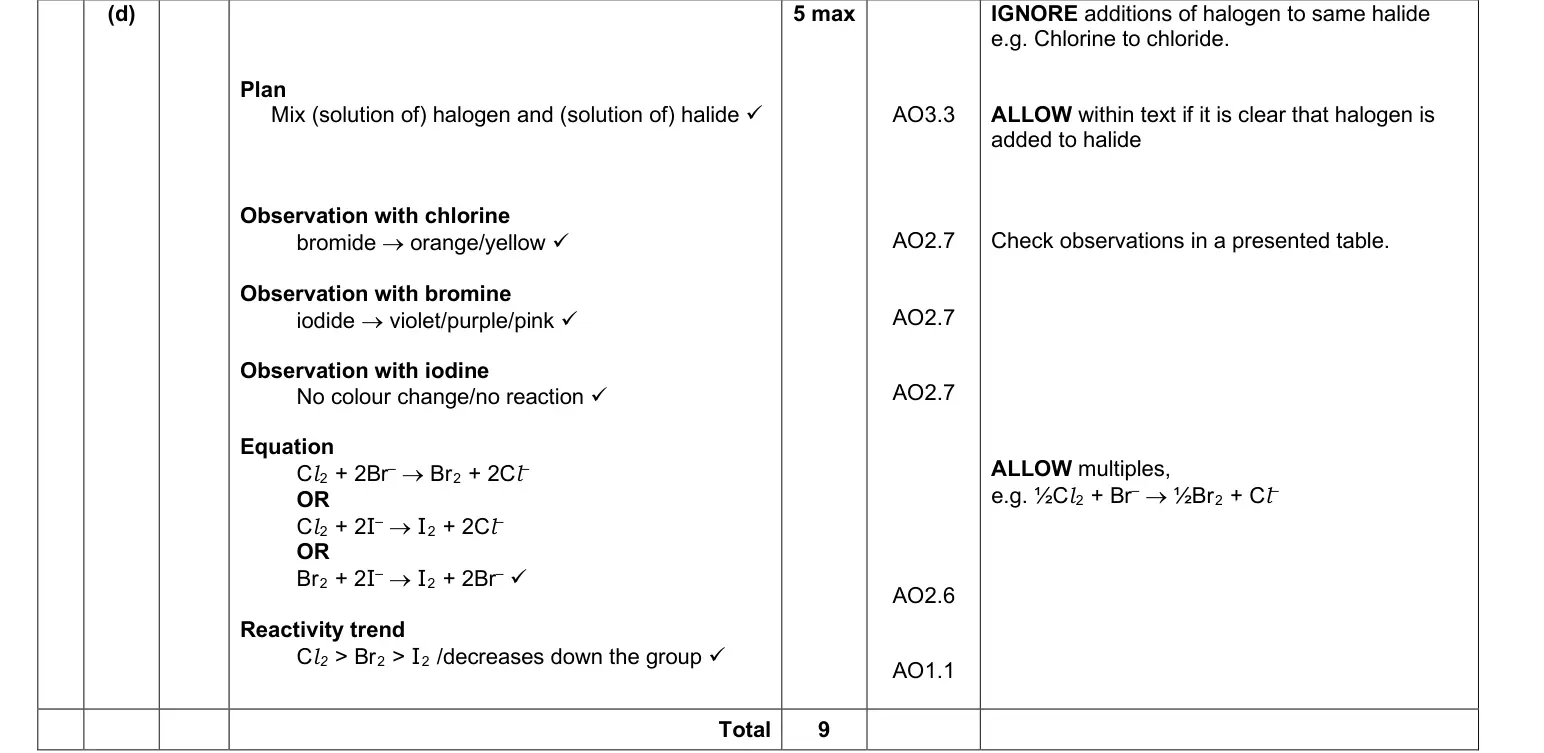
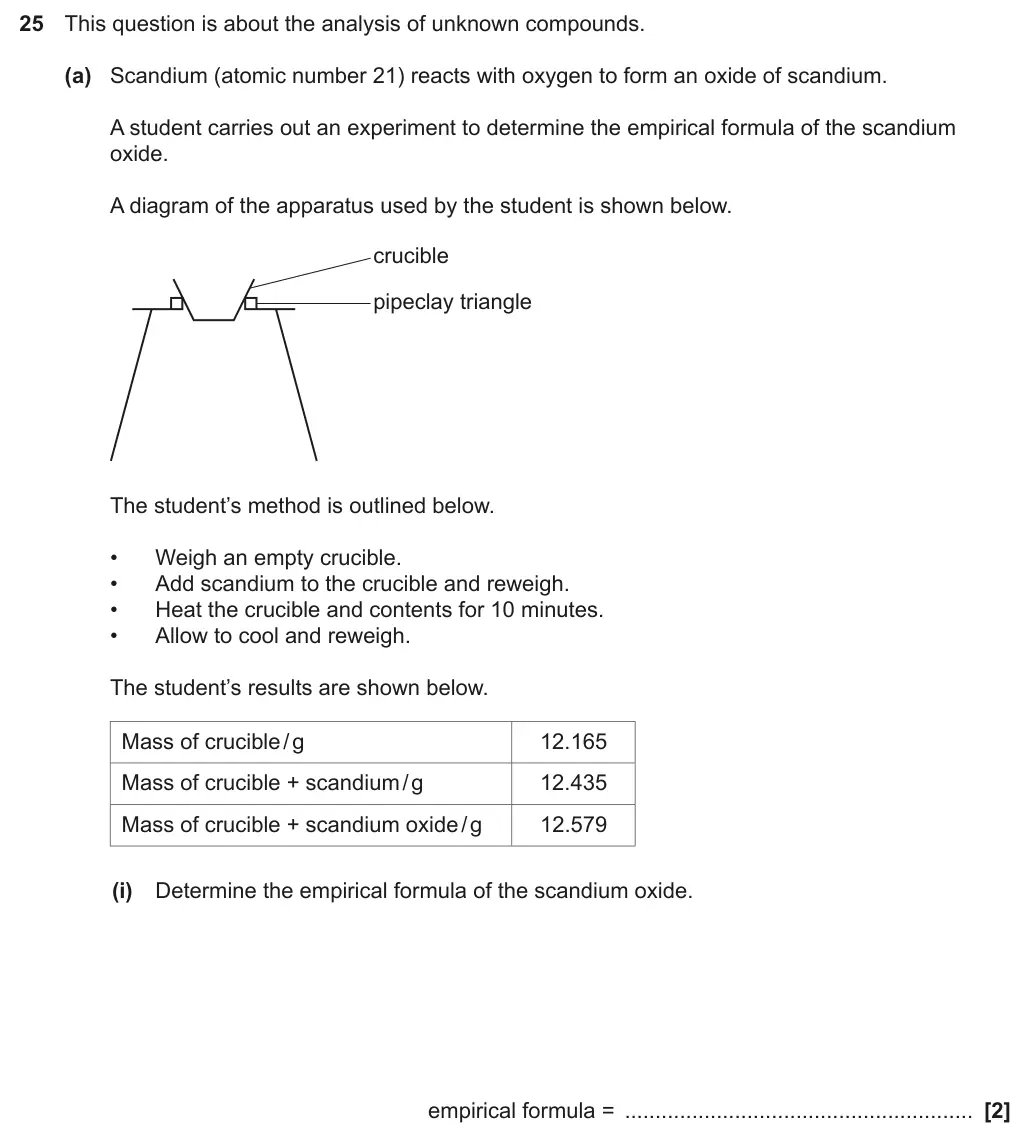
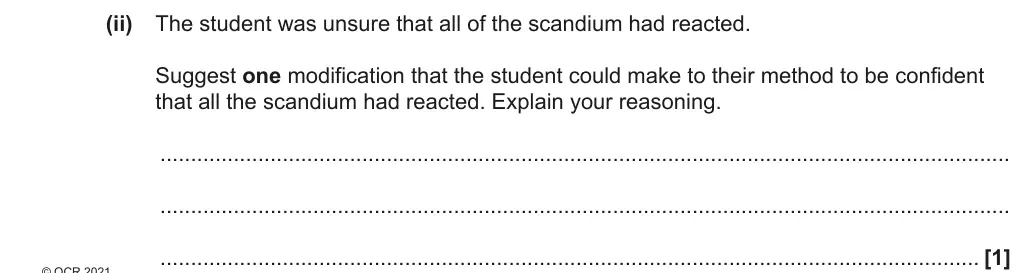
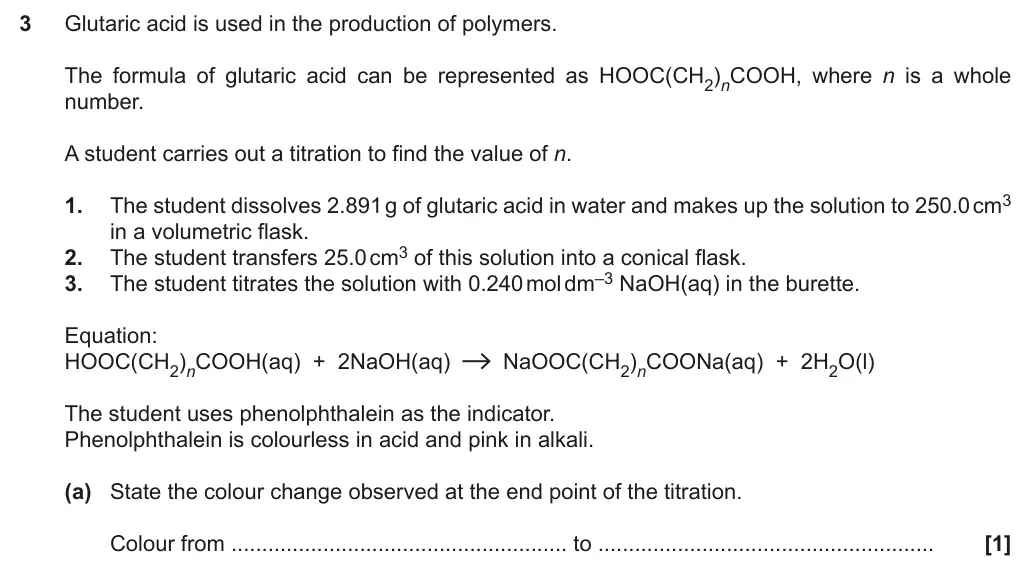
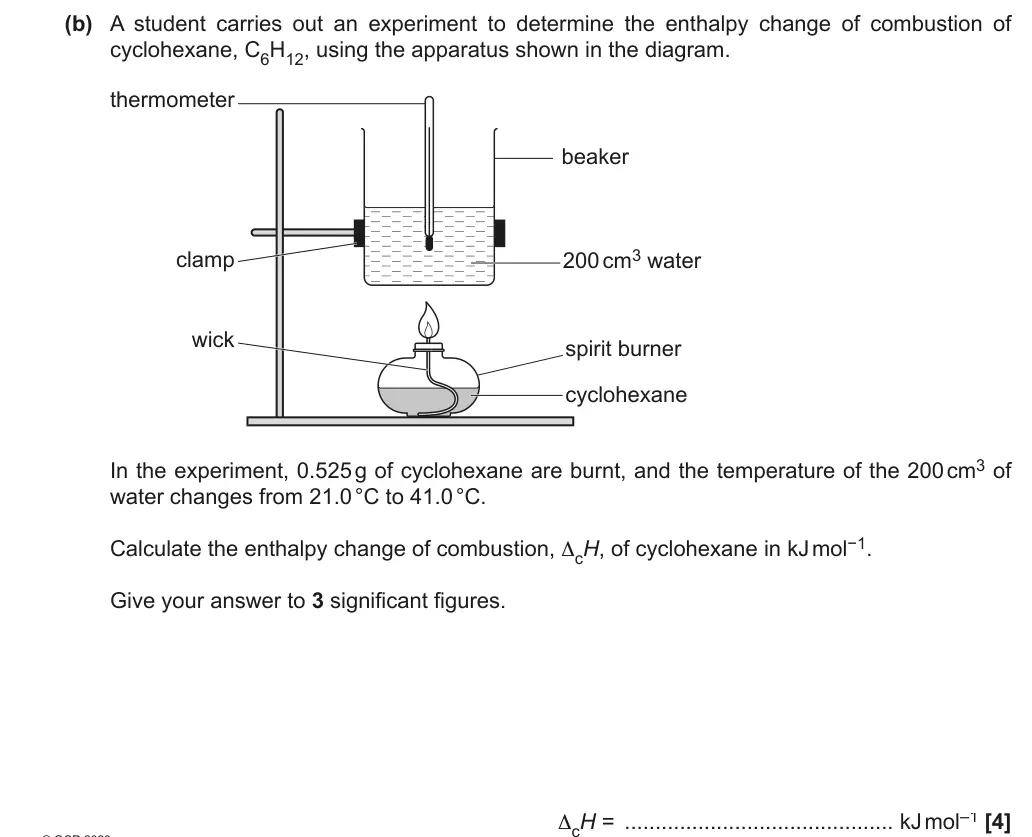
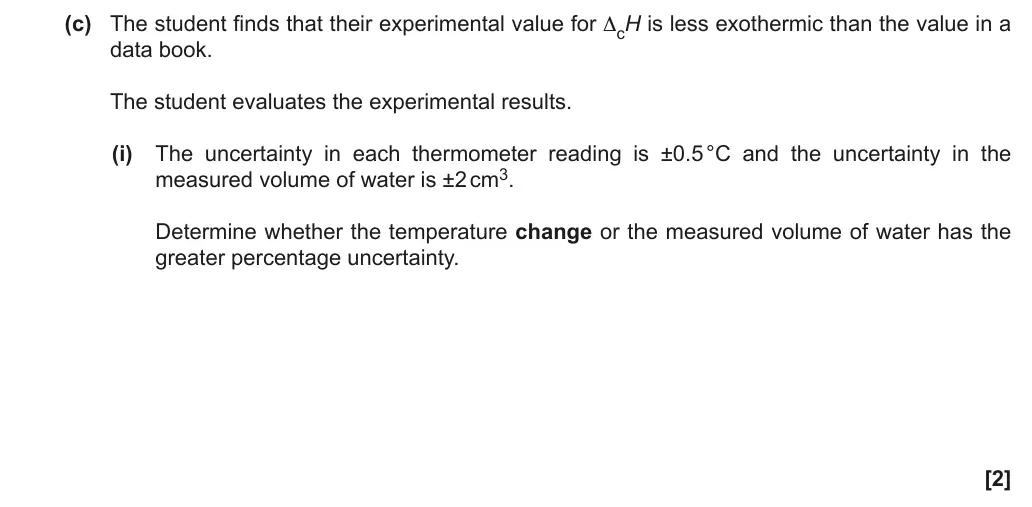
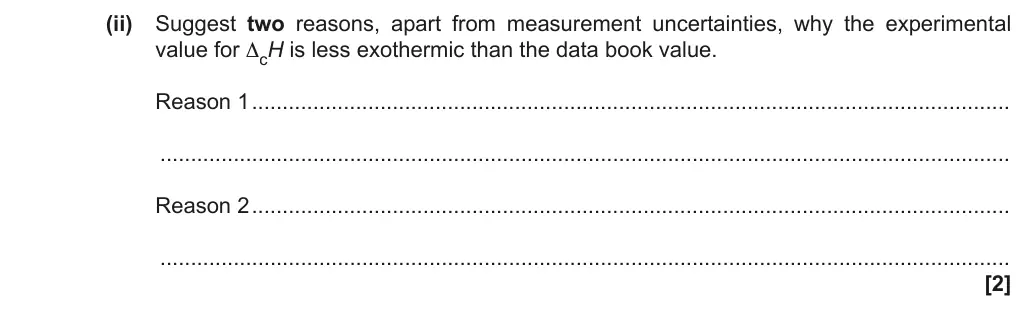
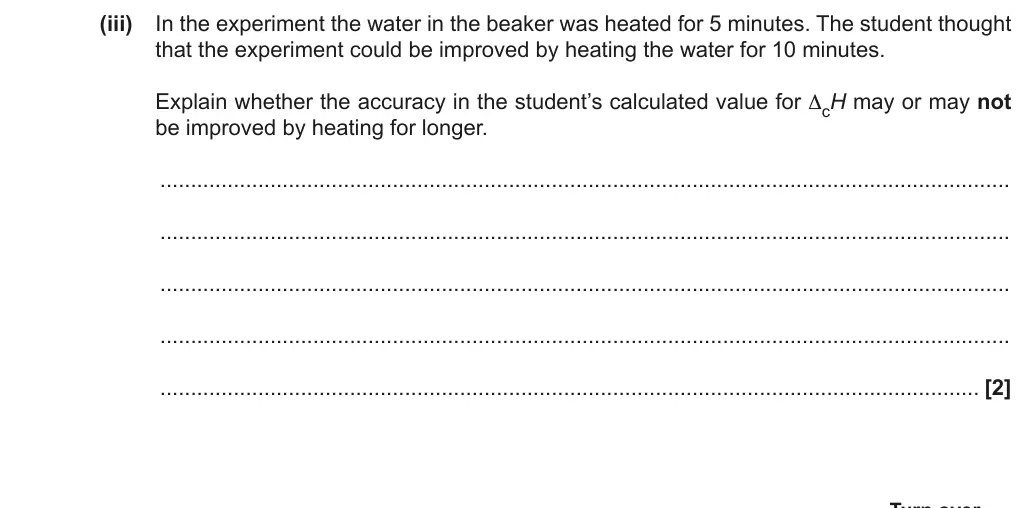
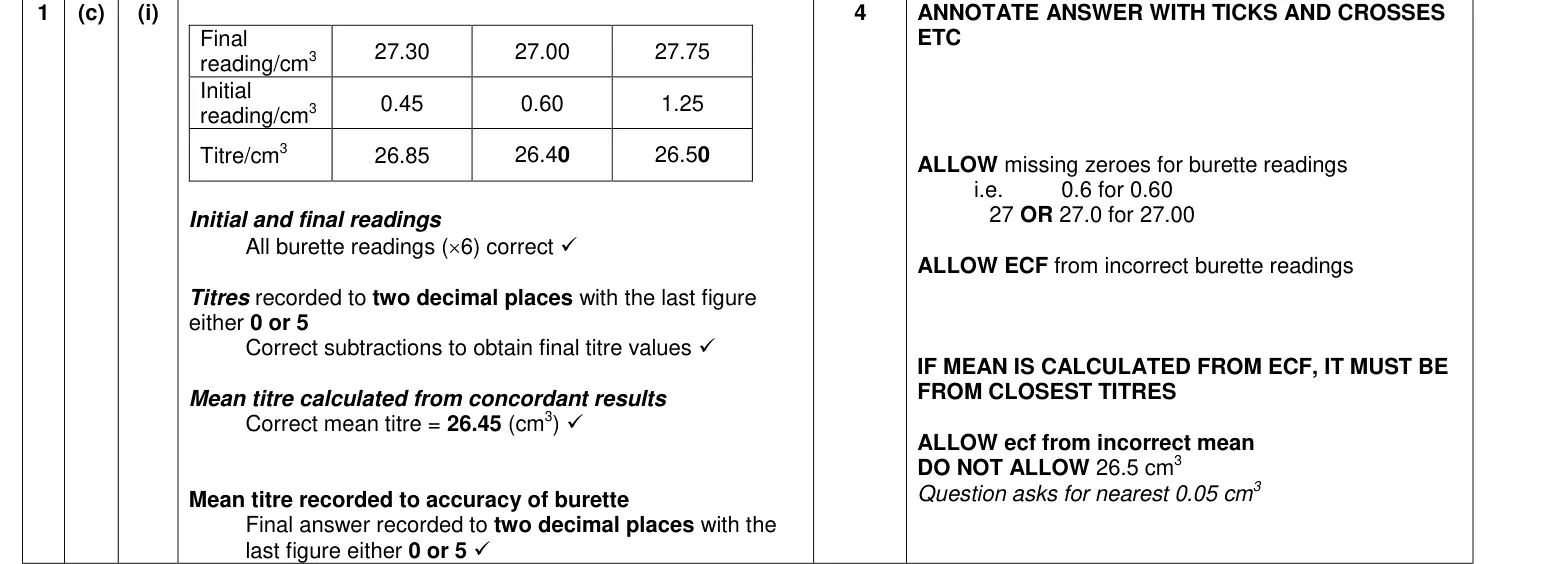
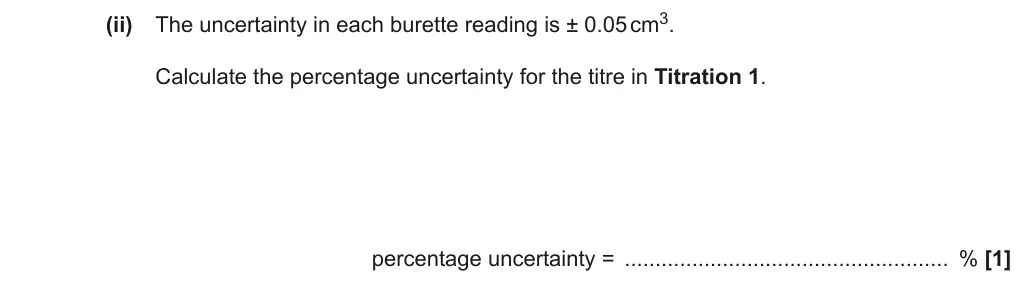
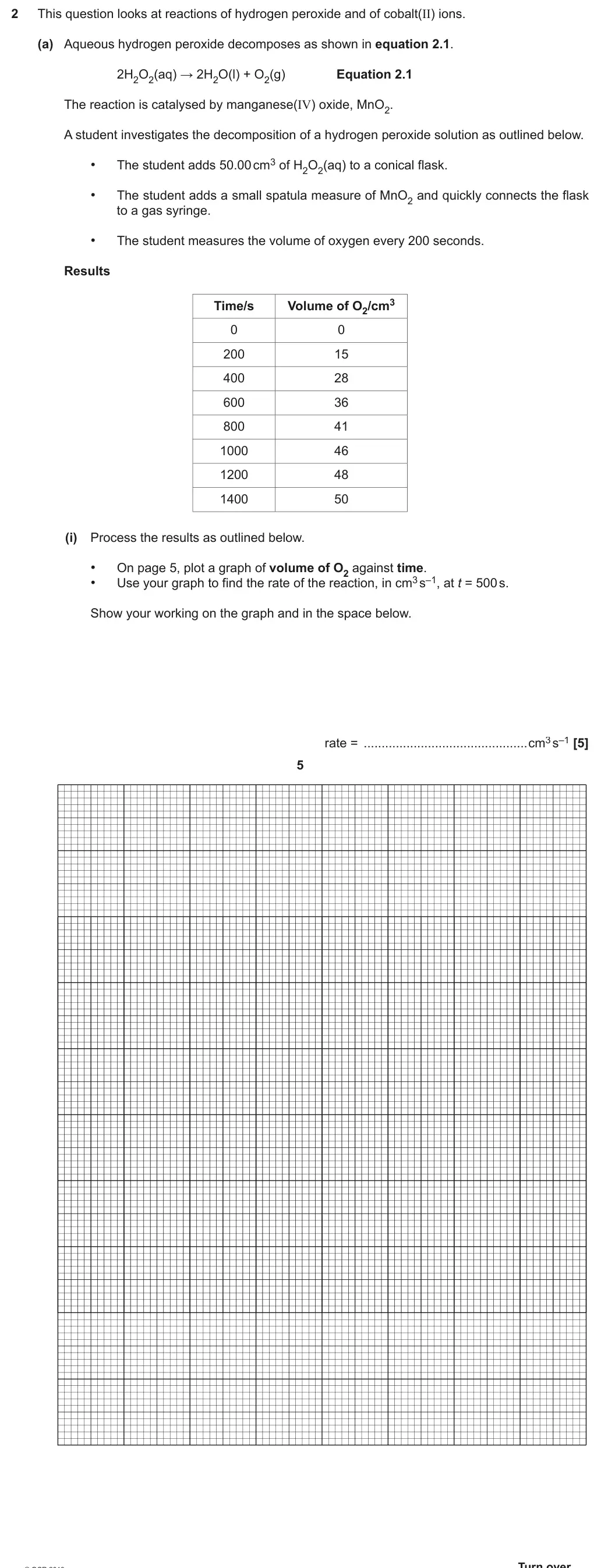
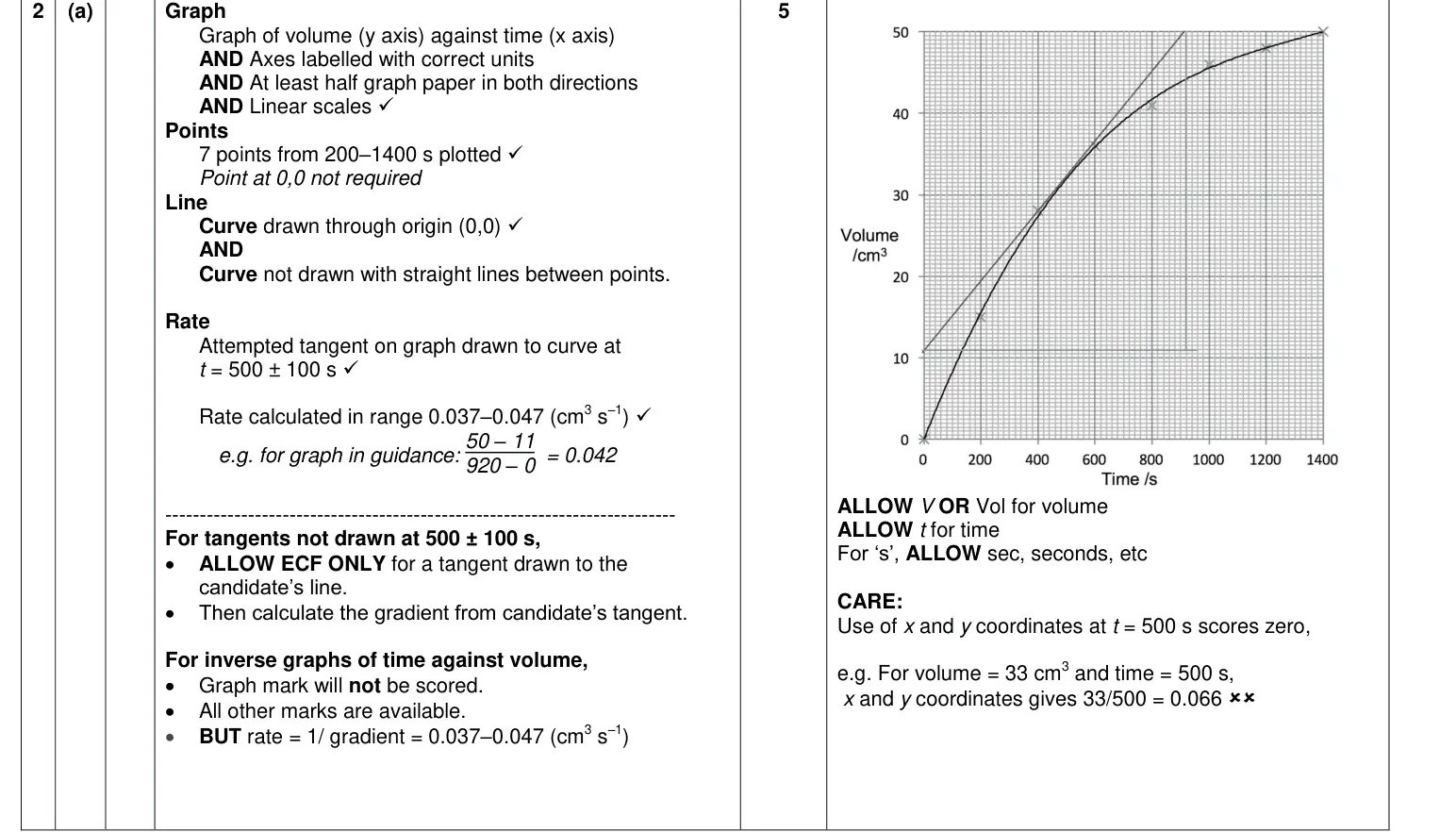
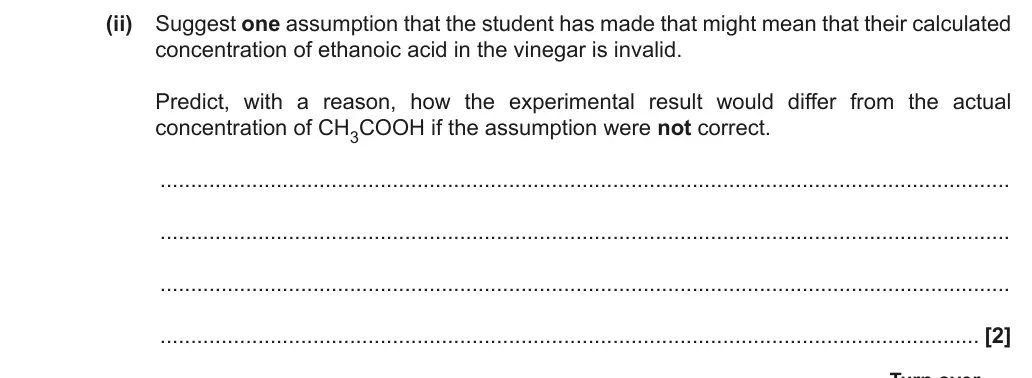
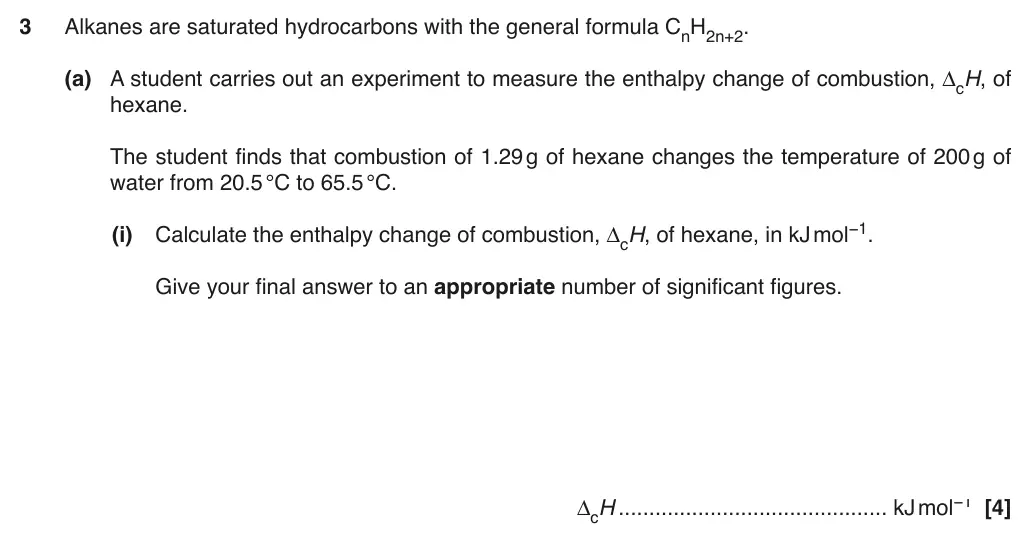
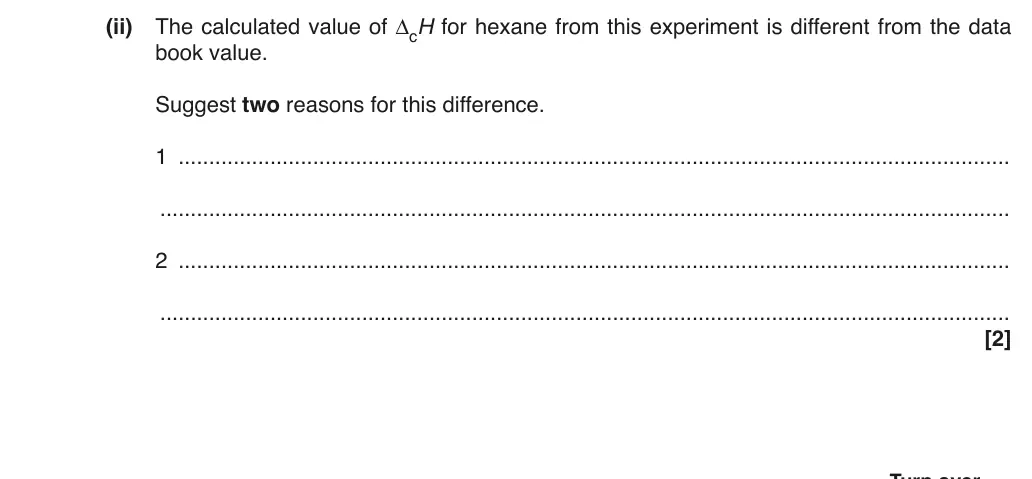
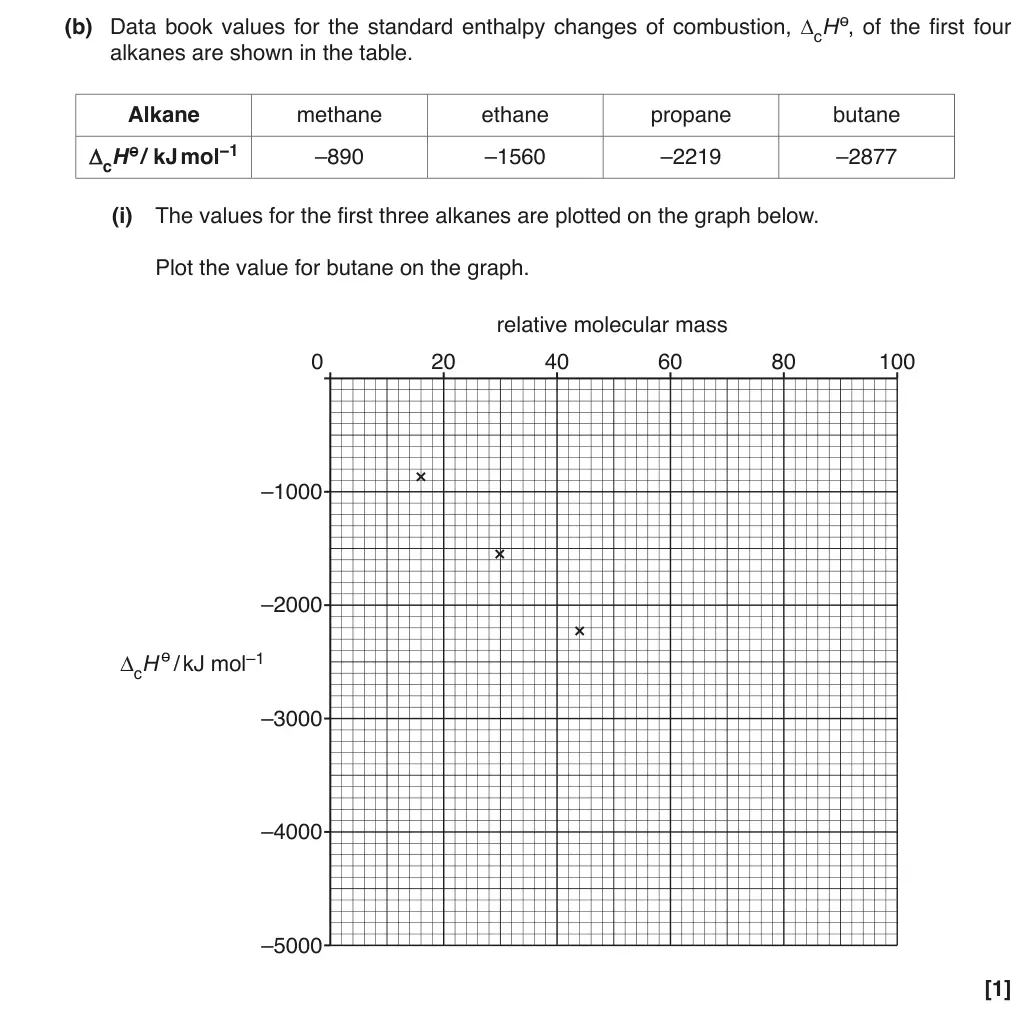
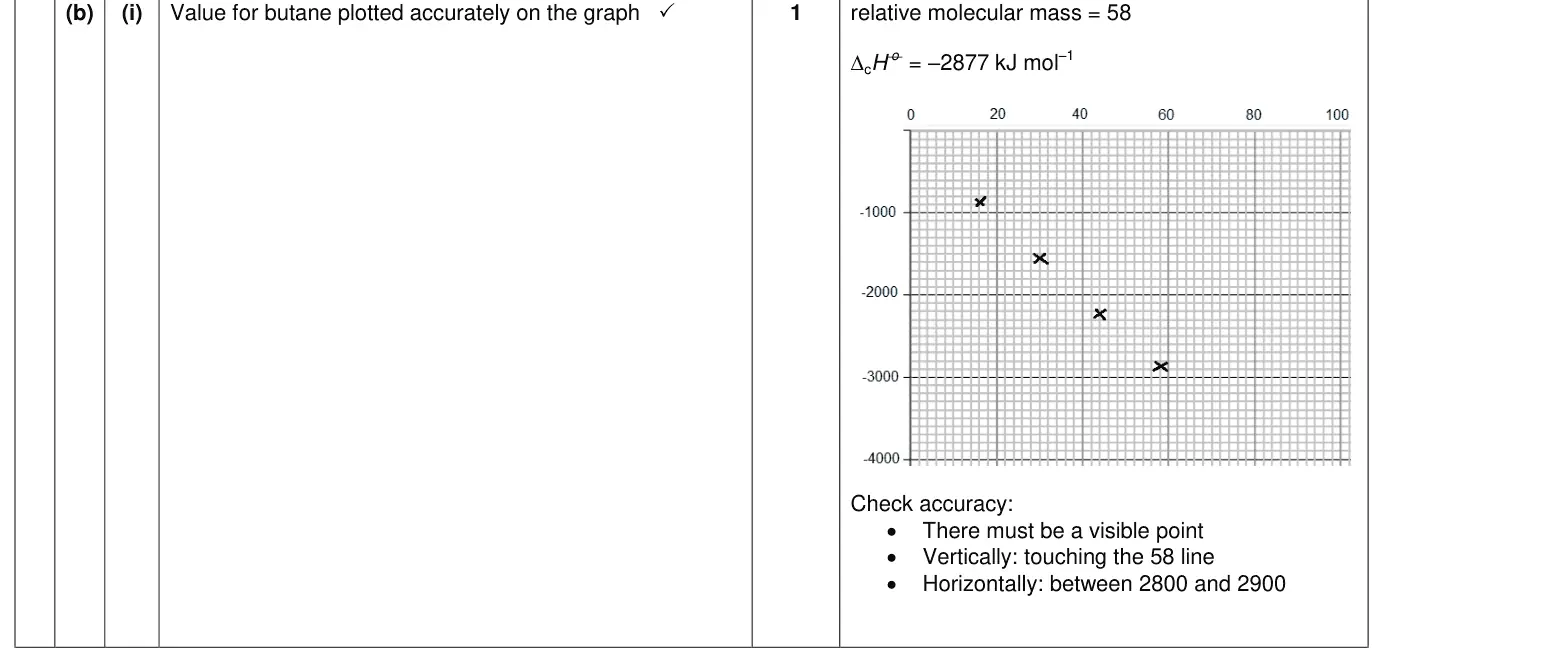
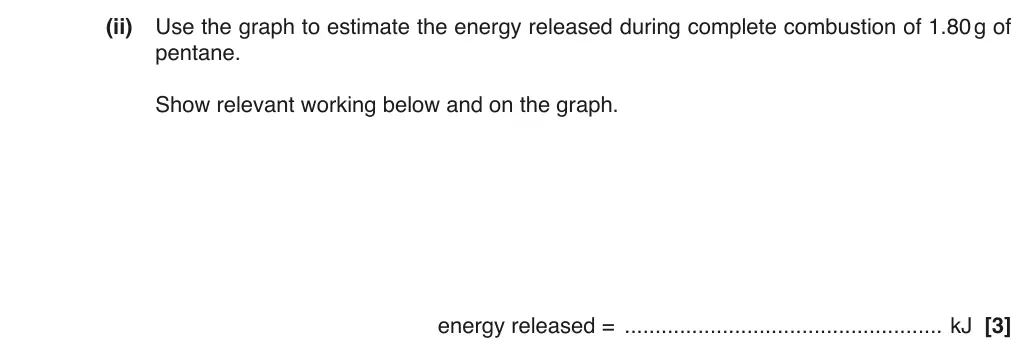
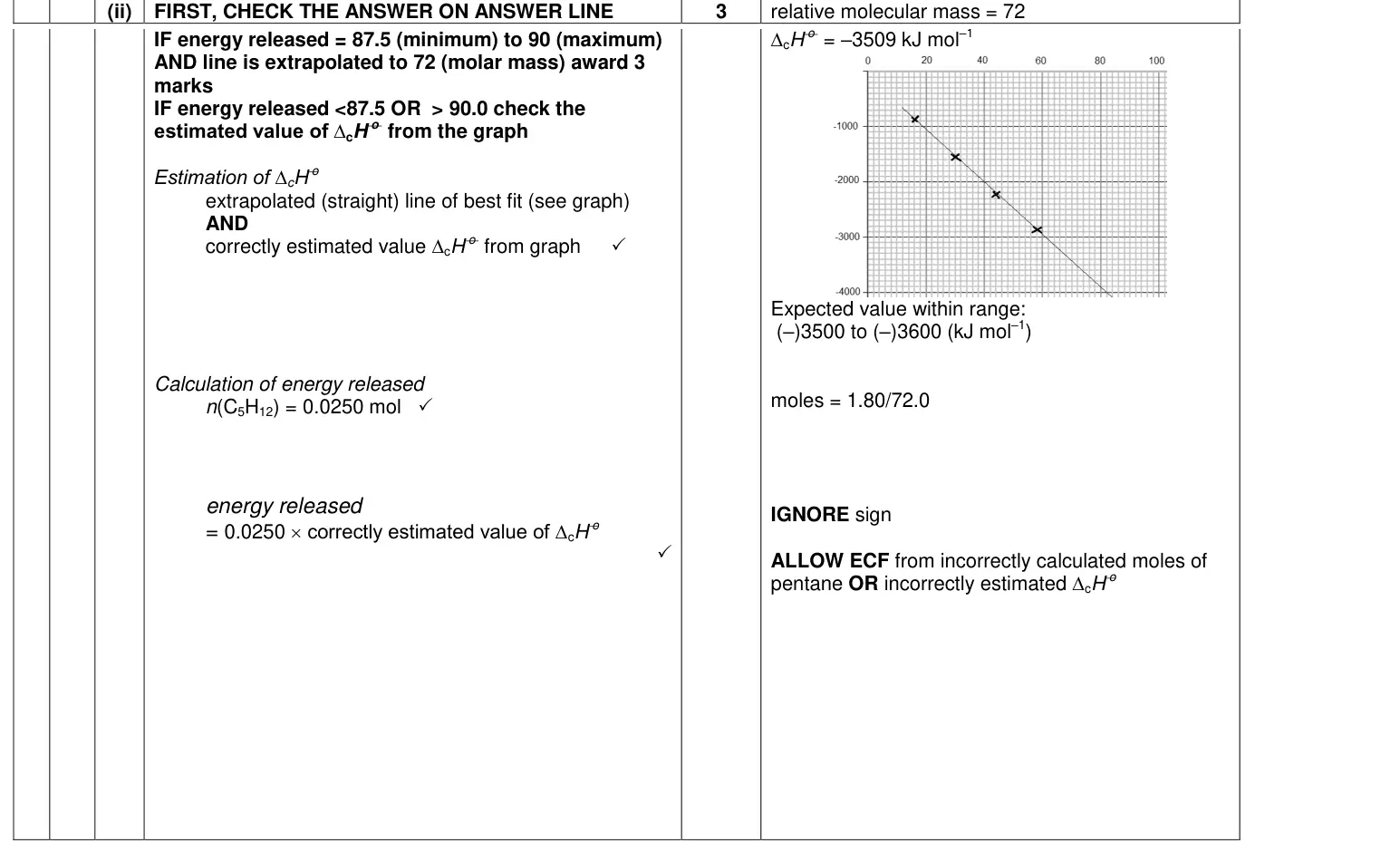
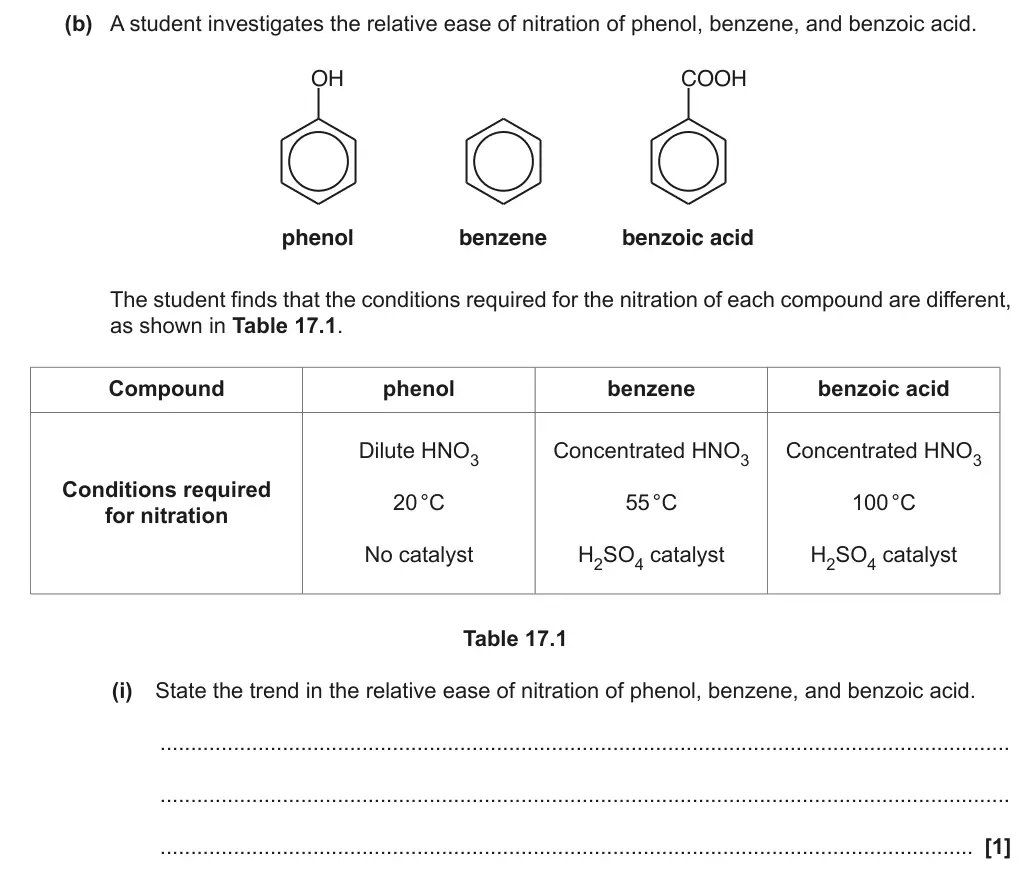
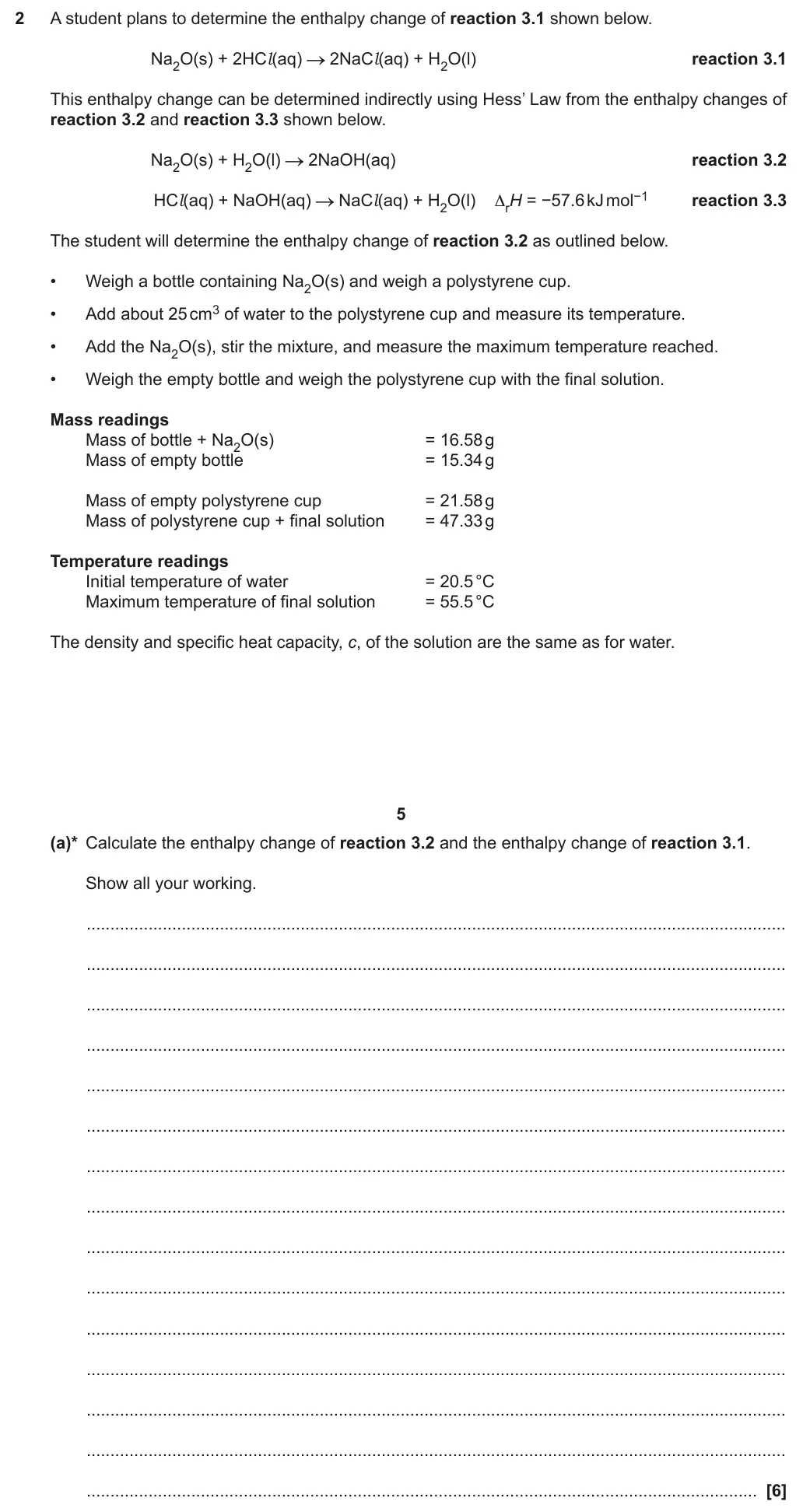
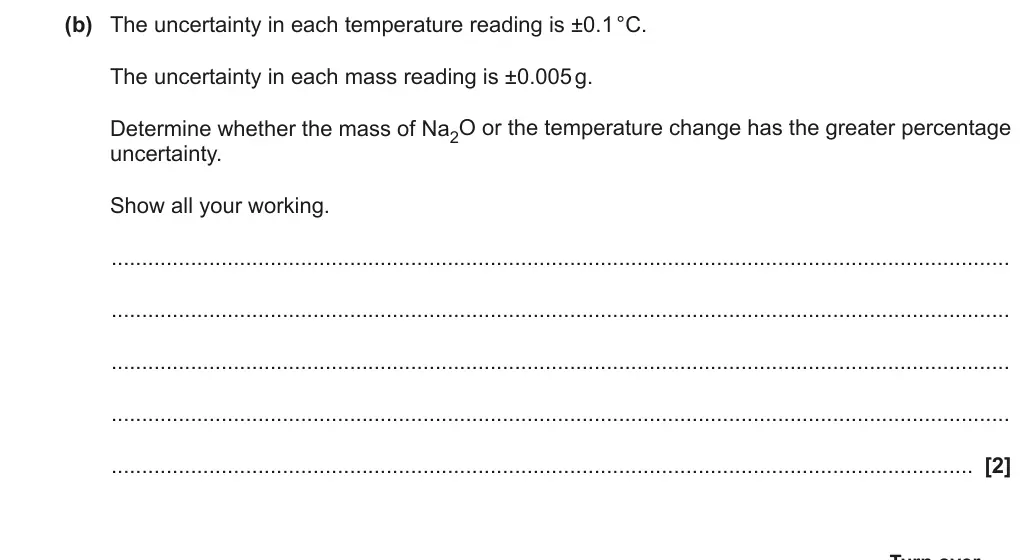
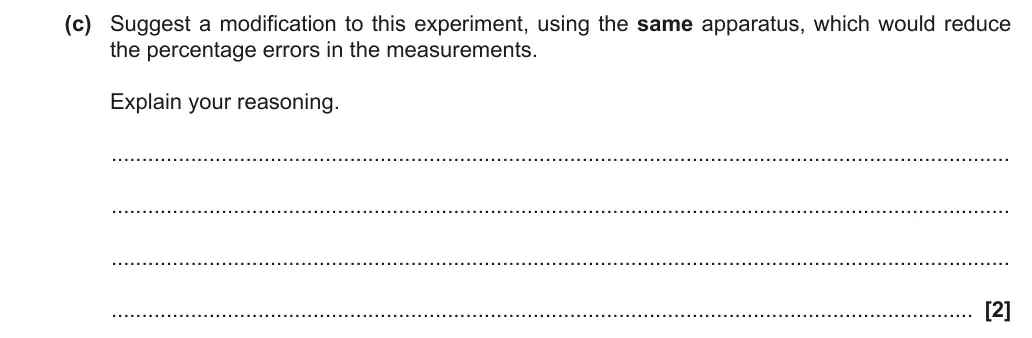
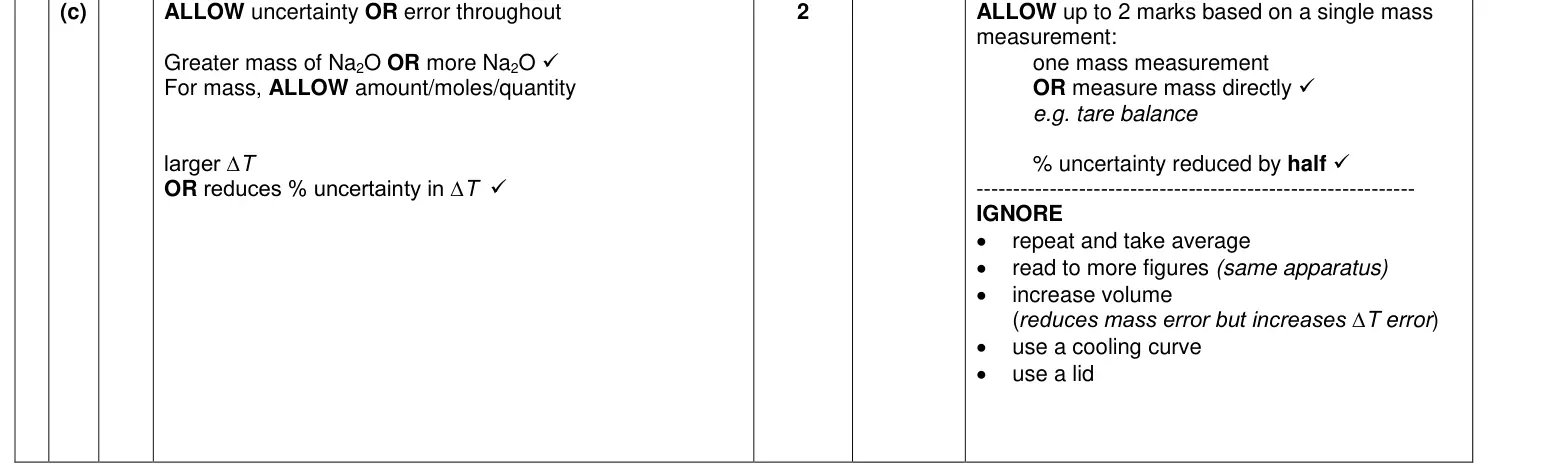
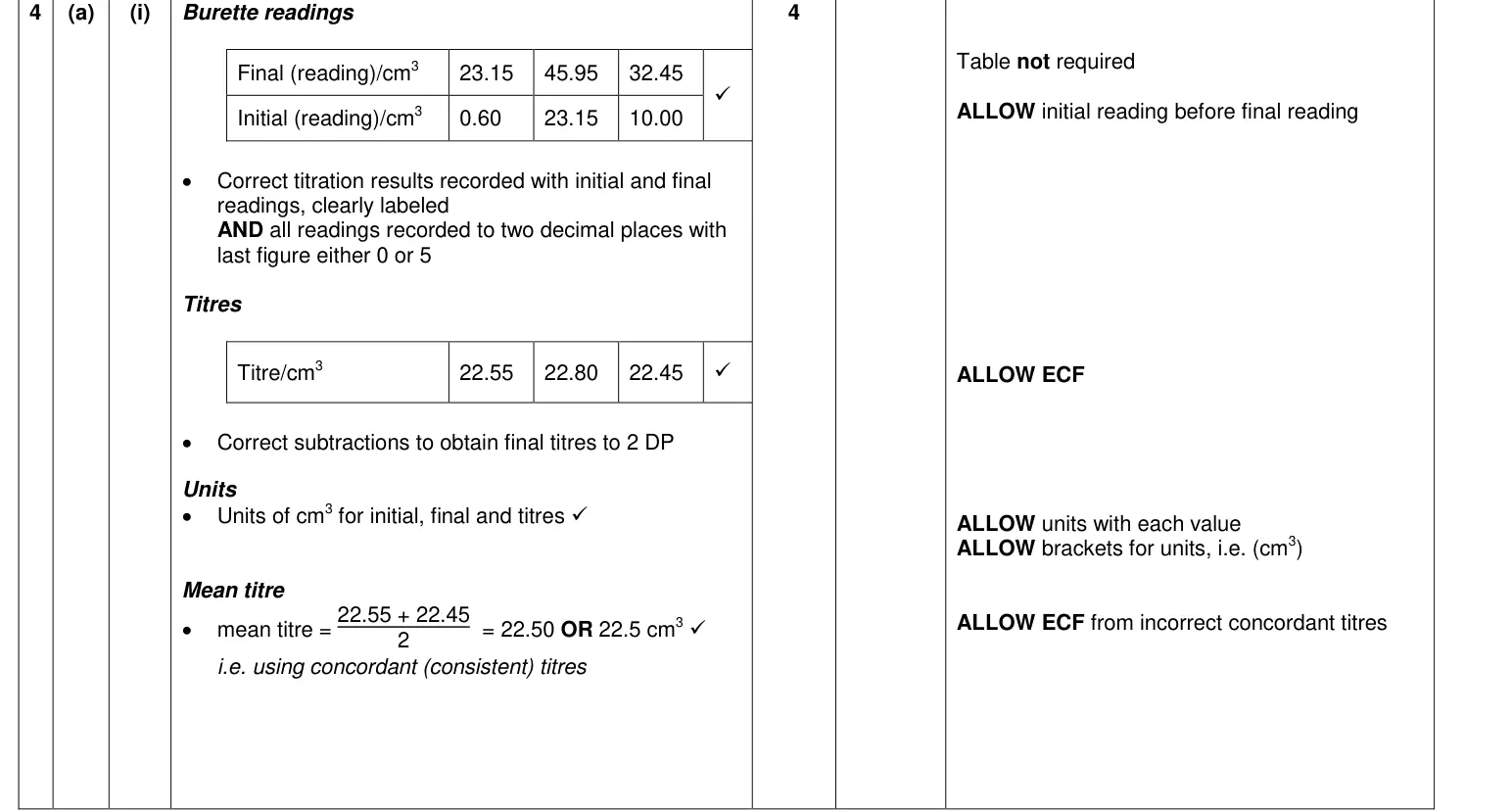
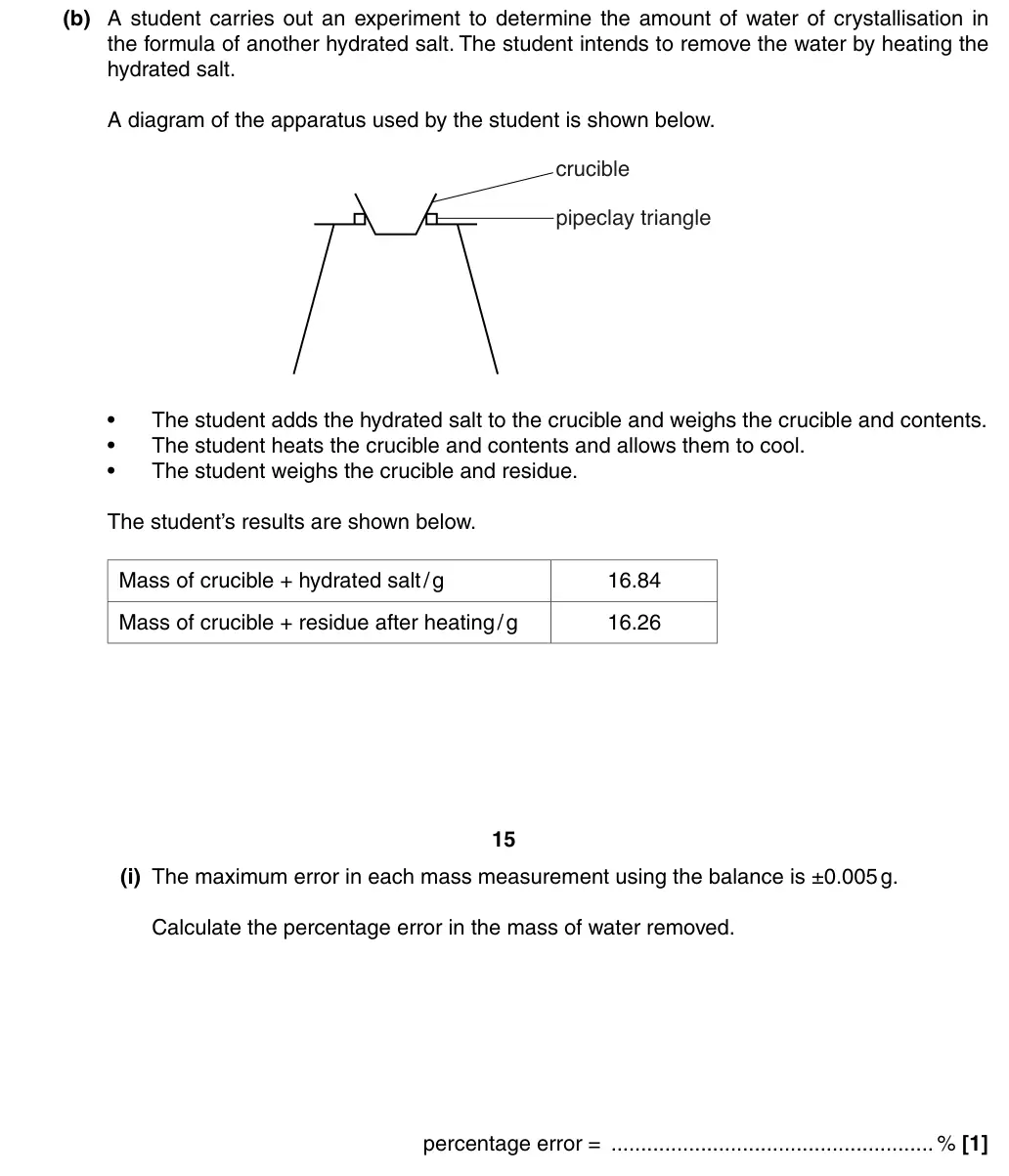
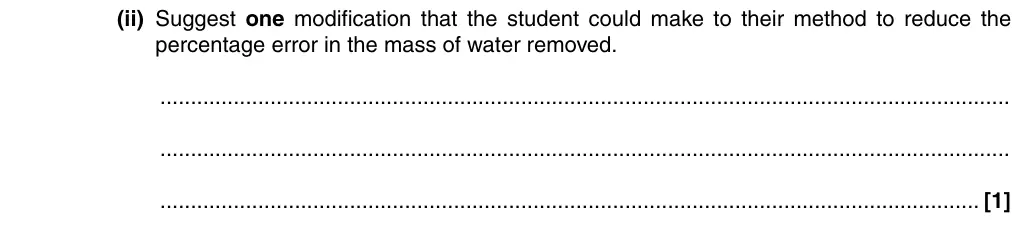
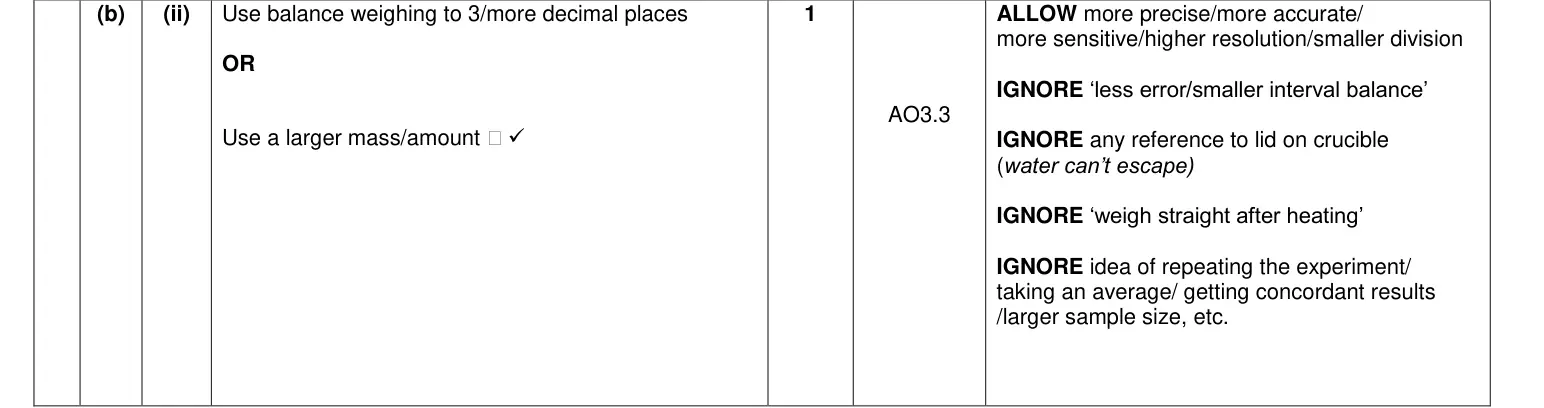
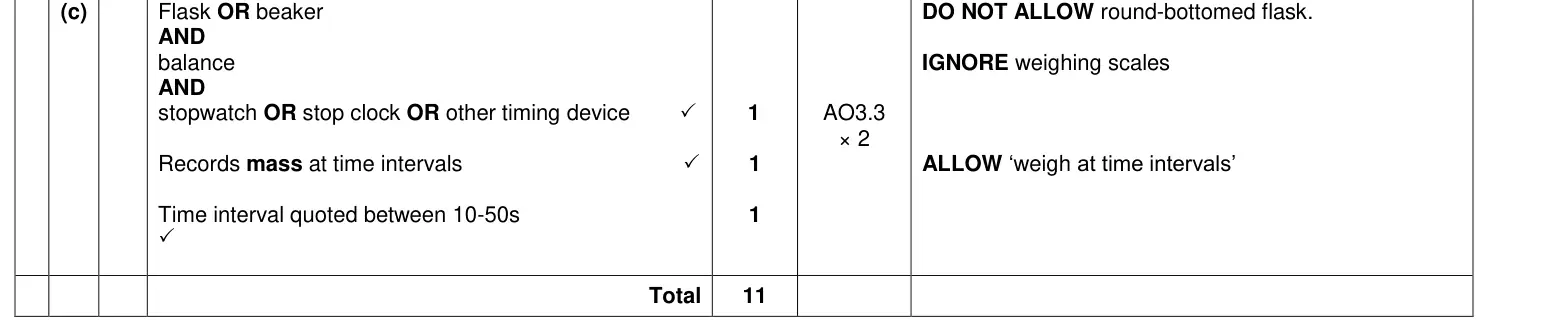
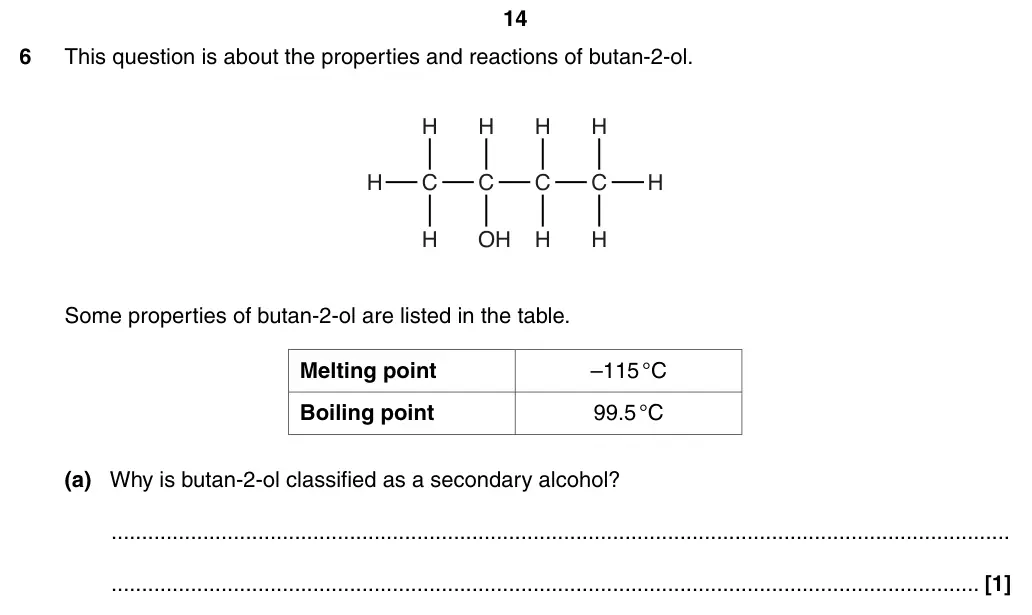
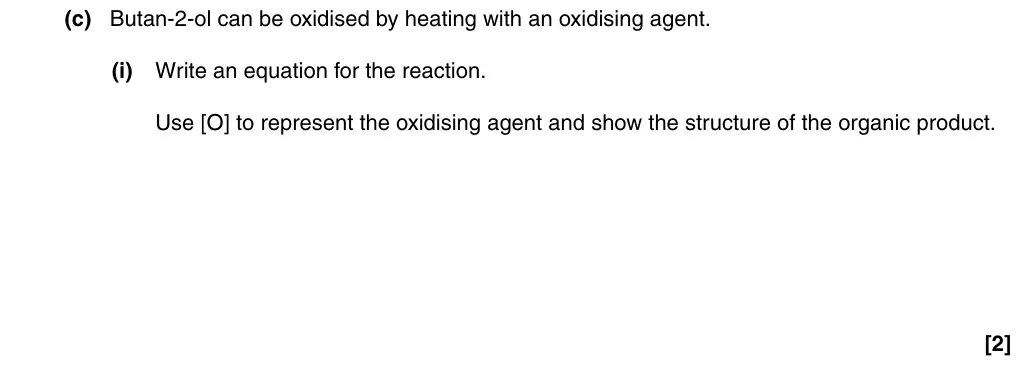
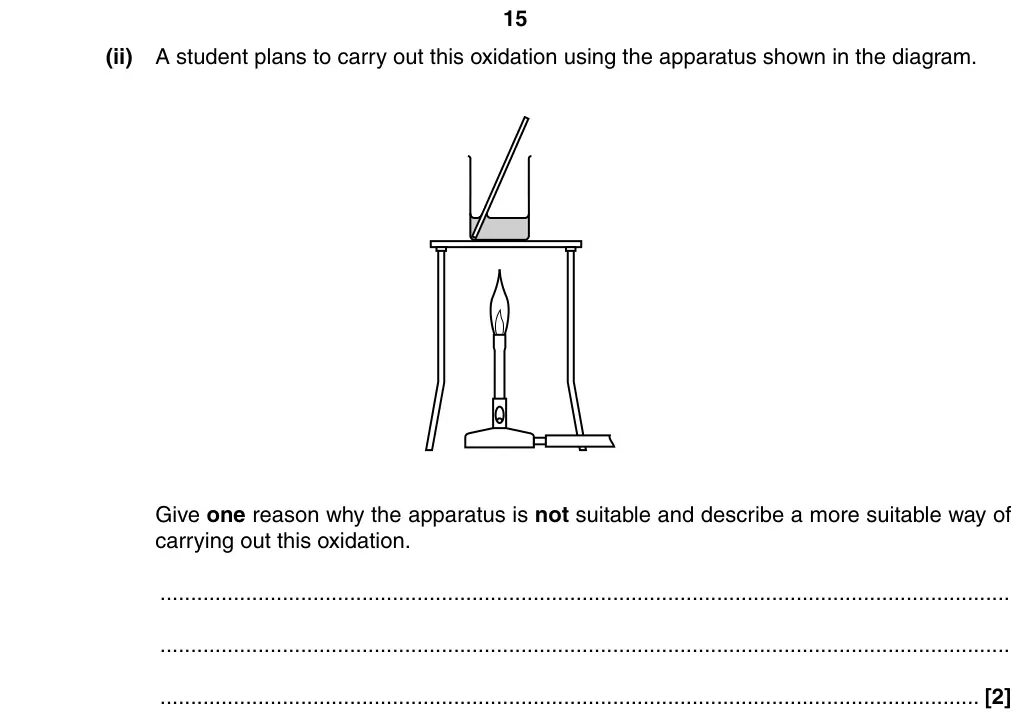
Use the student’s results to determine ∆cH of butan-1-ol in kJ mol–1. Explain why this value of ΔcH is different from the data book value and suggest how
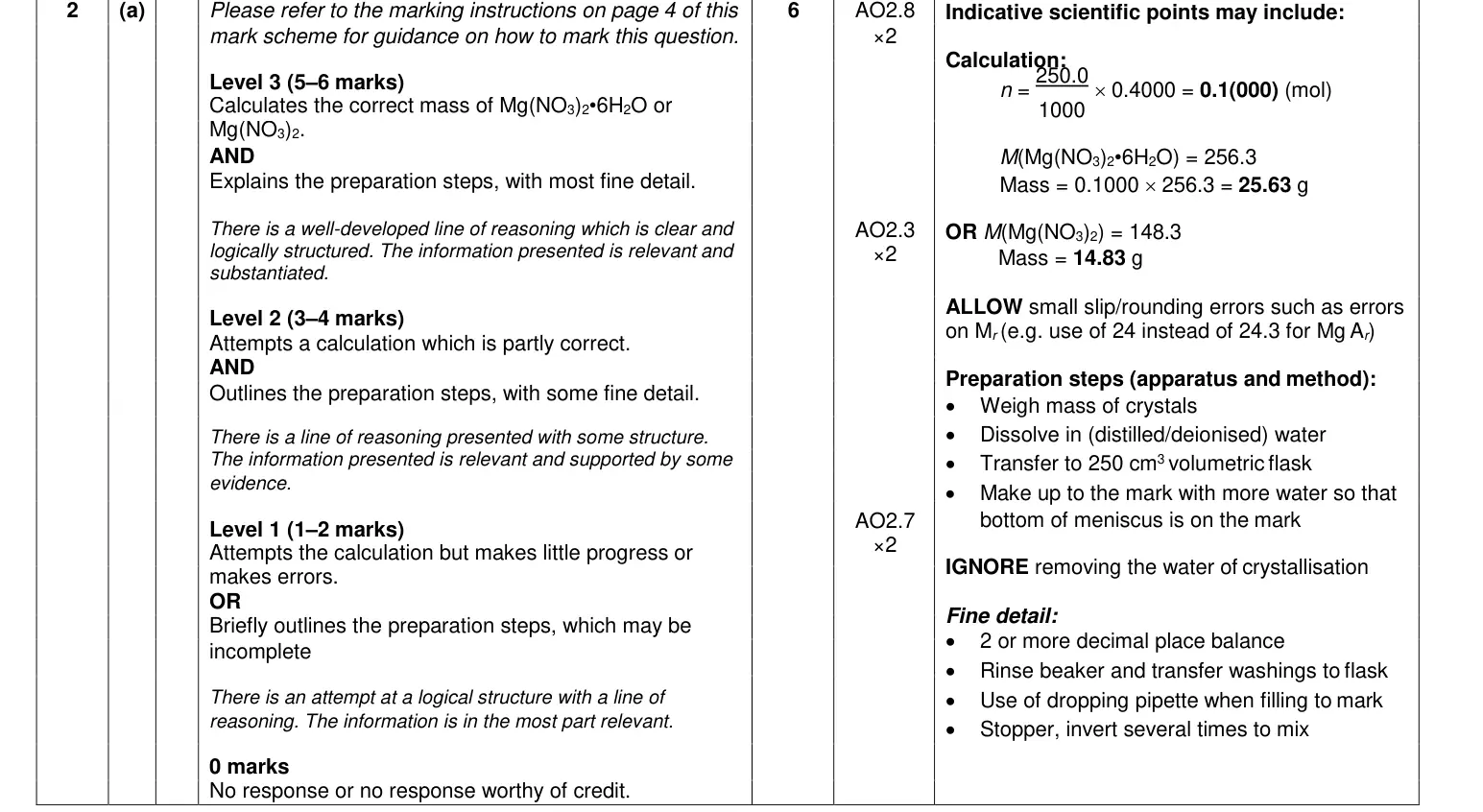
A student plans to prepare 250.0 cm3 of a 0.4000 mol dm–3 solution of magnesium nitrate, Describe how the student would prepare the solution, giving full details of quantities,
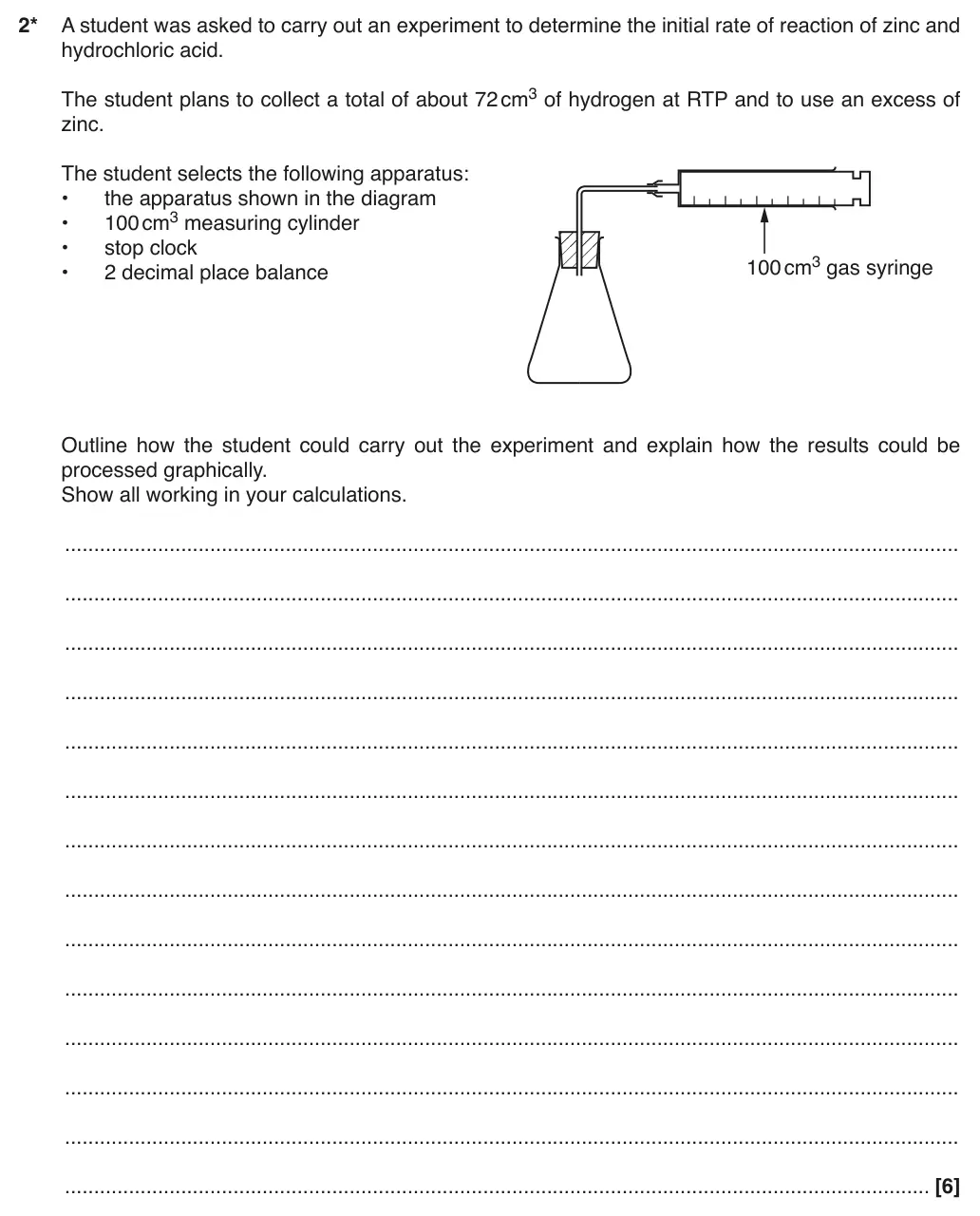
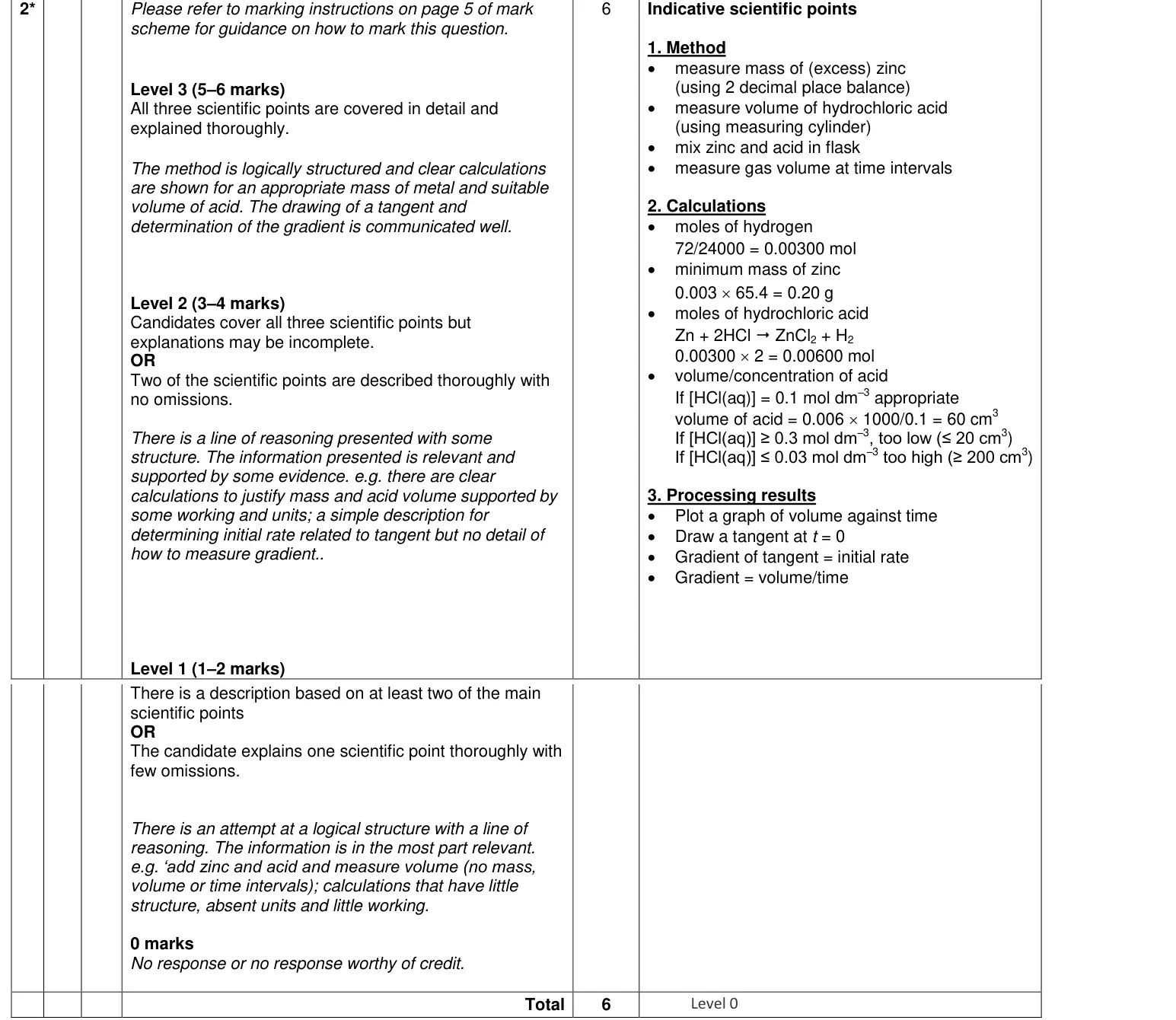
A student was asked to carry out an experiment to determine the initial rate of reaction of zinc and Outline how the student could carry out the experiment and explain how the results could be
Tap a question to zoom it. Where a part needs a table, graph or structure from an earlier part, that part folds out above it; the mark scheme and examiner's comment open underneath. Have the OCR Data Sheet beside you.
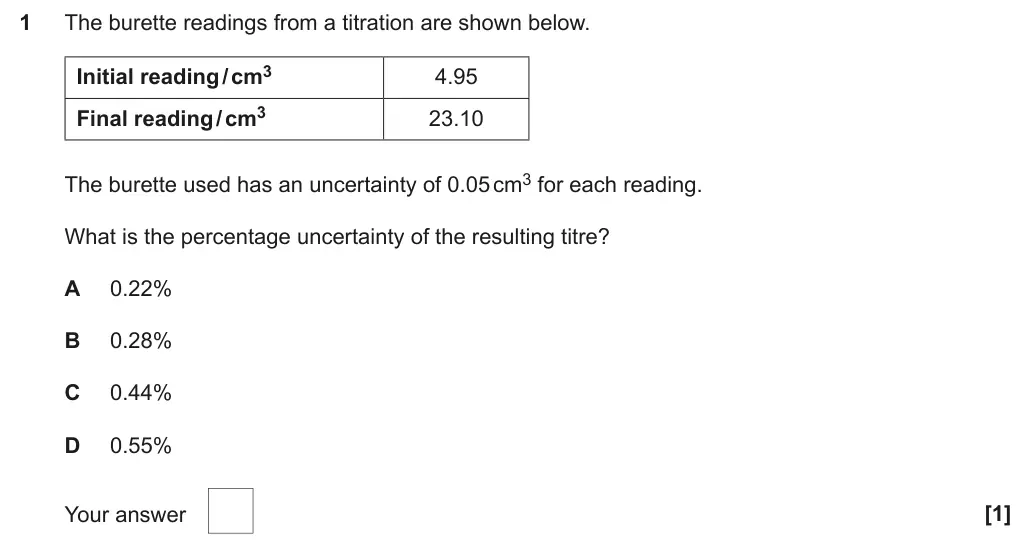
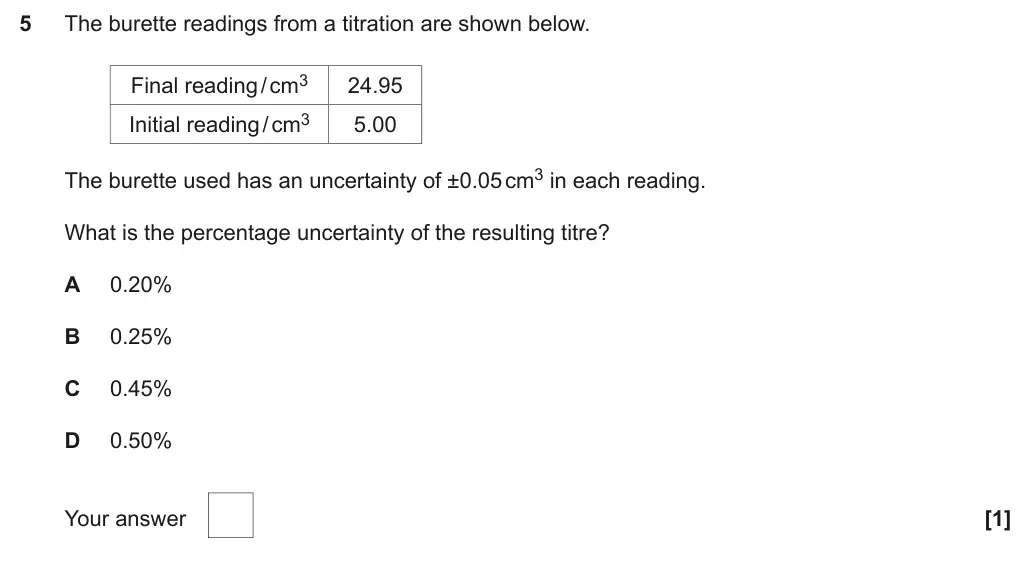
June 2025 · AS Paper 1 · Q11 markMultiple choiceMedium
Answer
D
Mark scheme
Examiner's comment
Most candidates gave the correct answer. B was the most common incorrect response, suggesting they had not multiplied by 2 to consider that the titre was calculated from two separate readings.
Notes from the mark scheme and report
Section M1.3 of the Mathematical Skills Handbook gives details of calculating relative uncertainties, including values calculated by difference.
Skills: M1.3 Identify uncertainties in measurements and use simple techniques to determine uncertainty when data are combined; PAG2 Acid–base titration
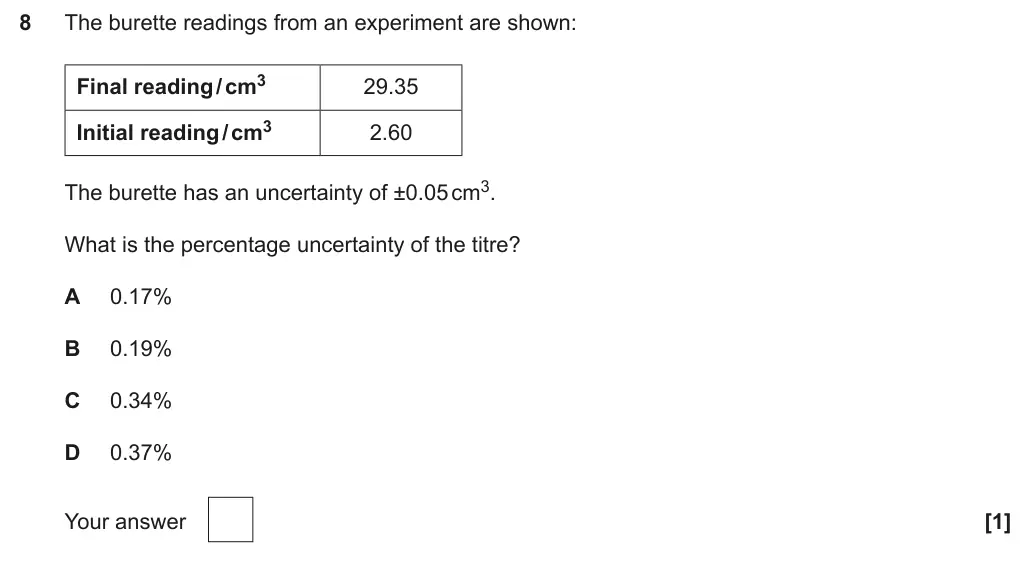
June 2025 · Paper 1 · Q81 markMultiple choiceEasy
Answer
D
Mark scheme
Examiner's comment
The correct answer was D. This was another well answered question with most of the candidates being given the mark. The idea that the titre reading comes from a subtraction and hence two errors are introduced was better understood than in previous series. Common errors were from not multiplying uncertainty by 2 (response A) and use of the final volume (response B).
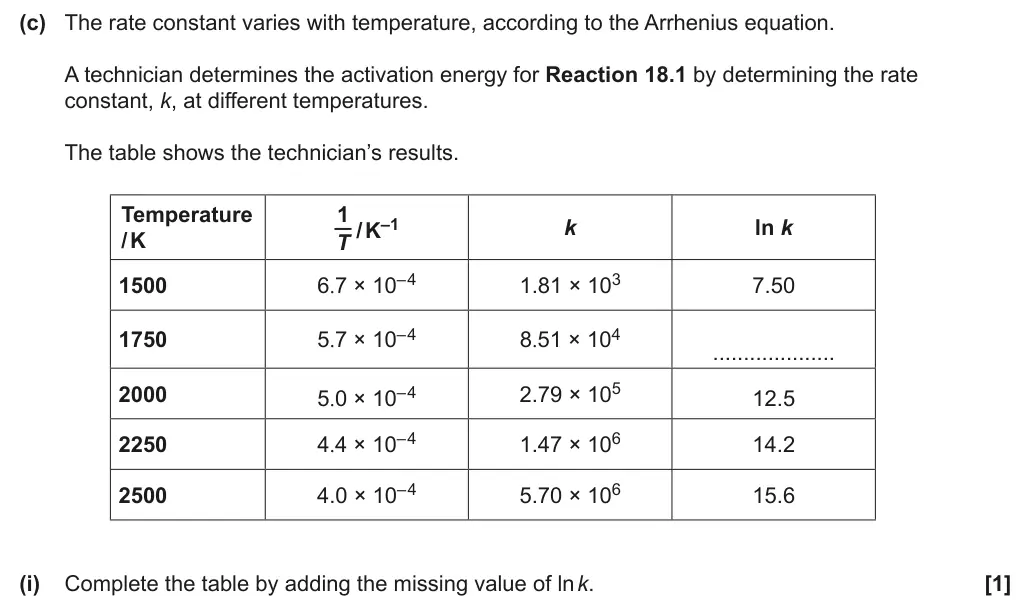
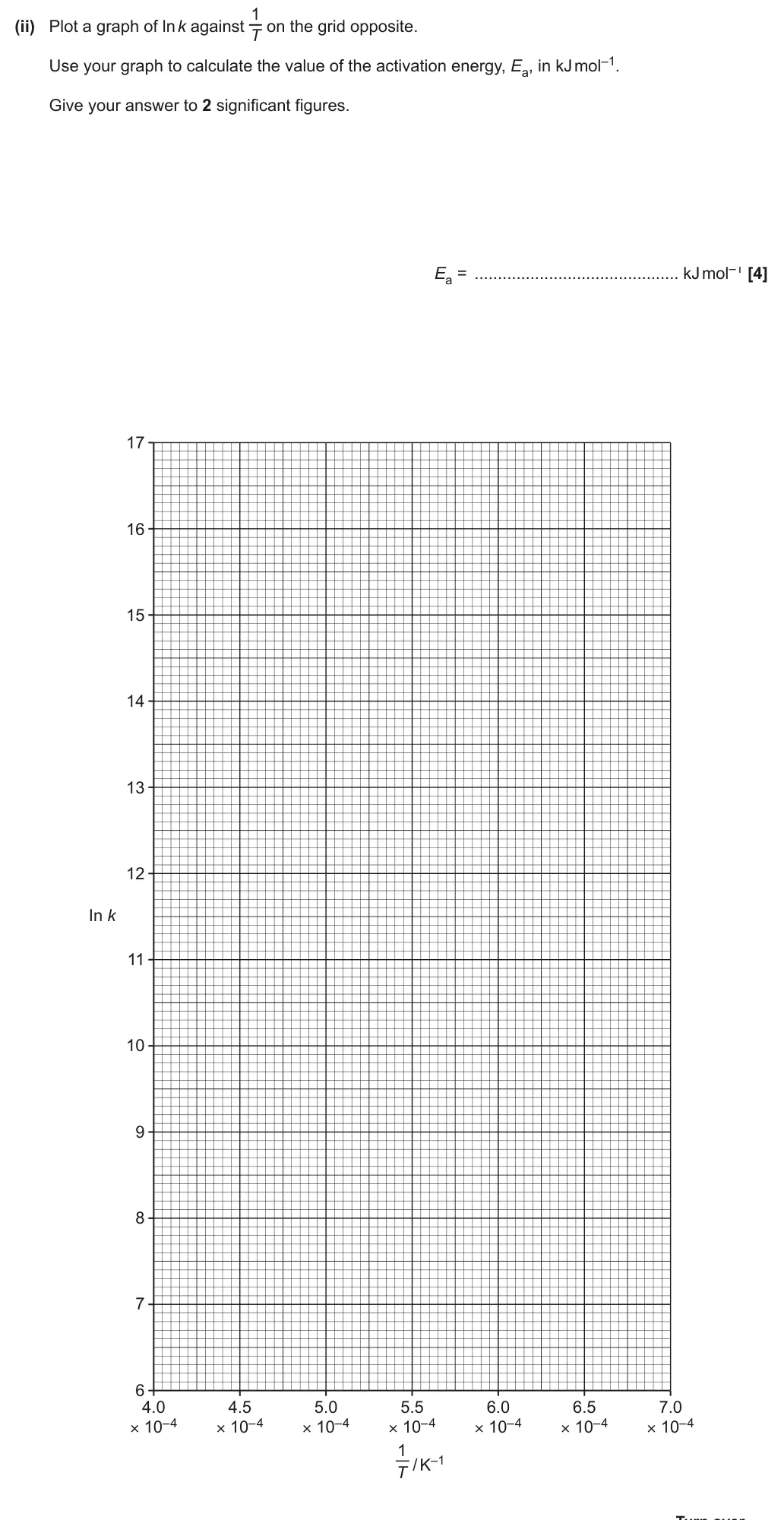
June 2025 · Paper 1 · Q18(c)(ii)4 marksCalculationMedium
Earlier parts of question 18 that this part uses
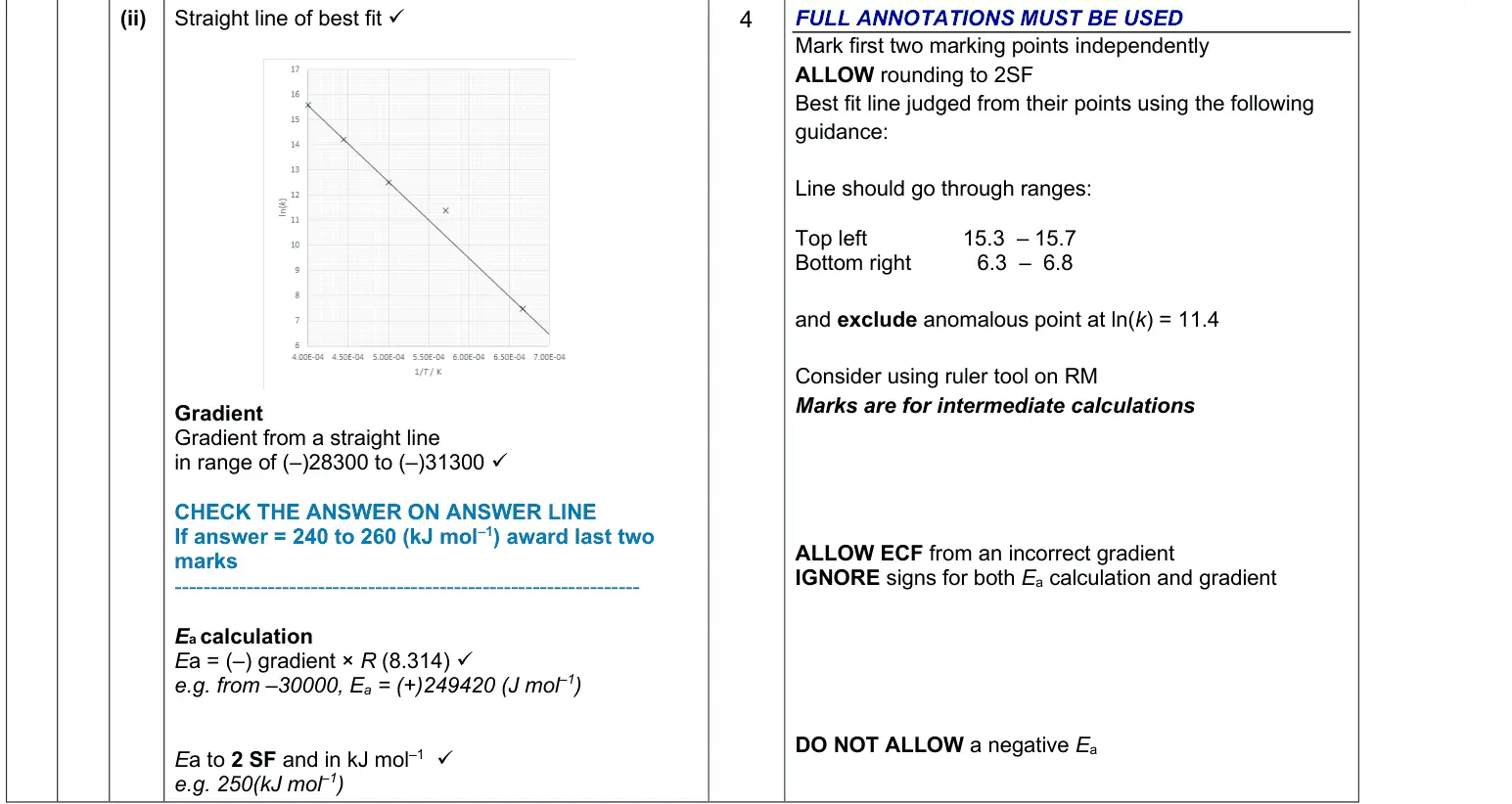
Mark scheme
Examiner's comment
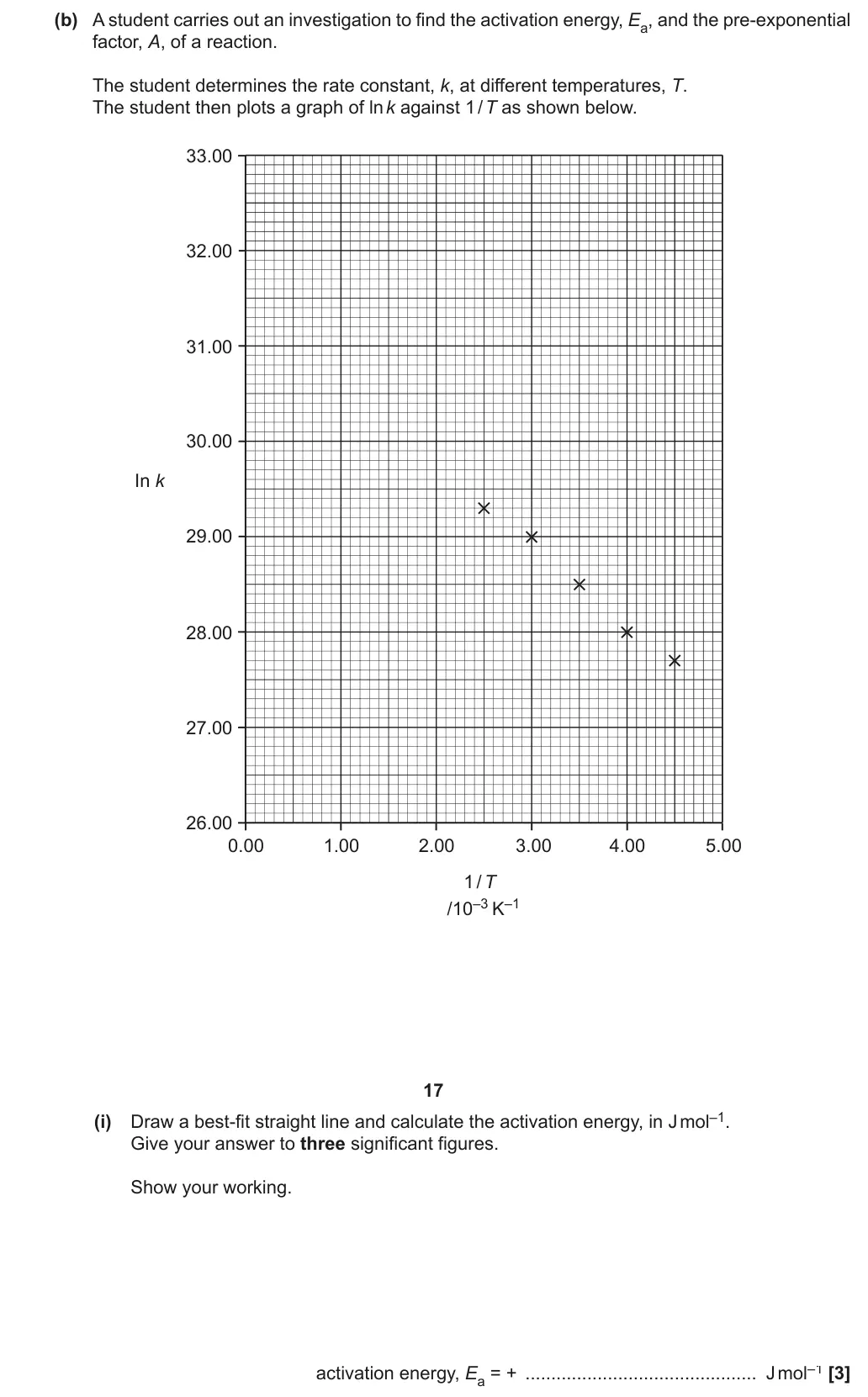
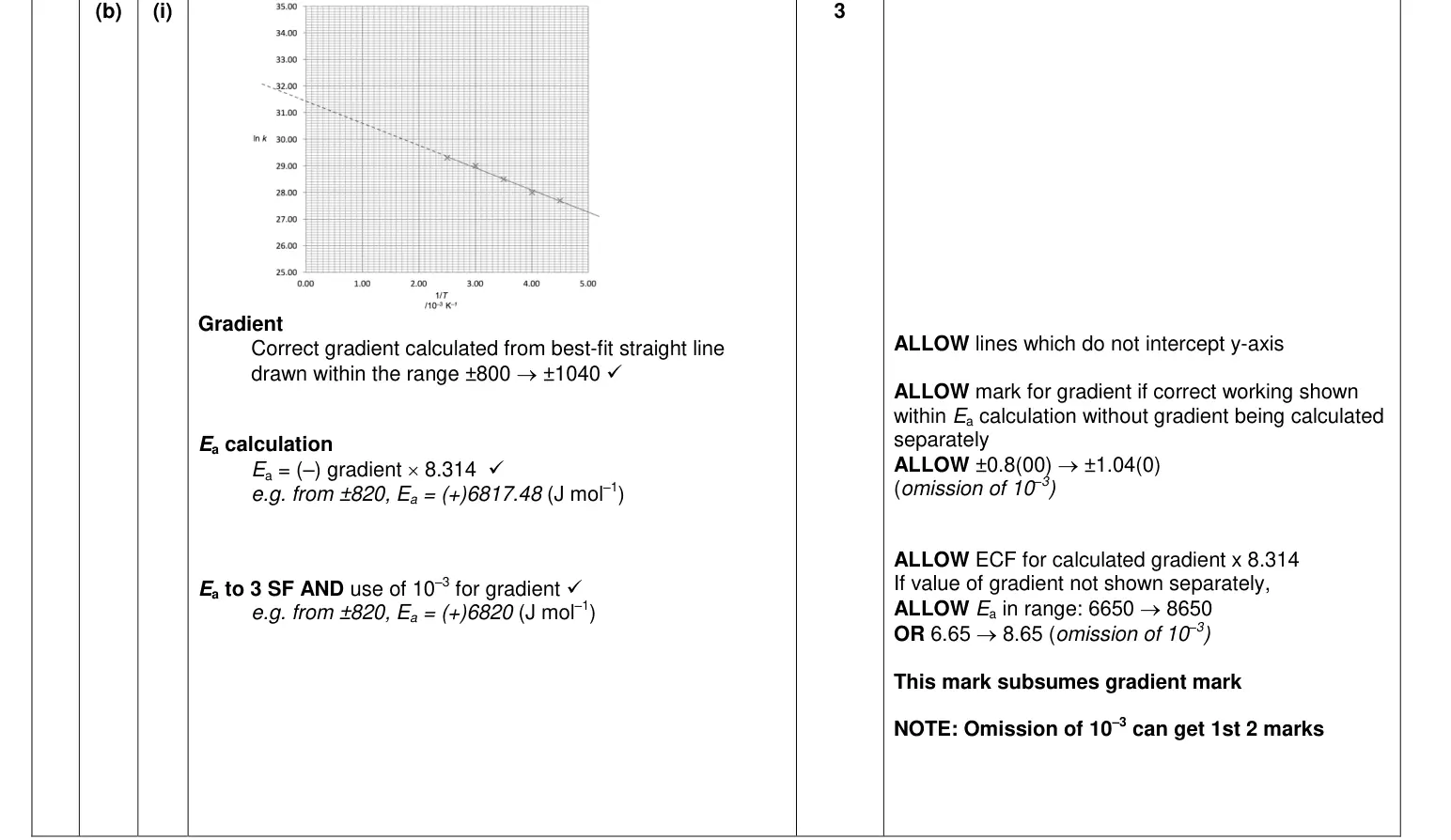
Nearly all candidates were able to draw the line of best fit and linked the equation of a straight line to the equation. A few candidates drew a curve, and some included the anomalous result. Gradients were calculated with accuracy with a few candidates calculating the gradient using an inverted formula. A few didn’t notice the x-axis didn’t go to 0, so used Δx in their gradient at -7x10⁻⁴ and ended up with a gradient of about -12800 and Ea of 110 as ECF. Most candidates knew to multiply by R but a few incorrectly divided by R. Some candidates didn’t give to 2 SF and / or convert to kJ and gave a negative value. A few candidates tried to substitute values into lnk = - Ea/RT + lnA, rather than use the graph. Many realised that they didn’t have a y-intercept and then calculated the gradient. Those that were able to complete the maths calculated the correct answer within the range.
Notes from the mark scheme and report
best-fit straight line excluding the anomalous point at ln k = 11.4
gradient –28 300 to –31 300
Ea = –gradient × 8.314
2 SF in kJ mol–1 (240–260)
DO NOT ALLOW a negative Ea
Skills: M0.0 Recognise and make use of appropriate units in calculations; M1.1 Use an appropriate number of significant figures; M2.3 Substitute numerical values into algebraic equations using appropriate units for physical quantities; M3.2 Plot two variables from experimental or other data; M3.3 Determine the slope and intercept of a linear graph
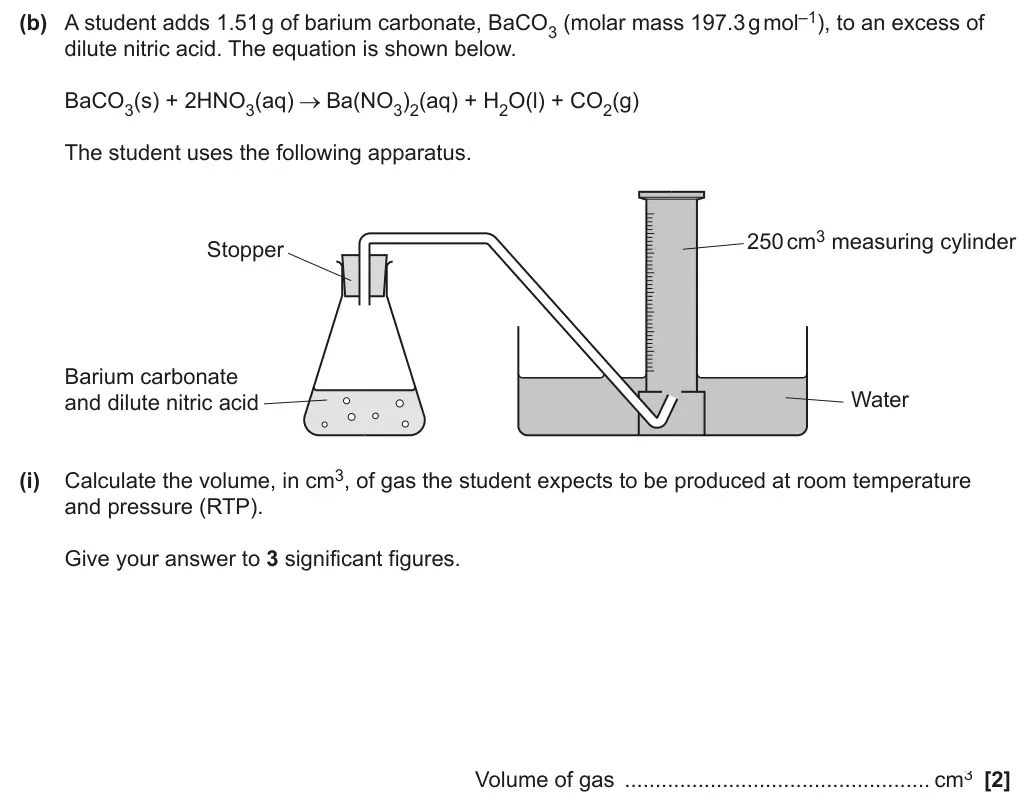
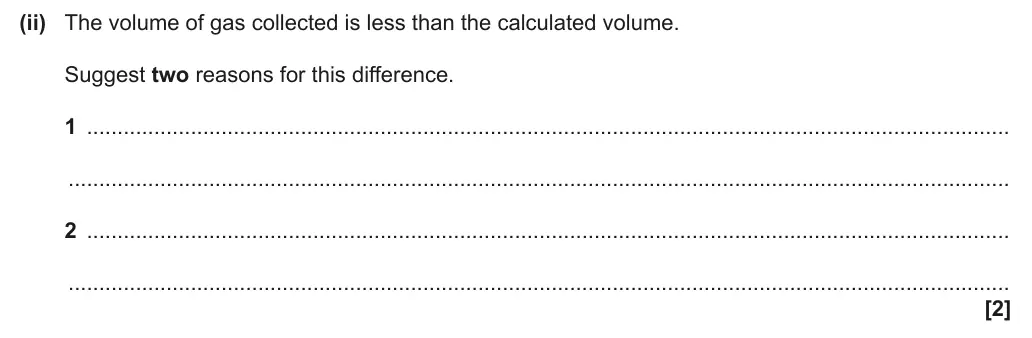
June 2025 · AS Paper 2 · Q2(b)(ii)2 marksShort answerHard
Earlier part of question 2 that this part uses
Mark scheme
Examiner's comment
A very challenging question with most candidates failing to score any marks. Only a few correctly sug- gested the gas dissolving in water or the use of non-standard conditions. Most correct responses were for gas lost while replacing the stopper. Most mentioned loss of gas but didn’t link to the procedure to say how it was lost. Lots of candidates suggested that the reaction was incomplete despite being told the acid is in excess in the question. Candidates should consider that if a reagent is in excess, the reaction is expected to go to completion. Many suggested faults with setting up apparatus – possibly from personal experience. We wanted them to consider the limitations should this be set up without ‘human’ errors. A lot of candidates discussed the various leaks in the apparatus as the sources of gas loss. Some made reference to gas present in the tubing already not understanding that it would push through and displace gas to fill the measuring cylin- der, with equivalent amount being left in tubing at the end.
Notes from the mark scheme and report
gas escapes while bung is replaced
some CO2 dissolves in the water
conditions not at RTP
IGNORE incomplete reaction and human errors such as unsealed apparatus
We provide support to help students prepare for questions based on the practical work they have carried out. Each of our suggested practicals has extension questions which can be used to explore practical work in more detail and evaluate different procedures.
This question links well with PAG 1.1: https://teachcambridge.org/item/b9be7815-8c49-4fd6- b0eb-8f476393c653
Skills: PAG1 Moles determination
June 2025 · AS Paper 2 · Q2(b)(iii)1 markShort answerMedium
Earlier parts of question 2 that this part uses
Mark scheme
Examiner's comment
Around half of the candidates gained a mark for this question. Many suggested the use of “gas syringe” but from their response in (i) it was clear that a significant number didn’t understand how this would im- prove the experiment. Lower-attaining candidates sometimes couldn’t give the correct name for a gas syringe suggesting “gas volume measurer” or “gas tube” instead. Some other incorrect responses included: • Improve resolution on measuring cylinder • Use a larger mass of BaCO3 • Leave reaction for longer • Heat to a constant mass • Make sure delivery tube is further in the measuring cylinder • Make sure connections are airtight
Notes from the mark scheme and report
gas syringe in place of upturned measuring cylinder, or carbonate in a small tube released into the acid without removing the stopper
IGNORE gas cylinder
Skills: PAG1 Moles determination
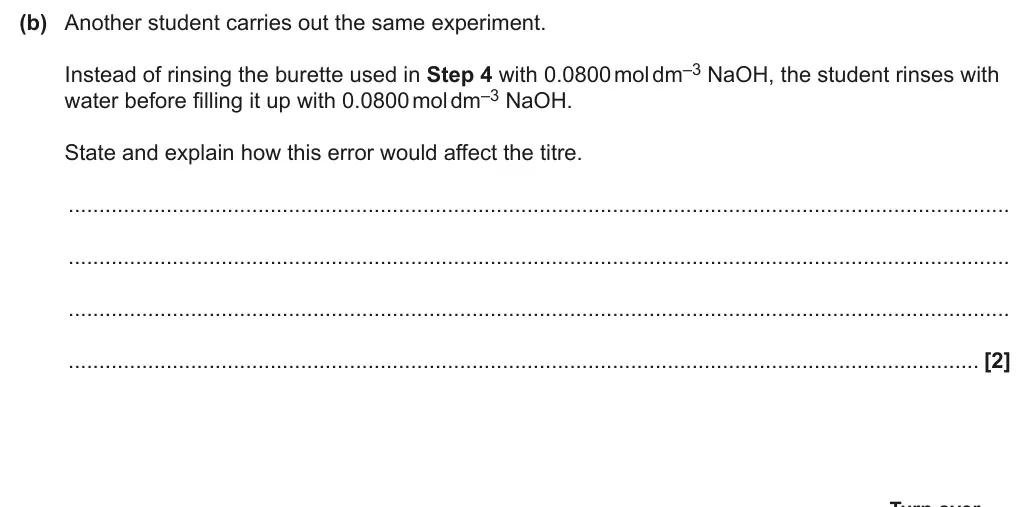
June 2025 · AS Paper 2 · Q3(b)2 marksShort answerMedium
Earlier part of question 3 that this part uses
Mark scheme
Examiner's comment
Around half of the candidates scored both marks, understanding the impact on the titre of rinsing the bu- rette with water. It was essential for candidates to refer to the “titre” and not just the volume in their re- sponse. Some understood that the NaOH would be more dilute but then suggested it would give a smaller titre or didn’t give impact on the titre value at all. Some suggested that the water provided OH- ions thus de- creasing the amount of NaOH required to neutralise. A few gave non-committal responses such as “Water would alter the concentration of NaOH, so you wouldn’t get an accurate titre” so scored 0 marks.
Notes from the mark scheme and report
titre would be greater
NaOH in burette more dilute so larger volume needed
Skills: PAG2 Acid–base titration
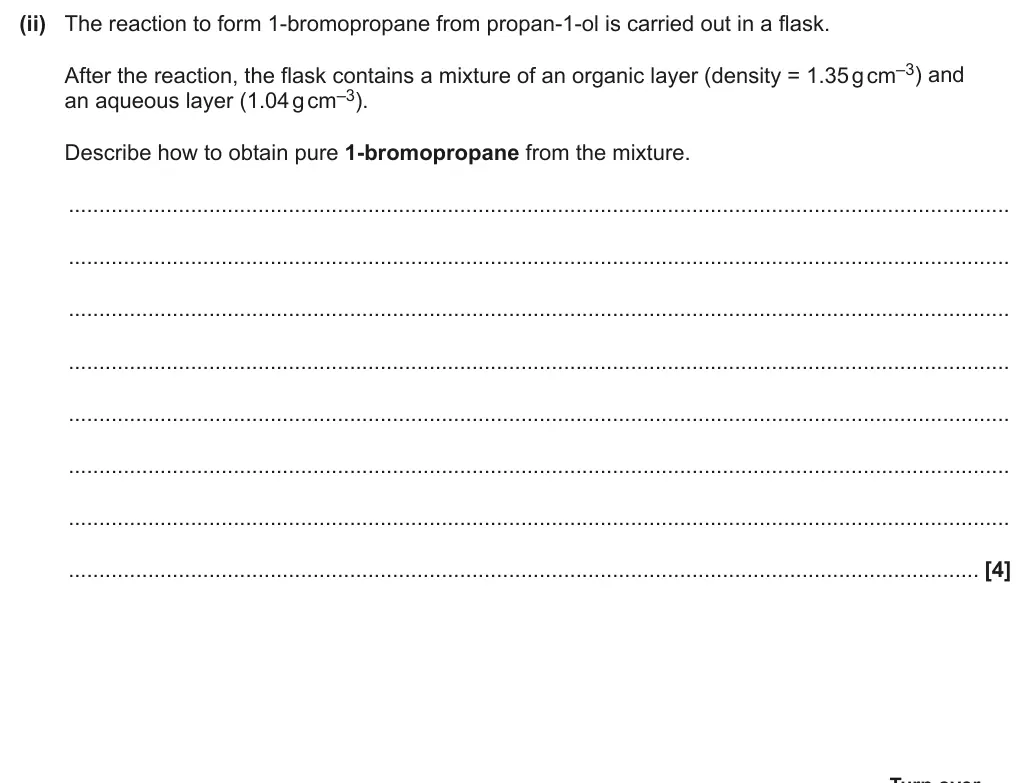
June 2025 · Paper 2 · Q19(b)(ii)4 marksShort answerMedium
Earlier part of question 19 that this part uses
Mark scheme
Examiner's comment
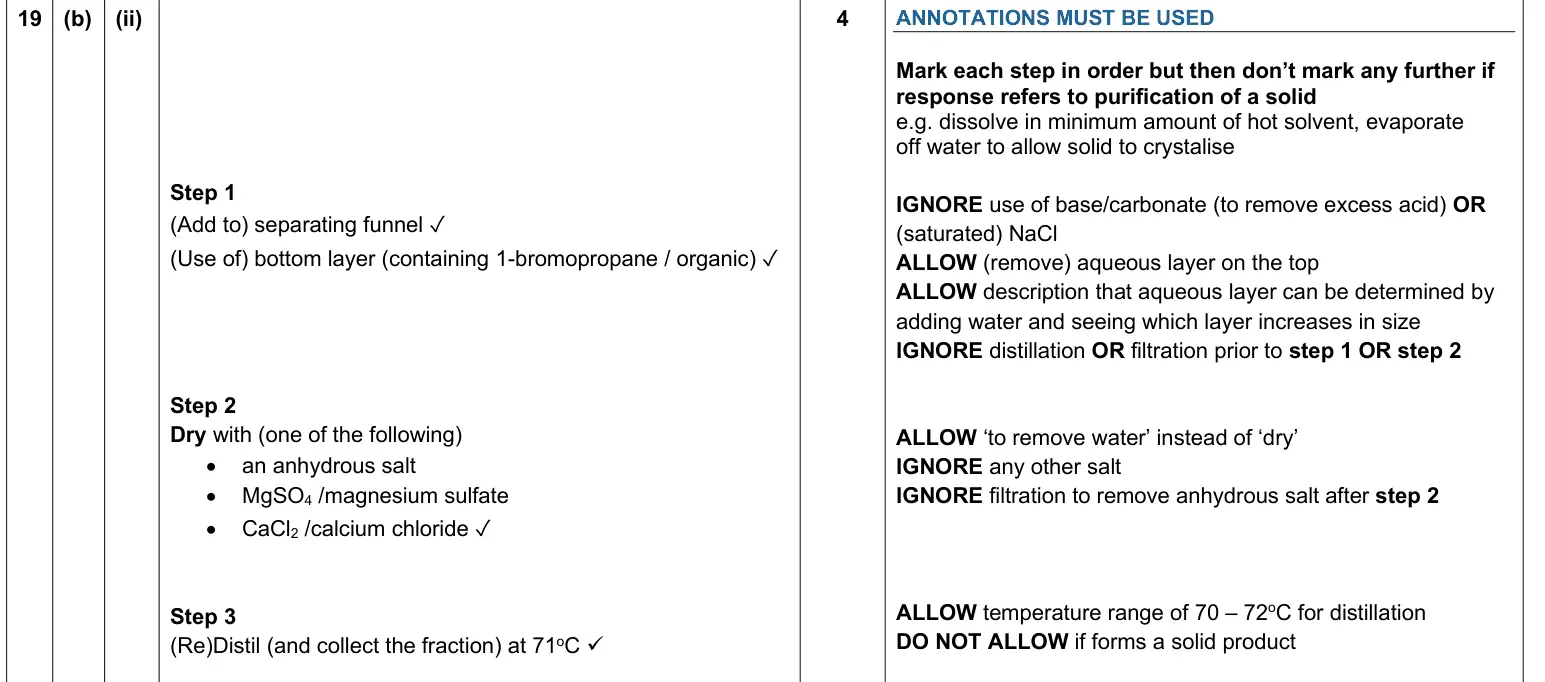
Candidates appeared better prepared for this type of question than in previous sessions, with a significant proportion achieving 3 or 4 marks. It differentiated well between candidates at different grades. Most candidates recognised the organic layer would be at the bottom but couldn’t always name the apparatus used to separate these two layers with incorrect responses including burettes, pear-shaped flasks, separating flasks and separating tubes. Some were confused about the density information, thinking that as the organic layer is denser it would be on top, or if adding more water it would then switch around the layers. Many gave the first step but not step 2 and 3. Lots of detail was given about how to use the separating funnel, e.g. invert to mix, vent to release pressure build up etc., to fill up the space provided. Most that went on to add an anhydrous salt were able to explain that it was used to dry the organic layer and were able to give a suitable example. Some candidates often misunderstood how to use them suggesting the anhydrous salt should be added to the separating funnel or the aqueous layer. Some candidates also suggested washing the layer with water or aqueous sodium carbonate to remove the acid once the organic layer had been dried. Many candidates either omitted the temperature to distil at to obtain pure 1-bromopropane or confused it with the boiling point of propan-1-ol (reactant) also given in the question. Some said to collect the distillate at its boiling point but didn’t quote the value that they had been given in the question so did not score the final mark. Many candidates introduced additional, unnecessary steps. Lower attaining candidates often confused the purification with that of an organic solid i.e. recrystallisation and scored 0 marks. A clear and concise response which scored all 4 marks.
Notes from the mark scheme and report
separating funnel
keep bottom (denser organic) layer
dry with anhydrous salt (MgSO4/CaCl2)
redistil collecting at 71 °C (70–72)
no further marks if purification of a solid described
We have produced a range of practice exam questions linked to the purification of an organic liquid (PAG5) which can be found on the Teach Cambridge website.
This video produced by MaChemGuy is helpful for reviewing PAG 5: PRACTICAL SKILLS - PAG 5 - SYNTHESIS OF AN ORGANIC LIQUID.
Skills: PAG5 Synthesis of an organic liquid
June 2025 · Paper 3 · Q3(a)5 marksCalculationEasy
Mark scheme
Examiner's comment
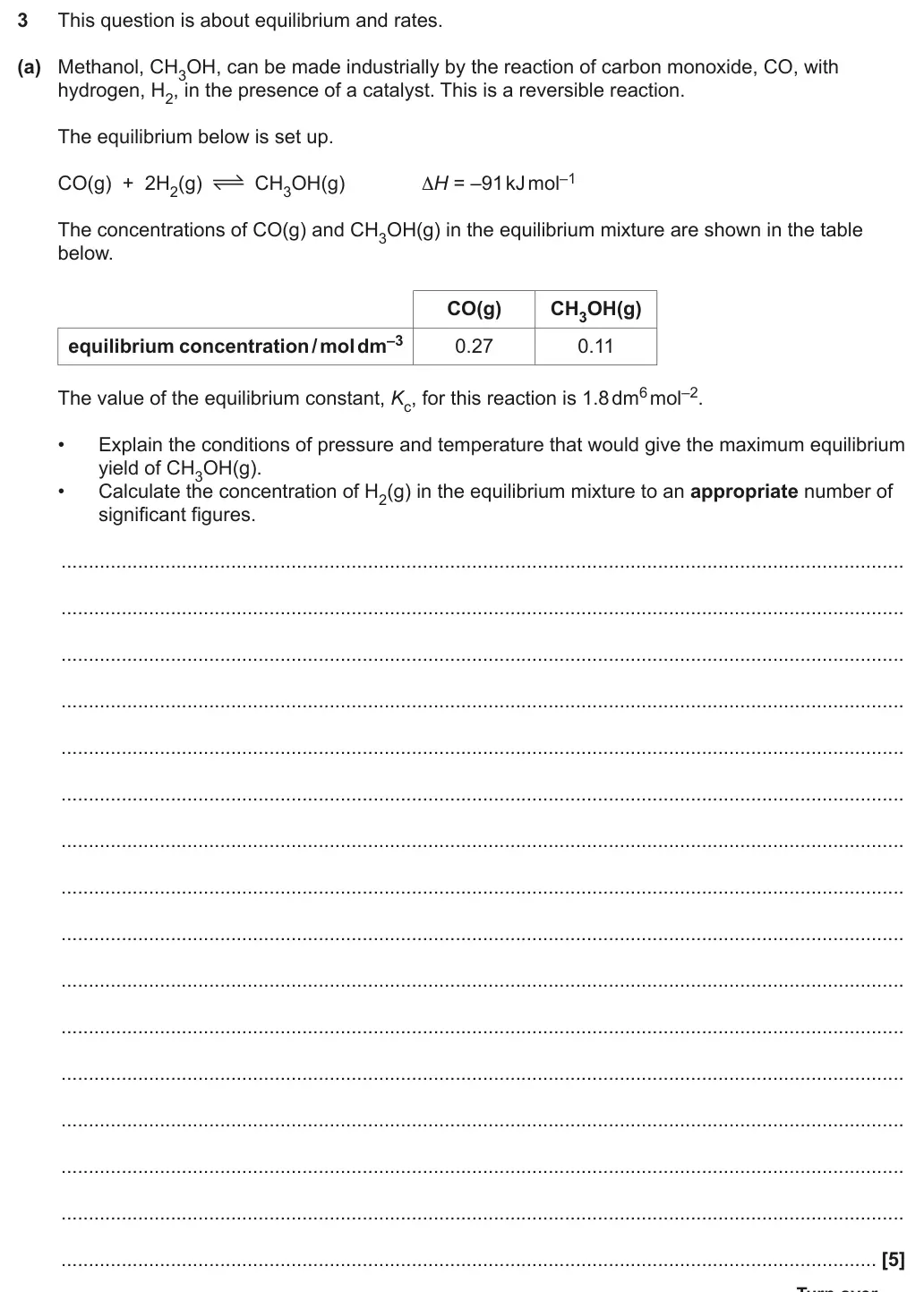
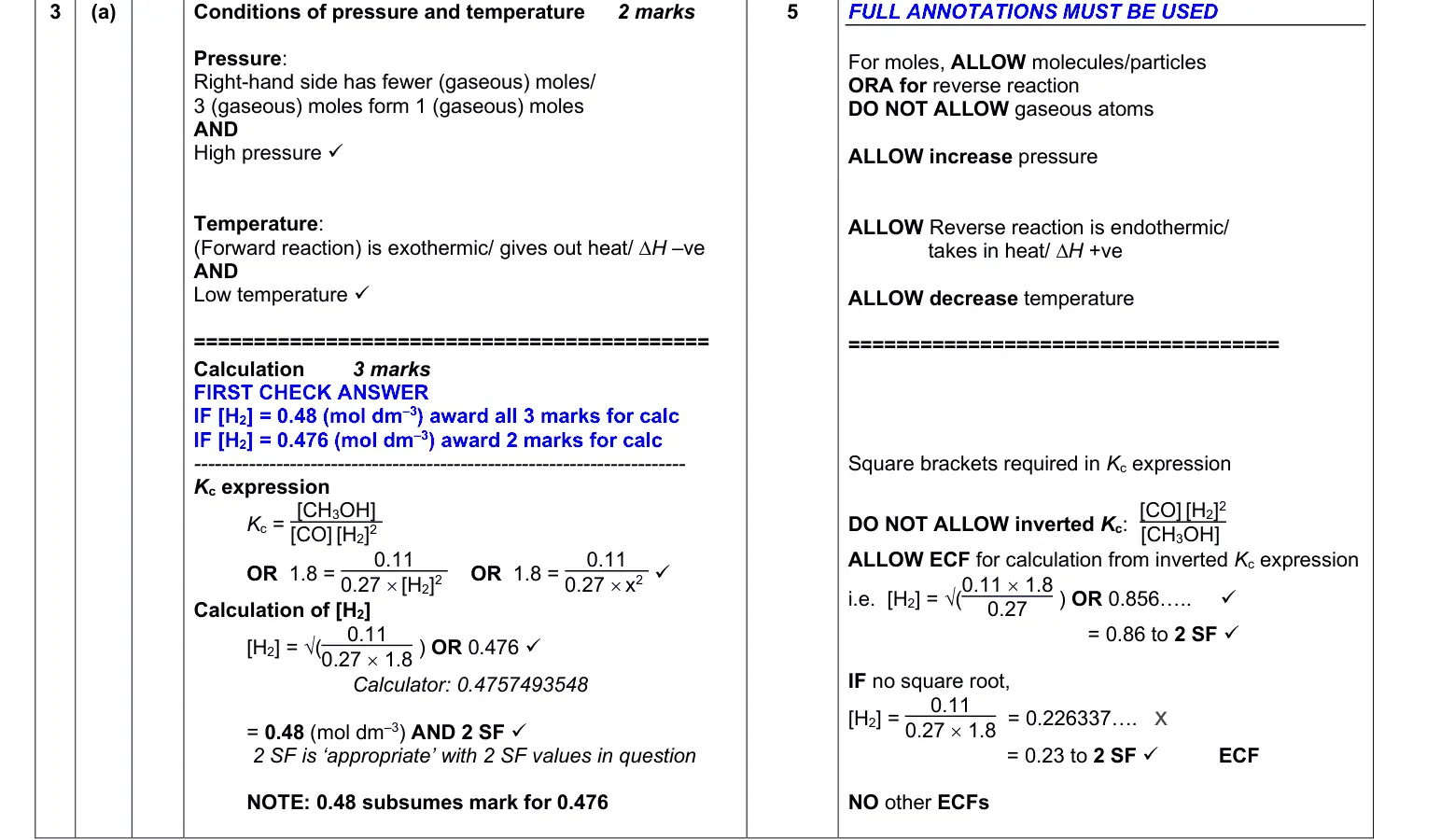
This question was answered confidently with most candidates identified the conditions for a maximum equilibrium yield from the equation: a high pressure from fewer gaseous moles in the product and a low temperature from the exothermic reaction. This was all that the question asked but candidates often wrote far too much, considering operational conditions, rate, safely and expense. Unfortunately, candidates could end up contradicting themselves and wasting valuable time. Candidates are advised to read what the question is asking and to limit their response to this. The calculation was answered well, with most identifying that 2 significant figures is appropriate as the lowest number of significant figures present in the data provided in the question. Thus 0.48 mol dm–3 was commonly seen, rather than 0.476. The Kc expression was usually correct and most candidates rearranged this correctly to make [H2] the subject. The square root calculation showed that some candidates did not appear to have the required calculator skills. A significant number of candidates showed the Kc expression upside down and the mark scheme allowed ECF to be applied following this error.
Notes from the mark scheme and report
high pressure because fewer gaseous moles on right (DO NOT ALLOW gaseous atoms)
low temperature because forward reaction exothermic
square brackets required in Kc
square root needed
0.48 to 2 SF (0.476 loses a mark)
ECF only from inverted Kc or no square root
Skills: M1.1 Use an appropriate number of significant figures; M2.2 Change the subject of an equation; M2.3 Substitute numerical values into algebraic equations using appropriate units for physical quantities; M2.4 Solve algebraic equations
June 2024 · Paper 1 · Q19(b)(i)5 marksCalculationEasy
Mark scheme
Examiner's comment
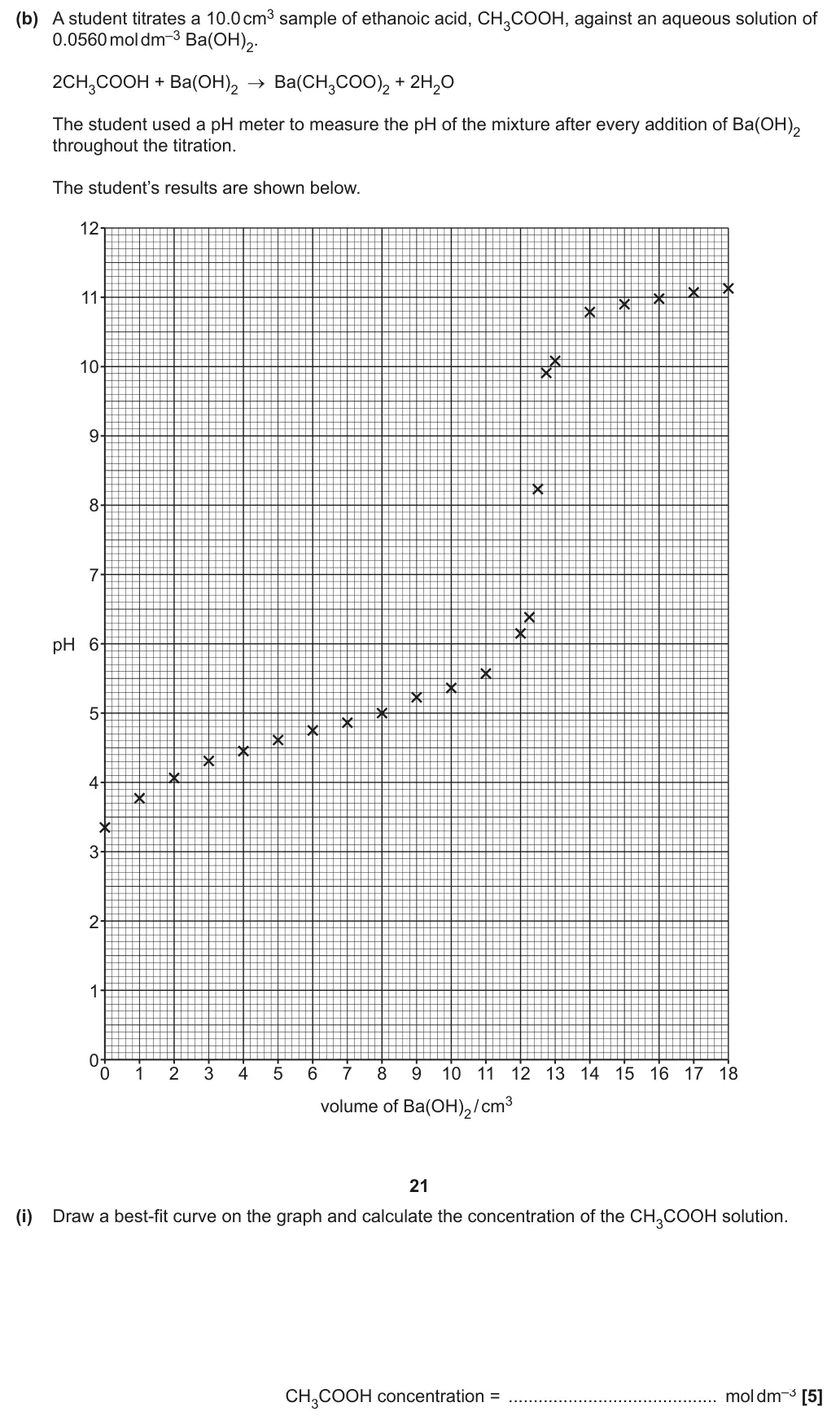
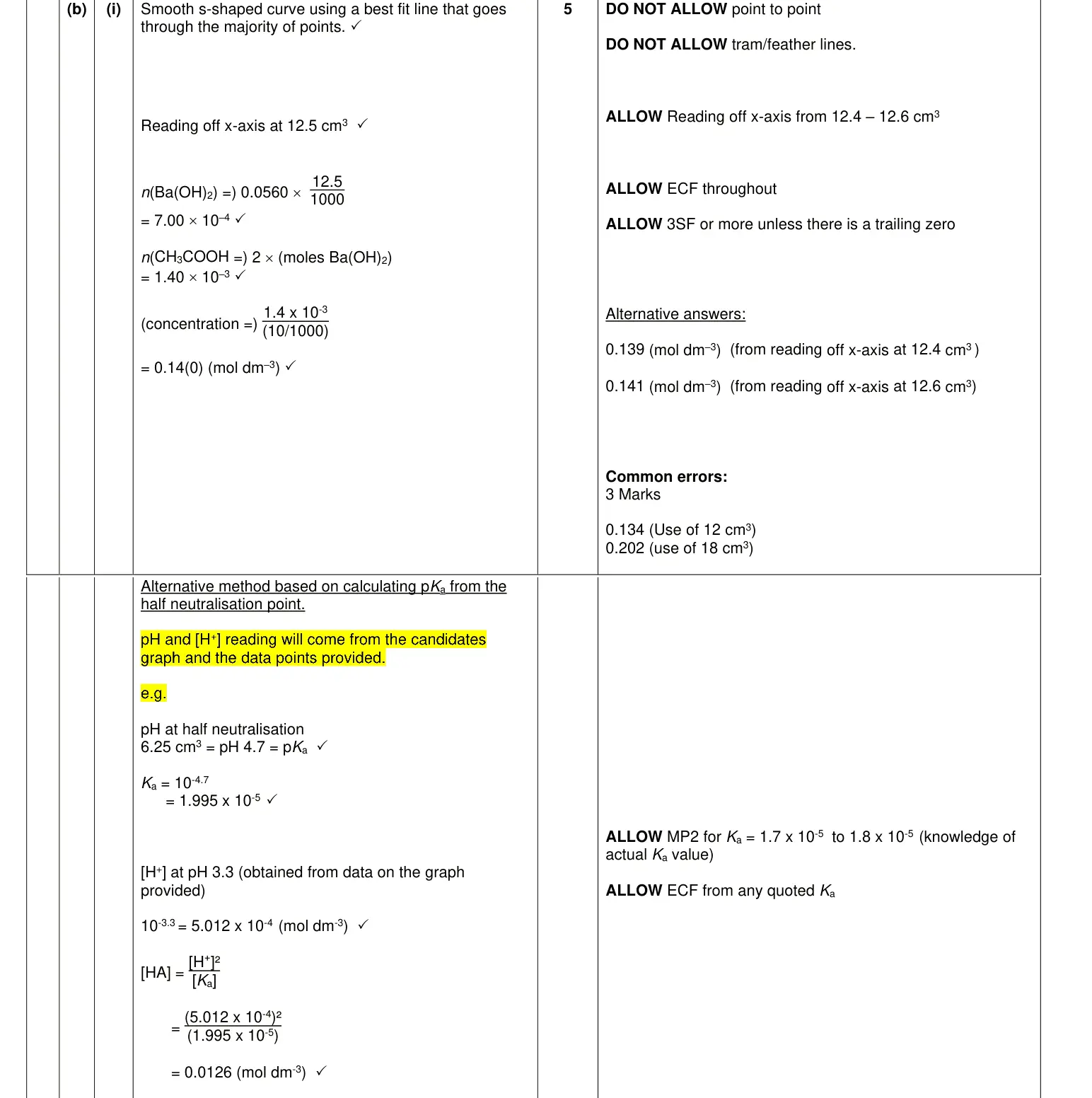
Nearly all candidates were able to draw the line of best fit and linked the sharp vertical section of the graph with the volume of Ba(OH)2 needed to neutralise the ethanoic acid. Candidates should aim to produce a smooth line of best fit and avoid ‘tram’ lines when the pencil is taken off the paper and the curve started again. The line should go through most points. Some candidates misinterpreted the graph and used values of 8, 12, 12.2, 12.25 and 18. However, the remainder of the calculation was accessible, and most candidates scored well with ECF marks from this point. There was occasional division of 2 for the moles of ethanoic acid and dividing by the original volume of Ba(OH)2 rather than the 10cm3 of ethanoic acid. This candidate scored all available marks. This is a very good example of a candidate displaying their working. The response was well communicated indicating the end point, links were made to what was being calculated and how the next number was obtained.
Notes from the mark scheme and report
smooth S-shaped best-fit curve through the majority of points
equivalence at 12.5 cm3
1:2 ratio Ba(OH)2:CH3COOH
Skills: M0.0 Recognise and make use of appropriate units in calculations; M0.2 Use ratios, fractions and percentages; M3.2 Plot two variables from experimental or other data; PAG11 pH measurement; PAG2 Acid–base titration
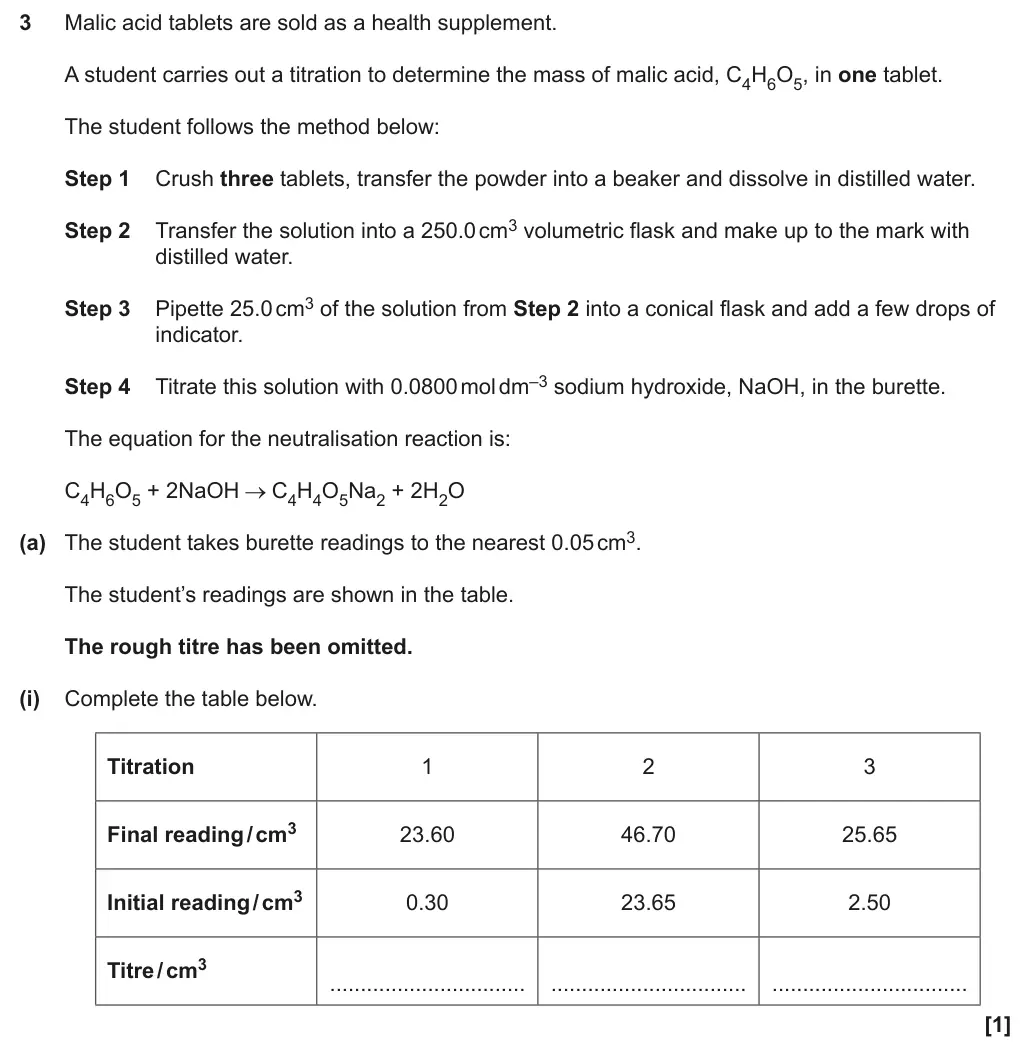
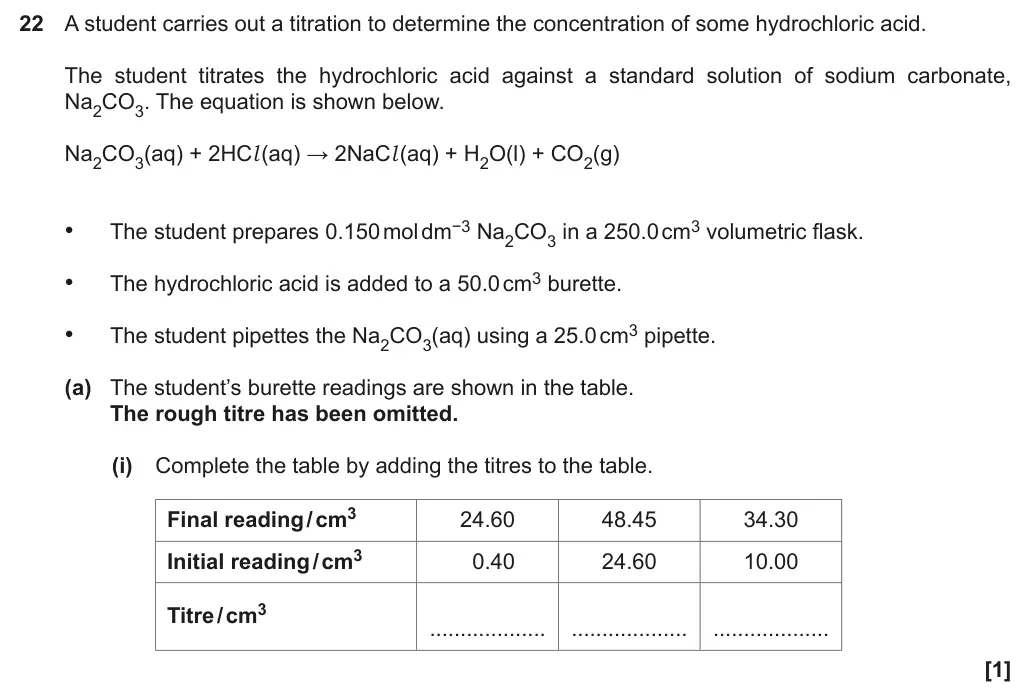
June 2024 · AS Paper 1 · Q22(b)(i)1 markComplete table/diagramEasy
Mark scheme
Examiner's comment
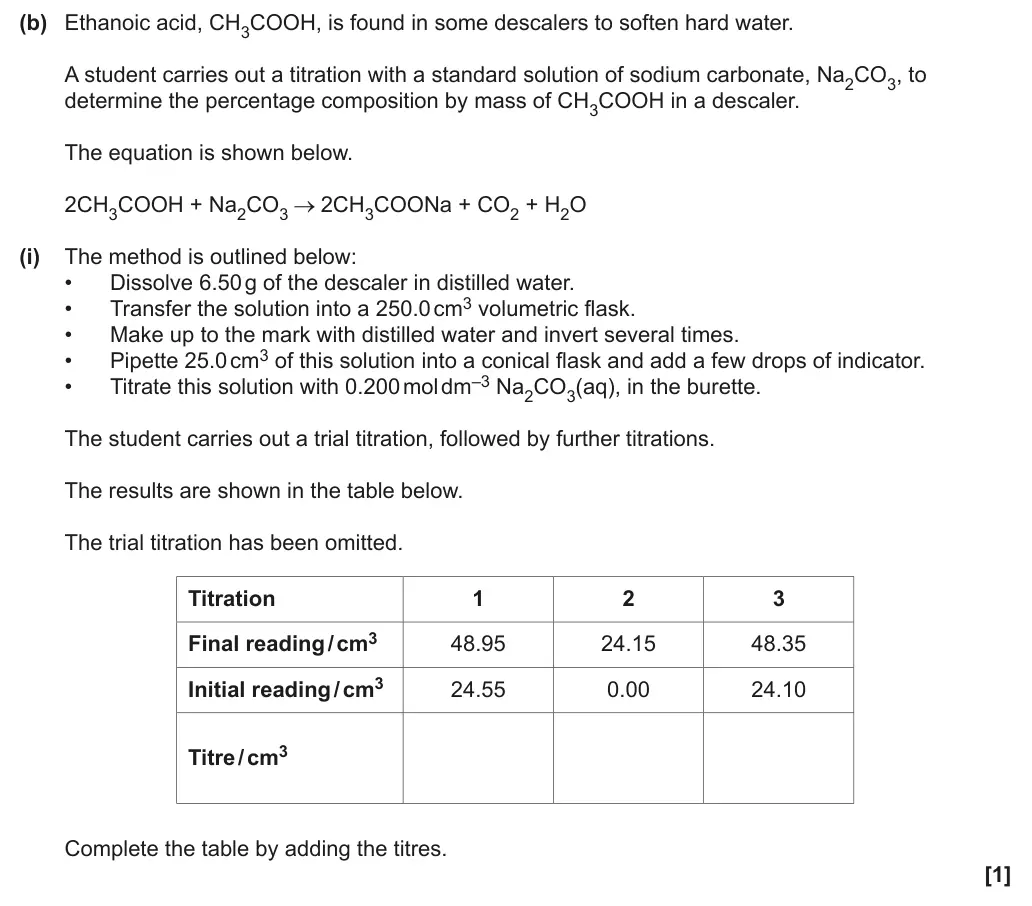
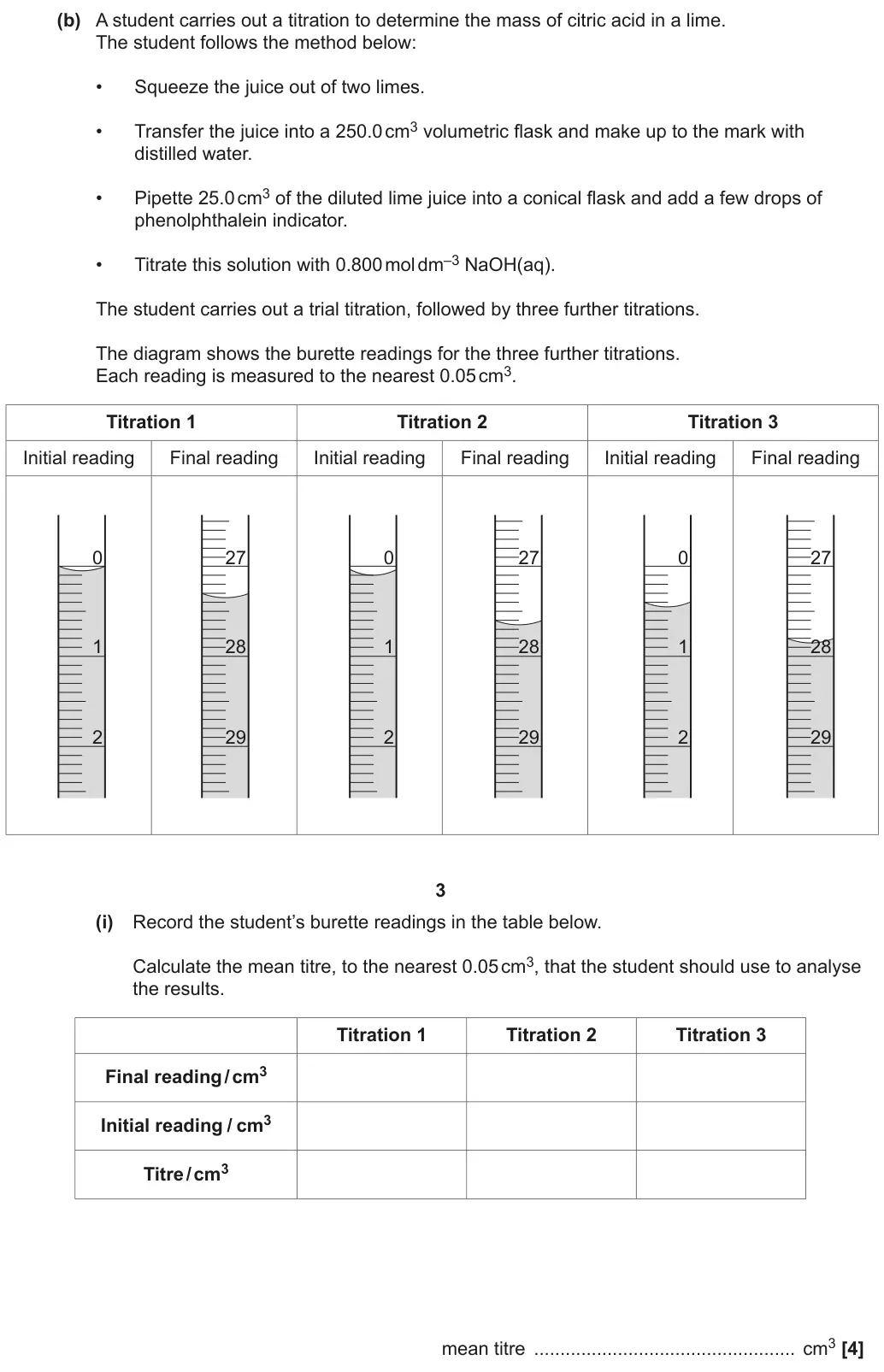
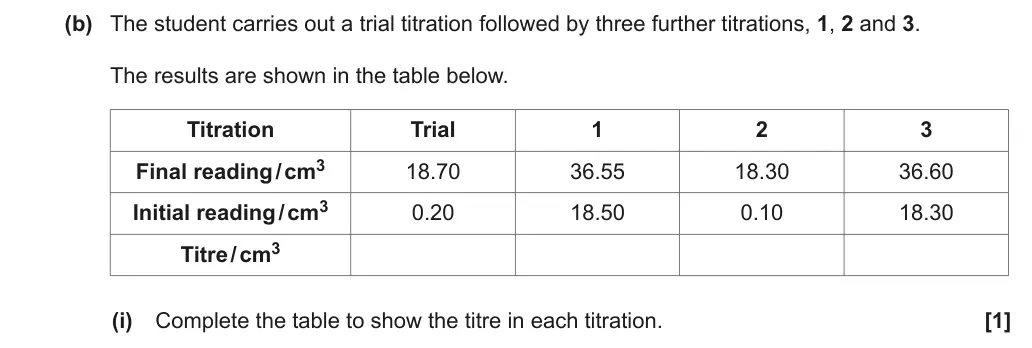
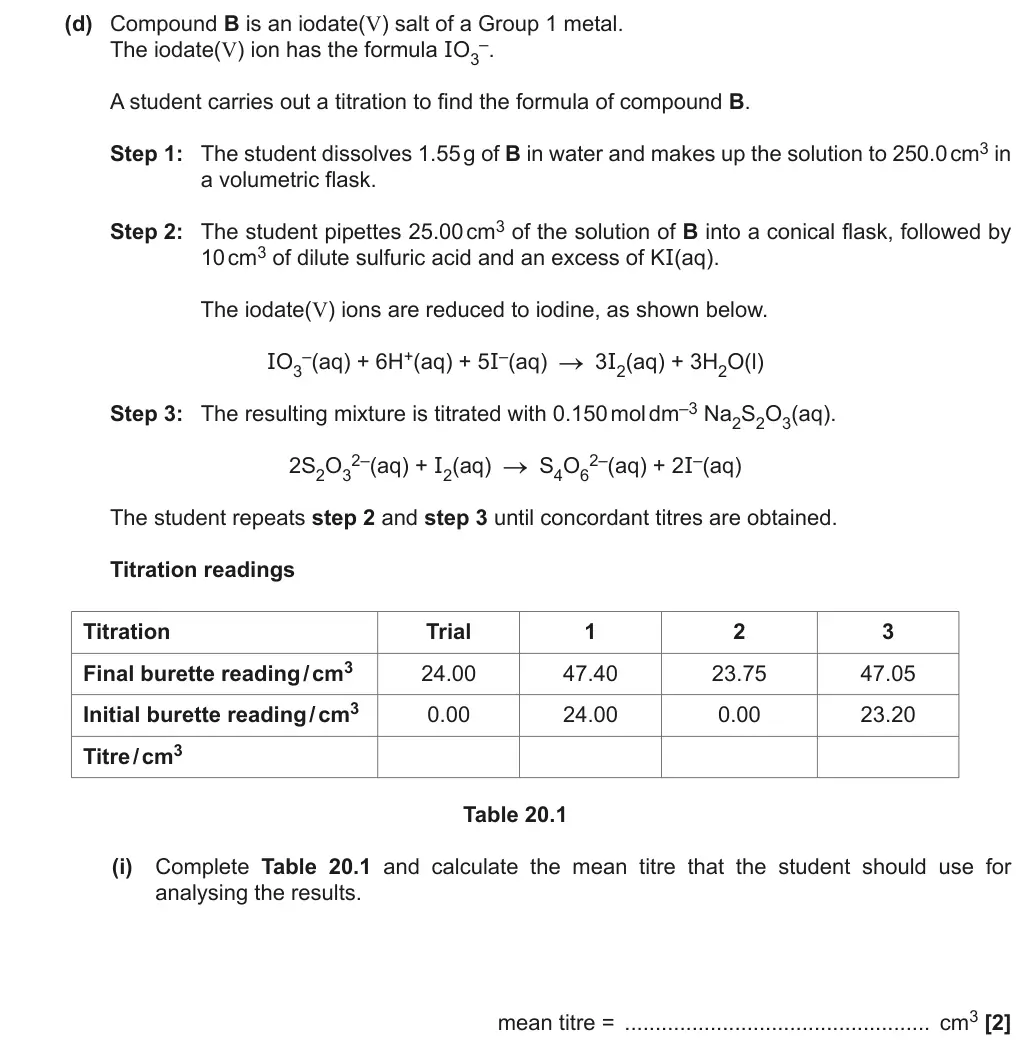
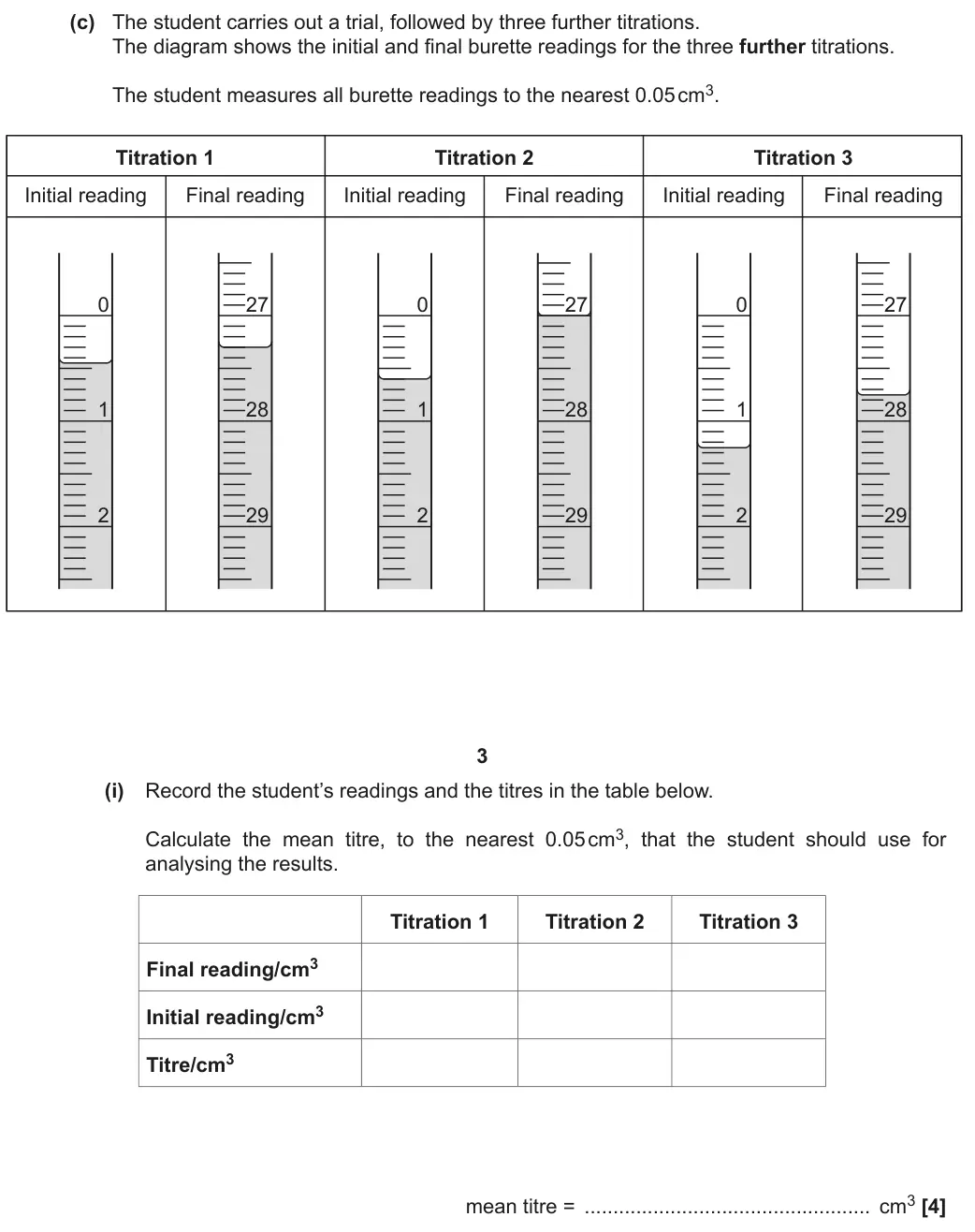
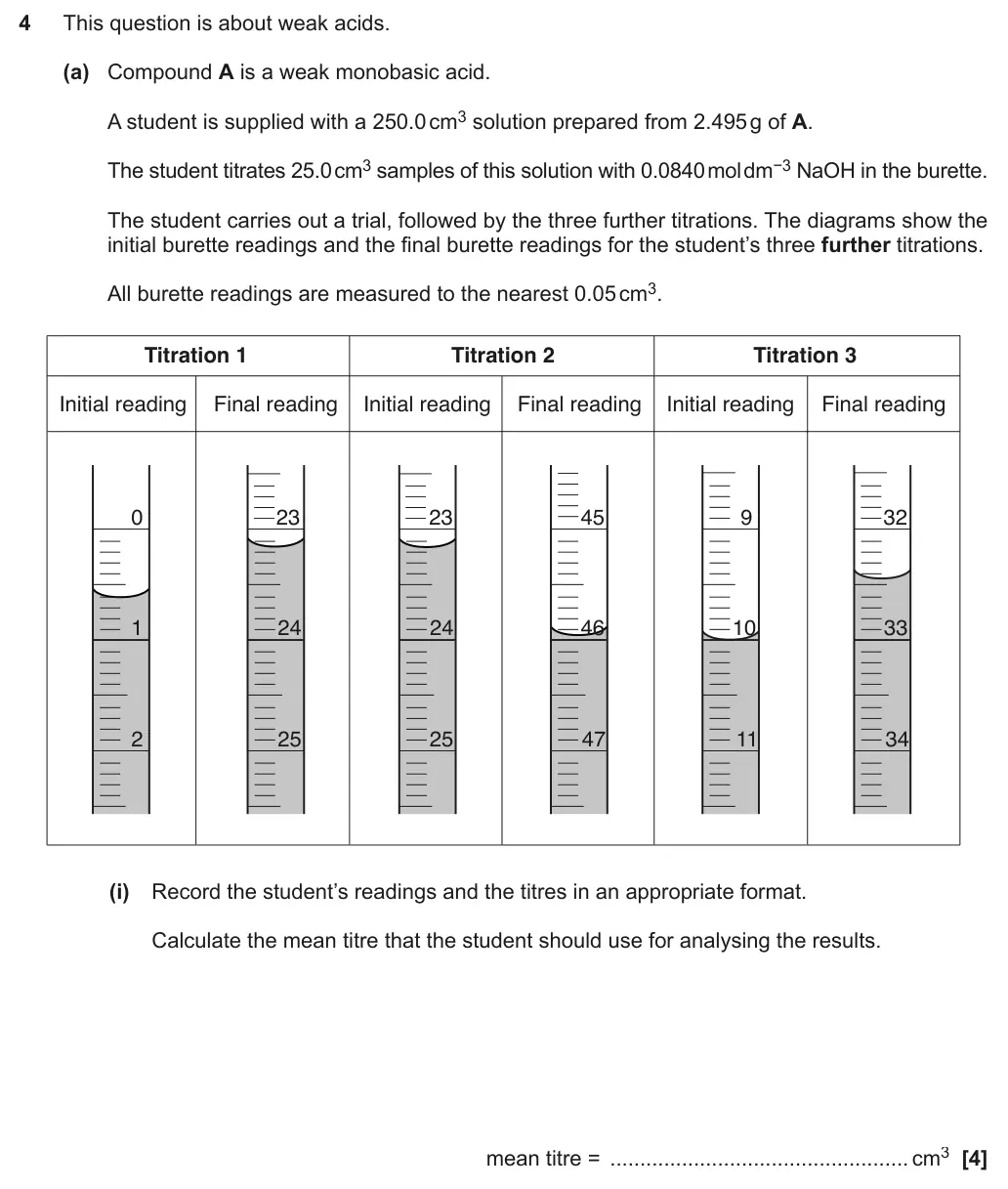
Most candidates were able to work out these simple subtractions. Candidates were told that the titration readings were read to the nearest 0.05 cm3, requiring volumes to be recorded to two decimal places, which may include a ‘0’. The right-hand initial reading is therefore 24.10 cm3 and not 24.1 cm3, which continues to be the commonest error seen.
Notes from the mark scheme and report
titres to 2 DP
DO NOT ALLOW 24.4
Skills: PAG2 Acid–base titration
June 2024 · AS Paper 2 · Q3(b)6 marks6-mark level of responseHard
Earlier part of question 3 that this part uses
Mark scheme, with the levels and indicative points
Examiner's comment
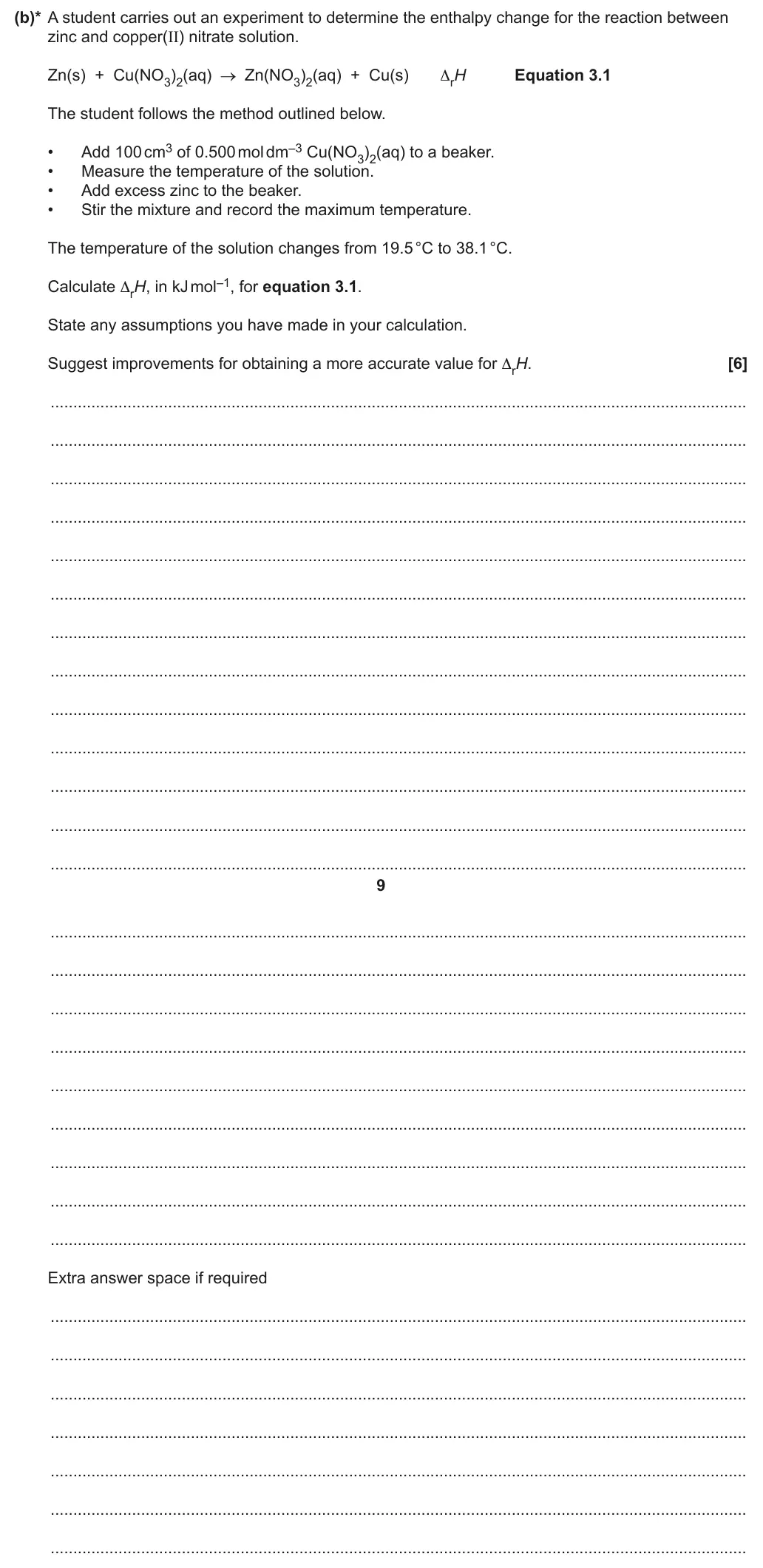
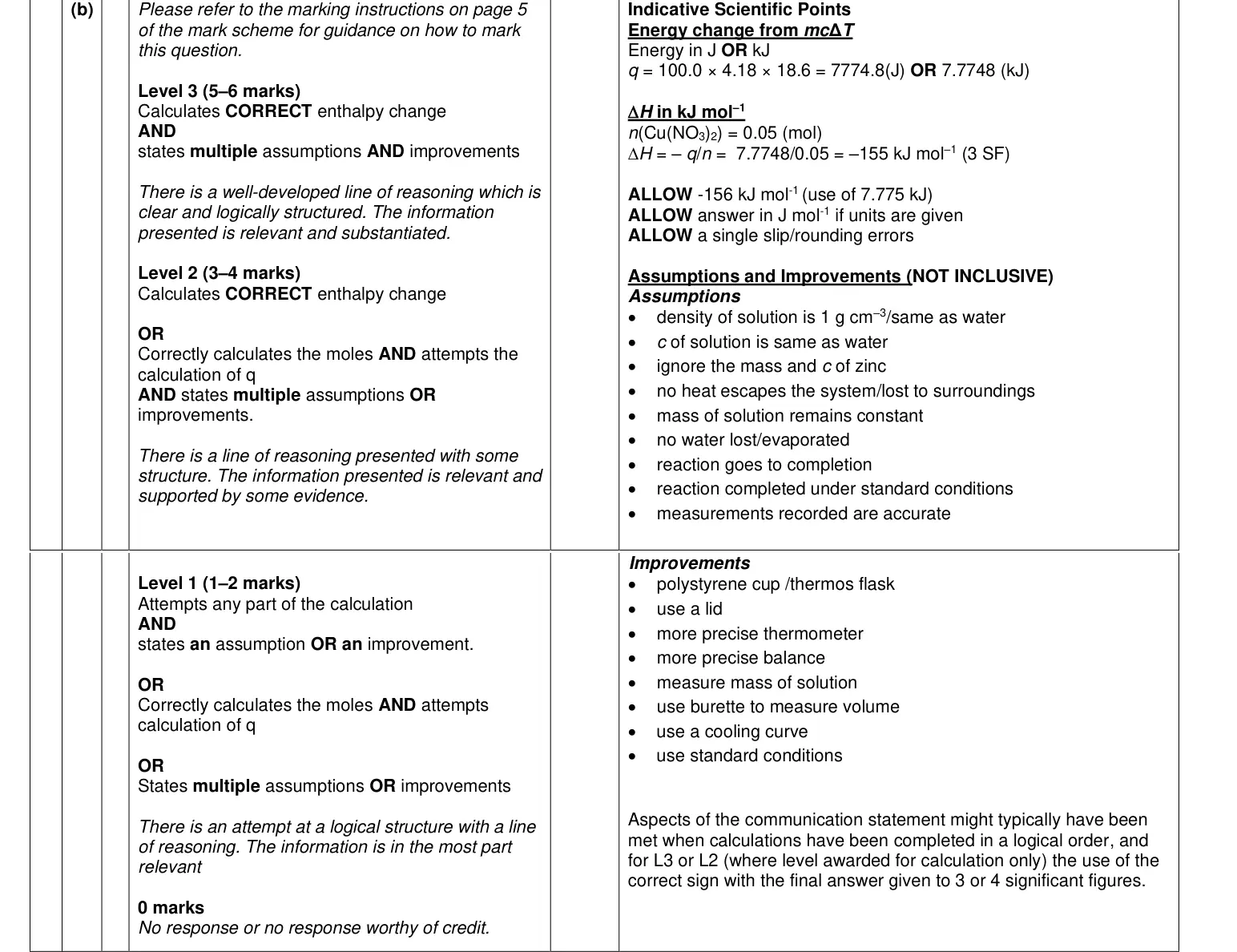
The calculation of enthalpy change was generally well-answered and the majority of candidates were able to recall the equation q = mcT. Many candidates forgot the minus sign or gave a positive sign for final enthalpy change. Errors in calculation were most commonly for using an incorrect mass, usually by finding the mass of copper(II) nitrate (from moles and Mr). Some also used the wrong value for the heat capacity, selecting the value for R from the data sheet instead. Many gave the final answer to an inappropriate six significant figures. Candidates often found it challenging to give appropriate assumptions and improvements, limiting the level achieved to Level 2. However, many candidates did correctly give the assumptions that the specific heat capacity and density of the solution was the same as water. This is usually stated for the candidates with these types of questions. The most common improvements suggested were use of a polystyrene cup, adding a lid or using a thermometer with a higher resolution. Quite a few candidates suggested using a larger volume of solution which would indeed reduce the % uncertainty in the volume measurement. However, it would lead to a smaller temperature change, increasing the % uncertainty in the temperature measurement. Some confused the question with a calculation of enthalpy change of combustion and gave improvements accordingly, e.g. ‘use a copper or bomb calorimeter’, ‘draft shields’, ‘heat for longer’, ‘position of flame and supplies of oxygen’. This response achieved Level 3 - 6 marks. There is a correct calculation for H, the final value has a correct negative sign and is given to 4 significant figures. Lots of valid assumptions and improvements are given.
Notes from the mark scheme and report
q = 100 × 4.18 × 18.6 = 7.77 kJ
n(Cu(NO3)2) = 0.05
∆H = –155 kJ mol–1 with negative sign
assumptions (density/c same as water, no heat loss, ignore zinc)
improvements (polystyrene cup, lid, cooling curve, more precise thermometer)
Skills: M0.0 Recognise and make use of appropriate units in calculations; M1.1 Use an appropriate number of significant figures; M2.3 Substitute numerical values into algebraic equations using appropriate units for physical quantities; PAG3 Enthalpy determination
June 2024 · AS Paper 2 · Q4(b)(i)2 marksDrawing / labellingHard
Earlier part of question 4 that this part uses
Mark scheme
Examiner's comment
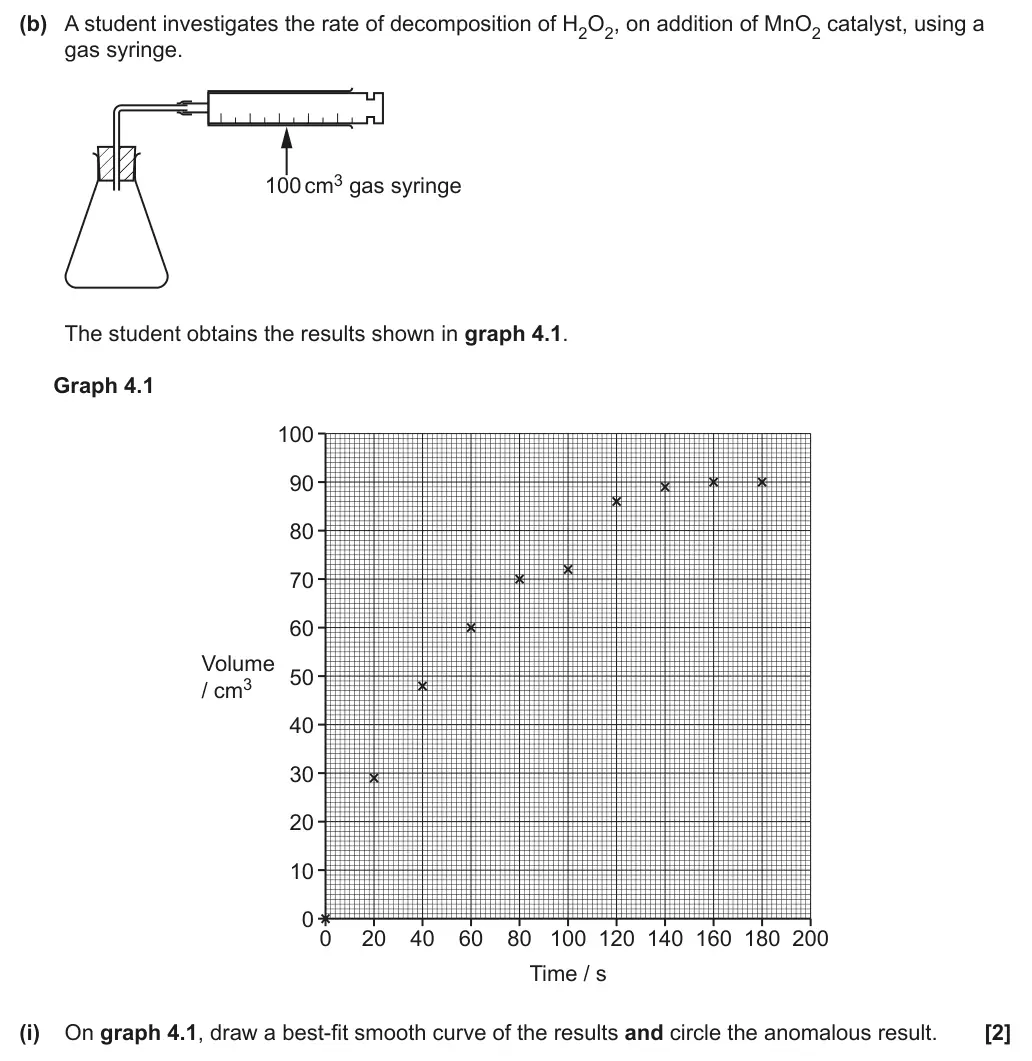
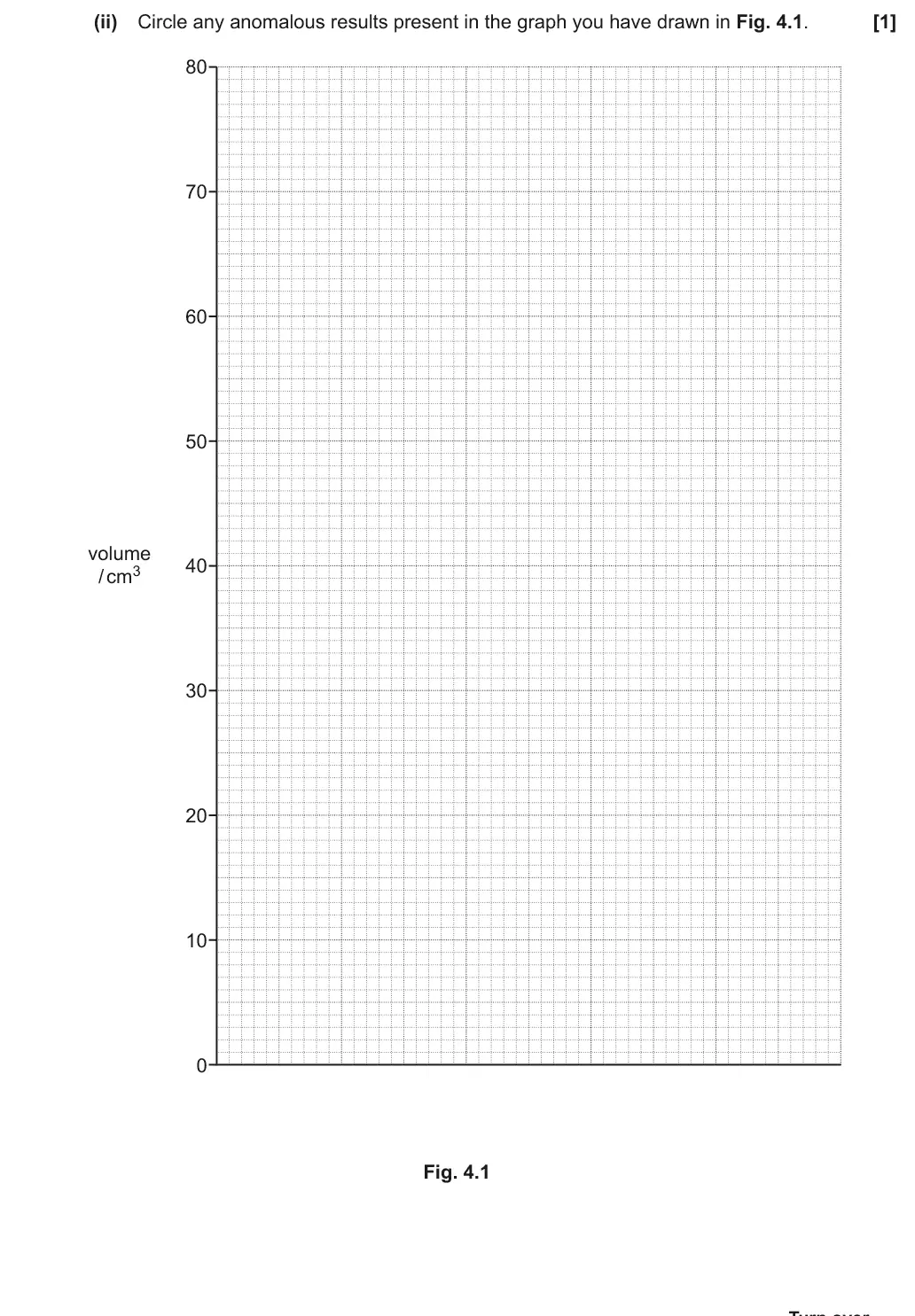
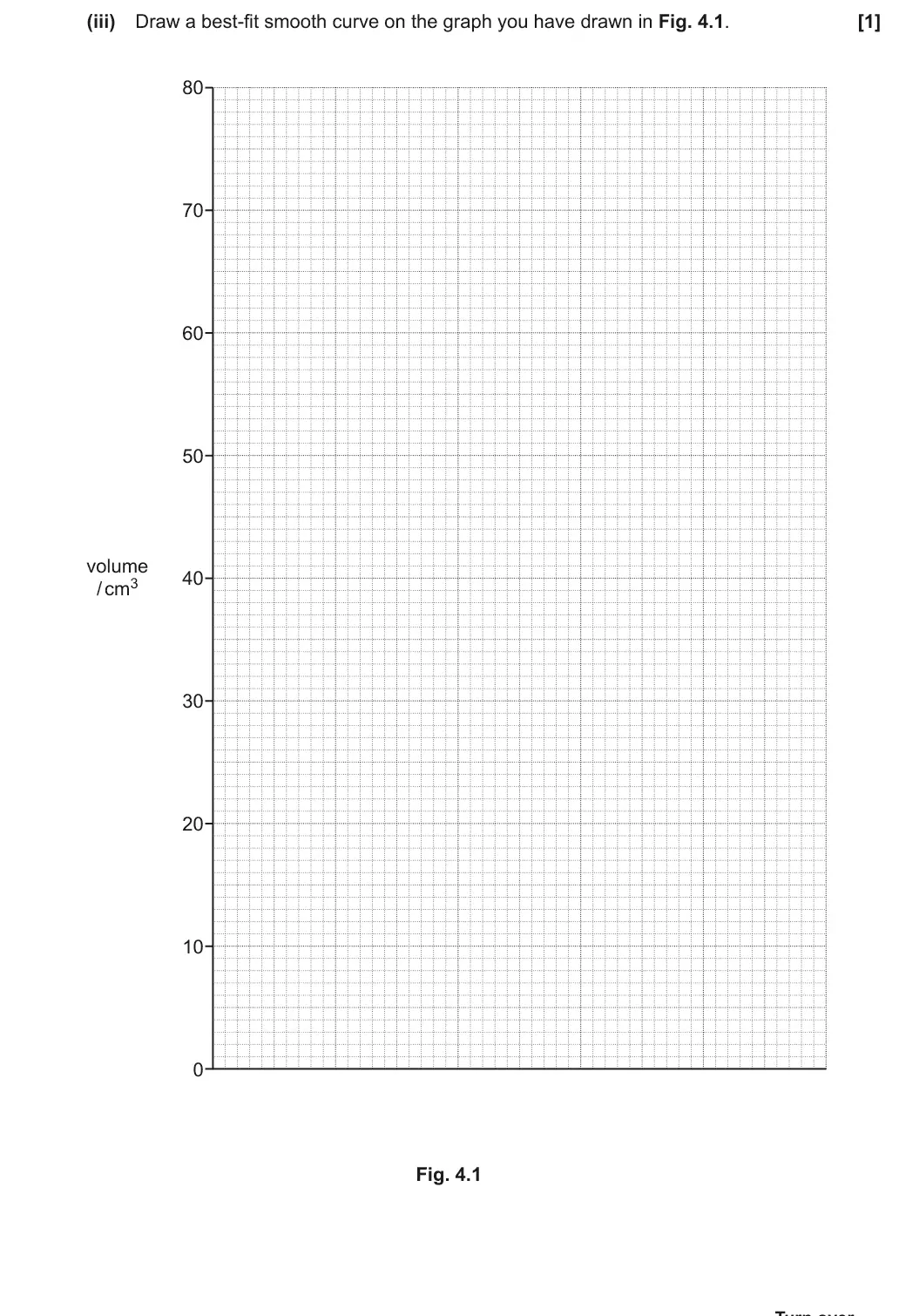
Most scored both marks here. Some didn’t circle the anomalous result and some lost a mark for a poorly drawn curve. Candidates must ensure they have a sharp pencil and draw a single line through all the points (except the anomalous point). Some didn’t start at the origin or didn’t level off at around 90 cm3.
Notes from the mark scheme and report
smooth curve through all points except 100 s
anomaly at 100 s circled
curve levels off at about 90 cm3
Skills: M3.2 Plot two variables from experimental or other data; PAG9 Rates of reaction – continuous monitoring
June 2024 · AS Paper 2 · Q4(c)2 marksShort answerMedium
Earlier part of question 4 that this part uses
Mark scheme
Examiner's comment
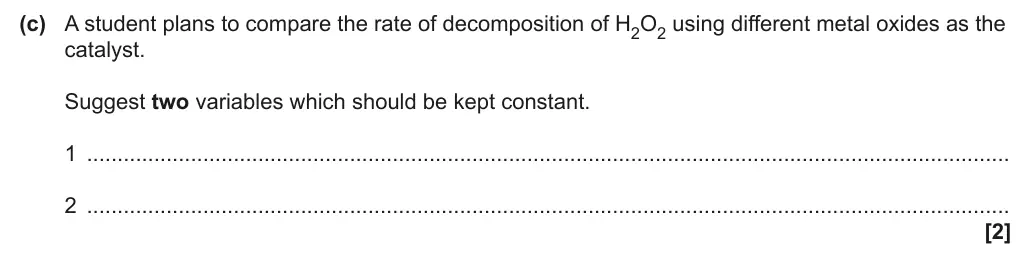
More than half of candidates achieved both marks and most scored at least 1. The most common reason for losing marks was for not being specific, by just saying ‘concentration’ or ‘volume’, or suggesting volume and concentration for metal oxide. Some suggested use of the same gas syringe without realising that the apparatus used should not affect volume of gas produced, just how easy and accurate it is to measure.
Notes from the mark scheme and report
any two: amount/mass/surface area of catalyst, temperature, volume or concentration of H2O2
DO NOT ALLOW concentration/volume of catalyst
Skills: PAG9 Rates of reaction – continuous monitoring
June 2024 · Paper 2 · Q23(b)(ii)1 markShort answerMedium
Earlier parts of question 23 that this part uses
Mark scheme
Examiner's comment
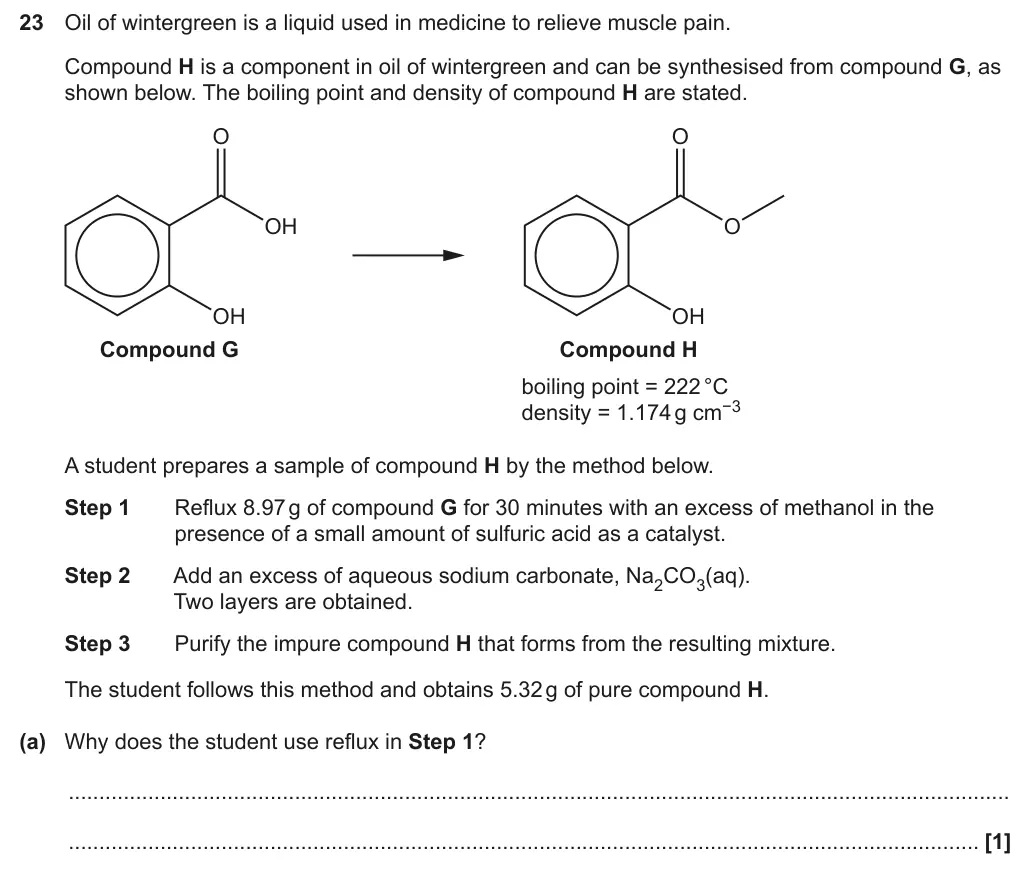
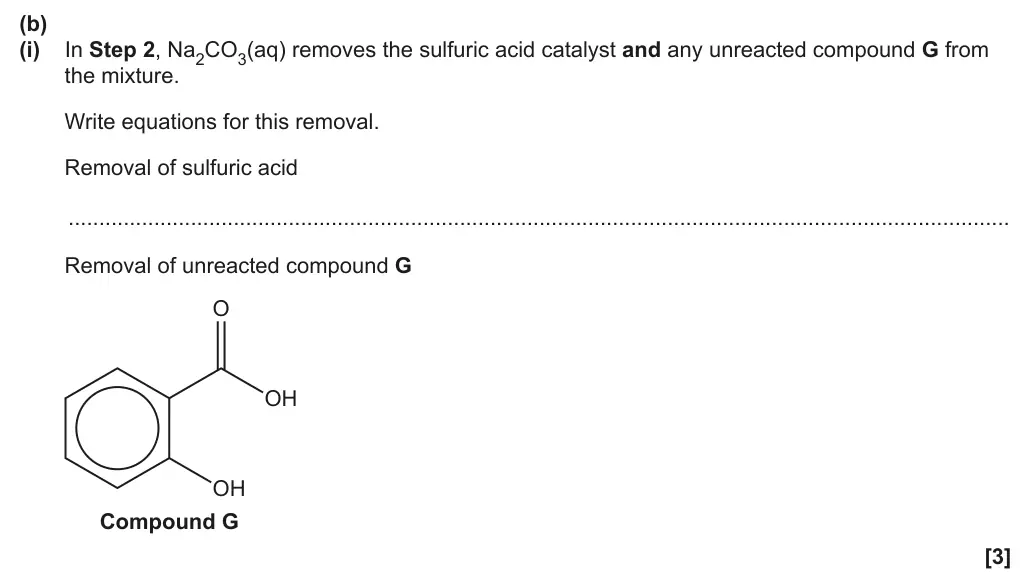
The best responses correctly identified that using sodium hydroxide was not an improvement and explained this either by stating that it would react with the phenol group or hydrolyse the ester group in compound H. However, most candidates appeared not to consider a reaction with H in their answer. Many focused on the neutralisation of sulfuric acid in a similar way to sodium carbonate and gave responses such as: • stronger base • no effervescence so harder to see when completely reacted • no CO2 produced so easier/safer/higher atom economy/less waste • requires double the moles compared to Na2SO4 to react
Notes from the mark scheme and report
NaOH would react with the phenol –OH OR hydrolyse the ester (compound H)
DO NOT ALLOW 'reacts with alcohol'
June 2024 · Paper 3 · Q3(b)(ii)3 marksComplete table/diagramMedium
Earlier part of question 3 that this part uses
Mark scheme
Examiner's comment
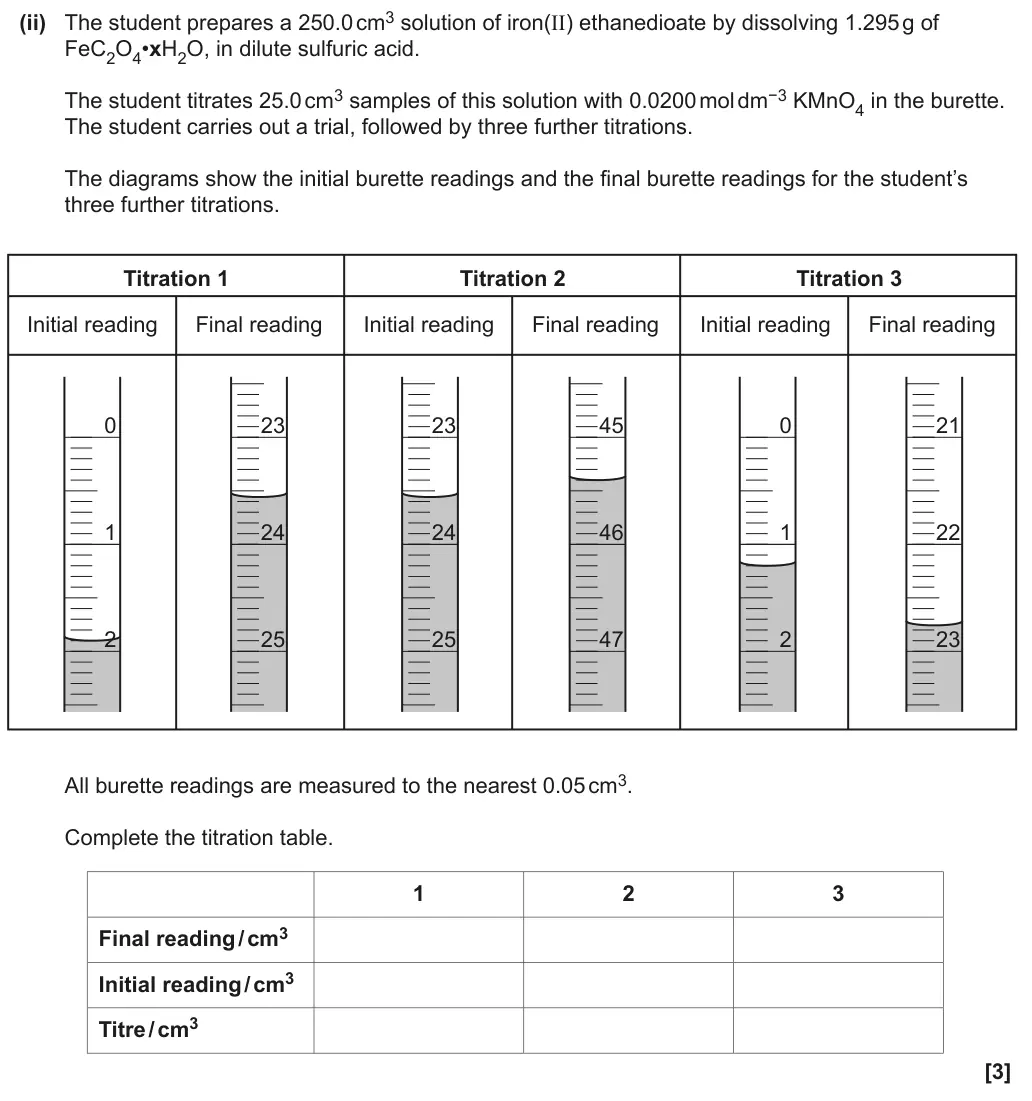
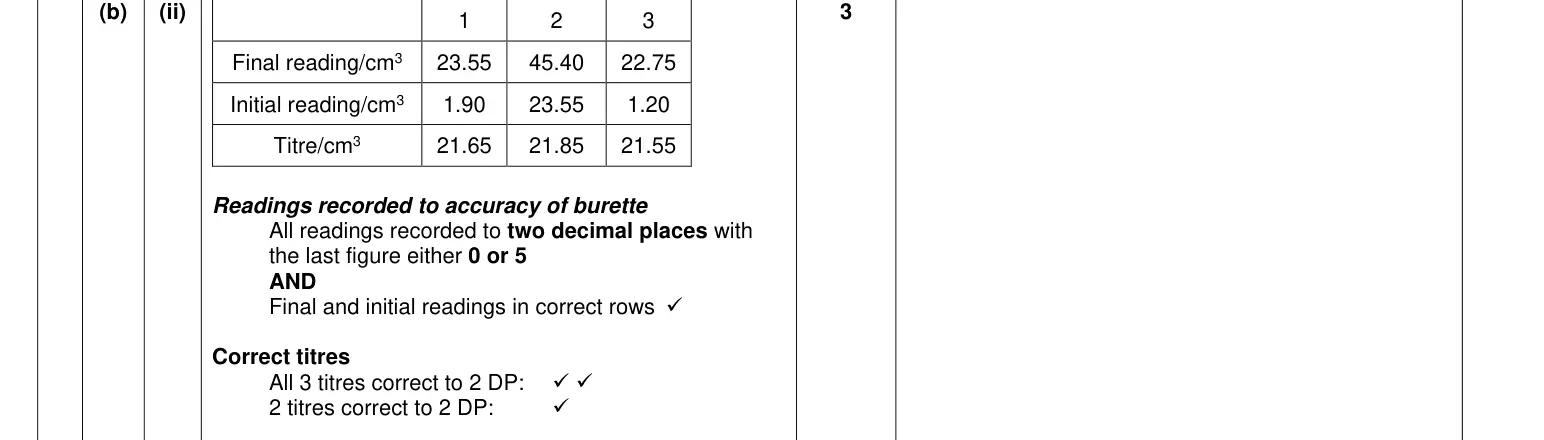
Most candidates were given all 3 marks for their titration tables. One mark was allocated to the readings, the other 2 for the correct titres. Candidates are expected to record burette readings to 2 decimal places with the last figure being 0 or 5, reflecting the accuracy of the burette, which is stated in the question. Two issues were seen: • Some candidates ignored the terminal 0 in their readings, e.g. 1.9 for 1.90 cm3. • A small number of candidates recorded the initial and final readings the wrong way round despite these terms being used above each burette diagram. Titres were usually correct.
Notes from the mark scheme and report
all readings to 2 decimal places with last figure 0 or 5 AND final/initial readings in the correct rows
titres 21.65, 21.85, 21.55 (2 correct for 1 mark)
Skills: M1.1 Use an appropriate number of significant figures
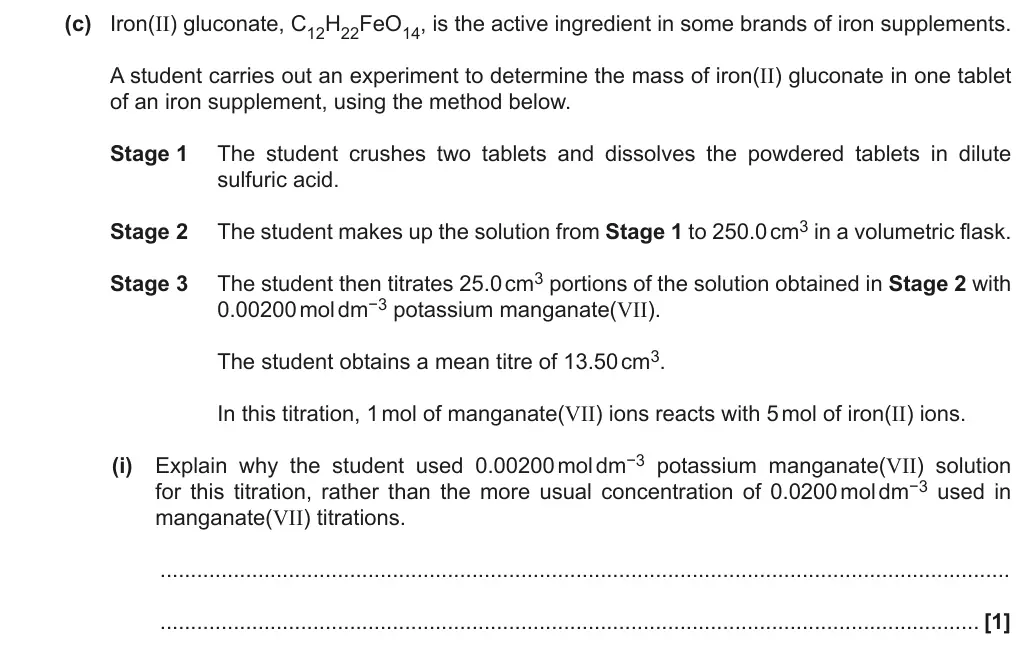
June 2024 · Paper 3 · Q3(b)(iii)1 markCalculationMedium
Earlier part of question 3 that this part uses
Mark scheme
Examiner's comment
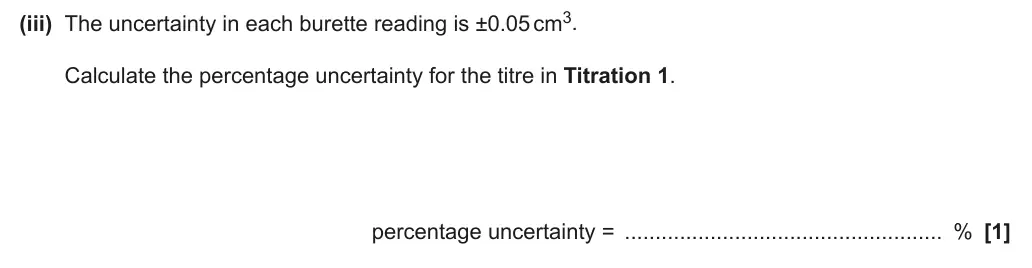
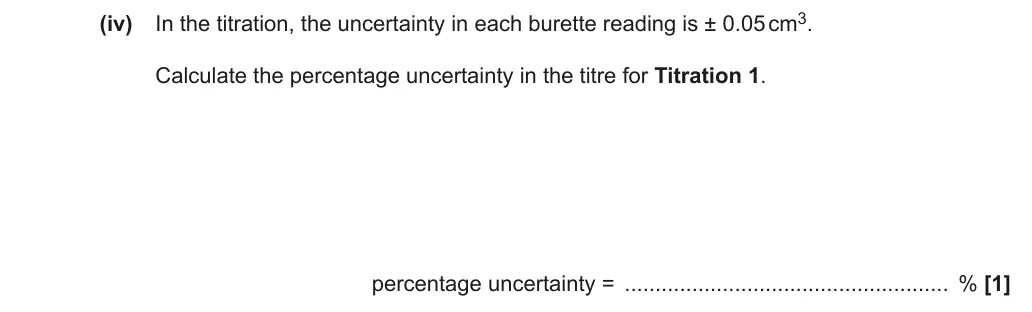
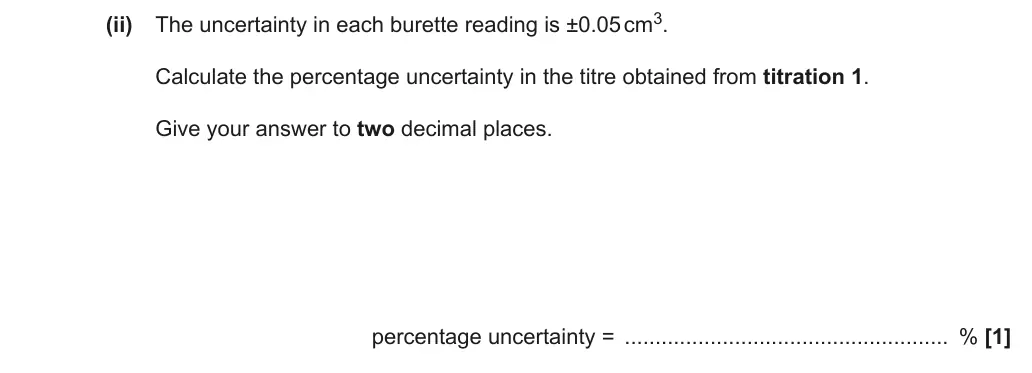
Candidates are much better at calculating percentage uncertainties than in previous series. Almost all candidates realised that the uncertainty in the titre resulted from two readings and that the overall uncertainty in the titre would be 2 × 0.05 = 0.1 cm3, resulting in a percentage uncertainty of 0.46%. Comparatively few candidates ignored the ‘2’ and gave 0.23% as their answer. Some candidates worked out the percentage uncertainty from the mean titre but this was still given marks.
Notes from the mark scheme and report
2 × 0.05 because two readings
0.46%
2 decimal places minimum
DO NOT ALLOW 0.50%
Skills: M1.3 Identify uncertainties in measurements and use simple techniques to determine uncertainty when data are combined
June 2023 · Paper 1 · Q18(c)(ii)5 marksAO3CalculationEasy
Earlier part of question 18 that this part uses
Mark scheme
Examiner's comment
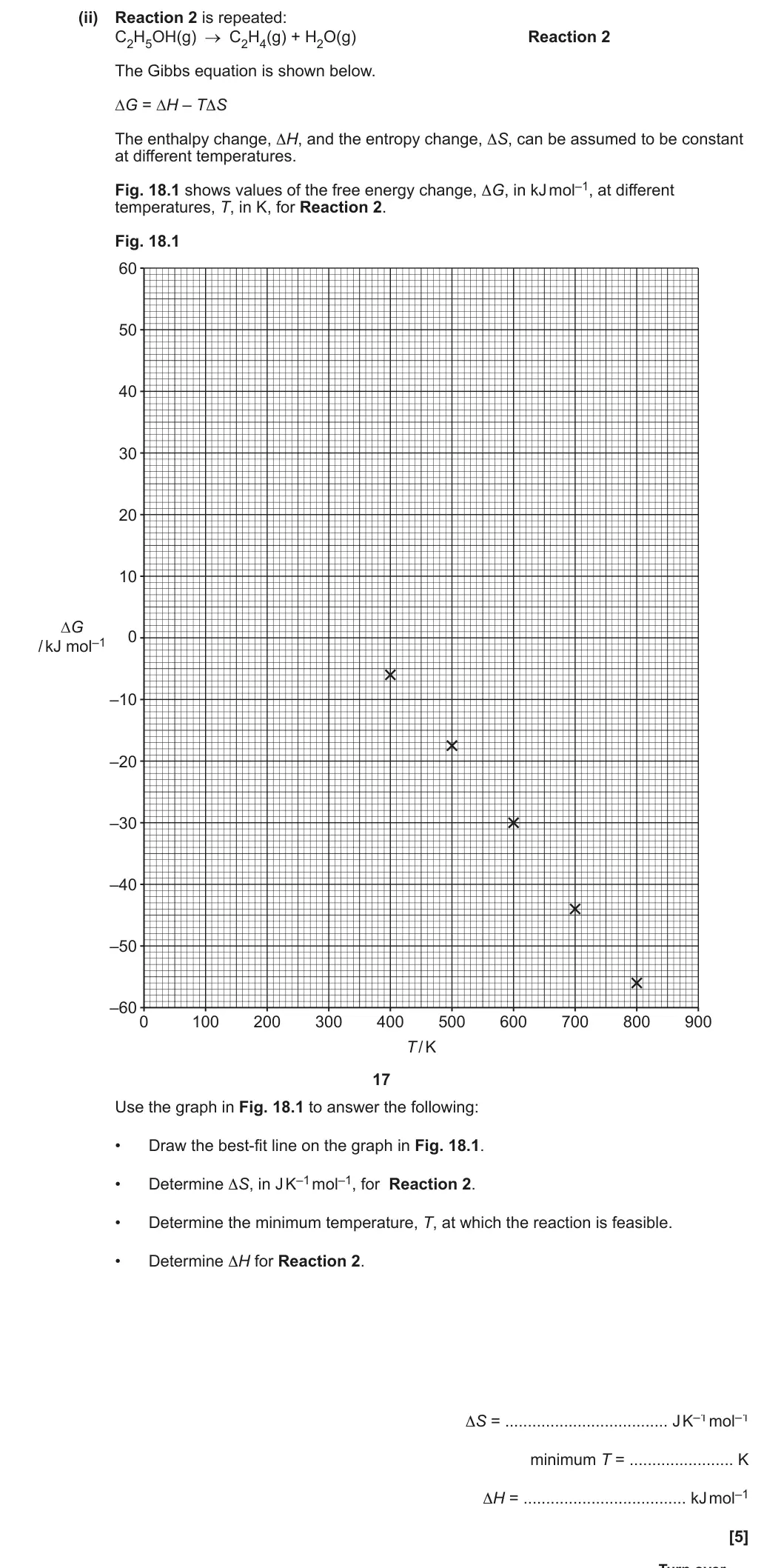
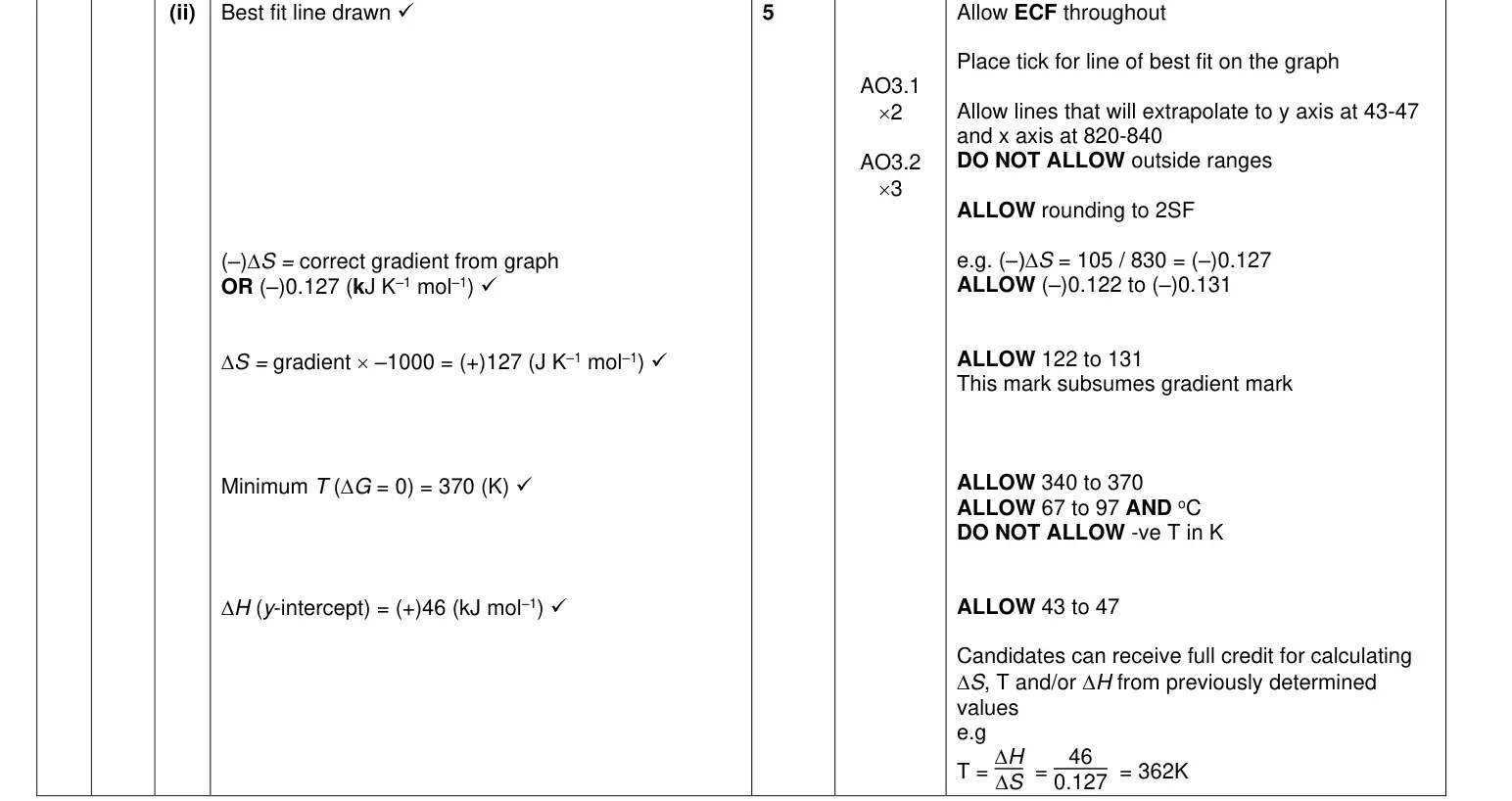
Nearly all candidates were able to draw the line of best fit and linked the equation of a straight line to the equation for delta G. Some hadn’t used a ruler to draw a straight line and candidates should be reminded of this requirement. Candidates were able to recognise that the gradient corresponded to (-) delta S but some did not to use the scale correctly. Some candidates tried to use very small triangles to get the gradient and candidates would be advised to use the largest scale possible to minimise errors in the line of best fit. Most candidates recognised that the minimum temperature was the x-intercept (when delta G = 0) and that delta H was the y-intercept. Some did not use this approach and instead used the ∆G=∆H-T∆S equation, using previously obtained value(s), to calculate the minimum temperature, ∆S or ∆H. Some candidates used ∆H = -186 from a previous question or attempted to solve both ∆S and ∆H by simultaneous equations.
Notes from the mark scheme and report
best-fit line extrapolating to y-axis 43–47 and x-axis 820–840
∆S = –gradient × 1000 (122–131)
minimum T where ∆G = 0 (340–370 K)
∆H = y-intercept (43–47)
ECF throughout
Skills: M0.0 Recognise and make use of appropriate units in calculations; M3.1 Translate information between graphical, numerical and algebraic forms; M3.2 Plot two variables from experimental or other data; M3.3 Determine the slope and intercept of a linear graph
June 2023 · Paper 1 · Q21(a)(ii)2 marksAO2CalculationEasy
Earlier part of question 21 that this part uses
Mark scheme
Examiner's comment
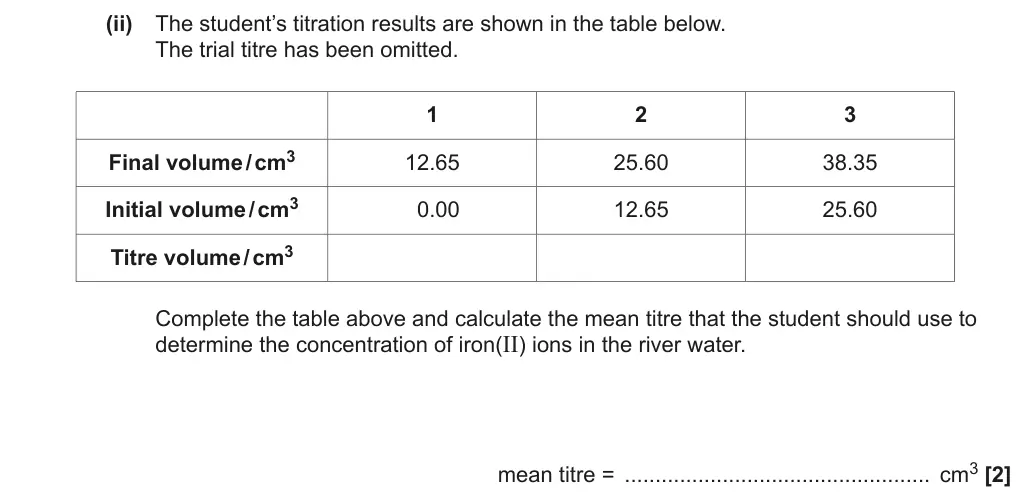
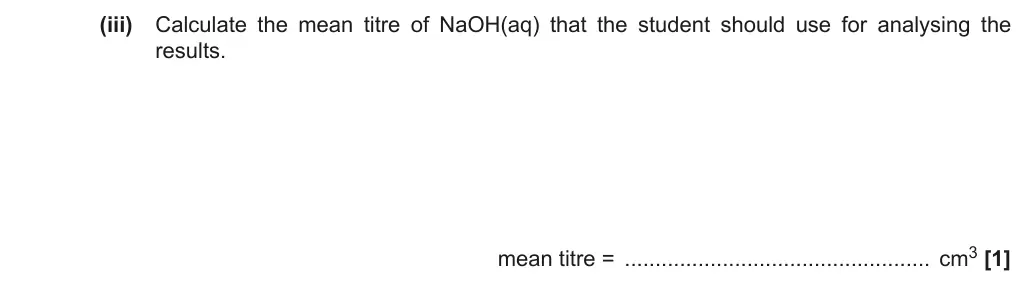
Almost all candidates calculated the titres correctly. A significant number used all three titre values to derive their mean value.
Notes from the mark scheme and report
titres 12.65, 12.95, 12.75
mean of concordant titres only = 12.70
Links to the legacy coursework tasks and PAG practice question sets can be found on Teach Cambridge and can help students prepare for practical-based questions like this one. Exam hints for students is useful to share with candidates.
June 2023 · Paper 1 · Q21(b)4 marksAO3Data interpretationMedium
Earlier part of question 21 that this part uses
Mark scheme
Examiner's comment
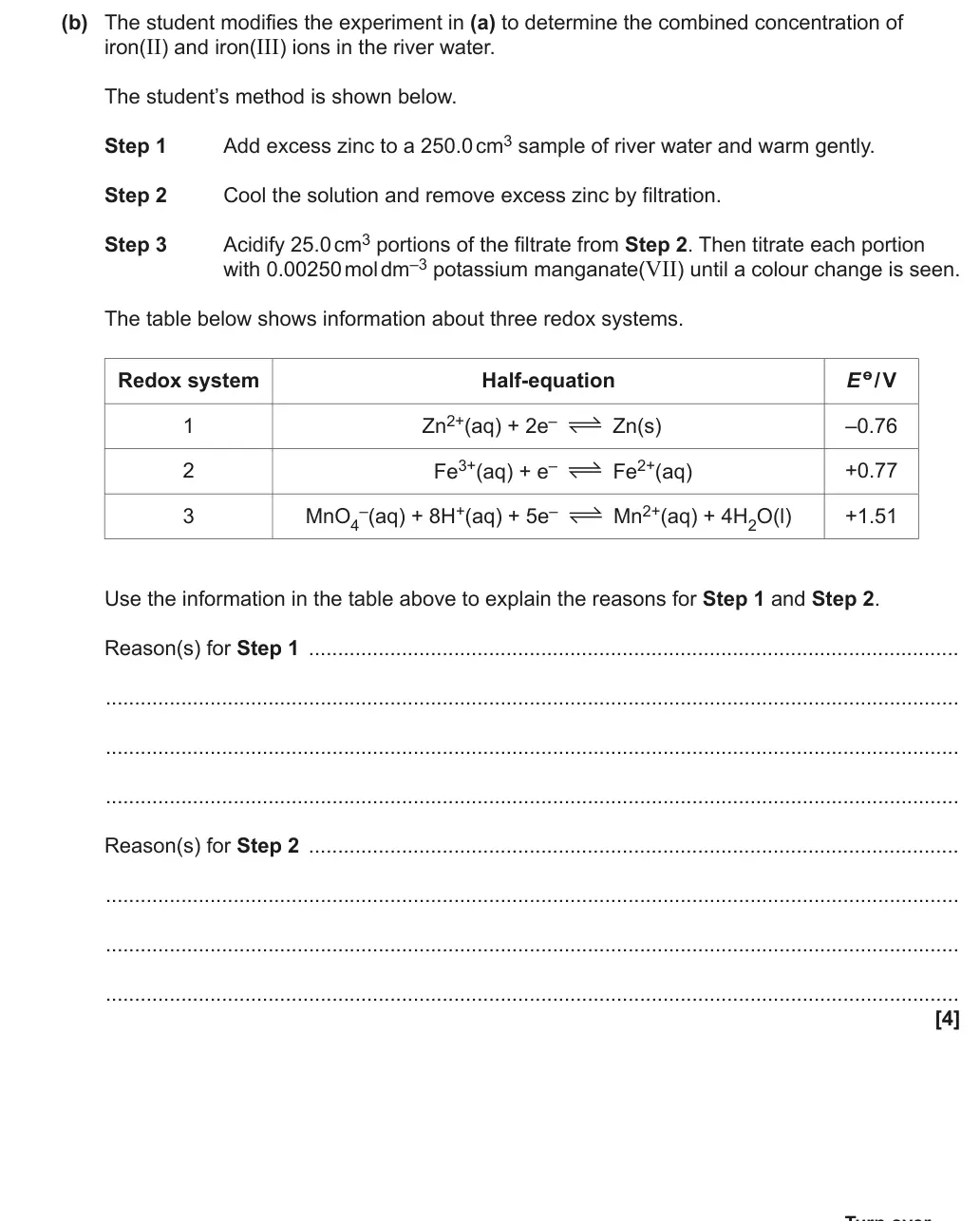
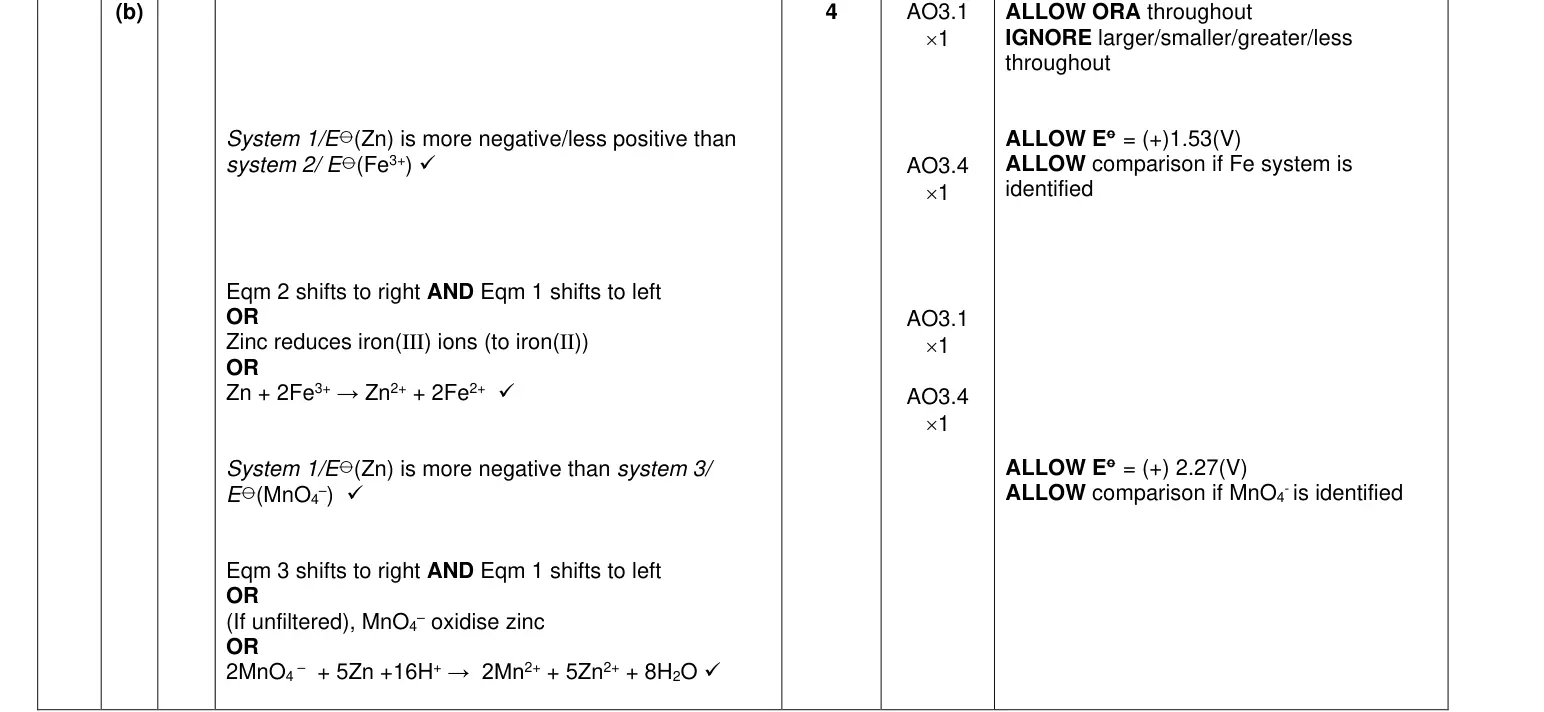
Most candidates were able to successfully explain Step 1, scoring the first 2 marks. When comparing electrode potentials, candidates should avoid the use of higher/lower as these phrases are ambiguous due to the negative signs involved. Describing them as ‘more negative’ or ‘more positive’ is clearer. Candidates are advised to read the instructions contained within the question and to use or comment on all the data presented. Very few candidates linked Step 2 to the reducing effect of zinc to manganate(VII) ions hence the need for filtration. A few candidates explained Step 2 in terms of the warming/cooling and zinc crystalising rather than explaining the redox chemistry given in the table.
Notes from the mark scheme and report
Step 1: E(Zn) more negative than E(Fe3+/Fe2+) so Zn reduces Fe3+ to Fe2+
Step 2: E(Zn) more negative than E(MnO4–) so unfiltered Zn would react with MnO4–
IGNORE larger/smaller
Skills: PAG2 Acid–base titration
June 2023 · AS Paper 1 · Q22(c)(ii)1 markAO1Complete table/diagramEasy
Earlier part of question 22 that this part uses
Mark scheme
Examiner's comment
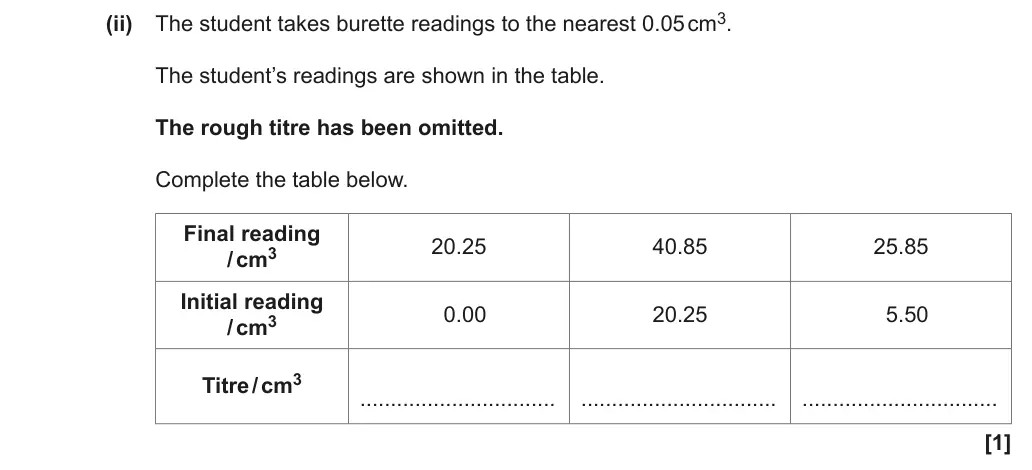
Most candidates were able to work out these simple subtractions. Candidates were told that the titration readings were read to the nearest 0.05 cm3, requiring titres to be shown to two decimal places, which includes a ‘0’. The middle titre is therefore 20.60 cm3 and not 20.6 cm3, which continues to be the commonest error seen.
Notes from the mark scheme and report
all three titres to 2 DP
DO NOT ALLOW 1 DP e.g. 20.6 for 20.60
Skills: PAG2 Acid–base titration
June 2023 · AS Paper 2 · Q1(b)(iii)2 marksAO3Short answerMedium
Earlier part of question 1 that this part uses
Mark scheme
Examiner's comment
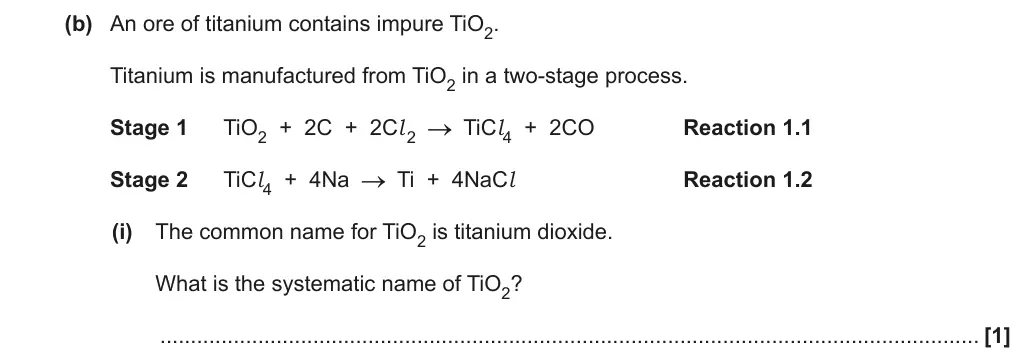
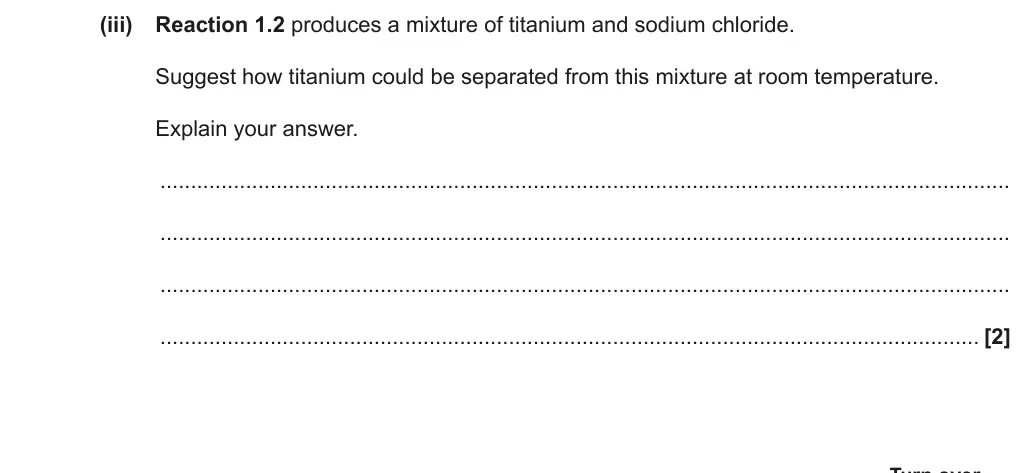
Most candidates did not gain any credit here. However, the range of responses seen highlighted some misconceptions in their understanding of how different mixtures can be separated. Many assumed that sodium chloride was in solution/aqueous, not recognising that water was not present in this reaction. Responses such as “sodium chloride will evaporate” or “remove the water” were seen. Some gave a description of the purification method for an organic liquid - the use of a separating funnel and/or distillation were common. Some suggested the use of a magnet to remove Ti despite it being a non- magnetic metal.
Notes from the mark scheme and report
add water AND filter
NaCl dissolves / Ti insoluble (Ti is the residue)
Understanding how to separate mixtures is covered in both KS3 and KS4 but it is important that these concepts can be applied during further study. Asking this type of problem solving question would make a good starter activity.
Some useful activities for separating mixtures can be found in the GCSE Chemistry B (Twenty First Century Science) Chemical analysis transition guide
June 2023 · AS Paper 2 · Q2(b)(ii)4 marksAO3CalculationHard
Earlier part of question 2 that this part uses
Mark scheme
Examiner's comment
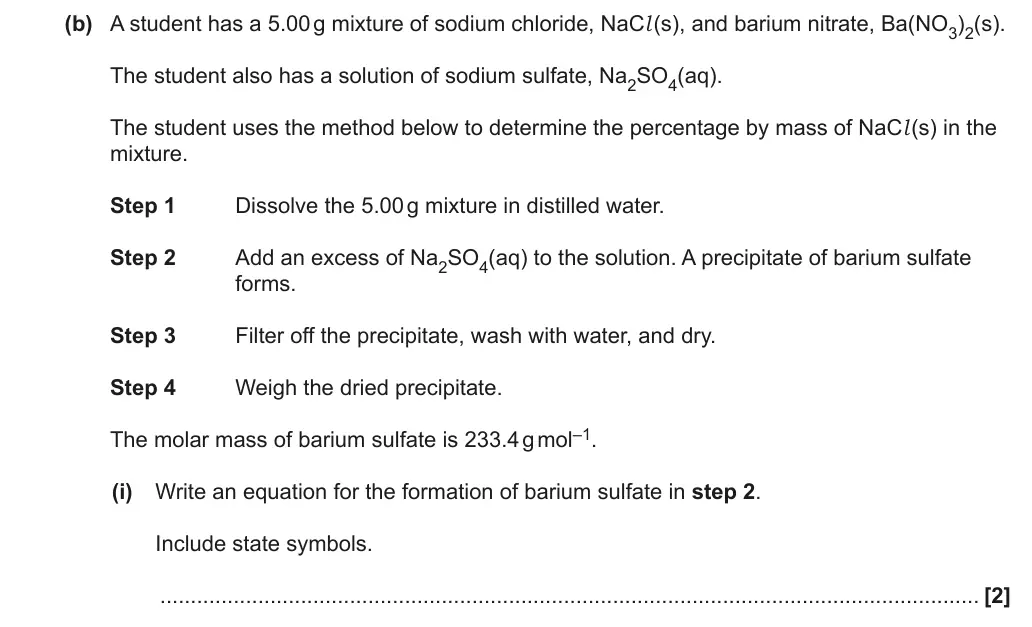
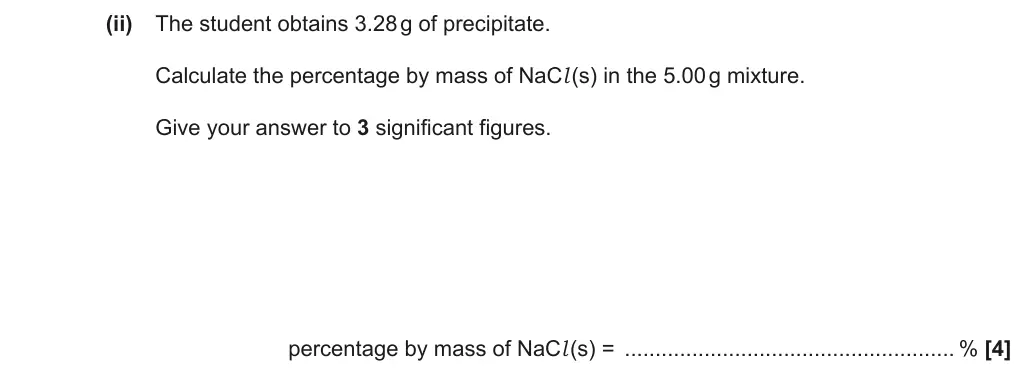
This was a tricky calculation, made more challenging if candidates hadn’t been able to successfully complete (i). Many were able to calculate the moles of BaSO4 but often rounded their answer to only 2 significant figures at this stage i.e. 0.014. Many assumed a direct ratio between BaSO4 and NaCl so mass was found by multiplying moles by 58.5 (molar mass for NaCl) - if this was done then credit was given for ECF for the final marking point.
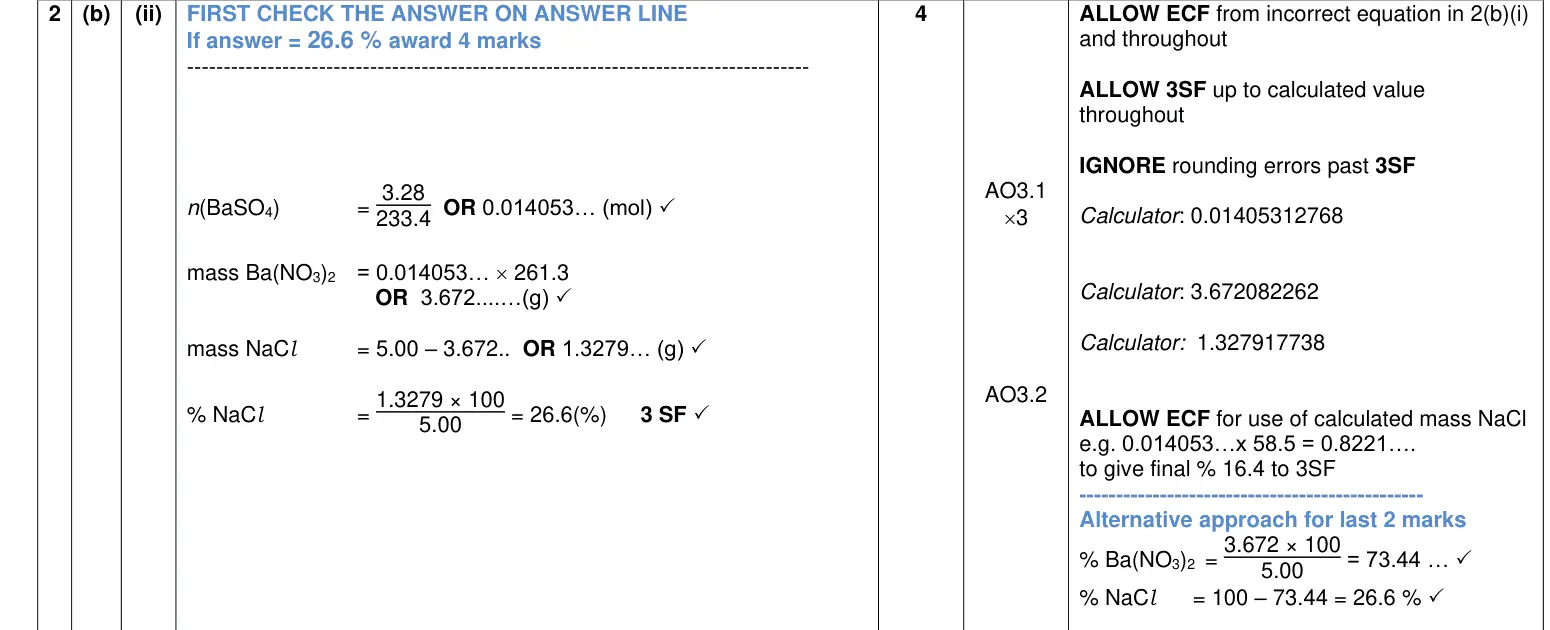
Notes from the mark scheme and report
n(BaSO4) → mass Ba(NO3)2 (× 261.3) → mass NaCl by difference → 26.6% to 3 SF
using n × 58.5 gives 16.4 (ECF only)
ALLOW ECF from equation in (b)(i)
The M1 section of the Mathematical Skills handbook contains useful information on handling data, including M1.1 use of significant figures.
Skills: M0.2 Use ratios, fractions and percentages; M1.1 Use an appropriate number of significant figures; M2.3 Substitute numerical values into algebraic equations using appropriate units for physical quantities; PAG1 Moles determination
June 2023 · AS Paper 2 · Q2(b)(iii)2 marksAO3Short answerMedium
Earlier parts of question 2 that this part uses
Mark scheme
Examiner's comment
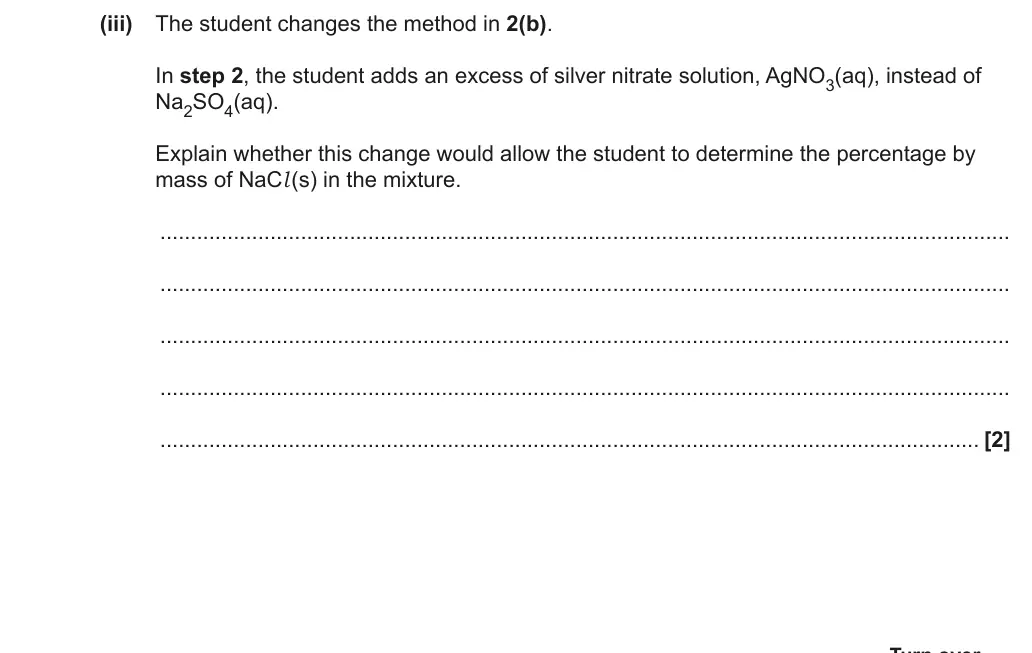
Another tricky question with less than half gaining credit. Many were able to recognise the addition of silver nitrate as the test for halide ions but did not realise that it could be used quantitatively. Many didn’t read the question carefully and assumed Na2SO4 was still present, giving a mixture of two precipitates. Some, despite recognising the formation of AgCl, could not then see how to calculate the mass of NaCl i.e. “you won’t have formation of BaSO4”. Some suggested that barium nitrate would also form a precipitate, perhaps confused by the (s) state symbol in the question.
Notes from the mark scheme and report
AgCl precipitate would form
mass of NaCl calculated from mass/moles of AgCl
IGNORE incorrect formula of silver chloride
Skills: PAG4 Qualitative analysis of ions
June 2023 · AS Paper 2 · Q4(b)(i)1 markAO2CalculationMedium
Mark scheme
Examiner's comment
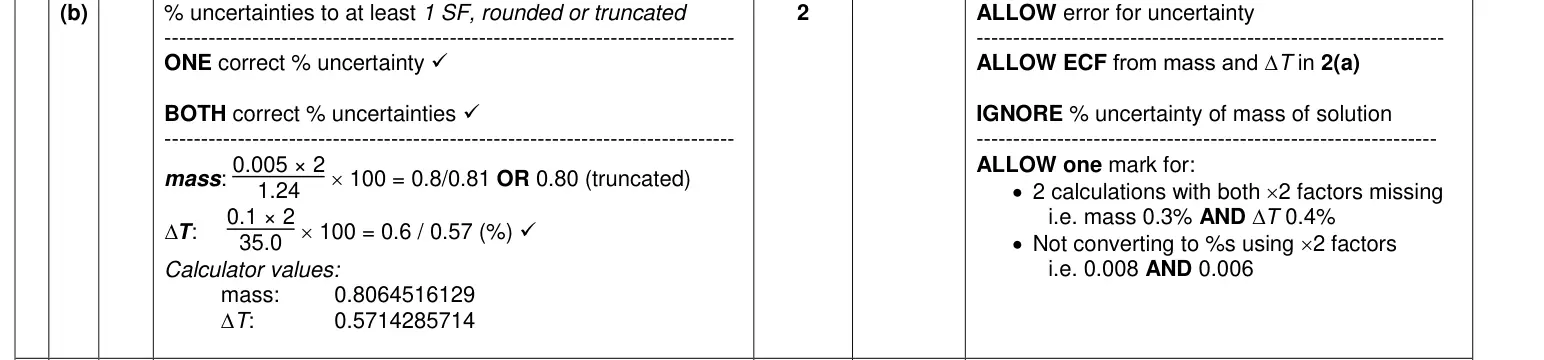
More than half of candidates gave the correct answer. Common mistakes included not multiplying the uncertainty by 2 for each measurement (0.81) or using the initial or final temperatures rather than the difference in their calculations.
Notes from the mark scheme and report
two readings: 2 × 0.25/31 × 100 = 1.6%
Skills: M0.2 Use ratios, fractions and percentages; M1.3 Identify uncertainties in measurements and use simple techniques to determine uncertainty when data are combined; PAG3 Enthalpy determination
June 2023 · AS Paper 2 · Q4(b)(ii)6 marksAO2, 36-mark level of responseMedium
Earlier part of question 4 that this part uses
Mark scheme, with the levels and indicative points
Examiner's comment
Many candidates limited themselves to only L1 here by not calculating the enthalpy change from the student’s results. Remind candidates to read the question carefully and to use all the information provided (such as tables of results). Some missed out on L3 as their evaluation lacked detail, as they needed to include at least two differences and two suitable improvements. Not all improvements given were suitable, with some suggesting candidates confusing different practicals - for example, ‘use a polystyrene cup’ or ‘heat to a constant mass’. It was evident that some lacked understanding about complete combustion, with suggestions to ‘measure mass until it doesn’t change any further’ or ‘heat water for longer’ to make sure complete combustion had occurred. Some also suggested ‘using a larger mass’ but further information was needed for credit to be given. This exemplar shows a candidate who achieved L3 with all 6 marks given. Working for the calculation of H is clear with all steps shown, in a logical order, and the final answer has correct negative sign. More than 2 differences and 2 improvements are given. The communication is clear, linking potential differences with suggestion for improvements.
improvements: draught shield, lid, copper can, cap on wick, bomb calorimeter
Further information about practical skills assessed on written exams can be found in Section 3 of the practical skills handbook. If using the suggested practical activities developed by OCR, then encourage candidates to answer the extension opportunity questions to help develop a deeper understanding in preparation for written assessments.
Skills: M0.0 Recognise and make use of appropriate units in calculations; M2.3 Substitute numerical values into algebraic equations using appropriate units for physical quantities; PAG3 Enthalpy determination
June 2023 · Paper 3 · Q4(b)(ii)1 markAO3Short answerMedium
Earlier parts of question 4 that this part uses
Mark scheme
Examiner's comment
The majority of candidates did not answer this question correctly. Candidates were expected to refer back to the formula of the Tutton’s salt, spot that there was water of crystallisation present, and that this would be lost if all the solvent was boiled off. Many responded vaguely in terms of decomposition or formation of larger crystals but a mark was only awarded if there was a definite link to the water contained within the crystals.
Notes from the mark scheme and report
prevents water of crystallisation being removed / anhydrous salt forming
IGNORE 'all the water would be removed', prevents decomposition, larger crystals
In the specification, Section 2.1.2a states the following: (a) the writing of formulae of ionic compounds from ionic charges, including: (i) prediction of ionic charge from the position of an element in the periodic table (ii) recall of the names and formulae for the following ions: NO3 –, CO3 2–, SO4 2–, OH–, NH4 +, Zn2+ and Ag+u.
This section will be studied at the start of the 2 year course. Candidates need to be confident with using these common formulae. For success in chemistry, these ions must be learnt.
June 2022 · Paper 1 · Q17(a)(ii)1 markAO3Short answerHard
Earlier part of question 17 that this part uses
Mark scheme
Examiner's comment
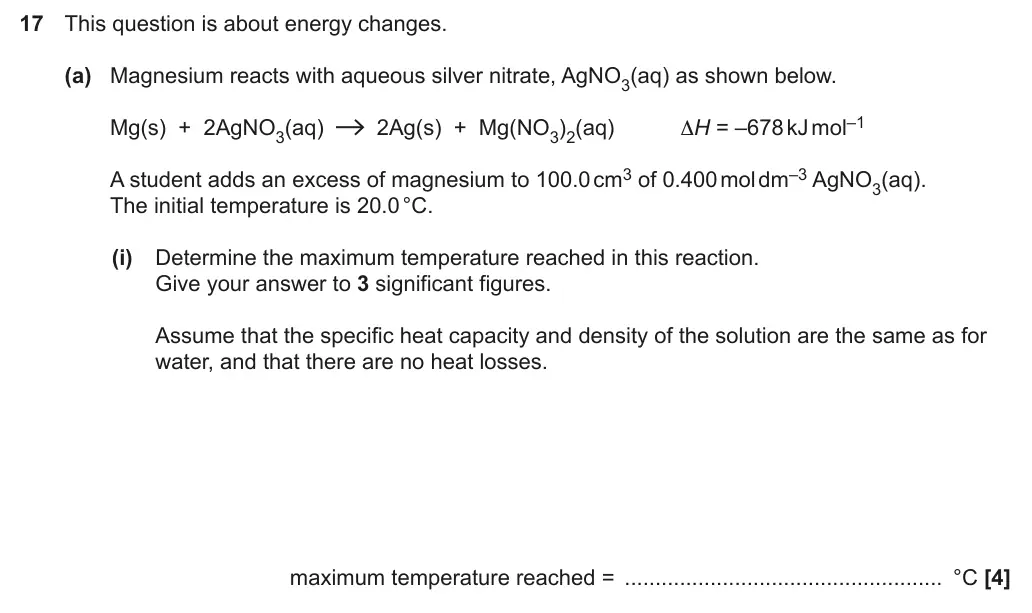
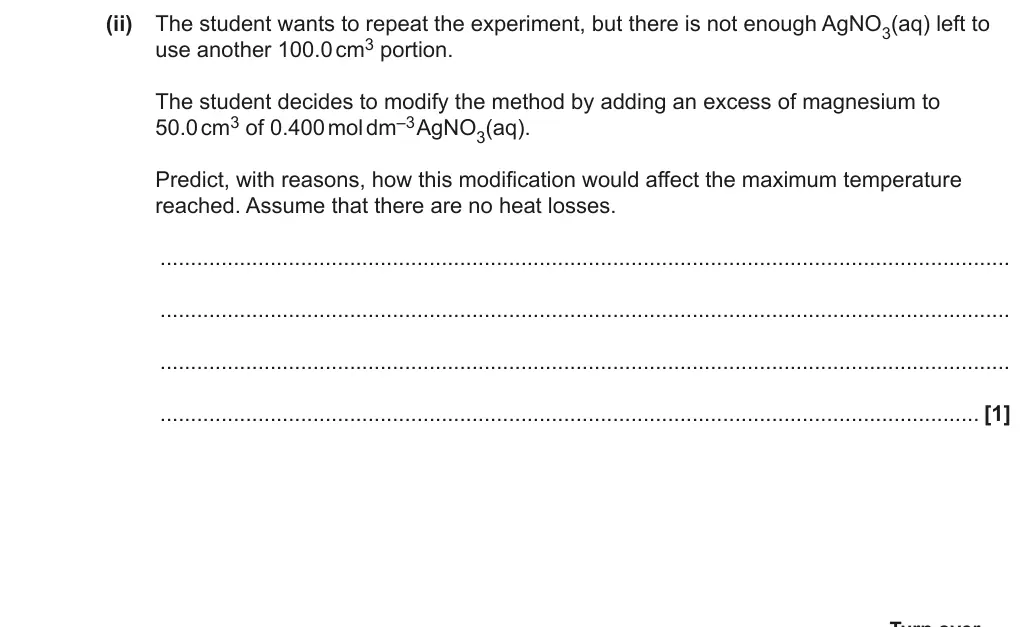
Although there were a few well explained, correct answers, this question proved challenging for most candidates. Candidates needed to link the changes as a proportion (e.g. half) to be given the mark. Candidates often only considered the change to energy or mass, but not both, e.g. dealt only with the decrease in moles reacting leading to a smaller temperature rise.
Notes from the mark scheme and report
same maximum temperature AND half the energy/moles AND half the mass/volume
Skills: M0.2 Use ratios, fractions and percentages; PAG3 Enthalpy determination
June 2022 · Paper 1 · Q19(a)(i)2 marksAO1CalculationEasy
Mark scheme
Examiner's comment
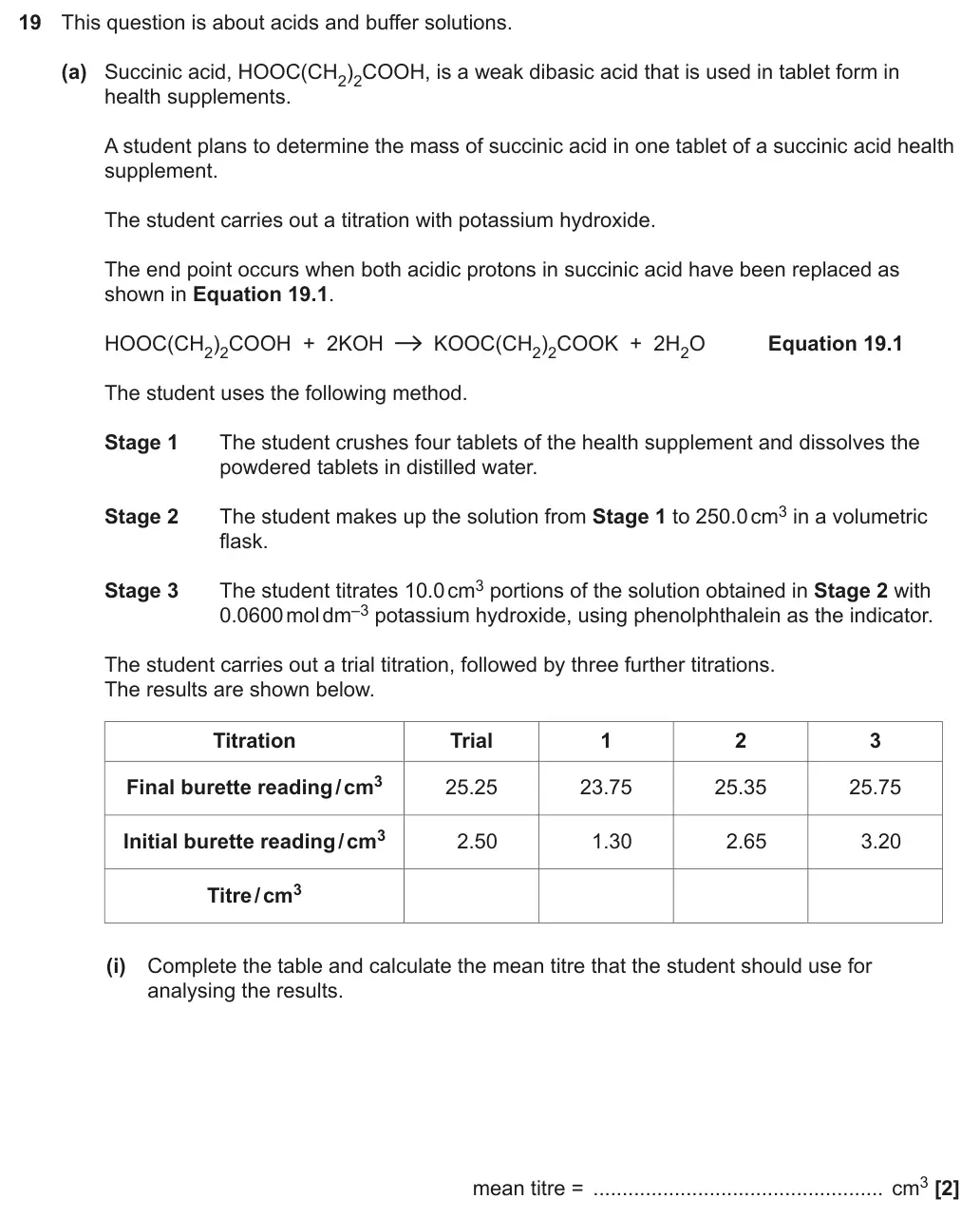
Almost all candidates calculated the titres correctly, but a significant number were penalised for recording 22.70 as 22.7. A significant number also used this result and the trial titre to derive their mean value. There were also very small numbers of candidates who used all 4, or all of titres 1, 2 and 3, to calculate their mean.
Notes from the mark scheme and report
titres to 2 d.p. (22.70 not 22.7)
mean from concordant 22.45 and 22.55 = 22.50
DO NOT ALLOW use of trial
Links to the legacy coursework tasks and PAG practice question sets can be found on OCR Interchange. Exam hints for students can be found at: https://www.ocr.org.uk/Images/592305-exam-hints-for-students.pdf.
June 2022 · AS Paper 1 · Q24(b)5 marksAO3Extended responseMedium
Mark scheme
Examiner's comment
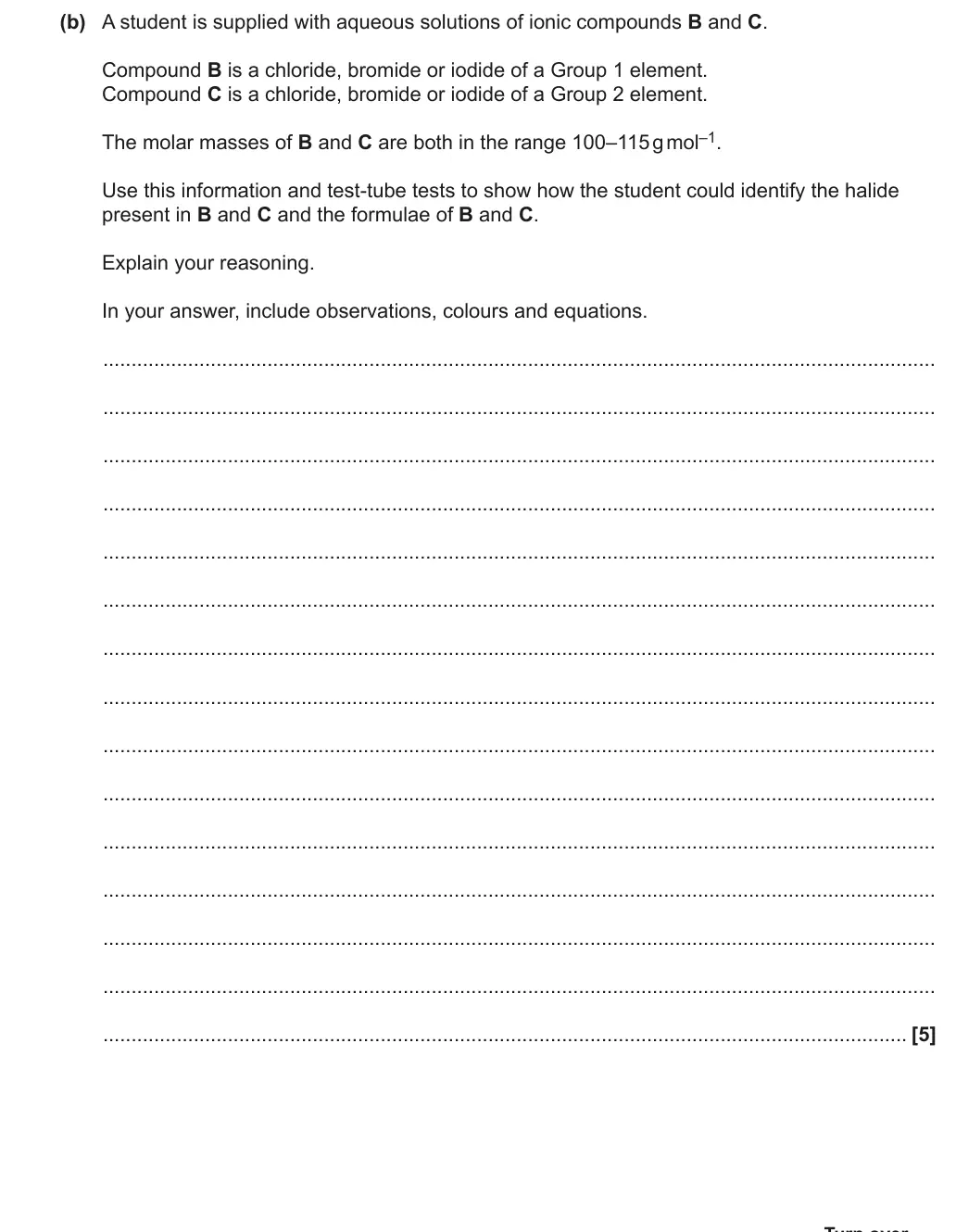
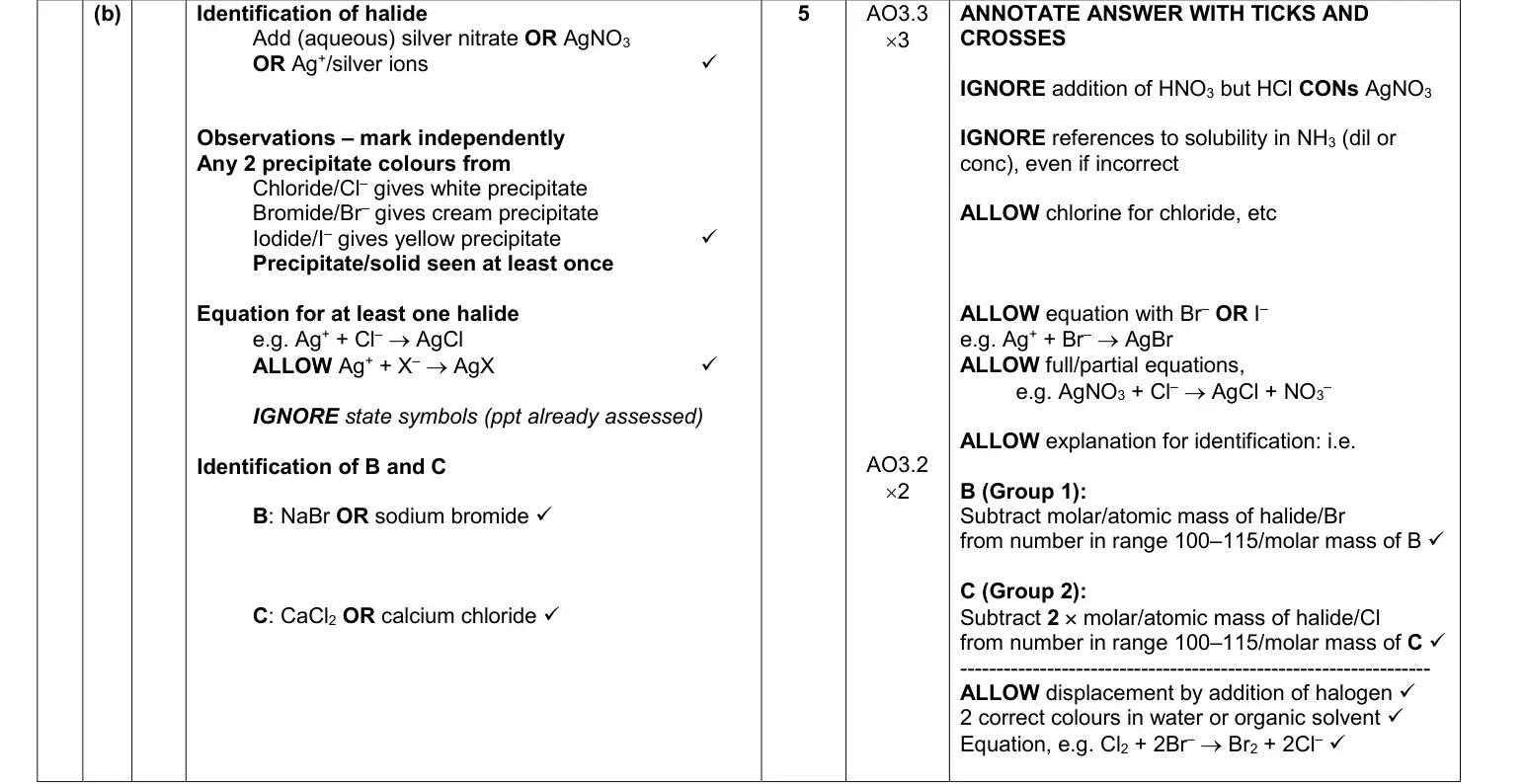
Candidates generally answered the first part of this question well. Most candidates were able to identify silver nitrate (or a halogen displacement method), to describe the expected observations, supported with mainly correct ionic equations. Candidates found it much harder to identify B and C as NaBr and CaCl2. They could do this in various ways by matching possible formula with the provided molar mass ranges. The mark scheme did allow marks to be given when candidates described the identification process, although this was often very muddled, so, only the most able few candidates fully identified the unknown B and C.
Notes from the mark scheme and report
AgNO3 then any two precipitate colours
ionic equation for at least one halide
B = NaBr and C = CaCl2 from molar mass range
HCl CONs AgNO3 (IGNORE HNO3)
IGNORE solubility in NH3
ALLOW halogen displacement alternative
Skills: M0.2 Use ratios, fractions and percentages; PAG4 Qualitative analysis of ions
June 2022 · AS Paper 2 · Q1(c)2 marksAO3Short answerHard
Earlier part of question 1 that this part uses
Mark scheme
Examiner's comment
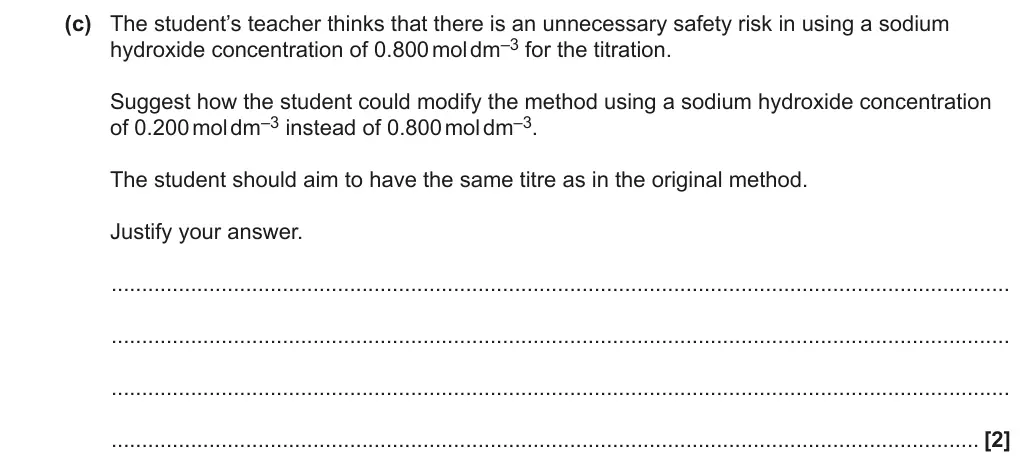
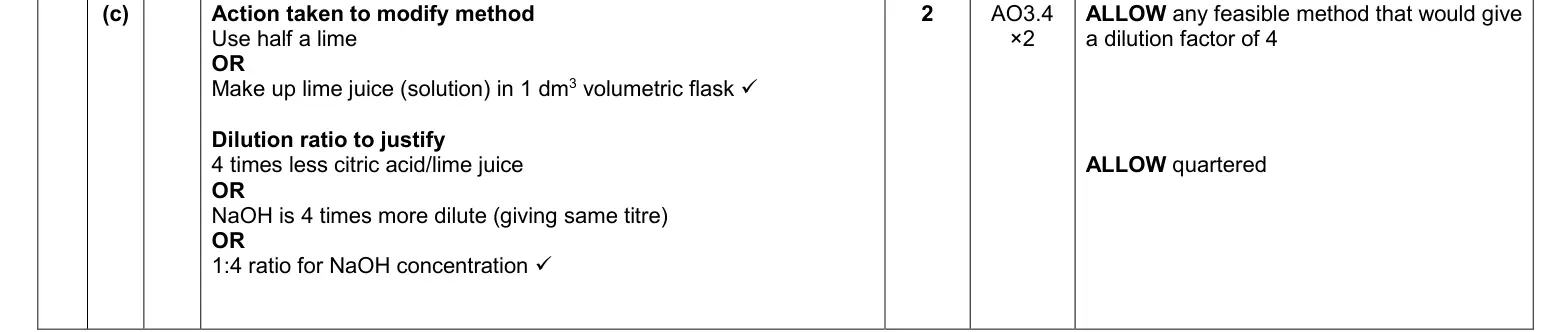
A very challenging question with very few candidates scoring both marks. The response needed a clear indication of how the method would be altered and a justification for why this would work. Lots of candidates recognised the need to dilute the citric acid to obtain the correct titre but were not able to give a method of how to do this or any indication of quantities needed. Some candidates said to use a larger volume of NaOH – not recognising that this would be the titre value, e.g. “in order to keep the same titre but lower concentration of NaOH the student should titre more NaOH”. Some gave the method of how to dilute the NaOH or even just said to add water. A few suggested using a higher concentration of lime juice. Candidates need to be given opportunities to plan practical work to fully appreciate the impact that any changes will have (specification 1.1.1).
Notes from the mark scheme and report
use half a lime or make up juice in 1 dm3 volumetric flask
justified by factor of 4 (NaOH 4 times more dilute)
ALLOW any feasible method giving dilution factor of 4
Further information about practical skills assessed on written exams can be found in section 3 of the practical skills handbook - https://www.ocr.org.uk/Images/208932-chemistry-practical- skills-handbook.pdf. If using our suggested practicals, then encourage candidates to answer the extension opportunity questions to help develop a deeper understanding in preparation for written assessments.
Skills: M0.2 Use ratios, fractions and percentages; PAG2 Acid–base titration
June 2022 · AS Paper 2 · Q3(a)(ii)2 marksAO3CalculationMedium
Earlier part of question 3 that this part uses
Mark scheme
Examiner's comment
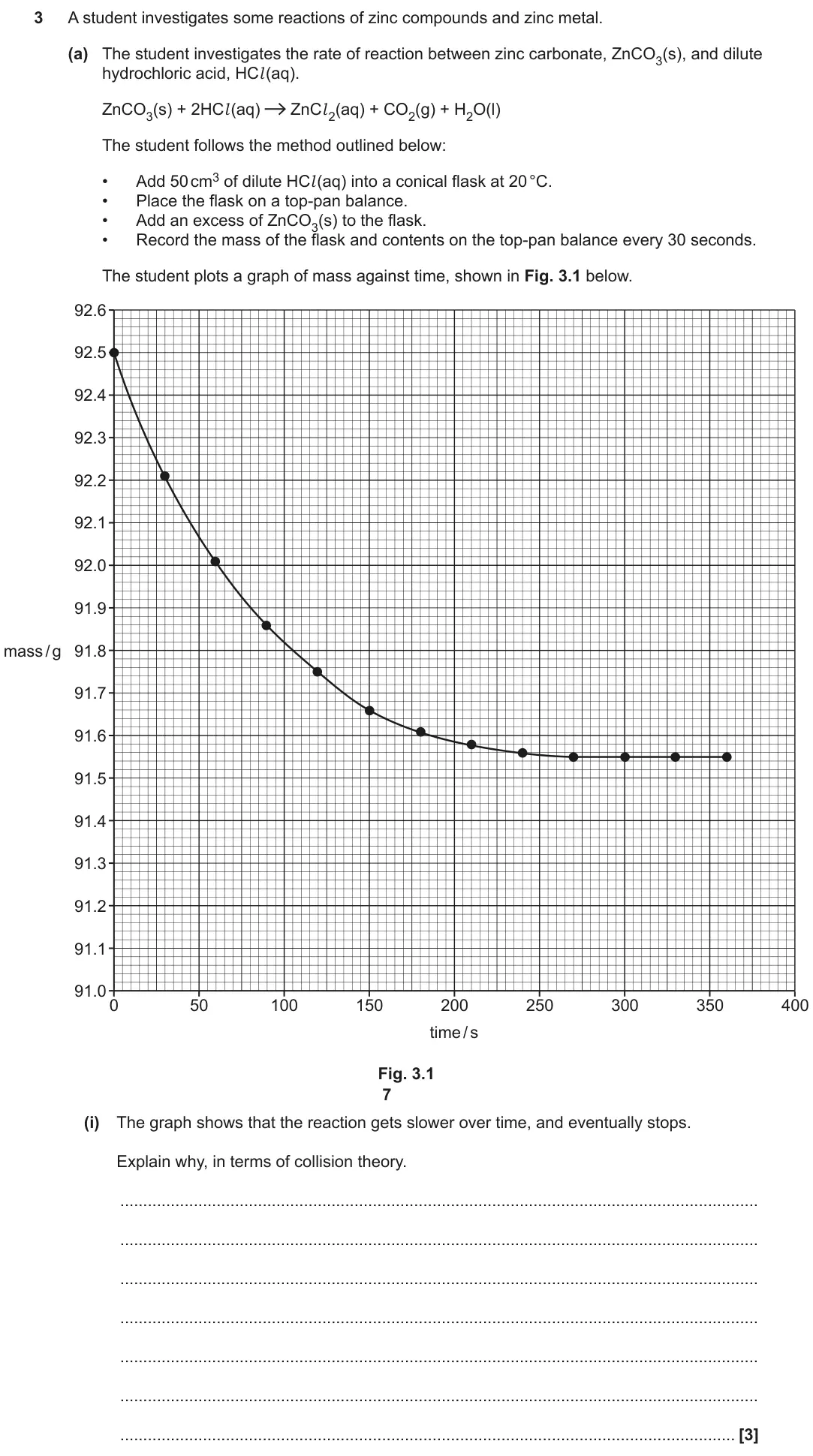
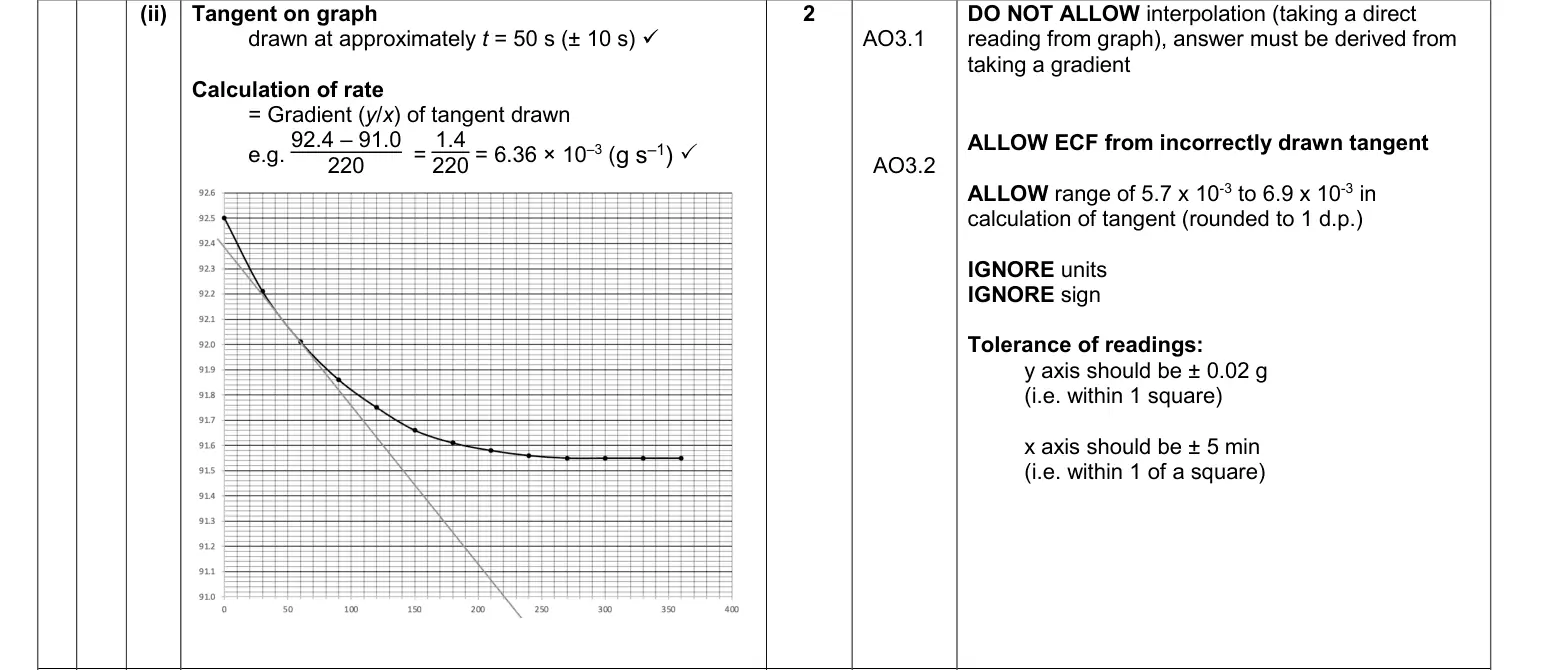
Most candidates recognised that they needed to draw a tangent. Candidates need to be instructed to draw their line clearly and make sure that it covers several large squares on the graph – preferably extending to the axes. The range given for the calculated rate from the gradient of the tangent was generous, however some did not realise that the y-axis started at 91.0 so incorrectly calculated their gradient. Some candidates used interpolation so gained no marks.
Notes from the mark scheme and report
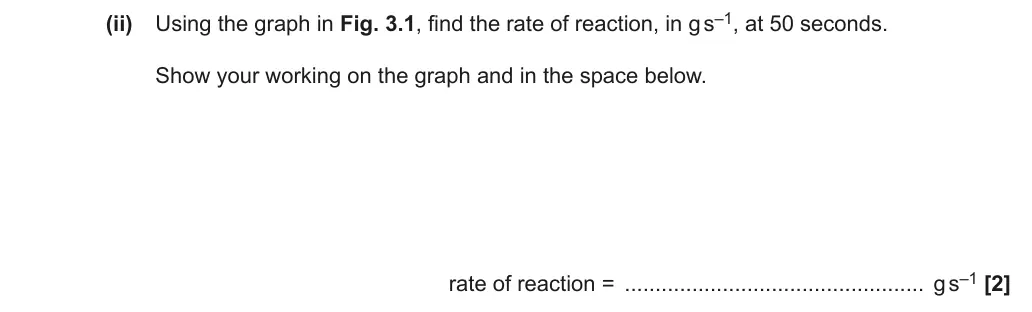
tangent drawn at t = 50 s (±10 s)
DO NOT ALLOW interpolation/direct reading - must be a gradient
range 5.7 × 10^-3 to 6.9 × 10^-3
IGNORE units and sign
ALLOW ECF from incorrect tangent
M3 section of the Maths Skills handbook contains useful information on use of graphs in chemistry, including M3.5 on drawing and using the slope of the tangent to a curve as a measure of a rate of change: https://www.ocr.org.uk/Images/295468-chemistry-mathematical- skills-handbook.pdf
Skills: M3.1 Translate information between graphical, numerical and algebraic forms; M3.5 Draw and use the slope of a tangent to a curve as a measure of rate of change; PAG9 Rates of reaction – continuous monitoring
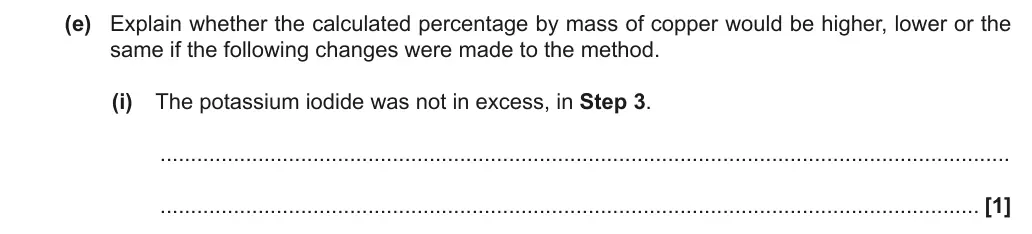
November 2021 · Paper 1 · Q18(e)(i)1 markAO3Short answer
Earlier part of question 18 that this part uses
Mark scheme
Notes from the mark scheme and report
lower AND smaller titre/less I2 produced
Skills: PAG2 Acid–base titration
November 2021 · Paper 1 · Q18(e)(ii)1 markAO3Short answer
Earlier part of question 18 that this part uses
Mark scheme
Notes from the mark scheme and report
the same AND burette volume is measured by difference
Skills: PAG2 Acid–base titration
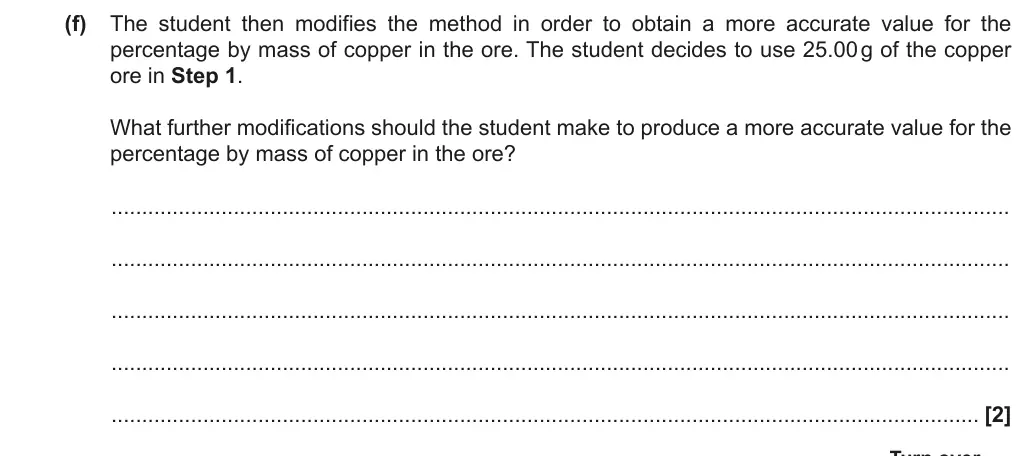
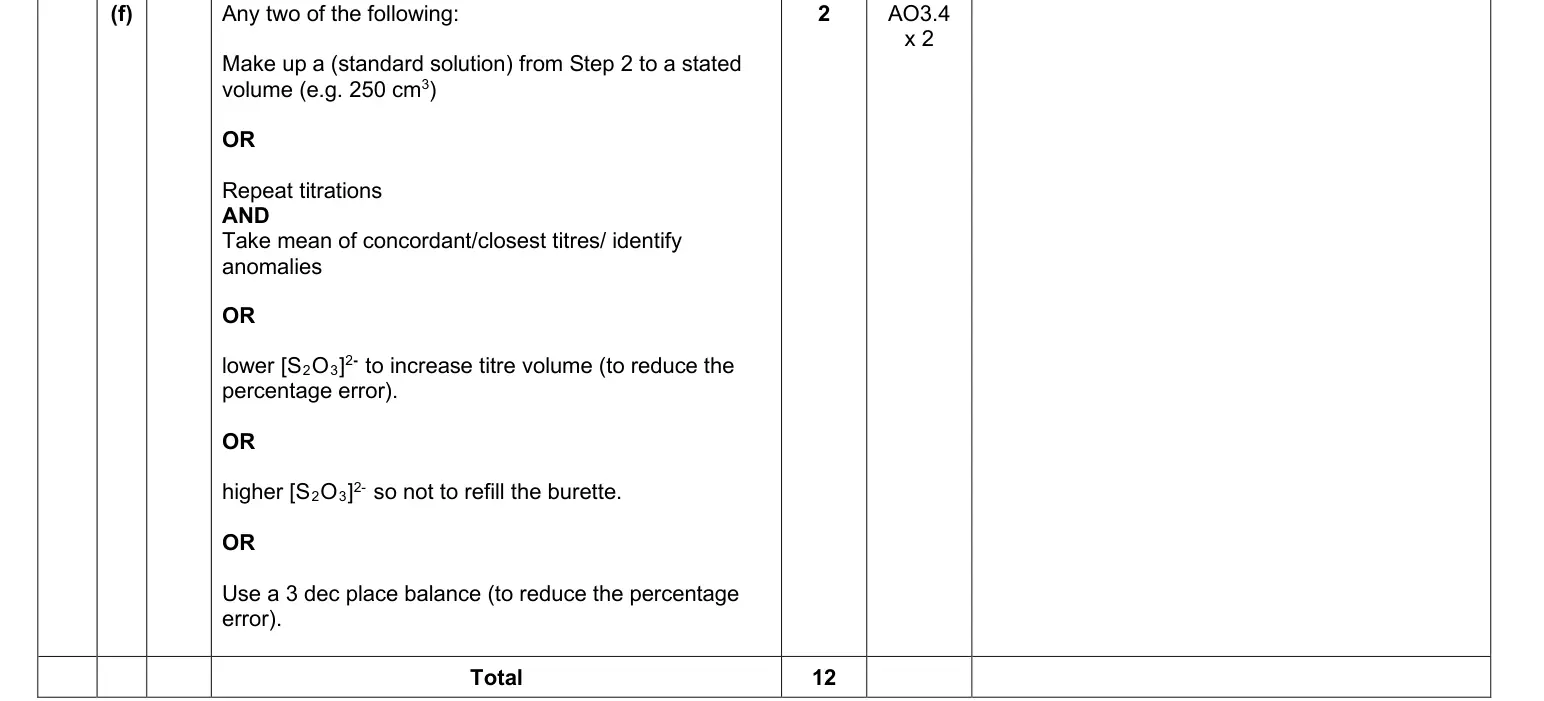
November 2021 · Paper 1 · Q18(f)2 marksAO3Short answer
Earlier part of question 18 that this part uses
Mark scheme
Notes from the mark scheme and report
any two: make up to a standard volume and titrate portions
repeat and use mean of concordant titres
change thiosulfate concentration to give a suitable titre
3 d.p. balance
Skills: M1.3 Identify uncertainties in measurements and use simple techniques to determine uncertainty when data are combined; PAG2 Acid–base titration
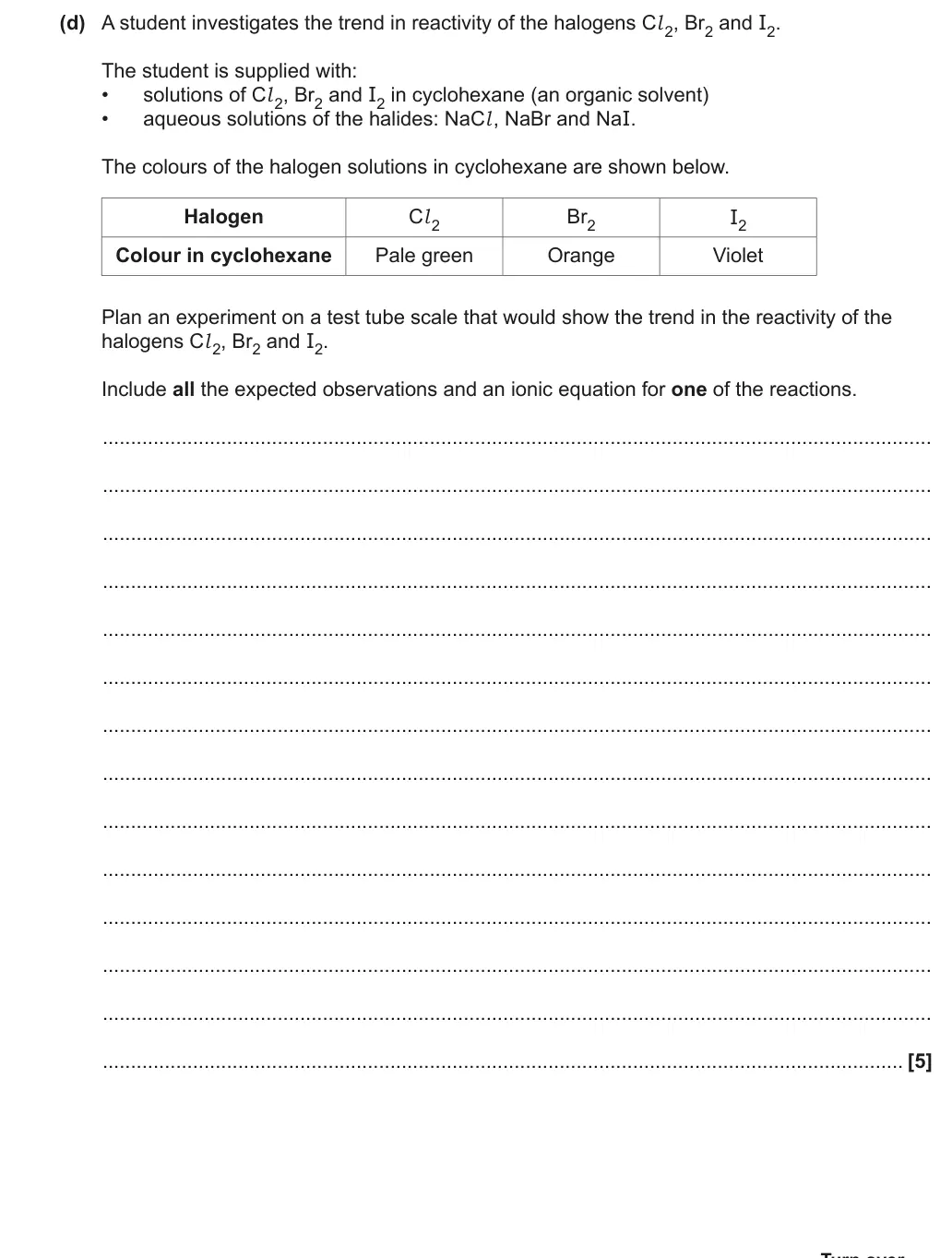
November 2021 · AS Paper 1 · Q23(d)5 marksAO1, 2, 3Equation writing
November 2021 · AS Paper 2 · Q3(b)(iv)1 markAO2Calculation
Earlier part of question 3 that this part uses
Mark scheme
Notes from the mark scheme and report
2 × 0.05 = 0.1 uncertainty in a titre
ALLOW ECF from (b)(i) or use of other titre values
Skills: M0.2 Use ratios, fractions and percentages; M1.3 Identify uncertainties in measurements and use simple techniques to determine uncertainty when data are combined; PAG2 Acid–base titration
November 2021 · AS Paper 2 · Q3(d)2 marksAO3Short answer
Earlier part of question 3 that this part uses
Mark scheme
Notes from the mark scheme and report
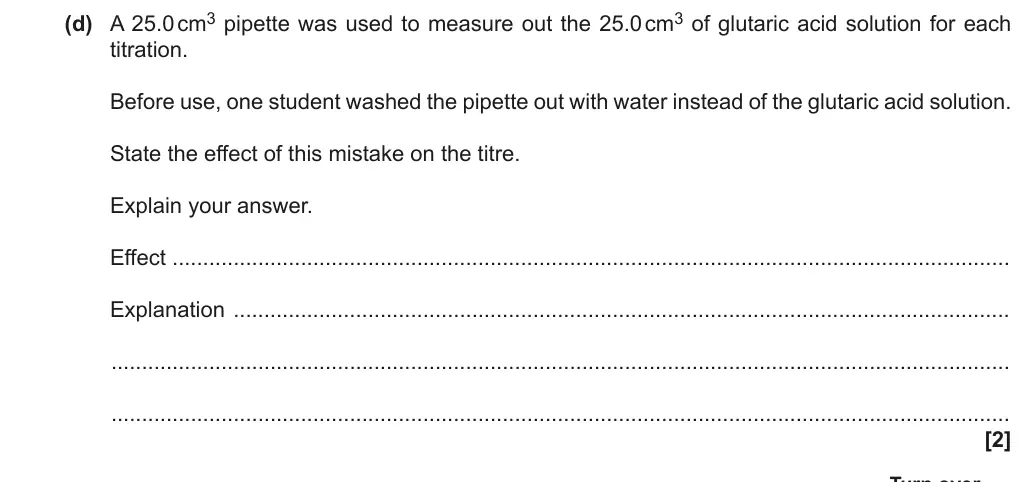
titre less
because glutaric acid solution is diluted/less concentrated
Skills: PAG2 Acid–base titration
November 2021 · AS Paper 2 · Q6(a)3 marksAO1, 2Calculation
Mark scheme
Notes from the mark scheme and report
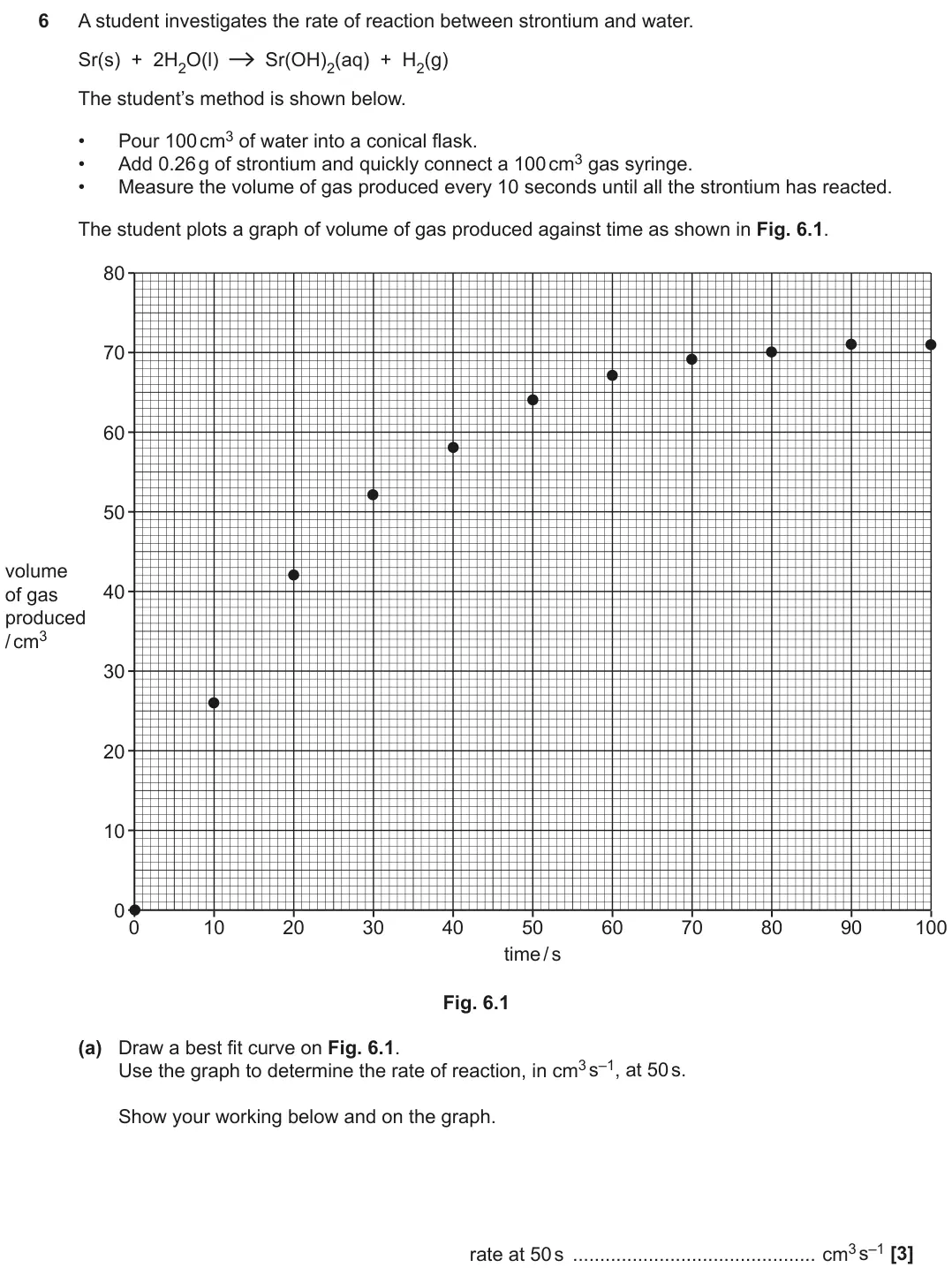
smooth best-fit curve
tangent at t = 50 s
gradient about 0.44 cm3 s–1
DO NOT ALLOW interpolation (direct reading from graph)
ALLOW ECF from incorrectly drawn tangent
Skills: M3.2 Plot two variables from experimental or other data; M3.5 Draw and use the slope of a tangent to a curve as a measure of rate of change; PAG9 Rates of reaction – continuous monitoring
November 2021 · AS Paper 2 · Q6(b)2 marksAO3Short answer
Earlier part of question 6 that this part uses
Mark scheme
Notes from the mark scheme and report
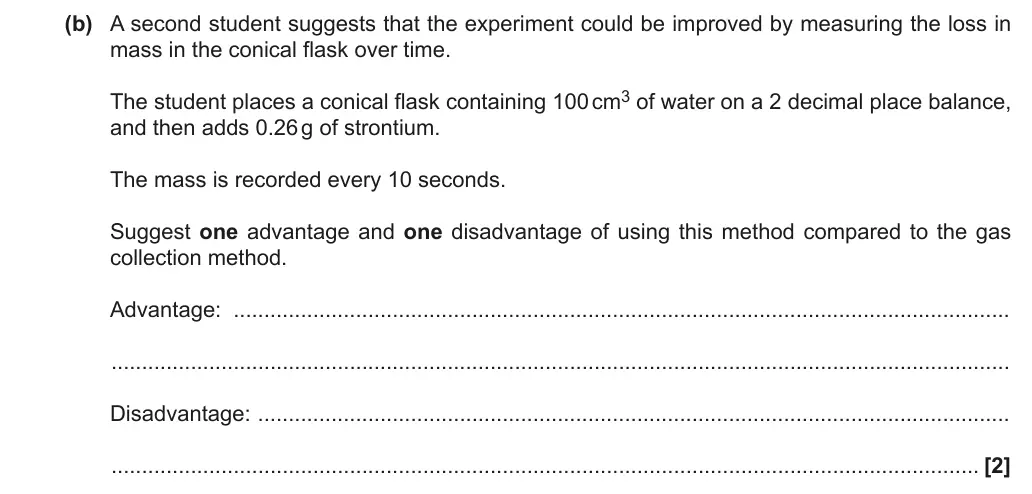
advantage: no loss of gas (before syringe connected)
disadvantage: loss in mass (of H2) very small for a 2 d.p. balance
IGNORE easier to set up
Skills: PAG9 Rates of reaction – continuous monitoring
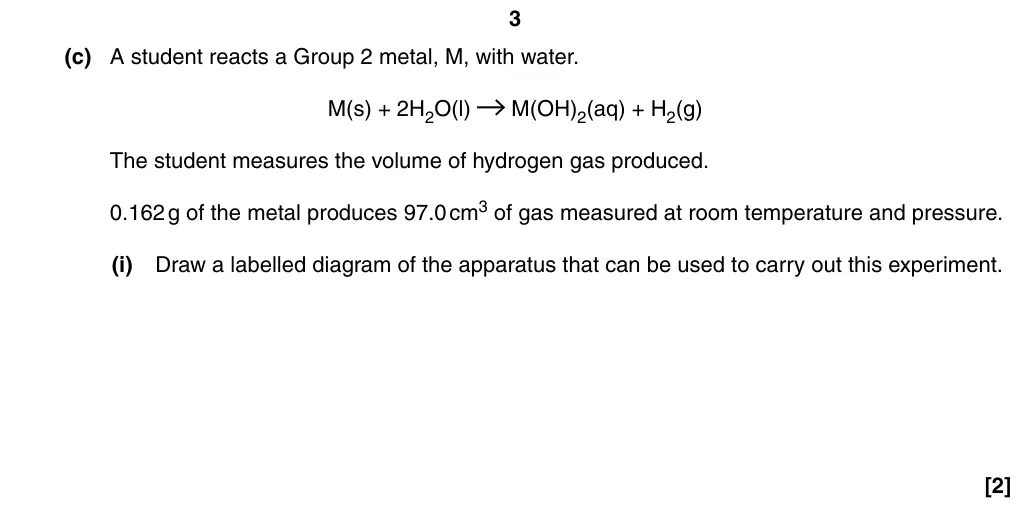
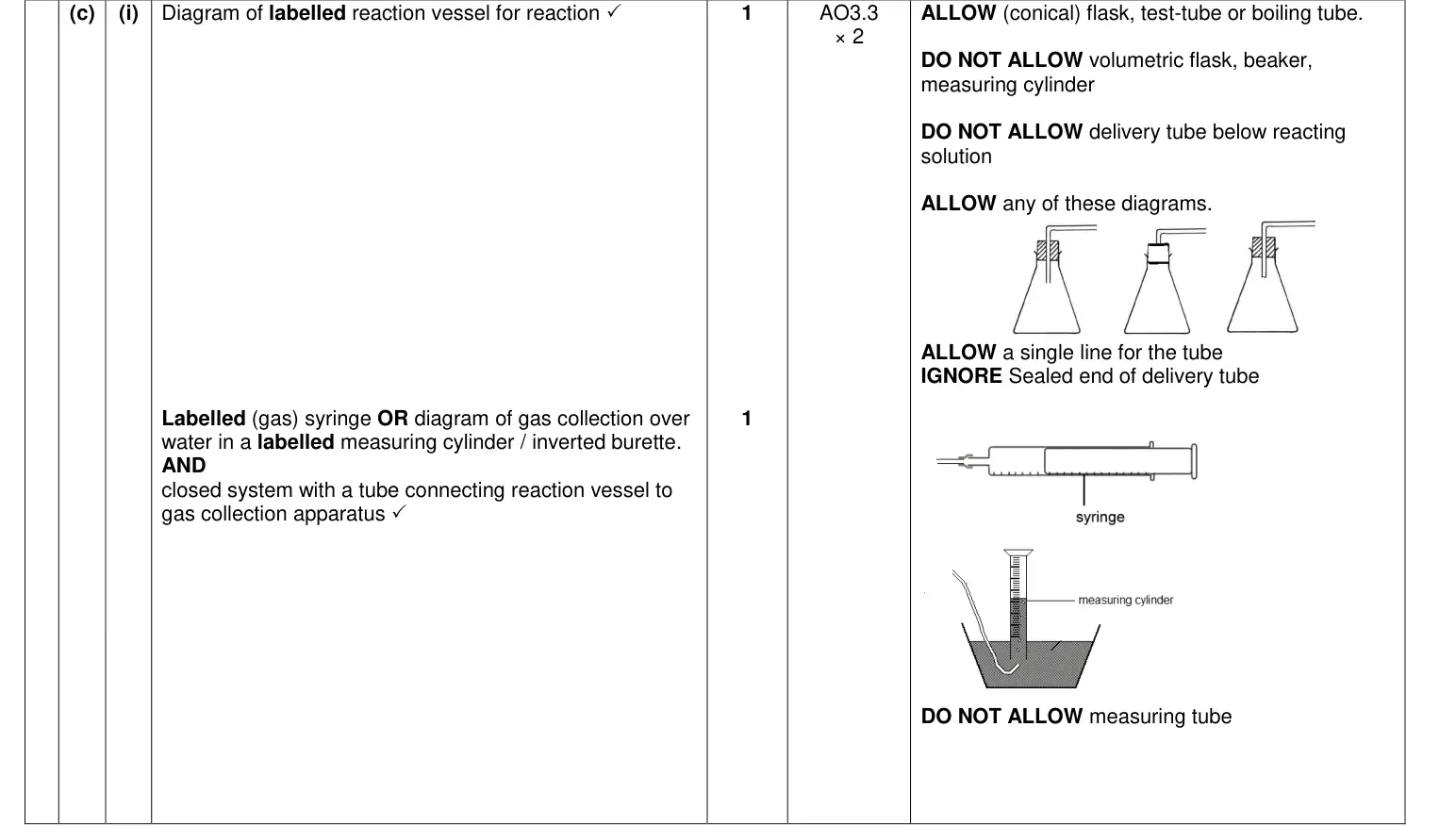
November 2021 · Paper 3 · Q2(a)2 marksAO3Drawing / labellingHard
Mark scheme
Examiner's comment
Q1(d), Q1(e), Q5(a)(i) • Unclear drawing of diagrams and labelling of laboratory apparatus: Q2(a) • Had difficulty explaining chemical ideas, often repeating the same points several times, e.g. Q2(a): Candidates were asked to draw a labelled diagram for a familiar practical set up.
Notes from the mark scheme and report
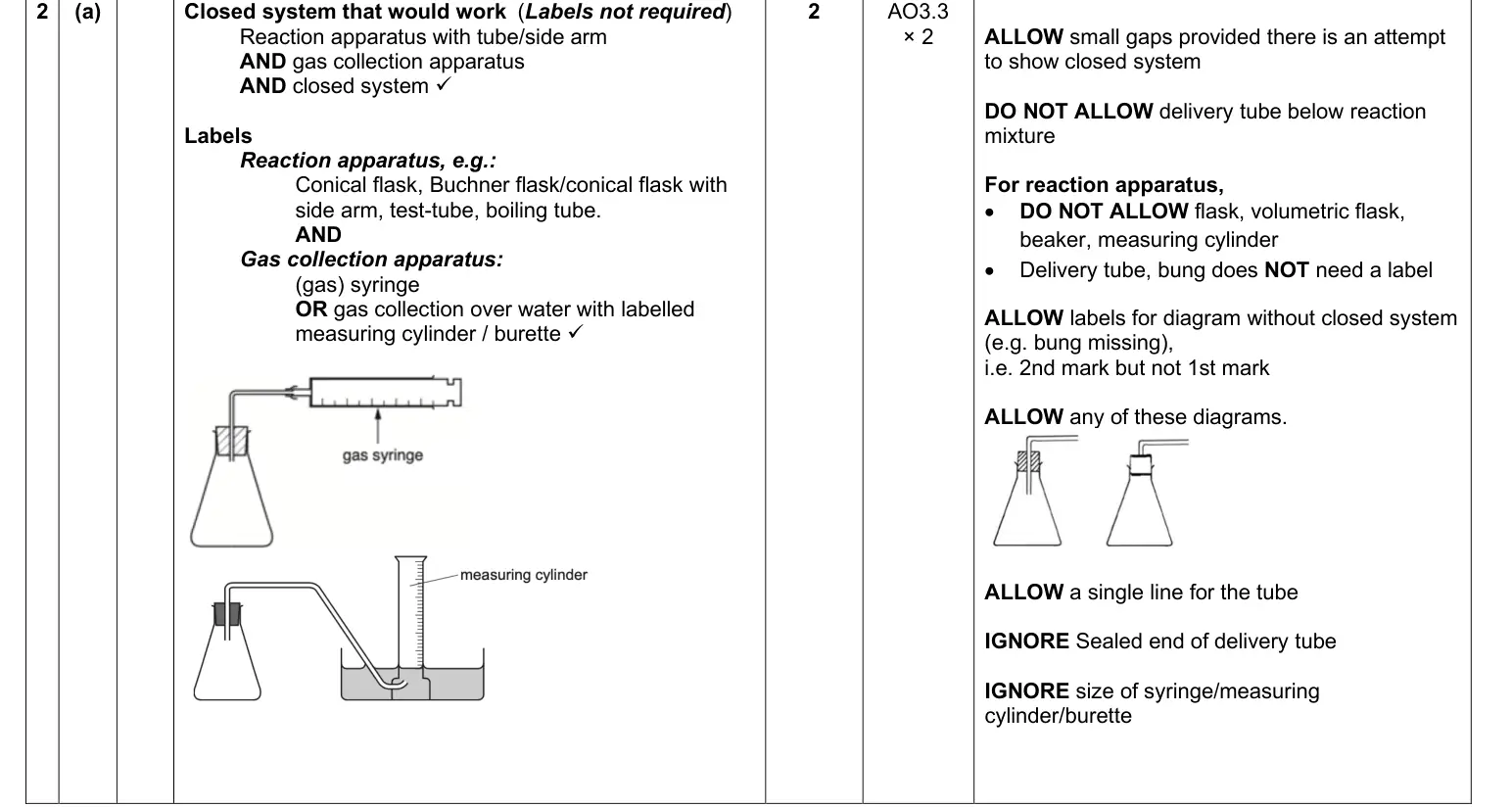
closed system with reaction vessel and gas syringe or collection over water in a measuring cylinder
DO NOT ALLOW delivery tube below reaction mixture
DO NOT ALLOW beaker, volumetric flask or measuring cylinder as reaction vessel
Skills: PAG1 Moles determination
November 2021 · Paper 3 · Q2(b)3 marksAO2, 3CalculationHard
Earlier part of question 2 that this part uses
Mark scheme
Examiner's comment
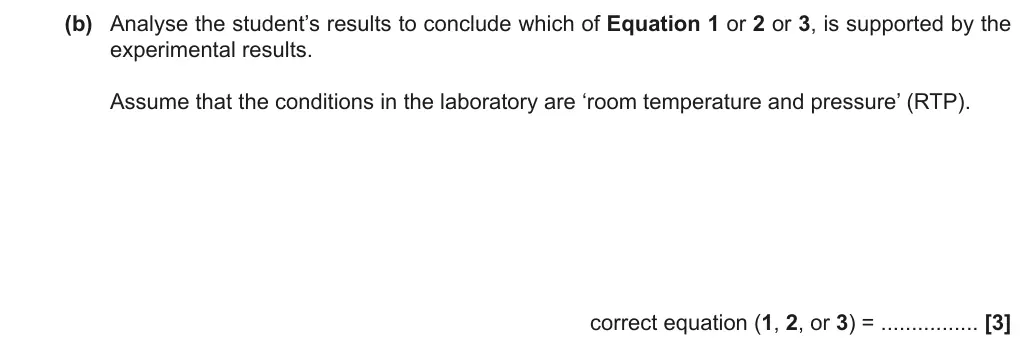
Q1(a) Partial pressure calculation Q1(d) Formula determination from percentage composition by mass Q2(b) Converting mass and volume into moles Q3(b) Unstructured titration calculation Q5(a)(ii) Ideal gas calculation Q5(b)(i) Calculation of the pH of a weak acid • Produced clear and concise responses for a Level of Response question based on a familiar context i.e., Q4(b) rates by continuous monitoring and graphical analysis. • Had difficulty when answering questions requiring application of knowledge and understanding on questions set in novel and unfamiliar contexts, e.g. Q2(b): Candidates were required to analyse the experimental results to obtain a conclusion. Q2(d): Candidates found it much more difficult to evaluate the unfamiliar scenarios in Q2(c) and Q2(d) than the stock mole calculation in Q2(b).
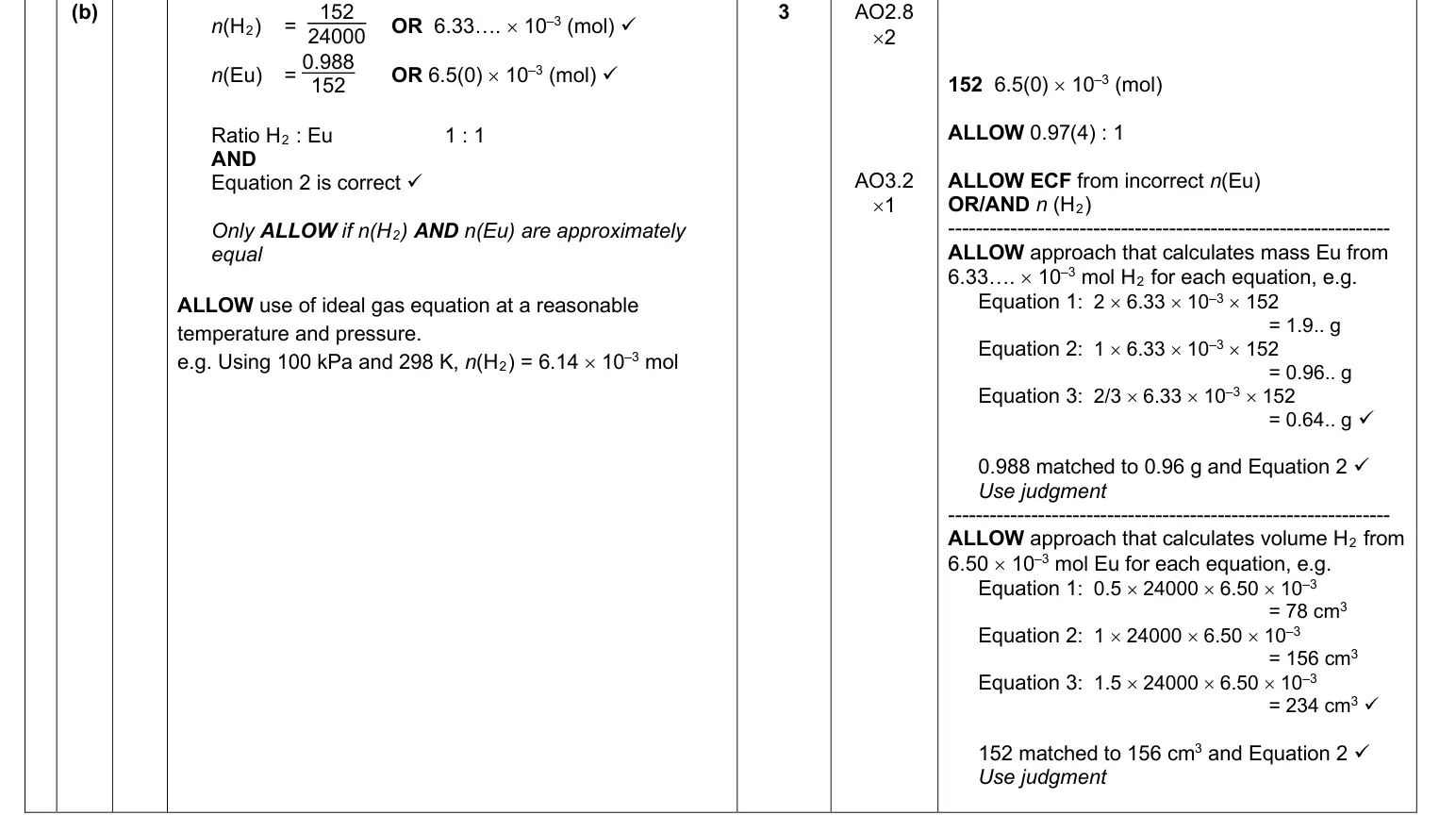
Notes from the mark scheme and report
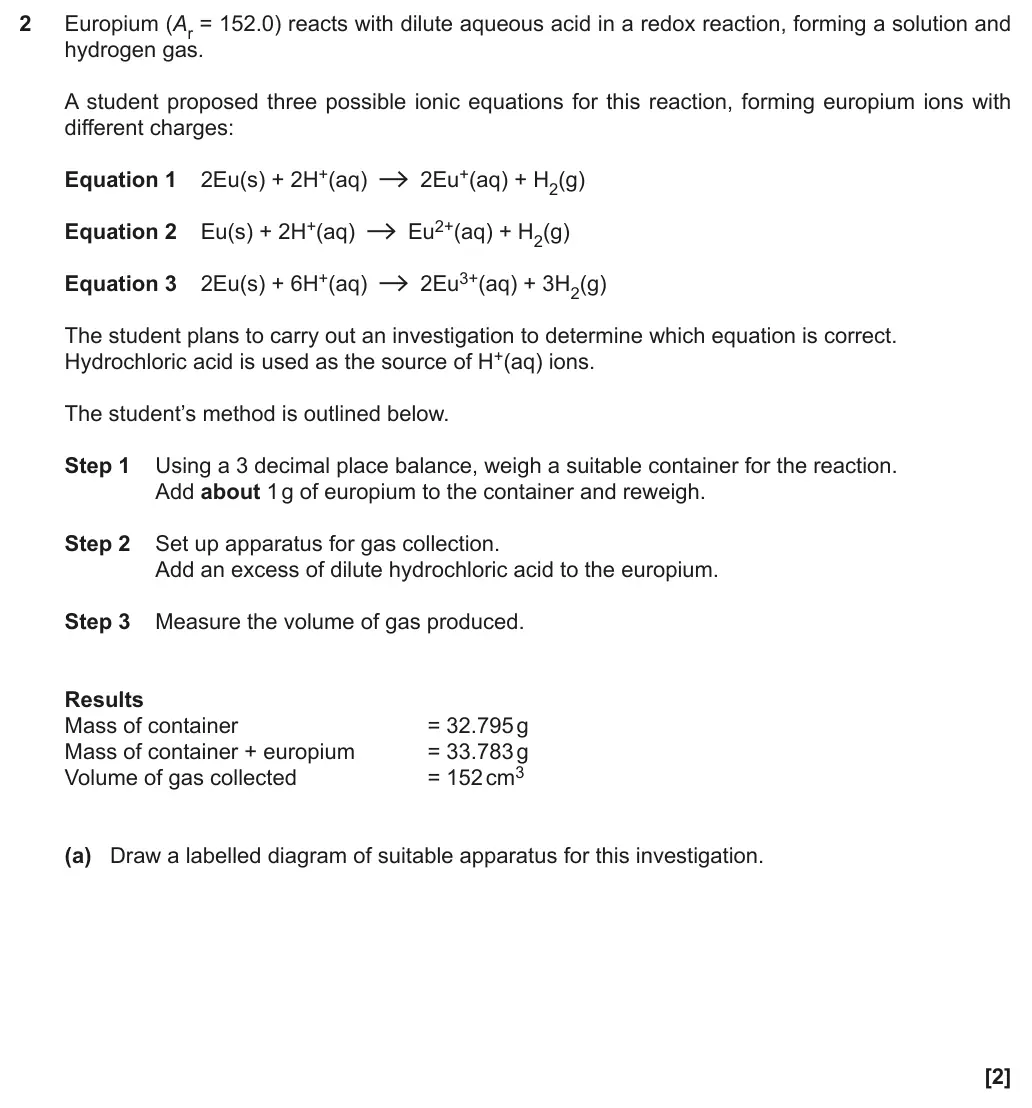
n(H2) = 152/24000 = 6.33 × 10⁻³
n(Eu) = 0.988/152 = 6.50 × 10⁻³
ratio 1:1 so Equation 2
conclusion only if the two amounts are approximately equal
ALLOW ECF
Skills: M0.0 Recognise and make use of appropriate units in calculations; M0.2 Use ratios, fractions and percentages; PAG1 Moles determination
November 2021 · Paper 3 · Q2(c)2 marksAO3Short answerHard
Earlier parts of question 2 that this part uses
Mark scheme
Examiner's comment
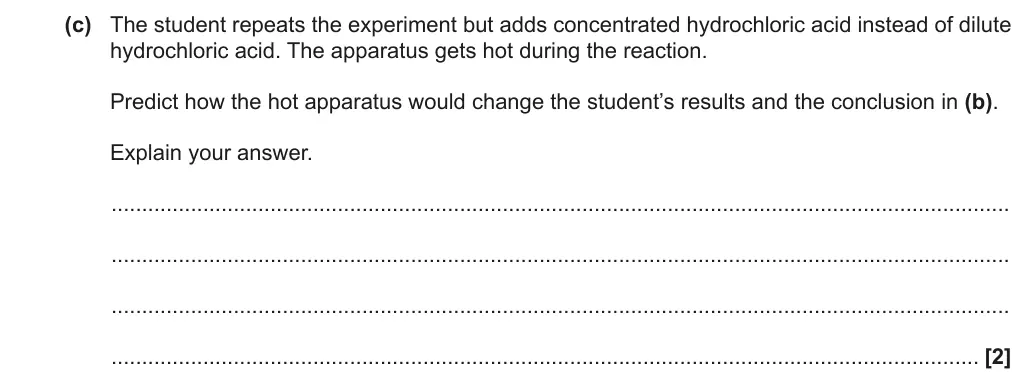
Q2(c), Q2(d): Predicting the effect of modifications to an experiment Q5(c): Interpreting information in a Level of Response question provided in an unfamiliar contexts • Had difficulty when writing equations for unfamiliar reactions, e.g. Q2(c): Candidates needed to evaluate the effect on the results and conclusion of the apparatus getting hot. Q2(d): Candidates found it much more difficult to evaluate the unfamiliar scenarios in Q2(c) and Q2(d) than the stock mole calculation in Q2(b).
Notes from the mark scheme and report
gas volume would be larger (than at RTP)
ratio H2 : Eu would be larger (ALLOW Equation 3 linked to ratio > 1)
IGNORE effect on rate
Skills: PAG1 Moles determination
November 2021 · Paper 3 · Q2(d)2 marksAO3Short answerHard
Earlier part of question 2 that this part uses
Mark scheme
Examiner's comment
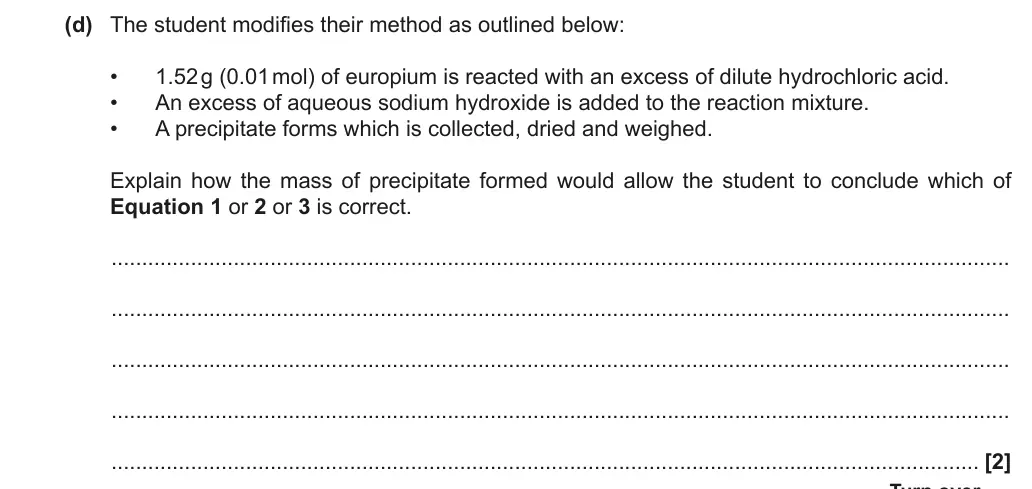
Q2(c), Q2(d): Predicting the effect of modifications to an experiment Q5(c): Interpreting information in a Level of Response question provided in an unfamiliar contexts • Had difficulty when writing equations for unfamiliar reactions, e.g. Q2(d): Candidates found it much more difficult to evaluate the unfamiliar scenarios in Q2(c) and Q2(d) than the stock mole calculation in Q2(b).
Notes from the mark scheme and report
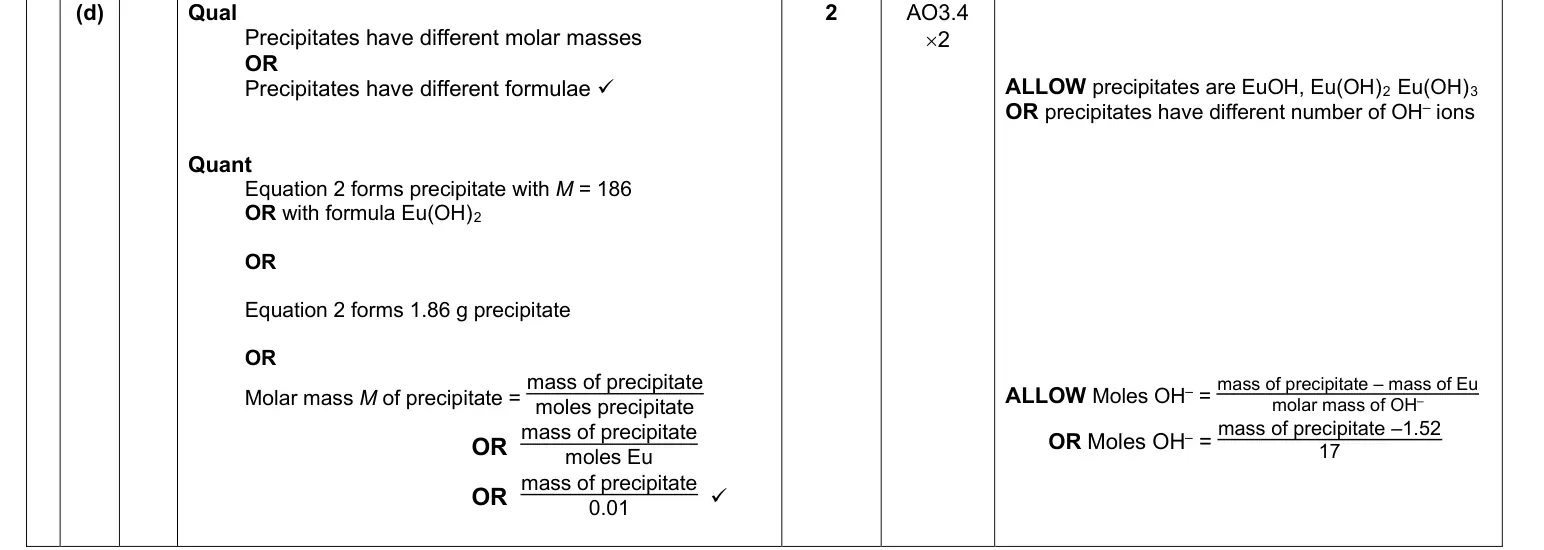
precipitates EuOH, Eu(OH)2, Eu(OH)3 have different molar masses/formulae
Equation 2 gives Eu(OH)2, M = 186, i.e. 1.86 g
or M = mass of precipitate/0.01
Skills: M0.2 Use ratios, fractions and percentages
November 2021 · Paper 3 · Q4(c)(ii)2 marksAO3Short answerMedium
Earlier part of question 4 that this part uses
Mark scheme
Examiner's comment
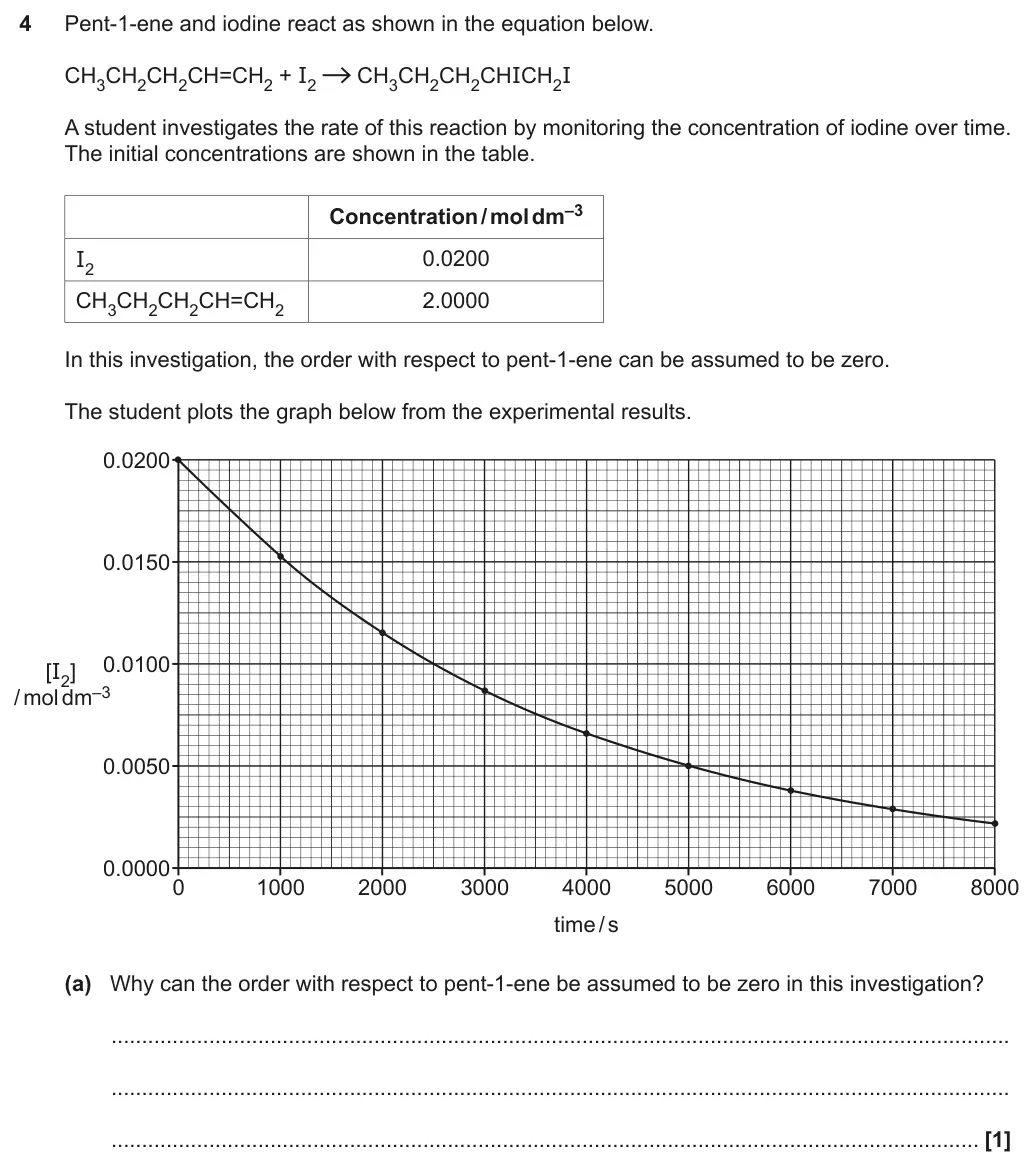
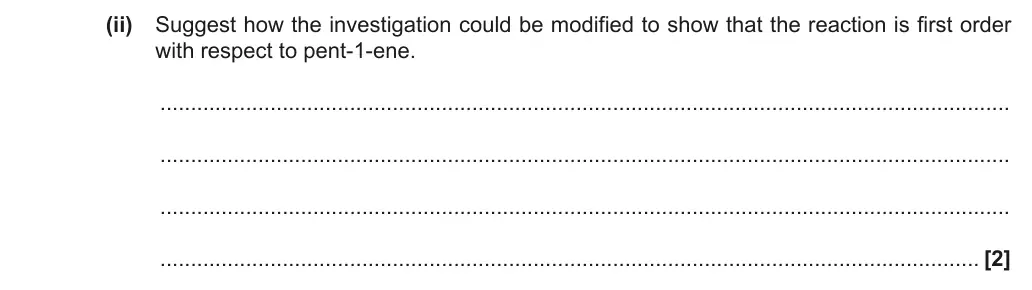
Q4(c)(ii) Candidates needed to suggest monitoring the change in rate with changing pent-1-ene concentration while keeping the iodine concentration constant.
Notes from the mark scheme and report
keep [I2] constant or use a large excess of I2
monitor [pent-1-ene] over time or how [pent-1-ene] affects rate
ALLOW initial rates approach with different pent-1-ene concentrations
Skills: PAG10 Rates of reaction – initial rates; PAG9 Rates of reaction – continuous monitoring
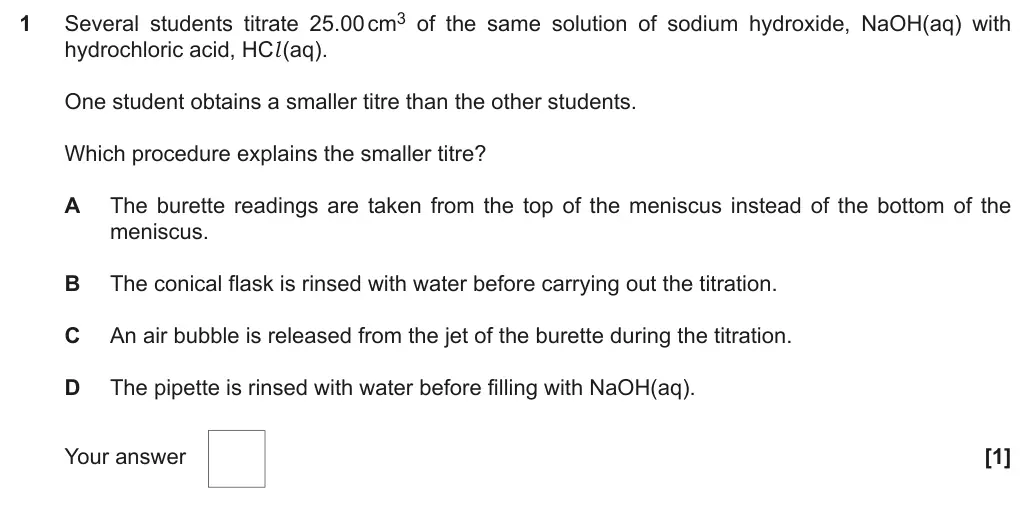
November 2020 · Paper 1 · Q11 markAO2Multiple choice
Answer
D
Mark scheme
Notes from the mark scheme and report
rinsing the pipette with water dilutes the NaOH
Skills: PAG2 Acid–base titration
November 2020 · Paper 1 · Q20(a)(i)1 markAO3Short answerMedium
Mark scheme
Examiner's comment
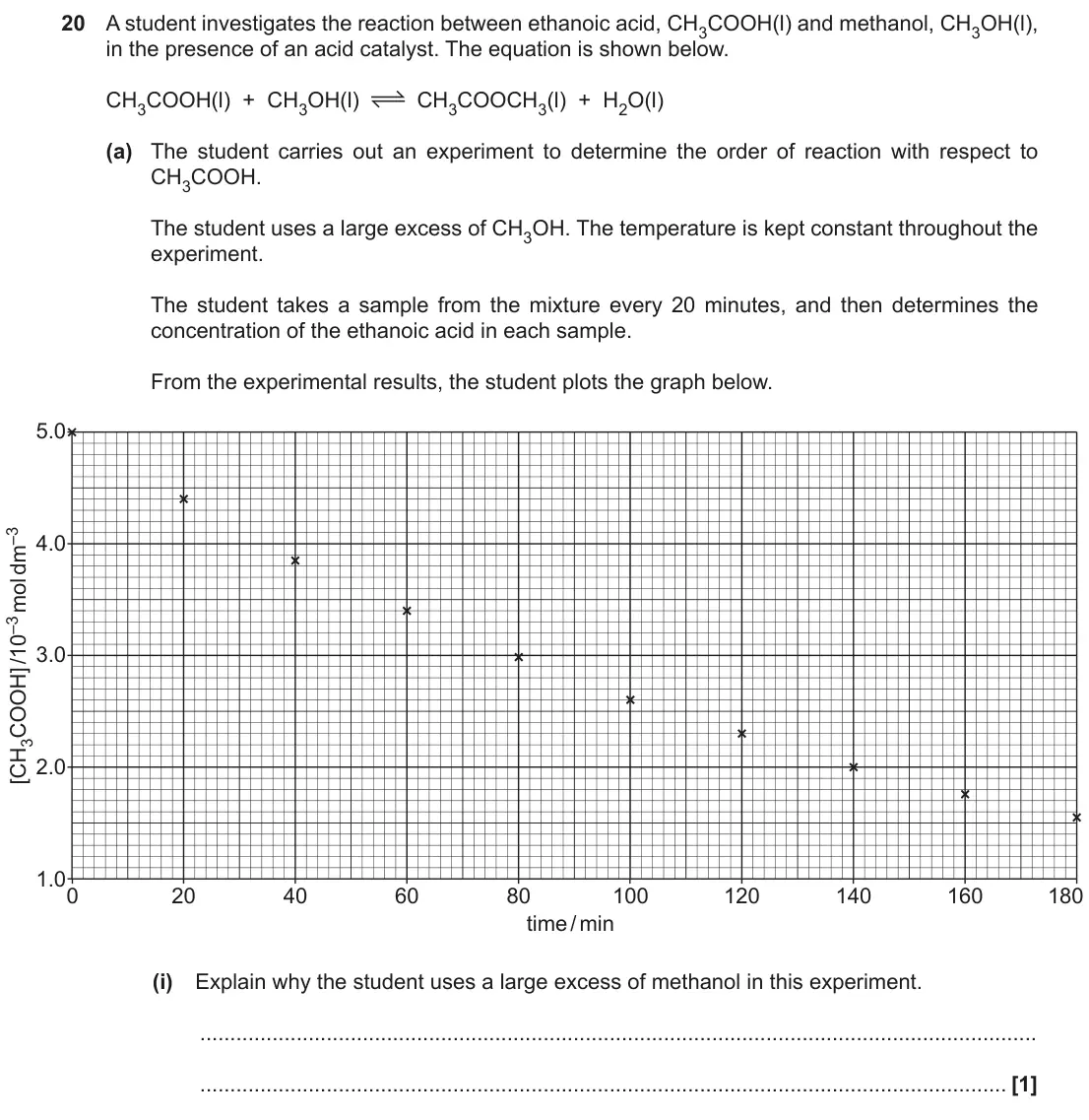
Most candidates used incorrect ideas about reaction going to completion or the methanol not being limiting.
Notes from the mark scheme and report
IGNORE 'methanol does not run out/not limiting'
Skills: PAG9 Rates of reaction – continuous monitoring
November 2020 · AS Paper 1 · Q23(c)4 marksAO2, 3Short answerHard
Mark scheme
Examiner's comment
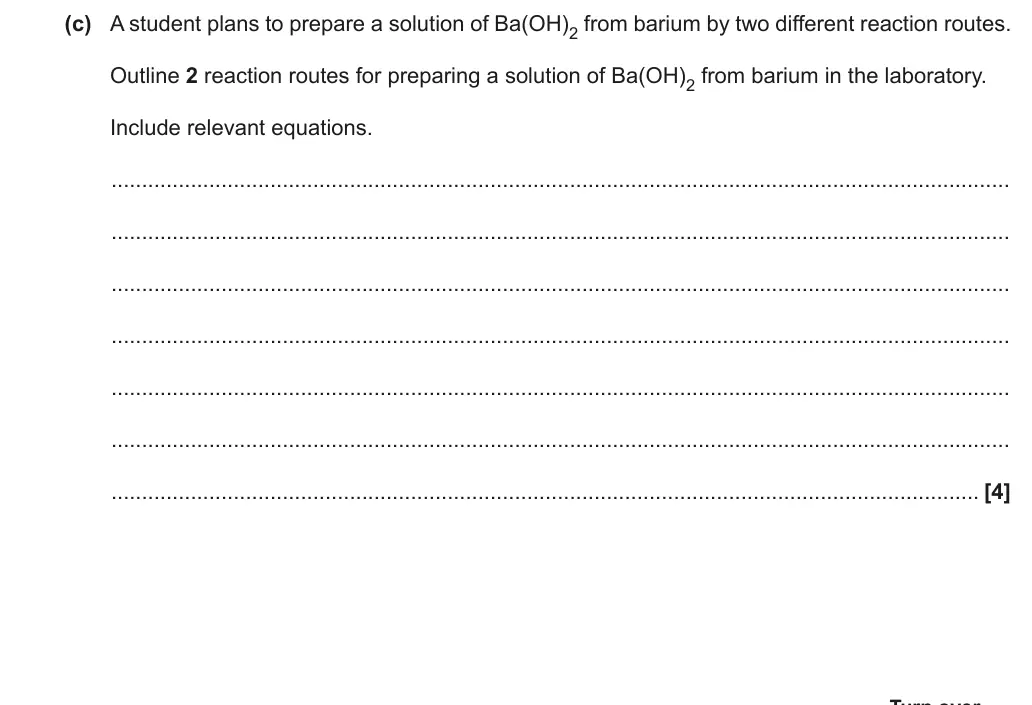
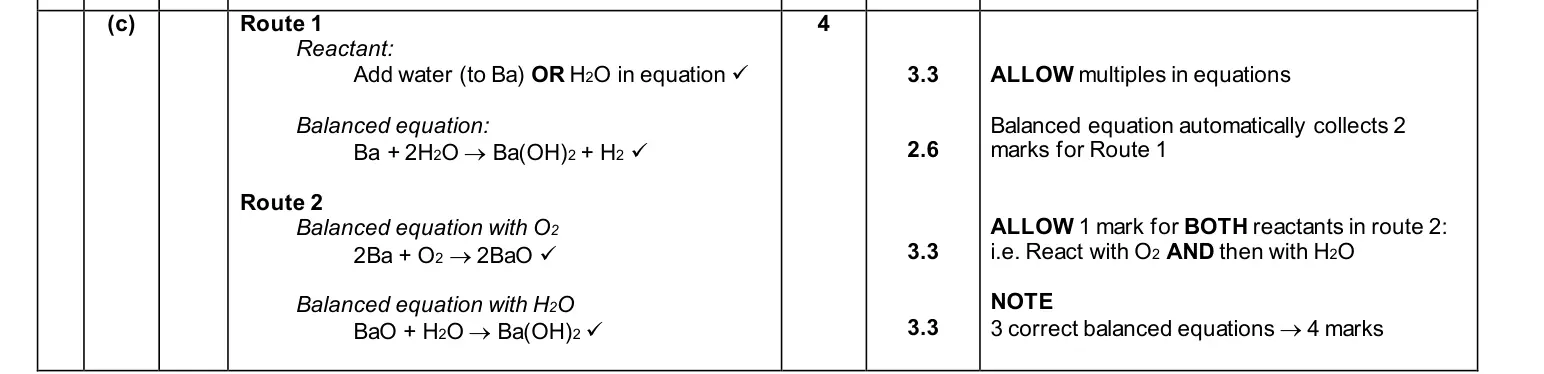
23(a) This question required candidates to calculate the moles of Ba(OH)2 in 100 cm3, to scale this value up to 1 dm3 for the concentration of Ba(OH)2 and finally to multiply this value by 2 to obtain the concentration of OH– ions of 0.454 mol dm–3. This part discriminated extremely well. Lower-attaining candidates would often calculate an incorrect molar mass of Ba(OH)2 and scale up by either 10 or 2. The commonest incorrect answer seen was 0.227, half of the correct answer by omitting the ×2 stage. Most candidates did supply their final answer to the required 3 significant figures. As with all calculations, candidates should round once, at the end of the calculation. Rounding of intermediate values can lead to significant rounding errors. Sometimes, intermediate values were rounded to 2 significant figures when the final value required 3. This use of maths will almost certainly lead to a rounding error in the final answer. Candidates should show clear working so that credit can be given for such responses by applying error carried forward. Many candidates produced largely unreferenced numbers. 23(b) Many candidates seemed to be unfamiliar with the term ‘concordant titres’. Acceptable responses were ‘within 0.1 cm3 and within 0.05 cm3. Common incorrect answers for this important term included ‘the closest titres’, ‘similar titres’, ‘repeated titres’ and ‘within 0.5 cm3’. 23(c) Many candidates were able to calculate the amount of HNO3 in the titration as 4.28 × 10⁻³ mol. Most candidates were credited for the amount of Ba(OH)2 as 2.14 × 10⁻³ mol, half the calculated amount of HNO3. Candidates then need to scale up this value by 1000/25 to obtain the concentration as 0.0856 mol dm–3. Unlike Q23(a), all intermediate calculations gave values to 3 significant figures. Candidates found this stock titration calculation easier than the more unfamiliar 23(a), with many scoring all 3 marks. Discrimination was extremely good, but about a third of candidates did not receive any marks. Candidates should be encouraged to practise stock titration calculations as part of their preparation for the examinations. Candidates should show clear working so that credit can be given for such responses by applying error carried forward. As with Q23(a), many candidates produced largely unreferenced numbers. 23(d) Candidates often find questions linked to practical work challenging. The two reaction routes involving Group 2 reactions are drawn directly from the specification: the reaction of barium with water, and the reaction of barium with oxygen, followed by water. Most candidates found this difficult, and the one-step route using barium and water was seen far more often than the two-step oxygen then water approach. Only the highest-attaining candidates were able to suggest two routes, with scores of 3/4 or 4/4 marks being comparatively rare. As with 21(c)(ii) and 25c(iii), candidates had difficulty in interpreting provided information. OCR support Our new practical question packs, split up by PAG, provide additional opportunities for students to practise questions relating to practical work. They are available on Interchange: https://interchange.ocr.org.uk/Downloads/H432_H433_Chemistry_PAG_ Practice_Question_Sets.zip
Notes from the mark scheme and report
Route 1 Ba + 2H2O
Route 2 via BaO then water
ALLOW multiples
1 mark for both reactants O2 then H2O in route 2 without equations
November 2020 · AS Paper 2 · Q2(c)(i)2 marksAO2Short answerMedium
Earlier part of question 2 that this part uses
Mark scheme
Examiner's comment
Question 2(c) demonstrated that some candidates are unsure on what is meant by accuracy and the impact that uncertainties have.
Notes from the mark scheme and report
two thermometer readings so 1/20 × 100 = 5% vs 2/200 × 100 = 1%
1 mark if 0.05 and 0.01 given with correct statement
Skills: M0.2 Use ratios, fractions and percentages; M1.3 Identify uncertainties in measurements and use simple techniques to determine uncertainty when data are combined; PAG3 Enthalpy determination
November 2020 · AS Paper 2 · Q2(c)(ii)2 marksAO3Short answerMedium
Earlier part of question 2 that this part uses
Mark scheme
Examiner's comment
Question 2(c) demonstrated that some candidates are unsure on what is meant by accuracy and the impact that uncertainties have.
Notes from the mark scheme and report
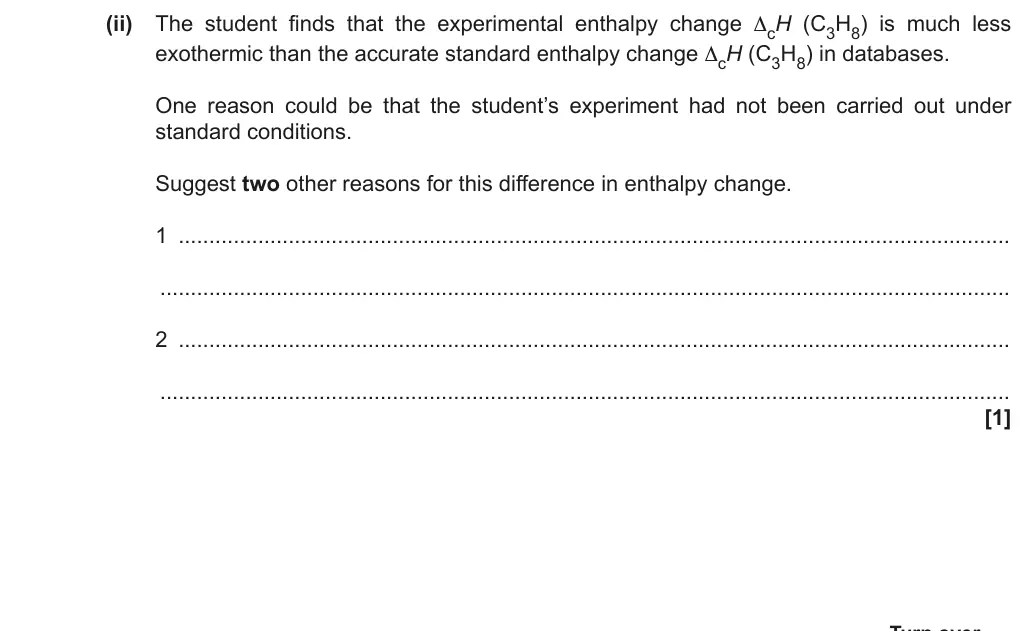
heat loss to surroundings / incomplete combustion / non-standard conditions
IGNORE reference to evaporation
Skills: PAG3 Enthalpy determination
November 2020 · AS Paper 2 · Q2(c)(iii)2 marksAO3Short answerMedium
Earlier parts of question 2 that this part uses
Mark scheme
Examiner's comment
Question 2(c) demonstrated that some candidates are unsure on what is meant by accuracy and the impact that uncertainties have.
Notes from the mark scheme and report
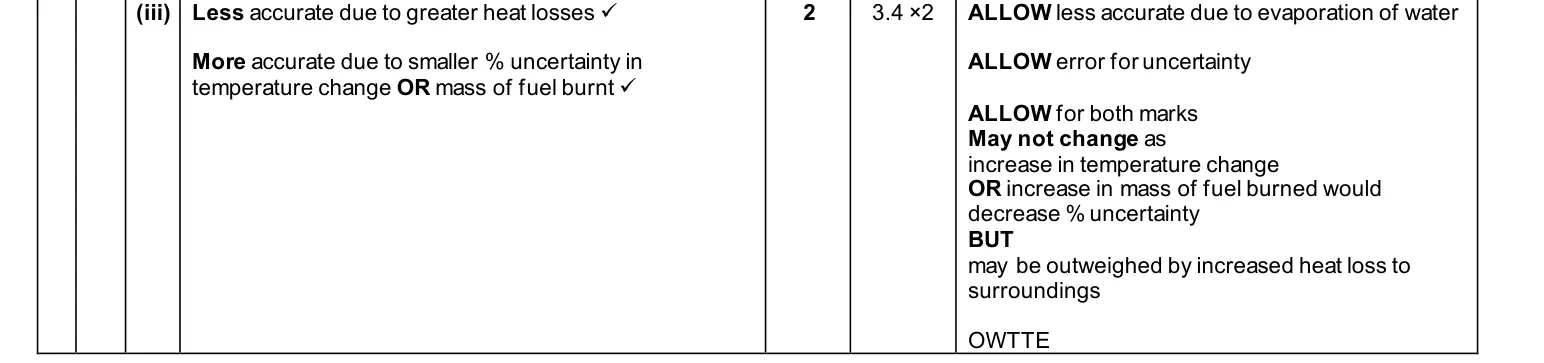
less accurate from greater heat losses vs more accurate from smaller % uncertainty in temperature change or mass of fuel
ALLOW error for uncertainty
Skills: M1.3 Identify uncertainties in measurements and use simple techniques to determine uncertainty when data are combined; PAG3 Enthalpy determination
November 2020 · Paper 3 · Q3(a)(ii)1 markAO1Short answerHard
Earlier part of question 3 that this part uses
Mark scheme
Examiner's comment
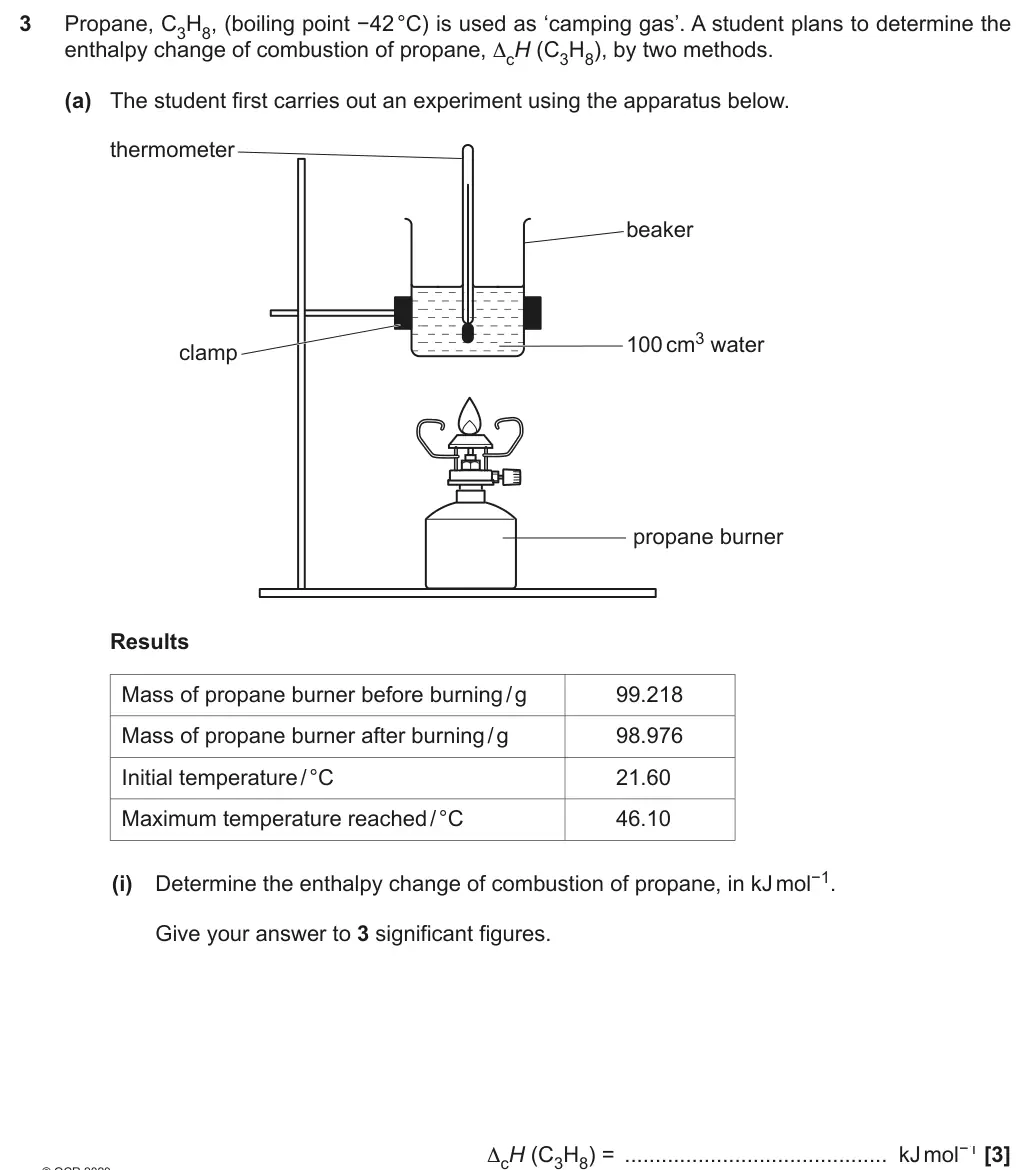
3(a)(i) Most candidates analysed the raw practical results supplied to correctly calculate the energy change as 10,241 J using q = mc∆T, and the amount of propane burnt as 0.0550 mol. Candidates usually determined the energy change per mole of propane as 1862 kJ. The question asked for the enthalpy change of combustion to 3 significant figures, which gives –1860 kJ mol–1. The mark for this final value was often not given because either the – sign was omitted or the answer was not quoted to the required 3 significant figures. Candidates are advised to read the requirements of each question more closely to eliminate such errors. A double-check on significant figure requirements is recommended before moving on to the next question. Lower-attaining candidates often extracted the wrong data from the results table. Instead of the mass of water (100 cm3), the mass of propane burnt (0.242 g) was often used in the q = mc∆T calculation. Candidates are advised that the thermometer measures the temperature change of the material in which it is placed (the water). 3(a)(ii) One mark was available for identifying two reasons for the difference in enthalpy change. It was expected that candidates would respond with ‘heat loss’ and ‘incomplete combustion’. Most candidates suggested heat loss but the other reason often suggested was equipment error, e.g. the thermometer did not reading correctly’, ‘the balance gave incorrect readings’. Candidates are advised that responses of faulty apparatus are unlikely to be creditworthy. 3(b) This question was assessed by LoR. Level 3 candidates calculated the enthalpy change for Equation 3.1 correctly as –2054 kJ mol–1. They linked 4 × ∆vapH with the enthalpy change for Equation 3.1 in an energy cycle and calculated the enthalpy change of combustion as –2054 – (4 × 40.65) = –2216.6 kJ mol–1. Most Level 3 candidates drew out bonds in the molecules involved in Equation 3.1, which allowed them to visually count the bonds broken and bonds made. This strategy is recommended to all candidates for any calculation based on bond enthalpies and is much more likely to generate the correct enthalpy change than visualising the relevant bonds solely from the equation. Level 2 candidates often derived the correct enthalpy change for Equation 3.1 but then tried to link this value with ∆vapH instead of 4 × ∆vapH. Other Level 2 candidates calculated ∆H correctly for either the bonds broken or bonds made and combine this value with 4 × ∆vapH. A common error was the omission of the 2 C–C bonds in propane, use of 3 C–C, instead of 2 C–C, bonds, or use of 4, rather than 8 O–H bonds. These errors could have been avoided by drawing out the bonds as described above. Level 1 candidates typically attempted to use the bond enthalpies to calculate energies for bonds broken and bonds made but made several errors. They then combined this value with ∆vapH. This question discriminated extremely well across different abilities.
Notes from the mark scheme and report
any two for 1 mark: heat loss to surroundings, incomplete combustion (IGNORE incomplete 'reaction'), evaporation of water
IGNORE evaporation of C3H8
Skills: PAG3 Enthalpy determination
November 2020 · Paper 3 · Q4(c)(i)1 markAO3Short answerMedium
Earlier part of question 4 that this part uses
Mark scheme
Examiner's comment
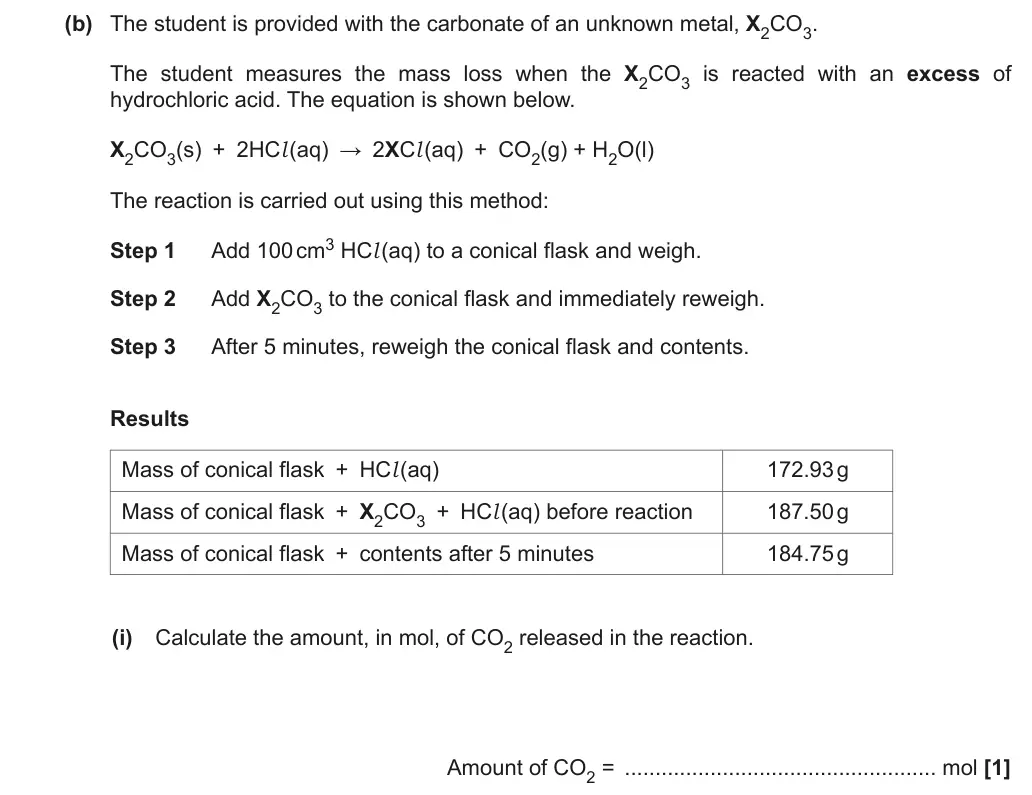
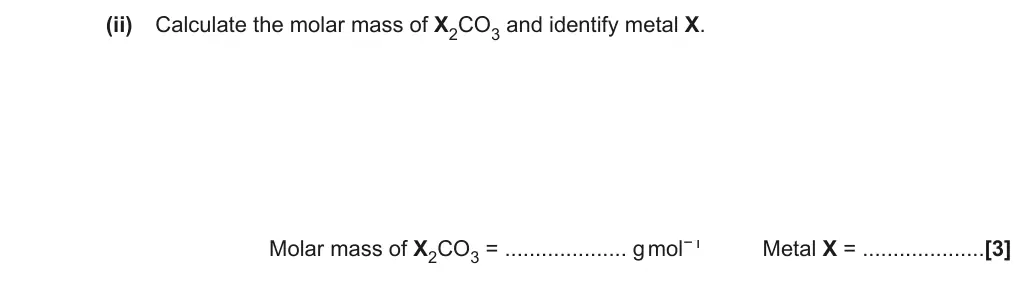
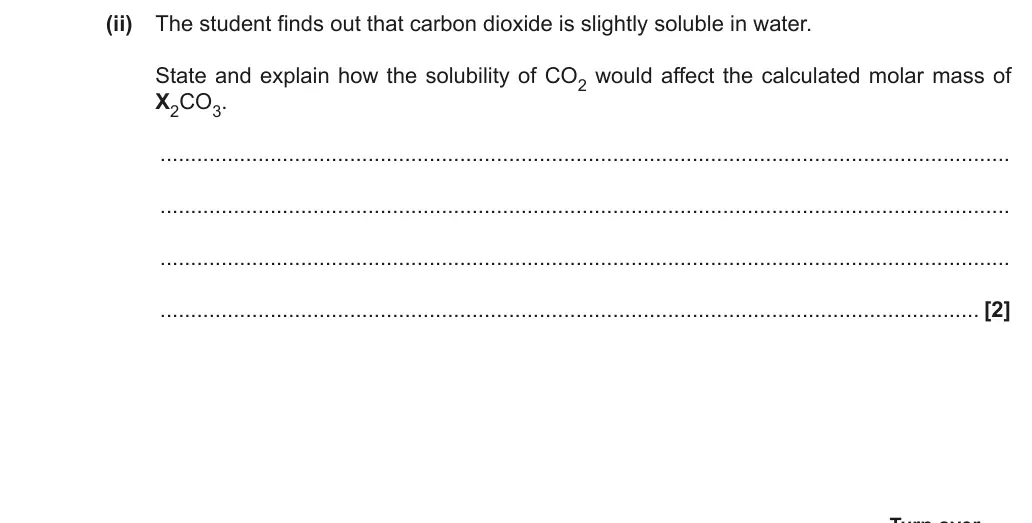
4(a)(i) This question required candidates to write an overall equation and half equations for oxidation and reduction. Many candidates made errors within one or more equations. The overall equation was often written without state symbols, despite the question instruction ‘with state symbols’. The oxidation half equation was more likely to be correct than the reduction half equation, which often used Cl instead of H+. When H+ was used, the half equation was often unbalanced or electrons had been omitted. It is recommended that candidates carefully use the chemical information in the question. 4(a)(ii) Most candidates identified that all the metal would have reacted when it had all disappeared and that gas bubbles from the reaction would have stopped. Some responses did not emphasise that these observations would have stopped and this prevented credit being given. 4(a)(iii) The ionic equation for neutralisation of an acid with an alkali was well known and this question was answered correctly by most candidates. 4(a)(iv) Candidates were presented with information about a back titration, a technique that they would be unlikely to have encountered during their course. The question stem to 4a(iv) suggested a three-step strategy. Many candidates followed this guidance and were credited with many of the available marks. Marks were given for a correct method (by error carried forward) even if there was an error or omission in the multi-step calculation. This emphasises the importance of clear working. Most candidates determined the correct mean titre of 27.25 cm3. A few candidates did take the mean of all three titres rather than the closest. Most calculated that 8.72 × 10⁻³ mol of NaOH reacted with the same number of moles of HCl in the titration and then scaled up the HCl by a factor of 10 to 8.72 × 10⁻² mol in the 250 cm3 volumetric flask. These steps are standard for many titration calculations and gave a route to three of the six available marks. The more difficult back titration steps then followed and the higher-attaining candidates recognised the need to subtract this amount of HCl from the original amount of HCl used to react with metal M. These candidates then divide this value by two to find the moles of M that reacted (from the 1 : 2 stoichiometry of M : HCl). The correct calculation then gave a relative atomic mass of M as 112 and its identity as cadmium. It was common for candidates to omit the division by two and to arrive at a relative atomic mass of 56 for iron. The mark scheme shows the variety of metals that candidates identified from their calculations, the errors made, and the error carried forward marks that resulted. Many lower-attaining candidates did not follow the 3 steps in the stem, using only the original amount of HCl and ignoring the titration. This approach was not credited with marks. A large range of marks was seen, and the question discriminated extremely well. 4(b)(i) This straightforward mole calculation required candidates to determine the mass of CO2 as 2.75 g from the table of results and to divide this value by the molar mass of CO2 to arrive at 0.0625 mol. Most candidates were successful. As with other questions providing raw experimental results, lower-attaining candidates often chose the wrong data from the supplied results. 4(b)(ii) Many candidates used their value from 4b(i) with the mass of X2CO3 from the results table to obtain a value for the molar mass (233.13 from 14.57 ÷ 0.0625). Higher-attaining candidates obtained a value for the atomic mass of X (86.56 from 233.13) and identified X as the Group 1 metal rubidium. Some candidates did not recognise the significance of the formula of X2CO3 and identified X instead as strontium (Ar = 87.6). Lower-attaining candidates often used incorrect data from the supplied information and made little progress with this calculation. 4(c)(i) Most candidates suggested that the mass of the flask and contents could be reweighed until the mass no longer changed. An alternative creditworthy suggestion was to attach a gas syringe and to measure the gas volume until it no longer changed. Vague suggestions such as ‘leave for longer’ were not credited with marks. 4(c)(ii) Candidates found this question challenging. Success required candidates to appreciate that some CO2 dissolving would result in less mass of CO2 being recorded as lost, meaning that less moles of CO2 had apparently been formed and so less moles of X2CO3 had reacted. Using n = m/M, this would show that the calculated molar mass of X2CO3 appears to be greater. Only the highest-attaining candidates successfully navigated this question.
Notes from the mark scheme and report
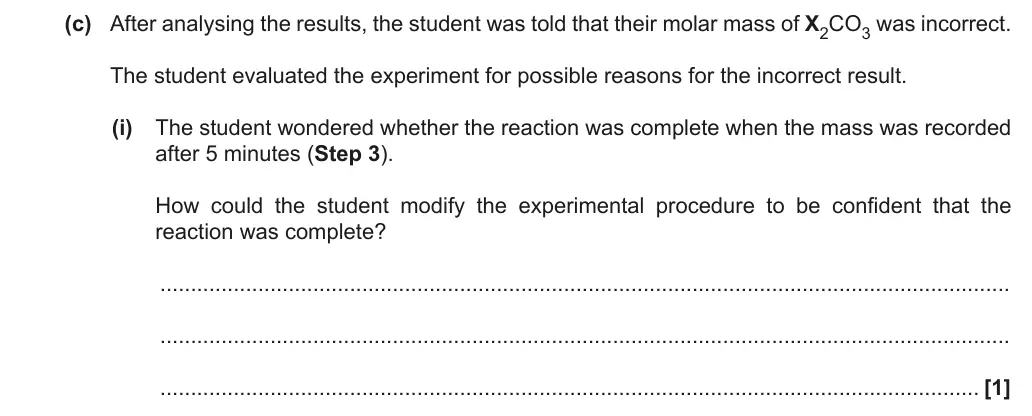
reweigh to constant mass
IGNORE 'leave for longer' or 'wait until fizzing stops' without link to constant mass
Skills: PAG1 Moles determination
November 2020 · Paper 3 · Q4(c)(ii)2 marksAO3Short answerMedium
Earlier parts of question 4 that this part uses
Mark scheme
Examiner's comment
4(a)(i) This question required candidates to write an overall equation and half equations for oxidation and reduction. Many candidates made errors within one or more equations. The overall equation was often written without state symbols, despite the question instruction ‘with state symbols’. The oxidation half equation was more likely to be correct than the reduction half equation, which often used Cl instead of H+. When H+ was used, the half equation was often unbalanced or electrons had been omitted. It is recommended that candidates carefully use the chemical information in the question. 4(a)(ii) Most candidates identified that all the metal would have reacted when it had all disappeared and that gas bubbles from the reaction would have stopped. Some responses did not emphasise that these observations would have stopped and this prevented credit being given. 4(a)(iii) The ionic equation for neutralisation of an acid with an alkali was well known and this question was answered correctly by most candidates. 4(a)(iv) Candidates were presented with information about a back titration, a technique that they would be unlikely to have encountered during their course. The question stem to 4a(iv) suggested a three-step strategy. Many candidates followed this guidance and were credited with many of the available marks. Marks were given for a correct method (by error carried forward) even if there was an error or omission in the multi-step calculation. This emphasises the importance of clear working. Most candidates determined the correct mean titre of 27.25 cm3. A few candidates did take the mean of all three titres rather than the closest. Most calculated that 8.72 × 10⁻³ mol of NaOH reacted with the same number of moles of HCl in the titration and then scaled up the HCl by a factor of 10 to 8.72 × 10⁻² mol in the 250 cm3 volumetric flask. These steps are standard for many titration calculations and gave a route to three of the six available marks. The more difficult back titration steps then followed and the higher-attaining candidates recognised the need to subtract this amount of HCl from the original amount of HCl used to react with metal M. These candidates then divide this value by two to find the moles of M that reacted (from the 1 : 2 stoichiometry of M : HCl). The correct calculation then gave a relative atomic mass of M as 112 and its identity as cadmium. It was common for candidates to omit the division by two and to arrive at a relative atomic mass of 56 for iron. The mark scheme shows the variety of metals that candidates identified from their calculations, the errors made, and the error carried forward marks that resulted. Many lower-attaining candidates did not follow the 3 steps in the stem, using only the original amount of HCl and ignoring the titration. This approach was not credited with marks. A large range of marks was seen, and the question discriminated extremely well. 4(b)(i) This straightforward mole calculation required candidates to determine the mass of CO2 as 2.75 g from the table of results and to divide this value by the molar mass of CO2 to arrive at 0.0625 mol. Most candidates were successful. As with other questions providing raw experimental results, lower-attaining candidates often chose the wrong data from the supplied results. 4(b)(ii) Many candidates used their value from 4b(i) with the mass of X2CO3 from the results table to obtain a value for the molar mass (233.13 from 14.57 ÷ 0.0625). Higher-attaining candidates obtained a value for the atomic mass of X (86.56 from 233.13) and identified X as the Group 1 metal rubidium. Some candidates did not recognise the significance of the formula of X2CO3 and identified X instead as strontium (Ar = 87.6). Lower-attaining candidates often used incorrect data from the supplied information and made little progress with this calculation. 4(c)(i) Most candidates suggested that the mass of the flask and contents could be reweighed until the mass no longer changed. An alternative creditworthy suggestion was to attach a gas syringe and to measure the gas volume until it no longer changed. Vague suggestions such as ‘leave for longer’ were not credited with marks. 4(c)(ii) Candidates found this question challenging. Success required candidates to appreciate that some CO2 dissolving would result in less mass of CO2 being recorded as lost, meaning that less moles of CO2 had apparently been formed and so less moles of X2CO3 had reacted. Using n = m/M, this would show that the calculated molar mass of X2CO3 appears to be greater. Only the highest-attaining candidates successfully navigated this question.
Notes from the mark scheme and report
mass/moles of CO2 lost would be smaller so n(X2CO3) appears smaller
calculated molar mass would be greater
Skills: PAG1 Moles determination
November 2020 · Paper 3 · Q5(a)2 marksAO1Complete table/diagramMedium
Mark scheme
Examiner's comment
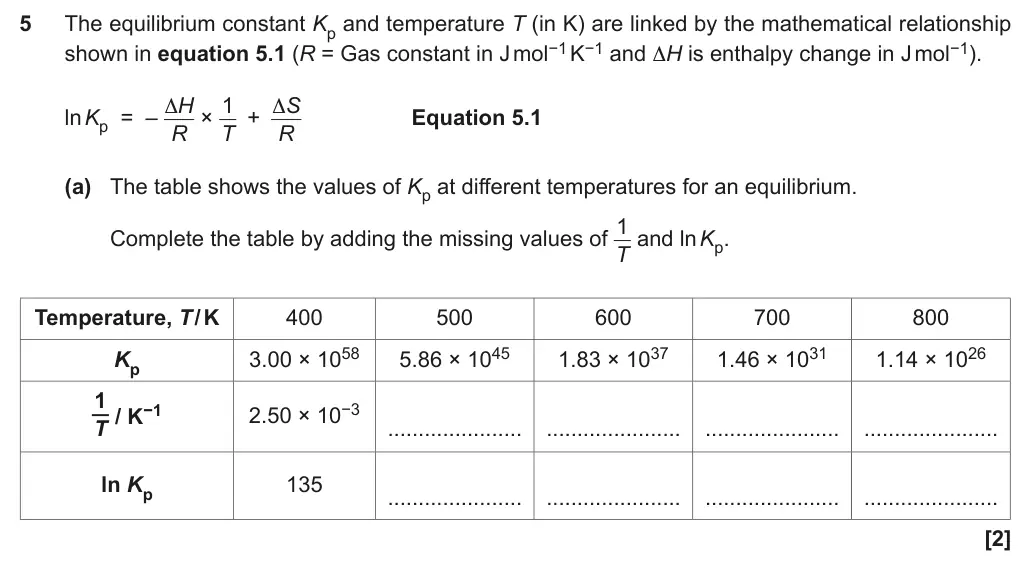
Question 5 related an unfamiliar mathematical relationship with the y = mx + c equation for a straight line. Use of y = mx + c is a mathematical requirement of A level chemistry and candidates were expected to apply their understanding of the Arrhenius equation (part of the specification) which makes use of this straight-line equation in a novel context. Many candidates were unable to use this mathematical concept. In contrast, higher-attaining candidates were able to be credited with marks throughout question 5. 5(a) Candidates were expected to complete values for 1/T and ln Kp from supplied T and Kp values. Candidates were supplied with an example and this enabled most candidates to obtain both available marks. 5(b) Most candidates were aware that a decrease in Kp with increasing temperature signals that the forward reaction is exothermic. The question also asked for the effect on the equilibrium position. A significant number of candidates omitted this part of the question. Candidates are advised to check back to all the requirements in a question. 5(c) Candidates were required to plot a graph using their calculated values from 5(a). The axes for the graph had been provided. It was expected that the plotting of 5 points, with a best-fit straight line, would be straightforward. Many candidates plotted one or more points incorrectly, particularly the point at 1/T = 1.25 × 10⁻³. Candidates then needed to recognise that the gradient is equal to –∆H/R from Equation 5.1, to measure the gradient, and then to determine ∆H. Most candidates recognised that the gradient needed to be measured but its value was then not taken any further. The higher-attaining candidates correctly multiplied the gradient by R but did not always convert the calculated J mol–1 value into kJ mol–1, or to express their value to 3 significant figures, as required in the question. Significantly, nearly a third of candidates did not collect any of the four available marks. The question was an excellent discriminator. 5(d) Mathematically able candidates used the y = mx + c equation for a straight line with the supplied mathematical relationship (Equation 5.1) to identify the y intercept as ∆S/R. They then stated that ∆S could be determined by multiplying the value of the y intercept by R. Many candidates found the mathematical requirements of parts 5(c) and 5(d) difficult. Responses for 5(d) were often in terms of the gradient instead of ‘intercept’.
Notes from the mark scheme and report
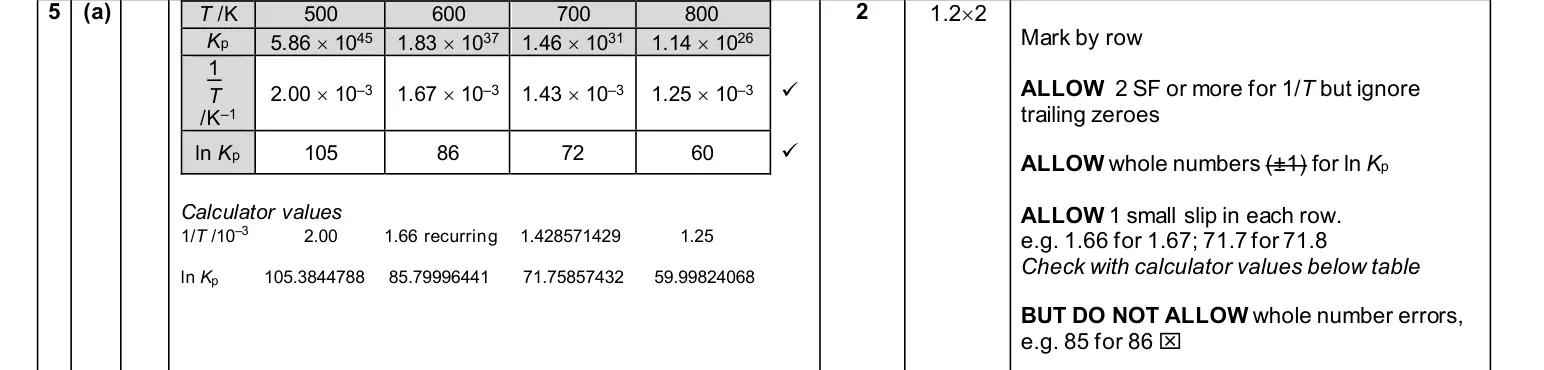
mark by row
1/T to 2 SF or more
ln Kp whole numbers 105, 86, 72, 60
DO NOT ALLOW whole-number errors e.g. 85 for 86
Skills: M0.1 Recognise and use expressions in decimal and ordinary form; M0.4 Use calculators to find and use power, exponential and logarithmic functions; M2.5 Use logarithms in relation to quantities that range over several orders of magnitude
November 2020 · Paper 3 · Q5(c)4 marksAO3CalculationMedium
Earlier parts of question 5 that this part uses
Mark scheme
Examiner's comment
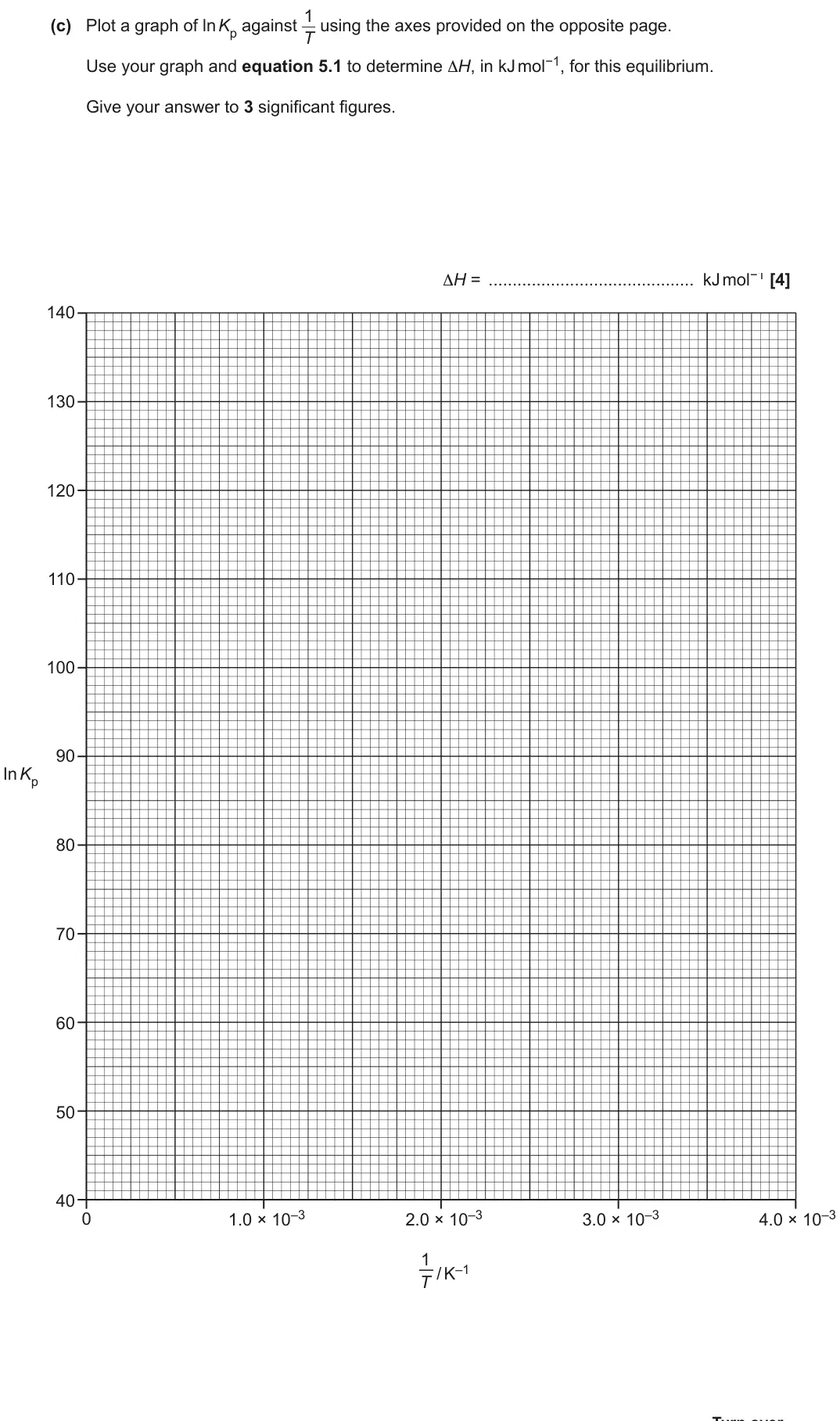
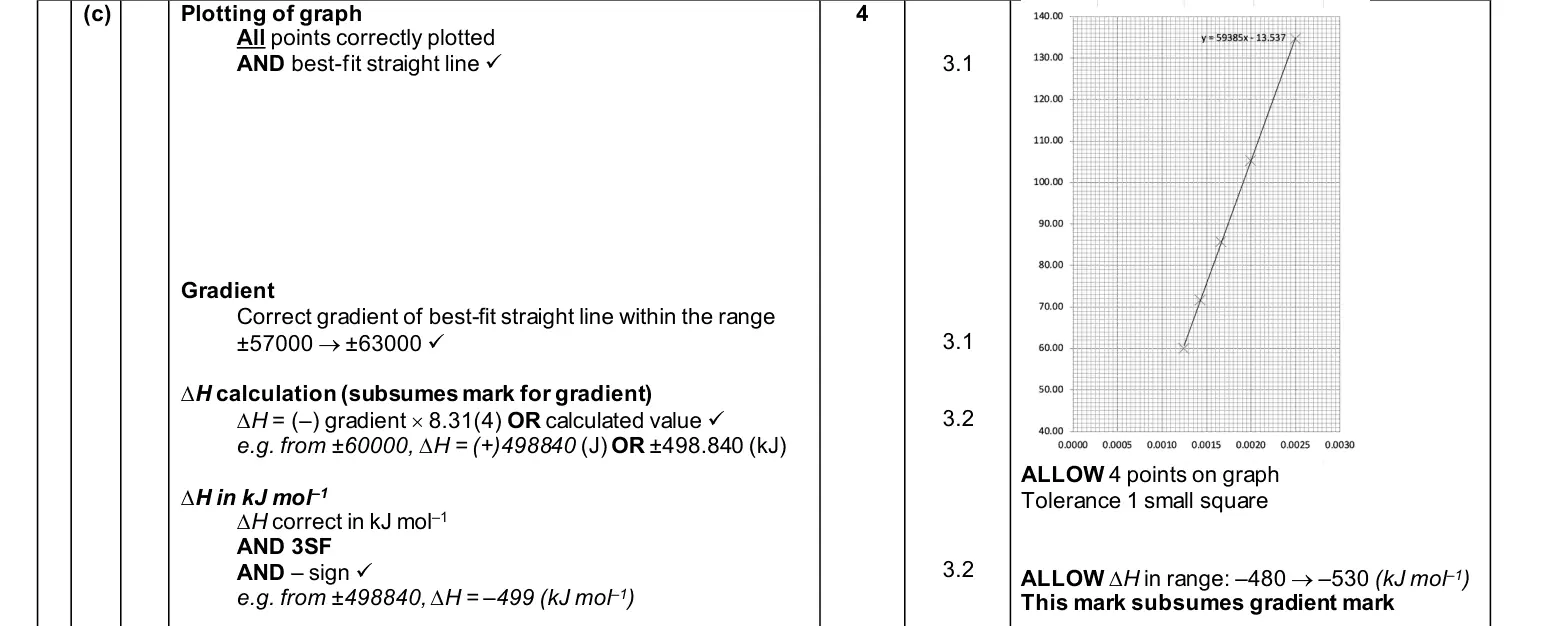
Question 5 related an unfamiliar mathematical relationship with the y = mx + c equation for a straight line. Use of y = mx + c is a mathematical requirement of A level chemistry and candidates were expected to apply their understanding of the Arrhenius equation (part of the specification) which makes use of this straight-line equation in a novel context. Many candidates were unable to use this mathematical concept. In contrast, higher-attaining candidates were able to be credited with marks throughout question 5. 5(a) Candidates were expected to complete values for 1/T and ln Kp from supplied T and Kp values. Candidates were supplied with an example and this enabled most candidates to obtain both available marks. 5(b) Most candidates were aware that a decrease in Kp with increasing temperature signals that the forward reaction is exothermic. The question also asked for the effect on the equilibrium position. A significant number of candidates omitted this part of the question. Candidates are advised to check back to all the requirements in a question. 5(c) Candidates were required to plot a graph using their calculated values from 5(a). The axes for the graph had been provided. It was expected that the plotting of 5 points, with a best-fit straight line, would be straightforward. Many candidates plotted one or more points incorrectly, particularly the point at 1/T = 1.25 × 10⁻³. Candidates then needed to recognise that the gradient is equal to –∆H/R from Equation 5.1, to measure the gradient, and then to determine ∆H. Most candidates recognised that the gradient needed to be measured but its value was then not taken any further. The higher-attaining candidates correctly multiplied the gradient by R but did not always convert the calculated J mol–1 value into kJ mol–1, or to express their value to 3 significant figures, as required in the question. Significantly, nearly a third of candidates did not collect any of the four available marks. The question was an excellent discriminator. 5(d) Mathematically able candidates used the y = mx + c equation for a straight line with the supplied mathematical relationship (Equation 5.1) to identify the y intercept as ∆S/R. They then stated that ∆S could be determined by multiplying the value of the y intercept by R. Many candidates found the mathematical requirements of parts 5(c) and 5(d) difficult. Responses for 5(d) were often in terms of the gradient instead of ‘intercept’.
Notes from the mark scheme and report
all points plotted with best-fit straight line
gradient ±57 000 to ±63 000
∆H = –gradient × 8.314
answer in kJ mol–1 to 3 SF with – sign (range –480 to –530)
Skills: M0.0 Recognise and make use of appropriate units in calculations; M1.1 Use an appropriate number of significant figures; M2.3 Substitute numerical values into algebraic equations using appropriate units for physical quantities; M3.1 Translate information between graphical, numerical and algebraic forms; M3.2 Plot two variables from experimental or other data; M3.3 Determine the slope and intercept of a linear graph
November 2020 · Paper 3 · Q5(d)2 marksAO3Short answerMedium
Earlier parts of question 5 that this part uses
Mark scheme
Examiner's comment
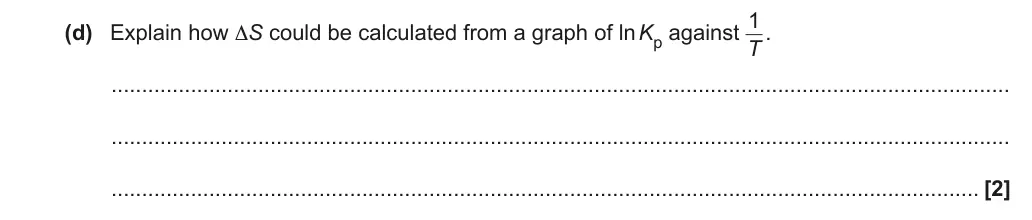
Question 5 related an unfamiliar mathematical relationship with the y = mx + c equation for a straight line. Use of y = mx + c is a mathematical requirement of A level chemistry and candidates were expected to apply their understanding of the Arrhenius equation (part of the specification) which makes use of this straight-line equation in a novel context. Many candidates were unable to use this mathematical concept. In contrast, higher-attaining candidates were able to be credited with marks throughout question 5. 5(a) Candidates were expected to complete values for 1/T and ln Kp from supplied T and Kp values. Candidates were supplied with an example and this enabled most candidates to obtain both available marks. 5(b) Most candidates were aware that a decrease in Kp with increasing temperature signals that the forward reaction is exothermic. The question also asked for the effect on the equilibrium position. A significant number of candidates omitted this part of the question. Candidates are advised to check back to all the requirements in a question. 5(c) Candidates were required to plot a graph using their calculated values from 5(a). The axes for the graph had been provided. It was expected that the plotting of 5 points, with a best-fit straight line, would be straightforward. Many candidates plotted one or more points incorrectly, particularly the point at 1/T = 1.25 × 10⁻³. Candidates then needed to recognise that the gradient is equal to –∆H/R from Equation 5.1, to measure the gradient, and then to determine ∆H. Most candidates recognised that the gradient needed to be measured but its value was then not taken any further. The higher-attaining candidates correctly multiplied the gradient by R but did not always convert the calculated J mol–1 value into kJ mol–1, or to express their value to 3 significant figures, as required in the question. Significantly, nearly a third of candidates did not collect any of the four available marks. The question was an excellent discriminator. 5(d) Mathematically able candidates used the y = mx + c equation for a straight line with the supplied mathematical relationship (Equation 5.1) to identify the y intercept as ∆S/R. They then stated that ∆S could be determined by multiplying the value of the y intercept by R. Many candidates found the mathematical requirements of parts 5(c) and 5(d) difficult. Responses for 5(d) were often in terms of the gradient instead of ‘intercept’.
Notes from the mark scheme and report
extrapolate to y-intercept
intercept = ∆S/R so ∆S = R × intercept
ALLOW substituting ln Kp, 1/T and gradient into equation 5.1
x-intercept loses first mark
Skills: M3.1 Translate information between graphical, numerical and algebraic forms; M3.3 Determine the slope and intercept of a linear graph
June 2019 · Paper 1 · Q18(c)(i)1 markAO3Short answerHard
Mark scheme
Examiner's comment
Only a very small minority of candidates appreciated that a larger titre reduces percentage error in titre values. Most erroneously described a reading of 1.35 cm3 as being less accurate than a reading of 13.5(0) cm3. The accuracy of these is equal in the same scaled apparatus.
Notes from the mark scheme and report
dilute solution gives a larger titre and so a smaller percentage error/uncertainty
Skills: M1.3 Identify uncertainties in measurements and use simple techniques to determine uncertainty when data are combined; PAG2 Acid–base titration
June 2019 · AS Paper 1 · Q22(a)(i)1 markAO2Complete table/diagramMedium
Mark scheme
Examiner's comment
Most candidates added correct titres for the three titrations. However, an error made by a quarter of candidates was to omit the zero as the second decimal place in the first and third titres. This should have been usual practice from candidate experience of practical work and has also been highlighted as a common error in previous exam series.
Notes from the mark scheme and report
titres must be to 2 decimal places: DO NOT ALLOW 24.2 or 24.3
Skills: PAG2 Acid–base titration
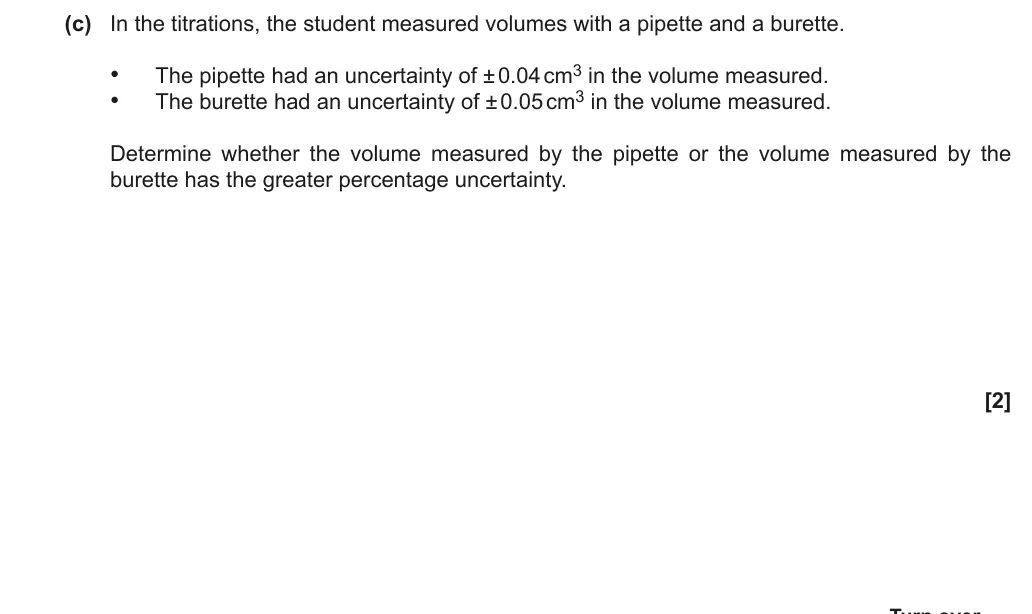
June 2019 · AS Paper 1 · Q22(c)2 marksAO3Short answerMedium
Earlier part of question 22 that this part uses
Mark scheme
Examiner's comment
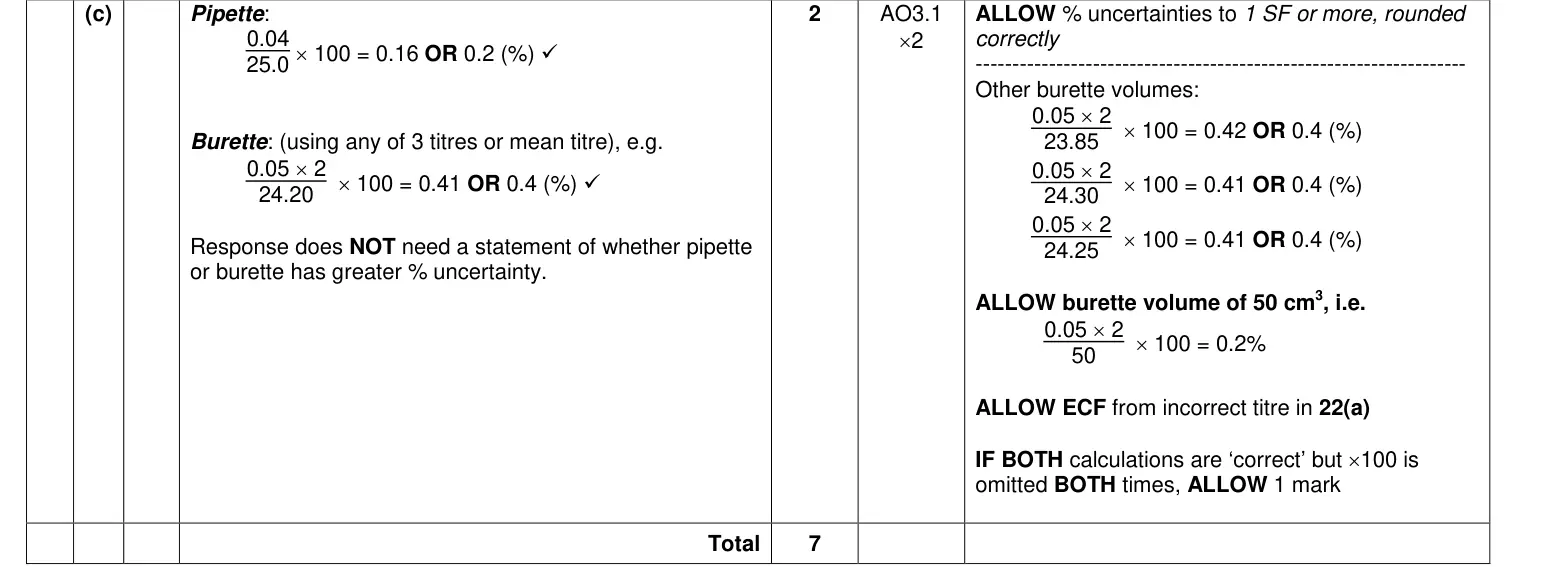
The calculations here should have reflected practical work carried out by candidates. Candidates were expected to realise that the pipette volume involves one measurement requiring the uncertainty of ±0.04 provided being used. As the volume measured by a burette uses two measurements, the uncertainty of ±0.05 must then be doubled to obtain the percentage uncertainty. It was very common for the burette value to be obtained using 0.05 rather than the doubled 0.10; some candidates doubled both uncertainties. Another common error was to use the volume of the burette of 50 cm3 rather than the volume of solution measured in the burette.
Notes from the mark scheme and report
burette uncertainty counted twice (2 × 0.05) because two readings
1 mark if both correct but ×100 omitted both times
ALLOW burette volume of 50 cm3
The Practical Skills handbook contains guidance on calculating uncertainties in Appendix 4: Measurements, which can be shared with students: https://www.ocr.org.uk/Images/208932-chemistry-practical-skills- handbook.pdf.
Skills: M1.3 Identify uncertainties in measurements and use simple techniques to determine uncertainty when data are combined; PAG2 Acid–base titration
June 2019 · AS Paper 2 · Q1(d)(ii)1 markAO3Short answerMedium
Earlier part of question 1 that this part uses
Mark scheme
Examiner's comment
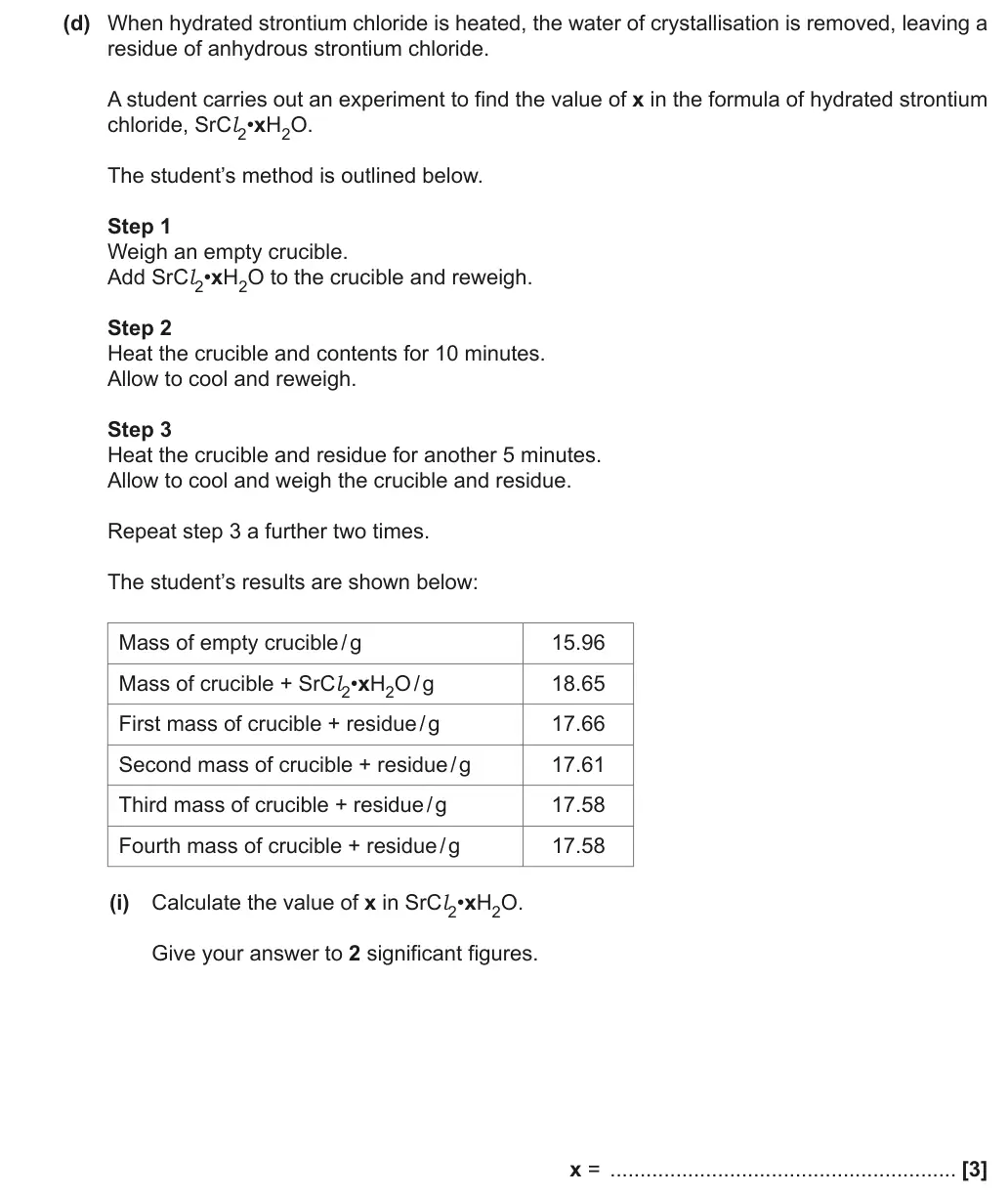
The majority of candidates answered this correctly, the main incorrect answer was “to achieve constant mass”.
Notes from the mark scheme and report
to make sure ALL the water has been removed
IGNORE just 'to weigh to constant mass'
Skills: PAG1 Moles determination
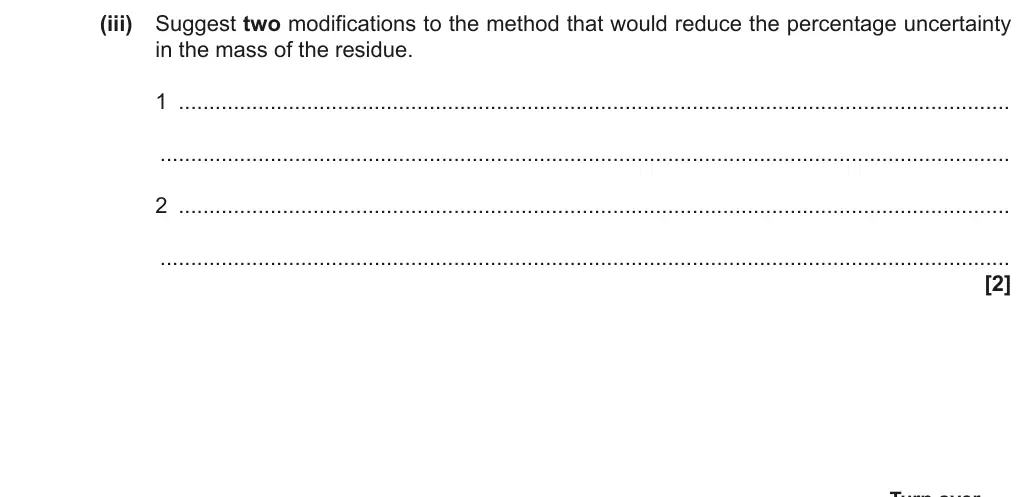
June 2019 · AS Paper 2 · Q1(d)(iii)2 marksAO3Short answerMedium
Earlier part of question 1 that this part uses
Mark scheme
Examiner's comment
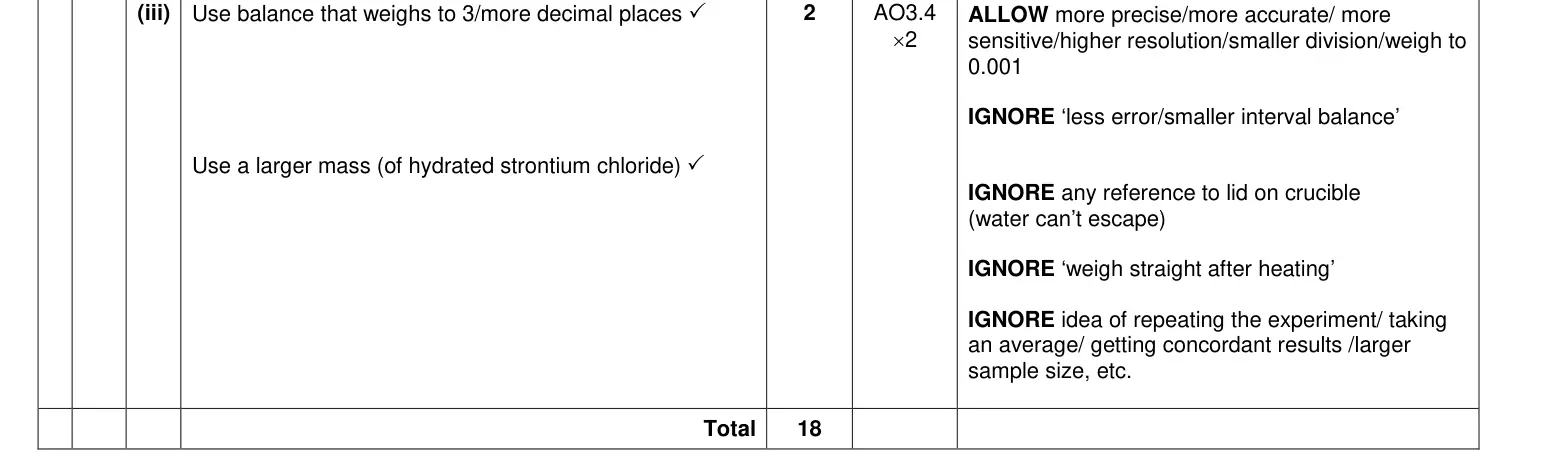
Most candidates identified either using a larger mass or a more accurate balance, not many stated both. The most common incorrect answers involved heating for longer or taking less measurements.
Notes from the mark scheme and report
balance reading to 3 or more decimal places
use a larger mass
IGNORE lid on crucible, repeating/averaging, weighing straight after heating
Skills: M1.3 Identify uncertainties in measurements and use simple techniques to determine uncertainty when data are combined; PAG1 Moles determination
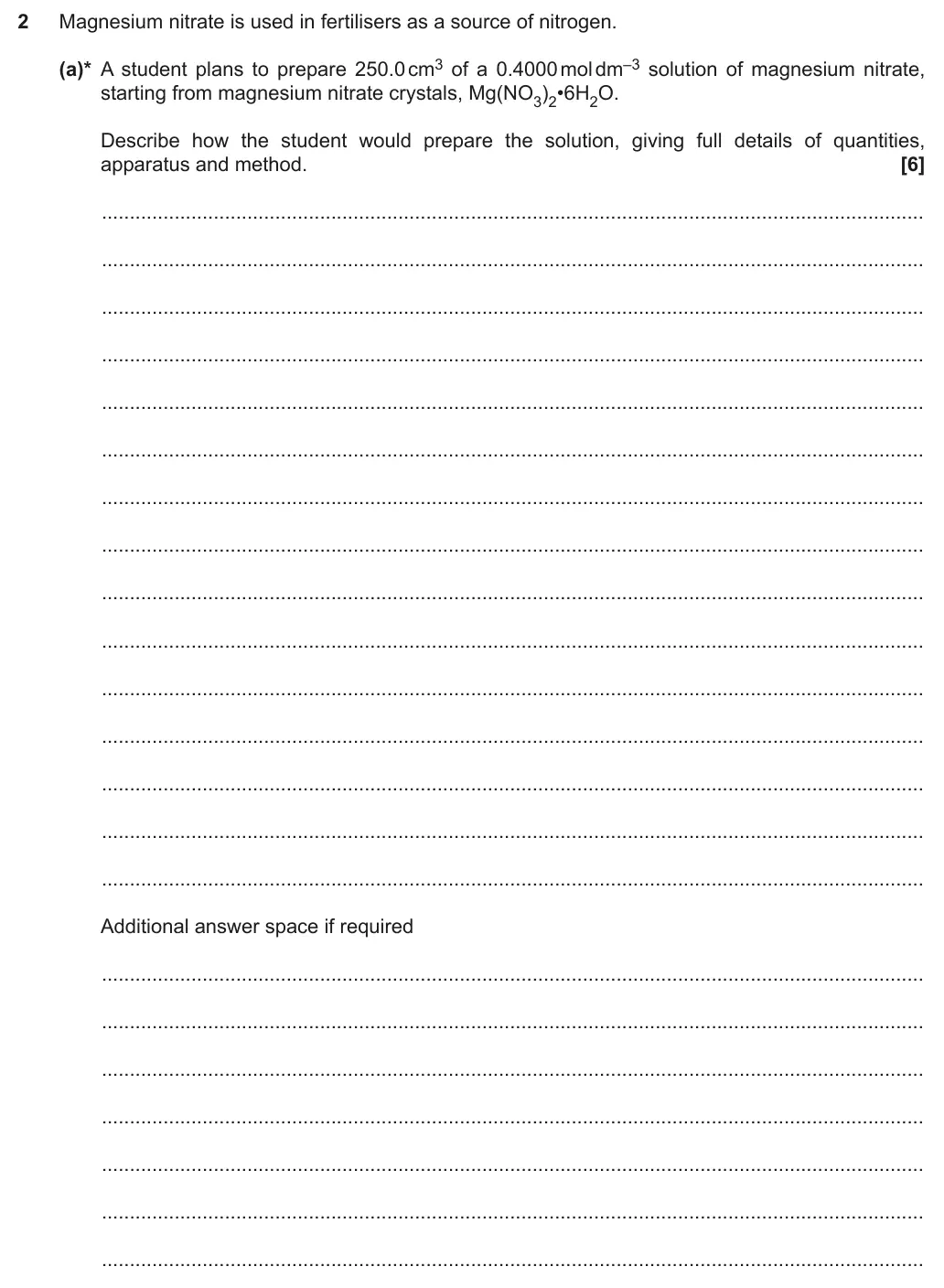
June 2019 · AS Paper 2 · Q2(a)6 marksAO26-mark level of responseMedium
Mark scheme, with the levels and indicative points
Examiner's comment
Most candidates focused on removing the water of crystallisation, often going to great depths of explanation, with apparatus diagrams, of how to remove it. Some candidates then went on to explain how to make a standard solution and could be given marks. Calculations for the mass required were often correct or could be given some marks. This in a response of a common approach to this question, it was given 4 marks. Despite calculating the mass properly, the candidate then put all their efforts into describing removing the water of crystallisation and left out the valuable fine detail required for a Level 3 response.
Notes from the mark scheme and report
mass 25.63 g of Mg(NO3)2•6H2O (14.83 g if water of crystallisation omitted)
dissolve in distilled water, transfer with washings to 250 cm3 volumetric flask, make up to mark with bottom of meniscus on mark, invert to mix
IGNORE removing water of crystallisation
Skills: M0.0 Recognise and make use of appropriate units in calculations; M2.3 Substitute numerical values into algebraic equations using appropriate units for physical quantities; PAG2 Acid–base titration
June 2019 · AS Paper 2 · Q4(b)(i)1 markAO2Graph plottingMedium
Earlier parts of question 4 that this part uses
Mark scheme
Examiner's comment
Most candidates obtained this mark, some lost the mark because they did not use a linear scale or provide units.
Notes from the mark scheme and report
linear x scale AND label Time / s AND points plotted ±1 small square
ALLOW up to 3 plotting errors
Skills: M3.2 Plot two variables from experimental or other data; PAG9 Rates of reaction – continuous monitoring
June 2019 · AS Paper 2 · Q4(b)(ii)1 markAO2Data interpretationEasy
Earlier parts of question 4 that this part uses
Mark scheme
Examiner's comment
Nearly all the candidates obtained this mark
Notes from the mark scheme and report
point at 80 s circled
Skills: M3.2 Plot two variables from experimental or other data; PAG9 Rates of reaction – continuous monitoring
June 2019 · AS Paper 2 · Q4(b)(iii)1 markAO3Drawing / labellingEasy
Earlier parts of question 4 that this part uses
Mark scheme
Examiner's comment
Nearly all the candidates obtained this mark
Notes from the mark scheme and report
smooth curve through all points EXCEPT the 80 s point
Skills: M3.2 Plot two variables from experimental or other data; PAG9 Rates of reaction – continuous monitoring
June 2019 · Paper 3 · Q3(a)(iii)2 marksAO3Short answerMedium
Earlier part of question 3 that this part uses
Mark scheme
Examiner's comment
For one modification, many candidates suggested heating to constant mass. A second modification proved to be elusive for many. Other acceptable modifications included using powdered lead oxide to increase the surface area, bubbling the escape gases through lime water to identify when no more CO2 was being produced in the reaction, and passing an inert gas through the apparatus during cooling to prevent re-oxidation of the lead from oxygen in the air. Some suggestions would have created safety issues, such as working in a closed system. A significant number of candidates suggested collecting the gases evolved and that the reaction was complete when the gas volume no longer increased. Presumably the suggestion came from practical experience of rates experiments involving gas collection. This is unfeasible though when there is a constant flow of methane gas.
Notes from the mark scheme and report
heat to constant mass
spread out/powder the oxide
pass methane or inert gas (not air) while cooling
excess methane
IGNORE 'heat for longer' without constant mass
IGNORE repeats/averages
Skills: PAG1 Moles determination
June 2019 · Paper 3 · Q5(a)(ii)1 markAO2CalculationMedium
Earlier part of question 5 that this part uses
Mark scheme
Examiner's comment
Just over half the candidates obtained the correct temperature change of 1°C. A common error was a temperature change of 0.5°C, the result of not considering that two temperature readings are made when calculating a temperature change.
Notes from the mark scheme and report
two readings so 0.2/20 × 100 = 1.0 °C
IGNORE direction of temperature change
Skills: M1.3 Identify uncertainties in measurements and use simple techniques to determine uncertainty when data are combined; M2.2 Change the subject of an equation; PAG3 Enthalpy determination
June 2018 · AS Paper 1 · Q121 markMultiple choiceHard
Answer
B
Mark scheme
Examiner's comment
Candidates find questions based on practical procedures difficult and this question proved to be no exception. A similar number of candidates selected each option, suggesting that most guessed. The correct option is B.
June 2018 · Paper 1 · Q17(b)(i)3 marksCalculationMedium
Mark scheme
Examiner's comment
Higher ability candidates realised that the gradient was equivalent to –Ea/R and determined a gradient within the range ± 800 to ± 1040, depending upon the line drawn. Credit was given to gradients of ± 0.800 to ± 1.040 resulting from calculations which omitted 10–3 on the x-axis. The negative gradient was multiplied by R to determine Ea with a value rounded to 3 significant figures. Common errors were omission of 10–3 in the calculation which led to Ea values between 6.65 and 8.65 J mol–1, or not rounding to 3 significant figures.
Notes from the mark scheme and report
gradient in range –800 to –1040 (K)
Ea = –gradient × 8.314
3 sig figs AND use of 10^–3 on x-axis
omission of 10^–3 can score first 2 marks
ALLOW lines that do not reach the y-axis
Skills: M1.1 Use an appropriate number of significant figures; M2.3 Substitute numerical values into algebraic equations using appropriate units for physical quantities; M3.2 Plot two variables from experimental or other data; M3.3 Determine the slope and intercept of a linear graph
June 2018 · Paper 1 · Q20(d)(i)2 marksCalculationMedium
Mark scheme
Examiner's comment
It is clear candidates are not as experienced at filling in titration tables as might be expected. Every value in a titration table should be recorded to a second decimal place to an accuracy of ± 0.05 cm3. The average titre should be calculated by averaging concordant titres, i.e. those within 0.10 cm3 of each other.
Notes from the mark scheme and report
all titres to 2 d.p.
mean from concordant titres only (23.75 and 23.85) = 23.80
June 2018 · Paper 1 · Q20(d)(ii)1 markCalculationMedium
Earlier part of question 20 that this part uses
Mark scheme
Examiner's comment
Candidates are unfamiliar with determination of percentage uncertainty. Marks were credited for any percentage uncertainty calculation correctly determined from any titre value, as many opted to choose the trial value as titre 1 or used an average titre.
Notes from the mark scheme and report
2 × 0.05 / 23.40 × 100 = 0.43
2 d.p. required
ALLOW ECF from (i)
Skills: M0.2 Use ratios, fractions and percentages; M1.3 Identify uncertainties in measurements and use simple techniques to determine uncertainty when data are combined; PAG2 Acid–base titration
June 2018 · AS Paper 1 · Q22(a)(iii)2 marksShort answerHard
Earlier part of question 22 that this part uses
Mark scheme
Examiner's comment
Candidates often struggle with questions based on practical work. There were many random responses to this question, with relatively few candidates identifying that solid magnesium phosphate could be obtained by filtration, followed by drying.
Notes from the mark scheme and report
filter to obtain the solid, then dry
IGNORE 'leave to crystallise' (already solid)
IGNORE distil if product or H2 is distilled
June 2018 · AS Paper 2 · Q1(c)(i)4 marksCalculationEasy
Earlier part of question 1 that this part uses
Mark scheme
Examiner's comment
Most candidates were able to accurately record the burette readings and made the correct subtractions. Despite the examination question requesting the mean titre to be recorded to the accuracy of the burette, many candidates did not do this. A common error was taking a mean of all three readings instead of only the concordant results; this led the candidates to give an answer of 26.58 which lost them 2 marks.
June 2018 · AS Paper 2 · Q1(c)(ii)1 markCalculationEasy
Earlier part of question 1 that this part uses
Mark scheme
Examiner's comment
A good attempt by many candidates but some did not know how to calculate this or did not multiply by 2.
Notes from the mark scheme and report
two readings so 2 × 0.05
ALLOW ECF from (c)(i) or use of any titre
Skills: M0.2 Use ratios, fractions and percentages; M1.3 Identify uncertainties in measurements and use simple techniques to determine uncertainty when data are combined; PAG2 Acid–base titration
June 2018 · Paper 3 · Q2(a)(i)5 marksCalculationEasy
Mark scheme
Examiner's comment
The graph was generally well drawn although many didn’t realise that a tangent needed to be drawn. A few tried to draw a straight line of best fit, rather than a curve. Most candidates were able to construct a correct graph, assigning the axes correctly and making good use of the graph paper. Points were usually plotted correctly and most candidates made a good attempt to draw a curved line of best fit. Candidates then needed to draw a tangent at 500 seconds and to measure its gradient to calculate the rate. Lower ability candidates did not draw a tangent to their curve and just calculated the volume formed at 500 seconds.
Notes from the mark scheme and report
axes labelled with units, linear scales using at least half the grid
smooth curve through origin not point-to-point lines
tangent at t = 500 ± 100 s
rate 0.037–0.047
using x and y coordinates at 500 s (33/500 = 0.066) scores zero
Skills: M3.1 Translate information between graphical, numerical and algebraic forms; M3.2 Plot two variables from experimental or other data; M3.5 Draw and use the slope of a tangent to a curve as a measure of rate of change; PAG9 Rates of reaction – continuous monitoring
June 2017 · AS Paper 1 · Q51 markMultiple choice
Answer
D
Mark scheme
June 2017 · Paper 1 · Q19(a)3 marksShort answer
Mark scheme
Notes from the mark scheme and report
690 cm3
apparatus must be named with a realistic volume (700–1000 cm3 measuring cylinder or syringe)
'measuring cylinder' without volume insufficient
DO NOT ALLOW burette
Skills: M0.2 Use ratios, fractions and percentages; M2.3 Substitute numerical values into algebraic equations using appropriate units for physical quantities; PAG1 Moles determination; PAG9 Rates of reaction – continuous monitoring
June 2017 · AS Paper 1 · Q24(c)(ii)2 marksShort answer
Earlier part of question 24 that this part uses
Mark scheme
Notes from the mark scheme and report
must refer to other acids in vinegar
IGNORE impurities/solution is pure
prediction mark only if assumption mark scored
Skills: PAG2 Acid–base titration
June 2017 · AS Paper 2 · Q26 marks6-mark level of response
Mark scheme, with the levels and indicative points
Notes from the mark scheme and report
72/24000 = 0.00300 mol H2 so minimum 0.20 g Zn and 0.00600 mol HCl
acid volume must suit the apparatus (e.g. 60 cm3 of 0.1 mol dm–3)
plot volume against time, tangent at t = 0, gradient = initial rate
Skills: M0.2 Use ratios, fractions and percentages; M2.3 Substitute numerical values into algebraic equations using appropriate units for physical quantities; M3.2 Plot two variables from experimental or other data; M3.5 Draw and use the slope of a tangent to a curve as a measure of rate of change; PAG1 Moles determination; PAG9 Rates of reaction – continuous monitoring
June 2017 · AS Paper 2 · Q3(a)(ii)2 marksShort answer
Earlier part of question 3 that this part uses
Mark scheme
Notes from the mark scheme and report
heat loss to surroundings / incomplete combustion / non-standard conditions
IGNORE reference to evaporation
Skills: PAG3 Enthalpy determination
June 2017 · AS Paper 2 · Q3(b)(i)1 markGraph plotting
Mark scheme
Notes from the mark scheme and report
point must be visible, touching the 58 line and between 2800 and 2900
Skills: M3.2 Plot two variables from experimental or other data
June 2017 · AS Paper 2 · Q3(b)(ii)3 marksCalculation
Earlier part of question 3 that this part uses
Mark scheme
Notes from the mark scheme and report
line of best fit must be extrapolated to Mr = 72
∆cH estimate (–)3500 to (–)3600
n = 0.0250 mol
IGNORE sign
ALLOW ECF from incorrect moles or estimate
Skills: M0.3 Estimate results; M2.3 Substitute numerical values into algebraic equations using appropriate units for physical quantities; M3.1 Translate information between graphical, numerical and algebraic forms; M3.2 Plot two variables from experimental or other data
June 2017 · Paper 2 · Q17(b)(i)1 markData interpretation
Mark scheme
Notes from the mark scheme and report
must give rank order: phenol most easily nitrated AND benzoic acid least
June 2017 · Paper 3 · Q2(b)2 marksShort answer
Earlier part of question 2 that this part uses
Mark scheme
Notes from the mark scheme and report
two readings so 2 × uncertainty: mass 0.8% and ∆T 0.6%
1 mark if ×2 factor missing in both (0.4% and 0.3%) or not converted to %
IGNORE % uncertainty of mass of solution
ALLOW ECF from 2(a)
Skills: M0.2 Use ratios, fractions and percentages; M1.3 Identify uncertainties in measurements and use simple techniques to determine uncertainty when data are combined; PAG3 Enthalpy determination
June 2017 · Paper 3 · Q2(c)2 marksShort answer
Earlier parts of question 2 that this part uses
Mark scheme
Notes from the mark scheme and report
greater mass of Na2O gives larger ∆T so smaller % uncertainty
IGNORE repeat and average, more precise apparatus, increase volume, cooling curve, lid
Skills: PAG3 Enthalpy determination
June 2017 · Paper 3 · Q4(a)(i)4 marksCalculation
Mark scheme
Notes from the mark scheme and report
all burette readings to 2 DP ending in 0 or 5
initial and final readings labelled with units cm3
June 2016 · AS Paper 1 · Q22(b)(i)1 markAO2Calculation
Mark scheme
Notes from the mark scheme and report
two balance readings so 2 × 0.005
ALLOW 1.7% or 2%
Skills: M1.3 Identify uncertainties in measurements and use simple techniques to determine uncertainty when data are combined; PAG1 Moles determination
June 2016 · AS Paper 1 · Q22(b)(ii)1 markAO3Short answer
Earlier part of question 22 that this part uses
Mark scheme
Notes from the mark scheme and report
balance to 3 or more decimal places OR larger mass
IGNORE repeating/taking an average
IGNORE lid on crucible
Skills: PAG1 Moles determination
June 2016 · AS Paper 1 · Q22(b)(iii)1 markAO3Short answer
Earlier part of question 22 that this part uses
Mark scheme
Notes from the mark scheme and report
heat to constant mass
IGNORE 'heat for longer' without link to constant mass
Skills: PAG1 Moles determination
June 2016 · AS Paper 2 · Q1(c)(i)2 marksAO3Drawing / labelling
Mark scheme
Notes from the mark scheme and report
DO NOT ALLOW volumetric flask, beaker or measuring cylinder as reaction vessel
DO NOT ALLOW delivery tube below reacting solution
closed system with labelled gas syringe or collection over water
Skills: PAG1 Moles determination
June 2016 · AS Paper 2 · Q5(b)(ii)2 marksAO3Calculation
Earlier parts of question 5 that this part uses
Mark scheme
Notes from the mark scheme and report
tangent must be drawn at t = 200 s
answer in range 5 × 10^-4 to 8 × 10^-4
IGNORE units and sign
Skills: M3.1 Translate information between graphical, numerical and algebraic forms; M3.5 Draw and use the slope of a tangent to a curve as a measure of rate of change
June 2016 · AS Paper 2 · Q5(c)3 marksAO3Short answer
Earlier parts of question 5 that this part uses
Mark scheme
Notes from the mark scheme and report
flask or beaker AND balance AND timer
record mass at time intervals
interval of 10–50 s quoted
DO NOT ALLOW round-bottomed flask
IGNORE weighing scales
Skills: PAG9 Rates of reaction – continuous monitoring
June 2016 · AS Paper 2 · Q6(c)(ii)2 marksAO3Short answer
Earlier parts of question 6 that this part uses
Mark scheme
Notes from the mark scheme and report
butan-2-ol/butanone flammable or volatile so would evaporate (DO NOT ALLOW 'the product or reactant' unspecified)
heat under reflux
DO NOT ALLOW distillation
DO NOT ALLOW closed system
IGNORE vague health and safety
Skills: PAG5 Synthesis of an organic liquid
Work with an OCR chemistry tutor
Dropping marks on calculations, mechanisms or the six-markers? Book a trial session with a specialist OCR chemistry tutor.