June 2019: Paper 3, Any content and practical skills

90 marks · 57 question parts · Paper, mark scheme and report on AQA's site · Have the Data Booklet beside you

Question by question

QTopicMarksAOType
01.1 Amount of substance 1Equation writing
01.2 Period 3 elements and their oxides 2Equation writing
01.3 Bonding 4Diagram or structure
01.4 Kinetics 6Level of response
02.1 Period 3 elements and their oxides, Bonding 1Diagram or structure
02.2 Acids and bases: pH, Ka, titration curves and buffers 2Equation writing
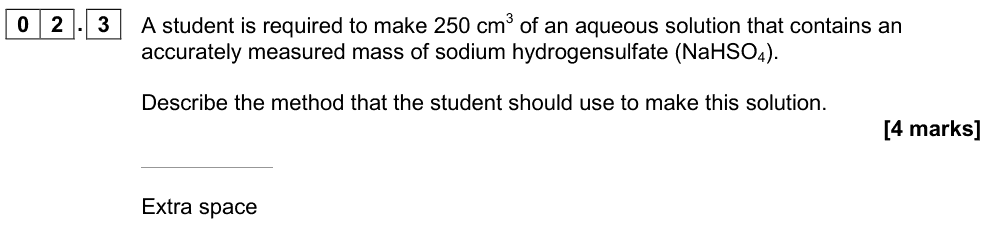
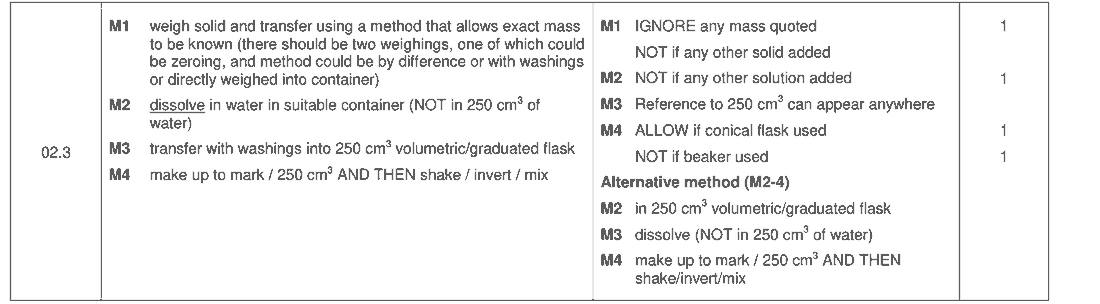
02.3 Amount of substance 4Practical and data analysis
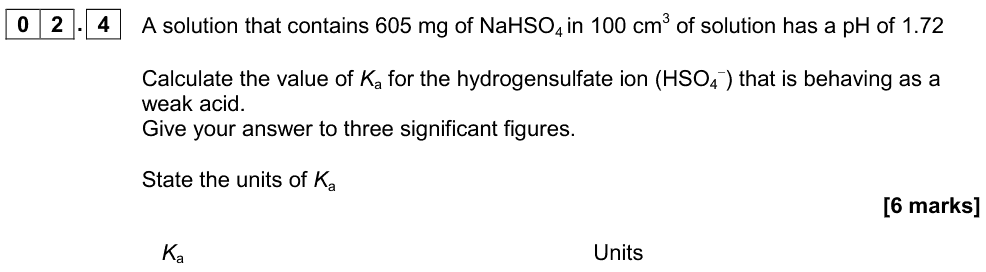
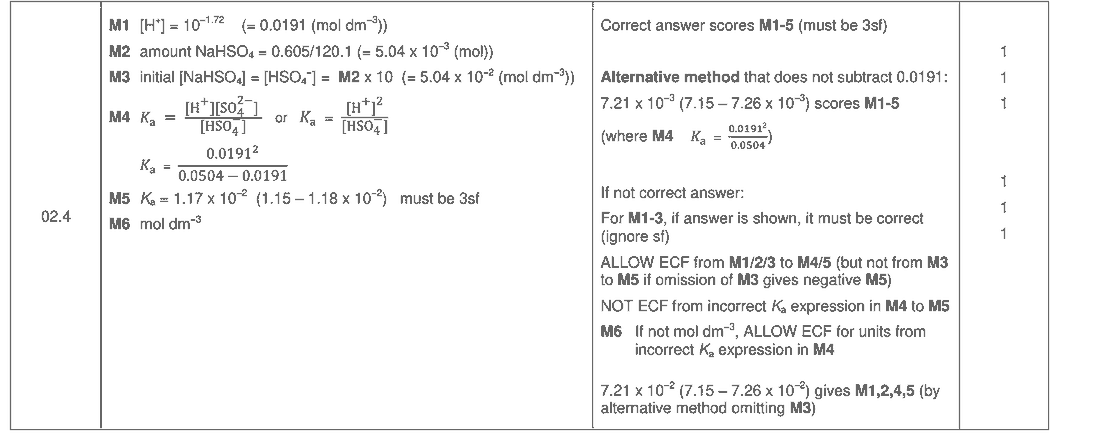
02.4 Acids and bases: pH, Ka, titration curves and buffers, Amount of substance 6Calculation
02.5 Chemical equilibria, Le Chatelier's principle and Kc, Acids and bases: pH, Ka, titration curves and buffers 2Explanation
03.1 Electrode potentials and electrochemical cells 1Short answer
03.2 Electrode potentials and electrochemical cells 1Short answer
03.3 Electrode potentials and electrochemical cells 1Short answer
03.4 Electrode potentials and electrochemical cells 4Short answer
03.5 Electrode potentials and electrochemical cells 2Equation writing
03.6 Electrode potentials and electrochemical cells 3Practical and data analysis
03.7 Electrode potentials and electrochemical cells 3Calculation
03.8 Electrode potentials and electrochemical cells 2Calculation
04.1 Aldehydes and ketones 1Short answer
04.2 Optical isomerism, Aldehydes and ketones 5Diagram or structure
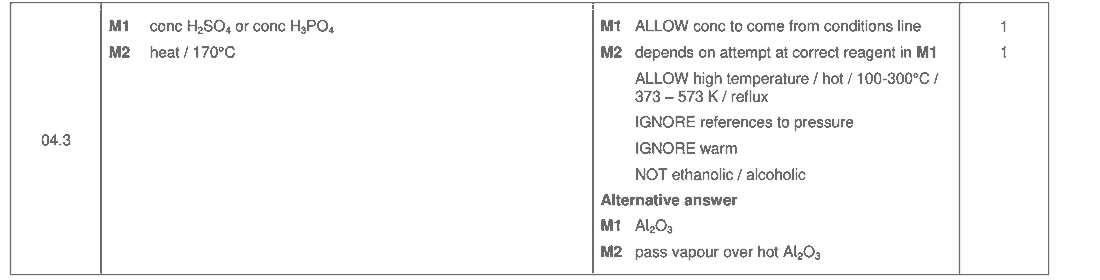
04.3 Alcohols 2Short answer
04.4 Alkenes 1Diagram or structure
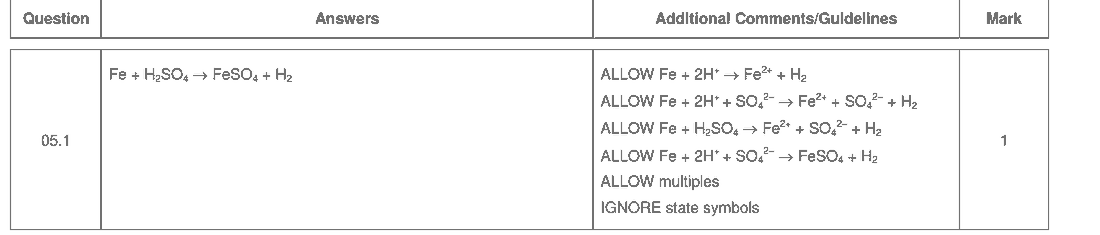
05.1 Amount of substance 1Equation writing
05.2 Transition metals 1Practical and data analysis
05.3 Transition metals, Oxidation, reduction and redox equations 1Equation writing
05.4 Transition metals 1Practical and data analysis
05.5 Amount of substance 1Practical and data analysis
05.6 Amount of substance 1Practical and data analysis
06 Amount of substance 1Multiple choice
07 Amount of substance 1Multiple choice
08 Energetics 1Multiple choice
09 Chemical equilibria, Le Chatelier's principle and Kc 1Multiple choice
10 Rate equations 1Multiple choice
11 Equilibrium constant Kp 1Multiple choice
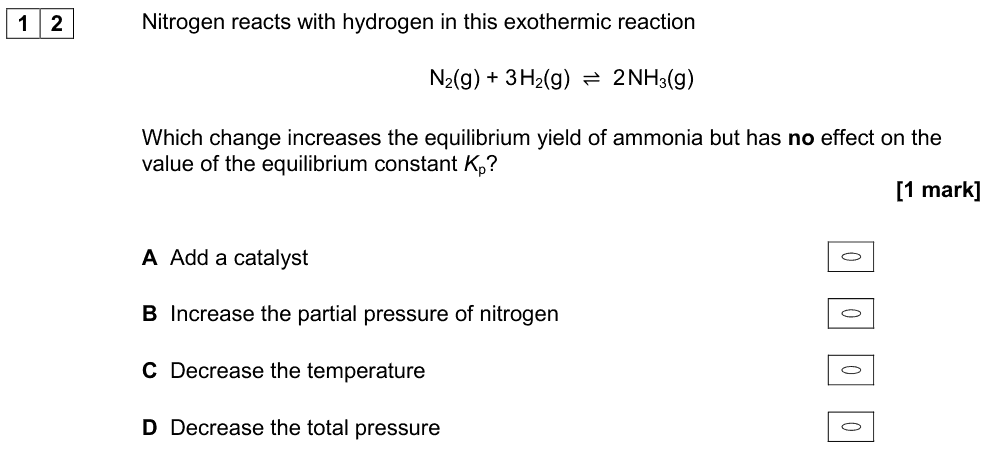
12 Equilibrium constant Kp 1Multiple choice
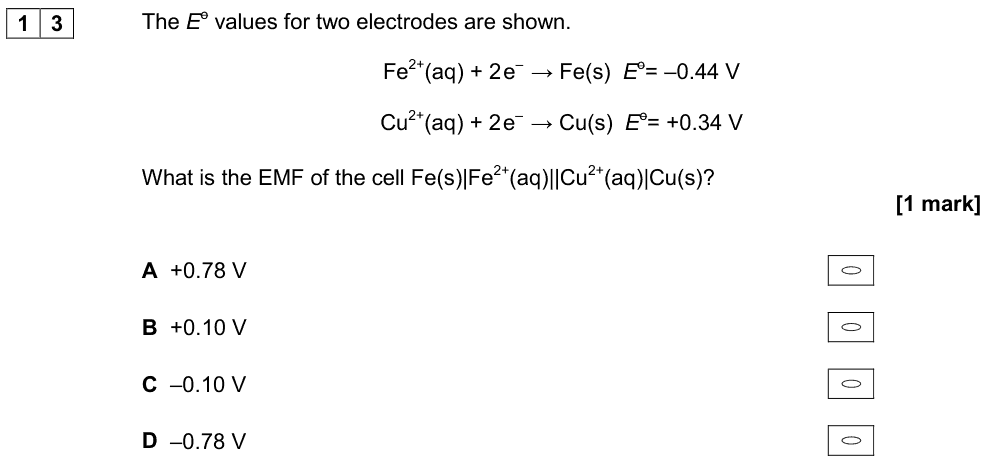
13 Electrode potentials and electrochemical cells 1Multiple choice
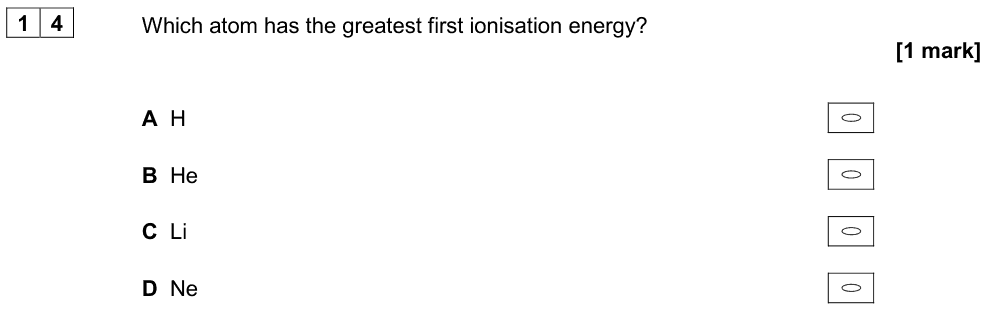
14 Atomic structure 1Multiple choice
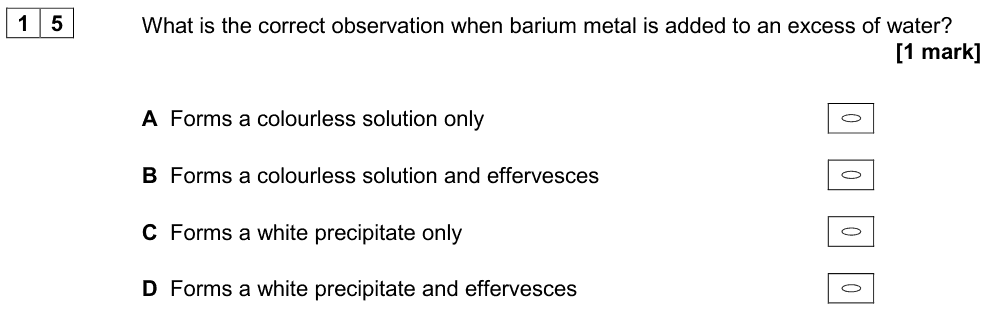
15 Group 2, the alkaline earth metals 1Multiple choice
16 Group 7(17), the halogens, Group 2, the alkaline earth metals 1Multiple choice
17 Bonding 1Multiple choice
18 Transition metals 1Multiple choice
19 Group 7(17), the halogens 1Multiple choice
20 Aromatic chemistry 1Multiple choice
21 Organic synthesis 1Multiple choice
22 Alcohols, Introduction to organic chemistry: nomenclature, mechanisms and isomerism 1Multiple choice
23 Organic analysis: test-tube reactions, mass spectrometry and infrared, Aldehydes and ketones 1Multiple choice
24 Carboxylic acids and derivatives 1Multiple choice
25 Carboxylic acids and derivatives 1Multiple choice
26 Aromatic chemistry 1Multiple choice
27 Amines 1Multiple choice
28 Polymers 1Multiple choice
29 Amino acids, proteins and DNA 1Multiple choice
30 Amino acids, proteins and DNA 1Multiple choice
31 Bonding 1Multiple choice
32 Alcohols 1Multiple choice
33 Alkenes 1Multiple choice
34 Carboxylic acids and derivatives 1Multiple choice
35 Amino acids, proteins and DNA 1Multiple choice

The questions

01.101.201.301.402.102.202.302.402.503.103.203.303.403.503.603.703.804.104.204.304.405.105.205.305.405.505.6060708091011121314151617181920212223242526272829303132333435
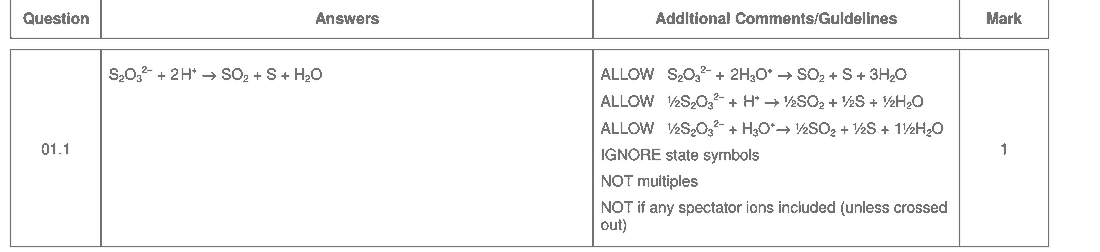
June 2019 · Paper 3 · Q01.1 1 mark Equation writing amount of substance
Sodium thiosulfate reacts with dilute hydrochloric acid as shown.
Na2S2O3(aq) + 2 HCl(aq) → 2 NaCl(aq) + SO2(g) + S(s) + H2O(l)
Give the simplest ionic equation for this reaction.
[1 mark]
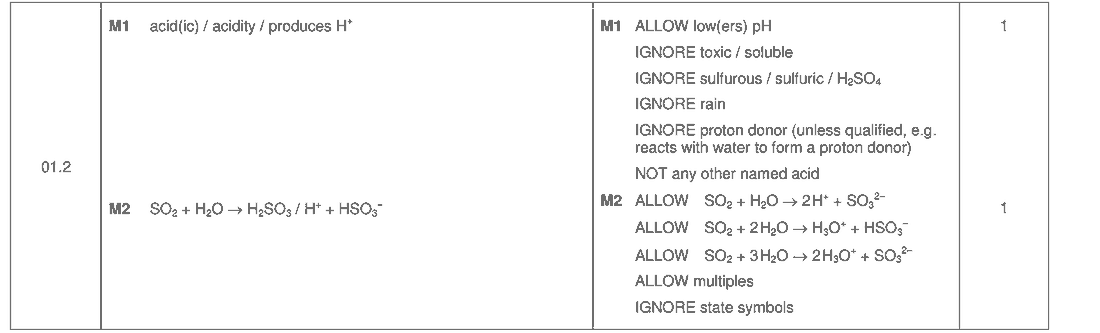
June 2019 · Paper 3 · Q01.2 2 marks Equation writing period 3 elements and oxides
Earlier part of question 01 that this part usesEarlier part of June 2019 Paper 3 question 01
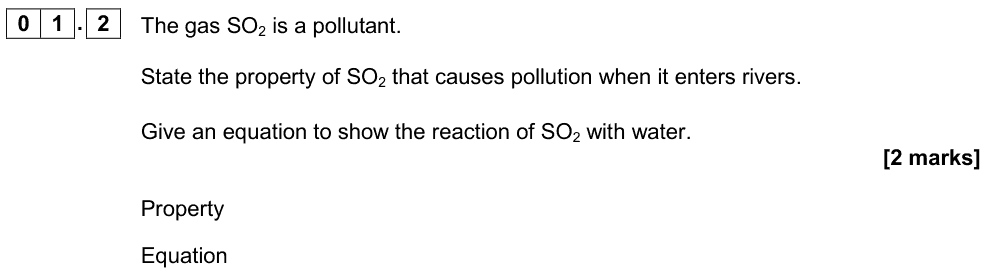
The gas SO2 is a pollutant.
State the property of SO2 that causes pollution when it enters rivers.
Give an equation to show the reaction of SO2 with water.
[2 marks]
Property
Equation
June 2019 · Paper 3 · Q01.3 4 marks Diagram or structure bonding
Earlier part of question 01 that this part usesEarlier part of June 2019 Paper 3 question 01
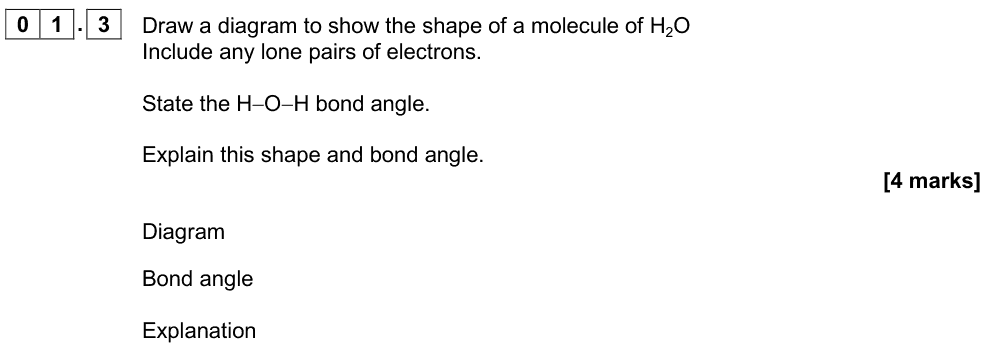
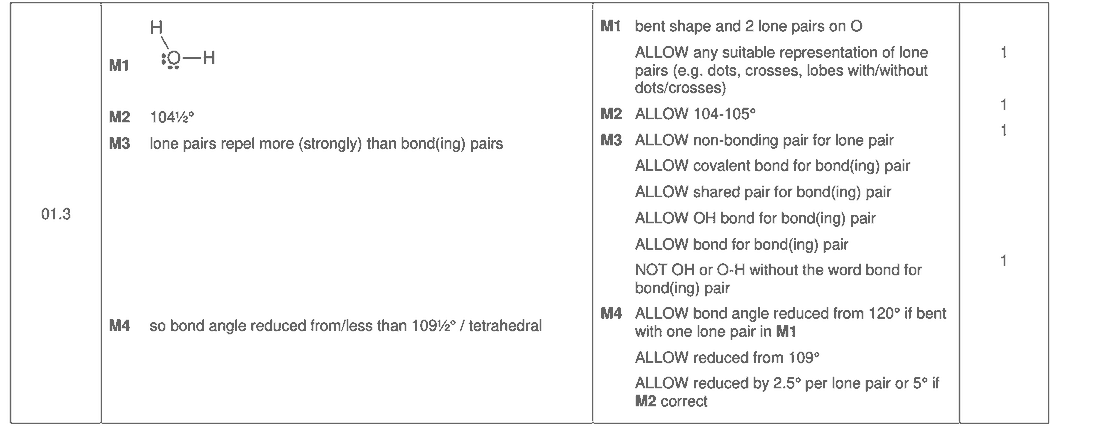
Draw a diagram to show the shape of a molecule of H2O
Include any lone pairs of electrons.
State the H−O−H bond angle.
Explain this shape and bond angle.
[4 marks]
Diagram
Bond angle
Explanation
June 2019 · Paper 3 · Q01.4 6 marks 6-mark level of response Hard kinetics
Earlier part of question 01 that this part usesEarlier part of June 2019 Paper 3 question 01
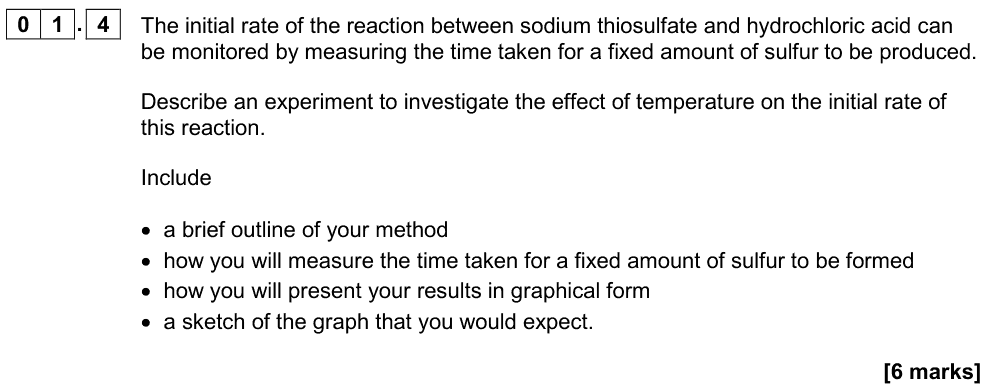
The initial rate of the reaction between sodium thiosulfate and hydrochloric acid can
be monitored by measuring the time taken for a fixed amount of sulfur to be produced.
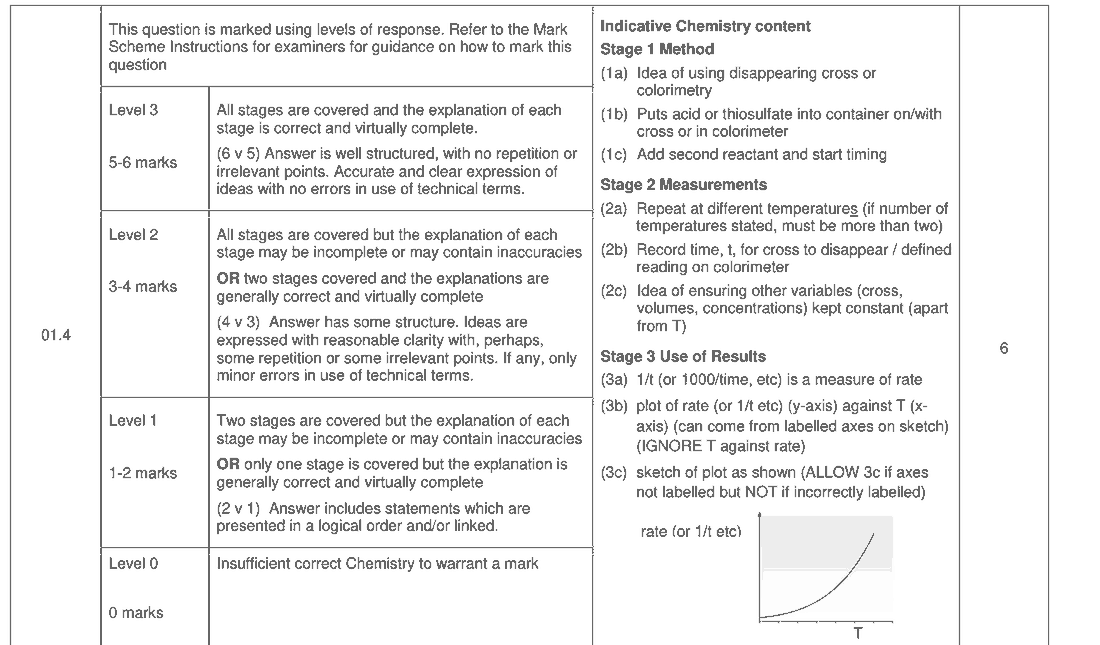
Describe an experiment to investigate the effect of temperature on the initial rate of
this reaction.
Include
• a brief outline of your method
• how you will measure the time taken for a fixed amount of sulfur to be formed
• how you will present your results in graphical form
• a sketch of the graph that you would expect.
[6 marks]
June 2019 · Paper 3 · Q02.1 1 mark Diagram or structure period 3 elements and oxidesbonding
This question is about sulfuric acid and its salts.
Draw the displayed formula of a molecule of H2SO4
[1 mark]
June 2019 · Paper 3 · Q02.2 2 marks Equation writing acids and bases
Earlier part of question 02 that this part usesEarlier part of June 2019 Paper 3 question 02
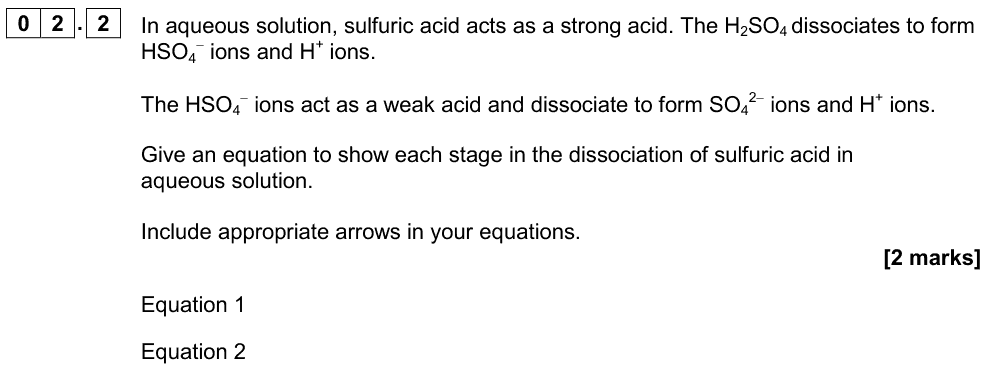
In aqueous solution, sulfuric acid acts as a strong acid. The H2SO4 dissociates to form
HSO4
− ions and H+ ions.
The HSO4
− ions act as a weak acid and dissociate to form SO4
2− ions and H+ ions.
Give an equation to show each stage in the dissociation of sulfuric acid in
aqueous solution.
Include appropriate arrows in your equations.
[2 marks]
Equation 1
Equation 2
June 2019 · Paper 3 · Q02.3 4 marks Practical and data analysis Hard amount of substance
Earlier part of question 02 that this part usesEarlier part of June 2019 Paper 3 question 02
A student is required to make 250 cm3 of an aqueous solution that contains an
accurately measured mass of sodium hydrogensulfate (NaHSO4).
Describe the method that the student should use to make this solution.
[4 marks]
Extra space
June 2019 · Paper 3 · Q02.4 6 marks Calculation acids and basesamount of substance
Earlier part of question 02 that this part usesEarlier part of June 2019 Paper 3 question 02
A solution that contains 605 mg of NaHSO4 in 100 cm3 of solution has a pH of 1.72
Calculate the value of Ka for the hydrogensulfate ion (HSO4
−) that is behaving as a
weak acid.
Give your answer to three significant figures.
State the units of Ka
[6 marks]
Ka
Units
June 2019 · Paper 3 · Q02.5 2 marks Explanation chemical equilibria and kcacids and bases
Earlier part of question 02 that this part usesEarlier part of June 2019 Paper 3 question 02
Some sodium sulfate is dissolved in a sample of the solution from question 02.4.
Explain why this increases the pH of the solution.
[2 marks]
June 2019 · Paper 3 · Q03.1 1 mark Short answer electrode potentials and cells
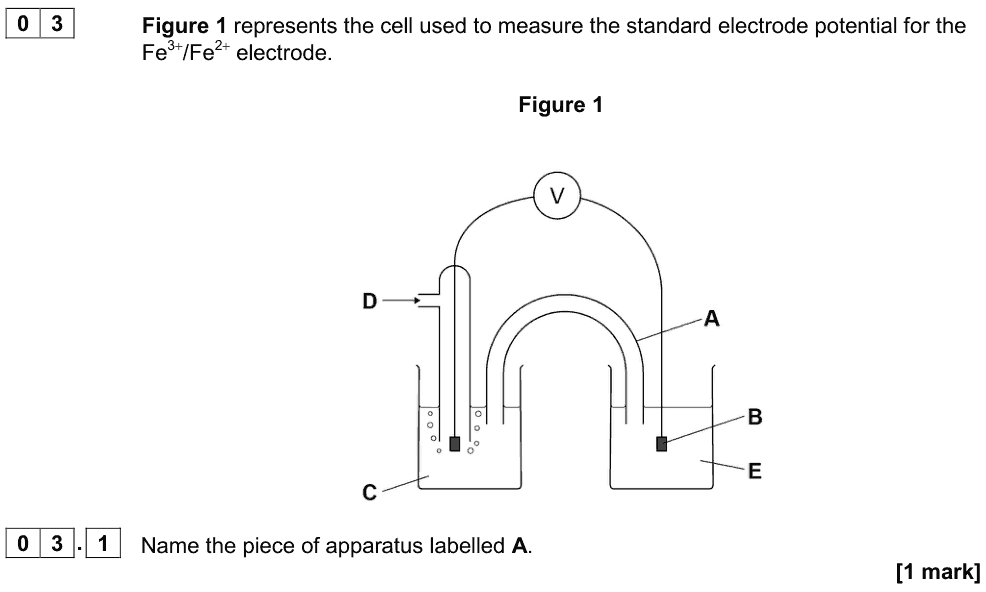
Figure 1 represents the cell used to measure the standard electrode potential for the
Fe3+/Fe2+ electrode.
Figure 1
Name the piece of apparatus labelled A.
[1 mark]
June 2019 · Paper 3 · Q03.2 1 mark Short answer electrode potentials and cells
Earlier part of question 03 that this part usesEarlier part of June 2019 Paper 3 question 03
State the purpose of A.
[1 mark]
June 2019 · Paper 3 · Q03.3 1 mark Short answer electrode potentials and cells
Earlier part of question 03 that this part usesEarlier part of June 2019 Paper 3 question 03
Name the substance used as electrode B in Figure 1.
[1 mark]
June 2019 · Paper 3 · Q03.4 4 marks Short answer electrode potentials and cells
Earlier part of question 03 that this part usesEarlier part of June 2019 Paper 3 question 03
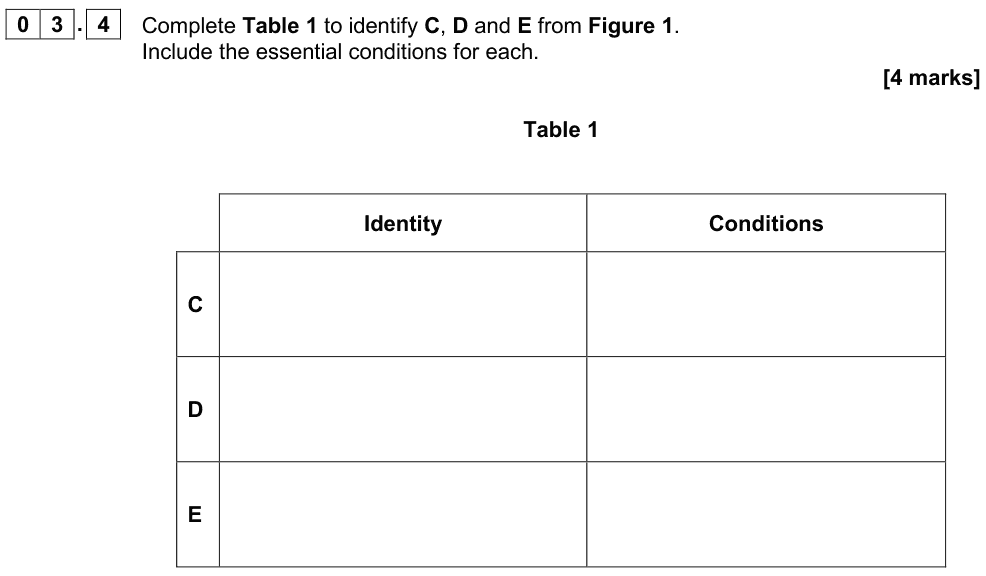
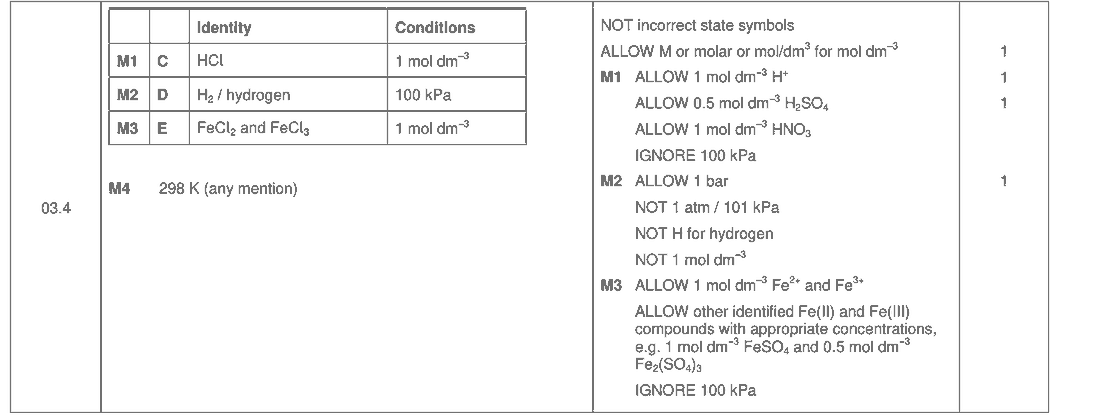
Complete Table 1 to identify C, D and E from Figure 1.
Include the essential conditions for each.
[4 marks]
Table 1
Identity
Conditions
C
D
E
June 2019 · Paper 3 · Q03.5 2 marks Equation writing electrode potentials and cells
Earlier part of question 03 that this part usesEarlier part of June 2019 Paper 3 question 03
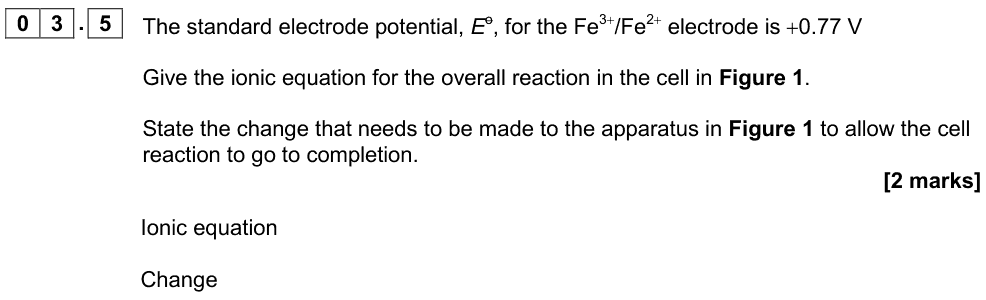
The standard electrode potential, Eo, for the Fe3+/Fe2+ electrode is +0.77 V
Give the ionic equation for the overall reaction in the cell in Figure 1.
State the change that needs to be made to the apparatus in Figure 1 to allow the cell
reaction to go to completion.
[2 marks]
Ionic equation
Change
June 2019 · Paper 3 · Q03.6 3 marks Practical and data analysis electrode potentials and cells
Earlier part of question 03 that this part usesEarlier part of June 2019 Paper 3 question 03
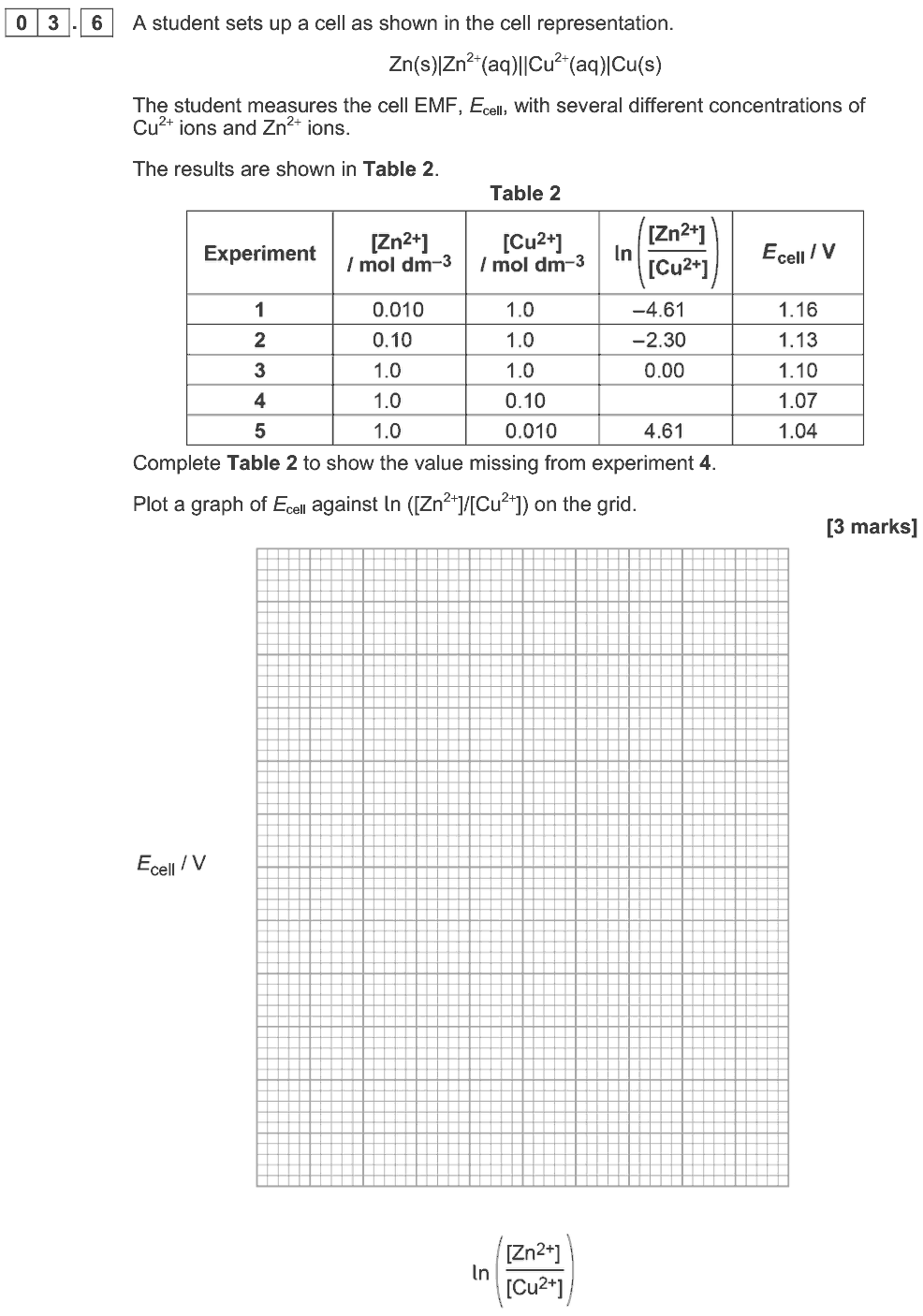
A student sets up a cell as shown in the cell representation.
Zn(s)|Zn2+(aq)||Cu2+(aq)|Cu(s)
The student measures the cell EMF, Ecell, with several different concentrations of
Cu2+ ions and Zn2+ ions.
The results are shown in Table 2.
Table 2
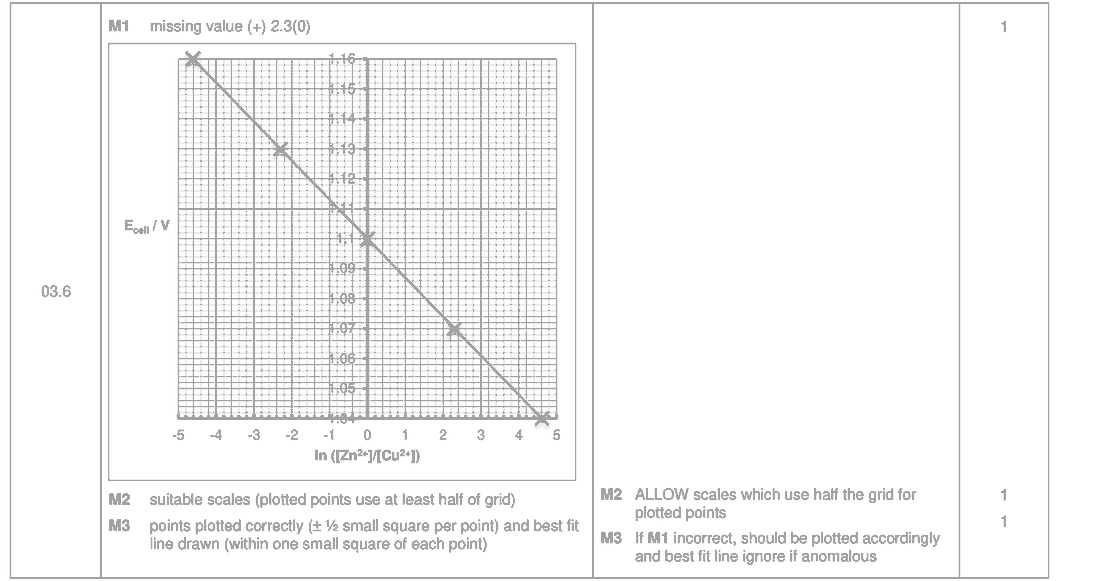
Complete Table 2 to show the value missing from experiment 4.
Plot a graph of Ecell against ln ([Zn2+]/[Cu2+]) on the grid.
[3 marks]
June 2019 · Paper 3 · Q03.7 3 marks Calculation electrode potentials and cells
Earlier parts of question 03 that this part usesEarlier part of June 2019 Paper 3 question 03Earlier part of June 2019 Paper 3 question 03
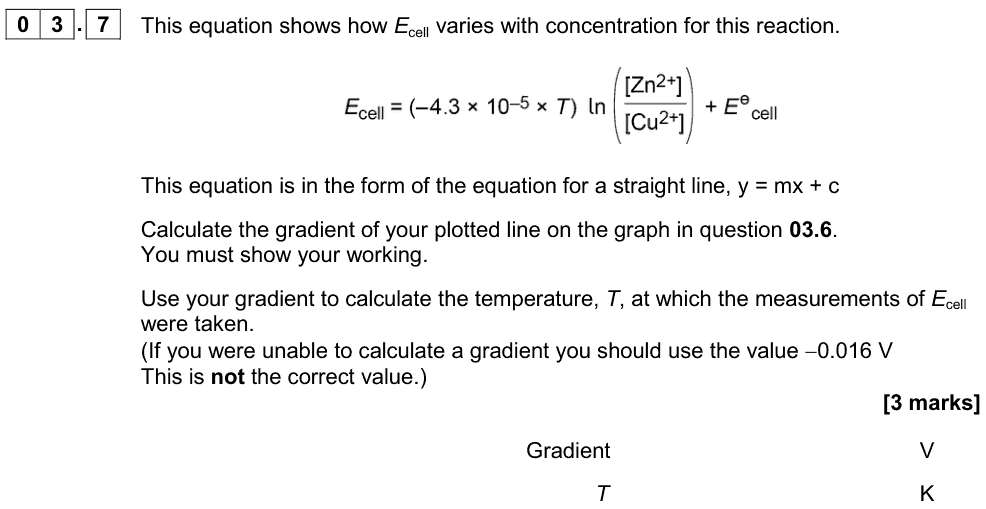
This equation shows how Ecell varies with concentration for this reaction.
This equation is in the form of the equation for a straight line, y = mx + c
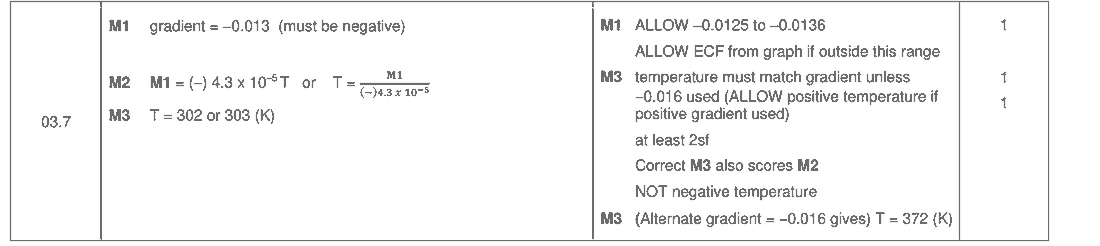
Calculate the gradient of your plotted line on the graph in question 03.6.
You must show your working.
Use your gradient to calculate the temperature, T, at which the measurements of Ecell
were taken.
(If you were unable to calculate a gradient you should use the value −0.016 V
This is not the correct value.)
[3 marks]
Gradient
V
T
K
June 2019 · Paper 3 · Q03.8 2 marks Calculation electrode potentials and cells
Earlier parts of question 03 that this part usesEarlier part of June 2019 Paper 3 question 03Earlier part of June 2019 Paper 3 question 03
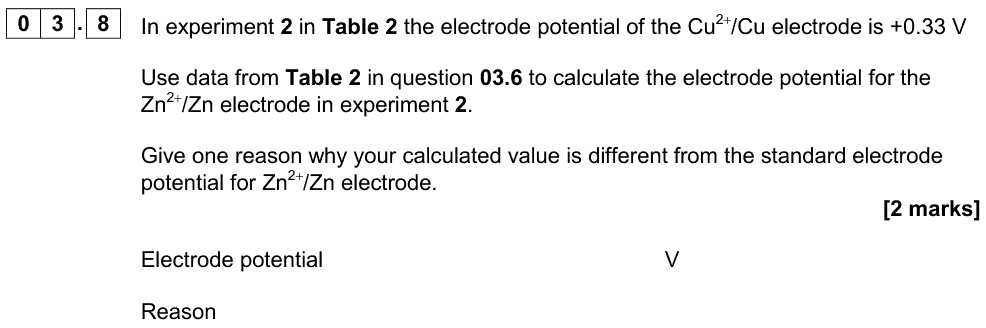
In experiment 2 in Table 2 the electrode potential of the Cu2+/Cu electrode is +0.33 V
Use data from Table 2 in question 03.6 to calculate the electrode potential for the
Zn2+/Zn electrode in experiment 2.
Give one reason why your calculated value is different from the standard electrode
potential for Zn2+/Zn electrode.
[2 marks]
Electrode potential
V
Reason
June 2019 · Paper 3 · Q04.1 1 mark Short answer aldehydes and ketones
Ethanal reacts with potassium cyanide, followed by dilute acid, to form
2-hydroxypropanenitrile.
Name the mechanism for the reaction between potassium cyanide and ethanal.
[1 mark]
June 2019 · Paper 3 · Q04.2 5 marks Diagram or structure optical isomerismaldehydes and ketones
Earlier part of question 04 that this part usesEarlier part of June 2019 Paper 3 question 04
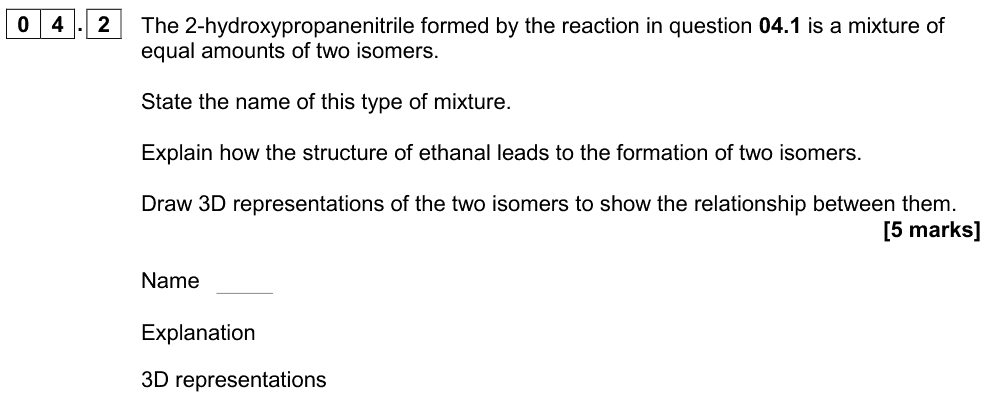
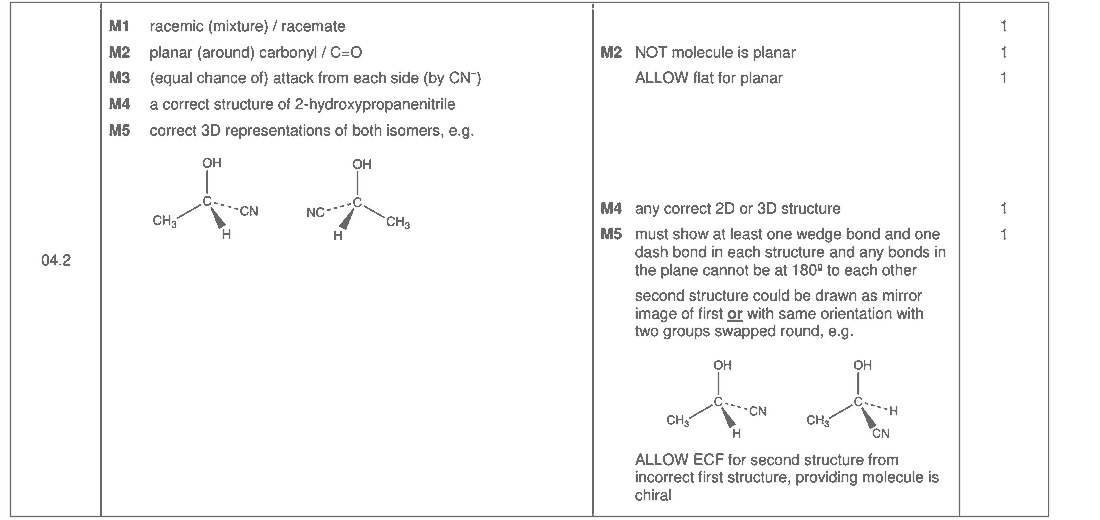
The 2-hydroxypropanenitrile formed by the reaction in question 04.1 is a mixture of
equal amounts of two isomers.
State the name of this type of mixture.
Explain how the structure of ethanal leads to the formation of two isomers.
Draw 3D representations of the two isomers to show the relationship between them.
[5 marks]
Name
Explanation
3D representations
June 2019 · Paper 3 · Q04.3 2 marks Short answer alcohols
Earlier part of question 04 that this part usesEarlier part of June 2019 Paper 3 question 04
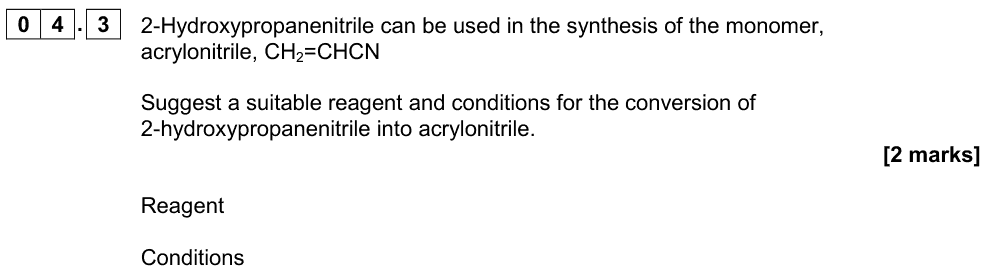
2-Hydroxypropanenitrile can be used in the synthesis of the monomer,
acrylonitrile, CH2=CHCN
Suggest a suitable reagent and conditions for the conversion of
2-hydroxypropanenitrile into acrylonitrile.
[2 marks]
Reagent
Conditions
June 2019 · Paper 3 · Q04.4 1 mark Diagram or structure alkenes
Earlier part of question 04 that this part usesEarlier part of June 2019 Paper 3 question 04
Draw a section of the polymer polyacrylonitrile, showing three repeating units.
[1 mark]
June 2019 · Paper 3 · Q05.1 1 mark Equation writing amount of substance
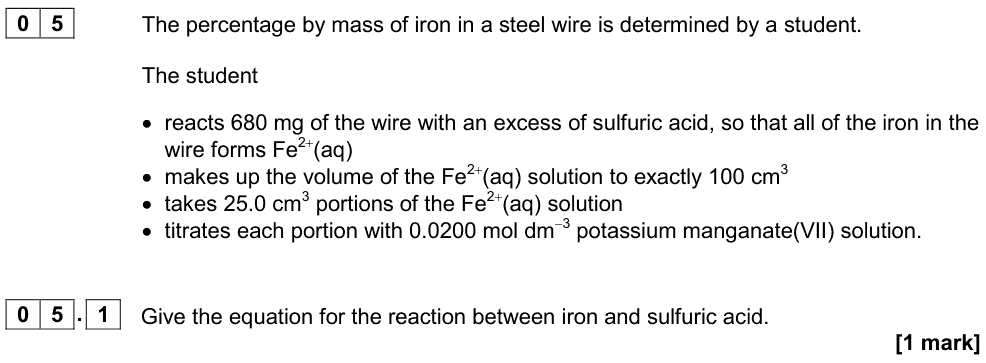
The percentage by mass of iron in a steel wire is determined by a student.
The student
• reacts 680 mg of the wire with an excess of sulfuric acid, so that all of the iron in the
wire forms Fe2+(aq)
• makes up the volume of the Fe2+(aq) solution to exactly 100 cm3
• takes 25.0 cm3 portions of the Fe2+(aq) solution
• titrates each portion with 0.0200 mol dm−3 potassium manganate(VII) solution.
Give the equation for the reaction between iron and sulfuric acid.
[1 mark]
June 2019 · Paper 3 · Q05.2 1 mark Practical and data analysis transition metals
Earlier part of question 05 that this part usesEarlier part of June 2019 Paper 3 question 05
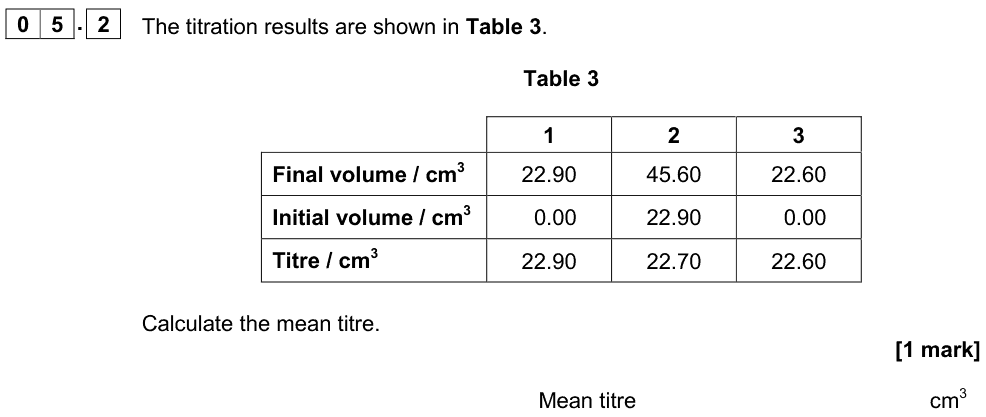
The titration results are shown in Table 3.
Table 3
1
2
3
Final volume / cm3
22.90
45.60
22.60
Initial volume / cm3
0.00
22.90
0.00
Titre / cm3
22.90
22.70
22.60
Calculate the mean titre.
[1 mark]
Mean titre
cm3
June 2019 · Paper 3 · Q05.3 1 mark Equation writing transition metalsredox
Earlier part of question 05 that this part usesEarlier part of June 2019 Paper 3 question 05
Give the overall ionic equation for the oxidation of Fe2+ by manganate(VII) ions, in
acidic conditions.
[1 mark]
June 2019 · Paper 3 · Q05.4 1 mark Practical and data analysis transition metals
Earlier part of question 05 that this part usesEarlier part of June 2019 Paper 3 question 05
State the colour change seen at the end point of the titration.
[1 mark]
June 2019 · Paper 3 · Q05.5 1 mark Practical and data analysis amount of substance
Earlier part of question 05 that this part usesEarlier part of June 2019 Paper 3 question 05
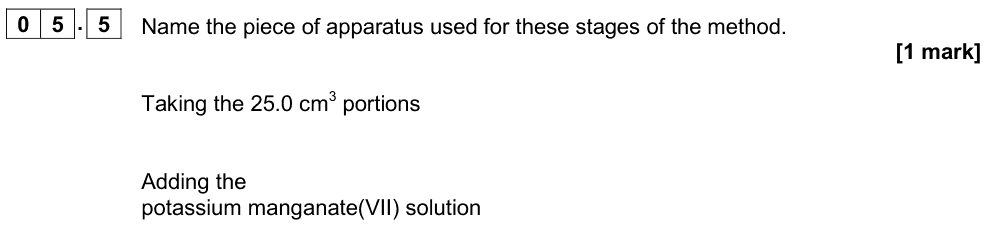
Name the piece of apparatus used for these stages of the method.
[1 mark]
Taking the 25.0 cm3 portions
Adding the
potassium manganate(VII) solution
June 2019 · Paper 3 · Q05.6 1 mark Practical and data analysis amount of substance
Earlier part of question 05 that this part usesEarlier part of June 2019 Paper 3 question 05
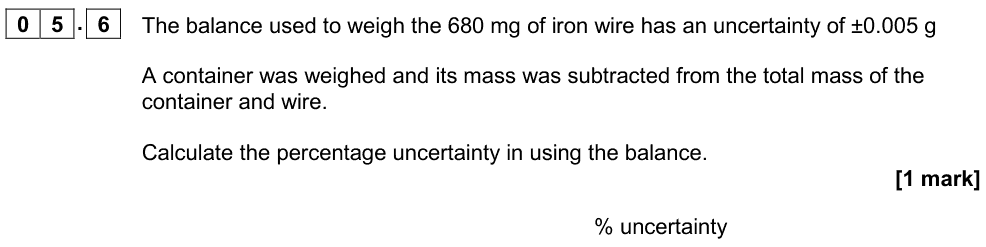
The balance used to weigh the 680 mg of iron wire has an uncertainty of ±0.005 g
A container was weighed and its mass was subtracted from the total mass of the
container and wire.
Calculate the percentage uncertainty in using the balance.
[1 mark]
% uncertainty
June 2019 · Paper 3 · Q06 1 mark Multiple choice amount of substance
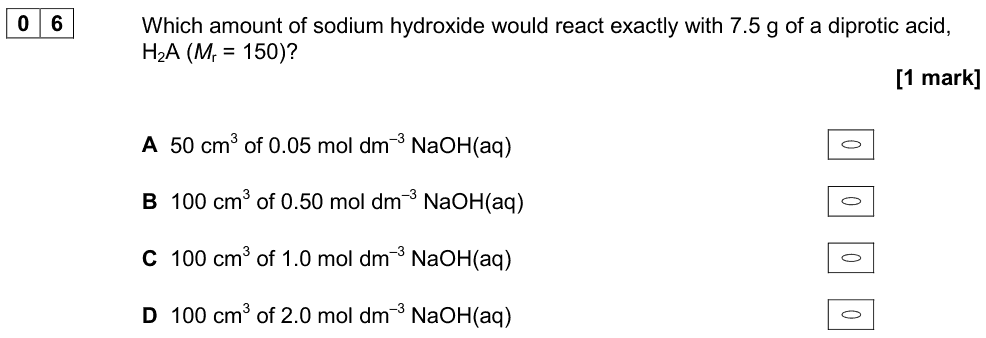
Which amount of sodium hydroxide would react exactly with 7.5 g of a diprotic acid,
H2A (Mr = 150)?
[1 mark]
A 50 cm3 of 0.05 mol dm–3 NaOH(aq)
B 100 cm3 of 0.50 mol dm–3 NaOH(aq)
C 100 cm3 of 1.0 mol dm–3 NaOH(aq)
D 100 cm3 of 2.0 mol dm–3 NaOH(aq)
June 2019 · Paper 3 · Q07 1 mark Multiple choice amount of substance
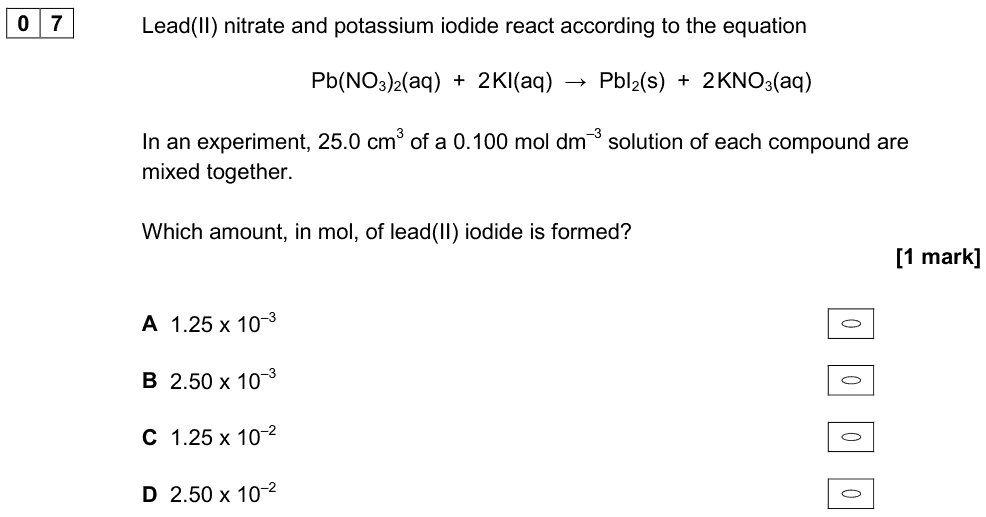
Lead(II) nitrate and potassium iodide react according to the equation
Pb(NO3)2(aq)  +  2 KI(aq)  →  PbI2(s)  +  2 KNO3(aq)
In an experiment, 25.0 cm3 of a 0.100 mol dm–3 solution of each compound are
mixed together.
Which amount, in mol, of lead(II) iodide is formed?
[1 mark]
A 1.25 x 10⁻³
B 2.50 x 10⁻³
C 1.25 x 10⁻²
D 2.50 x 10⁻²
June 2019 · Paper 3 · Q08 1 mark Multiple choice energetics
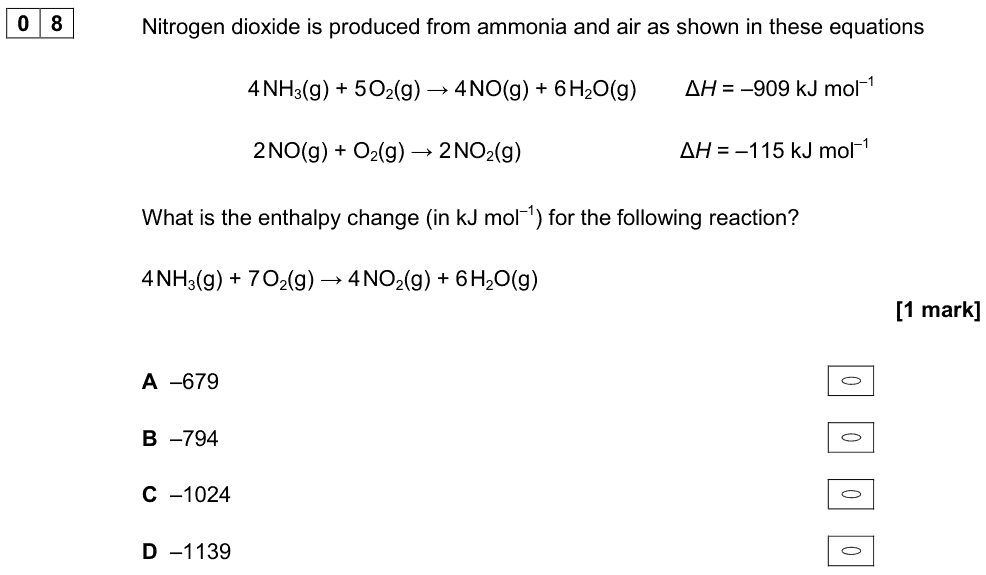
Nitrogen dioxide is produced from ammonia and air as shown in these equations
4 NH3(g) + 5 O2(g) → 4 NO(g) + 6 H2O(g)        ΔH = –909 kJ mol–1
2 NO(g) + O2(g) → 2 NO2(g)                          ΔH = –115 kJ mol–1
What is the enthalpy change (in kJ mol–1) for the following reaction?
4 NH3(g) + 7 O2(g) → 4 NO2(g) + 6 H2O(g)
[1 mark]
A –679
B –794
C –1024
D –1139
June 2019 · Paper 3 · Q09 1 mark Multiple choice Easy chemical equilibria and kc
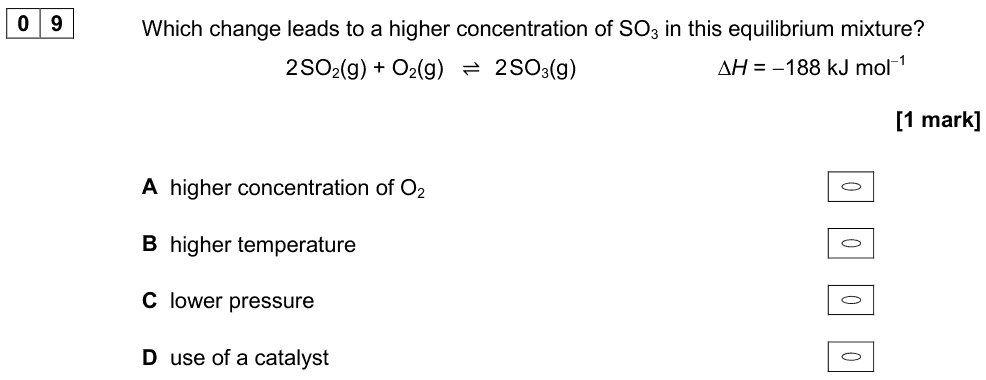
Which change leads to a higher concentration of SO3 in this equilibrium mixture?
2 SO2(g) + O2(g)   ⇌   2 SO3(g)
∆H = −188 kJ mol−1
[1 mark]
A higher concentration of O2
B higher temperature
C lower pressure
D use of a catalyst
June 2019 · Paper 3 · Q10 1 mark Multiple choice rate equations
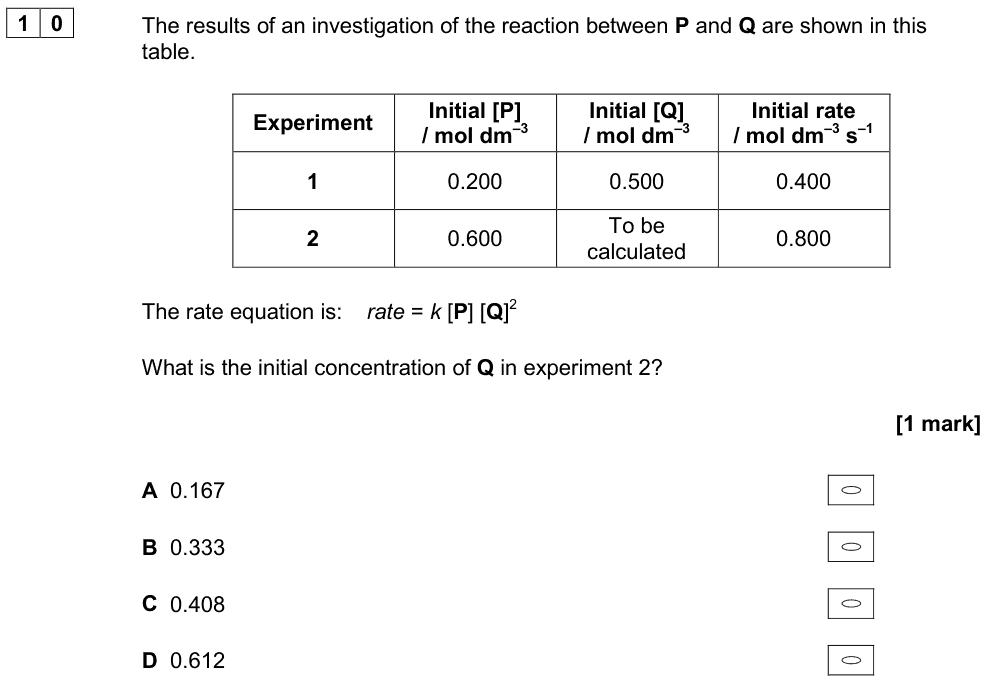
The results of an investigation of the reaction between P and Q are shown in this
table.
Experiment
Initial [P]
/ mol dm–3
Initial [Q]
/ mol dm–3
Initial rate
/ mol dm–3 s–1
1
0.200
0.500
0.400
2
0.600
To be
calculated
0.800
The rate equation is:    rate = k [P] [Q]2
What is the initial concentration of Q in experiment 2?
[1 mark]
A 0.167
B 0.333
C 0.408
D 0.612
June 2019 · Paper 3 · Q11 1 mark Multiple choice equilibrium constant kp
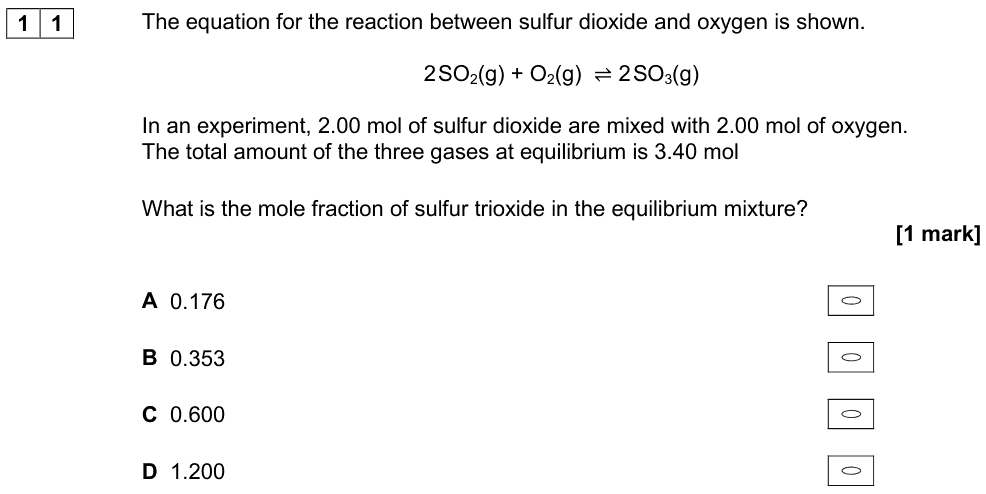
The equation for the reaction between sulfur dioxide and oxygen is shown.
2 SO2(g) + O2(g)  ⇌ 2 SO3(g)
In an experiment, 2.00 mol of sulfur dioxide are mixed with 2.00 mol of oxygen.
The total amount of the three gases at equilibrium is 3.40 mol
What is the mole fraction of sulfur trioxide in the equilibrium mixture?
[1 mark]
A 0.176
B 0.353
C 0.600
D 1.200
June 2019 · Paper 3 · Q12 1 mark Multiple choice equilibrium constant kp
Nitrogen reacts with hydrogen in this exothermic reaction
N2(g) + 3 H2(g)  ⇌  2 NH3(g)
Which change increases the equilibrium yield of ammonia but has no effect on the
value of the equilibrium constant Kp?
[1 mark]
A Add a catalyst
B Increase the partial pressure of nitrogen
C Decrease the temperature
D Decrease the total pressure
June 2019 · Paper 3 · Q13 1 mark Multiple choice electrode potentials and cells
The Eo values for two electrodes are shown.
Fe2+(aq) + 2 e–  → Fe(s)  Eo= –0.44 V
Cu2+(aq) + 2 e–  → Cu(s)  Eo= +0.34 V
What is the EMF of the cell Fe(s)|Fe2+(aq)||Cu2+(aq)|Cu(s)?
[1 mark]
A +0.78 V
B +0.10 V
C –0.10 V
D –0.78 V
June 2019 · Paper 3 · Q14 1 mark Multiple choice atomic structure
Which atom has the greatest first ionisation energy?
[1 mark]
A H
B He
C Li
D Ne
June 2019 · Paper 3 · Q15 1 mark Multiple choice group 2
What is the correct observation when barium metal is added to an excess of water?
[1 mark]
A Forms a colourless solution only
B Forms a colourless solution and effervesces
C Forms a white precipitate only
D Forms a white precipitate and effervesces
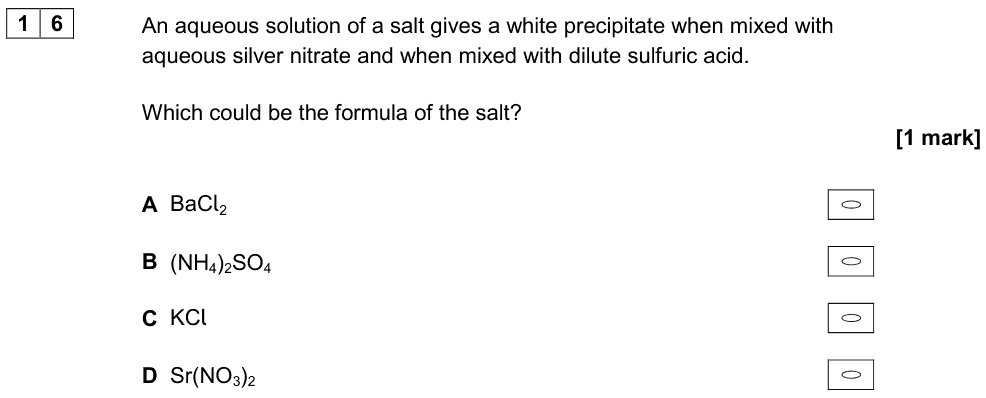
June 2019 · Paper 3 · Q16 1 mark Multiple choice group 7 the halogensgroup 2
An aqueous solution of a salt gives a white precipitate when mixed with
aqueous silver nitrate and when mixed with dilute sulfuric acid.
Which could be the formula of the salt?
[1 mark]
A BaCl2
B (NH4)2SO4
C KCl
D Sr(NO3)2
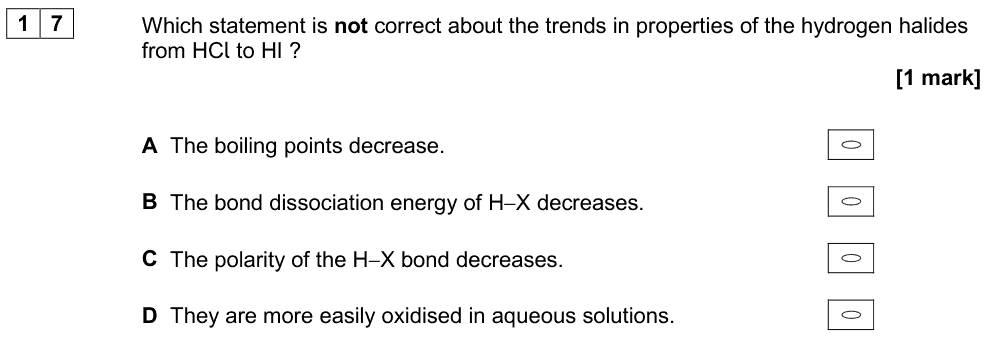
June 2019 · Paper 3 · Q17 1 mark Multiple choice bonding
Which statement is not correct about the trends in properties of the hydrogen halides
from HCl to HI ?
[1 mark]
A The boiling points decrease.
B The bond dissociation energy of H−X decreases.
C The polarity of the H−X bond decreases.
D They are more easily oxidised in aqueous solutions.
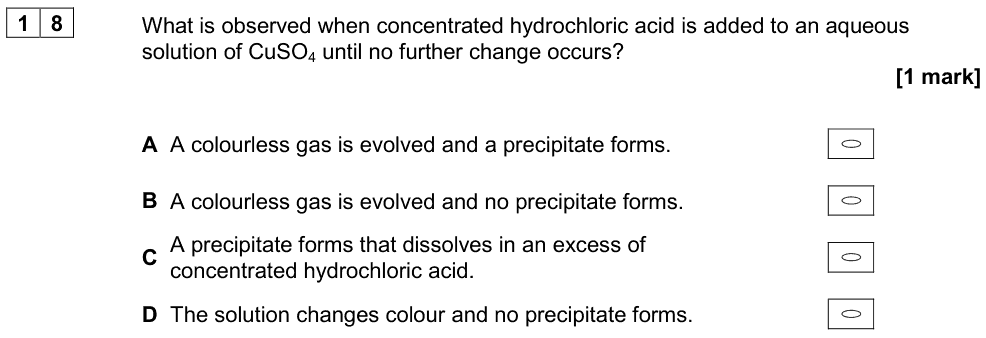
June 2019 · Paper 3 · Q18 1 mark Multiple choice transition metals
What is observed when concentrated hydrochloric acid is added to an aqueous
solution of CuSO4 until no further change occurs?
[1 mark]
A A colourless gas is evolved and a precipitate forms.
B A colourless gas is evolved and no precipitate forms.
C A precipitate forms that dissolves in an excess of
concentrated hydrochloric acid.
D The solution changes colour and no precipitate forms.
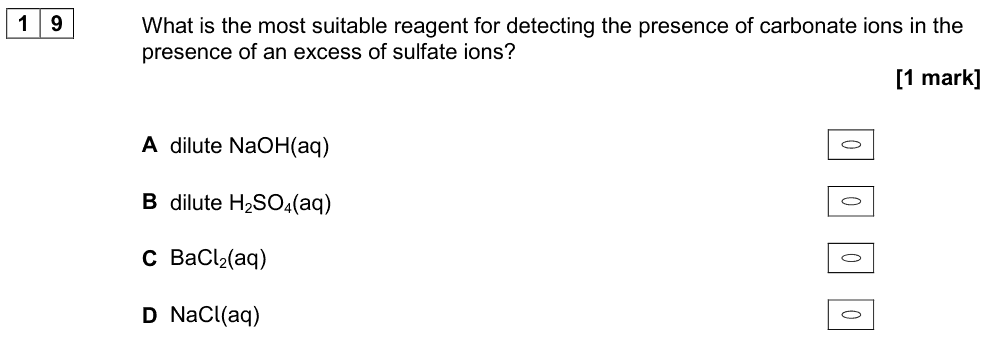
June 2019 · Paper 3 · Q19 1 mark Multiple choice group 7 the halogens
What is the most suitable reagent for detecting the presence of carbonate ions in the
presence of an excess of sulfate ions?
[1 mark]
A dilute NaOH(aq)
B dilute H2SO4(aq)
C BaCl2(aq)
D NaCl(aq)
June 2019 · Paper 3 · Q20 1 mark Multiple choice aromatic chemistry
Methylbenzene reacts with a mixture of concentrated nitric acid and
concentrated sulfuric acid.
What is the name of the mechanism for this reaction?
[1 mark]
A Electrophilic addition
B Electrophilic substitution
C Nucleophilic addition
D Nucleophilic substitution
June 2019 · Paper 3 · Q21 1 mark Multiple choice organic synthesis
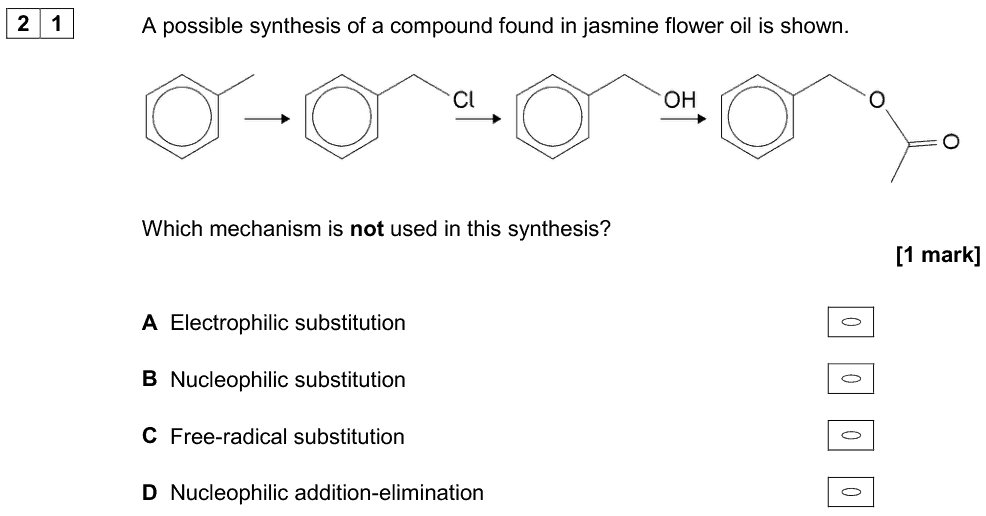
A possible synthesis of a compound found in jasmine flower oil is shown.
Which mechanism is not used in this synthesis?
[1 mark]
A Electrophilic substitution
B Nucleophilic substitution
C Free-radical substitution
D Nucleophilic addition-elimination
June 2019 · Paper 3 · Q22 1 mark Multiple choice alcoholsintroduction to organic chemistry
Which compound is formed when 1-phenylethanol reacts with
acidified potassium dichromate(VI)?
[1 mark]
A C6H5CH2CH2OH
B C6H5CH2CHO
C C6H5COCH3
D C6H5CH2COOH
June 2019 · Paper 3 · Q23 1 mark Multiple choice organic analysisaldehydes and ketones
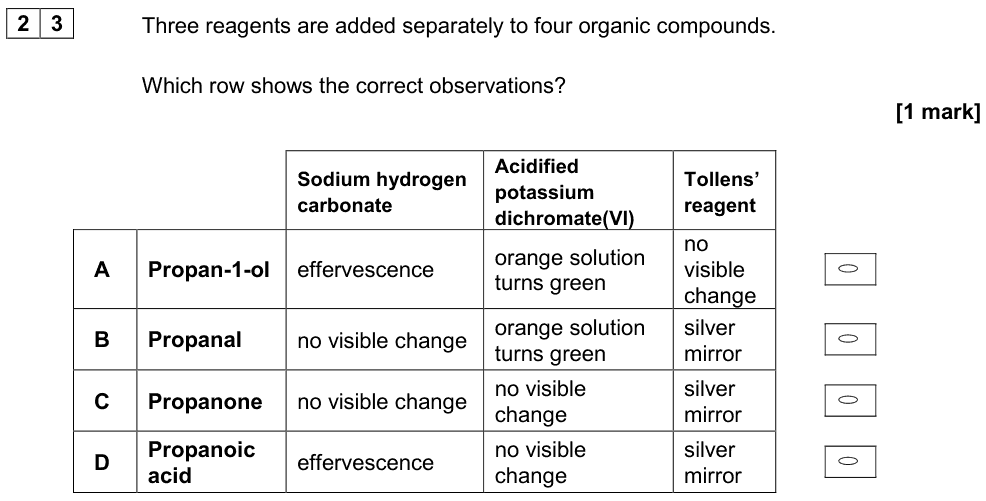
Three reagents are added separately to four organic compounds.
Which row shows the correct observations?
[1 mark]
Sodium hydrogen
carbonate
Acidified
potassium
dichromate(VI)
Tollens’
reagent
A
Propan-1-ol
effervescence
orange solution
turns green
no
visible
change
B
Propanal
no visible change
orange solution
turns green
silver
mirror
C
Propanone
no visible change
no visible
change
silver
mirror
D
Propanoic
acid
effervescence
no visible
change
silver
mirror
June 2019 · Paper 3 · Q24 1 mark Multiple choice carboxylic acids and derivatives
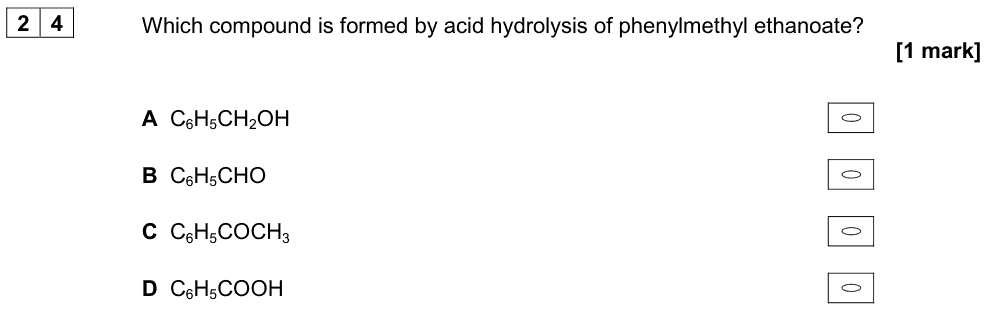
Which compound is formed by acid hydrolysis of phenylmethyl ethanoate?
[1 mark]
A C6H5CH2OH
B C6H5CHO
C C6H5COCH3
D C6H5COOH
June 2019 · Paper 3 · Q25 1 mark Multiple choice carboxylic acids and derivatives
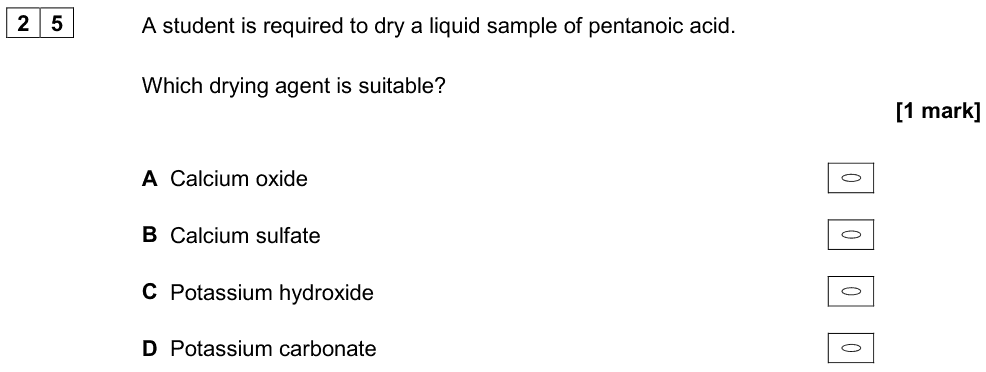
A student is required to dry a liquid sample of pentanoic acid.
Which drying agent is suitable?
[1 mark]
A Calcium oxide
B Calcium sulfate
C Potassium hydroxide
D Potassium carbonate
June 2019 · Paper 3 · Q26 1 mark Multiple choice aromatic chemistry
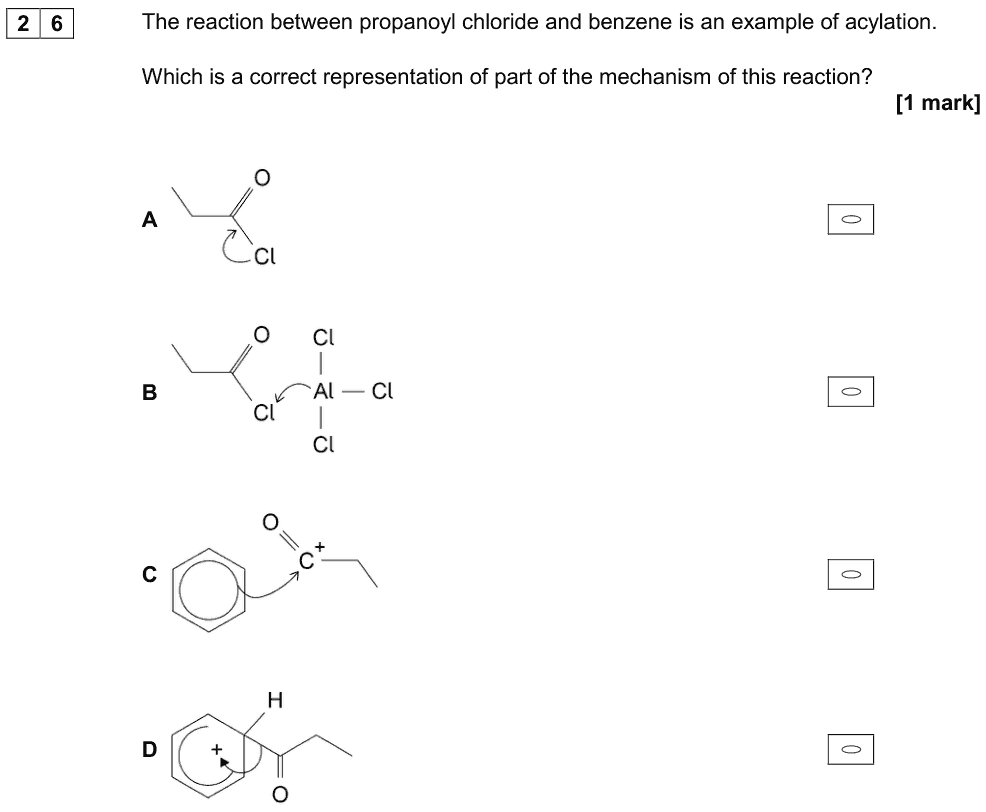
The reaction between propanoyl chloride and benzene is an example of acylation.
Which is a correct representation of part of the mechanism of this reaction?
[1 mark]
A
B
C
D
June 2019 · Paper 3 · Q27 1 mark Multiple choice amines
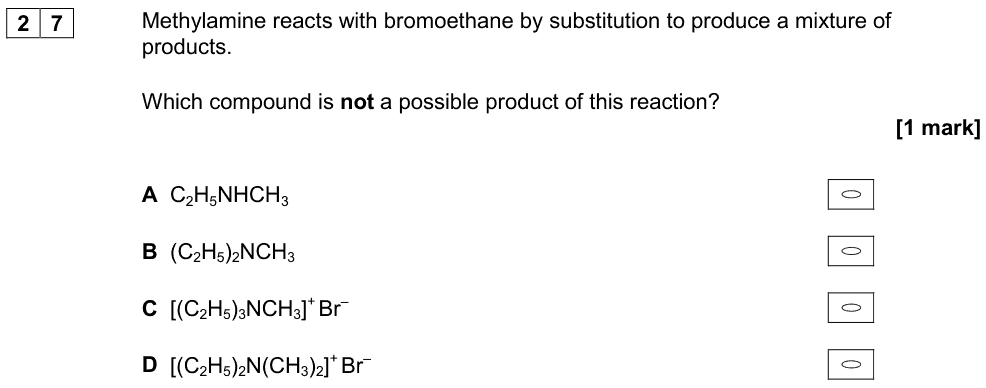
Methylamine reacts with bromoethane by substitution to produce a mixture of
products.
Which compound is not a possible product of this reaction?
[1 mark]
A C2H5NHCH3
B (C2H5)2NCH3
C [(C2H5)3NCH3]+
Br–
D [(C2H5)2N(CH3)2]+
Br–
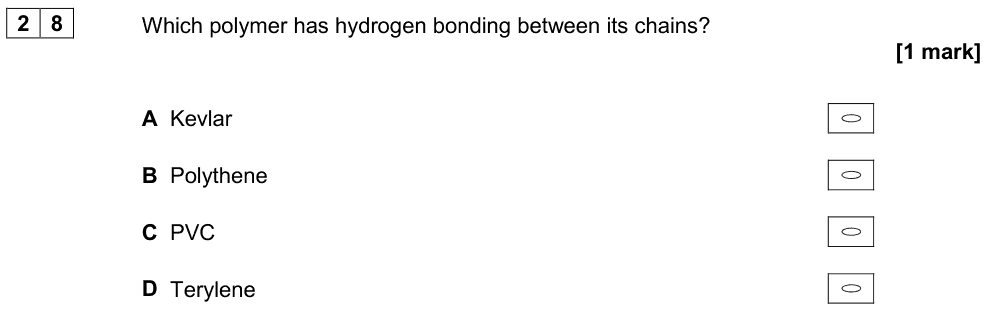
June 2019 · Paper 3 · Q28 1 mark Multiple choice polymers
Which polymer has hydrogen bonding between its chains?
[1 mark]
A Kevlar
B Polythene
C PVC
D Terylene
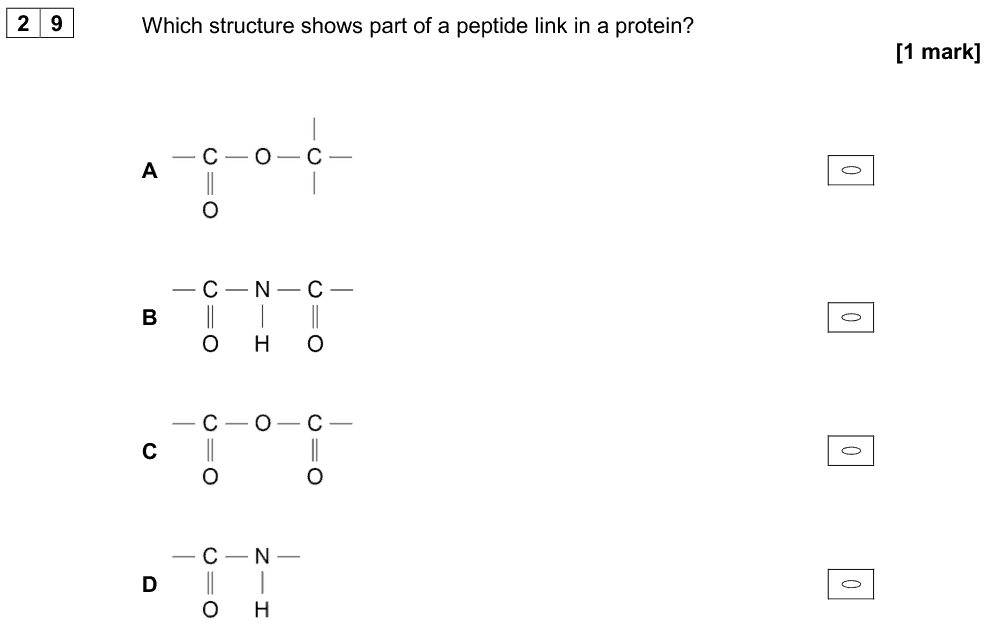
June 2019 · Paper 3 · Q29 1 mark Multiple choice amino acids proteins and dna
Which structure shows part of a peptide link in a protein?
[1 mark]
A
B
C
D
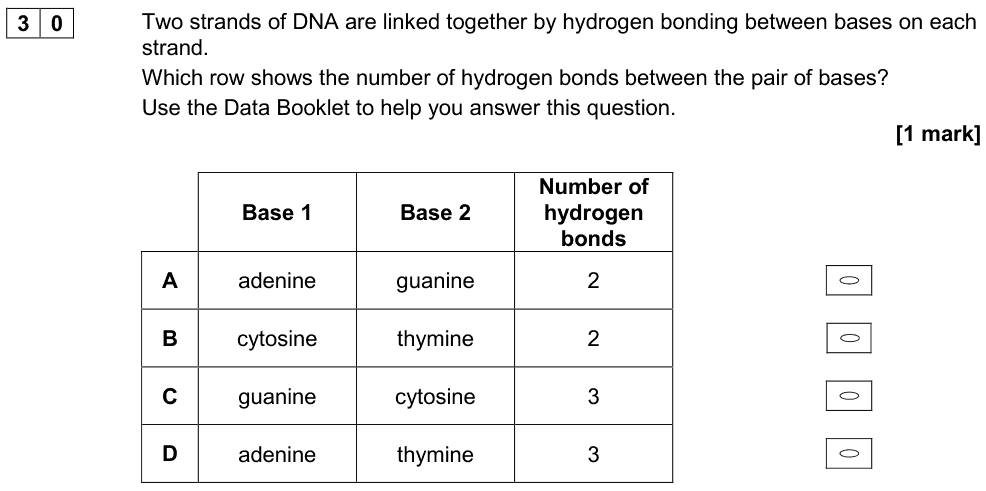
June 2019 · Paper 3 · Q30 1 mark Multiple choice amino acids proteins and dna
Two strands of DNA are linked together by hydrogen bonding between bases on each
strand.
Which row shows the number of hydrogen bonds between the pair of bases?
Use the Data Booklet to help you answer this question.
[1 mark]
Base 1
Base 2
Number of
hydrogen
bonds
A
adenine
guanine
2
B
cytosine
thymine
2
C
guanine
cytosine
3
D
adenine
thymine
3
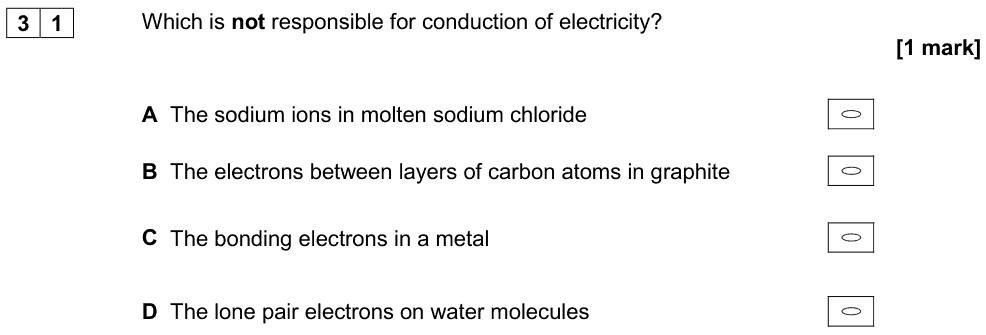
June 2019 · Paper 3 · Q31 1 mark Multiple choice bonding
Which is not responsible for conduction of electricity?
[1 mark]
A The sodium ions in molten sodium chloride
B The electrons between layers of carbon atoms in graphite
C The bonding electrons in a metal
D The lone pair electrons on water molecules
June 2019 · Paper 3 · Q32 1 mark Multiple choice alcohols
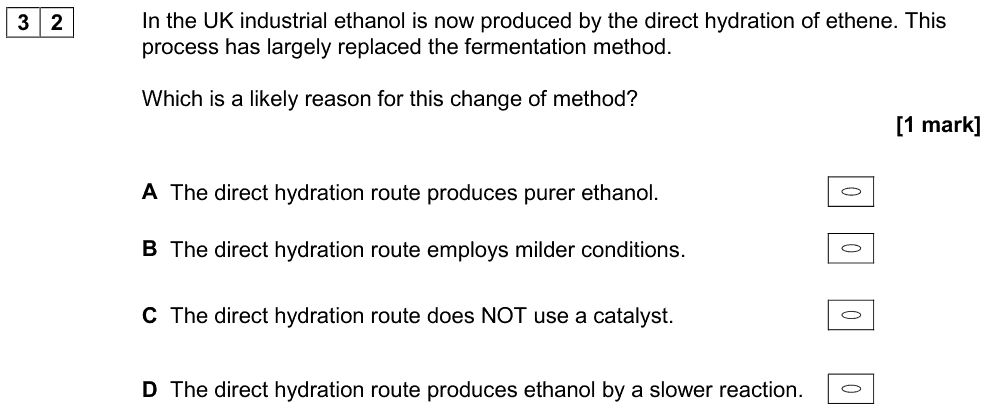
In the UK industrial ethanol is now produced by the direct hydration of ethene. This
process has largely replaced the fermentation method.
Which is a likely reason for this change of method?
[1 mark]
A The direct hydration route produces purer ethanol.
B The direct hydration route employs milder conditions.
C The direct hydration route does NOT use a catalyst.
D The direct hydration route produces ethanol by a slower reaction.
June 2019 · Paper 3 · Q33 1 mark Multiple choice alkenes
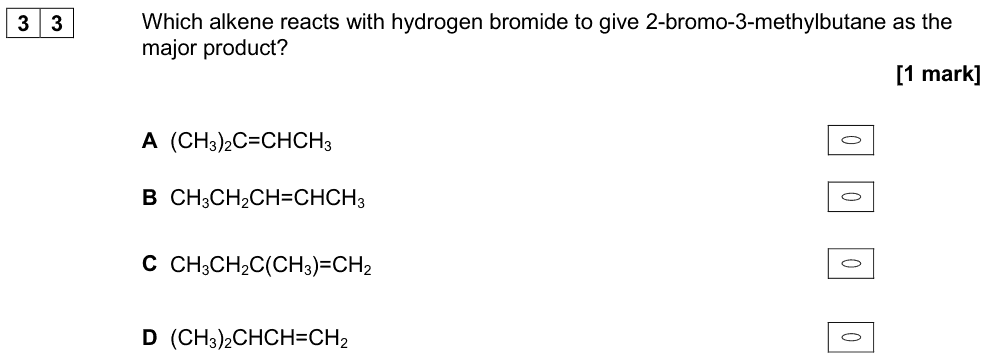
Which alkene reacts with hydrogen bromide to give 2-bromo-3-methylbutane as the
major product?
[1 mark]
A (CH3)2C=CHCH3
B CH3CH2CH=CHCH3
C CH3CH2C(CH3)=CH2
D (CH3)2CHCH=CH2
June 2019 · Paper 3 · Q34 1 mark Multiple choice carboxylic acids and derivatives
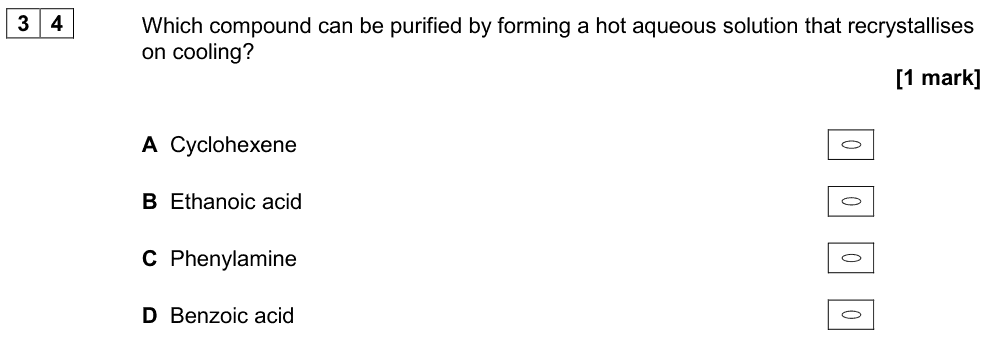
Which compound can be purified by forming a hot aqueous solution that recrystallises
on cooling?
[1 mark]
A Cyclohexene
B Ethanoic acid
C Phenylamine
D Benzoic acid
June 2019 · Paper 3 · Q35 1 mark Multiple choice amino acids proteins and dna
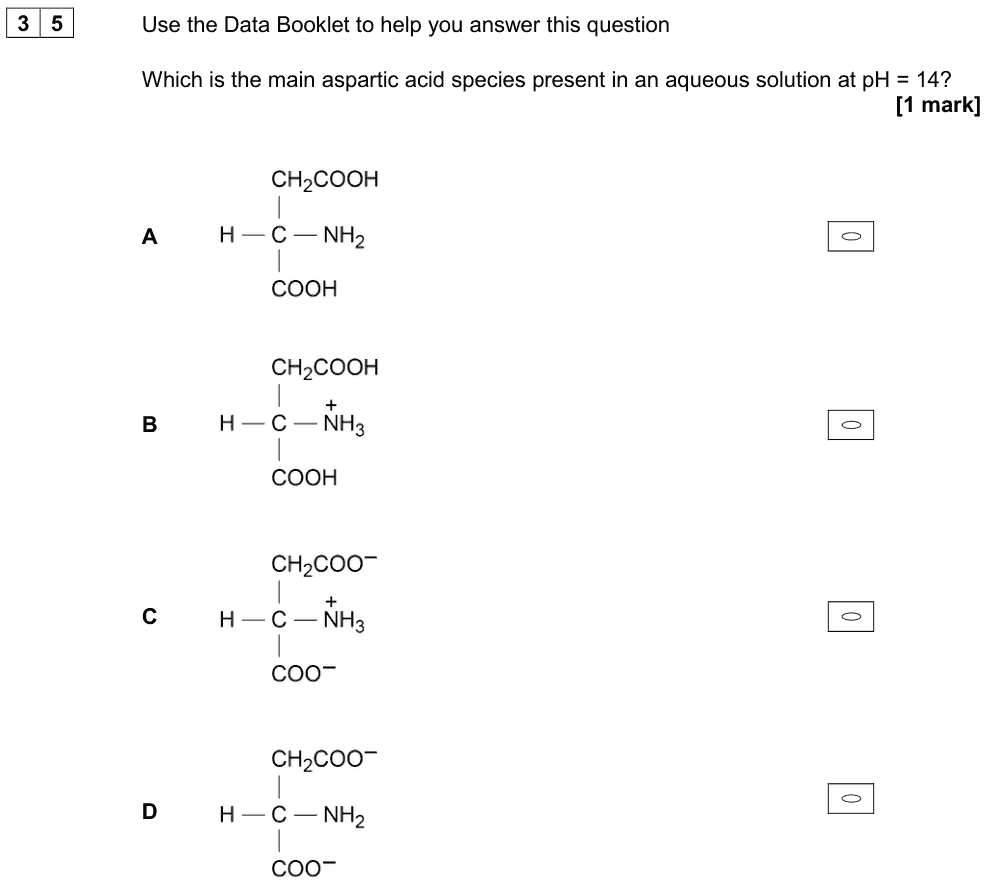
Use the Data Booklet to help you answer this question
Which is the main aspartic acid species present in an aqueous solution at pH = 14?
[1 mark]
A
B
C
D

Work with an A-level chemistry tutor

Want a paper marked and gone through with you? Message us.

Prefer email? Send an enquiry

If you are under 18, please include a parent's contact details. Enquiries go to enquiries@chemistryaleveltutor.com and are deleted once handled. All tutoring is online.