Specimen: Paper 3, Any content and practical skills

90 marks · 49 question parts · Paper, mark scheme and report on AQA's site · AQA's specimen paper for the current specification · Have the Data Booklet beside you

Question by question

QTopicMarksAOType
01.1 Alcohols 3Practical and data analysis
01.2 Oxidation, reduction and redox equations 1AO2=1Equation writing
01.3 Alcohols 5Practical and data analysis
01.4 Bonding 2Explanation
01.5 Aldehydes and ketones, Carboxylic acids and derivatives, Organic analysis: test-tube reactions, mass spectrometry and infrared 5Practical and data analysis
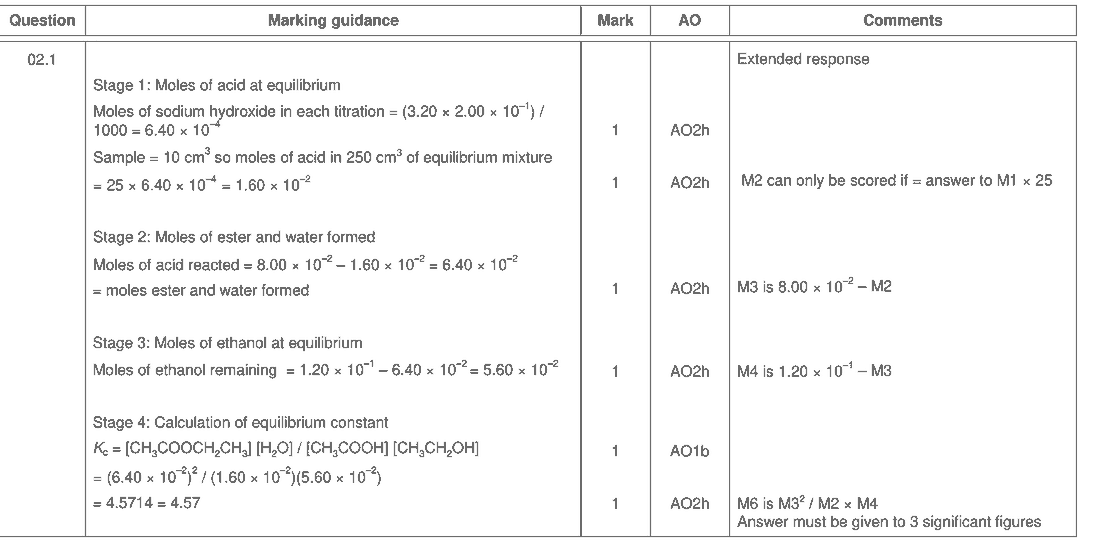
02.1 Chemical equilibria, Le Chatelier's principle and Kc, Amount of substance 6Calculation
02.2 Amount of substance 1Practical and data analysis
02.3 Amount of substance 2Practical and data analysis
02.4 Acids and bases: pH, Ka, titration curves and buffers 1Short answer
02.5 Amount of substance 1Calculation
02.6 Amount of substance 2Practical and data analysis
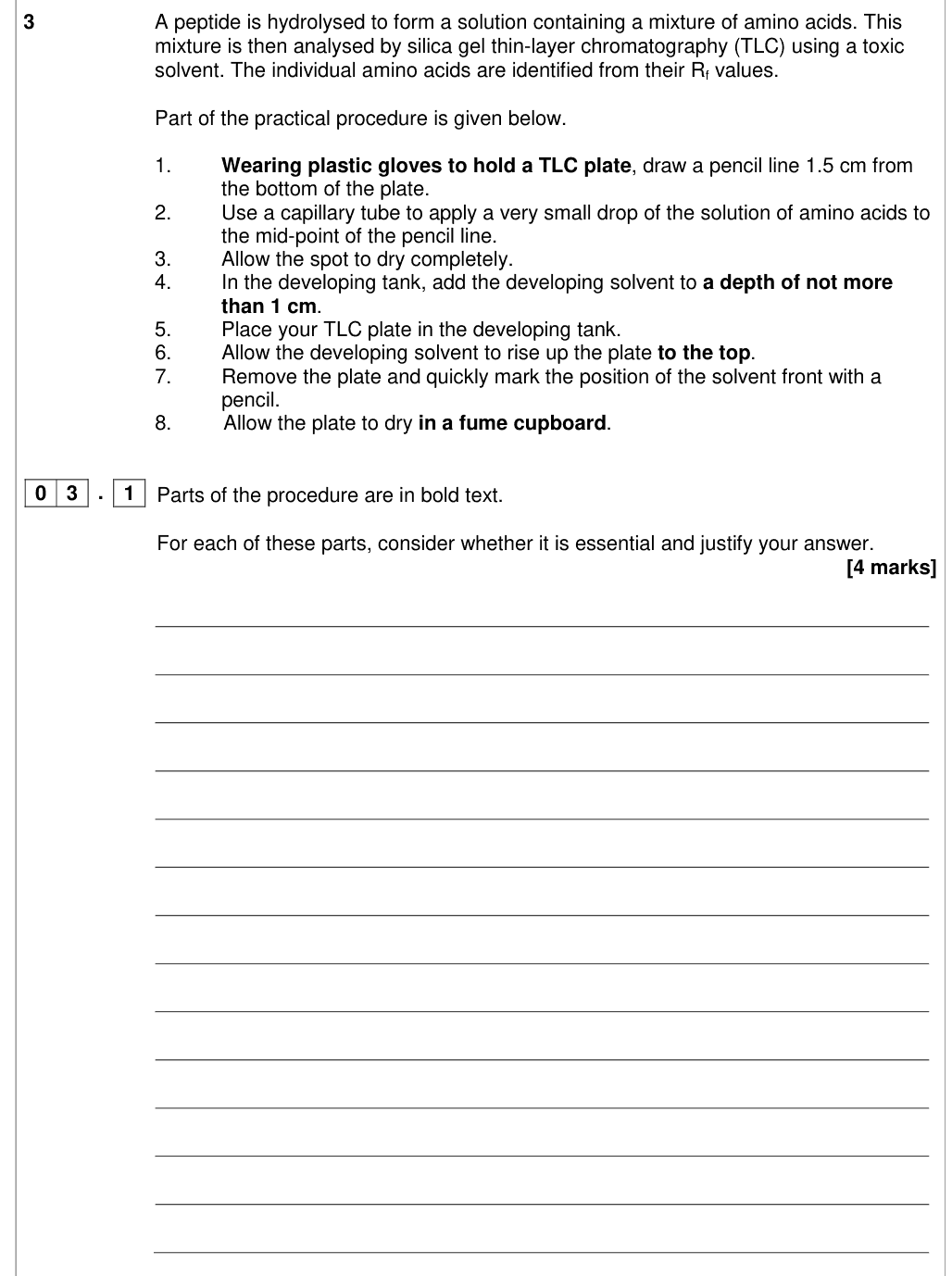
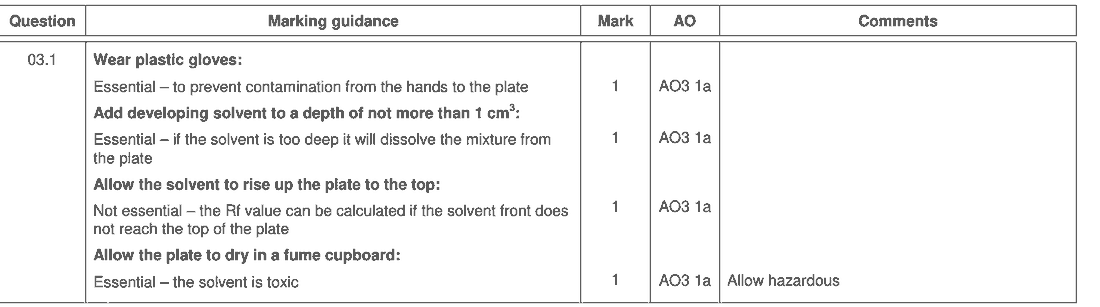
03.1 Chromatography 4Practical and data analysis
03.2 Amino acids, proteins and DNA, Chromatography 4Practical and data analysis
03.3 Chromatography 2Explanation
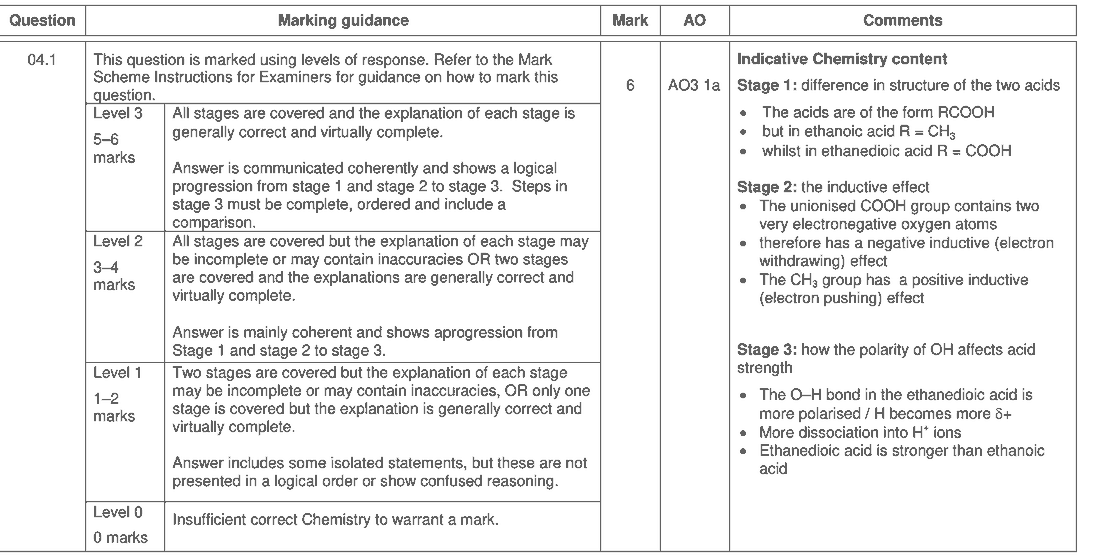
04.1 Acids and bases: pH, Ka, titration curves and buffers, Bonding 6AO3=6Level of response
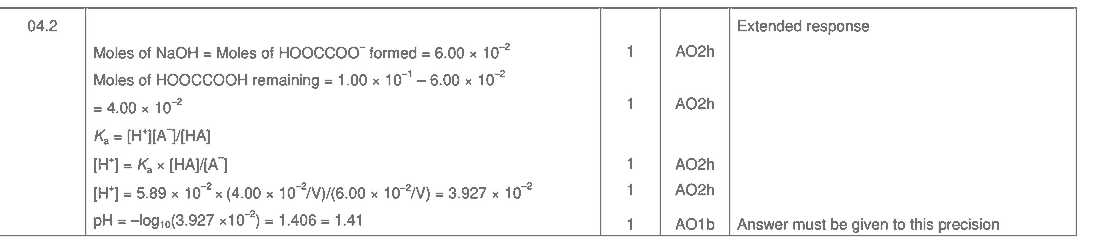
04.2 Acids and bases: pH, Ka, titration curves and buffers 5Calculation
04.3 Transition metals, Oxidation, reduction and redox equations 4Calculation
05.1 Carboxylic acids and derivatives, Atomic structure 2Short answer
05.2 Atomic structure 4Explanation
06 Atomic structure 1AO3=1Multiple choice
07 Amount of substance 1AO2=1Multiple choice
08 Amount of substance 1AO2=1Multiple choice
09 Amount of substance 1AO2=1Multiple choice
10 Rate equations 1AO2=1Multiple choice
11 Chemical equilibria, Le Chatelier's principle and Kc 1AO2=1Multiple choice
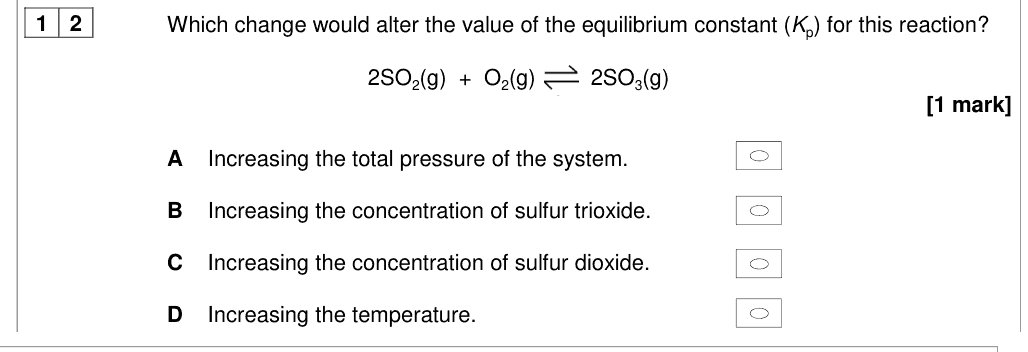
12 Equilibrium constant Kp 1AO1=1Multiple choice
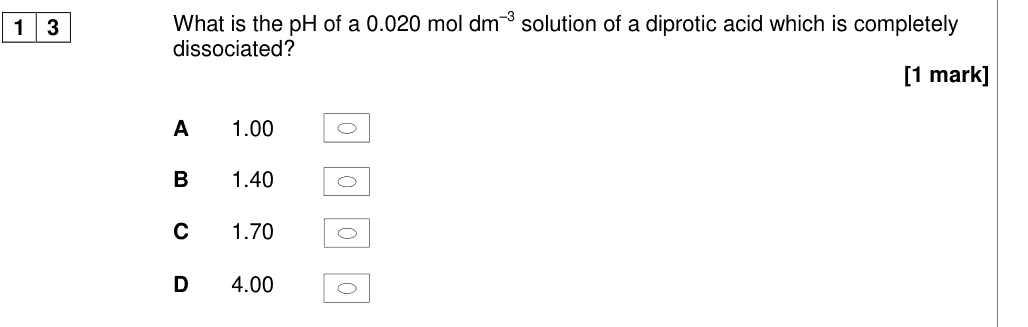
13 Acids and bases: pH, Ka, titration curves and buffers 1AO2=1Multiple choice
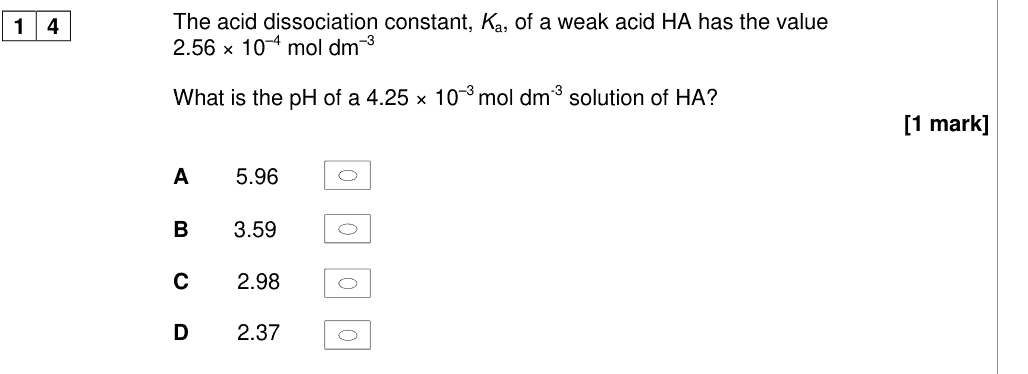
14 Acids and bases: pH, Ka, titration curves and buffers 1AO2=1Multiple choice
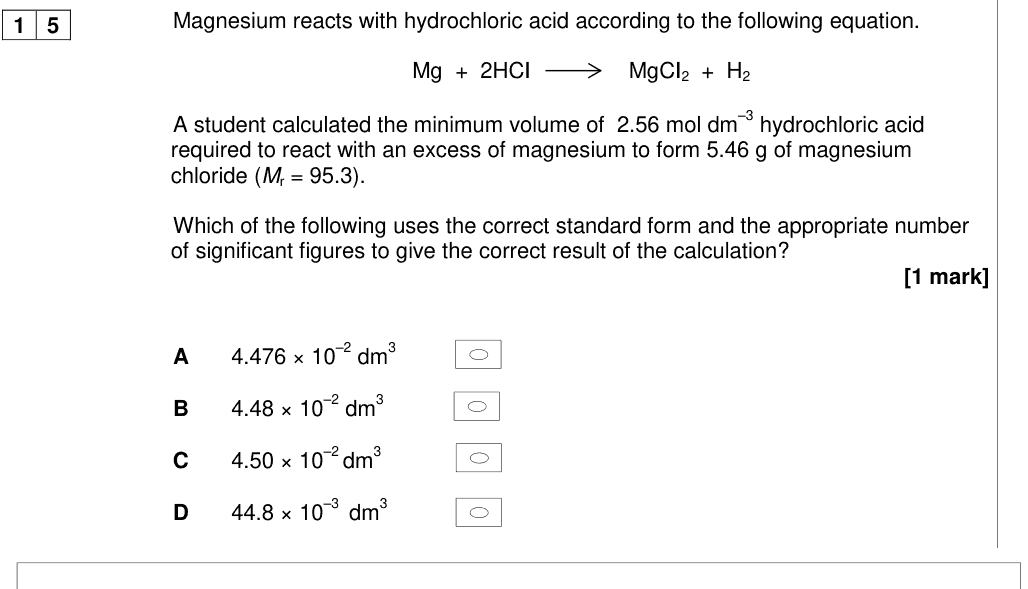
15 Amount of substance 1AO1=1Multiple choice
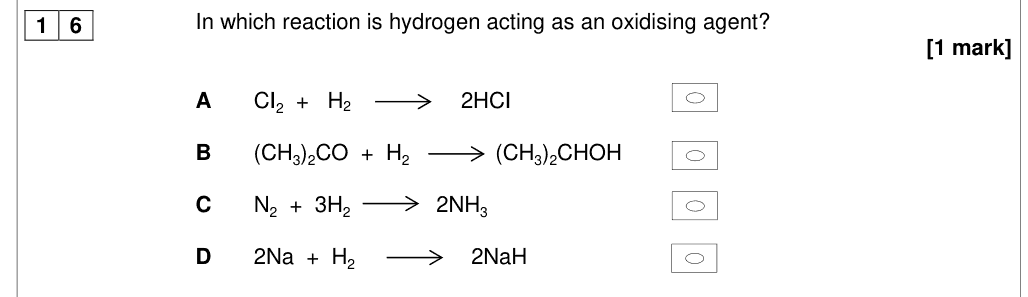
16 Oxidation, reduction and redox equations 1AO2=1Multiple choice
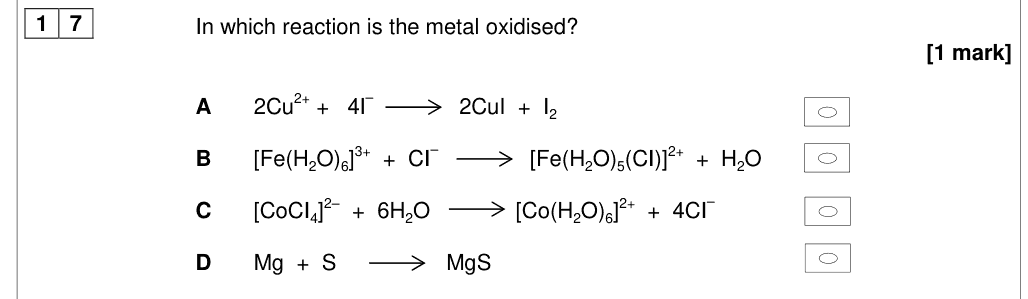
17 Oxidation, reduction and redox equations 1AO2=1Multiple choice
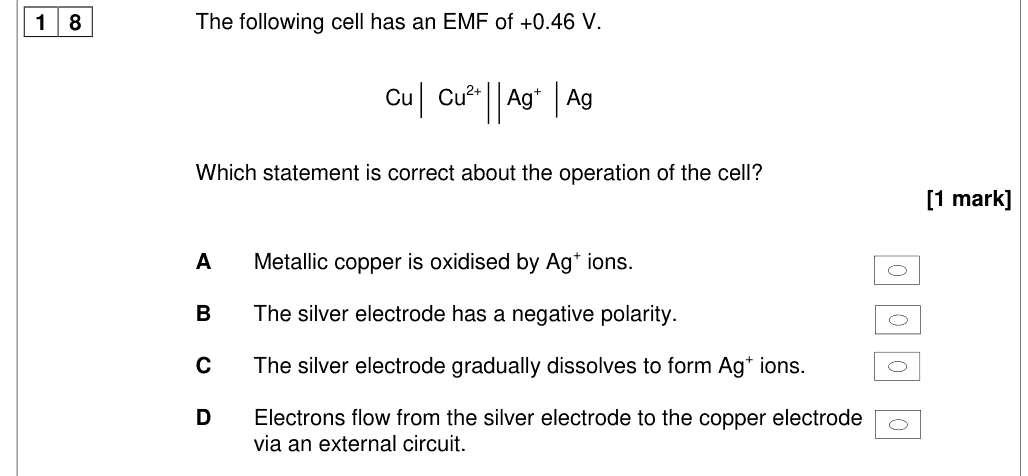
18 Electrode potentials and electrochemical cells 1AO3=1Multiple choice
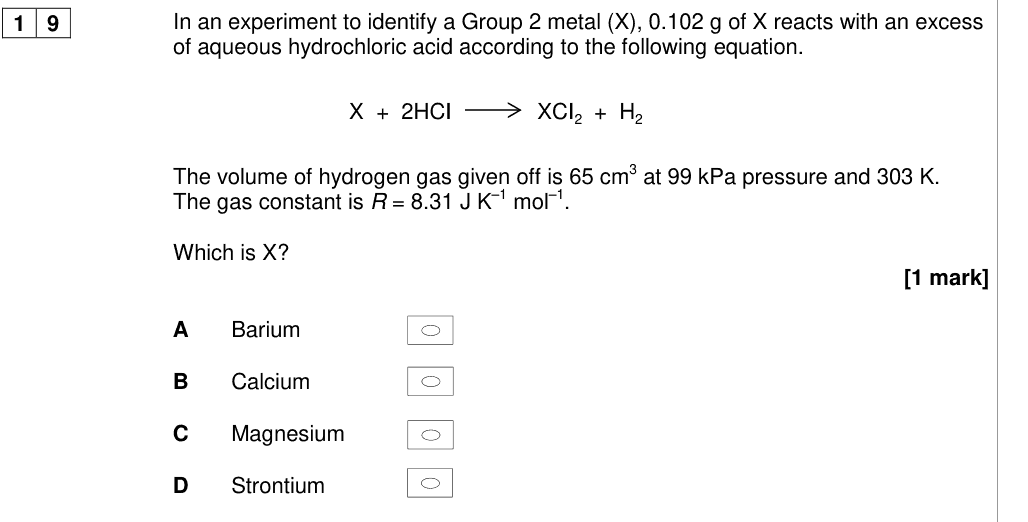
19 Amount of substance 1AO3=1Multiple choice
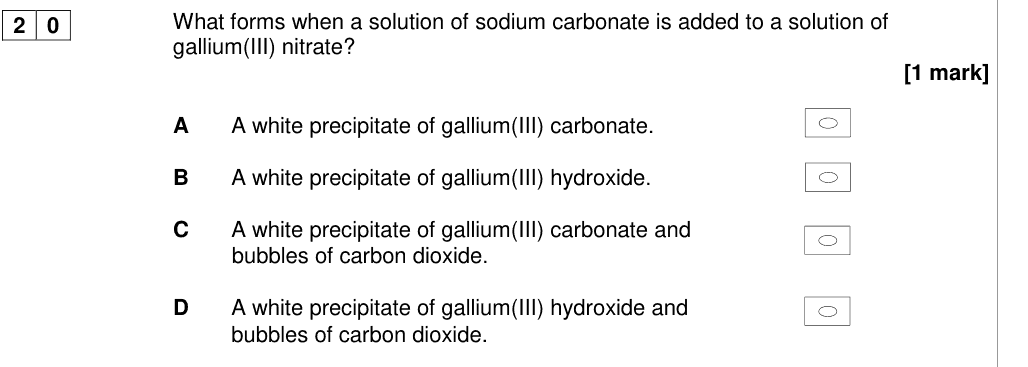
20 Reactions of ions in aqueous solution 1AO3=1Multiple choice
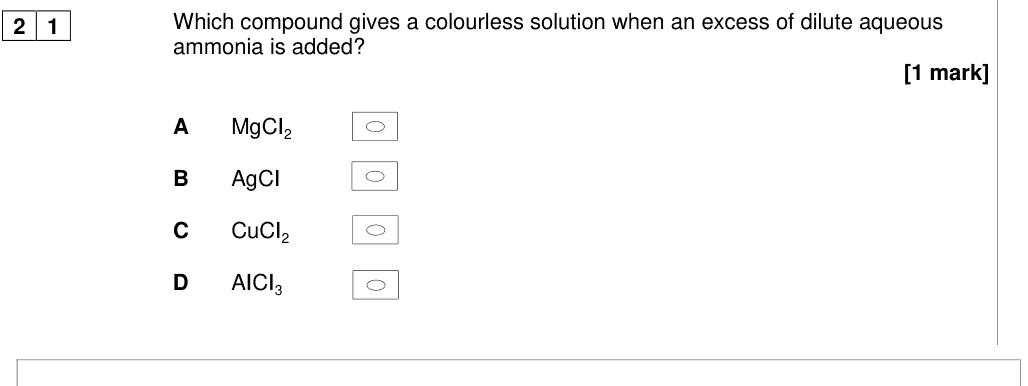
21 Group 7(17), the halogens, Transition metals 1AO1=1Multiple choice
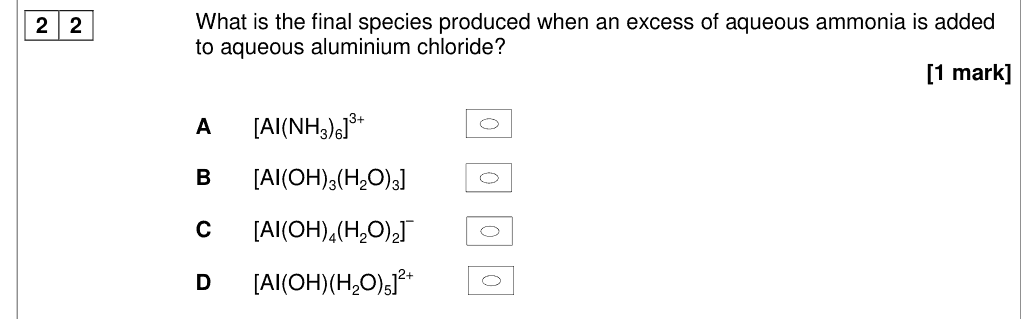
22 Reactions of ions in aqueous solution 1AO1=1Multiple choice
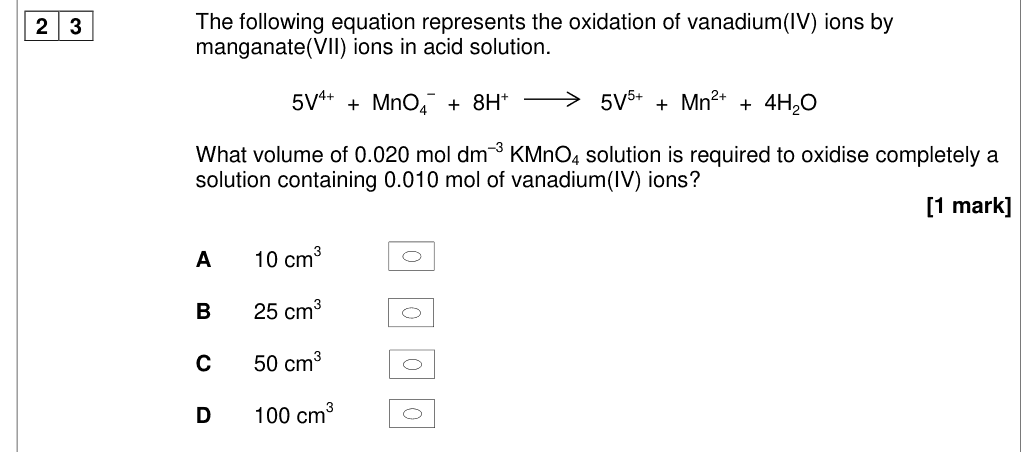
23 Transition metals, Amount of substance 1AO2=1Multiple choice
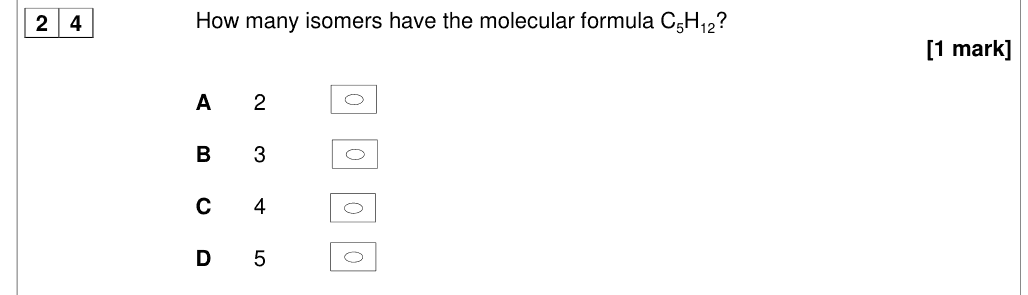
24 Introduction to organic chemistry: nomenclature, mechanisms and isomerism 1AO1=1Multiple choice
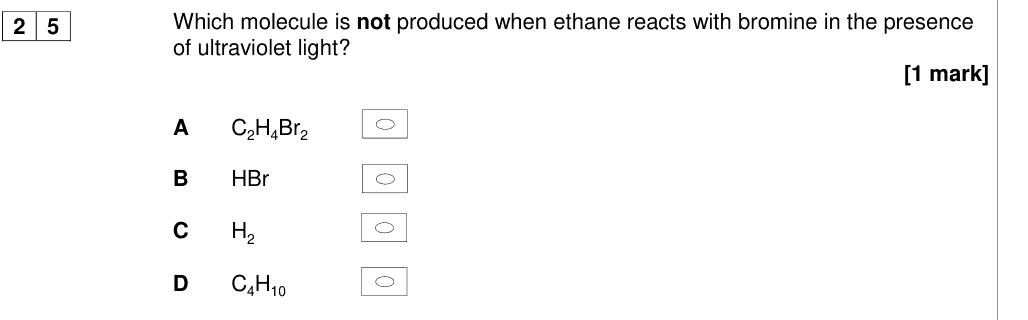
25 Alkanes 1AO1=1Multiple choice
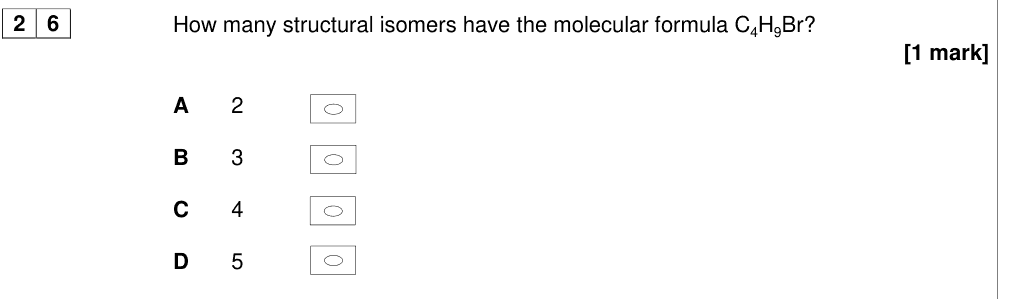
26 Introduction to organic chemistry: nomenclature, mechanisms and isomerism 1AO1=1Multiple choice
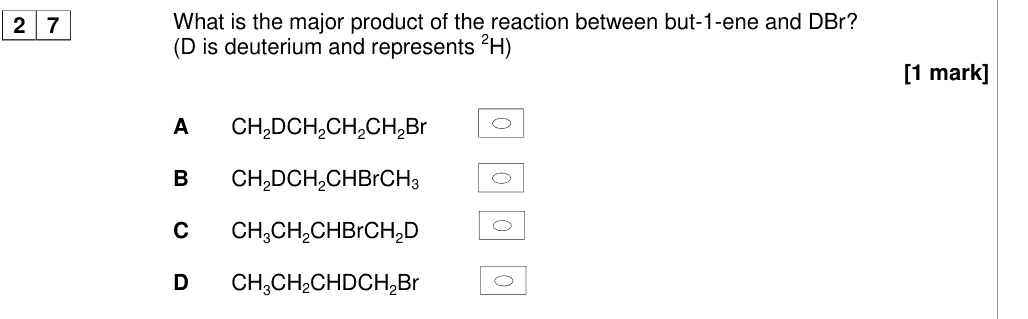
27 Alkenes 1AO3=1Multiple choice
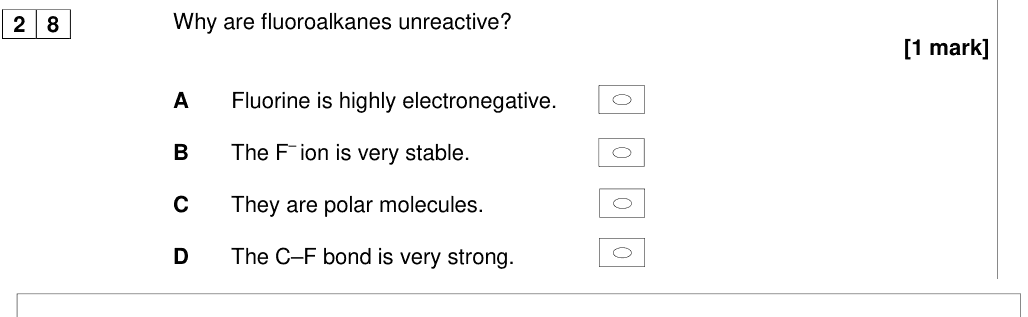
28 Halogenoalkanes 1AO1=1Multiple choice
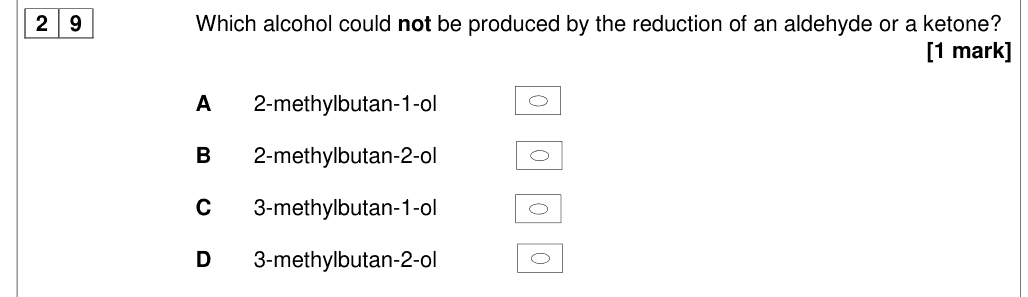
29 Aldehydes and ketones, Alcohols 1AO3=1Multiple choice
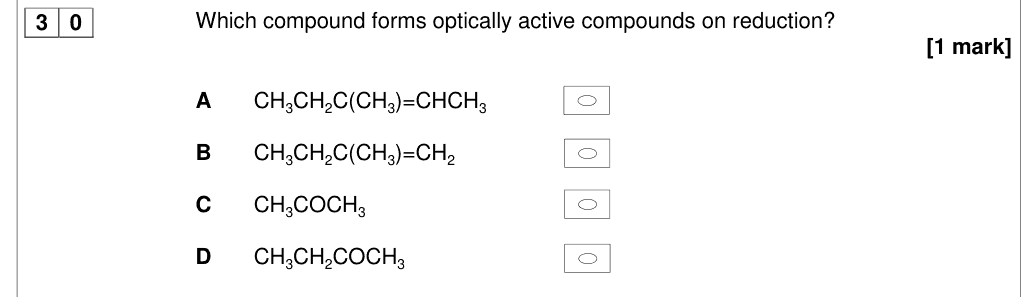
30 Optical isomerism, Aldehydes and ketones 1AO3=1Multiple choice
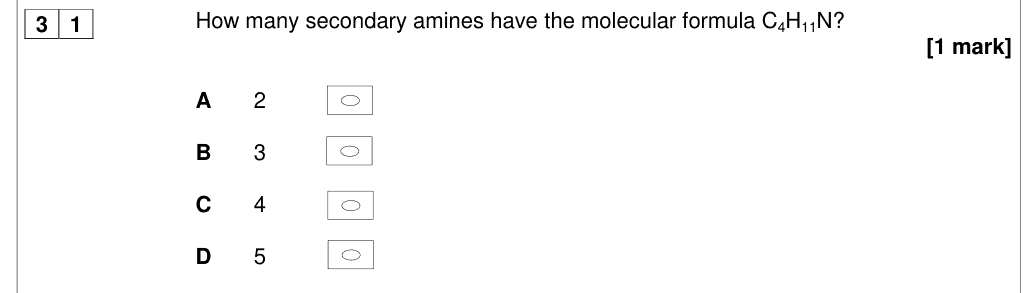
31 Introduction to organic chemistry: nomenclature, mechanisms and isomerism 1AO1=1Multiple choice
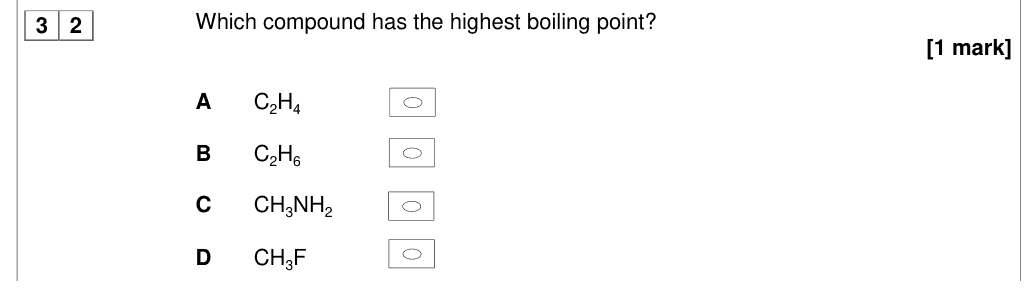
32 Bonding 1AO3=1Multiple choice
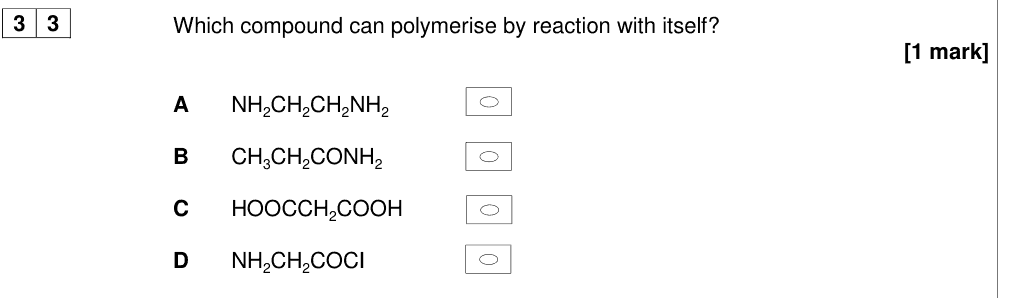
33 Polymers 1AO2=1Multiple choice
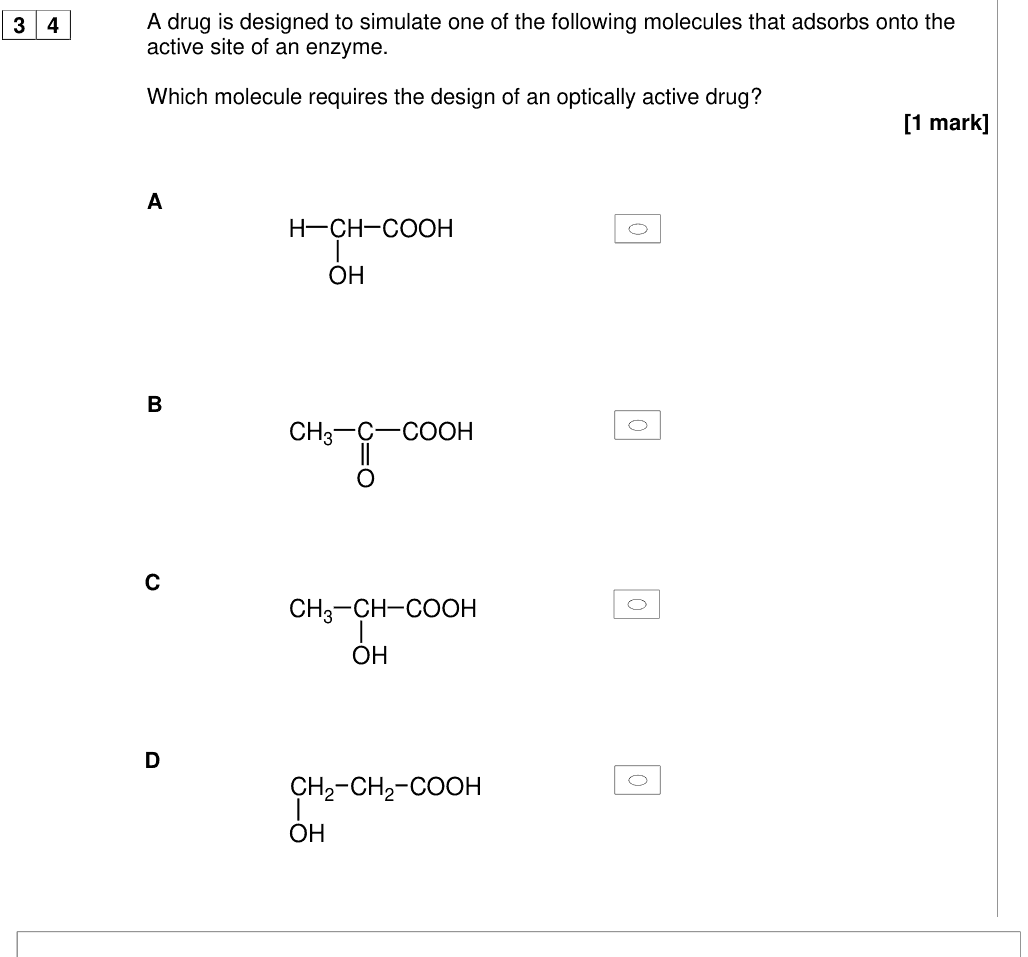
34 Amino acids, proteins and DNA, Optical isomerism 1AO3=1Multiple choice
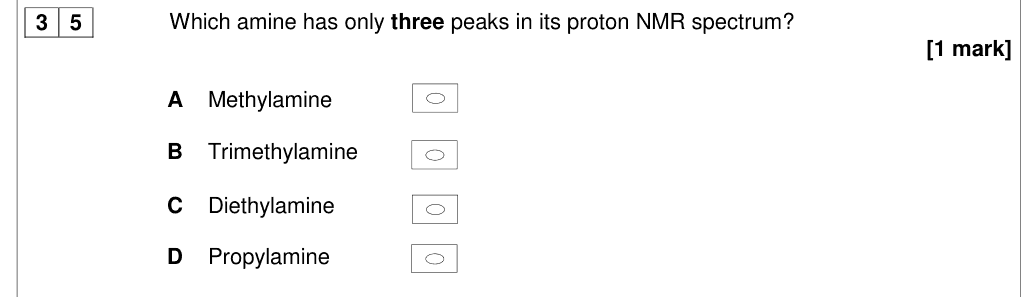
35 Nuclear magnetic resonance spectroscopy 1AO1=1Multiple choice

The questions

01.101.201.301.401.502.102.202.302.402.502.603.103.203.304.104.204.305.105.2060708091011121314151617181920212223242526272829303132333435
Specimen · Paper 3 · Q01.1 3 marks Practical and data analysis alcohols
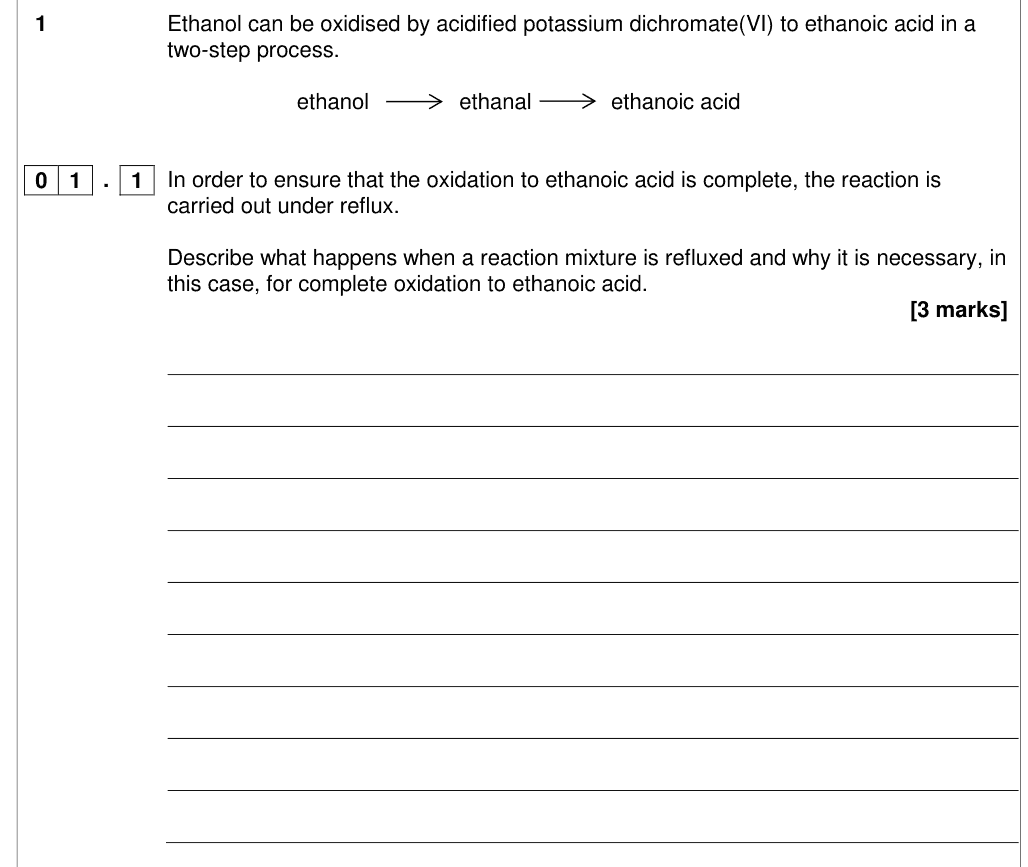
Ethanol can be oxidised by acidified potassium dichromate(VI) to ethanoic acid in a
two-step process.
ethanol
ethanal             ethanoic acid
In order to ensure that the oxidation to ethanoic acid is complete, the reaction is
carried out under reflux.
Describe what happens when a reaction mixture is refluxed and why it is necessary, in
this case, for complete oxidation to ethanoic acid.
[3 marks]
Specimen · Paper 3 · Q01.2 1 mark AO2=1 Equation writing redox
Earlier part of question 01 that this part usesEarlier part of Specimen Paper 3 question 01
Write a half-equation for the overall oxidation of ethanol into ethanoic acid.
[1 mark]
Specimen · Paper 3 · Q01.3 5 marks Practical and data analysis alcohols
Earlier part of question 01 that this part usesEarlier part of Specimen Paper 3 question 01
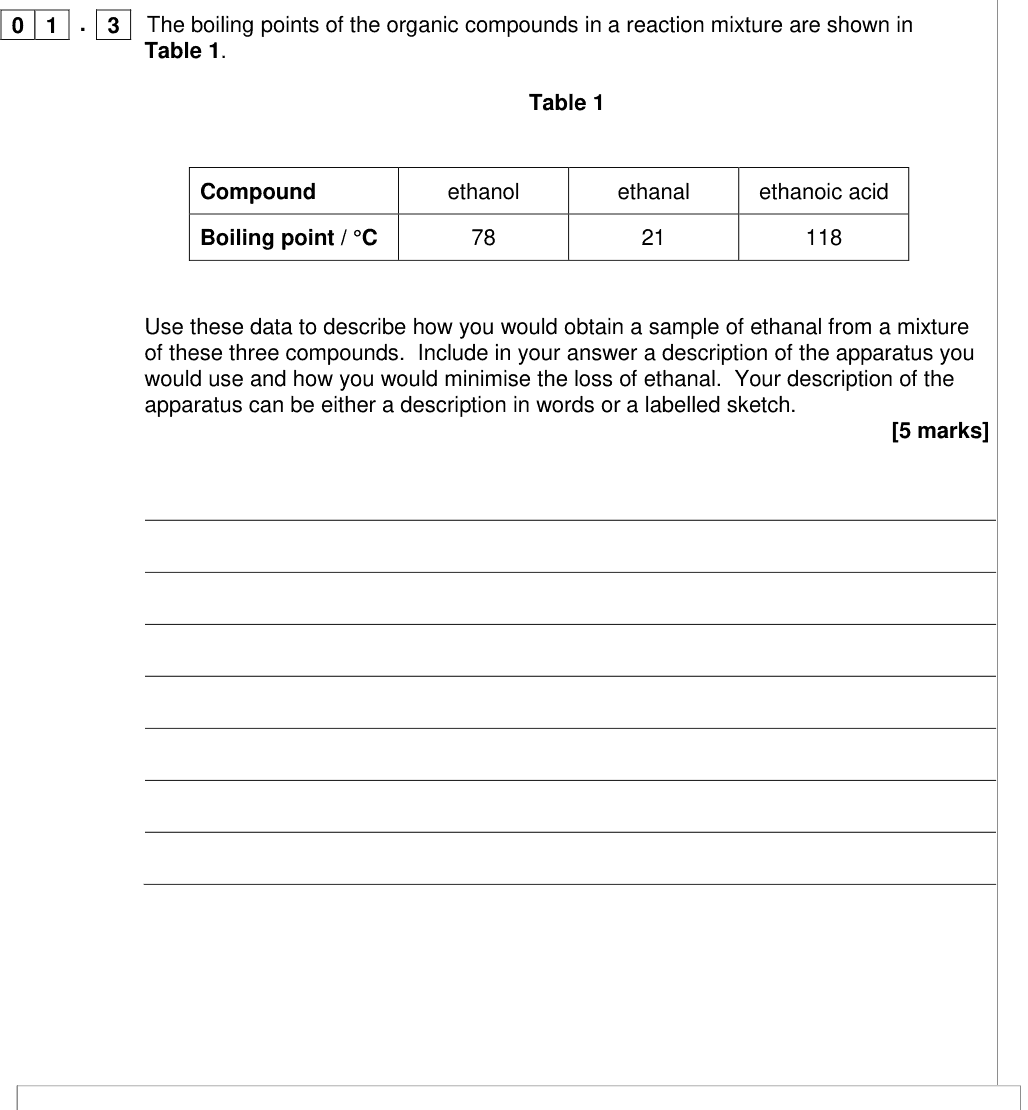
The boiling points of the organic compounds in a reaction mixture are shown in
Table 1.
Table 1
Compound
ethanol
ethanal
ethanoic acid
Boiling point / °C
78
21
118
Use these data to describe how you would obtain a sample of ethanal from a mixture
of these three compounds.  Include in your answer a description of the apparatus you
would use and how you would minimise the loss of ethanal.  Your description of the
apparatus can be either a description in words or a labelled sketch.
[5 marks]
Specimen · Paper 3 · Q01.4 2 marks Explanation bonding
Earlier part of question 01 that this part usesEarlier part of Specimen Paper 3 question 01
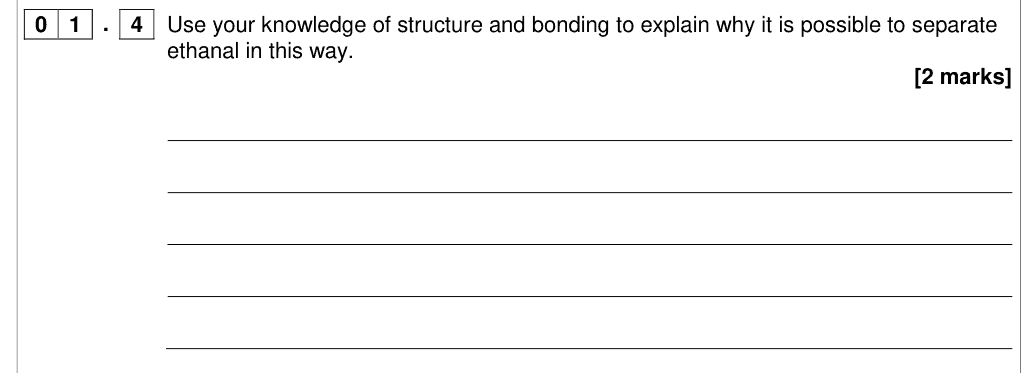
Use your knowledge of structure and bonding to explain why it is possible to separate
ethanal in this way.
[2 marks]
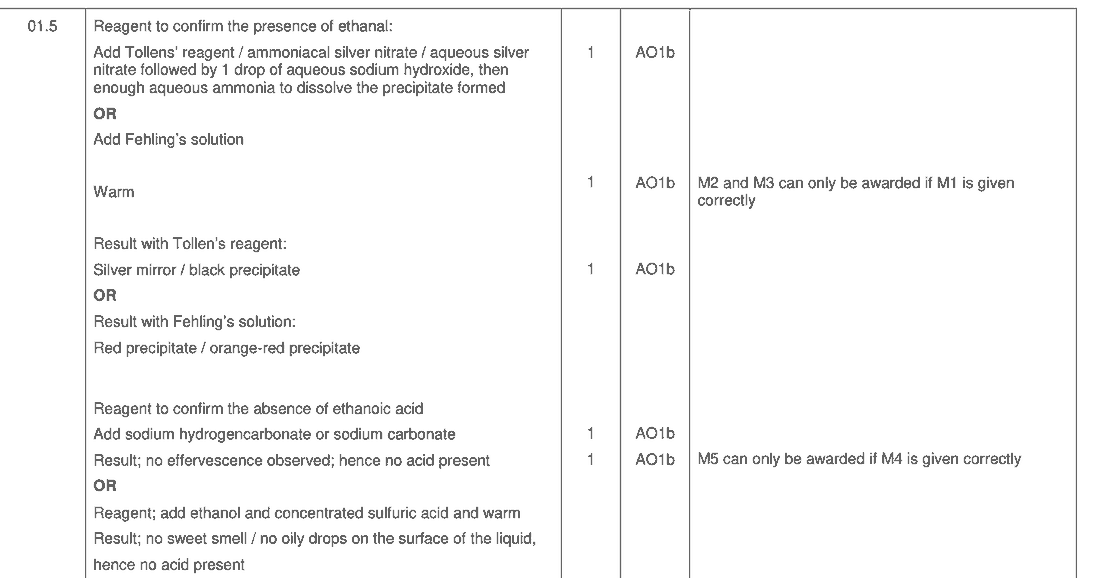
Specimen · Paper 3 · Q01.5 5 marks Practical and data analysis aldehydes and ketonescarboxylic acids and derivativesorganic analysis
Earlier part of question 01 that this part usesEarlier part of Specimen Paper 3 question 01
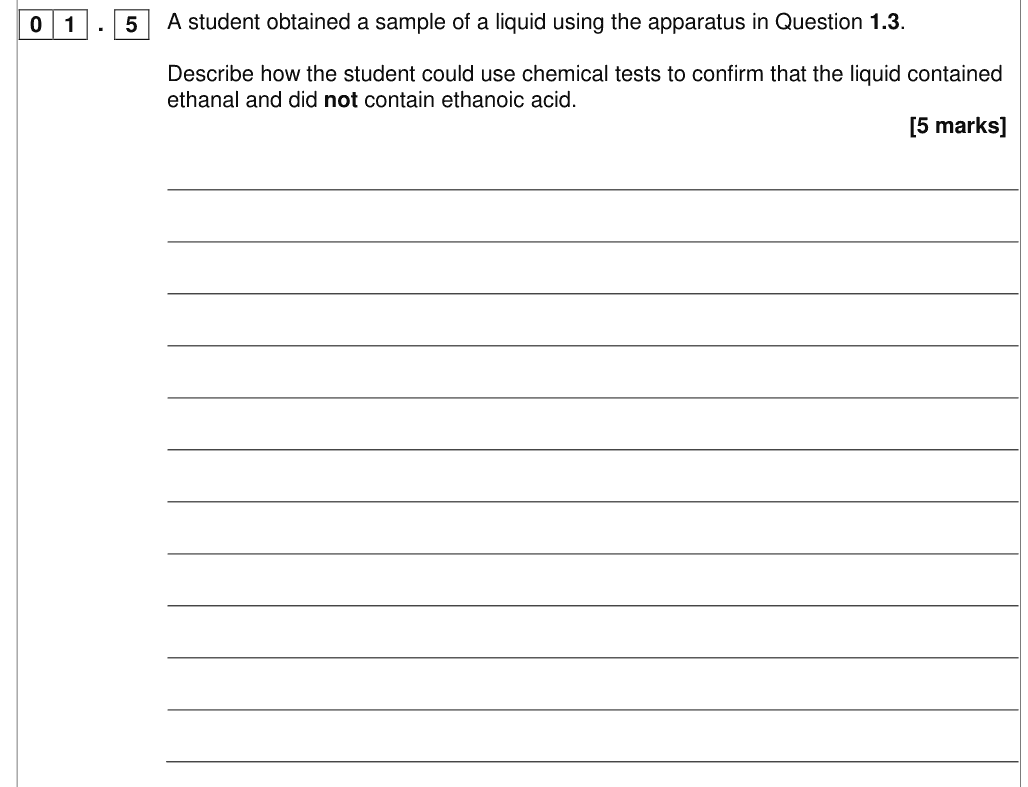
A student obtained a sample of a liquid using the apparatus in Question 1.3.
Describe how the student could use chemical tests to confirm that the liquid contained
ethanal and did not contain ethanoic acid.
[5 marks]
Specimen · Paper 3 · Q02.1 6 marks Calculation chemical equilibria and kcamount of substance
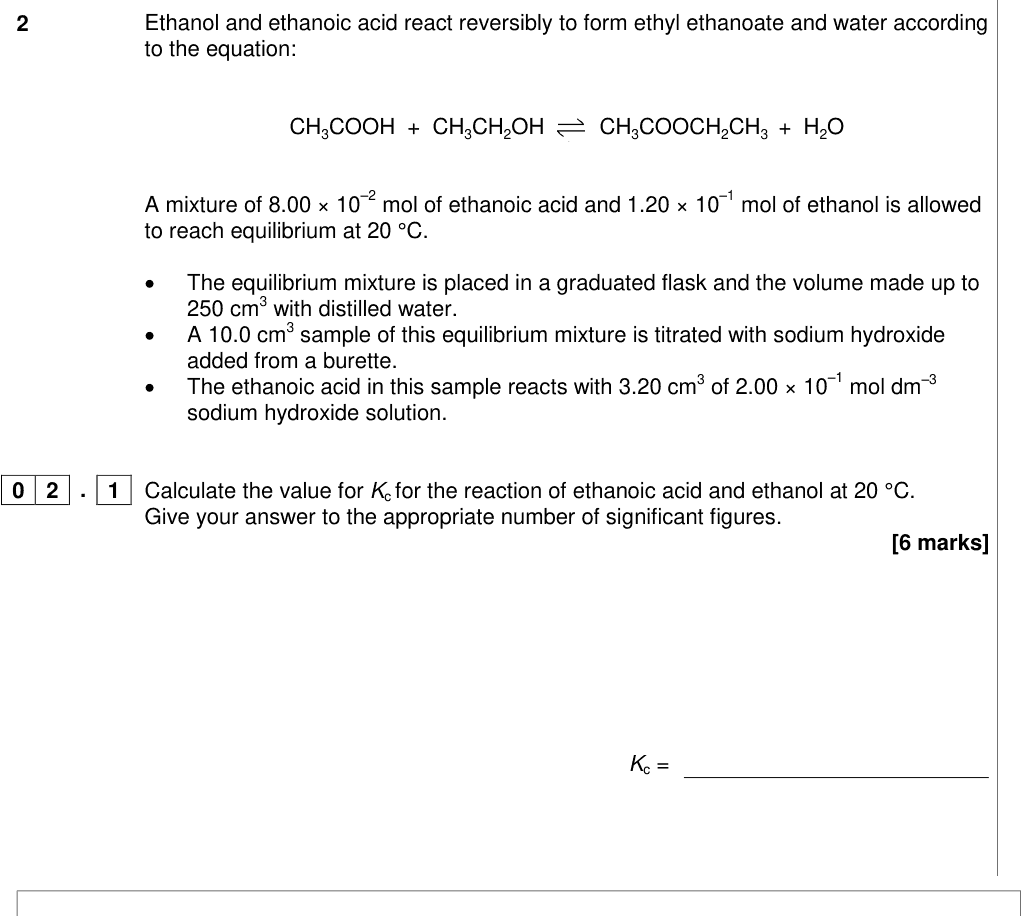
Ethanol and ethanoic acid react reversibly to form ethyl ethanoate and water according
to the equation:
CH3COOH  +  CH3CH2OH         CH3COOCH2CH3  +  H2O
A mixture of 8.00 × 10
–2 mol of ethanoic acid and 1.20 × 10
–1 mol of ethanol is allowed
to reach equilibrium at 20 °C.
•
The equilibrium mixture is placed in a graduated flask and the volume made up to
250 cm3 with distilled water.
•
A 10.0 cm3 sample of this equilibrium mixture is titrated with sodium hydroxide
added from a burette.
•
The ethanoic acid in this sample reacts with 3.20 cm3 of 2.00 × 10
–1 mol dm–3
sodium hydroxide solution.
Calculate the value for Kc for the reaction of ethanoic acid and ethanol at 20 °C.
Give your answer to the appropriate number of significant figures.
[6 marks]
Kc =
Specimen · Paper 3 · Q02.2 1 mark Practical and data analysis amount of substance
Earlier part of question 02 that this part usesEarlier part of Specimen Paper 3 question 02
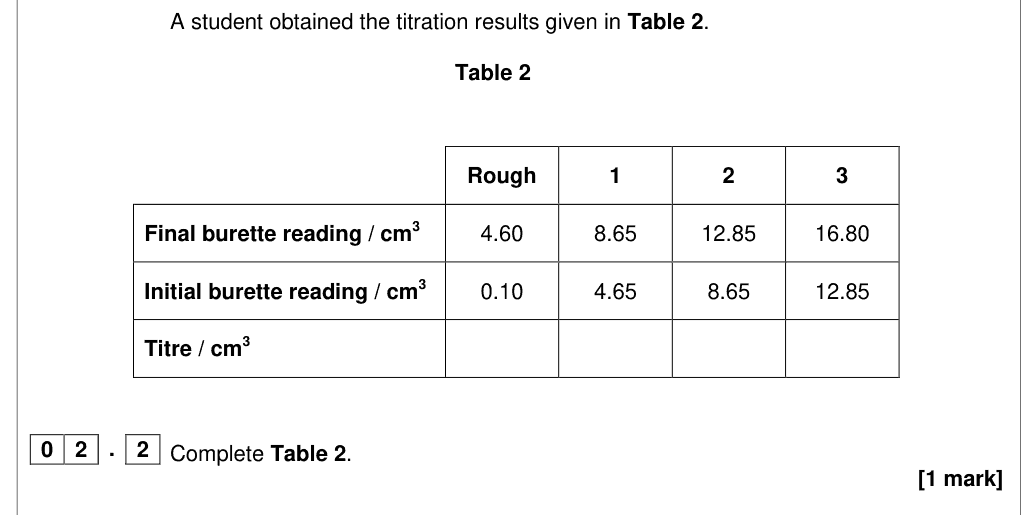
A student obtained the titration results given in Table 2.
Table 2
Complete Table 2.
[1 mark]
Rough
1
2
3
Final burette reading / cm3
4.60
8.65
12.85
16.80
Initial burette reading / cm3
0.10
4.65
8.65
12.85
Titre / cm3
Specimen · Paper 3 · Q02.3 2 marks Practical and data analysis amount of substance
Earlier part of question 02 that this part usesEarlier part of Specimen Paper 3 question 02
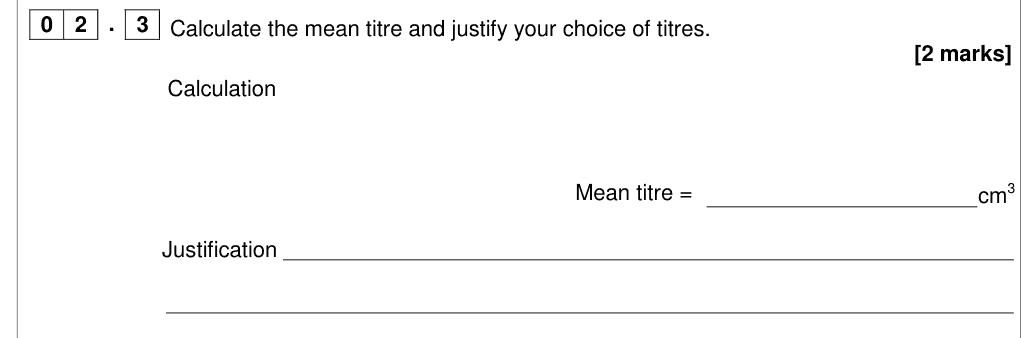
Calculate the mean titre and justify your choice of titres.
[2 marks]
Mean titre =
cm3
Calculation
Justification
Specimen · Paper 3 · Q02.4 1 mark Short answer acids and bases
Earlier parts of question 02 that this part usesEarlier part of Specimen Paper 3 question 02Earlier part of Specimen Paper 3 question 02
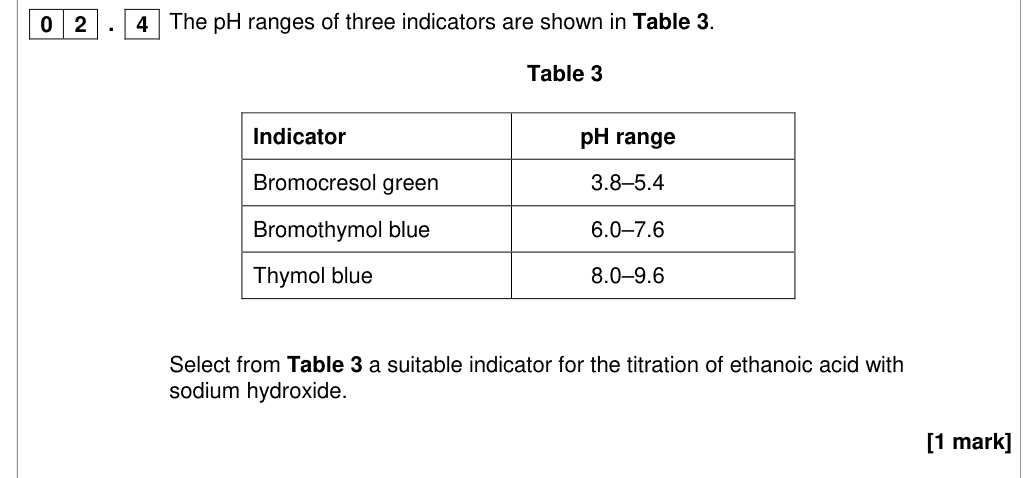
The pH ranges of three indicators are shown in Table 3.
Table 3
Indicator
pH range
Bromocresol green
3.8–5.4
Bromothymol blue
6.0–7.6
Thymol blue
8.0–9.6
Select from Table 3 a suitable indicator for the titration of ethanoic acid with
sodium hydroxide.
[1 mark]
Specimen · Paper 3 · Q02.5 1 mark Calculation amount of substance
Earlier parts of question 02 that this part usesEarlier part of Specimen Paper 3 question 02Earlier part of Specimen Paper 3 question 02
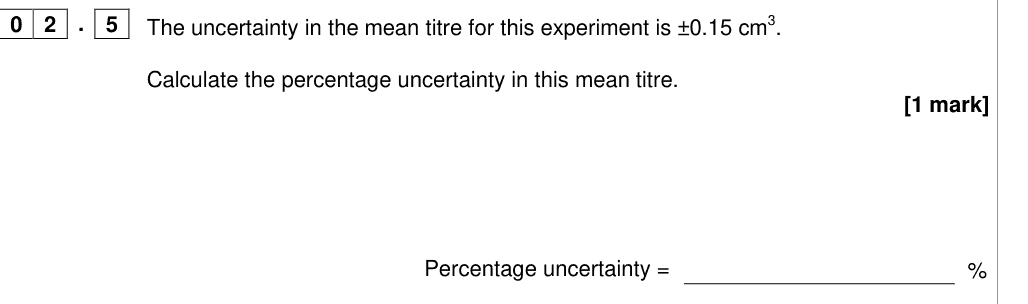
The uncertainty in the mean titre for this experiment is ±0.15 cm3.
Calculate the percentage uncertainty in this mean titre.
[1 mark]
Percentage uncertainty =
%
Specimen · Paper 3 · Q02.6 2 marks Practical and data analysis amount of substance
Earlier parts of question 02 that this part usesEarlier part of Specimen Paper 3 question 02Earlier part of Specimen Paper 3 question 02
Suggest how, using the same mass of ethanoic acid, the experiment could be
improved to reduce the percentage uncertainty.
[2 marks]
Specimen · Paper 3 · Q03.1 4 marks Practical and data analysis chromatography
A peptide is hydrolysed to form a solution containing a mixture of amino acids. This
mixture is then analysed by silica gel thin-layer chromatography (TLC) using a toxic
solvent. The individual amino acids are identified from their Rf values.
Part of the practical procedure is given below.
1.
Wearing plastic gloves to hold a TLC plate, draw a pencil line 1.5 cm from
the bottom of the plate.
2.
Use a capillary tube to apply a very small drop of the solution of amino acids to
the mid-point of the pencil line.
3.
Allow the spot to dry completely.
4.
In the developing tank, add the developing solvent to a depth of not more
than 1 cm.
5.
Place your TLC plate in the developing tank.
6.
Allow the developing solvent to rise up the plate to the top.
7.
Remove the plate and quickly mark the position of the solvent front with a
pencil.
8.
Allow the plate to dry in a fume cupboard.
Parts of the procedure are in bold text.
For each of these parts, consider whether it is essential and justify your answer.
[4 marks]
Specimen · Paper 3 · Q03.2 4 marks Practical and data analysis amino acids proteins and dnachromatography
Earlier part of question 03 that this part usesEarlier part of Specimen Paper 3 question 03
Outline the steps needed to locate the positions of the amino acids on the TLC plate
and to determine their Rf values.
[4 marks]
Specimen · Paper 3 · Q03.3 2 marks Explanation chromatography
Earlier part of question 03 that this part usesEarlier part of Specimen Paper 3 question 03
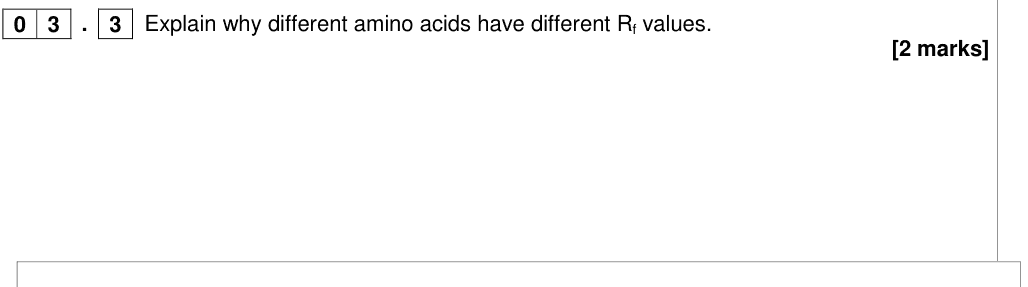
Explain why different amino acids have different Rf values.
[2 marks]
Specimen · Paper 3 · Q04.1 6 marks AO3=6 6-mark level of response acids and basesbonding
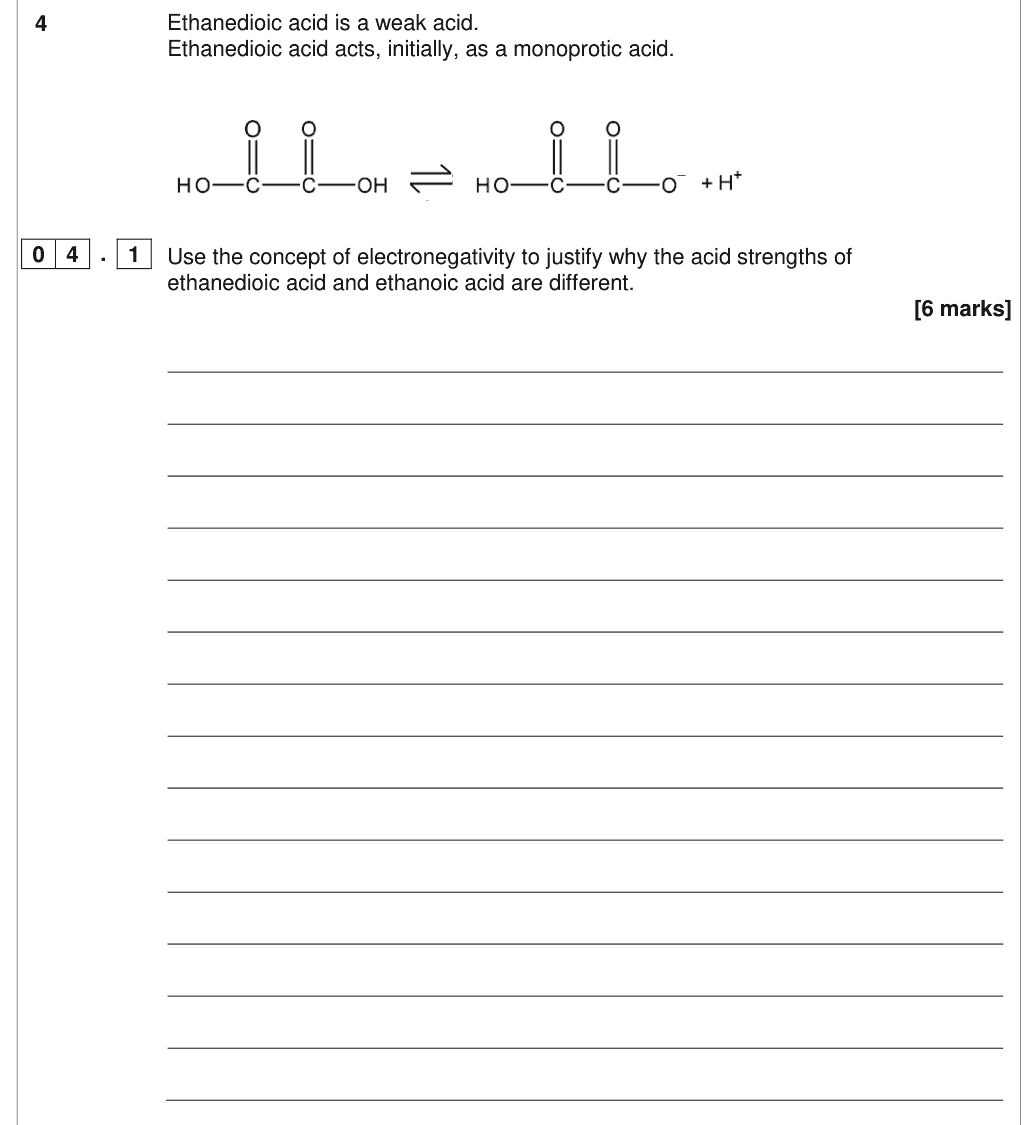
Ethanedioic acid is a weak acid.
Ethanedioic acid acts, initially, as a monoprotic acid.
Use the concept of electronegativity to justify why the acid strengths of
ethanedioic acid and ethanoic acid are different.
[6 marks]
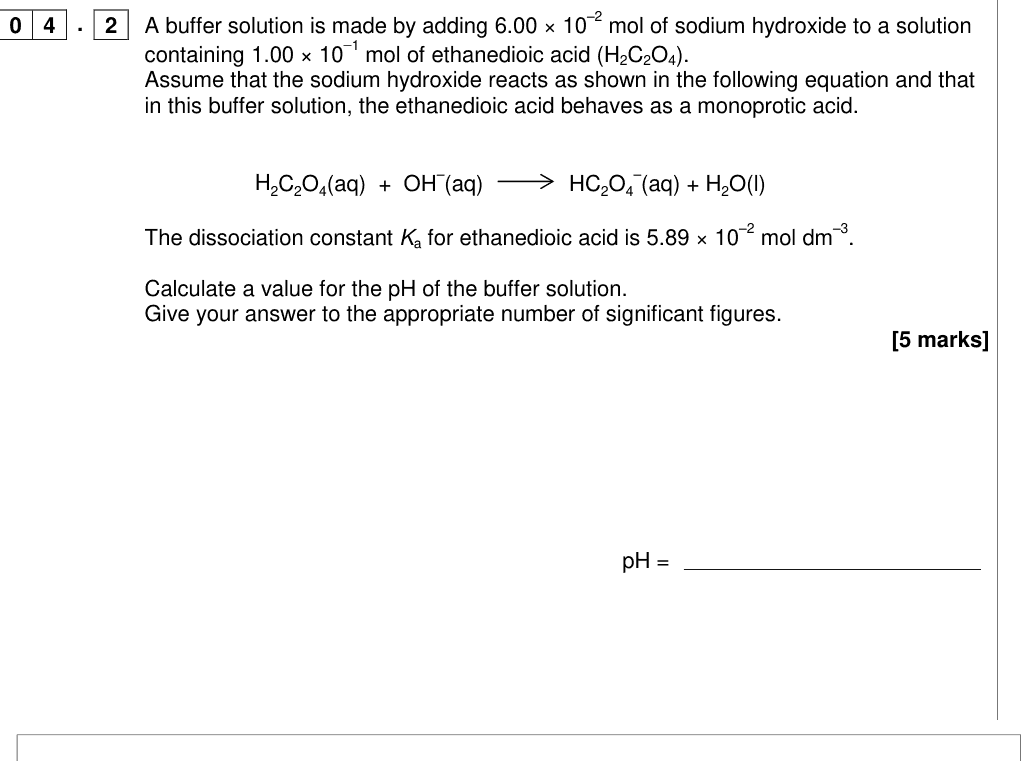
–
Specimen · Paper 3 · Q04.2 5 marks Calculation acids and bases
Earlier part of question 04 that this part usesEarlier part of Specimen Paper 3 question 04
A buffer solution is made by adding 6.00 × 10
–2 mol of sodium hydroxide to a solution
containing 1.00 × 10
–1 mol of ethanedioic acid (H2C2O4).
Assume that the sodium hydroxide reacts as shown in the following equation and that
in this buffer solution, the ethanedioic acid behaves as a monoprotic acid.
H2C2O4(aq)  +  OH
–(aq)              HC2O4
–(aq) + H2O(l)
The dissociation constant Ka for ethanedioic acid is 5.89 × 10
–2 mol dm
–3.
Calculate a value for the pH of the buffer solution.
Give your answer to the appropriate number of significant figures.
[5 marks]
pH =
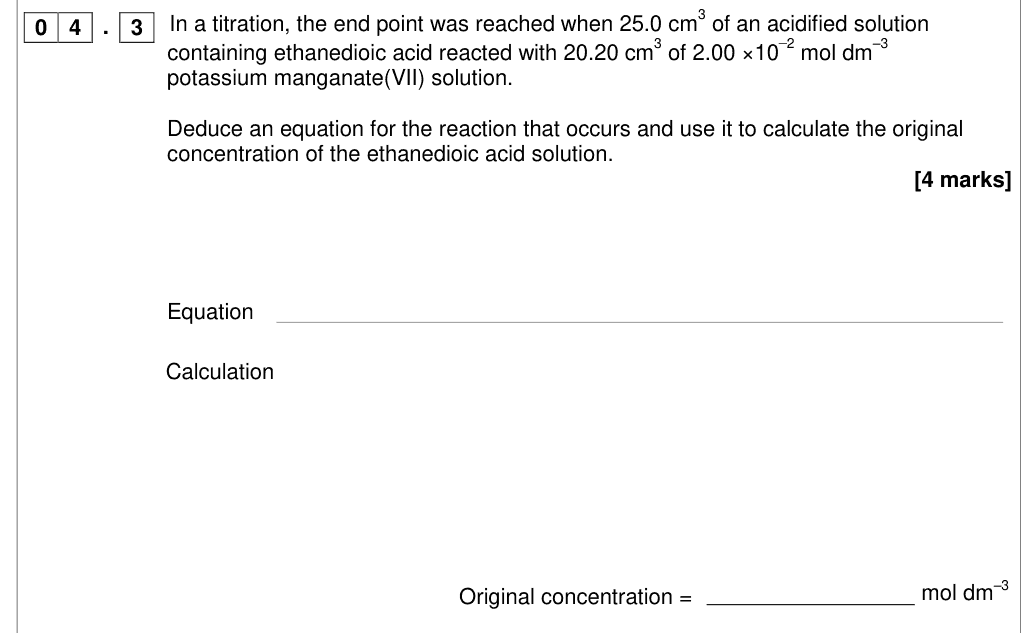
Specimen · Paper 3 · Q04.3 4 marks Calculation transition metalsredox
Earlier part of question 04 that this part usesEarlier part of Specimen Paper 3 question 04
In a titration, the end point was reached when 25.0 cm
3 of an acidified solution
containing ethanedioic acid reacted with 20.20 cm
3 of 2.00 ×10
–2 mol dm
–3
potassium manganate(VII) solution.
Deduce an equation for the reaction that occurs and use it to calculate the original
concentration of the ethanedioic acid solution.
[4 marks]
Original concentration =
Equation
Calculation
mol dm–3
Specimen · Paper 3 · Q05.1 2 marks Short answer carboxylic acids and derivativesatomic structure
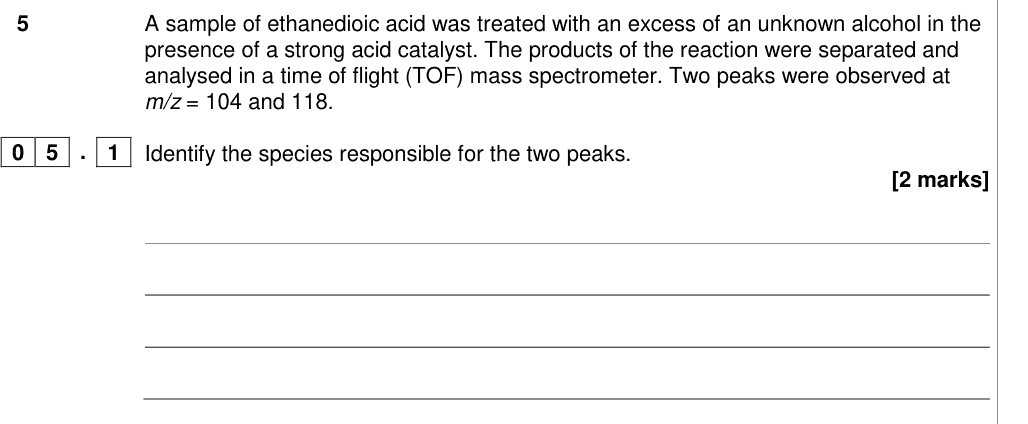
A sample of ethanedioic acid was treated with an excess of an unknown alcohol in the
presence of a strong acid catalyst. The products of the reaction were separated and
analysed in a time of flight (TOF) mass spectrometer. Two peaks were observed at
m/z = 104 and 118.
Identify the species responsible for the two peaks.
[2 marks]
Specimen · Paper 3 · Q05.2 4 marks Explanation atomic structure
Earlier part of question 05 that this part usesEarlier part of Specimen Paper 3 question 05
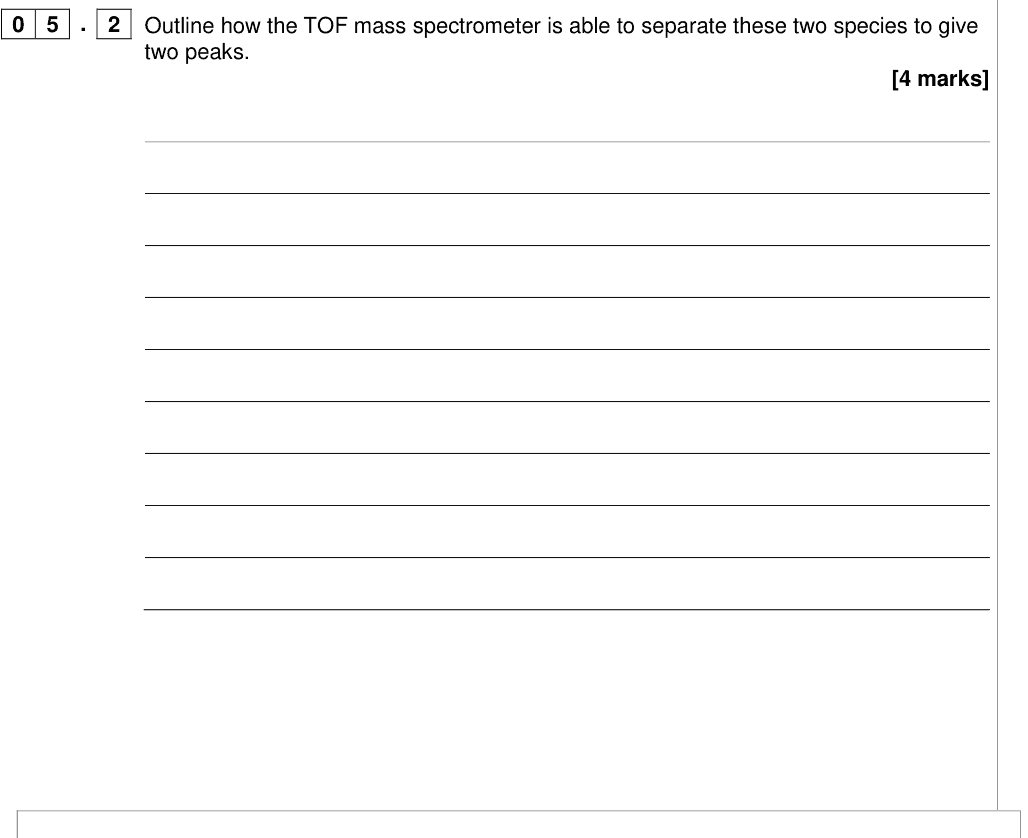
Outline how the TOF mass spectrometer is able to separate these two species to give
two peaks.
[4 marks]
Specimen · Paper 3 · Q06 1 mark AO3=1 Multiple choice atomic structure
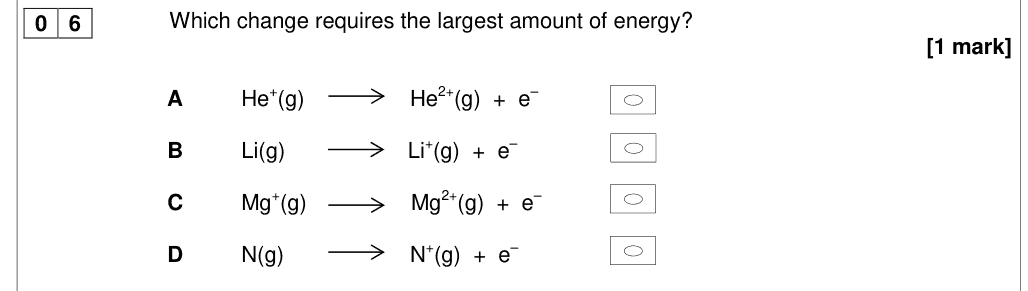
Which change requires the largest amount of energy?
[1 mark]
A
He+(g)
He2+(g)  +  e–
B
Li(g)                    Li+(g)  +  e–
C
Mg+(g)                 Mg2+(g)  +  e–
D
N(g)
N+(g)  +  e–
Specimen · Paper 3 · Q07 1 mark AO2=1 Multiple choice amount of substance
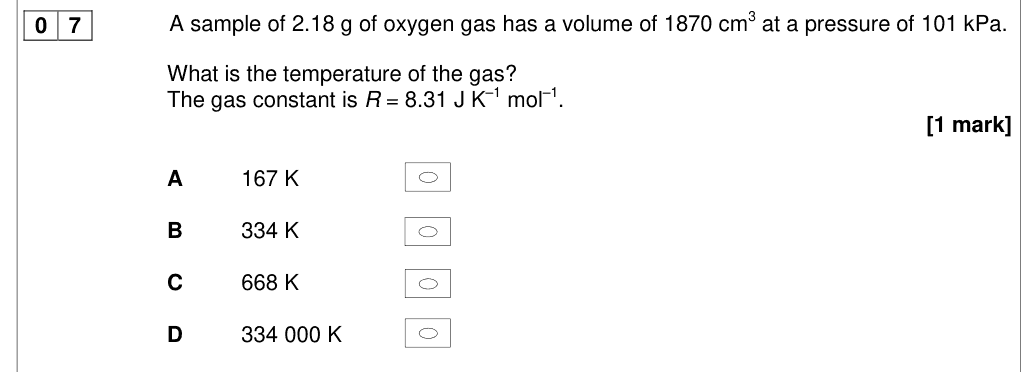
A sample of 2.18 g of oxygen gas has a volume of 1870 cm3 at a pressure of 101 kPa.
What is the temperature of the gas?
The gas constant is R = 8.31 J K–1 mol–1.
[1 mark]
A
167 K
B
334 K
C
668 K
D
334 000 K
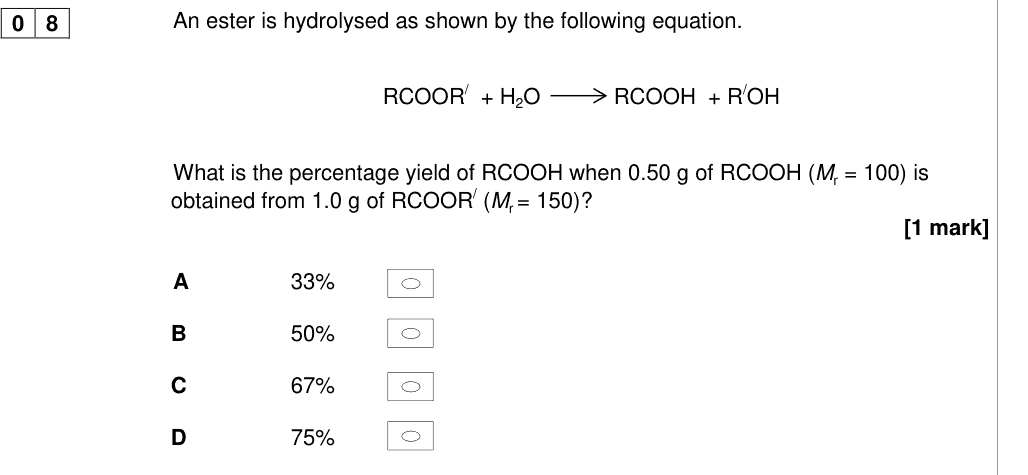
Specimen · Paper 3 · Q08 1 mark AO2=1 Multiple choice amount of substance
An ester is hydrolysed as shown by the following equation.
RCOOR/  + H2O            RCOOH  + R/OH
What is the percentage yield of RCOOH when 0.50 g of RCOOH (Mr = 100) is
obtained from 1.0 g of RCOOR/ (Mr = 150)?
[1 mark]
A
33%
B
50%
C
67%
D
75%
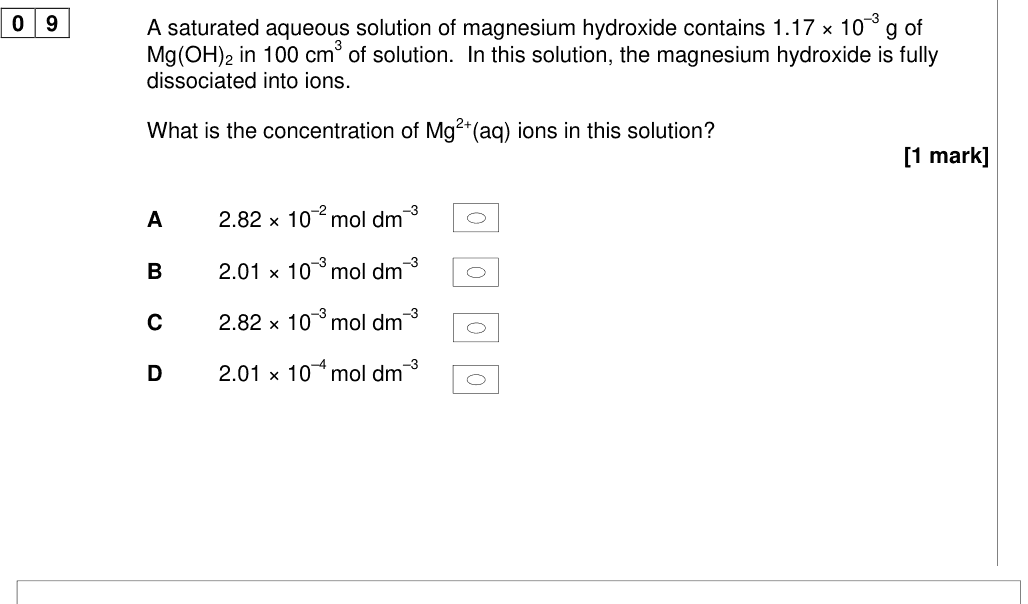
Specimen · Paper 3 · Q09 1 mark AO2=1 Multiple choice amount of substance
A saturated aqueous solution of magnesium hydroxide contains 1.17 × 10
–3 g of
Mg(OH)2 in 100 cm
3 of solution.  In this solution, the magnesium hydroxide is fully
dissociated into ions.
What is the concentration of Mg2+(aq) ions in this solution?
[1 mark]
A
2.82 × 10
–2 mol dm
–3
B
2.01 × 10
–3 mol dm
–3
C
2.82 × 10
–3 mol dm
–3
D
2.01 × 10
–4 mol dm
–3
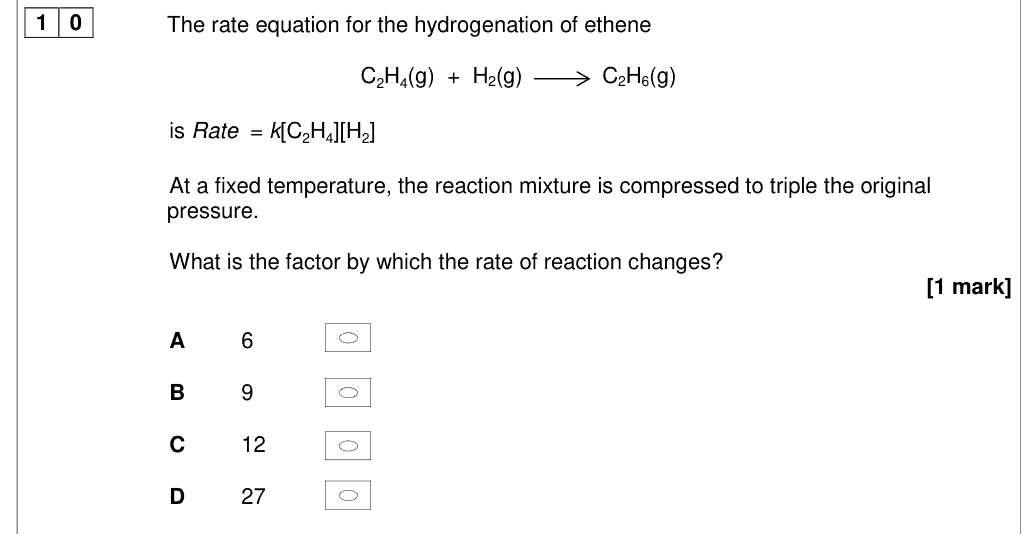
Specimen · Paper 3 · Q10 1 mark AO2=1 Multiple choice rate equations
The rate equation for the hydrogenation of ethene
C2H4(g)  +  H2(g)             C2H6(g)
is Rate  = k[C2H4][H2]
At a fixed temperature, the reaction mixture is compressed to triple the original
pressure.
What is the factor by which the rate of reaction changes?
[1 mark]
A
6
B
9
C
12
D
27
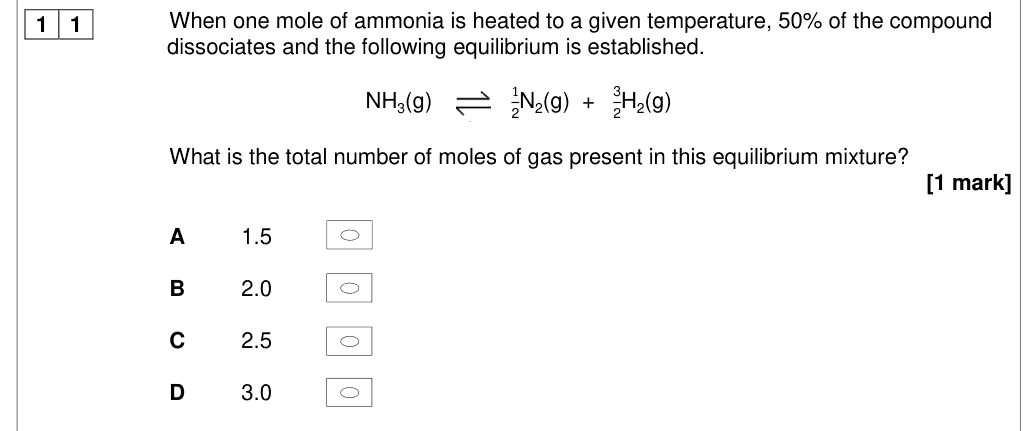
Specimen · Paper 3 · Q11 1 mark AO2=1 Multiple choice chemical equilibria and kc
When one mole of ammonia is heated to a given temperature, 50% of the compound
dissociates and the following equilibrium is established.
NH3(g)
1
2N2(g)  +
3
2H2(g)
What is the total number of moles of gas present in this equilibrium mixture?
[1 mark]
A
1.5
B
2.0
C
2.5
D
3.0
Specimen · Paper 3 · Q12 1 mark AO1=1 Multiple choice equilibrium constant kp
Which change would alter the value of the equilibrium constant (Kp) for this reaction?
2SO2(g)  +  O2(g)         2SO3(g)
[1 mark]
A   Increasing the total pressure of the system.
B   Increasing the concentration of sulfur trioxide.
C   Increasing the concentration of sulfur dioxide.
D   Increasing the temperature.
Specimen · Paper 3 · Q13 1 mark AO2=1 Multiple choice acids and bases
What is the pH of a 0.020 mol dm–3 solution of a diprotic acid which is completely
dissociated?
[1 mark]
A
1.00
B
1.40
C
1.70
D
4.00
Specimen · Paper 3 · Q14 1 mark AO2=1 Multiple choice acids and bases
The acid dissociation constant, Ka, of a weak acid HA has the value
2.56 × 10⁻⁴ mol dm–3
What is the pH of a 4.25 × 10⁻³ mol dm-3 solution of HA?
[1 mark]
A
5.96
B
3.59
C
2.98
D
2.37
Specimen · Paper 3 · Q15 1 mark AO1=1 Multiple choice amount of substance
Magnesium reacts with hydrochloric acid according to the following equation.
Mg  +  2HCl                MgCl2  +  H2
A student calculated the minimum volume of  2.56 mol dm
–3 hydrochloric acid
required to react with an excess of magnesium to form 5.46 g of magnesium
chloride (Mr = 95.3).
Which of the following uses the correct standard form and the appropriate number
of significant figures to give the correct result of the calculation?
[1 mark]
A
4.476 × 10
–2 dm
3
B
4.48 × 10
–2 dm
3
C
4.50 × 10
–2 dm
3
D
44.8 × 10
–3  dm
3
Specimen · Paper 3 · Q16 1 mark AO2=1 Multiple choice redox
In which reaction is hydrogen acting as an oxidising agent?
[1 mark]
A
Cl2  +   H2                  2HCl
B
(CH3)2CO  +  H2              (CH3)2CHOH
C
N2  +  3H2              2NH3
D
2Na  +  H2                   2NaH
Specimen · Paper 3 · Q17 1 mark AO2=1 Multiple choice redox
In which reaction is the metal oxidised?
[1 mark]
A
2Cu2+ +   4I
–              2CuI  +  I2
B
[Fe(H2O)6]3+  +  Cl
–               [Fe(H2O)5(Cl)]2+  +  H2O
C
[CoCl4]2–  +  6H2O              [Co(H2O)6]2+  +  4Cl
–
D
Mg  +  S                  MgS
Specimen · Paper 3 · Q18 1 mark AO3=1 Multiple choice electrode potentials and cells
The following cell has an EMF of +0.46 V.
Cu    Cu2+    Ag+    Ag
Which statement is correct about the operation of the cell?
[1 mark]
A
Metallic copper is oxidised by Ag+ ions.
B
The silver electrode has a negative polarity.
C
The silver electrode gradually dissolves to form Ag+ ions.
D
Electrons flow from the silver electrode to the copper electrode
via an external circuit.
Specimen · Paper 3 · Q19 1 mark AO3=1 Multiple choice amount of substance
In an experiment to identify a Group 2 metal (X), 0.102 g of X reacts with an excess
of aqueous hydrochloric acid according to the following equation.
X  +  2HCl              XCl2  +  H2
The volume of hydrogen gas given off is 65 cm3 at 99 kPa pressure and 303 K.
The gas constant is R = 8.31 J K–1 mol–1.
Which is X?
[1 mark]
A
Barium
B
Calcium
C
Magnesium
D
Strontium
Specimen · Paper 3 · Q20 1 mark AO3=1 Multiple choice reactions of ions in aqueous solution
What forms when a solution of sodium carbonate is added to a solution of
gallium(III) nitrate?
[1 mark]
A
A white precipitate of gallium(III) carbonate.
B
A white precipitate of gallium(III) hydroxide.
C
A white precipitate of gallium(III) carbonate and
bubbles of carbon dioxide.
D
A white precipitate of gallium(III) hydroxide and
bubbles of carbon dioxide.
Specimen · Paper 3 · Q21 1 mark AO1=1 Multiple choice group 7 the halogenstransition metals
Which compound gives a colourless solution when an excess of dilute aqueous
ammonia is added?
[1 mark]
A
MgCl2
B
AgCl
C
CuCl2
D
AlCl3
Specimen · Paper 3 · Q22 1 mark AO1=1 Multiple choice reactions of ions in aqueous solution
What is the final species produced when an excess of aqueous ammonia is added
to aqueous aluminium chloride?
[1 mark]
A
[Al(NH3)6]3+
B
[Al(OH)3(H2O)3]
C
[Al(OH)4(H2O)2]
–
D
[Al(OH)(H2O)5]2+
Specimen · Paper 3 · Q23 1 mark AO2=1 Multiple choice transition metalsamount of substance
The following equation represents the oxidation of vanadium(IV) ions by
manganate(VII) ions in acid solution.
5V4+  +  MnO4
–  +  8H+               5V5+  +  Mn2+  +  4H2O
What volume of 0.020 mol dm–3 KMnO4 solution is required to oxidise completely a
solution containing 0.010 mol of vanadium(IV) ions?
[1 mark]
A
10 cm3
B
25 cm3
C
50 cm3
D
100 cm3
Specimen · Paper 3 · Q24 1 mark AO1=1 Multiple choice introduction to organic chemistry
How many isomers have the molecular formula C5H12?
[1 mark]
A
2
B
3
C
4
D
5
Specimen · Paper 3 · Q25 1 mark AO1=1 Multiple choice alkanes
Which molecule is not produced when ethane reacts with bromine in the presence
of ultraviolet light?
[1 mark]
A
C2H4Br2
B
HBr
C
H2
D
C4H10
Specimen · Paper 3 · Q26 1 mark AO1=1 Multiple choice introduction to organic chemistry
How many structural isomers have the molecular formula C4H9Br?
[1 mark]
A
2
B
3
C
4
D
5
Specimen · Paper 3 · Q27 1 mark AO3=1 Multiple choice alkenes
What is the major product of the reaction between but-1-ene and DBr?
(D is deuterium and represents 2H)
[1 mark]
A
CH2DCH2CH2CH2Br
B
CH2DCH2CHBrCH3
C
CH3CH2CHBrCH2D
D
CH3CH2CHDCH2Br
Specimen · Paper 3 · Q28 1 mark AO1=1 Multiple choice halogenoalkanes
Why are fluoroalkanes unreactive?
[1 mark]
A
Fluorine is highly electronegative.
B
The F– ion is very stable.
C
They are polar molecules.
D
The C–F bond is very strong.
Specimen · Paper 3 · Q29 1 mark AO3=1 Multiple choice aldehydes and ketonesalcohols
Which alcohol could not be produced by the reduction of an aldehyde or a ketone?
[1 mark]
A
2-methylbutan-1-ol
B
2-methylbutan-2-ol
C
3-methylbutan-1-ol
D
3-methylbutan-2-ol
Specimen · Paper 3 · Q30 1 mark AO3=1 Multiple choice optical isomerismaldehydes and ketones
Which compound forms optically active compounds on reduction?
[1 mark]
A
CH3CH2C(CH3)=CHCH3
B
CH3CH2C(CH3)=CH2
C
CH3COCH3
D
CH3CH2COCH3
Specimen · Paper 3 · Q31 1 mark AO1=1 Multiple choice introduction to organic chemistry
How many secondary amines have the molecular formula C4H11N?
[1 mark]
A
2
B
3
C
4
D
5
Specimen · Paper 3 · Q32 1 mark AO3=1 Multiple choice bonding
Which compound has the highest boiling point?
[1 mark]
A
C2H4
B
C2H6
C
CH3NH2
D
CH3F
Specimen · Paper 3 · Q33 1 mark AO2=1 Multiple choice polymers
Which compound can polymerise by reaction with itself?
[1 mark]
A
NH2CH2CH2NH2
B
CH3CH2CONH2
C
HOOCCH2COOH
D
NH2CH2COCl
Specimen · Paper 3 · Q34 1 mark AO3=1 Multiple choice amino acids proteins and dnaoptical isomerism
A drug is designed to simulate one of the following molecules that adsorbs onto the
active site of an enzyme.
Which molecule requires the design of an optically active drug?
[1 mark]
A
H
CH
OH
COOH
B
CH3
C
O
COOH
C
CH3
CH
OH
COOH
D
CH2 CH2 COOH
OH
Specimen · Paper 3 · Q35 1 mark AO1=1 Multiple choice nmr spectroscopy
Which amine has only three peaks in its proton NMR spectrum?
[1 mark]
A   Methylamine
B   Trimethylamine
C   Diethylamine
D   Propylamine

Work with an A-level chemistry tutor

Want a paper marked and gone through with you? Message us.

Prefer email? Send an enquiry

If you are under 18, please include a parent's contact details. Enquiries go to enquiries@chemistryaleveltutor.com and are deleted once handled. All tutoring is online.