June 2023: Paper 3, Any content and practical skills

90 marks · 57 question parts · Paper, mark scheme and report on AQA's site · Have the Data Booklet beside you

Question by question

QTopicMarksAOType
01.1 Carboxylic acids and derivatives 1Short answer
01.2 Carboxylic acids and derivatives 1Practical and data analysis
01.3 Carboxylic acids and derivatives 4Practical and data analysis
01.4 Carboxylic acids and derivatives 2Practical and data analysis
01.5 Carboxylic acids and derivatives 2Practical and data analysis
01.6 Carboxylic acids and derivatives 1Practical and data analysis
01.7 Amount of substance 5Calculation
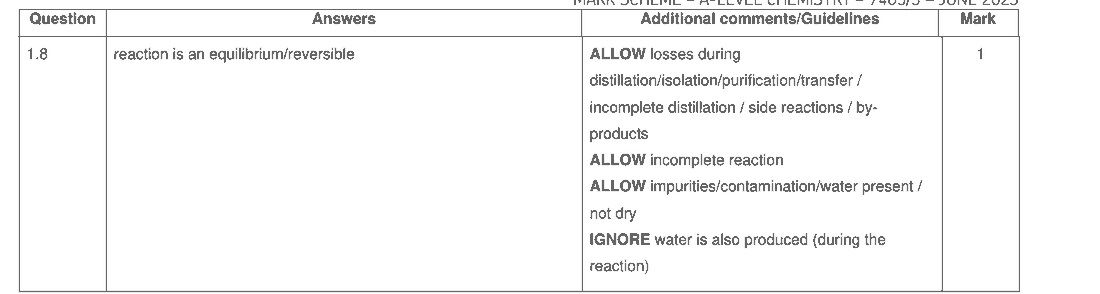
01.8 Chemical equilibria, Le Chatelier's principle and Kc, Carboxylic acids and derivatives 1Short answer
02.1 Introduction to organic chemistry: nomenclature, mechanisms and isomerism, Alcohols 1Diagram or structure
02.2 Introduction to organic chemistry: nomenclature, mechanisms and isomerism, Alcohols 1Diagram or structure
02.3 Introduction to organic chemistry: nomenclature, mechanisms and isomerism 1Diagram or structure
02.4 Alcohols, Introduction to organic chemistry: nomenclature, mechanisms and isomerism 1Diagram or structure
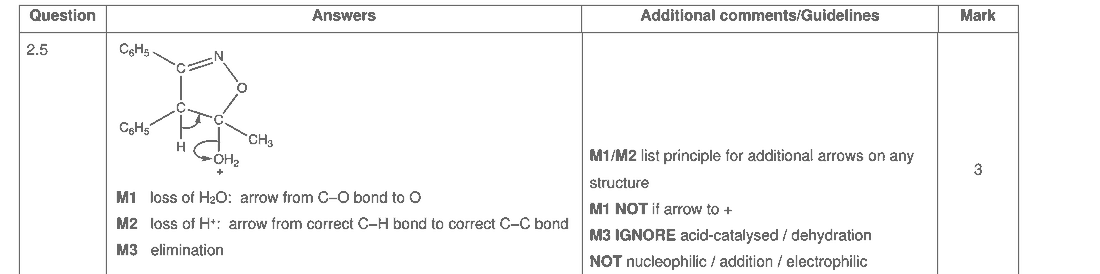
02.5 Alcohols, Introduction to organic chemistry: nomenclature, mechanisms and isomerism 3Mechanism
02.6 Alcohols, Introduction to organic chemistry: nomenclature, mechanisms and isomerism 1Diagram or structure
03.1 Amino acids, proteins and DNA 2Diagram or structure
03.2 Amino acids, proteins and DNA, Introduction to organic chemistry: nomenclature, mechanisms and isomerism 1Diagram or structure
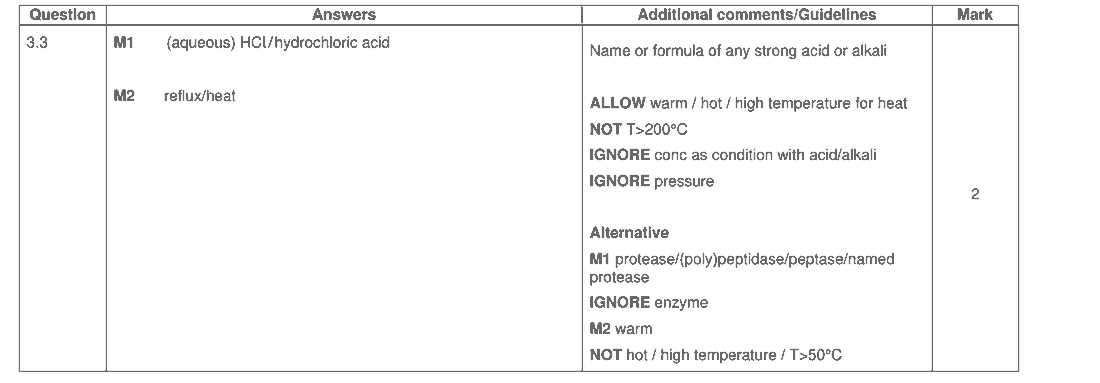
03.3 Amino acids, proteins and DNA 2Short answer
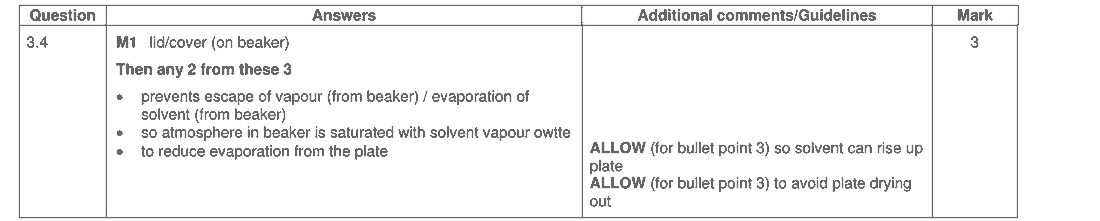
03.4 Chromatography 3Practical and data analysis
03.5 Chromatography 1Short answer
03.6 Amino acids, proteins and DNA 2Practical and data analysis
03.7 Chromatography, Amino acids, proteins and DNA 1Practical and data analysis
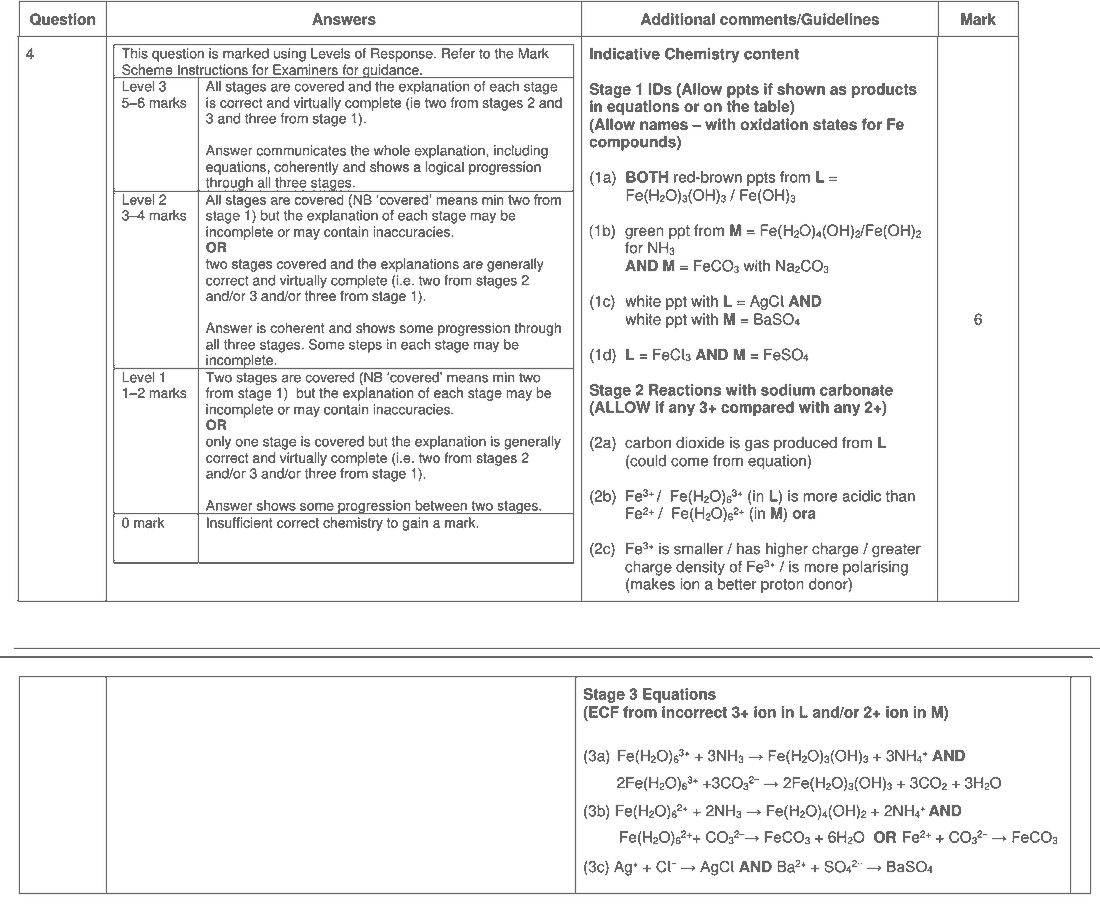
04 Reactions of ions in aqueous solution, Group 7(17), the halogens 6Level of response
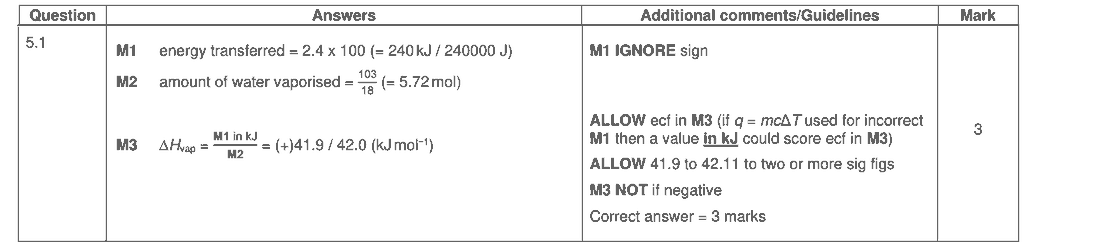
05.1 Amount of substance, Energetics 3Calculation
05.2 Bonding 4Explanation
05.3 Bonding 3Explanation
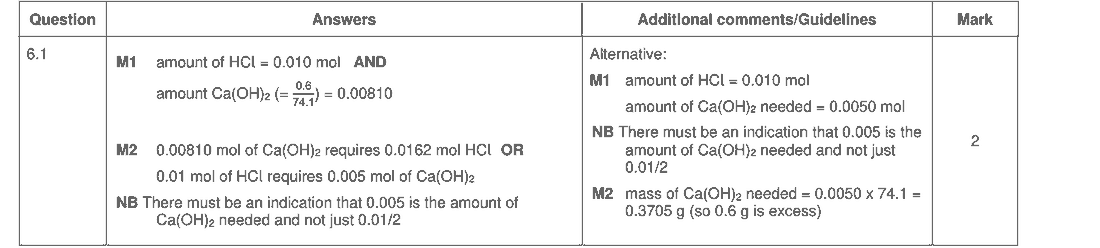
06.1 Amount of substance 2Calculation
06.2 Acids and bases: pH, Ka, titration curves and buffers 5Calculation
07 Atomic structure 1AO2=1Multiple choice
08 Introduction to organic chemistry: nomenclature, mechanisms and isomerism, Amount of substance 1AO2=1Multiple choice
09 Bonding 1AO1=1Multiple choice
10 Energetics 1AO1=1Multiple choice
11 Kinetics 1AO1=1Multiple choice
12 Kinetics 1AO1=1Multiple choice
13 Acids and bases: pH, Ka, titration curves and buffers 1AO2=1Multiple choice
14 Oxidation, reduction and redox equations 1AO1=1Multiple choice
15 Bonding 1AO1=1Multiple choice
16 Acids and bases: pH, Ka, titration curves and buffers 1AO1=1Multiple choice
17 Acids and bases: pH, Ka, titration curves and buffers 1AO2=1Multiple choice
18 Acids and bases: pH, Ka, titration curves and buffers 1AO2=1Multiple choice
19 Periodicity 1AO2=1Multiple choice
20 Acids and bases: pH, Ka, titration curves and buffers 1AO1=1Multiple choice
21 Group 2, the alkaline earth metals 1AO1=1Multiple choice
22 Group 7(17), the halogens, Oxidation, reduction and redox equations 1AO1=1Multiple choice
23 Transition metals 1AO1=1Multiple choice
24 Transition metals 1AO1=1Multiple choice
25 Chemical equilibria, Le Chatelier's principle and Kc, Equilibrium constant Kp 1AO2=1Multiple choice
26 Organic synthesis, Alkenes 1AO3=1Multiple choice
27 Transition metals, Halogenoalkanes 1AO1=1Multiple choice
28 Amount of substance, Equilibrium constant Kp 1AO2=1Multiple choice
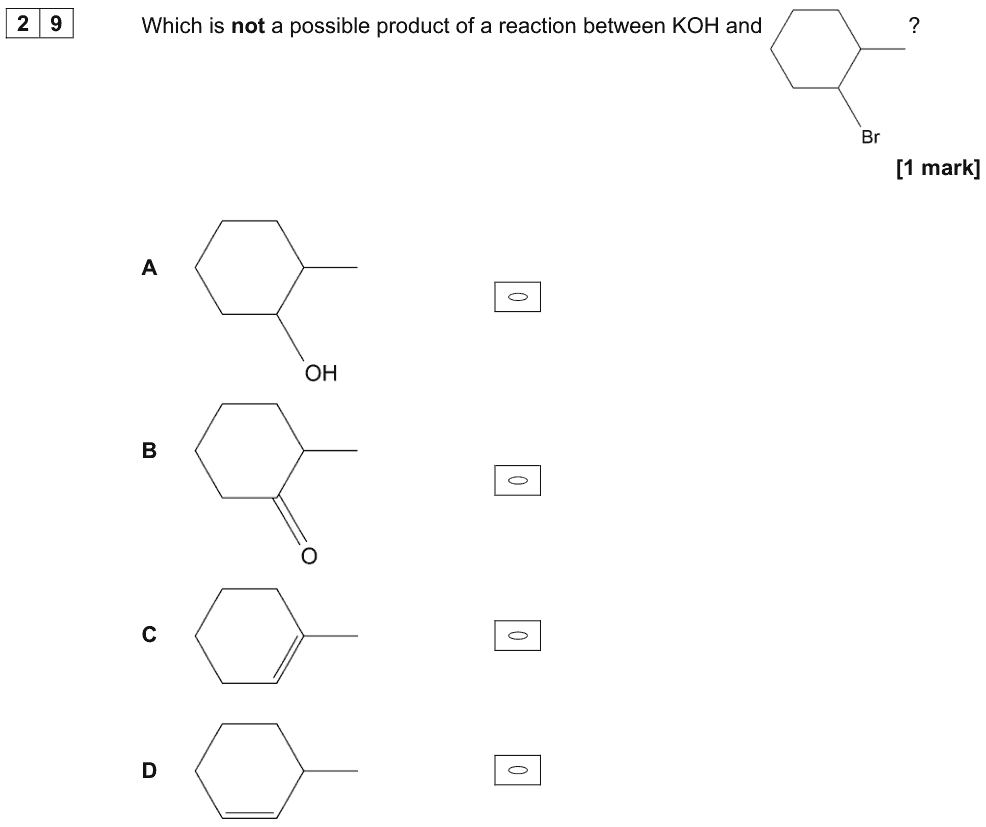
29 Halogenoalkanes 1AO3=1Multiple choice
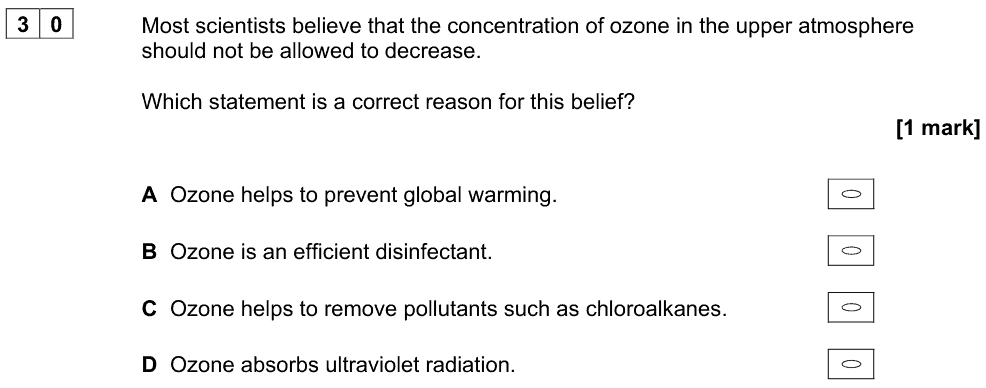
30 Halogenoalkanes 1AO1=1Multiple choice
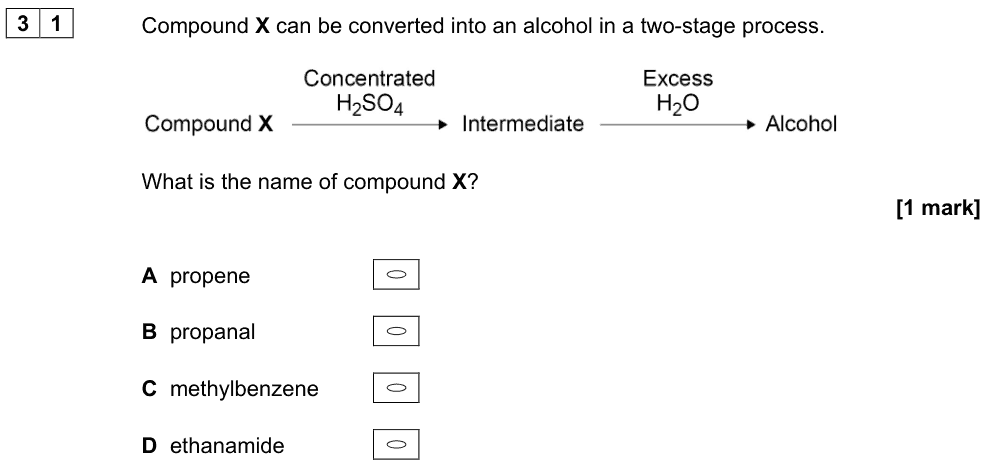
31 Alkenes, Alcohols 1AO2=1Multiple choice
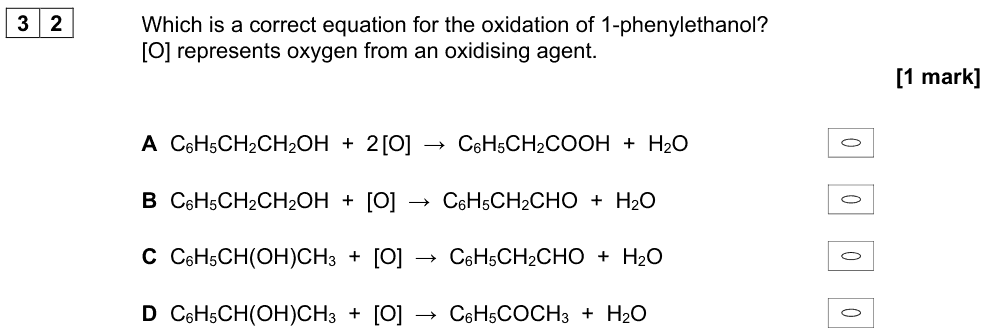
32 Alcohols 1AO1=1Multiple choice
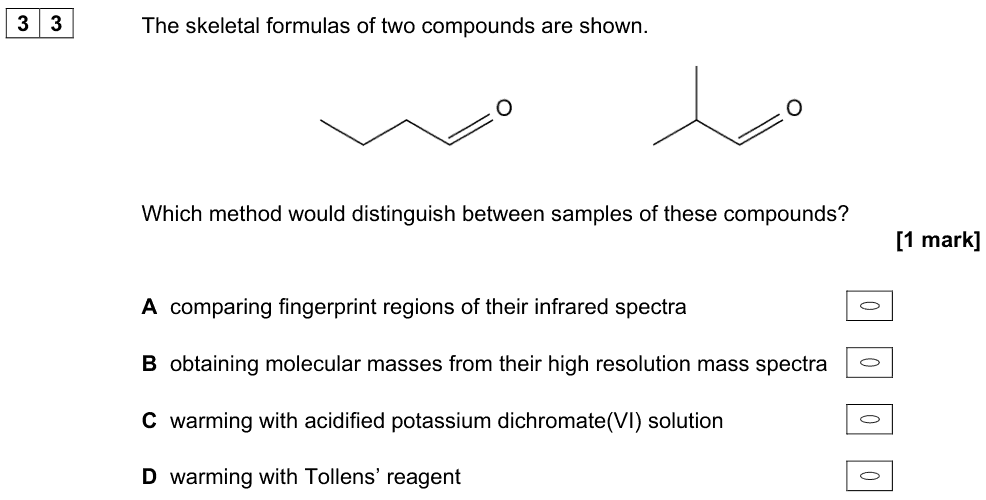
33 Organic analysis: test-tube reactions, mass spectrometry and infrared 1AO1=1Multiple choice
34 Amines 1AO1=1Multiple choice
35 Amino acids, proteins and DNA 1AO1=1Multiple choice
36 Amino acids, proteins and DNA 1AO2=1Multiple choice

The questions

01.101.201.301.401.501.601.701.802.102.202.302.402.502.603.103.203.303.403.503.603.70405.105.205.306.106.2070809101112131415161718192021222324252627282930313233343536
June 2023 · Paper 3 · Q01.1 1 mark Short answer Easy carboxylic acids and derivatives
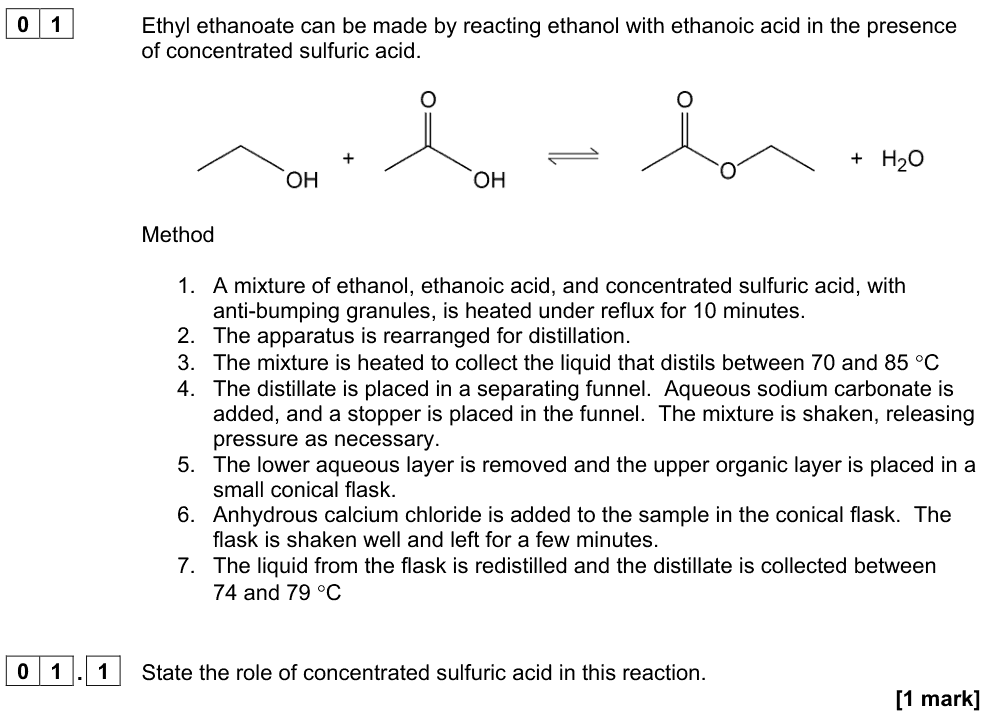
Ethyl ethanoate can be made by reacting ethanol with ethanoic acid in the presence
of concentrated sulfuric acid.
Method
1. A mixture of ethanol, ethanoic acid, and concentrated sulfuric acid, with
anti-bumping granules, is heated under reflux for 10 minutes.
2. The apparatus is rearranged for distillation.
3. The mixture is heated to collect the liquid that distils between 70 and 85 °C
4. The distillate is placed in a separating funnel.  Aqueous sodium carbonate is
added, and a stopper is placed in the funnel.  The mixture is shaken, releasing
pressure as necessary.
5. The lower aqueous layer is removed and the upper organic layer is placed in a
small conical flask.
6. Anhydrous calcium chloride is added to the sample in the conical flask.  The
flask is shaken well and left for a few minutes.
7. The liquid from the flask is redistilled and the distillate is collected between
74 and 79 °C
State the role of concentrated sulfuric acid in this reaction.
[1 mark]
June 2023 · Paper 3 · Q01.2 1 mark Practical and data analysis Easy carboxylic acids and derivatives
Earlier part of question 01 that this part usesEarlier part of June 2023 Paper 3 question 01
The reaction mixture is flammable.
Suggest how the reaction mixture should be heated in step 1.
[1 mark]
June 2023 · Paper 3 · Q01.3 4 marks Practical and data analysis carboxylic acids and derivatives
Earlier part of question 01 that this part usesEarlier part of June 2023 Paper 3 question 01
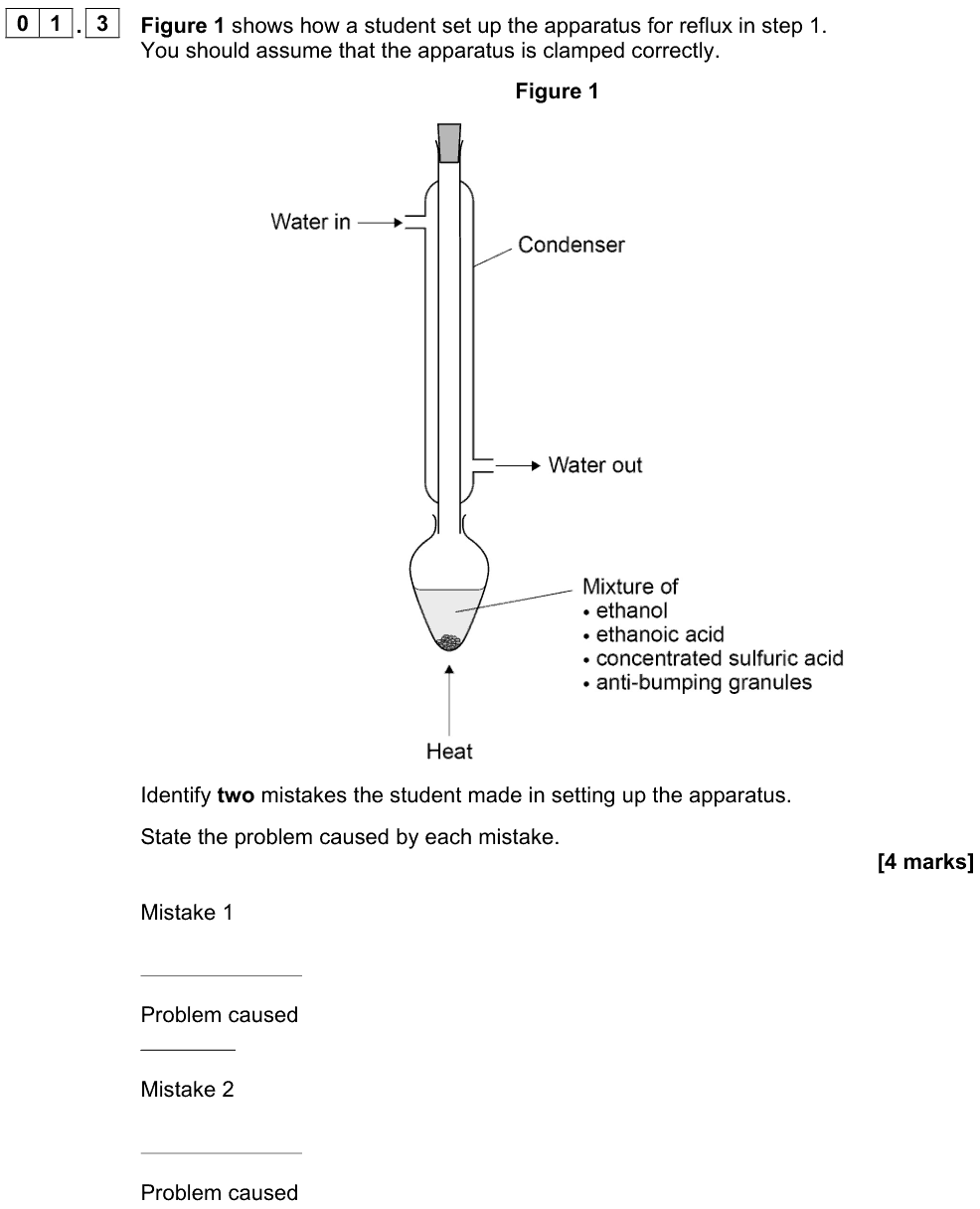
Figure 1 shows how a student set up the apparatus for reflux in step 1.
You should assume that the apparatus is clamped correctly.
Figure 1
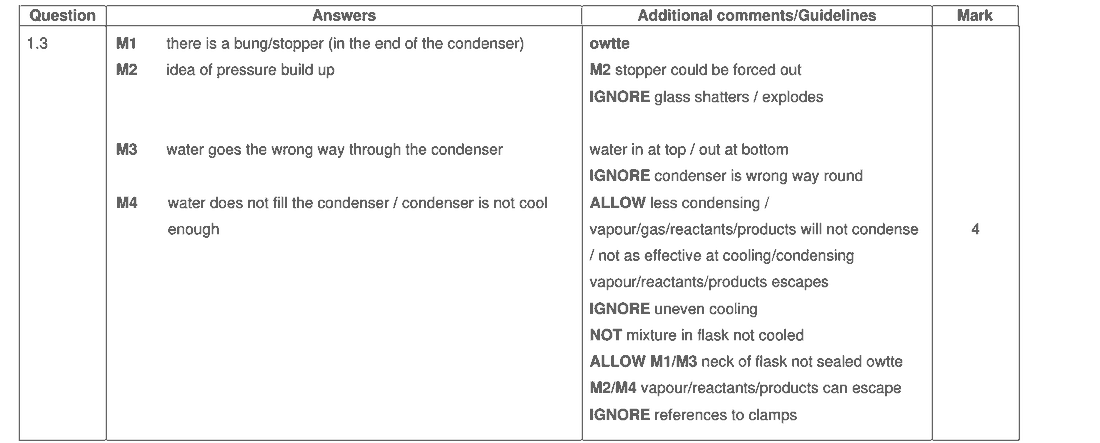
Identify two mistakes the student made in setting up the apparatus.
State the problem caused by each mistake.
[4 marks]
Mistake 1
Problem caused
Mistake 2
Problem caused
June 2023 · Paper 3 · Q01.4 2 marks Practical and data analysis carboxylic acids and derivatives
Earlier part of question 01 that this part usesEarlier part of June 2023 Paper 3 question 01
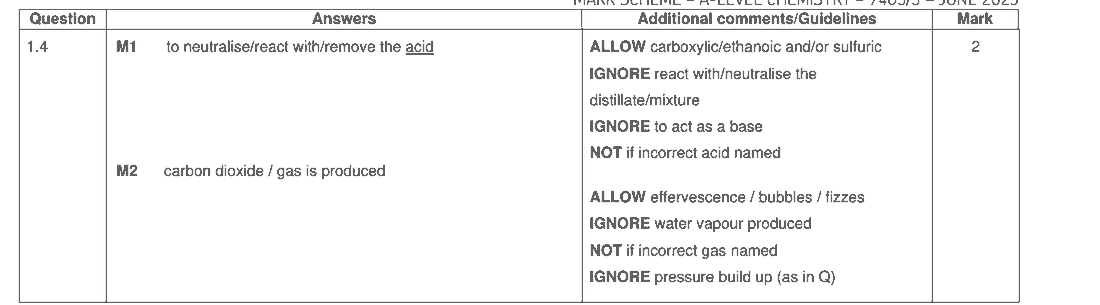
State why sodium carbonate is added to the distillate in step 4.
Explain why there is a build-up of pressure in the separating funnel.
[2 marks]
June 2023 · Paper 3 · Q01.5 2 marks Practical and data analysis Hard carboxylic acids and derivatives
Earlier part of question 01 that this part usesEarlier part of June 2023 Paper 3 question 01
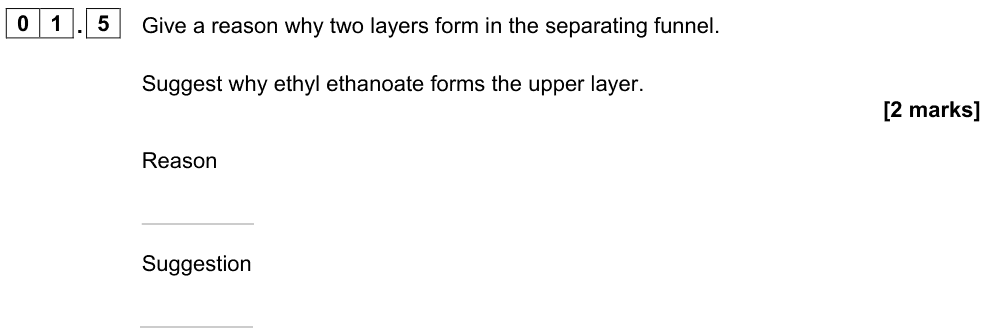
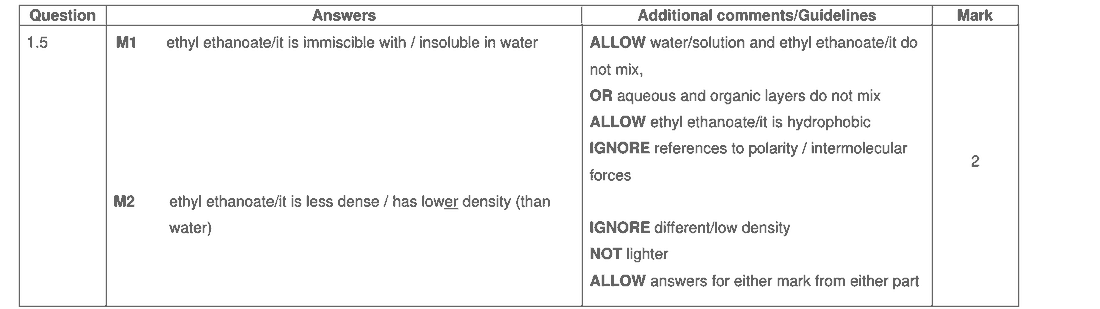
Give a reason why two layers form in the separating funnel.
Suggest why ethyl ethanoate forms the upper layer.
[2 marks]
Reason
Suggestion
June 2023 · Paper 3 · Q01.6 1 mark Practical and data analysis Easy carboxylic acids and derivatives
Earlier part of question 01 that this part usesEarlier part of June 2023 Paper 3 question 01
State why anhydrous calcium chloride is added in step 6.
[1 mark]
June 2023 · Paper 3 · Q01.7 5 marks Calculation amount of substance
Earlier part of question 01 that this part usesEarlier part of June 2023 Paper 3 question 01
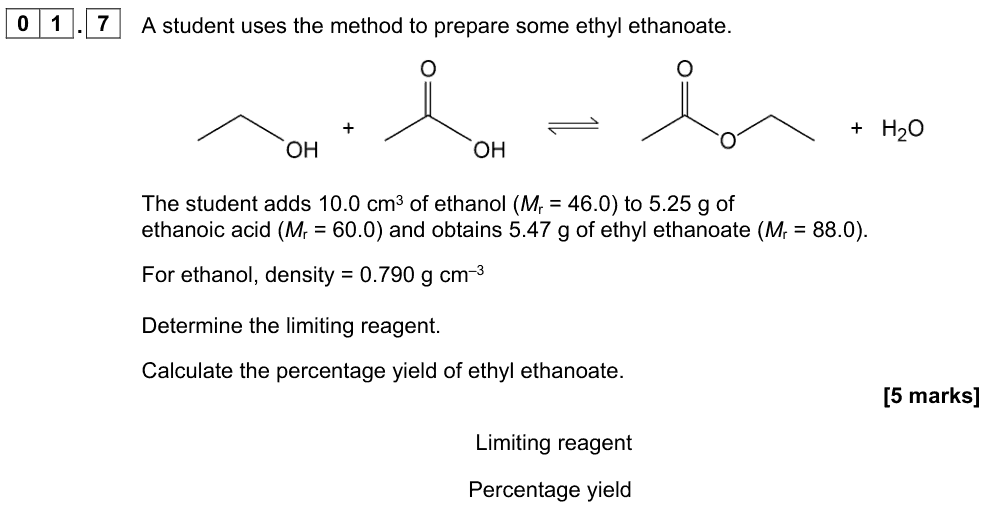
A student uses the method to prepare some ethyl ethanoate.
The student adds 10.0 cm3 of ethanol (Mr = 46.0) to 5.25 g of
ethanoic acid (Mr = 60.0) and obtains 5.47 g of ethyl ethanoate (Mr = 88.0).
For ethanol, density = 0.790 g cm–3
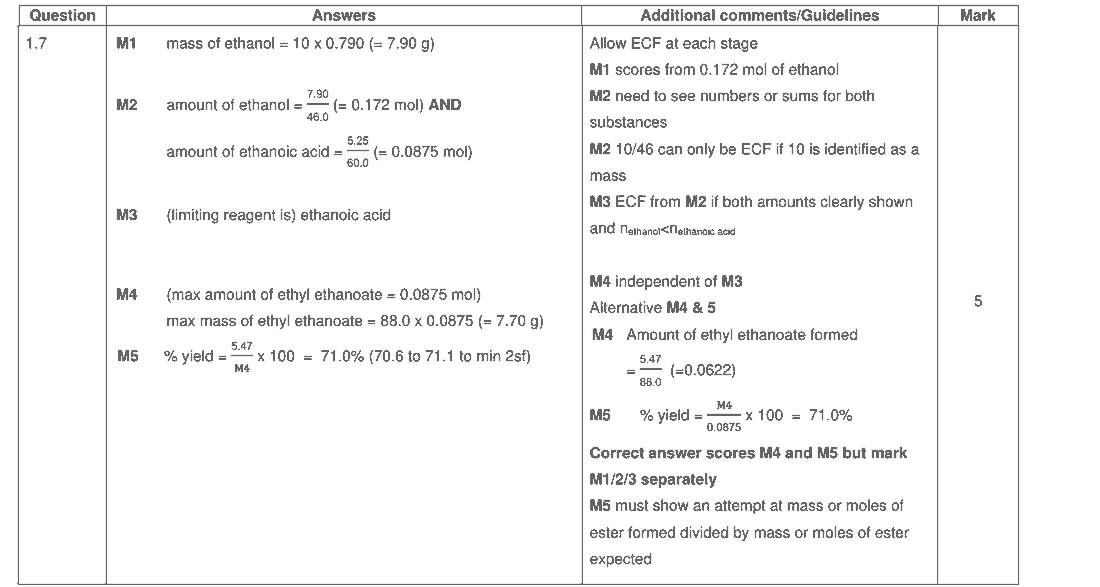
Determine the limiting reagent.
Calculate the percentage yield of ethyl ethanoate.
[5 marks]
Limiting reagent
Percentage yield
June 2023 · Paper 3 · Q01.8 1 mark Short answer Easy chemical equilibria and kccarboxylic acids and derivatives
Earlier part of question 01 that this part usesEarlier part of June 2023 Paper 3 question 01
Suggest a reason why the percentage yield is not 100%.
[1 mark]
June 2023 · Paper 3 · Q02.1 1 mark Diagram or structure introduction to organic chemistryalcohols
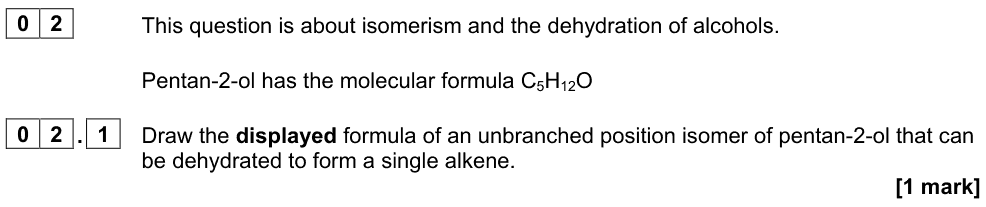
This question is about isomerism and the dehydration of alcohols.
Pentan-2-ol has the molecular formula C5H12O
Draw the displayed formula of an unbranched position isomer of pentan-2-ol that can
be dehydrated to form a single alkene.
[1 mark]
June 2023 · Paper 3 · Q02.2 1 mark Diagram or structure introduction to organic chemistryalcohols
Earlier part of question 02 that this part usesEarlier part of June 2023 Paper 3 question 02
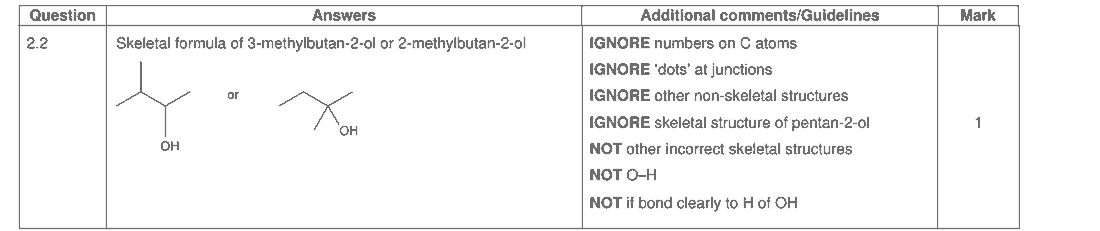
Draw the skeletal formula of a chain isomer of pentan-2-ol that can be dehydrated to
form a mixture of alkenes.
[1 mark]
June 2023 · Paper 3 · Q02.3 1 mark Diagram or structure introduction to organic chemistry
Earlier part of question 02 that this part usesEarlier part of June 2023 Paper 3 question 02
Draw the structure of an unbranched functional group isomer of pentan-2-ol.
[1 mark]
June 2023 · Paper 3 · Q02.4 1 mark Diagram or structure Hard alcoholsintroduction to organic chemistry
Earlier part of question 02 that this part usesEarlier part of June 2023 Paper 3 question 02
Another isomer of pentan-2-ol is an alcohol that is not dehydrated when heated with
concentrated sulfuric acid.
Draw the structure of this isomer.
[1 mark]
June 2023 · Paper 3 · Q02.5 3 marks Mechanism alcoholsintroduction to organic chemistry
Earlier part of question 02 that this part usesEarlier part of June 2023 Paper 3 question 02
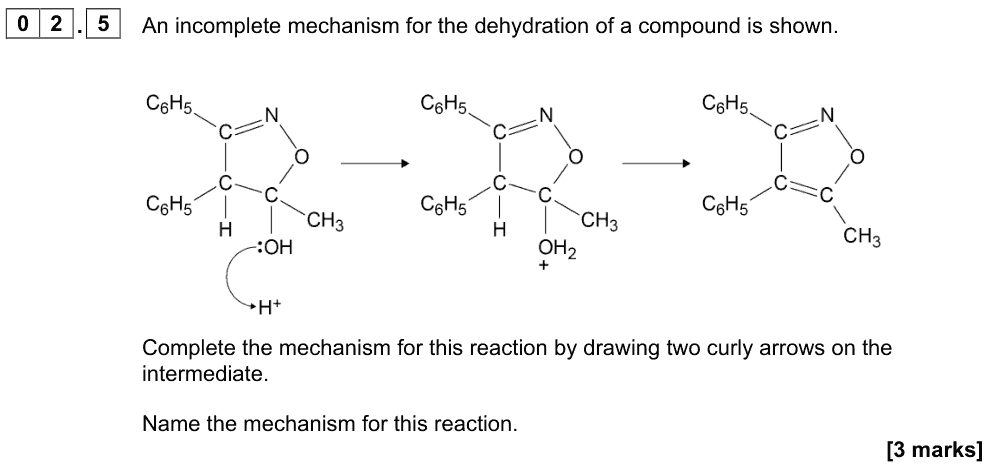
An incomplete mechanism for the dehydration of a compound is shown.
Complete the mechanism for this reaction by drawing two curly arrows on the
intermediate.
Name the mechanism for this reaction.
[3 marks]
June 2023 · Paper 3 · Q02.6 1 mark Diagram or structure Hard alcoholsintroduction to organic chemistry
Earlier part of question 02 that this part usesEarlier part of June 2023 Paper 3 question 02
An isomer of the final product can also form in the reaction in Question 02.5.
Draw the structure of this isomer.
[1 mark]
June 2023 · Paper 3 · Q03.1 2 marks Diagram or structure amino acids proteins and dna
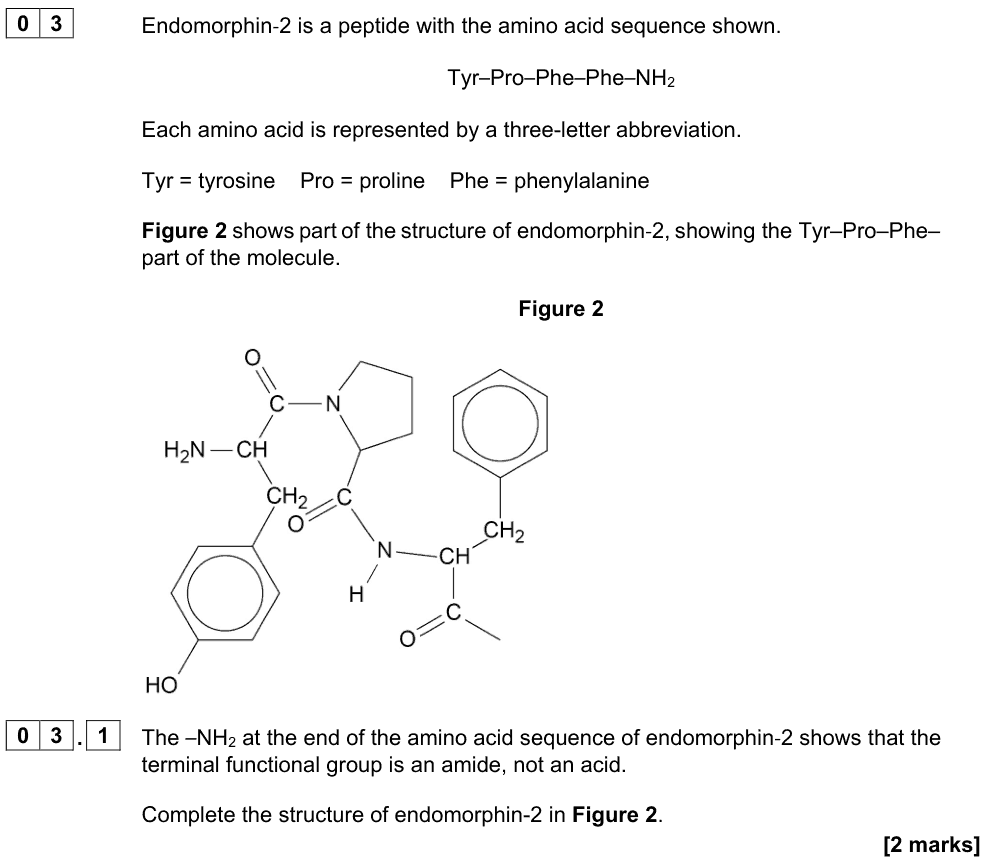
Endomorphin-2 is a peptide with the amino acid sequence shown.
Tyr–Pro–Phe–Phe–NH2
Each amino acid is represented by a three-letter abbreviation.
Tyr = tyrosine    Pro = proline    Phe = phenylalanine
Figure 2 shows part of the structure of endomorphin-2, showing the Tyr–Pro–Phe–
part of the molecule.
Figure 2
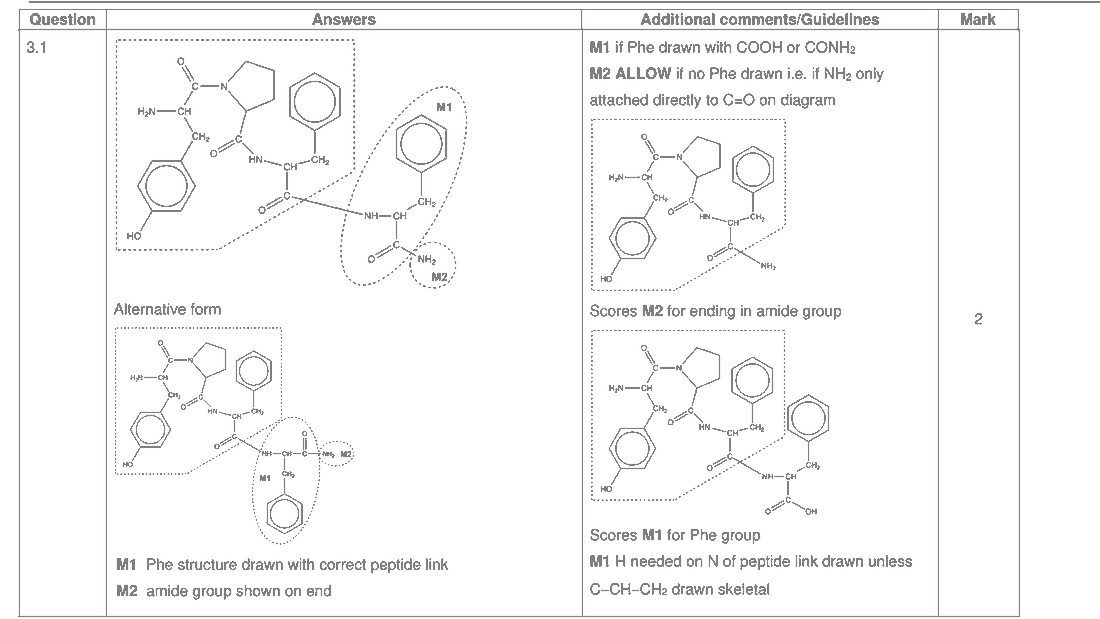
The –NH2 at the end of the amino acid sequence of endomorphin-2 shows that the
terminal functional group is an amide, not an acid.
Complete the structure of endomorphin-2 in Figure 2.
[2 marks]
June 2023 · Paper 3 · Q03.2 1 mark Diagram or structure Hard amino acids proteins and dnaintroduction to organic chemistry
Earlier part of question 03 that this part usesEarlier part of June 2023 Paper 3 question 03
Use the structure in Figure 2 to draw the skeletal formula of proline, Pro.
[1 mark]
June 2023 · Paper 3 · Q03.3 2 marks Short answer amino acids proteins and dna
Earlier part of question 03 that this part usesEarlier part of June 2023 Paper 3 question 03
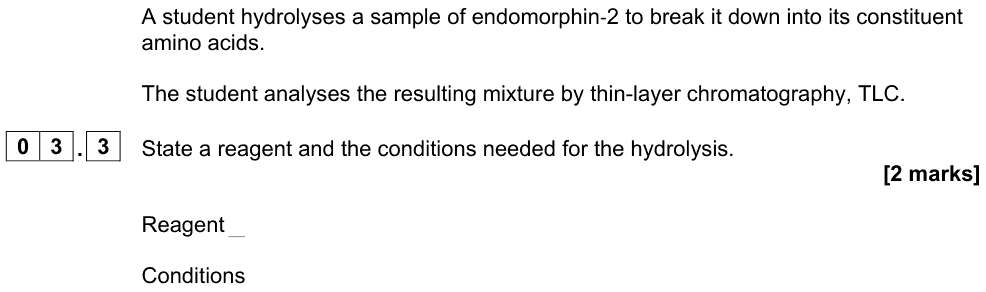
A student hydrolyses a sample of endomorphin-2 to break it down into its constituent
amino acids.
The student analyses the resulting mixture by thin-layer chromatography, TLC.
State a reagent and the conditions needed for the hydrolysis.
[2 marks]
Reagent
Conditions
June 2023 · Paper 3 · Q03.4 3 marks Practical and data analysis chromatography
Earlier part of question 03 that this part usesEarlier part of June 2023 Paper 3 question 03
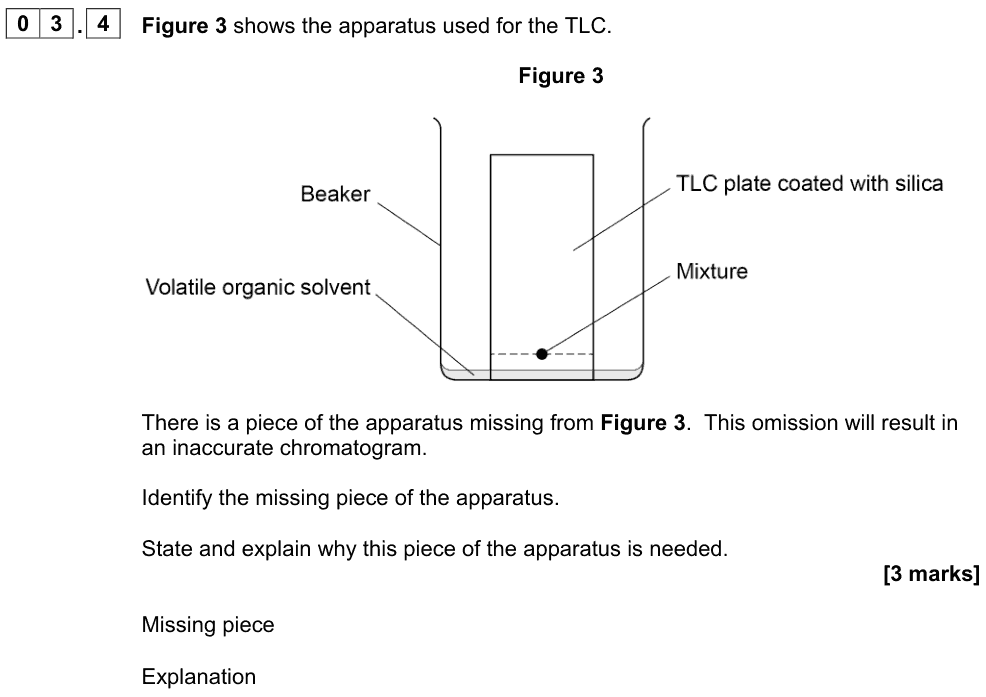
Figure 3 shows the apparatus used for the TLC.
Figure 3
There is a piece of the apparatus missing from Figure 3.  This omission will result in
an inaccurate chromatogram.
Identify the missing piece of the apparatus.
State and explain why this piece of the apparatus is needed.
[3 marks]
Missing piece
Explanation
June 2023 · Paper 3 · Q03.5 1 mark Short answer chromatography
Earlier part of question 03 that this part usesEarlier part of June 2023 Paper 3 question 03
State why the amino acids separate on the TLC plate.
[1 mark]
June 2023 · Paper 3 · Q03.6 2 marks Practical and data analysis amino acids proteins and dna
Earlier parts of question 03 that this part usesEarlier part of June 2023 Paper 3 question 03Earlier part of June 2023 Paper 3 question 03
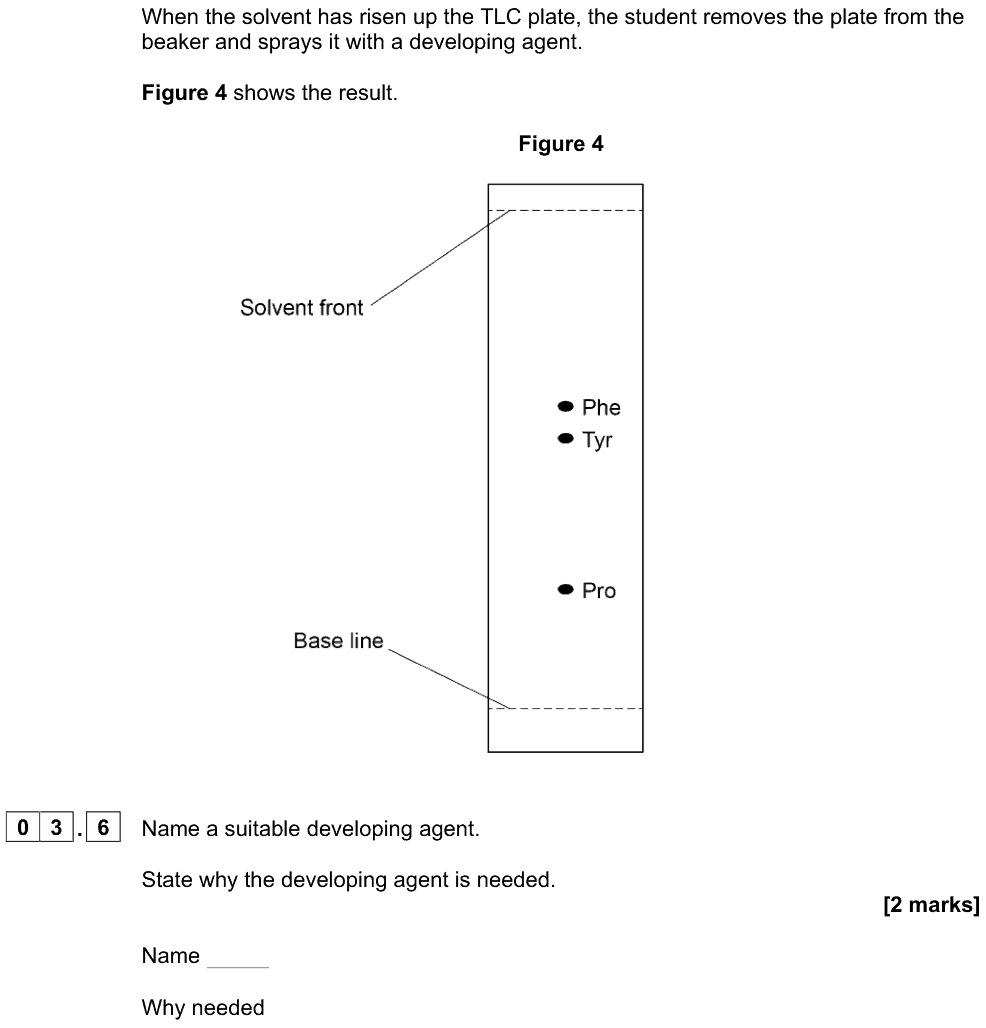
When the solvent has risen up the TLC plate, the student removes the plate from the
beaker and sprays it with a developing agent.
Figure 4 shows the result.
Figure 4
Name a suitable developing agent.
State why the developing agent is needed.
[2 marks]
Name
Why needed
June 2023 · Paper 3 · Q03.7 1 mark Practical and data analysis Easy chromatographyamino acids proteins and dna
Earlier parts of question 03 that this part usesEarlier part of June 2023 Paper 3 question 03Earlier part of June 2023 Paper 3 question 03
Determine the Rf value for Tyr.
[1 mark]
Rf
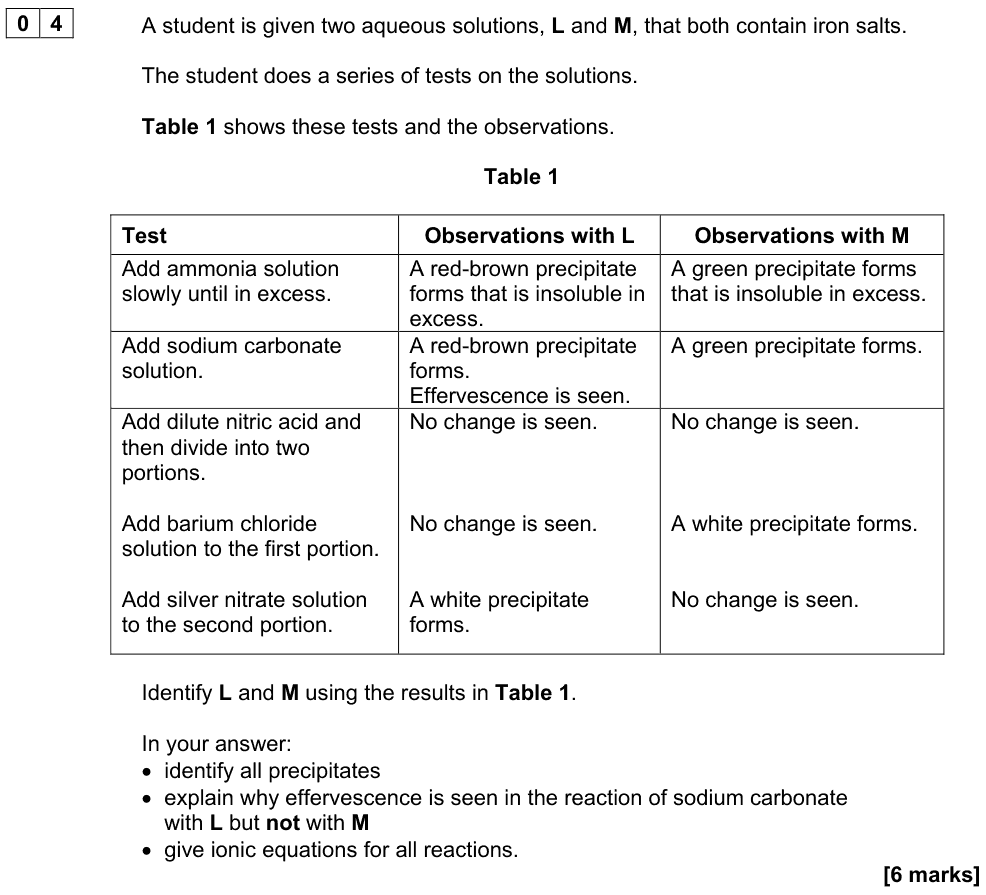
June 2023 · Paper 3 · Q04 6 marks 6-mark level of response Hard reactions of ions in aqueous solutiongroup 7 the halogens
A student is given two aqueous solutions, L and M, that both contain iron salts.
The student does a series of tests on the solutions.
Table 1 shows these tests and the observations.
Table 1
Test
Observations with L
Observations with M
Add ammonia solution
slowly until in excess.
A red-brown precipitate
forms that is insoluble in
excess.
A green precipitate forms
that is insoluble in excess.
Add sodium carbonate
solution.
A red-brown precipitate
forms.
Effervescence is seen.
A green precipitate forms.
Add dilute nitric acid and
then divide into two
portions.
Add barium chloride
solution to the first portion.
Add silver nitrate solution
to the second portion.
No change is seen.
No change is seen.
A white precipitate
forms.
No change is seen.
A white precipitate forms.
No change is seen.
Identify L and M using the results in Table 1.
In your answer:
• identify all precipitates
• explain why effervescence is seen in the reaction of sodium carbonate
with L but not with M
• give ionic equations for all reactions.
[6 marks]
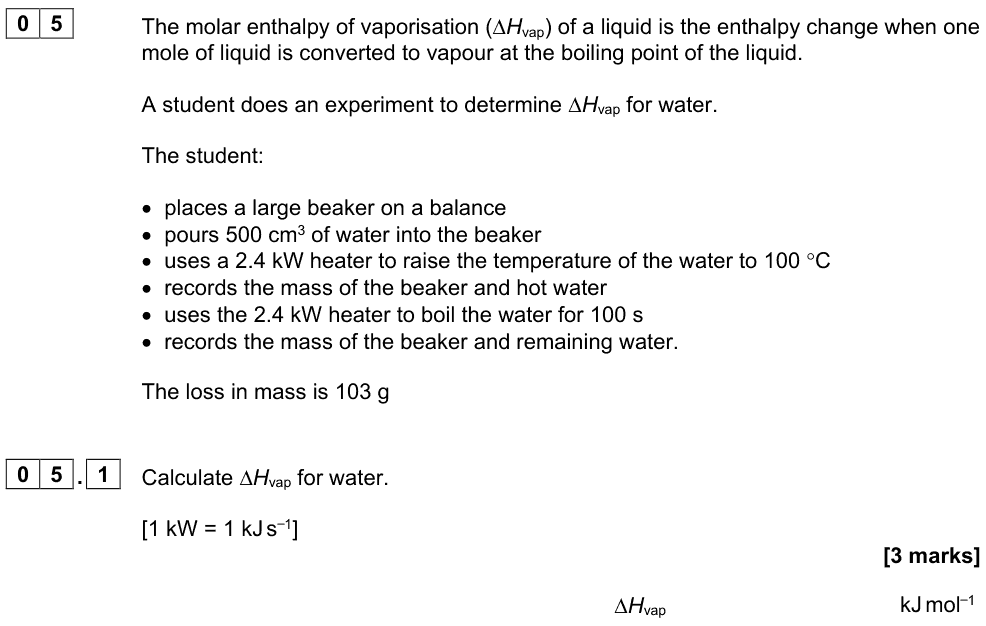
June 2023 · Paper 3 · Q05.1 3 marks Calculation amount of substanceenergetics
The molar enthalpy of vaporisation (∆Hvap) of a liquid is the enthalpy change when one
mole of liquid is converted to vapour at the boiling point of the liquid.
A student does an experiment to determine ∆Hvap for water.
The student:
• places a large beaker on a balance
• pours 500 cm3 of water into the beaker
• uses a 2.4 kW heater to raise the temperature of the water to 100 °C
• records the mass of the beaker and hot water
• uses the 2.4 kW heater to boil the water for 100 s
• records the mass of the beaker and remaining water.
The loss in mass is 103 g
Calculate ∆Hvap for water.
[1 kW = 1 kJ s–1]
[3 marks]
∆Hvap
kJ mol–1
June 2023 · Paper 3 · Q05.2 4 marks Explanation bonding
Earlier part of question 05 that this part usesEarlier part of June 2023 Paper 3 question 05
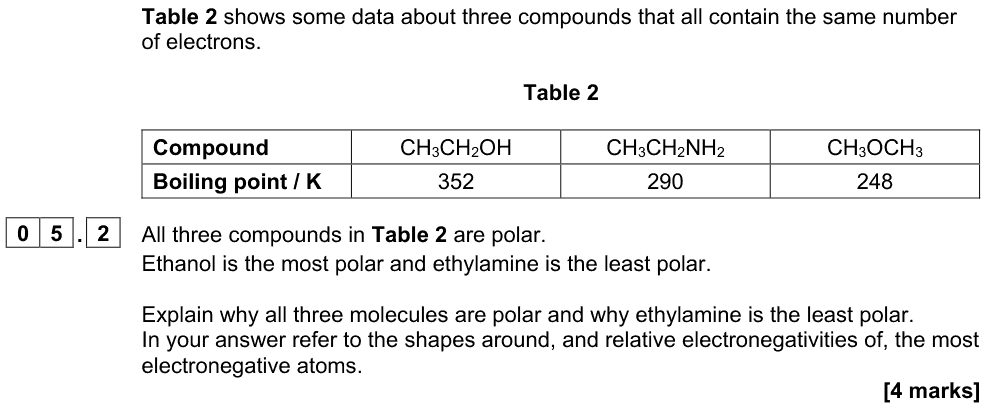
Table 2 shows some data about three compounds that all contain the same number
of electrons.
Table 2
Compound
CH3CH2OH
CH3CH2NH2
CH3OCH3
Boiling point / K
352
290
248
All three compounds in Table 2 are polar.
Ethanol is the most polar and ethylamine is the least polar.
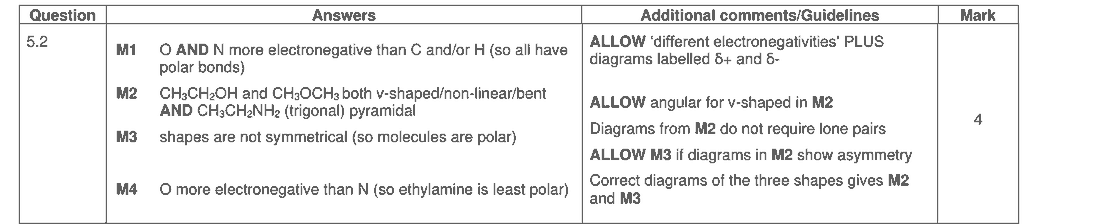
Explain why all three molecules are polar and why ethylamine is the least polar.
In your answer refer to the shapes around, and relative electronegativities of, the most
electronegative atoms.
[4 marks]
June 2023 · Paper 3 · Q05.3 3 marks Explanation bonding
Earlier parts of question 05 that this part usesEarlier part of June 2023 Paper 3 question 05Earlier part of June 2023 Paper 3 question 05
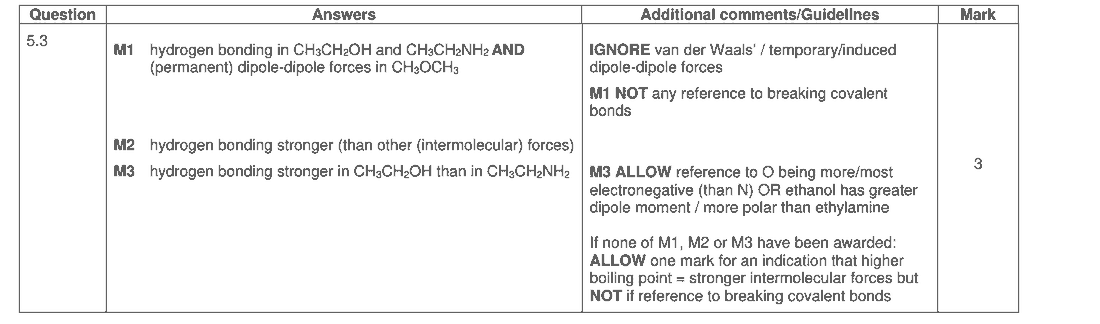
Explain the trend in the boiling points of the three compounds.
Refer to the intermolecular forces in all three compounds in your answer.
[3 marks]
June 2023 · Paper 3 · Q06.1 2 marks Calculation amount of substance
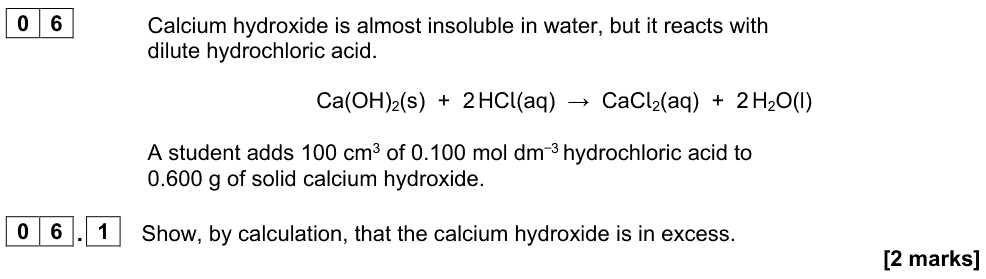
Calcium hydroxide is almost insoluble in water, but it reacts with
dilute hydrochloric acid.
Ca(OH)2(s)  +  2 HCl(aq)  →  CaCl2(aq)  +  2 H2O(l)
A student adds 100 cm3 of 0.100 mol dm–3 hydrochloric acid to
0.600 g of solid calcium hydroxide.
Show, by calculation, that the calcium hydroxide is in excess.
[2 marks]
June 2023 · Paper 3 · Q06.2 5 marks Calculation acids and bases
Earlier part of question 06 that this part usesEarlier part of June 2023 Paper 3 question 06
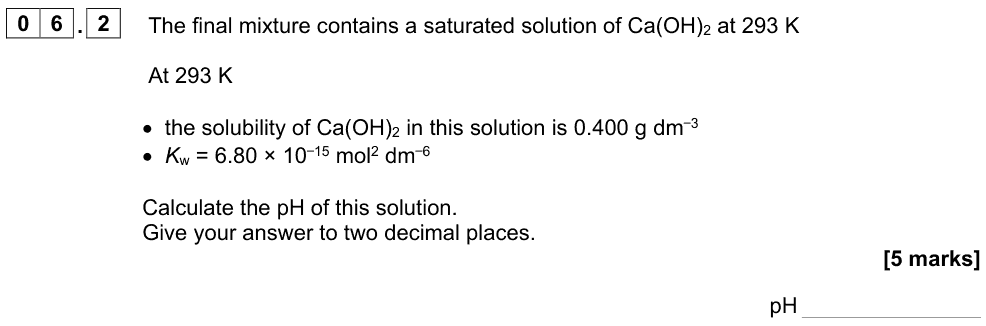
The final mixture contains a saturated solution of Ca(OH)2 at 293 K
At 293 K
• the solubility of Ca(OH)2 in this solution is 0.400 g dm–3
• Kw = 6.80 × 10⁻¹⁵ mol2 dm–6
Calculate the pH of this solution.
Give your answer to two decimal places.
[5 marks]
pH
June 2023 · Paper 3 · Q07 1 mark AO2=1 Multiple choice atomic structure
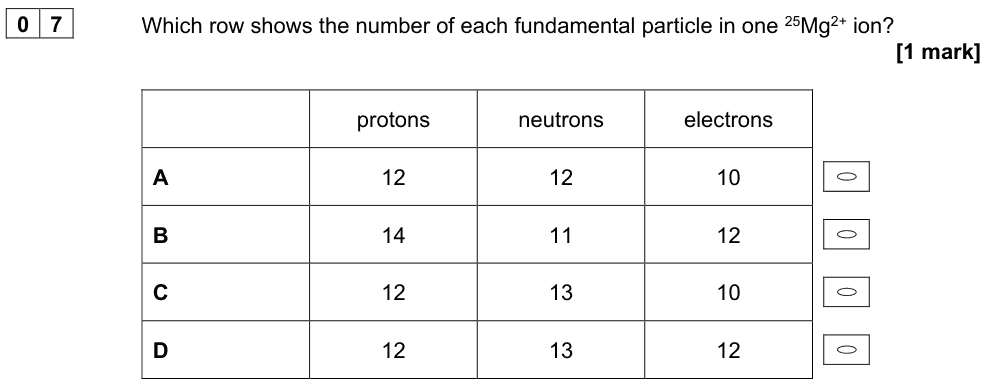
Which row shows the number of each fundamental particle in one 25Mg2+ ion?
[1 mark]
protons
neutrons
electrons
A
12
12
10
B
14
11
12
C
12
13
10
D
12
13
12
June 2023 · Paper 3 · Q08 1 mark AO2=1 Multiple choice introduction to organic chemistryamount of substance
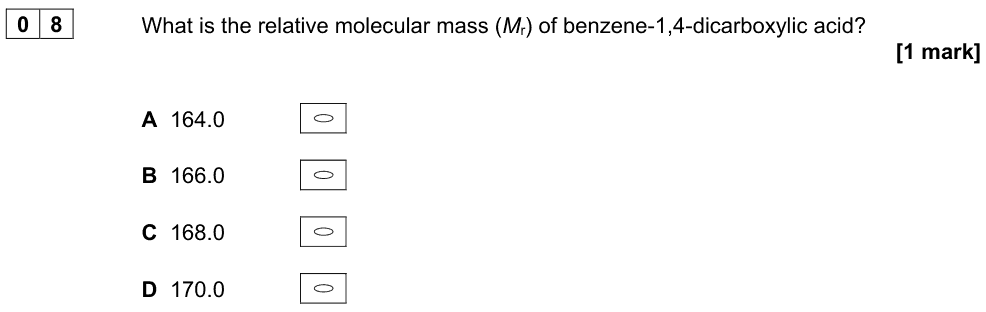
What is the relative molecular mass (Mr) of benzene-1,4-dicarboxylic acid?
[1 mark]
A 164.0
B 166.0
C 168.0
D 170.0
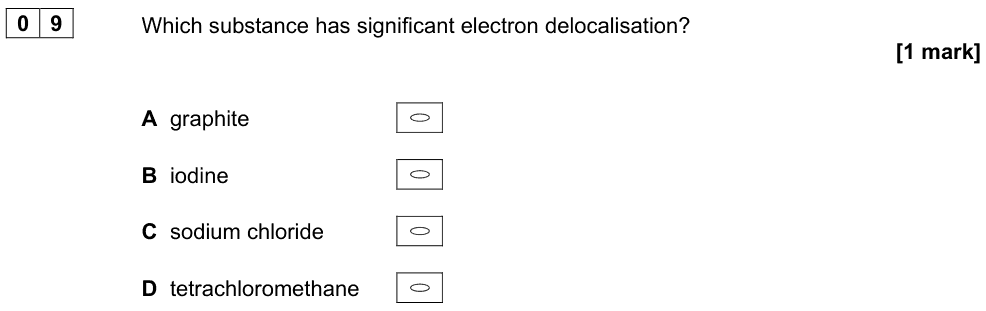
June 2023 · Paper 3 · Q09 1 mark AO1=1 Multiple choice bonding
Which substance has significant electron delocalisation?
[1 mark]
A graphite
B iodine
C sodium chloride
D tetrachloromethane
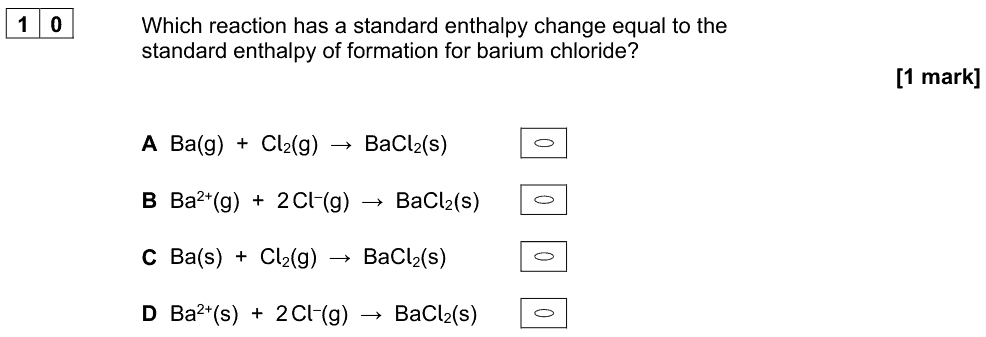
June 2023 · Paper 3 · Q10 1 mark AO1=1 Multiple choice energetics
Which reaction has a standard enthalpy change equal to the
standard enthalpy of formation for barium chloride?
[1 mark]
A Ba(g)  +  Cl2(g)  →  BaCl2(s)
B Ba2+(g)  +  2 Cl–(g)  →  BaCl2(s)
C Ba(s)  +  Cl2(g)  →  BaCl2(s)
D Ba2+(s)  +  2 Cl–(g)  →  BaCl2(s)
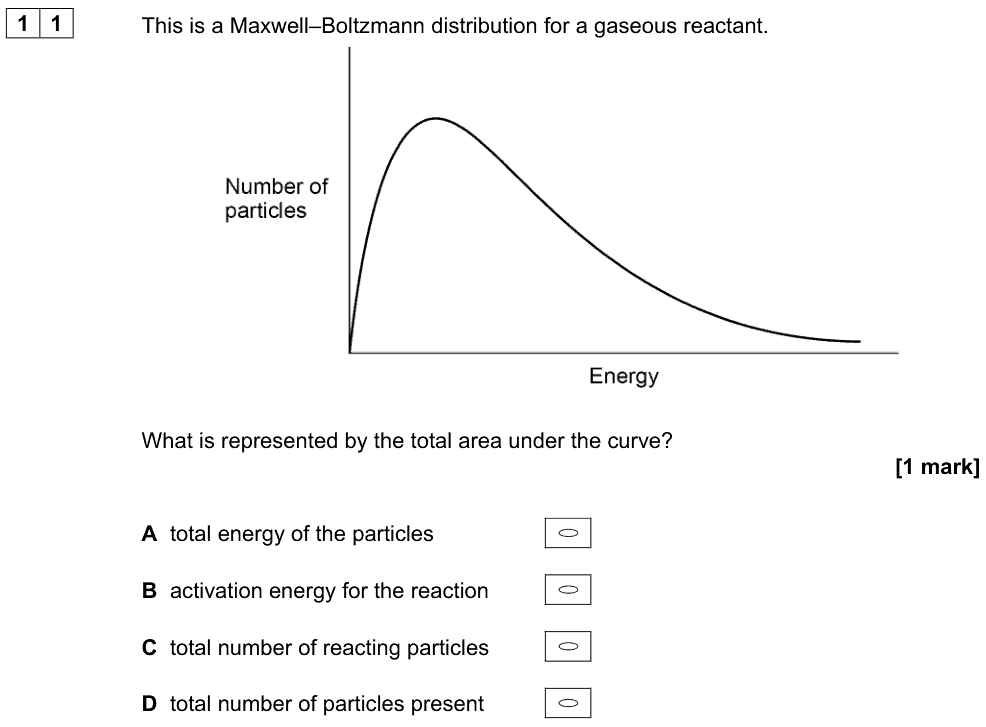
June 2023 · Paper 3 · Q11 1 mark AO1=1 Multiple choice kinetics
This is a Maxwell–Boltzmann distribution for a gaseous reactant.
What is represented by the total area under the curve?
[1 mark]
A total energy of the particles
B activation energy for the reaction
C total number of reacting particles
D total number of particles present
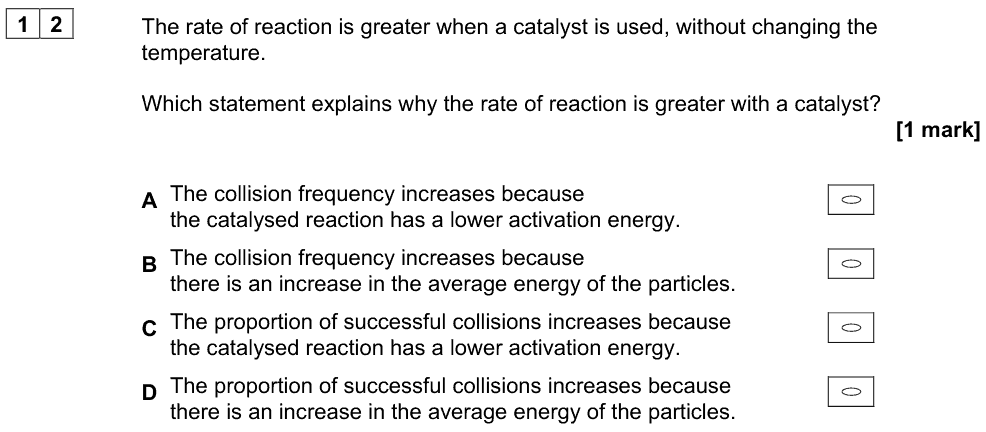
June 2023 · Paper 3 · Q12 1 mark AO1=1 Multiple choice kinetics
The rate of reaction is greater when a catalyst is used, without changing the
temperature.
Which statement explains why the rate of reaction is greater with a catalyst?
[1 mark]
A The collision frequency increases because
the catalysed reaction has a lower activation energy.
B The collision frequency increases because
there is an increase in the average energy of the particles.
C The proportion of successful collisions increases because
the catalysed reaction has a lower activation energy.
D The proportion of successful collisions increases because
there is an increase in the average energy of the particles.
June 2023 · Paper 3 · Q13 1 mark AO2=1 Multiple choice acids and bases
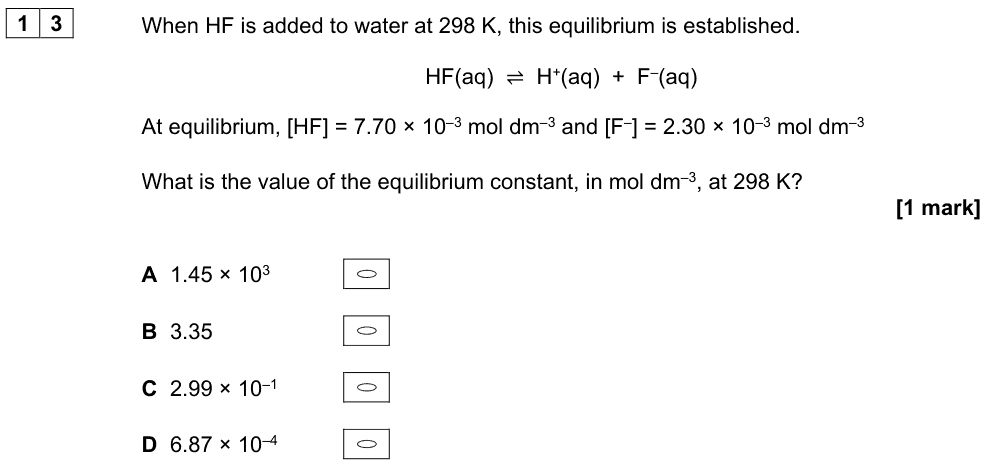
When HF is added to water at 298 K, this equilibrium is established.
HF(aq)  ⇌  H+(aq)  +  F–(aq)
At equilibrium, [HF] = 7.70 × 10⁻³ mol dm–3 and [F–] = 2.30 × 10⁻³ mol dm–3
What is the value of the equilibrium constant, in mol dm–3, at 298 K?
[1 mark]
A 1.45 × 10³
B 3.35
C 2.99 × 10⁻¹
D 6.87 × 10⁻⁴
June 2023 · Paper 3 · Q14 1 mark AO1=1 Multiple choice redox
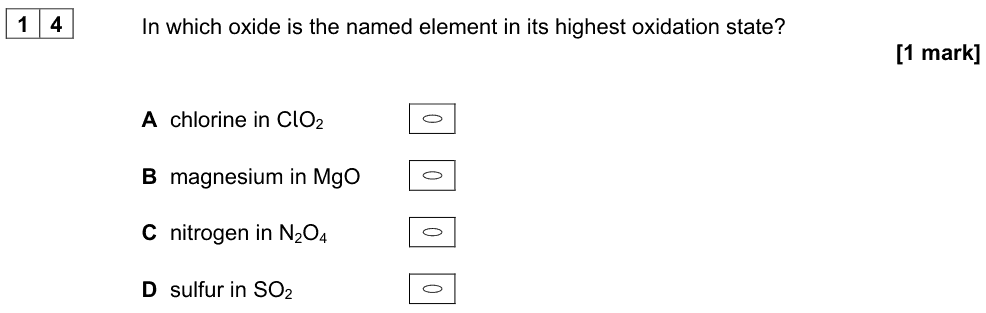
In which oxide is the named element in its highest oxidation state?
[1 mark]
A chlorine in ClO2
B magnesium in MgO
C nitrogen in N2O4
D sulfur in SO2
June 2023 · Paper 3 · Q15 1 mark AO1=1 Multiple choice bonding
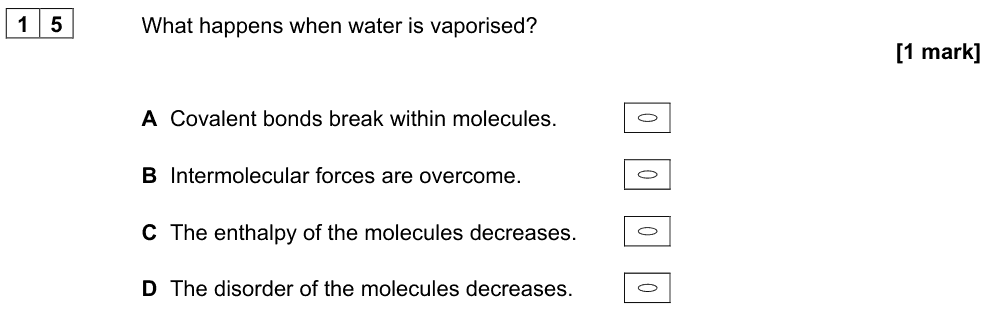
What happens when water is vaporised?
[1 mark]
A Covalent bonds break within molecules.
B Intermolecular forces are overcome.
C The enthalpy of the molecules decreases.
D The disorder of the molecules decreases.
June 2023 · Paper 3 · Q16 1 mark AO1=1 Multiple choice acids and bases
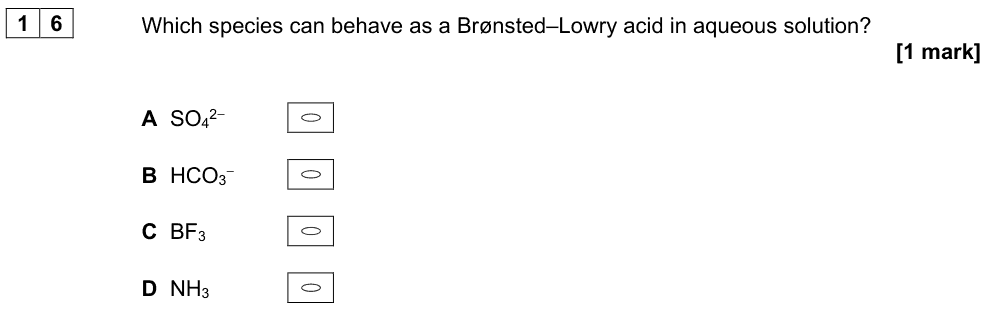
Which species can behave as a Brønsted–Lowry acid in aqueous solution?
[1 mark]
A SO42−
B HCO3−
C BF3
D NH3
June 2023 · Paper 3 · Q17 1 mark AO2=1 Multiple choice acids and bases
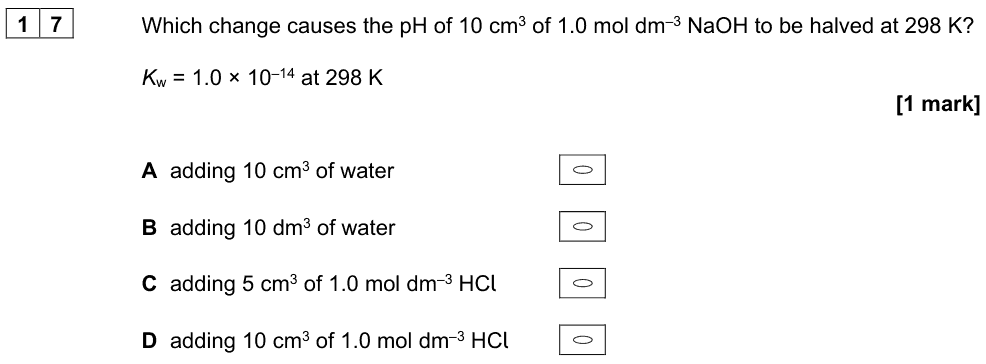
Which change causes the pH of 10 cm3 of 1.0 mol dm–3 NaOH to be halved at 298 K?
Kw = 1.0 × 10⁻¹⁴ at 298 K
[1 mark]
A adding 10 cm3 of water
B adding 10 dm3 of water
C adding 5 cm3 of 1.0 mol dm–3 HCl
D adding 10 cm3 of 1.0 mol dm–3 HCl
June 2023 · Paper 3 · Q18 1 mark AO2=1 Multiple choice acids and bases
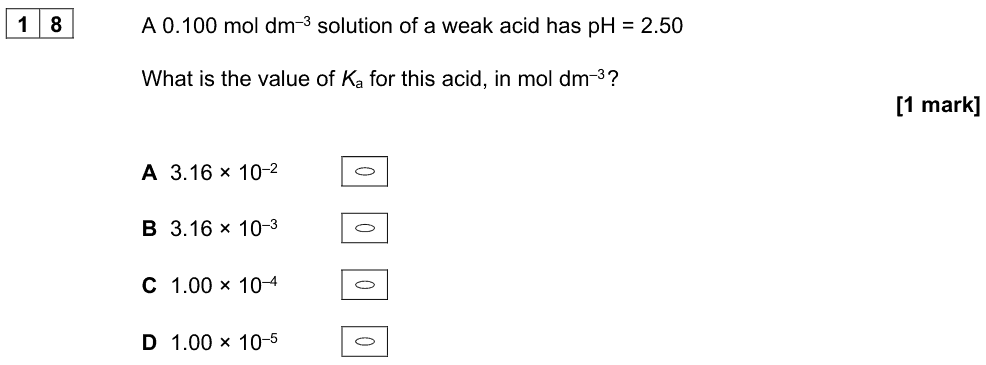
A 0.100 mol dm–3 solution of a weak acid has pH = 2.50
What is the value of Ka for this acid, in mol dm–3 ?
[1 mark]
A 3.16 × 10⁻²
B 3.16 × 10⁻³
C 1.00 × 10⁻⁴
D 1.00 × 10⁻⁵
June 2023 · Paper 3 · Q19 1 mark AO2=1 Multiple choice periodicity
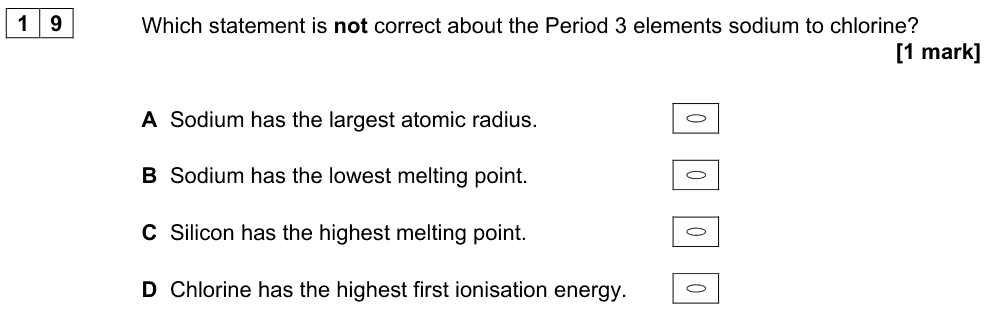
Which statement is not correct about the Period 3 elements sodium to chlorine?
[1 mark]
A Sodium has the largest atomic radius.
B Sodium has the lowest melting point.
C Silicon has the highest melting point.
D Chlorine has the highest first ionisation energy.
June 2023 · Paper 3 · Q20 1 mark AO1=1 Multiple choice acids and bases
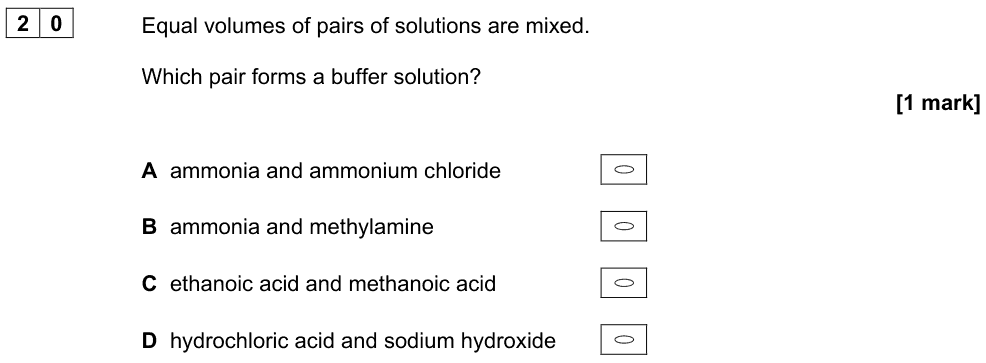
Equal volumes of pairs of solutions are mixed.
Which pair forms a buffer solution?
[1 mark]
A ammonia and ammonium chloride
B ammonia and methylamine
C ethanoic acid and methanoic acid
D hydrochloric acid and sodium hydroxide
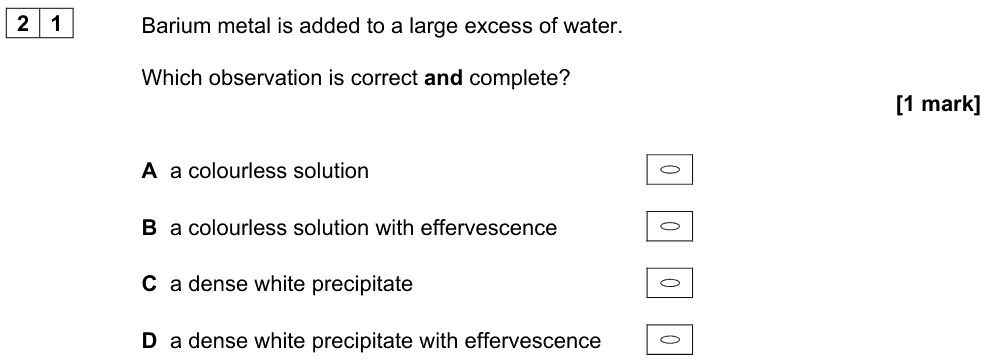
June 2023 · Paper 3 · Q21 1 mark AO1=1 Multiple choice group 2
Barium metal is added to a large excess of water.
Which observation is correct and complete?
[1 mark]
A a colourless solution
B a colourless solution with effervescence
C a dense white precipitate
D a dense white precipitate with effervescence
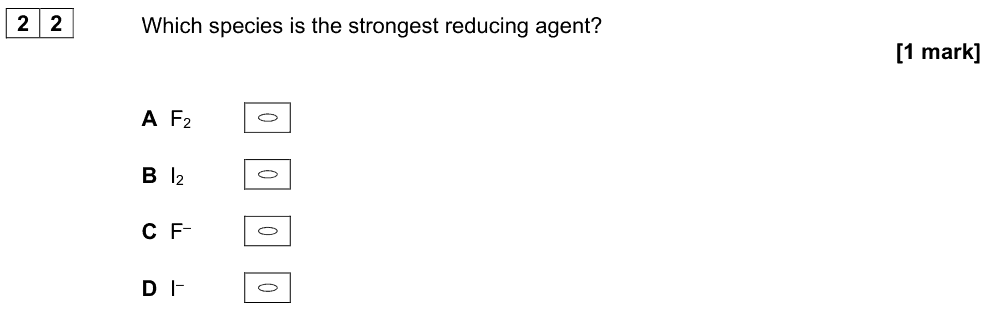
June 2023 · Paper 3 · Q22 1 mark AO1=1 Multiple choice group 7 the halogensredox
Which species is the strongest reducing agent?
[1 mark]
A F2
B I2
C F–
D I–
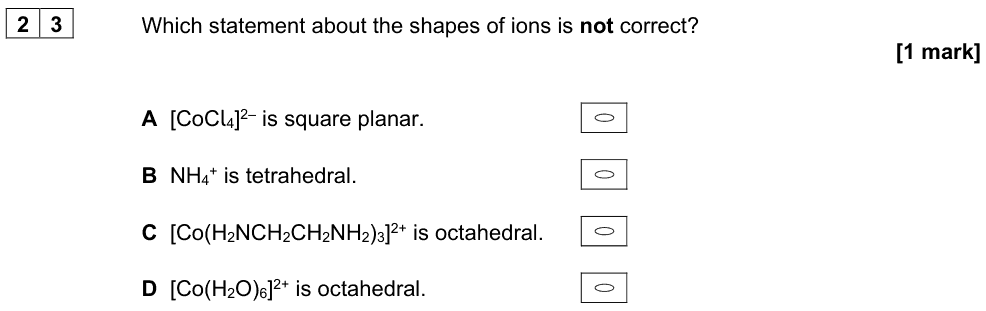
June 2023 · Paper 3 · Q23 1 mark AO1=1 Multiple choice transition metals
Which statement about the shapes of ions is not correct?
[1 mark]
A [CoCl4]2– is square planar.
B NH4+ is tetrahedral.
C [Co(H2NCH2CH2NH2)3]2+ is octahedral.
D [Co(H2O)6]2+ is octahedral.
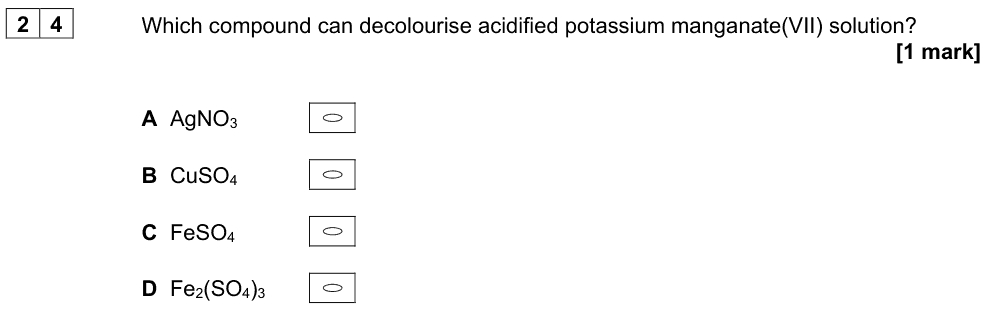
June 2023 · Paper 3 · Q24 1 mark AO1=1 Multiple choice transition metals
Which compound can decolourise acidified potassium manganate(VII) solution?
[1 mark]
A AgNO3
B CuSO4
C FeSO4
D Fe2(SO4)3
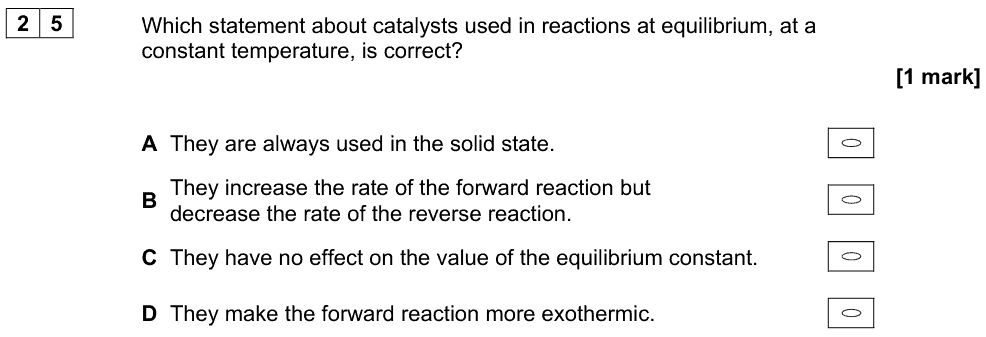
June 2023 · Paper 3 · Q25 1 mark AO2=1 Multiple choice chemical equilibria and kcequilibrium constant kp
Which statement about catalysts used in reactions at equilibrium, at a
constant temperature, is correct?
[1 mark]
A They are always used in the solid state.
B They increase the rate of the forward reaction but
decrease the rate of the reverse reaction.
C They have no effect on the value of the equilibrium constant.
D They make the forward reaction more exothermic.
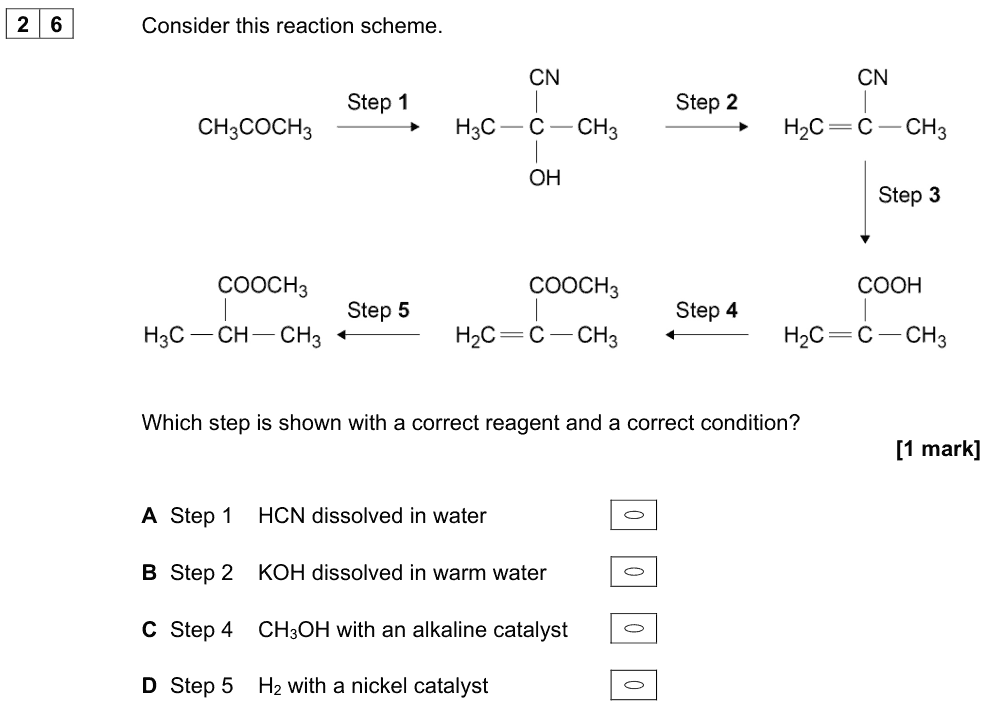
June 2023 · Paper 3 · Q26 1 mark AO3=1 Multiple choice organic synthesisalkenes
Consider this reaction scheme.
Which step is shown with a correct reagent and a correct condition?
[1 mark]
A Step 1    HCN dissolved in water
B Step 2    KOH dissolved in warm water
C Step 4    CH3OH with an alkaline catalyst
D Step 5    H2 with a nickel catalyst
June 2023 · Paper 3 · Q27 1 mark AO1=1 Multiple choice transition metalshalogenoalkanes
Which process does not involve a heterogeneous catalyst?
[1 mark]
A catalytic cracking of alkanes
B Contact process
C decomposition of ozone
D Haber process
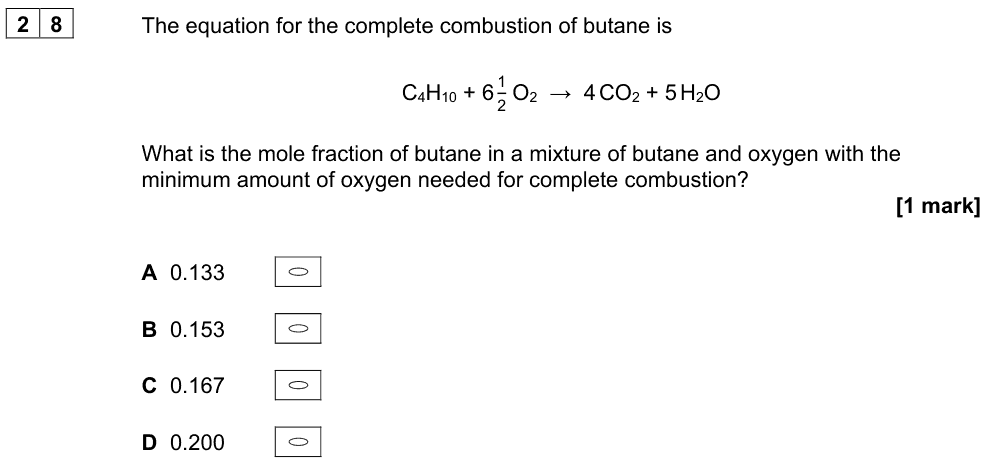
June 2023 · Paper 3 · Q28 1 mark AO2=1 Multiple choice amount of substanceequilibrium constant kp
The equation for the complete combustion of butane is
C4H10 + 6
1
2 O2  →  4 CO2 + 5 H2O
What is the mole fraction of butane in a mixture of butane and oxygen with the
minimum amount of oxygen needed for complete combustion?
[1 mark]
A 0.133
B 0.153
C 0.167
D 0.200
June 2023 · Paper 3 · Q29 1 mark AO3=1 Multiple choice halogenoalkanes
Which is not a possible product of a reaction between KOH and
?
[1 mark]
A
B
C
D
June 2023 · Paper 3 · Q30 1 mark AO1=1 Multiple choice halogenoalkanes
Most scientists believe that the concentration of ozone in the upper atmosphere
should not be allowed to decrease.
Which statement is a correct reason for this belief?
[1 mark]
A Ozone helps to prevent global warming.
B Ozone is an efficient disinfectant.
C Ozone helps to remove pollutants such as chloroalkanes.
D Ozone absorbs ultraviolet radiation.
June 2023 · Paper 3 · Q31 1 mark AO2=1 Multiple choice alkenesalcohols
Compound X can be converted into an alcohol in a two-stage process.
What is the name of compound X?
[1 mark]
A propene
B propanal
C methylbenzene
D ethanamide
June 2023 · Paper 3 · Q32 1 mark AO1=1 Multiple choice alcohols
Which is a correct equation for the oxidation of 1-phenylethanol?
[O] represents oxygen from an oxidising agent.
[1 mark]
A C6H5CH2CH2OH  +  2 [O]  →  C6H5CH2COOH  +  H2O
B C6H5CH2CH2OH  +  [O]  →  C6H5CH2CHO  +  H2O
C C6H5CH(OH)CH3  +  [O]  →  C6H5CH2CHO  +  H2O
D C6H5CH(OH)CH3  +  [O]  →  C6H5COCH3  +  H2O
June 2023 · Paper 3 · Q33 1 mark AO1=1 Multiple choice organic analysis
The skeletal formulas of two compounds are shown.
Which method would distinguish between samples of these compounds?
[1 mark]
A comparing fingerprint regions of their infrared spectra
B obtaining molecular masses from their high resolution mass spectra
C warming with acidified potassium dichromate(VI) solution
D warming with Tollens’ reagent
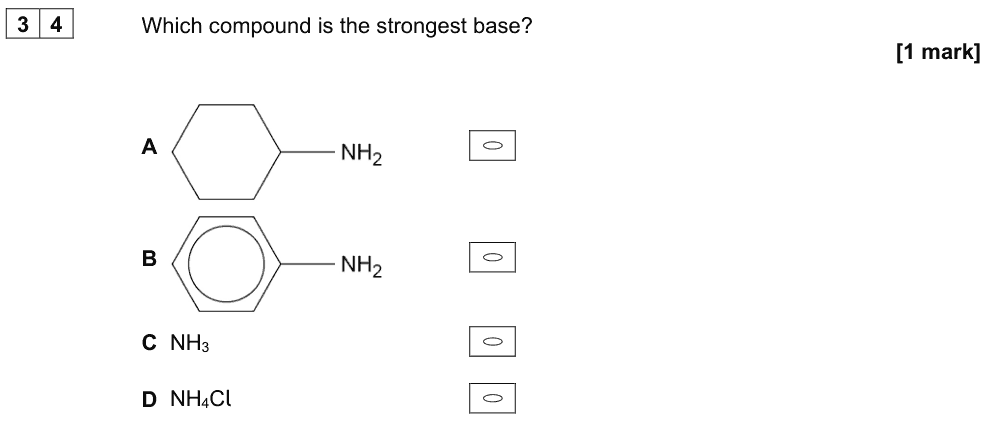
June 2023 · Paper 3 · Q34 1 mark AO1=1 Multiple choice amines
Which compound is the strongest base?
[1 mark]
A
B
C NH3
D NH4Cl
June 2023 · Paper 3 · Q35 1 mark AO1=1 Multiple choice amino acids proteins and dna
Which statement about enzymes is not correct?
[1 mark]
A The tertiary structure of an enzyme influences which molecules
can bind to the active site.
B The action of enzymes can be inhibited by a molecule or ion that
binds to the active site.
C Enzymes work equally well on both optical isomers of a substrate.
D Computers can be used to design drugs to block active sites on
enzymes.
June 2023 · Paper 3 · Q36 1 mark AO2=1 Multiple choice amino acids proteins and dna
Cisplatin has the formula [Pt(NH3)2Cl2]
Cisplatin is an anti-cancer drug that prevents replication of DNA.
When cisplatin bonds to DNA, which is the correct ligand replacement reaction?
[1 mark]
A replacement of one NH3 ligand
B replacement of two NH3 ligands
C replacement of one NH3 ligand and one Cl– ligand
D replacement of two Cl– ligands

Work with an A-level chemistry tutor

Want a paper marked and gone through with you? Message us.

Prefer email? Send an enquiry

If you are under 18, please include a parent's contact details. Enquiries go to enquiries@chemistryaleveltutor.com and are deleted once handled. All tutoring is online.