June 2022: Paper 3, Any content and practical skills

90 marks · 54 question parts · Paper, mark scheme and report on AQA's site · Have the Data Booklet beside you

Question by question

QTopicMarksAOType
01.1 Thermodynamics: Born–Haber cycles, entropy and Gibbs free energy 2AO1=2Short answer
01.2 Thermodynamics: Born–Haber cycles, entropy and Gibbs free energy 3AO2=3Calculation
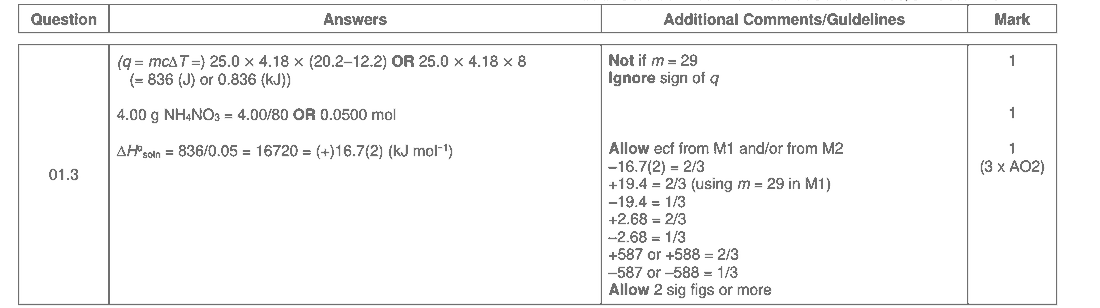
01.3 Energetics 3AO2=3Calculation
01.4 Energetics 1AO2=1Calculation
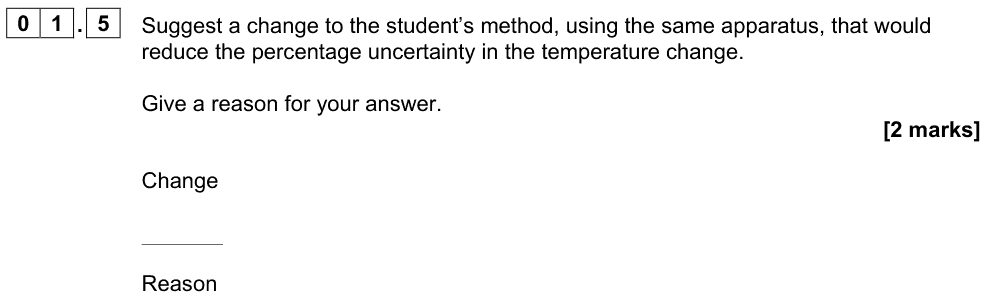
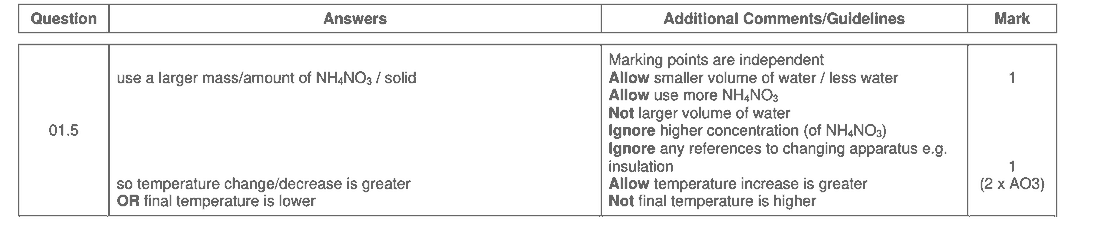
01.5 Energetics 2AO3=2Practical and data analysis
01.6 Energetics 1AO3=1Practical and data analysis
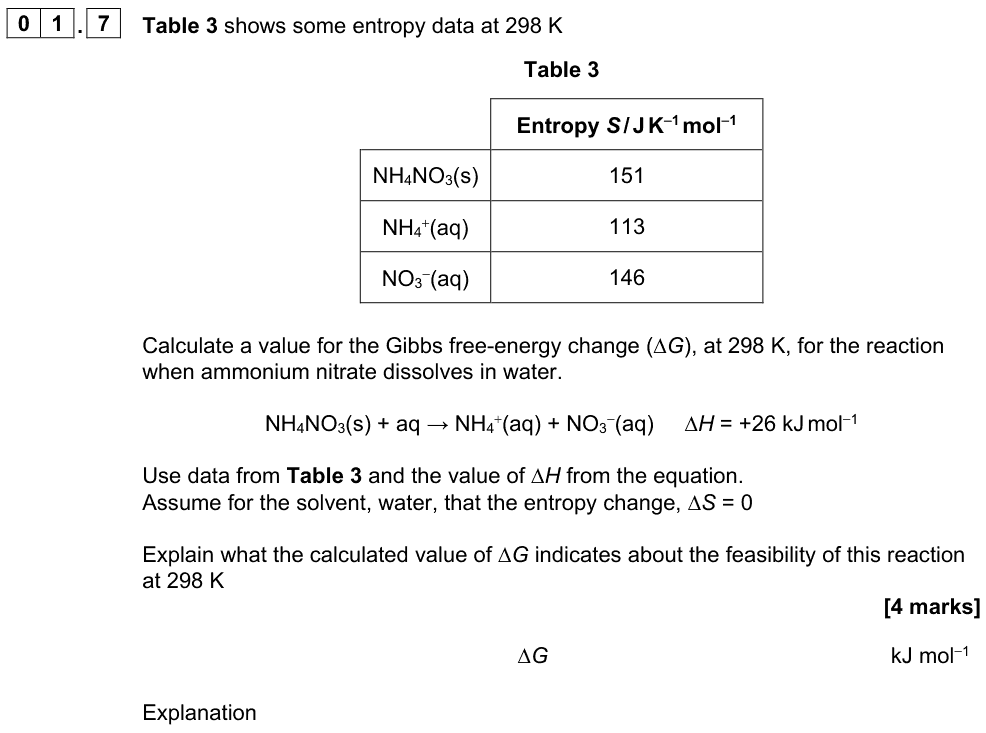
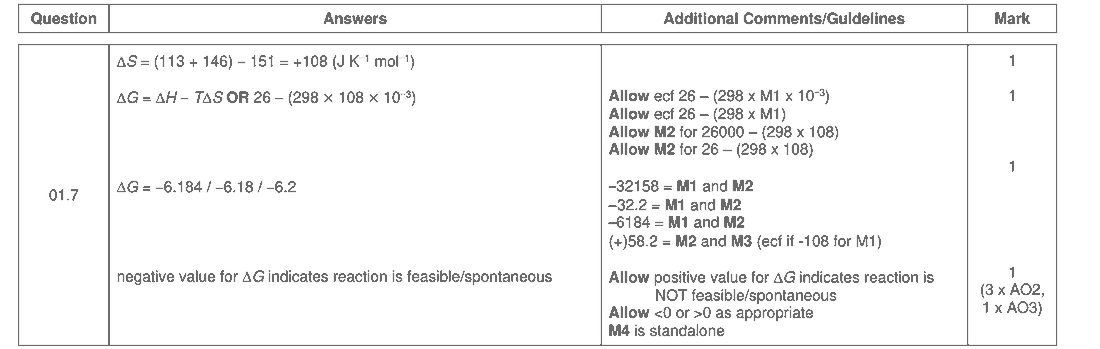
01.7 Thermodynamics: Born–Haber cycles, entropy and Gibbs free energy 4AO2=3,AO3=1Calculation
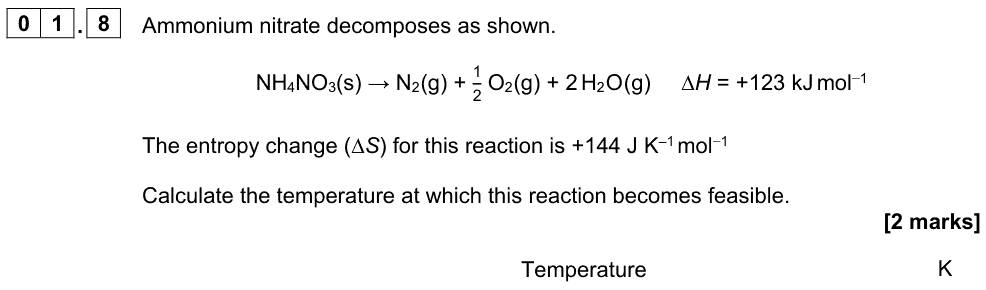
01.8 Thermodynamics: Born–Haber cycles, entropy and Gibbs free energy 2AO2=2Calculation
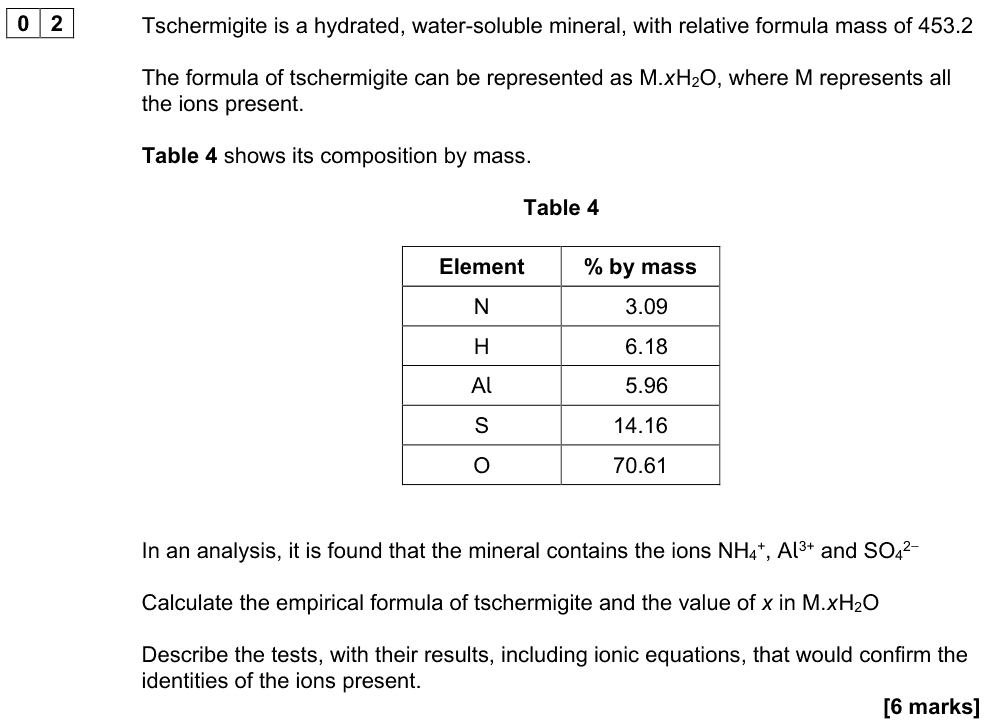
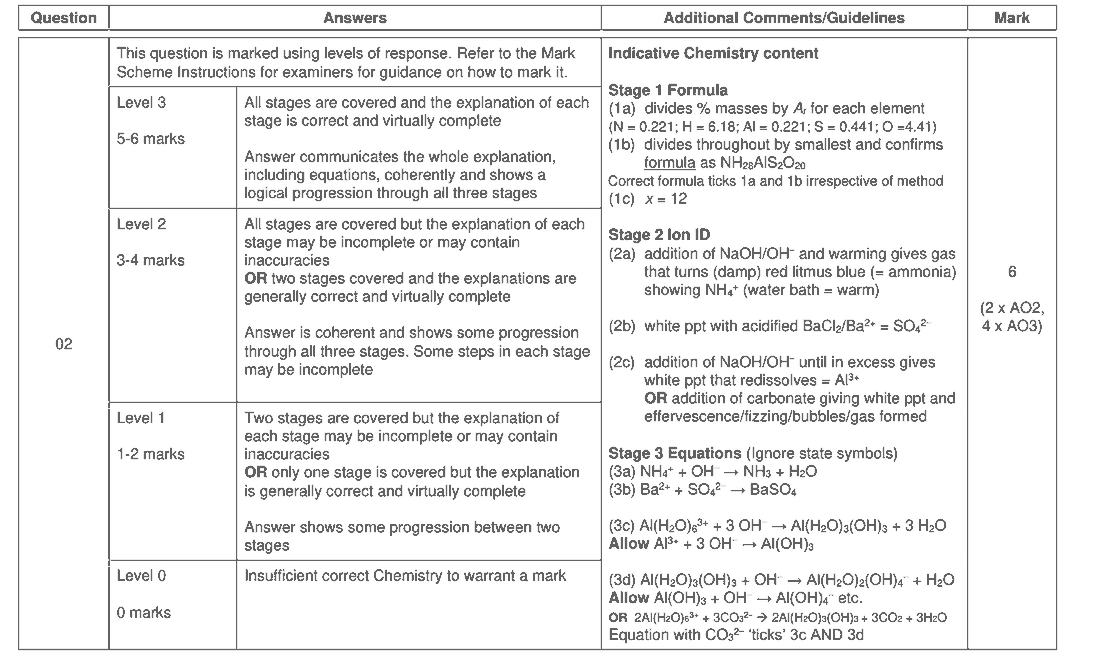
02 Amount of substance, Group 7(17), the halogens, Reactions of ions in aqueous solution 6AO2=2,AO3=4Level of response
03.1 Halogenoalkanes 2AO1=2Short answer
03.2 Introduction to organic chemistry: nomenclature, mechanisms and isomerism 2AO1=2Short answer
03.3 Introduction to organic chemistry: nomenclature, mechanisms and isomerism 2AO1=1,AO3=1Short answer
03.4 Halogenoalkanes 3AO2=3Mechanism
03.5 Introduction to organic chemistry: nomenclature, mechanisms and isomerism 2AO1=1,AO3=1Short answer
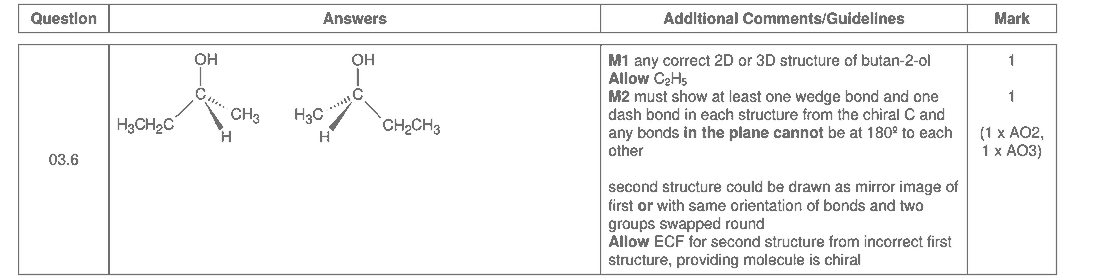
03.6 Optical isomerism 2AO2=1,AO3=1Diagram or structure
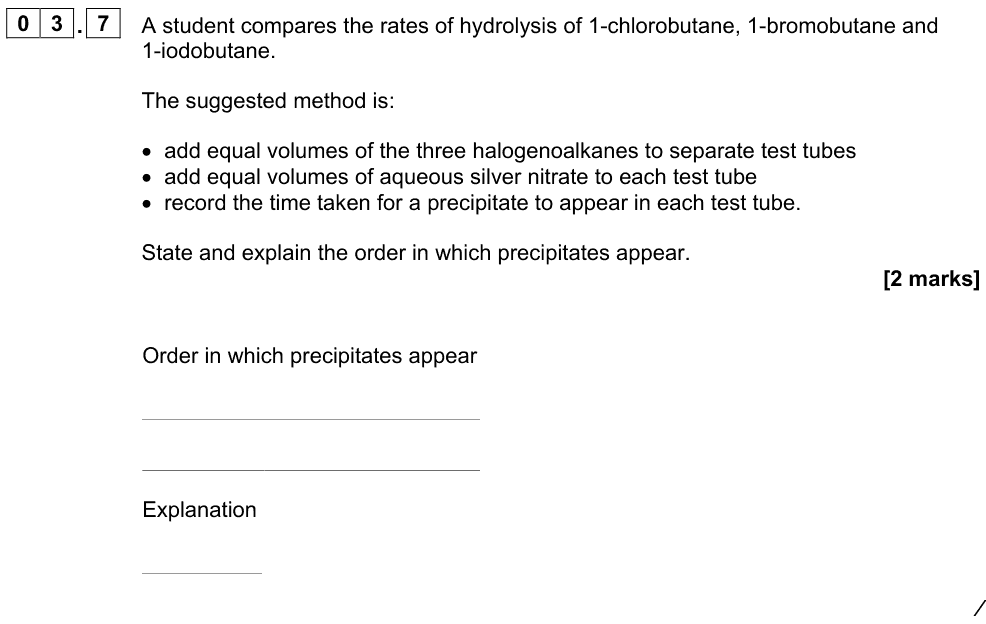
03.7 Halogenoalkanes 2AO3=2Explanation
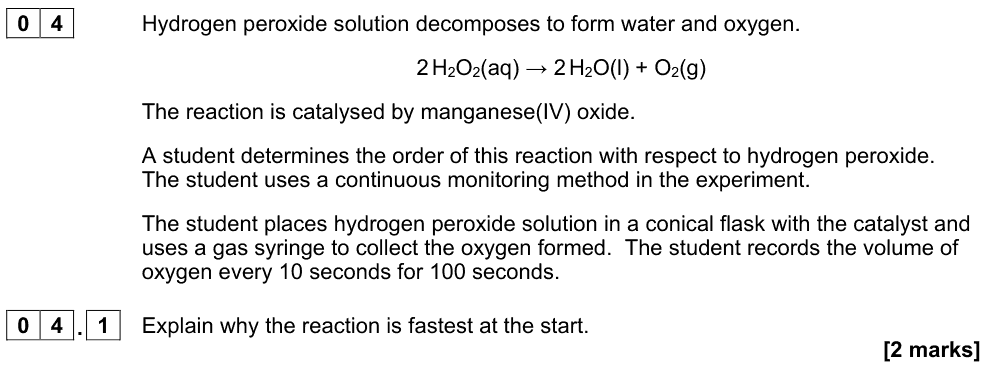
04.1 Kinetics 2AO1=2Explanation
04.2 Rate equations 2AO2=2Calculation
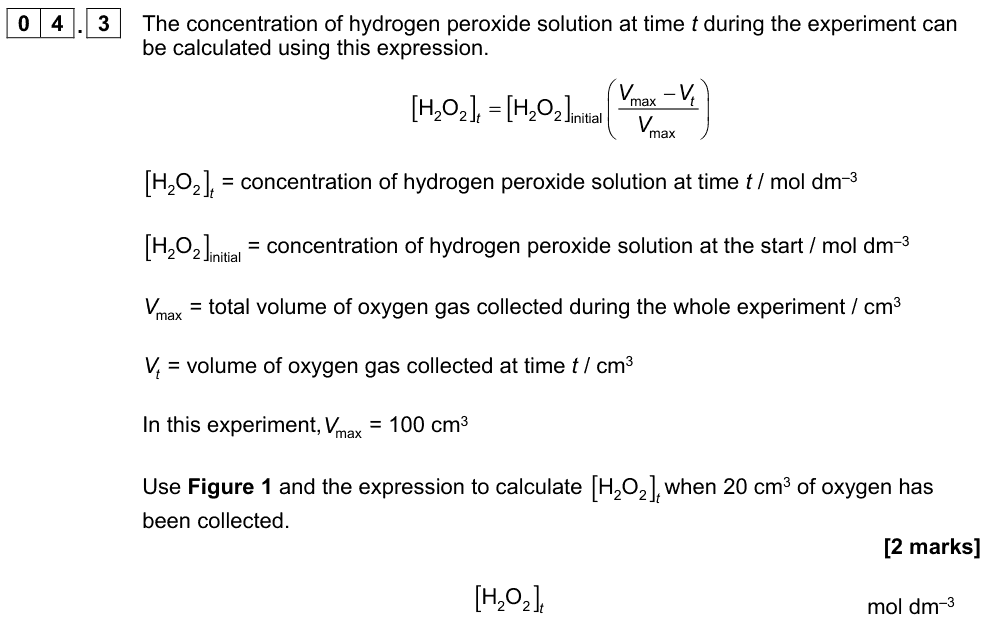
04.3 Rate equations 2AO3=2Calculation
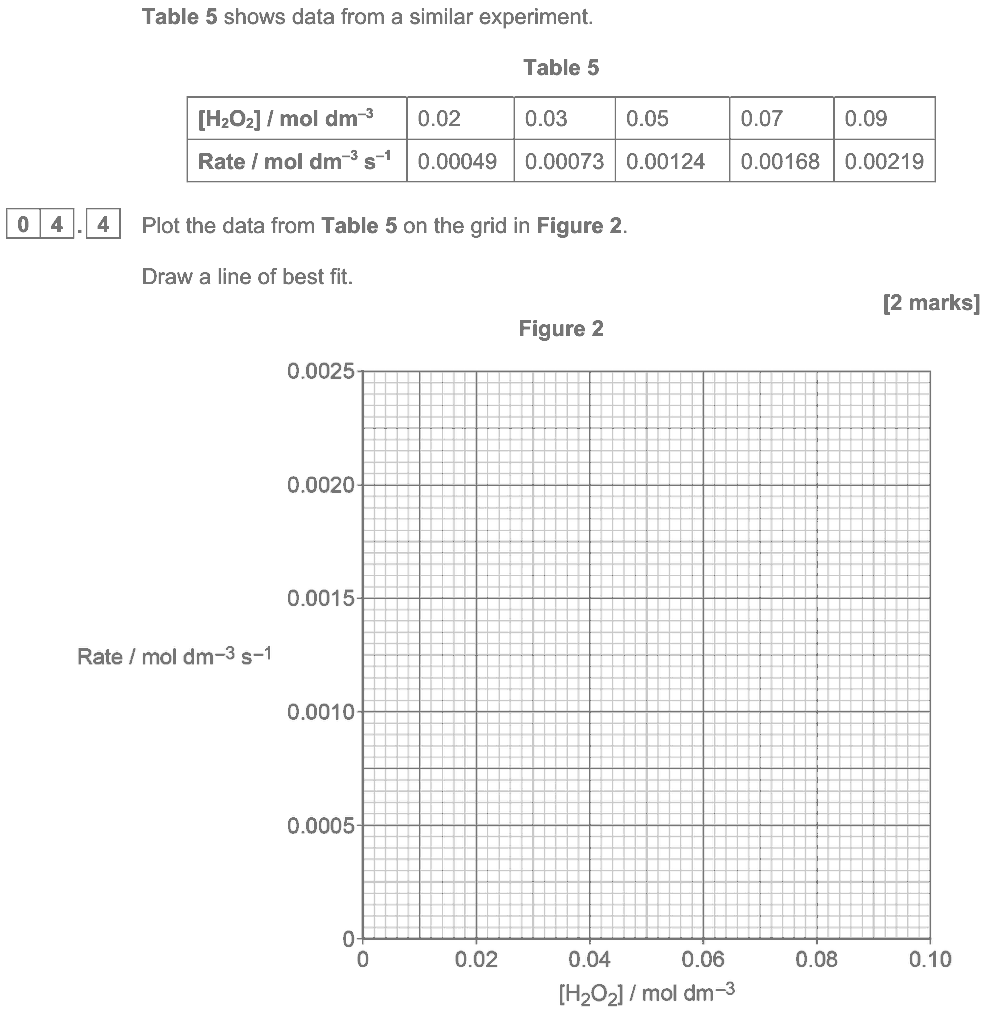
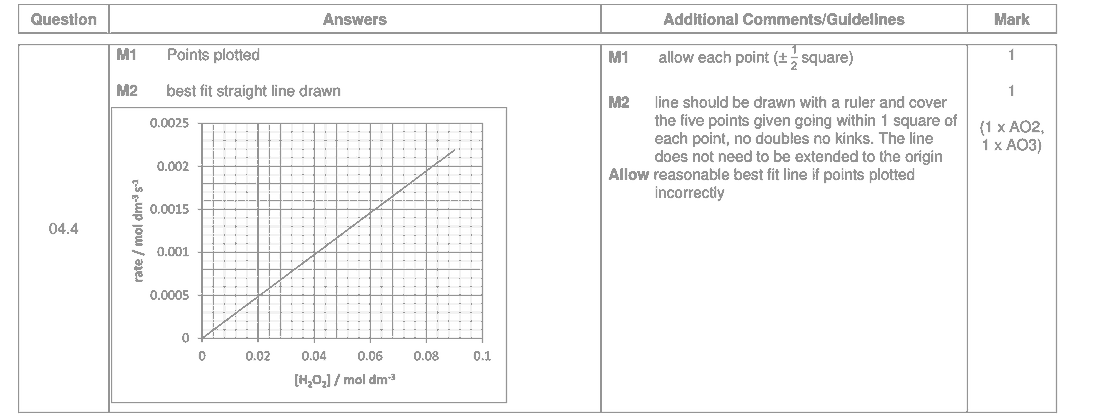
04.4 Rate equations 2AO2=1,AO3=1Practical and data analysis
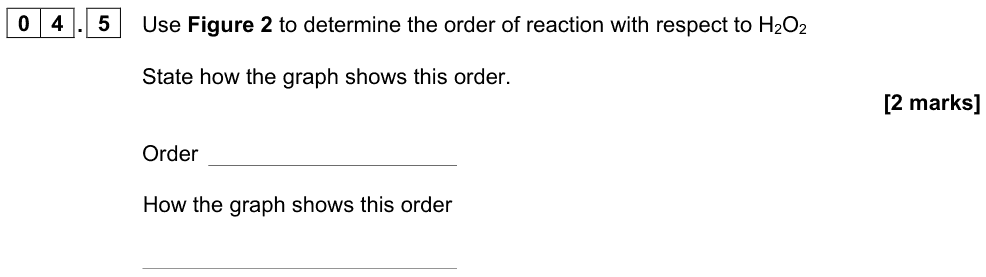
04.5 Rate equations 2AO3=2Short answer
05.1 Alkanes, Transition metals 2AO1=1,AO2=1Short answer
05.2 Transition metals 6AO1=6Explanation
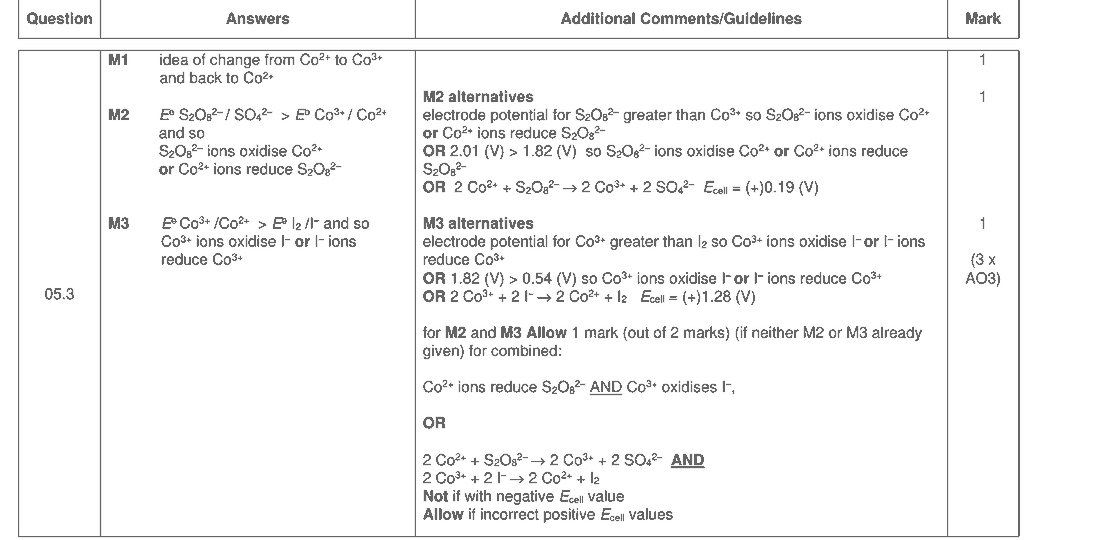
05.3 Transition metals, Electrode potentials and electrochemical cells 3AO3=3Explanation
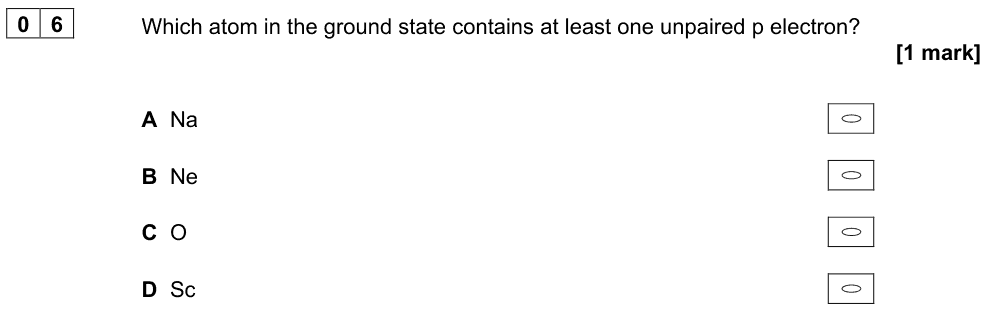
06 Atomic structure 1AO2=1Multiple choice
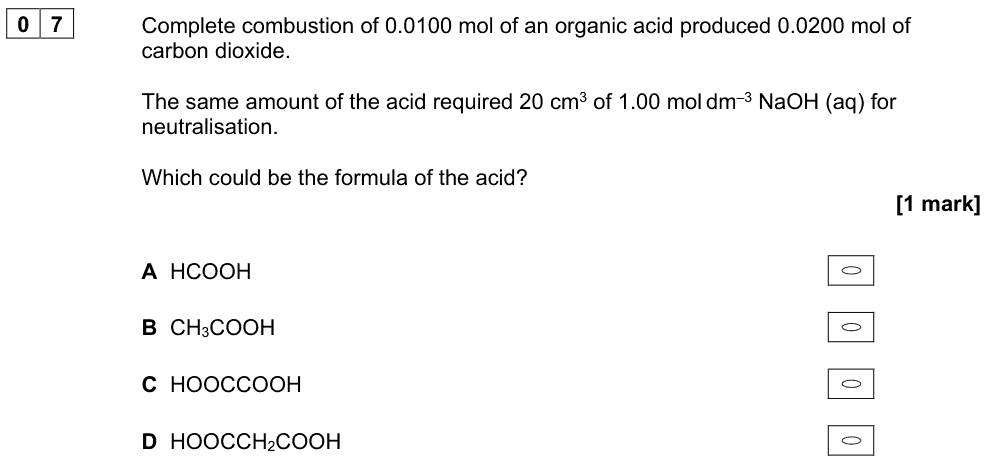
07 Amount of substance 1AO3=1Multiple choice
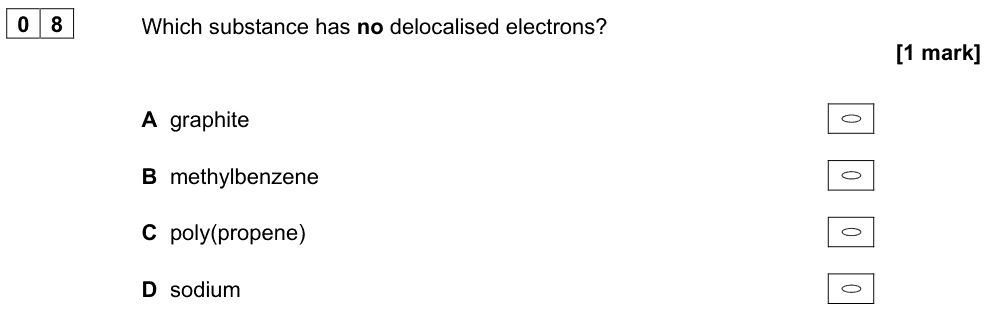
08 Bonding, Aromatic chemistry 1AO1=1Multiple choice
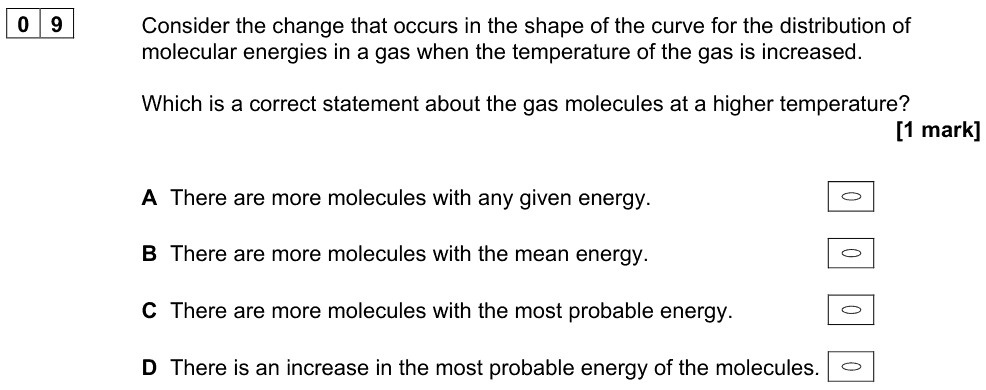
09 Kinetics 1AO1=1Multiple choice
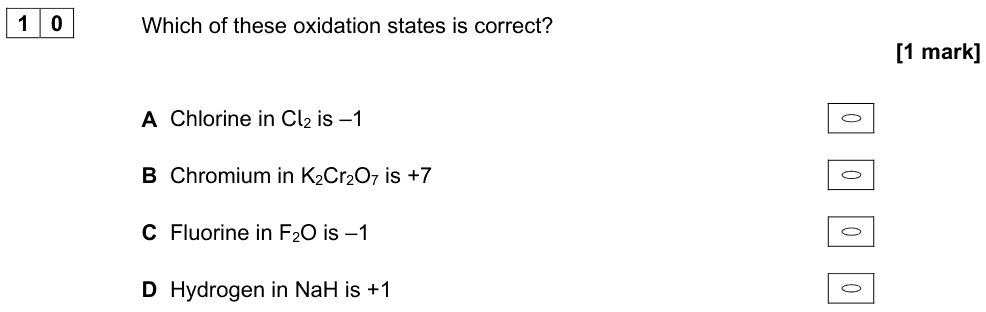
10 Oxidation, reduction and redox equations 1AO1=1Multiple choice
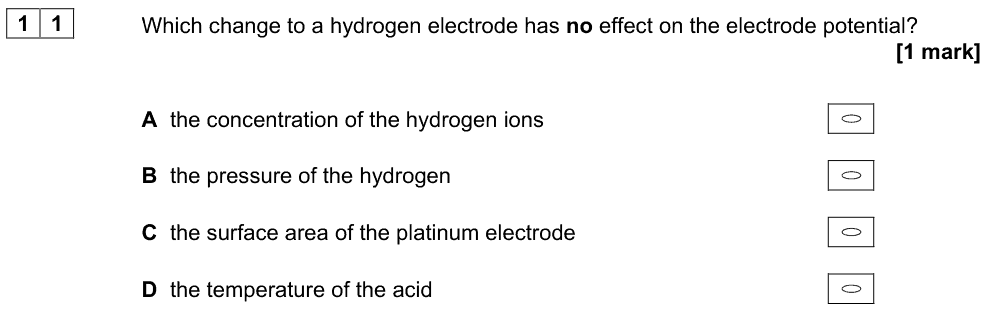
11 Electrode potentials and electrochemical cells 1AO1=1Multiple choice
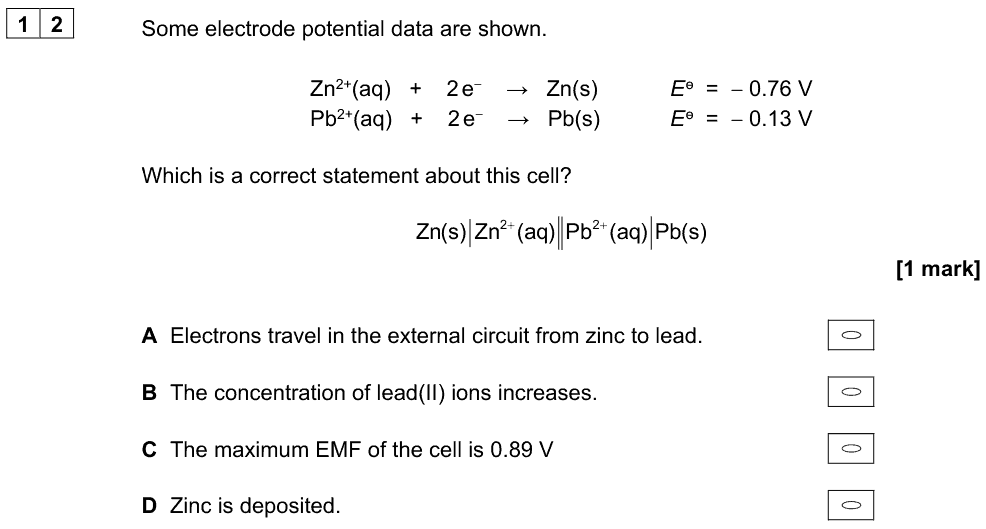
12 Electrode potentials and electrochemical cells 1AO1=1Multiple choice
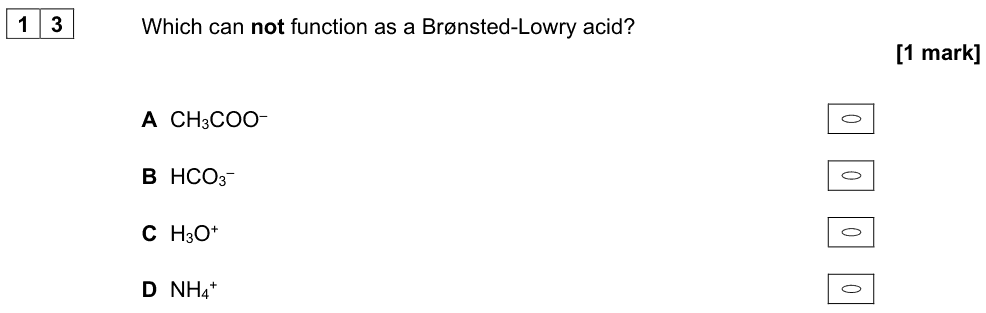
13 Acids and bases: pH, Ka, titration curves and buffers 1AO3=1Multiple choice
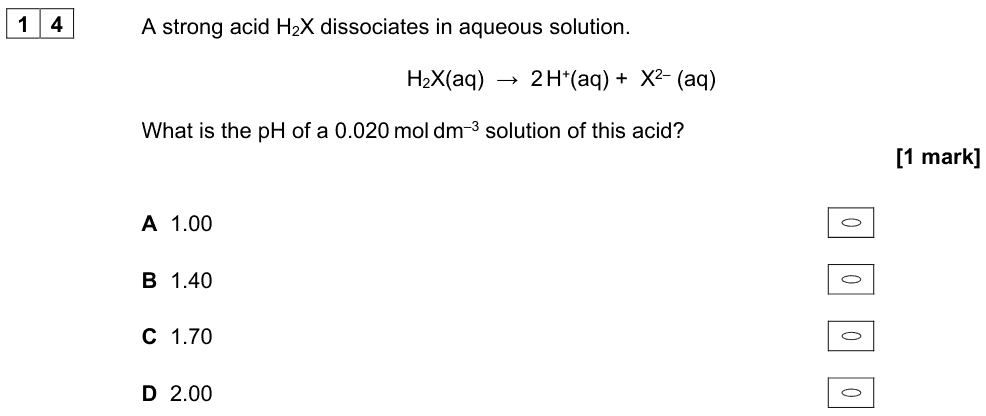
14 Acids and bases: pH, Ka, titration curves and buffers 1AO2=1Multiple choice
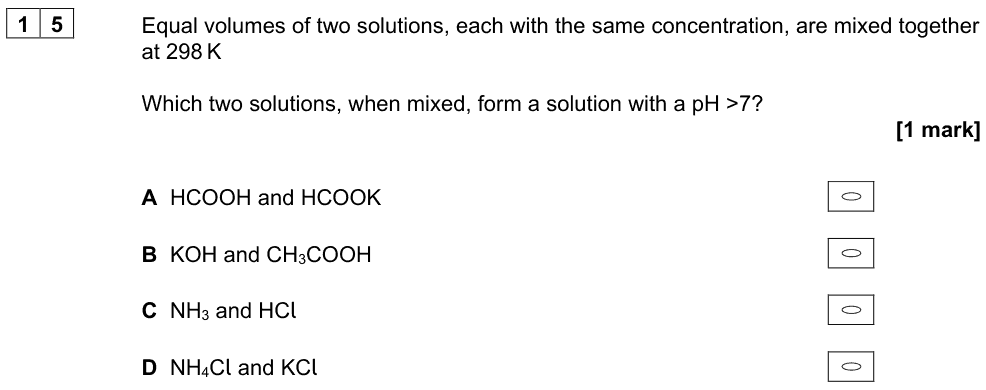
15 Acids and bases: pH, Ka, titration curves and buffers 1AO3=1Multiple choice
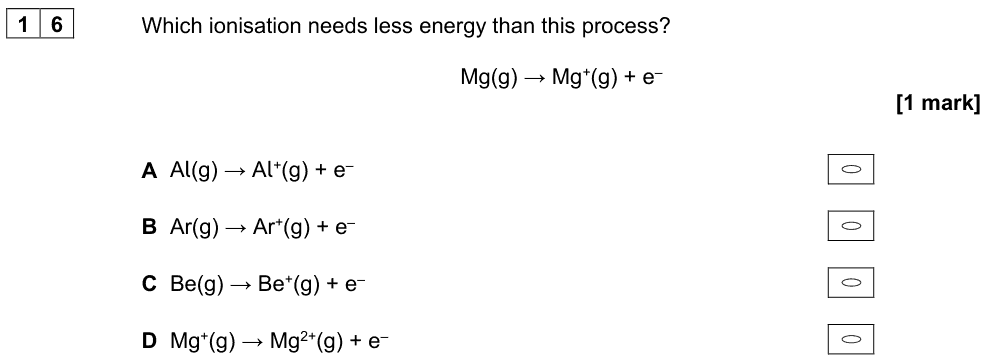
16 Atomic structure 1AO2=1Multiple choice
17 Atomic structure, Thermodynamics: Born–Haber cycles, entropy and Gibbs free energy, Bonding 1AO3=1Multiple choice
18 Group 7(17), the halogens 1AO1=1Multiple choice
19 Transition metals 1AO3=1Multiple choice
20 Transition metals 1AO1=1Multiple choice
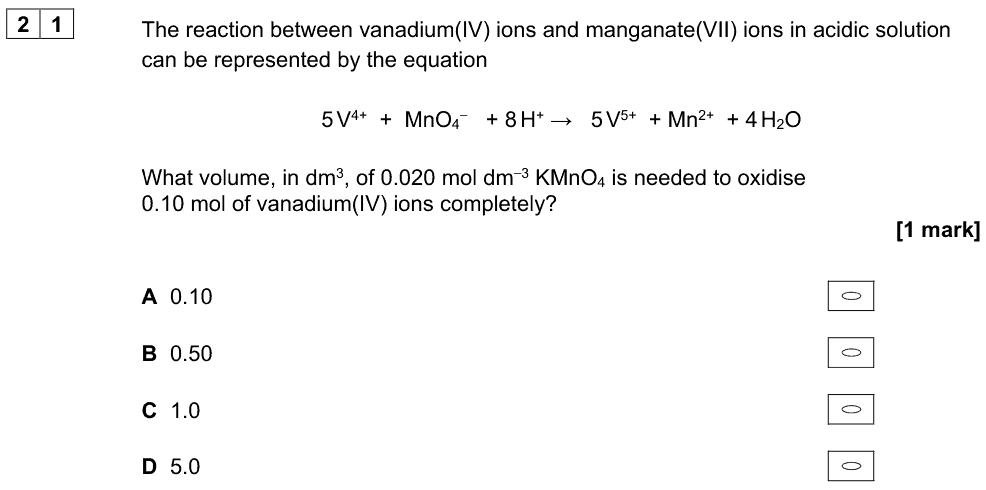
21 Transition metals, Amount of substance 1AO2=1Multiple choice
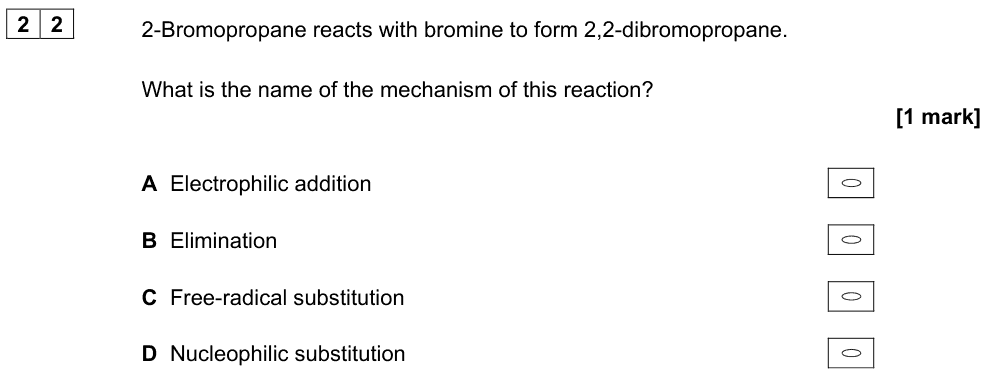
22 Alkanes 1AO2=1Multiple choice
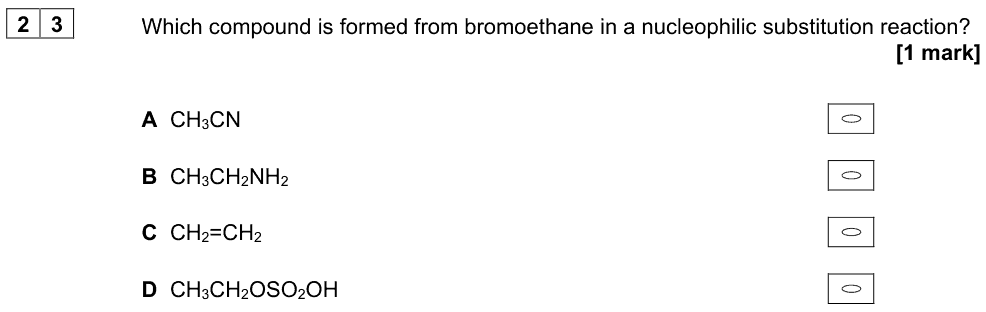
23 Halogenoalkanes 1AO2=1Multiple choice
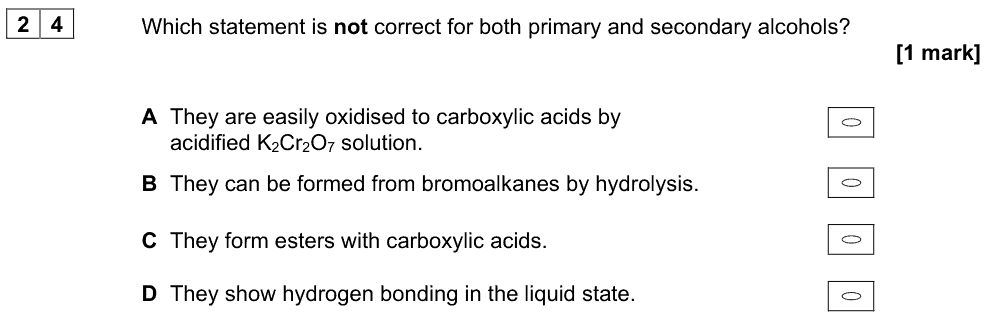
24 Alcohols 1AO1=1Multiple choice
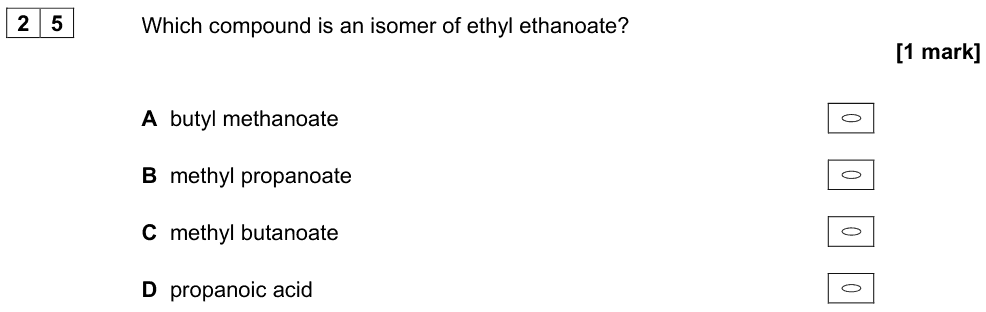
25 Introduction to organic chemistry: nomenclature, mechanisms and isomerism 1AO1=1Multiple choice
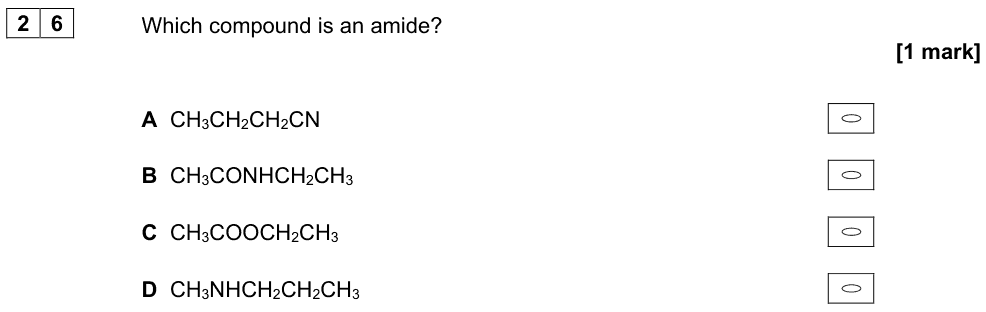
26 Carboxylic acids and derivatives 1AO1=1Multiple choice
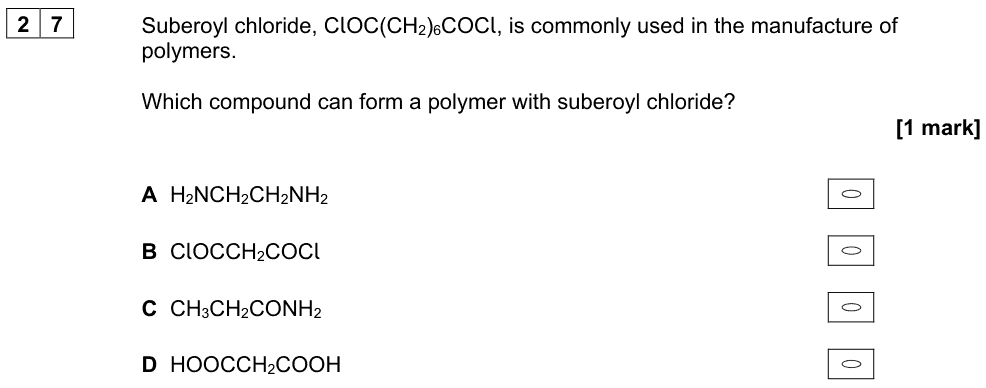
27 Polymers 1AO2=1Multiple choice
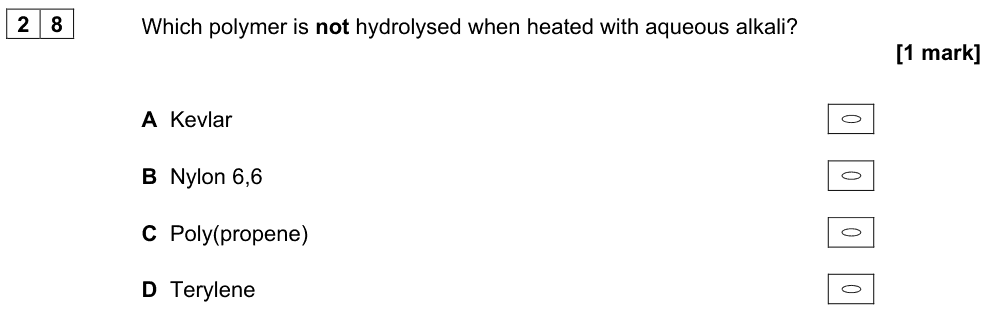
28 Polymers 1AO3=1Multiple choice
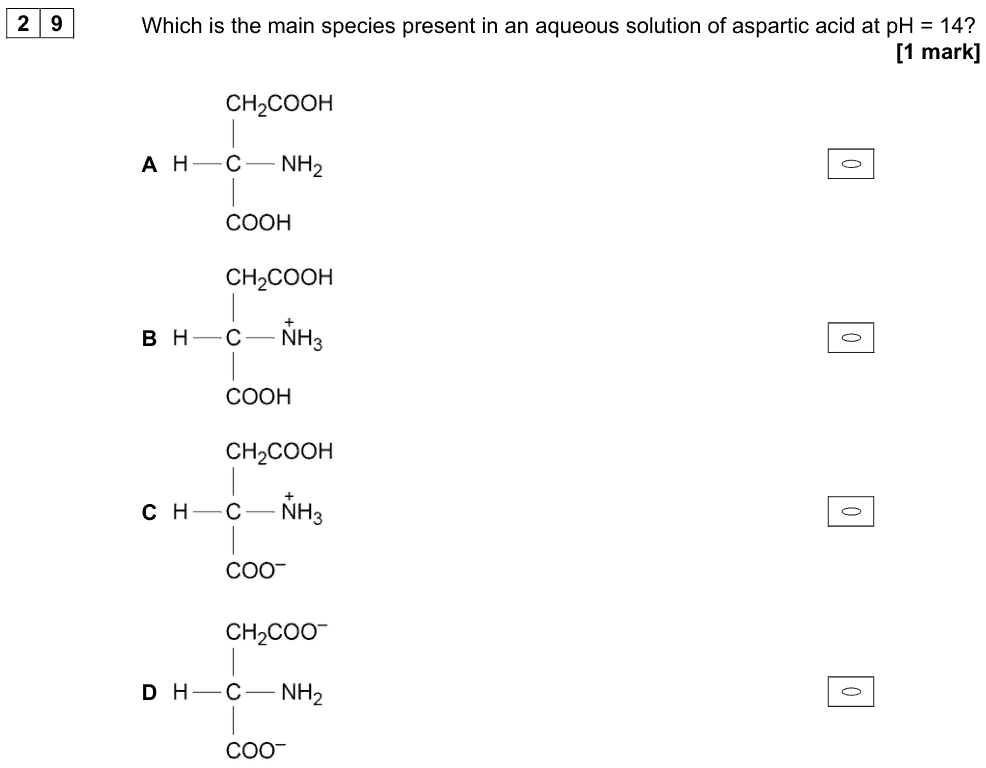
29 Amino acids, proteins and DNA 1AO2=1Multiple choice
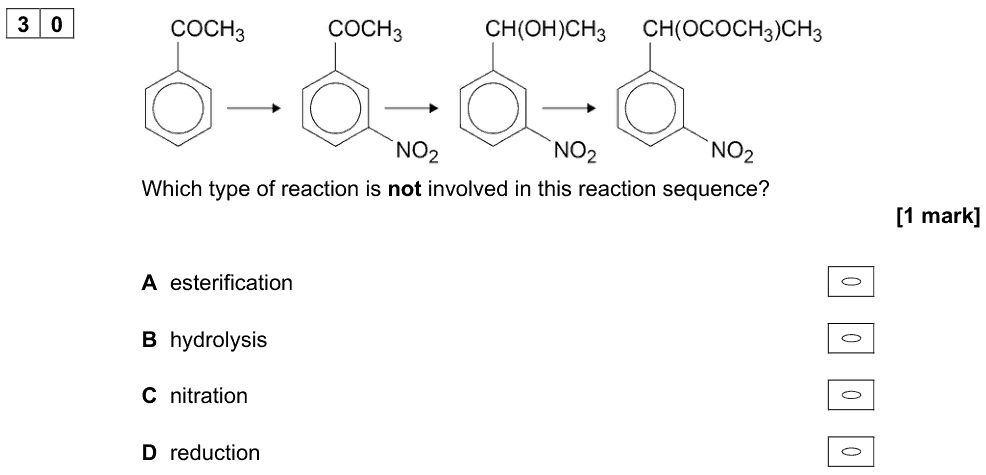
30 Organic synthesis, Aromatic chemistry, Aldehydes and ketones 1AO3=1Multiple choice
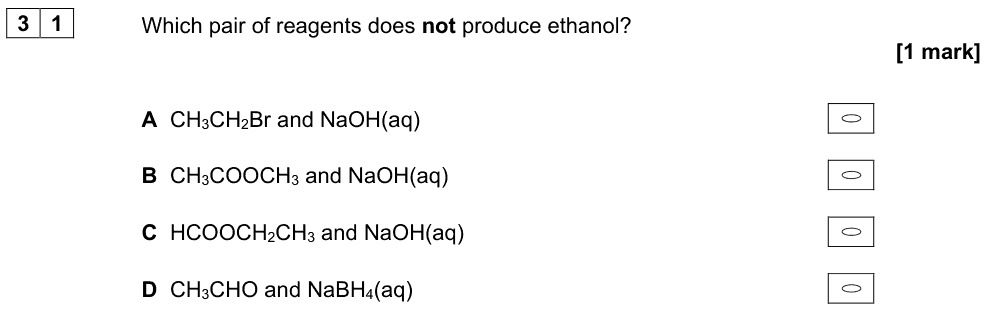
31 Carboxylic acids and derivatives 1AO2=1Multiple choice
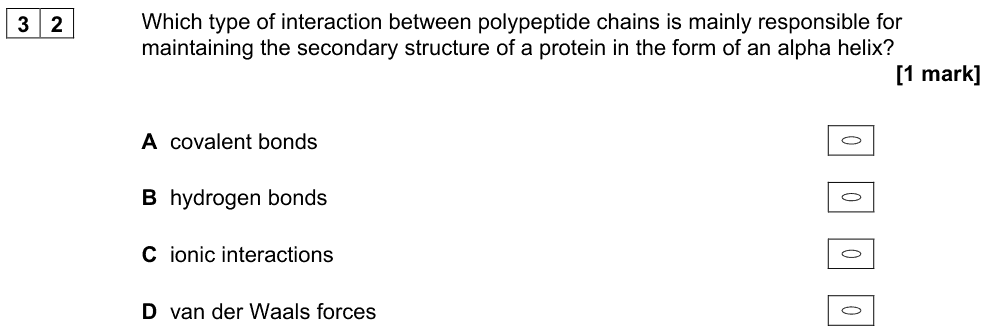
32 Amino acids, proteins and DNA 1AO1=1Multiple choice
33 Amino acids, proteins and DNA 1AO1=1Multiple choice
34 Alcohols 1AO1=1Multiple choice
35 Introduction to organic chemistry: nomenclature, mechanisms and isomerism 1AO3=1Multiple choice

The questions

01.101.201.301.401.501.601.701.80203.103.203.303.403.503.603.704.104.204.304.404.505.105.205.3060708091011121314151617181920212223242526272829303132333435
June 2022 · Paper 3 · Q01.1 2 marks AO1=2 Short answer thermodynamics
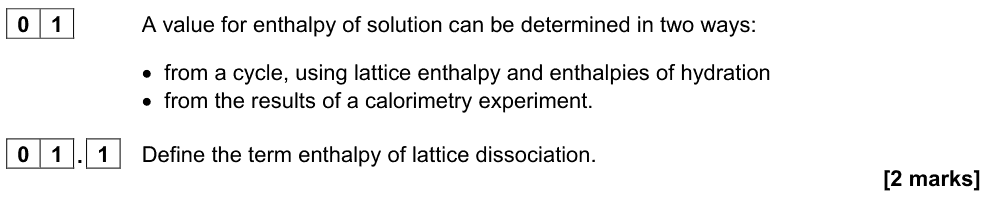
A value for enthalpy of solution can be determined in two ways:
• from a cycle, using lattice enthalpy and enthalpies of hydration
• from the results of a calorimetry experiment.
Define the term enthalpy of lattice dissociation.
[2 marks]
June 2022 · Paper 3 · Q01.2 3 marks AO2=3 Calculation thermodynamics
Earlier part of question 01 that this part usesEarlier part of June 2022 Paper 3 question 01
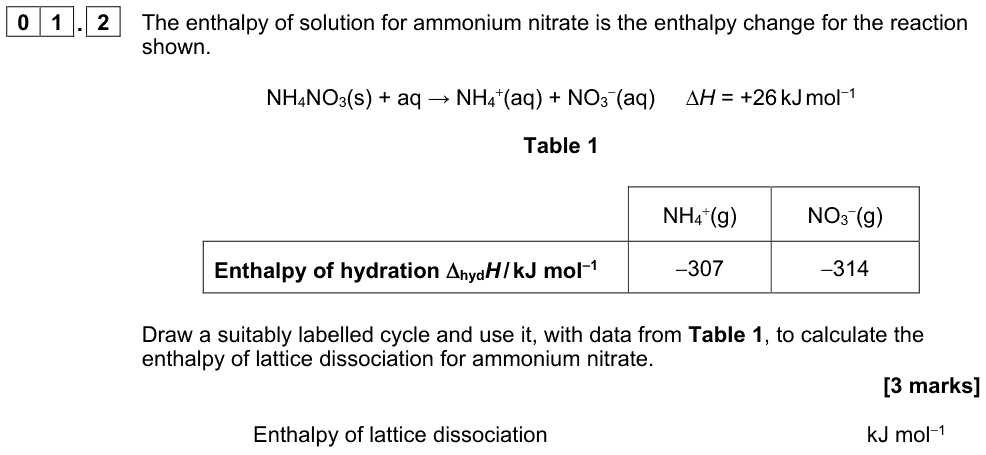
The enthalpy of solution for ammonium nitrate is the enthalpy change for the reaction
shown.
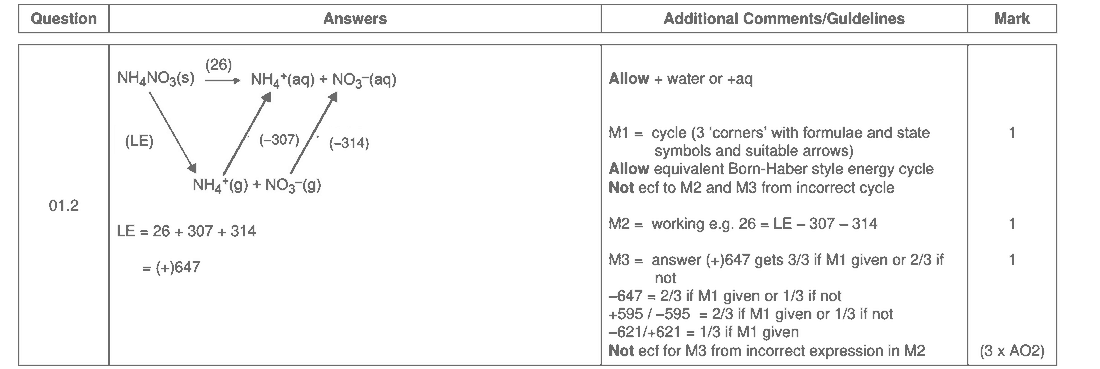
NH4NO3(s) + aq → NH4+(aq) + NO3−(aq)     ∆H = +26 kJ mol−1
Table 1
NH4+(g)
NO3−(g)
Enthalpy of hydration
hydH / kJ  mol 1
−307
−314
Draw a suitably labelled cycle and use it, with data from Table 1, to calculate the
enthalpy of lattice dissociation for ammonium nitrate.
[3 marks]
Enthalpy of lattice dissociation
kJ mol−1
June 2022 · Paper 3 · Q01.3 3 marks AO2=3 Calculation energetics
Earlier part of question 01 that this part usesEarlier part of June 2022 Paper 3 question 01
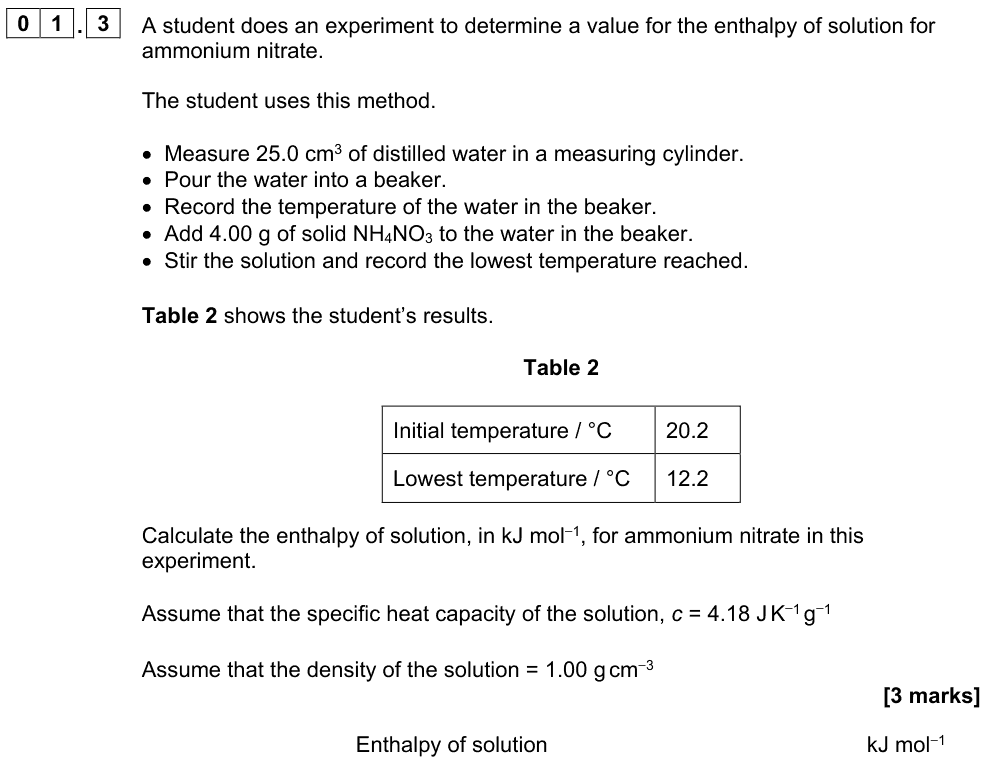
A student does an experiment to determine a value for the enthalpy of solution for
ammonium nitrate.
The student uses this method.
• Measure 25.0 cm3 of distilled water in a measuring cylinder.
• Pour the water into a beaker.
• Record the temperature of the water in the beaker.
• Add 4.00 g of solid NH4NO3 to the water in the beaker.
• Stir the solution and record the lowest temperature reached.
Table 2 shows the student’s results.
Table 2
Initial temperature / °C
20.2
Lowest temperature / °C
12.2
Calculate the enthalpy of solution, in kJ mol−1, for ammonium nitrate in this
experiment.
Assume that the specific heat capacity of the solution, c = 4.18 J K−1 g−1
Assume that the density of the solution = 1.00 g cm−3
[3 marks]
Enthalpy of solution
kJ mol−1
June 2022 · Paper 3 · Q01.4 1 mark AO2=1 Calculation energetics
Earlier part of question 01 that this part usesEarlier part of June 2022 Paper 3 question 01
The uncertainty in each of the temperature readings from the thermometer used in
this experiment is ±0.1°C
Calculate the percentage uncertainty in the temperature change in this experiment.
[1 mark]
Percentage uncertainty
June 2022 · Paper 3 · Q01.5 2 marks AO3=2 Practical and data analysis energetics
Earlier part of question 01 that this part usesEarlier part of June 2022 Paper 3 question 01
Suggest a change to the student’s method, using the same apparatus, that would
reduce the percentage uncertainty in the temperature change.
Give a reason for your answer.
[2 marks]
Change
Reason
June 2022 · Paper 3 · Q01.6 1 mark AO3=1 Practical and data analysis energetics
Earlier part of question 01 that this part usesEarlier part of June 2022 Paper 3 question 01
Another student obtained a value of +15 kJ mol−1 using the same method.
Suggest the main reason for the difference between this experimental value for the
enthalpy of solution and the correct value of +26 kJ mol−1
[1 mark]
June 2022 · Paper 3 · Q01.7 4 marks AO2=3, AO3=1 Calculation thermodynamics
Earlier part of question 01 that this part usesEarlier part of June 2022 Paper 3 question 01
Table 3 shows some entropy data at 298 K
Table 3
Entropy S / J K 1 mol 1
NH4NO3(s)
151
NH4+(aq)
113
NO3−(aq)
146
Calculate a value for the Gibbs free-energy change (∆G), at 298 K, for the reaction
when ammonium nitrate dissolves in water.
NH4NO3(s) + aq → NH4+(aq) + NO3−(aq)     ∆H = +26 kJ mol−1
Use data from Table 3 and the value of ∆H from the equation.
Assume for the solvent, water, that the entropy change, ∆S = 0
Explain what the calculated value of ∆G indicates about the feasibility of this reaction
at 298 K
[4 marks]
∆G
kJ mol−1
Explanation
June 2022 · Paper 3 · Q01.8 2 marks AO2=2 Calculation thermodynamics
Earlier part of question 01 that this part usesEarlier part of June 2022 Paper 3 question 01
Ammonium nitrate decomposes as shown.
NH4NO3(s) → N2 (g) +
1
2 O2 (g) + 2 H2 O (g)     ∆H = +123 kJ mol−1
The entropy change (∆S) for this reaction is +144 J K–1 mol−1
Calculate the temperature at which this reaction becomes feasible.
[2 marks]
Temperature
K
June 2022 · Paper 3 · Q02 6 marks AO2=2, AO3=4 6-mark level of response amount of substancegroup 7 the halogensreactions of ions in aqueous solution
Tschermigite is a hydrated, water-soluble mineral, with relative formula mass of 453.2
The formula of tschermigite can be represented as M.x H2O, where M represents all
the ions present.
Table 4 shows its composition by mass.
Table 4
Element
% by mass
N
3.09
H
6.18
Al
5.96
S
14.16
O
70.61
In an analysis, it is found that the mineral contains the ions NH4+, Al3+ and SO42−
Calculate the empirical formula of tschermigite and the value of x in M.x H2O
Describe the tests, with their results, including ionic equations, that would confirm the
identities of the ions present.
[6 marks]
June 2022 · Paper 3 · Q03.1 2 marks AO1=2 Short answer halogenoalkanes
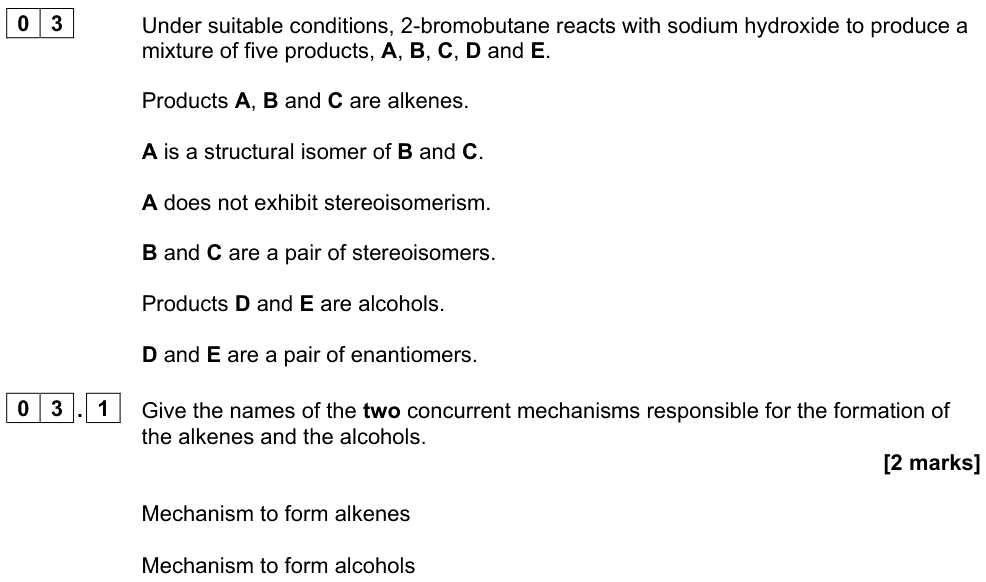
Under suitable conditions, 2-bromobutane reacts with sodium hydroxide to produce a
mixture of five products, A, B, C, D and E.
Products A, B and C are alkenes.
A is a structural isomer of B and C.
A does not exhibit stereoisomerism.
B and C are a pair of stereoisomers.
Products D and E are alcohols.
D and E are a pair of enantiomers.
Give the names of the two concurrent mechanisms responsible for the formation of
the alkenes and the alcohols.
[2 marks]
Mechanism to form alkenes
Mechanism to form alcohols
June 2022 · Paper 3 · Q03.2 2 marks AO1=2 Short answer introduction to organic chemistry
Earlier part of question 03 that this part usesEarlier part of June 2022 Paper 3 question 03
Define the term stereoisomers.
[2 marks]
June 2022 · Paper 3 · Q03.3 2 marks AO1=1, AO3=1 Short answer introduction to organic chemistry
Earlier part of question 03 that this part usesEarlier part of June 2022 Paper 3 question 03
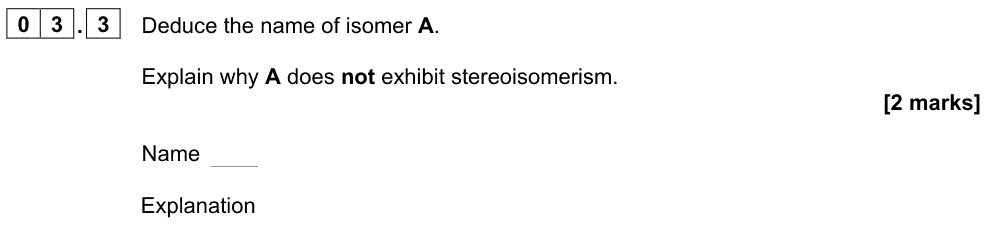
Deduce the name of isomer A.
Explain why A does not exhibit stereoisomerism.
[2 marks]
Name
Explanation
June 2022 · Paper 3 · Q03.4 3 marks AO2=3 Mechanism halogenoalkanes
Earlier part of question 03 that this part usesEarlier part of June 2022 Paper 3 question 03
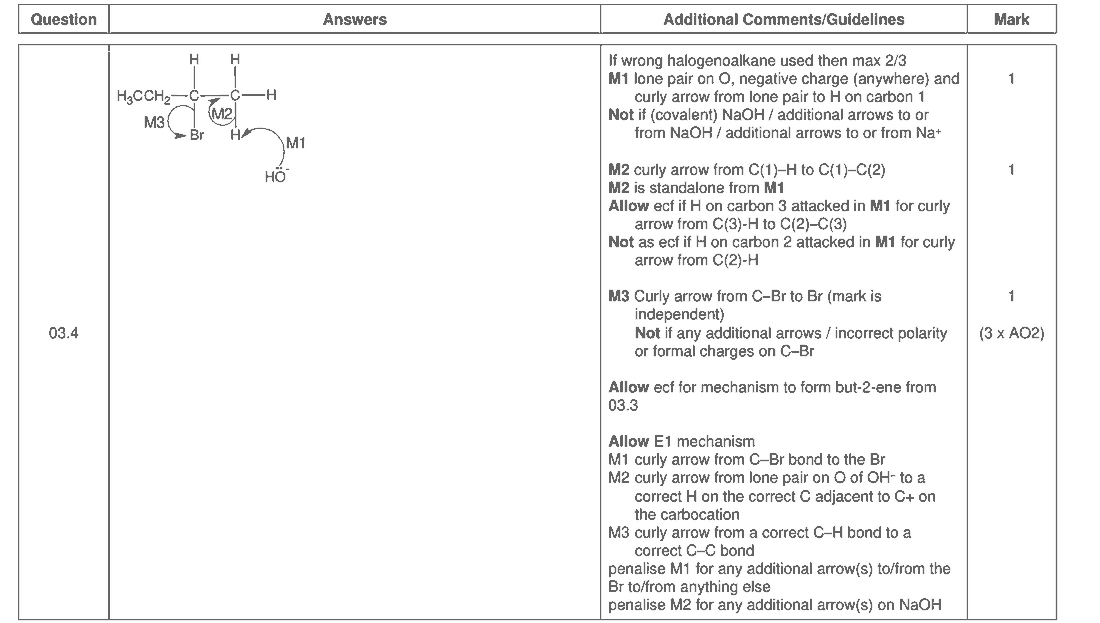
Outline the mechanism for the reaction of 2-bromobutane with sodium hydroxide to
form alkene A.
[3 marks]
June 2022 · Paper 3 · Q03.5 2 marks AO1=1, AO3=1 Short answer introduction to organic chemistry
Earlier part of question 03 that this part usesEarlier part of June 2022 Paper 3 question 03
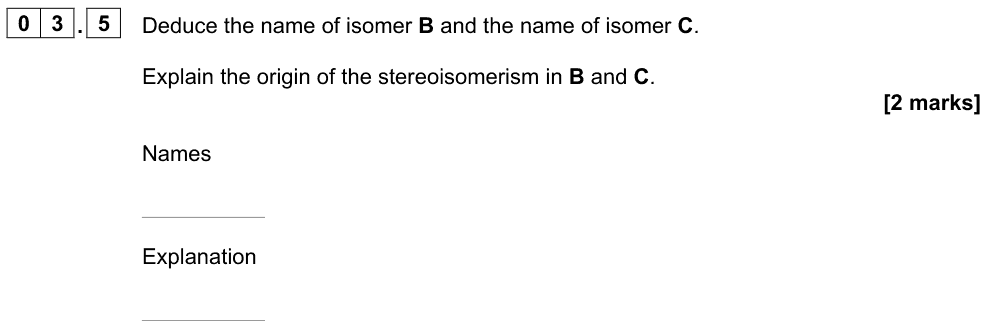
Deduce the name of isomer B and the name of isomer C.
Explain the origin of the stereoisomerism in B and C.
[2 marks]
Names
Explanation
June 2022 · Paper 3 · Q03.6 2 marks AO2=1, AO3=1 Diagram or structure optical isomerism
Earlier part of question 03 that this part usesEarlier part of June 2022 Paper 3 question 03
Draw 3D representations of enantiomers D and E to show how their structures are
related.
[2 marks]
June 2022 · Paper 3 · Q03.7 2 marks AO3=2 Explanation halogenoalkanes
Earlier part of question 03 that this part usesEarlier part of June 2022 Paper 3 question 03
A student compares the rates of hydrolysis of 1-chlorobutane, 1-bromobutane and
1-iodobutane.
The suggested method is:
• add equal volumes of the three halogenoalkanes to separate test tubes
• add equal volumes of aqueous silver nitrate to each test tube
• record the time taken for a precipitate to appear in each test tube.
State and explain the order in which precipitates appear.
[2 marks]
Order in which precipitates appear
Explanation
June 2022 · Paper 3 · Q04.1 2 marks AO1=2 Explanation kinetics
Hydrogen peroxide solution decomposes to form water and oxygen.
2 H2O2(aq) → 2 H2O(l) + O2(g)
The reaction is catalysed by manganese(IV) oxide.
A student determines the order of this reaction with respect to hydrogen peroxide.
The student uses a continuous monitoring method in the experiment.
The student places hydrogen peroxide solution in a conical flask with the catalyst and
uses a gas syringe to collect the oxygen formed.  The student records the volume of
oxygen every 10 seconds for 100 seconds.
Explain why the reaction is fastest at the start.
[2 marks]
June 2022 · Paper 3 · Q04.2 2 marks AO2=2 Calculation rate equations
Earlier part of question 04 that this part usesEarlier part of June 2022 Paper 3 question 04
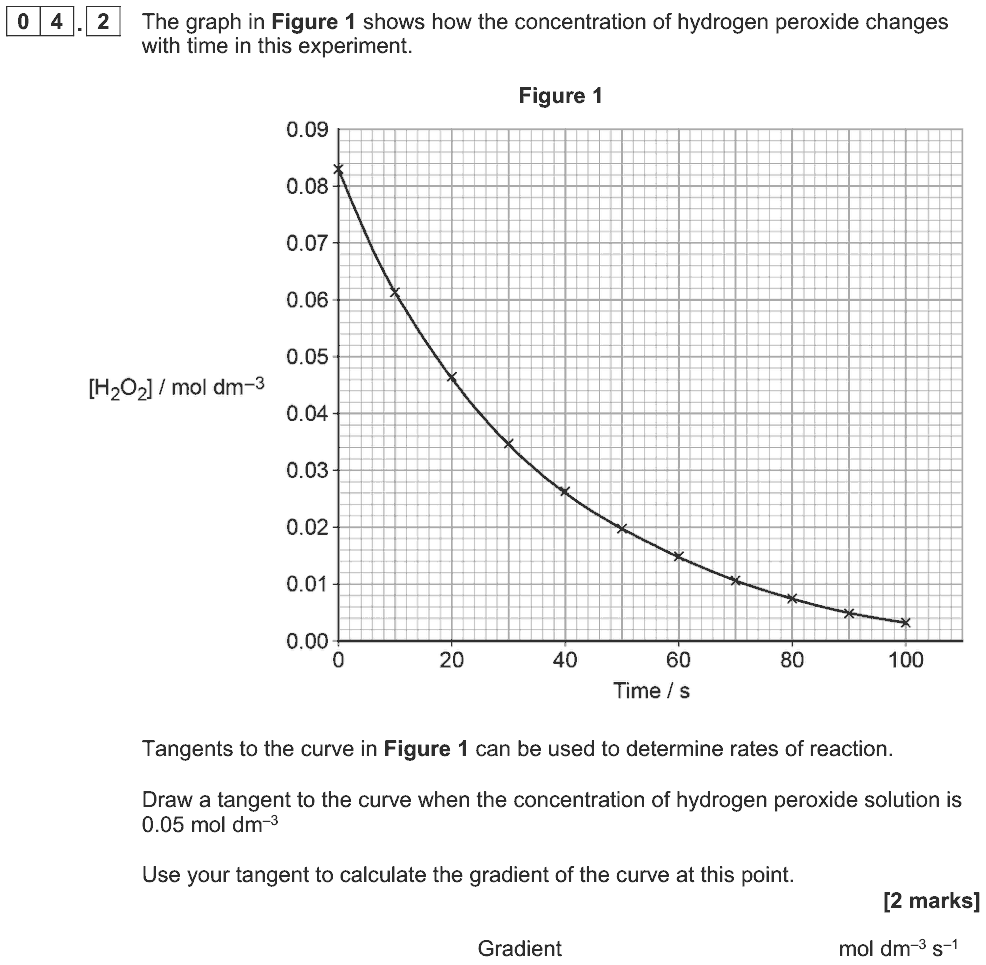
The graph in Figure 1 shows how the concentration of hydrogen peroxide changes
with time in this experiment.
Figure 1
Tangents to the curve in Figure 1 can be used to determine rates of reaction.
Draw a tangent to the curve when the concentration of hydrogen peroxide solution is
0.05 mol dm–3
Use your tangent to calculate the gradient of the curve at this point.
[2 marks]
Gradient
mol dm–3 s–1
June 2022 · Paper 3 · Q04.3 2 marks AO3=2 Calculation rate equations
Earlier parts of question 04 that this part usesEarlier part of June 2022 Paper 3 question 04Earlier part of June 2022 Paper 3 question 04
The concentration of hydrogen peroxide solution at time t during the experiment can
be calculated using this expression.
[
]
[
]
max
2
2
2
2 initial
max
H O
H O
t
t
V
V
V


−
=




[
]
2
2
H O
t = concentration of hydrogen peroxide solution at time t / mol dm–3
[
]
2
2 initial
H O
= concentration of hydrogen peroxide solution at the start / mol dm–3
max
V
= total volume of oxygen gas collected during the whole experiment / cm3
tV = volume of oxygen gas collected at time t / cm3
In this experiment,
max
V
= 100 cm3
Use Figure 1 and the expression to calculate [
]
2
2
H O
t when 20 cm3 of oxygen has
been collected.
[2 marks]
[
]
2
2
H O
t
mol dm–3
June 2022 · Paper 3 · Q04.4 2 marks AO2=1, AO3=1 Practical and data analysis rate equations
Earlier part of question 04 that this part usesEarlier part of June 2022 Paper 3 question 04
Table 5 shows data from a similar experiment.
Table 5
[H2O2] / mol dm–3
0.02
0.03
0.05
0.07
0.09
Rate / mol dm–3 s–1
0.00049
0.00073 0.00124
0.00168
0.00219
Plot the data from Table 5 on the grid in Figure 2.
Draw a line of best fit.
[2 marks]
Figure 2
June 2022 · Paper 3 · Q04.5 2 marks AO3=2 Short answer rate equations
Earlier parts of question 04 that this part usesEarlier part of June 2022 Paper 3 question 04Earlier part of June 2022 Paper 3 question 04
Use Figure 2 to determine the order of reaction with respect to H2O2
State how the graph shows this order.
[2 marks]
Order
How the graph shows this order
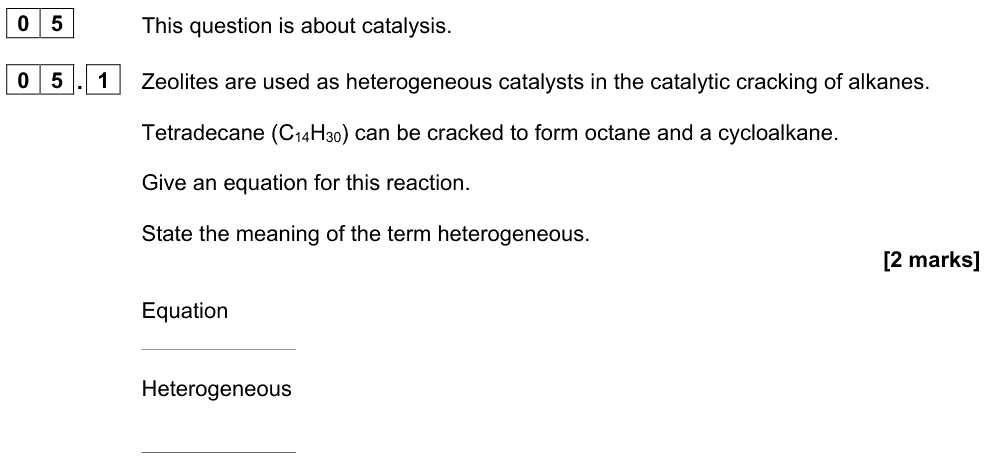
June 2022 · Paper 3 · Q05.1 2 marks AO1=1, AO2=1 Short answer alkanestransition metals
This question is about catalysis.
Zeolites are used as heterogeneous catalysts in the catalytic cracking of alkanes.
Tetradecane (C14H30) can be cracked to form octane and a cycloalkane.
Give an equation for this reaction.
State the meaning of the term heterogeneous.
[2 marks]
Equation
Heterogeneous
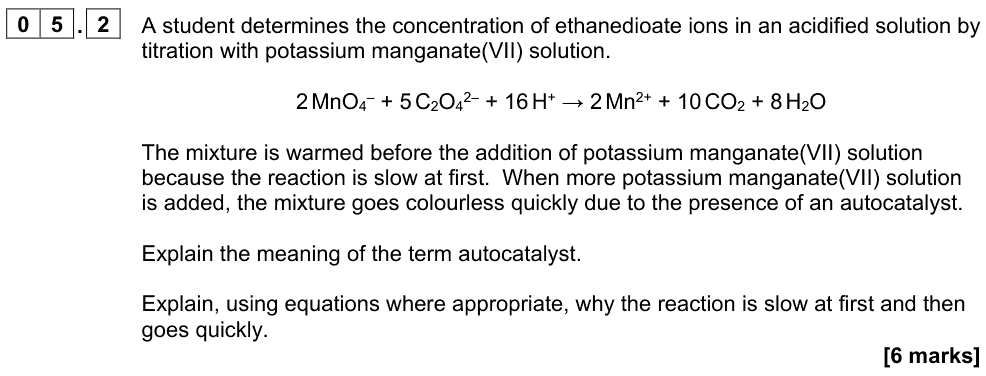
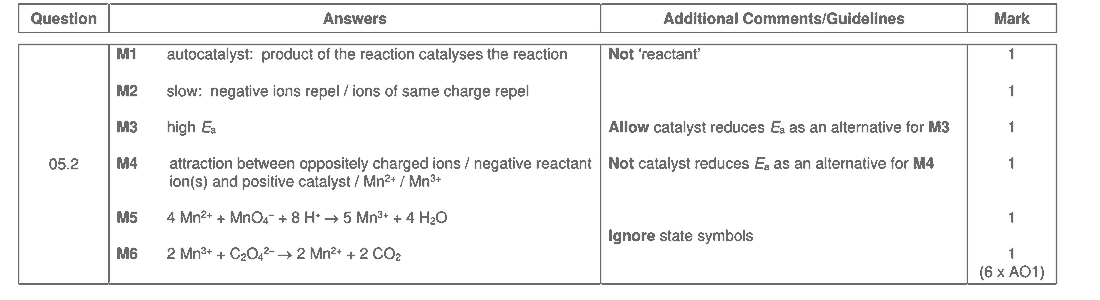
June 2022 · Paper 3 · Q05.2 6 marks AO1=6 Explanation transition metals
Earlier part of question 05 that this part usesEarlier part of June 2022 Paper 3 question 05
A student determines the concentration of ethanedioate ions in an acidified solution by
titration with potassium manganate(VII) solution.
2 MnO4– + 5 C2O42– + 16 H+ → 2 Mn2+ + 10 CO2 + 8 H2O
The mixture is warmed before the addition of potassium manganate(VII) solution
because the reaction is slow at first.  When more potassium manganate(VII) solution
is added, the mixture goes colourless quickly due to the presence of an autocatalyst.
Explain the meaning of the term autocatalyst.
Explain, using equations where appropriate, why the reaction is slow at first and then
goes quickly.
[6 marks]
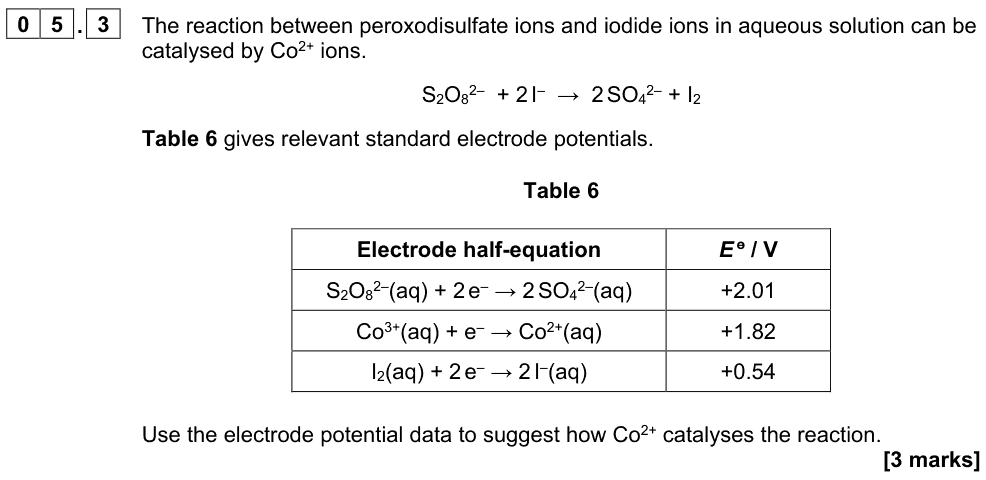
June 2022 · Paper 3 · Q05.3 3 marks AO3=3 Explanation transition metalselectrode potentials and cells
Earlier part of question 05 that this part usesEarlier part of June 2022 Paper 3 question 05
The reaction between peroxodisulfate ions and iodide ions in aqueous solution can be
catalysed by Co2+ ions.
S2O82–  + 2 I–  →  2 SO42– + I2
Table 6 gives relevant standard electrode potentials.
Table 6
Electrode half-equation
E ɵ / V
S2O82–(aq) + 2 e– → 2 SO42–(aq)
+2.01
Co3+(aq) + e– → Co2+(aq)
+1.82
I2(aq) + 2 e– → 2 I–(aq)
+0.54
Use the electrode potential data to suggest how Co2+ catalyses the reaction.
[3 marks]
June 2022 · Paper 3 · Q06 1 mark AO2=1 Multiple choice atomic structure
Which atom in the ground state contains at least one unpaired p electron?
[1 mark]
A Na
B Ne
C O
D Sc
June 2022 · Paper 3 · Q07 1 mark AO3=1 Multiple choice amount of substance
Complete combustion of 0.0100 mol of an organic acid produced 0.0200 mol of
carbon dioxide.
The same amount of the acid required 20 cm3 of 1.00 mol dm–3 NaOH (aq) for
neutralisation.
Which could be the formula of the acid?
[1 mark]
A HCOOH
B CH3COOH
C HOOCCOOH
D HOOCCH2COOH
June 2022 · Paper 3 · Q08 1 mark AO1=1 Multiple choice bondingaromatic chemistry
Which substance has no delocalised electrons?
[1 mark]
A graphite
B methylbenzene
C poly(propene)
D sodium
June 2022 · Paper 3 · Q09 1 mark AO1=1 Multiple choice kinetics
Consider the change that occurs in the shape of the curve for the distribution of
molecular energies in a gas when the temperature of the gas is increased.
Which is a correct statement about the gas molecules at a higher temperature?
[1 mark]
A There are more molecules with any given energy.
B There are more molecules with the mean energy.
C There are more molecules with the most probable energy.
D There is an increase in the most probable energy of the molecules.
June 2022 · Paper 3 · Q10 1 mark AO1=1 Multiple choice redox
Which of these oxidation states is correct?
[1 mark]
A Chlorine in Cl2 is –1
B Chromium in K2Cr2O7 is +7
C Fluorine in F2O is –1
D Hydrogen in NaH is +1
June 2022 · Paper 3 · Q11 1 mark AO1=1 Multiple choice electrode potentials and cells
Which change to a hydrogen electrode has no effect on the electrode potential?
[1 mark]
A the concentration of the hydrogen ions
B the pressure of the hydrogen
C the surface area of the platinum electrode
D the temperature of the acid
June 2022 · Paper 3 · Q12 1 mark AO1=1 Multiple choice electrode potentials and cells
Some electrode potential data are shown.
Zn2+(aq)   +    2 e−    →   Zn(s)
E ɵ  =  − 0.76 V
Pb2+(aq)   +    2 e−    →   Pb(s)
E ɵ  =  − 0.13 V
Which is a correct statement about this cell?
2
2
Zn(s) Zn (aq) Pb (aq) Pb(s)
+
+
[1 mark]
A Electrons travel in the external circuit from zinc to lead.
B The concentration of lead(II) ions increases.
C The maximum EMF of the cell is 0.89 V
D Zinc is deposited.
June 2022 · Paper 3 · Q13 1 mark AO3=1 Multiple choice acids and bases
Which can not function as a Brønsted-Lowry acid?
[1 mark]
A CH3COO–
B HCO3–
C H3O+
D NH4+
June 2022 · Paper 3 · Q14 1 mark AO2=1 Multiple choice acids and bases
A strong acid H2X dissociates in aqueous solution.
H2X(aq)  →  2 H+(aq) +  X2– (aq)
What is the pH of a 0.020 mol dm–3 solution of this acid?
[1 mark]
A 1.00
B 1.40
C 1.70
D 2.00
June 2022 · Paper 3 · Q15 1 mark AO3=1 Multiple choice acids and bases
Equal volumes of two solutions, each with the same concentration, are mixed together
at 298 K
Which two solutions, when mixed, form a solution with a pH >7?
[1 mark]
A HCOOH and HCOOK
B KOH and CH3COOH
C NH3 and HCl
D NH4Cl and KCl
June 2022 · Paper 3 · Q16 1 mark AO2=1 Multiple choice atomic structure
Which ionisation needs less energy than this process?
Mg(g) → Mg+(g) + e–
[1 mark]
A Al(g) → Al+(g) + e–
B Ar(g) → Ar+(g) + e–
C Be(g) → Be+(g) + e–
D Mg+(g) → Mg2+(g) + e–
June 2022 · Paper 3 · Q17 1 mark AO3=1 Multiple choice atomic structurethermodynamicsbonding
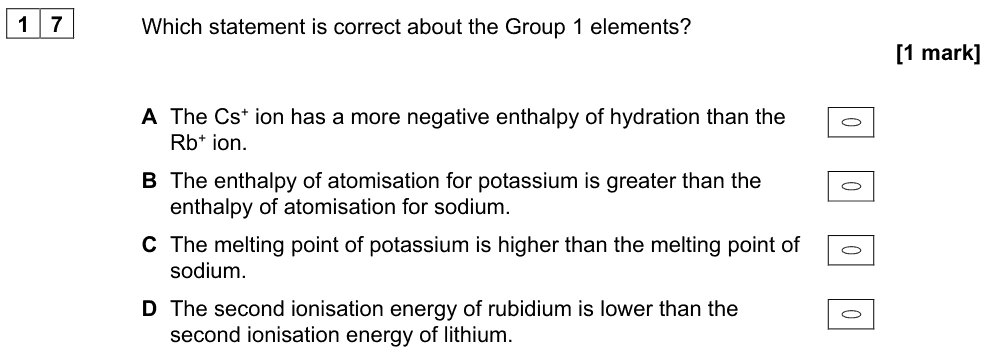
Which statement is correct about the Group 1 elements?
[1 mark]
A The Cs+ ion has a more negative enthalpy of hydration than the
Rb+ ion.
B The enthalpy of atomisation for potassium is greater than the
enthalpy of atomisation for sodium.
C The melting point of potassium is higher than the melting point of
sodium.
D The second ionisation energy of rubidium is lower than the
second ionisation energy of lithium.
June 2022 · Paper 3 · Q18 1 mark AO1=1 Multiple choice group 7 the halogens
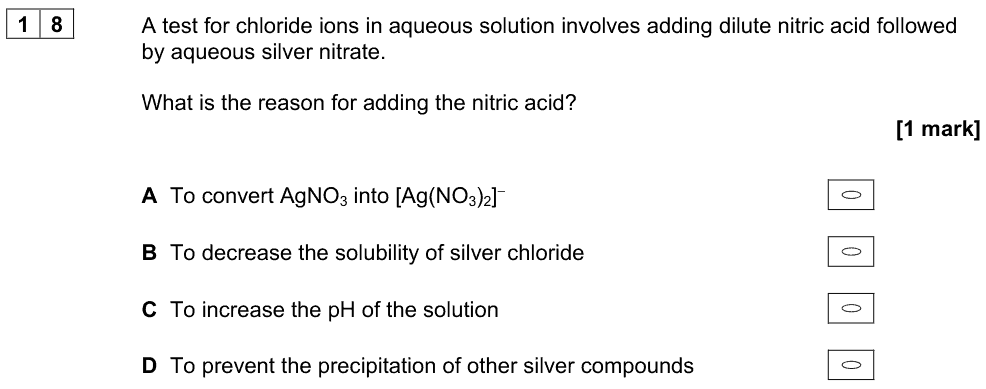
A test for chloride ions in aqueous solution involves adding dilute nitric acid followed
by aqueous silver nitrate.
What is the reason for adding the nitric acid?
[1 mark]
A To convert AgNO3 into [Ag(NO3)2]−
B To decrease the solubility of silver chloride
C To increase the pH of the solution
D To prevent the precipitation of other silver compounds
June 2022 · Paper 3 · Q19 1 mark AO3=1 Multiple choice transition metals
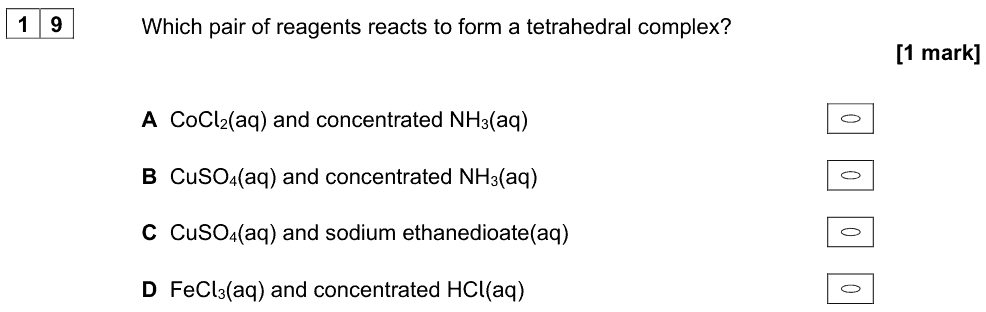
Which pair of reagents reacts to form a tetrahedral complex?
[1 mark]
A CoCl2(aq) and concentrated NH3(aq)
B CuSO4(aq) and concentrated NH3(aq)
C CuSO4(aq) and sodium ethanedioate(aq)
D FeCl3(aq) and concentrated HCl(aq)
June 2022 · Paper 3 · Q20 1 mark AO1=1 Multiple choice transition metals
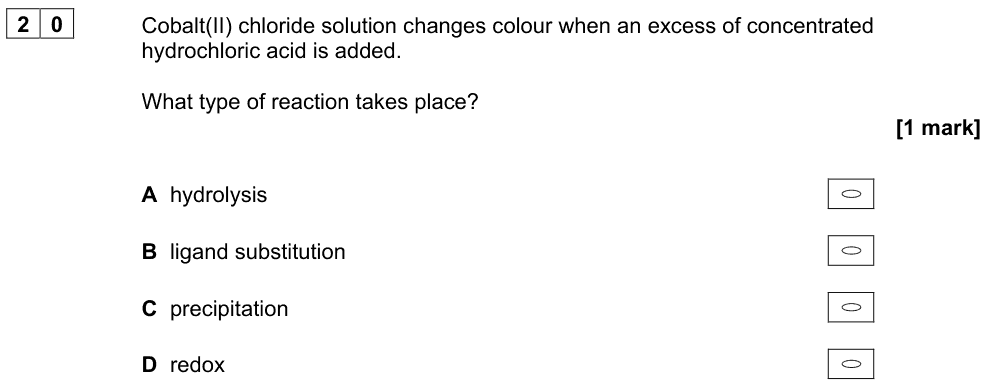
Cobalt(II) chloride solution changes colour when an excess of concentrated
hydrochloric acid is added.
What type of reaction takes place?
[1 mark]
A hydrolysis
B ligand substitution
C precipitation
D redox
June 2022 · Paper 3 · Q21 1 mark AO2=1 Multiple choice transition metalsamount of substance
The reaction between vanadium(IV) ions and manganate(VII) ions in acidic solution
can be represented by the equation
5 V4+  +  MnO4−   + 8 H+ →   5 V5+  + Mn2+  + 4 H2O
What volume, in dm3, of 0.020 mol dm−3 KMnO4 is needed to oxidise
0.10 mol of vanadium(IV) ions completely?
[1 mark]
A 0.10
B 0.50
C 1.0
D 5.0
June 2022 · Paper 3 · Q22 1 mark AO2=1 Multiple choice alkanes
2-Bromopropane reacts with bromine to form 2,2-dibromopropane.
What is the name of the mechanism of this reaction?
[1 mark]
A Electrophilic addition
B Elimination
C Free-radical substitution
D Nucleophilic substitution
June 2022 · Paper 3 · Q23 1 mark AO2=1 Multiple choice halogenoalkanes
Which compound is formed from bromoethane in a nucleophilic substitution reaction?
[1 mark]
A CH3CN
B CH3CH2NH2
C CH2=CH2
D CH3CH2OSO2OH
June 2022 · Paper 3 · Q24 1 mark AO1=1 Multiple choice alcohols
Which statement is not correct for both primary and secondary alcohols?
[1 mark]
A They are easily oxidised to carboxylic acids by
acidified K2Cr2O7 solution.
B They can be formed from bromoalkanes by hydrolysis.
C They form esters with carboxylic acids.
D They show hydrogen bonding in the liquid state.
June 2022 · Paper 3 · Q25 1 mark AO1=1 Multiple choice introduction to organic chemistry
Which compound is an isomer of ethyl ethanoate?
[1 mark]
A butyl methanoate
B methyl propanoate
C methyl butanoate
D propanoic acid
June 2022 · Paper 3 · Q26 1 mark AO1=1 Multiple choice carboxylic acids and derivatives
Which compound is an amide?
[1 mark]
A CH3CH2CH2CN
B CH3CONHCH2CH3
C CH3COOCH2CH3
D CH3NHCH2CH2CH3
June 2022 · Paper 3 · Q27 1 mark AO2=1 Multiple choice polymers
Suberoyl chloride, ClOC(CH2)6COCl, is commonly used in the manufacture of
polymers.
Which compound can form a polymer with suberoyl chloride?
[1 mark]
A H2NCH2CH2NH2
B ClOCCH2COCl
C CH3CH2CONH2
D HOOCCH2COOH
June 2022 · Paper 3 · Q28 1 mark AO3=1 Multiple choice polymers
Which polymer is not hydrolysed when heated with aqueous alkali?
[1 mark]
A Kevlar
B Nylon 6,6
C Poly(propene)
D Terylene
June 2022 · Paper 3 · Q29 1 mark AO2=1 Multiple choice amino acids proteins and dna
Which is the main species present in an aqueous solution of aspartic acid at pH = 14?
[1 mark]
A
B
C
D
June 2022 · Paper 3 · Q30 1 mark AO3=1 Multiple choice organic synthesisaromatic chemistryaldehydes and ketones
Which type of reaction is not involved in this reaction sequence?
[1 mark]
A esterification
B hydrolysis
C nitration
D reduction
June 2022 · Paper 3 · Q31 1 mark AO2=1 Multiple choice carboxylic acids and derivatives
Which pair of reagents does not produce ethanol?
[1 mark]
A CH3CH2Br and NaOH(aq)
B CH3COOCH3 and NaOH(aq)
C HCOOCH2CH3 and NaOH(aq)
D CH3CHO and NaBH4(aq)
June 2022 · Paper 3 · Q32 1 mark AO1=1 Multiple choice amino acids proteins and dna
Which type of interaction between polypeptide chains is mainly responsible for
maintaining the secondary structure of a protein in the form of an alpha helix?
[1 mark]
A covalent bonds
B hydrogen bonds
C ionic interactions
D van der Waals forces
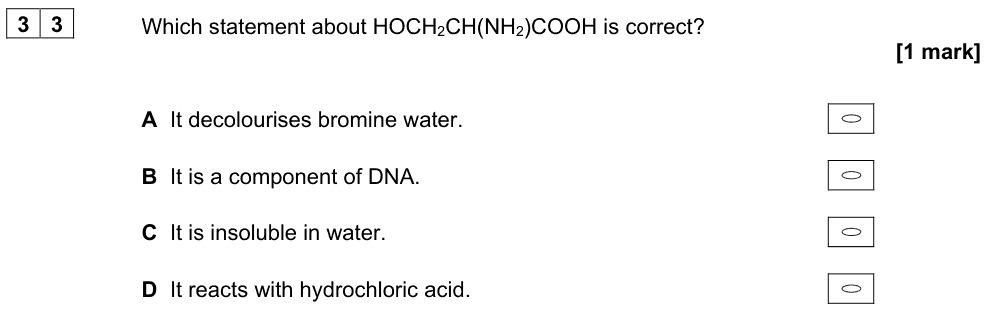
June 2022 · Paper 3 · Q33 1 mark AO1=1 Multiple choice amino acids proteins and dna
Which statement about HOCH2CH(NH2)COOH is correct?
[1 mark]
A It decolourises bromine water.
B It is a component of DNA.
C It is insoluble in water.
D It reacts with hydrochloric acid.
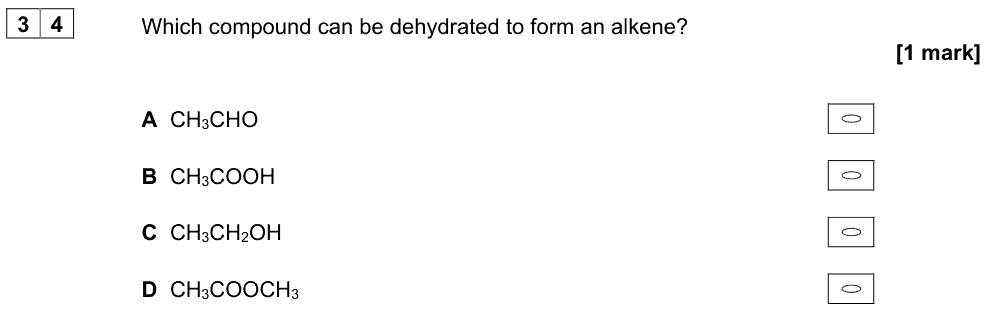
June 2022 · Paper 3 · Q34 1 mark AO1=1 Multiple choice alcohols
Which compound can be dehydrated to form an alkene?
[1 mark]
A CH3CHO
B CH3COOH
C CH3CH2OH
D CH3COOCH3
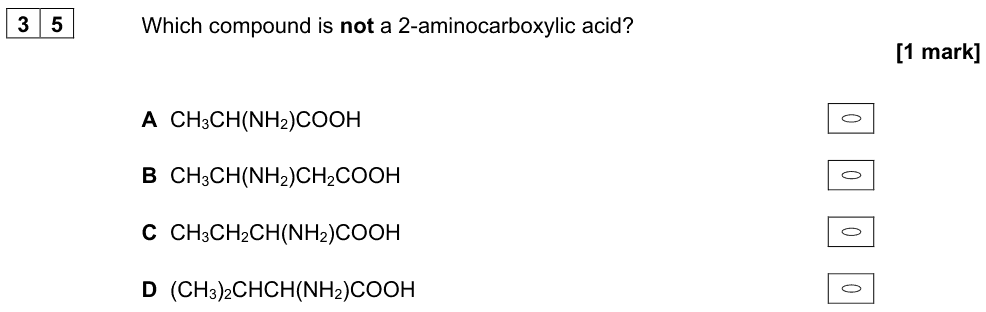
June 2022 · Paper 3 · Q35 1 mark AO3=1 Multiple choice introduction to organic chemistry
Which compound is not a 2-aminocarboxylic acid?
[1 mark]
A CH3CH(NH2)COOH
B CH3CH(NH2)CH2COOH
C CH3CH2CH(NH2)COOH
D (CH3)2CHCH(NH2)COOH

Work with an A-level chemistry tutor

Want a paper marked and gone through with you? Message us.

Prefer email? Send an enquiry

If you are under 18, please include a parent's contact details. Enquiries go to enquiries@chemistryaleveltutor.com and are deleted once handled. All tutoring is online.