June 2017: Paper 3, Any content and practical skills

90 marks · 57 question parts · Paper, mark scheme and report on AQA's site · Have the Data Booklet beside you

Question by question

QTopicMarksAOType
01.1 Energetics 1Practical and data analysis
01.2 Energetics 2Calculation
01.3 Energetics 6Level of response
01.4 Thermodynamics: Born–Haber cycles, entropy and Gibbs free energy 5Calculation
02.1 Alkenes 1Short answer
02.2 Alkenes 4Mechanism
02.3 Alkenes, Introduction to organic chemistry: nomenclature, mechanisms and isomerism 1Diagram or structure
02.4 Alkenes 2Explanation
02.5 Introduction to organic chemistry: nomenclature, mechanisms and isomerism, Alcohols 3Diagram or structure
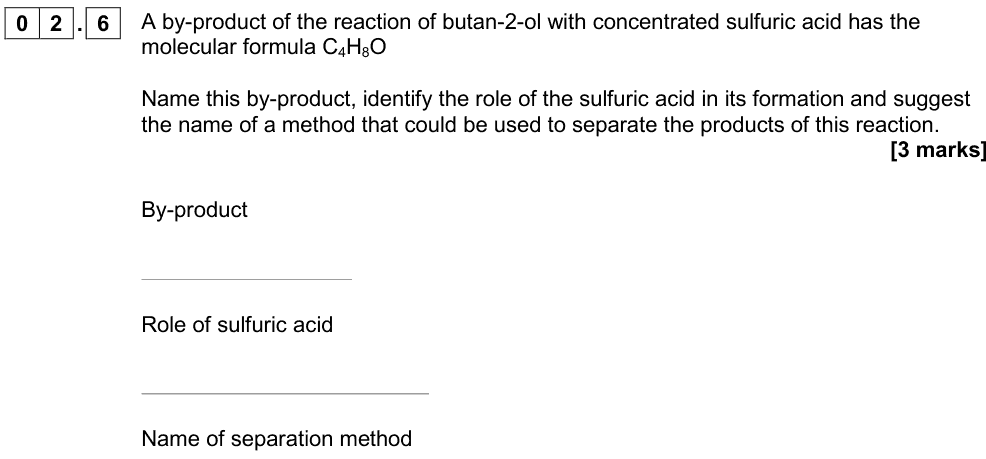
02.6 Alcohols, Oxidation, reduction and redox equations 3Short answer
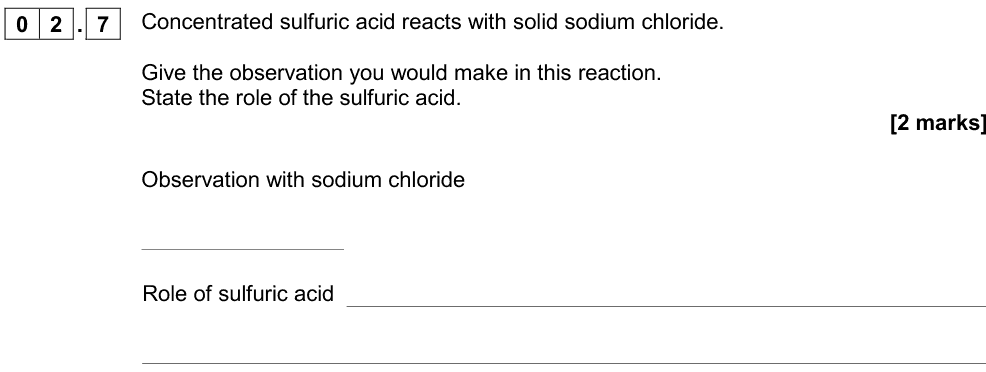
02.7 Group 7(17), the halogens 2Short answer
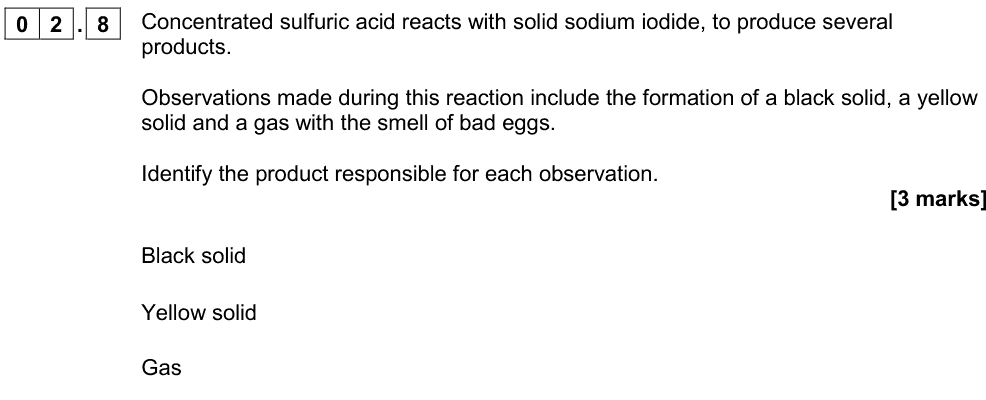
02.8 Group 7(17), the halogens 3Short answer
03.1 Carboxylic acids and derivatives 1Practical and data analysis
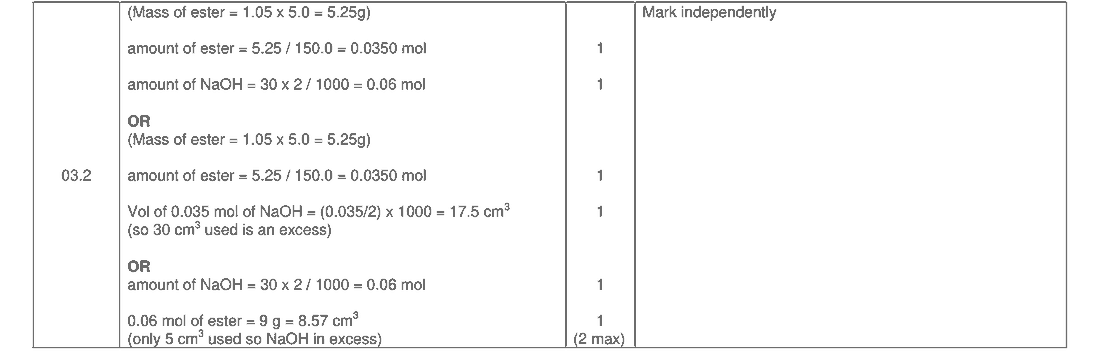
03.2 Amount of substance 2Calculation
03.3 Carboxylic acids and derivatives 1Practical and data analysis
03.4 Carboxylic acids and derivatives 1Practical and data analysis
03.5 Carboxylic acids and derivatives 1Practical and data analysis
03.6 Carboxylic acids and derivatives, Amount of substance 1Equation writing
03.7 Bonding 2Explanation
03.8 Carboxylic acids and derivatives 6Practical and data analysis
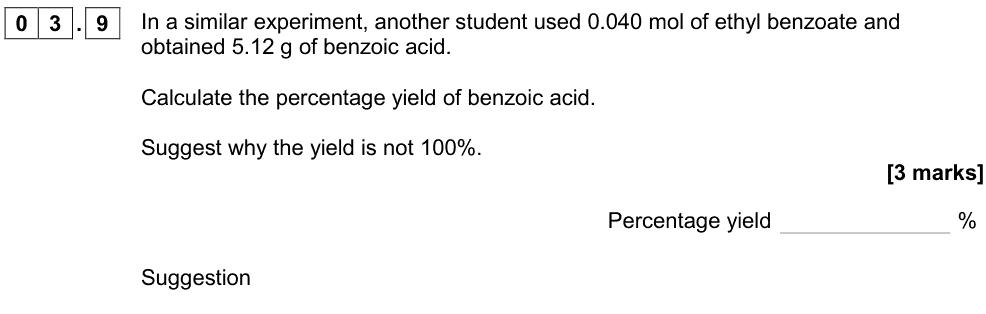
03.9 Amount of substance 3Calculation
04.1 Acids and bases: pH, Ka, titration curves and buffers 1Short answer
04.2 Acids and bases: pH, Ka, titration curves and buffers 1Short answer
04.3 Acids and bases: pH, Ka, titration curves and buffers 2Calculation
04.4 Acids and bases: pH, Ka, titration curves and buffers 2Calculation
04.5 Acids and bases: pH, Ka, titration curves and buffers 1Calculation
04.6 Acids and bases: pH, Ka, titration curves and buffers 2Diagram or structure
05 Bonding 1Multiple choice
06 Periodicity 1Multiple choice
07 Transition metals 1Multiple choice
08 Alkanes 1Multiple choice
09 Acids and bases: pH, Ka, titration curves and buffers 1Multiple choice
10 Acids and bases: pH, Ka, titration curves and buffers 1Multiple choice
11 Amount of substance 1Multiple choice
12 Organic analysis: test-tube reactions, mass spectrometry and infrared 1Multiple choice
13 Optical isomerism, Aldehydes and ketones 1Multiple choice
14 Halogenoalkanes 1Multiple choice
15 Transition metals 1Multiple choice
16 Kinetics 1Multiple choice
17 Transition metals 1Multiple choice
18 Alkenes 1Multiple choice
19 Amount of substance 1Multiple choice
20 Equilibrium constant Kp 1Multiple choice
21 Introduction to organic chemistry: nomenclature, mechanisms and isomerism 1Multiple choice
22 Acids and bases: pH, Ka, titration curves and buffers 1Multiple choice
23 Aldehydes and ketones 1Multiple choice
24 Introduction to organic chemistry: nomenclature, mechanisms and isomerism, Optical isomerism 1Multiple choice
25 Polymers 1Multiple choice
26 Amount of substance 1Multiple choice
27 Rate equations, Acids and bases: pH, Ka, titration curves and buffers 1Multiple choice
28 Amount of substance, Equilibrium constant Kp 1Multiple choice
29 Nuclear magnetic resonance spectroscopy 1Multiple choice
30 Amount of substance 1Multiple choice
31 Transition metals 1Multiple choice
32 Thermodynamics: Born–Haber cycles, entropy and Gibbs free energy 1Multiple choice
33 Amount of substance 1Multiple choice
34 Amount of substance 1Multiple choice

The questions

01.101.201.301.402.102.202.302.402.502.602.702.803.103.203.303.403.503.603.703.803.904.104.204.304.404.504.6050607080910111213141516171819202122232425262728293031323334
June 2017 · Paper 3 · Q01.1 1 mark Practical and data analysis Hard energetics
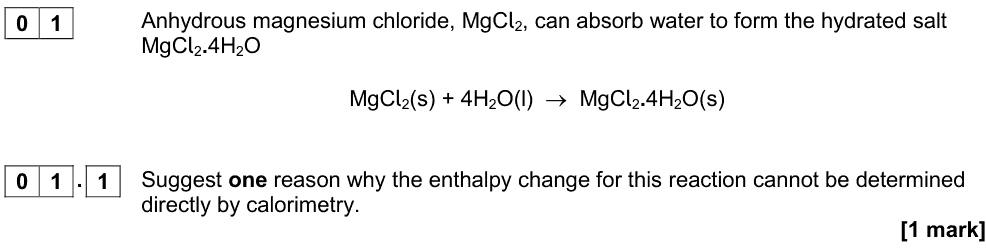
Anhydrous magnesium chloride, MgCl2, can absorb water to form the hydrated salt
MgCl2.4H2O
MgCl2(s) + 4H2O(l)  →  MgCl2.4H2O(s)
Suggest one reason why the enthalpy change for this reaction cannot be determined

directly by calorimetry.
[1 mark]
June 2017 · Paper 3 · Q01.2 2 marks Calculation energetics
Earlier part of question 01 that this part usesEarlier part of June 2017 Paper 3 question 01
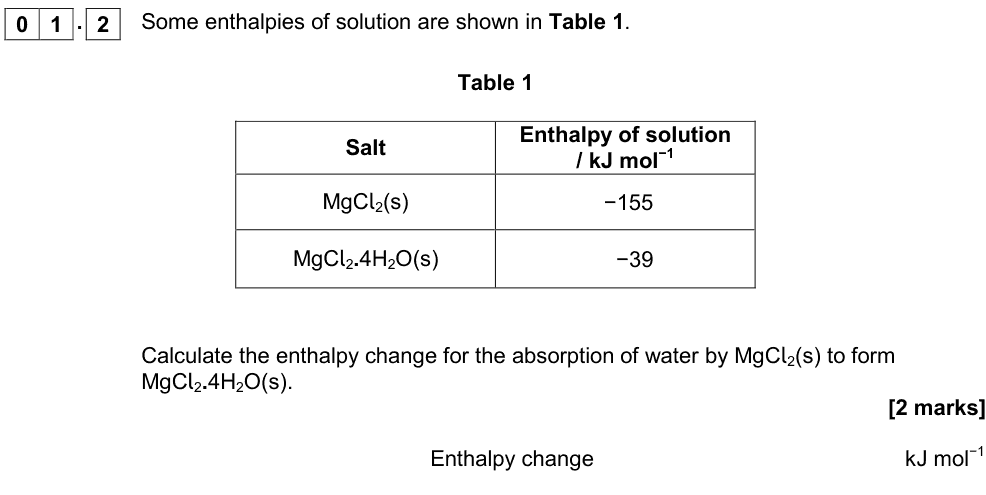
Some enthalpies of solution are shown in Table 1.
Table 1
Salt
Enthalpy of solution
/ kJ mol−1
MgCl2(s)
−155
MgCl2.4H2O(s)
−39
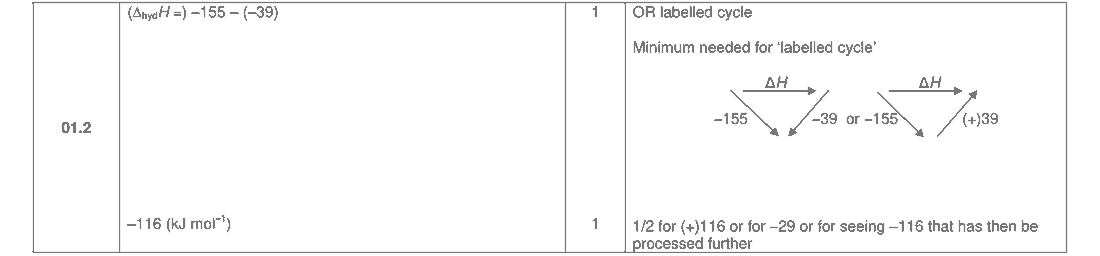
Calculate the enthalpy change for the absorption of water by MgCl2(s) to form
MgCl2.4H2O(s).
[2 marks]
Enthalpy change

kJ mol−1
June 2017 · Paper 3 · Q01.3 6 marks 6-mark level of response energetics
Earlier part of question 01 that this part usesEarlier part of June 2017 Paper 3 question 01
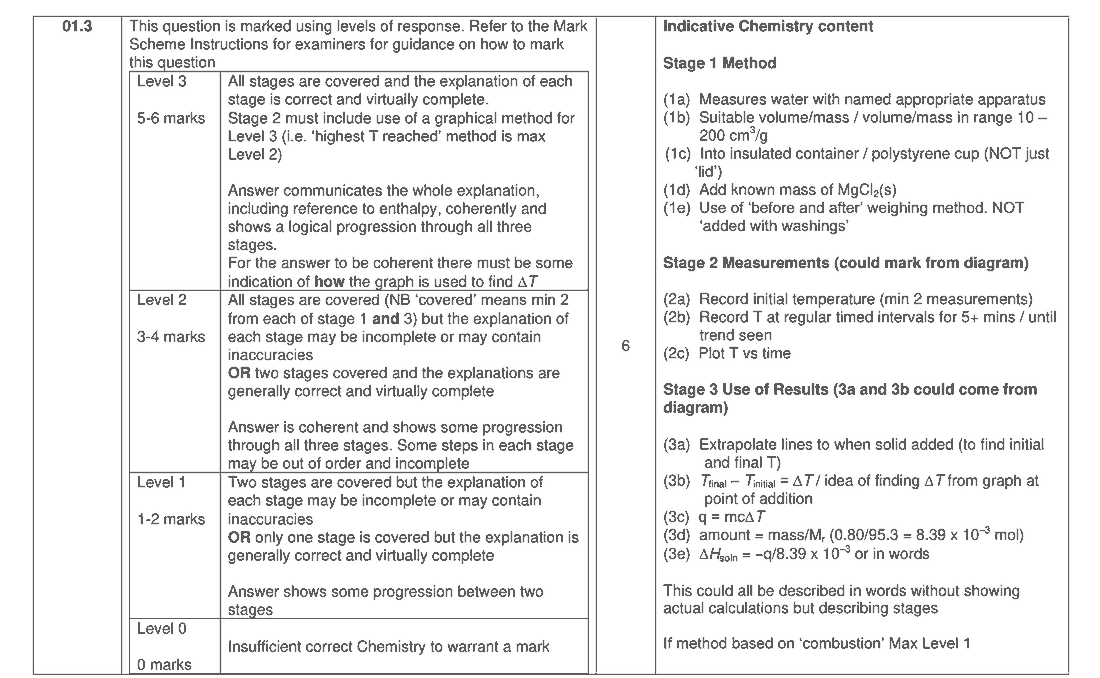
Describe how you would carry out an experiment to determine the enthalpy of solution
of anhydrous magnesium chloride.
You should use about 0.8 g of anhydrous magnesium chloride.
Explain how your results could be used to calculate the enthalpy of solution.
[6 marks]
June 2017 · Paper 3 · Q01.4 5 marks Calculation Hard thermodynamics
Earlier part of question 01 that this part usesEarlier part of June 2017 Paper 3 question 01
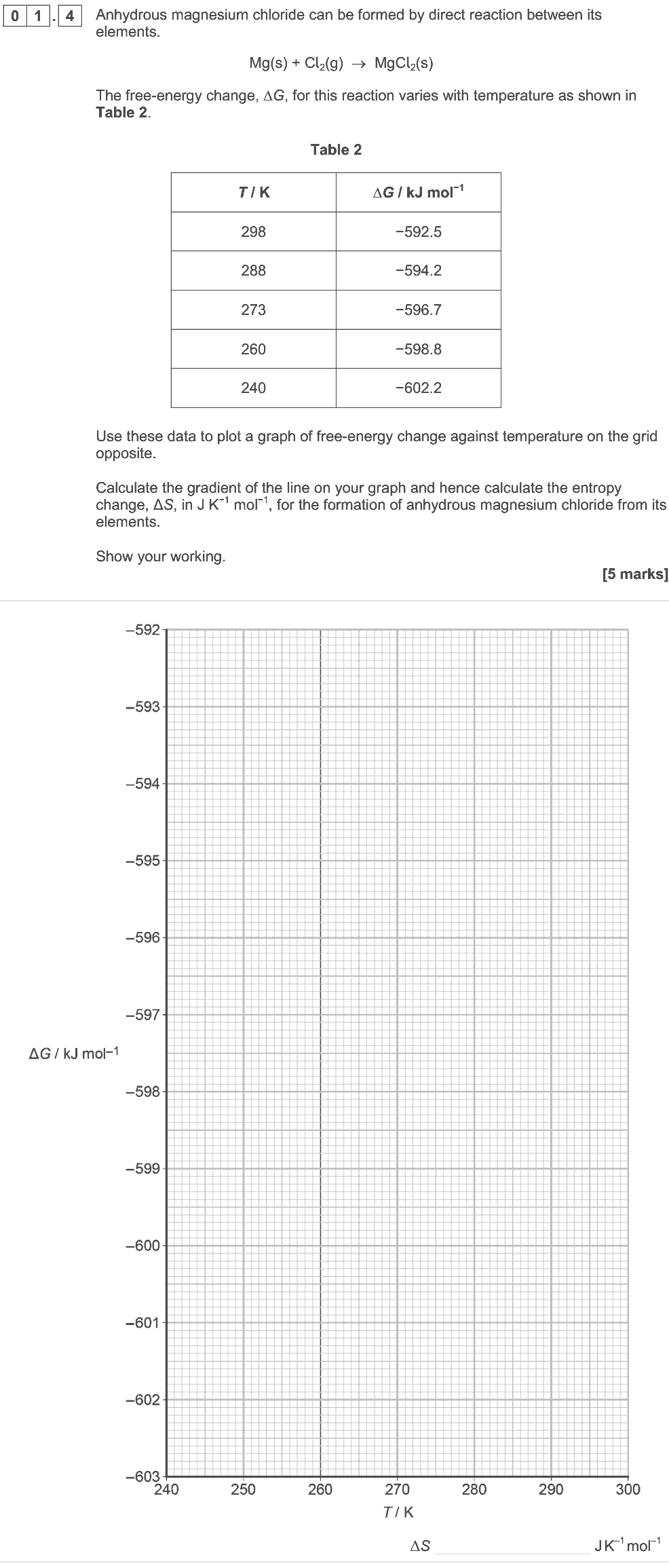
Anhydrous magnesium chloride can be formed by direct reaction between its
elements.
Mg(s) + Cl2(g)  →  MgCl2(s)
The free-energy change, ∆G, for this reaction varies with temperature as shown in
Table 2.
Table 2
T / K
∆G / kJ mol−1
298
−592.5
288
−594.2
273
−596.7
260
−598.8
240
−602.2
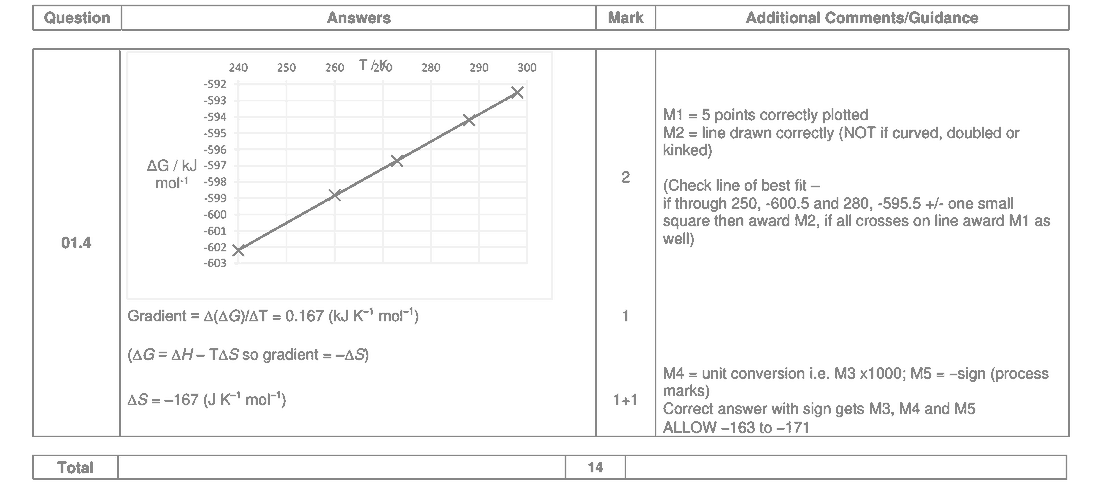
Use these data to plot a graph of free-energy change against temperature on the grid

opposite.
Calculate the gradient of the line on your graph and hence calculate the entropy
change, ΔS, in J K−1 mol−1, for the formation of anhydrous magnesium chloride from its
elements.
Show your working.
[5 marks]
∆S
J K–1
mol–1
June 2017 · Paper 3 · Q02.1 1 mark Short answer Easy alkenes
Concentrated sulfuric acid reacts with alkenes, alcohols and sodium halides.
Name the mechanism for the reaction of concentrated sulfuric acid with an alkene.
[1 mark]
June 2017 · Paper 3 · Q02.2 4 marks Mechanism alkenes
Earlier part of question 02 that this part usesEarlier part of June 2017 Paper 3 question 02
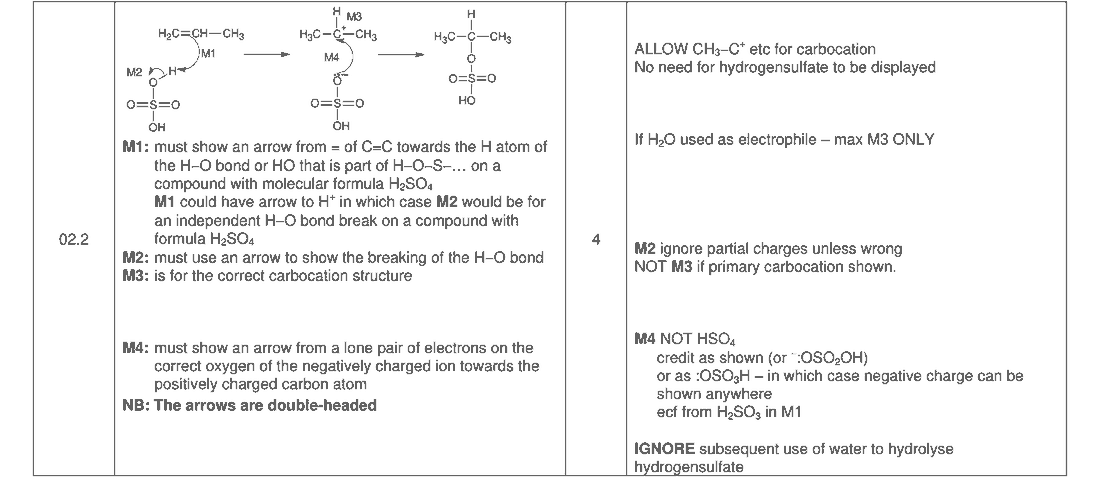
Outline the mechanism for the reaction of concentrated sulfuric acid with propene to
show the formation of the major product.
[4 marks]
June 2017 · Paper 3 · Q02.3 1 mark Diagram or structure alkenesintroduction to organic chemistry
Earlier part of question 02 that this part usesEarlier part of June 2017 Paper 3 question 02
Draw the structure of the minor product of the reaction between concentrated sulfuric
acid and propene.
[1 mark]
June 2017 · Paper 3 · Q02.4 2 marks Explanation Hard alkenes
Earlier part of question 02 that this part usesEarlier part of June 2017 Paper 3 question 02
Explain why the product shown in your answer to Question 2.2 is the major product.
[2 marks]
June 2017 · Paper 3 · Q02.5 3 marks Diagram or structure introduction to organic chemistryalcohols
Earlier part of question 02 that this part usesEarlier part of June 2017 Paper 3 question 02
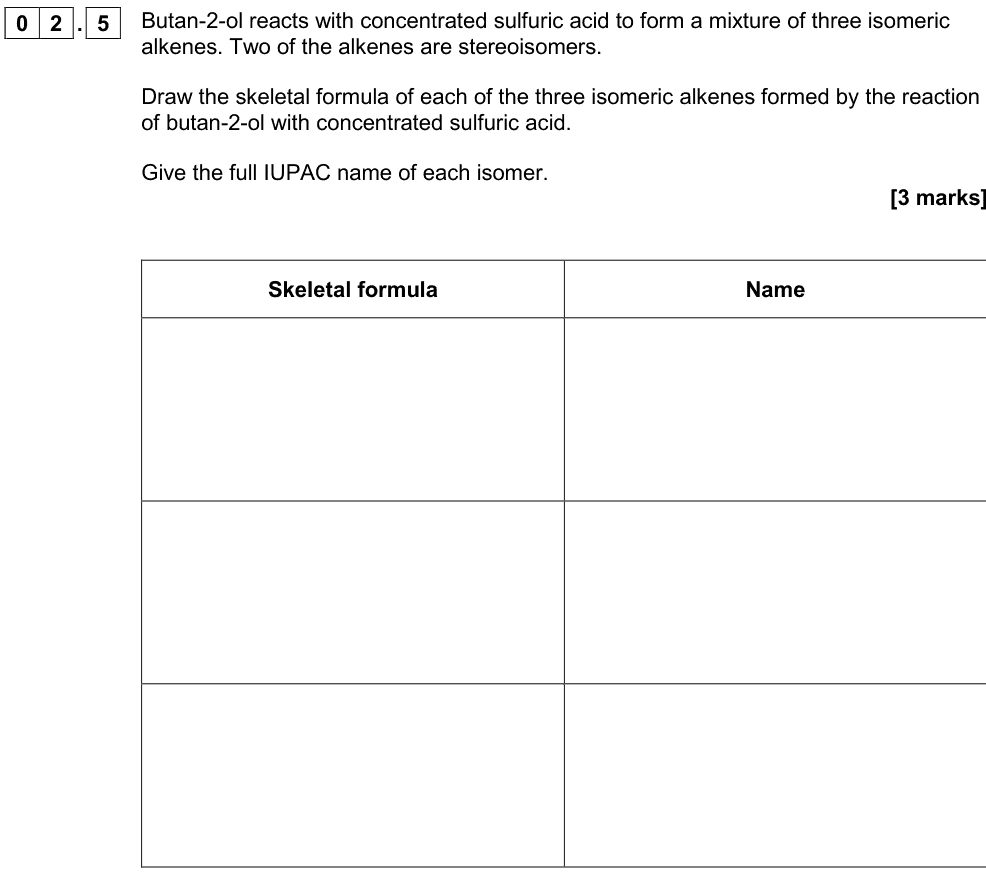
Butan-2-ol reacts with concentrated sulfuric acid to form a mixture of three isomeric
alkenes. Two of the alkenes are stereoisomers.
Draw the skeletal formula of each of the three isomeric alkenes formed by the reaction
of butan-2-ol with concentrated sulfuric acid.
Give the full IUPAC name of each isomer.
[3 marks]
Skeletal formula
Name
June 2017 · Paper 3 · Q02.6 3 marks Short answer alcoholsredox
Earlier part of question 02 that this part usesEarlier part of June 2017 Paper 3 question 02
A by-product of the reaction of butan-2-ol with concentrated sulfuric acid has the
molecular formula C4H8O
Name this by-product, identify the role of the sulfuric acid in its formation and suggest
the name of a method that could be used to separate the products of this reaction.
[3 marks]
By-product
Role of sulfuric acid
Name of separation method
June 2017 · Paper 3 · Q02.7 2 marks Short answer group 7 the halogens
Earlier part of question 02 that this part usesEarlier part of June 2017 Paper 3 question 02
Concentrated sulfuric acid reacts with solid sodium chloride.
Give the observation you would make in this reaction.
State the role of the sulfuric acid.
[2 marks]
Observation with sodium chloride
Role of sulfuric acid
June 2017 · Paper 3 · Q02.8 3 marks Short answer group 7 the halogens
Earlier part of question 02 that this part usesEarlier part of June 2017 Paper 3 question 02
Concentrated sulfuric acid reacts with solid sodium iodide, to produce several
products.
Observations made during this reaction include the formation of a black solid, a yellow
solid and a gas with the smell of bad eggs.
Identify the product responsible for each observation.
[3 marks]
Black solid
Yellow solid
Gas
June 2017 · Paper 3 · Q03.1 1 mark Practical and data analysis Hard carboxylic acids and derivatives
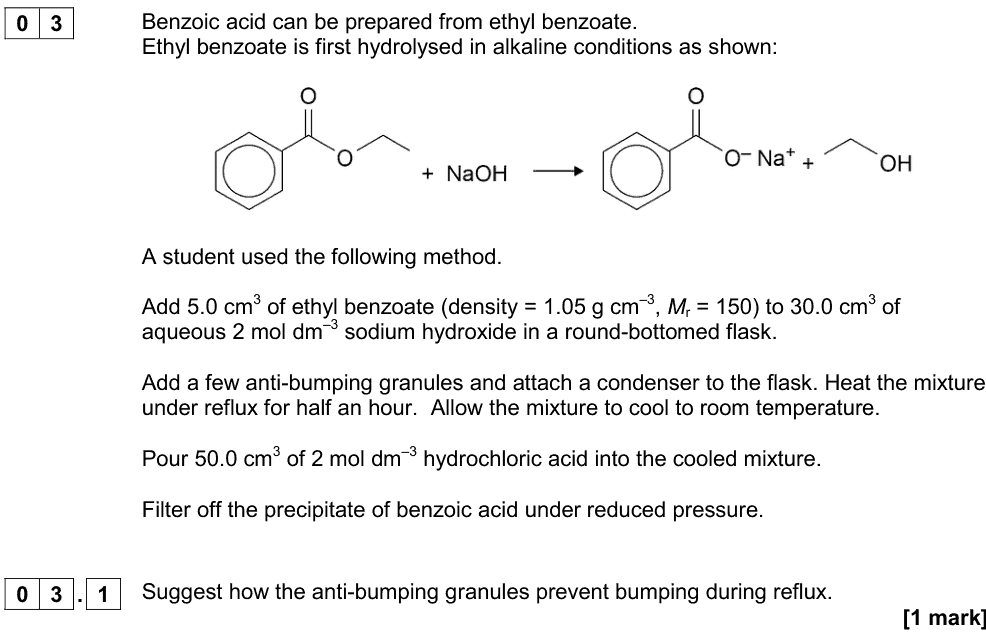
Benzoic acid can be prepared from ethyl benzoate.
Ethyl benzoate is first hydrolysed in alkaline conditions as shown:
A student used the following method.
Add 5.0 cm3 of ethyl benzoate (density = 1.05 g cm–3, Mr = 150) to 30.0 cm3 of
aqueous 2 mol dm–3 sodium hydroxide in a round-bottomed flask.
Add a few anti-bumping granules and attach a condenser to the flask. Heat the mixture
under reflux for half an hour.  Allow the mixture to cool to room temperature.
Pour 50.0 cm3 of 2 mol dm–3 hydrochloric acid into the cooled mixture.
Filter off the precipitate of benzoic acid under reduced pressure.
Suggest how the anti-bumping granules prevent bumping during reflux.
[1 mark]
June 2017 · Paper 3 · Q03.2 2 marks Calculation amount of substance
Earlier part of question 03 that this part usesEarlier part of June 2017 Paper 3 question 03
Show, by calculation, that an excess of sodium hydroxide is used in this reaction.
[2 marks]
June 2017 · Paper 3 · Q03.3 1 mark Practical and data analysis carboxylic acids and derivatives
Earlier part of question 03 that this part usesEarlier part of June 2017 Paper 3 question 03
Suggest why an excess of sodium hydroxide is used.
[1 mark]
June 2017 · Paper 3 · Q03.4 1 mark Practical and data analysis carboxylic acids and derivatives
Earlier part of question 03 that this part usesEarlier part of June 2017 Paper 3 question 03
Suggest why an electric heater is used rather than a Bunsen burner in this
hydrolysis.
[1 mark]
June 2017 · Paper 3 · Q03.5 1 mark Practical and data analysis carboxylic acids and derivatives
Earlier part of question 03 that this part usesEarlier part of June 2017 Paper 3 question 03
State why reflux is used in this hydrolysis.
[1 mark]
June 2017 · Paper 3 · Q03.6 1 mark Equation writing carboxylic acids and derivativesamount of substance
Earlier part of question 03 that this part usesEarlier part of June 2017 Paper 3 question 03
Write an equation for the reaction between sodium benzoate and hydrochloric acid.
[1 mark]
June 2017 · Paper 3 · Q03.7 2 marks Explanation Hard bonding
Earlier part of question 03 that this part usesEarlier part of June 2017 Paper 3 question 03
Suggest why sodium benzoate is soluble in cold water but benzoic acid is insoluble in
cold water.
[2 marks]
June 2017 · Paper 3 · Q03.8 6 marks Practical and data analysis Hard carboxylic acids and derivatives
Earlier part of question 03 that this part usesEarlier part of June 2017 Paper 3 question 03
After the solid benzoic acid has been filtered off, it can be purified.
Describe the method that the student should use to purify the benzoic acid.
[6 marks]
June 2017 · Paper 3 · Q03.9 3 marks Calculation Hard amount of substance
Earlier part of question 03 that this part usesEarlier part of June 2017 Paper 3 question 03
In a similar experiment, another student used 0.040 mol of ethyl benzoate and
obtained 5.12 g of benzoic acid.
Calculate the percentage yield of benzoic acid.
Suggest why the yield is not 100%.
[3 marks]
Percentage yield
%
Suggestion
June 2017 · Paper 3 · Q04.1 1 mark Short answer acids and bases
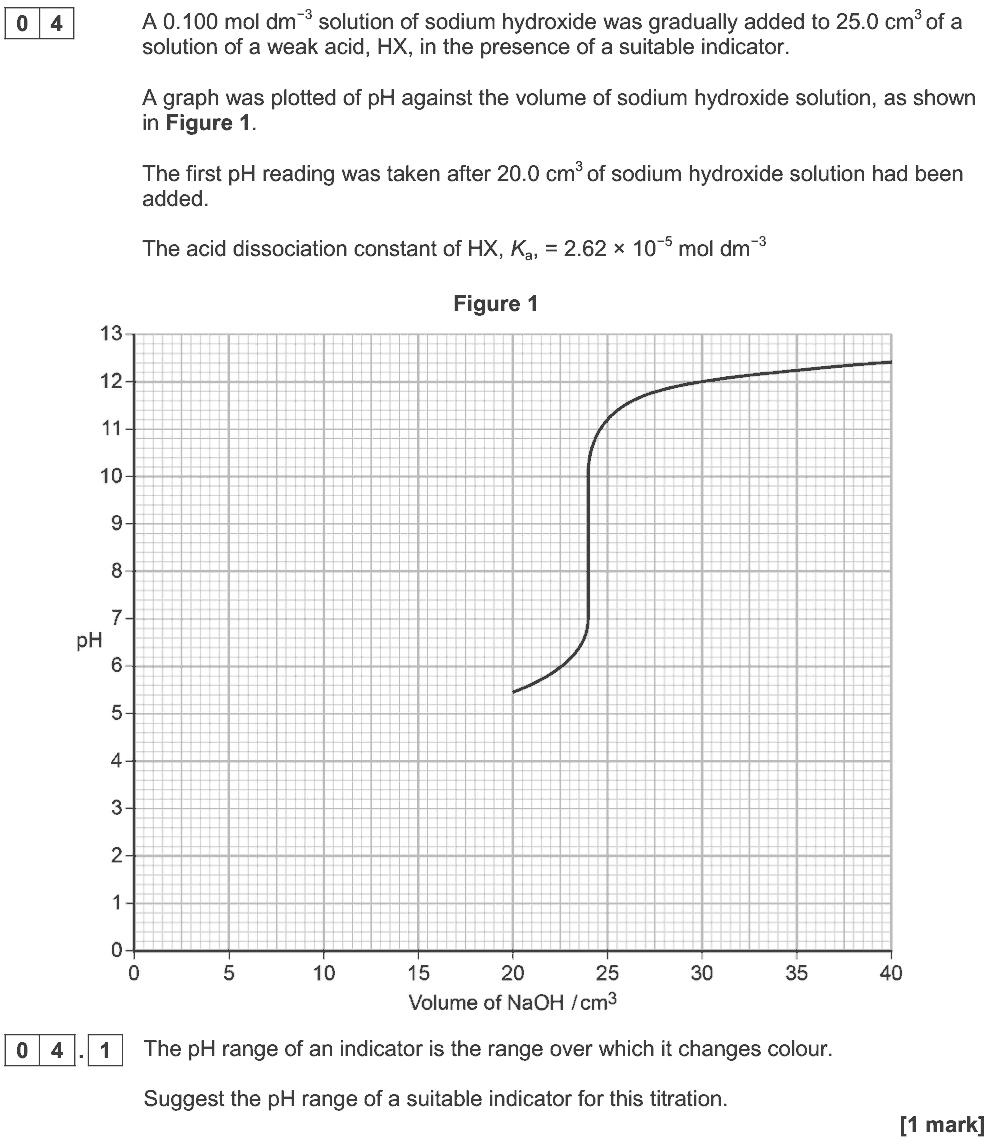
A 0.100 mol dm−3 solution of sodium hydroxide was gradually added to 25.0 cm3 of a
solution of a weak acid, HX, in the presence of a suitable indicator.
A graph was plotted of pH against the volume of sodium hydroxide solution, as shown
in Figure 1.
The first pH reading was taken after 20.0 cm3 of sodium hydroxide solution had been
added.
The acid dissociation constant of HX, Ka, = 2.62 × 10⁻⁵ mol dm−3
Figure 1
The pH range of an indicator is the range over which it changes colour.


Suggest the pH range of a suitable indicator for this titration.


[1 mark]
June 2017 · Paper 3 · Q04.2 1 mark Short answer Easy acids and bases
Earlier part of question 04 that this part usesEarlier part of June 2017 Paper 3 question 04
Give the expression for the acid dissociation constant of HX.
[1 mark]
Ka =
June 2017 · Paper 3 · Q04.3 2 marks Calculation acids and bases
Earlier part of question 04 that this part usesEarlier part of June 2017 Paper 3 question 04
Calculate the concentration of HX in the original solution.
[2 marks]
Concentration
mol dm−3
June 2017 · Paper 3 · Q04.4 2 marks Calculation acids and bases
Earlier part of question 04 that this part usesEarlier part of June 2017 Paper 3 question 04
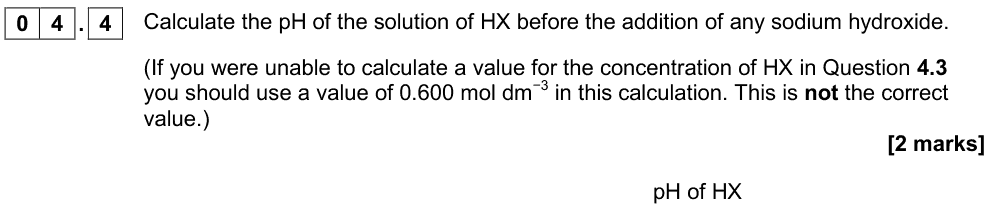
Calculate the pH of the solution of HX before the addition of any sodium hydroxide.
(If you were unable to calculate a value for the concentration of HX in Question 4.3
you should use a value of 0.600 mol dm−3 in this calculation. This is not the correct
value.)
[2 marks]
pH of HX
June 2017 · Paper 3 · Q04.5 1 mark Calculation Hard acids and bases
Earlier part of question 04 that this part usesEarlier part of June 2017 Paper 3 question 04
Calculate the pH of the solution when half of the acid has reacted.
[1 mark]
pH of solution
June 2017 · Paper 3 · Q04.6 2 marks Diagram or structure Hard acids and bases
Earlier part of question 04 that this part usesEarlier part of June 2017 Paper 3 question 04
Plot your answers to Questions 4.4 and 4.5 on the grid in Figure 1.
Use these points to sketch the missing part of the curve between 0 and 20 cm3 of
NaOH solution added.
[2 marks]
June 2017 · Paper 3 · Q05 1 mark Multiple choice bonding
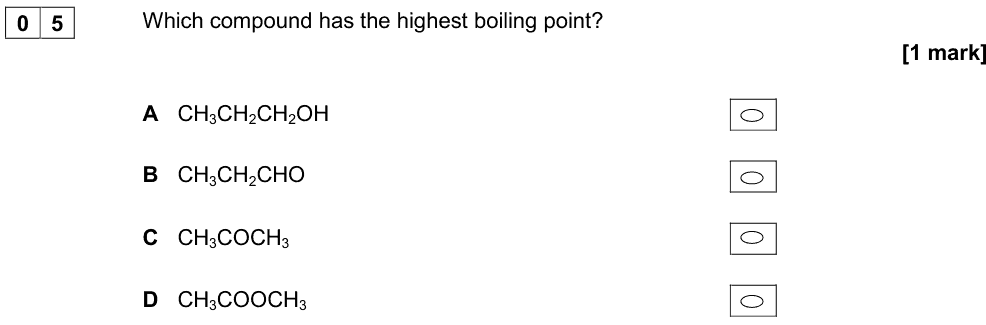
Which compound has the highest boiling point?
[1 mark]
A CH3CH2CH2OH
B CH3CH2CHO
C CH3COCH3
D CH3COOCH3
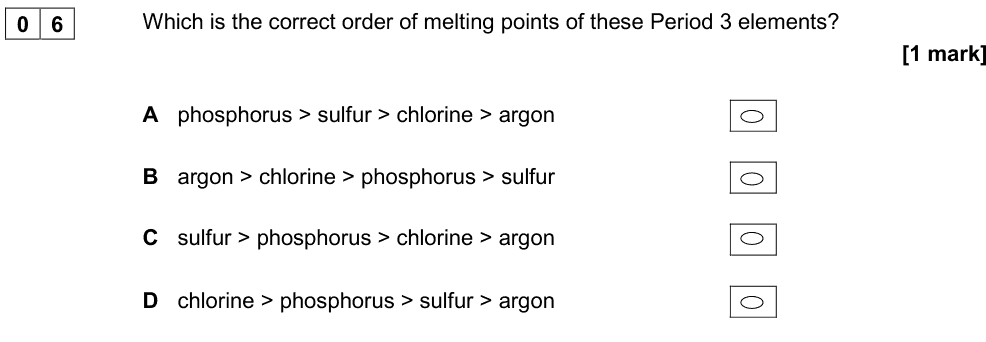
June 2017 · Paper 3 · Q06 1 mark Multiple choice periodicity
Which is the correct order of melting points of these Period 3 elements?
[1 mark]
A phosphorus > sulfur > chlorine > argon
B argon > chlorine > phosphorus > sulfur
C sulfur > phosphorus > chlorine > argon
D chlorine > phosphorus > sulfur > argon
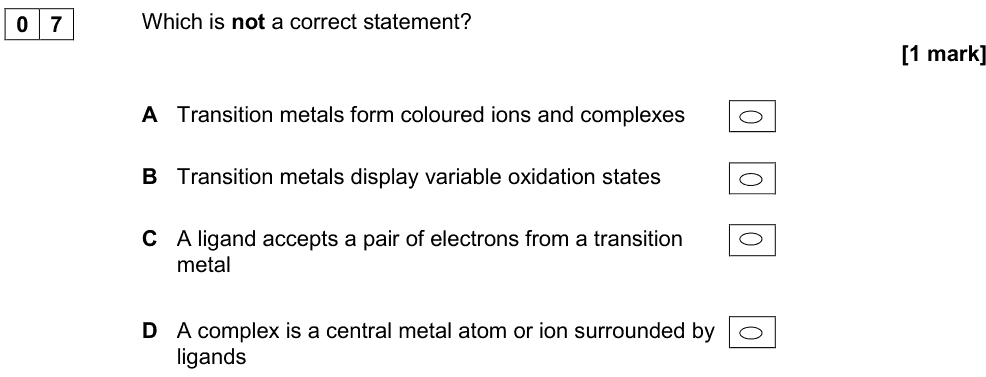
June 2017 · Paper 3 · Q07 1 mark Multiple choice transition metals
Which is not a correct statement?
[1 mark]
A Transition metals form coloured ions and complexes
B Transition metals display variable oxidation states
C A ligand accepts a pair of electrons from a transition
metal
D A complex is a central metal atom or ion surrounded by
ligands
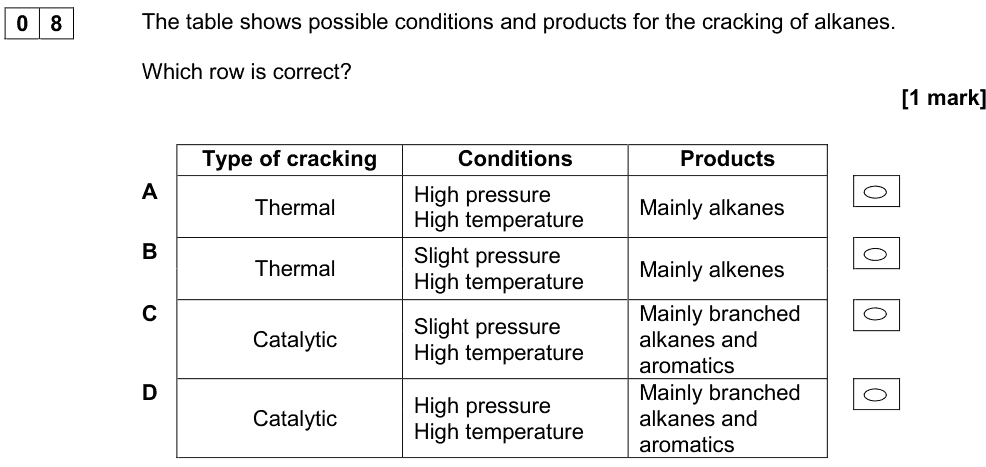
June 2017 · Paper 3 · Q08 1 mark Multiple choice alkanes
The table shows possible conditions and products for the cracking of alkanes.
Which row is correct?
[1 mark]
Type of cracking
Conditions
Products
A
Thermal
High pressure
High temperature
Mainly alkanes
B
Thermal
Slight pressure
High temperature
Mainly alkenes
C
Catalytic
Slight pressure
High temperature
Mainly branched
alkanes and
aromatics
D
Catalytic
High pressure
High temperature
Mainly branched
alkanes and
aromatics
June 2017 · Paper 3 · Q09 1 mark Multiple choice acids and bases
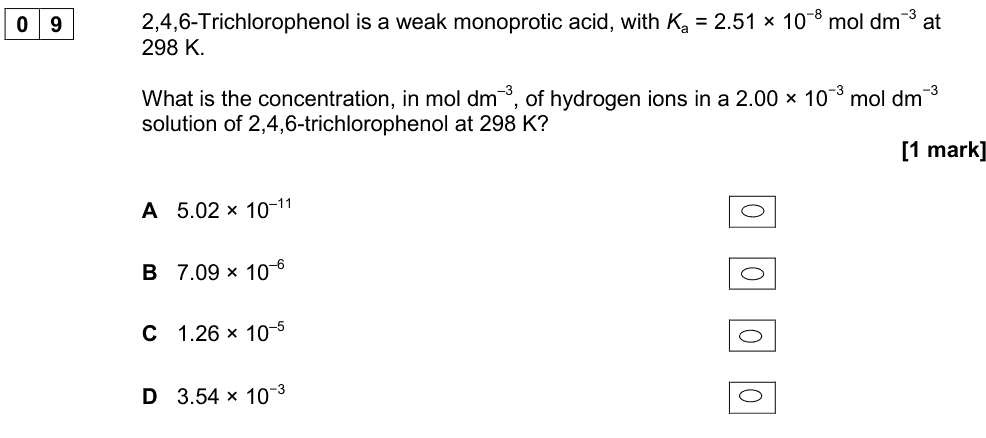
2,4,6-Trichlorophenol is a weak monoprotic acid, with Ka = 2.51 × 10⁻⁸ mol dm−3 at
298 K.
What is the concentration, in mol dm–3, of hydrogen ions in a 2.00 × 10⁻³ mol dm−3
solution of 2,4,6-trichlorophenol at 298 K?
[1 mark]
A 5.02 × 10⁻¹¹
B 7.09 × 10⁻⁶
C 1.26 × 10⁻⁵
D 3.54 × 10⁻³
June 2017 · Paper 3 · Q10 1 mark Multiple choice acids and bases
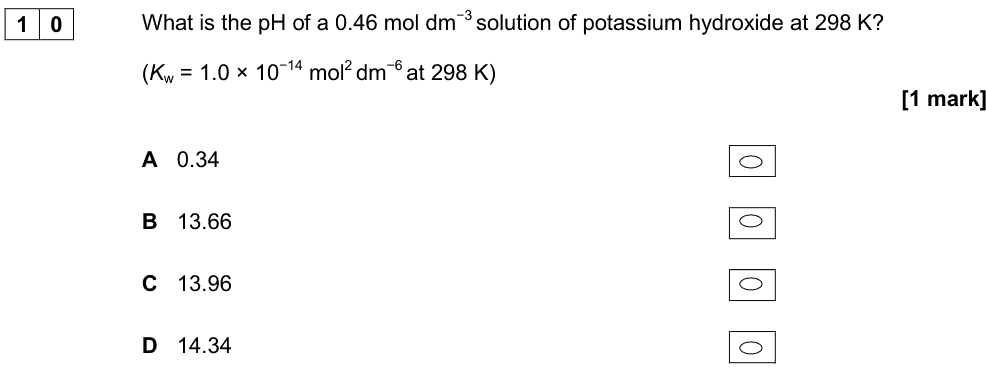
What is the pH of a 0.46 mol dm−3 solution of potassium hydroxide at 298 K?
(Kw = 1.0 × 10⁻¹⁴ mol2 dm−6 at 298 K)
[1 mark]
A 0.34
B 13.66
C 13.96
D 14.34
June 2017 · Paper 3 · Q11 1 mark Multiple choice amount of substance
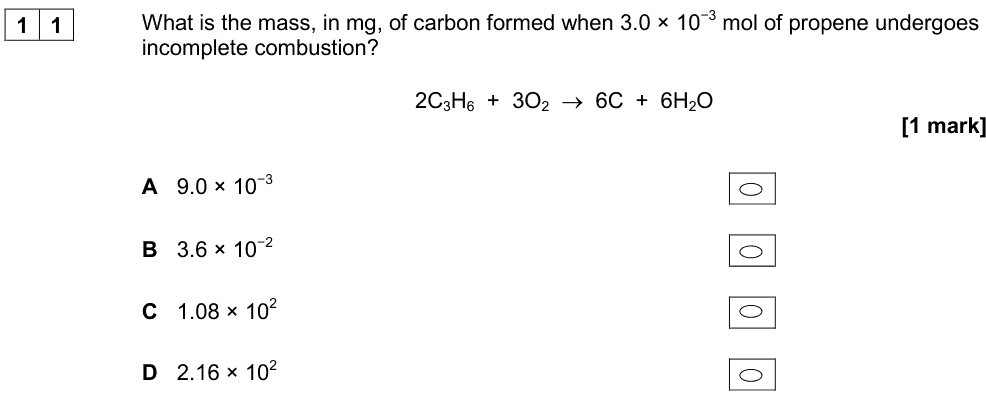
What is the mass, in mg, of carbon formed when 3.0 × 10⁻³ mol of propene undergoes
incomplete combustion?
2C3H6  +  3O2  →  6C  +  6H2O
[1 mark]
A 9.0 × 10⁻³
B 3.6 × 10⁻²
C 1.08 × 10²
D 2.16 × 10²
June 2017 · Paper 3 · Q12 1 mark Multiple choice organic analysis
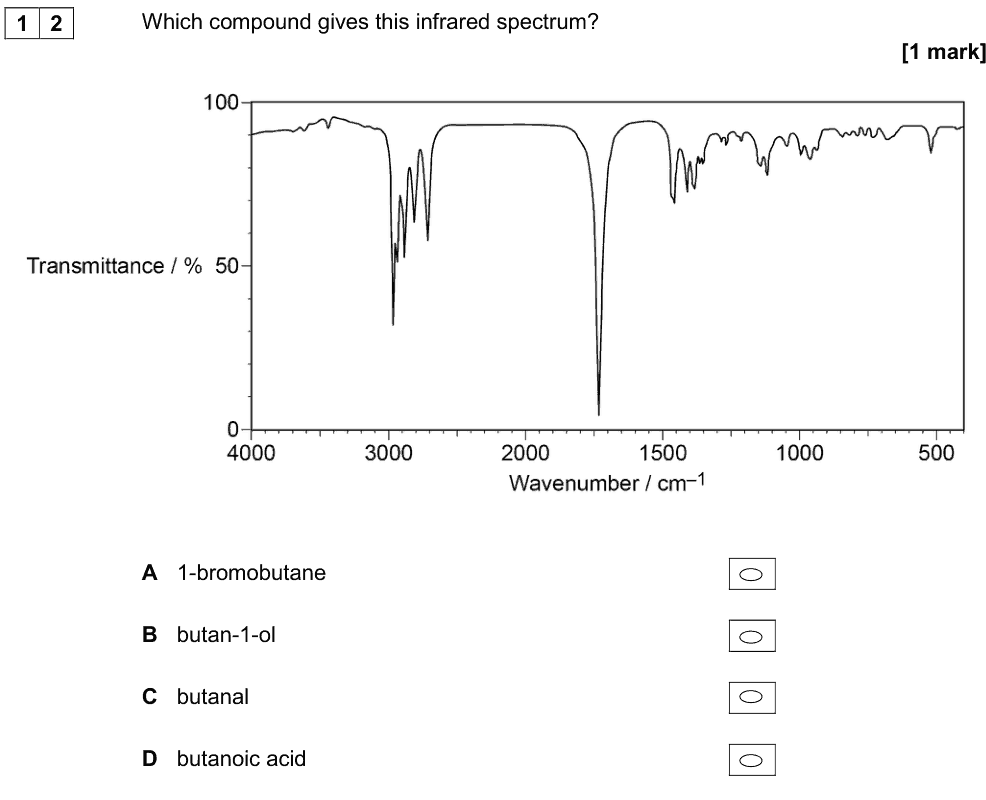
Which compound gives this infrared spectrum?
[1 mark]
A 1-bromobutane
B butan-1-ol
C butanal
D butanoic acid
June 2017 · Paper 3 · Q13 1 mark Multiple choice optical isomerismaldehydes and ketones
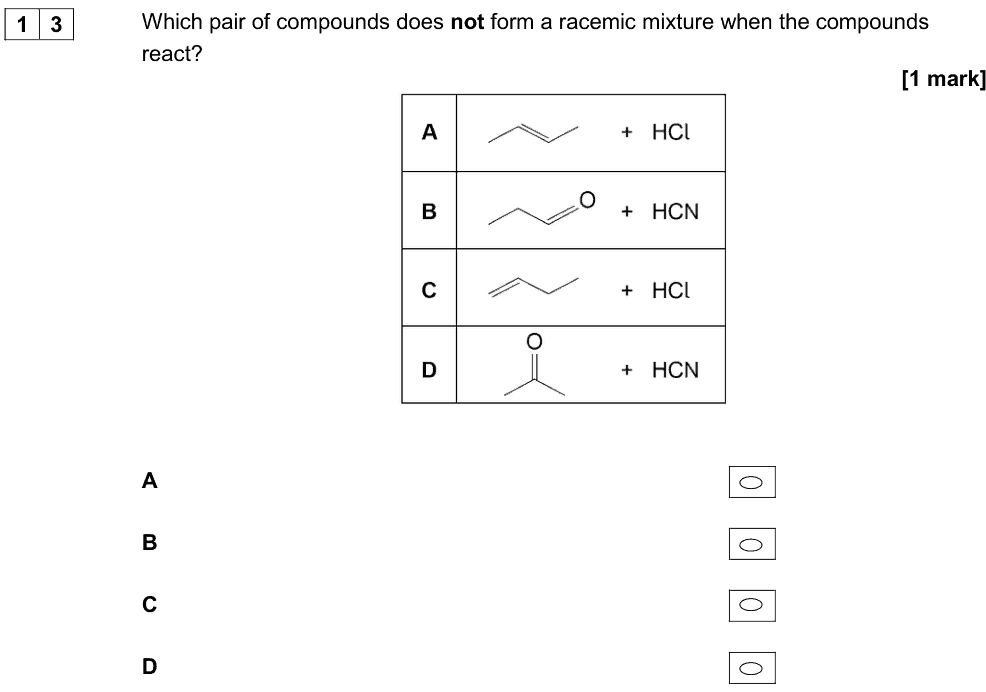
Which pair of compounds does not form a racemic mixture when the compounds
react?
[1 mark]
A
B
C
D
June 2017 · Paper 3 · Q14 1 mark Multiple choice halogenoalkanes
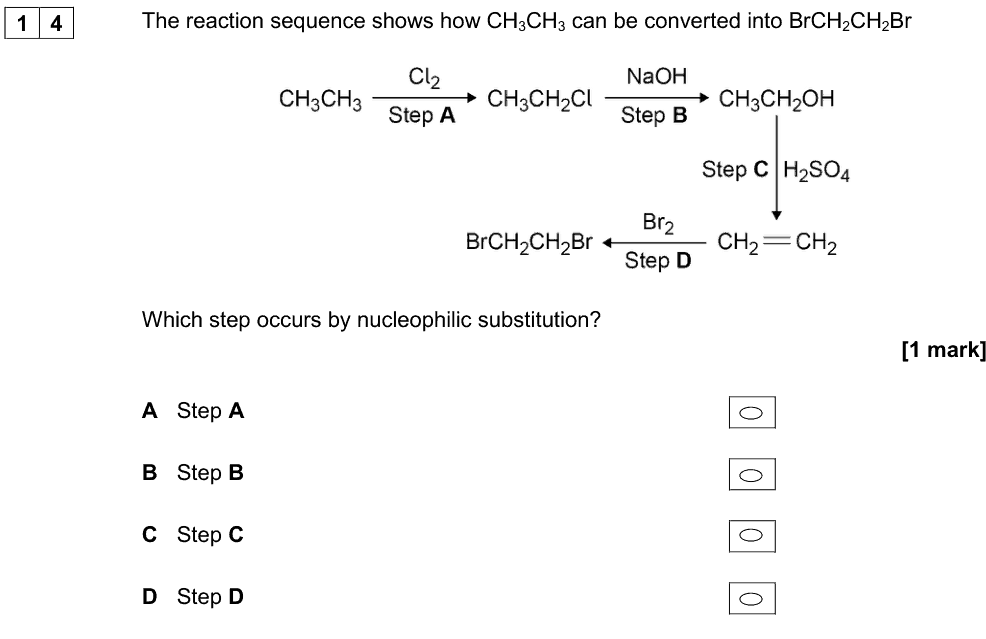
The reaction sequence shows how CH3CH3 can be converted into BrCH2CH2Br
Which step occurs by nucleophilic substitution?
[1 mark]
A Step A
B Step B
C Step C
D Step D
June 2017 · Paper 3 · Q15 1 mark Multiple choice transition metals
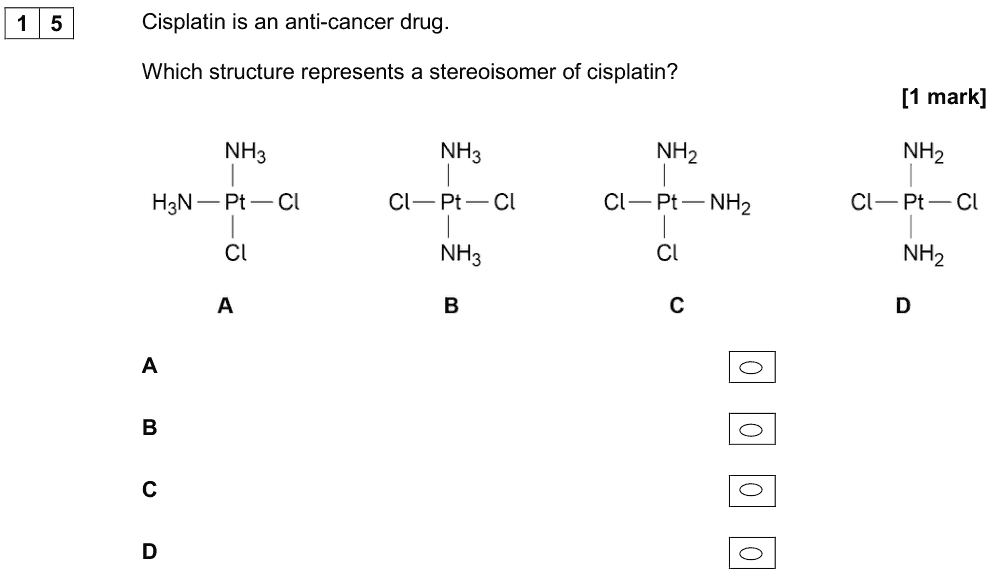
Cisplatin is an anti-cancer drug.
Which structure represents a stereoisomer of cisplatin?
[1 mark]
A
B
C
D
June 2017 · Paper 3 · Q16 1 mark Multiple choice kinetics
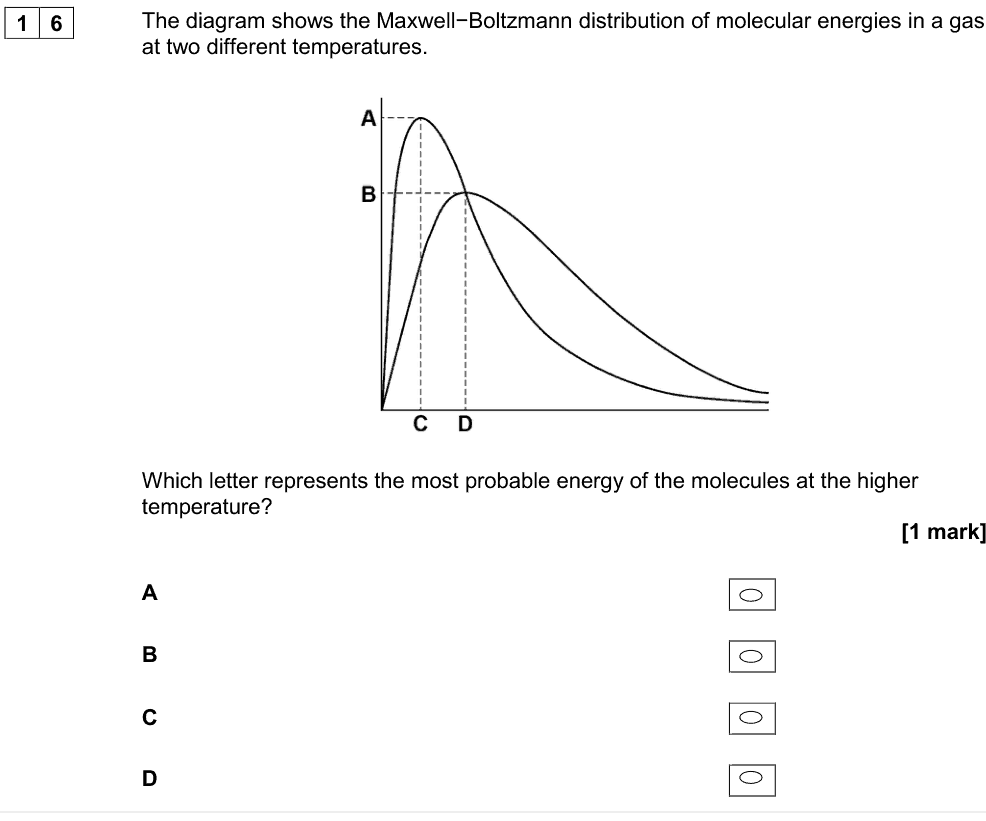
The diagram shows the Maxwell−Boltzmann distribution of molecular energies in a gas
at two different temperatures.
Which letter represents the most probable energy of the molecules at the higher
temperature?
[1 mark]
A
B
C
D
June 2017 · Paper 3 · Q17 1 mark Multiple choice transition metals
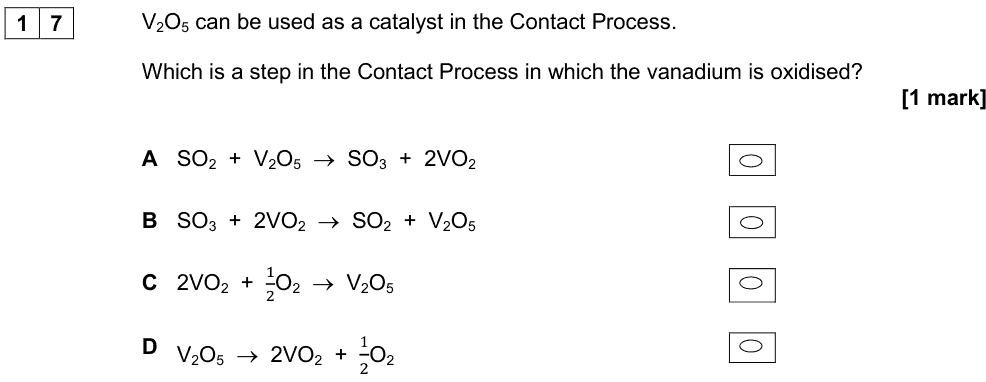
V2O5 can be used as a catalyst in the Contact Process.
Which is a step in the Contact Process in which the vanadium is oxidised?
[1 mark]
A SO2  +  V2O5  →  SO3  +  2VO2
B SO3  +  2VO2  →  SO2  +  V2O5
2VO2  +
1
2O2  →  V2O5
C
D V2O5  →  2VO2  +
1
2O2
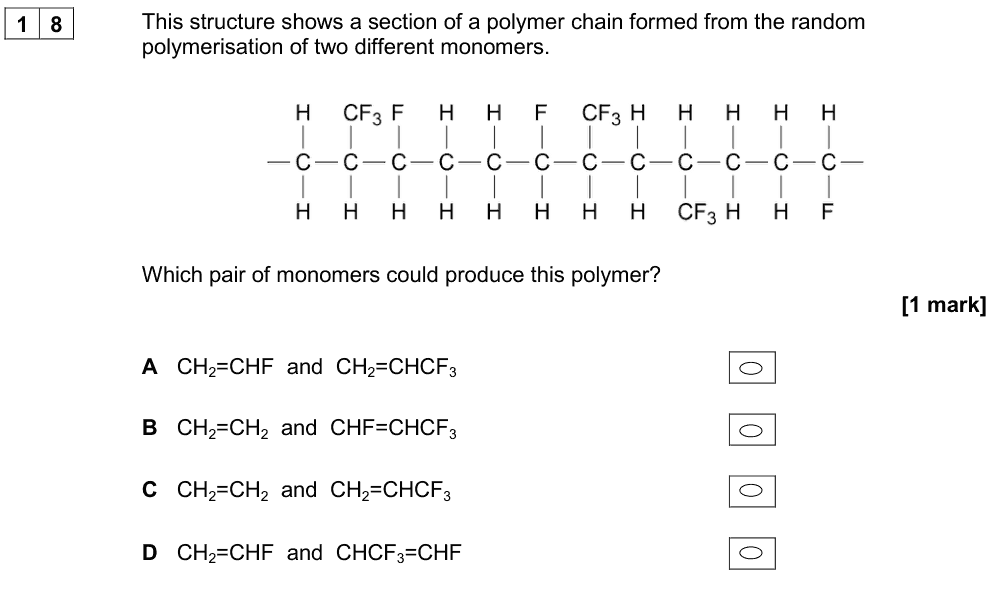
June 2017 · Paper 3 · Q18 1 mark Multiple choice alkenes
This structure shows a section of a polymer chain formed from the random
polymerisation of two different monomers.
Which pair of monomers could produce this polymer?
[1 mark]
A CH2=CHF  and  CH2=CHCF3
B CH2=CH2  and  CHF=CHCF3
C CH2=CH2  and  CH2=CHCF3
D CH2=CHF  and  CHCF3=CHF
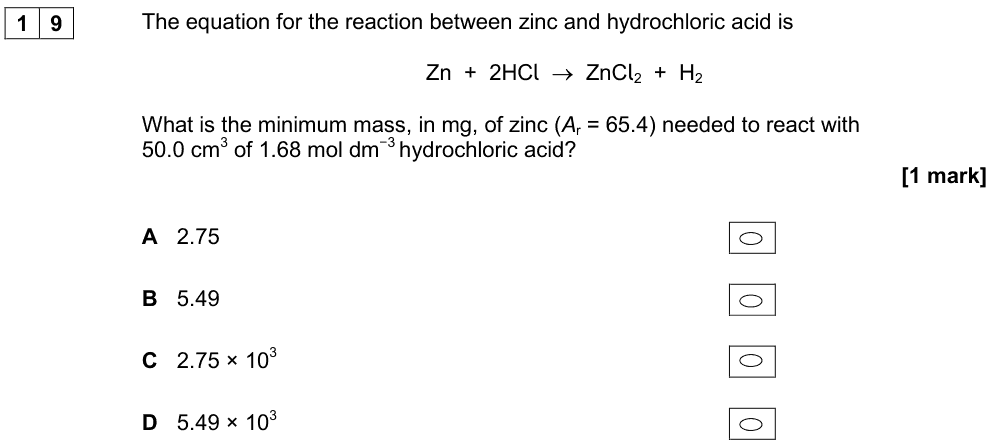
June 2017 · Paper 3 · Q19 1 mark Multiple choice amount of substance
The equation for the reaction between zinc and hydrochloric acid is
Zn  +  2HCl  →  ZnCl2  +  H2
What is the minimum mass, in mg, of zinc (Ar = 65.4) needed to react with
50.0 cm3 of 1.68 mol dm−3 hydrochloric acid?
[1 mark]
A 2.75
B 5.49
C 2.75 × 10³
D 5.49 × 10³
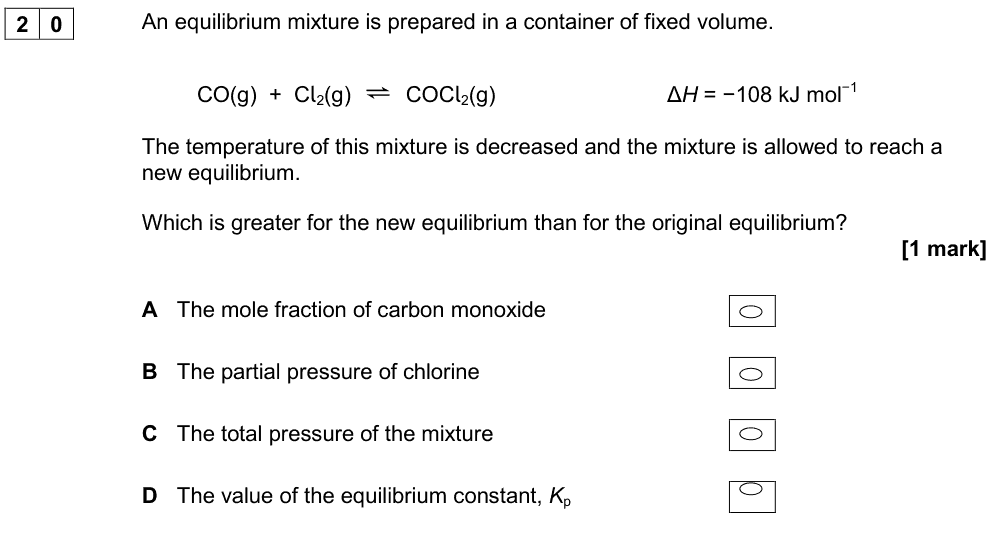
June 2017 · Paper 3 · Q20 1 mark Multiple choice equilibrium constant kp
An equilibrium mixture is prepared in a container of fixed volume.
CO(g)  +  Cl2(g)  ⇌  COCl2(g)                            ΔH = −108 kJ mol−1
The temperature of this mixture is decreased and the mixture is allowed to reach a
new equilibrium.
Which is greater for the new equilibrium than for the original equilibrium?
[1 mark]
A The mole fraction of carbon monoxide
B The partial pressure of chlorine
C The total pressure of the mixture
D The value of the equilibrium constant, Kp
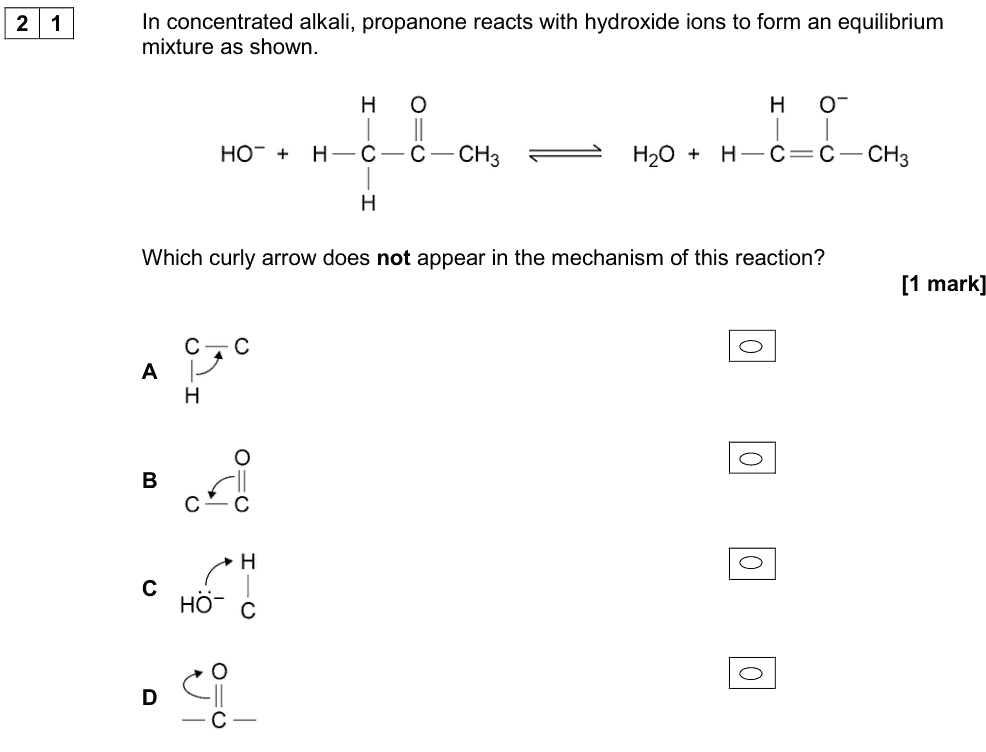
June 2017 · Paper 3 · Q21 1 mark Multiple choice introduction to organic chemistry
In concentrated alkali, propanone reacts with hydroxide ions to form an equilibrium
mixture as shown.
Which curly arrow does not appear in the mechanism of this reaction?
[1 mark]
A
B
C
D
June 2017 · Paper 3 · Q22 1 mark Multiple choice acids and bases
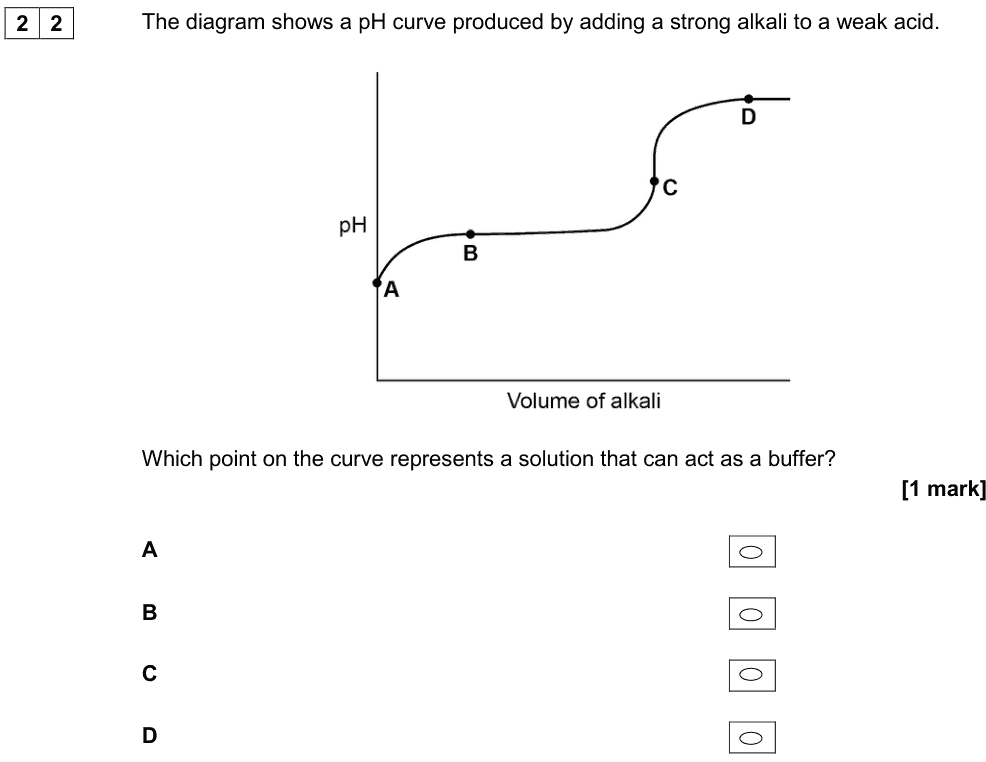
The diagram shows a pH curve produced by adding a strong alkali to a weak acid.
Which point on the curve represents a solution that can act as a buffer?
[1 mark]
A
B
C
D
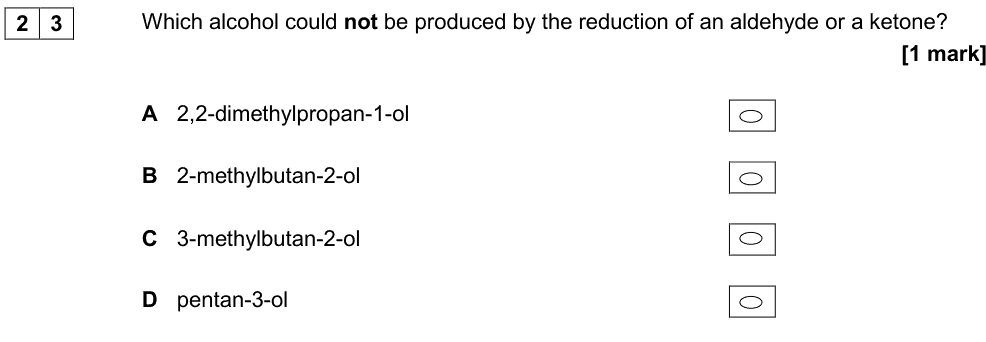
June 2017 · Paper 3 · Q23 1 mark Multiple choice aldehydes and ketones
Which alcohol could not be produced by the reduction of an aldehyde or a ketone?
[1 mark]
A 2,2-dimethylpropan-1-ol
B 2-methylbutan-2-ol
C 3-methylbutan-2-ol
D pentan-3-ol
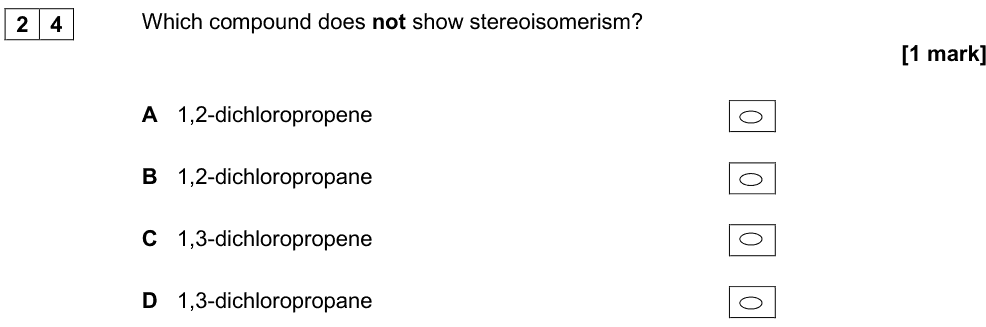
June 2017 · Paper 3 · Q24 1 mark Multiple choice introduction to organic chemistryoptical isomerism
Which compound does not show stereoisomerism?
[1 mark]
A 1,2-dichloropropene
B 1,2-dichloropropane
C 1,3-dichloropropene
D 1,3-dichloropropane
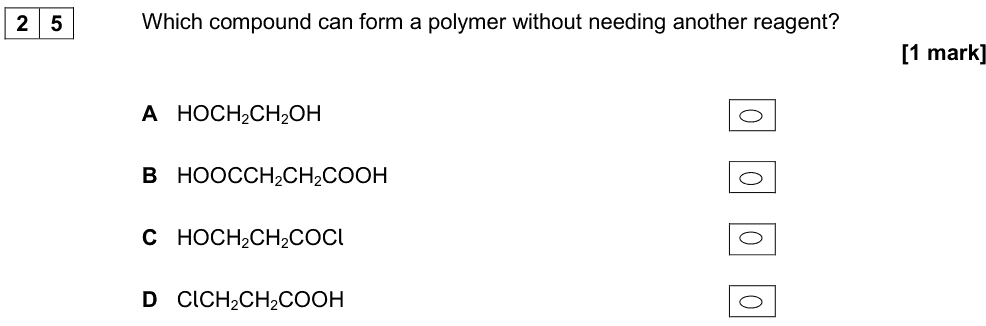
June 2017 · Paper 3 · Q25 1 mark Multiple choice polymers
Which compound can form a polymer without needing another reagent?
[1 mark]
A HOCH2CH2OH
B HOOCCH2CH2COOH
C HOCH2CH2COCl
D ClCH2CH2COOH
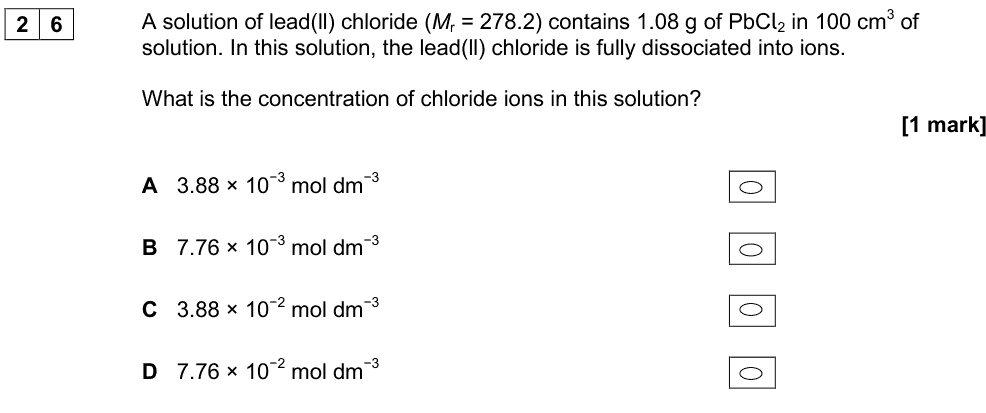
June 2017 · Paper 3 · Q26 1 mark Multiple choice amount of substance
A solution of lead(ll) chloride (Mr = 278.2) contains 1.08 g of PbCl2 in 100 cm3 of
solution. In this solution, the lead(ll) chloride is fully dissociated into ions.
What is the concentration of chloride ions in this solution?
[1 mark]
A 3.88 × 10⁻³ mol dm−3
B 7.76 × 10⁻³ mol dm−3
C 3.88 × 10⁻² mol dm−3
D 7.76 × 10⁻² mol dm−3
June 2017 · Paper 3 · Q27 1 mark Multiple choice rate equationsacids and bases
The rate equation for the acid-catalysed reaction between iodine and propanone is:
rate = k [H+] [C3H6O]
The rate of reaction was measured for a mixture of iodine, propanone and sulfuric acid
at pH = 0.70
In a second mixture the concentration of the sulfuric acid was different but the
concentrations of iodine and propanone were unchanged. The new rate of reaction
was a quarter of the original rate.
What was the pH of the second mixture?
[1 mark]
A 1.00
B 1.30
C 1.40
D 2.80
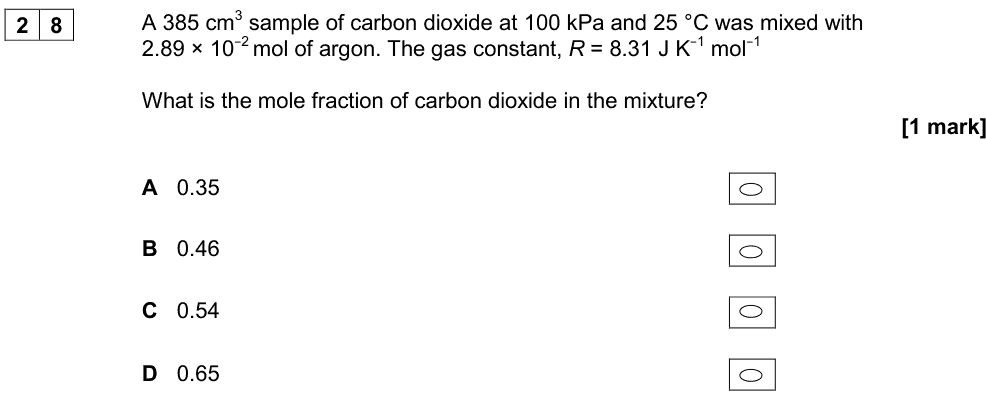
June 2017 · Paper 3 · Q28 1 mark Multiple choice amount of substanceequilibrium constant kp
A 385 cm3 sample of carbon dioxide at 100 kPa and 25 °C was mixed with
2.89 × 10⁻² mol of argon. The gas constant, R = 8.31 J K−1 mol−1
What is the mole fraction of carbon dioxide in the mixture?
[1 mark]
A 0.35
B 0.46
C 0.54
D 0.65
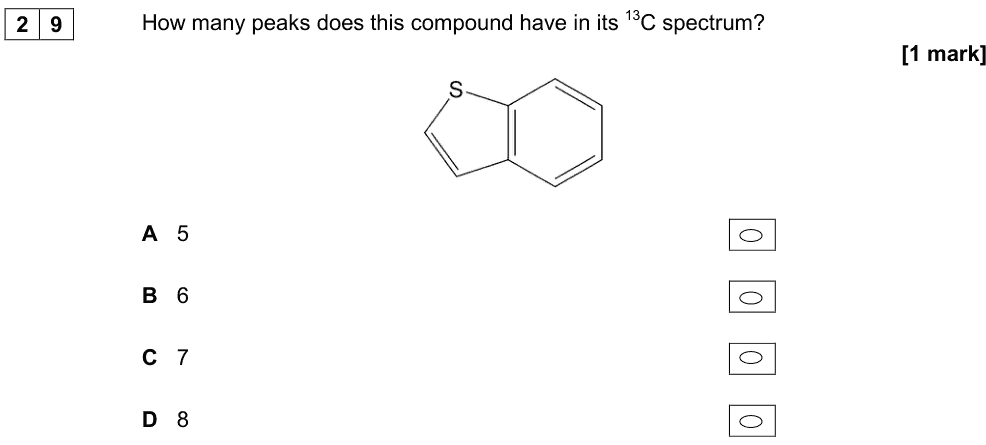
June 2017 · Paper 3 · Q29 1 mark Multiple choice nmr spectroscopy
How many peaks does this compound have in its 13C spectrum?
[1 mark]
A 5
B 6
C 7
D 8
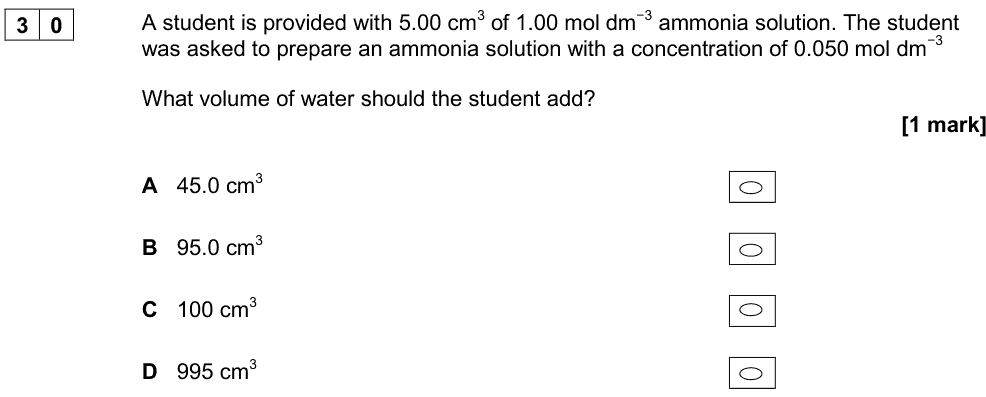
June 2017 · Paper 3 · Q30 1 mark Multiple choice amount of substance
A student is provided with 5.00 cm3 of 1.00 mol dm−3 ammonia solution. The student
was asked to prepare an ammonia solution with a concentration of 0.050 mol dm−3
What volume of water should the student add?
[1 mark]
A 45.0 cm3
B 95.0 cm3
C 100 cm3
D 995 cm3
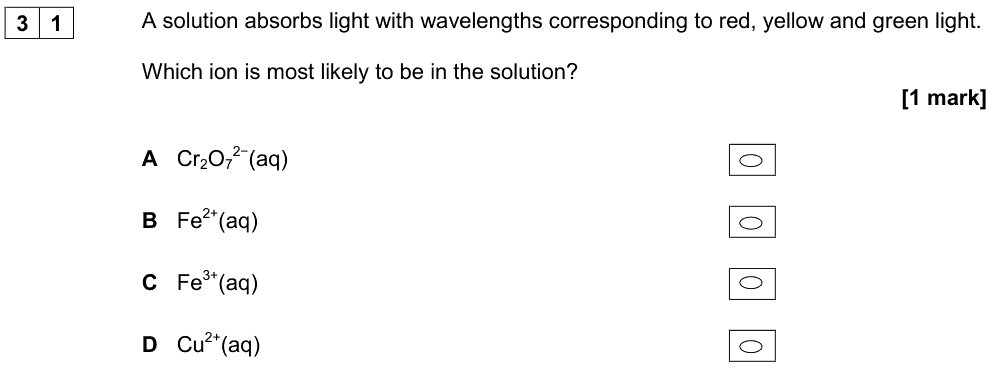
June 2017 · Paper 3 · Q31 1 mark Multiple choice transition metals
A solution absorbs light with wavelengths corresponding to red, yellow and green light.
Which ion is most likely to be in the solution?
[1 mark]
A Cr2O7
2−(aq)
B Fe2+(aq)
C Fe3+(aq)
D Cu2+(aq)
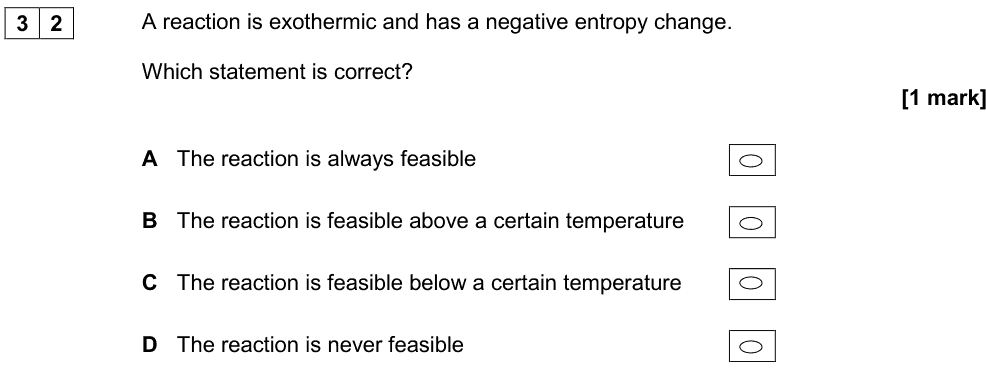
June 2017 · Paper 3 · Q32 1 mark Multiple choice thermodynamics
A reaction is exothermic and has a negative entropy change.
Which statement is correct?
[1 mark]
A The reaction is always feasible
B The reaction is feasible above a certain temperature
C The reaction is feasible below a certain temperature
D The reaction is never feasible
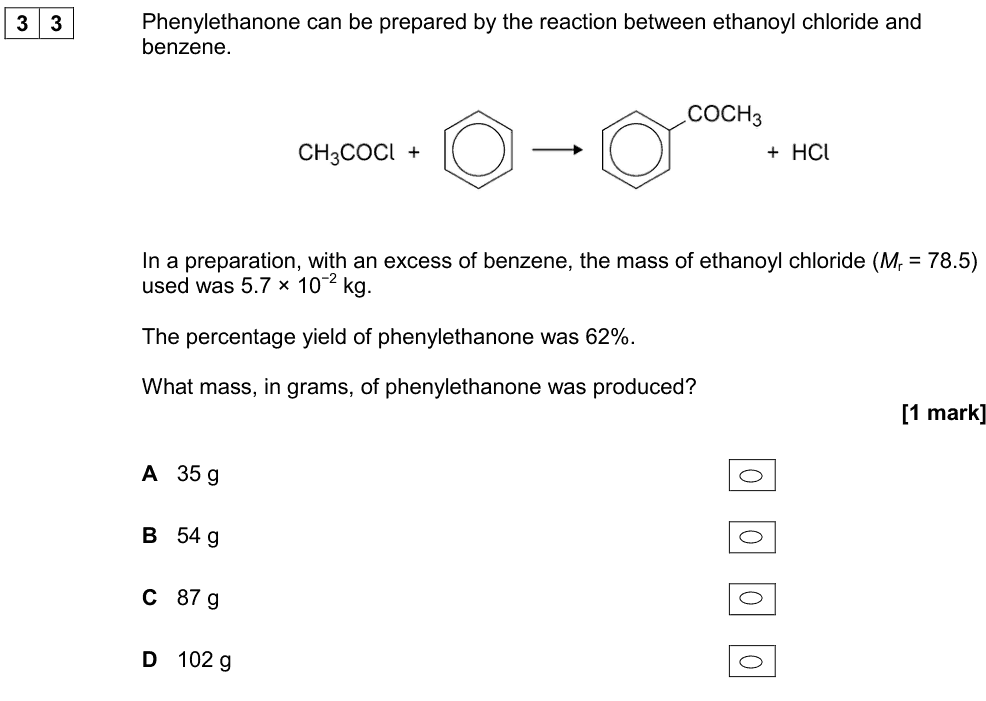
June 2017 · Paper 3 · Q33 1 mark Multiple choice amount of substance
Phenylethanone can be prepared by the reaction between ethanoyl chloride and
benzene.
In a preparation, with an excess of benzene, the mass of ethanoyl chloride (Mr = 78.5)
used was 5.7 × 10⁻² kg.
The percentage yield of phenylethanone was 62%.

What mass, in grams, of phenylethanone was produced?
[1 mark]
A 35 g
B 54 g
C 87 g
D 102 g
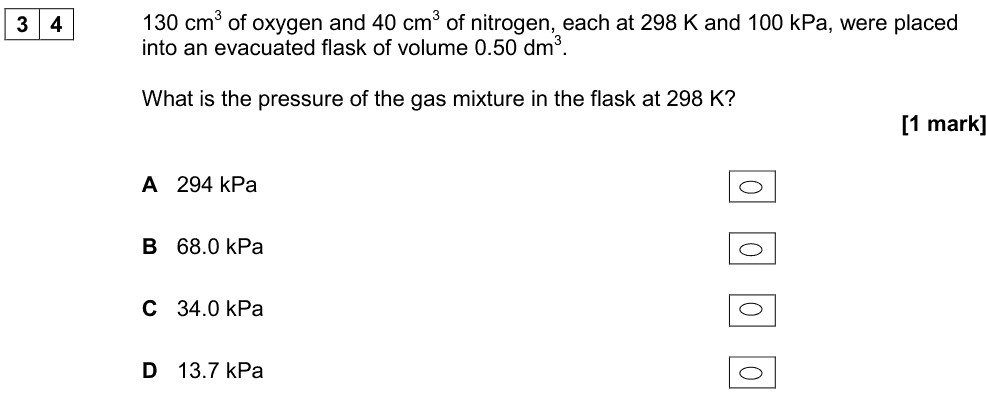
June 2017 · Paper 3 · Q34 1 mark Multiple choice amount of substance
130 cm3 of oxygen and 40 cm3 of nitrogen, each at 298 K and 100 kPa, were placed
into an evacuated flask of volume 0.50 dm3.
What is the pressure of the gas mixture in the flask at 298 K?
[1 mark]
A 294 kPa
B 68.0 kPa
C 34.0 kPa
D 13.7 kPa

Work with an A-level chemistry tutor

Want a paper marked and gone through with you? Message us.

Prefer email? Send an enquiry

If you are under 18, please include a parent's contact details. Enquiries go to enquiries@chemistryaleveltutor.com and are deleted once handled. All tutoring is online.