June 2023: Paper 3, General and Practical Principles in Chemistry

120 marks · 60 question parts · Paper, mark scheme and report on Edexcel's site · Have the Data Booklet beside you

Question by question

QTopicMarksAOType
1(a) Alkanes, Formulae, equations and amounts of substance 1Equation writing
1(b) Alkanes 2Short answer
1(c) Alkanes 2Explanation
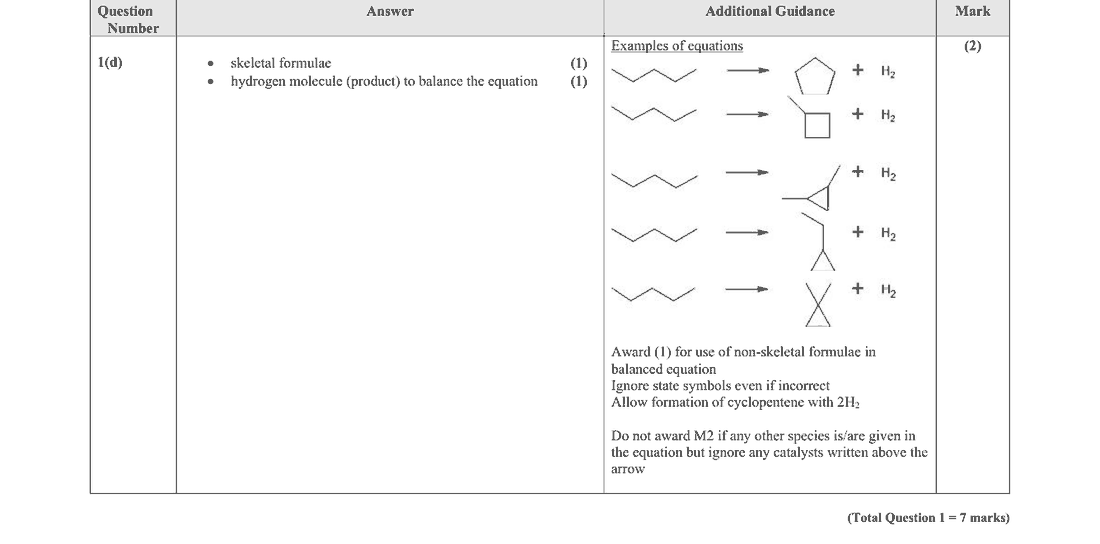
1(d) Alkanes, Introduction to organic chemistry 2Equation writing
2(a)(i) The elements of Groups 1 and 2, Formulae, equations and amounts of substance 1Equation writing
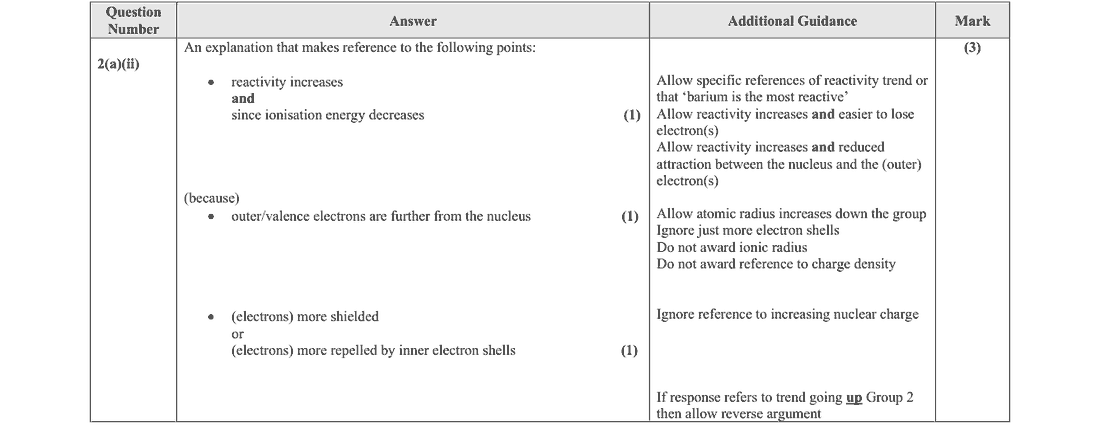
2(a)(ii) The elements of Groups 1 and 2 3Explanation
2(b)(i) The elements of Groups 1 and 2 1Short answer
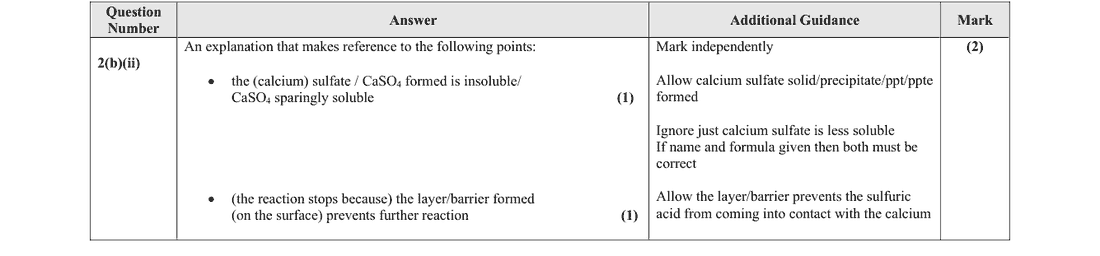
2(b)(ii) The elements of Groups 1 and 2 2Explanation
2(c)(i) The elements of Groups 1 and 2 1Practical and data analysis
2(c)(ii) The elements of Groups 1 and 2, Formulae, equations and amounts of substance 1Equation writing
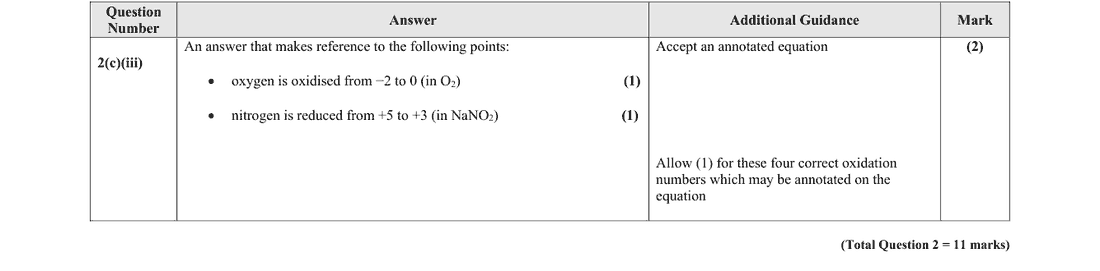
2(c)(iii) Redox I 2Short answer
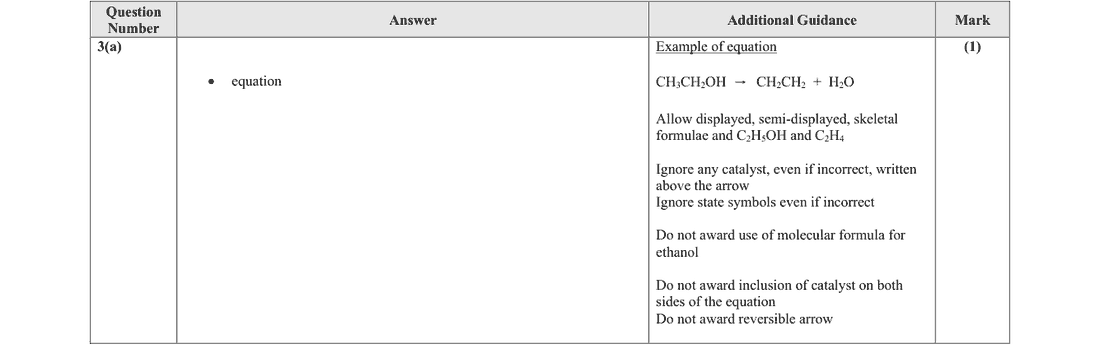
3(a) Alcohols 1Equation writing
3(b) Redox I 1Short answer
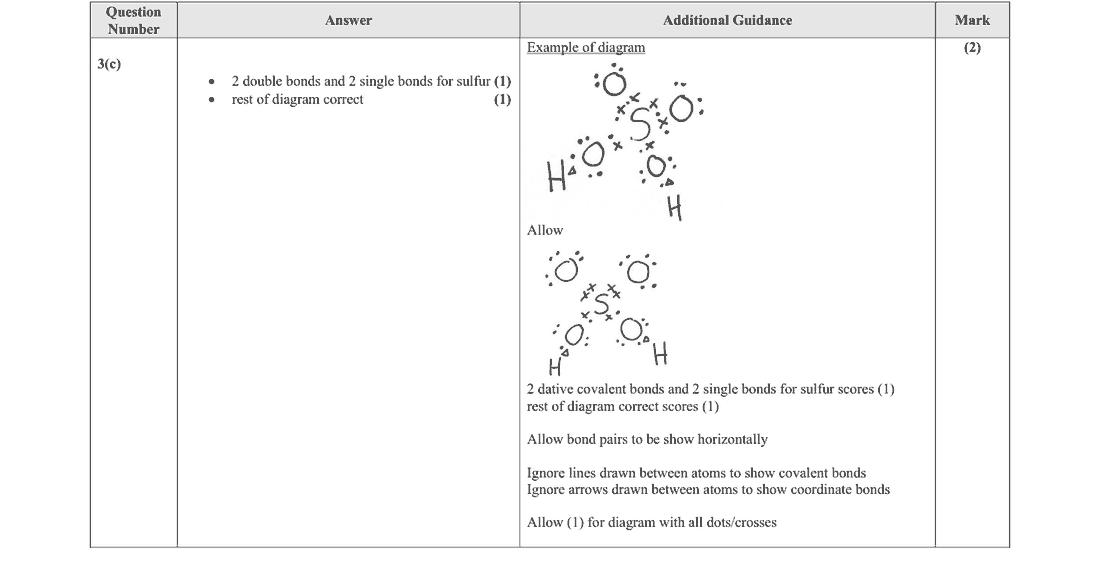
3(c) Bonding 2Diagram or structure
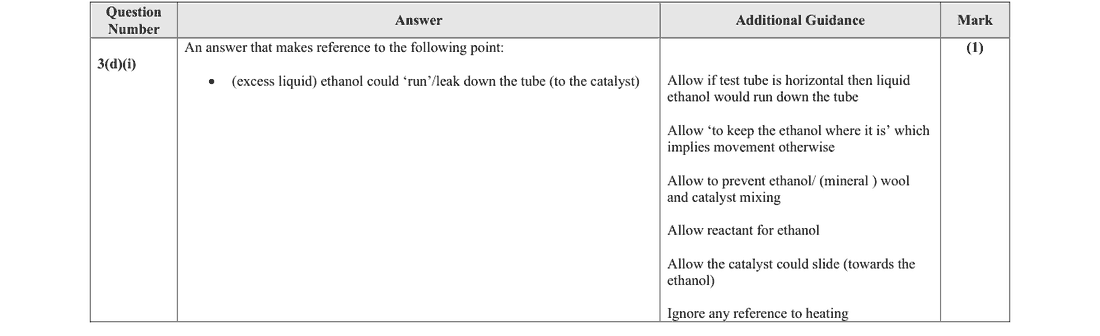
3(d)(i) Alcohols 1Practical and data analysis
3(d)(ii) Alcohols 1Practical and data analysis
3(d)(iii) Formulae, equations and amounts of substance 1Practical and data analysis
3(d)(iv) Alcohols 1Practical and data analysis
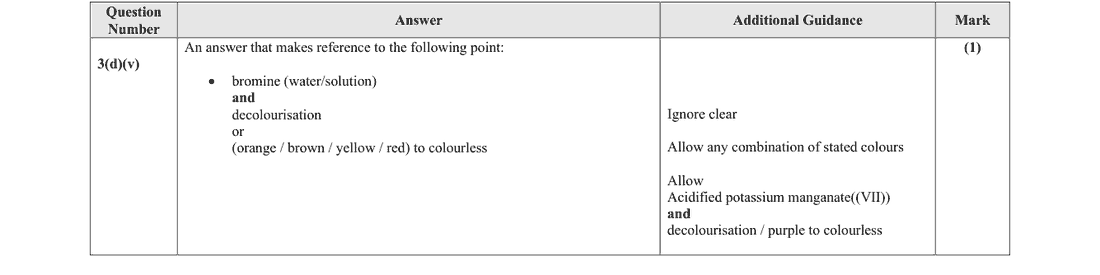
3(d)(v) Alkenes 1Practical and data analysis
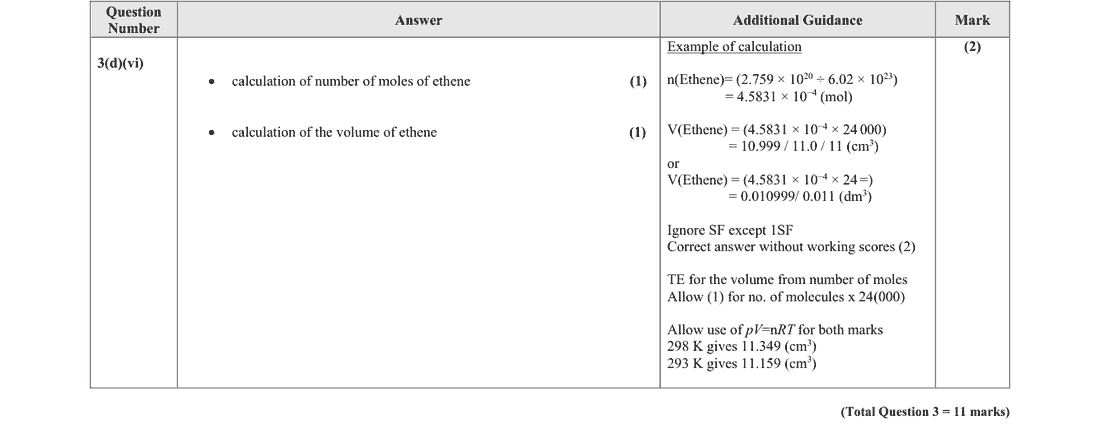
3(d)(vi) Formulae, equations and amounts of substance 2Calculation
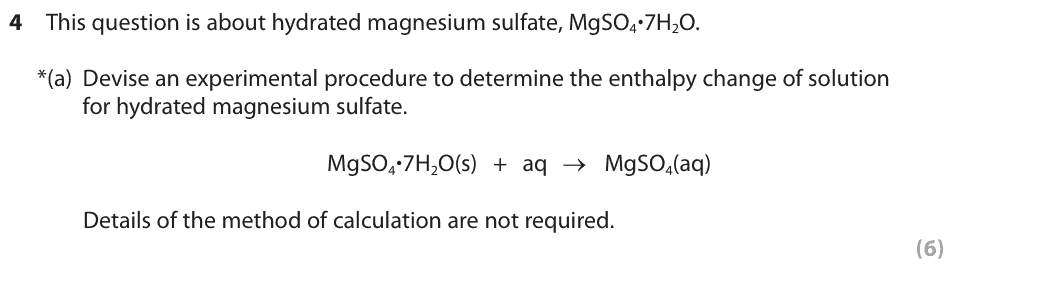
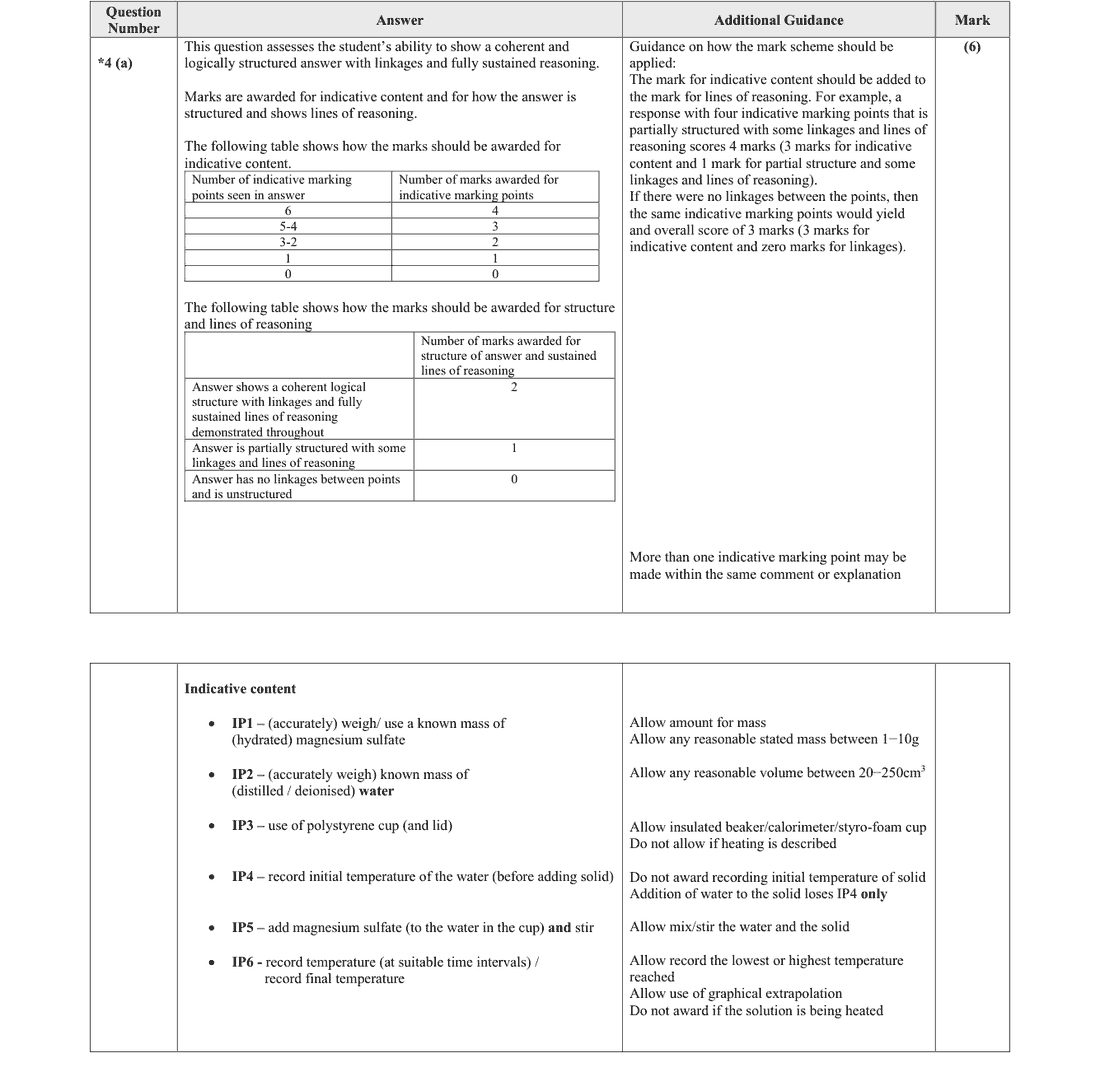
4(a) Energetics I 6Extended response
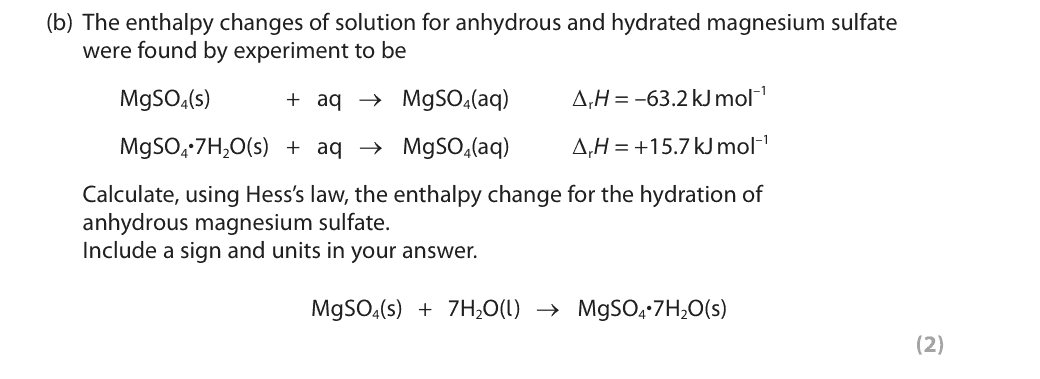
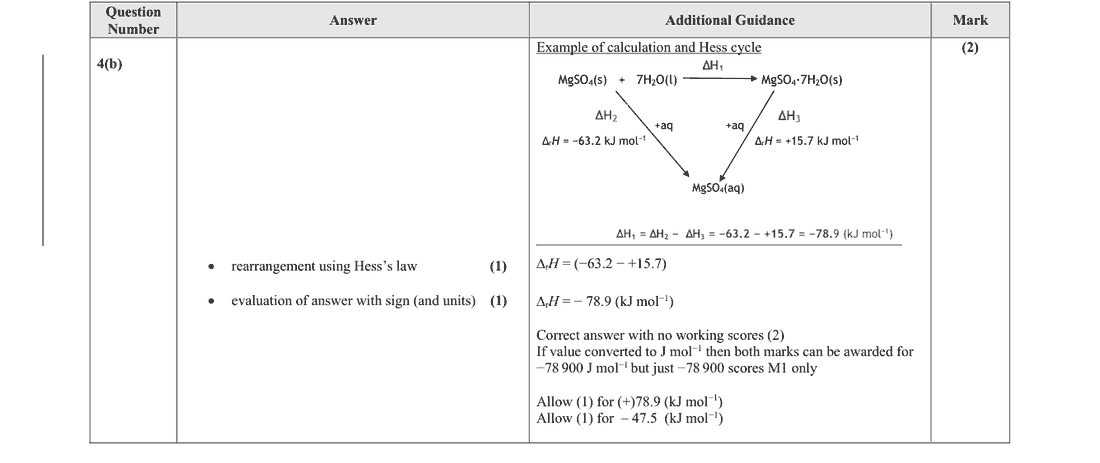
4(b) Energetics I 2Calculation
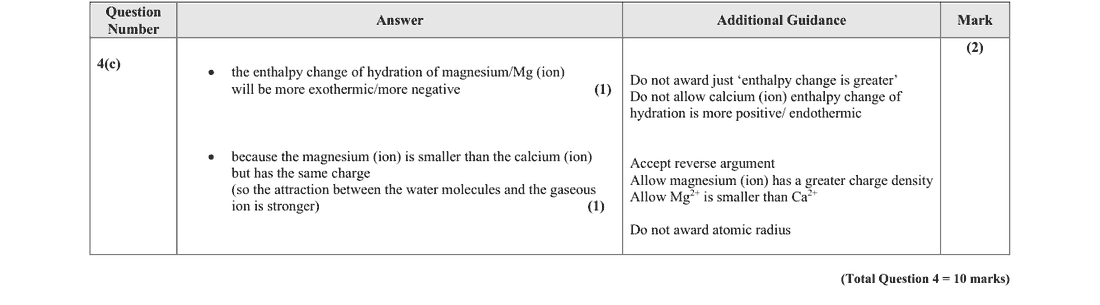
4(c) Energetics II: lattice energy 2Explanation
5(a) Redox II 3Practical and data analysis
5(b) Transition metals: reactions, Redox II 5Explanation
5(c) Redox II, Redox I 1Equation writing
5(d) Redox II 2Explanation
5(e) Redox II 1Short answer
6(a) Modern analytical techniques II: NMR, mass spectrometry and chromatography 1Short answer
6(b)(i) Amines, amides, amino acids and proteins 1Short answer
6(b)(ii) Modern analytical techniques II: NMR, mass spectrometry and chromatography 3Diagram or structure
6(b)(iii) Amines, amides, amino acids and proteins 1Short answer
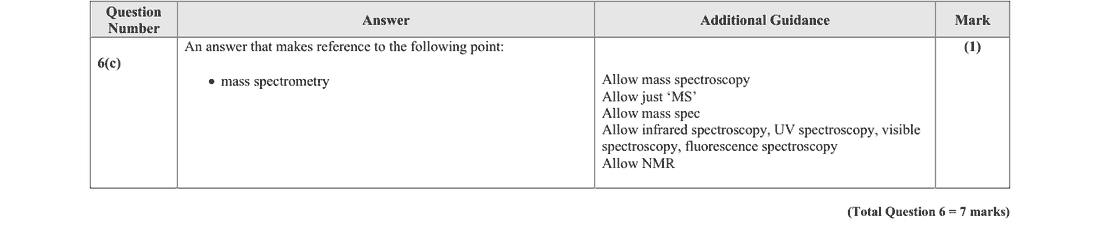
6(c) Modern analytical techniques II: NMR, mass spectrometry and chromatography 1Short answer
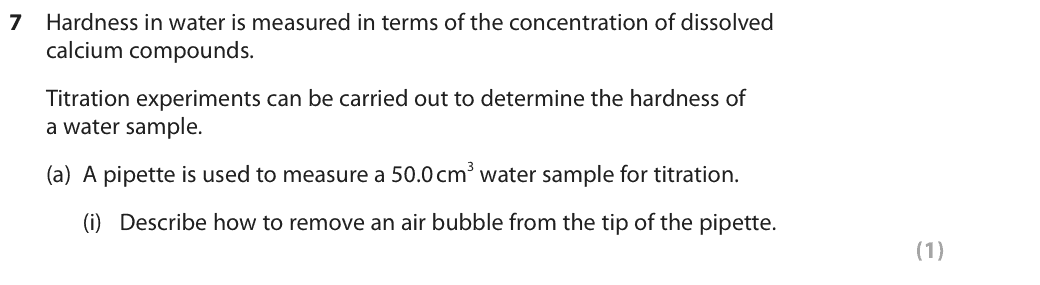
7(a)(i) Formulae, equations and amounts of substance 1Practical and data analysis
7(a)(ii) Formulae, equations and amounts of substance 1Calculation
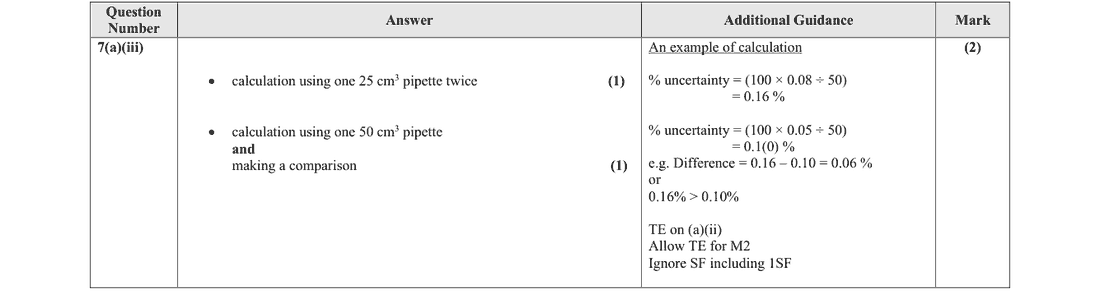
7(a)(iii) Formulae, equations and amounts of substance 2Calculation
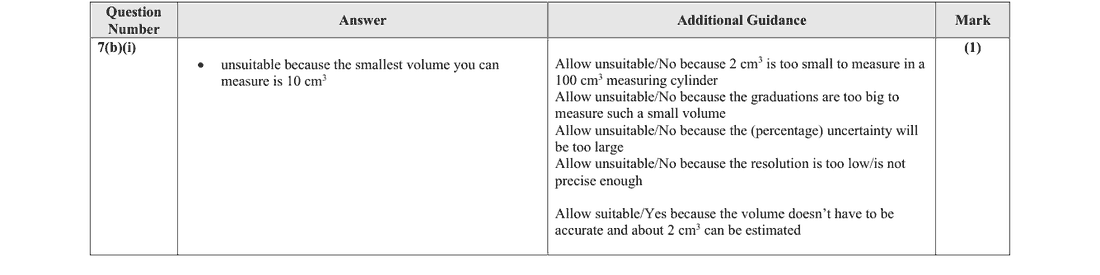
7(b)(i) Formulae, equations and amounts of substance 1Practical and data analysis
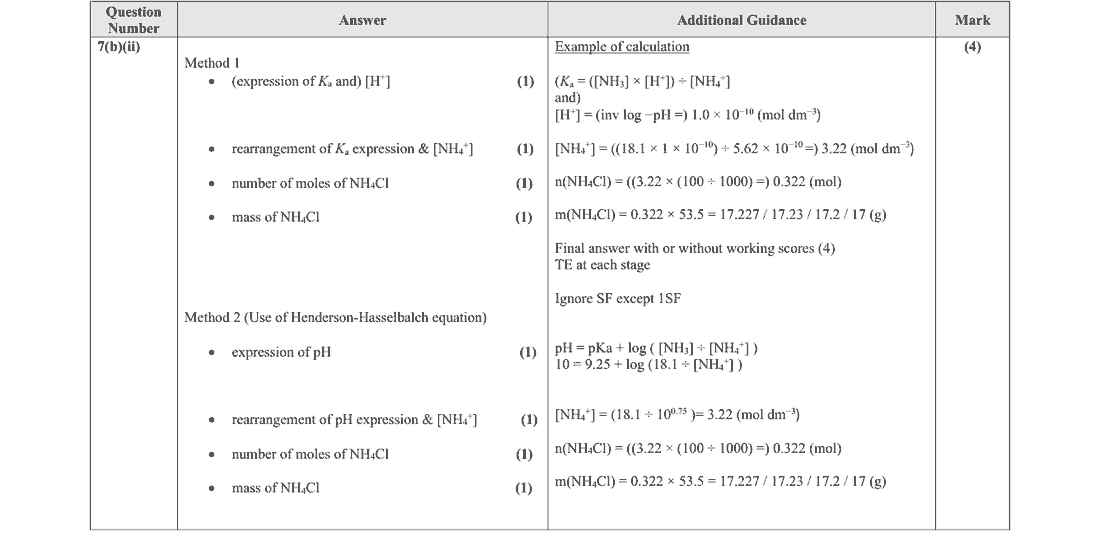
7(b)(ii) Acid-base equilibria 4Calculation
7(b)(iii) Formulae, equations and amounts of substance 1Practical and data analysis
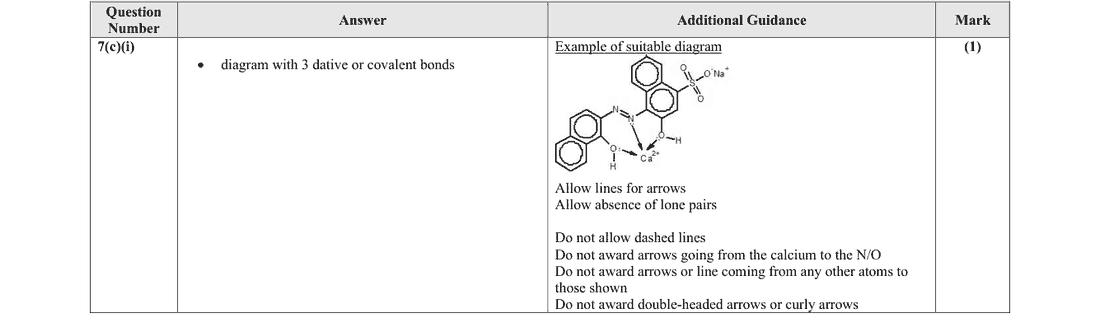
7(c)(i) Transition metals: principles 1Diagram or structure
7(c)(ii) Transition metals: principles 1Short answer
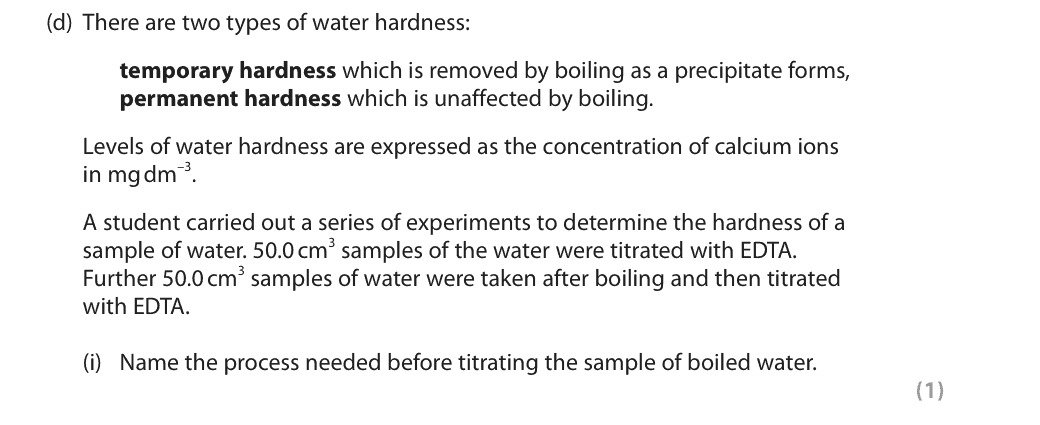
7(d)(i) Formulae, equations and amounts of substance 1Practical and data analysis
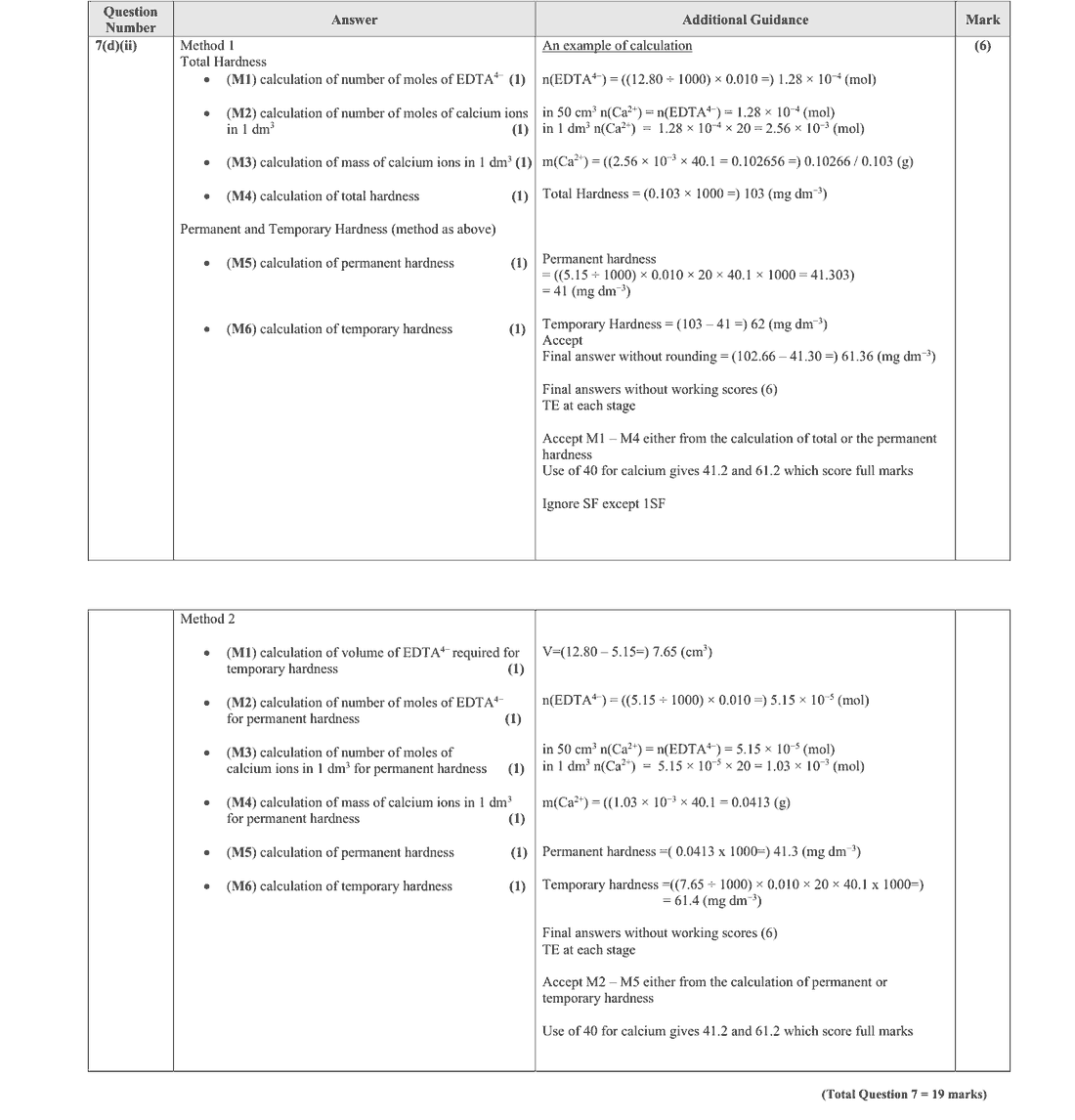
7(d)(ii) Formulae, equations and amounts of substance 6Calculation
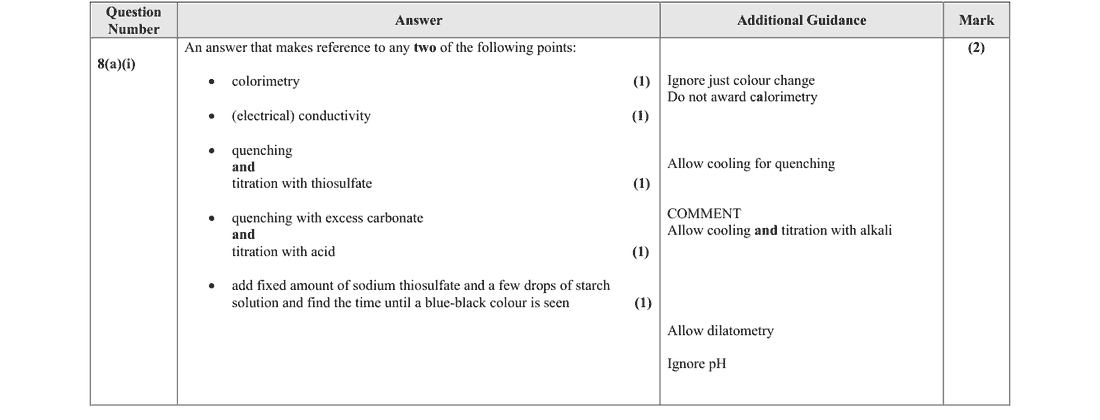
8(a)(i) Kinetics II 2Practical and data analysis
8(a)(ii) Kinetics II 1Short answer
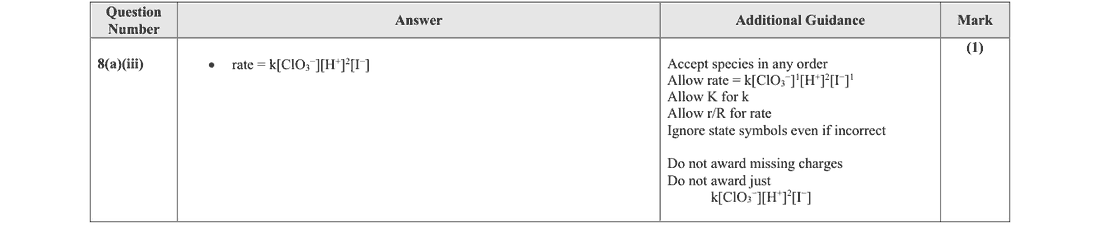
8(a)(iii) Kinetics II 1Short answer
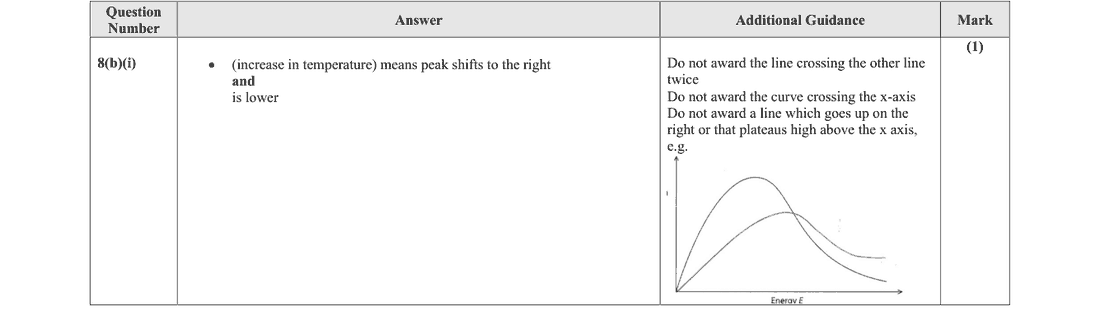
8(b)(i) Kinetics I 1Diagram or structure
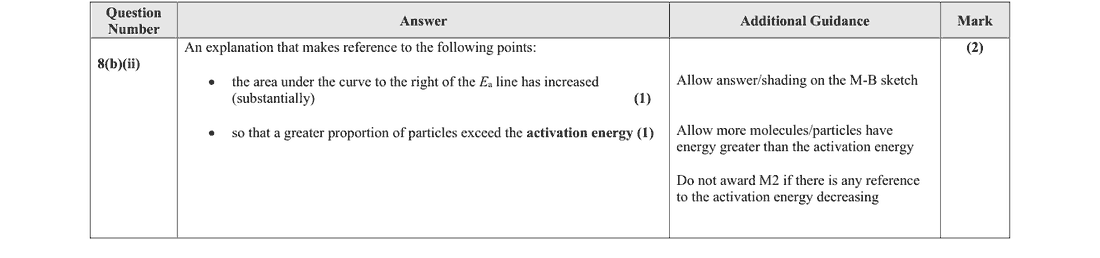
8(b)(ii) Kinetics I 2Explanation
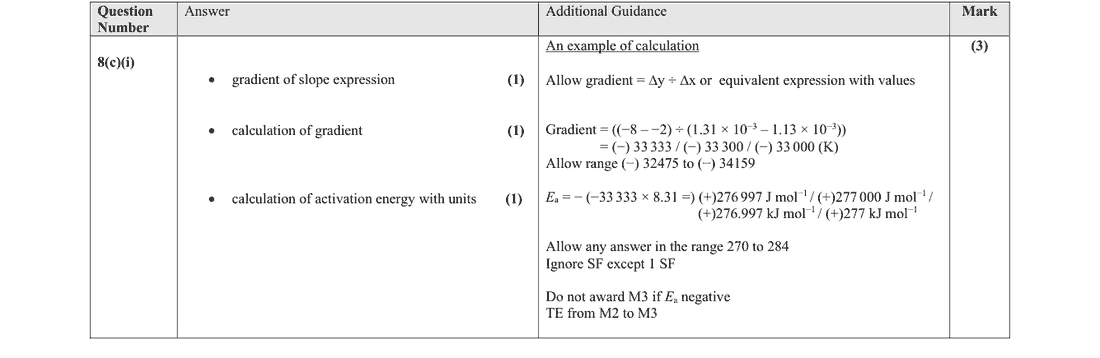
8(c)(i) Kinetics II 3Calculation
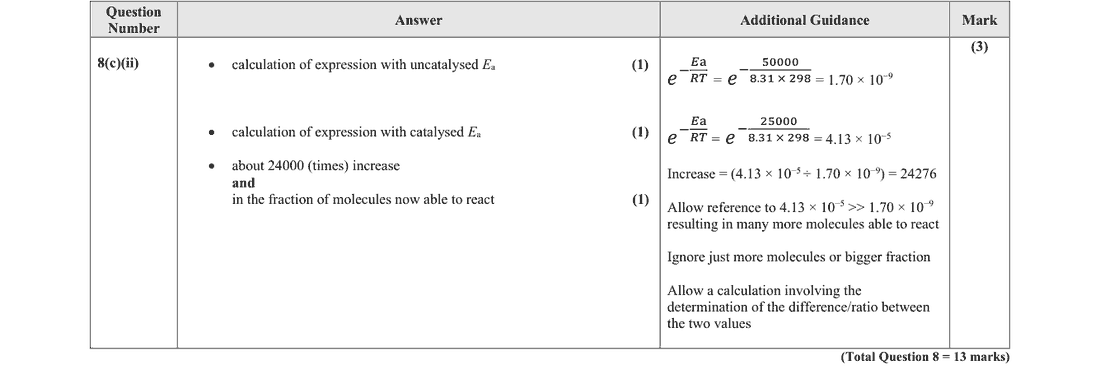
8(c)(ii) Kinetics I 3Calculation
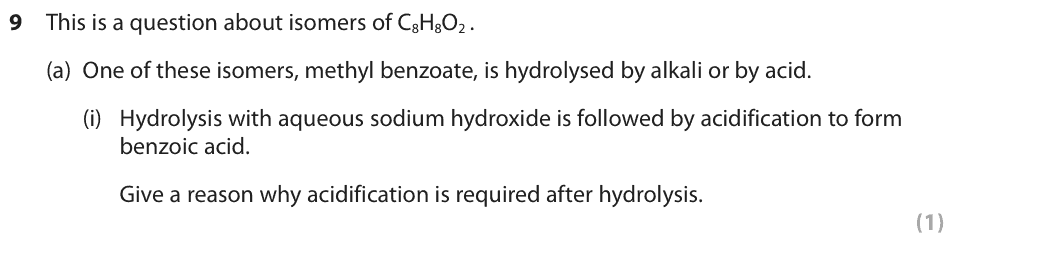
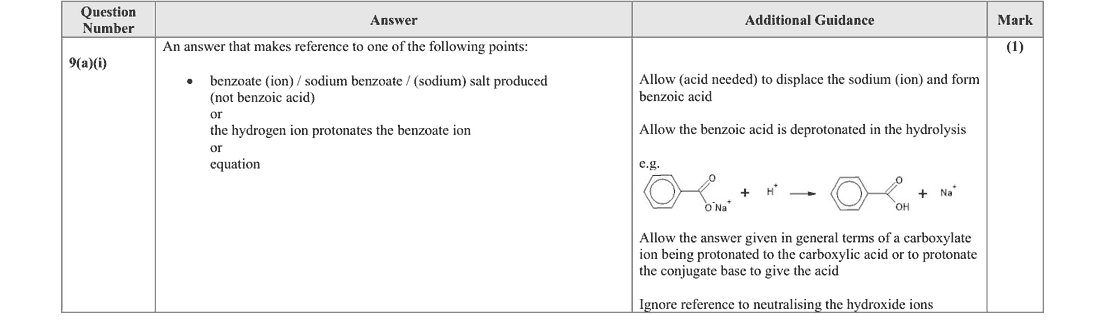
9(a)(i) Carboxylic acids 1Short answer
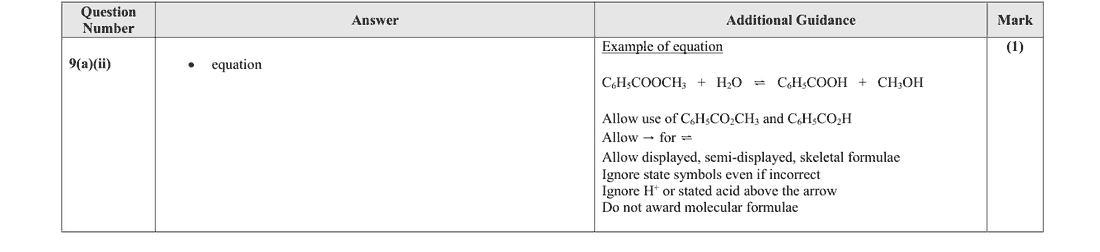
9(a)(ii) Carboxylic acids 1Equation writing
9(b) Organic synthesis, Modern analytical techniques II: NMR, mass spectrometry and chromatography 7Explanation
9(c)(i) Arenes: benzene 4Mechanism
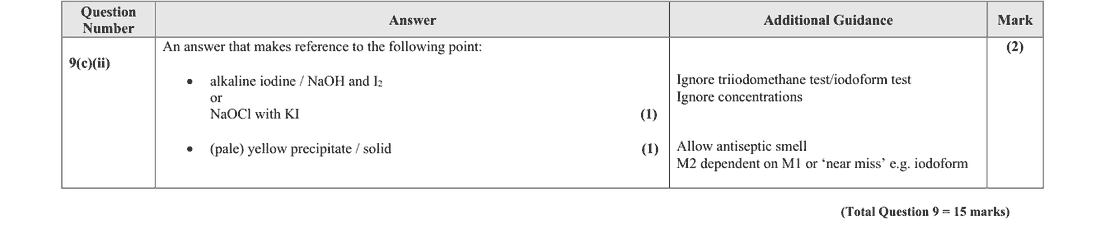
9(c)(ii) Carbonyl compounds 2Practical and data analysis
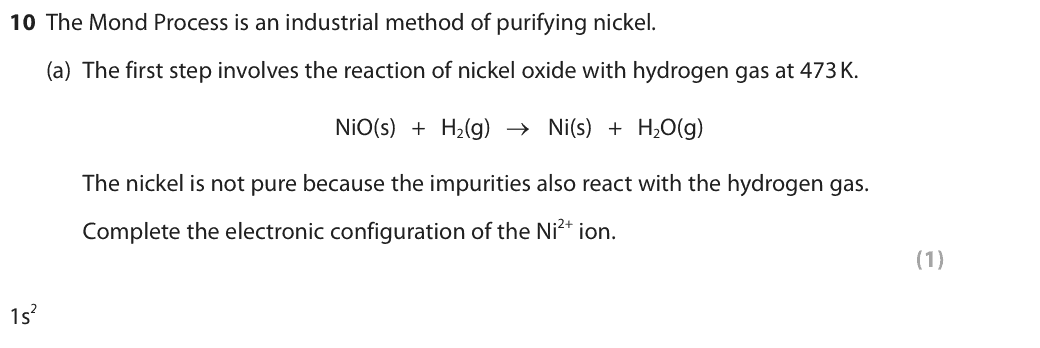
10(a) Transition metals: principles 1Short answer
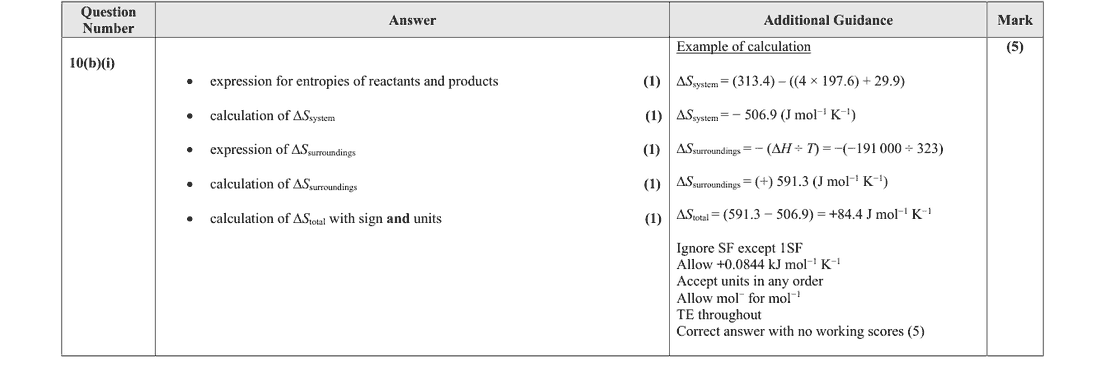
10(b)(i) Energetics II: entropy 5Calculation
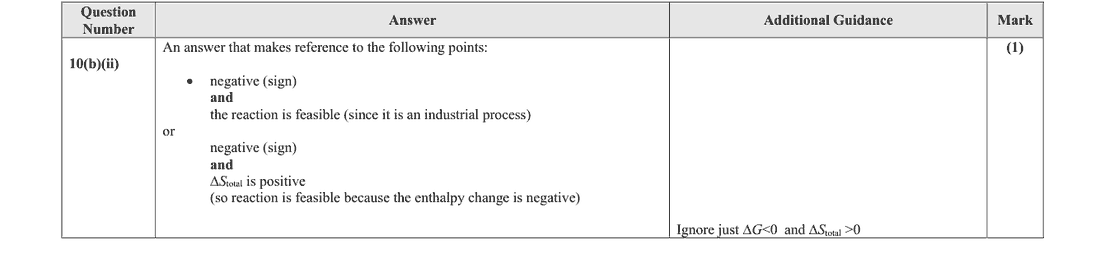
10(b)(ii) Energetics II: entropy 1Short answer
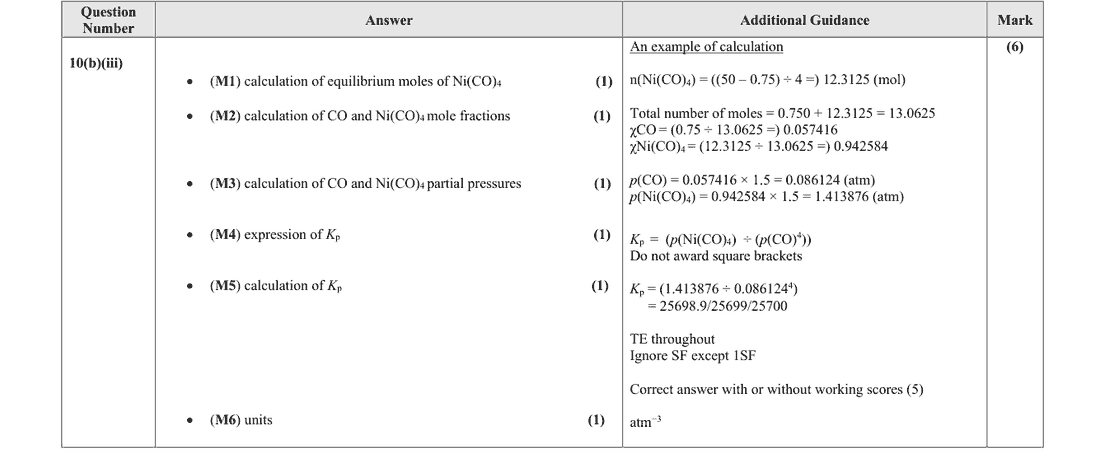
10(b)(iii) Equilibrium II 6Calculation
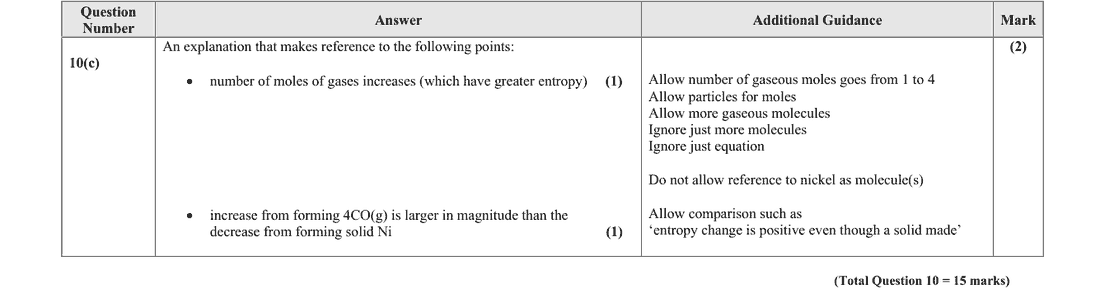
10(c) Energetics II: entropy 2Explanation

The questions

1(a)1(b)1(c)1(d)2(a)(i)2(a)(ii)2(b)(i)2(b)(ii)2(c)(i)2(c)(ii)2(c)(iii)3(a)3(b)3(c)3(d)(i)3(d)(ii)3(d)(iii)3(d)(iv)3(d)(v)3(d)(vi)4(a)4(b)4(c)5(a)5(b)5(c)5(d)5(e)6(a)6(b)(i)6(b)(ii)6(b)(iii)6(c)7(a)(i)7(a)(ii)7(a)(iii)7(b)(i)7(b)(ii)7(b)(iii)7(c)(i)7(c)(ii)7(d)(i)7(d)(ii)8(a)(i)8(a)(ii)8(a)(iii)8(b)(i)8(b)(ii)8(c)(i)8(c)(ii)9(a)(i)9(a)(ii)9(b)9(c)(i)9(c)(ii)10(a)10(b)(i)10(b)(ii)10(b)(iii)10(c)
June 2023 · Paper 3 · Q1(a) 1 mark Equation writing alkanesformulae equations and amounts of substance
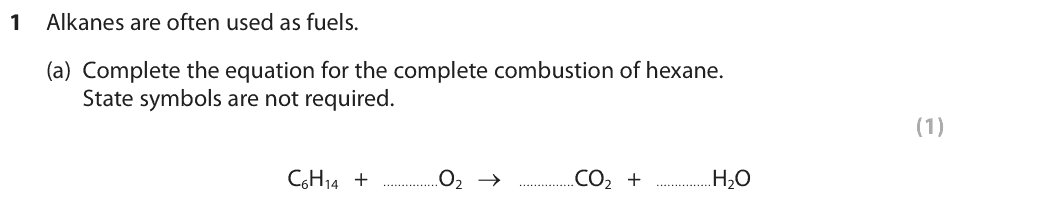
Alkanes are often used as fuels.
Complete the equation for the complete combustion of hexane.
State symbols are not required.
C6H14   +   O2   →   CO2   +   H2O
June 2023 · Paper 3 · Q1(b) 2 marks Short answer Easy alkanes
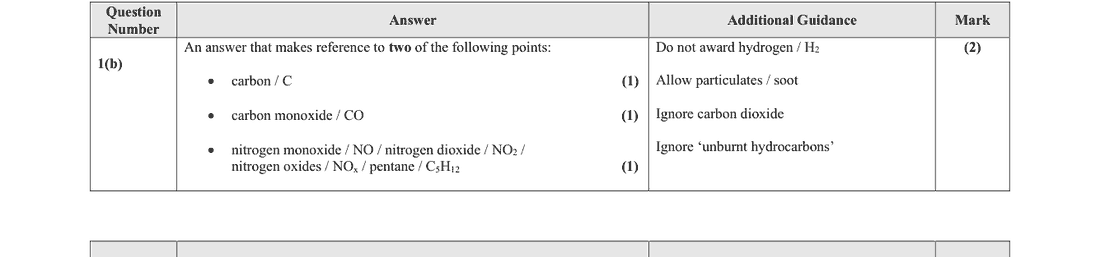
Identify two pollutants produced from the incomplete combustion of a pure
sample of pentane.
June 2023 · Paper 3 · Q1(c) 2 marks Explanation alkanes
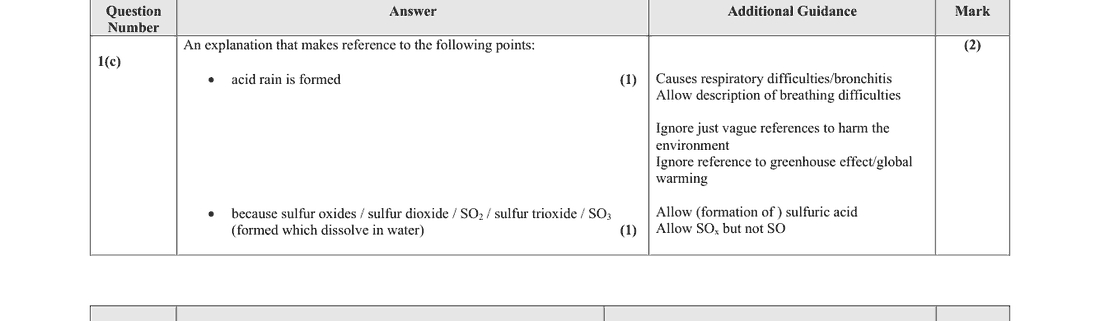
Explain the problem which results from sulfur impurities in fuels.
June 2023 · Paper 3 · Q1(d) 2 marks Equation writing alkanesintroduction to organic chemistry
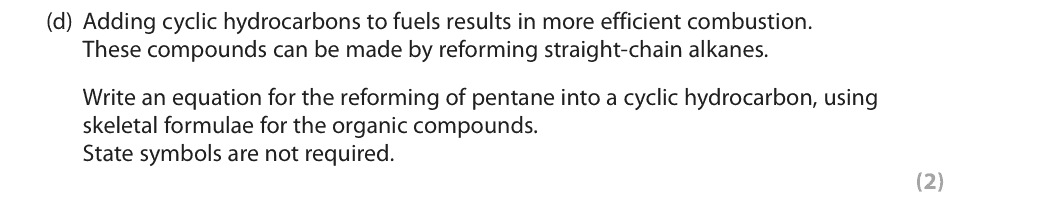
Adding cyclic hydrocarbons to fuels results in more efficient combustion.
These compounds can be made by reforming straight‑chain alkanes.
Write an equation for the reforming of pentane into a cyclic hydrocarbon, using
skeletal formulae for the organic compounds.
State symbols are not required.
June 2023 · Paper 3 · Q2(a)(i) 1 mark Equation writing groups 1 and 2formulae equations and amounts of substance
This question is about some reactions of the elements of Group 1 and Group 2 of the
Periodic Table and their compounds.
Group 2 metals react vigorously with oxygen when heated.
Write the equation for the reaction between magnesium and oxygen.
Include state symbols.
June 2023 · Paper 3 · Q2(a)(ii) 3 marks Explanation groups 1 and 2
Earlier part of question 2 that this part usesEarlier part of June 2023 Paper 3 question 2
Explain the trend in reactivity of the elements down Group 2.
June 2023 · Paper 3 · Q2(b)(i) 1 mark Short answer groups 1 and 2
Earlier part of question 2 that this part usesEarlier part of June 2023 Paper 3 question 2
State the trend in solubility of the Group 2 sulfates.
June 2023 · Paper 3 · Q2(b)(ii) 2 marks Explanation Hard groups 1 and 2
Earlier parts of question 2 that this part usesEarlier part of June 2023 Paper 3 question 2Earlier part of June 2023 Paper 3 question 2
Explain why the reaction between calcium and excess sulfuric acid stops
before all of the metal has reacted.
June 2023 · Paper 3 · Q2(c)(i) 1 mark Practical and data analysis groups 1 and 2
Earlier part of question 2 that this part usesEarlier part of June 2023 Paper 3 question 2
Sodium nitrate undergoes thermal decomposition to produce oxygen as one of
the products.
Describe the test, with the positive result, for oxygen.
June 2023 · Paper 3 · Q2(c)(ii) 1 mark Equation writing groups 1 and 2formulae equations and amounts of substance
Earlier parts of question 2 that this part usesEarlier part of June 2023 Paper 3 question 2Earlier part of June 2023 Paper 3 question 2
Write the equation for this decomposition.
State symbols are not required.
June 2023 · Paper 3 · Q2(c)(iii) 2 marks Short answer redox i
Earlier parts of question 2 that this part usesEarlier part of June 2023 Paper 3 question 2Earlier part of June 2023 Paper 3 question 2
Show, by reference to oxidation number changes, that the decomposition of
sodium nitrate is a redox reaction.
June 2023 · Paper 3 · Q3(a) 1 mark Equation writing alcohols
Ethanol can be dehydrated using concentrated phosphoric(V) acid,
concentrated sulfuric acid or aluminium oxide.
Write the equation for the dehydration of ethanol using structural formulae.
State symbols are not required.
June 2023 · Paper 3 · Q3(b) 1 mark Short answer redox i
Earlier part of question 3 that this part usesEarlier part of June 2023 Paper 3 question 3
Give the formula of phosphoric(V) acid.
June 2023 · Paper 3 · Q3(c) 2 marks Diagram or structure bonding
Earlier part of question 3 that this part usesEarlier part of June 2023 Paper 3 question 3
Draw the dot‑and‑cross diagram of sulfuric acid, H2SO4 .
Clearly differentiate between sulfur, oxygen and hydrogen electrons.
Show outer shell electrons only.
June 2023 · Paper 3 · Q3(d)(i) 1 mark Practical and data analysis alcohols
Earlier part of question 3 that this part usesEarlier part of June 2023 Paper 3 question 3
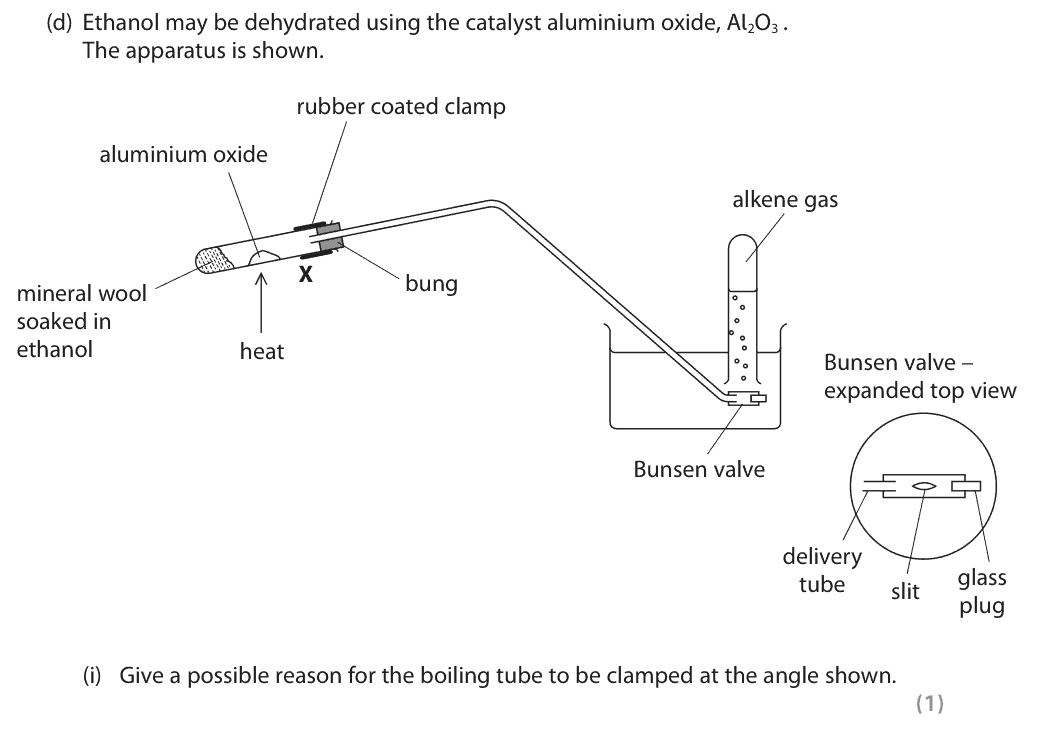
Ethanol may be dehydrated using the catalyst aluminium oxide, Al2O3 .
The apparatus is shown.
rubber coated clamp
aluminium oxide
alkene gas
X
bung
mineral wool
soaked in
ethanol
heat
Bunsen valve –
expanded top view
Bunsen valve
delivery
glass
tube
slit
plug
Give a possible reason for the boiling tube to be clamped at the angle shown.
June 2023 · Paper 3 · Q3(d)(ii) 1 mark Practical and data analysis alcohols
Earlier parts of question 3 that this part usesEarlier part of June 2023 Paper 3 question 3Earlier part of June 2023 Paper 3 question 3
Describe the problem if the ethanol is heated instead of the catalyst.
June 2023 · Paper 3 · Q3(d)(iii) 1 mark Practical and data analysis Easy formulae equations and amounts of substance
Earlier parts of question 3 that this part usesEarlier part of June 2023 Paper 3 question 3Earlier part of June 2023 Paper 3 question 3
Identify a safety issue if the heat source was moved to the position labelled X
on the diagram.
June 2023 · Paper 3 · Q3(d)(iv) 1 mark Practical and data analysis alcohols
Earlier parts of question 3 that this part usesEarlier part of June 2023 Paper 3 question 3Earlier part of June 2023 Paper 3 question 3
Give a possible reason for the use of the Bunsen valve in the apparatus.
June 2023 · Paper 3 · Q3(d)(v) 1 mark Practical and data analysis Easy alkenes
Earlier parts of question 3 that this part usesEarlier part of June 2023 Paper 3 question 3Earlier part of June 2023 Paper 3 question 3
Describe a test, with the positive result, which would confirm the presence of
an alkene in the test tube.
June 2023 · Paper 3 · Q3(d)(vi) 2 marks Calculation formulae equations and amounts of substance
Earlier parts of question 3 that this part usesEarlier part of June 2023 Paper 3 question 3Earlier part of June 2023 Paper 3 question 3
Calculate the volume of 2.759 × 1020 molecules of alkene gas
at room temperature and pressure (r.t.p.).
June 2023 · Paper 3 · Q4(a) 6 marks 6-mark extended response energetics i
This question is about hydrated magnesium sulfate, MgSO4·7H2O.
Devise an experimental procedure to determine the enthalpy change of solution
for hydrated magnesium sulfate.
MgSO4·7H2O(s)   +   aq   →   MgSO4(aq)
Details of the method of calculation are not required.
June 2023 · Paper 3 · Q4(b) 2 marks Calculation energetics i
Earlier part of question 4 that this part usesEarlier part of June 2023 Paper 3 question 4
The enthalpy changes of solution for anhydrous and hydrated magnesium sulfate
were found by experiment to be
MgSO4(s)            +   aq   →   MgSO4(aq)
ΔrH = –63.2 kJ mol–1
ΔrH = +15.7 kJ mol–1
MgSO4·7H2O(s)   +   aq   →   MgSO4(aq)
Calculate, using Hess’s law, the enthalpy change for the hydration of
anhydrous magnesium sulfate.
Include a sign and units in your answer.
MgSO4(s)   +   7H2O(l)   →   MgSO4·7H2O(s)
June 2023 · Paper 3 · Q4(c) 2 marks Explanation lattice energy
Explain how the enthalpy change of hydration of magnesium ions in
magnesium sulfate is different from the enthalpy change of hydration of
calcium ions in calcium sulfate.
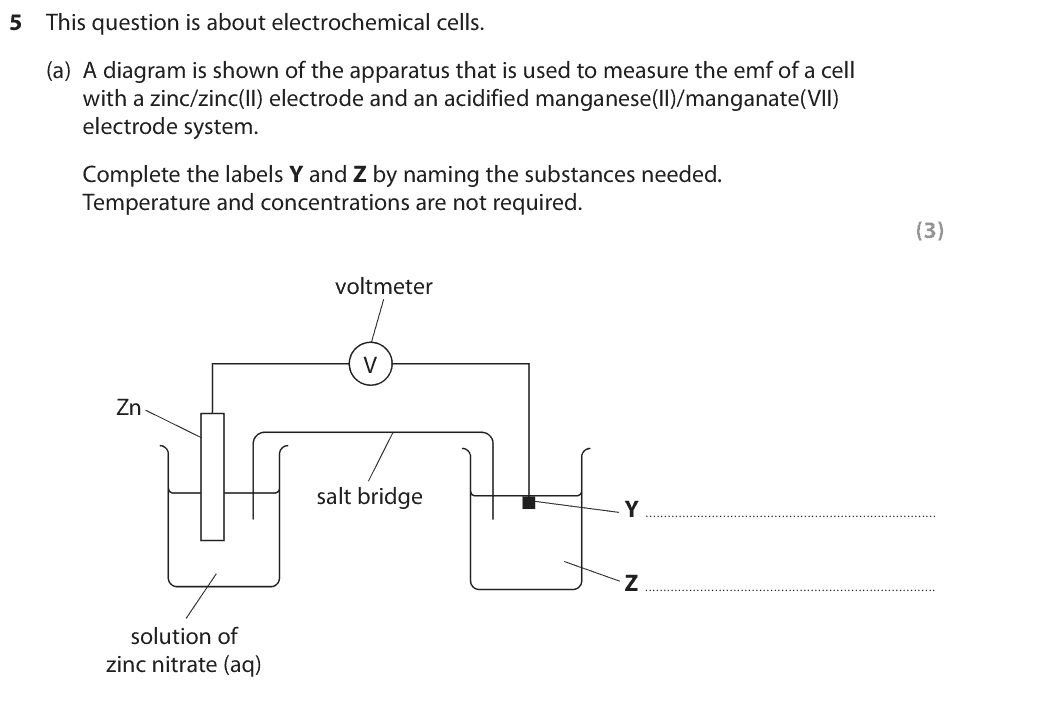
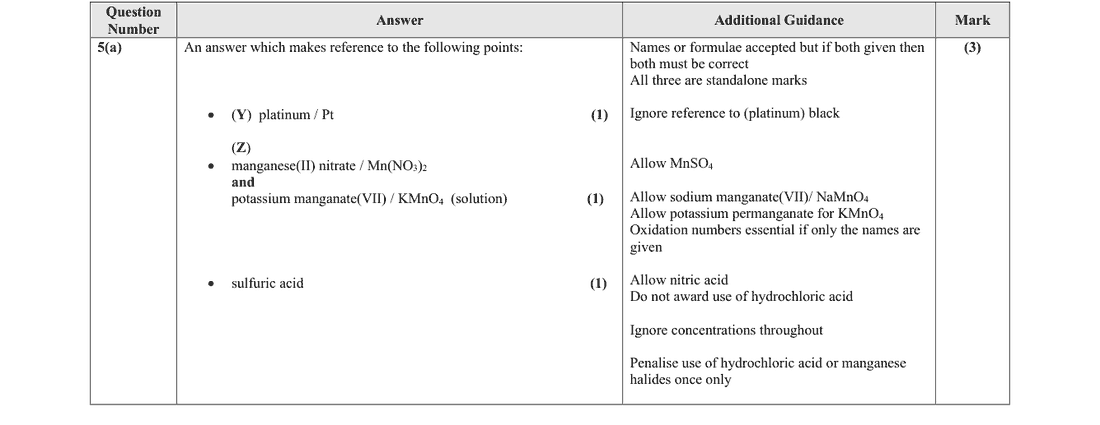
June 2023 · Paper 3 · Q5(a) 3 marks Practical and data analysis redox ii
This question is about electrochemical cells.
A diagram is shown of the apparatus that is used to measure the emf of a cell
with a zinc/zinc(II) electrode and an acidified manganese(II)/manganate(VII)
electrode system.
Complete the labels Y and Z by naming the substances needed.
Temperature and concentrations are not required.
voltmeter
V
Zn
salt bridge
Y 
Z 
solution of
zinc nitrate (aq)
June 2023 · Paper 3 · Q5(b) 5 marks Explanation transition metals reactionsredox ii
Earlier part of question 5 that this part usesEarlier part of June 2023 Paper 3 question 5
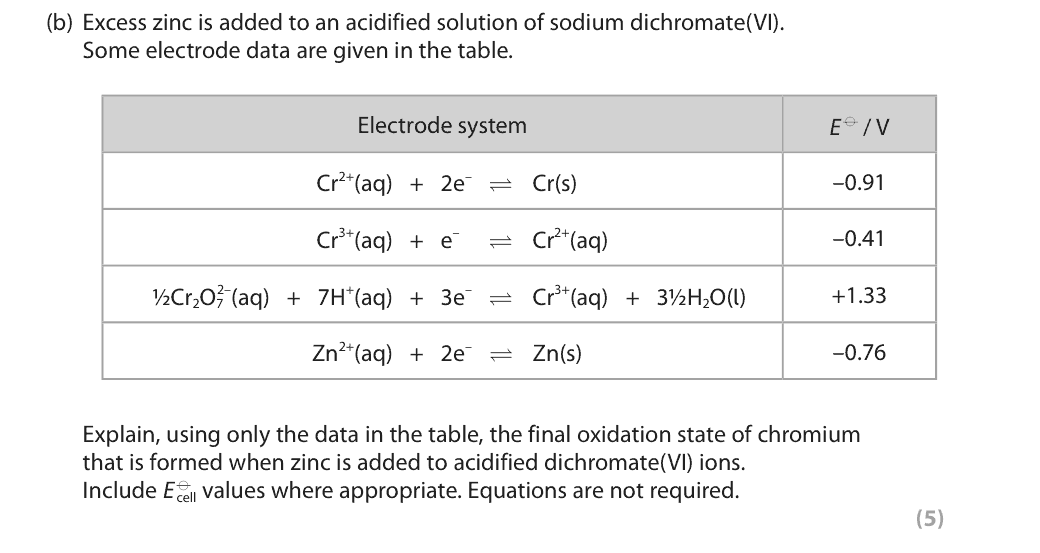
Excess zinc is added to an acidified solution of sodium dichromate(VI).
Some electrode data are given in the table.
Electrode system
E d / V
Cr2+(aq)   +   2e–      Cr(s)
–0.91
Cr3+(aq)   +   e–        Cr2+(aq)
–0.41
½Cr2O7
2–(aq)   +   7H+(aq)   +   3e–      Cr3+(aq)   +   3½H2O(l)
+1.33
Zn2+(aq)   +   2e–      Zn(s)
–0.76
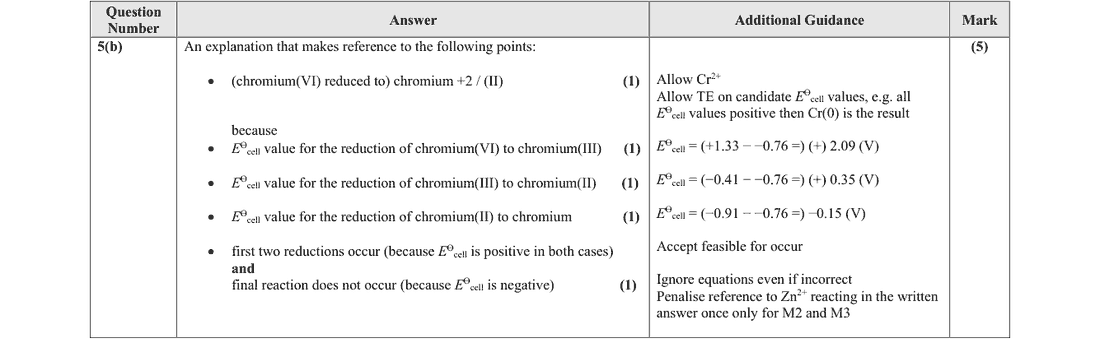
Explain, using only the data in the table, the final oxidation state of chromium
that is formed when zinc is added to acidified dichromate(VI) ions.
Include E d
cell values where appropriate. Equations are not required.
June 2023 · Paper 3 · Q5(c) 1 mark Equation writing redox iiredox i
Earlier part of question 5 that this part usesEarlier part of June 2023 Paper 3 question 5
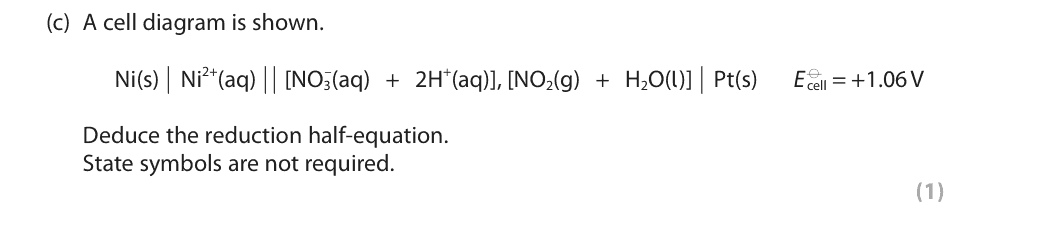
A cell diagram is shown.
Ni(s) ½ Ni2+(aq) ½½ [NO3
–(aq)   +   2H+(aq)], [NO2(g)   +   H2O(l)] ½ Pt(s)       E d
cell = +1.06 V
Deduce the reduction half‑equation.
State symbols are not required.
June 2023 · Paper 3 · Q5(d) 2 marks Explanation redox ii
Earlier part of question 5 that this part usesEarlier part of June 2023 Paper 3 question 5
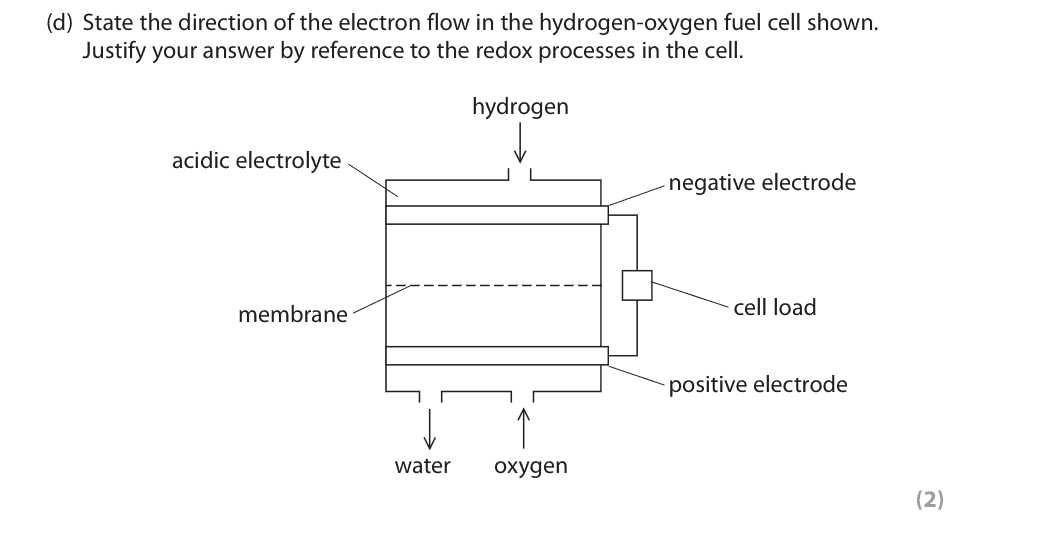
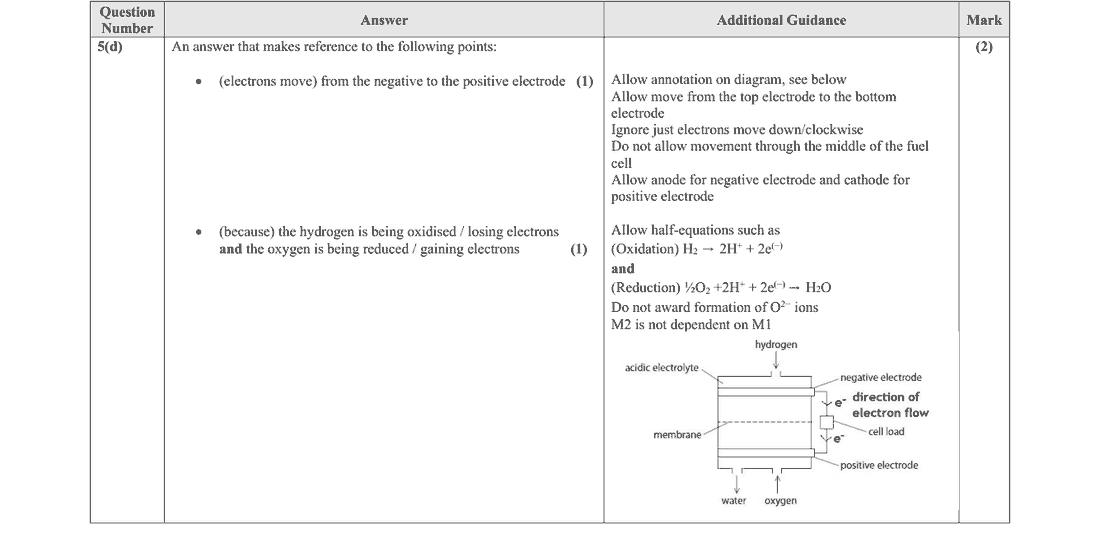
State the direction of the electron flow in the hydrogen‑oxygen fuel cell shown.
Justify your answer by reference to the redox processes in the cell.
hydrogen
acidic electrolyte
negative electrode
cell load
membrane
positive electrode
water
oxygen
June 2023 · Paper 3 · Q5(e) 1 mark Short answer Easy redox ii
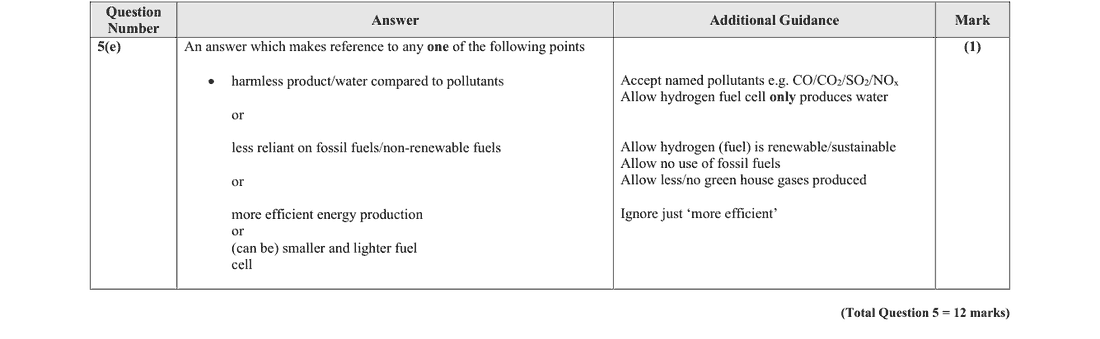
State one advantage of the hydrogen‑oxygen fuel cell over the use of petrol as
fuel in a vehicle.
June 2023 · Paper 3 · Q6(a) 1 mark Short answer nmr mass spectrometry and chromatography
Amino acids can be separated using chromatography.
State how chromatography separates the components of a mixture.
June 2023 · Paper 3 · Q6(b)(i) 1 mark Short answer amines amides amino acids and proteins
Earlier part of question 6 that this part usesEarlier part of June 2023 Paper 3 question 6
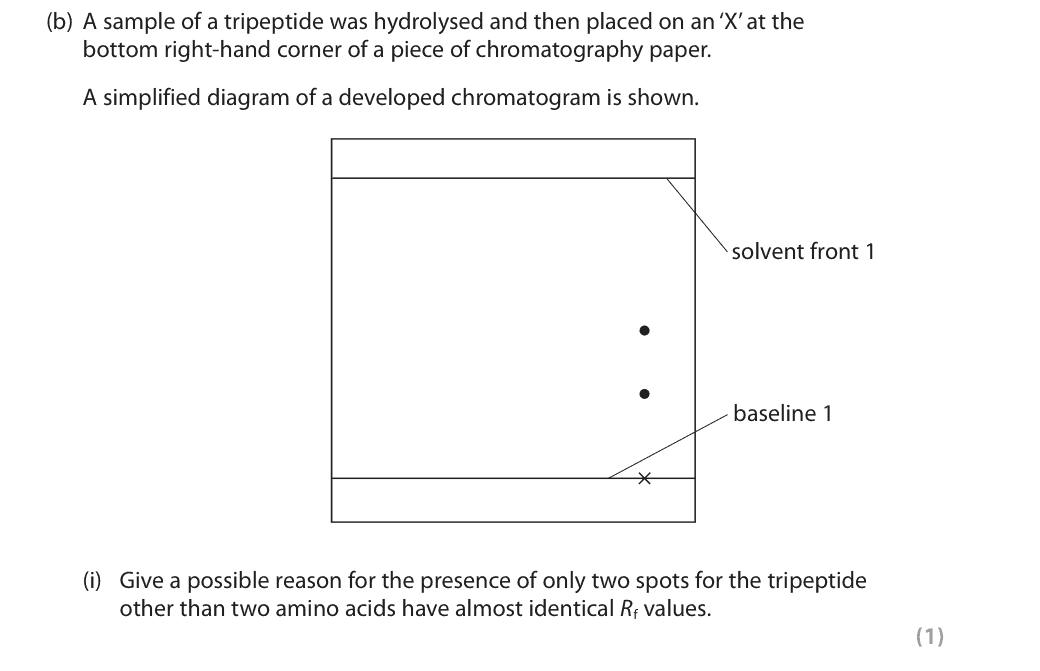
A sample of a tripeptide was hydrolysed and then placed on an ‘X’ at the
bottom right‑hand corner of a piece of chromatography paper.
A simplified diagram of a developed chromatogram is shown.
solvent front 1
baseline 1
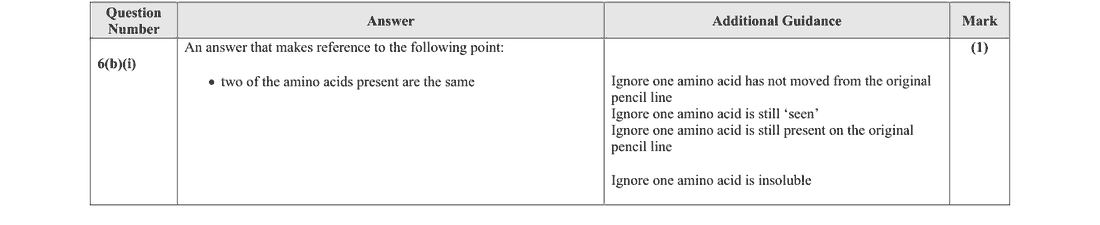
Give a possible reason for the presence of only two spots for the tripeptide
other than two amino acids have almost identical Rf values.
June 2023 · Paper 3 · Q6(b)(ii) 3 marks Diagram or structure nmr mass spectrometry and chromatography
Earlier parts of question 6 that this part usesEarlier part of June 2023 Paper 3 question 6Earlier part of June 2023 Paper 3 question 6
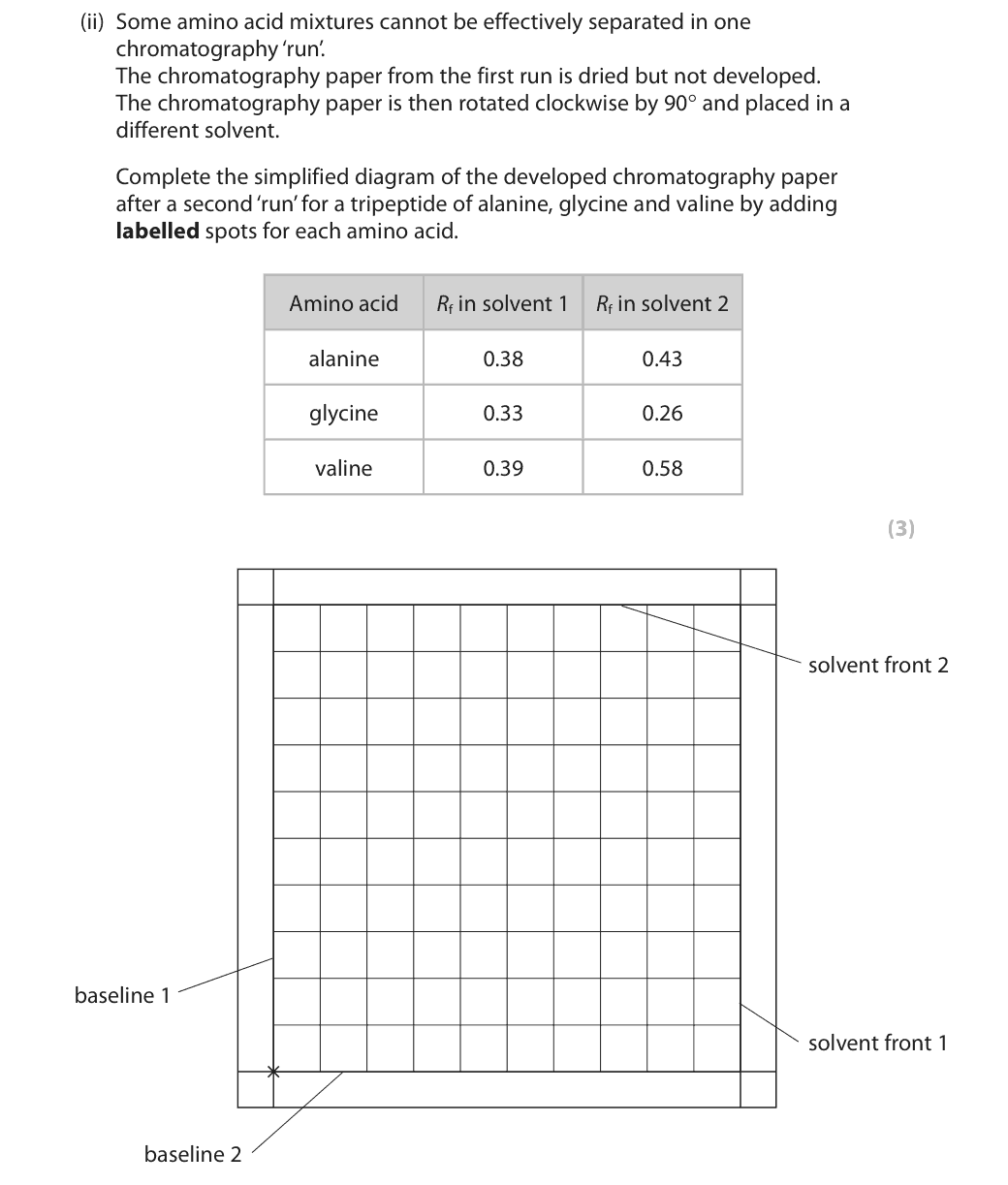
Some amino acid mixtures cannot be effectively separated in one
chromatography ‘run’.
The chromatography paper from the first run is dried but not developed.
The chromatography paper is then rotated clockwise by 90° and placed in a
different solvent.
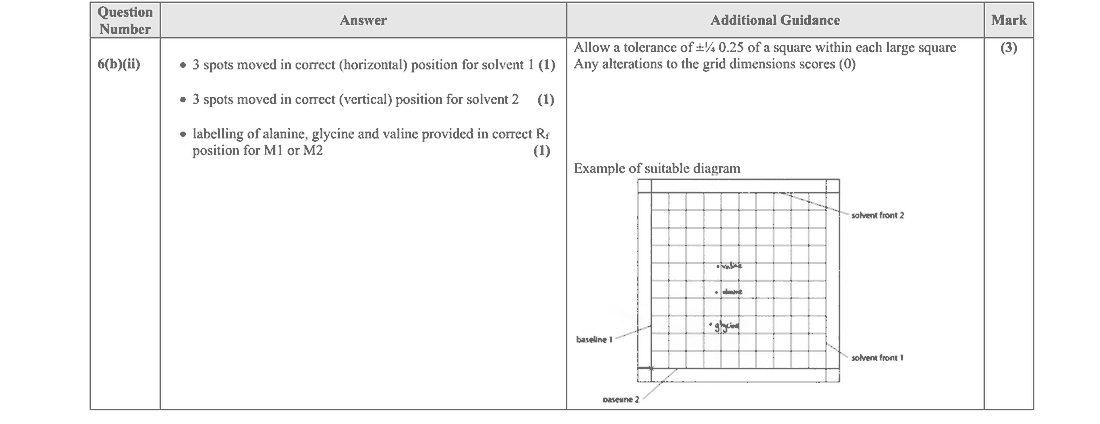
Complete the simplified diagram of the developed chromatography paper
after a second ‘run’ for a tripeptide of alanine, glycine and valine by adding
labelled spots for each amino acid.
Amino acid
Rf in solvent 1
Rf in solvent 2
alanine
0.38
0.43
glycine
0.33
0.26
valine
0.39
0.58
solvent front 2
baseline 1
solvent front 1
baseline 2
June 2023 · Paper 3 · Q6(b)(iii) 1 mark Short answer amines amides amino acids and proteins
Earlier part of question 6 that this part usesEarlier part of June 2023 Paper 3 question 6
Name a reagent that locates colourless amino acids by producing a
coloured compound.
June 2023 · Paper 3 · Q6(c) 1 mark Short answer nmr mass spectrometry and chromatography
State the technique that is used in conjunction with gas chromatography (GC)
when carrying out forensic testing.
June 2023 · Paper 3 · Q7(a)(i) 1 mark Practical and data analysis formulae equations and amounts of substance
Hardness in water is measured in terms of the concentration of dissolved
calcium compounds.
Titration experiments can be carried out to determine the hardness of
a water sample.
A pipette is used to measure a 50.0 cm3 water sample for titration.
Describe how to remove an air bubble from the tip of the pipette.
June 2023 · Paper 3 · Q7(a)(ii) 1 mark Calculation formulae equations and amounts of substance
Earlier part of question 7 that this part usesEarlier part of June 2023 Paper 3 question 7
Calculate the maximum volume that would be obtained by using a
25.0 cm3 pipette twice to measure a total volume of 50.0 cm3.
The uncertainty in each 25.0 cm3 pipette measurement is ±0.04 cm3.
June 2023 · Paper 3 · Q7(a)(iii) 2 marks Calculation formulae equations and amounts of substance
Earlier part of question 7 that this part usesEarlier part of June 2023 Paper 3 question 7
Compare the percentage uncertainty in using a 25.0 cm3 pipette twice with
using a 50.0 cm3 pipette once to measure 50.0 cm3 of water.
The uncertainty in the 50.0 cm3 pipette measurement is ±0.05 cm3.
June 2023 · Paper 3 · Q7(b)(i) 1 mark Practical and data analysis Easy formulae equations and amounts of substance
Earlier part of question 7 that this part usesEarlier part of June 2023 Paper 3 question 7
About 2 cm3 of a pH 10 buffer is added to each 50.0 cm3 water sample.
State whether or not a 100 cm3 measuring cylinder is suitable to measure this
volume of buffer solution. Justify your answer.
June 2023 · Paper 3 · Q7(b)(ii) 4 marks Calculation acid base equilibria
Earlier parts of question 7 that this part usesEarlier part of June 2023 Paper 3 question 7Earlier part of June 2023 Paper 3 question 7
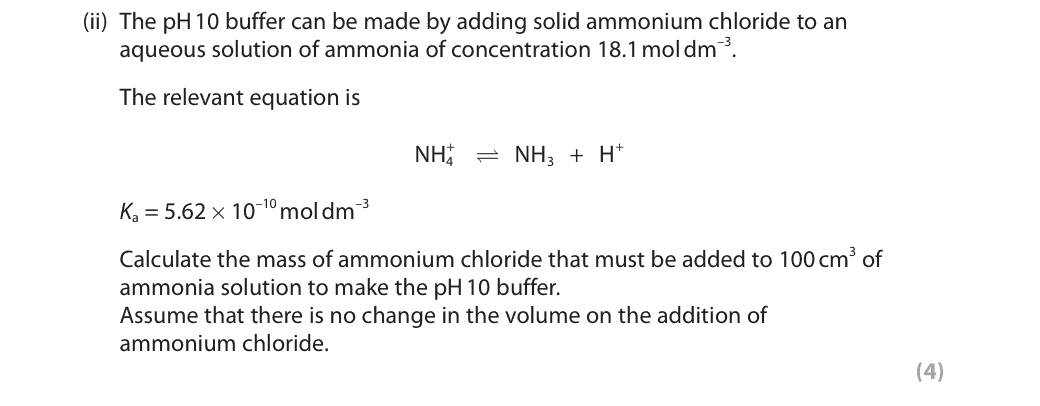
The pH 10 buffer can be made by adding solid ammonium chloride to an
aqueous solution of ammonia of concentration 18.1 mol dm–3.
The relevant equation is
NH4
+       NH3   +   H+
Ka = 5.62 × 10–10 mol dm–3
Calculate the mass of ammonium chloride that must be added to 100 cm3 of
ammonia solution to make the pH 10 buffer.
Assume that there is no change in the volume on the addition of
ammonium chloride.
June 2023 · Paper 3 · Q7(b)(iii) 1 mark Practical and data analysis Easy formulae equations and amounts of substance
Earlier parts of question 7 that this part usesEarlier part of June 2023 Paper 3 question 7Earlier part of June 2023 Paper 3 question 7
State a necessary laboratory precaution, other than wearing a laboratory coat,
gloves and goggles, that must be taken when using concentrated ammonia.
June 2023 · Paper 3 · Q7(c)(i) 1 mark Diagram or structure transition metals principles
Earlier part of question 7 that this part usesEarlier part of June 2023 Paper 3 question 7
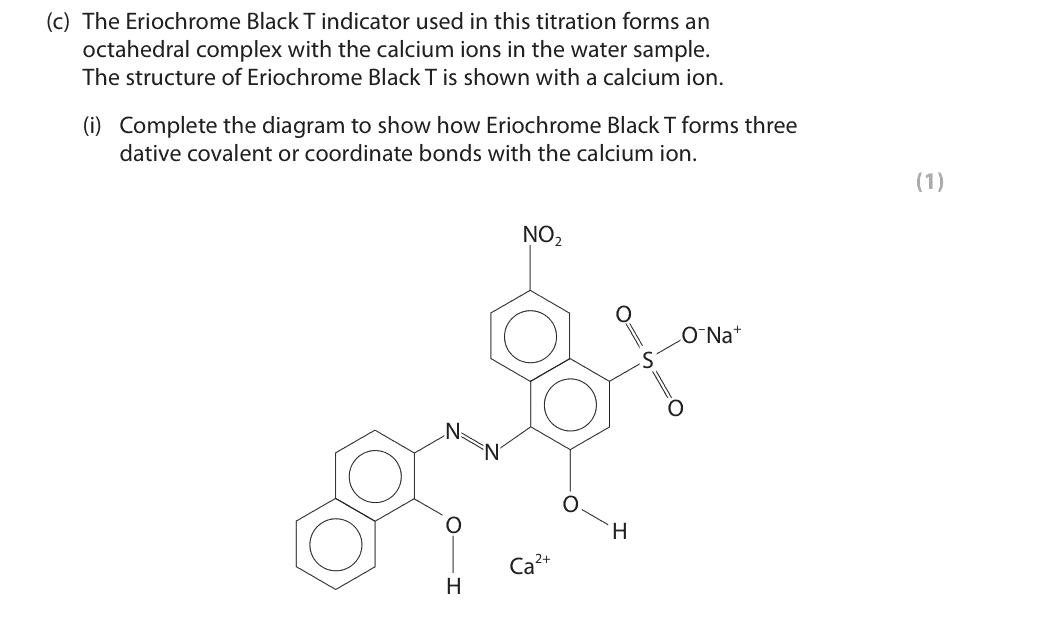
The Eriochrome Black T indicator used in this titration forms an
octahedral complex with the calcium ions in the water sample.
The structure of Eriochrome Black T is shown with a calcium ion.
Complete the diagram to show how Eriochrome Black T forms three
dative covalent or coordinate bonds with the calcium ion.
NO2
O
O–Na+
S
O
N
N
O
O
H
Ca2+
H
June 2023 · Paper 3 · Q7(c)(ii) 1 mark Short answer transition metals principles
Earlier parts of question 7 that this part usesEarlier part of June 2023 Paper 3 question 7Earlier part of June 2023 Paper 3 question 7
State the number of water molecules needed to complete this complex.
June 2023 · Paper 3 · Q7(d)(i) 1 mark Practical and data analysis Hard formulae equations and amounts of substance
Earlier part of question 7 that this part usesEarlier part of June 2023 Paper 3 question 7
There are two types of water hardness:
temporary hardness which is removed by boiling as a precipitate forms,
permanent hardness which is unaffected by boiling.
Levels of water hardness are expressed as the concentration of calcium ions
in mg dm–3.
A student carried out a series of experiments to determine the hardness of a
sample of water. 50.0 cm3 samples of the water were titrated with EDTA.
Further 50.0 cm3 samples of water were taken after boiling and then titrated
with EDTA.
Name the process needed before titrating the sample of boiled water.
June 2023 · Paper 3 · Q7(d)(ii) 6 marks Calculation formulae equations and amounts of substance
Earlier parts of question 7 that this part usesEarlier part of June 2023 Paper 3 question 7Earlier part of June 2023 Paper 3 question 7
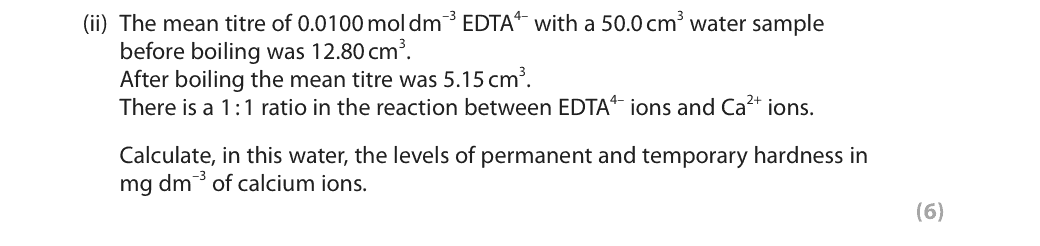
The mean titre of 0.0100 mol dm–3 EDTA4– with a 50.0 cm3 water sample
before boiling was 12.80 cm3.
After boiling the mean titre was 5.15 cm3.
There is a 1 : 1 ratio in the reaction between EDTA4– ions and Ca2+ ions.
Calculate, in this water, the levels of permanent and temporary hardness in
mg dm–3 of calcium ions.
June 2023 · Paper 3 · Q8(a)(i) 2 marks Practical and data analysis Hard kinetics ii
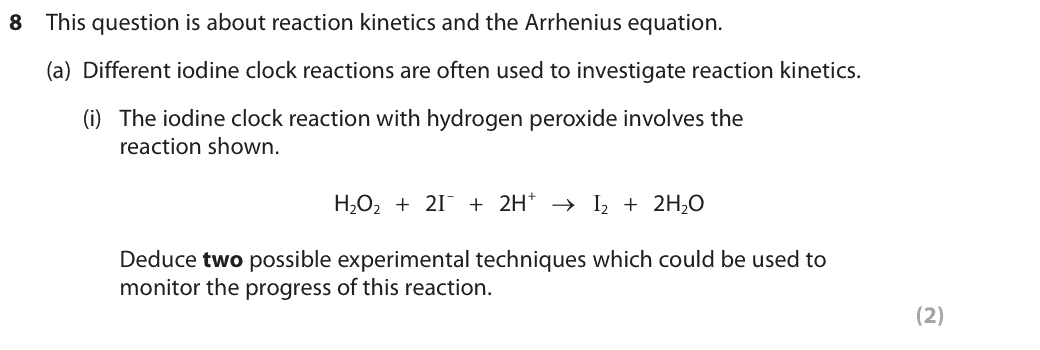
This question is about reaction kinetics and the Arrhenius equation.
Different iodine clock reactions are often used to investigate reaction kinetics.
The iodine clock reaction with hydrogen peroxide involves the
reaction shown.
H2O2   +   2I–   +   2H+   →   I2   +   2H2O
Deduce two possible experimental techniques which could be used to
monitor the progress of this reaction.
June 2023 · Paper 3 · Q8(a)(ii) 1 mark Short answer kinetics ii
Earlier part of question 8 that this part usesEarlier part of June 2023 Paper 3 question 8
The iodate(V) reaction has the rate determining step
IO3
–   +   3HSO3
–   →   I–   +   3HSO4
–
Give a possible reason why this is the slowest step.
June 2023 · Paper 3 · Q8(a)(iii) 1 mark Short answer kinetics ii
Earlier part of question 8 that this part usesEarlier part of June 2023 Paper 3 question 8
The chlorate(V) reaction has the rate determining step
–   +   2H+   +   I–   →   HIO   +   HClO2
ClO3
Deduce the rate equation for this iodine clock reaction.
June 2023 · Paper 3 · Q8(b)(i) 1 mark Diagram or structure kinetics i
Earlier part of question 8 that this part usesEarlier part of June 2023 Paper 3 question 8
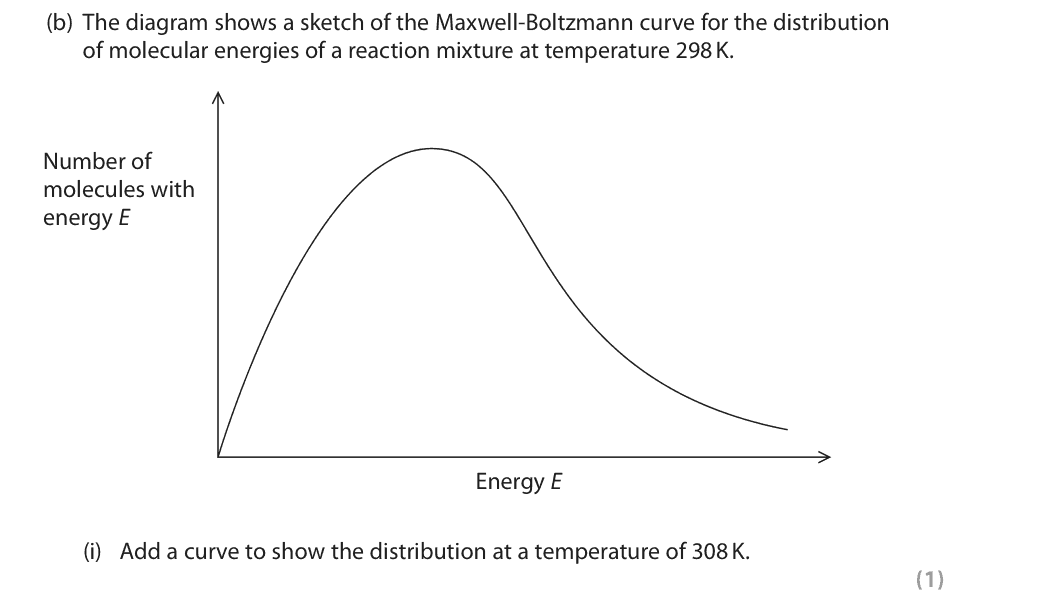
The diagram shows a sketch of the Maxwell‑Boltzmann curve for the distribution
of molecular energies of a reaction mixture at temperature 298 K.
Number of
molecules with
energy E
Energy E
Add a curve to show the distribution at a temperature of 308 K.
June 2023 · Paper 3 · Q8(b)(ii) 2 marks Explanation kinetics i
Earlier parts of question 8 that this part usesEarlier part of June 2023 Paper 3 question 8Earlier part of June 2023 Paper 3 question 8
Explain why a temperature rise from 298 K to 308 K results in a large increase
in the rate of reaction.
Refer to the Maxwell‑Boltzmann distribution in your answer.
June 2023 · Paper 3 · Q8(c)(i) 3 marks Calculation kinetics ii
Earlier part of question 8 that this part usesEarlier part of June 2023 Paper 3 question 8
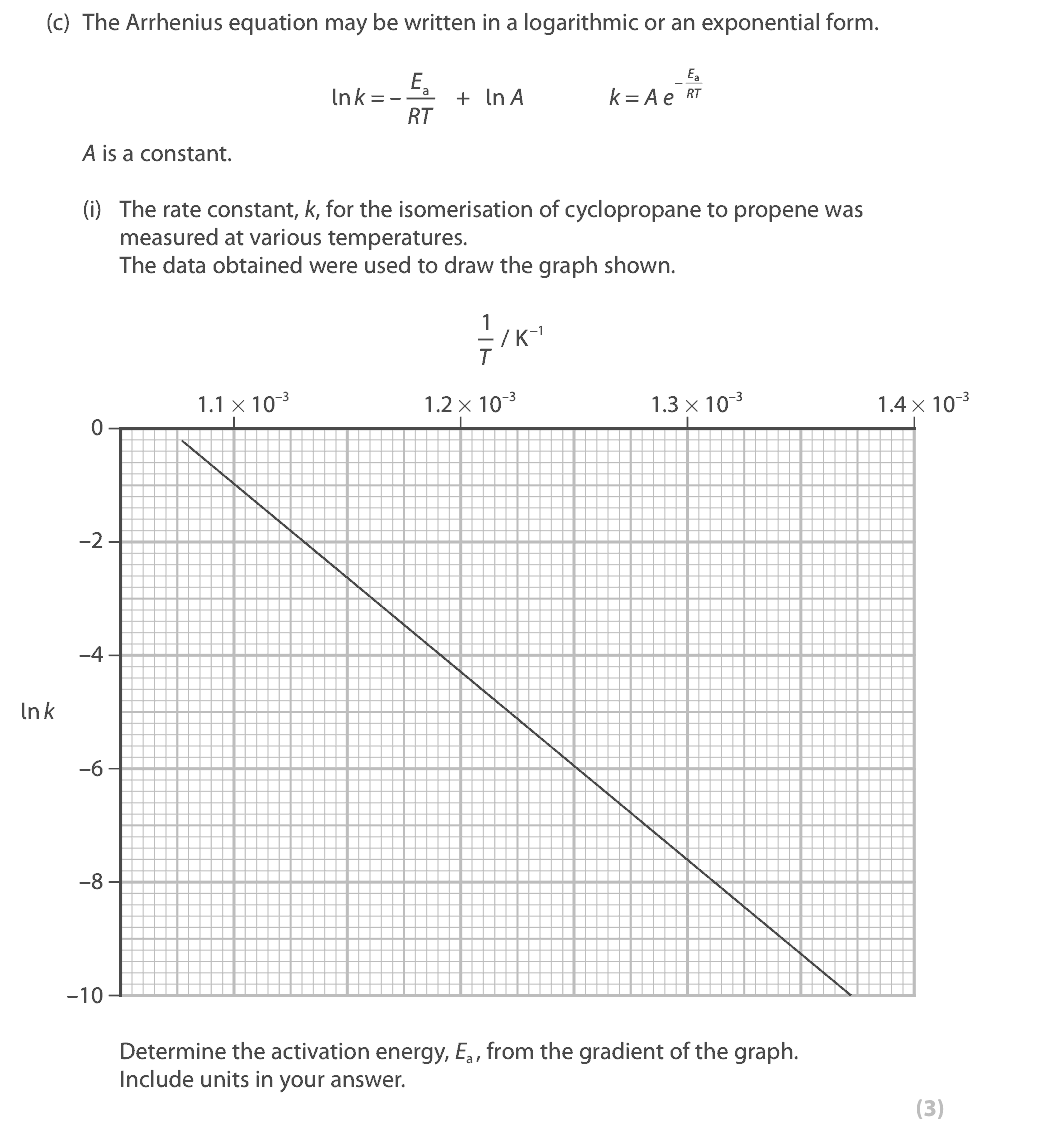
The Arrhenius equation may be written in a logarithmic or an exponential form.
ln k = – E
−E
a
a   +   ln A
k = A e
RT
RT
A is a constant.
The rate constant, k, for the isomerisation of cyclopropane to propene was
measured at various temperatures.
The data obtained were used to draw the graph shown.
1
T / K −
1
1.1 × 10–3
1.2 × 10–3
1.3 × 10–3
1.4 × 10–3
0
–2
–4
ln k
–6
–8
–10
Determine the activation energy, Ea , from the gradient of the graph.
Include units in your answer.
June 2023 · Paper 3 · Q8(c)(ii) 3 marks Calculation kinetics i
Earlier parts of question 8 that this part usesEarlier part of June 2023 Paper 3 question 8Earlier part of June 2023 Paper 3 question 8
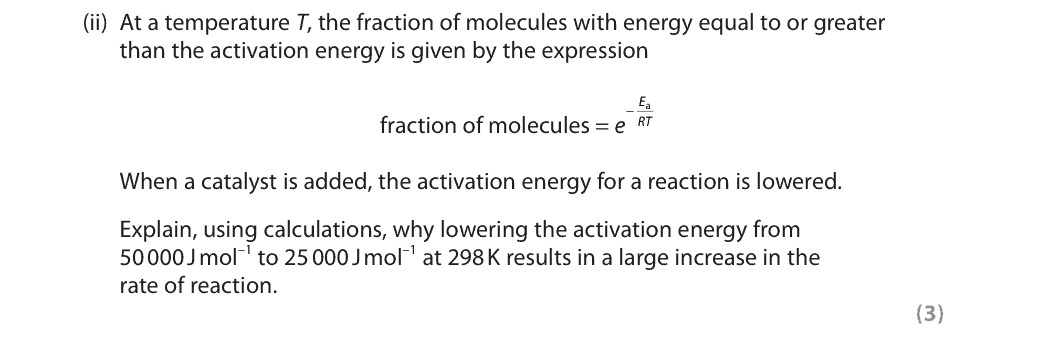
At a temperature T, the fraction of molecules with energy equal to or greater
than the activation energy is given by the expression
−E
a
fraction of molecules = e
RT
When a catalyst is added, the activation energy for a reaction is lowered.
Explain, using calculations, why lowering the activation energy from
50 000 J mol–1 to 25 000 J mol–1 at 298 K results in a large increase in the
rate of reaction.
June 2023 · Paper 3 · Q9(a)(i) 1 mark Short answer carboxylic acids
This is a question about isomers of C8H8O2 .
One of these isomers, methyl benzoate, is hydrolysed by alkali or by acid.
Hydrolysis with aqueous sodium hydroxide is followed by acidification to form
benzoic acid.
Give a reason why acidification is required after hydrolysis.
June 2023 · Paper 3 · Q9(a)(ii) 1 mark Equation writing Hard carboxylic acids
Earlier part of question 9 that this part usesEarlier part of June 2023 Paper 3 question 9
Write an equation, using structural formulae, for the acid hydrolysis of
methyl benzoate.
June 2023 · Paper 3 · Q9(b) 7 marks Explanation organic synthesisnmr mass spectrometry and chromatography
Earlier part of question 9 that this part usesEarlier part of June 2023 Paper 3 question 9
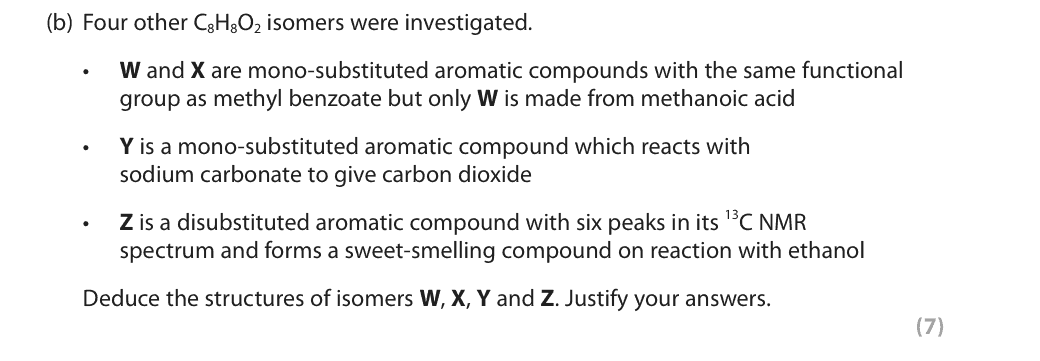
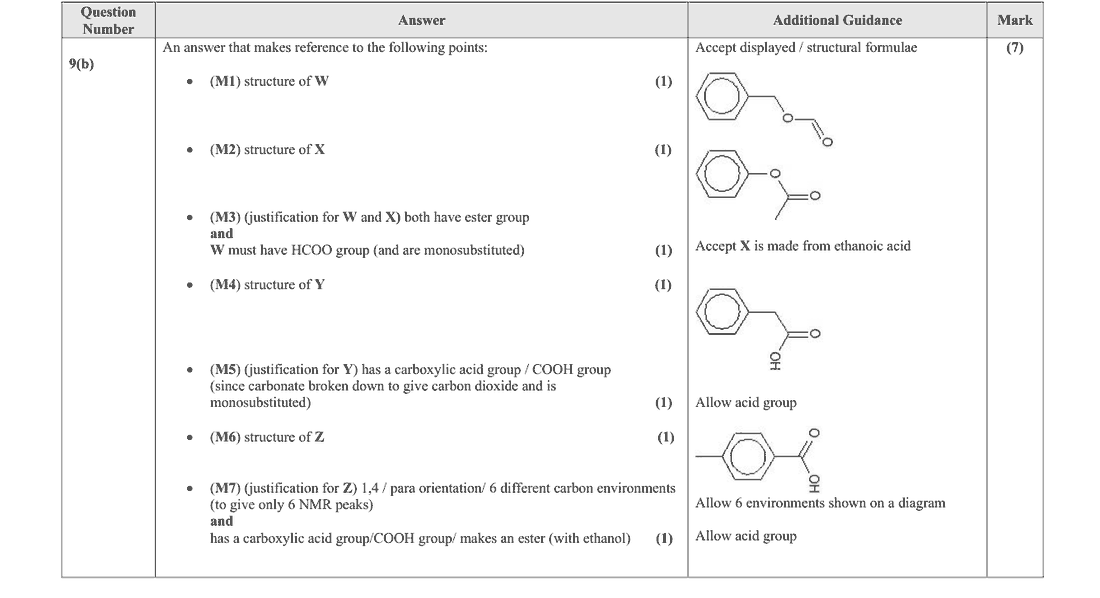
Four other C8H8O2 isomers were investigated.
•
W and X are mono‑substituted aromatic compounds with the same functional
group as methyl benzoate but only W is made from methanoic acid
Y is a mono‑substituted aromatic compound which reacts with
•
sodium carbonate to give carbon dioxide
•
Z is a disubstituted aromatic compound with six peaks in its 13C NMR
spectrum and forms a sweet‑smelling compound on reaction with ethanol
Deduce the structures of isomers W, X, Y and Z. Justify your answers.
June 2023 · Paper 3 · Q9(c)(i) 4 marks Mechanism arenes benzene
Earlier part of question 9 that this part usesEarlier part of June 2023 Paper 3 question 9
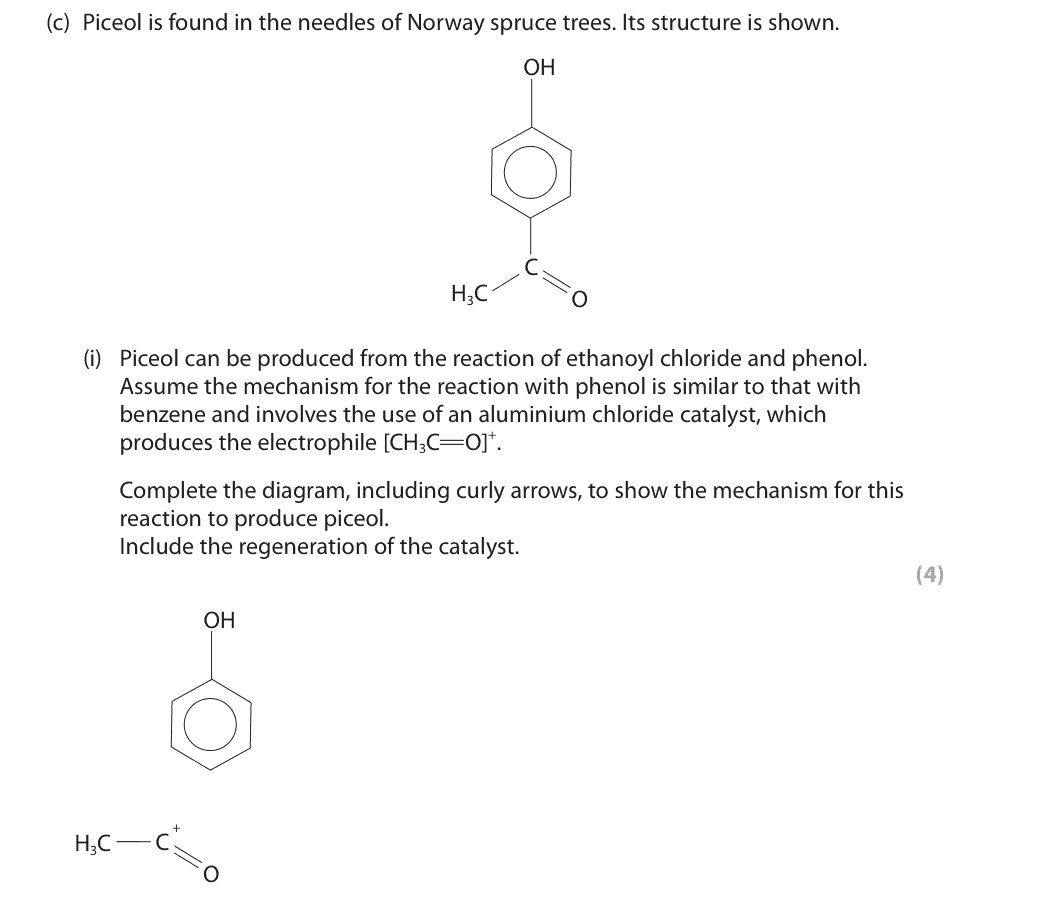
Piceol is found in the needles of Norway spruce trees. Its structure is shown.
OH
C
H3C
O
Piceol can be produced from the reaction of ethanoyl chloride and phenol.
Assume the mechanism for the reaction with phenol is similar to that with
benzene and involves the use of an aluminium chloride catalyst, which
produces the electrophile [CH3C
O]+.
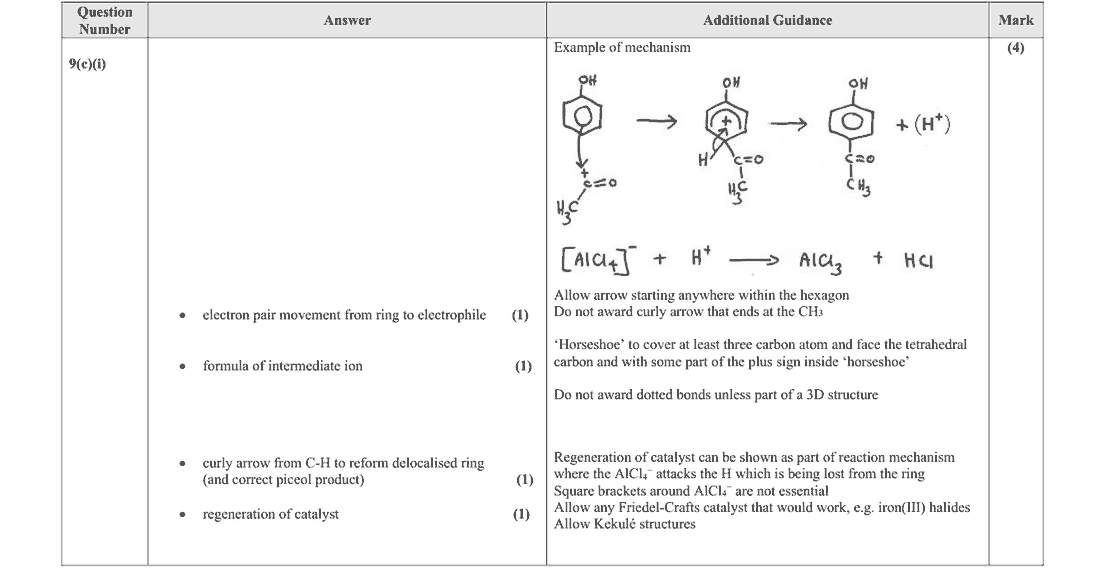
Complete the diagram, including curly arrows, to show the mechanism for this
reaction to produce piceol.
Include the regeneration of the catalyst.
OH
+
H3C
C
O
June 2023 · Paper 3 · Q9(c)(ii) 2 marks Practical and data analysis Hard carbonyl compounds
Earlier parts of question 9 that this part usesEarlier part of June 2023 Paper 3 question 9Earlier part of June 2023 Paper 3 question 9
Piceol can be distinguished from HOC6H4CH2CHO using simple chemical tests.
Give the reagents for a chemical test, and the observation that would only be
positive for piceol.
June 2023 · Paper 3 · Q10(a) 1 mark Short answer transition metals principles
The Mond Process is an industrial method of purifying nickel.
The first step involves the reaction of nickel oxide with hydrogen gas at 473 K.
NiO(s)   +   H2(g)   →   Ni(s)   +   H2O(g)
The nickel is not pure because the impurities also react with the hydrogen gas.
Complete the electronic configuration of the Ni2+ ion.
1s2
June 2023 · Paper 3 · Q10(b)(i) 5 marks Calculation entropy
Earlier part of question 10 that this part usesEarlier part of June 2023 Paper 3 question 10
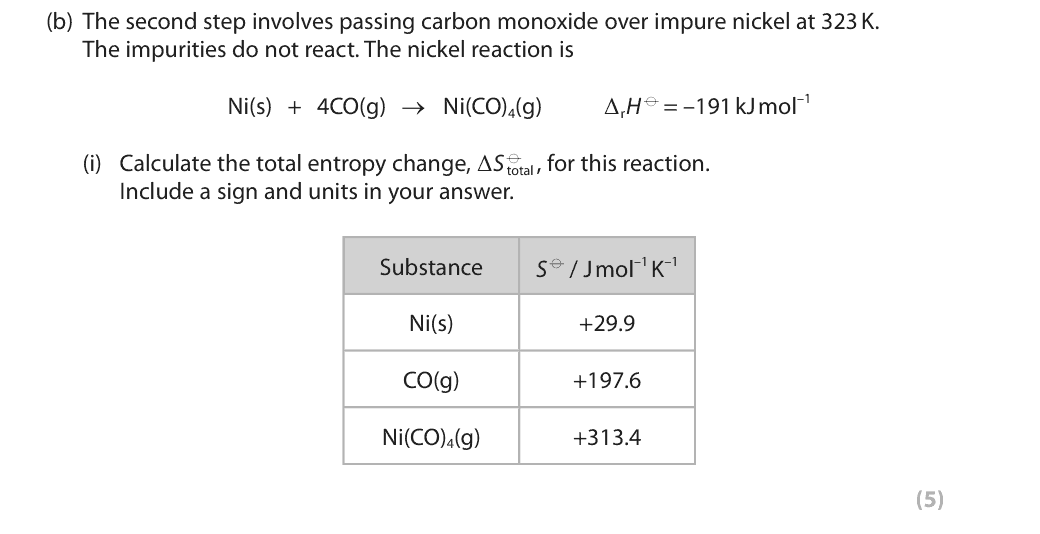
The second step involves passing carbon monoxide over impure nickel at 323 K.
The impurities do not react. The nickel reaction is
Ni(s)   +   4CO(g)   →   Ni(CO)4(g)
ΔrH d = –191 kJ mol–1
Calculate the total entropy change, ΔS d
total , for this reaction.
Include a sign and units in your answer.
Substance
S d / J mol–1 K–1
Ni(s)
+29.9
CO(g)
+197.6
Ni(CO)4(g)
+313.4
June 2023 · Paper 3 · Q10(b)(ii) 1 mark Short answer entropy
Earlier parts of question 10 that this part usesEarlier part of June 2023 Paper 3 question 10Earlier part of June 2023 Paper 3 question 10
Predict the sign of the Gibbs Free Energy change, ΔG, for this reaction and
justify your choice. No calculation is required.
June 2023 · Paper 3 · Q10(b)(iii) 6 marks Calculation equilibrium ii
Earlier parts of question 10 that this part usesEarlier part of June 2023 Paper 3 question 10Earlier part of June 2023 Paper 3 question 10
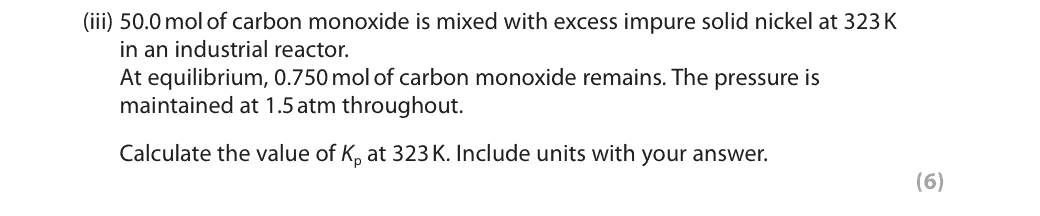
50.0 mol of carbon monoxide is mixed with excess impure solid nickel at 323 K
in an industrial reactor.
At equilibrium, 0.750 mol of carbon monoxide remains. The pressure is
maintained at 1.5 atm throughout.
Calculate the value of Kp at 323 K. Include units with your answer.
June 2023 · Paper 3 · Q10(c) 2 marks Explanation Hard entropy
Earlier part of question 10 that this part usesEarlier part of June 2023 Paper 3 question 10
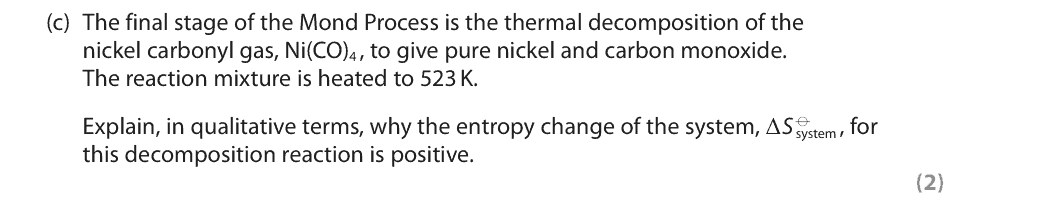
The final stage of the Mond Process is the thermal decomposition of the
nickel carbonyl gas, Ni(CO)4 , to give pure nickel and carbon monoxide.
The reaction mixture is heated to 523 K.
Explain, in qualitative terms, why the entropy change of the system, ΔS d
system , for
this decomposition reaction is positive.

Work with an A-level chemistry tutor

Want a paper marked and gone through with you? Message us.

Prefer email? Send an enquiry

If you are under 18, please include a parent's contact details. Enquiries go to enquiries@chemistryaleveltutor.com and are deleted once handled. All tutoring is online.